 エドガーで原本を確認する
UNITED STATES
SECURITIES AND EXCHANGE COMMISSION
WASHINGTON, D.C. 20549
FORM 20-F
(Mark One)
☐ REGISTRATION STATEMENT PURSUANT TO SECTION 12(B) OR 12(G) OF THE SECURITIES
EXCHANGE ACT OF 1934
OR
☒ ANNUAL REPORT PURSUANT TO SECTION 13 OR 15(D) OF THE SECURITIES EXCHANGE ACT
OF 1934
For the fiscal year ended September 30, 2025
OR
☐ TRANSITION REPORT PURSUANT TO SECTION 13 OR 15(D) OF THE SECURITIES EXCHANGE
ACT OF 1934
OR
☐ SHELL COMPANY REPORT PURSUANT TO SECTION 13 OR 15(D) OF THE SECURITIES
EXCHANGE ACT OF
1934
Date of event requiring this shell company report……………….
Commission File Number: 001-42795
DARKIRIS INC.
黑瞳科技
(Exact name of Registrant as specified in its charter)
| Not applicable | Cayman Islands | |
| (Translation of Registrant’s name into English) | (Jurisdiction of incorporation or organization) |
6/F, Cheong Sun Tower
No. 118 Wing Lok Street
Sheung Wan, Hong Kong
(Address of Principal Executive Offices)
Mr. Xu Jiang, Chief Financial Officer
Tel: +852 6670 1632
Email: jiangxu@darkiris.com
6/F Cheong Sun Tower,
No. 118 Wing Lok Street
Sheung Wan, Hong Kong
(Name, Telephone, Email and/or Facsimile number and Address of Company Contact Person)
Securities registered or to be registered pursuant to Section 12(b) of the Act:
| Title of each class | Trading Symbol | Name of each exchange on which registered | ||
| Class A Ordinary shares, par value $0.0001 per share | DKI | The Nasdaq Stock Market LLC |
Securities registered or to be registered pursuant to Section 12(g) of the Act: None
Securities for which there is a reporting obligation pursuant to Section 15(d) of the Act: None
Indicate the number of outstanding shares of each of the issuer’s classes of capital or common stock as of the close of the period covered by the annual report: 20,155,00 ordinary shares, comprised of 14,675,400 Class A ordinary shares, par value $0.0001 per share, and 5,449,600 Class B ordinary shares, par value $0.0001per share, as of September 30, 2025.
Indicate by check mark if the registrant is a well-known seasoned issuer, as defined in Rule 405 of the Securities Act. Yes ☐ No ☒
If this report is an annual or transition report, indicate by check mark if the registrant is not required to file reports pursuant to Section 13 or 15(d) of the Securities Exchange Act of 1934. Yes ☐ No ☒
Indicate by check mark whether the registrant: (1) has filed all reports required to be filed by Section 13 or 15(d) of the Securities Exchange Act of 1934 during the preceding 12 months (or for such shorter period that the registrant was required to file such reports), and (2) has been subject to such filing requirements for the past 90 days. Yes ☒ No ☐
Indicate by check mark whether the registrant has submitted electronically every Interactive Data File required to be submitted pursuant to Rule 405 of Regulation S-T (§232.405 of this chapter) during the preceding 12 months (or for such shorter period that the registrant was required to submit such files). Yes ☐ No ☒
Indicate by check mark whether the registrant is a large accelerated filer, an accelerated filer, a non-accelerated filer, or an emerging growth company. See definition of “large accelerated filer”, “accelerated filer,” and “emerging growth company” in Rule 12b-2 of the Exchange Act.
| Large accelerated filer ☐ | Accelerated filer ☐ | Non-accelerated filer ☒ |
| Emerging growth company ☒ |
If an emerging growth company that prepares its financial statements in accordance with U.S. GAAP, indicate by check mark if the registrant has elected not to use the extended transition period for complying with any new or revised financial accounting standards† provided pursuant to Section 13(a) of the Exchange Act. ☐
† The term “new or revised financial accounting standard” refers to any update issued by the Financial Accounting Standards Board to its Accounting Standards Codification after April 5, 2012.
Indicate by check mark which basis of accounting the registrant has used to prepare the financial statements included in this filing:
| U.S. GAAP ☒ | International Financial Reporting Standards as issued by the International Accounting Standards Board ☐ | Other ☐ |
If “Other” has been checked in response to the previous question, indicate by check mark which financial statement item the registrant has elected to follow. Item 17 ☐ Item 18 ☐
If securities are registered pursuant to Section 12(b) of the Act, indicate by check mark whether the financial statements of the registrant included in the filing reflect the correction of an error to previously issued financial statements. ☐
Indicate by check mark whether any of those error corrections are restatements that required a recovery analysis of incentive-based compensation received by any of the registrant’s executive officers during the relevant recovery period pursuant to §240.10D-1(b). ☐
If this is an annual report, indicate by check mark whether the registrant is a shell company (as defined in Rule 12b-2 of the Exchange Act). Yes ☐ No ☒
(APPLICABLE ONLY TO ISSUERS INVOLVED IN BANKRUPTCY PROCEEDINGS DURING THE PAST FIVE YEARS)
Indicate by check mark whether the registrant has filed all documents and reports required to be filed by Sections 12, 13 or 15(d) of the Securities Exchange Act of 1934 subsequent to the distribution of securities under a plan confirmed by a court. Yes ☐ No ☐
TABLE OF CONTENTS
|
|
CAUTIONARY NOTE REGARDING FORWARD-LOOKING STATEMENTS
This annual report on Form 20-F (including information incorporated by reference herein, the “Report”) is being filed by Darkiris Inc., an exempted company incorporated under the laws of the Cayman Islands. Unless otherwise indicated, “we,” “us,” “our,” “Darkiris,” the “Group” and similar terminology refer to DarkIris Inc. 黑瞳科技 and its subsidiaries.
Forward-looking statements are typically identified by words such as “plan,” “believe,” “expect,” “anticipate,” “intend,” “outlook,” “estimate,” “forecast,” “project,” “continue,” “could,” “may,” “might,” “possible,” “potential,” “predict,” “should,” “would” and other similar words and expressions, but the absence of these words does not mean that a statement is not forward- looking. Forward-looking statements in this Report may include, for example, statements about:
| ● | assumptions about our future financial and operating results, including revenue, income, expenditures, cash balances, and other financial items; | |
| ● | our ability to execute our growth, and expansion, including our ability to meet our goals; | |
| ● | current and future economic and political conditions; | |
| ● | our capital requirements and our ability to raise any additional financing which we may require; | |
| ● | our ability to attract gameplayer and further enhance our brand recognition; | |
| ● | our ability to hire and retain qualified management personnel and key employees in order to enable us to develop our business and publish new digital games; | |
| ● | trends and competition in the digital games; and | |
| ● | other assumptions described in this annual report underlying or relating to any forward-looking statements. |
These forward-looking statements are based on information available as of the date of this Report, and current expectations, forecasts and assumptions, and involve a number of judgments, risks and uncertainties. Accordingly, forward-looking statements should not be relied upon as representing our views as of any subsequent date, and we do not undertake any obligation to update forward-looking statements to reflect events or circumstances after the date they were made, whether as a result of new information, future events or otherwise, except as may be required under applicable securities laws.
You should not place undue reliance on these forward-looking statements. New risk factors and uncertainties emerge from time to time and it is not possible for our management to predict all risk factors and uncertainties, nor can we assess the impact of all factors on our business or the extent to which any factor, or combination of factors, may cause actual results to differ materially from those contained in any forward-looking statements. As a result of a number of known and unknown risks and uncertainties, our actual results or performance may be materially different from those expressed or implied by these forward-looking statements.
This Report also contains statistical data and estimates that we obtained from industry publications and reports generated by third-party providers of market intelligence. These industry publications and reports generally indicate that the information contained therein was obtained from sources believed to be reliable, but do not guarantee the accuracy and completeness of such information.
|
|
INTRODUCTION
We are a holding company primarily operating in China through our subsidiaries,. Unless otherwise stated or unless the context otherwise requires, the terms “Company,” “the registrant,” “our company,” “the company,” “we,” “us,” “our,” “ours” and “Darkiris” refer to DarkIris Inc. 黑瞳科技, an exempted company incorporated under the laws of the Cayman Islands, and its subsidiaries.
Our consolidated financial statements are presented in U.S. dollars. All references in this annual report to “$,” “U.S. $,” “U.S. dollars” and “dollars” mean U.S. dollars, unless otherwise noted.
Unless otherwise indicated or the context requires otherwise, the terms “we,” “us,” “our Company,” “our,” “the Company” and “Darkiris” refer to DarkIris Inc. 黑瞳科技, an exempted company incorporated under the laws of the Cayman Islands. In addition, in this annual report:
| ● | “ARPGs” refers to action role-playing games; | |
| ● | “ARPPU” refers to Average Revenue per Paying User; | |
| ● | “Class A Ordinary Shares” refers to the Company’s Class A ordinary shares, par value US$0.0001 per share, with 450,000,000 Class A Ordinary Shares authorized and 14,675,400 Class A Ordinary Shares outstanding as of the date of this annual report; | |
| ● | “Class B Ordinary Shares” refers to the Company’s Class B ordinary shares, par value US$0.0001 per share, with 50,000,000 Class B Ordinary Shares authorized and 5,449,600 Class B Ordinary Shares outstanding as of the date of this annual report; | |
| ● | “China” or the “PRC” refers to the People’s Republic of China, including the special administrative regions of Hong Kong and Macau. For reference to specific laws and regulations adopted by the PRC, the definition of “China” or the “PRC” refers to the People’s Republic of China, including the special administrative regions of Hong Kong and Macau unless explicitly stated otherwise; | |
| ● | “Controlling Shareholder” refers to Mr. Hong Zhifang, our Chief Executive Officer and director, beneficially owns 5,449,600 ordinary shares issued and outstanding through RongStar Holdings Ltd, consisting of 5,449,600 Class B Ordinary Shares which represents 27.08% of our total issued and outstanding share capital and 88.13% of our aggregate voting power as of September 30, 2025; | |
| ● | “DAU” refers to Daily Active Users; | |
| ● | “Divine Serpent” refers to Record of the Divine Serpent in the Ninth Heaven (九霄靈蛇錄); | |
| ● | “Hong Kong” refers to Hong Kong Special Administrative Region in the PRC; | |
| ● | “mainland China” refers to the People’s Republic of China (excluding Hong Kong, Macau and Taiwan); | |
| ● | “MMOs” refers to massively multiplayer online games; | |
| ● | “MDU” refers to Monthly Download Users; | |
| ● | “MPU” refers to Monthly Paying Users; | |
| ● | “Floating Sky” refers to the Myth of the Floating Sky (浮空神話); | |
| ● | “Our games” refers to both self-developed games owned by the Group and licensed games from third parties published and operated by the Group; | |
| ● | “PC” refers to personal computer; | |
| ● | “PRC government” or “PRC authorities”, or variations of such words or similar expressions, refer to the central, provincial, and local governments of all levels in the PRC, including regulatory and administrative authorities, agencies and commissions, or any court, tribunal or any other judicial or arbitral body in the PRC; | |
| ● | “Quantum” refers to Quantum Arts Co., Limited, incorporated as a limited company in Hong Kong; | |
| ● | “RMB” or “Chinese Yuan” refers to the legal currency of China; | |
| ● | “SEC” refers to the Securities and Exchange Commission; | |
| ● | “shares”, “Shares” or “Ordinary Shares” refer to the Ordinary Shares of DarkIris, consisting of Class A Ordinary Shares and Class B Ordinary Shares; | |
| ● | “Stellar” refers to Hongkong Stellar Wisdom Co., Limited, incorporated as a limited company in Hong Kong; | |
| ● | “Turing” refers to Guangzhou Turing Interactive Entertainment Technology Co., Ltd, incorporated as a limited liability company in the PRC, a wholly-owned subsidiary of Quantum and disposed of by Quantum on May 14, 2025; | |
| ● | “U.S. dollars,” “dollars,” “USD” or “$” refers to the legal currency of the United States; | |
| ● | “Wei, Shu & Wu” refers to The Great Story of Wei, Shu and Wu (大話魏蜀吳); | |
| ● | “Xiamen Yusanjia” refers to Xiamen Yusanjia Culture Communication Co., Ltd, incorporated as a limited company in the PRC; | |
| ● | “Xiqi” refers to Xiamen Xiqi Network Technology Co., Ltd, incorporated as a limited liability company in the PRC; and | |
| ● | “Three Kingdoms” refers to the Taoyuan Three Kingdoms (桃園三國). |
|
|
PART I
ITEM 1. IDENTITY OF DIRECTORS, SENIOR MANAGEMENT AND ADVISERS
Not applicable.
ITEM 2. OFFER STATISTICS AND EXPECTED TIMETABLE
Not applicable.
ITEM 3. KEY INFORMATION
| A. | [Reserved] |
| B. | Capitalization and Indebtedness |
Not applicable.
| C. | Reasons for the Offer and Use of Proceeds |
Not applicable.
| D. | Risk Factors |
Risks Related to Our Business and Industry
Our new games may not be commercially successful and we may not be able to attract new gameplayers.
In January 2025, we successfully launched a new game “Third Century”, which is developed in collaboration with authorized third-party developer. In June 2025, we launched a new mobile game “Meow Planet Nurturing”, and in September 25, we launched another new mobile game “Rise of the Dynasty”. In January 2026, we officially launched our single-player game “Danmo Three Kingdoms”. We cannot assure you that new games launched by us will be commercially successful. You should not use the success of our existing games as an indication of the future commercial success of any of the games in our pipeline. There are many factors that could adversely affect the popularity of our new games, including our ability to:
| ● | anticipate and adapt to future technological developments, new business models and changed gameplayer preferences and requirements; | |
| ● | efficiently operate the games and resolve technical difficulties and gameplayer complaints; | |
| ● | plan and organize marketing and promotional activities; and | |
| ● | differentiate our new games from those offered by other companies. |
If we fail to launch new games according to our timetable or at all or if our new games are not commercially successful, our business prospects and results of operations would be materially and adversely affected and we may not be able to recover our game development, game licensing and other operating costs, which can be significant.
Further, many of our new games require significant build-up periods during which gameplayers are first introduced to the games and the rise in popularity of some games can be slow, if it happens at all. Thus, if a game fails to gain acceptance by our gameplayers, we may not be able to realize this failure until several months after the game has been released. If we do not introduce additional games to maintain our gameplayer base, the failure of recently introduced games to gain popularity could affect our ability to retain our existing gameplayers or attract new ones. Further, if a build-up period coincides with the inevitable phasing-out period of our older games, the result could be a decrease in the total number of gameplayers as well as revenue during that period.
|
|
We may fail to maintain and grow our gameplayer base or keep our gameplayers engaged through popular games.
In order to achieve the sustainable growth of our business, we must retain our existing players and attract new players. This requires that we consistently launch popular games and release updates for our existing games to keep our players engaged. In order to deliver a better gameplay experience and deepen our understanding of our players, we need to invest in technology and research and development. If we are unable to consistently deliver a satisfying player experience, we may lose players and games may have shorter lifecycles than we anticipate. If we are unable to anticipate player preferences or behaviors or industry changes in order to market and promote new games, or if we are unable to extend the lifecycle of the games that we currently operate, or if we fail to engage existing players and enhance their gameplay experience, our player base may not increase at the rate we anticipate, or at all, and it may even decrease.
We cannot guarantee that new games launched by us will gain popularity within a short period of time, if at all. Nor can we guarantee that the games operated by us will continue to sustain their current level of popularity. Gameplayers may lose interest in our games over time in spite of any improvements or upgrades to our existing games or our efforts to offer a diversified portfolio of games. Gameplayers may not choose our games or services if our technology or game services becomes unreliable. Gameplayers may choose to play games offered by other publishers if they offer better game services or social networking features. If a game fails to gain the anticipated gameplayer acceptance and we fail to introduce additional games to maintain our gameplayer base, the phasing out of previous games could result in a prolonged period of, or permanent decrease in, our total active and paying gameplayers. If we fail to effectively schedule the initial launches of our games, our results of operation may be materially and adversely affected.
We highly rely on the in-game purchase made by our gameplayers, and therefore we may fail to monetize our gameplayers effectively.
All of our games are free to download, and gameplayers can play with basic functions for free. We believe that this freemium model attracts a wider audience of players and increases the number of potential paying gameplayers. However, the success of this business model largely depends on whether we can attract gameplayers to play our games and whether we can successfully encourage more gameplayers to purchase in-game virtual items. We highly rely on the in-game purchase made by the gameplayers. For the years ended September 30, 2025 and 2024, we recorded revenue of approximately $10.0 million and $7.9 million, representing 100% of our total revenue, respectively, from in-game purchase. It is possible that we may not be able to market our virtual items effectively, or we might fail to accurately identify and introduce new and popular virtual items or price them properly. In addition, this business model may cease to be commercially successful. For example, we need to make prepaid expenses to certain of game developers who develop new games for us. In the event that our new game cannot attract gameplayers, or even if new gameplayers are attracted, they may not make enough in-game purchase as we expect, and therefore our business model may not succeed, and our business may experience a shortage of available cash for operations. We cannot assure you that a sufficiently broad base of gameplayers will continue to accept this model or that a new, competing business model will not emerge.
As in line with industry norms, not all of the gameplayers who play our games are paying gameplayers. As such, in order to sustain revenue growth, we must effectively monetize our gameplayer base by converting active gameplayers to paying gameplayers and by encouraging paying gameplayers to spend more on our games. We invest in gameplayer data mining and analysis to better understand our gameplayers’ in-game consumption patterns. This allows us to better localize games for our gameplayers in different geographic markets and enhance the attractiveness of our games, as well as design virtual items that are desirable to our gameplayers and to properly deploy and price them to enhance our monetization. Our gameplayers are willing to pay for premium functions and purchase in-game virtual items because of the perceived value of these functions or items, which is dependent on the benefits such services or items confer upon the gameplayers in the game. Spending in our games is discretionary and our gameplayers can be sensitive to price. It is crucial to balance, on the one hand, the creation of sufficient in-game monetization opportunities and, on the other hand, the maintenance of experience that can be enjoyed by non-paying gameplayers. To stimulate in-game spending, we need to constantly launch marketing and promotional activities to drive gameplayer interest. We must also provide easy, fast and safe payment solutions to our gameplayers to facilitate in-game purchasing so they are not discouraged or inconvenienced by online payment processing procedures. If we fail to effectively monetize our gameplayers, our business, financial condition and results of operations may be materially and adversely affected.
|
|
We have incurred, and may in the future continue to incur, net losses.
We incurred a net loss, recorded a net income and incurred a net loss of approximately $8.6 million, $1.1 million, and approximately $1.3 million for the fiscal years ended September 30, 2025, 2024, and 2023, respectively. We cannot assure you that we will be able to generate net profits or positive operating cash flows in the future. Our ability to achieve and maintain profitability depends in large part on our ability to expand our user base, improve monetization, and manage our costs and expenses. Our profitability is affected by various factors beyond our control, such as the regulatory environment, the macroeconomic condition, and competitive dynamics in the industry. Accordingly, you should not rely on our financial results of any prior period as an indication of our future performance.
We historically derived a substantial percentage of our revenue from a small number of popular games.
We have historically derived a significant percentage of our gross revenue from a small number of popular games. Our top three games, including our self-developed game, “Taoyuan Three Kingdoms” and “The Great Story of Wei, Shu, and Wu”, and licensed games, “Myth of the Floating Sky” contributed approximately 64% and 44% of our total gross revenue for the fiscal years ended September 30, 2025 and 2024, respectively. In addition, we also highly rely on Apple App Store, Google Play Store, My1737 and Let’s Play Art Planet to publish our games. Over 85% of our revenues are generated from these platforms after the gameplayers make in-game purchase. There is no guarantee that gameplayers will continue spending time, making in-game purchase, or maintaining the same spending habit in our popular games in the future. If any of those happens, our gross revenue may decrease accordingly. We expect our existing popular games to continue to contribute to a substantial portion of our gross revenue in the foreseeable future. However, our top games may have a finite life span and may fall out of favour with gameplayers. There can be no assurance that our efforts in enhancing existing popular games will sustain their current level of popularity and extend their life cycles, and any such decline may materially and adversely affect our business and results of operations.
We may not be able to develop successful new games.
We have made significant investments in in-house game development and have developed new successful games since 2024, including but not limited to titles such as Wei, Shu & Wu, which was launched in February 2024. Divine Serpent is still actively played by our gameplayers. Our ability to develop successful new games will largely depend on our ability to:
| ● | attract, retain and motivate talented game development personnel; | |
| ● | minimize launch delays and cost overruns in the development of new games; | |
| ● | effectively monetize games without degrading the gameplay experience for our gameplayers; and | |
| ● | effectively execute our game development plans. |
In-house development requires substantial initial investments prior to the launch of a game. Depending on the genre and complexity, the initial development of a new game can take up to several years. It is often difficult to predict how successful a game will become before significant efforts and investments are made, particularly with respect to innovative titles without a built-in fan base. If any new game developed by us does not become popular or does not generate as much revenue as anticipated, we may not be able to recoup our initial investments, and our business, results of operations and prospects will be adversely affected as a result.
We may not be successful in licensing intellectual property and games, and may not be successful in generating significant revenue in the future.
We engage in publication and operation of licensed games from third parties, and licensed games have continued to be a crucial part of our portfolio. For example, our major games are licensed from unrelated third parties. In addition, we have co-developed games with third parties.
|
|
As of September 30, 2025, we held 5 games licensed from third-party game developers. Our game licensing agreements generally have a term of three years after their commercial launch. Generally, our licensing partners can terminate our game licensing agreements by providing a 30 days written notice prior to the expiration of the contract term. In addition, the licensing partners can terminate our game licensing agreements if we violated the licensing agreements or are adjudged bankrupt or insolvent.
For the fiscal years ended September 30, 2025 and 2024, we generated approximately $5.94 million and $5.68 million from publishing games licensed from third parties, which represented approximately 55% and 73% of our total revenue for the fiscal years ended September 30, 2025 and 2024, respectively.
Our licensing partners may terminate their licensing agreements with us prior to their expiration or refuse to renew the licensing agreements. Even if these partners are willing to renew the licensing agreements, they may demand commercial terms, such as revenue-sharing ratios, that are less favourable to us than under the existing licensing agreements. The partners may also choose to partner with our competitors, allowing them to enhance their game portfolios and better compete against us. Although terminations of license agreements are expected in our industry, any loss or deterioration of our relationship with any of our licensing partners may result in a loss of revenues and materially and adversely affect our business and results of operations.
We cannot assure you that we will be able to successfully license games developed by third-party developers. Our failure to license games without generating revenue from our other service offerings could negatively impact our game portfolio and pipeline, and consequently our results of operations and financial condition.
The laws and regulations regulating mobile games in Hong Kong and the Mainland China continue to evolve and change, which may make it difficult for us to obtain or maintain all applicable permits and approvals.
Our operating entities in Hong Kong, Quantum and Stellar, have obtained business registration certificates to conduct our business operations in Hong Kong. We also incorporated a subsidiary DarkIris Digital Technology (Xiamen) Co., Ltd. in October 2025, which focuses on new games development and has obtained business registration certificates to conduct its business operations in mainland China.
Moreover, as we expand our businesses, we may be required to obtain new licenses and be subject to additional laws and regulations in the markets in which we plan to operate. If we fail to obtain, maintain or renew any required licenses or approvals or make any necessary filings or are found to require licenses or approvals that we believed were not necessary, we may be subject to various penalties, such as confiscation of the revenue or assets that were generated through the unlicensed business activities, imposition of fines, suspension or cancelation of the applicable license, written reprimands, termination of third-party arrangements, criminal prosecution and discontinuation or restriction of our business operations.
We cannot assure you that in the future we will be able to obtain all requisite permits, licenses and approvals in a timely manner, or at all, and any failure to do so could result in penalties, or requirements to curtail or cease operating all or parts of our business, any of which may materially and adversely affect our financial condition, results of operations and future prospects.
Operations in international markets may subject us to additional business, political, regulatory, operational, financial and economic risks, any of which could increase our costs and hinder such growth.
Further expansion into overseas markets is important for our growth. We face risks associated with expanding into markets where we have limited or no experience or recognition. We may be unable to attract a sufficient number of gameplayers, fail to anticipate competitive conditions or face difficulties in operating effectively in these new markets. Due to the evolving and potentially conflicting regulatory environment over the game industry, particularly mobile games, across the globe, we may be required to comply with more stringent compliance requirements in overseas markets. Failure to timely comply with them may adversely affect our business overseas. Complying with the laws and regulations of different countries may also require us to invest more resources and costs, which may have a certain impact on the profitability of the Company.
Successful operations in international markets depend on a number of factors, including our ability to:
| ● | identify appropriate overseas markets; |
|
|
| ● | localize games and adapt them to local preferences; | |
| ● | compete with local game developers, publishers and operators with existing market shares and experience; | |
| ● | protect our intellectual property rights in multiple jurisdictions and manage the related costs; | |
| ● | comply with applicable laws and regulations in foreign jurisdictions; | |
| ● | identify appropriate partners and establish and maintain cooperative relationships with them; | |
| ● | manage costs associated with doing business in foreign jurisdictions; and | |
| ● | address the impact of potential political, economic and social instability. |
These and other risks associated with international activities could also significantly affect our financial condition and operating results.
We are a young company with a short operating history, our historical performance may not be indicative of our future performance.
We started our operating subsidiary and business in 2017. Although we have experienced growth, our historical performance may not be indicative of our future performance due to our limited operating history. Additionally, we encountered a deficit in 2023. We cannot assure you that our current games will maintain their popularity among gameplayers. Furthermore, we may not be able to continue to identify, develop, license, and upgrade games that are suitable for the rapidly evolving mobile game market in a timely and cost-effective manner, or at all. As our business grows, we may adjust our product and service offerings. For example, we intend to expand into new game genres, gaming platforms, geographic markets. These strategies may not bring about expected results and may instead have a material and adverse impact on our financial condition and results of operations. You should consider our future prospects in light of the risks and uncertainties experienced by early-stage companies in evolving industries.
We highly rely on third-party publishing channels, which are our customers, to publish and operate our games. Any loss or deterioration of our relationship with publishing channels may result in the loss of gameplayers and revenues.
We publish our games primarily on third-party publishing channels, including Apple App Store, Google Play Store, My1737 and Let’s Play Art Planet. Further, we do not have any long term contracts with Apple App Store, Google Play Store or the distribution agent aforementioned. For both the fiscal years ended September 30, 2025 and 2024, over 99% of our revenue was derived from publishing channels, including Apple App Store, Google Play Store, My1737 and Let’s Play Art Planet. Publishing channels have strong bargaining power in dealing with mobile game publishers like us. We are often subject to the standard service terms and conditions of these publishing channels with regard to the promotion, distribution, operation and payment methods for our mobile games. If any of these publishing channels (i) goes out of business, (ii) discontinues its relationship with us for any reason, such as our failure to comply with any laws or regulations in any jurisdiction where our games are offered, (iii) limits our access to its platforms, (iv) modifies its terms of services or other policies, (v) changes its fee structure, (vi) provides more favorable terms to our competitors, or (vii) is forced to cease its business relationship with us due to its lack of required licenses or permits or other regulatory compliance issues, our business could be adversely affected.
In addition, we have benefited from the widely recognized brand names and large user bases of these publishing channels. If any of these publishing channels loses its market position or otherwise falls out of favor among mobile game players or other factors cause its user base to stop growing or shrink, or if any of them fails to perform its contractual obligations to us, we would need to identify alternative channels for marketing, promoting and distributing our mobile games, which would consume substantial resources and may not be effective or available.
|
|
We highly rely on licensing games developed by third-parties, which is our substantial revenue source. We may not be able to renew contract with or obtain licenses from third-parties, which may result in revenue decrease.
Our business model is significantly reliant on licensing games developed by third parties, serving as a substantial revenue source. We currently operate 10 games licensed from third-parties. As of September 30, 2025 and 2024, we generated approximately $5.94 million and $5.68 million from the games licensed from third parties, which represented approximately 55% and 73% of our total revenue. This highlights the significant role these licensed games play in our financial performance and emphasizes the need of managing the risks associated with our heavy reliance on them.
Our game licensing agreements generally have a term of three years after their commercial launch. However, our licensing partners can terminate our game licensing agreements with us prior to their expiration by providing a 30 days written notice or refuse to renew the license agreements. The licensing partners can terminate our game licensing agreements if we violated the licensing agreements or are adjudged bankrupt or insolvent. Any loss or deterioration of our relationship with any of our licensing partners may result in a loss of revenues and materially and adversely affect our business and results of operations.
Our business is subject to risks related to third-party publishing channels and payment processing channels.
We make available a variety of mobile payment solutions to our gameplayers, enabling them to easily make in-game purchases of virtual item through our third-party publishing channels such as Apple App Store, Google Play Store, My1737 and Let’s Play Art Planet, and our third-party payment processing channels such as Mycard, PayPal, WeChat, and Alipay. Our reliance on publishing and payment channel partners may subject us to payment collection issues beyond our control, or even fraud and other illegal activities in connection with these payment methods. Interruption in the ability of gameplayers to use these publishing and payment channels could adversely affect our payment collection, and in turn, our revenue.
Our publishing and payment channel partners are entitled to a prescribed percentage of the gross revenue charged to gameplayers. If our publishing and payment channel partners fail to remit to us the proceeds collected from gameplayers in a timely fashion or at all, or if our publishing and payment channel partners become unwilling or unable to provide payment services or if their service quality deteriorates, our business may be disrupted. Our publishing and payment channel partners are also subject to evolving rules and regulations, regulatory or otherwise, governing electronic funds transfers, which could become difficult or impossible for them to comply with. As a result, they may be subject to fines or higher transaction fees or lose their ability to accept credit and debit card payments when processing electronic funds transfers or facilitating other types of online payments from gameplayers, all of which may adversely affect our payment collection and monetization, and, in turn, our results of operations and financial condition.
We also rely on the stability of payment transmissions by payment channel partners to ensure that uninterrupted payment services are available to gameplayers. We do not have control over the security measures of third-party payment channels. If any of them fails to process, or ensure the security of, user payments for any reason, our reputation may suffer, and we may lose paying gameplayers and potential purchases, which, in turn, may materially and adversely affect our business, results of operations, financial condition and prospects.
We may face increasing competition.
The mobile and online gaming industry in PRC is highly competitive with low barriers to entry and we expect more companies to enter this industry and a wider range of mobile games to be introduced. The industry is characterized by the frequent introduction of new games and services, short game lifecycles, evolving industry standards, regulatory uncertainties, rapid adoption of technological and game advancements, as well as price sensitivity on the part of gameplayers. We compete directly with other mobile game developers and publishers, as well as large PRC-based game companies that operate in the mobile and online gaming industry, such as Shanghai Junmeng Network Technology Co., Ltd (referred to as Junmeng Games) and SPGame Co., Limited (referred to as SPGame). Our games offered internationally are also subject to intense competition.
|
|
In addition, competition within the broader entertainment industry is intense and our existing and prospective gameplayers may be attracted to competing forms of entertainment, including television, movies, sports, mobile music, mobile books, social network services and other entertainment options on the internet. New and different types of entertainment may increase in popularity at the expense of mobile games. For example, platforms for user-generated short videos, such as Instagram, Facebook and Douyin, have attracted a large number of gameplayers, which may reduce their time spent on other forms of entertainment, including on mobile games. A decline in the popularity of mobile games in particular would harm our business and prospects.
Some of our existing and potential competitors have significantly greater financial, technological and marketing resources and stronger relationships with industry participants than we do. Some of our competitors or potential competitors have greater mobile game publishing experience and resources than we do. If there are new entrants in the market or intensified competition among existing competitors, we may have to provide more incentives to industry participants, such as publishing channels, which could adversely affect our profitability. If we fail to compete effectively, our market share could decrease and our results of operations could be materially and adversely affected.
Our new games may attract gameplayers away from our existing games.
Our new mobile games may attract gameplayers away from our existing games and shrink the gameplayer base of our existing games, which could in turn make those existing games less attractive to other gameplayers, resulting in decreased revenues from our existing games. Gameplayers of our existing games may also spend less money on virtual items in our new games than they would have spent if they had continued playing our existing games. In addition, our gameplayers may migrate from our existing games with a higher profit margin to new games with a lower profit margin. The occurrence of any of the above may have a material adverse effect on our business, financial condition, results of operations and prospects.
Failure to maintain effective gameplayer service could harm our reputation or decrease market acceptance of our games.
Our business is significantly affected by the overall size of our gameplayer base and our ability to monetize our gameplayer base, which in turn are determined by, among other factors, their experience with our services and products. Gameplayer support, including gameplayer service and technical support, is critical to retaining current gameplayers and attracting potential gameplayers. For example, if we fail to provide effective gameplayer service, our gameplayers may be less inclined to play our games or recommend our games to other potential gameplayers, and may decide to play games offered by our competitors. Some Hong Kong-based internet companies have experienced group complaints, sometimes organized by their competitors or people attempting to profit from such complaints. If we experience similar group complaints, we may not be able to effectively handle routine customer service requests from our gameplayers. Failure to maintain effective gameplayer support could harm our reputation and our ability to retain high paying players, which may materially and adversely affect our results of operations.
Violations of our game policies, such as sales and purchases of virtual items used in our games through unauthorized third parties, may impede our revenue growth.
All of our games are free to download, and gameplayers can play with basic functions for free. We have generated substantially all of our revenues from the sale of virtual in-game items. Some of our gameplayers may sell or purchase such virtual items through unauthorized third-party sellers in exchange for real currency. These unauthorized transactions are usually arranged on third-party platforms which we do not and are unable to track or monitor. Accordingly, these unauthorized purchases and sales from third-party sellers may affect our revenue- generating opportunities and may impede our revenue and profit growth by, among other things, reducing the revenues we could have generated and exerting downward pressure on the prices we charge for our virtual items.
|
|
We may not be successful in effectively promoting our brands, and any negative publicity may harm our brands and the specific games we publish.
Our brands have gained recognition among gameplayers. Promoting these brands and enhancing their recognition is an integral part of our growth strategies. However, we may not be able to effectively promote or develop our brands and, if we fail to do so, our growth may be adversely affected. In addition, any negative publicity or dispute in relation to us regarding our brands, games and services, company or management, regardless of their veracity, could harm the image of our brands and the games we publish, which in turn may reduce the number of active gameplayers of our games. Any impact on our ability to effectively promote our brands and any significant damage to the public perception of our brands or our products and services could materially and adversely affect our prospects and results of operations.
Third parties may claim that we have infringed their proprietary rights, which could cause us to incur significant legal expenses and prevent us from promoting our products and services.
Some of the games published by us are licensed from third-party game developers. Although prior to licensing a game we conduct due diligence to determine that the game developer is the rightful holder of the intellectual property with respect to the game, these steps may prove inadequate. Further, the in-game characters and/or in-game virtual items that we create for our own developed games may also infringe on third-party game developers’ intellectual property. Although prior to releasing our own developed game, we conduct due diligence to determine that the in-game characters and/or in-game virtual items do not infringe third-party game developers’ intellectual property, these steps may prove inadequate. Any unresolved claims, with or without merit, could result in costly litigation and distract our management from day-to-day operations. If we fail to successfully defend against such claims, we could be required to withdraw the affected games and/or pay monetary damages. This exposure to liability could materially and adversely disrupt our business and affect our operating results.
Some of our employees were previously employed at other companies, including our main competitors. We may hire additional personnel to expand our development team and technical support team as our business grow. To the extent these employees were involved in the development of content or technology similar to ours at their former employers, we may become subject to claims that these employees or we have appropriated proprietary information or intellectual properties of the former employers of our employees. If we fail to successfully defend such claims against us, we may be exposed to liabilities which could have a material adverse effect on our business.
We may be unable to prevent unauthorized use of our intellectual property, which could harm our business and competitive position.
We rely on a combination of software copyright, domain and trade secret laws, as well as non-disclosure agreements and other methods to protect our intellectual property rights. The protection of intellectual property rights in the PRC may not be as effective as those in the United States or other countries. Some gameplayers may illegally modify our games so that they can obtain our in-game virtual items for free. The steps we have taken may be inadequate to prevent the misappropriation of our technology or unauthorized use of our brands or games. Reverse engineering, unauthorized copying or other misappropriation of our technologies, or unauthorized access of our games could enable third parties to benefit from our technologies or games without compensating us. Moreover, unauthorized use of our technology could enable our competitors to offer products and services that are comparable to or better than ours, which could harm our business and competitive position. From time to time, we may have to enforce our intellectual property rights and brands through litigation, which may result in substantial costs and diversion of resources and management attention.
Our business generates and processes a large amount of data, and the improper use or disclosure of such data may harm our reputation and business.
Our business generates and processes a large quantity of transaction, demographic and behavioural data. It faces risks inherent in handling large volumes of data and in protecting the security of such data, including those relating to:
| ● | protecting the data in and hosted on our system, including against attacks on our system by outside parties or fraudulent behavior by our employees; and | |
| ● | addressing concerns related to privacy and sharing, safety, security and other factors. |
|
|
We are subject to laws and regulations of Hong Kong, PRC, and other countries and regions relating to the collection, use, retention, security and transfer of identifiable information with respect to our customers and employees. In many cases, these laws not only apply to third-party transactions, but may also restrict cross-border transfers of identifiable information. Several jurisdictions have passed laws in this area, and other jurisdictions are considering imposing additional restrictions. These laws continue to develop and may vary from jurisdiction to jurisdiction. Complying with emerging and changing international requirements may cause us to incur substantial costs or require it to change its business practices. Any failure, or perceived failure, by us to comply with any privacy policies or regulatory requirements or laws, rules and regulations related to privacy protection could result in proceedings or actions against it by government authorities or others. These proceedings or actions may subject us to significant penalties and negative publicity, require us to change our business practices, increase our costs and severely disrupt its business.
In addition, the secure transmission of confidential information over public networks is essential for maintaining user confidence. We do not have control over the security measures of our third-party payment channel partners, and their security measures may not be adequate. We could be exposed to litigation and possible liability if we fail to safeguard confidential user information, which could harm our reputation and its ability to attract or retain gameplayers, and may materially and adversely affect our business.
Any failure or significant interruption in our technology infrastructure could impact its operations and harm our business.
Our technology infrastructure is critical to the performance of our games and to gameplayers’ satisfaction. If a particular game is unavailable when gameplayers attempt to access it, they may stop playing that game or become unlikely to return to the game as often, if at all. Accordingly, failure or significant interruption in our technology infrastructure would harm our reputation and operations. For the fiscal years ended September 30, 2025 and 2024, no significant interruption occurred in our technology infrastructure. Some elements of our technology infrastructure are maintained by third parties beyond our control. For example, we work with cloud server service providers for cloud computing, data storage and bandwidth services. We may experience website disruptions, outages and other performance problems due to a variety of factors, including infrastructure changes, human or software errors and capacity constraints. Our growing operations are likely to place increasing pressure on our servers and network capacity as we launch more games and further expand our gameplayer base. Our infrastructure is also vulnerable to damage from fires, floods, earthquakes, power loss, and telecommunication failures. To the extent that our disaster recovery systems are not adequate, or we do not address issues such as capacity constraints effectively, upgrade our systems as needed and continually develop our technology infrastructure to accommodate increasing traffic, our business and results of operations may suffer.
Cyber-attacks and security vulnerabilities could result in serious harm to our reputation, business, and financial condition.
Threats to network and data security are constantly evolving and becoming increasingly diverse and sophisticated. Our operation may necessitate periodic collection, usage, storage, transmission, or processing of data or information. Our products, as well as our servers and computer systems and those of third parties that we rely on, are subject to cybersecurity risks inherent to companies that process personal data. An increasing number of organizations have disclosed breaches of their information security systems, some of which have involved sophisticated and highly targeted attacks.
|
|
To that end, we employ robust security to defend against intrusion and attack of our systems, including but not limited to installation and periodical updates of antivirus software and backup of information on our computer systems, to protect our data and to resolve and mitigate the impact of any incidents. We also regularly educate our employees on these risks, and provide training to them to learn how to identify and respond to the same. Like most companies today, despite these efforts there is no way to fully remove the possibility of a cybersecurity incident from occurring and we, and third parties that we rely on, will likely experience cyber incidents in the future. Thus, in addition to the identified risk above, any additional future cyber incidents and resulting data breaches could result in substantial liability, regulatory actions, financial penalties, significant out of pocket costs, damage to our data and ability to do business, and reputational harm.
We and third parties that we rely on may experience cybersecurity incidents due to human error, malfeasance, system errors or vulnerabilities, or other issues. Actual or perceived cybersecurity incidents relating to our data or confidential information could subject us to regulatory investigations and orders, litigation, indemnity obligations, damages, penalties, fines and other costs in connection with actual and alleged contractual breaches, violations of applicable laws and regulations and other liabilities. Any such incident could also materially damage our reputation and harm our business, results of operations and financial condition.
Undetected flaws in our games could harm our reputation or decrease market acceptance of our games.
We regularly launch new games and update our existing games. New games or new versions of existing games may contain bugs or flaws that become apparent only after they are published and accessed by gameplayers, particularly as we launch new updates under tight time constraints. From time to time, gameplayers may inform us of programming bugs affecting their gameplay experience, and we are generally able to resolve such flaws promptly. However, if for any reason, programming bugs or flaws are not resolved in a timely fashion, we may lose gameplayers and our revenues will be affected negatively, and our reputation and the market acceptance of our games may also be harmed.
Any failure or weakness in data analysis or our ability to collect and use data may materially and adversely affect our ability to develop and implement appropriate business strategies, monetize our games and generate revenues.
We process large volumes of non-personal data related to gameplay. We use sophisticated algorithms to determine the likelihood of gameplayer engagement with specific game recommendations based on the gameplayer’s profile and gameplay history. Moreover, our servers embedded in our mobile game applications support various functions within our games, including analysis of gameplayer and game data, central management of gameplayer accounts, account security, payment gateway connectivity, gameplayer communication and cross-promotion functions. Any systems failure or compromise of our ability to process and analyze large volumes of player data could significantly limit our ability to optimize gameplayer experience and develop appropriate business strategies, which may materially and adversely affect our results of operations.
We may collect non-personally identifiable data about our gameplayers and we use this data to provide a better experience for gameplayers through the introduction of more interesting contents and in-game virtual items into the games. Our gameplayers or the evolving laws and regulations may not to allow us to collect such data and any limitation on our ability to collect data about gameplayers and game interactions would likely make it more difficult for us to deliver targeted game contents and in-game virtual items to our gameplayers. Our platform providers’ actual or perceived failure to comply with these laws and regulations could harm our business.
Interruptions, failures or defects in our data collection, mining analysis and storage systems, as well as privacy concerns and regulatory restrictions regarding collection of non-personally identifiable data could also limit our ability to aggregate and analyse gameplayer data. If that happens, we may not be able to successfully adapt to gameplayer preferences to improve and enhance our games, retain existing gameplayers and maintain popularity of our games, which could cause our business, financial condition, or result of operations to suffer.
|
|
The growth of our business may be adversely affected due to breaches of our security measures and unintended disclosures of our intellectual property or our gameplayer data.
We collect and store an increasing amount of gameplayer non-personal data during the course of our business. We rely on proprietary encryption and authentication technology to provide the security and authentication necessary to effect secure transmission of this information, such as user login names. It is possible that our security controls over such gameplayer data may not prevent the improper disclosure of information. A party who is able to circumvent these security measures could misappropriate proprietary information or cause interruptions in our operations. A security breach that leads to disclosure of gameplayer account information could harm our reputation and subject us to liability under laws that protect personal data, resulting in increased costs or loss of revenue. We may be required to expend significant capital and other resources to prevent such security breaches or to alleviate problems caused by such breaches. We may also lose our current gameplayers or deter potential gameplayers from playing our mobile games that require the collection of gameplayer data because of the perception that we cannot adequately protect our gameplayers’ privacy.
Additionally, our business operation may be harmed by gameplayers’ concerns over playing games on their mobile devices. For instance, malware has been disguised as popular mobile games on Android devices. Some malware may subscribe or paid for services without gameplayer consent, resulting in fraudulent charges to gameplayers. We cannot assure you that our security measures will prevent security breaches or that gameplayers’ interest in playing mobile games would continue if we experienced problems with malware. Failure to prevent security breaches or gameplayers’ concerns over malware may have a material adverse effect on our business, prospects, financial condition and results of operations.
Our success depends on the continuing and collaborative efforts of our management team and other key personnel.
Our future success depends heavily upon the continuing services of our management team. If one or more of our executives or other key personnel are unable or unwilling to continue in their present positions, we may not be able to replace them easily or at all, and our business may be disrupted and our financial condition and results of operations may be materially and adversely affected. Competition for management and key personnel in our industry in Hong Kong is intense, the pool of qualified candidates is limited, and we may not be able to retain the services of our executives or key personnel, or attract and retain experienced executives or key personnel in the future. If any of our executives or other key personnel joins a competitor or forms a competing company, we may lose critical know-how. We have entered into an employment agreement with each of our executive officers and key employees, which contains confidentiality and non-compete provisions. However, if any disputes arise between us and any of our executives or key personnel, we cannot assure you the extent to which any of these agreements may be enforced.
We are involved in litigation from time to time and, as a result, we could incur substantial judgments, fines, legal fees or other costs.
We and our directors and officers have been, and may in the future be, the subject of complaints or litigation from customers, employees, government authorities or other third parties for various actions. Litigation is often expensive and requires significant management time and attention. The proceedings we and our directors and officers may be involved in from time to time could incur substantial judgments, fines, legal fees or other costs, harm our reputation, and have a material adverse effect on our business, financial condition, results of operations and cash flows.
We are subject to credit risk in respect of our trade receivables.
Our trade receivables mainly represent accounts receivable from third-party publishing channels and customers of game development services. Our trade receivables are generally settled within 90 days depending on the specific publishing channel and the underlying contractual payment terms of the game development service contract. We assess the credit quality of our publishing channel partners and game development service contract customers based on knowledge of our directors and officers. We also monitor our outstanding trade receivables regularly. However, we cannot guarantee collection of amounts due from our publishing channel partners and game development contract customers in a timely manner.
|
|
We track certain performance metrics with internal and third-party tools and do not independently verify such metrics. Certain of our performance metrics are subject to inherent challenges in measurement, and real or perceived inaccuracies in such metrics may harm our reputation and adversely affect our business.
We track certain performance metrics, including the number of active and paying gameplayers of our games using a combination of internal and third-party analytics tools, including such tools provided by Apple and Google. Our performance metrics tools have a number of limitations, including limitations placed on third-party tools, such as the complicated and time consuming process of the validation of our data by comparison to the third-party data due to (a) differences between calendar periods used in our systems and billing periods used in the third-party tools and (b) differences in foreign exchange rates applied in our systems, which use the rates at the date of each in-game purchase, and certain third-party tools that use the exchange rates as at the date of the invoice. Such tools are subject to change unilaterally by the relevant third parties and our methodologies for tracking these metrics or access to these metrics may change over time, which could result in unexpected changes to our metrics, including the metrics we report. If the internal or external tools we use to track these metrics under-count or over-count performance or contain technical errors, the data we report may not be accurate, and we may not be able to detect such inaccuracies, particularly with respect to third-party analytics tools. In addition, limitations or errors with respect to how we measure data (or how third parties present that data to us) may affect our understanding of certain details of our business, which could affect our long-term strategies. Furthermore, such limitations or errors could cause gameplayers, analysts or business partners to view our performance metrics as unreliable or inaccurate. If our performance metrics are not accurate representations of our business, gameplayer base or traffic levels, if we discover material inaccuracies in our metrics or if the metrics we rely on to track our performance do not provide an accurate measurement of our business or otherwise change, our reputation may be harmed and our business, prospects, financial condition and results of operations could be materially and adversely affected.
We may need additional capital, and we may be unable to obtain such capital in a timely manner or on acceptable terms, or at all.
To grow our business and remain competitive, we may require additional capital. Our ability to obtain additional capital is subject to a variety of uncertainties, including:
| ● | our future financial condition, results of operations and cash flows; | |
| ● | general market conditions for capital raising activities by companies offering internet and mobile products and services; and | |
| ● | economic, political and other conditions in Hong Kong and internationally. |
We may be unable to obtain additional capital in a timely manner or on acceptable terms or at all. In addition, our future capital needs and other business reasons could require us to sell additional equity or debt securities or obtain a credit facility. The sale of additional equity or equity-linked securities could result in dilution to our shareholders. The incurrence of indebtedness would result in increased debt service obligations and could result in operating and financing covenants that would restrict our operations or ability to pay dividends to our shareholders.
We have limited insurance coverage which could expose us to significant costs and business disruption.
From October 2024 to March 2025, we did not maintain employee’s compensation insurance to safeguard against risks and unexpected events for our office equipment and our employees in Hong Kong, which is required by the law of Hong Kong. Since April 2025, we have maintained employees’ compensation insurance to safeguard against risks and unexpected events for our office equipment and our employees in Hong Kong. We do not maintain business interruption insurance or key-man life insurance. Any disruption in our network infrastructure or business operations, litigation or natural disaster may result in the incurrence of substantial costs and the diversion of its resources. Our insurance coverage may not be sufficient to compensate us for any loss and we cannot assure you that we will be able to successfully claim our losses under our current insurance policies on a timely basis, or at all. If we incur any loss that is not covered by our insurance policies, or the compensated amount is significantly less than our actual loss, our business, financial condition and results of operations could be materially and adversely affected.
|
|
The wars in Ukraine and in the Middle East may materially and adversely affect our business and results of operations.
The outbreak of war in Ukraine has already affected global economic markets, including a dramatic increase in the price of oil and gas, and the uncertain resolution of this conflict could result in protracted and/or severe damage to the global economy. Russia’s military interventions in Ukraine have led to, and may lead to, additional sanctions being levied by the United States, European Union and other countries against Russia. Russia’s military incursion and the resulting sanctions could adversely affect global energy and financial markets and thus could affect the global markets, our customers’ businesses and potentially our business. As of the date of this annual report, to the best knowledge of the Company, we and our operating subsidiaries in Hong Kong (i) do not have any direct business or contracts with any Russian or Ukraine entity as a supplier or customer, (ii) do not have any knowledge whether any our customers or suppliers have any direct business or contracts with any Russian entity, (iii) our business segments, products, lines of service, projects, or operations are not materially impacted by supply chain disruptions by the war in Ukraine, and (iv) have not been financially affected by the war in Ukraine. The extent and duration of the military action, sanctions and resulting market disruptions are impossible to predict, but could be substantial. Any such disruptions caused by Russian military action or resulting sanctions may magnify the impact of other risks described in this section. We cannot predict the progress or outcome of the situation in Ukraine, as the conflict and governmental reactions are rapidly developing and beyond their control. Prolonged unrest, intensified military activities or more extensive sanctions impacting the region could have a material adverse effect on the global economy, and such effect could in turn have a material adverse effect on our business, financial condition, results of operations, and prospects.
We do not anticipate any new or heightened risk of potential cyberattacks by state actors or others since Russia’s invasion of Ukraine, and we have not taken any actions to mitigate such potential risks. Our board of directors will continue to monitor any potential risks that might arise due to the war in Ukraine which are specific to the Company, including but not limited to risks related to cybersecurity, sanctions, and supply chain, suppliers, or service providers in affected regions as well as risks connected with ongoing or halted operations or investments in affected regions.
Risks Related to Our Corporate Structure
Our dual-class voting structure will limit your ability to influence corporate matters and could discourage others from pursuing any change of control transactions that holders of our Class A Ordinary Shares may view as beneficial.
We have a dual-class voting structure consisting of Class A Ordinary Shares and Class B Ordinary Shares. Based on our dual-class voting structure, holders of Class A Ordinary Shares are entitled to one (1) vote per share in respect of matters requiring the votes of shareholders including the election of directors, amendment of memorandum and articles of association and approval of major corporate transactions, while holders of Class B Ordinary Shares are entitled to twenty (20) votes per share. Due to the disparate voting powers associated with our two classes of ordinary shares, Hong Zhifang, our Chief Executive Officer, director and Controlling Shareholder, beneficially owns approximately 27.08% of our outstanding Ordinary Shares representing 88.13% of the total voting power of the aggregate voting power of our Company as of September 30, 2025. The interests of our Controlling Shareholder may not coincide with your interests, and it may make decisions with which you disagree, including decisions on important topics such as the composition of the board of directors, compensation, management succession, and our business and financial strategy. To the extent that the interests of our Controlling Shareholder differ from your interests, you may be disadvantaged by any action that they may seek to pursue. This concentrated control could also discourage others from pursuing any potential merger, takeover or other change of control transactions, which could have the effect of depriving the holders of our Class A Ordinary Shares of the opportunity to sell their shares at a premium over the prevailing market price.
|
|
Our Controlling Shareholder currently owns an aggregate of 27.08% of our outstanding Ordinary Shares representing 88.13% of the total voting power. Our corporate actions are substantially controlled by our Controlling Shareholder, who has the ability to control or exert significant influence over important corporate matters that require approval of shareholders, which may deprive you of an opportunity to receive a premium for your shares and materially reduce the value of your investment.
Currently, Hong Zhifang, our Chief Executive Officer and director, through RongStar Holdings Ltd, beneficially owns an aggregate of approximately 27.08% of our outstanding Ordinary Shares representing approximately 88.13% of the total voting power of our outstanding Ordinary Shares. We are a “controlled company” as defined under the Nasdaq Stock Market Rules.
As a result, Hong Zhifang has the ability to control or exert significant influence over important corporate matters and investors may be prevented from influencing important corporate matters involving our company that require approval of shareholders, including:
| ● | the composition of our board of directors and, through the voting of the board of directors, any determinations with respect to our operations, business direction and policies, including the appointment and removal of officers; | |
| ● | any determinations with respect to mergers or other business combinations; | |
| ● | our disposition of all or substantially all of our assets; and | |
| ● | any change in control. |
These actions may be taken even if they are opposed by our other shareholders, including the holders of the Class A Ordinary Shares. Without the consent of our Controlling Shareholder, we may be prevented from entering into transactions that could be beneficial to us or our minority shareholders. The interests of these beneficial owners may differ from the interests of our other shareholders. Furthermore, this concentration of ownership may also discourage, delay or prevent a change in control of our company, which could deprive our shareholders of an opportunity to receive a premium for their shares as part of a sale of our company and reducing the price of the shares. As a result of the foregoing, the value of your investment could be materially reduced. For more information regarding our beneficial owners and their affiliated entities, see “Principal Shareholders.”
You may face difficulties in protecting your interests, and your ability to protect your rights through U.S. courts may be limited, because we are incorporated under Cayman Islands law.
We are an exempted company incorporated under the laws of the Cayman Islands. Our corporate affairs are governed by our second amended and restated memorandum and articles of association (as may be amended from time to time), the Companies Act of the Cayman Islands and the common law of the Cayman Islands. The rights of shareholders to take action against the directors, actions by minority shareholders and the fiduciary duties of our directors to us under Cayman Islands law are to a large extent governed by the common law of the Cayman Islands. The common law of the Cayman Islands is derived in part from comparatively limited judicial precedent in the Cayman Islands as well as from the common law of England, the decisions of whose courts are of persuasive authority, but are not binding, on a court in the Cayman Islands. The rights of our shareholders and the fiduciary duties of our directors under Cayman Islands law are not as clearly established as they would be under statutes or judicial precedent in some jurisdictions in the United States. In particular, the Cayman Islands has a different body of securities laws than the United States. Some U.S. states, such as Delaware, have more fully developed and judicially interpreted bodies of corporate law than the Cayman Islands. In addition, Cayman Islands companies may not have standing to initiate a shareholder derivative action in a federal court of the United States.
|
|
There is uncertainty as to whether the courts of the Cayman Islands would:
| ● | recognize or enforce against us judgments of courts of the United States based on certain civil liability provisions of U.S. securities laws; and | |
| ● | entertain original actions brought in the Cayman Islands against us or our directors or officers predicated upon the securities laws of the United States or any state in the United States. |
There is no statutory recognition in the Cayman Islands of judgments obtained in the United States, although the courts of the Cayman Islands will in certain circumstances recognize and enforce a foreign judgment, without any re-examination or re-litigation of matters adjudicated upon, provided such judgment:
| (a) | is given by a foreign court of competent jurisdiction; | |
| (b) | imposes on the judgment debtor a liability to pay a liquidated sum for which the judgment has been given; | |
| (c) | is final; | |
| (d) | is not in respect of taxes, a fine or a penalty; | |
| (e) | was not obtained by fraud; and | |
| (f) | is not of a kind the enforcement of which is contrary to natural justice or the public policy of the Cayman Islands. |
Subject to the above limitations, in appropriate circumstances, a Cayman Islands court may give effect in the Cayman Islands to other kinds of final foreign judgments such as declaratory orders, orders for performance of contracts and injunctions.
Shareholders of exempted companies incorporated under the laws of the Cayman Islands like us have no general rights under Cayman Islands law to inspect corporate records (other than memorandum and articles of association and any special resolutions passed by such companies, and the register of mortgages and charges of such companies) or to obtain copies of lists of shareholders of these companies. Our directors have discretion under our second amended and restated memorandum and articles of association (as may be amended from time to time) to determine whether or not, and under what conditions, our corporate records may be inspected by our shareholders, but are not obliged to make them available to our shareholders. This may make it more difficult for you to obtain the information needed to establish any facts necessary for a shareholder motion or to solicit proxies from other shareholders in connection with a proxy contest.
Certain corporate governance practices in the Cayman Islands, which is our home country, differ significantly from requirements for companies incorporated in other jurisdictions such as the United States. To the extent we choose to follow home country practice with respect to corporate governance matters, our shareholders may be afforded less protection than they otherwise would under rules and regulations applicable to U.S. domestic issuers.
As a result of all of the above, our public shareholders may have more difficulty in protecting their interests in the face of actions taken by management, members of the board of directors or Controlling Shareholders than they would as public shareholders of a company incorporated in the United States. For a discussion of significant differences between the provisions of the Companies Act and the laws applicable to companies incorporated in the United States and their shareholders, see “ITEM 10. Additional Information— Differences in Corporate Law”.
|
|
You may be unable to present proposals before annual general meetings or extraordinary general meetings not called by shareholders.
Cayman Islands law provides shareholders with only limited rights to convene a general meeting and does not provide shareholders with any right to put any proposal before a general meeting. However, these rights may be provided in a company’s articles of association. Our second amended and restated memorandum and articles of association allow our shareholders holding shares representing in aggregate not less than 10 percent of the rights to vote at such general meeting, to convene a general meeting of our shareholders, in which case our directors are obliged to call such meeting. Advance notice of at least 5 clear days is required for the convening of a general meeting (including an annual general meeting (if any)). A quorum required for a meeting of shareholders consists of one or more shareholders present in person or by proxy, representing not less than one-third of the outstanding shares of our company carrying the right to vote at such general meeting.
Recently introduced economic substance legislation of the Cayman Islands may impact the Company or its operations.
The Cayman Islands, together with several other non-European Union jurisdictions, have recently introduced legislation aimed at addressing concerns raised by the Council of the European Union as to offshore structures engaged in certain activities which attract profits without real economic activity. Effective January 1, 2019, the International Tax Co-operation (Economic Substance) Act (Revised) (the “Substance Law”) and issued Regulations and Guidance Notes came into force in the Cayman Islands introducing certain economic substance requirements for “relevant entities” which are engaged in certain “relevant activities,” which in the case of exempted companies incorporated before January 1, 2019, will apply in respect of fiscal years commencing July 1, 2019, onwards. A “relevant entity” includes an exempted company incorporated in the Cayman Islands, as is our Company. Based on the current interpretation of the Substance Law, we believe that our Company is a pure equity holding company since it only holds equity participation in other entities and only earns dividends and capital gains. Accordingly, for so long as our Company is a “pure equity holding company”, it is only subject to the minimum substance requirements, which require us to (i) comply with all applicable filing requirements under the Companies Act; and (ii) has adequate human resources and adequate premises in the Cayman Islands for holding and managing equity participations in other entities. Although it is presently anticipated that the Substance Law will have little material impact on our Company or our operations, as the legislation is new and remains subject to further clarification and interpretation it is not currently possible to ascertain the precise impact of these legislative changes on the Company.
Certain judgments obtained against us by our shareholders may not be enforceable.
We are a Cayman Islands company and substantially all of our assets are located outside of the United States. Substantially all of our current operations are conducted in Hong Kong. In addition, our current officers are nationals and residents of countries other than the United States. Substantially all of the assets of these persons are located outside the United States. As a result, it may be difficult or impossible for you to bring an action against us or against these individuals in the United States in the event that you believe that your rights have been infringed under the U.S. federal securities laws or otherwise. Even if you are successful in bringing an action of this kind, the laws of the Cayman Islands and other countries other than the United States may render you unable to enforce a judgment against our assets or the assets of our directors and officers.
Risks Related to Doing Business in Hong Kong
Substantially all our operations are in Hong Kong. However, due to the long-arm provisions under the current PRC laws and regulations, the PRC government may exercise significant oversight and control over the conduct of our business and may intervene in or influence our operations at any time, which could result in a material change in our operations and may significantly limit or completely hinder our ability to offer or continue to offer Class A Ordinary Shares to investors and cause the value of the Class A Ordinary Shares to significantly decline or be worthless. Furthermore, changes in the policies, regulations, rules, and the enforcement of laws of the PRC government may also be quick with little advance notice and our assertions and beliefs of the risk imposed by the PRC legal and regulatory system cannot be certain.
DarkIris is a holding company and we conduct our operation substantially through our Hong Kong subsidiaries. Substantially all our operations are located in Hong Kong, and a majority of our customers are located in Hong Kong. Hong Kong is a Special Administrative Region of the PRC. The laws previously enacted in Hong Kong, that is, the common law, rules of equity, ordinances, subordinate legislation and customary law are maintained. Hong Kong has enjoyed the freedom to function with a high degree of autonomy for its affairs, including currencies, immigration and customs operations, and its independent judiciary system and parliamentary system. Hong Kong is responsible for its own domestic affairs including, but not limited to, the judiciary and courts of last resort, immigration and customs, public finance, currencies and extradition. Hong Kong continues using the English common law system. We are subject to a variety of laws and other obligations regarding incorporation, operation, and management of our operating subsidiaries, Quantum and Stellar, in Hong Kong. Stellar was not fully complied with certain provisions under the Companies Ordinance (Chapter 622 of the laws of Hong Kong) (“CO”) that Stellar failed to convene any annual general meetings and lay its audited financial statements at general meetings before we acquired Stellar in November 2024. There is no assurance that the relevant authorities would not take any enforcement action against us in relation to the non-compliance matters. The Company’s management team estimates that the outcome will not adversely affect our financial condition, corporate reputation, or results of operations.
|
|
As of the date of this annual report, we are not materially affected by recent statements by the PRC government indicating an extent to exert more oversight and control over offerings that are conducted overseas and/or foreign investment in China-based issuers. However, due to long arm provisions under the current PRC laws and regulations, there remains regulatory uncertainty with respect to the implementation and interpretation of laws in China. The PRC government may choose to exercise significant oversight and discretion, and the policies, regulations, rules, and the enforcement of laws of the PRC government to which we are subject may change rapidly and with little advance notice to us or our shareholders. As a result, the application, interpretation, and enforcement of new and existing laws and regulations in the PRC and our assertions and beliefs of the risk imposed by the PRC legal and regulatory system are often uncertain. In addition, these laws and regulations may be interpreted and applied inconsistently by different agencies or authorities, and inconsistently with our current policies and practices. As substantially all of our business is operated in Hong Kong, we could be subject to the laws and regulations of the PRC in the future, which can be continuously evolving, new laws, regulations, and other rules in the PRC may also be costly to comply with, and such compliance or any associated inquiries or investigations or any other government actions may:
| ● | delay or impede our development; |
| ● | result in negative publicity or increase our operating costs; |
| ● | require significant management time and attention; and |
| ● | subject us to remedies, administrative penalties and even criminal liabilities that may harm our business, including fines assessed for our current or historical operations, or demands or orders that we modify or even cease our business practices. |
The promulgation of new laws or regulations, or the new interpretation of existing laws and regulations, in each case that restrict or otherwise unfavorably impact the ability or manner in which we conduct our business and could require us to change certain aspects of our business to ensure compliance, which could decrease demand for our products, reduce revenues, increase costs, require us to obtain more licenses, permits, approvals or certificates, or subject us to additional liabilities. To the extent any new or more stringent measures are required to be implemented, our business, financial condition and results of operations could be adversely affected as well as materially decrease the value of our Class A Ordinary Shares.
We are aware that recently, the PRC government initiated a series of regulatory actions and statements to regulate business operations in certain areas in China with little advance notice, including cracking down on illegal activities in the securities market, enhancing supervision over China-based companies listed overseas using variable interest entity structure, adopting new measures to extend the scope of cybersecurity reviews, and expanding the efforts in anti-monopoly enforcement. Since these statements and regulatory actions were recent, it is highly uncertain what additional new laws and regulations will be promulgated and what impacts the modified or new laws and regulations will have on our business operations, the ability to accept foreign investments and list on an U.S. or another foreign exchange.
|
|
The PRC government may intervene or influence our operations at any time and may exert more control over offerings conducted overseas and foreign investment in Hong Kong-based issuers, which may result in a material change in our operations and/or the value of our Class A Ordinary Shares. For example, there is currently no restriction or limitation under the laws of Hong Kong on the conversion of HK dollar into foreign currencies and the transfer of currencies out of Hong Kong and the laws and regulations of the PRC on currency conversion control currently do not have any material impact on the transfer of cash between DarkIris and any of our Hong Kong subsidiaries in Hong Kong. However, the PRC government may, in the future, impose restrictions or limitations on our ability to move money out of Hong Kong to distribute earnings and pay dividends to and from the other entities within our organization or to reinvest in our business outside of Hong Kong. Such restrictions and limitations, if imposed in the future, may delay or hinder the expansion of our business outside of Hong Kong and may affect our ability to receive funds from DarkIris in Hong Kong. The promulgation of new laws or regulations, or the new interpretation of existing laws and regulations, in each case, that restrict or otherwise unfavorably impact our ability to conduct our business could require us to change certain aspects of our business to ensure compliance; decrease demand for our products and services; reduce revenues; increase costs; require us to obtain more licenses, permits, approvals, or certificates; or subject us to additional liabilities. To the extent any new or more stringent measures are implemented, our business, financial condition, and results of operations could be adversely affected, and the value of our Class A Ordinary Shares could decrease or become worthless.
The enactment of Law of the PRC on Safeguarding the Hong Kong National Security Law could impact our Hong Kong operating subsidiaries.
On June 30, 2020, the Standing Committee of the National People’s Congress of China adopted the Hong Kong National Security Law (the “Hong Kong National Security Law”). This law defines the duties and government bodies of the Hong Kong National Security Law for safeguarding national security and four categories of offenses — secession, subversion, terrorist activities, and collusion with a foreign country or external elements to endanger national security — and their corresponding penalties. On July 14, 2020, former U.S. President Donald Trump signed the Hong Kong Autonomy Act (“HKAA”) into law, authorizing the U.S. administration to impose blocking sanctions against individuals and entities who are determined to have materially contributed to the erosion of Hong Kong’s autonomy. On August 7, 2020, the U.S. government imposed HKAA-authorized sanctions on 11 individuals, including then-HKSAR chief executive Carrie Lam and John Lee, who later replaced Carrie Lam as chief executive on July 1, 2022.
In July 2021, President Biden warned investors about the risks of doing business in Hong Kong, issuing an advisory saying China’s push to exert more control over Hong Kong threatens the rule of law and endangers employees and data. The HKAA further authorizes secondary sanctions, including the imposition of blocking sanctions, against foreign financial institutions that knowingly conduct a significant transaction with foreign persons sanctioned under this authority. The imposition of sanctions may directly affect the foreign financial institutions as well as any third parties or customers dealing with any foreign financial institution that are targeted. It is difficult to predict the full impact of the Hong Kong National Security Law and HKAA on Hong Kong and companies located in Hong Kong. If we and our Hong Kong subsidiaries are determined to be in violation of the Hong Kong National Security Law or the HKAA by competent authorities, our business operations could be materially and adversely affected.
On March 23, 2024, the Hong Kong government enacted the Safeguarding National Security Ordinance (“SNSO”), which is a domestic security legislation under Article 23 of the Basic Law, to prohibit four types of offenses, including secession, subversion, terrorist activities and collusion with a foreign country or with external elements to endanger national security, as well as other offences relating to the endangering of national security, which has been considered as having further significantly undermined the autonomy of Hong Kong. It is difficult for us to predict the degree of adverse impact of the legislation of the SNSO on Hong Kong or our business operations in Hong Kong. However, in any event, since substantially all of our operations are based in Hong Kong, any change in the political arrangements between Hong Kong and the PRC may pose an adverse impact on the stability of the economy in Hong Kong, thereby directly and adversely affecting our results of operations and financial positions. Accordingly, we cannot predict the effect of future developments in the Hong Kong legal system, including the promulgation of new laws, changes to existing laws or the interpretation or enforcement thereof, or the pre-emption of local regulations by national laws. These uncertainties could limit the legal protections available to us, including our ability to enforce our agreements with our customers.
|
|
Compliance with Hong Kong’s Personal Data (Privacy) Ordinance and any such other existing or future data privacy related laws, regulations and governmental orders may entail significant expenses and could materially affect our business.
As advised by our PRC counsel, we believe that we are not subject to cybersecurity review by the CAC or CSRC nor any other PRC authorities for our IPO or required to obtain regulatory approval regarding the data privacy and personal information requirements from the CAC nor any other PRC authorities. However, as advised by Bird & Brid, our Hong Kong counsel, given the nature of our operations and business, we are subject to a variety of laws and other obligations regarding data privacy and protection in Hong Kong.
In particular, the Personal Data (Privacy) Ordinance (Chapter 486 of the laws of Hong Kong) (“PDPO”) imposes a duty on any data user who, either alone or jointly with other persons, controls the collection, holding, processing or use of any personal data which relates directly or indirectly to a living individual and can be used to identify that individual. Under the PDPO, data users shall take all practicable steps to protect the personal data they hold from any unauthorized or accidental access, processing, erasure, loss, or use. Once collected, such personal data should not be kept longer than necessary for the fulfillment of the purpose for which it is or is to be used and shall be erased if it is no longer required, unless erasure is prohibited by law or is not in the public interest. The PDPO also confers on the Privacy Commissioner for Personal Data (“Privacy Commissioner”) power to conduct investigations and institute prosecutions. The data protection principles (collectively, the “DPP”), which are contained in Schedule 1 to the PDPO, outline how data users should collect, handle, and use personal data, complemented by other provisions imposing further compliance requirements. The collective objective of DPPs is to ensure that personal data is collected on a fully informed basis and in a fair manner, with due consideration towards minimizing the amount of personal data collected. Once collected, the personal data should be processed in a secure manner and should only be kept for as long as necessary for the fulfillment of the purposes of using the data. Use of the data should be limited to or related to the original collection purpose. Data subjects are given certain rights, inter alia: (a) the right to be informed by a data user whether the data user holds personal data of which the individual is the data subject; (b) if the data user holds such data, to be supplied with a copy of such data; and (c) the right to request correction of any data they consider to be inaccurate. The Commissioner may carry out criminal investigations and institute prosecution for certain offenses. Depending on the severity of the cases, the Privacy Commissioner will decide whether to prosecute or refer cases to the Department of Justice of Hong Kong. Victims may also seek compensation by civil action from data users for damage caused by a contravention of the PDPO. The Commissioner may provide legal assistance to the aggrieved data subjects if the Commissioner deems fit to do so. See “Regulation” on page 74.
We believe that we have been in compliance with the data privacy and personal information requirements of the PDPO. However, if we or our Hong Kong subsidiaries conducting business operations in Hong Kong is found to be in violation of certain provisions of the PDPO, we could face significant civil penalties and/or criminal prosecution, which could adversely affect our business, financial condition, and results of operations.
There are political risks associated with conducting business in Hong Kong.
Any adverse economic, social and/or political conditions, material social unrest, strike, riot, civil disturbance, or disobedience, as well as significant natural disasters, may affect the market may adversely affect the business operations of the Company. Hong Kong is a special administrative region of the PRC and the basic policies of the PRC regarding Hong Kong are reflected in the Basic Law, namely, Hong Kong’s constitutional document, which provides Hong Kong with a high degree of autonomy and executive, legislative and independent judicial powers, including that of final adjudication under the principle of “one country, two systems”. However, there is no assurance that there will not be any changes in the economic, political, and legal environment in Hong Kong in the future. Since substantially all of our operation is based in Hong Kong, any change of such political arrangements may pose immediate threat to the stability of the economy in Hong Kong, thereby directly and adversely affecting our results of operations and financial positions.
|
|
Under the Basic Law of the Hong Kong Special Administrative Region of the People’s Republic of China, Hong Kong is exclusively in charge of its internal affairs and certain external affairs, such as economic, trade and cultural matters, while the government of the PRC is responsible for its foreign affairs and defense. As a separate customs territory, Hong Kong maintains and develops relations with foreign states and regions. Based on certain recent development including the Hong Kong National Security Law enacted by the Standing Committee of the PRC National People’s Congress and subsequently promulgated in Hong Kong in June 2020, the U.S. State Department has indicated that the United States no longer considers Hong Kong to have significant autonomy from China and at the time President Trump signed an executive order and Hong Kong Autonomy Act, or HKAA, to remove Hong Kong’s preferential trade status and to authorize the U.S. administration to impose blocking sanctions against individuals and entities who are determined to have materially contributed to the erosion of Hong Kong’s autonomy. The United States may impose the same tariffs and other trade restrictions on exports from Hong Kong that it places on goods from Mainland China. These and other recent actions may represent an escalation in political and trade tensions involving the U.S., China, and Hong Kong, which could potentially harm our business.
Given the relatively small geographical size of Hong Kong, any of such incidents may have a widespread effect on our business operations, which could in turn adversely and materially affect our business, results of operations and financial condition. It is difficult to predict the full impact of the HKAA on Hong Kong and companies with operations in Hong Kong like us. Furthermore, legislative, or administrative actions in respect of China-U.S. relations could cause investor uncertainty for affected issuers, including us, and the market price of our Ordinary Shares could be adversely affected.
DarkIris and its subsidiaries face various other legal and operational risks associated with doing business in the PRC. Such risks associated with doing business in the PRC also apply to our operations in Hong Kong.
DarkIris and its subsidiaries face various other legal and operational risks associated with doing business in the PRC, including but not limited to the risk that, to the extent DarkIris’s cash in the business is in the PRC or a PRC entity, to distribute dividends to DarkIris’s investors, or to transfer cash outside of the PRC shall be subject to the relevant laws and regulations of the PRC. DarkIris cannot assure you that the transfer of cash by DarkIris or its subsidiaries could always obtain approval from the government authorities according to the relevant PRC laws or regulations. Such risks associated with doing business in the PRC also apply to our operations in Hong Kong.
It may be difficult, cumbersome, and time-consuming to deliver legal process documents to us or such current officers reside within China from outside of China against us or our management named in the annual report based on foreign laws.
We conduct a substantial part of our operations in Hong Kong and a small part of our operations used to be in mainland China. In addition, most of our current officers and directors, Hong Zhifang, Xu Jiang and Hong Yuanfang, as well as our independent director nominees, Ng Chee Jiong and Law Chee Hui, all reside within China. As a result, it may be difficult, cumbersome, and time-consuming to deliver legal process documents to us or above mentioned current officers and directors residing within China from outside of China.
We may rely on dividends and other distributions on equity paid by our Hong Kong subsidiaries to fund any cash and financing requirements we may have, and any limitation on the ability of our Hong Kong subsidiaries to make payments to us could have a material and adverse effect on our ability to conduct our business.
We rely principally on dividends and other distributions on equity from our Hong Kong subsidiaries for our cash requirements, including for services of any debt we may incur.
Under Hong Kong law, dividends could only be paid out of distributable profits (that is, accumulated realized profits less accumulated realized losses) or other distributable reserves. Dividends cannot be paid out of share capital. Under the current practice of the Inland Revenue Department of Hong Kong, no tax is payable in Hong Kong in respect of dividends paid by us.
|
|
Currently, there are no restrictions on foreign exchange, nor limitations on the ability of DarkIris to transfer cash to or from our Hong Kong subsidiaries or to investors under Hong Kong laws. In addition, currently, there are no restrictions or limitations under the laws of Hong Kong on the conversion of HK dollars into foreign currencies and the remittance of currencies out of Hong Kong, nor is there any restriction on foreign exchange for cash transfers between DarkIris and any of our Hong Kong subsidiaries, across borders or to U.S. investors. Further, currently, there are no restrictions or limitations on distributing earnings from our Hong Kong subsidiaries to DarkIris or U.S. investors. However, if certain PRC laws and regulations, including existing laws and regulations and those enacted or promulgated in the future, were to become applicable to our Hong Kong subsidiaries, to the extent our cash or assets are in Hong Kong or with a Hong Kong entity, such funds or assets may not be available to fund operations or for other use outside of Hong Kong due to interventions in or the imposition of restrictions and limitations on our Hong Kong subsidiaries’ ability to transfer funds or assets by the PRC government. We cannot assure you that the PRC government will not intervene or impose restrictions on our Hong Kong subsidiaries regarding the transfer or distribution of cash within the organization or to U.S. investors, which could result in an inability of or prohibition on Hong Kong subsidiaries from making transfers or distributions to DarkIris or U.S. investors.
Any limitation on the ability of our Hong Kong subsidiaries to pay dividends or make other distributions to us could materially and adversely limit our ability to grow, make investments or acquisitions that could be beneficial to our business, pay dividends, or otherwise fund and conduct our business.
The Hong Kong and mainland China legal systems are evolving and embody uncertainties which could limit the legal protections available to us. Uncertainties with respect to the PRC legal system, including uncertainties regarding the enforcement of laws, and sudden or unexpected changes in laws and regulations in China could adversely affect us.
Hong Kong is a Special Administrative Region of the PRC. Following British colonial rule from 1842 to 1997, China assumed sovereignty under the “one country, two systems” principle. The Hong Kong Special Administrative Region’s constitutional document, the Basic Law, ensures that the current political situation will remain in effect for 50 years. Hong Kong has enjoyed the freedom to function in a high degree of autonomy for its affairs, including currencies, immigration and custom, independent judiciary system and parliamentary system. On July 14, 2020, the United States signed an executive order to end the special status enjoyed by Hong Kong post-1997. As the autonomy currently enjoyed were compromised, it could potentially impact Hong Kong’s common law legal system and may in turn bring about uncertainty in, for example, the enforcement of our contractual rights. This could, in turn, materially and adversely affect our business and operation. Additionally, intellectual property rights and confidentiality protections in Hong Kong may not be as effective as in the United States or other countries. Accordingly, we cannot predict the effect of future developments in the Hong Kong legal system, including the promulgation of new laws, changes to existing laws or the interpretation or enforcement thereof, or the pre-emption of local regulations by national laws. These uncertainties could limit the legal protections available to us, including our ability to enforce our agreements with our clients.
By contrast, mainland China’s legal system is a civil law system based on written statutes. Unlike common law systems, it is a system in which prior court decisions have limited value as precedents. Since 1979, the mainland China government has promulgated laws and regulations governing economic matters in general, such as foreign investment, corporate organization and governance, commerce, taxation and trade. However, mainland China has not developed a fully integrated legal system. As a result, recently enacted laws and regulations may not sufficiently cover all aspects of economic activities in mainland China. In particular, because these laws and regulations are relatively new and the limited volume of published cases and their non-binding nature, interpretation and enforcement of these newer laws and regulations involve greater uncertainties than those in jurisdictions available to you. In addition, mainland China’s legal system is based in part on government policies and administrative rules, and many have retroactive effects. Since the PRC legal system continues to evolve rapidly, the interpretations of many laws, regulations and rules are not always uniform and enforcement of these laws, regulations and rules involves uncertainties, which may limit legal protections available to us. As a result, we cannot predict the effect of future developments in China’s legal system, including the promulgation of new laws, changes to existing laws, or the interpretation or enforcement thereof, or the pre-emption of local regulations by national laws. We may not be aware of our violation of these policies and rules until sometime after the violation. Such uncertainties could adversely affect our business that relates to China or PRC citizens.
|
|
Changes, application and interpretation with respect to the PRC legal system could result in a material change in our operations and/or the value of the securities we are registering for sale. PRC laws and regulations may be subject to future changes, which could result in a material change in our operations and/or the value of our Class A Ordinary Shares.
The PRC legal system is based on written statutes and their legal interpretations by the Standing Committee of the National People’s Congress. Previous court decisions may be cited for reference but have limited precedential value. Since 1979, the PRC government has been developing a comprehensive system of commercial laws, and considerable progress has been made in introducing laws and regulations dealing with economic matters such as foreign investment, corporate organization and governance, commerce, taxation and trade. However, these laws and regulations may be subject to future changes, which could result in a material change in our operations and/or the value of our Shares.
On December 28, 2021, Cybersecurity Review Measures published by the CAC, NDRC, Ministry of Industry and Information Technology, Ministry of Public Security, Ministry of State Security, Ministry of Finance, Ministry of Commerce, People’s Bank of China, State Administration for Market Regulation, State Administration of Radio and Television, the CSRC, State Secrecy Administration and State Cryptography Administration, effective on February 15, 2022, which provides that, CIIOs that intend to purchase internet products and services and DPOs engaging in data processing activities that affect or may affect national security shall be subject to the cybersecurity review by the Cybersecurity Review Office. Furthermore, on September 24, 2024, the State Council promulgated the Regulations on the Network Data Security Management (the “Network Data Regulation”), which became effective on January 1, 2025, which requires cyber data processors engaging in data processing activities that affect or may affect national security to file a cybersecurity review with the Office of Cybersecurity Review. As our operating subsidiaries publish our games through third party platforms which do not disclose any personal information of the gameplayers to us, and we do not collect or hold any personal information of the gameplayers, and as of the date of this annual report, we have not been notified by any authorities of being classified as CIIOs, we do not believe that we are a CIIO or a DPO as defined in Cybersecurity Review Measures. Nevertheless, the aforementioned measures and any related implementation rules to be enacted may subject us to additional compliance requirement in the future.
We cannot rule out the possibility that the competent authorities will institute a licensing regime or pre-approval requirement covering our industry at some point in the future. If such a licensing regime or approval requirement were introduced, we cannot assure you that we would be able to obtain any newly required license in a timely manner, or at all, which could materially and adversely affect our business and impede our ability to continue our operations.
From time to time, we may have to resort to administrative and court proceedings to enforce our legal rights. However, it may be difficult to evaluate the effects of the outcome of administrative and court proceedings. Furthermore, we may not be aware of our violation of any of the policies and rules until sometime after the violation.
Such risks, including risks over the scope and effect of our contractual, property (including intellectual property) and procedural rights, and any failure to respond to changes in the regulatory environment in China could materially and adversely affect our business and impede our ability to continue our operations.
Any failure of us to obtain the relevant approval or complete the filings and other relevant regulatory procedures in a timely manner could significantly limit or completely hinder our ability to offer or continue to offer securities to investors and cause the value of such securities to significantly decline or become worthless.
On December 28, 2021 the CAC, the NDRC, and several other administrations jointly adopted and published the new Measures for Cybersecurity Review (“New Measures”), which came into effect on February 15, 2022. According to the New Measures, an operator of critical information infrastructure who purchase network products or services that affects or may affect national security or a network platform operator who possesses the personal information of more than 1 million users and intends to list in a foreign country shall declare to the Office of Cybersecurity Review for cybersecurity review. Given that, as of the date of this annual report (i) our operating subsidiaries publish our games through third party platforms which do not disclose any personal information of the gameplayers to us, and we do not collect or hold any personal information of the gameplayers; (ii) we and our Hong Kong subsidiaries have not been notified by any authorities of being classified as critical information infrastructure operators; and (iii) we and our Hong Kong subsidiaries have not been involved in any investigations initiated by the CAC or any other competent authorities, nor have we received any inquiry, notice, warning, or sanction in such respect, we believe that we are not subject to cybersecurity review.
|
|
On February 17, 2023, the CSRC issued the Trial Administrative Measures of Overseas Securities Offering and Listing by Domestic Enterprises, or the Trial Measures, which have become effective on March 31, 2023. According to the Trial Measures, our offering will be identified as an indirect overseas issuance and listing by the CSRC, we shall fulfill the filing procedure with the CSRC as per requirement of the Trial Measures. We believe that we were not subject to the CSRC filing requirement for the IPO because, (i) when we consummated the IPO, we did not, directly or indirectly, owned or controlled any entity or subsidiary in Mainland China; (ii) we were headquartered in Hong Kong and all of our officers are employed by our operating subsidiaries in Hong Kong; (iii) most of our revenues and profits were generated by our subsidiaries in Hong Kong; and (iv) our offering and listing were not an indirect overseas offering or listing, because the operating revenue, total profit, total assets, or net assets, as documented in our audited consolidated financial statements for the most recent accounting year prior to the IPO, accounted for by the mainland China subsidiary were all under 50%. If our understanding to the Trial Measures is wrong or incorrect and we fail to comply with the Trial Measures, we will be required to correct our behaviors, face warnings and fines which amount will range from RMB1,000,000 to RMB10,000,000, and directly responsible personnel will also be warned and fined an amount ranging from RMB500,000 to RMB5,000,000. Any failure by us to obtain the relevant approval or complete the filings and other relevant regulatory procedures in a timely manner will completely hinder our ability to offer or continue to offer our Class A Ordinary Shares, cause significant disruption to our business operations, and severely damage our reputation, which would materially and adversely affect our financial condition and results of operations and cause our Class A Ordinary Shares to significantly decline in value or become worthless.
In the event that (i) the PRC government expands the categories of industries and companies whose foreign securities offerings are subject to review by the PRC governmental authorities that we are required to obtain such permissions or approvals; or (ii) we inadvertently concluded that relevant permissions or approvals were not required or that we did not receive or maintain relevant permissions or approvals required, the legal consequences arising from this could significantly limit or completely hinder our operations, significantly limit or completely hinder our ability to offer our Shares to investors and cause the value of such Shares to significantly decline or become worthless.
Changes in China’s economic, social conditions or government policies could have a material adverse effect on our business and operations.
As a substantial part of our business is operated in Hong Kong, our business, financial condition, results of operations and prospects may be influenced to a significant degree by economic and social conditions in the PRC generally. In addition, the PRC government plays a significant role in regulating industry development by imposing industrial policies. The PRC government also has significant impact on the PRC’s economic growth through guiding resource allocation, standardizing payment of foreign currency-denominated obligations, setting monetary policy and providing preferential treatment to particular industries or companies.
While the Chinese economy has experienced significant growth over past decades, growth has been uneven, both geographically and among various sectors of the economy. Any changes in economic conditions in the PRC, in the policies of the PRC government or in the laws and regulations in the PRC could have a material effect on the overall economic growth of the PRC. Such changes could adversely affect our business and operating results, lead to a reduction in demand for our services and adversely affect our competitive position. The PRC government has implemented various measures to encourage economic growth and guide the allocation of resources. Some of these measures may benefit the overall Chinese economy, but may have a negative effect on us. For example, our financial condition and results of operations may be adversely affected by future laws or regulations which impose restrictions on capital investments or changes in tax regulations. In addition, changes of policies like interest rate adjustments in the PRC, may also adversely affect our business and operating results.
|
|
As a substantial part of our business is operated in Hong Kong and a small part of our business used to operate in mainland China, we are subject to the laws and regulations of the PRC, which can be continuously evolving. New laws, regulations, and other rules may also be costly to comply with, and such compliance or any associated inquiries or investigations or any other government actions may result in a material change in the operations of us and/or the value of the securities we are registering for sale, or could significantly limit or completely hinder our ability to offer or continue to offer securities to investors and cause the value of such securities to significantly decline or be worthless. Laws and regulations in China are developing rapidly. Recently, the PRC regulatory authorities initiated a series of regulatory actions to regulate business operations in China, including strengthened supervision on overseas listings by China-based companies, adopting new measures to expand the scope of cybersecurity reviews and data security protection. The promulgation of new laws or regulations, or the new interpretation of existing laws and regulations, in each case that restrict or otherwise unfavorably impact the ability or manner in which we conduct our business and could require us to change certain aspects of our business to ensure compliance, which could decrease demand for our products, reduce revenues, increase costs, require us to obtain more licenses, permits, approvals or certificates, or subject us to additional liabilities. To the extent any new or more stringent measures are required to be implemented, our business, financial condition and results of operations could be adversely affected as well as materially decrease the value of the securities being registered for sale. If the PRC regulatory authorities promulgate new laws and regulations to exert more oversight and control on overseas offerings conducted by China-based issuers in the future, it may limit our ability to offer or continue to offer securities to investors and cause the value of such securities to decline substantially or even become worthless.
Non-compliance with labor-related laws and regulations of the PRC may have an adverse impact on our financial condition and results of operation.
We have been subject to stricter regulatory requirements in terms of entering into labor contracts with our employees and paying various statutory employee benefits, including pensions, housing provident fund, medical insurance, work-related injury insurance, unemployment insurance and childbearing insurance to designated government agencies for the benefit of our employees. Pursuant to the PRC Labor Contract Law, or the Labor Contract Law, that became effective in January 2008 and was amended in July 2013 and its implementing rules that became effective in September 2008, employers are subject to stricter requirements in terms of signing labor contracts, minimum wages, paying remuneration, determining the term of employees’ probation and unilaterally terminating labor contracts.
Companies operating in mainland China are required to participate in various government-mandated employee benefit contribution plans, including certain social insurance, housing provident funds and other welfare-oriented payment obligations, and contribute to the plans in amounts equal to certain percentages of salaries, including bonuses and allowances, of our employees up to a maximum amount specified by the local government from time to time at locations where we operate our businesses. Companies operating in mainland China are also required to withhold individual income tax on employees’ salaries based on the actual salary of each employee upon payment.
In respect of the social insurance, our PRC legal counsel has advised that, if an enterprise fails to pay the full amount of the social insurance contributions as legally required, the social insurance authority may order it to pay the outstanding amount of the social insurance contributions within a prescribed time limit and may impose a late fee at a daily rate of 0.05% of the outstanding amount, accruing from the date when the social insurance contributions were due. If the enterprise still fails to make such payment within the prescribed time, the social insurance authority may further impose an additional fine ranging from one to three times of the total outstanding balance. In respect of the housing provident fund, our PRC legal counsel has advised that, if an enterprise fails to pay the full amount of the housing provident fund contributions as legally required, the housing provident fund authority may order it to pay the outstanding amount of the housing provident fund within a prescribed time limit. If the enterprise still fails to make such payment within the prescribed time, the housing provident fund authority may apply for an order from the relevant people’s courts to make such payment.
|
|
Recent joint statement by the SEC and PCAOB, Nasdaq’s proposed rule changes and the HFCA Act all call for additional and more stringent criteria to be applied to emerging market companies upon assessing the qualification of their auditors, especially the non-U.S. auditors who are not inspected by the PCAOB.
The HFCA Act, was signed into law on December 18, 2020. The HFCA Act states if the SEC determines that we have filed audit reports issued by a registered public accounting firm that has not been subject to inspection for the PCAOB for three consecutive years beginning in 2021, the SEC shall prohibit our shares from being traded on a national securities exchange or in the over-the-counter trading market in the United States.
On June 22, 2021, the U.S. Senate passed a bill which would reduce the number of consecutive non-inspection years required for triggering the prohibitions under the HFCA Act from three years to two. On February 4, 2022, the U.S. House of Representatives passed a bill which contained, among other things, an identical provision. If this provision is enacted into law and the number of consecutive non-inspection years required for triggering the prohibitions under the HFCA Act is reduced from three years to two, then our shares and shares could be prohibited from trading in the United States in 2023.
On December 2, 2021, the SEC adopted final amendments implementing the disclosure and submission requirements under the HFCA Act, pursuant to which the SEC will identify a “Commission-Identified Issuer” if an issuer has filed an annual report containing an audit report issued by a registered public accounting firm that the PCAOB has determined it is unable to inspect or investigate completely because of a position taken by an authority in the foreign jurisdiction, and will then impose a trading prohibition on an issuer after it is identified as a Commission-Identified Issuer for three consecutive years.
On December 16, 2021, the PCAOB issued a report to notify the SEC of its determination that the PCAOB is unable to inspect or investigate completely registered public accounting firms headquartered in mainland China and Hong Kong.
The lack of access to the PCAOB inspection or investigation of auditors, including but not limited to inspection of auditors’ audit working papers related to their clients in China prevents the PCAOB from fully evaluating audits and quality control procedures of the auditors based in China. As a result, the investors may not enjoy the benefits of such PCAOB inspections. The inability of the PCAOB to conduct inspections or investigations of auditors, including but not limited to inspection of auditors’ audit working papers related to their clients, in China makes it more difficult to evaluate the effectiveness of these accounting firms’ audit procedures or quality control procedures as compared to auditors outside of China that are subject to the PCAOB inspections and investigations, which could cause existing and potential investors in our stock to lose confidence in our audit procedures and reported financial information and the quality of our consolidated financial statements.
On August 26, 2022, the CSRC, the Ministry of Finance of the PRC, and the PCAOB signed a Statement of Protocol, or the Protocol, governing inspections and investigations of audit firms based in China and Hong Kong. The Protocol remains unpublished and is subject to further explanation and implementation. Pursuant to the fact sheet with respect to the Protocol disclosed by the SEC, the PCAOB shall have independent discretion to select any issuer audits for inspection or investigation and has the unfettered ability to transfer information to the SEC.
On December 15, 2022, the PCAOB Board determined that the PCAOB was able to secure complete access to inspect and investigate registered public accounting firms headquartered in mainland China and Hong Kong and voted to vacate its previous determinations to the contrary. However, should PRC authorities fail to agree the PCAOB’s intervention in the future, the PCAOB Board will consider the need to issue a new determination. Notwithstanding the foregoing, in the event it is later determined that the PCAOB is unable to inspect or investigate completely our auditor, then such lack of inspection could cause our securities to be delisted from the stock exchange.
On December 29, 2022, the President signed the Consolidated Appropriations Act, 2023, which, among other things, amended the HFCA Act by requiring the SEC to prohibit an issuer’s securities from trading on any U.S. stock exchanges if its auditor is not subject to PCAOB inspections for two consecutive years instead of three, and thus, reduced the time before our Class A Ordinary Shares may be prohibited from trading or delisted. The delisting of our Class A Ordinary Shares, or the threat of their being delisted, may materially and adversely affect the value of your investment.
|
|
Our current auditor, Enrome LLP, the independent registered public accounting firm that issues the audit report included elsewhere in this annual report, as an auditor of companies that are traded publicly in the United States and a firm registered with the Public Company Accounting Oversight Board (United States), or the PCAOB, is subject to laws in the United States pursuant to which the PCAOB conducts regular inspections to assess its compliance with the applicable professional standards. Enrome is headquartered in Singapore, and, as of the date of this annual report, was not included in the list of PCAOB Identified Firms in the PCAOB Determination Report issued in December 2021.
Uncertainties of the ability of auditors to comply with the requirements of the HFCA Act, as well as further rulemakings by U.S. regulators with respect to their work in China, could cause the market price of our Shares to fall. If the PCAOB determines that it cannot inspect the audits of our Hong Kong operating subsidiaries, Quantum and Stellar, the trading of our securities may be prohibited under the HFCA Act and, as a result, the Nasdaq may delist our securities. The delisting of our Class A Ordinary Shares, or the threat of their being delisted, may materially and adversely affect the value of your investment.
PRC regulations relating to the establishment of offshore special purpose companies by PRC residents may subject our PRC resident beneficial owners to liability or penalties, , or may otherwise adversely affect us.
In July 2014, SAFE promulgated the Circular on Relevant Issues Concerning Foreign Exchange Control on Domestic Residents’ Offshore Investment and Financing and Roundtrip Investment Through Special Purpose Vehicles, or SAFE Circular 37. SAFE Circular 37 requires PRC residents (including PRC individuals and PRC corporate entities) to register with SAFE or its local branches in connection with their direct or indirect offshore investment activities. SAFE Circular 37 is applicable to our shareholders who are PRC residents and may be applicable to any offshore acquisitions that we make in the future.
Under SAFE Circular 37, PRC residents who make, or have prior to the implementation of SAFE Circular 37 made, direct or indirect investments in offshore special purpose vehicles, or SPVs, will be required to register such investments with SAFE or its local branches. In addition, any PRC resident who is a direct or indirect shareholder of an SPV is required to update its filed registration with the local branch of SAFE with respect to that SPV, to reflect any material change. If any PRC shareholder of such SPV fails to make the required registration or to update the previously filed registration, the subsidiary of such SPV in China may be prohibited from distributing its profits or the proceeds from any capital reduction, share transfer or liquidation to the SPV, and the SPV may also be prohibited from making additional capital contributions into its subsidiary in China. On February 13, 2015, the SAFE promulgated a Notice on Further Simplifying and Improving Foreign Exchange Administration Policy on Direct Investment, or SAFE Notice 13, which became effective on June 1, 2015. Under SAFE Notice 13, applications for foreign exchange registration of inbound foreign direct investments and outbound overseas direct investments, including those required under SAFE Circular 37, will be filed with qualified banks instead of SAFE. The qualified banks will directly examine the applications and accept registrations under the supervision of SAFE.
As of the date of this annual report, the ultimate individual shareholders of the Company prior to the IPO who are PRC residents have completed foreign exchange registration under the SAFE Circular 37 and other related rules. We cannot assure you, however, that all of these shareholders may continue to make required filings or updates in a timely manner, or at all. We can provide no assurance that we are or will in the future continue to be informed of identities of all PRC residents holding direct or indirect interest in our company. Any failure or inability by such shareholders to comply with SAFE regulations may subject us to fines or legal sanctions. As a result, our business operations and our ability to make distributions to you could be materially and adversely affected.
U.S. regulatory bodies may be limited in their ability to conduct investigations or inspections of our operations in Hong Kong.
Any disclosure of documents or information located in PRC by foreign agencies may be subject to jurisdiction constraints and must comply with PRC laws. There is no guarantee that requests from U.S. federal or state regulators or agencies to investigate or inspect our operations will be honored by us, by entities who provide services to us or with whom we associate, without violating PRC legal requirements, especially as those entities are located in PRC. Furthermore, an on-site inspection of our facilities by any of these regulators shall also be subject to the current PRC laws.
|
|
We may undertake relevant obligations under PRC Tax laws with respect to indirect transfers of equity interests in PRC resident enterprises by their non-PRC holding companies.
On February 3, 2015, the SAT issued the Public Notice Regarding Certain Corporate Income Tax Matters on Indirect Transfer of Properties by Non-Tax Resident Enterprises, or SAT Bulletin 7. According to SAT Bulletin 7 the transfer of taxable assets through offshore transfer of a foreign intermediate holding company may need to pay taxes in accordance with relevant PRC laws. In addition, SAT Bulletin 7 has introduced safe harbors for internal group restructurings and the purchase and sale of equity through a public securities market. SAT Bulletin 7 also brings challenges to both foreign transferor and transferee (or other person who is obligated to pay for the transfer) of taxable assets, as such persons need to determine whether their transactions are subject to these rules and whether any withholding obligation applies.
On October 17, 2017, the SAT issued the Announcement of the State Administration of Taxation on Issues Concerning the Withholding of Non-resident Enterprise Income Tax at Source, or SAT Bulletin 37, which came into effect on December 1, 2017. The SAT Bulletin 37 further clarifies the practice and procedure of the withholding of non-resident enterprise income tax.
Where a non-resident enterprise transfers taxable assets indirectly by disposing of the equity interests of an overseas holding company, which is an “Indirect Transfer”, the non-resident enterprise as either transferor or transferee, or the PRC entity that directly owns the taxable assets, may report such Indirect Transfer to the relevant tax authority. Using a “substance over form” principle, the PRC tax authority may disregard the existence of the overseas holding company if it lacks a reasonable commercial purpose and was established for the purpose of reducing, avoiding or deferring PRC tax. As a result, gains derived from such Indirect Transfer may be subject to PRC enterprise income tax, and the transferee or other person who pays for the transfer is obligated to withhold the applicable taxes currently at a rate of 10% for the transfer of equity interests in a PRC resident enterprise. Both the transferor and the transferee may be subject to penalties under PRC tax laws if the transferee fails to withhold the taxes and the transferor fails to pay the taxes.
We may undertake relevant obligations under PRC Tax laws as to the reporting and other implications of certain past and future transactions where PRC taxable assets are involved, such as offshore restructuring, sale of the shares in our offshore subsidiaries and investments. Our company may be subject to filing obligations or taxed if our company is transferor in such transactions, and may be subject to withholding obligations if our company is transferee in such transactions, under SAT Bulletin 7 and/or SAT Bulletin 37. As a result, we may be required to expend valuable resources to comply with SAT Bulletin 7 and/or SAT Bulletin 37 or to request the relevant transferors from whom we purchase taxable assets to comply with these circulars, or to establish that our company should not be taxed under these circulars, which may have a material adverse effect on our financial condition and results of operations.
Risks Related to Our Securities
The market price for the Class A Ordinary Shares may be volatile.
The trading prices of the Class A Ordinary Shares are likely to be volatile and could fluctuate widely due to factors beyond our control. This may happen because of broad market and industry factors, like the performance and fluctuation in the market prices or the underperformance or deteriorating financial results of internet or other companies based in China that have listed their securities in the United States in recent years. The securities of some of these companies have experienced significant volatility since their initial public offerings, including, in some cases, substantial price declines in their trading prices. The trading performances of other Chinese companies’ securities after their offerings, including internet and e-commerce companies, may affect the attitudes of investors toward Chinese companies listed in the United States, which consequently may impact the trading performance of the Class A Ordinary Shares, regardless of our actual operating performance. In addition, any negative news or perceptions about inadequate corporate governance practices or fraudulent accounting, corporate structure or other matters of other Chinese companies may also negatively affect the attitudes of investors towards Chinese companies in general, including us, regardless of whether we have conducted any inappropriate activities.
|
|
In addition to the above factors, the price and trading volume of the Class A Ordinary Shares may be highly volatile due to multiple factors, including the following:
| ● | regulatory developments affecting us, our consumers or our industry; | |
| ● | announcements of studies and reports relating to the quality of our product and service offerings or those of our competitors; | |
| ● | changes in the economic performance or market valuations of other property management businesses; | |
| ● | actual or anticipated fluctuations in our quarterly results of operations and changes or revisions of our expected results; | |
| ● | changes in financial estimates by securities research analysts; | |
| ● | announcements by us or our competitors of new product and service offerings, acquisitions, strategic relationships, joint ventures or capital commitments; | |
| ● | additions to or departures of our senior management; | |
| ● | detrimental negative publicity about us, our management or our industry; | |
| ● | fluctuations of exchange rates between the Renminbi and the U.S. dollar; | |
| ● | release or expiry of lock-up or other transfer restrictions on our outstanding Class A Ordinary Shares; and | |
| ● | sales or perceived potential sales of additional Class A Ordinary Shares. |
The trading market for the Class A Ordinary Shares will depend in part on the research and reports that securities or industry analysts publish about us or our business. If research analysts do not establish and maintain adequate research coverage or if one or more of the analysts who cover us downgrade the Class A Ordinary Shares or publish inaccurate or unfavorable research about our business, the market price for our Class A Ordinary Shares would likely decline. If one or more of these analysts cease coverage of our company or fail to publish reports on us regularly, we could lose visibility in the financial markets, which, in turn, could cause the market price or trading volume for the Class A Ordinary Shares to decline.
If securities or industry analysts do not publish research or reports about our business, or if they adversely change their recommendations regarding the Class A Ordinary Shares, the market price for the Class A Ordinary Shares and trading volume could decline.
The trading market for our Class A Ordinary Shares will be influenced by research or reports that industry or securities analysts publish about our business. If industry or securities analysts decide to cover us and in the future downgrade our Class A Ordinary Shares, the market price for our Class A Ordinary Shares would likely decline. If one or more of these analysts cease to cover us or fail to regularly publish reports on us, we could lose visibility in the financial markets, which in turn could cause the market price or trading volume for our Class A Ordinary Shares to decline.
|
|
Because we do not expect to pay dividends in the foreseeable future, you must rely on price appreciation of the Class A Ordinary Shares for return on your investment.
We currently intend to retain most, if not all, of our available funds and any future earnings to fund the development and growth of our business. As a result, we do not expect to pay any cash dividends in the foreseeable future. Therefore, you should not rely on an investment in the Class A Ordinary Shares as a source for any future dividend income.
Our board of directors has discretion as to whether to distribute dividends, subject to certain restrictions under Cayman Islands law, namely that our company may only pay dividends out of profits or share premium; provided that in no circumstances may a dividend be paid if this would result in our company being unable to pay its debts as they fall due in the ordinary course of business. In addition, our shareholders may by ordinary resolution declare a dividend, but no dividend may exceed the amount recommended by our board of directors. Even if our board of directors decides to declare and pay dividends, the timing, amount and form of future dividends, if any, will depend on, among other things, our future results of operations and cash flow, our capital requirements and surplus, the amount of distributions, if any, received by us from our subsidiaries, our financial condition, contractual restrictions and other factors deemed relevant by our board of directors. Accordingly, the return on your investment in our Class A Ordinary Shares will likely depend entirely upon any future price appreciation of our Class A Ordinary Shares. There is no guarantee that our Class A Ordinary Shares will appreciate in value or even maintain the price at which you purchased the Class A Ordinary Shares. You may not realize a return on your investment in our Class A Ordinary Shares and you may even lose your entire investment in our Class A Ordinary Shares.
Substantial future sales or perceived potential sales of Class A Ordinary Shares in the public market could cause the price of the Class A Ordinary Shares to decline.
Sales of Class A Ordinary Shares in the public market, or the perception that these sales could occur, could cause the market price of the Class A Ordinary Shares to decline. We currently have 14,675,400 Class A Ordinary Shares outstanding. All Class A Ordinary Shares sold in the initial public offering will be freely transferable without restriction or additional registration under the Securities Act of 1933, as amended, or the Securities Act. Class A Ordinary shares subject to these lock-up agreements will become eligible for sale in the public market upon expiration of these lock-up agreements, subject to volume and other restrictions as applicable under Rules 144 and 701 under the Securities Act. To the extent shares are released before the expiration of the lock-up period and sold into the market, the market price of the Class A Ordinary Shares could decline. Moreover, the perceived risk of this potential dilution could cause shareholders to attempt to sell their shares and investors to short our Class A Ordinary Shares. These sales also may make it more difficult for us to sell equity or equity-related securities in the future at a time and price that we deem reasonable or appropriate.
We may need additional capital and may sell additional Class A Ordinary Shares or other equity securities or incur indebtedness, which could result in additional dilution to our shareholders or increase our debt service obligations.
We may require additional cash resources due to changed business conditions or other future developments, including any investments or acquisitions we may decide to pursue. If our cash resources are insufficient to satisfy our cash requirements, we may seek to sell additional equity or debt securities or obtain a credit facility. The sale of additional equity securities or equity-linked debt securities could result in additional dilution to our shareholders. The incurrence of indebtedness would result in debt service obligations and could result in operating and financing covenants that would restrict our operations. We cannot assure you that financing will be available in amounts or terms acceptable to us, if at all.
Certain existing shareholders have substantial influence over our company and their interests may not be aligned with the interests of our other shareholders.
Our directors and officers collectively own an aggregate of approximately 88.92% of the total voting power of our outstanding Ordinary Shares. As a result, they have substantial influence over our business, including significant corporate actions such as mergers, consolidations, election of directors and other significant corporate actions.
They may take actions that are not in the best interest of us or our other shareholders. This concentration of ownership may discourage, delay or prevent a change in control of our company, which could deprive our shareholders of an opportunity to receive a premium for their shares as part of a sale of our company and may reduce the price of the Class A Ordinary Shares. These actions may be taken even if they are opposed by our other shareholders, including those who purchase Class A Ordinary Shares in the open market. In addition, the significant concentration of share ownership may adversely affect the trading price of the Class A Ordinary Shares due to investors’ perception that conflicts of interest may exist or arise. For more information regarding our principal shareholders and their affiliated entities, see “Principal Shareholders.”
|
|
We are an emerging growth company within the meaning of the Securities Act and may take advantage of certain reduced reporting requirements.
We are an “emerging growth company,” as defined in the JOBS Act, and we may take advantage of certain exemptions from various requirements applicable to other public companies that are not emerging growth companies including, most significantly, not being required to comply with the auditor attestation requirements of Section 404 of the Sarbanes-Oxley Act of 2002 so long as we are an emerging growth company. As a result, if we elect not to comply with such auditor attestation requirements, our investors may not have access to certain information they may deem important.
In addition, under the JOBS Act, emerging growth companies can also delay adopting new or revised accounting standards until such time as those standards apply to private companies. We have elected to avail ourselves of an exemption that allows us to delay adopting new or revised accounting standards until such time as those standards apply to private companies. As a result, we will not be subject to the same new or revised accounting standards as other public companies that comply with the public company effective dates. We have also elected to take advantage of certain of the reduced disclosure obligations in this annual report and may elect to take advantage of other reduced reporting requirements in future filings. As a result of these elections, the information that we provide to our shareholders may be different than you might receive from other public reporting companies.
We are a foreign private issuer within the meaning of the rules under the Exchange Act, and as such we are exempt from certain provisions applicable to U.S. domestic public companies.
Because we qualify as a foreign private issuer under the Exchange Act, we are exempt from certain provisions of the securities rules and regulations in the United States that are applicable to U.S. domestic issuers, including:
| ● | the rules under the Exchange Act requiring the filing with the SEC of quarterly reports on Form 10-Q or current reports on Form 8-K; | |
| ● | the sections of the Exchange Act regulating the solicitation of proxies, consents or authorizations in respect of a security registered under the Exchange Act; | |
| ● | the sections of the Exchange Act requiring insiders to file public reports of their stock ownership and trading activities and liability for insiders who profit from trades made in a short period of time; and | |
| ● | the selective disclosure rules by issuers of material nonpublic information under Regulation FD. |
We are required to file an annual report on Form 20-F within four months of the end of each fiscal year. In addition, we intend to publish our results on a semi-annual basis as press releases, distributed pursuant to the rules and regulations of the Nasdaq Capital Market. Press releases relating to financial results and material events will also be furnished to the SEC on Form 6-K. However, the information we are required to file with or furnish to the SEC will be less extensive and less timely compared to that required to be filed with the SEC by U.S. domestic issuers. As a result, you may not be afforded the same protections or information that would be made available to you were you investing in a U.S. domestic issuer.
As an exempted company with limited liability incorporated in the Cayman Islands, we are permitted to adopt certain home country practices in relation to corporate governance matters that differ significantly from the Nasdaq Capital Market corporate governance requirements; these practices may afford less protection to shareholders than they would enjoy if we complied fully with the Nasdaq Capital Market corporate governance requirements. Currently, we do not have any immediate plans to rely on home country practice with respect to our corporate governance.
|
|
We are a “controlled company” within the meaning of the Nasdaq Stock Market Rules and, as a result, may rely on exemptions from certain corporate governance requirements that provide protection to shareholders of other companies.
We are be a “controlled company” as defined under the Nasdaq Stock Market Rules because our Controlling Shareholder holds approximately 27.08% of our total issued and outstanding Shares and will be able to exercise 88.13% of the total voting power of our issued and outstanding share capital.
Under the Nasdaq rules, a company of which more than 50% of the voting power with respect to the election of directors is held by an individual, a company or a group of persons acting together is a “controlled company” and may elect not to comply with certain stock exchange rules regarding corporate governance, including the following requirements:
| ● | that a majority of its board of directors consists of independent directors; | |
| ● | that its director nominees be selected or recommended for the board’s selection by a majority of the board’s independent directors in a vote in which only independent directors participate or by a nominating committee comprised solely of independent directors, in either case, with a formal written charter or board resolutions, as applicable, addressing the nominations process and such related matters as may be required under the federal securities laws; and | |
| ● | that its compensation committee is composed solely of independent directors with a written charter addressing the committee’s purpose and responsibilities. |
If we elect to be treated as a controlled company and use these exemptions, you may not have the same protections afforded to stockholders of companies that are subject to all of Nasdaq rules regarding corporate governance, which could make our Class A Ordinary Shares less attractive to investors or otherwise harm our stock price.
We may lose our foreign private issuer status in the future, which could result in significant additional costs and expenses.
As discussed above, we are a foreign private issuer, and therefore, we are not required to comply with all of the periodic disclosure and current reporting requirements of the Exchange Act. However, pursuant to the Holding Foreign Insiders Accountable Act enacted on December 18, 2025, our directors and officers are subject to the insider reporting obligations under Section 16(a) of the Exchange Act, including the requirement to file Forms 3, 4 and 5, effective March 18, 2026. The determination of foreign private issuer status is made annually on the last business day of an issuer’s most recently completed second fiscal quarter. We would lose our foreign private issuer status if, for example, more than 50% of our Class A Ordinary Shares are directly or indirectly held by residents of the U.S. and we fail to meet additional requirements necessary to maintain our foreign private issuer status. In the future, if we lose our foreign private issuer status as of the last date of our second fiscal quarter, we would be required to file with the SEC periodic reports and registration statements on U.S. domestic issuer forms beginning on the following January 1, which are more detailed and extensive than the forms available to a foreign private issuer. We would also have to mandatorily comply with U.S. federal proxy requirements, and our officers, directors and principal shareholders would become subject to the short-swing profit disclosure and recovery provisions under Section 16(b) of the Exchange Act. In addition, we would lose our ability to rely upon exemptions from certain corporate governance requirements under the Nasdaq Capital Market listing rules. As a U.S. listed public company that is not a foreign private issuer, we would incur significant additional legal, accounting and other expenses that we will not incur as a foreign private issuer, and accounting, reporting and other expenses in order to maintain a listing on a U.S. securities exchange.
We will continue to incur increased costs as a result of being a public company.
Since the completion of the IPO, we have incurred and expect to incur significant legal, accounting and other expenses that we did not incur as a private company. The Sarbanes-Oxley Act of 2002, as well as rules subsequently implemented by the SEC and the Nasdaq Capital Market, impose various requirements on the corporate governance practices of public companies. As a company with less than US$1.235 billion in net revenues for our last fiscal year, we qualify as an “emerging growth company” pursuant to the JOBS Act. An emerging growth company may take advantage of specified reduced reporting and other requirements that are otherwise applicable generally to public companies. These provisions include exemption from the auditor attestation requirement under Section 404 of the Sarbanes-Oxley Act of 2002 in the assessment of the emerging growth company’s internal control over financial reporting.
|
|
We expect these rules and regulations to continue to increase our legal and financial compliance costs and to make some corporate activities more time-consuming and costly. We expect to incur significant expenses and devote substantial management effort toward ensuring compliance with the requirements of Section 404 of the Sarbanes-Oxley Act of 2002 and the other rules and regulations of the SEC.
In the past, shareholders of a public company often brought securities class action suits against the company following periods of instability in the market price of that company’s securities. If we were involved in a class action suit, it could divert a significant amount of our management’s attention and other resources from our business and operations, which could harm our results of operations and require us to incur significant expenses to defend the suit. Any such class action suit, whether or not successful, could harm our reputation and restrict our ability to raise capital in the future. In addition, if a claim is successfully made against us, we may be required to pay significant damages, which could have a material adverse effect on our financial condition and results of operations.
We have identified material weaknesses in our internal control over financial reporting. If we fail to establish and maintain proper internal control over financial reporting, our ability to produce accurate consolidated financial statements or comply with applicable regulations could be impaired.
In the course of auditing our consolidated financial statements as of and for the years ended September 30, 2025, and 2024, we and our independent registered public accounting firm identified two material weaknesses in our internal control over financial reporting as well as other control deficiencies. As defined in standards established by the PCAOB, a “material weakness” is a deficiency, or a combination of deficiencies, in internal control over financial reporting, such that there is a reasonable possibility that a material misstatement of our annual or interim financial statements will not be prevented or detected on a timely basis. The material weaknesses identified relate to (i) a lack of financial reporting personnel with appropriate level of knowledge and experience in application of U.S. GAAP and SEC rules and regulations commensurate with reporting requirements; and (ii) a lack of the key monitoring mechanisms such as internal audit department to oversee and monitor Company’s risk management, business strategies and financial reporting procedures. We do not expect that our internal control over financial reporting and disclosure controls will prevent all error and all fraud. We will continue to take measures to remediate the material weakness in the future. However, we cannot be certain that these measures will successfully remediate the material weakness or that other material weaknesses will not be discovered in the future. If our efforts are not successful or other material weaknesses or control deficiencies occur in the future, we may be unable to report our financial results accurately on a timely basis or help prevent fraud, which could cause our reported financial results to be materially misstated and result in the loss of investor confidence or delisting and cause the market price of our Ordinary Shares to decline. In addition, it could in turn limit our access to capital markets, harm our results of operations, and lead to a decline in the trading price of our securities. Additionally, ineffective internal control over financial reporting could expose us to increased risk of fraud or misuse of corporate assets and subject us to potential delisting from the stock exchange on which we list, regulatory investigations and civil or criminal sanctions. We may also be required to restate our financial statements from prior periods. Because of our status as an emerging growth company, you will not be able to depend on any attestation from our independent registered public accountants as to our internal control over financial reporting for the foreseeable future.
There can be no assurance that we will not be a passive foreign investment company, or PFIC, for U.S. federal income tax purposes for any taxable year, which could result in adverse U.S. federal income tax consequences to U.S. holders of our Class A Ordinary Shares.
In general, we will be treated as a PFIC for any taxable year in which either (1) at least 75% of our gross income (looking through certain 25% or more-owned subsidiaries) is passive income or (2) at least 50% of the average value of our assets (looking through certain 25% or more-owned subsidiaries) is attributable to assets that produce, or are held for the production of, passive income. Passive income generally includes, without limitation, dividends, interest, rents, royalties, and gains from the disposition of passive assets. If we are determined to be a PFIC for any taxable year (or portion thereof) that is included in the holding period of a U.S. Holder (as defined in the Section of this annual report captioned “Material United States Federal Income Tax Considerations”) of our securities, the U.S. Holder may be subject to increased U.S. federal income tax liability and may be subject to additional reporting requirements. The determination of whether we are a PFIC is a fact-intensive determination made on an annual basis applying principles and methodologies that in some circumstances are unclear and subject to varying interpretation. Our actual PFIC status for any taxable year will not be determinable until after the end of such taxable year. Accordingly, there can be no assurance with respect to our status as a PFIC for our current taxable year or any subsequent taxable year. We urge U.S. Holders to consult their own tax advisors regarding the possible application of the PFIC rules in light of their individual circumstances.
|
|
ITEM 4. INFORMATION ON THE COMPANY
| A. | History and Development of the Company |
DarkIris Inc. is a holding company incorporated as an exempted company on May 31, 2024 under the laws of the Cayman Islands. Operated in Hong Kong, we are a comprehensive technology enterprise engaged in the development, publishing and operating of mobile digital games via various third-party digital storefronts. Our activities encompass including game design, programming and graphics, as well as distribution and operation of mobile games on various platforms. We leverage on (i) the innovative, creative and technical expertise of the gaming industry communities in Hong Kong and (ii) the multicultural environment and diversified interests of mobile game players in these regions. Our goal is to create and promote a broader array of engaging, immersive, and captivating mobile game genres to cater to a global audience of gamers. Over the past seven years, we have successfully released numerous popular games. We are committed to consistently demonstrating exceptional strength and unique allure across diverse sectors of games, leading the way in pioneering advancements within the gaming industry.
We operate substantially all of our business through our subsidiaries in Hong Kong, namely Quantum Arts Co., Limited (“Quantum”) and Hongkong Stellar Wisdom Co., Limited (“Stellar”) Quantum was incorporated on March 19, 2021, in accordance with the laws and regulations in Hong Kong and was a wholly-owned subsidiary of Xiqi. Turing is a limited liability company incorporated on July 11, 2017, under the laws of the PRC and was a subsidiary of Xiqi, which held 80% equity interest in Turing. With the growth of our business and in order to facilitate international capital raising, we underwent an offshore reorganization in 2024 and 2025. In May 2024, Xiqi and Hong Shixiong acquired the remaining 20% equity interest in Turing from other shareholders. In February, 2025, Quantum acquired the equity interest of Turing from Xiqi and Hong Shixiong, and Turing became a wholly-owned subsidiary of Quantum. In January 2025, DarkIris acquired the equity interest of Quantum from Xiqi. DarkIris issued a total of 50,000 Ordinary Shares to the ultimate shareholders of Xiqi and Turing in exchange for their shares owned in Quantum and Turing. We refer to this series of transactions as reorganization. After the reorganization, Quantum became a wholly-owned subsidiary of DarkIris and is one of our operating entities primarily engaged in games development and publishing. Turing was a wholly-owned subsidiary of Quantum after reorganization. On November 4, 2024, DarkIris acquired 100% equity interest in Hongkong Stellar Wisdom Co., Limited at nil consideration, in preparation for future business. In April 2025, Stellar commenced operations and has since become one of our operating entities primarily engaged in video marketing on social media and video content platforms such as YouTube.
To align with the nature of our business, we began shifting our business focus toward overseas operations centered in Hong Kong, starting from early 2025. On May 14, 2025, Quantum entered into a share transfer agreement with Xiamen Yusanjia, an unaffiliated third party, to transfer all outstanding shares of Turing, at the price approximately at RMB2.0 million (US$268,000) based on its unaudited net assets as of April 30, 2025. After the Disposition, Turing is no longer owned by Quantum, and we have no operating subsidiary in mainland China. In June 2025, we issued additional 10,517,430 Class A Ordinary Shares and 5,432,570 Class B Ordinary Shares to our shareholders on a pro-rata basis.
Our Class A Ordinary Shares began trading on the Nasdaq under the symbol “DKI” on August 8, 2025. On August 11, 2025, the Company closed its initial public offering (the “IPO”) of 1,500,000 Class A Ordinary Shares at a public offering price of $4.00 per share. On August 11, 2025, the underwriters for the IPO fully exercised their over-allotment option to purchase an additional 225,000 Class A Ordinary Shares at a public offering price of $4.00 per share. The total gross proceeds received from the IPO, including proceeds from the exercise of the over-allotment option, were $6,900,000.
|
|
| B. | Business Overview |
Overview
DarkIris Inc. is a holding company incorporated as an exempted company on May 31, 2024 under the laws of the Cayman Islands. We operates substantially all of our business through our subsidiaries in Hong Kong, Quantum and Stellar.
Operated in Hong Kong, we are a comprehensive technology enterprise engaged in the development, publishing and operating of mobile digital games via various third-party digital storefronts. Our activities encompass including game design, programming and graphics, as well as distribution and operation of mobile games on various platforms. We leverage on (i) the innovative, creative and technical expertise of the gaming industry communities in Hong Kong and (ii) the multicultural environment and diversified interests of mobile game players in these regions. Our goal is to create and promote a broader array of engaging, immersive, and captivating mobile game genres to cater to a global audience of gamers. Over the past seven years, we have successfully released numerous popular games. We are committed to consistently demonstrating exceptional strength and unique allure across diverse sectors of games, leading the way in pioneering advancements within the gaming industry.
Quantum is our operating subsidiary in Hong Kong dedicated to games development and publishing, which is committed to bringing unique gaming experiences to game players around the world. It has a team of game developers who are not only technically proficient, but also have keen market insights to quickly capture and respond to the diverse needs of the global game market.
Stellar is our subsidiary in Hong Kong which commenced operations in April 2025. As of the date of this annual report, it is dedicated to video marketing on social media and video content platforms such as YouTube.
Historically, Turing was our operating subsidiary in Guangzhou, PRC, committed to mobile game publishing and management of our intellectual property resources, and successfully published a broad range of games. In addition, Turing has always operated as a cost center of the Company, relying on personnel for research and development to support the overall business of the group. To align with the nature of our business, in which the majority of our revenue was generated overseas and the revenue generated from Turing only accounted for less than 3% of the Company, improve the operation efficiency, and lower our operation costs, we began shifting our business focus toward overseas operations centered in Hong Kong, starting from early 2025. During the transition period, all the software copyrights and trademarks owned by Turing have been or in the process of transferring to Quantum. On May 14, 2025, Quantum entered into a share transfer agreement with Xiamen Yusanjia, an unaffiliated third party, to transfer all outstanding shares of Turing, at the price approximately at RMB2.0 million (US$268,000) based on its unaudited net assets as of April 30, 2025. After the Disposition, our operation remains the same.
Our core product offerings are:
| ● | Games Development. We develop, market and distribute our self-developed mobile games; and | |
| ● | Games Publishing and Operation. We publish and operate our self-developed mobile games and mobile games we license from other game developers. |
Corporate Information
Our principal office is 6/F Cheong Sun Tower, No.118 Wing Lok Street, Sheung Wan. Hong Kong. The telephone number of our principal office is +852 6670 1632. Our agent for service of process in the United States is Cogency Global Inc., located at 122 East 42nd Street, 18th Floor New York, NY 10168. Our corporate website is www.darkiris.com. Information contained on our website does not constitute part of this annual report.
|
|
Business Model
Game Development
We cooperate with external game developers to develop our self-developed games. In the preliminary preparation stage, we have a research and development team comprising of eight employees responsible for general research of game trends and player preference and setting the tone and general direction of the upcoming game to be developed. To maximize the market value of our games, our business director, Tian Ye, leads the team to conduct in-depth analysis of market demands, target audience and competitive landscape, developing detailed commercial strategies. Our research and development team is responsible for assessing various revenue models and pricing strategies, aiming to achieve profit targets through diversified channels. With a profound understanding of market dynamics, the research and development team formulates effective commercialization plans, assisting us in standing out in the fiercely competitive gaming market.
Moving to the game design stage, our game design, optimization and production team comprising of four members sets out general framework of the game and engages external game developers and programmers to build the skeleton of the game, works with the external party in fine-tuning game structure and provides them with elements to be included in the game such as graphic designs of characters and scene settings, and conducts tests on versions of the game along the development progress. The game design optimization and production team is dedicated to crafting visually captivating and technically feasible game worlds. Through close collaboration with design elites from internal and external teams, the game design optimization and production team define and uphold the art style that runs through the entire project. This encompasses aspects such as color schemes, character design, scene construction, and user interface elements. The game design optimization and production team’s work goes beyond mere aesthetic pursuits; it also emphasizes the integration of artistic creativity with technical feasibility to enhance the overall player experience.
The final version of the game is then developed to us and our business and marketing team proceeds to liaise with external platforms for marketing and release of the game in the development stage. Our business and marketing team comprising of five members works on critical tasks like selecting the game engine, coding game features, and testing the game for bugs and performance. This comprehensive workflow ensures a systematic and efficient process from initial planning to final game development.
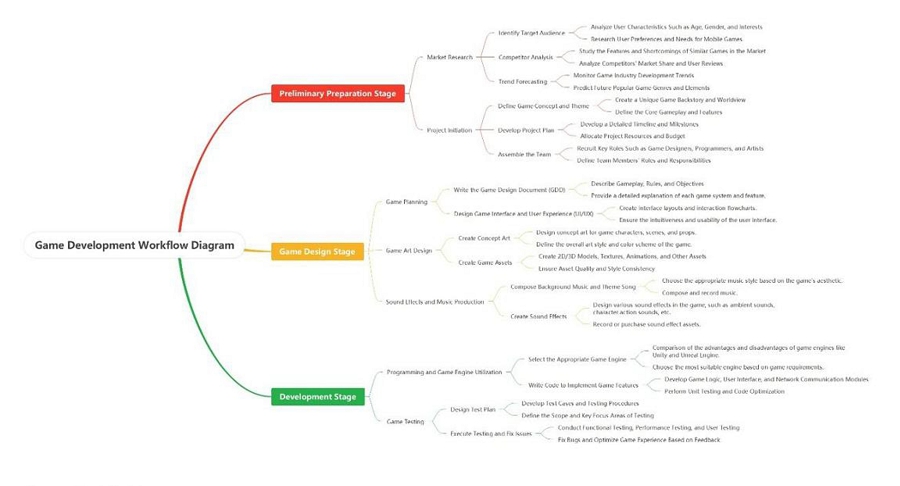
Game Publishing
Our game publishing involves several key steps to successfully launch and market our games across different markets. It begins with product evaluation and selection, where we select suitable games for licensing based on market analysis and audience interests. Contract negotiation and signing follow, to ensure clear cooperation terms with external game providers. Localization processes are then implemented to adapt content for specific regions such as language adaptations, gaming interface modifications, character costumes design, and ensure legal compliance. Our business and marketing team then works on technical integration and testing. The business and marketing team completes product integration including server configuration and other related tasks, and conducts comprehensive functional and compatibility testing to ensure product quality. The business and marketing team also works together with the research and development team in marketing plan development and product launch and release for the games concerned. Our business and marketing team ensures timely and high-quality project delivery while also striving to meet user expectations and business goals. The business and marketing team collects and analyzes requirements from various stakeholders, transforming them into detailed product specifications and using them to create comprehensive project schedules. A detailed marketing plan is developed to promote the game through various channels, accompanied by the preparation of promotional materials. The game is then launched into the market, with ongoing support and maintenance to optimize user experience and address any issues promptly. Financial reconciliation is conducted regularly to track sales data and generate detailed financial reports. Product revenue sharing calculations are made based on cooperation agreements, with payments processed and documented accordingly. This comprehensive workflow ensures a smooth and successful game launch and market presence.
|
|
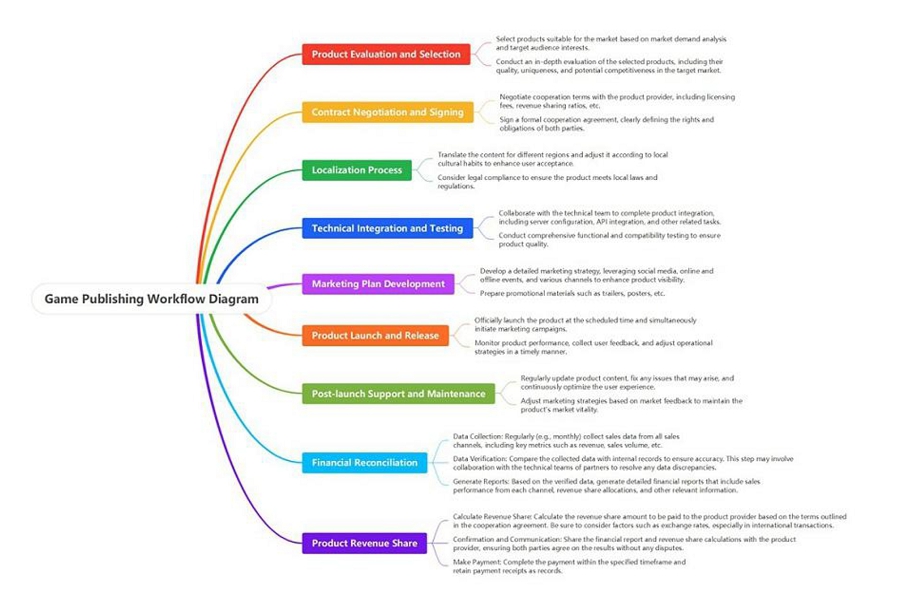
Our Products
Games Publishing and Operation
We engage in the publication and operation of self-developed mobile games and mobile games developed by third-parties with exclusive or non-exclusive licensing rights granted to us in specific geographic regions across diverse platforms, enabling gamers to download and immerse themselves in these captivating games. For the fiscal years ended September 30, 2025, 2024 and 2023, we generated approximately 45%, 27% and 0.1% of our total revenue from our self-developed mobile games and approximately 55%, 73% and 99% of our total revenue from mobile games developed by third-parties. Substantially majority of our revenues are from mobile games developed by third-parties.
Prior to launching games in different regions, we adapt and localize our games, with the intention of establishing cultural connections by adding elements such as language switching and regional-specific character costumes to resonate with players in our target markets. We also adopt different promotional strategies for our games, designing diverse approaches based on the game type and features that target players are interested in, and launch promotional campaigns through different social media platforms such as Facebook, Instagram, Twitter, and TikTok to achieve precise audience segmentation. Furthermore, we engage the service of and rely on a third-party data collection platform to obtain data analysis to understand user attributes of players in different game regions, including the devices they use, their locations, spending habits, registration times, to implement suitable marketing strategies to guarantee that each marketing investment yields maximum returns. Our dedication extends further as we engage in inviting celebrity endorsements and forming partnerships with popular live streaming platforms and internet celebrities to infuse additional excitement into our games. This holistic strategy, combined with search engine optimization and outdoor advertising, effectively broadens the exposure channels for our games. We have established long and stable relationship with major mobile app platforms such as the Apple App Store and Google Play Store, as well as with payment partners like Mycard, PayPal, WeChat, and Alipay, ensuring seamless game launches and transactions on platforms.
Moreover, we place a strong emphasis on cultivating player loyalty through the organization of various offline activities, including exclusive benefits for long-standing players and vibrant carnival celebrations, to foster close connections with the core player community and enhance player engagement. Within the game itself, we plan various promotional activities such as introducing holiday-limited virtual items, not only boosting player activity during specific periods but also effectively captivating the ongoing attention and involvement of both new and seasoned players.
|
|
Self-developed games
The Company distributes mobile games developed by the Company to Hong Kong, Macau and Taiwan via third-party gaming platforms. We have distributed our mobile games “The Great Story of Wei, Shu, and Wu (大話魏蜀吳)” and “Three Kingdoms (桃園三國)” to two gaming platforms, namely, My1737 in Taiwan and Let’s Play Art Planet in Hong Kong on a non-exclusive basis.
The distributed games encompass our independently developed mobile games, as well as mobile games developed in collaboration with authorized third-party developers. Within our distribution agreements with these gaming platforms, we grant them the rights to disseminate our games across their internet networks. They are empowered to leverage their websites, software, offline channels, and other resources for the distribution and promotion of our games. In terms of revenue sharing, the gaming platforms remit in-game purchase earnings to us on a monthly basis after accounting for channel costs, taxes, and bad debts as per our agreed ratio. The terms typically range from two to three years.
Licensed games developed by third-parties
Other than developing our own mobile games, we are also engaged by external game developers for the launch and marketing, and subsequent operation and maintenance of externally developed games on licenses. We distribute these licensed mobile games to various regions via various third-party gaming platforms for game players to download and play. Within our licensing agreements, the external game developers grant us exclusive or non-exclusive rights to operate, distribute, and promote their games in the agreed area. We are responsible for setting up game servers, marketing, in-game purchases, and development of online payment channels within the specified region and bear the relevant costs. We pay an agency and copyright fee for the licensing, and share the in-game purchase earnings with the external game developers on a monthly basis as per our agreed ratio. The terms typically range from two to three years.
Over the years, we have developed two games and been licensed to launch and operate twelve games. Below are examples of a few games we developed or operated.
In-Game Purchase
All of our self-developed or licensed games adopt the free-to-play model. Players looking to enrich their gaming experience have the option to acquire credits through a variety of payment gateways, exchanging them for our in-game virtual items upon purchase. These virtual items are non-physical items serve to elevate gaming experiences by empowering players to fortify their teams, accelerate progress, and personalize their in-game personas. Such in-game purchase cannot be exchanged for real currency and have no monetary value outside our respective games.
|
|
We maintain a balanced gaming pool by ensuring that both paying and non-paying players can enjoy our games without feeling discouraged. This approach preserves a fair and engaging environment, fostering an inclusive and rewarding experience for all players.
Virtual items available for purchase are classified as either Consumable Virtual Items - items that provide immediate benefits or perform in-game actions upon use (e.g., temporary power-ups or weapons); or Durable Virtual Items - items that offer long-term enhancements to a player’s character or inventory (e.g., premium outfits or permanent upgrades).
The monetary value of the virtual currencies sold and converted to the in-game tokens is shared between the Company and the game developer, if the game is licensed, which is pre-determined in the individual revenue sharing arrangements. The Company’s pre-determined percentage share of such sales varies by contracts and is generally between 40% and 85% of the total collected by us. The Company collects the payments made by the game players via the third-party distribution platforms, such as Apple App Store and Google Play Store, and remits the agreed sharing (net of tax and surcharges) by the Company to the game developer according to the applicable revenue sharing arrangement. For the years ended September 30, 2025, 2024, and 2023, we recorded revenue of approximately $10.0 million, $7.9 million and $3.9 million, representing 100% of our total revenue, respectively, from in-game purchase.
Our Competitive Strengths
Our main competitive strengths are as follows:
Strong Production and Content Creative Capabilities with an International Perspective
We pride ourselves on our strong production and development capabilities, led by our founder and Chief Executive Officer, Hong Zhifang. With over twenty years of experience in the internet industry, Mr. Hong excels in customizing products and formulating market strategies, ensuring precise alignment with user needs from design to promotion, thereby driving continuous business growth. His foresight and profound understanding of market demands have steered the Company towards steady development in the ever-evolving internet landscape. Our business director, Tian Ye, has 14 years of experience in game publishing. Mr. Ye has successfully led the global market release of several popular web and mobile games such as “Storm Tribe” and “Ghost Blows Out the Light 3D”, serving as a core driving force behind our operational strategy execution. The Company has built a reputation for delivering high-quality mobile games that resonate with players around the globe. Our team combines authenticity with innovation, drawing from the essence of historical themes to create games that offer fresh and immersive experiences.
Our game portfolio spans a wide range of genres, such as ARPGs and card-based games, showcasing our versatility in game development. By incorporating cultural elements, stunning visuals, engaging storylines, and intricate gameplay mechanics, we have successfully launched multiple games in regions such as Hong Kong, Macao and Taiwan. For each game launch in a new region, we are dedicated to executing thorough localization processes to tailor the content specifically for that market. This includes adjustments to language and slang usage, customization of the gaming interface to align with the preferences of gameplayers in that region, and the creation of appropriate character costumes. This international appeal underscores the Company’s ability to blend cultural authenticity with global gaming trends, delivering products that transcend geographical and cultural boundaries.
Experienced Management Team in Game Production and Publishing
We are powered by a highly experienced and efficient management team. Our management team has immersed themselves in the gaming industry for over two decades, possessing profound industry insights and understanding. The core members, including our founder and Chief Executive Officer, Hong Zhifang, and our business director, Tian Ye, are both experienced gamers and industry experts. Mr. Hong has over twenty years of experience in the internet industry, who excels in customized product development and market strategy formulation, ensuring precise alignment with user needs from design to promotion, thereby driving continuous business growth. His forward-thinking vision and deep understanding of market demands have guided the Company’s stable progress in the ever-evolving internet landscape. Our business director, Tian Ye, possesses 14 years of game publishing and 11 years of team management experience, Mr. Tian has effectively steered the global market releases of several popular web and mobile games such as “Storm Tribe” and “Ghost Blows Out the Light 3D”, serving as a key driving force behind the Company’s operational strategy execution. Our management team demonstrates a deep understanding of the gaming market’s operational dynamics. Their sharp market insights and exceptional execution capabilities enable the Company to adapt quickly to changing trends and maintain its competitive edge. This professional, cohesive, and passionate team plays a pivotal role in driving steady growth of the Company in an increasingly competitive industry. By consistently delivering games that align with market demands and exceed player expectations, our team ensures we remain at the forefront of the global gaming market.
|
|
Global Reach and Market Expertise
By publishing our games in various regions, including Hong Kong, Macao and Taiwan, we have established a solid presence in key international markets. Our games have demonstrated strong competitiveness in these regions, with individual games achieving significant monthly revenues. Our ability to adapt to local cultures and consumer preferences is a cornerstone of our success. By tailoring our marketing strategies to each region, we ensure that our games align with local tastes while maintaining their global appeal.
Our commitment to localization extends beyond language adaptations. We analyze regional trends and cultural nuances to create games incorporating local elements such as character costumes and holiday activities.
Global Infrastructure and Player Support
To support our global operations, we have engaged service of leading cloud service providers, including Tencent Cloud and Xiyou Cloud under their standard service contracts, ensuring a stable and efficient server network capable of meeting the demands of players worldwide. We also entered into individually negotiated service agreements with payment platforms such as MyCard, PayPal, WeChat Pay, and Alipay to offer secure and seamless transactions, accommodating the diverse payment preferences of our global player base.
Through commitment to innovation, cultural authenticity, and global market adaptation, we have flourished in the gaming industry. Our ability to create compelling games, leverage advanced technology, and engage players across the world sets us apart as a driving force in the future of interactive entertainment.
Key Platform and Payment Partnerships
Other than engaging major mobile app platforms, including the Apple App Store and Google Play Store, which play a critical role in distributing our games to a global audience, through their standard service agreements, we also partner with trusted payment providers such as MyCard, PayPal, WeChat Pay, and Alipay to support global transactions and established long-standing relationships with them. These payment platforms offer widgets integrated within our games, offering players a smooth and secure payment experience regardless of their location. We reconcile and settle monthly transactions with these providers, which charge a nominal channel fee, ensuring operational efficiency and financial transparency.
Beyond mainstream platforms, we have expanded our reach through alliances with regional players like my1737 in Taiwan and Let’s Play Art Planet in Hong Kong. These platforms bring rich channel resources and promotional expertise, allowing us to effectively penetrate local markets and broaden our user base. By sharing resources and expertise with these partners, we have enhanced our market presence, strengthened brand recognition, and accelerated business growth.
Our Business Strategies
We have developed a comprehensive strategy to drive innovation, expand market presence, and achieve sustainable growth. By focusing on game development, IP integration, technological advancement, and global collaboration, we aim to solidify our position in gaming and interactive entertainment.
|
|
Expansion of Game Portfolio
We are dedicated to expanding our game portfolio by launching at least three new self-developed games. In January 2025, we successfully launched a new game “Third Century”, which is developed in collaboration with authorized third-party developer. In June 2025, we launched a new mobile game “Meow Planet Nurturing”, and in September 25, we launched another new mobile game “Rise of the Dynasty”. In January 2026, we officially launched our single-player game “Danmo Three Kingdoms”. By integrating cutting-edge technologies including hypertext preprocessor for server-side development, database connectivity, and communication protocols, Layabox engine for client-side development, interface linking, and special effects, we aim to deliver immersive and engaging experiences that appeal to a global audience.
To ensure our games meet market demands, we adopt agile development methods that enable us to quickly respond to player feedback and adapt to changing trends. By enriching our offerings with innovative and high-quality games, we strengthen our position in the global market while attracting a broader player base. We also collaborate with experienced external game development teams to customize and develop games, primarily focusing on providing the game design and technical solutions, while leaving the specific operational details to our game design, optimization and production team for implementation.
Development and Expansion of Intellectual Property Rights
We are actively combining game content with advanced technologies to create innovative games. By leveraging advanced algorithms and big data analysis obtained from a third-party data collection platform, we gain deeper insights into user preferences across various game regions, including their devices, locations, spending behaviours, registration patterns, and more. and to implement suitable designs and updates on our games. This information enables us to tailor game designs and updates to enhance the overall player experience.
We focuses on creating detailed worlds, compelling storylines, and memorable characters that resonate with players globally. In the future, we plan to further develop our games beyond gaming into films, animations, and novels, enriching their cultural and commercial value. Additionally, we are planning to license our intellectual property rights, such as trademarks of our games, to manufacturers of toys, clothing, and stationery, to establish a comprehensive consumer ecosystem that boosts brand recognition and expands our influence.
To further enhance the global reach of our games and intellectual property rights, we advertise on internationally renowned media agencies and utilize platforms like YouTube, Facebook, and TikTok for multi-channel promotion. These efforts not only increase the international visibility of our IPs but also foster cultural exchange and attract a larger global audience.
Strategic Investments and Partnerships
We plan to invest in research and development companies through equity participation, which enables resource sharing, risk diversification, and strategic collaboration. These investments will help us develop new products, explore emerging markets, and strengthen our competitive edge by leveraging shared technology, talent, and marketing channels.
In addition, we also intend to pursue priority product agency rights to represent prestigious gaming products. These rights provide us with early access to innovative games, allowing us to strategically position ourselves in the market and enhance our brand influence.
We also want to focus on strengthening partnerships with other gaming companies for game licensing, to unlock new opportunities and expand our geographic footprint. Particular emphasis is placed on high-potential markets, such as North America and Europe, as well as emerging regions like Southeast Asia, to boost revenue and market share.
|
|
Product Line Diversification
To cater to diverse player preferences, we are strategically expanding our product line to include games with cohesive themes, gameplay mechanics, and stylistic elements. This approach enhances brand recognition and fosters player loyalty, enabling us to penetrate new demographics and unexplored market segments. Our diversified product offerings position us to capture opportunities in both established and emerging markets.
Through these strategies, we are committed to delivering innovative and engaging gaming experiences while strengthening our global presence and competitive edge.
Our Major Customers
Our major customers primarily include third-party distribution platforms. For the fiscal years ended September 30, 2025, 2024, and 2023 none of our customers represented 10% or more of our revenue. As of the date of this annual report, we do not have any long term agreements with any of our customers.
Our Major Suppliers
Our suppliers primarily include third-party distribution platforms, namely, Apple App Store and Google Play Store, Supplier A, and game developers and owners whom we license games from. For the fiscal years ended September 30, 2025, the three major suppliers accounted for approximately 66%, 16%, and 16% of our total cost of revenue, respectively. For the fiscal years ended September 30, 2024, the four major suppliers accounted for approximately 48%, 12%, 12%, and 12% of our total cost of revenue, respectively. For the year ended September 30, 2023, three major suppliers accounted for approximately 50%, 19%, and 13% of our cost of revenues, respectively. As of the date of this annual report, we do not have any long term agreements with any of such suppliers.
Sales and Marketing
As at the date of this annual report, our business and marketing team consists of five employees, and we also engage external marketing service advisers to strengthen our game promotions. The Company actively participates in marketing campaigns, exhibitions, and promotional activities to pitch and showcase its games. Our approach spans multiple channels, including social media platforms such as Facebook, Instagram, Twitter, and TikTok. We also collaborate with celebrities, popular live streaming platforms, and internet influencers to maximize our games’ visibility and appeal. Additionally, we publish all mobile games on various third-party platforms to attract a wider audience and expand our market reach.
To foster player loyalty and engagement, we organize offline events such as exclusive benefits for long-standing players and carnival-style celebrations. These activities help strengthen our connections with the core player community and create a more emotionally engaging experience. Within our games, we plan seasonal promotions, such as holiday-limited virtual items, which boost player activity during key periods and maintain engagement with both new and seasoned players.
Our marketing is data-driven, supported by advanced data collection and analysis systems that enable better targeting of players. By analysing user behaviour and preferences, we design campaigns that maximize returns on our marketing investments. This focus on strategic execution and precision ensures our strong competitiveness in the field of game publishing and operations.
Pricing Policies and Strategies
We adopt a flexible pricing strategy that combines the freemium model, virtual item sales, and revenue-sharing mechanisms to attract gameplayers and maximize revenue. Most of our games operate on a freemium model, allowing gameplayers to download and play for free. This approach lowers the barrier to entry and attracts a large player base. Players seeking a more immersive experience or faster progress can opt to purchase premium content, such as exclusive skins, advanced features, or other value-added services. In-game microtransactions, offering affordable virtual items and currencies, also provide a steady and sustainable cash flow.
|
|
Virtual item sales are structured with tiered pricing to accommodate players with different spending capacities. Additionally, promotional events such as holiday discounts and time-limited offers incentivize players to make purchases, boosting revenue and engagement. For games licensed to third-party operators, we secure upfront licensing fees and share ongoing revenue based on pre-agreed terms. This ensures mutual benefit while maintaining profitability. Revenue is further supplemented through in-game advertising and collaborative promotional campaigns with external brands, where personalized ad content is delivered using big data and advanced user profiling techniques.
Pricing decisions are guided by market demand, competitive dynamics, and user feedback. Thorough market research and analysis of competitor pricing ensure that our games remain competitively positioned. Regular adjustments, based on evolving trends and player suggestions, help maintain user satisfaction. Additionally, cost considerations, including expenses related to development, server maintenance, marketing, and platform fees from distributors like the Apple App Store and Google Play, are factored into our pricing strategy to maintain profitability.
Research and Development
As at the date of this annual report, our research and development team consists of 8 employees and our game design, optimization and production team consists of 4 members. Our self-developed games are developed by the said teams, with the help of externally engaged game programmers. Our game design, optimization and production team is responsible for initial game design, optimization and final fine-tune as led by our experienced operations director, product manager and arts director, each contributing their insights ranging from market needs and industry competition to graphics and character design. The intellectual property rights concerned would be owned by us. Our team targets to continue to develop more game engines and analytical software in order to provide uniqueness gameplay experiences and enjoyment and effectively enhance our monetization strategy.
Seasonality
Our business historically has not been subject to seasonal fluctuations.
| C. | Organizational Structure |
The following diagram illustrates our corporate structure as of September 30, 2025.
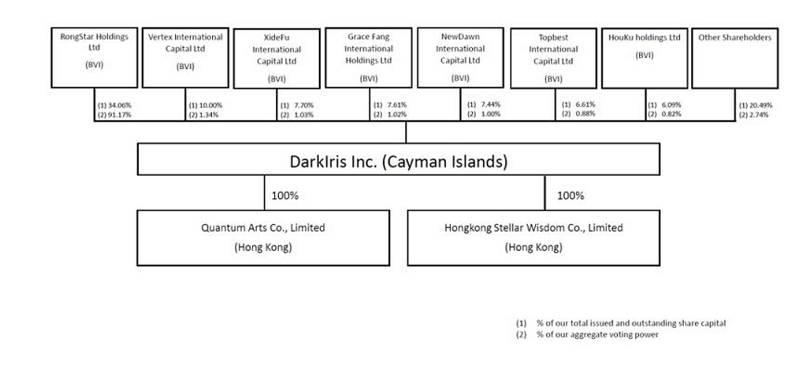
|
|
| D. | Property, Plants and Equipment |
Our headquarter is located at 6/F Cheong Sun Tower, No.118 Wing Lok Street, Sheung Wan, Hong Kong and we maintain an office in Xiamen, China at Room 310, No. 10-1, Wanghai Road, Phase II, Software Park, Siming District, Xiamen City, Fujian Province, China. As of the date of this annual report, we do not own any real estate, and we leased an aggregate of 500 square meters of real property. We do not expect to experience difficulties in renewing any of the leases when they expire. If we require additional space, we expect to be able to obtain additional facilities on commercially reasonable terms. For the sake of cost control, on the premise of reasonable layout of production capacity, we may terminate the lease contract in advance or not renew the contract when it expires.
As of September 30, 2025, we had 5 software copyrights registered in China. As of the date of this annual report, we own 12 stylized or graphic trademarks for our games.
ITEM 4A. UNRESOLVED STAFF COMMENTS
None.
ITEM 5. OPERATING AND FINANCIAL REVIEW AND PROSPECTS
You should read the following discussion together with our consolidated financial statements and the related notes included elsewhere in this annual report. This discussion contains forward-looking statements about our business and operations. Our actual results may differ materially from those we currently anticipate as a result of many factors, including those we describe under “Item 3.D. Risk Factors” and elsewhere in this annual report on Form 20-F.
The following discussion and analysis of our company
Key Operating Metrics
We manage our business by tracking certain performance metrics, including the number of active and paying gameplayers of our games using a combination of internal and third-party analytics tools, including such tools provided by Apple and Google. These key metrics are influenced by a variety of factors that may cause fluctuations on a quarterly basis, such as policies and restrictions imposed by platform providers, seasonality, user connectivity, conversion of users into paying users, and the addition of new content or storylines to certain games. In some cases, our operating metrics may not directly correlate with our revenue trends. Future growth in our player base will depend on our ability to retain existing players, attract new players, acquire or launch new games and features, and expand into new markets and distribution platforms.
The following operating metrics are the key performance indicators we use to evaluate our business. The primary drivers of changes in these metrics are listed below in order of importance:
For the Years Ended September 30, 2025, 2024, and 2023
Daily Active Users
We define Daily Active Users (DAU) as the number of individuals who played one of our games on a given calendar day. Under this metric, a player who plays two different games on the same day is counted as two DAUs. The Average DAU for a particular period is calculated by averaging the number of DAUs for each day within that period. We believe DAU is a useful metric to measure the scale and usage of our games on a specific day, and it more accurately reflects player engagement with our games.
| For the Years Ended September 30, | ||||||||||||
| 2025 | 2024 | 2023 | ||||||||||
| Quarterly Average DAU(1) | ||||||||||||
| Q1 (October 1 – December 31) | 4,164 | 5,627 | 3,380 | |||||||||
| Q2 (January 1 – March 31) | 4,471 | 7,572 | 2,561 | |||||||||
| Q3 (April 1 – June 30) | 3,948 | 6,209 | 4,277 | |||||||||
| Q4 (July 1 – September 30) | 6,467 | 5,146 | 3,346 | |||||||||
|
|
The decline in DAU in the Q1 of 2025 compared to the same period in 2024 is mainly due to the impact of the lifecycle rhythm of certain mature products. Among them, “Hammer Explosion Wulin”, “Little Zombie” and “Guardian Domain” are gradually entering the later stage of operation, and investment has been reduced, with a focus on long-term revenue harvesting strategy. In addition, during Q1 and Q2 of the 2024 fiscal year, ‘Nine Sky Spirit Snake Record’ was at its peak of performance, which raised the base for the same period and further amplified the year-on-year decline.
The average DAU for the third quarter of 2025 was 3,948, a quarter-on-quarter decline from 4,471 in the second quarter. The decrease in DAU during this quarter was primarily driven by revenue declines in two games, Bai She Ling She Lu and Yao Ling Fantasia. Some existing games had entered a relatively mature phase, leading to natural fluctuations in user activity as products aged. Additionally, the absence of new game launches during the quarter contributed to a temporary strain on overall user engagement. The Company continued to maintain core user participation through version updates and operational activities, laying the groundwork for future improvements.
In the fourth quarter of 2025, the average DAU reached 6,467, showing a significant quarter-over-quarter increase from 3,948 in the third quarter and surpassing the same period in 2024. The revenue growth in the gaming sector contributed to this expansion, while the launch of new games in September 2025 also brought in additional users and active engagement. Furthermore, the timing of new game releases aligned with intensified operational activities, driving user retention and overall activity levels. Overall, the expansion of the company’s product matrix effectively supported user scale and stickiness.
For the fiscal year ended September 30, 2024, our user activity has maintained robust growth, with the overall DAU showing a significant year-over-year increase. Average DAUs in each quarter for the fiscal year ended September 30, 2024 were higher than the corresponding quarters in 2023, with the Average DAU for the year increasing by approximately 80.4% compared to the previous fiscal year. This demonstrates that the penetration and daily engagement of our games among players continue to improve, further consolidating the platform
(1) Quarterly Average DAU refers to the Average DAU calculated on a quarterly basis, facilitating year-over year comparisons.
The primary drivers of DAU growth for the fiscal year ended September 30, 2024 are due to expansion effect of new product lines and optimized user operation mechanism and engagement strategies. Several new self-developed or licensed games launched in 2024 have significantly contributed to user activity, with games including Immortal Fate and Floating Sky being particularly outstanding, forming the core source of our user growth. Immortal Fate has demonstrated stable mid-term engagement, with Average DAUs of 829, 821, and 853 in Q2 to Q4 for the fiscal year ended September 30, 2024, respectively, remaining roughly flat. This indicates that the game
In summary, the significant increase in DAUs for the fiscal year ended September 30, 2024 not only reflects the effectiveness of our game products and operational strategies but also provides a solid user base for future revenue growth and product expansion. With the continued optimization of product content depth and interactive mechanisms, we expect DAU performance to have further upside potential.
Monthly Paying Users
We define Monthly Paying Users (MPU) as the number of individuals who have made at least one purchase of virtual goods on a specific platform within the 30-day period leading up to the measurement date. According to this metric, an individual who purchases virtual goods in two different games within the same 30-day period is counted as two MPUs. Similarly, an individual who makes purchases on two different platforms, such as Apple iOS or Google Play, for any of our games is counted as two MPUs. The Average MPU for a specific period is calculated by averaging the MPU for each month within that period. We believe that MPU is a useful metric to measure the monetization of our games.
| For the Years Ended September 30, | ||||||||||||
| 2025 | 2024 | 2023 | ||||||||||
| Quarterly Average MPU(1) | ||||||||||||
| Q1 (October 1 – December 31) | 36,349 | 8,684 | 13,552 | |||||||||
| Q2 (January 1 – March 31) | 34,517 | 22,449 | 19,096 | |||||||||
| Q3 (April 1 – June 30) | 32,022 | 33,491 | 15,601 | |||||||||
| Q4 (July 1 – September 30) | 35,787 | 37,029 | 14,623 | |||||||||
|
|
The average MPU for Q1 and Q2 of 2025 were 36,349 and 34,517, respectively. This change was mainly influenced by the following factors: firstly, in the second half of the 2024 fiscal year, multiple main products focused on marketing and content updates, driving MPU to reach a temporary peak; At the beginning of 2025, as key products such as “Wei Shu Wu” entered a stable operation stage, the conversion rate of new users and the number of active paying users tend to normalize. Secondly, the Company had made adjustments to its resource allocation, focusing more on long-term operations and cost efficiency optimization. The reduction in early promotion investment has also had a certain impact on short-term MPU. Nevertheless, the overall MPU remained in a healthy range in the first half of 2025, laying a solid foundation for the subsequent launch of new products and adjustment of operational pace.
The average MPU for Q3 2025 was 32,022, a slight decline from Q2’s 34,517, primarily reflecting seasonal fluctuations in user spending behavior and a stabilization of payment intensity for certain products in their later lifecycle stages. Despite this, the MPU remained at a relatively high level, demonstrating the Company’s product portfolio maintains a stable base of paying users and provides support for future recovery.
In Q4 2025, the average MPU rose to 35,787, a significant increase from 32,022 in Q3 and close to the same period in 2024. The growth was primarily driven by enhanced operational activities and version updates that boosted user payment engagement, while the launch of new products and optimized marketing campaigns facilitated user retention and conversion, leading to an overall improvement in MPU.
For the fiscal year ended September 30, 2024, our quarterly Average MPU showed significant growth, increasing from 13,552 players in Q4 2023 to 37,092 players in Q4 2024. The total MPU for the fiscal year ended September 30, 2024 reached 101,653, a substantial increase of 61.8% compared to the previous fiscal year ended September 30, 2023. This growth was primarily driven by the launch and operational efficiency of self-developed games, expansion effect of multiple product lines, and strategic placement and enhanced marketing. In particular, Wei, Shu & Wu gradually entered its maturity phase starting from Q1 2024. The MPU of Wei, Shu & Wu for Q2, Q3 and Q4 for the fiscal year ended September 30, 2024 were 6,155, 9,305, and 9,624, showing significant growth. This proves that the product has strong user attraction and retention capabilities. We allocated more promotional resources to high-potential games, increasing exposure and player acquisition, which significantly boosted the quarterly Average MPU performance. Although certain games experienced fluctuations in MPU performance during certain quarters, with adjustments in product update cycles and event scheduling, they still contributed a stable user base, providing a foundation for long-term operations in the future.
(1) Quarterly Average MPU refers to the Average MPU calculated on a quarterly basis, facilitating year-over year comparisons.
Average Revenue per Paying User (ARPPU)
We define Average Revenue per Paying User (ARPPU) as the total revenue attributed to in-game purchases during a given time period, divided by the number of months in that period, and then divided by the Average MPU for that period. We believe that ARPPU is a useful metric to describe monetization.
| For the Years Ended September 30, | ||||||||||||
| 2025 | 2024 | 2023 | ||||||||||
| US$ | US$ | US$ | ||||||||||
| Quarterly ARPPU | ||||||||||||
| Q1 (October 1 – December 31) | 21.99 | 15.58 | 7.99 | |||||||||
| Q2 (January 1 – March 31) | 19.01 | 16.35 | 8.27 | |||||||||
| Q3 (April 1 – June 30) | 16.08 | 16.77 | 13.17 | |||||||||
| Q4 (July 1 – September 30) | 20.01 | 20.38 | 19.34 | |||||||||
|
|
In Q1 2025, ARPPU reached $21.99, a year-on-year increase of about 41.2% compared to $15.58 in the same period of 2024. In Q2 2025, ARPPU reached $19.01, a year-on-year increase of about 16.3% compared to $16.35 in the same period of 2024. This was mainly due to the successful launch of multiple high-quality new products such as “Immortal Fate” and “Floating Myth”, which drove the rapid growth of middle and high value users and significantly improved the overall payment level. At the same time, the consistent maintenance of quarterly ARPPU indicated that the Company has effectively stimulated users’ willingness to pay and consumption depth by strengthening content design, limited time activities, and precision marketing, while maintaining the stable performance of its core products. Overall, the ARPPU performance in Q1 and Q2 of 2025 not only continued its growth momentum, but also laid a solid foundation for optimizing the annual revenue structure.
The ARPPU for the third quarter of 2025 was $16.08, a decrease from $19.01 in the second quarter and slightly lower than the same period in 2024. The decline in ARPPU in this quarter mainly reflects the periodic fluctuations in user payment structure and activity pace, and the payment intensity of some core games tends to stabilize in the later stages of their lifecycle. At the same time, the company continues to maintain user payment capabilities through content updates and refined operations, providing support for future performance recovery.
In the fourth quarter of 2025, ARPPU rebounded to $20.01, a significant increase from $16.08 in the third quarter and close to $20.38 in the same period of 2024. The growth is mainly due to the strengthening of operational activities and version content updates during the quarter, which have driven an increase in user willingness to pay. At the same time, the launch of new products and user return have led to a more diverse payment scene, promoting an overall improvement in the contribution of single paying users.
For the fiscal year ended September 30, 2024, our ARPPU also showed steady growth, increasing from US$15.58 in Q1 to US$20.38 in Q4, with an overall average of US$17.27 for the year. This indicates substantial progress in enhancing product quality, user payment depth, and content value.
The main drivers include expansion of mid-to-high value user and improvement in paid scenarios and event operations. In key games such as Divine Serpent, Floating Sky, and Immortal Fate, the high-value user base grew steadily. In Divine Serpent, the average revenue per user for the third quarter for the fiscal year ended September 30, 2024 was US$35.07, and in Q4 it was US$35.80, demonstrating solid performance in terms of user value. Through time-limited promotions, version content updates, themed items, and other diversified revenue models, we increased user conversion efficiency and average payment amounts. Overall, we will continue to optimize content experiences and consumption designs, guided by the user lifecycle, to further drive growth in ARPPU per quarter and optimize our revenue structure.
Monthly Download Users (MDU)
We define Monthly Download Users (MDU) as the number of users who completed the download and installation of a game within a given calendar month. It is important to note that we track each user based on the unique identification associated with each download device, and multiple downloads by the same user are typically counted once. The Average MDU for a specific period is calculated by averaging the MDU for each month within that period. MDU is a key metric for assessing the reach and market appeal of a game. It is particularly indicative during the initial launch phase or during periods of major promotional campaigns, offering a clear reflection of user acquisition effectiveness and the potential market scale.
| For the Years Ended September 30, | ||||||||||||
| 2025 | 2024 | 2023 | ||||||||||
| Quarterly Average MDU (1) | ||||||||||||
| Q1 (October 1 – December 31) | 118,187 | 43,273 | 47,185 | |||||||||
| Q2 (January 1 – March 31) | 105,791 | 110,111 | 64,841 | |||||||||
| Q3 (April 1 – June 30) | 106,601 | 132,769 | 70,613 | |||||||||
| Q4 (July 1 – September 30) | 129,600 | 121,158 | 51,636 | |||||||||
For the fiscal year ended September 30, 2025, the Company’s quarterly Monthly Domestic Users (MDU) demonstrated a trend of stabilization followed by an upward trajectory during the second half of the year. This performance underscores our strong resilience in user acquisition as we optimized our product operations and marketing cadence.
|
|
Third Quarter (Q3): Stabilization Amid Strategic Adjustment In the third quarter (April 1 – June 30, 2025), quarterly MDU reached 106,601, representing a slight sequential increase of 0.8% from 105,791 in Q2 2025. On a year-over-year basis, MDU decreased by 19.7% from 132,769 in the prior-year period, reflecting a more stabilized momentum in new user acquisition. Despite the year-over-year fluctuation, the MDU remained consistently above the 100,000 threshold, demonstrating the sustained organic growth potential of our diversified product matrix under normalized operations. Fourth Quarter (Q4): Strong Rebound and Growth Acceleration The transition into the fourth quarter (July 1 – September 30, 2025) was marked by a significant operational breakthrough. Quarterly MDU surged to 129,601, achieving a robust 21.6% quarter-over-quarter growth. Furthermore, the Company achieved a positive year-over-year growth of 7.0% compared to 121,158 in Q4 2024. This successful recovery and expansion in our user base validate the effectiveness of our intensified marketing initiatives and strategic operational refinements implemented during the latter half of the fiscal year.
In the first half of 2025, the average MDU continued to remain high, with Q1 of 2025 reaching 118,187 MDU, an increase of about 173.1% compared to the same period in 2024 with 43,273 MDU; Q2 of 2025 had 105,791 MDU, although slightly lower than the previous quarter, it shows minimal fluctuation compared to the 110,111 MDU in the same period of 2024, demonstrating strong user acquisition capabilities and product attractiveness. The significant growth in Q1 2025 is mainly due to the concentrated launch of new products such as “Immortal Fate” and “Floating Myth”. Through efficient preheating and social media diffusion in the early stages of release, they successfully leveraged largescale natural traffic; Although the Q2 of 2025 showed a slight decrease compared to the previous period, it is a normal fluctuation under high base numbers, mainly due to the slowing pace of new product launches and periodic adjustments in market promotion rhythm.
For the fiscal year ended September 30, 2024, our quarterly Average MDU demonstrated strong growth momentum, particularly in Q2 and Q3. Average MDU of the fiscal year ended September 30,2024 surged from 43,273 in Q1 to 110,111 in Q2, representing a remarkable 154.5% quarter-over-quarter increase. This was one of the most significant quarterly growth figures of the fiscal year ended September 30, 2024 and underscores our exceptional execution in product promotion and market penetration.
This substantial increase can be primarily attributed to several key factors. The surge was largely driven by a concentrated rollout of new product lines, which fueled a sharp rise in organic traffic. Between Q1 and Q2 for the fiscal year ended September 30, 2024, we launched several new games, including Floating Sky and Wei, Su & Wu, as part of our strategic product pipeline. These games were major research and development initiatives backed by comprehensive multi-channel promotional campaigns. Their successful market reception upon release significantly contributed to the spike in organic user downloads, serving as a major source of quarterly user growth.
(1) Quarterly Average MDU refers to the Average MDU calculated on a quarterly basis, facilitating year-over year comparisons.
Results of Operations for the Financial Years ended September 30, 2025 and 2024
| For the Years Ended September 30, | Variance | |||||||||||||||
| 2025 | 2024 | Amount | % | |||||||||||||
| Revenues | $ | 10,078,798 | $ | 7,920,461 | $ | 2,158,337 | 27.3 | % | ||||||||
| Cost of revenues | (7,576,049 | ) | (4,912,281 | ) | 2,663,768 | 54.2 | % | |||||||||
| Gross profit | 2,502,749 | 3,008,180 | (505,431 | ) | (16.8 | %) | ||||||||||
| Selling expenses | (9,304,000 | ) | (1,036,243 | ) | 8,267,757 | 797.9 | % | |||||||||
| Research and development expenses | (900,000 | ) | - | 900,000 | 100.0 | % | ||||||||||
| General and administrative expenses | (895,060 | ) | (815,723 | ) | 79,337 | 9.7 | % | |||||||||
| (Loss) income from operations | (8,596,311 | ) | 1,156,214 | 9,752,525 | 743.5 | % | ||||||||||
| Government subsidy income | 842 | 498 | 344 | 69.1 | % | |||||||||||
| Interest income | 550 | 1,174 | (624 | ) | (53.2 | %) | ||||||||||
| Loss on disposal of subsidiary | (52,697 | ) | - | (52,697 | ) | 100.0 | % | |||||||||
| Other income | 81,622 | 37,077 | 44,545 | 120.1 | % | |||||||||||
| (Loss) income before income taxes | (8,565,994 | ) | 1,194,963 | (9,760,957 | ) | (816.8 | %) | |||||||||
| Income tax expenses | (76,171 | ) | (98,158 | ) | (21,987 | ) | (22.4 | %) | ||||||||
| Net (loss) income | (8,642,165 | ) | 1,096,805 | (9,738,970 | ) | (887.9 | %) | |||||||||
|
|
Revenue increased by $2.16 million, or 27.3%, to approximately $10.08 million for the financial year ended September 30, 2025 (“FY2025”) from approximately $7.92 million for the financial year ended September 30, 2024 (“FY2024). The increase was mainly attributable to continuing revenue contribution from five games launched in March 2024 which increased revenue by approximately $5.04 million and the launch of a new game in 2025 which increased revenue by $0.25 million. The increase was partially offset by a decrease in contribution of $2.92 million of six old games. In FY2025, the Company continued to engage with two third-party digital platforms. These third-party digital platforms assisted the Company in promoting the games, encouraging gamers to make in-game purchases, therefore, contributing to the increase in revenues by approximately $5.04 million.
Cost of revenue
Cost of revenue increased by approximately $2.66 million, or 54.2%, to approximately $7.58 million in FY2025 from approximately $4.91 million in FY2024.
The following table sets forth the breakdown of cost of revenues for FY2025 and FY2024, respectively:
|
For the Years Ended September 30, |
Variance | |||||||||||||||
| 2025 | 2024 | Amount | % | |||||||||||||
| Platform handling fees | $ | 6,191,175 | $ | 3,517,961 | $ | 2,673,214 | 76.0 | % | ||||||||
| Revenue sharing with game developers | 1,328,701 | 1,267,754 | 60,947 | 4.8 | % | |||||||||||
| Cloud server costs | 56,033 | 126,296 | (70,263 | ) | (55.6 | )% | ||||||||||
| Stamp duty and value-added tax surcharge | 140 | 270 | (130 | ) | (48.1 | )% | ||||||||||
| Total cost of revenues | $ | 7,576,049 | $ | 4,912,281 | $ | 2,663,768 | 54.2 | % | ||||||||
Platform handling fees
Platform handling fees increased by approximately $2.67 million, or 76.0%, to approximately $6.19 million in FY2025 from $3.52 million in FY2024. The increase was primarily attributable to the revenue contribution from two platforms and, as a result, revenue sharing with these two platforms synchronous increased. In FY2024 and FY2025, the Company continued to engage with two third-party digital platforms which assist the Company in promoting the games. Revenue generated from game players are shared between the platforms and the Company, typically ranging from 15% to 60%. These third-party digital platforms have been successful in promoting the games, attracting gamer to make in-game purchase and game revenues increased from approximately $7.92 million in FY2024 to approximately $10.08 million in FY2025, resulting in a synchronous increase in revenue sharing with these platforms.
Revenue sharing with game developers
Revenue sharing with game developers increased by approximately $0.06 million, or 4.8%, to approximately $1.33 million in FY2025 from approximately $1.27 million in FY2024. Revenue sharing with game developers was typically ranging from 10% to 20% of the revenue generated from their licensed games. The increase in revenue sharing with game developers was minimal as revenue from self-developed games increased significantly while the increase in revenue from licensed games by the game developers was minimal.
Cloud server costs
Cloud server costs decreased by $70,263, or 55.6%, to approximately $0.06 million in FY2025 from approximately $0.13 million in FY2024. The decrease in cloud server costs was primarily attributable to the increase in using above-mentioned third-party digital platforms. Certain third-party digital platforms absorbed cloud server costs for the Company.
|
|
Gross profit
Gross profit decreased by approximately $0.51 million, or 16.8%, to approximately $2.50 million in FY2025 from approximately $3.01 million in FY2024, while gross profit margin decreased by 13.1%, from 38.0% in FY2024 to 24.8% in FY2025. The decrease in gross profit margin was mainly attributable to the significant increase in platform handling fees.
Selling expenses
Selling expenses primarily relate to share-based compensation, advertising and promotional expenses. Selling expenses increased by approximately $8.27 million, or 797.9%, to approximately $9.30 million in FY2025 from approximately $1.04 million in FY2024. The increase was mainly attributable to share-based compensation of approximately $8.8 million.
Research and development expenses
Research and development expenses relate to spending on developing mobile digital games. Research and development expenses increased by approximately $0.9 million, or 100%, to approximately $0.9 million in FY2025 from nil in FY2024. The increase was primarily attributable to art production costs for a mobile digital game “Alchemy and Magic” which should be expensed.
General and administrative expenses
General and administrative expenses increased by approximately $79,337, or 9.7%, to approximately $0.90 million in FY2025 from approximately $0.82 million in FY2024. The increase was mainly attributed to professional service fees incurred for the initial public offerings.
Loss on disposal of a subsidiary
On May 14, 2025, Quantum entered into a share transfer agreement with Xiamen Yusanjia Culture Communication Co., Ltd (“Xiamen Yusanjia”), an unaffiliated third party, to transfer all outstanding shares of Turing, at the price approximately at RMB2.0 million (US$268,000) based on its unaudited net assets as of April 30, 2025. As a result of the foregoing, the loss on disposal of subsidiary amounted to approximately $0.05 million.
Other income
Other income mainly related to bank charges, foreign exchange losses and other miscellaneous income. Other income increased by $44,545, or 120.1%, to other income of $81,622 in FY2025 from other income of $37,077 in FY2024. The increase was mainly attributable to singular instance of marketing and promotion services provided to a customer in FY2024, while no such income in FY2025.
Income tax expenses
In FY2025 and FY2024, our income tax expense was $76,171 and $98,158, respectively. The income tax expenses were as a result of taxable income from operations of $0.59 million and $1.9 million from a subsidiary in Hong Kong, Quantum, respectively.
Net (loss) income
As a result of the foregoing, net loss was approximately $8.6 million in FY2025, a decrease of approximately $8.8 million from net income of approximately $1.1 million in FY2024.
|
|
Results of Operations for the Financial Years ended September 30, 2024 and 2023
|
For the Financial Years Ended September 30, |
Variance | |||||||||||||||
| 2024 | 2023 | Amount | % | |||||||||||||
| Revenues | $ | 7,920,461 | $ | 3,951,074 | $ | 3,969,387 | 100.5 | % | ||||||||
| Cost of revenues | (4,912,281 | ) | (1,551,295 | ) | 3,360,986 | 216.7 | % | |||||||||
| Gross profit | 3,008,180 | 2,399,779 | 608,401 | 25.4 | % | |||||||||||
| Selling expenses | (1,036,243 | ) | (2,734,324 | ) | (1,698,081 | ) | (62.1 | )% | ||||||||
| General and administrative expenses | (815,723 | ) | (924,188 | ) | (108,465 | ) | (11.7 | )% | ||||||||
| Income (loss) from operations | 1,156,214 | (1,258,733 | ) | 2,414,947 | 191.9 | % | ||||||||||
| Government subsidy income | 498 | 1,994 | (1,496 | ) | (75.0 | )% | ||||||||||
| Interest income | 1,174 | 549 | 625 | 113.8 | % | |||||||||||
| Other income (expenses) | 37,077 | (1,634 | ) | (38,711 | ) | (2,369.1 | )% | |||||||||
| Income (loss) before income taxes | 1,194,963 | (1,257,824 | ) | 2,452,787 | 195.0 | % | ||||||||||
| Income tax expenses | (98,158 | ) | - | (98,158 | ) | 100.0 | % | |||||||||
| Net income (loss) | $ | 1,096,805 | $ | (1,257,824 | ) | $ | 2,354,629 | 187.2 | % | |||||||
Revenue
Revenue increased by $3.97 million, or 100.5%, to $7.92 million for the financial year ended September 30, 2024 (“FY2024”) from $3.95 million for the financial year ended September 30, 2023 (“FY2023). The increase was mainly attributable to revenue contribution of $4.9 million from six games launched in FY2024. The increase was partially offset by a decrease in contribution of $0.85 million of one game. In FY2024, the Company engaged with two new third-party digital platforms. These third-party digital platforms assisted the Company in promoting the games, encouraging gamers to make in-game purchases, therefore, contributing to the increase in revenues by approximately $4.9 million.
Cost of revenue
Cost of revenue increased by approximately $3.4 million, or 216.7%, to approximately $4.9 million in FY2024 from approximately $1.6 million in FY2023.
The following table sets forth the breakdown of cost of revenues for FY2024 and FY2023, respectively:
|
For the Financial Years Ended September 30, |
Variance | |||||||||||||||
| 2024 | 2023 | Amount | % | |||||||||||||
| Platform handling fees | $ | 3,517,961 | $ | 771,532 | $ | 2,746,429 | 356.0 | % | ||||||||
| Revenue sharing with game developers | 1,267,754 | 635,316 | 632,438 | 99.5 | % | |||||||||||
| Cloud server costs | 126,296 | 144,415 | (18,119 | ) | (12.5 | )% | ||||||||||
| Stamp duty and value-added tax surcharge | 270 | 32 | 238 | 743.8 | % | |||||||||||
| Total cost of revenues | $ | 4,912,281 | $ | 1,551,295 | $ | 3,360,986 | 216.7 | % | ||||||||
Platform handling fees
Platform handling fees increased by approximately $2.7 million, or 356.0%, to approximately $3.5 million in FY2024 from $0.8 million in FY2023. The increase was primarily attributable to the increase in third party digital platforms from two platforms in FY2023 to four platforms in FY2024. In FY2024, the Company engaged with two new platforms which assist the Company to promote the games. Revenue generated from game players are shared between the platform and the Company, typically ranging from 15% to 60%. These third party digital platforms has been successful in promoting the games, attracting gamer to make in-game purchase and game revenues increased from approximately $3.9 million in FY2023 to approximately $7.9 million in FY2024, resulting in a synchronous increase in revenue sharing with these platforms.
Revenue sharing with game developers
Revenue sharing with game developers increased by approximately $0.63 million, or 99.5%, to approximately $1.27 million in FY2024 from approximately $0.64 million in FY2023. The increase was mainly attributed to expansion in cooperation with game developers from six game developers in FY2023 to twelve game developers in FY2024 with typical revenue sharing ranging from 10% to 20%. With the successful in promoting games by the above-mentioned third-party digital platforms, increased in gamers spending, and increased in game revenue, revenue sharing with game developers were correspondingly increased.
|
|
Cloud server costs
Cloud server costs decreased by $18,119, or 12.5%, to approximately $0.13 million in FY2024 from approximately $0.14 million in FY2023. The decrease in cloud server costs was primarily attributable to the increase in using above-mentioned third party digital platforms. Certain third party digital platforms absorbed cloud server costs for the Company.
Gross profit
Gross profit increased by approximately $0.6 million, or 25.4%, to approximately $3.0 million in FY2024 from approximately $2.4 million in FY2023, while gross profit margin decreased by 22.8%, from 60.7% in FY2023 to 38.0% in FY2024. The decrease in gross profit margin was mainly attributable to the significant increase in platform handling fees and revenue sharing with game developers.
Selling expenses
Selling expenses primarily relate to advertising and promotional expenses. Selling expenses decreased by approximately $1.7 million, or 62.1%, to approximately $1.0 million in FY2024 from approximately $2.7 million in FY2023. The main sources of revenue growth in the FY2024 were from two gaming platforms, which have more targeted gamers and did not require additional advertising, the Company could therefore reduce spending on advertising and promotional expenses with these gaming platforms. Platforms such as Apple and Google are comprehensive platforms that require advertising expenses to acquire gamers.
General and administrative expenses
General and administrative expenses decreased by approximately $0.1 million, or 11.7%, to approximately $0.82 million in FY2024 from approximately $0.92 million in FY2023. The decrease was mainly attributable to the decrease in employees’ salaries and benefits as a result of reduction in headcount from 34 employees in FY2023 to 24 employees in FY2024. In addition, the Company has been collaborating with third parties to maintain gameplayers, reducing the need for back office maintenance personnel.
Other income (expenses)
Other income (expenses) mainly related to bank charges, foreign exchange losses and other miscellaneous income. Other income increased by $38,711, or 2,369.1%, to other income of $37,077 in FY2024 from other expenses of $1,634 in FY2023. The increase was mainly attributable to singular instance of marketing and promotion services provided to a customer.
Income tax expenses
In FY2024 and FY2023, our income tax expense was $98,158 and nil, respectively. The income tax expenses were as a result of taxable income from operations.
Net income
As a result of the foregoing, net income was approximately $1.1 million in FY2024, an increase of approximately $2.4 million from net loss of approximately $1.3 million in FY2023.
Liquidity and Capital Resources
As of September 30, 2025, the Company had cash of approximately $1.8 million.
In assessing liquidity, management monitors and analyzes our cash on-hand, ability to generate sufficient revenue sources in the future, and operating and capital expenditure commitments.
|
|
As of September 30, 2025, the Company had working capital of approximately $3.1 million. The Company’s working capital requirements are influenced by the level of operations, revenue generated from mobile digital games, costs and expenses controlled, encashment of accounts receivable.
The Company intends to finance future working capital requirements and capital expenditures from cash generated from operating activities and funds raised from financing activities. The Company may, however, require additional cash due to changing business conditions or other future developments, including any investments or acquisitions that the Company may decide to pursue. With the financial support from shareholders, the Company believes that the current cash together with cash generated from operating activities and financing activities will be sufficient to meet the present anticipated working capital requirements and capital expenditures. If existing cash is insufficient to meet requirements, the Company may seek to issue debt or equity securities or obtain additional credit facilities. Financing may be unavailable in the amounts the Company’s need or on terms acceptable to the Company, if at all. Issuance of additional equity securities, including convertible debt securities, would dilute earnings per share. The incurrence of debt would divert cash for working capital and capital expenditures to service debt obligations and could result in operating and financial covenants that restrict operations and ability to pay dividends to shareholders. If the Company is unable to obtain additional equity or debt financing as required, the Company’s business and prospects may suffer.
Indebtedness. As of September 30, 2025, the Company did not have any debts, finance leases, purchase commitments, guarantees, or other material contingent liabilities.
Off-Balance Sheet Arrangements. The Company has not entered into any financial guarantees or other commitments to guarantee the payment obligations of any third parties. In addition, the Company has not entered into any derivative contracts that are indexed to shares and classified as shareholders’ equity, or that are not reflected in our consolidated financial statements. Furthermore, the Company does not have any retained or contingent interest in assets transferred to an unconsolidated entity that serves as credit, liquidity or market risk support to such entity. Moreover, the Company does not have any variable interest in any unconsolidated entity that provide financing, liquidity, market risk or credit support to or engages in hedging services with the Company.
Capital Resources. The primary drivers and material factors impacting liquidity and capital resources include ability to generate sufficient cash flows from operations and financial support from shareholders, as well as proceeds from equity and debt financing, to ensure future growth and expansion plans.
Working Capital. Total working capital as of September 30, 2025 amounted to approximately $3.1 million, compared to approximately $0.9 million as of September 30, 2024. The increase in working capital was mainly caused by increase in cash, and accounts receivable.
Capital Needs. The Company’s capital needs include daily working capital needs and capital needs to finance the development of business. Management believes that income generated from current operations can satisfy daily working capital needs over the next 12 months. The Company may also raise additional capital through public offerings or private placements to finance business development and to consummate any merger or acquisition, if necessary.
Cash flows
For the years ended September 30, 2025, 2024 and 2023
The following table sets forth a summary of our cash flows in FY2025, FY2024, and FY2023, respectively.
| For the Years Ended September 30, | ||||||||||||
| 2025 | 2024 | 2023 | ||||||||||
| Net cash (used in) provided by operating activities | ($ | 457,935 | ) | $ | 53,667 | ($ | 1,331,684 | ) | ||||
| Net cash used in investing activities | (3,423,339 | ) | (12,148 | ) | (2,766 | ) | ||||||
| Net cash provided by financing activities | 5,368,297 | 199,111 | 1,041,550 | |||||||||
| Effect of exchange rate changes on cash | (556 | ) | (7,759 | ) | (11,125 | ) | ||||||
| Net increase (decrease) in cash | 1,486,467 | 232,871 | (304,025 | ) | ||||||||
| Cash, beginning of year | 313,735 | 80,864 | 384,889 | |||||||||
| Cash, end of year | $ | 1,800,202 | $ | 313,735 | $ | 80,864 | ||||||
|
|
Operating activities
Net cash used in operating activities was $457,935 in FY2025. The increase was caused by share-based compensation of $8.8 million and increase in contract liabilities of $0.3 million due to higher unused in-game credit, as partially offset by (i) net loss of $8.6 million, and (ii) a decrease in accounts receivable of approximately $1.3 million due to collection.
Net cash provided by operating activities was $53,667 in FY2024, which mainly consisted of (i) net income of approximately $1.1 million; and (ii) an increase of contract liabilities of approximately $0.38 million. The increase in cash in operating activities was partially offset by (i) an increase in accounts receivable of approximately $0.9 million due to revenue generated from game players; and (ii) an increase in prepaid expenses of approximately $0.33 million due to payment of security deposit to game developer for developing new games.
Net cash used in operating activities was approximately $1.3 million in FY2023, which mainly consisted of (i) net loss of approximately $1.3 million, and (ii) an increase of approximately $0.3 million in accounts receivable due to revenue generated from game players. The decrease in cash in operating activities was partially offset by an increase of approximately $0.16 million in accounts payable due to an increase in a game developer supplier supplying new games.
Investing activity
Net cash used in investing activity was $4.3 million in FY2025, which mainly consisted of prepayment for game development of $2.7 million and purchase of intangible assets of $0.7 million.
Net cash used in investing activity was $12,148 in FY2024, which mainly consisted of purchase of plant and equipment.
Net cash used in investing activity was $2,766 in FY2023, which mainly consisted of purchases of plant and equipment.
Financing activities
Net cash provided by financing activities was approximately $5.4 million in FY2025, which mainly consisted of (i) proceeds from issuance of ordinary shares of approximately $5.0 million, (ii) advances from shareholders of approximately $1.0 million, and (iii) proceeds from capital contribution of approximately $0.6 million, as partially offset by repayment to shareholders of approximately $1.2 million.
Net cash provided by financing activities was approximately $0.2 million in FY2024, which mainly consisted of (i) proceeds of approximately $2.7 million from capital contribution; and (ii) advances of approximately $1.5 million from shareholder. The cash provided by financing was partially offset by repayments of approximately $4.0 million to shareholder.
Net cash provided by financing activities was $1.0 million in FY2023, which mainly consisted of (i) proceeds of approximately $0.4 million from capital contribution; and (ii) advances of approximately $5.6 million from shareholders. The cash provided by financing was partially offset by repayments of approximately $5.0 million to shareholders.
Contractual Obligations and Commitments
As of September 30, 2025, the Company does not have any contractual obligations and commitments.
|
|
Trend Information
There are no known trends or uncertainties that have had or are reasonably likely to have a material impact on our cash flows, liquidity, capital resources, cash requirements, financial position, or results of operations. During FY2025 and FY2024, inflation did not materially affect our business or the results of our operations.
Critical Accounting Policies and Estimates
Revenue recognition
The Company adopted ASC Topic 606 Revenue from Contracts with Customers (“ASC 606”) on April 1, 2019. Accordingly, the consolidated financial statements for the years ended September 30, 2024, and 2023 are presented under ASC 606. Under ASC 606, revenue is recognized when control of promised goods or services is transferred to the Company’s customers in an amount of consideration to which an entity expects to be entitled to in exchange for those goods or services. To determine revenue recognition for contracts with customers, the Company performs the following five steps : (i) identify the contract(s) with the customer, (ii) identify the performance obligations in the contract, (iii) determine the transaction price, including variable consideration to the extent that it is probable that a significant future reversal will not occur, (iv) allocate the transaction price to the respective performance obligations in the contract, and (v) recognize revenue when (or as) we satisfy the performance obligation. VAT that the Company collects concurrent with revenue-producing activities is excluded from revenue.
The Company follows the requirements of Topic 606-10-55-36 through -40, Revenue from Contracts with Customers, Principal Agent Considerations, in determining the gross versus net revenue recognition for performance obligation(s) in the contract with a customer. Revenue recorded with the Company acting in the capacity of a principal is reported on a gross basis equal to the full amount of consideration to which we expect in exchange for the good or service transferred. Revenue recorded with the Company acting in the capacity of an agent is reported on a net basis, exclusive of any consideration provided to the principal party in the transaction.
The Company principal business is the development, publishing and operating mobile digital games via various third-party digital storefronts. Revenue is primarily derived from sales of mobile in-app purchases, virtual goods and downloadable content that can be purchased by the end users, as desired. When control of the promised products and services is transferred to the customers, the Company recognizes revenue in the amount that reflects the consideration it expects to receive in exchange for these products and services. Revenue from delivery of products is recognized at a point in time when the end consumers download the virtual goods and content.
Principal vs Agent Consideration
The Company offers certain software products via third-party digital storefronts, such as the Apple App Store and the Google Play Store. For sales of our software products via third-party digital storefronts and retail distributor, we determine whether or not we are acting as the principal in the sale to the end user, which we consider in determining if revenue should be reported based on the gross transaction price to the end user or based on the transaction price net of fees retained by the third-party digital storefront. An entity is the principal if it controls a good or service before it is transferred to the customer. Key indicators that we use in evaluating these sales transactions include, but are not limited to, the following:
| ● | The underlying contract terms and conditions between the various parties to the transaction; | |
| ● | Which party is primarily responsible for fulfilling the promise to provide the specified good or service; and | |
| ● | Which party has discretion in establishing the price for the specified good or service. |
Based on evaluation of the above indicators, for sales arrangements via the Apple App Store, the Google Play Store, and other third party digital platforms, the Company has discretion in establishing the price for the specified good or service and the Company determined that the Company is the principal to the end user and thus report revenue on a gross basis and mobile platform fees charged by these digital storefronts are expensed as incurred and reported within cost of revenues.
For the years ended September 30, 2025 and 2024, there was no revenue recognized on a net basis where the Company is acting as an agent.
|
|
ITEM 6. DIRECTORS, SENIOR MANAGEMENT AND EMPLOYEES
| A. | Directors and Executive Officers |
Our directors and executive officers are as follows:
| Name | Age | Position | ||
| Mr. Hong Zhifang | 44 | Chief Executive Officer, Chairman of the Board of Directors, Director | ||
| Mr. Xu Jiang | 40 | Chief Financial Officer | ||
| Ms. Hong Yuanfang | 40 | Director | ||
| Mr. Ng Chee Jiong | 54 | Independent Director | ||
| Mr. Law Chee Hui | 46 | Independent Director | ||
| Ms. Li Feng Lin | 56 | Independent Director |
Below is a summary of the business experience of each our executive officers and directors:
Mr. Hong Zhifang(1) has been our director since May 31, 2024, Chief Executive Officer and Chairman of the board of directors since March 2025 and has been the director and general manager of Quantum since January 2025. Mr. Hong has over 20 years of experience in management. In January 2012, he established a company principally engaged in development and operation of online games, namely Xiamen Xiqi Internet Holdings Company Limited (“Xiqi”), and has served as director since its inception and continues to hold this position to date. Since January 2014, December 2014, June 2015, December 2021 and June 2023, Mr. Hong has also been serving as a director of Xiamen Handy Times Information Technology Co., Xiamen Pocket Workshop Information Technology Co., Xiamen Red Orange Management Consulting Partnership (Limited Partnership), Xiamen Maita Technology Co., Ltd. and Xiamen Gifu Network Technology Partnership (Limited Partnership), respectively. Mr. Hong graduated from University of Electronic Science and Technology of China in the PRC with a bachelor’s degree in electronic communications in July 2003. We believe Mr. Hong is well-qualified to serve as a member of our board of directors given his experience, relationships and contacts in the gaming industry.
Mr. Xu Jiang has been our Chief Financial Officer since March 2025. Mr. Xu has over 10 years of finance experience. Mr. Xu has been served as the chief financial officer of Quantum since January 2025 to the date of this annual report. From October 2024 to December 2024, Mr. Xu has worked Xiqi as chief financial officer. Mr. Xu has also served as a director of Quanzhou Shuo Liang E-commerce Co. since May 2023 to the date of this annual report. From August 2023 to September 2024, he worked at Xiamen Buozhongsi Advisory Management Company Limited as finance manager. From October 2022 to May 2023, he worked at Nanfu Batter Group as finance manager. From July 2020 to July 2022, he worked at Fujian Master Group Company Limited as finance manager. From February 2018 to June 2020, he worked at Shangsheng Huishan (Xiamen) Wealth Management Company Limited as finance manager. Mr. Xu graduated from Jiangxi University of Finance and Economics in July 2006 with a bachelor’s degree. Mr. Xu has been registered with Institute of Certified Public Accountants (ICPA) as International Certified Public Accountant since June 2022.
Ms. Hong Yuanfang(1) has been our director since March 2025. Ms. Hong has over 10 years of data analysis experience. Since October 2024 to the date of this annual report, Ms. Hong has been working as the chairman assistant of Quantum. From May 2014 to September 2023, she worked at Xiqi as chief operations officer. From July 2010 to April 2014, she worked at Wangsu Technology Holdings Company Limited (Xiamen Branch) as product development manager. Ms. Hong graduated from Sun Yat-Sen University in the PRC in June 2008 with a bachelor’s degree in statistics, and in July 2010 with a master’s degree in applied mathematics. Ms. Hong is well qualified to serve as a director because of her extensive experience in gaming industry and management.
Mr. Ng Chee Jiong serves as our independent director. Mr. Ng has approximately 20 years of experience in finance and auditing. From November 2021 to July 2024 , Mr. Ng worked at Meta Data Limited as the chief financial officer. From December 2017 to February 2021, he worked at Dunxin Financial Holdings Limited as the chief financial officer. From May 2010 to December 2017, he worked at China Xiniya Fashion Limited as the chief financial officer. From June 2006 to August 2009, he worked at PricewaterhouseCoopers Beijing as a senior manager. From July 2005 to May 2006, Mr. Ng worked at PricewaterhouseCoopers, Singapore with his last position being senior manager. Mr. Ng graduated from University of Sydney in Australia with a bachelor’s degree in economics in 1993. Mr. Ng has been admitted as a Certified Practising Accountant of the Australian Society of Certified Practising Accountants since February 2000. We believe Mr. Ng is well-qualified to serve as a member of our board of directors, given his experience in the finance industry and audit work.
|
|
Mr. Law Chee Hui serves as our independent director. Mr. Law has almost 20 years of experience in finance and auditing. Since October 2021, Mr. Law has been working at CCSC Technology International Holdings Limited as the chief financial officer. Mr. Law has also served as the director of Excellence Capital Management Limited from February 2019 to the date of this annual report. From January 2021 to September 2021, he worked at CCSC Technology Group Limited (formerly Leoco (H.K.) Limited) as the chief financial officer. From April 2019 to September 2019, he worked at State Energy Group International Assets Holdings Ltd as the chief financial officer. From September 2012 to March 2019, he worked at AAB International Holdings Limited as the chief financial officer and company secretary. From September 2007 to September 2012, he worked at Deloitte Touche Tohmatsu (Hong Kong), with his last position as manager in the audit department. From February 2006 to May 2007, he worked at Deloitte Touche Tohmatsu (Hong Kong), with his last position as senior in the audit department. From December 2004 to December 2005, he worked at KPMG in Kuala Lumpur, Malaysia with his last position as audit senior. From March 2002 to November 2004, Mr. Law worked at Shamsir Jasani Grant Thornton with his last position as senior in the assurance and business advisory department. Mr. Law is admitted as a certified practicing account of CPA Australia in August 2005 and a certified public accountant of Hong Kong Institute of Certified Public Accountants in January 2013. He graduated from Royal Melbourne Institute of Technology in Australia with a bachelor’s degree of business (accountancy) in September 2001. We believe Mr. Law is well-qualified to serve as a member of our board of directors, given his experience in the corporate finance sector and audit work.
Ms. Li Feng Lin serves as our independent director. Ms. Li has more than 10 years of finance and accounting experience. From January 2023 to present, Ms. Li has served as a corporate financial advisor for Excellence International Holdings Limited. From November 2016 to December 2021, Ms. Li worked at Universal Coach Line Ltd in Canada as accountant. Ms. Li also worked as accountant at CMC Wood Group in Canada from April 2014 to July 2016. Ms. Li graduated from Jindezhen Ceramic University in the PRC with a bachelor’s degree in mechanical design and manufacturing in 1992. We believe Ms. Li is well-qualified to serve as a member of our board of directors given her experience in the corporate finance sector.
(1) Mr. Hong Zhifang and Ms. Hong Yuanfang do not have any family relationship with each other.
Employment Agreements and Director Agreements
We have entered into employment agreements with each of our executive officers, pursuant to which such individuals have agreed to serve as our executive officers until the executive officer’s successor is duly elected or appointed and qualified or until the executive officer’s earlier death, disqualification, resignation or removal from office, pursuant to the terms of the employment agreement, the Company’s then current memorandum and articles of association, as may be amended from time to time, or any applicable laws, rules, or regulations. We may terminate the employment without cause upon thirty (30) days’ advance notice in writing to a felony or any crime involving moral turpitude, negligent or dishonest acts to our detriment, or misconduct or a failure to perform agreed duties. We may also terminate the employment without cause at any time upon 3 months’ advance written notice. Each executive officer may resign at any time upon 3 months’ advance written notice.
Each executive officer has agreed to hold, both during and after the termination or expiry of his employment agreement, in strict confidence and not to use, except as required in the performance of his duties in connection with the employment or pursuant to applicable law, any of our confidential or proprietary information or the confidential or proprietary information of any third party received by us and for which we have confidential obligations. Each executive officer has also agreed to disclose in confidence to us all inventions, designs and trade secrets which he conceives, develops or reduces to practice during his employment with us and to assign all right, title and interest in them to us, and assist us in obtaining and enforcing patents, copyrights and other legal rights for these inventions, designs and trade secrets.
|
|
In addition, each executive officer has agreed to be bound by non-competition and non-solicitation restrictions during the term of the employment and for one year following the last date of employment. Specifically, each executive officer has agreed not to: (i) engage or assist others in engaging in any business or enterprise that is competitive with our business, (ii) solicit, divert or take away the business of our clients, customers or business partners, or (iii) solicit, induce or attempt to induce any employee or independent contractor to terminate his or her employment or engagement with us. The employment agreements also contain other customary terms and provisions.
We have also entered into director agreements with each of our directors which agreements set forth the terms and provisions of their engagement.
Family Relationships
There are no family relationships or other arrangements among our directors and executive officers.
Board of Directors
Composition of our Board of Directors
Our board of directors consists of five directors. A director is not required to hold any shares in our Company to qualify to serve as a director. The Corporate Governance Rules of the Nasdaq generally require that a majority of an issuer’s board of directors must consist of independent directors. Our board of directors has determined that each of Mr. Ng Chee Jiong, Mr. Law Chee Hui and Ms. Li Feng Lin is an “independent director” as defined under the Nasdaq rules. Our board of directors is composed of a majority of independent Directors.
We have established an audit committee, a compensation committee and a nominating and corporate governance committee under our board of directors. We have adopted a charter for each of the three committees. Each committee’s members and functions are described below.
Audit Committee.
Our Audit Committee consists of our three independent Directors, and is chaired by Mr. Law Chee Hui. We have determined that each member of our Audit Committee satisfies the requirements of Section 303A of the Corporate Governance Rules/Rule 5605(c)(2) of the Listing Rules of the Nasdaq and meets the independence standards under Rule 10A-3 under the Securities Exchange Act of 1934, as amended. We have determined that Law Chee Hui qualifies as an “audit committee financial expert.” The Audit Committee oversees our accounting and financial reporting processes and the audits of the consolidated financial statements of our Company. The Audit Committee is responsible for, among other things:
| ● | reviewing and recommending to our board for approval, the appointment, re-appointment or removal of the independent auditor, after considering its annual performance evaluation of the independent auditor; | |
| ● | approving the remuneration and terms of engagement of the independent auditor and pre-approving all auditing and non-auditing services permitted to be performed by our independent auditors at least annually; | |
| ● | reviewing with the Independent Registered Public Accounting Firm any audit problems or difficulties and management’s response; | |
| ● | discussing with our independent auditor, among other things, the audits of the consolidated financial statements, including whether any material information should be disclosed, issues regarding accounting and auditing principles and practices; | |
| ● | reviewing and approving all proposed related party transactions, as defined in Item 404 of Regulation S-K under the Securities Act; |
|
|
| ● | discussing the annual audited consolidated financial statements with management and the Independent Registered Public Accounting Firm; | |
| ● | reviewing the adequacy and effectiveness of our accounting and internal control policies and procedures and any special steps taken to monitor and control major financial risk exposures; | |
| ● | approving annual audit plans, and undertaking an annual performance evaluation of the internal audit function; | |
| ● | establishing and overseeing procedures for the handling of complaints and whistleblowing; and | |
| ● | meeting separately and periodically with management and the Independent Registered Public Accounting Firm. |
Compensation Committee.
Our Compensation Committee consists of our three independent Directors, and is chaired by Mr. Ng Chee Jiong. We have determined that each member of our Compensation Committee satisfies the “independence” requirements of Rule5605(c)(2) of the Listing Rules of the Nasdaq. Our Compensation Committee assists the board in reviewing and approving the compensation structure, including all forms of compensation, relating to our Directors and Executive Officers. Our Chief Executive Officer may not be present at any committee meeting during which their compensation is deliberated upon. Our Compensation Committee is responsible for, among other things:
| ● | overseeing the development and implementation of compensation programs in consultation with our management; | |
| ● | at least annually, reviewing and approving, or recommending to the board for its approval, the compensation for our Executive Officers; | |
| ● | at least annually, reviewing and recommending to the board for determination with respect to the compensation of our non-executive Directors; | |
| ● | at least annually, reviewing periodically and approving any incentive compensation or equity plans, programs or other similar arrangements; | |
| ● | reviewing Executive Officer and director indemnification and insurance matters; and | |
| ● | overseeing our regulatory compliance with respect to compensation matters, including our policies on restrictions on compensation plans and loans to Directors and Executive Officers. |
Nominating and Corporate Governance Committee.
Our Nominating and Corporate Governance Committee consists of our three independent Directors, and is chaired by Ms. Li Feng Lin. We have determined that each member of our Nominating and Corporate Governance Committee satisfies the “independence” requirements of Rule5605(c)(2) of the Listing Rules of the Nasdaq. The nominating and corporate governance committee assists the board in selecting individuals qualified to become our Directors and in determining the composition of the Board and its committees. The Nominating and Corporate Governance Committee is responsible for, among other things:
| ● | recommending nominees to the Board for election or re-election to the Board, or for appointment to fill any vacancy on the Board; | |
| ● | reviewing annually with the Board the current composition of the Board with regards to characteristics such as independence, knowledge, skills, experience, expertise, diversity and availability of service to us; |
|
|
| ● | developing and recommending to our Board such policies and procedures with respect to nomination or appointment of members of our Board and chairs and members of its committees or other corporate governance matters as may be required pursuant to any SEC or Nasdaq rules, or otherwise considered desirable and appropriate; | |
| ● | selecting and recommending to the Board the names of Directors to serve as members of the Audit Committee and the Compensation Committee, as well as of the Nominating and Corporate Governance Committee itself; and | |
| ● | evaluating the performance and effectiveness of the Board as a whole. |
Code of Business Conduct and Ethics
We have adopted a code of business conduct and ethics, which is applicable to all of our directors, executive officers and employees and is publicly available.
Clawback Policy
Our board of directors have adopted a clawback policy (the “Clawback Policy”) permitting the Company to seek the recoupment of incentive compensation received by any of the Company’s current and former executive officers (as determined by the board in accordance with Section 10D of the Exchange Act and the Nasdaq rules) and such other senior executives/employees who may from time to time be deemed subject to the Clawback Policy by the board (collectively, the “Covered Executives”). The amount to be recovered will be the excess of the incentive compensation paid to the Covered Executive based on the erroneous data over the incentive compensation that would have been paid to the Covered Executive had it been based on the restated results, as determined by the board. If the board cannot determine the amount of excess incentive compensation received by the Covered Executive directly from the information in the accounting restatement, then it will make its determination based on a reasonable estimate of the effect of the accounting restatement.
Duties of Directors
Under Cayman Islands law, our directors owe fiduciary duties to our company. These include, among others (i) duty to act in good faith in what the director believes to be in the best interests of the company as a whole; (ii) duty to exercise powers for the purposes for which those powers were conferred and not for a collateral purpose; (iii) directors should not improperly fetter the exercise of future discretion; (iv) duty not to put themselves in a position in which there is a conflict between their duty to the company and their personal interests; and (v) duty to exercise independent judgment. In addition to the above, our directors also owe a duty to act with skill, care and diligence. This duty has been defined as a requirement to act as a reasonably diligent person having both the general knowledge, skill and experience that may reasonably be expected of a person carrying out the same functions as are carried out by that director in relation to the company and the general knowledge skill and experience which that director has.
As set out above, our directors have a duty not to put themselves in a position of conflict and this includes a duty not to engage in self-dealing, or to otherwise benefit as a result of their position. However, in some instances what would otherwise be a breach of this duty can be forgiven and/or authorized in advance by the shareholders provided that there is full disclosure by the directors. This can be done by way of permission granted in the second amended and restated memorandum and articles of association, as may be amended from time to time or alternatively by shareholder approval at general meetings.
Our board of directors has all the powers necessary for managing, and for directing and supervising, our business affairs. The functions and powers of our board of directors include, among others:
| ● | convening shareholders’ annual and extraordinary general meetings and reporting its work to shareholders at such meetings; | |
| ● | declaring dividends and distributions; |
|
|
| ● | appointing officers and determining the term of office of the officers; | |
| ● | exercising the borrowing powers of our company and mortgaging the property of our company; and | |
| ● | approving the transfer of Shares in our company, including the registration of such Shares in our register of members. |
Terms of Directors and Officers
Our officers are elected by and serve at the discretion of the board of directors. Our directors are not subject to a term of office and hold office until their resignation, death or incapacity, or until their respective successors have been elected and qualified or until his or her office is otherwise vacated in accordance with our second amended and restated articles of association as may be amended from time to time, unless an appointment of a director is on terms that the director shall automatically retire from office (unless he has sooner vacated office) at the next or a subsequent annual general meeting or upon any specified event or after any specified period in a written agreement between us and the director, if any, but no such term shall be implied in the absence of express provision.
A director will also be removed from office automatically if, among other things, the director (i) becomes bankrupt or makes any arrangement or composition with his creditors, (ii) dies or is found to be or becomes of unsound mind, (iii) resigns his office by notice in writing, (iv) without special leave of absence from our board, is absent from meetings of our board for a continuous period of six months, or (v) is removed from office pursuant to any other provisions of our second amended and restated memorandum and articles of association as may be amended from time to time.
Interested Transactions
A director may, subject to the applicable NASDAQ rules, or disqualification by the chairman of the relevant board meeting, vote in respect of any contract or transaction or proposed contract or transaction in which he or she is interested, provided that the nature and extent of any material interests of any directors in such contract or transaction or proposed contract or transaction is disclosed by him or her at or prior to its consideration and any vote in that matter.
Limitation on Liability and Other Indemnification Matters
Cayman Islands law allows us to indemnify our directors, officers and auditors acting in relation to any of our affairs against actions, costs, charges, losses, damages and expenses incurred by reason of any act done or omitted in the execution of their duties as our directors, officers and auditors.
Under our second amended and restated memorandum and articles of association, to the extent permitted by Cayman Islands law, we may indemnify our directors and officers, among other persons, from and against all actions, costs, charges, losses, damages and expenses which they or any of them may incur or sustain by reason of any act done, concurred in or omitted in or about the execution of their duty or supposed duty in their respective offices or trusts, except such (if any) as they shall incur or sustain through their own fraud or dishonesty.
Foreign Private Issuer Exemption
We qualify as a “foreign private issuer” under the SEC rules and Nasdaq rules. As a foreign private issuer, we will be exempt from the rules under the Exchange Act related to the furnishing and content of proxy statements, and our officers, directors, and principal shareholders will be exempt from short-swing profit recovery provisions contained in Section 16(b) of the Exchange Act. However, pursuant to the Holding Foreign Insiders Accountable Act enacted on December 18, 2025, our directors and officers are subject to the insider reporting obligations under Section 16(a) of the Exchange Act, including the requirement to file Forms 3, 4 and 5, effective March 18, 2026. We are not required to comply with Regulation FD, which restricts the selective disclosure of material information. However, we will file with the SEC, within 120 days after the end of each fiscal year, or such applicable time as required by the SEC, an annual report on Form 20-F containing consolidated financial statements audited by an independent registered public accounting firm, and we will submit to the SEC from time to time, on Form 6-K, reports of information that would likely be material to an investment decision in our Shares.
|
|
Furthermore, Nasdaq Rule 5615(a)(3) provides that a foreign private issuer, such as us, may rely on our home country corporate governance practices in lieu of certain of the rules in the Nasdaq Rule 5600 Series and Rule 5250(d), except that we must comply with Nasdaq’s Notification of Noncompliance requirement (Rule 5625), the Voting Rights requirement (Rule 5640), and that we have an audit committee that satisfies Rule 5605(c)(3), including having committee members that meet the independence requirements of Rule 5605(c)(2)(A)(ii). The exemptions are subject to our disclosure of which requirements we are not following and the equivalent Cayman Islands requirements. Below are some of the exemptions afforded to foreign private issuers under the Nasdaq rules:
| ● | Exemption from the requirement that we disclose within four business days of any determination to grant a waiver of the code of business conduct and ethics to directors and officers. | |
| ● | Exemption from the requirement that our board of directors be composed of independent directors. | |
| ● | Exemption from the requirement that our audit committee have a minimum of three members. | |
| ● | Exemption from the requirement that we hold annual shareholders’ meetings. | |
| ● | Exemption from the requirement that our board of directors have a remuneration committee composed entirely of independent directors with a written charter addressing the committee’s purpose and responsibilities. | |
| ● | Exemption from the requirement that director nominees are selected, or recommended for selection by our board of directors, either by (i) independent directors constituting a majority of our board of directors’ independent directors in a vote in which only independent directors participate, or (ii) a committee comprised solely of independent directors and governed by a formal written charter or board resolution, as applicable, addressing the nomination process as adopted. |
We intend to comply with all of the rules generally applicable to U.S. domestic companies listed on the Nasdaq. We may in the future decide to use the foreign private issuer exemption with respect to some or all of the other Nasdaq corporate governance rules. We also intend to comply with Cayman Islands corporate governance requirements under the Companies Act applicable to us at the same time. If we rely on our home country corporate governance practices in lieu of certain of the rules of Nasdaq, our shareholders may not have the same protections afforded to shareholders of companies that are subject to all of the corporate governance requirements of Nasdaq. We may utilize these exemptions for as long as we continue to qualify as a foreign private issuer.
Other Corporate Governance Matters
The Sarbanes-Oxley Act of 2002, as well as related rules subsequently implemented by the SEC, requires foreign private issuers, including us, to comply with various corporate governance practices.
Because we are a foreign private issuer, our members of our board of directors, executive board members and senior management are not subject to short-swing profit reporting obligations under Section 16(b) of the Exchange Act. However, pursuant to the Holding Foreign Insiders Accountable Act enacted on December 18, 2025, our directors and officers are subject to the insider reporting obligations under Section 16(a) of the Exchange Act, including the requirement to file Forms 3, 4 and 5, effective March 18, 2026. They will also be subject to the obligations to report changes in share ownership under section 13 of the Exchange Act and related SEC rules.
We may also be eligible to utilize the controlled company exemptions under the Nasdaq corporate governance rules if more than 50% of our voting power is held by an individual, a group or another company. Pursuant to the Nasdaq corporate governance rules, in order for a group to exist, such shareholders must have publicly filed a notice that they are acting as a group (i.e., a Schedule 13D).
| B. | Compensation |
For the years ended September 30, 2025, 2024 and 2023, we paid nil in cash and benefits in-kind granted to or accrued on behalf of all of our Directors and members of senior management for their services, in all capacities, and we did not pay any additional compensation to our Directors and members of senior management. We have not set aside or accrued any amount to provide pension, retirement or other similar benefits to our Executive Officers and Directors.
|
|
Share Incentive Plan
2025 Equity Incentive Plan
In June 10, 2025 our board of directors approved the 2025 Equity Incentive Plan, which may be amended and restated from time to time, to attract and retain the best available personnel, provide additional incentives to employees, directors and consultants and promote the success of our business. The maximum aggregate number of shares which may be issued under the 2025 Equity Incentive Plan is 2,400,000 Class A Ordinary Shares. As of the date of this annual report, 2,400,000 Class A Ordinary Shares under the 2025 Equity Incentive Plan had been granted.
The following paragraphs summarize the principal terms of the 2025 Equity Incentive Plan.
Types of Awards. The 2025 Equity Incentive Plan provides for the granting of Non-qualified Share Options, Restricted Share Awards, Restricted Share Unit Awards, Unrestricted Share Awards, Distribution Equivalent Right Awards, Performance Share Awards, Performance Unit Awards, Share Appreciation Rights, Tandem Share Appreciation Rights, or any combination thereof, and solely for non-U.S. employees, Incentive Share Options.
Plan Administration. The 2025 Equity Incentive Plan will be administered by a committee comprised of two (2) or more members of the Board who are independent directors or are the non-employees of the Company (the “Committee”) to be appointed by the Board, which, if necessary, in the Board’s discretion, will in compliance with Rule 16b-3 under the Exchange Act or relevant securities exchange or inter-dealer quotation service.
Eligibility. We may grant awards to employees, directors and/or consultants determined by the Committee to be eligible for participation in the 2025 Equity Incentive Plan in accordance with its terms.
Vesting Schedule. In general, the Committee determines the vesting schedule, which is specified in the relevant award agreements.
Exercise of Awards. In general, the Committee determines the exercise or purchase price, as applicable, for each award, which is stated in the relevant award agreements. Options that are vested and exercisable will terminate if they are not exercised prior to the time as the Committee determines at the time of grant.
Transfer Restrictions. Awards may not be transferred in any manner by the participants other than in accordance with the exceptions provided in the 2025 Equity Incentive Plan or the relevant award agreements or otherwise determined by the Committee, such as transfers (i) by will or by the laws of descent and distribution or (ii) where permitted under applicable tax rules, by gift to any family member of the participants, subject to compliance with applicable laws.
Amendment and Termination of the 2025 Equity Incentive Plan. The 2025 Equity Incentive Plan will terminate on the 10 year anniversary of its adoption by the Board (except as to awards outstanding on that date).
| C. | Board Practices |
Please refer to “Item 6 Directors, Senior Management And Employees – A. Directors and Officers.”
| D. | Employees |
Employees
We had 19 full-time employees as of September 30, 2025. We also hire independent contractors in our manufacturing segment.
|
|
The following table provides the number of our full-time employees by function, as of September 30, 2025:
| Number | % of Total | |||||||
| Management | 3 | 15.8 | % | |||||
| Research and development | 7 | 36.8 | % | |||||
| Game design, optimization and production | 3 | 15.8 | % | |||||
| Business and marketing | 2 | 10.5 | % | |||||
| Administrative and finance | 4 | 21.1 | % | |||||
| Total | 19 | 100 | % | |||||
Our success depends on our ability to attract, retain and motivate qualified employees that share our values. We place great emphasis on our corporate culture to ensure that we maintain consistently high standards where we operate. We believe that we maintain a good working relationship with our employees and we have not experienced any significant labor disputes.
As of the date of this annual report, all of our employees are employed by our operating subsidiaries in Hong Kong. We enter into standard labor contracts and confidentiality agreements with our employees.
| E. | Share Ownership |
The following table sets forth information regarding the beneficial ownership of our ordinary shares by:
| ● | each person or “group” (as such term is used in Section 13(d)(3) of the Exchange Act) known by us to be the beneficial owner of more than 5% of our ordinary shares; |
| ● | each of our current executive officers and directors; and |
| ● | all executive officers and directors of the Company as a group. |
The beneficial ownership of ordinary shares of the Company is based on ordinary shares issued and outstanding as of the date of tis annual report.
Beneficial ownership is determined according to the rules of the SEC, which generally provide that a person has beneficial ownership of a security if he, she or it possesses sole or shared voting or investment power over that security, including options and warrants that are currently exercisable or exercisable within sixty (60) days.
Unless otherwise indicated, we believe that all persons named in the table have sole voting and investment power with respect to all of our ordinary shares beneficially owned by them, subject to applicable community property laws. Any shares of our ordinary shares subject to options or warrants exercisable within 60 days of the consummation of this annual report are deemed to be outstanding and beneficially owned by the persons holding those options or warrants for the purpose of computing the number of shares beneficially owned and the percentage ownership of that person. They are not, however, deemed to be outstanding and beneficially owned for the purpose of computing the percentage ownership of any other person.
|
|
| Class A Ordinary Shares |
Class B Ordinary Shares |
Aggregate Voting Power |
||||||||||||||||||
| Name of Beneficial Owners | Number | %(1) | Number | %(1) | %(1) | |||||||||||||||
| Directors and Executive Officers: | ||||||||||||||||||||
| Hong Zhifang(2) | 5,449,600 | 27.08 | % | 88.13 | % | |||||||||||||||
| Hong Yuanfang(3) | 974,400 | 4.84 | % | 0.79 | % | |||||||||||||||
| All directors and executive officers as a group | 974,400 | 4.84 | % | 5,449,600 | 34.06 | % | 88.92 | % | ||||||||||||
| 5% shareholders: | ||||||||||||||||||||
| RongStar Holdings Ltd(3) | 5,449,600 | 27.08 | % | 88.13 | % | |||||||||||||||
| Zeng Huihong(7) | 1,600,000 | 7.95 | % | 1.29 | % | |||||||||||||||
| Vertex International Capital Ltd(7) | 1,600,000 | 7.95 | % | 1.29 | % | |||||||||||||||
| Hong Zhifeng(4) | 1,232,000 | 6.05 | % | 1.00 | % | |||||||||||||||
| XideFu International Capital Ltd(4) | 1,232,000 | 6.05 | % | 1.00 | % | |||||||||||||||
| Lu Fang(5) | 1,217,600 | 7.61 | % | 1.00 | % | |||||||||||||||
| Grace Fang International Holdings Ltd(5) | 1,217,600 | 7.61 | % | 1.00 | % | |||||||||||||||
| Hong Chunnan (6) | 1,190,400 | 5.92 | % | 0.96 | % | |||||||||||||||
| NewDawn International Capital Ltd(6) | 1,190,400 | 5.92 | % | 0.96 | % | |||||||||||||||
| Dong Zhiyi(8) | 1,057,600 | 5.26 | % | 0.86 | % | |||||||||||||||
| Topbest International Capital Ltd (8) | 1,057,600 | 5.26 | % | 0.86 | % | |||||||||||||||
| HouKu holdings Ltd(3) | 974,400 | 4.84 | % | 0.79 | % | |||||||||||||||
| (1) | Applicable percentage of ownership is based on 14,675,400 Class A Ordinary Shares and 5,449,600 Class B Ordinary Shares outstanding as of the date of this annual report. Each Class A Ordinary Share shall, on a poll, be entitled to one (1) vote per share, and each Class B Ordinary Share shall, on a poll, be entitled to twenty (20) votes per share. |
|
| (2) | Hong Zhifang beneficially owns in aggregate 27.08% of the outstanding Ordinary Shares of the Company and in aggregate 88.13% voting power before the Offering, through his 100% ownership of RongStar Holdings Ltd. | |
| (3) | Hong Yuanfang beneficially owns in aggregate 6.09% of the outstanding Ordinary Shares of the Company and in aggregate 0.82% voting power before the Offering, through her 100% ownership of HouKu holdings Ltd. | |
| (4) | Hong Zhifeng beneficially owns in aggregate 7.70% of the outstanding Ordinary Shares of the Company and in aggregate 1.03% voting power before the Offering, through his 100% ownership of XideFu International Capital Ltd. | |
| (5) | Lu Fang beneficially owns in aggregate 7.61% of the outstanding Ordinary Shares of the Company and in aggregate 1.02% voting power before the Offering, through her 100% ownership of Grace Fang International Holdings Ltd. | |
| (6) | Hong Chunnan beneficially owns in aggregate 7.44% of the outstanding Ordinary Shares of the Company and in aggregate 1.00% voting power before the Offering, through his 100% ownership of NewDawn International Capital Ltd. | |
| (7) | Zeng Huihong, Tian Ye and Chen Xiaozhen are the ultimate shareholders of Vertex International Capital Ltd. Zeng Huihong owns 40%, Tian Ye owns 30%, and Chen Xiaozhen owns 25% of the shares of Vertex International Capital Ltd, respectively. Zeng Huihong is the sole director of Vertex International Capital Ltd who exercise the voting and/or dispositive powers with respect to the securities owned by Vertex International Capital Ltd. | |
| (8) | Dong Zhiyi, Song Yuanyuan and Li Zhechao are the ultimate shareholders of Topbest International Capital Ltd. Dong Zhiyi owns 46.88%, Song Yuanyuan owns 39.84%, and Li Zhechao owns 14.28% of the shares of Topbest International Capital Ltd, respectively. Dong Zhiyi is the sole director of Topbest International Capital Ltd who exercise the voting and/or dispositive powers with respect to the securities owned by Topbest International Capital Ltd. |
ITEM 7. MAJOR SHAREHOLDERS AND RELATED PARTY TRANSACTIONS
| A. | Major Shareholders |
See “Item 6. Directors, Senior Management and Employees— E. Share Ownership.”
|
|
| B. | Related Party Transactions |
The relationship and the nature of related party transactions are summarized as follow:
| Name | Relationship with the Company | Nature of transactions | ||
| Xiamen Xiqi Network Technology Co., Ltd (“Xiqi”) | The shareholder owns 34% of the Company and also owns 35.4% of Xiqi | Providing working capital and payment of expenses for the Company |
Due to a related party
|
As of September 30, 2025 |
As of September 30, 2024 |
|||||||
| Xiqi | - | $ | 243,788 | |||||
As of September 30, 2025 and 2024, the Company owed Xiqi nil and $0.2 million, respectively. The balance of due to a related party is interest-free, unsecured, and due upon demand.
For the year ended September 30, 2025, the Company’s related parties provided working capital to support the Company’s operations when needed. The borrowings were unsecured, due on demand, and interest free. The following table summarizes borrowing transactions with the Company’s related parties:
| Repayment | Borrowing | |||||||
| Name of related parties | Amount | Amount | ||||||
| Xiqi | $ | 1,221,773 | $ | 970,077 | ||||
For the year ended September 30, 2024, the Company’s related parties provided working capital to support the Company’s operations when needed. The borrowings were unsecured, due on demand, and interest free. The following table summarizes borrowing transactions with the Company’s related parties:
| Repayment | Borrowing | |||||||
| Name of related parties | Amount | Amount | ||||||
| Xiqi | $ | 3,992,925 | $ | 1,478,653 | ||||
For the year ended September 30, 2023, the Company’s related parties provided working capital to support the Company’s operations when needed. The borrowings were unsecured, due on demand, and interest free. The following table summarizes borrowing transactions with the Company’s related parties:
| Payment | Borrowing | |||||||
| Name of related parties | Amount | Amount | ||||||
| Xiqi | $ | 4,970,289 | $ | 5,605,046 | ||||
Policies and Procedures for Related Party Transactions
Our board of directors has created an audit committee which is tasked with review and approval of all related party transactions.
| C. | Interests of Experts and Counsel |
Not Applicable.
|
|
ITEM 8. FINANCIAL INFORMATION
| A. | Consolidated Statements and Other Financial Information |
See Item 18 of this Report.
| B. | Significant Changes |
Except as otherwise disclosed in this annual report, we have not experienced any significant changes since the date of our audited consolidated financial statements included herein.
ITEM 9. THE OFFER AND LISTING
| A. | Offer and Listing Details |
Our Class A Ordinary Shares are listed on the Nasdaq Capital Market under the symbols “DKI.”
| B. | Plan of Distribution |
Not applicable.
| C. | Markets |
Our Class A Ordinary Shares are listed on the Nasdaq Capital Market under the symbols “DKI.”
| D. | Selling Shareholders |
Not applicable.
| E. | Dilution |
Not applicable.
| F. | Expenses of the Issue |
Not applicable.
ITEM 10. ADDITIONAL INFORMATION
| A. | Share Capital |
As of the date of this annual report, our authorized share capital is US$50,000.00 divided into 450,000,000 Class A Ordinary Shares of a par value of US$0.0001 per Share and 50,000,000 Class B Ordinary Shares of a par value of US$0.0001 per Share. As of the date of this annual report, we have 14,675,400 Class A Ordinary Shares and 5,449,600 Class B Ordinary Shares issued and outstanding.
| B. | Memorandum and Articles of Association |
We are a Cayman Islands exempted company incorporated with limited liability and our affairs are governed by our second amended and restated memorandum and articles of association (as maybe amended from time to time), the Companies Act, and the common law of the Cayman Islands.
Our authorized share capital is US$50,000.00 divided into 450,000,000 Class A Ordinary Shares of a par value of US$0.0001 per Share and 50,000,000 Class B Ordinary Shares of a par value of US$0.0001 per Share.
|
|
As of the date of this annual report, we had an aggregate of 20,125,000 Shares issued and outstanding, consisting of 14,675,400 Class A Ordinary Shares and 5,449,600 Class B Ordinary Shares. All of our Shares issued and outstanding are fully paid.
Our Second Amended and Restated Memorandum and Articles of Association
The following are a summary of the material provisions in our second amended and restated memorandum and articles of association:
Objects of Our Company. Under our second amended and restated memorandum and articles of association, the objects of our company are unrestricted and we have the full power and authority to carry out any object not prohibited by the law of the Cayman Islands.
Ordinary Shares. Our shares are issued in registered form and are issued when registered in our register of members. We may not issue shares to bearer. Our shareholders who are non-residents of the Cayman Islands may freely hold and vote their shares.
Dividends. The holders of our shares are entitled to such dividends as may be declared by our board of directors out of any funds of the Company lawfully available for distribution. In addition, our shareholders may declare dividends by ordinary resolution, but no dividend shall exceed the amount recommended by our directors. Under the laws of the Cayman Islands, our company may pay a dividend out of either profit or the credit standing in our company’s share premium account, provided that in no circumstances may a dividend be paid if this would result in our company being unable to pay its debts as they fall due in the ordinary course of business immediately following the date on which the distribution or dividend is paid. The directors when paying dividends to shareholders may make such payment either in cash or in specie.
Unless provided by the rights attached to a share, no dividend shall bear interest.
Voting Rights. Voting at any meeting of shareholders is by a poll. On a poll, holders of our shares shall be entitled to one vote per share save that each holder of Class B Ordinary Shares shall be entitled to exercise twenty (20) votes for each Class B Ordinary Share he or she holds on any and all matters. In addition, all shareholders holding shares of a particular class are entitled to vote at a meeting of the holders of that class of shares. Votes may be given either personally or by proxy. A poll shall be taken in such manner as the chairman directs.
An ordinary resolution to be passed at a meeting by the shareholders requires the affirmative vote of a simple majority of the votes of the shareholders as, being entitled to do so, vote in person or by proxy at a meeting, while a special resolution requires the affirmative vote of at least two-thirds of such members, as being entitled to do so, vote in person or by proxy at a meeting. A special resolution will be required for important matters such as a change of name or making changes to our second amended and restated memorandum and articles of association. Holders of the shares may, among other things, divide or combine their shares by ordinary resolution.
General Meetings of Shareholders. As a Cayman Islands exempted company, we are not obliged by the Companies Act to call shareholders’ annual general meetings. Our second amended and restated memorandum and articles of association provide that we may (but are not obliged to, unless required by the Nasdaq rules) in each year hold a general meeting as our annual general meeting which, if held, shall be convened by the board of directors, in accordance with the second amended and restated memorandum and articles of association. All general meetings other than annual general meetings shall be called extraordinary general meetings.
Shareholders’ general meetings may be convened by a majority of our board of directors,. Advance notice of at least five clear days is required for the convening of our general meetings (including an annual general meeting (if any)). The notice shall specify (i) the place, the day and the hour of the meeting; (ii) whether the meeting will be held virtually, at a physical place or both; (iii) if the meeting is to be held in any part at a physical place, the address of such place; (iv) if the meeting is to be held in two or more places, or in any part virtually, the electronic communication facilities that will be used to facilitate the meeting, including the procedures to be followed by any shareholder or other participant of the meeting who wishes to utilise such electronic communication facilities for the purposes of attending and participating in such meeting; (v) subject to item (vi) and the requirements of (to the extent applicable) the Nasdaq rules, the general nature of the business to be transacted; and (vi) if a resolution is proposed as a special resolution, the text of that resolution. Notice of every general meeting shall also be given to the directors and our auditors. Subject to the Companies Act and with the consent of the shareholders who, individually or collectively, hold at least 90 percent of the voting rights of all those who have a right to vote at a general meeting, a general meeting may be convened on shorter notice.
|
|
A quorum required for any general meeting of shareholders consists of the presence (whether in person or represented by proxy) of one or more shareholders holding shares that represent not less than one-third of the outstanding shares carrying the right to vote at such general meeting.
The Companies Act provides shareholders with only limited rights to requisition a general meeting, and it does not provide shareholders with any right to put any proposal before a general meeting. However, these rights may be provided in a company’s articles of association. Our second amended and restated memorandum and articles of association provide that upon the requisition of shareholders representing in aggregate not less than ten percent of the rights to vote at such general meeting in accordance with the notice provisions in the second amended and restated memorandum and articles of association, specifying the purpose of the meeting and signed by or on behalf of each of the shareholders making the requisition. If the directors do not convene such meeting within 21 clear days from the date of receipt of the written requisition, those shareholders who requested the meeting or any of them may convene the general meeting themselves within three months after the end of such period of 21 clear days in which case reasonable expenses incurred by them as a result of the directors failing to convene a meeting shall be reimbursed by us. However, our second amended and restated memorandum and articles of association do not provide our shareholders with any right to put any proposals before annual general meetings or extraordinary general meetings not called by such shareholders.
If, within 15 minutes from the time appointed for the general meeting, or at any time during the meeting, a quorum is not present, the meeting, if convened upon the requisition of shareholders, shall be cancelled. In any other case it shall stand adjourned to the same time and place seven days hence or to such other time or place as is determined by the directors.
The chairman may, with the consent of a meeting at which a quorum is present, adjourn the meeting. When a meeting is adjourned for more than seven clear days, notice of the adjourned meeting shall be given in accordance with the Articles.
Voting at any shareholders’ general meeting is by poll. A poll shall be taken in such manner as the chairman directs. He may appoint scrutineers (who need not be shareholders) and fix a place and time for declaring the result of the poll. If, through the aid of technology, the meeting is held as a virtual meeting or in more than one place, the chairman may appoint scrutineers virtually and in more than one place; but if he considers that the poll cannot be effectively monitored at that meeting, the chairman shall adjourn the holding of the poll to a date, place and time when that can occur.
In the case of an equality of votes, the chairman of the meeting shall be entitled to a second or casting vote.
Transfer of Ordinary Shares. Subject to any applicable requirements set forth in the second amended and restated memorandum and articles of association and provided that a transfer of ordinary shares complies with applicable rules of the Nasdaq Capital Market, any of our shareholders may transfer all or any of his or her Class A Ordinary Shares by an instrument of transfer in the usual or common form or in a form prescribed by the Nasdaq Capital Market (if such shares are listed on the Nasdaq Capital Market) or in any other form approved by our board of directors, executed by or on behalf of:
| ● | where the Class A Ordinary Shares are fully paid, that shareholder; and | |
| ● | where the Class A Ordinary Shares are partly paid, that shareholder and the transferee. |
The transferor shall be deemed to remain the holder of the Class A Ordinary Shares until the name of the transferee is entered into our register of members.
|
|
Where the Class A Ordinary Shares in question are not listed on or subject to the rules of the Nasdaq Capital Market, our board of directors may, in its absolute discretion, decline to register any transfer of any such Class A Ordinary Shares that is not fully paid up or on which we have a lien. Our board of directors may also decline to register any transfer of any share unless:
| ● | the instrument of transfer is lodged with us, accompanied by the certificate for the shares to which it relates and such other evidence as our board of directors may reasonably require to show the right of the transferor to make the transfer; | |
| ● | the instrument of transfer is in respect of only one class of shares; | |
| ● | the instrument of transfer is properly stamped, if required; | |
| ● | the shares transferred are fully paid and free of any lien in favor of us; | |
| ● | in the case of a transfer to joint holders, the number of joint holders to whom the share is to be transferred does not exceed four; and | |
| ● | a fee of such maximum sum as the Nasdaq Capital Market may determine to be payable or such lesser sum as our directors may from time to time require is paid to us in respect thereof. |
If our directors refuse to register a transfer they shall, within one month after the date on which the instrument of transfer was lodged, send to each of the transferor and the transferee notice of such refusal.
The registration of transfers may, on 14 clear days’ notice being given by advertisement in such one or more newspapers or by electronic means, be suspended and our register of members closed at such times and for such periods as our board of directors may, in their absolute discretion, from time to time determine after compliance with any notice required of The Nasdaq Capital Market; provided, however, that the registration of transfers shall not be suspended nor the register closed for more than 30 clear days in any year.
Liquidation. If our company is wound up, the shareholders may, subject to the second amended and restated memorandum and articles of association and any other sanction required by the Companies Act, pass a special resolution allowing the liquidator to do either or both of the following:
| (a) | to divide in specie among the shareholders the whole or any part of our assets and, for that purpose, to value any assets and to determine how the division shall be carried out as between the shareholders or different classes of shareholders; and | |
| (b) | to vest the whole or any part of the assets in trustees for the benefit of shareholders and those liable to contribute to the winding up. |
Calls on Shares and Forfeiture of Shares. Our board of directors may from time to time make calls upon shareholders for any amounts unpaid on their shares in a notice served to such shareholders at least 14 clear days prior to the specified time and place of payment and such shareholders shall (subject to receiving at least 14 clear days prior notice specifying when and where payment is to be made), pay to us the amount called on their shares. Shareholders registered as the joint holders of a share shall be jointly and severally liable to pay all calls in respect of the share. If a call remains unpaid after it has become due and payable the person from whom it is due and payable shall pay interest on the amount unpaid from the day it became due and payable until it is paid at the rate fixed by the terms of allotment of the share or in the notice of the call or if no rate is fixed, at the rate of ten percent per annum. The directors may waive payment of the interest wholly or in part.
The shares that have been called upon and remain unpaid are subject to forfeiture.
If a shareholder fails to pay any capital call, the directors may give to such shareholder not less than 14 clear days’ notice requiring payment and specifying the amount unpaid including any interest which may have accrued, any expenses which have been incurred by us due to that person’s default and the place where payment is to be made. The notice shall also contain a warning that if the notice is not complied with, the shares in respect of which the call is made will be liable to be forfeited.
|
|
If such notice is not complied with, the directors may, before the payment required by the notice has been received, resolve that any share being the subject of that notice be forfeited (which forfeiture shall include all dividends or other monies payable in respect of the forfeited share and not paid before such forfeiture).
A forfeited share may be sold, re-allotted or otherwise disposed of on such terms and in such manner as the directors determine and at any time before a sale, re-allotment or disposition the forfeiture may be cancelled on such terms as the directors think fit.
A person whose shares have been forfeited shall cease to be a shareholder in respect of the forfeited shares, but shall, notwithstanding such forfeiture, remain liable to pay to us all monies which at the date of forfeiture were payable by him to us in respect of the shares, together with all expenses and interest from the date of forfeiture or surrender until payment, but his liability shall cease if and when we receive payment in full of the unpaid amount.
A declaration, whether statutory or under oath, made by a director or the secretary shall be conclusive evidence that the person making the declaration is our director or secretary and that the particular shares have been forfeited or surrendered on a particular date.
Redemption, Repurchase, and Surrender of Shares. Subject to the Companies Act and any rights for the time being conferred on the shareholders holding a particular class of shares, we may by our board of directors (i) issue shares that are to be redeemed or liable to be redeemed, at the option of our Company or the shareholder holding those redeemable shares, on the terms and in the manner the board of directors determine before the issue of those shares; (ii) with the consent by special resolution of the shareholders holding shares of a particular class, vary the rights attaching to that class of shares so as to provide that those shares are to be redeemed or are liable to be redeemed at the option of our Company on the terms and in the manner which the board of directors determine at the time of such variation; and (iii) purchase all or any of our own shares of any class including any redeemable shares on the terms and in the manner which the board of directors determine at the time of such purchase. Under the Companies Act, the redemption or repurchase of any share may be paid out of our profits or out of the proceeds of a new issue of shares made for the purpose of such redemption or repurchase, or out of capital (including share premium account and capital redemption reserve) if our company can, immediately following such payment, pay its debts as they fall due in the ordinary course of business. In addition, under the Companies Act, no such share may be redeemed or repurchased (a) unless it is fully paid up, (b) if such redemption or repurchase would result in there being no issued shares of our company other than shares held as treasury shares outstanding, or (c) if the company has commenced liquidation. In addition, our company may accept the surrender of any fully paid share for no consideration.
Variations of Rights of Shares. If at any time our share capital is divided into different classes or series of shares, the rights attached to any class or series of shares (unless otherwise provided by the terms of issue of the shares of that class or series), whether or not our company is being wound up, may be varied with the consent in writing of the holders of two-thirds of the issued shares of that class or series or with the sanction of a special resolution passed at a separate meeting of the holders of the shares of the class or series. The rights conferred upon the holders of the shares of any class issued shall not, unless otherwise expressly provided by the terms of issue of the shares of that class, be deemed to be varied by the creation or issue of further shares ranking pari passu with such existing class of shares.
Alteration of Share Capital. Subject to the Companies Act, our shareholders may, by ordinary resolution:
| ● | increase its share capital by new shares of the amount fixed by that ordinary resolution and with the attached rights, priorities and privileges set out in that ordinary resolution; | |
| ● | consolidate and divide all or any of our share capital into shares of larger amount than its existing shares; | |
| ● | convert all or any of our fully paid-up shares into stock, and reconvert that stock into fully paid-up shares of any denomination; |
|
|
| ● | sub-divide our shares or any of them into shares of an amount smaller than that fixed by the memorandum of association, so, however, that in the sub-division, the proportion between the amount paid and the amount, if any, unpaid on each reduced share shall be the same as it was in case of the share from which the reduced share is derived; and | |
| ● | cancel shares which, at the date of the passing of that ordinary resolution, have not been taken or agreed to be taken by any person, and diminish the amount of our share capital by the amount of the shares so cancelled or, in the case of shares without nominal par value, diminish the number of shares into which our capital is divided. |
Issuance of Additional Shares. Subject to the provisions of the Companies Act and our second amended and restated memorandum and articles of association regarding redemption and purchase of the shares, our second amended and restated memorandum and articles of association authorizes our board of directors to allot (with or without confirming rights of renunciation) grant options over or otherwise deal with any unissued shares to such persons, at such times and on such terms and conditions as they may decide, issue additional shares from time to time as our board of directors shall determine, to the extent of available authorized but unissued shares. The directors may deal with unissued shares either at a premium or at par, or with or without preferred, deferred or other special rights or restrictions, whether in regard to dividend, voting, return of capital or otherwise. No share may be issued at a discount except in accordance with the provisions of the Companies Act. The directors may refuse to accept any application for shares, and may accept any application in whole or in part, for any reason or for no reason.
Inspection of Books and Records. Holders of our shares will have no general right under Cayman Islands law to inspect or obtain copies of our corporate records (except for the memorandum and articles of association of our company, any special resolutions passed by our company and the register of mortgages and charges of our company). However, we will provide our shareholders with annual audited consolidated financial statements. See “Where You Can Find Additional Information.”
Anti-Takeover Provisions. Some provisions of our second amended and restated memorandum and articles of association may discourage, delay, or prevent a change of control of our company or management that shareholders may consider favorable, including provisions that limit the ability of shareholders to requisition and convene general meetings of shareholders.
However, under Cayman Islands law, our directors may only exercise the rights and powers granted to them under our second amended and restated memorandum and articles of association (as may be amended from time to time) for a proper purpose and for what they believe in good faith to be in the best interests of our company.
Exempted Company. We are an exempted company with limited liability under the Companies Act. The Companies Act distinguishes between ordinary resident companies and exempted companies. Any company that is registered in the Cayman Islands but conducts business mainly outside of the Cayman Islands may apply to be registered as an exempted company. The requirements for an exempted company are essentially the same as for an ordinary company except that an exempted company:
| ● | does not have to file an annual return of its shareholders with the Registrar of Companies; |
| ● | is not required to open its register of members for inspection by shareholders of that company; |
| ● | does not have to hold an annual general meeting; |
| ● | is a company that conducts its business mainly outside the Cayman Islands; |
| ● | is prohibited from trading in the Cayman Islands with any person, firm or corporation except in furtherance of the business of the exempted company carried on outside the Cayman Islands (and for this purpose can effect and conclude contracts in the Cayman Islands and exercise in the Cayman Islands all of its powers necessary for the carrying on of its business outside the Cayman Islands); |
|
|
| ● | is prohibited from making any invitation to the public in the Cayman Islands to subscribe for any of its securities; |
| ● | may not issue negotiable or bearer shares but may issue shares with no par value; |
| ● | may obtain an undertaking against the imposition of any future taxation (such undertakings are usually given for 20 years in the first instance); |
| ● | may register by way of continuation in another jurisdiction and be deregistered in the Cayman Islands; |
| ● | may register as an exempted limited duration company; and |
| ● | may register as a segregated portfolio company. |
“Limited liability” means that the liability of each shareholder is limited to the amount unpaid by the shareholder on the shares of the company (except in exceptional circumstances, such as involving fraud, the establishment of an agency relationship or an illegal or improper purpose or other circumstances in which a court may be prepared to pierce or lift the corporate veil).
Differences in Corporate Law
The Companies Act is modeled, to a large extent, after the older Companies Acts of England but does not follow recent English statutory enactments and, accordingly, there are significant differences between the Companies Act and the current Companies Act of England. In addition, the Companies Act differs from laws applicable to U.S. corporations and their shareholders. Set forth below is a summary of certain significant differences between the provisions of the Companies Act applicable to us and the laws applicable to companies incorporated in the United States and their shareholders.
Mergers and Similar Arrangements. The Companies Act permits mergers and consolidations between two or more constituent Cayman Islands companies and between Cayman Islands companies and non-Cayman Islands companies provided that the laws of the foreign jurisdiction permit such merger or consolidation. For these purposes, (i) “merger” means the merging of two or more constituent companies and the vesting of their undertaking, property, and liabilities in one of such companies as the surviving company, and (ii) a “consolidation” means the combination of two or more constituent companies into a new consolidated company and the vesting of the undertaking, property, and liabilities of such companies to the consolidated company. In order to effect such a merger or consolidation, the directors of each constituent company must approve a written plan of merger or consolidation, which must then be authorized by (a) a special resolution of the shareholders of each constituent company, and (b) such other authorization, if any, as may be specified in such constituent company’s articles of association. The written plan of merger or consolidation must be filed with the Registrar of Companies of the Cayman Islands together with a declaration as to the solvency of the consolidated or surviving company, a list of the assets and liabilities of each constituent company, and an undertaking that a copy of the certificate of merger or consolidation will be given to the members and creditors of each constituent company and that notification of the merger or consolidation will be published in the Cayman Islands Gazette. Court approval is not required for a merger or consolidation that is effected in compliance with these statutory procedures.
A merger between a Cayman parent company and its Cayman subsidiary or subsidiaries does not require authorization by a resolution of shareholders of that Cayman subsidiary if a copy of the plan of merger is given to every member of that Cayman subsidiary to be merged unless that member agrees otherwise. For this purpose, a company is a “parent” of a subsidiary if it holds issued shares that together represent at least 90% of the votes at a general meeting of the subsidiary.
The consent of each holder of a fixed or floating security interest over a constituent company is required unless this requirement is waived by a court in the Cayman Islands.
|
|
Save in certain limited circumstances, a shareholder of a Cayman constituent company who dissents from the merger or consolidation is entitled to payment of the fair value of his or her shares (which, if not agreed between the parties, will be determined by the Cayman Islands court) upon dissenting to the merger or consolidation, provided the dissenting shareholder complies strictly with the procedures set out in the Companies Act. The exercise of dissenter rights will preclude the exercise by the dissenting shareholder of any other rights to which he or she might otherwise be entitled by virtue of holding shares, save for the right to seek relief on the grounds that the merger or consolidation is void or unlawful.
Separate from the statutory provisions relating to mergers and consolidations, the Companies Act also contains statutory provisions that facilitate the reconstruction and amalgamation of companies by way of schemes of arrangement, provided that the arrangement is approved by seventy-five percent (75%) in value of the shareholders or class of shareholders or creditors, as the case may be, that are present and voting either in person or by proxy at a meeting, or meetings, convened for that purpose. The convening of the meetings and subsequently the arrangement must be sanctioned by the Grand Court of the Cayman Islands. While a dissenting shareholder has the right to express to the court the view that the transaction ought not to be approved, the court can be expected to approve the arrangement if it determines that:
| ● | the statutory provisions as to the required majority vote have been met; |
| ● | the shareholders have been fairly represented at the meeting in question and the statutory majority are acting bona fide without coercion of the minority to promote interests adverse to those of the class; |
| ● | the arrangement is such that may be reasonably approved by an intelligent and honest person of that class acting in respect of his or her interest; and |
| ● | the arrangement is not one that would more properly be sanctioned under some other provision of the Companies Act |
The Companies Act also contains a statutory power of compulsory acquisition that may facilitate the “squeeze out” of a dissentient minority shareholder upon a tender offer. When a tender offer is made and accepted by holders of 90.0% of the shares affected within four months, the offeror may, within a two-month period commencing on the expiration of such four-month period, give notice to require the holders of the remaining shares to transfer such shares to the offeror on the terms of the offer. An objection can be made to the Grand Court of the Cayman Islands by the dissenting shareholder within one month from the date on which the notice was given, but this is unlikely to succeed in the case of an offer that has been so approved unless there is evidence of fraud, bad faith or collusion.
If an arrangement and reconstruction by way of scheme of arrangement is thus approved and sanctioned, or if a tender offer is made and accepted, a dissenting shareholder would have no rights comparable to appraisal rights, which would otherwise ordinarily be available to dissenting shareholders of Delaware corporations, providing rights to receive payment in cash for the judicially determined value of the shares.
Shareholders’ Suits. In principle, we will normally be the proper plaintiff to sue for a wrong done to us as a company, and as a general rule, a derivative action may not be brought by a minority shareholder. However, based on English authorities, which would in all likelihood be of persuasive authority in the Cayman Islands, the Cayman Islands court can be expected to follow and apply the common law principles (namely the rule in Foss v. Harbottle and the exceptions thereto) so that a non-controlling shareholder may be permitted to commence a class action against or derivative actions in the name of the company to challenge actions where:
| ● | a company acts or proposes to act illegally or ultra vires and is therefore incapable of ratification by the shareholders; |
| ● | the act complained of, although not ultra vires, could only be effected duly if authorized by more than a simple majority vote that has not been obtained; and |
| ● | those who control the company are perpetrating a “fraud on the minority.” |
|
|
Indemnification of Directors and Executive Officers and Limitation of Liability. Cayman Islands law does not limit the extent to which a company’s memorandum and articles of association may provide for indemnification of officers and directors, except to the extent any such provision may be held by the Cayman Islands courts to be contrary to public policy, such as to provide indemnification against civil fraud or the consequences of committing a crime. Our second amended and restated memorandum and articles of association provide that to the extent permitted by law, we shall indemnify each existing or former director (including alternate director), secretary and other officer of us (including an investment adviser or an administrator or liquidator) and their personal representatives against:
| (a) | all actions, proceedings, costs, charges, expenses, losses, damages or liabilities incurred or sustained by the existing or former director (including alternate director), secretary or officer in or about the conduct of our business or affairs or in the execution or discharge of the existing or former director’s (including alternate director’s), secretary’s or officer’s duties, powers, authorities or discretions; and | |
| (b) | without limitation to paragraph (a), all costs, expenses, losses or liabilities incurred by the existing or former director (including alternate director), secretary or officer in defending (whether successfully or otherwise) any civil, criminal, administrative or investigative proceedings (whether threatened, pending or completed) concerning us or our affairs in any court or tribunal, whether in the Cayman Islands or elsewhere. |
No such existing or former director (including alternate director), secretary or officer, however, shall be indemnified in respect of any matter arising out of his own dishonesty.
To the extent permitted by the Companies Act, we may make a payment, or agree to make a payment, whether by way of advance, loan or otherwise, for any legal costs incurred by an existing or former director (including alternate director), secretary or officer of the Company in respect of any matter identified in above on condition that the director (including alternate director), secretary or officer must repay the amount paid by us to the extent that we are ultimately found not liable to indemnify the director (including alternate director), secretary or officer for those legal costs.
This standard of conduct is generally the same as permitted under the Delaware General Corporation Law for a Delaware corporation.
Insofar as indemnification for liabilities arising under the Securities Act may be permitted to our directors, officers, or persons controlling us under the foregoing provisions, we have been informed that in the opinion of the SEC, such indemnification is against public policy as expressed in the Securities Act and is therefore unenforceable.
Directors’ Fiduciary Duties. Under Delaware corporate law, a director of a Delaware corporation has a fiduciary duty to the corporation and its shareholders. This duty has two components: the duty of care and the duty of loyalty. The duty of care requires that a director act in good faith, with the care that an ordinarily prudent person would exercise under similar circumstances. Under this duty, a director must inform himself or herself of, and disclose to shareholders, all material information reasonably available regarding a significant transaction. The duty of loyalty requires that a director acts in a manner he or she reasonably believes to be in the best interests of the corporation. He or she must not use his or her corporate position for personal gain or advantage. This duty prohibits self-dealing by a director and mandates that the best interest of the corporation and its shareholders take precedence over any interest possessed by a director, officer, or controlling shareholder and not shared by the shareholders generally. In general, actions of a director are presumed to have been made on an informed basis, in good faith, and in the honest belief that the action taken was in the best interests of the corporation. However, this presumption may be rebutted by evidence of a breach of one of the fiduciary duties. Should such evidence be presented concerning a transaction by a director, the director must prove the procedural fairness of the transaction and that the transaction was of fair value to the corporation.
As a matter of Cayman Islands law, a director of a Cayman Islands company owes three types of duties to the company: (i) statutory duties, (ii) fiduciary duties, and (iii) common law duties. The Companies Act imposes a number of statutory duties on a director. A Cayman Islands director’s fiduciary duties are not codified, however the courts of the Cayman Islands have held that a director owes the following fiduciary duties — a duty to act bona fide in the best interests of the company, a duty to avoid fettering his or her discretion in the future, a duty not to make a profit based on his position as director (unless the company permits him to do so), a duty not to put himself or herself in a position where the interests of the company conflict with his personal interest or his duty to a third party, and a duty to exercise powers for the purpose for which such powers were intended. A director of a Cayman Islands company owes to the company a duty to act with skill and care. It was previously considered that a director need not exhibit in the performance of his or her duties a greater degree of skill than may reasonably be expected from a person carrying out the same functions as are carried out by that director in relation to the company. However, English and Commonwealth courts have moved towards an objective standard in regard to the required skill and care and these authorities are likely to be followed in the Cayman Islands.
|
|
Shareholder Action by Written Resolution. Under the Delaware General Corporation Law, a corporation may eliminate the right of shareholders to act by written consent by amendment to its certificate of incorporation. Cayman Islands law and our second amended and restated articles of association provide that our shareholders may approve corporate matters by way of a unanimous written resolution signed by or on behalf of each shareholder who would have been entitled to vote on such matter at a general meeting without a meeting being held.
Shareholder Proposals. Under the Delaware General Corporation Law, a shareholder has the right to put any proposal before the annual meeting of shareholders, provided it complies with the notice provisions in the governing documents. A special meeting may be called by the board of directors or any other person authorized to do so in the governing documents, but shareholders may be precluded from calling special meetings.
The Companies Act provides shareholders with only limited rights to requisition a general meeting, and it does not provide shareholders with any right to put any proposal before a general meeting. However, these rights may be provided in a company’s articles of association. Our second amended and restated articles of association allow our shareholders holding in aggregate not less than 10% of the rights to vote at such general meeting to requisition an extraordinary general meeting of our shareholders, in which case our board is obliged to convene an extraordinary general meeting and to put the resolutions so requisitioned to a vote at such meeting. Other than this right to requisition a shareholders’ meeting, our second amended and restated articles of association do not provide our shareholders with any other right to put proposals before annual general meetings or extraordinary general meetings. As an exempted Cayman Islands company, we may but are not obliged by law to call shareholders’ annual general meetings.
Cumulative Voting. Under the Delaware General Corporation Law, cumulative voting for elections of directors is not permitted unless the corporation’s certificate of incorporation specifically provides for it. Cumulative voting potentially facilitates the representation of minority shareholders on a board of directors since it permits the minority shareholder to cast all the votes to which the shareholder is entitled for a single director, which increases the shareholder’s voting power with respect to electing such director. There are no prohibitions in relation to cumulative voting under the laws of the Cayman Islands, but our second amended and restated articles of association do not provide for cumulative voting. As a result, our shareholders are not afforded any less protections or rights on this issue than shareholders of a Delaware corporation.
Removal of Directors. Under the Delaware General Corporation Law, a director of a corporation with a classified board may be removed only for cause with the approval of a majority of the outstanding shares entitled to vote, unless the certificate of incorporation provides otherwise. Under our second amended and restated articles of association, directors may be removed with or without cause, by an ordinary resolution of our shareholders. In addition, a director’s office shall be vacated if the director (i) is prohibited by the law of the Cayman Islands from acting as a director; or (ii) becomes bankrupt or makes any arrangement or composition with his creditors; or (iii) resigns his office by notice to our company; or (iv) only held office as a director for a fixed term and such term expires; or (v) in the opinion of a registered medical practitioner by whom he is being treated, becomes physically or mentally incapable of acting as a director or (vi) is given notice by the majority of the other directors (not being less than two in number) to vacate office (without prejudice to any claim for damages for breach of any agreement relating to the provision of the services of such director); or (vii) is made subject to any law relating to mental health or incompetence, whether by court order or otherwise; or (viii) without the consent of the other directors, he is absent from meetings of directors for a continuous period of six months.
Transactions with Interested Shareholders. The Delaware General Corporation Law contains a business combination statute applicable to Delaware corporations whereby, unless the corporation has specifically elected not to be governed by such statute by amendment to its certificate of incorporation, it is prohibited from engaging in certain business combinations with an “interested shareholder” for three years following the date that such person becomes an interested shareholder. An interested shareholder generally is a person or a group who or which owns or owned 15% or more of the target’s outstanding voting share within the past three years. This has the effect of limiting the ability of a potential acquirer to make a two-tiered bid for the target in which all shareholders would not be treated equally. The statute does not apply if, among other things, prior to the date on which such shareholder becomes an interested shareholder, the board of directors approves either the business combination or the transaction that resulted in the person becoming an interested shareholder. This encourages any potential acquirer of a Delaware corporation to negotiate the terms of any acquisition transaction with the target’s board of directors.
|
|
Cayman Islands law has no comparable statute. As a result, we cannot avail ourselves of the types of protections afforded by the Delaware business combination statute. However, although Cayman Islands law does not regulate transactions between a company and its significant shareholders, it does provide that such transactions must be entered into bona fide in the best interests of the company and not with the effect of constituting a fraud on the minority shareholders.
Dissolution; Winding up. Under the Delaware General Corporation Law, unless the board of directors approves the proposal to dissolve, dissolution must be approved by shareholders holding 100% of the total voting power of the corporation. Only if the dissolution is initiated by the board of directors may it be approved by a simple majority of the corporation’s outstanding shares. Delaware law allows a Delaware corporation to include in its certificate of incorporation a supermajority voting requirement in connection with dissolutions initiated by the board.
Under the Companies Act, a company may be wound up by an order of the courts of the Cayman Islands, or wound up voluntarily by a special resolution of its members, or, if the company is unable to pay its debts as they fall due, by an ordinary resolution of its members. The court has authority to order winding up in a number of specified circumstances including where it is, in the opinion of the court, just and equitable to do so. Under the Companies Act and our second amended and restated articles of association, our company may be dissolved, liquidated, or wound up by a special resolution of our shareholders.
Variation of Rights of Shares. Under the Delaware General Corporation Law, a corporation may vary the rights of a class of shares with the approval of a majority of the outstanding shares of such class, unless the certificate of incorporation provides otherwise. Under the Companies Act and our second amended and restated articles of association, if our share capital is divided into more than one class of shares, we may vary the rights attached to any class with the written consent of the holders of two-thirds of the issued shares of that class or with the sanction of a special resolution passed at a general meeting of the holders of the shares of that class.
Amendment of Governing Documents. Under the Delaware General Corporation Law, a corporation’s governing documents may be amended with the approval of a majority of the outstanding shares entitled to vote, unless the certificate of incorporation provides otherwise. Under the Companies Act and our second amended and restated memorandum and articles of association, our memorandum and articles of association may only be amended by a special resolution of our shareholders.
Rights of Non-resident or Foreign Shareholders. There are no limitations imposed by our second amended and restated memorandum and articles of association on the rights of non-resident or foreign shareholders to hold or exercise voting rights on our shares. In addition, there are no provisions in our second amended and restated memorandum and articles of association governing the ownership threshold above which shareholder ownership must be disclosed.
| C. | Material Contracts |
We have not entered into any material contracts other than in the ordinary course of business and other than those described in this annual report.
| D. | Exchange Controls and Other Limitations Affecting Security Holders |
Under the laws of the Cayman Islands, there are currently no restrictions on the export or import of capital, including foreign exchange controls or restrictions that affect the remittance of dividends, interest or other payments to non-resident holders of our ordinary shares.
|
|
| E. | Taxation |
Cayman Islands Taxation
Payments of dividends and capital in respect of our Class A ordinary shares are not subject to taxation in the Cayman Islands and no withholding tax is required on the payment of a dividend or capital to any holder of the Class A ordinary shares nor will gains derived from the disposal of the Class A ordinary shares be subject to Cayman Islands income or corporation tax.
The Cayman Islands currently levies no taxes on individuals or corporations based upon profits, income, gains or appreciation and there is no taxation in the nature of inheritance tax or estate duty. There are no other taxes likely to be material to us levied by the government of the Cayman Islands except for stamp duties which may be applicable on instruments executed in, or, after execution, brought within the jurisdiction of the Cayman Islands. The Cayman Islands is a party to a double tax treaty entered with the United Kingdom in 2010 but is otherwise not party to any double tax treaties that are applicable to any payments made to or by our company. There are no foreign exchange controls or foreign exchange regulations or currency restrictions in the Cayman Islands.
Hong Kong Taxation
The following summary of certain relevant taxation provisions under the laws of Hong Kong is based on current law and practice, is subject to changes therein and does not constitute legal or tax advice. This summary does not purport to address all possible tax consequences relating to purchasing, holding or selling the Class A Ordinary Shares, and does not take into account the specific circumstances of any particular investors, some of whom may be subject to special rules. Accordingly, holders or prospective purchasers (particularly those subject to special tax rules, such as banks, dealers, insurance companies and tax-exempt entities) should consult their own tax advisors regarding the tax consequences of purchasing, holding or selling the Class A Ordinary Shares. The discussion is based upon laws and relevant interpretations thereof in effect as of the date of this annual report, all of which are subject to change. Under the current laws of Hong Kong:
| ● | No profit tax is imposed in Hong Kong in respect of capital gains from the sale of the Class A Ordinary Shares. |
| ● | Revenue gains from the sale of Class A Ordinary Shares by persons carrying on a trade, profession or business in Hong Kong where the gains are derived from or arise in Hong Kong from the trade, profession or business will be subject to Hong Kong profits tax, which is currently imposed at the rate of 16.5% and 15% on corporations and unincorporated businesses, respectively. Profits tax is levied on a two-tiered profits tax rate basis, with the first HK$2 million of profits being taxed at 8.25% for corporations and 7.5% for unincorporated businesses, and profits exceeding the first HK$2 million being taxed at 16.5% for corporations and 15% for unincorporated businesses. |
| ● | Gains arising from the sale of Class A Ordinary Shares, where the purchases and sales of Class A Ordinary Shares are effected outside of Hong Kong such as, for example, on the New York Stock Exchange, should not be subject to Hong Kong profits tax. |
According to the current tax practice of the Hong Kong Inland Revenue Department, dividends paid on the Class A Ordinary Shares would not be subject to any Hong Kong tax.
No Hong Kong stamp duty is payable on the purchase and sale of the Class A Ordinary Shares.
People’s Republic of China Taxation
According to the Enterprise Income Tax Law of the PRC (the “Income Tax Law”) and the Implementation Regulations of Enterprise Income Tax Law of the PRC, the enterprise income tax for both domestic and foreign-invested enterprises are unified at 25%.
|
|
According to the Income Tax Law, income such as dividends, rental, interest and royalty from the PRC derived by a non-resident enterprise which has no establishment in the PRC or has establishment but the income has no relationship with such establishment is subject to a 10% withholding tax, which may be reduced if the foreign jurisdiction of incorporation has a tax treaty with the PRC that provides for a different withholding arrangement, unless the relevant income is specifically exempted from tax under the applicable income tax laws, regulations, notices and decisions which relate to foreign invested enterprises and their investors.
According to the arrangement between mainland China and Hong Kong, the withholding tax rate for dividends paid by a PRC resident enterprise to a Hong Kong resident enterprise is 5%, if the Hong Kong enterprise owns at least 25% of the PRC enterprise. According to the Notice of the State Administration of Taxation on Issues Relating to the Administration of the Dividend Provision in Tax Treaties, the corporate recipients of dividends distributed by PRC enterprises must satisfy the direct ownership thresholds at all times during the twelve (12) consecutive months preceding the receipt of the dividends.
Material United States Federal Income Tax Considerations
The following discussion is a summary of material U.S. federal income tax considerations generally applicable to U.S. Holders (as defined below) of the ownership and disposition of our Class A Ordinary Shares. This summary applies only to U.S. Holders that hold our Class A Ordinary Shares as capital assets (generally, property held for investment) and that have the U.S. dollar as their functional currency. This summary is based on U.S. federal income tax laws in effect as of the date of this annual report, on U.S. Treasury regulations in effect or, in some cases, proposed as of the date of this annual report, and judicial and administrative interpretations thereof available on or before such date. All of the foregoing authorities are subject to change, which could apply retroactively and could affect the tax consequences described below. No ruling has been sought from the Internal Revenue Service (“IRS”) with respect to any U.S. federal income tax considerations described below, and there can be no assurance that the IRS or a court will not take a contrary position. Moreover, this summary does not address the U.S. federal estate, gift, backup withholding, and alternative minimum tax considerations, or any state, local, and non-U.S. tax considerations, relating to the ownership and disposition of our Class A Ordinary Shares. The following summary does not address all aspects of U.S. federal income taxation that may be important to particular investors in light of their individual circumstances or to persons in special tax situations such as:
| ● | financial institutions or financial services entities; | |
| ● | underwriters; | |
| ● | insurance companies; | |
| ● | pension plans; | |
| ● | cooperatives; | |
| ● | regulated investment companies; | |
| ● | real estate investment trusts; | |
| ● | grantor trusts; | |
| ● | broker-dealers; | |
| ● | traders that elect to use a mark-to-market method of accounting; | |
| ● | governments or agencies or instrumentalities thereof; | |
| ● | certain former U.S. citizens or long-term residents; | |
| ● | tax-exempt entities (including private foundations); |
|
|
| ● | persons liable for alternative minimum tax; | |
| ● | persons holding stock as part of a straddle, hedging, conversion or other integrated transaction; | |
| ● | persons whose functional currency is not the U.S. dollar; | |
| ● | passive foreign investment companies; | |
| ● | controlled foreign corporations; | |
| ● | the Company’s officers or directors; | |
| ● | holders who are not U.S. Holders; | |
| ● | persons that actually or constructively own 5% or more of the total combined voting power of all classes of our voting stock; or | |
| ● | partnerships or other entities taxable as partnerships for U.S. federal income tax purposes, or persons holding Class A Ordinary Shares through such entities. |
For purposes of this discussion, a “U.S. Holder” is a beneficial owner of our Class A Ordinary Shares that is, for U.S. federal income tax purposes:
| ● | an individual who is a citizen or resident of the United States; | |
| ● | a corporation (or other entity taxable as a corporation for U.S. federal income tax purposes) created or organized in the United States or under the laws of the United States, any state thereof or the District of Columbia; | |
| ● | an estate, the income of which is subject to U.S. federal income taxation regardless of its source; or | |
| ● | a trust that (1) is subject to the primary supervision of a court within the United States and the control of one or more U.S. persons for all substantial decisions, or (2) has a valid election in effect under applicable U.S. Treasury regulations to be treated as a U.S. person. |
If a partnership (or other entity treated as a partnership for U.S. federal income tax purposes) is a beneficial owner of our Class A Ordinary Shares, the tax treatment of a partner in the partnership will generally depend upon the status of the partner and the activities of the partnership. Partnerships holding our Class A Ordinary Shares and their partners are urged to consult their tax advisors regarding an investment in our Class A Ordinary Shares.
PERSONS CONSIDERING AN INVESTMENT IN OUR CLASS A ORDINARY SHARES SHOULD CONSULT THEIR OWN TAX ADVISORS AS TO THE PARTICULAR TAX CONSEQUENCES APPLICABLE TO THEM RELATING TO THE PURCHASE, OWNERSHIP AND DISPOSITION OF OUR CLASS A ORDINARY SHARES INCLUDING THE APPLICABILITY OF U.S. FEDERAL, STATE AND LOCAL TAX LAWS AND NON-U.S. TAX LAWS.
|
|
Taxation of Dividends and Other Distributions on Our Class A Ordinary Shares
As discussed under “Dividend Policy” above, we do not anticipate that any dividends will be paid in the foreseeable future. Subject to the discussion below under “Passive Foreign Investment Company Rules,” any cash distributions (including the amount of any PRC tax withheld) paid on our Class A Ordinary Shares out of our current or accumulated earnings and profits, as determined under U.S. federal income tax principles, will generally be includible in the gross income of a U.S. Holder as dividend income on the day actually or constructively received by the U.S. Holder. Because we do not intend to determine our earnings and profits on the basis of U.S. federal income tax principles, any distribution we pay will generally be treated as a “dividend” for U.S. federal income tax purposes. A non-corporate U.S. Holder will be subject to tax on dividend income from a “qualified foreign corporation” at a lower applicable capital gains rate applicable to qualified dividend income (rather than the marginal tax rates generally applicable to ordinary income), provided that certain holding period requirements are met. However, if we are a PFIC for the taxable year in which the dividend is paid or the preceding taxable year, we will not be treated as a qualified foreign corporation, and therefore the reduced capital gains tax rate will not apply. A non-U.S. corporation (other than a corporation that is classified as a PFIC for the taxable year in which the dividend is paid or the preceding taxable year) will generally be considered to be a qualified foreign corporation (i) if it is eligible for the benefits of a comprehensive tax treaty with the United States that the U.S. Secretary of Treasury determines is satisfactory for purposes of this provision and includes an exchange of information program, or (ii) with respect to any dividend it pays on stock that is readily tradable on an established securities market in the United States, including Nasdaq. Because there is no income tax treaty between the U.S. and the Cayman Islands, clause (i) above cannot be satisfied. Under U.S. Internal Revenue Service authority, our Class A Ordinary Shares would be considered for purpose of clause (ii) above to be readily tradable on an established securities market in the U.S. if they are listed on certain exchanges, which presently include the Nasdaq Capital Market. You are urged to consult your tax advisor regarding the availability of the lower rate for dividends paid with respect to our Class A Ordinary Shares, including the effects of any change in law after the date of this annual report. Dividends received on our Class A Ordinary Shares will not be eligible for the dividends-received deduction allowed to corporations.
Dividends will constitute foreign source income for foreign tax credit limitation purposes. If the dividends are taxed as qualified dividend income (as discussed above), the amount of the dividend taken into account for purposes of calculating the foreign tax credit limitation will be limited to the gross amount of the dividend, multiplied by the reduced rate divided by the highest rate of tax normally applicable to dividends. The limitation on foreign taxes eligible for credit is calculated separately with respect to specific classes of income. For this purpose, dividends distributed by us with respect to our Class A Ordinary Shares will constitute “passive category income” but could, in the case of certain U.S. Holders, constitute “general category income.” The rules governing the foreign tax credit are complex and their outcome depends in large part on the U.S. Holder’s individual facts and circumstances. Accordingly, U.S. Holders are urged to consult their tax advisors regarding the availability of the foreign tax credit under their particular circumstances.
To the extent that the amount of the distribution exceeds our current and accumulated earnings and profits (as determined under U.S. federal income tax principles), it will be treated first as a tax-free return of your tax basis in your Class A Ordinary Shares, and to the extent that the amount of the distribution exceeds your tax basis, the excess will be taxed as capital gain. We do not intend to calculate our earnings and profits under U.S. federal income tax principles. Therefore, a U.S. Holder should expect that a distribution will be treated as a dividend even if that distribution would otherwise be treated as a non-taxable return of capital or as capital gain under the rules described above.
Taxation of Sale or Other Disposition of Class A Ordinary Shares
Subject to the discussion below under “Passive Foreign Investment Company Rules,” a U.S. Holder will generally recognize capital gain or loss upon the sale or other disposition of Class A Ordinary Shares in an amount equal to the difference between the amount realized upon the disposition and the U.S. Holder’s adjusted tax basis in such Class A Ordinary Shares. Any capital gain or loss will be long term if the Class A Ordinary Shares have been held for more than one year and will generally be U.S.-source gain or loss for U.S. foreign tax credit purposes. Long-term capital gains of non-corporate taxpayers are currently eligible for reduced rates of taxation. In the event that gain from the disposition of the Class A Ordinary Shares is subject to tax in the PRC, such gain may be treated as PRC-source gain under the United States-PRC income tax treaty. The deductibility of a capital loss may be subject to limitations. U.S. Holders are urged to consult their tax advisors regarding the tax consequences if a foreign tax is imposed on a disposition of our Class A Ordinary Shares, including the availability of the foreign tax credit under their particular circumstances.
|
|
Passive Foreign Investment Company Rules
A non-U.S. corporation, such as our company, will be classified as a PFIC, for U.S. federal income tax purposes for any taxable year, if either (i) 75% or more of its gross income for such year consists of certain types of “passive” income or (ii) 50% or more of the value of its assets (determined on the basis of a quarterly average) during such year is attributable to assets that produce or are held for the production of passive income. For this purpose, cash, even if held as working capital or raised in a public offering, marketable securities, and cash equivalents are categorized as passive assets and the company’s goodwill and other unbooked intangibles are taken into account as non-passive assets. Passive income generally includes, among other things, dividends, interest, rents, royalties, and gains from the disposition of passive assets. We will be treated as owning a proportionate share of the assets and earning a proportionate share of the income of any other corporation in which we own, directly or indirectly, at least a 25% interest (by value) of the stock.
No assurance can be given as to whether we may be or may become a PFIC, as this is a factual determination made annually at the end of the taxable year that will depend, in part, upon the composition of our income and assets. Furthermore, the composition of our income and assets may also be affected by how, and how quickly, we use our liquid assets and the cash raised in this the IPO. Under circumstances where our revenue from activities that produce passive income significantly increase relative to our revenue from activities that produce non-passive income, or where we determine not to deploy significant amounts of cash for active purposes, our risk of becoming classified as a PFIC may substantially increase. In addition, because there are uncertainties in the application of the relevant rules, even if we determine that we are not a PFIC for a taxable year it is possible that the Internal Revenue Service may successfully challenge our classification of certain income and assets as non-passive or our valuation of our tangible and intangible assets, each of which may result in our becoming a PFIC for the current or subsequent taxable years. If we were classified as a PFIC for any year during which a U.S. Holder held our Class A Ordinary Shares, we generally would continue to be treated as a PFIC for all succeeding years during which such U.S. Holder held our Class A Ordinary Shares even if we cease to be a PFIC in subsequent years, unless certain elections are made. Our U.S. counsel expresses no opinion with respect to our PFIC status for any taxable year and also expresses no opinion with regard to our expectations regarding our PFIC status.
If we are classified as a PFIC for any taxable year during which a U.S. Holder holds our Class A Ordinary Shares, and unless the U.S. Holder makes a mark-to-market election (as described below), the U.S. Holder will generally be subject to special tax rules that have a penalizing effect (i.e., additional taxes and interest charges), regardless of whether we remain a PFIC, on (i) any excess distribution that we make to the U.S. Holder (which generally means any distribution paid during a taxable year to a U.S. Holder that is greater than 125 percent of the average annual distributions paid in the three preceding taxable years or, if shorter, the U.S. Holder’s holding period for the Class A Ordinary Shares), and (ii) any gain recognized on the sale, exchange or other disposition of Class A Ordinary Shares. Under these rules,
| ● | the U.S. Holder’s gain or excess distribution will be allocated ratably over the U.S. Holder’s holding period for the Class A Ordinary Shares; | |
| ● | the amount allocated to the current taxable year (i.e., the year in which the distribution occurs or the gain is recognized) and any taxable years in the U.S. Holder’s holding period prior to the first taxable year in which we are classified as a PFIC (each, a “pre-PFIC year”), will be taxable as ordinary income; | |
| ● | the amount allocated to each prior taxable year, other than a pre-PFIC year, will be subject to tax at the highest tax rate in effect for individuals or corporations, as applicable, for each such taxable year; and | |
| ● | an additional tax equal to the interest charge generally applicable to underpayments of tax will be imposed in respect of the tax attributable to each prior taxable year, other than a pre-PFIC year, of the U.S. Holder. |
If we are treated as a PFIC for any taxable year during which a U.S. Holder holds our Class A Ordinary Shares, or if any of our subsidiaries is also a PFIC, such U.S. Holder would be treated as owning a proportionate amount (by value) of the shares of any lower-tier PFICs for purposes of the application of these rules. U.S. Holders are urged to consult their tax advisors regarding the application of the PFIC rules to any of our subsidiaries.
|
|
As an alternative to the foregoing rules, a U.S. Holder of “marketable stock” in a PFIC may make a mark-to-market election with respect to such stock, provided that such stock is “regularly traded” within the meaning of applicable U.S. Treasury regulations. If our Class A Ordinary Shares qualify as being regularly traded, and an election is made, the U.S. Holder will generally (i) include as ordinary income for each taxable year that we are a PFIC the excess, if any, of the fair market value of Class A Ordinary Shares held at the end of the taxable year over the adjusted tax basis of such Class A Ordinary Shares and (ii) deduct as an ordinary loss the excess, if any, of the adjusted tax basis of the Class A Ordinary Shares over the fair market value of such Class A Ordinary Shares held at the end of the taxable year (but such deduction will only be allowed to the extent of the amount previously included in income as a result of the mark-to-market election), and thereafter deduct as a capital loss. The U.S. Holder’s adjusted tax basis in the Class A Ordinary Shares would be adjusted to reflect any income or loss resulting from the mark-to-market election. If a U.S. Holder makes a mark-to-market election in respect of a corporation classified as a PFIC and such corporation ceases to be classified as a PFIC, the U.S. Holder will not be required to take into account the gain or loss described above during any period that such corporation is not classified as a PFIC. If a U.S. Holder makes a mark-to-market election, any gain such U.S. Holder recognizes upon the sale or other disposition of our Class A Ordinary Shares in a year when we are a PFIC will be treated as ordinary income and any loss will be treated as ordinary loss, but such loss will only be treated as ordinary loss to the extent of the net amount previously included in income as a result of the mark-to-market election.
Because a mark-to-market election cannot be made for any lower-tier PFICs that we may own, a U.S. Holder may continue to be subject to the PFIC rules with respect to such U.S. Holder’s indirect interest in any investments held by us that are treated as an equity interest in a PFIC for U.S. federal income tax purposes.
Furthermore, as an alternative to the foregoing rules, a U.S. Holder that owns stock of a PFIC generally may make a “qualified electing fund” election regarding such corporation to elect out of the PFIC rules described above regarding excess distributions and recognized gains. However, we do not intend to provide information necessary for U.S. Holders to make qualified electing fund elections which, if available, would result in tax treatment different from the general tax treatment for PFICs described above. Prospective investors should assume that a qualified electing fund election will not be available.
If a U.S. Holder owns our Class A Ordinary Shares during any taxable year that we are a PFIC, the U.S. Holder must generally file an annual Internal Revenue Service Form 8621 and provide such other information as may be required by the U.S. Treasury Department, whether or not a mark-to-market election is or has been made. If we are or become a PFIC, you should consult your tax advisor regarding any reporting requirements that may apply to you.
The U.S. federal income tax rules relating to PFICs are very complex. You should consult your tax advisors regarding how the PFIC rules apply to your investment in our Class A Ordinary Shares.
Information Reporting and Backup Withholding
Certain U.S. Holders are required to report information to the Internal Revenue Service relating to an interest in “specified foreign financial assets,” including shares issued by a non-United States corporation, for any year in which the aggregate value of all specified foreign financial assets exceeds US$50,000 (or a higher dollar amount prescribed by the Internal Revenue Service), subject to certain exceptions (including an exception for shares held in custodial accounts maintained with a U.S. financial institution). These rules also impose penalties if a U.S. Holder is required to submit such information to the Internal Revenue Service and fails to do so.
In addition, dividend payments with respect to our Class A Ordinary Shares and proceeds from the sale, exchange or redemption of our Class A Ordinary Shares may be subject to additional information reporting to the IRS and possible U.S. backup withholding. Backup withholding will not apply, however, to a U.S. Holder who furnishes a correct taxpayer identification number and makes any other required certification on IRS Form W-9 or who is otherwise exempt from backup withholding. U.S. Holders who are required to establish their exempt status generally must provide such certification on IRS Form W-9. U.S. Holders are urged to consult their tax advisors regarding the application of the U.S. information reporting and backup withholding rules.
Backup withholding is not an additional tax. Amounts withheld as backup withholding may be credited against your U.S. federal income tax liability, and you may obtain a refund of any excess amounts withheld under the backup withholding rules by filing the appropriate claim for refund with the IRS and furnishing any required information. We do not intend to withhold taxes for individual U.S. holders. However, transactions effected through certain brokers or other intermediaries may be subject to withholding taxes (including backup withholding), and such brokers or intermediaries may be required by law to withhold such taxes.
|
|
EACH PROSPECTIVE INVESTOR SHOULD CONSULT ITS OWN TAX ADVISOR REGARDING THE PARTICULAR U.S. FEDERAL, STATE, LOCAL AND NON-U.S. TAX CONSEQUENCES OF PURCHASING, HOLDING AND DISPOSING OF OUR CLASS A ORDINARY SHARES, INCLUDING THE CONSEQUENCES OF ANY PROPOSED CHANGE IN APPLICABLE LAWS.
| F. | Dividends and Paying Agents |
Not applicable.
| G. | Statement by Experts |
Not applicable.
| H. | Documents on Display |
We are subject to certain of the informational filing requirements of the Exchange Act. Since we are a “foreign private issuer,” we are exempt from the rules and regulations under the Exchange Act prescribing the furnishing and content of proxy statements, and our officers, directors and principal shareholders are exempt from the reporting and “short-swing” profit recovery provisions contained in Section 16 of the Exchange Act, with respect to their purchase and sale of our shares. In addition, we are not required to file reports and financial statements with the SEC as frequently or as promptly as U.S. companies whose securities are registered under the Exchange Act. However, we are required to file with the SEC an Annual Report on Form 20-F containing financial statements audited by an independent accounting firm. The SEC also maintains a website at http://www.sec.gov that contains reports and other information that we file with or furnish electronically with the SEC.
| I. | Subsidiary Information |
Not applicable.
ITEM 11. QUANTITATIVE AND QUALITATIVE DISCLOSURES ABOUT MARKET RISKS
Credit Risk
Financial instruments that potentially subject us to significant concentrations of credit risk consist primarily of cash and term deposit. The Company maintains most of its bank accounts in the PRC and Hong Kong. Cash maintained in banks within the PRC of less than RMB0.5 million (equivalent to $70,235) per bank are covered by “deposit insurance regulation” promulgated by the State Council of the People’s Republic of China. Cash maintained in banks in Hong Kong of less than HKD0.8 million (equivalent to $102,816) per bank are covered by “deposit insurance scheme” oversee by a statutory body, Hong Kong Deposit Protection Board, established under the Deposit Protection Scheme Ordinance. As of September 30, 2025 and 2024, cash at banks in Hong Kong amounted to $1.3 million and $0.3 million, respectively. As of September 30, 2025 and 2024, $0.5 million and $20,567 of our cash were maintained with state-owned banks within the PRC, respectively. While management believes that these financial institutions are of high credit quality, it also continually monitors their credit worthiness.
Interest Rate Risk
We have not used derivative financial instruments to hedge interest risk. Interest-earning instruments carry a degree of interest rate risk. We have not been exposed, nor do we anticipate being exposed to material risks due to changes in market interest rates. Our future interest income, however, may fall short of expectations due to changes in market interest rates.
Inflation Risk
In recent years, inflation has not had a material impact on our results of operations. According to the National Bureau of Statistics of China, the consumer price index in China increased by 0.2%, 0.2%, and 2.0% in 2024, 2023, and 2022, respectively. Although we have not in the past been materially affected by inflation since our inception, we can provide no assurance that we will not be affected in the future by higher rates of inflation in China. If inflation rises, it may materially and adversely affect our business.
ITEM 12. DESCRIPTION OF SECURITIES OTHER THAN EQUITY SECURITIES
Not applicable.
|
|
PART II
ITEM 13. DEFAULTS, DIVIDEND ARREARAGES AND DELINQUENCIES
Not required
ITEM 14. MATERIAL MODIFICATIONS TO THE RIGHTS OF SECURITY HOLDERS AND USE OF PROCEEDS
14.A. — 14.D. Material Modifications to the Rights of Security Holders
See “Item 10. Additional Information” for a description of the rights of shareholders, which remain unchanged.
14.E. Use of Proceeds
The following “Use of Proceeds” information relates to the registration statement on Form F-1, as amended (File Number 333-288004), as amended, including the annual report contained therein, which registered 1,500,000 Class A Ordinary Shares and was declared effective by the SEC on August 7, 2025, for our initial public offering, which closed in August 11, 2025, at an initial offering price of US$4.00 per ordinary share. US Tiger Securities, Inc., acted as representative of the underwriters (the “Representative”), relating to the Company’s IPO.
Our expenses incurred and paid to others in connection with the issuance and distribution of the Class A Ordinary Shares in our initial public offering totaled US$6 million, which included US$420,000 for underwriting discounts and commissions and US$1,000,591.39 for other expenses. We received an aggregated net proceeds of approximately US$5.1 million from our IPO, of which US$300,000 is in the escrow account. None of the transaction expenses included payments to directors or officers of our company or their associates, persons owning more than 10% or more of our equity securities or our affiliates or others.
None of the net proceeds from the initial public offering was paid, directly or indirectly, to any of our directors or officers or their associates, persons owning 10% or more of our equity securities or our affiliates.
For the period from the date that the F-1 Registration Statement was declared effective by the SEC to September 30, 2025, we have not used the net proceeds from our initial public offering, and we plan to use the net proceeds as follows:
| ● | approximately 40% for expansion of the operations team and rewards to existing team members; | |
| ● | approximately 40% for product development; and | |
| ● | the balance to fund for working capital and other general corporate purposes. |
ITEM 15. CONTROLS AND PROCEDURES
Not required
ITEM 16. [RESERVED]
Not required
|
|
ITEM 16A. AUDIT COMMITTEE FINANCIAL EXPERT
Not required
ITEM 16B. CODE OF ETHICS
Our board of directors has adopted a code of business conduct and ethics that applies to all of our directors, officers, employees, including certain provisions that specifically apply to our principal executive officer, principal financial officer, principal accounting officer or controller and any other persons who perform similar functions for us. We have filed our code of business conduct and ethics as Exhibit 14.1 of our registration statement on Form F-1 (file No. 333-288004) filed with the SEC on July 29, 2025 and posted a copy of our code of business conduct and ethics on our website.
ITEM 16C. PRINCIPAL ACCOUNTANT FEES AND SERVICES
Auditor Fees
The following table sets forth the aggregate fees by categories specified below in connection with certain professional services rendered by Enrome LLP, our principal external auditor.
| Year Ended September 30, | ||||||||
| 2025 | 2024 | |||||||
| Services | USD | USD | ||||||
| Audit Fees(1) | $ | 160,000 | $ | 340,000 | ||||
| Other Fees(1) | $ | $ | 20,000 | |||||
| Total | $ | 160,000 | $ | 360,000 | ||||
| (1) | Audit Fees. Audit fees mean the aggregate fees for each of the fiscal periods listed for professional services rendered by our principal auditors for the audit of our annual consolidated financial statements and assistance with and review of documents filed with the SEC. |
The policy of our audit committee is to pre-approve all professional services provided by Enrome LLP, including audit and non-audit services. All of the services of Enrome LLP for 2025 described above were in accordance with the audit committee pre-approval policy.
ITEM 16D. EXEMPTIONS FROM THE LISTING STANDARDS FOR AUDIT COMMITTEES
Not required.
ITEM 16E. PURCHASES OF EQUITY SECURITIES BY THE ISSUER AND AFFILIATED PURCHASERS
None.
ITEM 16F. CHANGE IN REGISTRANT’S CERTIFYING ACCOUNTANT
Not applicable.
The Company’s change of auditor is described on its Current Report on Form 6-K filed with the SEC on December 30, 2024, which is incorporated herein by reference.
|
|
ITEM 16G. CORPORATE GOVERNANCE
Not required.
ITEM 16H. MINE SAFETY DISCLOSURE
Not applicable.
ITEM 16I. DISCLOSURE REGARDING FOREIGN JURISDICTIONS THAT PREVENT INSPECTIONS
Not applicable.
ITEM 16J. INSIDER TRADING POLICIES
The Company has adopted an Insider Trading Policy governing the purchase, sale and other dispositions of the Company’s securities by directors, senior management and employees that is reasonably designed to promote compliance with applicable insider trading laws, rules and regulations, and all applicable listing standards. A copy of the policy is filed as Exhibit 99.2 hereto.
ITEM 16K. CYBERSECURITY
Risk Management and Strategy
We have established internal policies and processes for identifying, assessing, and managing material risk from cybersecurity threats, and have integrated these processes into our overall risk management systems and processes. We routinely assess material risks from cybersecurity threats, including any potential unauthorized occurrence on or conducted through our information systems that may result in adverse effects on the confidentiality, integrity, or availability of our information systems or any information residing therein.
We conduct risk assessments to identify cybersecurity threats annually as well as in the event of a material change in our business practices that may affect information systems that are vulnerable to such cybersecurity threats. These risk assessments include identification of reasonably foreseeable internal and external risks, the likelihood and potential damage that could result from such risks, and the sufficiency of existing policies, procedures, systems, and safeguards in place to manage such risks.
Following these risk assessments, we re-design, implement, and maintain reasonable safeguards to mitigate identified risks; reasonably address any identified gaps in existing safeguards; and monitor the effectiveness of our safeguards. In the absence of sufficient IT talents, we rely on our director and IT vendorsto ensure the network security of our company’s information infrastructure, while appointing information security manager specifically responsible for the effectiveness of the company’s information infrastructure.
As part of our overall risk management system, we assess our safeguards in collaboration with various functional teams, including Information Security, Information Technology, and train our employees on these safeguards. Personnel at all levels and teams are required to receive periodic security awareness training to ensure that they understand our cybersecurity policies and their roles in protecting our information systems or any information residing therein.
We have a set of company-wide policies and procedures concerning cybersecurity matters that include security risk assessment, identity and access control, vendor security and network security. There are other policies related to cybersecurity involving employees’ use of company equipment and resources, remote work and workplace security and safety. These policies are reviewed periodically and approved by appropriate members of management.
We engage assessors, consultants, and/or other third parties in connection with our risk assessment processes. These service providers assist us to design and implement our cybersecurity policies and procedures, as well as to monitor and test our safeguards. These services include Web Application Penetration Testing, Infrastructure security testing, consultant engagements, incident response preparedness, and vendor security review. We require each third-party service provider to certify that it has the ability to implement and maintain appropriate security measures, consistent with all applicable laws, in connection with the services they provide to us, and to promptly report any suspected breach of its security measures that may affect us.
For additional information regarding whether any risks from cybersecurity threats, including as a result of any previous cybersecurity incidents, have materially affected or are reasonably likely to materially affect our company, including our business strategy, results of operations, or financial condition, please see Item 3.D. “Risk Factors” of this Annual Report on Form 20-F, including the risk factors titled “Cyber-attacks and security vulnerabilities could result in serious harm to our reputation, business, and financial condition.”
Cybersecurity Governance
One of the key functions of our board of directors is informed oversight of our risk management process, including risks from cybersecurity threats. Our board of directors is responsible for oversight of our risk management framework, which is designed to monitor and manage strategic and operational risks. Management is responsible for the day-to-day identification, assessment, and management of risks in our operations, including cybersecurity risks. Our board of directors administers its cybersecurity risk oversight function directly as a whole.
Within management, the Company’s Chief Financial Officer is primarily responsible for assessing and managing our material risks from cybersecurity threats and keep the senior executive officers informed on a regular basis of the identification, assessment, and management of cybersecurity risks and of any cybersecurity incidents. Such management personnel have prior experience and training in managing information systems and cybersecurity matters and participate in ongoing training programs.
As of the date hereof, the Company has not encountered cybersecurity incidents that the company believes to have been material to the Company taken as a whole.
|
|
PART III
ITEM 17. FINANCIAL STATEMENTS
See “Item 18. Financial Statements.”
ITEM 18. FINANCIAL STATEMENTS
The consolidated financial statements of the Company are included at the end of this annual report.
ITEM 19. EXHIBITS
* Filed herewith
** Furnished herewith
|
|
SIGNATURES
The registrant hereby certifies that it meets all of the requirements for filing on Form 20-F and that it has duly caused and authorized the undersigned to sign this report on its behalf.
| DARKIRIS INC. | ||
| January 30, 2026 | By: | /s/ Hong Zhifang |
| Name: | Hong Zhifang | |
| Title: | Director, Chief Executive Officer and Chairman of the Board | |
|
|
DARKIRIS INC.
INDEX TO CONSOLIDATED FINANCIAL STATEMENTS
| F- |
REPORT OF INDEPENDENT REGISTERED PUBLIC ACCOUNTING FIRM
To the Board of Directors and Shareholders of
DARKIRIS INC.
Opinion on the Financial Statements
We have audited the accompanying consolidated balance sheets of DARKIRIS INC. and its subsidiary (collectively, “the Company”) as of September 30, 2025 and 2024 and the related consolidated statements of operations and comprehensive income (loss), consolidated statements of changes in shareholders’ equity (deficit) and consolidated statements of cash flows for each of the three years ended September 30, 2025 and the related notes (collectively referred to as the “consolidated financial statements”). In our opinion, the consolidated financial statements present fairly, in all material respects, the consolidated financial position of the Company as of September 30, 2025 and 2024, and the results of its operations and its cash flows for each of the three years ended September 2025, in conformity with accounting principles generally accepted in the United States of America (“U.S. GAAP”).
Basis for Opinion
These consolidated financial statements are the responsibility of the Company’s management. Our responsibility is to express an opinion on the Company’s consolidated financial statements based on our audits. We are a public accounting firm registered with the Public Company Accounting Oversight Board (United States) (“PCAOB”) and are required to be independent with respect to the Company in accordance with the U.S. federal securities laws and the applicable rules and regulations of the Securities and Exchange Commission and PCAOB.
We conducted our audits in accordance with the standards of PCAOB. Those standards require that we plan and perform the audits to obtain reasonable assurance about whether the consolidated financial statements are free of material misstatement, whether due to error or fraud. The Company is not required to have, nor were we engaged to perform, an audit of its internal control over financial reporting. As part of our audits, we are required to obtain an understanding of internal control over financial reporting but not for the purpose of expressing an opinion on the effectiveness of the Company’s internal control over financial reporting. Accordingly, we express no such opinion.
Our audits included performing procedures to assess the risks of material misstatements of the consolidated financial statements, whether due to error or fraud, and performing procedures that respond to those risks. Such procedures included examining, on a test basis, evidence regarding the amounts and disclosures in the consolidated financial statements. Our audit also included evaluating the accounting principles used and significant estimates made by management, as well as evaluating the overall presentation of the consolidated financial statements presentation. We believe that our audits provide a reasonable basis for our opinion.
/s/ Enrome LLP
We have served as the Company’s auditor since 2024.
Singapore,
January 30, 2026
| F- |
DARKIRIS INC.
CONSOLIDATED BALANCE SHEETS
(Expressed in U.S. Dollars)
| As of | As of | |||||||
| September 30, | September 30, | |||||||
| 2025 | 2024 | |||||||
| ASSETS | ||||||||
| Current assets: | ||||||||
| Cash | $ | 1,800,202 | $ | 313,735 | ||||
| Accounts receivable | 2,617,164 | 1,349,808 | ||||||
| Prepayment for game development | - | 44,000 | ||||||
| Deferred initial public offering costs | - | 28,542 | ||||||
| Prepaid expenses and other current assets | 341,105 | 477,740 | ||||||
| Total current assets | 4,758,471 | 2,213,825 | ||||||
| Non-current assets: | ||||||||
| Prepayment for game development | 2,700,000 | - | ||||||
| Intangible assets, net | 679,133 | - | ||||||
| Security deposits | 300,000 | - | ||||||
| Property and equipment, net | 9,294 | 16,651 | ||||||
| Total non-current assets | 3,688,427 | 16,651 |
||||||
| Total assets | $ | 8,446,898 | $ | 2,230,476 |
||||
| LIABILITIES AND SHAREHOLDERS’ EQUITY | ||||||||
| Current liabilities: | ||||||||
| Accounts payable | 44,863 | 206,661 | ||||||
| Contract liabilities | 1,401,978 | 705,801 | ||||||
| Due to a related party | - | 243,788 | ||||||
| Taxes payable | 174,329 | 98,158 | ||||||
| Accrued expenses | 42,929 | 41,074 | ||||||
| Total current liabilities and total liabilities | 1,664,099 | 1,295,482 | ||||||
| Commitments and contingencies | - | - | ||||||
| Shareholders’ equity: | ||||||||
| Class A ordinary shares ($0.0001 par value, 450,000,000 shares authorized, 14,675,400 and 10,550,400 shares issued and outstanding as of September 30, 2025 and 2024, respectively) | 1,468 | 1,055 | ||||||
| Class B ordinary shares ($0.0001 par value, 50,000,000 shares authorized, 5,449,600 shares issued and outstanding as of September 30, 2025 and 2024, respectively) | 545 | 545 | ||||||
| Additional paid-in capital | 19,129,328 | 4,701,748 | ||||||
| Accumulated deficits | (12,348,542 | ) | (3,706,377 | ) | ||||
| Accumulated other comprehensive loss | - | (61,977 | ) | |||||
| Total shareholders’ equity | 6,782,799 | 934,994 | ||||||
| Total liabilities and shareholders’ equity | $ | 8,446,898 | $ | 2,230,476 | ||||
The accompanying notes are an integral part of these consolidated financial statements.
| F- |
DARKIRIS INC.
CONSOLIDATED STATEMENTS OF OPERATIONS AND COMPREHENSIVE INCOME (LOSS)
(Expressed in U.S. Dollars)
| For the Years Ended September 30, | ||||||||||||
| 2025 | 2024 | 2023 | ||||||||||
| Revenues | $ | 10,078,798 | $ | 7,920,461 | $ | 3,951,074 | ||||||
| Cost of revenues | (7,576,049 | ) | (4,912,281 | ) | (1,551,295 | ) | ||||||
| Gross profit | 2,502,749 | 3,008,180 | 2,399,779 | |||||||||
| Operating expenses: | ||||||||||||
| Selling expenses | (9,304,000 | ) | (1,036,243 | ) | (2,734,324 | ) | ||||||
Research and development expenses |
(900,000 | ) | - | - | ||||||||
| General and administrative expenses | (895,060 | ) | (815,723 | ) | (924,188 | ) | ||||||
| Total operating expenses | (11,099,060 | ) | (1,851,966 | ) | (3,658,512 | ) | ||||||
| (Loss) income from operations | (8,596,311 | ) | 1,156,214 | (1,258,733 | ) | |||||||
| Other income: | ||||||||||||
| Government subsidy income | 842 | 498 | 1,994 | |||||||||
| Interest income | 550 | 1,174 | 549 | |||||||||
| Loss on disposal of subsidiary | (52,697 | ) | - | - | ||||||||
| Other income (expenses) | 81,622 | 37,077 | (1,634 | ) | ||||||||
| Total other income, net | 30,317 | 38,749 | 909 | |||||||||
| (Loss) income before income taxes | (8,565,994 | ) | 1,194,963 | (1,257,824 | ) | |||||||
| Income tax expenses | (76,171 | ) | (98,158 | ) | - | |||||||
| Net (loss) income | (8,642,165 | ) | 1,096,805 | (1,257,824 | ) | |||||||
| Other comprehensive income (loss) : | ||||||||||||
| Foreign currency translation gain (loss) | 61,977 | (50,668 | ) | 55,652 | ||||||||
| Comprehensive (loss) income | $ | (8,580,188 | ) | $ | 1,046,137 | $ | (1,202,172 | ) | ||||
| (Loss) earnings per share | ||||||||||||
| Basic and diluted | $ | (0.52 | ) | $ | 0.07 | $ | (0.08 | ) | ||||
| Weighted average shares outstanding | ||||||||||||
| Basic and diluted | 16,527,261 | 16,000,000 | 16,000,000 | |||||||||
The accompanying notes are an integral part of these consolidated financial statements.
| F- |
DARKIRIS INC.
CONSOLIDATED STATEMENTS OF CHANGES IN SHAREHOLDERS’ EQUITY (DEFICIT)
(Expressed in U.S. Dollars, except for the number of shares)
| Accumulated | Total | |||||||||||||||||||||||||||||||
| Class A | Class B | Additional | other | shareholders’ | ||||||||||||||||||||||||||||
| ordinary shares | ordinary shares | paid-in | (Accumulated | comprehensive | (deficit) | |||||||||||||||||||||||||||
| Shares | Amount | Shares | Amount | capital | deficits) | loss | equity | |||||||||||||||||||||||||
| Balance as of September 30, 2022 | 10,550,400 | $ | 1,055 | 5,449,600 | $ | 545 | $ | 1,553,030 | $ | (3,545,358 | ) | $ | (66,961 | ) | $ | (2,057,689 | ) | |||||||||||||||
| Capital contribution | - | - | - | - | 406,793 | - | - | 406,793 | ||||||||||||||||||||||||
| Net loss for the year | - | - | - | - | - | (1,257,824 | ) | - | (1,257,824 | ) | ||||||||||||||||||||||
| Foreign currency translation gain | - | - | - | - | - | - | 55,652 | 55,652 | ||||||||||||||||||||||||
| Balance as of September 30, 2023 | 10,550,400 | $ | 1,055 | 5,449,600 | $ | 545 | $ | 1,959,823 | $ | (4,803,182 | ) | $ | (11,309 | ) | $ | (2,853,068 | ) | |||||||||||||||
| Capital contribution | - | - | - | - | 2,741,925 | - | - | 2,741,925 | ||||||||||||||||||||||||
| Net income for the year | - | - | - | - | - | 1,096,805 | - | 1,096,805 | ||||||||||||||||||||||||
| Foreign currency translation loss | - | - | - | - | - | - | (50,668 | ) | (50,668 | ) | ||||||||||||||||||||||
| Balance as of September 30, 2024 | 10,550,400 | $ | 1,055 | 5,449,600 | $ | 545 | $ | 4,701,748 | $ | (3,706,377 | ) | $ | (61,977 | ) | $ | 934,994 | ||||||||||||||||
| Capital contribution | - | - | - | - | 570,000 | - | - | 570,000 | ||||||||||||||||||||||||
| Issuance of ordinary shares, net | 1,725,000 | 173 | - | - | 5,049,820 | - | - | 5,049,993 | ||||||||||||||||||||||||
| Share-based compensation | 2,400,000 | 240 | - | - | 8,807,760 | - | - | 8,808,000 | ||||||||||||||||||||||||
| Net loss for the year | - | - | - | - | - | (8,642,165 | ) | - | (8,642,165 | ) | ||||||||||||||||||||||
| Foreign currency translation gain | - | - | - | - | - | - | 61,977 | 61,977 | ||||||||||||||||||||||||
| Balance as of September 30, 2025 | 14,675,400 | $ | 1,468 | 5,449,600 | $ | 545 | $ | 19,129,328 | $ | (12,348,542 | ) | - | $ | 6,782,799 | ||||||||||||||||||
The accompanying notes are an integral part of these consolidated financial statements.
| F- |
DARKIRIS INC.
CONSOLIDATED STATEMENTS OF CASH FLOWS
(Expressed in U.S. Dollars, except for the number of shares)
| For the Years Ended September 30, | ||||||||||||
| 2025 | 2024 | 2023 | ||||||||||
| Cash flows from operating activities: | ||||||||||||
| Net (loss) income | $ | (8,642,165 | ) | $ | 1,096,805 | $ | (1,257,824 | ) | ||||
| Adjustments to reconcile net (loss) income to net cash (used in) provided by operating activities: | ||||||||||||
Prepaid expenses written off |
69,463 | - | - | |||||||||
| Depreciation expense | 8,116 | 8,346 | 7,383 | |||||||||
| Loss on disposal of property and equipment | 12,233 | - | - | |||||||||
| Amortization of intangible assets | 24,867 | - | - | |||||||||
| Loss on disposal of a subsidiary | 52,697 | - | - | |||||||||
| Share-based compensation | 8,808,000 | - | - | |||||||||
| Changes in operating assets and liabilities: | ||||||||||||
| Accounts receivable | (1,270,348 | ) | (915,209 | ) | (344,297 | ) | ||||||
| Prepayment for game development | - | (44,000 | ) | - | ||||||||
| Prepaid expenses and other current assets | (12,188 | ) | (431,812 | ) | 13,697 | |||||||
| Security deposit | (300,000 | ) | - | - | ||||||||
| Accounts payable | (81,950 | ) | (108,444 | ) | 161,316 | |||||||
| Contract liabilities | 736,507 | 375,842 | 80,603 | |||||||||
| Taxes payable | 77,453 | 98,158 | - | |||||||||
| Accrued expenses | 59,380 | (26,019 | ) | 7,438 | ||||||||
| Net cash (used in) provided by operating activities | (457,935 | ) | 53,667 | (1,331,684 | ) | |||||||
| Cash flows from investing activities: | ||||||||||||
| Purchase of property and equipment | (5,125 | ) | (12,148 | ) | (2,766 | ) | ||||||
| Proceeds from disposal of property and equipment | 876 | - | - | |||||||||
| Prepayment for game development | (2,700,000 | ) | - | - | ||||||||
| Purchase of intangible assets | (704,000 | ) | - | - | ||||||||
| Disposal of subsidiary, net of cash | (15,090 | ) | - | - | ||||||||
| Net cash used in investing activities | (3,423,339 | ) | (12,148 | ) | (2,766 | ) | ||||||
| Cash flows from financing activities: | ||||||||||||
| Proceeds from capital contribution | 570,000 | 2,741,925 | 406,793 | |||||||||
| Proceeds from issuance of ordinary shares | 5,049,993 | - | - | |||||||||
| Advances from shareholders | 970,077 | 1,478,653 | 5,605,046 | |||||||||
| Repayments to shareholders | (1,221,773 | ) | (3,992,925 | ) | (4,970,289 | ) | ||||||
| Deferred initial public offering costs | - | (28,542 | ) | - | ||||||||
| Net cash provided by financing activities | 5,368,297 | 199,111 | 1,041,550 | |||||||||
| Effect of exchange rate changes on cash | (556 | ) | (7,759 | ) | (11,125 | ) | ||||||
| Net increase (decrease) in cash | 1,486,467 | 232,871 | (304,025 | ) | ||||||||
| Cash, beginning of year | 313,735 | 80,864 | 384,889 | |||||||||
| Cash, end of year | $ | 1,800,202 | $ | 313,735 | $ | 80,864 | ||||||
| Supplemental disclosure information: | ||||||||||||
| Cash paid for income tax | - | - | - | |||||||||
| Cash paid for interest | - | - | - | |||||||||
| Supplemental non-cash activities: | ||||||||||||
| Share-based compensation | $ | 8,808,000 | - | - | ||||||||
The accompanying notes are an integral part of these consolidated financial statements.
| F- |
DARKIRIS INC.
NOTES TO CONSOLIDATED FINANCIAL STATEMENTS
(Expressed in U.S. Dollars, except for the number of shares)
Note 1 – Organization and principal activities
DarkIris Inc. (“DarkIris”) is a holding company incorporated under the laws of the Cayman Islands on May 31, 2024. The principal activities of DarkIris and its subsidiaries (collectively the “Company”) are software development, internet sales, wholesale and retail of cultural products.
Reorganization
In connection with its initial public offering, the Company undertook a reorganization of its legal structure (the “Reorganization”). The Reorganization involved: (1) the incorporation of DarkIris, a Cayman Islands holding company; (2) reorganized Quantum Arts Co., Limited (“Quantum”), incorporated in Hong Kong China on March 19, 2021, and Guangzhou Turing Interactive Entertainment Technology Co., Ltd (“Turing”), incorporated in the People’s Republic of China (the “PRC” or “China”) on July 11, 2017, as wholly owned subsidiaries of DarkIris.
Prior to the reorganization, equity interest in Quantum and Turing were owned by Xiamen Xiqi Network Co., Ltd (“Xiqi”) and Xiqi was collectively owned by 11 shareholders. On January 16, 2025, Quantum was reorganized as a wholly owned subsidiary of DarkIris. On February 24, 2025, Turin was reorganized as a wholly owned subsidiary of Quantum.
On November 4, 2024, DarkIris acquired 100% equity interest in Hongkong Stellar Wisdom Co,, Limited (“Stellar”) at nil consideration.
On May 14, 2025, Quantum entered into a share transfer agreement with Xiamen Yusanjia Culture Communication Co., Ltd (“Xiamen Yusanjia”), an unaffiliated third party, to transfer all outstanding shares of Turing, at the price approximately at RMB2.0 million (US$268,000) based on its unaudited net assets as of April 30, 2025.
Upon completion of the reorganizations, acquisition and disposition mentioned above, the Company has subsidiaries in countries and jurisdictions including the Cayman Islands, and Hong Kong. Details of the Company and its subsidiaries are set out below:
Schedule of subsidiaries company
| Name of Entity | Date of Incorporation | Place of Incorporation | % of Ownership | Principal Activities | ||||
| DarkIris | May 31, 2024 | Cayman Islands | Parent | Holding company | ||||
| Quantum | March 19, 2021 | Hong Kong, China | 100% | Software development, internet sales, wholesale and retail of cultural products | ||||
| Stellar | May 11, 2018 | Hong Kong, China | 100% | Software development, internet sales, wholesale and retail of cultural products |
| F- |
Note 2 – Summary of significant accounting policies
Basis of presentation
The accompanying consolidated financial statements have been prepared in conformity with accounting principles generally accepted in the United States of America (“U.S. GAAP”) and have been consistently applied.
Principles of consolidation
The consolidated financial statements of the Company reflect the principal activities of the Company and its subsidiaries. All significant intercompany balances and transactions are eliminated upon combining the financial statements.
The preparation of consolidated financial statements in conformity with U.S. GAAP requires management to exercise judgement in the process of applying the Company’s accounting policies and requires the use of accounting estimates and assumptions that affect the reported amounts of assets and liabilities and disclosures of contingent assets and liabilities at the end of the reporting periods, and the reported amounts of revenue and expenses throughout the financial years. Although these estimates are based on management’s best knowledge of historical experience and other factors, including expectations of future events that are believed to be reasonable under the circumstances, actual results may ultimately differ from those estimates.
The estimates and underlying assumptions are reviewed on an on-going basis. Revisions to accounting estimates are recognized in the financial year in which the estimate is revised if the revision affects only that financial year or in the financial year of the revision and future financial years if the revision affects both current and future financial years.
Foreign currency translation and transaction
The functional and reporting currency of the Company is the United States Dollar (“US$”). The Company’s operating subsidiary in China uses Renminbi (“RMB”) as the functional currency.
The financial statements of the Company and its subsidiaries, other than subsidiaries with functional currency of US$, are translated into US$ using the exchange rate as of the balance sheet date for assets and liabilities and average exchange rate for the year for income and expense items. Assets and liabilities denominated in foreign currencies at the balance sheet date are translated at the applicable rates of exchange in effect at that date. The equity denominated in the functional currency is translated at the historical rate of exchange at the time of capital contribution. Because cash flows are translated based on the average translation rate, amounts related to assets and liabilities reported on the consolidated statements of cash flows will not necessarily agree with changes in the corresponding balances on the consolidated balance sheets. Translation adjustments arising from the use of different exchange rates from period to period are included as a separate component of accumulated other comprehensive income (loss) included in consolidated statements of changes in shareholders’ equity (deficit). Translation gains and losses are recognized in the consolidated statements of operations and comprehensive income (loss) as other comprehensive income or loss.
For the Company, except for the shareholders’ equity, the balance sheet accounts as of September 30, 2025 and 2024 were translated at RMB7.1190 and RMB7.0176 to $1.00, respectively. The shareholders’ equity accounts were translated at their historical rate. The average translation rates applied to statements of operations for the years ended September 30, 2025, and 2024 were RMB7.2125, and RMB7.2043 to $1.00, respectively. Cash flows were also translated at average translation rates for the periods. Therefore, amounts reported on the statements of cash flows will not necessarily agree with changes in the corresponding balances on the consolidated balance sheets.
Cash in bank
The Company maintains cash with various financial institutions primarily in Hong Kong, China and the PRC. Cash maintained in banks in Hong Kong China of less than HKD0.8 million (equivalent to $102,816) per bank are covered by “deposit insurance scheme” enforced by the Hong Kong Deposit Protection Board, established under the Deposit Protection Scheme Ordinance. Cash maintained in banks within the PRC of less than RMB0.5 million (equivalent to $70,235) per bank are covered by “deposit insurance regulation” promulgated by the State Council of the People’s Republic of China. The Company has not experienced any losses in bank accounts and believes it is not exposed to any risks on its cash in bank accounts.
Accounts receivable, net
Accounts receivable represent the amounts that the Company has an unconditional right to consideration, which are stated at the historical carrying amount net of allowance for credit losses.
The Company maintains an allowance for credit losses which reflects its best estimate of amounts that potentially will not be collected. The Company determines the allowance for credit losses taking into consideration various factors including but not limited to historical collection experience and credit-worthiness of the debtors as well as the age of the individual receivables balance. The Company establishes an allowance for credit losses when there is objective evidence that the Company may not be able to collect amounts due. The allowance is recorded against accounts receivables balances, with a corresponding charge recorded in the consolidated statements of operations and comprehensive income (loss). As of September 30, 2025 and 2024, allowance for credit losses was nil and nil, respectively.
| F- |
Intangible asset, net
The Company’s intangible assets with definite useful lives primarily are purchased games. The Company typically amortizes intangible assets with definite useful lives on a straight-line basis over estimated useful lives of three3 to five years.
Property and equipment, net
Property and equipment are stated at cost less accumulated depreciation and impairment, if any. The cost of an asset comprises its purchase price and any directly attributable costs of bringing the asset to its present working condition and location for its intended use.
Depreciation is computed using the straight-line method over the estimated useful lives of the assets. The estimated useful lives are as follows:
Schedule of useful lives of property, plant and equipment
| Category | Estimated useful lives | |
| Office equipment | 3 years |
The cost and related accumulated depreciation of assets sold or otherwise retired are eliminated from the accounts and any gain or loss is included in the consolidated statements of operations and comprehensive income (loss). Expenditures on maintenance and repairs are charged to expenses as incurred, while additions, renewals and betterments, which are expected to extend the useful life of assets, are capitalized.
Impairment for long-lived assets
Long-lived assets, including property and equipment with finite lives, are reviewed for impairment whenever events or changes in circumstances (such as a significant adverse change to market conditions that will impact the future use of the assets) indicate that the carrying value of an asset may not be recoverable. The Company assesses the recoverability of the assets based on the undiscounted future cash flows the assets are expected to generate and recognize an impairment loss when estimated undiscounted future cash flows expected to result from the use of the asset plus net proceeds expected from disposition of the asset, if any, are less than the carrying value of the asset. If an impairment is identified, the Company would reduce the carrying amount of the asset to its estimated fair value based on a discounted cash flows approach or, when available and appropriate, to comparable market values. As of September 30, 2025, and 2024, impairment of long-lived assets was nil.
Operating leases
The Company accounts for operating leases following ASC 842, Leases (“Topic 842”). The Company, through its subsidiary, leases its offices, which are classified as operating leases in accordance with Topic 842. Operating leases are required to record in the balance sheet as right-of-use assets and lease liabilities, initially measured at the present value of the lease payments. The Company has elected the package of practical expedients, which allows the Company not to reassess (1) whether any expired or existing contracts as of the adoption date are or contain a lease, (2) lease classification for any expired or existing leases as of the adoption date, and (3) initial direct costs for any expired or existing leases as of the adoption date. The Company elected the short-term lease exemption for the lease terms that are 12 months or less.
At inception of a contract, the Company assesses whether a contract is, or contains, a lease. A contract is or contains a lease if it conveys the right to control the use of an identified asset for a period of time in exchange of a consideration. To assess whether a contract is or contains a lease, the Company assesses whether the contract involves the use of an identified asset, whether it has the right to obtain substantially all the economic benefits from the use of the asset and whether it has the right to control the use of the asset. The right-of-use assets and related lease liabilities are recognized at the lease commencement date. The Company recognizes operating lease expenses on a straight-line basis over the lease term and had no finance leases for any of the periods stated herein.
The right-of-use of asset is initially measured at cost, which comprises the initial amount of the lease liability adjusted for any lease payments made at or before the commencement date, plus any initial direct costs incurred and less any lease incentive received. All right-of-use assets are reviewed for impairment annually. There was no right-of-use asset, no lease liability and no impairment for right-of-use lease asset as of September 30, 2025, and 2024, respectively. For the fiscal years ended September 30, 2025, 2024 and 2023, short-term lease expenses were $42,062, $44,150 and $45,095, respectively.
| F- |
Fair value measurement
The accounting standard regarding fair value of financial instruments and related fair value measurements defines financial instruments and requires disclosure of the fair value of financial instruments held by the Company.
The accounting standards define fair value, establish a three-level valuation hierarchy for disclosures of fair value measurement and enhance disclosure requirements for fair value measures. The three levels are defined as follow:
| ● | Level 1 inputs to the valuation methodology are quoted prices (unadjusted) for identical assets or liabilities in active markets. | |
| ● | Level 2 inputs to the valuation methodology include quoted prices for similar assets and liabilities in active markets, and inputs that are observable for the assets or liability, either directly or indirectly, for substantially the full term of the financial instruments. | |
| ● | Level 3 inputs to the valuation methodology are unobservable and significant to the fair value. Unobservable inputs reflect the reporting entity’s own assumptions on what assumptions the market participants would use in pricing the asset or liability based on the best available information. |
ASC 820 describes three main approaches to measuring the fair value of assets and liabilities: (1) market approach; (2) income approach; and (3) cost approach. The market approach uses prices and other relevant information generated from market transactions involving identical or comparable assets or liabilities. The income approach uses valuation techniques to convert future amounts to a single present value amount. The measurement is based on the value indicated by current market expectations about those future amounts. The cost approach is based on the amount that would currently be required to replace an asset.
The carrying amounts reported in the balance sheets of cash, accounts receivable, prepayment for game development, deferred initial public offering costs, prepaid expenses and other current assets, accounts payable, contract liabilities, taxes payable, due to a related party, accrued expenses, approximate their fair market value based on the short-term maturity of these instruments. The Company did not have any non-financial assets or liabilities that are measured at fair value on a recurring basis as of September 30, 2025, and 2024.
Accounts payable
Accounts payable represent liabilities for goods and services provided to the Company prior to the end of the financial year which are unpaid. The amounts are unsecured and are paid on normal commercial terms.
Related party transactions
A related party is generally defined as (i) any person and or their immediate family hold 10% or more of the Company’s securities (ii) the Company’s management, (iii) someone that directly or indirectly controls, is controlled by or is under common control with the Company, or (iv) anyone who can significantly influence the financial and operating decisions of the Company. A transaction is considered to be a related party transaction when there is a transfer of resources or obligations between related parties. Related parties may be individuals or corporate entities.
Transactions involving related parties cannot be presumed to be carried out on an arm’s-length basis, as the requisite conditions of competitive, free market dealings may not exist. Representations about transactions with related parties, if made, shall not imply that the related party transactions were consummated on terms equivalent to those that prevail in arm’s-length transactions unless such representations can be substantiated. It is not, however, practical to determine the fair value of amounts due from/to related parties due to their related party nature.
| F- |
Revenue recognition
The Company’s principal business is the development, publishing, and operation of mobile digital games distributed through various third-party digital storefronts. Revenue is primarily derived from the sale of in-app purchases, virtual goods, and downloadable content to end users. Revenue is recognized when control of the promised products or services is transferred to the customer, in an amount that reflects the consideration the Company expects to be entitled to in exchange for those products or services.
Revenue from the sale of virtual items and content is recognized at a point in time, typically upon download or upon the player’s access to the specific item purchased.
Revenue from the sale of subscription passes (e.g., weekly, monthly, annual) is recognized over time, as the service is provided.
Schedule of revenue from the sale of subscription passes
| 2025 | At a point in time | Over time | Total | |||||||||
| Sale of virtual items | 9,679,453 | - | 9,679,453 | |||||||||
| Sale of subscription passes | - | 399,345 | 399,345 | |||||||||
| Total | 9,679,453 | 399,345 | 10,078,798 | |||||||||
| 2024 | At a point in time | Over time | Total | |||||||||
| Sale of virtual items | 7,723,366 |
- | 7,723,366 | |||||||||
| Sale of subscription passes | - | 197,095 | 197,095 | |||||||||
| Total | 7,723,366 | 197,095 | 7,920,461 | |||||||||
The Company estimates and recognizes revenue associated with in-game credits that have an expiration date. A portion of the deferred revenue related to credits that are projected not to be used by players prior to expiration is recognized as revenue on an accelerated basis over the estimated period of benefit, prior to the expiry date. This acceleration is based on the Company’s historical consumption patterns and expectations of future player behavior.
Principal vs Agent Consideration
The Company offers certain software products via third-party digital storefronts, such as the Apple App Store and the Google Play Store. For sales of our software products via third-party digital storefronts and retail distributor, we determine whether or not we are acting as the principal in the sale to the end user, which we consider in determining if revenue should be reported based on the gross transaction price to the end user or based on the transaction price net of fees retained by the third-party digital storefront. An entity is the principal if it controls a good or service before it is transferred to the customer. Key indicators that we use in evaluating these sales transactions include, but are not limited to, the following:
| ● | The underlying contract terms and conditions between the various parties to the transaction; | |
| ● | Which party is primarily responsible for fulfilling the promise to provide the specified good or service; and | |
| ● | Which party has discretion in establishing the price for the specified good or service. |
Based on evaluation of the above indicators, for sales arrangements via the Apple App Store, the Google Play Store, and other third party digital platforms, the Company has discretion in establishing the price for the specified good or service and the Company determined that the Company is the principal to the end user and thus report revenue on a gross basis and mobile platform fees charged by these digital storefronts are expensed as incurred and reported within cost of revenues.
For the years ended September 30, 2025, 2024, and 2023, there was no revenue recognized on a net basis where the Company is acting as an agent.
| F- |
Contract balances and remaining performance obligations
Contract balances typically arise when a difference in timing between the transfer of control to the customer and receipt of consideration occurs.
The Company’s contract liabilities include unused in-game credit of $1,401,978 and $665,471, and game revenue sharing of nil and $40,330 from distribution as of September 30, 2025 and 2024, respectively, consist primarily of the unsatisfied performance obligations as of the balance sheet dates. During the years ended September 30, 2025, 2024, and 2023, $705,801, $328,914, and $248,311 were recognized in revenue, respectively.
Cost of revenue
Cost of revenue consists primarily of platform handling fees, revenue sharing with game developers, and cloud server costs.
Selling expenses
Selling expenses mainly include share-based compensation, and advertising expenses for promoting mobile digital games.
The Company applies ASC 718 (“ASC 718”), Compensation - Stock Compensation, to account for its employee share-based payments. In accordance with ASC 718, the Company determines whether an award should be classified and accounted for as a liability award or an equity award. All the Company’s share-based awards to employees were classified as equity awards.
In accordance with ASC 718, the Company recognizes share-based compensation cost for equity awards to employees with a performance condition based on the probable outcome of that performance condition. Compensation cost is recognized if it is probable that the performance condition will be achieved.
A change in any of the terms or conditions of the awards is accounted for as a modification of the awards. Incremental compensation cost is measured as the excess, if any, of the fair value of the modified award over the fair value of the original award immediately before its terms are modified, measured based on the fair value of the awards and other pertinent factors at the modification date. For vested awards, the Company recognizes incremental compensation cost in the period the modification occurs. For unvested awards, the Company recognizes over the remaining requisite service period, the sum of the incremental compensation cost and the remaining unrecognized compensation cost for the original award on the modification date. If the fair value of the modified award is lower than the fair value of the original award immediately before modification, the minimum compensation cost the Company recognizes is the cost of the original award. When the vesting conditions (or other terms) of the equity awards granted to employees are modified, the Company first determines on the modification date whether the original vesting conditions were expected to be satisfied, regardless of the entity’s policy election for accounting for forfeitures. If the original vesting conditions were not expected to be satisfied, the grant date fair value of the original equity awards are ignored and the fair value of the equity awards measured at the modification date are recognized if the modified awards ultimately vest.
The fair value of the share-based compensation awarded to employees which are settled in equity is recognized as an expense with a corresponding increase in equity at the grant date when the employees become unconditionally entitled to the share. The fair value is determined at the grant date and is not subsequently remeasured. The Company adopted ASU No. 2016-09, Improvements to Employee Share-Based Payment Accounting, (“ASU 2016-09”) and elected to account for forfeitures as they occur.
An award that is cancelled without a replacement award or other form of consideration given to the grantee should be accounted for as a repurchase for no consideration. If an award is cancelled before the completion of the employee’s requisite service period or nonemployee’s vesting period, any previously unrecognized compensation cost should be recognized at the date of the cancellation. Because a cancellation is not the forfeiture of an award, previously recognized compensation cost is not reversed in connection with a cancellation.
Government grants
Government subsidy income represent cash subsidies received from PRC government. Cash subsidies which have no defined rules and regulations to govern the criteria necessary for companies to enjoy the benefits are recognized when received. Such subsidies are generally provided as incentives from the local government to encourage the expansion of local business. There is no guarantee that the Company will continue to receive such government subsidy income in the future. For the years ended September 30, 2025, 2024, and 2023, the Company had the following government subsidy income: personal income tax subsidy of $447, $498 and $718; and employment subsidy of $395, nil, and $1,276, respectively.
Deferred initial public offering (“IPO”) costs
The Company complies with the requirement of the ASC 340-10-S99-1 and SEC Staff Accounting Bulletin (“SAB”) Topic 5A — “Expenses of Offering.” Deferred offering costs consist of underwriting, legal, and other expenses incurred through the balance sheet date that are directly related to the intended IPO. Deferred offering costs will be charged to shareholders’ equity upon the completion of the IPO. Should the IPO prove to be unsuccessful, these deferred costs, as well as additional expenses to be incurred, will be charged to operations. As of September 30, 2025 and 2024, the Company capitalized nil and $28,542 deferred offering costs, respectively.
| F- |
Value-added taxes
Revenue represents the invoiced value of goods and services, net of VAT. The VAT is based on gross sales price and VAT rates range up to 13%, depending on the type of products sold or service provided. Entities that are VAT general taxpayers are allowed to offset qualified input VAT paid to suppliers against their output VAT liabilities. Net VAT balance between input VAT and output VAT is recorded in taxes payable. All of the VAT returns filed by the Company’s subsidiaries in PRC remain subject to examination by the tax authorities for five years from the date of filing.
Income taxes
The Company accounts for income taxes under ASC 740. Deferred tax assets and liabilities are recognized for the future tax consequences attributable to differences between the consolidated financial statement carrying amounts of existing assets and liabilities and their respective tax bases.
Deferred tax assets and liabilities are measured using enacted tax rates expected to apply to taxable income in the years in which those temporary differences are expected to be recovered or settled. The effect on deferred tax assets and liabilities of a change in tax rates is recognized in income in the period including the enactment date. Valuation allowances are established, when necessary, to reduce deferred tax assets to the amount expected to be realized.
The provisions of ASC 740-10-25, “Accounting for Uncertainty in Income Taxes,” prescribe a more-likely-than-not threshold for consolidated financial statement recognition and measurement of a tax position taken (or expected to be taken) in a tax return. This interpretation also provides guidance on the recognition of income tax assets and liabilities, classification of current and deferred income tax assets and liabilities, accounting for interest and penalties associated with tax positions, and related disclosures. The Company believes there were no uncertain tax positions as of September 30, 2025 and 2024, respectively.
Comprehensive income (loss)
Comprehensive income (loss)is defined as the increase in equity of the Company during a period from transactions and other events and circumstances excluding transactions resulting from investments by owners and distributions to owners. Amongst other disclosures, ASC 220, Comprehensive Income, requires that all items that are required to be recognized under current accounting standards as components of comprehensive income be reported in a financial statement that is displayed with the same prominence as other financial statements. For each of the periods presented, the Company’s comprehensive income (loss) included net income and foreign currency translation adjustments that are presented in the consolidated statements of comprehensive income (loss).
The Company computes earnings (loss) per share (“EPS”) in accordance with ASC 260, “Earnings per Share” (“ASC 260”). ASC 260 requires companies with complex capital structures to present basic and diluted EPS. Basic EPS are computed by dividing income available to ordinary shareholders of the Company by the weighted average ordinary shares outstanding during the period. Diluted EPS takes into account the potential dilution that could occur if securities or other contracts to issue ordinary shares were exercised and converted into ordinary shares. As of September 30, 2025 and 2024, there was no dilution impact.
Diluted earnings per share is calculated by dividing net income attributable to ordinary shareholders, including the redeemable shares, by the weighted average number of ordinary and dilutive ordinary equivalent shares outstanding during the period. Potential ordinary shares that have an anti-dilutive effect (i.e., those that increase income per share or decrease loss per share) are excluded from the calculation of diluted EPS. As of September 30, 2025 and 2024, there were no dilutive shares.
Segment reporting
An operating segment is a component of the Company that engages in business activities from which it may earn revenue and incur expenses and is identified on the basis of the internal financial reports that are provided to and regularly reviewed by the Company’s chief operating decision maker in order to allocate resources and assess performance of the segment.
In accordance with ASC 280, Segment Reporting, operating segments are defined as components of an enterprise about which separate financial information is available that is evaluated regularly by the chief operating decision maker (“CODM”), or decision-making Company, in deciding how to allocate resources and in assessing performance. The Company uses the “management approach” in determining reportable operating segments. The management approach considers the internal organization and reporting used by the Company’s chief operating decision maker for making operating decisions and assessing performance as the source for determining the Company’s reportable segments. The Company’s CODM has been identified as the chief executive officer (the “CEO”), who reviews consolidated results when making decisions about allocating resources and assessing performance of the Company. The Company has determined that there is only one reportable operating segment.
Risks and uncertainties
The Company does not carry any business interruption insurance, product liability insurance, or any other insurance policy. As a result, the Company may incur uninsured losses, increasing the possibility that investors would lose their entire investment in the Company.
| F- |
Recent accounting pronouncements
The Company considers the applicability and impact of all ASUs. Management periodically reviews new accounting standards that are issued.
In November 2024, the FASB issued ASU 2024-03, Expense Disaggregation Disclosures (Subtopic 220-40): Disaggregation of Income Statement Expenses, which requires that public business entities disclose additional information about specific expense categories in the notes to financial statements at interim and annual reporting periods. This ASU is effective for fiscal years beginning after December 15, 2026, and interim periods within fiscal years beginning after December 15, 2027. This ASU may be applied either on a prospective or retrospective basis. We are currently evaluating the impact of this standard on our disclosures.
In November 2024, the FASB issued ASU 2024-04, Debt – Debt with Conversion and Other Options (Subtopic 470-20): Induced Conversions of Convertible Debt Instruments, which clarifies the requirements for determining whether certain settlements of convertible debt instruments should be accounted for as an induced conversion. This ASU is effective for fiscal years beginning after December 15, 2025 and interim reporting periods within those annual reporting periods, with early adoption permitted. We are currently evaluating the impact of this standard on our disclosures.
In January 2025, the FASB issued ASU 2025-01, Income Statement – Reporting Comprehensive Income – Expense Disaggregation Disclosures (Subtopic 220-40), which clarifies that all public business entities are required to adopt the guidance in annual reporting periods beginning after December 15, 2026, and interim periods within annual reporting periods beginning after December 15, 2027. Early adoption of Update 2024-03 is permitted.
In May 2025, the FASB issued ASU 2025-03, Business Combinations (Topic 805) and Consolidation (Topic 810), Determining the Accounting Acquirer in the Acquisition of a Variable Interest Entity, which revised current guidance for determining the accounting acquirer for a transaction effected primarily by exchanging equity interests in which the legal acquiree is a VIE that meets the definition of a business. The amendments require that an entity consider the same factors that are currently required for determining which entity is the accounting acquirer in other acquisition transactions. The amendments in this Update require an entity involved in an acquisition transaction effected primarily by exchanging equity interests when the legal acquiree is a VIE that meets the definition of a business to consider the factors in paragraphs 805-10-55-12 through 55-15 to determine which entity is the accounting acquirer. The amendments in this Update are effective for all entities for annual reporting periods beginning after December 15, 2026, and interim reporting periods within those annual reporting periods. The amendments in this Update require that an entity apply the new guidance prospectively to any acquisition transaction that occurs after the initial application date. Early adoption is permitted as of the beginning of an interim or annual reporting period.
In May 2025, the FASB issued ASU 2025-04, Compensation – Stock Compensation (Topic 718) and Revenue from Contracts with Customers (Topic 606), Clarifications to Share-Based Consideration Payable to a Customer, which revised the Master Glossary definition of the term performance condition for share-based consideration payable to a customer. The revised definition incorporates conditions (such as vesting conditions) that are based on the volume or monetary amount of a customer’s purchases (or potential purchases) of goods or services from the grantor (including over a specified period of time). The revised definition also incorporates performance targets based on purchases made by other parties that purchase the grantor’s goods or services from the grantor’s customers. The revised definition of the term performance condition cannot be applied by analogy to awards granted to employees and nonemployees in exchange for goods or services to be used or consumed in the grantor’s own operations. Although it is expected that entities will conclude that fewer awards contain service conditions, for those that are determined to have service conditions, the amendments in this Update eliminate the policy election permitting a grantor to account for forfeitures as they occur. Therefore, when measuring share-based consideration payable to a customer that has a service condition, the grantor is required to estimate the number of forfeitures expected to occur. Separate policy elections for forfeitures remain available for share-based payment awards with service conditions granted to employees and nonemployees in exchange for goods or services to be used or consumed in the grantor’s own operations. The amendments in this Update clarify that share-based consideration encompasses the same instruments as share-based payment arrangements, but the grantee does not need to be a supplier of goods or services to the grantor. Finally, the amendments in this Update clarify that a grantor should not apply the guidance in Topic 606 on constraining estimates of variable consideration to share-based consideration payable to a customer. Therefore, a grantor is required to assess the probability that an award will vest using only the guidance in Topic 718. Collectively, these changes improve the decision usefulness of a grantor’s financial statements, improve the operability of the guidance, and reduce diversity in practice for accounting for share-based consideration payable to a customer. Under the amendments in this Update, revenue recognition will no longer be delayed when an entity grants awards that are not expected to vest. This is expected to result in estimates of the transaction price that better reflect the amount of consideration to which an entity expects to be entitled in exchange for transferring promised goods or services to a customer and, therefore, more decision-useful financial reporting.
The amendments in this Update are effective for all entities for annual reporting periods (including interim reporting periods within annual reporting periods) beginning after December 15, 2026. Early adoption is permitted for all entities. The amendments in this Update permit a grantor to apply the new guidance on either a modified retrospective or a retrospective basis. When applying the amendments in this Update on a modified retrospective basis, a grantor should recognize a cumulative-effect adjustment to the opening balance of retained earnings (or other appropriate components of 4 equity or net assets in the statement of financial position) as of the beginning of the period of adoption and should not recast any financial statement information before the period of adoption. A grantor should apply the amendments as of the date of initial application to all share-based consideration payable to a customer. When applying the amendments in this Update on a retrospective basis, a grantor should recast comparative periods and recognize a cumulative-effect adjustment to the opening balance of retained earnings (or other appropriate components of equity or net assets in the statement of financial position) as of the beginning of the earliest period presented. Additionally, an entity that elects to apply the guidance retrospectively should use the actual outcome, if known, of a performance condition or service condition as of the beginning of the annual reporting period of adoption for all prior-period estimates. If actual outcomes are unknown as of the beginning of the annual reporting period of adoption, an entity should use its estimate of the probability of achieving a service condition or performance condition as of the beginning of the annual reporting period of adoption for all prior-period estimates.
In July 2025, the FASB issued ASU 2025-05, “Financial Instruments – Credit Losses (Topic 326): Measurement of Credit Losses for Accounts Receivable and Contract Assets (ASU 2025-05)”, simplifies credit loss calculations by introducing a practical expedient (available to all entities) that allows entities to assume current conditions won’t change over an asset’s life, removing the need for complex macroeconomic forecasts. Additionally, a new accounting policy election (for non-public business entities) allows these entities to consider post-balance sheet collection activity to estimate expected credit losses. ASU 2025-05 is effective for fiscal years beginning after December 15, 2025. Early adoptions is permitted. The Company’s management does not believe the adoption of ASU 2025-05 will have a material impact on its financial statements and disclosures.
| F- |
In September 2025, the FASB issued ASU 2025-06, “Intangibles—Goodwill and Other—Internal-Use Software (Subtopic 350-40) - Targeted Improvements to the Accounting for Internal-Use Software”, the amendments in this Update remove all references to prescriptive and sequential software development stages (referred to as “project stages”) throughout Subtopic 350-40. Therefore, an entity is required to start capitalizing software costs when both of the following occur: 1. Management has authorized and committed to funding the software project. 2. It is probable that the project will be completed and the software will be used to perform the function intended (referred to as the “probable-to-complete recognition threshold”). In evaluating the probable-to-complete recognition threshold, an entity is required to consider whether there is significant uncertainty associated with the development activities of the software (referred to as “significant development uncertainty”). The two factors to consider in determining whether there is significant development uncertainty are whether: 1. The software being developed has technological innovations or novel, unique, or unproven functions or features, and the uncertainty related to those technological innovations, functions, or features, if identified, has not been resolved through coding and testing. 2. The entity has determined what it needs the software to do (for example, functions or features), including whether the entity has identified or continues to substantially revise the software’s significant performance requirements. The amendments in this Update specify that the disclosures in Subtopic 360- 10, Property, Plant, and Equipment—Overall, are required for all capitalized internal-use software costs, regardless of how those costs are presented in the financial statements. Additionally, the amendments clarify that the intangibles disclosures in paragraphs 350-30-50-1 through 50-3 are not required for capitalized internal-use software costs. Furthermore, the amendments in this Update supersede the website development costs guidance and incorporate the recognition requirements for website-specific development costs from Subtopic 350-50 into Subtopic 350-40. 4 within those annual reporting periods. Early adoption is permitted as of the beginning of an annual reporting period. The amendments in this Update permit an entity to apply the new guidance using any of the following transition approaches: 1. A prospective transition approach 2. A modified transition approach that is based on the status of the project and whether software costs were capitalized before the date of adoption 3. A retrospective transition approach. Under a prospective transition approach, an entity should apply the amendments in this Update to new software costs incurred as of the beginning of the period of adoption for all projects, including in-process projects. Under a modified transition approach, an entity should apply the amendments in this Update on a prospective basis to new software costs incurred (for all projects, including costs incurred for in-process projects), except for in-process projects that, as of the date of adoption, the entity determines do not meet the capitalization requirements under the amendments but meet the capitalization requirements under current guidance. For those in-process projects, an entity should derecognize any capitalized costs through a cumulative-effect adjustment to the opening balance of retained earnings (or other appropriate components of equity or net assets in the statement of financial position) as of the date of adoption. Under a retrospective transition approach, an entity should recast comparative periods and recognize a cumulative-effect adjustment to the opening balance of retained earnings (or other appropriate components of equity or net assets in the statement of financial position) as of the beginning of the first period presented.
In September 2025, the FASB issued ASU 2025-07, “Derivatives and Hedging (Topic 815) and Revenue from Contracts with Customers (Topic 606) - Derivatives Scope Refinements and Scope Clarification for Share-Based Noncash Consideration from a Customer in a Revenue Contract”, the amendments in this Update exclude from derivative accounting nonexchange-traded contracts with underlyings that are based on operations or activities specific to one of the parties to the contract. However, this scope exception does not apply to (1) variables based on a market rate, market price, or market index, (2) variables based on the price or performance of a financial asset or financial liability of one of the parties to the contract, (3) contracts (or features) involving the issuer’s own equity that are evaluated under the guidance in Subtopic 815-40, Derivatives and Hedging—Contracts in Entity’s Own Equity, and (4) call options and put options on debt instruments. The amendments in this Update are effective for all entities for annual reporting periods beginning after December 15, 2026, and interim reporting periods within those annual reporting periods. Early adoption is permitted. An entity is permitted to apply the amendments in this Update either (1) prospectively to new contracts entered into on or after the date of adoption or (2) on a modified retrospective basis through a cumulative-effect adjustment to the opening balance of retained earnings as of the beginning of the annual reporting period of adoption for contracts existing as of the beginning of the annual reporting period of adoption. If an entity applies the modified retrospective transition method described in the preceding paragraph, upon adoption the entity may elect on an instrumentby-instrument basis to (1) measure contracts previously accounted for as derivatives that are no longer accounted for as derivatives in their entirety under the amendments in this Update at fair value with changes in fair value recognized in earnings and (2) stop applying the fair value option for contracts that contained embedded features that otherwise would have been bifurcated but are no longer accounted for as derivatives under the amendments in this Update.
The amendments in this Update clarify that an entity should apply the guidance in Topic 606, including the guidance on noncash consideration in paragraphs 606-10-32-21 through 32-24, to a contract with share-based noncash consideration (for example, shares, share options, or other equity instruments) from a customer for the transfer of goods or services. The guidance in other Topics (including Topic 815 on derivatives and hedging and Topic 321 on equity securities) does not apply to share-based noncash consideration from a customer for the transfer of goods or services unless and until the entity’s right to receive or retain the share-based noncash consideration is unconditional under Topic 606. The amendments in this Update are effective for all entities for annual reporting periods beginning after December 15, 2026, and interim reporting periods within those annual reporting periods. Early adoption is permitted. An entity is permitted to apply the amendments in this Update either (1) prospectively to new contracts entered into on or after the date of adoption, including modified contracts accounted for as separate contracts in accordance with paragraph 606-10-25-12, or (2) on a modified retrospective basis through a cumulative-effect adjustment to the opening balance of retained earnings as of the beginning of the annual reporting period of adoption for contracts existing as of the beginning of the annual reporting period of adoption.
| F- |
In November 2025, the FASB issued ASU 2025-08, “Financial Instruments—Credit Losses (Topic 326) Purchased Loans”, the amendments in this update expand the population of acquired financial assets subject to the gross-up approach in Topic 326. In accordance with the amendments in this Update, loans (excluding credit cards) acquired without credit deterioration and deemed “seasoned” (defined below) are purchased seasoned loans and accounted for using the gross-up approach at acquisition. Specifically, after an entity determines that a loan is a non-PCD asset based on its assessment of credit deterioration experienced since origination, the entity should apply the guidance described in the amendments to determine whether the loan is seasoned and, therefore, should be accounted for using the gross-up approach. All non-PCD loans (excluding credit cards) that are acquired in a business combination are deemed seasoned. Other non-PCD loans (excluding credit cards) are seasoned if they were purchased at least 90 days after origination and the acquirer was not involved in the origination of the loans. The amendments in this Update are effective for all entities for annual reporting periods beginning after December 15, 2026, and interim reporting periods within those annual reporting periods. The amendments in this Update should be applied prospectively to loans that are acquired on or after the initial application date. Early adoption is permitted in an interim or annual reporting period in which financial statements have not yet been issued or made available for issuance. If an entity adopts the amendments in an interim reporting period, it should apply the amendments as of the beginning of that interim reporting period or the beginning of the annual reporting period that includes that interim reporting period.
In November 2025, the FASB issued ASU 2025-09, “Derivatives and Hedging (Topic 815) Hedge Accounting Improvements”, Issue 1: Similar Risk Assessment for Cash Flow Hedges - the amendments in this Update expand the hedged risks permitted to be aggregated in a group of individual forecasted transactions in a cash flow hedge by changing the requirement to designate a group of individual forecasted transactions from having a shared risk exposure to having a similar risk exposure. Entities are required to assess risk similarity both at hedge inception and on an ongoing basis. The amendments also clarify that a group of individual forecasted transactions can be considered to have a similar risk exposure if the derivative used as the hedging instrument is highly effective against each hedged risk in the group. In addition, in some cases, entities are permitted to perform an ongoing qualitative assessment of whether a group of individual forecasted transactions has a similar risk exposure. The amendments in this Update improve GAAP by expanding the hedged risks permitted to be aggregated in a group of individual forecasted transactions, thereby enabling entities to apply hedge accounting to potentially broader portfolios of forecasted transactions. Entities that aggregate larger groups of individual forecasted transactions in accordance with the amendments can achieve hedge accounting in a more efficient, cost-effective manner while reducing the risk of missed forecasts for highly effective economic hedges. Furthermore, the amendments improve operability and foster consistent application of the similar risk assessment. Therefore, an entity’s financial statements can provide more relevant information to investors about the entity’s risk management activities related to cash flow hedges of groups of forecasted transactions. 4 The amendments in this Update improve GAAP because the application of hedge accounting will not be limited by whether the execution of the nonfinancial purchase or sale transaction is in the spot or forward market. Relative to current GAAP, which limits designation of nonfinancial components to those that are contractually specified, a model based on the clearly-and-closely-related criteria permits hedge accounting for eligible components of forecasted spot-market transactions, forward-market transactions, and subcomponents of explicitly referenced components in an agreement’s pricing formula. Furthermore, the amendments also may enable entities to reduce missed forecasts for highly effective economic hedges, more closely aligning hedge accounting with the economics of entities’ risk management activities. The amendments in this Update also clarify that entities may designate a variable price component in a contract that is accounted for as a derivative as the hedged risk if all other hedge criteria are satisfied. That clarification improves GAAP because it resolves diversity in practice about whether hedge accounting may be applied in those situations and allows hedge accounting to be applied to highly effective economic hedges. Issue 4: Net Written Options as Hedging Instruments The amendments in this Update on the use of net written options as hedging instruments improve GAAP by updating the hedge accounting guidance to accommodate differences in the loan and swap markets that developed after the cessation of the London Interbank Offered Rate. Specifically, the amendments in this Update eliminate the requirement to apply the net written option test to a compound derivative comprising a swap and a written option designated as the hedging instrument in a cash flow hedge or a fair value hedge of interest rate risk. Issue 5: Foreign-Currency-Denominated Debt Instrument as Hedging Instrument and Hedged Item (Dual Hedge) The amendments in this Update eliminate the recognition and presentation mismatch related to a dual hedge strategy (that is, a hedge for which a foreign currency-denominated debt instrument is both designated as the hedging instrument in a net investment hedge and designated as the hedged item in a fair value hedge of interest rate risk). The amendments require that an entity exclude the debt instrument’s fair value hedge basis adjustment from the net 5 investment hedge effectiveness assessment. As a result, an entity immediately recognizes in earnings the gains and losses from the remeasurement of the debt instrument’s fair value hedge basis adjustment at the spot exchange rate. Entities are prohibited from applying this guidance by analogy to other circumstances. The amendments in this Update improve GAAP by enabling entities that utilize dual hedging strategies to reflect the economic offset of changes attributable to both interest rate risk and foreign exchange risk. For public business entities, the amendments in this Update are effective for annual reporting periods beginning after December 15, 2026, and interim periods within those annual reporting periods. For entities other than public business entities, the amendments are effective for annual reporting periods beginning after December 15, 2027, and interim periods within those annual reporting periods. Early adoption is permitted on any date on or after the issuance of this Update. Entities should apply the amendments in this Update on a prospective basis for all hedging relationships. An entity may elect to adopt the amendments in this Update for hedging relationships that exist as of the date of adoption. Upon adoption of the amendments in this Update, entities are permitted to modify certain critical terms of certain existing hedging relationships without dedesignating the hedge.
| F- |
In December 2025, the FASB issued ASU 2025-10, “Government Grants (Topic 832) Accounting for Government Grants Received by Business Entities”, The amendments in this Update establish the accounting for a government grant received by a business entity, including guidance for (1) a grant related to an asset and (2) a grant related to income. A grant related to an asset is a government grant, or part of a government grant, that is conditioned on the purchase, construction, or acquisition of an asset (for example, a long-lived asset or inventory). A grant related to income is a government grant, or part of a government grant, other than a grant related to an asset (for example, a grant that reimburses a business entity for operating expenses). The amendments in this Update require that a government grant received by a business entity should not be recognized until: 1. It is probable that (a) a business entity will comply with the conditions attached to the grant and (b) the grant will be received. 2. A business entity meets the recognition guidance for a grant related to an asset or a grant related to income. 3 The amendments in this Update require that a grant related to an asset be recognized on the balance sheet as a business entity incurs the related costs for which the grant is intended to compensate, either as: 1. Deferred income (the deferred income approach) 2. An adjustment to the cost basis in determining the carrying amount of the asset (the cost accumulation approach). A grant related to income and a grant related to an asset for which the deferred income approach is elected should be recognized in earnings on a systematic and rational basis over the periods in which a business entity recognizes as expenses the costs for which the grant is intended to compensate. When a business entity elects the cost accumulation approach for a grant related to an asset, there is no separate subsequent recognition of the government grant proceeds in earnings. The carrying amount of the asset that reflects the government grant proceeds would be used to determine depreciation or other subsequent accounting for that asset. The amendments in this Update require that a business entity present a grant related to income and a grant related to an asset for which the deferred income approach is elected as part of earnings either (1) separately under a general heading such as other income or (2) deducted from the related expense. In addition, the amendments in this Update require, consistent with current disclosure requirements, that a business entity provide disclosures, including the nature of the government grant received, the accounting policies used to account for the grant, and significant terms and conditions of the grant. 5 Under a modified prospective approach, prior-period results should not be restated and there is no cumulative-effect adjustment. 2. A modified retrospective approach to both: a. Government grants that are entered into on or after the beginning of the earliest period presented b. Government grants that are not complete as of the beginning of the earliest period presented. A government grant is complete when substantially all of the government grant proceeds have been recognized before the beginning of the earliest period presented. Under a modified retrospective approach, all prior period results should be restated for government grants that are not complete as of the beginning of the earliest period presented through a cumulative-effect adjustment to the opening balance of retained earnings as of the beginning of the earliest period presented. 3. A retrospective approach to all government grants through a cumulative effect adjustment to the opening balance of retained earnings as of the beginning of the earliest period presented.
In December 2025, the FASB issued ASU 2025-11, “Interim Reporting (Topic 270) Narrow-Scope Improvements”, the amendments in this Update clarify interim disclosure requirements and the applicability of Topic 270. The amendments in this Update result in a comprehensive list of interim disclosures that are required by GAAP. In developing the list of disclosures required by other Topics, the Board focused on identifying the interim disclosures that are currently required under GAAP. The objective of the amendments is to provide clarity about the current requirements, rather than evaluate whether to expand or reduce interim disclosure requirements. The amendments in this Update also include a disclosure principle that requires entities to disclose events since the end of the last annual reporting period that have a material impact on the entity. The intent of the disclosure principle, which is modeled after a previous SEC disclosure requirement, is to help entities determine whether disclosures not specified in Topic 270 should be provided in interim reporting periods. The amendments in this Update also clarify the applicability of Topic 270, the types of interim reporting, and the form and content of interim financial statements in accordance with GAAP. The Board expects that these clarifications will enhance consistency in interim reporting for all entities. The Board considers the amendments in this Update to be necessary to reflect the development of interim reporting over time. The amendments in this Update are effective for interim reporting periods within annual reporting periods beginning after December 15, 2027, for public business entities and for interim reporting periods within annual reporting 3 periods beginning after December 15, 2028, for entities other than public business entities. Early adoption is permitted for all entities. The amendments in this Update can be applied either (1) prospectively or (2) retrospectively to any or all prior periods presented in the financial statements.
In December 2025, the FASB issued ASU 2025-12, “Codification Improvements”, thirty-three issues are addressed in this Update. Generally, the amendments in this Update are not intended to result in significant changes for most entities. However, the Board recognizes that changes to guidance may result in accounting changes for some entities. Therefore, the Board is providing transition guidance for the amendments. The amendments in this Update are effective for all entities for annual reporting periods beginning after December 15, 2026, and interim reporting periods within those annual reporting periods. 12 Early adoption is permitted in both interim and annual reporting periods in which financial statements have not yet been issued or made available for issuance. If an entity adopts the amendments in this Update in an interim period, it must adopt them as of the beginning of the annual reporting period that includes that interim reporting period. An entity may elect to early adopt the amendments on an issue-by-issue basis. For example, an entity may decide to early adopt certain amendments and adopt the remaining amendments at the effective date. An entity should apply the amendments in this Update (except for the amendments to Topic 260, Earnings Per Share, related to Issue 4) using one of the following transition methods: 1. Prospectively to all transactions recognized on or after the date that the entity first applies the amendments 2. Retrospectively to the beginning of the earliest comparative period presented. An entity should adjust the opening balance of retained earnings (or other appropriate components of equity or net assets in the statement of financial position) as of the beginning of the earliest comparative period presented. An entity may elect the transition method on an issue-by-issue basis. For example, it may apply certain amendments prospectively while applying others retrospectively. For the amendments in this Update to Topic 260 (that is, Issue 4), an entity should apply the amendments retrospectively to each prior reporting period presented in the period of adoption.
The Company does not believe other recently issued but not yet effective accounting standards, if currently adopted, would have a material effect on the Company’s consolidated financial position, statements of operations, cash flows, and disclosures.
| F- |
Note 3. Accounts receivable, net
Accounts receivable consists of the following:
Schedule of accounts receivable, net
| As of | As of | |||||||
| September 30, | September 30, | |||||||
| 2025 | 2024 | |||||||
| Accounts receivable | $ | 2,617,164 | $ | 1,349,808 | ||||
| Less: allowance for credit losses | - | - | ||||||
| Accounts receivable, net | $ | 2,617,164 | $ | 1,349,808 | ||||
Note 4. Prepaid expenses and other current assets
Prepaid expenses and other current assets consist of the following:
Schedule of prepaid expenses and other current assets
| As of | As of | |||||||
| September 30, | September 30, | |||||||
| 2025 | 2024 | |||||||
| Security deposits | $ | 300,000 | $ | 300,000 | ||||
| Prepaid income sharing | - | 109,317 | ||||||
| Prepaid expenses | 41,105 | 52,075 | ||||||
| VAT receivable | - | 16,348 | ||||||
| Total | 341,105 | 477,740 | ||||||
| Less: allowance for credit losses | - | - | ||||||
| Prepaid expenses and other current assets, net | $ | 341,105 | $ | 477,740 | ||||
As of September 30, 2025, balance of $69,463 due from Turing was determined to be uncollectible and was fully provided for as a bad debt during the year.
The balance arose primarily because, prior to the disposal of Turing, the Company had made payments on behalf of Turing. Following the disposal, Management assessed the recoverability of the balances due from Turing and concluded that the amounts were no longer recoverable. Consequently, the Company has written off these balances due from Turing.
As of September 30, 2025 and 2024, allowance for credit losses was nil and nil, respectively.
Note 5. Prepayment for game development
During the fourth quarter of fiscal year 2025, the Company signed four agreements with four third-party game developers to develop new and upgrade games for the Company, these are expected to be completed in fiscal year 2026. As of September 30, 2025, the Company prepaid $2.7 million to the game developers.
Note 6. Intangible assets, net
Intangible assets, net consists of the following:
Schedule of intangible assets
| As of | As of | |||||||
| September 30, | September 30, | |||||||
| 2025 | 2024 | |||||||
| Purchased games | $ | 704,000 | - | |||||
| Less: accumulated amortization | (24,867 | ) | - | |||||
| Intangible assets, net | $ | 679,133 | - | |||||
Amortization expense for the years ended September 30, 2025, 2024 and 2023 amounted to $24,867, nil, and nil, respectively.
Estimated future amortization expense is as follows:
Schedule of amortization expenses
| Amortization | ||||
| Twelve months ending September 30, | expense | |||
| 2026 | $ | 140,796 | ||
| 2027 | 140,796 | |||
| 2028 | 140,796 | |||
| 2029 | 140,796 | |||
| 2030 | 115,949 | |||
| Total | $ | 679,133 | ||
Note 7. Security deposits – non-current
As of September 30, 2025, the Company paid $300,000 security deposits to game developers for games licensed by these game developers. The Company could exclusively distribute these licensed games with expiry dates ranging from October 2026 to February 2027.
Note 8. Property and equipment, net
Property and equipment, net consists of the following:
Schedule of property and equipment
| As of | As of | |||||||
| September 30, | September 30, | |||||||
| 2025 | 2024 | |||||||
| Office equipment | $ | 11,747 | $ | 56,835 | ||||
| Less: accumulated depreciation | (2,453 | ) | (40,184 | ) | ||||
| Total | $ | 9,294 | $ | 16,651 | ||||
Depreciation expense for the years ended September 30, 2025, 2024 and 2023 amounted to $8,116, $8,346 and $7,383, respectively.
| F- |
Note 9. Accrued expenses
Accrued expenses consist of the following:
Schedule of accrued expenses
| As of | As of | |||||||
| September 30, | September 30, | |||||||
| 2025 | 2024 | |||||||
| Salaries payable | $ | 42,929 | $ | 36,360 | ||||
| Accrued expenses | - | 4,714 | ||||||
| Total | $ | 42,929 | $ | 41,074 | ||||
Note 10. Income taxes
The Company is subject to income taxes on an entity basis on income derived from the location in which each entity is domiciled.
Cayman Islands
DarkIris is incorporated in the Cayman Islands. Under the current laws of the Cayman Islands, DarkIris is not subject to income or capital gains taxes. In addition, dividend payments are not subject to withholdings tax in the Cayman Islands.
Hong Kong
In accordance with the relevant tax laws and regulations of Hong Kong, a company registered in Hong Kong is subject to income taxes within Hong Kong at the applicable tax rate on taxable income. From year of assessment of 2018/2019 onwards, Hong Kong profit tax rates are 8.25% on assessable profits up to HK$2 million and 16.5% on any part of assessable profits over HK$2 million on corporations.
The income tax expenses consisted of the following components:
Schedule of income tax expense
| For the Years Ended September 30, | ||||||||||||
| 2025 | 2024 | 2023 | ||||||||||
| Current income tax expenses | $ | 76,171 | $ | 98,158 | - | |||||||
| Deferred income tax expenses | - | - | - | |||||||||
| Total income tax expenses | $ | 76,171 | $ | 98,158 | - | |||||||
A reconciliation of the Company’s Hong Kong (“HK”) statutory tax rate to the effective income tax rate during the periods is as follows:
Schedule of effective income tax rate reconciliation
| For the Years Ended September 30, | ||||||||||||
| 2025 | 2024 | 2023 | ||||||||||
| Income tax expense with HK statutory tax rate | 16.5 | % | 16.5 | % | 16.5 | % | ||||||
| Tax effect of preferential tax treatments | 0.2 | % | (1.8 | %) | 1.7 | % | ||||||
| Change of valuation allowance | - |
(6.5 | %) | (18.2 | %) | |||||||
Non-HK entities not subject to HK income tax |
(17.6 | %) | - | - | ||||||||
| Effective income tax rate | (0.9 | %) | 8.2 | % | 0.0 | % | ||||||
| F- |
Note 11. Equity
Ordinary Shares
On May 31, 2024, the authorized share capital of the Company is $50,000 divided into 50,000 ordinary shares of par value $1 each.
On May 31, 2024, the Company issued 50,000 ordinary shares to shareholders at par value of $1 each.
On February 27, 2025, the Company re-designated and re-classified its authorized share capital from $50,000 divided into 50,000 ordinary shares of par value $1 each to $50,000 divided into 450,000,000 Class A Ordinary Shares of par value of $0.0001 each and 50,000,000 Class B Ordinary Shares of par value of $0.0001 each. The currently issued 50,000 ordinary shares of par value of $0.0001 each in the Company be and are re-designated and re-classified into 32,970 Class A ordinary shares of par value $0.0001 each with 1 vote per share or 17,030 Class B ordinary shares of par value $0.0001 each with 20 votes per share.
In February 2025, an investor subscribed 1,900 ordinary shares of the Company at $300 per share for 3.8% equity interest of the Company and the total consideration was $570,000.
On August 7, 2025, the Registration Statement on Form F-1 (File No. 333-288004) relating to the initial public offering (“IPO”) of the Company, originally filed with the U.S. Securities and Exchange Commission (the “Commission”) on June 13, 2025 (as amended, the “Registration Statement”) was declared effective by the Commission. In connection with the IPO, the Company entered into an Underwriting Agreement, dated August 7, 2025, by and between the Company and US Tiger Securities, Inc. acting as the representative of the several underwriters (the “Representative”). The Company granted the Representative a 45-day option to purchase up to an additional 225,000 class A ordinary shares, par value $0.0001 per share (the “Class A Ordinary Shares”) to cover over-allotments (the “Over-Allotment Shares”), which option was fully exercised by the Representative on August 8, 2025.
On August 11, 2025, the Company consummated the IPO of 1,725,000 Class A Ordinary Shares at a price of $4.00 per share, generating gross proceeds of $6,900,000, prior to deducting underwriting discounts and commissions and offering expenses payable by the Company. The Class A Ordinary Shares were approved for listing on The Nasdaq Capital Market and commenced trading under the ticker symbol “DKI” on August 8, 2025. After deducting underwriting discounts and commissions and offering expenses, the net proceeds from the IPO was $5,049,993.
2025 Equity Incentive Plan
In June 10, 2025, the board of directors approved the 2025 Equity Incentive Plan, which may be amended and restated from time to time, to attract and retain the best available personnel, provide additional incentives to employees, directors and consultants and promote the success of our business. The maximum aggregate number of shares which may be issued under the 2025 Equity Incentive Plan is 2,400,000 Class A Ordinary Shares. On August 19, 2025, the Company granted and vested immediately 2,400,000 Class A Ordinary shares to four employees which had a value of $8,808,000 at the time of issuance. As of September 30, 2025, 2025 Equity Incentive Plan was fully issued.
| F- |
Note 12. Concentration of major customers and suppliers
No single customer represented 10% or more of revenue for the years ended September 30, 2025, 2024 and 2023.
As of September 30, 2025, two receivables accounted for 71% and 27% of the Company’s accounts receivable balance, respectively. As of September 30, 2024, two receivables accounted for 61%, and 29% of the Company’s accounts receivable balance, respectively.
For the year ended September 30, 2025, three major suppliers accounted for approximately 66%, 16%, and 16% of the cost of revenues, respectively. For the year ended September 30, 2024, four major suppliers accounted for approximately 48%, 12%, 12%, and 12% of the cost of revenues, respectively. For the year ended September 30, 2023, three major suppliers accounted for approximately 50%, 19%, and 13% of the cost of revenues, respectively.
As of September 30, 2025, one supplier accounted for 78% accounts payable balance. As of September 30, 2024, three suppliers accounted for 44%, 15%, and 10% accounts payable balance, respectively.
Note 13. Related party transactions
The relationship and the nature of related party transactions are summarized as follow:
Schedule of relationship and the nature of related party transactions
| Name | Relationship with the Company | Nature of transactions | ||
| Xiamen Xiqi Network Technology Co., Ltd (“Xiqi”) | The shareholder owns 34% of the Company and also owns 35.4% of Xiqi | Providing working capital and payment of expenses for the Company |
Due to a related party
Schedule of due to a related party
| As of | As of | |||||||
| September 30, | September 30, | |||||||
| 2025 | 2024 | |||||||
| Xiqi | - | $ | 243,788 | |||||
As of September 30, 2025 and 2024, the Company owed Xiqi nil and $0.2 million, respectively. The balance of due to a related party is interest-free, unsecured, and due upon demand.
For the year ended September 30, 2025, the Company’s related parties provided working capital to support the Company’s operations when needed. The borrowings were unsecured, due on demand, and interest free. The following table summarizes borrowing transactions with the Company’s related parties:
Schedule of borrowing transactions related party
| Repayment | Borrowing | |||||||
| Name of related parties | Amount | Amount | ||||||
| Xiqi | $ | 1,221,773 | $ | 970,077 | ||||
For the year ended September 30, 2024, the Company’s related parties provided working capital to support the Company’s operations when needed. The borrowings were unsecured, due on demand, and interest free. The following table summarizes borrowing transactions with the Company’s related parties:
| Repayment | Borrowing | |||||||
| Name of related parties | Amount | Amount | ||||||
| Xiqi | $ | 3,992,925 | $ | 1,478,653 | ||||
For the year ended September 30, 2023, the Company’s related parties provided working capital to support the Company’s operations when needed. The borrowings were unsecured, due on demand, and interest free. The following table summarizes borrowing transactions with the Company’s related parties:
| Payment | Borrowing | |||||||
| Name of related parties | Amount | Amount | ||||||
| Xiqi | $ | 4,970,289 | $ | 5,605,046 | ||||
| F- |
Note 14. Commitments and Contingencies
Lease commitment
The Company has two short-term office leases for operation with expiry dates of July 2026 and August 2026 , the total future minimum lease payment was $59,950 for the fiscal year ended September 30, 2026.
Capital commitment
As of September 30, 2025, the Company has $100,000 capital commitment for game development which was paid in November 2025.
Contingencies
To the Company’s knowledge, there are no claims, lawsuits, investigations and proceedings, including unasserted claims against the Company that reasonably could have a material effect on the Company’s financial position, results, or cash flow.
Note 15. Disposition of a subsidiary
On May 14, 2025, Quantum entered into a share transfer agreement with Xiamen Yusanjia Culture Communication Co., Ltd (“Xiamen Yusanjia”), an unaffiliated third party, to transfer all outstanding shares of Turing, at a consideration of approximately RMB2.0 million (US$271,594) based on its unaudited net assets as of April 30, 2025. On the same day, Quantum, Xiamen Yusanjia and Turing entered into an offsetting agreement and agreed that Quantum’s right to the consideration receivable from Xiamen Yusanjia be assigned to Turing as settlement of the amounts due to Turing amounting to RMB2.0 million (US$271,594). Consequently, the Company did not receive any cash proceeds from the disposal and had a net cash outflow of approximately US$15,090, representing the subsidiary’s cash balance on the date of disposal.
The Company disposed of this subsidiary but maintained its operations with the remaining subsidiaries; therefore, this disposal did not constitute discontinued operations. Before the disposal of Turing, all business, personnel, and corresponding trademarks and copyrights were transferred to Quantum.
The following is a reconciliation of the carrying amounts of major classes of assets and liabilities in the consolidated balance sheets as of April 30, 2025.
Schedule of reconciliation of consolidated balance sheets and consolidated statements of income (loss) and comprehensive income (loss)
| As of | ||||
| April 30, | ||||
| 2025 | ||||
| Carrying amounts of major classes of assets | ||||
| Cash | $ | 15,288 | ||
| Accounts receivable | 1,839 | |||
| Due from Quantum | 239,116 | |||
| Prepaid expenses and other current assets | 120,936 | |||
| Property and equipment, net | 2,589 | |||
| Total assets of disposed entity | $ | 379,768 | ||
| Carrying amounts of major classes of liabilities | ||||
| Accounts payable | 7,066 | |||
| Contract liabilities | 39,755 | |||
| Taxes payable | 1,298 | |||
| Accrued expenses | 55,371 | |||
| Total liabilities of disposed entity | $ | 103,490 | ||
| Net assets disposed of | $ | 276,278 | ||
| Cash outflow arising from disposal: | ||||
| Net assets disposed of (as above) | $ | 276,278 | ||
| Reclassification of currency translation reserve | 48,013 | |||
| Total assets | 324,291 | |||
| Less: Consideration | (271,594 | ) | ||
| Loss on disposal of subsidiary | $ | 52,697 | ||
| Cash proceeds on disposal | - | |||
| Less: Cash and bank balances in subsidiary disposed of | (15,090 | ) | ||
| Net cash outflow on disposal | $ | (15,090 | ) | |
The following is a reconciliation of the amounts of major classes of operations of disposed entities in the consolidated statements of income (loss) and comprehensive income (loss) for the period ended April 30, 2025.
| For the Period Ended | ||||
| April 30, 2025 | ||||
| Revenue | $ | 50,024 | ||
| Cost of revenues | (75,165 | ) | ||
| Gross loss | (25,141 | ) | ||
| Operating expenses | (341,386 | ) | ||
| Loss from operations | (366,527 | ) | ||
| Other income | 7,800 | |||
| Loss before income tax expenses | (358,727 | ) | ||
| Income tax expenses | - | |||
| Net loss | $ | (358,727 | ) | |
Note 16. Subsequent events
The Company has evaluated subsequent events through , 2026, the date the financial statements were issued and filed with the U.S. Securities and Exchange Commission. Based on the Company’s evaluation, no event has occurred requiring adjustment or disclosure in the notes to the consolidated financial statements, except for:
| 1. | On October 11, 2025, DarkIris Digital Technology (Xiamen) Co., Ltd was incorporated in the People’s Republic of China as a wholly owned subsidiary of DarkIris. |
| 2. | In October 2025, the Company signed a lease agreement with a third party for a term of one-year, effective from November 1, 2025 to October 31, 2026, and the total lease costs was HKD117,600 (equivalent to $15,077) for one year. |
Note 17. Condensed financial information of the parent company
Pursuant to the requirements of Rule 12-04(a), 5-04(c) and 4-08(e)(3) of Regulation S-X, the condensed financial information of the parent company shall be filed when the restricted net assets of consolidated subsidiaries exceed 25 percent of consolidated net assets as of the end of the most recently completed fiscal year. The Company performed a test on the restricted net assets of consolidated subsidiaries in accordance with such requirement and concluded that it was applicable to the Company as the restricted net assets of the Company’s PRC subsidiaries exceeded 25% of the consolidated net assets of the Company. Therefore, the condensed financial statements for the parent company are included herein.
For purposes of the above test, restricted net assets of consolidated subsidiaries shall mean that amount of the Company’s proportionate share of net assets of consolidated subsidiaries (after intercompany eliminations) which as of the end of the most recent fiscal year may not be transferred to the parent company by subsidiaries in the form of loans, advances or cash dividends without the consent of a third party
The condensed financial information of the parent company has been prepared using the same accounting policies as set out in the Company’s consolidated financial statements except that the parent company used the equity method to account for investment in its subsidiaries. Such investment is presented on the condensed balance sheets as “Investment in subsidiaries” and the respective profit or loss as “Equity in earnings of subsidiaries” on the condensed statements of income.
The footnote disclosures contain supplemental information relating to the operations of the Company and, as such, these statements should be read in conjunction with the notes to the consolidated financial statements of the Company. Certain information and footnote disclosures normally included in financial statements prepared in accordance with U.S GAAP have been condensed or omitted.
The Company did not pay any dividend for the periods presented. As of September 30, 2025 and 2024, there were no material contingencies, significant provisions for long-term obligations, or guarantees of the Company, except for those which have been separately disclosed in the consolidated financial statements, if any.
| F- |
Condensed balance sheets
Schedule of condensed balance sheet
| As of | As of | |||||||
| September 30, | September 30, | |||||||
| 2025 | 2024 | |||||||
| Assets | ||||||||
| Current assets | ||||||||
| Cash | $ | 1,321,005 | - | |||||
| Prepaid expenses and other current assets | 317,500 | - | ||||||
| Total current assets | 1,638,505 | - | ||||||
| Non-current assets | ||||||||
| Prepayment for game development | 2,700,000 | - | ||||||
| Investment in subsidiaries | 2,449,494 | 934,994 | ||||||
| Total non-current assets | 5,149,494 | 934,994 | ||||||
| Total assets | 6,787,999 | 934,994 | ||||||
| Liabilities and Shareholders’ Equity | ||||||||
| Current liabilities | ||||||||
| Accrued expenses | 5,200 | - | ||||||
| Total current liabilities and total liabilities | 5,200 | - | ||||||
| Commitments and contingencies | - | - | ||||||
| Shareholders’ equity | ||||||||
| Class A ordinary shares ($0.0001 par value, 450,000,000 shares authorized, 14,675,400 and 10,550,400 shares issued and outstanding as of September 30, 2025 and 2024, respectively) | 1,468 | 1,055 | ||||||
| Class B ordinary shares ($0.0001 par value, 50,000,000 shares authorized, 5,449,600 shares issued and outstanding as of September 30, 2025 and 2024, respectively) | 545 | 545 | ||||||
| Additional paid-in capital | 19,129,328 | 4,701,748 | ||||||
| Accumulated deficits | (12,348,542 | ) | (3,706,377 | ) | ||||
| Accumulated other comprehensive loss | - | (61,977 | ) | |||||
| Total shareholders’ equity | 6,782,799 | 934,994 | ||||||
| Total liabilities and shareholders’ equity | $ | 6,787,999 | $ | 934,994 | ||||
| F- |
Condensed statements of operations
Schedule of condensed statements of operations
| For the Years Ended September 30, | ||||||||||||
| 2025 | 2024 | 2023 | ||||||||||
| Operating expenses: | ||||||||||||
| Selling expenses | $ | (8,808,000 | ) | - | - | |||||||
Research and development expenses |
(900,000 | ) | - | - | ||||||||
| General and administrative expenses | (279,653 |
) | - | - | ||||||||
| Total operating expenses | (9,987,653 |
) | - | - | ||||||||
| Other income: | ||||||||||||
| Interest income | 2 | - | - | |||||||||
| Loss on disposal of subsidiary | (52,697 | ) | - | - | ||||||||
| Other income (expenses) | (1,643 | ) | - | - | ||||||||
| Total other income, net | (54,338 | ) | - | - | ||||||||
| Equity in earnings (loss) of subsidiaries | 1,399,826 | 1,096,805 | (1,257,824 | ) | ||||||||
| Net (loss) income | $ | (8,642,165 | ) | $ | 1,096,805 | $ | (1,257,824 | ) | ||||
| - | - | |||||||||||
| Net (loss) income | (8,642,165 | ) | 1,096,805 | (1,257,824 | ) | |||||||
| Foreign currency translation gain (loss) | 61,977 | (50,668 | ) | 55,652 | ||||||||
| Comprehensive (loss) income | $ | (8,580,188 | ) | $ | 1,046,137 | $ | (1,202,172 | ) | ||||
| F- |
Condensed cash flow statements
Schedule of condensed cash flow statements
| For the Years Ended September 30, | ||||||||||||
| 2025 | 2024 | 2023 | ||||||||||
| CASH FLOWS FROM OPERATING ACTIVITIES: | ||||||||||||
| Net (loss) income | $ | (8,642,165 | ) | $ | 1,096,805 | $ | (1,257,824 | ) | ||||
| Adjustments to reconcile net (loss) income to net cash used in operating activities: | ||||||||||||
| Loss on disposal of a subsidiary | (52,697 | ) | - | - | ||||||||
| Share-based compensation | 8,808,000 | - | - | |||||||||
| Changes in operating assets and liabilities: | ||||||||||||
| Prepaid expenses and other current assets | (317,500 | ) | - | - | ||||||||
| Accrued expenses | 5,200 | - | - | |||||||||
| Equity in loss (earnings) of subsidiaries | (1,399,826 | ) | (1,096,805 | ) | 1,257,824 | |||||||
| Net cash used in operating activities | (1,598,988 | ) | - | - | ||||||||
| Cash flows from investing activities: | ||||||||||||
| Prepayment for game development | (2,700,000 | ) | - | - | ||||||||
| Net cash used in investing activities | (2,700,000 | ) | - | - | ||||||||
| Cash flows from financing activities: | ||||||||||||
| Proceeds from capital contribution | 570,000 | - | - | |||||||||
| Proceeds from issuance of ordinary shares | 5,049,993 | - | - | |||||||||
| Net cash provided by financing activities | 5,619,993 | - | - | |||||||||
| CHANGES IN CASH | 1,321,005 | - | - | |||||||||
| CASH, beginning of year | - | - | - | |||||||||
| CASH, end of year | $ | 1,321,005 | - | - | ||||||||
| F- |
Exhibit 2.1
DESCRIPTION OF SECURITIES
As of the date of this Annual Report, we are authorized to issue 500,000,000 Ordinary Shares, with a par value of US$0.0001 each, comprising (a) 450,000,000 Class A Ordinary Shares; and (b) 50,000,000 Class B Ordinary Shares. As of September 30, 2025, there were 14,675,400 Class A Ordinary Shares and 5,449,600 Class B Ordinary Shares issued and outstanding.
We consummated the IPO of 1,725,000 Class A Ordinary Shares, with the underwriters for the IPO fully exercised their over-allotment option on August 11, 2025. Upon completion of the IPO, we had 12,275,400 Class A Ordinary Shares and 5,449,600 Class B Ordinary Shares issued and outstanding. All of our Ordinary Shares issued and outstanding prior to the completion of the IPO are fully paid, and all of our Class A Ordinary Shares to be issued in the IPO were issued as fully paid.
As of the date of this Annual Report, there were 14,675,400 Class A Ordinary Shares and 5,449,600 Class B Ordinary Shares issued and outstanding.
Objects of Our Company. Under our second amended and restated memorandum and articles of association, the objects of our company are unrestricted and we have the full power and authority to carry out any object not prohibited by the law of the Cayman Islands.
Ordinary Shares. Our shares are issued in registered form and are issued when registered in our register of members. We may not issue shares to bearer. Our shareholders who are non-residents of the Cayman Islands may freely hold and vote their shares.
Dividends. The holders of our shares are entitled to such dividends as may be declared by our board of directors out of any funds of the Company lawfully available for distribution. In addition, our shareholders may declare dividends by ordinary resolution, but no dividend shall exceed the amount recommended by our directors. Under the laws of the Cayman Islands, our company may pay a dividend out of either profit or the credit standing in our company’s share premium account, provided that in no circumstances may a dividend be paid if this would result in our company being unable to pay its debts as they fall due in the ordinary course of business immediately following the date on which the distribution or dividend is paid. The directors when paying dividends to shareholders may make such payment either in cash or in specie.
Unless provided by the rights attached to a share, no dividend shall bear interest.
Voting Rights. Voting at any meeting of shareholders is by a poll. On a poll, holders of our shares shall be entitled to one vote per share save that each holder of Class B Ordinary Shares shall be entitled to exercise twenty (20) votes for each Class B Ordinary Share he or she holds on any and all matters. In addition, all shareholders holding shares of a particular class are entitled to vote at a meeting of the holders of that class of shares. Votes may be given either personally or by proxy. A poll shall be taken in such manner as the chairman directs.
An ordinary resolution to be passed at a meeting by the shareholders requires the affirmative vote of a simple majority of the votes of the shareholders as, being entitled to do so, vote in person or by proxy at a meeting, while a special resolution requires the affirmative vote of at least two-thirds of such members, as being entitled to do so, vote in person or by proxy at a meeting. A special resolution will be required for important matters such as a change of name or making changes to our second amended and restated memorandum and articles of association. Holders of the shares may, among other things, divide or combine their shares by ordinary resolution.
General Meetings of Shareholders. As a Cayman Islands exempted company, we are not obliged by the Companies Act to call shareholders’ annual general meetings. Our second amended and restated memorandum and articles of association provide that we may (but are not obliged to, unless required by the Nasdaq rules) in each year hold a general meeting as our annual general meeting which, if held, shall be convened by the board of directors, in accordance with the second amended and restated memorandum and articles of association. All general meetings other than annual general meetings shall be called extraordinary general meetings.
Shareholders’ general meetings may be convened by a majority of our board of directors. Advance notice of at least five clear days is required for the convening of our general meetings (including an annual general meeting (if any)). The notice shall specify (i) the place, the day and the hour of the meeting; (ii) whether the meeting will be held virtually, at a physical place or both; (iii) if the meeting is to be held in any part at a physical place, the address of such place; (iv) if the meeting is to be held in two or more places, or in any part virtually, the electronic communication facilities that will be used to facilitate the meeting, including the procedures to be followed by any shareholder or other participant of the meeting who wishes to utilise such electronic communication facilities for the purposes of attending and participating in such meeting; (v) subject to item (vi) and the requirements of (to the extent applicable) the Nasdaq rules, the general nature of the business to be transacted; and (vi) if a resolution is proposed as a special resolution, the text of that resolution. Notice of every general meeting shall also be given to the directors and our auditors. Subject to the Companies Act and with the consent of the shareholders who, individually or collectively, hold at least 90 percent of the voting rights of all those who have a right to vote at a general meeting, a general meeting may be convened on shorter notice.
A quorum required for any general meeting of shareholders consists of the presence (whether in person or represented by proxy) of one or more shareholders holding shares that represent not less than one-third of the outstanding shares carrying the right to vote at such general meeting.
The Companies Act provides shareholders with only limited rights to requisition a general meeting, and it does not provide shareholders with any right to put any proposal before a general meeting. However, these rights may be provided in a company’s articles of association. Our second amended and restated memorandum and articles of association provide that upon the requisition of shareholders representing in aggregate not less than ten percent of the rights to vote at such general meeting in accordance with the notice provisions in the second amended and restated memorandum and articles of association, specifying the purpose of the meeting and signed by or on behalf of each of the shareholders making the requisition. If the directors do not convene such meeting within 21 clear days from the date of receipt of the written requisition, those shareholders who requested the meeting or any of them may convene the general meeting themselves within three months after the end of such period of 21 clear days in which case reasonable expenses incurred by them as a result of the directors failing to convene a meeting shall be reimbursed by us. However, our second amended and restated memorandum and articles of association do not provide our shareholders with any right to put any proposals before annual general meetings or extraordinary general meetings not called by such shareholders.
If, within 15 minutes from the time appointed for the general meeting, or at any time during the meeting, a quorum is not present, the meeting, if convened upon the requisition of shareholders, shall be cancelled. In any other case it shall stand adjourned to the same time and place seven days hence or to such other time or place as is determined by the directors.
The chairman may, with the consent of a meeting at which a quorum is present, adjourn the meeting. When a meeting is adjourned for more than seven clear days, notice of the adjourned meeting shall be given in accordance with the Articles.
Voting at any shareholders’ general meeting is by poll. A poll shall be taken in such manner as the chairman directs. He may appoint scrutineers (who need not be shareholders) and fix a place and time for declaring the result of the poll. If, through the aid of technology, the meeting is held as a virtual meeting or in more than one place, the chairman may appoint scrutineers virtually and in more than one place; but if he considers that the poll cannot be effectively monitored at that meeting, the chairman shall adjourn the holding of the poll to a date, place and time when that can occur.
In the case of an equality of votes, the chairman of the meeting shall be entitled to a second or casting vote.
Transfer of Ordinary Shares. Subject to any applicable requirements set forth in the second amended and restated memorandum and articles of association and provided that a transfer of ordinary shares complies with applicable rules of the Nasdaq Capital Market, any of our shareholders may transfer all or any of his or her Class A Ordinary Shares by an instrument of transfer in the usual or common form or in a form prescribed by the Nasdaq Capital Market (if such shares are listed on the Nasdaq Capital Market) or in any other form approved by our board of directors, executed by or on behalf of:
| ● | where the Class A Ordinary Shares are fully paid, that shareholder; and | |
| ● | where the Class A Ordinary Shares are partly paid, that shareholder and the transferee. |
|
|
The transferor shall be deemed to remain the holder of the Class A Ordinary Shares until the name of the transferee is entered into our register of members.
Where the Class A Ordinary Shares in question are not listed on or subject to the rules of the Nasdaq Capital Market, our board of directors may, in its absolute discretion, decline to register any transfer of any such Class A Ordinary Shares that is not fully paid up or on which we have a lien. Our board of directors may also decline to register any transfer of any share unless:
| ● | the instrument of transfer is lodged with us, accompanied by the certificate for the shares to which it relates and such other evidence as our board of directors may reasonably require to show the right of the transferor to make the transfer; | |
| ● | the instrument of transfer is in respect of only one class of shares; | |
| ● | the instrument of transfer is properly stamped, if required; | |
| ● | the shares transferred are fully paid and free of any lien in favor of us; | |
| ● | in the case of a transfer to joint holders, the number of joint holders to whom the share is to be transferred does not exceed four; and | |
| ● | a fee of such maximum sum as the Nasdaq Capital Market may determine to be payable or such lesser sum as our directors may from time to time require is paid to us in respect thereof. |
If our directors refuse to register a transfer they shall, within one month after the date on which the instrument of transfer was lodged, send to each of the transferor and the transferee notice of such refusal.
The registration of transfers may, on 14 clear days’ notice being given by advertisement in such one or more newspapers or by electronic means, be suspended and our register of members closed at such times and for such periods as our board of directors may, in their absolute discretion, from time to time determine after compliance with any notice required of The Nasdaq Capital Market; provided, however, that the registration of transfers shall not be suspended nor the register closed for more than 30 clear days in any year.
Liquidation. If our company is wound up, the shareholders may, subject to the second amended and restated memorandum and articles of association and any other sanction required by the Companies Act, pass a special resolution allowing the liquidator to do either or both of the following:
| (a) | to divide in specie among the shareholders the whole or any part of our assets and, for that purpose, to value any assets and to determine how the division shall be carried out as between the shareholders or different classes of shareholders; and | |
| (b) | to vest the whole or any part of the assets in trustees for the benefit of shareholders and those liable to contribute to the winding up. |
Calls on Shares and Forfeiture of Shares. Our board of directors may from time to time make calls upon shareholders for any amounts unpaid on their shares in a notice served to such shareholders at least 14 clear days prior to the specified time and place of payment and such shareholders shall (subject to receiving at least 14 clear days prior notice specifying when and where payment is to be made), pay to us the amount called on their shares. Shareholders registered as the joint holders of a share shall be jointly and severally liable to pay all calls in respect of the share. If a call remains unpaid after it has become due and payable the person from whom it is due and payable shall pay interest on the amount unpaid from the day it became due and payable until it is paid at the rate fixed by the terms of allotment of the share or in the notice of the call or if no rate is fixed, at the rate of ten percent per annum. The directors may waive payment of the interest wholly or in part.
The shares that have been called upon and remain unpaid are subject to forfeiture.
If a shareholder fails to pay any capital call, the directors may give to such shareholder not less than 14 clear days’ notice requiring payment and specifying the amount unpaid including any interest which may have accrued, any expenses which have been incurred by us due to that person’s default and the place where payment is to be made. The notice shall also contain a warning that if the notice is not complied with, the shares in respect of which the call is made will be liable to be forfeited.
|
|
If such notice is not complied with, the directors may, before the payment required by the notice has been received, resolve that any share being the subject of that notice be forfeited (which forfeiture shall include all dividends or other monies payable in respect of the forfeited share and not paid before such forfeiture).
A forfeited share may be sold, re-allotted or otherwise disposed of on such terms and in such manner as the directors determine and at any time before a sale, re-allotment or disposition the forfeiture may be cancelled on such terms as the directors think fit.
A person whose shares have been forfeited shall cease to be a shareholder in respect of the forfeited shares, but shall, notwithstanding such forfeiture, remain liable to pay to us all monies which at the date of forfeiture were payable by him to us in respect of the shares, together with all expenses and interest from the date of forfeiture or surrender until payment, but his liability shall cease if and when we receive payment in full of the unpaid amount.
A declaration, whether statutory or under oath, made by a director or the secretary shall be conclusive evidence that the person making the declaration is our director or secretary and that the particular shares have been forfeited or surrendered on a particular date.
Redemption, Repurchase, and Surrender of Shares. Subject to the Companies Act and any rights for the time being conferred on the shareholders holding a particular class of shares, we may by our board of directors (i) issue shares that are to be redeemed or liable to be redeemed, at the option of our Company or the shareholder holding those redeemable shares, on the terms and in the manner the board of directors determine before the issue of those shares; (ii) with the consent by special resolution of the shareholders holding shares of a particular class, vary the rights attaching to that class of shares so as to provide that those shares are to be redeemed or are liable to be redeemed at the option of our Company on the terms and in the manner which the board of directors determine at the time of such variation; and (iii) purchase all or any of our own shares of any class including any redeemable shares on the terms and in the manner which the board of directors determine at the time of such purchase. Under the Companies Act, the redemption or repurchase of any share may be paid out of our profits or out of the proceeds of a new issue of shares made for the purpose of such redemption or repurchase, or out of capital (including share premium account and capital redemption reserve) if our company can, immediately following such payment, pay its debts as they fall due in the ordinary course of business. In addition, under the Companies Act, no such share may be redeemed or repurchased (a) unless it is fully paid up, (b) if such redemption or repurchase would result in there being no issued shares of our company other than shares held as treasury shares outstanding, or (c) if the company has commenced liquidation. In addition, our company may accept the surrender of any fully paid share for no consideration.
Variations of Rights of Shares. If at any time our share capital is divided into different classes or series of shares, the rights attached to any class or series of shares (unless otherwise provided by the terms of issue of the shares of that class or series), whether or not our company is being wound up, may be varied with the consent in writing of the holders of two-thirds of the issued shares of that class or series or with the sanction of a special resolution passed at a separate meeting of the holders of the shares of the class or series. The rights conferred upon the holders of the shares of any class issued shall not, unless otherwise expressly provided by the terms of issue of the shares of that class, be deemed to be varied by the creation or issue of further shares ranking pari passu with such existing class of shares.
Alteration of Share Capital. Subject to the Companies Act, our shareholders may, by ordinary resolution:
| ● | increase its share capital by new shares of the amount fixed by that ordinary resolution and with the attached rights, priorities and privileges set out in that ordinary resolution; | |
| ● | consolidate and divide all or any of our share capital into shares of larger amount than its existing shares; | |
| ● | convert all or any of our fully paid-up shares into stock, and reconvert that stock into fully paid-up shares of any denomination; | |
| ● | sub-divide our shares or any of them into shares of an amount smaller than that fixed by the memorandum of association, so, however, that in the sub-division, the proportion between the amount paid and the amount, if any, unpaid on each reduced share shall be the same as it was in case of the share from which the reduced share is derived; and | |
| ● | cancel shares which, at the date of the passing of that ordinary resolution, have not been taken or agreed to be taken by any person, and diminish the amount of our share capital by the amount of the shares so cancelled or, in the case of shares without nominal par value, diminish the number of shares into which our capital is divided. |
|
|
Issuance of Additional Shares. Subject to the provisions of the Companies Act and our second amended and restated memorandum and articles of association regarding redemption and purchase of the shares, our second amended and restated memorandum and articles of association authorizes our board of directors to allot (with or without confirming rights of renunciation) grant options over or otherwise deal with any unissued shares to such persons, at such times and on such terms and conditions as they may decide, issue additional shares from time to time as our board of directors shall determine, to the extent of available authorized but unissued shares. The directors may deal with unissued shares either at a premium or at par, or with or without preferred, deferred or other special rights or restrictions, whether in regard to dividend, voting, return of capital or otherwise. No share may be issued at a discount except in accordance with the provisions of the Companies Act. The directors may refuse to accept any application for shares, and may accept any application in whole or in part, for any reason or for no reason.
Inspection of Books and Records. Holders of our shares will have no general right under Cayman Islands law to inspect or obtain copies of our corporate records (except for the memorandum and articles of association of our company, any special resolutions passed by our company and the register of mortgages and charges of our company). However, we will provide our shareholders with annual audited consolidated financial statements. See “Where You Can Find Additional Information.”
Anti-Takeover Provisions. Some provisions of our second amended and restated memorandum and articles of association may discourage, delay, or prevent a change of control of our company or management that shareholders may consider favorable, including provisions that limit the ability of shareholders to requisition and convene general meetings of shareholders.
However, under Cayman Islands law, our directors may only exercise the rights and powers granted to them under our second amended and restated memorandum and articles of association (as may be amended from time to time) for a proper purpose and for what they believe in good faith to be in the best interests of our company.
Exempted Company. We are an exempted company with limited liability under the Companies Act. The Companies Act distinguishes between ordinary resident companies and exempted companies. Any company that is registered in the Cayman Islands but conducts business mainly outside of the Cayman Islands may apply to be registered as an exempted company. The requirements for an exempted company are essentially the same as for an ordinary company except that an exempted company:
| ● | does not have to file an annual return of its shareholders with the Registrar of Companies; | |
| ● | is not required to open its register of members for inspection by shareholders of that company; | |
| ● | does not have to hold an annual general meeting; | |
| ● | is a company that conducts its business mainly outside the Cayman Islands; | |
| ● | is prohibited from trading in the Cayman Islands with any person, firm or corporation except in furtherance of the business of the exempted company carried on outside the Cayman Islands (and for this purpose can effect and conclude contracts in the Cayman Islands and exercise in the Cayman Islands all of its powers necessary for the carrying on of its business outside the Cayman Islands); | |
| ● | is prohibited from making any invitation to the public in the Cayman Islands to subscribe for any of its securities; | |
| ● | may not issue negotiable or bearer shares but may issue shares with no par value; | |
| ● | may obtain an undertaking against the imposition of any future taxation (such undertakings are usually given for 20 years in the first instance); | |
| ● | may register by way of continuation in another jurisdiction and be deregistered in the Cayman Islands; | |
| ● | may register as an exempted limited duration company; and | |
| ● | may register as a segregated portfolio company. |
“Limited liability” means that the liability of each shareholder is limited to the amount unpaid by the shareholder on the shares of the company (except in exceptional circumstances, such as involving fraud, the establishment of an agency relationship or an illegal or improper purpose or other circumstances in which a court may be prepared to pierce or lift the corporate veil).
Transfer Agent and Registrar
The transfer agent and registrar for the Class A Ordinary Shares is Transhare Corporation. The transfer agent and registrar’s address is 17755 US Highway 19 N, Suite 140, Clearwater, FL 33764.
|
|
Exhibit 10.5
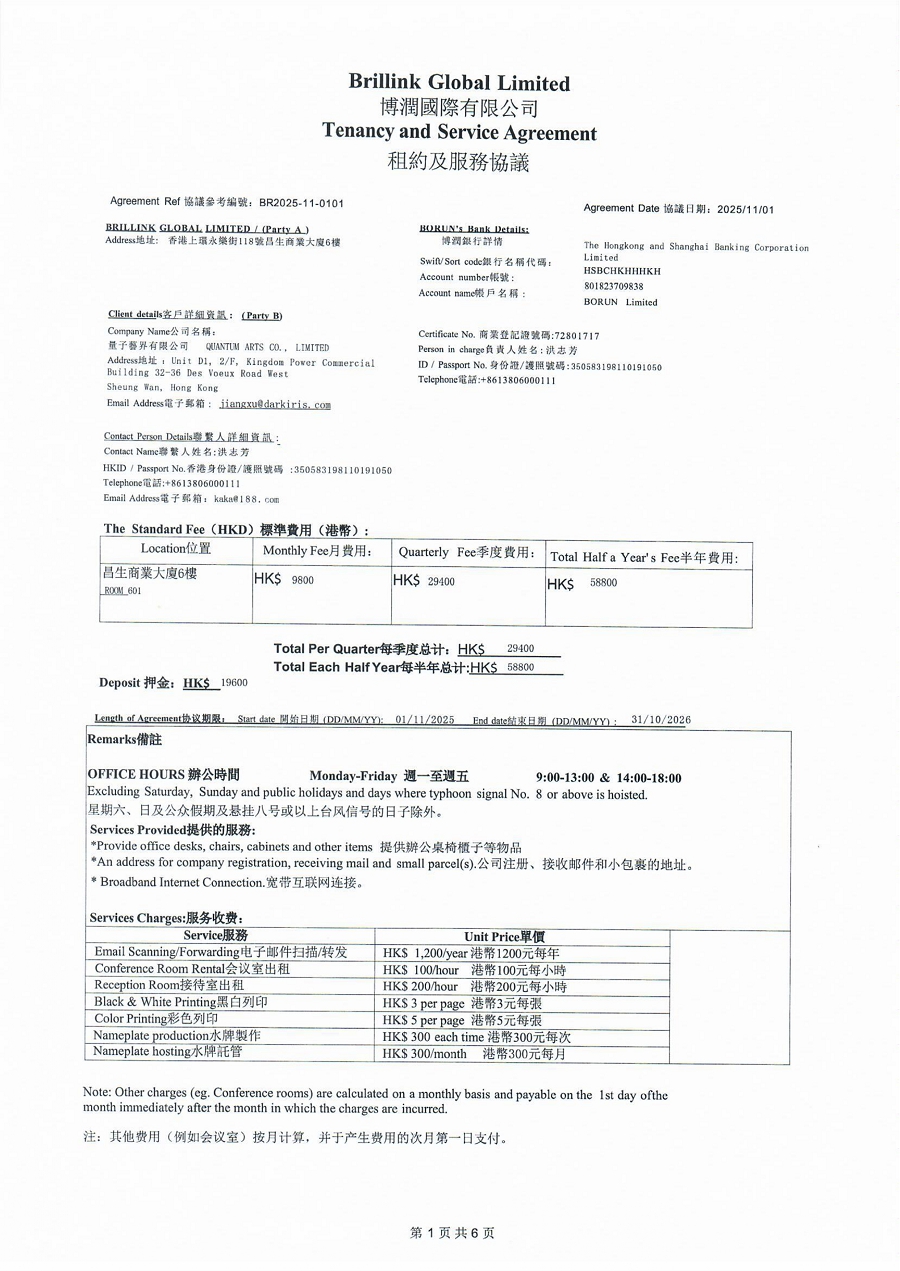


Exhibit 12.1
CERTIFICATION
I, Hong Zhifang, Chief Executive Officer, certify that:
| 1. | I have reviewed this Annual Report on Form 20-F of Darkiris Inc.; | |
| 2. | Based on my knowledge, this Annual Report does not contain any untrue statement of a material fact or omit to state a material fact necessary to make the statements made, in light of the circumstances under which such statements were made, not misleading regarding the period covered by this Annual Report; | |
| 3. | Based on my knowledge, the financial statements, and other financial information included in this Annual Report, fairly present in all material respects the financial condition, results of operations and cash flows of the Company as of, and for, the periods presented in this Annual Report; | |
| 4. | The Company’s other certifying officer(s) and I are responsible for establishing and maintaining disclosure controls and procedures (as defined in Exchange Act Rules 13a-15(e) and 15d-15(e)) and internal control over financial reporting (as defined in Exchange Act Rules 13a-15(f) and 15d-15(f)) for the Company and have: |
| (a) | Designed such disclosure controls and procedures, or caused such disclosure controls and procedures to be designed under our supervision, to ensure that material information relating to the Company, including its consolidated subsidiaries, is made known to us by others within those entities, particularly during the period in which this Annual Report is being prepared; | |
| (b) | Designed such internal control over financial reporting, or caused such internal control over financial reporting to be designed under our supervision, to provide reasonable assurance regarding the reliability of financial reporting and the preparation of financial statements for external purposes in accordance with generally accepted accounting principles; | |
| (c) | Evaluated the effectiveness of the Company’s disclosure controls and procedures and presented in this Annual Report our conclusions about the effectiveness of the disclosure controls and procedures, as of the end of the period covered by this Annual Report based on such evaluation; and | |
| (d) | Disclosed in this Annual Report any change in the Company’s internal control over financial reporting that occurred during the period covered by the Annual Report that has materially affected, or is reasonably likely to materially affect, the Company’s internal control over financial reporting; and |
| 5. | The Company’s other certifying officer(s) and I have disclosed, based on our most recent evaluation of internal control over financial reporting, to the Company’s auditors and the audit committee of the Company’s Board of Directors (or persons performing the equivalent functions): |
| (a) | All significant deficiencies and material weaknesses in the design or operation of internal control over financial reporting which are reasonably likely to adversely affect the Company’s ability to record, process, summarize and report financial information; and | |
| (b) | Any fraud, whether or not material, that involves management or other employees who have a significant role in the Company’s internal control over financial reporting. |
| Dated: January 30, 2026 | By: | /s/ Hong Zhifang |
| Name: | Hong Zhifang | |
| Title: | Director, Chief Executive Officer and Chairman of the Board |
Exhibit 12.2
CERTIFICATION
I, Xu Jiang, Chief Financial Officer, certify that:
| 1. | I have reviewed this Annual Report on Form 20-F of Darkiris Inc.; | |
| 2. | Based on my knowledge, this Annual Report does not contain any untrue statement of a material fact or omit to state a material fact necessary to make the statements made, in light of the circumstances under which such statements were made, not misleading regarding the period covered by this Annual Report; | |
| 3. | Based on my knowledge, the financial statements, and other financial information included in this Annual Report, fairly present in all material respects the financial condition, results of operations and cash flows of the Company as of, and for, the periods presented in this Annual Report; | |
| 4. | The Company’s other certifying officer(s) and I are responsible for establishing and maintaining disclosure controls and procedures (as defined in Exchange Act Rules 13a-15(e) and 15d-15(e)) and internal control over financial reporting (as defined in Exchange Act Rules 13a-15(f) and 15d-15(f)) for the Company and have: |
| (a) | Designed such disclosure controls and procedures, or caused such disclosure controls and procedures to be designed under our supervision, to ensure that material information relating to the Company, including its consolidated subsidiaries, is made known to us by others within those entities, particularly during the period in which this Annual Report is being prepared; | |
| (b) | Designed such internal control over financial reporting, or caused such internal control over financial reporting to be designed under our supervision, to provide reasonable assurance regarding the reliability of financial reporting and the preparation of financial statements for external purposes in accordance with generally accepted accounting principles; | |
| (c) | Evaluated the effectiveness of the Company’s disclosure controls and procedures and presented in this Annual Report our conclusions about the effectiveness of the disclosure controls and procedures, as of the end of the period covered by this Annual Report based on such evaluation; and | |
| (d) | Disclosed in this Annual Report any change in the Company’s internal control over financial reporting that occurred during the period covered by the Annual Report that has materially affected, or is reasonably likely to materially affect, the Company’s internal control over financial reporting; and |
| 5. | The Company’s other certifying officer(s) and I have disclosed, based on our most recent evaluation of internal control over financial reporting, to the Company’s auditors and the audit committee of the Company’s Board of Directors (or persons performing the equivalent functions): |
| (a) | All significant deficiencies and material weaknesses in the design or operation of internal control over financial reporting which are reasonably likely to adversely affect the Company’s ability to record, process, summarize and report financial information; and | |
| (b) | Any fraud, whether or not material, that involves management or other employees who have a significant role in the Company’s internal control over financial reporting. |
| Dated: January 30, 2026 | By: | /s/ Xu Jiang |
| Name: | Xu Jiang | |
| Title: | Chief Financial Officer |
Exhibit 13.1
CERTIFICATION PURSUANT TO
18 U.S.C. SECTION 1350,
AS ADOPTED PURSUANT TO
SECTION 906 OF THE SARBANES-OXLEY ACT OF 2002
In connection with the Annual Report of Darkiris Inc. (the “Company”) on Form 20-F for the year ended September 30, 2025, as filed with the Securities and Exchange Commission on the date hereof (the “Annual Report”), I, Hong Zhifang, Chief Executive Officer, certify, pursuant to 18 U.S.C. Section 1350, as adopted pursuant to Section 906 of the Sarbanes-Oxley Act of 2002, that:
| (1) | The Annual Report fully complies with the requirements of Section 13(a) or 15(d) of the Securities Exchange Act of 1934; and | |
| (2) | The information contained in the Annual Report fairly presents, in all material respects, the financial condition and result of operations of the Company. |
| Dated: January 30, 2026 | By: | /s/ Hong Zhifang |
| Name: | Hong Zhifang | |
| Title: | Director, Chief Executive Officer and Chairman of the Board |
Exhibit 13.2
CERTIFICATION PURSUANT TO
18 U.S.C. SECTION 1350,
AS ADOPTED PURSUANT TO
SECTION 906 OF THE SARBANES-OXLEY ACT OF 2002
In connection with the Annual Report of Darkiris Inc. (the “Company”) on Form 20-F for the year ended September 30, 2025, as filed with the Securities and Exchange Commission on the date hereof (the “Annual Report”), I, Xu Jiang, Chief Financial Officer, certify, pursuant to 18 U.S.C. Section 1350, as adopted pursuant to Section 906 of the Sarbanes-Oxley Act of 2002, that:
| (1) | The Annual Report fully complies with the requirements of Section 13(a) or 15(d) of the Securities Exchange Act of 1934; and | |
| (2) | The information contained in the Annual Report fairly presents, in all material respects, the financial condition and result of operations of the Company. |
| Dated: January 30, 2026 | By: | /s/ Xu Jiang |
| Name: | Xu Jiang | |
| Title: | Chief Financial Officer |
Exhibit 21.1
List of Subsidiaries of the Registrant
| Subsidiaries | Place of Incorporation | |
| Quantum Arts Co., Limited | Hong Kong | |
| Hongkong Stellar Wisdom Co., Limited | Hong Kong | |
| DarkIris Digital Technology (Xiamen) Co., Ltd | Xiamen, People’s Republic of China |