 エドガーで原本を確認する
UNITED STATES
SECURITIES AND EXCHANGE COMMISSION
WASHINGTON D.C. 20549
FORM 10-K
☒ ANNUAL REPORT PURSUANT TO SECTION 13 OR 15(d) OF THE SECURITIES EXCHANGE ACT OF 1934
For the Fiscal Year Ended October 31, 2025
OR
☐ TRANSITION REPORT PURSUANT TO SECTION 13 OR 15(d) OF THE SECURITIES EXCHANGE ACT OF 1934
For the transition period from _______ to ________.
Commission file number: 001-41643
TRIO PETROLEUM CORP
(Exact name of Registrant as specified in its charter)
| Delaware | 87-1968201 | |
| (State or other jurisdiction of | (I.R.S. Employer | |
| incorporation or organization) | Identification No.) | |
| 23823 Malibu Road, Suite 304 | ||
| Malibu, CA | 90265 | |
| (Address of principal executive offices) | (Zip Code) |
Registrant’s telephone number, including area code: (661) 324-3911
Securities registered pursuant to Section 12(b) of the Act:
| Title of each class | Trading Symbol(s) | Name of each exchange on which registered | ||
| Common Stock, par value $0.0001 per share | TPET | NYSE American LLC |
Indicate by check mark if the registrant is a well-known seasoned issuer, as defined in Rule 405 of the Securities Act. ☐ Yes ☒ No
Indicate by check mark if the registrant is not required to file reports pursuant to Section 13 or Section 15(d) of the Act. ☐ Yes ☒ No
Indicate by check mark whether the Registrant (1) has filed all reports required to be filed by Section 13 or 15(d) of the Securities Exchange Act of 1934 during the preceding 12 months (or for such shorter period that the Registrant was required to file such reports), and (2) has been subject to such filing requirements for the past 90 days. ☒ Yes ☐ No
Indicate by check mark whether the registrant has submitted electronically every Interactive Data File required to be submitted pursuant to Rule 405 of Regulation S-T (§232.405 of this chapter) during the preceding 12 months (or for such shorter period that the registrant was required to submit such files). ☒ Yes ☐ No
Indicate by check mark whether the registrant is a large accelerated filer, an accelerated filer, a non-accelerated filer, smaller reporting company, or an emerging growth company. See the definitions of large accelerated filer, accelerated filer, smaller reporting company, and emerging growth company in Rule 12b-2 of the Exchange Act.
| Large Accelerated Filer | ☐ | Accelerated Filer | ☐ | |
| Non-Accelerated Filer | ☒ | Smaller Reporting Company | ☒ | |
| Emerging Growth Company | ☒ |
If an emerging growth company, indicate by check mark if the registrant has elected not to use the extended transition period for complying with any new or revised financial accounting standards provided pursuant to Section 13(a) of the Exchange Act. ☐
Indicate by check mark whether the registrant has filed a report on and attestation to its management’s assessment of the effectiveness of its internal control over financial reporting under Section 404(b) of the Sarbanes-Oxley Act (15 U.S.C. 7262(b)) by the registered public accounting firm that prepared or issued its audit report. ☐
If securities are registered pursuant to Section 12(b) of the Act, indicate by check mark, whether the financial statements of the registrant included in the filing reflect the correction of an error to previously issued financial statements. ☐
Indicate by check mark whether any of those error corrections are restatements that required a recovery analysis of incentive-based compensation received by any of the registrant’s executive officers during the relevant recovery period pursuant to §240.10D-1(b). ☐
Indicate by check mark whether the registrant is a shell company (as defined in Rule 12b-2 of the Exchange Act). ☐ Yes ☒ No
The aggregate market value of the voting and non-voting common equity held by non-affiliates computed by reference to the price at which the common equity was last sold, or the average bid and asked price of such common equity, as of the last business day of the registrant’s most recently completed second fiscal quarter, April 30, 2025, was $8,775,576.
As of January 16, 2026, there were 12,300,752 shares of the registrant’s common stock outstanding.
TABLE OF CONTENTS
|
|
ITEM 1. BUSINESS.
Overview
We are a California-based oil and gas exploration and development company headquartered in Malibu, California, with our principal executive offices located at 23823 Malibu Road, Suite 304, Malibu, California 90265, with operations in Monterey County, California, Uintah County, Utah and Lloydminster, Saskatchewan.
We have had revenue-generating operations since the McCool Ranch Oil Field (defined hereafter) was restarted on February 22, 2024, and recognized our first revenues in our fiscal quarter ended April 30, 2024, and received the proceeds from these operations in June 2024. During the period ended April 30, 2025 we began generating revenue from our newly acquired properties in Saskatchewan, Canada.
Our Canadian projects represent a significant growth opportunity, driven primarily by planned workovers intended to enhance production across the acquired assets. We began executing this program immediately following the closing of our April 2025 acquisition of certain heavy oil assets in west-central Saskatchewan, Canada, including producing heavy oil wells, from Novacor (defined below), a company recognized as one of the lowest-cost operators in the region. In November 2025, we expanded our presence with the acquisition of a second Canadian project from Capital Land (defined below). Our strategy continues to focus on acquiring assets that generate immediate cash flow, provide meaningful long-term development potential, and offer the potential for transformative value creation through targeted strategic investment.
We were formed to initially acquire an approximate 82.75% working interest (which was subsequently increased to an approximate 85.775% working interest) from Trio LLC (“Trio LLC”) in the large, approximately 9,300-acre South Salinas Project that is located in Monterey County, California, and subsequently partner with certain members of Trio LLC’s management team to develop and operate those assets. We hold an approximate 68.62% interest after the application of royalties (“net revenue interest”) in the South Salinas Project. Trio LLC holds an approximate 3.9% working interest in the South Salinas Project. We and Trio LLC are separate and distinct companies. The remaining working interests are owned by two unrelated parties.
Initially, California was a significant part of our geographic focus; however, due to rising drilling costs and the negative impact on potential profitability, we have strategically shifted our efforts beyond California to pursue more economically viable opportunities. This transition is reflected in our acquisition of an interest in oil properties that are a part of the Asphalt Ridge Project in Uintah County, Utah, as well as our recent acquisition from Novacor, described above, in the prolific Lloydminster, Saskatchewan heavy oil region and from Capital Land in the County of Vermilion of River (formerly known as the Municipal District of Wellington No. 41).
Recent Business Developments
Changes to Company Management
Effective as of August 1, 2025, Stanford Eschner retired as Vice Chairman and a director of the Company.
Changes to Independent Registered Public Accounting Firm
On May 6, 2024, the Company dismissed BF Borgers CPA PC (“Borgers”) as the Company’s independent registered public accounting firm, as a result of Borgers no longer being able to audit the Company’s financial statements, pursuant to an order by the Securities and Exchange Commission against Borgers (the “SEC Order”). Effective May 8, 2024, the Company retained Bush & Associates CPA LLC (“Bush & Associates”) as its new independent registered public accounting firm. Also, pursuant to the requirements of the SEC Order, Bush & Associates re-audited the Company’s financial statements for the fiscal years ended October 31, 2023 and 2022, which financial statements were filed with Amendment No. 1 to the Company’s Report on Form 10-K/A filed with the SEC on June 13, 2024.
South Salinas Project
Efforts to obtain from Monterey County conditional use permits and a full field development permit for the South Salinas Project are progressing. Efforts to obtain from the California Geologic Energy Management Division (“CalGEM”) and from the California Water Boards a permit for a water disposal project at the South Salinas Project are also progressing. In the meantime, the Company recently determined that existing permits allow production testing to continue at the HV-3A discovery well at Presidents Field and, consequently, testing operations were restarted at this well on March 22, 2024. Oil production from this well has occurred and the Company is assessing steps to attempt to increase the well’s gross production rate, for example by adding up to 650 feet of additional perforations in the oil zone and/or acidizing the well for borehole cleanup. First oil sales from the HV-3A well occurred in the third calendar quarter of 2024 but is currently idled as we further discussions with local oil and gas companies to joint venture the project.
|
|
McCool Ranch Oil Field
On October 16, 2023, we entered into a Purchase and Sale Agreement with Trio LLC (the “McCool Ranch Purchase Agreement”) pertaining to the McCool Ranch Oil Field. Pursuant to this agreement, effective October 1, 2023, we entered into an agreement to acquire an approximate 22% working interest in and to certain oil and gas assets at the McCool Ranch Field, located in Monterey County, California, near our flagship South Salinas Project.
The acquired assets included six oil wells, a water-disposal well, a steam generator, boiler, storage tanks, and various operational infrastructure. While initial production was restarted on February 22, 2024, we have subsequently determined that under previously negotiated terms, natural gas prices and water disposal costs, particularly in California, makes it cost prohibitive for the Company to employ cyclic-steam operations to increase production and will not be economically feasible in the long run. On May 27, 2025, we executed a termination agreement with Trio LLC to end operations at the location and abandon all related leases. Capitalized costs totaling $500,614 have been written off and expensed in the statement of operations for the period ended April 30, 2025.
Asphalt Ridge Option Agreement and the Lafayette Energy Leasehold Acquisition and Development Option Agreement
On November 10, 2023, we entered into a Leasehold Acquisition and Development Option Agreement (the “Asphalt Ridge Option Agreement”) with Heavy Sweet Oil LLC (“HSO”). Pursuant to the Asphalt Ridge Option Agreement, we acquired an option to purchase up to a 20% working interest in certain leases at a long-recognized, major oil accumulation in northeastern Utah, including an initial 960 acres and a subsequent 1,920 acres, as well as a right-of-refusal option on approximately 30,000 acres.
On December 29, 2023, we and HSO entered into an Amendment to the Asphalt Ridge Option Agreement, under which we funded $200,000 in exchange for an immediate 2% working interest in the initial 960 acres. An additional $25,000 was funded in January 2024, increasing our working interest to 2.25%. While we had the option to acquire an additional 17.75% working interest, we decided not to exercise this option and will instead retain our existing 2.25% working interest in the initial 960 acres.
Novacor Asset Purchase Agreement
As of April 4, 2025, we entered into an Asset Purchase Agreement (the “April 2025 Novacor APA”) with Trio Petroleum Canada, Corp., an Alberta, Canada corporation and a wholly owned subsidiary of the Company (“Trio Canada”), and Novacor Exploration Ltd., a corporation incorporated under the Canada Business Corporations Act (“Novacor”), pursuant to which, subject to the terms and conditions set forth in the April 2025 Novacor APA, Trio Canada agreed to acquire certain assets of Novacor relating its oil and gas business, including certain contracts, leases and permits for working interests in petroleum and natural gas and mineral rights located in the Lloydminster, Saskatchewan heavy oil region in Canada (collectively, the “April 2025 Novacor Assets”), free and clear of any liens other than certain specified liabilities of Novacor that are being assumed (collectively, the “Liabilities” and such acquisition of the Novacor Assets and assumption of the Liabilities together, the “April 2025 Novacor Acquisition”) for a total purchase price of (i) US$650,000, in cash, US$65,000 of which was previously provided as a deposit to Novacor, and (ii) the issuance to Novacor of 526,536 shares of common stock of common stock. The April 2025 Novacor Acquisition was consummated in two closings, which was completed on May 22, 2025. All five of our currently active wells are in the newly acquired Novacor property.
P.R. Spring Letter of Intent and Option
On May 15, 2025, we entered into a non-binding Letter of Intent (LOI) with HSO for the potential acquisition of 2,000 acres of oil and gas properties at P.R. Spring, Uintah Basin, Utah (“P.R. Spring”), which is adjacent to Asphalt Ridge. The LOI contemplates our issuance of 1,492,272 restricted shares of common stock and the payment of $850,000 at closing, subject to execution of definitive agreements. Upon signing the LOI, we made a non-refundable $150,000 payment to HSO in consideration for the option. The LOI requires evidence of a minimum sustained production rate of 40 barrels per day for a continuous 30-day period from two wells at Asphalt Ridge by May 15, 2026, or the LOI will expire unless extended by us. We are not under any obligation to enter into definitive agreements in connection with an acquisition.
Carbon Capture and Storage Project as part of Company’s South Salinas Project
We are committed to attempting to reduce our own carbon footprint and, where possible, that of others. For this reason, we are taking initial steps to launch a Carbon Capture and Storage (“CCS”) project as part of the South Salinas Project, which appears ideal for such a task. The South Salinas Project covers a vast area and is uniquely situated at a deep depocenter where there are thick geologic zones (e.g., Vaqueros Sand, up to approximately 500’ thick) about two miles deep, which could accommodate and permanently store vast volumes of CO2. Four existing deep wells in the South Salinas Project (i.e., the HV 1-35, BM 2-2, BM 1-2-RD1 and HV 3-6 wells) are excellent candidates for use as CO2 injection wells. A CCS project in the future may help reduce our carbon footprint by sequestering and permanently storing CO2 deep underground at one or more deep wells, away from drinking water sources. Furthermore, three of the aforementioned deep wells are directly located on three idle oil and gas pipelines that could be used to import CO2 to our CCS Project. We have opened discussions with third parties who wish to reduce their own greenhouse gas emissions and who may be interested in participating in our CCS project. We believe it is feasible to develop the major oil and gas resources of the South Salinas Project and to concurrently establish a substantial CCS project and potentially a CO2 storage hub and/or Direct Air Capture (DAC) hub.
|
|
Market Opportunity
We believe that our newly established oil and gas operations in Canada strategically positions the Company to expand its operations into one of North America’s most promising heavy oil basins, with upside potential for long term production and reserve growth. Trio believes expanding operations into Canada offers economic development and low operational costs. Trio also believes that the market accessibility combined with a favorable regulatory process makes this area very attractive for continued and future development.
The oil and gas industry is operationally challenging in California, where we have the South Salinas Project, due primarily to regulatory issues and to efforts to facilitate an energy transition away from fossil fuels. TPET believes that given the size and future anticipated costs of exploration, it is best to seek out a joint venture partner who has the capacity to continue to operate in California with the expectation that the market for oil and gas in California will remain strong for the foreseeable future. Furthermore, TPET is attempting to launch a Carbon Capture and Storage Project as part of the South Salinas Project, consistent with efforts in California to reduce carbon footprint. The Company hopes and expects TPET’s commitment to reduce carbon footprint through a Carbon Capture and Storage Project to be viewed favorably by California regulatory bodies, perhaps helping to facilitate operations at the South Salinas Project and elsewhere.
The oil and gas industry currently appears operationally favorable in Utah, where we have the Asphalt Ridge asset and an option on the PR Spring project in the same Uintah basin. TPET believes that the overall operating environment and the market for oil and gas in Utah should remain favorable for the foreseeable future.
TPET’s operations may help meet the USA’s demanding oil and gas needs that are expected to remain strong for the foreseeable future, while supporting the country’s goal of energy independence, and supporting local and state economies with tax revenue and jobs.
Business Strategies
Our primary business strategies and objectives are to grow our recently acquired Canadian assets aggressively by acquiring projects that generate immediate cash flow and/or offer workover opportunities without committing huge resources to new exploratory drilling, or offer transformative growth potential with strategic investment in favorable political and economic environments such as our option on PR Spring in Uintah Basin, Utah. TPET’s current strategy and focus at the South Salinas Project is to seek out a joint venture partner with the knowledge and capacity to operate in California. We are also endeavoring to secure approval from CalGEM and WaterBoards of a proposed short-term water-disposal program that should significantly reduce lease operating costs, launching a Carbon Capture and Storage Project, pursuing permits for full field development, and similar matters. Efforts to obtain from Monterey County conditional use permits and a full field development permit for the South Salinas Project are progressing. Efforts to obtain from the California Geologic Energy Management Division (“CalGEM”) and from the California Water Boards a permit for a water disposal project at the South Salinas Project are also progressing. In the meantime, the Company recently determined that existing permits allow production testing to continue at the HV-3A discovery well at Presidents Field and, consequently, testing operations were restarted at this well on March 22, 2024. Oil production from this well has occurred and the Company has idled operations currently pending an assessment of the viability of increasing the well’s gross production rate, for example by adding up to 650 feet of additional perforations in the oil zone and/or acidizing the well for borehole cleanup. First oil sales from the HV-3A well occurred in the third calendar quarter of 2024.
TPET’s current strategy and focus at the PR Spring project is to monitor the results of the new 2-4 and 8-4 wells at the Company’s Asphalt Ridge project. Once production attains 40 barrels per day for thirty days from both wells, TPET will be in a position to exercise its option on the 2000-acre project and enter into a Definitive development agreement.
TPET’s primary strategies and objectives are focused on growing the Company into a highly profitable, independent oil and gas company.
Our Growth Strategy
TPET’s goal is the building and growing of a substantial independent oil and gas company by acquiring projects that generate immediate cash flow as in our Canadian assets or offer transformative growth potential with strategic investment such as our option on P.R. Spring in Utah.
Competition
There are many large, medium, and small-sized oil and gas companies and third-parties that are our competitors. Many of these competitors have extensive operational histories, experienced oil and gas industry management, profitable operations, and significant reserves and funding resources. Our efforts to acquire additional oil/gas properties in California and elsewhere may be met with competition.
Government Regulation
We are subject to a number of federal, state, county and local laws, regulations and other requirements relating to oil and natural gas operations. The laws and regulations that affect the oil and natural gas industry are under constant review for amendment or expansion. Some of these laws, regulations and requirements result in challenges, delays and/or obstacles in obtaining permits, and some carry substantial penalties for failure to comply. The regulatory burden on the oil and natural gas industry increases our cost of doing business, can affect and even obstruct our operations and, consequently, can affect our profitability. These burdens include regulations relating to transportation of oil and gas, drilling and production and other regulatory matters.
|
|
Certain Recent Developments
Formation of a Canadian Wholly-Owned Subsidiary
On March 28, 2025, we formed Trio Petroleum Canada, Corp., an Alberta, Canada corporation and our wholly owned subsidiary (“Trio Canada”). Our Chief Executive Officer, Robin Ross, is also the Chief Executive Officer of Trio Canada and also serves as Secretary/Treasurer. Our Chief Financial Officer, Greg Overholtzer, is also the Chief Financial Officer of Trio Canada. Robin Ross also serves as the sole director of Trio Canada.
Loan to Trio Canada
As of April 4, 2025, we entered into a Loan and Note Purchase Agreement (the “Loan Agreement”) with Trio Canada, made a loan (the “Subsidiary Loan”) to Trio Canada, in the amount of US$1,131,000 (the “Loan Amount”), and Trio Canada issued to us a three-year promissory note, with a maturity date of April 4, 2028, in the principal amount of US$1,131,000 (the “Subsidiary Note”) evidencing the Loan Amount. The outstanding principal amount of the Subsidiary Note accrues interest at a rate of 12% per annum. As of October 31, 2025, the outstanding principal balance of the Subsidiary Note was US$430,335 and accrued but unpaid interest totaled US$27,606.
Under the terms of the Loan Agreement, the Loan Amount was used to pay the remaining cash amount payable to Novacor, in connection with the Novacor Acquisition, and the remainder of the Loan Amount is to be used for ongoing operating costs of Trio Canada.
Convertible Notes Financings
April 2025 Convertible Note Financing
On April 11, 2025, we issued an Unsecured Original Discount Convertible Promissory Note (the “April 2015 Note”) to an institutional investor (the “April 2025 Note Investor”) in a principal amount of $321,176, having an original issue discount of $48,176, resulting in a funding amount of $273,000. After the payment of a commission of $15,015 to Spartan Capital Securities, LLC and the payment of $10,000 to reimburse the April Note Investor for its legal fees, we received net proceeds of $247,985.
On April 17, 2025, we issued an amended and restated Unsecured Original Discount Convertible Promissory Note to the April 2025 Convertible Note Investor (the “April 2025 Amended and Restated Note”), in an aggregate principal amount, with the principal amount of the April 2025 Note, of $712,941, having an aggregate original issue discount of $106,941, including the original issue discount of the April 2025 Note, and resulting in an aggregate funding amount, with the April 2025 Note, of $606,000. We received additional net proceeds of $333,000.
The April 2025 Amended and Restated Note also contained “piggyback” registration rights and the shares issuable upon conversion of the April 2025 Amended and Restated Note were registered for resale in a registration statement declared effective by the SEC on May 22, 2025. As of October 31, 2025, the Amended and Restated Note has been fully converted by the April 2025 Note Investor into shares of common stock.
August 2025 Convertible Note Financing
On August 15, 2025, we closed a private placement (the “August 2025 Convertible Note Financing”) pursuant to which we issued the August 2025 Notes to three institutional investors (the “August 2025 Note Investors”) in an aggregate principal amount of $1,200,000 (the “August 2025 Notes Principal Amount”), having an aggregate original issue discount of $180,000, or 15%, resulting in an aggregate funding amount of $1,020,000 (the “August 2025 Notes Funding Amount”). After the payment of $71,400 to Ladenburg Thalman & Co. Inc, as an exclusive placement agent fee, and $20,000 to reimburse the lead Investor for its legal fees, net proceeds of the financing was $928,600.
We may prepay all or any portion of the August 2015 Notes at any time (without penalty or premium if prepaid on or before the maturity date of February 15, 2026). If, during the period the August 2025 Notes remain outstanding, the Company raises any type of equity-related financing, the August 2024 Note Investors have the right to request that an aggregate of up to 25% of the gross proceeds raised by us in any such financing be used to repay the outstanding amounts of the August 2025 Notes.
The August 2025 Note Investors may request conversion of the August 2025 Notes, at any time, into shares of common stock (the “Conversion Shares”). Additionally, we have the right to require the August 2025 Note Investors to convert their August 2025 Notes in the event that at such time, for each of the five (5) preceding trading days prior to such date (i) the daily volume weighted average price (“VWAP”) of our common stock on the NYSE American or any other principal securities exchange on which the common stock is then traded (the “Principal Exchange”) is greater than $0.85 (subject to adjustments for forward splits and reverse splits of the common stock and other similar recapitalizations, as well as such other adjustments as provided in the August 2025 Notes), (ii) all of the Conversion Shares have been registered for resale under an effective registration statement filed with the SEC, and (iii) the daily dollar trading volume for the common stock on the Principal Exchange exceeds $500,000 per trading day; provided, however, that the amount subject to such conversion, under any of the August 2025 Notes, shall not exceed twenty percent (20%) of the total dollar trading volume of the common stock during such 5-day period. Furthermore, any conversion may not result in the issuance of shares of common stock to an August 2025 Note Investor, which would cause such August 2025 Note Investor, along with its affiliates, to own more than 4.99% (9.99%, if elected by the Investor) of the Company’s then outstanding shares of common stock nor to exceed the maximum number of shares that such Investor may convert pursuant to its Note (the “Beneficial Ownership Limitation”).
The conversion price of the August 2025 Notes is equal to the lesser of (i) $1.32 and (ii) 90% of the lowest daily VWAP of the common stock on the Principal Exchange, during the five (5) trading days prior to the date of a notice of conversion (a “Conversion Notice”). Notwithstanding the foregoing, the Conversion Price shall not be less than a floor price of $0.72, subject to certain adjustments, as provided in the August 2025 Notes (the “Floor Price”). In the event that any August 2025 Note Investor desires to convert its August 2025 Note at a time when the applicable Conversion Price is less than the Floor Price, such Investor may request a reduction to the Floor Price to the then applicable Conversion Price, but, in any event, not less than $0.22, which is 20% of the closing price of $1.10 of the common stock on the Principal Exchange on the trading day immediately prior the original issuance date of the August 2025 Notes. Upon any such reduction in the Floor Price, the Floor price of the other August 2025 Notes shall be similarly reduced.
Notwithstanding any of the other terms of the August 2025 Notes, the maximum number of shares of common stock which may be issued upon the conversion of all of the August 2025 Notes is 1,679,127 shares (the “Maximum Number of Conversion Shares), which is equal to 19.99% of the 8,399,839 shares of the Company’s common stock issued and outstanding on the closing date of the private placement.
Under the terms of a Registration Rights Agreement entered into by us with each of the August 2025 Note Investors, we have agreed to register the Conversion Shares for resale in a registration statement. The Conversion Shares were registered for resale in a Registration Statement on Form S-3, which was declared effective by the SEC on September 11, 2025. As of October 31, 2025, a portion of the August 2025 Notes have been converted into an aggregate of 606,809 Conversion Shares and the aggregate outstanding balance of the August 2025 Notes was $467,179.
For additional information on the terms of the August 2025 Convertible Note Financing, see our Current Report on Form 8-K filed with the SEC on August 18, 2025, including the August 2025 Notes and Registration Rights Agreement filed as exhibits hereto.
|
|
Capital Land Services Acquisition
On August 20, 2025, the Company), through its wholly owned subsidiary Trio Canada, entered into an Asset Purchase Agreement (“APA”) with Capital Land Services Ltd. (“Capital Land”). Pursuant to the APA, Trio Canada agreed to acquire certain mineral leasehold interests and related rights located in the County of Vermilion of River, Alberta, Canada, together with associated contracts, permits, and registrations (collectively, the “Assets”). The total purchase price consists of CAD $150,000 in cash and the issuance of restricted shares of the Company’s common stock having an aggregate value of CAD $150,000.
On November 3, 2025, subsequent to the Company’s fiscal year ended October 31, 2025, the transactions contemplated under the APA were completed (the “Capital Land Acquisition”). At closing, Trio Canada paid Capital Land CAD $150,000 in cash and we issued 104,227 restricted shares of our common stock to Capital Land. In exchange, Trio Canada acquired the Assets, including certain wells that had been purchased out of receivership. Due to regulatory requirements of the Alberta Energy Regulator (“AER”), the Company arranged for all applicable licenses to be transferred to Novacor, an experienced operator with whom the Company has an existing commercial relationship. Novacor utilizes Capital Land as its AER agent. In consideration for Capital Land’s services as AER agent, the Company granted Capital Land a 1% gross overriding royalty with respect to the mineral rights, for as long as Capital Land continues to provide such services.
Asset Purchase Transaction with Novacor Exploration Ltd.
As of December 30, 2025, the Company entered into an Asset Purchase Agreement (the “December 2025 Novacor APA”) with Trio Canada, and Novacor, pursuant to which, subject to the terms and conditions set forth in the December 2025 Novacor APA, Trio Canada agreed to acquire certain assets of Novacor’s relating to Novacor’s oil and gas business, including certain contracts, leases and permits for working interests in petroleum and natural gas and mineral rights located in the Lloydminster, Saskatchewan heavy oil region in Canada (collectively, the “December 2025 Novacor Assets”), free and clear of any liens other than certain specified liabilities of Novacor that are being assumed (collectively, the “Liabilities” and such acquisition of the Assets and assumption of the Liabilities together, the “December 2025 Novacor Acquisition”) for a total purchase price of CAD $1,000,000 (US$730,300 based on the applicable exchange rate to U.S. Dollars). The Company issued to Seller 912,875 restricted shares of common stock of the Company, subject to certain registration rights (the “Purchase Price”).
The December 2025 Novacor Acquisition was closed on December 30, 2025, simultaneously with the execution by the Company, Trio Canada and Novacor of the December 2025 Novacor APA and other transaction documents (the “Closing”). At the Closing, title to the December 2025 Novacor Assets was delivered to the Trio Canada, and the Company, thereafter deliver the restricted shares to Novacor.
Following the Closing, (i) operating costs for the December 2025 Novacor Assets shall, for a period of two (2) years, be held at the levels detailed in the auditor’s report over the eighteen (18) month period prior to the Closing, prepared for Trio Canada on the basis of the due diligence materials provided by Novacor to Trio Canada in connection with the December 2025 Novacor Acquisition, unless mutually agreed otherwise; (ii) after such two-year period, operating costs shall remain competitive with other operators in the area; and (iii) Trio Canada shall be entitled to terminate Novacor’s post-Closing actions at any time on 30 days’ prior written notice to the Novacor. After the Closing, with respect to the December 2025 Novacor Assets, Novacor shall act as the on-site operator of the December 2025 Novacor Assets and perform all work and services as provided in the December 2025 Novacor APA.
On December 30, 2025, the Company and Novacor executed and entered into a Registration Rights Agreement with respect to the restricted shares (the “RRA”). Pursuant to the provisions of the RRA, Novacor is entitled to certain “piggyback” registration rights, with respect to the Registrable Securities (as such term is defined in the RRA), providing Novacor with the right to include the Registrable Securities in a registration statement filed by the Company for the registration of its securities and/or the resale of shares of Common Stock by other stockholders of the Company (a “Piggyback Registration Statement”), subject to certain limitations and restrictions. In the event that the Registrable Securities are not included in a Piggyback Registration Statement filed by the Company with the Securities and Exchange Commission (“SEC”) on or before March 31, 2026, the Company is obligated to file a registration statement on or before March 31, 2026, to register the resale of the Registrable Securities, subject to certain limitations and restrictions. The Company has agreed to pay all fees relating to the registration of the Registrable Securities, except any broker or similar commissions payable by a holder of Registrable Securities.
For additional information on the terms of the Asset Purchase Transaction with Novacor, see our Current Report on Form 8-K filed with the SEC on January 5, 2026, including the APA and RRA filed as exhibits hereto.
Ladenburg ATM Agreement
On January 9, 2026, we entered into an At Market Issuance Sales Agreement (the “ATM Agreement”) with Ladenburg Thalmann & Co. Inc. (“Ladenburg”) as agent, pursuant to which the Company may issue and sell shares of our common stock from time to time through Ladenburg (the “ATM Offering”). On January 9, 2026, the Company also filed a prospectus supplement with the SEC covering the sale of shares of common stock having an aggregate offering price of up to $3,600,000 (the “Placement Shares”), in connection with the ATM Offering. Upon delivery of a Placement Notice (as such term is defined in the ATM Agreement) and subject to the terms and conditions of the ATM Agreement, Ladenburg shall use its commercially reasonable efforts to sell the Placement Shares by (i) any method permitted by law deemed to be an “at the market offering” as defined in Rule 415(a)(4) promulgated under the Securities Act of 1933, as amended (the “Securities Act”), including sales made directly on or through the NYSE American or on any other existing trading market for the common stock and/or (ii) any other method permitted by law with the Company’s consent. The ATM Agreement provides that Ladenburg will be entitled to aggregate compensation for its services up to 3.0% of the gross proceeds from each sale of Placement Shares sold through Ladenburg under the ATM Agreement.
For additional information on the terms of the ATM Agreement with Ladenburg, see our Current Report on Form 8-K filed with the SEC on January 9, 2026, including the ATM Agreement filed as an exhibit hereto.
South Salinas Project
Oil Rights and Ownership
TPET has an approximate 85.775% working interest in the South Salinas Project. We have a mineral-leasehold of approximately 9,300 gross mineral acres and 7,946 net mineral -acres in one largely contiguous land package from primarily one Lessor, Bradley Minerals. The surface lands at the approximate 9,300 mineral acres are primarily part of the private Porter Ranch. There are six existing idle wells and one active well in the South Salinas Project, and permits are approved by Monterey County for the drilling and testing of two additional wells (i.e., the HV-2 and HV-4 wells).
Description of South Salinas Property and Current Operations
We initiated operations as TPET with the acquisition from Trio LLC of an 82.75% working interest in the South Salinas Project under the terms of a Purchase and Sale Agreement (the “South Salinas Purchase Agreement”) dated September 14, 2021. Our working interest was later increased by 3.026471% and we currently hold an approximate 85.775% working interest and an approximate 68.62% net revenue interest (after all royalties) in the South Salinas Project. The working interest we own includes leases, wells, inventory and 3D seismic data.
We believe the South Salinas Project has the potential to be significant, with an estimated 40.2 million barrels of oil (“MMBO”) plus 42.4 billion cubic feet of gas (“BCFG”), or 47.3 million barrels of oil equivalent (“BOE”), in Probable (P2) Undeveloped reserves and an approximate 100.7 MMBO and 168.5 BCFG, or 128.8 million BOE, in Possible (P3) Undeveloped reserves. Note that the conversion rate used is 6.0 Mcf per 1 BOE. Note that the conversion rate used is 6.0 Mcf per 1 BOE.
Trio LLC and its management team are part owners of the Company and will continue as Operator of the South Salinas Project on behalf of the Company and of the other working interest partners.
There are two contiguous areas of notable oil/gas accumulations in the South Salinas Project, being the Humpback Area (“Humpback Oil Field”) that occurs in the northern part of the project, and the Presidents Area (“Presidents Oil Field”) that occurs in the southern part of the project. Discovery wells have been drilled and completed at both Humpback Oil Field and Presidents Oil Field. The HV-3A well is the first well drilled at the Presidents Oil Field and is its discovery well. About five wells have been drilled at the Humpback Oil Field and of these we consider the BM 2-2 well as its discovery well.
The primary oil and gas objectives in the South Salinas Project are classic fractured Monterey Formation reservoirs (i.e., zones with abundant brittle/fractured intervals of chert, dolomite, limestone and porcelanite) and the Vaqueros Sand. Fractured Monterey Formation is one of the most important and prolific oil/gas reservoirs in California. The primary oil and gas reservoirs occur at approximately 4,000-8,000’ depth. The oil is mid- to high-gravity (18-40° API). The oil and gas targets are in structural traps - this is not a resource play. The structural traps are imaged in 30 square miles of 3D seismic data that is owned by the Company. Importantly, the 3D seismic was acquired after the drilling of all wells in the area except for our HV-3A and HV-1 wells. The 3D seismic provides critical information about how prior wells were not properly located and, more importantly, how the South Salinas Project potentially may be successfully exploited going forward.
The Monterey Formation oil and gas zones have been tested at various wells at the South Salinas Project. The Vaqueros Sand has not yet been tested but the Company believes that it is potentially productive behind-pipe in the BM 2-2 well. TPET intends to perforate and test the Vaqueros Sand in the BM 2-2 well as soon as the necessary permits are in-hand.
|
|
We own approximately 30 square miles of three dimensional seismic data (“3D seismic”) at the project. An integrated interpretation of the 3D seismic data and of well data indicates that Presidents Oil Field is a large anticlinal feature covering an area of approximately 1,300 acres, with a major structural, anticlinal high at the location of the HV-3A discovery well, and with two separate, four-way closed anticlines at the northwest, down-plunge-end of the feature. The structural feature at Presidents Oil Field is best characterized as a positive flower structure resulting from transpressional deformation along strike slip faults including the major Rinconada Fault. The Company has determined that production testing may resume at the HV-3A discovery well at Presidents Field. Testing on pump at this well resumed on March 22, 2024.
One of our initial objectives was to drill the HV-1 confirmation well at the President Oil Field. This objective has been accomplished. The following is a discussion of the HV-1 well and its significance:
| ● | The HV-1 well is located about two miles northwest of the HV-3A discovery well and for this reason it is considered a “confirmation well” intended to help confirm the size of lateral extent of the field. The HV-1 surface hole location (“SHL”) is located in about the center of T24S-R10E-Section 14. The well was directionally drilled approximately 2,600 feet toward the southeast and its bottom hole location (“BHL”) is located in T24S-R10E-Section 13. | |
| ● | The HV-1 well spud on about May 5, 2023, and was completed at its total depth (“TD”) of about 6,641 feet (measured depth) on about May 15, 2023. | |
| ● | The HV-1 confirmation well is located on the larger of the aforementioned two down-plunge, four-way closed anticlines. | |
| ● | There were primarily three reservoir objectives in the HV-1 well, being the Yellow Zone (aka Yellow Chert), the underlying Brown Zone (aka Brown Chert) and the underlying Mid-Monterey Clay, all of which are stratigraphic subunits of the Miocene-age Monterey Formation. The Yellow and Brown zones are both attributed oil and gas reserves at Presidents in the Company’s reserve report as filed with the SEC. The Mid-Monterey Clay is nowhere assigned reserves in the Company’s reserve report, although it did have significant oil/gas shows in the HV-3A discovery well and periodically may have contributed to the flow of oil and gas to surface at said well. | |
| ● | The 3D seismic data indicate that the Yellow and Brown zones have four-way closure (i.e., anticlinal rollover in one of the subsidiary, down-plunge anticlines) at the location of the HV-1 well, whereas at this location the Mid-Monterey Clay may have fault closure (within the positive flower structure) but lacks rollover. The directional drilling plan for the HV-1 well was designed such that the well would penetrate the Yellow and Brown zones near the tops of their anticlinal closures and to continue downward into the Mid-Monterey Clay where anticlinal closure apparently does not occur. | |
| ● | The Yellow Zone, Brown Zone and Mid-Monterey Clay were encountered in the HV-1 well largely as predicted including with respect to depth, thickness, lithology, wireline-log characteristics and oil and gas shows including free oil in cuttings and in the mud pit. The Company believes that the HV-1 well has confirmed that there is a major oil and gas accumulation in the Presidents Oil Field, as the Company announced in a press release on May 16, 2023. | |
| ● | Confirmation of a major oil and gas accumulation by itself does not confirm whether economic oil/gas production can be established. The HV-1 has undergone production testing to evaluate commerciality. Production testing at the HV-1 well was initially carried-out from the bottom up (i.e., by testing the deeper Mid-Monterey Clay zone first and working upward to the shallower Brown and Yellow zones), and the Brown and Mid-Monterey Clay zones were subsequently retested. The Mid-Monterey Clay, Brown Zone and Yellow Zone all underwent production testing. Oil and gas were recovered but commercial production was not established. | |
| ● | Operations may continue, for example deepening, sidetracking or additional testing, at the HV-1 well but it is currently idle. | |
| ● | The HV-1 well is the newest well in the South Salinas Project and is the only exploratory well drilled in the last three fiscal years at the project. | |
| ● | The Company considers it premature to deem HV-1 either a dry development well or a net productive well. Additional operations, including possibly deepening or sidetracking, and additional testing, are feasible at HV-1. Thus, there has been no net productive well or dry development well drilled in the last three fiscal years at the South Salinas Project. Prior to the drilling of the HV-1 well, the newest well at the Project was the HV-3A discovery well that was drilled in 2018. |
All of the Company’s acreage and reserves in the South Salinas Project are considered undeveloped. The HV-3A and BM 2-2 wells, and possibly other project wells, are and/or may possibly be capable of oil and/or gas production but additional investments at these wells are necessary prior to establishing commercial oil/gas production and, therefore, reserves and acreage are considered undeveloped. Thus, the total gross undeveloped acreage is approximately 9,300 acres and the total net undeveloped acreage (i.e., net to the Company) is approximately 7,927 acres (i.e., 9,300 acres x 0.8575 = 7,927 acres). The total gross developed acreage is zero acres and the total net developed acreage (i.e., net to the Company) is also zero acres; see the following table below.
| Region | Developed acres | Undeveloped acres | Term (in years) | |||||||||||||||
| Gross | Net | Gross | Net | |||||||||||||||
| California | - | - | 9,245 | 7,927 | 1-3 | |||||||||||||
As noted elsewhere, on the Company’s leases there are six existing idle wells (i.e., the BM 1-2-RD1, BM 2-2, BM 2-6, HV-1, HV 3-6 and HV 1-35 wells) and one active well (i.e., HV-3A well). Of these seven wells perhaps only the HV-3A and BM 2-2 wells should be considered to probably and/or possibly be capable of economic oil/gas production with their current mechanical completions, whereas it cannot be ruled-out that economic oil/gas production could be established at the other five wells. Thus, on the Company’s leases there may be considered to be two (2) gross productive wells (i.e., the HV-3A and BM 2-2 wells) and 1.715 net productive wells (i.e., 85.75% WI times 2 gross wells = 1.715 net productive wells).
|
|
The Porter Ranch is an active working property that supports farming operations, livestock grazing, and the exploitation of oil and gas reserves, as well as the preservation of open space that preserves natural habitat. There is partly overlapping ownership in Bradley Minerals (the Lessor) and in Porter Ranch (the surface owner) and the interests and objectives of the two entities are closely aligned. In some projects there are conflicts between surface and mineral owners, for example with the surface owner discouraging and the mineral owner encouraging development. Importantly, in this project the mineral and surface owners have aligned interests/objectives, and this is beneficial to the South Salinas Project. Total royalty burden at the South Salinas Project is approximately 20%, all of which is held by lessors. TPET and Trio LLC and their associates hold no royalty interests in the South Salinas Project.
Infrastructure at the South Salinas Project includes seven existing wells, six expansive well pads, and three idle Aera Energy oil and gas pipelines. The expansive well pads are important because they can accommodate significant project development without additional disturbance of the surface – the Company believes that this may help expedite the approval of necessary additional permits.
South Salinas Project Property and Future Operations
The Company has drilling permits from Monterey County for two additional wells at the South Salinas Project, being the HV-2 well and the HV-4 well. When appropriate funding is in place, the Company will evaluate whether to directionally drill both of these wells into the Presidents Oil Field, or to drill one into the Presidents Oil Field and one into the Humpback Oil Field. The production performance of the HV-3A well, which was restarted on March 22, 2024, will bear on the drilling plans for HV-2 and HV-4.
The Company anticipates that it may be desirable in the future to obtain access or ownership of the Aera Energy pipelines (possibly jointly owned with Chevron) to move oil and gas to markets and possibly to move produced water off-site, as well as potentially being used in a Carbon Capture and Storage (CCS) Project. Aera Energy (“Aera”) and Chevron have significant operations a few miles north at the San Ardo Oil Field. Aera’s holdings in California were recently acquired by the companies IKAV, an international asset management group headquartered in Germany, and CPP Investments, a professional investment management organization that manages investments of contributors and beneficiaries of the Canada Pension Plan. In 2024, it was announced that California Resources Corp (“CRC”) and Aera are merging. The Company believes that there are potential synergies between our South Salinas Project and the San Ardo Oil Field that is operated by Aera and Chevron, and possibly soon by CRC. CRC is already an approximate 8% working-interest owner in the South Salinas Project.
There is an application for an UIC water disposal operation at the South Salinas Project that is under review by CalGEM and being modified and updated by Trio LLC. Approval of this water disposal project by CalGEM and Water Boards will be an important part of establishing an economic oil and gas operations.
All of the existing seven wells in the South Salinas Project are currently inactive and temporarily shut-in, except for the active HV-3A well that was restarted on March 22, 2024. When the appropriate permits are in-hand, which will perhaps be in 2026, and when the required funding is in-place, the Company will assess its plans to return the BM 2-2 well to oil and gas production, to reenter and sidetrack three of the wells (the HV 1-35, BM 2-6 and HV 3-6 wells) to optimal locations that are indicated in the 3D seismic data and to then put them on production, and to utilize one well (the BM 1-2-RD1 well) as a water disposal well. TPET is evaluating options (e.g., deepening, sidetracking, recompleting, etc.) at the new HV-1 well, as discussed above. TPET may drill one or both of the HV-2 and HV-4 wells in 2026. The HV-1, HV-2, HV-3A and HV-4 wells may each be produced for its own 18-month period, under the Company’s current exploration/testing permits. TPET is working toward the goal of obtaining permits for full field development, including long-term production and water disposal. These permits are critical for the proper development of our South Salinas Project asset.
|
|
Evaluation of Reserves and Net Revenue
Our evaluation and review of oil and gas reserves and future net revenue attributable to the Company’s interests in the South Salinas Project are based on independent analyses prepared by KLS Petroleum Consulting LLC (“KLSP”), Denver, Colorado. The Company in previous filings with the SEC provided two reserve reports by KLSP, one being entitled “Reserves Attributable to Trio Petroleum Corp South Salinas Area for Development Plan Phases 1 and 2,” (“Prior Reserve Report 1”) and the other entitled “S. Salinas Area, Full Development Reserves Supplement to SEC Report Dated 1-28-2022,” (“Prior Reserve Report 2”) both of which had an effective date of October 31, 2021. KLSP has provided an updated reserve report, with an effective date of April 30, 2024, which is entitled “Reserve Attributable to Trio Petroleum Corp South Salinas Area for Phased and Full Development” (the “Current Reserve Report”), which is included as an exhibit filed with this Annual Report on Form 10-K (“Annual Report”).
KLSP is an independent, third-party, petroleum engineering firm that meets industry-standards for qualifications, independence, objectivity and confidentiality. The primary technical person, Kenneth L. Schuessler, responsible for preparing the Reserve Report is a registered professional petroleum engineer with decades of experience in the petroleum industry and in analyses of reserves. Mr. Schuessler has significant experience in the petroleum industry and has held important positions with Bergeson Associates, Malkewitz-Hueni Associates, SI International, System Technology Associates and MHA Petroleum Consultants. Importantly, Mr. Schuessler has significant experience in the evaluation and exploitation of Monterey Formation fractured-reservoirs at the giant Elk Hills and Coles Levee Fields in the San Joaquin Basin in California. Mr. Schuessler’s knowledge of the Monterey Formation is highly-relevant to the evaluation of our South Salinas Project at which the fractured Monterey Formation is of critical importance.
KLSP states that the reserves in the “Prior Reserve Report 1” referenced as Exhibit 99.1 to the Annual Report, the “Prior Reserve Report 2” referenced as Exhibit 99.2 to the Annual Report and the “Current Reserve Report” referenced as Exhibit 99.3 to the Annual Report and their determination are consistent with definitions found in Rule 4-10 of SEC Regulation S-X (17CFR part 210), and Subpart 1200 of Regulation SK. The net reserves, costs and revenues are those attributable to the Company. Future net revenue and discounted present value are on a before federal income tax (BFIT) basis.
KLSP is an independent third-party that does not own an interest in any of our properties. Mr. Schuessler is not a permanent employee of our company but we continue to employ the services of KLSP on an as-needed basis.
Our internal staff including our geoscience, drilling, facilities, regulatory, compliance, land, legal and accounting professionals communicated as needed with KLSP to ensure the integrity, accuracy and timeliness of data furnished to KLSP, to review and discuss the properties, methods and assumptions used by KLSP in KLSP’s preparation of the reserve estimates, and to review and discuss KLSP’s conclusions. As discussed immediately above, KLSP is a highly-qualified, independent, petroleum-engineering consulting firm. Mr. Terence B. Eschner, the Company’s former President and a registered professional geologist, who is very knowledgeable about the South Salinas Project, was the Company’s primary contact with KLSP regarding the reserve analyses that were conducted by KLSP. Mr. T. Eschner played a key role providing the Company’s internal controls on the reserve estimation effort that was carried-out by KLSP, while not interfering with KLSP’s analyses so as to ensure that KLSP’s analyses would truly be that of an independent third-party. The Company recognizes that estimating volumes of economically recoverable oil and natural gas reserves is somewhat subjective and that the accuracy of any reserve estimate is partly a function of the quality and accuracy of the available data and interpretations: for this reason and others the Company strove to provide the best available data and interpretations to KLSP. Reserve estimates typically require revision as new information becomes available and/or due to change in conditions and/or due to unforeseen circumstances. Reserve estimates commonly differ from the quantities of oil and natural gas that are ultimately recovered. Estimates of economically recoverable oil and natural gas and of future net revenues are based on a number of variables and assumptions, some or all of which may prove to be incorrect.
|
|
The technologies utilized by KLSP in their reserve estimation efforts are discussed in detail in the Reserve Report. These technologies included the evaluation and incorporation of data from analog oilfields. Analogs are widely used in reserves estimating, particularly in the early development stages when direct measurement information (production history) is limited. On page 25 of the Reserve Report in the Society of Petroleum Engineers’ Petroleum Resource Management System (PRMS Section 4.1.1), use of analogs is described as “The methodology is based on the assumption that the analogous reservoir is comparable to the subject reservoir in regard to reservoir description, fluid properties, and most likely recovery mechanism(s) applied to the project that control the ultimate recovery of petroleum. By selecting appropriate analogs, where performance data of comparable development plans are available, a similar production profile may be forecast. Analogs are frequently applied in aiding in the assessment of economic producibility, production decline characteristics, drainage area, and recovery factor.” While the use of analogs for the South Salinas Project were consistent with the PRMS guidelines, the Reserve Report cover letter emphasized “The reserves and their determination are consistent with definitions found in Rule 4-10 of SEC Regulation S-X (17CFR part 210), and Subpart 1200 of Regulation S-K.” And, specifically, in 210.4-10(a)(2) “Analogous reservoirs have similar rock and fluid properties, reservoir conditions (depth, temperature, and pressure) and drive mechanisms, but are typically at a more advanced stage of development than the reservoir of interest and thus may provide concepts to assist in the interpretation of more limited data and estimation of recovery. When used to support proved reserves, an “analogous reservoir” refers to a reservoir that shares the following characteristics with the reservoir of interest: (i) same geological formation (but not necessarily in pressure communication with the reservoir of interest); (ii) same environment of deposition; (iii) similar geological structure; and (iv) same drive mechanism.”
The technologies utilized by KLSP also included constructing several numerical models that evaluated the expected oil and gas production under an appropriate range of reservoir characteristics, and which allowed probabilistic estimates of reserves. These models required reservoir properties and, therefore, OOIP as input. The Probabilistic method defined a distribution representing the full range of possible values for input parameters. This included dependencies between parameters that are also defined and applied. These distributions were randomly sampled using Monte Carlo simulation to compute a full distribution of potential in-place and recoverable quantities of oil, gas, and water. Input distributions were included for porosity, permeability, water saturation and net productive thickness. In addition, pore volume compressibility was described with a distribution because its range of uncertainty can impact reservoir pressure and therefore future productivity. S&P Global’s Harmony Enterprise software was used to construct the numerical models for the various reservoir units, being Monterey Yellow, Monterey Blue and Vaqueros Sand reservoir units. A ‘type well’ or calibration model was constructed for each reservoir using the average conditions and reservoir properties cited above. In addition, using the probabilistic distributions of porosity, net thickness, water saturation, permeability and pore volume compressibility, the reservoir model was run 500 times, each time the model selecting via Monte Carlo sampling the input parameters according to the ranges and distributions defined. Each simulation run resulted in a particular value of oil and gas recovery. The cumulative probabilities of the resulting forecasts of ultimate oil and gas recovery were used to identify the reported reserve values.
We have consulted with KLSP and it has provided us estimates of net reserves and/or cash flows as of the end of April 30, 2024, as: 1) there are new technical data as a result of drilling the HV-1 well in 2023; 2) the Company’s WI has increased from approximately 82.75% to approximately 85.775%; 3) new leases have been acquired providing additional well locations; 4) drilling and development schedules have changed; and 5) oil prices have changed. More specifically, the completion results of the HV-1 well appear to indicate that the productive area of the Yellow Zone at the President’s Area may be somewhat smaller than mapped in 2021. On the other hand, the Company has acquired additional leases in the Project area that increase the net well locations targeting the Blue Zone and Vaqueros Sand. The reserves associated with these additional net wells partially offset any possible reduction in reserves due to a smaller Yellow Zone productive area. All of the aforementioned factors are taken into consideration in the estimates of reserves and cash flows as of end of April 30, 2024, as documented in the Current Reserve Report included as Exhibit 99.3 to this Annual Report.
Disclosure of Reserve Volumes and Reserve Values as of the End of April 30, 2024
KLSP in the aforementioned reserve analyses recognizes the occurrence at the South Salinas Project of both Probable (P2) Undeveloped reserves and of Possible (P3) Undeveloped reserves (see: “Glossary of Terms Used to Characterize Reserves & Projects” in Table 22 in the Reserve Report). SEC criteria stipulate that reserves cannot be classified as P1 Proved (i.e., PDP or Proved Developed Producing, PDNP or Proved Developed Not Producing, PUD or Proved Undeveloped) if said reserves are not fully permitted for long-term production. Permits for full field development and long-term production are being sought by the Company, but have not yet been approved for the South Salinas Project and, therefore, KLSP does not recognize Proved reserves at the South Salinas Project.
KLSP provided estimates of net oil and gas reserves and future net revenues, attributable to the Company, for Phase 1, Phase 2 and Phase 3 (Full Development) for the entire South Salinas Project, as shown in the below Table. Future net revenue and discounted present value are on a before federal income tax (BFIT) basis. Both undiscounted and discounted net cash flow to the Company are shown. The discounted dollar amounts shown in the below Table are discounted at 10% and, therefore, are net present value (“NPV”) 10 amounts, whereas KLSP also provided estimated NPV15, 20, 30, 45 and 60. Reserve volumes are expressed in stock tank barrels (STB) of oil and thousands of standard cubic feet of gas (MCF).
There are uncertainties in reserve forecasts and in associated estimates of future cash flows due to uncertainties in various matters that are elaborated above (see: We face substantial uncertainties in estimating the characteristics of our assets, so you should not place undue reliance on any of our measures.). The Company’s estimates of Probable (P2) Undeveloped reserves, Possible (P3) Undeveloped reserves and their respective estimated future cash flows are discussed more-fully above (see Evaluation of Reserves and Net Revenue) and are described in detail in the Current Reserve Report. The Company’s reserve estimates are based on field analogs, numerical models and probabilistic modeling. Copied below are two paragraphs from the Current Reserve Report that further explain the Company’s estimated reserves:
|
|
“Because decline curve analysis could not be used to forecast reserves, and since the development of type curves was problematic due to the early historical time frame in which the analog fields were developed, probabilistic methods were employed. The interpretations of open hole logs, core, and test information were used to describe ranges and distributions of key reservoir parameters. These were then input to numerical simulation models that used Monte Carlo sampling and hundreds of runs to derive forecasts of production and ultimate recovery representing P90 (1P), P50 (2P) and P10 (3P) reserve estimates. As indicated in the nomenclature of TABLE 22, these estimates are also known as Proved, Proved+Probable, and Proved+Probable+Possible, respectively. The designation ‘P50’ means there is a 50 percent probability that the actual production will exceed the value reported as the P50 reserves. The P50 value, also considered the Best or Most Likely estimate, is derived from a cumulative frequency distribution of forecast reserves from the Monte Carlo simulations. If Proved reserves have been assigned, Probable reserves are then represented by the difference between the P50 and P90 probabilistic estimates. However, as explained below, Proved reserves have not been assigned in this report because project approval has not been secured by all necessary government entities. Therefore, since there are no Proved or P90 volumes, the Probable reserves disclosed herein, derived from the P50 probabilistic forecasts, are incremental volumes and presented as Probable (P2) reserves. The P10 reserve estimate has a 10 percent probability of exceeding the estimated recovery and is also known as the High estimate. Possible reserves are represented by the difference between the P10 and P50 estimates. Possible reserves are typically larger than Probable reserves. This is the result of the key reservoir parameter distributions reflecting their variation in nature, and when the most favorable parameters are sampled together the resulting calculation provides the highest, but least likely, values of estimated recoveries.”
“Probable reserves are assigned in certain areas where, as described above, reserves could be considered Proved if all regulatory approvals and permits were in place. Probable reserves are also assigned in areas where well control and interpretations of available data provide sufficient geologic evidence of reservoir continuity at structural positions above lowest known hydrocarbons (LKH), and where engineering evidence indicates the reservoir will have the requisite porosity, permeability and oil saturation to produce commercial quantities of oil and gas. The assignment of Possible reserves does not incorporate a larger reservoir area, but rather Possible reserves are assigned to the same wells having Probable reserves because the probabilistic methods employed indicate there may be a greater percentage recovery of hydrocarbons than is appropriate for the ‘Most Likely’ reserve estimates.”
The estimates of Probable (P2) Undeveloped reserves and Possible (P3) Undeveloped reserves and their respective estimated future cash flows have different risk and/or uncertainty profiles and should not be summed arithmetically with each other. For example, estimates of permeability, oil saturation, reservoir thickness and estimated ultimate recovery (EUR) are higher for the P3 reserve estimates than for the P2 reserve estimates (see for example Figure 25 and Table 2 in the Current Reserve Report).
The Probable (P2) and Possible (P3) reserves in the below Table are considered to be undeveloped as of the report’s effective date of April 30, 2024. The HV-3A and BM 2-2 wells are capable of oil and/or gas production but additional investments at both of these wells are anticipated in Phase 1 prior to establishing commercial oil/gas production and, therefore, the reserves at both of these wells are considered undeveloped.
The effective date of the reserves and net cash flows in the Table below is April 30, 2024. If the Company’s working-interest in the South Salinas Project, and/or the size of the Company’s leasehold position at the South Salinas Project, were in the future to increase or decrease, then the reserve estimates would increase or decrease accordingly (note: the Company’s %WI and leasehold position may increase but are not expected to decrease). Similarly, changes in the future of estimates of oil and/or gas that can be economically recovered, in the market values of oil and/or gas, in estimates of reservoir properties such as thickness, oil saturation, porosity, etc., and various other possible changes in the future, would accordingly result in revised reserve estimates and/or revised estimates of net cash flow. No significant discovery or other favorable or adverse event has occurred since April 30, 2024, that would cause a substantial change in estimated reserves and/or cash flow, as of that date.
The KLSP report providing the reserves and net cash flows in the Table below describes a Project constituting the full development of South Salinas. The Project is composed of three phases reflecting the progression of capital deployment with successful efforts and the anticipated time frame associated with regulatory approvals.
|
|
Phase 1 uses already-permitted wells and existing wells that can be quicky re-entered upon approval of the Conditional Use Permit (CUP) by Monterey County. Phase 1 confirms the productivity of the Monterey Blue Zone over the larger area, and it establishes cash flow to partially support on-going development. Within Phase 1, the HV-3A will be worked-over to enhance production from its existing completion in the Yellow Zone. The HV-2 and HV-4 will be drilled and completed in the Blue Zone of the Presidents Area. The existing HV-1 is re-entered and deepened through the Blue Zone, and three other existing wells (BM 2-2, HV 1-35-RD1, HV 3-6-RD1) will be re-entered and sidetracked through the Blue Zone in the Humpback Area. Although targeting a completion in the Blue Zone, it is likely that each of these re-entered wells will be drilled to the Vaqueros, immediately below the Blue, with the intention of gathering data and testing the Vaqueros to confirm it prospectivity as a horizontal well development. Phase 1 is being assessed and under consideration to begin in the first half of 2025 with the HV-3A workover and, with receipt of the Conditional Use Permit from Monterey County on or about April 2025, conclude with the sidetrack drilling of the HV 3-6-RD1 later in the year (which well is then scheduled for subsequent production). Phase 1 will deploy an estimated $25.8 million for drilling, completion and associated facility costs including converting the existing BM 1-2 well for water disposal. This capital, as well as that of Phases 2 and 3, include end-of-life plug and abandonment and surface cleanup costs per CALGEM guidelines and regulations.
Phase 2 of the South Salinas Project consists of a 12 well program. The first well is a sidetrack of an existing well (HV 2-6-RD1) through the Blue Zone in September 2025, followed by the drilling of a new well each month thereafter through August 2026. Phase 2 begins with receipt of the remaining (Full) Development Permits from Monterey County. Phase 2 also assumed that by September 2025 Trio should be experiencing the timely approval of drilling permits from CALGEM which have been delayed. Of the 12 Phase 2 wells, four wells will target the Yellow Zone, seven are planned for the Blue Zone, and one well is a horizontal well in the Vaqueros Zone. The capital requirement for Phase 2 well work and facilities expansion is estimated to be $43.2 million.
Phase 3, also referred to as the Full Development Phase, is expected to begin October 2026 with the utilization of three rigs drilling continuously for about four years. Two of the rigs will be used to drill 101 Blue Zone wells, while the third rig will be used to drill 20 Yellow Zone wells and 16 horizontal Vaqueros wells. Phase 3 will require an estimated $467 million of capital. When combined with Phases 1 and 2 the South Salinas Project is then expected to generate positive cash flow by 2029. When considered alone Phases 1 and 2 are forecast to generate positive cash flows in 2026 and 2027, respectively. These expectations assume the realization of the Probable (P2) reserves that are based on the ‘most likely’ forecasts of production. The KLSP report also provides the incremental volumes and cash flows associated with the realization of Possible (P3) reserves and are provided in the Table below. The BOE’s cited in the Table use a conversion factor of 6 Mcf of gas per BOE.
The combined Phases 1-3 (Total South Salinas Project) are estimated to recover 40.2 million stock tank barrels of oil (MMSTB) and 42.4 billion standard cubic feet of gas (BCF). This represents 47.3 million BOE of Probable (P2) Undeveloped reserves. The estimated incremental reserves associated with Possible (P3) reserves are 100.7 MMSTB of oil and 168.5 BCF of gas, or 128.7 million BOE (part “F” of the Table below). The combined Phases 1-3 estimated net cash flow to the Company, discounted at 10%, is $474.5 million for the Probable (P2) Undeveloped reserves. Realization of the forecasts associated with Possible reserves provides an additional $2.5 billion for Trio’s interest in the South Salinas Project (again, as shown in part “F” of the Table below).
Table 1: Estimated Undeveloped Reserves and Cash Flow
ESTIMATED UNDEVELOPED RESERVES AND CASH FLOW
| A. |
Phase 1 Undeveloped Reserve Categories |
Net Trio Undeveloped Oil Reserves (Stock Tank Barrels) |
Net Trio Undeveloped Gas Reserves (1000 CF, or MCF) |
Net Trio Undeveloped Reserves (Barrels Oil Equivalent) |
Trio Undiscounted Net Cash Flow ($) |
Trio Net Cash Flow Discounted at 10% ($) |
|||||||||||||||
| Probable (P2) Undeveloped of Phase 1 | 2,017,620.0 | 2,133,250.0 | 2,373,161.7 | $ | 107,374,250.00 | $ | 33,698,230.00 | ||||||||||||||
| Possible (P3) Undeveloped of Phase 1 | 3,841,380.0 | 7,449,100.0 | 5,082,896.7 | $ | 307,886,460.00 | $ | 139,189,600.00 | ||||||||||||||
|
|
| B. |
Phase 2 Undeveloped Reserve Categories |
Net Trio Undeveloped Oil Reserves (Stock Tank Barrels) |
Net Trio Undeveloped Gas Reserves (1000 CF, or MCF) |
Net Trio Undeveloped Reserves (Barrels Oil Equivalent) |
Trio Undiscounted Net Cash Flow ($) |
Trio Net Cash Flow Discounted at 10% ($) |
|||||||||||||||
| Probable (P2) Undeveloped of Phase 2 | 3,227,940.0 | 3,392,940.0 | 3,793,430.0 | $ | 168,622,080.00 | $ | 45,938,680.00 | ||||||||||||||
| Possible (P3) Undeveloped of Phase 2 | 6,759,630.0 | 11,735,140.0 | 8,715,486.7 | $ | 527,635,330.00 | $ | 210,766,130.00 | ||||||||||||||
| C. | Phase 3 (Full Development) Undeveloped Reserve Categories |
Net Trio Undeveloped Oil Reserves (Stock Tank Barrels) |
Net Trio Undeveloped Gas Reserves (1000 CF, or MCF) |
Net Trio Undeveloped Reserves (Barrels Oil Equivalent) |
Trio Undiscounted Net Cash Flow ($) |
Trio Net Cash Flow Discounted at 10% ($) |
|||||||||||||||
| Probable (P2) Undeveloped of Phase 3 | 34,940,100.0 | 36,918,030.0 | 41,093,105.0 | 1,837,183,060.0 | 394,874,030.0 | ||||||||||||||||
| Possible (P3) Undeveloped of Phase 3 | 90,057,820.0 | 149,348,300.0 | 114,949,203.3 | 7,054,575,390.0 | 2,185,998,350.0 | ||||||||||||||||
| D. | (P2) Undeveloped Reserves for Phases 1, 2 & 3 |
Net Trio Undeveloped Oil Reserves (Stock Tank Barrels) |
Net Trio Undeveloped Gas Reserves (1000 CF, or MCF) |
Net Trio Undeveloped Reserves (Barrels Oil Equivalent) |
Trio Undiscounted Net Cash Flow ($) |
Trio Net Cash Flow Discounted at 10% ($) |
|||||||||||||||
| Probable (P2) Undeveloped of Phase 1 | 2,017,620.0 | 2,133,250.0 | 2,373,161.7 | $ | 107,374,250.00 | $ | 33,698,230.00 | ||||||||||||||
| Probable (P2) Undeveloped of Phase 2 | 3,227,940.0 | 3,392,940.0 | 3,793,430.0 | $ | 168,622,080.00 | $ | 45,938,680.00 | ||||||||||||||
| Probable (P2) Undeveloped of Phase 3 | 34,940,100.0 | 36,918,030.0 | 41,093,105.0 | $ | 1,837,183,060.00 | $ | 394,874,030.00 | ||||||||||||||
| Total Probable (P2) Undeveloped of Phases 1, 2 & 3 | 40,185,660.0 | 42,444,220.0 | 47,259,696.7 | $ | 2,113,179,390.00 | $ | 474,510,940.00 | ||||||||||||||
| E. | (P3) Undeveloped Reserves for Phases 1, 2 & 3 |
Net Trio Undeveloped Oil Reserves (Stock Tank Barrels) |
Net Trio Undeveloped Gas Reserves (1000 CF, or MCF) |
Net Trio Undeveloped Reserves (Barrels Oil Equivalent) |
Trio Undiscounted Net Cash Flow ($) |
Trio Net Cash Flow Discounted at 10% ($) |
|||||||||||||||
| Possible (P3) Undeveloped of Phase 1 | 3,841,380.0 | 7,449,100.0 | 5,082,896.7 | $ | 307,886,460.00 | $ | 139,189,600.00 | ||||||||||||||
| Possible (P3) Undeveloped of Phase 2 | 6,759,630.0 | 11,735,140.0 | 8,715,486.7 | $ | 527,635,330.00 | $ | 210,766,130.00 | ||||||||||||||
| Possible (P3) Undeveloped of Phase 3 | 90,057,820.0 | 149,348,300.0 | 114,949,203.3 | $ | 7,054,575,390.00 | $ | 2,185,998,350.00 | ||||||||||||||
| Total Possible (P3) Undeveloped of Phases 1, 2 & 3 | 100,658,830.0 | 168,532,540.0 | 128,747,586.7 | $ | 7,890,097,180.00 | $ | 2,535,954,080.00 | ||||||||||||||
| F. | Undeveloped Reserve Categories for Phases 1, 2 & 3 |
Net Trio Undeveloped Oil Reserves (Stock Tank Barrels) |
Net Trio Undeveloped Gas Reserves (1000 CF, or MCF) |
Net Trio Undeveloped Reserves (Barrels Oil Equivalent) |
Trio Undiscounted Net Cash Flow ($) |
Trio Net Cash Flow Discounted at 10% ($) |
|||||||||||||||
| Total Probable (P2) Undeveloped of Phases 1, 2 & 3 | 40,185,660.0 | 42,444,220.0 | 47,259,696.7 | $ | 2,113,179,390.00 | $ | 474,510,940.00 | ||||||||||||||
| Total Possible (P3) Undeveloped of Phases 1, 2 & 3 | 100,658,830.0 | 168,532,540.0 | 128,747,586.7 | $ | 7,890,097,180.00 | $ | 2,535,954,080.00 | ||||||||||||||
|
|
Reasonable Expectations of Reserve Analyses
This Annual Report provides a summary of risks and detailed discussions of risks relating to our business. The Company recognizes these risks as being real and substantial. Nevertheless, the Company has reasonable expectations that the Company’s South Salinas Project will prove to have reserves approximately as estimated and that there will exist the legal right to develop the Company’s reserves in the South Salinas Project, including the rights to full-field development, to long-term production and to deliver natural gas to market via pipeline, recognizing as discussed elsewhere hereunder that there may be project delays and/or obstacles related to obtaining necessary permits from regulatory agencies. See “Item 1A. Risk Factors - Risks Relating to Our Business - We may face delays and/or obstacles in project development due to difficulties in obtaining necessary permits from federal, state, county and/or local agencies, which may materially affect our business;” “Item 1A. Risk Factors - Risks Relating to Our Business - We face substantial uncertainties in estimating the characteristics of our assets, so you should not place undue reliance on any of our measures;” “Item 1A. Risk Factors - Risks Relating to Our Business - The drilling of wells is speculative, often involving significant costs that may be more than our estimates, and drilling may not result in any discoveries or additions to our future production or future reserves, or it may result in disproving or diminishing our current reserves.; “Item 1A. Risk Factors - Risks Relating to Our Business - Seismic studies do not guarantee that oil or gas is present or, if present, will produce in economic quantities; and “Item 1A. Risk Factors - Risks Relating to Our Business - We are subject to numerous risks inherent to the exploration and production of oil and natural gas.”
The Company currently is preparing a full-field development plan that is expected to include the following key elements:
| ● | Documentation of oil and gas reserves at the Project, including whatever results of the Phase 1 development program are both available and pertinent; | |
| ● | Documentation of the proposed wells and facilities that would be necessary to underpin full-field development and long-term production; | |
| ● | Details as to how the Company would minimize surface footprint by directionally drilling from existing well pads and similarly largely using existing pads for facilities, which well pads at that time may include the currently existing six well pads plus the two wells pads that are planned for construction at the HV-2 and HV-4 well sites. Use of these eight well pads for additional wells and facilities will minimize the need for additional surface disturbance in the full-field development plan. The Company’s proposal to use existing well pads to minimize surface footprint should help expedite approval of necessary permits; | |
| ● | Details as to how the Company would endeavor to minimize surface disturbances associated with pipeline construction by utilizing the existing Aera Energy gas pipeline and one or more of the two existing Aera Energy oil pipelines. The Company’s proposal to use existing pipelines to minimize surface disturbance should help expedite approval of necessary permits; | |
| ● | Documentation as to how the Company proposes to minimize or eliminate the trucking of oil by utilizing one or more of the two existing Aera Energy oil pipelines. The Company’s proposal to use existing pipelines to minimize truck traffic should help expedite approval of necessary permits; | |
| ● | Documentation as to how the Company’s operations will be carried-out in an environmentally and socially responsible manner; and | |
| ● | A Full Environment Impact Report, discussed immediately below. |
The Company during Phase 1 or shortly thereafter expects to engage a third-party expert consulting company (“Environmental Consultant”) to prepare a Full Environmental Impact Report (Full EIR) on the Company’s full-field development plan. It is customary in Monterey County in these matters for the Environmental Consultant to be chosen by and/or agreed to by the County, for the Environmental Consultant to report directly to the County’s technical staff, and to avoid any real or perceived conflicts of interest for County to directly compensate the Environmental Consultant from funds paid to County by the Operator. The Company has a reasonable expectation that the Full EIR will determine that the full-development project will have “a less than significant environmental impact” with a “mitigated negative declaration”, meaning that the Project will be deemed environmentally acceptable with specific, delineated mitigation-measures being taken to protect and prevent, as far as possible, damage to life, health, property, natural resources, climate and other similar matters (e.g., water and air quality, scenic views or “viewshed”, etc.). The Company has a reasonable expectation that it will be able to obtain a Full EIR with a mitigated negative declaration for the full-field development project that should help expedite approval of necessary permits.
The surface lands at the Project are privately owned by the Porter Ranch and the subsurface mineral rights are privately owned by Lessor Bradley Minerals Company. The Porter Ranch is a multi-use working-ranch with operations that include the Company’s oil and gas operations as well as extensive agricultural and livestock operations. The Porter Ranch (surface owners) and the Bradley Minerals Company (mineral owners) are fully-aligned in their desire to develop the oil and gas resources at the Project. The Company has a reasonable expectation that the surface and mineral owners will be fully-aligned and fully-supportive of the Company’s full-field development plan and that this undivided support should help expedite approval of necessary permits.
CalGEM has statutory mandates to ensure both energy production and environmental protection. The Company has a reasonable expectation that CalGEM will have a favorable view of the Company’s full-development plan for the South Salinas Project and that CalGEM accordingly will determine that the Company’s applications for necessary permits should be approved. The Company furthermore has a reasonable expectation that State Water Boards will, similarly to CalGEM, have a favorable view of the Company’s full-development plan for the South Salinas Project and that Water Boards accordingly will determine that the Company’s applications for necessary permits should be approved.
The Company has a reasonable expectation that the County Commissioners and more importantly the County Supervisors (the Supervisors are a higher authority than the Commissioners) of Monterey County will determine that the Company’s applications for necessary permits should be approved. This reasonable expectation is based, in part, on the expected benefits of the Project to the County and to the State of California that include the following statistics and claims from Californians for Energy Independence:
| ● | Oil and natural gas production in Monterey County plays a fundamental role in sustaining the energy supply and quality of life of the County’s 440,000 residents; | |
| ● | Oil and natural gas are vital to ensuring the health and safety of California’s communities; |
|
|
| ● | the oil and gas industry contributes to Monterey County’s economy by providing a safe and reliable energy supply that fuels cars, heats homes, powers businesses, grows food and produces everyday products. County residents depend on oil and gas to produce and deliver their food and water supply, and for the countless products they use every day (e.g., cell phones, computers, medical devices, eyeglasses, asphalt roads, plastic kayaks, wet suits, tires, car batteries, etc.) and natural gas is an important local energy source for heating and cooking; | |
| ● | Roughly 75% of the oil and gas used in California is imported from foreign countries, many of which are unstable and/or have poor human rights, labor and/or environmental standards; | |
| ● | Monterey County and California lead the way in safe, affordable and environmentally responsible oil and gas production with the world’s strictest regulations; | |
| ● | More than 25 local, state and federal agencies oversee local oil and gas production in Monterey County; | |
| ● | Monterey County’s oil and gas workforce includes veterans, union members, first generation citizens, single parents and others, many of whom live and raise their families in the County and care deeply about the community; | |
| ● | Monterey County’s oil and gas industry directly supports approximately 868 full-time jobs with benefits, and nearly 50% of the workforce is ethnically diverse; | |
| ● | Average annual pay is $107,000 in oil industry: these are good paying jobs and the average wage is more than double the $51,900 average for all private sector jobs in Monterey County; | |
| ● | The oil industry supports $69 million per year in wage payments to employees in the County; | |
| ● | The oil industry has a positive impact on the region, providing high paying, full-time jobs, and upward mobility for workers including those with high school and/or technical degrees; | |
| ● | Property taxes represent the County’s largest source of general revenues, and are used to support schools, public safety, health, social assistance, services to combat homelessness, and other services; | |
| ● | Property taxes paid to the County from two operators at the San Ardo Oilfield are approximately $44 million per year: these operators are among the highest property-tax taxpayers in the County; and | |
| ● | The economic output of the oil industry in Monterey County is an estimated $644 million per year. |
The Company has a reasonable expectation that the primary governmental regulatory agencies (i.e., CalGEM, State Water Boards and Monterey County) that are and/or that will be involved in the permitting process will endeavor to avoid any unconstitutional takings of private property that might result from denying permits for the South Salinas Project. The Company has a reasonable expectation that governmental regulatory agencies will wish to avoid any unconstitutional takings of private property and that this should help expedite approval of necessary permits.
Trio LLC, which is Operator of the South Salinas Project, has significant experience in Monterey County in obtaining necessary permits (e.g., drilling permits for exploration and development wells, permits for Underground Injection Control water-disposal projects, permits for constructing facilities, permits for constructing pipelines and power lines, etc.) from governmental regulatory agencies (e.g., CalGEM, Monterey County, and other local agencies). More specifically, Trio LLC, as Operator, developed both the Lynch Canyon Oil Field and the Hangman Hollow Area of the McCool Ranch Oil Field, both of which oilfields are located in Monterey County approximately seven miles north of the Company’s South Salinas Project. The Company has a reasonable expectation that, given its own expertise and the expertise and local experience of Trio LLC as an Operator, that the necessary permits may be obtained from governmental regulatory agencies and thus that there will exist the legal right to develop the Company’s reserves in the South Salinas Project.
The Company has a reasonable expectation that it will be able to negotiate an agreement with Aera Energy to utilize their existing idle gas pipeline and one or more of their two idle oil pipelines that exist at the Company’s South Salinas Project. The pipelines extend from the Company’s South Salinas Project to the San Ardo Oil Field that is located approximately three miles to the north. San Ardo is a giant oilfield with cumulative oil recovery to-date of approximately 500 million barrels of oil - it is ranked among the largest 100 oilfields in the United States by the Energy Information Administration of the U.S. Department of Energy and is commonly cited as being among the largest ten oilfields in California. San Ardo uses significant natural gas for operations including to run steam-generators to generate steam for steam-injection into wells as part of thermal oil-recovery operations (i.e., to produce the heavy oil that occurs at the field). An additional supply of natural gas would be beneficial at San Ardo and the high-gravity oil that occurs in the Company’s South Salinas Project could be beneficially blended with the heavy oil at San Ardo (source: personal communication between Trio personnel and Aera Energy personnel: September, 2022). It is feasible that opening the three mile section of the pipelines will be agreeable to the Company and to Aera Energy to the financial benefit of all parties. If this arrangement cannot be realized, and if funding and the oil and gas reserves in the Project are sufficient, the Company and the Operator Trio LLC will seek permits for new oil and/or gas pipelines, perhaps along the right-of-way of the existing pipelines to minimize new surface disturbance. The Company has a reasonable expectation that it will be able to establish the transport of oil and/or gas, and especially gas, to market via pipelines, whether through the existing Aera Energy pipelines or new pipelines.
|
|
The Company has a reasonable expectation that the Company’s South Salinas Project will prove to have reserves approximately as estimated. The Company has this reasonable expectation because it believes that:
| ● | The geologic structures that contain oil and gas in the South Salinas Project occur approximately as mapped based on the integrated interpretations of three-dimensional seismic data and data from wells already drilled at the Project, including the BM 2-2 and HV-3A discovery wells and the recently-drilled HV-1 well; | |
| ● | The estimated oil and gas reserves at the South Salinas Project are well-supported by geologic analogues to other large and prolific oil and gas fields in California; and | |
| ● | The Reserve Report and Supplemental Reserve Report as prepared by KLSP are reasonable. |
The Company’s expectation that it will have adequate funding to develop the reserves at the South Salinas Project is based on anticipated proceeds from additional capital raises and anticipated operating revenues:
| ● | The Company believes that the South Salinas Project has the potential to be both beneficial to society and profitable to shareholders and, for these and other reasons, that the Company may raise funds sufficient to cover project costs including the costs of Phase 1. As discussed elsewhere hereunder, Phase 1 is a development project with expenditures that are appropriately scaled to the capital raise that the Company anticipates may be achieved; | |
| ● | There are significant anticipated costs in the South Salinas Project primarily in years 2022-2027 due, in large part, to the estimated costs of drilling and completing oil and gas wells and building Project infrastructure. It is anticipated that these costs will be partly covered by capital raises and/or financing and, furthermore, that these costs may be partly and possibly entirely covered by revenue from oil and gas sales; | |
| ● | The Company has a reasonable expectation that additional capital raises will be successfully accomplished as needed based on the various methods available for securing capital including financing plans that may be developed in collaboration with our bankers and/or future lenders based on reserves, cash flow and/or other considerations. The Company has a reasonable expectation that, between cash and equity, it will be able to raise whatever capital is necessary to successfully develop the South Salinas Project. |
For all of the reasons discussed above in this section, the Company has a reasonable expectation that the Company’s South Salinas Project will prove to have reserves approximately as estimated, and that there will exist the legal right to develop the Company’s reserves in the Project.
Employees
As of December 31, 2025, we had one employee, who is located in Canada.
|
|
Subsidiaries
Our only subsidiary is Trio Petroleum Canada, Corp., an Alberta, Canada corporation. Our Chief Executive Officer, Robin Ross, is also the Chief Executive Officer of Trio Canada and also serves as Secretary/Treasurer. Our Chief Financial Officer, Greg Overholtzer, is also the Chief Financial Officer of Trio Canada. Robin Ross also serves as the sole director of Trio Canada.
Implications of Being an Emerging Growth Company and a Smaller Reporting Company
We qualify as an “emerging growth company,” as defined in the Jumpstart Our Business Startups Act of 2012 (the “JOBS Act”). As an “emerging growth company” we may take advantage of reduced reporting requirements that are otherwise applicable to public companies. These provisions include, but are not limited to:
| ● | the option to present only two years of audited financial statements and only two years of related “Management’s Discussion and Analysis of Financial Condition and Results of Operations” in this prospectus; |
| ● | not being required to comply with the auditor attestation requirements of Section 404 of the Sarbanes-Oxley Act of 2002, as amended (the “Sarbanes-Oxley Act”); |
| ● | not being required to comply with any requirements that may be adopted by the Public Company Accounting Oversight Board regarding mandatory audit firm rotation or a supplement to the auditor’s report providing additional information about the audit and the financial statements (i.e., an auditor discussion and analysis); |
| ● | reduced disclosure obligations regarding executive compensation in our periodic reports, proxy statements and registration statements; and |
| ● | exemptions from the requirements of holding a nonbinding advisory vote on executive compensation and stockholder approval of any golden parachute payments not previously approved. |
ITEM 1A. RISK FACTORS.
Our future operating results could differ materially from the results described in this Annual Report due to the risks and uncertainties described below. You should consider carefully the following information about risks in evaluating our business. If any of the following risks actually occur, our business, financial condition, results of operations and future growth prospects would likely be materially and adversely affected. Additional risks and uncertainties not presently known to us or that we currently deem immaterial also may impair our business operations in these circumstances, the market price of our securities would likely decline. In addition, we cannot assure investors that our assumptions and expectations will prove to be correct. Important factors could cause our actual results to differ materially from those indicated or implied by forward-looking statements. See “Item 7. Management’s Discussion and Analysis of Financial Condition and Results Of Operations - Cautionary Statement Regarding Forward-Looking Information” for a discussion of some of the forward-looking statements that are qualified by these risk factors. Factors that could cause or contribute to such differences include those factors discussed below.
Summary of Risk Factors
Investing in our common stock involves risks. In addition, our business and operations are subject to a number of risks, which you should be aware of prior to making a decision to invest in our common stock. These risks are discussed more-fully in the “Item 1A. Risk Factors” section of this Annual Report beginning on page 16. Below is a summary of these risks.
Risks Relating to Our Business
| ● | We have a history of operating losses, our management has concluded that factors raise substantial doubt about our ability to continue as a going concern and our auditor has included an explanatory paragraph relating to our ability to continue as a going concern in its audit report for the years ended October 31, 2025 and 2024. | |
| ● | We may face delays and/or obstacles in project development due to difficulties in obtaining necessary permits from federal, state, county and/or local agencies, which may materially affect our business. | |
| ● | Due to our contractor model for drilling operations, we will be vulnerable to any inability to engage one or more drilling rigs and associated drilling personnel. | |
| ● | We are operating in a highly capital-intensive industry, and any sales of produced oil and gas may be insufficient to fund, sustain, or expand revenue-generating operations. | |
| ● | We face substantial uncertainties in estimating the characteristics of our assets, so you should not place undue reliance on any of our measures. | |
| ● | There are uncertainties and risks in the drilling of wells, often involving significant costs that may be more than our estimates, and drilling may not result in any discoveries or additions to our future production or future reserves, or it may result in disproving or diminishing our current reserves. | |
| ● | We have been an exploration stage entity and our future performance is uncertain. | |
| ● | We are dependent on certain members of our management and technical team. | |
| ● | Seismic studies do not guarantee that oil or gas is present or, if present, will produce in economic quantities. | |
| ● | The potential lack of availability of, or cost of, drilling rigs, equipment, supplies, personnel, and crude oil field services could adversely affect our ability to execute on a timely basis exploration and development plans within any budget. | |
| ● | Our business plan requires substantial additional capital, which we may be unable to raise on acceptable terms in the future, which may in turn limit our ability to develop our exploration, appraisal, development and production activities. | |
| ● | A substantial or extended decline in global and/or local oil and/or natural gas prices may adversely affect our business, financial condition and results of operations. | |
| ● | Unless we replace our petroleum reserves, our reserves and production will decline over time. Our business is dependent on the successful development of our various current petroleum assets and projects and/or on continued successful identification and exploitation of other petroleum assets and prospects, whereas the identified locations in which we drill in the future may not yield oil or natural gas in commercial quantities. | |
| ● | Our inability to access appropriate equipment and infrastructure in a timely manner may hinder our access to oil and natural gas markets or delay our future oil and natural gas production. | |
| ● | We are subject to numerous risks inherent to the exploration and production of oil and natural gas. | |
| ● | We are subject to drilling and other operational environmental hazards. |
|
|
| ● | The development schedule of oil and natural gas projects, including the availability and cost of drilling rigs, equipment, supplies, personnel and oilfield services, is subject to delays and cost overruns. | |
| ● | Participants in the oil and gas industry are subject to numerous laws that can affect the cost, manner or feasibility of doing business. | |
| ● | We and our operations are subject to numerous environmental, health and safety regulations which may result in material liabilities and costs. | |
| ● | Our operations may be dependent on sources of electricity and/or natural gas that may be unreliable or costly. | |
| ● | We expect continued and increasing attention to climate change and energy transition issues and associated regulations to constrain and impede the oil/gas industry. | |
| ● | We may incur substantial losses and become subject to liability claims as a result of future oil and natural gas operations, for which we may not have adequate insurance coverage. | |
| ● | We may be subject to risks in connection with acquisitions and the integration of significant acquisitions may be difficult. | |
| ● | If we fail to realize the anticipated benefits of a significant acquisition, our results of operations may be adversely affected. | |
| ● | The requirements of being a public company may strain our resources, result in more litigation and divert management’s attention. | |
| ● | We are subject to the examination of our tax returns and other tax matters by the U.S. Internal Revenue Service, states in which we conduct business, and other tax authorities. If our effective tax rates were to increase, or if the ultimate determination of our taxes owed is for an amount in excess of amounts previously accrued, our financial condition, operating results and cash flows could be materially adversely affected. | |
| ● | Our amended and restated certificate of incorporation provides that the Court of Chancery of the State of Delaware will be the sole and exclusive forum for substantially all disputes between us and our shareholders, which could limit its stockholders’ ability to obtain a favorable judicial forum for disputes with us or our directors, officers or other employees. |
Risks Relating to Our Securities
| ● | There can be no assurance that an active and liquid trading market for our common stock will continue or that we will be able to continue to comply with the NYSE American’s continued listing standard | |
| ● | Our share price may be volatile, and purchasers of our common stock could incur substantial losses. | |
| ● | A substantial portion of our total issued and outstanding shares may be sold into the market at any time. This could cause the market price of our common stock to drop significantly, even if our business is doing well. | |
| ● | Our common stock may be subject to the “penny stock” rules in the future. It may be more difficult to resell securities classified as “penny stock.” | |
| ● | For as long as we are an emerging growth company, we will not be required to comply with certain reporting requirements, including those relating to accounting standards and disclosure about our executive compensation, that apply to other public companies. | |
| ● | We do not intend to pay dividends on our common stock and, consequently, your only opportunity to achieve a return on your investment is if the price of our shares appreciates. |
Risks Relating to Our Business
We have a history of operating losses, our management has concluded that factors raise substantial doubt about our ability to continue as a going concern and our auditor has included an explanatory paragraph relating to our ability to continue as a going concern in its audit report for the years ended October 31, 2025 and 2024.
For the year ended October 31, 2025, we generated revenues of $398,734, reported a net loss of $7,282,133 and cash flows used in operating activities of $2,604,749. For the year ended October 31, 2024, we generated revenues of $213,204, reported a net loss of $9,626,797, and cash flows used in operating activities of $3,840,744. As of October 31, 2025, we had an accumulated deficit of $27,355,812. Our management has concluded that our accumulated deficit and limited source of revenue sufficient to cover our cost of operation as well as our dependence on private equity and other financings raise substantial doubt about our ability to continue as a going concern, and our auditor has included an explanatory paragraph relating to our ability to continue as a going concern in its audit report for the years ended October 31, 2025 and 2024.
Our financial statements do not include any adjustments that might result from the outcome of this uncertainty. These adjustments would likely include substantial impairment of the carrying amount of our assets and potential contingent liabilities that may arise if we are unable to fulfill various operational commitments. In addition, the value of our securities would be greatly impaired. Our ability to continue as a going concern is dependent upon generating sufficient cash flow from operations and obtaining additional capital and financing. If our ability to generate cash flow from operations is delayed or reduced and we are unable to raise additional funding from other sources, we may be unable to continue in business. For further discussion about our ability to continue as a going concern and our plan for future liquidity, see “Item 7. Management’s Discussion and Analysis of Financial Condition and Results of Operations-Going Concern Considerations.”
|
|
We may face delays and/or obstacles in project development due to difficulties in obtaining necessary permits from federal, state, county and/or local agencies, which may materially affect our business.
We are subject to a number of federal, state, county and local laws, regulations and other requirements relating to oil and natural gas operations. The laws and regulations that affect the oil and natural gas industry are under constant review for amendment or expansion. Some of these laws, regulations and requirements result in challenges, delays and/or obstacles in obtaining permits, and some carry substantial penalties for failure to comply. The regulatory burden on the oil and natural gas industry increases our cost of doing business, can affect and even obstruct our operations and, consequently, can affect our profitability.
Various permits for exploratory drilling and production-testing are in-hand for the South Salinas Project, whereas permits for long-term production, conditional use permits, water disposal and other matters have not yet been obtained. There are challenges and uncertainties in obtaining permits, which may result in delays and/or obstacles to developing our oil/gas assets. California and Colorado are two States that are considered to have challenging regulatory environments and Monterey County in California also has this reputation. We may experience delays and/or obstacles to exploiting our assets, and also may be required to make large expenditures to comply with governmental laws and regulations and to obtain permits.
The Company currently has permits from Monterey County for the HV-1, HV-2, HV-3A and HV-4 wells, permitting each of these wells to be tested by producing it for its own 18 month period with the Company selling the produced oil and/or gas, and disposing of produced water from these wells by trucking it offsite to a licensed water-disposal facility and, if necessary, flaring on-site any natural gas that is not used on-site in field operations. The Company is currently seeking a permit from CalGEM and State Water Boards to dispose of produced water at the Project.
The Company is seeking and/or expects to seek from regulatory agencies any and all additional permits as may be necessary, which may include but not be limited to conditional use permits, drilling permits, permits for full-field development, permits for long-term production, permits for additional water disposal wells, permits for transport of oil and gas via pipelines, and such similar permits as are customarily required in oil and gas exploration and development projects. Delays and/or obstacles in obtaining necessary permits may materially affect our business, for example:
| ● | it will not be possible to produce the HV-1, HV-2, HV-3A and HV-4 wells after their individual eighteen-month production-test periods without additional permits; |
| ● | project economics will be less favorable if all necessary permits for on-site water disposal are not approved; |
| ● | it will not be possible to drill new wells other than the HV-2 and HV-4 wells without new permits; |
| ● | it will not be possible to utilize five of the existing Project wells (i.e., the BM 2-2, BM 1-2-RD1, HV 2-6, HV 3-6 and/or HV 1-35) without new permits, including conditional use permits from Monterey County, and other customary permits from local and State agencies; |
| ● | it will not be possible to initiate full-field development without new permits; and |
| ● | it will not be possible to establish long-term production without new permits. |
Due to our contractor model for drilling operations, we will be vulnerable to any inability to engage one or more drilling rigs and associated drilling personnel.
Our operation plan currently depends on using the services of independent drilling contractors such as Ensign Energy that operate their own drilling rigs using their own personnel. Lack of rig availability from independent drilling contractors would hinder our operations. Our assets include operations in California and Ensign, for example, has indicated that it is moving its drilling rigs out of California due to decline of California’s oil and gas industry. Lack of rig availability may be a problem if there is a drilling boom and rigs are reserved by other operators into the foreseeable future, or contrarily if there is a general lack of rigs as may occur if the oil industry is in a slump and rigs are taken out of service. The capacities of standard oil field service companies in general (i.e., in addition to drilling contractors) in California have declined and continue to decline in parallel with the continuing decline of California’s oil and gas industry.
|
|
We are operating in a highly capital-intensive industry, and any sales of produced oil and gas may be insufficient to fund, sustain, or expand revenue-generating operations.
The oil/gas drilling exploration and production business are capital intensive due to the cost of experienced personnel; equipment and other assets required to drill, produce and store oil; regulatory compliance costs; potential liability exposures and financial impact; and risk of unpredictable volatility in oil market prices and predatory pricing by competitors. Drilling requires an upfront payment of operational costs with no guarantee that actual oil/gas production will cover such expenses. “Dry” holes and/or non-economic results at planned oil/gas wells could deplete available funding raised by the Company and render the Company insolvent. The actual amount and timing of our future capital expenditures may differ materially from our estimates as a result of, among other things, market oil prices, actual drilling results, the availability of drilling rigs and other services and equipment, and regulatory, technological, and competitive developments.
Future cash flow from our operations and access to capital are subject to a number of variables, including: (i) the market prices at which our produced oil and gas are sold; (ii) our oil and/or gas reserves; (iii) our ability to acquire, locate and produce new oil/gas reserves; and (iv) the levels of our operating expenses.
We face substantial uncertainties in estimating the characteristics of our assets, so you should not place undue reliance on any of our measures.
In this Annual Report, we provide numerical and other measures of the characteristics, including with regard to size and quality, of our assets. These measures may be incorrect, as the accuracy of these measures are functions of available data, geological, geophysical, petrophysical and engineering interpretation and judgment. Any analogies drawn by us from other wells, discoveries or producing fields may not prove to be accurate indicators of the success of developing reserves from our assets. Furthermore, we may have inaccurately evaluated the accuracy of the data from analog wells or prospects produced by other parties, which we may have used.
|
|
There are uncertainties in reserve forecasts and in associated estimates of future cash flows in the South Salinas Project due to uncertainties in various matters including, for example, in the following:
| ● | the areal extent of the oil and/or gas fields and/or prospects; |
| ● | the gross and net thicknesses of the geologic zones that comprise the oil and/or gas reservoirs (note: “oil and gas reservoirs” are geologic zones that contain oil and/or gas); |
| ● | the porosity, permeability and fluid saturations (i.e., oil, gas and/or water saturation) of the oil and/or gas reservoirs; |
| ● | the oil, gas and/or water production rates that will be achieved initially and during extended reservoir performance; |
| ● | the volumes of oil and/or gas that can be economically extracted from the oil and/or gas reservoirs; |
| ● | the extent of natural fractures that will be encountered in the naturally-fractured Monterey Formation oil and gas reservoirs (e.g., the Monterey Yellow Zone and Monterey Blue Zone that are discussed hereunder and in the Reserve Report and Reserve Supplement Report); |
| ● | pore volume compressibility and its impact on reservoir pressure and thus on reservoir performance; and |
| ● | the oil- and gas-prices during the life of the Project. |
It is possible that few or none of our wells to be drilled in the future will find accumulations of oil/gas in commercial quality or quantity. Any significant variance between actual results and our assumptions could materially affect the quantities of oil attributable to any particular prospect.
The drilling of wells is speculative, often involving significant costs that may be more than our estimates, and drilling may not result in any discoveries or additions to our future production or future reserves, or it may result in disproving or diminishing our current reserves.
Exploring for and developing oil involves a high degree of operational and financial risk, which precludes definitive statements as to the time required and costs involved in reaching certain objectives. The budgeted costs of planning, drilling, completing and operating wells are often exceeded and can increase significantly when drilling costs rise due to a tightening in the supply of various types of oilfield equipment and related services or unanticipated geologic and/or mechanical conditions. Before a well is spud, we may incur significant geological and geophysical (seismic) costs, which are incurred whether a well eventually produces commercial quantities of oil/gas, or is drilled at all. Drilling may be unsuccessful for many reasons, including geologic conditions, weather, cost overruns, equipment shortages and mechanical difficulties. Exploratory wells bear a much greater risk of loss than development wells. Furthermore, the successful drilling of a well does not necessarily result in the commercially viable development of a field. A variety of factors, including regulatory, geologic and/or market-related, can cause a field to become uneconomic or only marginally economic. All of our prospects will require significant additional exploration and development, regulatory approval and commitments of resources prior to commercial development. The successful drilling of a single well may not be indicative of the potential for the development of a commercially viable field. Furthermore, if our actual drilling and development costs are significantly more than our estimated costs, we may not be able to continue our business operations as proposed and may be forced to modify our development plans.
We have been an exploration stage entity and our future performance is uncertain.
We have been an exploration stage entity and will continue to be so until we generate material and recurring revenue. Exploration stage entities face substantial business risks and may suffer significant losses. We have generated substantial net losses and negative cash flows from operating activities since our inception and expect to continue to incur substantial net losses as we continue our exploration and appraisal program. We face challenges and uncertainties in financial planning as a result of the unavailability of historical data and uncertainties regarding the nature, scope and results of our future activities. We will need to develop additional business relationships, establish additional operating procedures, hire additional staff, and take other measures necessary to conduct our intended business activities. We may not be successful in implementing our business strategies or in completing the development of the facilities necessary to conduct our business as planned. In the event that one or more of our drilling programs is not completed, is delayed or terminated, our operating results will be adversely affected and our operations will differ materially from the activities described in this Annual Report. There are uncertainties surrounding our future business operations that must be navigated if we transition from an exploration stage entity and commence generating material and recurring revenues, some of which may cause a material adverse effect on our results of operations and financial condition.
|
|
We are dependent on certain members of our management and technical team.
Investors in our common stock must rely upon the ability, expertise, judgment and discretion of our management and the success of our technical team in identifying, discovering, evaluating and developing reserves. Our performance and success are dependent, in part, upon key members of our management and technical team, and their loss or departure could be detrimental to our future success. We depend to a significant degree upon our recently appointed Chief Executive Officer, Robin Ross, and our Chief Financial Officer, Gregory L. Overholtzer. Our performance and success are dependent to a large extent on the efforts and continued employment of Mr. Ross and Mr. Overholtzer. We do not believe that Mr. Ross and Mr. Overholtzer could be quickly replaced with personnel of equal experience and capabilities, and their successor(s) may not be as effective. If Mr. Ross and Mr. Overholtzer, or any of our other key personnel resign or become unable to continue in their present roles and if they are not adequately replaced, our business operations could be adversely affected.
In making a decision to invest in our common stock, you must be willing to rely to a significant extent on our management’s discretion and judgment. A significant amount of the interests in our Company held by members of our management were previously vested. While the Company currently has an equity incentive plan in place, there can be no assurance that our management and technical team will remain in place. The loss of any of our management and technical team members, and specifically, Mr. Ross, our recently appointed Chief Executive Officer, could have a material adverse effect on our results of operations and financial condition, as well as on the market price of our common stock. See “Item 10. Directors, Executive Officers and Corporate Management.”
Seismic studies do not guarantee that oil or gas is present or, if present, will produce in economic quantities.
Oil exploration and production companies, like the Company, rely on seismic studies to assist in assessing prospective drilling opportunities on oil and gas properties, as well as on properties that a company may acquire. Such seismic studies are merely an interpretive tool and do not necessarily guarantee that oil or gas is present or, if present, will produce in economic or profitable quantities.
The potential lack of availability of, or cost of, drilling rigs, equipment, supplies, personnel, and crude oil field services could adversely affect our ability to execute on a timely basis exploration and development plans within any budget.
We may encounter an increase in the cost of securing needed drilling rigs, equipment, and supplies, which is increasingly a risk in California where the oil and gas industry is contracting, due to regulatory challenges/obstacles, and some service companies are reducing their presence in California or leaving the state entirely. Larger producers may be more likely to secure access to such equipment by offering more lucrative terms. If we are unable to acquire access to such resources or can obtain access only at higher prices, its ability to convert oil reserves into cash flow could be delayed, and the cost of producing from those oil reserves could increase significantly, which would adversely affect results of operations and financial condition. Our current drilling operations are limited, and availability of essential drilling assets may not become a risk factor until such time as we increase drilling operations.
Our business plan requires substantial additional capital, which we may be unable to raise on acceptable terms in the future, which may in turn limit our ability to develop our exploration, appraisal, development and production activities.
We expect our capital outlays and operating expenditures to be substantial over the next several years as we expand our operations. Obtaining and/or reprocessing and/or reinterpreting seismic data, as well as exploration, appraisal, development and production activities entail considerable costs, and we expect that we will need to raise substantial additional capital, through future private or public equity offerings, strategic alliances or debt financing.
Our future capital requirements will depend on many factors, including:
| ● | the scope, rate of progress and cost of our exploration, appraisal, development and production activities; |
| ● | oil prices; |
| ● | our ability to produce oil or natural gas; |
| ● | the terms and timing of any drilling and other production-related arrangements that we may enter into; |
| ● | the cost and timing of governmental regulatory approvals of permits, and; |
| ● | the effects of competition from other companies and/or third-parties operating in the oil and gas industry |
|
|
Additional capital may not be available on favorable terms, or at all. In addition, if we are successful raising additional capital through the sale of our securities, at such time our existing stockholders would, in all likelihood, be further diluted and new investors may demand rights, preferences or privileges senior to those of existing stockholders. If we raise additional capital through debt financing, the financing may involve covenants that restrict our business activities. If we choose to farm-out our interests, we may lose operating control or influence over such assets.
Assuming we are able to timely commence exploration, appraisal, development and/or production activities, and/or to maintain oil/gas production, and/or to maintain force majeure status, then our rights to our mineral leasehold should extend for certain periods of time and/or for life of production. If we are unable to meet our commitments we may be subject to significant potential forfeiture of all or part of the mineral leasehold. If we are not successful in raising additional capital, we may be unable to continue our future exploration and production activities or successfully exploit our assets, and we may lose the rights to develop said assets.
A substantial or extended decline in global and/or local oil and/or natural gas prices may adversely affect our business, financial condition and results of operations.
The prices that we will receive for our oil and natural gas will significantly affect our revenue, profitability, access to capital and future growth rate. Historically, the oil and natural gas markets have been volatile and will likely continue to be volatile in the future. The prices that we will receive for our future production and the levels of our future production depend on numerous factors. These factors include, but are not limited to, the following:
| ● | changes in supply and demand for oil and natural gas; |
| ● | the actions of the Organization of the Petroleum Exporting Countries (“OPEC”); |
| ● | speculation as to the future price of oil and natural gas and the speculative trading of oil and natural gas futures contracts; |
| ● | global economic conditions; |
| ● | political and economic conditions, including embargoes in oil-producing countries or affecting other oil-producing activities, particularly in the Middle East, Africa, Russia and South America; |
| ● | the continued threat of terrorism and the impact of military and other action, including U.S. military operations in the Middle East; |
| ● | the level of global oil and natural gas exploration and production activity; |
| ● | the level of global oil inventories and oil refining capacities; |
| ● | weather conditions and natural disasters; |
| ● | technological advances affecting energy consumption; |
| ● | governmental regulations and taxation policies; |
| ● | proximity and capacity of transportation facilities; |
| ● | the price and availability of competitors’ supplies of oil and natural gas; and |
| ● | the price and availability of alternative fuels. |
Lower oil prices may not only decrease our revenues on a per share basis but also may reduce the amount of oil that we can produce economically. A substantial or extended decline in oil and natural gas prices may materially and adversely affect our future business, financial condition, results of operations, liquidity or ability to finance planned capital expenditures.
|
|
Unless we replace our petroleum reserves, our reserves and production will decline over time. Our business is dependent on the successful development of our various current petroleum assets and projects and/or on continued successful identification and exploitation of other petroleum assets and prospects, whereas the identified locations in which we drill in the future may not yield oil or natural gas in commercial quantities.
Production from oil properties may decline as reserves are depleted, with the rate of decline depending on reservoir characteristics and other factors. Similarly, our current reserves will decline as the reserves are produced. Our future oil reserves and production, and therefore our cash flows and income, are highly dependent on our success in efficiently developing our current reserves and/or economically finding or acquiring additional recoverable reserves. While our team members have had success in identifying and developing commercially exploitable deposits and drilling locations in the past, we may be unable to replicate that success in the future. We may not identify any more commercially exploitable deposits or successfully drill, complete or produce more oil reserves, and the wells which we have drilled and currently plan to drill at our assets may not discover or produce any further oil or gas or may not discover or produce additional commercially viable quantities of oil or gas to enable us to continue to operate profitably. If we are unable to replace our future production, the value of our reserves will decrease, and our business, financial condition and results of operations will be materially adversely affected.
Our inability to access appropriate equipment and infrastructure in a timely manner may hinder our access to oil and natural gas markets or delay our future oil and natural gas production.
Our ability to market our future oil/gas production will depend substantially on the availability and capacity of processing facilities, tanker trucks, pipelines and other infrastructure. Our failure to obtain such facilities on acceptable terms could materially harm our business. We will rely on access to drilling rigs suitable for our projects. The availability of drilling rigs may be problematic or delayed, and we may not be able to gain timely access to suitable rigs. We may be required to shut-in oil/gas wells because of the absence of markets or because facilities are inadequate or nonexistent. If that were to occur, then we would be unable to realize revenue from those wells until arrangements were made to deliver the production to market, which could cause a material adverse effect on our financial condition and results of operations.
Additionally, the exploitation and sale of associated and non-associated natural gas and liquids will be subject to timely commercial processing and marketing of these products, which may depend on the contracting, financing, building and operating of infrastructure by third parties.
We are subject to numerous risks inherent to the exploration and production of oil and natural gas.
Oil and natural gas exploration and future production activities involve many risks that a combination of experience, knowledge and interpretation may not be able to overcome. Our future will depend on the success of our exploration and future production activities and on the development of infrastructure that will allow us to take advantage of our discoveries. As a result, our oil and natural gas exploration and future production activities are subject to numerous risks, including the risk that drilling will not result in commercially viable oil and natural gas production. Our decisions to purchase, explore or develop discoveries, prospects or licenses will depend in part on the evaluation of seismic data through geophysical and geological analyses, production data and engineering studies, the results of which are often inconclusive or subject to varying interpretations.
Furthermore, the marketability of expected oil and natural gas production from any future discoveries and prospects will also be affected by numerous factors. These factors include, but are not limited to, market fluctuations of prices, proximity, capacity and availability of processing facilities, transportation vehicles and pipelines, equipment availability and government regulations (including, without limitation, regulations relating to prices, taxes, royalties, allowable production, domestic supply requirements, importing and exporting of oil and natural gas, environmental protection and climate change). The effect of these factors, individually or jointly, may result in us not receiving an adequate return on invested capital.
In the event that our currently undeveloped discoveries and prospects are developed and become operational, they may not produce oil and natural gas in commercial quantities or at the costs anticipated, and our projects may cease production, in part or entirely, in certain circumstances. Discoveries may become uneconomical as a result of an increase in operating costs to produce oil and natural gas. Our actual operating costs may differ materially from our current estimates. Moreover, it is possible that other developments, such as increasingly strict environmental, climate change, health and safety laws and regulations and enforcement policies thereunder and claims for damages to property or persons resulting from our operations, could result in substantial costs and liabilities, delays, an inability to complete the development of our discoveries or the abandonment of such discoveries, which could cause a material adverse effect on our financial condition and results of operations.
We are subject to drilling and other operational environmental hazards.
The oil and natural gas business involves a variety of operating risks, including, but not limited to:
| ● | fires, blowouts, spills, cratering and explosions; |
| ● | mechanical and equipment problems, including unforeseen engineering complications; |
| ● | uncontrolled flows or leaks of oil, well fluids, natural gas, brine, toxic gas or other pollution; |
| ● | gas flaring operations; |
| ● | formations with abnormal pressures; |
| ● | pollution, other environmental risks, and geological problems; and |
| ● | weather conditions and natural disasters. |
|
|
The development schedule of oil and natural gas projects, including the availability and cost of drilling rigs, equipment, supplies, personnel and oilfield services, is subject to delays and cost overruns.
Historically, some oil and natural gas development projects have experienced delays and capital cost increases and overruns due to, among other factors, the unavailability or high cost of drilling rigs and other essential equipment, supplies, personnel and oilfield services. To the extent we locate commercially viable reserves through our exploration and development activities, the cost to develop our projects will not have been fixed and will remain dependent upon a number of factors, including the completion of detailed cost estimates and final engineering, contracting and procurement costs. Our construction and operation schedules may not proceed as planned and may experience delays or cost overruns. Any delays may increase the costs of the project, requiring additional capital, and such capital may not be available in a timely and cost-effective fashion.
Participants in the oil and gas industry are subject to numerous laws that can affect the cost, manner or feasibility of doing business.
Exploration and production activities in the oil and gas industry are subject to local laws and regulations. We may be required to make large expenditures to comply with governmental laws and regulations, particularly in respect of the following matters:
| ● | permits for drilling, long-term production, water disposal, conditional use and other matters; |
| ● | licenses for drilling operations; |
| ● | tax increases, including retroactive claims; |
| ● | unitization of oil accumulations; |
| ● | local content requirements (including the mandatory use of local partners and vendors); and |
| ● | environmental requirements and obligations, including remediation or investigation activities. |
Under these and other laws and regulations, we could be liable for personal injuries, property damage and other types of damages. Failure to comply with these laws and regulations also may result in the suspension or termination of our operations and subject us to administrative, civil and criminal penalties. Moreover, these laws and regulations could change, or their interpretations could change, in ways that could substantially increase our costs. These risks may be higher in developing countries in which we may at some point in the future decide to conduct our operations, where there could be a lack of clarity or lack of consistency in the application of these laws and regulations. Any resulting liabilities, penalties, suspensions or terminations could have a material adverse effect on our financial condition and results of operations.
We and our operations are subject to numerous environmental, health and safety regulations which may result in material liabilities and costs.
We and our operations are subject to various international, foreign, federal, state and local environmental, health and safety laws and regulations governing, among other things, the emission and discharge of pollutants into the ground, air or water, the generation, storage, handling, use and transportation of regulated materials and the health and safety of our employees. We are required to obtain environmental permits from governmental authorities for our operations, including drilling permits for our wells. We have not been or may not be at all times in complete compliance with these permits and the environmental laws and regulations to which we are subject, and there is a risk that these laws and regulations could change in the future or become more stringent. If we violate or fail to comply with these laws, regulations or permits, we could be fined or otherwise sanctioned by regulators, including through the revocation of our permits or the suspension or termination of our operations. If we fail to obtain permits in a timely manner or at all (due to opposition from community or environmental interest groups, governmental delays or any other reasons), or if we face additional requirements imposed as a result of changes in or enactment of laws or regulations, such failure to obtain permits or such changes in or enactment of laws could impede or affect our operations, which could have a material adverse effect on our results of operations and financial condition.
We, as an interest owner or as the designated operator of certain of our current and future discoveries and prospects, could be held liable for some or all environmental, health and safety costs and liabilities arising out of our actions and omissions as well as those of our block partners, third-party contractors or other operators. To the extent we do not address these costs and liabilities or if we do not otherwise satisfy our obligations, our operations could be suspended or terminated. We have contracted with and intend to continue to hire third parties to perform services related to our operations. There is a risk that we may contract with third parties with unsatisfactory environmental, health and safety records or that our contractors may be unwilling or unable to cover any losses associated with their acts and omissions. Accordingly, we could be held liable for all costs and liabilities arising out of the acts or omissions of our contractors, which could have a material adverse effect on our results of operations and financial condition.
|
|
We maintain insurance at levels that we believe are consistent with industry practices, but we are not fully insured against all risks. Our insurance may not cover any or all environmental claims that might arise from our future operations or at any of our asset areas. If a significant accident or other event occurs and is not covered by insurance, such accident or event could have a material adverse effect on our results of operations and financial condition.
Our operations may be dependent on sources of electricity and/or natural gas that may be unreliable or costly.
Oil and gas operations, including our operations, commonly require significant electricity and/or natural gas as power sources to operate facilities. Some oil and gas operations are power self-sourced, for example producing natural gas to run facilities including to generate electricity. Some oil operations historically were permitted to burn crude oil to power operations but this is commonly not permitted today due to associated greenhouse gas emissions. Our South Salinas Project may produce sufficient natural gas to be power self-sourced and even to deliver gas to market. The McCool Ranch Oil Field produces black oil without associated natural gas, and historically has received natural gas through an existing pipeline that has had excess capacity. The excess capacity available might not be adequate to meet our demand. If establishing and/or maintaining reliable sources of affordable electricity and/or natural gas are problematic or delayed, this could have a material adverse effect on our results of operations and financial condition.
We expect continued and increasing attention to climate change and energy transition issues and associated regulations to constrain and impede the oil/gas industry.
We expect continued and increasing attention to climate change and to the energy transition away from fossil fuels. Various countries and regions have agreed to regulate emissions of greenhouse gases, including methane (a primary component of natural gas) and carbon dioxide (a byproduct of oil and natural gas combustion). The regulation of greenhouse gases and the physical impacts of climate change in the areas in which we, our customers and the end-users of our products operate could adversely impact our operations and the demand for our products.
Environmental, health and safety laws are complex, change frequently and have tended to become increasingly stringent over time. Our costs of complying with current and future climate change, environmental, health and safety laws, the actions or omissions of our block partners and third party contractors and our liabilities arising from releases of, or exposure to, regulated substances may adversely affect our results of operations and financial condition.
We may incur substantial losses and become subject to liability claims as a result of future oil and natural gas operations, for which we may not have adequate insurance coverage.
We intend to maintain insurance against risks in the operation of the business we plan to develop and in amounts in which we believe to be reasonable. Such insurance, however, may contain exclusions and limitations on coverage. For example, we are not insured against political or terrorism risks. We may elect not to obtain insurance if we believe that the cost of available insurance is excessive relative to the risks presented. Losses and liabilities arising from uninsured and underinsured events could materially and adversely affect our business, financial condition and results of operations.
We may be subject to risks in connection with acquisitions and the integration of significant acquisitions may be difficult.
We periodically evaluate acquisitions of prospects, properties, mineral leases, licenses, reserves and other strategic transactions that appear to fit within our overall business strategy. The successful acquisition of these assets requires an assessment of several factors, including:
| ● | oil and/or gas reserves; |
| ● | future oil and natural gas prices and their differentials; |
| ● | development and operating costs; and |
| ● | potential environmental and other liabilities. |
|
|
The accuracy of these assessments is inherently uncertain. In connection with these assessments, we perform a review of the subject assets that we believe to be generally consistent with industry practices. Our review will not reveal all existing or potential problems nor will it permit us to become sufficiently familiar with the assets to fully assess their deficiencies and potential recoverable reserves. Inspections may not always be performed on every well, and environmental problems are not necessarily observable even when an inspection is undertaken. Even when problems are identified, the seller may be unwilling or unable to provide effective contractual protection against all or part of the problems. We may not be entitled to contractual indemnification for environmental liabilities and could acquire assets on an “as is” basis. Significant acquisitions and other strategic transactions may involve other risks, including:
| ● | diversion of our management’s attention to evaluating, negotiating and integrating significant acquisitions and strategic transactions; |
| ● | the challenge and cost of integrating acquired operations, information management and other technology systems and business cultures with those of ours while carrying on our ongoing business; |
| ● | difficulty associated with coordinating geographically separate organizations; and |
| ● | the challenge of attracting and retaining personnel associated with acquired operations. |
The process of integrating operations could cause an interruption of, or loss of momentum in, the activities of our business. Members of our senior management may be required to devote considerable amounts of time to this integration process, which will decrease the time they will have to manage our business. If our senior management is not able to effectively manage the integration process, or if any significant business activities are interrupted as a result of the integration process, our business could suffer.
If we fail to realize the anticipated benefits of a significant acquisition, our results of operations may be adversely affected.
The success of a significant acquisition will depend, in part, on our ability to realize anticipated growth opportunities from combining the acquired assets or operations with those of ours. Even if a combination is successful, it may not be possible to realize the full benefits we may expect in estimated proved reserves, production volume, cost savings from operating synergies or other benefits anticipated from an acquisition or realize these benefits within the expected time frame. Anticipated benefits of an acquisition may be offset by operating losses relating to changes in commodity prices, or in oil and gas industry conditions, or by risks and uncertainties relating to the exploratory prospects of the combined assets or operations, or an increase in operating or other costs or other difficulties, including the assumption of environmental or other liabilities in connection with the acquisition. If we fail to realize the benefits we anticipate from an acquisition, our results of operations may be adversely affected.
The requirements of being a public company may strain our resources, result in more litigation and divert management’s attention.
As a public company, we are subject to the reporting requirements of the Exchange Act, the Sarbanes-Oxley Act, the Dodd-Frank Wall Street Reform and Consumer Protection Act, the listing requirements of the NYSE American and other applicable securities rules and regulations. Complying with these rules and regulations has increased our legal and financial compliance costs, made some activities more difficult, time consuming or costly, and increased demand on our systems and resources, including management. The Exchange Act requires, among other things, that we file annual, quarterly and current reports with respect to our business and operating results. The Sarbanes-Oxley Act requires, among other things, that we maintain effective disclosure controls and procedures and internal control over financial reporting. We are required to disclose changes made in our internal control and procedures on a quarterly basis. In order to maintain and, if required, improve our disclosure controls and procedures and internal control over financial reporting to meet this standard, significant resources and management oversight may be required. As a result, management’s attention may be diverted from other business concerns, which could adversely affect our business and operating results. We may also need to hire additional employees or engage outside consultants to comply with these requirements, which will increase our costs and expenses.
In addition, changing laws, regulations and standards relating to corporate governance and public disclosure are creating uncertainty for public companies, increasing legal and financial compliance costs and making some activities more time consuming. These laws, regulations and standards are subject to varying interpretations, in many cases due to their lack of specificity and, as a result, their application in practice may evolve over time as new guidance is provided by regulatory and governing bodies. This could result in continuing uncertainty regarding compliance matters and higher costs necessitated by ongoing revisions to disclosure and governance practices. We intend to invest resources to comply with evolving laws, regulations and standards, and this investment may result in increased general and administrative expenses and a diversion of management’s time and attention from revenue-generating activities to compliance activities. If our efforts to comply with new laws, regulations and standards differ from the activities intended by regulatory or governing bodies due to ambiguities related to their application and practice, regulatory authorities may initiate legal proceedings against us and our business may be adversely affected.
|
|
These new rules and regulations may make it more expensive for us to obtain director and officer liability insurance and, in the future, we may be required to accept reduced coverage or incur substantially higher costs to obtain coverage. These factors could also make it more difficult for us to attract and retain qualified members of our board of directors, particularly to serve on our audit committee and compensation committee, and qualified executive officers.
By disclosing information in this Annual Report and in other filings required of a public company, our business and financial condition will become more visible, which we believe may result in threatened or actual litigation, including by competitors and other third parties. If those claims are successful, our business could be seriously harmed. Even if the claims do not result in litigation or are resolved in our favor, the time and resources needed to resolve them could divert our management’s resources and seriously harm our business.
We are subject to the examination of our tax returns and other tax matters by the U.S. Internal Revenue Service, states in which we conduct business, and other tax authorities. If our effective tax rates were to increase, or if the ultimate determination of our taxes owed is for an amount in excess of amounts previously accrued, our financial condition, operating results and cash flows could be materially adversely affected.
U.S. federal, state and local tax laws are being re-examined and evaluated. New laws and interpretations of the law are taken into account for financial statement purposes in the quarter or year that they become applicable. Tax authorities are increasingly scrutinizing the tax positions of companies. If U.S. federal, state or local tax authorities change applicable tax laws, our overall taxes could increase, and our business, financial condition or results of operations may be adversely impacted.
In addition, any significant changes enacted by the current U.S. presidential administration to the Code or specifically to the Tax Cuts and Jobs Act (the “U.S. Tax Act”) enacted in 2017, or to regulatory guidance associated with the U.S. Tax Act, could materially adversely affect our effective tax rate.
Our amended and restated certificate of incorporation provides that the Court of Chancery of the State of Delaware will be the sole and exclusive forum for substantially all disputes between us and our stockholders, which could limit its stockholders’ ability to obtain a favorable judicial forum for disputes with us or our directors, officers or other employees.
Our amended and restated certificate of incorporation provides that, unless we consent in writing to the selection of an alternative forum, the Court of Chancery of the State of Delaware will be the sole and exclusive forum for (1) any derivative action or proceeding brought on our behalf, (2) any action asserting a claim of breach of a fiduciary duty or other wrongdoing by any of our directors, officers, employees or agents to us or our stockholders, (3) any action asserting a claim against us arising pursuant to any provision of the Delaware General Corporate Law (“DGCL”) or our amended and restated certificate of incorporation or amended and restated bylaws, (4) any action to interpret, apply, enforce or determine the validity of our amended and restated certificate of incorporation or amended and restated bylaws, or (5) any action asserting a claim governed by the internal affairs doctrine. Under our amended and restated certificate of incorporation, this exclusive form provision will not apply to claims which are vested in the exclusive jurisdiction of a court or forum other than the Court of Chancery of the State of Delaware, or for which the Court of Chancery of the State of Delaware does not have subject matter jurisdiction. For instance, the exclusive forum provision in our amended and restated certificate of incorporation does not apply to actions arising under federal securities laws, including suits brought to enforce any liability or duty created by the Securities Act of 1933 (the “Securities Act”), the Exchange Act of 1934 (the “Exchange Act”), or the rules and regulations thereunder. This provision would not apply to suits brought to enforce a duty or liability created by the Exchange Act. Our amended and restated certificate of incorporation provides that any person or entity holding, purchasing or otherwise acquiring any interest in shares of our capital stock will be deemed to have notice of and to have consented to this choice of forum provision. It is possible that a court of law could rule that the choice of forum provision contained in our amended and restated certificate of incorporation is inapplicable or unenforceable if it is challenged in a proceeding or otherwise. Therefore, the exclusive forum provision in our amended and restated certificate of incorporation will not relieve us of our duty to comply with the federal securities laws and the rules and regulations thereunder, and stockholders will not be deemed to have waived our compliance with these laws, rules and regulations.
In addition, our amended and restated certificate of incorporation provides that, unless we consent in writing to the selection of an alternative forum, the federal district courts of the United States of America shall, to the fullest extent permitted by law, be the sole and exclusive forum for the resolution of any complaint asserting a cause of action arising under the Securities Act, or the rules and regulations promulgated thereunder. We note, however, that there is uncertainty as to whether a court would enforce this provision and that investors cannot waive compliance with the federal securities laws and the rules and regulations thereunder. Section 22 of the Securities Act creates concurrent jurisdiction for state and federal courts over all suits brought to enforce any duty or liability created by the Securities Act or the rules and regulations thereunder.
This exclusive forum provision may limit a stockholder’s ability to bring a claim in a judicial forum of its choosing for disputes with us or our directors, officers or other employees, which may discourage lawsuits against us or our directors, officers or other employees. In addition, stockholders who do bring a claim in the state or federal court in the State of Delaware could face additional litigation costs in pursuing any such claim, particularly if they do not reside in or near Delaware. The state or federal court of the State of Delaware may also reach different judgments or results than would other courts, including courts where a stockholder would otherwise choose to bring the action, and such judgments or results may be more favorable to us than to our stockholders. However, the enforceability of similar exclusive forum provisions in other companies’ certificates of incorporation have been challenged in legal proceedings, and it is possible that a court could find this type of provision to be inapplicable to, or unenforceable in respect of, one or more of the specified types of actions or proceedings. If a court were to find the exclusive forum provision contained in our amended and restated certificate of incorporation to be inapplicable or unenforceable in an action, we might incur additional costs associated with resolving such action in other jurisdictions.
Our business and results of operations may be materially adversely affected by inflationary pressures.
As of the date of this Annual Report, inflationary pressures have led to increased construction materials and labor costs, specifically associated with steel, cement, and other materials. We believe we will continue to experience such pressures in future quarters, as well as potential delays in our contractors’ ability to requisition such materials. These pressures have led to an overall increase in budgeted construction costs. No assurance can be given that the costs of our projects will not exceed budgets. Any such cost overruns or delays could have a material adverse effect on our business.
|
|
Risks Relating to Our Securities
There can be no assurance that an active and liquid trading market for our common stock will continue or that we will be able to continue to comply with the NYSE American’s continued listing standards.
Our common stock began trading on the NYSE American exchange in April 2023, as a result of our consummation of an initial public offering of our shares of common stock. Our common stock is currently listed on the NYSE American under the symbol “TPET.” There can be no assurance an active and liquid trading market in our common stock will continue.
There is no guarantee that we will be able to maintain such listing for any period of time by perpetually satisfying the NYSE American’s continued listing requirements. Our failure to continue to meet these requirements may result in our common stock being delisted from the NYSE American.
If we are not able to comply with the applicable continued listing requirements or standards of the NYSE American, our common stock could be delisted from the NYSE American.
Our common stock is listed on the NYSE American. In order to maintain this listing, we must maintain a certain share price, financial and share distribution targets, including maintaining a minimum amount of stockholders’ equity and a minimum number of public stockholders. In addition to these objective standards, the NYSE American may delist the securities of any issuer (i) if, in its opinion, the issuer’s financial condition and/or operating results appear unsatisfactory; (ii) if it appears that the extent of public distribution or the aggregate market value of the security has become so reduced as to make continued listing on the NYSE American inadvisable; (iii) if the issuer sells or disposes of principal operating assets or ceases to be an operating company; (iv) if an issuer fails to comply with the NYSE American’s listing requirements; (v) if an issuer’s securities sell at what the NYSE American considers a “low selling price” which the exchange generally considers $0.10 per share, the NYSE American may suspend trading of our common stock, until the issuer corrects this via a reverse split of shares after notification by the NYSE American; or (vi) if any other event occurs or any condition exists which makes continued listing on the NYSE American, in its opinion, inadvisable. There are no assurances how the market price of our common stock will be impacted in future periods as a result of the general uncertainties in the capital markets and any specific impact on our Company as a result of the recent volatility in the capital markets.
In the event that our common stock is delisted from the NYSE American and is not eligible for quotation on another market or exchange, trading of our common stock could be conducted in the over-the-counter market or on an electronic bulletin board established for unlisted securities, such as the Pink Sheets or the OTC Markets. In such event, investors may face material adverse consequences, including, but not limited to, a lack of trading market for the common stock, reduced liquidity and market price of the common stock, decreased analyst coverage of our common stock, and an inability for us to obtain any additional financing to fund our operations that we may need.
If our common stock is delisted, our common stock may be subject to the so-called “penny stock” rules. The SEC has adopted regulations that define a penny stock to be any equity security that has a market price per share of less than $5.00, subject to certain exceptions, such as any securities listed on a national securities exchange. For any transaction involving a penny stock, unless exempt, the rules impose additional sales practice requirements and burdens on broker-dealers (subject to certain exceptions) and could discourage broker-dealers from effecting transactions in our stock, further limiting the liquidity of our shares, and an investor may find it more difficult to acquire or dispose of the common stock on the secondary market.
These factors could have a material adverse effect on the trading price, liquidity, value and marketability of the common stock.
Our share price may be volatile, and purchasers of our common stock could incur substantial losses.
Our share price has been extremely volatile in the past and may continue to be so in the future. Since our IPO, our common stock has traded at prices ranging from $60.00 and $0.74 (on a post-reverse stock split basis). The stock market in general has experienced extreme volatility that has often been unrelated to the operating performance of particular companies. This is particularly applicable to small-capitalized companies with relatively smaller public floats like us. As a relatively small-capitalization company with a relatively small public float, we may experience greater stock price volatility, extreme price run-ups, lower trading volume and less liquidity than large-capitalization companies. In particular, our common stock may be subject to rapid and substantial price volatility, low volumes of trades and large spreads in bid and ask prices. Such volatility, including any stock-run up, may be unrelated to our actual or expected operating performance, financial condition or prospects, making it difficult for prospective investors to assess the rapidly changing value of our common stock.
The market price for our common stock may be influenced by many factors. Specifically, oil and gas stocks are also particularly volatile because the price of oil itself is highly volatile, which is largely driven by the complex interplay of supply and demand factors, heavily influenced by geopolitical events, making it sensitive to disruptions in production or sudden shifts in global demand, often causing large price swings in a short period of time; this directly impacts the profitability of oil and gas companies, leading to stock price fluctuations. Large moves in the price of our common stock either up or down, is also more likely on or around the times we make public announcements relating to our business, including updates in drilling operations at our sites.
|
|
The market price for our common stock may be influenced by many other factors, including, but not limited to:
| ● | the price of oil and natural gas; |
| ● | the success of our exploration and development operations, and the marketing of any oil and natural gas we produce; |
| ● | regulatory developments in the United States and/or in any foreign countries where we may have operations in the future; |
| ● | the recruitment or departure of key personnel; |
| ● | quarterly or annual variations in our financial results or those of companies that are perceived to be similar to us; |
| ● | market conditions in the industries in which we compete and issuance of new or changed securities; |
| ● | analysts’ reports or recommendations; |
| ● | the failure of securities analysts to cover our common stock or changes in financial estimates by analysts; |
| ● | the inability to meet the financial estimates of analysts who follow our common stock; |
| ● | the issuance of any additional securities of ours; |
| ● | investor perception of our company and of the industry in which we compete; and |
| ● | general economic, political and market conditions. |
Broad market and industry factors may significantly affect the market price of our securities, regardless of our actual operating performance. In addition, if the trading volumes of our common stock are low, persons buying or selling in relatively small quantities may easily influence prices of our common stock. This low volume of trades could also cause the price of our common stock to fluctuate greatly, with large percentage changes in price occurring in any trading day session. Holders of our common stock may also not be able to readily liquidate their investment or may be forced to sell at depressed prices due to low volume trading. Broad market fluctuations and general economic and political conditions may also adversely affect the market price of our common stock. As a result of this volatility, investors may experience losses on their investment in our common stock. A decline in the market price of our common stock also could adversely affect our ability to issue additional shares of common stock or other securities and our ability to obtain additional financing in the future.
In addition, in the past, following periods of volatility in the overall market and in the market price of a particular company’s securities, securities class action litigation has often been instituted against these companies. This litigation, if instituted against us, could result in substantial costs and a diversion of our management’s attention and resources.
Our common stock may be subject to the “penny stock” rules in the future. It may be more difficult to resell securities classified as “penny stock.”
Our common stock may be subject to “penny stock” rules (generally defined as non-exchange traded stock with a per-share price below $5.00) in the future. While our common stock is not currently considered a “penny stock” since it is listed on the NYSE American, if we are unable to maintain listing and our common stock is no longer listed on the NYSE American, unless we maintain a per-share price above $5.00, our common stock will become a “penny stock.” These rules impose additional sales practice requirements on broker-dealers that recommend the purchase or sale of penny stocks to persons other than those who qualify as “established customers” or “accredited investors.” For example, broker-dealers must determine the appropriateness for non-qualifying persons of investments in penny stocks. Broker-dealers must also provide, prior to a transaction in a penny stock not otherwise exempt from the rules, a standardized risk disclosure document that provides information about penny stocks and the risks in the penny stock market. The broker-dealer also must provide the customer with current bid and offer quotations for the penny stock, disclose the compensation of the broker-dealer and its salesperson in the transaction, furnish monthly account statements showing the market value of each penny stock held in the customer’s account, provide a special written determination that the penny stock is a suitable investment for the purchaser, and receive the purchaser’s written agreement to the transaction.
Legal remedies available to an investor in “penny stocks” may include the following:
| ● | If a “penny stock” is sold to the investor in violation of the requirements listed above, or other federal or states securities laws, the investor may be able to cancel the purchase and receive a refund of the investment. |
| ● | If a “penny stock” is sold to the investor in a fraudulent manner, the investor may be able to sue the persons and firms that committed the fraud for damages. |
These requirements may have the effect of reducing the level of trading activity, if any, in the secondary market for a security that becomes subject to the penny stock rules. The additional burdens imposed upon broker-dealers by such requirements may discourage broker-dealers from effecting transactions in our securities, which could severely limit the market price and liquidity of our securities. These requirements may restrict the ability of broker-dealers to sell our common stock and may affect your ability to resell our common stock.
Many brokerage firms will discourage or refrain from recommending investments in penny stocks. Most institutional investors will not invest in penny stocks. In addition, many individual investors will not invest in penny stocks due, among other reasons, to the increased financial risk generally associated with these investments.
For these reasons, penny stocks may have a limited market and, consequently, limited liquidity. We can give no assurance at what time, if ever, our common stock will not be classified as a “penny stock” in the future.
For as long as we are an emerging growth company, we will not be required to comply with certain reporting requirements, including those relating to accounting standards and disclosure about our executive compensation, that apply to other public companies.
We are classified as an “emerging growth company” under the JOBS Act. For as long as we are an emerging growth company, which may be up to five full fiscal years, unlike other public companies, we will not be required to, among other things: (i) provide an auditor’s attestation report on management’s assessment of the effectiveness of our system of internal control over financial reporting pursuant to Section 404(b) of the Sarbanes-Oxley Act; (ii) comply with any new requirements adopted by the PCAOB requiring mandatory audit firm rotation or a supplement to the auditor’s report in which the auditor would be required to provide additional information about the audit and the financial statements of the issuer; (iii) provide certain disclosures regarding executive compensation required of larger public companies; or (iv) hold nonbinding advisory votes on executive compensation. We will remain an emerging growth company for up to five years, although we will lose that status sooner if we have more than $1.235 billion of revenues in a fiscal year, have more than $700 million in market value of our common stock held by non-affiliates, or issue more than $1.0 billion of non-convertible debt over a three-year period.
To the extent that we rely on any of the exemptions available to emerging growth companies, you will receive less information about our executive compensation and internal control over financial reporting than issuers that are not emerging growth companies. If some investors find our common stock to be less attractive as a result, there may be a less active trading market for our common stock and our stock price may be more volatile.
We do not intend to pay dividends on our common stock and, consequently, your only opportunity to achieve a return on your investment is if the price of our shares appreciates.
We do not plan to declare dividends on shares of our common stock in the foreseeable future. Consequently, your only opportunity to achieve a return on your investment in us will be if the market price of our common stock appreciates, which may not occur, and you sell your shares at a profit. There is no guarantee that the price of our common stock that will prevail in the market will ever exceed the price that you pay.
|
|
ITEM 1B. UNRESOLVED STAFF COMMENTS.
None.
ITEM 1C. CYBERSECURITY.
Cybersecurity attacks impact businesses and organizations of all sizes and sectors on a global basis. At Trio, we recognize the importance of developing, implementing, and maintaining a cybersecurity risk management program. Although the Company does not operate a centralized server environment, our operations rely on distributed devices and cloud-based platforms provided by third-party vendors. While this architecture reduces certain single-point-of-failure risks, it does not eliminate exposure to cybersecurity threats. We remain dependent on internal systems, employee devices, and external cloud-based infrastructure to securely process, transmit, and store critical information. We are continuing to implement resources designed to protect our systems and data from cybersecurity threats and are in the process of engaging an outsourced security firm to oversee our cybersecurity program.
We seek to reduce cybersecurity risks through a variety of risk management activities intended to identify, assess, manage, and mitigate cybersecurity threats.
Risk Management Strategy
Our cybersecurity risk management program is focused on the following key areas:
| ● | Governance: Our cybersecurity risk management program is led by our outsourced security team. At present, our Board of Directors does not directly oversee the cybersecurity risk management program; however, the Audit Committee is in the process of implementing procedures to obtain regular updates on our cybersecurity program, including recent developments, key initiatives to strengthen our systems, applicable industry standards, vulnerability assessments, third-party and independent reviews, and other information security considerations. | |
| ● | Approach: We intend to use a cross-functional approach to identifying, preventing, assessing, and mitigating cybersecurity threats and incidents, while implementing controls and procedures designed to provide for the prompt escalation of cybersecurity incidents and support appropriate public disclosure and reporting. Our cybersecurity efforts include, or are expected to include, risk-based administrative, technical, and physical controls. Trio is in the process of implementing an extensive set of policies, procedures, systems, and tools designed to help safeguard our distributed systems and cloud-based data, including firewalls, intrusion detection systems, access controls such as multi-factor authentication, vulnerability scanning, penetration testing, independent third-party control audits, an internal bug bounty program, and other systems and processes. | |
| ● | Incident Response Planning: We intend to maintain a breach reporting and resolution plan that includes defined processes, roles, communications, responsibilities, and procedures for responding to cybersecurity incidents and other events that impact our operations. Our incident response plans will be tested and evaluated on a regular basis. | |
| ● | Education and Awareness: We plan to establish a security and privacy awareness program that runs throughout the year and includes training for all company personnel to enhance employee awareness of how to detect and respond to cybersecurity threats, as well as more targeted training for personnel with increased responsibility for mitigating certain cybersecurity risks. |
We plan to review and update our policies, procedures, processes, and practices to address changes in the threat landscape and lessons learned from suspected, actual, or simulated incidents. We also plan to review industry best practices to assist in evaluating responses to new challenges and risks. These evaluations include testing both the design and operational effectiveness of security controls.
|
|
Cybersecurity Risks
While we plan to dedicate significant efforts and resources to our cybersecurity program, we may be unable to successfully identify threats, prevent attacks, satisfactorily resolve cybersecurity incidents, or implement adequate mitigating controls. Any cybersecurity incident affecting our distributed systems, employee devices, cloud-based platforms, or third-party service providers that results in, or may result in, the loss, theft, or unauthorized disclosure of data—or any delay in determining the full extent of a potential breach—could have a material adverse impact on our business, results of operations, and financial condition. Potential impacts include harm to our reputation and brand, reduced demand for our solutions, time-consuming and expensive litigation, fines, penalties, and other damages.
To date, and except as otherwise noted in this Annual Report, we are not aware of any cybersecurity threats that have materially affected us, nor have we experienced any cybersecurity incidents.
ITEM 2. PROPERTIES.
Our principal properties consist of interests in oil and natural gas projects in California and Canada.
South Salinas Project (California)
We hold a working interest of approximately 85.775% in the South Salinas Project located in Monterey County, California. The Project currently consists of seven wells, of which six are inactive and temporarily shut-in. The HV-3A well was restarted on March 22, 2024 and is producing under our exploration/testing permits. We have drilling permits for two additional wells, HV-2 and HV-4, which may be drilled in 2026. We are also evaluating re-entry and sidetrack opportunities for certain existing wells based on 3D seismic data, as well as pursuing permits for full field development and water disposal operations.
Our evaluation of reserves and future net revenue attributable to the South Salinas Project is based on independent analyses prepared by KLS Petroleum Consulting LLC (“KLSP”), Denver, Colorado. KLSP has provided an updated reserve report with an effective date of April 30, 2024, entitled “Reserve Attributable to Trio Petroleum Corp South Salinas Area for Phased and Full Development”, which is filed as Exhibit 99.3 to this Annual Report.
Saskatchewan Properties (Canada)
In April 2025, we acquired working interests in certain natural gas and mineral leases located in Saskatchewan, Canada. These properties consist of leasehold interests in Township 47, Range 26 W3M and Township 48, Range 24 W3M. The leases are held by production or have primary terms extending to 2027. Our interests are subject to customary royalties and overriding royalty interests. These acquisitions expand our portfolio of oil and gas properties and are expected to contribute to future exploration and development activities.
Alberta Properties (Canada)
In November 2025, subsequent to our fiscal year end of October 31, 2025, we completed the acquisition of certain mineral leasehold interests and related rights located in Alberta, Canada. This acquisition is disclosed as a subsequent event in the notes to our financial statements and will be reflected prospectively in fiscal 2026.
Other than the properties described above, we do not own any material real property.
ITEM 3. LEGAL PROCEEDINGS.
From time to time, we are involved in various disputes, claims, suits, investigations, and legal proceedings arising in the ordinary course of business. There are currently no pending legal proceedings or claims that we believe will have a material adverse effect on our business, financial condition or operating results. None of our directors, officers or affiliates is involved in a proceeding adverse to our business or has a material interest adverse to our business.
ITEM 4. MINE SAFETY DISCLOSURES
None.
ITEM 5. MARKET FOR THE REGISTRANT’S COMMON EQUITY, RELATED STOCKHOLDER MATTERS AND ISSUER PURCHASERS OF EQUITY SECURITIES
Market information
Our common stock trades on the NYSE American LLC Market under the symbol “TPET” since April 17, 2023. Prior to that date, there was no public market for our common stock.
Holders of Record
As of January 16, 2026, we had 34 holders of record of our common stock. The actual number of holders of our common stock is greater than this number of record holders and includes stockholders who are beneficial owners, but whose shares are held in street name by brokers or held by other nominees. This number of holders of record also does not include stockholders whose shares may be held in trust by other entities.
Dividends
We have never paid any cash dividends on our common stock. We currently intend to retain all available funds and any future earnings for use in the operation of our business and do not anticipate paying any cash dividends on our common stock in the foreseeable future. Any future determination to declare dividends will be made at the discretion of our board of directors and will depend on our financial condition, operating results, capital requirements, general business conditions and other factors that our board of directors may deem relevant.
|
|
Securities Authorized for Issuance Under Equity Incentive Plans
We have adopted and approved the 2022 Equity Incentive Plan (the “2022 Plan”). Under the 2022 Plan, we may grant cash and equity incentive awards to eligible service providers in order to attract, motivate and retain the talent for which we compete. Pursuant to the 2022 Plan, we have reserved 2,500,000 shares of the shares of common stock for issuance thereunder. The following table sets forth certain information about the securities authorized for issuance under our incentive plans as of October 31, 2025.
| Plan Category | Number of securities to be issued upon exercise of outstanding options, warrants and rights |
Weighted- average exercise price of outstanding options, warrants and rights |
Number of granted restricted stock awards outstanding |
Number of securities remaining available for future issuance under equity compensation plans |
||||||||||||
| Equity compensation plans approved by security holders (1) | 177,994 | $ | 13.42 | 395,844 | 510,250 | |||||||||||
| Equity compensation plans not approved by security holders | - | - | - | - | ||||||||||||
| 177,994 | $ | 13.42 | 395,844 | 510,250 | ||||||||||||
| (1) | The Company adopted the 2022 Plan originally at the closing of its initial public offering, and the 2022 Plan was amended and restated at the 2025 annual meeting of the stockholders on July 30, 2025. |
|
|
Recent Sales of Unregistered Securities
During the year ended October 31, 2025, all sales of unregistered securities by the Company have been previously reported on a Form 8-K or Form 10-Q.
Use of Proceeds
On April 17, 2023, the U.S. Securities and Exchange Commission declared effective our registration statement on Form S-1 (File No. 333-267380), as amended, filed in connection with our IPO. There has been no material change in the planned use of proceeds from our IPO from that described in the related prospectus dated April 19, 2023, filed with the SEC pursuant to Rule 424(b)(4) under the Securities Act.
At-the Market Offerings
During the year ended October 31, 2024, the Company implemented an at-the-market equity offering program (“Spartan ATM”) with Spartan Capital Securities, LLC (“Spartan”), allowing for the periodic sale of shares of common stock to the public through Spartan, based on prevailing market conditions. This program provided the Company with flexibility to raise capital as needed to fund growth initiatives and working capital requirements. During the year ended October 31, 2025, the Company sold 2,951,169 shares of common stock through the Spartan ATM, generating net proceeds of $3,475,650. As of January 15, 2025, the Spartan ATM was fully sold, resulting in the sale of a total of 3,312,877 shares of common stock, generating net proceeds of $4,649,329.
Subsequent to the year ended October 31, 2025, the Company implemented a new at-the-market equity offering program (“Ladenburg ATM”) with Ladenburg Thalman & Co. Inc., however no sales have been made as of the date of this report.
Issuer Purchases of Equity Securities
We did not repurchase any of our equity securities during the period covered by this Annual Report.
ITEM 6. [RESERVED]
ITEM 7. MANAGEMENT’S DISCUSSION AND ANALYSIS OF FINANCIAL CONDITION AND RESULTS OF OPERATIONS.
The following discussion and analysis of the results of operations and financial condition of Trio Petroleum Corp as of and for the years ended October 31, 2025 and 2024 should be read in conjunction with our financial statements and the notes to those financial statements that are included elsewhere in this Annual Report. This Management’s Discussion and Analysis of Financial Condition and Results of Operations contains statements that are forward-looking. See “Item 7. Cautionary Statement Regarding Forward-Looking Information” below. Actual results could differ materially because of the factors discussed in “Item 1A. Risk Factors” elsewhere in this Annual Report, and other factors that we may not know.
Throughout this report, the terms “our,” “we,” “us,” “TPET” and the “Company” refer to Trio Petroleum Corp
|
|
Cautionary Note Regarding Forward-looking Statements
This Annual Report contains forward-looking statements that can involve substantial risks and uncertainties. All statements other than statements of historical facts contained in this Annual Report, including statements regarding our future results of operations and financial position, business strategy, prospective products, product approvals, research and development costs, future revenue, timing and likelihood of success, plans and objectives of management for future operations, future results of anticipated products and prospects, plans and objectives of management are forward-looking statements. These statements involve known and unknown risks, uncertainties and other important factors that may cause our actual results, performance or achievements to be materially different from any future results, performance or achievements expressed or implied by the forward-looking statements.
In some cases, you can identify forward-looking statements by terms such as “anticipate,” “believe,” “contemplate,” “continue,” “could,” “estimate,” “expect,” “intend,” “may,” “plan,” “potential,” “predict,” “project,” “should,” “target,” “will,” or “would” or the negative of these terms or other similar expressions, although not all forward-looking statements contain these words. Forward-looking statements contained in this Annual Report include, but are not limited to, statements about:
| ● | our ability to find, acquire or gain access to other discoveries and prospects and to successfully develop our current discoveries and prospects; | |
| ● | uncertainties inherent in making estimates of our oil and natural gas data; | |
| ● | the successful implementation of our prospect discovery and development and drilling plans with the South Salinas Project; | |
| ● | projected and targeted capital expenditures and other costs, commitments and revenues; | |
| ● | our dependence on our key management personnel and our ability to attract and retain qualified technical personnel; | |
| ● | the ability to obtain financing and the terms under which such financing may be available; | |
| ● | the volatility of oil and natural gas prices; | |
| ● | the availability and cost of developing appropriate infrastructure around and transportation to our discoveries and prospects; | |
| ● | the availability and cost of drilling rigs, production equipment, supplies, personnel and oilfield services; | |
| ● | other competitive pressures; | |
| ● | potential liabilities inherent in oil and natural gas operations, including drilling risks and other operational and environmental hazards; | |
| ● | current and future government regulation of the oil and gas industry; | |
| ● | cost of compliance with laws and regulations; | |
| ● | changes in environmental, health and safety or climate change laws, greenhouse gas regulation or the implementation of those laws and regulations; | |
| ● | environmental liabilities; | |
| ● | geological, technical, drilling and processing problems; | |
| ● | military operations, terrorist acts, wars or embargoes; | |
| ● | the cost and availability of adequate insurance coverage; | |
| ● | our vulnerability to severe weather events; and | |
| ● | other risk factors discussed in the “Risk Factors” section of this Annual Report. |
We have based these forward-looking statements largely on our current expectations and projections about our business, the industry in which we operate and financial trends that we believe may affect our business, financial condition, results of operations and prospects, and these forward-looking statements are not guarantees of future performance or development. These forward-looking statements speak only as of the date of this Annual Report and are subject to a number of risks, uncertainties and assumptions described in the section titled “Risk Factors” and elsewhere in this Annual Report. Because forward-looking statements are inherently subject to risks and uncertainties, some of which cannot be predicted or quantified, you should not rely on these forward-looking statements as predictions of future events. The events and circumstances reflected in our forward-looking statements may not be achieved or occur and actual results could differ materially from those projected in the forward-looking statements. Except as required by applicable law, we do not plan to publicly update or revise any forward-looking statements contained herein until after we distribute this Annual Report, whether as a result of any new information, future events or otherwise.
In addition, statements that “we believe” and similar statements reflect our beliefs and opinions on the relevant subject. These statements are based upon information available to us as of the date of this Annual Report, and while we believe such information forms a reasonable basis for such statements, such information may be limited or incomplete, and our statements should not be read to indicate that we have conducted an exhaustive inquiry into, or review of, all potentially available relevant information. These statements are inherently uncertain and you are cautioned not to unduly rely upon these statements.
Overview
We are a California-based oil and gas exploration and development company headquartered in Malibu, California, with our principal executive offices located at 23823 Malibu Road, Suite 304, Malibu, California 90265, with operations in Monterey County, California, Uintah County, Utah and Lloydminster, Saskatchewan.
We have had revenue-generating operations since the McCool Ranch Oil Field was restarted on February 22, 2024, and recognized our first revenues in our fiscal quarter ended April 30, 2024, and received the proceeds from these operations in June 2024. During the period ended April 30, 2025, we began generating revenue from our newly acquired properties in Saskatchewan, Canada.
Our Canadian projects represent a significant growth opportunity, driven primarily by planned workovers intended to enhance production across the acquired assets. We began executing this program immediately following the closing of our April 2025 acquisition of certain heavy oil assets in west-central Saskatchewan, Canada, including producing heavy oil wells, from Novacor, a company recognized as one of the lowest-cost operators in the region. In November 2025, we expanded our presence with the acquisition of a second Canadian project from Capital Land. Our strategy continues to focus on acquiring assets that generate immediate cash flow, provide meaningful long-term development potential, and offer the potential for transformative value creation through targeted strategic investment.
We were formed to initially acquire an approximate 82.75% working interest (which was subsequently increased to an approximate 85.775% working interest) from Trio LLC (“Trio LLC”) in the large, approximately 9,300-acre South Salinas Project that is located in Monterey County, California, and subsequently partner with certain members of Trio LLC’s management team to develop and operate those assets. We hold an approximate 68.62% interest after the application of royalties (“net revenue interest”) in the South Salinas Project. Trio LLC holds an approximate 3.9% working interest in the South Salinas Project. We and Trio LLC are separate and distinct companies. The remaining working interests are owned by two unrelated parties.
Initially, California was a significant part of our geographic focus; however, due to rising drilling costs and the negative impact on potential profitability, we have strategically shifted our efforts beyond California to pursue more economically viable opportunities. This transition is reflected in our acquisition of an interest in oil properties that are a part of the Asphalt Ridge Project in Uintah County, Utah, as well as our recent acquisition from Novacor, as described above, in the prolific Lloydminster, Saskatchewan heavy oil region and from Capital Land in the County of Vermilion of River (formerly known as the Municipal District of Wellington No. 41).
|
|
South Salinas Project
Efforts to obtain from Monterey County conditional use permits and a full field development permit for the South Salinas Project are progressing. Efforts to obtain from the California Geologic Energy Management Division (“CalGEM”) and from the California Water Boards a permit for a water disposal project at the South Salinas Project are also progressing. In the meantime, the Company recently determined that existing permits allow production testing to continue at the HV-3A discovery well at Presidents Field and, consequently, testing operations were restarted at this well on March 22, 2024. Oil production from this well has occurred and the Company is assessing steps to attempt to increase the well’s gross production rate, for example by adding up to 650 feet of additional perforations in the oil zone and/or acidizing the well for borehole cleanup. First oil sales from the HV-3A well occurred in the third calendar quarter of 2024 but is currently idled as we further discussions with local oil and gas companies to joint venture the project.
McCool Ranch Oil Field
On October 16, 2023, we entered into a Purchase and Sale Agreement with Trio LLC (the “McCool Ranch Purchase Agreement”) pertaining to the McCool Ranch Oil Field. Pursuant to this agreement, effective October 1, 2023, we entered into an agreement to acquire an approximate 22% working interest in and to certain oil and gas assets at the McCool Ranch Field, located in Monterey County, California, near our flagship South Salinas Project.
The acquired assets included six oil wells, a water-disposal well, a steam generator, boiler, storage tanks, and various operational infrastructure. While initial production was restarted on February 22, 2024, we have subsequently determined that under previously negotiated terms, natural gas prices and water disposal costs, particularly in California, makes it cost prohibitive for the Company to employ cyclic-steam operations to increase production and will not be economically feasible in the long run. On May 27, 2025, we executed a termination agreement with Trio LLC to end operations at the location and abandon all related leases. Capitalized costs totaling $500,614 have been written off and expensed in the statement of operations for the period ended October 31, 2025.
Asphalt Ridge Option Agreement and the Lafayette Energy Leasehold Acquisition and Development Option Agreement
On November 10, 2023, we entered into a Leasehold Acquisition and Development Option Agreement (the “Asphalt Ridge Option Agreement”) with Heavy Sweet Oil LLC (“HSO”). Pursuant to the Asphalt Ridge Option Agreement, we acquired an option to purchase up to a 20% working interest in certain leases at a long-recognized, major oil accumulation in northeastern Utah, including an initial 960 acres and a subsequent 1,920 acres, as well as a right-of-refusal option on approximately 30,000 acres.
On December 29, 2023, we and HSO entered into an Amendment to the Asphalt Ridge Option Agreement, under which we funded $200,000 in exchange for an immediate 2% working interest in the initial 960 acres. An additional $25,000 was funded in January 2024, increasing our working interest to 2.25%. While we had the option to acquire an additional 17.75% working interest, we decided not to exercise this option and will instead retain our existing 2.25% working interest in the initial 960 acres.
|
|
Novacor Asset Purchase Agreement
As of April 4, 2025, we entered into an Asset Purchase Agreement (the “April 2025 Novacor APA”) with Trio Canada and Novacor Exploration Ltd., a corporation incorporated under the Canada Business Corporations Act (“Novacor”), pursuant to which, subject to the terms and conditions set forth in the April 2025 Novacor APA, Trio Canada agreed to acquire certain assets of Novacor relating its oil and gas business, including certain contracts, leases and permits for working interests in petroleum and natural gas and mineral rights located in the Lloydminster, Saskatchewan heavy oil region in Canada (collectively, the “April 2025 Novacor Assets”), free and clear of any liens other than certain specified liabilities of Novacor that are being assumed (collectively, the “Liabilities” and such acquisition of the Novacor Assets and assumption of the Liabilities together, the “April 2025 Novacor Acquisition”) for a total purchase price of (i) US$650,000, in cash, US$65,000 of which was previously provided as a deposit to Novacor, and (ii) the issuance to Novacor of 526,536 shares of common stock of common stock. The April 2025 Novacor Acquisition was consummated in two closings, with the first closing being consummated on April 8, 2025 and the second closing consummated on May 22, 2025. All five of our currently active wells are in the newly acquired Novacor property
P.R. Spring Letter of Intent and Option
On May 15, 2025, we entered into a non-binding Letter of Intent (LOI) with HSO for the potential acquisition of 2,000 acres of oil and gas properties at P.R. Spring, Uintah Basin, Utah (“P.R. Spring”), which is adjacent to Asphalt Ridge. The LOI contemplates our issuance of 1,492,272 restricted shares of common stock and the payment of $850,000 at closing, subject to execution of definitive agreements. Upon signing the LOI, we made a non-refundable $150,000 payment to HSO in consideration for the option. The LOI requires evidence of a minimum sustained production rate of 40 barrels per day for a continuous 30-day period from two wells at Asphalt Ridge by May 15, 2026, or the LOI will expire unless extended by us. We are not under any obligation to enter into definitive agreements in connection with an acquisition.
Carbon Capture and Storage Project as part of Company’s South Salinas Project
We are committed to attempting to reduce our own carbon footprint and, where possible, that of others. For this reason, we are taking initial steps to launch a Carbon Capture and Storage (“CCS”) project as part of the South Salinas Project, which appears ideal for such a task. The South Salinas Project covers a vast area and is uniquely situated at a deep depocenter where there are thick geologic zones (e.g., Vaqueros Sand, up to approximately 500’ thick) about two miles deep, which could accommodate and permanently store vast volumes of CO2. Four existing deep wells in the South Salinas Project (i.e., the HV 1-35, BM 2-2, BM 1-2-RD1 and HV 3-6 wells) are excellent candidates for use as CO2 injection wells. A CCS project in the future may help reduce our carbon footprint by sequestering and permanently storing CO2 deep underground at one or more deep wells, away from drinking water sources. Furthermore, three of the aforementioned deep wells are directly located on three idle oil and gas pipelines that could be used to import CO2 to our CCS Project. We have opened discussions with third parties who wish to reduce their own greenhouse gas emissions and who may be interested in participating in our CCS project. We believe it is feasible to develop the major oil and gas resources of the South Salinas Project and to concurrently establish a substantial CCS project and potentially a CO2 storage hub and/or Direct Air Capture (DAC) hub.
Capital Land Services Acquisition
On August 20, 2025, the Company), through its wholly owned subsidiary Trio Canada, entered into an Asset Purchase Agreement (“APA”) with Capital Land Services Ltd. (“Capital Land”). Pursuant to the APA, Trio Canada agreed to acquire certain mineral leasehold interests and related rights located in the County of Vermilion of River, Alberta, Canada, together with associated contracts, permits, and registrations (collectively, the “Assets”). The total purchase price consists of CAD $150,000 in cash and the issuance of restricted shares of the Company’s common stock having an aggregate value of CAD $150,000.
On November 3, 2025, subsequent to the Company’s fiscal year ended October 31, 2025, the transactions contemplated under the APA were completed (the “Capital Land Acquisition”). At closing, Trio Canada paid Capital Land CAD $150,000 in cash and we issued 104,227 restricted shares of our common stock to Capital Land. In exchange, Trio Canada acquired the Assets, including certain wells that had been purchased out of receivership. Due to regulatory requirements of the Alberta Energy Regulator (“AER”), the Company arranged for all applicable licenses to be transferred to Novacor, an experienced operator with whom the Company has an existing commercial relationship. Novacor utilizes Capital Land as its AER agent. In consideration for Capital Land’s services as AER agent, the Company granted Capital Land a 1% gross overriding royalty with respect to the mineral rights, for as long as Capital Land continues to provide such services.
Asset Purchase Transaction with Novacor Exploration Ltd.
As of December 30, 2025, the Company entered into an Asset Purchase Agreement (the “December 2025 Novacor APA”) with Trio Canada, and Novacor, pursuant to which, subject to the terms and conditions set forth in the December 2025 Novacor APA, Trio Canada agreed to acquire certain assets of Novacor’s relating to Novacor’s oil and gas business, including certain contracts, leases and permits for working interests in petroleum and natural gas and mineral rights located in the Lloydminster, Saskatchewan heavy oil region in Canada (collectively, the “December 2025 Novacor Assets”), free and clear of any liens other than certain specified liabilities of Novacor that are being assumed (collectively, the “Liabilities” and such acquisition of the Assets and assumption of the Liabilities together, the “December 2025 Novacor Acquisition”) for a total purchase price of CAD $1,000,000 (US$730,300 based on the applicable exchange rate to U.S. Dollars). The Company issued to Seller 912,875 restricted shares of common stock of the Company, subject to certain registration rights (the “Purchase Price”).
The December 2025 Novacor Acquisition was closed on December 30, 2025, simultaneously with the execution by the Company, Trio Canada and Novacor of the December 2025 Novacor APA and other transaction documents (the “Closing”). At the Closing, title to the December 2025 Novacor Assets was delivered to the Trio Canada, and the Company, thereafter deliver the restricted shares to Novacor.
Following the Closing, (i) operating costs for the December 2025 Novacor Assets shall, for a period of two (2) years, be held at the levels detailed in the auditor’s report over the eighteen (18) month period prior to the Closing, prepared for Trio Canada on the basis of the due diligence materials provided by Novacor to Trio Canada in connection with the December 2025 Novacor Acquisition, unless mutually agreed otherwise; (ii) after such two-year period, operating costs shall remain competitive with other operators in the area; and (iii) Trio Canada shall be entitled to terminate Novacor’s post-Closing actions at any time on 30 days’ prior written notice to the Novacor. After the Closing, with respect to the December 2025 Novacor Assets, Novacor shall act as the on-site operator of the December 2025 Novacor Assets and perform all work and services as provided in the December 2025 Novacor APA.
On December 30, 2025, the Company and Novacor executed and entered into a Registration Rights Agreement with respect to the restricted shares (the “RRA”). Pursuant to the provisions of the RRA, Novacor is entitled to certain “piggyback” registration rights, with respect to the Registrable Securities (as such term is defined in the RRA), providing Novacor with the right to include the Registrable Securities in a registration statement filed by the Company for the registration of its securities and/or the resale of shares of Common Stock by other stockholders of the Company (a “Piggyback Registration Statement”), subject to certain limitations and restrictions. In the event that the Registrable Securities are not included in a Piggyback Registration Statement filed by the Company with the Securities and Exchange Commission (“SEC”) on or before March 31, 2026, the Company is obligated to file a registration statement on or before March 31, 2026, to register the resale of the Registrable Securities, subject to certain limitations and restrictions. The Company has agreed to pay all fees relating to the registration of the Registrable Securities, except any broker or similar commissions payable by a holder of Registrable Securities.
Ladenburg ATM Agreement
On January 9, 2026, we entered into an At Market Issuance Sales Agreement (the “ATM Agreement”) with Ladenburg Thalmann & Co. Inc. (“Ladenburg”) as agent, pursuant to which the Company may issue and sell shares of our common stock from time to time through Ladenburg (the “ATM Offering”). On January 9, 2026, the Company also filed a prospectus supplement with the SEC covering the sale of shares of common stock having an aggregate offering price of up to $3,600,000 (the “Placement Shares”), in connection with the ATM Offering. Upon delivery of a Placement Notice (as such term is defined in the ATM Agreement) and subject to the terms and conditions of the ATM Agreement, Ladenburg shall use its commercially reasonable efforts to sell the Placement Shares by (i) any method permitted by law deemed to be an “at the market offering” as defined in Rule 415(a)(4) promulgated under the Securities Act of 1933, as amended (the “Securities Act”), including sales made directly on or through the NYSE American or on any other existing trading market for the common stock and/or (ii) any other method permitted by law with the Company’s consent. The ATM Agreement provides that Ladenburg will be entitled to aggregate compensation for its services up to 3.0% of the gross proceeds from each sale of Placement Shares sold through Ladenburg under the ATM Agreement.
|
|
Going Concern Considerations
We began generating revenues in the prior fiscal year but have incurred significant losses since inception. As of October 31, 2025, we had an accumulated deficit of $27,355,812 and a working capital deficit of $785,902. For the year ended October 31, 2025, we reported a net loss of $7,282,133 and used $2,604,749 in cash for operating activities.
To date, we have funded our operations primarily through equity and debt financings, including:
| ● | Proceeds from the issuance of common stock and financing from certain investors | |
| ● | Net proceeds from our initial public offering (“IPO”) in April 2023 | |
| ● | Convertible note financings totaling $2,371,500 in October and December 2023 | |
| ● | An unsecured promissory note of $125,000 from our former CEO in 2024 | |
| ● | Gross proceeds of $543,500 from promissory notes with investors in 2024 | |
| ● | Gross proceeds of $1,440,000 from convertible debt financing in 2024 | |
| ● | Net proceeds of approximately $4,650,000 under an “at-the-market” agreement entered into in September 2024 | |
| ● | Gross proceeds of $606,000 from a private placement of convertible debt financing in April 2025 | |
| ● | Gross proceeds of $1,020,000 from a private placement of convertible debt financing in August 2025 |
Despite these financings, our recurring losses, accumulated deficit, and working capital deficit raise substantial doubt about our ability to continue as a going concern. Our current revenue levels are insufficient to cover operating costs, and we remain dependent on external financing to sustain operations and fund planned development activities.
We will require additional capital to advance drilling and development at our South Salinas and Asphalt Ridge assets, meet payment obligations, and support ongoing operations. There is no assurance that we will be able to raise such capital on favorable terms or at all. If we are unable to secure adequate funding or achieve operational profitability, we may need to pursue alternative strategies to reduce expenses and conserve cash.
The accompanying condensed consolidated financial statements have been prepared in accordance with U.S. GAAP on a going concern basis, which assumes the realization of assets and settlement of liabilities in the normal course of business. These financial statements do not include any adjustments that might result from the outcome of this uncertainty. Additional information is provided in Note 3 to the condensed consolidated financial statements.
Factors and Trends Affecting Our Business and Results of Operations
We are mindful of global economic trends and their potential influence on commodity prices. Recent fluctuations in global oil prices, political considerations and tariffs can impact cash flow and ultimately profitability. Mitigating factors include our relatively low lift costs and a continued commitment to cost management and efficient production techniques. Our ability to continue to grow our business will in large part depend on continued access to receptive capital markets.
Our primary business strategies and objectives are to grow our recently acquired Canadian assets aggressively by acquiring projects that generate immediate cash flow and/or offer workover opportunities without committing huge resources to new exploratory drilling, or offer transformative growth potential with strategic investment in favorable political and economic environments such as our option on PR Spring in Uintah Basin, Utah. TPET’s current strategy and focus at the South Salinas Project is to seek out a joint venture partner with the knowledge and capacity to operate in California. We are also endeavoring to secure approval from CalGEM and WaterBoards of a proposed short-term water-disposal program that should significantly reduce lease operating costs, launching a Carbon Capture and Storage Project, pursuing permits for full field development, and similar matters. Efforts to obtain from Monterey County conditional use permits and a full field development permit for the South Salinas Project are progressing. Efforts to obtain from the California Geologic Energy Management Division (“CalGEM”) and from the California Water Boards a permit for a water disposal project at the South Salinas Project are also progressing. In the meantime, the Company recently determined that existing permits allow production testing to continue at the HV-3A discovery well at Presidents Field and, consequently, testing operations were restarted at this well on March 22, 2024. Oil production from this well has occurred and the Company has idled operations currently pending an assessment of the viability of increasing the well’s gross production rate, for example by adding up to 650 feet of additional perforations in the oil zone and/or acidizing the well for borehole cleanup. First oil sales from the HV-3A well occurred in the third calendar quarter of 2024.
TPET’s current strategy and focus at the PR Spring project is to monitor the results of the new 2-4 and 8-4 wells at the Company’s Asphalt Ridge project. Once production attains 40 barrels per day for thirty days from both wells, TPET will be in a position to exercise its option on the 2000-acre project and enter into a definitive development agreement.
Emerging Growth Company Status
We are an “emerging growth company,” as defined in Section 2(a) of the Securities Act, as modified by the JOBS Act, and it may take advantage of certain exemptions from various reporting requirements that are applicable to other public companies that are not emerging growth companies including, but not limited to, not being required to comply with the auditor attestation requirements of Section 404(b) of the Sarbanes-Oxley Act of 2002, reduced disclosure obligations regarding executive compensation in periodic reports and proxy statements, and exemptions from the requirements of holding a nonbinding advisory vote on executive compensation and stockholder approval of any golden parachute payments not previously approved. Further, Section 102(b)(1) of the JOBS Act exempts emerging growth companies from being required to comply with new or revised financial accounting standards until private companies (that is, those that have not had a Securities Act registration statement declared effective or do not have a class of securities registered under the Exchange Act) are required to comply with the new or revised financial accounting standards. The JOBS Act provides that a company can elect to opt out of the extended transition period and comply with the requirements that apply to non-emerging growth companies but any such election to opt out is irrevocable. We have elected not to opt out of such extended transition period which means that when a standard is issued or revised and it has different application dates for public or private companies, we, as an emerging growth company, can adopt the new or revised standard at the time private companies adopt the new or revised standard. This may make comparison of our condensed consolidated financial statements with another public company which is neither an emerging growth company nor an emerging growth company which has opted out of using the extended transition period difficult or impossible because of the potential differences in accounting standards used.
|
|
Results of Operations
For the Year Ended October 31, 2025 compared to the Year Ended October 31, 2024
Our financial results for the years ended October 31, 2025 and 2024 are summarized as follows:
|
For the Years Ended October 31, |
||||||||||||||||
| 2025 | 2024 | Change | % Change | |||||||||||||
| Revenues, net | $ | 398,734 | $ | 213,204 | $ | 185,230 | 87.0 | % | ||||||||
| Cost of goods sold | 175,729 | - | 175,729 | 100.0 | % | |||||||||||
| Gross profit | 223,005 | 213,204 | 9,801 | 4.6 | % | |||||||||||
| Operating expenses: | ||||||||||||||||
| Exploration expenses | $ | 45,594 | $ | 177,416 | $ | (131,822 | ) | (74.3 | )% | |||||||
| General and administrative expenses | 2,817,626 | 4,716,057 | (1,898,431 | ) | (40.3 | )% | ||||||||||
| Stock-based compensation expense | 2,629,110 | 1,534,667 | 1,094,443 | 71.3 | % | |||||||||||
| Accretion expenses | 2,778 | 2,778 | - | 0.0 | % | |||||||||||
| Total operating expenses | 5,495,108 | 6,430,918 | (935,810 | ) | (14.6 | )% | ||||||||||
| Loss from operations | (5,272,103 | ) | (6,217,714 | ) | 945,611 | (15.2 | )% | |||||||||
| Other expenses: | ||||||||||||||||
| Interest expense | 605,515 | 2,118,548 | (1,513,033 | ) | (71.4 | )% | ||||||||||
| Loss on abandonment of properties | 611,763 | - | 611,763 | 100.0 | % | |||||||||||
| Loss on extinguishment | 89,339 | - | 89,339 | 100.0 | % | |||||||||||
| Loss on conversion | 712,253 | 1,290,535 | (578,282 | ) | (44.8 | )% | ||||||||||
| Gain on foreign currency translation | (8,840 | ) | - | (8,840 | ) | 100.0 | % | |||||||||
| Total other expenses | 2,010,030 | 3,409,083 | (1,399,053 | ) | (41.0 | )% | ||||||||||
| Loss before income taxes | (7,282,133 | ) | (9,626,797 | ) | 2,344,664 | (24.4 | )% | |||||||||
| Income tax benefit | - | - | - | - | ||||||||||||
| Net loss | $ | (7,282,133 | ) | $ | (9,626,797 | ) | $ | (2,344,664 | ) | (24.4 | )% | |||||
Revenues, net
Revenues, net for the year ended October 31, 2025 increased by approximately $0.2 million, or 87.0%, compared to revenue in the prior year. The increase was primarily attributable to higher oil production volumes following the acquisition of properties in the Lloydminster region of Saskatchewan, Canada. During fiscal 2025, we sold and shipped approximately 8,400 barrels of oil from the Saskatchewan region, compared to approximately 2,900 barrels in fiscal 2024, which were primarily produced from the HH-1 well.
Exploration expenses
Under the successful efforts method of accounting for crude oil and natural gas properties, exploration expenses consist primarily of exploratory geological and geophysical costs, delay rentals and exploratory overhead, and are expensed as incurred. Exploration expenses decreased by approximately $0.1 million as compared to the prior year due to a decrease in exploratory, geological, and geophysical costs incurred during the period.
General and administrative expenses
General and administrative expenses consist primarily of personnel expenses, including salaries, benefits and stock-based compensation expense for employees and consultants in executive, finance and accounting, legal, operations support, information technology and human resource functions. General and administrative expenses also include corporate facility costs including rent, utilities, depreciation, amortization and maintenance, as well as legal fees related to intellectual property and corporate matters and fees for accounting and consulting services.
General and administrative expenses decreased by approximately $1.9 million for the year ended October 31, 2025, compared to the prior year. This reduction was primarily driven by lower salary expenses (approximately $900,000), advertising and marketing fees ($435,000), filing fees ($200,000), consulting fees ($380,000), and legal fees ($170,000); the decrease reflects both structural and strategic actions taken by the Company during the fiscal year. Specifically, the Company reduced the size of its management team, resulting in lower compensation and related benefit costs. In addition, management implemented a company-wide initiative to streamline operations and reduce discretionary spending. These efforts included scaling back external marketing campaigns, renegotiating vendor contracts, limiting reliance on outside consultants, and consolidating legal and filing activities.
Stock-based compensation expense
We record stock-based compensation expenses for costs associated with options and restricted shares granted in connection with the Plan, as well as for shares issued as payment for services. For the year ended October 31, 2025, stock-based compensation expense increased by approximately $1.1 million, primarily reflecting the grant and immediate recognition of expense for 1,552,500 options issued during the fourth quarter of fiscal 2025.
Accretion expenses
We have an Asset Retirement Obligation (“ARO”) recorded that is associated with its oil and natural gas properties in the SSP; the fair value of the ARO was recorded as a liability and is accreted over time until the date the ARO is to be paid. For the year ended October 31, 2025, accretion expenses remained consistent with that of the prior year period.
Other expenses, net
For the year ended October 31, 2025, other expenses, net decreased by approximately $1.4 million when compared to the prior year period. This decline was primarily driven by (i) an approximate $1.5 million reduction in non-cash interest expense resulting from lower debt levels in the current period (non-cash interest expense is recognized as debt discounts on financings are amortized), as well as (ii) an approximate $0.6 million decrease in the loss on a note conversion recorded in the prior period, which stemmed from principal payments made via conversion shares under the October 2023 Securities Purchase Agreement. These reductions were partially offset by a $0.6 million loss incurred in the current period due to the abandonment of oil and gas properties.
|
|
Liquidity and Capital Resources
Working Capital/(Deficiency)
Our working capital deficit as of October 31, 2025, in comparison to our working capital deficit as of October 31, 2024, can be summarized as follows:
|
October 31, 2025 |
October 31, 2024 |
|||||||
| Current assets | $ | 1,070,988 | $ | 565,219 | ||||
| Current liabilities | 1,856,890 | 2,590,699 | ||||||
| Working capital (deficiency) | $ | (785,902 | ) | $ | (2,025,480 | ) | ||
Current assets increased primarily due to a $3.4 million rise in cash, driven by proceeds from the sale of common shares under the Company’s at-the-market (ATM) offering agreement during the fiscal quarter ended January 31, 2025. Current liabilities decreased overall, reflecting reductions in promissory notes (approximately $0.7 million), notes payable to related parties ($0.2 million), and other current liabilities ($0.4 million). These decreases were partially offset by an increase in accounts payable of approximately $0.2 million and an increase in convertible notes of approximately $0.5 million.
Cash Flows
Our cash flows for the year ended October 31, 2025, in comparison to our cash flows for the year ended October 31, 2024, can be summarized as follows:
| Years ended October 31, | ||||||||
| 2025 | 2024 | |||||||
| Net cash used in operating activities | $ | (2,604,749 | ) | $ | (3,840,744 | ) | ||
| Net cash used in investing activities | (978,563 | ) | (1,089,882 | ) | ||||
| Net cash provided by financing activities | 4,165,058 | 3,654,647 | ||||||
| Effect of foreign currency exchange | 14,471 | - | ||||||
| Net change in cash | $ | 596,217 | $ | (1,275,979 | ) | |||
Cash Flows from Operating Activities
For the years ended October 31, 2025 and 2024, cash used in operating activities was $2,604,749 and $3,840,744, respectively. The cash used in operations for the year ended October 31, 2025 was primarily attributable to our net loss of $7,282,133, adjusted for non-cash expenses in the aggregate amount of $4,706,442, as well as $109,058 of net cash used to fund changes in the levels of operating assets and liabilities. The cash used in operations for the year ended October 31, 2024 was primarily attributable to our net loss of $9,626,797, adjusted for non-cash expenses in the aggregate amount of $5,042,982, as well as $743,071 of net cash provided to fund changes in the levels of operating assets and liabilities.
Cash Flows from Investing Activities
For the years ended October 31, 2025 and 2024, cash used in investing activities was $978,563 and $1,089,882, respectively. The decrease in cash used during the current year primarily reflects slightly lower capital investment activity; for the year ended October 31, 2025, cash outflows were primarily attributable to approximately $0.9 million in connection with the acquisition of assets related to the Lloydminster, Saskatchewan properties. Cash used from investing activities for the year ended October 31, 2024 was attributable to approximately $1.2 million related to costs for capital expenditures, which were capitalized and are reflected in the balance of the oil and gas property as of October 31, 2024.
Cash Flows from Financing Activities
For the years ended October 31, 2025 and 2024, cash provided by financing activities was $4,165,058 and $3,654,647, respectively. Cash provided by financing activities during the year ended October 31, 2025 was primarily attributable to (i) proceeds approximately $3.5 million from the issuance of shares of common stock in connection with an ATM agreement, (ii) proceeds from the issuance of convertible debt of approximately $1.6 million, offset by repayments of related party debt and promissory notes of approximately $0.2 million and $0.6 million, respectively, as well as payments of debt issuance costs of approximately $0.1 million. Cash provided by financing activities during the year ended October 31, 2024 was primarily attributable to proceeds of approximately $3.1 million from the issuance of promissory notes, related party notes and convertible notes payable and proceeds of approximately $1.2 million from the issuance of common shares in connection with an ATM agreement, offset by payments for debt in the amount of approximately $0.4 million and debt issuance costs of $0.3 million.
|
|
Capital Resources
Since our inception, we have funded our operations with the proceeds from equity and debt financing. We have experienced liquidity issues due to, among other reasons, our limited ability to raise adequate capital on acceptable terms. We have historically relied upon the issuance of equity and promissory notes that are convertible into shares of our common stock to fund our operations and have devoted significant efforts to reduce that exposure. Unless we are able to raise additional capital through equity and/or debt financing, we believe our existing cash and cash flow from operations will be sufficient to meet our working capital and capital expenditure needs for not more than six months from the date of this report. Future capital requirements will depend on many factors, including the time period in which we are able to ramp up the operation of wells and the acquisition of additional properties. To the extent that existing capital and revenue growth are not sufficient to fund future activities, we will need to raise capital through additional equity or debt financings. Additional funds may not be available on terms favorable to us or at all. Failure to raise additional capital, if needed, could have a material adverse effect on our financial position, results of operations and cash flows. See Going Consideration Concerns above in which we raise substantial doubt about our ability to continue as a going concern.
Contractual Obligations and Commitments
Unproved Property Leases
South Salinas Project
We hold various leases related to unproved properties in the South Salinas Project, including two leases with the same lessor:
| ● | Lease 1 (8,417 acres): Such lease was amended on May 27, 2022 to extend force majeure status for an additional uncontested twelve months, releasing us from evidencing force majeure conditions during that period. A one-time, non-refundable payment of $252,512 was made and capitalized as part of oil and gas property as of October 31, 2022. The force majeure status was extinguished following the drilling of the HV-1 well. Continued operations and oil production at the HV-3A well maintain the lease’s validity. | |
| ● | Lease 2 (160 acres): Such lease is held by delay rental, renewed every three years. We are required to pay $30 per acre annually until drilling commences. The delay rental payment for October 2024 through October 2025 has been paid in advance, and we remain in compliance. |
In February and March 2023, we entered into additional leases covering unproved properties in the South Salinas Project:
| ● | Group 1: Covers 360 acres with a 20-year term; annual rental payments of $25 per acre | |
| ● | Group 2: Covers 307.75 acres with a 20-year term; annual rental payments of $30 per acre |
During the second and third quarters of fiscal 2025, we strategically terminated all additional leases in the South Salinas Project. All associated exploration and development costs, including capitalized expenditures for equipment and facilities, were expensed in accordance with applicable accounting standards. This decision followed a comprehensive evaluation of the leases’ economic viability, market conditions, regulatory factors, and operational constraints.
McCool Ranch Oil Field
We previously held interests in two parcels of unproved leases in the McCool Ranch Oil Field:
| ● | Parcel 1: Ten leases totaling approximately 480 acres, held by delay rental payments | |
| ● | Parcel 2: One lease totaling approximately 320 acres, held by production |
As of the second quarter of 2025, we elected to terminate all McCool Ranch leases. These leases have been written off and expensed in the statement of operations. No further rental payments or development activities will be pursued.
Asphalt Ridge Leases – ARLO Agreement
On November 10, 2023, we entered into the ARLO Agreement with HSO, granting the exclusive right to acquire up to a 20% working interest in a 960-acre drilling and production program in the Asphalt Ridge leases for $2,000,000. The agreement allowed for investment in tranches, with an initial tranche of no less than $500,000 payable within seven days of HSO satisfying certain conditions.
On December 29, 2023, we amended the ARLO Agreement and funded $200,000 of the initial $500,000 tranche in advance of HSO satisfying the required conditions. In exchange, we acquired a 2% interest in the leases. These funds were designated for infrastructure development, including road construction. As of October 31, 2025, we had paid a total of $225,000 to HSO and hold a 2.25% working interest in the leases. These costs have been capitalized and are reflected in the oil and gas property balance as of October 31, 2025.
Under the most recent amendment signed in April 2025, we had until May 10, 2025 to pay an additional $1,775,000 to exercise its option for the remaining 17.75% interest. The option expired unexercised and we forfeited our right to acquire the additional interest. We retain our existing 2.25% interest.
Proved Property Leases
Saskatchewan, Canada
In April 2025, we acquired oil and gas lease rights for four proved properties located in Saskatchewan, Canada (see Note 5). The leases total 320 net acres and are all held by production.
Board of Directors Compensation
On July 11, 2022, our Board of Directors approved a compensation plan for non-employee directors, effective upon the consummation of our initial public offering (IPO). Under this plan, each non-employee director is entitled to an annual cash retainer of $50,000, plus an additional $10,000 per Board committee served, with all payments made quarterly in arrears. Compensation payments commenced following the successful completion of the IPO in April 2023.
For the years ended October 31, 2025 and 2024, we recognized director compensation expense of $321,689 and $223,170, respectively.
|
|
Critical Accounting Policies and Estimates
Basis of Presentation
We prepare our consolidated financial statements in conformity with GAAP, which requires management to make certain estimates and assumptions and apply judgments. We base our estimates and judgments on historical experience, current trends and other factors that management believes to be important at the time the consolidated financial statements are prepared, and actual results could differ from our estimates and such differences could be material. Due to the need to make estimates about the effect of matters that are inherently uncertain, materially different amounts could be reported under different conditions or using different assumptions. On a regular basis, we review our critical accounting policies and how they are applied in the preparation of our consolidated financial statements, as well as the sufficiency of the disclosures pertaining to our accounting policies in the footnotes accompanying our consolidated financial statements. Described below are the most significant policies we apply in preparing our consolidated financial statements, some of which are subject to alternative treatments under GAAP. We also describe the most significant estimates and assumptions we make in applying these policies. See “Note 2 - Summary of Significant Accounting Policies” to our consolidated financial statements.
Oil and Gas Assets and Exploration Costs – Successful Efforts
Our projects are in exploration and/or early production stages and we began generating revenue from its operations during the quarterly period ended April 30, 2024. We apply the successful efforts method of accounting for crude oil and natural gas properties. Under this method, exploration costs such as exploratory, geological, and geophysical costs, delay rentals and exploratory overhead are expensed as incurred. If an exploratory property provides evidence to justify potential development of reserves, drilling costs associated with the property are initially capitalized, or suspended, pending a determination as to whether a commercially sufficient quantity of proved reserves can be attributed to the area as a result of drilling. At the end of each quarter, management reviews the status of all suspended exploratory property costs considering ongoing exploration activities; in particular, whether we are making sufficient progress in our ongoing exploration and appraisal efforts. If management determines that future appraisal drilling or development activities are unlikely to occur, associated exploratory well costs are expensed.
Costs to acquire mineral interests in crude oil and/or natural gas properties, drill and equip exploratory wells that find proved reserves and drill and equip development wells are capitalized. Acquisition costs of unproved leaseholds are assessed for impairment during the holding period and transferred to proven crude oil and/or natural gas properties to the extent associated with successful exploration activities. Significant undeveloped leases are assessed individually for impairment, based on our current exploration plans, and a valuation allowance is provided if impairment is indicated. Capitalized costs from successful exploration and development activities associated with producing crude oil and/or natural gas leases, along with capitalized costs for support equipment and facilities, are amortized to expense using the unit-of-production method based on proved crude oil and/or natural gas reserves on a field-by-field basis, as estimated by qualified petroleum engineers.
As of October 31, 2025, we had seven wells that are producing, all of which are located in the newly acquired Saskatchewan property, plus two workovers. We expect to add the reserve value of such fields to our reserve report after a further period of observation and review of the oil production; once this has been determined, we will estimate the necessary depreciation, depletion and amortization (“DD&A”) for such wells.
Proved and unproved oil and natural gas properties
Unproved oil and natural gas properties have unproved lease acquisition costs, which are capitalized until the lease expires or otherwise until we specifically identify a lease that will revert to the lessor, at which time we charge the associated unproved lease acquisition costs to exploration costs.
Unproved oil and natural gas properties are not subject to amortization and are assessed periodically for impairment on a property-by-property basis based on remaining lease terms, drilling results or future plans to develop acreage. As of October 31, 2025 and 2024, such oil and gas properties were classified as unproved properties and were not subject to depreciation, depletion and amortization.
|
|
Proved oil and natural gas properties include developed and undeveloped reserves that have been confirmed through drilling and production activities. These properties are subject to DD&A, which is calculated using the unit-of-production method based on total proved reserves.
| ● | Proved developed reserves are amortized over the expected production life of the wells. | |
| ● | Proved undeveloped reserves remain capitalized until development activities commence. | |
| ● | The Company assesses impairment of proved properties periodically based on commodity prices, production forecasts, and reserve estimates. |
As of October 31, 2025, we have proved reserves in the newly acquired Saskatchewan properties and expect to add the reserves values of such fields to our reserve report; once this has been done, we will estimate the necessary DD&A for such wells.
Impairment of Other Long-lived Assets
We review the carrying value of our long-lived assets annually or whenever events or changes in circumstances indicate that the historical cost-carrying value of an asset may no longer be appropriate. We assess the recoverability of the carrying value of the asset by estimating the future net undiscounted cash flows expected to result from the asset, including eventual disposition. If the future net undiscounted cash flows are less than the carrying value of the asset, an impairment loss is recorded equal to the difference between the asset’s carrying value and estimated fair value. With regards to oil and gas properties, this assessment applies to proved properties; unproved properties are assessed for impairment either at an individual property basis or a group basis.
Asset Retirement Obligations
ARO consists of future plugging and abandonment expenses on oil and natural gas properties. In connection with the South Salinas Project acquisition described above, we acquired the plugging and abandonment liabilities associated with six temporarily shut-in, idle wells. The fair value of the ARO was recorded as a liability in the period in which the wells were acquired with a corresponding increase in the carrying amount of oil and natural gas properties. We plan to utilize the six wellbores acquired in the South Salinas Project acquisition in future production, development and/or exploration activities. The liability is accreted for the change in its present value each period based on the expected dates that the wellbores will be required to be plugged and abandoned. The capitalized cost of ARO is included in oil and gas properties and is a component of oil and gas property costs for purposes of impairment and, if proved reserves are found, such capitalized costs will be depreciated using the units-of-production method. The asset and liability are adjusted for changes resulting from revisions to the timing or the amount of the original estimate when deemed necessary. If the liability is settled for an amount other than the recorded amount, a gain or loss is recognized.
Fair Value Measurements
The carrying values of financial instruments comprising cash and cash equivalents, payables, and notes payable-related party approximate fair values due to the short-term maturities of these instruments. The notes payable- related party is considered a level 3 measurement. As defined in ASC 820, Fair Value Measurements and Disclosures, fair value is the price that would be received to sell an asset or paid to transfer a liability in an orderly transaction between market participants at the measurement date (exit price). The Company utilizes market data or assumptions that market participants would use in pricing the asset or liability, including assumptions about risk and the risks inherent in the inputs to the valuation technique. These inputs can be readily observable, market corroborated, or generally unobservable. ASC 820 establishes a fair value hierarchy that prioritizes the inputs used to measure fair value. The hierarchy gives the highest priority to unadjusted quoted prices in active markets for identical assets or liabilities (Level 1 measurement) and the lowest priority to unobservable inputs (Level 3 measurement). This fair value measurement framework applies to both initial and subsequent measurement.
| Level 1: | Quoted prices are available in active markets for identical assets or liabilities as of the reporting date. |
| Level 2: | Pricing inputs are other than quoted prices in active markets included in Level 1, which are either directly or indirectly observable as of the reported date. Level 2 includes those financial instruments that are valued using models or other valuation methodologies. |
| Level 3: | Pricing inputs include significant inputs that are generally less observable from objective sources. These inputs may be used with internally developed methodologies that result in management’s best estimate of fair value. The significant unobservable inputs used in the fair value measurement for nonrecurring fair value measurements of long-lived assets include pricing models, discounted cash flow methodologies and similar techniques. |
There are no assets or liabilities measured at fair value on a recurring basis. Assets and liabilities accounted for at fair value on a non-recurring basis in accordance with the fair value hierarchy include the initial allocation of the asset acquisition purchase price, including asset retirement obligations, the fair value of oil and natural gas properties and the assessment of impairment.
The fair value measurements and allocation of assets acquired are measured on a nonrecurring basis on the acquisition date using an income valuation technique based on inputs that are not observable in the market and therefore represent Level 3 inputs. Significant inputs used to determine the fair value include estimates of: (i) reserves; (ii) future commodity prices; (iii) operating and development costs; and (iv) a market-based weighted average cost of capital rate. The underlying commodity prices embedded in the Company’s estimated cash flows are the product of a process that begins with NYMEX forward curve pricing, adjusted for estimated location and quality differentials, as well as other factors that the Company’s management believes will impact realizable prices. These inputs require significant judgments and estimates by the Company’s management at the time of the valuation.
|
|
The fair value of additions to the asset retirement obligation liabilities is measured using valuation techniques consistent with the income approach, which converts future cash flows to a single discounted amount. Significant inputs to the valuation include: (i) estimated plug and abandonment cost per well for all oil and natural gas wells and for all disposal wells; (ii) estimated remaining life per well; (iii) future inflation factors; and (iv) the Company’s average credit-adjusted risk-free rate. These assumptions represent Level 3 inputs.
If the carrying amount of its proved oil and natural gas properties, which are assessed for impairment under ASC 360 – Property, Plant and Equipment, exceeds the estimated undiscounted future cash flows, the Company will adjust the carrying amount of the oil and natural gas properties to fair value. The fair value of its oil and natural gas properties is determined using valuation techniques consistent with the income and market approach. The factors used to determine fair value are subject to management’s judgment and expertise and include, but are not limited to, recent sales prices of comparable properties, the present value of future cash flows, net of estimated operating and development costs using estimates of proved reserves, future commodity pricing, future production estimates, anticipated capital expenditures, and various discount rates commensurate with the risk and current market conditions associated with the expected cash flow projected. These assumptions represent Level 3 inputs.
Recent Accounting Pronouncements
All recently issued but not yet effective accounting pronouncements have been deemed to be not applicable or immaterial to us.
ITEM 7A. QUANTITATIVE AND QUALITATIVE DISCLOSURES ABOUT MARKET RISK
Pursuant to Item 305(e) of Regulation S-K (§ 229.305(e)), the Company is not required to provide the information required by this Item as it is a “smaller reporting company,” as defined by Rule 229.10(f)(1).
ITEM 8. FINANCIAL STATEMENTS AND SUPPLEMENTAL DATA
The information required by this Item is included in this Report as set forth in the “Index to Consolidated Financial Statements” which appears on page F-1 of this Annual Report, after the signature pages of this Annual Report, and is incorporated by reference herein.
ITEM 9. CHANGES IN AND DISAGREEMENTS WITH ACCOUNTANTS ON ACCOUNTING AND FINANCIAL DISCLOSURE
On May 3, 2024, the US Securities and Exchange Commission (“Commission”) entered an Order denying BF Borgers CPA PC (“Borgers”) the privilege of appearing or practicing before the Commission as an accountant. As a result, Borgers may not participate in or perform the audit or review of financial information included in Commission filings, issue audit reports included in Commission filings, provide consents with respect to audit reports, or otherwise appear or practice before the Commission. As a result of the foregoing, on May 6, 2024, the Board of Directors terminated Borgers as the Company’s independent registered public accounting firm. Borgers had audited the Company’s financial statements for the two fiscal years ended October 31, 2022 and 2021 since the Company’s engagement of Borgers as its auditor on December 13, 2022.
Borger’s report on the Company’s financial statements for the fiscal years ended October 31, 2023 and 2022 did not contain an adverse opinion or disclaimer of opinion, nor was such report qualified or modified as to uncertainty, audit scope or accounting principle, except for an explanatory paragraph relating to a substantial doubt regarding the Company’s ability to continue as a going concern. During the fiscal years ended October 31, 2023, and 2022 and through May 6, 2024, there were no disagreements with BF Borgers on any matter of accounting principles or practices, financial statement disclosure, or auditing scope or procedure which, if not resolved to Borgers’s satisfaction, would have caused Borgers to make reference to the subject matter of the disagreement in connection with its report.
During the fiscal years ended October 31, 2023, and 2022 and through May 6, 2024, there were no “reportable events” as defined under Item 304(a)(1)(v) of Regulation S-K.
On May 8, 2024, the Company appointed Bush & Associates (“Bush”) as its new independent registered public accounting firm, effective immediately, for the fiscal years ended October 31, 2023, and 2022. This appointment was authorized and approved by the Audit Committee and Board of Directors of the Company.
ITEM 9A. CONTROLS AND PROCEDURES
Evaluation of Disclosure Controls and Procedures
Disclosure controls are procedures that are designed with the objective of ensuring that information required to be disclosed in our reports filed under the Exchange Act, such as this report, is recorded, processed, summarized, and reported within the time period specified in the SEC’s rules and forms. Disclosure controls are also designed with the objective of ensuring that such information is accumulated and communicated to our management, including the chief executive officer and chief financial officer, as appropriate to allow timely decisions regarding required disclosure. Our management evaluated, with the participation of our current chief executive officer and chief financial officer (our “Certifying Officer”), the effectiveness of our disclosure controls and procedures as of October 31, 2025, pursuant to Rule 13a-15(b) under the Exchange Act. Based upon that evaluation, our Certifying Officer concluded that, as of October 31, 2025, our disclosure controls and procedures were effective.
|
|
We do not expect that our disclosure controls and procedures will prevent all errors and all instances of fraud. Disclosure controls and procedures, no matter how well conceived and operated, can provide only reasonable, not absolute, assurance that the objectives of the disclosure controls and procedures are met. Further, the design of disclosure controls and procedures must reflect the fact that there are resource constraints, and the benefits must be considered relative to their costs. Because of the inherent limitations in all disclosure controls and procedures, no evaluation of disclosure controls and procedures can provide absolute assurance that we have detected all our control deficiencies and instances of fraud, if any. The design of disclosure controls and procedures also is based partly on certain assumptions about the likelihood of future events, and there can be no assurance that any design will succeed in achieving its stated goals under all potential future conditions.
Management’s Report on Internal Controls over Financial Reporting
The management of Trio Petroleum Corp is responsible for establishing and maintaining adequate internal control over financial reporting, as such term is defined in Exchange Act Rules 13a-15(f) and 15d-15(f). Internal control over financial reporting is a process designed by, or under the supervision of, our principal executive officer and principal financial officer, or persons performing similar functions, and effected by our board of directors to provide reasonable assurance regarding the reliability of financial reporting and the preparation of financial statements in accordance with generally accepted accounting principles. A company’s internal control over financial reporting includes those policies and procedures that: (i) pertain to the maintenance of records that, in reasonable detail, accurately and fairly reflect the transactions and dispositions of the assets of the Company; (ii) provide reasonable assurance that transactions are recorded as necessary to permit preparation of financial statements in accordance with generally accepted accounting principles, and that receipts and expenditures of the Company are being made only in accordance with authorizations of management and directors of the Company; and (iii) provide reasonable assurance regarding prevention or timely detection of unauthorized acquisition, use, or disposition of the Company’s assets that could have a material effect on the financial statements.
Because of its inherent limitations, internal control over financial reporting may not prevent or detect misstatements. Therefore, even those systems determined to be effective can provide only reasonable assurance with respect to financial statement preparation and presentation, projections of any evaluation of effectiveness to future periods are subject to the risk that controls may become inadequate because of changes in conditions or that the degree of compliance with the policies or procedures may deteriorate.
We are a “smaller reporting company” as defined in Item 10(f)(1) of Regulation S-K under the Securities Act. For as long as we continue to be a smaller reporting company, we may take advantage of exemptions from various reporting requirements that are applicable to other public companies that are not smaller reporting companies. Additionally, this Report does not contain an attestation report of our registered public accounting firm regarding internal control over financial reporting since the Company, as an “emerging growth company,” as defined in Section 2(a) of the Securities Act, as modified by the Jumpstart Our Business Startups Act of 2012, is not required to provide such report.
The management of Trio Petroleum Corp, including our principal financial officer, conducted an evaluation of the effectiveness of the Company’s internal control over financial reporting as of October 31, 2025 using the criteria set forth by the Committee of Sponsoring Organizations of the Treadway Commission (“COSO”) in “Internal Control - Integrated Framework” (2013).
Management concluded that the Company’s internal control over financial reporting was effective as of October 31, 2025, based on those criteria.
Changes in Internal Control over Financial Reporting
There were no changes in our internal control over financial reporting (as such term is defined in Rules 13a-15(f) and 15d-15(f) of the Exchange Act) during the most recent fiscal quarter that have materially affected, or are reasonably likely to materially affect, our internal control over financial reporting.
|
|
ITEM 9B. OTHER INFORMATION.
(c) Insider Trading Arrangements
As previously reported on the Company’s Quarterly Report on Form 10-Q for the period ended January 31, 2025, on January 22, 2025, Robin Ross, the Chief Executive Officer and Director of the Company, entered into a 10b5-1 sales plan (the “Ross January 2025 10b5-1 Sales Plan”) intended to satisfy the affirmative defense of Rule 10b5-1(c) under the Exchange Act, which Ross January 2025 10b5-1 Sales Plan provided for the sale of up to 150,000 shares of common stock and was set to remain in effect until the earlier of (1) July 22, 2026; or (2) the date on which an aggregate of 150,000 shares of common stock have been sold under the Ross 10b5-1 Sales Plan. On December 4, 2024, the Ross January 2025 10b5-1 Sales Plan was terminated.
As of the date of termination, none of the shares were sold and no other adjustments were made to the Ross January 2025 10b5-1 Sales Plan during the quarterly period prior to termination.
On September 17, 2025, Robin Ross, Chief Executive Officer and a Director of the Company, entered into a 10b5-1 sales plan (the “Ross 10b5-1 Sales Plan”) intended to satisfy the affirmative defense of Rule 10b5-1(c) under the Exchange Act. The Ross 10b5-1 Sales Plan provides for the sale of up to 150,000 shares of common stock and will remain in effect until the earlier of (1) August 17, 2026; or (2) the date on which an aggregate of 150,000 shares of common stock have been sold under the Ross 10b5-1 Sales Plan. As of the date of this Annual Report, 37,500 of the shares were sold and no other adjustments were made to the plan during the period covered by this Annual Report.
On October 3, 2025, Thomas J. Pernice, a Director of the Company, entered into a 10b5-1 sales plan (the “Pernice 10b5-1 Sales Plan”) intended to satisfy the affirmative defense of Rule 10b5-1(c) under the Exchange Act. The Pernice 10b5-1 Sales Plan provides for the sale of up to 250,000 shares of common stock and will remain in effect until the earlier of (1) October 10, 2026; or (2) the date on which an aggregate of 250,000 shares of common stock have been sold under the Pernice 10b5-1 Sales Plan. As of the date of this Annual Report, 25,000 of the shares were sold and no other adjustments were made to the plan during the period covered by this Annual Report.
On October 20, 2025, John W. Randall, a Director of the Company, entered into a 10b5-1 sales plan (the “Randall 10b5-1 Sales Plan”) intended to satisfy the affirmative defense of Rule 10b5-1(c) under the Exchange Act. The Randall 10b5-1 Sales Plan provides for the sale of up to 50,000 shares of common stock and will remain in effect until the earlier of (1) July 31, 2026; or (2) the date on which an aggregate of 50,000 shares of common stock have been sold under the Randall 10b5-1 Sales Plan. As of the date of this Annual Report, none of the shares were sold and no other adjustments were made to the plan during the period covered by this Annual Report; provided, however, that the Randall 10b5-1 Sales Plan provides for the first sale of 20,000 shares of common stock on February 1, 2026.
No other directors or executive officers of the Company adopted, modified or terminated any contract, instruction or written plan for the purchase or sale of the Company’s securities that was intended to satisfy the affirmative defense conditions of Rule 10b5-1(c) or any non-Rule 10b5 trading arrangement, (as defined in Item 408(c) of Regulation S-K) during the fiscal quarter ended October 31, 2025.
ITEM 9C. DISCLOSURE REGARDING FOREIGN JURISDICTIONS THAT PREVENT INSPECTIONS.
Not applicable.
ITEM 10. DIRECTORS, EXECUTIVE OFFICERS AND CORPORATE GOVERNANCE
The following table sets forth the name and age as of January 20, 2026, and position of the individuals who currently serve as directors and executive officers of the Company. The following also includes certain information regarding the individual experience, qualifications, attributes and skills of our directors and executive officers as well as brief statements of those aspects of our directors’ backgrounds that led us to conclude that they are qualified to serve as directors.
| Name | Age | Position | |||
| Executive Officers | |||||
| Robin Ross | 72 | Chief Executive Officer and Chairman | |||
| Gregory L. Overholtzer | 69 | Chief Financial Officer | |||
| Non-Employee Directors | |||||
| William J. Hunter | 57 | Director | |||
| John Randall | 84 | Director | |||
| Thomas J. Pernice | 63 | Director | |||
| James H. Blake | 58 | Director |
|
|
Executive Officers
Robin Ross (Chief Executive Officer, Chairman and Director) has served as our Chief Executive Officer since July 2024, and Chairman and Director since June 2024. Mr. Ross previously served as a director of the Company from August 2021 to May 2023 and was a co-founder of the Company in July 2021. Since November 2023, Mr. Ross has served as the Chairman and CEO of Drillwaste Solutions Corp., a Canadian private company. Since October 2019, Mr. Ross has served as the founder of Gold’n Futures Mineral Corp. (CSE: FUTR), a junior resource company. Since 2007, Mr. Ross has served as the president of Vanross Enterprises Inc., a Canadian investment company. From 2008 until the sale of the company in August 2010, Mr. Ross served as a Co-Founder of Canada Potash Corporation, a Canadian resource company with access to over 1.7 million acres, or just over 15%, of the 11 million acres in the Williston Basin in South Central Saskatchewan, Canada. Mr. Ross previously held management positions at Canadian investment dealers for over 18 years. From 1999 until 2001, Mr. Ross served as Branch Manager and Director of Sales at Yorkton Securities, a Canadian biotechnology and investment dealer. From 1987 until 1999, Mr. Ross served as Branch Manager at Midland Walwyn Inc., a Canadian national investment dealer.
Gregory L. Overholtzer (Chief Financial Officer) has served as our Chief Financial Officer since February 2022. Since 2019, Mr. Overholtzer has worked as a part-time Chief Financial Officer of Indonesia Energy Corp. (NYSE AMERICAN: INDO). In addition, from November 2019 until October 2024, Mr. Overholtzer served as a Consulting Director of Ravix Consulting Group. From December 2018 until November 2019, Mr. Overholtzer served as a Field Consultant at Resources Global Professionals. From January 2012 until December 2018, Mr. Overholtzer served as the Chief Financial Officer, Chief Accounting Officer and Controller of Pacific Energy Development (NYSE AMERICAN: PED). Mr. Overholtzer holds a BA in Zoology and an MBA in Finance from the University of California, Berkeley.
Non-Employee Directors
William J. Hunter (Director) has served as a Director since July 2022. From 2015 until 2022, Mr. Hunter served as Managing Partner of Hunter Resources LLC, a strategic and financial consulting firm. From 2017 until 2021, Mr. Hunter served as the President, Chief Financial Officer and Director of Advent Technologies post-merger with AMCI Acquisition Corp. From 2013 until 2015, Mr. Hunter served as Managing Director of the Industrial Group of Nomura Securities. Mr. Hunter is currently Chief Executive Officer and a Director at Uranium American Resources Inc. (OTCBB:UARI) f/ka/Tonogold Resources, since 2022 and a former Director at American Battery Technology Corporation (NADAQ: ABAT) from 2016 to 2022. William Hunter received his B.Sc. from DePaul University in Chicago and an MBA with distinction from the Kellstadt School of Business at DePaul University.
John Randall (Director) has served as a Director since November 2021. From May 2017 to March 2023, Mr. Randall worked as a sole proprietor to provide Professional Geologist, to companies and lenders. In such role, Mr. Randall identified oil and gas properties to buy, analysis, and value creation for Arcadius Capital, Azimuth, GE Capital, and Tetra Tech. From April 2016 to April 2017, Mr. Randall was Vice President of the California Business Unit of Azimuth Energy. Prior to that, from 2003 to April 2016, Mr. Randall served as Senior Geologist at Freeport-McMoRan Oil and Gas. From 1984 to 2001, Mr. Randall District and Division Geologist for Chevron in California, and spent his final four years with the company as an expatriate serving as Geological Operations Manager at Chevron’s Tengiz operations in Kazakhstan. From 1977 to 1984, Mr. Randall was a Geology Manager for Gulf Oil Corp., and from 1970 t0 1977, he was a Development Geologist for Union Oil Company. Mr. Randall holds both an M.S. and a B.S. in Geology from Southern Illinois University. Mr. Randall also holds registered professional geological licenses in the states of California, Texas, Louisiana, and Mississippi.
Thomas J. Pernice (Director) has served as a Director since November 2021. Mr. Pernice has served as the President of Modena Holding Corporation, a company providing corporate and executive advisory services, since 2000. In addition, he has served as a partner with The Abraham Group, an international strategic consulting firm and with Green Partners USA, LLC, a private equity real estate fund dedicated to green building since 2007. In 2004, he was appointed Senior Policy Advisor and Executive Director of the Secretary of Energy Advisory Board at the U.S. Department of Energy where he served until 2006. He was a partner and Managing Director of Cappello Group, a boutique investment and merchant bank in Los Angeles from 2000 to 2004. Mr. Pernice also served in the Family Offices of billionaire industrialist David H. Murdock where he was a member of the Chairman’s Global Leadership Team and Executive Officer of Dole Food Company, Inc. (NYSE: DOL) from 1992 to 2000. Mr. Pernice was as a Presidential Appointee and member of the senior White House staff serving from 1984 to 1992 where he traveled as a diplomatic representative of the United States to more than 92 countries. Further, Mr. Pernice has served as Executive Vice Chairman, a member of the board of director and an officer to Vaxanix Bio, Ltd since December 2023, as a member of the board of directors and officer to Vaxanix Bio Acquisition Corp I since January 2023, as a member of the board of director and officer to Vaxanix Bio Acquisition Corps II, III, IV, V, VI, VII and VIII since December 2023, as a member of the board of directors of DrillWaste Corp. since October 2023, as a member of the board of directors of D3 Energy Corporation since 2022 until March 2025, when D3 Energy Corporation was dissolved, and Panvaxal, LLC, a private biotechnology company since 2019. Mr. Pernice is also member of the board of advisors to JMS Energy Impact Fund since October 2023 and a member of the board of advisors to IOCharge Corp since September 2023. Mr. Pernice holds a BA in Broadcast Journalism from the University of Southern California.
|
|
James H. Blake (Director) has served as a Director since October 2024. From 1995 to 2024, when he retired, Mr. Blake served in the banking industry as an investment advisor and a Portfolio Manager and first Vice President overseeing a large portfolio of investments. Mr. Blake earned a Bachelor of Commerce degree in 1991 and completed his certification as a Chartered Financial Analyst in 2003.
Family Relationships
There are no family relationships among our directors or executive officers.
Director or Officer Involvement in Certain Prior Legal Proceedings
Our directors and executive officers were not involved in any legal proceedings as described in Item 401(f) of Regulation S-K in the past ten years, other than Mr. Pernice who served as a co-founder of Gibraltar Associates, LLC, a private company, from 2007 until 2013, which entity went into receivership in approximately September 2014.
Board Composition and Election of Directors
Our board of directors currently consists of five members. Under our amended and restated bylaws, the number of directors will be determined from time to time by our board of directors.
Director Independence
Our board has determined that Robin Ross currently has relationships that would interfere with the exercise of independent judgment in carrying out the responsibilities of a director, such that he cannot be deemed “independent” as that term is defined under the rules of the NYSE American, or the NYSE American rules. Our board has determined that William Hunter, John Randall, Thomas J. Pernice and James H. Blake are all “independent” as that term is defined under the NYSE American rules. As required under the NYSE American rules a majority of the members serving on the Board are considered to be “independent.”
Classified Board of Directors
In accordance with our amended and restated certificate of incorporation and amended and restated bylaws, our board of directors is divided into three classes with staggered, three-year terms. At each annual meeting of stockholders, the successors to directors whose terms then expire will be elected to serve from the time of election and qualification until the third annual meeting following election. Our directors are divided among the three classes as follows:
| ● | the Class I directors are John Randall and Thomas J. Pernice, and their terms will expire at our annual meeting of stockholders in 2027; |
| ● | the Class II directors are William J. Hunter and James H. Blake, and their term will expire at our annual meeting of stockholders in 2028, and |
| ● | the Class III director is Robin Ross, and his term will expire at the annual meeting of stockholders in 2026. |
Our amended and restated certificate of incorporation and amended and restated bylaws provide that the authorized number of directors may be changed only by resolution of the board of directors. Any additional directorships resulting from an increase in the number of directors will be distributed among the three classes so that, as nearly as possible, each class will consist of one-third of the directors. The division of our board of directors into three classes with staggered three-year terms may delay or prevent a change of our management or a change in control of our company. Our directors may be removed only for cause by the affirmative vote of the holders of at least two-thirds of our outstanding voting stock entitled to vote in the election of directors.
Board Leadership Structure
Our corporate governance guidelines provide that, if the chairman of the board is a member of management or does not otherwise qualify as independent, the independent directors of the board may elect a lead director. The lead director’s responsibilities include, but are not limited to: presiding over all meetings of the board of directors at which the chairman is not present, including any executive sessions of the independent directors; approving board meeting schedules and agendas; and acting as the liaison between the independent directors and the chief executive officer and chairman of the board. Our corporate governance guidelines further provide the flexibility for our board of directors to modify our leadership structure in the future as it deems appropriate.
|
|
Role of the Board in Risk Oversight
One of the key functions of our board of directors is informed oversight of our risk management process. Our board of directors will not have a standing risk management committee, but will rather administer this oversight function directly through our board of directors as a whole, as well as through various standing committees of our board of directors that address risks inherent in their respective areas of oversight. In particular, our board of directors is responsible for monitoring and assessing strategic risk exposure and our Audit Committee has the responsibility to consider and discuss our major financial risk exposures and the steps our management has taken to monitor and control these exposures, including guidelines and policies to govern the process by which risk assessment and management is undertaken. Our Audit Committee also monitors compliance with legal and regulatory requirements. Our Nominating and Corporate Governance Committee monitors the effectiveness of our corporate governance practices, including whether they are successful in preventing illegal or improper liability-creating conduct. Our Compensation Committee assesses and monitors whether any of our compensation policies and programs has the potential to encourage excessive risk-taking. While each committee is responsible for evaluating certain risks and overseeing the management of such risks, our entire board of directors will be regularly informed through committee reports about such risks.
Board Committees
We have the following board of directors committees: an Audit Committee, a Compensation Committee and a Nominating and Corporate Governance Committee. The composition and responsibilities of each committee are described below. Members will serve on these committees until their resignation or until otherwise determined by our board of directors. Each committee’s charter is available under the Corporate Governance section of our website at www.trio-petroleum.com. The reference to our website address does not constitute incorporation by reference of the information contained at or available through our website, and you should not consider it to be a part of this Annual Report.
Audit Committee. The Audit Committee’s responsibilities include:
| ● | appointing, approving the compensation of, and assessing the independence of our registered public accounting firm; |
| ● | overseeing the work of our registered public accounting firm, including through the receipt and consideration of reports from such firm; |
| ● | reviewing and discussing with management and the registered public accounting firm our annual and quarterly financial statements and related disclosures; |
| ● | coordinating our board of directors’ oversight of our internal control over financial reporting, disclosure controls and procedures and code of business conduct and ethics; |
| ● | discussing our risk management policies; |
| ● | meeting independently with our internal auditing staff, if any, registered public accounting firm and management; |
| ● | reviewing and approving or ratifying any related person transactions; and |
| ● | preparing the audit committee report required by SEC rules. |
The members of our audit committee are William Hunter (chairperson), Thomas J. Pernice and John Randall. All members of our audit committee meet the requirements for financial literacy under the applicable rules and regulations of the SEC and the NYSE American. Our board has determined that William Hunter is an audit committee financial expert as defined under the applicable rules of the SEC and has the requisite financial sophistication as defined under the applicable rules and regulations of the NYSE American. Under the rules of the SEC, members of the audit committee must also meet heightened independence standards. Our board of directors has determined that all members of the audit committee are independent under the heightened audit committee independence standards of the SEC and the NYSE American.
The audit committee operates under a written charter that satisfies the applicable standards of the SEC and the NYSE American.
Compensation Committee. The Compensation Committee’s responsibilities include:
| ● | reviewing and approving, or recommending for approval by the board of directors, the compensation of our Chief Executive Officer and our other executive officers; |
| ● | overseeing and administering our cash and equity incentive plans; |
| ● | reviewing and making recommendations to our board of directors with respect to director compensation; |
| ● | reviewing and discussing annually with management our “Compensation Discussion and Analysis,” to the extent required; and |
| ● | preparing the annual compensation committee report required by SEC rules, to the extent required. |
The members of our compensation committee are Thomas J. Pernice (chair) and William Hunter. Each of the members of our compensation committee is independent under the applicable rules and regulations of the NYSE American and is a “non-employee director” as defined in Rule 16b-3 promulgated under the Exchange Act. The compensation committee operates under a written charter that satisfies the applicable standards of the SEC and the NYSE American.
|
|
Nominating and Corporate Governance Committee. The Nominating and Corporate Governance Committee’s responsibilities include:
| ● | identifying individuals qualified to become board members; |
| ● | recommending to our board of directors the persons to be nominated for election as directors and to each board committee; |
| ● | developing and recommending to our board of directors corporate governance guidelines, and reviewing and recommending to our board of directors proposed changes to our corporate governance guidelines from time to time; and |
| ● | overseeing a periodic evaluation of our board of directors. |
The members of our nominating and corporate governance committee are Thomas J. Pernice (chairperson) and John Randall. Each of the members of our Nominating and Corporate Governance Committee is an independent director under the applicable rules and regulations of the NYSE American relating to nominating and corporate governance committee independence. The Nominating and Corporate Governance Committee operates under a written charter that satisfies the applicable standards of the SEC and the NYSE American.
Compensation Committee Interlocks and Insider Participation
No member of our compensation committee is a current or former officer or employee. None of our executive officers served as a director or a member of a compensation committee (or other committee serving an equivalent function) of any other entity, one of whose executive officers served as a director or member of our compensation committee during the last completed fiscal year.
Code of Ethics and Code of Conduct
We have adopted a written code of business conduct and ethics that applies to our directors, officers and employees, including our principal executive officer, principal financial officer, principal accounting officer or controller, or persons performing similar functions. Our code of business conduct and ethics is available under the Corporate Governance section of our website at www.trio-petroleum.com. In addition, we have posted on our website all disclosures that are required by law or the rules of the NYSE American concerning any amendments to, or waivers from, any provision of the code. The reference to our website address does not constitute incorporation by reference of the information contained at or available through our website, and you should not consider it to be a part of this Annual Report.
Insider Trading Policies
On November 27, 2023, we adopted insider trading policies and procedures governing the purchase, sale, and/or other dispositions of our securities by directors, officers and employees, which are reasonably designed to promote compliance with insider trading laws, rules and regulations, and applicable Nasdaq listing standards (the “Insider Trading Policy”).
The foregoing description of the Insider Trading Policy does not purport to be complete and is qualified in its entirety by the terms and conditions of the Insider Trading Policy, a copy of which is attached hereto as Exhibit 19.1 and is incorporated herein by reference.
Section 16(a) Beneficial Ownership Reporting Compliance
Section 16(a) of the Exchange Act requires that our directors and executive officers and persons who beneficially own more than 10% of our common stock (referred to herein as the “reporting persons”) file with the SEC various reports as to their ownership of and activities relating to our common stock. Such reporting persons are required by the SEC regulations to furnish us with copies of all Section 16(a) reports they file.
Based solely upon a review of copies of Section 16(a) reports and representations received by us from reporting persons, and without conducting any independent investigation of our own, in fiscal year 2025, all Forms 3, 4 and 5 were timely filed with the SEC by such reporting persons except for (i) Mr. Randall filed two late Form 4s covering two transaction, (ii) Mr. Blake filed one late Form 3, and filed one late Form 4 covering one transaction, (iii) Mr. Hunter filed one late Form 4 covering one transaction, (iv) Mr. Pernice filed one late Form 4 covering one transaction, (v) Mr. Ross filed one late Form 4 covering one transaction, and (vi) Mr. Overholtzer filed one late Form 4 covering one transaction.
ITEM 11. EXECUTIVE COMPENSATION
Overview
We are currently considered a “smaller reporting company” for purposes of the SEC’s executive compensation and other disclosure rules. In accordance with such rules, we are required to provide a Summary Compensation Table and an Outstanding Equity Awards at Fiscal Year End Table, as well as limited narrative disclosures.
We design our executive officer compensation program to attract, motivate, and retain the key executives who drive our success and industry leadership. Our compensation program consists of several forms of compensation: base salary, cash incentive bonuses, equity compensation and other benefits and perquisites. Pay that reflects performance and alignment of that pay with the interests of long-term stockholders are key principles that underlie our compensation program. The Board believes that our current executive compensation program directly links executive compensation to our performance and aligns the interest of our executive officers with those of our shareholders.
|
|
Financial Restatement
It is a policy of our Board that the Compensation Committee will, to the extent permitted by governing law, have the sole and absolute authority to make retroactive adjustments to any cash or equity-based incentive compensation paid to executive officers and certain other officers where the payment was predicated upon the achievement of certain financial results that were subsequently the subject of a restatement. Where applicable, the Company will seek to recover any amount determined to have been inappropriately received by the individual executive.
Clawback Policy
We have adopted a Compensation Recovery Policy in accordance with applicable NYSE and NYSE American rules, a copy of which is filed as the exhibit 97.1 to this Annual Report. It is generally our policy that the Company will recoup any incentive compensation erroneously awarded to any current or former executive officers due to material noncompliance with any financial reporting requirement under applicable securities laws during the three completed fiscal years immediately preceding the date the Company determines that an accounting restatement is required.
Summary Compensation
The following sets forth the compensation paid by us to our named executive officers for the fiscal years ended October 31, 2025 and 2024.
| Stock | Option | All Other | |||||||||||||||||||||||||
| Salary | Bonus | Awards | Awards | Compensation | Total | ||||||||||||||||||||||
| Name and Principal Position | Year | ($) | ($) | ($) | ($) | ($) | ($) | ||||||||||||||||||||
| Robin Ross | 2025 | 335,950 | - | 1,115,910 | - | - | 1,451,860 | ||||||||||||||||||||
| Chief Executive Officer and Chairman(1) | 2024 | 25,569 | 70,639 | 52,541 | - | 4,170 | 152,919 | ||||||||||||||||||||
| Greg Overholtzer | 2025 | 145,000 | - | 103,236 | - | - | 248,236 | ||||||||||||||||||||
| Chief Financial Officer (2) | 2024 | 90,000 | - | 14,136 | - | - | 104,136 | ||||||||||||||||||||
| Stanford Eschner | 2025 | 28,333 | - | 17,678 | - | - | 46,011 | ||||||||||||||||||||
| Vice Chairman (3) | 2024 | 120,417 | - | 228,167 | - | - | 348,584 | ||||||||||||||||||||
| Terence Eschner | 2025 | 28,333 | - | - | - | - | 28,333 | ||||||||||||||||||||
| President (4) | 2024 | 120,417 | - | 228,167 | - | - | 348,584 | ||||||||||||||||||||
| Steven Rowlee | 2025 | 28,333 | - | - | - | - | 28,333 | ||||||||||||||||||||
| Chief Operating Officer (5) | 2024 | 127,500 | - | 228,167 | - | - | 355,667 | ||||||||||||||||||||
| (1) | Effective as of June 20, 2024, we appointed Mr. Ross as the Chairman of the Board of Directors; in connection with this appointment, we awarded Mr. Ross 50,000 shares of restricted stock, with 25% of the shares vesting six months after issuance and the remainder equally over the next twelve months on a quarterly basis. Effective as of July 11, 2024, we entered into an employment agreement with Mr. Ross, who became our Chief Executive Officer (“CEO”), for a term ending on December 31, 2026, which shall auto-renew for additional one-year terms. Per his employment agreement, we have agreed to pay Mr. Ross a salary at a rate of $300,000 per year. He is eligible for an annual bonus targeted at 100% of base salary, as determined by the Board based on his performance and the achievement by the Company of financial, operating and other objectives set by the Board. In connection with his appointment as the CEO, Mr. Ross was also granted an award of 100,000 shares of restricted stock, subject to Continuous Service, and which will vest with respect to 25% of the shares of restricted stock on January 9, 2025, and the remainder shall vest in equal tranches every three months thereinafter until either the shares of restricted stock are fully vested or Mr. Ross’s Continuous Service with the Company terminates, whichever occurs first. Additionally, in August 2025, the Compensation Committee approved an increase in Mr. Ross’ salary to $400,000 per year, a cash bonus of $150,000, as well as the one-time award of 625,000 shares of common stock, which vested upon grant and thus were expensed immediately. As of October 31, 2025, such shares had not yet been issued, but were subsequently issued on December 16, 2025. |
| (2) | Effective as of February 1, 2022, we entered into an employment agreement with Mr. Overholtzer, under which we agreed to pay him a salary of $60,000, with an increase to $120,000 on the first date the Company’s shares were publicly traded. He was eligible for an annual bonus that was targeted at 50% of his base salary beginning in 2022, and was also granted 5,000 RSUs, which were subject to Continuous Service and had a vesting period of two years. As of October 31, 2024, all such RSUs have vested and as of December 31, 2024, such agreement and Mr. Overholtzer’s employment with the Company expired by their terms. On January 1, 2025, we entered into an independent contractor agreement with Mr. Overholtzer, under which he continues to serve as the Chief Financial Officer of the Company and is paid a monthly fee of $12,500; the initial term of the agreement is for one year and will be automatically renewed unless either party provides a 30-day notice prior to the expiration of the agreement. On August 1, 2025, the Compensation Committee authorized a one-time award of 62,500 common shares to Mr. Overholtzer, pursuant to the Plan. Such shares vested upon grant and thus were expensed immediately. As of October 31, 2025, such shares had not yet been issued, but were subsequently issued on December 16, 2025. |
| (3) |
Effective as of May 1, 2023, we entered into an employment agreement with Mr. Eschner for a term ending on December 31, 2024. Under his employment agreement, we agreed to pay Mr. Eschner a salary of $170,000, with the eligibility of an annual bonus targeted at 50% of his base salary, as determined by the Board based on his performance and the achievement by the Company of financial, operating and other objectives set by the Board. Mr. Eschner’s employment agreement and his employment with the Company expired by their terms on December 31, 2024. Mr. Eschner was also granted an award of 7,500 restricted shares, subject to continuous service, with a vesting schedule in which 25% of the restricted shares vest 5 months after the employment start date, with the remainder vesting in equal tranches every 6 months thereinafter. As of October 31, 2024, 5,625 of the shares awarded to Mr. Eschner had vested and as of December 31, 2024, the remaining 1,875 unvested shares were forfeited upon Mr. Eschner’s termination.
On August 1, 2025, Mr. Eschner resigned from his positions as Vice Chairman and director of Trio Petroleum Corp, effective immediately. His resignation was not the result of any disagreement with the Company’s management or Board of Directors regarding operations, policies, or practices. Concurrently, the Board approved Mr. Eschner’s engagement as a consultant to the Company through December 31, 2025. Under the Consulting Agreement, Mr. Eschner is entitled to receive a monthly cash fee of $4,167 and a one-time grant of 15,000 shares of common stock pursuant to the Plan. |
| (4) | Effective as of May 1, 2023, we entered into an employment agreement with Mr. Eschner for a term ending on December 31, 2024. Under his employment agreement, we agreed to pay Mr. Eschner a salary of $170,000, with the eligibility of an annual bonus targeted at 50% of his base salary, as determined by the Board based on his performance and the achievement by the Company of financial, operating and other objectives set by the Board. Mr. Eschner’s employment agreement and his employment with the Company expired by their terms on December 31, 2024. Mr. Eschner was also granted an award of 7,500 restricted shares, subject to continuous service, with a vesting schedule in which 25% of the restricted shares vest 5 months after the employment start date, with the remainder vesting in equal tranches every 6 months thereinafter. As of October 31, 2024, 5,625 of the shares awarded to Mr. Eschner had vested and as of December 31, 2024, the remaining 1,875 unvested shares were forfeited upon Mr. Eschner’s termination. |
| (5) | Effective as of May 1, 2023, we entered into an employment agreement with Mr. Rowlee for a term ending on December 31, 2024. Under his employment agreement, we agreed to pay Mr. Rowlee a salary of $170,000, with the eligibility of an annual bonus targeted at 50% of his base salary, as determined by the Board based on his performance and the achievement by the Company of financial, operating and other objectives set by the Board. Mr. Rowlee’s employment agreement and his employment with the Company expired by their terms on December 31, 2024. Mr. Rowlee was also granted an award of 7,500 restricted shares, subject to continuous service, with a vesting schedule in which 25% of the restricted shares vest 5 months after the employment start date, with the remainder vesting in equal tranches every 6 months thereinafter. As of October 31, 2024, 5,625 of the shares awarded to Mr. Rowlee had vested and as of December 31, 2024, the remaining 1,875 unvested shares were forfeited upon Mr. Rowlee’s termination. |
|
|
Outstanding Equity Awards at Year-End
The following table provides information on outstanding equity awards as of October 31, 2025 to our NEOs.
| Equity | Equity Incentive | |||||||||||||||
| incentive plan | Plan awards: | |||||||||||||||
| awards: | Market or | |||||||||||||||
| Number of | payout value of | |||||||||||||||
| Number of | Market value of | unearned shares, | unearned shares, | |||||||||||||
| shares or units of | shares or units of | units or other | units or other | |||||||||||||
| stock that have | stock that have | rights that have | rights that have | |||||||||||||
| Name | not vested | not vested | not vested | not vested | ||||||||||||
| Robin Ross (1) | - | - | 52,031 | $ | 125,962 | |||||||||||
| Greg Overholtzer (2) | - | - | - | $ | - |
|||||||||||
| (1) | Mr. Ross was granted awards of 50,000 RSUs and 100,000 shares of restricted stock, which are all subject to Continuous Service and have vesting schedules in which 25% of the shares of restricted stock will vest six months after the effective date of the award, and the remainder shall vest in equal tranches every three months thereinafter until either the shares of restricted stock are fully vested or Mr. Ross’ Continuous Service with the Company terminates, whichever occurs first. As of October 31, 2025, 97,969 of the RSUs or shares of restricted stock awarded to Mr. Ross have vested. |
| (2) | Mr. Overholtzer was granted 10,000 RSUs which are subject to Continuous Service and have a vesting period of six months after the date of the award, at which point they will vest in full. As of October 31, 2025, all of the shares of restricted stock awarded to Mr. Overholtzer had vested. |
Narrative Disclosure to Summary Compensation Table
Employment Agreement - Robin Ross
We entered into an employment agreement with Robin Ross (the “Ross Employment Agreement”), who became our CEO, effective as of July 11, 2024, for a term ending on December 31, 2026, which shall auto-renew for additional one-year terms. Mr. Ross reports directly the Board and performs his services primarily in Toronto, Canada.
We agreed to pay Mr. Ross a salary at a rate of $300,000 per year, which was subsequently increased to $400,000 per year effective August 1, 2025, as memorialized in the amendment to the Ross Employment Agreement dated August 1, 2025. He is eligible for an annual bonus targeted at 100% of base salary, as determined by the Board based on his performance and the achievement by the Company of financial, operating and other objectives set by the Board. Mr. Ross was also granted an award of 100,000 shares of restricted stock, subject to Continuous Service (as such term is defined in the Ross Employment Agreement, which award was made, and which will vest, with respect to 25% of the shares of restricted stock on January 9, 2025, and the remainder shall vest in equal tranches every three months thereinafter until either the shares of restricted stock are fully vested or Mr. Ross’s Continuous Service with the Company terminates, whichever occurs first. Mr. Ross also receives a standard benefit package, and reimbursement for reasonable business and travel expenses. He also is eligible for twenty-five vacation days per annum. Although Mr. Ross is employed pursuant to a term, either the Company or Mr. Ross may terminate his employment earlier. We may terminate Mr. Ross’s employment with or without Cause. “Cause” means: (a) conviction of, or plea of nolo contendere to any felony or crime involving dishonesty or moral turpitude (whether or not a felony); (b) any action by Mr. Ross involving fraud, breach of the duty of loyalty, malfeasance or willful misconduct; (c) the failure or refusal by Mr. Ross to perform any material duties hereunder or to follow any lawful and reasonable direction of the Company; (d) intentional damage to any property of the Company; (e) chronic neglect or absenteeism in the performance of Mr. Ross’s duties; (f) willful misconduct, or other material violation of Company policy or code of conduct that causes a material adverse effect upon the Company; (g) material uncured breach of any written agreement with the Company (subject to a 10 business day cure right on behalf of the Company); or (h) any action that in the reasonable belief of the Company shall or potentially shall subject the Company to negative or adverse publicity or effects.
Mr. Ross may resign on 90 days’ written notice.
|
|
Employment Agreement/Independent Contractor Agreement - Gregory L. Overholtzer
Effective as of February 1, 2022, we entered into an employment agreement with our Chief Financial Officer, Gregory L. Overholtzer. Mr. Overholtzer was employed effective February 25, 2022, for a term ending on December 31, 2024. Mr. Overholtzer’s employment agreement and his employment with the Company expired by their terms on December 31, 2024. On January 1, 2025, we entered into an independent contractor agreement (the “IC Agreement”) with Mr. Overholtzer, under which he continues to serve as the Chief Financial Officer of the Company and performs his services in California.
The initial term of the IC Agreement continues until December 31, 2025, provided that the term will renew for successive one year periods, unless either party notifies the other party at least 30 days prior to the end of the then current term of its desire not to renew the IC Agreement. In addition, the IC Agreement may be terminated by either party upon 60 days’ prior written notice to the other party. Upon any such termination by the Company, the Company may terminate the Agreement prior to such 60-day notice period, but shall be required to pay Mr. Overholtzer the fees payable for such 60-day period. Furthermore, if Mr. Overholtzer provides notice of termination, but does not continue to provide the required services during such 60-day period, the Company may immediately terminate the IC Agreement and shall only be required to pay Mr. Overholtzer fees payable through such date of termination. Notwithstanding any of the foregoing, if the Company fails to timely pay Mr. Overholtzer any monthly fee, he shall have the right to terminate the IC Agreement on 30-days’ notice.
Mr. Overholtzer is entitled to the payment of a monthly fee of $12,500, which was subsequently increased to $15,000 per month, effective as of January 1, 2026 for his services and reimbursement of all pre-approved expenses relating to his services upon presentation of invoices and receipts reasonably acceptable to the Company. The Company entered into a new independent contractor agreement with Mr. Overholtzer effective on January 1, 2026, to memorialize this increase in payment, and which otherwise contains the same terms as the IC Agreement.
Each of the Company and Mr. Overholtzer has made customary representations and warranties to each other, and Mr. Overholtzer has agreed that during the term of the IC Agreement and for a period of two years, thereafter, not to solicit any employee of the Company for employment with any other business. Mr. Overholtzer has also agreed to a standard form of confidentiality provision under the terms of the Agreement and customary provisions relating to insider trading. Mr. Overholtzer has also agreed to assign to the Company any intellectual property rights relating to his services to the Company.
Employment Agreement- Steven A. Rowlee
We entered into an employment agreement with our former Chief Operating Officer, Steven A. Rowlee, effective as of May 1, 2023, for a term ending on December 31, 2024. Mr. Rowlee’s employment agreement and his employment with the Company expired by their terms on December 31, 2024. His position as Chief Operating Officer of the Company was officially eliminated by the Board as of January 2, 2025.
|
|
Employment Agreement- Terence B. Eschner
We entered into an employment agreement with our former President, Terence B. Eschner, effective as of May 1, 2023, for a term ending on December 31, 2024. Mr. Eschner’s employment agreement and his employment with the Company expired by their terms on December 31, 2024. His position as President of the Company was officially eliminated by the Board as of January 2, 2025.
Employment Agreement- Stanford Eschner
We entered into an employment agreement with our Vice Chairman, Stanford Eschner, effective as of May 1, 2023, for a term ending on December 31, 2024. Mr. Eschner’s employment agreement and his employment with the Company expired by their terms on December 31, 2024. Mr. Eschner resigned as Vice Chairman and Director of the Company effective August 1, 2025.
Incentive Award Plans
2022 Equity Incentive Plan
We have adopted and approved the 2022 Plan. On August 15, 2024, at the 2024 annual meeting of the stockholders of the Company, the number of shares of common stock reserved for issuance with respect to awards granted under the 2022 Plan was approved by the stockholders to increase from 200,000 shares of common stock to 500,000 shares of common stock. On July 30, 2025, at the 2025 annual meeting of the stockholders of the Company, the stockholders approved an increase in the number of shares of common stock reserved for issuance under the 2022 Plan to 2,500,000 shares of common stock and increased the maximum number of shares of common stock that may be issued pursuant to the exercise of incentive stock options under the 2022 Plan to 2,500,000 shares of common stock. Additionally, the stockholders approved an amendment to the 2022 Plan to include an “evergreen” provision. Under the 2022 Plan, we may grant cash and equity incentive awards to eligible service providers in order to attract, motivate and retain the talent for which we compete. The material terms of the 2022 Plan are summarized below.
Types of Awards. The 2022 Plan provides for the grant of non-qualified stock options (“NQSOs”), incentive stock options (“ISOs”), restricted stock awards, restricted stock and restricted stock units (“RSUs”), equity appreciation rights, and other forms of stock-based compensation.
Eligibility and Administration. Employees, officers, consultants, directors, and other service providers of the Company and its subsidiaries are eligible to receive awards under the 2022 Plan. The 2022 Plan is administered by the board which may delegate its duties and responsibilities to committees of the company’s directors and/or officers (all such bodies and delegates referred to collectively as the plan administrator), subject to certain limitations that may be imposed under Section 16 of the Exchange Act, and/or other applicable law or stock exchange rules, as applicable. The plan administrator has the authority to make all determinations and interpretations under, prescribe all forms for use with, and adopt rules for the administration of, the 2022 Plan, subject to its express terms and conditions. The plan administrator also sets the terms and conditions of all awards under the 2022 Plan, including any vesting and vesting acceleration conditions.
|
|
Share Reserve. Pursuant to the 2022 Plan, we have reserved 2,500,000 shares of the shares of common stock for issuance thereunder. The share reserve is subject to the following adjustments:
| ● |
Pursuant to the “evergreen” provision, on each November 1st, through and including November 1, 2031, a number of shares of common stock will be added to the 2022 Plan equal to the lesser of (i) 5% of the number of shares of common stock issued and outstanding on the immediately preceding October 31st and (ii) an amount determined by the Company’s Board. |
| ● | The share limit is increased by the number of shares subject to awards granted that later are forfeited, expire or otherwise terminate without issuance of shares, or that are settled for cash or otherwise do not result in the issuance of shares. |
| ● | Shares that are withheld upon exercise to pay the exercise price of a stock option or satisfy any tax withholding requirements are added back to the share reserve and again are available for issuance under the 2022 Plan. |
Awards issued in substitution for awards previously granted by a company that merges with, or is acquired by, the Company do not reduce the share reserve limit under the 2022 Plan.
Stock Options and Equity Appreciation Rights. ISOs may be granted only to employees of the Company, or to employees of a parent or subsidiary of the Company, determined as of the date of grant of such options. An ISO granted to a prospective employee upon the condition that such person becomes an employee shall be deemed granted effective on the date such person commences employment. The exercise price of an ISO shall not be less than 100% of the fair market value of the shares covered by the awards on the date of grant of such option pursuant to the Internal Revenue Code of 1986, as amended from time to time (the “Code”). Notwithstanding the foregoing, an ISO may be granted with an exercise price lower than the minimum exercise price set forth above if such award is granted pursuant to an assumption or substitution for another option in a manner that complies with the provisions of Section 424(a) of the Code. Notwithstanding any other provision of the 2022 Plan to the contrary, no ISO may be granted under the 2022 Plan after 10 years from the date that the 2022 Plan was adopted. No ISO shall be exercisable after the expiration of 10 years after the effective date of grant of such award, subject to the following sentence. In the case of an ISO granted to a ten percent stockholder, (i) the exercise price shall not be less than 110% of the fair market value of a share on the date of grant of such ISO, and (ii) the exercise period shall not exceed 5 years from the effective date of grant of such ISO. Equity appreciation rights will entitle the holder to receive a payment (in cash or in shares) based on the appreciation in the fair market value of the shares subject to the award up to a specified date or dates. Equity appreciation rights may be granted to the holders of any stock options granted under the 2022 Equity Plan or may be granted independently of and without relation to stock options.
Restricted Stock and Restricted Stock Units. The committee may award restricted stock and RSUs under the 2022 Plan. Restricted stock awards consist of shares of stock that are transferred to the participant subject to restrictions that may result in forfeiture if specified vesting conditions are not satisfied. RSU awards result in the transfer of shares of stock to the participant only after specified vesting conditions are satisfied. A holder of restricted stock is treated as a current shareholder and shall be entitled to dividend and voting rights, whereas the holder of a restricted stock unit is treated as a shareholder with respect to the award only when the shares are delivered in the future. Specified vesting conditions may include performance goals to be achieved during any performance period and the length of the performance period. The committee may, in its discretion, make adjustments to performance goals based on certain changes in the Company’s business operations, corporate or capital structure or other circumstances. When the participant satisfies the conditions of an RSU award, the Company may settle the award (including any related dividend equivalent rights) in shares, cash or other property, as determined by the committee, in its sole discretion.
Other Shares or Share-Based Awards. The committee may grant other forms of equity-based or equity-related awards other than stock options, equity appreciation rights, restricted stock or restricted stock units. The terms and conditions of each stock-based award shall be determined by the committee.
Sale of the Company. Awards granted under the 2022 Plan do not automatically accelerate and vest, become exercisable (with respect to stock options), or have performance targets deemed earned at target level if there is a sale of the Company. The Company does not use a “liberal” definition of change in control as defined in Institutional Shareholder Services’ proxy voting guidelines. The 2022 Plan provides flexibility to the committee to determine how to adjust awards at the time of a sale of the Company.
Transferability of Awards. Except as described below, awards under the 2022 Plan generally are not transferable by the recipient other than by will or the laws of descent and distribution. Any amounts payable or shares issuable pursuant to an award generally will be paid only to the recipient or the recipient’s beneficiary or representative. The committee has discretion, however, to permit certain transfer of awards to other persons or entities.
Adjustments. As is customary in incentive plans of this nature, each share limit and the number and kind of shares available under the 2022 Plan and any outstanding awards, as well as the exercise price or base price of awards, and performance targets under certain types of performance-based awards, are subject to adjustment in the event of certain reorganizations, mergers, combinations, recapitalizations, stock splits, stock dividends, or other similar events that change the number or kind of shares outstanding, and extraordinary dividends or distributions of property to the stockholders.
Amendment and Termination. The board of directors may amend, modify or terminate the 2022 Plan without stockholder approval, except that stockholder approval must be obtained for any amendment that, in the reasonable opinion of the board or the committee, constitute a material change requiring stockholder approval under applicable laws, policies or regulations or the applicable listing or other requirements of a stock exchange on which shares of common stock are then listed. The 2022 Plan will terminate upon the earliest of (1) termination of the 2022 Plan by the board of directors, or (2) the tenth anniversary of the board adoption of the 2022 Plan. Awards outstanding upon expiration of the 2022 Plan shall remain in effect until they have been exercised or terminated or have expired.
|
|
Director Compensation
The following table provides information for the compensation of our non-employee directors for the fiscal year ended October 31, 2025:
| Fees earned or | Stock | |||||||||||
| paid in cash | Awards | Total | ||||||||||
| Name | ($) | ($) | ($) | |||||||||
| John Randall (1) | 75,840 | 241,110 | 316,950 | |||||||||
| Thomas J. Pernice (2) | 86,670 | 329,497 | 416,167 | |||||||||
| William J. Hunter (3) | 75,840 | 241,110 | 316,950 | |||||||||
| James H. Blake (4) | 41,670 | 331,600 | 373,270 | |||||||||
| (1) | In connection with his service on the Board, Mr. Randall was granted 12,500 restricted shares in October 2024 and 175,000 restricted shares in August 2025. The October 2024 grant vested in full three months following the grant date, and the August 2025 grant vested in full immediately upon the grant date. | |
| (2) | In connection with his service on the Board, Mr. Pernice was granted 12,500 restricted shares in October 2024 and 250,000 restricted shares in August 2025. The October 2024 grant vested in full three months following the grant date, and the August 2025 grant vested in full immediately upon the grant date. |
|
| (3) | In connection with his service on the Board, Mr. Hunter was granted 12,500 restricted shares in October 2024 and 175,000 restricted shares in August 2025. The October 2024 grant vested in full three months following the grant date, and the August 2025 grant vested in full immediately upon the grant date. | |
| (4) | In connection with his service on the Board, Mr. Blake was granted 12,500 restricted shares in October 2024 and 250,000 restricted shares in August 2025. The October 2024 grant vested in full three months following the grant date, and the August 2025 grant vested in full immediately upon the grant date. |
The material terms of the non-employee director compensation program are summarized below.
The non-employee director compensation provides for annual retainer fees and/or long-term equity awards for our non-employee directors. We expect each non-employee director will receive an annual retainer of $50,000 plus an additional $10,000 for each board committee that he or she is on.
Compensation under our non-employee director compensation policy will be subject to the annual limits on non-employee director compensation set forth in the 2022 Plan, as described above, but such limits will not apply prior to the first calendar year following the calendar year in which our initial public offering was completed. Our board of directors or its authorized committee may modify the non-employee director compensation program from time to time in the exercise of its business judgment, taking into account such factors, circumstances and considerations as it shall deem relevant from time to time, subject to the annual limit on non-employee director compensation set forth in the 2022 Plan. As provided in the 2022 Plan, our board of directors or its authorized committee may make exceptions to this limit for individual non-employee directors in extraordinary circumstances, as the board of directors or its authorized committee may determine in its discretion.
ITEM 12. SECURITY OWNERSHIP OF CERTAIN BENEFICIAL OWNERS AND MANAGEMENT AND RELATED STOCKHOLDER MATTERS
The following table sets forth information with respect to the beneficial ownership of our common stock, as of January 16, 2026 by:
| ● | each person, or group of affiliated persons, known by us to beneficially own more than 5% of our outstanding shares of common stock (other than named executive officers and directors); |
| ● | each of our named executive officers; |
| ● | each of our directors; |
| ● | all of our executive officers and directors as a group; |
The number of shares beneficially owned by each stockholder is determined in accordance with the rules issued by the SEC, and the information is not necessarily indicative of beneficial ownership for any other purpose. Under these rules, beneficial ownership includes any shares as to which the individual or entity has sole or shared voting power or investment power, which includes the power to dispose of or to direct the disposition of such security. Except as indicated in the footnotes below, we believe, based on the information furnished to us, that the individuals and entities named in the table below have sole voting and investment power with respect to all shares of common stock beneficially owned by them, subject to any community property laws.
Percentage ownership of our common is based on 12,300,752 shares of common stock outstanding as of January 16, 2026. In computing the number of shares beneficially owned by an individual or entity and the percentage ownership of that person, shares of common stock subject to options, restricted units, warrants or other rights held by such person that are currently exercisable or will become exercisable within 60 days of January 16, 2026 are considered outstanding, although these shares are not considered outstanding for purposes of computing the percentage ownership of any other person.
To calculate a stockholder’s percentage of beneficial ownership of common stock, we must include in the numerator and denominator those shares of common stock, as well as those shares of common stock underlying options, warrants and convertible securities, that such stockholder is considered to beneficially own. Shares of common stock underlying options, warrants and convertible securities, held by other stockholders, however, are disregarded in this calculation. Therefore, the denominator used in calculating beneficial ownership of each of the stockholders may be different.
Unless otherwise indicated, the address of each beneficial owner listed below is c/o Trio Petroleum Corp, 23823 Malibu Road, Suite 304, Malibu, California 9026. To our knowledge, there is no arrangement, including any pledge by any person of securities of the Company, the operation of which may at a subsequent date result in a change in control of the Company.
|
|
|
Beneficial Ownership of Common Stock |
||||||||
| Name of Beneficial Owner | Shares | % | ||||||
| 5% Stockholders: | ||||||||
| Robin Ross (1) | 737,500 | 6.00 | % | |||||
| Novacor Exploration Ltd. (2) | 927,899 | 7.54 | % | |||||
| Named Executive Officers and Directors: | ||||||||
| Robin Ross (1) | 737,500 | 6.00 | % | |||||
| Gregory L. Overholtzer (3) | 77,500 | * | ||||||
| William J. Hunter (4) | 203,000 | 1.65 | % | |||||
| John Randall (5) | 175,500 | 1.43 | % | |||||
| Thomas J. Pernice (6) | 225,000 | 1.83 | % | |||||
| James H. Blake (7) | 262,500 | 2.13 | % | |||||
| All directors and executive officers as a group (6 persons) | 1,681,000 | 13.67 | % | |||||
* Less than 1%
| (1) | Includes 675,000 of 712,500 vested restricted shares granted on August 1, 2025 that were unissued as of October 31, 2025, and were issued on December 16, 2025. 37,500 of such shares were sold, pursuant to the Ross 10b-1 Sales Plan, on January 14, 2026. |
| (2) | The address of Novacor Exploration Ltd. is 5014 48 Street, Lloydminster, AB T9V 0H8. Includes 912,875 restricted shares of the Company’s common stock that were issued to Novacor Exploration Ltd. as the Purchase Price for the December 2025 Novacor Acquisition. |
| (3) | Includes 62,500 vested restricted shares granted on August 1, 2025 that were unissued as of October 31, 2025, and were issued on December 16, 2025. |
| (4) | Includes 175,000 vested restricted shares granted on August 1, 2025 that were unissued as of October 31, 2025, and were issued on December 16, 2025. |
| (5) | Includes 175,000 vested restricted shares granted on August 1, 2025 that were unissued as of October 31, 2025, and were issued on December 16, 2025. 20,000 of such shares are scheduled to be sold, pursuant to the Randall 10b-1 Sales Plan, on February 1, 2026. |
| (6) | Includes 225,000 of 250,000 vested restricted shares granted on August 1, 2025 that were unissued as of October 31, 2025, and were issued on December 16, 2025. 25,000 of such shares were sold, pursuant to the Pernice 10b-1 Sales Plan, on January 8, 2026 |
| (7) | Includes 250,000 vested restricted shares granted on August 1, 2025 that were unissued as of October 31, 2025, and were issued on December 16, 2025. |
|
|
ITEM 13. CERTAIN RELATIONSHIPS AND RELATED TRANSACTIONS, AND DIRECTOR INDEPENDENCE.
The following includes a summary of transactions since October 31, 2023 to which we have been a party in which the amount involved will exceed $120,000, and in which any of our directors, executive officers or, to our knowledge, beneficial owners of more than 5% of our capital stock, or any member of the immediate family of any of the foregoing persons had or will have a direct or indirect material interest, other than equity and other compensation, termination, change in control and other arrangements, which are described under “Executive and Director Compensation.” We also describe below certain other transactions with our directors, executive officers and stockholders.
Related Party Transactions
Stanford Eschner and Steven Rowlee, former members of TPET’s management team, are also members of Trio LLC’s management team. Stanford Eschner, our former Vice Chairman and director of the Company, and Steven Rowlee, formerly our Chief Operating Officer, are employed by and/or part owners of Trio LLC. Stanford Eschner is Trio LLC’s Chairman and Steven Rowlee is its Vice President. Trio LLC personnel Stanford Eschner, Steven Rowlee, Gary Horace, Calli Shanley and Judy Ayler were salaried employees of TPET, until December 31, 2024, and are also employees and/or part owners of Trio LLC. Terence B. Eschner, our President, until December 31, 2024, also works as a consultant to Trio LLC through his company Sarlan Resources, Inc. Most of Trio LLC’s personnel are part owners of TPET. Trio LLC is Operator of the South Salinas Project and of the McCool Ranch Oil Field on behalf of TPET and of the other working interest owners. Transactions between TPET and Trio LLC are related party transactions because of these relationships. As a result of the related party transactions described above, a special committee of our board of directors, currently comprised of Mr. Ross, Mr. Randall and Mr. Hunter was formed to evaluate and negotiate the terms of any such transactions. In addition, in accordance with our Related Person Transaction Policy, we will have any such transactions reviewed and approved by our Board’s Audit Committee.
South Salinas Project Purchase
Initial Purchase and Sale Agreement
On September 14, 2021, we entered into a purchase and sale agreement where we acquired Trio LLC’s approximate 82.75% WI in the South Salinas Project for consideration of $4 million and 245,000 shares of our common stock.
Fourth Amendment to the Purchase and Sale Agreement
On December 22, 2022, we entered into the Fourth Amendment where we acquired a subsequent additional approximate 3% WI in the South Salinas Project from Trio LLC for $60,529.40. In addition, the Fourth Amendment granted us a 120-day option to acquire the Optioned Assets. The Option Fee is $150,000, which was paid by the Company to Trio LLC. The Optioned Assets are as follows:
| ● | The Hangman Hollow Field asset with an option to acquire Trio LLC’s 44% working interest and their Operatorship; |
| ● | The Kern Front Field asset with an option to acquire Trio LLC’s 22% working interest and their Operatorship; and |
| ● | The Union Avenue Field with an option to acquire Trio LLC’s 20% working interest and their Operatorship; |
On May 12, 2023, subsequent to the 120-day option window referenced above, TPET announced the signing of an Acquisition Agreement to potentially acquire up to 100% of the working interest in the Union Avenue Field. The Agreement was between TPET and Trio LLC, with Trio LLC acting on behalf of itself as Operator and holding a 20% working interest in Union Avenue Field as well as agreeing to act to help facilitate the acquisition by TPET of the remaining 80% working interest. As Trio LLC is partly owned and controlled by members of Trio’s management, this would have been a related party transaction, and a special committee of Trio’s board of directors (the “Trio Special Committee”) was formed to evaluate and negotiate the terms of this acquisition. TPET engaged KLSP to conduct a comprehensive analysis and valuation of the asset, which analysis was delivered to TPET and evaluated by the Trio Special Committee. However, TPET and Trio LLC did not agree on the terms and transaction was not closed.
|
|
Under the Fourth Amendment, we also agreed to start the process of pursuing and consummating additional lease acquisitions in the areas deemed by the parties to be higher priority areas lying within and around the South Salinas Project Area. Such acquisitions were approved for an aggregate purchase price not to exceed approximately $79,000.00. Some leases were acquired in February and March, 2023, as described more-fully elsewhere hereunder.
Further under the Fourth Amendment, we agreed to engage the services of a contractor to do road access work and dirt-moving work (estimated to cost approximately $170,000.00) that was necessary before the commencement of drilling the HV-1 well. We also agreed to pay a deposit (in an amount not to exceed $25,000) to secure a drilling rig to drill the HV-1 well, which was drilled in May, 2023. This deposit was not required and was not paid.
Finally, we agreed, retroactively commencing on May 1, 2022, to accrue a monthly consulting fee of $35,000.00, due and payable by the Company to Trio LLC no later than two weeks following the closing date of Company’s IPO. This fee was intended to cover the work being done for the Company by Trio LLC’s employees prior to the closing date of our IPO. This consulting fee was paid by TPET to Trio LLC.
The Company provides funds to Trio LLC to develop and operate the assets in the South Salinas Project; such funds are classified in the short-term asset/liability section of the balance sheet as Advance to Operators/Due to Operators, respectively. As of October 31, 2025 and 2024, the balance of the Due to Operators account is $5,668 and $103,146, respectively.
McCool Ranch Oil Field Asset Purchase
In October 2023, TPET entered into an agreement (“McCool Ranch Purchase Agreement”) with Trio LLC for purchase of a 21.918315% working interest in the McCool Ranch Oil Field located in Monterey County near the Company’s flagship South Salinas Project. As Trio LLC is partly owned and controlled by members of TPET’s management, this was a related party transaction, and the aforementioned Trio Special Committee was involved in the evaluation and negotiation of the terms of the acquisition. TPET engaged KLSP to conduct a comprehensive analysis and valuation of the asset, which in-progress, preliminary results were delivered to TPET and evaluated by the Trio Special Committee. The Company initially recorded a payment of $100,000 upon execution of the McCool Ranch Purchase Agreement, at which time Trio LLC began refurbishment operations with respect to the San Ardo WD-1 water disposal well (the “WD-1”) to determine if it was mechanically capable of reasonably serving the produced water needs for the assets. With refurbishment successfully accomplished, the Company committed to pay an additional $400,000 per the McCool Ranch Purchase Agreement. On May 27, 2025, the Company made the decision to terminate the McCool Ranch Oil Field leases. Accordingly, all capitalized costs related to the acquisition, refurbishment, and production restart—including costs for support equipment and facilities—totaling $500,614 have been written off and expensed in the statement of operations.
Asphalt Ridge Asset Purchase
On November 10, 2023, TPET entered into a Leasehold Acquisition and Development Option Agreement (the “Asphalt Ridge Option Agreement”) with Heavy Sweet Oil LLC (“HSO”). Pursuant to the Asphalt Ridge Option Agreement, the Company acquired an option to purchase up to a 20% working interest in certain leases at a long-recognized, major oil accumulation in northeastern Utah, in Uintah County, southwest of the city of Vernal. LEC also have a working interest in the Asphalt Ridge Asset. Since LEC is partly owned and controlled by current and former members of our management, transactions including acquisitions between TPET and LEC relating to the Asphalt Ridge Asset and/or to other assets constitute related party transactions and, therefore, a special committee of our board of directors, comprised of Mr. Pernice, Mr. Randall and Mr. Hunter (the “Lafayette Special Committee”) has been formed to evaluate and negotiate the terms of any such future transactions. In addition, in accordance with our Related Person Transaction Policy, we will have any such future transactions reviewed and approved by our Board’s Audit Committee. TPET will engage KLS Petroleum Consulting LLC (“KLSP”) or other third-party experts, as deemed necessary by TPET’s management and/or by the Lafayette Special Committee, to conduct comprehensive analyses and to provide valuations of such assets, which analyses will be delivered to the Company and evaluated by the Trio Special Committee.
Restricted Stock Units (“RSUs”) issued to Directors
Pursuant to the Company’s 2022 Equity Incentive Plan (the “Plan”), on September 2, 2023, the Company granted an aggregate of 21,250 restricted stock units (“RSUs”) to four non-employee directors. The RSUs were measured at the grant-date fair value of $12.80 per share, resulting in a total grant-date fair value of $273,275. The RSUs vested in full on February 28, 2024.
On June 19, 2024, pursuant to the Plan, the Board approved the grant of 50,000 RSUs to a newly appointed director. At the time of grant, only 22,750 shares remained available under the Plan; accordingly, 22,500 RSUs were granted immediately at a grant-date fair value of $6.00 per share, for a total fair value of approximately $134,550. The remaining 27,500 RSUs were granted in the following quarter at a grant-date fair value of $3.32 per share, for a total fair value of approximately $91,300. For the years ended October 31, 2025 and 2024, the Company recognized stock-based compensation expense of $157,406 and $30,651, respectively, related to these awards, which is included in stock-based compensation expense in the consolidated statements of operations. As of October 31, 2025, $37,793 of unrecognized compensation cost remained to be recognized over the remaining vesting period
On October 21, 2024, pursuant to the Plan, the Board approved the grant of 12,500 RSUs to a newly appointed director. These RSUs vested in full on the six-month anniversary of the director’s commencement date and were measured at a grant-date fair value of $3.13 per share, for a total fair value of approximately $39,125. On the same date, the Company also granted an aggregate of 37,500 RSUs to current directors under the Plan. These RSUs vested in full on the three-month anniversary of the commencement date and were measured at a grant-date fair value of $3.13 per share, for a total fair value of approximately $117,375. For the years ended October 31, 2025 and 2024, the Company recognized stock-based compensation expense of $141,592 and $14,908, respectively, related to these awards, which is included in stock-based compensation expense in the consolidated statements of operations. As of October 31, 2025, there was no remaining unrecognized compensation cost related to these grants.
|
|
On August 1, 2025, the Company’s Board of Directors approved the grant of an aggregate of 850,000 restricted stock units (“RSUs”) to four non-employee directors. The RSUs were fully vested on the grant date, which was the same date as Board approval. The awards were measured at the grant-date fair value of $1.18 per share, resulting in a total grant-date fair value of approximately $1,001,725. As of October 31, 2025, although the shares underlying the RSUs had not yet been issued, the obligation was both probable and estimable. In accordance with ASC 718, Compensation—Stock Compensation, and ASC 450, Contingencies, the Company recognized the full amount of stock-based compensation expense related to these awards in the consolidated statement of operations for the year ended October 31, 2025.
Restricted Shares issued to Executives and Employees
In May 2023, the Company entered into six employee agreements which, among other things, provided for the grant of an aggregate of 35,000 restricted shares pursuant to the Plan. Per the terms of the employee agreements, subject to continued employment, the restricted shares vest as follows: 25% of the shares will vest five months after the issuance date, after which the remainder vest in equal tranches every six months until fully vested. The shares were recorded on the date of issuance at a fair value of $43.00 per share for an aggregate fair value of $1,505,000. During fiscal 2025, four of the employee agreements were not renewed, resulting in the forfeiture of 4,375 restricted shares. For the years ended October 31, 2025 and 2024, the Company recognized stock-based compensation expense of $180,936 and $753,188, respectively, related to these awards, which is included in stock-based compensation expense in the consolidated statements of operations. As of October 31, 2025, all awards had either vested or been forfeited, and there was no remaining unrecognized compensation cost.
On July 11, 2024, the Company entered into a three-month consulting agreement with Mr. Peterson, the Company’s former Chief Executive Officer. Under the terms of the agreement, Mr. Peterson received a monthly cash fee of $10,000 and was granted 50,000 RSUs pursuant to the Plan. The RSUs were measured at a grant-date fair value of $3.32 per share, for a total fair value of approximately $166,000. For the years ended October 31, 2025 and 2024, the Company recognized stock-based compensation expense of $68,033 and $97,967, respectively, related to these awards, which is included in stock-based compensation expense in the consolidated statements of operations. As of October 31, 2025, all compensation cost related to the RSUs had been recognized, with no remaining unrecognized expense.
On July 11, 2024, the Company entered into an employment agreement with Mr. Robin Ross, pursuant to which Mr. Ross was appointed Chief Executive Officer, succeeding Mr. Peterson. Under the terms of the agreement, Mr. Ross received an initial annual base salary of $300,000 and is eligible for an annual discretionary bonus of up to 100% of his base salary, subject to continued employment and achievement of objectives and milestones established annually by the Board’s Compensation Committee. In connection with his appointment, Mr. Ross was granted 100,000 RSUs under the Plan, measured at a grant-date fair value of $3.32 per share, for a total fair value of approximately $332,000. For the years ended October 31, 2025 and 2024, the Company recognized stock-based compensation expense of $221,941 and $21,890, respectively, related to these awards, with $88,168 of unrecognized compensation cost remaining as of October 31, 2025. On August 1, 2025, the Compensation Committee approved an amendment to Mr. Ross’s employment agreement, increasing his annual base salary from $300,000 to $400,000, effective immediately. As part of the amendment, Mr. Ross was granted a one-time award of 625,000 RSU’s under the Plan; the RSUs were fully vested on the grant date, which was the same date as Board approval. The awards were measured at the grant-date fair value of $1.18 per share, resulting in a total grant-date fair value of approximately $736,563. As of October 31, 2025, although the shares underlying the RSUs had not yet been issued, the obligation was both probable and estimable. In accordance with ASC 718, Compensation—Stock Compensation, and ASC 450, Contingencies, the Company recognized the full amount of stock-based compensation expense related to these awards in the consolidated statement of operations for the year ended October 31, 2025. In addition, the Compensation Committee authorized a cash bonus of $150,000, payable at the Board’s discretion, pursuant to Section 4 of his employment agreement.
On October 21, 2024, the Company granted 10,000 RSUs to Gregory Overholtzer, the Company’s Chief Financial Officer, under the Plan. The RSUs vested in full on the six-month anniversary of the commencement date and were measured at a grant-date fair value of $3.13 per share, for a total fair value of approximately $31,300. For the years ended October 31, 2025 and 2024, the Company recognized stock-based compensation expense of $29,580 and $1,720, respectively, related to these awards, with no remaining unrecognized compensation cost as of October 31, 2025. On August 1, 2025, the Compensation Committee approved a one-time grant of 62,500 RSUs to Mr. Overholtzer under the Plan. The awards were measured at the grant-date fair value of $1.18 per share, resulting in a total grant-date fair value of approximately $73,656. As of October 31, 2025, although the shares underlying the RSUs had not yet been issued, the obligation was both probable and estimable. In accordance with ASC 718, Compensation—Stock Compensation, and ASC 450, Contingencies, the Company recognized the full amount of stock-based compensation expense related to these awards in the consolidated statement of operations for the year ended October 31, 2025.
|
|
Peterson Loan
On March 26, 2024, the Company borrowed $125,000 from its former Chief Executive Officer, Michael L. Peterson, in connection with which the Company delivered to Mr. Peterson an Unsecured Subordinated Promissory Note in the principal amount of $125,000. The Note is payable on or before September 26, 2024 (the “Peterson Note Maturity Date”), upon which date the principal balance and interest accruable at a rate of 10% per annum is due and payable to Mr. Peterson by the Company. The Company may prepay the Peterson Note at any time prior to the Peterson Note Maturity Date, in whole or in part, without premium or penalty. The Company is also required to prepay the Peterson Note, in full, prior to the Peterson Note Maturity Date from the proceeds of any equity or debt financing received by the Company of at least $1,000,000. As additional consideration for the Peterson Loan, the Company accelerated the vesting of 50,000 shares of restricted stock awarded to Mr. Peterson under the Plan. The Peterson Note also provides for acceleration of payment of the outstanding principal balance and all accrued and unpaid interest in the case of an Event of Default (as such term is defined in the Peterson Note), where there is either a payment default or a bankruptcy event.
On September 26, 2024 and October 28, 2024, the Company entered into the first and second amendments, respectively, to the Peterson Note; each amendment extended the maturity dates to October 28, 2024 and November 30, 2024, respectively, and added a $5,000 extension fee (per amendment) to the principal of the note. On November 25, 2024, the Company paid off the Peterson Note in the amount of $143,516, with $135,000 in satisfaction of the principal amount owed and $8,516 towards accrued interest.
Consulting Agreements
On July 11, 2024, Mr. Peterson delivered notice of his resignation as the Company’s Chief Executive Officer, effective on July 11, 2024. In addition, on July 11, 2024, the Company and Mr. Peterson, entered into a consulting agreement, effective as of the date of resignation and continuing through October 11, 2024. Pursuant to the Consulting Agreement, the Company paid Mr. Peterson a cash consulting fee equal to $10,000 per month, during the term of the Consulting Agreement. In addition, the Company awarded to Mr. Peterson 50,000 RSUs under the 2022 Equity Incentive Plan, which award was made after the Company’s stockholders approved an increase in the number of shares available under the 2022 Equity Incentive Plan at the 2024 Annual Meeting of Stockholders on August 15, 2024.
On October 6, 2023, Mr. Ingriselli delivered notice of his resignation as the Company’s Chief Executive Officer, effective on October 23, 2023. Upon his resignation, Mr. Ingriselli continued as a director and continued to hold the title of “Vice Chairman” of the Board of Directors of the Company. In addition, on October 16, 2023, the Company and Global Venture Investments LLC (“Consultant”), a Delaware Limited Liability Company and a wholly owned consulting firm owned 100% by Mr. Ingriselli, entered into a consulting agreement, effective as of the date of resignation and continuing through December 31, 2023. Pursuant to the Consulting Agreement, the Company would pay Mr. Ingriselli a cash consulting fee equal to $10,000 per month, payable within five business days after the commencement of each calendar month during the term of the Consulting Agreement. The Consulting Agreement terminated on December 31, 2023, in accordance with its terms. Mr. Ingriselli resigned as Vice Chairman and a director of the Company on June 17, 2024.
On December 31, 2024, the employment agreement between the Company and Mr. Overholtzer ended, and on January 1, 2025, the Company entered into an independent contractor agreement with Mr. Overholtzer, under which he continues to serve as the Chief Financial Officer of the Company and is paid a monthly fee of $12,500; the initial term of the agreement is for one year and will be automatically renewed unless either party provides a 30-day notice prior to the expiration of the agreement. The Company subsequently entered into a new agreement with Mr. Overholtzer effective January 1, 2026, to increase the monthly fee paid from $12,500 to $15,000, and which otherwise contains the same terms as the prior employment agreement with Mr. Overholtzer.
On August 1, 2025, Mr. Stanford Eschner resigned from his positions as Vice Chairman and director of Trio Petroleum Corp, effective immediately. His resignation was not the result of any disagreement with the Company’s management or Board of Directors regarding operations, policies, or practices. Concurrently, the Board approved Mr. Eschner’s engagement as a consultant to the Company through December 31, 2025. Under the Consulting Agreement, Mr. Eschner is entitled to receive a monthly cash fee of $4,167 and a one-time grant of 15,000 shares of common stock pursuant to the Plan.
Asphalt Ridge Option Agreement
On November 10, 2023, the Company entered into a Leasehold Acquisition and Development Option Agreement (the “Asphalt Ridge Option Agreement”) with Heavy Sweet Oil LLC (“HSO”). Pursuant to the Asphalt Ridge Option Agreement, the Company acquired an option to purchase up to a 20% production share in certain leases at a long-recognized, major oil accumulation in northeastern Utah, in Uintah County, southwest of the city of Vernal, totaling 960 acres. HSO holds the right to such leases below 500 feet depth from surface (the “Asphalt Ridge Leases”) and the Company acquired the option to participate in HSO’s initial 960 acre drilling and production program on such Asphalt Ridge Leases (the “Asphalt Ridge Option”).
The Asphalt Ridge Option had an original term of nine months, through August 10, 2024, which was extended through February 10, 2025. Pursuant to the Asphalt Ridge Option, the Company had the exclusive right, but not the obligation, to acquire up to a 20% working interest in the Asphalt Ridge Leases for $2,000,000 (the “Purchase Price”), which may be invested in tranches, provided that the initial tranche closing occurs during the Asphalt Ridge Option period and subsequent tranches occurring as soon thereafter as practical within the Asphalt Ridge Option period, with each tranche providing the Company a portion of the ownership of the Asphalt Ridge Leases equal to 20% multiplied by a fraction, the numerator of which is the total consideration paid by the Company, and denominator of which is $2,000,000. Upon receipt of any funding from the Company pursuant to the Asphalt Ridge Option, HSO is required to pay that amount to the named operator of the properties, to pay for engineering, procurement, operations, sales, and logistics activities on the properties. The Asphalt Ridge Option Agreement provides that additional development capital is expected to be secured by HSO, and made available for the Company’s participation, by way of a reserve base lending facility (RBL), provided that if such RBL cannot be obtained or does not cover all subsequent capital costs, HSO agreed to fund a maximum of $5,000,000 of the first funding required for the development program, with the parties splitting any costs thereafter according to their ownership interests. The initial target was three wells, with an estimated cost of $5,000,000 for roads, pads, drilling, and above ground steam and storage facilities, and thereafter the parties anticipate working together to fund further well development based on their proportionate ownership thereof.
On or around the date the parties entered into the Asphalt Ridge Option Agreement, HSO entered into a Leasehold Acquisition and Development Option Agreement (the “LEC Option”) with Lafayette Energy Corp (“LEC”), of which Michael Peterson, Trio’s former Chief Executive Officer and director, is also the Chief Executive Officer and director. The LEC Option has similar terms as the Asphalt Ridge Option Agreement, except that it allows LEC to obtain a 30% interest in the Asphalt Ridge Leases and requires LEC to pay certain equity compensation to HSO.
The Company and HSO further agreed that, to the extent LEC does not fully exercise the LEC Option, the Company had the right to acquire up to all 30% of the rights set forth in the LEC Option (or such lesser amount which LEC has not exercised), from HSO, for $3,000,000 cash.
|
|
The exercise of the Asphalt Ridge Option was contingent, unless waived by the Company, upon the following: (a) HSO providing the Company the statements of revenues and direct operating expenses for the prior two years for the asset and the unaudited stub period for 2023, through the date of closing; (b) satisfactory due diligence review by the Company of HSO, the leases, the property and other information; (c) the negotiating of a mutually-acceptable joint operations agreement or other development and operations agreement(s) as agreed by the parties; and (d) HSO providing the Company an updated independent reserves report including proved undeveloped reserves (PUDs) and an estimate of gross valuation and discounted net present values, and indicating best estimate original oil-in-place (OOIP) volumes and gross (100%) contingent oil resources, as of a date no earlier than August 31, 2023, for discoveries located in Northwest Asphalt Ridge, Uinta Basin, Utah.
The Company previously exercised the Asphalt Ridge Option for a 2.25% working interest in the Asphalt Ridge Leases and had until February 10, 2025 to pay HSO an additional $1,775,000 to exercise an option for the remaining 17.75% working interest in the Asphalt Ridge Leases. While the Company had the option to acquire an additional 17.75% working interest, it has decided not to exercise this option and will instead retain its existing 2.25% working interest in the initial 960 acres.
Loan to Trio Canada
As of April 4, 2025, the Company entered into a Loan and Note Purchase Agreement (the “Loan Agreement”) with Trio Canada, whereby it made a loan (the “Subsidiary Loan”) to Trio Canada in the amount of $1,131,000 (the “Loan Amount”); in return, Trio Canada issued to the Company a three-year promissory note with a maturity date of April 4, 2028 in the principal amount of $1,131,000 (the “Subsidiary Note”). The outstanding principal amount of the Subsidiary Note accrues interest at a rate of 12% per annum.
Under the terms of the Loan Agreement, $585,000 of the Loan Amount is required to be used to pay the remaining cash amount payable to Novacor in connection with the Novacor Acquisition; the remainder of the Loan Amount is to be used for ongoing operating costs of Trio Canada. As of October 31, 2025, $700,665 has been utilized, primarily for consideration in the Novacor acquisition, with a small portion applied to other operating cash needs of Trio Canada. The remaining unused portion of the Subsidiary Loan is $430,335.
For the year ended October 31, 2025, the Company recorded intercompany interest income of $27,606 on the Subsidiary Loan, based on an interest rate of 8% per annum, with the corresponding interest expense recognized by Trio Canada.
Indemnification Agreements
We intend to enter into indemnification agreements with each of our directors and executive officers. These agreements, among other things, require us or will require us to indemnify each director and executive officer to the fullest extent permitted under the NRS, including indemnification of expenses such as attorneys’ fees, judgments, fines and settlement amounts incurred by the director or executive officer in any action or proceeding, including any action or proceeding by or in right of us, arising out of the person’s services as a director or executive officer. For further information, see “Description of Our Securities-Limitations on Liability and Indemnification Matters.”
Corporate governance and Director Independence.
See “Item 10. Directors, Executive Officers and Corporate Governance. - Board Composition and Election of Directors” beginning on page 47 of this Annual Report.
ITEM 14. PRINCIPAL ACCOUNTANT FEES AND SERVICES.
The following table sets forth the aggregate fees billed by Bush & Associates CPA LLC for the fiscal years ending October 31, 2025 and 2024, respectively, as described below:
| 2025 | 2024 | |||||||
| Audit Fees | $ | 117,000 | $ | 158,500 | ||||
| Audit Related Fees | $ | 5,000 | $ | 27,500 | ||||
| Tax Fees | $ | - | $ | - | ||||
| All Other Fees | $ | - | $ | 32,500 | ||||
| Total | $ | 122,000 | $ | 218,500 | ||||
Pre-Approval Policies and Procedures
The Audit Committee mandate requires that the Audit Committee pre-approve any retainer of the auditor of the Company to perform any non-audit services to the Company that it deems advisable in accordance with applicable legal and regulatory requirements and policies and procedures of the Board. The Audit Committee is permitted to delegate pre-approval authority to one of its members; however, the decision of any member of the Audit Committee to whom such authority has been delegated must be presented to the full Audit Committee at its next scheduled meeting.
|
|
PART IV
ITEM 15. EXHIBITS, FINANCIAL STATEMENTS AND SCHEDULES.
|
|
|
|
* Filed herewith.
** Furnished, not filed
† Includes management contracts and compensation plans and arrangements
|
|
SIGNATURES
Pursuant to the requirements of the Securities Exchange Act of 1934, the registrant has duly caused this report to be signed on its behalf by the undersigned, thereunto duly authorized.
| TRIO PETROLEUM CORP | ||
| By: | /s/ Robin Ross | |
| Robin Ross | ||
| Chief Executive Officer | ||
| (Principal Executive Officer) | ||
Date: January 20, 2026
| By: | /s/ Greg Overholtzer | |
| Greg Overholtzer | ||
| Chief Financial Officer | ||
| (Principal Financial Officer and | ||
| Principal Accounting Officer) |
Date: January 20, 2026
SIGNATURES AND POWER OF ATTORNEY
KNOW ALL BY THESE PRESENTS, that each person whose signature appears below constitutes and appoints Robin Ross and Greg Overholtzer, as his or her true and lawful attorneys-in-fact and agents, with the full power of substitution, for him or her in his or her name, place or stead, in any and all capacities, to sign any and all amendments to this Annual Report on Form 10-K (including any and all exhibits, schedules, supplements, certifications and supporting documents thereto), and to file the same, with exhibits thereto, and other documents in connection therewith, with the Securities and Exchange Commission, granting unto said attorney-in-fact and agent full power and authority to do and perform each and every act and thing requisite and necessary to be done in and about the premises, as fully to all intents and purposes as he or she might or could do in person, hereby ratifying and confirming that said attorneys-in-fact and agents, or his or her substitute or substitutes, may lawfully do or cause to be done by virtue hereof.
Pursuant to the requirements of the Securities Exchange Act of 1934, this report has been signed below by the following persons on behalf of the registrant and in the capacities held on the dates indicated.
| Signature | Title | Date | ||
| /s/ Robin Ross | Chairman and Chief Executive Officer | January 20, 2026 | ||
| Robin Ross | (principal executive officer) | |||
| /s/ Gregory L. Overholtzer | Chief Financial Officer | January 20, 2026 | ||
| Gregory L. Overholtzer | (principal financial officer and principal accounting officer) | |||
| /s/ William J. Hunter | Director | January 20, 2026 | ||
| William J. Hunter | ||||
/s/ John Randall |
Director | January 20, 2026 | ||
| John Randall | ||||
/s/ Thomas J. Pernice |
Director | January 20, 2026 | ||
| Thomas J. Pernice | ||||
/s/ James Blake |
Director | January 20, 2026 | ||
| James Blake |
|
|
TRIO PETROLEUM CORP
Consolidated Financial Statements for the Years Ended October 31, 2025 and 2024
| F- |
REPORT OF INDEPENDENT REGISTERED PUBLIC ACCOUNTING FIRM
Board of Directors and Stockholders
Trio Petroleum Corp.
23823 Malibu Road, Suite 304,
Malibu, CA 90265
Opinion on the Financial Statements
We have audited the accompanying balance sheets of Trio Petroleum Corp. (the “Company”) as of October 31, 2025, and the related statements of operations, stockholders’ equity, and cash flows for the years then ended October 31, 2025, and the related notes (collectively referred to as the “financial statements”). In our opinion, the financial statements present fairly, in all material respects, the financial position of the Company as of October 31, 2025, and the results of its operations and its cash flows for the years then ended October 31, 2025, in conformity with accounting principles generally accepted in the United States of America.
Going Concern
The accompanying financial statements have been prepared assuming that the entity will continue as a going concern. As discussed in Note 3 to the financial statements, the entity has suffered loss from operations and has a net capital deficiency that raise substantial doubt about its ability to continue as a going concern. Management’s plans in regard to these matters are also described in Note 3. The financial statements do not include any adjustments that might result from the outcome of this uncertainty.
Basis for Opinion
These financial statements are the responsibility of the entity’s management. Our responsibility is to express an opinion on these financial statements based on our audit. We are a public accounting firm registered with the Public Company Accounting Oversight Board (United States) (“PCAOB”) and are required to be independent with respect to the Company in accordance with the U.S. federal securities laws and the applicable rules and regulations of the Securities and Exchange Commission and the PCAOB.
We conducted our audit in accordance with the standards of the PCAOB. Those standards require that we plan and perform the audit to obtain reasonable assurance about whether the financial statements are free of material misstatement, whether due to error or fraud. The Company is not required to have, nor were we engaged to perform, an audit of its internal control over financial reporting. As part of our audit we are required to obtain an understanding of internal control over financial reporting but not for the purpose of expressing an opinion on the effectiveness of the entity’s internal control over financial reporting. Accordingly, we express no such opinion.
Our audit included performing procedures to assess the risks of material misstatement of the financial statements, whether due to error or fraud, and performing procedures that respond to those risks. Such procedures included examining, on a test basis, evidence regarding the amounts and disclosures in the financial statements. Our audit also included evaluating the accounting principles used and significant estimates made by management, as well as evaluating the overall presentation of the financial statements. We believe that our audit provides a reasonable basis for our opinion.
Critical Audit Matters
The critical audit matters communicated below are matters arising from the current period audit of the financial statements that were communicated or required to be communicated to the audit committee and that: (1) relate to accounts or disclosures that are material to the financial statements and (2) involved our especially challenging, subjective, or complex judgments. The communication of critical audit matters does not alter in any way our opinion on the financial statements, taken as a whole, and we are not, by communicating the critical audit matters below, providing separate opinions on the critical audit matters or on the accounts or disclosures to which they relate.
We determined that there are no critical audit matters.
Bush & Associates CPA LLC
We have served as the Company’s auditor since 2024.
Las Vegas, Nevada
January 20, 2026
PCAOB ID Number 6797
| F- |
TRIO PETROLEUM CORP
CONSOLIDATED BALANCE SHEETS
| October 31, 2025 | October 31, 2024 | |||||||
| ASSETS | ||||||||
| Current assets: | ||||||||
| Cash | $ | 882,162 | $ | 285,945 | ||||
| Prepaid expenses and other receivables | 128,856 | 279,274 | ||||||
| Accounts receivable | 59,970 | - | ||||||
| Total current assets | 1,070,988 | 565,219 | ||||||
| Oil and gas properties - not subject to amortization | 12,143,122 | 11,119,119 | ||||||
| Total assets | $ | 13,214,110 | $ | 11,684,338 | ||||
| LIABILITIES AND STOCKHOLDERS’ EQUITY | ||||||||
| Current liabilities: | ||||||||
| Accounts payable and accrued liabilities | $ | 1,305,997 | $ | 1,036,291 | ||||
| Asset retirement obligations – current | 2,778 | 2,778 | ||||||
| Convertible notes, net of discounts | 467,179 | - | ||||||
| Due to operators | 5,668 | 103,146 | ||||||
| Promissory notes, net of discounts | - | 742,852 | ||||||
| Note payable - related party | - | 135,000 | ||||||
| Payable – related party | - | 115,666 | ||||||
| Other current liabilities | 75,268 | 454,966 | ||||||
| Total current liabilities | 1,856,890 | 2,590,699 | ||||||
| Long-term liabilities: | ||||||||
| Asset retirement obligations, net of current portion | 53,869 | 51,091 | ||||||
| Total non-current liabilities | 53,869 | 51,091 | ||||||
| Total liabilities | 1,910,759 | 2,641,790 | ||||||
| Commitments and Contingencies (Note 7) | - | - | ||||||
| Stockholders’ Equity: | ||||||||
| Preferred stock, $0.0001 par value; 10,000,000 shares authorized; -0- shares issued and outstanding at October 31, 2025 and 2024, respectively | - | - | ||||||
| Common stock, $0.0001 par value; 150,000,000 shares authorized; 9,047,568 and 3,203,068 shares issued and outstanding as of October 31, 2025 and 2024, respectively | 906 | 320 | ||||||
| Stock subscription receivable | (10,010 | ) | (10,010 | ) | ||||
| Additional paid-in capital | 38,653,796 | 29,125,917 | ||||||
| Accumulated other comprehensive income | 14,471 | |||||||
| Accumulated deficit | (27,355,812 | ) | (20,073,679 | ) | ||||
| Total stockholders’ equity | 11,303,351 | 9,042,548 | ||||||
| Total liabilities and stockholders’ equity | $ | 13,214,110 | $ | 11,684,338 | ||||
The accompanying notes are an integral part of these consolidated financial statements.
| F- |
TRIO PETROLEUM CORP
CONSOLIDATED STATEMENTS OF OPERATIONS
|
For the Years Ended October 31, |
||||||||
| 2025 | 2024 | |||||||
| Revenue | $ | 398,734 | $ | 213,204 | ||||
| Cost of goods sold | 175,729 | - | ||||||
| Gross profit | 223,005 | 213,204 | ||||||
| Operating expenses: | ||||||||
| Exploration expense | $ | 45,594 | $ | 177,416 | ||||
| General and administrative expenses | 2,817,626 | 4,716,057 | ||||||
| Stock-based compensation expense | 2,629,110 | 1,534,667 | ||||||
| Accretion expense | 2,778 | 2,778 | ||||||
| Total operating expenses | 5,495,108 | 6,430,918 | ||||||
| Loss from operations | (5,272,103 | ) | (6,217,714 | ) | ||||
| Other expenses (income): | ||||||||
| Interest expense | 605,515 | 2,118,548 | ||||||
| Settlement fees | - | - | ||||||
| Loss on abandonment of oil and gas properties | 611,763 | - | ||||||
| Loss on extinguishment | 89,339 | - | ||||||
| Loss on conversion | 712,253 | 1,290,535 | ||||||
| Gain on foreign currency translation | (8,840 | ) | - | |||||
| Total other expenses | 2,010,030 | 3,409,083 | ||||||
| Loss before income taxes | (7,282,133 | ) | (9,626,797 | ) | ||||
| Provision for income taxes | - | - | ||||||
| Net loss | $ | (7,282,133 | ) | $ | (9,626,797 | ) | ||
| Basic and Diluted Net Loss per Common Share | ||||||||
| Basic | $ | (0.80 | ) | $ | (4.32 | ) | ||
| Diluted | $ | (0.80 | ) | $ | (4.32 | ) | ||
| Weighted Average Number of Common Shares Outstanding | ||||||||
| Basic | 9,116,944 | 2,226,320 | ||||||
| Diluted | 9,116,944 | 2,226,320 | ||||||
| Comprehensive loss | ||||||||
| Net loss | (7,282,133 | ) | (9,626,797 | ) | ||||
| Foreign currency translation adjustment | 14,471 | - | ||||||
| Comprehensive loss | $ | (7,267,662 | ) | $ | (9,626,797 | ) | ||
The accompanying notes are an integral part of these consolidated financial statements.
| F- |
TRIO PETROLEUM CORP
CONSOLIDATED STATEMENTS OF CHANGES IN STOCKHOLDERS’ EQUITY
FOR THE YEARS ENDED OCTOBER 31, 2025 AND 2024
| Common Stock |
Stock Subscription |
Additional Paid-in | Accumulated Other Comprehensive | Accumulated | Total Stockholders’ |
|||||||||||||||||||||||
| Shares | Amount | Receivable/Payable | Capital | Income | Deficit | Equity | ||||||||||||||||||||||
| Balance at November 1, 2023 | 1,552,328 | $ | 155 | $ | (10,010 | ) | $ | 20,200,121 | - | $ | (10,446,882 | ) | $ | 9,743,384 | ||||||||||||||
| Issuance of common shares in lieu of cash payments on convertible note | 816,682 | 82 | - | 3,323,505 | - | - | 3,323,587 | |||||||||||||||||||||
| Issuance of common shares in lieu of cash payments on promissory notes | 312,442 | 31 | - | 1,079,006 | - | - | 1,079,037 | |||||||||||||||||||||
| Issuance of common shares to consultants | 107,500 | 11 | - | 738,289 | - | - | 738,300 | |||||||||||||||||||||
| Issuance of equity warrants in connection with convertible note | - | 0 | - | 409,191 | - | - | 409,191 | |||||||||||||||||||||
| Issuance of commitment shares in connection with the April 2024 Financings | 75,000 | 8 | - | 667,492 | - | - | 667,500 | |||||||||||||||||||||
| Adjustment to common stock for warrants related to the Resale S-1/A | (22,592 | ) | (3 | ) | - | 3 | - | - | 0 | |||||||||||||||||||
| Issuance of common shares in connection with an at-the-market offering program | 361,708 | 36 | - | 1,173,643 | - | - | 1,173,679 | |||||||||||||||||||||
| Stock-based compensation | - | 0 | - | 1,534,667 | - | - | 1,534,667 | |||||||||||||||||||||
| Net loss | - | 0 | - | - | - | $ | (9,626,797 | ) | (9,626,797 | ) | ||||||||||||||||||
| Balance at October 31, 2024 | 3,203,068 | $ | 320 | $ | (10,010 | ) | $ | 29,125,917 | $ | - | $ | (20,073,679 | ) | $ | 9,042,548 | |||||||||||||
| Balance at November 1, 2024 | 3,203,068 | $ | 320 | $ | (10,010 | ) | $ | 29,125,917 | $ | - | $ | (20,073,679 | ) | $ | 9,042,548 | |||||||||||||
| Issuance of common shares to executives and board members | 210,000 | 21 | - | (21 | ) | - | - | - | ||||||||||||||||||||
| Issuance of common shares in connection with an at-the-market offering program | 2,951,169 | 295 | - | 3,460,599 | - | - | 3,460,894 | |||||||||||||||||||||
| Issuance of common shares in lieu of cash payments on promissory notes | 1,848,212 | 185 | - | 2,239,215 | - | - | 2,239,400 | |||||||||||||||||||||
| Issuance of beneficial ownership round-up shares for participants | 21,046 | 2 | - | (2 | ) | - | - | - | ||||||||||||||||||||
| Issuance of common shares in connection with asset acquisition | 526,536 | 53 | - | 747,628 | - | - | 747,681 | |||||||||||||||||||||
| Issuance of common shares in connection with Note Exchange Agreement | 230,992 | 23 | - | 392,665 | - | - | 392,688 | |||||||||||||||||||||
| Issuance of common shares to a consultant | 46,010 | 5 | - | 58,687 | - | - | 58,692 | |||||||||||||||||||||
| Reduction in shares due to option forfeitures | (4,375 | ) | - | - | - | - | - | - | ||||||||||||||||||||
| Stock-based compensation | 15,000 | 2 | - | 2,629,108 | - | - | 2,629,110 | |||||||||||||||||||||
| Net loss | - | - | - | - | - | (7,282,133 | ) | (7,282,133 | ) | |||||||||||||||||||
| Other comprehensive income | - | - | - | - | 14,471 | - | 14,471 | |||||||||||||||||||||
| Balance at October 31, 2025 | 9,047,658 | $ | 906 | $ | (10,010 | ) | $ | 38,653,796 | $ | 14,471 | $ | (27,355,812 | ) | $ | 11,303,351 | |||||||||||||
The accompanying notes are an integral part of these consolidated financial statements.
| F- |
TRIO PETROLEUM CORP
CONSOLIDATED STATEMENTS OF CASH FLOWS
| For the Years Ended October 31, | ||||||||
| 2025 | 2024 | |||||||
| CASH FLOWS FROM OPERATING ACTIVITIES: | ||||||||
| Net loss | $ | (7,282,133 | ) | $ | (9,626,797 | ) | ||
| Adjustments to reconcile net loss to net cash used in operating activities: | ||||||||
| Accretion expense | 2,778 | 2,778 | ||||||
| Debt discount - OID | - | (347,968 | ) | |||||
| Amortization of debt discounts | 603,447 | 2,092,671 | ||||||
| Loss on abandonment of oil and gas properties | 611,763 | - | ||||||
| Issuance of common shares for services | 58,692 | 738,300 | ||||||
| Stock-based compensation | 2,629,110 | 1,534,667 | ||||||
| Loss on issuance of common shares in lieu of cash for debt payments | 711,312 | 1,022,534 | ||||||
| Loss on debt extinguishment | 89,339 | - | ||||||
| Changes in operating assets and liabilities: | ||||||||
| Accounts receivable | (59,970 | ) | - | |||||
| Prepaid expenses and other receivables | 143,418 | (145,857 | ) | |||||
| Other liabilities | (379,699 | ) | 454,966 | |||||
| Accounts payable and accrued liabilities | 267,194 | 433,962 | ||||||
| Net cash used in operating activities | (2,604,749 | ) | (3,840,744 | ) | ||||
| CASH FLOWS FROM INVESTING ACTIVITIES: | ||||||||
| Capital expenditures for unproved oil and gas properties | (881,085 | ) | (1,171,377 | ) | ||||
| Due to operators | (97,478 | ) | 81,495 | |||||
| Net cash used in investing activities | (978,563 | ) | (1,089,882 | ) | ||||
| CASH FLOWS FROM FINANCING ACTIVITIES: | ||||||||
| Proceeds from issuance of notes payable from related parties | - | 250,666 | ||||||
| Proceeds from issuance of convertible notes payable | 1,626,000 | 550,000 | ||||||
| Proceeds from issuance of promissory notes | - | 2,292,972 | ||||||
| Proceeds from issuance of common stock under at-the-market offering program | 3,460,894 | 1,173,679 | ||||||
| Repayment of notes payable from related parties | (198,471 | ) | - | |||||
| Repayment of convertible notes payable | - | (154,717 | ) | |||||
| Repayment of promissory notes | (588,635 | ) | (198,050 | ) | ||||
| Payments of debt issuance costs | (134,730 | ) | (259,903 | ) | ||||
| Net cash provided by financing activities | 4,165,058 | 3,654,647 | ||||||
| Effect of foreign currency exchange | 14,471 | - | ||||||
| NET CHANGE IN CASH | 596,217 | (1,275,979 | ) | |||||
| Cash - Beginning of period | 285,945 | 1,561,924 | ||||||
| Cash - End of period | $ | 882,162 | $ | 285,945 | ||||
| Supplemental disclosures of cash flow information: | ||||||||
| Cash paid for interest | $ | - | $ | - | ||||
| Cash paid for income taxes | $ | - | $ | - | ||||
| SUPPLEMENTAL CASH FLOW INFORMATION: | ||||||||
| Non-cash investing and financing activities: | ||||||||
| Issuance of warrants in connection with financing arrangement | $ | - | $ | 409,191 | ||||
| Issuance of common stock upon vesting of RSUs | $ | 21 | $ | 134,550 | ||||
| Issuance of commitment shares in connection with financing arrangement | $ | - | $ | 667,500 | ||||
The accompanying notes are an integral part of these consolidated financial statements.
| F- |
TRIO PETROLEUM CORP
NOTES TO THE CONSOLIDATED FINANCIAL STATEMENTS
FOR THE YEARS ENDED OCTOBER 31, 2025 AND 2024
NOTE 1 – NATURE OF THE ORGANIZATION AND BUSINESS
Company Organization
Trio Petroleum Corp (“Trio Petroleum,” the “Company,” or “TPET”) is a California-based oil and gas exploration and development company incorporated under the laws of the State of Delaware on July 19, 2021. The Company is headquartered in Bakersfield, California, with its principal executive offices located at 23823 Malibu Road, Suite 304, Malibu, California 90265.
The Company was formed to acquire, finance, and operate oil and gas exploration, development, and production projects. Since inception, the Company’s asset base has expanded beyond its initial California focus to include interests in the South Salinas Project in Monterey County, California, the Asphalt Ridge Project in Uintah County, Utah, and heavy-oil assets in the Lloydminster region of Saskatchewan, Canada.
Nature of Operations
The Company commenced revenue-generating operations on February 22, 2024, when production was restarted at the McCool Ranch Oil Field in Monterey County, California. Initial revenues were recognized during the fiscal quarter ended April 30, 2024. Operations at McCool Ranch were discontinued in May 2025, and all related leases were terminated.
During the fiscal quarter ended April 30, 2025, the Company recognized its first revenues from its Saskatchewan assets acquired through the Novacor transaction (see “Novacor Acquisition” below). Revenues from these assets continued throughout the second half of fiscal 2025. As of October 31, 2025, all the Company’s producing wells were located in Saskatchewan.
The Company has shifted its operational emphasis toward jurisdictions and assets with more favorable economic conditions. While California remains part of the Company’s portfolio, rising drilling and operating costs in the state have reduced the economic viability of certain development activities. As a result, the Company has increased its focus on assets in Utah and Canada.
South Salinas Project
The Company was initially formed to acquire from Trio LLC (“Trio LLC”) an approximate 82.75% working interest in the approximately 9,300-acre South Salinas Project located in Monterey County, California. This interest was subsequently increased to approximately 85.775% in April 2023. In September 2021, the Company entered into a Purchase and Sale Agreement (“Trio LLC PSA”) with Trio LLC to acquire the working interest in exchange for $300,000 in cash, a non-interest-bearing note payable of $3,700,000, and 245,000 shares of the Company’s common stock. The transaction was accounted for as an asset acquisition under ASC 805, Business Combinations. The Company holds an approximate 68.62% net revenue interest in the South Salinas Project after the application of royalties. Trio LLC holds an approximate 3.9% working interest. The Company and Trio LLC are separate and distinct entities. The remaining working interests are owned by two unrelated parties.
As of October 31, 2025 and 2024, no proved reserves had been established for the South Salinas Project. The HV-3A discovery well produced oil following the restart of production testing in March 2024 but is currently idled pending further evaluation of potential operational enhancements.
Formation of Canadian Subsidiary
On March 28, 2025, the Company formed Trio Petroleum Canada Corp. (“Trio Canada”), an Alberta corporation and wholly owned subsidiary of the Company, to facilitate the acquisition and operation of oil and gas assets in Canada. The Company’s Chief Executive Officer and Chief Financial Officer also serve in the same respective roles for Trio Canada, and the Chief Executive Officer serves as its sole director.
Novacor Acquisition (April 2025)
On April 4, 2025, the Company entered into an Asset Purchase Agreement (the “Novacor APA”) among the Company, Trio Canada, and Novacor Exploration Ltd. (“Novacor”), pursuant to which Trio Canada agreed to acquire certain oil and gas assets located in the Lloydminster, Saskatchewan heavy-oil region. The acquired assets included working interests in petroleum, natural gas, and mineral rights, along with associated contracts, leases, and permits. The acquisition was completed in two closings, with the final closing occurring on May 22, 2025. The transaction is accounted for as an asset acquisition under ASC 805. See Note 5 for additional information.
Emerging Growth Company
The Company is an “emerging growth company,” as defined in Section 2(a)(19) of the Securities Act and as modified by the Jumpstart Our Business Startups Act of 2012 (the “JOBS Act”). As an emerging growth company, the Company may take advantage of certain exemptions from reporting requirements applicable to other public companies, including exemptions from auditor attestation requirements under Section 404(b) of the Sarbanes-Oxley Act, reduced executive compensation disclosures, and delayed adoption of new or revised accounting standards applicable to public companies. The Company has elected to use the extended transition period for adopting new or revised accounting standards.
Subsequent Events
The Company evaluated subsequent events through the date the consolidated financial statements were issued.
Capital Land Acquisition (November 2025)
In November 2025, the Company, through Trio Canada, completed the acquisition of additional heavy-oil assets in the County of Vermilion River, Saskatchewan, from Capital Land. Total consideration consisted of CAD $150,000 in cash and the issuance of 104,227 restricted shares of the Company’s common stock. The acquired assets included producing wells and certain wells acquired out of receivership. The transaction will be accounted for as an asset acquisition under ASC 805.
Novacor Acquisition (December 2025)
On December 30, 2025, the Company, through Trio Canada, entered into and closed an Asset Purchase Agreement with Novacor Exploration Ltd. to acquire additional oil and gas assets located in the Lloydminster, Saskatchewan heavy-oil region. The acquired assets include working interests in petroleum, natural gas, and mineral rights, along with associated contracts, leases, and permits. Total consideration consisted of CAD $1,000,000 in cash (approximately US $730,300 based on the exchange rate on the transaction date) and the issuance of 912,875 restricted shares of the Company’s common stock. The transaction will be accounted for as an asset acquisition under ASC 805. In connection with the acquisition, the Company and Novacor entered into a registration rights agreement providing Novacor with customary piggyback registration rights with respect to the restricted shares issued as consideration.
ATM Offering (January 2026)
On January 9, 2026, the Company entered into an At Market Issuance Sales Agreement (the “ATM Agreement”) with Ladenburg Thalmann & Co. Inc. (“Ladenburg”), pursuant to which the Company may offer and sell shares of its common stock from time to time through Ladenburg, acting as sales agent. On the same date, the Company filed a prospectus supplement with the Securities and Exchange Commission covering the offer and sale of shares of common stock having an aggregate offering price of up to $3,600,000. Under the terms of the ATM Agreement, Ladenburg will use its commercially reasonable efforts to sell shares in transactions deemed to be “at-the-market offerings” under Rule 415(a)(4) of the Securities Act of 1933, as amended, or by other methods permitted by law and agreed to by the Company. Ladenburg is entitled to compensation of up to 3.0% of the gross proceeds from each sale of shares under the ATM Agreement. No sales had occurred under the ATM Agreement as of the date the consolidated financial statements were issued
| F- |
NOTE 2 –SUMMARY OF SIGNIFICANT ACCOUNTING POLICIES
Basis of Consolidation
The consolidated financial statements of Trio Petroleum Corp include the accounts of TPET and our wholly owned Canadian subsidiary Trio Canada. All significant intercompany profits, losses, transactions and balances have been eliminated in consolidation in the consolidated financial statements.
Basis of Presentation
The accompanying consolidated financial statements have been prepared in accordance with accounting principles generally accepted in the United States of America (“U.S. GAAP”). These consolidated financial statements include the accounts of Trio Petroleum Corp and its subsidiaries and reflect all significant intercompany balances and transactions eliminated in consolidation. The consolidated balance sheets as of October 31, 2025 and 2024, and the related statements of operations, stockholders’ equity, and cash flows for the years then ended, have been audited by independent registered public accountants. In the opinion of management, the consolidated financial statements present fairly, in all material respects, the financial position, results of operations, and cash flows of the Company for the periods presented.
Use of Estimates
The preparation of consolidated financial statements in accordance with U.S. GAAP requires management to make estimates and assumptions that affect the reported amounts of assets, liabilities, equity-based transactions and disclosure of contingent assets and liabilities at the date of the consolidated financial statements, and the revenue and expenses during the reporting period.
Making estimates requires management to exercise significant judgment. It is at least reasonably possible that the estimate of the effect of a condition, situation or set of circumstances that existed at the date of the financial statement, which management considered in formulating its estimate, could change in the near term due to one or more future confirming events. Some of the more significant estimates required to be made by management include estimates of oil and natural gas reserves (when and if assigned) and related present value estimates of future net cash flows therefrom, the carrying value of oil and natural gas properties, accounts receivable, bad debt expense, ARO and the valuation of equity-based transactions. Accordingly, actual results could differ significantly from those estimates.
Foreign Currency Translation
The Company’s reporting currency is the United States dollar. In March 2025, the Company formed Trio Canada, its wholly owned subsidiary, whose functional currency is the Canadian Dollar (“CAD”). Balance sheet accounts of Trio Canada are translated at the exchange rate in effect at the balance sheet date (0.7317 CAD to 1 US dollar as of October 31, 2025). Income and expense accounts are translated at the weighted average exchange rate for the fiscal year (0.7140 CAD to 1 US dollar for the year ended October 31, 2025). Equity accounts are translated at historical exchange rates. The resulting translation adjustments are recognized in stockholders’ equity as a component of accumulated other comprehensive income.
| F- |
Comprehensive income represents the change in equity from transactions and other events and circumstances from non-owner sources. It includes all changes in equity during a period except those resulting from investments by and distributions to owners. As described above, this includes foreign currency translation adjustments. For the year ended October 31, 2025, the Company recorded other comprehensive income of $14,471 related to foreign currency translation adjustments. No such amount was recorded for the year ended October 31, 2024.
Foreign currency gains and losses arising from transactions denominated in currencies other than the Company’s functional currency, including intercompany transactions, are recognized in the consolidated statements of operations as incurred. For the year ended October 31, 2025, the Company recognized a foreign currency transaction loss of $8,840, with no such gain or loss recognized during the comparable period in 2024. This amount is classified within general and administrative expenses in the accompanying consolidated statements of operations and comprehensive income (loss).
Cash and cash equivalents
The Company considers all short-term investments with an original maturity of three months or less when purchased to be cash equivalents. The Company had no cash equivalents as of October 31, 2025 and 2024.
Prepaid Expenses
Prepaid expenses consist primarily of payments made in advance for goods or services to be received in future periods. These include prepaid insurance, software subscriptions, and lease-related costs. Prepaid expenses are recorded as current assets and amortized on a straight-line basis over the period of benefit.
During the year ended October 31, 2025, the Company entered into a short-term surface lease agreement for access to land in Saskatchewan, Canada, related to oil and gas development activities, including a well site and access road. In accordance with ASC 842 - Leases and the Company’s lease accounting policy, the full lease payment of CAD $15,535 was made on May 1, 2025 and recorded as a Prepaid Lease Expense. The lease term is 12 months, and the expense is recognized ratably over the lease period. As of October 31, 2025, CAD $9,543 has been recognized in Operating Expenses, with the remaining CAD $10,559 classified as a current asset.
As of October 31, 2025 and 2024, the balances of the prepaids account were $128,856 and $279,274, respectively.
Loan Receivables
Loan receivables are recorded at their outstanding principal balance, net of any allowance for credit losses. The Company evaluates the collectability of loan receivables based on historical experience, current economic conditions, and the creditworthiness of borrowers. The Company maintains an allowance for credit losses to cover estimated losses; the allowance is determined based on historical loss experience, current economic conditions and specific borrower risk assessments. Adjustments to the allowance are recorded through provision for credit losses in the statement of operations. Interest income on loan receivables is recognized using the effective interest method. Loans are placed on nonaccrual status when collection of principal or interest is uncertain. Loan receivables are reviewed periodically for impairment. If a loan is deemed uncollectible, the Company records a charge-off against the allowance for credit losses.
Debt Issuance Costs
Costs incurred in connection with the issuance of the Company’s debt have been recorded as a direct reduction against the debt and amortized over the life of the associated debt as a component of interest expense. As of October 31, 2025 and 2024, the Company recorded $134,730 and $259,903 in debt issuance costs.
Oil and Gas Assets and Exploration Costs – Successful Efforts
The Company’s projects are in exploration and/or early production stages and the Company began generating revenue from its operations during the quarterly period ended April 30, 2024. It applies the successful efforts method of accounting for crude oil and natural gas properties. Under this method, exploration costs such as exploratory, geological, and geophysical costs, delay rentals and exploratory overhead are expensed as incurred. If an exploratory property provides evidence to justify potential development of reserves, drilling costs associated with the property are initially capitalized, or suspended, pending a determination as to whether a commercially sufficient quantity of proved reserves can be attributed to the area as a result of drilling. At the end of each quarter, management reviews the status of all suspended exploratory property costs considering ongoing exploration activities; in particular, whether the Company is making sufficient progress in its ongoing exploration and appraisal efforts. If management determines that future appraisal drilling or development activities are unlikely to occur, associated exploratory well costs are expensed.
Costs to acquire mineral interests in crude oil and/or natural gas properties, drill and equip exploratory wells that find proved reserves and drill and equip development wells are capitalized. Acquisition costs of unproved leaseholds are assessed for impairment during the holding period and transferred to proven crude oil and/or natural gas properties to the extent associated with successful exploration activities. Significant undeveloped leases are assessed individually for impairment, based on the Company’s current exploration plans, and a valuation allowance is provided if impairment is indicated. Capitalized costs from successful exploration and development activities associated with producing crude oil and/or natural gas leases, along with capitalized costs for support equipment and facilities, are amortized to expense using the unit-of-production method based on proved crude oil and/or natural gas reserves on a field-by-field basis, as estimated by qualified petroleum engineers.
As of October 31, 2025, the Company had seven wells that are producing, all of which are located in the newly acquired Saskatchewan property. The Company expects to add the reserve value of such fields to the Company’s reserve report after a further period of observation and review of the oil production; once this has been determined, it will estimate the necessary depreciation, depletion and amortization (“DD&A”) for such wells.
| F- |
Proved and unproved oil and natural gas properties
Unproved oil and natural gas properties have unproved lease acquisition costs, which are capitalized until the lease expires or otherwise until the Company specifically identifies a lease that will revert to the lessor, at which time the Company charges the associated unproved lease acquisition costs to exploration costs.
Unproved oil and natural gas properties are not subject to amortization and are assessed periodically for impairment on a property-by-property basis based on remaining lease terms, drilling results or future development plans. As of October 31, 2025 and 2024, such oil and gas properties were classified as unproved properties and were not subject to DD&A.
Proved oil and natural gas properties include developed and undeveloped reserves that have been confirmed through drilling and production activities. These properties are subject to DD&A, which is calculated using the unit-of-production method based on total proved reserves.
| ● | Proved developed reserves are amortized over the expected production life of the wells. | |
| ● | Proved undeveloped reserves remain capitalized until development activities commence. | |
| ● | The Company assesses impairment of proved properties periodically based on commodity prices, production forecasts, and reserve estimates. |
As of October 31, 2025, the Company has proved reserves in the newly acquired Saskatchewan properties and expects to add the reserves values of such fields to the Company’s reserve report; once this has been done, it will estimate the necessary DD&A for such wells.
Impairment of Other Long-lived Assets
The Company reviews the carrying value of its long-lived assets annually or whenever events or changes in circumstances indicate that the historical cost-carrying value of an asset may no longer be appropriate. The Company assesses the recoverability of the carrying value of the asset by estimating the future net undiscounted cash flows expected to result from the asset, including eventual disposition. If the future net undiscounted cash flows are less than the carrying value of the asset, an impairment loss is recorded equal to the difference between the asset’s carrying value and estimated fair value. With regards to oil and gas properties, this assessment applies to proved properties.
As of October 31, 2025 and 2024, the Company had no impairment of long-lived assets.
Asset Retirement Obligations
ARO consists of future plugging and abandonment expenses on oil and natural gas properties. In connection with the South Salinas Project (“SSP”) acquisition described above, the Company acquired the plugging and abandonment liabilities associated with six non-producing wells. The fair value of the ARO was recorded as a liability in the period in which the wells were acquired with a corresponding increase in the carrying amount of oil and natural gas properties not subject to impairment. The Company plans to utilize the six wellbores acquired in the SSP acquisition in future exploration, production and/or disposal (i.e., disposal of produced water or CO2 by injection) activities. The liability is accreted for the change in its present value each period based on the expected dates that the wellbores will be required to be plugged and abandoned. The capitalized cost of ARO is included in oil and gas properties and is a component of oil and gas property costs for purposes of impairment and, if proved reserves are found, such capitalized costs will be depreciated using the units-of-production method. The asset and liability are adjusted for changes resulting from revisions to the timing or the amount of the original estimate when deemed necessary. If the liability is settled for an amount other than the recorded amount, a gain or loss is recognized.
Components of the changes in ARO for the years ended October 31, 2025 and 2025 are shown below:
SCHEDULE OF COMPONENTS OF CHANGES IN ARO
| ARO, ending balance – October 31, 2023 | $ | 51,091 | ||
| Accretion expense | 2,778 | |||
| ARO, ending balance – October 31, 2024 | 53,869 | |||
| Accretion expense | 2,778 | |||
| ARO, ending balance – October 31, 2025 | 56,647 | |||
| Less: ARO – current | 2,778 | |||
| ARO, net of current portion – October 31, 2025 | $ | 53,869 |
| F- |
Revenue Recognition
ASU 2014-09, “Revenue from Contracts with Customers” (“Topic 606”) requires an entity to recognize revenue when it transfers promised goods or services to customers in an amount that reflects the consideration the entity expects to be entitled to in exchange for those goods or services; refer to Note 4 – Revenue from Contracts with Customers for additional information.
The Company’s revenue is comprised of revenue from exploration and production activities to produce oil. The Company’s oil is sold to one customer who is a marketer, and payment is received in the month following delivery.
The Company recognizes sales revenues from oil when control transfers to the customer at the time of delivery. Revenue is measured based on the contract price, which may include adjustments for market differentials and downstream costs incurred by the customer, including gathering, transportation or short load fees.
Revenues are recognized for the sale of the Company’s percentage of working interest, adjusted for any incoming and outstanding expenses and oil and gas assessments.
Related Parties
Related parties are directly or indirectly related to the Company, through one or more intermediaries and are in control, controlled by, or under common control with the Company. Related parties also include principal owners of the Company, its management, members of the immediate families of principal owners of the Company and its management and other parties with which the Company may deal if one party controls or can significantly influence the management or operating policies of the other to an extent that one of the transacting parties might be prevented from fully pursuing its own separate interests. The Company discloses all related party transactions. On September 14, 2021, the Company acquired an 82.75% working interest (which was subsequently increased to an 85.775% working interest as of April 2023) in the SSP from Trio LLC in exchange for cash, a note payable to Trio LLC and the issuance of 245,000 shares of common stock. As of the date of the acquisition, Trio LLC owned 45% of the outstanding shares of the Company and was considered a related party. As of October 31, 2025 and 2024, Trio LLC owned less than 1% and 1%, respectively, of the outstanding shares of the Company.
Income Taxes
Deferred tax assets and liabilities are recognized for the future tax consequences attributable to differences between the financial statement carrying amounts of existing assets and liabilities and their respective tax bases. Deferred tax assets, including tax loss and credit carry forwards, and liabilities are measured using enacted tax rates expected to apply to taxable income in the years in which those temporary differences are expected to be recovered or settled. The effect on deferred tax assets and liabilities of a change in tax rates is recognized in income in the period that includes the enactment date.
The Company utilizes ASC 740, Income Taxes, which requires the recognition of deferred tax assets and liabilities for the expected future tax consequences of events that have been included in the consolidated financial statements or tax returns. The Company accounts for income taxes using the asset and liability method to compute the differences between the tax basis of assets and liabilities and the related financial amounts, using currently enacted tax rates. A valuation allowance is recorded when it is “more likely than not” that a deferred tax asset will not be realized. At October 31, 2025 and 2024, the Company’s net deferred tax asset has been fully reserved.
For uncertain tax positions that meet a “more likely than not” threshold, the Company recognizes the benefit of uncertain tax positions in the consolidated financial statements. The Company’s practice is to recognize interest and penalties, if any, related to uncertain tax positions in income tax expense in the statements of operations when a determination is made that such expense is likely. The Company is subject to income tax examinations by major taxing authorities since inception.
The Company’s wholly owned Canadian subsidiary is subject to taxation under Canadian federal and provincial tax laws. The subsidiary’s income tax provision is calculated based on applicable Canadian tax rates, and any differences between U.S. and Canadian tax treatments are considered in the consolidated financial statements. The Company also considers the impact of the U.S.-Canada Tax Treaty in determining its tax obligations, including withholding taxes on intercompany transactions.
Fair Value Measurements
The carrying values of financial instruments comprising cash and cash equivalents, payables, and notes payable-related party approximate fair values due to the short-term maturities of these instruments. The notes payable- related party is considered a level 3 measurement. As defined in ASC 820, Fair Value Measurements and Disclosures, fair value is the price that would be received to sell an asset or paid to transfer a liability in an orderly transaction between market participants at the measurement date (exit price). The Company utilizes market data or assumptions that market participants would use in pricing the asset or liability, including assumptions about risk and the risks inherent in the inputs to the valuation technique. These inputs can be readily observable, market corroborated, or generally unobservable. ASC 820 establishes a fair value hierarchy that prioritizes the inputs used to measure fair value. The hierarchy gives the highest priority to unadjusted quoted prices in active markets for identical assets or liabilities (Level 1 measurement) and the lowest priority to unobservable inputs (Level 3 measurement). This fair value measurement framework applies to both initial and subsequent measurement.
| Level 1: | Quoted prices are available in active markets for identical assets or liabilities as of the reporting date. |
| Level 2: | Pricing inputs are other than quoted prices in active markets included in Level 1, which are either directly or indirectly observable as of the reported date. Level 2 includes those financial instruments that are valued using models or other valuation methodologies. |
| Level 3: | Pricing inputs include significant inputs that are generally less observable from objective sources. These inputs may be used with internally developed methodologies that result in management’s best estimate of fair value. The significant unobservable inputs used in the fair value measurement for nonrecurring fair value measurements of long-lived assets include pricing models, discounted cash flow methodologies and similar techniques. |
| F- |
There are no assets or liabilities measured at fair value on a recurring basis. Assets and liabilities accounted for at fair value on a non-recurring basis in accordance with the fair value hierarchy include the initial allocation of the asset acquisition purchase price, including asset retirement obligations, the fair value of oil and natural gas properties and the assessment of impairment.
The fair value measurements and allocation of assets acquired are measured on a nonrecurring basis on the acquisition date using an income valuation technique based on inputs that are not observable in the market and therefore represent Level 3 inputs. Significant inputs used to determine the fair value include estimates of: (i) reserves; (ii) future commodity prices; (iii) operating and development costs; and (iv) a market-based weighted average cost of capital rate. The underlying commodity prices embedded in the Company’s estimated cash flows are the product of a process that begins with NYMEX forward curve pricing, adjusted for estimated location and quality differentials, as well as other factors that the Company’s management believes will impact realizable prices. These inputs require significant judgments and estimates by the Company’s management at the time of the valuation.
The fair value of additions to the asset retirement obligation liabilities is measured using valuation techniques consistent with the income approach, which converts future cash flows to a single discounted amount. Significant inputs to the valuation include: (i) estimated plug and abandonment cost per well for all oil and natural gas wells and for all disposal wells; (ii) estimated remaining life per well; (iii) future inflation factors; and (iv) the Company’s average credit-adjusted risk-free rate. These assumptions represent Level 3 inputs.
If the carrying amount of its proved oil and natural gas properties, which are assessed for impairment under ASC 360 – Property, Plant and Equipment, exceeds the estimated undiscounted future cash flows, the Company will adjust the carrying amount of the oil and natural gas properties to fair value. The fair value of its oil and natural gas properties is determined using valuation techniques consistent with the income and market approach. The factors used to determine fair value are subject to management’s judgment and expertise and include, but are not limited to, recent sales prices of comparable properties, the present value of future cash flows, net of estimated operating and development costs using estimates of proved reserves, future commodity pricing, future production estimates, anticipated capital expenditures, and various discount rates commensurate with the risk and current market conditions associated with the expected cash flow projected. These assumptions represent Level 3 inputs.
Basic and diluted net loss per share is computed by dividing net loss by the weighted average number of common shares outstanding during the reporting period. Diluted net loss per share is computed in the same manner as basic net loss per share, as the inclusion of potential common shares would be anti-dilutive.
SCHEDULE OF WEIGHTED AVERAGE COMMON SHARES OUTSTANDING ANTI-DILUTIVE
| As of October 31, | As of October 31, | |||||||
| 2025 | 2024 | |||||||
| Warrants | 16,937 | (1) | 19,176 | (1) | ||||
| Total potentially dilutive securities | 16,937 | 19,176 | ||||||
| (1) | Represents potentially dilutive shares based on 171,994 and 191,994 outstanding, equity classified warrants, respectively. |
| F- |
Environmental Expenditures
The operations of the Company have been, and may in the future be, affected from time to time to varying degrees by changes in environmental regulations, including those for future reclamation and site restoration costs. Both the likelihood of new regulations and their overall effect upon the Company vary greatly and are not predictable. The Company’s policy is to meet or, if possible, surpass standards set by relevant legislation by application of technically proven and economically feasible measures.
Environmental expenditures that relate to ongoing environmental and reclamation programs are charged against earnings as incurred or capitalized and amortized depending on their future economic benefits. All of these types of expenditures incurred since inception have been charged against earnings due to the uncertainty of their future recoverability. Estimated future reclamation and site restoration costs, when the ultimate liability is reasonably determinable, are charged against earnings over the estimated remaining life of the related business operation, net of expected recoveries.
Recent Accounting Pronouncements
All recently issued but not yet effective accounting pronouncements have been deemed to be not applicable or immaterial to the Company.
Reclassification of Expenses
Certain amounts in the prior periods presented have been reclassified to the current period financial statement presentation. This reclassification has no effect on previously reported net income.
Subsequent Events
The Company evaluated all events and transactions that occurred after October 31, 2025 through the date of the filing of this report. See Note 11 for such events and transactions.
NOTE 3 – GOING CONCERN AND MANAGEMENT’S LIQUIDITY PLANS
As of October 31, 2025, the Company had $882,162 in its operating bank account and a working capital deficit of $785,902. The Company has incurred significant losses since inception and, as of October 31, 2025, had an accumulated deficit of $27,355,812.
To date, the Company has funded its operations primarily through equity and debt financings, including:
| ● | Proceeds from the issuance of common stock and financing from certain investors | |
| ● | Net proceeds from its initial public offering (“IPO”) in April 2023 | |
| ● | Convertible note financings totaling $2,371,500 in October and December 2023 | |
| ● | An unsecured promissory note of $125,000 from the Company’s former CEO in 2024 | |
| ● | Gross proceeds of $543,500 from promissory notes with investors in 2024 | |
| ● | Gross proceeds of $1,440,000 from convertible debt financing in 2024 | |
| ● | Net proceeds of approximately $4,650,000 under an “at-the-market” agreement entered into in September 2024 | |
| ● | Gross proceeds of $606,000 from a private placement of convertible debt financing in April 2025 | |
| ● | Gross proceeds of $1,020,000 from a private placement of convertible debt financing in August 2025 |
The accompanying consolidated financial statements have been prepared on a going concern basis, which assumes the Company will continue to operate and meet its obligations over the twelve months following the issuance of these financial statements. However, the Company has experienced recurring losses from operations and negative cash flows, and its current cash resources are not sufficient to meet projected operating and capital requirements for the next twelve months.
Management plans to address this liquidity shortfall by seeking additional capital through the issuance of equity securities, debt financing, or other strategic arrangements. While the Company has been successful in raising capital to date, there can be no assurance that future financing will be available on acceptable terms, or at all.
These factors raise substantial doubt about the Company’s ability to continue as a going concern. The consolidated financial statements do not include any adjustments that might result from the outcome of this uncertainty.
| F- |
NOTE 4 – REVENUE FROM CONTRACTS WITH CUSTOMERS
Disaggregation of Revenue from Contracts with Customers
The following table disaggregates revenue by significant product type for the periods below:
SCHEDULE OF DISAGGREGATES REVENUE
| As of October 31, | As of October 31, | |||||||
| 2025 | 2024 | |||||||
| Oil sales | $ | 398,734 | $ | 213,204 | ||||
| Total revenues from customers | $ | 398,734 | $ | 213,204 | ||||
There were no significant contract liabilities or transaction price allocations to any remaining performance obligations as of October 31, 2025 or 2024.
Significant concentrations of credit risk
The Company’s revenue is primarily generated from oil and gas sales in California, United States, and Saskatchewan, Canada. For the years ended October 31, 2025 and 2024, 100% of total revenue comes from customers located in these regions. Changes in state and provincial regulations, market conditions, or environmental policies could significantly impact the Company’s financial performance. Additionally, fluctuations in commodity pricing and regional demand trends within California and Saskatchewan may affect future revenues.
NOTE 5 – OIL AND NATURAL GAS PROPERTIES
The following tables summarize the Company’s oil and gas activities.
SCHEDULE OF OIL AND NATURAL GAS PROPERTIES
| As of October 31, | As of October 31, | |||||||
| 2025 | 2024 | |||||||
| Oil and gas properties – not subject to amortization | $ | 12,143,122 | $ | 11,119,119 | ||||
| Accumulated impairment | — | — | ||||||
| Oil and gas properties – not subject to amortization, net | $ | 12,143,122 | $ | 11,119,119 | ||||
During the years ended October 31, 2025 and 2024, the Company incurred aggregated exploration costs of $45,594 and $177,416, respectively. These expenses primarily consisted of exploratory, geological, and geophysical costs, and were expensed in the consolidated statements of operations during the applicable periods.
For capitalized costs, the Company incurred approximately $0.9 million and approximately $1.2 million for the years ended October 31, 2025 and 2024, respectively; these expenses were related to drilling exploratory wells and acquisition costs, both of which were capitalized and are reflected in the balance of the oil and gas property as of October 31, 2025 and 2024, respectively.
Leases
South Salinas Project
As of October 31, 2025, the Company holds interests in various leases related to the unproved properties of the South Salinas Project (see Note 5). Two of these leases are held with the same lessor:
| ● | Lease 1 – 8,417 acres; this lease was amended on May 27, 2022, to extend the then-active force majeure status for an uncontested twelve-month period, during which the Company was not required to demonstrate the existence of force majeure conditions. As consideration, the Company paid a one-time, non-refundable fee of $252,512, which was capitalized and included in the oil and gas property balance as of October 31, 2022. The extension period commenced on June 19, 2022. The force majeure status has since been extinguished by the drilling of the HV-1 well. The lease remains valid due to ongoing operations and oil production at the HV-3A well. | |
| ● | Lease 2 – 160 acres; this lease is held by delay rental and is renewed every three years. Until drilling commences, the Company is required to make annual delay rental payments of $30 per acre. The Company is in compliance and has prepaid the rental for the period October 2024 through October 2025. |
During February and March 2023, the Company entered into additional leases with two groups of lessors:
| ● | Group 1 – 360 acres; these leases have a 20-year term and require annual rental payments of $25 per acre. | |
| ● | Group 2 – 307.75 acres; these leases also have a 20-year term, with annual rental payments of $30 per acre. |
During the current fiscal year, the Company made a strategic decision to abandon these additional leases. As a result, all associated exploration and development costs—including capitalized costs for support equipment and facilities—have been expensed in accordance with applicable accounting standards. The total expense recognized in connection with this abandonment was $111,149 and is reflected in the Company’s statement of operations for the year-to-date period.
| F- |
McCool Ranch Oil Field
In October 2023, the Company entered into the McCool Ranch Purchase Agreement with Trio LLC for the purchase of a 21.918315% working interest in the McCool Ranch Oil Field, located in Monterey County near the Company’s flagship South Salinas Project. The Company initially recorded a payment of $100,000 upon execution of the agreement, at which time Trio LLC began refurbishment operations on the San Ardo WD-1 water disposal well to assess its ability to serve the produced water needs for the assets.
On May 27, 2025, the Company made the decision to terminate the McCool Ranch Oil Field leases; accordingly, all capitalized costs related to the acquisition, refurbishment, and production restart (including costs for support equipment and facilities) totaling $500,614 have been written off and expensed in the statement of operations for the year ended October 31, 2025.
The Company will not make any further payments under the McCool Ranch Purchase Agreement, and all previously recorded liabilities associated with the project have been recognized as an expense. The Company no longer holds any interest in the McCool Ranch Oil Field, and the abandonment decision will be reflected in the financial statements.
Optioned Assets – Asphalt Ridge Leasehold Acquisition & Development Option Agreement
On November 10, 2023, the Company entered into the ARLO Agreement with HSO for a term of nine months which gives the Company the exclusive right to acquire up to a 20% interest in a 960 acre drilling and production program in the Asphalt Ridge leases for $2,000,000, which may be invested in tranches by the Company, with an initial tranche closing for an amount no less than $500,000 and paid within seven days subsequent to HSO providing certain required items to the Company.
On December 29, 2023, the Company entered into an amendment to the ARLO Agreement, whereby the Company funded $200,000 of the $500,000 payable by the Company to HSO at the Initial Closing, in advance of HSO satisfying certain required items for a 2% interest in the leases; such funds are to be used by HSO solely for the building of roads and related infrastructure in furtherance of the development of the leases. As of October 31, 2025, the Company has paid a total of $225,000 to HSO in costs related to infrastructure and has obtained a 2.25% interest in the leases; such costs are capitalized costs and are reflected in the balance of the oil and gas property as of October 31, 2025.
Per the most recent amendment to the ARLO Agreement signed in April 2025, the Company had until May 10, 2025 to pay HSO an additional $1,775,000 to exercise an option for the remaining 17.75% working interest in the initial 960 acres of the Asphalt Ridge Leases. The option expired after the reporting period on May 10, 2025 due to the Company’s failure to exercise it before the expiration date. As a result, the Company forfeited any further right to acquire the additional 17.75% working interest but will retain its existing 2.25% interest in the leases.
Novacor Acquisition
On April 4, 2025, the Company entered into the Novacor APA with Trio Canada and Novacor Exploration Ltd. (“Novacor”), a Canadian corporation. Under the Novacor APA, Trio Canada agreed to acquire certain oil and gas assets from Novacor, including contracts, leases, and permits for working interests in petroleum, natural gas, and mineral rights located in the Lloydminster, Saskatchewan heavy oil region (the “Novacor Assets”), free and clear of liens other than specified assumed liabilities.
The total purchase price was (i) US$650,000 in cash, including a previously paid deposit of $65,000, and (ii) the issuance of 526,536 shares of the Company’s common stock.
The Novacor APA provided for two closings, both of which have been consummated on the respective dates below:
| ● | First Closing – April 8, 2025: Title to a portion of the Novacor Assets was transferred to Trio Canada. The Company delivered $260,000 in cash (net of the deposit) and issued the 526,536 Novacor Shares. | |
| ● | Second Closing – May 22, 2025: Title to the remaining Novacor Assets was transferred, and the Company paid $325,000 in cash. |
The Company has accounted for the transaction as an asset acquisition under ASC 805 – Business Combinations; the total capitalized cost of the Novacor Assets was $1,406,081, comprising:
| ● | $333,400 in cash payments, including $8,400 in capitalizable Canadian Provincial Sales Tax (“PST”) | |
| ● | $747,681 in equity consideration, based on a fair value of $1.42 per share | |
| ● | $325,000 in deferred consideration paid at the Second Closing |
Following the closings, operating costs for the Novacor Assets have been and will be maintained at levels consistent with the auditor’s report for the 18-month period prior to acquisition, unless otherwise agreed upon. After two years, operating costs will remain competitive with other operators in the region; Novacor will serve as the on-site operator and perform all work and services under the Novacor APA and Trio Canada may terminate Novacor’s operational role with 30 days’ prior written notice.
Optioned Assets – P.R. Spring, Uintah Basin, Utah
On May 15, 2025, the Company entered into a non-binding Letter of Intent (LOI) with HSO for the potential acquisition of 2,000 acres at P.R. Spring, Uintah Basin, Utah. Under the LOI, the Company would issue 1,492,272 restricted shares and pay $850,000 at closing, subject to execution of definitive agreements. Upon signing the LOI, the Company made a non-refundable $150,000 Option Payment to HSO. The LOI requires evidence of a minimum sustained production rate of 40 barrels per day for a continuous 30-day period from two wells at Asphalt Ridge by May 15, 2026, or the LOI will expire unless extended.
| F- |
NOTE 6 – RELATED PARTY TRANSACTIONS
South Salinas Project – Related Party
Upon its formation, the Company acquired from Trio LLC a majority working interest in the South Salinas Project and engaged the services of certain members of Trio LLC to manage the Company’s assets (see Note 1 and Note 5). Trio LLC operates the South Salinas Project on behalf of the Company, and as operator, conducts and has full control of the operations within the constraints of the Joint Operating Agreement, and acts in the capacity of an independent contractor. Trio LLC currently holds a 3.8% working interest in the South Salinas Project and the Company holds an 85.775% working interest. The Company provides funds to Trio LLC to develop and operate the assets in the South Salinas Project; such funds are classified in the short-term asset/liability section of the balance sheet as Advance to Operators/Due to Operators, respectively. As of October 31, 2025 and 2024, the balance of the Due to Operators account is $5,668 and $103,146, respectively.
McCool Ranch Oil Field Asset Purchase – Related Party
On October 16, 2023, the Company entered into the McCool Ranch Purchase Agreement with Trio LLC for purchase of a 21.918315% working interest in the McCool Ranch Oil Field located in Monterey County near the Company’s flagship South Salinas Project (see Note 5); the Assets were situated in what is known as the “Hangman Hollow Area” of the McCool Ranch Oil Field. The Company initially recorded a payment of $100,000 upon execution of the McCool Ranch Purchase Agreement, at which time Trio LLC began refurbishment operations with respect to the San Ardo WD-1 to determine if it was capable of reasonably serving the produced water needs for the assets. Following successful refurbishment, the Company committed to an additional $400,000 payment under the agreement.
On May 27, 2025, the Company made the decision to terminate the McCool Ranch Oil Field leases. Accordingly, all capitalized costs related to the acquisition, refurbishment, and production restart—including costs for support equipment and facilities—totaling $500,614 have been written off and expensed in the statement of operations.
Restricted Stock Units (“RSUs”) issued to Directors
Pursuant to the Company’s 2022 Equity Incentive Plan (the “Plan”), on September 2, 2023, the Company granted an aggregate of 21,250 restricted stock units (“RSUs”) to four non-employee directors. The RSUs were measured at the grant-date fair value of $12.80 per share, resulting in a total grant-date fair value of $273,275. The RSUs vested in full on February 28, 2024.
On June 19, 2024, pursuant to the Plan, the Board approved the grant of 50,000 RSUs to a newly appointed director. At the time of grant, only 22,750 shares remained available under the Plan; accordingly, 22,500 RSUs were granted immediately at a grant-date fair value of $6.00 per share, for a total fair value of approximately $134,550. The remaining 27,500 RSUs were granted in the following quarter at a grant-date fair value of $3.32 per share, for a total fair value of approximately $91,300.
For the years ended October 31, 2025 and 2024, the Company recognized stock-based compensation expense of $157,406 and $30,651, respectively, related to these awards, which is included in stock-based compensation expense in the consolidated statements of operations. As of October 31, 2025, $37,793 of unrecognized compensation cost remained to be recognized over the remaining vesting period.
On October 21, 2024, pursuant to the Plan, the Board approved the grant of 12,500 RSUs to a newly appointed director. These RSUs vested in full on the six-month anniversary of the director’s commencement date and were measured at a grant-date fair value of $3.13 per share, for a total fair value of approximately $39,125. On the same date, the Company also granted an aggregate of 37,500 RSUs to current directors under the Plan. These RSUs vested in full on the three-month anniversary of the commencement date and were measured at a grant-date fair value of $3.13 per share, for a total fair value of approximately $117,375.
For the years ended October 31, 2025 and 2024, the Company recognized stock-based compensation expense of $141,592 and $14,908, respectively, related to these awards, which is included in stock-based compensation expense in the consolidated statements of operations. As of October 31, 2025, there was no remaining unrecognized compensation cost related to these grants.
On August 1, 2025, the Company’s Board of Directors approved the grant of an aggregate of 850,000 restricted stock units (“RSUs”) to four non-employee directors. The RSUs were fully vested on the grant date, which was the same date as Board approval. The awards were measured at the grant-date fair value of $1.18 per share, resulting in a total grant-date fair value of approximately $1,001,725.
As of October 31, 2025, although the shares underlying the RSUs had not yet been issued, the obligation was both probable and estimable. In accordance with ASC 718, Compensation—Stock Compensation, and ASC 450, Contingencies, the Company recognized the full amount of stock-based compensation expense related to these awards in the consolidated statement of operations for the year ended October 31, 2025.
Restricted Shares issued to Executives and Employees
In May 2023, the Company entered into six employee agreements that provided for the grant of an aggregate of 35,000 restricted shares pursuant to the Plan. Subject to continued employment, 25% of the shares vested five months after the grant date, with the remainder vesting in equal tranches every six months until fully vested. The restricted shares were measured at a grant-date fair value of $43.00 per share, for an aggregate fair value of approximately $1,505,000. During fiscal 2025, four of the employee agreements were not renewed, resulting in the forfeiture of 4,375 restricted shares. For the years ended October 31, 2025 and 2024, the Company recognized stock-based compensation expense of $180,936 and $753,188, respectively, related to these awards, which is included in stock-based compensation expense in the consolidated statements of operations. As of October 31, 2025, all awards had either vested or been forfeited, and there was no remaining unrecognized compensation cost.
| F- |
On July 11, 2024, the Company entered into a three-month consulting agreement with Mr. Peterson, the Company’s former Chief Executive Officer. Under the terms of the agreement, Mr. Peterson received a monthly cash fee of $10,000 and was granted 50,000 RSUs pursuant to the Plan. The RSUs were measured at a grant-date fair value of $3.32 per share, for a total fair value of approximately $166,000. For the years ended October 31, 2025 and 2024, the Company recognized stock-based compensation expense of $68,033 and $97,967, respectively, related to these awards, which is included in stock-based compensation expense in the consolidated statements of operations. As of October 31, 2025, all compensation cost related to the RSUs had been recognized, with no remaining unrecognized expense.
On July 11, 2024, the Company entered into an employment agreement with Mr. Robin Ross, pursuant to which Mr. Ross was appointed Chief Executive Officer, succeeding Mr. Peterson. Under the terms of the agreement, Mr. Ross received an initial annual base salary of $300,000 and is eligible for an annual discretionary bonus of up to 100% of his base salary, subject to continued employment and achievement of objectives and milestones established annually by the Board’s Compensation Committee. In connection with his appointment, Mr. Ross was granted 100,000 RSUs under the Plan, measured at a grant-date fair value of $3.32 per share, for a total fair value of approximately $332,000. For the years ended October 31, 2025 and 2024, the Company recognized stock-based compensation expense of $221,941 and $21,890, respectively, related to these awards, with $88,168 of unrecognized compensation cost remaining as of October 31, 2025.
On August 1, 2025, the Compensation Committee approved an amendment to Mr. Ross’s employment agreement, increasing his annual base salary from $300,000 to $400,000, effective immediately. As part of the amendment, Mr. Ross was granted a one-time award of 625,000 RSU’s under the Plan; the RSUs were fully vested on the grant date, which was the same date as Board approval. The awards were measured at the grant-date fair value of $1.18 per share, resulting in a total grant-date fair value of approximately $736,563. As of October 31, 2025, although the shares underlying the RSUs had not yet been issued, the obligation was both probable and estimable. In accordance with ASC 718, Compensation—Stock Compensation, and ASC 450, Contingencies, the Company recognized the full amount of stock-based compensation expense related to these awards in the consolidated statement of operations for the year ended October 31, 2025. In addition, the Compensation Committee authorized a cash bonus of $150,000, payable at the Board’s discretion, pursuant to Section 4 of his employment agreement.
On October 21, 2024, the Company granted 10,000 RSUs to Gregory Overholtzer, the Company’s Chief Financial Officer, under the Plan. The RSUs vested in full on the six-month anniversary of the commencement date and were measured at a grant-date fair value of $3.13 per share, for a total fair value of approximately $31,300. For the years ended October 31, 2025 and 2024, the Company recognized stock-based compensation expense of $29,580 and $1,720, respectively, related to these awards, with no remaining unrecognized compensation cost as of October 31, 2025.
On August 1, 2025, the Compensation Committee approved a one-time grant of 62,500 RSUs to Mr. Overholtzer under the Plan. The awards were measured at the grant-date fair value of $1.18 per share, resulting in a total grant-date fair value of approximately $73,656. As of October 31, 2025, although the shares underlying the RSUs had not yet been issued, the obligation was both probable and estimable. In accordance with ASC 718, Compensation—Stock Compensation, and ASC 450, Contingencies, the Company recognized the full amount of stock-based compensation expense related to these awards in the consolidated statement of operations for the year ended October 31, 2025.
Note Payable – Related Party
On March 26, 2024, the Company borrowed $125,000 from its former Chief Executive Officer, Michael L. Peterson, in connection with which the Company delivered to Mr. Peterson an Unsecured Subordinated Promissory Note in the principal amount of $125,000. The Note is payable on or before September 26, 2024 (the “Peterson Note Maturity Date”), upon which date the principal balance and interest accruable at a rate of 10% per annum is due and payable to Mr. Peterson by the Company. The Company may prepay the Peterson Note at any time prior to the Peterson Note Maturity Date, in whole or in part, without premium or penalty. The Company is also required to prepay the Peterson Note, in full, prior to the Peterson Note Maturity Date from the proceeds of any equity or debt financing received by the Company of at least $1,000,000. As additional consideration for the Peterson Loan, the Company accelerated the vesting of 50,000 shares of restricted stock awarded to Mr. Peterson under the Plan. The Peterson Note also provides for acceleration of payment of the outstanding principal balance and all accrued and unpaid interest in the case of an Event of Default (as such term is defined in the Peterson Note), where there is either a payment default or a bankruptcy event.
| F- |
On September 26, 2024 and October 28, 2024, the Company entered into the first and second amendments, respectively, to the Peterson Note; each amendment extended the maturity dates to October 28, 2024 and November 30, 2024, respectively, and added a $5,000 extension fee (per amendment) to the principal of the note. On November 25, 2024, the Company paid off the Peterson Note in the amount of $143,516, with $135,000 in satisfaction of the principal amount owed and $8,516 towards accrued interest.
Consulting Agreement
On December 31, 2024, the employment agreement between the Company and Mr. Overholtzer ended, and on January 1, 2025, the Company entered into an independent contractor agreement with Mr. Overholtzer, under which he continues to serve as the Chief Financial Officer of the Company and is paid a monthly fee of $12,500; the initial term of the agreement is for one year and will be automatically renewed unless either party provides a 30-day notice prior to the expiration of the agreement.
Loan to Trio Canada
As of April 4, 2025, the Company entered into a Loan and Note Purchase Agreement (the “Loan Agreement”) with Trio Canada, whereby it made a loan (the “Subsidiary Loan”) to Trio Canada in the amount of $1,131,000 (the “Loan Amount”); in return, Trio Canada issued to the Company a three-year promissory note with a maturity date of April 4, 2028 in the principal amount of $1,131,000 (the “Subsidiary Note”). The outstanding principal amount of the Subsidiary Note accrues interest at a rate of 12% per annum.
Under the terms of the Loan Agreement, $585,000 of the Loan Amount is required to be used to pay the remaining cash amount payable to Novacor in connection with the Novacor Acquisition; the remainder of the Loan Amount is to be used for ongoing operating costs of Trio Canada. As of October 31, 2025, $700,665 has been utilized, primarily for consideration in the Novacor acquisition, with a small portion applied to other operating cash needs of Trio Canada. The remaining unused portion of the Subsidiary Loan is $430,335.
For the year ended October 31, 2025, the Company recorded intercompany interest income of $27,606 on the Subsidiary Loan, based on an interest rate of 8% per annum, with the corresponding interest expense recognized by Trio Canada.
Resignation and Consulting Agreement - Stanford Eschner
On August 1, 2025, Mr. Stanford Eschner resigned from his positions as Vice Chairman and director of Trio Petroleum Corp, effective immediately. His resignation was not the result of any disagreement with the Company’s management or Board of Directors regarding operations, policies, or practices. Concurrently, the Board approved Mr. Eschner’s engagement as a consultant to the Company through December 31, 2025. Under the Consulting Agreement, Mr. Eschner is entitled to receive a monthly cash fee of $4,167 and a one-time grant of 15,000 shares of common stock pursuant to the Plan.
NOTE 7 – COMMITMENTS AND CONTINGENCIES
Legal Matters
From time to time, the Company may be subject to claims and legal proceedings arising in the ordinary course of business. Management currently believes that any potential liabilities arising from such matters will not have a material adverse effect on the Company’s financial position, results of operations, or cash flows.
| F- |
Unproved Property Leases
South Salinas Project
The Company holds various leases related to unproved properties in the South Salinas Project, including two leases with the same lessor:
| ● | Lease 1 (8,417 acres): Amended on May 27, 2022 to extend force majeure status for an additional uncontested twelve months, releasing the Company from evidencing force majeure conditions during that period. A one-time, non-refundable payment of $252,512 was made and capitalized as part of oil and gas property as of October 31, 2022. The force majeure status was extinguished following the drilling of the HV-1 well. Continued operations and oil production at the HV-3A well maintain the lease’s validity. | |
| ● | Lease 2 (160 acres): Held by delay rental, renewed every three years. The Company is required to pay $30 per acre annually until drilling commences. The delay rental payment for October 2024 through October 2025 has been paid in advance, and the Company remains in compliance. |
In February and March 2023, the Company entered into additional leases covering unproved properties in the South Salinas Project:
| ● | Group 1: Covers 360 acres with a 20-year term; annual rental payments of $25 per acre | |
| ● | Group 2: Covers 307.75 acres with a 20-year term; annual rental payments of $30 per acre |
During the second and third quarters of fiscal 2025, the Company strategically abandoned all additional leases in the South Salinas Project. All associated exploration and development costs, including capitalized expenditures for equipment and facilities, were expensed in accordance with applicable accounting standards. This decision followed a comprehensive evaluation of the leases’ economic viability, market conditions, regulatory factors, and operational constraints.
McCool Ranch Oil Field
The Company previously held interests in two parcels of unproved leases in the McCool Ranch Oil Field:
| ● | Parcel 1: Ten leases totaling approximately 480 acres, held by delay rental payments | |
| ● | Parcel 2: One lease totaling approximately 320 acres, held by production |
As of the second quarter of 2025, the Company elected to terminate all McCool Ranch leases. These leases have been written off and expensed in the statement of operations. No further rental payments or development activities will be pursued.
Asphalt Ridge Leases – ARLO Agreement
On November 10, 2023, the Company entered into the ARLO Agreement with HSO, granting the exclusive right to acquire up to a 20% working interest in a 960-acre drilling and production program in the Asphalt Ridge leases for $2,000,000. The agreement allowed for investment in tranches, with an initial tranche of no less than $500,000 payable within seven days of HSO satisfying certain conditions.
On December 29, 2023, the Company amended the ARLO Agreement and funded $200,000 of the initial $500,000 tranche in advance of HSO satisfying the required conditions. In exchange, the Company acquired a 2% interest in the leases. These funds were designated for infrastructure development, including road construction. As of October 31, 2025, the Company had paid a total of $225,000 to HSO and holds a 2.25% working interest in the leases. These costs have been capitalized and are reflected in the oil and gas property balance as of October 31, 2025.
Under the most recent amendment signed in April 2025, the Company had until May 10, 2025 to pay an additional $1,775,000 to exercise its option for the remaining 17.75% interest. The option expired unexercised after the reporting period, and the Company forfeited its right to acquire the additional interest. The Company retains its existing 2.25% interest.
| F- |
Proved Property Leases
Saskatchewan, Canada
In April 2025, the Company acquired oil and gas lease rights for four proved properties located in Saskatchewan, Canada (see Note 5). The leases total 320 net acres and are all held by production.
Board of Directors Compensation
On July 11, 2022, the Company’s Board of Directors approved a compensation plan for non-employee directors, effective upon the consummation of the Company’s initial public offering (IPO). Under this plan, each non-employee director is entitled to an annual cash retainer of $50,000, plus an additional $10,000 per Board committee served, with all payments made quarterly in arrears. Compensation payments commenced following the successful completion of the IPO in April 2023.
For the years ended October 31, 2025 and 2024, the Company recognized director compensation expense of $321,689 and $223,170, respectively.
Agreements with Advisors
On July 28, 2022, the Company entered into a placement agent agreement with the Placement Agent with Spartan Capital Securities, LLC (“Spartan”), whereby Spartan agreed to serve as the exclusive agent, advisor or underwriter in any offering of securities of the Company for a one-year term. The agreement provided for a $25,000 non-refundable advance upon execution of the agreement and completion of a bridge offering to be credited against the accountable expenses incurred by the Placement Agent upon successful completion of the Company’s IPO, a cash fee of 7.5%, warrants to purchase a number of common shares equal to 5% of the aggregate number of common shares placed in the IPO and reimbursement of other expenses. On April 20, 2023, pursuant to this agreement, the Company issued representative warrants to Spartan to purchase up to an aggregate of 5,000 shares of common stock; such warrants have a 5five-year term with an exercise price of $66.00 and can be exercised any time after the IPO date.
On October 4, 2023 and December 29, 2023, the Company entered into additional placement agent agreements with Spartan, whereby Spartan would serve as the exclusive placement agent in connection with the closing of private placements. The agreements provided the agent with i) a cash fee 7.5% of the aggregate proceeds raised in the sale and ii) warrants to purchase a number of common shares equal to 5% of the number of common shares initially issuable upon conversion of each note tranche; warrants to purchase 4,167 and 2,750 common shares with exercise prices of $26.40 and $11.00 for the first and second tranches, respectively, were issued to Spartan as of January 31, 2024. Such warrants may be exercised beginning 6 months after issuance until four- and one-half years thereafter.
NOTE 8 – INCOME TAXES
The Company accounts for income taxes under ASC 740-10, which provides for an asset and liability approach of accounting for income taxes. Under this approach, deferred tax assets and liabilities are recognized based on anticipated future tax consequences, using currently enacted tax laws, attributed to temporary differences between the carrying amounts of assets and liabilities for financial reporting purposes and the amounts calculated for income tax purposes.
Significant components of the Company’s deferred tax assets are summarized below.
SCHEDULE OF DEFERRED TAX ASSETS
| As of October 31, | As of October 31, | |||||||
| 2025 | 2024 | |||||||
| Deferred tax assets: | ||||||||
| Net operating loss carry forwards | $ | 960,000 | $ | 1,699,000 | ||||
| Total deferred tax asset | 960,000 | 1,699,000 | ||||||
| Valuation allowance | (960,000 | ) | (1,699,000 | ) | ||||
| Net deferred tax asset | $ | - | $ | - | ||||
| F- |
As of October 31, 2025 and 2024, the Company had approximately $960,000 and $1,669,000, respectively, in net operating loss carry-forwards for federal and state income tax reporting (tax effected) purposes. During fiscal 2025, the Company also formed Trio Canada, its wholly owned subsidiary, which generated approximately $30,000 (USD) of net income, which has been excluded from the U.S. tax provision and considered immaterial.
As a result of the Tax Cuts and Jobs Act of 2017, certain U.S. net operating loss carryforwards do not expire but are subject to an annual limitation on utilization.
The Company recorded a valuation allowance in the full amount of its net deferred tax assets since realization of such tax benefits has been determined by management to be less likely than not. The valuation allowance decreased by $739,000 and increased by $604,000 during the years ended October 31, 2025 and 2024, respectively.
A reconciliation of the statutory federal income tax benefit to actual tax benefit is as follows:
SCHEDULE OF EFFECTIVE FEDERAL INCOME TAX RATE RECONCILIATION
| As of October 31, | As of October 31, | |||||||
| 2025 | 2024 | |||||||
| Federal statutory blended income tax rates | (21 | )% | (21 | )% | ||||
| State statutory income tax rate, net of federal benefit | - | % | - | % | ||||
| Change in valuation allowance | 21 | % | 21 | % | ||||
| Effective tax rate | - | % | - | % | ||||
As of the date of this filing, the Company has not filed its 2025 federal and state corporate income tax returns. The Company expects to file these documents as soon as practicable. Trio Canada has not yet filed its Canadian federal and provincial corporate income tax returns for the fiscal year ended October 31, 2025.
The Company has evaluated its income tax positions and has determined that it does not have any uncertain tax positions in either the U.S. or Canada. The Company will recognize interest and penalties related to any uncertain tax positions through its income tax expense.
NOTE 9 – NOTES PAYABLE
Notes payable as of October 31, 2025 and 2024 consisted of the following:
SCHEDULE OF NOTES PAYABLE
| As of | As of | |||||||
| October 31, 2025 | October 31, 2024 | |||||||
| Convertible notes, net of discounts | $ | 467,179 | $ | - | ||||
| Promissory notes, net of discounts | - | 742,852 | ||||||
| Payable – related party | - | 115,666 | ||||||
| Note payable – related party | - | 135,000 | ||||||
| Total notes payable | $ | 467,179 | $ | 993,518 | ||||
Payable – related party
See Note 6 - McCool Ranch Oil Field Asset Purchase – Related Party for further information.
March 2024 Debt Financing
On March 27, 2024, the Company entered into a Securities Purchase Agreement (the “SPA”) with an institutional investor (the “March 2024 Investor”), which was funded on April 5, 2024. Pursuant to the SPA, the Company raised gross proceeds of $184,500 and received net proceeds of $164,500, after payment of offering expenses (the “March 2024 Debt Financing”).
| F- |
In connection with the March 2024 Debt Financing, the Company issued an unsecured promissory note to the March 2024 Investor in the principal amount of $211,500, reflecting an original issue discount of $27,000 (approximately 13%). The note accrued interest at 12% per annum and matured on January 30, 2025. The note provided for five scheduled payments of principal and accrued interest, which were due on September 30, 2024 ($118,440), October 30, 2024 ($29,610), November 30, 2024 ($29,610), December 30, 2024 ($29,610), and January 30, 2025 ($29,610).
The Company made cash payments of $118,440 on September 30, 2024, $29,610 on October 30, 2024, and $88,830 on November 30, 2024, which satisfied the full principal balance of the note.
For the years ended October 31, 2025 and 2024, the Company recognized non-cash interest expense related to debt discounts of $21,316 and $51,064, respectively, within interest expense in the consolidated statements of operations. Over the life of the note, the Company recognized a total of $72,380 in non-cash interest expense related to discounts. As of October 31, 2025, there was no remaining balance outstanding under the note.
Note Payable – Related Party
On March 26, 2024, the Company borrowed $125,000 from its former Chief Executive Officer, Michael L. Peterson, in connection with which the Company delivered to Mr. Peterson an Unsecured Subordinated Promissory Note in the principal amount of $125,000. The Note is payable on or before September 26, 2024 (the “Peterson Note Maturity Date”), upon which date the principal balance and interest accruable at a rate of 10% per annum is due and payable to Mr. Peterson by the Company. The Company may prepay the Peterson Note at any time prior to the Peterson Note Maturity Date, in whole or in part, without premium or penalty. The Company is also required to prepay the Peterson Note, in full, prior to the Peterson Note Maturity Date from the proceeds of any equity or debt financing received by the Company of at least $1,000,000. As additional consideration for the Peterson Loan, the Company accelerated the vesting of 50,000 shares of restricted stock awarded to Mr. Peterson under the Plan. The Peterson Note also provides for acceleration of payment of the outstanding principal balance and all accrued and unpaid interest in the case of an Event of Default (as such term is defined in the Peterson Note), where there is either a payment default or a bankruptcy event.
On September 26, 2024 and October 28, 2024, the Company entered into the first and second amendments, respectively, to the Peterson Note; each amendment extended the maturity dates to October 28, 2024 and November 30, 2024, respectively, and added a $5,000 extension fee (per amendment) to the principal of the note. On November 25, 2024, the Company paid off the Peterson Note in the amount of $143,516, with $135,000 in satisfaction of the principal amount owed and $8,516 towards accrued interest.
April 2024 Convertible Debt Financings
The April 2024 Convertible Debt Financings, which provided net proceeds of $664,000 and included the issuance of 75,000 commitment shares and $800,000 of senior secured convertible notes, were fully repaid and converted into common stock during fiscal 2024. As of October 31, 2025, no amounts remained outstanding and no expense was recognized in fiscal 2025.
| F- |
June 2024 Convertible Debt Financings
On June 27, 2024, the Company entered into a Securities Purchase Agreement (the “June 2024 SPA”) with the April 2024 Investors (the “June 2024 Investors”). Pursuant to the June 2024 SPA, the Company received aggregate gross proceeds of $720,000 (net of a 10% original issue discount) and net proceeds of $676,200 after offering expenses (the “June 2024 Financing”). In connection with the financing, the Company issued to each investor a Senior Secured 10% Original Issue Discount Convertible Promissory Note in the principal amount of $400,000 (the “June 2024 Notes”) and warrants to purchase an aggregate of 74,461 shares of common stock at an initial exercise price of $7.905 per share (the “June 2024 Warrants”). The warrants were recorded as equity instruments with an aggregate relative fair value of $257,701.
The June 2024 Notes were initially convertible into shares of common stock at a conversion price of $7.905 per share, subject to adjustment, with a floor price of $2.40. The notes did not bear interest unless an Event of Default occurred, in which case interest accrued at 10% per annum. The notes matured on June 27, 2025 and required monthly installment payments commencing 90 days after issuance, payable in cash or, under certain conditions, in shares of common stock.
During fiscal 2024 and early fiscal 2025, the Company satisfied the obligations under the June 2024 Notes through a combination of cash payments and conversions into common stock. On September 26, October 1, and October 30, 2024, the Company converted principal payments totaling $227,776 into 85,837 shares, resulting in recognized losses of $14,203, $12,830, and $9,534, respectively. On October 11, 2024, the Company issued 2,317 shares pursuant to a make-whole provision. On December 2, 2024, December 20, 2024, and January 7, 2025, the Company made final principal payments totaling $572,224, of which $290,844 was converted into 340,419 shares, resulting in a recognized loss of $8,725. The remaining payments were made in cash, with additional losses of $2,668 and $69,310 recognized under make-whole provisions.
As of October 31, 2025, the balance of the June 2024 Notes was $0. For the years ended October 31, 2025 and 2024, the Company recognized non-cash interest expense related to debt discounts of $249,805 and $131,696, respectively, within interest expense in the consolidated statements of operations. Over the life of the notes, the Company recognized $381,501 in non-cash interest expense related to discounts.
August 1, 2024 Financing
On August 1, 2024, the Company entered into a Securities Purchase Agreement (the “August 1st SPA”) with an investor, pursuant to which the Company raised gross proceeds of $134,000 and received net proceeds of $110,625. In connection with the financing, the Company issued an unsecured promissory note in the principal amount of $152,000, reflecting an original issue discount of $18,000 (approximately 11.8%). The note accrued interest at 12% per annum and matured on May 30, 2025.
During fiscal 2025, the Company made aggregate principal payments of $148,960 in cash. In addition, during the third quarter of fiscal 2025, the Company issued 23,644 shares of common stock to the investor in satisfaction of a principal payment obligation. The shares were issued at a conversion price of $0.90 per share, representing a total value of $28,846. The fair value of the shares on the issuance date exceeded the principal amount settled, resulting in a recognized loss of $7,566, which was recorded in the consolidated statement of operations.
As of October 31, 2025, the balance of the note was $0. For the years ended October 31, 2025 and 2024, the Company recognized non-cash interest expense related to debt discounts of $41,652 and $17,963, respectively, within interest expense in the consolidated statements of operations.
August 6, 2024 Financing
On August 6, 2024, the Company entered into a Securities Purchase Agreement (the “August 6th SPA”) with an investor, pursuant to which the Company raised gross proceeds of $225,000 and received net proceeds of $199,250. In connection with the financing, the Company issued an unsecured promissory note in the principal amount of $255,225, reflecting an original issue discount of $30,225 (approximately 11.8%). The note accrued interest at 12% per annum and matured on May 30, 2025.
In conjunction with the April 2024 Debt Financing, the Company also made two payments of $25,000 each to prior investors from the net proceeds of this financing.
On January 28, 2025, the Company entered into a Note Exchange Agreement with the investor to exchange the outstanding balance of $285,852 for shares of the Company’s common stock. The exchange was completed on February 10, 2025, through the issuance of 230,992 shares of common stock at $1.24 per share. The Company recorded the exchange as a debt extinguishment and recognized a loss of $141,534.
As of October 31, 2025, the balance of the August 6, 2024 Financing was $0. For the years ended October 31, 2025 and 2024, the Company recognized non-cash interest expense related to debt discounts of $26,826 and $25,077, respectively, within interest expense in the consolidated statements of operations.
| F- |
April 2025 Financing
On April 11, 2025, the Company issued an Unsecured Original Issue Discount Convertible Promissory Note (the “Note”) to an institutional investor in the principal amount of $321,176, reflecting an original issue discount of $48,176, for net funding of $273,000. After reimbursing the investor $10,000 for legal fees, the Company received net proceeds of $263,000.
On April 17, 2025, the Company issued an Amended and Restated Unsecured Original Issue Discount Convertible Promissory Note (the “Amended and Restated Note”) in the aggregate principal amount of $712,941, inclusive of the original note, with an aggregate original issue discount of $106,941. The aggregate funding amount was $606,000, from which the Company received additional net proceeds of $333,000 and paid a commission of $33,330 to Spartan Capital Securities, LLC.
Between June 11 and June 23, 2025, the Company issued an aggregate of 877,340 shares of common stock to the investor in satisfaction of principal obligations under the note. The issuances occurred at conversion prices ranging from $0.81 to $0.83 per share, for a total value of $1,240,054. The fair value of the shares issued exceeded the principal amounts settled, resulting in a total recognized loss of $528,054, which was recorded in the consolidated statement of operations.
As of October 31, 2025, the balance of the April 2025 Financing was immaterial. The Company derecognized the remaining carrying value of $861 related to the Jutland note at maturity on October 10, 2025, and recorded a gain on extinguishment of debt. For the years ended October 31, 2025 and 2024, the Company recognized non-cash interest expense related to debt discounts of $150,271 and $0, respectively, within interest expense in the consolidated statements of operations.
August 2025 Financing
On August 15, 2025, the Company closed a private placement pursuant to which it issued three unsecured convertible promissory notes (the “Notes”) to institutional investors in an aggregate principal amount of $1,200,000. The Notes included an original issue discount of $180,000 (15%), resulting in aggregate funding of $1,020,000. After payment of $71,400 in placement agent fees and $20,000 in legal fee reimbursements, the Company received net proceeds of $928,600.
The Notes mature on February 15, 2026 and may be prepaid at any time without penalty. The Notes are convertible, at the option of the investors, into shares of the Company’s common stock at a conversion price equal to the lesser of (i) $1.32 or (ii) 90% of the lowest daily VWAP of the Company’s common stock during the five trading days prior to conversion, subject to a floor price of $0.72 (adjustable under certain circumstances, but not below $0.22). The Notes also contain provisions allowing the Company to require conversion under specified trading and registration conditions, subject to beneficial ownership limitations of 4.99% (or 9.99% if elected by the investor). The maximum number of shares issuable upon conversion of the Notes is 1,679,127, representing 19.99% of the Company’s outstanding common stock as of the closing date.
Between September 12 and October 23, 2025, investors converted $575,000 of principal into 606,809 shares of common stock at conversion prices between $0.93 and $1.02 per share. The fair value of the shares issued exceeded the principal amounts settled, resulting in a total recognized loss on conversion of $95,931, which was recorded in the consolidated statement of operations. Following these conversions, the Notes had a remaining principal balance of $625,000 and a net carrying value of $467,179 as of October 31, 2025.
For the years ended October 31, 2025 and 2024, the Company recognized non-cash interest expense related to debt discounts of $113,575 and $0, respectively, within interest expense in the consolidated statements of operations.
NOTE 10 – STOCKHOLDERS’ EQUITY
Common Shares
The Company is authorized to issue an aggregate of 160,000,000 shares, consisting of 150,000,000 shares of common stock and 10,000,000 shares of preferred stock, each with a par value of $0.0001 per share. On July 30, 2025, the stockholders approved an amendment to the Company’s Amended and Restated Certificate of Incorporation to reduce the authorized shares to this level. The amendment was filed with the Secretary of State of Delaware on July 30, 2025 and became effective upon filing.
| F- |
Consultant and Service Provider Issuances
On November 11, 2023, the Company issued 10,000 shares of common stock to a vendor for marketing and distribution services, valued at $9.60 per share for a total of $95,200, which was recognized as marketing fees in the first and second quarters of 2024.
On March 20, 2024, the Company issued 5,000 shares to a consultant as settlement for non-performed marketing services under a prior agreement, valued at $2.20 per share for a total of $10,500.
On April 26, 2024, the Company entered into an agreement with consultants to provide marketing services and elected to issue 50,000 shares in lieu of cash, valued at $7.40 per share for a total of $368,000; a loss of $268,000 was recognized.
On April 29, 2024, the Company issued 30,000 shares to consultants for marketing services, valued at $7.40 per share for a total of $220,800.
On September 9, 2024, the Company issued 12,500 shares to a consultant under a media advertising agreement, valued at $3.60 per share for a total of $43,800.
On January 1, 2025, the Company issued 20,000 shares to a consulting firm for investor communications and public relations services, valued at $1.40 per share for a total of $28,000.
On August 1, 2025, the Board approved the issuance of 26,010 shares to a consultant for services performed in June 2025. The grant-date fair value was $1.18 per share, or $30,692 in total, which exceeded the $22,629 originally accrued based on the consultant’s invoice. The difference of $8,063 was recorded as additional compensation expense, with the full $30,692 recognized in the consolidated statement of operations. The shares were issued on August 13, 2025 at a market price of $1.09 per share.
The aggregate compensation expense recognized for consultant and service provider issuances was $58,692 and $738,300 for the years ended October 31, 2025 and 2024, respectively.
Restricted Stock Awards
On August 1, 2025, the Board approved the grant of 1,552,500 restricted shares to consultants, directors, and executives. The awards vest immediately upon issuance and therefore require no future service. Although only 15,000 shares had been issued as of October 31, 2025, the Company determined the obligation was both probable and estimable based on Board authorization and the grant-date fair value of $1.18 per share. Accordingly, compensation expense of $1,829,621 was recognized for the year ended October 31, 2025. The unrecognized compensation cost related to these awards was $0 as of October 31, 2025.
Debt Conversions and Exchanges
On December 18, 2023, the Company issued 18,393 shares at a fair value of $6.80 per share for a total of $125,072, with a cash payment of $36,698 made to the investor for the difference between the monthly conversion price and the floor price. A loss of $36,770 was recognized.
On December 29, 2023, the Company issued 18,393 shares at a fair value of $6.20 per share for a total of $114,036, with a cash payment of $35,837 made to the investor for the difference between the monthly conversion price and the floor price. A loss of $24,873 was recognized.
On January 12, 2024, the Company issued 18,393 shares at a fair value of $5.80 per share for a total of $105,575, with a cash payment of $49,935 made to the investor for the difference between the monthly conversion price and the floor price. A loss of $30,510 was recognized.
| F- |
On February 1, 2024, the Company issued 91,965 shares at a fair value of $4.80 per share for a total of $441,428. An additional 119,796 shares were issued in lieu of cash payments, valued at $574,779. A loss of $391,447 was recognized.
On February 2, 2024, the Company issued 94,417 shares at a fair value of $3.40 per share for a total of $323,094. A loss of $48,094 was recognized.
On February 5, 2024, the Company issued 94,417 shares at a fair value of $3.60 per share for a total of $339,334. A loss of $64,334 was recognized.
On February 16, 2024, the Company issued 42,917 shares at a fair value of $2.60 per share for a total of $113,300, with a cash payment of $32,247 made to the investor for the difference between the monthly conversion price and the floor price. A loss of $20,547 was recognized.
On March 22, 2024, the Company issued 42,917 shares at a fair value of $2.00 per share for a total of $84,117. An additional 17,576 shares were issued in lieu of cash payments, valued at $221,449. A loss of $180,566 was recognized.
On April 2, 2024, the Company issued 257,500 shares at a fair value of $3.40 per share for a total of $881,165. A loss of $131,165 was recognized.
On September 26, 2024, the Company issued 30,520 shares at a fair value of $3.38 per share for a total of $103,091. A loss of $14,203 was recognized.
On October 1, 2024, the Company issued 17,167 shares at a fair value of $3.66 per share for a total of $62,830. A loss of $12,830 was recognized.
On October 11, 2024, the Company issued 2,317 shares at a fair value of $3.38 per share for a total of $7,838.
On October 30, 2024, the Company issued 38,150 shares at a fair value of $2.58 per share for a total of $98,422. A loss of $9,534 was recognized.
On October 1, 2024, the Company issued 224,291 shares at a fair value of $3.66 per share for a total of $729,405. A loss of $47,373 was recognized.
On October 18, 2024, the Company issued 25,000 shares at a fair value of $3.10 per share for a total of $77,450. A loss of $2,450 was recognized.
On December 20, 2024, the Company issued 340,419 shares at a fair value of $0.88 per share for a total of $299,569. A loss of $8,725 was recognized.
On January 28, 2025, the Company entered into a Note Exchange Agreement with the investor from the August 6, 2024 Financing. On February 10, 2025, the Company issued 230,992 shares at a conversion price of $1.24 per share, with a fair value of $1.70 per share for a total of $392,686. The exchange was accounted for as a debt extinguishment, with a recognized loss of $141,534.
On May 14, 2025, the Company issued 23,644 shares at a conversion price of $0.90 per share, valued at $28,846. A loss of $7,566 was recognized.
Between June 11 and June 23, 2025, the Company issued 877,340 shares at conversion prices between $0.81 and $0.83 per share, valued at $1,240,054. A loss of $528,054 was recognized.
Between September 12 and October 23, 2025, the Company converted $575,000 of principal into 606,809 shares at conversion prices between $0.93 and $1.02 per share, with a fair value of $670,931. A loss of $95,931 was recognized.
| F- |
The aggregate shares issued in debt conversions and exchanges were 1,848,212 and 1,129,122 for the years ended October 31, 2025 and 2024, respectively; the aggregate losses recognized on conversions (excluding the extinguishment loss of $141,534) were $640,276 and $1,022,534 for the years ended October 31, 2025 and 2024, respectively.
Commitment Shares
On April 16, 2024, the Company issued 37,500 shares to investors as commitment fees in connection with the April 2024 Financings. The shares were valued at $9.80 per share for a total of $366,000.
On April 24, 2024, the Company issued 37,500 shares to investors as commitment fees in connection with the April 2024 Financings. The shares were valued at $8.00 per share for a total of $301,500.
Asset Acquisition
On April 11, 2025, the Company issued 526,536 shares at a fair value of $1.42 per share for a total value of $747,681 in connection with the first closing of an asset acquisition from Novacor.
Reverse Stock Split
On November 14, 2024, the Company filed a Certificate of Amendment to its Certificate of Incorporation to effect a 1-for-20 reverse stock split. The reverse split became effective at 4:30 p.m. Eastern Time on November 14, 2024, and the Company’s common stock began trading on a split-adjusted basis on November 15, 2024.
On December 5, 2024, the Company issued 21,046 shares to round up fractional shares for beneficial owners.
At-the-market Offering Program
During fiscal 2024, the Company established an at-the-market offering program (“ATM”), under which shares of common stock could be sold from time to time through a designated underwriter based on prevailing market conditions.
During the year ended October 31, 2024, the Company sold 361,708 shares under the ATM, generating net proceeds of $1,173,679.
During fiscal 2025, and prior to January 15, 2025, the Company completed the program, selling an additional 2,951,169 shares.
In total, 3,312,877 shares were sold under the ATM program, generating aggregate net proceeds of $4,649,329.
No shares were sold under the ATM program after January 15, 2025.
Series 1 Preferred Shares
Trio Canada is authorized to issue an unlimited number of Series 1 Preferred Shares; under the terms of the shares, (i) holders of such shares may require the entity to purchase their shares upon submission of a retraction notice, (ii) Trio Canada is obligated to redeem the shares within 30 days of receiving a retraction notice and (iii) Trio Canada may redeem the shares at its discretion at any time. On April 4, 2025, Trio Canada issued 1,071,886 Series 1 Preferred shares (which are redeemable at CAD $1.00) at a value of US$754,000.
| F- |
Warrants
Other Warrants
In December 2022, the Company entered into subscription agreements with two accredited investors for the aggregate issuance of 20,000 common shares, as well as warrants to purchase additional shares up to the initial subscription amount. The warrants were exercisable for two years and had an exercise price equal to fifty percent of the price per share the Company sells its common shares in its IPO. The warrants were determined to be equity classified and were recorded at fair value in additional paid-in capital on the balance sheet for the period. Their fair value was based on the price the third-party investors paid for the original subscription agreements described above. These warrants expired in December 2024 and are no longer outstanding as of October 31, 2025.
In April 2023, the Company issued warrants to purchase 5,000 shares of common stock to the underwriters at an exercise price of $66.00 per share. These warrants remain outstanding as of October 31, 2025.
October 2023 SPA with Warrants
On October 4, 2023 and December 29, 2023, the Company entered into placement agent agreements with Spartan (see Note 7 for further information) for their role in connection with the two tranche fundings related to the October 2023 SPA. Among other things, the agreements provided the agent with equity-classified warrants to purchase a number of common shares equal to 5% of the number of common shares initially issuable upon conversion of each note tranche. For the first tranche, the Company issued to Spartan warrants to purchase 4,167 shares of common stock with a fair value of $38,029. For the second tranche, the Company issued to Spartan warrants to purchase 2,750 shares of common stock with a fair value of $14,753.
On January 2, 2024, the second tranche of the October 2023 SPA was funded (see Note 9 for further information). In connection with this funding, the Company issued to the investor equity warrants to purchase up to 22,279 shares of common stock with an aggregate relative fair value of $98,708. These warrants remain outstanding as of October 31, 2025.
June 2024 SPA with Warrants
On June 27, 2024, the Company entered into the June 2024 SPA with the June 2024 Investors (see Note 9 above). Pursuant to the terms and conditions of the agreement, in consideration for providing financing, the Company issued to each June 2024 Investor a warrant to purchase 37,231 shares of the Company’s common stock, at an initial exercise price of $7.90500 per share. The June 2024 Warrants (which are for the purchase of an aggregate 74,461 common shares) were recorded as equity warrants with an aggregate relative fair value of $257,701. These warrants remain outstanding as of October 31, 2025.
| F- |
Fiscal 2025 Activity
There were no warrant issuances during the fiscal year ended October 31, 2025. Warrant activity during the year consisted only of the expiration of the December 2022 warrants described above. All other warrants issued in prior years remain outstanding as of October 31, 2025.
A summary of the warrant activity during the years ended October 31, 2025 and 2024 is presented below:
SCHEDULE OF WARRANT ACTIVITY
| Weighted | ||||||||||||||||
| Weighted | Average | |||||||||||||||
| Average | Remaining | |||||||||||||||
| Number of | Exercise | Life in | Intrinsic | |||||||||||||
| Warrants | Price | Years | Value | |||||||||||||
| Outstanding, November 1, 2023 | 88,336 | $ | 22.35 | 3.9 | $ | 211,200 | ||||||||||
| Issued | 103,658 | 9.18 | 4.5 | - | ||||||||||||
| Exercised | - | - | — | - | ||||||||||||
| Cancelled | - | - | - | - | ||||||||||||
| Expired | - | - | - | - | ||||||||||||
| Outstanding, November 1, 2024 | 191,994 | 15.24 | 3.8 | 47,160 | ||||||||||||
| Issued | - | - | - | - | ||||||||||||
| Exercised | - | - | - | - | ||||||||||||
| Cancelled | - | - | - | - | ||||||||||||
| Expired | (20,000 | ) | 30.00 | - | - | |||||||||||
| Outstanding, October 31, 2025 | 171,994 | $ | 13.52 | 3.2 | $ | 16,600 | ||||||||||
| Exercisable, October 31, 2025 | 171,994 | $ | 13.52 | 3.2 | $ | 16,600 | ||||||||||
A summary of outstanding and exercisable warrants as of October 31, 2025 is presented below:
SCHEDULE OF OUTSTANDING AND EXERCISABLE WARRANTS
| Warrants Outstanding | Warrants Exercisable | |||||||||||||
| Weighted | ||||||||||||||
| Average | ||||||||||||||
| Exercise | Number of | Remaining | Number of | |||||||||||
| Price | Shares | Life in Years | Shares | |||||||||||
| $ | 0.20 | 20,000 | 3.5 | 20,000 | ||||||||||
| $ | 66.00 | 5,000 | 3.5 | 5,000 | ||||||||||
| $ | 24.00 | 43,336 | 3.9 | 43,336 | ||||||||||
| $ | 26.40 | 4,167 | 3.9 | 4,167 | ||||||||||
| $ | 10.00 | 22,279 | 4.2 | 22,279 | ||||||||||
| $ | 11.00 | 2,750 | 4.2 | 2,750 | ||||||||||
| $ | 7.91 | 74,462 | 4.7 | 74,462 | ||||||||||
| 171,994 | 3.8 | 171,994 | ||||||||||||
| F- |
Stock Options
SCHEDULE OF STOCK OPTION ACTIVITY
| Weighted | ||||||||||||||||
| Weighted | Average | |||||||||||||||
| Average | Remaining | |||||||||||||||
| Number of | Exercise | Life in | Intrinsic | |||||||||||||
| Options | Price | Years | Value | |||||||||||||
| Outstanding, November 1, 2023 | 6,000 | $ | 10.46 | 4.8 | $ | 1,800 | ||||||||||
| Issued | - | - | - | - | ||||||||||||
| Exercised | - | - | ||||||||||||||
| Expired | - | - | ||||||||||||||
| Outstanding, November 1, 2024 | 6,000 | 10.46 | 3.8 | - | ||||||||||||
| Issued | - | - | - | - | ||||||||||||
| Exercised | - | - | - | - | ||||||||||||
| Expired | - | - | - | - | ||||||||||||
| Outstanding, October 31, 2025 | 6,000 | $ | 10.46 | 2.8 | $ | - | ||||||||||
| Exercisable, October 31, 2025 | 6,000 | $ | 10.46 | 2.8 | $ | - | ||||||||||
SCHEDULE OF OUTSTANDING AND EXERCISABLE OPTIONS
| Options Outstanding | Options Exercisable | |||||||||||||
| Weighted | ||||||||||||||
| Average | ||||||||||||||
| Exercise | Number of | Remaining | Number of | |||||||||||
| Price | Shares | Life in Years | Shares | |||||||||||
| $ | 10.46 | 6,000 | 2.8 | 6,000 | ||||||||||
| 6,000 | 2.8 | 6,000 | ||||||||||||
On August 15, 2023, the Company issued five-year options to purchase 6,000 shares of the Company’s common stock to a consultant of the Company, pursuant to the Plan. The options have an exercise price of $10.46 per share and vested monthly over a period of 24 months, beginning on the vesting commencement date. The options had a grant-date fair value of $55,711, which was recognized as compensation expense over the vesting term. As of April 30, 2024, the options were fully vested.
The assumptions used in the Black-Scholes valuation method for these options issued in 2023 were as follows: a risk-free interest rate of 4.36%, an expected term of 5.0 years, expected volatility of 137.1%, and an expected dividend yield of 0%.
There were no option issuances during the fiscal year ended October 31, 2025; there was no option activity during fiscal year 2025, and the only activity during fiscal year 2024 was the continued vesting of the August 2023 grant through April 30, 2024, after which the options became fully vested. As of October 31, 2025, all 6,000 options remain outstanding and exercisable.
Stock-based compensation expense related to these options was $0 for the year ended October 31, 2025 and $13,928 for the year ended October 31, 2024. As of October 31, 2025, the Company had no unrecognized compensation cost related to non-vested options, as all options were fully vested as of April 30, 2024.
At October 31, 2025, the Company had 2,500,000 shares authorized under the Plan, of which 510,250 shares remained available for future grant.
| F- |
NOTE 11 – SUBSEQUENT EVENTS
In accordance with ASC 855 – Subsequent Events, which establishes general standards of accounting for and disclosure of events that occur after the balance sheet date but before financial statements are issued, the Company has evaluated all events and transactions that occurred after October 31, 2025, through the date the financial statements were issued. Except for the following, there are no subsequent events identified that would require disclosure in the financial statements.
Capital Land Acquisition
On November 3, 2025, the Company, through its wholly owned subsidiary Trio Petroleum Canada Corp. (“Trio Canada”), completed the acquisition of certain mineral leasehold interests and related rights located in the County of Vermilion River, Alberta, Canada, pursuant to the Asset Purchase Agreement entered into with Capital Land Services Ltd. (“Capital Land”) on August 20, 2025. At closing, Trio Canada acquired the assets, which included certain wells that had been acquired out of receivership. In connection with the acquisition, Trio Canada paid CAD $150,000 in cash, and the Company issued 104,227 restricted shares of its common stock to Capital Land. Due to regulatory requirements of the Alberta Energy Regulator (“AER”), the Company arranged for all applicable licenses associated with the acquired assets to be transferred to Novacor Exploration Ltd. (“Novacor”), an experienced operator with whom the Company has an existing commercial relationship. Novacor utilizes Capital Land as its AER agent. In consideration for Capital Land’s services as AER agent, the Company granted Capital Land a 1% gross overriding royalty on the mineral rights associated with the acquired assets for so long as such services continue. The Capital Land acquisition will be accounted for as an asset acquisition under ASC 805-50, with the purchase price allocated to the acquired mineral leasehold interests and related rights based on their relative fair values as of the acquisition date.
Novacor Acquisition (December 2025)
On December 30, 2025, the Company, through Trio Canada, entered into and closed an Asset Purchase Agreement with Novacor to acquire additional oil and gas assets located in the Lloydminster, Saskatchewan heavy-oil region. The acquired assets include working interests in petroleum, natural gas, and mineral rights, together with associated contracts, leases, and permits. Total consideration consisted of CAD $1,000,000 in cash (approximately US$730,300 based on the exchange rate on the transaction date) and the issuance of 912,875 restricted shares of the Company’s common stock. The transaction will be accounted for as an asset acquisition under ASC 805-50, with the purchase price allocated to the acquired assets based on their relative fair values as of the acquisition date. In connection with the acquisition, the Company and Novacor entered into a registration rights agreement providing Novacor with customary piggyback registration rights with respect to the restricted shares issued as consideration.
At-the-Market (“ATM”) Sales Agreement (January 2026)
On January 9, 2026, the Company entered into an At Market Issuance Sales Agreement (the “ATM Agreement”) with Ladenburg Thalmann & Co. Inc. (“Ladenburg”), pursuant to which the Company may offer and sell shares of its common stock from time to time through Ladenburg, acting as sales agent. On the same date, the Company filed a prospectus supplement with the Securities and Exchange Commission covering the offer and sale of shares of common stock having an aggregate offering price of up to $3,600,000 in connection with the ATM program.
Under the terms of the ATM Agreement, sales of common stock, if any, may be made by Ladenburg using commercially reasonable efforts in transactions deemed to be “at-the-market offerings” as defined in Rule 415(a)(4) under the Securities Act of 1933, as amended, or by any other method permitted by applicable law and agreed to by the Company. Ladenburg is entitled to compensation of up to 3.0% of the gross proceeds from each sale of shares under the ATM Agreement.
| F- |
Exhibit 10.45
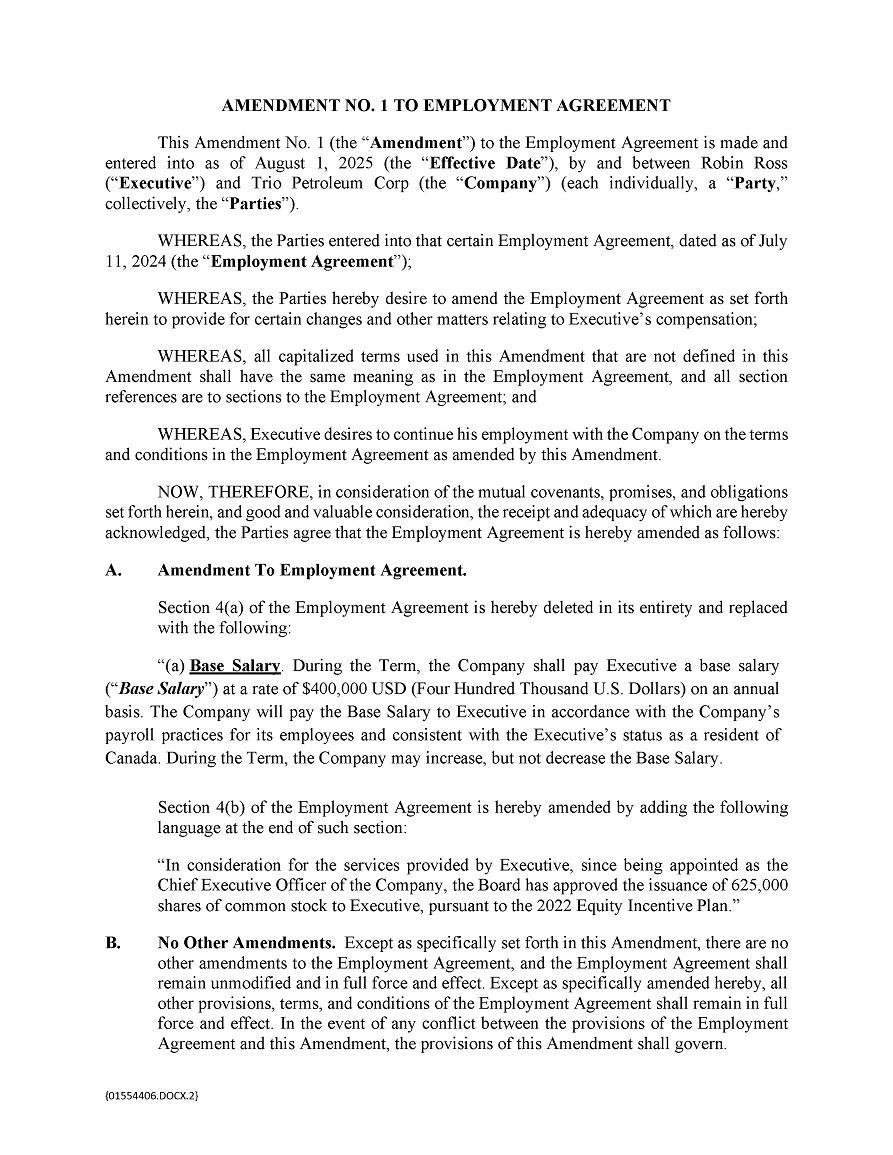
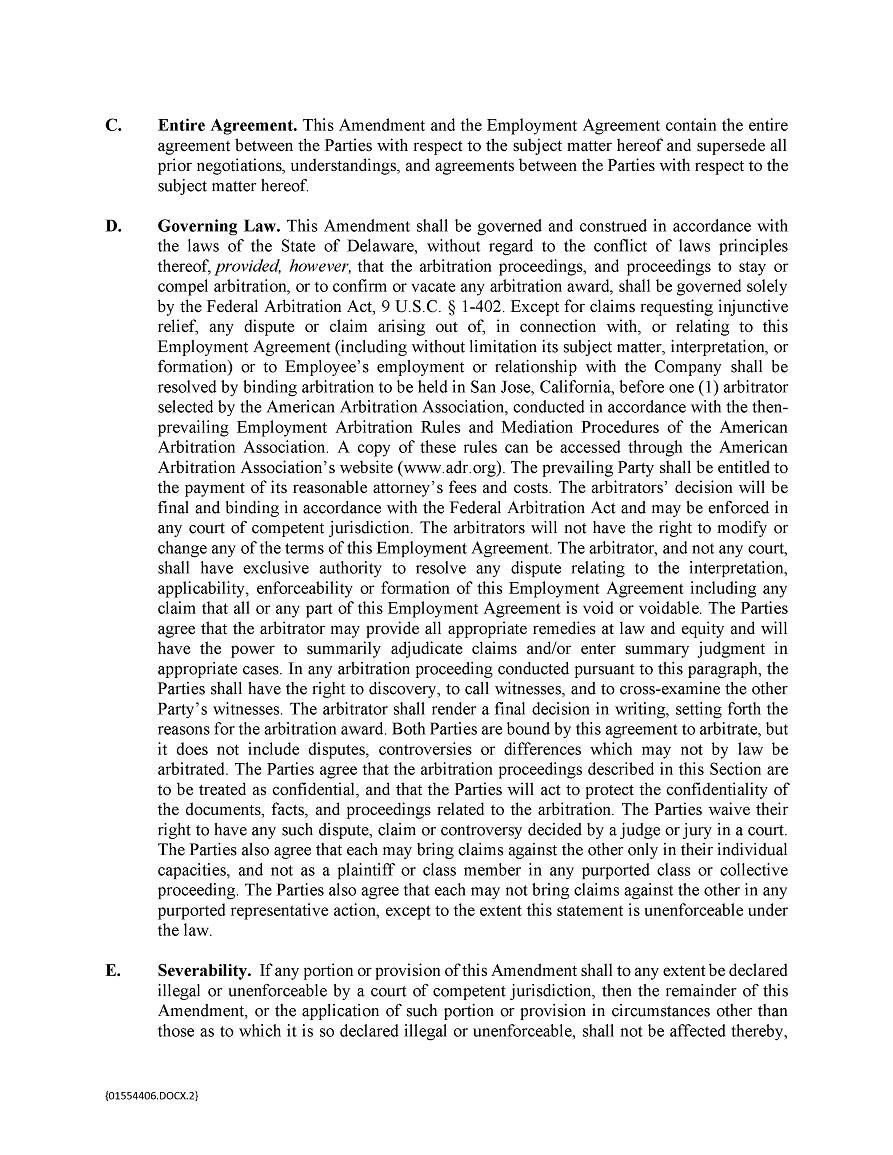
Exhibit 10.46
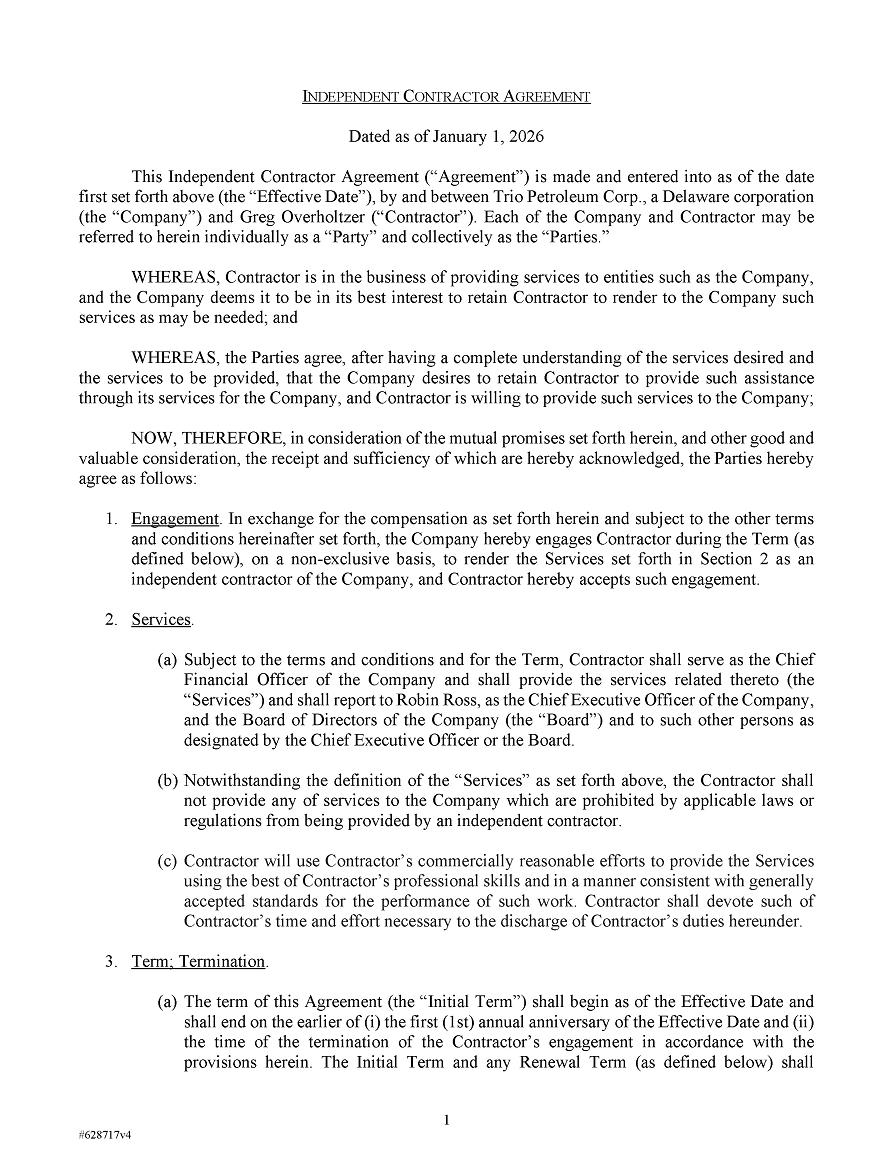
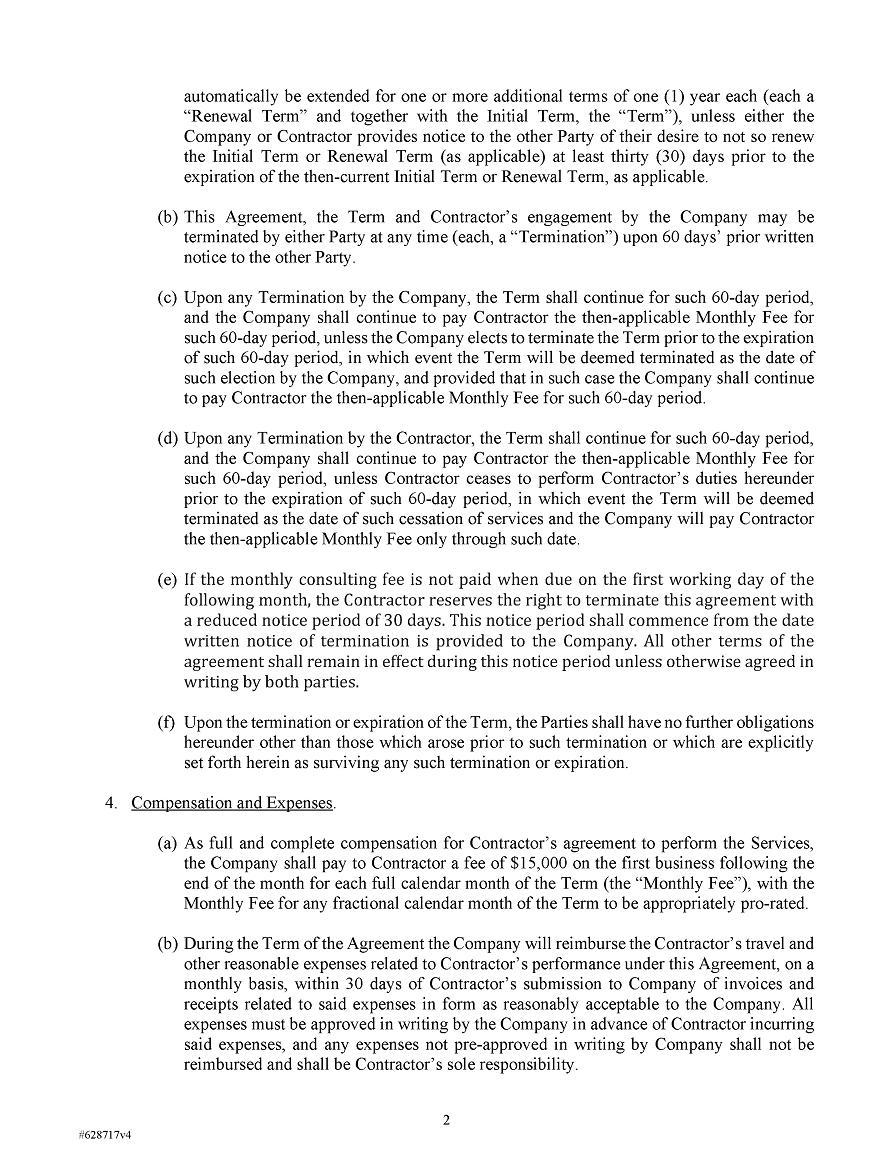
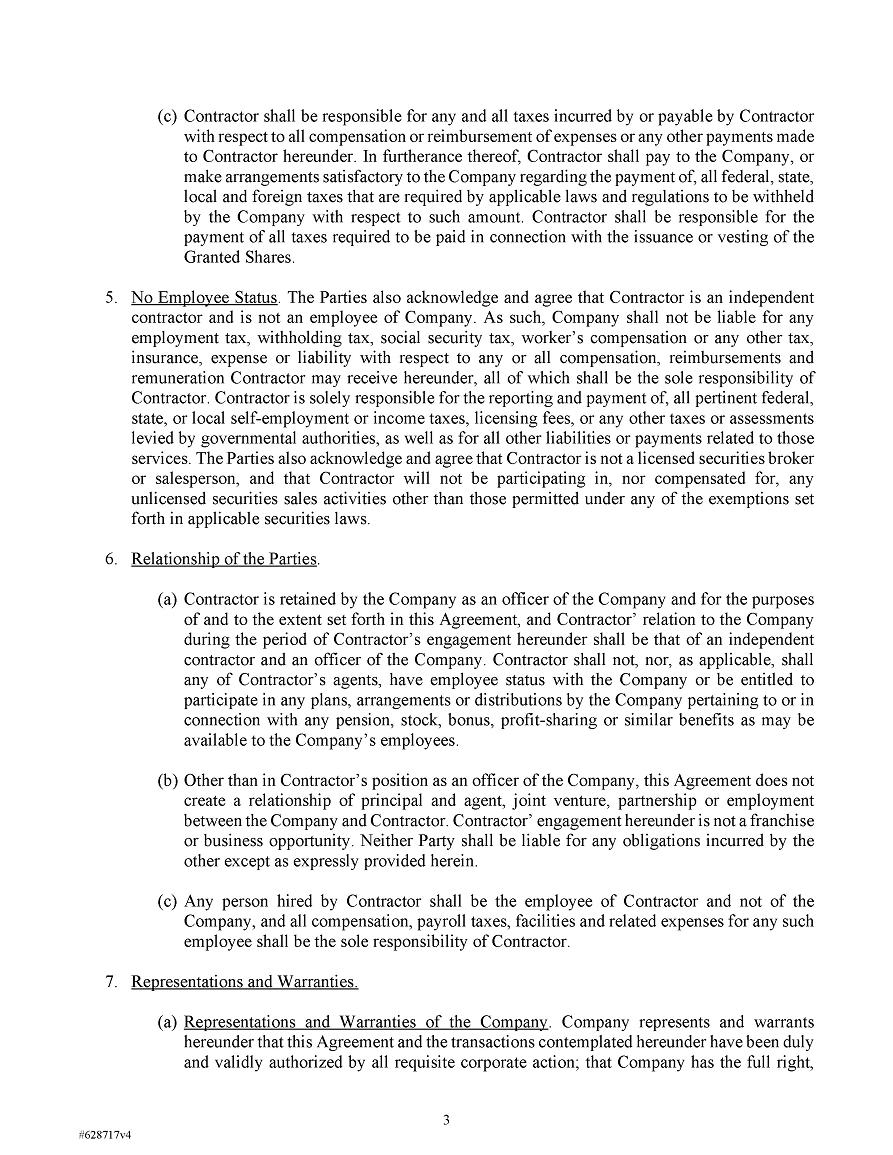
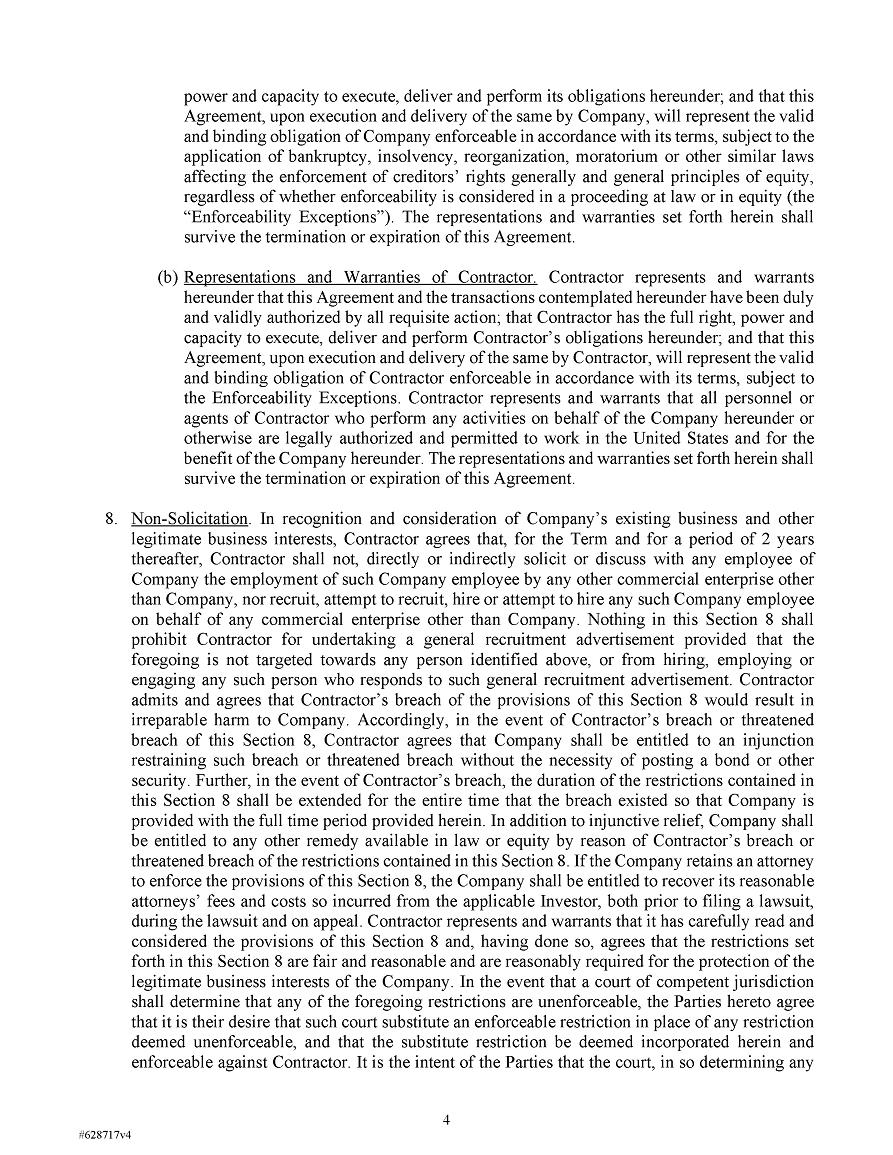
Exhibit 21.1
Subsidiaries of Trio Petroleum Corp
| Subsidiary | Place of Organization | Ownership | ||
| Trio Petroleum Canada, Corp. | Alberta, Canada | Wholly-owned by Trio Petroleum Corp |
EXHIBIT 23.1

To Whom It May Concern:
We hereby consent to the incorporation by reference in (i) the Registration Statement on Form S-3 (File Number 333-280980), (ii) the Registration Statement on Form S-3 (File Number 333-281813), (iii) the Registration Statement on Form S-3 (File Number 333-286803), (iv) the Registration Statement on Form S-3 (File Number 333-290041) and (v) the Registration Statement on Form S-8 (File Number 333-290191) of Trio Petroleum Corp (the “Company”) of our report dated January 20, 2026, relating to the financial statements of the Company, which appear in this Annual Report on Form 10-K.
Very truly yours,
| /s/ Bush & Associates CPA LLC |
| Bush & Associates CPA LLC (PCAOB 6797) |
| Henderson, Nevada |
| January 20, 2026 |
179 N. Gibson Rd., Henderson, NV 89014 ● 702.703.5979 ● www.bushandassociatescpas.com
Exhibit 23.2
CONSENT OF KLS PETROLEUM CONSULTING LLC
We hereby consent to (i) the use of the name KLS Petroleum Consulting LLC (“KLSP”), (ii) references to KLSP as an independent, third-party, petroleum engineering firm, and (iii) the use of information from our report entitled “Reserves Attributable to Trio Petroleum Corp South Salinas Area for Development Plan Phases 1 and 2,” (“Prior Reserve Report 1”) and the other entitled “S. Salinas Area, Full Development Reserves Supplement to SEC Report Dated 1-28- 2022,” (“Prior Reserve Report 2”) both of which had an effective date of October 31, 2021. KLSP has provided an updated reserve report with an effective date of April 30, 2024, which is entitled “Reserve Attributable to Trio Petroleum Corp. South Salinas Area for Phased and Full Development” (the “Current Reserve Report”), which is included as an exhibit filed with the Annual Report on Form 10-K of Trio Petroleum Corp. for the fiscal year ended October 31, 2025. We further consent to the inclusion of each of the Prior Reserve Report 1, the Prior Reserve Report 2 and the Current Reserve Report as exhibits in the Registration Statement. We further consent to the reference to KLSP under the heading “EXPERTS” in the Annual Report.
| KLS PETROLEUM CONSULTING LLC | ||
| By: | /s/ Kenneth L. Schuessler, P.E. | |
| Name: | Kenneth L. Schuessler, P.E. | |
| Title: | Managing Member | |
| January 20, 2026 | ||
Exhibit 31.1
CERTIFICATION
I, Robin Ross, Chief Executive Officer of Trio Petroleum Corp, certify that:
| 1. | I have reviewed the Annual Report on Form 10-K of Trio Petroleum Corp; |
| 2. | Based on my knowledge, this report does not contain any untrue statement of a material fact or omit to state a material fact necessary to make the statements made, in light of the circumstances under which such statements were made, not misleading with respect to the period covered by this report; |
| 3. | Based on my knowledge, the financial statements, and other financial information included in this report, fairly present in all material respects the financial condition, results of operations and cash flows of the registrant as of, and for, the periods presented in this report; |
| 4. | The registrant’s other certifying officer(s) and I are responsible for establishing and maintaining disclosure controls and procedures (as defined in Exchange Act Rules 13a-15(e) and 15d-15(e)) and internal control over financial reporting (as defined in Exchange Act Rules 13a-15(f) and 15d-15(f)) for the registrant and have: |
| a) | Designed such disclosure controls and procedures, or caused such disclosure controls and procedures to be designed under our supervision, to ensure that material information relating to the registrant, including its consolidated subsidiaries, is made known to us by others within those entities, particularly during the period in which this report is being prepared; | |
| b) | Designed such internal control over financial reporting, or caused such internal control over financial reporting to be designed under our supervision, to provide reasonable assurance regarding the reliability of financial reporting and the preparation of financial statements for external purposes in accordance with generally accepted accounting principles; | |
| c) | Evaluated the effectiveness of the registrant’s disclosure controls and procedures and presented in this report our conclusions about the effectiveness of the disclosure controls and procedures, as of the end of the period covered by this report based on such evaluation; and | |
| d) | Disclosed in this report any change in the registrant’s internal control over financial reporting that occurred during the registrant’s most recent fiscal quarter (the registrant’s fourth fiscal quarter in the case of an annual report) that has materially affected, or is reasonably likely to materially affect, the registrant’s internal control over financial reporting; and |
| 5. | The registrant’s other certifying officer and I have disclosed, based on our most recent evaluation of internal control over financial reporting, to the registrant’s auditors and audit committee of the registrant’s board of directors (or persons performing equivalent function): |
| a) | All significant deficiencies and material weaknesses in the design or operation of internal control over financial reporting which are reasonably likely to adversely affect the registrant’s ability to record, process, summarize and report financial information; and | |
| b) | Any fraud, whether or not material, that involves management or other employees who have a significant role in the registrant’s internal control over financial reporting. |
| Date: January 20, 2026 | /s/ Robin Ross |
| Robin Ross | |
|
Chief Executive Officer (Principal Executive Officer) |
Exhibit 31.2
CERTIFICATION
I, Greg Overholtzer, Chief Financial Officer of Trio Petroleum Corp certify that:
| 1. | I have reviewed the Annual Report on Form 10-K of Trio Petroleum Corp; |
| 2. | Based on my knowledge, this report does not contain any untrue statement of a material fact or omit to state a material fact necessary to make the statements made, in light of the circumstances under which such statements were made, not misleading with respect to the period covered by this report; |
| 3. | Based on my knowledge, the financial statements, and other financial information included in this report, fairly present in all material respects the financial condition, results of operations and cash flows of the registrant as of, and for, the periods presented in this report; |
| 4. | The registrant’s other certifying officer and I are responsible for establishing and maintaining disclosure controls and procedures (as defined in Exchange Act Rules 13a-15(e) and 15d-15(e)) and internal control over financial reporting (as defined in Exchange Act Rules 13a-15(f) and 15d-15(f)) for the registrant and have: |
| a) | Designed such disclosure controls and procedures, or caused such disclosure controls and procedures to be designed under our supervision, to ensure that material information relating to the registrant, is made known to us by others within those entities, particularly during the period in which this report is being prepared; | |
| b) | Designed such internal control over financial reporting, or caused such internal control over financial reporting to be designed under our supervision, to provide reasonable assurance regarding the reliability of financial reporting and the preparation of financial statements for external purposes in accordance with generally accepted accounting principles; | |
| c) | Evaluated the effectiveness of the registrant’s disclosure controls and procedures and presented in this report our conclusions about the effectiveness of the disclosure controls and procedures, as of the end of the period covered by this report based on such evaluation; and | |
| d) | Disclosed in this report any change in the registrant’s internal control over financial reporting that occurred during the registrant’s most recent fiscal quarter (the registrant’s fourth fiscal quarter in the case of an annual report) that has materially affected, or is reasonably likely to materially affect, the registrant’s internal control over financial reporting; and |
| 5. | The registrant’s other certifying officer(s) and I have disclosed, based on our most recent evaluation of internal control over financial reporting, to the registrant’s auditors and audit committee of the registrant’s board of directors (or persons performing the equivalent functions): |
| a) | All significant deficiencies and material weaknesses in the design or operation of internal control over financial reporting which are reasonably likely to adversely affect the registrant’s ability to record, process, summarize and report financial information; and | |
| b) | Any fraud, whether or not material, that involves management or other employees who have a significant role in the registrant’s internal control over financial reporting. |
| Date: January 20, 2026 | /s/ Greg Overholtzer |
| Greg Overholtzer | |
| Chief Financial Officer | |
| (Principal Financial Officer and Principal Accounting Officer) |
Exhibit 32.1
CERTIFICATION PURSUANT TO 18 U.S.C. SECTION 1350,
AS ADOPTED PURSUANT TO
SECTION 906 OF THE SARBANES-OXLEY ACT OF 2002
In connection with the Annual Report of Trio Petroleum Corp (the “Company”) on Form 10-K for the year ended October 31, 2025, as filed with the Securities and Exchange Commission on the date hereof (the “Report”), I, Robin Ross, Chief Executive Officer of the Company, certify, pursuant to 18 U.S.C. § 1350, as adopted pursuant to § 906 of the Sarbanes-Oxley Act of 2002, that:
| 1. | The Report fully complies with the requirements of Section 13(a) or 15(d) of the Securities Exchange Act of 1934; and | |
| 2. | The information contained in the Report fairly presents, in all material respects, the financial condition and result of operations of the Company as of and for the period covered by the report. |
| Date: January 20, 2026 | /s/ Robin Ross |
| Robin Ross | |
| Chief Executive Officer | |
| (Principal Executive Officer) |
Exhibit 32.2
CERTIFICATION PURSUANT TO 18 U.S.C. SECTION 1350,
AS ADOPTED PURSUANT TO
SECTION 906 OF THE SARBANES-OXLEY ACT OF 2002
In connection with the Annual Report of Trio Petroleum Corp (the “Company”) on Form 10-K for the year ended October 31, 2025, as filed with the Securities and Exchange Commission on the date hereof (the “Report”), I, Greg Overholtzer, Chief Financial Officer of the Company, certify, pursuant to 18 U.S.C. § 1350, as adopted pursuant to § 906 of the Sarbanes-Oxley Act of 2002, that:
| 1. | The Report fully complies with the requirements of Section 13(a) or 15(d) of the Securities Exchange Act of 1934; and | |
| 2. | To my knowledge, the information contained in the Report fairly presents, in all material respects, the financial condition and result of operations of the Company as of and for the period covered by the Report. |
| Date: January 20, 2026 | /s/ Greg Overholtzer |
| Greg Overholtzer | |
| Chief Financial Officer | |
| (Principal
Financial Officer and Principal Accounting Officer) |