 エドガーで原本を確認する
UNITED STATES
SECURITIES AND EXCHANGE COMMISSION
Washington, D.C. 20549
FORM 10-K
☒ ANNUAL REPORT UNDER SECTION 13 OR 15(d) OF THE SECURITIES EXCHANGE ACT OF 1934:
For the fiscal year ending September 30, 2025
☐ TRANSITION REPORT UNDER SECTION 13 OR 15(d) OF THE SECURITIES EXCHANGE ACT OF 1934:
For the transition period from __________ to __________.
Commission file number: 001-41882
INNO HOLDINGS INC.
(Exact name of registrant as specified in its charter)
| Texas | 87-4294543 | |
| (State or Other Jurisdiction of Incorporation or Organization) | (I.R.S. Employer Identification No.) |
RM1, 5/F, No. 43 Hung To Road, Kwun Tong,
Kowloon, Hong Kong 999077
(Address of principal executive offices, including ZIP Code)
+852-54795450
(Registrant’s telephone number, including area code)
Securities registered pursuant to Section 12(b) of the Act:
| Title of Each Class | Trading Symbol(s) | Name of each exchange on which registered | ||
| Common stock, no par value | INHD | The Nasdaq Stock Market |
Securities registered pursuant to Section 12(g) of the Act: None
Indicate by check mark if the registrant is a well-known seasoned issuer, as defined in Rule 405 of the Securities Act. Yes ☐ No ☒
Indicate by check mark if the registrant is not required to file reports pursuant to Section 13 or Section 15(d) of the Act. Yes ☐ No ☒
Indicate by check mark whether the registrant (1) has filed all reports required to be filed by Section 13 or 15(d) of the Securities Exchange Act of 1934 during the preceding 12 months (or for such shorter period that the issuer was required to file such reports), and (2) has been subject to such filing requirements for the past 90 days. Yes ☒ No ☐
Indicate by check mark whether the registrant has submitted electronically every Interactive Data File required to be submitted pursuant to Rule 405 of Regulation S-T (§ 232.405 of this chapter) during the preceding 12 months (or for such shorter period that the registrant was required to submit such files). Yes ☒ No ☐
Indicate by check mark whether the registrant is a large accelerated filer, an accelerated filer, a non-accelerated filer, a smaller reporting company, or an emerging growth company. See the definitions of “large accelerated filer,” “accelerated filer,” “smaller reporting company,” and “emerging growth company” in Rule 12b-2 of the Exchange Act.
| Large accelerated filer ☐ | Accelerated filer ☐ | |
| Non-accelerated filer ☒ | Smaller reporting company ☒ | |
| Emerging growth company ☒ |
If an emerging growth company, indicate by check mark if the registrant has elected not to use the extended transition period for complying with any new or revised financial accounting standards provided pursuant to Section 13(a) of the Exchange Act. ☐
Indicate by check mark whether the registrant has filed a report on and attestation to its management’s assessment of the effectiveness of its internal control over financial reporting under Section 404(b) of the Sarbanes-Oxley Act (15 U.S.C. 7262(b)) by the registered public accounting firm that prepared or issued its audit report. ☐
If securities are registered pursuant to Section 12(b) of the Act, indicate by check mark whether the financial statements of the registrant included in the filing reflect the correction of an error to previously issued financial statements. ☐
Indicate by check mark whether any of those error corrections are restatements that required a recovery analysis of incentive-based compensation received by any of the registrant’s executive officers during the relevant recovery period pursuant to §240.10D-1(b). ☐
Indicate by check mark whether the registrant is a shell company (as defined in Rule 12b-2 of the Exchange Act). Yes ☐ No ☒
As of March 31, 2025, the last business day of the Registrant’s most recently completed second fiscal quarter, the aggregate market value of the voting common stock held by non-affiliates of the Registrant (without admitting that any person whose shares are not included in such calculation is an affiliate) was $16,953,353.
As of December 15, 2025, there were 97,948,480 shares of common stock, no par value, issued and outstanding.
DOCUMENTS INCORPORATED BY REFERENCE
None.
TABLE OF CONTENTS
|
|
SPECIAL NOTE REGARDING FORWARD-LOOKING STATEMENTS
This annual report contains “forward-looking statements” within the meaning of the Private Securities Litigation Reform Act of 1995, Section 27A of the Securities Act of 1933, and Section 21E of the Securities Exchange Act of 1934. Forward-looking statements may appear throughout this annual report, including in the following sections: “Business” and “Management’s Discussion and Analysis of Financial Condition and Results of Operations.” Forward-looking statements are based on current expectations and assumptions that are subject to risks and uncertainties that may cause actual results to differ materially. When used in this annual report, the words “anticipate,” “believe,” “estimate,” “expect,” “future,” “intend,” “plan,” or the negative of these terms and similar expressions, as they relate to us or our management, identify forward-looking statements. Such statements include, but are not limited to, statements contained in this annual report relating to our business strategy, our future operating results, and our liquidity and capital-resources outlook. Forward-looking statements are based on our current expectations and assumptions regarding our business, the economy, and other future conditions. Because forward-looking statements relate to the future, they are subject to inherent uncertainties, risks, and changes in circumstances that are difficult to predict. Our actual results may differ materially from those contemplated by the forward-looking statements. They are neither statements of historical fact nor guarantees of assurance of future performance. We caution you, therefore, against relying on any of these forward-looking statements. Important factors that could cause actual results to differ materially from those in the forward-looking statements include, without limitation:
| ● | our ability to effectively operate our business segments; |
| ● | our ability to manage our research, development, expansion, growth, and operating expenses; |
| ● | our ability to evaluate and measure our business, prospects, and performance metrics; |
| ● | our ability to compete, directly and indirectly, and succeed in a highly competitive and evolving industry; |
| ● | our ability to respond and adapt to changes in technology and customer behavior; |
| ● | our ability to protect our intellectual property and to develop, maintain, and enhance a strong brand; and |
| ● | other factors relating to our industry, our operations, and results of operations. |
Should one or more of these risks or uncertainties materialize, or should the underlying assumptions prove incorrect, actual results may differ significantly from those anticipated, believed, estimated, expected, intended or planned.
Factors or events that could cause our actual results to differ may emerge from time to time, and it is not possible for us to predict all of them. We cannot guarantee future results, levels of activity, performance, or achievements. Except as required by applicable law, including the securities laws of the United States, we do not intend to update any of the forward-looking statements to conform these statements to actual results.
USE OF CERTAIN DEFINED TERMS
Unless the context otherwise requires, in this annual report on Form 10-K references to:
| ● | the “Company,” “INNO,” the “registrant,” “we,” “our,” or “us” mean INNO HOLDINGS INC. and its subsidiaries; | |
| ● | “year” or “fiscal year” means the year ending September 30; | |
| ● | all dollar or $ references, when used in this prospectus, refer to United States dollars; | |
| ● | “Hong Kong” or “HK” refers to the Hong Kong Special Administrative Region of the People’s Republic of China; | |
| ● | “HKD,” “HK$” or “H.K. Dollars” refers to the official legal currency of Hong Kong; | |
| ● | “Common stock” refers to Inno Holdings Inc.’s shares of common stock, no par value. |
|
|
PART I
ITEM 1. BUSINESS
Overview
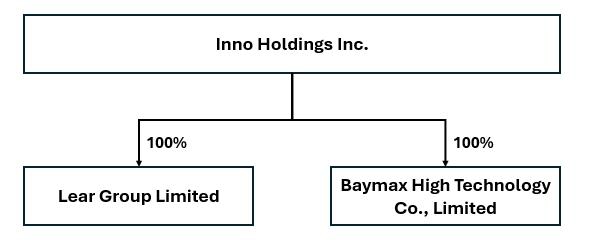
INNO HOLDINGS INC. (“INNO,” “we,” “us,” or “Company”) is an innovative technology company that engages in the business of recycled consumer electronic devices. We source and purchase pre-owned consumer electronic devices such as smartphones and tablets from suppliers and sell the electronic devices to wholesalers that re-sell these products to their wholesale and/or retail customers in Southeast Asia, Middle East Asia, Europe and other regions. We conduct our business of recycled consumer electronic devices through two Hong Kong-based wholly-owned subsidiaries Lear Group Limited and Baymax High Technology Co., Limited, acquired by the Company in October and December 2024, respectively.
Previously the Company engaged in the business of manufacturing cold-formed-steel and offering a range of services required to transform raw materials into precise steel framing products and prefabricated homes. In the second quarter of 2025, the Company decided to discontinue its cold-formed-steel business and sold all of the Company’s ownership in the subsidiaries through which the Company conducted its cold-formed-steel business. From March 2025 till April 2025, the Company completed the disposition of all its ownership or membership interests in its former wholly- and partially-owned subsidiaries, namely Inno Metal Studs Corp, Inno AI Tech Corp., Inno Disrupts Inc., and Castor Building Tech LLC.
Our Products
Recycled consumer electronic devices

The recycled consumer electronic devices offered by us include smartphones (various models of iPhone) and tablets (various models of iPad). For the years ended September 30, 2025, revenues generated from recycled iPhones accounted for 100% of our revenue.
We expect to expand our products into more categories in the future including but not limited to laptops, such as MacBook, and other accessories, such as smartwatches and headphones.
Our Customers
Currently we derive all of our revenues from wholesale customers. Such wholesaler customers purchase recycled consumer electronic devices from us and then re-sell them in Southeast Asia, Middle East Asia, Europe and other regions.
Our Suppliers
We currently rely on a limited number of suppliers that collect pre-owned consumer electronic devices from network carriers, companies, and individuals. For the year ended September 30, 2025, two suppliers accounted for all of the Company’s total purchases. We endeavor to broaden our supplier base. However, we maintain a high standard requirement for supplies of recycled consumer electronic devices. Before purchasing products from a new supplier, the Company will perform a background check, taken into consideration the new supplier’s past track record.
|
|
Our Competitive Strengths
Purchase and sale of high quality Like-New products
Recycled consumer electronic devices vary greatly in their quality. Our business strategy is purchasing and selling high quality Like-New electronic devices that have minimal signs of use, scratches, cracks or scuffs to the screen or rear housing. Such business strategy contributes to not only high efficiency on inspection, testing and refurbishment of the purchased products but also extremely low return rate from our global customers.
Dynamic inventory level management
We maintain a dynamic level of inventories of recycled consumer electronic devices, based on our knowledge of the prevailing market trend and estimation of electronic devices price fluctuation. We continuously adjust our inventory levels by lowering inventory of products in downward trend and increasing inventory of those in upward trend.
Fast response to our customers’ needs
We respond fast to our customers’ needs. The fast response is enabled by the inventories maintained in our leased warehouse in Hong Kong that are ready for shipping to our customers. Also, since our products are high quality Like-New devices, our warehouse personnels can quickly package and ship the goods via third party couriers. These measures help shorten the time between our receipt of customers’ orders and the delivery of the goods. Fast response to our customers’ needs contribute to higher level of customer loyalty to our products.
Flexible product pricing algorithm
We have developed a database and algorithm for pricing strategies in purchase and sales of recycled consumer electronic devices. We are able to set prices in a flexible way to balance demands and profitability by comprehensively considering factors including the current market price of similar products, historical transaction prices of similar products, size of the order, specifications of the products, and the quantity of the products.
Strategic location of Hong Kong
Our operating subsidiaries, Lear Group Limited and Baymax High Technology Co., Limited, are located in Hong Kong. Hong Kong is one of the busiest ports and enjoys the advantage of duty-free status, making it a major hub for the global recycled electronic devices industry. Located in Hong Kong, the Company can conveniently receive recycled electronic devices from, and have them dispatched to, most of the regions in the world.
Marketing
We endeavor to broaden our customer base. Our marketing strategy is a long-term plan to achieve our Company’s mission by understanding the needs of customers and creating a distinct and sustainable competitive advantage. We intend to leverage our marketing and sales efforts to establish new potential customers. We also intend to leverage customer referrals, which in the past have been a source of new business. We believe that the reputation we have developed with our current customers represents an important part of our marketing effort.
We have a digital market channel and a social media presence. Our marketing channels include creating and implementing ad campaigns, and word of mouth. Also, we are actively conducting market research to determine the viability of our new products and new patents. We have increased our marketing budget and formed a professional sales team to increase our online marketing, which we believe can help us grow our revenue.
|
|
Business Plan
Diversify the product portfolio
We built a solid business model of recycling and reselling smartphones and tablets. With the experience and capital gained over the years, we plan to further diversify our product portfolio by participating in laptops, such as MacBook, and other accessories, such as smartwatches and headphones.
Expand into strategic overseas markets
The Company expects the recycled consumer electronic devices market to experience robust growth in Southeast and Middle Asia in the near future. To shorten the supply chain and better interact with the clients located in these strategic markets, the Company intends to set up offices in Singapore, Malaysia, Dubai and other areas in Southeast and Middle Asia in the next five years. We expect this strategic move to help increase its revenues and market presence.
Expand the wholesale business and develop a B2B Marketplace Platform
We plan to further expand our wholesale customer base in recycled consumer electronic devices. The Company is now in process of developing a Business to Business (“B2B”) marketplace platform that will facilitate manufacturers and distributors as suppliers to sell direct to business buyers as wholesalers. This marketplace platform, empowered by cloud computing, big data, and high-frequency matchmaking technology, will provide sellers with marketplace technology to enhance and grow their business while offering buyers access to an exclusive collection of top brands at or below wholesale prices. The platform is expected to supplement the Company’s traditional business model of individual negotiations and attract potential customers. We expect to obtain more customers and suppliers through this marketplace platform.
Potential acquisitions for horizonal and vertical integration
In accordance with our growth strategy, the Company intends to pursue horizonal and vertical integration by acquiring companies operating within the industry of recycled consumer electronic devices. The objective of this horizonal and vertical integration is to strengthen and expand our capabilities within the market. We will position ourselves to offer a comprehensive range of solutions encompassing the entire value chain of recycled consumer electronic devices.
To fortify our supply chain and augment our capabilities, we will consider the strategic acquisition of distributors/wholesalers with the proceeds from our equity and/or debt financing activities to pursue potential acquisitions. The targeted companies would include the ones that enjoy the popularities in the industry, including but not limited to the companies that have already built stable sales connection to whole and retail customers in regions that we currently do not reach to, such as North and South America. The Company may also consider the strategic acquisition of its competitors within the industry in order to strengthen its capabilities of inspection, testing and refurbishment as well as pricing.
Recruit additional employees
We plan to employ additional personnel to meet the Company’s growth needs. Our hiring plan includes the recruitment of marketing personnel to build and improve our brand recognition, the sales personnels to meet and satisfy the increased wholesale demands from our existing and new customers, and also a financial and accounting team to strengthen our financial control system.
Enhance business infrastructures
The Company plans to upgrade its business infrastructure to better prepare for its future growth, including the inventory management and information system. In order to improve our dynamic inventory management, we plan to upgrade the inventory management system so that the Company’s inventories of recycled consumer electronic devices can be maintained at a more efficient and flexible level. In addition, the Company may develop a proprietary device testing software to further facilitate the inspection and testing process of purchased recycled consumer electronic devices. With the updated infrastructures, we expect to increase the efficiency and data security in our business operations.
|
|
Seasonality
We experience a moderate level of seasonality in our business primarily as a result of new product launches by consumer electronic devices manufacturers and promotional campaigns by e-commerce platforms. New product launches by major cell phone brands such as Apple each year also boost our customer traffic and purchase orders. All of these activities can affect our results for those quarters. The seasonality in our business also results from major promotions and holidays such as Black Friday, Cyber Monday, and Christmas Holiday. Overall, the historical seasonality of our business has been relatively moderate. Our financial condition and results of operations for future periods may continue to fluctuate.
Radio Dealers License (unrestricted)
Our operating subsidiaries Lear Group Limited and Baymax High Technology Co., Limited have obtained the Radio Dealers License (Unrestricted), the document required to conduct the trade or business in apparatus or material for radio-communications or any components part thereof, including the performing of repairs and refurbishment, and the import and export of radio-communications transmitting apparatus. The current term of the License of Lear Group Limited and Baymax High Technology Co., Limited will expire on September 30, 2025 and December 31, 2025, respectively. We will comply with the requirements and keep the license valid.
Competition
The recycled consumer electronic wholesale industry in Hong Kong is competitive and relatively fragmented, with approximately 1,000 wholesalers engaged in sourcing, grading, refurbishing and resale of pre-owned consumer electronic devices. The major competitors of the Company include the following:
| ● | Guang Yi Co. Ltd., founded in 2020, is primarily engaged in the international wholesaling and trading of cellphones and other consumer electronic devices in various grades, including brand new, nearly new, and average grading. Suppliers of Guang Yi Co. Ltd. include telecommunication companies and over 100 other vendors. In addition, the Guang Yi Co. Ltd. has built a global buy-back network to recycle pre-owned cellphones through a B2C channel. |
| ● | Brightway Trading Co., established in 2013, is focusing on the submarket of cell phones returned by customers. Brightway Trading Co. sources cellphones of all conditions from Europe, the U.K., the U.S. |
| ● | CommNet Telecom Limited, a Hong Kong based consumer electronic devices recycling firm that started its business in 2004, specializes in the import and export of brand new and used cell phones. The majority of CommNet Telecom Limited’s suppliers are located in the U.S. and the U.K. |
Government Regulations
As we conduct business in Hong Kong through our wholly-owned subsidiaries, our business operations are subject to various regulations and rules promulgated by the Hong Kong government. The following is a brief summary of the Hong Kong laws and regulations that currently and materially affect our business. This section does not purport to be a comprehensive summary of all present and proposed regulations and legislation relating to the industries in which we operate.
Hong Kong Laws and Regulations Relating to Trade Descriptions
Trade Descriptions Ordinance (Chapter 362 of the Laws of Hong Kong) (the “TDO”), which came into full effect in Hong Kong on April 1, 1981, aims to prohibit false or misleading trade description and statements to goods and services provided to the customers during or after a commercial transaction. Pursuant to the TDO, any person in the course of any trade or business applies a false trade description to any goods or supply or offers to supply them commits an offence and a person also commits the same offence if he/she is in possession for sale or for any purpose of trade or manufacture of any goods with a false description. The TDO also provides that traders may commit an offence if they engage in a commercial practice that has a misleading omission of material information of the goods, an aggressive commercial practice, involves bait advertising, bait and switch or wrong acceptance of payment. It is also an offence for any person to have in his possession for sale or for any purpose of trade or manufacture any goods to which a false trade description is applied. To amount to a false trade description, the falsity of the trade descriptions has to be to a material degree. Trivial errors or discrepancies in trade descriptions would not constitute an offence. What constitutes a material degree will vary with the facts.
|
|
Contravention of the prohibitions in the TDO is an offence, with a maximum penalty of up to HK$500,000 and five years’ imprisonment. However, the TDO also provides regulators with the ability to accept (and publish) written undertakings from businesses and individuals not to continue, repeat or engage in unfair trade practices in return of which regulator will not commence or continue investigations or proceedings relating to that matter. Regulators will also be empowered to seek an injunction against businesses and persons engaging in unfair trade practices or who have breached an undertaking.
Hong Kong Laws and Regulations Relating to Sale of Goods
Pursuant to Sale of Goods Ordinance (Chapter 26 of the Laws of Hong Kong) (the “SOGO”), which came into full effect in Hong Kong on August 1, 1896, in every contract of sale, there is an implied warranty that the goods are free, and will remain free until the time when the property is to pass, from any charge or encumbrance not disclosed or known to the buyer before the contract is made and that the buyer will enjoy quiet possession of the goods except so far as it may be disturbed by the owner or other person entitled to the benefit of any charge or encumbrance so disclosed or known. The SOGO provides that there is an implied condition that the goods shall correspond with the description where there is a contract for the sale of goods by description, and there is any implied condition or warranty as to the quality or fitness for any particular purpose of goods supplied under a contract of sale. Where the seller sells goods in the course of a business, there is an implied condition that the goods supplied under the contract are of merchantable quality, except that there is no such condition (i) as regards defects specifically drawn to the buyer’s attention before the contract is made; or (ii) if the buyer examines the goods before the contract is made, as regards defects which that examination ought to reveal; or (iii) if the contract is a contract for sale by sample, as regards defects which would have been apparent on a reasonable examination of the sample. Where there is a contract for sale by sample, there are implied conditions that (i) the bulk shall correspond with the sample in quality, (ii) the buyer shall have a reasonable opportunity of comparing the bulk with the sample, and (iii) the goods shall be free from any defect, rendering them unmerchantable, which would not be apparent on reasonable examination of the sample. Under SOGO, where any right, duty or liability would arise under a contract of sale of goods by implication of law, it may (subject to the Control of Exemption Clauses Ordinance (Chapter 71 of the Laws of Hong Kong)) be negatived or varied by express agreement, or by the course of dealing between the parties, or by usage if the usage is such as to bind both parties to the contract.
Telecommunications Ordinance (Chapter 106 of the Laws of Hong Kong) (the ‘‘TO’’)
Under the TO, a license, namely Radio Dealers License (Unrestricted), is required for dealing in the course of trade or business in apparatus or material for radio communications or in any component part of any such apparatus or in apparatus of any kind that generates and emits radio waves whether or not the apparatus is intended, or capable of being used, for radio communications. However, the above requirement does not apply to licensed exempted radio communications apparatus (e.g., mobile phones, short-range walkie-talkies, cordless phones) meeting prescribed specifications. Under the Radio Dealers License (Unrestricted), the licensee is permitted to deal in radio communications apparatus pursuant to section 9 of the TO. A Radio Dealers License (Unrestricted) is generally valid for a period of 12 months, and is renewable on payment of the prescribed fee, at the discretion of Office of the Communications Authority (“OFCA”).
Our operating subsidiaries Lear Group Limited and Baymax High Technology Co., Limited are licensees of the Radio Dealers Licenses (Unrestricted). The material licensing conditions are: (a) to store the licensed apparatus at a specified address, (b) to display the license at the licensed premises, (c) to keep and maintain complete and accurate registers for the last twelve months, of the licensed apparatus and of the licensee’s dealings and transactions therewith, except those apparatus which have been exempted, (d) not to deal locally in radio apparatus which is not of a type approved by the Communications Authority or not licensable in Hong Kong; and to only deliver radio apparatus to a customer if (i) they have been exempted by statute, (ii) the customer is not a tourist and is licensed to possess or use the apparatus, or (iii) the customer is a tourist who intends to export the apparatus after purchase.
|
|
Radio Dealers Licenses have different dates of grant and are valid for a period of 12 months. Lear Group Limited’s and Baymax High Technology Co., Limited’s radio dealers license will expire on September 30, 2026 and December 31, 2025, respectively, and will be renewed upon expiry (subject to the discretion of OFCA). We will renew the Radio Dealers Licenses in accordance with the Telecommunications Regulations (Chapter 106A of the Laws of Hong Kong) by paying the required renewal fee to OFCA. We are not aware of any legal impediment to renew the Radio Dealers Licenses subject to the conditions below: (I) We have to pay to OFCA the required renewal fee as may from time to time be determined and required by OFCA on or before the respective date of expiry of the Radio Dealers Licenses; and (II) We have to comply with the “General Conditions to be observed by Licensee of Radio Dealers License (Unrestricted)” and the “Conditions” set out in the Radio Dealers Licenses.
Consumer Goods Safety Ordinance (Chapter 456 of the Laws of Hong Kong) (the “CGSO”) and Consumer Goods Safety Regulation (Chapter 456A of the Laws of Hong Kong) (the “CGSR”)
The CGSO is enacted to impose a duty on manufacturers, importers and suppliers of certain consumer goods to ensure that the consumer goods they supply are safe. Electrical products and any other goods the safety of which is controlled by specific legislation are not covered by the CGSO.
The CGSO prohibits a person from supplying, manufacturing, or importing into Hong Kong consumer goods unless the consumer goods comply with the general safety requirement or an approved standard for consumer goods. Currently there is no approved standard which has been approved in any regulation to the CGSO. Contravention with the above requirement is an offence and the offender is liable on first conviction to a fine at HK$100,000 and to imprisonment for one year, and on subsequent conviction to a fine of HK$500,000 and to imprisonment for two years.
It is a defense to the above offence if the commission of the offence was due to (a) the act or default of another person or reliance on information given by another, and (b) that it was reasonable in all the circumstances for him to have relied on the information, having regard in particular (i) to the steps which he took, and those which might reasonably have been taken, for the purpose of verifying the information; and (ii) to whether he had any reason to disbelieve the information. A court may take into consideration the existence of a certificate from an approved laboratory showing that the samples of consumer goods which are the subject of the prosecution had been tested before being sold and had complied with the safety standard or safety specification set out in the certificate.
The CGSR requires any warning or caution affixed on any consumer goods or their packages to be in both the English and the Chinese languages. The warning or caution shall be legible and be placed in a conspicuous position on (a) the consumer goods; (b) any package of the consumer goods; (c) a label securely affixed to the package; or (d) a document enclosed in the package. Any person who supplies consumer goods which do not comply with the above requirements commits an offence and is liable (a) on first conviction to a fine at HK$100,000 and to imprisonment for one year; and (b) on subsequent conviction to a fine of HK$500,000 and to imprisonment for two years.
Hong Kong Laws and Regulations Relating to Intellectual Properties Rights
Trade Marks Ordinance (Chapter 559 of the Laws of Hong Kong) (“TMO”), which came into full effect in Hong Kong on April 4, 2003 provides the framework for the Hong Kong’s system of registration of trademarks and sets out the rights attached to a registered trade mark, including logo and a brand name. The TMO restricts unauthorized use of a sign which is identical or similar to the registered mark for identical and/or similar goods and/or services for which the mark was registered, where such use is likely to cause confusion on the part of the public. The TMO provides that a person may also commit a criminal offence if that person fraudulently uses a trademark, including selling and importing goods bearing a forged trade mar, or possessing or using equipment for the purpose of forging a trademark. However, pursuant to section 20 of the TMO, a registered trade mark is not infringed by the use of trade mark in relation to goods which have been put on the market anywhere in the world under that trade mark by the owner or with his consent (whether express or implied or conditional or unconditional), unless the condition of the goods has been changed or impaired after they have been put on the market, and the use of the registered trade mark in relation to those goods is detrimental to the distinctive character or repute of the trade mark.
Patents Ordinance (Chapter 514 of the Laws of Hong Kong), which came into full effect in Hong Kong on June 27, 1997 provides the framework for “re-registration” system of Chinese, UK and European patents in Hong Kong. Pursuant to Patents (Amendment) Ordinance 2016, which came into full effect in Hong Kong on December 19, 2019 provide a new framework for a new patent system — an “original grant patent” system, running in parallel with the “re-registration” system.
|
|
Copyright Ordinance (Chapter 528 of the Laws of Hong Kong) (“CO”), which came into full effect in Hong Kong on June 27, 1997 provides comprehensive protection for recognized categories of underlying works such as literary, dramatic, musical and artistic works. The CO restricts unauthorized acts such as copying and/or making available copies to the public of a copy right work. The CO provides that a person commits an offence if he, without the license of the copyright owner of a copyright work imports an infringing copy of the work into Hong Kong, at any time within 15 months beginning on the first day of publication of the work in Hong Kong or elsewhere, otherwise than for his private and domestic use.
Human Capital Resources
The success of our business depends in large part on our ability to attract, retain, and develop a workforce of skilled employees at all levels of our organization. We provide employees with base wages and salaries that we believe are competitive and consistent with each employee’s position. We also work with local, regional, and state-wide agencies to facilitate workforce hiring and development initiatives. We had five and four full-time employees as of September 30, 2025 and 2024, respectively.
Corporate Structure
Our Company, INNO HOLDINGS INC., was incorporated in Texas on September 8, 2021. It originally had three subsidiaries, Inno Metal Studs Corp (“IMSC”), Castor Building Tech LLC (“CBT”), and Inno Research Institute LLC (“IRI”).
On January 21, 2024, the Company established Inno Disrupts Inc. (“Disrupts”), a wholly owned subsidiary in Texas. The purpose of Inno Disrupts Inc. is to remodel buildings using the Company’s framing steel products, enhance producing and marketing capabilities, manage the designated buildings in US, and other activities.
On January 27, 2024, the Company and the minority shareholder of IRI agreed to dissolve IRI, a subsidiary of IMSC with 65% ownership. The R&D activities previously carried out by IRI will be transferred to the new subsidiary, Inno AI Tech Corp.
On February 11, 2024, the Company formed Inno AI Tech Corp. (“AT”), a wholly owned entity in Texas to conduct AI tech research and consulting activities.
On October 18, 2024, the Company acquired all of the issued and outstanding shares of Lear Group Limited (“Lear”), a Hong Kong company, for a total consideration of $1,300. As a result of this transaction, Lear became a wholly-owned subsidiary of the Company.
On December 13, 2024, the Company acquired all of the issued and outstanding shares of Baymax High Technology Co., Limited (“Baymax”), a Hong Kong company, for a total consideration of $1,300. As a result of this transaction, Baymax became a wholly-owned subsidiary of the Company.
On March 4, 2025, the Company entered into a Share Purchase Agreement with a third-party Buyer, pursuant to which the Company sold all issued and outstanding shares of its wholly owned subsidiaries, IMSC and AT, to the Buyer for an aggregate purchase price of $1,000 in cash.
On March 28, 2025, the Company entered into a Membership Interest Purchase Agreement with a third-party Buyer and Core Modu LLC, a Texas limited liability company (“CM”), pursuant to which the Company sold all of the membership interest it owned in CM, which represented 15% of the outstanding membership interest in CM, to the Buyer for an aggregate purchase price of $700,000.
On March 28, 2025, the Company entered into a Membership Interest Purchase Agreement with a third-party Buyer and Castor Building Tech LLC, a California limited liability company (“CBT”), pursuant to which the Company sold all of the membership interest it owned in CBT, which represented 55% of the outstanding membership interest in CBT, to the Buyer for an aggregate purchase price of $1,000.
|
|
On April 8, 2025, the Company entered into a Share Purchase Agreement with a third-party Buyer, pursuant to which the Company sold all issued and outstanding shares it owns in Disrupts for an aggregate purchase price of $100.
Below is the corporate structure of the Company as of September 30, 2025:
Corporate Information
Our principal executive office is located at RM1, 5/F, No. 43 Hung To Road, Kwun Tong, Kowloon, Hong Kong 999077. Our corporate website address is https://www.innoholdings.com. Our telephone number is +852-54795450.
|
|
ITEM 1A. RISK FACTORS
As a “smaller reporting company,” as defined by Rule 12b-2 of the Exchange Act, we are not required to provide the information in this Item. Nonetheless, we are voluntarily providing risk factors herein. You should consider carefully the following risk factors when evaluating our business and financial condition, together with all the other information in this Annual Report on Form 10-K, and in our other public filings with the SEC. The occurrence of any of the following risks could harm our business, financial condition, results of operations and/or growth prospects or cause our actual results to differ materially from those contained in forward-looking statements we have made in this report and those we may make from time to time. In addition, these risks are not the only ones faced by the Company. Additional risks not summarized hereafter or not presently known to the Company or that the Company currently believes are immaterial may also impair business operations and financial results.
Risks Related to Our Business and Operations
We have shifted our primary business focus.
As of the date of this report, we were primarily engaged in the business of recycled consumer electronic devices. We source and purchase pre-owned consumer electronic devices such as smartphones and tablets from suppliers and sell the electronic devices to wholesalers that re-sell these products to their wholesale and/or retail customers in Southeast Asia, Middle East Asia, Europe and other regions. In the second quarter of 2025, we discontinued our previous business in cold-formed-steel business and sold all of the Company’s ownership in the subsidiaries through which the Company conducted its cold-formed-steel business.
Our experience in the business of recycled consumer electronic devices is limited. This strategic shift exposes us to uncertainties and risks associated with operating in a new industry. Our ability to execute our new business model, secure stable supply, maintain customer relationships, compete effectively and achieve profitability is uncertain. We also may face challenges in developing the operational infrastructure, internal controls and industry expertise required for this business. In addition, we may continue to incur transitional costs or potential liabilities associated with our discontinued operations. Any of these factors could materially and adversely affect our business, financial condition and results of operations.
Our future growth strategies may not be as effective as we expect.
We are actively seeking to expand our business into new industry sectors. As previously announced and disclosed in our filing with the SEC, we entered into a non-binding Memorandum of Understanding (MoU) with Megabyte Solutions Limited (“MEGABYTE”), a Web3 technology service provider. We plan to form a strategic partnership with MEGABYTE to jointly deploy the in-depth application of Web3 technology in the Company’s cross-border B2B marketplace platform under development. Additionally, in response to the supply chain and trade needs of B2B businesses, we and MEGABYTE plan to launch an innovative decentralized, blockchain-powered service model integrating hardware and software.
These initiatives remain in early stages, and there is no assurance that the partnership will be finalized, that the planned technologies will be successfully developed or commercialized, or that market acceptance will meet our expectations. Web3 and blockchain technologies are evolving rapidly and are subject to regulatory, operational and adoption risks. We may face challenges in securing required technical expertise, integrating new technologies into our platform, or achieving the anticipated synergies and economic benefits. If our growth strategies fail to generate the expected results, our business prospects, financial condition and results of operations could be materially and adversely affected.
We are operated primarily in Hong Kong.
As of the date of this report, we operate primarily in Hong Kong, and our business, financial condition and results of operations are subject to the economic, political, legal and regulatory environments of Hong Kong. Any adverse developments in these conditions (such as changes in trade policies, geopolitical tensions, regulatory requirements, data and cybersecurity laws, taxation rules, labor conditions, or market demand) could materially and adversely affect our operations.
|
|
We face concentration risks in our revenue as we rely on our major customers.
A significant portion of our revenue is generated from a limited number of our major customers. For the year ended September 30, 2025, two customers accounted for 77% of the Company’s total revenues. For the year ended September 30, 2024, four customers accounted for 90% of the Company’s total revenues. If any of these customers reduces its purchase volume, experiences financial difficulties, delays payments, or terminates its relationship with us, our revenue and cash flows could be materially and adversely affected. Our dependence on a small customer base also limits our ability to negotiate favorable pricing and terms. If we fail to diversify our customer base or replace lost customers in a timely manner, our business, financial condition and results of operations may be materially harmed.
We face concentration risks in our purchases as we rely on our major suppliers.
We depend on a limited number of major suppliers for the purchase of pre-owned electronic device products. For the year ended September 30, 2025, two suppliers accounted for 100% of the Company’s total purchases. For the year ended September 30, 2024, two suppliers accounted for 58% of the Company’s total purchases. Any disruption in these supplier relationships could materially affect our ability to source inventory and meet customer demand. Our reliance on a concentrated supplier base also exposes us to risks associated with supplier financial instability, operational disruptions, and competitive pressures. If we are unable to diversify our supplier base or secure alternative sources of supply on commercially reasonable terms, our business, financial condition and results of operations could be materially and adversely affected.
There is no assurance that the Company will be profitable.
There is no assurance that we will earn profits in the future, or that profitability will be sustained. There is no assurance that future revenues will be sufficient to generate the funds required to continue our business development and marketing activities. If we do not have sufficient capital to fund our operations, we may be required to reduce our sales and marketing efforts or forego certain business opportunities.
The Company may not have the ability to manage its growth.
The Company anticipates that significant expansion will be required to address potential growth in its customer base and market opportunities. The Company’s anticipated expansion is expected to place a significant strain on the Company’s management, operational, and financial resources. To manage any material growth of its operations and personnel, the Company may be required to improve existing operational and financial systems, procedures, and controls and to expand, train, and manage its employee base. There can be no assurance that the Company’s planned personnel, systems, procedures, and controls will be adequate to support the Company’s future operations, that management will be able to hire, train, retain, motivate, and manage required personnel, or that the Company’s management will be able to successfully identify, manage, and exploit existing and potential market opportunities. If the Company is unable to manage growth effectively, its business, prospects, financial condition, and results of operations may be materially adversely affected.
We rely on the leadership of our management team and the performance of highly skilled personnel.
The Company is, and will be, heavily dependent on the skill, acumen, and services of the management and other employees of the Company. Our future success depends on our continuing ability to attract, develop, motivate, and retain highly qualified and skilled employees. Qualified individuals are in high demand, and we may incur significant costs to attract them. In addition, the loss of any of our senior management or key employees could materially adversely affect our ability to execute our business plan, and we may not be able to find adequate replacements. During the financial year ended September 30, 2025, we experienced changes in senior management, including the replacement of our Chief Executive Officer and Chief Financial Officer. All of our officers and employees are at-will employees, which means they may terminate their employment relationship with us at any time, and their knowledge of our business and industry would be extremely difficult to replace. The loss of any of our senior management or key employees could materially adversely affect our ability to execute our business plan, and we may not be able to find adequate replacements. We cannot ensure that we will be able to retain the services of any members of our senior management or other key employees. If we do not succeed in attracting well-qualified employees or retaining and motivating existing employees, our business could be harmed.
|
|
We have incurred costs in our compliance measures as a public company.
As a public company, we are required to comply with extensive regulatory, reporting, corporate governance and internal control requirements. These obligations have resulted in increased legal, accounting, administrative and compliance costs, and we expect such costs to continue. We may also be required to dedicate significant management time and resources to maintain and enhance our compliance programs. If we fail to comply with applicable requirements or if our compliance efforts become more costly than anticipated, our business, financial condition and results of operations could be adversely affected.
Litigation is costly and time-consuming and could have a material adverse effect on our business, results of operations, and reputation.
The Company, as well as the Company’s directors and officers, may be subject to a variety of civil or other legal proceedings relating to the business affairs of companies with which they are, were or may be in the future affiliated, with or without merit. From time to time in the ordinary course of the Company’s business, we may become involved in various legal proceedings — including commercial, employment, and other litigation and claims — as well as governmental and other regulatory investigations and proceedings. Such matters can be time-consuming, divert management’s attention and resources, and cause us to incur significant expenses. Furthermore, because litigation is inherently unpredictable, the results of any such actions may have a material adverse effect on our business, operating results, or financial condition.
Even if the claims are without merit, the costs associated with defending these types of claims may be substantial, in terms of time, money, and management distraction. In particular, patent and other intellectual property litigation may be protracted and expensive, and the results are difficult to predict and may require us to stop offering certain features, purchase licenses, or modify our products and features while we develop non-infringing substitutes or may result in significant settlement costs.
The results of litigation and claims to which we may be subject cannot be predicted with certainty. Even if these matters do not result in litigation or are resolved in our favor or without significant cash settlements, these matters, and the time and resources necessary to litigate or resolve them, could harm our business, results or operations, and reputation.
Risks Related to Our Financing Activities
We may need new or additional financing in the future to expand our business, and our inability to obtain capital on satisfactory terms or at all may have an adverse impact on our operations and our financial results.
We may need new or additional financing in the future to expand our business, refinance existing indebtedness, or make strategic acquisitions, and our inability to obtain capital on satisfactory terms or at all may have an adverse impact on our operations and our financial results. As we grow our business, we may have to incur significant capital expenditures. We may make capital investments to, among other things, build new or upgrade our existing facilities, purchase or lease new equipment, and enhance our production processes. If we are unable to access capital on satisfactory terms and conditions, we may not be able to expand our business or meet our payment requirements under our existing credit facilities. Our ability to obtain new or additional financing will depend on a variety of factors, many of which are beyond our control. We may not be able to obtain new or additional financing because we may have substantial debt, our current receivable and inventory balances may not support additional debt availability, or we may not have sufficient cash flows to service or repay our existing or future debt. In addition, depending on market conditions and our financial performance, equity financing may not be available on satisfactory terms or at all. Moreover, if we raise additional funds through issuances of equity or convertible debt securities, our current stockholders could suffer significant dilution, and any new equity securities we issue could have rights, preferences, and privileges superior to those of holders of our common stock. If we are unable to access capital on satisfactory terms and conditions, this could have an adverse impact on our business, results of operations, and financial condition.
Future issuances of our shares or other equity securities may result in significant dilution to our existing shareholders.
To raise additional capital, we have issued and may continue to issue additional shares of our common stock or securities convertible into or exercisable for our shares of common stock. Any such issuance would dilute the ownership interests of our existing shareholders and could adversely affect the market price of our securities. We cannot predict the timing, size or terms of future issuances, and shareholders may suffer significant and substantial dilution.
Our financing activities may negatively affect our cash flows and financial flexibility.
Our financing transactions may require us to incur expenses, pay interest or other financing costs, or allocate cash to service obligations. These payments may reduce funds available for operations, limit our financial flexibility, and increase our vulnerability to adverse business conditions. If our cash flows are insufficient to meet financing obligations, our business and results of operations could be harmed.
|
|
Frequent or unfavorable financing transactions may harm our reputation and investor confidence.
If we engage in repeated or sizable capital raising activities, particularly at discounts to market price, investors may perceive us as overly reliant on external financing. Such perception may adversely affect investor confidence, harm our reputation in the capital markets, and contribute to downward pressure on the trading price of our securities. Negative market perception could also make future financings more difficult or costly to complete.
We may not be able to access the capital markets when needed, which could adversely affect our operations.
Our ability to raise capital through public or private offerings of securities depends on market liquidity, our business and financial performance, our trading volume, regulatory developments and general economic conditions. Market volatility, declining stock price, or low investor demand may restrict our ability to obtain financing in a timely manner or on acceptable terms. If we cannot raise capital when required, we may be unable to execute our business plans, meet working capital needs or respond to competitive pressures.
Risks Relating to Ownership of Our Securities
The market price of our common stock may be volatile and could, following any offering or sale, decline significantly and rapidly.
The price at which our securities are offered or sold in any registered or exempt offering will be determined by negotiations between us and the applicable underwriter, placement agent or investor, and such price may not be indicative of the prices that will prevail in the open market following the offering. The market price of our common stock may decline below the offering price, and you may not be able to sell your shares at or above the price you paid, or at all. Following any such offering, the public price of our common stock in the secondary market will continue to be determined by private buy-and-sell transactions effected through broker-dealers and may fluctuate significantly in response to various factors, many of which are outside our control.
We may experience extreme stock price volatility unrelated to our actual or expected operating performance, financial condition or prospects, making it difficult for investors to assess the rapidly changing value of our common stock.
Recently, a number of publicly traded companies, particularly those with relatively small public floats, have experienced extreme stock price run-ups followed by rapid price declines and elevated volatility. We have been and may continue to be susceptible to significant stock price volatility, extreme price run-ups, lower trading volume and reduced liquidity than large-capitalization companies. Our common stock may be subject to rapid and substantial price volatility, low volumes of trades and wide bid-ask spreads. Such volatility, including any rapid price appreciation followed by decline, may be unrelated to our actual or expected operating performance, financial condition or prospects, making it difficult for investors to assess the value of our common stock.
In addition, if the trading volumes of our common stock are low, persons buying or selling in relatively small quantities may easily influence the price of our common stock. Low trading volume could cause the price of our common stock to fluctuate significantly, including large percentage changes in a single trading day. Holders of our common stock may not be able to readily liquidate their investment or may be forced to sell at depressed prices due to limited liquidity. Broad market fluctuations and general economic and political conditions may also adversely affect the market price of our common stock.
As a result of this volatility, investors may experience losses on their investment in our common stock. A decline in the market price of our common stock could adversely affect our ability to issue additional common stock or other securities and our ability to obtain additional financing in the future. No assurance can be given that an active or liquid market for our common stock will be sustained, and if an active market does not continue, holders of our common stock may be unable to readily sell their shares or may not be able to sell their common stock at all.
We may not be able to satisfy the listing requirements of Nasdaq to maintain a listing of our common stock.
As a company listed and publicly traded on Nasdaq, we must meet certain financial and liquidity criteria to maintain such listing status. If we violate the maintenance requirements for continued listing of our common stock, our common stock may be delisted. In addition, our board may determine that the cost of maintaining our listing on a national securities exchange outweighs the benefits of such listing. A delisting of our common stock from Nasdaq may materially impair our stockholders’ ability to buy and sell our common stock and could have an adverse effect on the market price of, and the efficiency of the trading market for, our common stock. In addition, the delisting of our common stock could significantly impair our ability to raise capital in the future.
We may be subject to securities litigation, which is expensive and could divert our management’s attention.
The market price of our securities may be volatile, and in the past, companies that experienced volatility in the market price of their securities were subject to securities class action litigation. We may be the target of this type of litigation in the future. Securities litigation against us could result in substantial costs and divert our management’s attention from other business concerns.
|
|
ITEM 1B. UNRESOLVED STAFF COMMENTS
Not applicable.
ITEM 1C. CYBERSECURITY
We acknowledge the increasing importance of cybersecurity in today’s digital and interconnected world. Cybersecurity threats pose significant risks to the integrity of our systems and data, potentially impacting our business operations, financial condition and reputation.
As a smaller reporting company, we currently do not have formalized cybersecurity measures, a dedicated cybersecurity team or specific protocols in place to manage cybersecurity risks. Our approach to cybersecurity is in the developmental stage, and we have not yet conducted comprehensive risk assessments, established an incident response plan or engaged with external cybersecurity consultants for assessments or services.
Given our current stage of cybersecurity development, we have not experienced any significant cybersecurity incidents to date. However, we recognize that the absence of a formalized cybersecurity framework may leave us vulnerable to cyberattacks, data breaches and other cybersecurity incidents. Such events could potentially lead to unauthorized access to, or disclosure of, sensitive information, disrupt our business operations, result in regulatory fines or litigation costs and negatively impact our reputation among customers and partners.
We are in the process of evaluating our cybersecurity needs and developing appropriate measures to enhance our cybersecurity posture. This includes considering the engagement of external cybersecurity experts to advise on best practices, conducting vulnerability assessments and developing an incident response strategy. Our goal is to establish a cybersecurity framework that is commensurate with our size, complexity and the nature of our operations, thereby reducing our exposure to cybersecurity risks.
|
|
In addition, the Board will oversee any cybersecurity risk management framework and a dedicated committee of the Board or an officer appointed by the Board will review and approve any cybersecurity policies, strategies and risk management practices.
Despite our efforts to improve our cybersecurity measures, there can be no assurance that our initiatives will fully mitigate the risks posed by cyber threats. The landscape of cybersecurity risks is constantly evolving, and we will continue to assess and update our cybersecurity measures in response to emerging threats.
For a discussion of potential cybersecurity risks affecting us, please refer to the “Risk Factors” section of our Registration Statement on Form S-1 filed with the Securities and Exchange Commission on October 20, 2023 titled “Our systems and information technology infrastructure may be subject to security breaches and other cybersecurity incidents.”
ITEM 2. PROPERTIES
We lease our principal executive office and warehouse which is located at RM1, 5/F, No. 43 Hung To Road, Kwun Tong, Kowloon, Hong Kong 999077. The lease for this principal executive office and warehouse had a 12-month term beginning on November 1, 2024 and ending on October 31, 2025. On June 1, 2025, this lease was terminated without penalty and a new lease agreement was entered with the landlord. The new lease term is from June 1, 2024 to May 31, 2026, with a monthly rent of $12,000. The facility consists of approximately 1,400 square feet of indoor space.
The lease agreement contains standard commercial lease terms including but not limited to provisions regarding utilities, alterations, maintenance and repair, insurance and indemnification.
We believe that our current leased property is in good condition and suitable for the conduct of our business.
ITEM 3. LEGAL PROCEEDINGS
We are not currently a party to any material legal proceedings, investigations or claims. From time to time, we involve in legal matters arising in the ordinary course of our business. There can be no assurance that such matters will not arise in the future or that any such matters in which we are involved, or which may arise in the ordinary course of our business, will not at some point proceed to litigation or that such litigation will not have a material adverse effect on our business, financial condition or results of operations.
ITEM 4. MINE SAFETY DISCLOSURES
Not applicable.
|
|
PART II
ITEM 5. MARKET FOR REGISTRANT’S COMMON EQUITY, RELATED STOCKHOLDER MATTERS AND ISSUER PURCHASES OF EQUITY SECURITIES
Market Information
We have our common stock listed on The Nasdaq Capital Market under the symbol “INHD”.
Holders
As of September 30, 2025, there were 19 stockholders of record of our common stock. The actual number of stockholders is greater than this number of record holders, and includes stockholders who are beneficial owners, but whose shares are held in street name by brokers and other nominees. This number of holders of record also does not include stockholders whose shares may be held in trust by other entities.
Reverse Stock Split
On November 30, 2022, the Company effected a forward stock split (the “Stock Split”) of the Company’s issued and outstanding shares of the common stock at a split ratio of 2-for-1. Further on July 24, 2023, the Company effected a reverse stock split (the “Reverse Stock Split”) of the Company’s issued and outstanding shares of the common stock at a split ratio of 1-for-2 such that every holder of common stock of the Company shall receive one share of common stock for every two shares of common stock held and to reduce the number of authorized shares of common stock from 200,000,000 to 100,000,000. Shortly after the Reverse Stock Split, the Board of Directors of the Company approved issuance of additional shares to preserve the original purchase price per share of the shares sold in the period from February 1 to June 30, 2023.
On October 9, 2024, the Company completed a 1-for-10 reverse stock split of its issued and outstanding common stock, no par value, (the “Reverse Stock Split”). As a result of the Reverse Stock Split, each share of common stock issued and outstanding immediately prior to October 9, 2024 were automatically converted into one-tenth (1/10) of a share of common stock. The Common Stock began trading on a Reverse Stock Split-adjusted basis on the Nasdaq Capital Market on October 10, 2024. The trading symbols for the Common Stock remains “INHD”. The Reverse Stock Split did not reduce the number of authorized shares of Common Stock and did not change the par value of the Common Stock. The Reverse Stock Split affected all stockholders uniformly. Except to the extent that the Reverse Stock Split resulted in the stockholders’ fractional shares being rounded up, no other effects affect stockholder’s ownership percentage of the Company’s shares of Common Stock. 199,787 fractional shares were issued in connection with the Reverse Stock Split.
All common share and per-share amounts in this Form 10-K have been retroactively restated to reflect the effect of the Reverse Stock Split.
Dividend Policy
We have not declared any cash dividends since inception, and we do not anticipate paying any dividends in the foreseeable future. Instead, we anticipate that all of our earnings will be used to provide working capital, to support our operations, and to finance the growth and development of our business. The payment of dividends is within the discretion of the Board and will depend on our earnings; capital requirements; financial condition; prospects; applicable Texas law, which provides that dividends are only payable out of surplus or current net profits; and other factors our Board might deem relevant. There are no restrictions that currently limit our ability to pay dividends on our common stock other than those generally imposed by applicable state law.
Transfer Agent
VStock Transfer, LLC., 18 Lafayette Place, Woodmere, New York 11598.
Recent Sales of Unregistered Securities
During the period from October 1, 2024 to September 30, 2025, we have granted or issued the following securities that were not registered under the Securities Act:
| Issuance of common stock. |
| ● | On November 4, 2024, the Company issued 500,000 shares of its common stock to certain investors for an aggregate purchase price of $2,000,000 at $4.00 per share in reliance on the exemption from registration requirements thereof provided by Section 4(a)(2) of the Securities Act or Regulation S promulgated under the Securities Act. |
| ● | On November 20, 2024, the Company issued 277,083 shares of its common stock to certain investors at a purchase price per share of $4.80 in reliance on the exemption from registration requirements thereof provided by Section 4(a)(2) of the Securities Act or Regulation S promulgated under the Securities Act. |
| ● | On December 13, 2024, the Company issued 452,084 shares of its common stock to certain investors at a purchase price per share of $4.80 in reliance on the exemption from registration requirements thereof provided by Section 4(a)(2) of the Securities Act or Regulation S promulgated under the Securities Act. |
| ● | On December 23, 2024, the Company issued 700,000 shares of its common stock to certain investors at a purchase price per share of $2.50 in reliance on the exemption from registration requirements thereof provided by Section 4(a)(2) of the Securities Act or Regulation S promulgated under the Securities Act. |
| ● | On June 20, 2025, the Company issued 1,400,000 shares of its common stock to certain accredited investor a consideration of $1,050,000. |
|
|
The issuance of the common stock in private placements was deemed exempt from registration under Section 4(a)(2) of, and/or Rule 506(b) of Regulation D and/or Regulation S promulgated under the Securities Act in that the issuance of securities were made to an accredited investor and did not involve a public offering. The recipient of such securities represented its intention to acquire the securities for investment purposes only and not with a view to or for sale in connection with any distribution thereof.
Use of Proceeds from our Initial Public Offering of Common Stock
On December 18, 2023, we closed our initial public offering (the “IPO”), in which we sold and issued 250,000 shares of our common stock at a price to the public of $4.00 per share. We received approximately $7,859,533 in aggregate net proceeds from our IPO after deducting underwriting discounts and commissions and other offering expenses. AC Sunshine Securities LLC was the underwriter of our IPO.
The offer and sale of all of the shares of our common stock in our IPO were registered under the Securities Act pursuant to a registration statement on Form S-1 (File No. 333-273429), which was declared effective by the SEC on November 9, 2023.
As of November 30, 2024, we used all of the net proceeds from our IPO for working capital and general corporate purposes. There was no material change in our use of the net proceeds from our IPO as described in our final prospectus filed pursuant to Rule 424(b)(4) under the Securities Act with the SEC on December 4, 2023.
Purchases of Equity Securities
Neither we nor any “affiliated purchaser,” as defined in Rule 10b-18(a)(3) of the Exchange Act, purchased any of our equity securities during the period covered by this annual report.
Securities Authorized for Issuance Under Equity Compensation Plans.
The information required by this Item regarding equity compensation plans is incorporated by reference to the information set forth in Item 12 of this Annual Report on Form 10-K.
ITEM 6. [RESERVED]
ITEM 7. MANAGEMENT’S DISCUSSION AND ANALYSIS OF FINANCIAL CONDITION AND RESULTS OF OPERATIONS
The following discussion and analysis of our financial condition and results of operations should be read in conjunction with our consolidated financial statements and related notes that appear elsewhere in this Annual Report. In addition to historical consolidated financial information, the following discussion contains forward-looking statements that reflect our plans, estimates and beliefs. Our actual results could differ materially from those discussed in the forward-looking statements as a result of various factors.
Overview
We are an innovative technology company that engages in the business of recycled consumer electronic devices. We source and purchase pre-owned consumer electronic devices such as smartphones and tablets from suppliers and sell the electronic devices to wholesalers that re-sell these products to their wholesale and/or retail customers in Southeast Asia, Middle East Asia, Europe and other regions. We conduct our business of recycled consumer electronic devices through two Hong Kong-based wholly-owned subsidiaries Lear Group Limited and Baymax High Technology Co., Limited, acquired by the Company in October and December 2024, respectively.
|
|
Previously the Company engaged in the business of manufacturing cold-formed-steel and offering a range of services required to transform raw materials into precise steel framing products and prefabricated homes. In the second quarter of 2025, the Company decided to discontinue its cold-formed-steel business and sold all of the Company’s ownership in the subsidiaries through which the Company conducted its cold-formed-steel business. From March 2025 till April 2025, the Company completed the disposition of all its ownership or membership interests in its former wholly- and partially-owned subsidiaries, namely Inno Metal Studs Corp, Inno AI Tech Corp., Inno Disrupts Inc., and Castor Building Tech LLC.
Results of Operation
The following table presents certain Consolidated statement-of-operations information and presentation of that data as a percentage of change from year to year.
For the Years Ended September 30, 2025, and 2024
| Years Ended September 30, | ||||||||||||
| 2025 | 2024 | |||||||||||
| Revenue - products | $ | 2,846,250 | $ | - | 100 | % | ||||||
| Total Revenue | 2,846,250 | - | 100 | % | ||||||||
| Costs of materials and labor | 2,790,500 | - | 100 | % | ||||||||
| Selling, general and administrative expenses (exclusive of items shown separately below) | 4,414,709 | 844,844 | 423 | % | ||||||||
| Impairment loss on goodwill | 3,514 | - | 100 | % | ||||||||
| Operating loss | (4,362,473 | ) | (844,844 | ) | 416 | % | ||||||
| Other income (expenses) | (2,450,777 | ) | 237,952 | -1130 | % | |||||||
| Income tax expense | (800 | ) | (800 | ) | 0 | % | ||||||
| Net loss from discontinued operations | (195,796 | ) | (2,643,435 | ) | -93 | % | ||||||
| Net loss | (7,009,846 | ) | (3,251,127 | ) | 116 | % | ||||||
| Non-controlling interest | 69,517 | (37,298 | ) | -286 | % | |||||||
| Net loss attributable to INNO HOLDINGS INC. | $ | (7,079,363 | ) | $ | (3,213,829 | ) | 120 | % | ||||
Revenues
Revenue for the year ended September 30, 2025 increased 100% to $2,846,250 in comparison to $Nil for the year ended September 30, 2024. Revenue for the year ended September 30, 2025 consists solely of the Company’s new business of electronic products trading that started since October 2024. The new business of electronic products trading contributes to the increase in revenue for the year ended September 30, 2025 against the comparable period in 2024.
Our revenues are significantly impacted by demand for economic conditions including costs of labor, materials and other variables that impact the cost of our finished goods. We cannot ensure that growth will continue, and our business may be adversely affected by the negative overall economic conditions currently being experienced.
Costs of Materials and Labor
Cost of Goods Sold (COGS) includes electronic products purchased from our suppliers. COGS for the year ended September 30, 2025 increased to $2,790,500 in comparison to $Nil for the year ended September 30, 2024. COGS for the year ended September 30, 2025 consists solely of electronic products purchased from our suppliers in the Company’s new business of electronic products trading that started since October 2024. The new business of electronic products trading contributes to the increase in COGS for the year ended September 30, 2025 against the comparable period in 2024.
|
|
Selling, General and Administrative Expenses
Selling, general and administrative expenses for the year ended September 30, 2025, increased 423% to $4,414,709 in comparison to $844,844 for the comparable period in 2024. This increase was primarily driven by stock compensation, legal expenses, auditing expenses and consulting expenses.
Operating Loss
Operating loss was $4,362,473 for the year ended September 30,2025, in comparison to an operating loss of $844,844 for the comparable period in 2024. The increase in operating loss was primarily attributed to the increase in selling, general and administrative expenses, as discussed above.
Other Income (Expense)
Other expenses for the year ended September 30, 2025, was $2,450,777, in comparison to other income of $237,952 for the comparable period in 2024. The increase in other expenses was primarily due to loss on investment disposal. Other income for the year ended September 30, 2024, were primarily attributable to the recognition of supporting services provided to one of customers and the interest income.
Net Loss
Net loss for the year ended September 30, 2025 was $7,009,846, in comparison to a net loss of $3,251,127 for the year ended September 30, 2024. The increase in net loss was primarily due to changes in revenue, costs, expenses and other income (expense) as outlined above.
Liquidity and Capital Resources
Sources of Liquidity
During the year ended September 30, 2025 and 2024, we primarily funded our operations with cash generated from operations, private and public shares offering, as well as through borrowing under our revolving line of credit, a long-term promissory note, and related parties. We had cash of $10,130,942 as of September 30, 2025 compared to $1,077,138 of cash as of September 30, 2024. The cash increase was primarily due to the proceeds from the multiple private offerings during the periods ended September 30, 2025 and offset by the cash usage in operating and investing activities during the periods ended September 30, 2025.
The Company has participated in several private-placement offerings during the quarter ended December 31, 2024. On October 31, 2024, the Company entered into a securities purchase agreement with certain investors, providing for the sale and issuance of 500,000 shares of the Company’s common stock, no par value, for an aggregate purchase price of $2,000,000 at $4.00 per share (the “October 2024 Private Placement”). The offering closed on November 6, 2024.
On November 13, 2024, the Company entered into a securities purchase agreement with nine non-U.S. investors, pursuant to which the Company agreed to issue and sell in a private placement offering (the “November 2024 Private Placement”) an aggregate of 729,167 shares of common stock, no par value, at a purchase price per share of $4.80, for gross proceeds of approximately $3.5 million, of which proceeds will be used for working capital and other general corporate purposes. The offering closed on December 13, 2024.
On December 11, 2024, the Company entered into a securities purchase agreement with nine non-U.S. investors, pursuant to which the Company agreed to issue and sell in a private placement offering (the “December 2024 Private Placement”) an aggregate of 700,000 shares of common stock, no par value, at a purchase price per share of $2.50, for gross proceeds of approximately $1.75 million, of which proceeds will be used for working capital and other general corporate purposes. The offering closed on December 23, 2024.
|
|
On June 2, 2025, the Company entered into a securities purchase agreement with certain investors, pursuant to which the Company agreed to issue and sell, in a registered direct offering by the Company directly to the investors (the “June 2025 Offering”), an aggregate of 1,058,000 shares (the “June 2025 Shares”) of its common stock, no par value, at a purchase price per share of $0.50. The June 2025 Offering closed on June 6, 2025 and the Company received gross proceeds of $529,000.
On January 27, 2025, the Company entered into a Standby Equity Purchase Agreement (the “January SEPA”) with certain investors effective as of January 28, 2025. Pursuant to January SEPA, the Company has the right to issue and sell to the investors, from time to time, up to $15 million worth of shares of the Company’s common stock, no par value per share, subject to the terms and conditions specified in the January SEPA. On June 20,2025, the Company issued and sold an aggregate of 1,400,000 shares (the “January 2025 SEPA Shares”) of its common stock at a purchase price per share of $0.75, pursuant to January SEPA.
On July 4, 2025, the Company entered into the Standby Equity Purchase Agreement (the “July SEPA”) with the Investors. Pursuant to July SEPA, the Company has the right to issue and sell to the investors, from time to time, up to $6 million worth of shares of the Company’s common stock, no par value per share, subject to the terms and conditions specified in the July SEPA. On August 27,2025, the Company issued and sold an aggregate of 3,200,000 shares of its common stock at a purchase price per share of $0.48, pursuant to July SEPA.
On September 10, 2025, the Company entered into a securities purchase agreement with certain institutional investors, pursuant to which the Company offered, in a registered direct offering, 1,200,000 shares of its common stock, at a purchase price of $3.60 per share and pre-funded warrants to purchase up to 800,000 shares of common stock, at a purchase price of $3.59999 per pre-funded warrant (equal to $3.60 minus the exercise price of $0.00001 per pre-funded warrant). The closing of the offering occurred on September 11, 2025. The Company received net proceeds of approximately $6.69 million from the offering, after deducting the estimated offering expenses payable by the Company, including the placement agent fees. As of September 30, 2025, 799,998 pre-funded warrants were exercised for the issuance of 799,998 shares of the Company’s common stock.
On November 12, 2025, the Company entered into a sales agreement (the “Sales Agreement”) with Aegis Capital Corp. (the “Sales Agent”), pursuant to which the Company may offer and sell, from time to time, to or through the Sales Agent, shares of the Company’s common stock, with no par value, having an aggregate offering price of up to $50.0 million (the “At-the-Market Offering”). From November 12, 2025 to December 15, 2025, the Company issued an aggregate of 85,000,000 shares of Common Stock for the gross proceeds of approximately $28 million through the Sales Agent pursuant to the Sales Agreement. As of December 15, 2025, the Sales Agreement remains in-effect.
Working Capital
As of September 30, 2025 and 2024, our working capital was $13,527,273 and $2,797,536, respectively. The historical seasonality in our business during the year can cause cash and cash equivalents, inventory, and accounts payable to fluctuate, resulting in changes in our working capital.
Cash Flows
Operating Activities
For the year ended September 30, 2025, net cash used in operating activities was $4,728,738, primarily driven by the net loss from continuing operation of $6,814,050 and net loss from discontinuing operation of $265,313, partially offset by non-cash items of stock-based compensation expense of $2,185,205, loss from investment disposal of $2,152,522, a $370,546 increase in fair value of SEPA, and working capital used cash of $1,962,214, which was primarily driven by a $133,710 increase in prepayments and other current assets, and a $2,107,000 increase in inventories, and operating cash flow used by discontinued operations of $398,948.
For the year ended September 30, 2024, net cash used in operating activities was $5,521,976, primarily driven by the net loss from continuing operation of $607,692 and net loss from discontinuing operation of $2,606,137, partially offset by non-cash items of $146,333 and working capital used cash of $3,882,169, which was primarily driven by a $3,844,630 increase of prepayments and other current assets, and a $37,539 decrease in accounts payable, accounts payable - related party, unearned revenue, operating lease liabilities and other current liabilities, and operating cash flow provided by discontinued operations of $1,479,390.
Investing Activities
For the year ended September 30, 2025, net cash used in investing activities was $3,277,453 and was primarily the result of investment in equity investee of $2,200,000, which is related to the investment in Aurora Technology Holding Limited and Flower Mouse Network Technology Limited.
|
|
For the year ended September 30, 2024, net cash used in investing activities was $547,060 and was mainly related to the purchase of machinery, tools, motor vehicles, and leasehold improvements by discontinued operations.
Financing Activities
Net cash provided by financing activities was $17,059,995 and $7,144,235, respectively, for the year ended September 30, 2025 and 2024.
For the year ended September 30, 2025, net cash provided by financing activities was due to the $17,059,995 net cash from the several private-placement offerings.
For the year ended September 30, 2024, net cash provided by financing activities was primarily due to the $8,450,000 net cash from the initial public offering, offset by $627,000 repayment to related parties and $180,000 payment of short-term loans and $485,765 used in financing activities by discontinued operations.
Critical Accounting Policies and Estimate
The preparation of financial statements and related disclosures in conformity with U.S. GAAP requires us to make judgments, assumptions, and estimates that affect the amounts reported in the Consolidated Financial Statements and accompanying notes. Note 2 — Basis of Presentation and Summary of significant accounting policies in the Notes to the Consolidated Financial Statements included in Part II, Item 8 of our most recently filed Form 10-K, describes the significant accounting policies and methods used in the preparation of the Consolidated Financial Statements. Our critical accounting estimates, identified in Management’s Discussion and Analysis of Financial Condition and Results of Operations in Part II, Item 7 of our most recently filed Form 10-K, include the discussion of estimates used for revenue recognition, inventory valuation, going concern assessment, and our provision for income taxes. Such accounting estimates require significant judgments and assumptions to be used in the preparation of the Consolidated Financial Statements included in this Form 10-Q, and actual results could differ materially from the amounts reported.
New Accounting Standards
From time to time, the FASB or other standards-setting bodies issue new accounting pronouncements. Updates to the FASB Accounting Standards Codification are communicated through issuance of an Accounting Standards Update. To understand the impact of recently issued guidance, whether adopted or to be adopted, please review the information provided in Note 2 — Basis of Presentation and Summary of significant accounting policies, “Recently issued but not yet adopted accounting pronouncements”, in the Notes to the Consolidated Financial Statements included in Part I, Item 1 of this Form 10-Q. Unless otherwise discussed, we believe that the impact of recently issued guidance, whether adopted or to be adopted in the future, is not expected to have a material impact on our Consolidated Financial Statements upon adoption.
ITEM 7A. QUANTITATIVE AND QUALITATIVE DISCLOSURES ABOUT MARKET RISK
Not required under Regulation S-K for “smaller reporting companies.”
|
|
ITEM 8. FINANCIAL STATEMENTS AND SUPPLEMENTARY DATA
INDEX TO FINANCIAL STATEMENTS
| Page | ||
| Financial Statements as of and for the Fiscal Years Ended September 30, 2025 and 2024 | ||
| Report of Independent Registered Public Accounting Firm PCAOB ID# (7095) | F-2 | |
| Report of Independent Registered Public Accounting Firm PCAOB ID# (2485) | F-3 | |
| Consolidated Balance Sheets as of September 30, 2025 and 2024 | F-4 | |
| Consolidated Statements of Operations for the years ended September 30, 2025 and 2024 | F-6 | |
| Consolidated Statements of Changes in Stockholders’ Equity for the years ended September 30, 2025 and 2024 | F-7 | |
| Consolidated Statements of Cash Flows for the years ended September 30, 2025 and 2024 | F-8 | |
| Notes to Consolidated Financial Statements | F-9 |
| F- |
Report of Independent Registered Public Accounting Firm
To the Stockholders and Board of Directors
Inno Holdings Inc.
Opinion on the Financial Statements
We have audited the accompanying consolidated balance sheets of Inno Holdings Inc. and its subsidiaries (the “Company”) as of September 30, 2025, the related consolidated statements of operations and comprehensive income (loss), consolidated statement of changes in stockholders’ equity, and consolidated statement of cash flows for the years ended September 30, 2025, and the related notes (collectively referred to as the “consolidated financial statements”). In our opinion, the consolidated financial statements present fairly, in all material respects, the financial position of the Company as of September 30, 2025, and the results of its operations and its cash flows for the years ended September 30, 2025, in conformity with accounting principles generally accepted in the United States of America (“US GAAP”).
Going Concern
The accompanying financial statements have been prepared assuming that the Company will continue as a going concern. As discussed in Note 2 to the financial statements, the Company incurred an accumulated deficit of $14,818,007 and a negative cash flow from operations amounting to $4,728,738 for year ended September 30, 2025. This raises substantial doubt about the Company’s ability to continue as a going concern. Management’s plans in regard to these matters are also described in Note 2. The consolidated financial statements do not include any adjustments that might result from the outcome of this uncertainty.
Basis for Opinion
These consolidated financial statements are the responsibility of the Company’s management. Our responsibility is to express an opinion on the Company’s consolidated financial statements based on our audit. We are a public accounting firm registered with the Public Company Accounting Oversight Board (United States) (the “PCAOB”) and are required to be independent with respect to the Company in accordance with the United States federal securities laws. and the applicable rules and regulations of the Securities and Exchange Commission and the PCAOB.
We conducted our audit in accordance with the standards of the PCAOB. Those standards require that we plan and perform the audit to obtain reasonable assurance about whether the consolidated financial statements are free of material misstatement, whether due to error or fraud. The Company is not required to have, nor were we engaged to perform, an audit of its internal control over financial reporting. As part of our audit, we are required to obtain an understanding of internal control over financial reporting, but not for the purpose of expressing an opinion on the effectiveness of the Company’s internal control over financial reporting. Accordingly, we express no such opinion.
Our audit included performing procedures to assess the risks of material misstatement of the consolidated financial statements, whether due to error or fraud, and performing procedures that respond to those risks. Such procedures included examining, on a test basis, evidence regarding the amounts and disclosures in the consolidated financial statements. Our audit also included evaluating the accounting principles used and significant estimates made by management, as well as evaluating the overall presentation of the consolidated financial statements. We believe that our audit provides a reasonable basis for our opinion.
/s/ JWF Assurance PAC
We have served as the Company’s auditor since 2025.
JWF Assurance PAC
Singapore
December 15, 2025
PCAOB ID Number 7095
| F- |

Report of Independent Registered Public Accounting Firm
Shareholders and Board of Directors
Inno Holdings Inc.
Brookshire, TX
Opinion on the Consolidated Financial Statements
We have audited the accompanying consolidated balance sheet of Inno Holdings Inc. and its subsidiaries (the “Company”) as of September 30, 2024, the related consolidated statements of operations, changes in stockholders’ equity, and cash flows for the year then ended, and the related notes (collectively referred to as the “consolidated financial statements”). In our opinion, the consolidated financial statements present fairly, in all material respects, the financial position of the Company at September 30, 2024, and the results of its operations and its cash flows for the year then ended, in conformity with accounting principles generally accepted in the United States of America.
Basis for Opinion
These consolidated financial statements are the responsibility of the Company’s management. Our responsibility is to express an opinion on the Company’s consolidated financial statements based on our audit. We are a public accounting firm registered with the Public Company Accounting Oversight Board (United States) (“PCAOB”) and are required to be independent with respect to the Company in accordance with the U.S. federal securities laws and the applicable rules and regulations of the Securities and Exchange Commission and the PCAOB.
We conducted our audit in accordance with the standards of the PCAOB. Those standards require that we plan and perform the audit to obtain reasonable assurance about whether the consolidated financial statements are free of material misstatement, whether due to error or fraud. The Company is not required to have, nor were we engaged to perform, an audit of its internal control over financial reporting. As part of our audit, we are required to obtain an understanding of internal control over financial reporting but not for the purpose of expressing an opinion on the effectiveness of the Company’s internal control over financial reporting. Accordingly, we express no such opinion.
Our audit included performing procedures to assess the risks of material misstatement of the consolidated financial statements, whether due to error or fraud, and performing procedures that respond to those risks. Such procedures included examining, on a test basis, evidence regarding the amounts and disclosures in the consolidated financial statements. Our audit also included evaluating the accounting principles used and significant estimates made by management, as well as evaluating the overall presentation of the consolidated financial statements. We believe that our audit provides a reasonable basis for our opinion.
Critical Audit Matter
The critical audit matter communicated below is a matter arising from the current period audit of the consolidated financial statements that was communicated or required to be communicated to the audit committee and that: (1) relates to accounts or disclosures that are material to the consolidated financial statements and (2) involved our especially challenging, subjective, or complex judgments. We determined that there are no critical audit matters.
/s/ Simon & Edward, LLP (PCAOB ID: 2485)
We have served as the Company’s auditor since 2024.
Rowland Heights, California
December 9, 2024, except for Note 10 which is dated December 12, 2025
| F- |
INNO HOLDINGS INC. AND SUBSIDIARIES
Consolidated Balance Sheets
As of September 30, 2025 and 2024
| September 30, 2025 | September 30, 2024 | |||||||
| ASSETS | ||||||||
| Current assets | ||||||||
| Cash and cash equivalent | $ | 10,130,942 | $ | 1,077,138 | ||||
| Inventories | 2,107,000 | - | ||||||
| Prepayments and other current assets | 1,567,441 | 65,797 | ||||||
| Current assets from discontinued operations | - | 3,026,402 | ||||||
| Total current assets | 13,805,383 | 4,169,337 | ||||||
| Non-current assets | ||||||||
| Goodwill, net | - | - | ||||||
| Equity investment | 2,200,000 | - | ||||||
| Total non-current assets | 2,200,000 | - | ||||||
| Total assets | $ | 16,005,383 | $ | 4,169,337 | ||||
| LIABILITIES AND EQUITY | ||||||||
| Current liabilities | ||||||||
| Advance from customer | 100,000 | - | ||||||
| Other payables and accrued liabilities | 318,110 | 138,700 | ||||||
| Short-term loan payable | 50,000 | 50,000 | ||||||
| Current liabilities from discontinued operations | - | 1,183,101 | ||||||
| Total current liabilities | 468,110 | 1,371,801 | ||||||
| Non-current liabilities | ||||||||
| SEPA liabilities | 370,546 | - | ||||||
| Total non-current liabilities | 370,546 | - | ||||||
| Total liabilities | 838,656 | 1,371,801 | ||||||
| F- |
INNO HOLDINGS INC. AND SUBSIDIARIES
Consolidated Balance Sheets
As of September 30, 2025 and 2024
| September 30, 2025 | September 30, 2024 | |||||||
| Stockholders’ Equity | ||||||||
| Common stock, no par value; 100,000,000 shares authorized; 12,948,480 and 2,279,960 shares issued and outstanding on September 30, 2025 and September 30, 2024* | — | — | ||||||
| Additional paid in capital | 29,984,734 | 10,748,534 | ||||||
| Accumulated deficit | (14,818,007 | ) | (7,738,644 | ) | ||||
| Non-controlling interest | - | (212,354 | ) | |||||
| Total equity | 15,166,727 | 2,797,536 | ||||||
| Total liabilities and equity | $ | 16,005,383 | $ | 4,169,337 | ||||
| * | Adjusted retroactively for reverse stock split that occurred on October 9, 2024, see Note 2. |
The accompanying notes are an integral part of these Consolidated Financial Statements.
| F- |
INNO HOLDINGS INC. AND SUBSIDIARIES
Consolidated Statements of Operations
For the Years Ended September 30, 2025 and 2024
For the Years Ended September 30, |
||||||||
| 2025 | 2024 | |||||||
| REVENUES: | ||||||||
| Revenue - products | $ | 2,846,250 | $ | - | ||||
| Total revenue | 2,846,250 | - | ||||||
| COSTS OF REVENUE: | ||||||||
| Costs of goods sold | 2,790,500 | - | ||||||
| Total cost of sales | 2,790,500 | - | ||||||
| GROSS PROFIT | 55,750 | - | ||||||
| OPERATING EXPENSES: | ||||||||
| Selling, general and administrative expenses (exclusive of expenses shown separately below) | 4,414,709 | 844,844 | ||||||
| Impairment loss on goodwill | 3,514 | - | ||||||
| Total operating expenses | 4,418,223 | 844,844 | ||||||
| LOSS FROM OPERATIONS | (4,362,473 | ) | (844,844 | ) | ||||
| OTHER INCOME (EXPENSE) | ||||||||
| Interest income, net | 62,925 | 99,744 | ||||||
| Loss on investment disposal | (2,152,522) | - | ||||||
| Change in fair value of SEPA | (370,546) | - | ||||||
| Other non-operating income, net | 9,366 | 138,208 | ||||||
| Total other (expenses) income, net | (2,450,777 | ) | 237,952 | |||||
| LOSS BEFORE INCOME TAXES | (6,813,250 | ) | (606,892 | ) | ||||
| INCOME TAX EXPENSE | (800 | ) | (800 | ) | ||||
| NET LOSS FROM CONTINUING OPERATIONS | (6,814,050 | ) | (607,692 | ) | ||||
| Net loss from discontinued operations | (195,796 | ) | (2,643,435 | ) | ||||
| NET LOSS | $ | (7,009,846 | ) | $ | (3,251,127 | ) | ||
| Non-controlling interest | 69,517 | (37,298 | ) | |||||
| NET LOSS ATTRIBUTABLE TO INNO HOLDINGS INC. | $ | (7,079,363 | ) | $ | (3,213,829 | ) | ||
| WEIGHTED AVERAGE NUMBER OF COMMON STOCK* | ||||||||
| Basic and Diluted | 5,401,162 | 2,022,263 | ||||||
| LOSSES PER SHARE | ||||||||
| Basic and Diluted from Continuing Operation | (1.26 | ) | (0.30 | ) | ||||
| Basic and Diluted from Discontinuing Operation | (0.05 | ) | (1.29 | ) | ||||
| Basic and Diluted, Total | $ | (1.31 | ) | $ | (1.59 | ) | ||
| * | Adjusted retroactively for reverse stock split that occurred on October 9, 2024, see Note 2. The computation of basic and diluted Losses Per Share were retroactively adjusted for all periods presented. |
The accompanying notes are an integral part of these Consolidated Financial Statements.
| F- |
INNO HOLDINGS INC. AND SUBSIDIARIES
Consolidated Statements of Changes in Stockholders’ Equity
For the Years Ended September 30, 2025 and 2024
| Common Stock* |
Additional Paid in |
Accumulated |
Non- controlling |
|||||||||||||||||||||
| Shares | Amount | Capital | Deficit | interest | Total | |||||||||||||||||||
| Balance, September 30, 2023 | 1,825,173 | $ | - | $ | 2,830,000 | $ | (4,524,815 | ) | $ | (248,771 | ) | $ | (1,943,586 | ) | ||||||||||
| Net loss | - | - | - | (3,213,829 | ) | (37,298 | ) | (3,251,127 | ) | |||||||||||||||
| Shares issued upon IPO completion | 250,000 | - | 7,859,534 | - | - | 7,859,534 | ||||||||||||||||||
| Disposal of subsidiary | - | - | - | - | 73,715 | 73,715 | ||||||||||||||||||
| Warrants assumption | - | - | (13,000 | ) | - | - | (13,000 | ) | ||||||||||||||||
| Shares issued for service | 5,000 | - | 72,000 | - | - | 72,000 | ||||||||||||||||||
| Fractional shares round up due to reverse stock split | 199,787 | - | - | - | - | - | ||||||||||||||||||
| Balance, September 30, 2024 | 2,279,960 | - | 10,748,534 | (7,738,644 | ) | (212,354 | ) | 2,797,536 | ||||||||||||||||
| Net loss | - | - | - | (7,079,363 | ) | 69,517 | (7,009,846 | ) | ||||||||||||||||
| Disposal of subsidiary | - | - | - | - | 142,837 | 142,837 | ||||||||||||||||||
| Stock-based compensation | 1,081,355 | - | 2,176,205 | - | - | 2,176,205 | ||||||||||||||||||
| Shares issued for cash | 9,587,165 | - | 17,059,995 | - | - | 17,059,995 | ||||||||||||||||||
| Balance, September 30, 2025 | 12,948,480 | $ | - | $ | 29,984,734 | $ | (14,818,007 | ) | $ | - | $ | 15,166,727 | ||||||||||||
| * | Adjusted retroactively for reverse stock split that occurred on October 9, 2024, see Note 2. All references to number of shares, and to per share information in the consolidated financial statements have been retroactively adjusted. |
The accompanying notes are an integral part of these Consolidated Financial Statements.
| F- |
INNO HOLDINGS INC. AND SUBSIDIARIES
Consolidated Statements of Cash Flows
For the Years Ended September 30, 2025 and 2024
For the Years Ended September 30, |
||||||||
| 2025 | 2024 | |||||||
| CASH FLOWS FROM OPERATING ACTIVITIES: | ||||||||
| Net loss from continuing operations | $ | (6,814,050 | ) | $ | (607,692 | ) | ||
| Net loss from discontinuing operations | (265,313 | ) | (2,606,137 | ) | ||||
| Adjustments to reconcile net income to cash used in operating activities: | ||||||||
| Stock-based compensation expense | 2,185,205 | 146,333 | ||||||
| Loss from investment disposal | 2,152,522 | - | ||||||
| Impairment loss on goodwill | 3,514 | - | ||||||
| Change in fair value of SEPA | 370,546 | - | ||||||
| Inventories | (2,107,000 | ) | - | |||||
| Deferred offering costs | - | (51,701 | ) | |||||
| Prepayments and other current assets | (133,710 | ) | (3,844,630 | ) | ||||
| Accounts payable | - | (31,248 | ) | |||||
| Accounts payable - related party | - | (263,592 | ) | |||||
| Advance from customer | 100,000 | - | ||||||
| Operating lease liabilities | - | (39,221 | ) | |||||
| Other payables and accrued liabilities | 178,496 | 296,522 | ||||||
| Operating cash flow used by discontinued operations | (398,948 | ) | 1,479,390 | |||||
| Net cash used in operating activities | (4,728,738 | ) | (5,521,976 | ) | ||||
| CASH FLOWS FROM INVESTING ACTIVITIES: | ||||||||
| Purchase of investment in equity investee | (3,602,600 | ) | - | |||||
| Proceed from investment disposal | 352,000 | - | ||||||
| Net cash used in investing activities by discontinued operations | (26,853 | ) | (547,060 | ) | ||||
| Net cash used in investing activities | (3,277,453 | ) | (547,060 | ) | ||||
| CASH FLOWS FROM FINANCING ACTIVITIES: | ||||||||
| Payments to related parties | - | (627,000 | ) | |||||
| Payments to short-term loans | - | (180,000 | ) | |||||
| Warrants assumption | - | (13,000 | ) | |||||
| Proceeds from IPO | - | 8,450,000 | ||||||
| Shares issued for cash | 17,059,995 | - | ||||||
| Net cash used in financing activities by discontinued operations | - | (485,765 | ) | |||||
| Net cash provided by financing activities | 17,059,995 | 7,144,235 | ||||||
| CHANGES IN CASH AND CASH EQUIVALENT | 9,053,804 | 1,075,199 | ||||||
| CASH AND CASH EQUIVALENT, beginning of period | 1,077,138 | 1,939 | ||||||
| CASH AND CASH EQUIVALENT, ending of period | $ | 10,130,942 | $ | 1,077,138 | ||||
| SUPPLEMENTAL CASH FLOW INFORMATION: | ||||||||
| Cash paid for income tax | $ | - | $ | 800 | ||||
| Cash paid for interest | $ | - | $ | 23,697 | ||||
| Noncash deferred offering costs offset to APIC upon IPO completion | $ | - | $ | 590,466 | ||||
| Right-of-use assets obtained in exchange for operating lease liabilities | $ | - | $ | 356,741 | ||||
| Deposit applied to lease liability | $ | - | $ | 39,699 | ||||
The accompanying notes are an integral part of these Consolidated Financial Statements.
| F- |
INNO HOLDINGS INC. AND SUBSIDIARIES
Notes to Consolidated Financial Statements
Note 1 — Nature of business and organization
INNO HOLDINGS, INC., a Texas corporation (the “Company”), was incorporated on September 8, 2021. The Company is principally engaged in the marketing and sale of construction products along with full-scope construction services in the US.
On January 18, 2022, the Company formed a limited liability company, Castor Building Tech LLC (“CBT”), in California. The Company owned 53% of the equity interest in CBT. On October 16, 2023, the Company and the noncontrolling interest parties reached a new ownership agreement that the Company’s ownership increased to 55%. According to the new ownership agreement, the ownership percentage change is retroactively effective from January 18, 2022. The impact of historical noncontrolling interest allocation from this ownership percentage change is immaterial.
Effective as of January 21, 2022, the Company acquired 100% of the ordinary shares of Inno Metal Studs Corp. (“IMSC”), a Texas corporation incorporated on October 31, 2019. Pursuant to the terms of the Share Purchase Agreement with IMSC’s former sole owner and CEO of the Company, Mr. Dekui Liu, the Company issued 15,170,000 shares of its common stock to Mr. Dekui Liu in exchange for his 100% ownership in IMSC. Upon completion of the transaction, IMSC became a 100% owned subsidiary of the Company.
Inno Research Institute LLC (“IRI”), a Texas limited liability company was formed on September 8, 2021, is a 65% owned subsidiary of IMSC. On January 27, 2024, IRI was voluntarily terminated and resulted in a disposal loss of $23,715. The R&D activities carried out by IRI will be transferred to Inno AI Tech Corp, a new subsidiary of the Company.
On January 21, 2024, the Company incorporated Inno Disrupts Inc., a wholly owned subsidiary in Texas. The purpose of Inno Disrupts Inc. is to remodel buildings using the Company’s framing steel products, enhance producing and marketing capabilities, manage the designated buildings in US, and other activities.
On February 11, 2024, the Company incorporated Inno AI Tech Corp., a wholly owned entity to conduct AI tech research and consulting activities.
On October 18, 2024, the Company completed the acquisition of 10,000 shares of Lear Group Limited (“Lear”), a Hong Kong company, from its shareholder for a total consideration of $1,300. As a result of this transaction, Lear became a wholly-owned subsidiary of the Company. The acquisition of Lear was undertaken to support the Company’s entry into a new business initiative focused on electronic product trading.
On December 13, 2024, the Company completed the acquisition of 10,000 shares of Baymax High Technology Co., Limited (“Baymax”), a Hong Kong company, from its shareholder for a total consideration of $1,300. As a result of this transaction, Baymax became a wholly-owned subsidiary of the Company.
On March 4, 2025, the Company entered into a Share Purchase Agreement with Architectix Limited, pursuant to which the Company sold all issued and outstanding shares it owns in Inno Metal Studs Corp and Inno AI Tech Corp for an aggregate purchase price of $1,000.
On March 28, 2025, the Company entered into a Membership Interest Purchase Agreement with Strucraft Group Limited, pursuant to which the Company sold all the membership interest it owns in Castor Building Tech LLC, which represents 55% of the outstanding membership interest in Castor Building Tech LLC, for an aggregate purchase price of $1,000.
On April 8, 2025, the Company entered into a Share Purchase Agreement with Strucraft Group Limited, pursuant to which the Company sold all issued and outstanding shares it owns in Inno Disrupts Inc. for an aggregate purchase price of $100.
| F- |
Note 2 — Basis of Presentation and Summary of significant accounting policies
Basis of presentation
The accompanying financial statements have been prepared in accordance with the generally accepted accounting principles in the United States of America (“U.S. GAAP”) and pursuant to the rules and regulations of the Securities Exchange Commission (“SEC”). The Company’s fiscal year end date is September 30.
Consolidated principles of consolidation
The Consolidated financial statements include the accounts of the Company and its subsidiaries. All inter-company balances and transactions have been eliminated.
Reclassifications
Certain amounts on the prior year’s consolidated balance sheets, consolidated statements of operations and cash flows were reclassified to conform to the current year presentation, with no effect on ending stockholders’ equity.
Going concern
As of September 30, 2025, the Company had total cash and cash equivalent of $10,130,942 and accumulated deficit of $14,818,007. For the year ended September 30, 2025, the Company had incurred a net loss of $7,009,846 and net cash used cash in operations of $4,728,738. These conditions raise substantial doubt about the Company’s ability to continue as a going concern. Based on our current operating and investing plan, the management has concluded that substantial doubt is not alleviated regarding the Company’s ability to continue as a going concern for 12 months from the date of issuance of these financial statements.
The Company’s continuation as a going concern is dependent on its ability to generate sufficient cash flows from operations to meet its obligations, and/or obtaining additional financing from its shareholders or other sources, as may be required.
Standby Equity Purchase Agreement
On July 4, 2025, the Company entered into the SEPA with the Investors. Pursuant to SEPA, the Company has the right, but not the obligation, to issue and sell, from time to time at the Company’s discretion, up to $6 million of shares of our common stock to the Investors at a price equal to 40%, or a percentage between 20% and 40% as determined by us, of the Minimum Price, or $1.20, subject to specified limitations and conditions, including a $0.5 million minimum per drawdown and a 9.99% beneficial ownership cap per investor. The SEPA has a three-year term and may be terminated earlier by the Company, and the Company expect to use any proceeds for working capital and general corporate purposes. The SEPA, in its entirety, is classified as a derivative liability because it did not meet the equity classification criteria under ASC 815-10, Derivatives and Hedging (“ASC 815-10”). The SEPA derivative is valued based on a scenario-based valuation model utilizing the expected draws, probability of the draws and risk-free rate inputs. The change in the fair value of the derivative is recorded in the Consolidated Statements of Operations.
Use of estimates and assumptions
The preparation of financial statements in conformity with U.S. GAAP requires management to make estimates and assumptions that affect the amounts of assets and liabilities reported and disclosures of contingent assets and liabilities as of the date of the financial statements and the reported amounts of revenues and expenses during the periods presented. Actual results could differ from these estimates.
Cash and cash equivalents
Cash and cash equivalents consist of amounts held as cash on hand, bank and money market deposits, and marketable securities with maturities of less than 90 days.
From time to time, the Company may maintain bank balances in interest bearing accounts in excess of the $250,000, which is currently the maximum amount insured by the Federal Deposit Insurance Corporation for interest bearing accounts (there is currently no insurance limit for deposits in noninterest bearing accounts). The Company has not experienced any losses with respect to cash. Management believes the Company is not exposed to any significant credit risk with respect to its cash.
Accounts receivable
During the ordinary course of business, the Company extends unsecured credit to its customers. Accounts receivable are stated at the amount the Company expects to collect from customers. Management reviews its accounts receivable balances each reporting period to determine if an allowance for credit loss is required.
In October 2020, the Company adopted ASU 2016-13, Topics 326 — Credit Loss, Measurement of Credit Losses on Financial Instruments, which replaces the incurred loss methodology with an expected loss methodology that is referred to as the current expected credit loss (CECL) methodology, for its accounting standard for its trade accounts receivable.
| F- |
The Company continuously monitors the recoverability of accounts receivable. If there are any indicators that a customer may not make payment, the Company may consider making provision for non-collectability for that particular customer. At the same time, the Company may cease further sales or services to such customer. The following are some of the factors that the Company develops allowance for credit losses:
| ● | the customer fails to comply with its payment schedule; | |
| ● | the customer is in serious financial difficulty; | |
| ● | a significant dispute with the customer has occurred regarding job progress or other matters; | |
| ● | the customer breaches any of its contractual obligations; | |
| ● | the customer appears to be financially distressed due to economic or legal factors; | |
| ● | the business between the customer and the Company is not active; and | |
| ● | other objective evidence indicates non-collectability of the accounts receivable. |
The adoption of the credit loss accounting standard has no material impact on the Company’s consolidated financial statements. Accounts receivable are recognized and carried at carrying amount less an allowance for credit losses, if any. The Company maintains an allowance for credit losses resulting from the inability of its customers to make required payments based on contractual terms. The Company reviews the collectability of its receivables on a regular and ongoing basis. The Company has also included in the calculation of allowance for credit losses based on its customers’ businesses and their ability to pay their accounts receivable. After all attempts to collect a receivable have failed, the receivable is written off against the allowance. The Company also considers external factors to the specific customer, including current conditions and forecasts of economic conditions. In the event we recover amounts previously written off, we will reduce the specific allowance for credit losses.
Equity investment
The Company measure investments in equity investments without readily determinable fair value using a measurement alternative that measures these securities at the cost method minus impairment, if any, plus or minus changes resulting from observable price changes on a non-recurring basis. Gains and losses on these securities are recognized in other income and expenses.
Fair values of financial instruments
ASC 825, “Disclosures about Fair Value of Financial Instruments,” requires disclosure of fair value information about financial instruments. ASC 820, “Fair Value Measurements” defines fair value, establishes a framework for measuring fair value in generally accepted accounting principles, and expands disclosures about fair value measurements.
The carrying amounts of cash and cash equivalents, accounts receivable, accounts payable and all other current assets and liabilities are approximate fair values due to their short-term nature.
For other financial instruments to be reported at fair value, the Company utilizes valuation techniques that maximize the use of observable inputs and minimize the use of unobservable inputs to the extent possible. The Company determines the fair value of its financial instruments based on assumptions that market participants would use in pricing an asset or liability in the principal or most advantageous market. When considering market participant assumptions in fair value measurements, the following fair value hierarchy distinguishes between observable and unobservable inputs, which are categorized in one of the following levels:
| Level 1 — | Inputs are unadjusted, quoted prices in active markets for identical assets or liabilities at the measurement date; |
| Level 2 — | Inputs are observable, unadjusted quoted prices in active markets for similar assets or liabilities, unadjusted quoted prices for identical or similar assets or liabilities in markets that are not active, or other inputs that are observable or can be corroborated by observable market data for substantially the full term of the related assets or liabilities; and |
| Level 3 — | Unobservable inputs that are significant to the measurement of the fair value of the assets or liabilities that are supported by little or no market data. |
On July 4, 2025, the Company entered into the SEPA with the Investors. Upon execution of the SEPA, the Company determined the fair value of the SEPA derivative liability to be $635,669 based on a scenario-based model. The Company determined the fair value of the SEPA derivative liability to be $370,546 at September 30, 2025; the change in fair value is recognized in other income and expense. The carrying amounts of SEPA derivative liability represent the remeasurement to fair value each reporting period based on unobservable, or Level 3, inputs, using assumptions made by us, including the market price of our common stock and the observed volatility of a peer group of companies.
| F- |
The following tables summarize the changes in fair value of SEPA derivative liability for the years ended September 30, 2025. The SEPA derivative liabilities were not present for the year ended September 30, 2024.
Summary of Changes in Fair Value of Derivative Liabilities
| Level 3 Liabilities |
Fair Value at September 30, 2024 |
Issuances (Settlements) |
Change in Unrealized (Gains) Losses | Fair Value at September 30, 2025 | ||||||||||||
| SEPA derivative liability | $ | - | $ | - | $ | 370,546 | $ | 370,546 | ||||||||
Revenue recognition
The Company has adopted Accounting Standards Codification (“ASC”) 606 since its inception and recognizes revenue from product and service sales revenues, net of promotional discounts and return allowances, if any, when the following revenue recognition criteria are met: a contract has been identified, separate performance obligations are identified, the transaction price is determined, the transaction price is allocated to separate performance obligations and revenue is recognized upon satisfying each performance obligation. The Company transfers the risk of loss or damage upon delivery, therefore, revenue from product sales is recognized when it is delivered to the customer. For services, all sales are recognized upon completion based on terms stated in the sales agreements.
The Company evaluates the criteria of ASC 606 — Revenue Recognition Principal Agent Considerations in determining whether it is appropriate to record the gross amount of product sales and related costs or the net amount earned as commissions. Generally, when the Company is primarily responsible for fulfilling the promise to provide a specified good or service, the Company is subject to inventory risk before the good or service has been transferred to a customer and the Company has discretion in establishing the price, revenue is recorded at gross.
Payments received prior to the delivery of goods to customers are recorded as unearned revenue.
Sales discounts are recorded in the period in which the related sale is recognized. Sales return allowances are estimated based on historical amounts and are recorded upon recognizing the related sales. Shipping and handling costs are recorded as selling expenses.
Revenue from electronic products trading is recognized at the point of delivery when the customer obtains control of the products.
Costs and expenses
Costs and expenses are operating expenses, which consist of costs of material and labor, selling, general and administrative expenses, and depreciation, are expensed as incurred.
Inventory
Inventory consists of material and finished goods ready for sale and is stated at the lower of cost or net realizable value. The Company values its inventory using the FIFO costing method. The Company’s policy is to include as a part of cost of goods sold any freight incurred to ship the product from its vendors to warehouses. Outbound freight costs related to shipping costs to customers are considered periodic costs and are reflected in selling expenses. The Company regularly reviews inventory and considers forecasts of future demand, market conditions and product obsolescence.
If the estimated realizable value of the inventory is less than cost, the Company makes provisions in order to reduce its carrying value to its estimated net realizable value. The Company regularly assesses its inventory for obsolescence and records an allowance only when the inventory is no longer suitable for reproduction. The Company’s inventory generally has a long life cycle and does not become obsolete quickly.
| F- |
Deferred offering costs
The Company capitalizes certain legal, accounting and other third-party fees that are directly related to an equity financing that is probable of successful completion until such financing is consummated. After consummation of an equity financing, these costs are recorded as a reduction of the proceeds received as a result of the financing. Should a planned equity financing be abandoned, terminated or significantly delayed, the deferred offering costs are immediately written off to operating expenses in the consolidated statements of operations in the period of determination.
Property and equipment
Property and equipment is stated at their historical cost, less accumulated depreciation. Depreciation on property and equipment is provided using the straight-line method over the estimated useful lives of the assets as follows:
Schedule of depreciation on property and equipment
| Machinery and equipment | 7 years | |
| Office equipment | 5 years | |
| Motor vehicles | 5 years | |
| Leasehold improvements | the shorter of the lease term or the estimated useful life of the improvements |
Expenditures for renewals and betterments are capitalized while repairs and maintenance costs are normally charged to the statement of operations in the year in which they are incurred. In situations where it can be clearly demonstrated that the expenditure has resulted in an increase in the future economic benefits expected to be obtained from the use of the asset, the expenditure is capitalized as an additional cost of the asset.
Upon sale or disposal of an asset, the historical cost and related accumulated depreciation or amortization of such asset were removed from their respective accounts and any gain or loss is recorded in the statements of income.
The Company reviews the carrying value of property and equipment for impairment whenever events and circumstances indicate that the carrying value of an asset may not be recoverable from the estimated future cash flows expected to result from its use and eventual disposition. In cases where undiscounted expected future cash flows are less than the carrying value, an impairment loss is recognized equal to an amount by which the carrying value exceeds the fair value of assets. The factors considered by management in performing this assessment include current operating results, trends and prospects, the manner in which the property is used, and the effects of obsolescence, demand, competition and other economic factors. Based on this assessment, no impairment expenses for property and equipment were recorded during the year ended September 30, 2025. The Company recorded $23,911 impairment loss during the year ended September 30, 2024 to write down the leasehold improvement balance as a result of the early termination of the lease in Corona CA.
Goodwill
Goodwill represents the excess of the purchase price of an acquired business over the amount assigned to the assets acquired and liabilities assumed. Goodwill is not amortized but are subject to impairment testing on an annually basis or more frequently if events or circumstances indicate a potential impairment. These events or circumstances could include a significant change in the business climate, regulatory environment, established business plans, operating performance indicators or competition. Potential impairment indicators may also include, but are not limited to, (i) significant changes to estimates and assumptions used in the most recent annual or interim impairment testing, (ii) downward revisions to internal forecasts, and the magnitude thereof, (iii) declines in our market capitalization below our book value, and the magnitude and duration of those declines, (iv) a reorganization resulting in a change to our operating segments, and (v) other macroeconomic factors, such as increases in interest rates that may affect the weighted average cost of capital, volatility in the equity and debt markets, or fluctuations in foreign currency exchange rates that may negatively impact our reported results of operations.
| F- |
Leases
On its inception date, the Company adopted ASC 842 — Leases (“ASC 842”), which requires lessees to record right-of-use (“ROU”) assets and related lease obligations on the balance sheet, as well as disclose key information regarding leasing arrangements.
ROU assets represent our right to use an underlying asset for the lease terms and lease liabilities represent our obligation to make lease payments arising from the lease. Operating lease ROU assets and liabilities are recognized at commencement date based on the present value of lease payments over the lease term. As the Company’s leases do not provide an implicit rate, the Company generally uses its incremental borrowing rate based on the estimated rate of interest for collateralized borrowing over a similar term of the lease payments at commencement date. The operating lease ROU asset also includes any lease payments made and excludes lease incentives. Lease expense for lease payments is recognized on a straight-line basis over the lease term.
The Company applies ASC No. 718, “Compensation-Stock Compensation,” which requires that share-based payment transactions with employees and nonemployees upon adoption of ASU 2018-07, be measured based on the grant date fair value of the equity instrument and recognized as compensation expense over the requisite service period, with a corresponding addition to equity. Under this method, compensation cost related to employee share options or similar equity instruments is measured at the grant date based on the fair value of the award and is recognized over the period during which an employee is required to provide service in exchange for the award, which generally is the vesting period. In addition to the requisite service period, the Company also evaluates the performance condition and market condition under ASC 718-10-20. For an award which contains both a performance and a market condition, and where both conditions must be satisfied for the award to vest, the market condition is incorporated into the fair value of the award, and that fair value is recognized over the employee’s requisite service period or nonemployee’s vesting period if it is probable the performance condition will be met. If the performance condition is ultimately not met, compensation cost related to the award should not be recognized (or should be reversed) because the vesting condition in the award has not been satisfied.
The Company will recognize forfeitures of such equity-based compensation as they occur.
Segment Reporting
The Company uses the management approach in determining reportable operating segments. The management approach considers the internal organization and reporting used by the Company’s chief operating decision maker for making operating decisions, allocating resources and assessing performance as the source for determining the Company’s reportable segments. During the years ended September 30, 2025 and 2024, the Chief Executive Officer has been identified as the chief operating decision maker. The Company’s chief operating decision maker regularly reviews consolidated assets and consolidated operating results prepared under U.S. GAAP for the enterprise as a whole when making decisions about allocating resources and assessing performance of the Company. Consequently, management has determined that the Company only has one operating segment as defined under ASC 280-10-50.
Income taxes
The Company accounts for income taxes under the asset and liability method. Deferred tax assets and liabilities are recognized for future tax consequences attributable to differences between the financial statement carrying amounts of existing assets and liabilities and their perspective tax bases. Deferred tax assets and liabilities are measured using enacted tax rates expected to apply to taxable income in the years in which the temporary differences are expected to be recovered or settled. The effect on deferred tax assets and liabilities of a change in tax rates is recognized in income in the period that includes the enactment date. Valuation allowances are recorded, when necessary, to reduce deferred tax assets to the amount expected to be realized.
| F- |
As a result of the implementation of certain provisions of ASC 740, Income Taxes (“ASC 740”), which clarifies the accounting and disclosure for uncertainty in tax position, as defined, ASC 740 seeks to reduce the diversity in practice associated with certain aspects of the recognition and measurement related to accounting for income taxes. The Company has adopted the provisions of ASC 740 since inception and has analyzed filing positions in each of the federal and state jurisdictions where the Company is required to file income tax returns, as well as open tax years in such jurisdictions. The Company has identified the U.S. federal jurisdiction, and the states of Texas and California, as its “major” tax jurisdictions. However, the Company has certain tax attribute carryforwards which will remain subject to review and adjustment by the relevant tax authorities until the statute of limitations closes with respect to the year in which such attributes are utilized.
The Company believes that its income tax filing positions and deductions will be sustained on audit and do not anticipate any adjustments that will result in a material change to its financial position. Therefore, no reserves for uncertain income tax positions have been recorded pursuant to ASC 740. The Company’s policy for recording interest and penalties associated with income-based tax audits is to record such items as a component of income taxes.
Commitments and contingencies
In the ordinary course of business, the Company is subject to certain contingencies, including legal proceedings and claims arising out of the business that relate to a wide range of matters, such as government investigations and tax matters. The Company recognizes its liability for such contingency if it determines it is probable that a loss has occurred and a reasonable estimate of the loss can be made. The Company may consider many factors in making these assessments including historical and specific facts and circumstances of each matter.
Basic earnings per share are computed by dividing net income attributable to holders of common stock by the weighted average number of shares of common stock outstanding during the year. Diluted earnings per share reflect the potential dilution that could occur if securities to issue common stock were exercised.
Recently issued but not yet adopted accounting pronouncements
In July 2025, the One Big Beautiful Bill Act (“OBBBA”) was enacted in the United States. The legislation includes significant provisions, such as the permanent extension of certain expiring provisions of the Tax Act and Jobs Act, modifications to the international tax framework, and the restoration of favorable business tax provisions, such as 100% bonus depreciation and the business interest expense limitation, among others. The legislation contains multiple effective dates, with certain provisions effective in 2025 and others implemented through 2027. While we are continuing to evaluate the full impact of the legislation, we do not expect the OBBBA to have a material effect on our fiscal 2025 effective tax rate.
In December 2023, the FASB issued ASU 2023-09, Income Taxes (Topic 740), Improvements to Income Tax Disclosures. The new guidance requires enhanced disclosures about income tax expenses. The Company is required to adopt this guidance in the first quarter of the fiscal year 2026. Early adoption is permitted on a prospective basis. We are currently evaluating the impact of this ASU on our annual income tax disclosures.
In June 2022, FASB issued ASU 2022-03, Fair Value Measurement (Topic 820): Fair Value Measurement of Equity Securities Subject to Contractual Sale Restrictions. The amendments in this ASU clarify the guidance in ASC 820 on the fair value measurement of an equity security that is subject to a contractual sale restriction and require specific disclosures related to such an equity security. This standard is effective for fiscal years beginning after December 15, 2024. The Company does not expect the adoption of this standard to have a material impact on the consolidated financial statements.
The Company does not believe other recently issued but not yet effective accounting standards, if currently adopted, would have a material effect on the consolidated financial position, statements of operations and cash flows.
| F- |
Subsequent events
The Company evaluated subsequent events and transactions that occurred after the balance sheet date through the date that the consolidated financial statements are available to be issued. Material subsequent events that required recognition or additional disclosure in the consolidated financial statements are presented.
Note 3 — Inventories
As of September 30, 2025 and 2024, inventories consisted of the following:
Schedule of inventories
|
September 30, 2025 |
September 30, 2024 |
|||||||
| Merchandise inventory | $ | 2,107,000 | $ | - | ||||
| Total | $ | 2,107,000 | $ | - | ||||
As of September 30, 2025 and 2024, there was no allowance for obsolescence recorded.
Note 4 — Prepayments and other current assets
As of September 30, 2024 and 2025, prepayments and other current assets consisted of the following:
Schedule of prepayment and other current assets
|
September 30, 2025 |
September 30, 2024 |
|||||||
| Loan and Interest receivable | $ | 916,164 | $ | - | ||||
| Receivable from sales of equity investment | 350,100 | - | ||||||
| Advance to suppliers | 157,250 | - | ||||||
| Prepaid rent | 48,000 | - | ||||||
| Prepaid insurance | 34,028 | 35,172 | ||||||
| Prepaid for legal fee | 24,649 | - | ||||||
| Deposits | 24,000 | - | ||||||
| Advance to other service providers | - | 27,125 | ||||||
| Other prepayments and current assets | 13,250 | 3,500 | ||||||
| Total | $ | 1,567,441 | $ | 65,797 | ||||
On February 28, 2025, the Company entered into a loan agreement with HST Trading Limited, providing a principal amount of $500,000 at an annual interest rate of 5%. The loan term is six months, with the principal and accrued interest due for repayment on or before February 27, 2026. On August 7, 2025, the Company entered into a loan agreement with HST Trading Limited, providing a principal amount of $400,000 at an annual interest rate of 5%. The loan term is six months, with the principal and accrued interest due for repayment on or before February 7, 2026. As of September 30, 2025, the outstanding balance of loan and interest receivable was $916,164.
Note 5 — Equity Investments
On October 14, 2024, the Company entered into an equity investment agreement with an individual, securing a 15% ownership interest in Core Modu LLC, and for which the Company does not have the ability to exercise significant influence. The investment totaled $1.4 million. The Company measure investments in equity investments without a readily determinable fair value using a measurement alternative that measures these securities at the cost method minus impairment, if any, plus or minus changes resulting from observable price changes on a non-recurring basis. Gains and losses on these securities are recognized in other income and expenses.
On March 28,2025, the Company entered into a Membership Interest Purchase Agreement with Strucraft Group Limited, pursuant to which the Company sold all of the membership interest it owns in Core Modu LLC, which represents 15% of the outstanding membership interest in Core Modu LLC, for an aggregate purchase price of $700,000.
| F- |
On May 28, 2025, the Company entered into an equity investment agreement with Aurora Technology Holding Limited (“Aurora”), securing a 16.67% ownership interest in Aurora, and for which the Company does not have the ability to exercise significant influence. The investment totaled $1 million. The Company measure investments in equity investments without a readily determinable fair value using a measurement alternative that measures these securities at the cost method minus impairment, if any, plus or minus changes resulting from observable price changes on a non-recurring basis. A third-party independent appraiser was engaged to calculate pre-investment fair value of Aurora. Gains and losses on these securities are recognized in other income and expenses.
On August 6, 2025, Lear Group Limited, the subsidiary of the Company, entered into an equity investment agreement with Flower Mouse Network Technology Limited (“Flower”), securing a 15% ownership interest in Flower, and for which the Company does not have the ability to exercise significant influence. The investment totaled $1.2 million. The Company measure investments in equity investments without a readily determinable fair value using a measurement alternative that measures these securities at the cost method minus impairment, if any, plus or minus changes resulting from observable price changes on a non-recurring basis. A third-party independent appraiser was engaged to calculate pre-investment fair value of Flower. Gains and losses on these securities are recognized in other income and expenses.
Note 6 — Goodwill, net
As of September 30, 2025 and 2024, goodwill consisted of the following:
Schedule of goodwill, net
| Balance at September 30,2024 | $ | - | ||
| Acquisition | 3,514 | |||
| Impairment losses | (3,514 | ) | ||
| Balance at September 30, 2025 | $ | - |
Goodwill of $3,514 consists of $1,597 attributable to the acquisition of Baymax that occurred on December 13, 2024 and $1,917 attributable to the acquisition of Lear that occurred on October 18, 2024. The Company recorded a goodwill impairment charge of $3,514 for the years ended September 30, 2025.
Note 7 — Other payables and accrued liabilities
As of September 30, 2024 and 2025, prepayments and other current assets consisted of the following:
Schedule of other payables and accrued liabilities
|
September 30, 2025 |
September 30, 2024 |
|||||||
| Payable to service providers | $ | 317,283 | $ | 138,700 | ||||
| State tax payable | 800 | - | ||||||
| Other payables | 27 | - | ||||||
| Total | $ | 318,110 | $ | 138,700 | ||||
Note 8 — Loans payable
Shont term loan without interest
From June 2023 to August 2023, the Company borrowed short-term loans due on demand without interest, amounting to $230,000 from three individuals for operating purposes. As of September 30, 2025 and 2024, the outstanding balance due to these individuals were $50,000 and $50,000, respectively. The balance was presented on the consolidated balance sheet as a short-term loan.
| F- |
Note 9 — Standby Equity Purchase Agreement
On July 4, 2025, the Company entered into the SEPA with the Investors. Pursuant to SEPA, the Company has the right, but not the obligation, to issue and sell, from time to time at the Company’s discretion, up to $6 million of shares of our common stock to the Investors at a price equal to 40%, or a percentage between 20% and 40% as determined by us, of the Minimum Price, or $1.20, subject to specified limitations and conditions, including a $0.5 million minimum per drawdown and a 9.99% beneficial ownership cap per investor. The SEPA has a three-year term and may be terminated earlier by the Company, and the Company expect to use any proceeds for working capital and general corporate purposes. The SEPA, in its entirety, is classified as a derivative liability because it did not meet the equity classification criteria under ASC 815-10, Derivatives and Hedging (“ASC 815-10”). Changes in the fair value are recognized in the Consolidated Statements of Operations. The SEPA is accounted for as a derivative and is recognized as a liability measured at fair value in accordance with ASC 820. The Company intends to utilize the SEPA to access capital to fund its operations. 3,200,000 shares have been issued for the year ended September 30, 2025.
A third-party independent appraiser was engaged to calculate the estimated fair value of the SEPA. The estimated fair value of the SEPA liability on July 4, 2025, was $635,669, which was determined using a scenario-based valuation model. The liability was remeasured to its fair value was $370,546 as of September 30, 2025, and is classified within non-current liabilities in the Consolidated Balance Sheets. This remeasurement resulted in the recognition of a gain of $265,123 for the year ended September 30, 2025, classified as change in fair value of SEPA in the Consolidated Statement of Operations. Assumptions used in the valuation are described below:
Schedule of fair value measurement inputs and valuation techniques
| Valuation assumptions: | September 30, 2025 | July 4, 2025 | ||||||
| Expected draws | $ | 3,600,000 | $ | 4,950,000 | ||||
| Expected probability of draws | 90 | % | 90 | % | ||||
| Risk-free interest rate | 1.07 | % | 1.39 | % | ||||
The estimated fair value of the liability was determined using a scenario-based valuation model which assigned a probability to a number of different outcomes. The inputs and assumptions utilized in the calculation require management to apply judgment and make estimates including:
| (a) | total expected draws of $3,600,000 at September 30, 2025; | |
| (b) | the expected probability of the draws on the SEPA, which the Company estimate based on our expectation of the draws being completed; and | |
| (c) | risk-free interest rate, which was determined by reference to the U.S. Treasury yield curve for time periods commensurate with the expected term of the agreement in relation to the date of the expected draw. |
These estimates may be subjective in nature and involve uncertainties and matters of judgment and therefore cannot be determined with exact precision.
On August 27, 2025, the Company sold 3,200,000 shares of common stock under the SEPA, raising approximately $1,536,000.00.
Note 10 — Discontinued operations
On March 4, 2025, the Company entered into a Share Purchase Agreement with Architectix Limited, pursuant to which the Company sold all issued and outstanding shares it owns in Inno Metal Studs Corp (“IMSC”) and Inno AI Tech Corp (“AT”) for an aggregate purchase price of $1,000.
On March 28, 2025, the Company entered into a Membership Interest Purchase Agreement with Strucraft Group Limited, pursuant to which the Company sold all the membership interest it owns in Castor Building Tech LLC (“CBT”), which represents 55% of the outstanding membership interest in Castor Building Tech LLC, for an aggregate purchase price of $1,000.
On April 8, 2025, the Company entered into a Share Purchase Agreement with Strucraft Group Limited, pursuant to which the Company sold all issued and outstanding shares it owns in Inno Disrupts Inc. (“Disrupts”) for an aggregate purchase price of $100. The Company determined that Disrupts was not a significant subsidiary, and the disposition of Disrupts did not constitute a strategic shift that would have a major effect on the Company’s operations or financial results. As a result, the results of operations for Disrupts were not reported as discontinued operations under the guidance of ASC 205 “Presentation of Financial Statements.” The disposition of Disrupts resulted in the recognition of a loss of $26,200 for the year ended September 30, 2025, classified as loss on investment disposal in the Consolidated Statement of Operations.
| F- |
In accordance with the provisions of ASC 205-20, Presentation of Financial Statements, we have separately reported the assets and liabilities of the discontinued operations of IMSC, AT and CBT in the consolidated balance sheets. The assets and liabilities have been reflected as discontinued operations in the consolidated balance sheets as of September 30, 2025 and 2024, and consist of the following:
Schedule of discontinued operations
| September 30, 2025 | September 30, 2024 | |||||||
| Current assets from discontinued operations | ||||||||
| Cash and cash equivalent | $ | - | $ | 449,523 | ||||
| Inventories | - | 333,074 | ||||||
| Prepayments and other current assets | - | 363,076 | ||||||
| Right-of-use assets | - | 570,295 | ||||||
| Property and equipment, net | - | 1,300,583 | ||||||
| Other current assets | - | 9,851 | ||||||
| Total current assets from discontinued operations | $ | - | $ | 3,026,402 | ||||
| Current liabilities from discontinued operations | ||||||||
| Accounts payable | $ | - | $ | 271,507 | ||||
| Deferred revenue | - | 590,260 | ||||||
| Other payables and accrued liabilities | - | 149,252 | ||||||
| Other payables – related party | - | 1,000 | ||||||
| Operating lease liability – current | - | 60,236 | ||||||
Long-term notes payable – current portion |
51,898 |
|||||||
| Notes payable | - | 58,948 | ||||||
| Total current liabilities from discontinued operations | $ | - | $ | 1,183,101 | ||||
In accordance with the provisions of ASC 205-20, we have not included the results of operations from discontinued operations in the results of continuing operations in the consolidated statements of operations. The results of operations from discontinued operations for the years ended September 30, 2025 and 2024, have been reflected as discontinued operations in the consolidated statements of operations for the years ended September 30, 2025 and 2024, and consist of the following:
|
For the Years Ended September 30, |
||||||||
| 2025 | 2024 | |||||||
| Revenue | $ | 2,000 | $ | 885,495 | ||||
| Cost of sales | - | 409,169 | ||||||
| GROSS PROFIT | 2,000 | 476,326 | ||||||
| Selling, general and administrative expenses (exclusive of expenses shown separately below) | 188,282 | 2,834,022 | ||||||
| Impairment loss on goodwill | - | 23,911 | ||||||
| Bad debt expense | - | 59,935 | ||||||
| Depreciation | 30,930 | 87,116 | ||||||
| Total operating expenses | 219,212 | 3,004,984 | ||||||
| LOSS FROM OPERATIONS | (217,212 | ) | (2,528,658 | ) | ||||
| Interest expenses, net | (2,522 | ) | (23,697 | ) | ||||
| Other non-operating income (expense), net | 23,938 | (91,080 | ) | |||||
| Total other (expenses) income, net | 21,416 | (114,777 | ) | |||||
| Net loss from discontinued operations | (195,796 | ) | (2,643,435 | ) | ||||
| Non-controlling interest | 69,517 | (37,298 | ) | |||||
| Net loss from discontinued operations to the Company | $ | (265,313 | ) | $ | (2,606,137 | ) | ||
| F- |
In accordance with the provisions of ASC 205-20, we have included the net cash provided by discontinued operations in the consolidated statements of cash flows. The net cash provided by discontinued operations in the consolidated statements of cash flows for the years ended September 30, 2025 and 2024, consists of the following:
|
For the Years Ended September 30, |
||||||||
| 2025 | 2024 | |||||||
| CASH FLOWS FROM OPERATING ACTIVITIES: | ||||||||
| Net loss from discontinuing operation | $ | (265,313 | ) | $ | (2,606,137 | ) | ||
| Adjustments to reconcile net income to cash used in operating activities: | ||||||||
| Non-controlling interest | 69,517 | - | ||||||
| Loss from settlement | - | 28,796 | ||||||
| Depreciation expense | 30,930 | 87,116 | ||||||
| Bad debt expense | - | 59,935 | ||||||
| Non-cash operating lease expense | 69,003 | 224,216 | ||||||
| Fixed assets disposal loss | 63,035 | 5,035 | ||||||
| Loss from investment disposal | - | 23,715 | ||||||
| Impairment loss on goodwill | - | 23,911 | ||||||
| Accounts receivable | - | 10,500 | ||||||
| Inventories | - | 61,219 | ||||||
| Prepayments and other current assets | 85,535 | 5,644,166 | ||||||
| Accounts payable | 11,798 | (449,638 | ) | |||||
| Accounts payable - related party | - | (222,003 | ) | |||||
| Unearned revenue | - | (547,568 | ) | |||||
| Operating lease liabilities | (4,282 | ) | (690,138 | ) | ||||
| Other payables and accrued liabilities | (437,889 | ) | (173,735 | ) | ||||
| Note payable | (21,282 | ) | - | |||||
| Net cash used in operating activities by discontinued operations | (398,948 | ) | 1,479,390 | |||||
| CASH FLOWS FROM INVESTING ACTIVITIES: | ||||||||
| Fixed assets additions | (26,853 | ) | (559,629 | ) | ||||
| Proceed from fixed assets disposal | - | 12,569 | ||||||
| Net cash used in investing activities by discontinued operations | (26,853 | ) | (547,060 | ) | ||||
| CASH FLOWS FROM FINANCING ACTIVITIES: | ||||||||
| Proceeds from related parties | - | 123,628 | ||||||
| Payments to short-term loans | - | (560,000 | ) | |||||
| Payment to long-term note | - | (49,393 | ) | |||||
| Net cash provided by financing activities | - | (485,765 | ) | |||||
| CHANGES IN CASH AND CASH EQUIVALENT | $ | (425,801 | ) | $ | 446,565 | |||
Note 11 — Related party transactions
The Company borrows short term loans without interest from its Former CEO, Mr. Dekui Liu, for operation and cashflow needs from time to time. As of September 30, 2025 and 2024, the amount due to Mr. Liu was $Nil and $1,000, respectively.
| F- |
Starting in December 2022, for operation and cashflow needs, the Company advances funds from Zfounder Organization Inc., (“Zfounder”), one of the Company’s minority shareholders, and Wise Hill Inc., (“Wise Hill”), a company owned by a former shareholder of the Company who also serves as the CEO and Board member of Zfounder. The advanced amounts are non-interest bearing. As of September 30, 2025 and 2024, the outstanding balance, due to Zfounder and Wise Hill, were $Nil and $Nil, respectively. During the year ended September 31, 2025, other income of employee lease service from Zfounder was $34,000. Zfounder was a principal shareholder of the Company as of September 30, 2024. In October 2024, Zfounder sold most of its shares of the Company to third parties, after which it became a minority shareholder of the Company, so both Zfounder and Wise Hill are no longer considered as related parties of the Company.
In March 2023, the Company entered into an agreement with Vision Opportunity Fund LP, a Florida limited partnership partially owned by a minority shareholder of the Company, who also serves as the CEO and Board member of Zfounder. In August 2023, all rights, obligations and interests under the agreement were subsequently assigned by Vision Opportunity Fund LP to its general partner, New Vision 101 LLC (“Vision 101”). Pursuant to the agreement, the Company agreed to provide supplies and act as project developer for an amount equal to $15,875,800 plus applicable taxes. As of September 30, 2025, the outstanding balance, due to Zfounder was $Nil and $Nil amount of revenue has been recognized during the year ended September 30, 2025. As of September 30, 2024, amount of $244,185 has been received and recorded as deferred revenue, and $Nil amount of revenue has been recognized during the year ended September 30, 2024. As Zfounder is now a minority shareholder of the Company and the Company sold all issued and outstanding shares it owns in Inno Metal Studs Corp on March 4, 2025, Vision 101 is no longer considered as related parties of the Company.
On October 14, 2024, the Company entered into an equity investment agreement with an individual, securing a 15% ownership interest in Core Modu LLC. During the year ended September 30, 2025, other income of employee lease service from Core Modu was $15,000. On March 28, 2025, the Company agreed to sell all of the membership interest it owns in Core Modu LLC, which represents 15% of the outstanding membership interest in Core Modu LLC. Core Modu LLC is no longer considered as related parties of the Company.
The Company purchases prefab home, materials and supplies, including design services from Baicheng Trading LLC (“Baicheng”), a company with a director related to the former Chairwoman. As of September 30, 2025 and 2024, the outstanding balance of prepayments to Baicheng was $Nil and $225,511, respectively. As the former Chairwoman resigned from her position of the Company in October 2024, Baicheng is no longer considered as a related party of the Company.
Note 12 — Equity
The Company was incorporated in Texas on September 8, 2021. The total authorized shares of capital stock were 200,000,000 shares without par value.
On November 30, 2022, the Company effected a forward stock split (the “Stock Split”) of the Company’s issued and outstanding shares of the common stock at a split ratio of 2-for-1. Further on July 24, 2023, the Company effected a reverse stock split (the “Reverse Stock Split”) of the Company’s issued and outstanding shares of the common stock at a split ratio of 1-for-2 such that every holder of common stock of the Company shall receive one share of common stock for every two shares of common stock held and to reduce the number of authorized shares of common stock from 200,000,000 to 100,000,000. Shortly after the Reverse Stock Split, the Board of Directors of the Company approved issuance of additional shares to preserve the original purchase price per share of the shares sold in the period from February 1 to June 30, 2023.
On October 9, 2024, the Company completed a 1-for-10 reverse stock split of its issued and outstanding common stock, no par value, (the “Reverse Stock Split”). As a result of the Reverse Stock Split, each share of common stock issued and outstanding immediately prior to October 9, 2024 were automatically converted into one-tenth (1/10) of a share of common stock. The Common Stock began trading on a Reverse Stock Split-adjusted basis on the Nasdaq Capital Market on October 10, 2024. The trading symbols for the Common Stock remains “INHD”. The Reverse Stock Split did not reduce the number of authorized shares of Common Stock and did not change the par value of the Common Stock. The Reverse Stock Split affected all stockholders uniformly. Except to the extent that the Reverse Stock Split resulted in the stockholders’ fractional shares being rounded up, no other effects affect stockholder’s ownership percentage of the Company’s shares of Common Stock. 199,787 fractional shares were issued in connection with the Reverse Stock Split. All share numbers of the Company’s Common Stock are stated on a post-split basis.
| F- |
As of September 30, 2025 and 2024, after giving effect to the stock splits of the outstanding shares of Common Stock, there were 12,948,480 and 2,279,960 shares of Common Stock issued and outstanding, respectively. The total authorized number of shares of capital stock was 100,000,000 shares without par value.
In December 2022, The Company issued 14,286 shares (142,857 shares pre–Reverse Stock Split) of its common stock at a price of $35.0 per share to an accredited investor for $500,000 in cash.
In February 2023, The Company issued 2,703 shares (27,028 shares pre–Reverse Stock Split) of its common stock at a price of $37.0 per share to an accredited investor for $100,000 in cash.
In March 2023, The Company issued 7,895 shares (78,947 shares pre–Reverse Stock Split) of its common stock at a price of $38.0 per share to an accredited investor for $300,000 in cash.
On June 20, 2023, the Company issued 1,316 shares (13,158 shares pre-Reverse Stock Split) of its common stock for a total value of $50,000 for services to be rendered during next twelve months by the immediate relative of the Company’s Chief Financial Officer. On June 20, 2023, the Company issued 1,973 shares (19,737 shares pre-Reverse Stock Split) of its common stock for a total value of $75,000 for services to be rendered during next twelve months by one nonemployee contractor. These shares were valued at $38.0 per share, which was the per share price for the most recent sale of the Company’s capital stock to accredited investors. On January 1, 2024, the Company issued 5,000 shares (50,000 shares pre-Reverse Stock Split) of its common stock for a total value of $72,000 for services to be rendered during next twelve months by one advisor firm.
The registration statement for the Company’s Initial Public Offering (the “Offering”) was declared effective on November 9, 2023. The Common Stock commenced trading on the Nasdaq Capital Market (the “Nasdaq”) on December 14, 2023, under the symbol “INHD.” The closing of the Offering took place on December 18, 2023. On December 18, 2023, in connection with the closing of the initial public offering of 250,000 shares (“the Shares”) (2,500,000 shares pre-Reverse Stock Split) of its common stock, no par value, the Company adopted its Amended and Restated Bylaws, effective the same day. In connection with the Offering of the Shares at an offering price of $40.0 per share, the Company also granted the underwriters an option exercisable for 45-days to purchase up to 37,500 shares (375,000 shares pre-Reverse Stock Split) of Common Stock as the Public Offering Price, less the underwriting discount to cover-over allotment. Additionally, the Company also issued warrants to the underwriters to purchase up to 20,125 shares (201,250 shares pre-Reverse Stock Split) of Common Stock at an exercise price of $48.0 per share, subject to adjustment as set forth in the warrants, exercisable from June 18, 2024 and valid until December 18, 2028. On March 1, 2024, the Company entered into a warrant assumption agreement with the underwriter to assume those certain underwriter’s warrants for the purchase an aggregate amount of 20,125 shares (201,250 shares pre-Reverse Stock Split) of the Company’s common stock in connection with the Company’s initial public offering. Pursuant to the warrant assumption agreement, the Company paid an aggregate amount of $13,000 for the assumption of the Warrants. The paid amount of $13,000 was recorded to reduce Additional Paid-in Capital. As of September 30, 2025, the Warrants are no longer outstanding.
The total gross proceeds from the Offering were $10,000,000, before deducting underwriting discounts and other offering expenses associated with the Offering payable by the Company or paid by the Company. Transaction costs related to the offering amounted to $2,140,466, consisting of $700,000 of underwriting fees, $345,876 of underwriting related expenses, $595,000 of legal fees and $499,590 of other costs. Of the total transaction cost of $2,140,466, $590,466 in transaction costs were incurred and paid by the company before the closing date. These costs were recorded as deferred offering costs and were offset to equity upon the completion of the IPO. $8,450,000 total net cash from the Offering has been received by the Company on December 19, 2023.
On October 31, 2024, the Company entered into a securities purchase agreement with certain investors, providing for the sale and issuance of 500,000 shares of the Company’s common stock, no par value, for an aggregate purchase price of $2,000,000 at $4.00 per share (the “October 2024 Private Placement”). The offering closed on November 6, 2024.
On November 13, 2024, the Company entered into a securities purchase agreement with nine non-U.S. investors, pursuant to which the Company agreed to issue and sell in a private placement offering (the “November 2024 Private Placement”) an aggregate of 729,167 shares of common stock, no par value, at a purchase price per share of $4.80, for gross proceeds of approximately $3.5 million, of which proceeds will be used for working capital and other general corporate purposes. The offering closed on December 13, 2024.
| F- |
On December 11, 2024, the Company entered into a securities purchase agreement with nine non-U.S. investors, pursuant to which the Company agreed to issue and sell in a private placement offering (the “December 2024 Private Placement”) an aggregate of 700,000 shares of common stock, no par value, at a purchase price per share of $2.50, for gross proceeds of approximately $1.75 million, of which proceeds will be used for working capital and other general corporate purposes. The offering closed on December 23, 2024.
On January 16, 2025, pursuant to the Omnibus Incentive Plan, the Company granted 150,000 shares of our common stock to our Chief Executive Officer Ding Wei, and 51,355 shares of our common stock to our Chief Financial Officer Mengshu Shao.
On May 28, 2025, pursuant to 2025 Omnibus Incentive Plan, the Company granted 880,000 shares of its common stock to the Company’s employees.
On June 2, 2025, the Company entered into a securities purchase agreement with certain investors, pursuant to which the Company agreed to issue and sell, in a registered direct offering by the Company directly to the investors (the “June 2025 Offering”), an aggregate of 1,058,000 shares (the “June 2025 Shares”) of its common stock, no par value, at a purchase price per share of $0.50. The June 2025 Offering closed on June 6, 2025 and the Company received gross proceeds of $529,000.
On January 27, 2025, the Company entered into a Standby Equity Purchase Agreement (the “January SEPA”) with certain investors effective as of January 28, 2025. Pursuant to January SEPA, the Company has the right to issue and sell to the investors, from time to time, up to $15 million worth of shares of the Company’s common stock, no par value per share, subject to the terms and conditions specified in the January SEPA. On June 20,2025, the Company issued and sold an aggregate of 1,400,000 shares (the “January 2025 SEPA Shares”) of its common stock at a purchase price per share of $0.75, pursuant to January SEPA.
On July 4, 2025, the Company entered into the Standby Equity Purchase Agreement (the “July SEPA”) with the Investors. Pursuant to July SEPA, the Company has the right to issue and sell to the investors, from time to time, up to $6 million worth of shares of the Company’s common stock, no par value per share, subject to the terms and conditions specified in the July SEPA. On August 27,2025, the Company issued and sold an aggregate of 3,200,000 shares of its common stock at a purchase price per share of $0.48, pursuant to July SEPA.
On September 10, 2025, the Company entered into a securities purchase agreement with certain institutional investors, pursuant to which the Company offered, in a registered direct offering, 1,200,000 shares of its common stock, at a purchase price of $3.60 per share and pre-funded warrants to purchase up to 800,000 shares of common stock, at a purchase price of $3.59999 per pre-funded warrant (equal to $3.60 minus the exercise price of $0.00001 per pre-funded warrant). The closing of the offering occurred on September 11, 2025. The Company received net proceeds of approximately $6.69 million from the offering, after deducting the estimated offering expenses payable by the Company, including the placement agent fees. As of September 30, 2025, 799,998 pre-funded warrants were exercised for the issuance of 799,998 shares of the Company’s common stock.
Note 13 — Concentration of risk
Credit risk
Financial instruments that potentially subject the Company to significant concentrations of credit risk consist primarily of cash and cash equivalents and accounts receivable.
As of September 30, 2025 and 2024, $420,086 and $1,526,661 respectively, were deposited with various major financial institutions in the United States. Accounts at each institution in the United States are insured by the Federal Deposit Insurance Corporation (FDIC) for up to $250,000. As of September 30, 2025 and 2024, the Company had deposits in excess of the FDIC insurance limit with two financial institutions in the United States with $156,849 and $757,744 uninsured, respectively.
| F- |
Accounts receivable are typically unsecured and derived from revenue earned from customers, thereby exposing the Company to credit risk. The risk is mitigated by the Company’s assessment of its customers’ creditworthiness and its ongoing monitoring of outstanding balances.
Customer and vendor concentration risk
For the year ended September 30, 2025, two customers accounted for 77% of the Company’s total revenues. For the year ended September 30, 2024, four customers accounted for 90% of the Company’s total revenues. As of September 30, 2025 and 2024, $Nil outstanding of accounts receivable.
For the year ended September 30, 2025, two suppliers accounted for 100% of the Company’s total purchases. For the year ended September 30, 2024, two suppliers accounted for 58% of the Company’s total purchases. As of September 30, 2025, $Nil outstanding of accounts payable. As of September 30, 2024, accounts payable to two suppliers accounted for 51% of the Company’s total accounts payable.
Note 14 — Commitments and contingencies
From time to time, we may be involved in litigation relating to claims arising out of our operations in the normal course of business.
On July 23, 2024, the Company reached a settlement with a subcontractor’s customer for $73,000.
In December 2024, a former shareholder of the Company (the “Shareholder”) filed a complaint against the Company and other entities and individuals affiliated with the Company in the Orange County Superior Court of California, alleging financial losses related to his investment in entities affiliated with the Company. The Shareholder claims he invested approximately $500,000 and later sold his shares for $7 million but alleges that, absent interference by an initial public offering organizer, the shares could have been sold for $9 million. Accordingly, he claims to have lost a potential gain of $2 million. The case is currently in the pre-answer stage. The Company has filed a petition to compel arbitration, seeking to move the dispute to arbitration in Texas. A demurrer has also been filed on behalf of one of the individual defendants represented by the Company’s counsel, challenging the legal sufficiency of the complaint. The Company believes that the complaint is without any merit and intends to defend the matter vigorously. Since the case is currently in the pre-answer stage, an estimate of the possible loss or range of loss cannot be made at this moment.
Except as set forth above, we are not currently a party to any legal proceeding that we believe would adversely affect our financial position, results of operations, or cash flows and are not aware of any material legal proceedings contemplated by governmental authorities.
Note 15 — Income taxes
United States
On December 22, 2017, the President of the United States signed into law H.R.1, formerly known as the Tax Cuts and Jobs Act (the “Tax Legislation”). The Tax Legislation significantly revised the U.S. tax code by (i) lowering the U.S. federal statutory income tax rate from 35% to 21%, (ii) implementing a territorial tax system, (iii) imposing a one-time transition tax on deemed repatriated earnings of foreign subsidiaries, (iv) requiring a current inclusion of global intangible low taxed income of certain earnings of controlled foreign corporations in U.S. federal taxable income, (v) creating the base erosion anti-abuse tax regime, (vi) implementing bonus depreciation that will allow for full expensing of qualified property, and (vii) limiting deductibility of interest and executive compensation expense, among other changes. The Company has computed its tax expenses using the new statutory rate effective on January 1, 2018 of 21%.
Other provisions of the new legislation include, but are not limited to, limiting deductibility of interest and executive compensation expense. These additional items have been considered in the income tax provision for the years ended September 30, 2025 and 2024.
| F- |
Texas imposes a franchise tax that applies to most business entities that are formed or qualified to do business, or which are otherwise doing business, in Texas. Under the Texas franchise tax, a 0.75% tax is imposed for the years ended September 30, 2025 and 2024 on the Company’s taxable margin that is apportioned to Texas. Taxable margin is generally defined as revenues less certain costs.
Hong Kong
Lear and Baymax are incorporated in Hong Kong. Under the two-tiered profits tax rates regime in Hong Kong, the first HK$2 million of profits of the qualifying group entity will be taxed at 8.25%, and profits above HK$2 million will be taxed at 16.5%. Lear and Baymax had no taxable income for the periods presented; therefore, no provision for income taxes is required.
The income tax provision for the years ended September 30, 2025 and 2024 consisted of the following:
Schedule of income tax provision
|
For the Years Ended September 30, |
||||||||
| 2025 | 2024 | |||||||
| Current: | ||||||||
| Federal | $ | - | $ | - | ||||
| State | 800 | 800 | ||||||
| Total current income tax provision | 800 | 800 | ||||||
| Deferred: | ||||||||
| Federal | (3,036,147 | ) | (1,532,244 | ) | ||||
| State | - | |||||||
| Increase/(decrease) in valuation allowance | 3,036,147 | 1,532,244 | ||||||
| Total deferred taxes | - | - | ||||||
| Total provision for income taxes | $ | 800 | $ | 800 | ||||
The deferred tax asset as of September 30, 2025 and 2024 consisted of the following:
Schedule of deferred tax
|
For the Years Ended September 30, |
||||||||
| 2025 | 2024 | |||||||
| Net operating loss | $ | 3,036,147 | $ | 1,493,981 | ||||
| Depreciation | - | (47,602 | ) | |||||
| Unearned revenue | - | 72,917 | ||||||
| Investment in Passthrough Entities | - | 8,542 | ||||||
| Others | - | 4,406 | ||||||
| Total deferred tax assets | 3,036,147 | 1,532,244 | ||||||
| Less: valuation allowance | (3,036,147 | ) | (1,532,244 | ) | ||||
| Deferred tax assets net | $ | - | $ | - | ||||
The company has U.S. federal net operating loss carry forwards of approximately $3.9 million and $4.1 million for the years ended September 30, 2025 and 2024, respectively. The operating losses do not expire. The company also has Hong Kong net operating loss carry forwards of approximately $356 thousand and $0 for the years ended September 30, 2025 and 2024, respectively. The operating losses do not expire.
| F- |
Valuation Allowance
We periodically assess whether it is more likely than not whether we will generate sufficient taxable income to realize our deferred tax assets and establish a valuation allowance if it’s we deem that will not likely be able to realize the benefit associated with our deferred tax assets. We consider all available positive and negative evidence and make certain assumptions to make this determination. We review our deferred tax liabilities, historical earnings, history of cycles of earnings and losses within our industry, our business environment and the potential to generate current and future earnings. We cannot determine at this time when we will be able to generate sufficient taxable income to realize our deferred tax assets. We therefore have recorded a full valuation allowance against our net deferred tax assets.
The Company is subject to U.S. federal income tax as well as state income tax in certain jurisdictions. The tax years 2021 to 2025 remain open to examination by the major taxing jurisdictions to which the Company is subject. The following is a reconciliation of income tax expenses at the effective rate to income tax at the calculated statutory rates:
Schedule of effective rate income tax rate income tax
|
For the Years Ended September 30, |
||||||||
| 2025 | 2024 | |||||||
| Statutory tax rate | ||||||||
| Federal | 21.00 | % | 21.00 | % | ||||
| State (net of federal benefit) | - | (0.02 | )% | |||||
| Foreign tax rate differential | (0.24 | )% | - | |||||
| Net effect of state income tax deduction and other permanent differences | (20.77 | )% | (21.00 | )% | ||||
| Effective tax rate | (0.01 | )% | (0.02 | )% | ||||
As of September 30, 2025 and 2024, the outstanding income tax payable was $800 and $0, respectively.
Note 16 — Segment Information
Reportable Segments
The Company operates as a single reportable segment, which is consistent with how the Chief Operating Decision Maker (“CODM”), the Chief Executive Officer, allocates resources and assesses performance. The Company’s operations are centralized and integrated, with financial results reviewed and managed on a consolidated basis. Accordingly, management has determined that the Company has one reportable segment under ASC Topic 280, Segment Reporting.
Measure of Segment Profit or Loss
The CODM reviews financial information on a consolidated basis, using Net Income as the primary measure of segment performance to monitor budget versus actual results and decide where to allocate and invest additional resources to achieve continued growth. Net Income is defined as revenue less cost of goods sold and operating expenses, and other segment items (including interest income, interest expense, other income and other expenses), and income taxes.
Significant Segment Expense Categories Provided to the CODM
The CODM regularly receives and reviews the following expense categories, which are included in the segment’s measure of profit or loss.
Schedule of segment information
|
For the Years Ended September 30, |
||||||||
| 2025 | 2024 | |||||||
| Revenues | $ | 2,846,250 | $ | - | ||||
| Cost of revenues | 2,790,500 | - | ||||||
| Sales and marketing expenses | ||||||||
| – Marketing service expenses | 120,000 | 27,272 | ||||||
| General and administrative expenses | ||||||||
| – Payroll and stock-based compensation expenses | 2,358,751 | 146,333 | ||||||
| – Professional service expenses | 1,642,714 | 367,447 | ||||||
| – Office related expenses | 227,744 | 300,224 | ||||||
| – Lease expenses | 65,500 | - | ||||||
| – Travel expenses | - | 3,568 | ||||||
| Other segment expenses (income), net | 2,454,291 | (237,952 | ) | |||||
| Income tax expense | 800 | 800 | ||||||
| Net loss from continuing operations | $ | (6,814,050 | ) | $ | (607,692 | ) | ||
| Net loss from discontinued operations | (265,313 | ) | (2,606,137 | ) | ||||
| F- |
The following table presents revenues by geographic area based on the sales location of our products:
Schedule of revenues by geographic area
|
For the Years Ended September 30, |
||||||||
| 2025 | 2024 | |||||||
| Hong Kong | $ | 2,846,250 | $ | - | ||||
| Total revenue | $ | 2,846,250 | $ | - | ||||
Schedule of stock-based compensation expense
|
For the Years Ended September 30, |
||||||||
| 2025 | 2024 | |||||||
| Restricted stock: | ||||||||
| – Stock awards | $ | 2,185,205 | $ | 146,333 | ||||
| Total | $ | 2,185,205 | $ | 146,333 | ||||
On January 16, 2025, pursuant to the Omnibus Incentive Plan, the Company granted 150,000 shares of our common stock to our Chief Executive Officer Ding Wei, and 51,355 shares of our common stock to our Chief Financial Officer Mengshu Shao. The stock grant does not have vesting period. The price of the granted stocks is based on the closing price of the Company’s stock on grant date, which is $5.17 per share. As of September 30, 2025, there was no outstanding restricted shares under the Omnibus Incentive Plan.
On May 28, 2025, pursuant to 2025 Omnibus Incentive Plan, the Company granted 880,000 shares of its common stock to the Company’s employees. The stock grant does not have vesting period. The price of the granted stocks is based on the closing price of the Company’s stock on grant date, which is $1.29 per share. As of September 30, 2025, there was no outstanding restricted shares under the 2025 Omnibus Incentive Plan.
Note 18 — Subsequent events
On October 2, 2025, the Company entered into a loan agreement with a non-related party, providing a principal amount of $2,000,000 at an annual interest rate of 4.5%. The loan term is twelve months, with the principal and accrued interest due for repayment on or before October 1, 2026.
On November 12, 2025, the Company entered into a sales agreement (the “Sales Agreement”) with Aegis Capital Corp. (the “Sales Agent”), pursuant to which the Company may offer and sell, from time to time, to or through the Sales Agent, shares of the Company’s common stock, with no par value, having an aggregate offering price of up to $50.0 million (the “Placement Shares”).
The Company is not obligated to sell any Placement Shares under the Sales Agreement. Subject to the terms and conditions of the Sales Agreement, the Sales Agent will use commercially reasonable efforts, consistent with its normal trading and sales practices and applicable state and federal laws, rules and regulations and the rules of The Nasdaq Stock Market LLC (“Nasdaq”), to sell Placement Shares from time to time based upon the Company’s notice and instructions, up to the amount specified therein. Under the Sales Agreement, the Sales Agent may sell Placement Shares by any method permitted by law deemed to be an “at the market offering” as defined in Rule 415(a)(4) under the Securities Act of 1933, including sales made directly on Nasdaq or on any other existing trading market or directly to the Sales Agent as principal in negotiated transactions. The Sales Agent may also sell Placement Shares by any other method permitted by law, including in privately negotiated transactions, with the Company’s consent.
In accordance with the Sales Agreement, the Company will pay the Sales Agent in cash, upon each sale of Placement Shares pursuant to the Sales Agreement, an amount equal to three percent (3.0%) of the gross proceeds from each sale of Placement Shares. The Sales Agreement may be terminated by the Company and the Sales Agent at any time upon notice to the other party. If not terminated earlier, the Sales Agreement will automatically terminate upon the earlier to occur of (i) May 12, 2026 (the sixth month anniversary of the date of the Sales Agreement), or (ii) the issuance and sale of all of the Placement Shares under the Sales Agreement.
From November 12, 2025 to December 15, 2025, the Company issued an aggregate of 85,000,000 shares of Common Stock for the gross proceeds of approximately $28 million through the Sales Agent pursuant to the Sales Agreement.
Basic loss per share and diluted loss per share have been calculated in accordance with ASC 260 on computation of earnings per share for the years ended September 30, 2025 and 2024 as follows:
Potential dilutive securities are excluded from the calculation of diluted EPS in loss periods as their effect would be anti-dilutive.
|
For the Years Ended September 30, |
||||||||
| 2025 | 2024 | |||||||
| Statement of Operations Summary Information: | ||||||||
| Net loss from continued operation | $ | (6,814,050 | ) | $ | (607,692 | ) | ||
| Weighted- average common shares outstanding – basic and diluted | 5,401,162 | 2,022,263 | ||||||
| Net loss per share, basic and diluted from continued operation | $ | (1.26 | ) | $ | (0.30 | ) | ||
| Net loss from discontinued operation | $ | (265,313 | ) | $ | (2,606,137 | ) | ||
| Weighted- average common shares outstanding – basic and diluted | 5,401,162 | 2,022,263 | ||||||
| Net loss per share, basic and diluted from continued operation | $ | (0.05) | $ | (1.29 | ) | |||
As of September 30, 2025 and 2024, there were no potentially dilutive shares.
| F- |
ITEM 9. CHANGES IN AND DISAGREEMENTS WITH ACCOUNTANTS ON ACCOUNTING AND FINANCIAL DISCLOSURE.
None.
ITEM 9A. CONTROLS AND PROCEDURES
Management’s Report on Internal Control over Financial Reporting
Our Chief Executive Officer and Chief Financial Officer are responsible for establishing and maintaining adequate internal control over financial reporting. Internal control over financial reporting is defined in Rules 13a-15(f) and 15d-15(f) promulgated under the Exchange Act as a process designed by, or under the supervision of, our principal executive and principal financial officers, or persons performing similar functions, and effected by our Board, senior management and other personnel, to provide reasonable assurance regarding the reliability of financial reporting and the preparation of financial statements for external purposes in accordance with GAAP.
Because of its inherent limitations, internal control over financial reporting may not prevent or detect misstatements. Also, projections of any evaluation of effectiveness to future periods are subject to the risk that controls may become inadequate because of changes in conditions, or that the degree of compliance with the policies or procedures may deteriorate. We continue to review our internal control over financial reporting and may from time to time make changes aimed at enhancing their effectiveness and to ensure that our systems evolve with our business.
Under the supervision and with the participation of management, including the Chief Executive Officer and Chief Financial Officer, we conducted an evaluation of the effectiveness of our internal control over financial reporting based on the framework in “Internal Control — Integrated Framework (2013)” issued by the Committee of Sponsoring Organizations of the Treadway Commission (COSO). Based on the control deficiencies identified during this evaluation and set forth below, our senior management has concluded that we did not maintain effective internal control over financial reporting as of September 30, 2025 due to the existence of a material weakness in internal control over financial reporting as described below.
A material weakness is a deficiency, or combination of deficiencies, in internal control over financial reporting, such that there is a reasonable possibility that a material misstatement of our financial statements will not be prevented or detected on a timely basis. The material weakness identified relates to lack of adequate policies and procedures in internal control function to ensure that proper control and procedures have been designed and implemented over key business cycles, and lack of sufficient in-house accounting personnel with the requisite knowledge and experience in the application of U.S. GAAP. We have initiated remediation efforts, including engaging external consultants and will continue to monitor and enhance our internal controls.
Disclosure Controls and Procedures
An evaluation was performed under the supervision of our management, including our Chief Executive Officer and Chief Financial Officer, of the effectiveness of the design and operation of our disclosure controls and procedures (as defined in Rules 13a-15(e) and 15d-15(e) of the Exchange Act) as of the end of the period covered by this Annual Report. Based on that evaluation, our management, including our Chief Executive Officer and Chief Financial Officer, concluded that, as of September 30, 2025, our disclosure controls and procedures were not effective to ensure that information we are required to disclose in reports that we file or submit under the Exchange Act is recorded, processed, summarized and reported within the time periods specified in the SEC’s rules and forms due to material weaknesses in our internal controls described below.
| ● | Lack of adequate policies and procedures in internal control function to ensure that proper control and procedures have been designed and implemented over key business cycles. |
| ● | Lack of sufficient in-house accounting personnel with the requisite knowledge and experience in the application of U.S. GAAP. |
We plan to hire additional personnel or consultant with relevant experience and qualifications to design and implement internal control over key business cycles to strengthen the internal control system, and plan to hire additional in-house accounting personnel with the requisite knowledge and experience in the application of U.S. GAAP. However, we cannot assure you that we will remediate our material weaknesses in a timely manner.
Inherent Limitations Over Internal Controls
Our management, including our Chief Executive Officer and Chief Financial Officer, does not expect that our disclosure controls and procedures or our internal controls will prevent all errors and all fraud. A control system, no matter how well conceived and operated, can provide only reasonable, not absolute, assurance that the objectives of the control system are met. Our control systems are designed to provide such reasonable assurance of achieving their objectives. Further, the design of a control system must reflect the fact that there are resource constraints and the benefits of controls must be considered relative to their costs. Because of the inherent limitations in all control systems, no evaluation of controls can provide absolute assurance that all control issues and instances of fraud, if any, within our Company have been detected. These inherent limitations include, but are not limited to, the realities that judgments in decision-making can be faulty and that breakdowns can occur because of simple error or mistake. Additionally, controls can be circumvented by the individual acts of some persons, by collusion of two or more people, or by management override of the control. The design of any system of controls also is based in part upon certain assumptions about the likelihood of future events and there can be no assurance that any design will succeed in achieving its stated goals under all potential future conditions. Over time, controls may become inadequate because of changes in conditions, or the degree of compliance with the policies or procedures may deteriorate. Because of the inherent limitations in a cost-effective control system, misstatements due to error or fraud may occur and not be detected.
|
|
Changes in Internal Control over Financial Reporting
Other than the ongoing remediation efforts described above, we have made no change in our internal control over financial reporting during the last fiscal year that has materially affected, or is reasonably likely to materially affect, our internal control over financial reporting.
ITEM 9B. OTHER INFORMATION
None.
ITEM 9C. DISCLOSURE REGARDING FOREIGN JURISDICTIONS THAT PREVENT INSPECTIONS.
Not applicable.
PART III
ITEM 10. DIRECTORS, EXECUTIVE OFFICERS AND CORPORATE GOVERNANCE
Directors and Executive Officers
The following are our executive officers and directors and their respective ages and positions as of the date of this annual report.
| Name | Age | Position | ||
| Ding Wei | 45 | Chief Executive Officer, Director and Chairman | ||
| Mengshu Shao | 34 | Chief Financial Officer and Director | ||
| Yufang Qu | 59 | Independent Director | ||
| Tao Tu | 45 | Independent Director | ||
| Yongbo Mo | 29 | Independent Director |
Ding Wei — Chief Executive Officer, Director and Chairman
Mr. Wei, 45 years old, was appointed as our Chief Executive Officer, Director and Chairman on October 15, 2024. In addition, Mr. Wei is the founder, chairman, and general manager of Yangzhou Ruide Fei Technology Co., Ltd. and Yangzhou Yu Chen Saiwen Information Consulting Co., Ltd. since July 2014, where he was responsible for business operation and corporation management, including strategic planning, operations management, financial management, marketing, and team management. From 2009 to 2013, Mr. Wei served as the head of the administrative department at HYVA MECHANICS (CHINA) CO., LTD., during which he was responsible for human resources support, office operations management, team leadership, and compliance control. From 2006 to 2009, Mr. Wei was the deputy general manager and executive assistant to the chairman at Yangzhou Gaoshi Glasses Co., Ltd., and her was responsible for overseeing daily operations across multiple departments, developing and implementing organizational strategies, monitoring financial performance, and conducting performance evaluations. Mr. Wei holds a bachelor’s degree in computer science and information systems from CARICH Education of New Zealand.
|
|
Mengshu Shao — Chief Financial Officer and Director
Ms. Shao, 34 years old, was appointed as a Director on October 23, 2024. Ms. Shao served as internal auditor manager at Agile Group from October 2021 to September 2024, where she was responsible for managing internal audit projects of corporation, including operational auditing, risk assessment and management, internal control evaluation, compliance monitoring, and fraud detection. From May 2019 to September 2021, Ms. Shao held the position of internal auditor at Cedar Holdings, where she worked on internal audit tasks of corporation, including risk assessment and management, operational audit, and internal control evaluation. From August 2016 to April 2019, Ms. Shao worked as an auditor at PwC Mainland China. Ms. Shao graduated from Jinan University in June 2016 with a master’s degree in accounting.
Yufang Qu — Independent Director
Ms. Qu, 59 years old, was appointed as a Director on October 15, 2024. Ms. Qu served as an accountant of Shuangyashan Shijixing Construction Engineering Co., Ltd. from 2004 to 2022, where she was responsible for organizing financial information, preparing financial statements, and providing financial analysis to help optimize financial structure and improve efficiency. Ms. Qu graduated from Shuangyashan Radio and Television University in 1993 with a bachelor’s degree in financial accounting.
Tao Tu — Independent Director
Mr. Tao TU, age 45, was appointed as a Director on May 31, 2024. Mr.Tu currently serves as the Director of Fuda Capital Ltd. and as the Chief Executive Officer at Jinyide Culture Media Co., Ltd., where he is responsible for strategic leadership, organizational management, external representation, financial Performance, and corporate governance. From 2017 to 2020, he served as the Chief Executive Officer at Jinyide Jewelry Co., Ltd., where he was responsible for corporate governance, marketing and development, customer relationship, and organizational development. Mr. Tu received his bachelor’s degree in Finance from the South-Central University for Nationalities.
Yongbo Mo — Independent Director
Mr. Mo, 29 years old, was appointed as a Director on October 23, 2024. Mr. Mo has been working at Shanghai Haineng Investment Consulting Company as a Product Manager since February 2022, where he is primarily responsible for leading and managing investment projects, including project screening, due diligence, financial analysis, risk assessment, project execution supervision, and post-project tracking and evaluation. From June 2018 to January 2022, Mr. Mo served as a Media Manager at Zhengzhou Houde Technology Co., Ltd., where he was primarily responsible for developing and implementing media strategies, which include maintaining media relationships, content operations, user operations, brand promotion, and commercial cooperation services. Mr. Mo graduated from Zhengzhou Information Technology Vocational School in September 2017 with a bachelor’s degree in Investment and Finance.
Family Relationships
There are no familial relationships between the directors or executive officers of the Company.
Code of Ethics
Our Board has adopted a written code of business conduct and ethics (“Code of Ethics”) that applies to our directors, officers, and employees, including our principal executive officer, principal financial officer and principal accounting officer or controller, or persons performing similar functions. We intend to post on our website a current copy of the Code of Ethics and all disclosures that are required by law regarding any amendments to, or waivers from, any provision of the Code of Ethics. Any person may obtain a copy of our Code of Ethics, without charge, by mailing a request to the Company at the address appearing on the front page of this annual Report on Form 10-K or by viewing it on our website found at https://www.innoholdings.com/code-of-business-conduct-and-ethics.
|
|
Insider Trading Policy
All officers, directors and employees of, and consultants and contractors to, us or any of our subsidiaries are subject to our Insider Trading Policy. The Insider Trading Policy prohibits the unauthorized disclosure of any nonpublic information acquired in the workplace and the misuse of material nonpublic information in the trading of our securities. To ensure compliance with the Insider Trading Policy and applicable federal and state securities laws, all officers, directors and employees of, and consultants and contractors to, us or any of our subsidiaries must refrain from the sale or purchase of our securities except in specific designated trading windows or pursuant to 10b5-1 trading plans that were preapproved. Even during a trading window period, certain insiders, including our named executive officers and directors, must comply with our designated pre-clearance policy prior to trading in our securities.
Board Leadership Structure and Risk Oversight
Our Board has responsibility for the oversight of our risk management processes and, either as a whole or through its committees, regularly discusses with management our major risk exposures, their potential impact on our business and the steps we take to manage them. The risk oversight process includes receiving regular reports from board committees and members of senior management to enable our Board to understand our risk identification, risk management, and risk mitigation strategies with respect to areas of potential material risk, including operations, finance, legal, regulatory, cybersecurity, strategic, and reputational risk. While the Company has not yet experienced a significant impact related to the situation in Ukraine caused by the Russian invasion, the Board will also closely monitor the risks in relation to such developments, including but not limited to risks related to cybersecurity, sanctions, supply chain, suppliers and service providers. Similarly, our board is monitoring US-China relations to monitor risks such as political disruption, supply chain, and foreign exchange.
Board of Directors
Our business and affairs are managed under the direction of our Board. Our Board consists of 5 directors, 3 of whom qualify as “independent” under the listing standards of Nasdaq.
Directors serve until the next annual meeting and until their successors are elected and qualified. Officers are appointed to serve until their successors have been elected and qualified.
Director Independence
Our Board is composed of a majority of “independent directors” as defined under the rules of Nasdaq. Nasdaq Listing Rule 5605(a)(2) provides that an “independent director” is a person other than an officer or employee of the company or any other individual having a relationship which, in the opinion of the Company’s Board, would interfere with the exercise of independent judgment in carrying out the responsibilities of a director.
Under such definition, our Board has undertaken a review of the independence of each director. Based on information provided by each director concerning his or her background, employment and affiliations, our Board has determined that Yufang Qu, Tao Tu and Yongbo Mo are all independent directors of the Company.
Committees of the Board of Directors
Committees of the Board were established and took effect upon the closing of our IPO on December 18, 2023. Our committees include an audit committee and a compensation committee. Each such committee has the composition and responsibilities described below:
Audit Committee
Our audit committee consists of Yufang Qu, Tao Tu and Yongbo Mo. Yufang Qu is the chairman of the audit committee. In addition, our Board has determined that Yufang Qu is an audit committee financial expert within the meaning of Item 407(d) of Regulation S-K under the Securities Act of 1933, as amended, or the Securities Act. The audit committee’s duties, which are specified in our Audit Committee Charter, include, but are not limited to:
| (a) | reviewing and discussing with management and the independent auditor the annual audited financial statements, and recommending to the Board whether the audited financial statements should be included in our annual disclosure report; | |
| (b) | discussing with management and the independent auditor significant financial reporting issues and judgments made in connection with the preparation of our financial statements; |
|
|
| (c) | discussing with management major risk assessment and risk management policies; | |
| (d) | monitoring the independence of the independent auditor; | |
| (e) | verifying the rotation of the lead (or coordinating) audit partner having primary responsibility for the audit and the audit partner responsible for reviewing the audit as required by law; | |
| (f) | reviewing and approving all related-party transactions; | |
| (g) | inquiring and discussing with management our compliance with applicable laws and regulations; | |
| (h) | preapproving all audit services and permitted non-audit services to be performed by our independent auditor, including the fees and terms of the services to be performed; | |
| (i) | appointing or replacing the independent auditor; | |
| (j) | determining the compensation and oversight of the work of the independent auditor (including resolution of disagreements between management and the independent auditor regarding financial reporting) for the purpose of preparing or issuing an audit report or related work; | |
| (k) | establishing procedures for the receipt, retention and treatment of complaints received by us regarding accounting, internal accounting controls or reports which raise material issues regarding our financial statements or accounting policies; and | |
| (l) | approving reimbursement of expenses incurred by our management team in identifying potential target businesses. |
The audit committee is composed exclusively of “independent directors” who are “financially literate” as defined under the Nasdaq listing standards. The Nasdaq listing standards define “financially literate” as being able to read and understand fundamental financial statements, including a company’s balance sheet, income statement and cash flow statement.
In addition, the Company has certified to Nasdaq that the committee has, and will continue to have, at least one member who has past employment experience in finance or accounting, requisite professional certification in accounting, or other comparable experience or background that results in the individual’s financial sophistication.
Compensation Committee
Our compensation committee consists of Yufang Qu, Tao Tu and Yongbo Mo, each of whom is an independent director. Each member of our compensation committee is also a non-employee director, as defined under Rule 16b-3 promulgated under the Exchange Act. Yufang Qu is the chairman of the compensation committee. The compensation committee’s duties, which are specified in our Compensation Committee Charter, include, but are not limited to:
| (a) | reviews, approves and determines, or makes recommendations to our Board regarding, the compensation of our executive officers; | |
| (b) | administers our equity compensation plans; | |
| (c) | reviews and approves, or makes recommendations to our Board, regarding incentive compensation and equity compensation plans; and | |
| (d) | establishes and reviews general policies relating to compensation and benefits of our employees. |
|
|
Involvement in Certain Legal Proceedings
To our knowledge, none of our current directors or executive officers has, during the past ten (10) years:
| (a) | been convicted in a criminal proceeding or been subject to a pending criminal proceeding (excluding traffic violations and other minor offenses); | |
| (b) | had any bankruptcy petition filed by or against the business or property of the person, or of any partnership, corporation or business association of which he was a general partner or executive officer, either at the time of the bankruptcy filing or within two (2) years prior to that time; | |
| (c) | been subject to any order, judgment, or decree, not subsequently reversed, suspended or vacated, of any court of competent jurisdiction or federal or state authority, permanently or temporarily enjoining, barring, suspending or otherwise limiting, his or her involvement in any type of business, securities, futures, commodities, investment, banking, savings and loan, or insurance activities, or to be associated with persons engaged in any such activity; | |
| (d) | been found by a court of competent jurisdiction in a civil action or by the SEC or the Commodity Futures Trading Commission to have violated a federal or state securities or commodities law, and the judgment has not been reversed, suspended, or vacated; | |
| (e) | been the subject of, or a party to, any federal or state judicial or administrative order, judgment, decree, or finding, not subsequently reversed, suspended or vacated (not including any settlement of a civil proceeding among private litigants), relating to an alleged violation of any federal or state securities or commodities law or regulation, any law or regulation respecting financial institutions or insurance companies including, but not limited to, a temporary or permanent injunction, order of disgorgement or restitution, civil money penalty or temporary or permanent cease-and-desist order, or removal or prohibition order, or any law or regulation prohibiting mail or wire fraud or fraud in connection with any business entity; or | |
| (f) | been the subject of, or a party to, any sanction or order, not subsequently reversed, suspended or vacated, of any self-regulatory organization (as defined in section 3(a)(26) of the Exchange Act), any registered entity (as defined in section 1(a)(29) of the Commodity Exchange Act), or any equivalent exchange, association, entity or organization that has disciplinary authority over its members or persons associated with a member. |
Director Qualifications
The Company does not have a standing nominating committee. Instead, our independent directors collectively fulfill the responsibilities that would otherwise be assigned to a nominating and corporate governance committee, including developing and recommending to our board of directors appropriate criteria, including desired qualifications, expertise, skills and characteristics, for selection of new directors and periodically reviews the criteria adopted by our board of directors and, if appropriate, recommends changes to such criteria. The Board believes that this approach is appropriate given the Company’s size, board composition and current governance structure.
Delinquent Section 16(a) Reports
Section 16(a) of the Securities Exchange Act of 1934, as amended, requires our directors, executive officers and persons who own more than 10% of our outstanding shares of common stock (“Ten Percent Holders”) to file with the SEC reports of their share ownership and changes in their share ownership of our common stock. Directors, executive officers and Ten Percent Holders are also required to furnish us with copies of all ownership reports they file with the SEC. To our knowledge, based solely on a review of the copies of such reports furnished to us, the following former directors, during the fiscal year ended September 30, 2025, all Section 16(a) filing requirements applicable to our executive officers, directors and Ten Percent Holders were complied with, with the exception of the following:
| Name | Number of Late Reports(1) |
Number of Transactions Not Timely Reported |
Failure to file Requested Forms(1) |
|||||||||
| Ding Wei | 1 | 1 | 1 | |||||||||
| Mengshu Shao | 1 | 1 | 1 | |||||||||
| (1) | Failure to file Form 4 - Statement of Changes in Beneficial Ownership. |
The above individuals have each confirmed with the Company that they intend to complete filings of the delinquent Section 16(a) reports as soon as commercially practicable.
|
|
ITEM 11. EXECUTIVE COMPENSATION
Compensation for our Named Executive Officers
As an emerging growth company, we have opted to comply with the executive compensation disclosure rules applicable to “smaller reporting companies,” as such term is defined in the rules promulgated under the Securities Act. This section discusses the material components of the executive compensation program for our named executive officers (“NEOs”) for the fiscal year ending September 30, 2025 (“Fiscal Year 2025”) and the fiscal year ending September 30, 2024 (“Fiscal Year 2024”).
For Fiscal Year 2025 and 2024, the Company’s NEOs were:
| ● | Dekui Liu, former Chief Executive Officer; | |
| ● | Tianwei (Solomon) Li, former Chief Financial Officer and former Chief Executive Officer; | |
| ● | Dr. Li (Alice) Gong, former Chief Operation Officer and General Manager of Inno Metal Studs Corp (a former subsidiary of the Company); | |
| ● | Ding Wei, Chief Executive Officer; and | |
| ● | Mengshu Shao, Chief Executive Officer. |
Compensation Program
The objective of the compensation program of the Company and its subsidiaries (the “Company Group”) is to provide a total compensation package to each NEO that will enable the Company Group to attract, motivate and retain outstanding individuals, align the interests of our executive team with those of our shareholders, encourage individual and collective contributions to the successful execution of our short- and long-term business strategies and reward NEOs for performance.
| ● | Base Salary. Each of the NEOs is paid a base salary commensurate with the executive’s skill set, experience, performance, role and responsibilities. | |
| ● | Short-Term Cash Incentives. During Fiscal Years 2025 and 2024, except for a one-time award of $50,000 to Mr. Tianwei Li upon the consummation of the IPO, the Company Group did not grant any short-term cash bonuses to any of the NEOs. | |
| ● | Stock Awards. During Fiscal Years 2025 and 2024, the Company Group granted incentive stock awards, pursuant to the Omnibus Incentive Plan, to NEOs including 150,000 shares of our common stock to Ding Wei, and 51,355 shares of our common stock to Mengshu Shao. |
Summary Compensation Table
The following table presents information regarding the total compensation awarded to, earned by and paid to the Company’s NEOs for services rendered to the Company Group in all capacities in its Fiscal Years 2025 and 2024.
| Name and Principal Position | Year |
Salary ($) |
Bonus ($) |
Stock Awards ($) |
Total ($) |
|||||||||||||
| Ding Wei(1) | 2025 | 60,000 | - | 775,500 | - | |||||||||||||
| Chief Executive Officer | 2024 | - | - | - | - | |||||||||||||
| Mengshu Shao(2) | 2025 | 60,000 | - | 265,505 | ||||||||||||||
| Chief Financial Officer | 2024 | - | - | - | - | |||||||||||||
| Dekui Liu(3) | 2025 | - | - | - | - | |||||||||||||
| Former Chief Executive Officer | 2024 | 70,833 | - | - | 70,833 | |||||||||||||
| Tianwei (Solomon) Li(4) | 2025 | - | - | - | - | |||||||||||||
| Former Chief Financial Officer and Former Chief Executive Officer | 2024 | 180,000 | 50,000 | - | 230,000 | |||||||||||||
| Dr. Li (Alice) Gong(5) | 2025 | - | - | - | - | |||||||||||||
| Former Chief Operation Officer and General Manager of Inno Metal Studs Corp | 2024 | 152,587 | - | - | 152,587 | |||||||||||||
(1) On October 15, 2024, the Board appointed Ding Wei, to fill the Chief Executive Officer. The Company will compensate Ding Wei for his service as chief executive officer at a salary of $60,000 annually, subject to his continued service.
|
|
(2) On January 3, 2025, the Board appointed Mengshu Shao, to fill the Chief Financial Officer. The Company will compensate Mengshu Shao for her service as chief financial officer at a salary of $60,000 annually, subject to her continued service.
(3) On May 31, 2024, Mr. Dekui Liu resigned from his position as Chief Executive Officer, Chairman, and as a Director of the Board of the Company.
(4) Tianwei Li was appointed Chief Financial Officer, effective July 17, 2023. On June 3, 2024, the Board appointed Mr. Li as Chief Executive Officer of the Company and continued to serve as the Company’s Chief Financial Officer following his appointment as Chief Executive Officer. On October 15, 2024, Mr. Li resigned from his position as Chief Executive Officer of the Company. On January 3, 2025, Mr. Li resigned from his position as Chief Financial Officer of the Company.
(5) On October 15, 2024, Ms. Gong resigned from her position as Chief Operations Officer of the Company.
Narrative Disclosure to the Summary Compensation Table
Employee Benefits
The executive officers, including the NEOs, are eligible to receive the same employee benefits that are generally available to all full-time employees, subject to the satisfaction of certain eligibility requirements. In structuring these benefit plans, the Company Group seeks to provide an aggregate level of benefits that are comparable to those provided by similar companies.
Agreements with our NEOs
Other than Ding Wei and Mengshu Shao, our NEOs not currently subject to an employment agreement with the Company Group.
Effective July 17, 2023, Mr. Li was appointed by the Board to serve as the Company Group’s Chief Financial Officer. Pursuant to the terms of his Offer Letter with the Company, dated July 14, 2023 (the “Li Offer Letter”). Mr. Li’s initial employment term will run from July 17, 2023 to July 17, 2024. Starting July 17, 2024, his employment will be at-will. Pursuant to the Offer Letter Mr. Li will receive an annual base salary of $180,000 and be eligible for an annual performance-based bonus of Company options worth $200,000 disbursed proportionally on a monthly basis, subject to the Omnibus Plan. Subject to the consummation of the IPO and pursuant to the Offer Letter, Mr. Li is eligible for a one-time award of $50,000 within one week after consummation of the IPO for pre-IPO consulting services provided. The option awards have not been awarded as of the date of this filing. The IPO bonus of $50,000 was paid on April 19, 2024. Mr. Li is also will be eligible to participate in all benefit plans generally offered to other senior executives of the Company in similar positions and with similar responsibilities.
2023 Omnibus Incentive Plan
Our Board adopted, and our shareholders approved, the Inno Holdings, Inc. 2023 Omnibus Incentive Plan (the “2023 Omnibus Plan”), effective July 18, 2023. The purpose of the 2023 Omnibus Plan is to: (i) encourage the profitability and growth of the Company through short-term and long-term incentives that are consistent with the Company’s objectives; (ii) give participants an incentive for excellence in individual performance; (iii) promote teamwork among its participants; and (iv) give the Company a significant advantage in attracting and retaining key employees, non-employee directors, and consultants. To accomplish these purposes, the 2023 Omnibus Plan provides for the grant of awards in the form of incentive stock options within the meaning of Section 422 of the Code, nonqualified stock options, stock appreciation rights, restricted stock, restricted stock units, performance-based awards (including performance shares, performance units and performance bonus awards), and other stock-based or cash-based awards. A total of 201,355 shares of common stock (or 2,013,552 shares of common stock before the Reverse Stock Split) was initially reserved and available for issuance under the 2023 Omnibus Plan.
|
|
All of the incentive equity awards under the 2023 Omnibus Plan have been granted in January 2025, including 150,000 shares of our common stock to Ding Wei, and 51,355 shares of our common stock to Mengshu Shao.
2025 Omnibus Incentive Plan
Our Board adopted, and our shareholders approved, the Inno Holdings, Inc. 2025 Omnibus Incentive Plan (the “2025 Omnibus Plan”), effective March 17, 2025. The purpose of the 2025 Omnibus Plan is to: (i) encourage the profitability and growth of the Company through short-term and long-term incentives that are consistent with the Company’s objectives; (ii) give participants an incentive for excellence in individual performance; (iii) promote teamwork among its participants; and (iv) give the Company a significant advantage in attracting and retaining key employees, non-employee directors, and consultants. To accomplish these purposes, the 2025 Omnibus Plan provides for the grant of awards in the form of incentive stock options within the meaning of Section 422 of the Code, nonqualified stock options, stock appreciation rights, restricted stock, restricted stock units, performance-based awards (including performance shares, performance units and performance bonus awards), and other stock-based or cash-based awards. A total of 880,000 shares of common stock was initially reserved and available for issuance under the 2025 Omnibus Plan.
All of the incentive equity awards under the 2025 Omnibus Plan have been granted in May 2025 to our non-NEO employees.
Outstanding Equity Awards at 2025 Fiscal Year-End
None of our NEOs had any outstanding equity awards in the Company as of September 30, 2025.
Potential Payments Upon Termination or Change in Control
As of September 30, 2025, none of our NEOs were eligible for any potential payments upon any form of termination or resignation of employment or a change in control of the Company. During Fiscal Years 2025 and 2024, none of our former NEOs received any payments or benefits in connection with their resignation from the Company.
Director Compensation Table
Neither of the Company’s non-employee directors received any compensation related to the director’s Board service in Fiscal Year 2025 and 2024 or had any outstanding equity awards as of September 30, 2025.
Incentive Based Compensation Recoupment Policy
On October 30, 2023, our Board of Directors adopted an executive compensation recoupment policy consistent with the requirements of the Exchange Act Rule 10D-1 and listing standards of The Nasdaq Stock Market LLC thereunder, to help ensure that incentive compensation is paid based on accurate financial and operating data, and the correct calculation of performance against incentive targets. Our policy addresses recoupment of amounts from performance-based awards paid to all corporate officers, including awards under our equity incentive plans, in the event of a financial restatement to the extent that the payout for such awards would have been less, or in the event of fraud, or intentional, willful or gross misconduct that contributed to the need for a financial restatement.
|
|
Emerging Growth Company Status
We are an “emerging growth company,” as defined in the Jobs Act. We will remain an emerging growth company until the earliest of (i) the last day of the fiscal year following the fifth anniversary of the date of the first sale of our common stock pursuant to an effective registration statement under the Securities Act; (ii) the last day of the fiscal year in which we have total annual gross revenues of $1.235 billion or more; (iii) the date on which we have issued more than $1 billion in nonconvertible debt during the previous three years; and (iv) the date on which we are deemed to be a large accelerated filer under applicable SEC rules. We expect that we will remain an emerging growth company for the foreseeable future, but we cannot retain our emerging growth company status indefinitely and will no longer qualify as an emerging growth company on or before the last day of the fiscal year following the fifth anniversary of the date of the first sale of our common stock pursuant to an effective registration statement under the Securities Act. For so long as we remain an emerging growth company, we are permitted and intend to rely on exemptions from specified disclosure requirements that are applicable to other public companies that are not emerging growth companies.
These exemptions include:
| ● | being permitted to provide only two years of audited financial statements, in addition to any required unaudited interim financial statements, with reduced “Management’s Discussion and Analysis of Financial Condition and Results of Operations” disclosures; | |
| ● | not being required to comply with the requirement of an auditor needing to attest to our internal controls over financial reporting; | |
| ● | not being required to comply with any requirement that may be adopted by the Public Company Accounting Oversight Board regarding mandatory audit firm rotation or providing a supplement to the auditor’s report regarding additional information about the audit and the financial statements; | |
| ● | reduced disclosure obligations regarding executive compensation; and | |
| ● | not being required to hold a nonbinding advisory vote on executive compensation and shareholder approval of any golden parachute payments not previously approved. |
ITEM 12. SECURITY OWNERSHIP OF CERTAIN BENEFICIAL OWNERS AND MANAGEMENT AND RELATED STOCKHOLDER MATTERS
The following table sets forth information with respect to the beneficial ownership, within the meaning of Rule 13d-3 under the Exchange Act, of our Common Stock Shares as of the date of this annual report, with respect to the holdings of (1) each person who is the beneficial owner of more than 5% of Company voting stock, (2) each of our directors, (3) each executive officer, and (4) all of our current directors and executive officers as a group.
Beneficial ownership of the voting stock is determined in accordance with the rules of the SEC and includes any shares of company voting stock over which a person exercises sole or shared voting or investment power, or of which a person has a right to acquire ownership at any time within 60 days of September 30, 2025. Except as otherwise indicated, we believe that the persons named in this table have sole voting and investment power with respect to all shares of voting stock held by them. Applicable percentage ownership in the following table is based on 97,948,480 shares of common stock issued and outstanding as of December 15, 2025.
|
|
To the best of our knowledge, except as otherwise indicated, each of the persons named in the table has sole voting and investment power with respect to the shares of our common stock beneficially owned by such person, except to the extent such power may be shared with a spouse. To our knowledge, none of the shares listed below are held under a voting trust or similar agreement, except as noted. To our knowledge, there is no arrangement, including any pledge by any person of securities of the Company, the operation of which may at a subsequent date result in a change in control of the Company.
| Name and Address of Beneficial Owner(1) | Title | Beneficially owned | Percent | |||||||
| Officers and Directors | ||||||||||
| Ding Wei | Chief Executive Officer, Director and Chairman | 150,000 | 0.15 | % | ||||||
| Mengshu Shao | Chief Financial Officer and Director | 51,355 | 0.05 | % | ||||||
| Yufang Qu | Independent Director | — | — | |||||||
| Tao Tu | Independent Director | — | — | |||||||
| Yongbo Mo | Independent Director | — | — | |||||||
| Officers and Directors as a Group (total of five persons) | — | — | ||||||||
| 5%+ Stockholders | ||||||||||
| (1) | Unless otherwise indicated, the business address for each of the individuals is RM1, 5/F, No. 43 Hung To Road, Kwun Tong, Kowloon, Hong Kong 999077. |
Equity Compensation Plan Information
As of September 30, 2025, a total of 1,081,355 shares of common stock awards were issued by the Company under its equity compensation plan, including:
| ● | A total of 201,355 shares of common stock under the 2023 Omnibus Plan were granted in January 2025, including 150,000 shares of common stock to Ding Wei, and 51,355 shares of our common stock to Mengshu Shao; and | |
| ● | A total of 880,000 shares of common stock under the 2025 Omnibus Plan were granted in May 2025, including 880,000 shares of common stock to non-NEO employees. |
ITEM 13. CERTAIN RELATIONSHIPS AND RELATED TRANSACTIONS AND DIRECTOR INDEPENDENCE
Unless described below, from October 1, 2024 till September 30, 2025, there are no existing or currently proposed transactions or series of similar transactions to which we were a party or will be a party, in which:
| ● | the amounts involved exceed or will exceed $120,000; and | |
| ● | any of our directors, executive officers or holders of more than 5% of our capital stock, or any member of the immediate family of any of the foregoing had, or will have, a direct or indirect material interest. |
The Company borrows short term loans without interest from its Former CEO, Mr. Dekui Liu, for operation and cashflow needs from time to time. As of September 30, 2025 and 2024, the amount due to Mr. Liu was $Nil and $1,000, respectively.
Starting in December 2022, for operation and cashflow needs, the Company advances funds from Zfounder Organization Inc., (“Zfounder”), one of the Company’s minority shareholders, and Wise Hill Inc., (“Wise Hill”), a company owned by a former shareholder of the Company who also serves as the CEO and Board member of Zfounder. The advanced amounts are non-interest bearing. As of September 30, 2025 and 2024, the outstanding balance, due to Zfounder and Wise Hill, were $Nil and $Nil, respectively. During the year ended September 31, 2025, other income of employee lease service from Zfounder was $34,000. Zfounder was a principal shareholder of the Company as of September 30, 2024. In October 2024, Zfounder sold most of its shares of the Company to third parties, after which it became a minority shareholder of the Company, so both Zfounder and Wise Hill are no longer considered as related parties of the Company.
In March 2023, the Company entered into an agreement with Vision Opportunity Fund LP, a Florida limited partnership partially owned by a minority shareholder of the Company, who also serves as the CEO and Board member of Zfounder. In August 2023, all rights, obligations and interests under the agreement were subsequently assigned by Vision Opportunity Fund LP to its general partner, New Vision 101 LLC (“Vision 101”). Pursuant to the agreement, the Company agreed to provide supplies and act as project developer for an amount equal to $15,875,800 plus applicable taxes. As of September 30, 2025, the outstanding balance, due to Zfounder was $Nil and $Nil amount of revenue has been recognized during the year ended September 30, 2025. As of September 30, 2024, amount of $244,185 has been received and recorded as deferred revenue, and $Nil amount of revenue has been recognized during the year ended September 30, 2024. As Zfounder is now a minority shareholder of the Company and the Company sold all issued and outstanding shares it owns in Inno Metal Studs Corp on March 4, 2025, Vision 101 is no longer considered as related parties of the Company.
|
|
On October 14, 2024, the Company entered into an equity investment agreement with an individual, securing a 15% ownership interest in Core Modu LLC. During the year ended September 30, 2025, other income of employee lease service from Core Modu was $15,000. On March 28, 2025, the Company agreed to sell all of the membership interest it owns in Core Modu LLC, which represents 15% of the outstanding membership interest in Core Modu LLC. Core Modu LLC is no longer considered as related parties of the Company.
The Company purchases prefab home, materials and supplies, including design services from Baicheng Trading LLC (“Baicheng”), a company with a director related to the former Chairwoman. As of September 30, 2025 and 2024, the outstanding balance of prepayments to Baicheng was $Nil and $225,511, respectively. As the former Chairwoman resigned from her position of the Company in October 2024, Baicheng is no longer considered as a related party of the Company.
Policies and Procedures for Related Person Transactions
We have adopted a written related person transaction policy that set forth the following policies and procedures for the review and approval or ratification of related person transactions. A “related person transaction” is a transaction, arrangement or relationship in which INNO or any of its subsidiaries was, is or will be a participant, the amount of which involved exceeds $120,000, and in which any related person had, has or will have a direct or indirect material interest. A “related person” means:
| ● | any person who is, or at any time during the applicable period was, one of INNO’s executive officers or directors; | |
| ● | any person who is known by INNO to be the beneficial owner of more than 5% of INNO’s voting securities; | |
| ● | any immediate family member of any of the foregoing persons, which means any child, stepchild, parent, stepparent, spouse, sibling, mother-in-law, father-in-law, son-in-law, daughter-in-law, brother in-law or sister-in-law of a director, executive officer or a beneficial owner of more than 5% of INNO’s voting securities, and any person (other than a tenant or employee) sharing the household of such director, executive officer or beneficial owner of more than 5% of INNO’s voting securities; and | |
| ● | any firm, corporation or other entity in which any of the foregoing persons is a partner or principal, or in a similar position, or in which such person has a 10% or greater beneficial ownership interest. |
We intend to establish policies and procedures designed to minimize potential conflicts of interest arising from any dealings we may have with our affiliates and to provide appropriate procedures for the disclosure of any real or potential conflicts of interest that may exist from time to time. Specifically, pursuant to its audit committee charter, the audit committee have the responsibility to review related party transactions.
Director Independence
A majority of our Board are independent directors, see the discussion above under the section “Item 10. Directors, Executive Officers and Corporate governance.”
ITEM 14. PRINCIPAL ACCOUNTANT FEES AND SERVICES
Independent Auditor
For the years ended September 30, 2025 and 2024, the Company’s independent public accounting firms were JWF Assurance PAC and Simon & Edward, LLP, respectively.
|
|
Fees Paid to Principal Independent Registered Public Accounting Firm
The aggregate fees billed by our Independent Registered Public Accounting Firm, for the years ended September 30, 2025 and 2024 are as follows:
| 2025 | 2024 | |||||||
| Audit Fees (1) | $ | 168,000 | $ | 92,500 | ||||
| Audit Related Fees (2) | - | - | ||||||
| Tax Fees | - | - | ||||||
| All other fees (3) | - | - | ||||||
| Total Fees | $ | 168,000 | $ | 92,500 | ||||
| (1) Audit fees represent fees for professional services provided in connection with the audit of our annual financial statements and the review of our quarterly financial statements and those services normally provided in connection with statutory or regulatory filings or engagements including comfort letters, consents and other services related to SEC matters. This information is presented as of the latest practicable date for this annual report. | |
| (2) Audit-related fees represent fees for assurance and related services that are reasonably related to the performance of the audit or review of our financial statements and not reported above under “Audit Fees.” | |
| (3) All other fees include fees billed by our independent auditors for products or services other than as described in the immediately preceding three categories. No such fees were incurred during the fiscal years ended September 30, 2025 and 2024. |
Audit Committee Pre-Approval Policies
The charter of our audit committee provides that the duties and responsibilities of our audit committee include the pre-approval of all audit and non-audit services permitted by law or applicable SEC regulations (including fee and terms of engagement) to be performed by our external auditor.
PART IV
ITEM 15. EXHIBITS AND FINANCIAL STATEMENT SCHEDULES
The following documents are filed as part of this report:
(a) Documents filed as part of this report
(1) Financial Statements
All financial statements of the Company are as set forth under Item 8 of this Annual Report on Form 10-K.
(2) Financial Statement Schedules
All schedules have been omitted because the required information is included in the financial statements or notes thereto or because they are not required.
|
|
(b) Exhibits.
The following exhibits are filed, furnished or incorporated by reference as part of this Annual Report on Form 10-K.
EXHIBIT INDEX
|
|
| * | Filed or furnished herewith. |
| ++ | Portions of this exhibit have been redacted in compliance with Regulation S-K Item 601(b)(10). The omitted information is not material and would likely cause competitive harm to the Company if publicly disclosed. The Company agrees to furnish an unredacted copy to the SEC upon its request. |
| # | Certain schedules and exhibits have been omitted in compliance with Regulation S-K Item 601(a)(5). The Company agrees to furnish a copy of any omitted schedule or exhibit to the SEC upon its request. |
ITEM 16. FORM 10-K SUMMARY.
None.
|
|
SIGNATURES
Pursuant to the requirements of Section 13 or 15(d) of the Securities and Exchange Act of 1934, the registrant has duly caused this report to be signed on its behalf by the undersigned, thereunto duly authorized.
| INNO HOLDINGS, INC. | ||
| By: | /s/ Ding Wei | |
| Ding Wei | ||
| Chief Executive Officer (Principal Executive Officer) | ||
| Date: December 15, 2025 | ||
Pursuant to the requirements of the Securities Exchange Act of 1934, this report has been signed below by the following persons on behalf of the registrant and in the capacities and on the dates indicated.
| Name | Position | Date | ||
| /s/ Ding Wei | Chief Executive Officer, Director and Chairman | December 15, 2025 | ||
| Ding Wei | (Principal Executive Officer) | |||
| /s/ Mengshu Shao | Chief Financial Officer and Director | December 15, 2025 | ||
Mengshu Shao |
(Principal Financial and Accounting Officer) | |||
| /s/ Yufang Qu | Director | December 15, 2025 | ||
| Yufang Qu | ||||
| /s/ Tao Tu | Director | December 15, 2025 | ||
| Tao Tu | ||||
| /s/ Yongbo Mo | Director | December 15, 2025 | ||
| Yongbo Mo |
|
|
Exhibit 10.23
OFFICE SPACE LEASE AGREEMENT
This Lease Agreement made the 1st day of June 2025, by and between [ ], hereinafter referred to as “Lessor”, and LEAR GROUP LIMITED, hereinafter referred to as “Lessee”, collectively referred to herein as the “Parties”, agree as follows:
I. Office Space. The Lessor agrees to lease to the Lessee the following described 1,400 square feet (SF) of office space located at RM1, 5/F, No.43 Hung To Road, Kwun Tong, Kowloon, Hong Kong.
Additional Description: _N/A_.
Hereinafter known as the “Premises”.
II. Period of Tenancy. The term of this Lease shall be for a period of one year commencing on the 1st day of June 2025 and expiring on the 31st day of May 2026 (“Initial Term”).
III. Monthly Payments. The net monthly payment shall be [ ] US dollars ($[ ]), payable monthly with the first payment due upon the commencement of the Lease and each monthly installment payable thereafter on the 10th day of each month. Said net monthly payment is-hereafter referred to as the “Base Rent”. Rent for any period during the term hereon, which is for less than 1 month shall be a pro-rata portion of the monthly rent. Lessee may choose to pay rent quarterly.
IV. Security Deposit. In addition to the above, a deposit in the amount of [ ] US dollars ($[ ]), shall be due and payable in advance or at the signing of this Lease, hereinafter referred to as the “Security Deposit”, and shall be held in escrow by the Lessor in a separate, interest-bearing savings account as security for the faithful performance of the terms and conditions of the Lease. The Security Deposit may not be used to pay the last month’s rent unless written permission is granted by the Lessor.
V. Property Use. The Lessor is leasing the Premises to the Lessee and the Lessee is hereby agreeing to lease the Premises for the following use and purpose: Office; goods storage.
Any change in use or purpose the Premises other than as described above shall be upon prior written consent of Lessor only.
VI. Renewal Option. (Check One)
☐ - Lessee may not renew the Lease.
☒ - Lessee may have the right to renew the Lease with a total of four (4) renewal period(s) with each term being three (3) month(s) which may be exercised by giving written notice to Lessor no less than 30 days prior to the expiration of the Lease or renewal period.
Rent for each option period shall: (Check One)
☒ - Not increase.
☐ - Increase as calculated by multiplying the Base Rent by the annual change in the Consumer Price Index (CPI) published by the Bureau of Labor Statistics by the most recent publication to the option period start date.
☐ - Increase by ____%
☐ - Increase by ___________________ dollars ($_______________)
| Page |
VII. Expenses. [Check and Initial whether this Lease is Gross, Modified Gross, or Triple Net (NNN)]
☒ - GROSS.
It is the intention of the Parties that this Lease be considered a “Gross Lease” and as such, the Base Rent is the entirety of the monthly rent. Therefore, the Lessee is not obligated to pay any additional expenses which includes utilities, real estate taxes, insurance (other than on the Lessee’s personal property), charges or expenses of any nature whatsoever in connection with the ownership and operation of the Premises. The Lessor shall be obligated to maintain the general exterior structure of the Premises, in addition, shall maintain all major systems such as the heating, plumbing, and electrical. The parking area shall be maintained by the Lessor including the removal of any snow or environmental hazards as well as the grounds and lands surrounding the Premises. The Lessor shall maintain at their expense casualty insurance for the Premises against loss by fire which may or may not include any extended coverage. The Lessee will provide and maintain personal liability and property damage insurance as a lessee, at least to the limits of One Million Dollars ($1,000,000.00), that will designate the Lessor as an “also named insured”, and shall provide the Lessor with a copy of such insurance certification or policy prior to the effective date of this Lease.
☐. MODIFIED GROSS.
It is the intention of the Parties that this Lease shall be considered a “Modified Gross Lease”.
In addition to the Base Rent, the Lessee shall be obligated to pay the following monthly expenses:
____________________________________________________________________________________
____________________________________________________________________________________
___________________________________________________________________________________.
Lessor shall pay the following monthly expenses:
____________________________________________________________________________________
____________________________________________________________________________________
___________________________________________________________________________________.
☐. TRIPLE NET (NNN).
It is the intention of the Parties that this Lease shall be considered a “Triple Net Lease”.
| a) | Operating Expenses. The Lessor shall have no obligation to provide any services, perform any acts, or pay expenses, charges, obligations or costs of any kind whatsoever with respect to the Premises. The Lessee hereby agrees to pay one hundred percent (100%) of any and all Operating Expenses as hereafter defined for the entire term of the Lease and any extensions thereof in accordance with specific provisions hereinafter set forth. The term “Operating Expenses” shall include all costs to the Lessor of operating and maintaining the Premises, and shall include, without limitation, real estate and personal property taxes and assessments, management fee(s), heating, air conditioning, HVAC, electricity, water, waste disposal, sewage, operating materials and supplies, service agreements and charges, lawn care, snow removal, restriping, repairs, repaving, cleaning and custodial, security, insurance, the cost of contesting the validity or applicability of any governmental acts which may affect operating expenses, and all other direct operating costs of operating and maintaining the Premises and related parking areas, unless expressly excluded from operating expenses. |
| Page |
| b) | Taxes. Lessee shall pay, during the term of this Lease, the real estate taxes including any special taxes or assessments (collectively, the “taxes”) attributable to the Premises and accruing during such term. Lessee, at Lessor’s option, shall pay to Lessor said taxes on a monthly basis, based on one-twelfth (1/12) of the estimated annual amount for taxes. Taxes for any fractional calendar year during the term hereof shall be prorated. In the event the Lessee does not make any tax payment required hereunder, Lessee shall be in default of this Lease. | |
| c) | Insurance. Lessee shall maintain, at all times during the Term of this Lease, comprehensive general liability insurance in an insurance company licensed to do business in the State in which the Premises are located and that is satisfactory to Lessor, properly protecting and indemnifying Lessor with single limit coverage of not less than ______________________ dollars ($__________________) for injury to or ______________________ dollars ($__________________) death of persons and ______________________ dollars ($__________________) for property damage. During the Term of this Lease, Lessee shall furnish the Lessor with certificate(s) of insurance, in a form acceptable to Lessor, covering such insurance so maintained by Lessee and naming Lessor and Lessor’s mortgagees, if any, as additional insured. |
VIII. Leasehold Improvements. The Lessee agrees that no leasehold improvements, alterations or changes of any nature, (except for those listed on any attached addenda) shall be made to the leasehold premises or the exterior of the building without first obtaining the consent of the Lessor in writing, which consent shall not be unreasonably withheld, and thereafter, any and all leasehold improvements made to the Premises which become affixed or attached to the leasehold Premises shall remain the property of the Lessor at the expiration or termination of this Lease Agreement. Furthermore, any leasehold improvements shall be made only in accordance with applicable federal, state or local codes, ordinances or regulations, having due regard for the type of construction of the building housing the subject leasehold Premises. If the Lessee makes any improvements to the Premises the Lessee shall be responsible payment, except the following ___N/A________________________________________________________________________.
Nothing in the Lease shall be construed to authorize the Lessee or any other person acting for the Lessee to encumber the rents of the Premises or the interest of the Lessee in the Premises or any person under and through whom the Lessee has acquired its interest in the Premises with a mechanic’s lien or any other type of encumbrance. Under no circumstance shall the Lessee be construed to be the agent, employee or representative of Lessor. In the event a lien is placed against the Premises, through actions of the Lessee, Lessee will promptly pay the same or bond against the same and take steps immediately to have such lien removed. If the Lessee fails to have the Lien removed, the Lessor shall take steps to remove the lien and the Lessee shall pay Lessor for all expenses related to the Lien and removal thereof and shall be in default of this Lease.
IX. Licenses & Permits. A copy of any and all local, state or federal permits acquired by the Lessee which are required for the use of the Premises shall be kept on site at all times and shall be readily accessible and produced to the Lessor and/or their agents or any local, state, or federal officials upon demand.
| Page |
X. Obligations of Lessee. The Lessee shall be primarily responsible whenever needed for the maintenance and general pickup of the entranceway leading into the Premises, so that this is kept in a neat, safe and presentable condition. The Lessee shall also be responsible for all minor repairs and maintenance of the leasehold Premises, particularly those items which need immediate attention and which the Lessees, or their employees, can do and perform on their own, including but not limited to, the replacement of light bulbs, as well as the normal repair and cleaning of windows, cleaning and clearing of toilets, etc., and the Lessee shall properly maintain the Premises in a good, safe, and clean condition. The Lessee shall properly and promptly remove all rubbish and hazardous wastes and see that the same are properly disposed of according to all local, state or federal laws, rules regulations or ordinances.
In the event the structure of the Premises is damaged as a result of any neglect or negligence of Lessee, their employees, agents, business invitees, or any independent contractors serving the Lessee or in any way as a result of Lessee’s use and occupancy of the Premises, then the Lessee shall be primarily responsible for seeing that the proper claims are placed with the Lessee’s insurance company, or the damaging party’s insurance company, and shall furthermore be responsible for seeing that the building is safeguarded with respect to said damage and that all proper notices with respect to said damage, are made in a timely fashion, including notice to the Lessor, and the party or parties causing said damage. Any damage that is not covered by an insurance company will be the liability of the Lessee.
The Lessee shall, during the term of this Lease, and in the renewal thereof, at its sole expense, keep the interior of the Premises in as good a condition and repair as it is at the date of this Lease, reasonable wear and use excepted. This obligation would include the obligation to replace any plate glass damaged as a result of the neglect or acts of Lessee or her guests or invitees. Furthermore, the Lessee shall not knowingly commit nor permit to be committed any act or thing contrary to the rules and regulations prescribed from time to time by any federal, state or local authorities and shall expressly not be allowed to keep or maintain any hazardous waste materials or contaminates on the Premises. Lessee shall also be responsible for the cost, if any, which would be incurred to bring her contemplated operation and business activity into compliance with any law or regulation of a federal, state or local authority.
XI. Insurance. In the event the Lessee shall fail to obtain insurance required hereunder and fails to maintain the same in force continuously during the term, Lessor may, but shall not be required to, obtain the same and charge the Lessee for same as additional rent. Furthermore, Lessee agrees not to keep upon the Premises any articles or goods which may be prohibited by the standard form of fire insurance policy, and in the event the insurance rates applicable to fire and extended coverage covering the Premises shall be increased by reason of any use of the Premises made by Lessee, then Lessee shall pay to Lessor, upon demand, such increase in insurance premium as shall be caused by said use or Lessee’s proportionate share of any such increase.
XII. Sublet/Assignment. The Lessee may not transfer or assign this Lease, or any right or interest hereunder or sublet said leased Premises or any part thereof without first obtaining the prior written consent and approval of the Lessor.
XIII. Damage to Leased Premises. In the event the building housing the Premises shall be destroyed or damaged as a result of any fire or other casualty which is not the result of the intentional acts or neglect of Lessee and which precludes or adversely affects the Lessee’s occupancy of the Premises, then in every such cause, the rent herein set forth shall be abated or adjusted according to the extent to which the leased Premises have been rendered unfit for use and occupation by the Lessee and until the demised Premises have been put in a condition at the expense of the Lessor, at least to the extent of the value and as nearly as possible to the condition of the Premises existing immediately prior to such damage. It is understood, however, in the event of total or substantial destruction to the Premises that in no event shall the Lessor’s obligation to restore, replace or rebuild exceed an amount equal to the sum of the insurance proceeds available for reconstruction with respect to said damage.
| Page |
XIV. Default & Possession. In the event that the Lessee shall fail to pay said rent, and expenses as set forth herein, or any part thereof, when the same are due and payable, or shall otherwise be in default of any other terms of said Lease for a period of more than 15 days, after receiving notice of said default, then the parties hereto expressly agree and covenant that the Lessor may declare the Lease terminated and may immediately re-enter said Premises and take possession of the same together with any of Lessee’s personal property, equipment or fixtures left on the Premises which items may be held by the Lessor as security for the Lessee’s eventual payment and/or satisfaction of rental defaults or other defaults of Lessee under the Lease. It is further agreed, that if the Lessee is in default, that the Lessor shall be entitled to take any and all action to protect its interest in the personal property and equipment, to prevent the unauthorized removal of said property or equipment which threatened action would be deemed to constitute irreparable harm and injury to the Lessor in violation of its security interest in said items of personal property. Furthermore, in the event of default, the Lessor may expressly undertake all reasonable preparations and efforts to release the Premises including, but not limited to, the removal of all inventory, equipment or leasehold improvements of the Lessee’s, at the Lessee’s expense, without the need to first procure an order of any court to do so, although obligated in the interim to undertake reasonable steps and procedures to safeguard the value of Lessee’s property, including the storage of the same, under reasonable terms and conditions at Lessee’s expense, and, in addition, it is understood that the Lessor may sue the Lessee for any damages or past rents due and owing and may undertake all and additional legal remedies then available.
In the event any legal action has to be instituted to enforce any terms or provisions under this Lease, then the prevailing party in said action shall be entitled to recover a reasonable attorney’s fee in addition to all costs of said action.
Rent which is in default for more than twenty (20) days after due date shall accrue a payment penalty of one of the following:
(Choose One)
☐ - Interest at a rate of _______________ percent (_____%) per annum on a daily basis until the amount is paid in full.
☒ - Late fee of one hundred dollars ($100.00) per day until the amount is paid in full.
In this regard, all delinquent rental payments made shall be applied first toward interest due and the remaining toward delinquent rental payments.
XV. Indemnification. The Lessee hereby covenants and agrees to indemnify, defend and hold the Lessor harmless from any and all claims or liabilities which may arise from any cause whatsoever as a result of Lessee’s use and occupancy of the Premises, and further shall indemnify the Lessor for any losses which the Lessor may suffer in connection with the Lessee’s use and occupancy or care, custody and control of the Premises. The Lessee also hereby covenants and agrees to indemnify and hold harmless the Lessor from any and all claims or liabilities which may arise from any latent defects in the subject Premises that the Lessor is not aware of at the signing of the lease or at any time during the lease term.
| Page |
XVI. Bankruptcy – Insolvency. The Lessee agrees that in the event all or a substantial portion of the Lessee’s assets are placed in the hands of a receiver or a Trustee, and such status continues for a period of 30 days, or should the Lessee make an assignment for the benefit of creditors or be adjudicated bankrupt; or should the Lessee institute any proceedings under the bankruptcy act or any amendment thereto, then such Lease or interest in and to the leased Premises shall not become an asset in any such proceedings and, in such event, and in addition to any and all other remedies of the Lessor hereunder or by law provided, it shall be lawful for the Lessor to declare the term hereof ended and to re-enter the leased land and take possession thereof and all improvements thereon and to remove all persons therefrom and the Lessee shall have no further claim thereon.
XVII. Subordination & Attornment. Upon request of the Lessor, Lessee will subordinate its rights hereunder to the lien of any mortgage now or hereafter in force against the property or any portion thereof, and to all advances made or hereafter to be made upon the security thereof, and to any ground or underlying lease of the property provided, however, that in such case the holder of such mortgage, or the Lessor under such Lease shall agree that this Lease shall not be divested or in any way affected by foreclosure, or other default proceedings under said mortgage, obligation secured thereby, or Lease, so long as the Lessee shall not be in default under the terms of this Lease. Lessee agrees that this Lease shall remain in full force and effect notwithstanding any such default proceedings under said mortgage or obligation secured thereby.
Lessee shall, in the event of the sale or assignment of Lessor’s interest in the building of which the Premises form a part, or in the event of any proceedings brought for the foreclosure of, or in the event of exercise of the power of sale under any mortgage made by Lessor covering the Premises, attorn to the purchaser and recognize such purchaser as Lessor under this Lease.
XVIII. Miscellaneous Terms.
| a) | Usage by Lessee: Lessee shall comply with all rules, regulations and laws of any governmental authority with respect to use and occupancy. Lessee shall not conduct or permit to be conducted upon the Premises any business or permit any act which is contrary to or in violation of any law, rules or regulations and requirements that may be imposed by any authority or any insurance company with which the Premises is insured, nor will the Lessee allow the Premises to be used in any way which will invalidate or be in conflict with any insurance policies applicable to the building. In no event shall explosives or extra hazardous materials be taken onto or retained on the Premises. Furthermore, Lessee shall not install or use any equipment that will cause undue interference with the peaceable and quiet enjoyment of the Premises by other tenants of the building. |
| b) | Signs: Lessee shall not place on any exterior door, wall or window of the Premises any sign or advertising matter without Lessor’s prior written consent. Thereafter, Lessee agrees to maintain such sign or advertising matter as first approved by Lessor in good condition and repair. Furthermore, Lessee shall conform to any uniform reasonable sign plan or policy that the Lessor may introduce with respect to the building. Upon vacating the Premises, Lessee agrees to remove all signs and to repair all damages caused or resulting from such removal. |
| Page |
| c) | Pets: Unless otherwise stated in this Lease Agreement, the only pets that shall be allowed on the Premises are those needed legally due to a disability or handicap. |
| d) | Condition of Premises/Inspection by Lessee: The Lessee has had the opportunity to inspect the Premises and acknowledges with its signature on this lease that the Premises are in good condition and comply in all respects with the requirements of this Lease. Furthermore, the Lessor makes no representation or warranty with respect to the condition of the Premises or its fitness or availability for any particular use, and the Lessor shall not be liable for any latent or patent defect therein. Furthermore, the Lessee represents that Lessee has inspected the Premises and is leasing and will take possession of the Premises with all current fixtures present in their “as is” condition as of the date hereof. |
| e) | Right of Entry: It is agreed and understood that the Lessor and its agents shall have the complete and unencumbered right of entry to the Premises at any time or times for purposes of inspecting or showing the Premises and for the purpose of making any necessary repairs to the building or equipment as may be required of the Lessor under the terms of this Lease or as may be deemed necessary with respect to the inspection, maintenance or repair of the building. |
XIX. Estoppel Certificate. Lessee at any time and from time to time, upon at least ten (10) days prior notice by Lessor, shall execute, acknowledge and deliver to Lessor, and/or to any other person, firm or corporation specified by Lessor, a statement certifying that the Lease is unmodified and in full force and effect, or if the Lease has been modified, then that the same is in full force and effect except as modified and stating the modifications, stating the dates to which the fixed rent and additional rent have been paid, and stating whether or not there exists any default by Lessor under this Lease and, if so, specifying each such default.
XX. Holdover. Should Lessee remain in possession of the Premises after the cancellation, expiration or sooner termination of the Lease, or any renewal thereof, without the execution of a new Lease or addendum, such holding over in the absence of a written agreement to the contrary shall be deemed, if Lessor so elects, to have created and be construed to be a tenancy from month to month, terminable upon thirty (30) days’ notice by either party.
XXI. Waiver. Waiver by Lessor of a default under this Lease shall not constitute a waiver of a subsequent default of any nature.
XXII. Governing Law. This Lease shall be governed by the laws of Hong Kong.
XXIII. Notices. Payments and notices shall be addressed to the following:
Lessor:
Attn: [ ]
Email: [ ]
Lessee:
Attn: [ ]
Email: [ ]
XXIV. Amendment. No amendment of this Lease shall be effective unless reduced to writing and subscribed by the parties with all the formality of the original.
XXV. Binding Effect. This Lease and any amendments thereto shall be binding upon the Lessor and the Lessees and/or their respective successors, heirs, assigns, executors and administrators.
| Page |
IN WITNESS WHEREOF, the parties hereto set their hands and seal this 1st day of November 2024.
| Lessor: | ||
| [ ] | ||
| Signature: | ||
| Name: | ||
| Title: | ||
| Lessee: | ||
| LEAR GROUP LIMITED | ||
| Signature: | ||
| Name: | ||
| Title: | ||
| Page |
Exhibit 10.24
Sale of Goods Agreement
This contract for the sale of goods is entered into as of [ ], by and between [ ] (the “Seller”), and [ ] (the “Buyer”).
The parties agree as follows:
| 1. | Sale of Goods: Pursuant to the terms and conditions of this Agreement, the Seller agrees to transfer ownership and deliver possession to the Buyer, and the Buyer shall pay for and accept from the Seller, the “Goods” listed at such prices as agreed by the Parties in this Agreement as below: |
| No. | Description of Goods |
Quantity (Unit) |
Price per Unit (USD) |
Total Price (USD) |
||||
| Total Purchase Price | ||||||||
| 2. | Purchase Price: As consideration for the sale of the goods, the Buyer shall pay to the Seller a total purchase price of $[ ] (the “Purchase Price”). |
| 3. | Payment Terms: Unless otherwise stated, payment for the Goods shall be made as follows: |
| 3.1. | Down payment of [ ] percent ([ ]%) of the Purchase Price is due within [ ] days from the effectiveness date of this Agreement. |
| 3.2. | Balance of [ ] percent ([ ]%) of the Purchase Price is due within [ ] days from the date of the Buyer’s receipt of the Goods. |
| 3.3. | Seller’s bank information is as follow: |
For Payment from Hong Kong and other Asian regions:
Bank name:
Bank address:
Bank account name:
Bank account no:
Bank code:
Swift code:
For Payment from USA and other North American regions:
Bank name:
Bank address:
Bank account name:
Bank account no:
ABA routing no:
Swift code:
| 4. | Seller’s Representations: The Seller hereby represents and warrants the Buyer as follows: |
| 4.1. | The Seller has full right, power, and authority to sell the Goods. |
| 4.2. | The Seller hereby warrants that the Seller has the authority necessary to sign this agreement. |
| 5. | Delivery of Goods/Shipping: The Seller shall deliver the goods per the terms listed below: |
| 5.1. | Date of Delivery: The Goods shall be delivered to the Buyer on or within [ ] business days from the date which the Seller receives the down payment. |
| 5.2. | Location of Delivery: The Seller shall deliver the Goods to the location specified by the Buyer here: Buyer should provide delivery address here |
Attention:
Phone:
Address:
| 5.3. | Delivery Notice: The Seller shall provide the Buyer with the shipment tracking information once it is available so that the Buyer can track the Goods in transit. The Seller shall notify the Buyer of any delays that may affect the expected delivery date. |
| 5.4. | Risk of Loss: The Seller assumes responsibility for the Goods, and all risk of damage, loss, or delay of the Goods, until the Goods are delivered to by the Buyer. Once the Goods have been delivered to the Buyer, the Buyer assumes all responsibility for and risk of damage to such Goods. |
| 5.5. | Acceptance test: The Buyer shall conduct acceptance test of Goods within [ ] business days from the date of delivery, and shall notify the Seller of result of acceptance test in written. The Buyer will be assumed to have accepted the Goods unconditionally unless a claim that a Good is defective is made to the Seller within [ ] business days from the date of delivery. |
| 6. | Warranty and Refund Policy: The Seller has warranty and refund policy as below: |
| 6.1. | Warranty Policy: Goods delivered are warranted to be free from defects in materials or workmanship. |
| 6.2. | Refund Policy: Goods delivered not as described to the Client may be refunded for the unit price of that Goods. |
| 6.2.1.1. | Goods not as Described: Only goods delivered in the following condition will be considered not as described: |
| ● | Unmatched model: Model/RAM/Color of a Good does not match description per Term 1 Sales of Goods; |
| ● | Quality defection: a Good is flawed or defective and can not function in good condition. |
| 7. | Force Majeure: |
| 7.1. | All events or circumstances which are beyond the reasonable control of both parties such as but not limited to strike, lockouts, riot, civil commotion, fires, earthquake, floods, typhoons, explosions, epidemics, Acts of God, acts of government, or any other cause beyond the reasonable control of the Seller shall be regarded as Force Majeure. |
| 7.2. | Force majeure circumstances must be notified in written by the party affected by force majeure to the other within five (5) days and confirmed in writing within seven (7) days after receipt of such notice. Force majeure circumstances must be certified by relevant Chamber of Commerce. Force majeure circumstances notified beyond this period shall not be taken into consideration. |
| 7.3. | Should Force Majeure last for more than three (3) months, both parties shall consult each other and shall try to reach a satisfactory solution. |
| 8. | Representations: |
| 8.1. | Authority to Sign: Each party promises to the other party that it has the authority to enter into this Contract and to perform all of its obligations under this Contract. |
| 9. | General: |
| 9.1. | Modification(s): To change anything in this Contract, the Client and the Business must agree to the change in writing and sign a document showing their contract. |
| 9.2. | Signatures: The Client and the Business must sign the document either electronically or in hardcopy. If this document is signed in hard copy, it must be returned to the Business for valid record. Electronic signatures count as originals for all purposes. |
| 10. | Term and Termination: If one of the parties chooses to end the Agreement prior to product delivery, the Buyer is responsible for paying for all work and costs incurred up until that date. |
The Parties hereto agree to the foregoing as evidenced by their signatures below.
| Seller: | Buyer: | |||
| Name: | Name: | |||
| Title: | Title: | |||
Exhibit 10.25
PURCHASE CONTRACT
| Between: | [ ] | |
| Tel: | ||
| Represented by: | ||
| (hereinafter called the “Seller”) |
| And: | [ ] | |
| Tel: | ||
| Represented by: | ||
| (hereinafter called the “Buyer”) |
It has been agreed that the Buyer buys and the Seller sells on the terms and conditions as follow:
Article 1: COMMODITY
| 1.1. | Description of goods: |
| No. | MODEL NO. | Description of goods | Qty |
Price per Unit (USD) |
Amount (USD) |
|||||
| Total | ||||||||||
| 1.2. | Country of origin: [ ]. |
| 1.3. | Packing: [ ]. |
| 1.4. | Quality of goods: [ ]. |
Article 2: SHIPMENT
| 2.1. | Delivery time: [ ] from the date which Seller receives the down payment of [ ]%. |
| 2.2. | Port of loading: [ ] |
| 2.3. | Partial shipment is not allowed |
| 2.4. | Delivery address: [ ] |
Article 3: PAYMENT
3.1 Buyer shall pay the down payment, [ ]% of the total purchase price, upon the effectiveness of this Contract, and shall pay the remaining balance once the Goods are delivered.
| 3.2 | Full payment by wire transfer in advance, in favour of [ ] |
Bank information for payment in Hong Kong is as follow:
Bank:
Address bank:
Account No:
Swift code:
Bank code:
Branch code:
Bank information for payment in United States is as follow:
Bank:
Address bank:
Account No.:
Routing No.:
Swift code:
Article 4: SHIPPING DOCUMENTS
The Seller should send the Buyer the following original documents:
| a) | Signed Commercial invoice |
| b) | Signed Packing list |
Article 5: FORCE MAJEURE
| 5.1 | All events or circumstances which are beyond the reasonable control of both parties such as but not limited to strike, lockouts, riot, civil commotion, fires, earthquake, floods, typhoons, explosions, epidemics, Acts of God, acts of government, or any other cause beyond the reasonable control of the Seller shall be regarded as Force Majeure. |
| 5.2 | Force majeure circumstances must be notified by fax by the party affected by force majeure to the other within five (5) days and confirmed in writing within seven (7) days after receipt of such notice. Force majeure circumstances must be certified by relevant Chamber of Commerce. Force majeure circumstances notified beyond this period shall not be taken into consideration. |
| 5.3 | Should Force Majeure last for more than three (3) months, both parties shall consult each other and shall try to reach a satisfactory solution. |
Article 6: ARBITRATION
| 6.1 | Any dispute or discrepancies which may arise out of this Contract shall be settled smoothly, amicably, based on mutual benefit and understanding. |
| 6.2 | All disputes arising out of or relating to this contract, which cannot be settled smoothly and amicably shall be finally settled by the International Chamber of Commerce in accordance with its Arbitration Rules. |
| 6.3 | The award of this Arbitration is final and binding both parties. |
| 6.4 | All expenses in connection with the arbitration shall be borne by losing side. |
Article 7: GENERAL CONDITIONS
| 7.1 | This contract shall become effective upon the signing of the contract by fax or email. |
| 7.2 | Any addition, amendment to this contract shall not be effective unless made in writing and signed by both parties. |
The Seller guarantees that the goods supplied under the contract are 100% brand new.
| FOR AND ON BEHALF OF THE SELLER | FOR AND ON BEHALF OF THE BUYER | |||
| By | By | |||
| Name: | Name: | |||
| Title: | Title: | |||
Signing date:
Exhibit 10.26
Sales Contract
This Sales Contract (hereinafter referred to as the “Contact”) is entered into between [ ] (hereinafter the “Buyer”), and [ ] (hereinafter the “Seller”) (collectively, the “Parties” or “Party”).
This Contract will be effective as of [ ].
Recitals
Whereas, Seller is the distributor of [ ] products (hereinafter “Goods”) which is more particularly described in the attached Appendix I; and
Whereas, Buyer wishes to purchase from Seller, and Seller wishes to sell Goods to Buyer according to the provisions set forth in this Agreement and on no other terms, unless mutually agreed; and
Now, therefore, in consideration of the foregoing premises, and of the mutual promises and covenants herein contained, the Parties, intending to be legally bound, agree to the following:
Purchase Price and Payment. Seller agrees to sell the Goods to the Buyer at a total purchase price of USD[ ] (“Purchase Price”). It is the responsibility of the Seller to set the shipping method, bear ALL of the shipping fees and third-Party expenses. Seller shall also provide an invoice to Buyer at the time of delivery. Payment of the Purchase Price shall be made by bank transfer and in US dollars. The payments shall be made in accordance with the following schedule:
| ● | [ ]% of Purchase Price paid within [ ] days after the effectiveness of this Agreement. |
| ● | [ ]% of Purchase Price paid within [ ] days after the Goods are delivered to Buyer. |
Taxes: The Purchase Price quoted in this Agreement is inclusive of any sales tax. Any additional taxes, relating to this Agreement, need to be paid by the Buyer.
Shipment. The Seller shall have delivered the Goods to the Buyer by [ ]. The Goods will be considered delivered once the Buyer accepts delivery at the location: [ ].
Risk of Loss and Title. In the event of risk of loss of Goods during shipment, the Seller will bear the costs and title. Once the Buyer accepts delivery, the risk of loss and title to the Goods will be passed on to the Buyer.
Inspection of Goods & Rejection. Buyer has the right to inspect the Goods for any defect, quality issues, grade or any other issues, within two (2) business days from delivery. In case the Goods are rejected within two (2) business days from the date of delivery, the Seller will have two (2) business days to fix the issue with the Goods. The Seller’s failure to remedy the issue will be considered an agreement default. Further to this, the Buyer can choose to either:
| ● | Secure a replacement; |
| ● | Return the Goods and seek a refund from the Seller, along with reverse shipping costs; or |
| ● | Return the Goods and seek credit-note from the Seller for future purchases. |
And if the Buyer does not reject the Goods within two (2) business days, from delivery of the Goods, they waive all rights to contest the matter.
Event of Delays or Defaults. Without limitation, here are the events of default and material breaches under this Agreement:
| ● | Delay or non-delivery by the Seller due to labor disputes, transportation shortage, shortage of raw materials, or any other causes outside of Seller’s control; |
| ● | Buyer’s failure to pay in full for the Goods received, on or before the specified date; and |
| ● | Seller’s inability to fix any claims or disputes raised by the Buyer, within two (2) days of delivery confirmation. |
Remediation & Legal Fees. From the time of receiving intimation of the default or delay, the Party has two (2) days to cure the breach situation. Else, the non-breaching Party has the right to cancel the Contract and recoup losses from the breaching Party. If either Party seeks to enforce the terms in this Agreement via court or binding arbitration, the prevailing Party shall recover from the other losses, damages and costs including reasonable legal fees incurred in enforcing this Agreement.
Termination. Either Party can terminate this Agreement at any time by sharing a written notice. All Goods accepted and delivered, up until the date of termination, will need to be paid for by the Buyer.
Arbitration. The Parties acknowledge that all claims and disputes relating to this Agreement will be settled by a neutral and non-binding mediator, in case the issue is not sorted within fourteen (14) days of informal discussions from the date the dispute arises. In case the mediation fails, the issue will be presented to a neutral arbitrator whose decision will be binding on both Parties. The cost of these proceedings will be borne equally for both Parties.
LIMITATION OF LIABILITY. IN NO EVENT SHALL EITHER PARTY BE LIABLE FOR DAMAGES RESULTING FROM OR CONNECTED WITH ANY PART OF THIS AGREEMENT, SUCH AS, BUT NOT LIMITED TO, LOSS OF REVENUE OR BUSINESS, FAILURE OF DELIVERY OR EXTRA DELIVERY CHARGES - WHICH ARE NOT RELATED TO OR A DIRECT RESULT OF EITHER PARTY’S NEGLIGENCE OR BREACH.
Disclaimer of Warranties. The Goods are sold ‘as is’. Thus, the Seller is not liable towards the consumer for any lack of conformity or defect that is present in the delivered Goods. The Seller disclaims all warranties, whether express or implied, including any implied warranty of merchantability or fitness for a particular purpose.
SEVERABILITY.IN THE EVENT ANY PROVISION OF THIS AGREEMENT IS FOUND TO BE INVALID OR UNENFORCEABLE, IN WHOLE OR IN PART, IT SHALL NOT AFFECT THE VALIDITY OF THE REST OF THE AGREEMENT. ALL OTHER PROVISIONS, WITHIN THIS CONTRACT, SHALL REMAIN IN FULL FORCE AND EFFECT, ENFORCEABLE IN THE COURT OF LAW.
Waiver. Under the terms of this Agreement, if either party fails to exercise any right with respect to a breach, it will not be considered as a waiver of any subsequent exercise of that right or any other right.
Governing Law. The Parties agree that this Agreement shall be interpreted in accordance with the law of Hong Kong.
Entire Agreement. Both Parties agree that this Agreement represents the entire agreement between the Parties and supersedes all other agreements between the Parties. This Agreement may not be changed orally. All changes to the terms of this Agreement need to be done in writing and signed-off by both Parties.
Both Parties acknowledge that they have read this Agreement, and understood the terms, set forth above, and agrees to be bound by the terms herein.
| FOR THE SELLER: | ||
| By: | ||
| Name: | ||
| Title: | ||
| FOR THE BUYER: | ||
| By: | ||
| Name: | ||
| Title: | ||
Appendix I: Details of Sale Property
| Item No. | Description of Sale Property | Quantity |
Price per Unit (USD) |
Purchase Price (USD) |
||||
| Total Purchase Price | ||||||||
Exhibit 19.1
INNO HOLDINGS INC. INSIDER TRADING POLICY
Dated: December 6, 2024
Purpose
This Insider Trading Policy (this “Policy”) provides guidelines with respect to transactions in the securities of Inno Holdings Inc., a Texas corporation (the “Company”), and the handling of confidential information about the Company and the companies with which the Company does business.
The Company’s Board of Directors (“Board”) has adopted this Policy to promote compliance with federal, state, and foreign securities laws that prohibit certain persons who are aware of material nonpublic information about a company from: (i) trading in securities of that company (e.g., purchasing and selling of securities, including purchases and sales of options and warrants on securities, as well as short sales); or (ii) providing material nonpublic information to other persons who may trade on the basis of that information.
Persons Subject to the Policy
This Policy applies to all officers of the Company and its subsidiaries, all members of the Board and all employees of the Company and its subsidiaries. The Company may also determine that other persons should be subject to this Policy, such as contractors or consultants who have access to material nonpublic information. This Policy also applies to family members, other members of a person’s household and entities controlled by a person covered by this Policy, as described below.
Transactions Subject to the Policy
This Policy applies to transactions in the Company’s securities (collectively referred to in this Policy as “Company Securities”), including the Company’s common stock, options to purchase common stock, or any other type of securities that the Company may issue, including, but not limited to, preferred stock, convertible debentures and warrants, as well as derivative securities that are not issued by the Company, such as exchange-traded put or call options or swaps relating to the Company’s Securities. There are certain exceptions that are discussed in this Policy under “Transactions Under Company Plans,” “Transactions Not Involving a Purchase or Sale,” and “Rule 10b5-1 Plans.”
Individual Responsibility
Persons subject to this Policy have ethical and legal obligations to maintain the confidentiality of information about the Company and to not engage in transactions in Company Securities while in possession of material nonpublic information.
Persons subject to this Policy must not engage in illegal trading and must avoid the appearance of improper trading. Each individual is responsible for making sure that he or she complies with this Policy, and that any family member, household member, or entity whose transactions are subject to this Policy, as discussed below, also comply with this Policy.
In all cases, the responsibility for determining whether an individual is in possession of material nonpublic information rests with that individual, and any action on the part of the Company, the Compliance Officer, or any other employee or director pursuant to this Policy or otherwise does not in any way constitute legal advice or insulate an individual from liability under applicable securities laws.
You could be subject to severe legal penalties and disciplinary action by the Company for any conduct prohibited by this Policy or applicable securities laws, as described below in more detail under the heading “Consequences of Violations.”
Administration of the Policy
Ding Wei shall serve as the Compliance Officer for the purposes of this Policy. The Compliance Officer is authorized to consult with the Company’s securities counsel without notice and at such times as he may deem necessary or appropriate at the expense of the Company. All determinations and interpretations by the Compliance Officer shall be final and not subject to further review. The duties of the Compliance Officer include, but are not limited to, the following:
| ● | assisting with implementation and enforcement of this Policy; | |
| ● | circulating this Policy to all employees and ensuring that this Policy is amended as necessary to remain up-to-date with insider trading laws; | |
| ● | ensuring that the Company obtain and maintain written acknowledgments from employees that they have read the policy; | |
| ● | overseeing the responses to questions from individual employees; | |
| ● | providing for employee training sessions; | |
| ● | ensuring that relevant files on policy compliance and implementation are maintained; | |
| ● | pre-clearing all trading in securities of the Company in accordance with the procedures as discussed in this Policy under “Pre-Clearance Procedures”; | |
| ● | providing approval of any Rule 10b5-1 plans as discussed in this Policy under “Rule 10b5-1 Plans” and any prohibited transactions as discussed in this Policy; and | |
| ● | providing a reporting system with an effective whistleblower protection mechanism. |
|
|
Statement of Policy
It is the policy of the Company that no director, officer, or other employee of the Company (or any other person designated by this Policy or by the Compliance Officer as subject to this Policy) who is aware of material nonpublic information relating to the Company may, directly, or indirectly through family members or other persons or entities:
| 1. | Engage in transactions in Company Securities, except as otherwise specified in this Policy under the headings “Transactions Under Company Plans,” “Transactions Not Involving a Purchase or Sale,” and “Rule 10b5-1 Plans”; | |
| 2. | Recommend the purchase or sale of any Company Securities; | |
| 3. | Disclose material nonpublic information to persons within the Company whose jobs do not require them to have that information, or outside of the Company to other persons, including, but not limited to, family, friends, business associates, investors, and expert consulting firms, unless any such disclosure is made in accordance with the Company’s policies regarding the protection or authorized external disclosure of information regarding the Company; or | |
| 4. | Assist anyone engaged in the above activities. |
In addition, it is the policy of the Company that no director, officer, or other employee of the Company or any other person designated as subject to this Policy who, in the course of working for the Company, learns of material nonpublic information about a company with which the Company does business, including a customer or supplier of the Company, may trade in that company’s securities until the information becomes public or is no longer material.
There are no exceptions to this Policy, except as specifically noted herein. Transactions that may be necessary or justifiable for independent reasons (such as the need to raise money for an emergency expenditure), or small transactions, are not excepted from this Policy. The securities laws do not recognize any mitigating circumstances, and, in any event, even the appearance of an improper transaction must be avoided to preserve the Company’s reputation for adhering to the highest standards of conduct.
Definition of Material Nonpublic Information
Information is considered “material” if a reasonable investor would consider that information important in making a decision to buy, hold, or sell securities. Any information that could be expected to affect a company’s stock price, whether it is positive or negative, should be considered material. There is no bright-line standard for assessing materiality; rather, materiality is based on an assessment of all of the facts and circumstances and is often evaluated by enforcement authorities with the benefit of hindsight.
|
|
While it is not possible to define all categories of material information, some examples of information that ordinarily would be regarded as material are:
| ● | Projections of future earnings or losses, or other earnings guidance; | |
| ● | Changes to previously announced earnings guidance, or decisions to suspend earnings guidance; | |
| ● | A pending or proposed merger, acquisition, or tender offer; | |
| ● | A pending or proposed acquisition or disposition of a significant asset; | |
| ● | A pending or proposed joint venture; | |
| ● | A Company restructuring; | |
| ● | Significant related party transactions; | |
| ● | A change in dividend policy, the declaration of a stock split, or an offering of additional securities; | |
| ● | Bank borrowings or other financing transactions out of the ordinary course of business; | |
| ● | The establishment of a repurchase program for Company Securities; | |
| ● | A change in the Company’s pricing or cost structure; | |
| ● | Major marketing changes; | |
| ● | A change in management; | |
| ● | A change in auditors or notification that the auditor’s report may no longer be relied upon; | |
| ● | Development of a significant new product, process, or service; | |
| ● | Pending or threatened significant litigation, or the resolution of such litigation; | |
| ● | Impending bankruptcy or the existence of severe liquidity problems; | |
| ● | The gain or loss of a significant customer or supplier; | |
| ● | The results of clinical trials or testing of the Company’s products or services; |
|
|
| ● | A significant cybersecurity incident, such as a data breach, or any other significant disruption in the Company’s operations or loss, potential loss, breach, or unauthorized access of its property or assets, whether at its facilities or through its information technology infrastructure; or | |
| ● | The imposition of an event-specific restriction on trading in the Company’s Securities or the securities of another company or the extension or termination of such restriction. |
Information that has not been disclosed to the public is generally considered to be nonpublic information. In order to establish that the information has been disclosed to the public, it may be necessary to demonstrate that the information has been widely disseminated. Information generally would be considered widely disseminated if it has been disclosed through the Dow Jones “broad tape,” newswire services, a broadcast on widely-available radio or television programs, publication in a widely-available newspaper, magazine or news website, or public disclosure documents filed with the Securities and Exchange Commission (“SEC”) that are available on the SEC’s website, or subject to the Compliance Officer’s determination, disclosure on the Company’s website, or through social media.
By contrast, information would likely not be considered widely disseminated if it is available only to the Company’s employees. Nonpublic information may also include: (i) information available to a select group of analysts or brokers or institutional investors; (ii) undisclosed facts that are the subject of rumors, even if the rumors are widely circulated; and (iii) information that has been entrusted to the Company on a confidential basis until a public announcement of the information has been made and enough time has elapsed for the market to respond to a public announcement of the information (normally two (2) trading days).
Once information is widely disseminated, it is still necessary to provide the investing public with sufficient time to absorb the information. As a general rule, information should not be considered fully absorbed by the marketplace until after the second (2nd) business day after the day on which the information is released. If, for example, the Company were to make an announcement on a Monday, you should not trade in Company Securities until Thursday. Depending on the particular circumstances, the Company may determine that a longer or shorter period should apply to the release of specific material nonpublic information. For purposes of this Policy, a “business day” is any day that The Nasdaq Stock Market LLC is open for trading.
As with questions of materiality, if you are not sure whether information is considered public, you should either consult with the Compliance Officer or assume that the information is nonpublic and treat it as confidential.
Transactions by Family Members and Others
This Policy applies to your family members who reside with you (including a spouse, a child, a child away at college, stepchildren, grandchildren, parents, stepparents, grandparents, siblings, and in-laws), anyone
|
|
else who lives in your household, and any family members who do not live in your household but whose transactions in Company Securities are directed by you or are subject to your influence or control, such as parents or children who consult with you before they trade in Company Securities (collectively referred to as “Family Members”).
You are responsible for the transactions of these other persons and therefore should make them aware of the need to confer with you before they trade in Company Securities, and you should treat all such transactions for the purposes of this Policy and applicable securities laws as if the transactions were for your own account.
This Policy does not, however, apply to personal securities transactions of Family Members where the purchase or sale decision is made by a third party not controlled by, influenced by or related to you or your Family Members.
Transactions by Entities that You Influence or Control
This Policy applies to any entities that you influence or control, including any corporations, partnerships, or trusts (collectively referred to as “Controlled Entities”), and transactions by these Controlled Entities should be treated for the purposes of this Policy and applicable securities laws as if they were for your own account.
Transactions Under Company Plans
This Policy does not apply in the case of the following transactions, if currently applicable, except as specifically noted:
Stock Option Exercises
This Policy does not apply to the exercise of an employee stock option acquired pursuant to the Company’s plans, or to the exercise of a tax withholding right pursuant to which a person has elected to have the Company withhold shares subject to an option to satisfy tax withholding requirements. This Policy does apply, however, to any sale of stock as part of a broker-assisted cashless exercise of an option, or any other market sale for the purpose of generating the cash needed to pay the exercise price of an option.
Restricted Stock Awards
This Policy does not apply to the vesting of restricted stock, or the exercise of a tax withholding right pursuant to which you elect to have the Company withhold shares of stock to satisfy tax withholding requirements upon the vesting of any restricted stock. The Policy does apply, however, to any market sale of restricted stock.
|
|
401(k) Plan
This Policy does not apply to purchases of Company Securities in the Company’s 401(k) plan resulting from your periodic contribution of money to the plan pursuant to your payroll deduction election.
This Policy does apply, however, to certain elections you may make under the 401(k) plan, including: (i) an election to increase or decrease the percentage of your periodic contributions that will be allocated to the Company stock fund; (ii) an election to make an intra-plan transfer of an existing account balance into or out of the Company stock fund; (iii) an election to borrow money against your 401(k) plan account if the loan will result in a liquidation of some or all of your Company stock fund balance; and (iv) an election to pre-pay a plan loan if the pre-payment will result in allocation of loan proceeds to the Company stock fund. It should be noted that sales of Company Securities from a 401(k) account are also subject to Rule 144, and therefore affiliates should ensure that a Form 144 is filed when required.
Employee Stock Purchase Plan
This Policy does not apply to purchases of Company Securities in the employee stock purchase plan resulting from your periodic contribution of money to the plan pursuant to the election you made at the time of your enrollment in the plan. This Policy also does not apply to purchases of Company Securities resulting from lump sum contributions to the plan, provided that you elected to participate by lump sum payment at the beginning of the applicable enrollment period.
This Policy does apply, however, to your election to participate in the plan for any enrollment period, and to your sales of Company Securities purchased pursuant to the plan.
Dividend Reinvestment Plan
This Policy does not apply to purchases of Company Securities under the Company’s dividend reinvestment plan resulting from your reinvestment of dividends paid on Company Securities.
This Policy does apply, however, to voluntary purchases of Company Securities resulting from additional contributions you choose to make to the dividend reinvestment plan, and to your election to participate in the plan or increase your level of participation in the plan. This Policy also applies to your sale of any Company Securities purchased pursuant to the plan.
Other Similar Transactions
Any other purchase of Company Securities from the Company or sales of Company Securities to the Company are not subject to this Policy.
|
|
Transactions Not Involving a Purchase or Sale
Bona fide gifts are not transactions subject to this Policy, unless the person making the gift has reason to believe that the recipient intends to sell the Company Securities while the officer, employee, or director is aware of material nonpublic information, or the person making the gift is subject to the trading restrictions specified below under the heading “Additional Procedures” and the sales by the recipient of the Company Securities occur during a blackout period.
Further, transactions in mutual funds that are invested in Company Securities are not transactions subject to this Policy.
Special and Prohibited Transactions
Certain transactions are of concern not only because of insider trading considerations, but also because of the appearance created by the transaction and the potential repercussions that the transaction may have with investors, regulators, and others.
Accordingly, the Company has determined that there is a heightened legal risk and/or the appearance of improper or inappropriate conduct if the persons subject to this Policy engage in certain types of transactions. It therefore is the Company’s policy that any persons covered by this Policy may not engage in any of the following transactions, or should otherwise consider the Company’s preferences as described below.
Short-Term Trading
Short-term trading of Company Securities may be distracting to the person and may unduly focus the person on the Company’s short-term stock market performance instead of the Company’s long-term business objectives. For these reasons, any director, officer, or other employee of the Company who purchases Company Securities in the open market may not sell any Company Securities of the same class during the six (6) months following the purchase or vice versa. Directors and officers should note the short-term trading restrictions of Section 16(b) of the Securities Exchange Act of 1934, as amended (“Exchange Act”).
Short Sales
Short sales of Company Securities (i.e., the sale of a security that the seller does not own) may evidence an expectation on the part of the seller that the securities will decline in value, and therefore have the potential to signal to the market that the seller lacks confidence in the Company’s prospects. In addition, short sales may reduce a seller’s incentive to seek to improve the Company’s performance. For these reasons, short sales of Company Securities are prohibited. In addition, Section 16(c) of the Exchange Act prohibits officers and directors from engaging in short sales. (Short sales arising from certain types of hedging transactions are governed by the paragraph below captioned “Hedging Transactions.”)
|
|
Publicly-Traded Options
Given the relatively short term of publicly-traded options, transactions in options may create the appearance that a director, officer, or employee is trading based on material nonpublic information and focus a director’s, officer’s, or other employee’s attention on short-term performance at the expense of the Company’s long-term objectives. Accordingly, transactions in put options, call options, or other derivative securities, on an exchange or in any other organized market, are prohibited by this Policy. (Option positions arising from certain types of hedging transactions are governed by the next paragraph below.)
Hedging Transactions
Hedging or monetization transactions can be accomplished through a number of possible mechanisms, including through the use of financial instruments such as prepaid variable forwards, equity swaps, collars, and exchange funds. Such transactions may permit a director, officer, or employee to continue to own Company Securities obtained through employee benefit plans or otherwise, but without the full risks and rewards of ownership. When that occurs, the director, officer, or employee may no longer have the same objectives as the Company’s other shareholders. Therefore, directors, officers, and employees are prohibited from engaging in any such transactions.
Margin Accounts and Pledged Securities
Securities held in a margin account as collateral for a margin loan may be sold by the broker without the customer’s consent if the customer fails to meet a margin call. Similarly, securities pledged or hypothecated as collateral for a loan may be sold in foreclosure if the borrower defaults on the loan. Because a margin sale or foreclosure sale may occur at a time when the pledgor is aware of material nonpublic information or otherwise is not permitted to trade in Company Securities, directors, officers, and other employees are prohibited from holding Company Securities in a margin account and are strongly discouraged from pledging Company Securities as collateral for a loan. Any person wishing to enter into a legitimate loan pledge arrangement must first submit the proposed transaction in writing for approval by the Compliance Officer at least two (2) weeks prior to the proposed execution of documents evidencing the proposed transaction and must set forth a justification for the proposed transaction and clearly demonstrate the financial capacity to repay the loan without resorting to the pledged securities. The person making the request shall have no other contact with the Compliance Officer on that matter and the Compliance Officer’s decision shall be final and binding. (Pledges of Company Securities arising from certain types of hedging transactions are governed by the paragraph above captioned “Hedging Transactions.”)
Standing and Limit Orders
Standing and limit orders, except standing and limit orders under approved Rule 10b5-1 Plans, as described below, create heightened risks for insider trading violations similar to the use of margin
|
|
accounts. There is no control over the timing of purchases or sales that result from standing instructions to a broker, and as a result the broker could execute a transaction when a director, officer, or other employee is in possession of material nonpublic information. The Company therefore discourages placing standing or limit orders on Company Securities. If a person subject to this Policy determines that they must use a standing order or limit order, the order should be limited to short duration and should otherwise comply with the restrictions and procedures outlined below under the heading “Additional Procedures.”
Additional Procedures
The Company has established additional procedures in order to assist the Company in the administration of this Policy, to facilitate compliance with laws prohibiting insider trading while in possession of material nonpublic information, and to avoid the appearance of any impropriety. These additional procedures are applicable only to those individuals described below.
Pre-Clearance Procedures
The persons designated by the Compliance Officer as being subject to these procedures, as well as the Family Members and Controlled Entities of such persons, may not engage in any transaction in Company Securities without first obtaining pre-clearance of the transaction from the Compliance Officer.
A written request for pre-clearance should be submitted to the Compliance Officer at least two (2) business days in advance of the proposed transaction. The Compliance Officer is under no obligation to approve a transaction submitted for pre-clearance, and may determine not to permit the transaction. If a person seeks preclearance and permission to engage in the transaction is denied, then he or she should refrain from initiating any transaction in Company Securities, and should not inform any other person of the restriction.
When a request for pre-clearance is made, the requestor should carefully consider whether he or she may be aware of any material nonpublic information about the Company, and should describe fully those circumstances to the Compliance Officer. The requestor should also indicate whether he or she has effected any non-exempt “opposite-way” transactions within the past six months, and should be prepared to report the proposed transaction on an appropriate Form 4 or Form 5. The requestor should also be prepared to comply with SEC Rule 144 and file Form 144, if necessary, at the time of any sale.
All pre-cleared trades must be effected within five (5) business days of receipt of pre-clearance unless an exception is granted. Transactions not effected within the time limit are subject to pre-clearance again. Within three (3) business days after the execution of the transaction, the requestor shall notify the Compliance Officer of the date and size of the transaction.
The Compliance Officer shall document and maintain records relating to the pre-clearing request, the date of grant or denial, and other pertinent information.
|
|
Blackout Periods
The persons designated by the Compliance Officer as subject to this restriction, as well as their Family Members or Controlled Entities, may not conduct any transactions involving the Company’s Securities (other than as specified by this Policy), during a “Blackout Period” beginning two weeks prior to the end of each fiscal quarter and ending on the second (2nd) business day following the date of the public release of the Company’s earnings results for that quarter. In other words, these persons may only conduct transactions in Company Securities during the “Window Period” beginning on the third (3rd) business day following the public release of the Company’s quarterly earnings and ending fifteen (15) days prior to the close of the next fiscal quarter.
Under certain very limited circumstances, a person subject to this restriction may be permitted to trade during a Blackout Period, but only if the Compliance Officer, with the advice of securities counsel if requested by the Compliance Officer, concludes that the person does not in fact possess material nonpublic information and may otherwise trade.
Persons wishing to trade during a Blackout Period must make such request in writing to the Compliance Officer for approval at least three (3) business days in advance of any proposed transaction involving Company Securities. All such trades are subject to the pre-clearance procedures set forth above under “Pre-Clearance Procedures.”
Event-Specific Trading Restriction Periods
From time to time, an event may occur that is material to the Company and is known by only a few executives or directors (e.g., negotiation of mergers, acquisitions or dispositions, investigation and assessment of cybersecurity incidents, or new product developments). The involved directors or officers shall promptly notify the Compliance Officer of such event. While such event remains material and nonpublic, the Company may impose special blackout periods (“Special Blackout Period”) during which executive officers, directors, and such other persons designated by the Compliance Officer, together with their family members, are prohibited from trading in the Company’s securities. If the Company imposes a Special Blackout Period, it will notify those affected and will not announce its existence other than to those who are aware of the event giving rise to the Special Blackout Period. If you know of the event, then even if the Compliance Officer has not designated you as a person who should not trade due to an event-specific restriction, you should not trade while you are aware of material nonpublic information. Exceptions will not be granted during an event-specific trading restriction period. Any person made aware of the existence of a Special Blackout Period should not disclose its existence to any other person.
In addition, the Company’s financial results may be sufficiently material in a particular fiscal quarter that, in the judgment of the Compliance Officer, designated persons should refrain from trading in Company Securities even later than the typical Blackout Period described above.
|
|
Exceptions
The quarterly trading restrictions and event-specific trading restrictions do not apply to those transactions to which this Policy does not apply, as described above under the headings “Transactions Under Company Plans” and “Transactions Not Involving a Purchase or Sale.” Further, the requirement for pre-clearance, the quarterly trading restrictions, and event-specific trading restrictions do not apply to transactions conducted pursuant to approved Rule 10b5-1 plans, described under the heading “Rule 10b5-1 Plans.”
Rule 10b5-1 Plans
Rule 10b5-1 under the Exchange Act provides a defense from insider trading liability under Rule 10b-5. In order to be eligible to rely on this defense, a person subject to this Policy must enter into a Rule 10b5- 1 plan for transactions in Company Securities that meets certain conditions specified in Rule 10b-5-1 (a “Rule 10b5-1 Plan”). If the plan meets the requirements of Rule 10b5-1, Company Securities may be purchased or sold without regard to certain insider trading restrictions.
To comply with the Policy, a Rule 10b5-1 Plan must be approved by the Compliance Officer and meet the requirements of Rule 10b5-1 and the Company’s “Guidelines for Rule 10b5-1 Plans,” which may be obtained from the Compliance Officer. In general, a Rule 10b5-1 Plan must be entered into at a time when the person entering into the plan is not aware of material nonpublic information. Once the plan is adopted, the person must not exercise any influence over the amount of securities to be traded, the price at which they are to be traded, or the date of the trade. The plan must either specify the amount, pricing, and timing of transactions in advance or provide a third party irrevocable authority to effect such transactions at its own discretion, so long as the third party does not possess material inside information about the Company at the time of the transaction.
Any Rule 10b5-1 Plan must be submitted in writing for approval by the Compliance Officer no less than five (5) business days prior to the entry into the Rule 10b5-1 Plan. No further pre-approval of transactions conducted pursuant to the Rule 10b5-1 Plan will be required.
The Company may, on a case-by-case basis, announce publicly (whether by press release, on the Company website, or otherwise) that a key insider has established a pre-arranged plan at the time the plan is entered into, in order to mitigate potentially adverse publicity if a programmed trade on behalf of that insider occurs on some later date when the insider is in possession of material nonpublic information about the Company.
Post-Termination Transactions
This Policy continues to apply to transactions in Company Securities even after termination of service to the Company. If an individual is in possession of material nonpublic information when his or her service terminates, that individual may not trade in Company Securities until that information has become public or is no longer material.
|
|
Consequences of Violations
The purchase or sale of securities while aware of material nonpublic information, or the disclosure of material nonpublic information to others who then trade in the Company’s Securities, is prohibited by the federal and state laws. Insider trading violations are pursued vigorously by the SEC, U.S. attorneys, and state enforcement authorities as well as the laws of foreign jurisdictions.
In addition, a person who “tips” others may also be liable for transactions by the tippees to whom he or she has disclosed material nonpublic information. Tippers can be subject to the same penalties and sanctions as the tippees, and the SEC has imposed large penalties even when the tipper did not profit from the transaction.
Punishment for insider trading violations is severe, and could include significant fines and imprisonment. While the regulatory authorities concentrate their efforts on the individuals who trade, or who “tip” inside information to others who trade, the federal securities laws also impose potential liability on companies and other “controlling persons” if they fail to take reasonable steps to prevent insider trading by company personnel.
The SEC can seek substantial civil penalties from any person who, at the time of an insider trading violation, “directly or indirectly controlled the person who committed such violation,” which would apply to the Company and/or management and supervisory personnel. These controlling persons may be held liable for up to the greater of $2.3 million or three times the amount of the profits gained or losses avoided. Even for violations that result in a small or no profit, the SEC can seek penalties from a company and/or its management and supervisory personnel as controlling persons.
In addition, an individual’s failure to comply with this Policy may subject the individual to Company- imposed sanctions, including dismissal for cause, whether or not the employee’s failure to comply results in a violation of law. Needless to say, a violation of law, or even an SEC investigation that does not result in prosecution, can tarnish a person’s reputation and irreparably damage a career. Given the severity of the potential penalties, compliance with this Policy is absolutely mandatory.
Company Assistance
Any person who has a question about this Policy or its application to any proposed transaction may obtain additional guidance from the Compliance Officer, who can be reached by telephone at +86-17898843943 or via e-mail at ocean_wei147258369@163.com.
Certification
All persons subject to this Policy must certify their understanding of, and intent to comply with, this Policy. Please complete and sign the accompanying Certification page and return to Ding Wei at: ocean_wei147258369@163.com.
|
|
Exhibit 21.1
LIST OF SUBSIDIARIES OF
INNO HOLDINGS INC.
| Subsidiaries | Jurisdiction | |
| Lear Group Limited | Hong Kong | |
| Baymax High Technology Co., Limited | Hong Kong |
Exhibit 23.1

CONSENT OF INDEPENDENT REGISTERED PUBLIC ACCOUNTING FIRM
Inno Holdings Inc.
We hereby consent to the incorporation by reference of our report dated December 9, 2024, except for the matters described in Notes 10, for which the date is December 12, 2025, relating to the consolidated financial statements of Inno Holdings Inc., included in the Company’s Form 10-K, and the incorporation by reference of our Auditors’ Report into the Registration Statement on Form S-3 filed with the SEC on December 26, 2024 (File No. 333-284054), including all prospectus supplements thereof, and the Registration Statement on Form S-8 filed with the SEC on July 9, 2025 (File No. 333-288591).
We have not audited, reviewed, or performed any procedures with respect to the consolidated financial statements for any period subsequent to September 30, 2024. We confirm that we have read the Company’s entire Form 10-K, including Note 10 – Discontinued Operations, and that, except for the matters described in Note 10, based on the procedures performed in connection with the reissuance of our report, nothing has come to our attention that would cause us to believe that our previously issued report should be modified.

Rowland Heights, California
December 15, 2025
Exhibit 23.2
 |
JWF Assurance PAC (UEN No: 202326944Z) Tel: +65 6539 9729 60 Paya Lebar Road, #10-16 Paya Lebar Square Singapore 409051 |
CONSENT OF INDEPENDENT REGISTERED PUBLIC ACCOUNTING FIRM
We hereby consent to the inclusion of our Auditors’ Report, dated December 15, 2025, on the consolidated financial statements of Inno Holdings Inc. (“Auditors’ Report”), in this Annual Report on Form 10-K for the year ended September 30, 2025 and the incorporation by reference of our Auditors’ Report into the Registration Statement on Form S-3 filed with the SEC on December 26, 2024 (File No. 333-284054), including all prospectus supplements thereof, and the Registration Statement on Form S-8 filed with the SEC on July 9, 2025 (File No. 333-288591).
/s/ JWF Assurance PAC
JWF Assurance PAC
Singapore
December 15, 2025
Page 1 of 1
Exhibit 31.1
CERTIFICATION PURSUANT TO
RULES 13a-14(a) AND 15d-14(a) UNDER THE SECURITIES EXCHANGE ACT OF 1934,
AS ADOPTED PURSUANT TO SECTION 302 OF THE SARBANES-OXLEY ACT OF 2002
I, Ding Wei, certify that:
| 1. | I have reviewed this annual report on Form 10-K of Inno Holdings Inc. (the “Registrant”); | |
| 2. | Based on my knowledge, this report does not contain any untrue statement of a material fact or omit to state a material fact necessary to make the statements made, in light of the circumstances under which such statements were made, not misleading with respect to the period covered by this report; | |
| 3. | Based on my knowledge, the financial statements, and other financial information included in this report, fairly present in all material respects the financial condition, results of operations and cash flows of the Registrant as of, and for, the periods presented in this report; | |
| 4. | The Registrant’s other certifying officer(s) and I are responsible for establishing and maintaining disclosure controls and procedures (as defined in Exchange Act Rules 13a-15(e) and 15d-15(e)) for the Registrant and have: |
| (a) | Designed such disclosure controls and procedures, or caused such disclosure controls and procedures to be designed under our supervision, to ensure that material information relating to the Registrant, including its consolidated subsidiaries, is made known to us by others within those entities, particularly during the period in which this report is being prepared; | |
| (b) | Omitted; | |
| (c) | Evaluated the effectiveness of the Registrant’s disclosure controls and procedures and presented in this report our conclusions about the effectiveness of the disclosure controls and procedures, as of the end of the period covered by this report based on such evaluation; and | |
| (d) | Disclosed in this report any change in the Registrant’s internal control over financial reporting that occurred during the Registrant’s most recent fiscal quarter (the Registrant’s fourth fiscal quarter in the case of an annual report) that has materially affected, or is reasonably likely to materially affect, the Registrant’s internal control over financial reporting; and |
| 5. | The Registrant’s other certifying officer(s) and I have disclosed, based on our most recent evaluation of internal control over financial reporting, to the Registrant’s auditors and the audit committee of the Registrant’s board of directors (or persons performing the equivalent functions): |
| (a) | All significant deficiencies and material weaknesses in the design or operation of internal control over financial reporting which are reasonably likely to adversely affect the Registrant’s ability to record, process, summarize and report financial information; and | |
| (b) | Any fraud, whether or not material, that involves management or other employees who have a significant role in the Registrant’s internal control over financial reporting. |
Date: December 15, 2025
| By: | /s/ Ding Wei | |
| Ding Wei | ||
|
Chief Executive Officer (Principal Executive Officer) |
Exhibit 31.2
CERTIFICATION PURSUANT TO
RULES 13a-14(a) AND 15d-14(a) UNDER THE SECURITIES EXCHANGE ACT OF 1934,
AS ADOPTED PURSUANT TO SECTION 302 OF THE SARBANES-OXLEY ACT OF 2002
I, Mengshu Shao, certify that:
| 1. | I have reviewed this annual report on Form 10-K of Inno Holdings Inc. (the “Registrant”); | |
| 2. | Based on my knowledge, this report does not contain any untrue statement of a material fact or omit to state a material fact necessary to make the statements made, in light of the circumstances under which such statements were made, not misleading with respect to the period covered by this report; | |
| 3. | Based on my knowledge, the financial statements, and other financial information included in this report, fairly present in all material respects the financial condition, results of operations and cash flows of the Registrant as of, and for, the periods presented in this report; | |
| 4. | The Registrant’s other certifying officer(s) and I are responsible for establishing and maintaining disclosure controls and procedures (as defined in Exchange Act Rules 13a-15(e) and 15d-15(e)) for the Registrant and have: |
| (a) | Designed such disclosure controls and procedures, or caused such disclosure controls and procedures to be designed under our supervision, to ensure that material information relating to the Registrant, including its consolidated subsidiaries, is made known to us by others within those entities, particularly during the period in which this report is being prepared; | |
| (b) | Omitted; | |
| (c) | Evaluated the effectiveness of the Registrant’s disclosure controls and procedures and presented in this report our conclusions about the effectiveness of the disclosure controls and procedures, as of the end of the period covered by this report based on such evaluation; and | |
| (d) | Disclosed in this report any change in the Registrant’s internal control over financial reporting that occurred during the Registrant’s most recent fiscal quarter (the Registrant’s fourth fiscal quarter in the case of an annual report) that has materially affected, or is reasonably likely to materially affect, the Registrant’s internal control over financial reporting; and |
| 5. | The Registrant’s other certifying officer(s) and I have disclosed, based on our most recent evaluation of internal control over financial reporting, to the Registrant’s auditors and the audit committee of the Registrant’s board of directors (or persons performing the equivalent functions): |
| (a) | All significant deficiencies and material weaknesses in the design or operation of internal control over financial reporting which are reasonably likely to adversely affect the Registrant’s ability to record, process, summarize and report financial information; and | |
| (b) | Any fraud, whether or not material, that involves management or other employees who have a significant role in the Registrant’s internal control over financial reporting. |
Date: December 15, 2025
| By: | /s/ Mengshu Shao | |
| Mengshu Shao | ||
|
Chief Financial Officer (Principal Financial Officer and Accounting Officer) |
Exhibit 32.1
CERTIFICATION PURSUANT TO
18 U.S.C. SECTION 1350, AS ADOPTED PURSUANT TO
SECTION 906 OF THE SARBANES-OXLEY ACT OF 2002
In connection with the Annual Report on Form 10-K for the year ended September 30, 2025 of Inno Holdings Inc., a Texas corporation (the “Company”) as filed with the Securities and Exchange Commission on the date hereof (the “Report”), the undersigned Principal Executive Officer of the Company hereby certifies, pursuant to 18 U.S.C. § 1350, as adopted pursuant to § 906 of the Sarbanes-Oxley Act of 2002, that:
| (1) | The Report fully complies with the requirements of section 13(a) or 15(d) of the Securities Exchange Act of 1934, as amended; and | |
| (2) | The information contained in the Report fairly presents, in all material respects, the financial condition and result of operations of the Company. |
Date: December 15, 2025
| By: | /s/ Ding Wei | |
| Ding Wei | ||
|
Chief Executive Officer (Principal Executive Officer) |
Exhibit 32.2
CERTIFICATION PURSUANT TO
18 U.S.C. SECTION 1350, AS ADOPTED PURSUANT TO
SECTION 906 OF THE SARBANES-OXLEY ACT OF 2002
In connection with the Annual Report on Form 10-K for the year ended September 30, 2025 of Inno Holdings Inc., a Texas corporation (the “Company”) as filed with the Securities and Exchange Commission on the date hereof (the “Report”), the undersigned Principal Financial Officer of the Company hereby certifies, pursuant to 18 U.S.C. § 1350, as adopted pursuant to § 906 of the Sarbanes-Oxley Act of 2002, that:
| (1) | The Report fully complies with the requirements of section 13(a) or 15(d) of the Securities Exchange Act of 1934, as amended; and | |
| (2) | The information contained in the Report fairly presents, in all material respects, the financial condition and result of operations of the Company. |
Date: December 15, 2025
| By: | /s/ Mengshu Shao | |
| Mengshu Shao | ||
|
Chief Financial Officer (Principal Financial Officer and Accounting Officer) |