 エドガーで原本を確認する
UNITED STATES
SECURITIES AND EXCHANGE COMMISSION
Washington, D.C. 20549
FORM 10-K
ANNUAL REPORT
(Mark One)
| ☒ | ANNUAL REPORT PURSUANT TO SECTION 13 OR 15(d) OF THE SECURITIES EXCHANGE ACT OF 1934 |
For the fiscal year ended December 31, 2024
| ☐ | TRANSITION REPORT PURSUANT TO SECTION 13 OR 15(d) OF THE SECURITIES EXCHANGE ACT OF 1934 |
Commission File Number: 001-42447
OPTIMUMBANK HOLDINGS, INC.
(Exact name of registrant as specified in its charter)
| Florida | 55-0865043 | |
|
(State or other jurisdiction of incorporation or organization) |
(I.R.S. Employer Identification No.) |
2929 East Commercial Blvd. Suite 303, Fort Lauderdale, FL 33308
(Address of principal executive offices)
Registrant’s telephone number, including area code: (954) 900-2800
Securities registered pursuant to Section 12(b) of the Act:
| Title of each class | Trading Symbol | Name of each exchange on which registered | ||
| Common Stock, par value $0.01 per share | OPHC | NYSE American |
Securities registered pursuant to Section 12(g) of the Act:
None
Indicate by check mark if the registrant is a well-known seasoned issuer, as defined in Rule 405 of the Securities Act of 1933. Yes ☐ No ☒
Indicate by check mark if the registrant is not required to file reports pursuant to Section 13 or Section 15(d) of the Securities Exchange Act of 1934. Yes ☐ No ☒
Indicate by check mark whether the registrant (1) has filed all reports required to be filed by Section 13 or 15(d) of the Securities Exchange Act of 1934 during the preceding 12 months (or for such shorter period that the Registrant was required to file such reports), and (2) has been subject to such filing requirements for the past 90 days. Yes ☒ No ☐
Indicate by check mark whether the registrant has submitted electronically every Interactive Data File required to be submitted and posted pursuant to Rule 405 of Regulation S-T (§232.405 of this chapter) during the preceding 12 months (or for such shorter period that the registrant was required to submit and post such files). Yes ☒ No ☐
Indicate by check mark whether the registrant is a large accelerated filer, an accelerated filer, a non-accelerated filer, a smaller reporting company or an emerging growth company. See definitions of “large accelerated filer,” “accelerated filer”, “smaller reporting company” and “emerging growth company” in Rule 12b-2 of the Exchange Act.
| Large accelerated filer ☐ | Accelerated filer ☐ |
| Non-accelerated filer ☒ | Smaller reporting company ☒ |
| Emerging Growth Company ☐ |
If an emerging growth company, indicate by check mark if the registrant has elected not to use the extended transition period for complying with any new or revised financial accounting standards provided pursuant to Section 13(a) of the Exchange Act. ☐
Indicate by check mark whether the registrant has filed a report on and attestation to its management’s assessment of the effectiveness of its internal control over financial reporting under Section 404(b) of the Sarbanes-Oxley Act (15 U.S.C. 7262(b)) by the registered public accounting firm that prepared or issued its audit report. ☐
If securities are registered pursuant to Section 12(b) of the Act, indicate by check mark whether the financial statements of the registrant included in the filing reflect the correction of an error to previously issued financial statements. ☐
Indicate by check mark whether any of those error corrections are restatements that required a recovery analysis of incentive-based compensation received by any of the registrant’s executive officers during the relevant recovery period pursuant to §240.10D-1(b). ☐
Indicate by check mark whether the registrant is a shell company (as defined in Rule 12b-2 of the Act): Yes ☐ No ☒
The aggregate market value of the registrant’s common stock held by non-affiliates of the registrant 8,094,534 shares on June 30, 2024, was approximately $34,806,494, computed by reference to the closing market price at $4.30 per share as of June 30, 2024. For purposes of this information, the outstanding shares of common stock beneficially owned by directors and executive officers of the registrant were deemed to be shares of common stock held by affiliates.
The number of shares of common stock, par value $0.01 per share, of the registrant outstanding as of February 26, 2025 was 11,751,082 shares.
DOCUMENTS INCORPORATED BY REFERENCE
Portions of the Proxy Statement for the 2024 Annual Meeting of Shareholders to be filed with the Securities and Exchange Commission pursuant to Regulation 14A within 120 days of the issuer’s fiscal year end are incorporated by reference into Part III, Items 10 through 14, of this Annual Report on Form 10-K.
OPTIMUMBANK HOLDINGS, INC. AND SUBSIDIARY
INDEX
|
|
PART I
Item 1. Business
Forward-Looking Statements
We have made forward-looking statements in this Annual Report about the financial condition, results of operations, and business of our company. These statements are not historical facts and include expressions concerning the future that are subject to risks and uncertainties. Factors that may cause actual results to differ materially from those contemplated by such forward-looking statements include, among other things, the following possibilities:
| ● | general economic conditions, either nationally or regionally, that are less favorable than expected resulting in, among other things, a deterioration in credit quality and an increase in credit risk-related losses and expenses; | |
| ● | changes in the interest rate environment that reduce margins; | |
| ● | competitive pressure in the banking industry that increases significantly; | |
| ● | changes that occur in the regulatory environment; and | |
| ● | changes that occur in business conditions and the rate of inflation. |
When used in this Annual Report, the words “believes,” “estimates,” “plans,” “expects,” “should,” “may,” “might,” “outlook,” and “anticipates,” as well as similar expressions, as they relate to us or our management, are intended to identify forward-looking statements.
General
OptimumBank Holdings, Inc. is a Florida corporation (the “Company”) formed in 2004 as a bank holding company for OptimumBank (the “Bank”). The Company’s only business is the ownership and operation of the Bank. The Bank is a Florida state-chartered bank established in 2000, with deposits insured by the Federal Deposit Insurance Corporation (“FDIC”). The Bank offers a variety of commercial banking services to individual and corporate customers through its two branch offices located in Broward County, and one branch office in Miami Dade County, Florida.
The Company is subject to the supervision and regulation of The Board of Governors of the Federal Reserve System (the “Federal Reserve”). The Bank is subject to the supervision and regulation of the State of Florida Office of Financial Regulation (“OFR”) and the FDIC. The Bank is a member of the Federal Home Loan Bank of Atlanta.
At December 31, 2024, the Company had total assets of $933 million, net loans of $795 million, total deposits of $772 million and stockholders’ equity of $103 million. During 2024, the Company had a net income of $13 million.
Banking Products
The Bank’s revenues are primarily derived from interest and fees received in connection with, real estate and other loans, interest from securities and short-term investments, and service charges on payment transactions. The principal sources of funds for the Bank’s lending activities are deposits, borrowings, repayment of loans, and the repayment, or maturity of securities. The Bank’s principal expenses are the interest paid on deposits, and operating and general administrative expenses.
As is the case with banking institutions generally, the Bank’s operations are materially and significantly influenced by general economic conditions and by related monetary and fiscal policies of financial institution regulatory agencies, including the Federal Reserve and the FDIC. Deposit flows and costs of funds are influenced by interest rates on competing investments and general market rates of interest. Lending activities are affected by the demand for financing of real estate and other types of loans, which in turn is affected by the interest rates at which such financing may be offered and other factors affecting local demand and availability of funds. The Bank faces strong competition attracting deposits (its primary source of lendable funds) and originating loans.
|
|
The Bank provides a range of consumer and commercial banking services to individuals and businesses. The basic services offered include: demand interest-bearing and noninterest-bearing accounts, money market deposit accounts, NOW accounts, time deposits, Wire transfers, ACH services, Visa debit and ATM cards, cash management, direct deposits, notary services, money orders, night depository, cashier’s checks, domestic collections, and banking by mail. The Bank provides ATM cards and Visa debit cards, as a part of the Star, Presto and Cirrus networks, thereby permitting customers to utilize the convenience of ATMs worldwide. In December 2022, the Bank began participating as a member of the IntraFi Network, which is the largest provider of reciprocal deposits. With IntraFi’s reciprocal deposit services, the Bank can offer depositors access to FDIC insurance for an unlimited amount, well beyond the standard maximum of $250,000 for funds placed into demand deposit accounts, money market deposit accounts, or CDs. The Bank does not have trust powers and provides no trust services. The Bank makes multi-family real estate loans, residential real estate loans, commercial real estate loans, land and construction, and consumer loans. The Bank offers business lending lines for working capital needs. Growing businesses can use the loans to expand inventory, take discounts, offset receivables, or establish new structured financing and repayment plans that are consistent with the cash flow of the business. During the third quarter of 2023, the Bank started providing U.S. Small Business Administration (“SBA”) guaranteed loans to small and middle market businesses. The Bank achieved SBA preferred lender status on February 18, 2025.
Operating and Business Strategy
Our key strategic initiatives are designed to generate continued growth in earning assets, core transaction and savings deposits, treasury management fee income, and lower costs. Continued emphasis on expansion of our footprint and exploring additional lines of business are also part of our plans.
On the loan side, we intend to continue our focus on increasing our multi-family, non-owner occupied, commercial real estate, and skilled nursing facility loan portfolios. As to deposits, we are focused on identifying deposit growth opportunities among our existing customer base and prospects throughout Florida and the United States. With respect to treasury management, our focus will remain on merchant cash advance providers and the related electronic funds transfer line of business. For this revenue source to increase further in a meaningful way, automation will be necessary in order to further improve efficiency. We are currently investing in the necessary technology and expect efficiencies to occur in 2025.
Going forward, our strategic plan will continue to emphasize and build upon initiatives focused on strengthening credit oversight and credit administrative processes and procedures. Moreover, management continues to identify loan growth opportunities that are designed to improve overall profitability without sacrificing credit quality and underwriting standards. This growth oriented strategic direction is expected to be facilitated by maintaining credit administration objectives including a risk-based and comprehensive credit culture and a credit administrative infrastructure that reinforces appropriate risk management practices.
During the third quarter of 2023, the Bank commenced offering SBA-guaranteed 7A loans. SBA 7A loans are generally used to establish a new business or assist in the acquisition, operation, or expansion of an existing business. With SBA loan programs, there are set eligibility requirements and underwriting standards outlined by SBA that can change as the government alters its fiscal policy. These loans are generally secured by accounts receivable, inventory, equipment, and real estate. The Bank hired five full-time SBA staff. We provide financing to small businesses in various industries that include guarantees under the Small Business Administration’s (SBA’s) loan programs. Our small business loans amounted to $9 million at December 31, 2024 from $1.4 million at December 31, 2023. The small business loans portfolio represented 1.1% and 0.2% of our total loan portfolio at December 31, 2024 and 2023, respectively.
Additionally, management has implemented initiatives that have enabled us to grow our loan portfolio primarily with locally generated relationships in the non-owner occupied, multi-family and commercial real estate sectors. However, out-of-area loans and loan pool purchases will be considered as deemed appropriate and subject to proper due diligence to further increase interest income and for portfolio diversification purposes.
Lending Activities
The Bank offers real estate, commercial and consumer loans to individuals and small businesses and other organizations that are located in or conduct a substantial portion of their business in its market area. The Bank’s primary market area consists of Broward, Miami-Dade, Palm Beach, Martin, and St. Lucie counties, and secondarily throughout the State of Florida. The Bank’s net loans at December 31, 2024 were $795 million, or 86.21% of total assets. During 2024 net loans increased by $124 million, attributed to the bank’s successful pursuit of new lending opportunities in South Florida. Loan balances increased by $3 million in residential real estate loans, $63 million in commercial real estate loans, $45 million in land and construction loans, $11 million in commercial loans, and $6 million in consumer loans, offset by a decrease of $3 million in multi-family loans. The interest rates charged on loans varied with the degree of risk, maturity, and amount of the loan, and are further subject to competitive pressures, money market rates, availability of funds, and government regulations.
|
|
The Bank’s loan portfolio is concentrated in three major areas: residential, commercial real estate loans, and land and construction loans. As of December 31, 2024, 87% of the loan portfolio consisted of loans secured by mortgages on real estate, of which approximately 60% of the total loan portfolio was secured by commercial real estate properties. The real estate loans are located primarily in the counties the Bank serves in the State of Florida.
The Bank’s real estate loans are secured by mortgages and consist primarily of loans to individuals and businesses for the purchase or improvement of, or investment in, real estate. These real estate loans were made at fixed or variable interest rates and are normally variable rate mortgages which adjust annually after the initial three to five-year period of the loan. The Bank’s fixed rate loans generally are for terms of five years or less, and are repayable in monthly installments based on a maximum 30-year amortization schedule.
Loan originations are derived primarily from director and employee referrals, existing customers, and direct marketing. Certain credit risks are inherent in making loans. These include prepayment risks, risks resulting from uncertainties in the future value of collateral, risks resulting from changes in economic and industry conditions including interest rates, and risks inherent in dealing with individual borrowers. A significant portion of the Bank’s portfolio is collateralized by real estate in South Florida, which is susceptible to local economic downturns. The Bank attempts to minimize credit losses through various means. On most credits, it relies on the cash flow and assets of a debtor as the source of repayment as well as the value of the underlying collateral. The Bank also generally limits its loans to up to 80% of the value of the underlying real estate collateral. The Bank generally charges a prepayment penalty if a loan is repaid within the first two to three years of origination to recover any costs it paid for the origination of the loan.
Deposit Activities
Deposits are the major source of the Bank’s funds for lending and other investment activities. Deposits are gathered principally from within the South Florida area through the offering of a broad variety of deposit products, including checking accounts, money-market accounts, regular savings accounts, term certificate of deposit accounts. The Company also gathers deposits via listing services. In 2024, the Bank had brokered deposits, whereas in 2023, the Bank had no brokered deposits. The Bank considers the majority of its regular savings, demand, NOW, money market deposit accounts and certificates of deposit under $250,000 to be core deposits. Deposits are insured up to the maximum amount allowed by law by the FDIC. The Company also facilitates depositor access to additional FDIC insurance via the IntraFi network.
Maturity terms, service fees, and withdrawal penalties are established by the Bank on a periodic basis. The determination of rates and terms is predicated on funds acquisition and liquidity requirements, market rate competition, growth goals, and federal regulations.
Investments
The Bank’s investment securities portfolio was approximately $23 million and $25 million at December 31, 2024 and 2023, respectively, representing 2% and 3% of its total assets. At December 31, 2024, 45% of this portfolio was invested in mortgage-backed securities. Mortgage-backed securities generally have a shorter life than the stated maturity. The Bank’s investments are managed in relation to loan demand and deposit growth, and are generally used to provide for the investment of excess funds at minimal risk levels while providing liquidity to fund increases in loan demand or to offset fluctuations in deposits.
The excess balance account is the excess cash the Bank has available over and above daily cash needs. This money is invested on an overnight basis with the Federal Reserve.
Correspondent Banking
Correspondent banking involves one bank providing services to another bank which cannot provide that service for itself from an economic or practical standpoint. The Bank is required to purchase correspondent services offered by larger banks, including check collections, purchase of federal funds, security safekeeping, investment services, coin and currency supplies.
The Bank has established a correspondent relationship with the Federal Reserve Bank. The Bank pays for such services in cash as opposed to keeping compensating balances. The Bank may sell loan participations to other banks with respect to loans which exceed its lending limit. The Bank may purchase loan participations to supplement loan demand.
|
|
Data Processing
The Bank outsources most of its data processing services, including an automated general ledger, deposit accounting, and loan sub-system.
Internet Banking
The Bank maintains a website at www.optimumbank.com where retail and business customers can access account balances, view current account activity and previous statements, view images of paid checks, transfer funds between accounts, and pay bills. The Bank offers its customers mobile access to their account information, with the option to setup alerts, and deposit checks across a broad range of phones and mobile devices, and send and receives payments through Zelle. The Bank also offers its business customers remote deposit capture and online cash management services that include ACH origination and wire transfers using soft token technology for security.
Competition
The Bank encounters strong competition in making loans and attracting deposits. The deregulation of the banking industry and the widespread enactment of state laws which permit multi-bank holding companies as well as an increasing level of interstate banking have created a highly competitive environment for commercial banking. In one or more aspects of its business, the Bank competes with other commercial banks, savings and loan associations, credit unions, finance companies, mutual funds, insurance companies, brokerage and investment banking companies, and other financial intermediaries. Most of these competitors, some of which are affiliated with bank holding companies, have substantially greater resources and lending limits, and may offer certain services that the Bank does not currently provide. In addition, many of its non-bank competitors are not subject to the same extensive federal regulations that govern federally insured banks. Recent federal and state legislation has heightened the competitive environment in which financial institutions must conduct their business, and the potential for competition among financial institutions of all types has increased significantly.
To compete, the Bank relies upon specialized services, responsive handling of customer needs, and personal contacts by its officers, directors and staff. Large multi-branch banking competitors tend to compete primarily by rate and the number and location of branches while smaller, independent financial institutions tend to compete primarily by rate and personal service.
Human Capital
The Bank is committed to establishing personal relationships with its customers and providing personalized banking services that meet their specific needs. The Bank’s employees are critical to achieving this goal. It is therefore crucial that the Bank continues to attract and retain experienced and skilled employees.
As part of these efforts, the Bank seeks to offer competitive compensation and benefits, maintain a community in which all employees are empowered to perform their duties to the best of their abilities, and give employees the opportunity to contribute to the local community.
As of December 31, 2024, the Bank had 73 full-time employees, including executive officers. These employees are not represented by a collective bargaining unit. The Bank considers its relations with its employees to be good.
Compensation and Benefits Program. The Bank’s compensation program is designed to attract and reward talented individuals who possess the skills necessary to support our business objectives, assist in the achievement of our strategic goals and create long-term value for our shareholders. The Bank provides its employees with compensation packages that include base salary and annual incentive bonuses. The Bank believes that its compensation program provides fair and competitive compensation and aligns associate and shareowner interests, including by incentivizing business and individual performance and integrating compensation with our business plans. In addition to cash compensation, the Bank also offers employees benefits such as life and health insurance, paid time off, paid parental leave and a 401(k) plan.
|
|
Community Involvement. The Bank aims to give back to the local community and believes that this commitment helps in our efforts to attract and retain employees. The Bank encourages its employees to volunteer with local service organizations and philanthropic groups.
Health and Safety. The success of the Bank’s business is fundamentally connected to the well-being of its employees. Accordingly, the Bank is committed to the health, safety and the wellness of its employees. The Bank provides employees and their families with access to a variety of flexible and convenient health and welfare programs, including benefits that support their physical and mental health by providing tools and resources to help them improve or maintain their health status; and that offer choice where possible so they can customize their benefits to meet their needs and the needs of their families.
Supervision and Regulation
Banks and their holding companies are extensively regulated under both federal and state law. The following is a brief summary of certain statutes, rules, regulations and enforcement actions affecting the Company and the Bank. This summary is qualified in its entirety by reference to the particular statutory and regulatory provisions referred to below and is not intended to be an exhaustive description of the statutes or regulations applicable to the business of the Company or the Bank. Supervision, regulation, and examination of banks by regulatory agencies are intended primarily for the protection of depositors, rather than shareholders.
Regulatory Matters
Banks and bank holding companies are subject to regulatory capital requirements administered by federal banking agencies. Capital adequacy guidelines and, additionally for banks, prompt corrective action regulations, involve quantitative measures of assets, liabilities, and certain off balance sheet items calculated under regulatory accounting practices. Capital amounts and classifications are also subject to qualitative judgments by regulators. Failure to meet capital requirements can initiate regulatory action.
In 2019, the federal banking agencies jointly issued a final rule that provides for an optional, simplified measure of capital adequacy, the community bank leverage ratio framework (CBLR framework), for qualifying community banking organizations. The final rule became effective on January 1, 2020, and was elected by the Bank.
The community bank leverage ratio removes the requirement for qualifying banking organizations to calculate and report risk-based capital but rather only requires a Tier 1 to average assets (leverage) ratio. Qualifying community banking organizations that elect to use the community bank leverage ratio framework and that maintain a leverage ratio of greater than required minimums will be considered to have satisfied the generally applicable risk-based and leverage capital requirements in the agencies’ capital rules (generally applicable rule) and, if applicable, will be considered to have met the well capitalized ratio requirements for purposes of section 38 of the Federal Deposit Insurance Act. The community bank leverage ratio minimum requirement is 9%. Under the CBLR framework, an eligible community banking organization can opt out of the CBLR framework and revert back to the risk-weighting framework without restriction.
Management believes, as of December 31, 2024, that the Bank met all capital adequacy requirements to which it was subject. The Bank’s actual capital amounts and percentages are presented in the table ($’s in thousands):
| To Be Well Capitalized | ||||||||||||||||
| Under Prompt Corrective | ||||||||||||||||
| Action Regulations (CBLR | ||||||||||||||||
| Actual | Framework) | |||||||||||||||
| Amount | % | Amount | % | |||||||||||||
| As of December 31, 2024: | ||||||||||||||||
| Tier 1 Capital to Total Assets | $ | 107,112 | 10.91 | % | $ | 88,381 | 9.00 | % | ||||||||
| As of December 31, 2023: | ||||||||||||||||
| Tier 1 Capital to Total Assets | $ | 74,999 | 10.00 | % | $ | 67,499 | 9.00 | % | ||||||||
|
|
Company Regulation
General. As a bank holding company registered under the Bank Holding Company Act of 1956 (the “BHCA”), the Company is subject to the regulation and supervision of, and inspection by, the Federal Reserve Board (“Federal Reserve”). The Company is also required to file with the Federal Reserve annual reports and other information regarding its business operations, and those of its subsidiaries. In the past, the BHCA limited the activities of bank holding companies and their subsidiaries to activities which were limited to banking, managing or controlling banks, furnishing services to or performing services for their subsidiaries or engaging in any other activity which the Federal Reserve determined to be so closely related to banking or managing or controlling banks as to be properly incidental thereto. Under the Gramm-Leach-Bliley Financial Modernization Act of 1999 which is discussed below, bank holding companies have the opportunity to seek broadened authority, subject to limitations on investment, to engage in activities that are “financial in nature” if all of their subsidiary depository institutions are well capitalized, well managed, and have at least a satisfactory rating under the Community Reinvestment Act, which is also discussed below.
In this regard, the BHCA prohibits a bank holding company, with certain limited exceptions, from (i) acquiring or retaining direct or indirect ownership or control of more than 5% of the outstanding voting stock of any company which is not a bank or bank holding company, or (ii) engaging directly or indirectly in activities other than those of banking, managing or controlling banks, or performing services for its subsidiaries, unless such non-banking business is determined by the FRB to be so closely related to banking or managing or controlling banks as to be properly incident thereto. In making such determinations, the FRB is required to weigh the expected benefit to the public, such as greater convenience, increased competition or gains in efficiency, against the possible adverse effects, such as undue concentration of resources, decreased or unfair competition, conflicts of interest, or unsound banking practices. Generally, bank holding companies, such as the Company, are required to obtain prior approval of the Federal Reserve to engage in any new activity not previously approved by the Federal Reserve.
Change of Control. The BHCA also requires that every bank holding company obtain the prior approval of the Federal Reserve before it may acquire all or substantially all of the assets of any bank, or ownership or control of any voting shares of any bank, if after such acquisition it would own or control, directly or indirectly, more than 5% of the voting shares of such bank. In approving bank acquisitions by bank holding companies, the Federal Reserve is required to consider the financial and managerial resources and future prospects of the bank holding company and the banks concerned, the convenience and needs of the communities to be served, including the parties’ performance under the Community Reinvestment Act (discussed below) and various competitive factors. As described in greater detail below, pursuant to the Riegle-Neal Interstate Banking and Branch Efficiency Act of 1994 (the “Interstate Banking and Branching Act”), a bank holding company is permitted to acquire banks in states other than its home state.
The BHCA further prohibits a person or group of persons from acquiring “control” of a bank holding company unless the Federal Reserve Bank has been notified and has not objected to the transaction. Under a rebuttable presumption established by the Federal Reserve, the acquisition of 10% or more of a class of voting stock of a bank holding company with a class of securities registered under Section 12 of the Exchange Act would, under the circumstances set forth in the presumption, constitute acquisition of control of the bank holding company. In addition, any person or group of persons must obtain the approval of the Federal Reserve under the BHCA before acquiring 25% (5% in the case of an acquirer that is already a bank holding company) or more of the outstanding common stock of a bank holding company, or otherwise obtaining control or a “controlling influence” over the bank holding company.
Interstate Banking and Branching. The Interstate Banking and Branching Act provides for nationwide interstate banking and branching. Under the law, interstate acquisitions of banks or bank holding companies in any state by bank holding companies in any other state are permissible subject to certain limitations. Florida also has a law that allows out-of-state bank holding companies (located in states that allow Florida bank holding companies to acquire banks and bank holding companies in that state) to acquire Florida banks and Florida bank holding companies. The law essentially provides for out-of-state entry by acquisition only (and not by interstate branching) and requires the acquired Florida bank to have been in existence for at least three years. Interstate branching and consolidation of existing bank subsidiaries in different states is permissible. A Florida bank also may establish, maintain, and operate one or more branches in a state other than Florida pursuant to an interstate merger transaction in which the Florida bank is the resulting bank.
|
|
Financial Modernization. The Gramm-Leach-Bliley Financial Modernization Act of 1999 (the “GLB Act”) sought to achieve significant modernization of the federal bank regulatory framework by allowing the consolidation of banking institutions with other types of financial services firms, subject to various restrictions and requirements. In general, the GLB Act repealed most of the federal statutory barriers which separated commercial banking firms from insurance and securities firms and authorized the consolidation of such firms in a “financial services holding company.” The Bank has no current plans to utilize the structural options created by the GLB Act.
Securities Regulation and Corporate Governance. The Company’s common stock is registered with the Securities and Exchange Commission (the “SEC”) under Section 12(b) of the Securities Exchange Act of 1934, and we are subject to restrictions, reporting requirements and review procedures under federal securities laws and regulations. Until December 30, 2024, our common stock was listed on the NASDAQ stock market. Effective December 31, 2024, our common stock began trading on NYSE American. As a publicly traded Company, we adhere to the corporate governance reforms enacted under the Sarbanes-Oxley Act of 2002 (the “Sarbanes-Oxley Act”) and the rules of the SEC and NYSE American, stock market adopted pursuant to the Sarbanes-Oxley Act. Among other things, these reforms, effective as of various dates, require certification of consolidated financial statements by the chief executive officer and chief financial officer, prohibit the provision of specified services by independent auditors, require pre-approval of independent auditor services, define director independence and require certain committees, and a majority of a subject company’s board of directors, to consist of independent directors, establish additional disclosure requirements in reports filed with the SEC, require expedited filing of reports, require management evaluation and auditor attestation of internal controls, prohibit loans by the issuer (but not by certain depository institutions) to directors and officers, set record-keeping requirements, mandate complaint procedures for the reporting of accounting and audit concerns by employees, and establish penalties for non-compliance.
Bank Regulation
General. The Bank is chartered under the laws of the State of Florida, and its deposits are insured by the FDIC to the extent provided by law. The Bank is subject to comprehensive regulation, examination and supervision by the FDIC and the Florida Office of Financial Regulation, or the Florida OFR, and to other laws and regulations applicable to banks. Such regulations include limitations on loans to a single borrower and to its directors, officers and employees; limitations on the types of activities a state bank can conduct; restrictions on the opening and closing of branch offices; the maintenance of required capital ratios; the granting of credit under equal and fair conditions; and the disclosure of the costs and terms of such credit. The Bank is examined periodically by the FDIC and the Florida OFR, to whom it submits periodic reports regarding its financial condition and other matters. The FDIC and the Florida OFR have a broad range of powers to enforce regulations under their jurisdiction, and to take discretionary actions determined to be for the protection and safety and soundness of banks, including the institution of cease and desist orders and the removal of directors and officers. The FDIC and the Florida OFR also have the authority to approve or disapprove mergers, consolidations, and similar corporate actions.
Dividends. The Company’s ability to pay dividends is substantially dependent on the ability of the Bank to pay dividends to the Company. As a state-chartered bank, the Bank is subject to dividend restrictions set by Florida law and the FDIC. Except with the prior approval of the Florida OFR, all dividends of any Florida bank must be paid out of retained net profits from the current period and the previous two years, after deducting expenses, including losses and bad debts. As of December 31, 2024, the maximum dividend payable by the Bank to the Company was $26.1 million. However, under the Federal Deposit Insurance Act, an FDIC-insured institution may not pay any dividend if payment would cause it to become undercapitalized or while it is undercapitalized. Further, the FDIC and the Florida OFR also have the general authority to limit the dividend payment by banks if such payment may be deemed to constitute an unsafe and unsound practice. It is likely that those agencies would view a Bank dividend which materially reduced the capital ratios of the Bank to be such an unsafe or unsound practice.
Loans to One Borrower. Florida law generally allows a state bank such as the Bank to extend credit to any one borrower (and certain related entities of such borrower) in an amount up to 25% of its capital accounts, provided that the unsecured portion may not exceed 15% of the capital accounts of the bank. Based upon the Bank’s capital, the maximum loan the Bank is currently permitted to make to any one borrower (and certain related entities of such borrower) is approximately $26.8 million, provided the unsecured portion does not exceed approximately $16.1 million.
Transactions with Affiliates. Under federal law, federally insured banks are subject, with certain exceptions, to certain restrictions on any extension of credit to their parent holding companies or other affiliates, on investment in the stock or other securities of affiliates, and on the taking of such stock or securities as collateral from any borrower. In addition, banks are prohibited from engaging in certain tie-in arrangements in connection with any extension of credit or the providing of any property or service.
|
|
Change of Bank Control. Florida law restricts the amount of voting stock of a bank that a person may acquire without the prior approval of banking regulators. The overall effect of such laws is to make it more difficult to acquire a bank by tender offer or similar means than it might be to acquire control of another type of corporation. Consequently, shareholders of financial institutions are less likely to benefit from the rapid increases in stock prices that often result from tender offers or similar efforts to acquire control of other companies.
Under Florida law, no person or group of persons may, directly or indirectly or acting by or through one or more persons, purchase or acquire a controlling interest in any bank which would result in the change in control of that bank unless the Florida OFR first shall have approved such proposed acquisition. A person or group will be deemed to have acquired “control” of a bank (i) if the person or group, directly or indirectly or acting by or through one, or more other persons, owns, controls, or has power to vote 25% or more of any class of voting securities of the bank, or controls in any manner the election of a majority of the directors of the bank, or (ii) if the Florida OFR determines that such person exercises a controlling influence over the management or policies of the bank. In any case where a proposed purchase of voting securities would give rise to a presumption of control, the person or group who proposes to purchase the securities must first file written notice of the proposal to the Florida OFR for its review and approval. Subsections 658.27(2) and 658.28(3), Florida Statutes, refer to a potential change of control of a financial institution at a 10% or more threshold and rebuttable presumption of control. Accordingly, the name of any subscriber acquiring more than 10% of the voting securities of the Bank must be submitted to the Florida OFR for prior approval.
USA Patriot Act. The Bank is subject to the requirements of the USA Patriot Act, which was enacted in 2001 to provide the federal government with powers to prevent, detect, and prosecute terrorism and international money laundering, and has resulted in promulgation of several regulations that have a direct impact on banks. There are a number of programs that financial institutions must have in place such as: (i) Bank Secrecy Act/Anti-Money Laundering programs to manage risk; (ii) Customer Identification Programs to determine the true identity of customers, document and verify the information, and determine whether the customer appears on any federal government list of known or suspected terrorist or terrorist organizations; and (iii) monitoring for the timely detection and reporting of suspicious activity and reportable transactions. The Bank has devoted substantial attention and resources to compliance with these laws.
Other Consumer Laws. Florida usury laws and federal laws concerning interest rates limit the amount of interest and various other charges collected or contracted by a bank. The Bank’s loans are also subject to federal laws applicable to consumer credit transactions, such as the:
● Federal Truth-In-Lending Act governing disclosures of credit terms to consumer borrowers;
● Community Reinvestment Act requiring financial institutions to meet their obligations to provide for the total credit needs of the communities they serve, including investing their assets in loans to low and moderate-income borrowers;
● Home Mortgage Disclosure Act requiring financial institutions to provide information to enable public officials to determine whether a financial institution is fulfilling its obligations to meet the housing needs of the community it serves;
● Equal Credit Opportunity Act prohibiting discrimination on the basis of race, creed or other prohibitive factors in extending credit;
● Real Estate Settlement Procedures Act which requires lenders to disclose certain information regarding the nature and cost of real estate settlements, and prohibits certain lending practices, as well as limits escrow account amounts in real estate transactions;
● Fair Debt Collection Act governing the manner in which consumer debts may be collected by collection agencies;
● Fair and Accurate Credit Transactions Act which establishes additional rights for consumers to obtain and correct credit reports, addresses identity theft, and establishes additional requirements for consumer reporting agencies and financial institutions that provide adverse credit information to a consumer reporting agency; and
● The rules and regulations of various federal agencies charged with the responsibility of implementing such federal laws.
|
|
Such laws and other consumer regulation matters are administered by the Consumer Financial Protection Bureau (the “Bureau”) . The Bureau is tasked with establishing and implementing rules and regulations under certain federal consumer protection laws with respect to the conduct of providers of certain consumer financial products and services. The Bureau has rulemaking authority over many of the statutes governing products and services offered to bank consumers.
The Bank’s deposit and loan operations are also subject to the following:
● GLB Act privacy provisions, which require the Bank maintain privacy policies intended to safeguard consumer financial information, to disclose these policies to its customers, and allow customers to “opt-out” of having their financial service providers disclose their confidential financial information to non-affiliated third parties, subject to certain exceptions;
● Right to Financial Privacy Act, which imposes a duty to maintain confidentiality of consumer financial records and prescribes procedures for complying with administrative subpoenas of financial records; and
● Electronic Funds Transfer Act and Regulation E, which govern automatic deposits to, and withdrawals from, deposit accounts and customers’ rights and liabilities arising from the use of automated teller machines and other electronic banking services.
Other Regulation
Enforcement Powers. Congress has provided the federal bank regulatory agencies with an array of powers to enforce laws, rules, regulations and orders. Among other things, the agencies may require that institutions cease and desist from certain activities, may preclude persons from participating in the affairs of insured depository institutions, may suspend or remove deposit insurance, and may impose civil money penalties against institution-affiliated parties for certain violations.
Community Reinvestment Act. Bank holding companies and their subsidiary banks are subject to the provisions of the Community Reinvestment Act of 1977 (the “CRA”) and the regulations promulgated thereunder by the appropriate bank regulatory agency. Under the terms of the CRA, the appropriate federal bank regulatory agency is required, in connection with its examination of a bank, to assess such bank’s record in meeting the credit needs of the community served by that bank, including low-and moderate-income neighborhoods. The regulatory agency’s assessment of the Bank’s record is made available to the public. Further, such assessment is required of any bank which has applied to charter a bank, obtain deposit insurance coverage for a newly chartered institution, establish a new branch office that will accept deposits, relocate an office, or merge or consolidate with, or acquire the assets or assume the liabilities of, a federally regulated financial institution. In the case of a bank holding company applying for approval to acquire a bank or other bank holding company, the Federal Reserve will assess the record of each subsidiary bank of the applicant bank holding company, and such records may be the basis for denying the application.
Effect of Governmental Monetary Policies
The Company’s earnings are affected by domestic economic conditions and the monetary and fiscal policies of the United States government and its agencies. The Federal Reserve monetary policies have had, and will likely continue to have, an important impact on the operating results of financial institutions through its power to implement national monetary policy in order, among other things, to curb inflation or combat a recession. The monetary policies of the Federal Reserve have major effects upon the levels of loans, investments and deposits through its open market operations in United States Government securities and through its regulation of the discount rate on borrowings of member banks. It is not possible to predict the nature or impact of future changes in monetary and fiscal policies.
Statistical Profile and Other Financial Data
Reference is hereby made to the statistical and financial data contained in the sections captioned “Selected Financial Data” and “Management’s Discussion and Analysis of Financial Condition and Results of Operations,” for statistical and financial data providing a review of the Bank’s business activities.
Item 1A. Risk Factors
Not applicable.
Item 1B. Unresolved Staff Comments
Not applicable.
|
|
Item 1C. Cybersecurity
Cybersecurity Risk Management and Strategy
OptimumBank believes that risk management is a component of our overall governance, and that Information Technology Risk Management (ITRM) is a component of overall risk management. Our institution recognizes that IT (Information Technology) supports most aspects of our business; therefore, effective ITRM is not just limited to technology. Our IT systems connect with affiliates, customers, internal lines of business, third parties (e.g., third-party providers), and the public. IT also creates interdependencies among infrastructure, application, and web content. These independencies affect the decision-making process necessary to support existing products and services and provide for the delivery of new products and services. For all these reasons, IT management is critical to the performance and success of our Institution. Furthermore, ITRM involves more than containing costs and controlling operational risks and does not work in isolation. A financial institution capable of aligning its IT infrastructure to support its business strategy adds value to the institution and positions itself for sustained success. The Institution also recognizes its many strategic challenges in today’s marketplace, including cybersecurity threats, further increasing the need for effective ITRM.
The Institution’s Information Security Program addresses how we assess and manage risk to all information including Non-Public Information (NPI) and other confidential information in every form (written, paper, or digital). We adhere to standards outlined in the Gramm Leach Bliley Act (GLBA) and Federal Financial Institutions Examination Council (FFIEC) Information Security Booklet(s) for the origination, collection, storage, use, transmission, and disposal of sensitive information, including the protection of hardware and infrastructure used to store and transmit such information. Information security promotes the commonly accepted objectives of confidentiality, integrity, and availability (CIA Triad) of information and is essential to the overall safety and soundness of our institution. Information security exists to provide protection from malicious and non-malicious action that increase the risk of adverse effects on earnings, capital, and enterprise value.
Our Information Security Program represents the standards, policies, procedures, and guidelines defining our intuition’s security requirements and related activities. information.
Threat monitoring procedures provide for continual and ad hoc monitoring of threat intelligence communication and systems, effective incident detection and response, and the use of monitoring tools and reports in any subsequent forensic or legal procedures. Management reviews and approves the tools used and the conditions for use, whether developed internally, or outsourced.
The Institution actively monitors company networks and systems to detect suspicious or malicious events, including through penetration testing and routine vulnerability scans. Management has developed procedures for obtaining, monitoring, assessing, and responding to evolving threat and vulnerability information. The identification of threats involves the understanding of the sources of threats, their capabilities, and their objectives. Knowledge of threat sources is especially important to help identify vulnerabilities. Vulnerabilities can occur in many areas, such as the system design, the system operation, security procedures, business line controls, and the implementation of the system and controls.
We maintain policies and procedures for the safe storage, handling and secure disposal of customer information. Each employee is expected to be responsible for the security and confidentiality of customer information, and we communicate this responsibility to employees upon hiring and regularly throughout their employment. We provide employees with mandatory security awareness training. The curriculum includes the recognition and appropriate handling of potential phishing emails, which could, ultimately, place sensitive consumer/customer, proprietary, and/or employee information at risk. The Company employs a number of technical controls to mitigate the risk of phishing emails targeting employees. We test employees monthly to determine their susceptibility to phishing test emails, and we require susceptible employees to take additional training. Through the IT Steering Committee, management is provided regular reporting for oversight.
As part of our information security program, we have adopted an Incident Response Plan (“Incident Response Plan”) which is administered by our Information Security Officer who works in consultation with an Incident Response Team . The Incident Response Plan describes the Institution’s processes, procedures, and responsibilities for responding to incidents, including cybersecurity, and identifies team members responsible for assessing potential security incidents, declaring an incident, and initiating a response. The Incident Response Plan outlines action steps for investigating, containing, controlling, responding to, and remediating a cybersecurity incident. Our Plan includes notification procedures for reporting incidents to appropriate stakeholders, including the Company’s Executive Management Team and the Board of Directors. Annually, our Incident Response Team performs a tabletop exercise to simulate the Institution’s responses to events, including cybersecurity. Each exercise results in lessons learned and subsequent improvement to the Incident Response Plan, as warranted.
|
|
The Institution’s third-party risk management program is appropriate to the nature, size, complexity, and scope of our third-party relationships and provides the internal control framework for management to identify, measure, mitigate, monitor, and report risks associated with the use of third-party providers. Third-party service providers are required to comply with the Company’s policies regarding non-public personal information and information security. Third parties processing non-public personal information are contractually required to meet all legal and regulatory obligations to protect customer data against security threats or unauthorized access.
While we do not believe that our business strategy, results of operations or financial condition have been materially adversely affected by any cybersecurity incidents, cybersecurity threats are pervasive, and cybersecurity risk has increased in recent years. Despite our efforts, there can be no assurance that our cybersecurity risk management processes and measures described will be fully implemented, complied with or effective in protecting our systems and information. We face risks from certain cybersecurity threats that, if realized, are reasonably likely to materially affect our business strategy, result of operations or financial condition.
Cybersecurity Governance
We recognize our overall security culture contributes to the effectiveness of our Information Security Program. The Board of Directors sets the tone and direction for our institution’s use of technology. The Board will initially approve, and periodically review and re-approve, the IT Strategic Plan, Information Security Program, and other IT-related policies. While the Board may delegate the design, implementation, and monitoring or certain IT activities to the IT Steering Committee (ITSC), the Board remains responsible over overseeing the IT activities and is strongly encouraged to prove a credible challenge to management. To help carry out their responsibilities, the Board will be periodically trained to understand IT activities and risk, including cyber risks. Cybersecurity matters and assessments are regularly included in ITC meetings.
The Board’s oversight of cybersecurity risk is supported by our Information Security Officer (“ISO”). The ISO attends ITSC meetings and provides cybersecurity updates to these Management committees. The ISO also provides annual risk assessments and reports regarding the information security program summary report to the full Board of Directors.
The Company’s ISO directs the company’s Information Security Program and our information technology risk management. In this role, in addition to the responsibilities discussed above, the ISO manages the Company’s information security and day-to-day cybersecurity operations and supports the information security risk oversight responsibilities of the Board and its committees. The ISO is also responsible for the Company’s information technology governance, risk, and compliance program and ensures that high level risks receive appropriate attention. The Information Security team examines risks to the Company’s information systems and assets, designs and implements security solutions, monitors the environment, and provides responses to threats.
Item 2. Properties
The Bank operates a main office and two branch offices in Broward County, Florida. In addition, a third branch office was opened in Miami-Dade County in the third quarter of 2024. The following table sets forth information with respect to the Bank’s offices as of December 31, 2024.
| Location | Year Facility Opened | Facility Status | ||
| Executive Office and Ft. Lauderdale Branch Office: | 2019 | Leased | ||
| 2929 East Commercial Boulevard Suite 101 and 303-306 Fort Lauderdale, Florida 33308 | ||||
| Deerfield Beach Branch Office: | 2004 | Leased | ||
| 2201 West Hillsboro Boulevard Deerfield Beach, Florida 33442 | ||||
| North Miami Beach Office: | 2024 | |||
| 757-759 NE 167th Street, North Miami Beach FL 33162 | Leased |
Item 3. Legal Proceedings
From time-to-time, the Bank is involved in litigation arising in the ordinary course of its business. As of the date of the filing of this Form 10-K, management is of the opinion that the ultimate aggregate liability in connection with any pending litigation will not have a material adverse effect on the Company’s consolidated financial condition or results of operations.
Item 4. Mine Safety Disclosure
Not applicable.
|
|
PART II
Item 5. Market for the Registrant’s Common Equity, Related Stockholder Matters and Issuer Purchases of Equity Securities
Until December 30, 2024, the Company’s common stock was listed on the Nasdaq Capital Market under the symbol “OPHC.” Effective December 31, 2024, the Company’s common stock began trading on the NYSE American under the same symbol, “OPHC”.
The Company had approximately 1,264 registered shareholders of its common stock as of December 31, 2024. Certain shares are held in “street” name and accordingly, the number of beneficial owners of such shares is not known or included in the foregoing number.
During the first quarter of 2024, the Company issued 2,311,552 shares of its common stock in a private placement transaction to nine accredited investors at a price ranging from $3.90 to $4.25 per share. None of these investors were officers, directors or affiliates of the Company. The Company issued these shares in reliance on Section 4(a)(2) of the Securities Act of 1933.
During the third quarter of 2024, the Company registered with the SEC and commenced an At-the Market (ATM) Offering, allowing for the sale of up to an aggregate of $25 million in shares of common stock. Under the ATM, the Company may issue and sell newly issued shares of common stock to the public from time to time, at prevailing market prices, at the Company’s discretion.
During the third quarter of 2024, the Company issued 329,529 shares of common stock through the ATM at prices ranging from $4.56 to $4.85 per share.
In the fourth quarter of 2024, the Company issued an additional 1,629,132 shares of common stock through the ATM at prices ranging from $4.56 to $5.49 per share.
These capital raising activities provide the Company with additional financing flexibility. The Company used the proceeds to make capital contributions to the Bank in order to enhance the Bank’s regulatory capital ratios and support its growth.
The Bank is currently permitted to pay cash dividends subject to restrictions imposed by the Florida Financial Institution Codes and federal banking law. The Company is currently permitted to pay cash dividends subject to restrictions under the Florida Business Corporation Act. The Company does not plan to pay any dividends in the foreseeable future. Instead, the Company intends to retain any income for the purpose of enhancing its financial position and supporting the growth of the Bank.
Item 6. [Reserved]
Item 7. Management’s Discussion and Analysis of Financial Condition and Results of Operations
General
Critical Accounting Policies
The Company’s financial condition and results of operations are sensitive to accounting measurements and estimates of matters that are inherently uncertain. When applying accounting policies in areas that are subjective in nature, the Company must use its best judgment to arrive at the carrying value of certain assets. One of the most critical accounting policies applied by the Company is related to the valuation of its loan portfolio.
A variety of estimates impact the carrying value of the Company’s loan portfolio including the calculation of the allowance for credit losses, valuation of underlying collateral, the timing of loan charge-offs and the amount and amortization of loan fees and deferred origination costs.
|
|
The calculation of the allowance for credit losses is a complex process containing estimates which are inherently subjective and susceptible to significant revision as current information becomes available. The allowance is established and maintained at a level management believes is adequate to cover losses resulting from the inability of borrowers to make required payments on loans. Estimates for credit losses are determined by analyzing risks associated with specific loans and the loan portfolio, current trends in delinquencies and charge-offs, changes in the size and composition of the loan portfolio and peer comparisons. The analysis also requires consideration of the economic climate and direction, changes in the economic and interest rate environment which may impact a borrower’s ability to pay, legislation impacting the banking industry and economic conditions specific to the counties the Bank serves in the State of Florida. Because the calculation of the allowance for credit losses relies on the Company’s estimates and judgments relating to inherently uncertain events, results may differ from management’s estimates.
The allowance for credit losses is also discussed as part of “Loan Portfolio, Asset Quality and Allowance for Credit Losses” and in Note 3 of Notes to the consolidated financial statements. The Company’s significant accounting policies are discussed in Note 1 of Notes to the consolidated financial statements.
Regulation and Legislation
As a state-chartered commercial bank, the Bank is subject to extensive regulation by the Florida Office of Financial Regulation, or Florida OFR, and the FDIC. The Bank files reports with the Florida OFR and the FDIC concerning its activities and financial condition, in addition to obtaining regulatory approvals prior to entering into certain transactions such as mergers with or acquisitions of other financial institutions. Periodic examinations are performed by the Florida OFR and the FDIC to monitor the Bank’s compliance with the various regulatory requirements. The Company is also subject to regulation and examination by the Federal Reserve Board of Governors.
Loan Portfolio, Asset Quality and Allowance for Loan Losses
The Bank’s primary business is making business loans. This activity may subject the Bank to potential credit losses, the magnitude of which depends on a variety of economic factors affecting borrowers which are beyond its control. As of December 31, 2024, the Bank’s nonperforming loans were approximately $7.5 million, or 0.9% of gross loan portfolio.
The following table sets forth the composition of the Bank’s loan portfolio (dollars in thousands):
| At December 31, | ||||||||||||||||||||||||
| 2024 | 2023 | 2022 | ||||||||||||||||||||||
| % of | % of | % of | ||||||||||||||||||||||
| Amount | Total | Amount | Total | Amount | Total | |||||||||||||||||||
| Residential real estate | $ | 74,064 | 9.21 | % | $ | 71,400 | 10.50 | % | $ | 50,354 | 10.42 | % | ||||||||||||
| Multi-family real estate | 64,001 | 7.96 | 67,498 | 9.93 | 69,555 | 14.39 | ||||||||||||||||||
| Commercial real estate | 485,671 | 60.39 | 422,680 | 62.15 | 310,695 | 64.27 | ||||||||||||||||||
| Land and construction | 77,295 | 9.61 | 32,600 | 4.79 | 17,286 | 3.58 | ||||||||||||||||||
| Commercial | 52,810 | 6.57 | 41,870 | 6.16 | 5,165 | 1.07 | ||||||||||||||||||
| Consumer | 50,399 | 6.26 | 44,023 | 6.47 | 30,323 | 6.27 | ||||||||||||||||||
| Total loans | $ | 804,240 | 100.00 | % | $ | 680,071 | 100.00 | % | $ | 483,378 | 100.00 | % | ||||||||||||
| (Deduct) add: | ||||||||||||||||||||||||
| Net deferred loan (fees) costs and premiums | (595 | ) | (1,294 | ) | (367 | ) | ||||||||||||||||||
| Allowance for credit losses | (8,660 | ) | (7,683 | ) | (5,793 | ) | ||||||||||||||||||
| Loans, net | $ | 794,985 | $ | 671,094 | $ | 477,218 | ||||||||||||||||||
|
|
The following table sets forth the activity in the allowance for credit losses (in thousands):
| Year Ended December 31, | ||||||||||||
| 2024 | 2023 | 2022 | ||||||||||
| Beginning balance | $ | 7,683 | $ | 5,793 | $ | 3,075 | ||||||
| Additional allowance recognized due to adoption of Topic 326 | — | 218 | — | |||||||||
| Credit loss expense | 2,372 | 3,759 | 3,466 | |||||||||
| Loans charged off | (1,777 | ) | (2,442 | ) | (901 | ) | ||||||
| Recoveries | 382 | 355 | 153 | |||||||||
| Ending balance | $ | 8,660 | $ | 7,683 | $ | 5,793 | ||||||
The allowance for credit losses represents management’s estimate of expected losses in the existing loan portfolio. The allowance for credit losses is increased by the credit loss expense charged to earnings and reduced by loans charged off, net of recoveries. The allowance for credit losses represented 1.08% and 1.13% of the total loans outstanding at December 31, 2024, and 2023, respectively.
The allowance for credit losses is a valuation account that is deducted from the loans’ amortized cost basis to present the net amount expected to be collected on the loans. The allowance for credit losses is adjusted by a credit loss expense which is reported in earnings and reduced by the charge-off of loan amounts, net of recoveries. Loans are charged off against the allowance when management believes the uncollectability of a loan balance is confirmed. Expected recoveries do not exceed the aggregate of amounts previously charged-off and expected to be charged-off. Expected credit loss inherent in non-cancellable off-balance sheet credit exposures is provided through the credit loss expense, but recorded separately in other liabilities.
Management estimates the allowance balance using relevant available information, from internal and external sources, relating to past events, current conditions, and reasonable and supportable forecasts. Historical loan default and loss experience provides the basis for the estimation of expected credit losses. Adjustments to historical loss information incorporate management’s view of current conditions and forecasts.
The following table sets forth the Bank’s allowance for credit losses by loan type (dollars in thousands):
| At December 31, | ||||||||||||||||||||||||
| 2024 | 2023 | 2022 | ||||||||||||||||||||||
| % of | % of | % of | ||||||||||||||||||||||
| Total | Total | Total | ||||||||||||||||||||||
| Amount | Loans | Amount | Loans | Amount | Loans | |||||||||||||||||||
| Residential real estate | $ | 1,114 | 9 | % | $ | 1,020 | 10 | % | $ | 768 | 11 | % | ||||||||||||
| Multi-family real estate | 786 | 8 | 1,041 | 11 | 748 | 14 | ||||||||||||||||||
| Commercial real estate | 2,705 | 60 | 3,793 | 62 | 3,262 | 64 | ||||||||||||||||||
| Land and construction | 2,015 | 10 | 1,019 | 5 | 173 | 4 | ||||||||||||||||||
| Commercial | 1,675 | 7 | 281 | 6 | 277 | 1 | ||||||||||||||||||
| Consumer | 365 | 6 | 529 | 6 | 565 | 6 | ||||||||||||||||||
| Total allowance for loan losses | $ | 8,660 | 100 | % | $ | 7,683 | 100 | % | $ | 5,793 | 100 | % | ||||||||||||
| Allowance for loan losses as a percentage of total loans outstanding | 1.08 | % | 1.13 | % | 1.20 | % | ||||||||||||||||||
|
|
The following summarizes the amount of nonperforming loans (in thousands):
| At December 31, | ||||||||||||||||||||||||
| 2024 | 2023 | |||||||||||||||||||||||
| Unpaid | Unpaid | |||||||||||||||||||||||
| Recorded | Principal | Related | Recorded | Principal | Related | |||||||||||||||||||
| Investment | Balance | Allowance | Investment | Balance | Allowance | |||||||||||||||||||
| With no related allowance recorded: | ||||||||||||||||||||||||
| Consumer | $ | 605 | $ | 605 | $ | — | $ | 1,025 | $ | 1,025 | $ | — | ||||||||||||
| Construction and land real estate | 5,597 | 5,597 | — | — | — | — | ||||||||||||||||||
| With an allowance recorded: | ||||||||||||||||||||||||
| Commercial business loans | 1,374 | 1,374 | 1,374 | — | — | — | ||||||||||||||||||
| Total | $ | 7,576 | $ | 7,576 | $ | 1,374 | $ | 1,025 | $ | 1,025 | $ | — | ||||||||||||
During 2024, 2023, and 2022, the average recorded investment in impaired loans and interest income recognized and received on impaired loans were as follows (in thousands):
| Year Ended December 31, | ||||||||||||
| 2024 | 2023 | 2022 | ||||||||||
| Average investment in collateral dependent loans | $ | 2,134 | $ | 85 | — | |||||||
| Interest income recognized on collateral dependent loans | $ | — | $ | — | — | |||||||
| Interest income received on a cash basis on collateral dependent loans | $ | — | $ | — | — | |||||||
Liquidity and Capital Resources
Liquidity represents an institution’s ability to meet current and future obligations through liquidation or maturity of existing assets or the acquisition of additional liabilities. The Bank’s ability to respond to the needs of depositors and borrowers and to benefit from investment opportunities is facilitated through liquidity management. Management monitors the liquidity position daily.
The Bank’s liquidity is derived primarily from our deposit base, scheduled amortization and prepayments of loans and investment securities, funds provided by operations, and capital. Additionally, as a commercial bank, we are expected to maintain an adequate liquidity position. The liquidity position may consist of cash on hand, cash on demand deposit with correspondent banks, federal funds sold, and marketable securities such as United States government treasury and agency securities, municipal securities, U.S. agency mortgage-backed securities and asset-backed securities.
The Bank’s primary sources of cash during the year ended December 31, 2024, were payments of principal and interest on loans made by the Bank to third parties, payments of principal and interest on debt securities held by the Bank and deposits made by third parties at the Bank. Cash was used primarily to fund loans and repay Federal Home Loan Bank of Atlanta (“FHLB”) advances. The Bank adjusts rates on its deposits to attract or retain deposits as needed. The Bank primarily obtains deposits from its market area and secondarily from listing services.
The Bank also has external sources of funds through the FHLB and with unsecured lines of credit with correspondent banks and the Federal Reserve. The Bank is a member of the FHLB, which allows it to borrow funds under a pre-arranged line of credit. As of December 31, 2024, the Bank had outstanding borrowings of $50 million against its $236 million in established borrowing capacity with the FHLB. The Company’s borrowing facility is subject to collateral and stock ownership requirements, as well as prior FHLB consent to each advance. In addition, the Bank has access to the Federal Reserve Discount Window as supplemental source of liquidity. As of December 31, 2024, the Bank had pledged $1.8 million in securities as collateral to secure this borrowing facility, providing a line of credit available for use if needed. At December 31, 2024, the Company also had available lines of credit amounting to $30.5 million with five correspondent banks to purchase federal funds. Disbursements on these lines of credit are subject to the approval of the correspondent banks. The Company measure and monitor our liquidity daily and believes its sources of funding are adequate to meet our operating needs.
|
|
Debt Securities
The Bank’s securities portfolio is comprised of SBA pool securities, mortgage-backed securities, taxable municipal securities and collateralized mortgage obligations. The securities portfolio is categorized as either “held-to-maturity” or “available for sale.” Debt securities held-to-maturity represent those securities which the Bank has the positive intent and ability to hold to maturity. These debt securities are carried at amortized cost. Debt securities available for sale represent those investments which may be sold for various reasons including changes in interest rates and liquidity considerations. These debt securities are reported at fair market value and unrealized gains and losses are excluded from earnings and reported in other comprehensive loss.
The following table sets forth the amortized cost and fair value of the Bank’s debt securities portfolio (in thousands):
| Amortized Cost | Fair Value | |||||||
| At December 31, 2024: | ||||||||
| Held-to-maturity: | ||||||||
| Collateralized mortgage obligations | $ | 281 | $ | 247 | ||||
| Total | $ | 281 | $ | 247 | ||||
| Available for sale: | ||||||||
| SBA Pool Securities | $ | 581 | $ | 567 | ||||
| Collacteralized mortgage obligation | 128 | 111 | ||||||
| Taxable municipal securities | 16,654 | 11,914 | ||||||
| Mortgage-backed Securities. | 12,883 | 10,181 | ||||||
| Total | $ | 30,246 | $ | 22,773 | ||||
| At December 31, 2023: | ||||||||
| Held-to-maturity: | ||||||||
| Collateralized mortgage obligations | $ | 353 | $ | 318 | ||||
| Mortgage-backed Securities | 7 | 8 | ||||||
| Total | $ | 360 | $ | 326 | ||||
| Available for sale: | ||||||||
| SBA Pool Securities | $ | 706 | $ | 690 | ||||
| Collateralized mortgage obligations | 138 | 123 | ||||||
| Taxable municipal securities | 16,690 | 12,210 | ||||||
| Mortgage-backed Securities. | 13,927 | 11,332 | ||||||
| Total | $ | 31,461 | $ | 24,355 | ||||
The following table sets forth, by maturity distribution, certain information pertaining to the debt securities portfolio at amortized cost (dollars in thousands):
| After One | ||||||||||||||||
| Year | ||||||||||||||||
| Through Five | After Ten | |||||||||||||||
| Years | Years | Total | Yield | |||||||||||||
| At December 31, 2024: | ||||||||||||||||
| Collateralized mortgage obligation | $ | — | $ | 409 | $ | 409 | 2.41 | % | ||||||||
| Mortgage-backed securities | — | 12,883 | 12,883 | 2.08 | % | |||||||||||
| Taxable municipal securities | — | 16,654 | 16,654 | 2.18 | % | |||||||||||
| SBA pool securities | — | 581 | 581 | 5.28 | % | |||||||||||
| $ | — | $ | 30,527 | $ | 30,527 | |||||||||||
| At December 31, 2023: | ||||||||||||||||
| Collateralized mortgage obligation | — | $ | 490 | $ | 490 | 2.19 | % | |||||||||
| Mortgage-backed securities | $ | — | 13,935 | 13,935 | 1.99 | % | ||||||||||
| Taxable municipal securities | — | 16,690 | 16,690 | 2.17 | % | |||||||||||
| SBA pool securities | — | 706 | 706 | 5.18 | % | |||||||||||
| $ | — | $ | 31,821 | $ | 31,821 | |||||||||||
|
|
Expected maturities of these debt securities will differ from contractual maturities because borrowers have the right to call or repay obligations with or without call or prepayment penalties.
Market Risk
Market risk is the risk of loss from adverse changes in market prices and rates. The Bank’s market risk arises primarily from interest-rate risk inherent in its lending and deposit-taking activities. The Bank does not engage in securities trading or hedging activities and does not invest in interest-rate derivatives or enter into interest rate swaps.
The Bank may utilize financial instruments with off-balance-sheet risk in the normal course of business to meet the financing needs of its customers. The measurement of market risk associated with financial instruments is meaningful only when all related and offsetting on- and off-balance-sheet transactions are aggregated, and the resulting net positions are identified. Disclosures about the fair value of financial instruments, which reflect changes in market prices and rates, can be found in Note 8 of notes to consolidated financial statements.
The Bank’s primary objective in managing interest-rate risk is to minimize the potential adverse impact of changes in interest rates on its net interest income and capital, while adjusting its asset-liability structure to obtain the maximum yield-cost spread on that structure. The Bank actively monitors and manages its interest-rate risk exposure by managing its asset and liability structure. However, a sudden and substantial increase in interest rates may adversely impact its earnings, to the extent that the interest-earning assets and interest-bearing liabilities do not change or reprice at the same speed, to the same extent, or on the same basis.
The Bank uses modeling techniques to simulate changes in net interest income under various rate scenarios. Important elements of these techniques include the mix of floating versus fixed-rate assets and liabilities, and the scheduled, as well as expected, repricing and maturing volumes and rates of the existing balance sheet.
Asset Liability Management
As part of its asset and liability management, the Bank has emphasized establishing and implementing internal asset-liability decision processes, as well as control procedures to aid in managing its earnings. Management believes that these processes and procedures provide us with better capital planning, asset mix and volume controls, loan-pricing guidelines, and deposit interest-rate guidelines, which should result in effective controls and limited exposure to interest-rate risk.
The matching of assets and liabilities may be analyzed by examining the extent to which such assets and liabilities are “interest rate sensitive” and by monitoring an institution’s interest rate sensitivity “gap.” An asset or liability is said to be interest rate sensitive within a specific time period if it will mature or reprice within that time period. The interest-rate sensitivity gap is defined as the difference between interest-earning assets and interest-bearing liabilities maturing or repricing within a given time period. The gap ratio is computed as the amount of rate sensitive assets less the amount of rate sensitive liabilities divided by total assets. A gap is considered positive when the amount of interest-rate sensitive assets exceeds interest-rate sensitive liabilities. A gap is considered negative when the amount of interest-rate sensitive liabilities exceeds interest-rate sensitive assets. During a period of rising interest rates, a negative gap would adversely affect net interest income, while a positive gap would result in an increase in net interest income. During a period of falling interest rates, a negative gap would result in an increase in net interest income, while a positive gap would adversely affect net interest income.
In order to minimize the potential for adverse effects of material and prolonged increases in interest rates on the results of operations, the Bank’s management continues to monitor its assets and liabilities to better match the maturities and repricing terms of its interest-earning assets and interest-bearing liabilities. The Bank’s policies emphasize the origination of adjustable-rate loans, building a stable core deposit base and, to the extent possible, matching deposit maturities with loan repricing timeframes or maturities.
|
|
The following table sets forth certain information related to the Bank’s interest-earning assets and interest-bearing liabilities at December 31, 2024, that are estimated to mature or are scheduled to reprice within the period shown (dollars in thousands):
Gap Maturity / Repricing Schedule
| More than | ||||||||||||||||||||
| More than | Five Years | |||||||||||||||||||
| One Year | and Less | |||||||||||||||||||
| and Less | than | Over | ||||||||||||||||||
| One Year | than Five | Fifteen | Fifteen | |||||||||||||||||
| or Less | Years | Years | Years | Total | ||||||||||||||||
| Loans (1): | ||||||||||||||||||||
| Residential real estate loans | $ | 10,210 | 52,022 | 11,832 | — | $ | 74,064 | |||||||||||||
| Multi-family real estate loans | 12,177 | 50,851 | 973 | — | 64,001 | |||||||||||||||
| Commercial real estate loans | 116,039 | 354,461 | 15,171 | — | 485,671 | |||||||||||||||
| Land and construction | 4,407 | 68,483 | 4,405 | — | 77,295 | |||||||||||||||
| Commercial | 46,620 | 6,190 | — | — | 52,810 | |||||||||||||||
| Consumer | 8,864 | — | — | 41,535 | 50,399 | |||||||||||||||
| Total loans | 198,317 | 532,007 | 32,381 | 41,535 | 804,240 | |||||||||||||||
| Securities | 577 | — | 6,991 | 15,486 | 23,054 | |||||||||||||||
| Interest-bearing deposits in banks | 79,648 | — | — | — | 79,648 | |||||||||||||||
| Federal Home Loan Bank stock | 2,929 | — | — | — | 2,929 | |||||||||||||||
| Total rate-sensitive assets | 281,471 | 532,007 | 39,372 | 57,021 | 909,871 | |||||||||||||||
| Deposit accounts (2): | ||||||||||||||||||||
| Money-market deposits | 194,357 | — | — | — | 194,357 | |||||||||||||||
| Interest-bearing checking deposits | 83,570 | — | — | — | 83,570 | |||||||||||||||
| Savings deposits | 428 | — | — | — | 428 | |||||||||||||||
| Time deposits | 251,438 | 30,502 | — | — | 281,940 | |||||||||||||||
| Total deposits | 529,793 | 30,502 | — | — | 560,295 | |||||||||||||||
| Federal Home Loan Bank advances | 50,000 | — | — | — | 50,000 | |||||||||||||||
| Other Borrowings | — | — | — | — | - | |||||||||||||||
| Total rate-sensitive liabilities | 579,793 | 30,502 | — | — | 610,295 | |||||||||||||||
| GAP (repricing differences) | $ | (298,322 | ) | $ | 501,505 | $ | 39,372 | $ | 57,021 | $ | 299,576 | |||||||||
| Cumulative GAP | $ | (298,322 | ) | $ | 203,183 | $ | 242,555 | $ | 299,576 | |||||||||||
| Cumulative GAP/total assets | -32 | % | 22 | % | 26 | % | 32 | % | ||||||||||||
| (1) | In preparing the table above, adjustable-rate loans are included in the period in which the interest rates are next scheduled to adjust rather than in the period in which the loans mature. Fixed-rate loans are scheduled, including repayment, according to their maturities. |
| (2) | Money-market, interest-bearing checking and savings deposits are regarded as readily accessible withdrawable accounts. Time deposits are scheduled through the maturity dates. |
|
|
The following table sets forth loan maturities by type of loan at December 31, 2024 (in thousands):
| After One | ||||||||||||||||
| One Year or | But Within | After Five | ||||||||||||||
| Less | Five Years | Years | Total | |||||||||||||
| Residential real estate | $ | - | $ | 16,005 | $ | 58,059 | $ | 74,064 | ||||||||
| Multi-family real estate | 19 | 14,002 | 49,980 | 64,001 | ||||||||||||
| Commercial real estate | 1,516 | 120,720 | 363,435 | 485,671 | ||||||||||||
| Land and construction | 1,445 | 13,630 | 62,220 | 77,295 | ||||||||||||
| Commercial | 37,453 | 1,190 | 14,167 | 52,810 | ||||||||||||
| Consumer | 8,864 | — | 41,535 | 50,399 | ||||||||||||
| Total | $ | 49,297 | $ | 165,547 | $ | 589,396 | $ | 804,240 | ||||||||
The following table sets forth the maturity of loans by interest type at December 31, 2024 (in thousands):
| After One | ||||||||||||||||
| One Year or | But Within | After Five | ||||||||||||||
| Less | Five Years | Years | Total | |||||||||||||
| Fixed interest rate | $ | 7,875 | $ | 76,984 | $ | 376,874 | $ | 461,733 | ||||||||
| Variable interest rate | 41,422 | 88,563 | 212,522 | 342,507 | ||||||||||||
| Total | $ | 49,297 | $ | 165,547 | $ | 589,396 | $ | 804,240 | ||||||||
Scheduled contractual principal repayments of loans do not reflect the actual life of such assets. The average life of loans is substantially less than their average contractual terms due to prepayments. In addition, due-on-sale clauses on loans generally give us the right to declare a conventional loan immediately due and payable in the event, among other things, that the borrower sells real property subject to a mortgage and the loan is not repaid. The average life of mortgage loans tends to increase, however, when current mortgage loan rates are substantially higher than rates on existing mortgage loans and, conversely, decrease when rates on existing mortgages are substantially higher than current mortgage rates.
Off-Balance Sheet Arrangements and Aggregate Contractual Obligations
The Company is party to financial instruments with off-balance-sheet risk in the normal course of business to meet the financing needs of its customers. These financial instruments include commitments to extend credit, unused lines of credit, and standby letters of credit. These instruments involve, to varying degrees, elements of credit and interest-rate risk in excess of the amounts recognized in the consolidated balance sheet. The contractual amounts of those instruments reflect the extent of the Company’s involvement in particular classes of financial instruments.
The Company’s exposure to credit loss in the event of nonperformance by the other party to the financial instrument for commitments to extend credit is represented by the contractual amount of those instruments. The Company uses the same credit policies in making commitments as it does for on-balance-sheet instruments.
Commitments to extend credit are agreements to lend to a customer as long as there is no violation of any condition established in the contract. Commitments generally have fixed-expiration dates or other termination clauses and may require payment of a fee. Since certain commitments expire without being drawn upon, the total committed amounts do not necessarily represent future cash requirements. The Company evaluates each customer’s credit worthiness on a case-by-case basis. The amount of collateral obtained, if deemed necessary in order to extend credit, is based on management’s credit evaluation of the counterparty.
|
|
A summary of the contractual amounts of the Company’s financial instruments with off-balance sheet risk at December 31, 2024, follows (in thousands):
| Commitments to extend credit | $ | 8,103 | ||
| Unused lines of credit | $ | 55,238 | ||
| Standby letters of credit | $ | 4,547 |
The following is a summary of the Company’s on-balance sheet contractual obligations at December 31, 2024 (in thousands):
| Payments Due by Period | ||||||||||||||||||||
|
Less Than 1 |
1-3 | 3-5 |
More Than 5 |
|||||||||||||||||
| Contractual Obligations | Total | Year | Years | Years | Years | |||||||||||||||
| Federal Home Loan Bank advances | $ | 50,000 | $ | 50,000 | $ | — | $ | — | $ | — | ||||||||||
| Operating lease liabilities | 3,242 | 433 | 852 | 450 | 1,507 | |||||||||||||||
| Total | $ | 53,242 | $ | 50,433 | $ | 852 | $ | 450 | $ | 1,507 | ||||||||||
Deposits
Deposits traditionally are the primary source of funds for the Company’s use in lending, making investments and meeting liquidity demands. The Company has focused on raising time deposits primarily within its market area, which is the area of Broward, Miami-Dade, Palm Beach, Martin, and St. Lucie counties. The Company offers a variety of deposit products, such as mobile banking, remote deposit capture and bank-to-bank ACH, which are promoted within its market area. Deposits increased $133 million in 2024. The increase in deposit balances primarily consisted of an increase of $17 million in noninterest-bearing demand deposits and increase of $160 million in time deposits. These increases were partially offset by a decrease of $23 million in NOW accounts, a decrease of $22 million in money market accounts, and a decrease of $23,000 in savings.
The following table displays the distribution of the Company’s deposits by product at December 31, 2024 and 2023 (in thousands):
| 2024 | 2023 | |||||||||||||||
| Amount | % of Deposits | Amount | % of Deposits | |||||||||||||
| Noninterest-bearing demand deposits | $ | 211,900 | 27.4 | % | $ | 194,892 | 30.5 | % | ||||||||
| NOW deposits | 83,570 | 10.8 | 106,172 | 16.6 | ||||||||||||
| Money-market deposits | 194,357 | 25.2 | 216,309 | 33.8 | ||||||||||||
| Savings | 428 | 0.1 | 451 | 0.1 | ||||||||||||
| Subtotal | 490,255 | 63.5 | % | $ | 517,824 | 81.0 | % | |||||||||
| Time deposits: | ||||||||||||||||
| 0.00% – 0.99% | 113 | 0.0 | % | $ | 416 | 0.1 | % | |||||||||
| 1.00% – 1.99% | 4,533 | 0.6 | 2,169 | 0.3 | ||||||||||||
| 2.00% – 2.99% | 866 | 0.1 | 2,087 | 0.3 | ||||||||||||
| 3.00% – 3.99% | — | — | 13,135 | 2.1 | ||||||||||||
| 4.00% – 4.99% | 153,171 | 19.8 | 4,637 | 0.7 | ||||||||||||
| 5.00% – 5.99% | 123,257 | 16.0 | 99,313 | 15.5 | ||||||||||||
| Total time deposits (1) | 281,940 | 36.5 | % | 121,757 | 19.0 | % | ||||||||||
| Total deposits | $ | 772,195 | 100.0 | % | $ | 639,581 | 100.0 | % | ||||||||
| (1) | Includes Individual Retirement Accounts (IRA’s) totaling $3,421,000 and $2,267,000 at December 31, 2024 and 2023, respectively, all of which are in the form of time deposits. |
|
|
The following table displays the distribution of the Company’s deposits by source at December 31, 2024 and 2023 (in thousands):
| At December 31, 2024 | At December 31, 2023 | |||||||||||||||||||||||||||||||
| Retail | Listing Services | Brokered Deposits | Total | Retail | Listing Services | Brokered Deposits | Total | |||||||||||||||||||||||||
| Noninterest-bearing demand deposits | 211,900 | — | — | 211,900 | 194,892 | — | — | 194,892 | ||||||||||||||||||||||||
| NOW deposits | 56,528 | — | 27,042 | 83,570 | 106,172 | — | — | 106,172 | ||||||||||||||||||||||||
| Money-market deposits | 101,695 | 52,299 | 40,363 | 194,357 | 110,524 | 105,785 | — | 216,309 | ||||||||||||||||||||||||
| Savings | 428 | — | — | 428 | 451 | — | — | 451 | ||||||||||||||||||||||||
| Time deposits | 148,982 | 52,958 | 80,000 | 281,940 | 87,150 | 34,607 | — | 121,757 | ||||||||||||||||||||||||
| 519,533 | 105,257 | 147,405 | 772,195 | 499,189 | 140,392 | — | 639,581 | |||||||||||||||||||||||||
The Company uses the listing services from QwickRate, National CD RateLine and Raisin. None of the deposits obtained from the listing services are considered brokered deposits. In addition, during the year ended December 31, 2024 the Company added a brokered certificate of deposit (CD) as part of its funding strategy. This brokered CD is classified as brokered deposit. Non-maturity reciprocal deposits are also included as brokered deposits. At December 31,2024 brokered deposits comprised 19% of total deposits none at December 31, 2023, and listing service deposits comprised 14% and 22% of total deposits, respectively.
The following table sets forth the Company’s maturity distribution of time deposits of $250,000 or more at December 31, 2024 and 2023 (in thousands):
| At December 31, | ||||||||
| 2024 | 2023 | |||||||
| Due three months or less | $ | 39,864 | $ | 3,847 | ||||
| Due more than three months to six months | 12,985 | 2,671 | ||||||
| More than six months to one year | 9,570 | 18,444 | ||||||
| One to five years | 12,361 | 14,171 | ||||||
| Total | $ | 74,780 | $ | 39,133 | ||||
Analysis of Results of Operations
The Company’s profitability depends primarily on net interest income, which is the difference between the interest received on earning assets, such as loans and securities, and the interest paid on interest-bearing liabilities, principally deposits and borrowings. Net interest income is determined by the difference between yields earned on interest-earning assets and rates paid on interest-bearing liabilities (“interest-rate spread”) and the relative amounts of interest-earning assets and interest-bearing liabilities. The Company’s interest-rate spread is affected by regulatory, economic, and competitive factors that influence interest rates, loan demand, and deposit flows. The Company’s results of operations are also affected by credit loss expense, operating expenses such as salaries and employee benefits, occupancy and other operating expenses including income taxes, and noninterest income such as loan prepayment fees.
|
|
The following table sets forth, for the periods indicated, information regarding (i) the total dollar amount of interest income from interest-earning assets and the resultant average yield; (ii) the total dollar amount of interest expense on interest-bearing liabilities and the resultant average cost; (iii) net interest income; (iv) interest rate spread; and (v) net interest margin. Average balances are based on average daily balances (dollars in thousands):
| Year Ended December 31, | ||||||||||||||||||||||||
| 2024 | 2023 | |||||||||||||||||||||||
| Interest | Average | Interest | Average | |||||||||||||||||||||
| Average | And | Yield/ | Average | And | Yield/ | |||||||||||||||||||
| Balance | Dividends | Rate | Balance | Dividends | Rate | |||||||||||||||||||
| Interest-earning assets: | ||||||||||||||||||||||||
| Loans | $ | 753,904 | 52,051 | 6.9 | % | $ | 543,745 | 31,759 | 5.8 | % | ||||||||||||||
| Securities | 23,903 | 652 | 2.7 | % | 24,841 | 686 | 2.8 | % | ||||||||||||||||
| Other interest-earning assets (1) | 127,229 | 6,926 | 5.4 | % | 63,804 | 3,335 | 5.2 | % | ||||||||||||||||
| Total interest-earning assets/interest income | 905,036 | 59,629 | 6.6 | % | 632,390 | 35,780 | 5.7 | % | ||||||||||||||||
| Cash and due from banks | 13,810 | 13,344 | ||||||||||||||||||||||
| Premises and equipment | 1,798 | 1,157 | ||||||||||||||||||||||
| Other assets | 6,804 | 4,174 | ||||||||||||||||||||||
| Total assets | 927,448 | $ | 651,065 | |||||||||||||||||||||
| Interest-bearing liabilities: | ||||||||||||||||||||||||
| Savings, NOW and money-market deposits | 322,507 | 9,910 | 3.1 | % | $ | 189,286 | 4,315 | 2.3 | % | |||||||||||||||
| Time deposits | 248,676 | 13,053 | 5.2 | % | 185,727 | 7,284 | 3.9 | % | ||||||||||||||||
| Borrowings (4) | 47,312 | 1,976 | 4.2 | % | 16,739 | 468 | 2.8 | % | ||||||||||||||||
| Total interest-bearing liabilities/interest expense | 618,495 | 24,939 | 4.0 | % | 391,752 | 12,067 | 3.1 | % | ||||||||||||||||
| Noninterest-bearing demand deposits | 216,643 | 188,826 | ||||||||||||||||||||||
| Other liabilities | 6,438 | 4,992 | ||||||||||||||||||||||
| Stockholders’ equity | 85,872 | 65,495 | ||||||||||||||||||||||
| Total liabilities and stockholders’ equity | $ | 927,448 | $ | 651,065 | ||||||||||||||||||||
| Net interest income | 34,690 | 23,713 | ||||||||||||||||||||||
| Interest rate spread (2) | 2.60 | % | 2.60 | % | ||||||||||||||||||||
| Net interest margin (3) | 3.83 | % | 3.75 | % | ||||||||||||||||||||
| Ratio of average interest-earning assets to average interest- bearing liabilities | 1.46 | 1.61 | ||||||||||||||||||||||
| (1) | Includes interest-earning deposits with banks, Federal funds sold and Federal Home Loan Bank stock dividends. |
| (2) | Interest rate spread represents the difference between average yield on interest-earning assets and the average cost of interest-bearing liabilities. |
| (3) | Net interest margin is net interest income divided by average interest-earning assets. |
| (4) | Includes Federal Home Loan Bank and Federal Reserve Bank advances. |
|
|
Rate/Volume Analysis
The following tables set forth certain information regarding changes in interest income and interest expense for the periods indicated. For each category of interest-earning assets and interest-bearing liabilities, information is provided on changes attributable to (1) changes in rate (change in rate multiplied by prior volume), (2) changes in volume (change in volume multiplied by prior rate) and (3) changes in rate-volume (change in rate multiplied by change in volume) (in thousands):
| Year Ended December 31, | ||||||||||||||||
| 2024 versus 2023 | ||||||||||||||||
| Increases (Decreases) Due to Change In: | ||||||||||||||||
| Rate | Volume | Rate/ Volume | Total | |||||||||||||
| Interest-earning assets: | ||||||||||||||||
| Loans | $ | 5,782 | $ | 12,275 | $ | 2,235 | $ | 20,292 | ||||||||
| Securities | (8 | ) | (25 | ) | — | (33 | ) | |||||||||
| Other interest-earning assets | 138 | 3,315 | 137 | 3,590 | ||||||||||||
| Total interest-earning assets | 5,912 | 15,565 | 2,372 | 23,849 | ||||||||||||
| Interest-bearing liabilities: | ||||||||||||||||
| Savings, NOW and money-market | 1,501 | 3,036 | 1,057 | 5,594 | ||||||||||||
| Time deposits | 2,465 | 2,469 | 835 | 5,769 | ||||||||||||
| Other | 231 | 855 | 422 | 1,508 | ||||||||||||
| Total interest-bearing liabilities | 4,197 | 6,360 | 2,314 | 12,871 | ||||||||||||
| Net interest income | $ | 1,715 | $ | 9,205 | $ | 58 | $ | 10,978 | ||||||||
Financial Condition as of December 31, 2024 Compared to December 31, 2023
The Company’s total assets at December 31, 2024, were $933 million, an increase of $142 million from December 31, 2023. The increase primarily consisted of increases of $17 million in cash and cash equivalents, $124 million in net loans, offset by a $1.5 million reduction in debt securities available for sale due to principal paydowns and unrealized losses during the year, and $98,000 in increased value of our deferred tax asset. The Company experienced growth across the various loan types due to new organic originations. The net increase in loans resulted from $63 million increase in commercial real estate loans, $45 million increase in land and construction loans, $11 million increase in commercial, $6 million of Consumer loans and $3 million increase in residential real estate loans. The growth experienced in the loan portfolio is due to the implementation of our relationship-based banking model and the success of our lenders in competing for new business in a highly competitive South Florida area.
The Company’s total liabilities at December 31, 2024, were $830 million, an increase of $109 million from December 31, 2023. The increase in total liabilities was mainly due to an increase of $133 million in total deposits, offset by a decrease of $12 million in Federal Home Loan Bank advances and a decrease of $13.6 million in FRB advances.
The Company’s total stockholders’ equity at December 31, 2024, was $103 million, an increase of $33 million from December 31, 2023. The increase was principally due to the issuance of common stock and preferred stock for an aggregate amount of $19.8 million, partially offset by an increase in unrealized losses on debt securities of $257,000, and net income of $13.1 million.
At December 31, 2024, the Bank had a Tier 1 leverage ratio of 10.91%.
|
|
Results of Operations for Year Ended December 31, 2024 Compared to Year Ended December 31, 2023
| Years Ended December 31, | Increase / (Decrease) | |||||||||||||||
| (dollars in thousands) | 2024 | 2023 | Amount | Percentage | ||||||||||||
| Total interest income | $ | 59,629 | $ | 35,780 | $ | 23,849 | 67 | % | ||||||||
| Total interest expense | 24,939 | 12,067 | 12,872 | 107 | % | |||||||||||
| Net interest income | 34,690 | 23,713 | 10,977 | 46 | % | |||||||||||
| Credit loss expense | 2,222 | 4,047 | (1,825 | ) | -45 | % | ||||||||||
| Net interest income after provision for loan losses | 32,468 | 19,666 | 12,802 | 65 | % | |||||||||||
| Total noninterest income | 4,623 | 3,452 | 1,171 | 34 | % | |||||||||||
| Total noninterest expenses | 19,460 | 14,661 | 4,799 | 33 | % | |||||||||||
| Net earnings before income taxes | 17,631 | 8,457 | 9,174 | 108 | % | |||||||||||
| Income tax expense | 4,507 | 2,174 | 2,333 | 107 | % | |||||||||||
| Net earnings | $ | 13,124 | $ | 6,283 | $ | 6,841 | 109 | % | ||||||||
| Net earnings per share - Basic | $ | 1.39 | $ | 0.87 | ||||||||||||
| Net earnings per share - Diluted | 1.33 | 0.87 | ||||||||||||||
Net earnings. The Company had net earnings of $13.1 million for the year ended December 31, 2024 compared to net earnings of $6.3 million for the year ended December 31, 2023. The growth was primarily driven by a $10.9 million increase in net interest income, partially offset by $4.8 million rise in non-interest expenses. Additionally, the Company recognized a $1.8 million decrease in credit loss expense.
Interest Income. Interest income increased by $23.8 million to $59.6 million for the year ended December 31, 2024 from $35.8 million for the year ended December 31, 2023, primarily due to increases in loan volume and in interest rates.
Interest Expense. Interest expense on deposits and borrowings increased by $12.9 million to $24.9 million for the year ended December 31, 2024 compared to $12.1 million from the prior year. The increase in interest expense was caused by increases in interest rates paid on deposits and borrowings and volume increases in deposits.
Credit loss expense.
Expected credit loss expense was $2.2 million during the year ended December 31, 2024, and $4.0 million for the year ended December 31, 2023. The Company adopted the Current Expected Credit Loss (CECL) methodology on January 1, 2023. The CECL expense is charged to earnings as losses are expected in order to bring the total allowance for credit losses to a level deemed appropriate by management to absorb losses expected. Management’s periodic evaluation of the adequacy of the allowance for credit losses is based upon historical experience, the volume and type of lending conducted by the Company, adverse situations that may affect the borrower’s ability to repay, estimated value of the underlying collateral, general economic conditions, particularly as they relate to our market areas, economic forecasts and other factors related to the estimated collectability of our loan portfolio. The allowance for credit losses totaled $8.6 million or 1.08% of loans outstanding at December 31, 2024, compared to $7.6 million or 1.13% of loans outstanding at December 31, 2023. The decrease in the credit loss expense during the year ended on December 31, 2024 was primarily due to improvements in the credit quality of the loan portfolio and the evaluation of the other factors noted above. During the year ended December 31, 2024, the net charge-off amounting to $1.4 million resulted from consumer lending.
|
|
Noninterest Income. Total noninterest income of $4.6 million increased by $1.2 million for the year ended December 31, 2024, from $3.5 million for the year ended December 31, 2023. The increase is primarily related to service charges on deposits, wire transfers, and ACH fees on deposit payment transactions.
Noninterest Expenses. Total noninterest expenses of $19.5 million increased by $4.8 million for the year ended December 31, 2024, compared to $14.7 million for the year ended December 31, 2023. The increase is primarily due to increases in salaries and employee benefits, data processing, and other operating costs. The headcount of full-time equivalent employees increased from 60 to 73. The increase in noninterest expenses is directly attributable to the growth of the Bank.
Income Taxes. The Company recorded income taxes of $4.5 million for the year ended December 31, 2024 compared to an income tax expense of $2.2 million for the year ended December 31, 2023.
Impact of Inflation and Changing Prices
The consolidated financial statements and related data presented herein have been prepared in accordance with accounting principles generally accepted in the United States of America, which requires the measurement of financial position and operating results in terms of historical dollars, without considering changes in the relative purchasing power of money over time due to inflation. Unlike most industrial companies, substantially all of the Bank’s assets and liabilities are monetary in nature. As a result, interest rates have a more significant impact on its performance than the effects of general levels of inflation. However, inflation affects financial institutions by increasing their cost of goods and services purchased, as well as the cost of salaries and benefits, occupancy expense, and similar items. Inflation and related increases in interest rates generally decrease the market value of investments and loans held and may adversely affect liquidity, earnings, and stockholders’ equity. Loan originations and re-financings tend to slow as interest rates increase. As a general principle, higher interest rates are likely to reduce the Company’s earnings.
Item 7A. Quantitative and Qualitative Disclosures About Market Risk.
Not applicable.
Item 8. Financial Statements and Supplementary Data
|
|
Report of Independent Registered Public Accounting Firm
To the Shareholders and the Board of Directors
OptimumBank Holdings, Inc.
Fort Lauderdale, Florida:
Opinion on the Consolidated Financial Statements
We have audited the accompanying consolidated balance sheets of OptimumBank Holdings, Inc. and subsidiary (the “Company”) as of December 31, 2024, and 2023, and the related consolidated statements of earnings, comprehensive income, stockholders’ equity and cash flows for the years then ended and the related notes (collectively referred to as the “consolidated financial statements”). In our opinion, the consolidated financial statements referred to above present fairly, in all material respects, the consolidated financial position of the Company as of December 31, 2024 and 2023, and the consolidated results of its operations and its cash flows for the years then ended, in conformity with accounting principles generally accepted in the United States of America.
Basis for Opinion
These consolidated financial statements are the responsibility of the Company’s management. Our responsibility is to express an opinion on the Company’s consolidated financial statements based on our audits. We are a public accounting firm registered with the Public Company Accounting Oversight Board (United States) (“PCAOB”) and are required to be independent with respect to the Company in accordance with the U.S. federal securities laws and the applicable rules and regulations of the Securities and Exchange Commission and the PCAOB.
We conducted our audits in accordance with the standards of the PCAOB. Those standards require that we plan and perform the audit to obtain reasonable assurance about whether the consolidated financial statements are free of material misstatement, whether due to error or fraud, the Company is not required to have, nor were we engaged to perform, an audit of its internal control over financial reporting. As part of our audits, we are required to obtain an understanding of internal control over financial reporting but not for the purpose of expressing an opinion on the effectiveness of the Company’s internal control over financial reporting. Accordingly, we express no such opinion.
Our audits included performing procedures to assess the risks of material misstatement of the consolidated financial statements, whether due to error or fraud, and performing procedures that respond to those risks. Such procedures included examining, on a test basis, evidence regarding the amounts and disclosures in the consolidated financial statements. Our audits also included evaluating the accounting principles used and significant estimates made by management, as well as evaluating the overall presentation of the consolidated financial statements. We believe that our audits provide a reasonable basis for our opinion.
Critical Audit Matters
The critical audit matter communicated below is a matter arising from the current period audit of the consolidated financial statements that was communicated or required to be communicated to the audit committee and that (i) relates to accounts or disclosures that are material to the consolidated financial statements and (ii) involved our especially challenging, subjective, or complex judgments. The communication of critical audit matters does not alter in any way our opinion on the consolidated financial statements, taken as a whole, and we are not, by communicating the critical audit matter below, providing a separate opinion on the critical audit matter or on the accounts or disclosures to which it relates.
Allowance for Credit Losses (“ACL”)
The Company’s loans portfolio totaled $804 million as of December 31, 2024, and the ACL on loans was $8.7 million.
As more fully described in Notes 1 and 3 to the Company’s consolidated financial statements, the Company estimates its exposure to expected credit losses as of the balance sheet date for existing financial instruments held at amortized cost and off-balance sheet exposures, such as unfunded loan commitments, lines of credit and other unused commitments that are not unconditionally cancelable by the Company.
The determination of the ACL requires management to exercise significant judgment and consider numerous subjective factors, including determining qualitative factors utilized to adjust historical loss rates and identifying loans requiring individual evaluation among others. As disclosed by management, different assumptions and conditions could result in a materially different amount for the estimate of the ACL.
|
|
We identified the ACL at December 31, 2024, as a critical audit matter. Auditing the ACL involved a high degree of subjectivity in evaluating management’s estimates, such as evaluating management’s identification of credit quality indicators, grouping of loans determined to be similar into pools, estimating the remaining life of loans in a pool, assessment of economic conditions and other environmental factors and evaluating the adequacy of specific allowances associated with individually evaluated loans.
The primary procedures we performed as of December 31, 2024, to address this critical audit matter included:
| - | Obtained an understanding of the Company’s process for establishing the ACL, including the qualitative factor adjustments of the ACL | |
| - | Tested the completeness and accuracy of the information utilized in the ACL, including evaluating the relevance and reliability of such information | |
| - | Tested the ACL model’s computational accuracy | |
| - | Evaluated the qualitative adjustments to the ACL, including assessing the basis for adjustments and the reasonableness of the significant assumptions | |
| - | Evaluated the reasonableness of specific allowances on individually evaluated loans | |
| - | Evaluated the overall reasonableness of assumptions used by management considering trends identified within peer groups | |
| - | Evaluated the accuracy and completeness of ASU No. 2016-13, Financial Instruments - Credit Losses (Topic 326): Measurement of Credit Losses on Financial Instruments, disclosures in the consolidated financial statements | |
| - | Evaluated credit quality trends in delinquencies, non-accruals, charge-offs and loan risk ratings |
(PCAOB ID: 400)
| /s/ HACKER, JOHNSON & SMITH PA | |
| We have served as the Company’s auditor since 2000. | |
| Fort Lauderdale, Florida | |
| February 26, 2025 |
|
|
OPTIMUMBANK HOLDINGS, INC. AND SUBSIDIARY
Consolidated Balance Sheets
(Dollars in thousands, except per share amounts)
| December 31, | ||||||||
| 2024 | 2023 | |||||||
| Assets: | ||||||||
| Cash and due from banks | $ | 13,982 | $ | 14,009 | ||||
| Interest-bearing deposits with banks | 79,648 | 62,654 | ||||||
| Total cash and cash equivalents | 93,630 | 76,663 | ||||||
| Debt securities available for sale | 22,773 | 24,355 | ||||||
| Debt securities held-to-maturity (fair value of $247 and $326) | 281 | 360 | ||||||
| Loans, net of allowance for credit losses of $8,660 and $7,683 | 794,985 | 671,094 | ||||||
| Federal Home Loan Bank stock | 2,929 | 3,354 | ||||||
| Premises and equipment, net | 2,062 | 1,375 | ||||||
| Right-of-use lease assets | 2,679 | 2,161 | ||||||
| Accrued interest receivable | 3,348 | 2,474 | ||||||
| Deferred tax asset | 3,001 | 2,903 | ||||||
| Other assets | 7,245 | 6,515 | ||||||
| Total assets | $ | 932,933 | $ | 791,254 | ||||
| Liabilities and Stockholders’ Equity: | ||||||||
| Liabilities: | ||||||||
| Noninterest-bearing demand deposits | $ | 211,900 | $ | 194,892 | ||||
| Savings, NOW and money-market deposits | 278,355 | 322,932 | ||||||
| Time deposits | 281,940 | 121,757 | ||||||
| Total deposits | 772,195 | 639,581 | ||||||
| Federal Home Loan Bank advances | 50,000 | 62,000 | ||||||
| Federal Reserve Bank advances | — | 13,600 | ||||||
| Operating lease liabilities | 2,774 | 2,248 | ||||||
| Other liabilities | 4,780 | 3,818 | ||||||
| Total liabilities | 829,749 | 721,247 | ||||||
| Commitments and contingencies (Notes 8 and 14) | - | - | ||||||
| Stockholders’ equity: | ||||||||
| Preferred stock, no par value; 6,000,000 shares authorized: | — | — | ||||||
| Series B Convertible Preferred, no par value, 1,520 shares authorized, 1,360 shares issued and outstanding | — | — | ||||||
| Series C Convertible Preferred, no par value, 4,000,000 shares authorized, 525,641 and 0 shares issued and outstanding | — | — | ||||||
| Common stock, $.01 par value; 30,000,000 shares authorized, 11,636,092 and 7,250,219 shares issued and outstanding | 116 | 72 | ||||||
| Additional paid-in capital | 111,485 | 91,221 | ||||||
| Accumulated deficit | (2,847 | ) | (15,971 | ) | ||||
| Accumulated other comprehensive loss | (5,570 | ) | (5,315 | ) | ||||
| Total stockholders’ equity | 103,184 | 70,007 | ||||||
| Total liabilities and stockholders’ equity | $ | 932,933 | $ | 791,254 | ||||
See accompanying notes to Consolidated Financial Statements
|
|
OPTIMUMBANK HOLDINGS, INC. AND SUBSIDIARY
Consolidated Statements of Earnings
(In thousands)
| Year Ended December 31, | ||||||||
| 2024 | 2023 | |||||||
| Interest income: | ||||||||
| Loans | $ | 52,051 | $ | 31,759 | ||||
| Debt securities | 652 | 686 | ||||||
| Other | 6,926 | 3335 | ||||||
| Total interest income | 59,629 | 35,780 | ||||||
| Interest expense: | ||||||||
| Deposits | 22,963 | 11,599 | ||||||
| Borrowings | 1,976 | 468 | ||||||
| Total interest expense | 24,939 | 12,067 | ||||||
| Net interest income | 34,690 | 23,713 | ||||||
| Credit loss expense | 2,222 | 4,047 | ||||||
| Net interest income after credit loss expense | 32,468 | 19,666 | ||||||
| Noninterest income: | ||||||||
| Service charges and fees | 3,780 | 3,329 | ||||||
| Other | 843 | 123 | ||||||
| Total noninterest income | 4,623 | 3,452 | ||||||
| Noninterest expenses: | ||||||||
| Salaries and employee benefits | 11,103 | 8,261 | ||||||
| Professional fees | 1,073 | 729 | ||||||
| Occupancy and equipment | 884 | 773 | ||||||
| Data processing | 2,273 | 1,699 | ||||||
| Regulatory assessment | 799 | 550 | ||||||
| Litigation Settlement | — | 375 | ||||||
| Other | 3,328 | 2,274 | ||||||
| Total noninterest expenses | 19,460 | 14,661 | ||||||
| Net earnings before income taxes | 17,631 | 8,457 | ||||||
| Income tax expense | 4,507 | 2,174 | ||||||
| Net earnings | $ | 13,124 | $ | 6,283 | ||||
| Net earnings per share - Basic | $ | 1.39 | $ | 0.87 | ||||
| Net earnings per share - Diluted | 1.33 | 0.87 | ||||||
See Accompanying Notes to Consolidated Financial Statements.
|
|
OPTIMUMBANK HOLDINGS, INC. AND SUBSIDIARY
Consolidated Statements of Comprehensive Income
(In thousands)
| Year Ended | ||||||||
| December 31, | ||||||||
| 2024 | 2023 | |||||||
| Net earnings | 13,124 | $ | 6,283 | |||||
| Other comprehensive (loss) Income: | ||||||||
| Change in unrealized loss on debt securities: | ||||||||
| Unrealized (loss) gain arising during the year | (367 | ) | 680 | |||||
| Amortization of unrealized loss on debt securities transferred to held-to-maturity | 2 | 5 | ||||||
| Other comprehensive (loss) Income before income taxes | (365 | ) | 685 | |||||
| Deferred income taxes | 110 | (174 | ) | |||||
| Total other comprehensive (loss) Income | (255 | ) | 511 | |||||
| Comprehensive income | 12,869 | $ | 6,794 | |||||
See Accompanying Notes to Consolidated Financial Statements.
|
|
OPTIMUMBANK HOLDINGS, INC. AND SUBSIDIARY
Consolidated Statements of Stockholders’ Equity
Years Ended December 31, 2024 and 2023
(Dollars in thousands except per share amounts)
| Preferred | Preferred | Accumulated | ||||||||||||||||||||||||||||||||||||||
| Stock | Stock | Additional | Other | Total | ||||||||||||||||||||||||||||||||||||
| Series B | Series C | Common Stock | Paid-In | Accumulated | Comprehensive | Stockholders’ | ||||||||||||||||||||||||||||||||||
| Shares | Amount | Shares | Amount | Shares | Amount | Capital | Deficit | Loss | Equity | |||||||||||||||||||||||||||||||
| Balance at December 31, 2022 | 1,360 | — | — | — | 7,058,897 | 71 | 90,408 | (22,073 | ) | (5,826 | ) | 62,580 | ||||||||||||||||||||||||||||
| Additional allowance recognized due to adoption of Topic 326 | — | — | — | — | — | — | (181 | ) | — | — | (181 | ) | ||||||||||||||||||||||||||||
| Proceeds from the sale of common stock | — | — | — | — | 72,221 | — | 324 | — | — | 324 | ||||||||||||||||||||||||||||||
| Stock-based compensation | — | — | — | — | 119,101 | 1 | 489 | — | — | 490 | ||||||||||||||||||||||||||||||
| Net change in unrealized loss on debt securities available for sale | — | — | — | — | — | — | — | — | 506 | 506 | ||||||||||||||||||||||||||||||
| Amortization of unrealized loss on debt securities transferred to held-to-maturity | — | — | — | — | — | — | — | — | 5 | 5 | ||||||||||||||||||||||||||||||
| Net earnings | — | — | — | — | — | — | — | 6,283 | — | 6,283 | ||||||||||||||||||||||||||||||
| Balance at December 31, 2023 | 1,360 | — | — | — | 7,250,219 | 72 | 91,221 | (15,971 | ) | (5,315 | ) | 70,007 | ||||||||||||||||||||||||||||
| Net proceeds from the sale of preferred stock | — | — | 525,641 | — | — | — | 1,932 | — | — | 1,932 | ||||||||||||||||||||||||||||||
| Net proceeds from the sale of common stock | — | — | — | — | 4,270,213 | 43 | 17,843 | — | — | 17,886 | ||||||||||||||||||||||||||||||
| Stock-based compensation | — | — | — | — | 115,660 | 1 | 489 | — | — | 490 | ||||||||||||||||||||||||||||||
| Net change in unrealized loss on debt securities available for sale | — | — | — | — | — | — | — | — | (257 | ) | (257 | ) | ||||||||||||||||||||||||||||
| Amortization of unrealized loss on debt securities transferred to held-to-maturity | — | — | — | — | — | — | — | — | 2 | 2 | ||||||||||||||||||||||||||||||
| Net earnings | — | — | — | — | — | — | — | 13,124 | — | 13,124 | ||||||||||||||||||||||||||||||
| Balance at December 31, 2024 | 1,360 | — | 525,641 | — | 11,636,092 | 116 | 111,485 | (2,847 | ) | (5,570 | ) | 103,184 | ||||||||||||||||||||||||||||
See Accompanying Notes to Consolidated Financial Statements.
|
|
OPTIMUMBANK HOLDINGS, INC. AND SUBSIDIARY
Consolidated Statements of Cash Flows
(In thousands)
| Year Ended December 31, | ||||||||
| 2024 | 2023 | |||||||
| Cash flows from operating activities: | ||||||||
| Net earnings | $ | 13,124 | $ | 6,283 | ||||
| Adjustments to reconcile net earnings to net cash provided by operating activities: | ||||||||
| Credit loss expense | 2,222 | 4,047 | ||||||
| Depreciation and amortization | 301 | 227 | ||||||
| Deferred income taxes | 10 | 821 | ||||||
| Net accretion of fees, premiums and discounts | (59 | ) | (4 | ) | ||||
| Stock-based compensation expense | 490 | 490 | ||||||
| (Increase) in accrued interest receivable | (874 | ) | (1,030 | ) | ||||
| Amortization of right-of-use asset | 298 | 333 | ||||||
| Net decrease in operating lease liabilities | (290 | ) | (299 | ) | ||||
| (increase) decrease in other assets | (730 | ) | (4,925 | ) | ||||
| Increase in other liabilities | 1,113 | 939 | ||||||
| Net cash provided by operating activities | 15,605 | 6,882 | ||||||
| Cash flows from investing activities: | ||||||||
| Principal repayments of debt securities available for sale | 1,220 | 1,430 | ||||||
| Principal repayments of debt securities held-to-maturity | 80 | 184 | ||||||
| Net increase in loans | (126,207 | ) | (197,853 | ) | ||||
| Purchases of premises and equipment | (988 | ) | (668 | ) | ||||
| Purchases (redemption) of FHLB stock | 425 | (2,754 | ) | |||||
| Net cash used in investing activities | (125,470 | ) | (199,661 | ) | ||||
| Cash flows from financing activities: | ||||||||
| Net increase in deposits | 132,614 | 131,682 | ||||||
| Net (decrease) increase in FHLB Advances | (12,000 | ) | 52,000 | |||||
| Net (decrease) increase in FRB Advances | (13,600 | ) | 13,600 | |||||
| Net Proceeds from sale of preferred stock (net of offering costs of $118) | 1,932 | — | ||||||
| Proceeds from sale of common stock (net of offering costs of $576) | 17,886 | 324 | ||||||
| Net cash provided by financing activities | 126,832 | 197,606 | ||||||
| Net increase in cash and cash equivalents | 16,967 | 4,827 | ||||||
| Cash and cash equivalents at beginning of the year | 76,663 | 71,836 | ||||||
| Cash and cash equivalents at end of the year | $ | 93,630 | $ | 76,663 | ||||
| Supplemental disclosure of cash flow information: | ||||||||
| Cash paid during the year for: | ||||||||
| Interest | $ | 26,431 | $ | 11,799 | ||||
| Income taxes | $ | 2,235 | $ | 1,070 | ||||
| Noncash transactions: | ||||||||
| Change in accumulated other comprehensive gain (loss), net change in unrealized gain (loss) on debt securities available for sale, net of income taxes | $ | (257 | ) | $ | 506 | |||
| Amortization of unrealized loss on debt securities transferred to held-to-maturity | $ | 2 | $ | 5 | ||||
| Reduction stockholders’ equity due to adoption of Topic 326, net | $ | — | $ | (181 | ) | |||
| Right-of use lease assets obtained in exchange for operating lease liabilities | $ | 816 | 375 | |||||
See Accompanying Notes to Consolidated Financial Statements.
|
|
OPTIMUMBANK HOLDINGS, INC. AND SUBSIDIARY
Notes to Consolidated Financial Statements
At December 31, 2024 and 2023, and for the Years Then Ended
(1) Summary of Significant Accounting Policies
Organization. OptimumBank Holdings, Inc. (the “Company”) is a one-bank holding company and owns 100% of OptimumBank (the “Bank”), a Florida-chartered commercial bank. The Company’s only business is the operation of the Bank. The Bank’s deposits are insured up to applicable limits by the Federal Deposit Insurance Corporation (“FDIC”). The Bank offers a variety of community banking services to individual and corporate customers through its two banking branch offices located in Broward County, Florida. In addition, the Bank opened a third branch office in Miami-Dade County in the third quarter of 2024.
Basis of Presentation. The accompanying consolidated financial statements include the accounts of the Company and the Bank. All significant intercompany accounts and transactions have been eliminated in consolidation. The accounting and reporting practices of the Company conform to accounting principles generally accepted in the United States of America (“GAAP”) and to general practices within the banking industry. The following summarizes the more significant of these policies and practices.
Use of Estimates. In preparing consolidated financial statements in conformity with GAAP, management is required to make estimates and assumptions that affect the reported amounts of assets and liabilities as of the date of the consolidated balance sheet and reported amounts of revenues and expenses during the reporting period. Actual results could differ from those estimates. Material estimates that are particularly susceptible to significant change in the near term relate to the determination of the allowance for credit losses.
Cash and Cash Equivalents. For purposes of the consolidated statements of cash flows, cash and cash equivalents include cash and balances due from banks and interest-bearing deposits with banks, all of which have original maturities of ninety days or less.
The Company may be required by law or regulation to maintain cash reserves in the form of vault cash or deposit with Federal Reserve Banks or in Pass-through accounts with other banks. This requirement is based on the amount of the Bank’s transaction deposit accounts. As of December 31, 2024, and 2023, the Bank did not have a reserve requirement as the Federal Reserve Board lowered the requirements to zero for all depository institutions.
Debt Securities. Debt securities may be classified as trading, held to maturity or available for sale. Trading debt securities are held principally for resale and recorded at their fair values. Unrealized gains and losses on trading debt securities are included immediately in earnings. Held-to-maturity debt securities are those which management has the positive intent and ability to hold to maturity and are reported at amortized cost. Available-for-sale debt securities consist of debt securities not classified as trading debt securities nor as held to maturity debt securities. Unrealized holding gains and losses on available for sale debt securities are reported as a net amount in accumulated other comprehensive loss in stockholders’ equity until realized. Gains and losses on the sale of debt securities available for sale are determined using the specific-identification method. Premiums and discounts on debt securities are recognized in interest income using the interest method over the period to maturity.
Loans. Loans that management has the intent and ability to hold for the foreseeable future or until maturity or pay-off are reported at their outstanding principal, adjusted for any charge-offs, the allowance for loan losses, and any deferred fees or costs.
Commitment fees and loan origination fees are deferred and certain direct origination costs are capitalized. Both are recognized as an adjustment of the yield of the related loan.
The accrual of interest on loans is discontinued at the time the loan is ninety days delinquent unless the loan is well collateralized and in process of collection. In all cases, loans are placed on nonaccrual or charged-off at an earlier date if collection of principal or interest is considered doubtful.
(continued)
|
|
OPTIMUMBANK HOLDINGS, INC. AND SUBSIDIARY
Notes to Consolidated Financial Statements
(1) Summary of Significant Accounting Policies, continued
All interest accrued but not collected for loans that are placed on nonaccrual or charged-off is reversed against interest income. The interest on these loans is accounted for on the cash-basis or cost-recovery method, until qualifying for return to accrual. Loans are returned to accrual status when all the principal and interest amounts contractually due are brought current and future payments are reasonably assured.
Adoption of New Accounting Standards. The Company adopted Accounting Standards Update 2016-13, Financial Instruments – Credit Losses (Topic 326): Measurement of Credit Losses on Financial Instruments, and the related amendments (collectively, Accounting Standards Codification 326), effective January 1, 2023. The guidance replaces the incurred loss methodology with the current expected credit loss (“CECL”) methodology. CECL applies to financial assets measured at amortized cost, including loan receivables and held-to-maturity debt securities, and to certain off-balance sheet credit exposures, such as loan commitments, standby letters of credits, financial guarantees, and other similar instruments. In addition, Accounting Standards Codification 326 (“ASC 326”) requires credit losses on debt securities available for sale to be presented as an allowance rather than as a write-down if management does not intend to sell or believes that it is more likely than not, that the Company will not be required to sell.
The Company adopted ASC 326 using the modified retrospective method for all financial assets measured at amortized cost and off-balance-sheet credit exposures. Upon adoption on January 1, 2023, the Company recorded an increase of $218,000 allowance for credit losses, $23,000 liability for unfunded commitments, a deferred income tax asset of $60,000 and a reduction in retained earnings of $181,000.
Allowance for Credit Losses (“ACL”). The following is a summary of the Company’s significant accounting policies with respect to ASC 326:
ACL - Debt Securities Available for Sale. Management uses a systematic methodology to determine its ACL for debt securities available for sale. Each quarter management evaluates impairment where there has been a decline in fair value below the amortized cost basis to determine whether there is a credit loss associated with the decline in fair value. The Company first assesses whether it intends to sell, or it is more likely than not that it will be required to sell the security before recovery of its amortized cost basis. If either one of the criteria regarding intent or requirement to sell is met, the security’s amortized cost basis is written down to fair value through income. For debt securities that do not meet the aforementioned criteria, the Company evaluates whether the decline in fair value has resulted from credit losses or other factors. In making this assessment, management considers the extent to which the fair value is less than the amortized cost basis, among various other factors, including the nature of the collateral, potential future changes in collateral values, default rates, delinquency rates, third-party guarantees, credit ratings, interest rate changes since purchase, volatility of the security’s fair value and historical loss information for financial assets secured with similar collateral among other factors. If this assessment indicates that a credit loss exists, the present value of cash flows expected to be collected from the security are compared to the amortized cost basis. If the present value of cash flows expected to be collected is less than the amortized cost basis, an ACL is recorded, which is limited by the amount that the fair value is less than the amortized cost basis. Credit losses are calculated individually, rather than collectively. Any impairment that has not been recorded through an ACL is recognized in other comprehensive (loss) income.
(continued)
|
|
OPTIMUMBANK HOLDINGS, INC. AND SUBSIDIARY
Notes to Consolidated Financial Statements
(1) Summary of Significant Accounting Policies, continued
Changes in the ACL are recorded as credit loss expense. Losses are charged against the ACL when management believes the collectability of the debt security is confirmed or when either of the criteria regarding intent or requirement to sell is met.
Management excludes the accrued interest receivable balance from the amortized cost basis in measuring expected credit losses on the debt securities available for sale and does not record an ACL on accrued interest receivable. As of December 31, 2024, and 2023 the accrued interest receivable for debt securities available for sale recognized in accrued interest receivable was $153,000 and $167,000, respectively.
ACL – Debt Securities Held to Maturity. The Company measures expected credit losses on debt securities held to maturity on a collective basis by major security type. U.S. Government agency securities, Mortgage-backed securities and collateralized mortgage obligations are either explicitly or implicitly guaranteed by the U.S. government, are highly rated by major rating agencies, and have a long history of no credit losses. Taxable municipal securities are highly rated by major credit agencies.
ACL - Loans. The ACL reflects management’s estimate of losses that will result from the inability of our borrowers to make required loan payments. The Company records loans charged-off against the ACL when management believes the uncollectability of a loan balance is confirmed and subsequent recoveries, if any, increase the ACL when they are recognized.
Management uses systematic methodologies to determine its ACL for loans and certain off- balance sheet credit exposures. The ACL is a valuation account that is deducted from the amortized cost basis to present the net amount expected to be collected on the loan portfolio. Management estimates the ACL using relevant available information, from internal and external sources, relating to past events, current conditions, and reasonable and supportable forecasts. Historical credit loss experience provides the basis for the estimation of the expected credit losses. Adjustments to historical loss information are made for the differences in current loan-specific risk characteristics such as differences in underwriting standards, portfolio mix, delinquency level, or term as well as changes in environmental conditions, such as changes in unemployment rates, property values, or other relevant factors.
The Company’s estimate of its ACL involves a high degree of judgment; therefore, management’s process for determining expected credit losses may result in a range of expected credit losses.
The Company’s ACL recorded in the balance sheet reflects management’s best estimate of expected credit losses. The Company recognizes in earnings the amount needed to adjust the ACL for management’s current estimate of expected credit losses. The Company’s ACL is calculated using collectively evaluated and individually evaluated loans.
The ACL is measured on a collective pool basis when similar risk characteristics exist. Loans with similar risk characteristics are grouped into homogenous segments for analysis. The Company’s ACL is measured based on FDIC call report codes as these types of loans exhibit similar risk characteristics. The loan portfolio is further segmented by loan product type, collateral codes, occupancy codes, property code or lien position and are representative of the manner in which the Company lends.
The ACL for each segment is measured through the use of the average charge-off method. In accordance with the average charge-off method, an annual loss rate is applied to the amortized cost of an asset or pool of assets over the remaining expected life. The annual loss rate consists of historical and forecasted loss components. The forecasted component is applied using loss rates from historical periods that management believes are representative of economic conditions over a full economic cycle. For certain loan segments with limited credit loss histories, management determined the loss experience of peer banks provides the best basis for its assessment of expected credit losses. Other loan segments with more established loss histories utilize historical loss experience of the Company. Management determined that the appropriate historical loss period will begin in the first quarter of 2001 and continue through the most recent quarter, which represents a full peak to peak economic cycle. Additionally, management has determined that the Company’s reasonable and supportable forecast period is one year.
(continued)
|
|
OPTIMUMBANK HOLDINGS, INC. AND SUBSIDIARY
Notes to Consolidated Financial Statements
(1) Summary of Significant Accounting Policies, continued
Included in its systematic methodology to determine its ACL, management considers the need to qualitatively adjust model results for risk factors that are not considered within the Company’s loss estimation process but are nonetheless relevant in assessing the expected credit losses within our loan pools.
These qualitative factors (“Q-Factors”) may increase or decrease management’s estimate of expected credit losses by a calculated percentage based upon the estimated level of risk. The various risks that may be considered in making Q-Factor adjustments include, among other things, the impact of 1) changes in lending policies and procedures, including changes in underwriting standards; 2) changes in international, national, regional and local economic conditions; 3) changes in the volume and severity of past due and nonaccrual status; 4) the effect of any concentrations of credit and changes in the levels of such concentrations; 5) changes in the experience, depth, and ability of lending management; 6) changes in nature and volume of the portfolio; 7) trends in underlying collateral values; 8) changes in the quality of the loan review system and 9) the effect of other external factors (i.e., competition, legal and regulatory requirements) on the level of estimated credit losses.
The annual loss rates, as defined above, adjusted for Q-Factors, are applied to the amortized loan balances over each subsequent period and aggregated to arrive at the General ACL. The amortized loan balances are adjusted based on management’s estimate of loan repayments in future periods.
When a loan no longer shares similar risk characteristics with its segment, the asset is assessed to determine whether it should be included in another segment or should be individually evaluated. Under ASC 326, the Company has adopted the collateral maintenance practical expedient to measure the ACL based on the fair value of collateral. Collateral dependent loans are loans for which the repayment is expected to be provided substantially through the operation or sale of the collateral and the borrower is experiencing financial difficulty. These loans do not share common risk characteristics and are not included within the collectively evaluated loans for determining ACL. A Specific ACL is calculated on an individual loan basis based on the shortfall between the fair value of the loan’s collateral, which is adjusted for selling costs, and amortized cost. If the fair value of the collateral exceeds the amortized cost, no allowance is required. Financial assets that have been individually evaluated can be returned to a pool for purposes of estimating the expected credit loss to the extent their credit profile improves and that the repayment terms were not considered to be unique to the asset.
Management measures expected credit losses over the contractual term of a loan. The contractual term excludes expected extensions, renewals, and modifications unless either of the following applies:
| ● | Management has a reasonable expectation at the reporting date that a loan modification will be executed with an individual borrower. | |
| ● | The extension or renewal options are included in the original or modified contract at the reporting date and are not unconditionally cancellable by the Company. |
The Company follows its nonaccrual policy by reversing contractual interest income in the consolidated statements of earnings when the Company places a loan on nonaccrual status. Therefore, management excludes the accrued interest receivable balance from the amortized cost basis in measuring expected credit losses on the portfolio and does not record an ACL on accrued interest receivable. As of December 31, 2024, and 2023 the accrued interest receivable for loans was $3.1 million. and $2.2 million, respectively.
(continued)
|
|
OPTIMUMBANK HOLDINGS, INC. AND SUBSIDIARY
Notes to Consolidated Financial Statements
(1) Summary of Significant Accounting Policies, continued
ACL - Off -Balance Sheet Credit Exposures. The Company has a variety of assets that have a component that qualifies as an off-balance sheet exposure. These primarily include commitments to extend credit, construction loans, standby letters of credit, and unfunded commitments under revolving lines of credit. The Company estimates expected credit losses over the contractual period in which the Company is exposed to credit risk via a contractual obligation to extend credit, unless that obligation is unconditionally cancellable by the Company. Management has determined that a majority of the Company’s off-balance-sheet credit exposures are not unconditionally cancellable.
The estimate includes consideration of the likelihood that funding will occur and an estimate of expected credit losses on commitments expected to be funded over their expected lives. Management used its judgement to determinate funding rates. Management applied the funding rates, along with the loss factor rate determined for each pooled loan segment, to unfunded loan commitments, excluding unconditionally cancellable exposures and letters of credit, to arrive at the reserve for unfunded loan commitments.
As of December 31, 2024, and 2023 the liability recorded for expected credit losses on unfunded commitments was $150,000 and $311,000 respectively, and is included in “other liabilities” on the accompanying consolidated balance sheets. The current adjustment to the ACL for unfunded commitments is recognized through credit loss expense in the consolidated statements of earnings.
Premises and Equipment. Land is stated at cost. Buildings and improvements, furniture, fixtures, equipment, and leasehold improvements are stated at cost, less accumulated depreciation and amortization. Depreciation and amortization expense are computed using the straight-line method over the estimated useful life of each type of asset or lease term, if shorter.
Leases. We determine if a contract contains a lease at inception and recognize operating lease right-of-use assets and operating lease liabilities based on the present value of the future minimum lease payments at the lease commencement date. As our leases do not provide implicit rates, we use our incremental borrowing rate commensurate with the underlying lease terms. Lease agreements that have lease and non-lease components, are accounted for as a single lease component. Lease expense is recognized on a straight-line basis over the lease term.
Transfer of Financial Assets. Transfers of financial assets or a participating interest in an entire financial asset are accounted for as sales, when control over the assets has been surrendered. Control over transferred assets is deemed to be surrendered when (1) the assets have been isolated from the Company, (2) the transferee obtains the right (free of conditions that constrain it from taking advantage of that right) to pledge or exchange the transferred assets, and (3) the Company does not maintain effective control over the transferred assets through an agreement to repurchase them before their maturity. A participating interest is a portion of an entire financial asset that (1) conveys proportionate ownership rights with equal priority to each participating interest holder, (2) involves no recourse (other than standard representations and warranties) to, or subordination by, any participating interest holder, and (3) does not entitle any participating interest holder to receive cash before any other participating interest holder.
Revenue Recognition. The majority of the Company’s revenues come from interest income and financial assets, including loans, and securities which are outside the accounting guidance with respect to revenue from contracts with customers. The Company’s services that fall within this guidance are presented within noninterest income and are recognized as revenue as the Company satisfies its obligation to the customer. The following summarizes the Company’s revenue recognition accounting policy for service charges and fees.
Service Charges and Fees. Service charges and fees consist of fees earned on transaction-based, account maintenance, and overdraft services. Transaction-based fees, which include services such as wire fees, ATM use fees, debit card interchange fees, stop payment charges, statement rendering, and ACH fees, are recognized at the time the transaction is executed as that it the point in time the Company fulfills the customer’s request and satisfies the performance obligation. Account maintenance fees, which relate primarily to monthly maintenance, are earned over the course of a month, representing the period over which the Company satisfies the performance obligation. Overdraft fees are recognized at the point in time that the overdraft occurs. Service charges on deposits are withdrawn from the customer’s account balance.
(continued)
|
|
OPTIMUMBANK HOLDINGS, INC. AND SUBSIDIARY
Notes to Consolidated Financial Statements
(1) Summary of Significant Accounting Policies, continued
Income Taxes. There are two components of income tax expense: current and deferred. Current income tax expense reflects taxes to be paid or refunded for the current period by applying the provisions of the enacted tax law to the taxable income or excess of deductions over revenues. The Company determines deferred income taxes using the liability (or balance sheet) method. Under this method, the net deferred tax asset or liability is based on the tax effects of the differences between the book and tax bases of assets and liabilities, and enacted changes in tax rates and laws are recognized in the period in which they occur. Deferred income tax expense results from changes in deferred tax assets and liabilities between periods.
Deferred tax assets are recognized if it is more likely than not, based on the technical merits, that the tax position will be realized or sustained upon examination. The term more likely than not means a likelihood of more than 50 percent; the terms examined and upon examination also include resolution of the related appeals or litigation processes, if any. A tax position that meets the more-likely-than-not recognition threshold is initially and subsequently measured as the largest amount of tax benefit that has a greater than 50 percent likelihood of being realized upon settlement with a taxing authority that has full knowledge of all relevant information. The determination of whether or not a tax position has met the more-likely-than-not recognition threshold considers the facts, circumstances, and information available at the reporting date and is subject to management’s judgment. Deferred tax assets are reduced by a valuation allowance if, based on the weight of evidence available, it is more likely than not that some portion or all of a deferred tax asset will not be realized.
The Company provides reserves for potential payments of tax related to uncertain tax positions. These reserves are based on a determination of whether and how much of a tax benefit taken by the Company in its tax filings or positions is more likely than not to be realized following resolution of any potential contingencies present related to the tax benefit. Potential interest and penalties associated with such uncertain tax positions are recorded as a component of income tax expense.
The Company recognizes interest and penalties on income taxes as a component of income tax expense.
The Company and the Bank file a consolidated income tax return. Income taxes are allocated proportionately to the Company and the Bank as though separate income tax returns were filed.
Advertising. The Company expenses all media advertising as incurred. Media advertising expense included in other noninterest expenses in the accompanying consolidated statements of earnings was approximately $293,000 and $102,000 during the years ended December 31, 2024 and 2023, respectively.
Basic earnings per share have been computed on the basis of the weighted-average number of shares of common stock outstanding during the periods. During the year ended December 31, 2024 the Company issued Series C convertible Preferred stock. Each share of Series C Convertible Preferred can be converted into one share of common stock at any time at the option of the holder. The conversion feature is considered to be diluted earnings per share (EPS) in accordance with ASC 260. The dilutive effect is calculated using the if-converted method.
| Year Ended December 31, | ||||||||||||||||||||||||
| 2024 | 2023 | |||||||||||||||||||||||
| Weighted Average | Weighted Average | |||||||||||||||||||||||
| (dollars in thousands, except per share amounts) | Earnings | Shares | Amount | Earnings | Shares | Amount | ||||||||||||||||||
| Basic EPS: | ||||||||||||||||||||||||
| Net earnings | $ | 13,124 | 9,445,535 | $ | 1.39 | $ | 6,283 | 7,238,680 | $ | 0.87 | ||||||||||||||
| Effect of conversion of series C preferred shares | 399,257 | — | ||||||||||||||||||||||
| Diluted EPS: | ||||||||||||||||||||||||
| Net earnings | $ | 13,124 | 9,844,792 | $ | 1.33 | $ | 6,283 | 7,238,680 | $ | 0.87 | ||||||||||||||
(continued)
|
|
OPTIMUMBANK HOLDINGS, INC. AND SUBSIDIARY
Notes to Consolidated Financial Statements
(1) Summary of Significant Accounting Policies, continued
Off-Balance-Sheet Financial Instruments. In the ordinary course of business, the Company may enter into off-balance-sheet financial instruments consisting of commitments to extend credit, unused lines of credit, and standby letters of credit. Such financial instruments are recorded in the consolidated financial statements when they are funded.
Fair Value Measurements. Fair value is the exchange price that would be received for an asset or paid to transfer a liability (an exit price) in the principal or most advantageous market for the asset or liability in an orderly transaction between market participants on the measurement date. The fair value hierarchy requires the Company to maximize the use of observable inputs and minimize the use of unobservable inputs when measuring fair value. The hierarchy describes three levels of inputs that may be used to measure fair value:
Level 1: Observable inputs such as quoted prices (unadjusted) in active markets for identical assets or liabilities.
Level 2: Inputs other than quoted prices that are observable for the asset or liability, either directly or indirectly. These include quoted prices for similar assets or liabilities in active markets; quoted prices for identical or similar assets or liabilities that are not active; and model-driven valuations whose inputs are observable or whose significant value drivers are observable. Valuations may be obtained from, or corroborated by, third-party pricing services.
Level 3: Unobservable inputs to measure fair value of assets and liabilities for which there is little, if any market activity at the measurement date, using reasonable inputs and assumptions based upon the best information at the time, to the extent that inputs are available without undue cost and effort.
The following describes valuation methodologies used for assets measured at fair value:
Debt Securities. Where quoted prices are available in an active market, debt securities are classified within Level 1 of the valuation hierarchy. Level 1 debt securities include highly liquid government bonds and certain mortgage products. If quoted market prices are not available, then fair values are estimated by using pricing models, quoted prices of securities with similar characteristics, or discounted cash flows. Examples of such instruments, which would generally be classified within Level 2 of the valuation hierarchy, include certain collateralized mortgage obligations, mortgage-backed securities, SBA pool securities and taxable municipal securities.
Collateral Dependent Loans. The fair value of collateral dependent loans with specific allocations of the allowance for credit losses is generally based on recent real estate appraisals. These appraisals may utilize a single valuation approach or a combination of approaches including comparable sales and the income approach. Adjustments are routinely made in the appraisal process by the independent appraisers to adjust for differences between the comparable sales and income data available for similar loans and collateral underlying such loans. Such adjustments result in level 3 fair value classification for collateral dependent loans measured at fair value. Non-real estate collateral may be valued using an appraisal, net book value per the borrower’s financial statements, or aging reports, adjusted or discounted based on management’s historical knowledge, changes in market conditions from the time of the valuation, and management’s expertise and knowledge of the client and client’s business, resulting in a Level 3 fair value classification. Collateral dependent loans are evaluated on a quarterly basis for additional impairment and adjusted in accordance with the allowance policy.
Fair Values of Financial Instruments. The following methods and assumptions were used by the Company in estimating fair values of financial instruments disclosed herein:
Cash and Cash Equivalents. The carrying amounts of cash and cash equivalents approximate their fair value (Level 1).
Debt Securities. Fair values for debt securities are based on the framework for measuring fair value established by GAAP (Level 2).
(continued)
|
|
OPTIMUMBANK HOLDINGS, INC. AND SUBSIDIARY
Notes to Consolidated Financial Statements
(1) Summary of Significant Accounting Policies, continued
Loans. For variable-rate loans that reprice frequently and have no significant change in credit risk, fair values are based on carrying values. Fair values for fixed-rate loans, including fixed-rate residential and commercial real estate and commercial loans, are estimated using discounted cash flow analyses, using interest rates currently being offered for loans with similar terms to borrowers of similar credit quality (Level 3).
Federal Home Loan Bank Stock. Fair value of the Company’s investment in Federal Home Loan Bank stock is based on its redemption value, which is its cost of $100 per share (Level 3).
Accrued Interest Receivable. The carrying amount of accrued interest approximates its fair value (Level 3).
Deposit Liabilities. The fair values disclosed for demand, NOW, money-market and savings deposits are, by definition, equal to the amount payable on demand at the reporting date (that is, their carrying amounts). Fair values for fixed-rate time deposits are estimated using a discounted cash flow calculation that applies interest rates currently being offered on time deposits to a schedule of aggregated expected monthly maturities of time deposits (Level 3).
Federal Home Loan Bank and Federal Reserve Bank Advances. Fair values are estimated using discounted cash flow analysis based on the Company’s current incremental borrowing rates for similar types of borrowings (Level 3).
Off-Balance-Sheet Financial Instruments. Fair values for off-balance-sheet lending commitments are based on fees currently charged to enter into similar agreements, taking into account the remaining terms of the agreements and the counterparties’ credit standing (Level 3).
Comprehensive Income. GAAP generally requires that recognized revenue, expenses, gains and losses be included in net earnings. Although certain changes in consolidated assets and liabilities, such as unrealized gains and losses on debt securities available for sale, are reported as a separate component of the equity section of the consolidated balance sheets, such items along with net earnings, are components of comprehensive income.
Accumulated other comprehensive loss consists of the following (in thousands):
Schedule of Accumulated and Other Comprehensive (Loss)
| December 31, | ||||||||
| 2024 | 2023 | |||||||
| Unrealized loss on debt securities available for sale | $ | (7,473 | ) | $ | (7,106 | ) | ||
| Unamortized portion of unrealized loss related to debt securities available for sale transferred to debt securities held-to-maturity | (10 | ) | (13 | ) | ||||
| Income tax benefit | 1,913 | 1,804 | ||||||
| Accumulated other comprehensive loss | $ | (5,570 | ) | $ | (5,315 | ) | ||
Recent Accounting Standards
In December 2023, the Financial Accounting Standards Board (“FASB”) issued Accounting Standards Update (“ASU”) 2023-09, “Improvements to Income Tax Disclosures.” ASU 2023-09 requires disclosure of specific categories in the income tax rate reconciliation and requires additional information for reconciling items that meet a quantitative threshold. The standard requires an annual disclosure of income taxes paid, net of refunds received, disaggregated by federal, state and foreign taxes and to disaggregate the information by jurisdiction based on a quantitative threshold. The standard is effective for fiscal years beginning after December 15, 2024 and early adoption is permitted. The Company does not expect the adoption of the standard to have a material impact on its disclosures.
In November 2024, the FASB issued ASU 2024-03, “Expense Disaggregation Disclosures.” ASU 2024-03 requires disclosure to disaggregate prescribed expenses within relevant income statement captions. The standard is effective for fiscal years beginning after December 15, 2026 and for interim periods after December 15, 2027. Early adoption is permitted. The Company is evaluating the impact of the changes to its existing disclosures.
(continued)
|
|
OPTIMUMBANK HOLDINGS, INC. AND SUBSIDIARY
Notes to Consolidated Financial Statements
(2) Debt Securities. Debt securities have been classified according to management’s intent. The carrying amount of debt securities and approximate fair values are as follows (in thousands):
Schedule of Amortized Cost and Approximate Fair Values of Debt Securities
| Amortized Cost | Gross Unrealized Gains | Gross Unrealized Losses | Fair Value | |||||||||||||
| At December 31, 2024: | ||||||||||||||||
| Available for sale: | ||||||||||||||||
| SBA Pool Securities | $ | 581 | $ | — | $ | (14 | ) | $ | 567 | |||||||
| Collateralized mortgage obligations | 128 | — | (17 | ) | 111 | |||||||||||
| Taxable municipal securities | 16,654 | — | (4,740 | ) | 11,914 | |||||||||||
| Mortgage-backed securities | 12,883 | — | (2,702 | ) | 10,181 | |||||||||||
| Total | $ | 30,246 | $ | — | $ | (7,473 | ) | $ | 22,773 | |||||||
| Held-to-maturity: | ||||||||||||||||
| Collateralized mortgage obligations | $ | 281 | $ | — | $ | (34 | ) | $ | 247 | |||||||
| Total | $ | 281 | $ | — | $ | (34 | ) | $ | 247 | |||||||
| Amortized Cost | Gross Unrealized Gains | Gross Unrealized Losses | Fair Value | |||||||||||||
| At December 31, 2023: | ||||||||||||||||
| Available for sale: | ||||||||||||||||
| SBA Pool Securities | $ | 706 | $ | — | $ | (16 | ) | $ | 690 | |||||||
| Collateralized mortgage obligations | 138 | — | (15 | ) | 123 | |||||||||||
| Taxable municipal securities | 16,690 | — | (4,480 | ) | 12,210 | |||||||||||
| Mortgage-backed securities | 13,927 | — | (2,595 | ) | 11,332 | |||||||||||
| Total | $ | 31,461 | $ | — | $ | (7,106 | ) | $ | 24,355 | |||||||
| Held-to-maturity: | ||||||||||||||||
| Collateralized mortgage obligations | $ | 353 | $ | — | $ | (35 | ) | $ | 318 | |||||||
| Mortgage-backed securities | 7 | 1 | — | 8 | ||||||||||||
| Total | $ | 360 | $ | 1 | $ | (35 | ) | $ | 326 | |||||||
There were no sales of debt securities available for sale during the years ended December 31, 2024 and 2023.
(continued)
|
|
OPTIMUMBANK HOLDINGS, INC. AND SUBSIDIARY
Notes to Consolidated Financial Statements
(2) Debt Securities, Continued.
Debt securities with gross unrealized losses, aggregated by investment category and length of time that individual debt securities have been in a continuous loss position, is as follows (in thousands):
Schedule of Debt Securities Available for Sale with Gross Unrealized Losses, by Investment Category
| Over Twelve Months | Less Than Twelve Months | |||||||||||||||
| Gross Unrealized Losses | Fair Value | Gross Unrealized Losses | Fair Value | |||||||||||||
| At December 31, 2024: | ||||||||||||||||
| Available for Sale: | ||||||||||||||||
| SBA Pool Securities | $ | (14 | ) | $ | 567 | $ | — | $ | — | |||||||
| Collateralized mortgage obligations | (17 | ) | 111 | — | — | |||||||||||
| Taxable municipal securities | (4,740 | ) | 11,914 | — | — | |||||||||||
| Mortgage-backed securities | (2,702 | ) | 10,181 | - | — | |||||||||||
| Total | $ | (7,473 | ) | $ | 22,773 | $ | — | $ | — | |||||||
| At December 31, 2023: | ||||||||||||||||
| Available for Sale: | ||||||||||||||||
| SBA Pool Securities | $ | (16 | ) | $ | 690 | $ | — | $ | — | |||||||
| Collateralized mortgage obligations | — | — | (15 | ) | 123 | |||||||||||
| Taxable municipal securities | (4,480 | ) | 12,210 | — | — | |||||||||||
| Mortgage-backed securities | (2,595 | ) | 11,332 | — | — | |||||||||||
| Total | $ | (7,091 | ) | $ | 24,232 | $ | (15 | ) | $ | 123 | ||||||
At December 31, 2024 and 2023, the unrealized losses on forty debt securities were caused by market conditions.
Management evaluates debt securities for impairment where there has been a decline in fair value below the amortized cost basis of a security to determine whether there is a credit loss associated with the decline in fair value on at least a quarterly basis, and more frequently when economic or market concerns warrant such evaluation. Consideration is given to (1) the financial condition and near-term prospects of the issuer including looking at default and delinquency rates, (2) the outlook for receiving the contractual cash flows of the investments, (3) the length of time and the extent to which the fair value has been less than cost, (4) the intent and ability to retain its investment in the issuer for a period of time sufficient to allow for any anticipated recovery in fair value or for a debt security whether it is more-likely-than-not that the Company will be required to sell the debt security prior to recovering its fair value, (5) the anticipated outlook for changes in the general level of interest rates, (6) credit ratings, (7) third party guarantees, and (8) collateral values. In analyzing an issuer’s financial condition, management considers whether the securities are issued by the federal government or its agencies, whether downgrades by bond rating agencies have occurred, the results of reviews of the issuer’s financial condition, and the issuer’s anticipated ability to pay the contractual cash flows of the investments.
The Company performed an analysis that determined that the mortgage-backed securities, collateralized mortgage obligations, and U.S. government securities, have a zero expected credit loss as they have the full faith and credit backing of the U.S. government or one of its agencies. Municipal bonds that do not have a zero expected credit loss are evaluated at least quarterly to determine whether there is a credit loss associated with a decline in fair value. At December 31, 2024 and 2023 all municipal securities were rated as investment grade. All debt securities in an unrealized loss position as of December 31, 2024 continue to perform as scheduled and the Company does not believe that there is a credit loss or that credit loss expense is necessary. Also, as part of our evaluation of our intent and ability to hold investments for a period of time sufficient to allow for any anticipated recovery in the market, the Company considers our investment strategy, cash flow needs, liquidity position, capital adequacy and interest rate risk position. The Company does not currently intend to sell the investments within the portfolio, and it is not more-likely-than-not that a sale will be required.
(continued)
|
|
OPTIMUMBANK HOLDINGS, INC. AND SUBSIDIARY
Notes to Consolidated Financial Statements
(2) Debt Securities, Continued.
Management continues to monitor all of our investments with a high degree of scrutiny. There can be no assurance that in a future period, conditions may exist at that time indicating that some or all of the Company’s securities may be sold that would require a charge to earnings as credit loss expense in such period.
The Company’s debt securities available-for-sale and held-to-maturity all have contractual maturity dates which are greater than ten years as of December 31, 2024. Expected maturities of these debt securities will differ from contractual maturities because borrowers have the right to call or repay obligations with or without call or prepayment penalties.
(3) Loans. The components of loans are as follows (in thousands):
Schedule of Components of Loans
| At December 31, | ||||||||
| 2024 | 2023 | |||||||
| Residential real estate | $ | 74,064 | $ | 71,400 | ||||
| Multi-family real estate | 64,001 | 67,498 | ||||||
| Commercial real estate | 485,671 | 422,680 | ||||||
| Land and construction | 77,295 | 32,600 | ||||||
| Commercial | 52,810 | 41,870 | ||||||
| Consumer | 50,399 | 44,023 | ||||||
| Total loans | 804,240 | 680,071 | ||||||
| Deduct: | ||||||||
| Net deferred loan fees | (595 | ) | (1,294 | ) | ||||
| Allowance for loan losses | (8,660 | ) | (7,683 | ) | ||||
| Loans, net | $ | 794,985 | $ | 671,094 | ||||
The Company makes the majority of its loans to borrowers in Broward County, Florida and portions of Palm Beach and Miami-Dade Counties, Florida. Although the Company has a diversified loan portfolio, a significant portion of its borrowers’ ability to repay their loans and meet their contractual obligations to the Company is dependent upon the economy in Broward, Palm Beach and Miami-Dade Counties, Florida.
(continued)
|
|
OPTIMUMBANK HOLDINGS, INC. AND SUBSIDIARY
Notes to Consolidated Financial Statements
(3) Loans, Continued. An analysis of the change in the allowance for credit losses for the years ended December 31, 2024, and 2023, follows (in thousands):
Schedule of Changes in Allowance for Loan Losses
| Residential | Multi-Family | Commercial | Land and | |||||||||||||||||||||||||
| Real Estate | Real Estate | Real Estate | Construction | Commercial | Consumer | Total | ||||||||||||||||||||||
| Year Ended December 31, 2024: | ||||||||||||||||||||||||||||
| Beginning balance | $ | 1,020 | $ | 1,041 | $ | 3,793 | $ | 1,019 | $ | 281 | $ | 529 | $ | 7,683 | ||||||||||||||
| Credit loss (expense) income | 94 | (255 | ) | (1,088 | ) | 996 | 1,411 | 1,214 | 2,372 | |||||||||||||||||||
| Charge-offs | — | — | — | — | (17 | ) | (1,760 | ) | (1,777 | ) | ||||||||||||||||||
| Recoveries | — | — | — | — | — | 382 | 382 | |||||||||||||||||||||
| Ending balance (December 31, 2024) | 1,114 | 786 | 2,705 | 2,015 | 1,675 | 365 | 8,660 | |||||||||||||||||||||
| Year Ended December 31, 2023: | ||||||||||||||||||||||||||||
| Beginning balance | 768 | 748 | 3,262 | 173 | 277 | 565 | 5,793 | |||||||||||||||||||||
| Additional allowance recognized due to adoption of Topic 326 | 33 | 327 | (367 | ) | 278 | (262 | ) | 209 | 218 | |||||||||||||||||||
| Balance January 1, 2023 | 801 | 1,075 | 2,895 | 451 | 15 | 774 | 6,011 | |||||||||||||||||||||
| Credit loss (expense) income | 219 | (34 | ) | 898 | 568 | 250 | 1,858 | 3,759 | ||||||||||||||||||||
| Charge-offs | — | — | — | — | (71 | ) | (2,371 | ) | (2,442 | ) | ||||||||||||||||||
| Recoveries | — | — | — | — | 87 | 268 | 355 | |||||||||||||||||||||
| Ending balance (December 31, 2023) | $ | 1,020 | $ | 1,041 | $ | 3,793 | $ | 1,019 | $ | 281 | $ | 529 | $ | 7,683 | ||||||||||||||
For year ended December 31, 2024, the Company recognized credit loss income of $150,000 related to unfunded loan commitments, compared to Credit loss expenses of $311,000 for the year ended December 31, 2023.
(continued)
|
|
OPTIMUMBANK HOLDINGS, INC. AND SUBSIDIARY
Notes to Consolidated Financial Statements
(3) Loans, Continued.
Residential Real Estate, Multi-Family Real Estate, Commercial Real Estate, Land and Construction. All loans are underwritten in accordance with policies set forth and approved by the Board of Directors (the “Board”), including repayment capacity and source, value of the underlying property, credit history and stability. Residential real estate loans are underwritten based on repayment capacity and source, value of the underlying property, credit history and stability. Multi-family and commercial real estate loans are secured by the subject property. Underwriting standards include, among other factors, loan to value limits, cash flow coverage and general creditworthiness of the obligors. Construction loans to borrowers finance the construction of owner occupied and leased properties. These loans are categorized as construction loans during the construction period, later converting to commercial or residential real estate loans after the construction is complete and amortization of the loan begins. Real estate development and construction loans are approved based on an analysis of the borrower and guarantor, the viability of the project and on an acceptable percentage of the appraised value of the property securing the loan. Real estate development and construction loan funds are disbursed periodically based on the percentage of construction completed. The Company carefully monitors these loans with on-site inspections and requires the receipt of lien waivers on funds advanced. Development and construction loans are typically secured by the properties under development or construction, and personal guarantees are typically obtained. Further, to assure that reliance is not placed solely on the value of the underlying property, the Company considers the market conditions and feasibility of proposed projects, the financial condition and reputation of the borrower and guarantors, the amount of the borrower’s equity in the project, independent appraisals, cost estimates and pre-construction sales information. The Company also makes loans on occasion for the purchase of land for future development by the borrower. Land loans are extended for future development for either commercial or residential use by the borrower. The Company carefully analyzes the intended use of the property and the viability thereof.
Commercial. Commercial business loans and lines of credit consist of loans to small- and medium-sized companies in the Company’s market area. Commercial loans are generally used for working capital purposes or for acquiring equipment, inventory or furniture. Primarily all of the Company’s commercial loans are secured loans, along with a small amount of unsecured loans. The Company’s underwriting analysis consists of a review of the financial statements of the borrower, the lending history of the borrower, the debt service capabilities of the borrower, the projected cash flows of the business, the value of the collateral, if any, and whether the loan is guaranteed by the principals of the borrower. These loans are generally secured by accounts receivable, inventory and equipment. Commercial loans are typically made on the basis of the borrower’s ability to make repayment from the cash flow of the borrower’s business, which makes them of higher risk than residential loans and the collateral securing loans may be difficult to appraise and may fluctuate in value based on the success of the business. The Company seeks to minimize these risks through its underwriting standards.
Consumer. Consumer loans are extended for various purposes, including purchases of automobiles, recreational vehicles, and boats. Also offered are home improvement loans, lines of credit, personal loans, and deposit account collateralized loans. Repayment of these loans is primarily dependent on the personal income of the borrowers, which can be impacted by economic conditions in their market areas such as unemployment levels. Loans to consumers are extended after a credit evaluation, including the creditworthiness of the borrower(s), the purpose of the credit, and the secondary source of repayment. Consumer loans are made at fixed and variable interest rates. Risk is mitigated by the fact that the loans are of smaller individual amounts.
(continued)
|
|
OPTIMUMBANK HOLDINGS, INC. AND SUBSIDIARY
Notes to Consolidated Financial Statements
(3) Loans, Continued. Age analysis of past due loans at December 31, 2024 and 2023 is as follows (in thousands):
Schedule of Age Analysis of Past-due Loans
| Accruing Loans | ||||||||||||||||||||||||||||
| 30-59 Days Past Due | 60-89 Days Past Due | Greater Than 90 Days Past Due | Total Past Due | Current | Nonaccrual Loans | Total Loans | ||||||||||||||||||||||
| At December 31, 2024: | ||||||||||||||||||||||||||||
| Residential real estate | $ | — | $ | — | $ | — | $ | — | $ | 74,064 | $ | — | $ | 74,064 | ||||||||||||||
| Multi-family real estate | — | — | — | — | 64,001 | — | 64,001 | |||||||||||||||||||||
| Commercial real estate | — | — | — | — | 485,671 | — | 485,671 | |||||||||||||||||||||
| Land and construction | — | — | — | — | 71,698 | 5,597 | 77,295 | |||||||||||||||||||||
| Commercial | — | — | — | — | 51,436 | 1,374 | 52,810 | |||||||||||||||||||||
| Consumer | 187 | 151 | — | 338 | 49,456 | 605 | 50,399 | |||||||||||||||||||||
| Total | $ | 187 | $ | 151 | $ | — | $ | 338 | $ | 796,326 | $ | 7,576 | $ | 804,240 | ||||||||||||||
| At December 31, 2023: | ||||||||||||||||||||||||||||
| Residential real estate | $ | — | $ | — | $ | — | $ | — | $ | 71,400 | $ | — | $ | 71,400 | ||||||||||||||
| Multi-family real estate | — | — | — | — | 67,498 | — | 67,498 | |||||||||||||||||||||
| Commercial real estate | — | — | — | — | 422,680 | — | 422,680 | |||||||||||||||||||||
| Land and construction | — | — | — | — | 32,600 | — | 32,600 | |||||||||||||||||||||
| Commercial | — | — | — | — | 41,870 | — | 41,870 | |||||||||||||||||||||
| Consumer | 230 | 208 | — | 438 | 42,560 | 1,025 | 44,023 | |||||||||||||||||||||
| Total | $ | 230 | $ | 208 | $ | — | $ | 438 | $ | 678,608 | $ | 1,025 | $ | 680,071 | ||||||||||||||
Internally assigned loan grades are defined as follows:
| Pass – | a Pass loan’s primary source of loan repayment is satisfactory, with secondary sources very likely to be realized if necessary. These are loans that conform in all aspects to bank policy and regulatory requirements, and no repayment risk has been identified. | |
| OLEM – | an Other Loan Especially Mentioned has potential weaknesses that deserve management’s close attention. If left uncorrected, these potential weaknesses may result in the deterioration of the repayment prospects for the asset or the Company’s credit position at some future date. | |
| Substandard – | a Substandard loan is inadequately protected by the current sound worth and paying capacity of the obligor or of the collateral pledged, if any. Loans so classified must have a well-defined weakness or weaknesses that jeopardize the liquidation of the debt. Included in this category are loans that are current on their payments, but the Bank is unable to document the source of repayment. They are characterized by the distinct possibility that the Company will sustain some loss if the deficiencies are not corrected. | |
| Doubtful – | a loan classified as Doubtful has all the weaknesses inherent in one classified as Substandard, with the added characteristics that the weaknesses make collection or liquidation in full, on the basis of currently existing facts, conditions, and values, highly questionable and improbable. This classification does not mean that the asset has absolutely no recovery or salvage value, but rather it is not practical or desirable to defer writing off this basically worthless asset even though partial recovery may be affected in the future. The Company charges off any loan classified as Doubtful. | |
| Loss – | a loan classified as Loss is considered uncollectible and of such little value that continuance as a bankable asset is not warranted. This classification does not mean that the asset has absolutely no recovery or salvage value, but rather it is not practical or desirable to defer writing off this basically worthless asset even though partial recovery may be affected in the future. The Company fully charges off any loan classified as Loss. |
(continued)
|
|
OPTIMUMBANK HOLDINGS, INC. AND SUBSIDIARY
Notes to Consolidated Financial Statements
(3) Loans, Continued.
Schedule of Amortized Cost Basis
| Term Loans | Revolving Loans (Amortized | Revolving Loans Converted to Term Loans (Amortized | ||||||||||||||||||||||||||||||||||
| Amortized Cost Basis by Origination Year | Cost | Cost | ||||||||||||||||||||||||||||||||||
| Land and Construction | 2024 | 2023 | 2022 | 2021 | 2020 | Prior | Basis) | Basis) | Total | |||||||||||||||||||||||||||
| Pass | $ | 2,114 | $ | 47,795 | $ | 15,230 | $ | 2,388 | $ | 1,445 | $ | 2,726 | $ | — | $ | — | $ | 71,698 | ||||||||||||||||||
| OLEM (Other Loans Especially Mentioned) | — | — | — | — | — | — | — | — | — | |||||||||||||||||||||||||||
| Substandard | — | 5,597 | — | — | — | — | — | — | 5,597 | |||||||||||||||||||||||||||
| Doubtful | — | — | — | — | — | — | — | — | — | |||||||||||||||||||||||||||
| Loss | — | — | — | — | — | — | — | — | — | |||||||||||||||||||||||||||
| Subtotal loans | $ | 2,114 | $ | 53,392 | $ | 15,230 | $ | 2,388 | $ | 1,445 | $ | 2,726 | $ | — | $ | — | $ | 77,295 | ||||||||||||||||||
| Current period Gross write-offs | $ | — | $ | — | $ | — | $ | — | $ | — | $ | — | $ | — | $ | — | $ | — | ||||||||||||||||||
| Residential real estate | ||||||||||||||||||||||||||||||||||||
| Pass | $ | 7,500 | $ | 21,301 | $ | 20,612 | $ | 8,976 | $ | 4,220 | $ | 7,089 | $ | 289 | $ | — | $ | 69,987 | ||||||||||||||||||
| OLEM (Other Loans Especially Mentioned) | — | — | 1,563 | — | — | — | — | — | 1,563 | |||||||||||||||||||||||||||
| Substandard | — | — | 1,880 | — | — | 634 | — | — | 2,514 | |||||||||||||||||||||||||||
| Doubtful | — | — | — | — | — | — | — | — | — | |||||||||||||||||||||||||||
| Loss | — | — | — | — | — | — | — | — | — | |||||||||||||||||||||||||||
| Subtotal loans | $ | 7,500 | $ | 21,301 | $ | 24,055 | $ | 8,976 | $ | 4,220 | $ | 7,723 | $ | 289 | $ | — | $ | 74,064 | ||||||||||||||||||
| Current period Gross write-offs | $ | — | $ | — | $ | — | $ | — | $ | — | $ | — | $ | — | $ | — | $ | — | ||||||||||||||||||
| Multi-family real estate | ||||||||||||||||||||||||||||||||||||
| Pass | $ | 5,000 | $ | 586 | $ | 27,137 | $ | 22,239 | $ | 5,882 | $ | 3,157 | $ | — | $ | — | $ | 64,001 | ||||||||||||||||||
| OLEM (Other Loans Especially Mentioned) | — | — | — | — | — | — | — | — | — | |||||||||||||||||||||||||||
| Substandard | — | — | — | — | — | — | — | — | — | |||||||||||||||||||||||||||
| Doubtful | — | — | — | — | — | — | — | — | — | |||||||||||||||||||||||||||
| Loss | — | — | — | — | — | — | — | — | — | |||||||||||||||||||||||||||
| Subtotal loans | $ | 5,000 | $ | 586 | $ | 27,137 | $ | 22,239 | $ | 5,882 | $ | 3,157 | $ | — | $ | — | $ | 64,001 | ||||||||||||||||||
| Current period Gross write-offs | $ | — | $ | — | $ | — | $ | — | $ | — | $ | — | $ | — | $ | — | $ | — | ||||||||||||||||||
| Commercial real estate (CRE) | ||||||||||||||||||||||||||||||||||||
| Pass | $ | 92,827 | $ | 124,755 | $ | 170,118 | $ | 42,975 | $ | 12,527 | $ | 16,328 | $ | — | $ | — | $ | 459,530 | ||||||||||||||||||
| OLEM (Other Loans Especially Mentioned) | — | — | 16,875 | 5,294 | 1,870 | 927 | — | — | 24,966 | |||||||||||||||||||||||||||
| Substandard | — | — | — | — | — | 1,175 | — | — | 1,175 | |||||||||||||||||||||||||||
| Doubtful | — | — | — | — | — | — | — | — | — | |||||||||||||||||||||||||||
| Loss | — | — | — | — | — | — | — | — | — | |||||||||||||||||||||||||||
| Subtotal loans | $ | 92,827 | $ | 124,755 | $ | 186,993 | $ | 48,269 | $ | 14,397 | $ | 18,430 | $ | — | $ | — | $ | 485,671 | ||||||||||||||||||
| Current period Gross write-offs | $ | — | $ | — | $ | — | $ | — | $ | — | $ | — | $ | — | $ | — | $ | — | ||||||||||||||||||
| Commercial loans | ||||||||||||||||||||||||||||||||||||
| Pass | $ | 22,249 | $ | 22,223 | $ | 1,923 | $ | 1,461 | $ | 603 | $ | — | $ | — | $ | — | $ | 48,459 | ||||||||||||||||||
| OLEM (Other Loans Especially Mentioned) | 5 | 2,972 | — | — | — | — | 2,977 | |||||||||||||||||||||||||||||
| Substandard | — | 1,374 | — | — | — | — | 1,374 | |||||||||||||||||||||||||||||
| Doubtful | — | — | — | — | — | — | — | |||||||||||||||||||||||||||||
| Loss | — | — | — | — | — | — | — | |||||||||||||||||||||||||||||
| Subtotal loans | $ | 22,254 | $ | 26,569 | $ | 1,923 | $ | 1,461 | $ | 603 | $ | — | $ | — | $ | — | $ | 52,810 | ||||||||||||||||||
| Current period Gross write-offs | $ | — | $ | — | $ | — | $ | — | $ | — | $ | (17 | ) | $ | — | $ | — | $ | (17 | ) | ||||||||||||||||
| Consumer | ||||||||||||||||||||||||||||||||||||
| Pass | $ | 73 | $ | 4,098 | $ | 2,733 | $ | 1,313 | $ | 40 | $ | 2 | $ | 41,535 | $ | — | $ | 49,794 | ||||||||||||||||||
| OLEM (Other Loans Especially Mentioned) | — | — | — | — | — | — | — | — | — | |||||||||||||||||||||||||||
| Substandard | — | 605 | — | — | — | — | — | — | 605 | |||||||||||||||||||||||||||
| Doubtful | — | — | — | — | — | — | — | — | — | |||||||||||||||||||||||||||
| Loss | — | — | — | — | — | — | — | — | — | |||||||||||||||||||||||||||
| Subtotal loans | $ | 73 | $ | 4,703 | $ | 2,733 | $ | 1,313 | $ | 40 | $ | 2 | $ | 41,535 | $ | — | $ | 50,399 | ||||||||||||||||||
| Current period Gross write-offs | $ | — | $ | (701 | ) | $ | (781 | ) | $ | (274 | ) | $ | — | $ | (4 | ) | $ | — | $ | — | $ | (1,760 | ) | |||||||||||||
(continued)
|
|
| Term Loans | Revolving Loans | |||||||||||||||||||||||||||||||||||
| Amortized Cost Basis by Origination Year | Revolving Loans | Converted to Term | ||||||||||||||||||||||||||||||||||
| Land and Construction | 2023 | 2022 | 2021 | 2020 | 2019 | Prior | (Amortized Cost Basis) | Loans (Amortized Cost Basis) | Total | |||||||||||||||||||||||||||
| Pass | $ | 11,869 | $ | 14,933 | $ | 2,689 | $ | 1,488 | $ | 1,621 | $ | — | $ | — | $ | — | $ | 32,600 | ||||||||||||||||||
| OLEM (Other Loans Especially Mentioned) | — | — | — | — | — | — | — | — | — | |||||||||||||||||||||||||||
| Substandard | — | — | — | — | — | — | — | — | — | |||||||||||||||||||||||||||
| Doubtful | — | — | — | — | — | — | — | — | — | |||||||||||||||||||||||||||
| Loss | — | — | — | — | — | — | — | — | — | |||||||||||||||||||||||||||
| Subtotal loans | $ | 11,869 | $ | 14,933 | $ | 2,689 | $ | 1,488 | $ | 1,621 | $ | — | $ | — | $ | — | $ | 32,600 | ||||||||||||||||||
| Current period Gross write-offs | $ | — | $ | — | $ | — | $ | — | $ | — | $ | — | $ | — | $ | — | $ | — | ||||||||||||||||||
| Residential real estate | ||||||||||||||||||||||||||||||||||||
| Pass | $ | 21,343 | $ | 25,898 | $ | 9,747 | $ | 4,777 | $ | 4,044 | $ | 4,844 | $ | 747 | $ | — | $ | 71,400 | ||||||||||||||||||
| OLEM (Other Loans Especially Mentioned) | — | — | — | — | — | — | — | — | — | |||||||||||||||||||||||||||
| Substandard | — | — | — | — | — | — | — | — | — | |||||||||||||||||||||||||||
| Doubtful | — | — | — | — | — | — | — | — | — | |||||||||||||||||||||||||||
| Loss | — | — | — | — | — | — | — | — | — | |||||||||||||||||||||||||||
| Subtotal loans | $ | 21,343 | $ | 25,898 | $ | 9,747 | $ | 4,777 | $ | 4,044 | $ | 4,844 | $ | 747 | $ | — | $ | 71,400 | ||||||||||||||||||
| Current period Gross write-offs | $ | — | $ | — | $ | — | $ | — | $ | — | $ | — | $ | — | $ | — | $ | — | ||||||||||||||||||
| Multi-family real estate | ||||||||||||||||||||||||||||||||||||
| Pass | $ | 1,369 | $ | 29,561 | $ | 27,224 | $ | 6,086 | $ | 2,064 | $ | 1,194 | $ | — | $ | — | $ | 67,498 | ||||||||||||||||||
| OLEM (Other Loans Especially Mentioned) | — | — | — | — | — | — | — | — | — | |||||||||||||||||||||||||||
| Substandard | — | — | — | — | — | — | — | — | — | |||||||||||||||||||||||||||
| Doubtful | — | — | — | — | — | — | — | — | — | |||||||||||||||||||||||||||
| Loss | — | — | — | — | — | — | — | — | — | |||||||||||||||||||||||||||
| Subtotal loans | $ | 1,369 | $ | 29,561 | $ | 27,224 | $ | 6,086 | $ | 2,064 | $ | 1,194 | $ | — | $ | — | $ | 67,498 | ||||||||||||||||||
| Current period Gross write-offs | $ | — | $ | — | $ | — | $ | — | $ | — | $ | — | $ | — | $ | — | $ | — | ||||||||||||||||||
| Commercial real estate (CRE) | ||||||||||||||||||||||||||||||||||||
| Pass | $ | 123,081 | $ | 204,425 | $ | 52,536 | $ | 15,297 | $ | 12,593 | $ | 13,539 | $ | — | $ | — | $ | 421,471 | ||||||||||||||||||
| OLEM (Other Loans Especially Mentioned) | — | — | — | — | — | — | — | — | — | |||||||||||||||||||||||||||
| Substandard | — | — | — | — | 1,209 | — | — | — | 1,209 | |||||||||||||||||||||||||||
| Doubtful | — | — | — | — | — | — | — | — | — | |||||||||||||||||||||||||||
| Loss | — | — | — | — | — | — | — | — | — | |||||||||||||||||||||||||||
| Subtotal loans | $ | 123,081 | $ | 204,425 | $ | 52,536 | $ | 15,297 | $ | 13,802 | $ | 13,539 | $ | — | $ | — | $ | 422,680 | ||||||||||||||||||
| Current period Gross write-offs | $ | — | $ | — | $ | — | $ | — | $ | — | $ | — | $ | — | $ | — | $ | — | ||||||||||||||||||
| Commercial loans | ||||||||||||||||||||||||||||||||||||
| Pass | $ | 37,854 | $ | 1,935 | $ | 1,403 | $ | 634 | $ | 44 | $ | — | $ | — | $ | — | $ | 41,870 | ||||||||||||||||||
| OLEM (Other Loans Especially Mentioned) | — | — | — | — | — | — | — | |||||||||||||||||||||||||||||
| Substandard | — | — | — | — | — | — | — | |||||||||||||||||||||||||||||
| Doubtful | — | — | — | — | — | — | — | |||||||||||||||||||||||||||||
| Loss | — | — | — | — | — | — | — | |||||||||||||||||||||||||||||
| Subtotal loans | $ | 37,854 | $ | 1,935 | $ | 1,403 | $ | 634 | $ | 44 | $ | — | $ | — | $ | — | $ | 41,870 | ||||||||||||||||||
| Current period Gross write-offs | $ | (45 | ) | $ | — | $ | — | $ | — | $ | — | $ | (26 | ) | $ | — | $ | — | $ | (71 | ) | |||||||||||||||
| Consumer | ||||||||||||||||||||||||||||||||||||
| Pass | $ | 8,697 | $ | 6,994 | $ | 3,626 | $ | 147 | $ | 111 | $ | — | $ | 23,423 | $ | — | $ | 42,998 | ||||||||||||||||||
| OLEM (Other Loans Especially Mentioned) | — | — | — | — | — | — | — | — | — | |||||||||||||||||||||||||||
| Substandard | — | — | — | — | — | — | 1,025 | — | 1,025 | |||||||||||||||||||||||||||
| Doubtful | — | — | — | — | — | — | — | — | — | |||||||||||||||||||||||||||
| Loss | — | — | — | — | — | — | — | — | — | |||||||||||||||||||||||||||
| Subtotal loans | $ | 8,697 | $ | 6,994 | $ | 3,626 | $ | 147 | $ | 111 | $ | — | $ | 24,448 | $ | — | $ | 44,023 | ||||||||||||||||||
| Current period Gross write-offs | $ | (423 | ) | $ | (1,065 | ) | $ | (880 | ) | $ | (3 | ) | $ | — | $ | — | $ | — | $ | — | $ | (2,371 | ) | |||||||||||||
(continued)
|
|
OPTIMUMBANK HOLDINGS, INC. AND SUBSIDIARY
Notes to Consolidated Financial Statements
(3) Loans, Continued
The Company did not make any modifications of loans to borrowers experiencing financial difficulties during the years ended December 31, 2024, and 2023.
The Company recognized $2.2 million of interest income on nonaccrual loans in 2024 and $85,000 in 2023.
The following table presents the amortized costs basis of loans on nonaccrual status, net of fees and costs as of December 31, 2024 and 2023. As of December 31, 2024 and 2023 there were no loans 90 days or more past due and still accruing.
Schedule of Amortized Costs Basis of Loans on Nonaccrual Status
| December 31, 2024 | ||||||||||||
| (dollars in thousands) | Nonaccrual Without ACL |
Nonaccrual
With ACL |
Total
Nonaccrual |
|||||||||
| Land and construction | $ | 5,597 | $ | — | $ | 5,597 | ||||||
| Commercial | — | 1,374 | 1,374 | |||||||||
| Consumer | 605 | — | 605 | |||||||||
| Total | $ | 6,202 | $ | 1,374 | $ | 7,576 | ||||||
| December 31, 2023 | ||||||||||||
| (dollars in thousands) | Nonaccrual Without ACL |
Nonaccrual With ACL |
Total
Nonaccrual |
|||||||||
| Consumer | $ | 1,025 | $ | — | $ | 1,025 | ||||||
Collateral-dependent Loans
The following table presents the amortized cost basis of non-accruing collateral-dependent loans by class of loans and type of collateral identified as of December 31, 2024 and 2023 under the current expected credit loss model:
Schedule of Amortized Costs Basis of Loans on Nonaccrual Status Collateral Dependent Loans
| December 31, 2024 | ||||||||||||
| (dollars in thousands) | Real Estate | Other | Total | |||||||||
| Land and construction | $ | 5,597 | $ | — | $ | 5,597 | ||||||
| Commercial | — | 1,374 | 1,374 | |||||||||
| Consumer | 605 | — | 605 | |||||||||
| Total | $ | 6,202 | $ | 1,374 | $ | 7,576 | ||||||
| December 31, 2023 | ||||||||||||
| (dollars in thousands) | Real Estate | Other | Total | |||||||||
| Consumer | $ | 1,025 | $ | — | $ | 1,025 | ||||||
(continued)
|
|
OPTIMUMBANK HOLDINGS, INC. AND SUBSIDIARY
Notes to Consolidated Financial Statements
(4) Premises and Equipment A summary of premises and equipment follows (in thousands):
Schedule of Premises and Equipment
| At December 31, | ||||||||
| 2024 | 2023 | |||||||
| Furniture, fixtures and equipment | $ | 2,268 | $ | 1,786 | ||||
| Leasehold improvements | 1,182 | 677 | ||||||
| Total, at cost | 3,450 | 2,463 | ||||||
| Less accumulated depreciation and amortization | (1,388 | ) | (1,088 | ) | ||||
| Premises and equipment, net | $ | 2,062 | $ | 1,375 | ||||
(5) Leases. The Company’s operating lease obligation includes three branch locations as of December 31, 2024, with one new location in North Miami Beach, Florida, opened during 2024. The Company’s leases have a weighted-average remaining lease term of approximately 7.8 years and do not offer options to extend the leases. The components of lease expense and other lease information are as follows (in thousands):
Schedule of Components of Lease Cost
| For the year ended December 31, | ||||||||
| 2024 | 2023 | |||||||
| Operating lease cost | $ | 370 | $ | 343 | ||||
| Cash paid for amounts included in measurement of lease liabilities | $ | 334 | $ | 310 | ||||
Schedule of Operating Lease Liability
| At December 31, 2024 | At December 31, 2023 | |||||||
| Operating lease right-of-use assets | 2,679 | 2,161 | ||||||
| Operating lease liabilities | 2,774 | 2,248 | ||||||
| Weighted-average remaining lease term | 7.8 years | 7.2 years | ||||||
| Weighted-average discount rate | 4.9 | % | 4.3 | % | ||||
(continued)
|
|
OPTIMUMBANK HOLDINGS, INC. AND SUBSIDIARY
Notes to Consolidated Financial Statements
(5) Leases. Continued Future minimum lease payments under non-cancellable leases, reconciled to our discounted operating lease liabilities are as follows (in thousands):
Schedule of Future Minimum Lease Payments Under Non-cancelable Operating Leases
| At
December 31, 2024 |
||||
| 2025 | $ | 433 | ||
| 2026 | 411 | |||
| 2027 | 441 | |||
| 2028 | 450 | |||
| Thereafter | 1,507 | |||
| Total future minimum lease payments | 3,242 | |||
| Less imputed interest | (468 | ) | ||
| Total operating lease liability | $ | 2,774 | ||
(6) Deposits
The aggregate amount of time deposits with a minimum denomination of $250,000 was approximately $74.8 million and $39.1 million at December 31, 2024 and 2023, respectively.
A schedule of maturities of time deposits at December 31, 2024 follows (in thousands):
Schedule of Maturities of Time Deposits
| Maturing Year Ending December 31, | Amount | |||
| 2025 | $ | 251,438 | ||
| 2026 | 30,495 | |||
| 2029 | 7 | |||
| Total | $ | 281,940 | ||
(7) Borrowings.
The maturities and interest rates on the Federal Home Loan Bank (“FHLB”) and Federal Reserve Bank (“FRB”) advances were as follows (dollars in thousands)
Schedule of Maturities and Interest Rates on Federal Home Loan Bank and Federal Reserve Bank Advances
| Maturity Year Ending | Interest | At December 31, | ||||||||||||||
| December 31, | Rate | 2024 | 2023 | |||||||||||||
| FHLB | 2025 | 4.57 | % | 10,000 | — | |||||||||||
| FHLB | 2025 | 4.43 | % | 30,000 | — | |||||||||||
| FHLB | 2025 | 1.01 | % | 10,000 | 10,000 | |||||||||||
| FHLB | 2024 | 5.57 | % | — | 22,000 | |||||||||||
| FHLB | 2024 | 4.96 | % | — | 30,000 | |||||||||||
| FRB | 2024 | 1.96 | % | — | 13,600 | |||||||||||
| $ | 50,000 | $ | 75,600 | |||||||||||||
At December 31, 2024, three FHLB Advances were structured advances with potential calls on a quarterly basis.
(continued)
|
|
OPTIMUMBANK HOLDINGS, INC. AND SUBSIDIARY
Notes to Consolidated Financial Statements
(7) Borrowings. Continued
FHLB advances are collateralized by a blanket lien requiring the Company to maintain certain first mortgage loans as pledged collateral. At December 31, 2024, the Company had outstanding borrowings of $50 million, with the FHLB, against its $236 million in established borrowing capacity. As of December 31, 2024 the Company had loans pledged with a carrying value of $226 million as collateral for FHLB advances.
In addition, the Bank has a line of credit with the Federal Reserve Bank (“FRB”) which is secured by investment securities with fair value of $1.8 million as of December 31, 2024. During 2024, the FRB borrowings were fully repaid.
At December 31, 2024, the Company also had lines of credit amounting to $30.5 million with five correspondent banks to purchase federal funds. Disbursements on the lines are subject to the approval of correspondent banks. At December 31, 2024 and 2023 there were no borrowings under these lines of credit.
(8) Financial Instruments
The estimated fair values of the Company’s financial instruments were as follows (in thousands):
Schedule of Estimated Fair Value of Financial Instruments
| At December 31, 2024 | At December 31, 2023 | |||||||||||||||||||||||
| Carrying Amount | Fair Value | Level | Carrying Amount | Fair Value | Level | |||||||||||||||||||
| Financial assets: | ||||||||||||||||||||||||
| Cash and cash equivalents | $ | 93,630 | $ | 93,630 | 1 | $ | 76,663 | $ | 76,663 | 1 | ||||||||||||||
| Debt Securities available for sale | 22,773 | 22,773 | 2 | 24,355 | 24,355 | 2 | ||||||||||||||||||
| Debt Securities held-to-maturity | 281 | 247 | 2 | 360 | 326 | 2 | ||||||||||||||||||
| Loans | 794,985 | 766,871 | 3 | 671,094 | 652,965 | 3 | ||||||||||||||||||
| Federal Home Loan Bank stock | 2,929 | 2,929 | 3 | 3,354 | 3,354 | 3 | ||||||||||||||||||
| Accrued interest receivable | 3,348 | 3,348 | 3 | 2,474 | 2,474 | 3 | ||||||||||||||||||
| Financial liabilities: | ||||||||||||||||||||||||
| Deposit liabilities | 772,195 | 769,561 | 3 | 639,581 | 645,426 | 3 | ||||||||||||||||||
| Federal Home Loan Bank advances | 50,000 | 49,815 | 3 | 62,000 | 61,565 | 3 | ||||||||||||||||||
| Other Borrowings | — | — | 3 | 13,600 | 13,592 | 3 | ||||||||||||||||||
| Off-balance sheet financial instruments | — | — | — | — | 3 | |||||||||||||||||||
| — | — | 3 | — | — | 3 | |||||||||||||||||||
The Company is party to financial instruments with off-balance-sheet risk in the normal course of business to meet the financing needs of its customers. These financial instruments are commitments to extend credit, unused lines of credit, and standby letters of credit and may involve, to varying degrees, elements of credit and interest-rate risk in excess of the amount recognized in the consolidated balance sheet. The contract amounts of these instruments reflect the extent of involvement the Company has in these financial instruments.
The Company’s exposure to credit loss in the event of nonperformance by the other party to the financial instrument for commitments to extend credit is represented by the contractual amount of those instruments. The Company uses the same credit policies in making commitments as it does for on-balance-sheet instruments.
(continued)
|
|
OPTIMUMBANK HOLDINGS, INC. AND SUBSIDIARY
Notes to Consolidated Financial Statements
(8) Financial Instruments Continued
Commitments to extend credit are agreements to lend to a customer as long as there is no violation of any condition established in the contract. Commitments generally have fixed expiration dates or other termination clauses and may require payment of a fee. Because some of the commitments are expected to expire without being drawn upon, the total commitment amounts do not necessarily represent future cash requirements. The Company evaluates each customer’s credit worthiness on a case-by-case basis. The amount of collateral obtained, if deemed necessary by the Company, upon extension of credit, is based on management’s credit evaluation of the counterparty.
Standby letters of credit are conditional commitments issued by the Company to guarantee the performance of a customer to a third party. The credit risk involved in issuing letters of credit to customers is essentially the same as that involved in extending loan facilities to customers. The Company generally holds collateral supporting those commitments. Standby letters of credit generally have expiration dates within one year.
Commitments to extend credit, unused lines of credit, and standby letters of credit typically result in loans with a market interest rate when funded. A summary of the contractual amounts of the Company’s financial instruments with off-balance-sheet risk at December 31, 2024 follows (in thousands):
Schedule of Off-Balance Sheet Risks of Financial Instruments
| Commitments to extend credit | $ | 8,103 | ||
| Unused lines of credit | $ | 55,238 | ||
| Standby letters of credit | $ | 4,547 |
(9) Income Taxes
Income taxes consisted of the following (in thousands):
Schedule of Components of Income Tax Benefit
| Year
Ended December 31, |
||||||||
| 2024 | 2023 | |||||||
| Current: | ||||||||
| Federal | $ | 3,486 | $ | 1,040 | ||||
| State | 1,011 | 313 | ||||||
| Total Current | 4,497 | 1,353 | ||||||
| Deferred: | ||||||||
| Federal | 9 | 654 | ||||||
| State | 1 | 167 | ||||||
| Total Deferred Income tax | 10 | 821 | ||||||
| Total Income tax | $ | 4,507 | $ | 2,174 | ||||
(continued)
|
|
OPTIMUMBANK HOLDINGS, INC. AND SUBSIDIARY
Notes to Consolidated Financial Statements
(9) Income Taxes Continued
The reasons for the differences between the statutory Federal income tax rate and the effective tax rate are summarized as follows (dollars in thousands):
Schedule of Effective Income Tax Rate Reconciliation
| Year Ended December 31, | ||||||||||||||||
| 2024 | 2023 | |||||||||||||||
| % of | % of | |||||||||||||||
| Amount | Pretax Loss | Amount | Pretax Loss | |||||||||||||
| Income tax benefit at statutory rate | $ | 3,703 | 21.0 | % | $ | 1,776 | 21.0 | % | ||||||||
| Increase resulting from: | ||||||||||||||||
| State taxes, net of Federal tax benefit | 799 | 4.5 | % | 379 | 4.5 | % | ||||||||||
| Other permanent differences | 5 | 0.1 | % | 19 | 0.2 | % | ||||||||||
| $ | 4,507 | 25.6 | % | $ | 2,174 | 25.7 | % | |||||||||
The tax effects of temporary differences that give rise to significant portions of the deferred tax assets and deferred tax liabilities are presented below (in thousands):
Schedule of Deferred Tax Assets and Deferred Tax Liabilities
| At December 31, | ||||||||
| 2024 | 2023 | |||||||
| Deferred tax assets: | ||||||||
| Net operating loss carryforwards | $ | 36 | $ | 41 | ||||
| Allowance for loan losses | 1,849 | 1,519 | ||||||
| Premises and equipment | — | 14 | ||||||
| Nonaccrual loan interest | 19 | 22 | ||||||
| Accrued expense | 208 | 114 | ||||||
| Operating lease liabilities | 709 | 574 | ||||||
| Unrealized loss on debt securities | 1,913 | 1,804 | ||||||
| Other | — | 1 | ||||||
| Total deferred tax assets | 4,734 | 4,089 | ||||||
| Deferred tax liabilities: | ||||||||
| Premises and equipment | (208 | ) | — | |||||
| Right of use lease assets | (685 | ) | (552 | ) | ||||
| Loan costs | (840 | ) | (634 | ) | ||||
| Total deferred tax liabilities | (1,733 | ) | (1,186 | ) | ||||
| Net deferred tax asset | $ | 3,001 | $ | 2,903 | ||||
A valuation allowance for deferred tax assets is recorded when it is more likely than not that some portion or all of the deferred tax assets will not be realized. The ultimate realization of deferred tax assets is dependent upon the generation of future taxable income and tax planning strategies which will create taxable income during the periods in which those temporary differences become deductible. At December 31, 2024, the Company’s management assessed whether the valuation allowance is required based on its earnings history, trend over the past year, and its estimate of future earnings. Management concluded from its assessment that it was more likely than not that the deferred tax assets would be realizable, and therefore, no valuation allowance was recorded.
At December 31, 2024, the Company had net operating loss carryforwards of approximately $0.14 million for Federal and Florida tax purposes available to offset future taxable income. These carryforwards begin to expire in 2029. A portion of the Federal and Florida net operating losses are subject to Internal Revenue Code (“IRC”) Section 382 limitations.
(continued)
|
|
OPTIMUMBANK HOLDINGS, INC. AND SUBSIDIARY
Notes to Consolidated Financial Statements
(9) Income Taxes, Continued
The Company files U.S., Florida, and Illinois income tax returns. The Company is no longer subject to U.S. Federal or state income tax examinations by taxing authorities for years before 2021.
The Company regularly reviews its tax positions in each significant taxing jurisdiction in the process of evaluating its unrecognized tax benefits. The Company makes adjustments to its unrecognized tax benefits when: (i) facts and circumstances regarding a tax position change, causing a change in management’s judgment regarding that tax position; (ii) a tax position is effectively settled with a tax authority at a differing amount; and/or (iii) the statute of limitations expires regarding a tax position. The Company does not expect a change in unrecognized tax benefits in the next 12 months.
(10) Related Party Transactions
The Company has entered into transactions with its executive officers, directors and their affiliates in the ordinary course of business.
During 2024, the Company incurred approximately $55,000 in legal fees payable to a law firm owned by a director.
At December 31, 2024 and 2023, related parties had approximately $39.6 million and $30.6 million, respectively, on deposit with the Company.
At December 31, 2024 and 2023, related party loans totaled $122,500 and $131,500, respectively.
The Company is authorized to grant stock options, stock grants and other forms of equity-based compensation under its 2018 Equity Incentive Plan, as amended (the “Plan”). The plan has been approved by the shareholders. In June 2023, shareholders approved an amendment to increase the number of authorized shares under the plan from 500,000 to 1,050,000 shares. At December 31, 2024, there were 423,659 shares remain available for future grants under the plan.
During the year ended December 31, 2024, the Company recorded compensation expense of: (a) $185,000 with respect to 42,610 shares issued to a director for services performed; and (b) $305,000 with respect to 73,050 shares issued to certain employees for services performed.
During the year ended December 31, 2023, the Company recorded compensation expense of: (a) $274,000 with respect to 66,479 shares issued to a director and an executive officer for services performed; and (b) $216,000 with respect to 52,622 shares issued to certain employees for services performed.
(12) Regulatory Matters
The Bank is subject to various regulatory capital requirements administered by the banking agencies. Failure to meet minimum capital requirements can initiate certain mandatory and possibly additional discretionary actions by regulators that, if undertaken, could have a direct material effect on the Bank’s financial statements. Under capital adequacy guidelines and the regulatory framework for prompt corrective action, the Bank must meet specific capital guidelines that involve quantitative measures of the Bank’s assets, liabilities, and certain off-balance sheet items as calculated under regulatory accounting practices. The Bank’s capital amounts, and classification are also subject to qualitative judgments by the regulators about components, risk weightings, and other factors.
The bank has adopted the community bank leverage ratio framework (CBLR framework), for qualifying community banking organizations.
(continued)
|
|
OPTIMUMBANK HOLDINGS, INC. AND SUBSIDIARY
Notes to Consolidated Financial Statements
(12) Regulatory Matters Continued
The CBLR Framework removes the requirement for qualifying banking organizations to calculate and report risk-based capital but rather only requires a Tier 1 to average assets (leverage) ratio. Qualifying community banking organizations that elect to use the community bank leverage ratio framework and that maintain a leverage ratio of greater than required minimums will be considered to have satisfied the generally applicable risk based and leverage capital requirements in the agencies’ capital rules (generally applicable rule) and, if applicable, will be considered to have met the well capitalized ratio requirements for purposes of section 38 of the Federal Deposit Insurance Act. Under the CBLR Framework, the community bank leverage ratio minimum requirement is 9%. Under the final rule, an eligible community banking organization can opt out of the CBLR framework and revert back to the risk-weighting framework without restriction.
Management believes, as of December 31, 2024, that the Bank meets all capital adequacy requirements to which it is subject. The Bank’s actual capital amounts and percentages are presented in the table ($ in thousands):
Schedule of Capital Amount and Percentages
| Actual | To Be Well Capitalized Under Prompt Corrective | |||||||||||||||
| Action Regulations (CBLR Framework) | ||||||||||||||||
| Amount | % | Amount | % | |||||||||||||
| As of December 31, 2024: | ||||||||||||||||
| Tier I Capital to Total Assets | $ | 107,112 | 10.91 | % | $ | 88,381 | 9.00 | % | ||||||||
| As of December 31, 2023: | ||||||||||||||||
| Tier I Capital to Total Assets | $ | 74,999 | 10.00 | % | $ | 67,499 | 9.00 | % | ||||||||
(13) Dividends.
The Company is subject to regulatory restrictions on the payment of cash dividends. Banking regulations place certain restrictions on dividends and loans or advances made by the Bank to the Company. The amount of cash dividends that may be paid by the Bank to the Company is based on the Bank’s net earnings of the current year combined with the Bank’s retained earnings of the preceding two years, as defined by state banking regulations. However, for any dividend declaration, the Company must consider additional factors such as the amount of current period net earnings, liquidity, asset quality, capital adequacy and economic conditions. It is likely that these factors would further limit the amount of dividends which the Company could declare. In addition, bank regulators have the authority to prohibit banks from paying dividends if they deem such payment to be an unsafe or unsound practice. As of December 31, 2024, the Bank did not declare or pay any dividends.
(14) Contingencies.
Various claims also arise from time to time in the normal course of business. In the opinion of management, none have occurred that will have a material adverse effect on the Company’s consolidated financial statements.
(15) Retirement Plans.
The Company has a 401(k) Profit Sharing plan covering all eligible employees who are over the age of twenty-one and have completed one year of service. The Company may make a matching contribution each year. The Company matching contributions in connection with this plan during the years ended December 31, 2024 and 2023 was $220,000 and $150,000, respectively.
(continued)
|
|
OPTIMUMBANK HOLDINGS, INC. AND SUBSIDIARY
Notes to Consolidated Financial Statements
(16) Fair Value Measurement
Debt securities available for sale measured at fair value on a recurring basis are summarized below (in thousands):
Schedule of Debt Securities Available for Sale Measured at Fair Value on Recurring Basis
| Fair Value Measurements Using | ||||||||||||||||
| Fair Value | Quoted Prices In Active Markets for Identical Assets (Level 1) | Significant Other Observable Inputs (Level 2) | Significant Unobservable Inputs (Level 3) | |||||||||||||
| At December 31, 2024: | ||||||||||||||||
| SBA Pool Securities | $ | 567 | $ | — | $ | 567 | $ | — | ||||||||
| Collateralized mortgage obligations | 111 | — | 111 | — | ||||||||||||
| Taxable municipal securities | 11,914 | — | 11,914 | — | ||||||||||||
| Mortgage-backed securities | 10,181 | — | 10,181 | — | ||||||||||||
| Total | $ | 22,773 | $ | — | $ | 22,773 | $ | — | ||||||||
| At December 31, 2023: | ||||||||||||||||
| SBA Pool Securities | $ | 690 | $ | — | $ | 690 | $ | — | ||||||||
| Collateralized mortgage obligations | 123 | — | 123 | — | ||||||||||||
| Taxable municipal securities | 12,210 | — | 12,210 | — | ||||||||||||
| Mortgage-backed securities | 11,332 | — | 11,332 | — | ||||||||||||
| Total | $ | 24,355 | $ | — | $ | 24,355 | $ | — | ||||||||
During the years ended December 31, 2024 and 2023, no debt securities were transferred in or out of Level 3.
(17) Company Unconsolidated Financial Information
The Company’s unconsolidated financial information as of December 31, 2024 and 2023 and for the years then ended follows (in thousands):
Condensed Balance Sheets
Schedule of Condensed Balance Sheet
| Condensed Balance Sheets | ||||||||
| At December 31, | ||||||||
| 2024 | 2023 | |||||||
| Assets | ||||||||
| Cash | $ | 2,216 | $ | 825 | ||||
| Investment in subsidiary | 101,451 | 69,549 | ||||||
| Other assets | 199 | 206 | ||||||
| Total assets | $ | 103,866 | $ | 70,580 | ||||
| Liabilities and Stockholders’ Equity | ||||||||
| Other liabilities | $ | 682 | $ | 573 | ||||
| Stockholders’ equity | 103,184 | 70,007 | ||||||
| Total liabilities and stockholders’ equity | $ | 103,866 | $ | 70,580 | ||||
(continued)
|
|
OPTIMUMBANK HOLDINGS, INC. AND SUBSIDIARY
Notes to Consolidated Financial Statements
(17) Company Unconsolidated Financial Information Continued
Condensed Statements of Earnings
Schedule of Condensed Statements of Earnings
| Year Ended December 31, | ||||||||
| 2024 | 2023 | |||||||
| Income of subsidiary | $ | 14,033 | $ | 7,253 | ||||
| Other expense | (1,221 | ) | (1,304 | ) | ||||
| Income tax benefit | 312 | 333 | ||||||
| Net earnings | $ | 13,124 | $ | 6,283 | ||||
Condensed Statements of Cash Flows
Schedule of Condensed Statements of Cash Flows
| Year Ended December 31, | ||||||||
| 2024 | 2023 | |||||||
| Cash flows from operating activities: | ||||||||
| Net earnings | $ | 13,124 | $ | 6,283 | ||||
| Adjustments to reconcile net earnings to net cash (used in) provided by operating activities: | ||||||||
| Stock-based compensation | 490 | 490 | ||||||
| Equity in undistributed income of subsidiary | (14,033 | ) | (7,254 | ) | ||||
| Decrease in other assets | 7 | 1,943 | ||||||
| Increase in other liabilities | 109 | (63 | ) | |||||
| Net cash (used in) provided by operating activities | (303 | ) | 1,399 | |||||
| Cash flow from investing activities: | ||||||||
| Capital infusion to bank subsidiary | (18,124 | ) | (1,500 | ) | ||||
| Cash flow from financing activities: | ||||||||
| Proceeds from sale of preferred stock (net of offering costs of $118) | 1,932 | — | ||||||
| Proceeds from sale of common stock (net of offering costs of $576) | 17,886 | 324 | ||||||
| Cash provided by financing activities | 19,818 | 324 | ||||||
| Net increase in cash | 1,391 | 223 | ||||||
| Cash at beginning of the year | 825 | 602 | ||||||
| Cash at end of year | $ | 2,216 | $ | 825 | ||||
| Noncash transactions: | ||||||||
| Change in accumulated other comprehensive loss of subsidiary, net change in unrealized loss on debt securities available for sale, net of income taxes | $ | (255 | ) | $ | 511 | |||
| Reduction in investment in subsidiary due to adoption of ASC 326 | $ | — | 181 | |||||
(continued)
|
|
OPTIMUMBANK HOLDINGS, INC. AND SUBSIDIARY
Notes to Consolidated Financial Statements
(18) Series B and C Preferred Stock and ATM offering program.
Except in the event of liquidation, if the Company declares or pays a dividend or distribution on the common stock, the Company shall simultaneously declare and pay a dividend on the Series B Preferred Stock on a pro rata basis with the common stock determined on an as-converted basis assuming all shares of Series B Preferred Stock had been converted immediately prior to the record date of the applicable dividend. As of December 31, 2024 the Series B Preferred Stock is convertible into 11,113,889 shares of common stock, at the option of the Company, subject to the prior fulfilment of the following conditions: (i) such conversion shall have been approved by the holders of a majority of the outstanding common stock of the Company; and (ii) such conversion must not result in any holder of the Series B Preferred Stock and any persons with whom the holder may be acting in concert, becoming the beneficial owners of more than 9.9% of the outstanding shares of the Company’s common stock, unless the issuance, shall have been approved by all banking regulatory authorities whose approval is required for the acquisition of such shares. The number of shares issuable upon conversion is subject to adjustment based on the terms of the Series B Preferred Stock. The Series B Preferred has preferential liquidation rights over common stockholders. The liquidation price is the greater of $25,000 per share of Series B Preferred or such amount per share of Series B Preferred that would have been payable had all shares of the Series B Preferred been converted into common stock pursuant to the terms of the Series B Preferred Stock’s Certificate of Designation immediately prior to a liquidation. The Series B Preferred generally has no voting rights except as provided in the Certificate of Designation.
The Series B Preferred Stock are subdivided into three categories. The Company is authorized to issue 760 shares of Series B-1; 260 shares of Series B-2; and 500 shares of Series B-3. Each category of the Series B preferred stock has substantially the same rights, preferences, powers, restrictions and limitations, except that the initial conversion price of the Series B-1 is $2.50 per share; the initial conversion price for Series B-2 is $4.00 per share, and the initial conversion price for Series B-3 is $4.50 per share. Two Company directors each independently own 380 shares of Series B-1, 130 shares of Series B-2, and 250 shares of Series B-3.
During the Annual Meeting of Shareholders held on June 27, 2023, the Company’s shareholders approved the issuance of up to 11,113,889 shares of common stock upon conversion of the Series B preferred stock previously issued by the Company. Any such conversion is also subject to receipt of any required regulatory approvals by appropriate state and federal bank regulatory agencies.
On March 8, 2024, the Company’s board of directors approved the issuance of up to 4,000,000 of Series C Preferred Stock. Each share of the Series C Preferred Stock is convertible into one share of common stock, at the option of the holder, provided that certain regulatory-required conditions are met.
During the year ended December 31, 2024, the Company issued 525,641 of Series C Preferred Stock to an unrelated party at a cash price of $3.90 per share, or an aggregate of $2,050,000.
On August 9, 2024, the Company filed a Form S-3 registration statement with Securities and Exchange Commission, registering for sale of up to an aggregate of $25 million in shares of common stock through an at-the-market offering (“ATM Program”). Under the ATM Program, the Company sold 1,958,661 shares during the year ended on December 31, 2024, generating net proceeds of $9,062,244. The ATM Program allows the Company to issue and sell to the public from time to time at prevailing market prices, at the Company’s discretion, newly issued shares of common stock. The ATM Program is expected to provide the Company with additional financing flexibility and intends to use the net proceeds from the ATM Program to facilitate growth.
|
|
Item 9. Changes in and Disagreements with Accountants on Accounting and Financial Disclosure
None.
Item 9A. Controls and Procedures
(a) Evaluation of Disclosure Controls and Procedures
The Company maintains controls and procedures designed to ensure that information required to be disclosed in the reports that the Company files or submits under the Securities Exchange Act of 1934 is recorded, processed, summarized and reported within the time periods specified in the rules and forms of the Securities and Exchange Commission. Based upon management’s evaluation of those controls and procedures performed within the 90 days preceding the filing of this Report, its Principal Executive Officer and Principal Financial Officer concluded that, subject to the limitations noted below, the Company’s disclosure controls and procedures (as defined in Rules 13a-15(e) under the Securities Exchange Act of 1934) are effective to ensure that the information required to be disclosed by the Company in the reports that it files or submits under the Securities Exchange Act of 1934 is recorded, processed, summarized and reported within the time periods specified in the U.S. Securities and Exchange Commission’s rules and forms.
(b) Management’s Report on Internal Control Over Financial Reporting
The Company’s management is responsible for establishing and maintaining adequate internal control over financial reporting, as such term is defined in Exchange Act Rule 13a-15(f). Such internal controls were designed over financial reporting to provide reasonable assurance regarding the reliability of financial reporting and the preparation of consolidated financial statements for external purposes in accordance with generally accepted accounting principles.
The Company’s management assessed the effectiveness of the Company’s internal control over financial reporting as of December 31, 2024. In making this assessment, the Company used the criteria set forth in Internal Control-Integrated Framework (2013) issued by the Committee of Sponsoring Organizations of the Treadway Commission (“COSO”). Based upon its evaluation under the framework in Internal Control-Integrated Framework, the Company’s management concluded that its internal control over financial reporting was effective as of December 31, 2024.
This annual report does not include an attestation report of the Company’s registered public accounting firm regarding internal control over financial reporting. Management’s report was not subject to attestation by the Company’s registered public accounting firm pursuant to rules of the Securities and Exchange Commission that permit the Company to provide only management’s report in this annual report.
(c) Changes in Internal Controls
The Company has made no significant changes in its internal controls over financial reporting during the year ended December 31, 2024, that have materially affected or are reasonably likely to materially affect its internal control over financial reporting.
(d) Limitations on the Effectiveness of Controls
The Company’s management, including its Principal Executive Officer and Principal Financial Officer, does not expect that its disclosure controls and internal controls will prevent all error and all fraud. A control system, no matter how well conceived and operated, can provide only reasonable, not absolute, assurance that the objectives of the control system are met. Further, the design of a control system must reflect the fact that there are resource constraints, and the benefits of controls must be considered relative to their costs. Because of the inherent limitations in all control systems, no evaluation of controls can provide absolute assurance that all control issues and instances of fraud, if any, within the Company have been detected. These inherent limitations include the realities that judgments in decision-making can be faulty, and that breakdowns can occur because of simple error or mistake. Additionally, controls can be circumvented by the individual acts of some persons, by collusion of two or more people, or by management override of the control.
The design of any system of controls also is based in part upon certain assumptions about the likelihood of future events, and there can be no assurance that any design will succeed in achieving its stated goals under all potential future conditions; over time, controls may become inadequate because of changes in conditions, or the degree of compliance with the policies or procedures may deteriorate. Because of the inherent limitations in a cost-effective control system, misstatements due to error or fraud may occur and not be detected.
Item 9B. Other Information
None.
Item 9C. Disclosure Regarding Foreign Jurisdictions that Prevent Inspections
Not applicable.
|
|
PART III
Item 10. Directors, Executive Officers, and Corporate Governance
The Company has a Code of Ethics that applies to its chief executive officer, chief operating officer, chief financial officer (who is also its chief accounting officer) and controller. This Code of Ethics is also posted on its website at https://optimumbankinvestors.com/docs/Code-of-Ethics.pdf.
A list of the Company’s executive officers and biographical information about them and its directors will be included in the definitive Proxy Statement for its 2024 Annual Meeting of Stockholders, which will be filed within 120 days of the end of its fiscal year ended December 31, 2024 (the “2024 Proxy Statement”) and is incorporated herein by reference. Information about its Audit Committee may be found in the Proxy Statement. That information is incorporated herein by reference.
Item 11. Executive Compensation
Information relating to the Company’s executive officer and director compensation and the compensation committee of its Board of Directors will be included in the 2024 Proxy Statement and is incorporated herein by reference.
Item 12. Security Ownership of Certain Beneficial Owners and Management and Related Stockholder Matters
Information relating to security ownership of certain beneficial owners of its common stock and information relating to the security ownership of its management will be included in the 2024 Proxy Statement and is incorporated herein by reference.
Equity Compensation Plan Information
The Company has one equity compensation plan under which shares of its common stock were available to be issued at December 31, 2024. The plan was previously approved by its shareholders.
The following table provides information generally as of December 31, 2024, regarding securities to be issued on exercise of stock options, and securities remaining available for issuance under the Company’s equity compensation plan that was in effect during fiscal year 2024.
| Number of | ||||||||||||
| securities | ||||||||||||
| remaining | ||||||||||||
| Number of | Weighted | available for | ||||||||||
| securities to be | average | future | ||||||||||
| issued upon | exercise | issuance | ||||||||||
| exercise of | price of | under the equity | ||||||||||
| outstanding | outstanding | compensation | ||||||||||
| Plan Category | options | options | plan | |||||||||
| Equity compensation plans approved by stockholders | — | — | 423,659 | |||||||||
Item 13. Certain Relationships and Related Transactions, and Director Independence
Information regarding certain relationships and related transactions and director independence will be included in the 2024 Proxy Statement and is incorporated herein by reference.
Item 14. Principal Accounting Fees and Services
Information regarding principal accounting fees and services will be included in the 2024 Proxy Statement and is incorporated herein by reference.
|
|
PART IV
Item 15. Exhibits and Financial Statement Schedules
EXHIBIT INDEX
| 101.INS | Inline XBRL Instance Document |
| 101.SCH | Inline XBRL Taxonomy Extension Schema Document |
| 101.CAL | Inline XBRL Taxonomy Extension Calculation Linkbase Document |
| 101.DEF | Inline XBRL Taxonomy Extension Definition Linkbase Document |
| 101.LAB | Inline XBRL Taxonomy Extension Label Linkbase Document |
| 101.PRE | Inline XBRL Taxonomy Extension Presentation Linkbase Document |
| 104 | Cover Page Interactive Data File (embedded within the Inline XBRL document) |
Item 16. Form 10-K Summary
Not applicable.
|
|
SIGNATURES
Pursuant to the requirements of Section 13 or 15(d) of the Securities Exchange Act, the registrant has caused this report to be duly signed on its behalf by the undersigned, thereunto duly authorized, in the City of Fort Lauderdale, State of Florida, on February 26, 2025.
| OPTIMUMBANK HOLDINGS, INC. | |
| /s/ Timothy Terry | |
| Timothy Terry | |
| Principal Executive Officer |
Pursuant to the requirements of Section 13 or 15(d) of the Securities Exchange Act, this report has been signed below by the following persons on behalf of the registrant and in the capacities indicated on the dates indicated.
| Signature | Title | Date | ||
| /s/ Moishe Gubin | Chairman of the Board | February 26, 2025 | ||
| Moishe Gubin | ||||
| /s/ Joel Klein | Principal Financial Officer | February 26, 2025 | ||
| Joel Klein | ||||
| /s/ Steven Newman | Director | February 26, 2025 | ||
| Steven Newman | ||||
| /s/ Moishe Gubin | Director | February 26, 2025 | ||
| Moishe Gubin | ||||
| /s/ Joel Klein | Director | February 26, 2025 | ||
| Joel Klein | ||||
| /s/ Avi M. Zwelling | Director | February 26, 2025 | ||
| Avi M. Zwelling | ||||
| /s/ Michael Blisko | Director | February 26, 2025 | ||
| Michael Blisko |
|
|
Exhibit 3.1
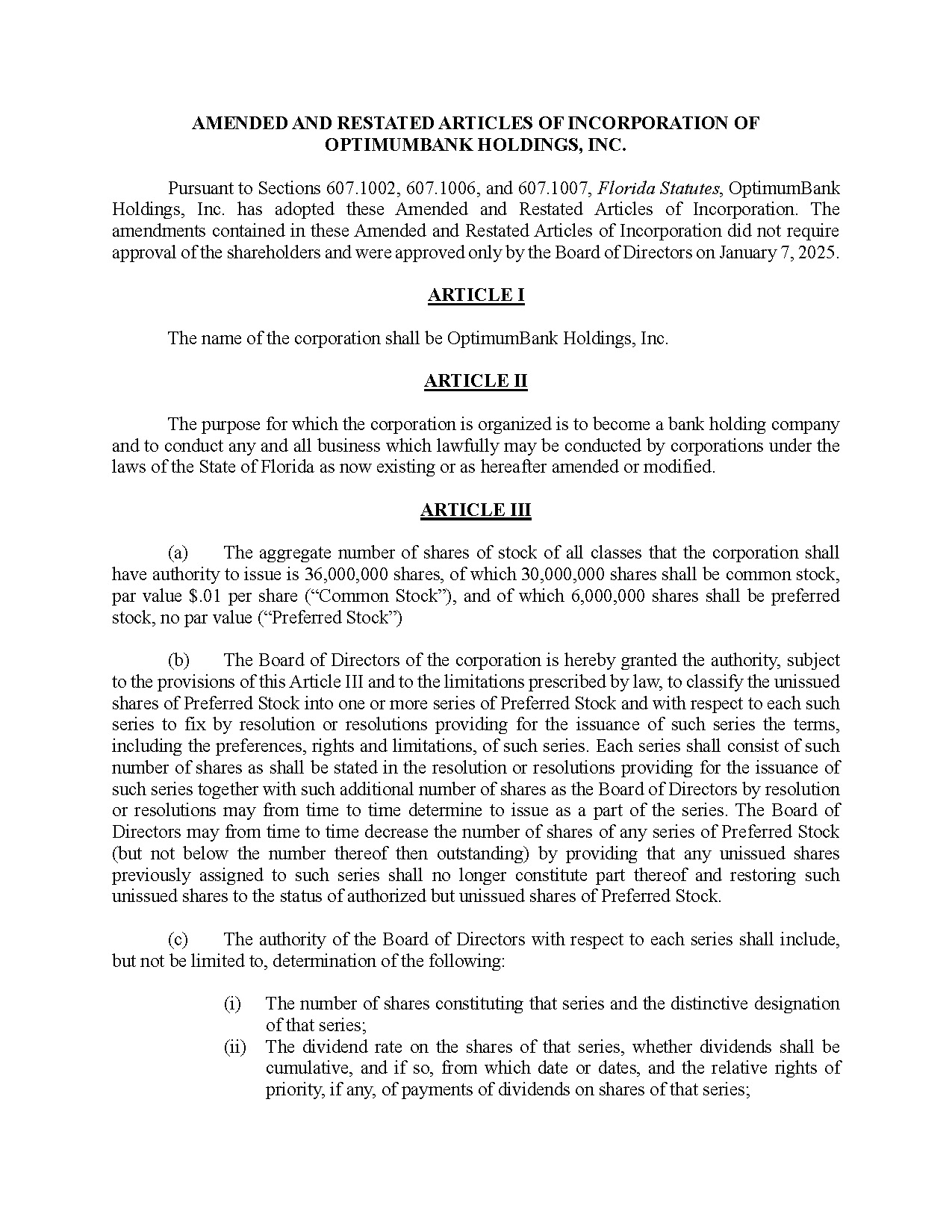


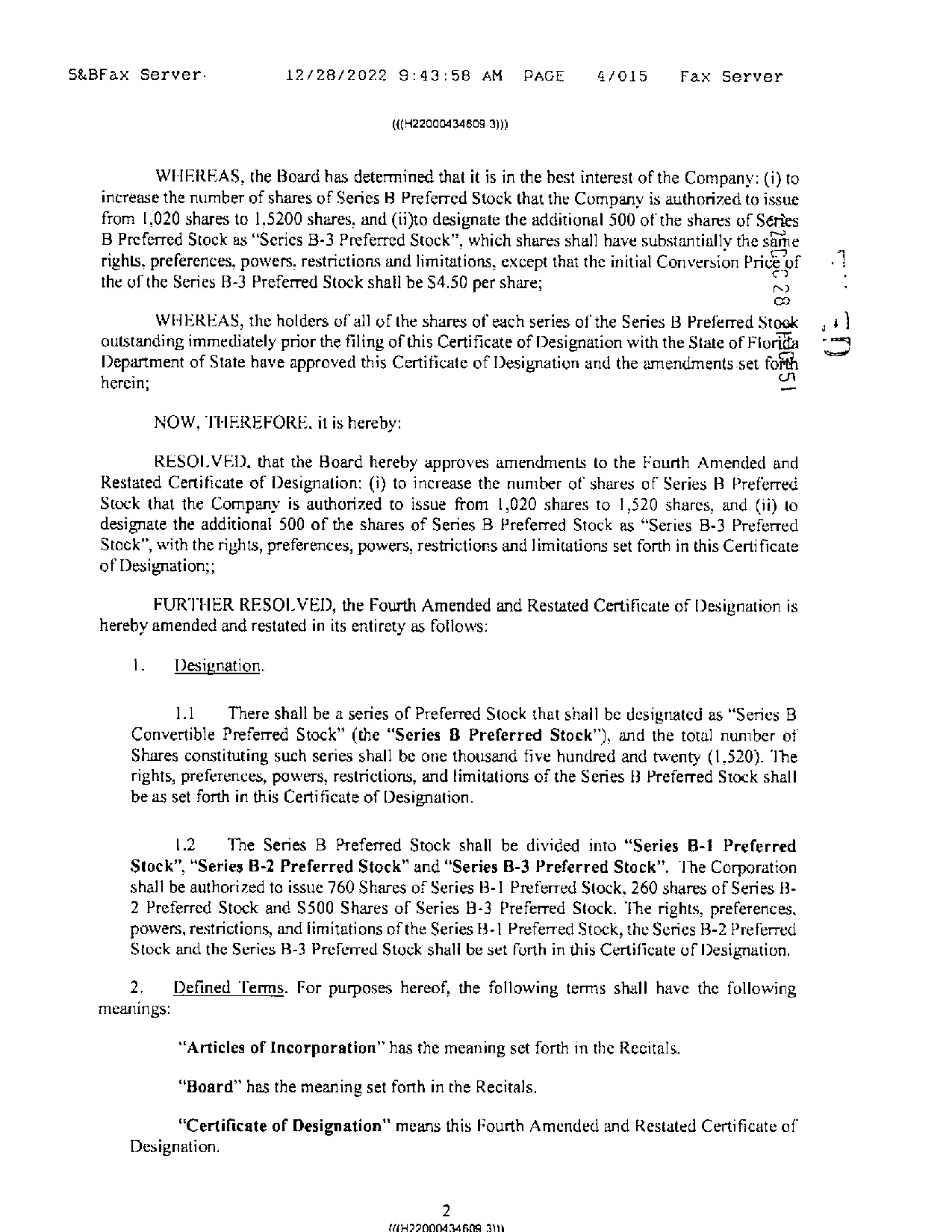


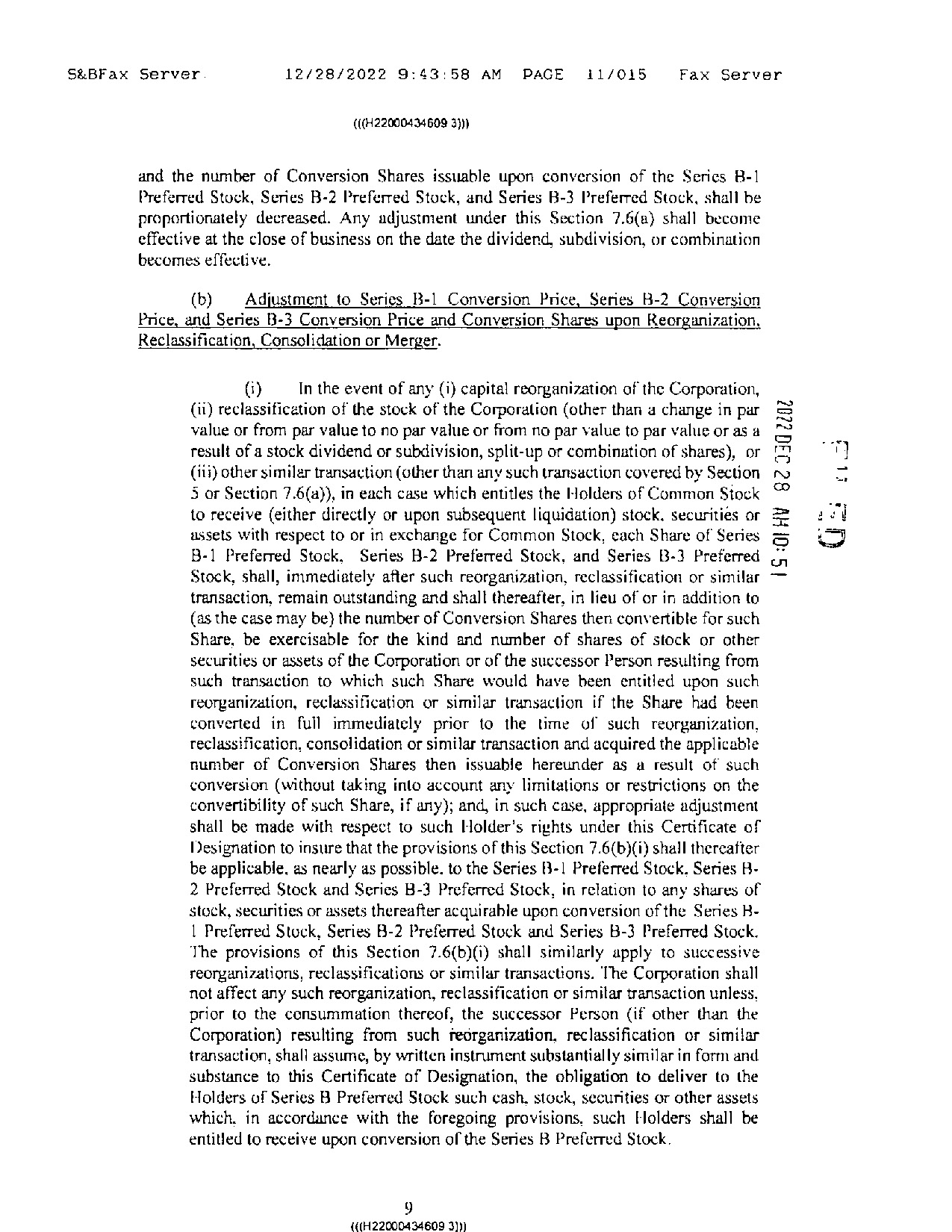

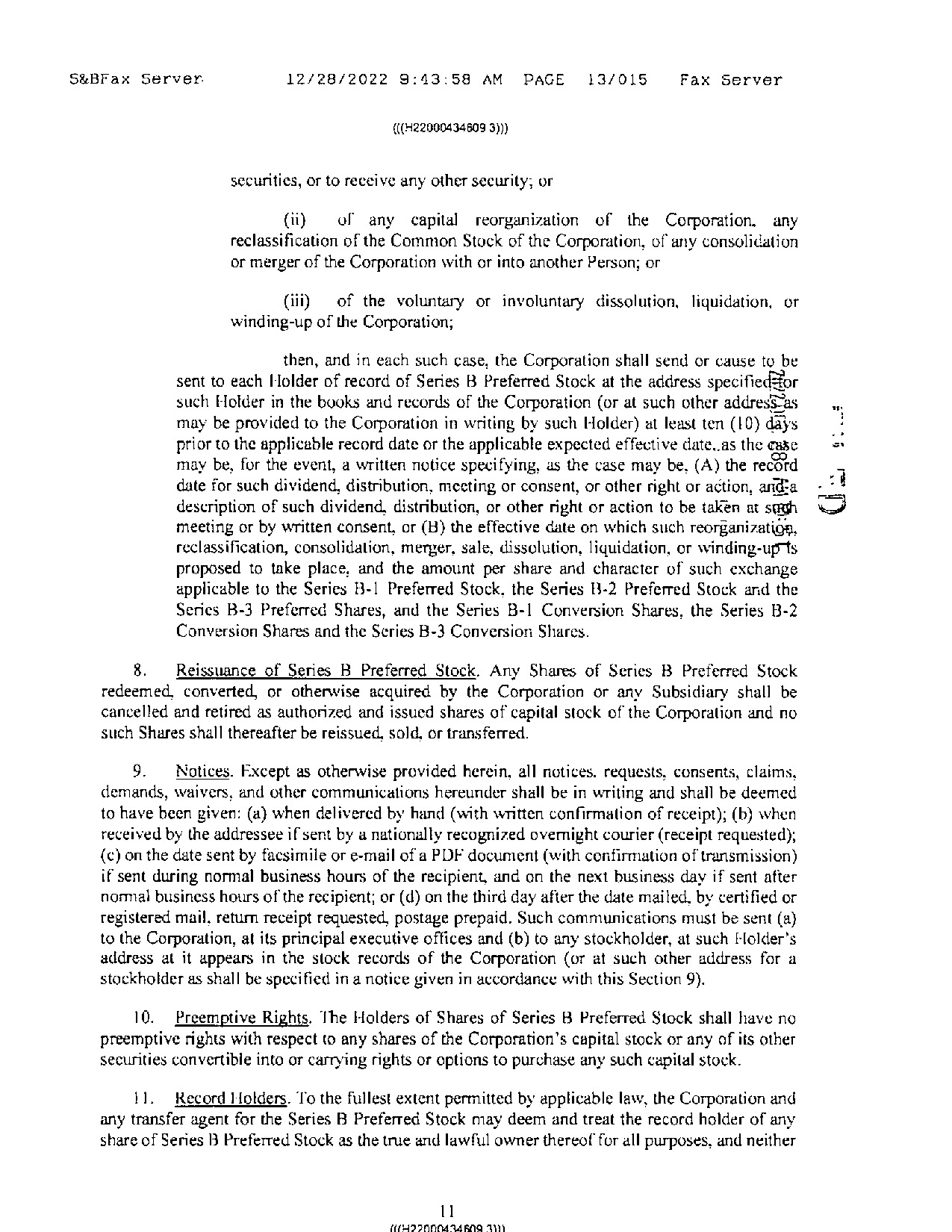




Exhibit 4.2
DESCRIPTION OF SECURITIES
We are a Florida corporation. The rights of our stockholders are governed by the Florida Business Corporation Act, or the FBCA, our amended and restated articles of incorporation and our amended and restated bylaws. The following summary of the material terms, rights and preferences of our capital stock is not complete. You should read our amended and restated articles of incorporation, which we refer to as our charter, and our bylaws, for more complete information. You should read these documents, copies of which are filed as exhibits to our annual report on Form 10-K.
Authorized Capitalization
Our authorized capital stock consists of:
| ● | 30,000,000 shares of common stock, par value $.01 per share; and | |
| ● | 6,000,000 shares of preferred stock, without par value. |
Common Stock
As of December 31, 2024, we had 11,636,092 outstanding shares of common stock.
Voting Rights. Each holder of our common stock is entitled to one vote per share on each matter submitted to a vote of stockholders. Our bylaws provide that the presence of holders of shares representing a majority of the voting power of our outstanding capital stock entitled to vote at a stockholders’ meeting shall constitute a quorum. When a quorum is present, the affirmative vote of a majority of the votes cast is required to take action, unless otherwise specified by law, the Nasdaq listing rules or our articles of incorporation. There are no cumulative voting rights.
Dividends. Each holder of our common stock is entitled to such dividends as the board of directors may declare from time to time out of funds legally available therefor. Our ability to pay dividends depends upon the receipt of distributions from the Bank because we have no other source of income. The rights of common shareholders to receive dividends are subject to the preferential rights of any preferred stock that we may issue in the future.
Preferred Stock
Our board of directors is authorized, without further action of the stockholders, to issue from time to time shares of preferred stock in one or more series and with such relative rights, powers, preferences, and limitations as the board of directors may determine at the time of issuance. Such shares may be convertible into common stock and may be senior to the common stock in the payment of dividends, liquidation, voting and other rights, preferences and privileges. The issuance of shares of preferred stock could adversely affect the holders of common stock. For example, the issuance of preferred stock could be used in certain circumstances to render more difficult or discourage a merger, tender offer, proxy contest or removal of incumbent management. Preferred stock may be issued with voting and conversion rights that could adversely affect the voting power and other rights of the holders of common stock.
Series B Preferred
The Board has authorized a class of preferred stock to be entitled “Series B Preferred Stock.” The Company ise authorized to issue 1,520 shares of Series B Preferred. The Series B Preferred Stock is divided into “Series B-1 Preferred Stock,” “Series B-2 Preferred Stock,” and “Series B-3 Preferred Stock.” The Company is authorized to issue 760 Shares of Series B-1 Preferred Stock, 260 shares of Series B-2 Preferred Stock, and 500 Shares of Series B-3 Preferred Stock. As of December 31, 2024, we had 1,360 outstanding shares of Series B Preferred Stock, consisting of 760 Shares of Series B-1 Preferred Stock, 260 shares of Series B-2 Preferred Stock, and 340 Shares of Series B-3 Preferred Stock.
Rank. Except as otherwise expressly set forth in the Certificate of Designation for the Series B Preferred Stock, all shares of the Series B Preferred Stock rank senior to all Junior Securities, with respect to payment or distribution of assets upon liquidation, dissolution, or winding up of the Company, whether voluntary or involuntary. “Junior Securities” means, collectively, the Common Stock and any other class of securities that is specifically designated as junior to the Series B Preferred Stock.
Participating Dividends. Except in the case of liquidation, if the Company declares or pays a dividend or distribution on the common stock, the Company shall simultaneously declare and pay a dividend on the Series B Preferred Stock on a pro rata basis with the common stock determined on an as-converted basis assuming all shares of Series B Preferred Stock had been converted immediately prior to the record date of the applicable dividend.
Liquidation. In the event of any voluntary or involuntary liquidation, dissolution or winding up of the Company, the holders of shares of Series B Preferred Stock then outstanding shall be entitled to be paid out of the assets of the Company available for distribution to its stockholders, before any payment shall be made to the holders of Junior Securities by reason of their ownership thereof, an amount per share equal to the greater of (i) the Series B original issue price of $25,000, or (ii) such amount per share as would have been payable had all shares of Series B Preferred Stock been converted into common stock immediately prior to such liquidation.
Voting. Except as provided below and otherwise provided by law, the holders of the Series B Preferred Stock have no voting rights.
Supermajority Voting Rights—Amendments. The affirmative vote or consent of the holders of at least 66-2/3% of all of the shares of the Series B Preferred Stock at the time outstanding, voting separately as a class (a “Supermajority Interest”), shall be required to amend the provisions of the Articles of Incorporation so as to materially and adversely affect the rights, preferences or privileges of the Series B Preferred Stock, taken as a whole.
Supermajority Voting Rights—Priority. The affirmative vote or consent of a Supermajority Interest shall be required to issue, authorize or increase the authorized amount of, or to issue or authorize any obligation or security convertible into or evidencing the right to purchase, any class or series of stock ranking senior to the shares of the Series B Preferred Stock with respect to payment of dividends or the distribution of assets upon any liquidation of the Company.
Right to Convert. Subject to the provisions of described below, , the Company has the right to convert all or any portion of the outstanding shares of Series B Preferred Stock into an aggregate number of shares of common stock as is determined by (i) multiplying the number of shares to be converted by $25,000, and then (ii) dividing the result by the conversion price in effect immediately prior to such conversion. The initial conversion price per share of Series B-1 Preferred Stock was $2.50 per share, the initial conversion price per share of Series B-2 Preferred Stock was $4.00 per share, and the initial conversion price per share of Series B-3 Preferred Stock was $4.50 per share, in each case subject to certain adjustments. No fractional shares of common stock shall be issued upon conversion of the Series B Preferred Stock. In lieu of any fractional shares to which the holder would otherwise be entitled, the Company shall pay cash equal to such fraction multiplied by the fair market value of a share of common stock as determined in good faith by the Board of Directors of the Company.
Limitations on Conversion. The right of the Company to convert any of the shares of the Series B Preferred Stock shall be subject to the prior fulfillment of the following conditions:
(a) Such conversion shall have been by approved by the holders of a majority of the outstanding common stock of the Company (the Company obtained this approval at the 2024 Annual Meeting of Shareholders); and
(b) Such conversion shall not result in any holder of the Series B Preferred Stock and any persons with whom the holder may be acting in concert, becoming Beneficial Owners of more than 9.9% of the outstanding shares of the common stock. For purposes of this description, the term “Beneficial Owner” shall have the meaning given to such term in SEC Rule 13d-3.
Reservation of Stock. The Company shall at all times when any Shares of Series B Preferred Stock is outstanding reserve and keep available out of its authorized but unissued shares of capital stock, solely for the purpose of issuance upon the conversion of the Series B Preferred Stock, such number of shares of common stock issuable upon the conversion of all outstanding Series B Preferred Stock.
Adjustment to Conversion Price and Number of Conversion Shares. The conversion price and the number of common shares issuable on conversion of the shares of Series B Preferred Stock shall be subject to customary adjustments upon dividend, subdivision, or combination of common stock, and upon any reorganization, reclassification, consolidation or merger.
Preemptive Rights. The holders of shares of Series B Preferred Stock shall have no preemptive rights with respect to any shares of the Company’s capital stock or any of its other securities convertible into or carrying rights or options to purchase any such capital stock.
Series C Preferred
The Board has authorized a series of preferred stock entitled “Series C Preferred Stock.” The Company is authorized to issue 4,000,000 shares of Series C Preferred Stock.
Rank. Except as otherwise expressly set forth in the Certificate of Designation for the Series C Preferred Stock, all shares of the Series C Preferred Stock rank equal to the common stock, with respect to payment or distribution of assets upon liquidation, dissolution, or winding up of the Corporation, whether voluntary or involuntary.
Participating Dividends. Except in the case of liquidation, if the Company declares or pays a dividend or distribution on the common stock, the Company shall simultaneously declare and pay a dividend on the Series C Preferred Stock on a pro rata basis with the common stock.
Voting. Except as provided below and otherwise provided by law, the holders of the Series C Preferred Stock have no voting rights. The affirmative vote or consent of the holders of at least two-thirds of all of the shares of the Series C Preferred Stock at the time outstanding, voting separately as a class, shall be required to amend the provisions of the Series B Preferred Stock designation.
Right to Convert. A holder of Series C Preferred Stock may convert, or upon the written request of the Company shall convert, shares of Series C Preferred Stock into shares of common stock provided that upon conversion the holder and its affiliates, will not own or control more than 9.9% of the common stock. In any such conversion, each share of Series C Preferred Stock will convert into 100 shares of common stock, subject to adjustment as provided below.
Each share of Series C Preferred Stock shall automatically convert into one share of common stock immediately upon any transfer (i) pursuant to a widespread public distribution of Series C Preferred Stock; (ii) if no transferee (or group of associated transferees) would receive 2% or more of any class of voting securities of the Company, but only if such transferee is not an affiliate of the transferor; or (iii) to a transferee that would control more than 50% of the voting securities of the Company without any transfer from the transferor.
Such conversion ratios shall be equitably adjusted if: (i) the Company subdivides or splits its outstanding common stock, including by way of a dividend or distribution of shares, or a combination of shares of common stock; (ii) the Company combines its outstanding shares of common stock into a lesser number of shares; or (iii) there occurs
Preemptive Rights. The holders of shares of Series C Preferred Stock shall have no preemptive rights with respect to any shares of the Company’s capital stock or any of its other securities convertible into or carrying rights or options to purchase any such capital stock.
Anti-Takeover Effects of Certain Provisions of Florida Law
Section 607.0902 of the FBCA prohibits the voting of shares in a publicly-held Florida corporation that are acquired in a “control share acquisition” unless the holders of a majority of the corporation’s voting shares (exclusive of shares held by officers of the corporation, inside directors or the acquiring party) approve the granting of voting rights as to the shares acquired in the control share acquisition or unless the acquisition is approved by the corporation’s Board of Directors. A “control share acquisition” is defined as an acquisition that immediately thereafter entitles the acquiring party to vote in the election of directors within each of the following ranges of voting power: (i) one-fifth or more but less than one-third of all voting power; (ii) one-third or more but less than a majority of all voting power; and (iii) more than a majority of all voting power.
Sections 607.0901 of the FBCA contains an “affiliated transaction” provision that prohibits a publicly-held Florida corporation from engaging in a broad range of business combinations or other extraordinary corporate transactions with an “interested shareholder” unless, among others: (i) the transaction is approved by a majority of disinterested directors before the person becomes an interested shareholder; (ii) the interested shareholder has owned at least 80% of the corporation’s outstanding voting shares for at least five years; or (iii) the transaction is approved by the holders of two-thirds of the corporation’s voting shares other than those owned by the interested shareholder. An interested shareholder is defined as a person who together with affiliates and associates beneficially owns more than 10% of the corporation’s outstanding voting shares.
Authorized but Unissued Shares
The FCBA provides that the authorized but unissued shares of common stock and preferred stock of a Florida corporation are available for future issuance without stockholder approval; however, such issuances by the Company are subject to various limitations imposed by the NYSE American, These additional shares may be utilized for a variety of corporate purposes, including future public offerings to raise additional capital, corporate acquisitions and employee benefit plans. The existence of authorized but unissued shares of common stock and preferred stock could make it more difficult or discourage an attempt to obtain control of us by means of a proxy contest, tender offer, merger or otherwise.
Election and Removal of Directors
Our bylaws require a minimum of three directors with the number of directors at any time to be fixed by board resolution. Directors are elected by a plurality of the votes cast at each annual meeting of our stockholders when a quorum is present. The FBCA provides that stockholders may remove directors with or without cause by the affirmative vote of a majority of the votes cast at a meeting of stockholders called for the purpose of removing the director when a quorum is present.
Board Meetings
Our bylaws provide that the chairman of the board, president or the board of directors may call special meetings of the board of directors.
Special Shareholder Meetings
Our bylaws provide that a special meeting may be called by the chairman of the board, the president, or a majority of the board, and must be called by the secretary upon a request in writing of stockholders owning at least ten percent of all our capital stock then issued, outstanding and entitled to vote.
Modification of Rights of Common Shareholders
Under the FCBA, the rights of the holders of common shares authorized in a corporation such as the Company may be modified by a majority vote of shares present at a shareholders’ meeting called for such purpose, except for most business combinations, including mergers, consolidations and sales of substantially all of the assets of a corporation, which must be approved by the vote of the holders of at least a majority of the outstanding shares of common stock and any other affected class of stock of a Florida corporation.
Indemnification of Officers and Directors
Under the FBCA, a corporation may indemnify its directors and officers against liability if the director or officer acted in good faith and with a reasonable belief that his actions were in the best interests of the corporation, or at least not adverse to the corporation’s best interests, and, in a criminal proceeding, if the individual had no reasonable cause to believe that the conduct in question was unlawful. Under the FBCA, a corporation may not indemnify an officer or director against liability in connection with a claim by or in the right of the corporation in which such officer or director was adjudged liable to the corporation or in connection with any other proceeding in which the officer or director was adjudged liable for receiving an improper personal benefit. However, a corporation may indemnify against the reasonable expenses associated with such proceeding. A corporation may not indemnify against breaches of the duty of loyalty. The FBCA provides for mandatory indemnification against all reasonable expenses incurred in the successful defense of any claim made or threatened, regardless of whether such claim was by or in the right of the corporation, unless limited by the corporation’s articles of incorporation. A court may order indemnification if it determines that the director or officer is fairly and reasonably entitled to indemnification in view of all the relevant circumstances, regardless of whether the director or officer met the good faith and reasonable belief standards of conduct set out in the statute. Unless otherwise stated in the articles of incorporation, officers of the corporation are also entitled to the benefit of the above statutory provisions.
Consistent with Florida law, our bylaws provide for the indemnification of our directors or officers to the fullest extent permitted by applicable law.
Transfer Agent and Registrar
The transfer agent and registrar for our common stock is Continental Stock Transfer & Trust Company.
Listing
Until December 30, 2024, the Company’s common stock was listed on the Nasdaq Capital Market under the symbol “OPHC.” Beginning December 31, 2024, the Company’s common stock began trading on the NYSE American under the symbol “OPHC.”
EXHIBIT 31.1
CERTIFICATION OF THE PRINCIPAL EXECUTIVE OFFICER
REQUIRED BY RULE 13A-14(A)/15D-14(A)
UNDER THE SECURITIES EXCHANGE ACT OF 1934
I, certify that:
| 1. | I have reviewed this report on Form 10-K of OptimumBank Holdings, Inc. (the “Company”); |
| 2. | Based on my knowledge, this report does not contain any untrue statement of a material fact or omits to state a material fact necessary to make the statements made, in light of the circumstances under which such statements were made, not misleading with respect to the period covered by this report; |
| 3. | Based on my knowledge, the financial statements, and other financial information included in this report, fairly present in all material respects the financial condition, results of operations and cash flows of the registrant as of, and for, the periods presented in this report; |
| 4. | The registrant’s other certifying officer and I am responsible for establishing and maintaining disclosure controls and procedures (as defined in Exchange Act Rules 13a-15(e) and 15d-15(e) and internal control over financial reporting (as defined in Exchange Act Rules 13a-15(f) and 15d-15(f) for the Company and have: |
(a) Designed such disclosure controls and procedures, or caused such disclosure controls and procedures to be designed under our supervision, to ensure that material information relating to the registrant, including its consolidated subsidiary, is made known to us by others within that entity, particularly during the period in which this report is being prepared;
(b) Designed such internal control over financial reporting, or caused such internal control over financial reporting to be designed under our supervision, to provide reasonable assurance regarding the reliability of financial reporting and the preparation of financial statements for external purposes in accordance with generally accepted accounting principles;
(c) Evaluated the effectiveness of the registrant’s disclosure controls and procedures and presented in this report our conclusions about the effectiveness of the disclosure controls and procedures, as of the end of the period covered by this report based on such evaluation; and
(d) Disclosed in this report any change in the registrant’s internal control over financial reporting that occurred during the registrant’s most recent fiscal quarter (the registrant’s fourth fiscal quarter in the case of an annual report) that has materially affected, or is reasonably likely to materially affect, the registrant’s internal control over financial reporting; and
| 5. | The registrant’s other certifying officer and I have disclosed, based on our most recent evaluation of internal control over financial reporting, to the Company’s auditors and the Audit Committee of the Company’s Board of Directors: |
(a) All significant deficiencies and material weaknesses in the design or operation of internal control over financial reporting which are reasonably likely to adversely affect the registrant’s ability to record, process, summarize and report financial information; and
(b) Any fraud, whether or not material, that involves management or other employees who have a significant role in the registrant’s internal control over financial reporting.
| /s/ Timothy Terry | |
| Timothy Terry | |
| Principal Executive Officer | |
| Date: February 26, 2025 |
EXHIBIT 31.2
CERTIFICATION OF PRINCIPAL FINANCIAL OFFICER
REQUIRED BY RULE 13A-14(A)/15D-14(A)
UNDER THE SECURITIES EXCHANGE ACT OF 1934
I, certify that:
| 1. | I have reviewed this report on Form 10-K of OptimumBank Holdings, Inc. (the “Company”); |
| 2. | Based on my knowledge, this report does not contain any untrue statement of a material fact or omit to state a material fact necessary to make the statements made, in light of the circumstances under which such statements were made, not misleading with respect to the period covered by this report; |
| 3. | Based on my knowledge, the financial statements, and other financial information included in this report, fairly present in all material respects the financial condition, results of operations and cash flows of the registrant as of, and for, the periods presented in this report; |
| 4. | The registrant’s other certifying officer and I am responsible for establishing and maintaining disclosure controls and procedures (as defined in Exchange Act Rules 13a-15(e) and 15d-15(e) and internal control over financial reporting (as defined in Exchange Act Rules 13a-15(f) and 15d-15(f) for the Company and have: |
(a) Designed such disclosure controls and procedures, or caused such disclosure controls and procedures to be designed under our supervision, to ensure that material information relating to the registrant, including its consolidated subsidiary, is made known to us by others within that entity, particularly during the period in which this report is being prepared;
(b) Designed such internal control over financial reporting, or caused such internal control over financial reporting to be designed under our supervision, to provide reasonable assurance regarding the reliability of financial reporting and the preparation of financial statements for external purposes in accordance with generally accepted accounting principles;
(c) Evaluated the effectiveness of the registrant’s disclosure controls and procedures and presented in this report our conclusions about the effectiveness of the disclosure controls and procedures, as of the end of the period covered by this report based on such evaluation; and
(d) Disclosed in this report any change in the registrant’s internal control over financial reporting that occurred during the registrant’s most recent fiscal quarter (the registrant’s fourth fiscal quarter in the case of an annual report) that has materially affected, or is reasonably likely to materially affect, the registrant’s internal control over financial reporting; and
| 5. | The registrant’s other certifying officer and I have disclosed, based on our most recent evaluation of internal control over financial reporting, to the Company’s auditors and the Audit Committee of the Company’s Board of Directors: |
(a) All significant deficiencies and material weaknesses in the design or operation of internal control over financial reporting which are reasonably likely to adversely affect the registrant’s ability to record, process, summarize and report financial information; and
(b) Any fraud, whether or not material, that involves management or other employees who have a significant role in the registrant’s internal control over financial reporting.
| /s/ Joel Klein | |
| Joel Klein | |
| Principal Financial Officer | |
| Date: February 26, 2025 |
EXHIBIT 32.1
CERTIFICATION OF PRINCIPAL EXECUTIVE OFFICER
PURSUANT TO 18 U.S.C. SECTION 1350,
AS ADDED BY
SECTION 906 OF THE SARBANES-OXLEY ACT OF 2002
In connection with the Annual Report of OptimumBank Holdings, Inc. (the “Company”) on Form 10-K for the year ended December 31, 2024 as filed with the Securities and Exchange Commission (the “Report”), I, as the Principal Executive Officer of the Company, certify, pursuant to 18 U.S.C. § 1350, as added by § 906 of the Sarbanes-Oxley Act of 2002, that:
| 1. | The Report fully complies with the requirements of Section 13(a) or 15(d) of the Securities Exchange Act of 1934; and | |
| 2. | To my knowledge, the information contained in the Report fairly presents, in all material respects, the financial condition and results of operations of the Company as of and for the period covered by the Report. |
| /s/ Timothy Terry | |
| Timothy Terry | |
| Principal Executive Officer | |
| Date: February 26, 2025 |
EXHIBIT 32.2
CERTIFICATION OF PRINCIPAL FINANCIAL OFFICER
PURSUANT TO 18 U.S.C. SECTION 1350,
AS ADDED BY
SECTION 906 OF THE SARBANES-OXLEY ACT OF 2002
In connection with the Annual Report of OptimumBank Holdings, Inc. (the “Company”) on Form 10-K for the year ended December 31, 2024 as filed with the Securities and Exchange Commission (the “Report”), I, as the Principal Financial Officer of the Company, certify, pursuant to 18 U.S.C. § 1350, as added by § 906 of the Sarbanes-Oxley Act of 2002, that:
| 1. | The Report fully complies with the requirements of Section 13(a) or 15(d) of the Securities Exchange Act of 1934; and | |
| 2. | To my knowledge, the information contained in the Report fairly presents, in all material respects, the financial condition and results of operations of the Company as of and for the period covered by the Report. |
| /s/ Joel Klein | |
| Joel Klein | |
| Principal Financial Officer | |
| Date: February 26, 2025 |