エドガーで原本を確認する
UNITED STATES
SECURITIES AND EXCHANGE COMMISSION
Washington, D.C. 20549
FORM 8-K
CURRENT REPORT
Pursuant to Section 13 OR 15(d) of The Securities Exchange Act of 1934
Date of Report (Date of earliest event reported): August 14, 2025
NATIONAL BANK HOLDINGS CORPORATION
(Exact name of registrant as specified in its charter)
Delaware |
|
001-35654 |
|
27-0563799 |
(State or other jurisdiction |
|
(Commission |
|
(IRS Employer |
7800 East Orchard Road, Suite 300, Greenwood Village, Colorado 80111
(Address of principal executive offices) (Zip Code)
303-892-8715
(Registrant’s telephone, including area code)
Not Applicable
(Former name or former address, if changed since last report.)
Check the appropriate box below if the Form 8-K filing is intended to simultaneously satisfy the filing obligation of the registrant under any of the following provisions (see General Instruction A.2. below):
☐Written Communications pursuant to Rule 425 under the Securities Act (17 CFR 230.425)
☐Soliciting material pursuant to Rule 14a-12 under the Exchange Act (17 CFR 240.14a-12)
☐Pre-commencement communications pursuant to Rule 14d-2(b) under the Exchange Act (17 CFR 240.14d-2(b))
☐Pre-commencement communications pursuant to Rule 13e-4(c) under the Exchange Act (17 CFR 240.13e-4(c))
Securities registered pursuant to Section 12(b) of the Act:
Title of each class: |
|
Trading Symbol |
|
Name of each exchange on which registered: |
Class A Common Stock, Par Value $0.01 |
|
NBHC |
|
NYSE |
Indicate by check mark whether the registrant is an emerging growth company as defined in Rule 405 of the Securities Act of 1933(§230.405 of this chapter) or Rule 12b-2 of the Securities Exchange Act of 1934 (§240.12b-2 of this chapter).
Emerging growth company ☐
If an emerging growth company, indicate by check mark if the registrant has elected not to use the extended transition period for complying with any new or revised financial accounting standards provided pursuant to Section 13(a) of the Exchange Act. ☐
Item 7.01. Regulation FD Disclosure.
Representatives from National Bank Holdings Corporation (“NBHC”) intend to use the materials filed herewith in one or more meetings with investors and analysts from time to time. NBHC also intends to make the materials available on its website (http://www.nationalbankholdings.com). NBHC is furnishing the slides as Exhibit 99.1 to this Current Report on Form 8-K.
The information contained in this Item 7.01 and the exhibit referenced herein are being “furnished” and shall not be deemed “filed” for purposes of Section 18 of the Exchange Act of 1934, nor shall they be deemed incorporated by reference in any filing under the Securities Act of 1933 or the Exchange Act of 1934.
Cautionary Statements Regarding Forward-Looking Information
This Current Report on Form 8-K and the exhibit filed herewith contain forward-looking statements. Any statements about NBHC’s expectations, beliefs, plans, predictions, forecasts, objectives, assumptions or future events or performance are not historical facts and may be forward-looking. These statements are only predictions and involve estimates, known and unknown risks, assumptions and uncertainties. NBHC’s actual results could differ materially from those expressed in or contemplated by such forward-looking statements as a result of a variety of factors, some of which are more fully described in the exhibit hereto and in NBHC’s filings with the Securities and Exchange Commission. You are cautioned not to place undue reliance on such statements. Any forward-looking statement speaks only as of the date on which it is made, and NBHC undertakes no obligation to update any forward-looking statement to reflect events or circumstances after the date on which the statement is made or to reflect the occurrence of unanticipated events or circumstances, except as required by applicable law.
Item 9.01. Financial Statements and Exhibits.
(d) Exhibits
Exhibit No. |
|
Description of Exhibit |
99.1 |
|
|
|
|
|
104 |
|
Cover Page Interactive Data File – The cover page XBRL tags are embedded within the inline XBRL document. |
SIGNATURE
Pursuant to the requirements of the Securities Exchange Act of 1934, the registrant has duly caused this report to be signed on its behalf by the undersigned hereunto duly authorized.
|
National Bank Holdings Corporation |
|
|
By: |
/s/ Angela N. Petrucci |
|
Name: Angela N. Petrucci |
|
Title: Chief Administrative Officer & General Counsel |
Date: August 14, 2025 |
|
|
Investor Presentation Q2 – 2025 |
|
Forward-Looking Statements This presentation contains forward-looking statements within the meaning of the Private Securities Litigation Reform Act of 1995. These statements do not discuss historical facts but instead relate to expectations, beliefs, plans, predictions, forecasts, objectives, assumptions or future events or performance. Forward-looking statements are generally identified by words such as “anticipate,” “believe,” “can,” “would,” “should,” “could,” “may,” “predict,” “seek,” “potential,” “will,” “estimate,” “target,” “plan,” “project,” “continuing,” “ongoing,” “expect,” “intend,” “goal,” “focus,” “maintains,” “future,” “ultimately,” “likely,” “ensure,” “strategy,” “objective,” and similar words or phrases. These statements are only predictions and involve estimates, known and unknown risks, assumptions and uncertainties. We have based these statements largely on our current expectations and projections about future events and financial trends that we believe may affect our financial condition, liquidity, results of operations, business strategy and growth prospects. Forward-looking statements involve certain important risks, uncertainties and other factors, any of which could cause actual results to differ materially from those in such statements and, therefore, you are cautioned not to place undue reliance on such statements. Factors that could cause actual results to differ from those discussed in the forward-looking statements include, but are not limited to: business and economic conditions along with external events both generally and in the financial services industry; susceptibility to credit risk and fluctuations in the value of real estate and other collateral securing a significant portion of our loan portfolio, including with regards to real estate acquired through foreclosure, and the accuracy of appraisals related to such real estate; the allowance for credit losses and fair value adjustments may be insufficient to absorb losses in our loan portfolio; our ability to maintain sufficient liquidity to meet the requirements of deposit withdrawals and other business needs; changes and uncertainty impacting monetary supply and the businesses of our clients and counterparties, including levels of market interest rates, inflation, currency values, monetary and fiscal policies, and the volatility of trading markets; changes in the fair value of our investment securities and the ability of companies in which we invest to commercialize their technology or product concepts; the loss of certain executive officers and key personnel; any service interruptions, cyber incidents or other breaches relating to our technology systems, security systems or infrastructure or those of our third-party providers; the occurrence of fraud or other financial crimes within our business; competition from other financial institutions and financial services providers and the effects of disintermediation within the banking business including consolidation within the industry; changes and uncertainty with respect to federal government lending programs like the Small Business Administration’s Preferred Lender Program and the Federal Housing Administration’s insurance programs, including the impact of a government shutdown of such programs; impairment of our mortgage servicing rights, disruption in the secondary market for mortgage loans, declines in real estate values, or being required to repurchase mortgage loans or reimburse investors; developments in technology, such as artificial intelligence, the success of our digital growth strategy, and our ability to incorporate innovative technologies in our business and provide products and services that satisfy our clients’ expectations for convenience and security; our ability to execute our organic growth and acquisition strategies; the accuracy of projected operating results for assets and businesses we acquire as well as our ability to drive organic loan growth to replace loans in our existing portfolio with comparable loans as loans are paid down; changes and uncertainty with respect to federal, state and local laws, regulations, and policies along with executive orders applicable to our business, including tax laws, tariff policies, and Federal Reserve interest rate policies; our ability to comply with and manage costs related to extensive government regulation and supervision, including current and future regulations affecting bank holding companies and depository institutions; the application of any increased assessment rates imposed by the Federal Deposit Insurance Corporation (“FDIC”); claims or legal action brought against us by third parties or government agencies; and other factors, risks, trends and uncertainties described elsewhere in our other filings with the Securities and Exchange Commission (the “SEC”). The forward-looking statements are made as of the date of this presentation, and we undertake no obligation to update any forward-looking statement to reflect events or circumstances after the date on which the statement is made or to reflect the occurrence of unanticipated events or circumstances, except as required by applicable law. Further Information: This presentation should be read together with “Management’s Discussion and Analysis of Financial Condition and Results of Operations” and the consolidated financial statements and the related notes thereto included in our Form 10-K and quarterly reports 2 |
|
About Non-GAAP Financial Measures 3 Certain of the financial measures and ratios we present, including “tangible assets,” “return on average tangible assets,” “tangible common equity,” “return on average tangible common equity,” “tangible common book value per share,” “tangible common equity to tangible assets,” “non-interest expense excluding other intangible assets amortization,” “efficiency ratio excluding other intangible assets amortization,” “net income excluding the impact of other intangible assets amortization expense, after tax,” “pre-provision net revenue” and “fully taxable equivalent” metrics, are supplemental measures that are not required by, or are not presented in accordance with, U.S. generally accepted accounting principles (GAAP). We refer to these financial measures and ratios as “non-GAAP financial measures.” We consider the use of select non-GAAP financial measures and ratios to be useful for financial and operational decision making and useful in evaluating period-to-period comparisons. We believe that these non-GAAP financial measures provide meaningful supplemental information regarding our performance by excluding certain expenditures or assets that we believe are not indicative of our primary business operating results or by presenting certain metrics on a fully taxable equivalent basis. We believe that management and investors benefit from referring to these non-GAAP financial measures in assessing our performance and when planning, forecasting, analyzing and comparing past, present and future periods. These non-GAAP financial measures should not be considered a substitute for financial information presented in accordance with GAAP and you should not rely on non-GAAP financial measures alone as measures of our performance. The non-GAAP financial measures we present may differ from non-GAAP financial measures used by our peers or other companies. We compensate for these differences by providing the equivalent GAAP measures whenever we present the non-GAAP financial measures and by including a reconciliation of the impact of the components adjusted for in the non-GAAP financial measure so that both measures and the individual components may be considered when analyzing our performance. A reconciliation of non-GAAP financial measures to the comparable GAAP financial measures is included at the end of the financial statement tables. |
|
Table of Contents Financial Performance 08 Credit 15 Balance Sheet 20 2UniFi 25 Cambr 27 Management Team 29 Corporate Governance 32 Appendix 39 |
|
(1)As of June 30, 2025. Includes one banking center shared by NBH Bank and BOJH Trust. (2)Represents a non-GAAP financial measure. ROAA and ROAE totaled 1.38% and 10.15% respectively. See Appendix for a reconciliation of these measures. (3)Excluding other intangible asset amortization. 5 Attractive Markets Company Highlights Headquarters Denver, CO Banking Centers(1) 91 Listing NYSE: NBHC 36 banking centers ‒Denver: #5 in Hottest U.S. Housing Markets (U.S. News 2025) ‒Colorado: #6 Best Economy in the U.S. (U.S. News 2025) ‒Colorado: #8 Best State to Start a Business (WalletHub 2025) ‒Colorado: #11 Best State to Raise a Family (WalletHub 2025) 15 banking centers across Texas, Utah, New Mexico, and Idaho ‒Texas: #2 America’s Top States for Business (CNBC 2025) ‒Texas: #2 Best Economy in the U.S. (U.S. News 2025) ‒Utah: #3 Best Economy in the U.S. (U.S. News 2025) ‒Utah: #3 Best State to Start a Business (WalletHub 2025) ‒Idaho: #4 Best Economy in the U.S. (U.S. News 2025) 32 banking centers ‒Overland Park, KS: central hub for the #1 county in Kansas by household income and projected population growth(1) ‒Kansas City: #2 in Most Resilient U.S. Housing Markets (U.S. News 2025) ‒Kansas City: #8 in Hottest Housing Markets (Zillow 2025) ‒Kansas City: #10 in Affordable Starter Home Cities (Zillow 2025) (1)Ranking based on aggregate population growth for 2022-2027 (2)Includes one banking center shared by NBH Bank and BOJH Trust Balance Sheet 2Q25 Total Assets $10.0 billion Total Loans $7.5 billion Total Deposits $8.3 billion Key Ratios 2Q25 Common Equity Tier 1 14.17% Tier 1 Leverage 11.18% ROATA(2) 1.49% ROATCE(2) 14.18% Net Interest Margin FTE(2) 3.95% ACL / Loans 1.19% Efficiency Ratio FTE(2)(3) 57.32% 8 banking centers(2) ‒Wyoming: #1 in State Tax Competitiveness Index (Tax Foundation 2024) ‒Wyoming: #1 Tax Friendly state for middle income families (Kiplinger 2024) |
|
(40%) (30%) (20%) (10%) 0% 10% 20% 30% 40% 50% 60% S&P600 Bank median NBHC $0.80 $0.87 $0.94 $1.04 $1.12 $0.59 2020 2021 2022 2023 2024 YTD25 6 Shareholder Returns Source: S&P Global Market Intelligence, FactSet Research Systems, Bloomberg; market data as of 6/30/2025 (1)Peer median of the following group of 57 regional banks included in the S&P Small Cap 600 Index, not including NBHC: ABCB, AUB, AX, BANC, BANF, BANR, BHLB, BKU, BOH, BRKL, CASH, CATY, CBU, CFFN, CHCO, CPF, CUBI, CVBF, DCOM, EGBN, FBK, FBNC, FBP, FCF, FFBC, FHB, FULT, HAFC, HFWA, HOPE, HTH, INDB, LKFN, NBTB, NWBI, OFG, PFBC, PFS, PPBI, PRK, RNST, SBCF, SBSI, SFBS, SFNC, STBA, STEL, TBBK, TFIN, TMP, TRMK, TRST, UCB, VBTX, WABC, WAFD, WSFS. (2)Represents a non-GAAP financial measure. YE22’s adjustment relates to non-recurring acquisition expense incurred and YE24’s adjustment relates to non-recurring loss on security sales. See Appendix for a reconciliation of these measures. 4-year Performance of NBH Shareholder Returns vs. S&P 600 Regional Banks(1) Historical Dividend Per Share Dividend Payout Ratio Target 30 - 40% of core earnings CAGR: 9% $88.6 $93.6 $28.3 $142.0 $118.8 $58.3 YE20 YE21 YE22 YE23 YE24 YTD25 Net Income Non-Adjusted Adjusted $123.9 $5.1 ($ in millions) $99.6 $71.3 (2) (2) |
|
Recent Recognitions $71.3 7 |
|
Financial Performance |
|
Deposits Approximately 78% FDIC insured deposits Capital Ratios 14.17% Common Equity Tier 1 Ratio Q2 2025 Financial Highlights (1) Represents a non-GAAP financial measure. See Appendix for a reconciliation of these measures. (2)Excluding other intangible asset amortization ▪ Quarterly net income of $34.0 million, or $0.88 per diluted share ▪ Return on average tangible assets of 1.49% and return on average tangible common equity of 14.18% ▪ The FTE net interest margin widened 19 basis points to 3.95% and FTE net interest income grew 4.7% to $89.3 million, compared to the same period prior year ▪ Solid capital with tangible common equity to tangible assets ratio of 10.49% and tier 1 leverage ratio of 11.18% ▪ Grew tangible book value per share 12.2% over prior year ▪ Cash/investment securities portfolio with an average duration of 3.5 years ▪ Generated quarterly loan fundings totaling $322.7 million with a weighted average rate of 7.4% at the time of origination ▪ Loan to deposit ratio totaled 90.5%, compared to 94.1% in Q424 ▪ Low quarterly net charge-offs of 5 basis points annualized ▪ Launched 2UniFi in July 2025, an innovative financial ecosystem that we believe can change the way business owners and operators access the U.S. banking system ▪ Announced a strategic 2UniFi partnership with Nav in July 2025, a leading credit and financial health platform for small business owners offering a suite of tools to help entrepreneurs access, monitor, and build their business credit. 2UniFi will be integrated within the Nav marketplace for small business deposit and lending solutions. Expense 57.32% efficiency ratio FTE(1)(2) ACL / Loans 1.19% Loans Loans outstanding of $7.5 billion Net Income $34.0 million 3.95% Net interest margin FTE(1) 9 |
|
10 Profitable Steady Growth $80.4 $88.6 $93.6 $28.3 $142.0 $118.8 $58.3 YE19 YE20 YE21 YE22 YE23 YE24 YTD25 Net Income Non-Adjusted Adjusted $123.9 $5.1 (1) $2.55 $2.85 $3.01 $0.87 $3.72 $3.08 $1.51 YE19 YE20 YE21 YE22 YE23 YE24 YTD25 EPS (Fully Diluted) Non-Adjusted Adjusted $0.14 $3.22 (1) ($ in millions) 1.42% 1.44% 1.37% 0.95% 1.57% 1.30% 1.32% 1.36% 1.29% YE19 YE20 YE21 YE22 YE23 YE24 YTD25 ROATA(1) Non-Adjusted Adjusted (1) 61.6% 60.9% 63.4% 62.2% 56.0% 61.5% 59.4% 61.1% 60.6% 63.0% 57.1% 54.3% 58.7% 57.5% YE19 YE20 YE21 YE22 YE23 YE24 YTD25 Efficiency Ratio FTE(1) Non-Adjusted Excluding other intangible asset amortization, adjusted $112.9 $132.1 $110.8 $143.5 $190.0 $159.1 $85.4 YE19 YE20 YE21 YE22 YE23 YE24 YTD25 Non-Adjusted Adjusted (1) $6.6 $165.7 $128.4 Pre-Provision Net Revenue FTE(1) ($ in millions) 13.07% 13.27% 12.87% 9.91% 18.23% 13.65% 12.44% 13.75% 14.20% YE19 YE20 YE21 YE22 YE23 YE24 YTD25 ROATCE(1) Non-Adjusted Adjusted (1) (1)Represents a non-GAAP financial measure. YE22 adjusted for $15.1 million of non-recurring acquisition-related expenses. YE24 adjusted for $6.6 million of non-recurring loss on security sales. See Appendix for a reconciliation of these measures. (1) (1) $3.05 $2.18 (1) $71.3 $99.6 (1) $15.1 (1) |
|
11 Growth Trends $5.9 $6.7 $7.2 $9.6 $9.9 $9.8 $10.0 YE19 YE20 YE21 YE22 YE23 YE24 YTD25 Total Assets $4.4 $4.2 $4.5 $7.2 $7.7 $7.8 $7.5 $0.2 YE19 YE20 YE21 YE22 YE23 YE24 YTD25 Total Loans Non-PPP Loans PPP Loans $651.4 $707.3 $728.8 $776.0 $860.3 $961.8 $1,013.4 YE19 YE20 YE21 YE22 YE23 YE24 YTD25 ($ in billions) ($ in billions) ($ in millions) Tangible Common Equity(3) (1) Includes $2.3 billion of total assets added through the Rock Canyon Bank and Bank of Jackson Hole acquisitions in 2022. (2)Includes $1.7 billion of loans added through the Rock Canyon Bank and Bank of Jackson Hole acquisitions in 2022. (3)Represents a non-GAAP financial measure. See Appendix for a reconciliation of these measures. $4.4 (2) (1) |
|
12 Trust and Wealth Partners ▪ Trust and Wealth Management solution tailored to high net worth individuals ▪ Scalable Private Wealth team provides a broad range of financial and retirement planning solutions, creating an opportunity to further leverage the platform to new and existing NBH clients ▪ Established relationships with strong investment and research partners drives ability to cross-sell ▪ Fee income drives revenue diversification and attractive recurring earnings 500+ High Net Worth Client Accounts $1 billion AUM |
|
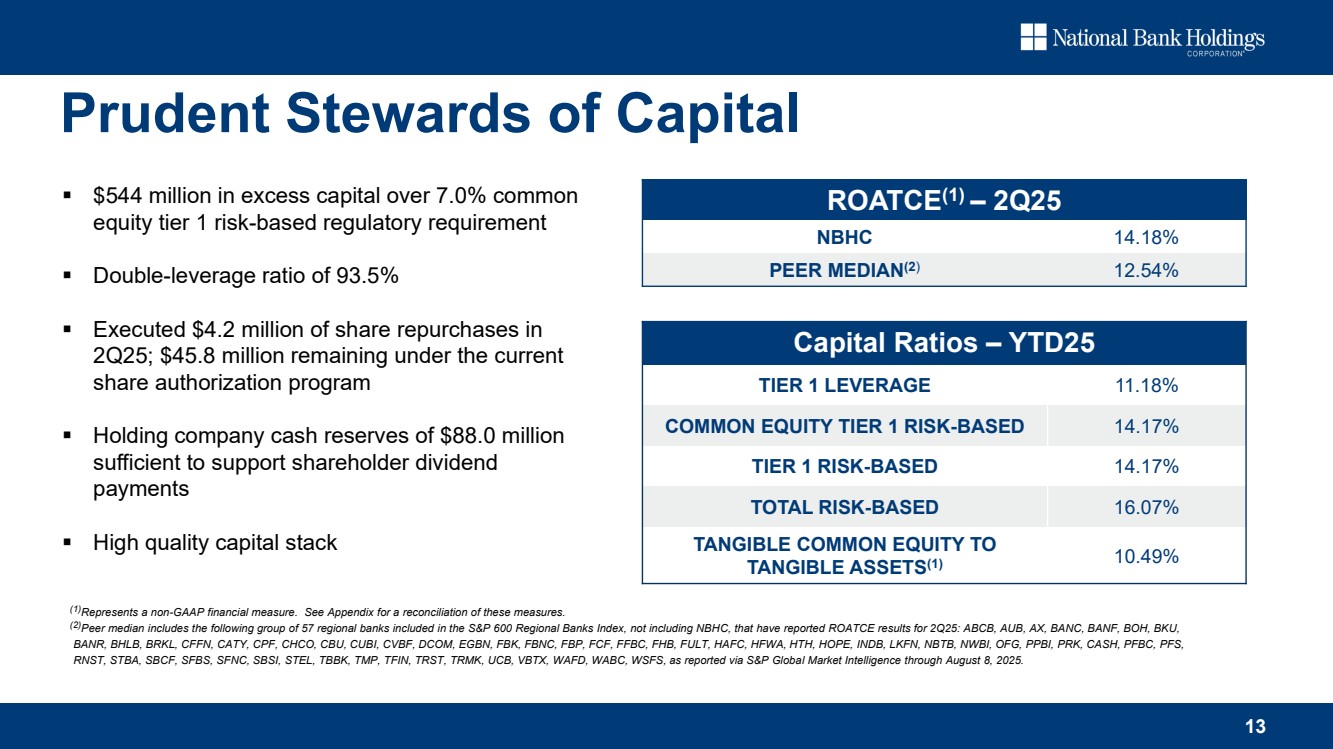
13 Prudent Stewards of Capital TIER 1 LEVERAGE 11.18% COMMON EQUITY TIER 1 RISK-BASED 14.17% TIER 1 RISK-BASED 14.17% TOTAL RISK-BASED 16.07% TANGIBLE COMMON EQUITY TO TANGIBLE ASSETS(1) 10.49% Capital Ratios – YTD25 (1)Represents a non-GAAP financial measure. See Appendix for a reconciliation of these measures. (2)Peer median includes the following group of 57 regional banks included in the S&P 600 Regional Banks Index, not including NBHC, that have reported ROATCE results for 2Q25: ABCB, AUB, AX, BANC, BANF, BOH, BKU, BANR, BHLB, BRKL, CFFN, CATY, CPF, CHCO, CBU, CUBI, CVBF, DCOM, EGBN, FBK, FBNC, FBP, FCF, FFBC, FHB, FULT, HAFC, HFWA, HTH, HOPE, INDB, LKFN, NBTB, NWBI, OFG, PPBI, PRK, CASH, PFBC, PFS, RNST, STBA, SBCF, SFBS, SFNC, SBSI, STEL, TBBK, TMP, TFIN, TRST, TRMK, UCB, VBTX, WAFD, WABC, WSFS, as reported via S&P Global Market Intelligence through August 8, 2025. ▪ $544 million in excess capital over 7.0% common equity tier 1 risk-based regulatory requirement ▪ Double-leverage ratio of 93.5% ▪ Executed $4.2 million of share repurchases in 2Q25; $45.8 million remaining under the current share authorization program ▪ Holding company cash reserves of $88.0 million sufficient to support shareholder dividend payments ▪ High quality capital stack NBHC 14.18% PEER MEDIAN(2) 12.54% ROATCE(1) – 2Q25 |
|
Highlights ▪ Net interest income (FTE) increased 4.7% to $89.3 million in 2Q25 over the same period prior year. ▪ Net interest margin (FTE) widened 19 basis points to a strong 3.95% in 2Q25 over the same period prior year, driven by strategic loan and deposit pricing. ▪ Cost of funds improved 23 basis points to 2.09% in 2Q25 over the same period prior year. $85.3 $89.5 $92.0 $88.6 $89.3 2Q24 3Q24 4Q24 1Q25 2Q25 14 Net Interest Income Net Interest Income FTE 3.76% 3.87% 3.99% 3.93% 3.95% 2Q24 3Q24 4Q24 1Q25 2Q25 Net Interest Margin FTE ($ in millions) 2.32% 2.36% 2.15% 2.07% 2.09% 2Q24 3Q24 4Q24 1Q25 2Q25 Cost of Funds |
|
Credit |
|
16 Uniquely Diversified $7.5 Billion Loan Portfolio Concentrations ▪ Self-imposed concentration limits ensure a granular and diverse loan portfolio and protect against downside risk to any particular industry or real estate sector ▪ Individual industry sectors are limited to no more than 15% of total loan commitments, with the majority being 10% or less ▪ Non-owner occupied CRE is 141% of risk-based capital and no specific property type exceeds 6% ▪ New commercial loans originated YTD: - Average funding of $1.3 million - Weighted average commitment, including unused, of $1.7 million ▪ Residential loans originated YTD: - Average funding of $358 thousand - Average FICO of 759 - Average LTV of 63% ▪ Top 25 originated relationships as of June 2025: - Average funded balance of $27 million - Average commitment of $31 million Granular and Well-Diversified Loan Portfolio 3% 4% Residential 17% Non-owner occupied CRE 23% C&I 44% and Owner-occupied CRE 16% 6% 4% 3% 2%2% 1% 5% 15% 1% 1% 11% 8% 5% 4% 3% 2% 2% 2% 2% 2% 1%1%1% 1% 15% C&I, 44% and Owner Occupied CRE , 16% Non Owner Occupied CRE, 23% Government & Municipal, 11% Hotel & Lodging, 6% Equipment Leasing, 8% Multifamily, 4% Restaurant, 5% Warehouse & Industrial, 3% Educational Services, 4% Land Development, 2% Transportation & Warehousing, 3% Commercial Construction, 2% Retail Trade, 2% Office, 1% Manufacturing, 2% All Other, 5% Agribusiness, 2% Real Estate Rental & Leasing, 2% Residential, 17% Materials & Construction Companies, 2% Residential Sr. Lien, 15% Wholesale Trade, 1% Residential Jr. Lien, 1% Food and Other, 1% Other, 1% Financial Services, 1% Lender Finance, 1% All Other C&I, 15% |
|
17 Granular Commercial Real Estate Portfolio Hotel & Lodging 28% Multifamily 19% CML Const. 7% Retail 9% Warehouse & Ind. 13% All Other 6% CML A & D 2% Office 6% Nursing Home 3% 1-4 Family Const. 7% ▪ Office: - Average LTV of 46% - 1.3% of total loans ▪ Retail: - Average LTV of 58% - 1.9% of total loans ▪ Multifamily: - Average LTV of 48% - 3.7% of total loans ▪ Hotel & Lodging: - High performing properties generally personally guaranteed by liquid and high net worth individuals - Average LTV of 39% Non-owner occupied CRE(1) Non-owner occupied CRE Portfolio Characteristics (1)Percentages are as a total of the non-owner occupied CRE portfolio. |
|
18 Strong Credit Quality History YE22 YE23 YE24 2Q25 Loan charge-offs 0.17% 0.34% 0.06% 0.41% 0.38% 0.03% 0.05% 0.07% 0.05% 0.05% 0.01% YE22 YE23 YE24 2Q25 Non-performing loans Acquired non-performing loans OREO 0.45% Non-performing Loans Non-performing Asset Composition Net Charge-Offs(1) Total Classified Loans 0.28% (1)As a % of average total loans $17 $28 $36 $33 0.23% 0.37% 0.46% 0.45% YE22 YE23 YE24 2Q25 Non-performing loans Non-performing loans as a % of total loans 0.03% 0.42% 0.47% 0.02% 0.13% $23 $52 $128 $226 $17 $16 $19 $23 0.6% 0.7% 1.9% 3.3% YE22 YE23 YE24 2Q25 Classified loans Acquired loans % of total loans $147 $249 $40 $68 0.05% ($ in millions) |
|
19 Credit Loss Protection $88.9 Total Loan Loss Coverage Including Loan Marks 1.45%(1) ACL/Total Loans 1.19% Loan Marks/Total Loans 0.26%(1) $19.6 $108.5 All dollars in millions (1)Represents a non-GAAP financial measure ACL 6/30/2025 Loan Marks 6/30/2025 TOTAL 6/30/2025 |
|
Balance Sheet |
|
▪ Portfolio built on a relationship-banking strategy, with emphasis on depository and treasury management relationships ▪ Self-imposed concentration limits; individual industry sectors are limited to no more than 15% of total loan commitments, with the majority being 10% or less ▪ Industries requiring in-depth knowledge are managed by specialty banking teams, with dedicated specialist underwriters ▪ New loan fundings over the trailing twelve months totaled $1.4 billion, led by commercial loan fundings of $928.3 million ▪ Generated quarterly loan fundings totaling $322.7 million with a weighted average rate of 7.4% at the time of origination FY19 FY20 FY21 FY22 FY23 FY24 2Q25 $1.4 (1)Excludes loans held-for-sale $1.2 $1.5 $1.2 $2.0 Owner-Occupied CRE 17% Non-Owner Occupied CRE 23% Resi Mortgage & Consumer 16% C & I 44% Loan Composition ($7.5 Billion) Quarterly Loan Fundings ($ in millions) Total Loan Fundings(1) ($ in billions) 21 Solid Loan Growth $505.2 $359.3 $480.0 $255.7 $322.7 2Q24 3Q24 4Q24 1Q25 2Q25 $1.5 TTM: Trailing Twelve Months $1.5 |
|
13.5% 6.6% 0.2% 79.7% Cash U.S. Treasury Other U.S. Agency Mortgage/Sponsored Debt 22 High Quality Liquidity Portfolio: $1.5 Billion ▪ Liquidity portfolio duration of 3.5 years ▪ Portfolio used exclusively as an on-balance sheet source of liquidity: ▪ 54% unencumbered ▪ 46% pledged directly to client deposits or repo ▪ No credit risk exists given 99.8% of investment portfolio is U.S. agency/sponsored agency and U.S. Treasury backed $1.5 Billion Liquidity Portfolio(1) (1)Represents market value as of June 30, 2025, regardless of AFS/HTM designation. Excludes investments made under equity accounting method. |
|
Granular Deposit Base ▪ No exposure to venture capital or crypto deposits ▪ Total deposits increased to $8.3 billion during 2025 ▪ Cost of average transaction deposits decreased 24 basis points to 1.83% during 2025 ▪ The mix of transaction deposits to total deposits was 87.0% Low Cost Deposits $5.9 $7.0 $7.3 $7.2 $0.8 $1.0 $1.0 $1.0 YE22 YE23 YE24 YTD25 Average Transaction Deposits Average Time Deposits 51% 47% 44% 41% 37% 41% 44% 46% 9% 8% 9% 9% 3% 4% 3% 4% $7.9 $8.2 $8.2 $8.3 0% 50% 100% YE22 YE23 YE24 YTD25 Demand & NOW Savings & MM CDs < $250k CDs >= $250k Total 87% Non-Time 88% Non-Time 88% Non-Time 87% Non-Time 4.50% 5.50% 4.50% 4.50% 0.26% 1.26% 2.07% 1.83% 0.33% 1.37% 2.23% 2.04% FY22 FY23 FY24 YTD25 Fed Funds rate Cost of transaction deposits Cost of deposits 23 Low Cost Transaction Deposits Low Cost Transaction Accounts Deposit Composition ($ in billions) |
|
24 Relationship Focused Deposit Base: $8.3 Billion ▪ Approximately 78% FDIC insured ▪ Granular deposit base: - Average deposit balance on full relationship basis just $57 thousand - Average deposit balance per account $29 thousand ▪ Approximately $0.6 billion of deposits collateralized ▪ No concentrations to any industry, sector or geography ▪ No venture capital or crypto deposits 3% Deposit Composition4% Time Deposits 13% Savings & Money Market Deposits 46% Non-interest bearing DDA 26% Interest bearing DDA 15% Transaction Accounts 41% |
|
2UniFi |
|
Financial Capital Social Capital Technical Capital Cultural Capital Operational Efficiency FDIC insured acct., protected deposits, treasury management, recurring billing, invoicing Improved operating information, financial statement preparation, marketplace opportunities Cash Flow Analysis, predictive analytics, personalization Budgeting & Growth Planning Goals, savings, needs by phase, access to growth vehicles, credit, growth projections, growth tracking Financial Management Data Insights & Reporting Fraud protection, faster and lower cost payment processing, B2B payments Digital Security Mentorship & Guidance Dedicated mentors, situational mentorship, crowdsourced information, referrals Connect businesses, partner linking, partnership formation, collective support, business collaborations Community of Support Verified network, direct value connections, affinity groups Partnership & Collaboration Fair Access Reduce bias in lending, get equal access to relevant advice and capital needs User needs validation, bring users into the process, user testing, bias and assumption reduction User Alignment & Buy-in Education and guidance, day-to-day activity decision-making, strategic planning Education & Financial Literacy Easier access to trade finance / working capital and SBA loans Digital Lending 26 2UniFi: an innovation platform that builds 'capital' and drives outcomes for SMBs. |
|
Cambr |
|
Strategic Rationale ▪ Cambr offers the use of a deposit administration platform (the Cambr platform) to various depository institutions, each known as a Bank of Record, that hold the deposits of individual clients. Cambr utilizes the Cambr platform to facilitate the placement of the Bank of Record depositors’ funds into destination banks. ▪ Cambr has relationships with leading embedded finance companies and their partner banks to provide them these deposit services. ▪ Cambr allocates these deposits to a network of banks. ▪ Cambr generates revenue through a revenue share based on the interest income derived from the bank network. About Cambr Relationship Schematic Diversifies NBH’s Deposit Franchise with Minimal Overhead Costs End User Bank of Record NBH Custodial Account Cambr Deposit Network $ $ $ Embedded Finance Program Data Deposit Flows Account Details & Instructions ▪ Funding Flexibility: Certain relationships with Banks of Record enable NBH to keep deposits or “push” them to the bank network as needed ▪ Manage liquidity ▪ Manage capital (leverage ratio) ▪ Minimal Overhead: The Cambr platform is primarily fixed expense base with minimal variable expenses ▪ Competitive Hedge: Benefit from ongoing embedded finance competition and disruption in the banking industry ▪ Income Diversification: Cambr income is not tied to NBH balance sheet growth ▪ Multitude of Use Cases: Cambr’s technology can support deposit management for a broad range of business segments Cambr Overview 28 |
|
Management Team |
|
30 Experienced Management Team Nicole Van Denabeele Chief Financial Officer (22 years in financial industry) • Previously EVP, Chief Accounting Officer at NBHC • Controller at Polsinelli, PC • Senior Vice President, Assistant Controller at UMB Financial Corporation • Started career in public accounting at Deloitte, LLP Tim Laney Chairman & CEO (44 years in banking) • Head of Business Services at Regions Financial, where he also led the transformation of wholesale lines of business • Senior management roles in small business, commercial banking, private banking, corporate marketing and change management and Management Operating Committee member at Bank of America; also served as President, Bank of America, Florida Richard Newfield Chief Risk Management Officer (41 years in banking) • Head of Business Services Credit at Regions Financial • Senior roles in risk management, credit, commercial banking, global bank debt and corporate marketing at Bank of America Aldis Birkans President (27 years in financial industry) • Previously Chief Financial Officer at NBHC • Previously Senior Vice President, Treasurer at NBHC • Vice President, Assistant Treasurer at M&I Bank • Senior Vice President, Corporate and Investment Bank Treasury at Citigroup Angela Petrucci Chief Administrative Officer & General Counsel (24 years in legal and banking) • Previously Senior Vice President, General Counsel at NBH Bank • In House Counsel at Accenture and an associate at Chapman and Cutler LLP • Started career as a commercial banker at First Chicago Bank (now JP Morgan Chase) Dan Sznewajs Chief Corporate Development Officer & Treasurer (22 years in financial industry) • Previously Director of Financial Planning & Analysis at NBHC • Vice President, Financial Institutions Group at Goldman Sachs • Safety & Soundness Division at the Federal Reserve Bank of Chicago |
|
31 Management & Directors NBHC MANAGEMENT & DIRECTORS BENEFICIAL OWNERSHIP(1) PERCENT OF CLASS(2) G. Timothy Laney 508,744 1.32% Aldis Birkans 113,885 0.30% Nicole Van Denabeele 16,329 0.04% Richard U. Newfield, Jr. 191,880 0.50% Angela Petrucci 38,654 0.10% Dan Sznewajs 2,553 0.01% Ralph W. Clermont 76,346 0.20% Robert E. Dean 33,412 0.09% Robin A. Doyle 5,777 0.02% Alka Gupta 11,268 0.03% Fred J. Joseph 25,861 0.07% Patrick Sobers 23,049 0.06% Micho F. Spring 43,740 0.11% Art Zeile 18,035 0.05% All current NBHC management and directors as a group (14 persons) 1,109,533 2.87% Beneficial Ownership (as of 06/30/25) 1) Includes unvested restricted shares for which the director or officer has voting power and shares issuable upon the exercise of options as well as indirect ownership. Does not include unvested performance stock units. (2) Calculated in accordance with Item 403 of Regulation S-K, and based on 38,045,622 shares of Class A common stock outstanding and entitled to vote and 327,656 shares of unvested restricted stock entitled to vote. |
|
Corporate Governance |
|
33 Best Practices In Governance and Compensation Corporate Governance ✓ Lead Independent Director with robust role and responsibilities ✓ Majority independent Board ✓ No short-selling, hedging, or pledging of NBHC shares (applies to all NBHC and NBH Bank insiders) ✓ Annual election of Board members and say-on-pay vote ✓ Fully independent Audit & Risk, Compensation, and Nominating & Governance Committees ✓ Annual Director and Committee evaluation process ✓ Board-adopted Code of Conduct that applies to all directors, officers, and employees ✓ Published Corporate Governance Guidelines Executive Compensation ✓ Provide the majority of compensation in the form of variable, performance-based elements ✓ Ensure a strong link between financial and operational goals, shareholder value creation, and executive compensation ✓ Conduct shareholder engagement on compensation- and governance-related issues, and respond to shareholder feedback as appropriate ✓ Enforce stock ownership guidelines for executives (5x base salary for CEO and up to 4x base salary for other NEOs) and non-employee directors (5x annual Board cash retainer) ✓ Provide a clawback policy for recoupment of incentive compensation in the event of a material restatement of financial or operating results ✓ Impose a double-trigger change-in-control requirement before vesting of outstanding, unvested equity awards is accelerated ✓ Use an independent compensation consultant ✓ Conduct annual risk assessment of compensation program ✓ Conduct annual say-on-pay vote NBHC’s corporate governance policies and executive compensation practices support our business and align with best practices |
|
Fred J. Joseph ▪ Financial services regulator for 30 years as the Banking and Securities Commissioner for the State of Colorado ▪ Member of the Investor Issues Committee for FINRA A N I Compensation Independent Governance & Nominating Committee Chair Audit & Risk Appointed within the last five years G. Timothy Laney ▪ CEO and Chairman ▪ Former Sr Executive VP & Head of Business Services at Regions Financial ▪ 24-year tenure at Bank of America, and a member of Bank of America’s Management Operating Committee C N * I Robust Lead Director Responsibilities ▪ Mr. Clermont presides at all Board meetings where the Chairman is not present and at all executive sessions of independent Directors ▪ Acts as liaison between Chairman and independent Directors ▪ Reviews and approves Board meeting agendas and information presented to Board ▪ Engages with major shareholders as needed ▪ As the independent Lead Director, Mr. Clermont is an ex officio member of all Board committees with full voting rights NBHC Board of Directors A Art Zeile ▪ Current CEO of DHI Group ▪ Extensive experience in software, telecommunications, internet, datacenter and security technologies, with a particular focus on cybersecurity ▪ Began career as an Officer in the U.S. Air Force Patrick Sobers ▪ 30+ years of financial services experience ▪ 10 years with NBH Bank (Former EVP, Head of Business and Consumer Banking) ▪ Member of NBH Bank’s board of directors since 2017 ▪ Several leadership positions at Bank of America, including Southeast Region’s Consumer Banking Executive 34 Ralph W. Clermont ▪ Lead Independent Director ▪ Former Managing Partner of KPMG, St. Louis office ▪ 39+ years of banking and audit experience A* C N I Robert E. Dean ▪ Former Senior Managing Director of Ernst & Young Corporate Finance ▪ Practiced corporate, banking and securities law with Gibson, Dunn & Crutcher A C N * I A C I Micho F. Spring ▪ Former chair of Global Corporate Practice at Weber Shandwick ▪ Formerly CEO of Boston Telecommunications Company ▪ Served four years as Deputy Mayor of Boston A N I A Alka Gupta ▪ Fortune 500 executive and tech entrepreneur with deep experience in digital transformation ▪ Currently a Venture Partner at Fin Venture Capital ▪ Co-Founder of and former President at GlobaliD, Inc. C I * Robin A. Doyle ▪ Served in several senior management roles over a 28 year career at J.P. Morgan, including as an executive member of J.P. Morgan’s board of directors risk policy committee ▪ Founding board member for the Rutgers Business School Center for Women in Business A I I |
|
35 NBHC Board Represents a Diverse Range of Qualifications and Skills 4 4 9 8 5 8 4 3 Gupta Joseph Spring Zeile Clermont Zeile Sobers Laney Sobers Spring Zeile Experience or Expertise Number of Directors Experienced leaders capable of overseeing execution and challenging management Critical industry knowledge and involvement in local communities Critical to overseeing management’s execution of strategy Gupta Clermont Dean Laney Gupta Laney Laney Dean Zeile Spring Gupta Spring Zeile Zeile Clermont Gupta Dean Dean Laney Clermont Doyle Sobers Dean Gupta Joseph Spring Doyle Doyle Doyle Sobers Joseph CEO or President of Private or Public Company Other Public Board Experience Financial or Audit Background Financial Services Industry Marketing or Sales Background Community or Governmental Service Joseph Legal or Regulatory Experience IT, Cyber, or Fintech Background Laney Zeile Laney Sobers Spring |
|
36 Board’s Role in Oversight of Risk The Board is actively engaged in NBHC’s risk management. Robust Risk Oversight at Board Level Risk Board Oversight Actions Cybersecurity Evolving nature and complexity of the threats from organized cybercriminals and hackers NBHC Audit and Risk Committee is responsible for oversight of the Company’s operational (including cybersecurity) and reputational risks Employs detection and response mechanisms designed to contain and mitigate security incidents Human Capital Stagnant boards are not only concerning to shareholders, but are also viewed unfavorably by proxy advisers such as ISS and Glass Lewis NBHC Nominating and Governance Committee considers diversity of experience in its assessment of potential nominees to the Board The NBHC Board has appointed 3 new directors in the last 4 years to ensure diversity of tenure, experience and backgrounds Market/Credit Risk NBH’s business is highly susceptible to credit risk and market fluctuations in the value of real estate and other collateral NBHC Audit and Risk Committee is responsible for the oversight of the Company’s market, credit and liquidity risk Implements strict credit concentration limits by industry and real estate type, requires credit decisions to be made independent of bankers and line management, regularly reviews detailed credit reporting, including risk mitigation trends, and oversees credit stress testing twice a year. Adopts and oversees comprehensive liquidity and market risk policies Compensation Misalignment between the compensation program and business strategy can result in substantial risk for the Company and its shareholders NBHC Compensation Committee oversees compensation risk to identify any practices that present unacceptable risk to NBH Conducts annual risk assessment of compensation program |
|
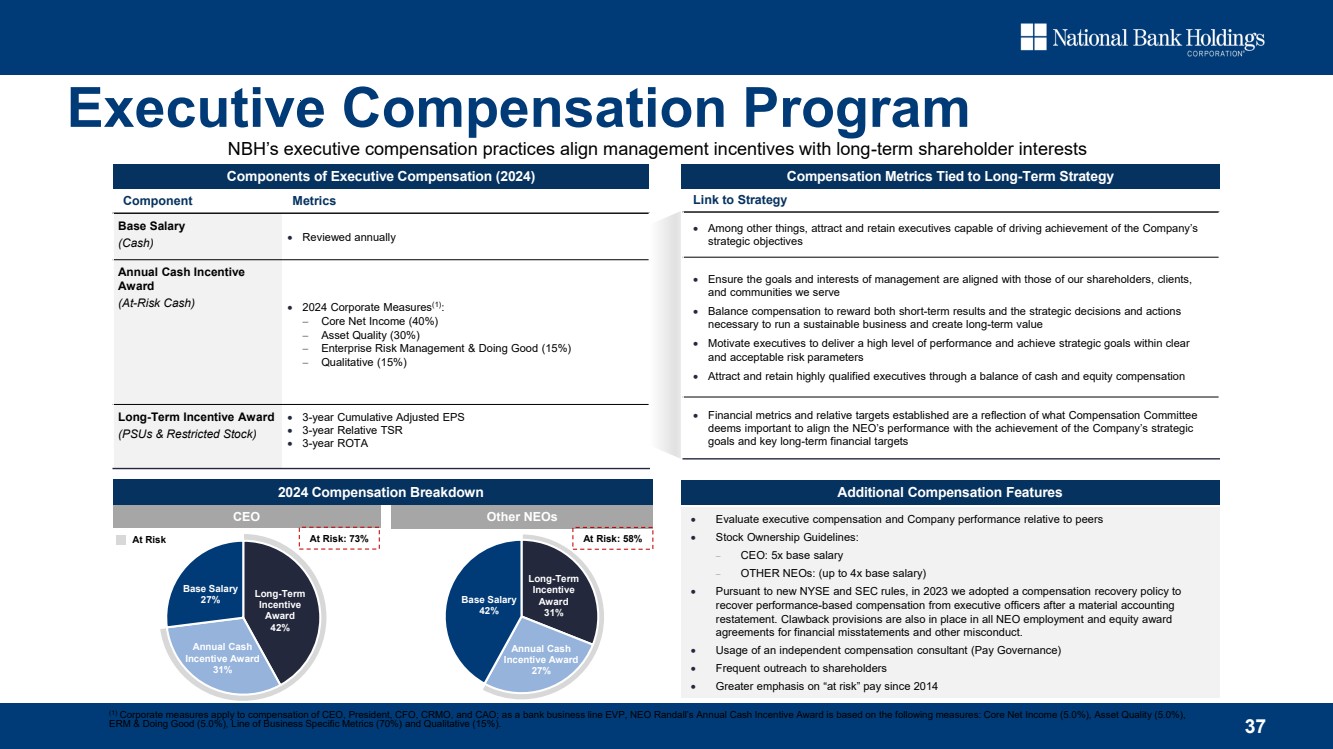
Long-Term Incentive Award 42% Annual Cash Incentive Award 31% Base Salary 27% 37 Executive Compensation Program NBH’s executive compensation practices align management incentives with long-term shareholder interests Components of Executive Compensation (2024) 2024 Compensation Breakdown Additional Compensation Features Component Metrics Base Salary (Cash) • Reviewed annually Annual Cash Incentive Award (At-Risk Cash) • 2024 Corporate Measures(1): − Core Net Income (40%) − Asset Quality (30%) − Enterprise Risk Management & Doing Good (15%) − Qualitative (15%) Long-Term Incentive Award (PSUs & Restricted Stock) • 3-year Cumulative Adjusted EPS • 3-year Relative TSR • 3-year ROTA Link to Strategy • Among other things, attract and retain executives capable of driving achievement of the Company’s strategic objectives • Ensure the goals and interests of management are aligned with those of our shareholders, clients, and communities we serve • Balance compensation to reward both short-term results and the strategic decisions and actions necessary to run a sustainable business and create long-term value • Motivate executives to deliver a high level of performance and achieve strategic goals within clear and acceptable risk parameters • Attract and retain highly qualified executives through a balance of cash and equity compensation • Financial metrics and relative targets established are a reflection of what Compensation Committee deems important to align the NEO’s performance with the achievement of the Company’s strategic goals and key long-term financial targets • Evaluate executive compensation and Company performance relative to peers • Stock Ownership Guidelines: − CEO: 5x base salary − OTHER NEOs: (up to 4x base salary) • Pursuant to new NYSE and SEC rules, in 2023 we adopted a compensation recovery policy to recover performance-based compensation from executive officers after a material accounting restatement. Clawback provisions are also in place in all NEO employment and equity award agreements for financial misstatements and other misconduct. • Usage of an independent compensation consultant (Pay Governance) • Frequent outreach to shareholders • Greater emphasis on “at risk” pay since 2014 Compensation Metrics Tied to Long-Term Strategy CEO (1) Corporate measures apply to compensation of CEO, President, CFO, CRMO, and CAO; as a bank business line EVP, NEO Randall’s Annual Cash Incentive Award is based on the following measures: Core Net Income (5.0%), Asset Quality (5.0%), ERM & Doing Good (5.0%), Line of Business Specific Metrics (70%) and Qualitative (15%). 2024 Compensation Breakdown Other NEOs At Risk At Risk: 73% At Risk: 58% Long-Term Incentive Award 31% Annual Cash Incentive Award 27% Base Salary 42% |
|
38 Doing Good At NBH Environmental ▪ Committed to using environmentally friendly office products and materials and optimizing our office and banking center space. ▪ Continued investment in our mobile and digital platforms, resulting in a reduction in paper and fuel emissions. ▪ Providing financing for green and sustainable businesses and exploring opportunities to invest in these industries. Community Engagement & Support ▪ Support a number of causes with a focus on helping people find work, affordable housing, and become financially empowered. ▪ Grant associates eight paid hours each year to donate their time to non-profit organizations. ▪ Completed our 9th Do More Charity Challenge®, bringing our total contribution to over $1.7 million to nonprofits in the communities we serve. ▪ Organized and hosted the second Do More Concert with proceeds benefiting the Third Way Center. Human Capital ▪ We believe that our Company’s long-term success is deeply tied to having a dedicated and engaged workforce and a commitment to the communities we serve. ▪ We strive for all of our associates to feel safe and empowered at work. To that end, we maintain a whistleblower hotline that allows associates and others to anonymously voice concerns. ▪ We invest in the professional development and long-term financial stability of our workforce by offering tuition reimbursement and the opportunity to participate in our 401(k) plan, which includes contribution matches from the Company. Additionally, we offer a stock purchase plan (ESPP) to our associates to purchase shares in our Company at a 10% discount. NBH’s long-standing commitment to “Doing Good” in all of its business activities |
|
Appendix |
|
40 Reconciliation of Non ($ in millions, except per share) -GAAP Measures (1) Represents non-recurring acquisition expense related to the Bank of Jackson Hole and Rock Canyon Bank acquisitions in 2022 (2) Represents non-recurring loss on security sales in 2024 |
|
41 Reconciliation of Non-GAAP Measures (cont’d) ($ in millions, except per share) (1) Represents a non-GAAP financial measure. YE22 adjusted for $8.0 million and $15.1 million of non-recurring acquisition-related expenses, respectively. YE24 adjusted for $6.6 million of non-recurring loss on security sales. |
|
42 Reconciliation of Non-GAAP Measures (cont’d) ($ in millions, except per share) |
|
Thank you. |