 エドガーで原本を確認する
UNITED STATES
SECURITIES AND EXCHANGE COMMISSION
Washington D.C. 20549
FORM
OR
For the fiscal year ended
OR
For the transition period from __________ to __________
OR
Date of event requiring this shell company report ___________
Commission file number
ALTERITY THERAPEUTICS LIMITED
(Exact name of Registrant as specified in its charter and translation of Registrant’s name into English)
(Jurisdiction of incorporation or organization)
(Address of principal executive offices)
+
(Name, telephone, e-mail and/or facsimile number and address of company contact person)
Securities registered or to be registered pursuant to Section 12(b) of the Act:
| Title of each class |
Trading Symbol |
Name of each exchange on which registered |
||
| |
|
|
Securities registered or to be registered pursuant to Section 12(g) of the Act: None
Securities for which there is a reporting obligation pursuant to Section 15(d) of the Act: None
Indicate the number of outstanding shares of each of the issuer’s classes of capital or common stock as of the close of the period covered by the annual report:
Ordinary Shares, as of June 30, 2026:
Indicate by check mark if the registrant is a well-known seasoned issuer, as defined in Rule 405 of the Securities Act.
Yes ☐
If this report is an annual or transition report, indicate by check mark if the registrant is not required to file reports pursuant to Section 13 or 15(d) of the Securities Exchange Act of 1934.
Yes ☐
Note – Checking the box above will not relieve any registrant required to file reports pursuant to Section 13 or 15(d) of the Securities Exchange Act of 1934 from their obligations under those Sections.
Indicate by check mark whether the registrant (1) has filed all reports required to be filed by Section 13 or 15(d) of the Securities Exchange Act of 1934 during the preceding 12 months (or for such shorter period that the registrant was required to file such reports), and (2) has been subject to such filing requirements for the past 90 days.
Indicate by check mark whether the registrant has submitted electronically every Interactive Data File required to be submitted pursuant to Rule 405 of Regulation S-T (§232.405 of this chapter) during the preceding 12 months (or for such shorter period that the registrant was required to submit such files).
Indicate by check mark whether the registrant is a large accelerated filer, an accelerated filer, a non-accelerated filer, or an emerging growth company. See the definitions of “large accelerated filer,” “accelerated filer,” and “emerging growth company” in Rule 12b-2 of the Exchange Act.
| Large accelerated filer ☐ |
Accelerated filer ☐ |
| Emerging growth company |
|
If an emerging growth company that prepares its financial statements in accordance with U.S. GAAP, indicate by check mark if the registrant has elected not to use the extended transition period for complying with any new or revised financial accounting standards† provided pursuant to Section 13(a) of the Exchange Act. ☐
† The term “new or revised financial accounting standard” refers to any update issued by the Financial Accounting Standards Board to its Accounting Standards Codification after April 5, 2012.
Indicate by check mark whether the registrant has filed a report on and attestation to its management’s assessment of the effectiveness of its internal control over financial reporting under Section 404(b) of the Sarbanes-Oxley Act (15 U.S.C. 7262(b)) by the registered public accounting firm that prepared or issued its audit report.
If securities are registered pursuant to Section 12(b) of the Act, indicate by check mark whether the financial statements of the registrant included in the filing reflect the correction of an error to previously issued financial statements.
Indicate by check mark whether any of those error corrections are restatements that required a recovery analysis of incentive-based compensation received by any of the registrant’s executive officers during the relevant recovery period pursuant to §240.10D-1(b). ☐
Indicate by check mark which basis of accounting the registrant has used to prepare the financial statements included in this filing:
| U.S. GAAP ☐ |
|
Other ☐ |
If “Other” has been checked in response to the previous question, indicate by check mark which financial statement item the registrant has elected to follow:
Item 17 ☐ Item 18 ☐
If this is an annual report, indicate by check mark whether the registrant is a shell company (as defined in Rule 12b-2 of the Exchange Act).
Yes
This Annual Report on Form 20-F is incorporated by reference into our Registration Statements on Form S-8 (File Nos. 333-228671, 333-248980 and 333-251073) and our Registration Statements on Form F-3 (File Nos. 333-274816).
INTRODUCTION
Alterity Therapeutics Limited (formerly Prana Biotechnology Limited) was incorporated under the laws of the Commonwealth of Australia on November 11, 1997. Our mission is to develop therapeutic drugs designed to treat neurodegenerative diseases, currently focusing on Parkinsonian and other movement disorders.
The principal listing of our ordinary shares and listed options to purchase our ordinary shares is on the Australian Securities Exchange, or ASX. Since September 5, 2002, our American Depositary Shares, or ADSs, have traded on the Nasdaq Capital Market under the symbol “PRAN.” On April 8, 2019, we changed our name to Alterity Therapeutics Limited and our ADSs have traded under the symbol “ATHE” since that date. The Bank of New York, acting as depositary, issues American Depositary Receipts, or ADRs, each of which evidences an ADS, which in turn represents 12 of our ordinary shares. As used in this annual report, the terms “we”, “us”, “our”, “the Company”, “the Group” and “Alterity” mean Alterity Therapeutics Limited and its subsidiaries, unless otherwise indicated.
Our consolidated financial statements appearing in this annual report are prepared in Australian dollars and in accordance with the International Financial Reporting Standards, or IFRS, as issued by the International Accounting Standards Board, or IASB and Australian equivalents to International Financial Reporting Standards as issued by the Australian Accounting Standards Board.
Australian Disclosure Requirements
Our ordinary shares are primarily quoted on the Australian Securities Exchange (“ASX”) in addition to the listing of our ADSs on the Nasdaq Capital Market. As part of our ASX listing, we are required to comply with additional disclosure requirements as set out under the Australian Corporations Act 2001 and the ASX Listing Rules. Information furnished under the sub-heading “Australian Disclosure Requirements” is intended to comply with the ASX Listing Rules and Corporations Act 2001 disclosure requirements and is not intended to fulfill information required by this Annual Report on Form 20-F.
In this annual report, all references to “U.S. dollars” or “U.S.$” are to the currency of the United States, and all references to “Australian dollars” or “A$” are to the currency of Australia.
Statements made in this annual report concerning the contents of any contract, agreement or other document are summaries of such contracts, agreements or documents and are not complete descriptions of all of their terms. If we filed any of these documents as an exhibit to this annual report or to any registration statement or annual report that we previously filed, you may read the document itself for a complete description of its terms.
Forward-Looking Statements
Except for the historical information contained in this annual report, the statements contained in this annual report are “forward-looking statements” within the meaning of Section 27A of the Securities Act of 1933, as amended, and Section 21E of the Securities Exchange Act of 1934, as amended, or the Exchange Act, and the Private Securities Litigation Reform Act of 1995, as amended, with respect to our business, financial condition and results of operations. Such forward-looking statements reflect our current view with respect to future events and financial results. We urge you to consider that statements which use the terms “anticipate,” “believe,” “do not believe,” “expect,” “plan,” “intend,” “estimate,” and similar expressions are intended to identify forward-looking statements. We remind readers that forward-looking statements are merely predictions and therefore inherently subject to uncertainties and other factors and involve known and unknown risks that could cause the actual results, performance, levels of activity, or our achievements, or industry results, to be materially different from any future results, performance, levels of activity, or our achievements expressed or implied by such forward-looking statements. Readers are cautioned not to place undue reliance on these forward-looking statements, which speak only as of the date hereof. Except as required by applicable law, including the securities laws of the United States, we undertake no obligation to publicly release any update or revision to any forward-looking statements to reflect new information, future events or circumstances, or otherwise after the date hereof. We have attempted to identify significant uncertainties and other factors affecting forward-looking statements in the Risk Factors section that appears in Item 3.D. “Key Information-Risk Factors.”
| Page |
||
| Disclosure of a registrant’s action to recover erroneously awarded compensation |
||
ITEM 1. IDENTITY OF DIRECTORS, SENIOR MANAGEMENT AND ADVISERS
|
|
Not applicable. |
ITEM 2. OFFER STATISTICS AND EXPECTED TIMETABLE
|
|
Not applicable. |
| [Reserved] |
| Capitalization and Indebtedness |
|
| Not applicable. |
| Reasons for the Offer and Use of Proceeds |
|
| Not applicable. |
| Risk Factors |
Investing in our securities involves a high degree of risk and uncertainty. You should carefully consider the risks and uncertainties described below before investing in our securities. Additional risks and uncertainties not presently known to us or that we believe to be immaterial may also adversely affect our business. If any of the following risks actually occurs, our business, prospects, financial condition and results of operations could be harmed. In that case, the daily price of our securities could decline, and you could lose all or part of your investment. These risk factors include:
Risks Related to Our Financial Condition
| ● | We have a history of operating losses and will continue to incur losses whilst conducting clinical trials. However, we also have a history of successfully raising funds via equity capital raisings, and as a result, we have a strong cash position for the fiscal year ended June 30, 2026. Our continuing viability is subject to our ability to raise additional capital to finance the continuation of our planned research and development programs, maintain implemented cost containment and deferment strategies, and successfully commercialise our initiatives. The Group successfully raised new equity funding during the 2026 financial year to enable the progression of our planned research and development programs for at least the next 12 months. |
| ● | We will require substantial additional funding to operate our business and support the planned Phase 3 development of ATH434, and such funding may not be available on acceptable terms, or at all. |
Risks Related to Our Business
| ● | Our business depends substantially on the success of ATH434, our lead product candidate, and setbacks in the planned Phase 3 development of ATH434 could materially harm us. |
| ● | We rely on research institutions to conduct our clinical trials and we may not be able to secure and maintain research institutions to conduct our future trials. The institutions that we work with have their own limits and procedures that will influence or limit our ability to conduct research and development and the conduct of clinical trials. |
| ● | Clinical trials as they relate to our business are expensive and time-consuming and their outcome is uncertain. |
| ● | Acceptance of our products in the marketplace is uncertain and failure to achieve market acceptance will negatively impact our business and operations. |
| ● | We lack internal manufacturing capabilities and rely on third parties, and delays in supplying or scaling clinical materials to required standards, including for any planned pivotal Phase 3 trial and business. |
| ● | The failure to establish sales, marketing and distribution capability would materially impair our ability to successfully market and sell our pharmaceutical products. |
Risks Related to Government Regulation
.
| ● | If we do not obtain the necessary governmental approvals, we will be unable to develop or commercialise our pharmaceutical products. |
| ● | Positive results in previous clinical trials of product candidates may not be replicated in future clinical trials, which could result in development delays or a failure to obtain marketing approval. |
| ● | Healthcare reform measures and other statutory or regulatory changes could adversely affect our business. |
Risks Related to Intellectual Property
| ● | Our success depends upon our ability to protect our intellectual property and our proprietary technology, to operate without infringing the proprietary rights of third parties and to obtain marketing exclusivity for our products and technologies. |
| ● | We may face difficulties in certain jurisdictions in protecting our intellectual property rights, which may diminish the value of our intellectual property rights in those jurisdictions. |
| ● | Tariff policies and potential countermeasures could increase our costs and disrupt our global supply chain, which could negatively impact the results of our operations. |
Risks Related to Our Compliance with the Sarbanes-Oxley Act of 2002
| ● | We may fail to maintain effective internal control over financial reporting in accordance with Section 404 of the Sarbanes-Oxley Act of 2002, which could adversely affect our operating results, investor confidence in our reported financial information, and the market price of our ordinary shares and ADSs. |
| ● | Material weaknesses in our disclosure controls and procedures could negatively affect shareholder and customer confidence. |
Risks Related to Ownership of Our Securities
| ● | Our stock price will likely be volatile. |
| ● | There is a substantial risk that we may be a passive foreign investment company, or PFIC, to some U.S. investors which will subject those investors to adverse tax rules. |
| ● | If we fail to maintain compliance with Nasdaq’s continued listing requirements, our shares may be delisted from the Nasdaq Capital Market. |
| ● | We are currently operating in a period of economic uncertainty and capital markets disruption, which has been significantly impacted by geopolitical instability. |
Risks Related to Our Location in Australia
| ● | It may be difficult to enforce a judgment in the United States against us and our officers and directors or to assert U.S. securities laws claims in Australia or serve process on our officers and directors. |
| ● | As a foreign private issuer whose shares are listed on the Nasdaq Capital Market, we may follow certain home country corporate governance practices instead of certain Nasdaq requirements. |
Risks Related to Our Business
Our business depends substantially on the success of ATH434, our lead product candidate. If we are unable to advance ATH434 through Phase 3 development, obtain regulatory approval, or successfully commercialise it, our business would be materially harmed.
Alterity is currently focused on developing disease-modifying therapies for MSA and other Parkinsonian disorders, and ATH434 is our lead asset currently being developed for the treatment of MSA. In January 2026, we stated that a key objective for 2026 was to finalise our regulatory strategy with the FDA and initiate clinical trial activities for Phase 3 in MSA by the end of the calendar year. In March 2026, we disclosed positive FDA feedback on certain clinical pharmacology and non-clinical development elements of the program and in April 2026 we disclosed positive FDA feedback on certain chemistry, manufacturing, and control elements of the planned Phase 3 program. In June 2026, we disclosed the successful outcome of our End-of-Phase 2 (EOP2) meeting with the FDA, achieving alignment on the key elements of our registrational Phase 3 program for ATH434 in MSA. Because our business is concentrated around ATH434, any setback in the clinical development, regulatory strategy, manufacturing scale-up, financing, or commercialisation of ATH434 could materially harm our business, prospects, financial condition and results of operations.
The transition from Phase 2 to a pivotal Phase 3 program may require significant additional capital, expanded manufacturing readiness, larger and more complex clinical operations, and continued alignment with regulators. Even positive Phase 2 data and favourable interim regulatory feedback does not ensure that a Phase 3 trial will commence on the timeline we expect, that later-stage data will replicate earlier findings, or that ATH434 will receive marketing approval or achieve commercial success. If ATH434 is delayed, fails, or does not support a registrational strategy in MSA or other indications, we may need to delay, reduce or discontinue development activities, which would materially adversely affect our business.
We rely on research institutions to conduct our clinical trials and we may not be able to secure and maintain research institutions to conduct our future trials. The institutions that we work with have their own limits and procedures that may influence or limit our ability to conduct research and development and the conduct of clinical trials.
Our reliance upon research institutions, including public and private hospitals and clinics, provides us with less control over the timing and cost of clinical trials, clinical study management personnel and the ability to recruit subjects. If we are unable to reach agreements with suitable research institutions on acceptable terms, or if any resulting agreement is terminated, we may be unable to secure, maintain or quickly replace the research institution with another qualified institution on acceptable terms.
We are faced with uncertainties related to our research.
Our research programs are based on scientific hypotheses and experimental approaches that may not lead to desired results. In addition, the timeframe for obtaining proof of principle and other results may be considerably longer than originally anticipated, or may not be possible given time, resource, financial, strategic and collaborator scientific constraints. Success in one stage of testing is not necessarily an indication that a particular program will succeed in later stages of testing and development. It is not possible to predict whether any of the candidate products designed for these programs will prove to be safe, effective, and suitable for human use. Each candidate product will require additional research and development, scale-up, formulation and extensive clinical testing in humans. Unsatisfactory results obtained from any of these activities relating to a program may cause us to abandon our commitment to that program or product candidate being tested. The discovery of toxicities, lack of sufficient efficacy or safety, unacceptable pharmacology, inability to increase scale of manufacture, market attractiveness, regulatory hurdles, competition, as well as other factors, may make our targets, lead therapies or product candidates unattractive for further development or unsuitable for human use, and we may abandon our commitment to that program, target, or product candidate.
Clinical trials as they relate to our business are expensive and time-consuming and their outcome is uncertain.
In order to obtain approvals to market a new drug product, we or our potential partners must demonstrate proof of safety and efficacy in humans. To meet these requirements, we or our potential partners will have to conduct extensive non-clinical testing and “adequate and well-controlled” clinical trials. Conducting clinical trials is a lengthy, time-consuming and expensive process. The length of time may vary substantially according to the type, complexity, novelty and intended use of the product candidate, and often can be several years or more per trial. Even if we obtain positive results from such non-clinical or initial clinical trials, we may not achieve the same success in future trials. Clinical trials may not demonstrate adequate safety or sufficient effectiveness to obtain the requisite regulatory approvals for product candidates employing our technology. The failure of clinical trials to demonstrate safety and efficacy for a particular desired indication could harm development of that product candidate for other indications as well as other product candidates.
We may experience delays in our clinical trials that could adversely affect our business and operations.
We do not know whether planned clinical trials will begin on time or whether we will complete any of our clinical trials on schedule or at all. Our ability to commence and complete clinical trials may be delayed by many factors, including:
| ● |
government or regulatory delays, including delays in obtaining approvals from applicable hospital ethics committees and internal review boards; |
| ● |
slower than expected patient enrollment; |
| ● |
our inability to manufacture sufficient quantities of our new proprietary compound or our other product candidates or matching controls; |
| ● |
unforeseen safety issues; |
| ● |
lack of efficacy or unacceptable toxicity during the clinical trials or non-clinical studies; or |
| ● |
public health crises, government shutdowns, withdrawn funding or supply chain disruptions affecting regulatory inspections, trial recruitment, drug supply or the availability of key trial materials. |
Patient enrollment is a function of, among other things, the nature of the clinical trial protocol, the existence of competing protocols, the size and longevity of the target patient population, and the availability of patients who comply with the eligibility criteria for the clinical trial. Delays in planned patient enrollment may result in increased costs, delays or termination of the clinical trials. Moreover, we rely on third parties such as clinical research organisations to assist us in clinical trial management functions including: clinical trial database management, statistical analyses, site management and monitoring. Any failure by these third parties to perform under their agreements with us may cause the trials to be delayed or result in a failure to complete the trials.
If we experience delays in testing or approvals or if we need to perform more, larger or more complex clinical trials than planned, our product development costs will likely increase. Significant delays could adversely affect the commercial prospects of our product candidates and our business, financial condition and results of operations. These risks may be heightened as we prepare for a pivotal Phase 3 program in MSA, which is expected to require substantial operational, manufacturing and regulatory coordination.
We may not be able to complete the development of our product candidates or develop other pharmaceutical products.
We may not be able to progress with the development of our current or any future pharmaceutical product candidates to a stage that will attract a suitable collaborative partner for the development of any current or future pharmaceutical product candidates. The projects initially specified in connection with any such collaboration and any associated funding may change or be discontinued as a result of changing interests of either the collaborator or us, and any such change may change the budget for the projects under the collaboration. Additionally, our research may not lead to the discovery of additional product candidates, and any of our current and future product candidates may not be successfully developed, prove to be safe and efficacious in clinical trials, meet applicable regulatory standards and receive regulatory approval, be capable of being produced in commercial quantities at reasonable costs, or be successfully or profitably marketed, either by us or a collaborative partner. The products we develop may not be able to penetrate the potential market for a particular therapy or indication or gain market acceptance among health care providers, patients and third-party payers. We cannot predict if or when the development of our current product candidates or any future product candidates will be completed or commercialised, whether funded by us, as part of a collaboration or through a grant.
We may need to prioritise the development of our most promising candidates at the expense of the development of other products.
We may need to prioritise the allocation of development resources and/or funds towards what we believe to be our most promising candidate product or products. The nature of the drug development process is such that there is a constant availability of new information and data which could positively or adversely affect a product in development. We cannot predict how such new information and data may impact in the future the prioritisation of the development of our current or future product candidates or that any of our products, regardless of its development stage or the investment of time and funds in its development, will continue to be funded or developed.
Our research and development efforts will be seriously jeopardised if we are unable to retain key personnel and cultivate key academic and scientific collaborations.
Our future success depends to a large extent on the continued services of our senior management and key scientific personnel. We have entered into employment or consultancy agreements with these individuals. The loss of their services could negatively affect our business. Competition among biotechnology and pharmaceutical companies for qualified employees is intense, including competition from larger companies with greater resources, and we may not be able to continue to attract and retain qualified management, technical and scientific personnel critical to our success. Our success is highly dependent on our ability to develop and maintain important relationships with leading academic institutions and scientists who conduct research at our request or assist us in formulating our research and development strategies. These academic and scientific collaborators are not our employees and may have commitments to, or consulting or advisory contracts with, other entities that may limit their availability to us. In addition, these collaborators may have arrangements with other companies to assist such companies in developing technologies that may prove competitive to ours.
If we are unable to successfully keep pace with technological change or with the advances of our competitors, our technology and products may become obsolete or non-competitive.
The biotechnology and pharmaceutical industries are subject to rapid and significant technological change. Our competitors are numerous and include major pharmaceutical companies, biotechnology firms, universities and other research institutions. These competitors may develop technologies and products that are more effective than any that we are developing, or which would render our technology and products obsolete or non-competitive. Many of these competitors have greater financial and technical resources and manufacturing and marketing capabilities than we do. In addition, many of our competitors have much more experience than we do in pre-clinical testing and human clinical trials of new or improved drugs, as well as in obtaining regulatory approvals.
We know that competitors are developing or manufacturing various technologies or products for the treatment of diseases that we have targeted for product development. Some of these competitive products use therapeutic approaches that compete directly with our product candidates. Our ability to further develop our products may be adversely affected if any of our competitors were to succeed in obtaining regulatory approval for their competitive products sooner than us.
Acceptance of our products in the marketplace is uncertain, and failure to achieve market acceptance will negatively impact our business and operations.
Our current or future candidate products may not achieve market acceptance even if they are approved by regulatory authorities. The degree of market acceptance of such products will depend on a number of factors, including:
| ● |
the receipt and timing of regulatory approvals for the uses that we are studying; |
| ● |
the establishment and demonstration to the medical community of the safety, clinical efficacy or cost-effectiveness of our product candidates and their potential advantages over existing therapeutics and technologies; and |
| ● |
the pricing and reimbursement policies of governments and third-party payors. |
Physicians, patients, payors or the medical community in general may be unwilling to accept, use or recommend any of our products.
We lack the resources to manufacture any of our product candidates and rely on collaborators and third-party contractors. Delays in manufacturing sufficient quantities of such materials to the required standards for pre-clinical and clinical trials, including any planned pivotal Phase 3 trial, may negatively impact our business and operations.
We lack the resources to manufacture any of our product candidates on a clinical or commercial scale and do not currently have, nor do we plan to acquire, the infrastructure or capability internally to manufacture our clinical drug supplies for use in the conduct of our clinical trials. We rely on collaborators and/or third parties for development, scale-up, formulation, optimisation, management of clinical trial and commercial scale manufacturing and commercialisation. There are no assurances we can scale-up, formulate or manufacture any product candidate in sufficient quantities with acceptable specifications for the conduct of our clinical trials, including any planned pivotal Phase 3 trial, or for the regulatory agencies to grant approval of such product candidate. While we recently disclosed positive FDA feedback on certain chemistry, manufacturing, and control elements of the planned Phase 3 program, there can be no assurance that we will successfully complete manufacturing scale-up or supply sufficient quantities of ATH434 for any planned pivotal Phase 3 trial or for commercialisation, if approved. We have not yet commercialized any products and have no commercial manufacturing experience. To be successful, our products must be properly formulated, scalable, stable and safely manufactured in clinical trial and commercial quantities in compliance with good manufacturing practices (“GMP”) and other regulatory requirements and at acceptable costs. Should any of our suppliers or our collaborators be unable to supply or be delayed in supplying us with sufficient supplies, no assurance can be given that we will be able to find alternative means of supply in a short period of time. Should such parties’ operations suffer a material adverse event, the manufacturing of our products would also be adversely affected. Furthermore, key raw materials could become scarce or unavailable. We may not be able to meet specifications previously established for product candidates during scale-up and manufacturing.
There may be a limited number of third parties who can manufacture our products. Our reliance on third parties to manufacture our product candidates exposes us and our partners to risks including the following, any of which could delay or prevent the commercialisation of our products, result in higher costs, or deprive us of potential product revenue:
| ● |
Contract manufacturers can encounter difficulties in achieving the scale-up, optimisation, formulation, or volume production of a compound as well as maintaining quality control with appropriate quality assurance. They may also experience shortages of qualified personnel. Contract manufacturers are required to undergo a satisfactory GMP inspection prior to regulatory approval and are obliged to operate in accordance with the U.S. Food and Drug Administration, or FDA, International Conference on Harmonisation of Technical Requirements for Registration of Pharmaceuticals for Human Use (“ICH”), European and other nationally mandated GMP regulations and/or guidelines governing manufacturing processes, stability testing, recordkeeping and quality standards. A failure of these contract manufacturers to follow GMP and to document their adherence to such practices or failure of an inspection by a regulatory agency may lead to significant delays in the availability of our product candidate materials for clinical study, leading to delays in our trials. |
| ● |
For each of our current product candidates we will initially rely on a limited number of contract manufacturers. Changing these or identifying future manufacturers may be difficult. Changing manufacturers requires re-validation of the manufacturing processes and procedures in accordance with FDA, ICH, European and other mandated GMP regulations and/or guidelines. Such re-validation may be costly and time-consuming. It may be difficult or impossible for us to quickly find replacement manufacturers on acceptable terms, if at all. |
| ● |
Our contract manufacturers may not perform as agreed or may not remain in the contract manufacturing business for the time required to produce, store and distribute our products successfully. |
The failure to establish sales, marketing and distribution capability would materially impair our ability to successfully market and sell our pharmaceutical products.
We currently have no experience in marketing, sales or distribution of pharmaceutical products. If we develop any commercially marketable pharmaceutical products and decide to perform our own sales and marketing activities, we will require additional management, will need to hire sales and marketing personnel and will require additional capital. Qualified personnel may not be available in adequate numbers or at a reasonable cost. Further, our sales staff may not achieve success in their marketing efforts. Alternatively, we may be required to enter into marketing arrangements with other parties who have established appropriate marketing, sales and distribution capabilities. We may not be able to enter into marketing arrangements with any marketing partner, or if such arrangements are established, our marketing partners may not be able to commercialise our products successfully. Other companies offering similar or substitute products may have well-established and well-funded marketing and sales operations in place that will allow them to market their products more successfully. Failure to establish sufficient marketing capabilities would materially impair our ability to successfully market and sell our pharmaceutical products.
If healthcare insurers and other organisations do not pay for the products we hope to develop, or impose limits on reimbursement, our future business may suffer.
The drugs we hope to develop may be rejected by the marketplace due to many factors, including cost. The continuing efforts of governments, insurance companies, health maintenance organisations and other payors of healthcare costs to contain or reduce healthcare costs may affect our future revenues and profitability and those of our potential customers, suppliers and collaborative partners, as well as the availability of capital. In Australia and certain foreign markets, the pricing or profitability of prescription pharmaceuticals is already subject to government control. We expect initiatives for similar government control at both the state and federal level to continue in the United States and elsewhere. The adoption of any such legislative or regulatory proposals could adversely affect our business and prospects.
Our ability to commercialise our products successfully will depend in part on the extent to which reimbursement for the cost of our products and related treatment will be available from government health administration authorities, private health coverage insurers and other organisations. Third-party payors, such as government and private health insurers, are increasingly challenging the price of medical products and services. Uncertainty exists as to the reimbursement status of newly approved health care products and in foreign markets, including the United States. If third-party coverage is not available to patients for any of the products we develop, alone or with collaborators, the market acceptance of these products may be reduced, which may adversely affect our future revenues and profitability. In addition, cost containment legislation and reductions in government insurance programs may result in lower prices for our products and could materially adversely affect our ability to operate profitably.
In the U.S. and some jurisdictions outside the U.S., there have been a number of legislative and regulatory changes and proposed changes regarding the healthcare system that could impact our business. Generally, there has been increasing legislative and enforcement interest in the U.S. with respect to drug pricing, including specialty drug pricing practices, in light of the rising cost of prescription drugs and biologics. Specifically, there have been U.S. Congressional inquiries and federal and state legislative activity designed to, among other things, bring more transparency to drug pricing, review the relationship between pricing and manufacturer patient programs, reduce the price of drugs under Medicare, and reform government program reimbursement methodologies for drugs and biologics. In addition, the concept of most-favored nation pricing has been raised that would seek to establish drug prices in the U.S. to the lowest level paid by comparable countries. Such policy action could cause us to amend, suspend or terminate the development of any or all of our product candidates if a viable commercial market did not exist, which could have a material adverse impact on our business and ability to operate.
If future legislation were to impose direct governmental price controls and access restrictions, it could have a significant adverse impact on our business and financial results. Managed care organizations, as well as Medicaid and other government authorities, continue to seek price discounts. At the state level, legislatures have increasingly passed legislation and implemented regulations designed to control pharmaceutical and biologic product pricing, including price or patient reimbursement constraints, discounts, restrictions on certain product access and marketing cost disclosure and transparency measures, and, in some cases, to encourage importation from other countries and bulk purchasing. Due to the volatility in the current economic and market dynamics, we are unable to predict the impact of any unforeseen or unknown legislative, regulatory, payor or policy actions, which may include cost containment and healthcare reform measures. Such policy actions could have a material adverse impact on our business and ability to operate.
We may be exposed to product liability claims, which could harm our business.
The testing, marketing and sale of human health care products also entails an inherent risk of product liability. We may incur substantial liabilities or be required to limit development or commercialisation of our candidate products if we cannot successfully defend ourselves against product liability claims. We have historically obtained no fault compensation insurance for our clinical trials and intend to obtain similar coverage for future clinical trials. Such coverage may not be available in the future on acceptable terms, or at all. This may result in our inability to pursue further clinical trials or to obtain adequate protection in the event of a successful claim. We may not be able to obtain product liability insurance in the event of the commercialisation of a candidate product or such insurance may not be available on commercially reasonable terms. Even if we have adequate insurance coverage, product liability claims or recalls could result in negative publicity or force us to devote significant time, attention and financial resources to those matters.
Breaches of network or information technology security, natural disasters or terrorist attacks could have an adverse effect on our business.
Our business relies upon information technology systems operated by us and by our third-party service providers. These systems may fail or experience operational disruption, experience cybersecurity attacks, or be damaged by computer viruses and unauthorized access. In the ordinary course of business, we collect, store and transmit confidential information (including but not limited to intellectual property, proprietary business information and personal information). It is critical that we do so in a secure manner to maintain the confidentiality and integrity of such confidential information. If we fail to develop and maintain adequate policies and procedures for the protection of our information technology systems and confidential and proprietary information, we may be vulnerable to security breaches or disruptions and system breakdowns or other damage or interruptions.
We also have outsourced elements of our operations to third parties, and as a result we manage a number of third-party vendors and other contractors and consultants who have access to or store our confidential information. We do not conduct audits or formal evaluations of our third-party vendors’ information technology systems and cannot be sure that our third-party vendors have sufficient measures in place to ensure the security and integrity of their information technology systems and our confidential and proprietary information. If our third-party vendors fail to protect their information technology systems and our confidential and proprietary information, we may be vulnerable to disruptions in service and unauthorized access to our confidential or proprietary information and we could incur liability and reputational damage and the further development and commercialization of our product candidates could be delayed.
We have been subject, and will likely continue to be subject, to attempts to breach the security of our networks and IT infrastructure through cyber-attack, malware, computer viruses and other means of unauthorised access. However, to date, we have not been subject to cyber-attacks or other cyber incidents which, individually or in the aggregate, resulted in a material impact to our operations or financial condition. We cannot assure you that our data protection efforts and our investment in information technology will prevent significant breakdowns, data leakages, breaches in our systems or those of our third-party vendors and other contractors and consultants, or other cyber incidents that could have a material adverse effect upon our reputation, business, operations or financial condition. Furthermore, cyberattacks and security incidents are expected to accelerate in both frequency and impact as the use of AI increases and attackers become increasingly sophisticated and utilize tools and techniques that are designed to circumvent controls, avoid detection, and remove or obfuscate forensic evidence.
If such an event were to occur and cause interruptions in our operations, it could result in a material disruption of our development programs, business operations, a breach of sensitive personal information or a loss or corruption of critical data assets including trade secrets or other proprietary information. For example, the loss of clinical trial data from future clinical trials could result in delays in our regulatory approval efforts and significantly increase our costs to recover or reproduce the data. Such IT system failures, cybersecurity attacks or vulnerabilities to our or our third-party vendors’ information security programs or defenses could result in legal liability, reputational damage, business interruption, and our competitive position could be harmed and the further development and commercialization of our products or any future products could be delayed or disrupted. Moreover, containing and remediating any IT system failure, cybersecurity attack or vulnerability may require significant investment of resources. Furthermore, significant security breaches or disruptions of our internal information technology systems or those of our third-party vendors and other contractors and consultants could result in the loss, misappropriation and/or unauthorized access, use, or disclosure of, or the prevention of access to, confidential information (including trade secrets or other intellectual property, proprietary business information and personal information), which could result in financial, legal, business and reputational harm to us.
We and the third parties with whom we work are subject to stringent and evolving U.S. and foreign laws, regulations, rules, contractual obligations, industry standards, policies and other obligations related to data privacy and security. Our actual or perceived failure to comply with such obligations (or that of the third parties with whom we work) could lead to regulatory investigations or actions; litigation (including class actions); mass arbitration demands; fines and penalties; a disruption of our business operations; reputational harm; loss of revenue or profits; and other adverse business consequences.
In the ordinary course of business, we collect, receive, store, process, generate, use, transfer, disclose, make accessible, protect, secure, dispose of, transmit, and share (collectively, "process") personal data and other sensitive information including proprietary and confidential business data, trade secrets, intellectual property, data we collect about trial participants in connection with clinical trials, and other sensitive third-party data. Our data processing activities subject us to numerous data privacy and security obligations, such as various laws, regulations guidance, industry standards, external and internal privacy and security policies, contractual requirements, and other obligations relating to data privacy and security.
In the United States, federal, state, and local governments have enacted numerous data privacy and security laws, including data breach notification laws, personal data privacy laws, consumer protection laws (e.g. Section 5 of the Federal Trade Commission Act), and other similar laws (e.g., wiretapping laws). For example HIPAA, as amended by HITECH, imposes specific requirements relating to the privacy, security, and transmission of individually identifiable health information. In the past few years, numerous U.S. states, including California, Virginia, Colorado, Connecticut, and Utah, have enacted comprehensive privacy laws that impose certain obligations on covered businesses, including providing specific disclosures in privacy notices and affording residents with certain rights concerning their personal data. As applicable, such rights may include the right to access, correct, or delete certain personal data, and to opt out of certain data processing activities, such as targeted advertising, profiling, and automated decision-making. The exercise of these rights may impact our business and ability to provide our products and services. Certain states also impose stricter requirements for processing certain personal data, including sensitive information, such as conducting data privacy impact assessments. These state laws allow for statutory fines for noncompliance. For example, the California Consumer Privacy Act of 2018 (“CCPA”) applies to personal data of consumers, business representatives, and employees, and requires businesses to provide specific disclosures in privacy notices and honor requests of California residents to exercise certain privacy rights. The CCPA provides for civil penalties of up to $7,500 per violation and allows private litigants affected by certain data breaches to recover significant statutory damages. Similar laws are being considered in several other states, as well as at the federal and local levels, and we expect more states to pass similar laws in the future.
The CCPA and other comprehensive U.S. state privacy laws exempt some data processed in the context of clinical trials, but these developments may further complicate compliance efforts and increase legal risk and compliance costs for us and the third parties with whom we work.
Outside the United States, an increasing number of laws, regulations, and industry standards govern data privacy and security. For example, the European Union's General Data Protection Regulation (“EU GDPR”), the United Kingdom’s GDPR (“UK GDPR”)(collectively, “GDPR”), Brazil's General Data Protection Law (Lei Geral de Protecão de Dados Pessoais, or “LGPD”) (Law No. 13,709/2018), and China's Personal Information Protection Law (“PIPL”) impose strict requirements for processing personal data. For example, under the GDPR, companies may face temporary or definitive bans on data processing and other corrective actions, fines of up to 20 million Euros / 17.5 million pounds sterling, or 4% of annual global revenue, whichever is greater; or private litigation related to processing of personal data brought by classes of data subjects or consumer protection organizations authorized at law to represent their interests. China’s PIPL imposes a set of specific obligations on covered businesses in connection with their processing and transfer of personal data and imposes fines of up to RMB 50 million or 5% of the prior year’s total annual revenue of the violator. In Canada, the Personal Information Protection and Electronic Documents Act (“PIPEDA”) and various related provincial laws, as well as Canada's Anti-Spam Legislation (“CASL”), may apply to our operations. We may be subject to new and emerging data privacy and security regimes, including Australia's Privacy Act, China's Personal Information Protection Law, Japan's Act on the Protection of Personal Information, and Singapore's Personal Data Protection Act.
In the ordinary course of business, we may transfer personal data from Europe and other jurisdictions to the United States or other countries. Europe and other jurisdictions have enacted laws requiring data to be localized or limiting the transfer of personal data to other countries. In particular, the European Economic Area (“EEA”) and the United Kingdom (“UK”) have significantly restricted the transfer of personal data to the United States and other countries whose privacy laws it believes are inadequate. Other jurisdictions may adopt similarly stringent interpretations of their data localization and cross-border data transfer laws. Although there are currently various mechanisms that may be used to transfer personal data from the EEA and UK to the United States in compliance with law, such as the EEA standard contractual clauses, the UK’s International Data Transfer Agreement / Addendum, and the EU-U.S. Data Privacy Framework and the UK extension thereto (which allows for transfers to relevant U.S.-based organizations who self-certify compliance and participate in the Framework), these mechanisms are subject to legal challenges, and there is no assurance that we can satisfy or rely on these measures to lawfully transfer personal data to the United States. If there is no lawful manner for us to transfer personal data from the EEA, the UK or other jurisdictions to the United States, or if the requirements for a legally-compliant transfer are too onerous, we could face significant adverse consequences, including the interruption or degradation of our operations, the need to relocate part of or all of our business or data processing activities to other jurisdictions at significant expense, increased exposure to regulatory actions, substantial fines and penalties, the inability to transfer data and work with partners, vendors and other third parties, and injunctions against our processing or transferring of personal data necessary to operate our business. Additionally, companies that transfer personal data out of the EEA and UK to other jurisdictions, particularly to the United States, are subject to increased scrutiny from regulators, individual litigants, and activist groups. Some European regulators have ordered certain companies to suspend or permanently cease certain transfers out of Europe for allegedly violating the GDPR's cross-border data transfer limitations.
Our employees and personnel may use generative artificial intelligence (“AI”) technologies to perform their work, and the disclosure and use of personal data in generative AI technologies is subject to various privacy laws and other privacy obligations. Governments have passed and are likely to pass additional laws regulating generative AI. Our use of this technology could result in additional compliance costs, regulatory investigations and actions, and lawsuits. If we are unable to use generative AI, it could make our business less efficient and result in competitive disadvantages.
In addition to data privacy and security laws, we are or may become contractually subject to industry standards adopted by industry groups. We are also bound by contractual obligations related to data privacy and security, and our efforts to comply with such obligations may not be successful. For example, certain data privacy laws, such as the GDPR and the CCPA, require covered businesses to impose specific contractual restrictions on their service providers. We publish privacy policies, marketing materials and other statements, such as compliance with certain certifications or self-regulatory principles, regarding data privacy and security. If these policies, materials or statements are found to be deficient, lacking in transparency, deceptive, unfair, or misrepresentative of our practices, we may be subject to investigation, enforcement actions by regulators or other adverse consequences.
Obligations related to data privacy and security (and consumers’ data privacy expectations) are quickly changing, becoming increasingly stringent, and creating uncertainty. Additionally, these obligations may be subject to differing applications and interpretations, which may be inconsistent or conflict among jurisdictions. Preparing for and complying with these obligations requires us to devote significant resources, which may necessitate changes to our services, information technologies, systems, and practices and to those of any third parties with whom we work. In addition, these obligations may require us to change our business model.
We may at times fail (or be perceived to have failed) in our efforts to comply with our data privacy and security obligations. Moreover, despite our efforts, our personnel or third parties with whom we work may fail to comply with such obligations, which could negatively impact our business operations. If we or the third parties with whom we work fail, or are perceived to have failed, to address or comply with applicable data privacy and security obligations, we could face significant consequences, including but not limited to: government enforcement actions (e.g., investigations, fines, penalties, audits, inspections, and similar); litigation (including class-action claims) or mass arbitration demands; additional reporting requirements and/or oversight; bans on processing personal data; orders to destroy or not use personal data; and imprisonment of company officials.
Any of these events could have a material adverse effect on our reputation, business, or financial condition including but not limited to: loss of customers; interruptions or stoppages in our business operations (including clinical trials); inability to process personal data or to operate in certain jurisdictions; limited ability to develop or commercialize our products; expenditure of time and resources to defend any claim or inquiry; adverse publicity, or substantial changes to our business model or operations.
Risks Related to Government Regulation
If we do not obtain the necessary governmental approvals, we will be unable to develop or commercialise our pharmaceutical products.
Our ongoing research and development activities are, and the production and marketing of our pharmaceutical product candidates derived from such activities will be, subject to regulation by numerous international regulatory authorities. Prior to marketing, any therapeutic product developed must undergo rigorous pre-clinical testing and clinical trials and, to the extent that any of our pharmaceutical products under development are marketed abroad, by the relevant international regulatory authorities. For example, in Australia, principally the Therapeutics Goods Administration, or TGA; the FDA, in the United States; the Medicines and Healthcare products Regulatory Agency, or MHRA, in the United Kingdom; the Medical Products Agency, or MPA, in Sweden; and the European Medicines Agency, or EMA. These processes can take many years and require the expenditure of substantial resources. Governmental authorities may not grant regulatory approval due to matters arising from pre-clinical animal toxicology, safety pharmacology, drug formulation and purity, insufficient efficacy, clinical side effects or patient risk profiles, or medical contraindications.
Failure or delay in obtaining regulatory approvals would adversely affect the development and commercialisation of our pharmaceutical product candidates. We may not be able to obtain the clearances and approvals necessary for clinical testing or for manufacturing and marketing our pharmaceutical product candidates.
Even if regulatory authorities approve any of our product candidates, the manufacture, labeling, storage, recordkeeping, reporting, distribution, advertising, promotion, marketing, sale, import and export of these drugs will be subject to strict and ongoing regulation. If we, our partners, our product candidates or the manufacturing facilities for our product candidates fail to comply with applicable regulatory requirements, a regulatory agency may suspend any ongoing clinical trials; issue warning letters or untitled letters; suspend or withdraw regulatory approval; refuse to approve pending applications or supplements to applications; suspend or impose restrictions on operations; seize or detain products, prohibit the export or import of products, or require us to initiate a product recall; seek other monetary or injunctive remedies; or impose civil or criminal penalties.
We will not be able to commercialise any current or future product candidates if we fail to adequately demonstrate their safety and efficacy.
Before obtaining regulatory approvals for the commercial sale of any of our pharmaceutical products, we must demonstrate through pre-clinical testing and clinical studies that our product candidates are safe and effective for use in humans for each target indication. Results from early clinical trials may not be predictive of results obtained in large-scale, later-stage clinical testing. Even though a candidate product shows promising results in clinical trials, regulatory authorities may not grant the necessary approvals without sufficient safety and efficacy data.
We may not be able to undertake further clinical trials of our current and future product candidates as therapies for Parkinsonian disorders or other indications or to demonstrate the safety and efficacy or superiority of any of these product candidates over existing therapies or other therapies under development, or enter into any collaborative arrangement to commercialise our current or future product candidates on terms acceptable to us, or at all. Clinical trial results that show insufficient safety and efficacy could adversely affect our business, financial condition and results of operations.
Positive results in a clinical trial of a product candidate may not be replicated in future clinical trials, which could result in development delays or a failure to obtain marketing approval.
Positive results in a clinical trial of a product candidate may not be predictive of similar results in future clinical trials. A number of companies in the biopharmaceutical industry have suffered significant setbacks in late-stage clinical trials even after achieving promising results in early-stage development. Accordingly, the results from the completed pre-clinical studies and clinical trials for our product candidates may not be predictive of the results we may obtain in later stage trials. Our clinical trials may produce negative or inconclusive results, and we may decide, or regulators may require us, to conduct additional clinical trials. Moreover, clinical data are often susceptible to varying interpretations and analyses, and many companies that have believed their product candidates performed satisfactorily in pre-clinical studies and clinical trials have nonetheless failed to obtain FDA or EMA approval for their products.
Even if approved, any product candidates that we may develop and market may be later withdrawn from the market or subject to promotional limitations.
We may not be able to obtain the labeling claims necessary or desirable for the promotion of our product candidates if approved. We may also be required to undertake post-marketing clinical trials. If the results of such post-marketing studies are not satisfactory or if adverse events or other safety issues arise after approval, the FDA or a comparable regulatory agency in another country may withdraw marketing authorisation or may condition continued marketing on commitments from us or our subsidiaries that may be expensive or time-consuming to complete. In addition, if we or others identify adverse side effects after any of our products are on the market, or if manufacturing problems occur, regulatory approval may be withdrawn and reformulation of our or our subsidiaries’ products, additional clinical trials, changes in labeling of our products and additional marketing applications may be required. Any reformulation or labeling changes may limit the marketability of such products if approved.
Healthcare reform measures and other statutory or regulatory changes could adversely affect our business.
In both the United States and certain foreign jurisdictions, there have been a number of legislative and regulatory proposals to change the healthcare system in ways that could impact our business. For example, the Patient Protection and Affordable Care Act and the Health Care and Education Affordability Reconciliation Act of 2010 (collectively, the “ACA”), enacted in March 2010, substantially changes the way healthcare is financed by both governmental and private insurers, and significantly impacts the pharmaceutical industry. With regard to pharmaceutical products, among other things, the ACA is expected to expand and increase industry rebates for drugs covered under Medicaid programs and make changes to the coverage requirements under the Medicare D program. Legislative and regulatory proposals impacting upon the healthcare system are submitted regularly and the existing framework in force in various jurisdictions may not apply in the short to long term. We cannot fully predict the impact of the ACA on our company as many of the ACA reforms require the promulgation of detailed regulations implementing the statutory provisions which has not yet been completed.
Since its enactment, there have been judicial, executive and Congressional challenges to certain aspects of the ACA. On June 17, 2021, the U.S. Supreme Court dismissed the most recent judicial challenge to the ACA without specifically ruling on the constitutionality of the ACA. Prior to the Supreme Court’s decision, President Biden issued an executive order to initiate a special enrollment period from February 15, 2021 through August 15, 2021 for purposes of obtaining health insurance coverage through the ACA marketplace. The executive order also instructed certain governmental agencies to review and reconsider their existing policies and rules that limit access to healthcare, including among others, reexamining Medicaid demonstration projects and waiver programs that include work requirements, and policies that create unnecessary barriers to obtaining access to health insurance coverage through Medicaid or the ACA.
In addition, other legislative changes have been proposed and adopted since the Affordable Care Act was enacted. For example, the Budget Control Act of 2011, among other things, included reductions to Medicare payments to providers, which went into effect on April 1, 2013 and, due to subsequent legislative amendments to the statute, will remain in effect into 2032, with the exception of a temporary suspension from May 1, 2020 through March 31, 2022, unless additional Congressional action is taken. Additionally, the American Taxpayer Relief Act of 2012, among other things, reduced Medicare payments to several providers, including hospitals, and increased the statute of limitations period for the government to recover overpayments to providers from three to five years. In addition, the Medicare Access and CHIP Reauthorization Act of 2015 enacted on April 16, 2015, repealed the formula by which Medicare made annual payment adjustments to physicians and replaced the former formula with fixed annual updates and a new system of incentive payments began in 2019 that are based on various performance measures and physicians’ participation in alternative payment models such as accountable care organizations.
We expect additional state, federal, and foreign healthcare reform measures to be adopted in the future, any of which could limit the amounts that federal, state, and foreign governments will pay for healthcare products and services, which could result in reduced demand for our future products or additional pricing pressure.
If we fail to comply with our reporting and payment obligations under the Medicaid program or other governmental pricing programs, we could be subject to additional reimbursement requirements, penalties, sanctions and fines which could have a material adverse effect on our business, financial condition, results of operations and growth prospects.
Pricing and rebate calculations vary among products and programs. The calculations are complex and will often be subject to interpretation by us, governmental or regulatory agencies and the courts. If we become aware that our reporting of pricing data for a prior quarter was incorrect, we will be obligated to resubmit the corrected data. For the Medicaid drug rebate program, corrected data must be submitted for a period not to exceed twelve quarters from the quarter in which the data originally were due. Such restatements and recalculations increase our costs for complying with the laws and regulations governing the Medicaid drug rebate program and other governmental pricing programs.
We may be liable for errors associated with our submission of pricing data. If we are found to have knowingly submitted false pricing data to the Medicaid program, we may be liable for civil monetary penalties in the amount of up to U.S.$100,000 per item of false information. Our failure to submit pricing data to the Medicaid program on a timely basis could result in a civil monetary penalty of U.S.$10,000 per day for each day the information is late. Such failure also could be grounds to terminate our Medicaid drug rebate agreement, which is the agreement under which we might participate in the Medicaid drug rebate program. In the event that our rebate agreement is terminated, federal payments may not be available under Medicaid for our covered outpatient drugs. We cannot assure you that our submissions will not be found to be incomplete or incorrect.
If we obtain FDA approval for any of our product candidates and begin commercializing those products in the United States, our operations may be directly or indirectly through our customers, subject to various federal and state fraud and abuse laws, including, without limitation, the federal Anti-Kickback Statute, the federal False Claims Act, and physician sunshine laws and regulations.
The Biden administration also introduced various measures in 2021 focusing on healthcare and drug pricing, in particular. For example, on January 28, 2021, former President Biden issued an executive order that initiated a special enrollment period for purposes of obtaining health insurance coverage through the Affordable Care Act marketplace, which began on February 15, 2021, and remained open through August 15, 2021. The executive order also instructed certain governmental agencies to review and reconsider their existing policies and rules that limit access to healthcare, including among others, reexamining Medicaid demonstration projects and waiver programs that include work requirements and policies that create unnecessary barriers to obtaining access to healthcare through Medicaid or the Affordable Care Act. On the legislative front, the American Rescue Plan Act of 2021 was signed into law on March 11, 2021, which, in relevant part, eliminates the statutory Medicaid drug rebate cap, currently set at 100% of a drug’s average manufacturer price, for single source drugs and innovator multiple source drugs, which began on January 1, 2024. And, in July 2021, the Biden administration released an executive order entitled, “Promoting Competition in the American Economy,” with multiple provisions aimed at prescription drugs. In response, on September 9, 2021, HHS released a “Comprehensive Plan for Addressing High Drug Prices” that outlines principles for drug pricing reform and sets out a variety of potential legislative policies that Congress could pursue as well as potential administrative actions HHS can take to advance these principles.
On August 16, 2022, former President Biden signed into law the Inflation Reduction Act of 2022 (the “IRA”), which, among other provisions, included several measures intended to lower the cost of prescription drugs and related healthcare reforms. Specifically, the IRA authorizes and directs the Department of Health and Human Services (the “DHHS”) to set drug price caps for certain high-cost Medicare Part B and Part D qualified drugs, with the initial list of drugs announced on August 29, 2023, and the first year of maximum price applicability beginning in 2026. The IRA further authorizes the DHHS to penalize pharmaceutical manufacturers that increase the price of certain Medicare Part B and Part D drugs faster than the rate of inflation. Finally, the IRA created significant changes to the Medicare Part D benefit design by capping Part D beneficiaries’ annual out-of-pocket spending at $2,000 beginning in 2025.
On April 15, 2025, the Trump Administration released an executive order entitled, “Lower Drug Prices by Once Again Putting Americans First,” which among other things, included multiple directives to various agencies aimed at lowering prescription drug prices. These directives included reports and proposals for new regulations related to reforming the IRA’s Medicare Drug Price Negotiation Program, reducing the prices of high-cost drugs, and enhancing price transparency. On May 12, 2025, President Trump issued an executive order implementing the concept of most-favored nation pricing. Under this order, DHHS, in coordination with other federal agencies, is directed to take actions to ensure that the price of prescription drugs paid by federal health insurers, including Medicare and Medicaid, is in line with the prices paid in comparable nations. Any reduction in reimbursement from Medicare, Medicaid, or other government programs may result in a similar reduction in payments from private payors. Further, on July 4, 2025, President Trump signed the One Big Beautiful Bill Act into law which, among other things, is expected to reduce funding to federal healthcare programs, imposes additional requirements to be eligible for healthcare, and clarifies exclusions for orphan drugs under IRA’s Drug Price Negotiation Program. Current and future legislative and regulatory changes to further reform healthcare or reduce healthcare costs may limit coverage of or lower reimbursement for healthcare products and treatments that could significantly impact pharmaceutical companies and the success of our product candidates. At the state level, legislatures have increasingly passed legislation and implemented regulations designed to control pharmaceutical and biological product pricing, including price or patient reimbursement constraints, discounts, restrictions on certain product access and marketing cost disclosure and transparency measures, and, in some cases, designed to encourage importation from other countries and bulk purchasing.
The pharmaceutical and biotechnology industries are subject to extensive regulation, and from time to time legislative bodies and governmental agencies consider changes to such regulations that could have a significant impact on industry participants. For example, in light of certain highly-publicised safety issues regarding certain drugs that had received marketing approval, the U.S. Congress has considered various proposals regarding drug safety, including some of which would require additional safety studies and monitoring and could make drug development more costly. The implementation of cost containment measures or other healthcare system reforms may prevent us from being able to generate revenue, attain profitability, or commercialise our products. Such reforms could have an adverse effect on anticipated revenues from product candidates we may successfully develop and for which we may obtain regulatory approval and may affect our overall financial condition and results of operations. In addition, it is possible that there will be further legislation or regulation that could harm our business, financial condition and results of operations.
Disruptions at the FDA and other government agencies caused by leadership changes, changes to regulatory approach, layoffs, funding shortages or global health concerns could negatively impact our business
The ability of the FDA to review proposed clinical trials or approve new products can be affected by a variety of factors, including government budget and funding levels, statutory, regulatory, and policy changes, the FDA’s ability to hire and retain key personnel and accept the payment of user fees, and other events that may otherwise affect the FDA’s ability to perform routine functions. In addition, government funding of other government agencies that fund research and development activities is subject to the political process, including executive and congressional priorities, the impacts of which are inherently fluid and unpredictable. Disruptions at the FDA and other agencies may slow the time necessary for new product candidates to be reviewed and/or approved, which would adversely affect our business. For example, over the last several years, including for 35 days beginning on December 22, 2018, the U.S. government has shut down several times and certain regulatory agencies, such as the FDA, have had to furlough critical FDA employees and stop critical activities. Further, future government shutdowns could impair our ability to access the public markets and obtain additional capital when needed. In addition, the current administration has proposed substantial reductions in force at various government agencies including the FDA, which could significantly reduce the FDA’s capacity to perform its functions in a manner consistent with its past practices and could delay reviews and negatively impact our business. There has been significant turnover and recent changes in senior leadership at the FDA and other government agencies including the division of the FDA that would oversee and review solutions like those we currently develop and plan to continue to develop. These changes could result in changes in the FDA’s perception of the approvability of therapies, the perceived value of certain therapies or therapeutic modalities, which could create material challenges for our development efforts. At this time, there is significant uncertainty associated with future FDA regulatory policies and actions that could have a material negative impact on our business. Any or all of these factors could cause us to amend, suspend or terminate the development of certain of our preclinical or clinical programs, which could have material adverse impacts on our business, our product candidates or our ability to continue operations.
Failure to comply with anticorruption and anti-money laundering laws, including the FCPA and similar laws associated with activities outside of the United States, could subject us to penalties and other adverse consequences
Our business operations may be subject to anti-corruption laws and regulations, including restrictions imposed by the U.S. Foreign Corrupt Practices Act (the “FCPA”). The FCPA and similar anti-corruption laws in other jurisdictions such as the U.K. Bribery Act generally prohibit companies and their intermediaries from making improper payments to government officials for the purpose of obtaining or retaining business. We cannot provide assurance that our internal controls and procedures will always protect us from criminal acts committed by our employees or third parties with whom we work. If we are found to be liable for violations of the FCPA or similar anti-corruption laws in international jurisdictions, either due to our own acts or out of inadvertence, or due to the acts or inadvertence of others, we could suffer from criminal or civil penalties which could have a material and adverse effect on our results of operations, financial condition and cash flows.
Risks Related to Intellectual Property
Our success depends upon our ability to protect our intellectual property and our proprietary technology, to operate without infringing the proprietary rights of third parties and to obtain marketing exclusivity for our products and technologies.
Any future success will depend in large part on whether we can:
| ● |
obtain and maintain patents to protect our own product candidates and technologies; |
| ● |
obtain licenses to the patented technologies of third parties; |
| ● |
operate without infringing on the proprietary rights of third parties; and |
| ● |
protect our trade secrets, know-how and other confidential information. |
Patent matters in biotechnology are highly uncertain and involve complex legal and factual questions. Accordingly, the availability and breadth of claims allowed in biotechnology and pharmaceutical patents cannot be predicted. Any of the pending or future patent applications filed by us or on our behalf may not be approved, we may not develop additional proprietary products or processes that are patentable, or we may not be able to license any other patentable products or processes.
In addition to patent protection, our products may be eligible for market exclusivity through orphan designation for particular therapeutic indications that are of relatively low prevalence. Orphan drug designation affords market exclusivity post-marketing authorisation for a product for a specified therapeutic utility. The period of orphan protection is dependent on jurisdiction, for example, seven years in the United States and ten years in Europe. The opportunity to gain orphan drug designation depends on a variety of requirements specific to each marketing jurisdiction and can include; a showing of improved benefit relative to marketed products, that the mechanism of action of the product would provide plausible benefit and the nature of the unmet medical need within a therapeutic indication. It is uncertain if our products will be able to obtain orphan drug designation for the appropriate indications and in the jurisdictions sought.
There is a risk that the U.S. Congress, for example, could amend laws to significantly shorten the market exclusivity period. Once any regulatory period of exclusivity expires, depending on the status of our patent coverage and the nature of the product, we may not be able to prevent others from marketing products that are similar to or interchangeable with our products, which would materially adversely affect us.
Our commercial success will also depend, in part, on our ability to avoid infringement of patents issued to others. If a court determines that we were infringing any third-party patents, we could be required to pay damages, alter our products or processes, obtain licenses or cease certain activities. Licenses required under patents held by third parties may not be made available on terms acceptable to us or at all. To the extent that we are unable to obtain such licenses, we could be foreclosed from the development, export, manufacture or commercialisation of the product requiring such license or encounter delays in product introductions while we attempt to design around such patents, and any of these circumstances could adversely affect our business, financial condition and results of operations.
We may have to resort to litigation to enforce any patents issued or licensed to us or to determine the scope and validity of third-party proprietary rights. We may have to defend the validity of our patents in order to protect or enforce our rights against a third party. Third parties may in the future assert against us infringement claims or claims that we have infringed a patent, copyright, trademark or other proprietary right belonging to them. Any infringement claim, even if not meritorious, could result in the expenditure of significant financial and managerial resources and could negatively affect our profitability. While defending our patents, the scope of the claim may be reduced in breadth and inventorship of the claimed subject matter, and proprietary interests in the claimed subject matter may be altered or reduced. Some of our competitors may be able to sustain the costs of such litigation or proceedings more effectively than we can because of their substantially greater financial resources. Any such litigation, regardless of outcome, could be expensive and time-consuming, and adverse determinations in any such proceedings could prevent us from developing, manufacturing or commercialising our products and could adversely affect our business, financial condition and results of operations.
The patents for our product candidates have varying expiration dates and, if these patents expire, we may be subject to increased competition and we may not be able to recover our development costs or market any of our approved products profitably. In some of the larger potential market territories, such as the United States and Europe, patent term extension or restoration may be available to compensate for time taken during aspects of the product’s development and regulatory review or by procedural delays before the relevant patent office. However, such an extension may not be granted, or if granted, the applicable time period or the scope of patent protection afforded during any extension period may not be sufficient. In addition, even though some regulatory authorities may provide some other exclusivity for a product under their own laws and regulations, we may not be able to qualify the product or obtain the exclusive time period. If we are unable to obtain patent term extension/restoration or some other exclusivity, we could be subject to increased competition and our opportunity to establish or maintain product revenue could be substantially reduced or eliminated. Furthermore, we may not have sufficient time to recover our development costs prior to the expiration of our U.S. and non-U.S. patents.
Tariff policies and potential countermeasures could increase our costs and disrupt our global supply chain, which could negatively impact the results of our operations.
President Trump has increased, and has indicated his willingness to continue to increase, the use of tariffs by the U.S. to accomplish certain U.S. policy goals. Such tariffs and any countermeasures could increase the cost of raw materials and components necessary for our operations, disrupt our global supply chain and create additional operational challenges. Further, it is possible that government policy changes and related uncertainty about policy changes could increase market volatility. Because of these dynamics, we cannot predict the impact of any future changes to the U.S.'s or other countries' trading relationships or the impact of new laws or regulations adopted by the U.S. or other countries on our business. Such changes in tariffs and trade regulations could have a material adverse effect on our financial condition, results of operations and cash flows.
We may face difficulties in certain jurisdictions in protecting our intellectual property rights, which may diminish the value of our intellectual property rights in those jurisdictions.
The laws of some jurisdictions do not protect intellectual property rights to the same extent as the laws in the United States and the European Union, and many companies have encountered significant difficulties in protecting and defending such rights in such jurisdictions. If we or our collaboration partners encounter difficulties in protecting, or are otherwise precluded from effectively protecting, the intellectual property rights important for our business in such jurisdictions, the value of these rights may be diminished, and we may face additional competition from others in those jurisdictions.
Many countries have compulsory licensing laws under which a patent owner may be compelled to grant licenses to third parties. In addition, many countries limit the enforceability of patents against government agencies or government contractors. In these countries, the patent owner may have limited remedies, which could materially diminish the value of such patent. If we or any of our licensors is forced to grant a license to third parties with respect to any patents relevant to our business, our competitive position may be impaired and our business, financial condition and results of operations may be adversely affected.
Intellectual property rights do not address all potential threats to our competitive advantage.
The degree of future protection afforded by our intellectual property rights is uncertain because intellectual property rights have limitations and may not adequately permit us to maintain our competitive advantage. The following examples are illustrative:
| ● |
Others may be able to make products that are similar to ours but that are not covered by the claims of the patents that we own. |
| ● |
Others may independently develop similar or alternative technologies or otherwise circumvent any of our technologies without infringing our intellectual property rights. |
| ● |
We or any of our collaboration partners might not have been the first to conceive and reduce to practice the inventions covered by the patents or patent applications that we own, license or will own or license. |
| ● |
We or any of our collaboration partners might not have been the first to file patent applications covering certain of the patents or patent applications that we or they own or have obtained a license, or will own or will have obtained a license. |
| ● |
It is possible that our pending patent applications will not result in issued patents. |
| ● |
Issued patents that we own may not provide us with any competitive advantage, or may be held invalid or unenforceable, as a result of legal challenges by our competitors. |
| ● |
Our competitors might conduct research and development activities in countries where we do not have patent rights, or in countries where research and development safe harbor laws exist, and then use the information learned from such activities to develop competitive products for sale in our major commercial markets. |
| ● |
The patents of third parties or pending or future applications of third parties, if issued, may have an adverse effect on our business. |
| ● |
Compulsory licensing provisions of certain governments to patented technologies that are deemed necessary for the government to access. |
Changes in patent laws or patent jurisprudence could diminish the value of our patents, thereby impairing our ability to protect our products or product candidates.
As is the case with other biotechnology and pharmaceutical companies, our success is heavily dependent on intellectual property, particularly patents. Obtaining and enforcing patents in the pharmaceutical industry involves both technological and legal complexity, it is costly, time-consuming and inherently uncertain. The U.S. Supreme Court has ruled on several patent cases in recent years, either narrowing the scope of patent protection available in certain circumstances or weakening the rights of patent owners in certain situations. Depending on decisions by the U.S. Congress, the federal courts, and the U.S. Patent and Trademark Office, or USPTO, the laws and regulations governing patents could change in unpredictable ways that could weaken our ability to obtain new patents or to enforce our existing patents and patents that we might obtain in the future. Similarly, the complexity and uncertainty of European patent laws has also increased in recent years. In addition, the European patent system is relatively stringent with regard to the type of amendments that are allowed during prosecution. These changes could limit our ability to obtain new patents in the future that may be important for our business.
Confidentiality agreements with employees and others may not adequately prevent disclosure of our trade secrets and protect our other proprietary information.
We consider proprietary trade secrets and/or confidential know-how and unpatented know-how to be important to our business. We may rely on trade secrets and/or confidential know-how to protect our technology, especially where patent protection is believed by us to be of limited value. However, trade secrets and/or confidential know-how can be difficult to maintain as confidential.
To protect this type of information against disclosure or appropriation by competitors, our policy is to require our employees, consultants, contractors and advisors to enter into confidentiality agreements with us. However, current or former employees, consultants, contractors and advisers may unintentionally or willfully disclose our confidential information to competitors, and confidentiality agreements may not provide an adequate remedy in the event of unauthorized disclosure of confidential information. Enforcing a claim that a third party obtained illegally and is using trade secrets and/or confidential know-how is expensive, time-consuming and unpredictable. The enforceability of confidentiality agreements may vary from jurisdiction to jurisdiction.
Failure to obtain or maintain trade secrets and/or confidential know-how trade protection could adversely affect our competitive position. Moreover, our competitors may independently develop substantially equivalent proprietary information and may even apply for patent protection in respect of the same. If successful in obtaining such patent protection, our competitors could limit our use of our trade secrets and/or confidential know-how.
Risks Related to Our Compliance with the Sarbanes-Oxley Act of 2002
We may fail to maintain effective internal control over financial reporting in accordance with Section 404 of the Sarbanes-Oxley Act of 2002, which could adversely affect our operating results, investor confidence in our reported financial information, and the market price of our ordinary shares and ADSs.
The Sarbanes-Oxley Act of 2002 imposes certain duties on us and our executives and directors. To comply with this statute, we are required to document and test our internal control over financial reporting. Our efforts to comply with the requirements of Section 404 of the Sarbanes-Oxley Act of 2002, governing internal control and procedures for financial reporting, have resulted in increased general and administrative expenses and a diversion of management time and attention, and we expect these efforts to require the continued commitment of significant resources. We may identify material weaknesses or significant deficiencies in our assessments of our internal control over financial reporting. Failure to maintain effective internal control over financial reporting, or conclusion that our disclosure controls and procedures are ineffective, could result in investigations or sanctions by regulatory authorities and could adversely affect our operating results, investor confidence in our reported financial information, and the market price of our ordinary shares and ADSs.
Risks Related to Ownership of Our Securities
Our stock price may be volatile.
The market price for our securities, like that of the securities of other pharmaceutical and biotechnology companies, has fluctuated substantially and may continue to be highly volatile in the future. The market price for our securities has been affected by both broad market developments and announcements relating to actual or potential developments concerning products under development. We believe that the following factors, in addition to other risk factors described above and elsewhere in this annual report, will continue to significantly affect the market price of our ordinary shares:
| ● | the results of pre-clinical testing and clinical trials by us and our competitors; |
| ● | developments concerning research and development, manufacturing, and marketing alliances or collaborations by us and our competitors; |
| ● | announcements of technological innovations or new commercial products by us and our competitors; |
| ● | determinations regarding our patent applications, patents and those of others; |
| ● |
publicity regarding actual or potential results relating to medicinal products under development by us and our competitors; |
| ● | proposed governmental regulations and developments in Australia, the U.S. and elsewhere; |
| ● | litigation; |
| ● | economic and other external factors; and |
| ● | period-to-period fluctuations in our operating results. |
In addition, stock markets have experienced extreme price and volume fluctuations. These fluctuations have especially affected the stock market price of many high technology and healthcare related companies, including pharmaceutical and biotechnology companies, and, in many cases, are unrelated to the operating performance of the particular companies. Market fluctuations, as well as general political and economic conditions, such as a recession, interest rate or currency rate fluctuations, could adversely affect the market price of our securities.
Ownership interest in our company will likely be further diluted as a result of additional financings.
Ownership interest in our company will likely be diluted as a result of financings in the near future or over the longer term. We will need substantial additional funding to complete our clinical trials and to operate our business; such funding may not be available or, if it is available, such financing is likely to substantially dilute our existing shareholders. Additional financings will need to comply with the relevant requirements of ASX listing rules and Nasdaq listing requirements.
Without shareholder approval, we may not issue more than 15% of our outstanding ordinary shares in any 12-month period other than by a pro rata rights offering or a share purchase plan offer (of shares with a value at the issue price of up to A$30,000 per shareholder to a maximum of 30% of our outstanding shares) in each case to the then existing shareholders in accordance with the listing rules of the ASX. Sales of our ADSs offered through our “At-The-Market” facility and future equity offerings may result in substantial dilution to the interests of our current shareholders. The sale of a substantial number of securities to investors, or anticipation of such sales, could make it more difficult for us to sell equity or equity-related securities in the future at a time and at a price that we might otherwise wish to effect sales.
There is a substantial risk that we are a passive foreign investment company, or PFIC, which will subject certain U.S. investors to adverse tax rules.
Holders of our ADSs who are U.S. residents face income tax risks. There is a substantial risk that we are a passive foreign investment company, commonly referred to as a PFIC to some U.S. investors, and a controlled foreign corporation, or CFC to other U.S. investors. Our treatment as a PFIC could result in a reduction in the after-tax return to the holders of our ADSs and would likely cause a reduction in the value of such ADSs. For U.S. federal income tax purposes, we will be classified as a PFIC for any taxable year in which either (i) 75% or more of our gross income is passive income, or (ii) at least 50% of the average value of all of our assets for the taxable year produce or are held for the production of passive income. For this purpose, cash is considered to be an asset that produces passive income. As a result of our substantial cash position and the decline in the value of our stock, we believe that we became a PFIC during the taxable year ended June 30, 2005, and were classified as a PFIC during each of the following fiscal years. We believe that we once again will be classified as a PFIC for the taxable year ended June 30, 2026 for some U.S. investors. Highly complex rules will apply to U.S. holders owning ADSs. Accordingly, you are urged to consult your tax advisors regarding the application of such rules.
We do not anticipate paying dividends on our ordinary shares.
We have never declared or paid cash dividends on our ordinary shares and do not expect to do so in the foreseeable future. The declaration of dividends is subject to the discretion of our Board of Directors and will depend on various factors, including our operating results, financial condition, future prospects and any other factors deemed relevant by our board of directors. You should not rely on an investment in our company if you require dividend income from your investment in our company. The success of your investment will likely depend entirely upon any future appreciation of the market price of our ordinary shares, which is uncertain and unpredictable. There is no guarantee that our ordinary shares will appreciate in value or even maintain the price at which you purchased your ordinary shares.
We do not anticipate operating profits in the foreseeable future.
We have incurred recurring losses since inception, including operating losses of $23.4 million and $12.1 million for the years ended June 30, 2026 and 2025, respectively, and an operating cash outflow of $22.5 million and $11.5 million, respectively for such years. We expect to continue incurring losses into the foreseeable future and will need to raise substantial additional capital to continue the development of our planned research and development programs. The consolidated financial statements have been prepared assuming that we will continue as a going concern as a result of the funds raised during the financial year.
Currency fluctuations may adversely affect the price of our securities.
Our ordinary shares are quoted in Australian dollars on the ASX and our ADSs trade on the Nasdaq Capital Market in U.S. dollars. Movements in the Australian dollar/U.S. dollar exchange rate may adversely affect the U.S. dollar price of our ordinary shares. In the past year the Australian dollar strengthened against the U.S. dollar. If the Australian dollar further strengthens against the U.S. dollar, this may positively affect the U.S. dollar price of our ordinary shares, even if the price of our ordinary shares in Australian dollars decreases or remains unchanged. If the Australian dollar weakens against the U.S. dollar, the U.S. dollar price of the ordinary shares could decrease, even if the price of our ordinary shares in Australian dollars increases or remains unchanged.
If we fail to maintain compliance with Nasdaq’s continued listing requirements, our shares may be delisted from the Nasdaq Capital Market.
Our ordinary shares are quoted on the ASX and our ADSs trade on the Nasdaq Capital Market. To continue to be listed on the Nasdaq Capital Market, we need to satisfy a number of conditions, including a minimum closing bid price per ADS of $1.00 for 30 consecutive business days and shareholders’ equity of at least $2.5 million.
We could in the future fail to meet this or other Nasdaq continued listing requirements and fail to cure such noncompliance, resulting in the delisting of our ADSs from Nasdaq. If we are delisted from Nasdaq, trading in our ordinary shares could be conducted on a U.S. market where an investor would likely find it significantly more difficult to dispose of, or to obtain accurate quotations as to the value of, our ordinary shares (such delisting should not affect trading on the ASX).
We are currently operating in a period of economic uncertainty and capital markets disruption, which has been significantly impacted by geopolitical instability due to the ongoing military conflicts such as in the Middle East and between Russia and Ukraine.
U.S. and global markets are experiencing volatility and disruption following the escalation of geopolitical tensions and the start of military conflicts in the Middle East and the ongoing conflict between Russia and Ukraine.
In February 2022, Russia launched a full-scale military invasion of Ukraine. Although the length and impact of the ongoing military conflict is highly unpredictable, the conflict in Ukraine could lead to market disruptions, including significant volatility in commodity prices, credit and capital markets. Additionally, Russia’s prior annexation of Crimea, recent recognition of two separatist republics in the Donetsk and Luhansk regions of Ukraine and subsequent military interventions in Ukraine have led to sanctions and other penalties being levied by the United States, European Union and other countries against Russia, including agreement to remove certain Russian financial institutions from the Society for Worldwide Interbank Financial Telecommunication (SWIFT) payment system. Additional potential sanctions and penalties have also been proposed and/or threatened. Russian military actions and the resulting sanctions could adversely affect the global economy and financial markets and lead to instability and lack of liquidity in capital markets, potentially making it more difficult for us to obtain additional funds. Any of the abovementioned factors could affect our business, prospects, financial condition, and operating results. The extent and duration of the military action, sanctions and resulting market disruptions are impossible to predict, but could be substantial.
In addition, economic and political instability in other regions, e.g., the Israel-Hamas conflict and the related instability in the Middle East, including ongoing geopolitical tensions and conflicts with Iran, may result in unavoidable uncertainties that could negatively affect costs of business and cause volatility in exchange rates, commodity prices, inflation and interest rates. Such events could also impact worldwide political, regulatory, economic or market conditions, as well as causing instability in political institutions, regulatory agencies and financial markets, any of which could have a material adverse effect on our business, operating results, cash flows and financial position.
Any such disruptions may also magnify the impact of other risks described in this Annual Report on Form 20-F.
Risks Related to Our Location in Australia
It may be difficult to enforce a judgment in the United States against us and our officers and directors or to assert U.S. securities laws claims in Australia or serve process on our officers and directors.
We are incorporated in Australia. More than half of our executive officers and directors are non-residents of the United States. Therefore, it may be difficult for an investor, or any other person or entity, to enforce a U.S. court judgment based upon the civil liability provisions of the U.S. federal securities laws in an Australian court against us or any of those persons or to effect service of process upon these persons in the United States. Additionally, it may be difficult for an investor, or any other person or entity, to enforce civil liabilities under U.S. federal securities laws in original actions instituted in Australia.
Australian companies may not have standing to initiate a shareholder derivative action in a federal court of the United States. The circumstances in which any such action may be brought, and the procedures and defenses that may be available with respect to any such action, may result in the rights of shareholders of an Australian company being more limited than those of shareholders of a company organized in the United States. Accordingly, shareholders may have fewer alternatives available to them if they believe that corporate wrongdoing has occurred. Australian courts are also unlikely to recognize or enforce against us judgments of courts in the United States based on certain liability provisions of U.S. securities law and to impose liabilities against us, in original actions brought in Australia, based on certain liability provisions of U.S. securities laws that are penal in nature. There is no statutory recognition in Australia of judgments obtained in the United States, although the courts of Australia may recognize and enforce the non-penal judgment of a foreign court of competent jurisdiction without retrial on the merits, upon being satisfied about all the relevant circumstances in which that judgment was obtained.
As a foreign private issuer whose shares are listed on the Nasdaq Capital Market, we may follow certain home country corporate governance practices instead of certain Nasdaq requirements.
As a foreign private issuer whose shares are listed on the Nasdaq Capital Market, we are permitted to follow certain home country corporate governance practices instead of certain requirements of the Nasdaq Stock Market Rules. Among other things, as a foreign private issuer we may follow home country practice with regard to the composition of the board of directors, director nomination procedure, and quorum at shareholders’ meetings. In addition, we may follow our home country law, instead of the Nasdaq Stock Market Rules, which require that we obtain shareholder approval for certain dilutive events such as for the establishment or amendment of certain equity-based compensation plans, an issuance that will result in a change of control of the company, certain transactions other than a public offering involving issuances of a 20% or more interest in the company, and certain acquisitions of the stock or assets of another company. A foreign private issuer that elects to follow a home country practice instead of Nasdaq requirements must submit to Nasdaq in advance a written statement from an independent counsel in such issuer’s home country certifying that the issuer’s practices are not prohibited by the home country’s laws. In addition, a foreign private issuer must disclose in its annual reports filed with the SEC each such requirement that it does not follow and describe the home country practice followed by the issuer instead of any such requirement. Accordingly, our shareholders may not be afforded the same protection as provided under Nasdaq’s corporate governance rules.
Australian takeover laws may discourage takeover offers being made for us or may discourage the acquisition of large numbers of our ordinary shares.
We are incorporated in Australia and are subject to the takeover laws of Australia. Among other things, we are subject to the Australian Corporations Act 2001, or the Corporations Act. Subject to a range of exceptions, the Corporations Act prohibits the acquisition of a direct or indirect interest in our issued voting shares if the acquisition of that interest will lead to a person’s voting power in us increasing from 20% or below to more than 20%, or increasing from a starting point that is above 20% and below 90%. Australian takeover laws may discourage takeover offers being made for us or may discourage the acquisition of large numbers of our ordinary shares. This may have the ancillary effect of entrenching our board of directors and may deprive or limit our shareholders’ strategic opportunities to sell their ordinary shares and may restrict the ability of our shareholders to obtain a premium from such transactions.
Our Constitution and other Australian laws and regulations applicable to us may adversely affect our ability to take actions that could be beneficial to our shareholders.
As an Australian company we are subject to different corporate requirements than a corporation organized under the laws of the United States. Our Constitution, as well as the Corporations Act, set forth various rights and obligations that are unique to us as an Australian company. These requirements operate differently than from many U.S. companies and may limit or otherwise adversely affect our ability to take actions that could be beneficial to our shareholders. For more information, you should carefully review the summary of these matters set forth under the section entitled, “Item 10.B - Additional Information - Memorandum and Articles of Association” as well as our Constitution.
ITEM 4. INFORMATION ON THE COMPANY
| History and Development of the Company |
Our legal and commercial name is Alterity Therapeutics Limited (formerly Prana Biotechnology Limited). We were incorporated under the laws of the Commonwealth of Australia on November 11, 1997 and began limited operations shortly thereafter. On April 8, 2019, we changed our name to Alterity Therapeutics Limited. Our registered and principal executive office is located at Level 15, 500 Collins Street, Melbourne, Victoria, 3000, Australia, and our telephone number is +61 3 9349 4906. Our website address is www.alteritytx.com. The information on our website is not incorporated by reference into this annual report.
Alterity’s mission from inception has been to treat neurodegenerative diseases and we remain focused on developing first-in-class therapies to treat these diseases.
Our technology is the outcome of many years of intense research from leading scientists in neurodegenerative disorders and other diseases. Beginning with the discovery and patenting of our initial clinical drug candidate, PBT2, we continued to apply our expertise to inventing and patenting novel molecules with potential to treat neurodegenerative diseases which resulted in the discovery of ATH434.
In 2019 and 2020, we invented next generation iron chaperones, a technology designed to redistribute excess labile iron in the central nervous system including for the treatment of Parkinson’s disease and related disorders. These compounds are the subject of composition of matter claims in patent families which either are filed in countries and regions that represent the commercially significant economies or are earmarked to be filed in those countries.
In 2021, we invented next generation zinc ionophores, a technology capable of modulating zinc for the treatment of various diseases such as cancer, neurological diseases and infectious diseases. These compounds are the subject of composition of matter claims in a patent family which is earmarked for filing in countries and regions that represent the commercially significant economies.
Our technology has progressed to create a diversified library of chemical compounds and we continue to strengthen our intellectual property portfolio with new patents generated by our discovery and research efforts. This may yield future product candidates across various neurodegenerative and other indications.
Discovered in-house, our lead drug candidate, ATH434, is an oral agent that acts as an iron chaperone, redistributing excess labile iron in the central nervous system (CNS). ATH434 has been shown in preclinical animal studies to reduce the accumulation and aggregation of α-synuclein, a protein implicated in neurodegeneration. In this way, it has potential to treat iron-mediated neurodegenerative diseases including Parkinson’s disease as well as Multiple System Atrophy (MSA), a rare Parkinsonian disorder.
We have not been required to invest material amounts for capital expenditures since our development efforts have taken place at research facilities operated by institutions with which we have relationships. Since 2009, our chemistry program has been undertaken within laboratories leased from The University of Melbourne’s Bio21 Molecular Science and Biotechnology Institute, which is a multidisciplinary research center that specializes in medical, agricultural and environmental biotechnology. Accommodating more than 500 research scientists, students and industry participants, the Bio21 Institute is one of the largest biotechnology research centers in Australia.
| Business Overview |
Alterity’s Background
Our technology has been developed over an extended period and continues to develop through the collaborative efforts of highly regarded scientists, company employees as well as representatives of research institutions in this field. Since completing our initial public offering and listing process of our ordinary shares on the ASX on March 28, 2000, we have concentrated our resources toward the pursuit of neurological diseases and creation of a chemical library of proprietary molecules.
Currently, our research and clinical development efforts are primarily focused on Parkinson’s disease and related disorders where iron dysregulation and protein aggregation are implicated in disease pathogenesis. We are identifying and developing novel compounds that address the underlying pathology of these disorders by binding and redistributing the excess labile iron that contributes to the pathologic process.
Our clinical development program is currently focused on MSA, a rare Parkinsonian disorder with no approved treatments that address the underlying pathology of the disease. We have also conducted a Natural History Study in MSA and have a preclinical program in Parkinson’s disease. In addition, we have a robust discovery platform developing compounds from different chemical scaffolds in our chemical library.
Candidate Product Discovery and Translational Biology Program
Alterity’s intellectual property is considered “platform technology” based on our approach that a broad spectrum of neurodegenerative and age-related diseases can be addressed by targeting the interrelationship of metals and proteins. Historically, the majority of our research efforts have been directed at research into potential therapeutics for the treatment of Parkinsonian disorders, Alzheimer’s disease, and Huntington disease. Published data together with our initial findings have provided strong indications that the pathology for other certain age-related and degenerative disorders may also be based on the interaction between certain metals and proteins, and we believe that the platform technology may also be applicable for certain cancers, age-related macular degeneration, diabetes mellitus, cardiovascular disease and other neurodegenerative diseases.
To date, we have performed in vivo evaluations of our product candidates in a range of animal models of disease including Parkinsonian disorders, Alzheimer’s disease, Huntington disease, and brain cancer.
Product candidates are selected from our chemical library on the basis of rational drug design. Product candidates are designed to fulfil very specific criteria such as oral bioavailability, ability to cross the blood-brain barrier, and demonstrate effectiveness in both in vitro and in vivo (i.e., animal) testing.
To increase the depth and breadth of our pipeline into new neurodegenerative indications, we have continued to develop our ‘two-tier’ Translational Research program structure. The first tier encompasses core new chemical entity design, synthesis and characterization, the ‘discovery phase’ of the new entities as potential novel agents of interest based on their mechanism of action profile. Our discovery research has established Structure-Activity Relationships (“SAR”) within chemical moieties that guide our chemists towards the design of novel therapeutics. The discovery phase also includes preliminary bioavailability and metabolic characterization. The second tier comprises ‘translational’ animal modeling programs to test and validate new compounds as potential development candidates.
Using SAR that has been developed over years of testing and validation by Alterity scientists, new compounds have been generated that retain functionality across diverse and novel chemical scaffolds. Our chemical library currently includes more than 1000 novel compounds.
New compounds from various scaffolds are synthesized and mechanistically profiled. These compounds are initially screened for activity in biological systems relevant to the candidate diseases of interest. New screens are investigated and assessed for their ability to intercede in the steps thought to underlie the pathogenesis of target diseases. Such steps include pathologic protein aggregation and downstream activities such as oxidative stress and cell death. Promising candidates arising from the Translational Research program may be progressed as backup compounds in Parkinson’s disease and/or new indications in neurodegeneration.
We intend to continue to strengthen our intellectual property portfolio with new patents that will be instrumental in supporting Alterity’s drug development portfolio.
Our Target Neurodegenerative Diseases
We believe that drug candidates in our library affect the aggregation of the proteins implicated in the pathology of neurodegenerative diseases including Parkinson’s disease and related disorders such as MSA. Parkinsonism is a general term for slowed movement, stiffness and tremor, which occurs most commonly in Parkinson’s disease and also in less common Parkinsonian disorders such as MSA and dementia with Lewy bodies, among others. These Parkinsonian disorders have a limited response to available drugs for treating the motor and non-motor symptoms.
Multiple System Atrophy
Multiple System Atrophy (MSA) is a rare, neurodegenerative disease characterized by failure of the autonomic nervous system and impaired movement. The symptoms reflect the progressive loss of function and death of different types of neurons in the brain and spinal cord. It is a rapidly progressive disease which causes profound disability. It is sporadic (not inherited) and typically presents in individuals between 50 and 60 years old. MSA is characterized by a variable combination of Parkinsonism, autonomic instability that affects involuntary functions such as blood pressure maintenance and bowel/bladder control, and impaired balance and/or coordination that predisposes to falls. A pathological hallmark of MSA is the accumulation of the protein α-synuclein within glia, the support cells of the central nervous system, and neuron loss in multiple brain regions. According to the U.S. National Institutes of Health, MSA affects up to 50,000 individuals in the U.S., thus it is considered an Orphan disease. While some of the symptoms of MSA are managed with medications developed for other conditions, currently there are no approved drugs that are able to slow disease progression and there is no cure.
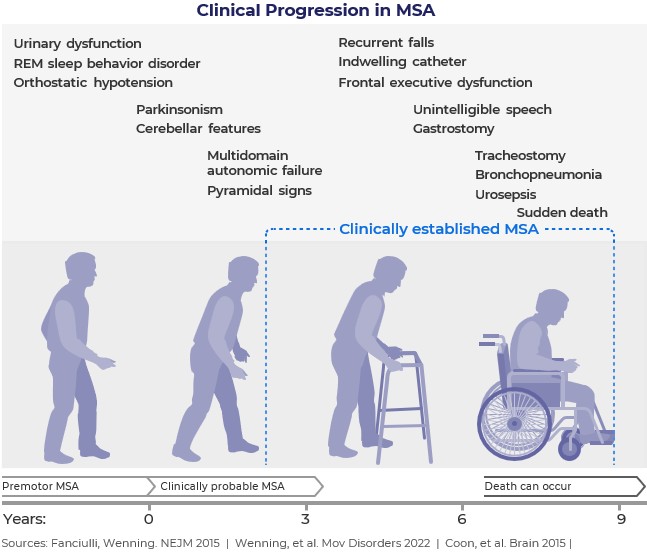
Because MSA is not well characterized in its early to moderate stages, Alterity conducted a natural history study called “Biomarkers of progression in Multiple System Atrophy (bioMUSE)” to track the progression of patients with MSA. The study was conducted in collaboration with Vanderbilt University Medical Center in the U.S. under the direction of Daniel Claassen, MD, Professor of Neurology and Principal Investigator. Natural history studies are important for characterizing disease progression in selected patient populations. The study provided vital information on the typical progression of disease in individuals with MSA, enabling the selection of biomarkers suitable for identifying study participants for treatment studies as well as evaluating target engagement of drug candidates.
Parkinson’s Disease
Parkinson's disease (PD) is the second most common neurodegenerative disorder after Alzheimer's disease and causes unintended or uncontrollable movements of the body along with neuropsychiatric and other non-motor features. The cause of PD is unknown in the majority of patients, as approximately 10 percent are thought to occur from a combination of genetics and environmental factors that trigger the disease. In PD, brain cells become damaged or die in the substantia nigra, the part of the brain that produces dopamine, a chemical needed to produce smooth, purposeful movement. The cardinal symptoms of PD are tremors, rigidity, slowing of movements, and later in disease, impaired balance. Other symptoms may include difficulty swallowing, chewing, or speaking; emotional changes; urinary problems or constipation; dementia or other cognitive problems; fatigue; and problems sleeping. Existing therapies, such as dopaminergic agents, may provide symptomatic relief, but do not address the underlying pathology of the disease.
According to the Parkinson’s Foundation, nearly one million people in the U.S. and more than 10 million people worldwide are living with PD. Approximately 60,000 Americans are diagnosed with PD each year.
Friedreich’s Ataxia
Friedreich’s ataxia (FA) is a rare, genetic disorder that causes progressive multisystem damage to the heart, nervous system, and musculoskeletal system. FA is caused by mutation in frataxin, a mitochondrial protein important in the regulation of iron chaperoning, detoxification, and storage. This mutation can lead to movement and sensory symptoms and trouble with walking and gait. In FA, nerve fibers in the spinal cord and peripheral nerves break down, becoming thinner. In the brain, the cerebellum, which coordinates balance and movement, is most affected.
Alzheimer’s disease
Alzheimer's disease is a progressive neurologic disorder that causes the brain to shrink (atrophy) and brain cells (neurons) to die. Alzheimer's disease is the most common cause of dementia — a continuous decline in thinking, behavioural, and social skills that affects a person's ability to function independently. Approximately 5.8 million people in the United States age 65 and older live with Alzheimer's disease. Of those, 80% are 75 years old and older. Out of the approximately 50 million people worldwide with dementia, between 60% and 70% are estimated to have Alzheimer's disease. Medications may temporarily improve or slow progression of symptoms, but there is no treatment that cures Alzheimer's disease or alters the disease process in the brain. In advanced stages of the disease, complications from severe loss of brain function, such as dehydration, malnutrition or infection, result in death.
PBT2 was our product candidate for Alzheimer’s disease. The drug candidate is orally bioavailable and has been shown to cross the blood-brain barrier. While PBT2 was found to be well tolerated in Phase 1 and Phase 2a trials, a Phase 2 trial did not meet its primary endpoint and the program was ended.
In March 2023, we announced a sub-licensing agreement for PBT2 to Professor Colin Masters, M.D., A.O., to advance compounds for the treatment of Alzheimer’s and related diseases. Under the license agreement, Professor Masters was granted the entire rights to the acyl hydrazone patent protecting novel zinc modulators mentioned above, as well as an exclusive worldwide license to develop and commercialize both the novel zinc modulators and PBT2 in Alzheimer’s disease. In exchange, we are entitled to future royalties of net sales, if any, from the assets.
Huntington’s Disease
Huntington's disease (HD) is a genetic disease that causes nerve cells (neurons) in parts of the brain to gradually break down and die. The disease attacks areas of the brain that help to control voluntary (intentional) movement, as well as other areas. People living with HD develop uncontrollable dance-like movements (chorea) and abnormal body postures, as well as problems with behavior, emotion, thinking, and personality. As HD progresses, the person's movements can become more extreme. Symptoms of HD typically appear in middle-aged people (adult HD). They can also appear in children (juvenile HD), but this is rare.
PBT2 was also evaluated as a treatment for Huntington’s disease. Preclinically, PBT2 has demonstrated efficacy in the R6/2 mouse model of Huntington disease. In 2012, a Phase 2 trial to test PBT2 in patients with Huntington disease over six months was undertaken under a U.S. IND application, achieved its primary objective, and demonstrated that PBT2 was safe and well tolerated. In 2015, we reported that the FDA had placed PBT2 on Partial Clinical Hold based on toxicology findings that limited the dose of PBT2 that could be used in future trials.
Non-neurodegenerative applications
Antibiotic Resistance
Antibiotic resistance occurs when bacteria mutate and evolve to survive the drugs designed to kill them. This process is accelerated by the overuse and misuse of antibiotics. Resistant infections are dangerous and difficult to treat. Alterity’s PBT2 has been combined with commonly used antibiotics to treat infections caused by multidrug resistant bacteria. A published article in the high-impact journal Science Translational Medicine, showed that PBT2 could reverse antibiotic resistance to critical superbugs and demonstrate efficacy in an animal model of sepsis.
Clinical Trials for Our Product Candidates
Our Current Pipeline
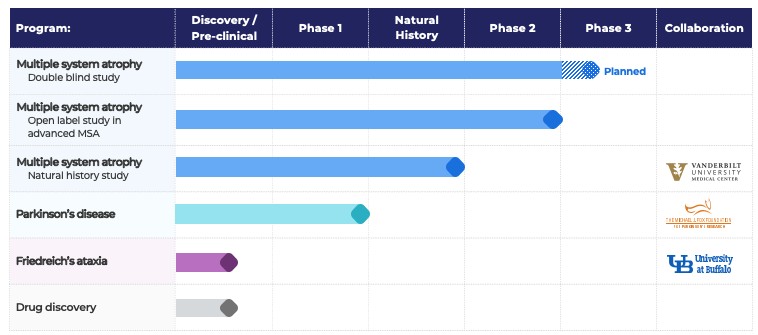
ATH434
Alterity’s lead candidate, ATH434, is an oral small molecule drug candidate, designed to inhibit the aggregation of pathological proteins implicated in neurodegeneration. Since 2011, we have continually progressed our understanding of the mechanism of action of ATH434 and its potential to treat movement disorders characterized by the aggregation of α-synuclein.
ATH434 targets two key drivers of MSA pathology: aggregating α-synuclein and dysregulated iron. Normally, the α-synuclein protein, which is present in all neurons, enables neuronal communication. In diseases such as MSA and Parkinson's disease, α-synuclein aggregates in neurons impairing communication and leading to dysfunction. In the central nervous system, iron is important for neurotransmitter synthesis (e.g., dopamine) and myelin synthesis (allows fast signal transmission). In biological systems, iron exists in two forms (the reactive form [Fe2+] and the stable form [Fe3+]) and cycles between these forms in normal physiology. However, in disease states like MSA and Parkinson’s disease, there is increased iron in areas of pathology, and the excess reactive iron drives pathology by causing α‐synuclein aggregation and oxidative injury.
As an iron chaperone, ATH434 binds excess reactive iron and redistributes it to reduce neuronal injury. It can achieve this redistribution through three complementary mechanisms: promoting efflux iron from the cell (via ferroportin), increasing iron storage in the cell (ferritin), and buffering Fe2+ within the cell (in the labile iron pool).
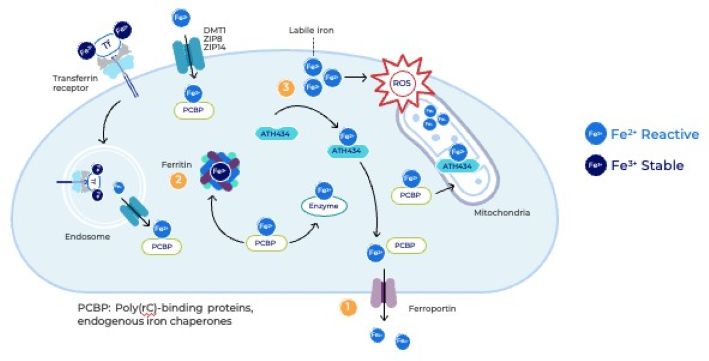
ATH434 has been shown preclinically to reduce α-synuclein pathology and preserve nerve cells by restoring normal iron balance in the brain. In this way, it has potential to treat Parkinson’s disease and related disorders such as MSA.
In July 2021, Plos ONE published an in vitro study concluding that the novel mechanism of action of ATH434 provides a compelling case for its continued development as a therapeutic agent in neurodegenerative diseases associated with iron accumulation.
In November 2024, the peer-reviewed journal Metallomics published data on the importance of iron and iron-targeting agents like ATH434 to treat neurodegenerative diseases. The publication, entitled “ATH434, a promising iron-targeting compound for treating iron regulation disorders”, demonstrates the novel way in which ATH434 targets the labile, or reactive, form of iron which can be so damaging to cells when in excess. The iron binding properties of ATH434 presented in the publication support the characterization of ATH434 as an iron chaperone. The publication also describes how ATH434 targets the reactive form of iron that drives the pathology of the neurodegenerative disease, Friedreich’s Ataxia. This reactive form of iron is also involved in the pathogenesis of Parkinson’s disease and MSA.
In September 2025, we announced the outcome from our independent commercial assessment for ATH434 that results in a potential worldwide peak sales opportunity in MSA of U.S.$2.4 billion, if approved.
ATH434 Regulatory designations
In January 2019, Alterity was granted Orphan Drug designation from the US FDA for the proposed use of ATH434 for the treatment of MSA. Orphan designation entitles Alterity to seven years of market exclusivity following approval for the use of ATH434 in the treatment of MSA and qualifies the sponsor of the drug for various development incentives of the Orphan Drug Act, including tax credits for qualified clinical testing.
In January 2020, Alterity was granted Orphan Drug designation from the European Commission, or EC for ATH434. Orphan designation entitles Alterity to ten years of market exclusivity in the European Union, or EU, for the use of ATH434 in the treatment of MSA and other benefits including assistance in developing clinical protocols, reduced fees and regulatory access.
In May 2025, Alterity was granted Fast Track designation by the US FDA for ATH434 in MSA based on trial data. The Fast Track Designation is intended to facilitate and expedite the development and review of new drugs for serious conditions with unmet medical needs.
Preclinical Studies
A comprehensive nonclinical program to evaluate ATH434’s profile to support clinical development is ongoing. ATH434 has also been profiled in mouse models of Parkinsonian disorders, including MSA. In one animal model, ATH434 prevented α-synuclein aggregation and preserved neurons in the substantia nigra and decreased the number of glial cell inclusions in the brains of treated animals. Glial cell inclusions are the pathological hallmark of MSA and contain abundant aggregated α-synuclein that is associated with neurodegeneration. The benefits shown on pathological examination were associated with improved motor function in treated animals. Nonclinical safety pharmacology and toxicology studies of ATH434 that have been reviewed by regulatory authorities support clinical administration at doses predicted to provide efficacy in MSA.
In June 2021, Movement Disorders, published results from a study demonstrating that ATH434 reduces α-synuclein-related neurodegeneration in a widely accepted murine model of MSA. The study was performed at the Laboratory for Translational Neurodegeneration Research, Department of Neurology, Medical University of Innsbruck in Austria, a leading laboratory of animal research in MSA, under the direction of Professor Nadia Stefanova. The pre-clinical study showed that treatment with ATH434 was neuroprotective and improved motor function.
In January 2022, data in an animal model of MSA was published in the Journal of Parkinson’s Disease. The publication, entitled, “The Compound ATH434 Prevents Alpha-Synuclein Toxicity in a Murine Model of Multiple System Atrophy” described a study evaluating the efficacy of ATH434 in genetically altered mice that develop manifestations of MSA. The investigation demonstrated that in the studied brain region, ATH434 treatment reduced both the toxic oligomeric and aggregated forms of α-synuclein, a central nervous system protein important for normal function of nerve cells. ATH434 treatment also reduced the cardinal pathology of MSA (glial cell inclusions), reduced brain iron, preserved neurons, and improved motor performance. The results independently confirmed the previous findings from a study published in Movement Disorders in 2021. The 2022 publication concluded that ATH434 is a promising small molecule drug candidate that has potential for treating MSA. The study was led by David I. Finkelstein, Ph.D., Head of Parkinson’s Disease Laboratory at the Florey Institute of Neuroscience and Mental Health and the University of Melbourne.
Phase 1 Clinical Trial
We successfully completed Phase 1 clinical studies with ATH434 demonstrating that it is well tolerated, orally bioavailable, and achieves brain levels in humans comparable to efficacious levels in animal models of MSA. In July 2019 we announced the completion of a clinical trial evaluating the safety and pharmacokinetics of ATH434 in healthy volunteers. The Phase 1 study, conducted in Australia, recruited 80 adult volunteers which included ten elderly people (over 65 years) with the key goals of assessing the safety, tolerability and drug disposition within the body (pharmacokinetics) of ATH434 after single and multiple oral dose administration.
The volunteers in the single ascending dose phase of the study, made up of four individual dose levels in ascending order, received a single oral dose of ATH434 and a blood sampling over the next 72 hours. In the multiple ascending dose phase of the study, volunteers received eight days dosing with ATH434, administered as three successively higher dose levels, with intensive blood sampling for pharmacokinetics on days 1 and 8. At the two highest multiple dose levels, cerebrospinal fluid was collected at steady state to determine drug penetration to the site of action in the brain. The older adults (≥65 years) received the highest dose level for 8 days as well. The study was successfully completed with systemic exposure to the drug comparable between adult and older adult volunteers. ATH434 was found to be safe and well tolerated. Adverse event rates were found to be comparable with placebo, and no subject experienced a serious adverse event or an adverse event that led to discontinuation of the study drug. The clinical data were presented at medical meetings with abstracts published in the journals Neurology and Movement Disorders.
Overview of MSA Phase 2 Clinical Program
Based on the promising results from our Phase 1 trial, we ran a comprehensive Phase 2 clinical development program to better understand MSA and conduct studies in participants at two levels of disease severity. Collectively, the positive results from the Phase 2 program support ATH434’s favourable safety profile and its potential utility in addressing the underlying pathology of MSA across a spectrum of disease severity. ATH434 is now a Phase 3-ready asset.
ATH434-201 Phase 2 Clinical Trial
In July 2022, we commenced our first Phase 2 clinical trial of ATH434 in patients with MSA. The trial, known as ATH434-201, is a randomized, double-blind, placebo-controlled investigation that explored the effect of ATH434 treatment on clinical and biomarker endpoints. Activity in the outpatient setting was assessed with wearable movement sensors. The study was expected to enrol 60 adult patients with MSA to receive 12 months of treatment with one of two dose levels (50 mg and 75 mg twice daily) of ATH434 or matching placebo. In November 2023, we announced completion of enrollment in the ATH434-201 clinical trial. The study enrolled 77 adults with MSA.
In May 2024, we announced that an independent Data Monitoring Committee (DMC) completed its third prespecified review of unblinded clinical trial data from the ATH434-201 Phase 2 study. Consistent with the first two reviews, the DMC expressed no concerns about safety and recommended that the study continue as planned without modification. This recommendation is an important milestone as participants were able to safely tolerate ATH434 as their time on study increased.
In December 2024, we reported the completion of the ATH434-201 study as the last patient finished all clinical evaluations leading to the announcement of the topline results.
In January 2025, we announced topline results for the trial and have since presented additional data supporting the efficacy of ATH434 in the treatment of MSA. ATH434 was well tolerated with no serious adverse events related to ATH434 reported, and most adverse events were mild to moderate in severity.
ATH434 demonstrated significant slowing of clinical progression and a favorable safety profile in MSA. The results show that ATH434’s targeting of labile iron may have a disease-modifying effect. The fact that we achieved statistical significance on the key clinical endpoint, Modified Unified MSA Rating Scale Part 1 (UMSARS Part 1), is extremely meaningful because it assesses the functional areas affected in MSA and it is the endpoint needed to support drug approval by the FDA.
In May 2025, additional analyses evaluated the clinical analysis population (n=71) who had at least one post-baseline assessment of the key clinical endpoint, the modified UMSARS part I activities of daily living scale. On this endpoint, ATH434 demonstrated a clinically significant reduction in disease severity versus placebo, with a 48% relative treatment effect at the 50 mg dose (p=0.02) and a 30% relative treatment effect at the 75 mg dose at 52 weeks.
Additional efficacy assessments showed improvement consistent with the UMSARS I findings. The Clinical Global Impression of Severity Scale demonstrated improvement compared to placebo at both dose levels, with the difference at 50 mg achieving nominal statistical significance (p=0.0088). On the Orthostatic Hypotension Symptom Assessment (a patient-reported outcome), on average, placebo patients worsened by approximately 6 points over 52 weeks whereas both ATH434 treatment groups improved over the same period (p=0.08 at 50 mg, p=0.14 at 75 mg). Baseline differences in disease severity largely explain the different responses in 50 mg and 75 mg dose levels.
Increased activity in the outpatient setting was observed at both dose levels as compared to placebo as measured by the wearable sensors utilized in the trial, with clinically meaningful improvements in step count, episodes of walking, total walking time, and sit-to-stand transitions. ATH434 was well tolerated with similar adverse event rates compared to placebo and no serious or severe adverse events attributed to ATH434. Regarding neuroimaging data in 61 participants, ATH434 demonstrated target engagement by stabilizing or reducing iron accumulation at both dose levels compared to placebo in MSA-affected brain regions. In addition, ATH434 demonstrated trends in reducing brain atrophy at both dose levels compared to placebo.
In November 2025, we presented additional data on the baseline characteristics and analyses related to orthostatic hypotension (OH). OH is a form of low blood pressure that occurs when a person stands up from a sitting or lying position, resulting in symptoms like dizziness, lightheadedness, or fainting. OH is one of the most debilitating symptoms of MSA and its severity is a predictor of rapid disease progression. In the trial, severe OH was defined as a sustained decrease in systolic blood pressure > 30mm Hg after three minutes of standing. Baseline data from the trial revealed that severe OH was substantially higher in the 75 mg dose group at 29.2% of participants, versus 4% in the 50 mg arm and 4.5% in the placebo arm. When orthostatic blood pressure change was used as a covariate in the analysis of the UMSARS I at 52 weeks, the efficacy signal in 75 mg dose group strengthened from -2.4 to -2.8 points, improving the relative treatment effect from 30% to 35%. This baseline difference in severe OH largely explains the different responses in the 50 mg and 75 mg treatment groups.
In May 2026, new analyses of ATH434-201 brought together clinical, biomarker, and imaging evidence that support ATH434’s impact on slowing MSA progression. New data were presented on cerebrospinal fluid neurofilament light chain (CSF NfL), which is an established prognostic biomarker of clinical decline in MSA and was prespecified as a disease-severity covariate in the trial. There were several key outcomes: (1) ATH434 slowed functional decline in MSA: a significant effect at 50 mg BID (−4.0 points, p=0.035; ~48% slowing) and a consistent directional trend at 75 mg BID. Combined active treatment arms significantly slowed UMSARS I progression versus placebo (p=0.047); (2) CSF NfL is a meaningful prognostic covariate: higher baseline CSF NfL predicted greater UMSARS-I worsening (β=0.90, p=0.033). Adjusting for the biomarker at baseline strengthened detection of treatment effects and supports the use of CSF NfL for stratification in future trials; (3) imaging supports the iron-chaperone mechanism of ATH434: QSM demonstrated trends of reduced iron accumulation in the putamen and globus pallidus consistent with the iron-chaperone mechanism of action; the dentate nucleus signal increase is consistent with glymphatic iron redistribution from the basal ganglia; (4) ATH434 is a promising potential disease-modifying therapy: convergent clinical, biomarker, and imaging signals support continued development.
In May 2026, new analyses demonstrated that ATH434 decouples iron accumulation from clinical progression, reinforcing its role as an iron chaperone. New data on the impact of ATH434 on swallowing were also presented, demonstrating that ATH434 reduced the progression of this key MSA symptom compared to placebo. Swallowing impairment was assessed with the 15-item Swallowing Disturbance Questionnaire (SDQ), a validated patient-reported outcome. Over 52 weeks of treatment, placebo patients worsened by a mean adjusted increase score of 8.5 points as compared to an increase of 1.2 and 5.0 points for the 50 mg and 75 mg groups, respectively, with the mean adjusted difference at 50 mg achieving statistical significance (p=0.003).
Multiple oral and poster presentations have been delivered on the ATH434-201 trial at medical conferences globally.
ATH434-202 Phase 2 Clinical Trial
In May 2023, we initiated a second Phase 2 clinical trial entitled, “A Biomarker Study of ATH434 in Participants with MSA,” known as ATH434-202. The biomarker trial was a single-arm, open-label study that enrolled up to 15 individuals with more advanced MSA than participants in the 201 trial. ATH434-202 study participants received treatment with ATH434 for 12 months. The study was designed to assess the effect of ATH434 treatment on clinical and biomarker endpoints, safety, and pharmacokinetics. The selected biomarkers include brain iron, which is an important contributor to MSA pathology. The primary objective of this study was to evaluate the impact of 12 months of treatment with ATH434 on brain iron by MRI (QSM/R2*).
The 202 study gave us the opportunity to evaluate the effects of ATH434 treatment in an MSA population more advanced than individuals enrolled in the ATH434-201 study. Individuals with more advanced disease face severe challenges due to the stage of their illness. Data from this study helped Alterity guide the MSA development program given the differences between the open-label and the double-blind trials.
In July 2024, we reported positive interim data from the ATH434-202 trial in participants with advanced MSA. The interim analysis included clinical and biomarker data on 7 participants treated with ATH434 for 6 months and neuroimaging data on 3 participants who were treated for 12 months. After 6 months of treatment, 43% of participants showed improvement on the UMSARS, indicating reduced disability on activities of daily living. Over the same period, 29% of participants had stable or improved neurological symptoms (clinical responders) as assessed by the global impression of change by both the treating physician and the patient. The clinical responders on average had reduced accumulation of iron on MRI in the substantia nigra, putamen and globus pallidus and stable levels of Neurofilament Light Chain (NfL), a marker of axonal injury, when compared to participants who declined.
In September 2024, we presented positive interim data from the ATH434-202 trial as both a late-breaking oral presentation and poster session entitled “Preliminary Efficacy and Safety of ATH434 in Multiple System Atrophy” at the International Congress of Parkinson’s Disease and Movement Disorders (MDS) meeting.
In March 2025, we announced that the last patient in the ATH434-202 Phase 2 trial completed the study. In July 2025, we reported positive topline data that showed ATH434 conferred a clinical benefit on areas of impairment in MSA and stabilized key biomarkers that underpin the pathology of the disease. Based on the observed clinical and neuroimaging data, ATH434 improved overall neurological symptoms and slowed disease progression compared to historical data.
Over the 12-month treatment period, disease progression as assessed with UMSARS I was reduced by approximately half as compared to historical controls. The mean (SD) UMSARS scores increased from baseline to 12 months by 3.5 (4.7) points. These study data compare favorably to historical data in a similar MSA population, where an increase (worsening) of 6.5 (6.0) points over 12 months was observed. Regarding disease severity, 43% (3/7) of participants who completed the study had stable UMSARS scores. In addition, 30% of participants reported stable neurological symptoms over the course of the study. On the important symptom of orthostatic hypotension, ATH434 on average stabilized low blood pressure symptoms in study participants.
Biomarker endpoints were used to evaluate potential drug effects and target engagement. Neuroimaging outcomes indicate that ATH434 slowed brain atrophy in MSA-affected areas, as measured by the MSA Atrophy Index (MSA-AI), when compared to placebo-treated participants in Study 201. Moreover, the effects on brain volume were comparable to those observed in participants receiving the same dose level in Study 201. In addition, ATH434 led to lower iron accumulation in the putamen and globus pallidus as compared to placebo-treated patients in Study 201, providing further evidence of target engagement.
ATH434 was well tolerated with no serious adverse events related to ATH434 reported, and most adverse events were mild to moderate in severity.
Importantly, the aggregate data indicate that ATH434 has similar clinical efficacy in this advanced MSA population as was observed in the less severely impaired participants in Study ATH434-201. These outcomes are potentially promising as stabilization of MSA symptoms is unexpected in this patient population.
bioMUSE Natural History Study
Biomarkers of progression in Multiple System Atrophy (bioMUSE) was a natural history study to track the progression of individuals with early MSA. The study was conducted in collaboration with Vanderbilt University Medical Center in the US under the direction of Daniel Claassen, MD, Professor of Neurology and Principal Investigator. Natural history studies are important for characterizing disease progression in target patient populations. The goal of the bioMUSE observational study was to optimize patient selection and choose endpoints in our Phase 2 clinical trials, and the data generated was invaluable in informing and reducing risk in these trials.
In May 2024, we hosted a webinar to discuss data from the bioMUSE Natural History Study. The study enrolled 21 individuals who were observed for 12 months to characterize early-stage MSA in terms of various biomarkers. In particular, the focus is on brain iron, brain volume, and the pathology in glial support cells. Utilizing novel MRI technology, Alterity’s partners at Vanderbilt have optimized specialized MRI methods, including machine learning (a form of artificial intelligence), to establish standardized methods to analyze brain iron and brain volumes with precision. Importantly, they developed a novel imaging biomarker to assess brain volume in MSA-affected regions. The bioMUSE data showed a statistically significant increase in iron over 12 months in the substantia nigra and statistically significant decreases in brain volume observed in affected regions at 12 months.
The study generated important scientific data validating our state-of-the-art approach to utilizing various biomarkers to improve the accuracy of diagnosing MSA. Advanced MRI methods employed in the study, referred to as quantitative susceptibility mapping (QSM), have allowed us to measure iron accumulation in multiple areas of the brain affected in MSA patients. Similarly, standardized methods have been established to analyze brain volumes with precision.
Findings indicated that advanced MRI methods for measuring iron may improve patient selection in clinical trials of disease-modifying therapy and have potential to serve as a biomarker for assessing treatment-induced changes. Analysis also demonstrated that wearable sensors could quantify outpatient activity in individuals with MSA in a real-world setting, distinct from neurological examination assessments. This means that wearable sensors can be used to assess functional motor performance in MSA clinical trials.
In July 2025, the novel, innovative neuroimaging measure developed in bioMUSE was featured in the peer-reviewed journal Annals of Clinical and Translational Neurology. The publication, entitled “The MSA Atrophy Index (MSA-AI): An Imaging Marker for Diagnosis and Clinical Progression in Multiple System Atrophy,” describes how deep learning methods, a form of artificial intelligence, were used to precisely define the neuroanatomy of key regions in the brain and the development of a novel brain atrophy measure for tracking disease progression in MSA patients over one year. The results were then correlated with clinical measures of disease severity over the same timeframe.
In May 2026, data from the bioMUSE study was published in the peer-reviewed journal, NeuroImage, a leading journal in human brain imaging, entitled “Quantitative Imaging of Iron Dysregulation in Multiple System Atrophy”. The publication showed that quantitative susceptibility mapping (QSM) MRI can detect disease-specific iron accumulation in the brains of patients with MSA, distinguish MSA from Parkinson’s disease, and track clinical disease severity — including in early-stage disease.
Multiple oral and poster presentations have been delivered on the bioMUSE natural history study at medical conferences globally.
Phase 3 Clinical Trial Planning in MSA
In preparation for Phase 3 in MSA, we executed a multidisciplinary strategy to seek alignment with the FDA on development activities to support our pivotal trial in MSA.
We held two Type C meetings with the FDA regarding our planned Phase 3 development program for ATH434 in MSA. In March and April 2026, we received written feedback from two Type C meetings supporting our plans related to: 1) clinical pharmacology and non-clinical development elements and 2) the chemistry, manufacturing, and control (CMC) elements of the program. We have also successfully manufactured our first registration batch of ATH434 under Good Manufacturing Practice (GMP) for use in the pivotal Phase 3 clinical trial.
In July 2026, we announced that we received the official meeting minutes from our End-of-Phase 2 (EOP2) meeting for ATH434 in MSA from the FDA, which was held in June 2026. The EOP2 minutes confirmed that the FDA agreed with the proposed Phase 3 trial design, including the study population, treatment regimen, and efficacy endpoints. Alignment was reached on the selection and analysis of the primary endpoint ‒ the 11-item UMSARS Part I rating scale, a functional measure of activities of daily living affected in MSA. Agreement was also reached on selection of key secondary endpoints, including the Swallowing Disturbance Questionnaire (SDQ), the Orthostatic Hypotension Symptom Assessment (OHSA), and the Clinical Global Impression of Severity (CGI-S).
The FDA further indicated that a single pivotal trial plus confirmatory evidence could provide the necessary data to support an approval of ATH434 for the treatment of MSA. We expect that the data from our ATH434-201 Phase 2 clinical trial will provide the required confirmatory evidence. The FDA also indicated that the anticipated size of our safety database at the conclusion of Phase 3 was reasonable. A single pivotal trial provides an efficient route to completing the clinical development program and potentially filing an NDA, both in terms of time and resources required. We also plan to offer an open-label extension to participants who complete the Phase 3 trial to continue their treatment and enhance the safety database for ATH434.
The Phase 3 study is expected to enroll approximately 200 patients who will be randomized in a 1:1 ratio and treated with ATH434 50 mg or matching placebo twice daily for 12 months. With the Phase 3 design elements confirmed, we are finalizing the protocol and expect to initiate Phase 3 trial activities by year-end 2026.
Parkinson’s Disease
During 2009 and 2010, ATH434 data in Parkinson’s disease emerged demonstrating significant improvement in motor function and coordination in animal models. Importantly, ATH434 demonstrated improved relevant indices when administered after toxins had destroyed significant amounts of substantia nigra nerve cells, indicating that the compound can preserve neuronal function. Mechanistic work during this period demonstrated that ATH434 reduced the aggregation of toxic α-synuclein species as well as markers of oxidative stress.
Our non-clinical research and development activities in Parkinson’s disease were supported by a USD $206,000 grant from the New York-based Michael J. Fox Foundation entitled, ‘ATH434, a Novel Neuroprotective Drug For Parkinson’s Disease; Completion of Pre-Clinical Studies to Enable Human Clinical Trials’.
In 2017, Doctors Finkelstein, Cherny and colleagues published data indicating that ATH434 prevented cell death in the substantia nigra in a dose-dependent manner. The data also demonstrated the therapeutic potential of ATH434 to slow neurodegeneration in multiple Parkinson’s disease models, including a transgenic model of Parkinson’s disease (A53T) in which mice overexpressed the α-synuclein protein. In A53T mice, animals treated with ATH434 exhibited significantly increased numbers of substantia nigra neurons and a significant reduction in insoluble α-synuclein and the incidence of clasping behaviour. Encouragingly, these results showed that ATH434 lowered α-synuclein, preserved neurons, and simultaneously improved motor performance. The paper was entitled, “The novel compound ATH434 prevents iron-mediated neurodegeneration and α-synuclein toxicity in multiple models of Parkinson’s disease” and was published in Acta Neuropathol Comm.
In February 2021, the Michael J. Fox Foundation awarded Alterity a second grant, entitled “Pharmacologic Evaluation of ATH434 in a Hemiparkinsonian Nonhuman Primate Model for Dose Optimization in PD Clinical Trials” in the amount of USD $495,000. The goal of the study was to evaluate the pharmacologic profile of ATH434 for determining the optimal doses of ATH434 for future Parkinson’s disease clinical trials. The study was completed in late 2023 and demonstrated that both doses of ATH434 studied improved motor performance and general function in monkeys with experimentally induced Parkinson’s disease. The favorable impact on Parkinson’s symptoms was associated with lower iron levels in the area of pathology. In addition, ATH434 treatment increased levels of synaptophysin, a protein marker that reflects functional connections between neurons.
Multiple publications have been issued, and oral and poster presentations have been delivered on ATH434 in Parkinson’s disease at medical conferences globally.
Friedreich’s Ataxia
Friedreich’s Ataxia (FA) is a potential future indication for ATH434. In April 2024, a poster was presented at the World Orphan Drug Congress, entitled “Biophysical Characteristics of ATH434, a Unique Iron-Targeting Drug for Treating Friedreich’s Ataxia”. The study evaluated the ability of ATH434 to target the toxic form of iron that drives the pathology of FA and confirmed that ATH434 has properties consistent with an iron chaperone designed to bind and redistribute iron within the body. The study was published in the peer-reviewed journal Metallomics entitled “ATH434, a promising iron-targeting compound for treating iron regulation disorders”.
Patents and Licenses
Patent Matters
Patent matters in biotechnology are highly uncertain and involve complex legal and factual questions. Accordingly, the availability and breadth of claims allowed in biotechnology and pharmaceutical patents cannot be predicted. Statutory differences in patentable subject matter may limit the protection we can obtain on some or all of our inventions outside Australia or prevent us from obtaining patent protection outside Australia, either of which could adversely affect our business, financial condition and results of operations. For example, methods of treating humans are not patentable in many countries outside Australia and the United States. Moreover, since patent applications are not published until at least 18 months from their first filing date and the publication of discoveries in the scientific literature often lags behind actual discoveries, we cannot be certain that we or any of our licensors were the first creator of inventions covered by pending patent applications or that we or our licensors were the first to file patent applications for such inventions. Additionally, the grant and enforceability of a patent is dependent on a number of factors that may vary between jurisdictions. These factors may include the novelty of the invention, the requirement that the invention not be obvious in the light of prior art (including prior use or publication of the invention), the utility of the invention, and the extent to which the patent specification describes the invention including the best method of working the invention.
While we intend to seek patent protection for our therapeutic candidate products and technologies, we cannot be certain that any of the pending or future patent applications filed by us or on our behalf will be granted, or that we will develop additional proprietary products or processes that are patentable or that we will be able to license any other patentable products or processes. We also cannot be certain that others will not independently develop similar products or processes, duplicate any of the products or processes developed or being developed by us or licensed to us, or design around the patents owned or licensed by us, or that any patents owned or licensed by us will provide us with competitive advantages. Furthermore, we cannot be certain that patents held by third parties will not prevent the commercialisation of products incorporating the technology developed by us or licensed to us, or that third parties will not challenge or seek to narrow, invalidate or circumvent any of the issued, pending or future patents owned or licensed by us.
Our commercial success will also depend, in part, on our ability to avoid infringement of patents issued to others. If a court of competent jurisdiction determines that we were infringing any third party patents, we could be required to pay damages or an account of profits, alter our products or processes, obtain licenses or cease certain activities. We cannot be certain that the licenses required under patents held by third parties would be made available on terms acceptable to us or at all. To the extent that we are unable to obtain such licenses, we could be barred from the development, export, manufacture or commercialisation of the product requiring such license or encounter delays in product introductions while we attempt to design acceptable alternatives to such patents, and any of these circumstances could adversely affect our business, financial condition and results of operations.
We may have to resort to litigation to enforce any patents issued or licensed to us or to determine the scope and validity of third-party proprietary rights. Such litigation could result in substantial costs and diversion of effort by us. We may have to participate in opposition proceedings before the Australian Patent and Trademark Office or another foreign patent office, or in interference proceedings declared by the U.S. Patent and Trademark Office, to determine the priority of invention for patent applications filed by competitors. Any such litigation, interference or opposition proceeding, regardless of outcome, could be expensive and time-consuming, and adverse determinations in any such proceedings could prevent us from developing, manufacturing or commercializing our products and could adversely affect our business, financial condition and results of operations.
In addition to patent protection, we rely on unpatented trade secrets, know-how and other confidential information as well as proprietary technological innovation and expertise. Although we have taken steps to protect our trade secrets and unpatented know-how, including entering into confidentiality agreements with third parties, and confidential information and inventions agreements with employees, consultants and advisers, third parties may still obtain this information or come upon this same or similar information independently.
Patent Portfolio
We have continued to advance our patent portfolio that aligns with our development programs. We previously reported the filing of a patent family claiming over 150 imidazo[l,5-a] pyridine compounds that modulate biological iron and are potentially useful for the treatment of neurological diseases such as Parkinson’s disease and Alzheimer’s disease. The patent was filed under the United States expedited review procedure, known as Track One, and we announced allowance of the United States application No. 16/818,641 on November 16, 2020 and its granting under patent No. 10,941,143 on July 1, 2021. In securing the patent grant, no prior art was cited against the application. A national phase application deriving priority from PCT application, No. PCT/AU2020/050235 was filed in September 2021 in each of Europe, Japan, China, Canada, Australia and India. On August 23, 2023, a European Patent was granted, patent number 3938364 (validated in Germany, Spain, France, UK and Italy). Appeal to rejections were filed for Japanese patent application No. 2021-555436 in March and December 2025. Following responses to examination reports, the patent was granted in Australia as patent No. 2020243376 in December 2025.
We also previously reported that on June 18, 2020, we filed an Australian provisional application to register a patent that claims an additional 80 novel compounds, also that modulate biological iron and also titled “Compounds for and Methods of Treating Diseases”. This application matured to a PCT application No. PCT/AU2021/050633 on June 18, 2021. Similar to the first mentioned patent application, contemporaneously with filing the PCT application on April 23, 2021, we also filed United States complete application No. 17/239,375, under Track One. We announced allowance of the United States application on August 4, 2021, and in securing the allowance, no prior art was cited against the application. On October 26, 2021, the application was granted as US patent no. 11,155,547. The application is currently under examination in Europe. An application filed in Australia was accepted (allowed) in June 2026 and is expected to be granted as patent No. 2021290449 in October 2026. The patent was granted in Japan as patent No. 7849309 in May 2026.
On August 27, 2021, we filed a PCT application No. PCT/AU2021/050986 to register a patent that claims an additional 150 novel compounds, all of which modulate biological Zinc for the potential treatment of cancer, neurological diseases and infectious diseases, and is titled “Compounds for and Methods of Treating Diseases”. On the same date we also filed a United States complete application, application No. 17/459854, under United States Track One expedited review procedure. The patent was granted in the US on February 23, 2023, patent number 11,603,364. This patent was transferred to Adjuvant Therapeutics in March 2023 as noted above.
On September 24, 2023, we filed provisional application No. 63/584,790 in the USA to register a patent that claims a method of use of ATH434 and related compounds in non-neurologic diseases. The application matured to PCT application No. PCT/AU2024/051009 in September 2024. The application entered the national phase in US (application No. 19/521,017), EP (application No. 24866682.8) and Australia (application No. 2024346683) in March 2026.
On July 12, 2024, we filed a US provisional application No. 63/670,299 to register a patent that claims a dosing method for use by ATH434 for the treatment of neurological disease supported by clinical data. A second, complementary US provisional application No. 63/748,706 was filed in January 2025. The provisional applications together matured to PCT application No. PCT/AU2025/050750 filed on July 11, 2025.
On July 31, 2024, we filed an Australian provisional application with No. 2024902369 claiming 39 novel compounds potentially useful for the treatment of neurological and non-neurological diseases. The application lapsed and was refiled as a provisional application in July 2025. This application will again be allowed to lapse and will be refiled when additional data are available to support the claims.
On July 12, 2024, we filed an Australian provisional application No. 2025900800 to register a patent that claims a novel salt form (HCl) and crystalline form of ATH434 potentially useful for the treatment of neurological diseases. The application was filed as PCT application No. PCT/AU2025/050743 on July 10, 2025.
On March 14, 2025, we filed an Australian provisional application No. 2025900806 to register a patent that claims a novel salt form (mesylate) and crystalline form of ATH434 potentially useful for the treatment of neurological diseases. The application was filed as a US Track One application No. 19/296,290 on August 11, 2025. The application was also filed as PCT application No. PCT/AU2026/050224 on March 13, 2026. We announced granting of the United States application on August 11, 2026, and in securing the allowance, no prior art was cited against the application. The application was granted as US patent no. 12,703,688.
| Patent |
Status |
Invention |
||
| “8-Hydroxyquinoline Derivatives” Filed: July 16, 2003 PCT/AU03/00914 |
Patent in the USA has been Granted. |
The invention is directed to chemical scaffolds of the 8-Hydroxyquinoline compounds class and their utility in the treatment of neurological conditions. |
||
| “Quinazolinone compounds” Filed: December 24, 2008 PCT/AU2009/001701 |
Patents have been Granted in Australia, the USA, Germany, Spain, France, United Kingdom, and Italy. | The invention is directed to 2,3 disubstituted quinazolinone compounds used in the treatment of Parkinson’s Disease. |
||
| “Method of treating immunoglobulin light chain amyloidosis” Filed: July 1, 2016 PCT/AU2017/050678 |
Patent in the USA and Japan have been Granted. |
The invention is directed to the treatment of light chain amyloidosis with a known compound. |
||
| “Compounds for Methods of Treating Diseases” Filed: March 13, 2020 PCT/AU2020/050235 |
A US and an AU patent have been Granted. Patents have also been Granted in Germany, Spain, France, United Kingdom, and Italy. Examination processes are underway in Japan. |
The invention is directed to 150 novel compounds and their utility in the treatment of neurodegenerative diseases. |
||
| “Compounds for Methods of Treating Diseases” Filed: June 18, 2021 PCT/AU2021/050633 |
A US, an AU and a Japanese patent have been Granted. The filed application is in the exam process in EP. | The invention is directed to 80 novel compounds and their utility in the treatment of neurodegenerative diseases |
||
| “Novel Therapy” Filed: September 24, 2023 PCT/AU2025/051009 |
Non-provisional PCT application filed. National phase applications have been filed in US, Australia and Europe. | This invention is directed to method of use of ATH434 and related compounds in non-neurologic diseases. Co-inventorship with personnel from State University of Buffalo in New York (USA). |
||
| “Novel Therapy” Filed: July 12, 2024, amended Jan 2025 PCT/AU2025/050750 |
Non-provisional PCT application filed with results from ATH434-201 and 202. |
This invention is directed to clinical method of dosing of ATH434 in neurological disorders such as Multiple System Atrophy. |
||
| “Compounds for and Methods of Treating Disease” Filed: July 31, 2024 PCT application No. 2024902369 |
Provisional application will lapse and be refiled when more data are available. | This invention is directed to 39 novel compounds and their utility in the treatment of neurodegenerative diseases. | ||
| “Novel Salt and Crystalline Form” Filed: Mar 14, 2025 PCT/AU2025/050743 |
Non-provisional PCT application filed | This invention is directed to a novel salt and crystalline form of ATH434. | ||
| “Crystalline Form and a Process for its Production” Filed: Mar 24, 2025 PCT/AU2026/050224 |
Patent in the US has been Granted, and a PCT application has been filed. | This invention is directed to a novel salt and crystalline form of ATH434. |
Competition
The pharmaceutical industry is extremely competitive. We believe that we will face competition in differing levels of intensity in all of the areas in which we are conducting research. ATH434, if approved for the treatment of MSA, may compete in a highly competitive market. Our competitors, which are located worldwide, are numerous and include, among others, major pharmaceutical companies, biotechnology firms, universities and other research institutions. These competitors may develop technologies and products that are more effective than any that we are developing, or which would render our technology and products obsolete or non-competitive. Many of these competitors have greater financial, research and screening capabilities, technical resources and manufacturing and marketing capabilities than we do. In addition, many of our competitors may have more experience than we do in non-clinical and human clinical trials of new or improved drugs, as well as in obtaining FDA, European Medicines Agency (EMA), Therapeutic Goods Administration (TGA) and other regulatory approvals. We cannot provide assurance that we can compete effectively with these other competitor companies.
There are currently no approved drugs for the treatment of MSA. If we are able to successfully develop ATH434 and gain approval for the treatment of MSA, we may compete with the following drug candidates which are in development:
| ● |
Lu AF82422: This product is being developed by H. Lundbeck A/S. It is administered by injection and is a monoclonal antibody thought to act by interfering with the extracellular spread of the α-synuclein protein. In January 2024, Lundbeck reported that their Phase 2 trial did not show statistical significance on its primary endpoint of slowing the rate of progression of MSA. A Phase 3 clinical trial, with patient recruitment completed, is ongoing. |
| ● |
Ono-2808: Ono Pharmaceuticals is developing this S1P5 receptor agonist. It is an oral agent thought to act by promoting myelin synthesis. A Phase 2 clinical trial showed a slowing of progression in a subset of MSA patients on a composite endpoint derived from Parts I and II of the UMSARS. Ono has indicated an intention to conduct a Phase 3 study in participants with the parkinsonian variant of MSA. |
| ● |
TEV-56286 (emrusolmin, formerly Anle138b): This product is being developed by Teva Pharmaceuticals. It is an oral agent and is thought to act as a non-specific inhibitor of protein aggregation. A Phase 2 clinical trial is ongoing. |
| ● |
YA-101: Dasher Neuroscience (formerly Yoda Therapeutics) is developing a GluN1 inhibitor. It is an oral agent thought to inhibit neuroinflammation and enhance neural plasticity. A Phase 2 clinical trial is ongoing. |
| ● | AAV-GDNF (AB-1005): AskBio is developing this adenovirus-based gene therapy. It is administered in spinal fluid and is thought to reduce abnormal protein accumulation. A Phase 1/2 clinical trial is ongoing in PD and MSA-P. |
| ● |
Foralumab: Tiziana Life Sciences is developing a fully human anti-CD3 monoclonal antibody as a nasal spray. It is thought to stimulate T regulatory cells that dampen neuroinflammation, thereby modulating the immune response. A Phase 2a clinical trial is ongoing. |
| ● |
Mesenchymal Stem Cells (MSCs): Mayo Clinic is developing adipose-derived intrathecal autologous MSCs in MSA. The treatment is thought to work by secreting neurotrophic and anti-inflammatory factors that may protect neurons and slow neurodegeneration. A Phase 2 is ongoing. |
| ● |
Exidavnemab: BioArctic AB is developing a monoclonal antibody administered by injection. It is thought to selectively bind and clear pathological forms of α-synuclein. A Phase 2a study is underway in mild to moderate PD patients on stable symptomatic PD medication, and patients with MSA. |
| Organizational Structure |
We have two wholly-owned subsidiaries, Alterity Therapeutics Inc. and Alterity Therapeutics UK Limited, incorporated in the United States and the United Kingdom, respectively.
| Property, Plant and Equipment |
Our executive offices are located at Level 15, 500 Collins Street, Melbourne, VIC 3000, Australia. The sub-lease for this space is in place until 13 August 2029, or by provision of three months' written notice. The annual rent is A$48,000 plus GST. Our United States office is located at Suite 360, 39899 Balentine Drive, Newark, California 94560, United States of America, where we occupy approximately 911 square feet. The lease for the facility, which expired on May 31, 2025, and has been extended to June 30, 2027, has an annual rent of U.S.$30,610. We also utilize a facility at 30 Flemington Rd, Parkville, VIC 3010, Australia, where we occupy approximately 44 square meters. The lease for the facility has been extended to July 31, 2026 and has an annual rent of A$24,323.
ITEM 4A. UNRESOLVED STAFF COMMENTS
Not applicable.
ITEM 5. OPERATING AND FINANCIAL REVIEW AND PROSPECTS
The following discussion and analysis includes certain forward-looking statements with respect to the business, financial condition and results of operations of our company. The words “estimate,” “project,” “intend,” “expect” and similar expressions are intended to identify forward-looking statements within the Private Securities Litigation Reform Act of 1995. These forward-looking statements are subject to risks and uncertainties that could cause actual results to differ materially from those contemplated by such forward-looking statements, including those risk factors contained in Item 3.D. of this annual report. You should read the following discussion and analysis in conjunction with our consolidated financial statements and the notes thereto included in this annual report.
| Operating Results |
Background
We were incorporated under the laws of the Commonwealth of Australia on November 11, 1997. The principal listing of our ordinary shares and listed options to purchase our ordinary shares is on the ASX. From September 5, 2002 until April 8, 2019, our ADSs traded on the Nasdaq Capital Market under the symbol “PRAN.” On April 8, 2019 we changed our name to Alterity Therapeutics Limited and our ADSs have traded under the symbol “ATHE” and our ordinary shares have traded under the symbol “ATH” since that date.
Our consolidated financial statements appearing in this annual report comply with IFRS as issued by IASB. In this annual report, all references to “U.S. dollars” or “U.S.$” are to the currency of the United States, and all references to “Australian dollars” or “A$” are to the currency of Australia. All of our revenues are generated in Australian dollars, except for interest earned on foreign currency bank accounts, and the majority of our expenses are incurred in Australian dollars.
Overview
We are a development stage enterprise at an early to mid-stage in the development of our pharmaceutical products that are designed to treat the underlying causes of neurodegeneration of the brain. We have incurred net losses since inception and expect to incur substantial and increasing losses for the next several years as we expand our research and development activities and move our product candidates into later stages of development. All of our product candidates are in discovery phase or early and mid-stage of development and we face the risks of failure inherent in developing drugs based on new technologies. The process of carrying out the development of our products to later stages of development may require significant additional research and development expenditures, including nonclinical testing and clinical trials, as well as for obtaining regulatory approval. To date, we have funded our operations primarily through the sale of equity securities, proceeds from the exercise of options, government grants, licensing and research collaborations and interest income.
Since completing our initial public offering and listing process on the ASX on March 28, 2000, we have concentrated our resources toward the pursuit of our disease targets. For details regarding clinical trials for our lead compounds, see Item 4.B. “Information on the Company - Business Overview - Clinical Trials for Our Product Candidates.”
The Group is a development stage medical biotechnology company and as such expects to be utilizing sources of cash funding until its research activities have become marketable. The Group has incurred recurring losses since inception including a net loss of $23,400,949 in the year ended June 30, 2026 (2025: $12,147,828) and a net operating cash outflow of $22,523,333 in the year ended June 30, 2026 (2025: $11,451,248). The Group expects to continue incurring losses into the foreseeable future and will need to raise substantial additional capital to continue the development of its planned research and development programs. The continuing viability of the Group is subject to its ability to raise additional capital to finance the continuation of its planned research and development programs, maintaining implemented cost containment and deferment strategies, and successfully commercializing its initiatives. The Group successfully raised new equity funding during the 2026 financial year to enable progression of its planned research and development programs for at least the next 12 months. Our consolidated financial statements have been prepared assuming that we will continue as a going concern as a result of the funds raised during the financial year.
Significant Costs and Expenses
Research and development expenses. Our research and development expenses consist primarily of expenses for contracted research and development activities conducted by third parties on our behalf. Research and development expenses also include costs associated with the acquisition, development of patents and salaries and fees paid to employees and consultants involved in research and development activities.
General and administration expenses. Our general and administration expenses consist of (i) personnel expenses such as directors’ fees, salaries and benefits paid to employees and officers and equity-based payments awarded to directors, officers and employees; (ii) auditor and accounting expenses which are fees paid to our auditors for services related to annual reports and interim reports filed or submitted in Australia and the United States and fees paid to other accounting firms in respect of tax and other accounting advice; (iii) public relations and marketing expenses which are fees paid to outside consultants for services related to ASX and SEC announcements and presentations; (iv) depreciation expenses; and (v) other administrative and office expenses.
Intellectual property expenses. Our intellectual property expenses consist of fees paid to our outside counsel for legal fees associated with patent applications and for the defence of patents.
Other gains and losses. Other gains and losses consist of foreign exchange gain (loss) which are the net unrealized gain or loss on cash balances and trade and other payables held in foreign currencies (primarily U.S. dollars, British Pounds and Euros) as well as net realized gains and losses on foreign currency transactions.
Results of Operations
Year ended June 30, 2026 compared to year ended June 30, 2025
Interest income
Interest income increased to A$1,716,656 for the year ended June 30, 2026 from A$446,291 for the year ended June 30, 2025, an increase of A$1,270,365, or 285%. The increase in interest income is primarily attributable to higher Australian dollar cash balances during the current fiscal year.
Other income
For the year ended June 30, 2026, we recognised a receivable and other income of A$3,610,016 for the R&D Tax Incentive refundable cash offset in relation to eligible expenditure, on which we are entitled to a 43.5% refundable offset under an Australian R&D tax incentive scheme that was introduced on July 1, 2019.
For the year ended June 30, 2025, we recognised a receivable and other income of A$3,928,563 for the R&D Tax Incentive refundable cash offset in relation to eligible expenditure for the year. In 2025, we also recognised other income of $1,513,590 from the ATO for settlement of the claim relating to the dispute regarding the R&D Tax Incentive refundable tax offset for the year ended June 30, 2020. In 2025, we recognised other income of $1,975,056 in relation to settlement of a dispute with Catalent and recognised other income of $227,542 in relation to settlement of an insurance claim in relation to a U.S. employment case.
Research and development expenses
Our research and development expenses increased to A$17,629,577 for the year ended June 30, 2026 from A$14,404,282 for the year ended June 30, 2025, an increase of A$3,225,295 or 22%. The increase is attributable to the initiation of certain research and development studies during the current year.
General and administrative expenses
General and administrative expenses increased to A$10,528,013 for the year ended June 30, 2026 from A$5,481,399 for the year ended June 30, 2025, an increase of A$5,046,614 or 92%. The increase is mainly attributable to an increase in staffing costs, audit compliance expenses and consulting expenses.
Intellectual property expenses
Intellectual property expenses, which include patent portfolio costs and intellectual property related legal costs, increased to A$262,778 for the year ended June 30, 2026 from A$127,523 for the year ended June 30, 2025, an increase of A$135,255 or 106%. This increase is mainly due to the application for new patents.
Foreign exchange gain (loss)
We recorded a foreign exchange gain of A$90,123 for the year ended June 30, 2026 compared to a foreign exchange gain of A$259,433 for the year ended June 30, 2025. Foreign exchange gain/(loss) reflects the impact of changes in foreign currency exchange rates on cash that we hold in U.S. dollars, British Pounds and Euros.
For a comparison of our results of operations between the years ended June 30, 2025 and June 30, 2024, see Item 5.A. “Results of Operations” of our annual report on Form 20-F as filed with the SEC on August 29, 2025.
Inflation and Seasonality
Management believes inflation has not had a material impact on our company’s operations or financial condition and that our operations are not currently subject to seasonal influences.
Conditions in Australia
We are incorporated under the laws of, and our principal offices and research and development facilities are located in, the Commonwealth of Australia. Therefore, we are directly affected by political and economic conditions in Australia. See Item 3.D. “Key Information – Risk Factors – Risks Related to Our Location in Australia” for a description of factors that could materially affect our operations.
Recently Issued International Accounting Standards and Pronouncements
New and amended Accounting Standards and Interpretations issued and effective
There were no new or amended standards adopted by the Group in the year ended June 30, 2026 that materially impacted the Group. These financial statements follow the same accounting policies as used in the June 30, 2025 consolidated financial statements and related notes as filed with the Australian Securities Exchange and the Securities and Exchange Commission.
Australian Disclosure Requirements
Dividends
No dividends have been paid during the financial year (2026: nil). The Directors do not recommend the payment of a dividend in respect of the current financial year (2025: nil).
Significant changes in the state of affairs
There have been no significant changes in the state of affairs of the Group during the year.
Events since the end of the financial year
No other matters or circumstances have arisen since June 30, 2026 that have significantly affected the Group’s operations, results or state of affairs, or may do so in future years.
Likely developments and expected results of operations
The likely developments in our operations, to the extent that such matters can be commented upon, are covered in Item 5A of this report.
Environmental regulation
We are involved in scientific research and development, and the activities do not create any significant environmental impact to any material extent. Our scientific research activities are in full compliance with all prescribed environmental regulations.
| Liquidity and Capital Resources |
We are a development stage company, have had no sales income to date and as of June 30, 2026, our accumulated deficit totaled A$245,584,285. We had A$37,317,962 of cash and cash equivalents, as of June 30, 2026, compared to A$33,158,642 as of June 30, 2025.
From inception until our initial public offering in March 2000 we financed our operations primarily through borrowings from two of our then directors, which were repaid from the proceeds of such offering. Since our initial public offering, we have financed our operations primarily through sales of equity securities, proceeds from the exercise of options, government grants, licensing and research collaborations and interest earned on investments.
In November 2023, we received commitments for a capital raising of $4.8 million by means of a private placement. The private placement was conducted at A$0.0035 per new share. For every new share issued, one free attaching short-dated option was issued.
In February 2024, we received commitments for a capital raising of $3.25 million by means of a placement. The placement was conducted at A$0.0038 per new share. For every three new shares issued, one free attaching listed option was issued.
In February 2024, we received commitments for a capital raising of $2.0 million by means of a Securities Purchase Plan. The number of securities issued to the participants on 2 February 2024 following the scaleback and pursuant to ASX Listing Rule 7.1, and which were within the volumes approved by shareholders at the EGM, are:
| ● | 571,428,556 SPP Shares at A$0.0035 (0.35 Australian cents) per SPP Share (ASX:ATH); and |
|
|
|
||
| ● | 571,428,556 unlisted Short-Dated Options (each with an exercise price of A$0.007, expiring on 31 August 2024) (ASX: ATHAAI); and |
|
|
|
||
| ● | 190,476,123 listed Long-Dated Options (each with an exercise price of A$0.01, expiring on 31 August 2026) (ASX: ATHO). |
On February 15, 2024, we entered into a sales agreement with JonesTrading Institutional Services LLC, or JonesTrading, under which we may issue and sell ADSs from time to time in “at the market offerings” pursuant to a Prospectus Supplement. Subject to the terms and conditions of the sales agreement, JonesTrading agreed to use its commercially reasonable efforts to sell the ADSs from time to time as agent, based upon our instructions. JonesTrading is entitled to a commission at a fixed commission rate equal to 3.0% of the gross sales price per share sold. On February 15, 2024, we filed a Prospectus Supplement relating to the offering of up to US$6,000,000 in ADSs with the SEC.
On July 18, 2024, 75,220,800 ordinary shares were issued under the ADS Sales Agreement, raising $366k net of security issuance costs.
On February 3, 2025, 164,242,200 ordinary shares were issued under the ADS Sales Agreement, raising $2.058m net of security issuance costs.
In February 2025, we received commitments for a capital raising of approximately $40 million by means of a two tranche placement (the Placement) of fully paid ordinary shares. For every three new shares issued, one free attaching option was issued. The number of securities issued to the Placement participants on February 17, 2025 (Tranche 1), April 4, 2025 (Tranche 2) and April 23, 2025 (Options) pursuant to ASX Listing Rule 7.1, and which are within the volumes approved by shareholders at the EGM on March 31, 2025, is:
| ● | 3,636,363,636 ordinary shares at A$0.011 (1.1 Australian cents) per share (ASX:ATH); and |
|
|
|
||
| ● |
1,222,300,911 listed Long-Dated Options (each with an exercise price of A$0.028, expiring on February 26, 2027) (ASX: ATHOA). |
On February 17, 2025, 1,165,841,830 ordinary shares were issued under Tranche 1 of the Placement, raising $12.028 million, net of security issuance costs.
On April 4, 2025, 2,470,521,806 ordinary shares were issued under Tranche 2 of the Placement, raising $25.474m net of security issuance costs.
In September 2025, we received commitments for a capital raising of $20.0 million by means of a placement. The placement was conducted at A$0.012 per new share.
On May 29, 2026, the company held an extraordinary general meeting to effect an issued capital consolidation of 50 ordinary shares or options into one ordinary share or option. Each 50 pre-split ordinary shares or options outstanding automatically combined and converted to one issued and outstanding ordinary share or option without any action on the part of the shareholders or optionholders. No fractional shares or options were issued in connection with the Consolidation. All fractional shares and options were rounded up to the whole number of shares.
As of June 30, 2026, we had a total of 66.2 million unlisted and listed unexercised options outstanding. The options have exercise prices ranging from A$0.20 to A$1.875. If all unlisted options were exercised in full, we would receive consideration of A$56,823,115 in total.
From inception to June 30, 2026, our capital expenditures have totaled A$849,729, consisting of computer equipment, furniture and fixtures, fit-out costs and laboratory equipment that is being used in connection with our research facility at The University of Melbourne. Capital expenditures for equipment are depreciated on a straight-line basis over the estimated useful lives of 3 to 20 years, with a net balance as of June 30, 2026 of A$302. We currently do not have significant capital spending requirements, but we expect to continue to engage in capital spending consistent with anticipated growth in our operations and personnel.
We believe the Australian Government tax incentive scheme relating to eligible research and development activities, introduced on July 1, 2011, will provide us with significant benefits in future years. Such eligible R&D activities include but are not limited to:
| ● |
Core activities, which are experimental activities whose outcome cannot be known or determined in advance, but can only be determined by applying a systematic progression of work; |
| ● |
Core activities conducted for the purpose of generating new knowledge (including new knowledge in the form of new or improved processes and materials); or |
| ● |
Supporting activities that are directly related and designed to support the above. |
Under the research and development tax incentive scheme, entities with an aggregated turnover for the income year of less than A$20 million are entitled to a 43.5% refundable tax incentive. In the year ended June 30, 2026, we recorded A$3.6 million in other income with respect to funds we expect to receive in relation to the 2026 financial year under the research and development tax incentive scheme.
We have incurred recurring losses since inception, including operating losses of $23.4 million and $12.1 million for the years ended June 30, 2026 and 2025, respectively, and an operating cash outflow of $22.5 million and $11.5 million, respectively for such years. We expect to continue incurring losses into the foreseeable future and will need to raise substantial additional capital to continue the development of our planned research and development programs. The consolidated financial statements have been prepared assuming that we will continue as a going concern as a result of the funds raised during the financial year.
Cash Flows
The following table summarizes our cash flows for the periods presented, which contemplates the realisation of our assets and the satisfaction of our liabilities in the normal course of business:
| Year ended June 30, |
||||||||||||
| 2026 |
2025 |
2024 |
||||||||||
| (A$) | ||||||||||||
| Net cash (used) in operating activities |
(22,523,333 | ) | (11,451,248 | ) | (12,605,824 | ) | ||||||
| Net cash generated from / (used in) in investing activities |
7,500,000 | (7,500,000 | ) | (5,722 | ) | |||||||
| Net cash generated from financing activities |
19,131,081 | 39,669,380 | 9,216,292 | |||||||||
| Net increase(decrease) in cash and cash equivalents |
4,107,748 | 20,718,132 | (3,395,254 | ) | ||||||||
| Cash and cash equivalents at beginning of period |
33,158,642 | 12,638,885 | 15,773,783 | |||||||||
| Exchange rate adjustments on cash held in foreign currencies |
51,572 | (198,375 | ) | 260,356 | ||||||||
| Cash and cash equivalents at end of period |
37,317,962 | 33,158,642 | 12,638,885 | |||||||||
Net cash used in operating activities was A$22,523,333, A$11,451,248 and A$12,605,824 during the years ended June 30, 2026, 2025 and 2024, respectively. Our payments to suppliers and employees during the years ended June 30, 2026, 2025 and 2024 were A$24,080,938, A$17,459,061 and A$21,393,136, respectively. Our operating activity receipts for the years ended June 30, 2026, 2025 and 2024 of A$0, A$5,629,577 and A$8,583,477 consisted of R&D tax incentive refunds. A$3,939,875 was received in July 2026 in relation to the R&D tax incentive refund for the year ended June 30, 2025. The A$6,621,877 increase in payments to suppliers and employees for the year ended June 30, 2026 when compared to the years ended June 30, 2025 reflects the increase in activity during the year due to an acceleration of work towards Phase 3 activities for ATH434. During the years ended June 30, 2026, 2025 and 2024, our payments to suppliers and employees were offset in part by interest received of A$1,638,947, A$446,291 and A$269,075, respectively.
Net cash generated from / (used in) investing activities was A$7,500,000, (A$7,500,000) and (A$5,722) during the years ended June 30, 2026, 2025 and 2024, respectively. Cash flows used for investing activities were primarily attributable to investments in longer-dated term deposits and payments for the purchase of property and equipment for the years ended June 30, 2026, 2025 and 2024.
Net cash generated from financing activities was A$19,131,081, A$39,669,380 and A$9,216,292 for the years ended June 30, 2026, 2025 and 2024. Cash generated from financing activities in the year ended June 30, 2026, 2025 and 2024 related to proceeds from the issuance of shares amounting to A$20,375,890, A$42,570,645 and A$10,144,682 respectively.
An unrealized foreign exchange gain of A$51,572 was recorded for the year ended June 30, 2026, an unrealized foreign exchange loss of A$198,375 was recorded for the year ended June 30, 2025 and an unrealized foreign exchange gain of A$260,356 was recorded for the year ended June 30, 2024. In 2026, the Australian dollar appreciated against the U.S. dollar by 4.41%. In 2025, the Australian dollar depreciated against the U.S. dollar by 1.77%. In 2024, the Australian dollar depreciated against the U.S. dollar by 0.35%.
| Research and Development, Patents and Licenses |
In recent years, we have continued our practice of building valuable research collaborations with institutes based in Australia, the United States and other countries to enable us to investigate a variety of therapeutic indications including Parkinsonian disorders, Alzheimer’s disease, Huntington disease, and selected cancers. These collaborative arrangements ensure that we work with well-respected laboratories with specific expertise in screening and animal modelling of relevance to the particular indication, without incurring ongoing administrative and personnel costs. We maintain in-house patent counsel and research and development project expertise to coordinate these research collaborations.
Our research and development expenses consist primarily of expenses for contracted research and development activities conducted by third parties on our behalf, including personnel, testing facilities and other payments in accordance with our research and clinical agreements. Research and development expenses also include costs associated with the acquisition and development of patents. Due to the numerous variables and the uncertain nature of the development of a clinical compound, including obtaining regulatory approvals, we are not able to reasonably estimate the nature, timing and costs of the future expenditures necessary to complete our research and development projects, the anticipated completion dates of each project and when material net cash flows from our research and development programs will commence.
When a product candidate is identified as suitable for clinical development, we establish a project team to coordinate all non-clinical and clinical development and manufacturing activities. Typically, we engage a clinical research organization to manage patient enrollment, data management, clinical site coordination and statistical analysis, as is the case with the development of our lead compound ATH434 through Phase 1 and 2 development. We manage our manufacturing campaigns through clinical manufacturing organisations for quality assurance and GMP compliance. All clinical, non-clinical, clinical development and manufacturing of our compounds is performed in compliance with the appropriate governing authorities, regulators and standards (for example, the International Conference on Harmonisation of Technical Requirements for Registration of Pharmaceuticals for Human Use).
Our technology does not currently require the licensing of enabling technology licenses or freedom-to-operate licenses. Our product candidates are designed and synthesised by our employees and the intellectual property of those product candidates is owned by us.
| Trend Information |
We are a development stage company and while we believe that our technology will offer novel therapeutic strategies into an expanding market, we cannot predict with any degree of accuracy the outcome of our research or commercialisation efforts.
We have not commercialised any products to date. Accordingly, any trends within the markets in which we operate are expected to have more direct impact on our business in the event that we are successful in commercialising our product candidates, including ATH434 and new candidate products.
We will need substantial additional funding in order to complete the development, testing and commercialisation of our product candidates. The commitment to these projects will require additional external funding, at least until we are able to generate sufficient cash flow from sale of one or more of our products to support our continued operations. If adequate funding is not available, we may be required to delay, scale back or eliminate certain aspects of our operations or attempt to obtain funds through unfavorable arrangements with partners or others that may force us to relinquish rights to certain of our technologies, products or potential markets or that could impose onerous financial or other terms. Management is continuing its efforts to obtain additional funds so that we can meet our obligations and sustain operations.
| Critical Accounting Estimates |
Estimates and judgments are continually evaluated and are based on historical experience and other factors, including expectations of future events that may have a financial impact on the entity and that are believed to be reasonable under the circumstances.
We make estimates and assumptions concerning the future. The resulting accounting estimates will, by definition, seldom equal the related actual results. The estimates and assumptions that have a significant risk of causing a material adjustment to the carrying amounts of assets and liabilities within the next financial year are discussed below.
ITEM 6. DIRECTORS, SENIOR MANAGEMENT AND EMPLOYEES
(Start of the Remuneration Report for Australian Disclosure Requirements)
| Directors and Senior Management |
Our directors are as follows:
| Name |
Age |
Position |
||
| Julian Babarczy (1) (2) | 50 | Chairman of the Board of Directors |
||
| David Stamler |
65 | Chief Executive Officer and Managing Director |
||
| Lawrence Gozlan (1) (2) |
47 | Director |
||
| Peter Marks (1) (2) |
70 | Director |
||
| Ann Cunningham |
58 | Director |
The outsourced Company Secretary and Chief Financial Officer was as follows during the period:
| Name |
Age |
Position |
||
| Abby Macnish Niven |
44 | Company Secretary and Chief Financial Officer |
| (1) | Member of the Audit Committee |
| (2) | Member of the Remuneration Committee and Share Plan Committee |
Mr. Julian Babarczy has served as Chairman of our Group since November 2025. Julian is an experienced investment executive and company director with over 25 years of experience in Australia’s financial markets. He spent over a decade in senior leadership roles at Regal Partners, contributing to the firm’s growth from a boutique fund manager to a multi-billion-dollar investment house, where he led or contributed to a range of investment portfolios spanning a wide range of sectors. Since 2020, Julian has focused on board leadership and strategic advisory roles, supporting high-growth companies in technology, financial services, natural resources and other innovation-led industries. He possesses significant capital markets expertise, strong governance capabilities and a hands-on approach to assisting companies to scale both operationally and geographically. Julian is a CFA Charterholder and holds a Bachelor of Business from Monash University.
Dr. David Stamler, M.D. was appointed Chief Executive Officer in January 2021 and Managing Director in November 2025. He previously served as our Chief Medical Officer and Senior Vice President, Clinical Development since May 2017. Prior to joining Alterity, Dr. Stamler served as the Vice President, Clinical Development and Therapeutic Head for Movement Disorders at Teva Pharmaceutical Industries from 2015 to 2017 after Teva acquired Auspex Pharmaceuticals. Dr. Stamler was the Chief Medical Officer of Auspex from January 2011 until 2015. Dr. Stamler received an M.D. from the University of Chicago—The Pritzker School of Medicine and a B.A. in Biology from the University of Chicago.
Mr. Lawrence Gozlan has served as a director of our Group since August 2011. Mr. Gozlan, a leading biotechnology investor and advisor, is the Chief Investment Officer and Founder of Scientia Capital, a specialised global investment fund focused exclusively in life sciences. Scientia Capital was founded to provide high-level expertise and to manage investments for high-net-worth individuals, family offices and institutional investors wanting exposure to the biotechnology industry. Prior to this, Mr. Gozlan was responsible for the largest biotechnology investment portfolio in Australia as the institutional biotechnology analyst at QIC (“the Queensland Investment Corporation”), an investment fund with over A$60 billion under management. He previously worked as the senior biotechnology analyst in the equities team at Foster Stockbroking Pty Ltd and gained senior corporate finance experience advising life sciences companies at Deloitte. Mr. Gozlan is currently a Director of Ceryvyn Therapeutics Limited, (ASX:CYV) and Enlitic Inc, (ASX:ENL). He holds a Bachelor of Science with Honors in microbiology and immunology from the University of Melbourne.
Mr. Peter Marks has served as a director of our Group since July 2005. Peter has over 35 years' experience in corporate advisory and investment banking. Over the course of his long career, he has specialised in capital raisings, IPOs, cross-border, M&A transactions, corporate underwriting and venture capital transactions for companies in Australia, the United States and Israel. He has been involved in a broad range of transactions with a special focus in the life sciences, biotechnology, medical technology and high-tech segments. Mr. Marks served as a director on the Board of Elsight Limited (ASX:ELS) between January 2020 and October 2021, on the Board of Nyrada Inc. (ASX:NYR) between January 2020 and August 2022, and currently serves on the Board of Noxopharm Limited (ASX:NOX) (appointed in March 2016), Iris Metals Limited (ASX:IR1) (appointed in December 2020), and EverGreen Lithium Limited (ASX:EG1) (appointed in January 2022). Mr. Marks has an MBA, Bachelor of Economics, Bachelor of Law, and Grad Dip in Commercial Law.
Ms. Ann Cunningham has served as a director of our Group since April 2026. Ann brings more than 25 years of global pharmaceutical and biotechnology experience to Alterity. She is the Founder and Chief Executive Officer of i³ Strategy Partners, a pharmaceutical consulting group focused on improving health outcomes through innovative patient engagement strategies, particularly within underserved communities. Ms. Cunningham has guided senior pharmaceutical and biotechnology executives in planning and executing multiple successful portfolio strategies and blockbuster brand launches. Ms. Cunningham also led the commercial development of a product portfolio as Vice President of Neurodegenerative Disease and Psychiatry at Teva Pharmaceutical Industries. She currently serves on the Board of Directors of Vistagen Therapeutics and previously served as its Chief Commercial Officer. Ms. Cunningham holds a B.A. in Psychology from Yale University and an MBA from the University of Michigan, Stephen M. Ross School of Business.
Ms. Abby Macnish Niven was appointed as Chief Financial Officer for our Group in September 2024 and as Company Secretary in November 2024. Ms. Macnish Niven is a Chartered Financial Analyst and holds a Bachelor of Commerce and a Bachelor of Science degree from the University of Western Australia. She has extensive experience in private wealth management with groups including ANZ, UBS, and Ord Minnett, and consults to a range of listed and unlisted companies in governance, finance, and corporate structure.
There are no family relationships among our directors and senior executives.
Directors’ Interests
The relevant interest of each director, as defined by section 608 of the Corporations Act, in the share capital of the Group, as notified by the directors to the ASX in accordance with section 205G(1) of the Corporations Act, at the date of this report is as follows:
| Number of |
||||||||
| Number of |
options over |
|||||||
| ordinary |
ordinary |
|||||||
| Director |
shares |
shares |
||||||
| Lawrence Gozlan |
90,910 | 2,030,304 | ||||||
| Peter Marks |
180,084 | 659,742 | ||||||
| Julian Babarczy (appointed November 21, 2025) |
- | 2,000,000 | ||||||
| David Stamler (appointed November 21, 2025) |
1,904,863 | 6,685,928 | ||||||
| Ann Cunningham (appointed April 17, 2026) |
- | - | ||||||
| Geoffrey Kempler (retired November 21, 2025) (1) |
360,220 | 1,200,000 | ||||||
| Brian Meltzer (retired November 21, 2025) (1) |
194,846 | 662,772 | ||||||
(1) Holdings for retired directors are shown as at the date of retirement (adjusted for consolidation).
Meetings of Directors
The number of meetings our board of directors (including committee meetings of directors) held during the year ended June 30, 2026 and the number of meetings attended by each director were:
| Audit Committee | Remuneration | |||||||||||||||||||||||
| Board Meetings |
Meetings |
Committee Meetings |
||||||||||||||||||||||
| Director |
A |
B |
A |
B |
A |
B |
||||||||||||||||||
| Julian Babarczy |
3 | 3 | 1 | 1 | 1 | 1 | ||||||||||||||||||
| Lawrence Gozlan |
4 | 4 | 1 | 1 | 1 | 1 | ||||||||||||||||||
| David Stamler | 3 | 3 | — | — | — | — | ||||||||||||||||||
| Peter Marks |
4 | 4 | 2 | 2 | 1 | 1 | ||||||||||||||||||
| Ann Cunningham | 1 | 1 | — | — | — | — | ||||||||||||||||||
| Geoffrey Kempler (retired November 21, 2025) |
1 | 1 | — | — | — | — | ||||||||||||||||||
| Brian Meltzer (retired November 21, 2025) |
1 | 1 | 1 | 1 | — | — | ||||||||||||||||||
| A |
= |
Number of meetings held during the time the director held office or was a member of the committee. |
| B |
= |
Number of meetings attended |
| — |
= |
Not a member of the relevant committee |
| Compensation |
The remuneration report is set out under the following main headings:
| a) |
Principles used to determine the nature and amount of remuneration |
| b) |
Details of remuneration |
| c) |
Share-based compensation |
| d) |
Key management personnel disclosure |
| e) |
Employment contracts of Directors and other key management personnel |
| a) |
Principles used to determine the nature and amount of remuneration |
Remuneration policy
Remuneration of all Executive and Non-Executive Directors, Officers and Employees of our Group is determined by the Board following recommendation by the Remuneration Committee.
We are committed to remunerating Senior Executives and Executive Directors in a manner that is market- competitive and consistent with “Best Practice” including the interests of Shareholders. Remuneration packages are based on fixed and variable components, determined by the Executives’ position, experience and performance, and may be satisfied via cash or equity.
In accordance with the approval of our shareholders at our 2004 annual general meeting of shareholders, the aggregate amount available per annum for the remuneration of our non-executive directors for their services (payable in cash, ordinary shares or options) is A$1,250,000.
| 2026 |
2025 |
|||||||
| A$ |
A$ |
|||||||
| Base fees |
||||||||
| Board – member (inclusive of Superannuation) |
80,000 | 70,000 | ||||||
| Board Chairman (exclusive of Superannuation) |
120,000 | 100,000 | ||||||
Remuneration policy versus financial performance
The Group’s remuneration policy is not entirely based on our performance, but rather on industry practice.
The Group’s primary focus is research activities with a long-term objective of developing and commercializing our research and development results.
The tables below set out summary information about our earnings and movement in shareholder wealth for the five years to June 30, 2026:
| 2026 |
2025 |
2024 |
2023 |
2022 |
||||||||||||||||
| A$ |
A$ |
A$ |
A$ |
A$ |
||||||||||||||||
| Interest income |
1,716,656 | 446,291 | 268,419 | 16,436 | 2,504 | |||||||||||||||
| Total comprehensive loss for the year |
(23,441,790 | ) | (12,147,828 | ) | (19,123,464 | ) | (13,806,515 | ) | (12,847,061 | ) | ||||||||||
No dividends have been paid for the five years to June 30, 2026.
| 2026 |
2025 |
2024 |
2023 |
2022 |
||||||||||||||||
| A$ |
A$ |
A$ |
A$ |
A$ |
||||||||||||||||
| ASX share price at start of the year (adjusted) (1) |
0.50 | 0.25 | 0.35 | 0.65 | 1.40 | |||||||||||||||
| ASX share price at end of the year (adjusted) (1) |
0.58 | 0.50 | 0.25 | 0.35 | 0.65 | |||||||||||||||
| Basic and diluted loss per share (cents) (adjusted) (1) |
(11.12 | ) | (9.50 | ) | (26.20 | ) | (28.50 | ) | (26.50 | ) | ||||||||||
| (1) |
Share prices and basic and diluted loss per share have been adjusted to reflect the impact of the 50:1 ordinary share consolidation in June 2026. |
We believe that our performance in terms of earnings will remain negative while we continue in the research and/or trial phase. Shareholder wealth reflects this speculative and volatile market sector. This pattern is indicative of our performance over the past 5 years. Due to the stage of the Company, remuneration policies have remained consistent over this period.
Performance based remuneration
The purpose of a performance bonus is to reward individual performance in line with our Group’s objectives. Consequently, performance-based remuneration is paid to an individual where the individual’s performance clearly contributes to a successful outcome for our Group. This is regularly measured in respect of performance against key performance indicators (“KPIs”).
We use a variety of KPIs to determine achievement, depending on the role of the Executive being assessed.
For details of remuneration, refer to Employment Contracts of Directors and Key Management Personnel below.
| b) |
Details of remuneration |
The following table sets forth all compensation for the year ended June 30, 2026 with respect to each of our directors and executive officers during the 2026 fiscal year.
| Long Term |
||||||||||||||||||||||||||||
| Benefits |
||||||||||||||||||||||||||||
| Post-Employment |
||||||||||||||||||||||||||||
| Short Term Benefits |
Superannuation |
Long-Service |
Termination |
Equity |
||||||||||||||||||||||||
| Base Fee |
Bonus |
Contribution |
Leave |
Benefit |
Options (1) |
Total |
||||||||||||||||||||||
| 2026 |
A$ |
A$ |
A$ |
A$ |
A$ |
A$ |
A$ |
|||||||||||||||||||||
| Directors’ remuneration |
||||||||||||||||||||||||||||
| Mr. Peter Marks |
75,000 | - | - | - | - | - | 75,000 | |||||||||||||||||||||
| Mr. Lawrence Gozlan (1) |
75,000 |
- | - | - | - | - | 75,000 | |||||||||||||||||||||
| Dr. David Stamler (appointed November 21, 2025) (2) (3) |
500,746 | 420,905 | - | - | - | - | 921,651 | |||||||||||||||||||||
| Mr. Julian Babarczy (appointed November 21, 2025) |
70,833 | - | 8,500 | - | - | 816,977 | 896,310 | |||||||||||||||||||||
| Ms. Ann Cunningham (appointed April 17, 2026) |
16,667 | - | - | - | - | - | 16,667 | |||||||||||||||||||||
| Mr. Geoffrey Kempler (retired November 21, 2025) (4) |
41,667 | - | 5,000 | - | 100,000 | - | 146,667 | |||||||||||||||||||||
| Mr. Brian Meltzer (retired November 21, 2025) |
26,041 | - | 3,125 | - | - | - | 29,166 | |||||||||||||||||||||
| 805,954 | 420,905 | 16,625 | - | 100,000 | 816,977 | 2,160,461 | ||||||||||||||||||||||
| Other key management personnel |
||||||||||||||||||||||||||||
| Dr. David Stamler (2) (3) |
319,150 | - | - | - | - | 2,370,968 | 2,690,118 | |||||||||||||||||||||
| Total |
319,150 | - | - | - | - | 2,370,968 | 2,690,118 | |||||||||||||||||||||
| (1) | $150,000 for corporate advisory fees was paid to an associate entity of Mr. Lawrence Gozlan for business advisory services including investor relations and business development during FY2026. According to the terms of the consulting services agreement, a further maximum of $100,000 is payable in FY2027. Please see (d) for details of options granted as part of the consulting services agreement during FY2026. |
| (2) |
Base Fee includes movements in the annual leave provision for Dr. David Stamler in accordance with his employment contract. |
| (3) | Dr. David Stamler is paid in U.S. dollars. Dr. Stamler was appointed as Managing Director on November 21, 2025 and his remuneration has been allocated between Directors and Other key management personnel accordingly. |
| (4) | $143,650 for corporate advisory fees was paid to an associate entity of Mr. Geoffrey Kempler for business advisory services including investor relations, marketing and business development. |
The following table sets forth all compensation for the year ended June 30, 2025 with respect to each of our directors and executive officers during the 2025 fiscal year.
| Long |
||||||||||||||||||||||||||||
| Term |
||||||||||||||||||||||||||||
| Benefits |
||||||||||||||||||||||||||||
| Post-Employment |
||||||||||||||||||||||||||||
| Short Term Benefits |
Superannuation |
Long-Service |
Termination |
Equity |
||||||||||||||||||||||||
| Base Fee |
Bonus |
Contribution |
Leave |
Benefit |
Options |
Total |
||||||||||||||||||||||
| 2025 |
A$ |
A$ |
A$ |
A$ |
A$ |
A$ |
A$ |
|||||||||||||||||||||
| Directors’ remuneration |
||||||||||||||||||||||||||||
| Mr. Geoffrey Kempler (2) |
201,400 | - | 11,500 | - | - | 164,772 | 377,672 | |||||||||||||||||||||
| Mr. Brian Meltzer |
62,780 | - | 7,220 | - | - | 82,386 | 152,386 | |||||||||||||||||||||
| Mr. Peter Marks |
70,000 | - | - | - | - | 82,386 | 152,386 | |||||||||||||||||||||
| Mr. Lawrence Gozlan |
70,000 | - | - | - | - | 137,310 | 207,310 | |||||||||||||||||||||
| 404,180 | - | 18,720 | - | - | 466,854 | 889,754 | ||||||||||||||||||||||
| Other key management personnel |
||||||||||||||||||||||||||||
| Dr. David Stamler (1)(3) |
858,898 | 259,472 | - | - | - | 335,274 | 1,453,644 | |||||||||||||||||||||
| 858,898 | 259,472 | - | - | - | 335,274 | 1,453,644 | ||||||||||||||||||||||
| Total |
1,263,078 | 259,472 | 18,720 | - | - | 802,128 | 2,343,398 | |||||||||||||||||||||
| (1) |
Base Fee includes movements in the annual leave provision for Dr. David Stamler in accordance with his employment contract. |
| (2) | Includes $169,000 corporate advisory fees paid to an associate entity of Mr. Geoffrey Kempler for business advisory services including investor relations, marketing and business development. |
| (3) | Dr. David Stamler is paid in U.S. dollars. |
Performance income as a proportion of total remuneration
All executives are eligible to receive incentives as determined by the Board from time to time. Their performance payments are based on a set monetary value, set number of shares or options or as a portion of base salary.
Non-Executive Directors are not entitled to receive bonuses and/or incentives. In the current and prior year, the Directors have received equity as part of their total remuneration. Employees have received equity as recommended by the Remuneration Committee.
| Fixed remuneration |
STI |
LTI |
||||||||||||||||||||||
| 2026 |
2025 |
2026 |
2025 |
2026 |
2025 |
|||||||||||||||||||
| % | % | % | % | % | % | |||||||||||||||||||
| Directors |
||||||||||||||||||||||||
| Mr. Peter Marks |
100 | 46 | - | - | - | 54 | ||||||||||||||||||
| Mr. Lawrence Gozlan |
100 | 34 | - | - | - | 66 | ||||||||||||||||||
| Dr. David Stamler (appointed November 21, 2025) (1) |
54 | N/A | 46 | N/A | - | N/A | ||||||||||||||||||
| Mr. Julian Babarczy (appointed November 21, 2025) |
8 | N/A | - | N/A | 92 | N/A | ||||||||||||||||||
| Ms. Ann Cunningham (appointed April 17, 2026) |
100 | N/A | - | N/A | - | N/A | ||||||||||||||||||
| Mr. Geoffrey Kempler (retired November 21, 2025) |
100 | 56 | - | - | - | 44 | ||||||||||||||||||
| Mr. Brian Meltzer (retired November 21, 2025) |
100 | 46 | - | - | - | 54 | ||||||||||||||||||
| Other key management personnel |
||||||||||||||||||||||||
| Dr. David Stamler (1) |
12 | 59 | - | 18 | 88 | 23 | ||||||||||||||||||
(1) Dr. David Stamler's combined totals for the year ended June 30, 2026 were: Fixed remuneration - 23% (2025 - 59%), STI - 12% (2025 - 18%) and LTI - 65% (2025 - 23%).
Long-term incentives (“LTI”) related to remuneration were provided in the form of share-based payments.
Short-term incentives (“STI”) related to remuneration were provided in the form of cash bonus.
| c) |
Share-based compensation |
We have an Employee and Consultant Plan designed to reward Executives, Employees and/or Consultants for their contributions. At June 30, 2026, equity had been issued to one (1) Key Management Personnel, eleven (11) employees and one (1) consultant under the 2004 ASX Plan and 2018 ADS Plan. On May 29, 2026, shareholders approved a new Employee Incentive Securities Plan (the "2026 Plan"). Information relating to these plans is set out in Note 16.
The terms and conditions of each grant of options affecting Directors and Key Management Personnel remuneration in this reporting period are as follows:
| Date vested and |
Exercise |
Value per |
|||||||||||
| Grant date |
exercisable |
Expiry date |
price at grant date |
Vested |
option at grant date |
||||||||
| January 7, 2021 |
January 6, 2023 onwards |
January 6, 2026 |
$ | 0.03 | Yes |
$ | 0.03 | ||||||
| March 21, 2024 |
March 21, 2024 onwards |
March 21, 2029 |
$ | 0.003 | Yes |
$ | 0.004 | ||||||
| August 8, 2025 |
August 8, 2025 onwards |
August 8, 2030 |
$ | 0.013 | Partially |
$ | 0.010 | ||||||
| June 15, 2026** |
June 15, 2026 |
June 15, 2031 |
$ | 1.000 | Yes |
$ | 0.4085 | ||||||
Exercise price and value per option at grant date relate to pre-consolidation values for all grants earlier than June 15, 2026.
Options granted under the plan carry no dividend or voting rights.
When exercisable, each option is convertible into one ordinary share as soon as practical after the receipt by us of the completed exercise form and full payment of such exercise price.
The exercise price of options will be equal to or less than the weighted average price at which our shares are traded on the Australian Securities Exchange during the 5 days up to and including the grant date or such other exercise price that the Remuneration Committee determines to be appropriate under the circumstances.
The plan rules contain a restriction on removing the ‘at risk’ aspect of the instruments granted to executives. Plan participants may not enter any transaction designed to remove the ‘at risk’ aspect of an instrument before it vests.
** As of June 30, 2026, 3,000,000 options over ordinary shares were issued to directors during the current financial year, separate from the 2004 ASX Plan, following approval of the resolutions to issue them at the EGM in May 2026 (2025 - 170,000,000 (pre-consolidation)). The value per option in the table above is at June 15, 2026, as approved by the shareholders at the EGM in May 2026. 290,400,000 (pre-consolidation) options over ordinary shares were issued as remuneration to Dr. David Stamler during the current financial year (2025: Nil).
79,999,800 (pre-consolidation) ordinary shares were issued as a result of the exercise of remuneration options by Dr David Stamler during the current financial year. No other ordinary shares were issued as a result of the exercise of remuneration options by Directors and Key Management Personnel of Alterity Therapeutics Limited during the current or previous financial year.
On May 29, 2026, the company held an extraordinary general meeting to effect a share consolidation of 50 ordinary shares into one ordinary share. Each 50 pre-split ordinary shares outstanding automatically combined and converted to one issued and outstanding ordinary share without any action on the part of the shareholders. No fractional shares were issued in connection with the Share Consolidation. All fractional shares were rounded up to the whole number of shares. As a result, the ratio of the company's ADRs was adjusted from 600 shares per ADR to 12 shares per ADR at the same time.
| d) |
Key management personnel disclosure |
Options and right holdings
The number of options over ordinary shares of our Group held during the financial year by each Director of Alterity Therapeutics Limited and other Key Management Personnel of our Group, including their personally related parties, are set out below:
| Total |
||||||||||||||||||||||||||||||||||||
| Vested and |
Total |
|||||||||||||||||||||||||||||||||||
| Balance |
Granted as |
Other |
Granted as |
Balance |
Exercisable |
Unvested |
||||||||||||||||||||||||||||||
| July 1, 2025 |
Remuneration (pre-Consolidation) |
Options Expired |
movements |
Impact of Consolidation (4) |
Remuneration (post-Consolidation) |
June 30, 2026 |
June 30, 2026 |
June 30, 2026 |
||||||||||||||||||||||||||||
| Share Options of the Group |
No. |
No. |
No. |
No. |
No. |
No. |
No. |
No. |
No. |
|||||||||||||||||||||||||||
| Mr. Lawrence Gozlan (3) |
58,515,152 | - | (7,000,000 | ) | 1,000,000 | (50,484,848 | ) | - | 2,030,304 | 2,030,304 | - | |||||||||||||||||||||||||
| Mr. Peter Marks |
39,987,013 | - | (7,000,000 | ) | - | (32,327,271 | ) | - | 659,742 | 659,742 | - | |||||||||||||||||||||||||
| Dr. David Stamler (2) |
215,288,824 | 290,400,000 | (91,392,720 | ) | (79,999,800 | ) | (327,610,376 | ) | - | 6,685,928 | 2,813,924 | 3,872,004 | ||||||||||||||||||||||||
| Mr. Julian Babarczy |
- | - | - | - | - | 2,000,000 | 2,000,000 | 2,000,000 | - | |||||||||||||||||||||||||||
| Ms. Ann Cunningham |
- | - | - | - | - | - | - | - | - | |||||||||||||||||||||||||||
| Mr. Geoffrey Kempler (1) |
74,000,000 | - | (14,000,000 | ) | (60,000,000 | ) | - | - | - | - | - | |||||||||||||||||||||||||
| Mr. Brian Meltzer (1) |
40,138,528 | - | (7,000,000 | ) | (33,138,528 | ) | - | - | - | - | - | |||||||||||||||||||||||||
| 427,929,517 | 290,400,000 | (126,392,720 | ) | (172,138,328 | ) | (410,422,495 | ) | 2,000,000 | 11,375,974 | 7,503,970 | 3,872,004 | |||||||||||||||||||||||||
All vested options are exercisable at the end of the year and there were 3,872,004 options unvested as of June 30, 2026.
| (1) | Other movements include reduction in reported options on resignation. |
| (2) | Other movements include options converted to ordinary shares. |
| (3) | Other movements include options granted as part of a consulting services agreement. These 1,000,000 options were issued post-Consolidation. |
| (4) | On May 29, 2026, the company held an extraordinary general meeting to effect a share consolidation of 50 ordinary shares into one ordinary share. Each 50 pre-split ordinary shares outstanding automatically combined and converted to one issued and outstanding ordinary share without any action on the part of the shareholders. No fractional shares were issued in connection with the Share Consolidation. All fractional shares were rounded up to the whole number of shares. |
| Total |
||||||||||||||||||||||||||||
| Vested and |
Total |
|||||||||||||||||||||||||||
| Balance |
Granted as |
Options |
Balance |
Exercisable |
Unvested |
|||||||||||||||||||||||
| July 1, 2024 |
Remuneration |
Expired |
Other |
June 30, 2025 |
June 30, 2025 |
June 30, 2025 |
||||||||||||||||||||||
| Share Options of the Group |
No. |
No. |
No. |
movements (1) |
No. |
No. |
No. |
|||||||||||||||||||||
| Mr. Geoffrey Kempler |
14,000,000 | 60,000,000 | - | - | 74,000,000 | 74,000,000 | - | |||||||||||||||||||||
| Mr. Lawrence Gozlan |
7,000,000 | 50,000,000 | - | 1,515,152 | 58,515,152 | 58,515,152 | - | |||||||||||||||||||||
| Mr. Brian Meltzer |
16,523,809 | 30,000,000 | (7,142,857 | ) | 757,576 | 40,138,528 | 40,138,528 | - | ||||||||||||||||||||
| Mr. Peter Marks |
16,523,809 | 30,000,000 | (7,142,857 | ) | 606,061 | 39,987,013 | 39,987,013 | - | ||||||||||||||||||||
| Dr. David Stamler |
220,916,529 | - | (7,142,857 | ) | 1,515,152 | 215,288,824 | 161,960,719 | 53,328,105 | ||||||||||||||||||||
| 274,964,147 | 170,000,000 | (21,428,571 | ) | 4,393,941 | 427,929,517 | 374,601,412 | 53,328,105 | |||||||||||||||||||||
All vested options are exercisable at the end of the year and there were 53,328,105 options unvested as of June 30, 2025.
| (1) | Other movements include options acquired through participation in the placement. |
Shares provided on exercise of remuneration options
79,999,800 ordinary shares (pre-consolidation) were issued to key management personnel as a result of the exercise of remuneration options during the financial year ended June 30, 2026. (2025 - Nil).
Shareholdings
The number of our ordinary shares held during the financial year by each Director of our Group and other Key Management Personnel, including their personally related parties, are set out below:
| Balance |
Received as |
Received on |
Net Change |
Balance |
||||||||||||||||||||
| July 1, 2025 |
Remuneration |
Exercise of Options |
Other |
Consolidation |
June 30, 2026 |
|||||||||||||||||||
| Fully Paid Ordinary Shares of the Group |
No. |
No. |
No. |
No. (1) |
No. |
No. |
||||||||||||||||||
| Mr. Lawrence Gozlan |
4,545,455 | - | - | - | (4,454,545 | ) | 90,910 | |||||||||||||||||
| Mr. Peter Marks |
9,004,150 | - | - | - | (8,824,066 | ) | 180,084 | |||||||||||||||||
| Dr. David Stamler |
15,243,312 | - | 79,999,800 | - | (93,338,249 | ) | 1,904,863 | |||||||||||||||||
| Mr. Julian Babarczy |
- | - | - | - | - | - | ||||||||||||||||||
| Ms. Ann Cunningham |
- | - | - | - | - | - | ||||||||||||||||||
| Mr. Geoffrey Kempler (1) |
18,011,000 | - | - | (18,011,000 | ) | - | - | |||||||||||||||||
| Mr. Brian Meltzer (1) |
9,742,250 | - | - | (9,742,250 | ) | - | - | |||||||||||||||||
| 56,546,167 | - | 79,999,800 | (27,753,250 | ) | (106,616,860 | ) | 2,175,857 | |||||||||||||||||
| (1) | Net Change Other includes reduction in reported options on resignation. |
| Balance |
Received as |
Received on |
Net Change |
Balance |
||||||||||||||||
| July 1, 2024 |
Remuneration |
Exercise of Options |
Other |
June 30, 2025 |
||||||||||||||||
| Fully Paid Ordinary Shares of the Group |
No. |
No. |
No. |
No. (1) |
No. |
|||||||||||||||
| Mr. Geoffrey Kempler |
18,011,000 | - | - | - | 18,011,000 | |||||||||||||||
| Mr. Lawrence Gozlan |
- | - | - | 4,545,455 | 4,545,455 | |||||||||||||||
| Mr. Brian Meltzer |
7,469,523 | - | - | 2,272,727 | 9,742,250 | |||||||||||||||
| Mr. Peter Marks |
7,185,968 | - | - | 1,818,182 | 9,004,150 | |||||||||||||||
| Dr. David Stamler |
10,697,857 | - | - | 4,545,455 | 15,243,312 | |||||||||||||||
| 43,364,348 | - | - | 13,181,819 | 56,546,167 | ||||||||||||||||
| (1) |
Net Change Other includes shares acquired through participation in the placement. |
Loans to key management personnel
There were no loans made to the Directors or other Key Management Personnel, including their personally related parties.
| e) |
Employment contracts of Directors and other key management personnel |
The following Directors and Key Management Personnel were under contract at June 30, 2026:
| Key management personnel |
Duration |
Notice Requirements |
Termination |
| David Stamler |
Until termination by either party. Signed 6 January 2021. |
Each party will be required to provide 6 months’ notice of termination unless otherwise agreed to in writing. |
Accrued entitlements including all unreimbursed business expenses
Vested but unexercised options shall be exercisable within 30 days after the date of termination
Unvested options will terminate automatically without further notice |
| For Good Reason, Dr. Stamler may terminate at any time upon written notice, with 6 months’ notice. |
Payment of accrued salary, accrued but unused vacation pay and approved but unreimbursed expenses that are owed to date of termination
Payment equivalent to 100% of current annualised salary
Vested but unexercised options shall be exercisable within 30 days after the date of termination
Unvested options will terminate automatically without further notice |
||
| With Cause, the Group may terminate at any time upon written notice. |
Payment limited to accrued salary, accrued but unused vacation pay and approved but unreimbursed expenses that are owed to date of termination.
All options shall be canceled upon date of termination |
(End of Remuneration Report)
| Board Practices |
Introduction
Our Board of Directors is elected by and accountable to our shareholders. Our Board of Directors’ responsibilities are divided into operating activities, financial and capital markets activities and scientific activities. The Chairman of our Board of Directors, currently Mr. Julian Babarczy, is responsible for the management of the Board of Directors and its functions.
Election of Directors
Directors are elected at our annual general meeting of shareholders. Under our Constitution, the term of office of our directors are staggered, such that at every annual general meeting of shareholders one-third, rounded down to the nearest whole number, of the directors, except a Managing Director, must retire from office and may offer himself/herself for re-election. No director, except a Managing Director, shall retain office for a period in excess of three years without submitting for re-election. Our Board of Directors has the power to appoint any person to be a director, either to fill a vacancy or as an additional director (provided that the total number of directors does not exceed the maximum allowed by law), and any director so appointed may hold office only until the next annual general meeting when he or she shall be eligible for election.
Non-Executive and Independent Directors
Australian law does not require a company to appoint a certain number of independent directors to its board of directors or audit committee.
Under the rules of the Nasdaq Stock Market, a majority of our Board of Directors must qualify as independent directors within the meaning of the rules of the Nasdaq Stock Market, each of whom satisfies the respective “independence” requirements of the Nasdaq Stock Market Rules and the Securities and Exchange Commission. Our Board of Directors has determined that each of Messrs. Peter Marks and Julian Babarczy and Ms. Ann Cunningham qualifies as an independent director under the Nasdaq Stock Market and the Securities and Exchange Commission. As a foreign private issuer whose shares are listed on the Nasdaq Capital Market, we are permitted to follow certain home country corporate governance practices instead of certain requirements of the Nasdaq Stock Market Rules. This includes Nasdaq rule 5605(b)(1) requiring a majority of independent directors.
Committees of the Board of Directors
Our Board of Directors has established the following committees:
Audit Committee. The Nasdaq Stock Market rules require us to establish an audit committee composed of at least three members, each of whom is financially literate and satisfies the respective “independence” requirements of the Securities and Exchange Commission and the Nasdaq Stock Market and one of whom has accounting or related financial management expertise at senior levels within a company. As a foreign private issuer whose shares are listed on the Nasdaq Capital Market, we are permitted to follow certain home country corporate governance practices instead of certain requirements of the Nasdaq Stock Market Rules. This includes the rule related to audit committee composition (Rule 5605(c)(2)(A)): we may have an audit committee composed of two members instead of “at least three members.”
Our Audit Committee assists our Board of Directors in overseeing the accounting and financial reporting processes of our company and audits of our financial statements, including the integrity of our financial statements, compliance with legal and regulatory requirements, our independent public accountants’ qualifications and independence, the performance of our internal audit function and independent public accountants, and such other duties as may be directed by our Board of Directors. The Audit Committee is also required to assess risk management. The audit committee meets at least two times per year.
Our Audit Committee currently consists of three board members, two of whom satisfy the “independence” requirements of the Securities and Exchange Commission and the Nasdaq Market Rules. Our Audit Committee is currently composed of Messrs. Marks, Babarczy and Gozlan. Our Board of Directors has determined that Mr. Babarczy meets the definition of an audit committee financial expert, as defined by rules of the Securities and Exchange Commission.
Remuneration Committee. Our Board of Directors has established a Remuneration Committee, which is composed solely of independent directors, within the meaning of the Nasdaq Stock Market Rules. The Remuneration Committee is responsible for reviewing the salary, incentives and other benefits of our executive officers and making recommendations on such matters for approval by our Board of Directors. The Remuneration Committee is also responsible for overseeing and advising our Board of Directors with regard to the adoption of policies that govern our compensation programs, including share and ADS option and employee benefit plans. Additionally, the Remuneration Committee administers our share and ADS option plans and any other employee benefit plans.
Directors’ Service Contracts
Mr Geoffrey Stamler recieved a termination benefit of $100,000 as part of his retirement agreement. Mr David Stamler's Employment Contract provides for termination benefits as detailed above. Other than this, there are no arrangements or understandings between us and any of our subsidiaries, on the one hand, and any of our directors, on the other hand, providing for benefits upon termination of their employment or service as directors of our company or any of our subsidiaries.
Indemnification of Directors and Officers
Our Constitution provides that, subject to the Australian Corporations Act, every director, secretary, manager or officer of our company or any person employed by our company as auditor shall be indemnified out of our funds against all liability incurred by such person as a director or officer in defending proceedings, whether civil or criminal, in which judgment is given in the person's favor or in which the person is acquitted in connection with any application under the Australian Corporations Act in which relief is granted to the person by a Court.
Under our Constitution, no director, auditor, or other officer shall be liable for (i) any acts, receipts, neglect, or defaults of any other director or officer for joining in any receipt or other act for conformity; (ii) any loss or expense that may happen to us through the inefficiency or deficiency of title to any property acquired by order of the directors or on our behalf; (iii) the inefficiency or deficiency of any security in or upon which any of our monies shall be invested; (iv) any loss or damage arising from bankruptcy, insolvency, or tortious act of any person with whom any monies, securities, or effects shall be deposited; (v) any loss occasioned by any error of judgment, omission, default, or oversight on the person’s part; or (vi) any other loss, damage, or misfortune whatsoever which shall happen in relation to those things unless the same shall happen through the person’s own negligence, default, breach of duty, breach of trust, or dishonesty.
In addition, our Constitution provides that to the extent permitted by law, we may pay, or agree to pay, a premium in respect of a contract insuring a person who is or has been an officer of our company or one of our subsidiaries against a liability:
| ● |
incurred by the person in his or her capacity as an officer of our company or a subsidiary of our company provided that the liability does not arise out of conduct involving a wilful breach of duty in relation to our company or a subsidiary of our company; or |
| ● |
for costs and expenses incurred by that person defending proceedings, whatever their outcome. |
We maintain a directors’ and officers’ liability insurance policy. We have established a policy for the indemnification of our directors and officers against certain liabilities incurred as a director or officer, including costs and expenses associated in successfully defending legal proceedings.
| Employees |
We consider our employees the most valuable asset of our company. We offer competitive compensation and comprehensive benefits to attract and retain our employees. We believe that an engaged workforce is key to maintaining our ability to innovate.
As of June 30, 2026, we had 11 employees. Of such employees, ten persons are employed in research and development and one person in management and administration. Four employees are located in Australia and seven employees are located in the United States.
As of June 30, 2025, we had 9 employees. Of such employees, seven persons were employed in research and development and two persons in management and administration. Five employees were located in Australia and four employees were located in the United States.
As of June 30, 2024, we had 10 employees. Of such employees, eight persons were employed in research and development and two persons in management and administration. Seven employees were located in Australia and three employees were located in the United States.
Australian and US labor laws and regulations apply to our employees accordingly. The laws concern various matters, including severance pay rights at termination, retirement or death, length of work day and work week, minimum wage, overtime payments and insurance for work-related accidents.
| Share Ownership |
Beneficial Ownership of Executive Officers and Directors
The following table sets forth certain information as of August 21, 2026 regarding the beneficial ownership of our ordinary shares by each of our directors and executive officers and by all our directors and executive officers as a group:
| Number of |
||||||||
| Ordinary Shares |
||||||||
| Beneficially |
Percentage of |
|||||||
| Name |
Owned (1) |
Ownership (2) |
||||||
| Lawrence B. Gozlan (3) |
2,090,910 | 0.90 | % | |||||
| Peter A. Marks (4) |
780,084 | 0.33 | % | |||||
| David A. Stamler (5) |
6,576,859 | 2.82 | % | |||||
| Julian Babarczy (6) |
2,000,000 | 0.86 | % | |||||
| Ann Cunningham |
- | - | % | |||||
| All directors and executive officers as a group (5 persons) |
11,447,853 | 4.91 | % | |||||
| 1. |
Beneficial ownership is determined in accordance with the rules of the Securities and Exchange Commission, and generally includes voting or investment power with respect to securities. Ordinary shares relating to options currently exercisable or exercisable within 60 days of the date of the above table are deemed outstanding for computing the percentage of the person holding such securities but are not deemed outstanding for computing the percentage of any other person. Except as indicated by footnote, and subject to community property laws where applicable, the persons named in the table above have sole voting and investment power with respect to all shares shown as beneficially owned by them. |
| 2. |
The percentages shown are based on 232,917,403, consisting of 218,500,420 ordinary shares and 14,416,983 unlisted options, issued and outstanding as of August 21, 2026. |
| 3. |
Includes options to purchase 1,000,000 ordinary shares that are exercisable for A$0.50 each on or before December 30, 2027 and options to purchase 1,000,000 ordinary shares that are exercisable for A$1.00 each on or before June 15, 2031. All options are held by Montoya Pty Ltd, an Australian corporation owned by Mr. Gozlan. The 90,910 outstanding ordinary shares are held of record by Montoya Pty Ltd. Includes 1,000,000 options granted by resolution at the EGM in May 2026. |
| 4. |
Includes options to purchase 600,000 ordinary shares that are exercisable for A$0.50 each on or before December 30, 2027. Of the 180,084 outstanding ordinary shares, 143,720 ordinary shares are held of record by Lampam Pty Ltd., an Australian corporation owned by Mr. Peter Marks, and 36,364 ordinary shares are held of record by Shanti Capital Pty Ltd <Peter Marks Super Fund A/C>. |
| 5. |
Includes vested options to purchase 800,004 ordinary shares that are exercisable for US$0.15 each on or before March 21, 2029 and vested options granted in August 2025 to purchase 3,871,992 ordinary shares that are exercisable for US$0.43 each on or before August 8, 2030. Also includes 139,258 ADSs representing 1,671,096 ordinary shares. |
| 6. |
Includes options to purchase 2,000,000 ordinary shares that are exercisable for A$1.00 each on or before June 15, 2031. Options were granted by resolution at the EGM in May 2026. All options are held by Vaucluse Investment Holdings Pty Ltd, an Australian corporation of which Mr. Barbaczy is a director. |
Stock Option Plans
In November 2004, we adopted the 2004 Employees’, Directors’ and Consultants’ Share and Option Plan, or the 2004 ASX Plan, and the 2004 American Depositary Share (ADS) Option Plan, or the 2004 ADS Plan. In November 2018, we adopted an updated ADS plan with substantially the same terms as the 2004 ADS Plan for a new ten-year term. For the description below, the 2004 ASX Plan and 2018 ADS Plan are referred to together as the Stock Option Plans. Under the 2004 ASX Plan we may issue ordinary shares and under the 2018 ADS Plan we may issue ADSs. We were initially authorized to issue under the Stock Option Plans up to an aggregate 12,000,000 ordinary shares or ADSs representing 12,000,000 ordinary shares. Pursuant to subsequent shareholder approvals, the most recent of which was in November 2024, we are entitled to issue up to an aggregate 450,000,000 ordinary shares (or ADSs representing 240,000,000 ordinary shares) under the Stock Option Plans. Any increase in such maximum number of ordinary shares or ADSs issuable under the Stock Option Plans is subject to shareholder approval.
At an Extraordinary General Meeting on May 29, 2026, shareholders approved a new Employee Incentive Securities Plan (the "2026 Plan") which replaces the previous plans, and shareholders authorized the Group to issue up to 21,750,833 ordinary shares, equal to 10% of issued shares.
2004 ASX Plan. The purpose of the 2004 ASX Plan is to promote the interest of our company and the interest of the employees, directors and consultants of our company and its subsidiaries. Under the 2004 ASX Plan, we may issue to employees, directors and consultants of our company and its subsidiaries, from time to time, ordinary shares, either by issuance of ordinary shares or under options to purchase ordinary shares granted under the 2004 ASX Plan.
The 2004 ASX Plan is administered by the Share Plan Committee, a sub-committee of the Remuneration Committee. For the purpose of the disclosure below, the term “Remuneration Committee” shall refer to the Remuneration Committee or Share Plan Committee, as applicable. Subject to Board approval where required by applicable law, the Remuneration Committee has the authority, in its sole discretion, to grant options under the 2004 ASX Plan, to interpret the provisions of the 2004 ASX Plan and to prescribe, amend, and rescind rules and regulations relating to the 2004 ASX Plan or any issue or grant thereunder as it may deem necessary or advisable, subject to any other approval if required by applicable law. All decisions made by the Remuneration Committee pursuant to the provisions of the 2004 ASX Plan will be final, conclusive and binding on all persons.
The number of shares issued or options granted, the exercise price and option term of options granted, the vesting schedule and escrow periods of shares issued and options granted, under the 2004 ASX Plan are determined by the Remuneration Committee, in accordance with the provisions of the ASX Plan, and specified in an offer document from our company and accepted by the eligible person, subject to the terms of the 2004 ASX Plan. Options granted under the 2004 ASX Plan will be unlisted and exercisable at an exercise price equal to or less than market value of an ordinary share on the ASX at the date of grant, or such other exercise price that the Remuneration Committee determines to be appropriate under the circumstances. The term of an option granted under the 2004 ASX Plan will be determined by the Remuneration Committee; however, no option will be exercisable after the expiration of ten years from the date of its grant. Except as otherwise provided in the 2004 ASX Plan or determined by the Remuneration Committee and set forth in an offer document, the issuance of shares and exercise of options granted under the 2004 ASX Plan will either (i) be subject to an escrow, under which such shares or options cannot be disposed of or exercised, respectively, within six months from the date of issue or grant (or 12 months if issued or granted to a director); or (ii) will vest over a four year period in four equal installments, 25% at the end of each year from the date of grant. Shares issued and options granted under the 2004 ASX Plan may be subject to other performance criteria and hurdles, as determined by the Remuneration Committee.
2018 ADS Plan. The purpose of the 2018 ADS Plan is to promote the interests of our company and non-Australian based employees, officers, consultants, independent contractors and directors. Options granted under the 2018 ADS Plan may be incentive stock options, as provided in Section 422 of the Internal Revenue Code of 1986, as amended, or the Code, or non-qualified stock options. Incentive stock options may only be granted to employees of our company and its subsidiaries (including, without limitation, officers and directors who are also employees of our company and its subsidiaries) and may not be granted to any owner of 10% or more of the total combined voting power of all classes of stock of our company and subsidiaries, or a 10% Holder. To the extent that the aggregate fair market value, determined on the date that an option is granted, of ADSs, with respect to which incentive stock options are exercisable for the first time by an optionee during any calendar year exceeds U.S.$100,000, such option shall be treated as a non-qualified stock option.
Under the 2018 ADS Plan, we may grant to employees, officers, consultants, independent contractors and directors of our company or any of its subsidiaries, from time to time, options to purchase ADSs representing our ordinary shares. ADSs that are forfeited under the terms of the 2018 ADS Plan and ADSs that are subject to options that expire unexercised or which are otherwise surrendered by an optionee without receiving any payment or other benefit with respect to such option may again become available for new option grants under the 2018 ADS Plan.
The 2018 ADS Plan is administered by our Share Plan Committee. Subject to Board approval where required by applicable law, the Remuneration Committee has authority, in its sole discretion, to grant options under the 2018 ADS Plan, to interpret the provisions of the 2018 ADS Plan and to prescribe, amend, and rescind rules and regulations relating to the 2018 ADS Plan or any options granted thereunder as it may deem necessary or advisable, subject to any other approval if required by applicable law. All decisions made by the Remuneration Committee pursuant to the provisions of the 2018 ADS Plan shall be final, conclusive and binding on all persons.
The type of option (incentive stock option or non-qualified stock option), exercise price, option term and vesting schedule of options granted under the 2018 ADS Plan are determined by the Remuneration Committee, in accordance with the provisions of the ADS Plan, and specified in an option agreement by and between our company and the optionee, subject to the terms of the 2018 ADS Plan. The exercise price per each ADS will be determined by the Remuneration Committee at the time any option is granted, however the exercise price of an incentive stock option will not be less than 100% of the fair market value of such ADS on the date of the grant and the price of an incentive stock option granted to a 10% Holder will not be less than 110% of the fair market value of such ADS on the date of the grant. Options granted under the 2018 ADS Plan will not be exercisable after the expiration of ten years from the date of grant, and in the case of an incentive stock option granted to a 10% Holder, the term of the option will be five years from the date of grant or such shorter term as may be provided in the option agreement. The options will vest over a four-year period in four equal installments, 25% at the end of each year from the date of grant, unless otherwise provided by the Remuneration Committee in an option agreement.
Options granted under the 2018 ADS Plan are not assignable or transferable by the grantee, other than by will or the laws of descent and distribution, and may be exercised during the lifetime of the grantee only by the grantee or his guardian or legal representative.
2026 Plan. The purpose of the 2026 Plan is to promote the interest of our company and the interest of the employees, directors and consultants of our company and its subsidiaries. Under the 2026 Plan, we may issue to employees, directors and consultants of our company and its subsidiaries, from time to time, ordinary shares, either by issuance of ordinary shares, by issuance of performance rights or by issuance of options to purchase ordinary shares granted under the 2026 Plan.
The 2026 Plan is administered by the Share Plan Committee, a sub-committee of the Remuneration Committee. For the purpose of the disclosure below, the term “Remuneration Committee” shall refer to the Remuneration Committee or Share Plan Committee, as applicable. Subject to Board approval where required by applicable law, the Remuneration Committee has the authority, in its sole discretion, to grant options under the 2026 Plan, to interpret the provisions of the 2026 Plan and to prescribe, amend, and rescind rules and regulations relating to the 2026 Plan or any issue or grant thereunder as it may deem necessary or advisable, subject to any other approval if required by applicable law. All decisions made by the Remuneration Committee pursuant to the provisions of the 2026 Plan will be final, conclusive and binding on all persons.
The number of shares issued, or performance rights or options granted, the exercise price and option term of options granted, the vesting schedule and escrow periods of shares issued and performance rights or options granted, under the 2026 Plan are determined by the Remuneration Committee, in accordance with the provisions of the 2026 Plan, and specified in an offer document from our company and accepted by the eligible person, subject to the terms of the 2026 Plan. Options granted under the 2026 Plan will be unlisted and exercisable at an exercise price that the Remuneration Committee determines to be appropriate under the circumstances. The term of a performance right or option granted under the 2026 Plan will be determined by the Remuneration Committee. Securities granted under the 2026 Plan may be subject to other performance criteria and hurdles, as determined by the Remuneration Committee.
A summary of the status of the Stock Option Plans as of June 30, 2026, 2025 and 2024, and changes during the years ended on those dates, is presented below:
| As of June 30, |
||||||||||||||||||||||||
| 2026 |
2025 |
2024 |
||||||||||||||||||||||
| Weighted |
Weighted |
Weighted |
||||||||||||||||||||||
| average |
average |
average |
||||||||||||||||||||||
| exercise |
exercise |
exercise |
||||||||||||||||||||||
| price |
price |
price |
||||||||||||||||||||||
| Number |
(A$) |
Number |
(A$) |
Number |
(A$) |
|||||||||||||||||||
| Options outstanding at the beginning of the year |
358,559,387 | 0.02 | 381,542,720 | 0.05 | 170,042,720 | 0.05 | ||||||||||||||||||
| Issued during the year (pre-consolidation) |
13,663,004 | 0.011 | - | - | 217,000,000 | 0.004 | ||||||||||||||||||
| Exercised during the year (pre-consolidation) |
(79,999,800 | ) | 0.005 | (6,333,333 | ) | - | - | - | ||||||||||||||||
| Expired during the year (pre-consolidation) |
(126,392,720 | ) | 0.048 | (4,650,000 | ) | 0.04 | - | - | ||||||||||||||||
| Adjustment on 50:1 consolidation |
(148,763,529 | ) | - | - | - | - | - | |||||||||||||||||
| Forfeited during the year |
(360,000 | ) | 0.400 | (12,000,000 | ) | 0.04 | (5,500,000 | ) | 0.04 | |||||||||||||||
| Options outstanding at year end |
16,706,342 | 0.514 | 358,559,387 | 0.02 | 381,542,720 | 0.02 | ||||||||||||||||||
| Options vested and exercisable at year end |
5,857,655 | 0.520 | 275,689,612 | 0.03 | 195,708,100 | 0.03 | ||||||||||||||||||
Australian Disclosure Requirements
Indemnifying directors and officers
During the financial year, we maintained an insurance policy to indemnify all current Directors and Officers against certain liabilities incurred as a Director or Officer, including costs and expenses associated in successfully defending legal proceedings. The contract of insurance prohibits disclosure of the nature of the liability and the amount of the premium. We have not otherwise, during or since the end of the financial year, indemnified or agreed to indemnify an Officer or Auditor of our Group or any related body corporate against a liability incurred as such an Officer or Auditor.
Share options on issue during or since the end of the financial year
During or since the end of the financial year the unissued ordinary shares of Alterity Therapeutics Limited under options were as follows:
| Date of expiry |
Exercise price (A$) |
Number under options |
||||||
| November 29, 2026 |
1.875 | 200,000 | ||||||
| November 29, 2026 |
1.732 | 230,000 | ||||||
| December 19, 2026 |
0.525 | 160,000 | ||||||
| August 31, 2026 |
0.500 | 18,624,729 | ||||||
| February 26, 2027 |
1.400 | 24,446,043 | ||||||
| December 30, 2027 |
0.500 | 3,400,000 | ||||||
| March 13, 2029 |
0.200 | 403,334 | ||||||
| March 13, 2029 |
0.226 | 1,250,000 | ||||||
| March 21, 2029 |
0.218 | 800,004 | ||||||
| July 1, 2030 |
0.500 | 300,000 | ||||||
| August 8, 2030 |
0.650 | 230,000 | ||||||
| August 8, 2030 |
0.626 | 6,248,004 | ||||||
| January 13, 2031 |
0.415 | 870,000 | ||||||
| March 26, 2031 |
0.415 | 1,230,000 | ||||||
| April 15, 2031 |
0.440 | 4,245,000 | ||||||
| April 15, 2031 |
0.450 | 540,000 | ||||||
| June 15, 2031 |
1.000 | 3,000,000 | ||||||
| 66,177,114 | ||||||||
Shares issued as a result of the exercise of options
During the year ended June 30, 2026, 79,999,800 (pre-consolidation) ordinary shares were issued as a result of the exercise of options by Dr. David Stamler, and a further 1,379,180 (pre-consolidation) ordinary shares were issued as a result of the exercise of options by other holders.
Since June 30, 2026, 991,558 ordinary shares were issued as a result of the exercise of options by other holders.
There are no amounts unpaid on the shares issued as a result of the exercise of the options during and since the end of the current financial year. The amount paid per share is the same as the exercise price.
Proceedings on behalf of our Group
No proceedings have been brought or intervened in on behalf of our Group with leave of the Court under section 237 of the Corporations Act 2001.
Non-audit services
We may decide to employ the auditor on assignments additional to their statutory audit duties where the auditor’s expertise and experience with our Group are important, subject to the limitations imposed by the Sarbanes-Oxley Act of 2002.
Auditor’s independence declaration
A copy of the auditor’s independence declaration as required under section 307C of the Corporations Act 2001 in relation to the audit for the year ended June 30, 2026 is included in Exhibit 15.2 of this annual report on Form 20-F.
Corporate governance statement
In accordance with ASX listing Rule 4.10.3, the Group’s 2026 Corporate Governance Statements can be found on its website at www.alteritytherapeutics.com.
Signed in accordance with a resolution of the Directors made pursuant to s298(2) of the Corporations Act 2001.
| /s/ Julian Babarczy |
|
| Julian Babarczy |
|
| Chairman |
|
| Melbourne |
|
|
|
|
| August 28, 2026 |
|
| Disclosure of a Registrant’s Action to Recover Erroneously Awarded Compensation. |
Not applicable.
ITEM 7. MAJOR SHAREHOLDERS AND RELATED PARTY TRANSACTIONS
| Major Shareholders |
There are no shareholders known to us who own beneficially more than 5% of our ordinary shares.
Significant Changes in the Ownership of Major Shareholders
There were no significant changes in the ownership of major shareholders during the year ended June 30, 2026.
Major Shareholders Voting Rights
A major shareholder would not have different voting rights.
Record Holders
As of August 21, 2026, there were 2,822 holders of record of our ordinary shares, of which 13 record holders, holding approximately 0.18% of our ordinary shares, had registered addresses in the United States. These numbers are not representative of the number of beneficial holders of our shares nor are they representative of where such beneficial holders reside, since many of these ordinary shares were held of record by brokers or other nominees. The majority of trading by our U.S. investors is done by means of ADSs that are held of record by HSBC Custody Nominees Ltd., which held 29.11% of our ordinary shares.
| Related Party Transactions |
In July 2025, Dr. David Stamler converted 79,999,800 options (pre-consolidation) to ordinary shares. There were no other related party transactions other than those related to Director and Key Management Personnel remuneration.
| Interests of Experts and Counsel |
Not applicable.
| Financial Statements and Other Financial Information |
See our consolidated financial statements, including the notes thereto, in Item 18.
Legal Proceedings
We are not involved in any legal proceedings nor are we subject to any threatened litigation that is material to our business or financial condition.
Dividend Distribution Policy
We have never paid cash dividends to our shareholders. We intend to retain future earnings for use in our business and do not anticipate paying cash dividends on our ordinary shares in the foreseeable future. Any future dividend policy will be determined by the Board of Directors and will be based upon various factors, including our results of operations, financial condition, current and anticipated cash needs, future prospects, contractual restrictions and other factors as the Board of Directors may deem relevant.
| Significant Changes |
Not applicable.
| Offer and Listing Details |
Australian Securities Exchange
Our ordinary shares have traded on the ASX since our initial public offering on March 28, 2000 under the symbol “PBT”. On April 8, 2019 we changed our name to Alterity Therapeutics Limited and our shares have traded under the symbol “ATH” since that date.
Nasdaq Capital Market
On September 5, 2002 our ADSs began trading on the Nasdaq Capital Market under the symbol “PRAN.” On April 8, 2019, we changed our name to Alterity Therapeutics Limited and our ADSs have traded under the symbol “ATHE” since that date.
| Plan of Distribution |
Not applicable.
| Markets |
The principal listing of our ordinary shares and listed options to purchase ordinary shares is on the ASX. As of April 5, 2002, our ADSs were eligible to trade on the Nasdaq Capital OTC Bulletin Board in the United States and until September 5, 2002, our ADSs traded on the Nasdaq Capital Market under the symbol “PRAN.” On April 8, 2019 we changed our name to Alterity Therapeutics Limited and our ADSs have traded under the symbol “ATHE” since that date. We entered into a Deposit Agreement with the Bank of New York under which the Bank of New York, acting as depositary, issues ADRs. Prior to March 24, 2016, each ADR represented ten of our ordinary shares. On March 24, 2016, we effected a ratio change so that each ADS represented 60 ordinary shares (representing a 6-for-1 reverse split). On January 9, 2023, we effected a ratio change so that each ADS represented 600 ordinary shares (representing a 10-for-1 reverse split). On June 4, 2026, we effected a ratio change so that each ADS now represents 12 ordinary shares (representing a 50-for-1 reverse split), in line with the 1-for-50 consolidation of the ordinary shares.
| Selling Shareholders |
Not applicable.
| Dilution |
Not applicable.
| Expenses of the Issue |
Not applicable.
ITEM 10. ADDITIONAL INFORMATION
| Share Capital |
Not applicable.
| Memorandum and Articles of Association |
We were registered on November 11, 1997 as Prana Pty Ltd and on November 26, 1999 we converted to a public company and changed our name to Prana Corporation Ltd. On January 1, 2000, we changed our name to Prana Biotechnology Limited. On April 8, 2019 we changed our name to Alterity Therapeutics Limited. Our registration number is ACN 080699065.
Alterity’s Purposes and Objects
As a public company we have all the rights, powers and privileges of a natural person. Our Constitution does not specify any purposes or objects.
The Powers of the Directors
Under the provisions of our Constitution our directors may exercise all of the powers of our company, other than those that are required by our Constitution or the Corporations Act of Australia to be exercised at a general meeting of shareholders. A director may participate in a meeting and vote on a proposal, arrangement or contract in which he or she is materially interested, so long as the director’s interest is declared in accordance with the Corporations Act. The authority of our directors to enter into borrowing arrangements on our behalf is not limited, except in the same manner as any other transaction by us.
Annual and Extraordinary Meetings
Our Board of Directors must convene an annual meeting of shareholders at least once every calendar year, within five months of our last fiscal year-end balance sheet date. Notice of at least 28 days prior to the date of the meeting is required. An extraordinary meeting may be convened by the board of directors, or upon a demand of any directors, or of one or more shareholders holding in the aggregate at least five percent of our issued capital. An extraordinary meeting must be called not more than 21 days after the request is made. The meeting must be held not later than two months after the request is given.
Please refer to Exhibit 2.3 for Items 10.B.3, B.4, B.6, B.7, B.8, B.9 and B.10.
| Material Contracts |
We do not deem any individual contract to be a material contract which is not already discussed and filed as an exhibit or in the ordinary course of our business.
| Exchange Controls |
Australia has largely abolished exchange controls on investment transactions. The Australian dollar is freely convertible into U.S. dollars. In addition, there are currently no specific rules or limitations regarding the export from Australia of profits, dividends, capital, or similar funds belonging to foreign investors, except that certain payments to non-residents must be reported to the Australian Cash Transaction Reports Agency, which monitors such transactions, and amounts on account of potential Australian tax liabilities may be required to be withheld unless a relevant taxation treaty can be shown to apply.
The Foreign Acquisitions and Takeovers Act 1975
Under Australian law, in certain circumstances foreign persons are prohibited from acquiring more than a limited percentage of the shares in an Australian company without notification to or approval from the Australian Treasurer. These limitations are set forth in the Australian Foreign Acquisitions and Takeovers Act, or the Takeovers Act.
Under the Takeovers Act, as currently in effect, any foreign person, together with associates, is prohibited from acquiring 20% or more of the shares in any company having total assets exceeding A$347 million or more. In addition, a foreign person may not acquire shares in a company having total assets of A$347 million or more if, as a result of that acquisition, the total holdings of all foreign persons and their associates will exceed 40% in aggregate without the approval of the Australian Treasurer. However, for “U.S. Investors” and investors from certain other countries, a threshold of A$1,498 million applies (except in certain circumstances) to each of the previous acquisitions. A “U.S. Investor” is defined by the Takeovers Act as a U.S. national or a U.S. enterprise.
If the necessary approvals are not obtained, the Treasurer may make an order requiring the acquirer to dispose of the shares it has acquired within a specified period of time. Under the current Australian foreign investment policy, however, it is unlikely that the Treasurer would make such an order where the level of foreign ownership exceeds 40% in the ordinary course of trading, unless the Treasurer finds that the acquisition is contrary to the national interest. The same rule applies if the total holdings of all foreign persons and their associates already exceeds 40% and a foreign person (or its associate) acquires any further shares, including in the course of trading in the secondary market of the ADSs. At present, we do not have total assets of A$347 million.
If the level of foreign ownership exceeds 40% at any time, we would be considered a foreign person under the Takeovers Act. In such event, we would be required to obtain the approval of the Treasurer for our company, together with our associates, to acquire (i) more than 20% of an Australian company or business with assets totaling over A$347 million; or (ii) any direct or indirect ownership interest in Australian residential real estate.
The percentage of foreign ownership in our company would also be included in determining the foreign ownership of any Australian company or business in which it may choose to invest. Since we have no current plans for any such acquisitions and do not own any property, any such approvals required to be obtained by us as a foreign person under the Takeovers Act will not affect our current or future ownership or lease of property in Australia.
Our Constitution does not contain any additional limitations on a non-resident’s right to hold or vote our securities.
Australian law requires the transfer of shares in our company to be made in writing. No stamp duty will be payable in Australia on the transfer of ADSs.
| Taxation |
The following is a discussion of Australian and U.S. tax consequences material to our shareholders. To the extent that the discussion is based on tax legislation which has not been subject to judicial or administrative interpretation, the views expressed in the discussion might not be accepted by the tax authorities in question or by a court. The discussion is not intended, and should not be construed, as legal or professional tax advice and does not exhaust all possible tax considerations.
Holders of our ADSs should consult their own tax advisors as to the United States, Australian or other tax consequences of the purchase, ownership and disposition of ADSs, including, in particular, the effect of any foreign, state or local taxes.
AUSTRALIAN TAX CONSEQUENCES
In this section we discuss the material Australian tax considerations that apply to non-Australian tax residents with respect to the acquisition, ownership and disposal of the absolute beneficial ownership of ADSs, which are evidenced by ADRs. This discussion is based upon existing Australian tax law as of the date of this annual report, which is subject to change, possibly retrospectively. This discussion does not address all aspects of Australian income tax law which may be important to particular investors in light of their individual investment circumstances, such as ADSs or shares held by investors subject to special tax rules (for example, financial institutions, insurance companies or tax exempt organisations). In addition, this summary does not discuss any foreign or state tax considerations, other than stamp duty. Prospective investors are urged to consult their tax advisors regarding the Australian and foreign income and other tax considerations of the purchase, ownership and disposition of the ADSs or shares.
Nature of ADSs for Australian Taxation Purposes
Holders of our ADSs are treated as the owners of the underlying ordinary shares for Australian income tax and capital gains tax purposes. Therefore, dividends paid on the underlying ordinary shares will be treated for Australian tax purposes as if they were paid directly to the owners of ADSs, and the disposal of ADSs will be treated for Australian tax purposes as the disposal of the underlying ordinary shares. In the following analysis we discuss the application of the Australian income tax and capital gains tax rules to non-Australian resident holders of ADSs.
Taxation of Dividends
Australia operates a dividend imputation system under which dividends may be declared to be ‘franked’ to the extent of tax paid on company profits. Fully franked dividends are not subject to dividend withholding tax. Dividends that are not franked or are partly franked and are paid to non-Australian resident shareholders are subject to dividend withholding tax, but only to the extent the dividends are not franked.
Unfranked dividends paid to a non-resident shareholder are subject to withholding tax at 30%, unless the shareholder is a resident of a country with which Australia has a double taxation agreement. In accordance with the provisions of the Double Taxation Convention between Australia and the United States, the maximum rate of Australian tax on unfranked dividends to which a resident of the United States is beneficially entitled is 15%, where the U.S. resident holds less than 10% of the voting rights in our company, or 5% where the U.S. resident holds 10% or more of the voting rights in our company. The Double Taxation Convention between Australia and the United States does not apply to limit the tax rate on dividends where the ADSs are effectively connected to a permanent establishment or a fixed base carried on by the owner of the ADSs in Australia through which the shareholder carries on business or provides independent personal services, respectively.
Tax on Sales or other Dispositions of Shares - Capital Gains Tax
Australian capital gains derived by non-Australian residents in respect of the disposal of capital assets that are not taxable Australian property will be disregarded. Non-Australian resident shareholders will not be subject to Australian capital gains tax on the capital gain made on a disposal of our shares, unless they, together with associates, hold 10% or more of our issued capital, tested either at the time of disposal or over any continuous 12 month period in the 24 months prior to disposal, and the value of our shares at the time of disposal are wholly or principally attributable to Australian real property assets.
Australian capital gains tax applies to net capital gains at a taxpayer’s marginal tax rate. Previously, certain shareholders, such as individuals, were entitled to a discount of 50% for capital gains on shares held for greater than 12 months. However, as part of the 2012-2013 Federal Budget measures, the Australian Government announced changes to the application of the CGT discount for foreign resident individuals on taxable Australian assets, including shares. These changes became effective on June 29, 2013.
The effect of the change is to:
| ● |
Retain access to the full CGT discount for discount capital gains of foreign resident individuals in respect of the increase in the value of a CGT asset that occurred before May 9, 2013; and |
| ● |
Remove the CGT discount for discount capital gains for foreign resident individuals that arise after May 8, 2013. |
Foreign residents will still have access to a discount on capital gains accrued prior to May 8, 2013 provided they choose to obtain a market valuation for their assets as of that date.
Net capital gains are calculated after reduction for capital losses, which may only be offset against capital gains.
Tax on Sales or other Dispositions of Shares - Shareholders Holding Shares on Revenue Account
Some non-Australian resident shareholders may hold shares on revenue rather than on capital account, for example, share traders. These shareholders may have the gains made on the sale or other disposal of the shares included in their assessable income under the ordinary income provisions of the income tax law, if the gains are sourced in Australia.
Non-Australian resident shareholders assessable under these ordinary income provisions in respect of gains made on shares held on revenue account would be assessed for such gains at the Australian tax rates for non-Australian residents, which start at a marginal rate of 32.5% for non-Australian resident individuals. Some relief from the Australian income tax may be available to such non-Australian resident shareholders under the Double Taxation Convention between the United States and Australia, for example, because the shareholder does not have a permanent establishment in Australia.
To the extent an amount would be included in a non-Australian resident shareholder’s assessable income under both the capital gains tax provisions and the ordinary income provisions, the capital gain amount would generally be reduced, so that the shareholder would not be subject to double tax on any part of the income gain or capital gain.
Dual Residency
If a shareholder were a resident of both Australia and the United States under those countries’ domestic taxation laws, that shareholder may be subject to tax as an Australian resident. If, however, the shareholder is determined to be a U.S. resident for the purposes of the Double Taxation Convention between the United States and Australia, the Australian tax applicable would be limited by the Double Taxation Convention. Shareholders should obtain specialist taxation advice in these circumstances.
Stamp Duty
A transfer of shares of a company listed on the ASX is not subject to Australian stamp duty except in some circumstances where one person, or associated persons, acquires 90% or more of the shares.
Australian Death Duty
Australia does not have estate or death duties. No capital gains tax liability is realised upon the inheritance of a deceased person’s shares. The disposal of inherited shares by beneficiaries may, however, give rise to a capital gains tax liability.
Goods and Services Tax
The issue or transfer of shares will not incur Australian goods and services tax.
UNITED STATES FEDERAL INCOME TAX CONSEQUENCES
The following is a summary of certain material U.S. federal income tax consequences that generally apply to U.S. Holders (as defined below) who hold ADSs as capital assets. This summary is based on the U.S. Internal Revenue Code of 1986, as amended, or the Code, Treasury regulations promulgated thereunder, judicial and administrative interpretations thereof, and the bilateral taxation convention between Australia and the United States, or the Tax Treaty, all as in effect on the date hereof and all of which are subject to change either prospectively or retroactively. This summary does not discuss all the tax consequences that may be relevant to an investment in ADSs by a U.S. Holder in light of such holder’s particular circumstances or to U.S. Holders subject to special rules, including broker-dealers, financial institutions, certain insurance companies, investors liable for alternative minimum tax, tax-exempt organisations, regulated investment companies, non-resident aliens of the U.S. or taxpayers whose functional currency is not the U.S. dollar, persons who hold the ADSs through partnerships or other pass-through entities, persons who acquired their ADSs through the exercise or cancellation of any employee stock options or otherwise as compensation for their services, investors that actually or constructively own 10% or more of our shares by vote or value, investors holding ADSs as part of a straddle or appreciated financial position or as part of a hedging or conversion transaction , and persons required to accelerate the recognition of any item of income with respect to the ADSs as a result of such income being recognized on an applicable financial statement.
If a partnership or an entity treated as a partnership for U.S. federal income tax purposes owns ADSs, the U.S. federal income tax treatment of a partner in such a partnership will generally depend upon the status of the partner and the activities of the partnership. A partnership that owns ADSs and the partners in such partnership should consult their own tax advisors about the U.S. federal income tax consequences of holding and disposing of ADSs.
This summary does not address the effect of any U.S. federal taxation other than U.S. federal income taxation. In addition, this summary does not include any discussion of U.S. federal estate and gift tax, state, local or foreign taxation. You are urged to consult your tax advisors regarding the foreign and U.S. federal, state and local tax considerations of an investment in ADSs.
For purposes of this summary, the term “U.S. Holder” means an individual who is a citizen or, for U.S. federal income tax purposes, a resident of the United States, a corporation or other entity taxable as a corporation created or organized in or under the laws of the United States or any political subdivision thereof, an estate whose income is subject to U.S. federal income tax regardless of its source, or a trust if (a) a court within the United States is able to exercise primary supervision over administration of the trust, and one or more U.S. persons have the authority to control all substantial decisions of the trust or (b) it has a valid election in effect under applicable U.S. Treasury regulations to be treated as a U.S. person.
For purposes of the discussion below, it is assumed that the representations contained in the deposit agreement governing the ADSs are true and that the obligations in the deposit agreement and any related agreement will be complied with in accordance with their terms.
Taxation of Dividends
For U.S. federal income tax purposes, U.S. Holders of ADSs will be treated as owning the underlying ordinary shares represented by the ADSs held by them. Subject to the passive foreign investment company, or PFIC, rules discussed below, the gross amount of any distributions received with respect to the underlying ordinary shares represented by the ADSs, including the amount of any Australian taxes withheld therefrom, will constitute dividends for U.S. federal income tax purposes, to the extent of our current and accumulated earnings and profits, as determined under U.S. federal income tax principles. You will be required to include this amount of dividends in gross income as ordinary income. Distributions in excess of our earnings and profits will be treated as a non-taxable return of capital to the extent of your tax basis in the ADSs. Any amount in excess of your tax basis will be treated as gain from the sale of ADSs. See “Disposition of ADSs” below for the discussion on the taxation of capital gains. Dividends will not qualify for the dividends-received deduction generally available to corporations under Section 243 of the Code.
Dividends that we pay in Australian dollars, including the amount of any Australian taxes withheld therefrom, will be included in your income in a U.S. dollar amount calculated by reference to the exchange rate in effect on the day such dividends are received. A U.S. Holder who receives payment in Australian dollars and converts Australian dollars into U.S. dollars at an exchange rate other than the rate in effect on such day will likely have a foreign currency exchange gain or loss, which would be treated as U.S.-source ordinary income or loss.
Subject to complex limitations, any Australian withholding tax imposed on our dividends will be a foreign income tax eligible for credit against a U.S. Holder’s U.S. federal income tax liability (or, alternatively, for deduction against income in determining such tax liability). The limitations set forth in the Code include computational rules under which foreign tax credits allowable with respect to specific classes of income cannot exceed the U.S. federal income taxes otherwise payable with respect to each such class of income. Dividends generally will be treated as foreign-source passive category income or general category income for U.S. foreign tax credit purposes, depending upon the holder’s circumstances. A U.S. Holder will be denied a foreign tax credit with respect to Australian income tax withheld from dividends received with respect to the underlying ordinary shares represented by the ADSs to the extent such U.S. Holder has not held the ADSs for at least 16 days of the 31-day period beginning on the date that is 15 days before the ex-dividend date or to the extent such U.S. Holder is under an obligation to make related payments with respect to substantially similar or related property. Any days during which a U.S. Holder has substantially diminished its risk of loss on the ADSs are not counted toward meeting the 16-day holding period required by the statute. The rules relating to the determination of the foreign tax credit are complex. You should consult with your own tax advisors to determine whether and to what extent you would be entitled to this credit.
Subject to certain limitations, “qualified dividend income” received by a non-corporate U.S. Holder will be subject to tax at a reduced maximum tax rate of 20 percent. Distributions taxable as dividends generally qualify for the 20 percent rate provided that either: (i) the issuer is entitled to benefits under the Tax Treaty or (ii) the ADSs are readily tradable on an established securities market in the United States and certain other requirements are met. We believe that we are entitled to benefits under the Tax Treaty and that the ADSs currently are readily tradable on an established securities market in the United States. However, no assurance can be given that the ADSs will remain readily tradable. Furthermore, the reduced rate does not apply to dividends received from PFICs. The amount of foreign tax credit is limited in the case of foreign qualified dividend income. U.S. Holders of ADSs should consult their own tax advisors regarding the effect of these rules in their particular circumstances.
Disposition of ADSs
If you sell or otherwise dispose of ADSs, you will recognize a gain or loss for U.S. federal income tax purposes in an amount equal to the difference between the amount realized on the sale or other disposition and your adjusted tax basis in the ADSs. Subject to the PFIC rules discussed below, such gain or loss generally will be capital gain or loss and will be long-term capital gain or loss if you have held the ADSs for more than one year at the time of the sale or other disposition. In general, any gain that you recognize on the sale or other disposition of ADSs will be U.S.-source for purposes of the foreign tax credit limitation; losses will generally be allocated against U.S.-source income. Deduction of capital losses is subject to certain limitations under the Code.
In the case of a cash basis U.S. Holder who receives Australian dollars in connection with the sale or disposition of ADSs, the amount realized will be based on the U.S. dollar value of the Australian dollars received with respect to the ADSs as determined on the settlement date of such exchange. A U.S. Holder who receives payment in Australian dollars and converts them into U.S. dollars at a conversion rate other than the rate in effect on the settlement date may have a foreign currency exchange gain or loss that would be treated as ordinary income or loss.
An accrual basis U.S. Holder may elect the same treatment of foreign currency gain or loss required of cash basis taxpayers with respect to a sale or disposition of ADSs, provided that the election is applied consistently from year to year. Such election may not be changed without the consent of the Internal Revenue Service, or IRS. In the event that an accrual basis U.S. Holder does not elect to be treated as a cash basis taxpayer (pursuant to the Treasury regulations applicable to foreign currency transactions), such U.S. Holder may have a foreign currency gain or loss for U.S. federal income tax purposes because of differences between the U.S. dollar value of the Australian dollars received prevailing on the trade date and the settlement date. Any such currency gain or loss would be treated as ordinary income or loss and would be in addition to gain or loss, if any, recognised by such U.S. Holder on the sale or other disposition of such ADSs.
Passive Foreign Investment Companies
We are likely a PFIC for U.S. federal income tax purposes for some U.S. Holders of our ADSs and a controlled foreign corporation (CFC) to other U.S. Holders of our ADSs. Our treatment as a PFIC could result in a reduction in the after-tax return to those U.S. Holders of our ADSs and may affect the value of the securities.
For U.S. federal income tax purposes, we will be classified as a PFIC for any taxable year in which either (i) 75% or more of our gross income is passive income, or (ii) at least 50% of the average value of all of our assets for the taxable year produce or are held for the production of passive income. For this purpose, cash is considered to be an asset that produces passive income. Passive income generally includes dividends, interest, royalties, rents, annuities and the excess of gains over losses from the disposition of assets that produce passive income. As a result of our substantial cash position and the decline in the value of our stock, we believe that we became a PFIC during the taxable year ended June 30, 2026. We believe that we continued to be classified as a PFIC during the taxable year ended June 30, 2025 for some U.S Holders of our ADSs and may continue to be a PFIC for each of the subsequent fiscal years.
If we are a PFIC with respect to you, our dividends (if any are paid) will not qualify for the reduced maximum tax rate, discussed above, and, unless you timely elect to “mark-to-market” your ADSs, as described below:
| ● |
you will be required to allocate “excess distributions” or gain recognised upon the disposition of ADRs ratably over your holding period for the ADSs. An “excess distribution” is the amount by which distributions during a taxable year in respect of an ADS exceed 125% of the average annual distributions during the three preceding taxable years (or, if shorter, your holding period for the ADSs), |
|
|
|
||
| ● |
the amount allocated to each year during which we are considered a PFIC, other than the year of the distribution or disposition, will be subject to tax at the highest individual or corporate tax rate, as the case may be, in effect for that year and an interest charge will be imposed with respect to the resulting tax liability allocated to each such year, |
|
|
|
||
| ● | the amount allocated to the current taxable year and any taxable year before we became a PFIC will be taxable as ordinary income in the current year, and |
|
|
|
||
| ● | you will be required to file an annual return on IRS Form 8621. |
The PFIC provisions discussed above apply to U.S. persons who directly or indirectly hold stock in a PFIC.
Generally, a U.S. person is considered an indirect shareholder of a PFIC if it is:
| ● |
a direct or indirect owner of a pass-through entity, including a trust or estate, that is a direct or indirect shareholder of a PFIC, |
|
|
|
||
| ● | a shareholder of a PFIC that is a shareholder of another PFIC, or |
| ● | a 50%-or-more shareholder of a foreign corporation that is not a PFIC and that directly or indirectly owns stock of a PFIC. |
An indirect shareholder may be taxed on a distribution paid to the direct owner of the PFIC and on a disposition of the stock indirectly owned. Indirect shareholders are strongly urged to consult their tax advisors regarding the application of these rules.
If we cease to be a PFIC in a future year, a U.S. Holder may avoid the continued application of the tax treatment described above by electing to be treated as if it sold its ADSs on the last day of the last taxable year in which we were a PFIC. Any gain would be recognised and subject to tax under the rules described above and any loss would not be recognised. A U.S. Holder’s basis in its ADSs would be increased by the amount of gain, if any, recognised on the sale. Solely for purposes of the PFIC rules, a U.S. Holder would be required to treat its holding period for its ADSs as beginning on the day following the last day of the last taxable year in which we were a PFIC.
If the ADSs are considered “marketable stock” and if you elect to “mark-to-market” your ADSs, you would not be subject to the rules described above. Instead, you will generally include in income any excess of the fair market value of the ADSs at the close of each tax year over your adjusted basis in the ADSs. If the fair market value of the ADSs has depreciated below your adjusted basis at the close of the tax year, you may generally deduct the excess of the adjusted basis of the ADSs over its fair market value at that time. However, such deductions generally would be limited to the net mark-to-market gains, if any, that you included in income with respect to such ADSs in prior years. Income recognised and deductions allowed under the mark-to-market provisions, as well as any gain or loss on the disposition of ADSs with respect to which the mark-to-market election is made, are treated as ordinary income or loss (except that loss is treated as capital loss to the extent the loss exceeds the net mark-to-market gains, if any, that a U.S. Holder included in income with respect to such ADSs in prior years). However, gain or loss from the disposition of ADSs (as to which a “mark-to-market” election was made) in a year in which we are no longer a PFIC will be capital gain or loss. Our ADSs should be considered “marketable stock” if they traded at least 15 days during each calendar quarter of the relevant calendar year in more than de minimis quantities.
A U.S. Holder of ADSs will not be able to avoid the tax consequences described above by electing to treat us as a qualified electing fund, or QEF, because we do not intend to prepare the information that U.S. Holders would need to make a QEF election.
Additional Tax on Investment Income
U.S. Holders that are individuals, estates, or trusts and whose income exceeds certain thresholds will be subject to a 3.8% Medicare contribution tax on net investment income, which will include dividends on and capital gains from the sale or other taxable disposition of ADSs, subject to certain limitations and exceptions.
Backup Withholding and Information Reporting
Payments in respect of ADSs may be subject to information reporting to the IRS and to U.S. backup withholding tax at a rate equal to the fourth lowest income tax rate applicable to individuals (which, under current law, is 24%). Backup withholding will not apply, however, if you (i) are a corporation or come within certain exempt categories and demonstrate the fact when so required or (ii) furnish a correct taxpayer identification number and make any other required certification.
Backup withholding is not an additional tax. Amounts withheld under the backup withholding rules may be credited against a U.S. Holder’s U.S. tax liability. A U.S. Holder may obtain a refund of any excess amounts withheld under the backup withholding rules by filing the appropriate claim for refund with the IRS, which is generally an annual income tax return.
U.S. individuals who hold certain specified foreign financial assets, including stock in a foreign corporation, with values in excess of certain thresholds are required to file IRS Form 8938 with their U.S. federal income tax return. Such form requires disclosure of information concerning such foreign assets, including their value. Failure to file the form when required is subject to penalties. An exemption from reporting applies to foreign assets held through a U.S. financial institution, generally including a non-U.S. branch or subsidiary of a U.S. institution and a U.S. branch of a non-U.S. institution. Investors are encouraged to consult with their own tax advisors regarding the possible application of this disclosure requirement to their investment in our ADSs.
| Dividends and Paying Agents |
Not applicable.
| Statement by Experts |
Not applicable.
| Documents on Display |
We are subject to the reporting requirements of the Exchange Act, as applicable to “foreign private issuers” as defined in Rule 3b-4 thereunder. As a foreign private issuer, we are exempt from certain provisions of the Exchange Act. Accordingly, our proxy solicitations are not subject to the disclosure and procedural requirements of Regulation 14A under the Exchange Act, transactions in our equity securities by our officers and directors are exempt from reporting and the “short-swing” profit recovery provisions contained in Section 16 of the Exchange Act. In addition, we are not required to file periodic reports and financial statements as frequently or as promptly as U.S. companies whose securities are registered under the Exchange Act. However, we file with the Securities and Exchange Commission an annual report on Form 20-F containing financial statements that have been examined and reported on, with an opinion expressed by, an independent registered public accounting firm, and we submit reports to the Securities and Exchange Commission on Form 6-K containing (among other things) press releases and unaudited financial information for the first six months of each fiscal year. We post our annual report on Form 20-F on our website (www.alteritytherapeutics.com) promptly following the filing of our annual report with the Securities and Exchange Commission. The information on our website is not incorporated by reference into this annual report.
The documents concerning our company referred to in this annual report may also be inspected at our registered office located at Level 15, 500 Collins Street, Melbourne, Victoria 3000, Australia.
| Subsidiary Information |
Not applicable.
| Annual Report to Security Holders. |
Not applicable.
ITEM 11. QUANTITATIVE AND QUALITATIVE DISCLOSURES ABOUT MARKET RISK
We invest our excess cash and cash equivalents in interest-bearing accounts and term deposits with banks in Australia. Our management believes that the financial institutions that hold our investments are financially sound and accordingly, minimal credit risk exists with respect to these investments. Certain of our cash equivalents are subject to interest rate risk. Due to the short duration and conservative nature of these instruments, we do not believe that we have a material exposure to interest rate risk. Our major market risk is changes in foreign exchange rates as we had approximately A$9,500,064, A$1,544,448, and A$225,722 cash held in U.S. dollars, which is our major foreign currency, as of June 30, 2026, 2025 and 2024, respectively. A hypothetical 6.15% adverse movement, based on average of highest and lowest exchange rate during the year, would reduce the cash balance at the end of each year by approximately A$861,040.
We conduct our activities mostly in Australia and the USA. We are required to make certain payments in U.S. dollars and other currencies, however we believe an adverse movement in end-of-period exchange rates would not have a material impact on our operating results. In the twelve months ended June 30, 2026, the Australian dollar appreciated against the U.S. dollar by 4.41%. In the financial years 2025 and 2024, the Australian dollar depreciated by 1.77% and 0.35% against the U.S. dollar, respectively. A hypothetical 6.15% adverse movement in the U.S. dollar would increase the cost of our foreign currency payables by approximately A$70,796.
We do not currently utilize derivative financial instruments or other financial instruments subject to market risk.
ITEM 12. DESCRIPTION OF SECURITIES OTHER THAN EQUITY SECURITIES
Fees and Charges Payable by ADS Holders
The table below summarizes the fees and charges that a holder of our ADSs may have to pay, directly or indirectly, to our depositary, The Bank of New York Mellon, or BNYM, pursuant to the Deposit Agreement, which was filed as Exhibit 2.1 to our Registration Statement on Form F-6 filed with the SEC on December 21, 2007, and the types of services and the amount of the fees or charges paid for such services. The disclosure under this heading “Fees and Charges Payable by ADS Holders” is subject to and qualified in its entirety by reference to the full text of the Deposit Agreement. The holder of an ADS may have to pay the following fees and charges to BNYM in connection with ownership of the ADS:
| Persons Depositing or Withdrawing Shares Must Pay: |
For: |
|||
| ● |
U.S.$3.00 (or less) per 100 ADSs (or portion of 100 ADSs) |
● |
Issuance of ADSs, including issuances resulting from a distribution of shares or rights or other property |
|
| ● |
Cancellation of ADSs for the purpose of withdrawal, including if the deposit agreement terminates |
|||
| ● |
U.S.$0.03 (or less) per ADS |
● |
Any cash distribution to you |
|
| ● |
A fee equivalent to the fee that would be payable if securities distributed to you had been shares and the shares had been deposited for issuance of ADSs |
● |
Distribution of securities distributed to holders of deposited securities which are distributed by the depositary to ADS holders |
|
| ● |
U.S.$1.50 (or less) per ADS |
● |
Transfers, combination and split-up of ADSs |
|
| ● |
Expenses of the depositary |
● |
Cable, telex and facsimile transmissions (when expressly provided in the deposit agreement) |
|
| ● |
Converting foreign currency to U.S. dollars |
|||
| ● |
Taxes and other governmental charges the depositary or the custodian have to pay on any ADS or share underlying an ADS, for example, stock transfer taxes, stamp duty or withholding taxes |
● |
As necessary |
|
| ● |
Any charges incurred by the depositary or its agents for servicing the deposited securities |
● |
As necessary |
|
The depositary collects its fees for delivery and surrender of ADSs directly from investors depositing shares or surrendering ADSs for the purpose of withdrawal or from intermediaries acting for them. The depositary collects fees for making distributions to investors by deducting those fees from the amounts distributed or by selling a portion of distributable property to pay the fees. The depositary may collect its annual fee for depositary services by deduction from cash distributions or by directly billing investors or by charging the book-entry system accounts of participants acting for them. The depositary may collect any of its fees by deduction from any cash distribution payable to ADS holders that are obligated to pay those fees. The depositary may generally refuse to provide fee-attracting services until its fees for those services are paid.
From time to time, the depositary may make payments to us to reimburse and/or share revenue from the fees collected from ADS holders, or waive fees and expenses for services provided, generally relating to costs and expenses arising out of establishment and maintenance of the ADS program. In performing its duties under the deposit agreement, the depositary may use brokers, dealers or other service providers that are affiliates of the depositary and that may earn or share fees or commissions.
Fees and Payments Made by the Company to the Depositary
We incurred expenses in relation to services for our annual general meeting and special general meeting of shareholders. For the year ended June 30, 2026, we paid BNYM a total of U.S.$35,611 (comprised of payments for the distribution and printing of meeting material and proxy vote tabulation). For the year ended June 30, 2025, we paid BNYM a total of U.S.$44,805 (comprised of payments for the distribution and printing of meeting material and proxy vote tabulation).
ITEM 13. DEFAULTS, DIVIDEND ARREARAGES AND DELINQUENCIES
Not applicable.
ITEM 14. MATERIAL MODIFICATIONS TO THE RIGHTS OF SECURITY HOLDERS AND USE OF PROCEEDS
Not applicable.
ITEM 15. CONTROLS AND PROCEDURES
Disclosure Controls and Procedures
We maintain disclosure controls and procedures that are designed to ensure that information required to be disclosed by us in the reports that we file or submit under the Securities Exchange Act of 1934, as amended (the “Exchange Act”) is recorded, processed, summarised and reported within the time periods specified in the Securities and Exchange Commission’s rules and forms, and that such information required to be disclosed by us in the reports that we file or submit under the Exchange Act is accumulated and communicated to our chief executive officer and chief financial officer to allow timely decisions regarding required disclosure. Our management, including our chief executive officer and chief financial officer, conducted an evaluation of our disclosure controls and procedures, as defined under Exchange Act Rule 13a-15(e) and 15d-15(e), as of the end of the period covered by this Annual Report on Form 20-F. Based upon that evaluation, our chief executive officer and chief financial officer concluded that, as of June 30, 2026, our disclosure controls and procedures were effective.
Management’s Annual Report on Internal Control over Financial Reporting
Our management is responsible for establishing and maintaining adequate internal control over financial reporting. Internal control over financial reporting is defined in Rule 13a-15(f) or 15d-15(f) promulgated under the Exchange Act as a process designed by, or under the supervision of, the company’s principal executive and principal financial officers and effected by the company’s board of directors, management and other personnel, to provide reasonable assurance regarding the reliability of financial reporting and the preparation of financial statements for external purposes in accordance with generally accepted accounting principles and includes those policies and procedures that:
| ● |
pertain to the maintenance of records that in reasonable detail accurately and fairly reflect the transactions and dispositions of the assets of the company; |
| ● |
provide reasonable assurance that transactions are recorded as necessary to permit preparation of financial statements in accordance with generally accepted accounting principles, and that receipts and expenditures of the company are being made only in accordance with authorizations of management and directors of the company; and |
| ● |
provide reasonable assurance regarding prevention or timely detection of unauthorized acquisition, use or disposition of the company’s assets that could have a material effect on the financial statements. |
Because of its inherent limitations, internal control over financial reporting may not prevent or detect misstatements. Projections of any evaluation of effectiveness to future periods are subject to the risk that controls may become inadequate because of changes in conditions, or that the degree of compliance with the policies or procedures may deteriorate.
Our management assessed the effectiveness of our internal control over financial reporting as of June 30, 2026. In making this assessment, our management used the criteria set forth by the Committee of Sponsoring Organisations of the Treadway Commission (COSO) in Internal Control-Integrated Framework (2013). Based on that assessment, our management concluded that as of June 30, 2026, our internal control over financial reporting is effective.
Changes in Internal Control over Financial Reporting
There were no changes in our internal control over financial reporting that occurred during the period covered by this annual report on Form 20-F that have materially affected, or are reasonably likely to materially affect, our internal control over financial reporting.
| ITEM 16A. | AUDIT COMMITTEE FINANCIAL EXPERT |
Our Board of Directors has determined that Mr. Julian Babarczy, an independent director, meets the definition of an audit committee financial expert, as defined by rules of the Securities and Exchange Commission. For a brief listing of Mr. Babarczy’s relevant experience, see Item 6.A. “Directors, Senior Management and Employees - Directors and Senior Management.”
| ITEM 16B. | CODE OF ETHICS |
We have adopted a code of ethics that applies to all senior financial officers of our company, including our chief executive officer, chief financial officer, chief accounting officer or controller, or persons performing similar functions. The code of ethics is publicly available on our website at www.alteritytx.com. Written copies are available upon request. If we make any substantive amendment to the code of ethics or grant any waivers, including any implicit waiver, from a provision of the codes of ethics, we will disclose the nature of such amendment or waiver on our website.
| ITEM 16C. | PRINCIPAL ACCOUNTANT FEES AND SERVICES |
Fees Paid to Independent Public Accountants
The following table sets forth, for each of the years indicated, the fees billed by PricewaterhouseCoopers in Australian dollars, which has served as our principal independent registered public accounting firm since November 30, 2006.
| Years Ended June 30, |
||||||
| 2026 |
2025 |
|||||
| Services Rendered |
A$ |
A$ |
||||
| Audit and review of financial statements (1) |
271,000 |
248,000 |
||||
| Other audit services (2) |
- |
72,000 |
||||
| Total |
271,000 |
320,000 |
||||
| (1) |
Audit fees consist of services that would normally be provided in connection with statutory and regulatory filings or engagements, including services that generally only the independent accountant can reasonably provide. |
| (2) | Included in the balance are amounts related to additional regulatory filings during the 2025 financial year. All services provided are considered audit services for the purpose of SEC classification. |
Pre-Approval Policies and Procedures
Our Audit Committee has adopted policies and procedures for the pre-approval of audit and non-audit services rendered by our independent registered public accounting firm. Pre-approval of an audit or non-audit service may be given as a general pre-approval, as part of the audit committee’s approval of the scope of the engagement of our independent registered public accounting firm, or on an individual basis. Any proposed services exceeding general pre-approved levels also require specific pre-approval by our audit committee. The policy prohibits retention of the independent registered public accounting firm to perform the prohibited non-audit functions defined in Section 201 of the Sarbanes-Oxley Act or the rules of the Securities and Exchange Commission, and also requires the audit committee to consider whether proposed services are compatible with the independence of the registered public accounting firm. All of the fees described above were pre-approved by our Audit Committee.
| ITEM 16D. | EXEMPTIONS FROM THE LISTING STANDARDS FOR AUDIT COMMITTEES |
Not applicable.
| ITEM 16E. | PURCHASES OF EQUITY SECURITIES BY THE ISSUER AND AFFILIATED PURCHASERS |
Issuer Purchase of Equity Securities
Neither we, nor any affiliated purchaser of our company, has purchased any of our securities during the year ended June 30, 2026.
| ITEM 16F. | CHANGES IN REGISTRANT’S CERTIFYING ACCOUNTANT |
None.
| ITEM 16G. | CORPORATE GOVERNANCE |
Under Nasdaq Stock Market Rule 5615(a)(3), foreign private issuers, such as our company, are permitted to follow certain home country (Australian) corporate governance practices instead of certain provisions of the Nasdaq Stock Market Rules. A foreign private issuer that elects to follow a home country practice instead of any Nasdaq rule must submit to Nasdaq, in advance, a written statement from an independent counsel in such issuer’s home country certifying that the issuer’s practices are not prohibited by the home country’s laws. We have submitted a notice to Nasdaq informing it that we elect to follow home country practice instead of the following Nasdaq rules:
| ● |
the Rule requiring that our independent directors have regularly scheduled meetings at which only independent directors are present (Rule 5605(b)(2)) |
| ● |
the Rule regarding independent director oversight of director nominations process for directors (Rule 5605(e)) |
| ● |
the Rule regarding independent director oversight of executive officer compensation (Rule 5605(d)) |
| ● |
the requirement to obtain shareholder approval for the establishment or amendment of certain equity-based compensation plans (Rule 5635(c)); an issuance that will result in a change of control of the company (Rule 5635(b)); certain transactions other than a public offering involving issuances of a 20% or more interest in the company (Rule 5635(d)); and certain acquisitions of the stock or assets of another company (Rule 5635(a)). |
| ITEM 16H. | MINE SAFETY DISCLOSURE |
Not applicable.
| ITEM 16I. | DISCLOSURE REGARDING FOREIGN JURISDICTIONS THAT PREVENT INSPECTIONS |
Not applicable.
| ITEM 16J. | INSIDER TRADING POLICIES |
Our Board of Directors has adopted a securities trading policy which outlines when directors, senior management and other employees may deal in our securities and procedures to reduce the risk of insider trading. A copy of the insider trading policy is attached as Exhibit to this annual report.
| ITEM 16K. | CYBERSECURITY |
Cybersecurity Risk Management and Strategy
Cybersecurity risk management is an integral part of our risk management framework. Our approach aligns with industry standards, including the National Institute of Standards and Technology (NIST) Cybersecurity Framework (CSF), to effectively manage cybersecurity threats and incidents, including those related to third-party applications and services.
Our framework :
| ● | Assessing the severity of cybersecurity threats |
|
|
|
||
| ● | Identifying the sources of cybersecurity threats |
| ● | Implementing countermeasures and mitigation strategies |
|
|
|
||
| ● | Reporting material cybersecurity threats and incidents to management |
Processes for Assessing, Identifying, and Managing Material Risks from Cybersecurity Threats
| (i) | Integration into Overall Risk Management: |
| (ii) | Engagement & Oversight of Third Parties: |
We engage third-party assessors, consultants, auditors, and experts to strengthen our cybersecurity processes. For example, we utilise -party services for continuous vulnerability scanning, perimeter testing, Dynamic Application Security Testing (DAST), and penetration testing to identify and address potential security weaknesses in our systems. Additionally, we engage expert architects to help design and maintain secure cloud infrastructures.
Our -party engagement and oversight process includes conducting thorough due diligence, performing vendor risk assessments, and maintaining continuous monitoring to ensure that service providers adhere to our security standards and comply with contractual obligations.
Material Effects of Cybersecurity Threats
Cybersecurity Governance
Board of Directors' Oversight
Management's Role in Assessing and Managing Cybersecurity Risks
| (i) | Management Positions and Committees: |
| (ii) | Processes for Information and Monitoring: |
| (iii) | Reporting to the Board: |
Our company has elected to furnish financial statements and related information specified in Item 18.
| Page |
||
| Consolidated Statements of Profit or Loss and Other Comprehensive Loss |
||
Australian Disclosure Requirements
All press releases, financial reports and other information are available on our website: https://alteritytx.com/
INDEX TO CONSOLIDATED FINANCIAL STATEMENTS
| Page |
||
| Consolidated Statements of Profit or Loss and Other Comprehensive Loss |
||
Report of Independent Registered Public Accounting Firm
To the Board of Directors and Shareholders of Alterity Therapeutics Limited
Opinion on the Financial Statements
We have audited the accompanying consolidated statements of financial position of Alterity Therapeutics Limited and its subsidiaries (the “Company”) as of June 30, 2026 and 2025, and the related consolidated statements of profit or loss and other comprehensive loss, of changes in shareholders’ equity and of cash flows for each of the three years in the period ended June 30, 2026, including the related notes (collectively referred to as the “consolidated financial statements”). In our opinion, the consolidated financial statements present fairly, in all material respects, the financial position of the Company as of June 30, 2026 and 2025, and the results of its operations and its cash flows for each of the three years in the period ended June 30, 2026 in conformity with International Financial Reporting Standards as issued by the International Accounting Standards Board and Australian equivalents to International Financial Reporting Standards as issued by the Australian Accounting Standards Board.
Basis for Opinion
These consolidated financial statements are the responsibility of the Company’s management. Our responsibility is to express an opinion on the Company’s consolidated financial statements based on our audits. We are a public accounting firm registered with the Public Company Accounting Oversight Board (United States) (PCAOB) and are required to be independent with respect to the Company in accordance with the U.S. federal securities laws and the applicable rules and regulations of the Securities and Exchange Commission and the PCAOB.
We conducted our audits of these consolidated financial statements in accordance with the standards of the PCAOB. Those standards require that we plan and perform the audits to obtain reasonable assurance about whether the consolidated financial statements are free of material misstatement, whether due to error or fraud. The Company is not required to have, nor were we engaged to perform, an audit of its internal control over financial reporting. As part of our audits we are required to obtain an understanding of internal control over financial reporting but not for the purpose of expressing an opinion on the effectiveness of the Company's internal control over financial reporting. Accordingly, we express no such opinion.
Our audits included performing procedures to assess the risks of material misstatement of the consolidated financial statements, whether due to error or fraud, and performing procedures that respond to those risks. Such procedures included examining, on a test basis, evidence regarding the amounts and disclosures in the consolidated financial statements. Our audits also included evaluating the accounting principles used and significant estimates made by management, as well as evaluating the overall presentation of the consolidated financial statements. We believe that our audits provide a reasonable basis for our opinion.
Critical Audit Matters
The critical audit matter communicated below is a matter arising from the current period audit of the consolidated financial statements that was communicated or required to be communicated to the audit committee and that (i) relates to accounts or disclosures that are material to the consolidated financial statements and (ii) involved our especially challenging, subjective, or complex judgments. The communication of critical audit matters does not alter in any way our opinion on the consolidated financial statements, taken as a whole, and we are not, by communicating the critical audit matter below, providing a separate opinion on the critical audit matter or on the accounts or disclosures to which it relates.
Research and development tax incentive receivable
As described in Notes 1, 2 and 5 to the consolidated financial statements, the Company’s research and development (“R&D”) tax incentive receivable was $7.5 million as of June 30, 2026, which includes $3.6 million recorded as other income for the year ended June 30, 2026. Management, with input from an independent specialist, assessed the Company’s R&D activities and related expenditures and applied significant judgment in determining which are eligible for a refundable tax offset under the Australian Government R&D tax incentive scheme, and then recorded the expected R&D tax incentive amount as a receivable in the consolidated statement of financial position and as other income in the consolidated statement of profit or loss and other comprehensive loss.
The principal considerations for our determination that performing procedures relating to the R&D tax incentive receivable is a critical audit matter are the significant judgments made by management, with input from an independent specialist, to determine whether the R&D activities and related expenditures are eligible for a refundable tax offset under the Australian Government R&D tax incentive scheme. This in turn led to a high degree of auditor subjectivity, judgment and effort in performing procedures to evaluate the audit evidence related to the valuation of the R&D tax incentive receivable.
Addressing the matter involved performing procedures and evaluating audit evidence in connection with forming our overall opinion on the consolidated financial statements. These procedures included, amongst others, testing management’s process for determining the R&D tax incentive receivable, which included: (i) evaluating the appropriateness of the methodology used to estimate the amount of the R&D tax incentive receivable; (ii) performing a retrospective comparison of the prior year R&D tax incentive receivable estimate to the amount of cash received after lodgment of the R&D tax incentive claim to assess the historical accuracy of management’s estimation; (iii) assessing the completeness of the underlying expense data used to determine the R&D tax incentive receivable; (iv) evaluating, for a selection of eligible expenditures, the accuracy of the expenditure and the reasonableness of management’s assessment of eligibility; and (v) assessing the qualifications of management’s specialist and the Company’s relationship with the specialist, and evaluating the work and findings of management’s specialist with regard to the judgments made by management in the assessment of eligibility.
/s/
August 28, 2026
We have served as the Company's auditor since 2006.
CONSOLIDATED STATEMENTS OF FINANCIAL POSITION
(in Australian dollars, except number of shares)
| June 30, |
||||||||||||
| Notes |
2026 |
2025 |
||||||||||
| Assets |
||||||||||||
| Current Assets |
||||||||||||
| Cash and cash equivalents |
||||||||||||
| Trade and other receivables |
5 | |||||||||||
| Other current assets |
6 | |||||||||||
| Total Current Assets |
||||||||||||
| Non-Current Assets |
||||||||||||
| Property and equipment |
||||||||||||
| Right-of-use assets |
13 | |||||||||||
| Total Non-Current Assets |
||||||||||||
| Total Assets |
||||||||||||
| Liabilities |
||||||||||||
| Current Liabilities |
||||||||||||
| Trade and other payables |
7 | |||||||||||
| Provisions |
8 | |||||||||||
| Other current liabilities |
||||||||||||
| Lease liabilities |
13 | |||||||||||
| Current tax liabilities |
||||||||||||
| Total Current Liabilities |
||||||||||||
| Non-Current Liabilities |
||||||||||||
| Lease liabilities |
13 | |||||||||||
| Total Non-Current Liabilities |
||||||||||||
| Total Liabilities |
||||||||||||
| Net Assets |
||||||||||||
| Equity |
||||||||||||
| Issued capital: 2026: fully paid ordinary shares; options over fully paid ordinary shares and 2025: fully paid ordinary shares; options over fully paid ordinary shares |
10 | |||||||||||
| Reserves |
11 | |||||||||||
| Accumulated deficit during the development stage |
12 | ( |
) | ( |
) | |||||||
| Total Equity |
||||||||||||
The accompanying notes are an integral part of the consolidated financial statements.
CONSOLIDATED STATEMENTS OF PROFIT OR LOSS AND OTHER COMPREHENSIVE LOSS
(in Australian dollars, except number of shares and per share amounts)
| Years Ended June 30, |
||||||||||||||||
| Notes |
2026 |
2025 |
2024 |
|||||||||||||
| Interest income |
2 | |||||||||||||||
| Other income |
2 | |||||||||||||||
| Intellectual property expenses |
( |
) | ( |
) | ( |
) | ||||||||||
| General and administration expenses |
3 | ( |
) | ( |
) | ( |
) | |||||||||
| Research and development expenses |
3 | ( |
) | ( |
) | ( |
) | |||||||||
| Other operating expenses |
( |
) | ( |
) | ( |
) | ||||||||||
| Other gains / (losses) |
3 | ( |
) | |||||||||||||
| Loss before income tax expense |
( |
) | ( |
) | ( |
) | ||||||||||
| Income tax expense |
4 | ( |
) | ( |
) | ( |
) | |||||||||
| Loss for the year |
( |
) | ( |
) | ( |
) | ||||||||||
| Other comprehensive loss |
( |
) | ||||||||||||||
| Total comprehensive loss for the year |
( |
) | ( |
) | ( |
) | ||||||||||
| Loss per share (basic and diluted - cents per share) (adjusted) (1) |
18 | ( |
) | ( |
) | ( |
) | |||||||||
| Weighted average number of ordinary shares used in computing basic and diluted net loss per share (1) |
||||||||||||||||
| (1) | On May 29, 2026, the company held an extraordinary general meeting to effect a consolidation of issued capital of 50 ordinary shares into one ordinary share, and 50 options into one option. Each 50 pre-split shares or options outstanding automatically combined and converted to one issued and outstanding ordinary share or option without any action on the part of the shareholders. No fractional shares or options were issued in connection with the Consolidation. All fractional shares or options were rounded up to the whole number of shares or options. As a result of this, the ratio of the company's ADRs was adjusted from 600 shares per ADR to 12 shares per ADR at the same time. Periods presented have been adjusted, on a retroactive basis, to reflect the Consolidation. |
The accompanying notes are an integral part of the consolidated financial statements.
CONSOLIDATED CASH FLOW STATEMENTS
(in Australian dollars)
| Years Ended June 30, |
|||||||||||||
| Notes |
2026 |
2025 |
2024 |
||||||||||
| Cash Flows from Operating Activities |
|||||||||||||
| Payments to suppliers and employees |
( |
) | ( |
) | ( |
) | |||||||
| Interest received |
|||||||||||||
| R&D tax refund |
|||||||||||||
| Interest paid |
( |
) | |||||||||||
| Income tax paid |
( |
) | ( |
) | ( |
) | |||||||
| Net cash flows used in operating activities |
14(a) |
( |
) | ( |
) | ( |
) | ||||||
| Cash Flows from Investing Activities |
|||||||||||||
| Payments for purchase of plant and equipment |
( |
) | |||||||||||
| Receipt from / (payments for) term deposit |
( |
) | |||||||||||
| Net cash flows generated from / (used in) investing activities |
( |
) | ( |
) | |||||||||
| Cash Flows from Financing Activities |
|||||||||||||
| Proceeds from issue of ordinary shares |
|||||||||||||
| Payment of share issue costs |
( |
) | ( |
) | ( |
) | |||||||
| Principal elements of lease payments |
( |
) | ( |
) | ( |
) | |||||||
| Net cash flows generated from financing activities |
|||||||||||||
| Net increase / (decrease) in cash and cash equivalents |
( |
) | |||||||||||
| Cash and cash equivalents at beginning of period |
|||||||||||||
| Exchange rate adjustments on cash and cash equivalents held in foreign currencies |
( |
) | |||||||||||
| Cash and cash equivalents at end of period |
14(b) |
||||||||||||
The accompanying notes are an integral part of the consolidated financial statements.
CONSOLIDATED STATEMENTS OF CHANGES IN SHAREHOLDERS’ EQUITY
(in Australian dollars, except for number of shares)
| Accumulated |
|||||||||||||||||||||
| Deficit |
|||||||||||||||||||||
| During |
|||||||||||||||||||||
| Number of |
Issued |
Development |
Issued |
||||||||||||||||||
| Notes |
Shares |
Capital |
Reserves |
Stage |
Total Equity |
||||||||||||||||
| Balance, June 30, 2023 |
( |
) | |||||||||||||||||||
| Transactions with owners in their capacity as owners: |
|||||||||||||||||||||
| Issuance of shares |
10(b) |
||||||||||||||||||||
| Non-cash issuance of options to directors and employees |
11(b) |
- | |||||||||||||||||||
| Contributions of equity/Shares to be issued |
- | ||||||||||||||||||||
| Issuance of shares in connection with exercise of options, net of costs |
10(b) & 11(b) |
||||||||||||||||||||
| Transaction costs from issuance of shares |
- | ( |
) | ( |
) | ||||||||||||||||
| Expired options |
- | ||||||||||||||||||||
| Forfeited options reversed to profit or loss |
- | ( |
) | ||||||||||||||||||
| Net loss |
- | ( |
) | ( |
) | ||||||||||||||||
| Total comprehensive loss for the year |
- | ( |
) | ( |
) | ||||||||||||||||
| Balance, June 30, 2024 |
( |
) | |||||||||||||||||||
| Transactions with owners in their capacity as owners: |
|||||||||||||||||||||
| Issuance of shares |
10(b) |
||||||||||||||||||||
| Non-cash issuance of options to directors and employees |
11(b) |
- | |||||||||||||||||||
| Contributions of equity/Shares to be issued |
- | ||||||||||||||||||||
| Issuance of shares in connection with exercise of options, net of costs |
10(b) & 11(b) |
( |
) | ||||||||||||||||||
| Transaction costs from issuance of shares |
- | ( |
) | ( |
) | ||||||||||||||||
| Expired options |
- | ( |
) | ||||||||||||||||||
| Forfeited options |
- | ( |
) | ||||||||||||||||||
| Net loss |
- | ( |
) | ( |
) | ||||||||||||||||
| Total comprehensive loss for the year |
- | ( |
) | ( |
) | ||||||||||||||||
| Balance, June 30, 2025 |
( |
) | |||||||||||||||||||
| Transactions with owners in their capacity as owners: |
|||||||||||||||||||||
| Issuance of shares |
|||||||||||||||||||||
| Non-cash issuance of options to directors and employees |
- | ||||||||||||||||||||
| Contributions of equity/Shares to be issued |
- | ||||||||||||||||||||
| Issuance of shares in connection with exercise of options, net of costs |
( |
) | |||||||||||||||||||
| Transaction costs from issuance of shares |
- | ( |
) | ( |
) | ||||||||||||||||
| Expired options |
- | ( |
) | ||||||||||||||||||
| Forfeited options |
- | ||||||||||||||||||||
| Consolidation of issued capital |
( |
) | |||||||||||||||||||
| Net loss |
- | ( |
) | ( |
) | ||||||||||||||||
| Other comprehensive loss for the year |
- | ( |
) | ( |
) | ||||||||||||||||
| Total comprehensive loss for the year |
- | ( |
) | ( |
) | ( |
) | ||||||||||||||
| Balance, June 30, 2026 |
( |
) | |||||||||||||||||||
The accompanying notes are an integral part of the consolidated financial statements.
1. BACKGROUND AND SUMMARY OF MATERIAL ACCOUNTING POLICIES
Background
Alterity Therapeutics Limited and its controlled subsidiaries, Alterity Therapeutics Inc. and Alterity Therapeutics UK Limited (referred to collectively as “Alterity” or the “Group”), is a development stage enterprise engaged in the research and development of therapeutic drugs designed to treat the underlying cause of degeneration of the brain focusing on Alzheimer’s disease, Huntington disease, Parkinson’s disease and other neurological disorders. Alterity Therapeutics Limited, the parent entity, was incorporated on November 11, 1997 in Melbourne, Australia and the UK and U.S. subsidiaries were incorporated in August 2004.
Financial Reporting Framework
The financial report of Alterity Therapeutics Limited for the year ended June 30, 2026 was authorised for issue on August 28, 2026 .
Alterity Therapeutics Limited is a for-profit entity for the purpose of preparing the financial statements.
The consolidated financial statements of the Group comply with International Financial Reporting Standards (“IFRS Accounting Standards”) as issued by the International Accounting Standards Board (IASB) and Australian equivalents to International Financial Reporting Standards, as issued by the Australian Accounting Standards Board.
These financial statements have been prepared under the historical cost convention, as modified by the revaluation of financial liabilities at fair value through profit or loss.
Accounting policies are selected and applied in a manner which ensures that the resulting financial information satisfies the concepts of relevance and reliability, thereby ensuring that the substance of the underlying transactions or other events is reported.
The accounting policies set out below have been applied in preparing the financial statements for the year ended June 30, 2026 and the comparative information presented in these financial statements for the years ended June 30, 2025 and 2024.
Critical accounting estimates, judgments and assumptions
Estimates and judgments are continually evaluated and are based on historical experience and other factors, including expectations of future events that may have a financial impact on the entity and that are believed to be reasonable under the circumstances.
The Group makes estimates and assumptions concerning the future. The resulting accounting estimates will, by definition, seldom equal the related actual results. The estimates and assumptions that have a significant risk of causing a material adjustment to the carrying amounts of assets and liabilities within the next financial year are discussed below.
R&D Tax Incentives
The Australian Government adopted a research and development tax incentive in July 2011. The provisions provide refundable or non-refundable tax offsets. The research and development tax incentive applies to expenditures incurred and the use of depreciating assets. A
Going Concern Basis
The Group is a development stage medical biotechnology company and as such expects to be utilising sources of cash funding until its research activities have become marketable. The Group has incurred recurring losses since inception including a net loss of $
The Group raised significant new equity funding, with net proceeds totaling $
The inability to raise significant additional capital, as and when needed on acceptable terms, or if at all would have a negative impact on the Group’s financial condition and ability to pursue its business strategies. If the Group is unable to obtain the required funding to operate and to develop and commercialise its product candidates, it could be forced to delay, reduce or eliminate some or all of its research and development programs, which would adversely affect its business prospects.
These consolidated financial statements have been prepared assuming the Group will continue as a going concern which contemplates the continuity of operations, realisation of assets and the satisfaction of liabilities in the ordinary course of business and do not include adjustments that would result if the Group were unable to continue as a going concern.
1. BACKGROUND AND SUMMARY OF MATERIAL ACCOUNTING POLICIES (continued)
Use of Estimates
The preparation of these consolidated financial statements requires the Group to make estimates and judgments that affect the reported amounts of assets, liabilities, income and expenses and related disclosures. On an ongoing basis, the Group evaluates its significant accounting policies and estimates. Estimates are based on historical experience and on various market-specific and other relevant assumptions that the Group believes to be reasonable under the circumstances, the results of which form the basis for making judgments about the carrying values of assets and liabilities. Estimates are assessed each period and updated to reflect current information.
Development Stage – Risks and Uncertainties
As a development stage enterprise, the Group’s prospects are subject to the risks, expenses and uncertainties frequently encountered by companies which have not yet commercialised any applications of their technology, particularly in new and evolving markets. Alterity’s operating results may fluctuate significantly in the future as a result of a variety of factors, including capital expenditure and other costs relating to establishing, maintaining and expanding the operations, the number and mix of potential customers, potential pricing of future products by the Group and its competitors, new technology introduced by the Group and its competitors, delays or expense in obtaining necessary equipment, economic and social conditions in the biotechnology industry and general economic conditions.
The Group cannot be certain that it will be able to raise any required funding or capital, on favourable terms or at all, or that it will be able to establish corporate collaborations on acceptable terms, if at all. If the Group is unable to obtain such additional funding or capital, it may be required to reduce the scope of its development plans.
The Group’s experience in exploiting its technology is limited and it cannot be certain that its operations will be profitable in the short-term, or at all. If the Group fails in its efforts to establish or expand its business, the results of operations, financial condition and liquidity of the Group could be materially adversely affected. The Group cannot be certain that it will be able to sell and deliver its technology or to obtain or retain any permits required in the market in which it operates. Any of these factors could result in the reduction or cessation of the Group’s operations.
Material Accounting Policies
Accounting policies are selected and applied in a manner which ensures that the resulting financial information satisfies the concepts of relevance and reliability, thereby ensuring that the substance of the underlying transactions or other events is reported.
The following material accounting policies have been adopted in the preparation and presentation of the financial report.
(a) Principles of Consolidation
The consolidated financial statements are prepared by combining the financial statements of all the entities that comprise the Group, being Alterity Therapeutics Limited and its subsidiaries as defined in Accounting Standard IFRS10 (AASB 10): Consolidated Financial Statements. Consistent accounting policies are employed in the preparation and presentation of the consolidated financial statements.
Subsidiaries are all those entities (including special purpose entities) over which the Group has control. The Group controls an entity where it is exposed to, or has rights to, variable returns from its involvement with the entity and has the ability to affect those returns through its power to direct the activities of the entity. The existence and effect of potential voting rights that are currently exercisable or convertible are considered when assessing whether the Group controls another entity.
Subsidiaries are fully consolidated from the date on which control is transferred to the Group. They are de-consolidated from the date that control ceases.
In preparing the consolidated financial statements, all inter-company balances and transactions, and unrealised profits/losses arising within the Group are eliminated in full. Investments in subsidiaries are accounted for at cost in the individual financial statements of Alterity Therapeutics Limited.
(b) Segment Reporting
Operating segments are reported in a manner consistent with the internal reporting provided to the chief operating decision maker (the “CODM”). The CODM, who is responsible for allocating resources and assessing performance of the operating segments, has been identified as the Chief Executive Officer of Alterity Therapeutics Limited. For the current and previous reporting periods, the Group operated in one segment, being research and development into Parkinsonian and other neurodegenerative disorders.
(c) Income Tax
Current tax
Current tax is calculated by reference to the amount of income taxes payable or recoverable in respect of the taxable profit or loss for the period. It is calculated using tax rates and tax laws that have been enacted or substantively enacted by reporting date. Current tax for current and prior periods is recognised as a liability (or asset) to the extent that it is unpaid (or refundable).
1. BACKGROUND AND SUMMARY OF MATERIAL ACCOUNTING POLICIES (continued)
Income Tax (continued)
Deferred tax
Deferred tax is accounted for using the liability method in respect of temporary differences arising from differences between the carrying amount of assets and liabilities in the financial statements and the corresponding tax base of those items.
In principle, deferred tax assets and liabilities are recognised for all taxable temporary differences. Deferred tax assets are recognised to the extent that it is probable that sufficient taxable amounts will be available against which deductible temporary differences or unused tax losses and tax offsets can be utilised. However, deferred tax assets and liabilities are not recognised if the temporary differences giving rise to them arise from the initial recognition of assets and liabilities (other than as a result of a business combination) which affects neither taxable income nor accounting profit or loss.
Deferred tax liabilities are recognised for taxable temporary differences arising on investments in subsidiaries except where the Group is able to control the reversal of the temporary differences and it is probable that the temporary differences will not reverse in the foreseeable future. Deferred tax assets arising from deductible temporary differences associated with these investments are only recognised to the extent that it is probable that there will be sufficient taxable profits against which to utilise the benefits of the temporary differences and they are expected to reverse in the foreseeable future.
Deferred tax assets and liabilities are measured at the tax rates that are expected to apply to the period(s) when the asset and liability giving rise to them are realised or settled, based on tax rates (and tax laws) that have been enacted or substantively enacted by reporting date. The measurement of deferred tax liabilities and assets reflects the tax consequences that would follow from the manner in which the Group expects, at the reporting date, to recover or settle the carrying amount of its assets and liabilities.
Deferred tax assets and liabilities are offset when there is a legally enforceable right to offset current tax assets and liabilities and when the deferred tax balances relate to the same taxation authority. Current tax assets and tax liabilities are offset when the entity has a legally enforceable right to offset and intends either to settle on a net basis or to realise the asset and settle the liability simultaneously.
Current and deferred tax for the period
Current and deferred tax is recognised as an expense or income in the Consolidated Statement of Profit or Loss and Other Comprehensive Loss except when it relates to items credited or debited directly to equity, in which case the deferred tax is also recognised directly in equity, or where it arises from the initial accounting for a business combination, in which case it is taken into account in the determination of goodwill.
The Group has significant unused tax losses and as such a significant deferred tax asset; however, the deferred tax asset has not been recognised, as it is not probable that future taxable profit will be available against which the unused losses and unused tax credits can be utilised, given the nature of the Group’s business (research and development) and its history of losses.
(d) Property and Equipment
Property and equipment is measured at historical cost less accumulated depreciation and impairment and consists of laboratory equipment, computer equipment, furniture and fittings and leasehold improvements attributable to the Group’s premises at Melbourne, Victoria, Australia and San Francisco, U.S.
Historical cost includes expenditure that is directly attributable to the acquisition of the item.
Subsequent costs are included in the asset’s carrying amount or recognised as a separate asset, as appropriate, only when it is probable that future economic benefits associated with the item will flow to the Group and the cost of the item can be measured reliably. The carrying amount of any component accounted for as a separate asset is derecognised when replaced. All other repairs and maintenance are charged to the income statement during the reporting period in which they are incurred.
Depreciation
Depreciation is provided on property and equipment. Depreciation is calculated on a straight-line method to allocate their cost, net of their residual values, over their estimated useful lives.
The following estimated useful lives, ranging from
| Class of Fixed Asset |
Depreciation Rate |
|||
| Furniture and fittings |
|
|||
| Computer equipment |
|
|||
| Plant and equipment |
|
|||
| Leasehold improvements |
|
|||
Leasehold improvements are depreciated over the shorter of the lease term and useful life.
The depreciation method, residual values and useful lives are reviewed, and adjusted if appropriate, at each annual reporting period.
1. BACKGROUND AND SUMMARY OF MATERIAL ACCOUNTING POLICIES (continued)
(e) Leases
The accounting policies for the Group’s lease recognition are explained in Note 13.
(f) Investments and other financial assets
Classification
The Group classifies its financial assets in the following measurement categories:
| ● |
those to be measured subsequently at fair value (either through OCI or through profit or loss), and |
| ● |
those to be measured at amortised cost. |
The classification depends on the entity’s business model for managing the financial assets and the contractual terms of the cash flow. For assets measured at fair value, gains and losses will either be recorded in profit or loss or OCI. For investments in equity instruments that are not held for trading, this will depend on whether the Group has made an irrevocable election at the time of initial recognition to account for the equity investment at fair value through other comprehensive income.
Recognition and derecognition
Regular way purchases and sales of financial assets are recognised on trade-date, the date on which the Group commits to purchase or sell the asset. Financial assets are derecognised when the rights to receive cash flows from the financial assets have expired or have been transferred and the Group has transferred substantially all the risks and rewards of ownership.
Measurement
At initial recognition, the Group measures a financial asset at its fair value plus, in the case of a financial asset not at fair value through profit or loss, transaction costs that are directly attributable to the acquisition of the financial asset. Transaction costs of financial assets carried at fair value through profit or loss are expensed in profit or loss.
Assets that are held for collection of contractual cash flows where those cash flows represent solely payments of principal and interest are measured at amortised cost. Interest income from these financial assets is included in finance income using the effective interest method. Any gain or loss arising on derecognition is recognised directly in profit or loss and presented in other gains/(losses) together with foreign exchange gains and losses. Impairment losses are presented as a separate line item in the consolidated statement of profit or loss.
Impairment
The Group assesses on a forward looking basis the expected credit losses associated with its debt instruments carried at amortised cost and fair value through other comprehensive income. The impairment methodology applied depends on whether there has been a significant increase in credit risk.
For trade receivables, the Group applies the simplified approach which requires expected lifetime losses to be recognised from initial recognition of the receivables, see Note 5 for further details.
(g) Impairment of Assets
At each reporting date, the Group reviews the carrying amounts of its tangible and intangible assets to determine whether there is any indication that those assets have been impaired. If any such indication exists, the recoverable amount of the asset is estimated to determine the extent of the impairment loss (if any).
Where the asset does not generate cash flows that are independent from other assets, the Group estimates the recoverable amount of the cash-generating unit to which the asset belongs.
Recoverable amount is the higher of fair value less costs of disposal and value in use. In assessing value in use, the estimated future cash flows are discounted to their present value using a pre-tax discount rate that reflects current market assessments of the time value of money and the risks specific to the asset for which the estimates of future cash flows have not been adjusted.
If the recoverable amount of an asset (or cash-generating unit) is estimated to be less than its carrying amount, the carrying amount of the asset (or cash-generating unit) is reduced to its recoverable amount. An impairment loss is recognised in the consolidated statement of profit or loss and other comprehensive loss immediately.
Where an impairment loss subsequently reverses, the carrying amount of the asset (or cash-generating unit) is reversed to the revised estimate of its recoverable amount, but only to the extent that the increased carrying amount does not exceed the carrying amount that would have been determined had no impairment loss been recognised for the asset (or cash-generating unit) in prior years. A reversal of an impairment loss is recognised in the consolidated statement of profit or loss and other comprehensive loss immediately.
1. BACKGROUND AND SUMMARY OF MATERIAL ACCOUNTING POLICIES (continued)
(h) Intangible Assets - Research and Development
Expenditure during the research phase of a project is recognised as an expense when incurred. Where no internally generated intangible assets can be recognised, development expenditure is recognised as an expense in the period as incurred. Development costs are capitalised if and only if, all of the following are demonstrated:
| ● |
the technical feasibility of completing the intangible asset so that it will be available for use or sale; |
| ● |
the intention to complete the intangible asset and use or sell it; |
| ● |
the ability to use or sell the intangible asset; |
| ● |
how the intangible asset will generate probable future economic benefits; |
| ● |
the availability of adequate technical, financial and other resources to complete the development and to use or sell the intangible asset; and |
| ● |
the ability to measure reliably the expenditure attributable to the intangible asset during its development. |
Internally-generated intangible assets (capitalised development costs) are stated at cost less accumulated amortisation and impairment, and are amortised on a straight-line basis over their useful lives over a maximum of years.
As of June 30, 2026, 2025 and 2024, the Group had
(i) Foreign Currency Transactions and Balances
Functional and Presentation Currency
The consolidated financial statements are presented in Australian dollars ($), which is Alterity Therapeutics Limited’s functional and presentation currency.
Foreign currency transactions
All foreign currency transactions during the financial year are brought to account using the exchange rate in effect at the date of the transaction. Foreign currency monetary items at each reporting date are translated at the exchange rate existing at each reporting date. Non-monetary assets and liabilities carried at fair value that are denominated in foreign currencies are translated at the rates prevailing at the date when the fair value was determined.
Exchange differences are recognised in profit or loss in the period in which they arise except for exchange differences on monetary items receivable from or payable to a foreign operation for which settlement is neither planned or likely to occur, which form part of the net investment in a foreign operation, which are recognised in the foreign currency translation reserve and recognised in profit or loss on disposal of the net investment.
Subsidiaries
The results and financial position of all the Group’s entities that have a functional currency difference from the presentation currency are translated into the presentation currency as follows:
| ● |
assets and liabilities for each balance sheet presented are translated at the closing rate at the date of that balance sheet, and |
| ● |
income and expenses for each income statement are translated at average exchange rates (unless this is not a reasonable approximation of the cumulative effect of the rates prevailing on the transaction dates, in which case income and expenses are translated at the dates of the transactions), and |
| ● |
all resulting exchange differences are recognised as a separate component of equity. |
1. BACKGROUND AND SUMMARY OF MATERIAL ACCOUNTING POLICIES (continued)
(j) Employee Benefits
Short-term obligations
Short-term employee benefits are benefits (other than termination benefits) that are expected to be settled wholly before 12 months after the end of the annual reporting period in which the employees render the related service, including wages, and salaries. Short-term employee benefits are measured at the (undiscounted) amounts expected to be paid when the obligation is settled. The Group’s obligations for short-term employee benefits such as wages and salaries are recognised as a part of current trade and other payables in the Consolidated Statements of Financial Position.
The Group’s obligations for annual leave are presented as part of provisions in the Consolidated Statements of Financial Position. The obligations are presented as current liabilities in the Consolidated Statements of Financial Position if the Group does not have a right to defer settlement for at least twelve months after the reporting period regardless of when the actual settlement is expected to occur.
Other long-term obligations
The liability for long service leave is not expected to be settled wholly within twelve months after the end of the period in which the employees render the related service. The liability is therefore recognised in the provision for employee benefits and measured as the present value of expected future payments to be made in respect of services provided by employees up to the end of the reporting period using the projected unit credit method. Consideration is given to expected future wage and salary levels, experience of employee departures and periods of service. Expected future payments are discounted using market yields at the end of the reporting period of high quality corporate bonds with terms and currencies that match, as closely as possible, the estimated future cash outflows. Re-measurements as a result of experience adjustments and changes in actuarial assumptions are recognised in profit or loss.
The obligations are presented as current liabilities in the Consolidated Statements of Financial Position if the entity does not have a right to defer settlement for at least twelve months after the reporting period, regardless of when the actual settlement is expected to occur.
(k) Provisions
Provisions are recognised when the Group has a present obligation, the future sacrifice of economic benefits is probable, and the amount of the provision can be measured reliably.
The amount recognised as a provision is the best estimate of the consideration required to settle the present obligation at reporting date, taking into account the risks and uncertainties surrounding the obligation. Where a provision is measured using the cash flows estimated to settle the present obligation, its carrying amount is the present value of those cash flows.
When some or all of the economic benefits required to settle a provision are expected to be recovered from a third party, the receivable is recognised as an asset if it is virtually certain that recovery will be received and the amount of the receivable can be measured reliably.
(l) Cash and Cash Equivalents
Cash and cash equivalents include cash on hand, deposits held at call with banks and other short-term highly liquid investments with original maturities of three months or less.
(m) Interest income
Other income includes interest income which is recognised on a time proportion basis using the effective interest method.
1. BACKGROUND AND SUMMARY OF MATERIAL ACCOUNTING POLICIES (continued)
(n) Grants
Grants are recognised when there is reasonable assurance that the grant will be received and all grant conditions will be complied with.
When the grant relates to an expense item, it is recognised as other income over the periods necessary to match the grant on a systematic basis to the costs that it is expected to compensate.
(o) Goods and Services Tax (“GST”)
Revenues, expenses and assets are recognised net of the amount of GST, except where the amount of GST incurred is not recoverable from the taxation authority. In these circumstances the GST is recognised as part of the cost of acquisition of the asset or as part of an item of expense.
Receivables and payables in the Consolidated Statements of Financial Position are shown inclusive of GST. The net amount of GST recoverable from, or payable to, the taxation authority is included as part of receivables or payables.
Cash flows are included in the Consolidated Cash Flow Statements on a gross basis. The GST component of cash flows arising from investing and financing activities which is recoverable from, or payable to, the taxation authority is classified as operating cash flows.
(p) Trade and Other Payables
These amounts represent liabilities for goods and services provided to the Group prior to the end of the financial year which are unpaid. The amounts are unsecured and are usually paid within 30 days of recognition. Trade and other payables are presented as current liabilities unless payment is not due within 12 months from the reporting date. They are recognised initially at their fair value and subsequently measured at amortised cost using the effective interest method.
(q) Share-Based Payments
The measurement date is determined for share-based payments issued to directors, employees and consultants as follows:
Directors
The issuance of share-based payments to directors is subject to approval by shareholders as per ASX Listing Rule 10.11. The measurement date for share-based payments issued to directors is the grant date, being the date at which the share-based payments are approved by shareholders.
Employees
The issuance of share-based payments to employees may be subject to shareholder approval per ASX Listing Rule 7.1 which prohibits the issuance of more than
Consultants
The issuance of share-based payments to consultants may be subject to shareholder approval per ASX Listing Rule 7.1 which prohibits the issuance of more than
The fair value of options granted under these plans is recognised as an expense with a corresponding increase in equity. The fair value is measured at grant date and recognised over the period during which the recipients become unconditionally entitled to the options.
The fair value at grant date is independently determined using a Black-Scholes (for options without market conditions) and Barrier Pricing (for options with market conditions) model that takes into account the exercise price, the term of the option, the impact of dilution, the share price at grant date and expected price volatility of the underlying share, the expected dividend yield and the risk-free interest rate for the term of the option.
The fair value determined at the grant date of the equity-settled share-based payments is expensed on a straight-line basis over the vesting period, based on the Group’s estimate of shares that will eventually vest.
1. BACKGROUND AND SUMMARY OF MATERIAL ACCOUNTING POLICIES (continued)
(r) Loss Per Share
Basic loss per share is determined by dividing the net loss after income tax expense by the weighted average number of ordinary shares outstanding during the financial period. For all periods presented, diluted loss per share is equivalent to basic loss per share as the potentially dilutive securities are excluded from the computation of diluted loss per share because the effect is anti-dilutive.
On May 29, 2026, the company held an extraordinary general meeting to effect a consolidation of issued capital of
(s) Share Capital
Ordinary share capital is recognised as the fair value of the consideration received by the Group. Any transaction costs arising on the issue of ordinary shares are recognised directly in equity as a reduction of the share proceeds received.
(t) Trade and Other Receivables
Trade and other receivables are recognised initially at fair value and subsequently measured at amortised cost using the effective interest rate method less provision for impairment.
(u) Comparative Figures
Comparative figures, are, where appropriate, reclassified to be comparable with figures presented in the current financial year.
(v) New Accounting Standards and Interpretations
The Group has adopted all of the new or amended Accounting Standards and Interpretations issued by the International Accounting Standards Board ‘IASB’ and Australian Accounting Standards Board ‘AASB’ that are mandatory for the current reporting period.
The adoption of these standards has not had any material impact on the disclosures or amounts reported in these financial statements.
In April 2024, IFRS 18, “Presentation and Disclosure in Financial Statements” was issued to achieve comparability of the financial performance of similar entities. The standard, which replaces IAS 1 “Presentation of Financial Statements”, impacts the presentation of primary financial statements and notes, including the statement of earnings where companies will be required to present separate categories of income and expense for operating, investing, and financing activities with prescribed subtotals for each new category. The standard will also require management-defined performance measures to be explained and included in a separate note within the consolidated financial statements. The standard is effective for annual reporting periods beginning on or after January 1, 2027, including interim financial statements, and requires retrospective application. The Group is currently assessing the impact of the new standard.
There were no other new accounting standards and interpretations not yet adopted by the Group for the June 30, 2026 reporting period that are expected to materially impact the Group.
2. INTEREST AND OTHER INCOME FROM CONTINUING OPERATIONS
| Years Ended June 30, |
||||||||||||
| 2026 |
2025 |
2024 |
||||||||||
| Interest income |
||||||||||||
| Interest income |
||||||||||||
| Total interest income |
||||||||||||
| Other income |
||||||||||||
| R&D Tax Incentive (1) |
||||||||||||
| Miscellaneous income (2) |
||||||||||||
| Total other income |
||||||||||||
| Total interest and other income from continuing operations |
||||||||||||
| (1) |
A |
| (2) |
Miscellaneous income for the year ended June 30, 2025 is comprised of other income of $ |
3. EXPENSES FROM ORDINARY ACTIVITIES
| Years Ended June 30, |
||||||||||||
| 2026 |
2025 |
2024 |
||||||||||
| Research and Development Expenses (1) |
||||||||||||
| Employee expenses |
||||||||||||
| Other research and development expenses |
||||||||||||
| General and Administration Expenses |
||||||||||||
| Depreciation on fixed assets |
||||||||||||
| Depreciation on leased assets |
||||||||||||
| Employee expenses (non R&D related) |
||||||||||||
| Consultant and director expenses |
||||||||||||
| Audit, internal control and other assurance expenses |
||||||||||||
| Corporate compliance expenses |
||||||||||||
| Insurance expenses |
||||||||||||
| Office rental |
( |
) | ( |
) | ||||||||
| Other administrative and office expenses |
||||||||||||
| Share based payment expenses |
||||||||||||
| Corporate advisory expenses |
||||||||||||
| Other gains and losses |
||||||||||||
| Foreign exchange gain |
( |
) | ( |
) | ( |
) | ||||||
| (1) |
Research and development expenses mainly consist of expenses paid for contracted research and development activities conducted by third parties on behalf of the Group. |
4. INCOME TAX
| Years Ended June 30, |
||||||||||||
| 2026 |
2025 |
2024 |
||||||||||
| (a) Income tax expense: |
||||||||||||
| Current tax |
||||||||||||
| Adjustment for current tax of prior periods |
( |
) | ( |
) | ||||||||
| Deferred tax |
||||||||||||
| (b) Numerical reconciliation of income tax expense to prima facie tax payable: |
||||||||||||
| Prima facie tax on net loss before income tax at % (2025: %, 2024: %) |
( |
) | ( |
) | ( |
) | ||||||
| Effect of lower tax rates of tax on overseas income |
( |
) | ( |
) | ( |
) | ||||||
| Add tax effect of: |
||||||||||||
| Under/(Over) provision of income tax in previous year relating to a revision of estimates |
( |
) | ( |
) | ||||||||
| Research and development expenditure (net of tax incentive) |
||||||||||||
| Other |
||||||||||||
| Deferred tax asset not recognised |
||||||||||||
| Income tax expense |
||||||||||||
| (c) Potential deferred tax asset as of June 30, 2026, 2025 and 2024 in respect of: tax losses not brought to account is (1)(2): |
||||||||||||
| Temporary differences |
||||||||||||
| (1) |
As of June 30, 2026, the Group had a potential tax benefit related to gross tax losses carried forward of $ |
| (2) |
Unused tax loss amounts are only attributable to the Group’s operations in Australia, as the subsidiary in the United States has |
5. TRADE AND OTHER RECEIVABLES
| Years Ended June 30, |
||||||||
| 2026 |
2025 |
|||||||
| Accrued interest income |
||||||||
| R&D tax incentive receivable |
||||||||
| Goods and services tax receivable |
||||||||
| Total |
||||||||
| R&D tax incentive receivable represents the amount of the financial years 2025 and 2026 R&D tax incentive the Group expects to recover. In July 2026, (including $ |
6. OTHER CURRENT ASSETS
| Years Ended June 30, |
||||||||
| 2026 |
2025 |
|||||||
| Prepayments |
||||||||
| Term deposit (1) |
||||||||
| Other |
||||||||
| Total |
||||||||
| (1) | Term deposit of 150-day term and maturity date of October 17, 2025. |
7. TRADE AND OTHER PAYABLES
| Years Ended June 30, |
||||||||
| 2026 |
2025 |
|||||||
| Trade creditors |
||||||||
| Accrued research and development expenses |
||||||||
| Accrued professional fees |
||||||||
| Accrued corporate personnel expenses |
||||||||
| Other accrued expenses |
||||||||
| Other payables |
||||||||
| Total |
||||||||
8. PROVISIONS
| Years Ended June 30, |
||||||||
| 2026 |
2025 |
|||||||
| Current |
||||||||
| Annual leave (1) |
||||||||
| Long service leave (1)(2) |
||||||||
| Total |
||||||||
| Non-Current |
||||||||
| Long service leave (2) |
||||||||
| A provision has been recognised for employee entitlements relating to long service leave. In calculating the present value of future cash flows in respect of long service leave, the probability of long service leave being taken is based on historical data. The measurement and recognition criteria relating to employee benefits have been included in Note 1 to this report. |
8. PROVISIONS (continued)
(1) Movements in provisions
Movements in each class of provision during the financial year are set out below:
| Years Ended June 30, |
||||||||||||
| 2026 |
2025 |
2024 |
||||||||||
| Annual leave |
||||||||||||
| Carrying amount at start of year |
||||||||||||
| Charged/(credited) to profit or loss - additional provisions recognised |
||||||||||||
| Amounts used during the year |
( |
) | ( |
) | ( |
) | ||||||
| Change in foreign exchange |
( |
) | ||||||||||
| Carrying amount at end of year |
||||||||||||
| Long service leave |
||||||||||||
| Carrying amount at start of year |
||||||||||||
| Charged/(credited) to profit or loss - additional provisions recognised |
||||||||||||
| Amounts used during the year |
( |
) | ( |
) | ||||||||
| Carrying amount at end of year |
||||||||||||
| Total |
||||||||||||
(2) Amounts not expected to be settled within the next 12 months
The current provision for long service leave includes all unconditional entitlements where employees have completed the required period of service and also those where employees are entitled to pro-rata payments in certain circumstances.
The entire amount is presented as current, since the Group does not have a right to defer settlement. However, based on past experience, the Group does not expect all employees to take the full amount of accrued long service leave or require payment within the next 12 months.
9. COMMITMENTS AND CONTINGENCIES
There are no contingent liabilities at the date of this report. The Group is not involved in any legal or arbitration proceedings and, so far as management is aware, no such proceedings are pending or threatened against the Group.
In respect of expenditure commitments, refer to Note 15.
10. ISSUED CAPITAL
| Years Ended June 30, |
|||||||||||||
| Notes |
2026 |
2025 |
2024 |
||||||||||
| (a) Issued Capital |
|||||||||||||
| (2025: ) fully paid ordinary shares |
10(b) |
||||||||||||
| (2025: ) options for fully paid ordinary shares |
10(c) |
||||||||||||
See 10. (b) for details of consolidation of shares.
10. ISSUED CAPITAL (continued)
(b) Movements in Issued Shares
| June 30, |
||||||||||||||||||||||||
| 2026 |
2025 |
2024 |
||||||||||||||||||||||
| No. of shares |
A$ |
No. of shares |
A$ |
No. of shares |
A$ |
|||||||||||||||||||
| Beginning of the year |
||||||||||||||||||||||||
| Movement during the year |
( |
) | ||||||||||||||||||||||
| End of the year |
||||||||||||||||||||||||
Details of share issuances are as follows:
| Issue | |||||||||||||||||
| Date |
Details |
Notes |
Number |
Price |
$ |
||||||||||||
| Year end June 30, 2023 |
|||||||||||||||||
| November 29, 2023 |
Issue of shares under ATM Facility |
||||||||||||||||
| January 8, 2024 |
Issue of shares under ATM Facility |
||||||||||||||||
| February 2, 2024 |
Issue of shares under ATM Facility |
||||||||||||||||
| March 4, 2024 |
Issue of shares under ATM Facility |
||||||||||||||||
| April 22, 2024 |
Issue of shares under options exercised |
||||||||||||||||
| June 30, 2024 |
Security issuance costs |
( |
) | ||||||||||||||
| Year end June 30, 2024 |
|||||||||||||||||
| July 18, 2024 |
Issue of shares under ATM Facility |
||||||||||||||||
| January 22, 2025 |
Issue of shares under options exercised |
||||||||||||||||
| January 30, 2025 |
Issue of shares under options exercised |
||||||||||||||||
| February 3, 2025 |
Issue of shares under ATM Facility |
||||||||||||||||
| February 17, 2025 |
Issue of Placement shares |
||||||||||||||||
| March 14, 2025 |
Issue of shares under options exercised |
||||||||||||||||
| April 4, 2025 |
Issue of Placement shares |
||||||||||||||||
| June 30, 2025 |
Security issuance costs |
- | ( |
) | |||||||||||||
| Year end June 30, 2025 |
|||||||||||||||||
| July 16, 2025 |
Issue of shares under options exercised |
||||||||||||||||
| July 17, 2025 |
Issue of shares under options exercised |
||||||||||||||||
| August 22, 2025 |
Issue of shares under options exercised |
||||||||||||||||
| September 15, 2025 |
Issue of Placement shares |
||||||||||||||||
| December 31, 2025 |
Reconciliation of options reserve |
- | |||||||||||||||
| June 15, 2026 (1) |
Consolidation |
( |
) | - | |||||||||||||
| June 30, 2025 |
Security issuance costs |
- | ( |
) | |||||||||||||
| Year end June 30, 2026 |
( |
) | |||||||||||||||
(1) On May 29, 2026, the company held an extraordinary general meeting to effect a consolidation of issued capital of
10. ISSUED CAPITAL (continued)
(c) Terms and Conditions of Issued Capital
Ordinary shares
Ordinary shares have the right to receive dividends as declared and, in the event of a winding up of the Group, to participate in the proceeds from the sale of all surplus assets in proportion to the number of and amounts paid up on shares held. Ordinary shares entitle their holder to vote, either in person or by proxy, at a meeting of the Group’s shareholders.
Options
Option holders do not have the right to receive dividends and are not entitled to vote at a meeting of the Group’s shareholders. Options may be exercised at any time from the date they vest to the date of their expiration. Share options convert into ordinary shares on a one for one basis on the date they are exercised.
(d) Shares Issued after Reporting Date
Since June 30, 2026,
11. RESERVES
| Years Ended June 30, |
||||||||||||||||
| Notes |
2026 |
2025 |
2024 |
|||||||||||||
| A$ | A$ | A$ | ||||||||||||||
| (a) (i) Share Based Payments |
||||||||||||||||
| (2025: , 2024: ) options for fully paid ordinary shares |
11(c) |
|||||||||||||||
| (a) (ii) Foreign Currency Translation Reserve |
( |
) | ||||||||||||||
| Total |
||||||||||||||||
The share-based payment reserve is used to recognise the fair value of options issued to directors, executives, employees and consultants but not exercised. Amounts are transferred out of the reserve and into issued capital when the options are exercised. When options expire, the amount is transferred from reserve to accumulated losses.
On May 29, 2026, the company held an extraordinary general meeting to effect a consolidation of issued capital of
| Years Ended June 30, |
|||||||||||||
| Notes |
2026 |
2025 |
2024 |
||||||||||
| A$ | A$ | A$ | |||||||||||
| (b) Warrants/Free-attaching options |
|||||||||||||
| free-attaching options (2025: free-attaching options, 2024: ) for fully paid ordinary shares (1) |
11(c) |
||||||||||||
| - | - | - | |||||||||||
Numbers of options and exercise prices below and following are all pre-consolidation amounts.
| (1) | On January 8, 2024 a total of |
| On January 8, 2024 a total of |
| On February 2, 2024 a total of |
|
| On February 2, 2024 a total of |
|
| On April 15, 2024 a total of |
|
| On April 23, 2025 a total of |
11. RESERVES (continued)
| (c) |
Movements in Options for Fully Paid Ordinary Shares |
| Years Ended June 30, |
||||||||||||||||||||||||
| 2026 |
2025 |
2024 |
||||||||||||||||||||||
| Number of Options |
A$ |
Number of Options |
A$ |
Number of Options |
A$ |
|||||||||||||||||||
| Beginning of the year |
||||||||||||||||||||||||
| Options issued during the year (2026: pre-consolidation) |
||||||||||||||||||||||||
| Expired during the year |
( |
) | ( |
) | ( |
) | ( |
) | ||||||||||||||||
| Forfeited during the year (2026: pre-consolidation) |
( |
) | ( |
) | ( |
) | ( |
) | ||||||||||||||||
| Options exercised during the year |
( |
) | ( |
) | ( |
) | ( |
) | ||||||||||||||||
| Consolidation |
( |
) | - | - | - | |||||||||||||||||||
| Options issued during the year (2026: post-consolidation) |
- | - | - | |||||||||||||||||||||
| Forfeited during the year (2026: post-consolidation) |
( |
) | - | - | - | |||||||||||||||||||
| Shares to be issued |
- | - | - | |||||||||||||||||||||
| Share based payment expense |
- | - | - | |||||||||||||||||||||
| End of the year |
||||||||||||||||||||||||
Details of option grants are summarised as follows - note that all amounts below are pre-consolidation amounts, with the exception of those on June 15, 2026.
Year ended June 30, 2024:
| ● |
On September 11, 2023, |
|
|
|
||
| ● |
On December 21, 2023, |
|
|
|
||
| ● |
On January 8, 2024, |
|
| ● | On January 8, 2024, |
| ● | On February 2, 2024, |
(c) Movements in Options for Fully Paid Ordinary Shares (continued)
| ● | On February 2, 2024, |
|
|
|
||
| ● | On April 15, 2024, |
|
|
|
||
| ● | On April 22, 2024, |
| ● | On May 21, 2024, |
|
|
|
||
| ● | On June 27, 2024, |
|
|
|
||
| ● | On June 27, 2024, |
|
|
|
||
| ● | On June 27, 2024, |
11. RESERVES (continued)
(c) Movements in Options for Fully Paid Ordinary Shares (continued)
Year ended June 30, 2025:
| ● |
On August 1, 2024, |
|
|
|
||
| ● |
On August 31, 2024, |
|
|
|
||
| ● |
On December 30, 2024, |
|
|
|
||
| ● |
On January 22, 2025, |
|
|
|
||
| ● |
On January 30, 2025, |
|
|
|
||
| ● |
On March 14, 2025, |
|
| ● |
On April 23, 2025, |
|
|
|
||
| ● |
On June 30, 2025, |
Year ended June 30, 2026:
| ● | On July 3, 2025, |
|
|
|
||
| ● | On July 17, 2025, |
| ● | On July 21, 2025, |
|
|
|
||
| ● | On August 15, 2025, |
|
|
|
||
| ● | On August 15, 2025, |
|
|
|
||
| ● | On August 15, 2025, |
|
|
|
||
| ● | On August 22, 2025, |
|
|
|
||
| ● | On September 17, 2025, |
|
|
|
||
| ● | On January 7, 2026, |
|
| ● | On January 15, 2026, |
|
|
|
||
|
|
● | On January 15, 2026, |
| ● | On March 26, 2026, |
|
|
|
● | On April 17, 2026, |
|
|
● | On April 17, 2026, |
| ● | On June 12, 2026, the completion of the consolidation of issued capital was announced. Option totals were reduced by |
|
| ● | On June 15, 2026, |
|
| ● | On June 15, 2026, |
11. RESERVES (continued)
(d) Terms and Conditions of Reserves
Options and warrants
Option holders and warrant holders do not have the right to receive dividends and are not entitled to vote at a meeting of the Group’s shareholders. Options and warrants may be exercised at any time from the date they vest to the date of their expiration. Share options are exercisable into ordinary shares on a one for one basis on the date they are exercised. Options granted under the 2018 ADS Plan are exercisable into ADRs, being one option for one ADR, which equals 12 ordinary shares, on the date they are exercised.
Expired options are reclassified into accumulated losses. Options forfeited due to failure of a vesting condition result in a reversal of the accumulated expense through the consolidated statement of profit or loss and other comprehensive loss.
In Australia, there is not a set number of authorised shares, shares are not reserved for the exercise of options, and shares do not have a par value.
(e) Options and Warrants Issued after Reporting Date
options were issued under the 2004 ASX Plan or the 2018 ADS Plan after reporting date.
12. ACCUMULATED DEFICIT DURING DEVELOPMENT STAGE
| Years Ended June 30, |
||||||||||||
| 2026 |
2025 |
2024 |
||||||||||
| Balance at beginning of year |
||||||||||||
| Net loss for the year |
||||||||||||
| Reclassify expired options from reserves |
( |
) | ( |
) | ||||||||
| Reclassify forfeited options from reserves |
( |
) | ( |
) | ||||||||
| Balance at end of year |
||||||||||||
13. LEASES
| (i) |
Amounts recognised in the consolidated statement of financial position |
The consolidated statement of financial position shows the following amounts relating to leases:
| Years Ended June 30, |
||||||||||||
| 2026 | 2025 | 2024 | ||||||||||
| Right-of-use assets |
||||||||||||
| Right-of-use assets |
||||||||||||
| Lease liabilities |
||||||||||||
| Current |
||||||||||||
| Non-current |
||||||||||||
Additions to the right-of-use assets during the current financial year were $
13. LEASES (continued)
| (ii) |
Amounts recognised in the consolidated statement of profit or loss and other comprehensive loss |
The consolidated statement of profit or loss and other comprehensive loss shows the following amounts relating to leases:
| Years Ended June 30, |
||||||||||||
| 2026 |
2025 |
2024 |
||||||||||
| Depreciation of right-of-use assets |
||||||||||||
| Interest expense |
||||||||||||
| Expenses relating to short-term leases (included in general and administration expenses) |
( |
) | ||||||||||
| Expenses relating to variable lease payments not included in lease liabilities (included in general and administration expenses) |
||||||||||||
The total cash outflow for leases in 2026 was $
| (iii) |
The Group’s leasing activities and how these are accounted for |
Leases are recognised as a right-of-use asset and a corresponding liability at the date at which the leased asset is available for use by the Group. Each lease payment is allocated between the liability and finance cost. The finance cost is charged to profit or loss over the lease year so as to produce a constant periodic rate of interest on the remaining balance of the liability for each year. The right-of-use asset is depreciated over the shorter of the asset’s useful life and the lease term on a straight-line basis.
Assets and liabilities arising from a lease are initially measured on a present value basis. Lease liabilities include the net present value of the following lease payments:
| ● |
fixed payments (including in-substance fixed payments), less any lease incentives receivable |
| ● |
variable lease payments that are based on an index or a rate |
| ● |
amounts expected to be payable by the lessee under residual value guarantees |
| ● |
the exercise price of a purchase option if the lessee is reasonably certain to exercise that option, and |
| ● |
payments of penalties for terminating the lease, if the lease term reflects the lessee exercising that option. |
The lease payments are discounted using the interest rate implicit in the lease, if that rate can be determined, or the Group’s incremental borrowing rate applied at the commencement date.
Right-of-use assets are measured at cost comprising the following:
| ● |
the amount of the initial measurement of lease liability |
| ● |
any lease payments made at or before the commencement date, less any lease incentives received |
| ● |
any initial direct costs, and |
| ● |
restoration costs. |
Payments associated with short-term leases and leases of low-value assets are recognised on a straight-line basis as an expense in profit or loss. Short-term leases are leases with a lease term of 12 months or less.
14. CASH FLOW INFORMATION
| Years Ended June 30, |
||||||||||||
| 2026 |
2025 |
2024 |
||||||||||
| (a) Reconciliation of Net Loss to Net Cash Flows Used In Operations |
||||||||||||
| Net loss |
( |
) | ( |
) | ( |
) | ||||||
| Non-cash items |
||||||||||||
| Depreciation of property and equipment |
||||||||||||
| Depreciation on leased assets |
||||||||||||
| Other |
||||||||||||
| Share-based payment expenses |
||||||||||||
| Foreign exchange gain |
( |
) | ( |
) | ( |
) | ||||||
| Changes in assets and liabilities |
||||||||||||
| (Increase)/decrease in trade and other receivables |
( |
) | ||||||||||
| Decrease in other current assets (excepting term deposit) |
||||||||||||
| (Decrease)/increase in trade and other payables |
( |
) | ( |
) | ||||||||
| (Decrease) in other current liabilities |
( |
) | ( |
) | ( |
) | ||||||
| Increase/(decrease) in provision for employee entitlements |
( |
) | ||||||||||
| Net cash flows used in operating activities |
( |
) | ( |
) | ( |
) | ||||||
| (b) Reconciliation of Cash and Cash Equivalents |
||||||||||||
| Cash and cash equivalents balance comprises: |
||||||||||||
| - cash and cash equivalents on hand |
||||||||||||
| Closing cash and cash equivalents balance |
||||||||||||
(c) Non-Cash Financing and Investing Activities
There were
15. EXPENDITURE COMMITMENTS
As of June 30, 2026 and 2025, the Group
The majority of our contracts for research and development programs have a termination notice period of 30 days. As of June 30, 2026, we had research and development termination commitments approximating million. No liability has been recognised within our financial statements for this period. In addition, we have the ability to scale down our operations and prioritise our research and development programs to reduce expenditures.
Details in relation to commitments under employee service agreements with Directors and Key Management Personnel are outlined in Note 21.
16. SHARE BASED PAYMENTS
At the Annual General Meeting held on November 17, 2004, the shareholders approved the establishment of employee and consultant plans designed to reward directors, employees and consultants for their contributions to the Group. The plans are to be used as a method of retaining key personnel for the growth and development of the Group. Due to Alterity’s U.S. presence, a U.S. plan (the 2018 ADS Plan) and an Australian plan (the 2004 ASX Plan) were developed. At an Extraordinary General Meeting held on May 29, 2026, shareholders approved a new Employee Incentive Securities Plan (the "2026 Plan"), which replaces the previous plans.
As of June 30, 2026, equity had been issued to 1 Key Management Personnel, 12 employees and 1 consultant under the 2004 ASX Plan and 2018 ADS Plan.
As of June 30, 2025, equity had been issued to 1 Key Management Personnel, 7 employees and 3 consultants under the 2004 ASX Plan and 2018 ADS Plan.
As of June 30, 2024, equity had been issued to 1 Key Management Personnel, 7 employees and 4 consultants under the 2004 ASX Plan and 2018 ADS Plan.
At the 2004 Annual General Meeting, shareholders authorised the Group to issue in the aggregate up to
The Share Plan Committee, a sub-committee of the Remuneration Committee, administers the equity plans and is able to change the terms of the equity issued under them from the default terms.
Under the 2018 ADS Plan, the exercise price must equal or exceed the fair value of the ADS on the date the options are awarded. The option expiration date cannot exceed years from the date the options were awarded. The default vesting conditions are
Under the 2004 ASX Plan, the exercise price must be equal or be less than the market value of the ordinary shares on ASX on the date of grant. The option expiration date cannot exceed years from the date the options were granted. The default vesting conditions are
Under the 2026 Plan, the Company can issue either Options or Performance Rights, and vesting conditions are detailed in the invitation to participants.
16. SHARE BASED PAYMENTS (continued)
Information with respect to the number of options granted under the 2004 ASX Plan and 2018 ADS Plan as follows (please see Note 1(r) for details on consolidation):
| Years Ended June 30, |
||||||||||||||||||||||||
| 2026 |
2025 |
2024 |
||||||||||||||||||||||
| Weighted |
Weighted |
Weighted |
||||||||||||||||||||||
| Average |
Average |
Average |
||||||||||||||||||||||
| Exercise |
Exercise |
Exercise |
||||||||||||||||||||||
| Number of Options |
Price (A$) |
Number of Options |
Price (A$) |
Number of Options |
Price (A$) |
|||||||||||||||||||
| Beginning of the year |
||||||||||||||||||||||||
| Issued during the year (2026: pre-consolidation) |
||||||||||||||||||||||||
| Exercised during the year |
( |
) | ( |
) | ||||||||||||||||||||
| Expired during the year |
( |
) | ( |
) | ||||||||||||||||||||
| Forfeited during the year (2026: pre-consolidation) |
( |
) | ( |
) | ||||||||||||||||||||
| Consolidation |
( |
) | - | |||||||||||||||||||||
| Forfeited during the year (2026: post-consolidation) |
( |
) | ||||||||||||||||||||||
| Outstanding at year end |
||||||||||||||||||||||||
| Vested and Exercisable at year end |
||||||||||||||||||||||||
Options outstanding under the 2004 ASX Plan and 2018 ADS Plan at the end of the year have the following expiry date and exercise prices (please see Note 1(r) for details on consolidation):
| Exercise Price |
Exercise |
|||||||||||||||||||
| 2026 (post-consolidation) |
Share options |
Price 2025 |
Share options |
|||||||||||||||||
| Series |
Grant Date |
Expiry Date |
$A |
2026 |
$A |
2025 |
||||||||||||||
| ATHAAB |
September 18, 2020 |
September 17, 2025 |
||||||||||||||||||
| ATHAAD |
January 7, 2021 |
January 6, 2026 |
||||||||||||||||||
| ATHAAE |
November 29, 2021 |
November 29, 2026 |
||||||||||||||||||
| ATHAAF |
July 31, 2021 |
July 31, 2024 |
||||||||||||||||||
| ATHAAG |
November 21, 2021 |
November 29, 2026 |
||||||||||||||||||
| ATHAAH |
December 21, 2023 |
December 19, 2026 |
||||||||||||||||||
| ATHAA |
March 13, 2024 |
March 13, 2029 |
||||||||||||||||||
| ATHAB |
March 13, 2024 |
March 13, 2029 |
||||||||||||||||||
| ATHAC |
March 21, 2024 |
March 21, 2029 |
||||||||||||||||||
| ATHAD |
July 1, 2025 |
July 1, 2030 |
||||||||||||||||||
| ATHAE |
August 8, 2025 |
August 8, 2030 |
||||||||||||||||||
| ATHAF |
August 8, 2025 |
August 8, 2030 |
||||||||||||||||||
| ATHAAM |
January 13, 2026 |
January 13, 2031 |
||||||||||||||||||
| ATHAG |
March 26, 2026 |
March 26, 2031 |
||||||||||||||||||
| ATHAJ |
April 15, 2026 |
April 15, 2031 |
||||||||||||||||||
| ATHAK |
April 15, 2026 |
April 15, 2031 |
||||||||||||||||||
| Total |
||||||||||||||||||||
| Weighted average remaining contractual life of options outstanding at end of period. (In Years) |
||||||||||||||||||||
Risk-free interest rate – This is the government bond rate (having a term that most closely resembles the expected life of the option) in effect at the grant date. The Australian government bond rate has been used for options which are exercisable for fully paid ordinary shares and the U.S government bond rate has been used for options which are exercisable for ADRs.
16. SHARE BASED PAYMENTS (continued)
| Dividend yield – Alterity has never declared or paid dividends on its ordinary shares and does not anticipate paying any dividends in the foreseeable future. |
| Expected volatility – Alterity estimates expected volatility based on historical volatility over the estimated life of the option and other factors. Historical volatility has been the basis for determining expected share price volatility as it is assumed that this is indicative of future movements. The life of the options is based on historical exercise patterns, which may not eventuate in the future. |
| Expected life – This is the period of time that the options granted are expected to remain outstanding. This estimate is based primarily on historical trend of option holders to exercise their option near the date of expiry. As a result, the expected life is considered to equal the period from grant date to expiry date. |
Model inputs – The model inputs for the valuations of options approved and issued during the current and previous financial years are as follows:
| Exercise Price |
Share Price |
Fair Value |
|||||||||||||||||||||
| per Share |
at Grant Date |
Expected Share |
Years to |
Dividend |
Risk-free |
per Option |
|||||||||||||||||
| Series |
Grant Date |
A$ |
A$ |
Price Volatility |
Expiry |
Yield |
Interest Rate |
A$ |
|||||||||||||||
| ATHAAB |
September 18,2020 |
% | % | % | |||||||||||||||||||
| ATHAAD |
January 7,2021 |
% | % | % | |||||||||||||||||||
| ATHAAE |
November 29, 2021 |
% | % | % | |||||||||||||||||||
| ATHAAF |
July 31, 2021 |
% | % | % | |||||||||||||||||||
| ATHAAG |
November 29, 2021 |
% | % | % | |||||||||||||||||||
| ATHAAH |
December 21, 2023 |
% | % | % | |||||||||||||||||||
| ATHAA |
March 13, 2024 |
% | % | % | |||||||||||||||||||
| ATHAB |
March 13, 2024 |
% | % | % | |||||||||||||||||||
| ATHAC |
March 21, 2024 |
% | % | % | |||||||||||||||||||
| ATHAD |
July 1, 2025 |
% | % | % | |||||||||||||||||||
| ATHAE |
August 8, 2025 |
% | % | % | |||||||||||||||||||
| ATHAF |
August 8, 2025 |
% | % | % | |||||||||||||||||||
| ATHAAM |
January 13, 2026 |
% | % | % | |||||||||||||||||||
| ATHAG |
March 26, 2026 |
% | % | % | |||||||||||||||||||
| ATHAJ |
March 2, 2026 |
% | % | % | |||||||||||||||||||
| ATHAJ |
April 15, 2026 |
% | % | % | |||||||||||||||||||
| ATHAK |
April 15, 2026 |
% | % | % | |||||||||||||||||||
Information with respect to the number of shares issued under the stock option plan as follows:
| Years Ended June 30, |
||||||||||||
| 2026 |
2025 |
2024 |
||||||||||
| Number of Shares |
Number of Shares |
Number of Shares |
||||||||||
| Beginning of the year |
||||||||||||
| Impact of consolidation |
( |
) | ||||||||||
| Issued during the year |
||||||||||||
| End of the financial year |
||||||||||||
17. SUBSEQUENT EVENTS
On July 7, 2026, Alterity Therapeutics announced confirmation of the registrational pathway for ATH434 in Multiple System Atrophy, upon receipt of the FDA End-of-Phase 2 meeting minutes.
On July 8, 2026, the Group received $
On August 12, 2026, Alterity Therapeutics announced the granting of a new U.S. Composition of Matter patent for ATH434.
No other matter or circumstance has occurred subsequent to year end that has significantly affected, or may significantly affect, the operations of the Group, the results of those operations or the state of affairs of the Group or economic entity in subsequent financial years.
18. LOSS PER SHARE
| Years Ended June 30, |
||||||||||||
| 2026 |
2025 |
2024 |
||||||||||
| Basic and diluted loss per share (cents per share) (adjusted) |
( |
) | ( |
) | ( |
) | ||||||
| Weighted average number of ordinary shares on issue used in the calculation of basic and diluted loss per share (adjusted) (1) |
||||||||||||
The options and warrants in place do not have the effect of diluting the loss per share. Therefore, they have been excluded from the calculation of diluted loss per share. Please refer to Note 11 and Note 16 for options and warrants on issue which were assessed to be antidilutive.
(1) On May 29, 2026, the company held an extraordinary general meeting to effect a consolidation of issued capital of
19. KEY MANAGEMENT PERSONNEL COMPENSATION
| Years Ended June 30, |
||||||||||||
| 2026 |
2025 |
2024 |
||||||||||
| Short-term benefits |
||||||||||||
| Post-employment benefits |
||||||||||||
| Long-term benefits |
( |
) | ||||||||||
| Termination benefits |
||||||||||||
| Share-based payments |
||||||||||||
20. AUDITORS REMUNERATION
| Years Ended June 30, |
||||||||||||
| 2026 |
2025 |
2024 |
||||||||||
| - Audit and review of financial statements (1) |
||||||||||||
| - Other audit services (2) |
||||||||||||
| 1. |
Audit and review of financial statements consist of fees billed for assurance and related services that generally only the statutory auditor could reasonably provide to a client. |
| 2. |
Included in the balance are amounts related to additional regulatory filings during the 2025 and 2024 financial year. All services provided are considered audit services for the purpose of SEC classification. |
PricewaterhouseCoopers was appointed as the Group’s principal independent registered public accounting firm on November 30, 2006. Australian law does not require the Group’s Auditors to be appointed at the Group’s annual general meeting of shareholders. There is an annual engagement letter which is signed, subject to the Group’s audit committee approval, with PricewaterhouseCoopers for audit and review work. No non-audit services were provided by PricewaterhouseCoopers during the 2026, 2025 and 2024 financial years.
21. RELATED PARTY TRANSACTIONS
| a. |
Equity Interests in Subsidiaries |
Alterity Therapeutics Limited owns
| b. |
Key Management Personnel Remuneration |
The Directors of Alterity during the 2026 financial year:
| Mr. Julian Babarczy, Independent Chairman (appointed November 21, 2025) |
| Dr. David Stamler, Chief Executive Officer (full year) and Managing Director (appointed November 21, 2025) |
| Mr. Lawrence Gozlan, Non-Executive Director |
| Mr. Peter Marks, Independent Non-Executive Director |
| Ms. Ann Cunningham, Independent Non-Executive Director (appointed April 17, 2026) |
| Mr. Geoffrey Kempler, Chairman (resigned November 21, 2025) |
| Mr. Brian Meltzer, Non-Executive Director (resigned November 21, 2025) |
The Key Management Personnel of the Group during the year:
Dr. David Stamler, Chief Executive Officer (full year) and Managing Director (appointed November 21, 2025)
Remuneration of all key management personnel of the Group is determined by the Board of Directors following recommendation by the Remuneration Committee.
The Group is committed to remunerating senior executives in a manner that is market competitive and consistent with ‘best practice’ including the interests of shareholders. Remuneration packages are based on fixed and variable components, determined by the executive’s position, experience and performance, and may be satisfied via cash or equity.
Please refer to Note 19 for Key Management Personnel Remuneration detail.
| c. | Consultancy Agreements |
$
$
22. SEGMENT INFORMATION
The Group’s Chief Executive Officer (Chief Operating Decision Maker) examines internal reports to assess the Group’s performance and determine the allocation of resources. The Group has identified reportable segment covering research into Parkinsonian movement disorders, Alzheimer’s disease, Huntington disease, and other neurodegenerative disorders.
23. FINANCIAL INSTRUMENTS
The Group’s activities expose it to a variety of financial risks including market risk, credit risk and liquidity risk. The Group’s overall risk management program focuses on the unpredictability of financial markets and seeks to minimise potential adverse effects on the financial performance of the Group. Risk management is carried out under policies approved by the Board of Directors and overseen by the Audit Committee.
| (a) |
Market Risk |
| (i) |
Foreign Currency Risk |
The Group engages in international purchase transactions and is exposed to foreign currency risk arising from various currency exposures, primarily with respect to the Australian dollar. The parent entity also has exposure to foreign exchange risk in the currency cash reserves it holds to meet its foreign currency payments. The Group does not make use of derivative financial instruments to hedge foreign exchange risk.
The following financial assets and liabilities are subject to foreign currency risk, the currencies of the original amounts are displayed in brackets, all the amounts in the table below are displayed in A$ at year-end spot rates:
| Consolidated Entity |
||||||||
| 2026 |
2025 |
|||||||
| A$ |
A$ |
|||||||
| Cash and cash equivalents (USD) |
||||||||
| Trade and other payables (USD) |
( |
) | ( |
) | ||||
| Trade and other payables (£GBP) |
||||||||
| Trade and other payables (EUR) |
( |
) | ||||||
| Total exposure |
||||||||
As shown in the table above, the Group is primarily exposed to changes in USD/AUD exchange rates. The sensitivity of profit or loss to changes in the exchange rates arises mainly from US-dollar denominated financial instruments and there is no impact on other components of equity.
Based on the financial instruments held as of June 30, 2026, had the Australian dollar strengthened/weakened by
| (ii) |
Interest Rate Risk |
Interest rate risk is the risk to the Group’s earnings and equity arising from movements in interest rates. The Group’s main interest rate risk arises from cash deposits.
23. FINANCIAL INSTRUMENTS (continued)
| (a) |
Market Risk (continued) |
The Group’s exposure to interest rate risk has not changed since the prior year.
At June 30, 2026, the Group had the following cash accounts:
| ● | in an Australian dollar transaction account at an interest rate of |
|
|
|
||
| ● | in an Australian dollar transaction account at an interest rate of |
|
|
|
||
| ● | in an Australian dollar cash maximiser account at an interest rate of |
|
|
|
||
| ● | in an Australian dollar transaction account at an interest rate of |
|
|
|
||
| ● | in two Australian dollar term deposit accounts with 90-day terms at interest rates of |
|
|
|
||
| ● |
in Australian Airwallex accounts at an interest rate of |
|
| ● |
in Australian Airwallex accounts at interest rates from |
|
| ● | () in a U.S. checking account at an interest rate of |
|
|
|
||
| ● | () in U.S. Airwallex accounts at an interest rate of |
|
|
|
||
| ● | () in a U.S. checking account at an interest rate of |
At June 30, 2025, the Group had the following cash accounts:
| ● | in an Australian dollar transaction account at an interest rate of |
|
|
|
||
| ● | in an Australian dollar transaction account at an interest rate of |
|
|
|
||
| ● | in an Australian dollar cash maximiser account at an interest rate of |
|
| ● |
in an Australian dollar transaction account at an interest rate of |
|
| ● |
in six Australian dollar term deposit accounts with interest rates within a range of |
|
| ● |
() in a U.S. checking account at an interest rate of |
|
|
|
||
| ● | () in U.S. Airwallex accounts at an interest rate of |
|
|
|
||
| ● | () in a U.S. checking account at an interest rate of |
|
|
|
||
| ● | () in a Visa Credit card account at an interest rate of |
23. FINANCIAL INSTRUMENTS (continued)
| (a) |
Market Risk (continued) |
At June 30, 2024, the Group had the following cash accounts:
| ● | in an Australian dollar cash maximiser account at an interest rate of |
|
|
|
||
| ● | in an Australian dollar transaction account at an interest rate of |
|
|
|
||
| ● | in an Australian dollar transaction account at an interest rate of |
|
|
|
||
| ● | () in U.S. checking accounts at an interest rate of |
|
|
|
||
| ● |
() in U.S. Airwallex accounts at an interest rate of |
|
|
|
||
| ● | () in a Visa Credit card account at an interest rate of |
The weighted average interest rate is
Receivables and payables are non-interest bearing.
The Group’s exposure to interest rates and the effective weighted average interest rate for classes of financial assets and liabilities is set out below:
| Fixed Interest |
||||||||||||||||||||||||
| Maturing in |
||||||||||||||||||||||||
| Floating |
(A$) |
Non-Interest |
||||||||||||||||||||||
| Interest Rate |
1 year |
bearing |
Total |
Average |
||||||||||||||||||||
| June 30, 2026 |
(A$) |
or less |
1-5 years |
(A$) |
(A$) |
Interest Rate |
||||||||||||||||||
| Financial Assets |
||||||||||||||||||||||||
| Cash and cash equivalents |
% | |||||||||||||||||||||||
| Trade and other receivables |
||||||||||||||||||||||||
| Other current assets |
% | |||||||||||||||||||||||
| Total Financial Assets |
||||||||||||||||||||||||
| Financial Liabilities |
||||||||||||||||||||||||
| Trade and other payables |
( |
) | ( |
) | ||||||||||||||||||||
| Lease liabilities |
( |
) | ( |
) | ( |
) | ||||||||||||||||||
| Total Financial Liabilities |
( |
) | ( |
) | ( |
) | ( |
) | ||||||||||||||||
23. FINANCIAL INSTRUMENTS (continued)
| (a) |
Market Risk (continued) |
| Fixed Interest |
|||||||||||||||||||||||||
| Maturing in |
|||||||||||||||||||||||||
| Floating |
(A$) |
Non-Interest |
|||||||||||||||||||||||
| Interest Rate |
1 year |
bearing |
Total |
Average |
|||||||||||||||||||||
| June 30, 2025 |
(A$) |
or less |
1-5 years |
(A$) |
(A$) |
Interest Rate |
|||||||||||||||||||
| Financial Assets |
|||||||||||||||||||||||||
| Cash and cash equivalents |
( |
) | % | ||||||||||||||||||||||
| Trade and other receivables |
|||||||||||||||||||||||||
| Other current assets |
% | ||||||||||||||||||||||||
| Total Financial Assets |
|||||||||||||||||||||||||
| Financial Liabilities |
|||||||||||||||||||||||||
| Trade and other payables |
( |
) | ( |
) | |||||||||||||||||||||
| Lease liabilities |
( |
) | ( |
) | ( |
) | |||||||||||||||||||
| Total Financial Liabilities |
( |
) | ( |
) | ( |
) | ( |
) | |||||||||||||||||
| (b) |
Credit Risk |
Credit risk refers to the risk that a counterparty will default on its contractual obligations resulting in financial loss to the Group. The Group has no significant concentration of credit risk and it is not the Group’s policy to hedge credit risk.
The Group ensures that surplus cash is invested with financial institutions of appropriate credit worthiness and limits the amount of credit exposure to any one counterparty.
There has been no significant change in the Group’s exposure to credit risk since the previous year. The carrying amount of the Group’s financial assets represents the maximum credit exposure.
| (c) |
Liquidity Risk |
Prudent liquidity risk management implies maintaining sufficient cash and the availability of funding through an adequate amount of committed credit facilities. The Group manages liquidity risk by maintaining sufficient bank balances to fund its operations.
23. FINANCIAL INSTRUMENTS (continued)
| (c) |
Liquidity Risk (continued) |
Management monitors rolling forecasts of the Group’s liquidity reserve on the basis of expected cash flows. See Note 1 (Going Concern Basis) of our accompanying financial statements.
| Maturities of Financial Liabilities |
||||||||||||||||||||
| Greater than | ||||||||||||||||||||
| 12 months | ||||||||||||||||||||
| Less than |
and less than |
Total contracted |
||||||||||||||||||
| 2026 |
6 months |
6-12 months |
5 years |
cash flows |
Carrying amounts |
|||||||||||||||
| Trade and other payables |
( |
) | ( |
) | ( |
) | ||||||||||||||
| Lease liabilities |
( |
) | ( |
) | ( |
) | ( |
) | ( |
) | ||||||||||
| Total |
( |
) | ( |
) | ( |
) | ( |
) | ( |
) | ||||||||||
| Greater than | ||||||||||||||||||||
| 12 months | ||||||||||||||||||||
| Less than |
and less than |
Total contracted |
||||||||||||||||||
| 2025 |
6 months |
6-12 months |
5 years |
cash flows |
Carrying amounts |
|||||||||||||||
| Trade and other payables |
( |
) | ( |
) | ( |
) | ||||||||||||||
| Lease liabilities |
( |
) | ( |
) | ( |
) | ( |
) | ( |
) | ||||||||||
| Total |
( |
) | ( |
) | ( |
) | ( |
) | ( |
) | ||||||||||
| (d) |
Capital Risk Management |
The Group’s objectives when managing capital are to safeguard the Group’s ability to continue as a going concern and to maintain an optimal capital structure so as to maximize shareholder value. In order to maintain or achieve an optimal capital structure, the Group may issue new shares or reduce its capital, subject to the provisions of the Group’s constitution. The capital structure of the Group consists of equity attributed to equity holders of the Group, comprising contributed equity, reserves and accumulated losses disclosed in Notes 10, 11 and 12. By monitoring undiscounted cash flow forecasts and actual cash flows provided to the Board by the Group’s Management, the Board monitors the need to raise additional equity from the equity markets.
| (e) |
Fair Value Estimation |
The carrying amount of financial assets and financial liabilities recorded in the financial statements represents their respective fair values, determined in accordance with the accounting policies disclosed in Note 1 to the financial statements.
24. PARENT ENTITY FINANCIAL INFORMATION
The individual financial statements for the parent entity show the following aggregate amounts:
| June 30, |
||||||||
| 2026 |
2025 |
|||||||
| Statement of financial position |
||||||||
| Current assets |
||||||||
| Non-current assets |
||||||||
| Total assets |
||||||||
| Current liabilities |
( |
) | ( |
) | ||||
| Non-current liabilities |
( |
) | ( |
) | ||||
| Total liabilities |
( |
) | ( |
) | ||||
| Shareholders’ equity |
||||||||
| Contributed equity |
||||||||
| Reserves |
||||||||
| Accumulated losses |
( |
) | ( |
) | ||||
| Total equity |
||||||||
| Statement of profit or loss and other comprehensive loss |
||||||||
| Loss for the year |
( |
) | ( |
) | ||||
| Total comprehensive loss for the year |
( |
) | ( |
) | ||||
ADDITIONAL AUSTRALIAN FINANCIAL REPORTING REQUIREMENTS
CONSOLIDATED ENTITY DISCLOSURE STATEMENT
| Type of | Trustee, partner | % of Share | Place of | Australian or | Foreign jurisdiction | |||||||||||
| Name of entity |
entity |
or JV |
Capital |
Incorporation |
foreign resident |
of foreign residents |
||||||||||
| Alterity Therapeutics Limited |
Body Corporate |
- | 100 | % | Australia |
Australian |
n/a | |||||||||
| Alterity Therapeutics Inc |
Body Corporate |
- | 100 | % | United States of America |
Foreign |
United States of America |
|||||||||
| Alterity Therapeutics UK Ltd |
Body Corporate |
- | 100 | % | United Kingdom |
Foreign |
United Kingdom |
|||||||||
Basis of preparation
This consolidated entity disclosure statement (CEDS) has been prepared in accordance with the Corporations Act 2001 and includes information for each entity that was part of the consolidated entity as at the end of the financial year in accordance with AASB 10 Consolidated Financial Statements.
Determination of tax residency
Section 295 (3A)(vi) of the Corporations Act 2001 defines tax residency as having the meaning in the Income Tax Assessment Act 1997. The determination of tax residency involves judgement as there are different interpretations that could be adopted, and which could give rise to a different conclusion on residency. In determining tax residency, the consolidated entity has applied the following interpretations:
• Australian tax residency. The consolidated entity has applied current legislation and judicial precedent, including having regard to the Tax Commissioner's public guidance in Tax Ruling TR 2018/5
• Foreign tax residency. Where necessary, the consolidated entity has used independent tax advisers in foreign jurisdictions to assist in its determination of tax residency to ensure applicable foreign tax legislation has been complied with (see section 295(3A)(vii) of the Corporations Act 2001).
Australian Disclosure Requirements
Directors’ Declaration
In the Directors’ opinion:
| a) |
the financial statements and notes set out on pages F-1 to F-35 are in accordance with the Corporations Act 2001, including: |
| (i) |
complying with Accounting Standards, the Corporations Regulations 2001 and other mandatory professional reporting requirements, and |
|
| (ii) |
giving a true and fair view of the Group’s financial position as at June 30, 2026 and of its performance for the financial year ended on that date, and |
| b) |
there are reasonable grounds to believe that the Group will be able to pay its debts as and when they become due and payable. |
| c) |
the consolidated entity disclosure statement on page F-36 is true and correct. |
Note 1 confirms that the consolidated financial statements also comply with International Financial Reporting Standards as issued by the International Accounting Standards Board.
The Directors have been given the declarations by the Chief Executive Officer and Chief Financial Officer required by section 295A of the Corporations Act 2001.
This declaration is made in accordance with a resolution of Directors.
| /s/ Julian Babarczy |
|
| Chairman |
|
| Melbourne |
|
| August 28, 2026 |
Index to Exhibits.
| Incorporated by Reference |
||||||||
| Filing Date/ | ||||||||
| Exhibit Number |
Exhibit Description |
Form |
Exhibit |
Period End Date |
||||
| 1 |
20-F |
1.1 |
6/30/09 |
|||||
| 2.1 |
F-6 POS |
1 |
12/21/07 |
|||||
| 2.2 |
F-3 |
4.2 |
5/13/19 |
|||||
| 2.3 |
||||||||
| 4.1 |
6-K |
Annexure A to Item 1 |
04/29/26 |
|||||
| 4.2 | 2018 American Depositary Share (ADS) Option Plan. | 6-K | Annexure A to Item 1 | 11/3/04 | ||||
| 4.3 |
2004 Employees’, Directors’ and Consultants’ Share and Option Plan. |
6-K |
Annexure B to Item 1 |
11/3/04 |
||||
| 4.4 |
6-K |
1.1 |
02/15/24 |
|||||
| 8.1* |
||||||||
| 11.1* |
|
|||||||
| 12.1* | Certification of Chief Financial Officer pursuant to Rule 13a-14(a) under the Securities Exchange Act, as amended. | |||||||
| 12.2* |
||||||||
| 13.1* |
||||||||
| 13.2* |
||||||||
| 15.1* |
||||||||
| 15.2* |
||||||||
| 97.1* | Incentive-Based Compensation Recovery Policy Effective November 1, 2023 | |||||||
| 101.INS | Inline XBRL Instance Document | |||||||
| 101.SCH |
Inline XBRL Taxonomy Extension Schema Document. | |||||||
| 101.CAL | Inline XBRL Taxonomy Extension Calculation Linkbase Document. | |||||||
| 101.DEF |
Inline XBRL Taxonomy Extension Definition Linkbase Document. | |||||||
| 101.LAB | Inline XBRL Taxonomy Extension Label Linkbase Document. | |||||||
| 101.PRE |
Inline XBRL Taxonomy Extension Presentation Linkbase Document. | |||||||
| 104 |
Cover Page Interactive Data File (formatted as Inline XBRL and contained in Exhibit 101). |
| * |
Filed herewith. |
The Registrant hereby certifies that it meets all of the requirements for filing on Form 20-F and that it has duly caused and authorised the undersigned to sign this report on its behalf.
| Alterity Therapeutics Limited |
||
| By: |
/s/ David A. Stamler |
|
| David A. Stamler |
||
| Chief Executive Officer |
||
Dated August 28, 2026
Exhibit 8.1
LIST OF SUBSIDIARIES
We have the following wholly-owned subsidiaries:
Alterity Therapeutics Inc., incorporated in the U.S.
Alterity Therapeutics UK Limited, incorporated in the United Kingdom.
Exhibit 11.1

|
Securities Trading Policy |
|
1 |
SECURITIES TRADING POLICY |
|
1.1 |
Purpose |
This securities trading policy (Policy) sets out the policy of the Company regarding dealing in Company securities.
In this Policy, securities include shares as well as options, warrants, debentures and any other security on issue from time to time.
|
1.2 |
Definitions |
In addition to the definitions set out in section 1, the following definitions apply to this policy:
|
Term |
Meaning |
|
|
Black Out Period |
is another term sometimes used to refer to a Closed Period. |
|
|
Closed Period |
is a period in which Restricted Persons are prohibited from trading in Company securities, unless under exceptional circumstances. |
|
|
Inside Information |
is price sensitive information relating to the Company that is not generally available to the public, which a reasonable person would expect to have a material effect on the price or value of Company securities. |
|
|
Restricted Person |
includes all Executive and Non-Executive directors, officers and employees of the Company, including their associates. |
|
|
Trading Window |
is a period that is not a Closed Period. |
|
|
A Trading Window commences on the business day following the end of a Closed Period. It continues until a Closed Period commences again, subject to any other trading restrictions. |
|
1.3 |
Scope |
The Securities Trading Policy applies to all individuals at all levels who are employed by, act for, or represent the Company and its subsidiaries (Company Personnel, also referred to as ‘you’ in this Code) anywhere in the world.
For the purposes of these Charters & Policies, Company Personnel includes:
|
a) |
directors; |
|
b) |
officers; |
|
c) |
managers; |
|
d) |
employees; |
|
e) |
contractors; |
|
Securities Trading Policy |
|
f) |
consultants; and |
|
g) |
any other person representing the Company. |
This Policy applies to Company Personnel irrespective of their employment status (that is, whether they are employed on a full-time, part-time, maximum term, casual or temporary basis).
In addition to Company Personnel, the Securities Trading Policy also applies to:
|
● |
A spouse, partner, parents, children, business partners of Company Personnel |
|
● |
people or entities defined as a related party or associate under the Corporations Act, which includes (but is not limited to) directors, their spouses, parents and children. A related party remains a related party if they have been a related party at any time within the previous six months. |
|
● |
Collectively described as Restricted Persons. |
The term “trading” is used for convenience to refer to any form of dealing including but not only buying, selling, acquiring, disposing of, transferring, or granting or receiving interests in securities. Granting or receiving interests in securities may include but is not limited to directly or indirectly granting, allowing the grant of or becoming entitled to a security interest in or over securities. Lending securities is a form of dealing in securities (note, particular additional restrictions apply to lending securities).
|
1.4 |
Policy |
The Company has adopted this Policy to regulate dealings by Restricted Persons in Securities.
All Restricted Persons must comply always with the provisions of the Corporation Act and, whilst the Company is listed, the Australian Securities Exchange (ASX) Listing Rules and Nasdaq Listing Rules concerning Share dealings including:
|
● |
Insider trading provisions; |
|
● |
Market manipulation provisions; and |
|
● |
Notification requirements. |
It is each Restricted Person’s own responsibility to ensure that they are fully aware of their legal obligations with respect of security dealings.
All trading in securities by Restricted Persons must be in accordance with this Policy. Despite anything else in this Policy, Restricted Persons should not deal in the Company’s securities when they possess Price Sensitive Information relating to the Company that is not generally available to the market.
|
Securities Trading Policy |
|
1.5 |
Insider Trading |
Restricted Persons who possess material price sensitive information (collectively, inside information) relating to the Company, are prohibited in all circumstances from:
|
● |
Trading in securities in the Company; |
|
● |
Procuring others to trade in securities in the Company; and |
|
● |
Directly or indirectly communicating the inside information to another person who the Restricted Person believes is likely to trade in the securities in the Company in any way or procure a third person to trade in the securities in the Company. |
Insider trading is strictly prohibited by law, and it is incumbent upon all Restricted Persons to uphold that prohibition. Insider trading, or the perception of insider trading, by any Restricted Person will not be tolerated.
Insider trading is a crime and can result in imprisonment, fines, orders to pay compensation and other penalties against the Company and Restricted Persons.
|
1.6 |
Price Sensitive Inside Information |
Inside information is information which is not generally available to the public and which a reasonable person would expect to have a material effect on the price or value of securities. The person who holds the information knows, or ought reasonably to know, the information is not generally available and, if it were, might materially affect the price or value of the Company’s securities.
Examples of inside information include, but are not limited to:
|
● |
A material variance in the financial performance of the Company; |
|
● |
The signing or termination of a joint venture; |
|
● |
A proposed or actual takeover; |
|
● |
An unexpected liability or legal claim against the Company; |
|
● |
Proposed share issue; or |
|
● |
Changes in management. |
Information is considered generally available if:
|
● |
It can be easily observed; |
|
● |
It has been released to the ASX and Nasdaq, published in an Annual Report or prospectus or is generally available to the investing public and a reasonable time has elapsed since the information was communicated; or |
|
● |
It may be deduced, inferred or concluded from the above. |
Information would be likely to have a material effect on the price or value of Company securities if the information might influence persons who commonly acquire Securities in deciding whether to acquire or dispose of Company securities.
|
Securities Trading Policy |
|
1.7 |
Closed Periods |
Given the heightened risk of actual or perceived insider trading, the Board has determined Restricted Persons are prohibited from dealing in Company securities during the following periods (Closed Periods):
| ● |
the seven (7) day period prior to release of the Company’s half year report on the ASX platform; |
|
● |
the seven (7) day period prior to release of the earlier of the Company’s preliminary final report or annual financial report on the ASX platform; |
|
● |
the seven (7) day period prior to release of the Company’s quarterly activities & cashflow reports on the ASX and Nasdaq platforms; and |
|
● |
any other period determined by the Board from time to time to be a Closed Period. |
The Company Secretary will notify Restricted Persons of the opening and closing date of any other period determined by the Board to be a Closed Period as provided for above.
|
1.8 |
Excluded Trading |
Trading that is not covered by the restrictions in this Policy, includes:
|
● |
Transfer of securities in a superannuation fund or other saving scheme in which the Restricted Person is a beneficiary, but the Restricted Person has no control or influence over the investment decisions made by the superannuation fund or saving scheme; |
|
● |
An investment in, or trading units of, a fund or other scheme (other than a scheme only investing in Company securities) where the assets of the fund or other scheme are invested at the discretion of a third party; |
|
● |
Where a Restricted Person is a trustee, trading in securities by that trust provided the Restricted Person is not a beneficiary of the trust and any decision to trade during a Closed Period is taken by the other trustees or by the investment managers independently of the Restricted Person; |
|
● |
Undertakings to accept, or the acceptance of, a takeover offer; |
|
● |
Trading under an offer or invitation made to all or most of the security holders, such as, a rights issue, a security purchase plan, a dividend or distribution investment plan (DRP) and an equal access buy-back, where the plan that determines the timing and structure of the offer has been approved by the Board. In the case of a DRP, the Restricted Person must only elect to participate in the DRP when they are not in possession of non-public price sensitive information and may not change that election until they are again not in possession of non- public price sensitive information.; |
|
● |
A disposal of securities of the entity that is the result of a secured lender exercising their rights, for example, under a margin lending arrangement; |
|
● |
Receipt of securities for which shareholder approval has been obtained; |
|
● |
The issue of securities upon the conversion of convertible securities (i.e. exercise of options, conversion of performance rights etc.); |
|
● |
Receipt of securities pursuant to an incentive scheme of the Company where the offer of such securities is either made on a periodic basis as disclosed to ASX or the offer was made prior to or following a Closed Period; |
|
Securities Trading Policy |
|
● |
The exercise (but not the sale of securities following exercise) of an option or a right under an employee incentive scheme, or the conversion of a convertible security, where the final date for the exercise of the option or right, or the conversion of the security, falls during a Closed Period and where the Restricted Person could not reasonably have exercised the options at a time prior to the Closed Period; and |
|
● |
Trading under a non-discretionary trading plan for which prior written clearance has been provided in accordance with procedures set out in this Policy and where: |
|
o |
The Restricted Person did not enter the plan or amend the plan during a Closed Period; |
|
o |
The trading plan does not permit the Restricted Person to exercise any influence or discretion over how, when, or whether to trade; and |
|
o |
The Company’s trading policy does not allow the Restricted Person to cancel the trading plan or cancel or otherwise vary the terms of his or her participation in the trading plan during a prohibited period other than in exceptional circumstances. |
|
1.9 |
Pre-Dealing Procedure - trading outside Closed Periods |
For all periods during which dealing in the Company’s securities is permitted in accordance with this policy, Restricted Persons must obtain prior written approval to trade in securities.
The Restricted person must advise the Company Secretary promptly following completion of any such trade.
Any approval to deal in the Company’s securities by a Restricted Person in accordance with this policy is automatically deemed to be withdrawn if the Restricted Person becomes aware of any price sensitive information prior to or during any approved dealing in the Company’s securities.
|
1.10 |
Trading inside a Closed Period - Exceptional Circumstances |
A Restricted Person, who is not in possession of inside information affecting securities, may be given prior written approval to sell or otherwise dispose of securities during a Closed Period where there are exceptional circumstances.
Whether severe financial hardship or other exceptional circumstances exist is to be determined by the Chair or, if in the case of the Chair, by the Board in its sole and absolute discretion. Exceptional circumstances may include:
|
● |
severe financial hardship which means a Restricted Person has a pressing financial commitment that cannot be satisfied otherwise than by selling the securities. By example, the tax liability of a Restricted Person would not normally constitute severe financial hardship unless the Restricted Person has no other means of satisfying the liability; |
|
● |
if the Restricted Person is required by a court order, or there are court enforceable undertakings to transfer or sell the securities or there is some other overriding legal or regulatory requirement for the Restricted Person to do so; or |
|
● |
a situation determined by the Chair or, in the case of the Chair, the non-executive Directors, to be an exceptional circumstance. |
|
1.11 |
Procedure for obtaining written approval |
When requesting prior written approval to sell or otherwise dispose of securities, a Restricted Person must submit an application in writing (which can be by email) to the Chair, generally through the Company Secretary (in the case of the Chair an application in writing (which can be by email) to the non-executive Directors, and in the case of other Directors, to the Chair or their nominee) including the reasons for requesting approval and confirming the Restricted Person is not in possession of non- public price sensitive information. Approval, if granted, must be in writing (which can be by email) and must specify a time for which the approval applies.
|
Securities Trading Policy |
|
1.12 |
Application of restrictions to family members and others |
Several of the restrictions provided for in the Corporations Act, ASX Listing Rules and the Company’s corporate governance policies prohibit the communication of non-public price sensitive information to other people or arranging for another person to trade in securities.
Where a person related to or closely connected with a Restricted Person undertakes trading in securities, which are restricted by this Policy, there is often a presumption that such person has been privy to information held by the Restricted Person. If that presumption is correct, both the Restricted Person and the other person may have engaged in insider trading. Even if that presumption is incorrect, such trading may create a perception of insider trading.
Accordingly, to the extent it is in Restricted Persons’ power to do so, Restricted Persons should ensure that any securities trading which is prohibited by this Policy is not undertaken by their:
|
● |
spouse or partner; |
|
● |
immediate family members such as a parent, child, sibling, in-laws or other relative living in the Restricted Persons home or to whom material support is contributed; |
|
● |
a company or trust over which the Restricted Person has influence or control (regardless of who is the beneficiary); |
|
● |
a trust of which the Restricted Person is a beneficiary (other than a trust over which the Restricted Person exercises no control, i.e. a third person or entity exercises exclusive discretionary authority); and |
|
● |
any other person over whom Restricted Person has investment control or influence. |
|
1.13 |
Notifiable Interests |
Executive & Non-Executive directors must provide to the Company Secretary all information regarding trading in the Company securities within 2 (two) days of a trade in the Company’s securities to ensure compliance with all requirements of the Corporations Act and the Listing Rules.
|
1.14 |
Anti-hedging Policy |
Restricted Persons are not permitted to enter transactions with securities (or any derivative thereof) in associated products which limit the economic risk of any unvested entitlements under any equity- based remuneration schemes offered by the Company.
|
1.15 |
Breaches of this Policy |
Strict compliance with this policy is mandatory for Restricted Persons. Breaches of this policy may damage the Company’s reputation and undermine confidence in the market for Company securities.
Any Restricted Person who becomes aware of a violation of this Policy must immediately report the violation to the Secretary.
It should be noted the Company may be obliged to notify regulatory and/or criminal authorities of a serious breach of this Policy.
|
Securities Trading Policy |
|
1.16 |
Further Information |
If you have any questions or need further information on how to comply with this policy, please contact the Secretary.
|
1.17 |
Request for security trade clearance - template |
|
Dear Chairman, CEO and Company Secretary, With this note I am requesting clearance to buy / sell / exercise options (please specify) securities of the company. I can advise that I am not aware of any “insider information” at this time. I understand that if clearance is provided it will be for a period of up to 7 calendar days from approval. Planned buy quantity (approximate): Planned sell quantity (approximate): Planned exercise of options quantity (approximate): |
Exhibit 12.1
CERTIFICATION OF CHIEF EXECUTIVE OFFICER
Pursuant to Rule 13a-14(a) under the Securities Exchange Act of 1934, as amended
I, David A. Stamler, certify that:
1. I have reviewed this annual report on Form 20-F of Alterity Therapeutics Limited;
2. Based on my knowledge, this report does not contain any untrue statement of a material fact or omit to state a material fact necessary to make the statements made, in light of the circumstances under which such statements were made, not misleading with respect to the period covered by this report;
3. Based on my knowledge, the financial statements, and other financial information included in this report, fairly present in all material respects the financial condition, results of operations and cash flows of the registrant as of, and for, the periods presented in this report;
4. The registrant’s other certifying officer and I are responsible for establishing and maintaining disclosure controls and procedures (as defined in Exchange Act Rules 13a-15(e) and 15d-15(e)) and internal control over financial reporting (as defined in Exchange Act Rules 13a-15(f) and 15d-15(f)) for the registrant and have:
(a) Designed such disclosure controls and procedures, or caused such disclosure controls and procedures to be designed under our supervision, to ensure that material information relating to the registrant, including its consolidated subsidiaries, is made known to us by others within those entities, particularly during the period in which this report is being prepared;
(b) Designed such internal control over financial reporting, or caused such internal control over financial reporting to be designed under our supervision, to provide reasonable assurance regarding the reliability of financial reporting and the preparation of financial statements for external purposes in accordance with generally accepted accounting principles;
(c) Evaluated the effectiveness of the registrant’s disclosure controls and procedures and presented in this report our conclusions about the effectiveness of the disclosure controls and procedures, as of the end of the period covered by this report based on such evaluation; and
(d) Disclosed in this report any change in the registrant’s internal control over financial reporting that occurred during the period covered by the annual report that has materially affected, or is reasonably likely to materially affect, the registrant’s internal control over financial reporting; and
5. The registrant’s other certifying officer and I have disclosed, based on our most recent evaluation of internal control over financial reporting, to the registrant’s auditors and the audit committee of the registrant’s board of directors (or persons performing the equivalent function):
(a) All significant deficiencies and material weaknesses in the design or operation of internal control over financial reporting which are reasonably likely to adversely affect the registrant’s ability to record, process, summarize and report financial information; and
(b) Any fraud, whether or not material, that involves management or other employees who have a significant role in the registrant’s internal control over financial reporting.
Date: August 28, 2026
|
David A. Stamler Chief Executive Officer |
* The originally executed copy of this Certification will be maintained at the Registrant’s offices and will be made available for inspection upon request.
Exhibit 12.2
CERTIFICATION OF CHIEF FINANCIAL OFFICER
Pursuant to Rule 13a-14(a) under the Securities Exchange Act of 1934, as amended
I, Abby Macnish Niven, certify that:
|
1. |
I have reviewed this annual report on Form 20-F of Alterity Therapeutics Limited; |
|
2. |
Based on my knowledge, this report does not contain any untrue statement of a material fact or omit to state a material fact necessary to make the statements made, in light of the circumstances under which such statements were made, not misleading with respect to the period covered by this report; |
|
3. |
Based on my knowledge, the financial statements, and other financial information included in this report, fairly present in all material respects the financial condition, results of operations and cash flows of the registrant as of, and for, the periods presented in this report; |
|
4. |
The registrant’s other certifying officer and I are responsible for establishing and maintaining disclosure controls and procedures (as defined in Exchange Act Rules 13a-15(e) and 15d-15(e)) and internal control over financial reporting (as defined in Exchange Act Rules 13a-15(f) and 15d-15(f)) for the registrant and have: |
|
(a) |
Designed such disclosure controls and procedures, or caused such disclosure controls and procedures to be designed under our supervision, to ensure that material information relating to the registrant, including its consolidated subsidiaries, is made known to us by others within those entities, particularly during the period in which this report is being prepared; |
|
(b) |
Designed such internal control over financial reporting, or caused such internal control over financial reporting to be designed under our supervision, to provide reasonable assurance regarding the reliability of financial reporting and the preparation of financial statements for external purposes in accordance with generally accepted accounting principles; |
|
(c) |
Evaluated the effectiveness of the registrant’s disclosure controls and procedures and presented in this report our conclusions about the effectiveness of the disclosure controls and procedures, as of the end of the period covered by this report based on such evaluation; and |
|
(d) |
Disclosed in this report any change in the registrant’s internal control over financial reporting that occurred during the period covered by the annual report that has materially affected, or is reasonably likely to materially affect, the registrant’s internal control over financial reporting; and |
|
5. |
The registrant’s other certifying officer and I have disclosed, based on our most recent evaluation of internal control over financial reporting, to the registrant’s auditors and the audit committee of the registrant’s board of directors (or persons performing the equivalent function): |
|
(a) |
All significant deficiencies and material weaknesses in the design or operation of internal control over financial reporting which are reasonably likely to adversely affect the registrant’s ability to record, process, summarize and report financial information; and |
|
(b) |
Any fraud, whether or not material, that involves management or other employees who have a significant role in the registrant’s internal control over financial reporting. |
Date: August 28, 2026
|
/s/ Abby Macnish Niven |
|
|
Abby Macnish Niven |
|
|
Chief Financial Officer |
|
* |
The originally executed copy of this Certification will be maintained at the Registrant’s offices and will be made available for inspection upon request. |
Exhibit 13.1
CERTIFICATION PURSUANT TO 18 U.S.C. SECTION 1350
AS ADOPTED PURSUANT TO
SECTION 906 OF THE SARBANES-OXLEY ACT OF 2002
In connection with the Annual Report of Alterity Therapeutics Limited (the “Company”) on Form 20- F for the year ended June 30, 2026, as filed with the Securities and Exchange Commission on the date hereof (the “Report”), I, David A. Stamler, Chief Executive Officer of the Company, certify, pursuant to 18 U.S.C. § 1350, as adopted pursuant to § 906 of the Sarbanes-Oxley Act of 2002, that:
|
(1) |
The Report fully complies with the requirements of Section 13(a) or 15(d) of the Securities Exchange Act of 1934; and |
|
(2) |
The information contained in the Report fairly presents, in all material respects, the financial condition and result of operations of the Company. |
Date: August 28, 2026
|
/s/ David A. Stamler |
|
|
David A. Stamler |
|
|
Chief Executive Officer |
|
* |
The originally executed copy of this Certification will be maintained at the Company’s offices and will be made available for inspection upon request. |
Exhibit 13.2
CERTIFICATION PURSUANT TO 18 U.S.C. SECTION 1350
AS ADOPTED PURSUANT TO
SECTION 906 OF THE SARBANES-OXLEY ACT OF 2002
In connection with the Annual Report of Alterity Therapeutics Limited (the “Company”) on Form 20-F for the year ended June 30, 2026, as filed with the Securities and Exchange Commission on the date hereof (the “Report”), I, Abby Macnish Niven, Chief Financial Officer of the Company, certify, pursuant to 18 U.S.C. § 1350, as adopted pursuant to § 906 of the Sarbanes-Oxley Act of 2002, that:
|
(1) |
The Report fully complies with the requirements of Section 13(a) or 15(d) of the Securities Exchange Act of 1934; and |
|
(2) |
The information contained in the Report fairly presents, in all material respects, the financial condition and results of operations of the Company. |
Date: August 28, 2026
|
/s/ Abby Macnish Niven |
|
|
Abby Macnish Niven |
|
|
Chief Financial Officer |
|
* |
The originally executed copy of this Certification will be maintained at the Company’s offices and will be made available for inspection upon request. |
Exhibit 15.1
CONSENT OF INDEPENDENT REGISTERED PUBLIC ACCOUNTING FIRM
We hereby consent to the incorporation by reference in the Registration Statements on Form S-8 (Nos. 333-228671, 333-248980, 333-251073) and Form F-3 (Nos. 333-274816) of Alterity Therapeutics Limited of our report dated August 28, 2026 relating to the financial statements, which appears in this Form 20-F.
|
/s/ PricewaterhouseCoopers |
|
|
|
|
Melbourne, Australia |
|
|
|
|
|
|
|
Exhibit 15.2
AUDITOR'S INDEPENDENCE DECLARATION
This page is required for Australian Disclosure Requirements and has been intentionally left blank.
Exhibit 97.1
ALTERITY THERAPEUTICS LTD.
INCENTIVE-BASED COMPENSATION RECOVERY
POLICY EFFECTIVE 13 NOVEMBER 2023
|
1. |
Policy Purpose. The purpose of this Incentive-Based Compensation Recovery Policy (the “Policy”) is to enable Alterity Therapeutics Ltd. (the “Company”) to recover Erroneously Awarded Compensation in the event that the Company is required to prepare an Accounting Restatement. This Policy is intended to comply with the requirements set forth in Listing Rule 5608 of the corporate governance rules of The NASDAQ Stock Market (the “Listing Rule”) and shall be construed and interpreted in accordance with such intent. Unless otherwise defined in this Policy, capitalized terms shall have the meaning ascribed to such terms in Section 7 of the Policy. |
|
2. |
Policy Administration. This Policy shall be administered by the Remuneration Committee of the Board (the “Committee”) unless the Board determines to administer this Policy itself. The Committee has full and final authority to make all determinations under this Policy, in each case to the extent permitted under the Listing Rule and in compliance with (or pursuant to an exemption from the application of) Section 409A of the Code. All determinations and decisions made by the Committee pursuant to the provisions of this Policy shall be final, conclusive and binding on all persons, including the Company, its affiliates, its stockholders and Executive Officers. Any action or inaction by the Committee with respect to an Executive Officer under this Policy in no way limits the Committee’s actions or decisions not to act with respect to any other Executive Officer under this Policy or under any similar policy, agreement or arrangement, nor shall any such action or inaction serve as a waiver of any rights the Company may have against any Executive Officer other than as set forth in this Policy. |
|
3. |
Policy Application. This Policy applies to all Incentive-Based Compensation received by a person: (a) after beginning service as an Executive Officer; (b) who served as an Executive Officer at any time during the performance period for such Incentive-Based Compensation; (c) while the Company had a class of securities listed on a national securities exchange or a national securities association; and (d) during the three completed fiscal years immediately preceding the Accounting Restatement Date. In addition to such last three completed fiscal years, the immediately preceding clause (d) includes any transition period that results from a change in the Company’s fiscal year within or immediately following such three completed fiscal years; provided, however, that a transition period between the last day of the Company’s previous fiscal year end and the first day of its new fiscal year that comprises a period of nine to twelve months shall be deemed a completed fiscal year. For purposes of this Section 3, Incentive-Based Compensation is deemed received in the Company’s fiscal period during which the Financial Reporting Measure specified in the Incentive-Based Compensation award is attained, even if the payment or grant of the Incentive-Based Compensation occurs after the end of that period. For the avoidance of doubt, Incentive- Based Compensation that is subject to both a Financial Reporting Measure vesting condition and a service- based vesting condition shall be considered received when the relevant Financial Reporting Measure is achieved, even if the Incentive-Based Compensation continues to be subject to the service-based vesting condition. |
|
4. |
Policy Recovery Requirement. In the event of an Accounting Restatement, the Company must recover, reasonably promptly, Erroneously Awarded Compensation, in amounts determined pursuant to this Policy. The Company’s obligation to recover Erroneously Awarded Compensation is not dependent on if or when the Company files restated financial statements. Recovery under this Policy with respect to an Executive Officer shall not require the finding of any misconduct by such Executive Officer or such Executive Officer being found responsible for the accounting error leading to an Accounting Restatement. In the event of an Accounting Restatement, the Company shall satisfy the Company’s obligations under this Policy to recover any amount owed from any applicable Executive Officer by exercising its sole and absolute discretion in how to accomplish such recovery, to the extent permitted under the Listing Rule and in compliance with (or pursuant to an exemption from the application of) Section 409A of the Code. The Company’s recovery obligation pursuant to this Section 4 shall not apply to the extent that the Committee, or in the absence of the Committee, a majority of the independent directors serving on the Board, determines that such recovery would be impracticable and: |
|
a. |
The direct expense paid to a third party to assist in enforcing this Policy would exceed the amount to be recovered. Before concluding that it would be impracticable to recover any amount of Erroneously Awarded Compensation based on expense of enforcement, the Company must make a reasonable attempt to recover such Erroneously Awarded Compensation, document such reasonable attempt(s) to recover, and provide such documentation to the Stock Exchange; |
|
b. |
Recovery would violate any Australian law [only if that law was adopted prior to November 28, 2022]. Before concluding that it would be impracticable to recover any amount of Erroneously Awarded Compensation based on violation of Australian law, the Company must obtain an opinion of Australian counsel, acceptable to the Stock Exchange, that recovery would result in such a violation, and must provide such opinion to the Stock Exchange; or |
|
c. |
Recovery would likely cause an otherwise tax-qualified retirement plan, under which benefits are broadly available to employees of the registrant, to fail to meet the requirements of Section 401(a)(13) or Section 411(a) of the Code. |
|
5. |
Policy Prohibition on Indemnification and Insurance Reimbursement. The Company is prohibited from indemnifying any Executive Officer or former Executive Officer against the loss of Erroneously Awarded Compensation. Further, the Company is prohibited from paying or reimbursing an Executive Officer for the purchase of insurance to cover any such loss. |
|
6. |
Required Policy-Related Filings. The Company shall file all disclosures with respect to this Policy in accordance with the requirements of the federal securities laws, including disclosures required under the federal securities laws. |
|
7. |
Definitions. |
|
a. |
“Accounting Restatement” means an accounting restatement due to the material noncompliance of the Company with any financial reporting requirement under the securities laws, including any required accounting restatement to correct an error in previously issued financial statements that is material to the previously issued financial statements, or that would result in a material misstatement if the error were corrected in the current period or left uncorrected in the current period. |
|
b. |
“Accounting Restatement Date” means the earlier to occur of: (i) the date the Board, a committee of the Board, or the officer or officers of the Company authorized to take such action if the Board action is not required, concludes, or reasonably should have concluded, that the Company is required to prepare an Accounting Restatement; and (ii) the date a court, regulator, or other legally authorized body directs the Company to prepare an Accounting Restatement. |
|
c. |
“Board” means the board of directors of the Company. |
|
d. |
“Code” means the U.S. Internal Revenue Code of 1986, as amended. Any reference to a section of the Code or regulation thereunder includes such section or regulation, any valid regulation or other official guidance promulgated under such section, and any comparable provision of any future legislation or regulation amending, supplementing, or superseding such section or regulation. |
|
e. |
“Erroneously Awarded Compensation” means, in the event of an Accounting Restatement, the amount of Incentive-Based Compensation previously received that exceeds the amount of Incentive-Based Compensation that otherwise would have been received had it been determined based on the restated amounts in such Accounting Restatement, and must be computed without regard to any taxes paid by the relevant Executive Officer; provided, however, that for Incentive-Based Compensation based on stock price or total stockholder return, where the amount of Erroneously Awarded Compensation is not subject to mathematical recalculation directly from the information in an Accounting Restatement: (i) the amount of Erroneously Awarded Compensation must be based on a reasonable estimate of the effect of the Accounting Restatement on the stock price or total stockholder return upon which the Incentive-Based Compensation was received; and (ii) the Company must maintain documentation of the determination of that reasonable estimate and provide such documentation to the Stock Exchange. |
|
f. |
“Executive Officer” means the Company’s president, principal financial officer, principal accounting officer (or if there is no such accounting officer, the controller), any vice-president of the Company in charge of a principal business unit, division, or function (such as sales, administration, or finance), any other officer who performs a policy-making function, or any other person who performs similar policy-making functions for the Company. An executive officer of the Company’s parent or subsidiary is deemed an “Executive Officer” if the executive officer performs such policy making functions for the Company. |
|
g. |
“Financial Reporting Measure” means any measure that is determined and presented in accordance with the accounting principles used in preparing the Company’s financial statements, and any measure that is derived wholly or in part from such measure; provided, however, that a Financial Reporting Measure is not required to be presented within the Company’s financial statements or included in a filing with the U.S. Securities and Exchange Commission to qualify as a “Financial Reporting Measure.” For purposes of this Policy, “Financial Reporting Measure” includes, but is not limited to, stock price and total stockholder return. |
|
h. |
“Incentive-Based Compensation” means any compensation that is granted, earned, or vested based wholly or in part upon the attainment of a Financial Reporting Measure. |
|
i. |
“Stock Exchange” means the U.S. national stock exchange on which the Company’s ordinary shares are listed (e.g., Nasdaq). |
|
8. |
Acknowledgement. Each Executive Officer shall sign and return to the Company, within 30 calendar days following the later of (i) the effective date of this Policy first set forth above or (ii) the date the individual becomes an Executive Officer, the Acknowledgement Form attached hereto as Exhibit A, pursuant to which the Executive Officer agrees to be bound by, and to comply with, the terms and conditions of this Policy. |
|
9. |
Severability. The provisions in this Policy are intended to be applied to the fullest extent of the law. To the extent that any provision of this Policy is found to be unenforceable or invalid under any applicable law, such provision shall be applied to the maximum extent permitted, and shall automatically be deemed amended in a manner consistent with its objectives to the extent necessary to conform to any limitations required under applicable law. |
|
10. |
Amendment; Termination. The Board may amend this Policy from time to time in its sole and absolute discretion and shall amend this Policy as it deems necessary to reflect the Listing Rule, to comply with (or maintain an exemption from the application of) Section 409A of the Code. The Board may terminate this Policy at any time. |
|
11. |
Other Recovery Obligations; General Rights. To the extent that the application of this Policy would provide for recovery of Incentive-Based Compensation that the Company recovers pursuant to Section 304 of the Sarbanes-Oxley Act or other recovery obligations, the amount the relevant Executive Officer has already reimbursed the Company will be credited to the required recovery under this Policy. This Policy shall not limit the rights of the Company to take any other actions or pursue other remedies that the Company may deem appropriate under the circumstances and under applicable law, in each case to the extent permitted under the Listing Rule and in compliance with (or pursuant to an exemption from the application of) Section 409A of the Code. Nothing contained in this Policy shall limit the Company’s ability to seek recoupment, in appropriate circumstances (including circumstances beyond the scope of this Policy) and as permitted by applicable law, of any amounts from any individual, in each case to the extent permitted under the Listing Rule and in compliance with (or pursuant to an exemption from the application of) Section 409A of the Code. |
|
12. |
Successors. This Policy is binding and enforceable against all Executive Officers and their beneficiaries, heirs, executors, administrators or other legal representatives. |