 エドガーで原本を確認する
UNITED STATES
SECURITIES AND EXCHANGE COMMISSION
Washington, D.C. 20549
FORM 10-K
(Mark One)
| ☒ |
ANNUAL REPORT PURSUANT TO SECTION 13 OR 15(d) OF THE SECURITIES EXCHANGE ACT OF 1934 |
FOR THE FISCAL YEAR ENDED DECEMBER 28, 2025
or
| ☐ |
TRANSITION REPORT PURSUANT TO SECTION 13 OR 15(d) OF THE SECURITIES EXCHANGE ACT OF 1934 |
For the transition period from to
Commission File Number: 000-22671
QUICKLOGIC CORPORATION
(Exact name of registrant as specified in its charter)
| Delaware |
|
77-0188504 |
| (State or other jurisdiction of incorporation or organization) |
|
(I.R.S. Employer Identification Number) |
2220 Lundy Avenue, San Jose, CA 95131
(Address of principal executive offices, including zip code)
(408) 990-4000
(Registrant’s telephone number, including area code)
Securities registered pursuant to Section 12(b) of the Act:
| Title of Each Class |
Trading Symbol |
Name of Exchange on which Registered |
| Common Stock, par value $0.001 per share |
QUIK |
The Nasdaq Capital Market |
Securities registered pursuant to Section 12(g) of the Act: None
Indicate by check mark if the registrant is a well-known seasoned issuer, as defined in Rule 405 of the Securities Act. Yes ☐ No ☒
Indicate by check mark if the registrant is not required to file reports pursuant to Section 13 or Section 15(d) of the Exchange Act. Yes ☐ No ☒
Indicate by check mark whether the registrant (1) has filed all reports required to be filed by Section 13 or 15(d) of the Securities Exchange Act of 1934 during the preceding 12 months (or for such shorter period that the registrant was required to file such reports), and (2) has been subject to such filing requirements for the past 90 days.
Yes ☒ No ☐
Indicate by check mark whether the registrant has submitted electronically every Interactive Data File required to be submitted pursuant to Rule 405 of Regulation S-T (§ 232.405 of this chapter) during the preceding 12 months (or for such shorter period that the registrant was required to submit such files).
Yes ☒ No ☐
Indicate by check mark whether the registrant is a large accelerated filer, an accelerated filer, a non-accelerated filer, or a smaller reporting company or an emerging growth company. See definitions of “large accelerated filer,” “accelerated filer”, “smaller reporting company” and “emerging growth company” in Rule 12b-2 of the Exchange Act.
| Large accelerated filer |
☐ |
|
Accelerated filer |
☐ |
|
| Non-accelerated filer |
☒ |
|
Smaller reporting company |
☒ | |
|
|
|
|
Emerging growth company |
☐ |
If an emerging growth company, indicate by check mark if the registrant has elected not to use the extended transition period for complying with any new or revised financial accounting standards provided pursuant to Section 13(a) of the Exchange Act. ☐
Indicate by check mark whether the registrant has filed a report on and attestation to its management’s assessment of the effectiveness of its internal control over financial reporting under Section 404(b) of the Sarbanes-Oxley Act (15 U.S.C. 7262(b)) by the registered public accounting firm that prepared or issued its audit report. ☐
If securities are registered pursuant to Section 12(b) of the Act, indicate by check mark whether the financial statements of the registrant included in the filing reflect the correction of an error to previously issued financial statements. ☒
Indicate by check mark whether any of those error corrections are restatements that required a recovery analysis of incentive-based compensation received by any of the registrant’s executive officers during the relevant recovery period pursuant to §240.10D-1(b). ☐
Indicate by check mark whether the registrant is a shell company (as defined in Rule 12b-2 of the Exchange Act)
Yes ☐ No ☒
The aggregate market value of voting stock held by non-affiliates of the registrant as of June 29, 2025, the registrant’s most recently completed second fiscal quarter, was $ 86,244,830.88 based upon the last closing price reported for such date on the Nasdaq Capital Market. For purposes of this disclosure, shares of common stock held by persons who hold more than 5% of the outstanding shares of common stock and shares held by executive officers and directors of the registrant have been excluded in that such persons may be deemed to be affiliates. This determination is not necessarily conclusive.
As of March 20, 2026, the registrant had 17,720,435 shares of common stock outstanding.
DOCUMENTS INCORPORATED BY REFERENCE
Item 1 of Part 1 of this Form 10-K, Item 5 of Part II of this Form 10-K and Items 10, 11, 12, 13 and 14 of Part III of this Form 10-K incorporate information by reference from the Proxy Statement to be filed subsequently for the registrant’s Annual Meeting of Stockholders (the “Proxy Statement”). Except with respect to the information specifically incorporated by reference in this Form 10-K, the Proxy Statement is not deemed to be filed as part hereof.
TABLE OF CONTENTS
|
|
|
Page |
| ITEM 1. | Business | 6 |
| ITEM 1A. |
||
| ITEM 1B. |
||
| ITEM 1C. | Cybersecurity | 27 |
| ITEM 2. |
||
| ITEM 3. |
||
| ITEM 4. |
||
| ITEM 5. |
||
| ITEM 6. |
||
| ITEM 7. |
Management’s Discussion and Analysis of Financial Condition and Results of Operations |
|
| ITEM 7A. |
||
| ITEM 8. |
||
| ITEM 9. |
Changes in and Disagreements with Accountants on Accounting and Financial Disclosure |
|
| ITEM 9A. |
||
| ITEM 9B. |
||
| ITEM 9C. | Disclosure Regarding Foreign Jurisdictions that Prevent Inspections | 77 |
| ITEM 10. |
||
| ITEM 11. |
||
| ITEM 12. |
Security Ownership of Certain Beneficial Owners and Management and Related Stockholder Matters |
|
| ITEM 13. |
Certain Relationships, Related Transactions, and Director Independence |
|
| ITEM 14. |
||
| ITEM 15. |
||
| ITEM 16. | Form 10-K Summary | 81 |
|
|
||
FORWARD-LOOKING STATEMENT AND RISK FACTOR SUMMARY
Forward-Looking Statements
This Annual Report on Form 10-K, including the information contained in "Management’s Discussion and Analysis of Financial Condition and Results of Operations", as well as information contained in “Risk Factors” in Item 1A and elsewhere in this Annual Report on Form 10-K, contains “forward-looking statements” within the meaning of Section 27A of the Securities Act of 1933 and Section 21E of the Securities Exchange Act of 1934 regarding our business, financial condition, results of operations, and prospectus. We intend that these forward-looking statements be subject to the safe harbors created by those provisions. Forward-looking statements are generally written in the future tense and/or are preceded by words such as “will,” “may,” “should,” “forecast,” “could,” “expect,” “suggest,” “believe,” “anticipate,” “intend,” “plan,” "future," "potential," "target," "seek," "continue," "if," or other similar words.
The forward-looking statements contained in this Annual Report involve a number of risks and uncertainties, many of which are outside of our control. Factors that could cause actual results to differ materially from projected results include, but are not limited to, risks associated with (i) the conversion of our design opportunities into revenue; (ii) the commercial and technical success of our new products and our successful introduction of products and solutions incorporating emerging technologies or standards; (iii) our dependence on our relationships with third parties to manufacture our products and solutions; (iv) our dependence upon single suppliers to fabricate and assemble our products; (v) the liquidity required to support our future operating and capital requirements; (vi) our ability to accurately estimate quarterly revenue; (vii) our expectations about market and product trends; (viii) our future plans for partnerships and collaborations; (ix) our dependence upon a few customers for a significant portion of our total revenue; (x) our ability to forecast demand for our products; (xi) our dependence on our international business operations; (xii) our ability to attract and retain key personnel; (xiii) our ability to remain competitive in our industry; (xiv) our ability to protect our intellectual property rights; (xv) our ability to prevent cyberattacks and protect our data; (xvi) pandemics, epidemics, or other widespread public health problems, such as the COVID-19 pandemic, which could impact the global economy, and (xvii) global hostilities, including the invasion of Ukraine by Russia and resulting regional instability, and the continued hostilities and armed conflict in the Middle East, which could adversely impact the global supply chain, disrupt our operations, or negatively impact the demand for our products in our primary end markets. Although we believe that the assumptions underlying the forward-looking statements contained in this Annual Report are reasonable, any of the assumptions could be inaccurate, and therefore, there can be no assurance that such statements will be accurate. The risks, uncertainties, and assumptions referred to above that could cause our results to differ materially from the results expressed or implied by such forward-looking statements include, but are not limited to, those discussed under the heading “Risk Factors” in Part I, Item 1A hereto and the risks, uncertainties, and assumptions discussed from time to time in our other public filings and public announcements. All forward-looking statements included in this document are based on information available to us as of the date hereof. In light of the significant uncertainties inherent in the forward-looking statements included herein, the inclusion of such information should not be regarded as a representation by us or any other person that the results or conditions described in such statements, or our objectives and plans will be achieved. Furthermore, past performance in operations and share price is not necessarily indicative of future performance. We disclaim any intention or obligation to update or revise any forward-looking statements, whether as a result of new information, future events, or otherwise.
As used herein, "QuickLogic," the "Company," "we," "our," and similar terms include QuickLogic Corporation and its subsidiaries, unless the context indicates otherwise.
Risk Factor Summary
Some of the factors that could materially and adversely affect our business, financial condition, results of operations, and cash flows, but are not limited to, the following:
Risks Related to Our Business
| • |
We have incurred losses in the past years. We may not be able to generate sufficient revenue or raise additional financing to fund future losses, and we may not be able to sustain sufficient liquidity, and as a result, our financial condition and operating results could be materially and adversely affected. |
| • |
Our future operating results are likely to fluctuate and therefore, may fail to meet expectations, which could materially adversely affect our business, results of operations, and financial condition. |
| • |
Our margins vary. |
| • |
Cyberattacks can lead to disruption of business, reduced revenue, increased costs, liability claims, or harm to our reputation or competitive position. |
| • |
We may be unable to protect our intellectual property, which could negatively affect our ability to compete. |
| • |
We may be unable to adequately protect our intellectual property rights and may face significant expenses as a result of future litigation. |
| • |
We may be unable to successfully grow our business if we fail to compete effectively with others to attract and retain our executive officers, and other key management or technical personnel. |
| • |
There may be some effects of system outages or data security breaches, which could adversely affect our operations, financial results, or reputation. |
| • |
Our company’s global operations are subject to risks and uncertainties. |
| • |
We may not be able to achieve the anticipated synergies and benefits from business acquisitions. |
| • |
Litigation could adversely impact our consolidated financial position. |
| • |
If a financial institution holding our funds fails, we may not be able to pay our operational expenses or make other payments, which could adversely impact our liquidity and financial performance. Deterioration of financial markets may result in our inability to borrow on favorable terms, which could adversely impact our ability to pursue our growth and other strategic initiatives. |
| • |
Our business is subject to political, economic, and health risks, natural disasters, and other catastrophic events, which could have a material adverse effect on our business operations. |
| • |
Our insurance may not adequately cover certain risks and, as a result, our financial condition and results may be adversely affected. |
| • |
Pandemics or other widespread public health problems could adversely affect our business, results of operations, and financial condition in a material way. |
| • |
Changes to existing accounting pronouncements or taxation rules or practices may cause adverse income fluctuations or affect our reported financial results or how we conduct our business. |
| • |
We may have increased difficulty attracting and retaining qualified, outside board members. |
Risks Related to Our Common Stock
| • |
We may be unable to accurately estimate quarterly revenue, which could adversely affect the trading price of our stock. |
| • |
There has been recent dilution and there may continue to be additional future dilution of our Common Stock, including as a result of the Company's ATM Offering (as defined below), which could adversely affect the market price of shares of our Common Stock. |
| • |
If we do not maintain compliance with the listing requirements of the Nasdaq Capital Market, our common stock could be delisted, which could, among other things, reduce the price of our common stock and the levels of liquidity available to our stockholders. |
| • |
The market price of our common stock may fluctuate significantly and could lead to securities litigation. |
| • |
Our certificate of incorporation, our bylaws, and Delaware law contain provisions that could discourage a takeover that is beneficial to stockholders. |
| • |
If, in the future, we conclude our internal control over financial reporting is not effective, investors could lose confidence in the reliability of our financial statements, which could result in a decrease in the value of our common stock. |
Risks Related to Our Industry and Global and Economic Conditions
| • |
The semiconductor industry is highly competitive, and has experienced significant consolidation, and if we are unable to compete effectively or identify attractive opportunities for consolidation, it could materially adversely affect our business and results of operations. |
| • |
The semiconductor business is subject to downward price pressure. |
| • |
Both we and our customers are subject to laws, regulations, and similar requirements, changes to which may adversely affect our business, results of operations, and financial condition. |
Risks Related to Our Products
| • |
If we fail to successfully develop, introduce, and sell new products and other new solutions or if our design opportunities do not generate the revenue we expect, we may be unable to compete effectively in the future and our future gross margins and operating results will be lower. |
| • |
If a market for our new products does not develop, or if our products do not meet customer needs, the loss of or reduction in orders could adversely affect our revenue and harm our business's financial condition, operating results, and cash flows. |
| • |
Our products are subject to a lengthy sales cycle and our customers may cancel or change their product plans after we have expended substantial time and resources on the design of their products. |
| • |
If we fail to adequately forecast demand for our products, we may incur product shortages or excess product inventories. |
| • |
Our business could be adversely affected by undetected errors or defects in our products. |
| • |
We will be unable to compete effectively if we fail to anticipate product opportunities based upon emerging technologies and standards or fail to develop products and solutions that incorporate these technologies and standards in a timely manner. |
| • |
Changes to U.S. or foreign tax, trade policy, government incentives, and tariff and import/export regulations may have a material adverse effect on our business, financial condition, and results of operations. |
| • |
We are subject to stringent U.S. export and import control laws and regulations. Unfavorable changes in these laws and regulations or U.S. government licensing policies, our failure to secure timely U.S. government authorizations under these laws and regulations, or our failure to comply with these laws and regulations could have a material adverse effect on our business, financial condition, and results of operations. |
| • |
Rising concern of potential export restrictions could materially and adversely affect our business and results of operations. |
| • |
Our business could suffer as a result of tariffs and trade sanctions or similar actions. |
| • |
Exchange rate fluctuations could adversely affect our company’s results of operations and financial condition. |
| • |
We have implemented import and export control procedures to comply with United States regulations, but we are still exposed to potential risks from import and export activity. |
Risks Related to Our Customers and Partners
| • |
We currently depend on a limited number of significant customers, for a significant portion of our revenue, and the loss of, or reduction in orders from, such significant customers could adversely affect our revenue and harm our business financial condition, operating results, and cash flows. |
| • |
Our revenue from U.S. Government contracts depends on the continued availability of funding from the U.S. Government, and, accordingly, we have the risk that funding for our existing contracts may be canceled or diverted to other uses or delayed or that funding for new programs will not be available. |
| • |
Failure to comply with laws, regulations, or contractual provisions applicable to our business could cause us to lose government customers or our ability to contract with the U.S. and other governments. |
| • |
We depend upon partnering with other companies to offer other solutions into our platform. |
| • |
We depend on our relationships with third parties to manufacture our new hardware products. |
| • |
We depend upon third parties for silicon IP, RTL, design, physical design, verification, and assembly of our silicon platforms and any failure to meet our requirements in a timely fashion may adversely affect our time to market and revenue. |
| • |
We depend upon partnering with other companies to develop IP, reference platforms, algorithms, and system software. |
| • |
We depend upon third parties to fabricate, assemble, test, and program our products, and to provide logistics services. Any problems with these third parties could adversely affect our business, results of operations, and financial condition. |
| • |
We entered into informal partnerships with certain third parties for the development of solutions. Our business could be adversely affected if such informal partnerships fail to grow as we expected. |
| • |
Our solutions face competition from suppliers of ASSPs, integrated application processors, radiation-tolerant and radiation hardened FPGAs, low-power MCUs, ASICs, and eFPGA IP. |
| • |
We may engage in manufacturing, distribution, or technology agreements that involve numerous risks, including the use of cash, erosion of margins due to royalty obligations or revenue sharing, and diversion of resources. |
| • |
We have entered and will continue to enter into strategic licensing and collaborative partnerships and relationships with third parties. The anticipated benefits of these partnerships and relationships may never materialize and these partnerships and relationships may instead disrupt our business and harm our financial condition. |
General
QuickLogic Corporation was founded in 1988 and completed its reincorporation in Delaware in 1999. We develop programmable logic semiconductor technologies, including embedded Field Programmable Gate Array ("eFPGA") intellectual property ("IP") and specialized FPGA devices used in a range of applications requiring adaptable hardware functionality. Our technologies enable customers to incorporate programmable logic into custom semiconductor devices or deploy standalone programmable devices to implement system control, hardware acceleration, and other configurable functions.
We are a fabless semiconductor company whose primary offerings include eFPGA IP licensing, discrete FPGA devices, and related development tools and software. Semiconductor companies license our eFPGA IP to integrate programmable logic blocks into their application-specific integrated circuits ("ASICs") and system-on-chip ("SoC") devices. Our discrete FPGA devices enable customers to implement custom hardware functionality in applications requiring flexibility, low power consumption, and long product life cycles.
Our programmable logic technologies are used in a variety of markets, including aerospace and defense, industrial and infrastructure systems, data processing and computing platforms, and certain embedded and edge computing applications. The combination of programmable silicon technologies, software tools, and design resources enables customers to efficiently incorporate field-programmable hardware capabilities into both custom silicon and system-level products.
Certain of our programmable logic technologies are designed for applications requiring deterministic hardware operation, security, and long operational lifetimes, including aerospace, defense, and industrial systems, where reliable electronics are critical to system performance.
We also support government-sponsored initiatives focused on strengthening trusted microelectronics capabilities and advancing radiation-tolerant programmable logic technologies used in aerospace, defense, and other mission-critical systems.
Our current product offerings include our eFPGA IP licensing business and associated professional services, which consist of development and integration of eFPGA technology into customer semiconductor devices, as well as a range of FPGA silicon products, including EOS™, ArcticLink® III, PolarPro®3, PolarPro II, PolarPro®, and Eclipse II products. Our mature products include FPGA families such as PASIC®3 and QuickRAM®, as well as programming hardware and design software tools that support the development and deployment of programmable logic designs.
We collaborate with a range of ecosystem partners on co-marketing, co-selling, and technology initiatives supporting our IP and silicon platforms. These partners include semiconductor IP providers, semiconductor design service companies, semiconductor foundries, semiconductor assembly and test providers, and other technology companies that support the development and deployment of programmable silicon solutions.
Our eFPGA IP is currently developed across a range of semiconductor manufacturing process technologies, including Intel 18A and process nodes such as 12nm, 16nm, 22nm, 28nm, 40nm, 65nm, 90nm, 130nm, 250nm, and 350nm with a roadmap targeting additional advanced semiconductor nodes. Our licensable IP is generated using our automated IP generator tool, Australis™, which enables the creation of customized eFPGA IP architectures that can be integrated into customer ASIC and SoC designs. This automated architecture generation capability allows customers to incorporate programmable logic into custom semiconductor devices with limited ongoing development involvement from QuickLogic, enabling a scalable IP licensing model.
As a fabless semiconductor company, we rely on third-party semiconductor foundries and manufacturing partners to fabricate, assemble, and test our silicon products. We work with multiple manufacturing partners to support a range of product volumes and applications, including the development of certain programmable logic technologies designed for use in semiconductor manufacturing environments operated within the United States.
Our EOS S3™ and ArcticLink® III silicon platforms combine mixed-signal physical functionality and fixed-function logic alongside programmable logic resources. Integrating these capabilities allows customers to implement cost-effective and energy-efficient system architectures while retaining the flexibility of programmable hardware. These platforms are designed to take advantage of semiconductor manufacturing nodes that enable reduced power consumption and smaller die sizes.
For cost-sensitive applications, we utilize small form-factor packaging options that reduce device cost and minimize printed circuit board space requirements for customers. For applications requiring enhanced environmental reliability, including certain aerospace and defense systems, we support packaging options designed for ruggedized operating environments.
We expect that future revenue growth will depend on the continued adoption of our eFPGA IP technologies, the introduction of new FPGA devices, and the ongoing demand for our existing programmable logic products. Our growth strategy includes expanding our eFPGA IP business, developing additional programmable logic devices and architectures, and supporting the integration of programmable logic technologies into a broad range of semiconductor and system-level applications.
Available Information
Our corporate headquarters are located at 2220 Lundy Avenue, San Jose, California 95131. We can be reached at (408) 990-4000, and our website address is www.quicklogic.com. The information on our website is not incorporated herein by reference and is not a part of this Form 10-K. Our common stock trades on the Nasdaq Capital Market under the symbol “QUIK.” Our annual reports on Form 10-K, quarterly reports on Form 10-Q, current reports on Form 8-K, and amendments to such reports are available, free of charge, on our website home page as soon as reasonably practicable after we electronically file such materials with, or furnish them to, the Securities and Exchange Commission, or the SEC. Copies of the materials filed by the Company with the SEC are also available on the SEC’s website at www.sec.gov. A copy of our Code of Conduct and Ethics is posted on our website at https://ir.quicklogic.com/governance-docs. Any amendments to or waiver from this Code of Conduct and Ethics will be posted to this page on our website.
Fiscal Year
Our fiscal year ends on the Sunday closest to December 31. References to Fiscal Years 2025 and 2024 refer to the Fiscal Years ended December 28, 2025 and December 29, 2024, respectively.
Industry Background
Historically, system processing capability was built using a homogeneous architecture consisting primarily of a single type of processing technology, such as a general-purpose processor or programmable logic device. In recent years, semiconductor system architectures have increasingly adopted heterogeneous processing models that combined multiple types of compute resources. Examples include the integration of one or more general purpose processor cores (such as Arm® or RISC-V) together with programmable logic or specialized hardware accelerators. These heterogeneous architectures allow system designers to partition application workloads across different types of compute resources so that each workload is executed on the most efficient processing element. This approach often improves system performance, energy efficiency, and flexibility.
Heterogeneous architectures can be implemented in several ways, including the use of multiple discrete semiconductor devices on a printed circuit board, multiple integrated IP blocks within a monolithic semiconductor device, or multiple semiconductor devices (such as chiplets) integrated together within an advanced package. These approaches allow system designers to combine different processing technologies to achieve the desired balance of performance, power consumption, flexibility, and cost.
An important underlying trend in the aerospace and defense and industrial markets is the increasing fragmentation and specialization of system functionality. System designers in these markets often require hardware solutions that can be rapidly developed, modified, and extended over long product life cycles while supporting evolving algorithms, communications protocols, and application requirements. As a result, system developers increasingly prioritize development time, design flexibility, and non-recurring engineering ("NRE") costs over the lowest possible bill of materials cost.
We believe these industry trends are influencing the relative demand among several classes of core semiconductor technologies. The primary classes of non-memory semiconductor devices include the following:
| • |
Microcontrollers ("MCUs") are typically low-power integrated circuits containing a processor core, memory, and peripheral interfaces designed for embedded applications programmed primarily through software; |
|
| • | Application Specific Standard Products ("ASSPs"), other than processors, are fixed-function semiconductor devices designed to perform specific hardware functions. These devices often integrate a set of commonly used peripherals or functions and are typically optimized for particular applications. Their functionality is fixed prior to fabrication; |
|
| • | Programmable Logic Devices ("PLDs") are general-purpose semiconductor devices that can be configured by system designers after fabrication to implement application-specific hardware functionality. FPGAs are a subset of PLDs that are commonly used to implement complex digital logic functions and system interfaces; and |
|
| • | Application Specific Integrated Circuits ("ASICs") are custom semiconductor devices designed and fabricated to meet the requirements of a specific application for a specific customer. Structured ASICs represent a sub-category that provides limited customization to broaden the applicability of the device across related applications. |
ASSP devices are offered broadly to the market and typically implement standardized functionality. As a result, system designers may need to combine multiple ASSP devices to implement the desired system architecture, which can increase system cost, power consumption, and board complexity. In addition, when standards evolve or new application requirements emerge, suitable ASSP devices may not yet exist to implement the desired functionality.
System designers can customize hardware functionality using programmable logic devices, ASICs, or software-programmable processors. Each class of semiconductor device presents different trade-offs between development cost, unit cost, flexibility, and development risk. ASICs may provide the lowest unit cost at high production volumes but typically involve significant development time, engineering cost, and design risk. Programmable logic devices provide a lower development risk and faster time-to-market because functionality can be configured after fabrication. As programmable logic technologies have evolved and device costs have declined over time, the production volumes required to justify a fully custom ASIC solution have increased.
FPGA technology has historically enabled system designers to develop and deploy application-specific hardware functionality with relatively fast development cycles and lower upfront engineering costs compared to ASICs. FPGAs are widely used across multiple end-markets, including aerospace and defense, industrial systems, computing, communications, embedded systems, and consumer electronics.
According to a recent research report published by Markets and Markets, the global FPGA market was valued at approximately $11.7 billion in 2025 and is projected to grow to approximately $19.3 billion by 2030, reflecting continued adoption of programmable logic technologies across a range of markets. Growth in the FPGA market is driven by increasing demand for hardware acceleration, adaptable system architectures, and the ability to support evolving algorithms and application requirements.
More recently, the emergence of eFPGA IP has expanded the use of programmable logic beyond discrete FPGA devices. eFPGA technology allows semiconductor companies to integrate programmable logic blocks directly into ASIC and SoC devices, enabling designers to incorporate adaptable hardware acceleration and configurable functionality within custom silicon designs. This approach can improve system integration, reduce latency, and enable post-silicon flexibility while maintaining the performance and power efficiency advantages of ASIC architectures.
The aerospace and defense and industrial markets often require semiconductor solutions capable of operating in demanding environments and supporting long product life cycles. In these markets, system designers frequently require specialized functionality, extended temperature operation, radiation tolerance, and high reliability. When suitable standard semiconductor devices are not available, designers may turn to programmable logic devices or custom ASIC development to meet these requirements.
QuickLogic FPGA technologies have historically been used in certain segments of these markets where characteristics such as instant-on operation, energy efficiency, deterministic hardware behavior, and protection of intellectual property are important. In addition, we have increasingly focused on providing programmable logic technologies that support mission-critical applications requiring secure and reliable hardware operations.
Since 2022, QuickLogic has also entered into multiple contracts related to embedded FPGA technologies with customers servicing the aerospace and defense market. Advances in our Australis IP generator technology, participation in industry technology ecosystems, and the development of programmable logic technologies designed for demanding operating environments have contributed to increased engagement with customers in the defense industrial base. We believe these trends may support continued growth opportunities for programmable logic technologies in aerospace, defense, and other mission-critical markets.
Markets and Product Technology
We market our programmable logic technologies, including FPGA devices and eFPGA IP, primarily to Defense Industrial Base contractors, U.S. Government entities, system original equipment manufacturers ("OEMs"), and fabless semiconductor companies. These customers utilize our programmable logic technologies to incorporate adaptable hardware functionality within system-level designs or custom semiconductor devices.
Our technologies enable customers to implement customized hardware functionality while supporting characteristics such as low power consumption, design flexibility, rapid development cycles, long product life cycles, and reduce total cost of ownership. Depending on customer requirements, solutions may incorporate our programmable logic technologies together with semiconductor IP, software tools, and design resources that support the development and deployment of programmable hardware functionality.
Through the use of our programmable silicon platforms, semiconductor IP, software tools, and architecture expertise, we support the development of energy-efficient hardware solutions that combine the benefits of fixed-function semiconductor devices with the flexibility and adaptability of programmable logic technologies. In certain cases, we develop IP, software, or firmware internally, while in other cases, we collaborate with third parties to integrate mixed-signal interfaces, logic functions, or software components required to complete a customer solution.
Our product technology consists of four major elements:
1. Programmable Logic Technology
Our programmable logic technologies enable our customers to customize hardware functionality within semiconductor devices or system-level platforms. We support two primary classes of programmable logic architectures: reprogrammable logic and one-time programmable ("OTP") logic.
Reprogrammable logic architectures allow hardware functionality to be configured and updated after manufacturing. Our reprogrammable programmable logic technology is primarily based on SRAM configuration elements and forms the foundation of our eFPGA IP and certain programmable logic silicon devices. These architectures can be implemented using standard semiconductor foundry process technologies, including conventional CMOS logic processes that incorporate foundry-provided SRAM memory elements.
In certain specialized applications, reprogrammable logic architectures may incorporate alternative non-volatile memory technologies such as magnetoresistive random-access memory ("MRAM"). These architectures can support operating environments that require enhanced reliability characteristics, including certain radiation-tolerant applications.
Our second class of programmable logic technology is our ViaLink® OTP architecture. ViaLink is a proprietary and patented antifuse-based programmable logic technology that provides non-volatility, instant-on operation, very low standby power consumption, low dynamic power, and compact device form factors. OTP architectures are commonly used in applications requiring secure and deterministic hardware operation.
2. Semiconductor Intellectual Property
We develop semiconductor IP cores that may be licensed to customers or integrated into our own programmable logic devices. Our licensable programmable logic IP is referred to as eFPGA IP.
Our eFPGA IP enables semiconductor companies to integrate programmable logic blocks directly into ASICs or SoC devices. This capability allows customers to incorporate adaptable hardware acceleration, system control functions, and configurable digital logic within custom semiconductor designs.
Our eFPGA IP architectures are generated using our automated IP generator tool, Australis™, which enables the creation of customized programmable logic architectures that can be integrated into customer semiconductor designs. The Australis™ architecture generation process allows our customers to incorporate programmable logic functionality with limited ongoing development involvement from QuickLogic, supporting a scalable IP licensing and support model.
In addition to programmable logic architectures, we may also provide other IP blocks that customers can integrate alongside eFPGA IP within their designs. These may include signal processing functions, digital filtering blocks, hardware acceleration functions, processor offload engines, and various interface and bus connectivity components.
3. FPGA User Tools
We develop and support software tools that enable customers to design, configure, and deploy programmable logic functionality within our FPGA devices, eFPGA IP architectures, and programmable silicon platforms. As programmable logic devices are manufactured in an unconfigured state, system designers must configure the programmable logic resources to implement their desired hardware functionality using a set of design and programming tools commonly referred to as FPGA User Tools.
Our FPGA User Tools support two general approaches: proprietary development tools and open-source tool flows. Historically, FPGA vendors have provided proprietary tool chains to support device configuration and design development. For certain mature products, we continue to support proprietary FPGA development tools.
For our newer programmable logic platforms and eFPGA IP technologies, we support open-source FPGA development flows, as well as hybrid tool environments. Our Aurora development platform combines open-source FPGA development tools with selected proprietary technology elements, including logic synthesis capabilities based on industry-standard synthesis tools. This approach enables customers to use a flexible development environment while maintaining compatibility with established semiconductor design workflows.
4. Silicon Platforms
We offer programmable silicon platforms that include both discrete FPGA devices and SoC devices incorporating programmable logic resources.
Our discrete FPGA devices have historically been based on our ViaLink® OTP programmable logic technology and more recently, also incorporate reprogrammable programmable logic architectures using SRAM or other memory technologies for configuration.
In addition to standalone FPGA devices, we develop silicon platforms that integrate programmable logic together with fixed-function hardware blocks and mixed-signal capabilities. These SoC platforms include products such as ArcticLink®, EOS S3™, EOS S3 LV™, and EOS S3AI™.
By integrating programmable logic together with hard-wired logic blocks and mixed-signal functions, these platforms allow customers to implement energy-efficient system architectures while retaining the flexibility to customize hardware functionality through programmable logic. Hard-wired IP blocks provide optimized performance and power efficiency for commonly used functions, while the programmable logic fabric enables customers to adapt the platform to specific application requirements.
This combination of programmable logic, fixed-function hardware, and mixed-signal capabilities enables us to deliver semiconductor solutions that can be customized for a variety of application requirements while supporting reduced system complexity, lower power consumption, and efficient system integration.
Competitive Strengths
We believe several characteristics of our technology and business model differentiate us within the programmable logic and semiconductor IP markets, including:
Programmable Logic Expertise
QuickLogic has developed programmable logic technologies over several decades and we have extensive experience in the design and deployment of FPGA architectures and related development tools. Our experience spans multiple semiconductor process technologies, programmable logic architectures, and end markets that require adaptable hardware functionality.
Embedded FPGA Intellectual Property Platform
Our eFPGA IP enables semiconductor companies to integrate programmable logic blocks into ASICs and SoC devices. This capability allows customers to incorporate configurable hardware functionality within custom semiconductor designs while maintaining the performance and power advantages of ASIC architectures.
Our automated IP generation platform, Australis™, enables the development of customized programmable logic architectures for integration into customer designs. This automated architecture generation capability allows us to support a scalable IP licensing model while enabling customers to efficiently integrate programmable logic into their semiconductor products.
Flexible Programmable Logic Architectures
Our programmable logic technologies support multiple configuration approaches, including reprogrammable architectures and OTP architectures. These architectures enable customers to select programmable logic technologies that best meet their requirements in flexibility, power consumption, security, and reliability.
Long Life Cycle and Mission-Critical Applications
Certain of our programmable logic technologies are used in applications requiring long product life cycles, deterministic operation, and reliable system behavior. These characteristics are important in markets such as aerospace and defense, industrial systems, and infrastructure applications where systems may operate for extended periods and hardware reliability is critical.
Scalable Ecosystem and Development Tools
We support our programmable logic technologies with development tools and software platforms that allow customers to design and deploy hardware functionality using our FPGA devices and eFPGA IP architectures. Our support for both proprietary and open-source development flows enables customers to integrate programmable logic functionality within established semiconductor and system design workflows.
Fabless Manufacturing Model
As a fabless semiconductor company, we utilize third-party foundries, assembly providers, and testing partners to manufacture our silicon devices. This model allows us to leverage advanced semiconductor manufacturing technologies without maintaining internal wafer fabrication facilities, enabling us to focus our resources on programmable logic architecture development and customer engagement.
Marketing, Sales, and Customers
We monetize our programmable logic technologies primarily through the sale of FPGA semiconductor devices and the licensing of eFPGA IP. In connection with eFPGA IP licensing engagements, we may also provide professional engineering services to support the integration of programmable logic technology into customer semiconductor designs. In certain cases, our licensing arrangements may include royalty payments based on customer production volumes.
Our technologies enable customers to incorporate adaptable hardware functionality into semiconductor devices or system-level products. Customers utilize our programmable logic technologies either through our discrete FPGA devices or by integrating our eFPGA IP directly into ASICs or SoC designs. These technologies allow system designers to implement hardware acceleration, system control functions, and configurable digital logic while maintaining low power consumption and design flexibility.
eFPGA technology provides ASIC and SoC developers with the ability to incorporate programmable hardware functionality directly within custom semiconductor devices. This capability enables designers to support evolving application requirements, implement hardware acceleration functions, and reduce the risk associated with fixed-function semiconductor architectures.
We recognize that many of our target markets require integrated hardware solutions that combine programmable logic with other semiconductor and system technologies. Accordingly, we collaborate with a range of industry partners to develop solutions that incorporate programmable silicon platforms, semiconductor IP, packaging technologies, development tools, and other supporting technologies. These collaborations allow us to support the performance, power efficiency, form factor, and life cycle requirements of our customers' systems.
We recognize that our markets require a range of solutions, and we intend to work with market-leading companies to combine silicon solution platforms, packaging technology, FPGA User Tools, sensor software algorithms, software drivers, and firmware, to meet the product proliferation, high bandwidth, time-to-market, time-in-market, and form factor requirements of our customers. We intend to continue to define and implement compelling solutions for our target customers and partners.
We believe our programmable logic technologies address several important requirements for system designers, including low power consumption, platform flexibility, rapid development cycles, extended product life cycles, and reduced total cost of ownership.
We sell our products through a combination of direct sales personnel and sales channel partners in North America, Europe, and Asia. Our direct sales organization focuses on strategic customer engagements and technical support, while our channel partners and distributors support product availability and regional sales activities. In addition to our corporate headquarters in San Jose, California, we maintain international sales operations in Japan and the United Kingdom.
Customers typically purchase our FPGA devices through authorized distributors. We currently work with a network of distributors in North America, Europe, and Asia to support our global sales activities. Customers licensing our eFPGA IP generally enter into licensing agreements directly with QuickLogic.
We serve customers across several markets, including aerospace and defense, industrial systems, computing platforms, and semiconductor companies developing custom ASIC or SoC devices. Certain customers in aerospace, defense, and industrial markets continue to utilize our existing FPGA device platforms, while semiconductor companies increasingly license our eFPGA IP to integrate programmable logic into custom semiconductor designs.
One customer represented approximately 44% and another customer represented approximately 11% of our total revenue from continuing operations for the year ended December 28, 2025. One customer represented 56% of our total revenue from continuing operations for the year ended December 29, 2024. In addition, a significant portion of our revenue is derived from customers located outside the United States. See Note 15 to the consolidated financial statements for additional information.
Backlog
We do not believe that backlog as of any particular date is indicative of future results. The majority of our quarterly silicon shipments are typically booked during the quarter. Our silicon sales are made primarily pursuant to standard purchase orders issued by OEM customers and distributors. Our eFPGA IP and design service contracts are typically made pursuant to license agreements and development contracts. Development contracts can span several months to several quarters in duration.
Competition
The semiconductor industry is highly competitive and characterized by rapid technological change, evolving industry standards, and frequent new product introductions. We compete with a range of semiconductor companies that provide programmable logic devices, semiconductor IP, or alternative technologies that can perform similar system functions.
In the market for eFPGA IP, our competitors include other semiconductor IP providers and technology companies developing programmable logic architectures for integration into ASICs and SoC devices. These competitors may include both established semiconductor companies and smaller venture-backed companies.
In the market for discrete FPGA devices, we compete with suppliers of programmable logic devices including Lattice Semiconductor Corporation, Microchip Technology Inc. (which acquired Microsemi Corporation), Advanced Micro Devices, Inc. (which acquired Xilinx, Inc.), and Intel Corporation (whose programmable logic business operates under the Altera brand). These companies offer a broad range of applications and performance requirements.
Competition within the programmable logic market is influenced by several factors, including product performance, power consumption, device density, development tools, IP availability, product life cycle support, and the ability to meet specific application requirements. In certain applications, programmable logic devices also compete with alternative semiconductor solutions, including ASICs, ASSPs, and software-programmable processors.
We believe our programmable logic technologies compete effectively in applications that benefit from configurable hardware functionality, low power consumption, flexible system architectures, and long product life cycle support.
Research and Development
Our research and development activities are primarily focused on advancing our programmable logic technologies, including eFPGA IP, FPGA semiconductor devices, and associated software development tools. Our solutions combine programmable silicon platforms with semiconductor IP, FPGA development tools, software drivers, and other supporting system software.
Our future success depends in large part on our ability to execute on existing development programs involving eFPGA IP technologies and FPGA devices, as well as securing additional design engagements with semiconductor and system companies seeking to integrate programmable logic technologies into their products.
We have made, and expect to continue to make, substantial investments in research and development ("R&D"). Our R&D expenses from continuing operations were $5.3 million, or 38% of revenue and $5.8 million, or 30% of revenue for the Fiscal Years ended December 28, 2025 and December 29, 2024, respectively. Research and development expenses for the year ended December 28, 2025 reflect increases in employee compensation, depreciation, and expenses associated with financing arrangements.
Manufacturing
As a fabless semiconductor company, we rely on third-party manufacturing partners for wafer fabrication, package assembly, and device testing. This approach allows us to leverage the manufacturing scale and process technologies of established semiconductor suppliers while focusing our internal resources on programmable logic architecture development, product design, and customer engagement.
For our commercial products, we outsource wafer fabrication primarily to GlobalFoundries and Taiwan Semiconductor Manufacturing Company Limited ("TSMC"). Packaging and assembly services for our commercial products are provided by third-party semiconductor assembly and test providers, including Amkor Technology, Inc. Integra Technologies, Inc., and Golden Altos Corporation.
GlobalFoundries manufactures several of our programmable silicon platforms, including EOS S3™, EOS S3 LV™, and EOS S3AI™ devices using a 40-nanometer complementary metal oxide semiconductor ("CMOS") process, and PolarPro® 3E, ArcticLink® III VX and BX products using a 65-nanometer CMOS process. We also have recently used GlobalFoundries 12nm process for a new FPGA device test chip. TSMC manufactures certain of our mature FPGA products, including PASIC® 3 and QuickRAM® devices, using 0.35-micron CMOS process, and Eclipse® devices using a 0.25-micron CMOS process. We purchase wafers from these suppliers primarily on a purchase order basis.
Outsourcing wafer fabrication allows us to benefit from the manufacturing scale, process technologies, and operational efficiencies of leading semiconductor foundries. We may establish additional foundry relationships in the future as required to support new product development, customer requirements, or supply chain diversification. For certain products used in aerospace, defense, and government-related applications, we may be required to source wafer fabrication, packaging, and testing services from suppliers that meet specific security, traceability, and quality standards. In these cases, we work with manufacturing partners that support trusted microelectronics programs and maintain appropriate certifications and operational controls required by U.S. government customers.
Employees and Human Capital
As of December 28, 2025, we had fifty-one employees worldwide, of which forty-three employees were located in the United States. We believe our future success depends in part on our continued ability to attract, hire, and retain qualified personnel. None of our employees are represented by a labor union and we believe our employee relations are favorable. We recognize that in order to drive innovation and operational excellence, we must attract, develop, motivate, and retain highly qualified talent. The well-being of employees is a key priority and includes a dynamic and welcoming workplace that promotes inclusive diversity, fosters collaboration, encourages employees to bring their best ideas to work every day, and promotes work-life balance. The principal purposes of our equity and cash incentive plans are to attract, retain, and reward personnel through the granting of stock-based and cash-based compensation awards, in order to increase shareholder value and the success of our company by motivating such individuals to perform to the best of their abilities and achieve our objectives.
| • |
Our silicon engineering group develops our eFPGA IP and FPGA products. |
|
| • | Our electronic design and automation software group collaborates with the open-source software community to ensure the design libraries, interface routines, and place and route software that allow our customers to take their own designs and target them to programmable hardware products are optimized. Our system software group creates the drivers and other system code required to connect our silicon hardware products to Application Processors, drivers, and microcode to support our sensor hubs. |
|
| • | Our hardware group develops and verifies IP Blocks that can be programmed into our programmable logic and develops primarily open-source hardware reference designs to showcase and verify our solutions. |
|
| • | Our product engineering group oversees product manufacturing and process development with our third-party foundries and is involved in ongoing process improvements to increase yields and optimize device characteristics. |
|
| • | The office of the CTO investigates future trends and requirements in order to define the next generation of solutions and platforms. |
We monitor employee turnover rates by region and globally. Approximately 33% of our employees have been employed by us for more than 10 years and approximately 24% have been employed by us for more than 20 years. The average tenure is 9.6 years. Our turnover rate was 21% for the fiscal year ended December 28, 2025. Excluding the disposition of SensiML, our turnover rate was 16% for the fiscal year ended December 28, 2025. We believe our compensation philosophy, along with the career growth and development opportunities promote longer employee tenure and reduce voluntary turnover.
Intellectual Property
We believe that it is important to maintain a large patent portfolio to protect our innovations. We currently hold twenty-two active U.S. patents and have five pending applications for additional U.S. patents. Our patents contain claims covering various aspects of programmable integrated circuits, programmable interconnect structures, and programmable metal hardware products. In Europe and Asia, we hold five patents and have zero pending applications. Our issued patents expire between 2026-2042.
In most cases, revenue will decline from a decrease in demand for our mature products long before the expiration of pending or issued patents relating to the underlying technology in such products. The decision to cease maintaining a patent is made based on the importance of the patent in our current or future product offerings.
We have five registered trademarks with the U.S. Patent and Trademark Office.
With regard to certain patents, the U.S. Government has an irrevocable, non-exclusive, royalty-free license, pursuant to which the U.S. Government may use or authorize others to use the inventions covered by such patents.
Information About Our Executive Officers and Directors
Our executive officers are appointed by, and serve at the discretion of, our Board of Directors. There are no family relationships among our directors and officers.
The following table sets forth certain information concerning our current executive officers and directors as of March 27, 2026:
| Name |
|
Age |
|
|
Position |
|
| Brian C. Faith |
|
|
51 |
|
|
President and Chief Executive Officer; Director |
| Elias Nader |
|
|
61 |
|
Chief Financial Officer and Senior Vice President (SVP) of Finance |
|
| Rajiv Jain |
|
|
65 |
|
|
Vice President, Worldwide Operations |
| Timothy Saxe |
|
|
70 |
|
|
Senior Vice President Engineering and Chief Technology Officer |
| Owen Bateman | 59 | Vice President, Worldwide Sales | ||||
| Andrew Jaros | 63 | Vice President, Intellectual Property Sales | ||||
| Michael R. Farese |
|
|
79 |
|
|
Chairman of the Board |
| Joyce Kim | 55 | Director | ||||
| Andrew J. Pease |
|
|
75 |
|
|
Director |
| Ron Shelton |
|
|
64 |
|
|
Director |
| Gary H. Tauss |
|
|
71 |
|
|
Director |
Brian C. Faith joined QuickLogic in June 1996 and has served as President and Chief Executive Officer since June 2016. Prior to his appointment as Chief Executive Officer, Mr. Faith served as Vice President of Worldwide Marketing and Vice President of Worldwide Sales & Marketing from 2008 and 2016. During his tenure at QuickLogic, Mr. Faith has held a variety of managerial and executive leadership positions spanning engineering, product line management, marketing, and sales. Mr. Faith has served on the board of the Global Semiconductor Alliance (GSA) and previously served as Chairman of the Marketing Committee for the CE-ATA Organization. He holds a Bachelor of Science degree in Computer Engineering from Santa Clara University and has served as an Adjunct Lecturer at Santa Clara University, teaching courses related to programmable logic.
Elias Nader joined QuickLogic in February 2022, bringing more than three decades of leadership experience across the semiconductor and technology industries, including over 20 years in senior executive roles. Before joining QuickLogic, Mr. Nader served as Senior Vice President and Chief Financial Officer at Pixelworks, Inc. (2019-2022), where he led all global General and Administrative functions and partnered closely with the Board of Directors to drive strategic and operational initiatives. Prior to Pixelworks, Inc., Mr. Nader held several key leadership positions at Sigma Designs, Inc., including Senior Vice President, Chief Financial Officer and Corporate Secretary (2013-2017), followed by his appointment as interim Chief Executive Officer (2017-2019). Earlier in his career, he held executive roles at Dionex Corporation and interWave Communications, further broadening his operational and financial expertise. Mr. Nader serves on the Boards of Directors of Immersion Corporation (IMMR) and Barnes & Noble Education Group (BNED), where he provides strategic, financial, and operational oversight. He holds a Bachelor of Science degree in Accounting with a Minor in Economics, as well as an MBA in International Business, all from San Jose State University.
Rajiv Jain joined QuickLogic in August 1992. Mr. Jain has served as our Vice President of Worldwide Operations since April 2014. Prior to this role, Mr. Jain served as QuickLogic’s Senior Director of Operations and Development Engineering from 2011 to 2014, Senior Director of System Solutions and Process Technology from 2009 to 2011, Director of Process Technology from 1997 to 2009, and Senior Process Technologist from 1992 to 1997. Prior to joining QuickLogic, Mr. Jain was a Senior Yield Engineer at National Semiconductor from 1991 to 1992, where he focused on BiCMOS product yield improvements, and at Monolithic Memories from 1985 to 1988, where he focused on BiPolar product yield and engineering wafer sort improvements. Mr. Jain holds a Master’s degree in Chemical Engineering from the University of California, Berkeley and a B.S. degree in Chemical Engineering from the University of Illinois, Champaign/Urbana.
Timothy Saxe (Ph.D.) joined QuickLogic in May 2001. Dr. Saxe has served as our Senior Vice President of Engineering and Chief Technology Officer since August 2016 and Senior Vice President and Chief Technology Officer since November 2008. Previously, Dr. Saxe held a variety of executive leadership positions in QuickLogic including Vice President of Engineering and Vice President of Software Engineering. Dr. Saxe was Vice President of FLASH Engineering at Actel Corp., a semiconductor manufacturing company, from November 2000 to February 2001. Dr. Saxe joined GateField Corp., a design verification tools and services company formerly known as Zycad, in June 1983 and was a founder of their semiconductor manufacturing division in 1993. Dr. Saxe became GateField’s Chief Executive Officer in February 1999 and served in that capacity until Actel Corp. acquired GateField in November 2000. Dr. Saxe holds a B.S.E.E. degree from North Carolina State University, and an M.S.E.E. degree and a Ph.D. in Electrical Engineering from Stanford University.
Owen Bateman joined QuickLogic in February 1997. Mr. Bateman has served as our Vice President of Worldwide Sales since April 2022. Prior to this role, Mr. Bateman served as QuickLogic’s Senior Director of Sales EMEA and USA from 2013 to 2022, and Strategic Accounts, Direct Sales and Channel Sales from 1997 to 2013. Prior to joining QuickLogic, Mr. Bateman held sales and field application engineering positions at Intel and Abacus Polar. Mr. Bateman spent several years in an ASIC design team and completed several successful FPGA and custom ASIC designs. Mr. Bateman holds a Higher National Certificate in Electronic and Microelectronic Engineering from Brooklands College, England.
Andrew Jaros joined QuickLogic in December 2024 as Vice President of IP Sales, bringing over 20 years of leadership experience in semiconductor IP, embedded systems, and business development. Prior to joining QuickLogic, Mr. Jaros most recently served as FlexLogix's World-Wide Vice President of Sales, Marketing, and Solutions Architecture from 2016 to 2024. Prior to joining FlexLogix, Mr. Jaros served eleven years in various management and leadership roles licensing ARC processor IP at Synopsys, Virage Logic, and ARC International. Prior to that, Mr. Jaros managed a sales team covering North America strategic accounts for ARM. Mr. Jaros started his career as a territory manager for Motorola Semiconductor and holds a B.S. degree in Chemical Engineering from Arizona State University.
Information regarding the backgrounds of our directors is hereby incorporated by reference from our definitive Proxy Statement relating to the 2026 Annual Meeting of Stockholders, which Proxy Statement is anticipated to be filed within 120 days after the end of the Fiscal Year covered by this Annual Report.
In addition to other information in this Annual Report on Form 10-K and in other filings we make with the SEC, the following risk factors should be carefully considered in evaluating our business as they may have a significant impact on our business, operating results, and financial condition. If any of the following risks actually occurs, our business, financial condition, results of operations, and future prospects could be materially and adversely affected. Because of the following factors, as well as other variables affecting our operating results, past financial performance should not be considered as a reliable indicator of future performance and investors should not use historical trends to anticipate results or trends in future periods.
Risks Related to Our Business
We have incurred losses in the past years. We may not be able to generate sufficient revenue or raise additional financing to fund future losses, and we may not be able to sustain sufficient liquidity, and as a result, our financial condition and operating results could be materially and adversely affected.
We have experienced net losses in the past years as we continue to develop new products, applications, and technologies. Most of our new products and products currently under development are generating stable gross margins as a percentage of revenue year over year. Our mature products also generate stable gross margins due to the markets that they serve. Whether we can achieve cash flow levels sufficient to support our operations cannot be accurately predicted, and our investment portfolio is subject to a degree of interest rate and liquidity risk. Unless such cash flow levels are achieved, in addition to the proceeds that we received during Fiscal Year 2025 from the sale of our equity securities or future such offerings, and the credit line we may be able to draw down from Heritage Bank of Commerce or other future banking partners, we may need to obtain additional funds through strategic divestiture, or sell debt or equity securities, or some combination thereof, to provide funding for our operations. Such additional funding may not be available on commercially reasonable terms, or at all.
If we are unable to generate sufficient sales from our new products or adequate funds are not available when needed, our liquidity, financial condition, and operating results would be materially and adversely affected, and we may not be able to operate our business without significant changes in our operations, or at all.
Our future operating results are likely to fluctuate and therefore, may fail to meet expectations, which could materially adversely affect our business, results of operations, and financial condition.
Our operating results have varied widely in the past and are likely to do so in the future. In addition, our past operating results may not be an indicator of future operating results.
Factors that could cause our operating results to fluctuate include, without limitation: (i) successful development and market acceptance of our products and solutions; (ii) our ability to accurately forecast product volumes and mix, and to respond to rapid changes in customer demand; (iii) changes in sales volume or expected sales volume, product mix, average selling prices, or production variances that affect gross profit; (iv) the effect of end-of-life programs; (v) a significant change in sales to, or the collectability of accounts receivable from, our largest customers; (vi) our ability to adjust our product features, manufacturing capacity, and costs in response to economic and competitive pressures; (vii) our reliance on subcontract manufacturers for product capacity, yield, and quality; (viii) our competitors’ product portfolio and product pricing policies; (ix) timely implementation of efficient manufacturing technologies; (x) errors in applying or changes in accounting and corporate governance rules; (xi) the issuance of equity compensation awards or changes in the terms of our stock plan or employee stock purchase plan; (xii) mergers or acquisitions; (xiii) the impact of import and export laws and regulations; (xiv) the cyclical nature of the semiconductor industry and general economic, market, political, and social conditions in the countries where we sell our products and the related effect on our customers, distributors, and suppliers; (xv) our ability to obtain capital, debt financing, and insurance on commercially reasonable terms, and (xvi) allocations between our operating expenses and cost of sales. Although certain of these factors are out of our immediate control, unless we can anticipate and be prepared with contingency plans that respond to these factors, our business, results of operations, and financial condition could be materially adversely affected, which could cause our stock price to significantly fluctuate or decline.
We may also encounter periods of industry-wide semiconductor oversupply, resulting in pricing pressure, as well as undersupply, resulting in a risk that we could be unable to fulfill our customers' requirements. The semiconductor industry has historically been characterized by wide fluctuations in the demand for, and supply of, its products. These fluctuations have resulted in circumstances when supply of and demand for semiconductors has been widely out of balance. An industry-wide semiconductor oversupply could result in severe downward pricing pressure from customers. In a market with an undersupply of manufacturing capacity, we would have to compete with larger foundry and assembly customers for limited manufacturing resources. In such an environment, we may be unable to have our products manufactured in a timely manner, at a cost that generates adequate gross profit, or in sufficient quantities. Since we outsource all of our manufacturing and generally have a single source of wafer supply, test, assembly, and programming for our products, we are particularly vulnerable to such supply shortages and capacity limitations. As a result, we may be unable to fulfill orders and may lose customers. Any future industry-wide oversupply or undersupply of semiconductors could therefore, have a material adverse effect on our business, results of operations, and financial condition.
Our margins vary.
Our profit margins vary due to a number of factors, which may include customer demand and shipment volume; capital expenditures and resulting depreciation; our manufacturing processes; product mix; inventory levels; tariffs; freight costs; and new accounting pronouncements or changes in existing accounting practices or standards. In addition, we operate in a highly competitive market environment that might adversely affect pricing for our products.
Cyberattacks can lead to disruption of business, reduced revenue, increased costs, liability claims, or harm to our reputation or competitive position.
Security vulnerabilities may arise from our hardware, software, employees, contractors, or policies we have deployed, and which may result in external parties gaining access to our networks, data centers, cloud data centers, corporate computers, manufacturing systems, and/or access to accounts we have at our suppliers, vendors, and customers. Due to the actions of outside parties, employee error, malfeasance, or otherwise, an unauthorized party may gain access to our data or our users’ or customers’ data, attack the networks causing denial of service, or attempt to hold our data or systems in ransom. The vulnerability could be caused by inadequate account security practices such as failure to timely remove employee access when terminated. To mitigate these security issues, we have implemented measures throughout our organization, including firewalls, backups, encryption, employee information technology policies, and user account policies. However, there can be no assurance these measures will be sufficient to avoid cyberattacks. If any of these types of security breaches were to occur and we were unable to protect sensitive data, our relationships with our business partners and customers could be materially damaged, our reputation could be materially harmed, and we could be exposed to a risk of litigation and possible significant liability.
If we fail to adequately maintain our infrastructure, we may have outages and data loss. Excessive outages may affect our ability to timely and efficiently deliver products to customers or develop new products and solutions. Such disruptions and data loss may adversely impact our ability to fulfill orders, patent our intellectual property or protect our source code, and interrupt other processes. Delayed sales or lost customers resulting from these disruptions could adversely affect our financial results, stock price, and reputation.
Effective May 25, 2018, the European Union ("EU") implemented the General Data Protection Regulation (“GDPR”) a broad data protection framework that expands the scope of current EU data protection law to non-European Union entities that process, or control the processing of, the personal information of EU subjects. The State of California enacted the California Consumer Privacy Act of 2018 (“CCPA”) effective on January 1, 2020, which contains requirements similar to GDPR for the handling of personal information of California residents, commencing on January 1, 2020. Further, the California Privacy Rights Act (“CPRA”), which was voted into law by California residents in 2020, became enforceable on July 1, 2023 and amends the CCPA, imposes additional data protection obligations on covered companies doing business in California and creates a new California data protection agency specifically tasked to enforce the law, which will likely result in increased regulatory scrutiny of California businesses in the areas of data protection and security. Privacy and security laws, self-regulatory schemes, regulations, standards, and other obligations are constantly evolving, and may conflict with each other, and any such laws, schemes, regulations, and standards may have an adverse impact on our business if we are not able to comply or if compliance requires time and resources for implementation.
Our company's, collaborators’, and contractors’ failure to fully comply with GDPR, CCPA, and other laws could lead to significant fines and require onerous corrective action. In addition, data security breaches experienced by us or our collaborators or contractors could result in the loss of trade secrets or other intellectual property, public disclosure of sensitive commercial data, and the exposure of personally identifiable information (including sensitive personal information) of our employees, customers, collaborators, and others.
Unauthorized use or disclosure of, or access to, any personal information maintained by us or on our behalf, whether through breach of our systems, breach of the systems of our suppliers or vendors by an unauthorized party, or through employee or contractor error, theft or misuse, or otherwise, could harm our business. If any such unauthorized use or disclosure of, or access to, such personal information was to occur, our operations could be seriously disrupted, and we could be subject to demands, claims, and litigation by private parties, and investigations, related actions, and penalties by regulatory authorities. In addition, we could incur significant costs in notifying affected persons and entities and otherwise complying with the multitude of foreign, federal, state, and local laws and regulations relating to the unauthorized access to, or use or disclosure of, personal information. Finally, any perceived or actual unauthorized access to, or use or disclosure of, such information could harm our reputation, substantially impair our ability to attract and retain customers, and have an adverse impact on our business, financial condition, and results of operations.
We may be unable to protect our intellectual property, which could negatively affect our ability to compete.
We believe one of our key competitive advantages results from the collection of proprietary technologies we have developed and acquired since our inception, and the protection of our intellectual property rights is, and will continue to be, important to the success of our business. If we fail to protect these intellectual property rights, competitors could sell products based on technology that we have developed, which could harm our competitive position and decrease our revenue.
We rely on a combination of patents, copyrights, trademarks, trade secrets, contractual provisions, confidentiality agreements, licenses, and other methods, to protect our proprietary technologies. We also enter into confidentiality or license agreements with our employees, consultants, and manufacturing or other business partners, and control access to and distribution of our documentation and other proprietary information. To the extent that any third party has a claim to ownership of any relevant technologies used in our products, we may not be able to recognize the full revenue stream from such relevant technologies.
We have been issued a significant number of U.S. and foreign patents and have a significant number of pending U.S. patent applications. However, a patent may not be issued as a result of any applications or, if issued, claims allowed may not be sufficiently broad to protect our technology. In addition, it is possible that existing or future patents may be challenged, invalidated, or circumvented. We may also be required to license some of our patents to others, including competitors, as a result of our participation in and contribution to development of industry standards. Despite our efforts, unauthorized parties may attempt to copy or otherwise obtain and use our products or proprietary technology. Monitoring unauthorized use of our technology is difficult, and the steps that we have taken may not prevent unauthorized use of our technology, particularly in jurisdictions where the laws may not protect our proprietary rights as fully as in the United States or other developed countries. If our patents do not adequately protect our technology, our competitors may be able to offer products similar to ours, which would adversely impact our business and results of operations. In addition, we have implemented security systems with the intent of maintaining the physical security of our facilities and protecting our confidential information, including our intellectual property. Despite our efforts, we may be subject to breach of these security systems and controls, which may result in unauthorized access to our facilities and labs and/or unauthorized use or theft of the confidential information and intellectual property we are trying to protect. If we fail to protect these intellectual property rights, competitors could sell products based on technology that we have developed, which could harm our competitive position and decrease our revenue.
Certain of our software, as well as that of our customers, may be derived from so-called “open-source” software that is generally made available to the public by its authors and/or other third parties. Some open-source software is made available under certain licenses that impose certain obligations on us in the event we were to distribute derivative works of the open-source software. These obligations may require us to make source code for the derivative works available to the public and/or license such derivative works under a particular type of license, rather than the forms of license we customarily use to protect our intellectual property. While we believe we have complied with our obligations under the various applicable licenses for open-source software, in the event that the copyright holder of any open source software were to successfully establish in court that we had not complied with the terms of a license for a particular work, we could be required to release the source code of that work to the public and/or stop distribution of that work if the license is terminated which could adversely impact our business and results of operations.
Further, governments and courts are considering new issues in intellectual property law with respect to works created by AI technology, which could result in different intellectual property rights in development processes, procedures, and technologies we create with AI technology, which could have a material adverse effect on our business.
We may be unable to adequately protect our intellectual property rights and may face significant expenses as a result of future litigation.
Protection of intellectual property rights is crucial to our business, since that is how we keep others from copying our innovations and those of third parties that are central to our existing and future products. From time to time, we receive letters alleging patent infringement or inviting us to license other parties’ patents. We evaluate these requests on a case-by-case basis. These situations may lead to litigation if we reject the offer to obtain the license.
In the past, we have been involved in litigation relating to our alleged infringement of third-party patents or other intellectual property rights. This type of litigation is expensive and consumes large amounts of management time and attention.
Because it is critical to our success that we continue to prevent competitors from copying our innovations, we intend to continue to seek patent and trade secret protection for our products. The process of seeking patent protection can be long and expensive, and we cannot be certain that any currently pending or future applications will actually result in issued patents or that, even if patents are issued, they will be of sufficient scope or strength to provide meaningful protection or any commercial advantage to us. Furthermore, others may develop technologies that are similar or superior to our technology or design around the patents we own. We also rely on trade secret protection for our technology, in part through confidentiality agreements with our employees, consultants, and other third parties. However, these parties may breach these agreements and we may not have adequate remedies for any breach. In any case, others may come to know about or determine our trade secrets through a variety of methods. In addition, the laws of certain territories in which we develop, manufacture, or sell our products may not protect our intellectual property rights to the same extent as the laws of the United States.
We may be unable to successfully grow our business if we fail to compete effectively with others to attract and retain our executive officers, and other key management or technical personnel.
We believe our future success depends upon our ability to attract and retain highly competent personnel. Our employees are at-will and not subject to employment contracts. We could potentially lose the services of any of our senior management personnel at any time due to a variety of factors that could include, without limitation, death, incapacity, military service, personal issues, retirement, resignation, or competing employers. Our ability to execute current plans could be adversely affected by such a loss. We may fail to attract and retain qualified technical, sales, marketing, and managerial personnel required to continue to operate our business successfully. Personnel with the expertise necessary for our business are scarce and competition for personnel with proper skills is intense.
In addition, new hires frequently require extensive training before they achieve desired levels of productivity. Additionally, attrition in personnel can result from, among other things, changes related to acquisitions, retirement, and disability. We may not be able to retain existing key technical, sales, marketing, and managerial employees or be successful in attracting, developing, or retaining other highly qualified technical, sales, marketing, and managerial personnel, particularly at such times in the future as we may need to fill a key position. If we are unable to continue to develop and retain existing executive officers or other key employees or are unsuccessful in attracting new highly qualified employees, our financial condition, cash flows, and results of operations could be materially and adversely affected.
There may be some effects of system outages or data security breaches, which could adversely affect our operations, financial results, or reputation.
We face risks from electrical or telecommunications outages, computer hacking, or other general system failures. We rely heavily on our internal information and communications systems and on systems or support services from third parties to manage our operations efficiently and effectively. Any of these are subject to failure. System-wide or local failures that affect our information processing could have a material adverse effect on our business, financial condition, results of operations, and cash flows. Further, insurance coverage does not generally protect from normal wear and tear, which can affect system performance. Any applicable insurance coverage for an occurrence could prove to be inadequate. Coverage may be or become unavailable or inapplicable to any risks then prevalent.
Our company’s global operations are subject to risks and uncertainties.
Many of our products are manufactured outside of the United States at manufacturing facilities operated by our suppliers in Asia and South Asia. In addition, most of our domestic customers sell their products outside of North America, thereby indirectly exposing us to risks associated with foreign commerce and economic instability. We continue to maintain overseas sales offices.
International operations are subject to certain risks inherent in conducting business outside the U.S., such as changes in currency exchange rates, tax laws, price and currency exchange controls, export and import restrictions, environmental regulations, protection of intellectual property rights, nationalization, expropriation, and other governmental action. Accordingly, our operations and revenue are subject to a number of risks associated with foreign commerce, including the following: (i) staffing and managing foreign offices; (ii) managing foreign distributors; (iii) collecting amounts due; (iv) political and economic instability; (v) foreign currency exchange fluctuations; (vi) changes in tax laws, import and export regulations, tariffs, and freight rates; (vii) timing and availability of export licenses; (viii) supplying products that meet local environmental regulations; and (ix) inadequate protection of intellectual property rights. In addition, we incur costs in foreign countries that may be difficult to reduce quickly because of employee-related laws and practices in those foreign countries. Our global operations also may be adversely affected by political events and domestic or international terrorist events and hostilities. Current events, including the conflict in the Middle East (including the recent conflict between the U.S. and Iran), the Russia-Ukraine military conflict, rising tensions with Taiwan, potential disruption caused by pandemics, and potential changes in tariffs, trade restrictions, immigration policies, and tax reform proposals, create a level of uncertainty for multi-national companies. As U.S. companies continue to expand globally, increased complexity exists due to the possibility of renegotiated trade deals, revised international tax law treaties, and changes to the U.S. corporate tax code. These uncertainties could have a material adverse effect on our business and our results of operations and financial condition. As we continue to expand our business globally, our success will depend, in part, on our ability to anticipate and effectively manage these and other risks.
We may not be able to achieve the anticipated synergies and benefits from business acquisitions.
We continue to seek acquisitions of businesses that we believe can complement our current business activities, both financially and strategically. Acquisitions, involve many complexities, including, but not limited to, risks associated with the acquired business’ past activities, difficulties in integrating personnel and human resource programs, integrating technology systems and other infrastructures under our control, unanticipated expenses and liabilities, and the impact on our internal controls and compliance with the regulatory requirements under the Sarbanes-Oxley Act of 2002. There is no guarantee that our acquisitions will increase the profitability and cash flow of the Company, and our efforts could cause unforeseen complexities and additional cash outflows, including financial losses. As a result, the realization of anticipated synergies or benefits from acquisitions may be delayed or substantially reduced.
Litigation could adversely impact our consolidated financial position.
We have been and may be in the future involved in various litigation matters arising in the ordinary course of business, including, but not limited to, litigation relating to employment matters, commercial transactions, intellectual property matters, contracts, environmental matters, and matters related to compliance with governmental regulations. Litigation is inherently uncertain and unpredictable. The potential risks and uncertainties include, but are not limited to, such factors as the costs and expenses of litigation and the time and attention required of management to attend to litigation. An unfavorable resolution of any particular legal claim or proceeding, and/or the costs and expenses incurred in connection with a legal claim or proceeding, could have a material and adverse effect on our results of operations and financial condition.
If a financial institution holding our funds fails, we may not be able to pay our operational expenses or make other payments, which could adversely impact our liquidity and financial performance. Deterioration of financial markets may result in our inability to borrow on favorable terms, which could adversely impact our ability to pursue our growth and other strategic initiatives.
Actual events involving limited liquidity, defaults, non-performance, or other adverse developments that affect financial institutions or other companies in the financial services industry or the financial services industry generally, or concerns or rumors about any events of these kinds, have in the past and may in the future lead to market-wide liquidity problems. We regularly maintain cash balances at financial institutions in amounts exceeding the Federal Deposit Insurance Corporation ("FDIC") insurance limit. If a financial institution in which we hold such funds fails, or is subject to significant adverse conditions in the financial or credit markets, we could lose all or a portion of our uninsured funds, or be subject to a delay in accessing all or a portion of our funds. If we are unable to access all or a significant portion of our funds for any extended period of time, we may not be able to pay our operational expenses or make other payments, including to our vendors and employees, and we may be subject to other operational challenges, any of which could adversely impact our liquidity and financial performance. If any parties with whom we conduct business are unable to access funds, such parties’ ability to pay their obligations to us or to enter into new commercial arrangements requiring additional payments to us could be adversely affected.
In addition, investor concerns regarding the U.S. or international financial systems could result in less favorable commercial financing terms, including higher interest rates or costs and tighter financial and operating covenants, or systemic limitations on access to credit and liquidity sources, thereby, making it more difficult for us to acquire financing on acceptable terms or at all. Any material declines in available funding or our ability to access our cash, cash equivalents, and liquidity resources could adversely impact our ability to meet our operating expenses, financial and contractual obligations, or result in breaches of our contractual obligations or result in violations of federal or state wage and hour laws. Any of these impacts could have material adverse impacts on our operations and liquidity.
Our business is subject to political, economic, and health risks, natural disasters, and other catastrophic events, which could have a material adverse effect on our business operations.
Our operations and the operations of our suppliers are vulnerable to interruption by fire, earthquake, power loss, flood, terrorist acts, and other catastrophic events beyond our control. In particular, our headquarters are located near earthquake fault lines in the San Francisco Bay Area. In addition, we rely on certain suppliers to manufacture our products and would not be able to qualify an alternate supplier of our products for several quarters. Our suppliers often hold significant quantities of our inventories, which, in the event of a disaster, could be destroyed. If there is an earthquake or other catastrophic event near our headquarters, our customers’ facilities, our distributors' facilities, or our suppliers’ facilities, our business could be seriously harmed.
In addition, any catastrophic event, the failure of our computer systems or networks, including due to computer viruses, security breaches, war, or acts of terrorism, could significantly disrupt our operations. Specifically, any prolonged health threat globally could adversely affect the economies and financial markets of many countries, resulting in an economic downturn that could impact our operating results. The occurrence of any of these events could also affect our customers, distributors, and suppliers and produce similar disruptive effects upon their business, which would likely impact our sales and cause a decline in our revenue.
We do not maintain sufficient business interruption and other insurance policies to compensate us for all losses that may occur. Any losses or damages incurred by us as a result of a catastrophic event or any other significant uninsured loss could have a material adverse effect on our business.
Our insurance may not adequately cover certain risks and, as a result, our financial condition and results may be adversely affected.
We carry insurance customary for companies in our industry, including, but not limited to, liability, property, and casualty; workers' compensation; cyber liability; and business interruption insurance. We also insure our employees for basic medical expenses. In addition, we have insurance contracts that provide director and officer liability coverage for our directors and officers. Other than the specific areas mentioned above, we are self-insured with respect to most other risks and exposures, and the insurance we carry in many cases is subject to a significant policy deductible or other limitation before coverage applies. Based on management's assessment and judgment, we have determined that it is more cost effective to self-insure against certain risks than to incur the insurance premium costs. The risks and exposures for which we self-insure include, but are not limited to, certain natural disasters, certain product defects, certain matters for which we indemnify third parties, political risk, certain theft, patent infringement, and employment practice matters. Should there be a catastrophic loss due to an uninsured event (such as an earthquake) or a loss due to adverse occurrences in any area in which we are self-insured, our financial condition or operating results could be adversely affected.
Pandemics or other widespread public health problems could adversely affect our business, results of operations, and financial condition in a material way.
Pandemics, epidemics, or other widespread public health problems, such as the COVID-19 pandemic, could negatively impact our business. Outbreaks have, and could again, result in significant government measures to control the spread of disease, including, among others, restrictions on travel, manufacturing, and the movement of employees. If, for example, pandemics were to occur in ways that significantly disrupt the manufacture, shipment, and purchasing of our products or the products of our customers, this may materially negatively impact our operating results and our overall business. Disruptions to manufacturing and shipping could also constrain our supplies, leading to operational delays, disruptions, and inflationary pressures.
The ultimate impact of a pandemic and its potential effects on our business depends on many factors that are not within our control. If a pandemic occurs, this could lead to disruptions or restrictions on our ability to source, manufacture, or distribute our products, including temporary disruptions to the facilities of our contract manufacturers in China, Taiwan, the Philippines, and Singapore, or the facilities of our suppliers and their contract manufacturers globally. Additionally, countries may impose restrictions on business operations and movement of people and products to limit the spread of a pandemic. Delays in production or delivery of components or raw materials that are part of our global supply chain due to restrictions imposed to limit the spread of a pandemic could delay or inhibit our ability to obtain the supply of components and finished goods. If the impact of a pandemic occurs in the locations where we, our customers, or suppliers conduct business, or we experience pronounced disruptions in our operations, we may experience constrained supply or curtailed demand that may materially adversely impact our business, cash flows, and results of operations.
Changes to existing accounting pronouncements or taxation rules or practices may cause adverse income fluctuations or affect our reported financial results or how we conduct our business.
Generally accepted accounting principles in the United States (“GAAP”) are promulgated by and are subject to the interpretation of the Financial Accounting Standards Board (“FASB”) and the SEC. New accounting pronouncements or taxation rules and varying interpretations of accounting pronouncements or taxation practices have occurred and may occur in the future. Any future changes in accounting pronouncements or taxation rules or practices may have a significant effect on how we report our results and may even affect our reporting of transactions completed before the change is effective. In addition, a review of existing or prior accounting practices may result in a change in previously reported amounts. This change to existing rules, future changes, if any, or the questioning of current practices may adversely affect our reported financial results, our ability to remain listed on the Nasdaq Capital Market, or the way we conduct our business and subject us to regulatory inquiries or litigation.
We may have increased difficulty attracting and retaining qualified, outside board members.
The directors and management of publicly traded corporations are increasingly concerned with the extent of their personal exposure to lawsuits and shareholder claims, as well as governmental and creditor claims that may be made against them in connection with their positions with publicly held companies. Outside directors are becoming increasingly concerned with the availability of directors’ and officers’ liability insurance to pay on a timely basis the costs incurred in defending shareholder claims. Directors’ and officers’ liability insurance is expensive and difficult to obtain. The SEC and the Nasdaq Capital Market have also imposed higher independence standards and certain special requirements on directors of public companies. Accordingly, it may become increasingly difficult to attract and retain qualified outside directors to serve on our board of directors.
Risks Related to Our Common Stock
We may be unable to accurately estimate quarterly revenue, which could adversely affect the trading price of our stock.
Due to our relatively long product delivery cycle and the inability of our customers in the rapidly evolving end markets to confirm product requirements on a timely basis, we may have low visibility to product demand or estimated revenue in any given quarter. If our suppliers cannot provide us with accurate delivery lead times, we may not be able to deliver products to our customers in a timely fashion. Furthermore, our ability to respond to increased demand is limited to inventories on hand or on order, the capacity available at our contract manufacturers, and our capacity to program products to customer specifications. If we fail to accurately estimate customer demand, or if our available capacity is less than needed to meet customer demand, we may not be able to accurately estimate our quarterly revenue, which may have a material adverse effect on our results of operations and financial condition, and our stock price could materially fluctuate as a result.
There has been recent dilution and there may continue to be additional future dilution of our Common Stock, including as a result of the Company’s ATM Offering (as defined below), which could adversely affect the market price of shares of our Common Stock.
In February 2025, and subsequently refreshed in August 2025, the Company implemented an “at-the-market” program with Needham & Company, LLC, as sales agent (the “ATM Offering”) that allows us to sell, from time to time, shares of the Company’s Common Stock, having an aggregate offering price of up to $20,000,000. From February 2025 through Fiscal Year 2025, the outstanding shares of our Common Stock have increased by 1.2 million shares as a result of sales pursuant to the ATM Offering. We may issue additional shares of Common Stock to raise cash to bolster our liquidity, to repay, refinance, redeem or exchange indebtedness (including expenses, accrued interest, and premium, if any), for working capital, to finance strategic initiatives and future acquisitions, or for other purposes. Additional issuances will dilute the ownership interest of our common stockholders. Investors who purchase shares in our ATM Offering at different times will likely pay different prices, and so may experience different outcomes in their investment results. We will have discretion, subject to market demand, to vary the timing, prices, and numbers of shares sold, and there is no minimum or maximum sales price. Investors may experience declines in the value of their shares as a result of share sales made at prices lower than the prices they paid. In addition, future issuances of Common Stock, including through our ATM Offering, could depress the market price of our common stock and impair our ability to raise capital through the sale of additional equity securities. We cannot predict the effect that future sales of our common stock or other equity-related securities would have on the market price of our common stock.
If we do not maintain compliance with the listing requirements of the Nasdaq Capital Market, our common stock could be delisted, which could, among other things, reduce the price of our common stock and the levels of liquidity available to our stockholders.
Our common stock is listed on the Nasdaq Capital Market (“Nasdaq”). In order to maintain that listing, we must satisfy minimum financial and other continued listing requirements and standards, including those regarding director independence and independent committee requirements, minimum stockholders' equity, minimum share price, and certain corporate governance requirements.
There can be no assurances that we will be able to maintain compliance with the applicable listing standards of Nasdaq. In the event that our common stock is delisted from Nasdaq and is not eligible for quotation on another market or exchange, trading of our common stock could be conducted in the over-the-counter market or on an electronic bulletin board established for unlisted securities, such as the Pink Sheets or the OTC Markets. In such event, it could become more difficult to dispose of, or obtain accurate price quotations for, our common stock, and there would likely also be a reduction in our coverage by securities analysts and the news media, which could cause the price of our common stock to decline further. Also, it may be difficult for us to raise additional capital if we are not listed on a major exchange.
The market price of our common stock may fluctuate significantly and could lead to securities litigation.
Stock prices for many companies in the technology and emerging growth sectors have experienced wide fluctuations that have often been unrelated to the operating performance of such companies. In the past, securities class action litigation has often been brought against companies following periods of volatility in the market price of their securities. In the future, we may be the subject of similar litigation. Securities litigation could result in substantial costs and divert management’s attention.
Our certificate of incorporation, our bylaws, and Delaware law contain provisions that could discourage a takeover that is beneficial to stockholders.
Provisions of our certificate of incorporation, our bylaws, and Delaware law could have the effect of discouraging takeover attempts that certain stockholders might deem to be in their interest. These anti-takeover provisions may make us a less attractive target for a takeover bid or merger, potentially depriving shareholders of an opportunity to sell their shares of common stock at a premium over prevailing market prices as a result of a takeover bid or merger.
If, in the future, we conclude our internal control over financial reporting is not effective, investors could lose confidence in the reliability of our financial statements, which could result in a decrease in the price of our common stock.
As directed by Section 404 of the Sarbanes-Oxley Act of 2002, the SEC adopted rules requiring public companies to include a report of management on the companies’ internal control over financial reporting in their annual reports on Form 10-K, including an assessment by management of the effectiveness of the filing company’s internal control over financial reporting. In addition, the independent registered public accounting firm auditing a public company’s financial statements must attest to the effectiveness of the company’s internal control over financial reporting. There is a risk that in the future, we may identify internal control deficiencies that suggest that our controls are no longer effective. This could result in an adverse reaction in the financial markets due to a loss of confidence in the reliability of our financial statements, which could cause the market price of our common stock to decline and make it more difficult for us to finance our operations.
Risks Related to Our Industry and Global and Economic Conditions
The semiconductor industry is highly competitive, and has experienced significant consolidation, and if we are unable to compete effectively or identify attractive opportunities for consolidation, it could materially adversely affect our business and results of operations.
Our ability to compete successfully in the highly competitive semiconductor industry depends on elements both within and outside of our control. We face significant competition within each of our product lines from major global semiconductor companies, as well as smaller companies focused on specific market niches. In addition, companies not currently in direct competition with us may introduce competing products in the future.
If we are unable to compete effectively, our competitive position could be weakened relative to our peers, which would have a material adverse effect on our business and results of operations. Our future success depends on many factors, including the development of new technologies and effective commercialization and customer acceptance of our products and our ability to increase our position in our current markets, expand into adjacent and new markets, and optimize operational performance. Products or technologies developed by competitors may render our products or technologies obsolete or noncompetitive. We also may be unable to market and sell our products if they are not competitive on the basis of price, quality, technical performance, features, system compatibility, customized design, innovation, availability, delivery timing, and reliability. If we fail to compete effectively on developing strategic relationships with customers and customer sales and technical support, our sales and revenue may be materially adversely affected.
The semiconductor industry has experienced, and may continue to experience, significant consolidation among companies and vertical integration among customers. Larger competitors resulting from consolidations may have certain advantages over us, and we may be at a competitive disadvantage if we fail to identify attractive opportunities to acquire companies to expand our business. Consolidation among competitors and integration among customers could erode our market share, impair our capacity to compete, and require us to restructure operations, any of which could have a material adverse effect on our business.
In addition, some of our competitors may receive governmental subsidies or other incentives that give them a competitive advantage over us. For example, the U.S. and the European Union have enacted legislation to provide funding and incentives for semiconductor research, development, and manufacturing in their respective regions. If we are unable to access such funding or incentives, or if our competitors receive more funding or incentives than we do, we may be at a disadvantage in developing and producing new or improved products or technologies, which could adversely affect our market share, revenue, and profitability.
The semiconductor business is subject to downward price pressure.
Historically, the market for our products has been characterized by declining selling prices. With the recent supply chain shortages and materials price increases, we anticipate that our average selling prices will fluctuate in future periods, although the timing and amount of these fluctuations cannot be predicted with any certainty. The pricing pressure in the semiconductor industry in past years has been due to a large number of factors, many of which were not easily foreseeable, such as industry-wide excess manufacturing capacity, weak economic growth, and at times, the slowdown in capital spending. Similar to past years, recent unfavorable economic conditions have resulted in a tightening of the credit markets. If signs of improvement in the global economy do not progress as expected and global economic conditions worsen, we may experience a decline in our average selling prices. In addition, our competitors have in the past, and may again in the future, lower prices in order to increase their market share. Despite the recent industry-wide price increases being implemented, prices may reduce in the future as the supply chain becomes more normalized again. In that event, downward price pressure in the industry may harm our competitive position and materially and adversely affect our financial condition, cash flows, and results of operations.
Global supply chain constraints have not had a material impact on our business. While we have experienced some volatilities with input material costs and supplier costs in accordance with domestic and global economic conditions, none of these have had a material impact to our business during our Fiscal Year 2025. We do not expect material increases in costs over the next twelve months. However, we expect to be subject to continued, broader-based inflationary, labor, and supplier cost increases in alignment with domestic and global economic conditions. We expect any increases in costs to be dilutive to our gross profit and we may be limited in our ability to offset any increased costs with price increases to customers. This may have a negative impact on our results from operations and cash flows.
Both we and our customers are subject to laws, regulations, and similar requirements, changes to which may adversely affect our business, results of operations, and financial condition.
Both we and our customers are subject to laws, regulations, and similar requirements that affect our business, results of operations, and financial condition, including, but not limited to, the areas of commerce, import and export control, financial disclosures, intellectual property, income and other taxes, anti-trust, anti-corruption, labor, environmental, health, and safety. Our compliance in these areas may be costly, especially in areas where there are inconsistencies between the various jurisdictions in which we operate. While we have implemented policies and procedures to comply with laws and regulations, there can be no assurance that our employees, contractors, suppliers, or agents will not violate such laws and regulations or our policies. Any such violation or alleged violation could materially and adversely affect our business, financial condition, cash flows, and results of operations. Any changes or potential changes to laws, regulations, or similar requirements, or our ability to respond to these changes, may significantly increase our costs to maintain compliance or result in our decision to limit our business, products, or jurisdictions in which we operate, any of which could materially and adversely affect our results of operations and financial condition. Federal and state regulatory agencies, including the United States Federal Communications Commission and the various state public utility commissions and public service commissions, regulate most of our domestic telecommunications customers. Similar government oversight also exists in the international market. While we may not be directly affected by this legislation, such regulation of our customers may negatively impact our business. For instance, the sale of our products may be affected by the imposition upon certain of our customers of common carrier tariffs and the taxation of telecommunications services. These regulations are continuously reviewed and changed by the various governmental agencies. Changes in current or future laws or regulations, in the United States or elsewhere, could materially and adversely affect our results of operations and financial condition.
The Dodd-Frank Wall Street Reform and Consumer Protection Act includes provisions regarding certain minerals and metals, known as conflict minerals, mined from the Democratic Republic of Congo and adjoining countries. These provisions require companies to undertake due diligence procedures and report on the use of conflict minerals in their products, including products manufactured by third parties. Compliance with these provisions has caused and will continue to cause us to incur costs to determine whether our supply chain is conflict-free, and we may face difficulties if our suppliers are unwilling or unable to verify the source of their materials. Our ability to source these minerals and metals may also be adversely impacted. In addition, our customers may require that we provide them with a certification and our inability to do so may disqualify us as a supplier.
Risks Related to Our Products
If we fail to successfully develop, introduce, and sell new products and other new solutions or if our design opportunities do not generate the revenue we expect, we may be unable to compete effectively in the future and our future gross margins and operating results will be lower.
The market for differentiated IP and semiconductor products is highly competitive and dynamic. To compete successfully, we must obtain access to advanced fabrication capacity and dedicate significant resources to specify, design, develop, manufacture, and sell new or enhanced solutions that provide increasingly higher levels of performance, low power consumption, new features meeting current and emerging industry standards, reliability, and/or cost savings to our customers. Our revenue is subject to fluctuation in a short period of time and our ability to grow our business depends on accelerating our design win activity. We often make significant investments in eFPGA IP development, software and silicon platform development, selling, and marketing, long before we generate revenue, if any, from our efforts. Some of the markets we are targeting typically have higher volumes and greater price pressure than our traditional business. In addition, we quote opportunities in anticipation of future cost reductions and may aggressively price products to gain market share. In order to react quickly to opportunities or to obtain favorable wafer prices, we make significant investments in and commitments to purchase inventories and capital equipment before we have firm commitments from customers.
We expect our business growth to be driven by new products, which currently include our eFPGA IP licenses and professional services, EOS™, ArcticLink® III, PolarPro®3, PolarPro II, PolarPro, and Eclipse II products. The new product revenues growth of our new products needs to be strong enough to achieve profitability. The gross margin associated with our eFPGA IP is generally higher than the gross margin of our devices. Within our device revenue, gross margins of mature products, as well as new products sold to Aerospace and Defense customers, are generally higher than when selling the same products to higher volume IoT and/or Consumer customers. While we expect revenue and gross profit growth from new products will offset the expected decline in revenue and gross profit from our mature products, there is no assurance whether or when this will occur. In order to increase our revenue from its current level, we depend upon increased revenue from our existing new products, especially solutions based on our eFPGA IP solution platforms, mature FPGAs, and the development of additional new products and solutions.
If (i) we are unable to design, produce, and sell new products and other products and solutions that meet design specifications, address customer requirements, and generate sufficient revenue and gross profit; (ii) market demand for our new products and other products fails to materialize; (iii) we are unable to obtain adequate fabrication capacity on a timely basis; (iv) we are unable to develop new silicon platforms or solutions in a timely manner; or (v) our customers do not successfully introduce products incorporating our hardware products, or choose a competing offering, our revenue and gross margin of the new products will be materially harmed, which could have an overall adverse and potentially disproportionate effect on our business, results of operations, and financial condition.
If a market for our new products does not develop, or if our products do not meet customer needs, the loss of or reduction in orders could adversely affect our revenue and harm our business's financial condition, operating results, and cash flows.
We have history and experience in developing, selling, and supporting FPGA products and incorporating FPGA IP developed by us into our platform solutions. The eFPGA market is a developing market with unknown requirements and demand. Our current FPGA architectures and their performance may not be a good fit for the eFPGA market. eFPGA IP is designed for specific foundry/process node combinations, and the ones we have chosen to target may be different from what our customers require. The software developed by us for eFPGA may be delayed or may not meet the needs of the eFPGA market. The support required by a customer to incorporate the eFPGA may be much higher than expected, which may delay new engagements or lead to higher costs. The incorporated eFPGA IP may have an unexpected result in the customer’s chip leading to compensation demands. The expected NRE and royalty rates we expect to charge for the eFPGA may not be competitive, which may have a material adverse effect on our business, results of operations, and financial condition.
Our products are subject to a lengthy sales cycle and our customers may cancel or change their product plans after we have expended substantial time and resources on the design of their products.
Our customers often evaluate our products for six months or more before designing them into their systems, and they may not commence volume shipments for up to an additional six to twelve months, if at all. During this lengthy sales cycle, our potential customers may cancel or change their product plans. Customers may also discontinue products incorporating our hardware products at any time or they may choose to replace our products with lower-cost semiconductors. In addition, we are working with leading customers in our target markets to define our future products. If customers cancel, reduce, or delay product orders from us, or choose not to release products that incorporate our hardware products after we have spent substantial time and resources developing products or assisting customers with their product design, our revenue levels may be less than anticipated and our business, results of operations, and financial condition may be materially adversely affected.
If we fail to adequately forecast demand for our products, we may incur product shortages or excess product inventories.
Our agreements with certain suppliers require us to provide forecasts of our anticipated manufacturing orders and place binding manufacturing commitments in advance of receiving purchase orders from our customers. We are limited in our ability to increase or decrease our forecasts under such agreements. Other manufacturers supply us with products on a purchase order basis. The allocation of capacity is determined solely by our suppliers, over which we have no direct control. Additionally, we may place orders with our suppliers in advance of customer orders to allow us to quickly respond to changing customer demand or to obtain favorable product costs. Furthermore, we provide our suppliers with equipment that is used to program our products to customer specifications. The programming equipment is manufactured to our specifications and has significant order lead times. These factors may result in product shortages or excess product inventories. Obtaining additional supply in the face of product, programming equipment, or capacity shortages may be costly, or not possible, especially in the short-term since most of our products and programming equipment are supplied by a single supplier. If we fail to adequately forecast demand for our products, our business, the relationship with our customers, and our results of operations and financial condition could be materially adversely affected.
Our business could be adversely affected by undetected errors or defects in our products.
Difficulties encountered during the complex semiconductor manufacturing process can render a substantial percentage of semiconductor hardware products nonfunctional. New manufacturing techniques or fluctuations in the manufacturing process may change the performance, distribution, and yield of our products. We have, in the past, experienced manufacturing runs that have contained substantially reduced or no functioning hardware products, or that generated hardware products with below-normal performance characteristics. Our reliance on third-party suppliers may extend the period of time required to analyze and correct these problems. Once corrected, our customers may be required to redesign or re-qualify their products. As a result, we may incur substantially higher manufacturing costs, shortages of inventories, or reduced customer demand.
Yield fluctuations frequently occur in connection with the manufacture of newly introduced products, with changes in product architecture, and with manufacturing at new facilities, on new fabrication processes, or in conjunction with new back-end manufacturing processes. Newly introduced solutions and products are often more complex and more difficult to produce, increasing the risk of manufacturing-related defects. New manufacturing facilities or processes are often more complex and take a period of time to achieve the expected quality levels and manufacturing efficiencies. While we test our products, including our software development tools, they may still contain errors or defects that are found after we have commenced commercial production. Undetected errors or defects may also result from new manufacturing processes or when new intellectual property is incorporated into our products. If our products or software development tools contain undetected or unresolved defects, we may lose market share, experience delays in or loss of market acceptance, reserve or scrap inventories, or be required to issue a product recall. In addition, we would be at risk of product liability litigation if defects in our products were discovered. Although we attempt to limit our liability to end users through disclaimers of special, consequential, and indirect damages and similar provisions, we cannot provide assurance that such limitations of liability will be legally enforceable.
We will be unable to compete effectively if we fail to anticipate product opportunities based upon emerging technologies and standards or fail to develop products and solutions that incorporate these technologies and standards in a timely manner.
We spend significant resources designing and developing silicon solution platforms, IP, and software and reference designs and adopting emerging technologies. We intend to develop additional products and solutions and to adopt new technologies in the future. If system manufacturers adopt alternative standards or technologies, if an industry standard or emerging technology that we have targeted fails to achieve broad market acceptance, if customers choose low-power offerings from our competitors, or if we are unable to bring the technologies or solutions to market in a timely and cost-effective manner, we may be unable to generate significant revenue from our research and development efforts. As a result, our business, results of operations, and financial condition could be materially adversely affected and we may be required to write off related inventories and long-lived assets.
Changes to U.S. or foreign tax, trade policy, government incentives, and tariff and import/export regulations may have a material adverse effect on our business, financial condition, and results of operations.
Changes in U.S. or foreign international tax, social, political, regulatory, and economic conditions or in laws and policies governing foreign trade, manufacturing, development, and investment in the territories or countries where we currently sell our products or conduct our business have in the past and could in the future adversely affect our business. The U.S. government has in the past, and may in the future, instituted or proposed changes in trade policies that included the negotiation or termination of trade agreements, the imposition of higher tariffs on imports into the U.S., economic sanctions on individuals, corporations or countries, and other government regulations affecting trade between the U.S. and other countries where we conduct our business. For example, in 2025 and 2026, the current presidential administration announced new tariffs on imports from many countries including Canada, China, and Mexico. These new tariffs have not had a significant impact on the Company, however, any new tariffs and other changes in U.S. trade policy could trigger retaliatory actions by affected countries, which may adversely impact our business.
On April 14, 2025, the BIS announced the initiation of investigations into the effects on U.S. national security of imports of semiconductors under Section 232 of the Trade Expansion Act of 1962. The scope of the investigation includes semiconductors, semiconductor manufacturing equipment, and their derivative products including semiconductor substrates and bare wafers, legacy chips, leading-edge chips, microelectronics, and other components. While the results of this investigation are currently unknown, the investigation may result in additional tariffs and trade restrictions, which may adversely impact our business.
In addition, the U.S. government has in the past, and may in the future, adopted policies that discourage corporations from outsourcing manufacturing and production activities to foreign jurisdictions, including through tariffs or penalties on goods manufactured outside the U.S., which may require us to change the way we conduct business. Political changes and trends such as populism, protectionism, economic nationalism and sentiment toward multinational companies, and resulting changes to trade, tax or other laws and policies may be disruptive to our businesses. These changes in U.S. and foreign laws and policies have the potential to adversely impact the U.S. economy or certain sectors thereof, our industry, and the global demand for our products, and as a result, could have a material adverse effect on our business, financial condition, and results of operations.
We are subject to stringent U.S. export and import control laws and regulations. Unfavorable changes in these laws and regulations or U.S. government licensing policies, our failure to secure timely U.S. government authorizations under these laws and regulations, or our failure to comply with these laws and regulations could have a material adverse effect on our business, financial condition, and results of operations.
Our business is subject to stringent U.S. import and export control laws and regulations, as well as economic sanctions laws and regulations. We are required to import and export our products, software, technology, and services, as well as run our operations in the United States, in full compliance with such laws and regulations, which include the EAR, the ITAR, and economic sanctions administered by the Treasury Department’s OFAC. Similar laws that impact our business exist in other jurisdictions. These foreign trade controls prohibit, restrict, or regulate our ability to, directly or indirectly, export, deemed export, re-export, deemed re-export, or transfer certain hardware, technical data, technology, software, or services to certain countries and territories, entities, and individuals, and for end uses. If we are found to be in violation of these laws and regulations, it could result in civil and criminal, monetary and non-monetary penalties, the loss of export or import privileges, debarment, and reputational harm.
Changes in U.S. foreign trade control laws and regulations, or reclassifications of our products or technologies, may restrict our operations. The inability to secure and maintain necessary licenses and other authorizations could negatively impact our ability to compete successfully or to operate our business as planned. Any changes in the export control regulations or U.S. government licensing policy, such as those necessary to implement U.S. government commitments to multilateral control regimes, may restrict our operations. Given the great discretion the government has in issuing or denying such authorizations to advance U.S. national security and foreign policy interests, there can be no assurance we will be successful in our future efforts to secure and maintain necessary licenses, registrations, or other U.S. government regulatory approvals.
Rising concern of potential export restrictions could materially and adversely affect our business and results of operations.
If U.S. export controls expand to place new restrictions on the exportation of our products or a subset of our products, such controls could have a material adverse effect on our operating results. Moreover, concerns that U.S. companies may not be reliable suppliers may, in the future, cause some of our customers to replace our products in favor of products from other suppliers.
Further, changes in United States trade policy could trigger retaliatory actions by affected countries, which could impose restrictions on our ability to do business in or with affected countries or prohibit, reduce, or discourage purchases of our products by foreign customers, leading to increased costs of products that contain our components, increased costs of manufacturing our products, and higher prices of our products in foreign markets. Changes in, and responses to, United States trade policy could reduce the competitiveness of our products and cause our sales and revenues to drop, which could materially and adversely impact our business and results of operations.
Our business could suffer as a result of tariffs and trade sanctions or similar actions.
The imposition by the United States of tariffs, sanctions, or other restrictions on goods exported from the United States or imported into the United States or countermeasures imposed in response to such government actions could adversely affect our operations or our ability to sell our products globally, which could adversely affect our operating results and financial condition. Beginning in 2018, the U.S. government imposed significant additional tariffs on many items imported from China, which have since been raised to between 7.5% and 100% on certain products. China responded by imposing significant tariffs on many items imported from the United States. Recently, U.S. government leaders have increased their frequency of discussion of the imposition of stronger tariffs, sanctions, and other restrictions on goods exported from the United States or imported into the United States, and non-U.S. government leaders have increased their discussion of countermeasures. For example, in February 2025, the United States imposed an additional 10% tariff on imports of Chinese-origin goods and steel and aluminum imports. China announced plans to impose retaliatory tariffs on certain U.S.-origin goods and implemented new trade controls restricting the export of tungsten, tellurium, bismuth, molybdenum, and indium. As the February 2025, U.S. executive order contains provisions allowing for further increases in the scope and amount of tariffs in the event of retaliatory countermeasures, the future of existing tariffs, and the possibility for new tariffs, remains very uncertain. Such escalations in these trade measures may directly impair our business by increasing trade-related costs or disrupting established supply chains and may indirectly impair our business by causing a negative effect on global economic conditions and financial markets. The ultimate impact of these trade measures is uncertain and may be affected by various factors, including whether and when such trade measures are implemented, the timing when such measures may become effective, and the amount, scope, or nature of such trade measures.
Additional changes or threatened changes in U.S. trade measures have affected and may continue to affect trade involving additional countries as well, including Mexico, Canada, Colombia, Taiwan, the United Kingdom, and the member countries of the European Union. Each of these measures or threatened measures may instigate reciprocal countermeasures by affected countries, potentially accelerating further increases in trade measures. If the President were to impose significant new tariffs against the European Union, Taiwan, or any other country or countries, the macroeconomic effect of any such tariffs could be significant. The tariff threatened against Taiwan may specifically target imports of semiconductor products, which, if imposed, could seriously and negatively affect our business and the U.S. economy overall. The materials subject to these tariffs may impact the cost or availability of raw materials used by our suppliers or in our customers’ products. The imposition of further tariffs by the United States on a broader range of imports, or further retaliatory trade measures taken in response to additional tariffs, could increase costs in our supply chain or reduce demand of our customers’ products, either of which could adversely affect our results of operations. Any increase in trade-related costs associated with such measures may impair the profitability of such international production, may strain our suppliers’ ability to reliably provide inputs necessary to produce these items, and may otherwise affect our partners’ abilities to provide our products at previously contracted prices. Our business and financial results could be negatively affected as a result.
Exchange rate fluctuations could adversely affect our company’s results of operations and financial condition.
We denominate sales of our products to foreign countries exclusively in U.S. dollars. As a result, any increase in the value of the U.S. dollar relative to the local currency of a foreign country will increase the price of our products in that country so that our products become relatively more expensive to customers in their local currency, which may cause sales of our products in that foreign country to decline. If the local currency of a foreign country in which we conduct business strengthens against the U.S. dollar, our payroll and other local expenses will be higher, and since sales are transacted in U.S. dollars, would not be offset by any increase in revenue. To the extent any such risks materialize, our business, results of operations, and financial condition could be materially adversely affected.
We have implemented import and export control procedures to comply with United States regulations, but we are still exposed to potential risks from import and export activity.
Our products, solutions, technology, and software are subject to import and export control laws and regulations which, in some instances, may impose restrictions on business activities, or otherwise require licenses or other authorizations from agencies such as the U.S. Department of State, U.S. Department of Commerce, and U.S. Department of the Treasury. These restrictions may impact deliveries to customers or limit development and manufacturing alternatives. We have import and export licensing and compliance procedures in place for purposes of conducting our business consistent with U.S. and applicable international laws and regulations, and we periodically review these procedures to maintain compliance with the requirements relating to import and export regulations. If we are not able to remain in compliance with import and export regulations, we might be subject to investigation, sanctions, or penalties by regulatory authorities. Such penalties can include civil, criminal, or administrative remedies such as loss of export privileges. We cannot be certain as to the outcome of an evaluation, investigation, inquiry, or other action or the impact of these items on our operations. Any such action could adversely affect our financial results and the market price of our common stock.
Risks Related to Our Customers and Partners
We currently depend on a limited number of significant customers, for a significant portion of our revenue, and the loss of, or reduction in orders from, such significant customers could adversely affect our revenue and harm our business financial condition, operating results, and cash flows.
A small number of end-customers represented a significant portion of our total revenue in our Fiscal Year ended December 28, 2025. During our Fiscal Year ended December 28, 2025, two customers accounted for 44% and 11%, respectively, of our total revenue from continuing operations. We expect this high level of customer concentration to decrease as we continue to market our solutions to additional Aerospace and Defense, Industrial, Computing, and Communications customers. As in the past, future demand from these customers may fluctuate significantly from quarter to quarter. Customers typically order products with short, requested delivery lead times, and do not provide a commitment to purchase products past the period covered by purchase orders, which may be rescheduled or canceled. In addition, our manufacturing lead times are longer than the delivery lead times requested by these customers, and we make significant purchases of inventory and capital expenditures in anticipation of future demand. If revenue from any significant customer were to decline substantially, we may be unable to offset this decline with increased revenue and gross margin from other customers and we may purchase excess inventories. These factors could have a material adverse impact on our business, results of operations, and financial condition.
We may make a significant investment in long-lived assets for the production of our products based upon historical and expected demand. If demand for our products or gross margin generated from our products does not meet our expectations or if we are unable to collect amounts due from significant customers, we may be required to write off inventories, provide for uncollectible accounts receivable, or incur charges against long-lived assets, which may have a material adverse effect on our business, results of operations, and financial condition.
Our revenue from U.S. Government contracts depends on the continued availability of funding from the U.S. Government, and, accordingly, we have the risk that funding for our existing contracts may be canceled or diverted to other uses or delayed or that funding for new programs will not be available.
We perform work on a number of contracts with the U.S. Department of Defense and other agencies and departments of the U.S. Government, including subcontracts with government prime contractors. Sales under contracts with the U.S. Government, including sales under contracts with the U.S. Department of Defense, as prime contractor or subcontractor, represented 44% of our total net sales from continuing operations in 2025. Performance under government contracts has inherent risks that could have a material effect on our business, results of operations, and financial condition.
Government contracts are conditioned upon the continuing availability of Congressional appropriations, and the failure of Congress to appropriate funds for programs in which we participate could negatively affect our results of operations. U.S. Government operation under a continuing resolution could impact the business by preventing new programs from starting as planned and by limiting funding on existing programs. U.S. Government shutdowns have resulted in delays in anticipated contract awards and delayed payments of invoices and any new shutdown or increase in shutdowns could have similar or worse effects. Any renewed emphasis on Federal deficit and debt reduction could lead to a further decrease in overall defense spending. Budgetary concerns could result in future contracts being awarded more on price than on other competitive factors, and smaller defense budgets could result in government in-sourcing of programs and more intense competition on programs that are not in-sourced, which could result in lower revenues and profits.
The new Presidential administration has announced plans to significantly cut federal spending and the size of the federal government and has taken steps to reduce and reorganize the federal workforce at many agencies. It is unclear how such cuts, if implemented, could impact our current and future business with the U.S. government. If cuts to government personnel lead to staff shortages or disorganization at certain federal agencies, we may experience delays in obtaining contract awards or payments, the loss of current or future contracts, or delays in obtaining necessary permits, licenses, or registrations.
Rising inflation and other factors also may result in a shift in U.S. defense spending between various programs based on priorities, which may result in a reduction or loss of expected revenues on programs in which we participate.
Changes in policy and budget priorities by the U.S. Presidential Administration could impact our business. It is also not uncommon for the U.S. Department of Defense to delay the timing of awards or change orders for major programs for six to twelve months. These delays by the U.S. Government could impact our revenues. Uncertainty over budgets or priorities with the U.S. Presidential Administration could result in further delays in funding and the timing of awards, and changes in funded programs that could have a material impact on our revenues.
Failure to comply with laws, regulations, or contractual provisions applicable to our business could cause us to lose government customers or our ability to contract with the U.S. and other governments.
As a government contractor, we must comply with laws, regulations, and contractual provisions relating to the formation, administration, and performance of government contracts and inclusion on government contract vehicles, which affect how we and our partners do business with government agencies. As a result of actual or perceived noncompliance with government contracting laws, regulations, or contractual provisions, we may be subject to audits and internal investigations which may prove costly to our business financially, divert management time, or limit our ability to continue selling our platforms and services to our government customers. These laws and regulations may impose other added costs on our business, and failure to comply with these or other applicable regulations and requirements, could lead to claims for damages from our channel partners, penalties, and termination of contracts and suspension or debarment from government contracting for a period of time with government agencies. Any such damages, penalties, disruption, or limitation in our ability to do business with a government could adversely impact, and could have a material adverse effect on, our business, results of operations, financial condition, public perception, and growth prospects.
We depend upon partnering with other companies to offer other solutions into our platform.
In addition to working directly with our customers, we partner with other companies that are experts in certain technologies to create more complete solutions. The depth of these relationships varies depending on the partner and the dynamics of the end market being targeted, but these relationships are typically a co-marketing relationship that includes joint account calls, promotional activities, and/or engineering collaboration and developments. The propriety code provided by these partners may be an integral part of the solutions that we offer our customers. If we are unable to obtain competitive pricing (NRE, royalty) and prompt quality support from our partner, our solution may not be competitive. In addition, if the quality of our partner’s solution does not meet our customer’s requirements, it may delay or prevent the incorporation of our product by the customer. There may also be delays and additional expenses to improve or update the partner’s solution to meet current market needs. If we are unable to maintain a close working relationship with our partners, it would hinder our ability to continue to develop and introduce leading solutions effectively in the future, which may have a material adverse effect on our business, results of operations, and financial condition.
We depend on our relationships with third parties to manufacture our new hardware products.
We depend upon GlobalFoundries, TSMC, SkyWater Technologies, Honeywell Aerospace, Amkor Technology, Inc., Integra Specialty Products, and Golden Altos Corp. to manufacture our new hardware products. The inability of any one of these companies to continue manufacture of our new hardware products for any reason would require us to identify and qualify a new foundry to manufacture our new hardware products. This would be time-consuming, difficult, and result in unforeseen operational problems. Alternate foundries might not be available to fabricate our new hardware products, or if available, might be unwilling or unable to offer services on acceptable terms and our ability to operate our business or deliver our products to our customers could be severely impaired.
We depend upon third parties for silicon IP, RTL, design, physical design, verification, and assembly of our silicon platforms and any failure to meet our requirements in a timely fashion may adversely affect our time to market and revenue.
Our move to a variable cost or outsourced engineering development model allows us access to the best design resources for developing new silicon platforms. This includes access to leading edge silicon IP, as well as RTL design and physical design expertise. However, outsourcing the design of a complex silicon platform typically involves multiple companies in multiple locations, which may increase the risk of costly design errors. Any delays or errors in the design of our new silicon platforms could significantly increase the cost of development, as well as adversely affect our time to market, which may have a material adverse effect on our business, results of operations, and financial condition.
We depend upon partnering with other companies to develop IP, reference platforms, algorithms, and system software.
In addition to working directly with our customers, we partner with other companies that are experts in certain technologies to develop additional intellectual property, reference platforms, algorithms, and system software to provide application solutions. We also work with IoT processor manufacturers and companies that supply sensor, storage, networking, or graphics components for embedded systems. The depth of these relationships varies depending on the partner and the dynamics of the end market being targeted but is typically a co-marketing relationship that includes joint account calls, promotional activities, and/or engineering collaboration and developments, such as reference designs. If we are unable to license new technologies or maintain a close working relationship with our partners, fail to continue to develop and introduce leading technologies, or if these technologies fail to generate the revenue we expect, we may not be able to compete effectively in the future, which may have a material adverse effect on our business, results of operations, and financial condition.
We depend upon third parties to fabricate, assemble, test, and program our products, and to provide logistics services. Any problems with these third parties could adversely affect our business, results of operations, and financial condition.
We contract with third parties to fabricate, assemble, test, and program our hardware products, and vendors for logistics. In general, each of our hardware products is fabricated, assembled, and programmed by a single supplier, and the loss of a supplier, transfer of manufacturing to a new location, expiration of a supply agreement, or the inability of our suppliers to manufacture our products to meet volume, performance, quality, and cost targets could have a material adverse effect on our business. Our relationship with our suppliers could change as a result of a merger or acquisition. If, for any reason, these suppliers or any other vendor becomes unable or unwilling to continue to provide services of acceptable quality, at acceptable costs, and in a timely manner, our ability to operate our business or deliver our products to our customers could be severely impaired. We would have to identify and qualify substitute suppliers, which could be time-consuming, difficult, and result in unforeseen operational problems, or we could announce an end-of-life program for these products. Alternate suppliers might not be available to fabricate, assemble, test, and program our hardware products or, if available, might be unwilling or unable to offer services on acceptable terms. In addition, if competition for wafer manufacturing capacity increases, if we need to migrate to more advanced wafer manufacturing technology, or if competition for assembly services increases, we may be required to pay or invest significant amounts to secure access to this capacity. The number of companies that provide these services is limited and some of them have limited operating histories and financial resources. In the event our current suppliers refuse or are unable to continue to provide these services to us, or if we are unable to secure sufficient capacity from our current suppliers on commercially reasonable terms, we may be unable to procure services from alternate suppliers in a timely manner, if at all. Moreover, our reliance on a limited number of suppliers subjects us to reduced control over delivery schedules, quality assurance, and costs. This lack of control may cause unforeseen product shortages or may increase our costs to manufacture and test our products.
We utilize third-party logistics services, including transportation, warehouse, and shipping services. These service providers are subject to interruptions that affect their ability to service us, including the availability of transportation services, disruptions related to work stoppages, volatility in fuel prices, and security incidents or natural events at manufacturing, shipping, or receiving points, or along transportation routes.
In the event any of our third-party suppliers or vendors were to experience financial, operational, production, or quality assurance difficulties resulting in a reduction or interruption in supply or providing services to us, our business, results of operations, and financial condition may be materially adversely affected.
We entered into informal partnerships with certain third parties for the development of solutions. Our business could be adversely affected if such informal partnerships fail to grow as we expected.
Our approach to developing solutions for potential customers involves developing solutions for and aligning our roadmap with application processor, sensor, and flash memory vendors. We have entered into informal partnerships with other parties that involve the development of solutions that interface with their hardware products or standards. These informal partnerships also may involve joint marketing campaigns and sales calls. If the informal partnerships do not grow as expected or if they are significantly reduced or terminated by acquisition or other means, our business, results of operations, and financial condition could be materially adversely affected, and we may be required to write off related inventories and long-lived assets.
Our solutions face competition from suppliers of ASSPs, integrated application processors, radiation-tolerant and radiation hardened FPGAs, low-power MCUs, ASICs, and eFPGA IP.
We face competition from companies that offer FPGAs that can be adopted for hardware differentiation that is similar in functionality, physical size, power consumption, and price to what we offer with our programmable logic-based solutions. We also face competition from low-power MCU companies. While MCUs cannot be customized at the hardware level for product differentiation, they do have the ability to run custom software algorithms written in standard C code, which may yield similar functionality to what we can provide with our products. Companies that supply ASICs, which may be purchased for a lower price at higher volumes, may have greater logic capacity, additional features, and higher performance than our products. If we are unable to successfully compete with companies that supply ASSPs, FPGAs, MCUs, ASICs, or eFPGA IP in any of the following areas, our business, results of operations, and financial condition will be materially adversely affected: (i) the development of new products, solutions, and advanced manufacturing technologies; (ii) the quality, power characteristics, performance characteristics, price, and availability of hardware products, programming hardware, and software development tools; (iii) the ability to engage with companies that provide synergistic products and services, including algorithms that may be preloaded into our device at configuration; (iv) the incorporation of industry standards in our products and solutions; (v) the diversity of product offerings available to customers; and (vi) the quality and cost-effectiveness of design, development, manufacturing, and marketing efforts.
We may engage in manufacturing, distribution, or technology agreements that involve numerous risks, including the use of cash, erosion of margins due to royalty obligations or revenue sharing, and diversion of resources.
We have entered into and, in the future, intend to enter into agreements that involve numerous risks, including the use of significant amounts of our cash; royalty obligations or revenue sharing; diversion of resources from other development projects or market opportunities; our ability to collect amounts due under these contracts; and market acceptance of related products and solutions. If we fail to recover the cost of these or other assets from the cash flow generated by the related products, our assets will become impaired, and our results of operations and financial condition could be materially adversely affected.
We have entered and will continue to enter into strategic licensing and collaborative partnerships and relationships with third parties. The anticipated benefits of these partnerships and relationships may never materialize and these partnerships and relationships may instead disrupt our business and harm our financial condition.
We have entered into strategic licensing and collaborative partnerships and relationships with third parties and will continue to enter into such partnerships and relationships with the goal of acquiring or gaining access to new and innovative semiconductor products and technologies, as well as other technologies which can be used to add to the differentiation of our emerging products, on a timely basis. Negotiating and performing under these arrangements involves significant time and expense, and we cannot provide assurance that the anticipated benefits of these arrangements will ever materialize or that the products or technologies involved will ever be commercialized or that, as a result, we will not have written down a portion or all of our investment. The arrangements with some third parties contain conditions and contingencies (such as a condition to raise a certain amount of capital), and we cannot provide assurance that we will meet all the conditions under these arrangements. We may end up owing various obligations and commitments to third parties related to these arrangements. Such arrangements can magnify several risks for us, including loss of control over the development and development timeline of products being developed with third parties. Accordingly, we face increased risk that development activities may result in products that are not commercially successful or that are not available in a timely fashion. In addition, any third party with whom we enter into a development, product collaboration, or technology licensing arrangement may fail to commit sufficient resources to the project, change its policies or priorities, and abandon or fail to perform its obligations related to the collaboration. The failure to timely develop commercially successful products through our development projects or strategic investment activities as a result of any of these and other challenges could have a material adverse effect on our business, results of operations, and financial condition. Other challenges and risks presented by use of strategic partnerships include the acquisition of a partner with which we have a strategic relationship by an unaffiliated third party that either delays or jeopardizes the original intent of the partnering relationship or investment.
ITEM 1B. UNRESOLVED STAFF COMMENTS
Not applicable.
Cybersecurity Risk Management and Strategy
As one of the critical elements of the Company’s overall ERM approach, the Company’s cybersecurity risk management program includes the following key components:
| • |
Risk assessments designed to help identify cybersecurity risks to our critical systems, information, services, and our broader enterprise IT environment. |
|
| • | The IT team including its executive leadership is in charge of managing (i) our cybersecurity risk assessment processes, (ii) our security controls, and (iii) our response to security incidents. |
|
| • | The Company deploys technical safeguards that are designed to protect the Company’s information systems from cybersecurity threats, including firewalls, intrusion prevention and detection systems, anti-malware functionality, and access controls, which are evaluated and improved through vulnerability assessments and cybersecurity threat intelligence. |
|
| • | The Company has in place an incident response and recovery plan that addresses the Company’s response to a cybersecurity incident. |
|
| • | The Company maintains a comprehensive, risk-based approach to identifying and overseeing cybersecurity risks presented by external resources accessing the Company’s systems, as well as the systems of third parties that could adversely impact our business in the event of a cybersecurity incident affecting those third-party systems. |
|
| • | The Company provides regular, mandatory training for personnel regarding cybersecurity threats as a means to equip the Company’s personnel with effective tools to address cybersecurity threats, and to communicate the Company’s evolving information security policies, standards, processes, and practices. |
The Company engages in the periodic assessment and testing of the Company’s policies, standards, processes, and practices that are designed to address cybersecurity threats and incidents. These efforts include a wide range of activities, including audits, assessments, EDR tools, and PEN test exercises that focus on evaluating the effectiveness of our cybersecurity measures and planning. The Company regularly engages third parties to perform assessments on our cybersecurity measures, including audits and independent reviews of our information security control environment and operating effectiveness. The results of such assessments, audits and reviews are reported to the executive management team and the Board, and the Company adjusts its cybersecurity policies, standards, processes, and practices as necessary based on the information provided by these assessments, audits, and reviews.
At this time, we have not identified risks from known cybersecurity threats, including as a result of any prior cybersecurity incidents, that have materially affected us, including our operations, business strategy, results of operations, or financial condition. The impact of potential cybersecurity threats is difficult to predict, but one or more of them could result in the loss of information or capabilities, harm to individuals or property, damage to our reputation, loss of business, regulatory actions, and potential liability, any of which could have a material adverse effect on our financial position, results of operations, and/or cash flows. These threats could lead to losses of sensitive information or capabilities, harm to personnel, infrastructure, or products, and/or damage to our reputation as well as our vendor’s ability to perform on our contracts. See “Risk Factors - Cyberattacks can lead to disruption of business, reduced revenue, increased costs, liability claims, or harm to our reputation or competitive position." Our principal administrative, sales, marketing, research and development, and final testing facility is located in a building of approximately 24,164 square feet of premises located at 2220 Lundy Avenue, San Jose, California, which is under lease until June 14, 2027.
Governance
The executive management team and the Board oversee the Company’s ERM process, including the management of risks arising from cybersecurity threats. The executive management team and the Board each receive regular presentations and reports on cybersecurity risks, which address a wide range of topics including recent developments, evolving standards, vulnerability assessments, third-party and independent reviews, the threat environment, technological trends, and information security considerations arising with respect to the Company’s peers and third parties. The executive management team and the Board also receive prompt and timely information regarding any cybersecurity incident, as well as ongoing updates regarding any such incident until it has been addressed. On an annual basis, the executive management team and the Board discuss the Company’s approach to cybersecurity risk management to monitor the prevention, detection, mitigation, and remediation of cybersecurity threats and incidents in real time.
We lease flexible workspace on a monthly basis for sales offices where we have direct employees, including London, England and Taipei, Taiwan. We believe that our existing facilities are adequate for our current needs.
From time to time, we are involved in legal actions arising in the ordinary course of business, including, but not limited to, intellectual property infringement and collection matters. Absolute assurance cannot be given that third-party assertions will be resolved without costly litigation in a manner that is not adverse to our financial position, results of operations, or cash flows or without requiring royalty or other payments in the future, which may adversely impact gross profit. We are not currently a party to any material pending legal proceedings.
ITEM 4. MINE SAFETY DISCLOSURES
Not applicable.
ITEM 5. MARKET FOR THE REGISTRANT’S COMMON EQUITY, RELATED STOCKHOLDER MATTERS AND ISSUER PURCHASES OF EQUITY SECURITIES
Common Stock Information
Our common stock is currently traded on the Nasdaq Capital Market under the symbol QUIK.
The closing price of our common stock on the Nasdaq was $ 9.32 per share on March 20, 2026. As of March 20, 2026, there were 17,720,435 shares of common stock outstanding that were held of record by 72 stockholders. The actual number of stockholders is greater than this number of holders of record since this number does not include stockholders whose shares are held in trust by other entities.
Dividend Policy
We have never declared or paid any dividends on our capital stock. We currently expect to retain future earnings, if any, for use in the operation and expansion of our business and do not anticipate paying any cash dividends in the foreseeable future.
Equity Compensation Plan Information
The information required by this item regarding equity compensation plans is set forth under the caption "Equity Compensation Plan Summary" in our Proxy Statement which information is incorporated by reference herein.
Stock Performance Graph
The following graph compares the cumulative total return to stockholders of our common stock from January 3, 2021 to December 28, 2025 to the cumulative total return over such period of (i) the S&P 500 Index and (ii) the S&P Semiconductors Index. The graph assumes that $100 was invested on January 3, 2021 in QuickLogic’s common stock and in each of the other two indices and the reinvestment of all dividends, if any, through December 28, 2025.
The information contained in the Performance Graph shall not be deemed to be “soliciting material” or to be “filed” with the SEC, nor shall such information be incorporated by reference into any future filing under the Securities Act of 1933, as amended, or the Securities Exchange Act of 1934, as amended, except to the extent that QuickLogic specifically incorporates it by reference into any such filing. The graph is presented in accordance with SEC requirements. Stockholders are cautioned against drawing any conclusions from the data contained therein, as past results are not necessarily indicative of future performance.
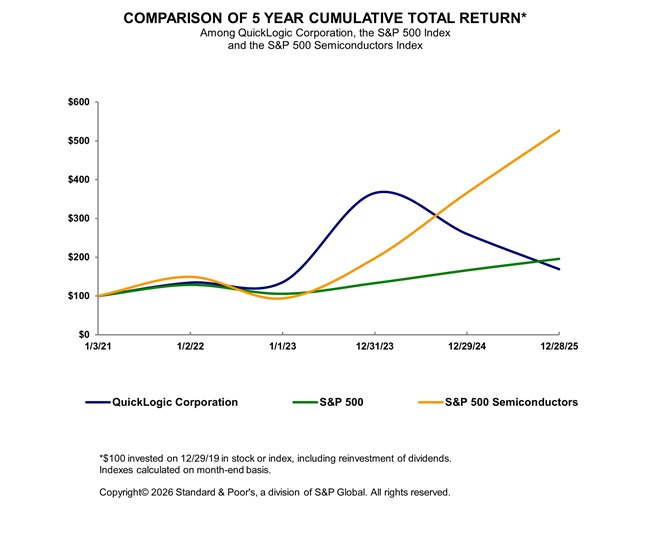
| 1/3/2021 |
1/2/2022 |
1/1/2023 |
12/31/2023 |
12/29/2024 |
12/28/2025 |
|||||||||||||||||||
| QuickLogic Corporation |
100.00 | 134.83 | 135.62 | 365.70 | 260.16 | 169.39 | ||||||||||||||||||
| S&P 500 |
100.00 | 128.71 | 105.40 | 133.10 | 166.40 | 196.16 | ||||||||||||||||||
| S&P Semiconductors |
100.00 | 149.35 | 93.62 | 196.97 | 365.79 | 526.37 | ||||||||||||||||||
The stock price performance included in this graph is not necessarily indicative of future stock price performance.
ITEM 7. MANAGEMENT’S DISCUSSION AND ANALYSIS OF FINANCIAL CONDITION AND RESULTS OF OPERATIONS
The following discussion of our financial condition and results of operations should be read in conjunction with the financial statements and related notes included in this Annual Report on Form 10-K. This discussion may contain forward-looking statements based upon current expectations that involve risks and uncertainties including those discussed under Part I, Item 1A, “Risk Factors.” These risks and uncertainties may cause actual results to differ materially from those discussed in the forward-looking statements.
Overview
QuickLogic Corporation was founded in 1988 and completed its reincorporation in Delaware in 1999. We are a fabless semiconductor company specializing in programmable logic technologies, including embedded FPGA ("eFPGA") intellectual property ("IP") and programmable logic semiconductor devices. Our technologies enable semiconductor companies and system developers to incorporate configurable hardware functionality into custom semiconductor devices and electronic systems.
We generate revenue primarily through the sale of FPGA semiconductor devices and the licensing of eFPGA IP for integrating into application-specific integrated circuits ("ASICs") and system-on-chip ("SoC") devices. In connection with these engagements, we may also provide professional engineering services to support customer integration efforts and may receive royalties based on customer production volumes.
Our programmable logic technologies are used across a range of markets including aerospace and defense systems, industrial and infrastructure systems, computing platforms, and semiconductor devices developed by fabless semiconductor companies. These technologies enable system designers to implement adaptable hardware functionality, accelerate data processing workloads, and support evolving application requirements while maintaining low power consumption and design flexibility.
Our growth strategy focuses on expanding adoption of our eFPGA IP, continuing development of programmable logic semiconductor devices, and supporting customers integrating programmable logic technologies into custom semiconductor designs and mission-critical electronic systems.
New products revenue from continuing operations for the Fiscal Year ended December 28, 2025 was $10.5 million, a decrease of $5.2 million as compared to the Fiscal Year ended December 29, 2024. Of the $10.5 million in new products revenue from continuing operations, approximately $9.5 million was generated from eFPGA IP revenue, primarily eFPGA-related professional engineering services, as compared to approximately $13.1 million in the Fiscal Year ended December 29, 2024. Mature products revenue from continuing operations for the Fiscal Year ended December 28, 2025 was $3.3 million, a decrease of $0.7 million compared to the Fiscal Year ended December 29, 2024. We shipped new products into multiple end market segments including Aerospace and Defense, Industrial, IoT, and Consumer beginning in the Fiscal Year ended December 28, 2025.
We reported a net loss from continuing operations of $12.3 million for the Fiscal Year ended December 28, 2025, compared to a net loss from continuing operations of $2.9 million in the Fiscal Year ended December 29, 2024.
We have experienced net losses in the past years and expect to experience losses in at least some of the fiscal quarters during 2026 as we continue to develop new products, applications, and technologies. Our new hardware products and hardware products currently under development are generating stable gross margins year over year and higher margins than our mature products due to the markets that we have targeted, and the larger order quantities associated with these new products. New eFPGA products have been generating higher gross margins as a percentage of revenue. Whether we can achieve cash flow levels sufficient to support our operations cannot be accurately predicted, and our investment portfolio is subject to a degree of interest rate and liquidity risk. Unless such cash flow levels are achieved, in addition to the $8.7 million and $6.8 million in net proceeds that we received from our 2025 and 2024 sales of our equity securities, respectively, and the revolving line of credit we may be able to draw down from Heritage Bank of Commerce, or any future similar banking partners, we may need to obtain additional funds through strategic divestiture, or sell debt or equity securities, or some combination thereof, to provide funding for our operations. Such additional funding may not be available on commercially reasonable terms, or at all.
Impact of Supply Chain Disruptions on Business
We continue to experience increased product and logistics costs and impacts from the worldwide semiconductor supply shortage. The semiconductor supply shortage is due, in part, to increased demand across multiple industries, resulting in a slowdown in production schedules. The semiconductor supply shortage is also impacting our supply chain and our ability to meet demand for some of our customers.
Our Employees and Customers
Our employees are critical to our ability to develop and support our programmable logic technologies and serve our customers. We seek to maintain a collaborative work environment that supports innovation, operational execution, and technical expertise across our engineering, product development, sales, and administrative teams.
We offer competitive compensation and benefits programs designed to attract, retain, and motivate qualified employees. Our workforce includes personnel located in the United States and internationally, and many of our employees operate in hybrid or remote work environments depending on their role and responsibilities.
We emphasize collaboration among our employees and with our customers in order to support the development and deployment of programmable logic technologies and solutions. Our teams work closely with customers to support design, integration, and deployment of our programmable logic devices and IP technologies in a range of semiconductor and system-level applications.
Critical Accounting Policies and Estimates
The methods, estimates, and judgments we use in applying our most critical accounting policies have a significant impact on the results we report in our consolidated financial statements. The SEC has defined critical accounting policies as those that are most important to the portrayal of our financial condition and results of operations and require us to make our most difficult and subjective judgments, often as a result of the need to make estimates of matters that are inherently uncertain.
Although these estimates are based on our knowledge of current events and actions we may undertake in the future, actual results may ultimately materially differ from these estimates and assumptions. Areas where we use subjective judgment include, but are not limited to, revenue recognition, inventory valuation, including the identification of excess quantities, market value, and obsolescence, and valuation of goodwill and long-lived and intangible assets. We believe that we apply judgments and estimates in a consistent manner and that such consistent application results in consolidated financial statements and accompanying notes that fairly represent all periods presented. However, any factual errors or errors in these judgments and estimates may have a material impact on our consolidated financial statements.
Revenue Recognition
We recognize revenue in accordance with Accounting Standards Codification ("ASC") Topic 606 and related Accounting Standards Updates ("ASUs").
We earn revenue from principal activities by (i) delivering standard hardware products and (ii) delivering and providing eFPGA IP products and professional services, as well as (iii) other miscellaneous revenue.
In accordance with ASC 606, we apply a five-step model for recognizing revenue:
| 1. | Identification of the contract, or contracts, with a customer, |
|
| 2. | Identification of the performance obligations in the contract, |
|
| 3. | Determination of the transaction price. We estimate the transaction price based on the amount expected to be received for transferring the performance obligations in the contract, which may include both fixed consideration and variable consideration. Our contracts with customers containing variable consideration are generally sales-based royalties, which is fully constrained, |
|
| 4. | Allocation of the transaction price to the performance obligations in the contract, and |
|
| 5. | Recognition of revenue when, or as, we satisfy a performance obligation. |
When entering into a new contract, we evaluate certain factors including the customer’s ability to pay, or credit risk.
The following is a description of our revenue recognition policy by principal activity:
Hardware Product Revenue
We generate revenue by supplying standard hardware products, which must be programmed before they can be used in an application. Standard hardware products may be programmed by us, distributors, end customers, or third parties. Contracts with customers for hardware products generally do not include other performance obligations such as services, extended warranties, or other material rights. Our promise to transfer hardware products is identified as a distinct performance obligation. We recognize revenue on hardware products when we transfer control of the promised products to the customer. Transfer of control of hardware products occurs when our performance obligation is satisfied, which typically occurs upon shipment from our manufacturing site or headquarters. We recognize revenue in an amount that reflects the consideration we expect to receive in exchange for those products, which also represents the standalone selling price ("SSP") of our performance obligation. Hardware product prices are fixed. We elected a practical expedient in which we do not assess whether a contract has a significant financing component since our standard payment terms are less than one year. We allocate the transaction price of customer contracts to each distinct product based on its relative SSP. The sale of hardware products does not typically involve significant judgment or estimates by management. However, we do record an allowance for hardware product sales returns, which requires some judgment by management.
We recognized hardware product revenue of approximately $4.2 million, or 31% of total revenue from continuing operations and $6.1 million, or 31% of total revenue from continuing operations in the Fiscal Years ended December 28, 2025 and December 29, 2024, respectively.
Hardware Product Sales Return Allowance
While the terms and conditions of the sale of hardware products generally do not allow for refunds or product returns other than for warranty repairs, we do record an allowance for hardware product sales returns. The allowance for sales returns is based on a historical returns analysis of the prior four quarters that is performed on a quarterly basis. Amounts recorded for hardware product sales returns were $2 thousand and $1 thousand for the Fiscal Years ended December 28, 2025 and December 29, 2024, respectively, on our consolidated statements of operations. While hardware product sales returns have not been material to the Company in recent reporting periods, we note there is an inherent uncertainty in estimating this allowance. In the case where actual results may significantly vary from management estimates, we may be required to make future adjustments to our revenues and operating results.
eFPGA IP Revenue
eFPGA IP revenue is comprised of eFPGA intellectual property revenue, eFPGA-related professional services revenue, and eFPGA-related support and maintenance revenue. We recognize eFPGA intellectual property revenue from licensing our eFPGA intellectual property to customers and recognize eFPGA-related professional services revenue from the fees associated with the custom development and integration of our technology solutions into hardware products. We recognize eFPGA revenue from support and maintenance services for post-implementation customer support ratably over the service term. Renewals of support and maintenance contracts create new performance obligations for which we recognize as revenue ratably over the service term. The majority of our revenue is derived from sales of eFPGA IP licenses and professional services.
eFPGA IP contractual arrangements often include promises to transfer intellectual property licenses, to customize hardware products, and to provide professional services and technical support services. We must determine whether the promised goods and services are distinct performance obligations that should be accounted for separately or are a single, combined performance obligation and should be accounted for together. In accordance with ASC 606, we must evaluate whether the customer can benefit from each good or service on its own or together with other resources that are readily available to the customer and whether the transfer of each good or service can be separately identifiable. We also must evaluate when control of the performance obligation is transferred to and accepted by the customer. We note these determinations, in addition to identifying contractual terms and conditions within the contract, including termination for convenience clauses, enforceable rights to payment for performance completed-to-date, and consideration of the alternative use of the asset, require significant judgment. In these judgments, we consider the context of the contract, historical experience with similar contracts, and the interdependency of the promised goods and services.
Additionally, judgment is required by management to allocate the transaction price to the separately identifiable performance obligations in the contract. We allocate the transaction price of the contract to each performance obligation based on its relative SSP. We rarely sell eFPGA intellectual property licenses on a standalone basis. Generally, we will provide eFPGA-related professional services and support and maintenance services to customers in conjunction with eFPGA IP licenses based on unique contractual arrangement terms and conditions. As such, we are required to estimate the SSP for each performance obligation.
In instances where the SSP is not directly observable because we do not sell the promised goods or services separately, we typically determine the SSP using either the adjusted market assessment approach, residual approach, or the expected cost plus a margin approach, depending on the characteristics and context of the deliverable. The selected method is applied by us consistently for similar arrangements and deliverables. The factors used to select the most appropriate estimation method, as well as select the most appropriate SSP include, but are not limited to, the extent of internal costs required to provide the promised performance obligation, margins achieved on standalone sales of similar products, profit objectives, cost structure, location-specific factors, and competition.
In other instances, we may have more than one SSP for individual performance obligations due to the stratification of those items by classes of customers and circumstances. In these instances, we may use information such as our overall pricing objectives, taking into consideration market conditions and other factors, including the value of its contracts, customer type, customer tier, type of the technology used, customer demographics, and geographic locations, among other factors. We also provide eFPGA-related professional services on a time-and-material basis.
Generally, we satisfy eFPGA-related contractual performance obligations over time as the customer simultaneously receives and consumes the benefits provided by our performance as we perform, our performance creates or enhances an asset that the customer controls as it is created or enhanced, or our performance does not create an asset with an alternative use to the company and we have an enforceable right to payment for performance completed to date. When we satisfy performance obligations over time, we recognize revenue by applying an over-time methodology that faithfully depicts our performance toward satisfaction of the performance obligation.
Due to the nature of the work performed under contractual arrangements, the selection and application of an over-time methodology is complex and involves significant judgment. In the case of the selection of an input method, the key factors reviewed by management to estimate costs to complete each contract include, but are not limited to, the estimated labor days-effort necessary to complete the project, budgeted hours, hourly cost to the Company, profit margins, and engineering hours at cut-off when projects extend beyond a reporting period. In the case of the selection of an output method, key factors reviewed by management include, but are not limited to, the specific deliverables specified in the contracts with customers and the duration of performance, inclusive of delays. We have methods and controls in place for tracking labor-days incurred in completing eFPGA IP contracts, as well as quantifying changes in estimates used within the chosen methodology. We consider labor-days to be a critical estimate as any significant variation of labor and time required to complete a contractual arrangement could cause a revenue claw-back from prior periods and deferral of revenue to future periods.
When the expected consideration from a revenue contract with a customer is less than the expected costs of fulfilling the contract, we are required to first impair any capitalized costs associated with the contract. We are also required to recognize a provision for contract losses as a liability on our balance sheet. This would result in an unfavorable impact to income from operations.
We recognized eFPGA IP revenue of approximately $9.5 million, or 69% of total revenue from continuing operations and $13.1 million, or 67% of total revenue from continuing operations in the Fiscal Years ended December 28, 2025 and December 29, 2024, respectively.
Other Miscellaneous Revenue
Other miscellaneous revenue is comprised primarily of royalties from licensing our technology. We recognize royalty revenue on the later of (i) the subsequent sale or usage, or (ii) satisfaction of a performance obligation to which some or all of the sales-based royalty has been allocated.
We recognized Other Miscellaneous Revenue of approximately $0.1 million, or 0.5% of total revenue from continuing operations and $0.4 million, or 2.2% of total revenue from continuing operations in the Fiscal Years ended December 28, 2025 and December 29, 2024, respectively.
Practical Expedients, Elections, and Exemptions
| • |
Taxes collected from customers and remitted to government authorities and that are related to the sales of our products are excluded from revenues. |
|
| • | Sales commissions are expensed when incurred because the amortization period would have been one year or less. These costs are recorded in selling, general, and administrative expense in the consolidated statements of operations. |
|
| • | We do not disclose the value of unsatisfied performance obligations for (i) contracts with original expected lengths of one year or less or (ii) contracts for which we recognize revenue at the amount to which we have the right to invoice for the services performed. |
Valuation of Inventories
Hardware product inventories are stated at the lower of standard cost or net realizable value. Standard cost approximates actual cost on a first-in, first-out basis. We routinely evaluate quantities and values of our inventories in light of current market conditions and trends and record reserves for quantities in excess of demand and for product obsolescence. The evaluation may take into consideration historic usage, expected demand, anticipated sales price, the stage in the product life cycle of our customers’ products, new product development schedules, the effect new products might have on the sale of existing products, product obsolescence, customer design activity, customer concentrations, and product merchantability, among other factors. Actual consumption of inventories could differ from forecasted demand and this difference could have a material impact on our gross margin and inventory balances based on additional provisions for excess or obsolete inventories or a benefit from inventories previously written down. We also regularly review the cost of inventories against estimated market value and record a lower of cost or market reserve for inventories that have a cost in excess of estimated market value, which could have a material impact on our hardware product gross margin and hardware product inventory balances based on additional write-downs to net realizable value or a benefit from inventories previously written down. Estimates of market value for our products require subjective criteria such as anticipated demand and market acceptance for unique products. Differences between these estimates and actual results could result in gross margin volatilities from period to period.
Our hardware products have historically had an unusually long product life cycle and obsolescence has not been a significant factor in the valuation of inventories. However, as we continue to develop new products, we believe our new product life cycle may be shorter, which could increase the potential for obsolescence. A significant decrease in demand could result in an increase in excess inventory on hand. Although we make every effort to ensure the accuracy of our forecasts of future product demand, any significant unanticipated changes in demand or frequent new product developments could have a significant impact on the value of our inventory and our results of operations.
Goodwill
Goodwill represents the excess fair value of the purchase price over the fair value of identifiable net assets acquired. Goodwill is not amortized but is tested for impairment annually during our fourth fiscal quarter and interim periods if events or changes in circumstances (triggering events) indicate that the carrying amount of goodwill may not be recoverable, in accordance with ASC 350. Our annual goodwill impairment test performed in the fourth quarter of Fiscal Year 2024 indicated that no impairment was identified. As of December 28, 2025, we determined that the criteria for a held-for-sale classification for the SensiML subsidiary were no longer met. As run-off operations at the SensiML subsidiary concluded in Fiscal Year 2025, we decided to account for the SensiML subsidiary as an asset group held for disposal in accordance with ASC 360-10. As a result of this classification, we evaluated the recoverability, or undiscounted cash flows expected to result from the disposition of the SensiML subsidiary, including goodwill associated with the SensiML acquisition, to determine fair value of the asset group. In our evaluation, we determined that such goodwill was fully impaired, and accordingly, recorded an impairment of that goodwill in the amount of $0.2 million in accordance with ASC 350-20 and ASC 205-20.
Long-Lived and Intangible Assets
As of December 28, 2025, we determined that the criteria for a held-for-sale classification for the SensiML subsidiary were no longer met. As run-off operations at the SensiML subsidiary concluded in Fiscal Year 2025, we decided to account for the SensiML subsidiary as an asset group held for disposal in accordance with ASC 360-10. As a result of this classification, we evaluated the recoverability, or undiscounted cash flows expected to result from the disposition of the SensiML subsidiary, including its long-lived and intangible assets, to determine the fair value of the asset group. In our evaluation, we decided to record impairment charges to reduce the carrying value of the long-lived and intangible assets within the SensiML subsidiary asset group. The impairment charges of $2.2 million, reduced the carrying value of the long-lived and intangible assets within the SensiML subsidiary asset group to $0. Additionally, we recognized a loss of $5 thousand on the disposal of equipment in the Fiscal Year December 28, 2025. We did not recognize any gains or losses on the disposal of equipment in the year ended December 29, 2024.
Continuing Operations
Results of Operations
The following table sets forth the percentage of revenue for certain items in our statements of operations for the periods indicated:
| Fiscal Years |
||||||||
| 2025 |
2024 |
|||||||
| Revenue |
100 | % | 100 | % | ||||
| Cost of revenue |
78 | % | 38 | % | ||||
| Gross profit |
22 | % | 62 | % | ||||
| Operating expenses: |
||||||||
| Research and development |
39 | % | 30 | % | ||||
| Selling, general and administrative |
67 | % | 45 | % | ||||
| Impairment charges |
2 | % | — | % | ||||
| Restructuring costs |
1 | % | — | % | ||||
| Operating income (loss) |
(87 | )% | (13 | )% | ||||
| Interest expense |
(3 | )% | (2 | )% | ||||
| Interest income and other (expense) income, net |
— | % | — | % | ||||
| Income (loss) before income taxes |
(90 | )% | (15 | )% | ||||
| Provision for income taxes |
— | % | — | % | ||||
| Net income (loss) |
(90 | )% | (15 | )% | ||||
Comparison of Fiscal Years 2025 and 2024
Revenue. The table below sets forth the changes in revenue for Fiscal Year ended December 28, 2025, compared to Fiscal Year ended December 29, 2024 (in thousands, except percentage data):
| Fiscal Years |
||||||||||||||||||||||||
| 2025 |
2024 |
Year-Over-Year Change |
||||||||||||||||||||||
| Amount | % of Total Revenues | Amount | % of Total Revenues | Amount | Percentage | |||||||||||||||||||
| New products |
$ | 10,464 | 76 | % | $ | 15,667 | 80 | % | $ | (5,203 | ) | (33 | )% | |||||||||||
| Mature products |
3,310 | 24 | % | 3,984 | 20 | % | (674 | ) | (17 | )% | ||||||||||||||
| Total revenue |
$ | 13,774 | 100 | % | $ | 19,651 | 100 | % | $ | (5,877 | ) | (30 | )% | |||||||||||
New products revenue consists of revenues from the sale of hardware products manufactured on 180 nanometer or smaller semiconductor processes and eFPGA IP licenses, as well as professional services. Mature products include all products produced on semiconductor processes larger than 180 nanometer. Associated royalty revenues are included within their respective device's
Total revenue decreased approximately $5.9 million, or (30)% in Fiscal Year ended December 28, 2025 as compared to the Fiscal Year ended December 29, 2024. The decrease in total revenue was comprised of a decrease of $5.2 million in new product revenue and a decrease of $0.7 million in mature product revenue.
New Products Revenue. The table below sets forth the changes in new products revenue for Fiscal Year ended December 28, 2025, compared to Fiscal Year ended December 29, 2024 (in thousands, except percentage data):
| Fiscal Years |
||||||||||||||||||||||||
| 2025 |
2024 |
Year-Over-Year Change |
||||||||||||||||||||||
| Amount |
% of Total Revenues |
Amount |
% of Total Revenues |
Amount |
Percentage |
|||||||||||||||||||
| Hardware products |
$ | 987 | 7 | % | $ | 2,547 | 13 | % | $ | (1,560 | ) | (61 | )% | |||||||||||
| eFPGA IP |
9,477 | 69 | % | 13,120 | 67 | % | (3,643 | ) | (28 | )% | ||||||||||||||
| Total new products revenue |
$ | 10,464 | 76 | % | $ | 15,667 | 80 | % | $ | (5,203 | ) | (33 | )% | |||||||||||
The decrease in new product revenue was primarily driven by a decrease in eFPGA IP revenue. eFPGA IP revenue is comprised primarily of eFPGA intellectual property revenue, eFPGA-related professional services revenue, and eFPGA-related support and maintenance revenue. eFPGA IP revenue decreased approximately $3.6 million, or (28)%, as compared to the Fiscal Year ended December 29, 2024. The decrease in eFPGA IP revenue was primarily comprised of a $3.7 million decrease in eFPGA-related professional services revenue. New hardware revenue decreased by approximately $1.6 million, or (61)%, in the Fiscal Year ended December 28, 2025 compared to the Fiscal Year ended December 29, 2024. The decrease in new hardware product revenue was primarily comprised of a decrease of $1.6 million in connectivity product revenue.
Contract liabilities (deferred revenue) associated with eFPGA IP revenues were $0.1 million and $0.4 million and were included in deferred revenue on the consolidated balance sheets as of December 28, 2025 and December 29, 2024, respectively. Contract assets associated with eFPGA IP revenues were $0.2 million and $2.7 million on the consolidated balance sheets as of December 28, 2025 and December 29, 2024, respectively.
Gross Profit. The table below sets forth the changes in gross profit for Fiscal Year ended December 28, 2025, compared to Fiscal Year ended December 29, 2024 (in thousands, except percentage data):
| Fiscal Years |
||||||||||||||||||||||||
| 2025 |
2024 |
Year-Over-Year Change |
||||||||||||||||||||||
| Amount | % of Total Revenues | Amount | % of Total Revenues | Amount | Percentage | |||||||||||||||||||
| Revenue |
$ | 13,774 | 100 | % | $ | 19,651 | 100 | % | $ | (5,877 | ) | (30 | )% | |||||||||||
| Cost of revenue |
10,740 | 78 | % | 7,558 | 38 | % | 3,182 | 42 | % | |||||||||||||||
| Gross profit |
$ | 3,034 | 22 | % | $ | 12,093 | 62 | % | $ | (9,059 | ) | (75 | )% | |||||||||||
Gross profit in Fiscal Year 2025 compared to Fiscal Year 2024 decreased approximately $9.1 million, or (75)%. The change in gross profit reflects a decrease in revenue of $5.9 million, or (30)%, accompanied by an increase in cost of revenue of $3.2 million, or 42%. The decrease in revenue was driven by a $5.2 million decrease in new product revenue, primarily due to reductions in eFPGA IP professional services revenue, accompanied by a $0.7 million decrease in mature product revenue. The $3.2 million increase in cost of revenue was primarily comprised of increases in compensation expense, tooling, and tooling-related depreciation expense, all collectively associated with performing for revenue contracts, in addition to an increase in reserves related to certain wafer product inventory.
In Fiscal Years 2025 and 2024, we capitalized costs associated with internal-use software of approximately $0.6 million and $0.4 million, respectively. For Fiscal Years 2025 and 2024, we recognized $0.2 million and $0.1 million, respectively in amortization expense of internal-use software in cost of revenues on our consolidated statements of operations.
Our hardware products have historically had a long product life cycle and obsolescence has not been a significant factor in the valuation of inventories. However, as we pursue opportunities in the IoT market and continue to develop new products, we believe our product life cycle may be shorter, which will increase the potential for obsolescence. In general, our standard manufacturing lead times are longer than the binding forecasts we receive from customers. The sale of inventories previously written-off was approximately $0.1 million and $0.1 million in Fiscal Years 2025 and 2024, respectively. We wrote down approximately $0.6 million and $0.1 million to inventory reserves in Fiscal Years 2025 and 2024, respectively.
Operating Expenses. The table below sets forth the changes in operating expenses for Fiscal Year ended December 28, 2025 compared to Fiscal Year ended December 29, 2024 (in thousands, except percentage data):
| Fiscal Years |
||||||||||||||||||||||||
| 2025 |
2024 |
Year-Over-Year Change |
||||||||||||||||||||||
| Amount | % of Total Revenues | Amount | % of Total Revenues | Amount | Percentage | |||||||||||||||||||
| Research and development |
$ | 5,295 | 39 | % | $ | 5,846 | 30 | % | $ | (551 | ) | (9 | )% | |||||||||||
| Selling, general and administrative |
9,283 | 67 | % | 8,767 | 45 | % | 516 | 6 | % | |||||||||||||||
| Impairment charges |
300 | 2 | % | — | — | % | 300 | 100 | % | |||||||||||||||
| Restructuring costs |
75 | 1 | % | — | — | % | 75 | 100 | % | |||||||||||||||
| Total operating expenses |
$ | 14,953 | 109 | % | $ | 14,613 | 75 | % | $ | 340 | 2 | % | ||||||||||||
Research and Development Expenses. Our research and development expenses consist primarily of personnel, overhead, and other costs associated with System on Chip ("SoC") and software development, programmable logic design, and AI and eFPGA development. R&D expenses were $5.3 million and $5.8 million in Fiscal Years 2025 and 2024, respectively, which represented 39% and 30%, respectively, of revenue for those periods. The $0.6 million decrease in R&D expenses in Fiscal Year 2025 as compared to Fiscal Year 2024 was primarily attributable to an increase of R&D labor allocations to Cost of Revenues and decreases in salaries and compensation, partially offset by an increase in general allocations and software tool amortization.
Selling, General and Administrative Expenses. Our selling, general and administrative ("SG&A") expenses consist primarily of personnel and related overhead costs for sales, marketing, finance, administration, human resources, and general management. SG&A expenses were $9.3 million and $8.8 million in Fiscal Years 2025 and 2024, respectively, which represented 67% and 45%, respectively, of revenue for those periods. The $0.5 million increase in SG&A expenses in Fiscal Year 2025 as compared to Fiscal Year 2024 was primarily attributable to an increase in bonus incentive compensation, partially offset by decreases in stock-based compensation costs.
Impairment Charges. The $0.3 million in impairment charges in Fiscal Year 2025 were attributable to the full impairment of the Company's non-marketable equity investment.
Restructuring Costs: The $75 thousand in restructuring costs in Fiscal Year 2025 were primarily attributable to severance payments for employees within QuickLogic related to SensiML discontinued operations.
Interest Expense and Interest Income and Other (Expense) Income, net. The table below sets forth the changes in interest expense and interest income and other (expense) income, net, for the Fiscal Year ended December 28, 2025, as compared to Fiscal Year ended December 29, 2024 (in thousands, except percentage data):
| Fiscal Years |
Year-Over-Year Change |
|||||||||||||||
| 2025 |
2024 |
Amount |
Percentage |
|||||||||||||
| Interest expense |
$ | (370 | ) | $ | (406 | ) | $ | (36 | ) | (9 | )% | |||||
| Interest income and other (expense) income, net |
$ | (28 | ) | $ | 24 | 52 | (217 | )% | ||||||||
| Total interest expense and interest income and other (expense) income, net |
$ | (398 | ) | $ | (382 | ) | $ | 16 | 4 | % | ||||||
Interest expense relates primarily to our line of credit facility. Interest income and other (expenses) income, net, relates to the interest earned on our money market accounts and foreign exchange gain or losses recorded.
Provision for Income Taxes. The table below sets forth the changes in provision for income taxes in the Fiscal Year ended December 28, 2025 compared to the Fiscal Year ended December 29, 2024 (in thousands, except percentage data):
| Fiscal Years |
Year-Over-Year Change |
|||||||||||||||
| 2025 |
2024 |
Amount |
Percentage |
|||||||||||||
| Provision for income taxes |
$ | 18 | $ | 3 | $ | 15 | 500 | % | ||||||||
Income tax expense for the Fiscal Year 2025 and 2024 relates primarily to US state and foreign income tax provisions.
As of the end of Fiscal Year 2025, our ability to utilize our U.S. deferred tax assets in future periods is uncertain and, accordingly, we have recorded a full valuation allowance against the related U.S. deferred tax assets. We will continue to assess the realizability of deferred tax assets in future periods.
Discontinued Operations
In the first quarter of 2025, we announced our Board of Directors was actively exploring options for our wholly owned subsidiary, SensiML. This decision by the Company and our Board of Directors was influenced by recent events, including eFPGA IP design wins with strategic customers, expansion of large government ruggedized FPGA and eFPGA IP contracts, performance improvements of its eFPGA IP products, recent changes in the FPGA market competitor landscape, and an increase in inbound interest from customers of former eFPGA market competitors. With the success of our eFPGA IP and ruggedized FPGA business, we plan to focus all of our resources on leveraging and growing the cornerstones of our core business model.
SensiML's Analytics Toolkit provides an end-to-end Artificial Intelligence / Machine Learning development platform with accurate sensor algorithms using AI technology, spanning data collection, labeling, algorithm and firmware auto generation, and testing. This cutting-edge software enables ultra-low power IoT endpoints that implement AI to transform raw sensor data into meaningful insight at the device itself. Revenue streams from SensiML included Software as a Service (SaaS) subscriptions for development, per unit license fees when deployed in production, and proof-of-concept services. As of January 7, 2025, the Company began accounting for the SensiML subsidiary in accordance with ASC 205-20, Discontinued Operations.
As of December 28, 2025, we determined that the criteria for a held-for-sale classification for the SensiML subsidiary were no longer met. As run-off operations at the SensiML subsidiary concluded in Fiscal Year 2025, we decided to account for the SensiML subsidiary as an asset group held for disposal in accordance with ASC 360-10. As a result of this classification, we evaluated the recoverability, or undiscounted cash flows expected to result from the disposition of the SensiML subsidiary. Based on our evaluation, we decided to fully impair the asset group of the SensiML subsidiary in the amount of $2.4 million, constituting a significant portion of the SensiML subsidiary's net loss from discontinued operations of $2.5 million for the Fiscal Year ended December 28, 2025. This is compared to a net loss from discontinued operations of $0.9 million in the Fiscal Year ended December 29, 2024.
Additionally, we forgave approximately $7.9 million of intercompany payables owed by SensiML to the parent company. The forgiveness of this intercompany balance was accounted for as a capital contribution to SensiML and was approved by the Company's Board of Directors as a related-party transaction. Refer to Note 3 for additional information related to the related party transaction.
We marketed our SensiML solutions to OEMs and ODMs offering differentiated Consumer/IoT products, to processor vendors wishing to expand their served available market, and to sensor manufacturers and sensor processing software companies wishing to expand their ecosystems. Our target markets for our SensiML products included Consumer/Industrial IoT and Consumer Electronics. SensiML SaaS subscribers typically entered into licensing agreements directly with SensiML.
Contract liabilities (deferred revenue) associated with SensiML were $0 and $10 thousand and were included in deferred revenue on the consolidated balance sheets as of December 28, 2025 and December 29, 2024, respectively.
Revenue Recognition
The following is a description of our revenue recognition policy by principal activity for discontinued operations:
SensiML revenues were comprised primarily of software as a service ("SaaS") revenue and software-related professional services revenue. SaaS revenue was generated when we licensed our software to customers and allowed customers to access the software over a short-term subscription basis. We granted the customer the right to access and use software at the outset of the arrangement and throughout the entire term of the arrangement. We recognized SaaS revenue ratably over the license term. We recognized revenue from software-related professional services as services are provided to the customer.
In Fiscal Years 2025 and 2024, we capitalized costs associated with SensiML internal-use software of approximately $0 and $0.7 million, respectively. For Fiscal Years 2025 and 2024, we recognized $0 and $0.7 million, respectively, in amortization expense of SensiML internal-use software in cost of revenues on our consolidated statements of operations.
| Fiscal Years |
||||||||
| 2025 |
2024 |
|||||||
| Revenue |
100 | % | 100 | % | ||||
| Cost of revenue |
27 | % | 145 | % | ||||
| Gross profit |
73 | % | (45 | )% | ||||
| Operating expenses: |
||||||||
| Research and development |
246 | % | 151 | % | ||||
| Selling, general and administrative |
182 | % | 1 | % | ||||
| Impairment charges |
21409 | % | — | % | ||||
| Restructuring costs |
791 | % | — | % | ||||
| Interest income and other income (expense), net |
— | % | 6 | % | ||||
| Income (loss) from discontinued operations before income taxes |
(22555 | )% | (203 | )% | ||||
| (Benefit from) provision for income taxes |
— | % | — | % | ||||
| Net income (loss) from discontinued operations |
(22555 | )% | (203 | )% | ||||
Key Performance Indicators
Sales, operating income, and net income are some of the key performance indicators that management uses to manage the business. Management uses sales, operating income (loss), and net income (loss) to evaluate the Company's financial condition and operating performance, as well as evaluate income generated in deciding whether to reinvest profits into the Company or to use such profits for other purposes, such as for acquisitions or share repurchases. These key performance indicators are also used to monitor budget versus actual results, as well as in competitive analyses by benchmarking to our competitors.
Liquidity and Capital Resources
We have historically financed our operating losses and capital investments through the sale of our common stock, financing arrangements, operating leases, and cash flows provided by operations. We also have a revolving facility with Heritage Bank of Commerce ("Heritage Bank"). As of December 28, 2025, our principal sources of liquidity consisted of cash, cash equivalents, and restricted cash of $18.8 million, inclusive of $15.0 million in advances from our $20 million revolving facility. The revolving credit facility with Heritage Bank expires on December 31, 2026.
Our principal contractual commitments include purchase obligations, re-payments of advances from our revolving facility, and payments under financing arrangements and operating leases. Purchase obligations include amounts that are recorded on our consolidated balance sheets, as well as amounts that are not recorded on our consolidated balance sheets. Purchase obligations that are recorded on our consolidated balance sheets are largely comprised of open purchase order commitments to suppliers and to subcontractors. Our risk associated with these purchase obligations is limited to the termination liability provisions within those contracts and as such, we do not believe they represent a material liquidity risk to us. Purchase obligations not recorded on our consolidated balance sheets represent significant future obligations associated with ongoing eFPGA IP revenue contracts. These obligations are dependent on numerous variables and therefore, it is difficult to predict the amount and timing of payments which could differ materially from our estimates.
Credit Agreement
On December 21, 2018, we entered into an Amended and Restated Loan and Security Agreement with Heritage Bank of Commerce (as amended, the "Loan Agreement") which among other things, provided a revolving line of credit facility (as amended, the "Revolving Facility") allowing the us to draw advances up to $15 million. The Revolving Facility includes a number of customary and restrictive financial covenants including maintaining certain minimum cash levels with the lender. On December 8, 2023, we entered into the Seventh Amendment to the Loan Agreement, which increased the line of credit to $20 million. The Revolving Facility bears an annual facility fee of $60 thousand, payable each December 31st. Advances under the Revolving Facility bear a variable annual interest rate equal to one half of one percentage point (0.50%) above the prime rate. On March 14, 2025, we entered into the Eighth Amendment to the Loan Agreement, which extended the loan maturity date for one year from December 31, 2025 to December 31, 2026. On December 28, 2025, we had a $15.0 million outstanding balance on the Revolving Facility with an interest rate of 7.25%. On December 29, 2024, we had an $18.0 million outstanding balance on the Revolving Facility with an interest rate of 8.00%. We were in compliance with all loan covenants under the Loan Agreement, as of the end of the current reporting period.
Heritage Bank has a first-priority security interest in substantially all of the company’s tangible and intangible assets to secure any outstanding amounts under the Loan Agreement. See Note 8 to the consolidated financial statements for additional information regarding our Loan Agreement and other debt obligations.
In accordance with ASC 205-40, Presentation of Financial Statements - Going Concern, we evaluated whether conditions or events, considered in the aggregate, raise concerns about our ability to meet our obligations as they become due within one year after the date that the consolidated financial statements are issued. As part of this evaluation, we identified conditions and events related primarily to the maturity of our current revolving credit facility on December 31, 2026. We have concluded that we will have sufficient liquidity to meet our obligations as they become due within one year after the date the consolidated financial statements are issued.
In anticipation of the maturity of the current revolving credit facility, we signed a term sheet with Sunflower Bank, N.A., who has approved with their credit committee, a $10 million credit facility where parties have agreed upon all material terms, with a maturity date that extends beyond one year after the date the consolidated financial statements are issued. We expect to execute definitive agreements with Sunflower Bank, N.A. during the second quarter.
Common Stock Offerings
See Note 12 to the consolidated financial statements for additional information regarding our common stock offerings, such as purchase price of shares sold.
Cash Flows
As of December 28, 2025, most of our cash and cash equivalents were invested in a Heritage Bank money market account. As of December 28, 2025, our interest-bearing debt consisted of $2.8 million outstanding under finance arrangements and $15 million outstanding under our Revolving Facility. See Note 8 to the consolidated financial statements for additional information.
Cash balances held at our foreign subsidiaries were approximately $0.1 million and $0.1 million as of December 28, 2025 and December 29, 2024, respectively. Earnings from our foreign subsidiaries are currently deemed to be indefinitely reinvested. We do not expect such reinvestment to affect our liquidity and capital resources and we continually evaluate our liquidity needs and ability to meet global cash requirements as a part of our overall capital deployment strategy. Factors which affect our liquidity, capital resources, and global capital deployment strategy include anticipated cash flows, the ability to repatriate cash in a tax efficient manner, funding requirements for operations and investment activities, acquisitions and divestitures, and capital market conditions.
Our cash flows were as follows (in thousands):
| Fiscal Year |
||||||||
| 2025 |
2024 |
|||||||
| Net cash provided by (used in) operating activities |
$ | (3,262 | ) | $ | 27 | |||
| Net cash provided by (used in) investing activities |
(3,689 | ) | (6,465 | ) | ||||
| Net cash provided by (used in) financing activities |
3,913 | 3,712 | ||||||
Net Cash provided by (used in) Operating Activities
In Fiscal Year 2025, net cash used in operating activities was $3.3 million, which was primarily due to the Company's net loss of $14.8 million and changes in working capital of $0.7 million, which consisted of a decrease in accounts payable of $1.8 million, a decrease in deferred revenue of $0.4 million, an increase in accounts receivable of $0.4 million, and a decrease in lease liabilities of $0.3 million, partially offset by a decrease in contract assets of $2.5 million and an increase in accrued liabilities of $0.2 million. The Company's net loss and changes in working capital were partially offset by non-cash charges of $12.3 million. Non-cash charges primarily consisted of depreciation and amortization of long-lived assets and certain definite-lived intangible assets of $5.7 million, stock-based compensation expense of $3.3 million, impairment of assets held by SensiML disposal group of $2.4 million, impairment of investments in non-affiliates of $0.3 million, and write-down of inventories of $0.6 million
In Fiscal Year 2024, net cash provided by operating activities was $27 thousand, which was primarily due to non-cash charges of $8.9 million. Non-cash charges consisted of stock-based compensation expense of $4.6 million, depreciation and amortization of long-lived assets and certain definite-lived intangible assets of $4.2 million, and write-downs of inventories of $0.1 million. Non-cash charges were partially offset by a net loss of $3.8 million and changes in working capital of $5.1 million. Changes in working capital consisted of a decrease in trades payable of $3.6 million, a decrease in accrued liabilities of $1.1 million, an increase in accounts receivable of $0.8 million, a decrease in deferred revenue of $0.6 million, and a decrease in lease liabilities of $0.3 million, partially offset by a decrease in contract assets of $0.9 million, a decrease in inventories of $0.3 million, and a decrease in other assets of $0.2 million.
Net Cash provided by (used in) Investing Activities
Net cash used in investing activities in Fiscal Year 2025 was approximately $3.7 million, which was primarily attributable to capital expenditures related to property and equipment of $3.2 million and the capitalization of internal-use software in the amount of $0.5 million.
Net cash used in investing activities in Fiscal Year 2024 was approximately $6.5 million, which was primarily attributable to capital expenditures related to property and equipment of $5.4 million, $0.1 million in expenditures related to intangible assets, and the capitalization of internal-use software in the amount of $1.1 million, partially offset by stock-based compensation capitalized to property and equipment and internal-use software in the amount of $9 thousand and $149 thousand, respectively.
Net Cash provided by (used in) Financing Activities
In Fiscal Year 2025, net cash provided by financing activities was $3.9 million, primarily attributable to net proceeds from the issuance of common stock in the amount of $9.1 million, partially offset by $2.2 million in payments related to financing arrangements primarily for tooling related to revenue contracts with customers and $3.0 million in greater payments than borrowings on the Company's revolving line of credit.
In Fiscal Year 2024, net cash provided by financing activities was $3.7 million, primarily attributable to proceeds from the issuance of common stock in the amount of $7.1 million, partially offset by $1.4 million in payments related to financing arrangements primarily for tooling related to revenue contracts with customers and $2.0 million in greater payments than borrowings on the Company's revolving line of credit.
We require substantial cash to fund our business. However, we believe that our existing cash and cash equivalents, together with available financial resources from the Revolving Facility and our Amended ATM Offering, will be sufficient to satisfy our operations and capital expenditures over the next twelve months. Our revolving facility will expire on December 31, 2026. Further, any violations of debt covenants may restrict our access to any additional cash draws from the revolving line of credit and may require our immediate repayment of the outstanding debt amounts. After the next twelve months, our cash requirements will depend on many factors, including our level of revenue and gross profit, the market acceptance of our existing and new products, the levels at which we maintain inventories and accounts receivable, costs of securing access to adequate manufacturing capacity, new product development efforts, capital expenditures, and the level of our operating expenses. In order to satisfy our longer-term liquidity requirements, we may be required to raise additional equity or debt financing. There can be no assurance that financing will be available at commercially acceptable terms or at all.
Material Cash Requirements
The following discussion describes the material cash requirements from known contractual obligations and other obligations, and the effect such obligations are expected to have on our liquidity and cash flows in future fiscal periods. The following summarizes our material cash requirements as of December 28, 2025:
| Payments Due by Period |
||||||||||||||||||||
| Total |
Less than 1 year |
1-3 Years |
4-5 Years |
More than 5 Years |
||||||||||||||||
| Operating lease obligations |
$ | 477 | $ | 349 | $ | 128 | $ | — | $ | — | ||||||||||
| Financing arrangements |
2,975 | 2,008 | 967 | — | — | |||||||||||||||
| Revolving Facility (1) |
15,000 |
15,000 |
— |
— |
— |
|||||||||||||||
| Purchase obligations: |
||||||||||||||||||||
| Wafer purchases (2) |
170 | 170 | — | — | — | |||||||||||||||
| Other purchase commitments |
1,836 | 1,796 | 40 | — | — | |||||||||||||||
| Total material cash requirements |
$ | 20,458 | $ | 19,323 | $ | 1,135 | $ | — | $ | — | ||||||||||
| (1) |
The current maturity date on our Revolving Facility is December 31, 2026. See Note 8 to the consolidated financial statements for additional information. |
| (2) | Certain wafer manufacturers require us to forecast wafer starts several months in advance. We are committed to take delivery of and pay for a portion of forecasted wafer volume. |
Concentration of Suppliers
We depend on a limited number of contract manufacturers, subcontractors, and suppliers for wafer fabrication, assembly, programming, and testing of our hardware products and for the supply of programming equipment. These services are typically provided by one supplier for each of our hardware products. We generally purchase these single or limited source services through standard purchase orders. Since we rely on independent subcontractors to perform these services, we cannot directly control product delivery schedules, costs, or quality levels. Our future success also depends on the financial viability of our independent subcontractors. These subcontract manufacturers produce products for other companies and we must place orders in advance of expected delivery. As a result, we have only a limited ability to react to fluctuations in demand for our products, which could cause us to have an excess or a shortage of inventories of a particular product, and our ability to respond to changes in demand is limited by these suppliers’ ability to provide products with the quantity, quality, cost, and timeliness that we require. The decision not to provide these services to us or the inability to supply these services to us, such as in the case of a natural or financial disaster, would have a significant impact on our business. Increased demand from other companies could result in these subcontract manufacturers allocating available capacity to customers that are larger or have long-term supply contracts in place and we may be unable to obtain adequate foundry and other capacity at acceptable prices, or we may experience delays or interruption in supply. Additionally, volatility of economic, market, social, and political conditions in countries where these suppliers operate may be unpredictable and could result in a reduction in product revenue or increase our cost of revenue and could adversely affect our business, financial condition, and results of operations.
Off-Balance Sheet Arrangements
We do not maintain any off-balance arrangements within the meaning of Item 303(b) of Regulation S-K.
Recently Issued Accounting Pronouncements
See Note 2 to the consolidated financial statements for a full description of recent accounting pronouncements, including the expected dates of adoption and estimated effects on financial condition and results of operations, which is incorporated by reference herein.
ITEM 7A. QUANTITATIVE AND QUALITATIVE DISCLOSURES ABOUT MARKET RISK ITEM 8.
Not applicable.
FINANCIAL STATEMENTS AND SUPPLEMENTARY DATA
INDEX TO CONSOLIDATED FINANCIAL STATEMENTS
Report of Independent Registered Public Accounting Firm
To the Board of Directors and
Stockholders of QuickLogic Corporation
Opinion on the Consolidated Financial Statements
We have audited the accompanying consolidated balance sheets of QuickLogic Corporation and Subsidiaries (collectively, the “Company”) as of December 28, 2025 and December 29, 2024, and the related consolidated statements of operations, stockholders’ equity, and cash flows, for the years then ended, and the related notes (collectively referred to as the “consolidated financial statements”). In our opinion, the consolidated financial statements present fairly, in all material respects, the consolidated financial position of the Company as of December 28, 2025 and December 29, 2024, and the results of its operations and its cash flows for each of the two years ended December 28, 2025, in conformity with accounting principles generally accepted in the United States of America.
Basis for Opinion
These consolidated financial statements are the responsibility of the Company’s management. Our responsibility is to express an opinion on the Company’s consolidated financial statements based on our audits. We are a public accounting firm registered with the Public Company Accounting Oversight Board (United States) (“PCAOB”) and are required to be independent with respect to the Company in accordance with the U.S. federal securities laws and the applicable rules and regulations of the U.S. Securities and Exchange Commission (“SEC”) and the PCAOB.
We conducted our audits in accordance with the standards of the PCAOB. Those standards require that we plan and perform the audit to obtain reasonable assurance about whether the consolidated financial statements are free of material misstatement, whether due to error or fraud. The Company is not required to have, nor were we engaged to perform, an audit of its internal control over financial reporting. As part of our audits, we are required to obtain an understanding of internal control over financial reporting, but not for the purpose of expressing an opinion on the effectiveness of the Company’s internal control over financial reporting. Accordingly, we express no such opinion.
Our audits included performing procedures to assess the risks of material misstatement of the consolidated financial statements, whether due to error or fraud, and performing procedures that respond to those risks. Such procedures included examining, on a test basis, evidence regarding the amounts and disclosures in the consolidated financial statements. Our audits also included evaluating the accounting principles used and significant estimates made by management, as well as evaluating the overall presentation of the consolidated financial statements. We believe that our audits provide a reasonable basis for our opinion.
Critical Audit Matter
The critical audit matter communicated below is a matter arising from the current period audit of the consolidated financial statements that were communicated or required to be communicated to the audit committee and that: (1) relate to accounts or disclosures that are material to the consolidated financial statements and (2) involved our especially challenging, subjective, or complex judgments. The communication of critical audit matters does not alter in any way our opinion on the consolidated financial statements, taken as a whole, and we are not, by communicating the critical audit matter below, providing separate opinions on the critical audit matter or on the accounts or disclosures to which it relates.
Revenue Recognition of Professional Services Contracts
As described in Notes 1 and 15 to the consolidated financial statements, the Company’s eFPGA-related professional services revenue was approximately $9.4 million for the year ended December 28, 2025. eFPGA-related professional services contracts often include promises to transfer intellectual property licenses to customize hardware products and to provide professional services and technical support services to customers. Judgment is required by management to allocate the transaction price to the separately identifiable performance obligations in the contract based on each performance obligation’s relative standalone selling price. eFPGA intellectual property is rarely sold on a standalone basis, and as such, management is required to estimate the standalone selling price related to each performance obligation. Management uses a variety of methods to determine the standalone selling price of each performance obligation, including an adjusted market assessment approach, residual approach or the expected cost plus a margin approach, depending on the characteristics and context of the deliverables.
We have identified the determination of the standalone selling price as a critical audit matter. Auditing this element of revenue recognition involved especially challenging auditor judgment in the determination of distinct performance obligations and an increased extent of auditor effort due to; (i) the use of significant management judgment in determining the standalone selling price when observable inputs are not readily available and (ii) the inherent, unique nature of each performance obligation within each professional service contract.
How the Critical Audit Matter Was Addressed in the Audit
Our audit procedures related to the determination of the standalone selling price of professional services contracts, and the associated assumptions that the Company identified, included the following, among others:
| • |
Evaluating the internal controls related to the Company’s review and application of the revenue recognition guidance and determining if those controls were designed and implemented appropriately. |
| • | Evaluating the appropriateness of management's methodology used to determine the standalone selling price for a sample of contracts including: |
| • |
Obtaining and reading contract source documents, including master agreements, and other related documents. |
| • |
Assessing management’s application of the methodology based on the relevant guidance under Accounting Standards Codification Topic 606, Revenue from Contracts with Customers. |
| • |
Evaluating the appropriateness of management’s determination of the standalone selling price, including: |
| • |
Assessing assumptions utilized by management in determining the standalone selling price when comparative information is not readily observable. |
| • |
Corroborating management’s assumptions through review of similar contracts when available and applicable depending on the nature of the contract. |
| • | Performing inquiries with individuals outside of the accounting department to corroborate management’s assertions and assumptions and performing sensitivity analysis to unobservable inputs. |
| • |
Testing the application of management’s methodology to each selected professional services contract. |
| • | Testing the mathematical accuracy of management’s calculations of the standalone selling price of a selection of professional services contracts. |
/s/ Frank, Rimerman + Co. LLP
We have served as the Company's auditor since 2024.
San Francisco, California
March 27, 2026
CONSOLIDATED BALANCE SHEETS
(in thousands, except par value amount)
| December 28, |
December 29, |
|||||||
| 2025 |
2024 |
|||||||
| ASSETS |
||||||||
| Current assets: |
||||||||
| Cash and cash equivalents |
$ | 18,840 | $ | 21,859 | ||||
| Accounts receivable |
2,809 | 2,426 | ||||||
| Contract assets |
217 | 2,682 | ||||||
| Inventories |
956 | 940 | ||||||
| Prepaid expenses and other current assets |
1,399 | 1,666 | ||||||
| Assets of business held for disposal, net |
2 | 31 | ||||||
| Total current assets |
24,223 | 29,604 | ||||||
| Property and equipment, net |
18,233 | 15,699 | ||||||
| Capitalized internal-use software, net |
1,117 | 711 | ||||||
| Right of use assets, net |
464 | 758 | ||||||
| Intangible assets, net |
339 | 378 | ||||||
| Non-marketable equity investment |
— | 300 | ||||||
| Inventories, non-current |
187 | 718 | ||||||
| Note receivable, non-current |
— | 1,292 | ||||||
| Other assets |
241 | 117 | ||||||
| Assets of business held for disposal, net |
— | 2,356 | ||||||
| TOTAL ASSETS |
$ | 44,804 | $ | 51,933 | ||||
| LIABILITIES AND STOCKHOLDERS' EQUITY |
||||||||
| Current liabilities: |
||||||||
| Revolving line of credit |
$ | 15,000 | $ | 18,000 | ||||
| Trade payables |
2,251 | 3,097 | ||||||
| Accrued liabilities |
1,779 | 1,587 | ||||||
| Deferred revenue |
64 | 444 | ||||||
| Notes payable, current |
1,870 | 1,928 | ||||||
| Lease liabilities, current |
321 | 284 | ||||||
| Liabilities of business held for disposal |
— | 57 | ||||||
| Total current liabilities |
21,285 | 25,397 | ||||||
| Long-term liabilities: |
||||||||
| Lease liabilities, non-current |
126 | 447 | ||||||
| Notes payable, non-current |
926 | 1,202 | ||||||
| Total liabilities |
22,337 | 27,046 | ||||||
| Commitments and Contingencies (Note 16) |
||||||||
| Stockholders' equity: |
||||||||
| Preferred stock, $0.001 par value; 10,000 shares authorized; no shares issued or outstanding |
— | — | ||||||
| Common stock, $0.001 par value; 200,000 shares authorized; 17,290 and 15,336 shares issued and outstanding as of December 28, 2025 and December 29, 2024, respectively |
17 | 15 | ||||||
| Additional paid-in capital |
346,662 | 334,268 | ||||||
| Accumulated deficit |
(324,212 | ) | (309,396 | ) | ||||
| Total stockholders' equity |
22,467 | 24,887 | ||||||
| TOTAL LIABILITIES AND STOCKHOLDERS' EQUITY |
$ | 44,804 | $ | 51,933 | ||||
The accompanying notes form an integral part of these Consolidated Financial Statements.
CONSOLIDATED STATEMENTS OF OPERATIONS
(in thousands, except per share amounts)
| Fiscal Years |
||||||||
| 2025 |
2024 |
|||||||
| Revenue |
$ | 13,774 | $ | 19,651 | ||||
| Cost of revenue |
10,740 | 7,558 | ||||||
| Gross profit |
3,034 | 12,093 | ||||||
| Operating expenses: |
||||||||
| Research and development |
5,295 | 5,846 | ||||||
| Selling, general and administrative |
9,283 | 8,767 | ||||||
| Impairment charges |
300 | — | ||||||
| Restructuring costs |
75 | — | ||||||
| Operating income (loss) |
(11,919 | ) | (2,520 | ) | ||||
| Interest expense |
(370 | ) | (406 | ) | ||||
| Interest income and other (expense) income, net |
(28 | ) | 24 | |||||
| Income (loss) from continuing operations before income taxes |
(12,317 | ) | (2,902 | ) | ||||
| (Benefit from) provision for income taxes |
18 | 3 | ||||||
| Net income (loss) from continuing operations |
$ | (12,335 | ) | $ | (2,905 | ) | ||
| Net income (loss) from discontinued operations, net of taxes |
$ | (2,481 | ) | $ | (936 | ) | ||
| Net income (loss) |
$ | (14,816 | ) | $ | (3,841 | ) | ||
| Net income (loss) from continuing operations per share: (1) |
||||||||
| Basic |
$ | (0.76 | ) | $ | (0.20 | ) | ||
| Diluted |
$ | (0.76 | ) | $ | (0.20 | ) | ||
| Net income (loss) per share: |
||||||||
| Basic |
$ | (0.91 | ) | $ | (0.26 | ) | ||
| Diluted |
$ | (0.91 | ) | $ | (0.26 | ) | ||
| Weighted average shares: (1) |
||||||||
| Basic |
16,243 | 14,510 | ||||||
| Diluted |
16,243 | 14,510 | ||||||
(1) Note: Net income (loss) equals total comprehensive income (loss) for all years presented. Additionally, the Company notes that income taxes related to discontinued operations were immaterial in nature for the periods presented and as such, only net income (loss) from discontinued operations was reported in the consolidated statements of operations.
The accompanying notes form an integral part of these Consolidated Financial Statements.
CONSOLIDATED STATEMENTS OF CASH FLOWS
(in thousands)
| Fiscal Years |
||||||||
| 2025 |
2024 |
|||||||
| Cash flows provided by (used in) operating activities: |
||||||||
| Net income (loss) |
$ | (14,816 | ) | $ | (3,841 | ) | ||
| Adjustments to reconcile net income (loss) to net cash provided by (used in) operating activities: |
||||||||
| Depreciation and amortization |
5,372 | 3,976 | ||||||
| ROU asset amortization |
294 | 269 | ||||||
| Stock-based compensation |
3,319 | 4,606 | ||||||
| Write-down of inventories |
613 | 82 | ||||||
| Impairment of investment in non-affiliate |
300 | — | ||||||
| Impairment of assets held by SensiML entity |
2,355 | — | ||||||
| Expected credit loss expense |
7 | (4 | ) | |||||
| Non-cash interest expense |
11 | — | ||||||
| Loss on disposal of equipment |
5 | — | ||||||
| Changes in operating assets and liabilities: |
||||||||
| Accounts receivable |
(379 | ) | (807 | ) | ||||
| Contract assets |
2,465 | 927 | ||||||
| Inventories |
(98 | ) | 289 | |||||
| Other assets |
(361 | ) | 233 | |||||
| Trade payables |
(1,833 | ) | (3,601 | ) | ||||
| Accrued liabilities |
158 | (1,081 | ) | |||||
| Deferred revenue |
(390 | ) | (598 | ) | ||||
| Lease liabilities |
(284 | ) | (298 | ) | ||||
| Other long-term liabilities |
— | (125 | ) | |||||
| Net cash provided by (used in) operating activities |
(3,262 | ) | 27 | |||||
| Cash flows provided by (used in) investing activities: |
||||||||
| Capital expenditures for property and equipment |
(3,164 | ) | (5,404 | ) | ||||
| Capitalized internal-use software |
(525 | ) | (967 | ) | ||||
| Purchases of intangible assets |
— | (94 | ) | |||||
| Net cash provided by (used in) investing activities |
(3,689 | ) | (6,465 | ) | ||||
| Cash flows provided by (used in) financing activities: |
||||||||
| Payment of notes payable |
(2,151 | ) | (1,384 | ) | ||||
| Proceeds from notes payable |
— | — | ||||||
| Proceeds from line of credit |
60,000 | 78,000 | ||||||
| Repayment of line of credit |
(63,000 | ) | (80,000 | ) | ||||
| Proceeds from issuance of common stock |
308 | 310 | ||||||
| Proceeds from issuance of common stock to investors |
9,252 | 6,810 | ||||||
| Stock issuance costs |
(496 | ) | (24 | ) | ||||
| Net cash provided by (used in) financing activities |
3,913 | 3,712 | ||||||
| Net increase (decrease) in cash, cash equivalents and restricted cash |
(3,038 | ) | (2,726 | ) | ||||
| Cash, cash equivalents and restricted cash at the beginning of the period |
21,880 | 24,606 | ||||||
| Cash, cash equivalents, and restricted cash at the end of the period |
$ | 18,842 | $ | 21,880 | ||||
| Supplemental disclosures of cash flow information: |
||||||||
| Interest paid |
$ | 368 | $ | 344 | ||||
| Income taxes paid |
$ | 23 | $ | 33 | ||||
| Supplemental schedule of non-cash investing and financing activities from continuing operations: |
||||||||
| Purchases of assets with financing arrangements |
$ | 1,806 | $ | 3,107 | ||||
| Stock-based compensation capitalized as internal-use software |
$ | 50 | $ | 49 | ||||
| Stock-based compensation capitalized as tooling and fixed assets |
$ | — | $ | 9 | ||||
| Purchases of property and equipment in accounts payable and accrued liabilities |
$ | 973 | $ | 2,041 | ||||
The accompanying notes form an integral part of these Consolidated Financial Statements.
CONSOLIDATED STATEMENTS OF STOCKHOLDERS' EQUITY
(in thousands)
| Common Stock |
||||||||||||||||||||
| Par Value |
Additional Paid-In |
Accumulated |
Total Stockholders' |
|||||||||||||||||
| Shares |
Amount |
Capital |
Deficit |
Equity |
||||||||||||||||
| Balance at December 31, 2023 |
14,118 | 14 | 322,436 | (305,555 | ) | 16,895 | ||||||||||||||
| Common stock issued under stock plans and employee stock purchase plans |
572 | — | 310 | — | 310 | |||||||||||||||
| Common stock offering, net of issuance costs |
646 | 1 | 6,758 | — | 6,759 | |||||||||||||||
| Stock-based compensation |
— | — | 4,764 | — | 4,764 | |||||||||||||||
| Net loss |
— | — | — | (3,841 | ) | (3,841 | ) | |||||||||||||
| Balance at December 29, 2024 |
15,336 | 15 | 334,268 | (309,396 | ) | 24,887 | ||||||||||||||
| Common stock issued under stock plans and employee stock purchase plans |
497 | 1 | 307 | — | 308 | |||||||||||||||
| Common stock offering, net of issuance costs |
1,457 | 1 | 8,718 | — | 8,719 | |||||||||||||||
| Stock-based compensation |
— | — | 3,369 | — | 3,369 | |||||||||||||||
| Net loss |
— | — | — | (14,816 | ) | (14,816 | ) | |||||||||||||
| Balance at December 28, 2025 |
17,290 | $ | 17 | $ | 346,662 | $ | (324,212 | ) | $ | 22,467 | ||||||||||
The accompanying notes form an integral part of these Consolidated Financial Statements.
NOTE 1 — THE COMPANY AND BASIS OF PRESENTATION
QuickLogic Corporation was founded in 1988 and completed its reincorporation in Delaware in 1999. The Company is a fabless semiconductor company specializing in programmable logic technologies, including embedded FPGA ("eFPGA") intellectual property ("IP") and programmable logic semiconductor devices.
The Company licenses its eFPGA IP to semiconductor companies for integration into application-specific integrated circuits ("ASICs") and system-on-chips ("SoCs") devices, and also develops and sells programmable logic semiconductor devices, including discrete FPGAs. These technologies enable customers to incorporate configurable hardware functionality into custom semiconductor devices and electronic systems.
The Company's programmable logic technologies are used in a variety of markets, including aerospace and defense systems, industrial and infrastructure systems, computing platforms, and semiconductor devices developed by fabless semiconductor companies. The Company's products, software tools, and IP enable customers to efficiently implement programmable hardware functionality within custom semiconductor designs and system-level products.
In the first quarter of 2025, the Company discontinued operations at its wholly-owned subsidiary, SensiML Corporation ("SensiML"), and began actively exploring options for the possible sale of SensiML or its assets. Furthermore, the Company started accounting for the SensiML subsidiary in accordance with ASC 205-20, Discontinued Operations. At the balance sheet date of December 28, 2025, the Company impaired all of the SensiML non-cash assets to a zero value and redesignated SensiML as a disposal asset within Discontinued Operations in accordance with ASC 205-20 and ASC 360-10. Furthermore, the Company has incurred $0.2 million in costs in connection with the planned disposition of SensiML in the Fiscal Year ended December 28, 2025. These costs consisted primarily of one-time termination benefits and are split between the ‘Restructuring Costs’ line item and ‘Net Income (Loss) from Discontinued Operations, Net of Taxes’ line item in the Company’s consolidated statements of operations. See Note 3 for additional information of discontinued operations. All other notes to these consolidated financial statements present the results of continuing operations and exclude amounts related to discontinued operations for all periods presented.
QuickLogic’s Fiscal Year ends on the Sunday closest to December 31. Fiscal Years 2025 and 2024 ended on December 28, 2025 and December 29, 2024, respectively.
Liquidity
The Company has financed its operations and capital investments through the sale of common stock, financing arrangements, operating leases, a revolving line of credit, and cash flows from operations. As of December 28, 2025, the Company’s principal sources of liquidity consisted of cash and cash equivalents of $18.8 million, inclusive of a $15 million advance from its Revolving Facility with Heritage Bank of Commerce ("Heritage Bank") and $8.7 million in net proceeds from the Company's sale of common stock in the Fiscal Year ended December 28, 2025.
The Company's principal contractual commitments include purchase obligations, re-payments of draw-downs from the revolving line of credit, and payments under operating and finance arrangements. Purchase obligations are largely comprised of open purchase order commitments to suppliers. The Company's risk associated with the purchase obligations is limited to the termination liability provisions within those contracts and as such, the Company does not believe they represent a material liquidity risk. See Note 8 for additional information.
Heritage Bank has a first-priority security interest in substantially all of the Company’s tangible and intangible assets to secure any outstanding amounts under a loan agreement. See Note 8 for additional information.
On April 28, 2023, the Company converted accounts receivable for a customer in the amount of approximately $1.16 million to notes receivable (the "Original Note"). At the time, the Original Note bore an interest rate of 3.0% compounded monthly. On June 28, 2023, the Company cancelled the Original Note and entered into a revised promissory note ("Second Revised Note") with the customer, where the interest rate changed to 4.69% compounded monthly, or a 4.8% effective annual interest rate, accruing from the date of the Original Note. On June 27, 2024, the Company cancelled the Second Revised Note and entered into a revised promissory note ("Current Note") with the customer, where the interest rate changed to 10.0% per annum. Accrued but unpaid interest was compounded monthly, accruing from the date of the Current Note. Additionally, if not prepaid prior to the Current Note maturity date of the earlier of (i) 24 months from June 28, 2024 or (ii) the closing of the customer's Series B financing, the principal and all accrued and unpaid interest was due and payable to the Company. If an event of default occurred, the interest rate would increase to 15.31%. All other terms of the Note remained the same. As of December 31, 2023, the related note receivable balance was $1.2 million, including $37 thousand in accrued interest. As of December 29, 2024, the related note receivable balance was $1.3 million, including $129 thousand in accrued interest.
In the fourth quarter of 2025, the Company signed an agreement that cancelled the Current Note and extinguished the note receivable balance and all accrued interest as of November 10, 2025 in the amount of $1.4 million, which included $240 thousand in accrued interest, in exchange for an irrevocable license to utilize software components owned by the customer into future releases of the Company's Aurora FPGA User Tools. The irrevocable license is being accounted for under ASC 360 and is included within the 'Property and Equipment, net' line item on the Company's consolidated balance sheet. The Company notes this was a non-cash transaction; an exchange of a non-cash asset, the note receivable, for another non-cash asset, a software license. Refer to the Company's consolidated statements of cash flows for additional information on cash paid for the acquisition of tangible and intangible assets.
In accordance with ASC 205-40, Presentation of Financial Statements - Going Concern, management evaluated whether conditions or events, considered in the aggregate, raise concerns about the Company's ability to meet its obligations as they become due within one year after the date that the consolidated financial statements are issued. As part of this evaluation, management identified conditions and events related primarily to the maturity of the Company's current revolving credit facility on December 31, 2026. Management has concluded that the Company will have sufficient liquidity to meet its obligations as they become due within one year after the date the consolidated financial statements are issued.
In anticipation of the maturity of the current revolving credit facility, management signed a term sheet with Sunflower Bank, N.A., who has approved with their credit committee, a $10 million credit facility where parties have agreed upon all material terms, with a maturity date that extends beyond one year after the date the consolidated financial statements are issued. The Company expects to execute definitive agreements with Sunflower Bank, N.A. during the second quarter.
Principles of Consolidation
The consolidated financial statements have been prepared in accordance with Generally Accepted Accounting Principles, in the United States of America or ("US GAAP"), and the applicable rules and regulations of the Securities and Exchange Commission, ("SEC"), and include the accounts of QuickLogic and its wholly-owned subsidiaries. All intercompany accounts and transactions have been eliminated.
Certain prior period amounts and disclosures in the consolidated financial statements and accompanying notes have been reclassified or modified to conform to the current period's presentation.
Critical Accounting Policies and Use of Estimates
The preparation of these consolidated financial statements in conformity with U.S. GAAP requires management to make estimates and assumptions that affect the reported amounts of assets and liabilities and the disclosures of commitments and contingencies at the date of the financial statements and the reported amounts of revenues and expenses during the reporting periods.
The methods, estimates, and judgments the Company uses in applying its most critical accounting policies have a significant impact on the results it reports in its consolidated financial statements. The SEC has defined critical accounting policies as those that are most important to the portrayal of the Company's financial condition and results of operations and requires it to make its most difficult and subjective judgments, often as a result of the need to make estimates of matters that are inherently uncertain.
Although these estimates are based on the Company’s knowledge of current events and actions it may undertake in the future, actual results may ultimately materially differ from these estimates and assumptions. Areas where management uses subjective judgment include, but are not limited to, revenue recognition, inventory valuation, including the identification of excess quantities, market value, and obsolescence, and valuation of goodwill and long-lived and intangible assets. The Company believes that it applies judgments and estimates in a consistent manner and that such consistent application results in consolidated financial statements and accompanying notes that fairly represent all periods presented. However, any factual errors or errors in these judgments and estimates may have a material impact on the Company's consolidated financial statements.
Revenue Recognition
The Company recognizes revenue in accordance with Accounting Standards Codification ("ASC") Topic 606 and related Accounting Standards Updates ("ASUs").
The Company earns revenue from principal activities by (i) delivering standard hardware products and (ii) delivering and providing eFPGA IP products and professional services, as well as (iii) other miscellaneous revenue.
In accordance with ASC 606, the Company applies a five-step model for recognizing revenue
| 1. | Identification of the contract, or contracts, with a customer, |
|
| 2. | Identification of the performance obligations in the contract, |
|
| 3. | Determination of the transaction price. The Company estimates the transaction price based on the amount expected to be received for transferring the performance obligations in the contract, which may include both fixed consideration and variable consideration. The Company's contracts with customers containing variable consideration are generally sales-based royalties, which is fully constrained, |
|
| 4. | Allocation of the transaction price to the performance obligations in the contract, and |
|
| 5. | Recognition of revenue when, or as, the Company satisfies a performance obligation. |
When entering into a new contract, the Company evaluates certain factors including the customer’s ability to pay, or credit risk.
The following is a description of the Company's revenue recognition policy by principal activity:
Hardware Product Revenue
The Company generates revenue by supplying standard hardware products, which must be programmed before they can be used in an application. Standard hardware products may be programmed by the Company, distributors, end customers, or third parties. Contracts with customers for hardware products generally do not include other performance obligations such as services, extended warranties, or other material rights. The Company's promise to transfer hardware products is identified as a distinct performance obligation. The Company recognizes revenue on hardware products when it transfers control of the promised products to the customer. Transfer of control of hardware products occurs when its performance obligation is satisfied, which typically occurs upon shipment from the Company's manufacturing site or headquarters. The Company recognizes revenue in an amount that reflects the consideration it expects to receive in exchange for those products, which also represents the standalone selling price ("SSP") of its performance obligation. Hardware product prices are fixed. The Company elected a practical expedient in which it does not assess whether a contract has a significant financing component since its standard payment terms are less than one year. The Company allocates the transaction price of customer contracts to each distinct product based on its relative SSP. The sale of hardware products does not typically involve significant judgment or estimates by management. However, the Company does record an allowance for hardware product sales returns, which requires some judgment by management.
Hardware Product Sales Return Allowance
While the terms and conditions of the sale of hardware products generally do not allow for refunds or product returns other than for warranty repairs, the Company does record an allowance for hardware product sales returns. The allowance for sales returns is based on a historical returns analysis of the prior four quarters that is performed on a quarterly basis. Amounts recorded for hardware product sales returns were $2 thousand and $1 thousand for the Fiscal Years ended December 28, 2025 and December 29, 2024, respectively, on the Company's consolidated statements of operations. While hardware product sales returns have not been material to the Company in recent reporting periods, the Company notes there is an inherent uncertainty in estimating this allowance. In the case where actual results may significantly vary from management estimates, the Company may be required to make future adjustments to its revenues and operating results.
eFPGA IP Revenue
eFPGA IP revenue is comprised of eFPGA intellectual property license revenue, eFPGA-related professional services revenue, and eFPGA-related support and maintenance revenue. The Company recognizes eFPGA intellectual property revenue from licensing its eFPGA intellectual property to customers and recognizes eFPGA-related professional services revenue from the fees associated with the custom development and integration of the Company's technology solutions into hardware products. The Company recognizes eFPGA revenue from support and maintenance services for post-implementation customer support ratably over the service term. Renewals of support and maintenance contracts create new performance obligations for which the Company recognizes as revenue ratably over the service term. The majority of the Company's revenue is derived from sales of eFPGA IP licenses and professional services.
eFPGA IP contractual arrangements often include promises to transfer intellectual property licenses, to customize hardware products, and to provide professional services and technical support services. The Company must determine whether the promised goods and services are distinct performance obligations that should be accounted for separately or are a single, combined performance obligation and should be accounted for together. In accordance with ASC 606, the Company must evaluate whether the customer can benefit from each good or service on its own or together with other resources that are readily available to the customer and whether the transfer of each good or service can be separately identifiable. The Company also must evaluate when control of the performance obligation is transferred to and accepted by the customer. The Company notes these determinations, in addition to identifying contractual terms and conditions within the contract, including termination for convenience clauses, enforceable rights to payment for performance completed-to-date, and consideration of the alternative use of the asset require significant judgment. In these judgments, the Company considers the context of the contract, historical experience with similar contracts, and the interdependency of the promised goods and services.
Additionally, judgment is required by management to allocate the transaction price to the separately identifiable performance obligations in the contract. The Company allocates the transaction price of the contract to each performance obligation based on its relative SSP. The Company rarely sells eFPGA intellectual property licenses on a standalone basis. Generally, the Company will provide eFPGA-related professional services and support and maintenance services to customers in conjunction with eFPGA IP licenses based on unique contractual arrangement terms and conditions. As such, the Company is required to estimate the SSP for each performance obligation.
In instances where the SSP is not directly observable because the Company does not sell the promised goods or services separately, the Company typically determines the SSP using either the adjusted market assessment approach, residual approach, or the expected cost plus a margin approach, depending on the characteristics and context of the deliverable. The selected method is applied by the Company consistently for similar arrangements and deliverables. The factors used to select the most appropriate estimation method, as well as select the most appropriate SSP include, but are not limited to, the extent of internal costs required to provide the promised performance obligation, margins achieved on standalone sales of similar products, profit objectives, cost structure, location-specific factors, and competition.
In other instances, the Company may have more than one SSP for individual performance obligations due to the stratification of those items by classes of customers and circumstances. In these instances, the Company may use information such as its overall pricing objectives, taking into consideration market conditions and other factors, including the value of its contracts, customer type, customer tier, type of the technology used, customer demographics, and geographic locations, among other factors. The Company also provides eFPGA-related professional services on a time-and-material basis.
Generally, the Company satisfies eFPGA-related contractual performance obligations over time as the customer simultaneously receives and consumes the benefits provided by the Company’s performance as it performs, the Company's performance creates or enhances an asset that the customer controls as it is created or enhanced, or the Company’s performance does not create an asset with an alternative use to the Company and the Company has an enforceable right to payment for performance completed to date. When the Company satisfies performance obligations over time, it recognizes revenue by applying an over-time methodology that depicts the Company’s performance toward satisfaction of the performance obligation.
The Company’s over-time methodologies include, but are not limited to the following:
| • |
Revenue recognition model measured using an input method such as units of labor, |
|
| • |
Revenue recognition model measured using an output method reflecting a generally consistent effort to satisfy performance obligations throughout the contractual arrangement term, |
|
| • |
Revenue recognition model measured using an output method such as the specific deliverables produced, |
|
| • |
Revenue recognition model measured using an input method such as time and material for professional engineering services. For revenue derived from time and material inputs, the Company estimates a fully-burdened overhead rate for the labor and any materials required. |
Due to the nature of the work performed under contractual arrangements, the selection and application of an over-time methodology is complex and involves significant judgment. In the case of the selection of an input method, the key factors reviewed by management to estimate costs to complete each contract include, but are not limited to, the estimated labor days-effort necessary to complete the project, budgeted hours, hourly cost to the Company, profit margins, and engineering hours at cut-off when projects extend beyond a reporting period. In the case of the selection of an output method, key factors reviewed by management include, but are not limited to, the specific deliverables specified in the contracts with customers and the duration of performance, inclusive of delays. The Company has methods and controls in place for tracking labor-days incurred in completing eFPGA IP contracts, as well as quantifying changes in estimates used within the chosen methodology. Management considers labor-days to be a critical estimate as any significant variation of labor and time required to complete a contractual arrangement could cause a revenue claw-back from prior periods and deferral of revenue to future periods.
When the expected consideration from a revenue contract with a customer is less than the expected costs of fulfilling the contract, the Company is required to first impair any capitalized costs associated with the contract. The Company is also required to recognize a provision for contract losses as a liability on its balance sheet. This would result in an unfavorable impact to income from operations.
Other Miscellaneous Revenue
Other miscellaneous revenue is comprised primarily of royalties from licensing the Company’s technology. The Company recognizes royalty revenue on the later of (i) the subsequent sale or usage, or (ii) satisfaction of a performance obligation to which some or all of the sales-based royalty has been allocated.
Practical Expedients, Elections, and Exemptions
| • |
Taxes collected from customers and remitted to government authorities and that are related to the sales of the Company's products are excluded from revenues. |
|
| • | Sales commissions are expensed when incurred because the amortization period would have been one year or less. These costs are recorded in selling, general, and administrative expense in the consolidated statements of operations. |
|
| • | The Company does not disclose the value of unsatisfied performance obligations for (i) contracts with original expected lengths of one year or less or (ii) contracts for which it recognizes revenue at the amount to which it has the right to invoice for the services performed. |
Valuation of Inventories
Hardware product inventories are stated at the lower of standard cost or net realizable value. Standard cost approximates actual cost on a first-in, first-out basis. The Company routinely evaluates quantities and values of its inventories in light of current market conditions and trends and records reserves for quantities in excess of demand and for product obsolescence. The evaluation may take into consideration historic usage, expected demand, anticipated sales price, the stage in the product life cycle of the Company's customers’ products, new product development schedules, the effect new products might have on the sale of existing products, product obsolescence, customer design activity, customer concentrations, and product merchantability, among other factors. Actual consumption of inventories could differ from forecasted demand and this difference could have a material impact on the Company's gross margin and inventory balances based on additional provisions for excess or obsolete inventories or a benefit from inventories previously written down. The Company also regularly reviews the cost of inventories against estimated market value and records a lower of cost or market reserve for inventories that have a cost in excess of estimated market value, which could have a material impact on its hardware product gross margin and hardware product inventory balances based on additional write-downs to net realizable value or a benefit from inventories previously written down. Estimates of market value for the Company's products require subjective criteria such as anticipated demand and market acceptance for unique products. Differences between these estimates and actual results could result in gross margin volatilities from period to period.
The Company's hardware products have historically had an unusually long product life cycle and obsolescence has not been a significant factor in the valuation of inventories. However, as the Company continues to develop new products, the Company believes its new product life cycle may be shorter, which could increase the potential for obsolescence. A significant decrease in demand could result in an increase in excess inventory on hand. Although the Company makes every effort to ensure the accuracy of its forecasts of future product demand, any significant unanticipated changes in demand or frequent new product developments could have a significant impact on the value of its inventory and its results of operations.
Goodwill
Goodwill represents the excess fair value of the purchase price over the fair value of identifiable net assets acquired. Goodwill is not amortized but is tested for impairment annually during the Company's fourth fiscal quarter and interim periods if events or changes in circumstances (triggering events) indicate that the carrying amount of goodwill may not be recoverable, in accordance with ASC 350. The Company's annual goodwill impairment test performed in the fourth quarter of Fiscal Year 2024 indicated that no impairment was identified. As of December 28, 2025, the Company determined that the criteria for a held-for-sale classification for the SensiML subsidiary were no longer met. As run-off operations at the SensiML subsidiary concluded in Fiscal Year 2025, the Company decided to account for the SensiML subsidiary as an asset group held for disposal in accordance with ASC 360-10. As a result of this classification, the Company evaluated the recoverability, or undiscounted cash flows expected to result from the disposition of the SensiML subsidiary, including goodwill associated with the SensiML acquisition, to determine fair value of the asset group. In its evaluation, the Company determined that such goodwill was fully impaired, and accordingly, recorded an impairment of that goodwill in the amount of $0.2 million in accordance with ASC 350-20 and ASC 205-20.
Long-Lived and Intangible Assets
The Company’s long-lived assets include property and equipment, software, tooling, furniture and fixtures, leasehold improvements, and internally developed software. These assets are stated at cost less accumulated depreciation and amortization. Depreciation and amortization of long-lived assets is recognized on a straight-line basis over the estimated useful lives of the assets, which generally range from one to ten years. Internal-use software is generally amortized over five years and leasehold improvements are amortized over the shorter of the lease term or the estimated useful life of the asset, generally three to five years. Determining the useful lives of long-lived assets requires management judgment. In estimating useful lives, the Company considers factors including technological obsolescence, competition, historical product life cycles, and industry and market conditions. Refer to Note 6 for additional information on the useful life ranges of the Company's long-lived assets.
The Company recognizes assets for pre-production development and tooling costs for which there is an alternative use to the Company. These assets are classified as 'tooling' within property and equipment and are depreciated over their estimated useful lives, generally seven years. Tooling may include both tangible and intangible assets, including but not limited to, mask sets and other semiconductor production tooling used in the manufacture of customer-specific products. Refer to Note 5 for additional information.
The Company capitalizes costs related to the development and enhancement of internally used engineering software, hosted services platforms provided to customers, and certain enterprise-level operational systems as internal-use software. Capitalization of internally developed software for internal-use begins when the application development stage is reached and management determines that the project is probable for completion and the software will be used to perform the function intended. Costs incurred during the application development stage, including upgrades and enhancements, are capitalized and amortized on a straight-line basis over their estimated lives, generally five to seven years. Costs incurred during the planning stage and post-implementation activities are expensed as incurred.
Acquired intangible assets with finite useful lives are amortized on a straight-line basis over the periods benefited. The Company reviews the recoverability of its long-lived assets annually and when events or changes in circumstances indicate that the carrying value of an asset group may not be recoverable. Recoverability is assessed based on the expected future undiscounted cash flows of the asset group. If the carrying value exceeds the expected future undiscounted cash flows, an impairment loss is recognized for the difference between the carrying value and the estimated fair value of the asset group. In estimating future cash flows and fair value, the Company considers changes in legal factors, the business climate, technological obsolescence, and competitive conditions. The Company's annual impairment assessments performed in the fourth quarters of Fiscal Years 2025 and 2024 indicated that no impairment of long-lived or intangible assets held by continuing operations was identified.
As of December 28, 2025, the Company determined that the criteria for a held-for-sale classification for the SensiML subsidiary were no longer met. As run-off operations at the SensiML subsidiary concluded in Fiscal Year 2025, the Company decided to account for the SensiML subsidiary as an asset group held for disposal in accordance with ASC 360-10. As a result of this classification, the Company evaluated the recoverability, or undiscounted cash flows expected to result from the disposition of the SensiML subsidiary, including its long-lived and intangible assets, to determine the fair value of the asset group. In its evaluation, the Company decided to record impairment charges to reduce the carrying value of the long-lived and intangible assets within the SensiML subsidiary asset group. The impairment charges of $2.2 million, reduced the carrying value of the long-lived and intangible assets within the SensiML subsidiary asset group to $0. Additionally, the Company recognized a loss of $5 thousand on the disposal of equipment in the Fiscal Year December 28, 2025. The Company did not recognize any gains or losses on the disposal of equipment in the year ended December 29, 2024.
NOTE 2 — OTHER RELEVANT ACCOUNTING POLICIES
Cash Equivalents
The Company considers all short-term, highly liquid investments with an original or a remaining maturity at purchase of ninety days or less to be cash equivalents. The Company’s investment portfolio included in cash equivalents is generally comprised of investments that meet high credit quality standards. The Company’s investment portfolio consists of money market accounts and funds.
Contract Balances
Due to the terms in contractual agreements with customers, the timing of revenue recognition may differ from the timing of invoicing to customers, and these timing differences result in accounts receivables, contract assets, or contract liabilities on the Company’s consolidated balance sheets.
The Company records a contract asset when revenue is recognized prior to invoicing if the Company does not have the unconditional right to invoice the customer. The Company records a contract liability (deferred revenue) when revenue is recognized subsequent to invoicing and also when consideration is received in advance of satisfying performance obligations. Balances in contract assets are transferred to accounts receivable when the Company has an unconditional right to invoice the customer. Balances in contract liabilities (deferred revenue) are recognized as revenue once the performance obligations are satisfied, as control of goods and services are transferred to the customer, all revenue recognition criteria have been met, and any constraints have been resolved. Payment terms and conditions vary by term of contracts with the customer. The Company's contracts do not include a significant financing component. The Company's invoicing terms provide customers with simplified and predictable ways of purchasing the Company's goods and services and not to facilitate financing arrangements. The timing between invoicing and when payment is due is not significant. The Company defers costs until related revenue is recognized.
The Company had contract assets associated with eFPGA-related revenues of approximately $0.2 million, $2.7 million, and $3.6 million and contract liabilities (reflected as deferred revenue) associated with eFPGA-related revenues of $0.1 million, $0.4 million, and $1.0 million on the consolidated balance sheets at December 28, 2025, December 29, 2024, and December 31, 2023, respectively.
Assets Recognized from Costs to Obtain a Contract with a Customer
The Company recognizes an asset for the incremental costs of obtaining a contract with a customer if it expects the benefit of those costs to be longer than one year. The Company has concluded that none of the costs it has incurred to obtain and fulfill its ASC 606 contracts during the years ended December 28, 2025 and December 29, 2024 met the capitalization criteria and as such, there are no costs deferred nor recognized as assets on the consolidated balance sheets at December 28, 2025 and December 29, 2024.
Current Expected Credit Losses
The current expected credit loss ("CECL") reserve required under ASU 2016-13 "Financial Instruments - Credit Losses - Measurement of Credit Losses on Financial Instruments (Topic 326)" ("ASU 2016-13"), reflects the Company's current estimate of potential credit losses related to its financing receivables and contract assets. As of December 31, 2023 and December 29, 2024, the Company's CECL reserve was $0. Subsequent changes to the CECL reserve are recognized through a provision for or reversal of current expected credit loss reserve on the Company's consolidated statements of operations. ASU 2016-13 specifies the reserve should be based on relevant information about past events, including historical loss experience, market conditions, and reasonable and supportable macroeconomic forecasts for the duration of each financing receivable. For each financing receivable and contract asset, the Company performs an annual quantitative assessment of the impact of CECL using a probability-of-default method. This includes estimating the probability that the loan will default before its maturity (probability of default) and the amount of the loss if the loan defaults (loss given default). These two factors result in an expected loss percentage that is applied to the balance of each financing receivable to determine the expected credit loss. The Company adjusts these factors for current conditions, including the financial condition of the borrower, the probability that it will grant the borrower a concession through modification of the loan terms, and reasonable and supportable forecasts of future losses as necessary.
During the Fiscal Year ended December 28, 2025, the Company cancelled the Current Note for its financing receivable in exchange for a software license. Refer to Note 1 and Note 10 for additional information.
For its trade accounts receivable, the Company estimates the current expected credit loss at the end of each reporting period based on the aging of the trade receivable balance, current and historical customer trends, and communications with its customers. Amounts are written off only after considerable collection efforts have been made and the amounts are determined to be uncollectible.
The Company provides an allowance for credit losses for its trade accounts receivable based on both historical experience and a specific identification basis. As of December 28, 2025 and December 29, 2024, the allowance for credit losses was $0 thousand in its consolidated balance sheets. No credit loss expense was recognized for the Fiscal Years ended December 28, 2025 and December 29, 2024.
Leases
The Company accounts for leases under ASC 842 and related ASUs. Under ASC 842, all significant lease arrangements are generally recognized at the lease commencement date. Right-of-use ("ROU") assets and lease liabilities are recorded in the Company's consolidated balance sheets. The Company determines if an arrangement is a lease at inception, including considering whether the Company has the right to obtain substantially all of the economic benefits from and direct the use of an identified asset for a period of time. When an arrangement is a lease, the Company determines if it is an operating lease or a finance lease. Lease liabilities represent the present value of the Company's future lease payments over the expected lease term, which includes options to extend or terminate the lease when it is reasonably certain those options will be exercised. The present value of a lease liability is determined using the Company's incremental collateralized borrowing rate at lease inception. ROU assets represent the Company's right to control the use of the leased asset during the lease and are recognized in an amount equal to the lease liability for leases with an initial term greater than 12 months. An ROU asset may also include lease payments related to initial direct costs and prepayments and excludes lease incentives. The Company does not apply lease recognition requirements to lease arrangements having terms of twelve months or less. Instead, it recognizes payments in the consolidated statements of operations as rental costs on a straight-line basis over the lease term. The Company has lease agreements which contain lease and non-lease components; non-lease components are generally accounted for separately.
The Company’s ROU assets were approximately $0.5 million and $0.8 million and lease liabilities were approximately $0.4 million and $0.7 million on the Company’s consolidated balance sheets at December 28, 2025 and December 29, 2024, respectively. See Note 9 for additional information.
Fair Value of Financial Instruments
Fair value is an exit price, representing the amount that would be received to sell an asset or paid to transfer a liability in an orderly transaction between market participants. As such, fair value is a market-based measurement that is determined based on assumptions that market participants would use in pricing an asset or a liability. Assets and liabilities recorded at fair value are measured and classified in accordance with a three-tier fair value hierarchy based on the observability of the inputs available in the market used to measure fair value:
| • |
Level 1 - Observable inputs that reflect quoted prices (unadjusted) for identical assets or liabilities in active markets. |
| • |
Level 2 - Inputs that are based upon quoted prices for similar instruments in active markets, quoted prices for identical or similar instruments in markets that are not active, and model-based valuation techniques for which all significant inputs are observable in the market or can be derived from observable market data. Where applicable, these models project future cash flows and discount the future amounts to a present value using market-based observable inputs including interest rate curves, foreign exchange rates, and credit ratings. |
| • |
Level 3 - Unobservable inputs that are supported by little or no market activities. |
The fair value hierarchy requires an entity to maximize the use of observable inputs and minimize the use of unobservable inputs when measuring fair value. The determination of fair value involves the use of appropriate valuation methods and relevant inputs into valuation models. The carrying value of cash equivalents, accounts receivable, accounts payable, and accrued liabilities approximate their fair values due to their relatively short maturities.
The Company's financial assets as of Fiscal Year ended December 29, 2024 consisted of an investment in non-marketable equity without a readily determinable fair value. In the Fiscal Year ended January 2, 2022, the Company recognized revenue from a contractual arrangement with an unaffiliated customer on the sale of eFPGA IP. The eFPGA IP included an eFPGA intellectual property license, know-how, and eFPGA-related professional services. Consideration in the contractual arrangement was comprised of cash and non-cash consideration. Non-cash consideration consisted of shares of common stock in the customer. The customer was, and continues to be, a privately-held company and its common stock is not publicly traded. The Company applied significant judgement to estimate the fair value of the shares as a portion of the total contractual consideration. The Company recognized a $0.3 million non-marketable equity investment on its consolidated balance sheet and a corresponding amount in deferred revenue. This deferred revenue was recognized as revenue during the year ended January 1, 2023.
In determining the fair value of the investment at acquisition of the common stock, the Company applied the Black-Scholes Option Pricing model using a back-solve technique and applied significant judgment to quantify inputs used in the model, in accordance with the AICPA Accounting and Valuation Guide, Valuation of Privately Held Company Equity Securities Issued as Compensation (2013). The Company had neither significant influence nor control over the investee. Post-acquisition, the Company accounted for the non-marketable equity investment under a practical expedient under ASC 321, in which equity investments without a readily determinable fair value are measured to fair value at “cost minus impairment.” Under the “cost minus impairment” method, when the non-marketable equity investment is determined to be impaired on the basis of a qualitative assessment, the carrying value of the non-marketable equity security is adjusted to fair value and is measured at cost, less any impairment. The carrying value of non-marketable equity securities was classified within Level 3 of the fair value hierarchy.
The Company reviewed its non-marketable equity investment for impairment periodically. Any losses, should they occur, from impairments of non-marketable equity investments were to be recorded in the statements of operations within interest income and other (expense) income, net. The non-marketable equity investment was classified as a non-current asset on the consolidated balance sheets. There was no impairment assessed as of December 29, 2024. In the second quarter of 2025, the Company determined there were observable indicators of impairment for its non-marketable equity investment. As such, the Company realized a full impairment of its non-marketable equity investment in the amount of $0.3 million. See Note 10 for additional information.
Variable Interest Entities
A variable interest entity (VIE) is a legal entity that 1) does not have sufficient equity at risk to finance its activities without additional subordinated financial support or 2) is structured such that equity investors lack the ability to make significant decisions relating to the entity’s operations through voting or similar rights and/or do not substantively participate in the gains and losses of the entity.
Consolidation of a VIE by its primary beneficiary is not solely based on majority voting interest, but is based on whether the reporting entity has a controlling financial interest in the VIE. To have a controlling financial interest, the reporting entity must have the power to direct the activities of a VIE that most significantly impact the VIE's economic performance, as well as the obligation to absorb losses or the right to receive benefits that could potentially be significant to the VIE.
When the Company enters into various arrangements with unaffiliated entities in the normal course of business, it assesses the entity to determine whether it qualifies as a VIE and if so, whether the Company is the primary beneficiary and should consolidate the entity. These assessments include a review of the entity's capital structure, related contractual relationships and terms, nature of the entity’s operations and purpose, nature of the entity’s interests issued, and the Company's involvement with the entity, including the breadth of the Company's decision-making ability and its ability to influence activities that significantly affect the economic performance of the VIE.
As of December 30, 2024, the Company held one interest in a VIE; its $0.3 million equity investment in an unaffiliated entity. The VIE’s activities consist of the development and commercialization of certain semiconductor technology, which are financed primarily through investors. The Company's involvement was that of a passive equity investor and creditor without any active involvement in the management or direction of the VIE’s activities. In the second quarter of 2025, the Company realized a full impairment of its equity investment in the unaffiliated entity. Refer to Note 10 for additional information.
Cost of Revenues
The Company records costs of revenues associated with hardware product revenue and eFPGA IP revenue. Hardware product costs include the cost of materials, contract manufacturing fees, shipping costs, and quality assurance. Hardware product costs also include indirect costs such as warranty, excess and obsolete inventory charges, general overhead costs, and depreciation and amortization of certain capitalized software. eFPGA IP costs include costs related to services under contractual agreements over the term of their respective agreements. These costs are primarily comprised of employee salary and benefits and other employee-related costs to perform work on revenue-generating contracts with customers, software tool utilization costs, and contract engineering costs.
At times, the Company reclassifies certain costs and expenses to better attribute usage of labor and resources to their functional utilization. The Company allocated $7.6 million and $4.8 million of R&D expenses associated with the performance of its revenue contracts to costs of revenues in the 2025 and 2024 annual fiscal periods, respectively.
Hardware Product Warranty Costs
The Company warrants product hardware against defects in material and workmanship under normal use for twelve months from the date of shipment. The Company’s liability is limited to the cost of repair or replacement of the defective part. The Company does not consider activities related to such warranties to be a separate performance obligation under ASC 606. The terms and conditions of sale generally do not allow for refunds or product returns other than for warranty repairs. The Company does not have significant product warranty-related costs or liabilities for the Fiscal Years ended December 28, 2025 and December 29, 2024.
Foreign Currency Transactions
All of the Company’s revenue transactions and inputs to its cost of revenues are denominated in U.S. dollars. The Company conducts sales and marketing activities in various countries outside of the United States. The Company's foreign operations' monetary assets and liabilities are translated into U.S. dollars at current period-end exchange rates and non-monetary assets and related elements of expense are translated using historical exchange rates. The Company's foreign operations' income and expenses are transacted in local foreign currency and translated to U.S. dollars using the average exchange rates in effect during the period. Gains and losses from the foreign currency transactions of the Company's foreign operations are recorded as interest income and other (expense) income, net in the consolidated statements of operations. The impact from foreign currencies was not significant for each of the Fiscal Years ended December 28, 2025 and December 29, 2024.
Operating expenses denominated in foreign currencies represented approximately 7% and 7% of total operating expenses for the Fiscal Years ended December 28, 2025, and December 29, 2024, respectively. The Company incurred a majority of such foreign currency expenses in the United Kingdom, Taiwan, and Japan in the Fiscal Years ended December 28, 2025 and December 29, 2024. The Company does not use derivative financial instruments to hedge its exposure to fluctuations in foreign currency and therefore, is susceptible to fluctuations in foreign exchange gains or losses in its results of operations in future reporting periods.
Advertising
Advertising and promotion expenses are charged to “selling, general, and administrative” expense in the consolidated statements of operations as incurred. Advertising and promotion expenses were $81 thousand and $42 thousand for the Fiscal Years ended December 28, 2025 and December 29, 2024, respectively.
Defined Contribution Post-Retirement Benefit Plans
In the third quarter of 2024, the Company started an employer match program for its 401(k) post-retirement benefit plan. The Company recognized $0.2 million and $0.1 million in associated matching contribution expenses for the Fiscal Years ended December 28, 2025 and December 29, 2024, respectively.
Stock-Based Compensation
The Company grants stock-based compensation under its stock plan (the "Plan") to eligible employees and non-employee directors and grants stock-based compensation under an employee stock purchase plan ("ESPP") for all eligible employees. The Company accounts for stock-based compensation under the provisions of the amended authoritative guidance and related interpretations, which require the measurement and recognition of expense related to the fair value of stock-based compensation awards. The fair value of stock-based compensation awards is measured at the grant date and re-measured upon modification, as appropriate. The Company uses the Black-Scholes option pricing model to estimate the fair value of employee stock options and rights to purchase shares. The fair value of restricted stock awards, restricted stock units, and performance-based restricted stock units is based on the closing price of the Company’s common stock on the date of grant.
Using the Black-Scholes pricing model requires the Company to develop highly subjective assumptions, including the expected term of awards, expected volatility of its stock, expected risk-free interest rate, and expected dividend rate over the term of the award. The expected term of awards is based primarily on the Company's historical experience with similar grants. The expected stock price volatility for both stock options and ESPP shares is based on the historic volatility of the Company's stock, using the daily average of the opening and closing prices, and measured using historical data appropriate for the expected term. The risk-free interest rate assumption approximates the risk-free interest rate of a Treasury Constant Maturity bond with a maturity appropriate for the expected term of stock awards under the Plan or the maturity appropriate for the term of the purchase period for the ESPP. The dividend yield assumption is based on the Company's intent not to issue a dividend under its dividend policy. This fair value is expensed over the requisite service period of the award.
Stock-based compensation expense is measured at the grant date based on the fair value of the award less expected forfeitures, over the requisite service period, which is typically the vesting period. Expected forfeitures are an estimate based on the historical pre-vest cancellation experience and is applied to all share-based awards. Equity compensation awards that contain a service condition are expensed using the straight-line attribution method over the requisite service period. Performance-based awards are expected to vest based on the achievement of a performance goal and are expensed over the estimated vesting period, which is estimated by management. The Company regularly reviews the assumptions used to compute the fair value of its stock-based awards and it revises its assumptions as appropriate. See Notes 13 and 14 for additional information.
Interest Income
The Company's interest income is comprised of interest earned on its money market accounts and financing receivables. As of December 29, 2024, the Company had one note receivable related to the conversion of accounts receivable for a customer. Interest was accrued as earned and is reflected as an increase in the balance of the note receivable, as well as recognized as interest income on the Company's consolidated statements of operations. As of December 28, 2025, the Company cancelled the Current Note for its financing receivable in exchange for a software license. Refer to Note 1 and Note 10 for additional information.
Accounting for Income Taxes
As part of the process of preparing the Company's consolidated financial statements, the Company is required to estimate its income taxes in each of the jurisdictions in which it operates. This process involves estimating the Company's actual current tax exposure together with assessing temporary differences resulting from different tax and accounting treatment of items, such as deferred revenue, allowance for credit losses, the impact of equity awards, depreciation and amortization, and employee-related accruals. These differences result in deferred tax assets and liabilities, which are included on the Company's consolidated balance sheets. The Company must then assess the likelihood that its deferred tax assets will be recovered from future taxable income. To the extent the Company believes that recovery is not likely, it must establish a valuation allowance. To the extent the Company establishes a valuation allowance or increases this allowance in a period, it must include an expense within the tax provision in the consolidated statements of operations.
The Company accounts for uncertainty in income taxes using a two-step approach for recognizing and measuring uncertain tax positions. The first step is to evaluate the tax position for recognition by determining if the weight of available evidence indicates that it is more likely than not that the position will be sustained on audit, including resolution of related appeals or litigation processes, if any. The second step is to measure the tax benefit as the largest amount that is more than 50% likely of being realized upon settlement. The Company classifies the liability for unrecognized tax benefits as current to the extent that it anticipates payment (or receipt) of cash within one year. Interest and penalties related to uncertain tax positions are recognized in the provision for (benefit from) income taxes. Accrued interest and penalties are included within the accrued liabilities in the consolidated balance sheets.
Comprehensive Income (Loss)
The net income (loss) in the consolidated statements of operations for each of the Fiscal Years ended December 28, 2025 and December 29, 2024 is the same as the consolidated comprehensive income (loss). The Company has no reportable items for other comprehensive income ("OCI") under comprehensive income nor under accumulated other comprehensive income on its consolidated balance sheets.
Concentrations of Credit and Suppliers
Financial instruments, which potentially subject the Company to concentrations of credit risk, consist principally of cash and cash equivalents and accounts receivable. Cash and cash equivalents are maintained with high-quality institutions, however, the Company regularly maintain cash balances at these financial institutions in amounts exceeding the Federal Deposit Insurance Corporation ("FDIC") insurance limit. The Company’s accounts receivables are denominated in U.S. dollars and are derived primarily from sales to customers located in North America, Europe and Asia Pacific. The Company performs ongoing credit evaluations of its customers and generally does not require collateral. See Note 15 for information regarding concentrations associated with accounts receivable.
The Company depends on a limited number of contract manufacturers, subcontractors, and suppliers for wafer fabrication, assembly, programming, and testing of its hardware products and for the supply of programming equipment. These services are typically provided by one supplier for each of the Company’s hardware products. The Company generally purchases these single or limited source services through standard purchase orders. Since the Company relies on independent subcontractors to perform these services, it cannot directly control its product delivery schedules, costs, or quality levels. The Company’s future success also depends on the financial viability of its independent subcontractors.
Business Combinations
When the Company acquires a business, it allocates the purchase price to the acquired tangible assets and assumed liabilities, including deferred revenue, liabilities associated with the fair value of contingent consideration, and acquired identifiable intangible assets with finite lives. Any residual purchase price is recorded as goodwill. The allocation of the purchase price requires the Company to make significant estimates in determining the fair values of these acquired assets and assumed liabilities, intangible assets with finite useful lives, and goodwill. These estimates are based on information obtained from management of the acquired companies, the Company's assessment of this information, and historical experience. These estimates can include, but are not limited to, the cash flows that an acquired business is expected to generate in the future, the cash flows that specific assets acquired with that business are expected to generate in the future, the appropriate weighted average cost of capital, and the cost savings expected to be derived from acquiring an asset. These estimates are inherently uncertain and unpredictable, and if different estimates were used, the purchase price for the acquisition could be allocated to the acquired assets and assumed liabilities differently from the allocation that the Company has made to the acquired assets and assumed liabilities. In addition, unanticipated events and circumstances may occur that may affect the accuracy or validity of such estimates, and if such events occur, the Company may be required to adjust the value allocated to acquired assets or assumed liabilities and may impact the useful life assigned to intangible assets with finite useful lives, which would impact amortization expense of intangible assets with finite useful lives and results of operations.
The Company recognizes assets acquired (including goodwill and identifiable intangible assets with finite useful lives) and liabilities assumed at fair value on the acquisition date. Subsequent changes to the fair value of such assets acquired and liabilities assumed are recognized in earnings, after the expiration of the measurement period, a period not to exceed 12 months from the acquisition date. Acquisition-related expenses and acquisition-related restructuring costs are recognized in the consolidated statements of operations in the period in which they are incurred.
Recent Accounting Standards Adopted
In March 2024, the FASB issued ASU 2024-02, Codification Improvements - Amendments to Remove References to Concept Statements to remove references to its concept statements from the FASB Accounting Standards Codification. For public entities, the amendments in this Update are effective for fiscal years beginning after December 15, 2024. Early adoption is permitted for any fiscal year or interim period for which financial statements have not yet been issued or made available for issuance. The Company adopted ASU No. 2024-02 prospectively on December 30, 2024 and it had no material impact on the Company's consolidated financial statements or related disclosures.
In December 2023, the FASB issued ASU No. 2023-09, Income Taxes (Topic 740) Improvements to Income Tax Disclosures to enhance the transparency and decision usefulness of income tax disclosures by providing information to better assess how an entity's operations and related tax risks and tax planning and operational opportunities affect its tax rate and prospects for future cash flows. For public entities, the amendments in this Update are effective for fiscal years beginning after December 15, 2024. Early adoption is permitted for annual financial statements that have not yet been issued or made available for issuance. The Company adopted ASU No. 2023-09 prospectively on December 30, 2024 for its annual fiscal year ending December 28, 2025. Refer to Note 11 for additional information.
New Accounting Pronouncements Pending Adoption
In December 2025, the FASB issued ASU 2025-12, Codification Improvements to make improvements to the Codification arising from technical corrections, unintended application of the Codification, and clarifications. For all entities, the amendments in this Update are effective for annual reporting periods beginning after December 15, 2026, including interim periods within those annual reporting periods. Early adoption is permitted. The Company is currently evaluating the impact of this new guidance on its consolidated financial statements. The adoption of ASU 2025-12 is not expected to have a significant impact on the Company's consolidated financial statements.
In December 2025, the FASB issued ASU 2025-11, Interim Reporting (Topic 270): Narrow Scope Improvements to improve the navigability of the interim reporting guidance in ASC 270 and clarify when it applies. For public business entities, the amendments in this Update are effective for interim reporting periods within annual reporting periods beginning after December 15, 2027. Early adoption is permitted. The Company is currently evaluating the impact of this new guidance on its consolidated financial statements. The adoption of ASU 2025-11 is not expected to have a significant impact on the Company's consolidated financial statements.
In September 2025, the FASB issued ASU 2025-06, Intangibles - Goodwill and Other - Internal-Use Software (Subtopic 350-40) to modernize the accounting for software costs that are accounted for under Subtopic 350-40, Intangibles - Goodwill and Other - Internal-Use Software. For all entities, the amendments in this Update are effective for annual reporting periods beginning after December 15, 2027 and interim periods within those annual reporting periods. Early adoption is permitted as of the beginning of an annual reporting period. The Company is currently evaluating the impact of this new guidance on its consolidated financial statements. The adoption of ASU 2025-06 is not expected to have a significant impact on the Company's consolidated financial statements.
In July 2025, the FASB issued ASU 2025-05, Measurement of Credit Losses for Accounts Receivable and Contract Assets to provide a practical expedient related to the estimation of expected credit losses for current accounts receivable and current contract assets that arise from transactions accounted for under ASC 606. For all entities, the amendments in this Update are effective for annual reporting periods beginning after December 15, 2025 and interim periods within those annual reporting periods. Early adoption is permitted. The Company is currently evaluating the impact of this new guidance on its consolidated financial statements. The adoption of ASU 2025-05 is not expected to have a significant impact on the Company's consolidated financial statements.
In November 2024, the FASB issued 2024-03, Income Statement - Reporting Comprehensive Income - Expense Disaggregation Disclosures (Subtopic 220-40) to improve the disclosures about a public entity's expenses and address requests from investors for more detailed information about the types of expenses in commonly presented expense captions. For public entities, the amendments in this Update are effective for annual reporting periods beginning after December 15, 2026 and interim periods within annual periods beginning after December 15, 2027. Early adoption is permitted. The Company is currently evaluating the impact of this new guidance on its consolidated financial statements. The adoption of ASU 2024-03 is not expected to have a significant impact on the Company's consolidated financial statements
NOTE 3 — DISCONTINUED OPERATIONS
In the first quarter of 2025, the Company announced its Board of Directors was actively exploring options for its wholly owned subsidiary, SensiML. This decision by the Company and its Board of Directors was influenced by recent events, including eFPGA IP design wins with strategic customers, expansion of large government ruggedized FPGA and eFPGA IP contracts, performance improvements of its eFPGA IP products, recent changes in the FPGA market competitor landscape, and an increase in inbound interest from customers of former eFPGA market competitors. With the success of QuickLogic's eFPGA IP and ruggedized FPGA business, the Company will focus all of its resources on leveraging and growing the cornerstones of its core business model.
SensiML's Analytics Toolkit provides an end-to-end Artificial Intelligence / Machine Learning development platform with accurate sensor algorithms using AI technology, spanning data collection, labeling, algorithm and firmware auto generation, and testing. This software enables ultra-low power IoT endpoints that implement AI to transform raw sensor data into meaningful insight at the device itself. Revenue streams from SensiML included Software as a Service (SaaS) subscriptions for development, per unit license fees when deployed in production, and proof-of-concept services.
Preliminary discussions commenced with potential strategic partners regarding the possible sale of SensiML of its assets throughout Fiscal Year 2025. As of January 7, 2025, the Company began accounting for the SensiML subsidiary in accordance with ASC 205-20, Discontinued Operations.
During Fiscal Year 2025, the Company continued to evaluate strategic alternatives for SensiML, including a potential sale of the business or its underlying technology assets. As of December 28, 2025, the Company determined that the anticipated sale of SensiML had not occurred within the originally expected time frame and management reassessed the expected timing of a potential disposition. As run-off operations at the SensiML subsidiary concluded in Fiscal Year 2025, the Company determined that a classification of asset group held for disposal for the SensiML subsidiary, in accordance with ASC 360-10, was appropriate. Additionally, its results of operations are presented as discontinued operations in the consolidated financial statements.
As a result of this reassessment, the Company evaluated the recoverability, or undiscounted cash flows expected to result from the disposition of the SensiML asset group (representing the SensiML subsidiary), including capitalized internal-use software, identifiable intangible assets, and goodwill associated with the SensiML acquisition. Based on this evaluation, the Company recorded impairment charges of approximately $2.4 million during the Fiscal Year 2025 to reduce the carrying value of these assets.
During Fiscal Year 2025, in connection with the evaluation of the recoverability of the SensiML asset group, the Company forgave approximately $7.9 million of intercompany payables owed by SensiML to the parent company. As of December 29, 2024, SensiML owed approximately $7.2 million to the parent company. Intercompany payables owed by SensiML to the Company are primarily related to historical funding of operations and development activities. The forgiveness of this intercompany balance was accounted for as a capital contribution to SensiML and was approved by the Company's Board of Directors as a related-party transaction. The transaction had no impact on the Company's consolidated financial statements, as the intercompany balances were eliminated in consolidation. Additionally, the forgiveness of the intercompany payable represented a non-cash capital contribution and had no impact to the Company's consolidated statements of cash flows.
Following the impairment, the remaining assets of the SensiML business were reduced to nominal amounts consisting of cash balances. Operations of the SensiML business have substantially ceased, and the losses recognized in Fiscal Year 2025 primarily related to the impairment charges recorded during the year, as well as limited ongoing costs required to maintain certain infrastructure and administrative functions pending disposition of the business. These costs primarily consist of minimal hosting, insurance, information technology support, and facility-related expenses.
The Company continues to pursue strategic alternatives for the SensiML business, including a potential sale or other disposition of the entity or its underlying technology assets. The material reduction in assets presented below primarily reflects impairment charges recorded during Fiscal Year 2025 in connection with the evaluation of the recoverability of the SensiML asset group.
The following table provides details relating to major classes of assets and liabilities of the SensiML disposal group presented as discontinued operations, excluding intercompany balances that are eliminated in consolidation, as of December 28, 2025 and December 29, 2024 (in thousands):
| December 28, |
December 29, |
|||||||
| 2025 |
2024 |
|||||||
| ASSETS |
||||||||
| Current assets: |
||||||||
| Cash |
$ | 2 | $ | 21 | ||||
| Accounts receivable, net of allowance for credit losses of $0 and $30, as of December 28, 2025 and December 29, 2024, respectively |
— | 10 | ||||||
| Total current assets |
2 | 31 | ||||||
| Capitalized internal-use software, net |
— | 1,740 | ||||||
| Intangible assets, net |
— | 430 | ||||||
| Goodwill |
— | 185 | ||||||
| Other assets |
— | 1 | ||||||
| TOTAL ASSETS |
$ | 2 | $ | 2,387 | ||||
| LIABILITIES |
||||||||
| Current liabilities: |
||||||||
| Trade payables |
$ | — | $ | 23 | ||||
| Accrued liabilities |
— | 24 | ||||||
| Deferred revenue |
— | 10 | ||||||
| Total current liabilities |
— | 57 | ||||||
| TOTAL LIABILITIES |
$ | — | $ | 57 | ||||
The following table provides details relating to internal-use software held by the SensiML disposal group as of December 29, 2024 (in thousands):
| December 29, |
||||
| 2024 |
||||
| Capitalized internal-use software, net: |
||||
| Capitalized internal-use software |
$ | 3,808 | ||
| Less: Accumulated amortization |
(2,068 | ) | ||
| $ | 1,740 | |||
The following table provides details relating to intangible assets held by the SensiML disposal group as of December 29, 2024 (in thousands):
| Gross Carrying Amount |
Accumulated Amortization |
Net Carrying Amount |
||||||||||
| Developed technology |
$ | 959 | $ | (575 | ) | $ | 384 | |||||
| Customer relationships |
81 | (81 | ) | — | ||||||||
| Trade names and trademarks |
116 | (70 | ) | 46 | ||||||||
| Total intangible assets related to discontinued operations |
$ | 1,156 | $ | (726 | ) | $ | 430 | |||||
The Company recorded depreciation and amortization expense for discontinued operations of $0.0 million and $0.8 million for the Fiscal Years ended December 28, 2025 and December 29, 2024, respectively. No interest was capitalized for any period presented. As of January 7, 2025, depreciation and amortization of assets held by SensiML was discontinued in accordance with ASC 205.
Depreciation and amortization expense for the Fiscal Years ended December 28, 2025 and December 29, 2024 included approximately $0 and $0.7 million, respectively, of amortization expense related to capitalized internal-use software.
For its trades receivable, the Company provides an allowance for credit losses based on historical experience and a specific identification basis. As of December 28, 2025, December 29, 2024, and December 31, 2023, the allowance for credit losses from discontinued operations was $0 thousand, $30 thousand, and $34 thousand, respectively. The Company recorded credit loss expense in discontinued operations of $7 thousand and $6 thousand for the Fiscal Years ended December 28, 2025 and December 29, 2024, respectively. Accounts receivable related to discontinued operations, net of allowances for credit losses, was $2 thousand as of December 31, 2023.
The following table provides details relating to major line items constituting income (loss) for the SensiML group, classified as discontinued operations, for the Fiscal Years ended December 28, 2025 and December 29, 2024 (in thousands):
| Fiscal Years |
||||||||
| 2025 |
2024 |
|||||||
| Revenue |
$ | 11 | $ | 461 | ||||
| Cost of revenue |
3 | 668 | ||||||
| Gross profit (loss) |
8 | (207 | ) | |||||
| Operating expenses: |
||||||||
| Research and development |
27 | 698 | ||||||
| Selling, general and administrative |
20 | 6 | ||||||
| Impairment charges |
2,355 | — | ||||||
| Restructuring costs |
87 | — | ||||||
| Interest income and other income (expense), net |
— | 25 | ||||||
| Income (loss) from discontinued operations before income taxes |
(2,481 | ) | (936 | ) | ||||
| (Benefit from) provision for income taxes |
— | — | ||||||
| Net income (loss) from discontinued operations |
$ | (2,481 | ) | $ | (936 | ) | ||
| Net income (loss) from discontinued operations per share: |
||||||||
| Basic |
$ | (0.15 | ) | $ | (0.06 | ) | ||
| Diluted |
$ | (0.15 | ) | $ | (0.06 | ) | ||
| Weighted average shares outstanding: |
||||||||
| Basic |
16,243 | 14,510 | ||||||
| Diluted |
16,243 | 14,510 | ||||||
The Company has incurred $0.1 million in costs in connection with the planned disposition of SensiML in the Fiscal Year ended December 28, 2025. These costs primarily consist of one-time termination benefits and are included within the 'Restructuring Costs' line item in the table above. The Company does not expect total costs incurred in connection with the disposal of SensiML to differ materially from the expenses already recognized in the Fiscal Year ended December 28, 2025.
Contract liabilities related to discontinued operations were $0, $10 thousand, and $21 thousand as of December 28, 2025, December 29, 2024, and December 31, 2023, respectively. In the Fiscal Year ended December 28, 2025, all of the $10 thousand in deferred revenues related to discontinued operations that were outstanding as of December 29, 2024 were recognized by the Company as revenue.
The following table presents disaggregated revenues for discontinued operations by geographical location for the Fiscal Years ended December 28, 2025 and December 29, 2024 (in thousands). Revenue attributed to geographic location is based on the destination of the product or service. All revenues from discontinued operations in North America were in the United States.
| Fiscal Years |
||||||||
| 2025 |
2024 |
|||||||
| Asia Pacific |
$ | 4 | $ | 29 | ||||
| North America |
6 | 432 | ||||||
| Europe |
1 | — | ||||||
| Total revenue |
$ | 11 | $ | 461 | ||||
The following customers accounted for 10% or more of the Company's revenue from discontinued operations for the Fiscal Years ended December 28, 2025 and December 29, 2024:
| Fiscal Years |
||||||||
| 2025 |
2024 |
|||||||
| Customer "L" |
50 | % | 80 | % | ||||
| Customer "O" |
34 | % | * | |||||
The following customers accounted for 10% or more of the Company's accounts receivable from discontinued operations as of the Fiscal Years ended December 28, 2025 and December 29, 2024:
| December 28, |
December 29, |
|||||||
| 2025 |
2024 |
|||||||
| Customer "L" |
* | 34 | % | |||||
| Customer "M" |
* | 65 | % | |||||
The following table provides the expenses from discontinued operations relating to operating leases for the Fiscal Years ended December 28, 2025 and December 29, 2024 (in thousands):
| Fiscal Years |
||||||||
| 2025 |
2024 |
|||||||
| Operating lease costs from discontinued operations: |
||||||||
| Fixed |
$ | 4 | $ | 15 | ||||
Stock-based compensation expense from discontinued operations for the Fiscal Years ended December 28, 2025 and December 29, 2024 was as follows (in thousands):
| Fiscal Years |
||||||||
| 2025 |
2024 |
|||||||
| Cost of revenue |
$ | — | $ | — | ||||
| Research and development |
(32 | ) | 107 | |||||
| Selling, general and administrative |
— | — | ||||||
| Total |
$ | (32 | ) | $ | 107 | |||
The Company grants restricted stock units (“RSUs”) and performance restricted stock units ("PRSUs") to employees and directors with various vesting terms. RSUs entitle the holder to receive, at no cost, one common share for each RSU as it vests. In general, the Company's policy is to withhold shares in settlement of employee tax withholding obligations upon the vesting of RSUs. The stock-based compensation expense related to RSUs and PRSUs from discontinued operations was approximately ($32 thousand) and $105 thousand for the Fiscal Years ended December 28, 2025 and December 29, 2024, respectively.
Total stock-based compensation in discontinued operations related to the Company's Employee Stock Purchase Plan was approximately $0 thousand and $2 thousand for the Fiscal Years ended December 28, 2025 and December 29, 2024, respectively.
The following table provides cash flows from discontinued operations for the Fiscal Years ended December 28, 2025 and December 29, 2024 (in thousands):
| Fiscal Year |
||||||||
| 2025 |
2024 |
|||||||
| Net cash provided by (used in) operating activities |
$ | (205 | ) | $ | 39 | |||
| Net cash provided by (used in) investing activities |
— | (608 | ) | |||||
| Net cash provided by (used in) financing activities |
186 | 561 | ||||||
The Company capitalized certain stock-based compensation amounts to capitalized internal-use software related to discontinued operations of $0 and $0.1 million for the Fiscal Years ended December 28, 2025 and December 29, 2024, respectively. The capitalized stock-based compensation amounts relate to compensation for employees involved in the development of capitalized internal-use software.
NOTE 4 — EARNINGS (LOSS) PER SHARE
Basic earnings (loss) per share was computed by dividing earnings (loss) available by the weighted average number of common shares outstanding during the period. Diluted earnings (loss) per share was computed using the weighted average number of common shares outstanding during the period plus potentially dilutive common shares outstanding during the period under the treasury stock method. In computing diluted earnings (loss) per share, the weighted average stock price for the period is used in determining the number of shares assumed to be purchased from the exercise of stock options and warrants. For periods in which the Company has reported a net loss, diluted net loss per share attributable to common stockholders is the same as basic net loss per share attributable to common stockholders as dilutive common shares are not assumed to have been issued if their effect is anti-dilutive. For periods in which the Company has reported a net income, diluted earnings per share attributable to common stockholders is different from basic earnings per share attributable to common stockholders as dilutive common shares would increase the amount of shares outstanding reduced by the amounts of treasury shares repurchased from the proceeds at the average market price for the period.
Approximately 0.8 million and 0.7 million shares associated with equity awards and the estimated number of shares to be purchased under the current offering period of the ESPP Plan were outstanding and were not included in the calculation of diluted net loss per share, as they were considered anti-dilutive due to the net loss the Company experienced in the Fiscal Years ended December 28, 2025 and December 29, 2024, respectively.
NOTE 5 — BALANCE SHEET COMPONENTS
| December 28, |
December 29, |
|||||||
| 2025 |
2024 |
|||||||
| (in thousands) |
||||||||
| Inventories, net - current: |
||||||||
| Work-in-process |
$ | 868 | $ | 710 | ||||
| Finished goods |
88 | 230 | ||||||
| 956 | 940 | |||||||
| Inventories, net - non-current: |
||||||||
| Work-in-process |
84 | 690 | ||||||
| Finished goods |
103 | 28 | ||||||
| 187 | 718 | |||||||
| $ | 1,143 | $ | 1,658 | |||||
| Prepaid expenses and other current assets: |
||||||||
| Prepaid taxes |
$ | 163 | $ | 498 | ||||
| Deferred charges |
348 | 792 | ||||||
| Other prepaid taxes, royalties, and other prepaid expenses |
478 | 242 | ||||||
| Other |
410 | 134 | ||||||
| $ | 1,399 | $ | 1,666 | |||||
| Property and equipment: |
||||||||
| Equipment |
$ | 11,004 | $ | 9,598 | ||||
| Software tools |
3,661 | 3,402 | ||||||
| Tooling |
18,428 | 14,357 | ||||||
| Software |
1,776 | 1,776 | ||||||
| Furniture and fixtures |
54 | 54 | ||||||
| Leasehold improvements |
647 | 647 | ||||||
| 35,570 | 29,834 | |||||||
| Less: Accumulated depreciation and amortization |
(17,337 | ) | (14,135 | ) | ||||
| $ | 18,233 | $ | 15,699 | |||||
| Capitalized internal-use software: |
||||||||
| Capitalized software held for internal use |
$ | 1,374 | $ | 798 | ||||
| Less: Accumulated amortization |
(257 | ) | (87 | ) | ||||
| $ | 1,117 | $ | 711 | |||||
| Accrued liabilities: |
||||||||
| Accrued compensation |
$ | 1,459 | $ | 842 | ||||
| Accrued employee benefits |
79 | 75 | ||||||
| Accrued payroll tax |
35 | 124 | ||||||
| Other |
206 | 546 | ||||||
| $ | 1,779 | $ | 1,587 | |||||
The majority of the Company's deferred charges balances as of December 28, 2025 and December 29, 2024 relate primarily to the Company's software tools and related subscriptions. The Company amortizes its deferred charges over their estimated useful lives using the straight-line method.
As of December 28, 2025 and December 29, 2024, work-in-process ("WIP") inventories, net consist primarily of $0.1 million and $0.5 million, respectively, of die wafers and $0.8 million and $1.0 million, respectively, of tested, unmarked devices held for sale, which are completed upon customer orders, and open work orders.
The Company capitalized $4.1 million and $7.3 million in pre-production design and development costs as tooling to be utilized under its long-term professional services contracts for the Fiscal Years ended December 28, 2025 and December 29, 2024, respectively. These capitalized assets are owned by the Company.
The Company recorded depreciation and amortization expense of $5.4 million and $3.2 million for the Fiscal Years ended December 28, 2025 and December 29, 2024, respectively. No interest was capitalized for any period presented.
Depreciation and amortization expense included approximately $0.2 million and $0.1 million in amortization expense of capitalized internal-use software for the Fiscal Years ended December 28, 2025 and December 29, 2024.
Accounts receivable, net of allowances for credit losses of $0 thousand, was $1.6 million as of December 31, 2023.
NOTE 6 — PROPERTY, PLANT, AND EQUIPMENT
Property, plant, and equipment are stated at cost, less accumulated depreciation and amortization. Depreciation begins at the time the asset is placed in service. Maintenance and repairs are charged to operations as incurred. Depreciation is computed using the straight-line method over the following estimated useful lives of the assets:
| Useful Lives | |
| Equipment |
1 - 10 years |
| Tooling | 7 years |
| Software | 1 - 7 years |
| Furniture and fixtures | 5 - 7 years |
| Leasehold improvements | 3 - 5 years |
The amortization period of leasehold improvements made at the inception of the lease is directly related to the initial lease term, while the amortization period for subsequent leasehold improvements is directly related to the initial lease term adjusted for extensions.
NOTE 7 — INTANGIBLE ASSETS
The following table provides the details of the carrying value of intangible assets capitalized related to the Company's successful defense of its patents in a lawsuit as of December 28, 2025 (in thousands):
| December 28, 2025 |
||||||||||||||||
| Remaining Useful Life |
Gross Carrying Amount |
Accumulated Amortization |
Net Carrying Amount |
|||||||||||||
| Capitalized patent litigation costs |
8 | $ | 418 | $ | (78 | ) | $ | 339 | ||||||||
| Total intangible assets related to patents |
$ | 418 | $ | (78 | ) | $ | 339 | |||||||||
The following table provides the details of the carrying value of intangible assets capitalized related to the Company's successful defense of its patents in a lawsuit as of December 29, 2024 (in thousands):
| December 29, 2024 |
||||||||||||||||
| Remaining Useful Life |
Gross Carrying Amount |
Accumulated Amortization |
Net Carrying Amount |
|||||||||||||
| Capitalized patent litigation costs |
9 | $ | 418 | $ | (39 | ) | $ | 378 | ||||||||
| Total intangible assets related to patents |
$ | 418 | $ | (39 | ) | $ | 378 | |||||||||
The following table provides the details of future annual amortization of intangible assets related to our patents, based upon the current useful lives as of December 28, 2025 (in thousands):
| Amount |
||||
| Annual Fiscal Years |
||||
| 2026 |
$ | 39 | ||
| 2027 |
39 | |||
| 2028 |
39 | |||
| 2029 |
39 | |||
| 2030 |
39 | |||
| Thereafter |
144 | |||
| Total |
$ | 339 | ||
NOTE 8 — DEBT OBLIGATIONS
Revolving Line of Credit
Financing Arrangements
The Company has acquired certain assets consisting of tooling for performance under revenue contracts with customers, with smaller amounts related to IT infrastructure components, which were financed through financing arrangements. The following table provides details for assets financed through financing arrangements as of December 28, 2025 and December 29, 2024 (in thousands):
| December 28, |
December 29, |
|||||||
| 2025 |
2024 |
|||||||
| Assets purchased through financing arrangements |
$ | 5,229 | $ | 4,562 | ||||
| Less: Accumulated depreciation |
(2,315 | ) | (1,219 | ) | ||||
| Assets purchased through financing arrangements, net |
$ | 2,914 | $ | 3,343 | ||||
| Corresponding note payable for financing arrangements |
$ | 2,796 | $ | 3,130 | ||||
| Minimum remaining term for outstanding financing arrangements |
0.01 | 0.64 | ||||||
| Maximum remaining term for outstanding financing arrangements |
2.59 | 2.32 | ||||||
| Weighted average remaining term for outstanding financing arrangements |
1.49 | 1.68 | ||||||
| Minimum stated interest rate for outstanding financing arrangements |
8.00 | % | 8.00 | % | ||||
| Maximum stated interest rate for outstanding financing arrangements |
9.89 | % | 9.89 | % | ||||
| Weighted average stated interest rate for outstanding financing arrangements |
8.64 | % | 8.88 | % | ||||
The following table provides details on payments related to financing arrangements for the Fiscal Years ended December 28, 2025 and December 29, 2024 (in thousands):
| Year Ended |
||||||||
| December 28, |
December 29, |
|||||||
| 2025 |
2024 |
|||||||
| Payments related to financing arrangements |
$ | 2,151 | $ | 1,384 | ||||
The following table provides the details of future payments for assets purchased through financing arrangements as of December 28, 2025 (in thousands):
| Financing Arrangements |
||||
| 2026 |
$ | 2,008 | ||
| 2027 |
941 | |||
| 2028 |
26 | |||
| Total payments |
2,975 | |||
| Less: Interest |
(179 | ) | ||
| Present value of financing arrangements |
$ | 2,796 | ||
NOTE 9 — LEASES
The Company's principal research and development and corporate facility is a leased office building located at 2220 Lundy Avenue, San Jose, California, 95131. This lease facility is classified as an operating lease. The Company occupies approximately 24,164 square feet of space. The original five-year lease was entered into in February 2019 and has since been extended to June 14, 2027 under similar terms. Upon expiration, the Company has the ability to extend the term of the lease for an additional period of five years at a base rent equal to the prevailing market rent rate. Due to the Company's uncertainty in renewing the lease upon expiration, the option to renew is not included within the Company's measurement of the related ROU asset and operating lease liability. The Company maintains sales offices out of which it conducts sales and marketing activities in various countries outside of the United States. The sales offices are rented under short-term leases. Total rent expense was approximately $0.4 million for each of the Fiscal Years ended December 28, 2025 and December 29, 2024, respectively.
The following table provides the activity related to operating leases (in thousands):
| December 28, 2025 |
December 29, 2024 |
|||||||
| Operating lease costs: |
||||||||
| Fixed |
$ | 348 | $ | 360 | ||||
| Short term |
16 | 18 | ||||||
| Total |
$ | 364 | $ | 378 | ||||
| Right-of-use assets obtained in exchange for lease obligations: |
||||||||
| Operating leases |
$ | — | $ | 46 | ||||
The following table provides the details of supplemental cash flow information (in thousands):
| December 28, 2025 |
December 29, 2024 |
|||||||
| Cash paid for amounts included in the measurement of lease liabilities: |
||||||||
| Operating cash flows used for operating leases |
$ | 339 | $ | 378 | ||||
Non-cash ROU assets related to operating leases included in the operating cash flows for the fiscal year ended December 28, 2025 and December 29, 2024 were $294 thousand and $269 thousand, respectively.
The following table provides the details of ROU assets and lease liabilities (in thousands):
| December 28, 2025 |
December 29, 2024 |
|||||||
| Right-of-use assets: |
||||||||
| Operating leases |
$ | 464 | $ | 758 | ||||
| Lease liabilities: |
||||||||
| Operating leases |
$ | 447 | $ | 731 | ||||
The following table provides the details of future lease payments for operating leases as of December 28, 2025 (in thousands):
| Annual Fiscal Years |
Operating |
|||
| 2026 |
$ | 349 | ||
| 2027 |
128 | |||
| Total lease payments |
477 | |||
| Less: Interest |
(30 | ) | ||
| Present value of lease liabilities |
$ | 447 | ||
The following table provides the details of lease terms and discount rates:
| December 28, 2025 |
||||
| ROU assets: |
||||
| Weighted-average remaining lease term (years) |
||||
| Operating leases |
1.42 | |||
| Weighted-average discount rates: |
||||
| Operating leases |
9.00 | % | ||
NOTE 10 — FAIR VALUE MEASUREMENTS
The Company's cash and cash equivalents balances were $18.8 million and $21.9 million, including amounts in money market funds, as of December 28, 2025 and December 29, 2024, respectively. Interest in these funds is earned at a 0.35% annual percentage rate ( "APR"). Due to the short-term nature of the money market funds, the Company believes that carrying value approximates fair value.
During Fiscal Year 2025, in connection with the fair value assessment, or evaluation of the recoverability of the SensiML asset group, the Company estimated the fair value of certain long-lived and intangible assets using valuation techniques that relied on significant unobservable inputs. Due to the absence of observable market transactions and the limited availability of verifiable market data, the valuation relied primarily on management's assumptions regarding potential future economic benefits and market participant considerations. Based on this evaluation, the Company determined that the carrying value of the SensiML asset group was not recoverable and recorded impairment charges as described in Note 3. The inputs used in this valuation would be considered Level 3 within the fair value hierarchy. As these valuations rely on significant unobservable inputs and management judgment, the resulting fair value estimates may differ materially from amounts that could be realized in an actual market transaction.
On April 28, 2023, the Company converted accounts receivable for a customer in the amount of approximately $1.16 million to notes receivable (the "Original Note"). At the time, the Original Note bore an interest rate of 3.0% compounded monthly. On June 28, 2023, the Company cancelled the Original Note and entered into a revised promissory note ("Second Revised Note") with the customer, where the interest rate changed to 4.69% compounded monthly, or a 4.8% effective annual interest rate, accruing from the date of the Original Note. On June 27, 2024, the Company cancelled the Second Revised Note and entered into a revised promissory note ("Current Note") with the customer, where the interest rate changed to 10.0% per annum. Accrued but unpaid interest was compounded monthly, accruing from the date of the Current Note. Additionally, if not prepaid prior to the Current Note maturity date of the earlier of (i) 24 months from June 28, 2024 or (ii) the closing of the customer's Series B financing, the principal and all accrued and unpaid interest was due and payable to the Company. If an event of default occurs, the interest rate would increase to 15.31%. All other terms of the Original Note remained the same. As of December 29, 2024, the related note receivable balance was $1.3 million, including $129 thousand in accrued interest. In Fiscal Year 2024, the Company evaluated the note receivable under the current expected credit loss ("CECL") model, which requires the measurement of all expected credit losses for financial assets held at the reporting date based on historical experience, current conditions, and reasonable and supportable forecasts. The Company utilized the probability-of-default method in Fiscal Year 2024 to determine the current expected credit loss for the note receivable. The probability-of-default method represents the likelihood that a receivable that has reached the point of default will not be collected in full. Using this method, the Company measured the current expected credit loss associated with the note receivable to be de minimis as of December 29, 2024.
In the third quarter of 2021, in connection with a revenue contract with the same non-affiliated customer, the Company received shares of the customer's common stock. The full transaction price under the revenue contract was cash plus a non-cash consideration, which consisted of a certain amount of the customer's equity. The Company considered the non-cash consideration to be an investment in the customer. The full transaction price was the amount of consideration which the Company received under the contract in exchange for transferring the promised goods and services to the customer. Since the non-cash consideration was shares of common stock that were not publicly traded, the fair value was not readily determinable. The Company considered various valuation methods such as market multiples, guideline public company method, and the Black-Scholes Option Pricing model. Due to limited data for the valuation, the Company ultimately selected the Black-Scholes method using back-solve techniques as that was determined to be the most suitable with the available data. The Black-Scholes Option Pricing model is a valuation approach that can be used to determine the value of common shares for companies in which there are no, or infrequent, transactions involving common shares. The Company believed that its valuation method for the non-public equity under this arrangement fell under Level 3 in the fair value hierarchy because the value method relied on unobservable market inputs. The initial fair value of the non-cash consideration is listed below:
| Fair Value at Valuation Date Using: |
||||||||||||||||
| Total |
Quoted Prices in Active Markets for Identical Assets (Level I) |
Significant Other Observable Inputs (Level 2) |
Significant Unobservable Inputs (Level 3) |
|||||||||||||
| Non-marketable equity investment |
$ | 300 | $ | — | $ | — | $ | 300 | ||||||||
In arriving at the estimated value for the non-cash consideration, the Company utilized inputs relying on significant judgment in accordance with the AICPA Accounting and Valuation Guide, Valuation of Privately Held Company Equity Securities Issued as Compensation (2013). The key assumptions below were utilized:
| • |
Discount for lack of marketability: 34% - 41%. |
|
| • |
Expected Term: 4 - 5 Years. |
|
| • |
Risk Free Interest Rate: 0.75% - 0.92%. |
|
| • |
Dividend: 0.00. |
|
| • |
Volatility: 63% - 78%. |
Volatility was estimated by utilizing a selected peer group of companies within the customer's industry with a valuation date as of October 2021.
After initial recognition fair value of the non-cash consideration, the Company elected to utilize the practical expedient under ASC 321 by which entities can elect to measure equity securities without readily determinable fair values at “cost minus impairment,” basis for periods subsequent to the acquisition date. Under the “cost minus impairment” methods, when the investment is determined to be impaired on the basis of a qualitative assessment or there is an observable price change in an orderly transaction, entities that have made the election in ASC 321 must remeasure such equity securities at fair value in accordance with ASC 820. ASC 321 indicates that the adjustments to the carrying value of an equity security without a readily determinable fair value should reflect the fair value of the security as of the date that the observable transaction for the similar security took place.
Subsequent to the valuation date and through December 29, 2024, there were no observable price changes or indicators of impairment for the non-marketable equity investment. In the second quarter of 2025, the Company determined there were observable indicators of impairment for its non-marketable equity investment. As such, the Company realized a full impairment of its non-marketable equity investment in the amount of $0.3 million.
NOTE 11 — INCOME TAXES
The Company notes that Note 11 - Income Taxes, is presented at the consolidated level, inclusive of continuing and discontinued operations, due to income taxes related to discontinued operations being immaterial in nature for the periods presented.
The following table presents the U.S. and foreign components of consolidated income (loss) before income taxes and the provision for (benefit from) income taxes (in thousands):
| Fiscal Years |
||||||||
| 2025 |
2024 |
|||||||
| Income (loss) before income taxes |
||||||||
| U.S. |
$ | (14,746 | ) | $ | (3,782 | ) | ||
| Foreign |
(52 | ) | (56 | ) | ||||
| Income (loss) before income taxes |
$ | (14,798 | ) | $ | (3,838 | ) | ||
| (Benefit from) provision for income taxes: |
||||||||
| Current: |
||||||||
| Federal |
$ | — | $ | — | ||||
| State |
— | (2 | ) | |||||
| Foreign |
18 | (20 | ) | |||||
| Subtotal |
18 | (22 | ) | |||||
| Deferred: |
||||||||
| Federal |
$ | — | $ | — | ||||
| State |
— | — | ||||||
| Foreign |
— | 25 | ||||||
| Subtotal |
— | 25 | ||||||
| (Benefit from) provision for income taxes |
$ | 18 | $ | 3 | ||||
The following table presents the rate reconciliation between income tax provisions at the U.S. federal statutory rate and the effective rate reflected in the consolidated statements of operations (in thousands):
| Fiscal Years |
||||||||
| 2025 |
||||||||
| Income tax (benefit) at statutory rate |
$ | (3,108 | ) | 21.0 | % | |||
| State and local income taxes (net of federal income tax effect) |
- | 0.0 | % | |||||
| Foreign tax effects |
29 | (0.2 | %) | |||||
| Tax credits |
(335 | ) | 2.3 | % | ||||
| Change in valuation allowance |
2,706 | (18.3 | %) | |||||
| Nontaxable or nondeductible items |
||||||||
| Stock compensation |
278 | (1.9 | %) | |||||
| Other permanent items |
107 | (0.7 | %) | |||||
| Other reconciling items |
||||||||
| Expired tax attributes |
287 | (1.9 | %) | |||||
| Other |
54 | (0.4 | %) | |||||
| (Benefit from) provision for income taxes |
$ | 18 | (0.1 | %) | ||||
| Fiscal Years |
||||||||
| 2024 |
||||||||
| Income tax (benefit) at statutory rate |
$ | (806 | ) | 21.0 | % | |||
| State taxes |
(2 | ) | 0.1 | % | ||||
| Foreign taxes |
17 | (0.4 | %) | |||||
| Stock compensation and other permanent differences |
8 | (0.2 | %) | |||||
| 162(m) |
147 | (3.8 | %) | |||||
| R&D tax credits |
(543 | ) | 14.1 | % | ||||
| Expired tax attributes |
585 | (15.3 | %) | |||||
| Future benefit of deferred tax assets not recognized |
597 | (15.6 | %) | |||||
| (Benefit from) provision for income taxes |
$ | 3 | (0.1 | %) | ||||
Based on the available objective evidence, management believes it is more likely than not that the U.S. net deferred tax assets will not be fully realizable. Accordingly, the Company has provided a full valuation allowance against its U.S. federal and state deferred tax assets at December 28, 2025. Any future release of the valuation allowance may be recorded as a tax benefit increasing net income. The Company believes it is more likely than not it will be able to realize its foreign deferred tax assets.
Deferred tax balances are comprised of the following (in thousands):
| December 28, 2025 | December 29, 2024 |
|||||||
| Deferred tax assets: |
||||||||
| Net operating losses |
$ | 47,078 | $ | 42,488 | ||||
| Accruals and reserves |
1,656 | 1,232 | ||||||
| Credits carryforward |
7,724 | 7,342 | ||||||
| Depreciation and amortization |
3,978 | 6,086 | ||||||
| Stock-based compensation |
521 | 601 | ||||||
| Operating lease liability |
103 | 165 | ||||||
| Gross deferred tax assets |
61,060 | 57,914 | ||||||
| Deferred tax liabilities: |
||||||||
| Right-of-use asset |
(107 | ) | (172 | ) | ||||
| Withholding tax on future distribution |
(125 | ) | (125 | ) | ||||
| Gross deferred tax liabilities |
(232 | ) | (297 | ) | ||||
| Net deferred tax assets |
60,828 | 57,617 | ||||||
| Valuation allowance |
(60,953 | ) | (57,742 | ) | ||||
| Total deferred tax liability |
$ | (125 | ) | $ | (125 | ) | ||
Beginning January 1, 2022, the Tax Cuts and Jobs Act (the "Tax Act”) eliminated the option to deduct research and development expenditures in the current year and requires taxpayers to capitalize such expenses pursuant to Internal Revenue Code (“IRC”) Section 174. The capitalized expenses are amortized over a 5-year period for domestic expenses and a 15-year period for foreign expenses. As a result of this provision of the Tax Act, the Company capitalized $0.1 million of research expenses in fiscal year 2025.
As of December 28, 2025, the Company had federal and state income tax net operating loss ("NOL") carryforwards of approximately $190.3 million and $101.9 million, respectively. Approximately $102.1 million in federal NOLs generated before January 1, 2018 expire beginning in 2026 through 2037. Federal NOLs of $88.2 million generated in years after January l, 2018 can be carried forward indefinitely. State NOLs will expire beginning in fiscal year 2028 through 2045. The Company had research credit carryforwards of approximately $5.5 million for federal and $6.0 million for state income tax purposes as of December 28, 2025. If not utilized, the federal carryforwards will expire beginning in 2026 through 2045. The California research credit carryforward can be carried forward indefinitely.
Due to the Company's history of losses, it believes that it is more likely than not that the deferred tax assets and benefits from these federal and state NOL and credit carryforwards will not be realized as of December 28, 2025. Accordingly, the Company established a valuation allowance of $61 million, tax-effected, as of the Fiscal Year ended December 28, 2025 due to uncertainties related to its ability to utilize its U.S. deferred tax assets before they expire.
Events which may restrict utilization of a company’s net operating loss and credit carryforwards include, but are not limited to, certain ownership change limitations as defined in Internal Revenue Code Section 382(a) ("Section 382") and similar state provisions. In the event the Company has had a change of ownership, utilization of carryforwards could be restricted to an annual limitation. The annual limitation may result in the expiration of net operating loss carryforwards and credit carryforwards before utilization.
The Company performed a Section 382 Study related to ownership changes in fiscal year 2023, covering the period starting January 1, 2005 through December 31, 2023. Per the Section 382 Study, there were no Section 382 ownership changes during this period. As a result, the future utilization of the Company's NOL and R&D credit carryovers generated since 2005 are not subject to any limitations, assuming the Company does not experience an ownership change in the future.
Foreign withholding taxes associated with the repatriation of earnings of foreign subsidiaries were not provided for on the undistributed earnings of certain foreign subsidiaries as of the end of Fiscal Year 2025. The Company intends to reinvest these earnings indefinitely in the Company’s foreign subsidiaries. The Company believes that future domestic cash generation will be sufficient to meet future domestic cash needs. In previous years, the Company recorded a deferred tax liability of approximately $0.1 million on the undistributed earnings of non-U.S. subsidiaries. During Fiscal Year 2025, there were no changes to this balance, and at December 28, 2025, the balance for this deferred tax liability was approximately $0.1 million. The foreign withholding taxes are not expected to have a material impact on the Company’s financial position and results of operations.
Certain impairment charges recorded during Fiscal Year 2025 did not result in a material tax benefit due to the Company's valuation allowance against its U.S. deferred tax assets.
Uncertain Tax Positions
Changes in gross unrecognized benefits are as follows (in thousands):
| Fiscal Years |
||||||||
| 2025 |
2024 |
|||||||
| Beginning balance of unrecognized tax benefits |
$ | 2,730 | $ | 2,513 | ||||
| Additions (subtractions) for tax positions related to the prior year |
(69 | ) | (63 | ) | ||||
| Additions for tax positions related to the current year |
210 | 280 | ||||||
| Lapse of statutes of limitations |
— | — | ||||||
| Ending balance of unrecognized tax benefits |
$ | 2,871 | $ | 2,730 | ||||
Out of $2.9 million of unrecognized tax benefits, there are no unrecognized tax benefits that would result in a change in the Company's effective tax rate if recognized in future years. The accrued interest and penalties related to uncertain tax positions were not significant as of December 28, 2025 and December 29, 2024.
The Company is not currently under tax examination in the U.S. and the Company’s historical net operating loss and credit carryforwards may be adjusted by the Internal Revenue Service and other tax authorities until the statute closes on the year in which such tax attributes are utilized. The Company estimates that its unrecognized tax benefits will not change significantly within the next twelve months.
The Company is subject to U.S. federal income tax as well as income taxes in many U.S. states and foreign jurisdictions in which the Company operates. The U.S. tax years from 2006 forward remain effectively open to examination due to the carryover of unused net operating losses and tax credits.
Significant components of the Company's income taxes paid are as follows (in thousands):
| Fiscal Years |
||||
| 2025 |
||||
| Federal |
$ | — | ||
| State and local |
||||
| California |
2 | |||
| New Jersey |
8 | |||
| New York |
6 | |||
| Other states |
2 | |||
| Foreign |
||||
| Japan |
4 | |||
| Other foreign jurisdictions |
1 | |||
| Total income taxes paid |
$ | 23 | ||
| Fiscal Years |
||||
| 2024 |
||||
| Federal |
$ | — | ||
| State and local |
13 | |||
| Japan |
1 | |||
| India |
15 | |||
| China |
4 | |||
| Total income taxes paid |
$ | 33 | ||
NOTE 12 — STOCKHOLDERS’ EQUITY
Common and Preferred Stock
As of December 28, 2025, the Company is authorized to issue 200 million shares of common stock and has 10 million shares of authorized but unissued undesignated preferred stock. Without any further vote or action by the Company’s stockholders, the Board of Directors has the authority to determine the powers, preferences, rights, qualifications, limitations, or restrictions granted to or imposed upon any wholly unissued shares of undesignated preferred stock.
Issuance of Common Stock
On February 25, 2025, the Company entered into an At Market Sales Agreement (the "Sales Agreement") with Needham & Company, LLC, as sales agent (the "Agent"). Pursuant to the Sales Agreement, the Company is able to offer and sell, from time to time, through the Agent, shares of the Company's common stock, par value of $0.001 per share, having an aggregate offering price of up to $20,000,000 (the "ATM Offering"). From February 25, 2025 to August 14, 2025, the Company sold 713 thousand shares under the ATM Offering, resulting in net cash proceeds of approximately $4.2 million. Issuance costs related to the ATM Offering were $339 thousand.
On March 6, 2025, the Company entered into common stock purchase agreements with certain institutional investors and their affiliated entities for the sale of an aggregate of 256 thousand shares of common stock in a registered direct offering pursuant to an effective shelf registration statement on Form S-3, resulting in net cash proceeds of approximately $1.5 million. Issuance costs related to the offering were $20 thousand. The purchase price for each share of common stock in the March 2025 offering was $5.93.
On August 14, 2025, the Company filed a new Registration Statement on Form S-3 (File No 333-289610) ("New Registration Statement") with the SEC to replace the Company's expiring Registration Statement on Form S-3, under which the Company may sell, from time-to-time, common stock, preferred stock, depositary shares, warrants, debt securities, and units, individually or as units comprised of one or more of the other securities or a combination thereof in an aggregate amount of up to $125,000,000. The Company's registration statement became effective August 22, 2025.
In connection with the New Registration Statement, the Company filed a sales agreement prospectus whereby the Company amended, restated, and renewed its ATM program, allowing the Company to sell an aggregate offering price of up to $20,000,000 (the "Amended ATM Offering"). The Company also amended and restated its At Market Sales Agreement with the Agent on August 14, 2025. The $20,000,000 of shares of the Company's common stock that may be sold under the Amended ATM Offering is included in the $125,000,000 of its securities that may be sold under the New Registration Statement.
From August 14, 2025 through Fiscal Year ended December 28, 2025, the Company sold 487 thousand shares under the Amended ATM Offering, resulting in net cash proceeds of approximately $3.1 million. Issuance costs related to the Amended ATM Offering were $98 thousand. Issuance costs for the Company's ATM Offering and Amended ATM Offering are recorded on a pro-rata basis reflective of the percentage of shares sold to total shares available for sale under the ATM Offering and Amended ATM Offering, respectively. The Company intends to use the net proceeds from the ATM Offering and Amended ATM Offering for general corporate purposes, which may include, but is not limited to, working capital, licensing or acquiring intellectual property or technologies to incorporate in the Company's products, capital expenditures, to fund possible investments in and acquisitions of complementary businesses, partnerships, or minority investments, or to repay debt.
Of the $0.5 million in stock issuance costs recognized on the Company's consolidated statements of stockholders' equity for the Fiscal Year ended December 28, 2025, approximately $95 thousand were prepaid in Fiscal Year 2024 and amortized in Fiscal Year 2025. Furthermore, $11 thousand of the Company's stock issuance costs amortized in Fiscal Year 2025 were unpaid as of December 28, 2025. Refer to the Company's consolidated statements of cash flows for additional information on the cash paid related to stock issuance costs in Fiscal Year 2025.
On December 5, 2024, the Company entered into common stock purchase agreements with certain institutional investors and their affiliated entities for the sale of an aggregate of 424 thousand shares of common stock in a registered direct offering pursuant to an effective shelf registration statement on Form S-3, resulting in net cash proceeds of approximately $3.2 million. Issuance costs related to the offering were $27 thousand. The purchase price for each share of common stock in the December 2024 offering was $7.67.
On March 13, 2024, the Company entered into common stock purchase agreements with certain institutional investors for the sale of an aggregate of 223 thousand shares of its common stock, in a registered direct offering pursuant to an effective shelf registration statement on Form S-3, resulting in net cash proceeds of approximately $3.5 million. Issuance costs related to the offering were $24 thousand. The purchase price for each share of common stock in the March 2024 offering was $16.00.
NOTE 13 — EMPLOYEE STOCK PLANS
2009 Stock Plan
On April 24, 2019, the QuickLogic Corporation 2009 Stock Plan ("2009 Stock Plan") was replaced by the 2019 Stock Plan and the remaining balance of available shares under the 2009 Stock Plan were cancelled.
2019 Stock Plan
On April 24, 2019, the Company’s Board of Directors and shareholders approved the QuickLogic Corporation 2019 Stock Plan ("2019 Stock Plan"). The 2019 Stock Plan was extended ten years through April 24, 2029. Under the 2019 Stock Plan, 5.0 million shares of common stock were available for grants, plus any shares subject to any outstanding options or other awards granted under the 2009 Stock Plan that expire, are forfeited, cancelled, returned to the Company for failure to satisfy vesting requirements, settled for cash, or otherwise terminated without payment being made thereunder.
On December 23, 2019, the Company filed a Certificate of Amendment to the Company's Amended and Restated Certificate of Incorporate with the Secretary State of Delaware to effect a 1-for-14 reverse stock split ("Reverse Stock Split"), which became effective on December 23, 2019. As such, 357 thousand shares of common stock were now authorized for grants under the 2019 Stock Plan, plus any shares subject to any outstanding options or other awards granted under the 2009 Stock Plan that expire, are forfeited, cancelled, returned to the Company for failure to satisfy vesting requirements, settled for cash, or otherwise terminated without payment being made thereunder.
The Company's Board of Directors approved and on April 22, 2020, stockholders subsequently ratified an increase in the total number of shares available for future awards under the 2019 Stock Plan. The approved increase in the total number of shares available for future awards was 550 thousand shares, for an overall authorized amount of 907 thousand shares, plus any shares subject to any outstanding options or other awards granted under the Company's 2009 Stock Plan that are terminated, canceled, surrendered, or forfeited as of April 22, 2020. On April 28, 2020, the Company filed a Registration Statement on Form S-8 with the Securities and Exchange Commission to register an additional 550 thousand shares of its common stock that may be issued under the Company’s 2019 Stock Plan.
The Company's Board of Directors approved and on May 12, 2021, stockholders subsequently ratified an increase in the total number of shares available for future awards under the 2019 Stock Plan. The approved increase in the total number of shares available for future awards was 600 thousand shares, for an overall authorized amount of 1.5 million shares, plus any shares subject to any outstanding options or other awards granted under the Company's 2009 Stock Plan that are terminated, canceled, surrendered, or forfeited as of May 12, 2021. On May 19, 2021, the Company filed a Registration Statement on Form S-8 with the Securities and Exchange Commission to register an additional 600 thousand shares of its common stock that may be issued under the Company’s 2019 Stock Plan.
The Company's Board of Directors approved and on May 10, 2022, stockholders subsequently ratified an increase in the total number of shares available for future awards under the 2019 Stock Plan. The approved increase in the total number of shares available for future awards was 900 thousand shares, for an overall authorized amount of 2.4 million shares, plus any shares subject to any outstanding options or other awards granted under the Company's 2009 Stock Plan that are terminated, canceled, surrendered, or forfeited as of May 10, 2022. On May 19, 2022, the Company filed a Registration Statement on Form S-8 with the Securities and Exchange Commission to register an additional 900 thousand shares of its common stock that may be issued under the Company’s 2019 Stock Plan.
The Company's Board of Directors approved and on May 8, 2025, stockholders subsequently ratified an increase in the total number of shares available for future awards under the 2019 Stock Plan. The approved increase in the total number of shares available for future awards was 1.1 million shares, for an overall authorized amount of 3.5 million shares, plus any shares subject to any outstanding options or other awards granted under the Company's 2009 Stock Plan that are terminated, canceled, surrendered, or forfeited as of May 8, 2025. On May 15, 2025, the Company filed a Registration Statement on Form S-8 with the Securities and Exchange Commission to register an additional 1.1 million shares of its common stock that may be issued under the Company’s 2019 Stock Plan.
As of December 28, 2025, approximately 584 thousand shares of the Company’s common stock were reserved for issuance under the 2019 Stock Plan.
Options typically vest at a rate of 25% one year after the vesting commencement date, and one forty-eighth for each month of service thereafter. RSUs typically vest at a rate of 25% one year after the vesting commencement date, and one eighth every six months thereafter. The Company may implement different vesting schedules in the future with respect to any new equity awards.
2009 Employee Stock Purchase Plan
The 2009 Employee Stock Purchase Plan ("2009 ESPP"), was adopted in March 2009 and subsequently approved by the Company's stockholders on April 22, 2009. Under the 2009 ESPP, 2.3 million shares were reserved for issuance. The 2009 ESPP originally extended for ten years until March 6, 2019 and provides for six-month offering periods. Participants purchase shares through payroll deductions of up to 20% of an employee’s total compensation (maximum of 20,000 shares per offering period but subject to further limitations as outlined herein). The 2009 ESPP permits the Board of Directors to determine, prior to each offering period, whether participants purchase shares at: (i) 85% of the fair market value of the common stock at the end of the offering period; or (ii) 85% of the lower of the fair market value of the common stock at the beginning or the end of an offering period.
The Company's Board of Directors approved and on April 23, 2015, stockholders subsequently ratified an increase in the total number of shares available for sale under the 2009 ESPP. The approved increase in the total number of shares available for sale was 1.0 million shares, for an overall authorized amount of 3.3 million shares. On November 16, 2015, the Company filed a Registration Statement on Form S-8 with the Securities and Exchange Commission to register an additional 1.0 million shares of its common stock that may be issued under the Company’s 2009 ESPP.
The Company's Board of Directors approved and on April 26, 2017, stockholders subsequently ratified an increase in the total number of shares available for sale under the 2009 ESPP. The approved increase in the total number of shares available for sale was 1.5 million shares, for an overall authorized amount of 4.8 million shares.
On December 23, 2019, the Company filed a Certificate of Amendment to the Company's Amended and Restated Certificate of Incorporate with the Secretary State of Delaware to effect a 1-for-14 reverse stock split, which became effective on December 23, 2019. As such, 343 thousand shares of common stock were now authorized for issuance under the 2009 ESPP and participants could now purchase a maximum of 1,428 shares per six-month offering period.
The Company's Board of Directors approved and on April 22, 2020, stockholders subsequently ratified an increase in the total number of shares available for sale under the 2009 ESPP. The approved increase in the total number of shares available for sale was 300 thousand shares, for an overall authorized amount of 643 thousand shares. Additionally, stockholders approved an extension of the term for the 2009 ESPP for ten years until March 5, 2029. On April 28, 2020, the Company filed a Registration Statement on Form S-8 with the Securities and Exchange Commission to register an additional 407 thousand shares of its common stock that may be issued under the Company’s 2009 ESPP, which consisted of 300 thousand shares approved on April 22, 2020 and the 1.5 million shares approved on April 26, 2017 after accounting for the reverse stock split, or 107 thousand shares.
In November 2020, the Board of Directors approved to increase the maximum number of shares available to be purchased per six-month offering from 1,428 shares to 10,000 shares. Additionally, the Board of Directors has determined that, until further notice, future offering periods will be made at 85% of the lower of the fair market value of the common stock at the beginning or the end of an offering period.
The Company's Board of Directors approved and on May 8, 2025, stockholders subsequently ratified an increase in the total number of shares available for sale under the 2009 ESPP. The approved increase in the total number of shares available for sale was 200 thousand shares, for an overall authorized amount of 843 thousand shares. On May 15, 2025, the Company filed a Registration Statement on Form S-8 with the Securities and Exchange Commission to register an additional 200 thousand shares of its common stock that may be issued under the Company’s 2009 ESPP.
Due to a prior administrative error, the increase in the maximum number of shares available to be purchased per six-month offering of 10,000 that was previously approved by the Board of Directors in November 2020 ("Prior 2020 Approval") was never reflected in an amendment to the 2009 ESPP. In February 2026, the Board ratified the Prior 2020 Approval and authorized the Company to reflect the amendment in the 2009 ESPP. A copy of the amended 2009 ESPP is filed as an exhibit hereto.
As of December 28, 2025, approximately 258 thousand shares of the Company’s common stock were reserved for issuance under the 2009 ESPP Stock Plan.
NOTE 14 — STOCK-BASED COMPENSATION
The Company provides stock-based incentive compensation awards to eligible employees and non-employee directors. Awards that may be granted under the program include non-qualified and incentive stock options, restricted stock awards, restricted stock units ("RSU"), and performance-based restricted stock units ("PRSU") and are based on the closing price of the Company’s common stock on the date of grant. To date, awards granted under the program consist of stock options, RSUs, and PRSUs. The majority of stock-based awards granted under the program vest over two years. Stock options granted under the program have a maximum contractual term of ten years.
Stock-based compensation expense recognized in the Company’s consolidated statements of operations for the years ended December 28, 2025 and December 29, 2024 is as follows (in thousands):
| Fiscal Years |
||||||||
| Stock-based compensation expense included in: |
2025 |
2024 |
||||||
| Cost of revenue |
$ | 678 | $ | 852 | ||||
| Research and development |
637 | 978 | ||||||
| Selling, general and administrative |
2,036 | 2,669 | ||||||
| Total costs and expenses |
$ | 3,351 | $ | 4,499 | ||||
| Fiscal Years |
||||||||
| Stock-based compensation expense by type of award: |
2025 |
2024 |
||||||
| ESPP |
$ | 185 | $ | 106 | ||||
| RSU and PRSU |
3,166 | 4,393 | ||||||
| Total costs and expenses |
$ | 3,351 | $ | 4,499 | ||||
The Company capitalized stock-based compensation amounts to capitalized internal-use software and tooling, net of $50 thousand and $58 thousand for the Fiscal Years ended December 28, 2025 and December 29, 2024, respectively. No stock-based compensation was capitalized or included in inventories for the years ended December 28, 2025 and December 29, 2024.
Stock-Based Compensation Award Activity
A roll forward of shares available for grant under the 2019 Plan (in thousands) is as follows:
| Shares Available for Grant |
||||
| Balance at December 31, 2023 |
595 | |||
| RSUs and PRSUs granted |
(635 | ) | ||
| Options forfeited or expired |
12 | |||
| RSUs and PRSUs forfeited |
93 | |||
| Balance at December 29, 2024 |
65 | |||
| Authorized |
1,100 | |||
| RSUs and PRSUs granted |
(626 | ) | ||
| RSUs and PRSUs forfeited |
45 | |||
| Balance at December 28, 2025 |
584 | |||
No stock options were granted during any of the periods presented.
Stock Options
A roll forward of stock options under the 2019 Plan is as follows:
| Number of Shares |
Weighted Average Exercise Price |
Weighted Average Remaining Term |
Aggregate Intrinsic Value |
|||||||||||||
| (in thousands) |
(in years) |
(in thousands) |
||||||||||||||
| Balance outstanding at December 31, 2023 |
60 | 19.45 | ||||||||||||||
| Forfeited or expired |
(12 | ) | 48.14 | |||||||||||||
| Balance outstanding at December 29, 2024 |
48 | 12.05 | ||||||||||||||
| Forfeited or expired |
— | - | ||||||||||||||
| Outstanding, exercisable, and vested at December 28, 2025 |
48 | $ | 12.05 | 0.69 | $ | — | ||||||||||
The intrinsic value for the stock options, based on the Company’s closing stock price of $6.42 per share at December 26, 2025, the last trading day of the Company’s current reporting period, was $0, which would have been received by the option holders had all option holders exercised their options as of that date.
No options were exercised or granted during the years ended December 28, 2025 and December 29, 2024. As of December 28, 2025, there were no unvested stock options.
Restricted Stock Units
The Company grants RSUs to employees with various vesting terms. RSUs entitle the holder to receive, at no cost, one common share for each restricted stock unit on the date vested. The Company withholds shares in settlement of employee tax withholding obligations on the vesting of restricted stock units.
As of December 28, 2025, there was approximately $3.0 million in unrecognized stock-based compensation expense related to RSUs. There was no unrecognized stock-based compensation related to PRSUs as of December 28, 2025. The remaining unrecognized stock-based compensation expense as of December 28, 2025 is expected to be recorded over a weighted average period of 1.44 years.
A roll forward summarizing RSU and PRSU activity and related weighted average grant date fair values is as follows:
| RSUs Outstanding |
||||||||
| Number of Shares |
Weighted Average Grant Date Fair Value |
|||||||
| (in thousands) |
||||||||
| Nonvested at December 31, 2023 |
589 | $ | 7.35 | |||||
| Granted |
635 | 9.57 | ||||||
| Vested |
(532 | ) | 8.29 | |||||
| Forfeited |
(93 | ) | 13.16 | |||||
| Nonvested at December 29, 2024 |
599 | 7.97 | ||||||
| Granted |
626 | 5.03 | ||||||
| Vested |
(434 | ) | 7.64 | |||||
| Forfeited |
(45 | ) | 8.25 | |||||
| Nonvested at December 28, 2025 |
746 | $ | 5.67 | |||||
2009 ESPP Stock Plan
The Company issued 63 thousand shares of common stock at an average price of $4.91 per share and 41 thousand shares of common stock at an average price of $7.65 per share to employees in the years ended December 28, 2025 and December 29, 2024, respectively.
The weighted average grant date fair value and the weighted-average assumptions used to estimate the fair value of ESPP option rights granted is as follows:
| Fiscal Years |
||||||||
| 2025 |
2024 |
|||||||
| Expected life (months) |
5.9 | 5.9 | ||||||
| Risk-free interest rate |
4.12 | % | 4.71 | % | ||||
| Volatility |
83 | % | 64 | % | ||||
| Dividend yield |
— | — | ||||||
| Weighted average fair value of ESPP options granted |
$ | 2.29 | $ | 2.93 | ||||
NOTE 15 — INFORMATION CONCERNING SEGMENTS, PRODUCT LINES, GEOGRAPHIC INFORMATION, ACCOUNTS RECEIVABLE, AND REVENUE CONCENTRATION
The Company identifies its business segments based on business activities, management responsibility, and geographic location. For all periods presented, the Company operated in a single reportable business segment.
The Company has one reportable operating segment based on how its Chief Operating Decision Maker ("CODM") manages the business and in a manner consistent with the availability of discrete financial information and the internal reporting provided to the CODM. The CODM, the Company's Chief Executive Officer ("CEO"), reviews detailed income statements, balance sheets, and sales reports in order to assess performance of the Company. The CODM does not review assets at a different asset level or category than at the consolidated level and the consolidated statements of operations are presented to the CODM without further disaggregation. Significant segment expenses also include depreciation, amortization, and stock-based compensation, which are disclosed within the consolidated statements of cash flows. The Company does not have any significant intra-entity sales or transfers.
Sales, operating income, and net income are some of the key variables monitored by the CODM and management when determining the Company's financial condition and operating performance. The CODM uses sales, operating income (loss), and net income (loss) to evaluate income generated in deciding whether to reinvest profits into the segment or to use such profits for other purposes, such as for acquisitions or share repurchases. These key variables are also used to monitor budget versus actual results, as well as in competitive analyses by benchmarking to the Company’s competitors.
The following is a breakdown of revenue by product family (in thousands):
| Fiscal Years |
||||||||
| 2025 |
2024 |
|||||||
| New products |
$ | 10,464 | $ | 15,667 | ||||
| Mature products |
3,310 | 3,984 | ||||||
| Total revenue |
$ | 13,774 | $ | 19,651 | ||||
New products revenue consists of revenues from the sale of hardware products manufactured on 180 nanometer or smaller semiconductor processes and of eFPGA IP licenses, as well as professional services. Mature products include all products produced on semiconductor processes larger than 180 nanometer. Associated royalty revenues are included within their respective device's classification.
The following is a breakdown of new products revenue (in thousands):
| Fiscal Years |
||||||||
| 2025 |
2024 |
|||||||
| Hardware products |
$ | 987 | $ | 2,547 | ||||
| eFPGA IP |
9,477 | 13,120 | ||||||
| Total new products revenue |
$ | 10,464 | $ | 15,667 | ||||
eFPGA IP revenue is comprised primarily of eFPGA intellectual property license revenue, eFPGA-related professional services revenue, and eFPGA-related support and maintenance revenue. eFPGA-IP revenue related to professional services was approximately $9.4 million and $13.1 million in the Fiscal Years ended December 28, 2025 and December 29, 2024, respectively.
Contract assets were approximately $0.2 million, $2.7 million, and $3.6 million at December 28, 2025, December 29, 2024, and December 31, 2023, respectively and were included under current assets on the Company's consolidated balance sheets. Changes in the Company's contract asset balance resulted from the Company gaining the unconditional right to invoice its customers for previously recognized revenue, partially offset by additional revenue recognition in the period for contracts that contain a different payment schedule than the Company's revenue recognition timeline. The Company expects to invoice the $0.2 million in contract assets as of December 28, 2025 by the end of fiscal Q1'26.
Contract liabilities of $0.1 million, $0.4 million, and $1.0 million were included in deferred revenue on the Company's consolidated balance sheets at December 28, 2025, December 29, 2024, and December 31, 2023, respectively. In the twelve months ended December 28, 2025, the Company recognized the previously outstanding contract liabilities as of December 29, 2024 of $0.4 million as revenue. The Company expects to recognize the $0.1 million in deferred revenues as of December 28, 2025 using the output time-based method through the end of Q4'26.
Of its remaining unsatisfied performance obligations not currently on the Company's balance sheet, the Company expects to recognize $50 thousand by Q1'27, using the input time-based method. For the majority of the Company's contracts, payment schedules are in place and cash receipts will not always follow the timeline of the Company's revenue recognition policies. As such, the Company will typically record contract assets and liabilities on its consolidated balance sheet in relation to these contracts.
During the year ended January 1, 2023, the Company entered into a multiple-year agreement with a customer to provide professional services over multiple phases of which each phase has to be separately approved prior to commencement of work. Other contractual terms include a termination for convenience clause including the enforceable right to payment for performance completed to date.
The Company assessed the agreement under ASC 606 noting the following judgments, estimates, and conclusions:
| • |
Each funded phase comprised a separate contract. |
| • |
There were monthly performance obligations associated with stated milestones. |
| • |
The application of the output method resulted in the allocation of the transaction price for the contract on a straight-line basis for the stated milestones. |
| • |
Further, revenue for the contract is recognized at a point in time when control of the asset is transferred to and accepted by the customer. |
Associated with this agreement, the Company recognized professional services revenue amounting to $6.1 million and $10.9 million for the Fiscal Years ended December 28, 2025 and December 29, 2024, respectively. As of December 28, 2025 and December 29, 2024, the Company had $0.2 million and $2.6 million, respectively, in contract assets on its consolidated balance sheets associated with this agreement.
The Company derives revenue from sales to customers located in North America, Europe and Asia Pacific. North America includes revenue from the United States. Revenue from the United States was $10.8 million or 79% of total revenue and $16.4 million or 84% of total revenue in the Fiscal Years ended December 28, 2025 and December 29, 2024, respectively. Countries outside of the United States comprising 10% or more of revenue included Malaysia, with $1.4 million or 10% of total revenue in the Fiscal Year ended December 28, 2025. The Company attributes revenues from external customers to individual countries based on the end customer's country, if available. If not available, the Company will utilize the country of the furthest entity in the supply chain for which the country is known, such as the distributor or assembly.
The following is a breakdown of revenue by shipping destination (in thousands):
| Fiscal Years |
||||||||
| 2025 |
2024 |
|||||||
| Asia Pacific |
$ | 2,310 | $ | 2,170 | ||||
| North America |
10,900 | 16,764 | ||||||
| Europe |
564 | 717 | ||||||
| Total revenue |
$ | 13,774 | $ | 19,651 | ||||
The following distributors and customers accounted for 10% or more of the Company's revenue for the periods presented. Distributor amounts represent revenue from the Company's goods and services sold to a distributor. Customer amounts represent revenues from both distributor and from the Company to an end customer. As such, revenue to a distributor may also include information related to customers.
| Fiscal Years |
||||||||
| 2025 |
2024 |
|||||||
| Distributor "A" |
15 | % | 12 | % | ||||
| Customer "A" |
44 | % | 56 | % | ||||
| Customer "B" |
11 | % | * | |||||
* Represents less than 10% of revenue as of the date presented.
The following distributors and customers accounted for 10% or more of the Company's accounts receivable and contract asset balance as of the dates presented:
| December 28, |
December 29, |
|||||||
| 2025 |
2024 |
|||||||
| Distributor "A" |
* | 10 | % | |||||
| Distributor "D" |
* | 12 | % | |||||
| Distributor "C" |
12 | % | * | |||||
| Customer "A" |
43 | % | 50 | % | ||||
| Customer "K" |
* | 10 | % | |||||
| Customer "Q" |
13 | % | * | |||||
* Represents less than 10% of trade accounts receivable and contract assets, net, as of the date presented.
Approximately 0.1% and 0.1% of the Company’s long-lived assets, including property and equipment and other assets, were located outside the United States as of December 28, 2025 and December 29, 2024, respectively.
NOTE 16 — COMMITMENTS AND CONTINGENCIES
Commitments
The Company's principal contractual commitments include purchase obligations, re-payments of draw downs from the revolving line of credit, and payments under operating leases and financing arrangements. Purchase obligations are largely comprised of open purchase order commitments to suppliers and to subcontractors under professional services agreements. The Company's risk associated with the purchase obligations under professional services agreements is limited to the termination liability provisions within those contracts, and as such, it does not believe they represent a material liquidity risk to the company.
Certain wafer manufacturers require the Company to forecast wafer starts several months in advance. The Company is committed to take delivery of and to pay for a portion of the forecasted wafer volume. The Company had $0.2 million in non-cancellable purchase commitments with various wafer foundries as of December 28, 2025.
Purchase Obligations
Purchase obligations represent contractual agreements to purchase goods or services entered into in the ordinary course of business. Purchase obligations are legally binding and amongst other things, specify a minimum or a range of quantities, pricing, and approximate timing of the transaction. Purchase obligations include amounts that are recorded on the Company's consolidated balance sheets, as well as amounts that are not recorded on the Company's consolidated balance sheets. The Company had $1.8 million of recorded and unrecorded purchase obligations due within the next twelve months as of December 28, 2025. The Company expects this commitment to be fulfilled over the next twelve months of Fiscal 2026.
Litigation
From time to time, the Company may become involved in legal actions arising in the ordinary course of business including, but not limited to, intellectual property infringement and collection matters. Absolute assurance cannot be given that any such third-party assertions will be resolved without costly litigation; in a manner that is not adverse to the Company’s consolidated financial position, results of operations, or cash flows; or without requiring royalty or other payments which may adversely impact gross profit.
NOTE 17 — SUBSEQUENT EVENTS
In the first quarter of Fiscal Year 2026, the Company sold 403 thousand shares under the Amended ATM Offering, resulting in gross cash proceeds of approximately $3.2 million.
ITEM 9. CHANGES IN AND DISAGREEMENTS WITH ACCOUNTANTS ON ACCOUNTING AND FINANCIAL DISCLOSURE
None.
ITEM 9A. CONTROLS AND PROCEDURES
Evaluation of Disclosure Controls and Procedures
We maintain disclosure controls and procedures designed to ensure that information required to be disclosed in the reports we file or submit pursuant to the Securities and Exchange Act of 1934, as amended, or the Exchange Act, is recorded, processed, summarized, and reported within the time periods specified in the rules and forms of the SEC, and that such information is accumulated and communicated to our management, including our Chief Executive Officer and Chief Financial Officer, as appropriate, to allow timely decisions regarding required disclosure.
Management, with the participation of the Chief Executive Officer and Chief Financial Officer, has performed an evaluation of our disclosure controls and procedures as required by the applicable rules of the Exchange Act. Based on this evaluation, our Chief Executive Officer and Chief Financial Officer have concluded that, as of December 28, 2025 our disclosure controls and procedures were effective.
Management’s Annual Report on Internal Control Over Financial Reporting
Our management is responsible for establishing and maintaining adequate internal control over financial reporting as defined in Rules 13a-15(f) and 15d-15(f) under the Securities Exchange Act of 1934, as amended. Internal control over financial reporting is the process designed by, or under the supervision of, our Chief Executive Officer and Chief Financial Officer, and effected by our board of directors, management and other personnel, to provide reasonable assurance regarding the reliability of financial reporting and the preparation of consolidated financial statements for external purposes in accordance with generally accepted accounting principles, and includes those policies and procedures that: (i) pertain to the maintenance of records that in reasonable detail accurately and fairly reflect our transactions and dispositions of assets; (ii) provide reasonable assurance that transactions are recorded as necessary to permit preparation of consolidated financial statements in accordance with generally accepted accounting principles, and that receipts and expenditures of the Company are being made only in accordance with authorizations of management and directors of the Company; and (iii) provide reasonable assurance regarding prevention or timely detection of unauthorized acquisition, use, or disposition of our assets that could have a material effect on the financial statements.
Because of its inherent limitations, cost-effective internal control over financial reporting cannot provide absolute assurance of achieving financial reporting objectives. Internal control over financial reporting is a process that involves human diligence and compliance and is subject to lapses in judgment and breakdowns resulting from human failures. Internal control over financial reporting also can be circumvented by collusion or improper management override. Because of such limitations, there is a risk that material misstatements may not be prevented or detected on a timely basis by internal control over financial reporting. Also, projections of any evaluation of effectiveness to future periods are subject to the risk that controls may become inadequate because of changes in conditions or that the degree of compliance with established policies or procedures may deteriorate.
Under the supervision and with the participation of our management, including our Chief Executive Officer and Chief Financial Officer, we conducted an assessment of the effectiveness of our internal control over financial reporting as of the end of the period covered by this Annual Report on Form 10-K. In making this assessment, we used the criteria based on the framework set forth by the Committee of Sponsoring Organizations of the Treadway Commission in “Internal Control - Integrated Framework (2013).” Based on the results of this assessment, management (including our Chief Executive Officer and Chief Financial Officer) has concluded that, as of December 28, 2025 our internal control over financial reporting was effective.
Changes in Internal Control Over Financial Reporting
There were no changes in our internal control over financial reporting that occurred during our most recent fiscal quarter that have materially affected, or are reasonably likely to materially affect, our internal control over financial reporting.
Insider Trading Arrangements
For the three months ended December 28, 2025, none of our directors or officers (as defined in Rule 16a-1(f) of the Exchange Act) adopted or terminated a "Rule 10b5-1 trading arrangement" or "non-Rule 10b5-1 trading arrangement" (as those terms are defined in Item 408 of Regulation S-K).
ITEM 9C.
Not applicable.
DISCLOSURE REGARDING FOREIGN JURISDICTIONS THAT PREVENT INSPECTIONS The information required by Part III is incorporated by reference from the definitive Proxy Statement regarding our 2026 Annual Meeting of Stockholders, which Proxy Statement is anticipated to be filed with the Securities and Exchange Commission within 120 days after the end of the Fiscal Year covered by this Annual Report.
ITEM 10. DIRECTORS, EXECUTIVE OFFICERS AND CORPORATE GOVERNANCE
Information regarding the background of our officers is contained herein under Item 1, "Executive Officers and Directors."
Information regarding the background of our directors is hereby incorporated by reference from our definitive Proxy Statement relating to the 2026 Annual Meeting of Stockholders, which Proxy Statement is anticipated to be filed within 120 days after the end of the Fiscal Year covered by this Annual Report.
There are no family relationships between any of our directors, executive officers, or persons nominated or chosen to be a director or officer, and no such persons have been involved during the last ten years, in any legal proceedings material to their abilities or integrity.
We have adopted a Code of Conduct and Ethics, including provisions enumerated in Item 406 of Regulation S-K. A copy is posted on our website at https://ir.quicklogic.com/governance-docs. Any amendments to or waiver from this Code of Conduct and Ethics will be posted to this page on our website.
Insider Trading Policy
We have adopted an insider trading policy governing the purchase, sale, and other dispositions of our securities by our officers, directors, employees, and other individuals associated with us that we believe is reasonably designed to promote compliance with insider trading laws, rules and regulations, and any applicable listing standards. A copy of our insider trading policy is filed as Exhibit 19.1 to this Annual Report on Form 10-K.
The Company complies with insider trading laws, rules and regulations, and any applicable listing standards in any transactions involving its own securities.
ITEM 11. EXECUTIVE COMPENSATION
The information required by this item is hereby incorporated by reference from our definitive Proxy Statement relating to the 2026 Annual Meeting of Stockholders, which Proxy Statement is anticipated to be filed within 120 days after the end of the Fiscal Year covered by this Annual Report.
ITEM 12. SECURITY OWNERSHIP OF CERTAIN BENEFICIAL OWNERS AND MANAGEMENT AND RELATED STOCKHOLDER MATTERS
The information required by this item is hereby incorporated by reference from our definitive Proxy Statement relating to the 2026 Annual Meeting of Stockholders, which Proxy Statement is anticipated to be filed within 120 days after the end of the Fiscal Year covered by this Annual Report.
ITEM 13. CERTAIN RELATIONSHIPS, RELATED TRANSACTIONS AND DIRECTOR INDEPENDENCE
The information required by this item is hereby incorporated by reference from our definitive Proxy Statement relating to the 2026 Annual Meeting of Stockholders, which Proxy Statement is anticipated to be filed within 120 days after the end of the Fiscal Year covered by this Annual Report.
ITEM 14. PRINCIPAL ACCOUNTING FEES AND SERVICES ITEM 15.
The information required by this item is hereby incorporated by reference from our definitive Proxy Statement relating to the 2026 Annual Meeting of Stockholders, which Proxy Statement is anticipated to be filed within 120 days after the end of the Fiscal Year covered by this Annual Report.
EXHIBITS AND FINANCIAL STATEMENT SCHEDULES
| (a) |
1. Financial Statements |
Reference is made to Item 8 for a list of all financial statements and schedules filed as a part of this Annual Report.
| 2. Financial Statement Schedules |
All schedules are omitted because they are not applicable or the required information is shown in the consolidated financial statements or notes thereto.
| (b) | Exhibits |
The exhibits listed under Item 15(b) hereof are filed with or incorporated by reference as part of this Annual Report.
| Exhibit Number |
Description |
Form |
Exhibit |
Filing Date |
|
|
|
|
|
|
|
|
| 3.1 |
Fourth Amended and Restated Certificate of Incorporation of QuickLogic Corporation |
8-K |
3.1 |
4/28/2017 |
|
|
|
|
|
|
|
|
| 3.2 |
8-K |
3.1 |
12/24/2019 |
||
|
|
|
|
|
|
|
| 3.3 |
8-K |
3.2 |
05/02/2005 |
||
|
|
|
|
|
|
|
| 4.1 |
S-1/A |
4.1 |
10/12/1999 |
||
|
|
|
|
|
|
|
| 4.2 |
8-K |
4.1 |
05/29/2018 |
||
|
|
|
|
|
|
|
| 4.3 |
10-K |
4.3 |
3/13/2020 |
||
|
|
|
|
|
|
|
| 10.1 |
Form of Indemnification Agreement for directors and executive officers |
10-Q |
10.24 |
11/13/2002 |
|
| 10.2 | Patent Cross License Agreement dated August 25, 1998, between QuickLogic Corporation and Actel Corporation | S-1/A | 10.18 | 08/10/1999 | |
| 10.3* |
10-K |
10.13 |
03/11/2008 |
||
|
|
|
|
|
|
|
| 10.4* |
Form of Change of Control Severance Agreement for Chief Executive Officer |
10-K |
10.14 |
03/11/2008 |
|
|
|
|
|
|
|
|
| 10.5* |
8-K |
10.1 |
04/28/2008 |
||
|
|
|
|
|
|
|
| 10.6* |
10-Q |
10.3 |
05/14/2025 |
||
|
|
|
|
|
|
|
| 10.7** |
QuickLogic Corporation 2009 Employee Stock Purchase Plan, as amended |
|
|
|
|
|
|
|
|
|
|
|
| 10.8* |
Form of Notice of Grant and Stock Option Agreement under the 2019 Stock Plan |
10-K |
10.14 |
03/22/2022 |
| 19.1** | QuickLogic Insider Trading Policy | ||||
| 21** |
|
|
|
||
| 23.1** | Consent of Frank, Rimerman + Co. LLP, Independent Registered Public Accounting Firm | ||||
|
|
|
|
|
|
|
| 24.1** |
Power of Attorney (included on the Signature page of this Annual Report on Form 10-K) |
|
|
|
|
|
|
|
|
|
|
|
| 31.1** |
|
|
|
||
|
|
|
|
|
|
|
| 31.2** |
|
|
|
||
|
|
|
|
|
|
|
| 32.1*** |
|
|
|
||
| 32.2*** | Certification of Elias Nader, Chief Financial Officer, pursuant to 18 U.S.C. Section 1350, as adopted pursuant to Section 906 of the Sarbanes-Oxley Act of 2002 | ||||
| 97 | Clawback Policy - Policy for the Recovery of Erroneously Awarded Compensation, effective as of November 30, 2023 | 10-K | 97 | 03/27/2024 | |
|
|
|
|
|
|
|
| 101.INS |
Inline XBRL Instance Document |
|
|
|
|
| 101.SCH |
Inline XBRL Taxonomy Extension Schema Document |
|
|
|
|
| 101.CAL |
Inline XBRL Taxonomy Extension Calculation Linkbase Document |
|
|
|
|
| 101.DEF |
Inline XBRL Taxonomy Extension Definition Linkbase Document |
|
|
|
|
| 101.LAB |
Inline XBRL Taxonomy Extension Label Linkbase Document |
|
|
|
|
| 101.PRE |
Inline XBRL Taxonomy Extension Presentation Linkbase Document |
|
|
|
|
| 104 |
The cover page from the Company's annual report on Form 10-K for the year ended December 28, 2025 has been formatted in Inline XBRL and contained in Exhibit 101. |
|
|
|
* Indicates management contract or compensatory plan or arrangement.
** Filed herewith.
*** Furnished herewith.
ITEM 16.
None.
FORM 10-K SUMMARY Pursuant to the requirements of Section 13 or 15(d) of the Securities Exchange Act of 1934, as amended, the registrant has duly caused this Annual Report on Form 10-K to be signed on its behalf by the undersigned, thereunto duly authorized on this March 27, 2026.
|
|
QUICKLOGIC CORPORATION |
|
|
|
|
|
|
|
By: |
/s/ Brian C. Faith |
|
|
|
Brian C. Faith President and Chief Executive Officer |
|
|
QUICKLOGIC CORPORATION |
|
|
|
|
|
|
|
By: |
/s/ Elias Nader |
|
|
|
Elias Nader Chief Financial Officer and SVP, Finance |
| Signature | Title | Date | ||
| /s/ Brian C. Faith | President and Chief Executive Officer; Director | |||
| Brian C. Faith | (Principal Executive Officer) | March 27, 2026 | ||
| /s/ Elias Nader | Chief Financial Officer and SVP, Finance | |||
| Elias Nader | (Principal Financial Officer) | March 27, 2026 | ||
| /s/ Michael R. Farese | ||||
| Michael R. Farese | Chairman of the Board | March 27, 2026 | ||
| /s/ Joyce Kim | ||||
| Joyce Kim | Director | March 27, 2026 | ||
| /s/ Andrew J. Pease | ||||
| Andrew J. Pease | Director | March 27, 2026 | ||
| /s/ Ron Shelton | ||||
| Ron Shelton | Director | March 27, 2026 | ||
| /s/ Gary H. Tauss | ||||
| Gary H. Tauss | Director | March 27, 2026 |
| FENWICK | QuickLogic Corporation | |
| Trademark Status Report (by mark) | December 28, 2025 |
| Trademark |
Image |
Country |
Class |
App Date |
App # |
Reg Date |
Reg # |
Status |
Sub-Status |
| PASIC |
United States |
9 |
2/20/1990 |
74030976 |
6/23/1992 |
1696813 |
Registered |
Renewed |
|
| POLARPRO |
EUTM |
9, 38, 41 |
3/6/2006 |
004941159 |
1/31/2007 |
004941159 |
Registered |
DNR - Allow to Lapse |
|
| POLARPRO |
Hong Kong |
9 |
3/6/2006 |
300593073 |
7/7/2006 |
300593073 |
Registered |
DNR - Allow to Lapse |
|
| POLARPRO |
Israel |
9 |
3/6/2006 |
188207 |
8/7/2007 |
188207 |
Registered |
DNR - Allow to Lapse |
|
| POLARPRO |
Singapore |
9 |
3/16/2006 |
T0604912Z |
3/16/2006 |
T0604912Z |
Registered |
DNR - Allow to Lapse |
|
| POLARPRO |
South Korea |
9 |
3/7/2006 |
4020060011642 |
9/1/2006 |
400676749 |
Registered |
DNR - Allow to Lapse |
|
| POLARPRO |
Taiwan |
9 |
3/20/2006 |
095013441 |
11/16/2006 |
1236319 |
Registered |
DNR - Allow to Lapse |
|
| POLARPRO |
United Kingdom |
9, 38, 41 |
3/6/2006 |
UK00904941159 |
1/31/2007 |
UK00904941159 |
Registered |
DNR - Allow to Lapse |
|
| POLARPRO (and design) |

|
EUTM |
9 |
12/1/2006 |
A0006570 |
12/1/2006 |
IR 907167 |
Registered |
DNR - Allow to Lapse |
| POLARPRO (and design) |
|
Japan |
9 |
12/1/2006 |
A0006570 |
12/1/2006 |
IR 907167 |
Registered |
DNR - Allow to Lapse |
| POLARPRO (and design) |
|
United Kingdom |
9 |
12/1/2006 |
UK00800907167 |
12/1/2006 |
UK00800907167 |
Registered |
DNR - Allow to Lapse |
| POLARPRO (and design) |
|
WIPO |
9 |
12/1/2006 |
A0006570 |
12/1/2006 |
IR 907167 |
Registered |
DNR - Allow to Lapse |
| Trademark |
Image |
Country |
Class |
App Date |
App # |
Reg Date |
Reg # |
Status |
Sub-Status |
| QUICKLOGIC |
Canada |
9 |
1/6/2015 |
1709541 |
9/8/2016 |
TMA948769 |
Registered |
||
| QUICKLOGIC |
China |
9 |
2/5/2015 |
16314201 |
5/14/2016 |
16314201 |
Registered |
DNR - Allow to Lapse |
|
| QUICKLOGIC |
China |
9 |
3/9/2005 |
4531068 |
12/14/2007 |
4531068 |
Registered |
DNR - Allow to Lapse |
|
| QUICKLOGIC |
EUTM |
9, 16, 42 |
3/8/2005 |
004326931 |
4/20/2006 |
004326931 |
Registered |
Renewed |
|
| QUICKLOGIC |
EUTM |
9, 38, 42 |
11/11/2014 |
013447826 |
3/6/2015 |
013447826 |
Registered |
Renewed |
|
| QUICKLOGIC |
Japan |
9 |
3/7/2004 |
2005019257 |
6/24/2005 |
4875059 |
Registered |
Renewed |
|
| QUICKLOGIC |
Japan |
9 |
12/1/2014 |
2014100965 |
10/2/2015 |
5797249 |
Registered |
Renewed |
|
| QUICKLOGIC |
Taiwan |
9 |
3/8/2005 |
094010095 |
1/16/2006 |
1191870 |
Registered |
Renewed |
|
| QUICKLOGIC |
Taiwan |
9 |
1/26/2015 |
104004596 |
10/1/2015 |
01730543 |
Registered |
Renewed |
|
| QUICKLOGIC |
United Kingdom |
9, 38, 42 |
11/11/2014 |
UK00913447826 |
3/6/2015 |
UK00913447826 |
Registered |
Renewed |
|
| QUICKLOGIC |
United States |
9 |
9/9/2004 |
78481189 |
11/8/2005 |
3013357 |
Registered |
Renewed |
|
| QUICKLOGIC |
United States |
9 |
9/4/2014 |
86385987 |
11/3/2015 |
4843994 |
Registered |
Renewed |
|
| QUICKLOGIC (and design) (new) |

|
Canada |
9 |
1/6/2015 |
1709542 |
9/8/2016 |
TMA948771 |
Registered |
|
| QUICKLOGIC (and design) (new) |
|
China |
9 |
2/5/2015 |
16314202 |
5/14/2016 |
16314202 |
Registered |
DNR - Allow to Lapse |
| Trademark |
Image |
Country |
Class |
App Date |
App # |
Reg Date |
Reg # |
Status |
Sub-Status |
| QUICKLOGIC (and design) (new) |
|
EUTM |
9, 38, 42 |
11/11/2014 |
013447842 |
3/6/2015 |
013447842 |
Registered |
Renewed |
| QUICKLOGIC (and design) (new) |
|
Japan |
9 |
12/1/2014 |
2014100966 |
10/2/2015 |
5797250 |
Registered |
Renewed |
| QUICKLOGIC (and design) (new) |
|
Taiwan |
9 |
1/26/2015 |
104004598 |
3/16/2016 |
01758796 |
Registered |
DNR - Allow to Lapse |
| QUICKLOGIC (and design) (new) |
|
United Kingdom |
9, 38, 42 |
11/11/2014 |
UK00913447842 |
3/6/2015 |
UK00913447842 |
Registered |
Renewed |
| QUICKLOGIC (and design) (new) |
|
United States |
9 |
9/4/2014 |
86385990 |
11/3/2015 |
4843995 |
Registered |
Renewed |
| RADPRO |
United States |
9 |
Not yet filed |
||||||
| VIALINK |
United States |
9 |
2/20/1990 |
74030945 |
6/30/1992 |
1698304 |
Registered |
Renewed |
|
Exhibit 10.7
QUICKLOGIC CORPORATION
2009 EMPLOYEE STOCK PURCHASE PLAN
(As Amended on February 26, 2026)
1. PURPOSE. The purpose of the Plan is to provide employees of the Company and its Designated Subsidiaries with an opportunity to purchase Common Stock of the Company through accumulated payroll deductions. It is the intention of the Company to have the Plan qualify as an “Employee Stock Purchase Plan” under Section 423 of the Internal Revenue Code of 1986, as amended. The provisions of the Plan, accordingly, shall be construed so as to extend and limit participation in a manner consistent with the requirements of that section of the Code.
2. DEFINITIONS.
(a) “Applicable Laws” shall mean the requirements relating to the administration of equity-based awards under U.S. state corporate laws, U.S. federal and state securities laws, the Code, any stock exchange or quotation system on which the Common Stock is listed or quoted and the applicable laws of any foreign country or jurisdiction where options are, or shall be, granted under the Plan.
(b) “Board” shall mean the Board of Directors of the Company or any committee thereof designated by the Board in accordance with Section 14 of the Plan.
(c) “Code” shall mean the Internal Revenue Code of 1986, as amended. Any reference to a section of the Code herein shall be a reference to any successor or amended section of the Code.
(d) “Common Stock” shall mean the common stock of the Company.
(e) “Company” shall mean QuickLogic Corporation, a Delaware corporation.
(f) “Compensation” shall mean all base straight time gross earnings, overtime and incentive/variable compensation, but exclusive of bonuses and other compensation.
(g) “Designated Subsidiary” shall mean any Subsidiary which has been designated by the Board from time to time in its sole discretion as eligible to participate in the Plan.
(h) “Eligible Employee” shall mean any individual who is a common law employee of the Company or any of its Designated Subsidiaries and is customarily employed for at least twenty (20) hours per week and more than five (5) months in any calendar year by the Company or such Designated Subsidiary. For purposes of the Plan, the employment relationship shall be treated as continuing intact while the individual is on sick leave or other leave of absence approved by the Company or the Designated Subsidiary. Where the period of leave exceeds three (3) months and the individual's right to reemployment is not guaranteed either by statute or by contract, the employment relationship shall be deemed to have terminated three (3) months and one (1) day following the commencement of such leave. The Board, in its discretion, from time to time may, prior to an Offering Date for all options to be granted on such Offering Date, determine (on a uniform and nondiscriminatory basis) that the definition of Eligible Employee shall or shall not include an individual if he or she: (i) has not completed at least two (2) years of service since his or her last hire date (or such lesser period of time as may be determined by the Board in its discretion), (ii) customarily works not more than twenty (20) hours per week (or such lesser period of time as may be determined by the Board in its discretion), (iii) customarily works not more than five (5) months per calendar year (or such lesser period of time as may be determined by the Board in its discretion), (iv) is an executive, officer or other manager, or (v) is a highly compensated employee under Section 414(q) of the Code.
(i) “Enrollment Date” shall mean the first Trading Day of each Offering Period.
(j) “Exercise Date” shall mean the last Trading Day of each Offering Period.
(k) “Fair Market Value” shall mean, as of any date, the value of Common Stock determined as follows:
(i) If the Common Stock is listed on any established stock exchange or a national market system, including without limitation the Nasdaq Global Select Market, the Nasdaq Global Market or the Nasdaq Capital Market of the Nasdaq Stock Market, its Fair Market Value shall be the closing sales price for such stock (or the closing bid, if no sales were reported) as quoted on such exchange or system for the last market trading day on the date of such determination, as reported in The Wall Street Journal or such other source as the Board deems reliable;
(ii) If the Common Stock is regularly quoted by a recognized securities dealer but selling prices are not reported, its Fair Market Value shall be the mean of the closing bid and asked prices for the Common Stock on the date of such determination, as reported in The Wall Street Journal or such other source as the Board deems reliable; or
(iii) In the absence of an established market for the Common Stock, the Fair Market Value thereof shall be determined in good faith by the Board.
(l) “New Exercise Date” means a new Exercise Date set by shortening any Offering Period then in progress.
(m) “Offering Periods” shall mean the periods of approximately six (6) months during which an option granted pursuant to the Plan may be exercised, commencing on the first Trading Day on or after May 15 and November 15 of each year and terminating on the last Trading Day in the periods ending six months later. For example, an Offering Period under the Plan shall commence with the first Trading Day on or after May 15, 2009 and end on the last Trading Day on or before November 14, 2009. The duration and timing of Offering Periods may be changed pursuant to Sections 4 and 20 of this Plan.
(n) “Parent” shall mean a “parent corporation,” whether now or hereafter existing, as defined in Section 424(e) of the Code.
(o) “Participant” means an Eligible Employee who (a) has become a Participant in the Plan pursuant to Section 5 and (b) has not ceased to be a Participant pursuant to Section 10 or Section 11.
(p) “Plan” shall mean this 2009 Employee Stock Purchase Plan.
(q) “Purchase Price” shall mean 85% of the Fair Market Value of a share of Common Stock as determined pursuant to Section 4; provided, however, that the Purchase Price may be adjusted by the Board pursuant to Section 20.
(r) “Reserves” shall mean the number of shares of Common Stock covered by each option under the Plan which have not yet been exercised and the number of shares of Common Stock which have been authorized for issuance under the Plan but not yet placed under option.
(s) “Subsidiary” shall mean a “subsidiary corporation,” whether now or hereafter existing, as defined in Section 424(f) of the Code.
(t) “Trading Day” shall mean a day on which the national stock exchange upon which the Common Stock is listed is open for trading.
3. ELIGIBILITY.
(a) Any individual who is an Eligible Employee on a given Enrollment Date shall be eligible to participate in the Plan. This Plan shall not confer upon any Eligible Employee any right with respect to the continuation of his or her employment with the Company or any Designated Subsidiary, nor shall it restrict, limit, or interfere in any way with the right of the Company or any Designated Subsidiary to terminate the employment relationship of any Eligible Employee at any time, with or without cause.
(b) Any provisions of the Plan to the contrary notwithstanding, no Eligible Employee shall be granted an option under the Plan (i) to the extent that, immediately after the grant, such Eligible Employee (or any other person whose stock would be attributed to such Eligible Employee pursuant to Section 424(d) of the Code) would own capital stock of the Company or any Parent or Subsidiary of the Company and/or hold outstanding options to purchase such stock possessing five percent (5%) or more of the total combined voting power or value of all classes of the capital stock of the Company or of any Parent or Subsidiary of the Company, or (ii) to the extent that his or her rights to purchase stock under all employee stock purchase plans (as defined in Section 423 of the Code) of the Company or any Parent or Subsidiary of the Company accrues at a rate which exceeds Twenty-Five Thousand Dollars ($25,000) worth of stock (determined at the Fair Market Value of the shares at the time such option is granted) for each calendar year in which such option is outstanding at any time, as determined in accordance with Section 423 of the Code and the regulations thereunder.
4. OFFERING PERIODS.
(a) The Plan shall be implemented by either of the following Offering Periods, which shall be determined by the Board prior to the applicable Offering Period:
(i) A six (6) month Offering Period commencing on the first Trading Day on or after May 15 and November 15 each year, or on such other date as the Board shall determine, and continuing thereafter until terminated in accordance with Section 20 hereof or changed pursuant to this Section 4(a) and with a Purchase Price equal to 85% of the Fair Market Value of a share of Common Stock on the Exercise Date (a “Purchase Date Offering Period”); or
(ii) A six (6) month Offering Period commencing on the first Trading Day on or after May 15 and November 15 each year, or on such other date as the Board shall determine, and continuing thereafter until terminated in accordance with Section 20 hereof or changed pursuant to this Section 4(a) and with a Purchase Price equal to 85% of the Fair Market Value of a share of Common Stock on the Enrollment Date or on the Exercise Date, whichever is lower (a “Look-Back Offering Period”).
Notwithstanding the foregoing, if the Board does not determine the type of Offering Period prior to the start of the applicable Offering Period, the default Offering Period shall be the Purchase Date Offering Period as described in Section 4(a)(i) above.
(b) The Board shall have the power to change the duration of Offering Periods (including the commencement dates thereof) and to implement Offering Periods with multiple purchase periods with respect to future offerings without shareholder approval if such change is announced at least five (5) days prior to the scheduled beginning of the first Offering Period to be affected thereafter.
5. PARTICIPATION.
(a) An Eligible Employee may become a Participant in the Plan only by (i) submitting a subscription agreement authorizing payroll deductions in a form determined by the Board (which may be similar to the form attached hereto as Exhibit A) to the Company’s payroll office (or its designee), on or before a date prescribed by the Board prior to an applicable Enrollment Date, or (ii) following an electronic or other enrollment procedure prescribed by the Board. Participants in the offering period under the Company’s 1999 Employee Stock Purchase Plan (the “1999 ESPP”) beginning on or about November 15, 2008 will automatically be enrolled in the initial Offering Period under this Plan commencing on the first Trading Day on or after May 15, 2009 at the same contribution levels as last elected under the 1999 ESPP.
6. PAYROLL DEDUCTIONS.
(a) At the time a Participant files his or her subscription agreement, he or she shall elect to have payroll deductions made on each pay day during the Offering Period in an amount not exceeding twenty percent (20%) of the Compensation which he or she receives on each pay day during the Offering Period.
(b) Payroll deductions for a Participant shall commence on the first payroll following the Enrollment Date and shall end on the last payroll in the Offering Period to which such authorization is applicable, unless sooner terminated by the Participant as provided in Section 10 hereof.
(c) All payroll deductions made for a Participant shall be credited to his or her account under the Plan and shall be withheld in whole percentages only. A Participant may not make any additional payments into such account.
(d) A Participant may discontinue his or her participation in the Plan as provided in Section 10 hereof, or may (i) increase or decrease the rate of his or her payroll deductions during a Purchase Date Offering Period, or (ii) only decrease the rate of his or her payroll deductions during a Look-Back Offering Period, in either case by (A) properly completing and submitting to the Company’s payroll office (or its designee), on or before a date prescribed by the Board prior to an applicable Exercise Date, a new subscription agreement authorizing a change in payroll deduction rate in the form provided by the Board for such purpose, or (B) following an electronic or other procedure prescribed by the Board. If a Participant has not followed such procedures to change the rate of payroll deductions, the rate of his or her payroll deductions shall continue at the originally elected rate throughout the Offering Period and future Offering Periods (unless terminated as provided in Section 10). The Board may, in its discretion, limit the number of payroll deduction rate changes that may be made by Participants during any Offering Period, and may establish such other conditions or limitations as it deems appropriate for Plan administration. Any change in payroll deduction rate made pursuant to this Section 6(d) shall be effective with the first full payroll period following five (5) business days after the Company’s receipt of the new subscription agreement unless the Company, in its sole discretion, elects to process a given change in payroll deduction rate more quickly. A Participant’s subscription agreement shall remain in effect for successive Offering Periods unless terminated as provided in Section 10 hereof; provided, however, that in the event a Participant changes his or her rate of payroll deductions during an Offering Period to zero percent (0%) and does not withdraw pursuant to Section 10 prior to the beginning of the subsequent Offering Period, the Participant’s payroll deductions shall recommence for the subsequent Offering Period at the rate originally elected by the Participant as of the beginning of the prior Offering Period.
(e) Notwithstanding the foregoing, to the extent necessary to comply with Section 423(b)(8) of the Code and Section 3(b) hereof, a Participant’s payroll deductions may be decreased to zero percent (0%) at any time during an Offering Period. Subject to Section 423(b)(8) of the Code and Section 3(b) hereof, payroll deductions shall recommence at the rate originally elected by the Participant effective as of the beginning of the first Offering Period which is scheduled to end in the following calendar year, unless terminated by the Participant as provided in Section 10 hereof.
(f) At the time the option is exercised, in whole or in part, or at the time some or all of the Company’s Common Stock issued under the Plan is disposed of, the Participant must make adequate provision for amounts not in excess of the minimum statutory federal, state, or any other tax liability payable to any authority, national insurance, social security or other tax withholding obligations, if any, which arise upon the exercise of the option or the disposition of the Common Stock. At any time, the Company or the employing Designated Subsidiary, as applicable, may, but shall not be obligated to, withhold from the Participant’s compensation amounts not in excess of the applicable minimum statutory withholding obligations, including any withholding required to make available to the Company or the employing Designated Subsidiary, as applicable, any tax deductions or benefits attributable to sale or early disposition of Common Stock by the Eligible Employee. If the Company allows the Participant to settle such tax withholding obligations by remitting to the Company shares of Common Stock issued upon exercise, then the Participant may not elect to withhold amounts in excess of the applicable minimum statutory federal, state, or other tax obligations withheld at the time of exercise or disposal.
7. GRANT OF OPTION. On the Enrollment Date of each Offering Period, each Eligible Employee participating in such Offering Period shall be granted an option to purchase on each Exercise Date during such
Offering Period (at the applicable Purchase Price) up to a number of shares of the Company’s Common Stock determined by dividing such Eligible Employee’s payroll deductions accumulated prior to such Exercise Date and retained in the Participant’s account as of the Exercise Date by the applicable Purchase Price; provided that in no event shall an Eligible Employee be permitted to purchase during each Offering Period more than 10,000 shares of the Company’s Common Stock (subject to any adjustment pursuant to Section 19), and provided further that such purchase shall be subject to the limitations set forth in Sections 3(b) and 13 hereof. The Board may, for future Offering Periods, increase or decrease, in its absolute discretion, the maximum number of shares of the Company’s Common Stock an Eligible Employee may purchase during each Offering Period. Exercise of the option shall occur as provided in Section 8 hereof, unless the Participant has withdrawn pursuant to Section 10 hereof. The option shall expire on the last day of the Offering Period.
8. EXERCISE OF OPTION.
(a) Unless a Participant withdraws from the Plan as provided in Section 10 hereof, his or her option for the purchase of shares shall be exercised automatically on the Exercise Date, and the maximum number of full shares subject to the option shall be purchased for such Participant at the applicable Purchase Price with the accumulated payroll deductions in his or her account. No fractional shares shall be purchased; any payroll deductions accumulated in a Participant’s account which are not sufficient to purchase a full share shall be retained in the Participant’s account for the subsequent Offering Period, subject to earlier withdrawal by the Participant as provided in Section 10 hereof. Any other monies left over in a Participant’s account after the Exercise Date shall be returned to the Participant. During a Participant’s lifetime, a Participant’s option to purchase shares hereunder is exercisable only by him or her.
(b) If the Board determines that, on a given Exercise Date, the number of shares of Common Stock with respect to which options are to be exercised may exceed (i) the number of shares of Common Stock that were available for sale under the Plan on the Enrollment Date of the applicable Offering Period, or (ii) the number of shares of Common Stock available for sale under the Plan on such Exercise Date, the Board may in its sole discretion (x) provide that the Company shall make a pro rata allocation of the shares of Common Stock available for purchase on such Enrollment Date or Exercise Date, as applicable, in as uniform a manner as shall be practicable and as it shall determine in its sole discretion to be equitable among all Participants exercising options to purchase Common Stock on such Exercise Date, and continue all Offering Periods then in effect, or (y) provide that the Company shall make a pro rata allocation of the shares available for purchase on such Enrollment Date or Exercise Date, as applicable, in as uniform a manner as shall be practicable and as it shall determine in its sole discretion to be equitable among all Participants exercising options to purchase Common Stock on such Exercise Date, and terminate any or all Offering Periods then in effect pursuant to Section 20 hereof. The Company may make a pro rata allocation of the shares available on the Enrollment Date of any applicable Offering Period pursuant to the preceding sentence, notwithstanding any authorization of additional shares for issuance under the Plan by the Company’s shareholders subsequent to such Enrollment Date.
9. DELIVERY. As promptly as reasonably practicable after each Exercise Date on which a purchase of shares occurs, the Company shall arrange the delivery to each Participant, as appropriate, the shares purchased upon exercise of his or her option in a form determined by the Board (in its sole discretion) and pursuant to rules established by the Board. The Company may permit or require that shares be deposited with a broker designated by the Company or to a designated agent of the Company, and the Company may utilize electronic or automated methods of share transfer. The Company may require that shares be retained with such broker or agent for a designated period of time and/or may establish other procedures to permit tracking of disqualifying dispositions of such shares. No Participant shall have any voting, dividend, or other shareholder rights with respect to such shares of Common Stock subject to any option granted under the Plan until such shares have been purchased and delivered to the Participant as provided in this Section 9.
10. WITHDRAWAL.
(a) A Participant may withdraw all but not less than all the payroll deductions credited to his or her account and not yet used to exercise his or her option under the Plan at any time by (i) submitting to the Company’s payroll office (or its designee) a written notice of withdrawal in the form prescribed by the Board for such purpose (which may be similar to the form attached hereto as Exhibit B), or (ii) following an electronic or other withdrawal procedure prescribed by the Board. All of the Participant’s payroll deductions credited to his or her account shall be paid to such Participant promptly after receipt of notice of withdrawal and such Participant’s option for the Offering Period shall be automatically terminated, and no further payroll deductions for the purchase of shares shall be made for such Offering Period. If a Participant withdraws from an Offering Period, payroll deductions shall not resume at the beginning of the succeeding Offering Period unless the Participant re-enrolls in the Plan in accordance with the provisions of Section 5.
(b) A Participant’s withdrawal from an Offering Period shall not have any effect upon his or her eligibility to participate in any similar plan which may hereafter be adopted by the Company or in succeeding Offering Periods which commence after the termination of the Offering Period from which the Participant withdraws.
11. TERMINATION OF EMPLOYMENT. Upon a Participant’s ceasing to be an Eligible Employee, for any reason, he or she shall be deemed to have elected to withdraw from the Plan and the payroll deductions credited to such Participant’s account during the Offering Period but not yet used to purchase shares under the Plan shall be returned to such Participant or, in the case of his or her death, to the person or persons entitled thereto under Section 15 hereof, and such Participant's option shall be automatically terminated.
12. INTEREST. No interest shall accrue on the payroll deductions of a Participant in the Plan.
13. STOCK.
(a) Subject to adjustment upon changes in capitalization of the Company as provided in Section 19 hereof, the maximum number of shares of the Company’s Common Stock which shall be made available for sale under the Plan shall be 842,857 shares of Common Stock.
(b) Until the shares of Common Stock are issued (as evidenced by the appropriate entry on the books of the Company or of a duly authorized transfer agent of the Company), a Participant shall only have the rights of an unsecured creditor with respect to such shares, and no right to vote or receive dividends or any other rights as a shareholder shall exist with respect to such shares.
(c) Shares of Common Stock to be delivered to a Participant under the Plan shall be registered in the name of the Participant or in the name of the Participant and his or her spouse.
14. ADMINISTRATION. The Plan shall be administered by the Board or a committee of members of the Board appointed by the Board, which shall be constituted to comply with Applicable Laws. The Board or its committee shall have full and exclusive discretionary authority to construe, interpret and apply the terms of the Plan, to determine eligibility and to adjudicate all disputed claims filed under the Plan. Every finding, decision and determination made by the Board or its committee shall, to the full extent permitted by law, be final and binding upon all parties. Notwithstanding any provision to the contrary in this Plan, the Board or its committee may adopt rules or procedures relating to the operation and administration of the Plan to accommodate the specific requirements of local laws and procedures for jurisdictions outside of the United States. Without limiting the generality of the foregoing, the Board or its committee is specifically authorized to adopt rules and procedures regarding eligibility to participate, the definition of Compensation, handling of payroll deductions, making of contributions to the Plan (including, without limitation, in forms other than payroll deductions), establishment of bank or trust accounts to hold payroll deductions, payment of interest, conversion of local currency, obligations to pay payroll tax, determination of beneficiary designation requirements, withholding procedures and handling of stock certificates which vary with local requirements.
15. DESIGNATION OF BENEFICIARY.
(a) A Participant may file a designation of a beneficiary who is to receive any shares of Common Stock and cash, if any, from the Participant’s account under the Plan in the event of such Participant’s death subsequent to an Exercise Date on which the option is exercised but prior to delivery to such Participant of such shares and cash. In addition, a Participant may file a designation of a beneficiary who is to receive any cash from the Participant’s account under the Plan in the event of such Participant’s death prior to exercise of the option. If a Participant is married and the designated beneficiary is not the spouse, spousal consent shall be required for such designation to be effective.
(b) Such designation of beneficiary may be changed by the Participant at any time by notice in a form determined by the Board. In the event of the death of a Participant and in the absence of a beneficiary validly designated under the Plan who is living at the time of such Participant’s death, the Company shall deliver such shares and/or cash to the executor or administrator of the estate of the Participant, or if no such executor or administrator has been appointed (to the knowledge of the Company), the Company, in its discretion, may deliver such shares and/or cash to the spouse or to any one or more dependents or relatives of the Participant, or if no spouse, dependent or relative is known to the Company, then to such other person as the Company may designate.
(c) All beneficiary designations shall be in such form and manner as the Board may designate from time to time.
16. TRANSFERABILITY. Neither payroll deductions credited to a Participant’s account nor any rights with regard to the exercise of an option or to receive shares under the Plan may be assigned, transferred, pledged or otherwise disposed of in any way (other than by will, the laws of descent and distribution or as provided in Section 15 hereof) by the Participant. Any such attempt at assignment, transfer, pledge or other disposition shall be without effect, except that the Company may treat such act as an election to withdraw funds from an Offering Period in accordance with Section 10 hereof.
17. USE OF FUNDS. All payroll deductions received or held by the Company under the Plan may be used by the Company for any corporate purpose, and the Company shall not be obligated to segregate such payroll deductions. Until shares of Common Stock are issued, Participants shall only have the rights of an unsecured creditor with respect to such shares.
18. REPORTS. Individual accounts shall be maintained for each Participant in the Plan. Statements of account shall be given to participating Eligible Employees at least annually, which statements shall set forth the amounts of payroll deductions, the Purchase Price, the number of shares of Common Stock purchased and the remaining cash balance, if any.
19. ADJUSTMENTS UPON CHANGES IN CAPITALIZATION, DISSOLUTION, LIQUIDATION, MERGER OR ASSET SALE.
(a) Changes in Capitalization. In the event that any dividend or other distribution (whether in the form of cash, Common Stock, other securities or other property), recapitalization, stock split, reverse stock split, reorganization, merger, consolidation, split-up, spin-off, combination, repurchase, or exchange of Common Stock or other securities of the Company, or other similar change in the corporate structure of the Company affecting the Common Stock occurs, the number and class of Common Stock of the Reserves, the Purchase Price per share and the number of shares of Common Stock covered by each option under the Plan which has not yet been exercised, and the numerical limits of Sections 7 and 13 shall be automatically proportionately adjusted.
(b) Dissolution or Liquidation. In the event of the proposed dissolution or liquidation of the Company, the Offering Period then in progress shall be shortened by setting a new Exercise Date, and shall terminate immediately prior to the consummation of such proposed dissolution or liquidation, unless provided otherwise by the Board. The New Exercise Date shall be before the date of the Company’s proposed dissolution or liquidation. The Board shall notify each Participant in writing, at least ten (10) business days prior to the New Exercise Date, that the Exercise Date for the Participant’s option has been changed to the New Exercise Date and
that the Participant’s option shall be exercised automatically on the New Exercise Date, unless prior to such date the Participant has withdrawn from the Offering Period as provided in Section 10 hereof.
(c) Merger or Asset Sale. In the event of a proposed sale of all or substantially all of the assets of the Company, or the merger of the Company with or into another corporation, each outstanding option shall be assumed or an equivalent option substituted by the successor corporation or a Parent or Subsidiary of the successor corporation. In the event that the successor corporation refuses to assume or substitute for the option, any Offering Periods then in progress shall be shortened by setting a New Exercise Date on which such Offering Period shall end. The New Exercise Date shall occur before the date of the Company’s proposed sale or merger. The Board shall notify each Participant in writing, at least ten (10) business days prior to the New Exercise Date, that the Exercise Date for the Participant’s option has been changed to the New Exercise Date and that the Participant’s option shall be exercised automatically on the New Exercise Date, unless prior to such date the Participant has withdrawn from the Offering Period as provided in Section 10 hereof.
20. AMENDMENT OR TERMINATION.
(a) The Board of Directors of the Company, in its sole discretion, may amend, suspend, or terminate the Plan, or any part thereof, at any time and for any reason. If the Plan is terminated, the Board, in its sole discretion, may elect to terminate all outstanding Offering Periods either immediately or upon completion of the purchase of shares of Common Stock on the next Exercise Date (which may be sooner than originally scheduled, if determined by the Board in its discretion), or may elect to permit Offering Periods to expire in accordance with their terms (and subject to any adjustment pursuant to Section 19). If the Offering Periods are terminated prior to expiration, all amounts then credited to Participants’ accounts which have not been used to purchase shares of Common Stock shall be returned to the Participants (without interest thereon, except as otherwise required under local laws) as soon as administratively practicable.
(b) Without shareholder consent and without limiting Section 20(a), the Board (or its committee) shall be entitled to change the Offering Periods (however, in no event shall an Offering Period exceed 12 months), limit the frequency and/or number of changes in the amount withheld during an Offering Period, establish the exchange ratio applicable to amounts withheld in a currency other than U.S. dollars, permit payroll withholding in excess of the amount designated by a Participant in order to adjust for delays or mistakes in the Company’s processing of properly completed withholding elections, establish reasonable waiting and adjustment periods and/or accounting and crediting procedures to ensure that amounts applied toward the purchase of Common Stock for each Participant properly correspond with amounts withheld from the Participant’s Compensation, and establish such other limitations or procedures as the Board (or its committee) determines in its sole discretion advisable which are consistent with the Plan.
(c) In the event the Board determines that the ongoing operation of the Plan may result in unfavorable financial accounting consequences, the Board may, in its discretion and, to the extent necessary or desirable, modify, amend or terminate the Plan to reduce or eliminate such accounting consequence including, but not limited to:
(i)amending the Plan to conform with the safe harbor definition under Statement of Financial Accounting Standards 123(R), including with respect to an Offering Period underway at the time;
(ii)altering the Purchase Price for any Offering Period including an Offering Period underway at the time of the change in Purchase Price;
(iii)shortening any Offering Period by setting a New Exercise Date, including an Offering Period underway at the time of the Board action;
(iv)reducing the maximum percentage of Compensation a Participant may elect to set aside as payroll deductions; and
(v)reducing the maximum number of shares a Participant may purchase during any Offering Period.
Such modifications or amendments shall not require shareholder approval or the consent of any Plan Participants.
21. NOTICES. All notices or other communications by a Participant to the Company under or in connection with the Plan shall be deemed to have been duly given when received in the form and manner specified by the Company at the location, or by the person, designated by the Company for the receipt thereof.
22. CONDITIONS UPON ISSUANCE OF SHARES. Shares of Common Stock shall not be issued with respect to an option unless the exercise of such option and the issuance and delivery of such shares pursuant thereto shall comply with all applicable provisions of law, domestic or foreign, including, without limitation, the Securities Act of 1933, as amended, the Securities Exchange Act of 1934, as amended, the rules and regulations promulgated thereunder, and the requirements of any stock exchange upon which the shares may then be listed, and shall be further subject to the approval of counsel for the Company with respect to such compliance.
As a condition to the exercise of an option, the Company may require the person exercising such option to represent and warrant at the time of any such exercise that the shares are being purchased only for investment and without any present intention to sell or distribute such shares if, in the opinion of counsel for the Company, such a representation is required by any of the aforementioned applicable provisions of law.
23. TERM OF PLAN. The Plan shall become effective upon the earlier to occur of its adoption by the Board or its approval by the stockholders of the Company. It shall continue in effect for a term of ten (10) years until March 5, 2029, unless sooner terminated under Section 20 hereof.
EXHIBIT A
QUICKLOGIC CORPORATION
2009 EMPLOYEE STOCK PURCHASE PLAN
SUBSCRIPTION AGREEMENT
_____ Purchase Period:
Original Application (New Enrollment)Enrollment Date:
Change in Payroll Deduction Rate
Change of Beneficiary(ies)
|
1. |
I hereby elects to participate in the QuickLogic Corporation 2009 Employee Stock Purchase Plan (the “Employee Stock Purchase Plan”) and subscribes to purchase shares of the Company’s Common Stock in accordance with this Subscription Agreement and the Employee Stock Purchase Plan. |
|
2. |
I hereby authorize payroll deductions from each paycheck in the amount of ________% of my Compensation on each payday (from 0 to 20%) during the Offering Period in accordance with the Employee Stock Purchase Plan. (Please note that no fractional percentages are permitted and only one reduction is allowed during each 6-month period according to our plan document.) |
|
3. |
I understand that said payroll deductions will be accumulated for the purchase of shares of Common Stock at the applicable Purchase Price determined in accordance with the Employee Stock Purchase Plan. I understand that if I do not withdraw from an Offering Period, any accumulated payroll deductions will be used to automatically exercise my option and purchase Common Stock under the Employee Stock Purchase Plan. |
|
4. |
I have received a copy of the complete Employee Stock Purchase Plan and its accompanying prospectus. I understand that my participation in the Employee Stock Purchase Plan is in all respects subject to the terms of the Plan. |
|
5. |
Shares of Common Stock purchased for me under the Employee Stock Purchase Plan should be issued in the name(s) of (Eligible Employee or Eligible Employee and Spouse only). |
|
6. |
I understand that if I dispose of any shares received by me pursuant to the Plan within 2 years after the Enrollment Date (the first day of the Offering Period during which I purchased such shares) or 1 year after the Exercise Date, whichever is later, I will be treated for federal income tax purposes as having received ordinary income at the time of such disposition in an amount equal to the excess of the fair market value of the shares at the time such shares were purchased by me over the price which I paid for the shares. I hereby agree to notify the Company in writing within 30 days after the date of any disposition of my shares and I will make adequate provisions for Federal, state or other tax withholding obligations, if any, which arise upon the disposition of the Common Stock. The Company may, but will not be obligated to, withhold from my compensation the minimum statutory amounts of applicable withholding obligation including any withholding necessary to make available to the Company any tax deductions or benefits attributable to sale or early disposition of Common Stock by me. If I dispose of such shares at any time after the expiration of the 2-year and 1-year holding periods, I understand that I will be treated for federal income tax purposes as having received income only at the time of such disposition, and that such income will be taxed as ordinary income only to the extent of an amount equal to the lesser of (a) the excess of the fair market value of the shares at the time of such disposition over the purchase price which I paid for the shares, or (b) 15% of the fair market value of the shares on the first day of the Offering Period. The remainder of the gain, if any, recognized on such disposition will be taxed as capital gain. |
|
7. |
I hereby agree to be bound by the terms of the Employee Stock Purchase Plan. The effectiveness of this Subscription Agreement is dependent upon my eligibility to participate in the Employee Stock Purchase Plan. |
|
8. |
In the event of my death, I hereby designate the following as my beneficiary(ies) to receive all payments and shares due me under the Employee Stock Purchase Plan: |
NAME: (Please print)
---------------------------------------------
(First) (Middle) (Last)
-------------------------------------- -------------------------------------
Relationship
-------------------------------------
(Address)
Employee’s Social
Security Number:
----------------------------------------------------
Employee’s Address:
----------------------------------------------------
----------------------------------------------------
----------------------------------------------------
I UNDERSTAND THAT THIS SUBSCRIPTION AGREEMENT SHALL REMAIN IN EFFECT THROUGHOUT SUCCESSIVE OFFERING PERIODS UNLESS TERMINATED BY ME.
Dated:
---------------- ----------------------------------------------------
Signature of Employee
-----------------------------------------------------
Spouse’s Signature (If beneficiary other than spouse)
EXHIBIT B
QUICKLOGIC CORPORATION
2009 EMPLOYEE STOCK PURCHASE PLAN
NOTICE OF WITHDRAWAL
The undersigned Participant in the Offering Period of the QuickLogic Corporation 2009 Employee Stock Purchase Plan which began on ____________, ______ (the “Enrollment Date”) hereby notifies the Company that he or she hereby withdraws from the Offering Period. He or she hereby directs the Company to pay to the undersigned as promptly as practicable all the payroll deductions credited to his or her account with respect to such Offering Period. The undersigned understands and agrees that his or her option for such Offering Period will be automatically terminated. The undersigned understands further that no further payroll deductions will be made for the purchase of shares in the current Offering Period and the undersigned shall be eligible to participate in succeeding Offering Periods only by delivering to the Company a new Subscription Agreement.
Name and Address of Participant:
------------------------------------------
------------------------------------------
------------------------------------------
Signature:
------------------------------------------
Date:
-------------------------------------------
Exhibit 19.1
Updated as of February 20, 2025
QUICKLOGIC CORPORATION
SECOND AMENDED AND RESTATED
INSIDER TRADING POLICY
and
Guidelines with Respect to
Certain Transactions in Securities
TABLE OF CONTENTS
|
|
Page | ||
| I. | PERSONS COVERED BY THIS POLICY | 1 | |
| II. | TYPES OF TRANSACTIONS COVERED BY THIS POLICY | 1 | |
| III. | GENERAL POLICY | 2 | |
| IV. | INTRODUCTION | 2 | |
|
A. |
Legal prohibitions against insider trading |
2 |
|
|
B. |
Detection and prosecution of insider trading |
2 |
|
|
C. |
Penalties for violation of insider trading laws and this Policy |
2 |
|
|
D. |
Compliance Officer |
3 |
|
|
E. |
Reporting violations |
4 |
|
|
F. |
Personal responsibility |
4 |
|
|
G. |
Applicability of this Policy after your departure |
4 |
|
|
H. |
No exceptions based on personal circumstances |
4 |
|
| V. |
|
MATERIAL NONPUBLIC INFORMATION |
4 |
|
A. |
Material Information |
4 |
|
|
B. |
Nonpublic Information |
6 |
|
| VI. |
|
POLICIES REGARDING MATERIAL NONPUBLIC INFORMATION |
6 |
|
A. |
Confidentiality of Nonpublic Information |
6 |
|
|
B. |
No trading on Material Nonpublic Information |
7 |
|
|
C. |
No disclosing Material Nonpublic Information for the benefit of others |
7 |
|
|
D. |
Prohibition Against Internet Disclosure |
7 |
|
|
E. |
Obligation to disclose Material Nonpublic Information to the Company |
8 |
|
|
F. |
Responding to outside inquiries for information |
8 |
|
| VII. |
|
TRADING BLACKOUT PERIODS |
8 |
|
A. |
Recommended Trading Window |
8 |
|
|
B. |
Quarterly blackout periods |
9 |
|
|
C. |
Special blackout periods |
9 |
|
|
D. |
401(k) plan blackouts |
10 |
|
|
E. |
No “safe harbors” |
10 |
TABLE OF CONTENTS
(Continued)
| VIII. | PRE-CLEARANCE OF TRADES | 10 | |
| IX. | ADDITIONAL RESTRICTIONS AND GUIDANCE | 11 | |
|
A. |
Short sales |
11 |
|
|
B. |
Derivative securities and hedging transactions |
11 |
|
|
C. |
Using Company securities as collateral for loans |
11 |
|
|
D. |
Holding Company securities in margin accounts |
11 |
|
|
E. |
Placing open orders with brokers |
12 |
|
| X. | LIMITED EXCEPTIONS | 12 | |
|
A. |
Transactions pursuant to a trading plan that complies with SEC rules |
12 |
|
|
B. |
Receipt and vesting of stock options, restricted stock and stock appreciation rights |
13 |
|
|
C. |
Exercise of stock options for cash |
14 |
|
|
D. |
Purchases from the employee stock purchase plan |
14 |
|
|
E. |
Stock splits, stock dividends and similar transactions |
14 |
|
|
F. |
Bona fide gifts and inheritance |
14 |
|
|
G. |
Change in form of ownership |
14 |
|
|
H. |
Other exceptions |
14 |
|
| XI. | COMPLIANCE WITH SECTION 16 OF THE SECURITIES EXCHANGE ACT | 15 | |
|
A. |
Obligations under Section 16 |
15 |
|
|
B. |
Notification requirements to facilitate Section 16 reporting |
15 |
|
|
C. |
Additional Information for Section 16 Individuals |
15 |
|
|
D. |
Option Exercises by Section 16 Insiders |
16 |
|
|
E. |
Personal responsibility |
16 |
|
| XII. | ADDITIONAL INFORMATION | 16 | |
|
A. |
Delivery of Policy |
16 |
|
|
B. |
Amendments |
16 |
|
SCHEDULE I |
(Individuals subject to Pre-clearance Requirements) |
|
SCHEDULE II |
(Individuals subject to Section 16 reporting and liability provisions) |
INDEX OF DEFINITIONS
| Definition | Page |
|
Approved Rule 10b5-1 Trading Plan |
12 |
|
Company |
1 |
|
Compliance Officer |
3 |
|
controlling persons |
2 |
|
Exchange Act |
3 |
|
insider trading |
2 |
|
Material information |
4 |
|
Nonpublic information |
6 |
|
Policy |
1 |
|
Regulation BTR |
10 |
|
SEC |
2 |
|
Section 16 Individual |
15 |
|
Securities Act |
3 |
|
trading day |
6 |
I. PERSONS COVERED BY THIS POLICY
This Policy applies to all employees, officers, directors and insider agents of QUICKLOGIC CORPORATION (the “Company”). For purposes of this Policy, the term “insider agents” means those consultants, service providers or other agents identified by the Company as persons who are subject to this Policy by virtue of the fact that they are likely to have access to Material Nonpublic Information of the Company. References in this Policy to you (as well as general references to employees, officers, directors and insider agents of the Company) should also be understood to include members of your immediate family (or other persons) with whom you share a household, persons who are your economic dependents and any other individuals or entities whose transactions in securities you directly or indirectly control, in each case where such persons have or may have access to Material Nonpublic Information regarding the Company.
The persons described in the paragraph above are sometimes collectively referred to in this Policy as “Insiders.”
II. TYPES OF TRANSACTIONS COVERED BY THIS POLICY
This Policy applies to all transactions involving the securities of the Company or the securities of other companies as to which you possess Material Nonpublic Information obtained in the course of your service with the Company.
This Policy therefore applies to all transactions in QuickLogic Corporation securities, including common stock, restricted stock, options for common stock and any other securities the Company may issue from time to time, such as preferred stock, warrants and convertible debentures, as well as to derivative securities relating to the Company’s stock, whether or not issued by the Company, such as exchange-traded options. This Policy also applies to any arrangements that affect economic exposure to changes in the prices of these securities. These arrangements may include, among other things, transactions in derivative securities (such as exchange‑traded put or call options), hedging transactions, and short sales. This Policy also applies to any offers with respect to the transactions discussed above. There are no exceptions from insider trading laws or this Policy based on the size of the transaction.
This Policy and the restrictions and guidelines described herein apply not only to Material Nonpublic Information of the Company, but also to Material Nonpublic Information regarding other companies, including the Company’s customers, vendors or suppliers (“business partners”), when that information is obtained in the course of employment with, or other services performed for, the Company. Civil and criminal penalties, and disciplinary action (including possible termination of employment), may result from trading on or tipping Material Nonpublic Information regarding the Company or the Company’s business partners. All directors, officers and other employees should treat Material Nonpublic Information about the Company’s business partners with the same care required for information related directly to the Company.
QuickLogic Corporation Insider Trading Policy It is the policy of the Company to oppose the unauthorized disclosure of any Nonpublic Information acquired in the work-place and the misuse of Material Nonpublic Information in securities trading.
III. GENERAL POLICY
Specific policies used to enforce these objectives are outlined below.
IV. INTRODUCTION
|
A. |
Legal prohibitions against insider trading |
The antifraud provisions of U.S. federal securities laws prohibit employees, officers, directors, insider agents and other individuals who possess Material Nonpublic Information from trading on the basis of that information. Transactions will be considered “on the basis of” Material Nonpublic Information if the person engaged in the transaction was aware of the Material Nonpublic Information at the time of the transaction. It is not a defense that the person did not “use” the information for purposes of the transaction.
Disclosing Material Nonpublic Information directly or indirectly to others who then trade based on that information or making recommendations or expressing opinions as to transactions in securities while aware of Material Nonpublic Information (which is sometime referred to as “tipping”) is also illegal. Both the person who provides the information, recommendation or opinion and the person who trades based on it may be liable.
Trading on Material Nonpublic Information and/or tipping are illegal activities commonly referred to as “insider trading”. State securities laws and securities laws of other jurisdictions also impose restrictions on insider trading.
In addition, a company, as well as individual directors, officers and other supervisory personnel, may be subject to liability as “controlling persons” for failure to take appropriate steps to prevent insider trading by those under their supervision, influence or control.
|
B. |
Detection and prosecution of insider trading |
The U.S. Securities and Exchange Commission (the “SEC”), the National Association of Securities Dealers and The Nasdaq Stock Market use sophisticated electronic surveillance techniques to investigate and detect insider trading. The SEC and the U.S. Department of Justice pursue insider trading violations vigorously. Cases involving trading through foreign accounts, trading by family members and friends, and trading involving only a small number of shares have been successfully prosecuted.
|
C. |
Penalties for violation of insider trading laws and this Policy |
Legal penalties (civil and criminal). Insider trading violations under U.S. federal securities laws can result in substantial jail time and payment of criminal penalties of several times the amount of profits gained or losses avoided.
In addition, a person who tips others may also be liable for transactions by the tippees to whom he or she has disclosed material nonpublic information. Tippers can be subject to the same penalties and sanctions as the tippees, and the SEC has imposed large penalties even when the tipper did not profit from the transaction.
Controlling person liability. The SEC can also seek substantial civil penalties from any person who, at the time of an insider trading violation, “directly or indirectly controlled the person who committed such violation,” which would apply to the Company and/or management and supervisory personnel. These control persons may be held liable for up to the greater of $2,559,636 or three times the amount of the profits gained or losses avoided. Even for violations that result in a small or no profit, the SEC can seek penalties from a company and/or its management and supervisory personnel as control persons.
Company disciplinary actions. If the Company has a reasonable basis to conclude that you have failed to comply with this Policy, you may be subject to disciplinary action by the Company, up to and including dismissal for cause, regardless of whether or not your failure to comply with this Policy results in a violation of law. It is not necessary for the Company to wait for the filing or conclusion of any civil or criminal action against an alleged violator before taking disciplinary action.
|
D. |
Compliance Officer |
Please direct any questions, requests or reports as to any of the matters discussed in this Policy to the Chief Financial Officer or the Chief Executive Officer of the Company (the “Compliance Officer”). The Compliance Officer is generally responsible for the administration of this Policy. The Compliance Officer may select others to assist with the execution of his or her duties. The duties of the Compliance Officer shall include, but not be limited to, the following:
|
● |
Pre-clearing all transactions involving the Company’s securities by Section 16 Individuals and other applicable persons, other than transactions made under an Approved Rule 10b5-1 Trading Plan, in order to determine compliance with this Policy, insider trading laws, Section 16 of the Securities Exchange Act of 1934, as amended (the “Exchange Act”) and Rule 144 promulgated under the Securities Act of 1933, as amended (the “Securities Act”). |
|
● |
Forwarding periodic reminders to all Section 16 Individuals regarding their obligations to report under Section 16 of the Exchange Act. |
|
● |
Circulating this Policy (and/or a summary thereof) to all employees, including Section 16 Individuals, and insider agents on a periodic basis, as required, and providing this Policy and other appropriate materials to new employees, officers, directors, insider agents and others who have, or may have, access to Material Nonpublic Information. |
|
● |
Reviewing and providing prior approval of any trading plan adopted pursuant to SEC Rule 10b5-1(c), in order to ensure compliance with Company policies. |
|
● |
Assisting the Company in implementation of this Policy. |
|
E. |
Reporting violations |
It is your responsibility to help enforce this Policy. You should be alert to possible violations and promptly report violations or suspected violations of this Policy to the Compliance Officer. If your situation requires that your identity be kept secret, your anonymity will be preserved to the greatest extent reasonably possible. If you wish to remain anonymous, send a letter addressed to the Compliance Officer at 2220 Lundy Avenue, San Jose, California, 95131, or alternatively call the QuickLogic Compliance Hotline at (877) 705 2577 and the Compliance Officer will be notified. If you make an anonymous report, please provide as much detail as possible, including any evidence that you believe may be relevant to the issue.
|
F. |
Personal responsibility |
The ultimate responsibility for complying with this Policy and applicable laws and regulations rests with you. You should use your best judgment at all times and consult with your legal and financial advisors, as needed. We advise you to seek assistance if you have any questions at all. The rules relating to insider trading can be complex and violation of insider trading laws can carry severe consequences.
|
G. |
Applicability of this Policy after your departure |
You are expected to comply with this Policy until such time as you are no longer affiliated with the Company and you no longer possess any Material Nonpublic Information subject to this Policy. In addition, if you are subject to a trading blackout under this Policy at the time you cease to be affiliated with the Company, you are expected to abide by the applicable trading restrictions until at least the end of the relevant blackout period.
|
H. |
No exceptions based on personal circumstances |
You may, from time to time, have to forego a proposed securities transaction even if you planned to make the transaction before learning of Material Nonpublic Information or even if you believe you may suffer economic loss or forego anticipated profit by waiting. Personal financial emergency or other personal circumstances are not mitigating factors under securities laws and will not excuse a failure to comply with this Policy.
V. MATERIAL NONPUBLIC INFORMATION
|
A. |
Material Information |
Information should be regarded as material if there is a substantial likelihood that a reasonable investor would consider it important in deciding whether to buy, hold or sell securities or would view the information as significantly altering the total mix of information in the marketplace about the issuer of the security. In general, any information that could reasonably be expected to affect the market price of a security is likely to be material. Either positive or negative information may be material.
It is not possible to define all categories of “material” information. However, some examples of information that would often be regarded as material include information with respect to:
|
● |
Unannounced actual or expected future financial results (including the confirmation or an evaluation of these results); |
|
● |
Earnings or dividends of an unusual nature; |
|
● |
A material impairment, write-off or restructuring; |
|
● |
Restatement of financial results; |
|
● |
The gain or loss of a substantial customer, distributor or supplier; |
|
● |
Financial results, financial condition, earnings pre-announcements or guidance, projections or forecasts, particularly if inconsistent with the expectations of the investment community; |
|
● |
A change in Independent Registered Public Accounting Firm, or a notice from such firm that the Company may no longer rely on an audit report; |
|
● |
Business plans, budgets or capital investment plans; |
|
● |
Creation of significant financial obligations or any significant default under or acceleration of any financial obligation; |
|
● |
Impending bankruptcy or financial liquidity problems; |
|
● |
Significant developments involving business relationships, including execution, modification or termination of significant agreements or orders with customers, suppliers, distributors, manufacturers or other business partners; |
|
● |
Product announcements of a significant nature, including product introductions, product defects, recalls or modifications or pricing changes; |
|
● |
Major events involving the Company’s securities, including calls of securities for redemption, stock repurchase programs, option repricings, stock splits, changes in dividend policies, public or private securities offerings, new debt offerings, modification to the rights of security holders or notice of delisting; |
|
● |
A significant improvement to or problem with the Company’s technology; |
|
● |
Significant developments in research and development or relating to intellectual property; |
|
● |
Creation of a material direct financial obligation or a material obligation under an off-balance sheet arrangement or any significant default or acceleration of payment under any financial obligation; |
|
● |
Significant legal or regulatory developments, whether actual or threatened; |
|
● |
Significant corporate events, such as a pending or proposed merger, joint venture or tender offer, significant investments, the acquisition or disposition of a significant business or asset or a change in control; |
|
● |
A material agreement not in the ordinary course of business (or termination thereof); |
|
● |
Major personnel changes, such as changes in senior management or layoffs; and |
|
● |
An event requiring the filing of a report on Form 8-K under the Exchange Act. |
Either positive or negative information may be material. If you have any questions as to whether information should be considered “material”, you should consult with the Compliance Officer. In general, it is advisable to resolve any close questions as to the materiality of any information by assuming that the information is material.
|
B. |
Nonpublic Information |
Information is considered nonpublic if the information has not been broadly disseminated to the public for a sufficient period to be reflected in the price of the security. As a general rule, information should be considered nonpublic until at least two full trading days have elapsed after the information is broadly distributed to the public in a press release, a public filing with the SEC, a pre-announced public webcast or another broad, non-exclusionary form of public communication. However, depending upon the form of the announcement and the nature of the information, it is possible that information may not be fully absorbed by the marketplace until a later time. Any questions as to whether information is nonpublic should be directed to the Compliance Officer.
The term “trading day” means a day on which national stock exchanges and the National Association of Securities Dealers, Inc. Automated Quotation System are open for trading. A “full” trading day has elapsed when, after the public disclosure, trading in the relevant security has opened and then closed.
VI. POLICIES REGARDING MATERIAL NONPUBLIC INFORMATION
|
A. |
Confidentiality of Nonpublic Information |
The unauthorized use or disclosure of Material Nonpublic Information relating to the Company or other companies is prohibited. All Material Nonpublic Information you acquire in the course of your service with the Company must only be used for legitimate Company business purposes. In addition, Material Nonpublic Information of others should be handled in accordance with the terms of any relevant nondisclosure agreement, and the use of any such Material Nonpublic Information should be limited to the purpose for which it was disclosed.
You must use all reasonable efforts to safeguard Material Nonpublic Information in the Company’s possession. You may not disclose Material Nonpublic Information about the Company or any other company, unless required by law, or unless (i) disclosure is required for legitimate Company business purposes, (ii) you are authorized to disclose the information and (iii) appropriate steps have been taken to prevent misuse of that information (including entering an appropriate nondisclosure agreement that restricts the disclosure and use of the information, if applicable). This restriction also applies to communications with agents of the Company. In cases where disclosing Material Nonpublic Information to third parties is required, you should coordinate with the Legal Department.
|
B. |
No trading on Material Nonpublic Information |
Except as discussed in the section entitled “Limited Exceptions” below, you may not, directly, or indirectly through others, engage in any transaction involving the Company’s securities while aware of Material Nonpublic Information relating to the Company. It is not an excuse that you did not “use” the information in your transaction.
Similarly, you may not engage in transactions involving the securities of any other company if you are aware of Material Nonpublic Information about that company (except to the extent the transactions are analogous to those presented in the section entitled “Limited Exceptions” below). For example, you may be involved in a proposed transaction involving a prospective business relationship or transaction with another company. If information about that transaction constitutes Material Nonpublic Information for that other company, you would be prohibited from engaging in transactions involving the securities of that other company (as well as transactions involving Company securities, if that information is material to the Company). It is important to note that “materiality” is different for different companies. Information that is not material to the Company may be material to another company.
|
C. |
No disclosing Material Nonpublic Information for the benefit of others |
You may not disclose Material Nonpublic Information concerning the Company or any other company to friends, family members or any other person or entity not authorized to receive such information where such person or entity may benefit by trading on the basis of such information. In addition, you may not make recommendations or express opinions on the basis of Material Nonpublic Information as to trading in the securities of companies to which such information relates. You are prohibited from engaging in these actions whether or not you derive any profit or personal benefit from doing so.
|
D. |
Prohibition Against Internet Disclosure |
Unauthorized persons are prohibited from disclosing Company information on the internet and more specifically in forums (chat rooms or blogs) where companies and their prospects are discussed. Examples of such forums include but are not limited to Yahoo! Finance, Reddit, Silicon Investor and The Motley Fool. No director, officer, employee, agent or other party related to the Company may discuss the Company or Company-related information in such a forum regardless of the situation. Posts in these forums can result in the disclosure of material non-public information and may bring significant legal and financial risk to the Company and are therefore prohibited, without exception. Any post that is made by any person with access to Material Nonpublic Information, or information supplied by any such person for someone else to post, will be treated as a violation of this Policy.
Note that you remain subject to these restrictions until such time as you are no longer affiliated with the Company and you no longer possess any Material Nonpublic Information subject to this Policy. In any event, you should refrain from discussing the Company or Company-related information in any such forum.
|
E. |
Obligation to disclose Material Nonpublic Information to the Company |
You may not enter into any transaction, including those discussed in the section entitled “Limited Exceptions” below, unless you have disclosed any Material Nonpublic Information that you are aware of, and that management is not aware of, to the Compliance Officer. If you are a member of management, the information must be disclosed to the Chief Executive Officer, and if you are the Chief Executive Officer or a director, you must disclose the information to the board of directors, before any transaction is permissible.
|
F. |
Responding to outside inquiries for information |
In the event you receive an inquiry from someone outside the Company, such as a stock analyst, for information, you should refer the inquiry to the Chief Financial Officer. The Company is required under Regulation FD (Fair Disclosure) of the U.S. federal securities laws to avoid the selective disclosure of Material Nonpublic Information. Generally, the regulation provides that when a public company discloses Material Nonpublic Information, it must provide broad, non-exclusionary access to the information. Violations of this regulation can result in SEC enforcement actions, resulting in injunctions and severe monetary penalties. The Company has established procedures for releasing Material Information in a manner that is designed to achieve broad public dissemination of the information immediately upon its release in compliance with applicable law. Please consult the Company’s communications policy for more details.
VII. TRADING BLACKOUT PERIODS
To limit the likelihood of trading at times when there is a significant risk of insider trading exposure, the Company has instituted quarterly trading blackout periods for all Section 16 Insiders and other covered persons listed on Schedule I (together with the Section 16 Insiders, the “Covered Persons”). The Compliance Officer may from time to time update and revise Schedule I as appropriate, or designate certain individuals as Covered Persons for periods of time at the discretion of the Compliance Officer. The Compliance Officer may also institute special trading blackout periods from time to time. Such special trading blackout periods may be applicable to individuals other than the Covered Persons at the discretion of the Compliance Officer. In addition, to comply with applicable legal requirements, the Company may also institute blackout periods that prevent directors and officers from trading in Company securities at a time when employees are prevented from trading Company securities in the Company’s 401(k) plan.
It is important to note that whether or not you are subject to blackout periods, you remain subject to the prohibitions on trading on the basis of Material Nonpublic Information and any other applicable restrictions in this Policy.
|
A. |
Recommended Trading Window |
The “Trading Window” is that period of a fiscal quarter during which Covered Persons are not precluded from trading in the Company’s securities.
To ensure compliance with this Policy, the Company requires that all Covered Persons conduct transactions involving the purchase or sale of the Company’s securities only during the period commencing at the opening of market on the third trading day following the date of public disclosure of the financial results for a particular fiscal quarter or year and continuing until the opening of market on the date that is 15 days before the end of each fiscal quarter (or if such date is a holiday or weekend, the first trading day thereafter).
Even during the Trading Window, any person possessing Material Nonpublic Information concerning the Company should not engage in any transactions in the Company’s securities until such information has been known publicly for at least two full trading days. Each person is individually responsible at all times for compliance with the prohibitions against insider trading.
|
B. |
Quarterly blackout periods |
Except as discussed in the section entitled “Limited Exceptions” below, all Covered Persons must refrain from conducting transactions involving the Company’s securities during quarterly blackout periods.
Quarterly blackout periods begin at the opening of market on the date that is 15 days before the end of our fiscal quarter (or, if such date is a holiday or weekend, the first trading day thereafter) and ends on the close of business on the second full trading day following the date of public disclosure of the financial results for that fiscal quarter.
This period is a particularly sensitive time for transactions involving the Company’s securities from the perspective of compliance with applicable securities laws due to the fact that, during this period, individuals may often possess or have access to Material Nonpublic Information relevant to the expected financial results for the quarter.
|
C. |
Special blackout periods |
From time to time, the Company may also prohibit Covered Persons and other employees, officers and insider agents from engaging in transactions involving the Company’s securities when, in the judgment of the Compliance Officer, a trading blackout is warranted. The Company will generally impose special blackout periods when there are material developments known to the Company that have not yet been disclosed to the public. For example, the Company may impose a special blackout period in anticipation of announcing interim earnings guidance or a significant transaction or business development. However, special blackout periods may be declared for any reason. The Company will notify those persons subject to a special blackout period. Each person who has been so identified and notified by the Company may not engage in any transaction involving the Company’s securities until instructed otherwise by the Compliance Officer, and should not disclose to others the fact of such suspension of trading.
|
D. |
401(k) plan blackouts |
Directors and executive officers may also be subject to trading blackouts pursuant to Regulation Blackout Trading Restriction, or “Regulation BTR,” under U.S. federal securities laws. In general, Regulation BTR prohibits any director or executive officer from engaging in certain transactions involving Company securities during periods when 401(k) plan participants are prevented from purchasing, selling or otherwise acquiring or transferring an interest in certain securities held in individual account plans. Any profits realized from a transaction that violates Regulation BTR are recoverable by the Company, regardless of the intentions of the director or officer effecting the transaction. In addition, individuals who engage in such transactions are subject to sanction by the SEC as well as potential criminal liability. The Company has provided, or will provide, separate memoranda and other appropriate materials to its directors and executive officers regarding compliance with Regulation BTR.
The Company will notify directors and officers if they are subject to a blackout trading restriction under Regulation BTR. Failure to comply with an applicable trading blackout in accordance with Regulation BTR is a violation of law and this Policy.
|
E. |
No “safe harbors” |
There are no unconditional “safe harbors” for trades made at particular times, and all persons subject to this Policy should exercise good judgment at all times. Even when a quarterly blackout period is not in effect, you may not engage in transactions involving the Company’s securities when you possess Material Nonpublic Information, are subject to a special blackout period or are otherwise restricted under this Policy.
VIII. PRE-CLEARANCE OF TRADES
Except as discussed in the section entitled “Limited Exceptions” below, Covered Persons may not engage in any transaction involving the Company’s securities without first obtaining pre-clearance of the transaction from the Compliance Officer. In addition, the Company has determined that certain other employees and insider agents of the Company that may have regular or special access to Material Nonpublic Information should refrain from engaging in any transaction involving the Company’s securities without first obtaining pre-clearance of the transaction from the Compliance Officer.
All Section 16 Insiders are subject to pre-clearance requirements. Other individuals subject to pre-clearance requirements are listed on Schedule I. The Compliance Officer may from time to time update and revise Schedule I as appropriate, or designate certain individuals as Covered Persons for periods of time at the discretion of the Compliance Officer.
These pre-clearance procedures are intended to decrease insider trading risks associated with transactions by individuals with regular or special access to Material Nonpublic Information. In addition, requiring pre-clearance of transactions by directors and officers facilitates compliance with Rule 144 resale restrictions under the Securities Act, the liability and reporting provisions of Section 16 under the Exchange Act and Regulation BTR.
The Compliance Officer is under no obligation to approve a transaction submitted for pre-clearance, and may determine not to permit the transaction. Pre-clearance of a trade is not a defense to a claim of insider trading and does not excuse you from complying with insider trading laws or this Policy.
IX. ADDITIONAL RESTRICTIONS AND GUIDANCE
This section addresses certain types of transactions that may expose you and the Company to significant risks. You should understand that, even though a transaction may not be expressly prohibited by this section, you are responsible for ensuring that the transaction otherwise complies with other provisions in this Policy that may apply to the transaction, such as the general prohibition against insider trading as well as pre-clearance procedures and blackout periods, to the extent applicable.
|
A. |
Short sales |
Short sales (i.e., the sale of a security that must be borrowed to make delivery) and “selling short against the box” (i.e., a sale with a delayed delivery) with respect to Company securities are prohibited under this Policy. Short sales may signal to the market possible bad news about the Company or a general lack of confidence in the Company’s prospects and an expectation that the value of the Company’s securities will decline. In addition, short sales are effectively a bet against the Company’s success and may reduce the seller’s incentive to improve the Company’s performance. Short sales may also create a suspicion that the seller is engaged in insider trading.
|
B. |
Derivative securities and hedging transactions |
Transactions in publicly traded options, such as puts and calls, and other derivative securities with respect to the Company’s securities are prohibited. This prohibition extends to any hedging or similar transaction designed to decrease the risks associated with holding Company securities. Stock options, stock appreciation rights and other securities issued pursuant to Company benefit plans or other compensatory arrangements with the Company are not subject to this prohibition.
|
C. |
Using Company securities as collateral for loans |
The pledge of Company securities as collateral for loans is prohibited under this Policy without the prior written consent of the Compliance Officer. Even if you receive written consent to pledge Company securities as collateral for loans, you should exercise caution when doing so. If you default on the loan, the lender may sell the pledged securities as collateral in a foreclosure sale. The sale, even though not initiated at your request, is still considered a sale for your benefit and, if made at a time when you are aware of Material Nonpublic Information or otherwise are not permitted to trade in Company securities, may result in inadvertent insider trading violations, Section 16 and Regulation BTR violations (for officers and directors), violations of this Policy and unfavorable publicity for you and the Company.
|
D. |
Holding Company securities in margin accounts |
Holding of Company securities in margin accounts is prohibited. Under typical margin arrangements, if you fail to meet a margin call, the broker may be entitled to sell securities held in the margin account without your consent. The sale, even though not initiated at your request, is still considered a sale for your benefit and, if made at a time when you are aware of Material Nonpublic Information or are otherwise not permitted to trade, may result in inadvertent insider trading violations, Section 16 and Regulation BTR violations (for officers and directors), violations of this Policy and unfavorable publicity for you and the Company.
|
E. |
Placing open orders with brokers |
Except in accordance with an approved trading plan (as discussed below), you should exercise caution when placing open orders, such as limit orders or stop orders, with brokers, particularly where the order is likely to remain outstanding for an extended period of time. Open orders may result in the execution of a trade at a time when you are aware of Material Nonpublic Information or otherwise are not permitted to trade in Company securities, which may result in inadvertent insider trading violations, Section 16 and Reg. BTR violations (for officers and directors), violations of this Policy and unfavorable publicity for you and the Company. If you are subject to blackout periods or pre-clearance requirements, you should so inform any broker with whom you place any open order at the time it is placed.
X. LIMITED EXCEPTIONS
The following are certain limited exceptions to the restrictions imposed by the Company under this Policy. These exceptions, however, do not excuse you from complying with any applicable legal restrictions. For example, transactions subject to Section 16 should be independently scrutinized to ensure compliance with law. Likewise, Regulation BTR contains several exceptions that vary from the exceptions stated below. You are required to comply with applicable law at all times.
|
A. |
Transactions pursuant to a trading plan that complies with SEC rules |
The SEC has enacted rules that provide an affirmative defense against alleged violations of U.S. federal insider trading rules for transactions pursuant to trading plans that meet certain requirements. In general, these rules, as set forth in Rule 10b51 under the Exchange Act, provide for an affirmative defense if you enter into a contract, provide instructions or adopt a written plan for trading securities when you are not aware of Material Nonpublic Information. The contract, instructions or plan must (i) specify the amount, price and date of the transaction, (ii) specify an objective method for determining the amount, price and date of the transaction or (iii) place any subsequent discretion for determining the amount, price and date of the transaction in another person who is not, at the time of the transaction, aware of Material Nonpublic Information.
Transactions made pursuant to a written trading plan that (i) complies with the affirmative defense set forth in Rule 10b51 and (ii) is approved by the Compliance Officer (an “Approved Rule 10b51 Trading Plan”), are not subject to the restrictions in this Policy against trades made while aware of Material Nonpublic Information or to the pre-clearance procedures or blackout periods established under this Policy. In approving a trading plan, the Compliance Officer may, in furtherance of the objectives expressed in this Policy, impose criteria in addition to those set forth in Rule 10b51. You should therefore confer with the Compliance Officer prior to entering into any trading plan. No Approved Rule 10b51 Trading Plan may be adopted during a blackout period.
For an Approved Rule 10b51 Trading Plan to not be subject to the restrictions in this Policy, it must meet the following requirements:
(i) it has been reviewed and approved by the Compliance Officer at least five days in advance of being entered into (or, if revised or amended, such proposed revisions or amendments have been reviewed and approved by the Compliance Officer at least five days in advance of being entered into); (ii) it provides that no trades may occur thereunder until expiration of the applicable cooling-off period specified in Rule 10b5-1(c)(ii)(B), and no trades occur until after that time.
The appropriate cooling-off period will vary based on the status of the Insider. For directors and officers, the cooling-off period ends on the later of (x) ninety days after adoption or certain modifications of the 10b5-1 plan; or (y) two business days following disclosure of the Company’s financial results in a Form 10-Q or Form 10-K for the quarter in which the 10b5-1 plan was adopted. For all other Insiders, the cooling-off period ends 30 days after adoption or modification of the 10b5-1 plan. This required cooling-off period will apply to the entry into a new 10b5-1 plan and any revision or modification of a 10b5-1 plan;
(iii) it is entered into in good faith by the Insider, and not as part of a plan or scheme to evade the prohibitions of Rule 10b5-1, at a time when the Insider is not in possession of material nonpublic information about the Company; and, if the Insider is a director or officer, the 10b5-1 plan must include representations by the Insider certifying to that effect;
(iv) it gives a third party the discretionary authority to execute such purchases and sales, outside the control of the Insider, so long as such third party does not possess any material nonpublic information about the Company; or explicitly specifies the security or securities to be purchased or sold, the number of shares, the prices and/or dates of transactions, or other formula(s) describing such transactions; and
(v) it is the only outstanding Approved 10b5-1 Plan entered into by the Insider (subject to the exceptions set out in Rule 10b5-1(c)(ii)(D)).
The SEC rules regarding trading plans are complex and must be complied with completely to be effective. The description provided above is only a summary, and the Company strongly advises that you consult with your legal and tax advisors if you intend to adopt a trading plan. While trading plans are subject to review and approval by the Company, the individual adopting the trading plan is ultimately responsible for compliance with Rule 10b51 and ensuring that the trading plan complies with this Policy. The Company may publicly disclose information regarding trading plans that you may adopt.
Trading plans must be filed with the Compliance Officer and must be accompanied with an executed certificate stating that the trading plan complies with Rule 10b51 and any other criteria established by the Company, including the requirements described in Exhibit A to the Company’s Guidelines for Preparing Trading Plans, a copy of which will be made available to you should you be interested in adopting a trading plan. The Company strongly recommends that all trading plans be administered through E*TRADE for administrative efficiency; other administrators may be approved by the Compliance Officer on an exception basis.
|
B. |
Receipt and vesting of stock options, restricted stock and stock appreciation rights |
The trading restrictions under this Policy do not apply to the acceptance or purchase of stock options, restricted stock or stock appreciation rights issued or offered by the Company. The trading restrictions under this Policy also do not apply to the vesting, cancellation or forfeiture of stock options, restricted stock or stock appreciation rights in accordance with applicable plans and agreements.
|
C. |
Exercise of stock options for cash |
The trading restrictions under this Policy do not apply to the exercise of stock options for cash under the Company’s stock option plans. Likewise, the trading restrictions under this Policy do not apply to the exercise of stock options in a stock‑for‑stock exercise with the Company or an election to have the Company withhold securities to cover tax obligations in connection with an option exercise. However, the trading restrictions under this Policy do apply to (i) the sale of any securities issued upon the exercise of a stock option, (ii) a cashless exercise of a stock option through a broker, since this involves selling a portion of the underlying shares to cover the costs of exercise, and (iii) any other market sale for the purpose of generating the cash needed to pay the exercise price of an option.
|
D. |
Purchases from the employee stock purchase plan |
The trading restrictions in this Policy do not apply to elections with respect to participation in the Company’s employee stock purchase plan or to purchases of securities under the plan. However, the trading restrictions do apply to any subsequent sales of any such securities.
|
E. |
Stock splits, stock dividends and similar transactions |
The trading restrictions under this Policy do not apply to a change in the number of securities held as a result of a stock split or stock dividend applying equally to all securities of a class, or similar transactions.
|
F. |
Bona fide gifts and inheritance |
The trading restrictions under this Policy do not apply to bona fide gifts involving Company securities or transfers by will or the laws of descent and distribution.
|
G. |
Change in form of ownership |
Transactions that involve merely a change in the form in which you own securities are permissible. For example, you may transfer shares to an inter vivos trust of which you are the sole beneficiary during your lifetime.
|
H. |
Other exceptions |
Any other exception from this Policy must be approved by the Compliance Officer, in consultation with the Board of Directors or an independent committee of the Board of Directors.
XI. COMPLIANCE WITH SECTION 16 OF THE SECURITIES EXCHANGE ACT
|
A. |
Obligations under Section 16 |
Section 16 of the Exchange Act, and the related rules and regulations, set forth (i) reporting obligations, (ii) limitations on “short‑swing” transactions and (iii) limitations on short sales and other transactions applicable to directors, officers, large shareholders and certain other persons.
All members of the Company’s Board of Directors and all executive officers of the Company, including the CEO, President, CFO, CTO and each individual listed on Schedule II are required to comply with Section 16 of the Securities Exchange Act of 1934, and the related rules and regulations, because of their positions with the Company (each a “Section 16 Individual”). The Compliance Officer may amend Schedule II from time to time as appropriate. Schedule II is not necessarily an exhaustive list of persons subject to Section 16 requirements at any given time. Even if you are not listed on Schedule II, you may be subject to Section 16 reporting obligations because of your shareholdings, for example.
|
B. |
Notification requirements to facilitate Section 16 reporting |
To facilitate timely reporting of transactions pursuant to Section 16 requirements, each person subject to Section 16 reporting requirements must provide, or must ensure that his or her broker provides, the Company with detailed information (e.g., trade date, number of shares, exact price, etc.) regarding his or her transactions involving the Company’s securities, including gifts, transfers, pledges and transactions pursuant to a trading plan, both prior to (to confirm compliance with pre-clearance procedures, if applicable) and promptly following execution.
|
C. |
Additional Information for Section 16 Individuals |
Section 16 Individuals must also comply with the reporting obligations and limitations on short-swing transactions set forth in Section 16 of the Exchange Act. The practical effect of these provisions is that Section 16 Individuals who purchase and sell the Company’s securities within a six-month period must disgorge all profits to the Company whether or not they had knowledge of any Material Nonpublic Information. Under these provisions, and so long as certain other criteria are met, neither the receipt of an option under the Company’s option plans, nor the exercise of that option, nor the purchase of stock under the Company’s employee stock purchase plan, nor the receipt of restricted stock under the Company’s option plans, is deemed a purchase under Section 16; however, these transactions must still be reported in accordance with the requirements of Section 16, and the sale of any such shares is a sale under Section 16. Moreover, pursuant to Section 16(c) of the Exchange Act (as well as this Policy), no director or officer or any other employee may make a short sale of the Company’s stock. Section 16 Individuals should be aware that trading in Company securities under an Approved Rule 10b5-1 Trading Plan does not exempt such transactions from the provisions of Section 16. The Company has provided, or will provide, separate memoranda and other appropriate materials to Section 16 Individuals regarding compliance with Section 16 and its related rules.
|
D. |
Option Exercises by Section 16 Insiders |
When exercising options to purchase the Company’s common stock, Section 16 Insiders or their representatives must (i) deliver payment of the aggregate exercise price for the options being exercised to the Company prior to the exercise of such options, or (ii) exercise the shares under a “T+1” arrangement through which, the broker pays the Company, and the Company delivers the shares to the broker, on the settlement day (generally the day after the option exercise). The funds for the option exercise price may not be loaned or otherwise provided to the Section 16 Insider by the Company or otherwise arranged for the Section 16 Insider by the Company, and the Company may not enter into agreements facilitating a same day cashless sale by Section 16 Insiders.
|
E. |
Personal responsibility |
The obligation to file Section 16 reports, and to otherwise comply with Section 16, is personal. The Company is not responsible for the failure to comply with Section 16 requirements.
XII. ADDITIONAL INFORMATION
|
A. |
Delivery of Policy |
This Policy will be delivered to all employees, officers, directors and insider agents of the Company when they commence service with the Company. In addition, this Policy (or a summary of this Policy) will be periodically re-circulated, as required, to such individuals. Each employee, officer, director and insider agent of the Company is required to acknowledge that he or she understands, and agrees to comply with, this Policy.
|
B. |
Amendments |
We are committed to continuously reviewing and updating our policies and procedures. The Company therefore reserves the right to amend, alter or terminate this Policy at any time and for any reason, subject to applicable law. A current copy of the Company’s policies regarding insider trading may be obtained by contacting the Compliance Officer.
* * *
Nothing in this Insider Trading Policy creates or implies an employment contract or term of employment.
SCHEDULE I
INDIVIDUALS SUBJECT TO
PRE-CLEARANCE REQUIREMENTS
*Specific Names of Individuals are included in the Books and Records of the Company and available by request from the Compliance Officer
|
1. |
DIRECTORS |
Each member of the Company’s Board of Directors.
|
2. |
SECTION 16 OFFICERS (including officers who are also directors) |
President and Chief Executive Officer
Chief Financial Officer
Chief Technical Officer & Senior VP of Engineering
|
3. |
OTHER OFFICERS AND COVERED PERSONS |
VP Worldwide Operations
VP of Worldwide Sales
VP of IP Sales
Controller
All members of the Company’s finance team
HR Manager
All individuals who contribute to the Company’s press releases as designated by the Compliance Officer
All individuals who contribute to preparation of the Company’s board materials
Amended and Restated Insider Trading Policy
SCHEDULE II
INDIVIDUALS SUBJECT TO
SECTION 16 REPORTING AND LIABILITY PROVISIONS
|
1. |
DIRECTORS |
Each member of the Company’s Board of Directors.
|
2. |
OFFICERS (including officers who are also directors) |
President and Chief Executive Officer
Chief Financial Officer
Chief Technical Officer & Senior VP of Engineering
|
3. |
OTHERS |
|
Name |
Title(s) and/or relationship to the Company |
Amended and Restated Insider Trading Policy
EXHIBIT 21
Subsidiaries of QuickLogic Corporation
|
Name |
|
Jurisdiction |
|
|
|
|
|
|
|
|
|
QuickLogic International, Inc. |
|
Delaware |
|
QuickLogic Kabushiki Kaisha |
|
Japan |
|
QuickLogic (India) Private Limited |
|
India |
|
QuickLogic (Shanghai) Trading Limited |
|
China |
|
SensiML Corporation |
|
Delaware |
Exhibit 23.1
CONSENT OF INDEPENDENT REGISTERED PUBLIC ACCOUNTING FIRM
We hereby consent to the incorporation by reference in the Registration Statement on Form S-3 (No. 333-289610) and the Registration Statements on Form S-8 (Nos. 333-34898, 333-34900, 333-34902, 333-76022, 333-123515, 333-159498, 333-208060, 333-231806, 333-237879, 333-256300, 333-265079, and 333-287318) of QuickLogic Corporation and Subsidiaries of our report dated March 27, 2026, relating to the consolidated financial statements of QuickLogic Corporation and Subsidiaries, appearing in this Annual Report on Form 10-K for the year ended December 28, 2025.
/s/ Frank, Rimerman + Co. LLP
San Francisco, California
March 27, 2026
EXHIBIT 31.1
CERTIFICATIONS
I, Brian C. Faith, certify that:
|
1. |
I have reviewed this annual report on Form 10-K of QuickLogic Corporation; |
|
|
2. |
Based on my knowledge, this report does not contain any untrue statement of a material fact or omit to state a material fact necessary to make the statements made, in light of the circumstances under which such statements were made, not misleading with respect to the period covered by this report; |
|
|
3. |
Based on my knowledge, the financial statements, and other financial information included in this report, fairly present in all material respects the financial condition, results of operations and cash flows of the registrant as of, and for, the periods presented in this report; |
|
|
4. |
The registrant’s other certifying officer and I are responsible for establishing and maintaining disclosure controls and procedures (as defined in Exchange Act Rules 13a-15(e) and 15d-15(e)) and internal control over financial reporting (as defined in Exchange Act Rules 13a-15(f) and 15d-15(f)) for the registrant and have: |
|
|
(a) |
Designed such disclosure controls and procedures, or caused such disclosure controls and procedures to be designed under our supervision, to ensure that material information relating to the registrant, including its consolidated subsidiaries, is made known to us by others within those entities, particularly during the period in which this report is being prepared; |
|
|
(b) |
Designed such internal control over financial reporting, or caused such internal control over financial reporting to be designed under our supervision, to provide reasonable assurance regarding the reliability of financial reporting and the preparation of financial statements for external purposes in accordance with generally accepted accounting principles; |
|
|
(c) |
Evaluated the effectiveness of the registrant’s disclosure controls and procedures and presented in this report our conclusions about the effectiveness of the disclosure controls and procedures, as of the end of the period covered by this report based on such evaluation; and |
|
|
(d) |
Disclosed in this report any change in the registrant’s internal control over financial reporting that occurred during the registrant's most recent fiscal quarter (the registrant’s fourth fiscal quarter in the case of an annual report) that has materially affected, or is reasonably likely to materially affect, the registrant’s internal control over financial reporting; and |
|
|
5. |
The registrant’s other certifying officer and I have disclosed, based on our most recent evaluation of internal control over financial reporting, to the registrant’s auditors and the audit committee of the registrant’s board of directors (or persons performing the equivalent functions): |
|
|
(a) |
All significant deficiencies and material weaknesses in the design or operation of internal control over financial reporting which are reasonably likely to adversely affect the registrant’s ability to record, process, summarize and report financial information; and |
|
|
(b) |
Any fraud, whether or not material, that involves management or other employees who have a significant role in the registrant’s internal control over financial reporting. |
|
|
Date: |
March 27, 2026 |
|
| /s/ Brian C. Faith | ||
| Brian C. Faith | ||
| President and Chief Executive Officer |
EXHIBIT 31.2
CERTIFICATIONS
I, Elias Nader, certify that:
|
1. |
I have reviewed this annual report on Form 10-K of QuickLogic Corporation; |
|
|
2. |
Based on my knowledge, this report does not contain any untrue statement of a material fact or omit to state a material fact necessary to make the statements made, in light of the circumstances under which such statements were made, not misleading with respect to the period covered by this report; |
|
|
3. |
Based on my knowledge, the financial statements, and other financial information included in this report, fairly present in all material respects the financial condition, results of operations and cash flows of the registrant as of, and for, the periods presented in this report; |
|
|
4. |
The registrant’s other certifying officer and I are responsible for establishing and maintaining disclosure controls and procedures (as defined in Exchange Act Rules 13a-15(e) and 15d-15(e)) and internal control over financial reporting (as defined in Exchange Act Rules 13a-15(f) and 15d-15(f)) for the registrant and have: |
|
|
(a) |
Designed such disclosure controls and procedures, or caused such disclosure controls and procedures to be designed under our supervision, to ensure that material information relating to the registrant, including its consolidated subsidiaries, is made known to us by others within those entities, particularly during the period in which this report is being prepared; |
|
|
(b) |
Designed such internal control over financial reporting, or caused such internal control over financial reporting to be designed under our supervision, to provide reasonable assurance regarding the reliability of financial reporting and the preparation of financial statements for external purposes in accordance with generally accepted accounting principles; |
|
|
(c) |
Evaluated the effectiveness of the registrant’s disclosure controls and procedures and presented in this report our conclusions about the effectiveness of the disclosure controls and procedures, as of the end of the period covered by this report based on such evaluation; and |
|
|
(d) |
Disclosed in this report any change in the registrant’s internal control over financial reporting that occurred during the registrant's most recent fiscal quarter (the registrant’s fourth fiscal quarter in the case of an annual report) that has materially affected, or is reasonably likely to materially affect, the registrant’s internal control over financial reporting; and |
|
|
5. |
The registrant’s other certifying officer and I have disclosed, based on our most recent evaluation of internal control over financial reporting, to the registrant’s auditors and the audit committee of the registrant’s board of directors (or persons performing the equivalent functions): |
|
|
(a) |
All significant deficiencies and material weaknesses in the design or operation of internal control over financial reporting which are reasonably likely to adversely affect the registrant’s ability to record, process, summarize and report financial information; and |
|
|
(b) |
Any fraud, whether or not material, that involves management or other employees who have a significant role in the registrant’s internal control over financial reporting. |
|
|
Date: |
March 27, 2026 |
|
| /s/ Elias Nader | ||
| Elias Nader | ||
| Chief Financial Officer and SVP, Finance |
EXHIBIT 32.1
CERTIFICATION OF CHIEF EXECUTIVE OFFICER PURSUANT TO
18 U.S.C. SECTION 1350,
AS ADOPTED PURSUANT TO
SECTION 906 OF THE SARBANES-OXLEY ACT OF 2002
I, Brian C. Faith, certify, pursuant to 18 U.S.C. Section 1350, as adopted pursuant to Section 906 of the Sarbanes-Oxley Act of 2002, that the Annual Report of QuickLogic Corporation on Form 10-K for the fiscal year ended December 28, 2025 fully complies with the requirements of Section 13(a) or 15(d) of the Securities Exchange Act of 1934, as amended, and that information contained in such Annual Report on Form 10-K fairly presents in all material respects the financial condition and results of operations of QuickLogic Corporation.
|
By: |
/s/ Brian C. Faith |
|
|
Date: |
March 27, 2026 |
|
|
Name: |
Brian C. Faith |
|
|
Title: |
President and Chief Executive Officer |
|
EXHIBIT 32.2
CERTIFICATION OF CHIEF FINANCIAL OFFICER PURSUANT TO
18 U.S.C. SECTION 1350,
AS ADOPTED PURSUANT TO
SECTION 906 OF THE SARBANES-OXLEY ACT OF 2002
I, Elias Nader, certify, pursuant to 18 U.S.C. Section 1350, as adopted pursuant to Section 906 of the Sarbanes-Oxley Act of 2002, that the Annual Report of QuickLogic Corporation on Form 10-K for the fiscal year ended December 28, 2025, fully complies with the requirements of Section 13(a) or 15(d) of the Securities Exchange Act of 1934, as amended, and that information contained in such Annual Report on Form 10-K fairly presents in all material respects the financial condition and results of operations of QuickLogic Corporation.
|
By: |
/s/ Elias Nader |
|
|
Date: |
March 27, 2026 |
|
|
Name: |
Elias Nader |
|
|
Title: |
Chief Financial Officer and SVP, Finance |