 エドガーで原本を確認する
UNITED STATES
SECURITIES AND EXCHANGE COMMISSION
WASHINGTON, D.C. 20549
FORM 40-F
| ☐ |
REGISTRATION STATEMENT PURSUANT TO SECTION 12 OF THE SECURITIES EXCHANGE ACT OF 1934 |
| OR |
|
| ☒ |
ANNUAL REPORT PURSUANT TO SECTION 13(a) OR 15(d) OF THE SECURITIES EXCHANGE ACT OF 1934 |
| For the fiscal year ended |
September 30, 2025 |
Commission File Number: 001-40997 |

BRIGHT MINDS BIOSCIENCES INC.
(Exact name of Registrant as specified in its charter)
N/A
(Translation of Registrant’s name into English (if applicable))
| British Columbia, Canada |
2834 |
N/A |
| (Province or Other Jurisdiction of Incorporation or Organization) |
(Primary Standard Industrial Classification Code) |
(I.R.S. Employer Identification No.) |
| 400 N Aberdeen St Suite 900, Chicago, IL 60642 (U.S. Corporate headquarters) |
1122 Mainland St #228, Vancouver, BC V6B 5L1 (Canadian Corporate headquarters) |
| Telephone: (647) 407-2515 | |
| (Address and telephone number of Registrant’s principal executive office) | |
C T CORPORATION SYSTEM
28 Liberty Street
New York, NY 10005
Tel: (212) 894-8940
(Name, address (including zip code) and telephone number (including area code)
of agent for service in the United States)
Securities registered or to be registered pursuant to Section 12(b) of the Securities Exchange Act of 1934 (the “Exchange Act”):
| Title of each class |
Trading Symbol |
Name of each exchange on which registered |
| Common Shares |
DRUG |
NASDAQ Capital Market |
Securities registered or to be registered pursuant to Section 12(g) of the Exchange Act: None
Securities for which there is a reporting obligation pursuant to Section 15(d) of the Exchange Act: None
For annual reports, indicate by check mark the information filed with this Form:
☑ Annual Information Form ☑ Audited Annual Financial Statements
Indicate the number of outstanding shares of the Registrant’s classes of capital or common stock as of the close of the period covered by the annual report: 7,635,789 common shares were outstanding as of September 30, 2025
Indicate by check mark whether the Registrant (1) has filed all reports required to be filed by Section 13 or 15(d) of the Exchange Act during the preceding 12 months (or for such shorter period that the Registrant was required to file such reports) and (2) has been subject to such filing requirements for the past 90 days.
☑ Yes ☐ No
Indicate by check mark whether the registrant has submitted electronically every Interactive Data File required to be submitted and posted pursuant to Rule 405 of Regulation S-T (§232.405 of this chapter) during the preceding 12 months (or for such shorter period that the Registrant was required to submit and post such files).
☑ Yes ☐ No
Indicate by check mark whether the registrant is an emerging growth company as defined in Rule 12b-2 of the Exchange Act.
Emerging growth company ☑
If an emerging growth company that prepares its financial statements in accordance with U.S. GAAP, indicate by check mark if the registrant has elected not to use the extended transition period for complying with any new or revised financial accounting standards provided pursuant to Section 13(a) of the Exchange Act.
| ☐ |
Indicate by check mark whether the registrant has filed a report on and attestation to its management's assessment of the effectiveness of its internal control over financial reporting under Section 404(b) of the Sarbanes-Oxley Act (15 U.S.C. 7262(b)) by the registered public accounting firm that prepared or issued its audit report.
| ☐ |
If securities are registered pursuant to Section 12(b) of the Act, indicate by check mark whether the financial statements of the registrant included in the filing reflect the correction of an error to previously issued financial statements.
| ☐ |
Indicate by check mark whether any of those error corrections are restatements that required a recovery analysis of incentive-based compensation received by any of the registrant's executive officers during the relevant recovery period pursuant to §240.10D-1(b).
| ☐ |
INTRODUCTORY INFORMATION
Bright Minds Biosciences Inc. (the "Company" or "Bright Minds") is a "foreign private issuer" as defined in Rule 3b-4 under Securities Exchange Act of 1934, as amended (the "Exchange Act"), and is a Canadian issuer eligible to file its annual report ("Annual Report") pursuant to Section 13 of the Exchange Act on Form 40-F pursuant to the multi-jurisdictional disclosure system (the "MJDS") adopted by the United States Securities and Exchange Commission (the "SEC"). The Company's common shares are listed on the Canadian Securities Exchange (the “CSE”) and the Nasdaq Capital Market ("NASDAQ") under the trading symbol "DRUG".
In this annual report, references to "we", "our", "us", the "Company" or "Bright Minds", mean Bright Minds Biosciences Inc. and our wholly owned subsidiaries, unless the context suggests otherwise.
Unless otherwise indicated, all amounts in this annual report are in Canadian dollars and all references to "$" or "CAD$" mean Canadian dollar and references to "U.S. dollars" or "USD$" are to United States dollars.
PRINCIPAL DOCUMENTS
The following principal documents are filed as exhibits to, and incorporated by reference into, this Annual Report:
| Document |
Exhibit No. |
| Annual Information Form of the Company for the year ended September 30, 2025 (the "AIF") |
99.1 |
| Audited consolidated financial statements of the Company and notes thereto for the year ended September 30, 2025, and 2024 together with the report of the Independent Registered Public Accounting Firm thereon (the “Annual Financial Statements”) |
99.2 |
| Management's Discussion and Analysis of the Company for the twelve months ended September 30, 2025 (the "MD&A") |
99.3 |
Pursuant to Rule 3a12-3 under the Exchange Act, the Company’s equity securities are exempt from sections 14(a), 14(b), 14(c), 14(f) and 16 of the Exchange Act.
FORWARD-LOOKING STATEMENTS
This Annual Report (including the documents incorporated by reference herein) includes or incorporates by reference certain statements which may constitute “forward-looking information” within the meaning of Canadian securities law requirements and “forward-looking statements” within the meaning of the United States Private Securities Litigation Reform Act of 1995. These forward-looking statements are made as of the date of this Annual Report and the Company does not intend, and does not assume any obligation, to update these forward-looking statements, except as required under applicable securities legislation. Forward-looking statements relate to future events or future performance and reflect Company management’s expectations or beliefs regarding future events. In certain cases, forward-looking statements can be identified by the use of words such as “plans”, “expects” or “does not expect”, “is expected”, “budget”, “scheduled”, “estimates”, “forecasts”, “pipeline”, “intends”, “anticipates” or “does not anticipate”, or “believes”, or variations of such words and phrases or statements that certain actions, events or results “may”, “could”, “would”, “might” or “will be taken”, “occur” or “be achieved” or the negative of these terms or comparable terminology. In this document, certain forward- looking statements are identified by words including “may”, “future”, “expected”, “intends” and “estimates”. By their very nature, forward-looking statements involve known and unknown risks, uncertainties and other factors, which may cause the actual results, performance or achievements of the Company to be materially different from any future results, performance or achievements expressed or implied by the forward-looking statements. The Company provides no assurance that forward-looking statements will prove to be accurate, as actual results and future events could differ materially from those anticipated in such statements.
Forward-looking information is provided for the purposes of assisting the reader in understanding the Company and its business, operations, risks, financial performance, financial position and cash flows as at and for the periods ended on certain dates, and to present information about management's current expectations and plans relating to the future, and the reader is cautioned that such statements may not be appropriate for other purposes. In addition, this Annual Report may contain forward-looking information attributed to third party industry sources. Undue reliance should not be placed on forward-looking information, as there can be no assurance that the plans, intentions or expectations upon which they are based will occur. Forward-looking information does not guarantee future performance and involves known and unknown risks, uncertainties and other factors that may cause actual results or events to differ materially from those anticipated in the forward-looking information. Investors are referred to the disclosure contained under the heading, “Forward-Looking Information” in the AIF and the MD&A, which are filed as Exhibits 99.1 and 99.3 to this Annul Report, respectively, for a discussion of these forward-looking statements and the risks that impact these forward-looking statements. Investors are also referred to the risks described under the title “Risk Factors” in our AIF and “Risks and Uncertainties” in our MD&A. This lists of important factors affecting forward-looking statements contained in the AIF and the MD&A are not exhaustive, and reference should be made to the other factors discussed in public filings with securities regulatory authorities, including the SEC.
All forward-looking information is provided as of the date of this Annual Report. We undertake no obligation to update or revise any forward-looking statements, whether as a result of new information, future events or otherwise, except as and to the extent required by applicable law, including applicable United States federal securities laws.
NOTE TO UNITED STATES READERS REGARDING DIFFERENCES
BETWEEN UNITED STATES AND CANADIAN REPORTING PRACTICES
The Company is permitted to prepare this Annual Report in accordance with Canadian disclosure requirements, which are different from those of the United States. The Company prepares its consolidated financial statements in accordance with IFRS Accounting Standards ("IFRS"), as issued by the International Accounting Standards Board (the "IASB"), which differ in certain respects from United States generally accepted accounting principles ("US GAAP") and from certain practices prescribed by the SEC. Therefore, the Company's financial statements incorporated by reference in this Annual Report may not be comparable to financial statements prepared in accordance with US GAAP.
DISCLOSURE CONTROLS AND PROCEDURES
Disclosure controls and procedures are defined in Rule 13a-15(e) and 15d-15(e) under the Exchange Act to mean controls and other procedures of an issuer that are designed to ensure that information required to be disclosed by the issuer in the reports that it files or submits under the Exchange Act is recorded, processed, summarized and reported, within the time periods specified in the SEC's rules and forms and includes, without limitation, controls and procedures designed to ensure that such information is accumulated and communicated to the issuer's management, including its principal executive and principal financial officers, or persons performing similar functions, as appropriate, to allow timely decisions regarding required disclosure.
As of the end of the period covered by this Annual Report, our management carried out an evaluation, with the participation of our Chief Executive Officer ("CEO") and Chief Financial Officer ("CFO"), of the effectiveness of our disclosure controls and procedures. Based upon that evaluation, the CEO and CFO concluded that the Registrant’s disclosure controls and procedures are effective as of September 30, 2025.
MANAGEMENT’S REPORT ON INTERNAL CONTROL OVER FINANCIAL REPORTING
Internal Control over Financial Reporting
Internal control over financial reporting, as defined by Rule 13a-15(f) and 15d-15(f) of the Exchange Act, is a process designed by, or under the supervision of, the Company's principal executive and principal financial officers or persons performing similar functions and effected by the board of directors of the Company (the “Board”), management and other personnel, to provide reasonable assurance regarding the reliability of financial reporting and the preparation of financial statements for external purposes in accordance with IFRS as issued by the IASB. Internal control over financial reporting includes policies and procedures that:
| • |
pertain to the maintenance of records that, in reasonable detail, accurately and fairly reflect the transactions and dispositions of the assets of the Company; |
| • |
provide reasonable assurance that transactions are recorded as necessary to permit preparation of financial statements in accordance with IFRS, and that receipts and expenditures of the Company are being made only in accordance with authorizations of management and directors of the Company; and |
| • |
provide reasonable assurance regarding prevention or timely detection of unauthorized acquisition, use or disposition of the Company's assets that could have a material effect on the financial statements. |
In connection with the Company's reporting obligations in Canada and its obligations under Rule 13a-15(c) under the Exchange Act, management, under the supervision and with the participation of its CEO and CFO, conducted an evaluation of the effectiveness of the Company's internal control over financial reporting as of September 30, 2025, using the criteria set forth by the Committee of Sponsoring Organizations of the Treadway Commission (COSO) Internal Control - Integrated Framework (2013). Based on its evaluation under this framework, management concluded that our internal control over financial reporting was effective as at that date.
No Auditor's Attestation Report
As an "emerging growth company" (as such term is defined in Rule 12b-2 under the Exchange Act), the Company is not required to include in this Annual Report an attestation report of the Company's independent registered public accounting firm relating to the Company's internal control over financial reporting. The Company will be required to provide an attestation report when it no longer qualifies as an emerging growth company.
Changes in Internal Control over Financial Reporting
There have been no changes in the Company’s internal control over financial reporting that occurred during the year ended September 30, 2025, that has materially affected, or are reasonably likely to materially affect, the Company’s internal control over financial reporting.
CURRENCY
Unless otherwise indicated, all dollar amounts in this Annual Report are in Canadian dollars. The exchange rate of Canadian dollars into United States dollars, on October 1, 2025, based upon the daily exchange rate as quoted by the Bank of Canada was USD$1.00 = CAD$1.3940.
TAX MATTERS
Purchasing, holding, or disposing of the Company's securities may have tax consequences under the laws of the United States and Canada that are not described in this Annual Report.
CORPORATE GOVERNANCE
The Board is responsible for the Company’s corporate governance and has the following separately designated standing committees: the Nominating and Corporate Governance Committee, the Compensation Committee, the Corporate Disclosure Committee and the Audit Committee. The respective charters and policies of the Nominating and Corporate Governance Committee, the Compensation Committee, the Corporate Disclosure Committee and the Audit Committee can be viewed on the Company’s corporate website at www.brightmindsbio.com.
All of the Company’s committees are currently composed of Nils Christian Bottler (Chair), Jeremy Fryzuk and David Weiner. The Board has determined that all three members are independent, based on the criteria for independence prescribed by Rule 5605(a)(2) of the NASDAQ Marketplace Rules.
Nominating and Corporate Governance Committee
The purpose of the Corporation’s Nominating and Corporate Governance Committee (the “N&CG Committee”) is to: (i) identify and recommend to the Board, individuals qualified to be nominated for election to the Board; (ii) recommend to the Board, the members and chairperson for each Board committee; and (iii) periodically review and assess the Company’s corporate governance principles contained in the Nominating and Corporate Governance Committee Charter and making recommendations for changes thereto to the Board.
The N&CG Committee is responsible for, among other things:
| ● |
leading the Company’s search for individuals qualified to become members of the Board; |
| ● |
evaluating and recommending to the Board for nomination candidates for election or re-election as directors; |
| ● |
establishing and overseeing appropriate director orientation and continuing education programs; |
| ● |
making recommendations to the Board regarding an appropriate organization and structure for the Board; |
| ● |
evaluating the size, composition, membership qualifications, scope of authority, responsibilities, reporting obligations and charters of each committee of the Board; |
| ● |
periodically reviewing and assessing the adequacy of the Company’s corporate governance principles as contained in the Nominating and Corporate Governance Committee Charter and, should it deem it appropriate, it may develop and recommend to the Board for adoption of additional corporate governance principles; |
| ● |
periodically reviewing the Company’s Articles in light of existing corporate governance trends, and shall recommend any proposed changes for adoption by the Board or submission by the Board to Shareholders; |
| ● |
making recommendations on the structure and logistics of Board meetings and may recommend matters for consideration by the Board; |
| ● |
considering, adopting and overseeing all processes for evaluating the performance of the Board, each committee and individual directors; and |
| ● |
annually reviewing and assessing its own performance. |
Compensation Committee
The Compensation Committee of the Board of Directors assists the Board of Directors in fulfilling its oversight responsibilities relating to officer and director compensation, succession planning for senior management, development and retention of senior management, and such other duties as directed by the Board of Directors. The Committee will: (i) review and approve the Company’s compensation guidelines and structures; (ii) review and approve on an annual basis the corporate goals and objectives with respect to compensation for the CEO and the Company’s other officers; (iii) review and approve on an annual basis the evaluation process and compensation structure for the Company’s other officers, including salary, bonus, incentive and equity compensation; (iv) review the Company’s incentive compensation and other equity-based plans and recommend changes in such plans to the Board of Directors as needed; (v) periodically review and make recommendations to the Board of Directors regarding the compensation of non-management directors; (vi) oversee the appointment and removal of executive officers, and review and approve any employment, severance or change in control agreements for executive officers; and (vii) approve any loans to employees as allowed by applicable law.
The Compensation Committee shall consist of no fewer than two directors as determined by the Board of Directors each of whom must be independent as defined under applicable securities laws.
Corporate Disclosure Committee
The Corporate Disclosure Committee oversees the effectiveness of risk management policies, procedures and practices implemented by management of the Company with respect to the Company’s disclosure controls and procedures.
AUDIT COMMITTEE
Our Board has established a separately designated independent Audit Committee in accordance with section 3(a)(58)(A) of the Exchange Act and Rule 5605(c) of the NASDAQ Marketplace Rules for the purpose of overseeing our accounting and financial reporting processes and the audits of our annual financial statements and effectiveness of internal control over financial reporting.
The Audit Committee is comprised of Nils Christian Bottler (Chair), Jeremy Fryzuk and David Weiner. Our Board has determined that the Audit Committee meets the composition requirements set forth by Section 5605(c)(2) of the NASDAQ Marketplace Rules, and that each of the members of the Audit Committee is independent as determined under Rule 10A-3 of the Exchange Act and Rule 5605(a)(2) of the NASDAQ Marketplace Rules. All three members of the Audit Committee are financially literate, meaning they can read and understand the Company's financial statements and to understand the breadth and level of complexity of the issues that can reasonably be expected to be raised by the Company's financial statements.
A description of the mandate of the Audit Committee (the “Audit Committee Charter”), together with the relevant education and experience of its members and other Audit Committee information, may be found in the “Audit Committee” section of the AIF. The full text of the Audit Committee Charter is attached as Appendix “A” to the AIF.
AUDIT COMMITTEE FINANCIAL EXPERT
Our Board has determined that Nils Bottler: (i) qualifies as an "audit committee financial expert" (as defined in paragraph (8)(b) of General Instruction B to Form 40-F); (ii) has past employment experience in finance or accounting, requisite professional certification in accounting, or any other comparable experience or background which results in his financial sophistication (pursuant to Rule 5605(c)(2)(A) of the NASDAQ Marketplace Rules); and (iii) is independent (as determined under Exchange Act Rule 10A-3 and Rule 5605(a)(2) of the NASDAQ Marketplace Rules).
The SEC has indicated that the designation of a person as an audit committee financial expert does not make such person an "expert" for any purpose, or impose any duties, obligations or liability on such person that are greater than those imposed on members of the Audit Committee and the Board who do not carry this designation, or affect the duties, obligations or liability of any other member of the Audit Committee or Board.
PRE-APPROVAL OF AUDIT AND NON-AUDIT SERVICES PROVIDED BY
INDEPENDENT AUDITOR
The Audit Committee Charter sets out responsibilities regarding the provision of non-audit services by the Company's external auditors and requires the Audit Committee to pre-approve all permitted non-audit services to be provided by the Company's external auditors, in accordance with applicable law.
PRINCIPAL ACCOUNTING FEES AND SERVICES
Our independent registered public accounting firm is De Visser Gray LLP, Auditor Firm ID: 1054. Tabular disclosure of the amounts billed to us by our independent auditors for each of our last fiscal years ended September 30, 2024, and September 30, 2025, as Audit Fees, Audit-Related Fees, Tax Fees and All Other Fees, is made on page 63 of the AIF.
Audit Fees
Audit Fees include fees necessary to perform the annual audit including the audit of internal controls over financial reporting and quarterly reviews of the Company’s financial statements. Audit Fees include fees for review of tax provisions and for accounting consultations on matters reflected in the financial statements. Audit Fees also include audit or other attest services required by legislation or regulation, such as comfort letters, consents, reviews of securities filings and statutory audits. For the year ended September 30, 2024 (“FY’2024”) audit fees were comprised of quarterly reviews, the annual audit (including the audit of internal controls over financial reporting) and a securities engagement. For the year ended September 30, 2025 (“FY’2025”) audit fees were comprised of quarterly reviews, the annual audit (including the audit of internal controls over financial reporting) and securities engagements.
Audit-Related Fees
Audit-related fees include services that are traditionally performed by the auditor. These audit-related services include quarterly financial statement reviews, employee benefit audits, due diligence assistance, accounting consultations on proposed transactions, internal control reviews, and audit or attest services not required by legislation or regulation.
Tax Fees
Tax Fees include fees for all tax services other than those included in "Audit Fees" and "Audit-Related Fees". This category includes fees for tax compliance and advisory in FY’2025 and FY’2024. This category includes fees for tax compliance, tax planning, and tax advice. Tax planning and tax advice includes assistance with tax audits and appeals, tax advice related to mergers and acquisitions, and requests for rulings or technical advice from tax authorities.
All Other Fees
All other fees relate to services other than the Audit Fees, Audit-Related Fees and Tax Fees, of which there were none in FY'2025 and none in FY'2024.
Audit Committee Pre-Approval Policies
From time to time, management of the Company recommends to and requests approval from the Audit Committee for audit and non-audit services to be provided by the Company's external auditor.
The Audit Committee may delegate to one or more of its members the authority to pre-approve non-audit services to be provided to the Company or its subsidiaries by the Company's external auditor. The pre-approval of non-audit services must be presented to the Audit Committee at its first scheduled meeting following such pre-approval.
The Audit Committee may satisfy its duty to pre-approve non-audit services by adopting specific policies and procedures for the engagement of the non-audit services, provided the policies and procedures are detailed as to the particular service, the Audit Committee is informed of each non-audit service and the procedures do not include delegation of the Audit Committee's responsibilities to management.
CONTRACTUAL OBLIGATIONS
Disclosure of contractual obligations can be found under “Contractual Obligations” beginning on page 21 of our Annual Financial Statements, filed as Exhibit 99.2 to this Annual Report, which section is incorporated by reference.
OFF-BALANCE SHEET ARRANGEMENTS
We have not entered into any off-balance sheet arrangements that have or are reasonably likely to have a current or future effect on our financial condition, changes in financial condition, revenues, expenses, results of operations, liquidity, capital expenditures or capital resources that are material to investors.
CODE OF ETHICS
We have adopted a Code of Business Conduct and Ethics (the "Code") that applies to all of our employees and officers, (including without limitation, the CEO and CFO), and its subsidiaries and promotes, among other things, honest and ethical conduct. The Code meets the requirements for a "code of ethics" within the meaning of that term in Form 40-F.
The Code was reviewed and approved by the Board on June 13, 2021. The Code is available on the Company's corporate website at www.brightmindsbio.com and under the Company's SEDAR+ profile on www.sedarplus.ca and is filed as Exhibit 99.7 to this Annual Report. The Company will provide the Code to any person who requests a copy, without charge. Any person who wishes for a copy of the Code should email their request to info@brightmindsbio.com.
During the financial year ended September 30, 2025, no material amendment was made to the Code which would be required to be disclosed pursuant to Paragraph 9 of General Instruction B, and no waivers of the Code were granted to any principal officer of the Company or any person performing similar functions.
NOTICES PURSUANT TO REGULATION BTR
There were no notices required by Rule 104 of Regulation BTR that the Company sent during the year ended September 30, 2025, concerning any equity security subject to a blackout period under Rule 101 of Regulation BTR.
NASDAQ CORPORATE GOVERNANCE
The Company complies with corporate governance requirements under applicable Canadian securities laws, rules and policies, including those of the CSE. NASDAQ Marketplace Rule 5615(a)(3) permits a foreign private issuer to follow its home country practice in lieu of certain corporate governance requirements of the NASDAQ. A foreign private issuer that follows a home country practice in lieu of one or more provisions of the NASDAQ Marketplace Rules is required to disclose in its annual report filed with the SEC, or on its website, each corporate governance requirement of the NASDAQ Marketplace Rules that it does not follow and describe the home country practice followed by the issuer in lieu of such Nasdaq corporate governance requirements.
The Company has reviewed the NASDAQ corporate governance requirements and confirms that the Company is in compliance with the NASDAQ corporate governance standards that apply to the Company (taking into account the accommodations available for foreign private issuers) in all significant respects:
| ● |
Executive Sessions: Under Rule 5605(b)(2) of the NASDAQ Marketplace Rules, a listed company must have regularly scheduled meetings at which only independent directors are present ("executive sessions"). The rule contemplates that executive sessions will occur at least twice a year, and perhaps more frequently, in conjunction with regularly scheduled board meetings. Under applicable Canadian rules, customs and practice, the Company's independent directors are not required to hold executive sessions. However, the Company is subject to certain disclosure requirements prescribed in Canadian Form 58-101F1 - Corporate Governance Disclosure ("Form 58-101F1"). In particular, the Company must disclose whether the independent directors hold executive sessions and, if such executive sessions are held, how many of these meetings have been held since the beginning of the Company's most recently completed financial year. If the Company does not hold executive sessions, the Company must describe what the Board does to facilitate open and candid discussion among its independent directors. |
| ● |
Composition of Compensation Committee: Under Rule 5605(d)(1) of the NASDAQ Marketplace Rules, a listed company must adopt a formal written compensation committee charter that specifies the scope of its responsibilities and the means by which it carries out those responsibilities, including structure, processes and membership requirements. Rule 5605(d)(2)(A) requires that, subject to a limited exception, the compensation committee must be composed of at least two members, each of whom must be an independent director as defined in Rule 5605(a)(2). Under applicable Canadian rules, the Company's compensation committee is not required to include a prescribed number of independent directors. However, pursuant to Form 58-101F1, the Company must disclose what steps its board of directors takes to ensure an objective process for determining the compensation of the directors and officers of the Company, if its compensation committee is not comprised entirely of independent directors. Each of the current compensation committee members satisfies the “independence” requirements of Rule 5605(a)(2). |
| ● |
Independent Director Oversight of Director Nominations: Rule 5605(e)(1) of the NASDAQ Marketplace Rules prescribes that, subject to a limited exception, director nominees must either be selected, or recommended for the Board of Directors' selection, either by: (a) independent directors (as defined in Rule 5605(a)(2)) constituting a majority of the Board of Directors' independent directors in a vote in which only independent directors participate, or (b) a nominations committee comprised solely of independent directors. Rule 5605(e)(2) requires a listed company to adopt a formal written charter or board resolution, as applicable, addressing the nominations process and such related matters as may be required under United States federal securities laws. The Company complies with these requirements through the N&CG Committee, which is composed entirely of independent directors. |
| ● |
The Company's Nominating and Corporate Governance Committee and Compensation Committee: The Company has adopted a N&CG Committee Charter and a Compensation Committee Charter (the "Charters"), which, following the requirements of Rules 5605(d)(2)(A) and 5605(e)(1), prescribe that all members of the committees must be independent as defined in Canadian National Instrument 58 101 - Disclosure of Corporate Governance Practices, and free from any relationship that, in the view of the Board of Directors, could be reasonably expected to interfere with the exercise of his or her independent judgment as a member of the Committee. This is generally consistent with the laws, customs and practices in Canada. As disclosed elsewhere in this Annual Report, the Company's N&CG Committee and Compensation Committee is currently comprised of Nils Bottler (Chair), Jeremy Fryzuk and David Weiner, each of whom has been determined by the Board of Directors to be independent based on the criteria for independence prescribed by Rule 5605(a)(2) of the NASDAQ Marketplace Rules. In the event that the N&CG Committee or the Compensation Committee ceases to be comprised of only independent directors, the Company will disclose the steps its Board will take to ensure an objective process for the nomination of new directors of the Company or the determination of the compensation of the Company's directors and officers, as the case may be. |
| ● |
Shareholder Meeting Quorum Requirement: Under Rule 5620(c) of the NASDAQ Marketplace Rules, a listed company that is not a limited partnership must provide in its by-laws for a quorum of not less than 33 1/3% of the outstanding shares of the company's common voting stock in respect of all meetings of the holders of its common stock. The Company intends to comply with British Columbia corporate and securities laws and its Articles which provide that a quorum for a meeting of shareholders of the Company is present if at least one person is present, or who represent by proxy, one or more shareholders who, in the aggregate, hold at least five percent of the issued shares. This quorum requirement is consistent with the laws, customs and practices in Canada. |
| ● |
Proxy Delivery Requirement: Under Rule 5620(b) of the NASDAQ Marketplace Rules, a listed company that is not a limited partnership must solicit proxies and provide proxy statements for all meetings of shareholders, and also provide copies of such proxy solicitation materials to NASDAQ. The Company is a "foreign private issuer" as defined in Rule 3b-4 under the Exchange Act, and the equity securities of the Company are accordingly exempt from the proxy rules set forth in Sections 14(a), 14(b), 14(c) and 14(f) of the Exchange Act. The Company solicits proxies in accordance with applicable rules and regulations in Canada. |
| ● |
Distribution of Annual Reports: NASDAQ Marketplace Rule 5250(d) requires a NASDAQ-listed company to make available to shareholders an annual report containing audited financial statements of the company and its subsidiaries (which, for example, may be on 40-F under the Exchange Act) within a reasonable period of time following the filing of the annual report with the SEC. The Company may comply with this requirement either: |
| ○ |
by mailing the report to shareholders (as opposed to electronic or notice-and-access delivery); |
| ○ |
by satisfying the requirements for furnishing an annual report contained in Rule 14a-16 under the Exchange Act; or |
| ○ |
by posting the annual report to shareholders on or through the company's website, along with a prominent undertaking in the English language to provide shareholders, upon request, a hard copy of the annual report free of charge. A company that chooses to satisfy this requirement pursuant in this manner must, simultaneous with this posting, issue a press release stating that its annual report has been filed with the SEC. The press release must also state that: (a) the annual report is available on the company's website and include the website address, and (b) shareholders may receive a hard copy free of charge upon request. |
In addition, under NASDAQ Marketplace Rule 5250(d)(4)(A), each listed company that is not a limited partnership and is not subject to Rule 13a-13 under the Exchange Act and that is required to file with the SEC, or other regulatory authority, interim reports relating primarily to operations and financial position, shall make available to shareholders reports which reflect the information contained in those interim reports. Such reports shall be made available to shareholders either before or as soon as practicable following filing with the appropriate regulatory authority. If the form of the interim report provided to shareholders differs from that filed with the regulatory authority, the listed company shall file one copy of the report to shareholders with NASDAQ in addition to the report to the regulatory authority that is filed with NASDAQ pursuant to Rule 5250(c)(1).
As indicated above, the Company is a “foreign private issuer” and is exempt from the proxy rules set forth in Sections 14(a), 14(b), 14(c) and 14(f) of the Exchange Act (as well as Rule 14a-16 promulgated under the Exchange Act), and solicits proxies in accordance with applicable rules and regulations in Canada.
Section 4.2(13) of CSE Policy 4 requires that at each annual meeting of shareholders, the Board must: (a) present the audited annual financial statements to the shareholders for review; (b) permit the shareholders entitled to do so to vote on the appointment of an auditor; and (c) permit the shareholders entitled to do so to vote on the election of directors. Under Canadian securities laws, issuers that are required to prepare and file an annual information form must do so under their profile on SEDAR+, available at www.sedarplus.ca.
Pursuant to National Instrument 51-102 – Continuous Disclosure Obligations (“NI 51-102”), the Company is required to send annually a request form to the registered holders and beneficial owners of its securities, other than debt instruments, that registered holders and beneficial owners may use to request a copy of the Company's annual financial statements and related management's discussion and analysis, the interim financial statements and related management's discussion and analysis, or both. If a registered holder or beneficial owner of securities, other than debt instruments, of the Company requests the Company's annual or interim financial statements, the Company must send a copy of the requested financial statements to the person or company that made the request, without charge, by the later of: (a) 10 days after the filing deadline for the financial statements, or (b) 10 calendar days after the Company receives the request. If the Company sends financial statements, it must also send, at the same time, the annual or interim management's discussion and analysis relating to the financial statements.
The Company has elected to use the notice-and-access (“Notice-and-Access”) provisions adopted by the Canadian Securities Administrators for delivery of proxy materials to its shareholders, as contained in NI 51-102 and National Instrument 54-101 – Communication with Beneficial Owners of Securities of a Reporting Issuer. Pursuant to Notice-and-Access, the Company’s shareholders will receive a notice containing only certain prescribed information in plain language (including the website addresses for SEDAR+ and the non-SEDAR+ websites where the proxy-related materials are posted, as well as a toll-free telephone number for use by shareholders to obtain information about Notice-and-Access and to request paper copies of the proxy materials). Such notice may be sent by the Company by prepaid mail, courier (or the equivalent) or electronically if prior consent has been obtained, along with the applicable voting instruction form.
If a shareholder requests paper copies of an information circular, the Company will be required to send, free of charge, the items requested within three business days for requests received prior to the date of the meeting, and within 10 calendar days for requests received on or after the date of the meeting but within one year of the information circular being filed on SEDAR+. When responding to such requests, the Company will be prohibited from asking for any other information about the requestor, other than the name and address to which the requested materials are to be sent.
| ● |
Shareholder Approval Requirements: Section 5635 of the NASDAQ Marketplace Rules requires shareholder approval for issuances of common shares, or any securities convertible or exercisable into common shares: |
| (a) |
in connection with the acquisition of the stock or assets of another company |
| (i) |
where, due to the present or potential issuance of common shares (including shares issued pursuant to an earn-out or similar type of provision, or securities convertible into or exercisable for common shares) other than a public offering for cash: |
| (A) |
the common shares constitute or will upon issuance constitute at least 20% of the voting power outstanding before the issuance of the common shares (or, if applicable before the issuance of the securities convertible into or exercisable for common shares); or |
| (B) |
the common shares constitute or will upon issuance constitute at least 20% of the number of common shares outstanding before the issuance; or |
| (ii) |
if any director, officer or Substantial Shareholder (as defined by Rule 5635(e)(3) of the NASDAQ Marketplace Rules) of the listed company has a 5% or greater interest (or such persons collectively have a 10% or greater interest), directly or indirectly, in the target company or assets to be acquired, or in the consideration to be paid in the transaction or series of related transactions, and the present or potential issuance of common shares, or securities convertible into or exercisable for common shares, could result in an increase of 5% or more in the outstanding common shares or voting power of the listed company; |
| (b) |
where the common shares sold (or the number of common shares into which the securities sold are convertible or exercisable), either alone or together with sales by officers, directors or Substantial Shareholders of the listed company, constitute at least: |
| (i) |
20% of the outstanding common shares before the issuance, or |
| (ii) |
20% of the voting power of the outstanding common shares before the issuance, |
in either case except for (A) public offerings of common shares for cash, and (B) transactions involving the sale, issuance or potential issuance of common shares at a price, or securities convertible or exercisable into common shares with a conversion or exercise price, that is greater than or equal to the lesser of (1) the last closing price immediately preceding the signing of a binding agreement, and (2) the average closing price of the common shares on NASDAQ for the five trading days immediately preceding the signing of the binding agreement; and The Company intends to follow British Columbia corporate and securities laws, which do not require shareholder approval for dilutive events unless the Company were to dispose of all or substantially all of its undertaking.
| (c) |
where the issuance would result in a change of control of the listed company. |
In addition, the Company intends to follow CSE rules for shareholder approval of new issuances of its common shares. Following CSE rules, shareholder approval is required for certain issuances of shares that:
| (a) |
is greater than: |
| (i) |
25% of the total number of shares outstanding for a non-venture issuer (as defined in the CSE’s policies); |
| (ii) |
50% of the total number of shares outstanding for an issuer that is not a non-venture issuer, accompanied by the creation of a new Control Person (as defined in the CSE’s policies); or |
| (iii) |
100% of the total number of shares outstanding; |
| (b) |
is issued at a price lower than the maximum permitted discount under CSE’s policies, which is the greater of: |
| (i) |
$0.05; and |
| (ii) |
the closing market price of the security on the CSE on the trading day prior to the earlier of the dissemination of a news release disclosing the private placement or the posting of notice of the proposed private placement, less a discount which shall not exceed the maximum permitted discount: |
| a. |
25% for securities with a closing price of up to $0.50; |
| b. |
20% for securities with a closing price between $0.51 to $2.00; and |
| c. |
15% for securities with a closing price above $2.00; |
| (c) |
results in related parties of a non-venture issuer exceeding more than 10% of the total number of shares outstanding; or |
| (d) |
results in the CSE otherwise determining that the transaction will materially affect control of the listed issuer. |
The CSE’s policies also require shareholder approval on the occurrence of a “fundamental change”, defined as an asset purchase (whether for cash or securities), take-over (either a formal or exempt bid), amalgamation, arrangement or other form of merger, the result of which is that for the next 12-month period at least 50% of the issuer’s:
| (a) |
assets or resources are expected to be comprised of, |
| (b) |
anticipated revenues are expected to be derived from, or |
| (c) |
expenditures and management time and effort will be devoted to the assets, properties businesses or other interests that are the subject of such transaction, in combination with a change of control. The determination of a change of control in such context would include the distribution of 100% of the number of equity securities of the issuer outstanding prior to the transaction, a distribution resulting in new shareholders holding greater than 50% of the voting securities of the issuer, or otherwise may be determined through a change in voting control of the issuer or a substantial change of the management or the board of directors of the issuer. |
| ● |
Equity Compensation Plans: Section 5635(c) of the NASDAQ Marketplace Rules also requires shareholder approval of all stock option or purchase plans or other arrangements that provide for equity securities as compensation to officers, directors, employees or consultants, and any material amendments to such plans or arrangements, except for certain plans and arrangements, including: |
| (a) |
warrants or rights issued generally to all security holders of the listed company or stock purchase plans available on equal terms to all security holders of the listed company (such as a typical dividend reinvestment plan); |
| (b) |
tax qualified, non-discriminatory employee benefit plans (e.g., plans that meet the requirements of section 401(a) or 423 of the Internal Revenue Code) or parallel nonqualified plans, provided that such plans are approved by the listed company's independent compensation committee or a majority of the company's independent directors; |
| (c) |
those plans or arrangements allowing employees, directors or service providers to buy such securities on the open market or from the listed company for current fair market value; |
| (d) |
grants of options or other equity-based compensation as a material inducement to the grantee's entering into employment with the listed company, provided that such grants are approved by the listed company's independent compensation committee or a majority of the company's independent directors; and |
| (e) |
conversions, replacements or adjustments of outstanding options or other equity compensation awards to reflect a merger or acquisition. |
The Company intends to follow British Columbia corporate and securities laws, which do not require shareholder approval of equity compensation plans or most discount to market offerings of securities unless otherwise indicated in the Articles of the Company. In addition, the Company intends to follow CSE rules in respect of its security-based compensation arrangements. The CSE requires shareholder approval of all security-based compensation arrangements. Security-based compensation agreements categorized as evergreen (or rolling) plans must receive shareholder approval within three years after institution and within every three years thereafter. The Company also intends to follow CSE policies and certain provisions of Canadian securities laws which require limitations on the number of equity compensation securities that can be distributed, as follows:
| (a) |
options granted to persons performing investor relations services cannot exceed 2% of the outstanding number of listed securities in any 12-month period; and |
| (b) |
the issuance of equity compensation securities cannot result in the issuance of greater than 5% of the issued and outstanding shares (at the time of adoption) to an individual, or 10% in total in the following 12 months, without first obtaining shareholder approval. |
The foregoing is consistent with the laws, customs and practices in Canada.
MINE SAFETY DISCLOSURE
Not applicable.
DISCLOSURE REGARDING FOREIGN JURISDICTIONS THAT PREVENT INSPECTIONS
Not applicable.
RECOVERY OF ERRONEOUSLY AWARDED COMPENSATION
Not applicable.
UNDERTAKING
The Company undertakes to make available, in person or by telephone, representatives to respond to inquiries made by the SEC staff, and to furnish promptly, when requested to do so by the SEC staff, information relating to: the securities registered pursuant to Form 40-F; the securities in relation to which the obligation to file an annual report on Form 40-F arises; or transactions in said securities.
CONSENT TO SERVICE OF PROCESS
Concurrently with the filing of this Annual Report, the Company will file with the SEC an appointment of agent for service of process and undertaking on Form F-X signed by the Company and its agent for service of process with respect to the class of securities in relation to which the obligation to file this Annual Report arises. Any change to the name or address of the Company's agent for service shall be communicated promptly to the SEC by amendment to the Form F-X referencing the file number of the Company.
[Signature page follows]
SIGNATURES
Pursuant to the requirements of the Exchange Act, the Company certifies that it meets all of the requirements for filing on Form 40-F and has duly caused this annual report to be signed on its behalf by the undersigned, thereunto duly authorized.
| Date: December 23, 2025 |
BRIGHT MINDS BIOSCIENCES INC. |
|
|
|
|
|
|
|
|
|
|
|
|
|
|
By: |
/s/ Ryan Cheung |
|
|
|
|
|
|
|
|
|
Ryan Cheung |
|
| Chief Financial Officer | |||
Exhibit Index
| Exhibit Number |
Exhibit Description |
| 97.1 |
Policy for the Recover of Erroneously Awarded Incentive-Based Compensation(1) |
| 99.1 |
|
| 99.2 |
|
| 99.3 |
Management's Discussion and Analysis for the twelve months ended September 30, 2025 |
| 99.4 |
|
| 99.5 |
|
| 99.6 |
|
| 99.7 |
The Company's Code of Business Conduct and Ethics as approved on June 13, 2021(2) |
| 99.8 | Consent of De Visser Gray LLP, Independent Registered Public Accounting Firm |
| 101.INS |
XBRL Instance Document |
| 101.SCH |
Inline XBRL Taxonomy Extension Schema |
| 101.CAL |
Inline XBRL Taxonomy Extension Calculation Linkbase |
| 101.DEF |
Inline XBRL Taxonomy Extension Definition Linkbase |
| 101.LAB |
Inline XBRL Taxonomy Extension Label Linkbase |
| 101.PRE |
Inline XBRL Taxonomy Extension Presentation Linkbase |
| 104 |
Cover Page Interactive Data File (formatted in Inline XBRL and contained in Exhibit 101) |
Notes:
| (1) |
Filed as an exhibit to our annual report on Form 20-F as filed with the SEC on December 29, 2023, and incorporated herein by reference. |
| (2) |
Filed as an exhibit to our registration statement on Form 20-F as filed with the SEC on June 17, 2021, and incorporated herein by reference. |
Exhibit 99.1
BRIGHT MINDS BIOSCIENCES INC.
ANNUAL INFORMATION FORM
For the Fiscal Year Ended September 30, 2025
Dated December 23, 2025
|
INTRODUCTORY NOTES |
3 |
|
Introduction |
3 |
|
Date of Information |
3 |
|
Currency and Exchange Rates |
3 |
|
Use of Market and Industry Data |
3 |
|
FORWARD-LOOKING INFORMATION |
3 |
|
GLOSSARY OF TERMS |
8 |
|
CORPORATE STRUCTURE |
11 |
|
Name, Address and Incorporation |
11 |
|
Intercorporate Relationships |
11 |
|
GENERAL DEVELOPMENT OF THE BUSINESS |
11 |
|
Overview |
11 |
|
Three-Year History |
12 |
|
DESCRIPTION OF THE BUSINESS |
14 |
|
Company Overview |
14 |
|
Principal Products and Services |
14 |
|
Production and Services |
17 |
|
Specialized Skill and Knowledge |
17 |
|
Competitive Conditions |
17 |
|
Intangible Properties |
18 |
|
Trademarks |
25 |
|
Web Domains |
25 |
|
Government Regulation |
25 |
|
Cycles |
30 |
|
Economic Dependence |
30 |
|
Changes to Contracts |
30 |
|
Environmental Protection |
30 |
|
Employees |
30 |
|
Foreign Operations |
30 |
|
Lending |
31 |
|
Bankruptcy and Similar Procedures |
31 |
|
Reorganizations |
31 |
|
Social or Environmental Policies |
31 |
|
RISK FACTORS |
32 |
|
Risks Related to the Business of the Company |
32 |
|
Risks Related to Our Common Shares |
48 |
|
DIVIDENDS AND DISTRIBUTIONS |
52 |
|
DESCRIPTION OF CAPITAL STRUCTURE |
52 |
|
Common Shares |
52 |
|
Warrants |
52 |
|
Options |
53 |
|
MARKET FOR SECURITIES |
53 |
|
Trading Price and Volume |
53 |
|
Prior Sales |
55 |
|
ESCROWED SECURITIES AND SECURITIES SUBJECT TO CONTRACTUAL RESTRICTIONS ON TRANSFER |
55 |
|
DIRECTORS AND OFFICERS |
55 |
|
Name, Occupation and Security Holding |
55 |
|
Term of Office |
56 |
|
Director and Officer Share Ownership |
56 |
|
Biographies |
56 |
|
Cease Trade Orders, Bankruptcies, Penalties or Sanctions |
59 |
|
Conflicts of Interest |
60 |
|
LEGAL PROCEEDINGS AND REGULATORY ACTIONS |
60 |
|
PROMOTERS |
60 |
|
INTERESTS OF MANAGEMENT AND OTHERS IN MATERIAL TRANSACTIONS |
60 |
|
AUDITOR, TRANSFER AGENT AND REGISTRAR |
61 |
|
Auditor |
61 |
|
Transfer Agent and Registrar |
61 |
|
MATERIAL CONTRACTS |
61 |
|
AUDIT COMMITTEE |
61 |
|
Audit Committee Charter |
61 |
|
Composition of the Audit Committee |
61 |
|
Relevant Education and Experience |
62 |
|
Audit Committee Oversight |
62 |
|
Pre-Approval Policies and Procedures |
62 |
|
External Auditor Service Fees |
63 |
|
INTERESTS OF EXPERTS |
63 |
|
Names of Experts |
63 |
|
Interests of Experts |
63 |
|
ADDITIONAL INFORMATION |
63 |
|
SCHEDULE A |
A-1 |
INTRODUCTORY NOTES
Introduction
This Annual Information Form (“AIF”) has been prepared in accordance with Form 51-102F2 – Annual Information Form and should be read in conjunction with Bright Minds Biosciences Inc.’s (the “Company” or “Bright Minds”) audited consolidated financial statements (and accompanying notes) for the year ended September 30, 2025, and Management’s Discussion and Analysis for the year ended September 30, 2025. These documents, along with additional information about the Company are available on its issuer profile on SEDAR+ at www.sedarplus.ca.
For an explanation of the capitalized terms and expressions and certain defined terms, please refer to the “GLOSSARY OF TERMS” below.
Date of Information
All information contained in this AIF is as of September 30, 2025, with subsequent events disclosed to December 23, 2025, unless otherwise indicated.
Currency and Exchange Rates
All dollar amounts herein are expressed in Canadian dollars unless otherwise indicated.
Use of Market and Industry Data
This AIF includes market and industry data that has been obtained from third party sources, including industry publications, as well as industry data prepared by the Company’s management on the bases of its knowledge of and experience in the industry in which the Company operates (including management’s estimates and assumptions relating to the industry based on that knowledge). Management’s knowledge of the industry has been developed through its experience and lengthy participation in the industry. Management believes that its industry data is accurate and that its estimates and assumptions are reasonable, but there is no assurance as to the accuracy or completeness of this data. Third party sources generally state that the information contained therein has been obtained from sources believed to be reliable, but there is no assurance as to the accuracy or completeness of included information. Although the Company’s management believes it to be reliable, it has not independently verified any of the data from third party sources referred to in this AIF or ascertained the underlying economic assumptions relied upon by such sources.
FORWARD-LOOKING INFORMATION
This AIF contains certain statements, which may constitute “forward-looking information” within the meaning of Canadian securities law requirements. These forward-looking statements are made as of the date of this AIF and the Company does not intend, and does not assume any obligation, to update these forward-looking statements, except as required under applicable securities legislation. Forward-looking statements relate to future events or future performance and reflect Company management’s expectations or beliefs regarding future events. In certain cases, forward-looking statements can be identified by the use of words such as “plans”, “expects” or “does not expect”, “is expected”, “budget”, “scheduled”, “estimates”, “forecasts”, “pipeline”, “intends”, “anticipates” or “does not anticipate”, or “believes”, or variations of such words and phrases or statements that certain actions, events or results “may”, “could”, “would”, “might” or “will be taken”, “occur” or “be achieved” or the negative of these terms or comparable terminology. In this document, certain forward- looking statements are identified by words including “may”, “future”, “expected”, “intends” and “estimates”. By their very nature, forward-looking statements involve known and unknown risks, uncertainties and other factors, which may cause the actual results, performance or achievements of the Company to be materially different from any future results, performance or achievements expressed or implied by the forward-looking statements. The Company provides no assurance that forward-looking statements will prove to be accurate, as actual results and future events could differ materially from those anticipated in such statements. Accordingly, readers should not place undue reliance on forward-looking statements. Certain forward-looking statements in this AIF include, but are not limited to the following:
|
● |
the Company’s expectations regarding the achievement of clinical and regulatory milestones; |
|
● |
the Company’s expectations regarding its revenue, expenses and research and development operations; |
|
● |
the Company’s anticipated cash needs and its needs for additional financing; |
|
● |
the Company’s intention to grow the business and its operations; |
|
● |
expectations with respect to the success of its research and development of serotonergic therapeutics; |
|
● |
expectations regarding growth rates, growth plans and strategies of the Company; |
|
● |
expectations that provisional patent applications will be converted to regular patent applications or refiled as new provisional patent applications 12 months from their filing dates; |
|
● |
expectations that prosecution of patent applications that have entered the national/regional phase will begin; |
|
● |
the Company’s strategy with respect to the expansion and protection of its intellectual property; |
|
● |
the medical benefits, safety, efficacy, dosing and consumer acceptance of serotonergic therapeutics; |
|
● |
the Company’s ability to comply with provincial, federal, local and regulatory agencies in the United States, Canada and other jurisdictions in which the Company operates; |
|
● |
the Company’s competitive position and the regulatory environment in which the Company operates; |
|
● |
the Company’s expected business objectives for the next 12 months; |
|
● |
the Company’s plans with respect to the payment of dividends; |
|
● |
beliefs and intentions regarding the ownership of material trademarks and domain names used in connection with the design, production, marketing, distribution and sale of the Company’s products and services; |
|
● |
the Company’s ability to obtain additional funds through the sale of equity or debt commitments; |
|
● |
the Company’s ability to obtain the necessary regulatory approvals; |
|
● |
expectations that regulatory requirements will be maintained; |
|
● |
expectations related to general business and economic conditions; |
|
● |
the Company’s ability to successfully execute its plans and intentions; |
|
● |
the availability of financing on reasonable terms to the Company; |
|
● |
the Company’s ability to attract and retain skilled staff; |
|
● |
expectations about market competition; |
|
● |
expectations about the products, services and technology offered by the Company’s competitors; and |
|
● |
expectations that the Company’s current good relationships with its suppliers, service providers and other third parties will be maintained. |
The above and other aspects of the Company’s anticipated future operations are forward-looking in nature and, as a result, are subject to certain risks and uncertainties. Although the Company believes that the expectations reflected in these forward-looking statements are reasonable, undue reliance should not be placed on them as actual results may differ materially from the forward-looking statements. Such forward-looking statements are estimates reflecting the Company’s best judgment based upon current information and involve a number of risks and uncertainties, and there can be no assurance that other factors will not affect the accuracy of such forward-looking statements. Such factors include but are not limited to:
|
● |
the Company’s limited operating history; |
|
● |
the Company’s actual financial position and results of operations may differ materially from the expectations of the Company’s management; |
|
● |
the Company may not be successful in its efforts to identify, license or discover additional product candidates; |
|
● |
the Company may be required to obtain and maintain certain permits, licenses, and approvals in the jurisdictions where its products or technologies are being researched, developed, or commercialized; |
|
● |
the Company may encounter substantial delays or difficulties with its current and future clinical trials; |
|
● |
clinical trials are very expensive, time consuming and difficult to design and implement; |
|
● |
the Company’s current and future clinical trials or those of its current or future collaborators may reveal significant adverse events not seen in pre-clinical and non-clinical studies and may result in a safety profile that could inhibit regulatory approval or market acceptance of any of the Company’s product candidates; |
|
● |
the Company has limited experience in completing clinical trials and has only completed one phase one drug trial to date; |
|
● |
if the Company experience delays or difficulties in the enrolment of patients in clinical trials, receipt of regulatory approvals could be delayed or prevented; |
|
● |
success in pre-clinical studies or clinical trials may not be predictive of results in future clinical trials; |
|
● |
interim, “topline,” and preliminary data from the Company’s clinical trials that the Company announces or publishes from time to time may change as more patient data becomes available and are subject to audit and verification procedures that could result in material changes in the final data; |
|
● |
the Company may not be successful in its efforts to identify, license or discover additional product candidates; |
|
● |
there is no assurance that the Company will turn a profit or generate immediate revenues; |
|
● |
the Company’s intellectual property and licenses thereto; |
|
● |
the Company may not achieve the timelines for project development set out in this AIF; |
|
● |
the Company may need additional capital for future operations; |
|
● |
the Company faces product liability exposure; |
|
● |
there may be health and safety issues related to the Company’s products; |
|
● |
the Company has international operations, which subject the Company to risks inherent with operations outside of Canada; |
|
● |
the Company may be adversely impacted by changes in U.S. and international trade policies; |
|
● |
the Company, its investors and its securities may be adversely impacted by changes in U.S. laws; |
|
● |
exchange rate fluctuations between the U.S. dollar and the Canadian dollar; |
|
● |
changes to patent laws or the interpretation of patent laws; |
|
● |
the Company may not be able to enforce its intellectual property rights throughout the world; |
|
● |
the lack of product for commercialization; |
|
● |
the failure to develop new and innovative products; |
|
● |
the lack of experience of the Company/management in marketing, selling, and distribution products; |
|
● |
the size of the Company’s target market is difficult to quantify; |
|
● |
ongoing sales of Common Shares will dilute current shareholders; |
|
● |
clinical and pre-clinical drug development is lengthy, costly and carries uncertain outcomes; |
|
● |
potentials for conflicts of interest for the Company’s officers and directors; |
|
● |
in certain circumstances, the Company’s reputation could be damaged; |
|
● |
negative operating cash flow; |
|
● |
forward-looking statements may prove to be inaccurate; |
|
● |
the potential for a material weakness in the Company’s internal controls over financial reporting; |
|
● |
difficulties with forecasts; |
|
● |
the Company’s executive officers and directors exercise a significant level of control; |
|
● |
market price of Common Shares and volatility; |
|
● |
the Company does not intend to pay dividends; |
|
● |
the ability to buy and sell Common Shares may be limited by FINRA’s sales practice requirements; |
|
● |
the Company is a foreign private issuer within the meaning of the rules under the Exchange Act and is exempt from certain disclosure provisions; |
|
● |
as an “emerging growth company”, the Company is subject to lessened disclosure requirements under U.S. securities laws; |
|
● |
costs of maintaining status as a public company; and |
|
● |
other risks as set out under “Risk Factors” below. |
[Remainder of Page Intentionally Left Blank]
GLOSSARY OF TERMS
The following is a glossary of certain terms used in this AIF:
“Agents” has the meaning ascribed thereto under “GENERAL DEVELOPMENT OF THE BUSINESS – Three-Year History – Financial Year Ended September 30, 2025”.
“AIF” means this annual information form of the Company dated December 23, 2025 for the year ended September 30, 2025.
“ATM” has the meaning ascribed thereto under “GENERAL DEVELOPMENT OF THE BUSINESS – Three-Year History – Financial Year Ended September 30, 2025”.
“Audit Committee” means a committee established by and among the Board for the purpose of assisting the Board in fulfilling its financial oversight responsibilities.
“Bankruptcy Code” means the Bankruptcy Code of the United States or any successor statute.
“Base Shelf Registration Statement” has the meaning ascribed thereto under “GENERAL DEVELOPMENT OF THE BUSINESS– Three-Year History– Financial Year Ended September 30, 2025”.
“BCBCA” means the Business Corporations Act (British Columbia).
“BCSC” means the British Columbia Securities Commission.
“BLA” has the meaning ascribed thereto under “DESCRIPTION OF THE BUSINESS– Government Regulation– United States Government Regulation.”
“Board of Directors” or “Board” means the board of directors of the Company.
“Code of Ethics” has the meaning ascribed thereto under “DESCRIPTION OF THE BUSINESS – “Social or Environmental Policies”.
“Common Shares” means common shares in the capital of the Company.
“Company” or “Bright Minds Biosciences” means Bright Minds Biosciences Inc.
“Complete Response Letter” has the meaning ascribed thereto under “DESCRIPTION OF THE BUSINESS – Government Regulation – The FDA’s Decision on an NDA or BLA.”
“CSE” means the Canadian Securities Exchange.
“December 2022 Unit Offering” has the meaning ascribed thereto under “GENERAL DEVELOPMENT OF THE BUSINESS– Three-Year History– Financial Year Ended September 30, 2023”.
“December 2023 Private Placement” has the meaning ascribed thereto under “GENERAL DEVELOPMENT OF THE BUSINESS– Three-Year History– Financial Year Ended September 30, 2024”.
“DMG” means DMG Blockchain Solutions Inc.
“Equity Distribution Agreement” has the meaning ascribed thereto under “GENERAL DEVELOPMENT OF THE BUSINESS– Three-Year History– Financial Year Ended September 30, 2025”.
“Exchange Act” means the United States Exchange Act of 1934.
“Exclusive License Agreement” has the meaning ascribed thereto under “DESCRIPTION OF THE BUSINESS– Intangible Properties- Patents and Patent Applications– Kozikowski-Roth Patents”.
“FDCA” means the United States Food, Drug and Cosmetics Act.
“FDA” means the United States Food and Drug Administration.
“FINRA” means the Financial Industry Regulation Authority.
“GCP” has the meaning ascribed thereto under “DESCRIPTION OF THE BUSINESS – Government Regulation–United States Government Regulation.”
“IFRS” means International Financial Reporting Standards.
“IND” has the meaning ascribed thereto under “DESCRIPTION OF THE BUSINESS – Government Regulation– United States Government Regulation.”
“Inventions” has the meaning ascribed thereto under “DESCRIPTION OF THE BUSINESS– Intangible Properties- Patents and Patent Applications– Kozikowski-Roth Patents”.
“IRB” has the meaning ascribed thereto under “DESCRIPTION OF THE BUSINESS – Government Regulation– United States Government Regulation.”
“JOBS Act” means the United States Jumpstart our Business Startups (JOBS) Act of 2012.
“License” has the meaning ascribed thereto under “DESCRIPTION OF THE BUSINESS– Intangible Properties- Patents and Patent Applications– Kozikowski-Roth Patents”.
“NASDAQ” means the Nasdaq Capital Market.
“NI 52-110” has the meaning ascribed thereto under “AUDIT COMMITTEE”.
“November 2024 Private Placement” has the meaning ascribed thereto under “GENERAL DEVELOPMENT OF THE BUSINESS– Three-Year History– Financial Year Ended September 30, 2025”.
“Options” means a stock option of the Company.
“PFWs” has the meaning ascribed thereto under “GENERAL DEVELOPMENT OF THE BUSINESS– Three-Year History– Financial Year Ended September 30, 2023”.
“Exclusive License Agreement” has the meaning ascribed thereto under “DESCRIPTION OF THE BUSINESS– Intangible Properties- Patents and Patent Applications– Kozikowski-Roth Patents”.
“NDA” has the meaning ascribed thereto under “DESCRIPTION OF THE BUSINESS – Government Regulation– United States Government Regulation.”
“NDS” has the meaning ascribed thereto under “DESCRIPTION OF THE BUSINESS – Government Regulation– Canadian Government Regulation.”
“Roth Kozikowski Agreement” has the meaning ascribed thereto under “DESCRIPTION OF THE BUSINESS– Intangible Properties- Patents and Patent Applications– Kozikowski-Roth Patents”.
“RSU” means a restricted share unit of the Company.
“SEC” means the United States Securities and Exchange Commission.
“Shareholders” means the holders of the Common Shares.
“TPD” has the meaning ascribed thereto under “DESCRIPTION OF THE BUSINESS – Government Regulation– Canadian Government Regulation.”
“TSXV” means the TSX Venture Exchange.
“UIC” means the University of Illinois
“Unit” means a unit in the capital of the Company.
“U.S. Securities Act” means the United States Securities Act of 1933.
“Warrant” means a Common Share purchase warrant in the capital of the Company.
“Warrant Share” means a Common Share to be issued upon the exercise of a Warrant.
[Remainder of Page Intentionally Left Blank]
CORPORATE STRUCTURE
Name, Address and Incorporation
The Company was incorporated on May 31, 2019 under the BCBCA as “1210954 B.C. Ltd.” On March 6, 2020, the Company changed its name to “Bright Minds Biosciences Inc.” The Company’s Canadian headquarters is located at 1122 Mainland St #228, Vancouver, BC V6B 5L1. The Company’s US headquarters is located at 400 N Aberdeen St Suite 900, Chicago, IL 60642. The Company also has offices at 19 Vestry Street, New York, NY 10013
The Company’s registered and records office is located at Suite 1500, 1055 West Georgia Street, P.O. Box 11117, Vancouver, BC V6E 4N7. The Company’s telephone number is 604-661-9496 and its website address is www.brightmindsbio.com.
The Company’s Common Shares are listed on the CSE and the NASDAQ under the trading symbol “DRUG”. The Company is a reporting issuer in the provinces of British Columbia, Alberta, Saskatchewan, Manitoba, Ontario, New Brunswick, Nova Scotia, Prince Edward Island, and Newfoundland and Labrador.
Intercorporate Relationships
The Company has two wholly owned subsidiaries. The Company’s corporate structure is set out below:

GENERAL DEVELOPMENT OF THE BUSINESS
Overview
The Company is a biotechnology company developing innovative therapeutics to improve the lives of patients with severe and life-altering neurological and psychiatric disorders. The Bright Minds pipeline includes novel compounds targeting key receptors in the brain to address conditions with high unmet medical need, including epilepsy, depression, and other central nervous system (CNS) disorders. The Company is focused on delivering breakthrough therapies that can transform patients’ lives. The Company has developed a unique platform of highly selective serotonergic agonists exhibiting selectivity at different serotonergic receptors. This has provided a rich portfolio of new chemical entity (NCE) programs within neurology and psychiatry.
See “DESCRIPTION OF THE BUSINESS” below for additional information on the Company.
Three-Year History
Financial Year Ended September 30, 2023
On December 1, 2022, the Company appointed Mark A. Smith, M.D., Ph.D., as Chief Medical Officer.
On December 2, 2022, the Company closed a non-brokered private placement of (i) 133,200 pre-funded warrants of the Company (“PFWs”) at a price of $6.245 per PFW, and (ii) 194,800 Units at a price of $6.25 per Unit (collectively, the “December 2022 Unit Offering”), for aggregate gross proceeds of $2,049,334. Each PFW was exercisable into one Unit at an exercise price of $0.005 per Unit on the date that is the earlier of (a) the date the holder thereof elects to exercise the PFWs and pays the exercise price therefor, and (b) December 2, 2024. Each Unit was comprised of one Common Share and Warrant. Each Warrant issued in the December 2022 Unit Offering entitled the holder thereof to acquire a Warrant Share at a price of $6.75 per Warrant Share until December 2, 2024.
On December 1, 2022, the Company granted 60,000 Options to Mark A. Smith, M.D., Ph.D., the Company’s Chief Medical Officer. The Options are exercisable at an exercise price of $8.25 for a period of five (5) years from the date of grant.
On December 1, 2022, the Company granted an aggregate of 220,000 RSUs to Ian McDonald, the Company’s Chief Executive Officer, and Jan Pedersen, the Company’s Chief Scientific Officer. The RSUs are subject to vesting provisions pursuant to which 25% will vest annually, commencing on the date of grant.
On January 9, 2023, the Company announced the resignation of Dr. Doug Williamson from its Board of Directors.
On February 17, 2023, the Company announced the appointment of David Weiner, MD to its Board of Directors.
On July 14, 2023, the Company completed the consolidation of its Common Shares on the basis of five (5) pre-consolidation Common Shares to one (1) post-consolidation Common Share.
On August 8, 2023, the Company announced positives results of the qEEG (Quantitative Electroencephalogram) data in Cohort 4 of its first-in-human Phase 1 study of its lead compound, BMB-101.
Financial Year Ended September 30, 2024
On December 22, 2023, the Company closed a fully management-subscribed, non-brokered private placement of 661,765 Units at a price of $1.36 per Unit for aggregate gross proceeds of $900,000 (the “December 2023 Private Placement”). Each Unit consisted of one Common Share and one Warrant. Each Warrant issued in the December 2023 Private Placement grants the holder the right to acquire one Warrant Share at a price of $1.70 per Warrant Share until December 22, 2028. Ian McDonald, the CEO and a director of the Company, was the sole subscriber in the December 2023 Private Placement.
On March 27, 2024, the Company announced the grant of 130,000 Options to three directors and an employee of the Company. The Options are exercisable at an exercise price of $1.84 for a period of five (5) years from the date of grant.
On September 12, 2024, the Company announced the initiation of the BREAKTHROUGH Study, an open-label Phase 2 clinical trial evaluating the safety, tolerability, and efficacy of BMB-101, a highly selective 5-HT2C receptor agonist, in adult patients with classic Absence Epilepsy and Developmental Epileptic Encephalopathy (DEE).
Financial Year Ended September 30, 2025
On October 3, 2024, the Company announced the grant of 70,000 Options to employees and members of the Board of Directors. The Options are exercisable at an exercise price of $1.65 for a period of five (5) years from the date of grant.
On October 16, 2024, the Company announced positive data from the preclinical testing of BMB-201 completed with National Institute of Health pain screening (PSPP) program.
On October 21, 2024, the Company announced a collaboration with Firefly Neuroscience, Inc., an artificial intelligence company developing innovative solutions that improve brain health outcomes for patients with neurological and mental disorders, to provide a full analysis of the electroencephalogram (EEG) data in the Company’s BREAKTHROUGH study, an open-label Phase 2 clinical trial evaluating the safety, tolerability, and efficacy of BMB-101, a highly selective 5-HT2C receptor agonist, in adult patients with classic Absence Epilepsy and Developmental Epileptic Encephalopathy (DEE).
On November 4, 2024, the Company closed a non-brokered private placement of 1,612,902 Common Shares at a price of USD$21.70 per Common Share for aggregate gross proceeds of USD$35,000,000 (the “November 2024 Private Placement”).
On January 7, 2025, the Company appointed Stephen D. Collins, M.D., Ph.D., as Chief Medical Officer. Mark A. Smith, M.D., Ph.D., the Company’s former Chief Medical Officer, retired from his role but continued to serve the Company in an advisory capacity.
On February 5, 2025, the Company filed a registration statement on Form F-3 to register the 1,612,902 Common Shares issued pursuant to the November 2024 Private Placement.
On May 13, 2025, the Company announced positive findings from its DBA/2 mouse model study. BMB-101, the Company’s novel scaffold 5-HT2C Gq-protein biased agonist, demonstrated a complete elimination of drop attacks in the DBA/2 mouse model.
On August 25, 2025, the Company filed a registration statement on Form F-3 with the SEC containing a base shelf prospectus and an at-the-market offering prospectus supplement (the “Base Shelf Registration Statement”). As a result of this filing, the Company is permitted to publicly offer up to USD$250,000,000 of common shares, common share purchase warrants, or units consisting of common shares and warrants to investors in the United States during the period the Base Shelf Registration Statement is effective. On the same date, the Company entered into an equity distribution agreement (the “Equity Distribution Agreement”) providing for an at-the-market equity offering program (“ATM”) with Piper Sandler & Co. and Cantor Fitzgerald & Co. (collectively, the “Agents”). The ATM allow Bright Minds, through the Agents, to offer and sell from time to time in the United States, through the facilities of NASDAQ, or any other method permitted by law as defined under Rule 415 of the U.S. Securities Act, such number of Common Shares as would have an aggregate offering price of up to USD$100 million. The sale of Common Shares through the ATM will be made pursuant to the Base Shelf Registration Statement, which was made effective on September 2, 2025. The ATM will expire on September 2, 2028, unless terminated earlier in accordance with the terms of the Equity Distribution Agreement. The timing and extent of the use of the ATM will be at the discretion of the Company.
Current Financial Year to the date of this AIF
During the current financial year, the Company expects to continue clinical development of BMB-101 in epilepsy indications (Phase 2/3 studies), and may utilize its existing Base Shelf Registration Statement to conduct capital raises, subject to market conditions and operational needs.
On November 6, 2025, the Company announced the initiation of Prader-Willi Syndrome (“PWS”) program and exploratory Phase 2 clinical study with BMB-101 in PWS. The Company expects to advance its preclinical candidate BMB-105 to Phase 1 clinical studies.
DESCRIPTION OF THE BUSINESS
Company Overview
The Company is a biotechnology company developing innovative treatments for patients with neurological and psychiatric disorders. The Bright Minds pipeline includes novel compounds targeting key receptors in the brain to address conditions with high unmet medical need, including epilepsy, depression, and other central nervous system (CNS) disorders. The Company is focused on delivering breakthrough therapies that can transform patients’ lives. The Company has developed a unique platform of highly selective serotonergic agonists exhibiting selectivity at different serotonergic receptors. This has provided a rich portfolio of new chemical entity (NCE) programs within neurology and psychiatry.
Principal Products and Services
Serotonin (5-HT) is the most prominent neurotransmitter in the brain and modulates many biological functions. Dysfunction of serotonin receptors, transporters, and associated neurocircuits is fundamental to many diseases including epilepsies and neuro-psychiatric disorders such as depression. The class of medications known as selective serotonin reuptake inhibitors, such as Prozac®, Zoloft®, and Lexapro®, are widely used in the treatment of depression with a market of USD$14.3 Billion1. Similarly, other serotoninergic drugs are widely used in the treatment of pain (Triptans in migraine)2, Alzheimer’s and Parkinson’s disease related psychosis (Pimavanserin)3, and seizures (Fintepla)4. The off-label use of psilocybin extracts in depression and cluster headache, as well as encouraging clinical trial data with psilocybin and MDMA in depression and PTSD illustrate the potential for advancing serotoninergic therapies in neuropsychiatry and pain. The full potential of serotonin-based therapeutics has not been achieved due to the lack of medications that are selective and specific to certain serotonin receptor subtypes that are fundamental to disease pathology, without non-specific effects, or other off-target effects on other serotonin receptors in the body that are associated with cardiac toxicities and have resulted in previous drugs being withdrawn from the market.
|
1 |
Research and Markets, “Global Antidepressants Market (2020 to 2030) - COVID-19 Implications and Growth” (21 April 2020), online: Intrado GlobeNewswire <https://www.globenewswire.com/news-release/2020/04/21/2019282/0/en/Global-Antidepressants-Market-2020-to-2030-COVID-19-Implications-and-Growth.html>. |
|
2 |
Samar Nicolas & Diala Nicolas, “Triptans” (26 May 2020), online: National Center for Biotechnology Information <https://www.ncbi.nlm.nih.gov/books/NBK554507/>. |
|
3 |
Cerner Multum, “Pimavanserin” (5 February 2020), online: Drugs.com <https://www.drugs.com/mtm/pimavanserin.html>. |
|
4 |
Fintepla FDA Approval History” (accessed 5 May 2021), online: Drugs.com <https://www.drugs.com/history/fintepla.html>. |
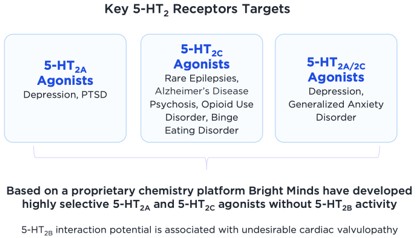
Bright Minds has a portfolio of patented, selective serotonin (5-HT2C and 5-HT2C/A-receptor subtypes) agonists that were identified using high-throughput screening methods in combination with advanced molecular modeling techniques to interrogate the interaction between the drug and its targeted receptors to increase downstream signaling while avoiding off-target effects.
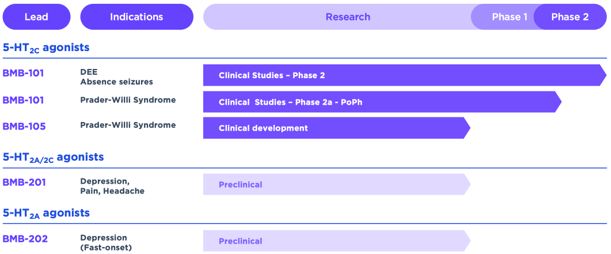
The Company’s lead program is 5-HT2C selective agonist BMB-101. It is a novel scaffold 5-HT2C agonist developed using structure-based drug design. Biased agonism at the 5-HT2C receptor is one of its key features and adds another layer of functional selectivity within a well-validated target. BMB-101 works exclusively via the Gq-protein signaling pathway and avoids beta-arrestin activation, which is crucial to minimize the risk of receptor desensitization and tolerance development. This provides a novel mechanism, anti-epileptic drug designed to provide sustained seizure relief in hard-to-treat patient populations. In preclinical studies, BMB-101 has demonstrated efficacy in animal models of Dravet Syndrome and animal models of generalized seizures.
In Phase 1 clinical studies, BMB-101was tested in healthy volunteers in a Single Ascending Dose (SAD), Multiple Ascending Dose (MAD) and food-effects study. BMB-101 was demonstrated to be safe and well tolerated at all doses. No Serious Adverse Events (SAEs) were observed, and Adverse Events (AEs) were mild in nature and in line with on-target effects for serotonergic drugs.
An extensive target-engagement study was conducted using both fluid biomarkers (transient prolactin release) and physical biomarkers (Quantitative Electroencephalogram, qEEG). Both methods confirmed robust central target engagement. A qEEG signature typicalfor anti-epileptic drugs was observed, with a selective depression of EEG power at frequencies observed during epileptic seizures. Furthermore, a potentiation of frontal gamma-power was observed in this study which could indicate the potential for improved cognition.
Phase 2 clinical trials of BMB-101 were initiated in 2024 in a group of drug-resistant epilepsies including Developmental and Epileptic Encephalopathies and Absence epilepsies.
The Company plans to explore the utility of its highly selective 5-HT2C agonists in PWS, and exploratory Phase 2 study of BMB-101 in PWS patients is planned in 2026.
Lead candidates in other programs include BMB-105, novel 5-HT2C agonist, and BMB-201 and BMB-202, selective 5-HT2A agonists for neuropsychiatry and neurology indications, undergoing IND-enabling studies.
Stage of Development of Principal Products
|
Drug candidate |
Program |
Medical indications |
Status
|
|
BMB-101 |
5-HT2C agonist |
DEE
Absence Seizures
Prader Willi Syndrome |
Preclinical characterisation: IND-enabling package completed
API and Drug Product manufacturing: Completed. Optimization and drug product resupply is ongoing.
Clinical:
Phase 1 clinical trials (SAD/MAD/Food effects) completed
Phase 2 clinical trials in DEE and absence seizures patients – ongoing
Future Phase 2/3 clinical trials in epilepsy indications – preparatory activities ongoing
Phase 2 clinical trial in PWS patients – preparatory activities ongoing
|
|
BMB-105 |
5-HT2C agonist |
Prader Willi Syndrome |
Preclinical characterisation: IND-enabling package ongoing
API and Drug Product manufacturing: Ongoing
|
|
BMB-201 |
5-HT2A/2C agonist |
Pain / psychiatry indication |
Preclinical characterisation: IND-enabling package ongoing
|
|
BMB-202 |
5-HT2A agonist |
Psychiatry indication |
Preclinical characterisation: IND-enabling package ongoing
|
The Company has completed a Phase 1 clinical trial on its leading product candidate, 5-HT2C agonist, as follows:
|
Product |
Indications |
Clinical Trial |
Major Objective |
Outcome |
||
|
BMB-101 |
Undisclosed Seizure Disorder |
Phase 1 SAD, MAD and Food Effects |
● |
Safety, PK/PD and Exploratory Effect markers |
●
|
Based on safety results, BMB-101 was safe and well-tolerated by healthy subjects. |
| ● | Prolactin and qEEG changes were indicative of central target engagement of central 5-HT2c receptors by BMB-101. | |||||
|
Absence Epilepsy and DEE |
BREAKTHROUGH Study: A Phase 2 Trial of BMB-101 in Absence Epilepsy and Developmental Epileptic Encephalopathy |
● |
Assess the safety, tolerability and efficacy of BMB-101 |
● |
Ongoing study NCT06401538 | |
Production and Services
Currently, the Company has no commercial production and is in the process of developing its principal products and completing clinical trials. Upon the successful development of one of the Company’s principal products the Company will establish a method of production.
Specialized Skill and Knowledge
The nature of the Company’s business requires specialized skill and knowledge, including expertise in medicine and healthcare. The Company’s management and Scientific Advisory Board has expertise drug development and therapeutics. The required skills and knowledge to succeed in our industry are available to Bright Minds through certain members of the company’s management, directors, officers, and advisory teams. See “DIRECTORS AND OFFICERS”.
Competitive Conditions
The biotechnology and biopharmaceutical industries, and the neurological subsector, are characterized by rapid evolution of technologies, fierce competition, and strong defense of intellectual property. Any product candidates that the Company successfully develop and commercialize will have to compete with existing therapies and new therapies that may become available in the future. While the Company believes that their rational approach to drug design, along with their scientific expertise in the field of serotonergic drugs and central nervous system (CNS) function, provide the Company with competitive advantages, a wide variety of institutions, including large biopharmaceutical companies, specialty biotechnology companies, academic research departments, and public and private research institutions, are actively developing potentially competitive products and technologies. The Company’s competitors generally fall within the following categories:
|
● |
Developmental and Epileptic Encephalopathy/Epilepsy. UCB, Jazz Pharmaceuticals, H. Lundbeck A/S, Biocodex, Xenon Pharmaceuticals, Praxis Therapeutics, SK Life Science, Ovid Therapeutics, Supernus Pharmaceuticals, Harmony Biosciences, Takeda Pharmaceuticals, Eisai. |
|
● |
Prader-Willi Syndrome: Soleno Therapeutics, Aardvark Therapeutics, Rhythm Pharmaceuticals, Acadia Pharmaceuticals, Harmony Biosciences, Neuren Pharmaceuticals |
|
● |
Antidepressants and anxiolytics. AbbVie Inc., AstraZeneca, Bristol-Myers Squibb, Eli Lilly and Company, GlaxoSmithKline, H. Lundbeck A/S, Johnson & Johnson, Merck, Novartis, Otsuka Pharmaceutical, Pfizer Inc., Sanofi, Takeda Pharmaceutical Company Ltd. |
Intangible Properties
Patents and Patent Applications
Kozikowski-Roth Patents
The Company has exclusively licensed a family of patents based on PCT/US2011/023535, which is co-owned by the Board of Trustees of UIC and the University of North Carolina at Chapel Hill. This family of licensed patents includes patents granted in Australia (AU Pat No 2011212930), Canada (CA Pat No 2788416), Europe (EU Pat No 2531485), Japan (JP Pat No 5810099), United States (US Pat No 8492591 and US Pat No 8754132). In addition, the Company has exclusively licensed a family of patents based on PCT/US2016/015019, which is solely owned by the Board of Trustees of UIC. This family of licensed patents includes patents applied for or granted in China (CN Publication No 107810175), Europe (EU Publication No 3250549), Hong Kong SAR (HK Publication No 1251831), and the United States (US Pat No 10407381). The latest patent to issue is US Pat No 10407381 which will expire on January 27, 2036.
These patents were based on the past research completed by Dr. Alan Kozikowski and Dr. Bryan Roth that is documented in United States publication number US20090203750A1 “5-HT2C Receptor Agonists as Anorectic Agents”. The invention related to the discovery of novel selective 5-HT2C and 5-HT2C/A agonists that could be used for the treatment of multiple neurological conditions.
On May 26, 2020, the Company entered into an option agreement (the “Roth Kozikowski Agreement”) with the Board of Trustees of UIC in which UIC granted the Company, in consideration for an option fee, an exclusive option to: (i) evaluate the inventions described in PCT/US2011/023535 and all counterpart patents related thereto and described in PCT/US2016/015019 and all counterpart patents related thereto (collectively, the “Inventions”); and (ii) obtain an exclusive license to the Inventions. On April 23, 2021, the Company and UIC entered into a First Amendment to the Roth Kozikowski Agreement for the purpose of amending certain terms in the Roth Kozikowski Agreement.
On April 23, 2021, the Company entered into an exclusive license agreement (the “Exclusive License Agreement”) with UIC pursuant to the exercise of its option under the Roth Kozikowski Agreement and the First Amendment to the Roth Kozikowski Agreement. Pursuant to the terms and conditions of the Exclusive License Agreement, UIC granted the Company an exclusive license to the Inventions (the “License”). In consideration for the License, the Company (i) paid UIC a signing fee of USD$100,000, less USD$15,000 paid by the Company pursuant to the Roth Kozikowski Agreement; and (ii) issued 63,000 Common Shares at a deemed price of $5.85 per Common Share to the UIC (part of which was received by UIC on behalf of the University of North Carolina at Chapel Hill). Additionally, the Company agreed to pay UIC a royalty on net sales of products derived from the Inventions and a portion of all revenue received by the Company from sublicensees.
The Company may terminate the Exclusive License Agreement at any time on written notice to UIC at least ninety (90) days prior to the termination date specified in the notice. The notice of termination must also include the Company’s reason for such termination. UIC may terminate the Exclusive License Agreement if the Company: (a) fails to pay any amount, or provide any other consideration, or make any report when required, and the Company does not cure such failure within ninety (90) days after receiving notice thereof; (b) is in breach of any provision of the Exclusive License Agreement not covered by (a) and the Company does not cure such failure within forty-five (45) days after receiving notice thereof; (c) is in breach of any obligations that the Company has to UIC under any other agreement between the Company and UIC and the Company does not cure such failure within ninety (90) days after receiving notice thereof, however, should the Company be aware it is unable to remedy such breach within ninety (90) days, the Company shall have the option to provide written notice to UIC after which the Company and UIC shall negotiate in good faith to determine an appropriate extension to said ninety (90) day time frame; (d) makes any materially false report and receives written notice from UIC; (e) to the extent not prohibited by applicable law commences a voluntary case as a debtor under the Bankruptcy Code, or if an involuntary case is commenced against the Company under the Bankruptcy Code, or if an order for relief shall be entered in such case, or if the same or any similar circumstance shall occur under the laws of any foreign jurisdiction; and/or (f) takes any action that purports to cause or causes any of the patent rights or technical information subject to the Exclusive License Agreement to be subject to any lien or encumbrance, and such termination shall be upon written notice to the Company.
Filed Patent Applications
Based upon molecular modeling studies in concert with data available from published research articles, the Bright Minds chemistry team designed novel analogs of psilocin that they believed would retain 5-HT2A activity while having no propensity to activate the 5‑HT2B receptors. These new chemical entities were thus anticipated to retain the brain re-booting activity of psilocin while showing no propensity to cause valvulopathy issues.
On March 12, 2020, Bright Minds filed a United States provisional application that was assigned a serial number of US 62/988,926. This patent application focused on psilocin analogs that have been decorated with functionality appropriate to achieving the goals of maintaining the desired 5-HT2A activity while being devoid of 5-HT2B activity. On March 12, 2021, Bright Minds filed a Patent Cooperation Treaty patent application that claims priority to US 62/988,926. Such Patent Cooperation Treaty patent application was assigned a serial number of PCT/CA2021/050336. In September 2022, PCT/CA2021/050336 entered the national phase in the United States of America; the United States application, which has been assigned a serial number of 17/911,022, is currently pending. In October 2022, PCT/CA2021/050336 entered the national phase in the European Union; the European Union application, which has been assigned a serial number of 21768153.5, is currently pending.
On May 26, 2021, Bright Minds filed a United States provisional application that was assigned a serial number of US 63/193,062. This patent application focused on substitutions at a particular position on an indole structure. On May 25, 2022, Bright Minds filed a Patent Cooperation Treaty patent application that claims priority to US 63/193,062. Such Patent Cooperation Treaty patent application has been assigned a serial number of PCT/CA2022/050833. PCT/CA2022/050833 has entered the national/regional phase in the United States of America (assigned application number 18/562,587), Canada (assigned application number 3,219,940), Japan (assigned application number 2023-573064), the European Union (assigned application number 22810004.6), South Korea (assigned application number 10-2023-7044608), and China (assigned application number 202280052820.8).
On January 4, 2022, Bright Minds filed a United States provisional application that has been assigned a serial number of US 63/296,430. This patent application focuses on phenethylamine compounds. On November 4, 2022, Bright Minds filed a second United States provisional application focused on phenethylamine compounds; this provisional application has been assigned a serial number of US 63/422,730. On January 4, 2023, Bright Minds filed a Patent Cooperation Treaty patent application that claims priority to US 63/296,430 and US 63/422,730. Such Patent Cooperation Treaty patent application has been assigned a serial number of PCT/CA2023/050003. PCT/CA2022/050003 has entered the national/regional phase in Canada (assigned application number 3,242,928), the United States of America (assigned application number 18/726,389), Australia (assigned application number 2023205941), Japan (assigned application number 2024-540591), the European Union (assigned application number 23736951.7), South Korea (assigned application number 10-2024-7026278), and China (assigned application number 202380022140.6).
On May 6, 2022, Bright Minds filed a United States provisional application that has been assigned a serial number of US 63/338,889. This patent application focuses on substitutions at a particular position on an indole structure. On May 2, 2023, Bright Minds filed a Patent Cooperation Treaty patent application that claims priority to US 63/338,889. Such Patent Cooperation Treaty patent application has been assigned a serial number of PCT/CA2023/050595. PCT/CA2023/050595 has entered the national/regional phase in Canada (assigned application number 3,252,369), Japan (application number to be assigned), Australia (assigned application number 2023264112), the United States of America (assigned application number 18/863,516), and the European Union (assigned application number 23799069.2). Bright Minds also intends for PCT/CA2023/050595 to enter the national phase in China, and the deadline to enter the Chinese national phase is January 6, 2025.
Bright Minds is currently listed as an applicant in the following publicly disclosed matters:
|
Patent Application Number |
Region |
Title |
Inventors |
Applicant |
Filing Date |
Status |
|
17/911,0225 |
USA |
3-(2-(AMINOETHYL)-INDOL-4-OL DERIVATIVES, METHODS OF PREPARATION THEREOF, AND THE USE AS 5-HT2 RECEPTOR MODULATORS |
Alan KOZIKOWSKI Gideon SHAPIRO Werner TUECKMANTEL John McCORVY |
Bright Minds Biosciences Inc.; The Medical College of Wisconsin, Inc. |
March 12, 2021 (national phase entry of PCT/CA2021/050336 having an international filing date of March 12, 2021, which claims priority to US 62/988,926 filed March 12, 2020) |
Pending |
|
21768153.56 |
European Union |
3-(2-(AMINOETHYL)-INDOL-4-OL DERIVATIVES, METHODS OF PREPARATION THEREOF, AND THE USE AS 5-HT2 RECEPTOR MODULATORS |
Alan KOZIKOWSKI Gideon SHAPIRO Werner TUECKMANTEL John McCORVY |
Bright Minds Biosciences Inc.; The Medical College of Wisconsin, Inc. |
March 12, 2021 (national phase entry of PCT/CA2021/050336 having an international filing date of March 12, 2021, which claims priority to US 62/988,926 filed March 12, 2020) |
Pending |
|
5 |
Pursuant to an inter-institutional agreement effective as of December 16, 2022, entered into between the Company and The Medical College of Wisconsin, Inc. (“MCW”), MCW is responsible for prosecuting and maintaining this application and negotiating licenses relating to the application. |
| 6 |
See note 2. |
|
18/562,587 |
USA |
Heterocyclic Compounds and Methods of Preparation Thereof |
Alan KOZIKOWSKI Werner TUECKMANTEL John MCCORVY Uros LABAN |
Bright Minds Biosciences Inc.; The Medical College of Wisconsin, Inc. |
May 25, 2022 (national phase entry of PCT/CA2022/050833 having an international filing date of May 25 2022, which claims priority to US 63/193,062 filed May 26, 2021 and US 63/309,735 filed February 14, 2022) |
Pending |
|
3,219,940 |
Canada |
Heterocyclic Compounds and Methods of Preparation Thereof |
Alan KOZIKOWSKI Werner TUECKMANTEL John MCCORVY Uros LABAN |
Bright Minds Biosciences Inc.; The Medical College of Wisconsin, Inc. |
May 25, 2022 (national phase entry of PCT/CA2022/050833 having an international filing date of May 25 2022, which claims priority to US 63/193,062 filed May 26, 2021 and US 63/309,735 filed February 14, 2022) |
Pending |
|
2023-573064 |
Japan |
Heterocyclic Compounds and Methods of Preparation Thereof |
Alan KOZIKOWSKI Werner TUECKMANTEL John MCCORVY Uros LABAN |
Bright Minds Biosciences Inc.; The Medical College of Wisconsin, Inc. |
May 25, 2022 (national phase entry of PCT/CA2022/050833 having an international filing date of May 25 2022, which claims priority to US 63/193,062 filed May 26, 2021 and US 63/309,735 filed February 14, 2022) |
Pending |
|
22810004.6 |
European Union |
Heterocyclic Compounds and Methods of Preparation Thereof |
Alan KOZIKOWSKI Werner TUECKMANTEL John MCCORVY Uros LABAN |
Bright Minds Biosciences Inc.; The Medical College of Wisconsin, Inc. |
May 25, 2022 (national phase entry of PCT/CA2022/050833 having an international filing date of May 25 2022, which claims priority to US 63/193,062 filed May 26, 2021 and US 63/309,735 filed February 14, 2022) |
Pending |
|
10-2023-7044608 |
South Korea |
Heterocyclic Compounds and Methods of Preparation Thereof |
Alan KOZIKOWSKI Werner TUECKMANTEL John MCCORVY Uros LABAN |
Bright Minds Biosciences Inc.; The Medical College of Wisconsin, Inc. |
May 25, 2022 (national phase entry of PCT/CA2022/050833 having an international filing date of May 25 2022, which claims priority to US 63/193,062 filed May 26, 2021 and US 63/309,735 filed February 14, 2022) |
Pending |
|
202280052820.8 |
China |
Heterocyclic Compounds and Methods of Preparation Thereof |
Alan KOZIKOWSKI Werner TUECKMANTEL John MCCORVY Uros LABAN |
Bright Minds Biosciences Inc.; The Medical College of Wisconsin, Inc. |
May 25, 2022 (national phase entry of PCT/CA2022/050833 having an international filing date of May 25 2022, which claims priority to US 63/193,062 filed May 26, 2021 and US 63/309,735 filed February 14, 2022) |
Pending |
|
3,242,928 |
Canada |
Phenethylamines and Methods of Preparation Thereof |
Alan KOZIKOWSKI Werner TUECKMANTEL |
Bright Minds Biosciences Inc. |
January 4, 2023 (national phase entry of PCT/CA2023/050003 having an international filing date of January 4, 2023, which claims priority to US63/296,430 filed January 4, 2022 and US63/422,730 filed November 4, 2022) |
Pending |
|
18/726,389 |
USA |
Phenethylamines and Methods of Preparation Thereof |
Alan KOZIKOWSKI Werner TUECKMANTEL |
Bright Minds Biosciences Inc. |
July 2, 2024 (national phase entry of PCT/CA2023/050003 having an international filing date of January 4, 2023, which claims priority to US63/296,430 filed January 4, 2022 and US63/422,730 filed November 4, 2022) |
Pending |
|
2023205941 |
Australia |
Phenethylamines and Methods of Preparation Thereof |
Alan KOZIKOWSKI Werner TUECKMANTEL |
Bright Minds Biosciences Inc. |
January 4, 2023 (national phase entry of PCT/CA2023/050003 having an international filing date of January 4, 2023, which claims priority to US63/296,430 filed January 4, 2022 and US63/422,730 filed November 4, 2022) |
Pending |
|
2024-540591 |
Japan |
Phenethylamines and Methods of Preparation Thereof |
Alan KOZIKOWSKI Werner TUECKMANTEL |
Bright Minds Biosciences Inc. |
January 4, 2023 (national phase entry of PCT/CA2023/050003 having an international filing date of January 4, 2023, which claims priority to US63/296,430 filed January 4, 2022 and US63/422,730 filed November 4, 2022) |
Pending |
|
23736951.7 |
European Union |
Phenethylamines and Methods of Preparation Thereof |
Alan KOZIKOWSKI Werner TUECKMANTEL |
Bright Minds Biosciences Inc. |
January 4, 2023 (national phase entry of PCT/CA2023/050003 having an international filing date of January 4, 2023, which claims priority to US63/296,430 filed January 4, 2022 and US63/422,730 filed November 4, 2022) |
Pending |
|
10-2024-7026278 |
South Korea |
Phenethylamines and Methods of Preparation Thereof |
Alan KOZIKOWSKI Werner TUECKMANTEL |
Bright Minds Biosciences Inc. |
January 4, 2023 (national phase entry of PCT/CA2023/050003 having an international filing date of January 4, 2023, which claims priority to US63/296,430 filed January 4, 2022 and US63/422,730 filed November 4, 2022) |
Pending |
|
202380022140.6 |
China |
Phenethylamines and Methods of Preparation Thereof |
Alan KOZIKOWSKI Werner TUECKMANTEL |
Bright Minds Biosciences Inc. |
January 4, 2023 (national phase entry of PCT/CA2023/050003 having an international filing date of January 4, 2023, which claims priority to US63/296,430 filed January 4, 2022 and US63/422,730 filed November 4, 2022) |
Pending |
|
3,252,369 |
Canada |
Azepinoindoles and Methods of Preparation Thereof |
Alan KOZIKOWSKI Werner TUECKMANTEL |
Bright Minds Biosciences Inc. |
May 2, 2023 (national phase entry of PCT/CA2023/050595 having an international filing date of May 2, 2023, which claims priority to US 63/338,889 filed May 6, 2022) |
Pending |
|
2024-565127 |
Japan |
Azepinoindoles and Methods of Preparation Thereof |
Alan KOZIKOWSKI Werner TUECKMANTEL |
Bright Minds Biosciences Inc. |
May 2, 2023 (national phase entry of PCT/CA2023/050595 having an international filing date of May 2, 2023, which claims priority to US 63/338,889 filed May 6, 2022) |
Pending |
|
2023264112 |
Australia |
Azepinoindoles and Methods of Preparation Thereof |
Alan KOZIKOWSKI Werner TUECKMANTEL |
Bright Minds Biosciences Inc. |
May 2, 2023 (national phase entry of PCT/CA2023/050595 having an international filing date of May 2, 2023, which claims priority to US 63/338,889 filed May 6, 2022) |
Pending |
|
18/863,516 |
USA |
Azepinoindoles and Methods of Preparation Thereof |
Alan KOZIKOWSKI Werner TUECKMANTEL |
Bright Minds Biosciences Inc. |
May 2, 2023 (national phase entry of PCT/CA2023/050595 having an international filing date of May 2, 2023, which claims priority to US 63/338,889 filed May 6, 2022) |
Pending |
|
23799069.2 |
European Union |
Azepinoindoles and Methods of Preparation Thereof |
Alan KOZIKOWSKI Werner TUECKMANTEL |
Bright Minds Biosciences Inc. |
May 2, 2023 (national phase entry of PCT/CA2023/050595 having an international filing date of May 2, 2023, which claims priority to US 63/338,889 filed May 6, 2022) |
Pending |
|
202380051305.2 |
China |
Azepinoindoles and Methods of Preparation Thereof |
Alan KOZIKOWSKI Werner TUECKMANTEL |
Bright Minds Biosciences Inc. |
May 2, 2023 (national phase entry of PCT/CA2023/050595 having an international filing date of May 2, 2023, which claims priority to US 63/338,889 filed May 6, 2022) |
Pending |
The Company continues research and development (“R&D”) related to highly selective 5-HT2 agonists for neurological and neuropsychiatric indications. As a part of its ongoing R&D programs, the Company has filed and anticipates that it will continue to file additional patents to protect its intellectual property.
Trademarks
Bright Minds has the following trademark registrations:
|
Trademark |
Country |
Application Number (Registration Number) |
Filing Date (Registration Date) |
Status |
|
BRIGHT MINDS |
Canada |
2,016,213 (TMA1202388) |
2020-03-06 (2023-10-11) |
Registered |
|
BRIGHT MINDS |
United States of America |
90/245,748 (7,424,235) |
2020-10-09 (2024-06-25) |
Registered |
Web Domains
Bright Minds has use and control over the following domain name: brightmindsbio.com.
Government Regulation
Regulatory Framework
Drug products must be approved by the appropriate governing body before it can be sold in that country or area. The FDA approves products for the United States market and Health Canada approves products for the Canadian market. The European Medicines Agency approves products for the European Union. While the process by which products are approved by the FDA and Health Canada is very similar, each regulatory body has its own unique requirements for a product. In both cases, the development of a product through to approval can be a lengthy process and, in some cases, can take over 10 years. While early studies conducted in one jurisdiction will usually be accepted in the other, further and somewhat modified studies may be required to have a product approved in another jurisdiction.
Canadian Government Regulation
Drug products in Canada are regulated by Health Canada under the Food and Drugs Act and the Food and Drugs Regulations. Health Canada regulates, among other things, research and development activities and the testing, approval, manufacture, quality control, safety, effectiveness, labeling, storage, record keeping, advertising and promotion of any product candidates or commercial products. For a drug product to be approved in Canada, it must provide sufficient evidence of safety, efficacy and chemical quality based on preclinical investigation and Phase I, II and III clinical trials using approved and compliant manufacturing and clinical sites.
To obtain approval to market a drug in Canada, a sponsor usually requests a pre-submission meeting with the review division of Health Canada responsible for the therapeutic field. If the meeting is granted, the sponsor must submit a Pre-Submission Information package to the Therapeutic Products Directorate (“TPD”) to meet with the review division. This process occurs prior to submitting the New Drug Submission (“NDS”) application. The purpose of the pre-submission meeting is to review the evidence (non-clinical and clinical research, quality information, indication) that will be submitted in the NDS application.
During the drug development process, the sponsor prepares study reports. Once the sponsor releases the last study required for the submission, the sponsor completes the NDS application and submits it to the TPD. Prior to submitting the NDS and, if applicable, based on the intended use of the product in the identified patient population, the sponsor may submit in advance a request for priority review status.
After submitting the NDS application, the file undergoes a screening process prior to being accepted for review. TPD has 45 calendar days from receipt to complete the screening review process. If granted a priority review, the screening period is reduced to 25 calendar days.
After a comprehensive review of an NDS application, Health Canada will issue a Notice of Compliance if the product is approved or a Notice of Non-Compliance if further questions remain. If a Notice of Compliance is issued, a Drug Identification Number is also issued that is required to be printed on each label of the product, as well as the final version of the Product Monograph that has been agreed to between Health Canada and the sponsor.
The average target time for reaching a first decision on an NDS is 300 calendar days, unless the submission has received a priority review in which case the time is 180 calendar days. Fees are levied for a review of an NDS application.
The regulatory approval process is generally lengthy and expensive, with no guarantee of a positive result. Once approved, Health Canada continues to monitor the product and license holders have obligations related to reporting to Health Canada, record keeping and ensuring continued safety and efficacy of the product. Failure to comply with any of the above applicable regulations, regulatory authorities or other requirements may result in civil or criminal penalties, recall or seizure of products, injunctive relief including partial or total suspension of production, or withdrawal of a product from the market.
United States Government Regulation
In the United States, the FDA regulates drugs under the FDCA, and its implementing regulations, and biologics under the FDCA and the Public Health Service Act, and its implementing regulations. FDA approval is required before any new unapproved drug or biologic or dosage form, including a new use of a previously approved drug, can be marketed in the United States. In some cases, changes to aspects of an approved drug product also require pre-approval prior to implementation of these changes. Drugs and biologics are also subject to other federal, state, and local statutes and regulations. If Bright Minds fails to comply with applicable FDA or other requirements at any time during the product development process, clinical testing, the approval process or after approval, Bright Minds may become subject to administrative or judicial sanctions. These sanctions could include the FDA’s refusal to approve pending applications, license suspension or revocation, withdrawal of an approval, warning letters, product recalls, product seizures, total or partial suspension of production or distribution, civil monetary penalties or criminal prosecution. Any FDA enforcement action could have a material adverse effect on Bright Minds.
The process required by the FDA before drug products may be marketed in the United States generally involves the following:
|
● |
Completion of extensive preclinical laboratory tests and preclinical animal studies, some performed in accordance with the GLP regulations; |
|
● |
submission to the FDA of an Investigational New Drug (“IND”) Application, which must be reviewed by the FDA and become active before human clinical trials may begin and must be updated annually; |
|
● |
approval by an independent review board (“IRB”) or ethics committee representing each clinical site before each clinical trial may be initiated; |
|
● |
performance of adequate and well-controlled human clinical trials conducted under Good Clinical Practices (“GCP”) to establish the safety and efficacy of the product candidate for each proposed indication; |
|
● |
preparation of and submission to the FDA of a New Drug Application (“NDA”) or Biologics License Application (“BLA”) after completion of all pivotal clinical trials; |
|
● |
a determination by the FDA within 60 days of its receipt of an NDA or BLA to file the application for review; |
|
● |
potential review of the product application by an FDA advisory committee, where appropriate and if applicable; |
|
● |
satisfactory completion of an FDA pre-approval inspection of the manufacturing facilities where the proposed product is produced to assess compliance with current GMP; |
|
● |
a potential FDA audit of the preclinical research and clinical trial sites that generated the data in support of the NDA or BLA; and |
|
● |
FDA review and approval of an NDA or BLA prior to any commercial marketing or sale of the product in the United States. |
The preclinical research, clinical testing and approval process require substantial time, effort, and financial resources, and Bright Minds cannot be certain that any approvals for the Company’s product candidates will be granted on a timely basis, if at all. An IND is a request for authorization from the FDA to administer an investigational new drug product to humans in clinical trials. The central focus of an IND submission is on the general investigational plan and the protocol(s) for human clinical trials. The IND also includes results of animal studies assessing the toxicology, pharmacokinetics, pharmacology, and pharmacodynamic characteristics of the product; chemistry, manufacturing, and controls information; and any available human data or literature to support the use of the investigational new drug.
An IND must become effective before human clinical trials may begin in the US. An IND will automatically become effective 30 days after receipt by the FDA, unless before that time the FDA raises concerns or questions related to the proposed clinical trials. In such a case, the IND may be placed on clinical hold and the IND sponsor and the FDA must resolve any outstanding concerns or questions before clinical trials can begin. Accordingly, submission of an IND may or may not result in the FDA allowing clinical trials to commence. As drug product programs continue in development, clinical trial protocols, additional preclinical testing results, and manufacturing information is submitted with the IND to facilitate discussions with the FDA and approval of additional clinical trials.
Clinical Trials
Clinical trials involve the administration of the IND to human subjects under the supervision of qualified investigators in accordance with GCPs, which include the requirement that all research subjects provide their informed consent for their participation in any clinical trial. Clinical trials are conducted under protocols detailing, among other things, the objectives of the study, the parameters to be used in monitoring safety, and the efficacy criteria to be evaluated. A protocol for each clinical trial and any subsequent protocol amendments must be submitted to the FDA as part of the IND. Additionally, approval must also be obtained from each clinical trial site’s IRB or ethics committee, before the trials may be initiated, and the IRB or ethics committee must monitor the trial until completed. All subjects must provide informed consent prior to participating in the trial. There are also requirements governing the reporting of ongoing clinical trials and clinical trial results to public registries.
The clinical investigation of a drug is generally divided into three or four phases. Although the phases are usually conducted sequentially, they may overlap or be combined.
|
● |
Phase I. The drug is initially introduced into healthy human subjects or, in some cases, patients with the target disease or condition. These studies are designed to evaluate the safety, tolerance, metabolism, pharmacokinetic and pharmacologic actions of the investigational new drug in humans, and the side effects associated with increasing doses. |
|
● |
Phase II. The drug is administered to a limited patient population to evaluate safety and optimal dose levels for safety and efficacy, identify possible adverse side effects and safety risks, and preliminarily evaluate efficacy. |
|
● |
Phase III. The drug is administered to an expanded patient population, generally at geographically dispersed clinical trial sites to generate sufficient data to statistically evaluate dose levels, clinical effectiveness and safety, to establish the overall benefit-risk relationship of the IND product, and to provide an adequate basis for physician labeling. |
|
● |
Phase IV. In some cases, the FDA may conditionally approve an NDA or BLA for a drug product with the sponsor's agreement to conduct additional clinical trials after approval. In other cases, a sponsor may voluntarily conduct additional clinical trials after approval to gain more information about the drug. Such post-approval studies are typically referred to as Phase IV clinical trials. |
Clinical trial sponsors must also report to the FDA, within certain timeframes: (i) serious and unexpected adverse reactions, (ii) any clinically important increase in the rate of a serious suspected adverse reaction over that listed in the protocol or investigator’s brochure, or (iii) any findings from other studies or animal testing that suggest a significant risk in humans exposed to the product candidate. The FDA, the IRB, the ethics committee or the clinical trial sponsor may suspend or terminate a clinical trial at any time on various grounds, including a finding that the research subjects are being exposed to an unacceptable health risk. Additionally, some clinical trials are overseen by an independent group of qualified experts organized by the clinical trial sponsor, known as a data safety monitoring board or committee. This group provides authorization for whether or not a trial may move forward at designated check points based on access to certain data from the trial.
The clinical trial process can take years to complete, and there can be no assurance that the data collected will support FDA approval or licensing of the product. Results from one trial are not necessarily predictive of results from later trials. The Company may also suspend or terminate a clinical trial based on evolving business objectives and/or competitive climate.
Submission of an NDA or BLA to the FDA
Assuming successful completion of all required preclinical studies and clinical testing in accordance with all applicable regulatory requirements, detailed IND product information is submitted to the FDA in the form of an NDA or BLA requesting approval to market the product for one or more indications. Under federal law, the submission of most NDAs and BLAs is subject to an application user fee. Applications for Oppositional Defiant Disorder products are exempted from the NDA and BLA application user fee, unless the application includes an indication for other than a rare disease or condition and may be exempted from product and establishment user fees under certain conditions. An NDA or BLA must include all relevant data available from pertinent preclinical studies and clinical trials, including negative or ambiguous results as well as positive findings, together with detailed information relating to the product’s chemistry, manufacturing, controls, and proposed labeling, among other things. Data comes from company-sponsored clinical trials intended to test the safety and effectiveness of a use of a product, and may also come from several alternative sources, including clinical trials initiated by investigators. To support marketing approval, the data submitted must be sufficient in quality and quantity to establish the safety and effectiveness of the investigational new drug product to the satisfaction of the FDA.
Once an NDA or BLA has been submitted, the FDA’s goal is to review the application within ten months after it accepts the application for filing, or, if the application relates to an unmet medical need in a serious or life-threatening indication, six months after the FDA accepts the application for filing. The review process is often significantly extended by the FDA’s requests for additional information or clarification. Before approving an NDA or BLA, the FDA typically will inspect the facility or facilities where the product is manufactured. The FDA will not approve an application unless it determines that the manufacturing processes and facilities are following current GMP requirements and adequate to assure consistent production of the product within required specifications. Additionally, before approving an NDA or BLA, the FDA will typically inspect one or more clinical sites to assure compliance with GCP and related regulations.
The FDA is required to refer an NDA or BLA for a novel drug (in which no active ingredient has been approved in any other application) to an advisory committee or explain why such referral was not made. Typically, an advisory committee is a panel of independent experts, including clinicians and other scientific experts, that reviews, evaluates and provides a recommendation as to whether the application should be approved and the conditions thereof. The FDA is not bound by the recommendations of an advisory committee, but it considers such recommendations carefully when making decisions.
The FDA’s Decision on an NDA or BLA
After the FDA evaluates the NDA or BLA and conducts inspections of manufacturing facilities where the product will be produced, the FDA will issue either an approval letter or a complete response letter (“Complete Response Letter”). An approval letter authorizes commercial marketing of the drug with specific prescribing information for specific indications. A Complete Response Letter indicates that the review cycle of the application is complete, and the application is not ready for approval. To satisfy deficiencies identified in a Complete Response Letter, additional clinical data and/or an additional Phase III clinical trial(s), and/or other significant, expensive and time-consuming requirements related to clinical trials, preclinical studies or manufacturing may be required for the drug product.
Even if such additional information is submitted, the FDA may ultimately decide that the NDA or BLA does not satisfy the criteria for approval. The FDA could also approve the NDA or BLA with a risk evaluation and mitigation strategy, which could include medication guides, physician communication plans, or elements to assure safe use, such as restricted distribution methods, patient registries and other risk minimization tools. The FDA may also conditionally approve a drug product subject to, among other things, changes to proposed labeling, development of adequate controls and specifications, or a commitment to conduct one or more post-market studies or clinical trials. Such post-market testing may include Phase IV clinical trials and surveillance to further assess and monitor the product’s safety and effectiveness after commercialization. New government requirements, including those resulting from new legislation, may be established during the review process, or the FDA’s policies may change, which could delay or prevent regulatory approval of the Company’s products under development.
The Company has numerous options as it relates to contract manufactures of GMP (good manufacturing products) grade active pharmaceutical ingredients and finished products. The Company does not expect to encounter any issues sourcing raw materials nor do we foresee material volatility in raw materials and finished good pricing.
Cycles
The Company’s business is not cyclical or seasonal.
Economic Dependence
The Company is not substantially dependent on any contracts.
Changes to Contracts
The Company does not expect any aspect of the Company’s business to be affected by renegotiation or termination of contracts.
Environmental Protection
The Company’s business does not materially impact environmental conditions. The Company does not expect that there will be any financial or operational effects as a result of environmental protection requirements on its capital expenditures, profit or loss, or its competitive position in the current fiscal year or in future years.
Employees
As at September 30, 2025, the Company’s wholly-owned subsidiary, Bright Minds Biosciences LLC, had one employee and the Company as a whole had less than 25 full time equivalent staff.
Foreign Operations
The Company conducts certain clinical development activities outside of Canada and the United States, specifically in Australia where, as part of its clinical strategy the Company has sponsored and executed clinical drug trials. These are completed through arrangements with local contract research organizations (CROs), clinical sites, and service providers. Activities include site initiation, patient screening and enrollment, trial administration, clinical monitoring, data management, and handling of clinical trial material in accordance with Australian regulatory requirements.
These foreign activities are material to the Company’s business, and the Company is dependent on the continued availability and performance of Australian CROs, clinical sites, and investigators, as well as the timely receipt of ethics and regulatory approvals. The Company is subject to risks inherent in foreign operations, including differences in regulatory requirements and review timelines, changes in local laws or regulatory interpretations, availability of eligible patient populations, currency fluctuation and inflation, logistical challenges related to the sourcing, shipment and storage of the clinical trial materials, potential disruptions arising from public health events, geopolitical developments, or natural disasters; and counterparty performance, including CRO or site non-compliance with protocol. The Company mitigates these risks through a combination of contractual and operational controls. These include engaging reputable CROs and trial sites and operating in well established jurisdictions such as Australia.
At the date of this AIF, the Company believes that its Australian clinical activities are appropriately resourced and operating in accordance with applicable regulatory and ethical requirements. Nonetheless, there can be no assurance that the risks inherent in foreign operations will not materialize or that any resulting delays or additional costs will not be material. Any changes in local regulations or shifts in political conditions may adversely affect the Company’s ability to conduct clinical drug trials. The Company will continue to evaluate its reliance on Australian operations in light of development needs, regulatory feedback, and operational performance, and may expand or contract the scope of its foreign activities accordingly.
Lending
The Company has no lending operations.
Bankruptcy and Similar Procedures
There have been no bankruptcy or receivership proceedings against the Company.
Reorganizations
The Company has not completed any reorganizations of it or its subsidiaries within the three most recently completed financial years, and does not anticipate completing any such reorganizations in the current financial year.
Social or Environmental Policies
The Board has adopted a Code of Business Conduct and Ethics (the “Code of Ethics”) that applies to all of our employees and officers, including our principal executive officer, principal financial officer, principal accounting officer or controller or persons performing similar functions. The Board is responsible for monitoring compliance with the Code of Ethics.
RISK FACTORS
The following are certain risk factors relating to the business and securities of the Company. The following information is a summary only of certain risk factors and is qualified in its entirety by reference to, and must be read in conjunction with, the detailed information appearing elsewhere in this AIF. These risks and uncertainties are not the only ones facing the Company. Additional risks and uncertainties not presently known to the Company, or that the Company currently deems immaterial, may also impair the operations of the Company. If any such risks actually occur, the business, financial condition and/or liquidity and results of operations of the Company could be materially adversely affected.
Risks Related to the Business of the Company
The Company has a limited operating history and have not yet generated any revenues
The Company has a limited history of operations which makes evaluating the Company’s business and future prospects difficult. As such, the Company is subject to many risks common to such enterprises, including under-capitalization, cash shortages, limitations with respect to personnel, financial and other resources and lack of revenues. There is no assurance that the Company will be successful in achieving a return on shareholders’ investment and the likelihood of the Company’s success must be considered in light of the Company’s early stage of operations.
The Company’s actual financial position and results of operations may differ materially from the expectations of the Company’s management
The Company’s actual financial position and results of operations may differ materially from the Company’s management’s expectations. The Company has experienced some changes in its operating plans and certain delays in its plans. As a result, the Company’s revenue, net income and cash flow may differ materially from the Company’s management’s expected revenue, net income and cash flow. The process for estimating the Company’s revenue, net income and cash flow requires the use of judgment in determining the appropriate assumptions and estimates. These estimates and assumptions may be revised as additional information becomes available and as additional analyses are performed. In addition, the assumptions used in planning may not prove to be accurate, and other factors may materially affect the Company’s financial condition or results of operations.
The Company may not be successful in its efforts to identify, license or discover additional product candidates
Although a substantial amount of the Company’s effort will focus on the continued research, pre-clinical testing, clinical trials, and potential approval and commercialization of its existing product candidates, the success of its business also depends in part upon its ability to identify, license or discover additional product candidates. The Company’s research programs or licensing efforts may fail to yield additional product candidates for clinical development for a number of reasons, including but not limited to the following:
|
● |
the Company’s research or business development methodology or search criteria and process may be unsuccessful in identifying potential product candidates; |
|
● |
the Company may not be able or willing to assemble sufficient resources to acquire or discover additional product candidates; |
|
● |
the Company’s product candidates may not succeed in pre-clinical or clinical testing; |
|
● |
the Company’s product candidates may be shown to have harmful side effects or may have other characteristics that may make the products unmarketable or unlikely to receive marketing approval; |
|
● |
competitors may develop alternatives that render the Company’s product candidates obsolete or less attractive; |
|
● |
product candidates the Company develops may be covered by third parties’ patents or other exclusive rights; |
|
● |
the market for a product candidate may change during the Company’s program so that such a product may become unreasonable to continue to develop; |
|
● |
a product candidate may not be capable of being produced in commercial quantities at an acceptable cost, or at all; and |
|
● |
a product candidate may not be accepted as safe and effective by patients, the medical community or third-party payors. |
If any of these events occurs, the Company may be forced to abandon its development efforts to identify, license or discover additional product candidates, which would have a material adverse effect on its business and could potentially cause the Company to cease operations. Research programs to identify new product candidates require substantial technical, financial and human resources. The Company may focus its efforts and resources on potential programs or product candidates that ultimately prove to be unsuccessful.
The Company may be required and have not yet obtained regulatory approvals, licenses, and permits in the jurisdictions where its products or technologies are being researched, developed or commercialized, which failure to obtain such regulatory approvals, licenses and permits will likely have a material adverse effect on the Company’s business, financial condition and results of operations
The Company, or its service providers, may be required to obtain and maintain certain permits, licenses, and approvals in the jurisdictions where the Company’s products or technologies are being researched, developed, and/or commercialized. The Company has not obtained regulatory approval for any product candidate, and it is possible that none of the Company’s existing product candidates or any future product candidates will ever obtain regulatory approval. There can be no assurance that the Company will be able to obtain or maintain any necessary licenses, permits, or approvals. Any material delay or inability to receive these items is likely to delay and/or inhibit the Company’s ability to conduct our business, and would have an adverse effect on its business, financial condition, and results of operations. In particular, the Company will require approval from the FDA and equivalent organizations in other countries before any of the Company’s products can be marketed. There is no assurance that such approvals will be forthcoming. Furthermore, the exact nature of the studies these regulatory agencies will require is not known and can be changed at any time by the regulatory agencies, increasing the financing risk and potentially increasing the time to market we face, which could adversely affect the Company’s business, financial condition or results of operations.
The Company may encounter substantial delays or difficulties with its clinical trials, which could have a material adverse effect on the Company’s financial condition and results of operations
The Company may not commercialize, market, promote or sell any product candidate without first obtaining marketing approval from the FDA or comparable foreign regulatory authorities, and the Company may never receive such approvals. It is impossible to predict when or if any of the Company’s product candidates will prove effective or safe in humans and if or when the Company will receive regulatory approval. Before obtaining marketing approval from regulatory authorities for the sale of its product candidates, the Company must complete pre-clinical development and then conduct extensive clinical trials to demonstrate the safety and efficacy of its product candidates. Clinical testing is expensive, difficult to design and implement, can take many years to complete and is uncertain as to outcome. A failure of one or more clinical trials can occur at any stage of testing. Moreover, pre-clinical and clinical data are often susceptible to varying interpretations and analyses, and many companies that have believed their product candidates performed satisfactorily in pre-clinical studies and clinical trials have nonetheless failed to obtain marketing approval of their products.
The Company may experience numerous unforeseen events prior to, during, or as a result of, clinical trials that could delay or prevent the Company’s ability to receive marketing approval or commercialize current and any future product candidates, including:
|
● |
delays in reaching a consensus with regulatory authorities on design or implementation of clinical trials; |
|
● |
regulators or institutional review boards, or IRBs, may not authorize us or our investigators to commence a clinical trial or conduct a clinical trial at a prospective trial site; |
|
● |
delays in reaching agreement on acceptable terms with prospective clinical research organizations and clinical trial sites; |
|
● |
clinical trials of the Company’s product candidates may produce negative or inconclusive results; |
|
● |
imposition of a clinical hold by regulatory authorities as a result of a serious adverse event, concerns with a class of product candidates or after an inspection of the Company’s clinical trial operations, trial sites or manufacturing facilities; |
|
● |
occurrence of serious adverse events associated with the product candidate that are viewed to outweigh its potential benefits; |
|
● |
changes in regulatory requirements and guidance that require amending or submitting new clinical protocols; or |
|
● |
the Company may decide, or regulators may require us, to conduct additional clinical trials or abandon product development programs. |
Any inability to successfully complete pre-clinical and clinical development could result in additional costs to the Company or impair the Company’s ability to generate revenue. In addition, if the Company makes manufacturing or formulation changes to its product candidates, the Company may need to conduct additional testing to bridge its modified product candidate to earlier versions. Clinical trial delays could also shorten any periods during which the Company may have the exclusive right to commercialize its product candidates, if approved, or allow competitors to bring competing drugs to market before the Company, which could impair the Company’s ability to successfully commercialize its product candidates and may harm the Company’s business, financial condition, results of operations and prospects.
Additionally, if the results of the Company’s clinical trials are inconclusive or if there are safety concerns or serious adverse events associated with product candidates, the Company may:
|
● |
be delayed in obtaining marketing approval, if at all; |
|
● |
obtain approval for indications or patient populations that are not as broad as intended or desired; |
|
● |
obtain approval with labeling that includes significant use or distribution restrictions or safety warnings; |
|
● |
be subject to additional post-marketing testing requirements; |
|
● |
be required to perform additional clinical trials to support approval or be subject to additional post-marketing testing requirements; |
|
● |
be subject to the addition of labeling statements, such as warnings or contraindications; |
|
● |
be sued; or |
|
● |
experience damage to its reputation. |
The Company’s product development costs will also increase if the Company experience delays in testing or obtaining marketing approvals. The Company does not know whether any of the Company pre-clinical studies or clinical trials will begin as planned, need to be restructured or be completed on schedule, if at all.
Further, the Company, the FDA or an IRB may suspend the Company’s clinical trials at any time if it appears that the Company or its collaborators are failing to conduct a trial in accordance with regulatory requirements, such as the FDA’s current GCP (as defined herein), that the Company is exposing participants to unacceptable health risks, or if the FDA finds deficiencies in the Company’s INDs, or in the conduct of these trials. Therefore, the Company cannot predict with any certainty the schedule for commencement and completion of future clinical trials. If the Company experiences delays in the commencement or completion of its clinical trials, or if the Company terminates a clinical trial prior to completion, the commercial prospects of the Company’s product candidates could be negatively impacted, and the Company’s ability to generate revenues from its product candidates may be delayed.
Clinical trials are expensive, time consuming and difficult to design and implement, which could have a material adverse effect on the Company’s business, financial condition or results of operations
The Company’s product candidates will require clinical testing before the Company can submit an NDA for regulatory approval. The Company cannot predict with any certainty if or when the Company might submit an NDA for regulatory approval for any of its product candidates or whether any such NDA will be approved by the FDA. Human clinical trials are very expensive and difficult to design and implement, in part because they are subject to rigorous regulatory requirements. For instance, the FDA may not agree with the Company’s proposed endpoints for any future clinical trial of the Company’s product candidates, which may delay the commencement of the Company’s clinical trials. The clinical trial process is also time consuming. Furthermore, failure can occur at any stage, and the Company could encounter problems that cause it to abandon or repeat clinical trials, which could have a material adverse effect on the Company’s business, financial condition or results of operations.
The Company’s current and future clinical trials or those of the Company’s current or future collaborators may reveal significant adverse events not seen in the Company’s pre-clinical and non-clinical studies and may result in a safety profile that could inhibit regulatory approval or market acceptance of any of the Company’s product candidates
Before obtaining regulatory approvals for the commercial sale of any products, the Company must demonstrate through lengthy, complex and expensive pre-clinical studies and clinical trials that its product candidates are both safe and effective for use in each target indication. Clinical testing is expensive and can take many years to complete, and its outcome is inherently uncertain. There is typically an extremely high rate of attrition for product candidates proceeding through clinical trials. Product candidates in later stages of clinical trials also may fail to show the desired safety and efficacy profile despite having progressed through non-clinical studies and initial clinical trials. If the results of the Company’s ongoing or future pre-clinical studies and clinical trials are inconclusive with respect to the safety and efficacy of the Company’s product candidates, if the Company does not meet the clinical endpoints with statistical and clinically meaningful significance, or if there are safety concerns associated with the Company’s product candidates, the Company may be prevented from or delayed in obtaining marketing approval for such product candidates.
In some instances, there can be significant variability in safety or efficacy results between different clinical trials of the same product candidate due to numerous factors, including changes in trial procedures set forth in protocols, differences in the size and type of the patient populations, changes in and adherence to the clinical trial protocols, and the rate of dropout among clinical trial participants. Results of the Company’s trials could reveal a high and unacceptable severity and prevalence of side effects. Further, the Company’s product candidates could cause undesirable side effects in clinical trials related to on-target toxicity. If on-target toxicity is observed, or if the Company’s product candidates have characteristics that are unexpected, the Company may need to abandon their development or limit development to narrower uses or subpopulations in which the undesirable side effects or other characteristics are less prevalent, less severe or more acceptable from a risk-benefit perspective. Most product candidates that commence clinical trials are never approved as products and there can be no assurance that any of the Company’s current or future clinical trials will ultimately demonstrate positive results or support further clinical development of any of the Company’s product candidates.
If significant adverse events or other side effects are observed in any of the Company’s current or future clinical trials, the Company may have difficulty recruiting patients to its clinical trials, patients may drop out of the Company’s trials, or the Company may be required to abandon the trials or the development efforts of one or more product candidates altogether. The Company, the FDA or other applicable regulatory authorities may suspend or terminate clinical trials of a product candidate at any time for various reasons, including a belief that subjects in such trials are being exposed to unacceptable health risks or adverse side effects. Even if the side effects do not preclude the product from obtaining or maintaining marketing approval, undesirable side effects may inhibit market acceptance of the approved product due to its tolerability versus other therapies. Any of these developments could materially harm the Company’s business, financial condition, results of operations and prospects.
The Company has limited experience in completing clinical trials and has only completed one phase one drug trial to date
In July 2023, the Company completed the first Phase 1 clinical trial for its lead compound, BMB-101. Subsequently, in September 2024, the Company initiated the Phase 2 clinical trial for BMB-101. However, the Company has not yet demonstrated an ability to obtain regulatory approval, manufacture a commercial-scale product or arrange for a third party to do so on behalf of the Company, or conduct sales and marketing activities necessary for successful commercialisation of a product candidate. The Company may not be able to file an IND for BMB-101 or any of its other product candidates on the timelines the Company expects, if at all. For example, the Company may experience manufacturing delays with IND-enabling studies. Moreover, the Company cannot be sure that submission of an IND will result in the FDA allowing further clinical trials to begin, or that, once begun, issues will not arise that require the Company to suspend or terminate clinical trials. Commencing each of these clinical trials is subject to finalizing the trial design based on discussions with the FDA and other regulatory authorities. Any guidance the Company receives from regulatory authorities is subject to change. For example, a regulatory authority could change its position, including on the acceptability of the Company’s trial designs or the clinical endpoints selected, which may require the Company to complete additional clinical trials or impose stricter approval conditions than currently expected.
If the Company is required to conduct additional pre-clinical studies or clinical trials or other testing of its product candidates beyond those that are currently contemplated by the Company, if the Company is unable to successfully complete clinical trials of its product candidates or other testing, if the results of these trials or tests are not positive or are only modestly positive or if there are safety concerns, the Company may:
|
● |
be delayed in obtaining marketing approval for its product candidates; |
|
● |
not obtain marketing approval at all; |
|
● |
obtain approval for indications or patient populations that are not as broad as intended or desired; |
|
● |
be subject to post-marketing testing requirements; or |
|
● |
have the product removed from the market after obtaining marketing approval. |
If the Company experiences delays or difficulties in the enrolment of patients in clinical trials, the Company’s receipt of regulatory approvals could be delayed or prevented
The Company may not be able to initiate or continue clinical trials for its product candidates if the Company is unable to locate and enrol a sufficient number of eligible patients to participate in these trials as required by the FDA or similar regulatory authorities outside the United States. In particular, because the Company is deploying its drug discovery platform across a broad target space, the Company’s ability to enrol eligible patients may be limited or may result in slower enrolment than the Company anticipates. For example, because some of the Company’s product candidates target rare diseases, the Company may have difficulty enrolling a sufficient number of eligible patients or enrolment may be slower than anticipated. In addition, some of the Company’s competitors have ongoing clinical trials for product candidates that treat the same indications as the Company’s product candidates, and patients who would otherwise be eligible for the Company’s clinical trials may instead enrol in clinical trials of the Company’s competitors’ product candidates. The Company may not be able to identify, recruit and enrol a sufficient number of patients to complete its clinical studies for a number of reasons, including:
|
● |
the severity of the disease under investigation; |
|
● |
the eligibility criteria and overall design of the clinical trial in question; |
|
● |
the perceived risks and benefits of the product candidate under study; |
|
● |
clinicians’ and patients’ perceptions as to the potential advantages of the product candidate being studied in relation to other available therapies, including any new products that may be approved for the indications the Company is investigating; |
|
● |
the ability to obtain and maintain patient consents; |
|
● |
the efforts to facilitate timely enrolment in clinical trials; |
|
● |
the patient referral practices of physicians; |
|
● |
the size and nature of the patient population required for analysis of the trial’s primary endpoints; |
|
● |
the ability to monitor patients adequately during and after treatment; |
|
● |
the proximity and availability of clinical trial sites for prospective patients; |
|
● |
the risk that patients enrolled in clinical trials will drop out of the clinical trials before completion of their treatment; and |
|
● |
factors that the Company may not be able to control, such as potential future pandemics that may limit patients, principal investigators, staff or clinical site availability. |
Success in pre-clinical studies or clinical trials may not be predictive of results in future clinical trials
Positive results from early pre-clinical studies and clinical trials of the Company’s product candidates are not necessarily predictive of the results of later pre-clinical studies and any future clinical trials of the Company’s product candidates. Even if the Company is able to complete its planned pre-clinical studies and clinical trials of its product candidates according to the Company’s current development timeline, the results from such pre-clinical studies and clinical trials of the Company’s product candidates may not be replicated in subsequent pre-clinical studies or clinical trial results. If the Company cannot replicate such positive results in its later pre-clinical studies and future clinical trials, the Company may be unable to successfully develop, obtain regulatory approval for and commercialise its product candidates.
Many companies in the pharmaceutical and biotechnology industries have suffered significant setbacks in late-stage clinical trials after achieving positive results in early-stage development, and the Company cannot be certain that it will not face similar setbacks. These setbacks have been caused by, among other things, pre-clinical and other non-clinical findings made while clinical trials were underway, or safety or efficacy observations made in pre-clinical studies and clinical trials, including previously unreported adverse events. Moreover, pre-clinical, non-clinical and clinical data are often susceptible to varying interpretations and analyses, and many companies that believed their product candidates performed satisfactorily in pre-clinical studies and clinical trials nonetheless failed to obtain FDA approval.
Additionally, future clinical trials that the Company may plan might utilise an “open-label” trial design. An “open-label” clinical trial is one where both the patient and investigator know whether the patient is receiving the investigational product candidate or either an existing approved drug or placebo. Most typically, open-label clinical trials test only the investigational product candidate and sometimes may do so at different dose levels. Open-label clinical trials are subject to various limitations that may exaggerate any therapeutic effect as patients in open-label clinical trials are aware when they are receiving treatment. Open-label clinical trials may be subject to a “patient bias” where patients perceive their symptoms to have improved merely due to their awareness of receiving an experimental treatment. In addition, open-label clinical trials may be subject to an “investigator bias” where those assessing and reviewing the physiological outcomes of the clinical trials are aware of which patients have received treatment and may interpret the information of the treated group more favourably given this knowledge. The results from an open-label trial may not be predictive of future clinical trial results with any of the Company’s product candidates for which the Company includes an open-label clinical trial when studied in a controlled environment with a placebo or active control.
Interim, “topline,” and preliminary data from the Company’s clinical trials that the Company announces or publishes from time to time may change as more patient data becomes available and are subject to audit and verification procedures that could result in material changes in the final data
From time to time, the Company may publicly disclose preliminary or topline data from its clinical trials, which is based on a preliminary analysis of then-available data, and the results and related findings and conclusions are subject to change following a more comprehensive review of the data related to the particular study or trial. The Company may also make assumptions, estimations, calculations and conclusions as part of the Company’s analyses of data, and the Company may not have received or had the opportunity to fully and carefully evaluate all data. As a result, the topline or preliminary results that the Company reports may differ from future results of the same studies, or different conclusions or considerations may qualify such results, once additional data have been received and fully evaluated. Topline data also remains subject to audit and verification procedures that may result in the final data being materially different from the preliminary data the Company initially announces or publishes. As a result, topline data should be viewed with caution until the final data are available. From time to time, the Company may also disclose interim data from its clinical trials. Interim data from clinical trials that the Company may complete are subject to the risk that one or more of the clinical outcomes may materially change as patient enrolment continues and more patient data become available or as patients from the Company’s clinical trials continue other treatments for their disease. Adverse differences between preliminary or interim data and final data could significantly harm the Company’s business prospects.
If the interim, topline, or preliminary data that the Company reports differs from actual results, or if others, including regulatory authorities, disagree with the conclusions reached, the Company’s ability to obtain approval for, and commercialise, its product candidates may be harmed, which could harm the Company’s business, financial condition, results of operations and prospects. In addition, the information the Company chooses to publicly disclose regarding a particular clinical trial is based on what is typically extensive information, and investors may not agree with what the Company determines is material or otherwise appropriate information to include in its disclosure.
The Company may not be successful in its efforts to identify, license or discover additional product candidates, which may have a material adverse effect on the Company’s business and could potentially cause the Company to cease operations
Although a substantial amount of the Company’s effort will focus on the continued research and pre-clinical testing, potential approval and commercialization of its existing product candidates, the success of the Company’s business also depends in part upon its ability to identify, license or discover additional product candidates. The Company’s research programs or licensing efforts may fail to yield additional product candidates for clinical development for a number of reasons, including but not limited to the following:
|
● |
the Company’s research or business development methodology or search criteria and process may be unsuccessful in identifying potential product candidates; |
|
● |
the Company may not be able or willing to assemble sufficient resources to acquire or discover additional product candidates; |
|
● |
the Company’s product candidates may not succeed in pre-clinical or clinical testing; |
|
● |
the Company’s product candidates may be shown to have harmful side effects or may have other characteristics that may make the products unmarketable or unlikely to receive marketing approval; |
|
● |
competitors may develop alternatives that render the Company’s product candidates obsolete or less attractive; |
|
● |
product candidates the Company develops may be covered by third parties’ patents or other exclusive rights; |
|
● |
the market for a product candidate may change during the Company’s program so that such a product may become unreasonable to continue to develop; |
|
● |
a product candidate may not be capable of being produced in commercial quantities at an acceptable cost, or at all; and |
|
● |
a product candidate may not be accepted as safe and effective by patients, the medical community or third-party payors. |
If any of these events occurs, the Company may be forced to abandon its development efforts to identify, license or discover additional product candidates, which would have a material adverse effect on the Company’s business and could potentially cause the Company to cease operations. Research programs to identify new product candidates require substantial technical, financial and human resources. The Company may focus its efforts and resources on potential programs or product candidates that ultimately prove to be unsuccessful.
There is no assurance that the Company will turn a profit or generate immediate revenues
There is no assurance as to whether the Company will be profitable, earn revenues, or pay dividends. The Company has incurred and anticipates that it will continue to incur substantial expenses relating to the development and initial operations of its business. The payment and amount of any future dividends will depend upon, among other things, the Company’s results of operations, cash flow, financial condition, and operating and capital requirements. There is no assurance that future dividends will be paid, and, if dividends are paid, there is no assurance with respect to the amount of any such dividends.
The Company has incurred operating losses since inception and has not yet generated positive cash flows from operations. There is also no assurance that the Company will achieve or sustain profitability in the future. The Company’s ability to continue operations is dependent upon its ability to successfully execute its business plan, and to secure additional financing as required.
As at September 30, 2025, the Company had cash and cash equivalents and access to capital resources that management believes are sufficient to fund planned operations and capital requirements for at least the next twelve to eighteen months. However, the Company may require additional capital. If the Company is unable to obtain additional financing, this could materially adversely affect the Company’s financial condition, results of operations, and ability to continue operations
The Company may not be able to adequately protect and maintain its intellectual property and licenses, which could result in a material adverse effect to the Company’s business, financial condition and results of operations
The Company’s success will depend in part on its ability to protect and maintain its intellectual property rights and its licenses. No assurance can be given that the license or rights used by the Company will not be challenged, invalidated, infringed or circumvented, nor that the rights granted thereunder will provide competitive advantages to the Company. It is not clear whether the Company’s pending patent applications will result in the issuance of patents. There is no assurance that the Company will be able to enter into licensing arrangements, develop or obtain alternative technology in respect of patents issued to third parties that incidentally cover its production processes. Moreover, the Company could potentially incur substantial legal costs in defending legal actions which allege patent infringement or by instituting patent infringement suits against others. The Company’s commercial success also depends on the Company not infringing patents or proprietary rights of others and not breaching the exclusive license granted to the Company. There can be no assurance that the Company will be able to maintain such licenses that it may require to conduct its business or that such licenses have been obtained at a reasonable cost. Furthermore, there can be no assurance that the Company will be able to remain in compliance with its licenses. Consequently, there may be a risk that such licenses may be withdrawn with no compensation or penalties to the Company.
The Company’s inability to achieve timelines for publicly disclosed projects may result in material adverse effects on the Company’s business, financial condition and results of operations
The Company’s business is dependent on a number of key inputs and their related costs including raw materials and supplies related to its operations, as well as electricity, water and other utilities. Any significant interruption or negative change in the availability or economics of the supply chain for key inputs could materially impact the business, financial condition operating results, and timelines for project development of the Company. Any inability to secure required supplies and services or to do so on appropriate terms could have a materially adverse impact on the business, financial condition, operating results, and timelines for project development of the Company.
The Company may need additional capital for future operations and the Company is unable to secure any required capital it may be forced to curtail or discontinue operations
It is possible that costs associated with the operating the Company’s business will exceed the Company’s projections depending on the timing of future operating and capital expenses. Assuming the Company’s existing funds sustain the Company’s operations for next 12 months, the Company believes that it may thereafter require additional capital for additional product development, sales and marketing operations, other operating expenses and for general corporate purposes to fund growth in our Company’s markets. The Company does not know how much additional funding it may require. The Company may therefore be required to seek other sources of financing in the future, which sources (assuming the Company is able to locate such alternative sources of financing) may be on terms less favorable to the Company than those of our previous securities offerings. Any additional equity financing may be dilutive to shareholders, and debt financing, if available, may involve restrictive covenants. If additional funds are raised through the issuance of equity securities, the percentage ownership of shareholders will be reduced, shareholders may experience additional dilution in net book value per share, or such equity securities may have rights, preferences or privileges senior to those of the holders of the Common Shares. If adequate funds are not available on acceptable terms, the Company may be unable to develop or enhance its products, take advantage of future opportunities or respond to competitive pressures, any of which could have a material adverse effect on the Company’s business, financial condition and operating results, or the Company may be forced to curtail or cease its operations.
The Company may become subject to product liability claims, which could harm the Company’s financial condition and liquidity if the Company is unable to successfully defend or insure against such claims
The risk of product liability is inherent in the research, development, manufacturing, marketing and use of pharmaceutical products. Product candidates and products that the Company may commercially market in the future may cause, or may appear to have caused, injury or dangerous drug reactions, and expose the Company to product liability claims. These claims might be made by patients who use the product, healthcare providers, pharmaceutical companies, corporate collaborators or others selling such products. If the Company’s product candidates during clinical trials were to cause adverse side effects, the Company may be exposed to substantial liabilities. Regardless of the merits or eventual outcome, product liability claims, or other claims related to the Company’s product candidates may result in:
|
● |
decreased demand for the Company’s products due to negative public perception; |
|
● |
damage to the Company’s reputation; |
|
● |
withdrawal of clinical trial participants or difficulties in recruiting new trial participants; |
|
● |
initiation of investigations by regulators; |
|
● |
costs to defend or settle related litigation; |
|
● |
a diversion of management’s time and resources; |
|
● |
substantial monetary awards to trial participants or patients; |
|
● |
product recalls, withdrawals or labeling, marketing or promotional restrictions; |
|
● |
loss of revenues from product sales; and |
|
● |
the inability to commercialize any product candidates, if approved. |
The Company has obtained insurance for all ongoing clinical trials and will continue to obtain such insurance for future clinical trials. However, the insurance coverage may not be sufficient to reimburse the Company for any expenses or losses it may suffer. Insurance coverage is becoming increasingly expensive, and, in the future, the Company, or any of its collaborators, may not be able to maintain insurance coverage at a reasonable cost or in sufficient amounts or at all to protect against losses due to liability. Even if the Company’s agreements with any future collaborators entitle it to indemnification against product liability losses, such indemnification may not be available or adequate should any claim arise. The Company’s inability to obtain sufficient product liability insurance at an acceptable cost to protect against product liability claims could prevent or inhibit the commercialization of its product candidates. If a successful product liability claim or series of claims is brought against the Company for uninsured liabilities or in excess of insured liabilities, its assets may not be sufficient to cover such claims and its business operations could be impaired.
Should any of the events described above occur, this could have a material adverse effect on the Company’s business, financial condition and results of operations.
Health and safety issues related to the Company’s products may have a material adverse effect on the Company’s business and results of operations
Health and safety issues related to the Company’s products may arise that could lead to litigation or other action against the Company or to regulation of certain of the Company’s product components. The Company may be required to modify its products and may also be required to pay damages that may reduce the Company’s profitability and adversely affect its financial condition. Even if these concerns prove to be baseless, the resulting negative publicity could affect the Company’s ability to market certain of its products and, in turn, could harm the Company’s business and results from operations.
The Company has international operations, which subjects the Company to risks inherent with operations outside of Canada
The Company has international operations and may seek to obtain market approvals in foreign markets that it deems could generate significant opportunities. However, even with the cooperation of a commercialization partner, conducting drug development in foreign countries involves inherent risks, including, but not limited to: difficulties in staffing, funding and managing foreign operations; different and unexpected changes in regulatory requirements; export restrictions; tariffs and other trade barriers; different reimbursement systems; economic weaknesses or political instability in particular foreign economies and markets; compliance with tax, employment, immigration and labour laws for employees living or travelling abroad; supply chain and raw materials management; difficulties in protecting, acquiring, enforcing and litigating intellectual property rights; fluctuations in currency exchange rates; and potentially adverse tax consequences.
If the Company were to experience any of the difficulties listed above, or any other difficulties, its international development activities and its overall financial condition may suffer and cause it to reduce or discontinue its international development and market approval efforts.
Changes in U.S. and international trade policies may adversely impact the Company’s business and operating results
The U.S. government has made statements and taken actions that have led to certain changes and may lead to additional changes to U.S. and international trade policies. For example, President Trump has imposed or signaled to impose a series of tariffs on certain products manufactured outside the United States, including pharmaceutical products and raw materials and components for pharmaceutical products, and it is unknown whether and to what extent additional tariffs (or other new laws or regulations) will be adopted, or the effect that any such actions would have on the Company or its industry. Any unfavorable government policies on international trade, such as export controls, capital controls or tariffs, may affect the demand for the Company’s product candidates, the competitive position of the Company’s product candidates, and import or export of raw materials and product used in the Company’s drug development, clinical manufacturing and future commercial activities. If any new tariffs, export controls, legislation and/or regulations are implemented, or if existing trade agreements are renegotiated or if the U.S. government takes retaliatory trade actions due to the ongoing trade tensions, such changes could have an adverse effect on the Company’s our business, financial condition and results of operations.
Proposed legislation in the U.S. Congress, including changes in U.S. tax law, may adversely impact certain investors, our business and the value of the Company’s securities
Changes to U.S. tax laws (which changes may have retroactive application) could adversely affect the Company’s business or holders of the Company’s securities. In recent years, many changes to U.S. federal income tax laws have been proposed and made, and additional changes to U.S. federal income tax laws are likely to continue to occur in the future.
The U.S. Congress is currently considering numerous items of legislation which may be enacted prospectively or with retroactive effect, which legislation could adversely impact certain investors, the Company’s financial performance and the value of the Company’s securities. On July 4, 2025, the President of the United States signed into law a new tax bill commonly referred to as the “One Big Beautiful Bill Act”, which may affect the U.S. federal income tax considerations applicable to certain investors of the Company’s securities. The likelihood of other similar legislation being enacted is uncertain, and the provisions of such bill or other similar legislation may change prior to enactment. Investors should consult their own tax advisors regarding such enacted or proposed legislation as well as the potential impact of such legislation on them in light of their own personal circumstances.
Exchange rate fluctuations between the U.S. dollar and the Canadian dollar may negatively affect the Company’s earnings and cash flows
The Company has Canadian, U.S. dollar, and Australia bank accounts and regularly incurs expenses primarily in Australian dollars, Canadian dollars and U.S. dollars. As a result, the Company is exposed to the risks that the Canadian or Australian dollar may devalue relative to the U.S. Dollar, or, if the Canadian or Australian dollar appreciates relative to the U.S. Dollar, that the inflation rate in Canada or Australia may exceed such rate of devaluation of the U.S. dollar, or that the timing of such devaluation may lag behind inflation in Canada. The Company cannot predict any future trends in the rate of inflation in Canada or the rate of devaluation, if any, of the Canadian or Australian dollar against the U.S. Dollar, or similarly of the U.S. Dollar against the Canadian or Australian Dollar. The value of the Company’s holdings in each currency may change over time, shifting the risk from one currency or the other, and the Company may not be able to accurately predict economic or global trends that may impact the Canadian dollar, Australian dollar or the U.S. dollar. The Company, further, may need to operate in other currencies due to the international nature of our operations, and is further exposed to currency risk as may relate to other foreign countries.
If patent laws or the interpretation of patent laws change, the Company’s competitors may be able to develop and commercialize the Company’s discoveries
Important legal issues remain to be resolved as to the extent and scope of available patent protection for biopharmaceutical products and processes in Canada and other important markets outside Canada, such as Europe or the United States. As such, litigation or administrative proceedings may be necessary to determine the validity, scope and ownership of certain of the Company’s and others’ proprietary rights. Any such litigation or proceeding may result in a significant commitment of resources in the future and could force the Company to do one or more of the following: cease selling or using any of its future products that incorporate a challenged intellectual property, which would adversely affect its revenue; obtain a license or other rights from the holder of the intellectual property right alleged to have been infringed or otherwise violated, which license may not be available on reasonable terms, if at all; and redesign its future products to avoid infringing or violating the intellectual property rights of third parties, which may be time-consuming or impossible to do. In addition, changes in patent laws in Canada and other countries may result in allowing others to use its discoveries or develop and commercialize our products. The Company cannot provide assurance that the patents it obtains will afford it significant commercial protection.
The Company may not be able to enforce its intellectual property rights throughout the world. This risk is exacerbated because the Company expects that one or more of our product candidates will be manufactured and used in a number of foreign countries
The laws of foreign countries may not protect intellectual property rights to the same extent as the laws of Canada. Many companies have encountered significant problems in protecting and defending intellectual property rights in certain foreign jurisdictions. This risk is exacerbated for the Company because it expects that future product candidates could be manufactured and used in a number of foreign countries.
The legal systems of some countries, particularly developing countries, do not favor the enforcement of patents and other intellectual property protection, especially those relating to life sciences. This could make it difficult to stop the infringement or other misappropriation of the Company’s intellectual property rights. For example, several foreign countries have compulsory licensing laws under which a patent owner must grant licenses to third parties. In addition, some countries limit the enforceability of patents against third parties, including government agencies or government contractors. In these countries, patents and trade secrets may provide limited or no benefit.
Most jurisdictions in which the Company intends to apply for patents have patent protection laws similar to those of Canada, but some of them do not. The Company may do business in the future in countries that may not provide the same or similar protection as that provided in Canada. Additionally, due to uncertainty in patent protection law, the Company has not filed applications in many countries where significant markets exist.
Proceedings to enforce patent rights in foreign jurisdictions could result in substantial costs and divert the Company’s efforts and attention from other aspects of its business. Accordingly, efforts to protect intellectual property rights in such countries may be inadequate. In addition, changes in the law and legal decisions by courts in Canada, the U.S., and other foreign countries may affect our ability to obtain adequate protection for the Company’s technology and the enforcement of its intellectual property.
The lack of product for commercialization would have a material adverse effect on the Company’s business, financial condition and results of operations
If the Company cannot successfully develop, manufacture and distribute its products, or if the Company experiences difficulties in the development process, such as capacity constraints, quality control problems or other disruptions, the Company may not be able to develop market-ready commercial products at acceptable costs, which would adversely affect the Company’s ability to effectively enter the market. A failure by the Company to achieve a low-cost structure through economies of scale or improvements in cultivation and manufacturing processes would have a material adverse effect on the Company’s commercialization plans and the Company’s business, prospects, results of operations and financial condition.
Failure to develop new and innovative products may have a material adverse effect on the Company’s business
The Company’s success will depend, in part, on its ability to develop, introduce and market new and innovative products. If there is a shift in consumer demand, the Company must meet such demand through new and innovative products or else the Company’s business will fail. The Company’s ability to develop, market and produce new products is subject to the Company having substantial capital. There is no assurance that the Company will be able to develop new and innovative products or have the capital necessary to develop such products.
The lack of experience of the Company’s management in marketing, selling, and distributing products may have a material adverse effect on the Company’s business and financial condition
The Company’s management’s lack of experience in marketing, selling, and distributing the Company’s products could lead to poor decision-making, which could result in cost-overruns and/or the inability to produce the desired products. Although management of the Company intends to hire experienced and qualified staff, this inexperience could also result in the Company’s inability to consummate revenue contracts or any contracts at all. Any combination of the aforementioned may result in the failure of the Company.
The size of the Company’s target market is difficult to quantify, and investors will be reliant on their own estimates on the accuracy of market data
Due to the industry in which the Company operates in being in a nascent stage with uncertain boundaries, there is a lack of information about comparable companies available for potential investors to review in deciding whether to invest in the Company and, few, if any, established companies whose business model the Company can follow or upon whose success the Company can build. Accordingly, investors will have to rely on their own estimates in deciding about whether to invest in the Company. There can be no assurance that the Company’s estimates are accurate or that the market size is sufficiently large for its business to grow as projected, which may negatively impact its financial results.
The Company will continue to sell Common Shares for cash to fund operations and capital expansion that will dilute current shareholders
There is no guarantee that the Company will be able to achieve its business objectives. The continued development of the Company will require additional financing. The failure to raise such capital could result in the delay or indefinite postponement of current business objectives or the Company going out of business. There can be no assurance that additional capital or other types of financing will be available if needed or that, if available, the terms of such financing will be favourable to the Company.
If additional funds are raised through issuances of equity or convertible debt securities, existing shareholders could suffer significant dilution, and any new equity securities issued could have rights, preferences and privileges superior to those of holders of Common Shares. The Company’s articles permit the issuance of an unlimited number of Common Shares, and shareholders will have no pre-emptive rights in connection with such further issuance. The directors of the Company have discretion to determine the price and the terms of issue of further issuances. In addition, from time to time, the Company may enter into transactions to acquire assets or the shares of other companies. These transactions may be financed wholly or partially with debt, which may temporarily increase the Company’s debt levels above industry standards. Any debt financing secured in the future could involve restrictive covenants relating to capital raising activities and other financial and operational matters, which may make it more difficult for the Company to obtain additional capital and to pursue business opportunities, including potential acquisitions. The Company may require additional financing to fund its operations to the point where it is generating positive cash flows. Negative cash flow may restrict the Company’s ability to pursue its business objectives.
Clinical and pre-clinical drug development is a lengthy, costly process with uncertain outcomes. The results from previous clinical trials and early pre-clinical studies of the Company’s product candidates may not predict future results. The regulatory approval process is lengthy and unpredictable. Inability to obtain the regulatory approval can be harmful for business
Before the Company can begin clinical trials, the Company must submit the results of pre-clinical studies, along with other necessary information such as product candidate chemistry, manufacturing controls, and the Company’s proposed clinical trial protocol, to the FDA or other comparable regulatory authorities as part of an investigational new drug application or similar regulatory filing. To obtain marketing approval from the FDA or other comparable foreign regulatory authorities, the Company must complete pre-clinical development and extensive clinical trials to demonstrate their safety and efficacy.
This process is expensive, can take many years, and its outcome is inherently uncertain. The Company’s clinical trials may not be conducted as planned or completed on schedule, if at all, and failure can occur at any time during the pre-clinical study or clinical trial process. Despite promising pre-clinical or clinical results, any product candidate can unexpectedly fail at any stage of development. Historically, the failure rate for product candidates in drug development is high. Results from pre-clinical studies or early clinical trials may not predict the outcomes of later clinical trials, and interim results of a clinical trial are not necessarily indicative of final results. The Company had previously submitted an investigational new drug application to the FDA but later withdrew it prior to full review. In the withdrawal letter, the FDA mentioned partial clinical hold deficiencies related to the proposed dosing regime. Additionally, product candidates in later stages of clinical trials may fail to demonstrate the desired safety and efficacy characteristics, despite having progressed through pre-clinical studies and clinical trials. The FDA or any foreign regulatory authorities may delay, restrict, or deny approval of the Company’s product candidates, or require additional nonclinical or clinical testing, or even force the Company to abandon a program for various reasons.
The Company’s officers and directors may be engaged in a range of business activities resulting in conflicts of interest, which may have a material adverse effect on the Company’s operations
The Company may be subject to various potential conflicts of interest because some of its officers and directors may be engaged in a range of business activities. In addition, the Company’s executive officers and directors may devote time to their outside business interests, so long as such activities do not materially or adversely interfere with their duties to the Company. In some cases, the Company’s executive officers and directors may have fiduciary obligations associated with these business interests that interfere with their ability to devote time to the Company’s business and affairs and that could adversely affect the Company’s operations. These business interests could require significant time and attention of the Company’s executive officers and directors.
In addition, the Company may become involved in other transactions which conflict with the interests of its directors and officers who may from time-to-time deal with persons, firms, institutions or companies with which the Company may be dealing, or which may be seeking investments similar to those desired by it. The interests of these persons could conflict with those of the Company. In addition, from time to time, these persons may be competing with the Company for available investment opportunities. Conflicts of interest, if any, will be subject to the procedures and remedies provided under applicable laws. If such a conflict of interest arises at a meeting of the Company’s directors, a director who has such a conflict will abstain from voting for or against the approval of such participation or such terms. In accordance with applicable laws, the directors of the Company are required to act honestly, in good faith and in the best interests of the Company.
In certain circumstances, the Company’s reputation could be damaged, which may have a material adverse effect on the Company’s financial performance, financial condition, cash flows and growth prospects
Damage to the Company’s reputation can be the result of the actual or perceived occurrence of any number of events, and could include any negative publicity, whether true or not. The increased usage of social media and other web-based tools used to generate, publish and discuss user-generated content and to connect with other users has made it increasingly easier for individuals and groups to communicate and share opinions and views regarding the Company and its activities, whether true or not. Although the Company believes that it operates in a manner that is respectful to all stakeholders and that it takes care in protecting its image and reputation, the Company does not ultimately have direct control over how it is perceived by others. Reputation loss may result in decreased investor confidence, increased challenges in developing and maintaining industry relations and an impediment to the Company’s overall ability to advance its projects, thereby having a material adverse impact on financial performance, financial condition, cash flows and growth prospects.
The Company has negative operating cash flow
The Company’s business has incurred losses since its inception. Although the Company expects to become profitable, there is no guarantee that will happen, and the Company may never become profitable. To date, the Company has not generated any revenue and the Company has a negative operating cash flow which may continue for the foreseeable future. The Company’s ability to generate revenue and potential to become profitable will depend largely on its ability to manufacture and market its products. There can be no assurance that any such events will occur or that the Company will ever become profitable. Even if the Company does achieve profitability, the Company cannot predict the level of such profitability. If the Company sustains losses over an extended period of time, the Company may be unable to continue its business.
The Company’s forward-looking statements may prove to be inaccurate
Investors should not place undue reliance on forward-looking statements. By their nature, forward-looking statements involve numerous assumptions, known and unknown risks and uncertainties, of both general and specific nature, that could cause actual results to differ materially from those suggested by the forward-looking statements or contribute to the possibility that predictions, forecasts or projections will prove to be materially inaccurate. Additional information on the risks, assumptions and uncertainties can be found in this AIF under the heading “Forward-Looking Information”.
If the Company has a material weakness in its internal controls over financial reporting, investors could lose confidence in the reliability of the Company’s financial statements, which could result in a decrease in the value of the Company’s Common Shares
One or more material weaknesses in the Company’s internal controls over financial reporting could occur or be identified in the future. In addition, because of inherent limitations, the Company’s internal controls over financial reporting may not prevent or detect misstatements, and any projections of any evaluation of effectiveness of internal controls to future periods are subject to the risk that controls may become inadequate because of changes in conditions or that the degree of compliance with our policies or procedures may deteriorate. If the Company fails to maintain the adequacy of its internal controls, including any failure or difficulty in implementing required new or improved controls, the Company’s business and results of operations could be harmed, the Company may not be able to provide reasonable assurance as to its financial results or meet the Company’s reporting obligations and there could be a material adverse effect on the price of the Company’s Common Shares.
Difficulties with forecasts
The Company must rely largely on its own market research to forecast sales as detailed forecasts are not generally obtainable from other sources at this early stage of the biotechnology industry dedicated to the discovery of serotonergic therapeutics. A failure in the demand for the Company’s products to materialize as a result of competition, technological change or other factors could have a material adverse effect on the Company’s business, results of operations and financial condition.
Risks Related to Our Common Shares
Our executive officers and directors beneficially own approximately 14.33% of the Company’s Common Shares.
As of the date of this AIF, our executive officers and directors beneficially own, in the aggregate, approximately 14.33% of the Company’s Common Shares. As a result, they are able to exercise a significant level of control over all matters requiring shareholder approval, including the election of directors, amendments to our articles and approval of significant corporate transactions. This control could have the effect of delaying or preventing a change of control of our Company or changes in management and will make the approval of certain transactions difficult or impossible without the support of these shareholders.
The continued sale of equity securities will dilute the ownership percentage of our existing shareholders and may decrease the market price for the Company’s Common Shares
The Company’s Notice of Articles (as defined herein) authorizes the issuance of an unlimited number of Common Shares. The Board of Directors has the authority to issue additional shares in the Company’s capital stock to provide additional financing in the future. The issuance of any such Common Shares may result in a reduction of the book value or market price of the Company’s outstanding Common Shares. Given the Company’s lack of revenue, the Company will likely have to issue additional equity securities to obtain working capital it requires in the future. The Company’s efforts to fund its intended business plans will therefore result in dilution to existing shareholders. If the Company does issue any such additional Common Shares, such issuance also will cause a reduction in the proportionate ownership and voting power of all other shareholders. As a result of such dilution, if you acquire Common Shares your proportionate ownership interest and voting power could be decreased. Furthermore, any such issuances could result in a change of control or a reduction in the market price for the Company’s Common Shares.
Additionally, we had 359,950 Options, 77,150 RSUs and 361,765 Warrants outstanding as of September 30, 2025. The exercise price of some of these Options and Warrants is below the Company’s current market price, and you could purchase shares in the market at a price in excess of the exercise price of our outstanding Options or Warrants. If the holders of these Options and Warrants elect to exercise them, your ownership position will be diluted and the per share value of the Common Shares you have or acquire could be diluted as well. As a result, the market value of the Company’s Common Shares could significantly decrease as well.
The market price of the Company’s Common Shares may be volatile and may fluctuate in a way that is disproportionate to the Company’s operating performance
Securities of companies with a small market capitalization have experienced substantial volatility in the past, often based on factors unrelated to the companies’ financial performance or prospects. These factors include macroeconomic developments in North America and globally, as well as market perceptions of the attractiveness of particular industries. Factors unrelated to the Company’s performance that may affect the price of the Common Shares include the following: the extent of analytical coverage available to investors concerning the Company’s business may be limited if investment banks with research capabilities do not follow the Company; lessening in trading volume and general market interest in the Common Shares may affect an investor’s ability to trade significant numbers of Common Shares; the size of the Company’s public float may limit the ability of some institutions to invest in Common Shares; and a substantial decline in the price of the Common Shares that persists for a significant period of time could cause the Common Shares to be delisted from the CSE and/or NASDAQ, further reducing market liquidity. As a result of any of these factors, the market price of the Common Shares at any given point in time may not accurately reflect the Company’s long-term value. Securities class action litigation often has been brought against companies following periods of volatility in the market price of their securities. In the future the Company may be the target of similar litigation. Securities litigation could result in substantial costs and damages and divert management’s attention and resources.
The market price of the Common Shares is affected by many other variables which are not directly related to the Company’s success and are, therefore, not within the Company’s control. Such variables include other developments that affect the breadth of the public market for the Common Shares, the release or expiration of lock-up or other transfer restrictions on the Common Shares, and the attractiveness of alternative investments. The effect of these and other factors on the market price of the Common Shares is expected to make the Common Share price volatile in the future, which may result in losses to investors.
The Company’s stock price is expected to be volatile and will be drastically affected by governmental and regulatory regimes and other factors outside of our control. The Company cannot fully predict the results of its operations expected to take place in the future. The results of these activities will inevitably affect our decisions related to future operations and will likely trigger major changes in the trading price of Common Shares.
Volatility in the Company’s Common Share price may subject the Company to securities litigation
The market for the Company’s Common Shares may have, when compared to seasoned issuers, significant price volatility, and the Company expects that its Common Share price may continue to be more volatile than that of a seasoned issuer for the indefinite future. In the past, plaintiffs have often initiated securities class action litigation against a company following periods of volatility in the market price of its securities. The Company may, in the future, be the target of similar litigation. Securities litigation could result in substantial costs and liabilities and could divert management's attention and resources.
The Company does not intend to pay dividends and there will thus be fewer ways in which you are able to make a gain on your investment
The Company has never paid any cash or stock dividends and the Company does not intend to pay any dividends for the foreseeable future. To the extent that the Company requires additional funding in the future, potential funding sources may prohibit the payment of any dividends. Because the Company does not intend to declare dividends, any gain on your investment will need to result from an appreciation in the price of the Company’s Common Shares. There will therefore be fewer ways in which you are able to make a gain on your investment.
FINRA sales practice requirements may limit your ability to buy and sell the Company’s Common Shares, which could depress the price of the Company’s Common Shares
FINRA rules require broker-dealers to have reasonable grounds for believing that an investment is suitable for a customer before recommending that investment to the customer. Prior to recommending speculative low-priced securities to their non-institutional customers, broker-dealers must make reasonable efforts to obtain information about the customer’s financial status, tax status and investment objectives, among other things. Under interpretations of these rules, FINRA believes that there is a high probability such speculative low-priced securities will not be suitable for at least some customers. Thus, FINRA requirements may make it more difficult for broker-dealers to recommend that their customers buy the Company’s Common Shares, which may limit your ability to buy and sell the Company’s Common Shares, have an adverse effect on the market for the Company’s Common Shares and, thereby, depress their market prices.
The Company is a foreign private issuer within the meaning of the rules under the Exchange Act, and as such the Company is exempt from certain provisions applicable to United States domestic public companies
The Company is a foreign private issuer within the meaning of the rules under the Exchange Act. As such, the Company is exempt from certain provisions applicable to United States domestic public companies. For example:
|
• |
the Company is not required to provide as many Exchange Act reports, or as frequently, as a domestic public company; |
|
• |
for interim reporting the Company is permitted to comply solely with its home country requirements, which are less rigorous than the rules that apply to domestic public companies; |
|
• |
the Company is not required to provide the same level of disclosure on certain issues, such as executive compensation; |
|
• |
the Company is exempt from provisions of Regulation FD aimed at preventing issuers from making selective disclosures of material information; |
|
• |
the Company is not required to comply with the sections of the Exchange Act regulating the solicitation of proxies, consents or authorizations in respect of a security registered under the Exchange Act; and |
|
• |
the Company is not required to comply with Section 16 of the Exchange Act requiring insiders to file public reports of their share ownership and trading activities and establishing insider liability for profits realized from any “short-swing” trading transaction. |
Shareholders may not have access to certain information they may deem important and are accustomed to receiving from U.S. reporting companies.
As an “emerging growth company” under applicable law, the Company will be subject to lessened disclosure requirements. Such reduced disclosure may make the Company’s Common Shares less attractive to investors
For as long as the Company remains an “emerging growth company”, as defined in the JOBS Act, the Company will elect to take advantage of certain exemptions from various reporting requirements that are applicable to other public companies that are not “emerging growth companies” and including, but not limited to, not being required to comply with the auditor attestation requirements of Section 404 of the Sarbanes-Oxley Act, reduced disclosure obligations regarding executive compensation in the Company’s periodic reports, exemptions from the requirements of holding a non-binding advisory vote on executive compensation and shareholder approval of any golden parachute payments not previously approved. Because of these lessened regulatory requirements, the Company’s shareholders would be left without information or rights available to shareholders of more mature companies. If some investors find the Company’s Common Shares less attractive as a result, there may be a less active trading market for such securities and their market prices may be more volatile.
The Company incurs significant costs as a result of being a public company, which costs will grow after the Company ceases to qualify as an “emerging growth company”
The Company incurs significant legal, accounting and other expenses as a public company. The Sarbanes-Oxley Act, as well as rules subsequently implemented by the SEC and Nasdaq, impose various requirements on the corporate governance practices of public companies. The Company is an “emerging growth company”, as defined in the JOBS Act, and will remain an emerging growth company until the earlier of : (1) the last day of the fiscal year (a) following the fifth anniversary of the date of the first sale of the Company’s common equity securities pursuant to an effective registration statement under the U.S. Securities Act, (b) in which the Company has total annual gross revenue of at least US$1.235 billion or (c) in which the Company is deemed to be a large accelerated filer, which means the market value of the Common Shares that is held by non-affiliates exceeds US$700 million as of the prior June 30th; and (2) the date on which the Company has issued more than US$1.0 billion in non-convertible debt during the prior three-year period. An emerging growth company may take advantage of specified reduced reporting and other requirements that are otherwise applicable generally to public companies. These provisions include exemption from the auditor attestation requirement under Section 404 of the Sarbanes-Oxley Act in the assessment of the emerging growth company’s internal control over financial reporting and permission to delay adopting new or revised accounting standards until such time as those standards apply to private companies.
Compliance with these rules and regulations increases the Company’s legal and financial compliance costs and makes some corporate activities more time-consuming and more costly. After the Company is no longer an emerging growth company, the Company expects to incur significant expenses and devote substantial management effort toward ensuring compliance with the requirements of Section 404 and the other rules and regulations of the SEC. For example, as a public company, the Company has been required to increase the number of independent directors and adopt policies regarding internal controls and disclosure controls and procedures. The Company has incurred additional costs in obtaining director and officer liability insurance. In addition, the Company incurs additional costs associated with its public company reporting requirements. It may also be more difficult for the Company to find qualified persons to serve on its Board of Directors or as executive officers. The Company is currently evaluating and monitoring developments with respect to these rules and regulations, and the Company cannot predict or estimate with any degree of certainty the amount of additional costs it may incur or the timing of such costs.
DIVIDENDS AND DISTRIBUTIONS
The Company has not declared nor paid any cash dividends on any of its issued equity securities since its inception. Other than requirements imposed under applicable corporate law, there are no other restrictions on the Company’s ability to pay dividends under the Company’s constating documents. The Company has not paid any dividends on the Common Shares since its incorporation. The Company has no present intention of paying dividends on the Common Shares, as it anticipates that all available funds will be invested to finance the growth of its business and, when appropriate, retire debt.
DESCRIPTION OF CAPITAL STRUCTURE
Common Shares
The Company’s authorized share capital consists of an unlimited number of Common Shares without par value. As of the date of this AIF, there are 7,787,161 Common Shares issued and outstanding as fully paid and non-assessable.
The holders of the Common Shares are entitled to dividends, if, as and when declared by the Board of Directors, to receive notice of meetings of shareholders of the Company, to one vote per Common Share at meetings of the shareholders of the Company and, upon liquidation, to receive such assets of the Company as are distributable to the holders of the Common Shares. Holders of Common Shares do not have cumulative voting rights with respect to the election of directors and, accordingly, holders of a majority of the votes eligible to vote at a meeting of shareholders may elect all the directors of the Company standing for election. Dividends, if any, will be paid on a pro rata basis only from funds legally available therefore. The Common Shares do not carry any pre-emptive, subscription, redemption or conversion rights, nor do they contain any sinking or purchase fund provisions.
Warrants
The following table sets forth all Warrants of the Company that are outstanding as of the date of this AIF:
|
Expiry Date |
Number of Warrants |
Exercise Price (CAD$) |
|
December 22, 2028 |
361,765 |
1.70 |
|
Total |
361,765 |
Options
The following table discloses all outstanding Options as of the date of this AIF:
|
Expiry Date |
Number of Options |
Exercise Price |
|
February 16, 2028 |
27,250 |
CAD$5.25 |
|
March 22, 2029 |
102,500 |
CAD$1.84 |
|
October 3, 2029 |
55,000 |
CAD$1.65 |
|
February 26, 2030 |
161,000 |
USD$35.00 |
|
October 30, 2030 |
43,000 |
USD$54.47 |
|
Total |
388,750 |
Restricted Share Units
The following table sets forth all RSUs of the Company that are outstanding as of the date of this AIF:
|
Expiry Date |
Number of RSUs |
Share Price (CAD$) |
|
February 1, 2027 |
12,000 |
N/A |
|
April 27, 2027 |
10,000 |
N/A |
|
December 1, 2027 |
55,000 |
N/A |
|
March 3, 2030 |
150 |
N/A |
|
Total |
77,150 |
MARKET FOR SECURITIES
Trading Price and Volume
On February 8, 2021, the Company’s Common Shares began trading on the CSE under the trading symbol “DRUG”. On November 8, 2021, the Company’s Common Shares began trading on the Nasdaq under the trading symbol “DRUG”.
The tables below summarizes the price ranges and trading volume of Common Shares on the CSE and the NASDAQ for each of the months stated:
CSE Trading Data
|
Month |
Price Range (CDN$) |
Volume |
|||||||
|
High |
Low |
||||||||
|
December 22, 2025 |
$131.88 |
$96.82 | 30,147 | ||||||
|
November 2025 |
$102.45 | $71.85 | 16,171 | ||||||
|
October 2025 |
96.50 | 70.11 | 10,650 | ||||||
|
September 2025 |
84.39 | 53.99 | 7,770 | ||||||
|
August 2025 |
61.48 | 44.69 | 9,898 | ||||||
|
July 2025 |
49.94 | 33.32 | 16,763 | ||||||
|
June 2025 |
40 | 33.01 | 5,562 | ||||||
|
May 2025 |
50.74 | 35.25 | 7,714 | ||||||
|
April 2025 |
53.48 | 38.84 | 11,860 | ||||||
|
March 2025 |
53.74 | 44.86 | 11,802 | ||||||
|
February 2025 |
66.76 | 47.82 | 16,057 | ||||||
|
January 2025 |
61 | 40.65 | 39,215 | ||||||
|
December 2024 |
67.53 | 49.26 | 34,044 | ||||||
|
November 2024 |
79.98 | 42.35 | 161,896 | ||||||
|
October 2024 |
108 | 1.35 | 789,168 | ||||||
NASDAQ Trading Data
|
Month |
Price Range (USD$) |
Volume |
|||||||
|
High |
Low |
||||||||
|
December 22, 2025 |
$97.75 |
$68.43 | 2,821,306 | ||||||
|
November 2025 |
$71.49 | $50.00 | 3,272,300 | ||||||
|
October 2025 |
$70.23 | $48.94 | 3,273,612 | ||||||
|
September 2025 |
$61.72 | $38.00 | 2,197,566 | ||||||
|
August 2025 |
$46.13 | $31.98 | 1,070,393 | ||||||
|
July 2025 |
$37.59 | $24.00 | 848,052 | ||||||
|
June 2025 |
$29.35 | $23.18 | 1,075,244 | ||||||
|
May 2025 |
$37.00 | $25.30 | 602,007 | ||||||
|
April 2025 |
$37.52 | $26.96 | 640,306 | ||||||
|
March 2025 |
$38.33 | $31.05 | 823,824 | ||||||
|
February 2025 |
$47.50 | $32.51 | 1,200,144 | ||||||
|
January 2025 |
$42.47 | $28.21 | 1,867,687 | ||||||
|
December 2024 |
$49.46 | $34.29 | 2,259,452 | ||||||
|
November 2024 |
$58.00 | $30.67 | 5,626,332 | ||||||
|
October 2024 |
$79.02 | $0.94 | 185,507,952 | ||||||
Prior Sales
During the fiscal year ended September 30, 2025 and to the date of this AIF, the Company issued the following securities that are not listed or quoted on a marketplace:
|
Date Issued |
Type of Security |
Number of Securities Issued |
Exercise Price |
|
October 30, 2025 |
Options |
43,000 |
US$54.47 |
|
March 3, 2025 |
RSUs |
600 |
N/A |
|
October 3, 2024 |
Options |
70,000 |
$1.65 |
| February 26, 2025 | Options | 161,000 | US$35.00 |
ESCROWED SECURITIES AND SECURITIES SUBJECT TO CONTRACTUAL RESTRICTIONS ON TRANSFER
As of the date of this AIF, no securities of the Company are currently held in escrow.
DIRECTORS AND OFFICERS
Name, Occupation and Security Holding
The following table sets forth information regarding the directors and executive officers of the Company as of the date of this AIF. The information as to the principal occupation, business or employment is not within the knowledge of the Company and has been furnished by the respective director/officer. The Board has four committees, each comprised of a majority of independent directors: an audit committee, a nominating and corporate governance committee, a compensation committee, and a corporate disclosure committee.
|
Name, province and country of residence |
Position with the Company |
Principal Occupation During the Past Five Years |
Period as Director and/or Officer |
Number of Common Shares and Percentage of Common Shares Held(1) |
|
Ian McDonald, Dubai, UAE |
President, Chief Executive Officer, and Director |
See biographies below |
May 31, 2019 – Present |
1,004,900 (12.90%) |
|
Ryan Cheung British Columbia, Canada |
Chief Financial Officer and Corporate Secretary |
See biographies below |
May 29, 2020 - Present |
Nil (0%) |
|
Stephen D. Collins Illinois, USA |
Chief Medical Officer |
See biographies below |
January 7, 2025 - Present |
Nil (0%) |
|
Alex Vasilkevich Illinois, USA |
Chief Operating Officer, Senior Scientific Officer |
See biographies below |
June 2024 – Present |
27,750 (0.36%) |
|
Nils Christian Bottler(2)(3)(4)(5) Berlin, Germany |
Director |
See biographies below |
September 29, 2020 - Present |
5,000 (0.06%) |
|
Jeremy Fryzuk(2)(3)(4)(5) London, U.K. |
Director |
See biographies below |
September 29, 2020 - Present |
20,609 (0.26%) |
|
Jan Pedersen Region Hovedstaden, Denmark |
Chief Scientific Officer and Director |
See biographies below |
April 27, 2022 - Present |
57,600 (0.74%) |
|
David Weiner(2)(3)(4)(5) New York, USA |
Director |
See biographies below |
February 16, 2023 |
Nil (0%) |
| Notes: |
|
|
(1) |
Percentage is based on 7,787,161 Common Shares issued and outstanding as of the date of this AIF. |
|
(2) |
Member of the Audit Committee. |
|
(3) |
Member of the Nominating and Corporate Governance Committee |
|
(4) |
Member of the Compensation Committee |
|
(5) |
Member of the Corporate Disclosure Committee |
Term of Office
The term of office of each director of the Company expires at the end of the next annual meeting of Shareholders.
Director and Officer Share Ownership
As of the date of the AIF, the Company’s directors and executive officers, as a group, beneficially owned, directly or indirectly, or exercised control or direction over 1,115,859 Common Shares, representing approximately 14.33% of the issued and outstanding Common Shares.
Biographies
The following are brief profiles of the executive officers and directors of the Company.
Ian McDonald, President, Chief Executive Officer and Director - Age: 38
Mr. McDonald is an entrepreneur and former Investment Banker. Prior to joining the Company, Mr. McDonald served on the management team at a TSX-listed gold mining company. In that capacity, Mr. McDonald developed and implemented the corporate strategy as it relates to M&A and capital markets resulting in a $160 million sale within one year. Previously, he worked in a senior role at a Canadian Investment Bank and in private equity in Vancouver, London and Toronto. Under Mr. McDonald’s guidance, clients raised hundreds of millions of dollars in capital. Mr. McDonald has served as a member of the Board of Directors of several TSX Venture Exchange, Canadian Securities Exchange listed and private companies.
Ryan Cheung, Chief Financial Officer - Age: 47
Mr. Cheung is the founder and managing partner of MCPA Services Inc., Chartered Professional Accountants, in Vancouver, B.C. Leveraging his experience as a former auditor of junior venture and resource companies, Mr. Cheung serves as a director and officer or consultant for public and private companies, providing financial reporting, taxation and strategic guidance.
He has been an active member of the Chartered Professional Accountants of British Columbia (formerly Institute of Chartered Accountants of British Columbia) since January 2008. Mr. Cheung holds a diploma in accounting from the University of British Columbia and a Bachelor of Commerce in international business from the University of Victoria.
Stephen D. Collins, Chief Medical Officer - Age: 73
Dr. Collins previously served as CEO of Biscayne Neurotherapeutics, a small molecule clinical stage company focused on CNS disorders, and CEO and President of Biscayne Pharmaceuticals. Biscayne was sold to Supernus Pharmaceuticals in October of 2018 for future development. Before heading the two Biscayne companies, Dr. Collins held several top leadership positions at companies targeting CNS disorders, including as CEO of Neurotherapeutics Pharma and Chief Scientific Officer & VP for Clinical Affairs of Ovation Pharmaceuticals, a CNS-focused biopharmaceutical company acquired by Lundbeck A/S for US $963 million.
Prior to Ovation, Steve served as a Global Director at Johnson & Johnson, overseeing early-stage development of a variety of CNS agents and as a member of the global in-licensing advisory team. Prior to Johnson and Johnson, he worked in Abbott Laboratories’ Pharmaceutical and Hospital Products Divisions, where he developed drugs for a range of CNS indications, including Depakote, Depakote ER, Depacon, and Gabitril, as well as a range of older seizure medicines. Dr. Collins was responsible for all preclinical and clinical programs supporting the successful approval of multiple NDA and sNDA submissions. Dr. Collins has served on several Boards of companies that have developed epilepsy drugs, including Spinifex Pharmaceuticals, which was acquired by Novartis, and Engage Therapeutics, which was sold to UCB S.A.
Dr. Collins has served on the faculty of medicine at Case Western Reserve University and the University of California-San Francisco and was principal investigator or investigator on over 40 drug and device trials. Dr. Collins earned his MD and PhD at Case Western Reserve University after completing undergraduate studies in Biophysics at the University of California, Berkeley.
Alex Vasilkevich, Chief Operating Officer, Senior Strategic Officer - Age: 37
Mr. Vasilkevich, MSc, is an experienced biotech entrepreneur, executive and scientific leader focused on the development of novel serotonergic therapeutics for CNS indications, including epilepsy and neuropsychiatric disorders. He currently serves as Chief Operating Officer at the Company, where he oversees both strategic operations and R&D activities. Mr. Vasilkevich has over 15 years of experience in R&D of pharma and food products. Prior to joining the Company, he managed a R&D portfolio at Lamyra‑Pharmacare, where he supervised the formulation of more than 30 products, established regulatory activities and led business development activities across Europe and Asia. He also served as a consultant for early-stage biotech startups. Mr Vasilkevich has MSc in biotechnology obtained in the Academy of Sciences of Belarus.
Nils Christian Bottler, Director - Age: 38
Mr. Bottler is a venture capitalist currently working at Think.Health Ventures as an associate partner. The company focuses on investment in early-stage start-ups in the fields of digital health and medical device technology. Think.Health supports its portfolio beyond financial investment with knowledge, experience and access to an extensive business network. Mr. Bottler’s prior work experience was in the banking industry working mainly on M&A projects as well as on a number of consulting projects in Germany, China, the UK, and the United Arab Emirates. He then moved to digital media and analyzed, developed and executed new business models at the Axel Springer SE in Berlin before taking a deep dive into the German health care market as SVP RHÖN-Innovations and the premier hospital chain RHÖNKLINIKUM AG.
Jeremy Fryzuk, Director - Age: 40
Mr. Fryzuk is a private equity investment professional based in London. He has over 10 years of experience in private equity. He started his career in investment banking in Toronto with BMO Capital Markets. Mr. Fryzuk holds a Bachelor of Commerce with a major in Finance from Dalhousie University in Canada.
Jan Pedersen, Director and Chief Science Officer - Age: 61
Jan Pedersen, PhD, MSc, is an innovative and highly experienced leader in drug discovery research, with more than 25 years of expertise in neuroscience research management. Dr. Pedersen’s academic interests include neurodegeneration, bioinformatics, biophysics and drug discovery R&D. He is the founder of Torleif Science ApS, a consultancy company aimed at delivering innovation and new ideas in neuroscience. Prior to that, Dr. Pedersen spent 20 years at Lundbeck, a global pharmaceutical company specialized in brain diseases, in positions of increasing responsibility, including building its neurodegeneration/Alzheimer’s disease pipeline, and bringing research programs to the clinic. Dr. Pedersen received an MSc in Chemistry from DTU – Technical University of Denmark, and a PhD in biophysics from the University of Bath.
David Weiner, Director - Age 61
Dr. Weiner has over 25 years of experience in the discovery and clinical development of novel therapeutics for neurological, psychiatric and rare diseases. He began his career at ACADIA Pharmaceuticals, where he held a series of discovery research and clinical development roles working on multiple central nervous system (CNS) therapeutics, most notably pimavanserin, a 5-HT2A receptor inverse agonist, which is approved for the treatment of Parkinson’s disease psychosis. Dr. Weiner also served as the Chief Medical Officer (CMO) and Interim Chief Executive Officer (CEO) for Proteostasis Therapeutics, CMO at aTyr Pharma and Lumos Pharma, CEO at Amathus Therapeutics, and as an independent board member and senior executive at Eleusis, a company focused on therapeutic development of psychedelics and novel 5-HT2A receptor agonists. He has authored more than 30 scientific publications and patents and serves on multiple clinical and scientific advisory boards, including the Michael J. Fox Foundation for Parkinsons Research. He received his M.D. from the School of Medicine and Biomedical Sciences, SUNY at Buffalo, was a Howard Hughes Medical Institute Research Scholar at the NIH, trained in neurology at New York Hospital, Memorial Sloan Kettering, Cornell Medical Center, and did a post-doctoral fellowship in neuropharmacology at the University of Vermont.
Cease Trade Orders, Bankruptcies, Penalties or Sanctions
Other than as disclosed below, no director or executive officer of the Company is, as at the date of this AIF, or has been within 10 years before the date of this AIF, a director, chief executive officer or chief financial officer of any company (including the Company), that:
|
(a) |
was subject to a cease trade order, an order similar to a cease trade order, or an order that denied the relevant company access to any exemption under securities legislation, that was in effect for a period of more than 30 consecutive days, that was issued while the director or executive officer was acting in the capacity as director, chief executive officer or chief financial officer, or |
|
(b) |
was subject to a cease trade order, an order similar to a cease trade order, or an order that denied the relevant company access to any exemption under securities legislation, that was in effect for a period of more than 30 consecutive days, that was issued after the director or executive officer ceased to be a director, chief executive officer or chief financial officer and which resulted from an event that occurred while that person was acting in the capacity as director, chief executive officer or chief financial officer. |
Mr. Ryan Cheung is currently the CFO of DMG, a company listed on the TSXV. DMG was issued a failure-to-file cease trade order on February 1, 2019 by the BCSC for failing to file its annual audited financial statements for the year ended September 30, 2018 and the related management’s discussion and analysis and certification. This failure-to-file cease trade order was revoked on August 28, 2019.
No director or executive officer of the Company, nor a shareholder holding a sufficient number of securities of the Company to affect materially the control of the Company:
|
(a) |
is, as at the date of this AIF, or has been within 10 years before the date of this AIF, a director or executive officer of any company (including the Company) that, while that person was acting in that capacity, or within a year of that person ceasing to act in that capacity, became bankrupt, made a proposal under any legislation relating to bankruptcy or insolvency or was subject to or instituted any proceedings, arrangement or compromise with creditors or had a receiver, receiver manager or trustee appointed to hold its assets; or |
|
(b) |
has, within 10 years before the date of this AIF, become bankrupt, made a proposal under any legislation relating to bankruptcy or insolvency, or become subject to or instituted any proceedings, arrangement or compromise with creditors, or had a receiver, receiver manager or trustee appointed to hold the assets of the proposed director. |
No director or executive officer of the Company has been subject to:
|
(a) |
any penalties or sanctions imposed by a court relating to securities legislation or by a securities regulatory authority or has entered into a settlement agreement with a securities regulatory authority; or |
|
(b) |
any other penalties or sanctions imposed by a court or regulatory body that would likely be considered important to a reasonable security holder in deciding whether to vote for a proposed director. |
Conflicts of Interest
The Company’s directors and officers may serve as directors or officers, or may be associated with, other reporting companies, or have significant shareholdings in other public companies. To the extent that such other companies may participate in business or asset acquisitions, dispositions, or ventures in which the Company may participate, the directors and officers of the Company may have a conflict of interest in negotiating and concluding terms respecting the transaction. If a conflict of interest arises, the Company will follow the provisions of the BCBCA dealing with conflict of interest. These provisions state that where a director has such a conflict, that director must, at a meeting of the Company’s directors, disclose his or her interest and refrain from voting on the matter unless otherwise permitted by the BCBCA. In accordance with the laws of the Province of British Columbia, the directors and officers of the Company are required to act honestly, in good faith, and the best interest of the Company.
LEGAL PROCEEDINGS AND REGULATORY ACTIONS
Other than as disclosed below, there are no legal proceedings or regulatory actions to which the Company is or was a party to or of which any of its property is or was the subject of during the year ended September 30, 2025, or in the subsequent months to the date of this AIF and the Company is not aware of any such proceedings that are pending, threatened or contemplated.
On April 14, 2023, Revati Inc., the consulting company of the Company’s former Chief Medical Officer, Dr. Revati Shreeniwas, commenced legal proceedings against the Company in the Supreme Court of British Columbia in connection with the termination of Revati Inc.’s consulting services. The plaintiff is seeking damages for alleged breach of contract, including:
|
● |
consulting fees equivalent to three months from the date of termination; |
|
● |
the value of certain RSUs and Options that the plaintiff asserts should have vested; |
|
● |
damages for outstanding fees, bad faith, punitive damages, and other related amounts; and |
|
● |
reimbursement for certain expenses, together with pre- and post-judgment interest and legal costs. |
A response to civil claim was filed by the Company on May 9, 2023, opposing all relief sought by the plaintiff. The proceeding is scheduled for trial in the Supreme Court of British Columbia commencing August 4, 2026. The Company disputes both the basis and financial amount of the claims.
PROMOTERS
To the knowledge of the Company’s board, management is not aware of any person or company who could currently be or would have been within the two (2) years immediately preceding the date of this Annual Information Form characterized as a promoter for the Company or a subsidiary of the Company.
INTERESTS OF MANAGEMENT AND OTHERS IN MATERIAL TRANSACTIONS
Other than as disclosed below, elsewhere in this AIF and in the audited consolidated financial statements of the Company for the year ended September 30, 2025, to the best of the Company’s knowledge, none of the directors or executive officers of the Company, or any Shareholders who beneficially own, control or direct, directly or indirectly, more than 10% of the Company’s outstanding Common Shares, or any known associates or affiliates of such persons, had any material interests, direct or indirect, in any transaction within the three most recently completed fiscal years or during the current fiscal year that has materially affected or is reasonably expected to materially affect the Company.
As disclosed under GENERAL DEVELOPMENT OF THE BUSINESS - Three-Year History- Financial Year Ended September 30, 2024, Ian McDonald, the CEO and a director of the Company, was the sole subscriber in the December 2023 Private Placement. Mr. McDonald’s participation in the December 2023 Private Placement allowed the Company to finance and accelerate its Phase 2 Clinical Trial for BMB-101 in a pediatric epilepsy indication.
AUDITOR, TRANSFER AGENT AND REGISTRAR
Auditor
The Company’s auditor is De Visser Gray LLP, Chartered Professional Accountants, of 401 – 905 West Pender Street, Vancouver, British Columbia. De Visser Gray LLP has served as the Company’s auditor since October 19, 2020.
Transfer Agent and Registrar
The registrar and transfer agent of the Company is Computershare Investor Services Inc. at its offices in Vancouver, British Columbia.
MATERIAL CONTRACTS
Other than the contracts listed below and as entered into in the ordinary course of business, the Company has not entered into any material contracts not disclosed elsewhere in this AIF.
|
● |
The Equity Distribution Agreement. |
|
● |
The Exclusive License Agreement. |
AUDIT COMMITTEE
Under National Instrument 52-110 - Audit Committees (“NI 52-110”), a reporting issuer is required to provide disclosure annually with respect to its Audit Committee, including the text of its audit committee charter, information regarding composition of the audit committee, and information regarding fees paid to its external auditor. The Company provides the following disclosure with respect to its Audit Committee.
Audit Committee Charter
The Audit Committee has a charter, a copy of which is attached as Schedule “A” hereto.
Composition of the Audit Committee
The Audit Committee is comprised of the following individuals:
|
Member |
Independence(1) |
Financial Literacy |
|
Nils Bottler(2) |
Independent |
Financially Literate |
|
Jeremy Fryzuk |
Independent |
Financially Literate |
|
David Weiner |
Independent |
Financially Literate |
Notes:
|
(1) |
Within the meaning of NI 52-110. |
|
(2) |
Chair of Audit Committee. |
An Audit Committee member is independent if the member has no direct or indirect material relationship with the Company that could, in the view of the Board, reasonably interfere with the exercise of a member’s independent judgment.
An Audit Committee member is financially literate if they have the ability to read and understand a set of financial statements that present a breadth of complexity of accounting issues that are generally comparable to the breadth and complexity of the issues that can reasonably be expected to be raised by the Company’s financial statements.
Relevant Education and Experience
Each member of the Audit Committee has adequate education and experience relevant to their performance as an Audit Committee member and, in particular, the requisite education and experience that provides the member with:
|
(a) |
an understanding of the accounting principles used by the Company to prepare its financial statements and the ability to assess the general application of those principles in connection with estimates, accruals and reserves; |
|
(b) |
experience preparing, auditing, analyzing or evaluating financial statements that present a breadth and level of complexity of accounting issues that are generally comparable to the breadth and complexity of issues that can reasonably be expected to be raised by the Company’s financial statements or experience actively supervising individuals engaged in such activities; and |
|
(c) |
an understanding of internal controls and procedures for financial reporting. |
See “DIRECTORS AND OFFICERS” above, in particular the biographies of each Audit Committee member, for more information concerning each Audit Committee member’s education and experience.
Audit Committee Oversight
The Audit Committee has not made any recommendations to the Board to nominate or compensate any auditor other than De Visser Gray LLP, Chartered Professional Accountants.
Pre-Approval Policies and Procedures
Formal policies and procedures for the engagement of non-audit services have yet to be formulated and adopted. Subject to the requirements of NI 52-110, the engagement of non-audit services is considered by, as applicable, the Board and the Audit Committee, on a case-by-case basis.
External Auditor Service Fees
The Audit Committee has reviewed the nature and amount of the non-audit services provided by De Visser Gray LLP, Chartered Professional Accountants, to the Company to ensure auditor independence. Payments to De Visser Gray LLP, Chartered Professional Accountants, for audit and non-audit services in the years ended September 30, 2025, and September 30, 2024, are outlined in the following table:
|
Financial Period Ending |
Audit Fees ($)(1) |
Audit Related Fees ($)(2) |
Tax Fees ($)(3) |
All Other Fees ($)(4) |
|
September 30, 2025 |
$71,000 |
Nil |
$2,500 |
Nil |
|
September 30, 2024 |
$60,500 |
Nil |
$2,500 |
Nil |
Notes:
|
(1) |
“Audit Fees” include fees necessary to perform the annual audit and quarterly reviews of the Company’s consolidated financial statements. Audit Fees include fees for review of tax provisions and for accounting consultations on matters reflected in the financial statements. Audit Fees also include audit or other attest services required by legislation or regulation, such as comfort letters, consents, reviews of securities filings and statutory audits. |
|
(2) |
“Audit-Related Fees” include services that are traditionally performed by the auditor. These audit-related services include quarterly financial statement reviews, employee benefit audits, due diligence assistance, accounting consultations on proposed transactions, internal control reviews, and audit or attest services not required by legislation or regulation. |
|
(3) |
“Tax Fees” include fees for all tax services other than those included in “Audit Fees” and “Audit-Related Fees”. This category includes fees for tax compliance, tax planning, and tax advice. Tax planning and tax advice includes assistance with tax audits and appeals, tax advice related to mergers and acquisitions, and requests for rulings or technical advice from tax authorities. |
|
(4) |
“All Other Fees” include all other non-audit services. |
INTERESTS OF EXPERTS
Names of Experts
The Company’s auditors are De Visser Gray LLP, who have prepared an independent auditor’s report in respect of the Company’s audited consolidated annual financial statements for the most recent fiscal year ended September 30, 2025. De Visser Gray LLP has advised that they are independent with respect to the Company within the meaning of the CPABC Code of Professional Conduct.
Interests of Experts
To the knowledge of management of the Company, none of the persons above held, at the time of or after such person prepared the statement, report or valuation, any registered or beneficial interests, direct or indirect, in any securities or other property of the Company or of one of its associates or affiliates or is or is expected to be elected, appointed or employed as a director, officer or employee of the Company or of any associate or affiliate of the Company.
ADDITIONAL INFORMATION
Additional financial information relating to the Company is provided in the Company’s audited consolidated financial statements for the year ended September 30, 2025, and Management’s Discussion and Analysis for the year ended September 30, 2025. Additional information, including directors’ and officers’ remuneration and indebtedness, principal holders of your company’s securities and securities authorized for issuance under equity compensation plans, if applicable, is contained in the Company’s information circular for its most recent annual meeting of securityholders. Copies of the Company’s audited annual financial statements, most current interim financial statements, Management’s Discussion and Analysis, and a copy of this AIF, as well as additional information relating to the Company may be found under the Company’s SEDAR+ profile at www.sedarplus.ca.
SCHEDULE A
BRIGHT MINDS BIOSCIENCES INC.
AUDIT COMMITTEE CHARTER
OBJECTIVES
The Corporation’s Audit Committee (the “Audit Committee”) will assist the Corporation’s Board of Directors (the “Board of Directors”) in fulfilling its oversight responsibilities for:
|
1. |
the system of internal control over financial reporting; |
|
2. |
the audit process; |
|
3. |
compliance with legal and regulatory requirements; and |
|
4. |
the processes for identifying, evaluating and managing the Corporation’s principal risks impacting financial reporting. |
Committee Membership
The Board of Directors shall appoint annually from among its members an Audit Committee to hold office for the ensuing year or until their successors are elected or appointed (each, a “Member”).
The Audit Committee shall be composed of at least three directors, and not more than five directors. All Members must meet the independence and audit committee composition requirements promulgated by all governmental and regulatory bodies having jurisdiction over the Corporation as may be in effect from time to time, including Rule 10A-3 under the Exchange Act, Rule 5605(a)(2) of the Listing Rules of the NASDAQ, National Instrument 52-110 – Audit Committees, and the relevant rules of any other stock exchange(s) on which the Corporation’s securities are listed. In general, each member of the Audit Committee must be free from any relationship that, in the view of the Board of Directors, could be reasonably be expected to interfere with the exercise of their judgement as a Member.
All members of the Audit Committee must be financially literate (which is defined as the ability to read and understand a set of financial statements that present a breadth and level of complexity of accounting issues that are generally comparable to the breadth and complexity of the issues that can reasonably be expected to be raised by the Corporation’s financial statements). At least one member of the Audit Committee must satisfy the definition of “financial expert” as set out in Item 407(d)(5)(ii) of Regulation S-K under the United States Securities Act of 1933, as amended, and the Exchange Act.
The Board of Directors may from time to time designate one of the Members of the Audit Committee to be the Audit Committee Chair (the “Chair”) and, unless otherwise determined by the Board of Directors, the Corporate Secretary of the Corporation shall be the Secretary of the Audit Committee (the “Audit Committee Secretary”).
Any member of the Audit Committee may be removed or replaced at any time by the Board of Directors and will cease to be a Member of the Audit Committee on ceasing to be a director of the Corporation. The Board of Directors may fill vacancies on the Audit Committee by election from among the Board of Directors. If and whenever a vacancy will exist on the Audit Committee, the remaining Members may exercise all powers of the Audit Committee so long as a quorum remains.
No Member of the Audit Committee shall receive, directly or indirectly, other than for service on the Board of Directors, the Audit Committee, or other committees of the Board of Directors, any consulting, advisory, or other compensatory fee from the Corporation or any of its related parties or subsidiaries.
Limitations on Audit Committee’s Duties
In contributing to the Audit Committee’s discharge of its duties, each Member of the Audit Committee will be obliged only to exercise the care, diligence and skill that a reasonably prudent person would exercise in comparable circumstances. Nothing in this Charter is intended or may be construed as imposing on any Member of the Audit Committee a standard of care or diligence that is in any way more onerous or extensive than the standard to which any member of the Board of Directors may be otherwise subject.
Members of the Audit Committee are entitled to rely, absent actual knowledge to the contrary, on: (a) the integrity of the persons and organizations from whom they receive information; (b) the accuracy and completeness of the information provided; (c) representations made by management of the Corporation (“Management”) as to the non-audit services provided to the Corporation by the external auditor; (d) financial statements of the Corporation represented to them by a Management or in a written report of the external auditors to present fairly the financial position of the Corporation in accordance with applicable generally accepted accounting principles; and (e) any report of a lawyer, accountant, engineer, appraiser or other person whose profession lends credibility to a statement made by any such person.
Meetings and Participation
The Audit Committee shall meet at least once per quarter, or more frequently as circumstances dictate. The Corporation’s Chief Executive Officer, Chief Financial Officer, any Member of the Audit Committee, or the external auditor may call a meeting of the Audit Committee. The Corporation’s auditors shall be provided notice of all meetings of the Audit Committee and be entitled to attend and be heard thereat.
Meeting agendas will be prepared and provided in advance to Members, along with appropriate briefing materials. The agenda will be set by the Chair in consultation with other Members of the Audit Committee, the Board of Directors and Management of the Corporation.
No business may be transacted by the Audit Committee except at a meeting of its Members at which a quorum of the Audit Committee is present. A quorum for meetings of the Audit Committee is a majority of its Members.
The Audit Committee may ask members of Management and employees of the Corporation (including, for greater certainty, its affiliates and subsidiaries) or others (including the external auditor and legal counsel) to attend meetings and provide such information as the Audit Committee requests. Members of the Audit Committee will have full access to information of the Corporation (including, for greater certainty, its affiliates, subsidiaries and their respective operations) and will be permitted to discuss such information and any other matters relating to the results of operations and financial position of the Corporation with Management, employees, the external auditor and others as they consider appropriate.
The Audit Committee shall keep minutes of its meetings in which shall be recorded all action taken by it, which minutes shall be approved by Audit Committee Members and available as soon as possible to the Board of Directors.
The Audit Committee or its Chair should meet at least once per year with Management and the external auditor in separate sessions to discuss any matters that the Audit Committee or either of these groups desires to discuss privately. In addition, the Audit Committee or its Chair should meet with Management quarterly in connection with the Corporation’s interim financial statements.
Duties, Powers, and Responsibilities
The Audit Committee is hereby delegated the following duties and powers, without limiting these duties and powers, the Audit Committee shall:
|
1. |
Financial Reporting |
|
(a) |
Ensure, through discussions with Management and the external auditors, that the Corporation’s annual and quarterly financial statements (individually and collectively, the “Financial Statements”), as applicable, present fairly in all material respects the financial condition, results of operations and cash flows of the Corporation as of and for the periods presented. |
|
(b) |
Review and recommend for approval to the Board of Directors the Corporation’s Financial Statements, accounting policies that affect the Financial Statements, annual MD&A and associated press release(s). |
|
(c) |
Review the financial statements and other financial information of material subsidiaries of the Corporation and any auditor recommendations concerning such subsidiaries. |
|
(d) |
Be satisfied as to the adequacy of procedures in place for the review of the Corporation’s public disclosure of financial information extracted or derived from annual or quarterly Financial Statements and periodically assess the adequacy of such procedures. |
|
(e) |
Review and approve quarterly Financial Statements, accounting policies that affect the Financial Statements, the quarterly MD&A and the associated press release(s). |
|
(f) |
In review of the annual and quarterly Financial Statements, discuss the quality of the Corporation’s accounting principles, the reasonableness of significant judgments and the clarity of the disclosures in the Financial Statements. |
|
(g) |
Review any news releases and reports to be issued by the Corporation containing earnings guidance or financial information for research, analysts and rating agencies. The Audit Committee shall also review the Corporation’s policies relating to financial disclosure and the release of earnings guidance and the Corporation’s compliance with financial disclosure rules and regulations. |
|
(h) |
Review any errors or omissions in the Financial Statements. |
|
(i) |
Review significant issues affecting financial reports. |
|
(j) |
Review the Corporation’s Annual Report for consistency with the financial disclosure referenced in the annual Financial Statements. |
|
(k) |
Understand how Management develops interim financial information and the nature and extent of external audit involvement. |
|
(l) |
Review the status of material contingent liabilities as reported to the Audit Committee by the Corporation’s Management, and the manner in which any material contingent liability has been disclosed in the Corporation’s Financial Statements. |
|
(m) |
Review any reserves, accruals, provisions, estimates or adopted programs and policies, including factors that affect asset and liability carrying values and the timing of revenue and expense recognition, that may have a material effect upon the Financial Statements. |
|
(n) |
Review the use of special purpose entities and the business purpose and economic effect of off-balance sheet transactions, arrangements, obligations, guarantees and other relationships of the Corporation and their impact on the reported financial results of the Corporation. |
|
(o) |
Review the treatment for financial reporting purposes of any significant transactions which are not a normal part of the Corporation’s operations. |
|
(p) |
Reviewing Management’s determination of tangible or intangible asset impairment, if any, as required by applicable accounting standards. |
|
(q) |
Review emerging developments regarding International Financial Reporting Standards (“IFRS”) (as issued by the IFRS Foundation and the International Accounting Standards Board) that could affect the Corporation. |
|
(r) |
Review the financial reporting obligations of the Corporation pursuant to its by-laws, its borrowing covenants, the Business Corporations Act (British Columbia) and applicable securities regulation and monitor the Corporation’s compliance thereunder. |
|
(s) |
Review with the external auditors the level of co-operation they received from Management, employees and personnel of the Corporation during the audit process, any issues encountered by the auditors and any impediments on the external auditor’s work. |
|
(t) |
Review and resolve any disagreements between Management and the external auditors with respect to accounting practices and principles. |
|
(u) |
Monitor the objectivity and credibility of the Corporation’s financial reports. |
|
2. |
Internal and Disclosure Controls |
|
(a) |
Review and approve corporate signing authorities and modifications thereto. |
|
(b) |
Consider the effectiveness of the Corporation’s internal controls over financial reporting and related information technology security and control. |
|
(c) |
Review with the auditors any issues or concerns related to any internal control systems in the process of the audit. |
|
(d) |
Review the plan and scope of the annual audit with respect to planned reliance and testing of controls and major points contained in the auditor’s management letter resulting from control evaluation and testing. |
|
(e) |
Establish and maintain complaint procedures regarding accounting, internal accounting controls or auditing matters and the confidential anonymous submission by employees of concerns regarding questionable accounting or auditing matters. Such procedures are appended hereto as Appendix A. |
|
(f) |
Review with the Corporation’s Chief Executive Officer and the Chief Financial Officer the Corporation’s disclosure controls and procedures, including any significant deficiencies in, or material non-compliance with, such controls and procedures. |
|
(g) |
Discuss with the Corporation’s Chief Executive Officer and the Chief Financial Officer all elements of certification required pursuant to National Instrument 52-109 – Certification of Disclosure in Issuers’ Annual and Interim Filings. |
|
(h) |
Annually review the Corporation’s Whistleblower Policy and its effectiveness and enforcement. |
|
(i) |
Approve all material related party transactions in advance; of which materiality is set a $1 for such matters. |
|
3. |
Compliance with Legal and Regulatory Requirements |
|
(a) |
Review with Management, external auditors and legal counsel any material litigation claims or other contingencies, including tax assessments, and adequacy of financial provisions, that could materially affect financial reporting. |
|
(b) |
Review with Management and the Board of Directors any issues with regulatory agencies that are likely to have a significant financial impact on the Corporation. |
|
(c) |
Review with counsel the adequacy and effectiveness of the Corporation’s procedures to ensure compliance with the legal and regulatory responsibilities. |
|
(d) |
Review the status of income tax returns and any significant tax issues as they are reported to the Audit Committee by Management or the Board of Directors. |
|
(e) |
Review any inquiries, investigations, or audits of a financial nature by any government, regulatory, or taxation author |
|
4. |
External Audit |
|
(a) |
Oversee the work of the external auditor engaged for the purpose of preparing or issuing an auditor’s report or performing such other audit, review or attest services for the Corporation, including the resolution of disagreements between Management and the external auditor regarding financial reporting. |
|
(b) |
Review and approve the audit plans, scope and proposed audit fees. |
|
(c) |
Discuss with the auditors the results of the audit, any changes in accounting policies or practices and their impact on the financials, as well as any items that might significantly impact financial results. |
|
(d) |
Receive a report from the auditors on critical accounting policies and practices to be used, all alternative treatments of financial information within IFRS that have been discussed with Management, including the ramifications of the use of such alternative treatments, and the treatment preferred by the auditor. |
|
(e) |
Receive an annual report from the auditors describing the audit firm’s internal quality-control procedures, and material issues raised by the most recent internal quality-control review, or peer review, of the firm, or by any inquiry or investigation by governmental or professional authorities, within the preceding five years, respecting one or more audits carried out the firm, and any steps taken to deal with any such issues. |
|
(f) |
Annually review the independence of the external auditors by receiving a report from the independent auditor detailing all relationships between them and the Corporation. In assessing such independence, the Audit Committee shall discuss with the external auditors, and may require a letter from the external auditor outlining any relationships between the external auditors and the Corporation or its affiliates. |
|
(g) |
Review, where there is to be a change of external auditors, all issues related to the change, including the information to be included in the notice of change of auditor called for under National Instrument 51-102 – Continuous Disclosure Obligations or any successor legislation (“NI 51-102”), and the planned steps for an orderly transition. The Audit Committee shall further review all reportable events, including disagreements, unresolved issues and consultations, as defined in NI 51-102 or any successor legislation, on a routine basis, whether or not there is to be a change of external auditor. |
|
(h) |
Separately meet with the auditors, apart from Management, at least once a year. |
|
(i) |
Recommend to the Board of Directors: (i) the external auditor to be nominated for the purpose of preparing or issuing an auditor’s report or performing other audit, review or attest services for the Corporation and, (ii) the compensation of the external auditor. |
|
(j) |
Review, negotiate and recommend to the Board of Directors the execution of all engagement letters of the external auditors, both for audit and non-audit services. |
|
(k) |
Review the performance of the external auditors, including the compensation, scope, and timeliness of the audits and all other related services and any non-audit services provided by the external auditors. |
|
(l) |
Ensure regular rotation of the lead partner and reviewing partner. |
|
(m) |
Establish and oversee policies with regards to the hiring by the Corporation of any partners, employees, and any former partners or employees of any present or former firms that acted as external auditors of the Corporation. |
|
5. |
Non-Audit Services |
|
(a) |
Pre-approve all non-audit services to be provided to the Corporation or its subsidiary entities by the external auditor. Pre-approval may be granted by any one Member of the Audit Committee. |
|
6. |
Risk Management |
|
(a) |
Review and monitor the processes in place to identify and manage the principal risks that could impact the financial reporting of the Corporation. |
|
(b) |
Ensure that directors’ and officers’ liability insurance is in place. |
|
(c) |
Review and approve corporate investment policies. |
|
(d) |
Assess, as part of its internal controls responsibility, the effectiveness of the over-all process for identifying principal business risks and report thereon to the Board of Directors. |
|
7. |
Other Responsibilities and Matters |
|
(a) |
Ensure that this Charter or an appropriate summary of it which has been granted approval by the Audit Committee is properly disclosed in accordance with any securities laws or regulatory requirements. |
|
(b) |
Review annually the adequacy of this Charter and confirm that all responsibilities have been carried out. |
|
(c) |
Evaluate the Audit Committee’s and individual Member’s performance on a regular basis and report annually to the Board of Directors the result of its annual self-assessment. |
|
(d) |
Review and approve the Corporation’s hiring policies regarding partners, employees and former partners and employees of the present and former external auditor of the Corporation. |
|
(e) |
Review the appointments of the Corporation’s Chief Financial Officer, internal auditor (or persons appointed to perform the internal audit function), and any key financial executives involved in the financial reporting process of the Corporation and any material subsidiary. |
|
(f) |
Discuss the Corporation’s compliance with tax and financial reporting laws and regulation, if and when issues arise. |
|
(g) |
Review all material balance sheet issues, material contingent obligations and material related party transactions. |
|
(h) |
Periodically assess the Corporation’s need for an internal audit function, if not present. |
|
(i) |
Take such other actions within the general scope of its responsibilities as the Audit Committee shall deem appropriate or as directed by the Board of Directors. |
Authority
The Audit Committee shall have full access to all of the Corporation’s books, records, properties, facilities and personnel, subject to compliance with any leases or similar contacts governing same.
Additionally, the Audit Committee has the authority to engage independent counsel and other advisors as it determines necessary to carry out its duties and to set and pay the compensation for any advisors employed by the Audit Committee at the cost of the Corporation without obtaining approval of the Board of Directors, based on its sole judgment and discretion. The Audit Committee has the authority to communicate directly with the internal and external auditors of the Corporation.
Inconsistencies with Applicable Laws
In the event of any conflict or inconsistency between this Charter and the applicable laws, in each case as amended, restated or amended and restated from time to time, the provisions hereof shall be ineffective and shall be superseded by the provisions of such applicable laws to the extent necessary to resolve such conflict or inconsistency.
Appendix A
To Audit Committee Charter
Procedures for the Submission of Complaints or Concerns
Regarding Accounting, Internal Accounting Controls or Auditing Matters
|
1. |
The Corporation shall forward to the Audit Committee of the Board of Directors any complaints that it has received regarding accounting, internal accounting controls or auditing matters. |
|
2. |
Any employee of the Corporation may submit, on a confidential, anonymous basis if the employee so desires, any concerns by sending such concerns in writing and forwarding them in a sealed envelope to: |
Attention: Chair of the Audit Committee
Bright Minds Biosciences Inc.
1500 – 1055 West Georgia Street
Vancouver, BC
V6E 4N7
The envelope is to be clearly marked: “To be opened by the Audit Committee only.”
Any such envelopes shall be forwarded promptly to the Chair.
|
3. |
Contact information including a phone number and e-mail address shall be published for the Chair on the Corporation’s website for those people wishing to contact the Chair directly. |
|
4. |
At each of its meetings following the receipt of any information pursuant to this Appendix, the Audit Committee shall review and consider any such complaints or concerns and take any action that it deems appropriate in the circumstances. |
|
5. |
The Audit Committee shall retain any such complaints or concerns along with the material gathered to support its actions for a period of no less than seven years. Such records will be held on behalf of the Audit Committee by the Audit Committee Secretary. |
|
6. |
This Appendix A shall appear on the Corporation’s website as part of this Charter. |
Exhibit 99.2
Bright Minds Biosciences Inc.
Consolidated Financial Statements
For the years ended September 30, 2025, 2024, and 2023
(Expressed in Canadian Dollars)

REPORT OF INDEPENDENT REGISTERED PUBLIC ACCOUNTING FIRM
To the Board of Directors and Shareholders of Bright Minds Biosciences Inc.
Opinion on the Consolidated Financial Statements
We have audited the accompanying consolidated statements of financial position of Bright Minds Biosciences Inc. (“the Company”) as of September 30, 2025 and 2024, and the related consolidated statements of comprehensive loss, changes in shareholders’ equity and cash flows for the years ended September 30, 2025, 2024 and 2023, and the related notes (collectively referred to as the financial statements). In our opinion, the financial statements present fairly, in all material respects, the financial position of the Company as of September 30, 2025 and 2024, and the results of its operations and its cash flows for the years ended September 30, 2025, 2024 and 2023, in conformity with IFRS Accounting Standards (“IFRS”) as issued by the International Accounting Standards Board.
Basis for Opinion
These consolidated financial statements are the responsibility of the Company’s management. Our responsibility is to express an opinion on the Company’s consolidated financial statements based on our audits. We are a public accounting firm registered with the Public Company Accounting Oversight Board (United States) (“PCAOB”) and are required to be independent with respect to the Company in accordance with U.S. federal securities laws and the applicable rules and regulations of the Securities and Exchange Commission and the PCAOB.
We conducted our audits in accordance with the standards of the PCAOB. Those standards require that we plan and perform the audit to obtain reasonable assurance whether the consolidated financial statements are free of material misstatement, whether due to fraud or error. The Company is not required to have, nor were we engaged to perform, an audit of internal control over financial reporting. As part of our audits, we are required to obtain an understanding of internal control over financial reporting, but not for the purpose of expressing an opinion on the effectiveness of the Company’s internal control over financial reporting. Accordingly, we express no such opinion.
Our audits included performing procedures to assess the risks of material misstatement of the consolidated financial statements, whether due to error or fraud, and performing procedures that respond to those risks. Such procedures included examining, on a test basis, evidence regarding the amounts and disclosures in the consolidated financial statements. Our audits also included evaluating the accounting principles used and significant estimates made by management, as well as evaluating the overall presentation of the consolidated financial statements. We believe that our audits provide a reasonable basis for our opinion.
/s/ De Visser Gray LLP
CHARTERED PROFESSIONAL ACCOUNTANTS
We have served as the Company’s auditor since 2020.
Vancouver, Canada
December 23, 2025
1054
Bright Minds Biosciences Inc.
Consolidated Statements of Financial Position
(Expressed in Canadian dollars)
| September 30, |
September 30, |
|||||||||||
| As at |
Notes |
2025 |
2024 |
|||||||||
| $ | $ | |||||||||||
| ASSETS |
||||||||||||
| Current Assets |
||||||||||||
| Cash and cash equivalents |
9 | 82,908,589 | 5,720,092 | |||||||||
| Sales tax receivables |
209,918 | 50,224 | ||||||||||
| Interest receivables |
8 | 203,153 | - | |||||||||
| Prepaids |
987,911 | 216,628 | ||||||||||
| 84,309,571 | 5,986,944 | |||||||||||
| Non-Current Assets |
||||||||||||
| Right-of-use asset |
11 | 111,968 | 117,658 | |||||||||
| TOTAL ASSETS |
84,421,539 | 6,104,602 | ||||||||||
| LIABILITIES AND SHAREHOLDERS’ EQUITY |
||||||||||||
| Current Liabilities |
||||||||||||
| Accounts payable and accrued liabilities |
4, 6 | 2,250,839 | 449,299 | |||||||||
| Lease liability – current portion |
11 | 84,528 | 79,384 | |||||||||
| 2,335,367 | 528,683 | |||||||||||
| Non-Current Liabilities |
||||||||||||
| Lease liability – non-current portion |
11 | 41,249 | 39,576 | |||||||||
| TOTAL LIABILITIES |
2,376,616 | 568,259 | ||||||||||
| Shareholders’ equity |
||||||||||||
| Share capital |
5 | 123,249,838 | 35,423,371 | |||||||||
| Pre-funded warrants |
5 | - | 455,573 | |||||||||
| Reserves |
5 | 5,373,402 | 4,006,368 | |||||||||
| Deficit |
(46,578,317 | ) | (34,348,969 | ) | ||||||||
| TOTAL SHAREHOLDERS’ EQUITY |
82,044,923 | 5,536,343 | ||||||||||
| TOTAL LIABILITIES AND SHAREHOLDERS’ EQUITY |
84,421,539 | 6,104,602 | ||||||||||
Nature and continuance of operations (Note 1)
Contractual obligations (Note 7)
Contingent liability (Note 12)
Subsequent events (Note 14)
| Approved on behalf of the Board of Directors: |
|||
| “Ian McDonald” |
“Nils Bottler” |
||
| Director |
Director |
||
The accompanying notes are an integral part of these consolidated financial statements.
| 2 | Page |
Bright Minds Biosciences Inc.
Consolidated Statements of Comprehensive Loss
(Expressed in Canadian dollars)
| Notes |
September 30, 2025 |
September 30, 2024 |
September 30, 2023 |
|||||||||||||
| $ |
$ |
$ |
||||||||||||||
| EXPENSES |
||||||||||||||||
| Consulting fees |
5,6 | 115,024 | 98,404 | 207,390 | ||||||||||||
| Directors’ compensation |
5,6 | 497,306 | 493,793 | 1,156,523 | ||||||||||||
| Foreign exchange |
(188,768 | ) | 9,312 | (14,189 | ) | |||||||||||
| Marketing, advertising, and investor relations |
429,659 | 41,600 | 119,418 | |||||||||||||
| Office and administrative |
11 | 784,078 | 264,009 | 278,809 | ||||||||||||
| Professional fees |
6 | 739,362 | 547,765 | 437,679 | ||||||||||||
| Regulatory and filing |
287,646 | 197,186 | 186,651 | |||||||||||||
| Research and development |
5,6,10 | 11,084,509 | 1,180,010 | 4,999,944 | ||||||||||||
| Loss before other items |
(13,748,816 | ) | (2,832,079 | ) | (7,372,225 | ) | ||||||||||
| Other items |
||||||||||||||||
| Interest income |
8 | 1,519,468 | 30,133 | - | ||||||||||||
| Net and comprehensive loss |
(12,229,348 | ) | (2,801,946 | ) | (7,372,225 | ) | ||||||||||
| Basic and diluted loss per share |
(1.78 | ) | (0.65 | ) | (1.98 | ) | ||||||||||
| Weighted average number of common shares outstanding basic and diluted |
6,878,051 | 4,310,168 | 3,719,775 | |||||||||||||
The accompanying notes are an integral part of these consolidated financial statements.
| 3 | Page |
Bright Minds Biosciences Inc.
Consolidated Statements of Changes in Shareholders’ Equity
(Expressed in Canadian Dollars)
| Share Capital |
||||||||||||||||||||||||
| Number of shares * |
Share capital |
Pre-funded warrants |
Reserves |
Deficit |
Total |
|||||||||||||||||||
| $ |
$ |
$ |
$ |
$ |
||||||||||||||||||||
| Balance as at September 30, 2022 |
3,518,472 | 32,237,844 | - | 2,479,466 | (24,174,798 | ) | 10,542,512 | |||||||||||||||||
| Private placement – common shares (Note 5) |
194,800 | 1,217,500 | - | - | - | 1,217,500 | ||||||||||||||||||
| Private placement – pre-funded warrants (Note 5) |
- | - | 831,834 | - | - | 831,834 | ||||||||||||||||||
| Share issuance costs (Note 5) |
- | (26,976 | ) | - | - | - | (26,976 | ) | ||||||||||||||||
| Warrants exercised (Note 5) |
28,800 | 253,440 | - | - | - | 253,440 | ||||||||||||||||||
| RSUs exercised (Note 5) |
30,000 | 232,500 | - | (232,500 | ) | - | - | |||||||||||||||||
| Share-based compensation (Note 5) |
- | - | - | 1,152,131 | - | 1,152,131 | ||||||||||||||||||
| Net loss |
- | - | - | - | (7,372,225 | ) | (7,372,225 | ) | ||||||||||||||||
| Balance as at September 30, 2023 |
3,772,072 | 33,914,308 | 831,834 | 3,399,097 | (31,547,023 | ) | 6,598,216 | |||||||||||||||||
| Private placement – common shares (Note 5) |
661,765 | 900,000 | - | - | - | 900,000 | ||||||||||||||||||
| Pre funded warrants exercised (Note 5) |
60,250 | 376,563 | (376,261 | ) | - | - | 302 | |||||||||||||||||
| RSUs exercised (Note 5) |
30,000 | 232,500 | - | (232,500 | ) | - | - | |||||||||||||||||
| Share-based compensation (Note 5) |
- | - | - | 839,771 | - | 839,771 | ||||||||||||||||||
| Net loss |
- | - | - | - | (2,801,946 | ) | (2,801,946 | ) | ||||||||||||||||
| Balance as at September 30, 2024 |
4,524,087 | 35,423,371 | 455,573 | 4,006,368 | (34,348,969 | ) | 5,536,343 | |||||||||||||||||
| Private placement – common shares (Note 5) |
2,159,602 | 82,097,564 | - | - | - | 82,097,564 | ||||||||||||||||||
| Share issuance costs (Note 5) |
- | (472,554 | ) | - | - | - | (472,554 | ) | ||||||||||||||||
| Pre-funded warrants exercised (Note 5) |
72,950 | 455,938 | (455,573 | ) | - | - | 365 | |||||||||||||||||
| Options exercised (Note 5) |
155,700 | 2,256,283 | - | (915,433 | ) | - | 1,340,850 | |||||||||||||||||
| Warrants exercised (Note 5) |
608,000 | 2,589,000 | - | - | - | 2,589,000 | ||||||||||||||||||
| RSUs exercised (Note 5) |
115,450 | 900,236 | - | (900,236 | ) | - | - | |||||||||||||||||
| Share-based compensation (Note 5) |
- | - | - | 3,182,703 | - | 3,182,703 | ||||||||||||||||||
| Net loss |
- | - | - | - | (12,229,348 | ) | (12,229,348 | ) | ||||||||||||||||
| Balance as at September 30, 2025 |
7,635,789 | 123,249,838 | - | 5,373,402 | (46,578,317 | ) | 82,044,923 | |||||||||||||||||
*On July 14, 2023, the Company completed a share consolidation on the basis of 1 new common share to 5 old common shares (Note 5). For accounting purposes, recognition of the share consolidation has been made retrospectively such that all share and per share numbers have been adjusted to reflect the share consolidation.
The accompanying notes are an integral part of these consolidated financial statements.
| 4 | Page |
Bright Minds Biosciences Inc.
Consolidated Statements of Cash Flows
(Expressed in Canadian Dollars - Unaudited)
| For the years ended |
Notes |
September 30, 2025 |
September 30, 2024 |
September 30, 2023 |
||||||||||||
| $ |
$ |
$ |
||||||||||||||
| Operating activities |
||||||||||||||||
| Net loss |
(12,229,348 | ) | (2,801,946 | ) | (7,372,225 | ) | ||||||||||
| Non-cash items: |
||||||||||||||||
| Depreciation – right-of-use asset |
11 | 76,868 | 73,357 | 72,450 | ||||||||||||
| Foreign exchange |
(312,687 | ) | (10,126 | ) | 45,348 | |||||||||||
| Interest on lease liability |
11 | 35,851 | 8,945 | 19,750 | ||||||||||||
| Share-based compensation |
5 | 3,182,703 | 839,771 | 1,152,131 | ||||||||||||
| Changes in non-cash working capital items: |
||||||||||||||||
| Sales tax receivables |
(159,694 | ) | (13,243 | ) | 77,537 | |||||||||||
| Interest and other receivables |
(203,153 | ) | - | 41,261 | ||||||||||||
| Prepaids |
(771,283 | ) | (188,936 | ) | 136,737 | |||||||||||
| Accounts payable and accrued liabilities |
1,689,124 | 241,992 | (1,197,254 | ) | ||||||||||||
| Net cash used in operating activities |
(8,691,619 | ) | (1,850,186 | ) | (7,024,265 | ) | ||||||||||
| Financing activities |
||||||||||||||||
| Private placement proceeds |
5 | 82,097,564 | 900,000 | 1,217,500 | ||||||||||||
| Share issuance costs |
5 | (360,138 | ) | - | (26,976 | ) | ||||||||||
| Pre-funded warrant issuance proceeds |
5 | - | - | 831,834 | ||||||||||||
| Option exercise proceeds |
5 | 1,340,850 | - | - | ||||||||||||
| Pre-funded warrant and warrant exercise proceeds |
5 | 2,589,365 | 302 | 253,440 | ||||||||||||
| Principal portion of lease liability |
11 | (100,150 | ) | (89,730 | ) | (86,112 | ) | |||||||||
| Net cash from financing activities |
85,567,491 | 810,572 | 2,189,686 | |||||||||||||
| Change in cash and cash equivalents |
76,875,872 | (1,039,614 | ) | (4,834,579 | ) | |||||||||||
| Effect of foreign exchange on cash |
312,625 | 11,720 | (45,348 | ) | ||||||||||||
| Cash and cash equivalents, beginning of year |
5,720,092 | 6,747,986 | 11,627,913 | |||||||||||||
| Cash and cash equivalents, end of year |
82,908,589 | 5,720,092 | 6,747,986 | |||||||||||||
| SUPPLEMENTARY INFORMATION |
||||||||||||||||
| Fair value of RSUs exercised |
900,236 | 232,500 | 232,500 | |||||||||||||
| Fair value of Pre-funded warrants exercised |
455,573 | - | - | |||||||||||||
| Fair value of options exercised |
862,765 | - | - | |||||||||||||
| Share issuance costs included in accounts payable and accrued liabilities |
112,416 | - | - | |||||||||||||
The accompanying notes are an integral part of these consolidated financial statements
| 5 | Page |
| 1. |
NATURE AND CONTINUANCE OF OPERATIONS |
Bright Minds Biosciences Inc. (the “Company”) was incorporated under the Business Corporations Act of British Columbia on May 31, 2019. The Company’s objective is to generate income and achieve long term profitable growth through the development of therapeutics to improve the lives of patients with certain severe and life-altering diseases. On November 8, 2021, the Company started trading on the NASDAQ under the symbol “DRUG”. The registered address of the Company is located at 1500 – 1055 West Georgia Street, Vancouver, British Columbia, V6E 4N7, Canada. The head office address of the Company is located at 19 Vestry Street, New York, NY 10013, USA.
These consolidated financial statements have been prepared on a going concern basis which assumes that the Company will be able to realize its assets and discharge its liabilities in the normal course of business for the foreseeable future. As at September 30, 2025, the Company is not able to finance day to day activities through operations and has comprehensive loss of $12,229,348 for the year ended September 30, 2025 (2024 - $2,801,946). The Company has a deficit of $46,578,317 since inception and negative operating cash flows. As at September 30, 2025, the Company has working capital of $81,974,204 ( September 30, 2024 - $5,458,261). The continuing operations of the Company are dependent upon its ability to attain profitable operations and generate funds therefrom. Management intends to finance operating costs with equity financings, loans from directors and companies controlled by directors and/or private placement of common shares.
| 2. |
STATEMENT OF COMPLIANCE AND BASIS OF PREPARATION |
Statement of compliance
These consolidated financial statements have been prepared in accordance with the IFRS Accounting Standards (“IFRS”) issued by the International Accounting Standards Board (“IASB”) and Interpretations of the International Financial Reporting Interpretations Committee (“IFRIC”). The principal accounting policies applied in the preparation of these consolidated financial statements are set out below.
Basis of preparation
Depending on the applicable IFRS requirements, the measurement basis used in the preparation of these consolidated financial statements is cost, net realizable value, fair value or recoverable amount. These consolidated financial statements, except for the statement of cash flows, are based on the accrual basis.
These consolidated financial statements were authorized for issuance by the Board of Directors of the Company on December 23, 2025.
| 3. |
MATERIAL ACCOUNTING POLICY INFORMATION |
Basis of consolidation
These consolidated financial statements include the accounts of the Company and its wholly-owned subsidiaries Bright Minds Biosciences LLC, a Delaware limited liability company, and Bright Minds Bioscience Pty Ltd., a proprietary company registered under the Corporations Act of Australia on June 24, 2021. On June 10, 2021, the Chief Executive Officer of the Company transferred, assigned and conveyed all of his membership interests in Bright Minds Biosciences LLC to the Company.
A subsidiary is an entity that the Company controls, either directly or indirectly, where control is defined as the power to govern the financial and operating policies of an entity so as to obtain benefits from its activities. The financial results of the Company’s subsidiaries are included in the consolidated financial statements from the date that control commences until the date that control ceases. The accounting policies of the Company’s subsidiaries have been aligned with the policies adopted by the Company. When the Company ceases to control a subsidiary, the financial statements of that subsidiary are de-consolidated.
Inter-company balances and transactions, and any income and expenses arising from inter-company transactions, have been eliminated in these consolidated financial statements.
| 6 | Page |
| 3. |
MATERIAL ACCOUNTING POLICY INFORMATION (continued) |
Significant accounting estimates
The preparation of the consolidated financial statements in conformity with IFRS requires management to make estimates, judgments and assumptions that affect the application of accounting policies and the reported amounts of assets, liabilities, income and expenses. Actual results may differ from these estimates. Estimates and underlying assumptions are reviewed on an ongoing basis. Revisions to accounting estimates are recognized in the period in which the estimates are revised and in any future periods affected.
Certain of the Company’s accounting policies and disclosures require key assumptions concerning the future and other estimates that have a significant risk of causing a material adjustment to the carrying amounts of assets and liabilities or disclosures within the next fiscal year. Where applicable, further information about the assumptions made is disclosed in the notes specific to that asset or liability. The significant accounting estimates and judgments set out below have been applied consistently to all periods presented in these consolidated financial statements.
Ability to continue as a going concern
Evaluation of the ability of the Company to realize its strategy for funding its future needs for working capital involves making judgments.
Share-based compensation
The fair value of stock options is measured using a Black Scholes option pricing model. Measurement inputs include the common share price on the grant date, the exercise price of the instrument, the expected common share price volatility, the weighted average expected life of the instruments, the expected dividends and the risk-free interest rate. Service and non-market performance conditions are not taken into account in determining fair value. The fair value of equity settled Restricted Share Units (“RSUs”) is measured based on management's best estimate of the Company's share price on the grant date.
The share-based compensation recognized is also determined based on management’s grant date estimate of the forfeitures that are expected to occur over the life of the stock options and equity settled RSUs. Cash settled RSUs outstanding are fair valued using a mark-to-market calculation based on the Company’s closing common share price at the end of the period. The number of stock options and RSUs that actually vest could differ from the estimated number of awards expected to vest and any differences between the actual and estimated forfeitures are recognized prospectively as they occur.
Foreign currency translation
The functional currency of the Company, Bright Minds Biosciences LLC and Bright Minds Bioscience Pty Ltd. is the Canadian dollar and the presentation currency of the Company is the Canadian dollar. Transactions in currencies other than the functional currency are recorded at the rates of exchange prevailing on the transaction date. Monetary assets and liabilities that are denominated in foreign currencies are translated at the rates prevailing at each reporting date. Non-monetary assets and liabilities denominated in foreign currencies that are measured at fair value are retranslated to the functional currency at the exchange rate at the date the fair value was determined. Non-monetary items that are measured in terms of historical cost in a foreign currency are not retranslated. Foreign currency translation differences are recognized in profit or loss.
Internally generated intangible assets – Research and development expenditure
Intangible assets acquired separately are initially recognized at cost. Expenditure on research activities is recognized as an expense in the period in which it is incurred. An internally generated intangible asset arising from development (or from the development phase of an internal project) is recognized if, and only if, all of the following have been demonstrated:
| • |
The technical feasibility of completing the intangible asset so that it will be available for use or sale; |
| • |
The intention to complete the intangible asset and use or sell it; |
| • |
The ability to use or sell the intangible asset; |
| • |
How the intangible asset will generate probable future economic benefits |
| 7 | Page |
| 3. |
MATERIAL ACCOUNTING POLICY INFORMATION (continued) |
| • |
The availability of adequate technical, financial and other resources to complete the development and to use or sell the intangible asset; and |
| • |
The ability to measure reliably the expenditure attributable to the intangible asset during its development. |
The amount initially recognized for internally-generated intangible assets is the sum of the expenditures incurred from the date when the intangible asset first meets the recognition criteria listed above. Where no internally-generated intangible asset can be recognized, development expenditure is recognized in profit or loss in the period in which it is incurred.
Subsequent to initial recognition, internally-generated intangible assets are reported at cost less accumulated amortization and accumulated impairment losses, on the same basis as intangible assets that are acquired separately.
At September 30, 2025 and 2024, the Company has not recognized any internally-generated intangible assets.
Share-based compensation awards
Share-based compensation expense relates to stock options as well as cash and equity settled restricted share units (“RSUs”). The grant date fair values of stock options and equity settled RSUs granted are recognized as an expense, with a corresponding increase in reserves in equity, over the vesting period. The amount recognized as an expense is based on the estimate of the number of awards expected to vest, which is revised if subsequent information indicates that actual forfeitures are likely to differ from the estimate. Upon exercise of stock options, the consideration paid by the holder is included in share capital and the related reserves associated with the stock options exercised is reclassified into share capital. Upon vesting of equity settled RSUs, the related reserves associated with the RSU is reclassified into share capital.
For cash settled RSUs, the fair value of the RSUs is recognized as share-based compensation expense, with a corresponding increase in accrued liabilities over the vesting period. The amount recognized as an expense is based on the estimate of the number of RSUs expected to vest. Cash settled RSUs are measured at their fair value at each reporting period on a mark-to-market basis. Upon vesting of the cash settled RSUs, the liability is reduced by the cash payout.
Provisions
A provision is recognized if, as a result of a past event, the Company has a present legal or constructive obligation that can be estimated reliably, and it is probable that an outflow of economic benefits will be required to settle the obligation. Provisions are determined by discounting the expected future cash flows at a pre-tax rate that reflects current market assessments of the time value of money and the risks specific to the liability. The unwinding of the discount is recognized as a finance cost within net income or loss.
Income taxes
Current income tax:
Current income tax assets and liabilities for the current period are measured at the amount expected to be recovered from or paid to the taxation authorities. The tax rates and tax laws used to compute the amount are those that are enacted or substantively enacted, at the reporting date, in the countries where the Company operates and generates taxable income.
Deferred tax:
Deferred tax is provided on temporary differences at the reporting date between the tax bases of assets and liabilities and their carrying amounts for financial reporting purposes. The following temporary differences are not provided for: the initial recognition of assets or liabilities that affect neither accounting nor taxable loss; any differences relating to investments in subsidiaries to the extent that they will probably not reverse in the foreseeable future. The carrying amount of deferred tax assets is reviewed at the end of each reporting period and recognized only to the extent that it is probable that sufficient taxable profit will be available to allow all or part of the deferred tax asset to be utilized.
| 8 | Page |
| 3. |
MATERIAL ACCOUNTING POLICY INFORMATION (continued) |
Deferred tax assets and liabilities are measured at the tax rates that are expected to apply to the year when the asset is realized or the liability is settled, based on tax rates (and tax laws) that have been enacted or substantively enacted by the end of the reporting period. Deferred tax assets and deferred tax liabilities are offset if a legally enforceable right exists to set off current tax assets against current income tax liabilities and the deferred taxes relate to the same taxable entity and the same taxation authority.
Loss per share
Basic loss per share is calculated by dividing the loss attributable to common shareholders by the weighted average number of common shares outstanding in the period. The loss attributable to common shareholders equals the reported loss attributable to owners of the Company. Diluted loss per share is calculated using the treasury stock method. Under the treasury stock method, the weighted average number of common shares outstanding for the calculation of diluted loss per share assumes that the proceeds to be received on the exercise of dilutive share options and warrants are used to repurchase common shares at the average market price during the period. Because the Company incurred net losses, the effect of dilutive instruments would be anti-dilutive and therefore diluted loss per share equals loss per share.
Share capital
Financial instruments issued by the Company are classified as equity only to the extent that they do not meet the definition of a financial liability or financial asset. The Company’s common shares are classified as equity instruments.
Incremental costs directly attributable to the issue of new common shares are recognized as a deduction from equity, net of tax.
Investment tax credits
Investment tax credits under the Australian government’s Research and Development Tax Incentive program are recorded using the cost reduction approach based on IAS 20, Accounting for Government Grants and Disclosure of Government Assistance. Investment tax credits related to current research and development expenses are included in the consolidated statements of comprehensive loss as a reduction of expenses.
Investment tax credits arising on qualified expenditures are recognized when there is reasonable assurance that the credits will be realized. The investment tax credits are subject to audit by taxation authorities and the actual amount may change depending on the outcome of an audit.
Financial instruments
Financial instruments are accounted for in accordance with IFRS 9, “Financial Instruments: Classification and Measurement”. A financial instrument is any contract that gives rise to a financial asset of one entity and a financial liability or equity instrument of another entity.
Financial assets
(a) Recognition and measurement of financial assets
The Company recognizes a financial asset when it becomes a party to the contractual provisions of the instrument.
(b) Classification of financial assets
The Company classifies financial assets at initial recognition as financial assets: measured at amortized cost, measured at fair value through other comprehensive income (“FVTOCI”) or measured at fair value through profit or loss (“FVTPL”).
(i) Financial assets measured at amortized cost
A financial asset that meets both of the following conditions is classified as a financial asset measured at amortized cost:
| • |
The Company’s business model for such financial assets is to hold the assets in order to collect contractual cash flows. |
| 9 | Page |
| 3. |
MATERIAL ACCOUNTING POLICY INFORMATION (continued) |
| • |
The contractual terms of the financial asset give rise on specified dates to cash flows that are solely payments of principal and interest on the amount outstanding. |
A financial asset measured at amortized cost is initially recognized at fair value plus transaction costs directly attributable to the asset. After initial recognition, the carrying amount of the financial asset measured at amortized cost is determined using the effective interest method, net of impairment loss, if necessary.
(ii) Financial assets measured at FVTOCI
A financial asset measured at FVOCI is recognized initially at fair value plus transaction costs directly attributable to the asset. After initial recognition, the asset is measured at fair value with changes in fair value included as “financial asset at fair value through other comprehensive income” in other comprehensive income or loss.
(iii) Financial assets measured at FVTPL
A financial asset measured at FVTPL is initially recognized at fair value with any associated transaction costs being recognized in profit or loss when incurred. Subsequently, the financial asset is re-measured at fair value and a gain or loss is recognized in profit or loss in the reporting period in which it arises.
The Company’s cash and cash equivalents are classified as subsequently measured at FVTPL.
(c) Derecognition of financial assets
The Company derecognizes a financial asset if the contractual rights to the cash flows from the asset expire, or the Company transfers substantially all the risks and rewards of ownership of the financial asset. Any interests in transferred financial assets that are created or retained by the Company are recognized as a separate asset or liability. Gains and losses on derecognition are generally recognized in the consolidated statement of comprehensive loss. However, gains and losses on derecognition of financial assets classified as FVTOCI remain within accumulated other comprehensive income or loss.
Financial liabilities
(a) Recognition and measurement of financial liabilities
The Company recognizes a financial liability when it becomes a party to the contractual provisions of the instrument.
(b) Classification of financial liabilities
(i) Financial liabilities measured at amortized cost
A financial liability measured at amortized cost is initially measured at fair value less transaction costs directly attributable to the issuance of the financial liability. Subsequently, the financial liability is measured at amortized cost using the effective interest method.
The Company’s accounts payable and accrued liabilities are classified as subsequently measured at amortized cost.
(ii) Financial liabilities measured at fair value through profit or loss
A financial liability measured at fair value through profit or loss is initially measured at fair value with any associated transaction costs being recognized in profit or loss when incurred. Subsequently, the financial liability is re-measured at fair value and a gain or loss is recognized in profit or loss in the reporting period in which it arises.
(c) Derecognition of financial liabilities
The Company derecognizes a financial liability when the financial liability is discharged, cancelled or expired. Generally, the difference between the carrying amount of the financial liability derecognized and the consideration paid and payable, including any non-cash assets transferred or liabilities assumed, is recognized in the consolidated statement of comprehensive loss.
| 10 | Page |
| 3. |
MATERIAL ACCOUNTING POLICY INFORMATION (continued) |
Offsetting financial assets and liabilities
Financial assets and liabilities are offset and the net amount is presented in the consolidated statement of financial position only when the Company has a legally enforceable right to offset the recognized amounts and intends either to settle on a net basis, or to realize the asset and settle the liability simultaneously.
Impairment of financial assets
The Company recognizes a loss allowance for expected credit losses on financial assets that are measured at amortized cost.
At each reporting date, the Company measures the loss allowance for the financial asset at an amount equal to the lifetime expected credit losses if the credit risk on the financial asset has increased significantly since initial recognition. If at the reporting date, the financial asset has not increased significantly since initial recognition, the Company measures the loss allowance for the financial asset at an amount equal to the twelve-month expected credit losses. The Company recognizes in the consolidated statement of comprehensive income or loss, as an impairment loss (or gain), the amount of expected credit losses (or reversal) that is required to adjust the loss allowance at the reporting date to the amount that is required to be recognized.
Leases
Leases are accounted for in accordance with IFRS 16, “Leases”. At inception of a contract, the Company assesses whether a contract is, or contains, a lease. A contract is, or contains, a lease if the contract conveys the right to control the use of an identified asset over a period of time in exchange for consideration. The Company assesses whether the contract involves the use of an identified asset, whether it has the right to obtain substantially all of the economic benefits from the use of the asset during the term of the contract and if it has the right to direct the use of the asset.
As a lessee, the Company recognizes a right-of-use asset and a lease liability at the commencement date of the lease.
Right-of-use asset
The right-of-use asset is initially measured at cost, which is comprised of the initial amount of the lease liability adjusted for any lease payments made and any initial direct costs incurred at or before the commencement date, less any lease incentives received.
The right-of-use asset is subsequently depreciated from the commencement date to the earlier of the end of the lease term, or the end of the useful life of the asset. In addition, the right-of-use asset may be reduced due to impairment losses, if any, and adjusted for certain re-measurements of the lease liability.
Lease liability
A lease liability is initially measured at the present value of the lease payments that are not paid at the commencement date discounted by the interest rate implicit in the lease or, if that rate cannot be readily determined, the incremental borrowing rate. The lease liability is subsequently measured at amortized cost using the effective interest method.
| 11 | Page |
| 3. |
MATERIAL ACCOUNTING POLICY INFORMATION (continued) |
Accounting Standards, Amendments and Interpretations
The following amendments were adopted by the Company:
| a) |
Disclosure of Accounting Policies (Amendments to IAS 1 and IFRS Practice Statement 2) - the amendments require that an entity discloses its material accounting policies, instead of its significant accounting policies. Further amendments explain how an entity can identify a material accounting policy. |
| b) |
Definition of Accounting Estimates (Amendments to IAS 8) - the amendments replace the definition of a change in accounting estimates with a definition of accounting estimates. Under the new definition, accounting estimates are “monetary amounts in consolidated financial statements that are subject to measurement uncertainty”. Entities develop accounting estimates if accounting policies require items in consolidated financial statements to be measured in a way that involves measurement uncertainty. The amendments clarify that a change in accounting estimate that results from new information or new developments is not the correction of an error. |
There was no impact on the Company’s consolidated financial statements upon the adoption of these amendments.
Accounting Pronouncements Not Yet Adopted
IFRS 18, Presentation and Disclosure in Financial Statements, which will replace IAS 1, Presentation of Financial Statements aims to improve how companies communicate in their financial statements, with a focus on information about financial performance in the statement of profit or loss, in particular additional defined subtotals, disclosures about management-defined performance measures and new principles for aggregation and disaggregation of information. IFRS 18 is accompanied by limited amendments to the requirements in IAS 7 Statement of Cash Flows. IFRS 18 is effective from January 1, 2027. Companies are permitted to apply IFRS 18 before that date.
In January 2020, the IASB issued amendments to IAS 1, Presentation of Financial Statements, to provide a more general approach to the presentation of liabilities as current or non‐current based on contractual arrangements in place at the reporting date.
These amendments:
| ● |
specify that the rights and conditions existing at the end of the reporting period are relevant in determining whether the Company has a right to defer settlement of a liability by at least twelve months; |
| ● |
provide that management’s expectations are not a relevant consideration as to whether the Company will exercise its rights to defer settlement of a liability; and |
| ● |
clarify when a liability is considered settled. |
The Company has not yet determined the impact of these amendments on its consolidated financial statements.
| 4. |
ACCOUNTS PAYABLE AND ACCRUED LIABILITIES |
| September 30, 2025 |
September 30, 2024 |
|||||||
| $ |
$ |
|||||||
| Accounts payable |
1,710,290 | 407,548 | ||||||
| Accrued liabilities |
540,549 | 41,751 | ||||||
| Total accounts payable and accrued liabilities |
2,250,839 | 449,299 | ||||||
| 12 | Page |
| 5. |
SHARE CAPITAL |
Authorized share capital
Unlimited number of common shares without par value.
On July 14, 2023, the Directors of the Company approved the consolidation of the Company’s issued and outstanding common shares on a 5:1 basis. All common shares, stock options, restricted share units and warrant references in these consolidated financial statements reflect the effect of the share consolidation.
Issued share capital for the year ended September 30, 2025
On November 4, 2024, the Company closed a non-brokered private placement of 1,612,902 common shares for gross proceeds of $48,628,963 (US$35,000,000). The company incurred share issuance costs of $152,485 in connection with the private placement.
On August 25, 2025, the Company entered into an Equity Distribution Agreement (the “Agreement”) with Piper Sandler & Co. and Cantor Fitzgerald & Co. (together, the “Agents”) to establish an at-the-market equity offering program (the “ATM Program”).
Under the ATM Program, the Company may, from time to time, issue and sell common shares having an aggregate offering price of up to US$100 million through the Agents, acting as sales agents, directly on the NASDAQ Stock Market or by such other methods as may be permitted under applicable securities laws and regulations. The Agreement provides the Agents with a commission based on a stated percentage of the gross proceeds from each sale, together with reimbursement of certain out-of-pocket expenses. The ATM Program will remain effective for a period of three years from the date the underlying registration statement became effective, unless earlier terminated by the Company or the Agents in accordance with the terms of the Agreement.
The issuance of common shares under the ATM Program is qualified by a Registration Statement on Form F-3 (File No. 333-289851), which was declared effective by the U.S. Securities and Exchange Commission on September 2, 2025.
The Company retains full discretion regarding the timing, number of shares, pricing, and size of any sales under the ATM Program. Proceeds, if any, are expected to be used for general corporate purposes, which may include research and development activities, capital expenditures, working capital, and other general administrative and operational expenditures.
During the year ended September 30, 2025, the company issued 546,700 common shares for gross proceeds of $33,468,601 (US$24,225,667) under the ATM Program. The company incurred share issuance costs of $320,069 in connection with the common shares issued under the ATM program.
During the year ended September 30, 2025, 115,450 RSUs were exercised and $900,236 was reclassified from reserves to share capital upon the exercise.
During the year ended September 30, 2025, an aggregate of 608,000 warrants and 72,950 pre-funded warrants (“PFWs”) were exercised for total gross proceeds of $2,589,365. $455,573 was reclassified from pre-funded warrants to share capital upon the exercise. Each PFW was exercised into one common share and one warrant of the Company.
During the year ended September 30, 2025, an aggregate of 155,700 stock options were exercised for gross proceeds of $1,340,850. $915,433 was reclassified from reserves to share capital upon the exercise.
| 13 | Page |
| 5. |
SHARE CAPITAL (continued) |
Issued share capital for the year ended September 30, 2024
On December 22, 2023, the Company issued 661,765 Units of the Company (a “Unit”) at a price per Unit of $1.36 for aggregate gross proceeds of $900,000. Each Unit is comprised of one common share and one common share purchase warrant (“Warrant”) of the Company. Each Warrant is exercisable to acquire one common share of the Company at an exercise price of $1.70 per share until December 22, 2028.
On December 13, 2023, 30,000 RSUs were exercised and $232,500 was reclassified from reserves to share capital upon the exercise.
During the year ended September 30, 2024, 60,250 PFWs were exercised for gross proceeds of $302. $376,261 was reclassified from pre-funded warrants to share capital upon the exercise. Each PFW was exercised into one common share and one warrant of the Company.
Issued share capital for the year ended September 30, 2023
On December 2, 2022, the Company issued 133,200 PFWs of the Company at a price per PFW of $6.245 and 194,800 Units of the Company at a price per Unit of $6.25 for aggregate gross proceeds of $2,049,334. Each PFW is exercisable into one Unit at an exercise price of $0.005 per Unit on the date that is the earlier of (a) the date the holder thereof elects to exercise the PFWs and pays the exercise price, and (b) December 2, 2024. Each Unit is comprised of one common share and one warrant of the Company. Each Warrant is exercisable to acquire one common share of the Company at an exercise price of $6.75 per share until December 2, 2024.
The PFWs are classified as a component of permanent shareholders’ equity because they are freestanding financial instruments that are legally detachable and separately exercisable from the Units with which they were issued, are immediately exercisable, do not embody an obligation for the Company to repurchase its shares, and permit the holders to receive a fixed number of common shares upon exercise. In addition, such PFWs do not provide any guarantee of value or return. The Company valued the PFWs at issuance, concluding that their sales price approximated their fair value, and a total of $831,834 is recorded to the PFWs.
On March 10, 2023, 30,000 RSUs were exercised and $232,500 was reclassified from reserves to share capital upon the exercise.
During the year ended September 30, 2023, an aggregate of 28,800 warrants were exercised for gross proceeds of $253,440.
Escrowed securities
On January 28, 2021, the Company entered into an escrow agreement under National Policy 46-201 Escrow for Initial Public Offerings (the “Policy”) in connection with the listing of common shares of the Company on the CSE, whereby 570,560 common shares of the Company and 389,600 warrants (exercised on April 23, 2021), being an aggregate of 960,160 securities, were deposited to be held in escrow. As the Company is defined as an emerging issuer under the Policy, the escrowed securities will be released as follows:
| ● |
96,016 - on the date that the Company’s shares are listed on the CSE ( February 8, 2021); and |
| ● |
144,024 - 6, 12, 18, 24, 30 and 36 months after the listing date. |
All common shares were released from escrow during the year ended September 30, 2024.
| 14 | Page |
| 5. |
SHARE CAPITAL (continued) |
Stock options
The Company’s stock option plan provides for stock options to be issued to directors, officers, employees and consultants of the Company, its subsidiaries and any personal holding company of such individuals so that they may participate in the growth and development of the Company. Subject to the specific provisions of the stock option plan, eligibility, vesting period, terms of the options and the number of options granted are to be determined by the Board of Directors at the time of grant. The stock option plan allows the Board of Directors to issue up to 10% of the Company’s outstanding common shares as stock options.
Options granted during the year ended September 30, 2025
On October 3, 2024, the Company granted 70,000 stock options to an officer and the directors of the Company. The stock options have an exercise price of $1.65 per share, expire on October 3, 2029, and vest as follows: 50% immediately, 25% on the first anniversary of the grant date; and 25% on the second anniversary of the grant date. The fair value of these stock options was measured using the Black Scholes option pricing model using the following inputs: i) exercise price: $1.65; ii) share price: $1.60; iii) term: 5 years; iv) volatility: 117.93%; v) discount rate: 2.88%; and dividends: nil.
On February 26, 2025, the Company granted 161,000 stock options to the consultants, officers and directors of the Company. The stock options have an exercise price of US$35 per share, expire on February 26, 2030. 126,000 of the stock options vest as follows: 25% on the first anniversary of the grant date; 25% on the second anniversary of the grant date, 25% on the third anniversary of the grant date, and 25% on the fourth anniversary of the grant date, and 35,000 of the stock options vest in equal installments over a period of 24 months beginning on February 26, 2025. The fair value of these stock options was measured using the Black Scholes option pricing model using the following inputs: i) exercise price: US$35 (CA$50.19); ii) share price: $47.82; iii) term: 5 years; iv) volatility: 211.16%; v) discount rate: 2.70%; and dividends: nil.
Options granted during the year ended September 30, 2024
On March 22, 2024, the Company granted 130,000 stock options to the directors and consultants of the Company. The stock options have an exercise price of $1.84 per share, expire on March 22, 2029 and vest as follows: 25% on the grant date, 25% on the first anniversary of the grant date, 25% on the second anniversary of the grant date, and 25% on the third anniversary of the grant date. The fair value of these stock options was measured using the Black Scholes option pricing model using the following inputs: i) exercise price: $1.84 ii) share price: $1.80; iii) term: 5 years; iv) volatility: 122.84%; v) discount rate: 3.48%; and dividends: nil.
Options granted during the year ended September 30, 2023
On December 1, 2022, the Company granted 60,000 options to the Chief Medical Officer of the Company. The options have an exercise price of $8.25 per share, expire on December 1, 2027 and vest as follows: 25% on the first anniversary of the grant date, 25% on the second anniversary of the grant date, 25% on the third anniversary of the grant date, and 25% on the fourth anniversary of the grant date. The fair value of these stock options was measured using the Black Scholes option pricing model using the following inputs: i) exercise price: $8.25; ii) share price: $7.75; iii) term: 5 years; iv) volatility: 141.61%; v) discount rate: 3.05%; and dividends: nil.
On December 1, 2022, the Company and a consultant mutually agreed to cancel 16,000 options that were previously granted on April 28, 2021.
On February 16, 2023, the Company granted 47,000 options to the consultants and a director of the Company. The options have an exercise price of $5.25 per share, expire on February 16, 2028 and vest as follows: 25% on the first anniversary of the grant date, 25% on the second anniversary of the grant date, 25% on the third anniversary of the grant date, and 25% on the fourth anniversary of the grant date. The fair value of these stock options was measured using the Black Scholes option pricing model using the following inputs: i) exercise price: $5.25; ii) share price: $4.85; iii) term: 5 years; iv) volatility: 135.92%; v) discount rate: 3.45%; and dividends: nil.
| 15 | Page |
| 5. |
SHARE CAPITAL (continued) |
The following table summarizes the movements in the Company’s outstanding stock options for the year ended September 30, 2025 and September 30, 2024:
| Number of stock options |
Weighted average exercise price |
|||||||
| Balance at September 30, 2023 |
212,161 | $ | 11.65 | |||||
| Granted |
130,000 | $ | 1.84 | |||||
| Expired |
(1,761 | ) | $ | 38.20 | ||||
| Balance at September 30, 2024 |
340,400 | $ | 7.76 | |||||
| Granted |
231,000 | $ | 35.48 | |||||
| Cancelled (1) |
(55,750 | ) | $ | 16.26 | ||||
| Exercised |
(155,700 | ) | $ | 8.61 | ||||
| Balance at September 30, 2025 |
359,950 | $ | 23.87 | |||||
| (1) |
30,000 and 25,750 options were forfeited 90 days after the termination of the services of a former Chief Medical Officer and a consultant of the Company. |
As at September 30, 2025, the stock options have a weighted average remaining life of 3.76 years ( September 30, 2024 – 3.13 years).
The following table summarizes the stock options issued and outstanding:
| Stock Options Outstanding and Exercisable | ||||||||||||||||
| Expiry Date |
Number of stock options |
Exercisable |
Exercise price |
Remaining life (Years) |
||||||||||||
| November 17, 2025* |
14,200 | 14,200 | $ | 6.25 | 0.13 | |||||||||||
| February 16, 2028 |
27,250 | 10,250 | $ | 5.25 | 2.38 | |||||||||||
| March 22, 2029 |
102,500 | 37,500 | $ | 1.84 | 3.48 | |||||||||||
| October 3, 2029 |
55,000 | 20,000 | $ | 1.65 | 4.01 | |||||||||||
| February 26, 2030 |
126,000 | - | US$35.00 |
4.41 | ||||||||||||
| February 26, 2030 |
35,000 | 10,208 | US$35.00 |
4.41 | ||||||||||||
* 12,800 of these stock options expired unexercised subsequent to the year ended September 30, 2025. See Note 14.
| 16 | Page |
| 5. |
SHARE CAPITAL (continued) |
The weighted average share price of the stock options exercised during the year ended September 30, 2025 is as follows:
|
Exercise date |
Exercise price |
Number of stock options exercised |
Weighted average share price on exercise date |
|||||||||
| October 18, 2024 |
$ | 6.25 | 11,300 | $ | 7.45 | |||||||
| October 18, 2024 |
$ | 5.25 | 6,750 | $ | 4.45 | |||||||
| October 18, 2024 |
$ | 1.84 | 17,500 | $ | 11.55 | |||||||
| October 18, 2024 |
$ | 1.65 | 10,000 | $ | 6.60 | |||||||
| October 30, 2024 |
$ | 8.25 | 15,000 | $ | 6.43 | |||||||
| October 30, 2024 |
$ | 1.84 | 5,000 | $ | 2.14 | |||||||
| October 30, 2024 |
$ | 1.65 | 5,000 | $ | 2.14 | |||||||
| November 6, 2024 |
$ | 6.25 | 19,000 | $ | 9.36 | |||||||
| November 8, 2024 |
$ | 38.00 | 12,000 | $ | 5.04 | |||||||
| December 17, 2024 |
$ | 6.25 | 9,500 | $ | 3.43 | |||||||
| February 25, 2025 |
$ | 8.25 | 15,000 | $ | 4.68 | |||||||
| March 7, 2025 |
$ | 5.25 | 3,250 | $ | 1.10 | |||||||
| March 7, 2025 |
$ | 6.25 | 16,000 | $ | 5.39 | |||||||
| March 28, 2025 |
$ | 1.84 | 5,000 | $ | 1.67 | |||||||
| May 14, 2025 |
$ | 6.25 | 1,400 | $ | 0.41 | |||||||
| August 14, 2025 |
$ | 38.00 | 4,000 | $ | 1.55 | |||||||
| 155,700 | $ | 73.39 | ||||||||||
Restricted share unit plan
The Company’s RSU plan provides RSUs to be issued to directors, officers, employees and consultants of the Company, its subsidiaries and any personal holding company of such individuals so that they may participate in the growth and development of the Company. Subject to the specific provisions of the RSU plan, eligibility, vesting period, terms of the RSUs and the number of RSUs granted are to be determined by the Board of Directors at the time of the grant. The RSU plan allows the Board of Directors to issue common shares of the company as equity settled RSUs, provided that, when combined, the maximum number of common shares reserved for issuance under all share-based compensation arrangements of the Company does not exceed 10% of the Company’s outstanding common shares.
On March 3, 2025, the Company issued 600 RSUs to a consultant of the Company and these RSUs vest as follows: 50% on July 3, 2025, 25% on September 3, 2025, and 25% on March 3, 2026. The estimated fair value of these RSUs is $31,188 and will be recognized as an expense over the vesting period of the RSUs.
On December 1, 2022, the Company issued 220,000 RSUs to the directors of the Company. These RSUs vest on an annual basis over a period of four years commencing on December 1, 2022 and expiring on December 1, 2027. The estimated fair value of these RSUs is $1,705,000 and will be recognized as an expense over the vesting period of the RSUs.
| 17 | Page |
| 5. |
SHARE CAPITAL (continued) |
The following table summarizes the movements in the Company's outstanding RSUs for the year ended September 30, 2025 and September 30, 2024:
| Number of RSUs |
Weighted average exercise price |
|||||||
| Balance at September 30, 2023 |
222,000 | $ | 10.89 | |||||
| Exercised |
(30,000 | ) | $ | 7.75 | ||||
| Balance at September 30, 2024 |
192,000 | $ | 11.38 | |||||
| Granted |
600 | $ | 51.98 | |||||
| Exercised |
(115,450 | ) | $ | 7.80 | ||||
| Balance at September 30, 2025 |
77,150 | $ | 8.80 | |||||
As at September 30, 2025, the RSUs have a weighted average remaining life of 1.97 years ( September 30, 2024 – 3.06 years).
The following table summarizes the RSUs issued and outstanding:
| RSUs Outstanding and Exercisable | ||||||||||||||||
| Expiry Date |
Number of RSUs |
Exercisable |
Fair value on grant date |
Remaining life (Years) |
||||||||||||
| February 1, 2027 |
5,000 | 3,750 | $ | 15.25 | 1.34 | |||||||||||
| February 1, 2027 |
7,000 | 5,250 | $ | 15.00 | 1.34 | |||||||||||
| April 27, 2027 |
10,000 | 5,000 | $ | 6.35 | 1.57 | |||||||||||
| December 1, 2027 |
55,000 | - | $ | 7.75 | 2.17 | |||||||||||
| March 3, 2030 |
150 | - | $ | 51.98 | 4.42 | |||||||||||
The weighted average share price of RSUs exercised during the year ended September 30, 2025, is as follows:
|
Exercise date |
Number of RSUs exercised |
Weighted average share price on exercise date |
||||||
| October 18, 2024 |
10,000 | $ | 8.90 | |||||
| October 18, 2024 |
50,000 | $ | 44.48 | |||||
| January 27, 2025 |
55,000 | $ | 21.54 | |||||
| September 3, 2025 |
450 | $ | 0.21 | |||||
| 115,450 | $ | 75.13 | ||||||
Share-based compensation expense recognized in the consolidated statements of comprehensive loss is comprised of the following:
| For the year ended: |
||||||||||||
| September 30, 2025 |
September 30, 2024 |
September 30, 2023 |
||||||||||
| $ |
$ |
$ |
||||||||||
| Stock options |
2,958,217 | 386,975 | 50,350 | |||||||||
| Restricted share units – equity settled grants |
224,486 | 452,796 | 1,101,781 | |||||||||
| Total share-based compensation expense |
3,182,703 | 839,771 | 1,152,131 | |||||||||
| 18 | Page |
| 5. |
SHARE CAPITAL (continued) |
Share-based compensation expense is included in the consolidated statements of comprehensive loss as follows:
| For the year ended: |
||||||||||||
| September 30, 2025 |
September 30, 2024 |
September 30, 2023 |
||||||||||
| Consulting fees |
62,980 | 47,861 | 43,736 | |||||||||
| Directors’ compensation |
497,306 | 493,793 | 1,156,523 | |||||||||
| Research and development |
2,622,417 | 298,117 | (48,128 | ) | ||||||||
| Total share-based compensation expense |
3,182,703 | 839,771 | 1,152,131 | |||||||||
Warrants
The following table summarizes the movements in the Company’s outstanding warrants for the year ended September 30, 2025 and September 30, 2024:
| Number of warrants |
Weighted average exercise price |
|||||||
| Balance at September 30, 2023 |
1,047,520 | $ | 21.12 | |||||
| Issued |
722,015 | 2.12 | ||||||
| Expired |
(852,720 | ) | 24.40 | |||||
| Balance at September 30, 2024 |
916,815 | $ | 3.10 | |||||
| Issued on exercise of PFWs |
72,950 | 6.75 | ||||||
| Exercised |
(608,000 | ) | 4.26 | |||||
| Expired |
(20,000 | ) | 6.75 | |||||
| Balance at September 30 2025 |
361,765 | $ | 1.70 | |||||
As at September 30, 2025, the warrants have a weighted average remaining life of 3.23 years ( September 30, 2024 – 3.10 years).
The following table summarizes the warrants issued and outstanding:
| Warrants Outstanding | ||||||||||||
| Expiry Date |
Number of warrants |
Exercise price |
Remaining life (Years) |
|||||||||
| December 22, 2028 |
361,765 | $ | 1.70 | 3.23 | ||||||||
The weighted average share price of warrants exercised during the year ended September 30, 2025 is as follows:
|
Exercise date |
Exercise price |
Number of warrants exercised |
Weighted average share price on exercise date |
|||||||||
| October 15, 2024 |
$ | 6.75 | 307,200 | $ | 22.29 | |||||||
| October 24, 2024 |
$ | 6.75 | 800 | $ | 0.09 | |||||||
| October 30, 2024 |
$ | 1.70 | 300,000 | $ | 32.92 | |||||||
| 608,000 | $ | 55.30 | ||||||||||
| 19 | Page |
| 6. |
RELATED PARTY TRANSACTIONS |
Related party transactions were recorded at the exchange value, which is the consideration determined and agreed to by the related parties. The Company’s related parties include directors, key management and companies controlled by directors and key management.
Included in accounts payable and accrued liabilities as at September 30, 2025 was $127,903 ( September 30, 2024 - $61,061) owing to the officers and directors of the Company and the companies controlled by these key management personnel. Amounts owing to related parties are non-interest bearing, unsecured and due on demand.
Compensation of Key Management Personnel
Key management personnel are those persons that have authority and responsibility for planning, directing and controlling the activities of the Company, directly and indirectly, and by definition include the directors of the Company.
The following table summarizes expenses related to key management personnel:
| For the year ended: |
||||||||||||
| September 30, 2025 |
September 30, 2024 |
September 30, 2023 |
||||||||||
| $ |
$ |
$ |
||||||||||
| Professional fees |
134,169 | 120,000 | 120,000 | |||||||||
| Research and development |
1,733,217 | 522,419 | 575,396 | |||||||||
| Share-based compensation included in consulting fees |
72,402 | - | - | |||||||||
| Share-based compensation included in directors’ compensation |
554,839 | 493,793 | 1,156,523 | |||||||||
| Share-based compensation included in research and development |
1,355,932 | 128,805 | 32,390 | |||||||||
| 3,850,559 | 1,265,017 | 1,884,309 | ||||||||||
See Note 7 for related party contractual obligations.
| 20 | Page |
| 7. |
CONTRACTUAL OBLIGATIONS |
License agreement
On April 23, 2021, the Company entered into an exclusive license agreement with equity (the “LA”) with the Board of Trustees of the UIC (the “University”), whereby the University granted to the Company, in all fields of use and worldwide, an exclusive, non-transferable license with the right to sublicense under the University’s rights in and to the Patent Rights (as defined) and a non-exclusive, non-transferable license with the right to sublicense under the University’s rights in and to the Technical Information (as defined) to make, have made, construct, have constructed, use, import, sell, and offer for sale royalty-bearing Product (as defined). As consideration for the grant of license, the Company will pay the following amounts (in US$) to the University:
| ● |
Signing Fee – a signing fee of $100,000 less $15,000 in option fees was paid (CDN$105,502) and 12,600 common shares of the Company were issued to the University; |
| ● |
Net Sales – royalties on Net Sales (as defined) ranging from 3% (under $1 billion) to 4.5% (over $2 billion), with such royalty payments being credited toward the annual minimum for the license year in which the royalty payment accrues; |
| ● |
Sublicensee Revenues – royalties (as for net sales above) on Sublicensee Revenue (as defined), with such royalty payments being credited toward the annual minimum for the license year in which the royalty payment accrues and 12% on all non-royalty revenue until the Company has raised $7.5 million and then 10% thereafter; and |
| ● |
Annual Minimums – if the total royalties paid to the University for any license year are less than the following annual minimums, the Company must pay the University the amount equal to the shortfall: |
| ○ |
Years 1 and 2 – $nil; |
| ○ |
Year 3 – $5,000 (paid); |
| ○ |
Year 4 – $15,000; (paid) |
| ○ |
Year 5 – $35,000; |
| ○ |
Year 6 and thereafter – $50,000; and |
| ○ |
After first commercial sale – $250,000 or net sales royalty, whichever is higher. |
| ● |
Milestone Payments – milestone payments after the occurrence of the following milestone events: |
Prior to any sublicensing agreements, joint ventures or change of control:
| ○ |
$10,000 upon dosing the first patient in a Phase I trial (paid); |
| ○ |
$50,000 upon dosing the first patient in the first Phase II trial (paid); |
| ○ |
$250,000 upon dosing the first patient in a Phase III trial in the first clinical indication; and |
| ○ |
$2 million upon the first commercial sale of each clinical indication. |
After any sublicensing agreements, joint ventures or change of control:
| ○ |
As above; |
| ○ |
$250,000 upon dosing the first patient in each Phase II trial; |
| ○ |
$500,000 upon dosing the first patient in each Phase III trial; and |
| ○ |
$2 million upon the first commercial sale of each clinical indication |
Unless otherwise agreed to in writing by the University, the Company will reimburse the University for all documented costs and expenses in connection with the Patent Rights, including the preparation, filing, prosecution, maintenance and defense thereof. From time to time, the anticipated costs and expenses may be significant and, upon request, the
| 21 | Page |
| 7. |
CONTRACTUAL OBLIGATIONS (continued) |
Company will pay the estimated costs and expenses in advance of such costs and expenses being incurred by the University.
The term of the LA ends on the later of the last to expire of the Patent Rights, expiration of regulatory exclusivity for Product or when the Company provides notice that use of Technical Information has ceased. The University has the right to terminate the LA if the Company fails to make any required payments or is in breach of any provision of the LA. The Company may terminate the LA at any time upon providing at least 90 days written notice to the University.
Related party contracts
The Company entered into several director indemnity agreements (the “DIAs”) with the directors of the Company. Pursuant to the DIAs and subject to all applicable laws, including the applicable limitations and restrictions set forth in the Business Corporations Act (British Columbia), the Company will:
| ● |
Indemnify and save harmless the Directors against and from: |
| ○ |
any and all charges or claims by reason of them being or having been a director of the Company or another corporation, at a time when the other corporation is or was an affiliate of the Company, or at the request of the Company; |
| ○ |
any and all costs, damages, expenses, fines, liabilities, losses and penalties (the “Consequences”) which they may sustain, incur or be liable for in consequence of their acting as a director of the Company, whether sustained or incurred by reason of their negligence, default, breach of duty or trust, failure to exercise due diligence or otherwise in relation to the Company or any of its affairs; and in particular, and without in any way limiting the generality of the foregoing, any and all Consequences which they may sustain, incur or be liable for as a result of or in connection with the release or presence in the environment of substances, contaminants, litter, waste, effluent, refuse, pollutants or deleterious materials and that arise out of or are in any way connected with the management, operation, activities or existence of the Company or by virtue of them holding any other directorship with any other entity at the Company’s request. |
| ● |
gross up any indemnity payment made pursuant to the DIAs by the amount of any income tax payable by the Directors in respect of that payment; and |
| ● |
indemnify the Directors for the amount of all costs they incur in obtaining any Court approval required to enable or require the Company to make a payment to them under the DIAs, or enforce the DIAs against the Company, including without limitation legal fees and disbursements on a full indemnity basis. |
Notwithstanding the above-noted, the Company will have no obligation to indemnify or save harmless the Directors in respect of any liability for which they are entitled to indemnity pursuant to any valid and collectible policy of insurance obtained and maintained by the Company, to the extent of the amounts actually collected by the Directors under the insurance policy.
| 22 | Page |
| 7. |
CONTRACTUAL OBLIGATIONS (continued) |
On November 13, 2022, the Company entered into an Independent Consultant Agreement (the “ICA”) whereby the contractor was engaged to serve as the Chief Medical Officer of the Company effective December 1, 2022. The Company agreed to pay a signing bonus of US$35,000 upon the execution of the ICA and a fee of US$205,000 annually, payable in monthly installments. The Company also agreed to reimburse for reasonable and approved expenses arising in connection with the performance of the services. The services will continue for an initial term of one year unless sooner terminated. The ICA can be terminated by the Company providing one month written notice, the contractor providing three months’ written notice or by mutual written agreement. At the end of the initial term, the ICA will automatically be extended for additional one-year period(s) unless the Company provides the contractor with 30 days written notice. In connection with the ICA, the Company granted 60,000 stock options with an exercise price of $8.25 per share. On January 8, 2025, the Chief Medical Officer retired and was re-engaged as an independent advisor to the Company. At the time of retiring, the Chief Medical Officer had 45,000 stock options of which 30,000 stock options were cancelled, and the expiry date of 15,000 options was amended to October 8, 2025 (exercised during the period ended March 31, 2025). As part of the termination of the ICA, the Chief Medical Officer was paid a lump sum amount of US$51,250, representing three months fee.
On February 10, 2025, the Company entered into a consulting agreement whereby a contractor was engaged to serve as the Chief Medical Officer of the Company effective February 14, 2025. The Company agreed to pay a signing bonus of US$50,000 (paid) and a fee of US$400,000 annually. On February 26, 2025, the Company also granted 100,000 stock options with an exercise price of US$35 (Note 5). In addition, the Company also agreed to reimburse for reasonable and approved expenses arising in connection with the performance of the services.
On September 22, 2022, the Company entered into an ICA whereby the contractor was engaged to serve as the Chief Science Officer of the Company effective September 22, 2022. The Company agreed to pay a signing bonus of US$45,000 (paid) upon the execution of the ICA and a fee of US$180,000 annually, payable in monthly installments in addition to 100,000 RSUs (issued) for a period of five years, 25% vesting immediately, and 75% vesting over the next 3 years. The Board of Directors approved the increase of the monthly fee to US$33,333.33 effective January 1, 2025.
The Company has an arrangement whereby a contractor carries out duties as the Chief Operating Officer for an annual salary of US$104,000. In addition, the Company also agreed to reimburse for reasonable and approved expenses arising in connection with the performance of the services. The Company agreed to increase the annual base salary to US$250,000 effective August 8, 2025.
Scientific advisory board agreements
The Company entered into numerous scientific advisory board agreements (the “SABAs”) whereby the advisors were retained to serve as members of the Company’s scientific advisory board and as consultants to the Company and senior management in the areas of scientific, technical and business advice. As compensation for performing these services, the Company pay the advisors hourly rates of $150 and US$650 per hour. The Company also granted stock options and RSUs to several advisors as part of the compensation for the services provided by the advisors. The advisors have the same hour requirements and restrictions as noted below. The services will continue for initial terms of one year unless sooner terminated. At the end of the initial terms, the SABAs will automatically be extended for an additional one-year period(s) unless either party gives the other 30 days written notice.
| 23 | Page |
| 7. |
CONTRACTUAL OBLIGATIONS (continued) |
Consulting agreements
The Company has entered into numerous consulting agreements (the “CAs”) whereby the consultants were retained to serve as advisors to the Company and senior management in the areas of public relations and content creation and scientific, technical and business advice. As compensation for performing these services, the Company pay the advisors hourly rates between US$30 to US$600. The Company also granted stock options and RSUs to several advisors as part of the compensation for the services provided by the advisors. The advisors being paid $400 and $600 per hour will reserve at least six full days of services to the Company and such additional days as requested by the Company each annual period, but not to exceed 36 full days of service per year unless otherwise agreed and up to a maximum of 288 hours total per year, unless otherwise agreed. The services will continue for initial terms of one year unless sooner terminated. At the end of the initial terms, the CAs will automatically be extended for an additional one-year period(s) unless either party gives the other 30 days written notice.
| 8. |
INTEREST RECEIVABLES |
The Company’s interest receivables consist of the following as at September 30, 2025 and September 30, 2024:
| September 30, 2025 |
September 30, 2024 |
|||||||
| $ |
$ |
|||||||
| Interest receivable on bank deposits |
203,153 | - | ||||||
During the year ended September 30, 2025, the Company earned an interest income of $1,517,760 ( September 30, 2024 - $22,600) on bank deposits and earned an interest income of $1,708 on the investment tax credits ( September 30, 2024 - $7,533).
| 9. |
FINANCIAL INSTRUMENTS AND CAPITAL MANAGEMENT |
The following table summarizes the carrying value of financial assets and liabilities:
| September 30, 2025 |
September 30, 2024 |
|||||||
| FVTPL |
$ |
$ |
||||||
| Cash |
82,822,339 | 5,633,842 | ||||||
| Guaranteed investment certificate |
86,250 | 86,250 | ||||||
| Cash and cash equivalents |
82,908,589 | 5,720,092 | ||||||
| Amortized cost |
||||||||
| Accounts payable and accrued liabilities |
2,250,839 | 449,299 | ||||||
| 24 | Page |
| 9. |
FINANCIAL INSTRUMENTS AND CAPITAL MANAGEMENT (continued) |
Fair value measurement
Financial assets and liabilities that are recognized on the consolidated statement of financial position at fair value can be classified in a hierarchy that is based on the significance of the inputs used in making the measurements.
The levels in the hierarchy are:
Level 1 - quoted prices (unadjusted) in active markets for identical assets or liabilities;
Level 2 - inputs other than quoted prices included within Level 1 that are observable for the asset or liability, either directly (that is, as prices) or indirectly (that is, derived from prices); and
Level 3 - inputs for the asset or liability that are not based on observable market data (that is, unobservable inputs).
The Company’s cash and cash equivalents is classified as Level 1, whereas accounts payable and accrued liabilities are classified as Level 2. As at September 30, 2025, the Company believes that the carrying values of cash and cash equivalents and accounts payable and accrued liabilities approximate their fair values because of their nature and relatively short maturity dates or durations.
Financial risk management
The Company is exposed in varying degrees to a variety of financial instrument related risks. The Board of Directors approves and monitors the risk management processes. The type of risk exposure and the way in which such exposure is managed is provided as follows:
Credit risk
Credit risk is the risk that one party to a financial instrument will fail to discharge an obligation and cause the other party to incur a financial loss. The Company’s primary exposure to credit risk is on its cash and cash equivalents balance. As at September 30, 2025, the Company had cash and cash equivalents of $82,908,589 which was held with major banks in Canada, United States and Australia. Because deposits are with three banks, there is a concentration of credit risk. This risk is managed by using major banks that are high credit quality financial institutions as determined by rating agencies. The maximum exposure to credit risk is the carrying amount of the Company’s financial instruments. The credit risk is assessed as low.
Foreign exchange risk
Foreign currency risk is the risk that the fair values of future cash flows of a financial instrument will fluctuate because they are denominated in currencies that differ from the respective functional currency. As at September 30, 2025, the Company had the following foreign currency balances – cash (US$55,398,200 and AU$1,142,544), receivables (US$145,109; AU$168,355), prepaids (US$611,623; AU$2,567; €54,835) and accounts payable and accrued liabilities (US$781,161 and AU$913,085; €24,390; kr114,900). A 10% fluctuation in the US$, AU$, €, and kr against the Canadian dollar would have an impact of approximately $7,748,500 on comprehensive loss.
Liquidity risk
Liquidity risk arises through the excess of financial obligations over available financial assets due at any point in time. The Company’s objective in managing liquidity risk is to maintain sufficient readily available reserves in order to meet its liquidity requirements at any point in time. The Company’s main source of funding has been the issuance of equity securities for cash, primarily through private placements. The Company’s access to financing is always uncertain. There can be no assurance of continued access to significant equity funding. As at September 30, 2025, the Company had cash and cash equivalents of $82,908,589 to cover current liabilities of $2,250,839.
| 25 | Page |
| 9. |
FINANCIAL INSTRUMENTS AND CAPITAL MANAGEMENT (continued) |
Capital management
Management’s objective is to manage its capital to ensure that there are adequate capital resources to safeguard the Company’s ability to continue as a going concern through the optimization of its capital structure. The capital structure consists of share capital and working capital. In order to achieve this objective, management makes adjustments to it in light of changes in economic conditions and risk characteristics of the underlying assets. To maintain or adjust the capital structure, management may invest its excess cash in interest bearing accounts of Canadian chartered banks and/or raise additional funds externally as needed. The Company is not subject to externally imposed capital requirements. The Company’s management of capital did not change during the year ended September 30, 2025.
| 10. |
RESEARCH AND DEVELOPMENT |
Research and development expense recognized in the consolidated statements of comprehensive loss is comprised of the following:
| For the year ended: |
||||||||||||
| September 30, 2025 |
September 30, 2024 |
September 30, 2023 |
||||||||||
| $ |
$ |
$ |
||||||||||
| Laboratory costs |
18,394 | 21,105 | 23,718 | |||||||||
| Novel drug development |
5,650,151 | 611,785 | 3,961,781 | |||||||||
| Patents and related payments |
196,441 | 101,615 | 92,500 | |||||||||
| Salary and subcontractors |
2,856,313 | 1,167,305 | 1,317,405 | |||||||||
| Share-based compensation (Note 5) |
2,622,417 | 298,117 | (48,128 | ) | ||||||||
| Investment tax credits |
(259,207 | ) | (1,019,917 | ) | (347,332 | ) | ||||||
| 11,084,509 | 1,180,010 | 4,999,944 | ||||||||||
| 11. |
PREMISES LEASES |
Commencing September 1, 2022, the Company extended the apartment lease in New York, New York USA for a term of two years at a monthly base rent of US$5,510 for the first year and US$5,630 for the second year of the lease. Commencing September 1, 2024, the Company further extended the lease for six months at a monthly base rent of US$5,855 and for additional two years at a monthly lease rate of US$6,190 for the first year and US$6,255 for the second year.
| (a) |
Right-of-Use Assets |
As at September 30, 2025, $111,968 of right-of-use assets are recorded as follows:
| $ |
||||
| As at September 30, 2023 |
66,413 | |||
| Extension of lease |
124,506 | |||
| Depreciation |
(73,357 | ) | ||
| Foreign exchange |
96 | |||
| As at September 30, 2024 |
117,658 | |||
| Extension of lease |
71,999 | |||
| Depreciation |
(76,868 | ) | ||
| Foreign Exchange |
(821 | ) | ||
| As at September 30, 2025 |
111,968 | |||
| 26 | Page |
| 11. |
PREMISES LEASES (continued) |
| (b) |
Lease Liabilities |
Minimum lease payments in respect of lease liabilities and the effect of discounting are as follows:
| Year ended September 30, 2025 |
Year ended September 30, 2024 |
|||||||
| Undiscounted minimum lease payments: |
||||||||
| Less than one year |
104,039 | 98,010 | ||||||
| Two to three years |
43,538 | 41,779 | ||||||
| 147,577 | 139,789 | |||||||
| Effect of discounting |
(21,800 | ) | (20,829 | ) | ||||
| Present value of minimum lease payments |
125,777 | 118,960 | ||||||
| Less current portion |
(84,528 | ) | (79,384 | ) | ||||
| Long-term portion |
41,249 | 39,576 | ||||||
(c) Lease Liability Continuity
The lease liability continuity is as follows:
| $ |
||||
| As at September 30, 2023 |
73,549 | |||
| Recognition of lease liability on extension |
124,506 | |||
| Principal payments |
(89,730 | ) | ||
| Interest expense |
8,945 | |||
| Foreign exchange |
1,690 | |||
| As at September 30, 2024 |
118,960 | |||
| Recognition of lease liability on extension |
71,999 | |||
| Principal payments |
(100,150 | ) | ||
| Interest expense |
35,851 | |||
| Foreign exchange |
(883 | ) | ||
| As at September 30, 2025 |
125,777 | |||
During the year ended September 30, 2025, interest of $35,851 and depreciation of $76,868 are included in the office and administrative expense on the consolidated statements of comprehensive loss.
| 12. |
CONTINGENT LIABILITY |
On April 14, 2023, Revati Inc., the consulting company of the Company’s former Chief Medical Officer, Dr. Revati Shreeniwas (“plaintiff”), commenced legal proceedings against the Company in the Supreme Court of British Columbia in connection with the termination of Revati Inc.’s consulting services. The plaintiff is seeking damages for alleged breach of contract, including:
| ● |
consulting fees equivalent to three months from the date of termination; |
| ● |
the value of certain restricted share units (“RSUs”) and stock options that the plaintiff asserts should have vested; |
| ● |
damages for outstanding fees, bad faith, punitive damages, and other related amounts; and |
| ● |
reimbursement for certain expenses, together with pre- and post-judgment interest and legal costs. |
The plaintiff’s claims include equity-based compensation components, which are subject to dispute regarding vesting entitlement and valuation methodology. The Company disputes both the basis and financial amount of the claims.
| 27 | Page |
| 12. |
CONTINGENT LIABILITY (continued) |
Based on the management’s internal assessment, likelihood of loss is possible under IAS 37 Provisions, Contingent Liabilities and Contingent Assets. However, due to the early stage of the proceedings, the inherent uncertainties of litigation, and the wide range of possible outcomes, management cannot reliably estimate the amount of any potential obligation. Accordingly, no financial provision has been recognized in these consolidated financial statements. The matter is disclosed as a contingent liability. Management does not expect this litigation to have a material adverse effect on the Company’s financial condition, results of operations, or liquidity.
| 13. |
INCOME TAXES |
A reconciliation of the expected income tax recovery to the actual income tax recovery is as follows:
| September 30, 2025 |
September 30, 2024 |
September 30, 2023 |
||||||||||
| $ |
$ |
$ |
||||||||||
| Net loss |
(12,229,348 | ) | (2,801,946 | ) | (7,372,225 | ) | ||||||
| Statutory tax rate |
28.21 | % | 25.98 | % | 27.74 | % | ||||||
| Expected income tax recovery |
(3,450,195 | ) | (727,974 | ) | (2,044,920 | ) | ||||||
| Deductible and non-deductible items |
735,134 | (81,243 | ) | 201,236 | ||||||||
| True up of prior year amounts |
250,549 | 634,727 | 336,254 | |||||||||
| Change in deferred tax assets not recognized |
2,464,512 | 174,490 | 1,507,430 | |||||||||
| Total income tax recovery |
- | - | - | |||||||||
The Company has the following deductible temporary differences for which no deferred tax has been recognized:
| September 30, 2025 |
September 30, 2024 |
|||||||
| $ |
$ |
|||||||
| Non-capital losses |
39,436,000 | 30,757,000 | ||||||
| Share issuance costs |
549,000 | 698,000 | ||||||
| Valuation allowance |
(39,985,000 | ) | (31,455,000 | ) | ||||
| Net deferred income tax assets |
- | - | ||||||
The Company has Canadian non-capital losses of approximately $32,356,000 (2024 - $28,598,000), US non-capital losses of $567,000 (2024 - $718,000) and Australian non-capital losses of $6,513,000 (2024- $1,441,000), which may be carried forward and applied against taxable income in future years. Future tax benefits which may arise as a result of these losses have not been recognized in these consolidated financial statements and have been offset by a valuation allowance.
| 28 | Page |
| 13. |
INCOME TAXES (continued) |
The Company’s Canadian non-capital loss carry-forwards expire as follows:
| Year of Origin |
Year of Expiry |
Non-Capital Losses |
|||
| $ |
|||||
| 2019 |
2039 |
42,000 | |||
| 2020 | 2040 | 298,000 | |||
| 2021 | 2041 | 8,096,000 | |||
| 2022 | 2042 | 12,832,000 | |||
| 2023 | 2043 | 4,278,000 | |||
| 2024 | 2044 | 2,874,000 | |||
| 2025 | 2045 | 3,936,000 | |||
| 32,356,000 | |||||
| 14. |
SUBSEQUENT EVENTS |
Subsequent to September 30, 2025, 149,972 common shares had been issued for gross proceeds of $13,480,685 (US$9,629,061) under the ATM Program.
Subsequent to September 30, 2025, an aggregate of 1,400 stock options were exercised for gross proceeds of $8,750.
On October 30, 2025, the Company granted 43,000 stock options to certain officers, directors and consultants of the Company. The stock options have an exercise price of US$54.47 per share, expire on October 30, 2030, and vest as follows: 25% on the first anniversary of the grant date, 25% on the second anniversary of the grant date, 25% on the third anniversary of the grant date, and 25% on the fourth anniversary of the grant date.
| 29 | Page |
Exhibit 99.3
BRIGHT MINDS BIOSCIENCES INC.
MANAGEMENT’S DISCUSSION AND ANALYSIS FOR THE FOURTH QUARTER ENDED SEPTEMBER 30, 2025
(All amounts expressed in Canadian dollars, unless otherwise stated)
This Management Discussion and Analysis (“MD&A”) provides a detailed analysis of the business of Bright Minds Biosciences Inc. (the “Company”) and describes the Company’s financial results for the fourth quarter ended September 30, 2025. This MD&A should be read in conjunction with the audited consolidated financial statements of the Company and related notes for the year ended September 30, 2025, and the related notes. The Company’s reporting currency is the Canadian dollar and all amounts in this MD&A are expressed in the Canadian dollars.
Management’s Responsibility
The Company’s management (“Management”) is responsible for the preparation and presentation of the financial statements and this MD&A. The financial statements have been prepared in accordance with IFRS Accounting Standards (“IFRS”) as issued by the International Accounting Standards Board. This MD&A is dated as of December 23, 2025 and has been prepared in accordance with the requirements of securities regulators, including National Instrument 51-102 of the Canadian Securities Administrators.
Forward-Looking Statements
This MD&A may include forward-looking statements including opinions, assumptions, estimates, the Company’s assessment of future plans and operations, and, more particularly, statements concerning: the Company’s milestone projections, including the timing, and costs; the performance of the science team and related research and development subcontractors, Management and the Board of Directors (“Board”) of the Company; current and future strategic partnerships; and the business plan of the Company, generally, including the eventual monetization of the portfolio of patented, selective serotonin (5-HT2C and 5-HT2A-receptor subtypes) agonists described later below. When used in this document, the words “will,” “anticipate,” “believe,” “estimate,” “expect,” “intent,” “may,” “project,” “should,” and similar expressions are intended to be among the statements that identify forward-looking statements. The forward-looking statements are founded on the basis of expectations and assumptions made by the Company which include, but are not limited to: the financial strength of the Company; the eventual market for Company’s products; the ability of the Company to obtain and retain applicable licences; and the successful development and implementation of a commercialization strategy, generally. Forward-looking statements are subject to a wide range of risks and uncertainties, and although the Company believes that the expectations represented by such forward-looking statements are reasonable, there can be no assurance that such expectations will be realized. Any number of important factors could cause actual results to differ materially from those in the forward-looking statements including, but not limited to, risks associated with the pharmaceutical industry in general, infringement on intellectual property, failure to benefit from current and future partnerships or successfully integrate acquisitions, actions and initiatives of federal and provincial governments and changes to government policies and the execution and impact of these actions, initiatives and policies, competition from other industry participants, adverse U.S., Canadian and global economic conditions, failure to comply with certain regulations, departure of key management personnel or inability to attract and retain talent regulatory and other factors more fully described from time to time in the reports and filings made by the Company with securities regulatory authorities. Except as required by applicable laws, the Company does not undertake any obligation to publicly update or revise any forward-looking statements.
Any financial outlook and future-oriented financial information contained in this document regarding prospective financial performance, financial position or cash flows is based on assumptions about future events, including economic conditions and proposed courses of action based on management's assessment of the relevant information that is currently available. Projected operational information contains forward-looking information and is based on a number of material assumptions and factors, as are set out above.
BRIGHT MINDS BIOSCIENCES INC.
MANAGEMENT’S DISCUSSION AND ANALYSIS FOR THE FOURTH QUARTER ENDED SEPTEMBER 30, 2025
(All amounts expressed in Canadian dollars, unless otherwise stated)
These projections may also be considered to contain future-oriented financial information or a financial outlook. The actual results of the Company’s operations for any period will likely vary from the amounts set forth in these projections and such variations may be material. Actual results will vary from projected results. Readers are cautioned that any such financial outlook and future-oriented financial information contained herein should not be used for purposes other than those for which it is disclosed herein. The Company has no policy for updating forward looking information beyond the procedures required under applicable securities laws.
BACKGROUND
The Company was incorporated under the Business Corporations Act of British Columbia, Canada, on May 31, 2019. The Company’s objective is to generate income and achieve long term profitable growth through the development of therapeutics to improve the lives of patients with certain severe and life-altering diseases. On February 8, 2021, the Company commenced trading on the Canadian Stock Exchange (“CSE”) under the symbol DRUG. In addition, the Company began trading on the NASDAQ on November 8, 2021 under the same symbol. The Company’s corporate headquarters is 19 Vestry St, New York, NY 10013, USA, and the Company’s registered Canadian address is 1500 – 1055 West Georgia Street, Vancouver, British Columbia, V6E 4N7, Canada.
QUARTERLY HIGHLIGHTS
|
● |
Continued research and development (“R&D”) of its pipeline programs according to plan, as discussed below. |
OVERALL PERFORMANCE
The Company incurred a net loss of $12,229,348 for the year ended September 30, 2025, compared to a net loss of $2,801,946 for the comparable year. The Company expects to continue to raise additional capital through dilutive equity financings and seek additional investment opportunities to further the development of therapeutics to improve the lives of patients with certain severe and life-altering diseases. The company may also pursue strategic partnerships and licensing opportunities with collaborators, which may or may not generate non-dilutive funds.
GENERAL BUSINESS OVERVIEW
Overview
The Company is a clinical-stage biotechnology company dedicated to developing next-generation therapeutics to improve the lives of patients with severe and life-altering diseases. The Company is focused on new chemical entities (NCEs) for a variety of central nervous system disorders, including but not limited to pediatric epilepsies, as well as other neuro-psychiatric disorders, including but not limited to depression. The Company’s R&D efforts focus on medical indications based on its expertise in 5-HT (serotonin) mediated diseases.
The Company is currently developing small molecules designed as highly selective protein-coupled receptors (GPCRs) agonists, and more specifically, serotonin receptor agonists (5-HT2 receptor subtype). The most advanced drug candidate is BMB-101 for drug-resistant epilepsies. Drug-resistant epilepsy is characterized by the persistence of seizures despite the use of at least two appropriate antiseizure medications (ASMs) at effective doses. Despite the availability of over 20 ASMs, achieving seizure control in these patients remains difficult.
BRIGHT MINDS BIOSCIENCES INC.
MANAGEMENT’S DISCUSSION AND ANALYSIS FOR THE FOURTH QUARTER ENDED SEPTEMBER 30, 2025
(All amounts expressed in Canadian dollars, unless otherwise stated)
5-HT2 Receptors
Serotonin agonists have emerged as promising therapeutic agents for both epilepsy and neuropsychiatric disorders.

In epilepsy, increasing evidence suggests that serotonergic neurotransmission modulates various types of seizures. Generally, agents that elevate extracellular serotonin levels, such as serotonin reuptake inhibitors, have been shown to inhibit both focal and generalized seizures. Specifically, agonists of 5-HT2C receptors have demonstrated anticonvulsant properties in preclinical studies. Fenfluramine, an agonist of 5-HT1D, 5-HT2A, and 5-HT2C receptors, has recently been approved for treating seizures in Dravet syndrome and Lennox-Gastaut syndrome, and shows promise for other severe epilepsy syndromes. Other 5-HT2C agonists (lorcaserin, and Bexicaserin) have also demonstrated significant seizure reduction across various DEE subtypes, including Dravet syndrome and Lennox-Gastaut syndrome.

BRIGHT MINDS BIOSCIENCES INC.
MANAGEMENT’S DISCUSSION AND ANALYSIS FOR THE FOURTH QUARTER ENDED SEPTEMBER 30, 2025
(All amounts expressed in Canadian dollars, unless otherwise stated)
In neuropsychiatry, serotonin receptor agonists play a crucial role in treating depression, anxiety, and other mood disorders. Selective serotonin reuptake inhibitors (SSRIs) are the first-line treatment for moderate to severe anxiety and depressive disorders. The therapeutic potential of serotonin agonists in both epilepsy and neuropsychiatry highlights the importance of serotonergic modulation in central nervous system disorders. The full potential of serotonin-based therapeutics has not been achieved due to the lack of medications that are selective and specific to certain serotonin receptor subtypes that are fundamental to disease pathology, without non-specific effects, or other off-target effects on other serotonin receptors in the body that are associated with cardiac toxicities and have resulted in previous drugs being withdrawn from the market.
The Company has a portfolio of patented, selective serotonin (5-HT2C, 5-HT2A and 5-HT2C/A-receptor subtypes) agonists that were identified by using high-throughput screening methods in combination with advanced molecular modeling techniques to interrogate the interaction between the drug and its targeted receptors to increase downstream signaling while avoiding off-target effects.

BMB-101 for the treatment of rare epilepsies and other neurological and neuropsychiatric disorders:
BMB-101 is the most advanced drug candidate developed by the Company. It is a novel scaffold 5-HT2C Gq-protein biased agonist developed using structure-based drug design. It was explicitly designed for chronic treatment of neurological disorders where tolerance and drug resistance are common issues. Biased agonism at the 5-HT2C receptor is one of its key features and adds another layer of functional selectivity within a well-validated target. BMB-101 works exclusively via the Gq-protein signaling pathway and avoids beta-arrestin activation, which is crucial to minimize the risk of receptor desensitization and tolerance development. This provides a novel mechanism, anti-epileptic drug designed to provide sustained seizure relief in hard-to-treat patient populations. In preclinical studies, BMB-101 has demonstrated efficacy in animal models of Dravet Syndrome and numerous models of generalized seizures.
In Phase 1 clinical studies, BMB-101 has gone through Single Ascending Dose (SAD), Multiple Ascending Dose (MAD), and food-effects studies. BMB-101 was demonstrated to be safe and well tolerated at all doses. No Serious Adverse Events (SAEs) were observed, and Adverse Events (AEs) were mild in nature and in line with on-target effects for serotonergic drugs.
BRIGHT MINDS BIOSCIENCES INC.
MANAGEMENT’S DISCUSSION AND ANALYSIS FOR THE FOURTH QUARTER ENDED SEPTEMBER 30, 2025
(All amounts expressed in Canadian dollars, unless otherwise stated)
An extensive target-engagement study was conducted using both fluid biomarkers (transient prolactin release) and physical biomarkers (Quantitative Electroencephalogram, qEEG). Both methods confirmed robust central target engagement. A qEEG signature typical for anti-epileptic drugs was observed, with a selective depression of EEG power at frequencies observed during epileptic seizures. Furthermore, a potentiation of frontal gamma-power was observed in this study which could indicate the potential for improved cognition.
In 2024 the Company announced the initiation of BREAKTHROUGH Study, an open-label Phase 2 clinical trial evaluating the safety, tolerability, and efficacy of BMB-101, a highly selective 5-HT2C receptor agonist, in adult patients with classic Absence Epilepsy and Developmental Epileptic Encephalopathy (DEE). The BREAKTHROUGH study is designed as a basket clinical trial that will include patients diagnosed with either Absence Epilepsy or a DEE. These conditions are characterized by refractory seizures that are often resistant to current treatments. The BREAKTHROUGH study is targeting enrollment of 20 adult participants aged from 18 to 65 years old. The study is currently ongoing.
In addition to its epilepsy programs, the Company plans to explore the utility of its highly selective 5-HT2C agonists in PWS. On November 6, 2025, the Company announced the initiation of Prader-Willi Syndrome (“PWS”) program and exploratory Phase 2 clinical study with BMB-101 in PWS. The Company expects to advance its preclinical candidate BMB-105 to Phase 1 clinical studies.
Completion and ongoing work of major R&D Projects (as of the period ended January 2025):
|
Drug candidate
|
Program |
Medical indications |
Status |
|
BMB-101 |
5-HT2C agonist |
DEE
Absence Seizures
Prader Willi Syndrome |
Preclinical characterisation: IND-enabling package completed
API and Drug Product manufacturing: Completed. Optimization and drug product resupply is ongoing.
Clinical:
Phase 1 clinical trials (SAD/MAD/Food effects) completed
Phase 2 clinical trials in DEE and absence seizures patients – ongoing
Future Phase 2/3 clinical trials in epilepsy indications – preparatory activities ongoing
Phase 2 clinical trial in PWS patients – preparatory activities ongoing
|
|
BMB-105 |
5-HT2C agonist |
Prader Willi Syndrome |
Preclinical characterisation: IND-enabling package ongoing
API and Drug Product manufacturing: Ongoing
|
BRIGHT MINDS BIOSCIENCES INC.
MANAGEMENT’S DISCUSSION AND ANALYSIS FOR THE FOURTH QUARTER ENDED SEPTEMBER 30, 2025
(All amounts expressed in Canadian dollars, unless otherwise stated)
Our strategy
The current objective of the Company is to advance the investigational drugs to clinical trials, or to achieve strategic partnerships and/or license agreements with earlier, pre-clinical R&D programs/assets. To achieve this the Company is focused on achieving the following milestones:
|
1. |
Drug Discovery and Lead Candidate Development. Our drug discovery efforts focus on identifying and selecting promising lead candidates through rigorous in-vitro and in-vivo pharmacological screening. This process includes evaluating lead and back-up compounds for their therapeutic potential, followed by comprehensive studies to demonstrate their efficacy and safety in relevant animal models. |
|
2. |
Drug Development: Preclinical Characterization. Our drug development process involves thorough preclinical characterization to evaluate the pharmacological, toxicological, and pharmacokinetic profiles of our lead candidates. This includes conducting extensive studies in vitro and in vivo to assess efficacy, safety, and potential mechanisms of action. Additionally, we perform IND-enabling preclinical studies to meet regulatory requirements, ensuring our candidates are ready for clinical trials. These efforts are designed to de-risk development and provide a solid foundation for advancing our therapies toward human testing and eventual regulatory approval. |
|
3. |
First-in-Human Phase 1 Clinical Studies: SAD and MAD Trials. The first-in-human Phase 1 clinical studies are designed to assess the safety, tolerability, and pharmacokinetics of our investigational therapies in healthy volunteers or patients. These studies include Single Ascending Dose (SAD) and Multiple Ascending Dose (MAD) escalation trials, which systematically evaluate the effects of increasing doses to determine the optimal dosing regimen. These early clinical trials are critical for identifying potential side effects, establishing the therapeutic window, and setting the stage for subsequent phases of clinical development. |
|
4. |
Advancing Clinical Trials in Patients (Phase 2 and Phase 3). Progressing our product candidates through Phase 2 and Phase 3 clinical trials to evaluate their safety, efficacy, and overall therapeutic potential in patients. These trials are designed to provide critical data that will guide regulatory submissions and support our efforts to address unmet medical needs. By rigorously testing our candidates in well-defined patient populations, we aim to bring transformative treatments closer to those who need them most. |
|
5. |
Expand the Pipeline and Explore Additional Neurological and Neuropsychiatric Indications. We aim to identify new product candidates and explore their potential in additional neurological diseases. Our current product candidates may be evaluated in clinical trials for indications beyond their initial focus, maximizing the potential of our pipeline. Additionally, we plan to continue identifying and developing innovative product candidates that align with our strategic goals. |
|
6. |
Strategic Collaborations to Maximize Pipeline Value. We actively evaluate strategic collaborations to enhance the development and commercialization of our product candidates, leveraging external expertise and resources to maximize their potential. These partnerships will be pursued opportunistically, ensuring alignment with our vision and objectives. While exploring collaborative opportunities, we aim to retain significant economic and commercial rights in key geographic regions that are central to our long-term strategy, enabling us to maintain control over critical aspects of our programs while expanding their global reach and impact. |
BRIGHT MINDS BIOSCIENCES INC.
MANAGEMENT’S DISCUSSION AND ANALYSIS FOR THE FOURTH QUARTER ENDED SEPTEMBER 30, 2025
(All amounts expressed in Canadian dollars, unless otherwise stated)
5-HT2A: Novel compounds for the treatment of Depression and other neuro-psychiatric disorders
5-HT2A-agonist programs are ongoing:
|
1. |
BMB-202 is a highly selective 5-HT2A agonist with proprietary intellectual property. BMB-202 exhibits a more than 30-fold selectivity over 5-HT2C and more than 500-fold selectivity over 5-HT2B. BMB-202 is a full agonist at 5-HT2A receptor and does not have significant activity at other 5-HT receptors. BMB-202 is a fast-on-fast-off (FOFO) compound exhibiting high Cmax and short plasma half-life. BMB-202 exhibits favorable drug-like properties, brain penetrance and has demonstrated antidepressant drug profile in vivo. BMB-202 is the first clinical candidate from an extensive portfolio of selective 5-HT2A and 5-HT2A/2C agonists. |
|
2. |
BMB-201, a selective 5-HT2A/2C receptor agonist, was designed to harness the analgesic potential of serotonin modulation without the hallucinogenic effects commonly associated with 5-HT2A activation. As a prodrug of BMB-A39a, it exhibits minimal activity at the 5-HT2B receptor, ensuring a reduced risk of side effects. In 2025 announced compelling preclinical results for its investigational compound BMB‑201, in a validated isosorbide dinitrate (ISDN) rat model of vascular headache. BMB-201 produced statistically significant reductions in facial mechanical allodynia across both male and female cohorts at 1 and 2 hours post-dose, compared to vehicle, and demonstrated greater effect sizes than sumatriptan at multiple timepoints. |
LIQUIDITY AND CAPITAL RESOURCES
To date, the Company’s R&D activities and other operations have been financed through the issuance of equity securities. The Company reviews its working capital position and expected position to manage its liquidity, ensuring that the Company has sufficient cash to meet operational needs.
The Company will require additional capital to fund R&D activities and any significant expansion of operations. Potential sources of capital could include dilutive equity financing, non-dilutive government funding opportunities, new strategic partnership/licensing agreements to fund some or all costs of development, and or debt issuances. There can be no assurance that the Company will be able to obtain the capital sufficient to meet any or all of the Company’s needs. The availability of equity or debt financing will be affected by, among other things, the results of our R&D, our ability to obtain regulatory approvals, the market acceptance of our development milestones, the state of the capital markets generally, strategic alliance agreements and other relevant commercial considerations. In addition, if the Company raises additional funds by issuing equity securities, the existing security holders will likely experience dilution, and any incurrence of indebtedness would result in increased debt service obligations and could require us to agree to operating and financial covenants that would restrict the Company’s operations. Any failure on the Company’s part to raise additional funds on terms favorable or at all may require the Company to significantly change or curtail the current or planned operations in order to conserve cash until such time, if ever, that sufficient proceeds from operations are generated, and could result in the Company not taking advantage of business opportunities, in the termination or delay of clinical trials for our products or in curtailment of the product development programs designed.
At September 30, 2025 the Company had working capital of $81,974,204 including cash of $82,908,589.
The Company’s current and expected cash resources are sufficient to satisfy working capital requirements of running the operations for the following twelve months; however, the Company has not realized a source of revenue therefore, Management will continue to seek new sources of capital to maintain its operations.
The financial statements of the Company have been prepared in accordance with IFRS applicable to a going concern, which assumes that the Company will be able to realize its assets and discharge its liabilities in the normal course of business for the foreseeable future.
BRIGHT MINDS BIOSCIENCES INC.
MANAGEMENT’S DISCUSSION AND ANALYSIS FOR THE FOURTH QUARTER ENDED SEPTEMBER 30, 2025
(All amounts expressed in Canadian dollars, unless otherwise stated)
Management believes that its expected cash resources will be sufficient to fund operations for the next twelve months of research and development while maintaining adequate working capital. The Company continually reassesses the adequacy of its cash resources, evaluating existing research projects and/or potential collaboration opportunities, to determine when and how much additional funding is required.
PREVIOUS FINANCINGS – USE OF PROCEEDS VARIATIONS
|
Date of Issuance/Sale |
Security Type |
Number of Securities |
Issue/Sale Price |
|
September 30, 2020 |
Common Shares |
124,788(1) |
$6.25 |
|
November 2, 2020 |
Common Shares |
325,828(1) |
$6.25 |
|
February 3, 2021 |
Common Shares |
3,200(1) |
$6.25 |
|
March 17, 2021 |
Common Shares |
683,977(2) |
$37.85 |
|
August 30, 2022 |
Common shares |
571,600(3) |
$7.00 |
|
December 2, 2022 |
Common Shares |
194,800(4) |
$6.25 |
|
December 2, 2022 |
Pre-funded warrants |
133,200(4) |
$6.245 |
|
December 22, 2023 |
Common Shares |
661,765(5) |
$1.36 |
|
November 4, 2024 |
Common Shares |
1,612,902(6) |
US$21.70 |
|
September 9, 2025 |
Common Shares |
333,300(7) |
US$60.38 |
|
September 19, 2025 |
Common Shares |
213,400(7) |
US$62.53 |
|
October 15, 2025 |
Common Shares |
50,000(7) |
US$66.32 |
|
October 16, 2025 |
Common Shares |
99,972(7) |
US$66.15 |
Notes:
|
(1) |
The use of these financing proceeds as described in the November 18, 2020 Preliminary Prospectus were for research and development activities, as well as working capital and general corporate purposes; there were no variances from this disclosure. |
|
(2) |
The use of these financing proceeds as described in the February 23, 2021 news release were for research and development activities, as well as working capital and general corporate purposes; there were no variances from this disclosure. |
|
(3) |
The use of these financing proceeds as described in the August 22, 2022 news release were for working capital and general corporate purposes; there were no variances from this disclosure. |
|
(4) |
The use of these financing proceeds as described in the November 28, 2022 news release were for research and development activities, as well as working capital and general corporate purposes; there were no variances from this disclosure. |
|
(5) |
The use of these financing proceeds as described in the December 6, 2023 news release were for research and development activities, as well as working capital and general corporate purposes; there were no variances from this disclosure. |
|
(6) |
The use of these financing proceeds as described in the October 28, 2024 news release were for research and development activities, as well as working capital and general corporate purposes; there were no variances from this disclosure. |
|
(7) |
The use of these financing proceeds as described in the September 4, 2025 news release were for research and development activities, as well as working capital and general corporate purposes; there were no variances from this disclosure. |
BRIGHT MINDS BIOSCIENCES INC.
MANAGEMENT’S DISCUSSION AND ANALYSIS FOR THE FOURTH QUARTER ENDED SEPTEMBER 30, 2025
(All amounts expressed in Canadian dollars, unless otherwise stated)
OUTSTANDING SHARE DATA
The Company’s share capital as of date of this MD&A is:
|
Balance |
||||
|
Shares issued and outstanding |
7,787,161 | |||
|
Share purchase warrants |
361,765 | |||
|
Restricted share units |
77,150 | |||
|
Stock options |
388,750 | |||
RESULTS OF OPERATIONS AND FOURTH QUARTER DISCUSSION
For the Three and Twelve Months Ended September 30, 2025
Overall Analysis
The Company incurred net losses of $4,085,603 and $12,229,348 in the three and twelve months ended September 30, 2025 respectively, compared to a $773,441 profit and $2,801,946 net loss for the comparable periods. The Company increased its overall research and development activity for the three and twelve months period along with increases in professional fees, regulatory and filing, consulting and administrative fees to support the over increase in research and development activity.
Research and Development Expenditure Analysis
The following table summarizes the material components of research and development expenditure across its drug portfolio:
|
For the year ended |
||||||||
|
Drug Portfolio |
September 30, 2025 |
September 30, 2024 |
||||||
| $ | $ | |||||||
|
5-HT2A |
1,108,451 | 410,140 | ||||||
|
5-HT2C |
8,867,607 | 494,013 | ||||||
|
5-HT2C/A |
1,108,451 | 275,857 | ||||||
|
TOTAL |
11,084,509 | 1,180,010 | ||||||
BRIGHT MINDS BIOSCIENCES INC.
MANAGEMENT’S DISCUSSION AND ANALYSIS FOR THE FOURTH QUARTER ENDED SEPTEMBER 30, 2025
(All amounts expressed in Canadian dollars, unless otherwise stated)
SELECTED QUARTERLY INFORMATION FOR MOST RECENT COMPLETED QUARTERS
|
September 30, 2025 |
June 30, 2025 |
March 31, 2025 |
December 31, 2024 |
|||||||||||||
|
$ |
$ |
$ |
$ |
|||||||||||||
|
Net profit (loss) |
(4,085,603 | ) | (5,242,970 | ) | (2,950,385 | ) | 49,610 | |||||||||
|
Basic profit (loss) per share |
(0.57 | ) | (0.74 | ) | (0.42 | ) | 0.01 | |||||||||
|
Diluted profit (loss) per share |
(0.57 | ) | (0.74 | ) | (0.42 | ) | 0.01 | |||||||||
|
September 30, 2024 |
June 30, 2024 |
March 31, 2024 |
December 31, 2023 |
|||||||||||||
|
$ |
$ |
$ |
$ |
|||||||||||||
|
Net profit (loss) |
773,441 | 229,903 | (574,141 | ) | (1,684,267 | ) | ||||||||||
|
Basic profit (loss) per share |
0.17 | 0.05 | (0.13 | ) | (0.44 | ) | ||||||||||
|
Diluted profit (loss) per share |
0.17 | 0.05 | (0.13 | ) | (0.44 | ) | ||||||||||
For the fourth quarter of 2025, the Company continued increasing research and development activity. For the second and third quarter 2025, the Company increased overall research and development activity with resulting increase in professional fees. During the first quarter 2025, the Company recognized a significant foreign exchange gain when converting US denominated currency to Canadian dollars. The US funds were from a private placement which closed during the first quarter of 2025. As a result, this caused a net profit for the first quarter of 2025. Changes in foreign exchange rates will cause continued fluctuations on the income statement. For the first and second quarter of the 2024 fiscal year, the Company reduced overall net loss through reduced research and development costs. For the four quarters in the 2023 fiscal year, the Company reduced overall expenditures primarily driven by a decrease in research and developmental spending. The trending increase in net loss driven by increased research and development activity and overhead costs should be expected as long as the Company has adequate working capital resources.
FINANCIAL INSTRUMENTS AND RISK MANAGEMENT
The following table summarizes the carrying value of financial assets and liabilities:
|
September 30, 2025 |
September 30, 2024 |
|||||||
|
$ |
$ |
|||||||
|
FVTPL |
||||||||
|
Cash |
82,822,339 | 5,633,842 | ||||||
|
Guaranteed investment certificate |
86,250 | 86,250 | ||||||
|
Cash and cash equivalents |
82,908,589 | 5,720,092 | ||||||
|
Amortized cost |
||||||||
|
Accounts payable and accrued liabilities |
2,250,839 | 449,299 | ||||||
BRIGHT MINDS BIOSCIENCES INC.
MANAGEMENT’S DISCUSSION AND ANALYSIS FOR THE FOURTH QUARTER ENDED SEPTEMBER 30, 2025
(All amounts expressed in Canadian dollars, unless otherwise stated)
Fair value measurement
Financial assets and liabilities that are recognized on the statement of financial position at fair value can be classified in a hierarchy that is based on the significance of the inputs used in making the measurements.
The levels in the hierarchy are:
Level 1 - quoted prices (unadjusted) in active markets for identical assets or liabilities;
Level 2 - inputs other than quoted prices included within Level 1 that are observable for the asset or liability, either directly (that is, as prices) or indirectly (that is, derived from prices); and
Level 3 - inputs for the asset or liability that are not based on observable market data (that is, unobservable inputs).
The Company’s cash and cash equivalents is classified as Level 1, whereas accounts payable and accrued liabilities are classified as Level 2. As at September 30, 2025, the Company believes that the carrying values of cash and cash equivalents and accounts payable and accrued liabilities approximate their fair values because of their nature and relatively short maturity dates or durations.
Financial risk management
The Company is exposed in varying degrees to a variety of financial instrument related risks. The Board of Directors approves and monitors the risk management processes. The type of risk exposure and the way in which such exposure is managed is provided as follows:
Credit risk
Credit risk is the risk that one party to a financial instrument will fail to discharge an obligation and cause the other party to incur a financial loss. The Company’s primary exposure to credit risk is on its cash and cash equivalents balance. As at September 30, 2025, the Company had cash and cash equivalents of $82,908,589 which was held with major banks in Canada, United States and Australia. Because deposits are with three banks, there is a concentration of credit risk. This risk is managed by using major banks that are high credit quality financial institutions as determined by rating agencies. The maximum exposure to credit risk is the carrying amount of the Company’s financial instruments. The credit risk is assessed as low.
Foreign exchange risk
Foreign currency risk is the risk that the fair values of future cash flows of a financial instrument will fluctuate because they are denominated in currencies that differ from the respective functional currency. As at September 30, 2025, the Company had the following foreign currency balances – cash (US$55,398,200 and AU$1,142,544), receivables (US$145,109; AU$168,355), prepaids (US$611,623; AU$2,567; €54,835) and accounts payable and accrued liabilities (US$781,161 and AU$913,085; €24,390; kr114,900). A 10% fluctuation in the US$, AU$, €, and kr against the Canadian dollar would have an impact of approximately $7,748,500 on comprehensive loss.
Liquidity risk
Liquidity risk arises through the excess of financial obligations over available financial assets due at any point in time. The Company’s objective in managing liquidity risk is to maintain sufficient readily available reserves in order to meet its liquidity requirements at any point in time. The Company’s main source of funding has been the issuance of equity securities for cash, primarily through private placements. The Company’s access to financing is always uncertain. There can be no assurance of continued access to significant equity funding. As at September 30, 2025, the Company had cash and cash equivalents of $82,908,589 cover current liabilities of $2,250,839.
BRIGHT MINDS BIOSCIENCES INC.
MANAGEMENT’S DISCUSSION AND ANALYSIS FOR THE FOURTH QUARTER ENDED SEPTEMBER 30, 2025
(All amounts expressed in Canadian dollars, unless otherwise stated)
Capital management
Management’s objective is to manage its capital to ensure that there are adequate capital resources to safeguard the Company’s ability to continue as a going concern through the optimization of its capital structure. The capital structure consists of share capital and working capital. In order to achieve this objective, management makes adjustments to it in light of changes in economic conditions and risk characteristics of the underlying assets. To maintain or adjust the capital structure, management may invest its excess cash in interest bearing accounts of Canadian chartered banks and/or raise additional funds externally as needed. The Company is not subject to externally imposed capital requirements. The Company’s management of capital did not change during the year ended September 30, 2025.
RELATED PARTY TRANSACTIONS
Compensation of Key Management Personnel
Key management personnel are those persons that have authority and responsibility for planning, directing and controlling the activities of the Company, directly and indirectly, and by definition include the directors of the Company. All compensation is measured at fair market value.
Included in accounts payable and accrued liabilities as at September 30, 2025 was $127,903 (September 30, 2024 - $61,061) owing to the officers and directors of the Company and the companies controlled by these key management personnel. Amounts owing to related parties are non-interest bearing, unsecured and due on demand.
The following table summarizes expenses related to key management personnel:
|
For the year ended: |
||||||||
|
September 30, 2025 |
September 30, 2024 |
|||||||
|
$ |
$ |
|||||||
|
Professional fees |
134,169 | 120,000 | ||||||
|
Research and development |
1,733,217 | 522,419 | ||||||
|
Share-based compensation included in consulting fees |
72,402 | - | ||||||
|
Share-based compensation included in directors’ compensation |
554,839 | 493,793 | ||||||
|
Share-based compensation included in research and development |
1,355,932 | 128,805 | ||||||
| 3,850,559 | 1,265,017 | |||||||
Professional fees include amounts paid or accrued to a private Company owned by Ryan Cheung (Chief Financial Officer). Research and development comprise fees paid or accrued to Dr. Stephen Collins (Chief Medical Officer), Alex Vasilkevich (Chief Operating Officer), Jan Torlief Pedersen (Chief Science Officer) and Mark Smith (Former Chief Medical Officer). Share-based compensation includes the portion stock-based compensation attributed to various directors and officers of the Company as at the date of the option grant.
CRITICAL ACCOUNTING ESTIMATES
Critical accounting estimates
The preparation of the financial statements in conformity with IFRS requires management to make estimates, judgments and assumptions that affect the application of accounting policies and the reported amounts of assets, liabilities, income and expenses. Actual results may differ from these estimates. Estimates and underlying assumptions are reviewed on an ongoing basis. Revisions to accounting estimates are recognized in the period in which the estimates are revised and in any future periods affected.
BRIGHT MINDS BIOSCIENCES INC.
MANAGEMENT’S DISCUSSION AND ANALYSIS FOR THE FOURTH QUARTER ENDED SEPTEMBER 30, 2025
(All amounts expressed in Canadian dollars, unless otherwise stated)
Certain of the Company’s accounting policies and disclosures require key assumptions concerning the future and other estimates that have a significant risk of causing a material adjustment to the carrying amounts of assets and liabilities or disclosures within the next fiscal year. Where applicable, further information about the assumptions made is disclosed in the notes specific to that asset or liability. The critical accounting estimates and judgments set out below have been applied consistently to all periods presented in these financial statements.
Ability to continue as a going concern
Evaluation of the ability of the Company to realize its strategy for funding its future needs for working capital involves making judgments.
Share-based compensation
The fair value of stock options is measured using a Black Scholes option pricing model. Measurement inputs include the common share price on the grant date, the exercise price of the instrument, the expected common share price volatility, the weighted average expected life of the instruments, the expected dividends and the risk-free interest rate. Service and non-market performance conditions are not taken into account in determining fair value. The fair value of equity settled Restricted Share Units (“RSUs”) is measured based on management's best estimate of the Company's share price on the grant date.
The share-based compensation recognized is also determined based on management’s grant date estimate of the forfeitures that are expected to occur over the life of the stock options and equity settled RSUs. Cash settled RSUs outstanding are fair valued using a mark-to-market calculation based on the Company’s closing common share price at the end of the period. The number of stock options and RSUs that actually vest could differ from the estimated number of awards expected to vest and any differences between the actual and estimated forfeitures are recognized prospectively as they occur.
CHANGES IN ACCOUNTING POLICIES
New standards and interpretations not yet adopted
IFRS 18, Presentation and Disclosure in Financial Statements, which will replace IAS 1, Presentation of Financial Statements aims to improve how companies communicate in their financial statements, with a focus on information about financial performance in the statement of profit or loss, in particular additional defined subtotals, disclosures about management-defined performance measures and new principles for aggregation and disaggregation of information. IFRS 18 is accompanied by limited amendments to the requirements in IAS 7 Statement of Cash Flows. IFRS 18 is effective from January 1, 2027. Companies are permitted to apply IFRS 18 before that date.
In January 2020, the IASB issued amendments to IAS 1, Presentation of Financial Statements, to provide a more general approach to the presentation of liabilities as current or non‐current based on contractual arrangements in place at the reporting date.
These amendments:
|
● |
specify that the rights and conditions existing at the end of the reporting period are relevant in determining whether the Company has a right to defer settlement of a liability by at least twelve months; |
|
● |
provide that management’s expectations are not a relevant consideration as to whether the Company will exercise its rights to defer settlement of a liability; and |
|
● |
clarify when a liability is considered settled. |
BRIGHT MINDS BIOSCIENCES INC.
MANAGEMENT’S DISCUSSION AND ANALYSIS FOR THE FOURTH QUARTER ENDED SEPTEMBER 30, 2025
(All amounts expressed in Canadian dollars, unless otherwise stated)
The Company has not yet determined the impact of these amendments on its condensed interim consolidated financial statements.
RISK AND UNCERTAINTIES
Limited Operating History
The Company has a very limited history of operations and is considered a start-up company. As such, the Company is subject to many risks common to such enterprises, including under-capitalization, cash shortages, limitations with respect to personnel, financial and other resources and lack of revenues. There is no assurance that the Company will be successful in achieving a return on shareholders’ investment and the likelihood of the Company’s success must be considered in light of its early stage of operations.
The Company’s actual financial position and results of operations may differ materially from the expectations of the Company’s management.
The Company’s actual financial position and results of operations may differ materially from management’s expectations. The Company has experienced some changes in its operating plans and certain delays in its plans. As a result, the Company’s revenue, net income and cash flow may differ materially from the Company’s projected revenue, net income and cash flow. The process for estimating the Company’s revenue, net income and cash flow requires the use of judgment in determining the appropriate assumptions and estimates. These estimates and assumptions may be revised as additional information becomes available and as additional analyses are performed. In addition, the assumptions used in planning may not prove to be accurate, and other factors may affect the Company’s financial condition or results of operations.
The Company may not be successful in its efforts to identify, license or discover additional product candidates.
Although a substantial amount of the Company’s effort will focus on the continued research and pre-clinical testing, potential approval and commercialization of its existing product candidates, the success of its business also depends in part upon its ability to identify, license or discover additional product candidates. The Company’s research programs or licensing efforts may fail to yield additional product candidates for clinical development for a number of reasons, including but not limited to the following:
|
• |
the Company’s research or business development methodology or search criteria and process may be unsuccessful in identifying potential product candidates; |
|
• |
the Company may not be able or willing to assemble sufficient resources to acquire or discover additional product candidates; |
|
• |
the Company’s product candidates may not succeed in pre-clinical or clinical testing; |
|
• |
the Company’s product candidates may be shown to have harmful side effects or may have other characteristics that may make the products unmarketable or unlikely to receive marketing approval; |
|
• |
competitors may develop alternatives that render the Company’s product candidates obsolete or less attractive; |
|
• |
product candidates the Company develops may be covered by third parties’ patents or other exclusive rights; |
|
• |
the market for a product candidate may change during the Company’s program so that such a product may become unreasonable to continue to develop; |
|
• |
a product candidate may not be capable of being produced in commercial quantities at an acceptable cost, or at all; and |
|
• |
a product candidate may not be accepted as safe and effective by patients, the medical community or third-party payors. |
If any of these events occurs, the Company may be forced to abandon its development efforts to identify, license or discover additional product candidates, which would have a material adverse effect on its business and could potentially cause the Company to cease operations. Research programs to identify new product candidates require substantial technical, financial and human resources. The Company may focus its efforts and resources on potential programs or product candidates that ultimately prove to be unsuccessful.
BRIGHT MINDS BIOSCIENCES INC.
MANAGEMENT’S DISCUSSION AND ANALYSIS FOR THE FOURTH QUARTER ENDED SEPTEMBER 30, 2025
(All amounts expressed in Canadian dollars, unless otherwise stated)
There is no assurance that the Company will turn a profit or generate immediate revenues
There is no assurance as to whether the Company will be profitable, earn revenues, or pay dividends. The Company has incurred and anticipates that it will continue to incur substantial expenses relating to the development and initial operations of its business. The payment and amount of any future dividends will depend upon, among other things, the Company’s results of operations, cash flow, financial condition, and operating and capital requirements. There is no assurance that future dividends will be paid, and, if dividends are paid, there is no assurance with respect to the amount of any such dividends.
The Company as a going concern
The continued operation of the Company as a going concern is dependent upon the Company’s ability to generate positive cash flows and/or obtain additional financing sufficient to fund continuing activities and acquisitions. While the Company continues to review its operations in order to identify strategies and tactics to increase revenue streams and financing opportunities, there is no assurance that the Company will be successful in such efforts; if the Company is not successful, it may be required to significantly reduce or limit operations, or no longer operate as a going concern. It is also possible that operating expenses could increase in order to grow the business. If the Company does not significantly increase its revenue to meet these increased operating expenses and/or obtain financing until its revenue meets these operating expenses, its business, financial condition and operating results could be materially adversely affected. The Company cannot be sure when or if it will ever achieve profitability and, if it does, it may not be able to sustain or increase that profitability.
The Company’s intellectual property and licences thereto
The Company’s success will depend in part on its ability to protect and maintain its intellectual property rights and its licenses. No assurance can be given that the license or rights used by the Company will not be challenged, invalidated, infringed or circumvented, nor that the rights granted thereunder will provide competitive advantages to the Company. It is not clear whether the pending patent applications will result in the issuance of patents. There is no assurance that the Company will be able to enter into licensing arrangements, develop or obtain alternative technology in respect of patents issued to third parties that incidentally cover its production processes. Moreover, the Company could potentially incur substantial legal costs in defending legal actions which allege patent infringement or by instituting patent infringement suits against others. The Company’s commercial success also depends on the Company not infringing patents or proprietary rights of others and not breaching the exclusive license granted to the Company. There can be no assurance that the Company will be able to maintain such licenses that it may require to conduct its business or that such licences have been obtained at a reasonable cost. Furthermore, there can be no assurance that the Company will be able to remain in compliance with its licenses. Consequently, there may be a risk that such licenses may be withdrawn with no compensation or penalties to the Company.
The Company not achieving timelines for project development set out in this Prospectus
The Company’s business is dependent on a number of key inputs and their related costs including raw materials and supplies related to its operations, as well as electricity, water and other utilities. Any significant interruption or negative change in the availability or economics of the supply chain for key inputs could materially impact the business, financial condition operating results, and timelines for project development of the Company. Any inability to secure required supplies and services or to do so on appropriate terms could have a materially adverse impact on the business, financial condition, operating results, and timelines for project development of the Company.
The Company faces product liability exposure, which, if not covered by insurance, could result in significant financial liability.
The risk of product liability is inherent in the research, development, manufacturing, marketing and use of pharmaceutical products. Product candidates and products that we may commercially market in the future may cause, or may appear to have caused, injury or dangerous drug reactions, and expose the Company to product liability claims. These claims might be made by patients who use the product, healthcare providers, pharmaceutical companies, corporate collaborators or others selling such products. If the Company’s product candidates during clinical trials were to cause adverse side effects, the Company may be exposed to substantial liabilities. Regardless of the merits or eventual outcome, product liability claims or other claims related to the Company’s product candidates may result in:
|
• |
decreased demand for our products due to negative public perception; |
BRIGHT MINDS BIOSCIENCES INC.
MANAGEMENT’S DISCUSSION AND ANALYSIS FOR THE FOURTH QUARTER ENDED SEPTEMBER 30, 2025
(All amounts expressed in Canadian dollars, unless otherwise stated)
|
• |
injury to our reputation; |
|
• |
withdrawal of clinical trial participants or difficulties in recruiting new trial participants; |
|
• |
initiation of investigations by regulators; |
|
• |
costs to defend or settle related litigation; |
|
• |
a diversion of management’s time and resources; |
|
• |
substantial monetary awards to trial participants or patients; |
|
• |
product recalls, withdrawals or labeling, marketing or promotional restrictions; |
|
• |
loss of revenues from product sales; and |
|
• |
the inability to commercialize any of product candidates, if approved. |
The Company intends to obtain clinical trial insurance once a clinical trial is initiated. However, the insurance coverage may not be sufficient to reimburse the Company for any expenses or losses it may suffer. Insurance coverage is becoming increasingly expensive, and, in the future, the Company, or any of its collaborators, may not be able to maintain insurance coverage at a reasonable cost or in sufficient amounts or at all to protect against losses due to liability. Even if the Company’s agreements with any future collaborators entitle it to indemnification against product liability losses, such indemnification may not be available or adequate should any claim arise. The Company’s inability to obtain sufficient product liability insurance at an acceptable cost to protect against product liability claims could prevent or inhibit the commercialization of its product candidates. If a successful product liability claim or series of claims is brought against the Company for uninsured liabilities or in excess of insured liabilities, its assets may not be sufficient to cover such claims and its business operations could be impaired.
Should any of the events described above occur, this could have a material adverse effect on the Company’s business, financial condition and results of operations.
The Company has international operations, which subject us to risks inherent with operations outside of Canada.
The Company has international operations and may seek to obtain market approvals in foreign markets that it deems could generate significant opportunities. However, even with the cooperation of a commercialization partner, conducting drug development in foreign countries involves inherent risks, including, but not limited to: difficulties in staffing, funding and managing foreign operations; different and unexpected changes in regulatory requirements; export restrictions; tariffs and other trade barriers; different reimbursement systems; economic weaknesses or political instability in particular foreign economies and markets; compliance with tax, employment, immigration and labour laws for employees living or travelling abroad; supply chain and raw materials management; difficulties in protecting, acquiring, enforcing and litigating intellectual property rights; fluctuations in currency exchange rates; and potentially adverse tax consequences.
If the Company were to experience any of the difficulties listed above, or any other difficulties, its international development activities and its overall financial condition may suffer and cause it to reduce or discontinue our international development and market approval efforts.
Exchange rate fluctuations between the U.S. dollar and the Canadian dollar may negatively affect the Company’s earnings and cash flows.
The Company’s functional currency is the Canadian dollar. The Company may incur expenses Canadian Dollars and U.S. dollars. As a result, we are exposed to the risks that the Canadian dollar may devalue relative to the U.S. Dollar, or, if the Canadian dollar appreciates relative to the U.S. Dollar, that the inflation rate in Canada may exceed such rate of devaluation of the Canadian dollar, or that the timing of such devaluation may lag behind inflation in Canada. The Company cannot predict any future trends in the rate of inflation in Canada or the rate of devaluation, if any, of the Canadian dollar against the U.S. Dollar.
BRIGHT MINDS BIOSCIENCES INC.
MANAGEMENT’S DISCUSSION AND ANALYSIS FOR THE FOURTH QUARTER ENDED SEPTEMBER 30, 2025
(All amounts expressed in Canadian dollars, unless otherwise stated)
If patent laws or the interpretation of patent laws change, the Company’s competitors may be able to develop and commercialize our discoveries.
Important legal issues remain to be resolved as to the extent and scope of available patent protection for biopharmaceutical products and processes in Canada and other important markets outside Canada, such as Europe or the United States. As such, litigation or administrative proceedings may be necessary to determine the validity, scope and ownership of certain of our and others’ proprietary rights. Any such litigation or proceeding may result in a significant commitment of resources in the future and could force the Company to do one or more of the following: cease selling or using any of its future products that incorporate a challenged intellectual property, which would adversely affect its revenue; obtain a license or other rights from the holder of the intellectual property right alleged to have been infringed or otherwise violated, which license may not be available on reasonable terms, if at all; and redesign its future products to avoid infringing or violating the intellectual property rights of third parties, which may be time-consuming or impossible to do. In addition, changes in patent laws in Canada and other countries may result in allowing others to use its discoveries or develop and commercialize our products. The Company cannot provide assurance that the patents it obtains will afford it significant commercial protection.
The Company may not be able to enforce its intellectual property rights throughout the world. This risk is exacerbated because it expects that one or more of its product candidates will be manufactured and used in a number of foreign countries.
The laws of foreign countries may not protect intellectual property rights to the same extent as the laws of Canada. Many companies have encountered significant problems in protecting and defending intellectual property rights in certain foreign jurisdictions. This risk is exacerbated for the Company because it expects that future product candidates could be manufactured, and used in a number of foreign countries.
The legal systems of some countries, particularly developing countries, do not favor the enforcement of patents and other intellectual property protection, especially those relating to life sciences. This could make it difficult to stop the infringement or other misappropriation of the Company’s intellectual property rights. For example, several foreign countries have compulsory licensing laws under which a patent owner must grant licenses to third parties. In addition, some countries limit the enforceability of patents against third parties, including government agencies or government contractors. In these countries, patents and trade secrets may provide limited or no benefit.
Most jurisdictions in which the Company intends to apply for patents have patent protection laws similar to those of Canada, but some of them do not. For example, the Company may do business in the future in countries that may not provide the same or similar protection as that provided in Canada. Additionally, due to uncertainty in patent protection law, the Company has not filed applications in many countries where significant markets exist.
Proceedings to enforce patent rights in foreign jurisdictions could result in substantial costs and divert the Company’s efforts and attention from other aspects of its business. Accordingly, efforts to protect intellectual property rights in such countries may be inadequate. In addition, changes in the law and legal decisions by courts in Canada, the U.S., and foreign countries may affect our ability to obtain adequate protection for the Company’s technology and the enforcement of its intellectual property.
The lack of product for commercialization
If the Company cannot successfully develop, manufacture and distribute its products, or if the Company experiences difficulties in the development process, such as capacity constraints, quality control problems or other disruptions, the Company may not be able to develop market-ready commercial products at acceptable costs, which would adversely affect the Company’s ability to effectively enter the market. A failure by the Company to achieve a low-cost structure through economies of scale or improvements in cultivation and manufacturing processes would have a material adverse effect on the Company’s commercialization plans and the Company’s business, prospects, results of operations and financial condition.
BRIGHT MINDS BIOSCIENCES INC.
MANAGEMENT’S DISCUSSION AND ANALYSIS FOR THE FOURTH QUARTER ENDED SEPTEMBER 30, 2025
(All amounts expressed in Canadian dollars, unless otherwise stated)
The lack of experience of the Company/Management in marketing, selling, and distribution products
Our management’s lack of experience in marketing, selling, and distributing our products could lead to poor decision-making, which could result in cost-overruns and/or the inability to produce the desired products. Although management of the Company intends to hire experienced and qualified staff, this inexperience could also result in the company’s inability to consummate revenue contracts or any contracts at all. Any combination of the aforementioned may result in the failure of the Company and a loss of your investment.
The size of the Company’s target market is difficult to quantify, and investors will be reliant on their own estimates on the accuracy of market data.
Because the industry in which the Company operates is in a nascent stage with uncertain boundaries, there is a lack of information about comparable companies available for potential investors to review in deciding whether to invest in the Company and, few, if any, established companies whose business model the Company can follow or upon whose success the Company can build. Accordingly, investors will have to rely on their own estimates in deciding about whether to invest in the Company. There can be no assurance that the Company’s estimates are accurate or that the market size is sufficiently large for its business to grow as projected, which may negatively impact its financial results.
The Company continues to sell shares for cash to fund operations, capital expansion, mergers and acquisitions that will dilute the current shareholders.
There is no guarantee that the Company will be able to achieve its business objectives. The continued development of the Company will require additional financing. The failure to raise such capital could result in the delay or indefinite postponement of current business objectives or the Company going out of business. There can be no assurance that additional capital or other types of financing will be available if needed or that, if available, the terms of such financing will be favourable to the Company.
If additional funds are raised through issuances of equity or convertible debt securities, existing shareholders could suffer significant dilution, and any new equity securities issued could have rights, preferences and privileges superior to those of holders of Common Shares. The Company’s articles permit the issuance of an unlimited number of Common Shares, and shareholders will have no pre-emptive rights in connection with such further issuance. The directors of the Company have discretion to determine the price and the terms of issue of further issuances. In addition, from time to time, the Company may enter into transactions to acquire assets or the shares of other companies. These transactions may be financed wholly or partially with debt, which may temporarily increase the Company’s debt levels above industry standards. Any debt financing secured in the future could involve restrictive covenants relating to capital raising activities and other financial and operational matters, which may make it more difficult for the Company to obtain additional capital and to pursue business opportunities, including potential acquisitions. The Company may require additional financing to fund its operations to the point where it is generating positive cash flows. Negative cash flow may restrict the Company’s ability to pursue its business objectives.
Clinical and preclinical drug development is a lengthy, costly process with uncertain outcomes. The results from previous clinical trials and early preclinical studies of our product candidates may not predict future results. The regulatory approval process is lengthy and unpredictable. Inability to obtain the regulatory approval can be harmful for business.
Before we can begin clinical trials, we must submit the results of preclinical studies, along with other necessary information such as product candidate chemistry, manufacturing controls, and our proposed clinical trial protocol, to the Food and Drug Administration or other comparable regulatory authorities as part of an investigational new drug application or similar regulatory filing. To obtain marketing approval from the Food and Drug Administration or other comparable foreign regulatory authorities, we must complete preclinical development and extensive clinical trials to demonstrate their safety and efficacy. This process is expensive, can take many years, and its outcome is inherently uncertain. Our clinical trials may not be conducted as planned or completed on schedule, if at all, and failure can occur at any time during the preclinical study or clinical trial process. Despite promising preclinical or clinical results, any product candidate can unexpectedly fail at any stage of development. Historically, the failure rate for product candidates in drug development is high. Results from preclinical studies or early clinical trials may not predict the outcomes of later clinical trials, and interim results of a clinical trial are not necessarily indicative of final results. Bright Minds Biosciences had previously submitted an investigational new drug application to the Food and Drug Administration but later withdrew it prior to full review. In the withdrawal letter, the Food and Drug Administration mentioned partial clinical hold deficiencies related to the proposed dosing regime. Additional clinical development is ongoing for BMB-101 to initiate Phase 2 clinical trials. Additionally, product candidates in later stages of clinical trials may fail to demonstrate the desired safety and efficacy characteristics, despite having progressed through preclinical studies and clinical trials. The Food and Drug Administration or any foreign regulatory authorities may delay, restrict, or deny approval of our product candidates, or require additional nonclinical or clinical testing, or even force us to abandon a program for various reasons.
BRIGHT MINDS BIOSCIENCES INC.
MANAGEMENT’S DISCUSSION AND ANALYSIS FOR THE FOURTH QUARTER ENDED SEPTEMBER 30, 2025
(All amounts expressed in Canadian dollars, unless otherwise stated)
The Company’s officers and directors may be engaged in a range of business activities resulting in conflicts of interest.
The Company may be subject to various potential conflicts of interest because some of its officers and directors may be engaged in a range of business activities. In addition, the Company’s executive officers and directors may devote time to their outside business interests, so long as such activities do not materially or adversely interfere with their duties to the Company. In some cases, the Company’s executive officers and directors may have fiduciary obligations associated with these business interests that interfere with their ability to devote time to the Company’s business and affairs and that could adversely affect the Company’s operations. These business interests could require significant time and attention of the Company’s executive officers and directors.
In addition, the Company may become involved in other transactions which conflict with the interests of its directors and officers who may from time-to-time deal with persons, firms, institutions or companies with which the Company may be dealing, or which may be seeking investments similar to those desired by it. The interests of these persons could conflict with those of the Company. In addition, from time to time, these persons may be competing with the Company for available investment opportunities. Conflicts of interest, if any, will be subject to the procedures and remedies provided under applicable laws. In particular, if such a conflict of interest arises at a meeting of the Company’s directors, a director who has such a conflict will abstain from voting for or against the approval of such participation or such terms. In accordance with applicable laws, the directors of the Company are required to act honestly, in good faith and in the best interests of the Company.
In certain circumstances, the Company’s reputation could be damaged.
Damage to the Company’s reputation can be the result of the actual or perceived occurrence of any number of events, and could include any negative publicity, whether true or not. The increased usage of social media and other web-based tools used to generate, publish and discuss user-generated content and to connect with other users has made it increasingly easier for individuals and groups to communicate and share opinions and views regarding the Company and its activities, whether true or not. Although the Company believes that it operates in a manner that is respectful to all stakeholders and that it takes care in protecting its image and reputation, the Company does not ultimately have direct control over how it is perceived by others. Reputation loss may result in decreased investor confidence, increased challenges in developing and maintaining community relations and an impediment to the Company’s overall ability to advance its projects, thereby having a material adverse impact on financial performance, financial condition, cash flows and growth prospects.
Negative Operating Cash Flow
The Company’s business has incurred losses since its inception. Although the Company expects to become profitable, there is no guarantee that will happen, and the Company may never become profitable. The Company currently has a negative operating cash flow and may continue to have a negative operating cash flow for the foreseeable future. To date, the Company has not generated any revenues and a large portion of the Company’s expenses are fixed, including expenses related to facilities, equipment, contractual commitments and personnel. As a result, the Company expects for its net losses from operations to improve. The Company’s ability to generate additional revenues and potential to become profitable will depend largely on its ability to manufacture and market its products and services. There can be no assurance that any such events will occur or that the Company will ever become profitable. Even if the Company does achieve profitability, the Company cannot predict the level of such profitability. If the Company sustains losses over an extended period of time, the Company may be unable to continue its business.
BRIGHT MINDS BIOSCIENCES INC.
MANAGEMENT’S DISCUSSION AND ANALYSIS FOR THE FOURTH QUARTER ENDED SEPTEMBER 30, 2025
(All amounts expressed in Canadian dollars, unless otherwise stated)
Need for additional financing
The Company believes that it will have sufficient capital to operate its business for at least 12 months following Listing. However, it is possible that costs associated with the operation of the Company’s business will exceed its projections depending on the timing of future operating and capital expenses. Assuming the Company’s existing funds sustain its operations for this period, the Company believes that it may thereafter require additional capital for additional product development, sales and marketing operations, other operating expenses and for general corporate purposes to fund growth in the Company’s markets. The Company does not know how much additional funding it may require. The Company may therefore be required to seek other sources of financing in the future, which sources (assuming it is able to locate such alternative sources of financing) may be on terms less favorable to the Company than those in the Special Warrant Offering. Any additional equity financing may be dilutive to shareholders, and debt financing, if available, may involve restrictive covenants. If additional funds are raised through the issuance of equity securities, the percentage ownership of the shareholders of the Company will be reduced, shareholders may experience additional dilution in net book value per share, or such equity securities may have rights, preferences or privileges senior to those of the holders of the Common Shares. If adequate funds are not available on acceptable terms, the Company may be unable to develop or enhance its products and services, take advantage of future opportunities or respond to competitive pressures, any of which could have a material adverse effect on its business, financial condition and operating results, or the Company may be forced to cease operations.
Uncertainty of Use of Proceeds
Although the Company has set out its intended use of proceeds from this Offering, these intended uses are estimates only and may be subject to change. While management does not contemplate any material variation, management does retain broad discretion in the application of such proceeds. The failure by the Company to apply these funds effectively could have a material adverse effect on the Company's business, including the Company’s ability to achieve its stated business objectives.
If the Company has a material weakness in its internal controls over financial reporting, investors could lose confidence in the reliability of its financial statements, which could result in a decrease in the value of its securities.
One or more material weaknesses in the Company’s internal controls over financial reporting could occur or be identified in the future. In addition, because of inherent limitations, the Company’s internal controls over financial reporting may not prevent or detect misstatements, and any projections of any evaluation of effectiveness of internal controls to future periods are subject to the risk that controls may become inadequate because of changes in conditions or that the degree of compliance with the Company’s policies or procedures may deteriorate. If the Company fails to maintain the adequacy of its internal controls, including any failure or difficulty in implementing required new or improved controls, its business and results of operations could be harmed, the Company may not be able to provide reasonable assurance as to its financial results or meet its reporting obligations and there could be a material adverse effect on the price of its securities.
Difficulties with Forecasts
The Company must rely largely on its own market research to forecast sales as detailed forecasts are not generally obtainable from other sources at this early stage of the pharmaceutical industry in Canada. A failure in the demand for its products and services to materialize as a result of competition, technological change or other factors could have a material adverse effect on the business, results of operations and financial condition of the Company.
COVID-19 may materially and adversely affect the Company’s business and financial results.
The Company’s business could be materially and adversely affected by health epidemics in regions where the Company conducts research and development activities.
BRIGHT MINDS BIOSCIENCES INC.
MANAGEMENT’S DISCUSSION AND ANALYSIS FOR THE FOURTH QUARTER ENDED SEPTEMBER 30, 2025
(All amounts expressed in Canadian dollars, unless otherwise stated)
In December 2019, a novel strain of COVID-19 was reported in China. Since then, COVID-19 has spread globally. On March 11, 2020, the World Health Organization (WHO) declared the outbreak of COVID-19 as a “pandemic”, or a worldwide spread of a new disease. Many countries around the world, including Canada, the United States and most countries in Europe, have imposed quarantines and restrictions on travel and mass gatherings to slow the spread of the virus, and have closed non-essential businesses.
The COVID-19 pandemic and any other health epidemics have the potential to cause significant disruption in the operations of the laboratories upon whom the Company relies, including laboratories situated in various parts of the United States and Europe. The Company is reliant on the continued operations of such laboratories. The regulations imposed by governments in response to the COVID-19 pandemic may cause laboratories to operate at limited occupancy rates, which may slow the rate at which research and development activities can be conducted. The Company may not have control over the protocols adopted in response to the COVID-19 pandemic by such laboratories in response to the regulations imposed by the governments in the regions in which they operate. The effects of such protocols and/or regulations may negatively impact productivity, disrupt our business and delay our research and development timelines, as well as potentially impact our financial condition and result of operations. The magnitude of these potential effects is uncertain and will depend, in part, on the length and severity of the COVID-19 pandemic and the restrictions imposed by governments in response.
MANAGEMENT’S RESPONSIBILITY FOR THE FINANCIAL STATEMENTS
The information provided in this report is the responsibility of management. In the preparation of these statements, estimates are sometimes necessary to make a determination of future values for certain assets or liabilities. Management believes such estimates have been based on careful judgments and have been properly reflected in the accompanying financial statements.
ADDITIONAL INFORMATION
Additional information relating to the Company, is available on the Canadian System for Electronic Document Analysis and Retrieval Plus (“SEDAR+”) website at www.sedarplus.ca.
EXHIBIT 99.4
CERTIFICATION OF PRINCIPAL EXECUTIVE OFFICER
PURSUANT TO SECTION 302 OF THE SARBANES-OXLEY ACT OF 2002
I, Ian McDonald, certify that:
|
1. |
I have reviewed this Annual Report on Form 40-F of Bright Minds Biosciences Inc.; |
|
2. |
Based on my knowledge, this report does not contain any untrue statement of a material fact or omit to state a material fact necessary to make the statements made, in light of the circumstances under which such statements were made, not misleading with respect to the period covered by this report; |
|
3. |
Based on my knowledge, the financial statements, and other financial information included in this report, fairly present in all material respects the financial condition, results of operations and cash flows of the company as of, and for, the periods presented in this report; |
|
4. |
The company’s other certifying officer(s) and I are responsible for establishing and maintaining disclosure controls and procedures (as defined in Exchange Act Rules 13a-15(e) and 15d-15(e)) and internal control over financial reporting (as defined in Exchange Act Rules 13a-15(f) and 15d-15(f)) for the company and have: |
|
(a) |
Designed such disclosure controls and procedures, or caused such disclosure controls and procedures to be designed under our supervision, to ensure that material information relating to the company, including its consolidated subsidiaries, is made known to us by others within those entities, particularly during the period in which this report is being prepared; |
|
(b) |
Designed such internal control over financial reporting, or caused such internal control over financial reporting to be designed under our supervision, to provide reasonable assurance regarding the reliability of financial reporting and the preparation of financial statements for external purposes in accordance with generally accepted accounting principles; |
|
(c) |
Evaluated the effectiveness of the company’s disclosure controls and procedures and presented in this report our conclusions about the effectiveness of the disclosure controls and procedures, as of the end of the period covered by this report based on such evaluation; and |
|
(d) |
Disclosed in this report any change in the company’s internal control over financial reporting that occurred during the period covered by the annual report that has materially affected, or is reasonably likely to materially affect, the company’s internal control over financial reporting; and |
|
5. |
The company’s other certifying officer(s) and I have disclosed, based on our most recent evaluation of internal control over financial reporting, to the company’s auditors and the audit committee of company’s board of directors (or persons performing the equivalent functions): |
|
(a) |
All significant deficiencies and material weaknesses in the design or operation of internal control over financial reporting which are reasonably likely to adversely affect the company’s ability to record, process, summarize and report financial information; and |
|
(b) |
Any fraud, whether or not material, that involves management or other employees who have a significant role in the company’s internal control over financial reporting. |
|
Date: |
December 23, 2025 |
|
|
/s/ Ian McDonald |
||
|
Name: |
Ian McDonald |
|
|
Title: |
President and Chief Executive Officer |
|
|
(Principal Executive Officer) |
EXHIBIT 99.5
CERTIFICATION OF PRINCIPAL FINANCIAL OFFICER
PURSUANT TO SECTION 302 OF THE SARBANES-OXLEY ACT OF 2002
I, Ryan Cheung, certify that:
|
1. |
I have reviewed this Annual Report on Form 40-F of Bright Minds Biosciences Inc.; |
|
2. |
Based on my knowledge, this report does not contain any untrue statement of a material fact or omit to state a material fact necessary to make the statements made, in light of the circumstances under which such statements were made, not misleading with respect to the period covered by this report; |
|
3. |
Based on my knowledge, the financial statements, and other financial information included in this report, fairly present in all material respects the financial condition, results of operations and cash flows of the company as of, and for, the periods presented in this report; |
|
4. |
The company’s other certifying officer(s) and I are responsible for establishing and maintaining disclosure controls and procedures (as defined in Exchange Act Rules 13a-15(e) and 15d-15(e)) and internal control over financial reporting (as defined in Exchange Act Rules 13a-15(f) and 15d-15(f)) for the company and have: |
|
(a) |
Designed such disclosure controls and procedures, or caused such disclosure controls and procedures to be designed under our supervision, to ensure that material information relating to the company, including its consolidated subsidiaries, is made known to us by others within those entities, particularly during the period in which this report is being prepared; |
|
(b) |
Designed such internal control over financial reporting, or caused such internal control over financial reporting to be designed under our supervision, to provide reasonable assurance regarding the reliability of financial reporting and the preparation of financial statements for external purposes in accordance with generally accepted accounting principles; |
|
(c) |
Evaluated the effectiveness of the company’s disclosure controls and procedures and presented in this report our conclusions about the effectiveness of the disclosure controls and procedures, as of the end of the period covered by this report based on such evaluation; and |
|
(d) |
Disclosed in this report any change in the company’s internal control over financial reporting that occurred during the period covered by the annual report that has materially affected, or is reasonably likely to materially affect, the company’s internal control over financial reporting; and |
|
5. |
The company’s other certifying officer(s) and I have disclosed, based on our most recent evaluation of internal control over financial reporting, to the company’s auditors and the audit committee of company’s board of directors (or persons performing the equivalent functions): |
|
(a) |
All significant deficiencies and material weaknesses in the design or operation of internal control over financial reporting which are reasonably likely to adversely affect the company’s ability to record, process, summarize and report financial information; and |
|
(b) |
Any fraud, whether or not material, that involves management or other employees who have a significant role in the company’s internal control over financial reporting. |
|
Date: |
December 23, 2025 |
|
|
/s/ Ryan Cheung |
||
|
Name: |
Ryan Cheung |
|
|
Title: |
Chief Financial Officer |
|
|
(Principal Financial Officer and Principal Accounting Officer) |
EXHIBIT 99.6
CERTIFICATION PURSUANT TO 18 U.S.C. SECTION 1350,
AS ADOPTED PURSUANT TO
SECTION 906 OF THE SARBANES-OXLEY ACT OF 2002
In connection with the Annual Report of Bright Minds Biosciences Inc. on Form 40-F for the fiscal year ended September 30, 2025 filed with the Securities and Exchange Commission on the date hereof (the “Report”), the undersigned hereby certify that to the best of our knowledge:
|
1. |
The Report fully complies with the requirements of Section 13(a) or 15(d) of the Securities Exchange Act of 1934; and |
|
2. |
The information contained in the Report fairly presents, in all material respects, the financial conditions and results of operations of Bright Minds Biosciences Inc. |
|
Date: December 23, 2025 |
/s/ Ian McDonald |
|
|
Name: Ian McDonald |
||
|
Title: President and Chief Executive Officer |
||
|
(Principal Executive Officer) |
||
|
Date: December 23, 2025 |
/s/ Ryan Cheung |
|
|
Name: Ryan Cheung |
||
|
Title: Chief Financial Officer |
||
|
(Principal Financial Officer and Principal Accounting Officer) |
A signed original of this written statement, or other document authenticating, acknowledging, or otherwise adopting each of the signatures appearing in typed form within the electronic version of this written statement, has been provided to Bright Minds Biosciences Inc. and will be retained by Bright Minds Biosciences Inc. and furnished to the Securities and Exchange Commission or its staff upon request.
This written statement accompanies the Annual Report on Form 40-F in which it appears as an Exhibit pursuant to Section 906 of the U.S. Sarbanes-Oxley Act of 2002 and shall not, except to the extent required by the U.S. Sarbanes-Oxley Act of 2002 or other applicable law, be deemed filed by Bright Minds Biosciences Inc. for purposes of Section 18 of the U.S. Securities Exchange Act of 1934, as amended.
Exhibit 99.8

CONSENT OF INDEPENDENT REGISTERED PUBLIC ACCOUNTING FIRM
We hereby consent to the use of our report dated December 23, 2025 on the consolidated statements of financial position of Bright Minds Biosciences Inc. (the “Company”) as of September 30, 2025 and 2024, and the related consolidated statements of comprehensive loss, changes in shareholders’ equity and cash flows for the years ended September 30, 2025, 2024 and 2023, and the related notes, which is included in the Annual Report on Form 40-F of the Company for the twelve-month period ended September 30, 2025.
We also consent to the incorporation by reference of such report in the Company’s Registration Statements on Form F-3 (SEC File Numbers 333-284694 and 333- 289851, respectively).
Yours truly,
/s/ De Visser Gray LLP
CHARTERED PROFESSIONAL ACCOUNTANTS
Vancouver, Canada
December 23, 2025