エドガーで原本を確認する
UNITED STATES
SECURITIES AND EXCHANGE COMMISSION
WASHINGTON, D.C. 20549
Form 10-K
ANNUAL REPORT PURSUANT TO SECTION 13 OR 15(d) OF THE
SECURITIES EXCHANGE ACT OF 1934
For the fiscal year ended October 31, 2025
Commission File Number 0-27022
OPTICAL CABLE CORPORATION
(Exact name of the registrant as specified in its charter)
|
Virginia |
54-1237042 |
|
(State or other jurisdiction of incorporation or organization) |
(I.R.S. Employer Identification No.) |
|
5290 Concourse Drive, Roanoke, VA |
24019 |
|
(Address of principal executive offices) |
(Zip Code) |
(540) 265-0690
(Registrant’s telephone number, including area code)
Securities registered pursuant to Section 12(b) of the Act:
|
Title of Each Class |
Trading Symbol |
Name of exchange on which registered |
|
Common Stock, no par value |
OCC |
Nasdaq Global Market |
Securities registered pursuant to Section 12(g) of the Act: None
Indicate by check mark if the registrant is a well-known seasoned issuer, as defined in Rule 405 of the Securities Act. Yes ☐ No ☒
Indicate by check mark if the registrant is not required to file reports pursuant to Section 13 or Section 15(d) of the Securities Exchange Act of 1934. Yes ☐ No ☒
Indicate by check mark whether the registrant (1) has filed all reports required to be filed by Section 13 or 15(d) of the Securities Exchange Act of 1934 during the preceding 12 months (or for such shorter period that the registrant was required to file such reports), and (2) has been subject to such filing requirements for the past 90 days. (1) Yes ☒ No ☐ (2) Yes ☒ No ☐
Indicate by check mark whether the registrant has submitted electronically every Interactive Data File required to be submitted pursuant to Rule 405 of Regulation S-T during the preceding 12 months (or for such shorter period that the registrant was required to submit such files). Yes ☒ No ☐
Indicate by check mark whether the registrant is a large accelerated filer, an accelerated filer, a non-accelerated filer, a smaller reporting company or an emerging growth company. (See the definitions of “large accelerated filer,” “accelerated filer,” “smaller reporting company” and “emerging growth company” in Rule 12b-2 of the Exchange Act).
Large Accelerated Filer ☐ Accelerated Filer ☐ Non-accelerated Filer ☒ Smaller Reporting Company ☒
Emerging Growth Company ☐
If an emerging growth company, indicate by check mark if the registrant has elected not to use the extended transition period for complying with any new or revised financial accounting standards provided pursuant to Section 13(a) of the Exchange Act. ☐
Indicate by check mark whether the registrant has filed a report on and attestation to its management’s assessment of the effectiveness of its internal control over financial reporting under Section 404(b) of the Sarbanes-Oxley Act (15 U.S.C. 7262(b)) by the registered public accounting firm that prepared or issued its audit report. ☐
If securities are registered pursuant to Section 12(b) of the Act, indicate by check mark whether the financial statements of the registrant included in the filing reflect the correction of an error to previously issued financial statements. Yes ☐ No ☒
Indicate by check mark whether any of those error corrections are restatements that required a recovery analysis of incentive-based compensation received by any of the registrant’s executive officers during the relevant recovery period pursuant to §240.10D-1(b). ☐
Indicate by check mark whether the registrant is a shell company (as defined in Rule 12b-2 of the Securities Exchange Act of 1934). Yes ☐ No ☒
The aggregate market value of the registrant’s Common Stock, no par value, held by non-affiliates of the registrant (without admitting any person whose shares are not included in determining such value is an affiliate) as of April 30, 2025, the last business day of the Company’s most recent second quarter was $18,675,056 based upon the closing price of these shares as reported by the Nasdaq Global Market on April 30, 2025.
As of December 10, 2025, the Company had outstanding 8,870,070 common shares.
DOCUMENTS INCORPORATED BY REFERENCE
Portions of the Company’s Annual Report filed as Exhibit 13.1 to this report on Form 10-K are incorporated by reference in Part II of this Form 10-K Report: “Corporate Information,” “Management’s Discussion and Analysis of Financial Condition and Results of Operations,” “Consolidated Financial Statements,” “Notes to Consolidated Financial Statements,” and “Report of Independent Registered Public Accounting Firm.” In addition, portions of the Company’s Proxy Statement for the 2026 Annual Meeting of Shareholders are incorporated by reference in Part III of this Form 10-K Report: “Election of Directors,” “Beneficial Ownership of Securities”, “Compensation of Executive Officers,” “Compensation of Directors,” “Delinquent Section 16(a) Reports” (if applicable), “Code of Ethics,” “Executive Compensation,” “Equity Compensation Plan Information,” “Certain Relationships and Related Transactions,” “Independent Registered Public Accounting Firm,” and “Audit Committee Pre-approval of Audit and Permissible Non-audit Services of Independent Registered Public Accounting Firm.”
FORM 10-K
TABLE OF CONTENTS
|
Item 1. |
||
|
Item 1A. |
||
|
Item 1B. |
||
|
Item 1C. |
||
|
Item 2. |
||
|
Item 3. |
||
|
Item 4. |
||
|
Item 5. |
Market for Registrant’s Common Equity and Related Stockholder Matters. |
|
|
Item 6. |
||
|
Item 7. |
Management’s Discussion and Analysis of Financial Condition and Results of Operations. |
|
|
Item 7A. |
||
|
Item 8. |
||
|
Item 9. |
Changes in and Disagreements with Accountants on Accounting and Financial Disclosure. |
|
|
Item 9A. |
||
|
Item 9B. |
||
|
Item 10. |
||
|
Item 11. |
||
|
Item 12. |
Security Ownership of Certain Beneficial Owners and Management and Related Stockholder Matters. |
|
|
Item 13. |
Certain Relationships and Related Transactions, and Director Independence. |
|
|
Item 14. |
||
|
Item 15. |
||
Overview
Optical Cable Corporation was incorporated in the Commonwealth of Virginia in 1983. We are headquartered at 5290 Concourse Drive, Roanoke, Virginia 24019 and our telephone number is (540) 265-0690. Optical Cable Corporation, together with our wholly owned subsidiaries, including Applied Optical Systems, Inc. (“AOS”), has offices, manufacturing and warehouse facilities located in Roanoke, Virginia, near Asheville, North Carolina and near Dallas, Texas.
Optical Cable Corporation and its subsidiaries (collectively, the “Company” or “OCC®”) is a leading manufacturer of a broad range of fiber optic and copper data communication cabling and connectivity solutions primarily for the enterprise market and various harsh environment and specialty markets (collectively, the non-carrier markets), and also the wireless carrier market, offering integrated suites of high quality products which operate as a system solution or seamlessly integrate with other components.
OCC’s product offerings include designs for uses ranging from enterprise networks, data centers, residential, campus and Passive Optical LAN (POL) installations to customized products for specialty applications and harsh environments, including military, industrial, mining, petrochemical, renewable energy and broadcast applications.
OCC products include fiber optic and copper cabling, hybrid cabling (which includes fiber optic and copper elements in a single cable), fiber optic and copper connectors, specialty fiber optic, copper and hybrid connectors, fiber optic and copper patch cords, pre-terminated fiber optic and copper cable trunks and assemblies, racks, cabinets, datacom enclosures, patch panels, face plates, multimedia boxes, fiber optic reels and accessories and other cable and connectivity management accessories, and are designed to meet the most demanding needs of end-users, delivering a high degree of reliability and outstanding performance characteristics.
The OCC team strives to provide top-tier communication solutions that are well-suited for the specific needs and application requirements of our customers and the end-users of our systems—leveraging our technical expertise and broad fiber optic and copper data communication product offering.
OCC® is internationally recognized for pioneering the design and production of fiber optic cables for the most demanding military field applications, as well as of fiber optic cables suitable for both indoor and outdoor use, and creating a broad product offering built on the evolution of these fundamental technologies. OCC® is also internationally recognized for pioneering the development of innovative copper connectivity technology and designs used to meet industry copper connectivity data communications standards.
OCC primarily manufactures its fiber optic cables at its ISO 9001:2015 registered facility located in Roanoke, Virginia, primarily manufactures its enterprise connectivity products at its ISO 9001:2015 registered facility located near Asheville, North Carolina, and primarily manufactures its harsh environment and specialty connectivity products at its ISO 9001:2015 registered and MIL-STD-790G certified facility located near Dallas, Texas.
OCC designs, develops and manufactures, and markets and sells, fiber optic and hybrid cables for a broad range of enterprise, data center, harsh environment, wireless carrier and other specialty markets and applications. We refer to these products as our fiber optic cable offering. OCC designs, develops and manufactures, and markets and sells, fiber and copper connectivity products for a broad range of enterprise, data center, and residential applications. We refer to these products as our enterprise connectivity product offering. OCC designs, develops and manufactures, and markets and sells, a broad range of specialty fiber optic connectors and connectivity solutions principally for use in military, harsh environment and other specialty applications. We refer to these products as our harsh environment and specialty connectivity product offering.
OCC markets and sells our harsh environment and specialty connectivity product offering through AOS under the names Optical Cable Corporation and OCC® by the efforts of our integrated OCC sales team.
Optical Cable Corporation, OCC®, Procyon®, Superior Modular Products™, SMP Data Communications™, Applied Optical Systems™, Centric Solutions™, and associated logos are trademarks of Optical Cable Corporation.
Strategic Collaboration and Investment
On July 7, 2025, Optical Cable Corporation and Lightera, LLC (“Lightera”), part of the Furukawa Electric CompanyGroup, announced that OCC and Lightera had entered into a strategic collaboration agreement to expand product offerings and solutions—especially for the data center and enterprise sectors. As part of this strategic collaboration, OCC and Lightera have combined portions of the product portfolios of both companies to deliver additional integrated cabling and connectivity solution offerings, which will include certain Lightera products being offered and sold by OCC.
In connection with this strategic collaboration, OCC and Lightera entered into a Stock Purchase Agreement, under which OCC issued 642,199 redeemable restricted shares of its common stock to Lightera for an aggregate purchase price of $2.0 million. Lightera’s 642,199 shares of redeemable restricted common stock of OCC represents 7.24% of OCC’s outstanding common shares as of October 31, 2025.
Products
OCC® is a leading manufacturer of a broad range of fiber optic and copper data communication cabling and connectivity solutions primarily for the enterprise market and various harsh environment and specialty markets (the non-carrier markets), offering an integrated suite of high quality, warranted products which operate as a system solution or seamlessly integrate with other components. OCC also manufactures and sells products in the wireless carrier market. OCC’s product offerings include designs for uses ranging from enterprise networks, data centers, residential, campus and Passive Optical LAN (POL), stadium and other sporting event installations to customized products for harsh environments and specialty applications, including military, industrial, mining, petrochemical, renewable energy, distributed sensing, and broadcast applications.
OCC products include fiber optic and copper cabling, hybrid cabling (which includes fiber optic and copper elements in a single cable), fiber optic and copper connectors, specialty fiber optic, copper and hybrid connectors, fiber optic and copper patch cords, pre-terminated fiber optic and copper cable trunks and assemblies, racks, cabinets, datacom enclosures, fiber optic and copper patch panels, face plates, multimedia boxes, fiber optic reels and accessories and other cable and connectivity management accessories. Our products are designed to meet the most demanding needs of end-users, delivering a high degree of reliability and outstanding performance characteristics. During the past five years, OCC has been granted 12 patents for innovative designs of fiber optic and copper connectivity and fiber optic cable.
Our fiber optic and copper cabling and connectivity products and solutions (predominantly passive, rather than active systems) are used for transmission of data, video and voice communications primarily over short- to moderate-distances.
We are widely recognized for our leadership, contributions and support to various industry standards, including the Insulated Cable Engineers Association (ICEA) with respect to North American fiber optic cable standards, and to the Telecommunications Industry Association (TIA).
Fiber Optic Cable Products
We design, manufacture, market and sell a broad array of top-tier fiber optic and hybrid cables that provide high bandwidth transmission of data, video and voice communications primarily over short- to moderate-distances.
OCC is internationally recognized for pioneering the design and production of fiber optic cables for the most demanding military field applications, as well as fiber optic cables suitable for both indoor and outdoor use, and for creating a broad product offering built on the evolution of these fundamental technologies.
Our product line is diverse and versatile, in keeping with evolving application needs of customers within our markets. Our fiber optic cables address a wide range of needs, primarily for the enterprise and data center markets and various harsh environment and specialty markets (the non-carrier markets), ranging from enterprise networks, data centers, residential, campus and Passive Optical LAN (POL) installations, as well as the needs for the harsh environment and specialty markets including military, industrial, mining, petrochemical, renewable energy, distributed sensing, and broadcast applications. Our fiber optic cable offering includes a variety of cable constructions including tight-buffered, loose tube and rollable ribbon cables. OCC also manufactures and sells fiber optic cable and hybrid cable (fiber and copper) products in the wireless carrier market. Our patented tight-buffered fiber unit cables have both high fiber-count and rugged performance in a compact and lightweight design. We believe that we offer one of the most comprehensive fiber optic cable product offerings for our markets.
We produce fiber optic cables for specialized installations, including various hybrid cables (fiber and copper), and cables with specialty fibers. We offer certain of our fiber optic cables pre-installed in conduit (FIC), for installation time reduction. We armor fiber optic cables for additional protection in certain installations, providing both steel tape and interlocking armor options. We offer cables suitable for underground or overhead installations. For overhead installations, we offer several self-supporting fiber optic cables including both Figure-8 and round messenger construction. We have fiber optic cables available in various flammability ratings. We offer cables combining different types of optical fiber and/or copper wires, with copper wires being used as power feeds. Our hybrid cables include a line of security cables which combine copper power feeds with optical fiber in the cables making them particularly well suited for surveillance cameras and other specialty applications. We also design and manufacture specialty fiber optic cables for use in such applications as: Fiber-to-the-Antenna (FTTA) for cell tower build-outs, military ground tactical, industrial (including tray cables), mining, deployable broadcast, oil and gas, festoon, pierside, distributed sensors, and numerous other applications. Our product offerings also include fiber optic cables complying with or certified to various standards for specialty applications, such as: U.S. Department of Defense; Det Norske Veritas (DNV) type approval certificate for marine shipboard and offshore platform applications; U.S. Mine Safety and Health Administration (MSHA) approval for use in mines; and American Bureau of Shipping (ABS) type approved cables. We also offer our customers a variety of customized constructions to meet their specific communication needs.
Copper Datacom Cable Products
We market and sell a wide range of high quality copper datacom cables, including unshielded twisted pair (UTP) and shielded twisted pair (F/UTP) constructions, in Category 5e, Category 6 and Category 6A performance ratings, in riser and plenum configurations, and in various colors. The addition of copper datacom cables enables OCC to offer our customers an end-to-end solution for copper network installations.
Enterprise Connectivity Products (Fiber Optic and Copper)
We design, manufacture, market and sell top-tier fiber optic and copper connectivity components for use in a broad range of enterprise, data center, residential, military, harsh environment, and other specialty applications. We are internationally recognized for our role in establishing copper connectivity data communication standards and for our innovative technologies.
The following summarizes the major types of fiber optic and copper enterprise connectivity products and their attributes; however, we produce many other types of connectivity products as well:
Fiber Optic Connectivity Products. Our fiber optic connectivity products provide customers a comprehensive line of fiber optic system solutions for equipment rooms, telecommunications closets, industrial installations, data centers, and workstations, including unique infrastructure and cabling solutions for Passive Optical LAN (POL) installations. Our product offering includes fiber optic wall mount, cabinet mount and rack mount enclosures, NEMA enclosures, pre-terminated fiber optic enclosures, fiber optic connectors, splice trays, fiber optic jumpers, plug and play cassette modules, pre-terminated fiber optic cable trunks, assemblies, adapters, and accessories.
Copper Connectivity Products. OCC’s copper enterprise connectivity products offer customers a comprehensive line of copper system solutions and a line of component compliant products necessary for high speed data and voice applications in equipment rooms, telecommunications closets, data centers and workstations. Our product offering includes: category compliant patch panels, jacks (standard keystone or proprietary bezel configuration), plugs, patch cords, faceplates, surface mounted boxes, distribution and multimedia boxes, copper rack mount and wall mount enclosures, cable assemblies, cable organizers, and other wiring products. OCC provides products compliant with Category 5e, Category 6 and Category 6A standards in both shielded and unshielded offerings. OCC also manufactures industry recognized Category 8 test qualification fixtures, and offers Category 8 plugs based on OCC’s patented technologies. OCC pioneered the required technology for high performance RJ45 connectivity applications to Ethernet, holding multiple patents for electrical performance and usability features.
Cabinets, Racks and Enclosures. We offer a wide array of high-performance network, data storage and telecommunications management systems for enterprise, data center, and residential use. Our product line includes wall mount enclosures, horizontal and vertical cable management systems and open frame relay racks. These products meet the demands of various network segments. Our products serve the equipment, cross-connect and termination needs for copper and fiber optic multimedia applications as well as wall mount and space saving UL listed ceiling mount enclosures for Passive Optical LANs.
Residential Products. Our product offering includes datacom cabling and connectivity products comprised of various enclosures, modules and modular outlets, and solutions for Passive Optical LAN (POL) installations, designed for single dwelling and multiple dwelling residential use.
Harsh Environment and Specialty Connectivity Products
In addition to our fiber optic and copper enterprise connectivity products described above, we design, manufacture, market and sell specialty fiber optic connectors and connectivity components, fiber optic cable assemblies, certain ruggedized copper datacom connectors, and related deployable systems and solutions for military, harsh environment and other specialty applications.
We manufacture a full range of tactical fiber optic connectors that conform to U.S. Department of Defense standards, such as MIL-PRF-29504, MIL-DTL-83522, MIL-DTL-83526, NAVSEA 7379171, and NAVSEA 7379172. In addition to military specified products, we also design and manufacture commercial grade versions of cylindrical connector products including EZ-MATE™, MHC®-T2, MHC®-T3 and F-LINK™. Many of our products utilize a hermaphroditic design that allows for concatenation of assemblies without regard to connector gender. This design allows for quick and easy deployment and retrieval.
We designed and developed a complete family of lightweight reels, lightweight reel stands and accessories enabling us to offer comprehensive deployable interconnect solutions. Our patented lightweight reels and lightweight reel stands are approved for use by the United States military.
We design and manufacture cylindrical connector products for fixed fiber optic or applications requiring optical fiber and copper connections in the same connector. Our product offering also includes ruggedized RJ45 connectors.
We manufacture a wide variety of simplex, duplex and multi-channel fiber optic assemblies for uses as varied as mining, oil & gas, petrochemical, renewable energy, broadcast, industrial, military and other specialty applications.
Distribution Methods of Products and Services
Our products are sold to major distributors, regional distributors, various specialty and smaller distributors, original equipment manufacturers, value-added resellers, and, in certain cases, end-users. Generally, our products are purchased from our customers by contractors, system integrators and end-users.
Competitive Business Conditions, Positions in the Industry and Methods of Competition
The fiber optic and copper data communications cables and connectivity enterprise markets and other short- to moderate-distance markets are highly competitive. Our fiber optic cable product lines compete with products of large fiber optic cable manufacturers such as Corning Incorporated, Berk-Tek Cable (part of Leviton Manufacturing Co., Inc.), CommScope Holding Company, Inc., AFL (a subsidiary of Fujikura Ltd.), Proterial Cable (formerly Hitachi Cable America Inc.), Superior Essex (part of LS Cable & System), Belden Inc., Prysmian Group (including General Cable), and others, some of which manufacture optical fiber. Our copper cable product lines compete with products of large copper cable manufacturers such as Prysmian Group (including General Cable), Berk-Tek Cable (part of Leviton Manufacturing Co., Inc.), CommScope Holding Company, Inc., Proterial Cable, Superior Essex (part of LS Cable & System), Belden Inc., and others. Our fiber optic and copper connectivity product lines compete with products of large fiber optic and copper connectivity manufacturers such as CommScope Holding Company, Inc., Corning Incorporated, Leviton Manufacturing Co., Inc., Legrand S.A. (including Ortronics), Panduit Corp. and others. Our harsh environment and specialty connectivity product lines compete with products of Amphenol Corporation (including AFSI), Aptiv PLC (formerly Delphi Connection Systems), and others.
Some of our competitors are more established, benefit from greater market recognition and have much greater financial, research and development, production and marketing resources than we do. Competition could increase if new companies enter the market or if existing competitors expand their product lines.
Compliance with Government Laws and Regulations
We are not aware of any material violations at our facilities of any local, state or federal government laws and regulations. We have not incurred any material expenditures related to compliance with government laws and regulations during our 2025 fiscal year, other than those in the ordinary course of business. We believe that we have materially complied with all applicable government laws and regulations.
Customers and End-Users
We have a global customer base, selling into approximately 50 countries in fiscal year 2025.
Our products are sold to major distributors, regional distributors, various specialty and smaller distributors, original equipment manufacturers, value-added resellers, and, in certain cases, end-users. Generally, our products are purchased from our customers by contractors, system integrators and end-users.
The following is a partial list of representative types of end-users of our fiber optic and copper connectivity and cable products:
|
• |
Commercial Institutions. Businesses located in offices, retail space, hospitals and other medical facilities, to name a few, are installing or improving networks to distribute increasing volumes of data at increased speeds. These businesses often use high performance local area networks (“LANs”) or enterprise data centers. |
|
• |
Government Agencies. Government agencies including offices, complexes, campuses, and other types of government facilities, including military facilities. Like commercial institutions, these agencies routinely are installing or improving high performance LANs or enterprise data centers. Security also may be desired, making our cabling and connectivity solutions a logical choice. |
|
• |
Data Centers. Data centers use fiber optic cable, connectors, pre-terminated trunks, assemblies and jumpers, fiber optic enclosures, racks, cabinets, and cable management products. Data centers vary in purpose, size and complexity from enormous hyperscale data centers, to multi-tenant data centers (MTDCs), to enterprise data centers. Commercial institutions, government agencies, educational institutions, as well as various other end-users may have enterprise data centers. Our cabling and connectivity products are primarily designed for MTDCs and enterprise data centers. |
|
• |
Industrial and Manufacturing Facilities. Industrial and manufacturing facilities and complexes often have a more severe environment (including heavy electrical equipment) than other types of businesses. Our fiber optic cable and connectivity products in these environments offer ruggedness, immunity to electrical noise, high information carrying capacity and greater distance capability. Such facilities also have need for our copper cabling and connectivity products. Our products are installed at automotive assembly plants, steel plants, chemical and drug facilities, petrochemical facilities and petroleum refineries, mines, renewable energy complexes, and many other environments. |
|
• |
Cable Assembly Houses. Cable assembly houses typically manufacture cable trunks, assemblies and jumpers, which are various lengths of cable pre-terminated with connectors. Supporting virtually all segments of the market, these manufacturers use cables and connectivity products. Products sold to customers in this market sometimes may be privately labeled. |
|
• |
Military. Our core fiber optic cable technologies enable us to develop and efficiently produce fiber optic cables for military tactical applications that survive extreme mechanical and environmental conditions. We are a qualified supplier of ground tactical fiber optic cable for the United States Department of Defense (“U.S. DoD”). We also supply the U.S. DoD with tactical fiber optic cable assemblies, which we sell as fiber optic cables connectorized with qualified military connectors, which can include assemblies on military reels and reel stands ready for deployment. |
|
• |
Educational Institutions. Colleges, universities, high schools and grade schools are installing and improving data communication networks for higher data transmission speeds and volumes. Installations include buildings, campuses, enterprise data centers, and other facilities. |
|
• |
Wireless Carriers. We design and manufacture various specialty fiber optic and hybrid (fiber and copper) cables for FTTA applications such as cell phone tower build-outs and upgrades. |
|
• |
Original Equipment Manufacturers. We private label a number of our products for certain customers and other major manufacturers. |
Our extensive technology base and versatile manufacturing processes enable us to respond to diverse customer needs.
Employees and Human Capital Resources
As of October 31, 2025, we employed a total of 348 persons (excluding independent sales representatives and firms). Our employees are all located in the United States and are not represented by unions. We have experienced no work stoppages and we continue to take steps we believe appropriate to ensure our employee relations are good.
We continue to monitor our demand for skilled and unskilled labor and provide training and competitive compensation packages in an effort to attract and retain skilled employees. We believe our employees are key to achieving our business goals and growth strategy. Our human capital measures and objectives focus on safety of our employees, employee benefits and employee development and training. All of our employees are at-will employees, which means that each employee can terminate his or her relationship with us and we can terminate our relationship with him or her at any time.
We have periodically experienced, and may experience in the future, difficulty in identifying and hiring skilled labor for certain positions, particularly in manufacturing, as a result of macroeconomic labor trends, as well as other related factors. These trends and factors can decrease the pool of available qualified talent for certain functions. As a result, we have made and continue to make diligent efforts to recruit, train and retain qualified talent. While we believe our compensation and benefits offerings position us for success in meeting our personnel needs, we continue to be mindful of and responsive to changing labor market dynamics, and we are committed to being competitive in recruiting and retaining the best qualified talent possible.
Seasonality
We typically expect net sales to be relatively lower in the first half of each fiscal year and relatively higher in the second half of each fiscal year, and excluding other volatility, we would normally expect 48% of total net sales to occur during the first half of a fiscal year and 52% of total net sales to occur during the second half of a fiscal year. We believe this historical seasonality pattern is generally indicative of an overall trend and reflective of the buying patterns and budgetary cycles of our customers. However, this pattern may be altered during any quarter or year by the quarterly and annual variability of net sales due to other factors, such as: the timing of larger projects, the timing of orders from larger customers, market demand in certain of our targeted markets, other economic factors impacting our industry or impacting the industries of our customers and end-users, and various macroeconomic conditions. While we believe seasonality may be a factor that impacts our quarterly net sales results, we are not able to reliably predict net sales based on seasonality because net sales variability, due to such other factors, can also, and often does, substantially impact our net sales patterns during the year. During our last two fiscal years, approximately 46% of our total net sales occurred during the first half of fiscal years 2025 and 2024 and approximately 54% of our total net sales occurred during the second half of fiscal years 2025 and 2024.
Item 1A. Risk Factors is not a required disclosure for a “smaller reporting company” as defined in Rule 12b-2 promulgated under the Securities Exchange Act of 1934, as amended.
Certain risk factors that may adversely affect the Company, the Company’s future results of operations and future financial condition, and future market valuation of the Company are mentioned under “Forward-Looking Information” included in Management’s Discussion and Analysis of Financial Condition and Results of Operations in the Company’s Annual Report for the fiscal year ended October 31, 2025 (filed as Exhibit 13.1 to this report on Form 10-K), and in our Quarterly Reports on Form 10-Q.
Item 1B. UNRESOLVED STAFF COMMENTS
None.
The Company is subject to attempted cyberattacks and other cybersecurity risks. Our business relies on various information technology and application systems that may be impacted by a malicious cyberattack. Such cyber incidents may cause lost revenues or increased expenses stemming from inability to use certain systems for a period of time, loss of financial assets, fines related to breach of personally identifiable information or other protected information, reputational damage and remediation and litigation costs as well as increased cybersecurity protection costs.
We regularly evaluate cybersecurity risks from computer viruses and more sophisticated and targeted cyber-related attacks such as ransomware, as well as cybersecurity failures resulting from human error and technological errors. Such risks are monitored and reviewed by management on a periodic basis as deemed appropriate.
We have developed and continue to invest in a variety of solutions and controls for real-time threat prevention, detection and instantaneous, automated reaction to such cyberattacks. Our overall strategy in combatting known cybersecurity risks includes:
|
● |
The use of antivirus software, virtual private networks, email security, as well as other software to prevent and detect intrusions such as identity attacks. |
|
● |
Engagement of a provider for real-time threat detection, alerting and immediate, automated remediation service for the entire organization. |
|
● |
The use of multi-factor authentication for all remote users when they connect to the corporate network and the corporate email platform. |
|
● |
The deployment of updates and patches as they are available for all installed versions of enterprise software to reduce the exposure to vulnerabilities. |
|
● |
The review of the security procedures and controls used by third parties that may host or otherwise have access to the Company’s data. |
|
● |
If necessary, the use of third-party security experts if and when an incident is detected. |
Regardless of the controls we have in place, cybersecurity risks continue to become more complex and pervasive, and our internal controls cannot provide absolute assurance that we will be able to protect ourselves from significant cyberattack incidents. Additionally, by outsourcing certain administrative functions to third parties, we may be exposed to risk of data security breaches against those third parties.
We are not aware of any existing cybersecurity threats that would materially affect, or that are reasonably likely to materially affect, our business strategy, results of operations, liquidity or financial conditions. Furthermore, we are not aware of having experienced any significant cybersecurity incidents during fiscal year 2025.
Board Oversight
Management periodically updates the Board of Directors regarding efforts to minimize cybersecurity risks.
We own our facility located in Roanoke County, Virginia, and the land on which our Roanoke facility is located. Our Roanoke facility primarily houses our corporate headquarters, our administrative offices, our fiber optic cable manufacturing operations, our fiber optic cable product development function and our fiber optic cable warehouse. Our Roanoke facility is situated on approximately 23 acres of land (of which approximately 11 acres is currently unused) located near the Roanoke-Blacksburg Regional Airport in Roanoke, Virginia, interstate I-81, and major trucking company facilities. Our Roanoke facility building is approximately 146,000 square feet.
We own our facility in Swannanoa, North Carolina, which is near Asheville, North Carolina and the land on which our Asheville facility is located. Our Asheville facility primarily houses administrative offices, our enterprise connectivity manufacturing operations, our enterprise connectivity product development function and our enterprise connectivity warehouse. Our Asheville facility is situated on approximately 13 acres of land located east of Asheville, North Carolina. The Asheville facility includes two buildings totaling approximately 64,000 square feet. Our office building at the Asheville facility sustained water damage from a burst water pipe at the end of December 2022, and is not currently being used. The office building is separate from our manufacturing building, which houses our manufacturing operations and certain offices at the same location.
We lease our facility in Plano, Texas, which is near Dallas, Texas. Our Dallas facility primarily houses administrative offices, our harsh environment and specialty connectivity manufacturing operations, certain enterprise connectivity manufacturing operations, our harsh environment and specialty connectivity product development function, and our harsh environment and specialty connectivity warehouse. Our Dallas facility is located in an industrial complex of suites. The space leased is approximately 34,000 square feet.
We lease a warehouse facility in Roanoke, Virginia. The space leased is approximately 36,000 square feet and is used primarily to store raw materials and other items related to our fiber optic cable operations.
We believe that we operated at approximately 50% of our production equipment capacity on average at our collective manufacturing facilities during fiscal year 2025. This determination is based on a capacity calculation that assumes we would be fully staffed to run production at all of our locations twenty-four hours per day, seven days a week, all year. Since various production equipment is specialized and our product mix varies, individual manufacturing equipment may operate at higher or lower production capacity during any given period of time. Additionally, we can experience capacity constraints based on the types of products that are being manufactured at any given time and related inherent limitations in the manufacturing process as well as the time it takes to hire and train new employees.
Additional personnel would need to be hired and trained, additional warehousing space may be needed, and, depending on product mix, certain additional production equipment may need to be acquired, to fully utilize our available production equipment capacity at all of our facilities. We can provide no assurance as to the time required to complete the process of hiring and training personnel or to acquire and install certain additional production equipment or our ability to secure additional warehousing space, necessary to fully utilize our available production capacity.
From time to time, we are involved in various claims, legal actions and regulatory reviews arising in the ordinary course of business. In the opinion of management, the ultimate disposition of these matters will not have a material adverse effect on our financial position, results of operations or liquidity.
Item 4. MINE SAFETY DISCLOSURES
Not applicable.
Item 5. MARKET FOR REGISTRANT’S COMMON EQUITY AND RELATED STOCKHOLDER MATTERS
The information pertaining to shareholders beneficially owning more than five percent of the Company’s common stock and the security ownership of management, which is set forth under the caption “Beneficial Ownership of Securities” in the Proxy Statement for the 2026 Annual Meeting of Shareholders of the Company, is incorporated herein by reference.
The Company had 8,870,070 shares of common stock issued and outstanding at October 31, 2025. Employees of the Company and members of the Board of Directors owned at least 33.5% of the shares issued and outstanding at October 31, 2025, including shares still subject to potential forfeiture based on vesting requirements.
The information contained under the caption “Corporate Information” of our Annual Report for the fiscal year ended October 31, 2025, filed as Exhibit 13.1 to this report on Form 10-K, is incorporated herein by reference.
Item 7. MANAGEMENT’S DISCUSSION AND ANALYSIS OF FINANCIAL CONDITION AND RESULTS OF OPERATIONS
The information contained under the caption “Management’s Discussion and Analysis of Financial Condition and Results of Operations” of our Annual Report for the fiscal year ended October 31, 2025, filed as Exhibit 13.1 to this report on Form 10-K, is incorporated herein by reference.
Item 7A. QUANTITATIVE AND QUALITATIVE DISCLOSURES ABOUT MARKET RISK
As of October 31, 2025, the Company’s financial instruments were not exposed to significant market risk due to interest rate risk, foreign currency exchange risk, commodity price risk or equity price risk.
Item 8. FINANCIAL STATEMENTS AND SUPPLEMENTARY DATA
The information contained under the captions “Consolidated Financial Statements,” “Notes to Consolidated Financial Statements,” and “Report of Independent Registered Public Accounting Firm” of our Annual Report for the fiscal year ended October 31, 2025, filed as Exhibit 13.1 to this report on Form 10-K, is incorporated herein by reference.
Item 9. CHANGES IN AND DISAGREEMENTS WITH ACCOUNTANTS ON ACCOUNTING AND FINANCIAL DISCLOSURE
There were no changes in our accountants and the Company did not have any disagreements with its accountants on any accounting matter or financial disclosure made during our fiscal year ended October 31, 2025.
Item 9A. CONTROLS AND PROCEDURES
Disclosure Controls and Procedures.
Disclosure controls are procedures that are designed with the objective of ensuring that information required to be disclosed in reports filed under the Securities Exchange Act of 1934, as amended (the “Exchange Act”), is recorded, processed, summarized, and reported within the time period specified in the rules and forms of the Securities and Exchange Commission (the “SEC”). Disclosure controls are also designed with the objective of ensuring that such information is accumulated and communicated to management, including the chief executive officer and the chief financial officer, as appropriate to allow timely decisions regarding required disclosure. Disclosure controls and procedures, no matter how well conceived and operated, can provide only reasonable, not absolute, assurance that the objectives of the disclosure controls and procedures are met. Therefore, it is not expected that disclosure controls and procedures will prevent all errors or even all instances of fraud.
The Company maintains disclosure controls and procedures (as defined in Rules 13a-15(e) and 15d-15(e) under the Exchange Act) that are designed to be effective in providing reasonable assurance that information required to be disclosed in reports under the Exchange Act are recorded, processed and summarized and reported within the time periods specified in the rules and forms of the SEC, and that such information is accumulated and communicated to management to allow for timely decisions regarding required disclosure.
In designing and evaluating disclosure controls and procedures, management recognizes that any controls and procedures, no matter how well designed and operated, can provide only reasonable assurance of achieving the desired control objectives, and management is required to apply its judgment in evaluating the cost-benefit relationship of possible controls and procedures. Because of the inherent limitations in all control systems, no evaluation of controls can provide absolute assurance that all control issues and instances of fraud, if any, will be detected. These inherent limitations include the realities that judgments in decision making can be faulty and that breakdowns can occur because of simple error or mistake. The design of any system of controls is based, in part, upon certain assumptions about the likelihood of future events and there can be no assurance that any design will succeed in achieving its stated goals under all potential future conditions.
As of October 31, 2025, the Company completed an evaluation, under the supervision and with the participation of management, including the chief executive officer and the chief financial officer (principal accounting officer and principal financial officer), of the effectiveness of the design and operation of our disclosure controls and procedures. Based upon that evaluation, the chief executive office and chief financial officer concluded that the Company’s disclosure controls and procedures were effective as of October 31, 2025.
Management’s Annual Report on Internal Control Over Financial Reporting.
Management of the Company is responsible for establishing and maintaining adequate internal control over financial reporting (as defined in Rule 13a-15(f) or 15d-15(f) under the Exchange Act). Internal control over financial reporting is a process designed to provide reasonable assurance regarding the reliability of financial reporting and the preparation and fair presentation of financial statements for external purposes in accordance with U.S. generally accepted accounting principles and includes those policies and procedures that: (i) pertain to the maintenance of records that, in reasonable detail, accurately and fairly reflect the transactions and dispositions of the assets of the Company; (ii) provide reasonable assurance that transactions are recorded as necessary to permit preparation of financial statements in accordance with generally accepted accounting principles, and that receipts and expenditures are being made only in accordance with authorizations of our management and directors of the Company; and (iii) provide reasonable assurance regarding prevention or timely detection of unauthorized acquisition, use, or disposition of the Company’s assets that could have a material effect on the financial statements.
Because of the inherent limitations, internal control over financial reporting may not prevent or detect misstatements. Accordingly, even effective internal control over financial reporting can provide only reasonable assurance with respect to financial statement preparation. Further, the evaluation of the effectiveness of internal control over financial reporting was made as of a specific date, and continued effectiveness in future periods is subject to the risks that controls may become inadequate because of changes in conditions or that the degree of compliance with the policies and procedures may decline. Management conducted an evaluation of the design and effectiveness of the Company’s system of internal control over financial reporting as of October 31, 2025, based on the framework set forth in “Internal Control - Integrated Framework” issued by the Committee of Sponsoring Organizations of the Treadway Commission in 2013. Based on its evaluation, management concluded that, as of October 31, 2025, the Company’s internal control over financial reporting was effective.
Changes in Internal Control Over Financial Reporting.
There were no changes in the Company’s internal controls over financial reporting during the fourth quarter of the fiscal year covered by this report that have materially affected, or are reasonably likely to materially affect, our internal control over financial reporting.
On July 7, 2025, Optical Cable Corporation and Lightera, part of the Furukawa Electric Group, announced that OCC and Lightera had entered into a strategic collaboration agreement to expand product offerings and solutions—especially for the data center and enterprise sectors. See description under the Strategic Collaboration and Investment heading in Item 1 Business.
Item 10. DIRECTORS, EXECUTIVE OFFICERS AND CORPORATE GOVERNANCE
For information with respect to the Directors of the registrant, see “Election of Directors,” and “Executive Officers” in the Proxy Statement for the 2026 Annual Meeting of Shareholders of the Company, which information is incorporated herein by reference.
For information with respect to the executive officers of the registrant, see “Executive Officers” in the Proxy Statement for the 2026 Annual Meeting of Shareholders of the Company, which information is incorporated herein by reference.
The information with respect to compliance with Section 16(a) of the Securities Exchange Act of 1934, which is set forth under the caption “Delinquent Section 16(a) Reports” (if applicable) in the Proxy Statement for the 2026 Annual Meeting of Shareholders of the Company, is incorporated herein by reference.
The information concerning the Company’s code of ethics that applies to the Company’s principal executive officer and the Company’s senior financial officers required by this Item is incorporated herein by reference to the Proxy Statement for the 2026 Annual Meeting of Shareholders of the Company under the heading “Code of Ethics.”
Item 11. EXECUTIVE COMPENSATION
The information set forth under the captions “Executive Compensation,” and “Director Compensation” in the Proxy Statement for the 2026 Annual Meeting of Shareholders of the Company is incorporated herein by reference.
Item 12. SECURITY OWNERSHIP OF CERTAIN BENEFICIAL OWNERS AND MANAGEMENT AND RELATED STOCKHOLDER MATTERS
The information concerning stock ownership by directors, executive officers and shareholders beneficially owning more than five percent of the Company’s common stock, which is set forth under the caption “Beneficial Ownership of Securities” in the Proxy Statement for the 2026 Annual Meeting of Shareholders of the Company, is incorporated herein by reference.
The information concerning securities authorized for issuance under equity compensation plans required by this Item is incorporated herein by reference to the Proxy Statement for the 2026 Annual Meeting of Shareholders of the Company under the heading “Equity Compensation Plan Information.”
Item 13. CERTAIN RELATIONSHIPS AND RELATED TRANSACTIONS, AND DIRECTOR INDEPENDENCE
The information with respect to certain transactions with management of the Company, which is set forth under the caption “Certain Relationships and Related Transactions” in the Proxy Statement for the 2026 Annual Meeting of Shareholders of the Company, is incorporated herein by reference.
Item 14. PRINCIPAL ACCOUNTANT FEES AND SERVICES
The information with respect to certain principal accountant fees and services, which is set forth under the caption “Independent Registered Public Accounting Firm” in the Proxy Statement for the 2026 Annual Meeting of Shareholders of the Company, is incorporated herein by reference.
The information concerning pre-approval policies for audit and non-audit services required by this Item is incorporated herein by reference to the Proxy Statement for the 2026 Annual Meeting of Shareholders of the Company under the heading “Audit Committee Pre-Approval of Audit and Permissible Non-Audit Services of Independent Registered Public Accounting Firm.”
Item 15. EXHIBITS AND FINANCIAL STATEMENT SCHEDULES.
(a) List of documents filed as part of this report:
|
1. |
Financial statements: The Company’s consolidated financial statements and related notes thereto are hereby incorporated by reference to pages 20 to 45 of the Company’s Annual Report filed as Exhibit 13.1 to this Form 10-K. |
|
2. |
Financial statement schedules: All schedules are omitted, as the required information is inapplicable or the information is presented in the consolidated financial statements or related notes thereto. |
|
3. |
Exhibits to this Form 10-K pursuant to Item 601 of Regulation S-K are as follows: |
|
Exhibit No. |
Description |
|
3.1 |
|
|
3.2 |
|
|
3.3 |
|
4.1 |
|
|
4.2 |
|
|
4.3 |
|
|
4.4 |
|
|
4.5 |
|
|
4.6 |
|
|
4.7 |
|
|
4.8 |
|
|
4.9 |
|
|
4.10 |
|
|
4.11 |
|
4.12 |
|
|
4.13 |
|
|
4.14 |
|
|
4.15 |
|
|
10.1* |
|
|
10.2* |
|
|
10.3* |
|
|
10.4* |
|
|
10.5* |
|
|
10.6* |
|
|
10.7* |
|
|
10.8* |
|
|
10.9* |
|
|
10.10* |
|
|
10.11* |
|
10.12* |
|
|
10.13* |
|
|
10.14 |
|
|
13.1 |
|
|
21.1 |
|
|
23.1 |
Consent of Independent Registered Public Accounting Firm. FILED HEREWITH. |
|
31.1 |
|
|
31.2 |
|
|
32.1 |
|
|
32.2 |
|
|
97 |
|
|
101 |
The following materials from the Company’s Annual Report on Form 10-K for the year ended October 31, 2025, formatted in iXBRL (Inline eXtensible Business Reporting Language): (i) Consolidated Balance Sheets as of October 31, 2025 and 2024, (ii) Consolidated Statements of Operations for the years ended October 31, 2025 and 2024, (iii) Consolidated Statements of Shareholders’ Equity for the years ended October 31, 2025 and 2024, (iv) Consolidated Statements of Cash Flows for the years ended October 31, 2025 and 2024, and (v) Notes to Consolidated Financial Statements. FILED HEREWITH. |
|
104 |
Cover Page Interactive Data File (formatted as Inline XBRL and contained in Exhibit 101). |
|
* |
Management contract or compensatory plan or agreement. |
Pursuant to the requirements of Section 13 or 15(d) of the Securities Exchange Act of 1934, the registrant has duly caused this report to be signed on its behalf by the undersigned, thereunto duly authorized.
|
OPTICAL CABLE CORPORATION |
||||
|
Date: |
December 18, 2025 |
By: |
/S/ NEIL D. WILKIN, JR. |
|
|
Neil D. Wilkin, Jr. Chairman of the Board of Directors, |
||||
|
Date: |
December 18, 2025 |
By: |
/S/ TRACY G. SMITH |
|
|
Tracy G. Smith Senior Vice President and Chief Financial Officer |
||||
Pursuant to the requirements of the Securities Exchange Act of 1934, this report has been signed below by the following persons on behalf of the registrant and in the capacities indicated as of December 18, 2025.
|
Date: |
December 18, 2025 |
/S/ NEIL D. WILKIN, JR. |
|
Neil D. Wilkin, Jr. |
||
|
Chairman of the Board of Directors, President and Chief Executive Officer |
||
|
Date: |
December 18, 2025 |
/S/ RANDALL H. FRAZIER |
|
Randall H. Frazier Director |
||
|
Date: |
December 18, 2025 |
/S/ JOHN M. HOLLAND |
|
John M. Holland Director |
||
|
Date: |
December 18, 2025 |
/S/ JOHN A. NYGREN |
|
John A. Nygren Director |
||
|
Date: |
December 18, 2025 |
/S/ CRAIG H. WEBER |
|
Craig H. Weber Director |
Exhibit 13.1
OPTICAL CABLE CORPORATION
Annual Report
2025
|
Management’s Discussion and Analysis of Financial Condition and Results of Operations |
|
Report of Independent Registered Public Accounting Firm (PCAOB ID No. 173) |
Optical Cable Corporation (OCC)
Page intentionally left blank.
Optical Cable Corporation (OCC)
Dear Shareholders of Optical Cable Corporation (OCC®):
Fiscal year 2025 was a solid year for OCC, driven by the successful execution of our growth strategies and strong positioning in our target markets. We entered into a strategic collaboration with Lightera, LLC that expands our growth opportunities. At the same time, we continued to operate efficiently and benefit from our strong operating leverage to drive gross profit growth.
Returning to Growth
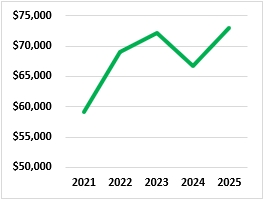
In fiscal year 2025, we realized the benefits of actions we took the previous year, as the weakness across our industry during the second half of fiscal year 2023 and most of fiscal year 2024 subsided. As a result, in 2025, we were able to capture new opportunities and deliver consolidated net sales of $73.0 million. Our net sales increased during each quarter of fiscal year 2025 compared to the same periods in fiscal year 2024.
| OCC Net Sales | OCC Net Sales by Quarter |
| Fiscal years 2021-2025 (in 000s) | Fiscal years 2024-2025 (in 000s) |
 |
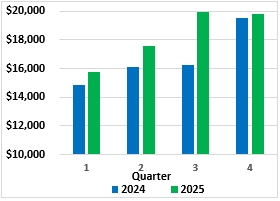 |
I am pleased to share that OCC achieved growth by all measures during fiscal year 2025: Net Sales grew by 9.5%, Gross Profit grew by 24.1%, Gross Profit Margin (gross profit as a percentage of net sales) increased to 30.9% compared to 27.3%, and Selling, General and Administrative (SG&A) expenses decreased as a percentage of net sales—all contributing factors to the significant improvement in operating results compared to fiscal year 2024.
Strong Operating Leverage
OCC benefited from strong operating leverage in fiscal year 2025, and we anticipate this will continue to bolster our results in fiscal year 2026 and beyond.
Our manufacturing operating leverage tends to create disproportionate increases in gross profit as net sales and production volumes increase. While both gross profit and gross profit margin can be impacted by product mix, as OCC’s net sales and production volumes increase, substantial fixed manufacturing costs are spread over higher sales volumes, and importantly, manufacturing efficiencies also tend to increase—particularly for fiber optic cable production. Gross profit disproportionately increased 24.1% as net sales increased 9.5% during fiscal 2025.
Optical Cable Corporation (OCC)
Our SG&A operating leverage also tends to positively impact efficiency and profitability as net sales increase. Many SG&A expenses are relatively fixed costs rather than varying with net sales—including significant public company costs. As a result, OCC’s SG&A expenses as a percentage of net sales tends to decrease with increased net sales.
Capitalizing on New Opportunities
OCC’s commitment to pursuing new growth opportunities—including expanding our presence in targeted market sectors and enhancing our product solutions offerings—will fuel our future success.
As demand for cloud computing and artificial intelligence (AI) applications continues to accelerate, OCC is capturing the opportunity by expanding our existing presence and product solutions offerings for the data center market.
We have continued to expand and innovate both our fiber optic cable product solutions offerings and our cabling and connectivity product solutions offerings.
As previously announced in July 2025, OCC and Lightera, LLC entered into a strategic collaboration agreement to expand product offerings and solutions—especially for the data center and enterprise sectors. As a global leader in optical fiber and connectivity solutions, Lightera has a long history of industry-leading innovation, design and manufacturing capabilities, including the production of high-performance optical fibers. As respected manufacturers in the fiber optic industry, OCC and Lightera have partnered in various ways over many years, and this strategic collaboration builds on that long, successful relationship.
Through this strategic collaboration, OCC and Lightera expect to benefit from offering expanded fiber optic and copper cabling and connectivity solutions to the enterprise and data center sectors, as well as an expanded presence in other sectors. The companies have combined portions of the extensive product portfolios of both OCC and Lightera to deliver integrated cabling and connectivity solutions offerings, which are being sold by OCC.
In connection with this strategic collaboration, Lightera made an investment in OCC, purchasing shares of OCC common stock from OCC and resulting in Lightera holding 7.24% of OCC’s outstanding shares.
Our Core Strengths Drive Long-Term Value
Founded in 1983, OCC has been a well-respected leader in the fiber optic and copper cabling and connectivity industry for decades. OCC remains uniquely positioned in the fiber optic and copper cabling and connectivity industry with differentiated core strengths and capabilities that enable us to offer top-tier products and application solutions and to compete successfully against much larger competitors.
OCC is committed to enhancing and leveraging our core strengths and capabilities to drive long-term value for our shareholders, which include:
|
● |
Strong market positions, brand recognition, and long-term industry relationships with loyal customers, decision makers and specifiers, installers and integrators, and end-users across a broad range of targeted market sectors. |
|
● |
Extensive industry experience and expertise with OCC’s engineering, sales and business development teams, who are well-respected for their product and application experience and expertise that enables OCC to create and offer its portfolio of innovative, high-performance products. |
|
● |
A growing portfolio of innovative fiber optic and copper cabling and connectivity products and solutions that enable OCC to meet the unique needs of our customers and end-users, and that are well suited for the applications in our various targeted market sectors. |
|
● |
Significant available production capacity at our facilities, supported by knowledgeable and experienced manufacturing, quality and engineering teams. |
|
● |
Broad and diverse geographic footprint with sales into approximately 50 countries every year. |
Optical Cable Corporation (OCC)
OCC has also earned an exceptional reputation for service excellence, innovation and entrepreneurial spirit, and has built a team who embodies OCC’s core strengths and capabilities.
Looking Forward to Fiscal Year 2026
Looking ahead to fiscal year 2026, we are optimistic about our growth opportunities, encouraged by our successes this past year, and excited to build on the growing momentum we are creating in our targeted market sectors. We look forward to leveraging our strengths and executing our strategies and initiatives to create long-term value for our shareholders.
Thank you to the OCC team for your hard work, your commitment to OCC and those that count on us, and your contributions to the team’s accomplishments this past year. Much has been accomplished by the OCC team this year, and we are confident we are well-positioned for future growth for fiscal year 2026 and beyond!
And, thank you to our shareholders for your continued support of OCC!
Sincerely,
Neil D. Wilkin, Jr.
Chairman of the Board, President and Chief Executive Officer This report may contain certain forward-looking information within the meaning of the federal securities laws.
December 18, 2025
Optical Cable Corporation (OCC)
Management’s Discussion and Analysis of Financial Condition and Results of Operations
Forward-Looking Information
The forward-looking information may include, among other information, (i) statements concerning our outlook for the future, (ii) statements of belief, anticipation or expectation, (iii) future plans, strategies or anticipated events, and (iv) similar information and statements concerning matters that are not historical facts. Such forward-looking information is subject to known and unknown variables, uncertainties, contingencies and risks that may cause actual events or results to differ materially from our expectations. Such known and unknown variables, uncertainties, contingencies and risks (collectively, “factors”) may also adversely affect Optical Cable Corporation and its subsidiaries (collectively, the “Company” or “OCC®”), the Company’s future results of operations and future financial condition, and/or the future equity value of the Company. Factors that could cause or contribute to such differences from our expectations or that could adversely affect the Company include, but are not limited to: the level of sales to key customers, including distributors; timing of certain projects and purchases by key customers; economic conditions that affect the telecommunications sector, the data communications sector, certain technology sectors and/or certain industry market sectors (for example, including, but not limited to: commercial/enterprise, military, industrial, broadcast, mining, petrochemical, renewable energy, data centers and wireless carrier industry market sectors); corporate and/or government spending on information technology; actions by competitors; fluctuations in the price and/or availability of raw materials (including optical fiber, copper, gold and other precious metals, plastics and other materials); fluctuations in transportation costs; our dependence on customized equipment for the manufacture of certain of our products in certain production facilities; our ability to protect our proprietary manufacturing technology; market conditions influencing prices or pricing in one or more of the markets in which we participate, including the impact of increased competition; our dependence on a limited number of suppliers for certain product components; the loss of or conflict with one or more key suppliers or customers; an adverse outcome in any litigation, claims, and other actions or disputes, and potential litigation, claims, and other actions or disputes against us or with us; an adverse outcome in any regulatory reviews and audits and potential regulatory reviews and audits; adverse changes in state tax laws and/or positions taken by state taxing authorities affecting us; technological changes and introductions of new competing products; changes in end-user preferences for competing technologies relative to our product offering; economic conditions that affect U.S.-based manufacturers; economic conditions or changes in relative currency strengths (for example, the strengthening of the U.S. dollar relative to certain foreign currencies), and import and/or export tariffs imposed by the U.S. and other countries that affect certain geographic markets, industry market sectors, and/or the economy as a whole; changes in demand for our products from certain competitors for which we provide private label connectivity products; changes in the mix of products sold during any given period (due to, among other things, seasonality or varying strength or weaknesses in particular markets in which we participate) which may impact gross profits and gross profit margins or net sales; variations in orders and production volumes affecting fixed-costs coverage and production efficiencies which may impact gross profits and gross profit margins; variations in orders and production volumes of hybrid cables (fiber and copper) with high copper content, which tend to have lower gross profit margins; significant variations in sales resulting from: (i) high volatility within various geographic markets, within targeted markets and industries, for certain types of products, and/or with certain customers (whether related to the market generally or to specific customers’ business in particular), (ii) market variations in existing product inventory levels available, generally or in certain markets, impacting sales orders for products, (iii) timing of large sales orders, and (iv) sales concentration among a limited number of customers in certain markets, particularly the wireless carrier market; terrorist attacks or acts of war, any current or potential future military conflicts, and acts of civil unrest; cold wars and economic sanctions as a result of these activities; changes in the level of spending by the United States government, including, but not limited to military spending; ability to recruit and retain key personnel (including production personnel); poor labor relations; increasing labor costs; delays, extended lead times and/or changes in availability of needed raw materials, equipment and/or supplies; shipping and other logistics challenges; impact of inflation on costs, including raw materials and labor, and ability to pass along any increased costs to customers; impact of import and/or export tariffs imposed by the U.S. and other countries on costs, and ability to pass along any increased costs to customers; impact of higher interest rates increasing the cost of capital; impact of cybersecurity risks and incidents and the related actual or potential costs and consequences of such risks and incidents, including costs and regulations to limit such risks; the impact of data privacy laws, including any applicable international privacy laws, and the related actual or potential costs and consequences; the impact of changes in accounting policies and related costs of compliance, including changes by the Securities and Exchange Commission (“SEC”), the Public Company Accounting Oversight Board (“PCAOB”), the Financial Accounting Standards Board (“FASB”), and/or the International Accounting Standards Board (“IASB”); our ability to continue to successfully comply with, and the cost of compliance with, the provisions of Section 404 of the Sarbanes-Oxley Act of 2002 or any revisions to that act which apply to us; the impact of changes and potential changes in federal laws and regulations adversely affecting our business and/or which result in increases in our direct and indirect costs, including our direct and indirect costs of compliance with such laws and regulations; rising healthcare costs; impact of new or changed government laws and regulations on healthcare costs; the impact of changes in state or federal tax laws and regulations increasing our costs and/or impacting the net return to investors owning our shares; any changes in the status of our compliance with covenants, if any, with our lenders; our continued ability to maintain and/or secure future debt financing and/or equity financing to adequately finance our ongoing operations; the impact of any redemption of redeemable common stock; the impact of future consolidation among competitors and/or among customers adversely affecting our position with our customers and/or our market position; actions by customers adversely affecting us in reaction to the expansion of our product offering in any manner, including, but not limited to, by offering products that compete with our customers, and/or by entering into alliances with, making investments in or with, and/or acquiring parties that compete with and/or have conflicts with our customers; voluntary or involuntary delisting of the Company’s common stock from any exchange on which it is traded; the deregistration by the Company from SEC reporting requirements as a result of the small number of holders of the Company’s common stock; adverse reactions by customers, vendors or other service providers to unsolicited proposals regarding the ownership or management of the Company; the additional costs of considering, responding to and possibly defending our position on unsolicited proposals regarding the ownership or management of the Company; direct and indirect impacts of weather, natural disasters and/or epidemic, pandemic or endemic diseases in the areas of the world in which we operate, market our products and/or acquire raw materials including, but not limited to: impacts on demand for our products, impacts on supply chains, impacts on our manufacturing capabilities, labor constraints impacting our production volumes and costs, and other impacts on our sales and/or costs; any present or future government mandates, travel restrictions, shutdowns or other regulations regarding any epidemic, pandemic or endemic diseases; an increase in the number of shares of the Company’s common stock issued and outstanding; economic downturns generally and/or in one or more of the markets in which we operate; changes in market demand, exchange rates, productivity, market dynamics, market confidence, macroeconomic and/or other economic conditions in the areas of the world in which we operate and market our products; and our success in managing the risks involved in the foregoing.
Optical Cable Corporation (OCC)
We caution readers that the foregoing list of important factors is not exclusive. Furthermore, we incorporate by reference those factors included in current reports on Form 8‑K and/or in our other filings.
Dollar amounts presented in the following discussion have been rounded to the nearest hundred thousand, except in the case of amounts less than one million and except in the case of the table set forth in the “Results of Operations” section, the amounts in which both cases have been rounded to the nearest thousand.
Overview of Optical Cable Corporation
Optical Cable Corporation (or OCC®) is a leading manufacturer of a broad range of fiber optic and copper data communication cabling and connectivity solutions primarily for the enterprise market and data center markets and various harsh environment and specialty markets (collectively, the non-carrier markets), and also the wireless carrier market, offering integrated suites of high quality products which operate as a system solution or seamlessly integrate with other components. Our product offerings include designs for uses ranging from enterprise networks, data centers, residential, campus and Passive Optical LAN (POL) installations to customized products for specialty applications and harsh environments, including military, industrial, mining, petrochemical, renewable energy and broadcast applications. Our products include fiber optic and copper cabling, hybrid cabling (which includes fiber optic and copper elements in a single cable), fiber optic and copper connectors, specialty fiber optic, copper and hybrid connectors, fiber optic and copper patch cords, pre-terminated fiber optic and copper cable trunks and assemblies, racks, cabinets, datacom enclosures, patch panels, face plates, multimedia boxes, fiber optic reels and accessories and other cable and connectivity management accessories, and are designed to meet the most demanding needs of end-users, delivering a high degree of reliability and outstanding performance characteristics.
Optical Cable Corporation (OCC)
OCC® is internationally recognized for pioneering the design and production of fiber optic cables for the most demanding military field applications, as well as of fiber optic cables suitable for both indoor and outdoor use, and creating a broad product offering built on the evolution of these fundamental technologies. OCC is also internationally recognized for pioneering the development of innovative copper connectivity technology and designs used to meet industry copper connectivity data communications standards.
Founded in 1983, Optical Cable Corporation is headquartered in Roanoke, Virginia with offices, manufacturing and warehouse facilities located in Roanoke, Virginia, near Asheville, North Carolina, and near Dallas, Texas. We primarily manufacture our fiber optic cables at our Roanoke facility which is ISO 9001:2015 registered, primarily manufacture our enterprise connectivity products at our Asheville facility which is ISO 9001:2015 registered, and primarily manufacture our harsh environment and specialty connectivity products at our Dallas facility which is ISO 9001:2015 registered and MIL-STD-790G certified.
OCC designs, develops and manufactures, and markets and sells, fiber optic and hybrid cables for a broad range of enterprise, data center, harsh environment, wireless carrier and other specialty markets and applications. We refer to these products as our fiber optic cable offering. OCC designs, develops and manufactures, and markets and sells, fiber and copper connectivity products for a broad range of enterprise, data center, and residential applications. We refer to these products as our enterprise connectivity product offering. OCC designs, develops and manufactures, and markets and sells, a broad range of specialty fiber optic connectors and connectivity solutions principally for use in military, harsh environment and other specialty applications. We refer to these products as our harsh environment and specialty connectivity product offering.
We market and sell the products manufactured at our Dallas facility through our wholly owned subsidiary Applied Optical Systems, Inc. (“AOS”) under the names Optical Cable Corporation and OCC® by the efforts of our integrated OCC sales team.
The OCC team strives to provide top-tier communication solutions that are well suited for the specific needs and application requirements of our customers and the end-users of our systems—leveraging our technical expertise and broad fiber optic and copper data communication product offerings.
Optical Cable Corporation™, OCC®, Procyon®, Superior Modular Products™, SMP Data Communications™, Applied Optical Systems™, Centric Solutions™ and associated logos are trademarks of Optical Cable Corporation.
Summary of Company Performance for Fiscal Year 2025 and for Fourth Quarter of Fiscal Year 2025
|
● |
Consolidated net sales for fiscal year 2025 increased 9.5% to $73.0 million, compared to consolidated net sales of $66.7 million for fiscal year 2024. |
|
● |
During the fourth quarter of fiscal year 2025, net sales increased 1.8% to $19.8 million, compared to $19.5 million for the same period in fiscal year 2024. Net sales sequentially decreased less than one percent during the fourth quarter, compared to $19.9 million during the third quarter of fiscal year 2025. |
|
● |
Gross profit increased 24.1% to $22.6 million for fiscal year 2025, compared to $18.2 million for fiscal year 2024. |
Optical Cable Corporation (OCC)
|
● |
During the fourth quarter of fiscal year 2025, gross profit decreased 3.3% to $6.3 million, compared to $6.5 million for the same period in fiscal year 2024. There was effectively no change in gross profit during the fourth quarter when compared to the third quarter of fiscal year 2025. |
|
● |
Gross profit margin (gross profit as a percentage of net sales) increased to 30.9% during fiscal year 2025, compared to 27.3% for fiscal year 2024. |
|
● |
During the fourth quarter of fiscal year 2025, gross profit margin decreased to 31.9%, compared to 33.5% for the same period of fiscal year 2024. Gross profit margin sequentially increased slightly during the fourth quarter of fiscal year 2025, compared to 31.7% during the third quarter of fiscal year 2025. |
|
● |
SG&A expenses increased 6.8% to $23.0 million during fiscal year 2025, compared to $21.5 million during fiscal year 2024. SG&A expenses as a percentage of net sales were 31.4% during fiscal year 2025 compared to 32.2% during fiscal year 2024. |
|
● |
During the fourth quarter of fiscal year 2025, SG&A expenses increased 3.1% to $6.0 million, compared to $5.9 million during the same period in fiscal year 2024. SG&A expenses as a percentage of net sales were 30.4% during the fourth quarter of 2025, compared to 30.0% during the same period of fiscal year 2024. |
|
● |
Net loss was $1.5 million, or $0.18 per share, during fiscal year 2025, compared to $4.2 million, or $0.54 per share, during fiscal year 2024. |
|
● |
Net income was $49,000, or $0.01 per share, during the fourth quarter of fiscal year 2025, compared to $373,000, or $0.05 per share during the same period of fiscal year 2024. |
Strategic Collaboration and Investment
On July 7, 2025, Optical Cable Corporation and Lightera, LLC (“Lightera”) announced that the companies had entered into a strategic collaboration agreement to expand product offerings and solutions—especially for the data center and enterprise sectors. As part of this strategic collaboration, OCC and Lightera have combined portions of the product portfolios of both companies to deliver additional integrated cabling and connectivity solution offerings, which will include certain Lightera products being offered and sold by OCC.
In connection with this strategic collaboration, OCC and Lightera entered into a Stock Purchase Agreement (the “Agreement”), under which OCC issued 642,199 redeemable restricted shares of its common stock to Lightera for an aggregate purchase price of $2.0 million. Lightera’s 642,199 shares of redeemable restricted common stock of OCC represent 7.24% of OCC’s outstanding common shares as of October 31, 2025.
Results of Operations
We sell our products internationally and domestically to our customers which include major distributors, various regional and smaller distributors, original equipment manufacturers and value-added resellers. All of our sales to customers outside of the United States are denominated in U.S. dollars. We can experience fluctuations in the percentage of net sales to customers outside of the United States and in the United States from period to period based on the timing of large orders, coupled with the impact of increases and decreases in sales to customers in various regions of the world. Sales outside of the U.S. can also be impacted by fluctuations in the exchange rate of the U.S. dollar compared to other currencies, as well as import and/or export tariffs imposed by the U.S. and other countries.
Net sales consist of gross sales of products by the Company and its subsidiaries on a consolidated basis less discounts, refunds and returns. Revenue is recognized at the time product is transferred to the customer (including distributors) at an amount that reflects the consideration expected to be received in exchange for the product. Our customers generally do not have the right of return unless a product is defective or damaged and is within the parameters of the product warranty in effect for the sale.
Optical Cable Corporation (OCC)
Cost of goods sold consists of the cost of materials, product warranty costs and compensation costs, and overhead and other costs related to our manufacturing operations. The largest percentage of costs included in cost of goods sold is attributable to costs of materials.
Our gross profit margin percentages are heavily dependent upon product mix on a quarterly basis and may vary based on changes in product mix. To the extent not impacted by product mix, gross profit margins tend to be higher when we achieve higher net sales levels, as certain fixed manufacturing costs are spread over higher sales and other manufacturing efficiencies are more easily achieved. Hybrid cables (containing fiber and copper) with higher copper content tend to have lower gross profit margins.
Selling, general and administrative expenses (“SG&A expenses”) consist of the compensation costs for sales and marketing personnel, shipping costs, trade show expenses, customer support expenses, travel expenses, advertising, bad debt expense, the compensation costs for administration and management personnel, legal, accounting, advisory and professional fees, costs incurred to settle litigation or claims and other actions against us, and other costs associated with our operations.
Royalty expense, net consists of royalty and related expenses, net of royalty income earned on licenses associated with our patented products, if any.
Amortization of intangible assets consists of the amortization of the costs, including legal fees, associated with internally developed patents that have been granted. Amortization of intangible assets is calculated using the straight-line method over the estimated useful lives of the intangible assets.
Other income (expense), net consists of interest expense and other miscellaneous income and expense items not directly attributable to our operations.
The following table sets forth and highlights fluctuations in selected line items from our consolidated statements of operations for the fiscal years indicated:
|
Fiscal Years Ended |
||||||||||||
|
October 31, |
||||||||||||
|
Percent |
||||||||||||
|
2025 |
2024 |
Change |
||||||||||
|
Net sales |
$ | 73,000,000 | $ | 66,700,000 | 9.5 | % | ||||||
|
Gross profit |
22,600,000 | 18,200,000 | 24.1 | |||||||||
|
SG&A expenses |
23,000,000 | 21,500,000 | 6.8 | |||||||||
|
Loss from operations |
(450,000 | ) | (3,400,000 | ) | 86.7 | |||||||
|
Net loss |
(1,500,000 | ) | (4,200,000 | ) | 65.4 | |||||||
The following table is a summary of the unaudited quarterly results of operations for the periods indicated:
|
Three Months Ended |
||||||||||||
|
October 31, |
||||||||||||
|
Percent |
||||||||||||
|
2025 |
2024 |
Change |
||||||||||
|
Net sales |
$ | 19,800,000 | $ | 19,500,000 | 1.8 | % | ||||||
|
Gross profit |
6,300,000 | 6,500,000 | (3.3 | ) | ||||||||
|
SG&A expenses |
6,000,000 | 5,900,000 | 3.1 | |||||||||
|
Income from operations |
269,000 | 662,000 | (59.4 | ) | ||||||||
|
Net income |
49,000 | 373,000 | (87.0 | ) | ||||||||
Optical Cable Corporation (OCC)
Net Sales
Consolidated net sales for fiscal year 2025 were $73.0 million, an increase of 9.5% compared to net sales of $66.7 million for fiscal year 2024. We experienced an increase in net sales in both our enterprise and specialty markets in fiscal year 2025, compared to last year.
During the fourth quarter of fiscal year 2025, net sales increased 1.8% to $19.8 million, compared to $19.5 million for the same period in fiscal year 2024. Net sales sequentially decreased less than one percent during the fourth quarter, compared to $19.9 million during the third quarter of fiscal year 2025.
At the end of fiscal year 2025, our sales order backlog/forward load was $7.3 million compared to $5.7 million as of October 31, 2024.
Looking forward, we anticipate additional growth opportunities during fiscal year 2026. We continue to expand our product solutions offering for the data center market as demand for cloud computing and artificial intelligence (AI) applications continue to accelerate.
Net sales for fiscal year 2024 were negatively impacted by various macroeconomic pressures, risks and uncertainties in our industry—which we believed was consistent with weakness being experienced in our industry generally. Our quarterly net sales sequentially increased during the second, third and fourth quarters of fiscal year 2024, with the most significant growth occurring in our fourth quarter.
Net sales to customers in the United States increased 10.4% and net sales to customers outside of the United States increased 6.5% in fiscal year 2025, compared to last year. Net sales to customers outside of the United States were approximately 21% of total net sales for fiscal years 2025 and 2024.
We typically expect net sales to be relatively lower in the first half of each fiscal year and relatively higher in the second half of each fiscal year, and excluding other volatility, we would normally expect 48% of total net sales to occur during the first half of a fiscal year and 52% of total net sales to occur during the second half of a fiscal year. We believe this historical seasonality pattern is generally indicative of an overall trend and reflective of the buying patterns and budgetary cycles of our customers. However, this pattern may be altered during any quarter or year by the quarterly and annual variability of net sales due to other factors, such as: wireless carrier market order volume, the timing of larger projects, the timing of orders from larger customers, other economic factors impacting our industry or impacting the industries of our customers and end-users, and macroeconomic conditions. While we believe seasonality may be a factor that impacts our quarterly net sales results, we are not able to reliably predict net sales based on seasonality because net sales variability due to such other factors can also, and often does, substantially impact our net sales patterns during the year. During our last two fiscal years, approximately 46% of our total net sales occurred during the first half of fiscal years 2025 and 2024 and approximately 54% of our total net sales occurred during the second half of fiscal years 2025 and 2024.
Gross Profit
Gross profit was $22.6 million in fiscal year 2025, compared to gross profit of $18.2 million in fiscal year 2024, an increase of 24.1%. Gross profit margin, or gross profit as a percentage of net sales, was 30.9% in fiscal year 2025 compared to 27.3% in fiscal year 2024.
During the fourth quarter of fiscal year 2025, gross profit decreased 3.3% to $6.3 million, compared to $6.5 million for the same period in fiscal year 2024. Gross profit margin decreased to 31.9% in the fourth quarter of fiscal year 2025, compared to 33.5% in the same period of fiscal year 2024.
During the fourth quarter of fiscal year 2025, there was no significant change in gross profit when compared to the third quarter of fiscal year 2025. Gross profit margin sequentially increased to 31.9% in the fourth quarter of fiscal year 2025, compared to 31.7% during the third quarter of fiscal year 2025.
Gross profit margin for fiscal year 2025 was positively impacted by higher volumes, as fixed charges were spread over higher sales⸺the impact of operating leverage. Additionally, our gross profit margin percentages are heavily dependent upon product mix on a quarterly basis and may vary based on changes in product mix.
Optical Cable Corporation (OCC)
Selling, General and Administrative Expenses
SG&A expenses increased 6.8% to $23.0 million during fiscal year 2025, compared to $21.5 million for fiscal year 2024. SG&A expenses as a percentage of net sales were 31.4% in fiscal year 2025, compared to 32.2% in fiscal year 2024.
The increase in SG&A expenses during fiscal year 2025 compared to last year was primarily the result of increases in employee and contracted sales personnel-related costs totaling $616,000 and shipping costs totaling $386,000. Included in employee and contracted sales personnel-related costs are compensation costs and sales incentives. Compensation costs increased due to new hires, net of terminations, and certain rate increases. Sales incentives and shipping costs increased primarily due to increases in sales.
During the fourth quarter of fiscal year 2025, SG&A expenses increased 3.1% to $6.0 million, compared to $5.9 million during the same period in fiscal year 2024, primarily as a result of employee and contracted sales personnel-rated costs. SG&A expenses as a percentage of net sales were 30.4% during the fourth quarter of 2025, compared to 30.0% during the same period of fiscal year 2024. SG&A expenses sequentially increased 5.1% during the fourth quarter, compared to $5.7 million during the third quarter of fiscal year 2025.
Royalty Income (Expense), Net
We recognized royalty expense, net of royalty income, totaling $26,000 during fiscal years 2025 and 2024. Royalty income and/or expense may fluctuate based on sales of licensed products and estimates of amounts for non-licensed product sales, if any.
Amortization of Intangible Assets
We recognized $54,000 of amortization expense, associated with intangible assets, during fiscal years 2025 and 2024.
Loss from Operations
Our loss from operations was $450,000 in fiscal year 2025, compared to $3.4 million for fiscal year 2024. The improvement was primarily the result of the $4.4 million increase in gross profit, partially offset by the $1.5 million increase in SG&A expenses.
Other Expense, Net
We recognized other expense, net in fiscal year 2025 of $974,000, compared to $813,000 in fiscal year 2024. Other expense, net for fiscal year 2025 is comprised of interest expense and other miscellaneous items. Other expense, net for fiscal year 2024 is comprised of interest expense and other miscellaneous items, partially offset by gain on insurance proceeds totaling $304,000.
During fiscal year 2024, we received insurance proceeds in connection with our office building and its contents at our Asheville facilities sustaining water damage from a burst pipe in a sprinkler system at the end of December 2022. In connection with this event, we recognized a gain on insurance proceeds received for damage to property and equipment totaling $304,000 during fiscal year 2024.
Loss Before Income Taxes
We reported a loss before income taxes of $1.4 million for fiscal year 2025 compared to $4.2 million for fiscal year 2024. The improvement was primarily a result of the decrease in loss from operations of $2.9 million, partially offset by the decrease in gain on insurance proceeds, net of $304,000.
Optical Cable Corporation (OCC)
Income Tax Expense
Income tax expense totaled $30,000 for fiscal year 2025 compared to $21,000 for fiscal year 2024. Our effective tax rate was negative 2.1% for fiscal year 2025, compared to less than negative one percent for fiscal year 2024.
Fluctuations in our effective tax rates are primarily due to permanent differences in U.S. generally accepted accounting principles (“U.S. GAAP”) and tax accounting for various tax deductions and benefits, but can also be significantly different from the statutory tax rate when income or loss before taxes is at a level such that permanent differences in U.S. GAAP and tax accounting treatment have a disproportional impact on the projected effective tax rate.
We previously established a valuation allowance against all of our net deferred tax assets. As a result of establishing a full valuation allowance against our net deferred tax assets, if we generate sufficient taxable income in subsequent periods to realize a portion or all of our net deferred tax assets, our effective income tax rate could be unusually low due to the tax benefit attributable to the necessary decrease in our valuation allowance. Further, if we generate losses before taxes in subsequent periods, our effective income tax rate could also be unusually low as any increase in our net deferred tax asset from such a net operating loss for tax purposes would be offset by a corresponding increase to our valuation allowance against our net deferred tax assets.
If we generate sufficient income before taxes in subsequent periods such that U.S. GAAP would permit us to conclude that the removal of any valuation allowance against our net deferred tax asset is appropriate, then during the period in which such determination is made, we will recognize the non-cash benefit of such removal of the valuation allowance in income tax expense on our consolidated statement of operations, which will increase net income and will also increase the net deferred tax asset on our consolidated balance sheet. If we do not generate sufficient income before taxes in subsequent periods such that U.S. GAAP would permit us to conclude that the reduction or removal of any valuation allowance against our net deferred tax asset is appropriate, then no such non-cash benefit would be realized. There can be no assurance regarding any future realization of the benefit by us of all or part of our net deferred tax assets.
As of October 31, 2025, the valuation allowance against our total gross deferred tax assets totaled $5.2 million.
See also “Critical Accounting Policies and Estimates” herein and note 13 to the Consolidated Financial Statements.
Net Loss
Net loss for fiscal year 2025 was $1.5 million, or $0.18 per share, compared to $4.2 million, or $0.54 per share, for fiscal year 2024. This improvement was primarily due to the decrease in loss before income taxes of $2.8 million, which includes the $304,000 decrease in gain on insurance proceeds, net.
Financial Condition
Total assets decreased $298,000, or less than one percent, to $40.1 million at October 31, 2025, from $40.4 million at October 31, 2024. This decrease was primarily due to a $666,000 decrease in trade accounts receivable, net, partially offset by an increase in inventories of $1.1 million. The decrease in trade accounts receivable, net, resulted primarily from the decrease in net sales in the fourth quarter of fiscal year 2025 when compared to the fourth quarter of fiscal year 2024. Inventories increased largely as the result of the timing of certain raw material purchases and an increase in replenishment rates due to higher sales and the timing of sales of stock inventory.
Total liabilities decreased $1.0 million, or 5.3%, to $18.5 million at October 31, 2025, from $19.5 million at October 31, 2024. The decrease in total liabilities was primarily due to a decrease in note payable, revolver – current totaling $2.7 million resulting from net repayments on our Revolver, partially offset by an increase in accounts payable and accrued expenses, including accrued compensation and payroll taxes, totaling $1.9 million, primarily resulting from the timing of certain vendor and payroll related payments.
Optical Cable Corporation (OCC)
The Company issued 642,199 shares of redeemable restricted common stock for $2.0 million, reflected as temporary equity, during fiscal year 2025 as a result of a Stock Purchase Agreement with Lightera, LLC. As of October 31, 2025, the aggregate redemption value of the redeemable restricted common stock increased to $5.1 million. Also see note 17 to the consolidated financial statements.
Total shareholders’ equity at October 31, 2025 decreased $4.3 million during fiscal year 2025 resulting primarily from a net loss of $1.5 million, issuance costs totaling $92,000 related to the issuance of redeemable restricted common stock and the $3.1 million increase to the aggregate redemption value of the redeemable restricted common stock as of October 31, 2025, partially offset by share-based compensation, net of $279,000.
Liquidity and Capital Resources
Our primary capital needs have been to fund working capital requirements through our Revolver. Our primary source of capital for this purpose has been existing cash, cash provided by operations, and borrowings under our Revolver (see “Credit Facilities” below).
As of October 31, 2025 and 2024, we had an outstanding loan balance under our Revolver totaling $5.6 million and $8.3 million, respectively. As of October 31, 2025 and 2024, we had other outstanding bank loan balances, excluding our Revolver, totaling $2.6 million.
Our cash totaled $238,000 and $244,000 as of October 31, 2025 and 2024, respectively. The decrease in cash for the year ended October 31, 2025 primarily resulted from capital expenditures of $296,000 and cash used in financing activities of $1.1 million, partially offset by net cash provided by operating activities of $1.4 million.
On October 31, 2025, we had working capital of $13.9 million, compared to $15.5 million as of October 31, 2024. The ratio of current assets to current liabilities as of October 31, 2025 was 1.8 to 1 compared to 2.0 to 1 as of October 31, 2024. The decrease in working capital and in the current ratio was primarily due to the reclassification of the $2.5 million balance (at the time of the reclass) on our real estate term loan from noncurrent liabilities to current liabilities, due to its May 5, 2026 maturity date, the increase in accounts payable and accrued expenses, including accrued compensation and payroll taxes, totaling $1.9 million and the decrease in trade accounts payable, net totaling $666,000, partially offset by the decrease in notes payable, revolver – current totaling $2.7 million and the increase in inventories totaling $1.1 million.
Net Cash
Net cash provided by operating activities was $1.4 million in fiscal year 2025, compared to net cash used in operating activities totaling $857,000 in fiscal year 2024. Net cash provided by operating activities during fiscal year 2025 primarily resulted from certain adjustments to reconcile a net loss of $1.5 million to net cash provided by operating activities including depreciation and amortization of $805,000 and share-based compensation expense of $387,000. Additionally, the cash flow impact of increases in accounts payable and accrued expenses, including accrued compensation and payroll taxes, of $1.8 million and the cash flow impact of decreases in trade accounts receivable, net totaling $685,000 further contributed to net cash provided by operating activities. All of the aforementioned factors positively affecting cash provided by operating activities were partially offset by increases in inventories of $1.1 million.
Net cash used in operating activities during fiscal year 2024 primarily resulted from the cash flow impact of increases in trade accounts receivable, net totaling $2.2 million and decreases in the cash impact of accounts payable and accrued expenses, including accrued compensation and payroll taxes, totaling $1.1 million, partially offset by decreases in inventories totaling $5.0 million and certain adjustments to reconcile a net loss of $4.2 million to net cash used in operating activities including depreciation and amortization of $866,000, share-based compensation expense of $443,000, and the gain on insurance proceeds, net totaling $304,000.
Optical Cable Corporation (OCC)
Net cash used in investing activities totaled $317,000 in fiscal year 2025 compared to $67,000 in fiscal year 2024. Net cash used in investing activities during fiscal year 2025 resulted primarily from purchases of property and equipment and deposits for the purchase of property and equipment totaling $296,000. Net cash used in investing activities during fiscal year 2024 resulted primarily from purchases of property and equipment and deposits for the purchase of property and equipment totaling $370,000, partially offset by net insurance proceeds of $304,000.
Net cash used in financing activities totaled $1.1 million in fiscal year 2025 compared $300,000 in fiscal year 2024. Net cash used in financing activities in fiscal year 2025 resulted from net repayments on our revolving line of credit totaling $2.7 million, partially offset by the issuance of redeemable restricted common stock, net of $1.9 million. Net cash used in financing activities in fiscal year 2024 resulted primarily from payroll taxes withheld and remitted on share-based payments totaling $113,000, debt financing costs totaling $100,000 and principal payments on long-term debt totaling $47,000.
Credit Facilities
We have credit facilities consisting of a real estate term loan, as amended and restated (the “Virginia Real Estate Loan”) and a Revolving Credit Master Promissory Note and related Loan and Security Agreement (collectively, the “Revolver”).
The Virginia Real Estate Loan is with Northeast Bank and is payable in monthly installments of principal and interest. Principal is calculated using the unpaid balance of the loan and a two hundred forty (240) month amortization schedule. Interest is computed on the aggregate principal balance outstanding at a rate equal to the Prime Rate, adjusted monthly on the fifth day of each calendar month in accordance with changes to the Prime Rate, provided, however, that the interest rate is never less than 8.5% per annum on the basis of a 360-day year times the actual number of days elapsed. The Prime Rate was 7.0% per annum at October 31, 2025 and 8.0% at October 31, 2024. The maturity date of the Virginia Real Estate Loan is May 5, 2026 and, as such, the balance of the loan was reclassified from a non-current liability to a current liability during fiscal year 2025. The Company intends to refinance the obligation prior to maturity.
The Virginia Real Estate Loan is secured by a first lien deed of trust on the land and buildings at our headquarters and manufacturing facilities located in Roanoke, Virginia.
We had an outstanding balance on our Virginia Real Estate Loan of $2.6 million as of October 31, 2025 and 2024.
The Revolver with North Mill Capital LLC (doing business as SLR Business Credit, “SLR”) provides us with one or more advances in an amount up to: (a) 85% of the aggregate outstanding amount of eligible accounts (the “eligible accounts loan value”); plus (b) the lowest of (i) an amount up to 35% of the aggregate value of eligible inventory, (ii) $7.0 million, and (iii) an amount not to exceed 100% of the then outstanding eligible accounts loan value; minus (c) $1.15 million.
The maximum aggregate principal amount subject to the Revolver is $18.0 million. Interest accrues on the daily balance at the per annum rate of 1.5% above the Prime Rate in effect from time to time, but not less than 4.75% (the “Applicable Rate”). As a result, the Revolver accrued interest at an 8.5% rate at October 31, 2025 and 9.5% at October 31, 2024. In the event of a default, interest may become 6.0% above the Applicable Rate. The loan may be extended subject to the agreement of SLR.
Our Revolver requires a lockbox arrangement, which provides for all cash receipts to be swept daily to reduce the balance outstanding. This arrangement, combined with the existence of a “subjective acceleration clause” (as defined by U.S. GAAP) in the Revolver, requires the balance on the Revolver to be classified as a current liability. The “subjective acceleration clause” allows SLR to declare an event of default if there is a material adverse change in our business or financial condition. Upon the occurrence of an event of default, SLR may, among other things, declare all obligations payable in full. We believe that no such material adverse change has occurred. In addition, at October 31, 2025 and through the date of this report, SLR has not informed us that any such event of default has occurred. The Revolver has a maturity date of July 24, 2027 and we believe that we will continue to be able to borrow on the Revolver to fund our operations over the remaining term.
Optical Cable Corporation (OCC)
The Revolver is secured by all of the following assets, properties, rights and interests in property of the Company whether now owned or existing, or hereafter acquired or arising, and wherever located; all accounts, equipment, commercial tort claims, general intangibles, chattel paper, inventory, negotiable collateral, investment property, financial assets, letter-of-credit rights, supporting obligations, deposit accounts, money or assets of the Company, which hereafter come into the possession, custody, or control of SLR; all proceeds and products, whether tangible or intangible, of any of the foregoing, including proceeds of insurance covering any or all of the foregoing; any and all tangible or intangible property resulting from the sale, lease, license or other disposition of any of the foregoing, or any portion thereof or interest therein, and all proceeds thereof; and any other assets of the Company which may be subject to a lien in favor of SLR as security for the obligations under the Loan Agreement.
As of October 31, 2025, we had $5.6 million of outstanding borrowings on our Revolver and $4.7 million in available credit. As of October 31, 2024, we had $8.3 million of outstanding borrowings on our Revolver and $3.2 million in available credit.
Capital Expenditures
We did not have any material commitments for capital expenditures as of October 31, 2025. We expected capital expenditures in fiscal year 2025 would not exceed $1.0 million. We incurred capital expenditures totaling $296,000 for items including new manufacturing equipment, improvements to existing manufacturing equipment, new information technology equipment and software, upgrades to existing information technology equipment and software, and other capitalizable expenditures for property, plant and equipment for fiscal year 2025.
During our 2026 fiscal year budgeting process, we included an estimate for capital expenditures of $1.0 million for the year. Any capital expenditures will be funded out of our working capital, cash provided by operations or borrowings under our Revolver, as appropriate. This amount includes estimates for capital expenditures for similar types of items as those purchased in fiscal year 2025. Capital expenditures are reviewed and approved based on a variety of factors including, but not limited to, current cash flow considerations, the expected return on investment, project priorities, impact on current or future product offerings, availability of personnel necessary to implement and begin using acquired equipment, and economic conditions in general. Historically, we have spent less than our budgeted capital expenditures in most fiscal years.
Future Cash Flow Considerations
We believe that our cash flow from operations, our cash on hand and our existing Revolver will be adequate to fund our operations for at least the next twelve months.
From time to time, we are involved in various claims, legal actions and regulatory reviews arising in the ordinary course of business. In the opinion of management, the ultimate disposition of these matters will not have a material adverse effect on our financial position, results of operations or liquidity.
Critical Accounting Policies and Estimates
Our discussion and analysis of financial condition and results of operations is based on the consolidated financial statements and accompanying notes which have been prepared in accordance with U.S. generally accepted accounting principles. The preparation of these consolidated financial statements requires management to make estimates and assumptions that affect the reported amounts of assets and liabilities and the disclosure of contingent assets and liabilities at the date of the consolidated financial statements and the reported amounts of revenues and expenses during the reporting period. Actual results could differ from those estimates.
Optical Cable Corporation (OCC)
Note 1 to the consolidated financial statements provides a summary of our significant accounting policies. The following are areas requiring significant judgments and estimates due to uncertainties as of the reporting date: revenue recognition, trade accounts receivable and the allowance for credit losses, inventories, deferred tax assets (and valuation allowances thereon), long-lived assets, redeemable restricted common stock and commitments and contingencies.
Application of the critical accounting policies discussed in the section that follows requires management’s significant judgments, often as a result of the need to make estimates of matters that are inherently uncertain. If actual results were to differ materially from the estimates made, the reported results could be materially affected. We are not currently aware of any reasonably likely events or circumstances that would result in materially different results.
Revenue Recognition
Management views revenue recognition as a critical accounting estimate since we must estimate an allowance for sales returns for the reporting period. This allowance reduces net sales for the period and is based on our analysis and judgment of historical trends, identified returns and the potential for additional returns.
Trade Accounts Receivable and the Allowance for Credit Losses
Management views trade accounts receivable net of the related allowance for credit losses as a critical accounting estimate since the allowance for credit losses is based on judgments and estimates concerning the likelihood that individual customers will pay the amounts included as receivable from them. In determining the amount of allowance for credit losses to be recorded for individual customers, we assess the net amount expected to be collected from each customer. In addition, we establish an allowance for all other receivables for which no specific allowances are deemed necessary. This portion of the allowance for credit losses is based on a percentage of total trade accounts receivable with different percentages used based on different age categories of receivables. The percentages used are based on our expectations of net amounts expected to be collected.
Inventories
Management views the determination of the net realizable value of inventories as a critical accounting estimate since it is based on judgments and estimates regarding the salability of individual items in inventory and an estimate of the ultimate selling prices for those items. Individual inventory items are reviewed and adjustments are made based on the age of the inventory and our judgment as to the salability of that inventory in order for our inventories to be valued at the lower of cost and net realizable value.
Deferred Tax Assets
Management views the valuation of deferred tax assets as a critical accounting estimate since we must assess whether it is “more likely than not” that we will realize the benefits of our gross deferred tax assets and determine an appropriate valuation allowance if we conclude such an allowance is appropriate. This determination requires that we consider all available evidence, both positive and negative, in making this assessment. The weight given to the positive and negative evidence is commensurate with the extent to which the evidence may be objectively verified.
Generally, a cumulative loss in recent years is a significant piece of negative evidence that is quite difficult to overcome under U.S. GAAP. Since the amount of our loss before income taxes in fiscal year 2015 exceeded our income before taxes during the previous two fiscal years, we believed that U.S. GAAP required us to treat as significant negative evidence that it was “more likely than not” that we would be unable to realize the future benefits of our deferred tax assets in the coming years—significant negative evidence that was quite difficult to overcome under U.S. GAAP and which we were not able to overcome with sufficient objectively verifiable positive evidence.
While we believe that ultimately we will utilize the benefit of our net deferred tax assets in the future (prior to any expiration of the usability of such deferred tax assets for income tax purposes), we concluded as a result of our cumulative loss position and insufficient objectively verifiable positive evidence, it was appropriate under U.S. GAAP for us to establish a full valuation allowance against net deferred tax assets as of October 31, 2015. The valuation allowance against our net deferred tax assets does not in any way impact our ability to use future tax deductions such as our net operating loss carryforwards; rather, the valuation allowance indicates, according to the provisions of Accounting Standards Codification 740, Income Taxes, it is “more likely than not” that our deferred tax assets will not be realized.
The valuation allowance that was established will be maintained until there is sufficient positive evidence to conclude that it is “more likely than not” that our net deferred tax assets will be realized. Our income tax expense for future periods will be reduced to the extent of corresponding decreases in our valuation allowance. There can be no assurance regarding any future realization of the benefit by us of all or part of our net deferred tax assets.
Optical Cable Corporation (OCC)
Long-lived Assets
Management views the determination of the carrying value of long-lived assets as a critical accounting estimate since we must determine an estimated economic useful life in order to properly amortize or depreciate our long-lived assets and because we must consider if the value of any of our long-lived assets have been impaired, requiring adjustment to the carrying value.
Economic useful life is the duration of time the asset is expected to be productively employed by us, which may be less than its physical life. Management’s assumptions on wear and tear, obsolescence, technological advances and other factors affect the determination of estimated economic useful life. The estimated economic useful life of an asset is monitored to determine if it continues to be appropriate in light of changes in business circumstances. For example, technological advances or excessive wear and tear may result in a shorter estimated useful life than originally anticipated. In such a case, we would depreciate the remaining net book value of an asset over the new estimated remaining life, thereby increasing depreciation expense per year on a prospective basis. We must also consider similar issues when determining whether or not an asset has been impaired to the extent that we must recognize a loss on such impairment.
The Company amortizes intangible assets over their respective finite lives up to their estimated residual values.
Redeemable Restricted Common Stock
The Company’s redeemable restricted common stock is presented as temporary equity as a result of certain embedded features within the stock purchase agreement. Subsequent changes to the aggregate redemption value are recorded within shareholders’ equity. See note 17 of the consolidated financial statements.
Commitments and Contingencies
Management views accounting for contingencies as a critical accounting estimate since loss contingencies arising from product warranties and defects, claims, assessments, litigation, fines and penalties and other sources require judgment as to any probable liabilities incurred. For example, accrued product warranty costs recorded by us are based primarily on historical experience of actual warranty claims and costs as well as current information with respect to warranty claims and costs. Actual results could differ from the expected results determined based on such estimates of loss contingencies.
Quantitative and Qualitative Disclosures About Market Risk
As of October 31, 2025 our financial instruments were not exposed to significant market risk due to interest rate risk, foreign currency exchange risk, commodity price risk or equity price risk.
New Accounting Standards
New Accounting Standards Recently Adopted
In November 2023, the FASB issued Accounting Standards Update 2023-07, Segment Reporting (Topic 280): Improvements to Reportable Segment Disclosures (“ASU 2023-07”). ASU 2023-07 requires entities to disclose significant segment expenses that are regularly provided to the Chief Operating Decision Maker (“CODM”). Entities with a single reportable segment are required to apply the disclosure requirements in ASU 2023-07, as well as all existing segment disclosure requirement in ASC 280, Segment Reporting, on an interim and annual basis. The guidance in ASU 2023-07 is effective for annual reporting periods in fiscal years beginning after December 15, 2023 and interim reporting periods in fiscal years beginning after December 31, 2024. We adopted ASU 2023-07 on a retrospective basis for the annual period ended October 31, 2025. See note 11 for further information regarding the Company’s single reportable segment disclosures.
Optical Cable Corporation (OCC)
New Accounting Standards Not Yet Adopted
In December 2023, the FASB issued Accounting Standards Update 2023-09, Income Taxes (Topic 740): Improvements to Income Tax Disclosures (“ASU 2023-09”). The objective of ASU 2023-09 is to enhance disclosures related to income taxes, including specific thresholds for inclusion within the tabular disclosure of income tax rate reconciliation and specified information about income taxes paid. ASU 2023-09 is effective for public companies starting in annual periods beginning after December 15, 2024, with early adoption permitted. We are currently evaluating the impact ASU 2023-09 will have on our financial statement disclosures.
In November 2024, the FASB issued Accounting Standards Update 2024-03, Income Statement—Reporting Comprehensive Income—Expense Disaggregation Disclosures (Subtopic 220-40) (“ASU 2024-03”). The objective of ASU 2024-03 is to improve disclosures about a public entity's expenses, primarily through additional disaggregation of income statement expenses. In January 2025, the FASB further clarified the effective date of ASU 2024-03 with the issuance of Accounting Standards Update 2025-01, Income Statement — Reporting Comprehensive Income — Expense Disaggregation Disclosures (Subtopic 220-40) (“ASU 2025-01”). ASU 2024-03 is effective for annual periods beginning after December 15, 2026, and interim periods within annual reporting periods beginning after December 15, 2027. Early adoption is permitted and may be applied either on a prospective or retrospective basis. We are currently evaluating the impact ASU 2024-03 will have on our financial statement disclosures.
In July 2025, the FASB issued Accounting Standards Update 2025-05, Measurement of Credit Losses for Accounts Receivable and Contract Assets (“ASU 2025-05”). The amendments in ASU 2025-05 provide entities with a practical expedient to simplify the estimation of expected credit losses on current accounts receivable and current contract assets that arise from transactions accounted for under ASC 606, Revenue from Contracts with Customers (“ASC 606”) by allowing the assumption that current conditions as of the balance sheet date will not change during the remaining life of the asset. ASU 2025-05 is effective for annual periods beginning after December 15, 2025 and interim periods within those annual reporting periods, with early adoption permitted. The adoption of ASU 2025-05 is not expected to have a material impact on the Company's results of operations, financial position or liquidity or its related financial statement disclosures.
There are no other new accounting standards issued, but not yet adopted by us, which are expected to be applicable to our financial position, operating results or financial statement disclosures.
Disagreements with Accountants
We did not have any disagreements with our accountants on any accounting matter or financial disclosure made during our fiscal year ended October 31, 2025.
Optical Cable Corporation (OCC)
October 31, 2025 and 2024
|
October 31, |
||||||||
|
2025 |
2024 |
|||||||
| Assets | ||||||||
| Current assets: | ||||||||
|
Cash |
$ | 237,508 | $ | 244,247 | ||||
|
Trade accounts receivable, net of allowance for credit losses of $72,909 in 2025 and $92,125 in 2024 |
10,280,616 | 10,946,215 | ||||||
|
Income taxes refundable - current |
13,500 | 5,000 | ||||||
|
Other receivables |
19,863 | 60,521 | ||||||
|
Inventories |
19,801,754 | 18,725,317 | ||||||
|
Prepaid expenses and other assets |
402,542 | 618,940 | ||||||
|
Total current assets |
30,755,783 | 30,600,240 | ||||||
|
Property and equipment, net |
6,589,517 | 6,881,357 | ||||||
|
Intangible assets, net |
481,225 | 513,956 | ||||||
|
Other assets, net |
2,233,256 | 2,362,458 | ||||||
|
Total assets |
$ | 40,059,781 | $ | 40,358,011 | ||||
|
Liabilities, Redeemable Common Stock and Shareholders’ Equity |
||||||||
| Current liabilities: | ||||||||
|
Current installments of long-term debt |
$ | 2,570,793 | $ | 57,184 | ||||
|
Note payable, revolver - current |
5,624,816 | 8,321,782 | ||||||
|
Accounts payable and accrued expenses |
6,848,785 | 5,178,792 | ||||||
|
Accrued compensation and payroll taxes |
1,784,207 | 1,567,232 | ||||||
|
Income taxes payable |
24,688 | 18,522 | ||||||
|
Total current liabilities |
16,853,289 | 15,143,512 | ||||||
|
Long-term debt, excluding current installments |
— | 2,570,791 | ||||||
|
Other noncurrent liabilities |
1,632,587 | 1,801,792 | ||||||
|
Total liabilities |
18,485,876 | 19,516,095 | ||||||
|
Redeemable restricted common stock, no par value, 642,199 shares issued and outstanding as of October 31, 2025 and no shares issued and outstanding as of October 31, 2024 |
5,066,950 | — | ||||||
| Shareholders’ equity: | ||||||||
|
Preferred stock, no par value, authorized 1,000,000 shares; none issued and outstanding |
— | — | ||||||
|
Common stock, no par value, authorized 50,000,000 shares; issued and outstanding 8,227,871 shares in 2025 and 8,220,344 shares in 2024 |
15,743,742 | 15,464,416 | ||||||
|
Retained earnings |
763,213 | 5,377,500 | ||||||
|
Total shareholders’ equity |
16,506,955 | 20,841,916 | ||||||
|
Commitments and contingencies |
||||||||
|
Total liabilities, redeemable common stock and shareholders' equity |
$ | 40,059,781 | $ | 40,358,011 | ||||
See accompanying notes to consolidated financial statements.
Optical Cable Corporation (OCC)
Consolidated Statements of Operations
Years ended October 31, 2025 and 2024
|
Years Ended October 31, |
||||||||
|
2025 |
2024 |
|||||||
|
Net sales |
$ | 73,038,213 | $ | 66,674,099 | ||||
|
Cost of goods sold |
50,439,277 | 48,469,327 | ||||||
|
Gross profit |
22,598,936 | 18,204,772 | ||||||
|
Selling, general and administrative expenses |
22,968,584 | 21,500,547 | ||||||
|
Royalty expense, net |
26,285 | 26,450 | ||||||
|
Amortization of intangible assets |
54,399 | 54,062 | ||||||
|
Loss from operations |
(450,332 | ) | (3,376,287 | ) | ||||
|
Other income (expense), net: |
||||||||
|
Interest expense |
(1,005,276 | ) | (1,166,630 | ) | ||||
|
Gain on insurance proceeds, net |
— | 304,307 | ||||||
|
Other, net |
31,051 | 49,101 | ||||||
|
Other expense, net |
(974,225 | ) | (813,222 | ) | ||||
|
Loss before income taxes |
(1,424,557 | ) | (4,189,509 | ) | ||||
|
Income tax expense |
30,297 | 20,702 | ||||||
|
Net loss |
$ | (1,454,854 | ) | $ | (4,210,211 | ) | ||
|
Net loss per share - basic and diluted |
$ | (0.18 | ) | $ | (0.54 | ) | ||
See accompanying notes to consolidated financial statements.
Optical Cable Corporation (OCC)
Consolidated Statements of Shareholders’ Equity
Years ended October 31, 2025 and 2024
|
Total |
||||||||||||||||
|
Common Stock |
Retained |
Shareholders’ |
||||||||||||||
|
Shares |
Amount |
Earnings |
Equity |
|||||||||||||
|
Balances at October 31, 2023 |
7,893,681 | $ | 15,134,133 | $ | 9,587,711 | $ | 24,721,844 | |||||||||
|
Share-based compensation, net |
326,663 | 330,283 | — | 330,283 | ||||||||||||
|
Net loss |
— | — | (4,210,211 | ) | (4,210,211 | ) | ||||||||||
|
Balances at October 31, 2024 |
8,220,344 | $ | 15,464,416 | $ | 5,377,500 | $ | 20,841,916 | |||||||||
|
Share-based compensation, net |
7,527 | 279,326 | — | 279,326 | ||||||||||||
|
Issuance costs of redeemable common stock |
— | — | (92,483 | ) | (92,483 | ) | ||||||||||
|
Increase to aggregate redemption value of redeemable common stock |
— | — | (3,066,950 | ) | (3,066,950 | ) | ||||||||||
|
Net loss |
— | — | (1,454,854 | ) | (1,454,854 | ) | ||||||||||
|
Balances at October 31, 2025 |
8,227,871 | $ | 15,743,742 | $ | 763,213 | $ | 16,506,955 | |||||||||
See accompanying notes to consolidated financial statements.
Optical Cable Corporation (OCC)
Consolidated Statements of Cash Flows
Years Ended October 31, 2025 and 2024
|
Years ended October 31, |
||||||||
|
2025 |
2024 |
|||||||
|
Cash flows from operating activities: |
||||||||
|
Net loss |
$ | (1,454,854 | ) | $ | (4,210,211 | ) | ||
|
Adjustments to reconcile net loss to net cash used in (provided by) operating activities: |
||||||||
|
Depreciation and amortization |
804,513 | 865,851 | ||||||
|
Bad debt expense (recovery) |
(19,216 | ) | 20,936 | |||||
|
Share-based compensation expense |
386,639 | 443,234 | ||||||
|
Gain on insurance proceeds, net |
— | (304,307 | ) | |||||
|
Loss on disposal of property and equipment |
6,292 | 3,444 | ||||||
|
(Increase) decrease in: |
||||||||
|
Trade accounts receivable |
684,815 | (2,239,341 | ) | |||||
|
Other receivables |
40,658 | 337,237 | ||||||
|
Income taxes refundable |
(8,500 | ) | 76,844 | |||||
|
Inventories |
(1,076,437 | ) | 5,041,009 | |||||
|
Prepaid expenses and other assets |
216,398 | (23,471 | ) | |||||
|
Other assets |
440,209 | 411,807 | ||||||
|
Increase (decrease) in: |
||||||||
|
Accounts payable and accrued expenses |
1,552,650 | (829,091 | ) | |||||
|
Accrued compensation and payroll taxes |
216,975 | (282,548 | ) | |||||
|
Income taxes payable |
6,166 | (4,232 | ) | |||||
|
Other noncurrent liabilities |
(382,233 | ) | (164,185 | ) | ||||
|
Net cash provided by (used in) operating activities |
1,414,075 | (857,024 | ) | |||||
|
Cash flows from investing activities: |
||||||||
|
Purchase of and deposits for the purchase of property and equipment |
(295,537 | ) | (369,630 | ) | ||||
|
Insurance proceeds received |
— | 304,307 | ||||||
|
Investment in intangible assets |
(21,668 | ) | (1,821 | ) | ||||
|
Net cash used in investing activities |
(317,205 | ) | (67,144 | ) | ||||
|
Cash flows from financing activities: |
||||||||
|
Payroll taxes withheld and remitted on share-based payments |
(107,313 | ) | (112,951 | ) | ||||
|
Proceeds from note payable, revolver |
73,483,031 | 65,369,765 | ||||||
|
Payments on note payable, revolver |
(76,179,997 | ) | (65,372,379 | ) | ||||
|
Principal payments on long-term debt |
(57,182 | ) | (47,270 | ) | ||||
|
Payments for financing costs |
(100,000 | ) | (100,000 | ) | ||||
|
Issuance of redeemable common stock, net of issuance costs |
1,907,517 | — | ||||||
|
Principal payments on financing lease |
(49,665 | ) | (37,459 | ) | ||||
|
Net cash used in financing activities |
(1,103,609 | ) | (300,294 | ) | ||||
|
Net decrease in cash |
(6,739 | ) | (1,224,462 | ) | ||||
|
Cash at beginning of year |
244,247 | 1,468,709 | ||||||
|
Cash at end of year |
$ | 237,508 | $ | 244,247 | ||||
|
Supplemental disclosure of cash flow information: |
||||||||
|
Cash payments for interest |
$ | 891,331 | $ | 1,069,019 | ||||
|
Income taxes paid, net of refunds |
$ | (25,779 | ) | $ | (53,426 | ) | ||
|
Noncash investing and financing activities: |
||||||||
|
Capital expenditures accrued in accounts payable at year end |
$ | 55,841 | $ | 14,982 | ||||
See accompanying notes to consolidated financial statements.
Optical Cable Corporation (OCC)
Notes to Consolidated Financial Statements
Years ended October 31, 2025 and 2024
|
(1) |
Description of Business and Summary of Significant Accounting Policies |
|
(a) |
Description of Business |
Optical Cable Corporation and its subsidiaries (collectively, the “Company” or “OCC®”) is a leading manufacturer of a broad range of fiber optic and copper data communication cabling and connectivity solutions primarily for the enterprise market and various harsh environment and specialty markets (collectively, the non-carrier markets), and also the wireless carrier market, offering integrated suites of high quality products which operate as a system solution or seamlessly integrate with other components. The Company’s product offerings include designs for uses ranging from enterprise networks, data centers, residential, campus and Passive Optical LAN (POL) installations to customized products for specialty applications and harsh environments, including military, industrial, mining, petrochemical, renewable energy and broadcast applications.
Founded in 1983, OCC is headquartered in Roanoke, Virginia with offices, manufacturing and warehouse facilities located in Roanoke, Virginia; near Asheville, North Carolina; and near Dallas, Texas.
The Company’s cabling and connectivity products are used for high bandwidth transmission of data, video and audio communications. The Company’s product offering includes products well-suited for use in various other short- to moderate-distance applications as well. The Company’s products are sold worldwide. Also see note 10.
|
(b) |
Principles of Consolidation |
The accompanying consolidated financial statements include the accounts of Optical Cable Corporation and its wholly owned subsidiaries. All significant intercompany balances and transactions have been eliminated in consolidation.
|
(c) |
Cash and Cash Equivalents |
All of the Company’s bank accounts are insured by the Federal Deposit Insurance Corporation (FDIC). As of October 31, 2025 and 2024, the Company did not have bank deposits in excess of the insured limit.
For purposes of the consolidated statements of cash flows, the Company considers all highly liquid debt instruments with original maturities of three months or less to be cash equivalents. As of October 31, 2025 and 2024, the Company had no cash equivalents.
|
(d) |
Trade Accounts Receivable and Allowance for Credit Losses |
Trade accounts receivable are recorded at the invoiced amount and do not typically bear interest. The allowance for credit losses is the Company’s best estimate of the amount of probable credit losses in the Company’s existing accounts receivable. The Company reviews outstanding trade accounts receivable at the end of each quarter and records expected credit losses as deemed appropriate for (i) certain individual customers and (ii) for all other trade accounts receivable in total. In determining the amount of allowance for credit losses to be recorded for individual customers, the Company assesses the net amount expected to be collected from each customer. In addition, the Company establishes an allowance for all other receivables for which no specific allowances are deemed necessary. This portion of the allowance for credit losses is based on a percentage of total trade accounts receivable with different percentages used based on different age categories of receivables. The percentages used are based on the Company’s expectations of net amounts expected to be collected. Account balances are charged off against the allowance after all means of collection have been exhausted and the potential for recovery is considered remote. The Company does not have any off-balance-sheet credit exposure related to its customers.
Optical Cable Corporation (OCC)
|
(e) |
Inventories |
Inventories are stated at the lower of cost and net realizable value. The determination of cost includes raw materials, direct labor and manufacturing overhead. The cost of optical fibers, included in raw materials, is determined using specific identification for optical fibers. The cost of other raw materials and production supplies is generally determined using the first-in, first-out basis. The cost of work in process and finished goods inventories is determined either as average cost or standard cost, depending upon the product type. A standard cost system is used to estimate the actual costs of inventory for certain product types. Actual costs and production cost levels may vary from the standards established and such variances, if material, are charged to cost of goods sold or capitalized to inventory. Also see note 3.
|
(f) |
Property and Equipment |
Property and equipment are stated at cost less accumulated depreciation and amortization. Depreciation and amortization are provided for using both straight-line and declining balance methods over the estimated useful lives of the assets. Estimated useful lives are thirty to thirty-nine years for buildings and three to fifteen years for building improvements, machinery and equipment and furniture and fixtures. Also see note 4.
|
(g) |
Patents and Trademarks |
The Company records legal fees associated with patent and trademark applications as intangible assets. Such intangible assets are not amortized until such time that the patent and/or trademark is granted. The Company estimates the useful life of patents and trademarks based on the period over which the intangible asset is expected to contribute directly or indirectly to future cash flows. If patents and/or trademarks are not granted, the capitalized legal fees are expensed during the period in which such notification is received. If the Company decides to abandon a patent or trademark application, the capitalized legal fees are expensed during the period in which the Company’s decision is made.
|
(h) |
Revenue Recognition |
The Company recognizes revenue at the time product is transferred to the customer (including distributors) at an amount that reflects the consideration expected to be received in exchange for the product. Customers generally do not have the right of return unless a product is defective or damaged and is within the parameters of the product warranty in effect for the sale. Also see note 12.
The Company recognizes royalty income (if any), net of related expenses, on an accrual basis and estimates royalty income earned based on historical experience.
|
(i) |
Shipping and Handling Costs |
Shipping and handling costs include the costs incurred to physically move finished goods from the Company’s warehouse to the customers’ designated location. All shipping and handling activities related to contracts with customers as a cost to fulfill its promise to transfer control of the related product are classified as sales revenue. Shipping and handling costs of approximately $2.3 million and $1.9 million are included in selling, general and administrative expenses for the fiscal years ended October 31, 2025 and 2024, respectively.
Optical Cable Corporation (OCC)
|
(j) |
Research and Development |
Research and development costs are expensed as incurred. Research and development costs totaled approximately $1.0 million and $999,000 for the fiscal years ended October 31, 2025 and 2024, respectively, and are included in selling, general and administrative expenses in the consolidated statements of operations.
|
(k) |
Advertising |
Advertising costs are expensed as incurred. Advertising costs totaled approximately $121,000 and $164,000 for the fiscal years ended October 31, 2025 and 2024, respectively, and are included in selling, general and administrative expenses in the consolidated statements of operations.
|
(l) |
Income Taxes |
Income taxes are accounted for under the asset and liability method. Deferred tax assets and liabilities are recognized for the future tax consequences attributable to differences between the financial statement carrying amounts of existing assets and liabilities and their respective tax bases and operating loss, capital loss and tax credit carryforwards. Deferred tax assets and liabilities are measured using enacted tax rates expected to apply to taxable income in the years in which those temporary differences are expected to be recovered or settled. The effect on deferred tax assets and liabilities of a change in tax rates is recognized in income in the period that includes the enactment date.
The Company recognizes the effect of income tax positions only if those positions are more likely than not of being sustained. Recognized income tax positions are measured at the largest amount that is greater than 50% likely of being realized. Changes in recognition or measurement are reflected in the period in which the change in judgment occurs. The Company records interest and penalties related to unrecognized tax benefits as a component of income tax expense. Also see note 13.
On July 4, 2025, the Act referred to as the One Big Beautiful Bill Act (“OBBB Act”) was signed into law. The OBBB Act permanently extends many tax provisions included as part of the 2017 Tax Cuts and Jobs Act (“TCJA”) and enacts significant changes to tax, immigration, energy, and health care policy. Enactment of the law did not have a material impact on the Company’s 2025 results due to the valuation allowance recorded against its deferred tax assets.
|
(m) |
Long-Lived Assets |
Long-lived assets, such as property and equipment and intangible assets, are reviewed for impairment whenever events or changes in circumstances indicate that the carrying amount of an asset may not be recoverable. Recoverability of assets to be held and used is measured by a comparison of the carrying amount of an asset to future net cash flows expected to be generated by the asset. If the carrying amount of an asset exceeds its estimated future cash flows, an impairment charge is recognized in the amount by which the carrying amount of the asset exceeds the fair value of the asset. When applicable, assets to be disposed of are reported separately in the consolidated balance sheet at the lower of the carrying amount or fair value less costs to sell, and are no longer depreciated.
Optical Cable Corporation (OCC)
|
(n) |
Stock Incentive Plan and Other Share-Based Compensation |
The Company recognizes the cost of employee services received in exchange for awards of equity instruments based upon the grant-date fair value of those awards. Also see note 9.
|
(o) |
Net Income (Loss) Per Share |
Basic net income (loss) per share excludes dilution and is computed by dividing net income (loss) available to common shareholders by the weighted-average number of common shares outstanding for the period. In the case of basic net income per share, the calculation includes common shares outstanding issued as share-based compensation and still subject to vesting requirements. In the case of basic net loss per share, the calculation excludes common shares outstanding issued as share-based compensation and still subject to vesting requirements, as these shares are considered dilutive.
Diluted net income (loss) per share also is calculated by dividing net income (loss) available to common shareholders by the weighted-average number of common shares outstanding for the period, and reflects the potential dilution that could occur if securities or other contracts to issue common stock were exercised or converted into common stock or resulted in the issuance of common stock that then shared in the net income (loss) of the Company. The diluted net income (loss) per share calculation: (i) includes common shares outstanding issued as share-based compensation and still subject to vesting requirements in the calculation of diluted net income per share and (ii) excludes common shares outstanding issued as share-based compensation and still subject to vesting requirements in the calculation of diluted net loss per share. Also see note 15.
|
(p) |
Segment Reporting |
The Company is organized and operates as one reportable segment that includes the design, development, manufacture and marketing of fiber optic and copper data communication cabling and connectivity solutions. The Company’s Chief Operating Decision Maker (“CODM”), the Chief Executive Officer, reviews financial information presented on a consolidated basis for purposes of making operating decisions, allocating resources and assessing financial performance. Also see note 11.
|
(q) |
Redeemable Restricted Common Stock |
The Company’s redeemable restricted common stock is presented as temporary equity as a result of certain embedded features within the stock purchase agreement. Subsequent changes to the aggregate redemption value are recorded within shareholders' equity. Also see note 17.
|
(r) |
Commitments and Contingencies |
Liabilities for loss contingencies arising from product warranties and defects, claims, assessments, litigation, fines and penalties and other sources are recorded when it is probable that a liability has been incurred and the amount of the assessment can be reasonably estimated.
|
(s) |
Use of Estimates |
The preparation of financial statements in conformity with U.S. generally accepted accounting principles requires management to make estimates and assumptions that affect the reported amounts of assets and liabilities and the disclosure of contingent assets and liabilities at the date of the financial statements and the reported amounts of revenues and expenses during the reporting period. Actual results could differ from those estimates.
Optical Cable Corporation (OCC)
|
(2) |
Allowance for Credit Losses for Trade Accounts Receivable |
A summary of changes in the allowance for credit losses for trade accounts receivable for the years ended October 31, 2025 and 2024 follows:
|
Years ended October 31, |
||||||||
|
2025 |
2024 |
|||||||
|
Balance at beginning of year |
$ | 92,125 | $ | 71,189 | ||||
|
Bad debt expense (recovery) |
(19,216 | ) | 20,936 | |||||
|
Balance at end of year |
$ | 72,909 | $ | 92,125 | ||||
|
(3) |
Inventories |
Inventories as of October 31, 2025 and 2024 consist of the following:
|
October 31, |
||||||||
|
2025 |
2024 |
|||||||
|
Finished goods |
$ | 5,542,575 | $ | 5,098,148 | ||||
|
Work in process |
5,047,737 | 3,724,999 | ||||||
|
Raw materials |
8,890,488 | 9,562,563 | ||||||
|
Production supplies |
320,954 | 339,607 | ||||||
|
Total |
$ | 19,801,754 | $ | 18,725,317 | ||||
|
(4) |
Property and Equipment, Net |
Property and equipment, net as of October 31, 2025 and 2024 consists of the following:
|
October 31, |
||||||||
|
2025 |
2024 |
|||||||
|
Land and land improvements |
$ | 3,148,834 | $ | 3,148,834 | ||||
|
Buildings and improvements |
8,351,812 | 8,305,039 | ||||||
|
Machinery and equipment |
25,989,432 | 26,032,752 | ||||||
|
Furniture and fixtures |
876,648 | 902,012 | ||||||
|
Construction in progress |
261,220 | 162,288 | ||||||
|
Total property and equipment, at cost |
38,627,946 | 38,550,925 | ||||||
|
Less accumulated amortization and depreciation |
(32,038,429 | ) | (31,669,568 | ) | ||||
|
Property and equipment, net |
$ | 6,589,517 | $ | 6,881,357 | ||||
|
(5) |
Intangible Assets |
Aggregate amortization expense for amortizing intangible assets was $54,399 and $54,062 for the years ended October 31, 2025 and 2024, respectively. Amortization of intangible assets is calculated using a straight-line method over the estimated useful lives of the intangible assets. Amortization expense is estimated to be approximately $53,000 for each of the next five years. The gross carrying amounts and accumulated amortization of intangible assets subject to amortization as of October 31, 2025 was $883,708 and $422,387, respectively. The gross carrying amounts and accumulated amortization of intangible assets subject to amortization as of October 31, 2024 was $879,963 and $367,989, respectively.
Optical Cable Corporation (OCC)
|
(6) |
Product Warranties |
The Company generally warrants its products against certain manufacturing and other defects in material and workmanship. These product warranties are provided for specific periods of time and are applicable assuming the product has not been subjected to misuse, improper installation, negligent handling or shipping damage. As of October 31, 2025 and 2024, the Company’s accrual for estimated product warranty claims totaled $100,000 and $65,000, respectively, and is included in accounts payable and accrued expenses. Warranty claims expense includes the costs to investigate claims and potential claims, and the costs to replace and/or repair product pursuant to claims, which can include claims not deemed valid by the Company. The accrued product warranty costs are based primarily on historical experience of actual warranty claims and costs as well as current information with respect to potential warranty claims and costs. Warranty claims expense for the years ended October 31, 2025 and 2024 totaled $104,935 and $61,465, respectively.
The following table summarizes the changes in the Company’s accrual for product warranties during the fiscal years ended October 31, 2025 and 2024:
|
Years ended October 31, |
||||||||
|
2025 |
2024 |
|||||||
|
Balance at beginning of year |
$ | 65,000 | $ | 80,000 | ||||
|
Liabilities accrued for warranties issued during the year |
140,157 | 83,000 | ||||||
|
Warranty claims paid during the period |
(69,935 | ) | (76,465 | ) | ||||
|
Changes in liability for pre-existing warranties during the year |
(35,222 | ) | (21,535 | ) | ||||
|
Balance at end of year |
$ | 100,000 | $ | 65,000 | ||||
|
(7) |
Long-term Debt and Notes Payable |
The Company has credit facilities consisting of a real estate term loan, as amended and restated (the “Virginia Real Estate Loan”) and a Revolving Credit Master Promissory Note and related Loan and Security Agreement (collectively, the “Revolver”).
The Virginia Real Estate Loan is with Northeast Bank and is payable in monthly installments of principal and interest. Principal is calculated using the unpaid balance of the loan and a two hundred forty (240) month amortization schedule. Interest is computed on the aggregate principal balance outstanding at a rate equal to the Prime Rate, adjusted monthly on the fifth day of each calendar month in accordance with changes to the Prime Rate, provided, however, that the interest rate is never less than 8.5% per annum on the basis of a 360-day year times the actual number of days elapsed. The Prime Rate was 7.0% per annum at October 31, 2025 and 8.0% at October 31, 2024. The maturity date of the Virginia Real Estate Loan is May 5, 2026 and, as such, the balance of the loan was reclassified from a non-current liability to a current liability during fiscal year 2025. The Company intends to refinance the obligation prior to maturity.
The Loan is secured by a first lien deed of trust on the land and buildings at the Company’s headquarters and manufacturing facilities located in Roanoke, Virginia.
The Company had an outstanding balance on its Virginia Real Estate Loan of $2.6 million as of October 31, 2025 and 2024.
The Revolver with North Mill Capital LLC (doing business as SLR Business Credit, “SLR”) provides the Company with one or more advances in an amount up to: (a) 85% of the aggregate outstanding amount of eligible accounts (the “eligible accounts loan value”); plus (b) the lowest of (i) an amount up to 35% of the aggregate value of eligible inventory, (ii) $7,000,000, and (iii) an amount not to exceed 100% of the then outstanding eligible accounts loan value; minus (c) $1,150,000.
The maximum aggregate principal amount subject to the Revolver is $18,000,000. Interest accrues on the daily balance at the per annum rate of 1.5% above the Prime Rate in effect from time to time, but not less than 4.75% (the “Applicable Rate”). As a result, the Revolver accrued interest at 8.5% at October 31, 2025 and 9.5% at October 31, 2024. In the event of a default, interest may become 6.0% above the Applicable Rate. The loan may be extended subject to the agreement of SLR.
Optical Cable Corporation (OCC)
The Company’s Revolver requires a lockbox arrangement, which provides for all cash receipts to be swept daily to reduce the balance outstanding. This arrangement, combined with the existence of a “subjective acceleration clause” (as defined by U.S. generally accepted accounting principles) in the Revolver, requires the balance on the Revolver to be classified as a current liability. The “subjective acceleration clause” allows SLR to declare an event of default if there is a material adverse change in the Company’s business or financial condition. Upon the occurrence of an event of default, SLR may, among other things, declare all obligations payable in full. Management believes that no such material adverse change has occurred. In addition, at October 31, 2025 and through the date of this report, SLR has not informed the Company that any such event of default has occurred.
The Revolver has a maturity date of July 24, 2027 and management believes that the Company will continue to be able to borrow on the Revolver to fund its operations over the remaining term.
The Revolver is secured by all of the following assets, properties, rights and interests in property of the Company whether now owned or existing, or hereafter acquired or arising, and wherever located; all accounts, equipment, commercial tort claims, general intangibles, chattel paper, inventory, negotiable collateral, investment property, financial assets, letter-of-credit rights, supporting obligations, deposit accounts, money or assets of the Company, which hereafter come into the possession, custody, or control of SLR; all proceeds and products, whether tangible or intangible, of any of the foregoing, including proceeds of insurance covering any or all of the foregoing; any and all tangible or intangible property resulting from the sale, lease, license or other disposition of any of the foregoing, or any portion thereof or interest therein, and all proceeds thereof; and any other assets of the Company which may be subject to a lien in favor of SLR as security for the obligations under the Loan Agreement.
As of October 31, 2025, the Company had $5.6 million of outstanding borrowings on its Revolver and $4.7 million in available credit. As of October 31, 2024, the Company had $8.3 million of outstanding borrowings on its Revolver and $3.2 million in available credit.
The aggregate maturities of the Company’s credit facilities subsequent to October 31, 2025 is $2,570,793 in fiscal year 2026 and $5,624,816 in fiscal year 2027.
|
(8) |
Leases |
The Company has an operating lease agreement for approximately 34,000 square feet of office, manufacturing and warehouse space in Plano, Texas (near Dallas). The lease term expires on November 30, 2029.
The Company has an operating lease for approximately 36,000 square feet of warehouse space in Roanoke, Virginia. The lease term expires on April 30, 2026.
The Company also leases certain office equipment under an operating lease with an initial 60-month term. The lease term expires on December 9, 2029.
The Company leases printers that are used in the Roanoke, Virginia manufacturing facility. The lease term expires on August 22, 2026. The right-of-use asset is being amortized on a straight-line basis over seven years. When the lease term ends, if the Company elects to purchase and retain the printers for a nominal fee, title will transfer to the Company and the remaining net book value of the right-of-use asset will be classified as property and equipment.
The Company leases test equipment that is used in the Asheville, North Carolina manufacturing facility. The lease term expires on June 26, 2030. The right-of-use asset is being amortized on a straight-line basis over five years. When the lease term ends, if the Company elects to retain the test equipment, title will transfer to the Company and the remaining net book value of the right-of-use asset will be classified as property and equipment.
Optical Cable Corporation (OCC)
The Company’s lease contracts may include options to extend or terminate the leases. The Company exercises judgment to determine the term of those leases when such options are present and includes such options in the calculation of the lease term when it is reasonably certain that it will exercise those options.
The Company includes contract lease components in its determination of lease payments, while non-lease components of the contracts, such as taxes, insurance, and common area maintenance, are expensed as incurred. At commencement, right-of-use assets and lease liabilities are measured at the present value of future lease payments over the lease term. The Company uses either the rate implicit in the lease, where available, or its incremental borrowing rate based on information available at the time of lease commencement to measure the present value of future payments.
Operating lease expense is recognized on a straight-line basis over the lease term. Short-term leases with an initial term of 12 months or less are expensed as incurred. The Company’s short-term leases have month-to-month terms.
Operating lease right-of-use assets of $1,686,290 and $1,872,206 were included in other assets at October 31, 2025 and 2024, respectively. Operating lease liabilities of $392,898 and $1,358,584 were included in accounts payable and accrued expenses, and other noncurrent liabilities, respectively, at October 31, 2025. Operating lease liabilities of $376,965 and $1,525,423 were included in accounts payable and accrued expenses, and other noncurrent liabilities, respectively, at October 31, 2024. Operating lease expense for the fiscal years ended October 31, 2025 and 2024 was $615,874 and $451,197, respectively.
The weighted average remaining lease term for the operating leases was 47.5 months and the weighted average discount rate was 9.45% as of October 31, 2025.
For the fiscal years ended October 31, 2025 and 2024, cash paid for operating lease liabilities totaled $579,918 and $448,298, respectively. For the fiscal year ended October 31, 2025, right-of-use assets obtained in exchange for new operating lease liabilities totaled $266,141 and there was a reduction in right-of-use assets for terminated lease liabilities totaling $21,344. For the fiscal year ended October 31, 2024, right-of-use assets obtained in exchange for new operating lease liabilities totaled $1,661,150.
Finance lease right-of-use assets of $257,986 and $111,844 were included in other assets at October 31, 2025 and 2024, respectively. Finance lease liabilities of $87,014 and $144,957 were included in accounts payable and accrued expenses, and other noncurrent liabilities, respectively, at October 31, 2025. Finance lease liabilities of $39,277 and $54,174, respectively, were included in accounts payable and accrued expenses and other noncurrent liabilities at October 31, 2024. Interest expense related to the finance leases totaled $8,408 and $5,410 for the fiscal years ended October 31, 2025 and 2024, respectively. Amortization expense related to the finance leases totaled $42,043 and $29,497 for the fiscal years ended October 31, 2025 and 2024, respectively.
The weighted average remaining lease term for the finance leases was 45.3 months and the weighted average discount rate was 7.2% as of October 31, 2025.
For the fiscal year ended October 31, 2025, cash paid for the finance lease liabilites totaled $8,408 and $49,665 for interest and principal, respectively. For the fiscal year ended October 31, 2024, cash paid for the finance lease liability totaled $5,410 and $37,459 for interest and principal, respectively.
For the fiscal year ended October 31, 2025, right-of-use assets obtained in exchange for new finance lease liabilities totaled $188,185. For the fiscal year ended October 31, 2024, there were no right-of-use assets obtained in exchange for new finance lease liabilities.
Optical Cable Corporation (OCC)
The Company’s future payments due under leases reconciled to the lease liabilities are as follows:
|
Fiscal Year |
Operating leases |
Finance leases |
||||||
|
2026 |
540,420 | 101,330 | ||||||
|
2027 |
493,180 | 45,616 | ||||||
|
2028 |
510,241 | 45,616 | ||||||
|
2029 |
527,981 | 45,616 | ||||||
|
Thereafter |
44,122 | 30,411 | ||||||
|
Total undiscounted lease payments |
2,115,944 | 268,589 | ||||||
|
Present value discount |
(364,462 | ) | (36,618 | ) | ||||
|
Total lease liability |
$ | 1,751,482 | $ | 231,971 | ||||
|
(9) |
Employee Benefits |
Health Insurance Coverage
The Company contracts for health insurance coverage for employees and their dependents through third-party administrators. During the fiscal years ended October 31, 2025 and 2024, total expense of $3,878,501 and $3,608,222, respectively, was recognized under the Company’s insured health care program.
401(k) Plan
The Company maintains a 401(k) retirement savings plan for the benefit of its eligible employees. Substantially all of the Company’s employees who meet certain service and age requirements are eligible to participate in the plan. The Company’s plan document provides that the Company’s matching contributions are discretionary. The Company expensed matching contributions to the plan of $55,113 and $54,494 for the fiscal years ended October 31, 2025 and 2024, respectively.
Stock Incentives for Key Employees and Non-Employee Directors
Optical Cable Corporation uses stock incentives to increase the personal financial interest that key employees and non-employee Directors have in the future success of the Company, thereby aligning their interests with those of other shareholders and strengthening their desire to remain with the Company.
As of October 31, 2025, there were approximately 372,000 remaining shares available for grant under the Optical Cable Corporation Stock Incentive Plan, as amended (“2017 Plan”).
Share-based compensation expense for employees, a consultant and non-employee members of the Company’s Board of Directors recognized in the consolidated statements of operations for the years ended October 31, 2025 and 2024 was $386,639 and $443,234, respectively. Share-based compensation expense is entirely related to expense recognized in connection with the vesting of restricted stock awards or other stock awards.
The Company has granted, and anticipates granting, from time to time, restricted stock awards to employees, subject to approval by the Compensation Committee of the Board of Directors. The restricted stock awards granted under the 2017 Plan vest over time if certain operational performance-based criteria are met. Failure to meet the criteria required for vesting will result in a portion or all of the shares being forfeited.
During the fiscal year ended October 31, 2025 and 2024, stock awards to non-employee Directors under the 2017 Plan totaling 36,228 shares and 39,960 shares, respectively, were approved by the Board of Directors of the Company. The shares are part of the non-employee Directors’ annual compensation for service on the Board of Directors. The shares granted to non-employee Directors under the 2017 Plan are subject to a one-year vesting period.
Optical Cable Corporation (OCC)
The Company recognizes expense each quarter on service-based shares based on the number of shares expected to vest multiplied by the closing price of the Company’s shares of common stock on the date of grant. The Company recognizes expense each quarter on operational performance-based shares of employees using an estimate of the shares expected to vest multiplied by the closing price of the Company’s shares of common stock on the date of grant.
A summary of the status of the Company’s nonvested shares granted to employees, a consultant and non-employee Directors under the 2017 Plan as of October 31, 2025, and changes during the year ended October 31, 2025, is as follows:
|
Nonvested shares |
Shares |
Weighted- average grant date fair value |
||||||
|
Balance at October 31, 2024 |
482,973 | $ | 2.85 | |||||
|
Granted |
36,228 | 3.07 | ||||||
|
Vested |
(117,636 | ) | 3.22 | |||||
|
Forfeited |
(6,934 | ) | 2.76 | |||||
|
Balance at October 31, 2025 |
394,631 | $ | 2.76 | |||||
As of October 31, 2025, the estimated amount of compensation cost related to nonvested equity-based compensation awards that the Company will recognize over a 3.2 year weighted-average period is approximately $763,000. Such nonvested equity-based compensation awards are in the form of (i) operational performance-based shares and (ii) operational performance-based shares which have been converted to service-based shares after performance-based criteria have been met.
|
(10) |
Business and Credit Concentrations, Major Customers and Geographic Information |
The Company provides credit, in the normal course of business, to various commercial enterprises, governmental entities and not‑for‑profit organizations. Concentration of credit risk with respect to trade receivables is limited due to the Company’s large number of customers. The Company also manages exposure to credit risk through credit approvals, credit limits and monitoring procedures. Management believes that credit risks as of October 31, 2025 and 2024 have been adequately provided for in the consolidated financial statements. The Company includes all entities under common ownership for the purpose of calculating business concentrations.
For the year ended October 31, 2025, 18.3%, or approximately $13.4 million of consolidated net sales were attributable to one distributor customer. No other customer accounted for more than 10% of consolidated net sales for the year ended October 31, 2025. As of October 31, 2025, the same customer had an outstanding balance payable to the Company totaling 10.5% of total consolidated shareholders’ equity. One other customer had an outstanding balance payable to the Company totaling 8.2% of total consolidated shareholders’ equity. No other customer had an outstanding balance payable to the Company in excess of 5% of total consolidated shareholders’ equity.
For the year ended October 31, 2024, 16.4%, or approximately $10.9 million of consolidated net sales were attributable to one distributor customer. No other customer accounted for more than 10% of consolidated net sales for the year ended October 31, 2024. As of October 31, 2024, the same customer had an outstanding balance payable to the Company totaling 9.8% of total consolidated shareholders’ equity. One other customer had an outstanding balance payable to the Company totaling 7.7% of total consolidated shareholders’ equity. No other customer had an outstanding balance payable to the Company in excess of 5% of total consolidated shareholders’ equity.
Optical Cable Corporation (OCC)
For the years ended October 31, 2025 and 2024, approximately 79% of net sales were from customers in the United States, while approximately 21% were from customers outside of the United States.
|
(11) |
Segment Information |
Operating segments are defined as components of an enterprise for which separate financial information is evaluated regularly by the CODM, who makes decisions about allocating resources and assessing performance. The Company’s CODM is its Chief Executive Officer.
The Company has identified a single reportable segment for purposes of segment reporting and manages the business activities of the single operating segment on a consolidated basis. The Company’s single operating segment derives revenues from sales of its fiber optic and copper data communication cabling and connectivity solutions in the enterprise market and various harsh environment and specialty markets.
Financial information is provided to the CODM primarily on a consolidated basis. The CODM evaluates the Company’s financial performance and makes key operating decisions, including the allocation of resources, based primarily on consolidated net sales, consolidated operating income (loss) and net income (loss). The Company’s financial statements provide a comprehensive view of its overall financial condition.
The following table presents selected financial information with respect to the Company's single reportable segment, including significant single reportable segment expenses that are regularly provided to the CODM:
|
Years ended October 31, |
||||||||
|
2025 |
2024 |
|||||||
|
Net sales |
$ | 73,038,213 | $ | 66,674,099 | ||||
|
Cost of goods sold |
50,439,277 | 48,469,327 | ||||||
|
Employee related expenses |
15,156,256 | 14,540,632 | ||||||
|
Shipping expenses |
1,951,899 | 1,565,897 | ||||||
|
Travel and entertainment expenses |
690,327 | 610,097 | ||||||
|
Professional fees and expenses |
761,950 | 581,837 | ||||||
|
Other (1) |
4,488,836 | 4,282,596 | ||||||
|
Loss from operations |
(450,332 | ) | (3,376,287 | ) | ||||
|
Other expense |
||||||||
|
Interest expense |
(1,005,276 | ) | (1,166,630 | ) | ||||
|
Gain on insurance proceeds, net |
— | 304,307 | ||||||
|
Other income (expense) |
31,051 | 49,101 | ||||||
|
Other expense, net |
(974,225 | ) | (813,222 | ) | ||||
|
Loss before income taxes |
(1,424,557 | ) | (4,189,509 | ) | ||||
|
Income tax expense |
(30,297 | ) | (20,702 | ) | ||||
|
Net loss |
$ | (1,454,854 | ) | $ | (4,210,211 | ) | ||
(1) Other is comprised of other segment SG&A expenses including certain public company expenses, corporate insurance premiums not included in employee related expenses, marketing expenses, certain office and manufacturing facility expenses and all other SG&A expenses not individually set forth in the table above, as well as royalty expense, net and amortization of intangible assets.
Optical Cable Corporation (OCC)
Information related to the Company’s geographical distribution of revenues is disclosed in note 12.
|
(12) |
Revenue Recognition |
Revenues consist of product sales that are recognized at a specific point in time under the core principle of recognizing revenue when control transfers to the customer. The Company considers customer purchase orders, governed by master sales agreements or the Company’s standard terms and conditions, to be the contract with the customer. For each contract, the promise to transfer the control of the products, each of which is individually distinct, is considered to be the identified performance obligation. The Company evaluates each customer’s credit risk when determining whether to accept a contract.
In determining transaction prices, the Company evaluates whether fixed order prices are subject to adjustment to determine the net consideration to which the Company expects to be entitled. Contracts do not include financing components, as payment terms are generally due 30 to 90 days after shipment. Taxes assessed by governmental authorities and collected from the customer including, but not limited to, any sales and use taxes and value-added taxes, are not included in the transaction price and are not included in net sales.
The Company recognizes revenue at the point in time when products are shipped or delivered from its manufacturing facility to its customer, in accordance with the agreed upon shipping terms. Since the Company typically invoices the customer at the same time that performance obligations are satisfied, no contract assets are recognized. The Company’s contract liability represents advance consideration received from customers prior to transfer of the product. This liability was $68,386 and $70,263 as of October 31, 2025 and 2024, respectively.
Sales to certain customers are made pursuant to agreements that provide price adjustments and limited return rights with respect to the Company’s products. The Company maintains a reserve for estimated future price adjustment claims, rebates and returns as a refund liability, included in accounts payable and accrued expenses, and the Company excludes such amounts from net sales. The Company’s refund liability was $403,816 and $232,692 as of October 31, 2025 and 2024, respectively.
The Company offers standard product warranty coverage which provides assurance that its products will conform to contractually agreed-upon specifications for a limited period from the date of shipment. Separately-priced warranty coverage is not offered. The warranty claim is generally limited to a credit equal to the purchase price or a promise to repair or replace the product for a specified period of time at no additional charge.
The Company accounts for shipping and handling activities related to contracts with customers as a cost to fulfill its promise to transfer control of the related product. Shipping and handling costs are included in selling, general and administrative expenses.
The Company incurs expenses for sales incentives to acquire customer contracts that are directly attributable to the contracts. The incentives are expensed as selling expenses during the period that the related products are transferred to customers.
Optical Cable Corporation (OCC)
Disaggregation of Revenue
The following table presents net sales attributable to the United States and all other countries in total for the fiscal years ended October 31, 2025 and 2024:
|
Years ended October 31, |
||||||||
|
2025 |
2024 |
|||||||
|
United States |
$ | 57,791,446 | $ | 52,352,338 | ||||
|
Outside the United States |
15,246,767 | 14,321,761 | ||||||
|
Total net sales |
$ | 73,038,213 | $ | 66,674,099 | ||||
No individual country outside of the United States accounted for more than 10% of total net sales in fiscal years 2025 or 2024.
|
(13) |
Income Taxes |
Income tax expense (benefit) for the years ended October 31, 2025 and 2024 consists of:
|
Fiscal year ended October 31, 2025 |
Current |
Deferred |
Total |
|||||||||
|
U.S. Federal |
$ | — | $ | — | $ | — | ||||||
|
State |
30,297 | — | 30,297 | |||||||||
|
Totals |
$ | 30,297 | $ | — | $ | 30,297 | ||||||
|
Fiscal year ended October 31, 2024 |
Current |
Deferred |
Total |
|||||||||
|
U.S. Federal |
$ | 830 | $ | — | $ | 830 | ||||||
|
State |
19,872 | — | 19,872 | |||||||||
|
Totals |
$ | 20,702 | $ | — | $ | 20,702 | ||||||
Reported income tax expense for the years ended October 31, 2025 and 2024 differs from the “expected” tax expense (benefit), computed by applying the U.S. Federal statutory income tax rate of 21% in fiscal years 2025 and 2024 to income before income taxes as follows:
|
Years ended October 31, |
||||||||
|
2025 |
2024 |
|||||||
|
“Expected” income tax benefit |
$ | (299,157 | ) | $ | (879,797 | ) | ||
|
Increase (reduction) in income tax expense (benefit) resulting from: |
||||||||
|
State income taxes, net of federal benefi |
(15,062 | ) | (68,711 | ) | ||||
|
Excess tax benefit (expense) related to share-based compensation |
(26,116 | ) | 32,023 | |||||
|
Meals and entertainment |
17,563 | 14,863 | ||||||
|
Other differences, net |
7,343 | 11,634 | ||||||
|
Change in valuation allowance |
345,726 | 910,690 | ||||||
|
Reported income tax expense |
$ | 30,297 | $ | 20,702 | ||||
Optical Cable Corporation (OCC)
The tax effects of temporary differences that give rise to significant portions of the Company’s deferred tax assets and deferred tax liabilities as of October 31, 2025 and 2024 are presented below:
|
October 31, |
||||||||
|
2025 |
2024 |
|||||||
|
Deferred tax assets: |
||||||||
|
Accounts receivable, due to allowances for credit losses and sales returns |
$ | 35,217 | $ | 38,782 | ||||
|
Inventories, due to allowance for damaged and slow-moving inventories and additional costs inventoried for tax purposes pursuant to the Tax Reform Act of 1986 |
1,234,048 | 1,223,072 | ||||||
|
Liabilities recorded for accrued expenses, deductible for tax purposes when paid |
121,912 | 38,204 | ||||||
|
Share-based compensation expense |
76,330 | 74,422 | ||||||
|
Section 163(j) interest |
460,091 | 248,890 | ||||||
|
Research and experimental expenditures, due to capitalization for tax purposes |
196,749 | 152,950 | ||||||
|
Net operating loss carryforwards |
3,013,309 | 3,025,852 | ||||||
|
Plant and equipment, due to differences in depreciation and capital gain recognition |
61,332 | 54,413 | ||||||
|
Other |
12,348 | 9,025 | ||||||
|
Total gross deferred tax assets |
5,211,336 | 4,865,610 | ||||||
|
Valuation allowance |
(5,211,336 | ) | (4,865,610 | ) | ||||
|
Net deferred tax assets |
$ | — | $ | — | ||||
As a result of a past acquisition, the Company recorded certain deferred tax assets totaling $1,517,605 (after purchase accounting adjustments), related to gross net operating loss (“NOL”) carryforwards of $4,455,525, estimated to be available after considering Internal Revenue Code Section 382 limitations. As of October 31, 2025, $672,000 of these gross NOL carryforwards remain unused and may be used to reduce future taxable income. These remaining gross NOL carryforwards begin to expire in fiscal year ending October 31, 2028.
Additionally, the Company has federal and state gross NOL carryforwards of $12,956,541 and $2,606,375, respectively. Federal NOL carryforwards originate with certain fiscal years from 2019 through 2025 and do not expire. State NOL carryforwards originate with certain fiscal years from 2015 through 2025 and will not begin to expire until fiscal year 2030.
For the fiscal years ended October 31, 2025 and 2024, the Company considered all positive and negative evidence available to assess whether it is “more likely than not” that some portion or all of the deferred tax assets will not be realized. For each year, the Company concluded that in accordance with the provisions of Accounting Standards Codification 740, Income Taxes, the negative evidence outweighed the objectively verifiable positive evidence. As a result, the Company established a valuation allowance of $5,211,336 and $4,865,610, respectively, against net deferred tax assets existing as of October 31, 2025 and 2024.
The Company estimates a liability for uncertain tax positions taken or expected to be taken in a tax return. The liability for uncertain tax positions is included in other noncurrent liabilities on the accompanying consolidated balance sheets.
Optical Cable Corporation (OCC)
A reconciliation of the unrecognized tax benefits for fiscal years 2025 and 2024 follows:
|
October 31, |
||||||||
|
2025 |
2024 |
|||||||
|
Unrecognized tax benefits balance at beginning of year |
$ | 27,977 | $ | 28,194 | ||||
|
Gross increases (decreases) for tax positions of prior years |
8,524 | (1,768 | ) | |||||
|
Gross increases for current year tax positions |
— | 1,551 | ||||||
|
Unrecognized tax benefits balance at end of year |
$ | 36,501 | $ | 27,977 | ||||
During fiscal year 2025, the Company decreased accrued interest by $3,805 and increased accrued penalties by $2,131 related to unrecognized tax benefits. During fiscal year 2024, the Company increased accrued interest and penalties by $1,746 and $204, respectively, related to unrecognized tax benefits. As of October 31, 2025 and 2024, the Company had approximately $17,544 and $19,218, respectively, of accrued interest and penalties related to uncertain tax positions. The total amount of unrecognized tax benefits that would affect the Company’s effective tax rate if recognized is $27,068 and $19,535 as of October 31, 2025 and 2024, respectively. The Company does not expect its unrecognized tax benefits to change significantly in the next 12 months.
The Company files income tax returns in the U.S. federal jurisdiction and in various state jurisdictions. The statute of limitations remains open for U.S. and certain state income tax examinations for years ended October 31, 2022 through October 31, 2024.
|
(14) |
Fair Value Measurements |
The carrying amounts reported in the consolidated balance sheets as of October 31, 2025 and 2024 for cash, trade accounts receivable, income taxes refundable – current, other receivables, current installments of long-term debt, accounts payable and accrued expenses, accrued compensation and payroll taxes, and income taxes payable approximate fair value because of the short maturity of these instruments. The carrying values reported in the consolidated balance sheets as of October 31, 2025 and 2024 of the Company’s note payable, revolver – current, and long-term debt, excluding current installments, approximate fair value because the interest rates vary with the market. Fair value is defined as the amount that would be received to sell an asset or paid to transfer a liability in an orderly transaction between market participants at the measurement date.
The Company uses a fair value hierarchy that prioritizes the inputs for valuation methods used to measure fair value. The three levels of the fair value hierarchy are as follows:
|
● |
Level 1 inputs are quoted prices (unadjusted) in active markets for identical assets or liabilities that the Company has the ability to access at the measurement date. |
|
● |
Level 2 inputs are inputs other than quoted prices included within Level 1 that are observable for the asset or liability, either directly or indirectly. |
|
● |
Level 3 inputs are unobservable inputs for the asset or liability. |
The Company utilizes the best available information in measuring fair value.
Optical Cable Corporation (OCC)
|
(15) |
Net Loss Per Share |
The following is a reconciliation of the numerators and denominators of the net loss per share computations for the periods presented:
|
Years ended October 31, |
||||||||
|
2025 |
2024 |
|||||||
|
Net loss (numerator) |
$ | (1,454,854 | ) | $ | (4,210,211 | ) | ||
|
Shares (denominator) |
8,046,088 | 7,749,182 | ||||||
|
Basic and diluted net loss per share |
$ | (0.18 | ) | $ | (0.54 | ) | ||
Nonvested shares which have been issued and are outstanding as of October 31, 2025 and 2024 totaling 376,467 and 208,001, respectively, were not included in the computation of basic and diluted net loss per share for the years ended October 31, 2025 and 2024 (because to include such shares would have been antidilutive, or in other words, to do so would have reduced the net loss per share for that period).
|
(16) |
Shareholders’ Equity |
Stockholder Protection Rights Agreement
On October 28, 2011, the Board of Directors of the Company adopted a Stockholder Protection Rights Agreement (the “Rights Agreement”) and declared a dividend of one preferred share purchase right for each outstanding share of common stock. These purchase rights and the related Rights Agreement were set to expire on November 2, 2021. On November 2, 2021, the Board of Directors of the Company amended and restated the Rights Agreement (the “Amended Rights Agreement”) to amend and restate the Rights Agreement to continue the dividend of one preferred share purchase right (a “Right”) for each outstanding share of Common Stock, no par value, of the Company (“Common Shares”), held of record at the close of business on November 2, 2021, or issued thereafter. Except to extend the Amended Rights Agreement to November 2, 2031, no other material changes were made to the Rights Agreement by the Amended Rights Agreement.
Under the terms of the Amended Rights Agreement, if a person or group who is deemed an Acquiring Person as defined in the Amended Rights Agreement acquires 15% (or other applicable percentage, as provided in the Amended Rights Agreement) or more of the outstanding common stock, each Right will entitle its holder (other than such person or members of such group) to purchase, at the Right’s then current exercise price, a number of shares of common stock having a market value of twice such price. In addition, if the Company is acquired in a merger or other business transaction after a person or group who is deemed an Acquiring Person has acquired such percentage of the outstanding common stock, each Right will entitle its holder (other than such person or members of such group) to purchase, at the Right’s then current exercise price, a number of the acquiring company’s common shares having a market value of twice such price.
Upon the occurrence of certain events, each Right will entitle its holder to purchase from the Company one one‑thousandth of a Series A Participating Preferred Share (“Preferred Share”), no par value, at an exercise price of $25, subject to adjustment. Each Preferred Share will entitle its holder to 1,000 votes and will have an aggregate dividend rate of 1,000 times the amount, if any, paid to holders of common stock. The Rights will expire on November 2, 2031, unless the Rights are earlier redeemed or exchanged by the Company for $0.0001 per Right. The adoption of the Rights Agreement and the Amended Rights Agreement has no impact on the financial position or results of operations of the Company.
Optical Cable Corporation (OCC)
The Company has reserved 100,000 shares of its authorized preferred stock for issuance upon exercise of the Rights.
|
(17) |
Issuance of Redeemable Restricted Common Stock |
On July 7, 2025, the Company entered into a Stock Purchase Agreement (the “SPA”) with Lightera, LLC (“Lightera”) to issue 642,199 shares of common stock for $2.0 million of cash consideration. The SPA provides the Company with the right to repurchase the shares issued to Lightera at a price equal to the greater of the price per share of common stock paid at issuance or the average price per share of common stock as traded for the ten trading days ending on the business day immediately prior to the date on which the call notice is delivered (the “Call Option”). Similarly, Lightera has a corresponding right to require the Company repurchase the shares issued using the same pricing mechanism included in the Call Option (the “Put Option”).
Contemporaneous with the SPA, the Company and Lightera entered into a Joint Collaboration Agreement (the “Collaboration Agreement”) on the same date, establishing a strategic collaboration aimed at expanding product offerings to customers, increasing customer engagement and enhancing customer service for both new and existing customers, which will include certain Lightera products being offered and sold by the Company.
The Call Option and the Put Option cannot be exercised for a period of two years from July 7, 2025 unless accelerated based on contingent events, including, but not limited to, the termination of the Collaboration Agreement, a change-in-control of the Company, or material acquisition by the Company. Unless the term of the Collaboration Agreement is extended beyond such date, the Call Option and the Put Option will generally expire 90 days following July 7, 2027, if they are not exercised. Lightera is restricted from transferring or disposing of the shares of common stock before the Call Option and Put Option become exercisable.
The Put Option becomes exercisable on July 7, 2027, if not sooner, upon the occurrence of certain events, or later pursuant to the extension of the Collaborative Agreement as described above. The exercise of the Put Option is outside of the Company’s control. Therefore, the common stock issued to Lightera is determined to be redeemable with the passage of time and thus recorded outside of permanent equity.
The Call Option and the Put Option can be exercised one or more times during the permitted exercise period, but the total number of shares of redeemable common stock purchased cannot exceed the original 642,199 shares of redeemable common stock originally issued to Lightera on July 7, 2025.
The Company may be obligated to cumulatively purchase a sufficient number of shares of redeemable common stock through one or more exercises of the Call Option and the Put Option up to a cap equal to the value of Lightera’s total investment of $2.0 million, using a price per share of redeemable common stock equal to the greater of the price per share of redeemable common stock paid at issuance (approximately $3.11 per share), or the average price per share of redeemable common stock as traded for the ten trading days ending on the business day immediately prior to the date any individual Call Option or Put Option is exercised.
Generally, the maximum redemption value of the redeemable common stock is $2.0 million; however, in the event Lightera exercises the Put Option for a number of shares of redeemable common stock that would result in a redemption value greater than Lightera’s total investment, the Company may be required to assist Lightera with the disposition of any remaining shares of redeemable common stock in excess of $2.0 million in value, or in certain limited circumstances, the Company may be required to (i) register the remaining shares of redeemable common stock enabling Lightera to publicly trade these shares or (ii) purchase the remaining shares by issuing a promissory note to Lightera. As a result, the Company has recorded the value of the redeemable common stock at the average stock price for the ten days preceding the balance sheet date multiplied by the total number of the redeemable shares.
Optical Cable Corporation (OCC)
The Company initially recorded the redeemable common stock at $1,907,517, the $2,000,000 cash consideration, net of issuance costs of $92,483.
While not currently redeemable, the redeemable common stock is probable of becoming redeemable and thus the Company has elected to recognize the redeemable common stock at redemption value of $5.1 million as of October 31, 2025. The corresponding changes in redemption value are recognized in retained earnings.
The Company evaluated the Call Option and Put Option and concluded that these embedded features were not indexed to the underlying equity-like instruments and are required to be bifurcated and recognized as a compound derivative instrument. As of the date of issuance and October 31, 2025, the Company concluded the fair value of the bifurcated compound derivative was insignificant as the strike price adjusts with the movement of the trading price of the underlying common stock.
|
(18) |
Gain on Insurance Proceeds |
During fiscal year 2024, the Company received insurance proceeds in connection with the office building and its contents at the Company’s Asheville facilities sustaining water damage from a burst pipe at the end of December 2022. The office building damaged is separate from the Company’s manufacturing building, which houses its manufacturing operations and certain offices at the same location. There was no significant impact to the Company’s operations as a result of this event.
Insurance proceeds in excess of expenses incurred through October 31, 2024, a net total of $304,307, is included in other income (expense), net as a gain on insurance proceeds on the Company’s condensed consolidated statement of operations.
|
(19) |
Contingencies |
From time to time, the Company is involved in various claims, legal actions and regulatory reviews arising in the ordinary course of business. In the opinion of management, the ultimate disposition of these matters will not have a material adverse effect on the Company’s financial position, results of operations or liquidity.
|
(20) |
New Accounting Standards |
New Accounting Standards Recently Adopted
In November 2023, the FASB issued Accounting Standards Update 2023-07, Segment Reporting (Topic 280): Improvements to Reportable Segment Disclosures (“ASU 2023-07”). ASU 2023-07 requires public entities to disclose significant segment expenses that are regularly provided to the CODM. Public entities with a single reportable segment are required to apply the disclosure requirements in ASU 2023-07, as well as all existing segment disclosure requirement in ASC 280, Segment Reporting, on an interim and annual basis. The guidance in ASU 2023-07 is effective for annual reporting periods in fiscal years beginning after December 15, 2023 and interim reporting periods in fiscal years beginning after December 31, 2024. The Company adopted ASU 2023-07 on a retrospective basis for the annual period ended October 31, 2025. See note 11 for further information regarding the Company’s single reportable segment disclosures.
Optical Cable Corporation (OCC)
New Accounting Standards Not Yet Adopted
In December 2023, the FASB issued Accounting Standards Update 2023-09, Income Taxes (Topic 740): Improvements to Income Tax Disclosures (“ASU 2023-09”). The objective of ASU 2023-09 is to enhance disclosures related to income taxes, including specific thresholds for inclusion within the tabular disclosure of income tax rate reconciliation and specified information about income taxes paid. ASU 2023-09 is effective for public companies starting in annual periods beginning after December 15, 2024, with early adoption permitted. The Company is currently evaluating the impact ASU 2023-09 will have on its financial statement disclosures.
In November 2024, the FASB issued Accounting Standards Update 2024-03, Income Statement—Reporting Comprehensive Income—Expense Disaggregation Disclosures (Subtopic 220-40) (“ASU 2024-03”). The objective of ASU 2024-03 is to improve disclosures about a public entity's expenses, primarily through additional disaggregation of income statement expenses. In January 2025, the FASB further clarified the effective date of ASU 2024-03 with the issuance of Accounting Standards Update 2025-01, Income Statement — Reporting Comprehensive Income — Expense Disaggregation Disclosures (Subtopic 220-40) (“ASU 2025-01”). ASU 2024-03 is effective for annual periods beginning after December 15, 2026, and interim periods within annual reporting periods beginning after December 15, 2027. Early adoption is permitted and may be applied either on a prospective or retrospective basis. The Company is currently evaluating the impact ASU 2024-03 will have on its financial statement disclosures.
In July 2025, the FASB issued Accounting Standards Update 2025-05, Measurement of Credit Losses for Accounts Receivable and Contract Assets (“ASU 2025-05”). The amendments in ASU 2025-05 provide entities with a practical expedient to simplify the estimation of expected credit losses on current accounts receivable and current contract assets that arise from transactions accounted for under ASC 606, Revenue from Contracts with Customers (“ASC 606”) by allowing the assumption that current conditions as of the balance sheet date will not change during the remaining life of the asset. ASU 2025-05 is effective for annual periods beginning after December 15, 2025 and interim periods within those annual reporting periods, with early adoption permitted. The adoption of ASU 2025-05 is not expected to have a material impact on the Company's results of operations, financial position or liquidity or its related financial statement disclosures.
There are no other new accounting standards issued, but not yet adopted by the Company, which are expected to materially impact the Company’s financial position, operating results or financial statement disclosures.
Optical Cable Corporation (OCC)
|
(21) |
Quarterly Results of Operations (Unaudited) |
The following is a summary of the unaudited quarterly results of operations for the years ended October 31, 2025 and 2024:
| Quarter ended | ||||||||||||||||
|
Fiscal year ended October 31, 2025 |
January 31 |
April 30 |
July 31 |
October 31 |
||||||||||||
|
Net sales |
$ | 15,742,617 | $ | 17,549,748 | $ | 19,916,919 | $ | 19,828,929 | ||||||||
|
Gross profit |
4,626,794 | 5,334,341 | 6,319,311 | 6,318,490 | ||||||||||||
|
Selling, general & administrative expenses |
5,459,059 | 5,743,455 | 5,736,667 | 6,029,403 | ||||||||||||
|
Income (loss) from operations |
(852,352 | ) | (429,202 | ) | 562,474 | 268,748 | ||||||||||
|
Income (loss) before income taxes |
(1,095,364 | ) | (683,144 | ) | 306,354 | 47,597 | ||||||||||
|
Net income (loss) |
(1,107,431 | ) | (697,922 | ) | 301,886 | 48,613 | ||||||||||
|
Basic and diluted net income (loss) per share |
$ | (0.14 | ) | $ | (0.09 | ) | $ | 0.04 | $ | 0.01 | ||||||
| Quarter ended | ||||||||||||||||
|
Fiscal year ended October 31, 2024 |
January 31 |
April 30 |
July 31 |
October 31 |
||||||||||||
|
Net sales |
$ | 14,854,765 | $ | 16,112,098 | $ | 16,221,671 | $ | 19,485,565 | ||||||||
|
Gross profit |
3,713,522 | 4,038,636 | 3,920,224 | 6,532,390 | ||||||||||||
|
Selling, general & administrative expenses |
5,093,105 | 5,319,580 | 5,237,646 | 5,850,216 | ||||||||||||
|
Income (loss) from operations |
(1,399,685 | ) | (1,301,137 | ) | (1,337,553 | ) | 662,088 | |||||||||
|
Income (loss) before income taxes |
(1,418,195 | ) | (1,594,119 | ) | (1,550,370 | ) | 373,175 | |||||||||
|
Net income (loss) |
(1,425,274 | ) | (1,601,346 | ) | (1,557,053 | ) | 373,462 | |||||||||
|
Basic and diluted net income (loss) per share |
$ | (0.18 | ) | $ | (0.21 | ) | $ | (0.20 | ) | $ | 0.05 | |||||
Optical Cable Corporation (OCC)
REPORT OF INDEPENDENT REGISTERED PUBLIC ACCOUNTING FIRM
Shareholders and the Board of Directors of Optical Cable Corporation
Roanoke, Virginia
Opinion on the Financial Statements
We have audited the accompanying consolidated balance sheets of Optical Cable Corporation (the "Company") as of October 31, 2025 and 2024, the related consolidated statements of operations, stockholders’ equity, and cash flows for each of the two years in the period ended October 31, 2025, and the related notes (collectively referred to as the "financial statements"). In our opinion, the financial statements present fairly, in all material respects, the financial position of the Company as of October 31, 2025 and 2024, and the results of its operations and its cash flows for each of the two years in the period ended October 31, 2025, in conformity with accounting principles generally accepted in the United States of America.
Basis for Opinion
These financial statements are the responsibility of the Company's management. Our responsibility is to express an opinion on the Company's financial statements based on our audit. We are a public accounting firm registered with the Public Company Accounting Oversight Board (United States) ("PCAOB") and are required to be independent with respect to the Company in accordance with the U.S. federal securities laws and the applicable rules and regulations of the Securities and Exchange Commission and the PCAOB.
We conducted our audits in accordance with the standards of the PCAOB. Those standards require that we plan and perform the audit to obtain reasonable assurance about whether the financial statements are free of material misstatement, whether due to error or fraud. The Company is not required to have, nor were we engaged to perform, an audit of its internal control over financial reporting. As part of our audits we are required to obtain an understanding of internal control over financial reporting but not for the purpose of expressing an opinion on the effectiveness of the Company's internal control over financial reporting. Accordingly, we express no such opinion.
Our audit included performing procedures to assess the risks of material misstatement of the financial statements, whether due to error or fraud, and performing procedures that respond to those risks. Such procedures included examining, on a test basis, evidence regarding the amounts and disclosures in the financial statements. Our audit also included evaluating the accounting principles used and significant estimates made by management, as well as evaluating the overall presentation of the financial statements. We believe that our audit provides a reasonable basis for our opinion.
Critical Audit Matter
The critical audit matter communicated below is a matter arising from the current period audit of the financial statements that was communicated or required to be communicated to the audit committee and that: (1) relates to accounts or disclosures that are material to the financial statements and (2) involved our especially challenging, subjective, or complex judgments. The communication of the critical audit matter does not alter in any way our opinion on the financial statements, taken as a whole, and we are not, by communicating the critical audit matter below, providing a separate opinion on the critical audit matter or on the accounts or disclosures to which it relates.
Optical Cable Corporation (OCC)
Redeemable Restricted Common Stock – Initial Recognition and Measurement
The Company issued redeemable restricted common stock in connection with a Stock Purchase Agreement with Lightera, LLC that provides the Company with the right to repurchase the shares issued to Lightera (“Call Option”) and also provides Lightera with corresponding right to require the Company to repurchase the shares issued (“Put Option.”) The initial recognition and measurement for these features required the Company to determine whether the rights should be bifurcated as embedded derivatives and, if so, to measure them at fair value in accordance with ASC 815, Derivatives and Hedging, and to determine whether the host common stock should be classified as permanent or temporary equity, or a liability under ASC 480, Distinguishing Liabilities from Equity. The Company evaluated the Call Option and Put Option and concluded that these embedded features were not indexed to the underlying equity-like instruments and are required to be bifurcated and recognized as a compound derivative instrument. As the exercise of the Put Option is outside of the Company’s control, the common stock issued to Lightera was determined by management to be redeemable with the passage of time and thus was recorded as temporary equity.
We identified the auditing of the initial recognition and measurement of the redeemable restricted common stock as a critical audit matter because the evaluation of the classification of the host instrument and embedded features required a high degree of auditor judgment and subjectivity in the analysis of complex terms under ASC 815 and ASC 480.
The primary audit procedures included, among others:
|
● |
Reading the Stock Purchase Agreement to understand the redemption, settlement, and registration terms. |
|
|
● |
Evaluating management’s analysis of the host common stock and related embedded features under ASC 815 and ASC 480 to determine the appropriate classification as either equity, temporary equity or liability. |
|
|
● |
Evaluating management’s initial presentation and calculation of temporary equity and vouching the net proceeds of the transaction. |
|
|
● |
Evaluating the Company’s financial statement disclosures related to the redeemable restricted common stock, compound derivative, and classification judgments. |
/s/ Crowe LLP
We have served as the Company's auditor since 2024.
Oakbrook Terrace, Illinois
December 18, 2025
Optical Cable Corporation (OCC)
Corporate Headquarters
Optical Cable Corporation (OCC)
5290 Concourse Drive
Roanoke, VA 24019
Primary Legal Counsel
Woods Rogers Vandeventer Black PLC
10 South Jefferson Street
Suite 1400
Roanoke, VA 24011
Independent Registered Public Accounting Firm
Crowe LLP
1 Mid America Plaza, Suite #600
Oakbrook Terrace, IL 60181
Transfer Agent
Equiniti Trust Company, LLC
28 Liberty Street, Floor 53
New York, NY 10005
Form 10-K Report
Shareholders may obtain a copy of Optical Cable Corporation’s Form 10-K, including exhibits, as filed with the Securities and Exchange Commission from the SEC website at http://www.sec.gov. Our SEC filings are also available to the public on our website at http://www.occfiber.com/investor-relations/ under the tab “SEC Filings”.
Annual Meeting
The 2026 annual meeting of shareholders will be held at 10:00 a.m. on Tuesday, March 31, 2026 at the Green Ridge Recreation Center, 7415 Wood Haven Road, Roanoke, Virginia or another location stated in OCC’s filed Proxy Statement for the 2026 Annual Meeting of Shareholders.
Optical Cable Corporation (OCC)
Corporate Information
(Continued)
Common Stock and Dividend Data
Our common stock is traded on the Nasdaq Global Market under the symbol OCC. According to the records of our transfer agent, the Company had 227 shareholders of record as of December 10, 2025. Additionally, the Company estimates that it has approximately 3,000 beneficial owners. On December 10, 2025, our common stock closed at a price of $9.82 per share.
Employees of the Company and members of the Board of Directors owned at least 33.5% of the shares outstanding as of October 31, 2025, including shares still subject to potential forfeiture based on vesting requirements.
The following table sets forth for the fiscal periods indicated the high and low bid prices of our common stock, as reported on the Nasdaq Global Market, during the two most recent fiscal years:
|
Range of Bid Prices |
||||||||
|
Fiscal year ended October 31, 2025 |
High |
Low |
||||||
|
Fourth Quarter |
$ | 11.50 | $ | 4.07 | ||||
|
Third Quarter |
$ | 6.97 | $ | 2.44 | ||||
|
Second Quarter |
$ | 5.75 | $ | 2.40 | ||||
|
First Quarter |
$ | 7.00 | $ | 2.02 | ||||
|
Range of Bid Prices |
||||||||
|
Fiscal year ended October 31, 2024 |
High |
Low |
||||||
|
Fourth Quarter |
$ | 2.93 | $ | 2.29 | ||||
|
Third Quarter |
$ | 3.08 | $ | 2.61 | ||||
|
Second Quarter |
$ | 3.53 | $ | 2.52 | ||||
|
First Quarter |
$ | 3.00 | $ | 2.48 | ||||
Dividend Declaration
We did not pay or declare any cash dividends on our common stock in fiscal year 2025 and do not expect to pay any cash dividends in the foreseeable future.
Optical Cable Corporation (OCC)
Corporate Information
(Continued)
|
Executive Officers of Optical Cable Corporation |
|
|
Neil D. Wilkin, Jr. |
Chairman of the Board, President and |
| Chief Executive Officer | |
|
Tracy G. Smith |
Senior Vice President, Chief Financial Officer |
| and Corporate Secretary | |
|
Board of Directors of Optical Cable Corporation |
|
|
Neil D. Wilkin, Jr., Chairman |
Chairman of the Board, President |
|
|
and Chief Executive Officer |
| Optical Cable Corporation | |
|
|
|
|
Randall H. Frazier |
President and Founder |
|
|
R. Frazier, Incorporated |
|
John M. Holland |
President and Founder |
|
|
Holland Technical Services |
|
John A. Nygren |
Retired, former President |
|
|
ChemTreat, Inc. |
|
Craig H. Weber |
Retired, former Chief Executive Officer |
|
|
Home Care Delivered, Inc. |
Optical Cable Corporation (OCC)
Exhibit 21.1
LIST OF SUBSIDIARIES
Applied Optical Systems, Inc., incorporated in the State of Delaware.
Centric Solutions LLC, organized in the State of Delaware.
Exhibit 23.1
CONSENT OF INDEPENDENT REGISTERED PUBLIC ACCOUNTING FIRM
We consent to the incorporation by reference in Registration Statements Nos. 333‑09433, 333-115575, 333-128163, 333-174917, 333-189277, 333-203129, 333-216987 and 333-265551 on Form S-8 and Registration Statement No. 333‑103108 on Form S-3 of Optical Cable Corporation of our report dated December 18, 2025 relating to the consolidated financial statements appearing in this Annual Report on Form 10-K as of and for the year ended October 31, 2025.
/s/ Crowe LLP
Oakbrook Terrace, Illinois
December 18, 2025
Exhibit 31.1
CERTIFICATION
I, Neil D. Wilkin, Jr., certify that:
|
1. |
I have reviewed this report on Form 10-K of Optical Cable Corporation; |
|
2. |
Based on my knowledge, this report does not contain any untrue statement of a material fact or omit to state a material fact necessary to make the statements made, in light of the circumstances under which such statements were made, not misleading with respect to the period covered by this report; |
|
3. |
Based on my knowledge, the financial statements, and other financial information included in this report, fairly present in all material respects the financial condition, results of operations and cash flows of the registrant as of, and for, the periods presented in this report; |
|
4. |
The registrant’s other certifying officer and I are responsible for establishing and maintaining disclosure controls and procedures (as defined in Exchange Act Rules 13a-15(e) and 15d-15(e)) and internal control over financial reporting (as defined in Exchange Act Rules 13a-15(f) and 15d-15(f)) for the registrant and have: |
|
a) |
designed such disclosure controls and procedures, or caused such disclosure controls and procedures to be designed under our supervision, to ensure that material information relating to the registrant, including its consolidated subsidiaries, is made known to us by others within those entities, particularly during the period in which this report is being prepared; |
|
b) |
designed such internal control over financial reporting, or caused such internal control over financial reporting to be designed under our supervision, to provide reasonable assurance regarding the reliability of financial reporting and the preparation of financial statements for external purposes in accordance with generally accepted accounting principles; |
|
c) |
evaluated the effectiveness of the registrant’s disclosure controls and procedures and presented in this report our conclusions about the effectiveness of the disclosure controls and procedures, as of the end of the period covered by this report based on such evaluation; and |
|
d) |
disclosed in this report any change in the registrant’s internal control over financial reporting that occurred during the registrant’s most recent fiscal quarter (the registrant’s fourth fiscal quarter in the case of an annual report) that has materially affected, or is reasonably likely to materially affect, the registrant’s internal control over financial reporting; and |
|
5. |
The registrant’s other certifying officer and I have disclosed, based on our most recent evaluation of internal control over financial reporting, to the registrant’s independent registered public accounting firm and the audit committee of the registrant’s board of directors (or persons performing the equivalent functions): |
|
a) |
all significant deficiencies and material weaknesses in the design or operation of internal control over financial reporting which are reasonably likely to adversely affect the registrant’s ability to record, process, summarize and report financial information; and |
|
b) |
any fraud, whether or not material, that involves management or other employees who have a significant role in the registrant’s internal control over financial reporting. |
|
Date: December 18, 2025 |
/s/ Neil D. Wilkin, Jr. |
|
|
Neil D. Wilkin, Jr. |
||
|
Chairman of the Board of Directors, |
||
|
President and Chief Executive Officer |
||
|
Optical Cable Corporation |
Exhibit 31.2
CERTIFICATION
I, Tracy G. Smith, certify that:
|
1. |
I have reviewed this report on Form 10-K of Optical Cable Corporation; |
|
2. |
Based on my knowledge, this report does not contain any untrue statement of a material fact or omit to state a material fact necessary to make the statements made, in light of the circumstances under which such statements were made, not misleading with respect to the period covered by this report; |
|
3. |
Based on my knowledge, the financial statements, and other financial information included in this report, fairly present in all material respects the financial condition, results of operations and cash flows of the registrant as of, and for, the periods presented in this report; |
|
4. |
The registrant’s other certifying officer and I are responsible for establishing and maintaining disclosure controls and procedures (as defined in Exchange Act Rules 13a-15(e) and 15d-15(e)) and internal control over financial reporting (as defined in Exchange Act Rules 13a-15(f) and 15d-15(f)) for the registrant and have: |
|
a) |
designed such disclosure controls and procedures, or caused such disclosure controls and procedures to be designed under our supervision, to ensure that material information relating to the registrant, including its consolidated subsidiaries, is made known to us by others within those entities, particularly during the period in which this report is being prepared; |
|
b) |
designed such internal control over financial reporting, or caused such internal control over financial reporting to be designed under our supervision, to provide reasonable assurance regarding the reliability of financial reporting and the preparation of financial statements for external purposes in accordance with generally accepted accounting principles; |
|
c) |
evaluated the effectiveness of the registrant’s disclosure controls and procedures and presented in this report our conclusions about the effectiveness of the disclosure controls and procedures, as of the end of the period covered by this report based on such evaluation; and |
|
d) |
disclosed in this report any change in the registrant’s internal control over financial reporting that occurred during the registrant’s most recent fiscal quarter (the registrant’s fourth fiscal quarter in the case of an annual report) that has materially affected, or is reasonably likely to materially affect, the registrant’s internal control over financial reporting; and |
|
5. |
The registrant’s other certifying officer and I have disclosed, based on our most recent evaluation of internal control over financial reporting, to the registrant’s independent registered public accounting firm and the audit committee of the registrant’s board of directors (or persons performing the equivalent functions): |
|
a) |
all significant deficiencies and material weaknesses in the design or operation of internal control over financial reporting which are reasonably likely to adversely affect the registrant’s ability to record, process, summarize and report financial information; and |
|
b) |
any fraud, whether or not material, that involves management or other employees who have a significant role in the registrant’s internal control over financial reporting. |
|
Date: December 18, 2025 |
/s/ Tracy G. Smith |
|
|
Tracy G. Smith |
||
|
Senior Vice President and Chief Financial Officer |
||
|
Optical Cable Corporation |
Exhibit 32.1
CERTIFICATION PURSUANT TO 18 U.S.C. SECTION 1350 AS ADOPTED PURSUANT TO SECTION 906 OF THE SARBANES-OXLEY ACT OF 2002
In connection with the Annual Report of Optical Cable Corporation (the “Company”) on Form 10-K for the year ended October 31, 2025 as filed with the Securities and Exchange Commission on the date hereof (the “Report”), the undersigned hereby certifies, pursuant to 18 U.S.C. Section 1350, as adopted pursuant to Section 906 of the Sarbanes-Oxley Act of 2002 that: (1) the Report fully complies with the requirements of Section 13(a) or 15(d) of the Securities and Exchange Act of 1934; and (2) the information contained in the Report fairly represents, in all material respects, the financial condition and results of operations of the Company as of October 31, 2025, and for the period then ended.
| /s/ Neil D. Wilkin, Jr. | |
|
Neil D. Wilkin, Jr. |
|
|
Chairman of the Board of Directors, |
|
|
President and Chief Executive Officer |
|
|
December 18, 2025 |
Exhibit 32.2
CERTIFICATION PURSUANT TO 18 U.S.C. SECTION 1350 AS ADOPTED PURSUANT TO SECTION 906 OF THE SARBANES-OXLEY ACT OF 2002
In connection with the Annual Report of Optical Cable Corporation (the “Company”) on Form 10-K for the year ended October 31, 2025 as filed with the Securities and Exchange Commission on the date hereof (the “Report”), the undersigned hereby certifies, pursuant to 18 U.S.C. Section 1350, as adopted pursuant to Section 906 of the Sarbanes-Oxley Act of 2002 that: (1) the Report fully complies with the requirements of Section 13(a) or 15(d) of the Securities and Exchange Act of 1934; and (2) the information contained in the Report fairly represents, in all material respects, the financial condition and results of operations of the Company as of October 31, 2025, and for the period then ended.
| /s/ Tracy G. Smith | |
|
Tracy G. Smith |
|
|
Senior Vice President and Chief Financial Officer |
|
|
December 18, 2025 |