エドガーで原本を確認する
UNITED STATES
SECURITIES AND EXCHANGE COMMISSION
WASHINGTON, D.C. 20549
FORM 20-F
(Mark One)
☐ |
REGISTRATION STATEMENT PURSUANT TO SECTION 12(b) OR (g) OF THE SECURITIES EXCHANGE ACT OF 1934 |
OR
☒ |
ANNUAL REPORT PURSUANT TO SECTION 13 OR 15(d) OF THE SECURITIES EXCHANGE ACT OF 1934 |
For the fiscal year ended December 31, 2024.
OR
☐ |
TRANSITION REPORT PURSUANT TO SECTION 13 OR 15(d) OF THE SECURITIES EXCHANGE ACT OF 1934 |
OR
☐ |
SHELL COMPANY REPORT PURSUANT TO SECTION 13 OR 15(d) OF THE SECURITIES EXCHANGE ACT OF 1934 |
Date of event requiring this shell company report.
For the transition period from to .
Commission file number: 001-42101
SUPER HI INTERNATIONAL HOLDING LTD.
(Exact Name of Registrant as Specified in Its Charter)
N/A
(Translation of Registrant’s Name into English)
Cayman Islands
(Jurisdiction of Incorporation or Organization)
1 Paya Lebar Link, #09-04
PLQ 1 Paya Lebar Quarter
Singapore 408533
+65 6378 1921
(Address of Principal Executive Offices)
Cong Qu, Chief Financial Officer
1 Paya Lebar Link, #09-04
PLQ 1 Paya Lebar Quarter
Singapore 408533
Telephone: +65 6378 1921
Email: superhi_ir@superhi-inc.com
(Name, Telephone, Email and/or Facsimile number and Address of Company Contact Person)
Securities registered or to be registered pursuant to Section 12(b) of the Act:
Title of Each Class |
|
Trading Symbol |
|
Name of Each Exchange on Which Registered |
American depositary shares (each representing ten (10) ordinary shares), par value US$0.000005 per share |
|
HDL |
|
Nasdaq Stock Market |
Ordinary shares, par value US$0.000005 per share |
|
9658 |
|
The Stock Exchange of Hong Kong Limited |
Securities registered or to be registered pursuant to Section 12(g) of the Act:
None
(Title of Class)
Securities for which there is a reporting obligation pursuant to Section 15(d) of the Act:
None
(Title of Class)
Indicate the number of outstanding shares of each of the issuer’s classes of capital or common stock as of the close of the period covered by the annual report:
As of December 31, 2024, there were 650,299,000 ordinary shares outstanding, par value US$0.000005 per share.
Indicate by check mark if the registrant is a well-known seasoned issuer, as defined in Rule 405 of the Securities Act. ☐ Yes ☒ No
If this report is an annual or transition report, indicate by check mark if the registrant is not required to file reports pursuant to Section 13 or 15(d) of the Securities Exchange Act of 1934. ☐ Yes ☒ No
Indicate by check mark whether the registrant: (1) has filed all reports required to be filed by Section 13 or 15(d) of the Securities Exchange Act of 1934 during the preceding 12 months (or for such shorter period that the registrant was required to file such reports), and (2) has been subject to such filing requirements for the past 90 days. ☒ Yes ☐ No
Indicate by check mark whether the registrant has submitted electronically every Interactive Data File required to be submitted pursuant to Rule 405 of Regulation S-T (§232.405 of this chapter) during the preceding 12 months (or for such shorter period that the registrant was required to submit such files). ☒ Yes ☐ No
Indicate by check mark whether the registrant is a large accelerated filer, an accelerated filer, a non-accelerated filer, or an emerging growth company. See the definitions of “large accelerated filer,” “accelerated filer,” and “emerging growth company” in Rule 12b-2 of the Exchange Act.
Large accelerated filer |
☐ |
Accelerated filer |
☐ |
Non-accelerated filer |
☒ |
Emerging growth company |
☒ |
If an emerging growth company that prepares its financial statements in accordance with U.S. GAAP, indicate by check mark if the registrant has elected not to use the extended transition period for complying with any new or revised financial accounting standards † provided pursuant to Section 13(a) of the Exchange Act. ☐
† The term “new or revised financial accounting standard” refers to any update issued by the Financial Accounting Standards Board to its Accounting Standards Codification after April 5, 2012.
Indicate by check mark whether the registrant has filed a report on and attestation to its management’s assessment of the effectiveness of its internal control over financial reporting under Section 404(b) of the Sarbanes-Oxley Act (15 U.S.C. 7262(b)) by the registered public accounting firm that prepared or issued its audit report. ☐
If securities are registered pursuant to Section 12(b) of the Act, indicate by check mark whether the financial statements of the registrant included in the filing reflect the correction of an error to previously issued financial statements. ☐
Indicate by check mark whether any of those error corrections are restatements that required a recovery analysis of incentive-based compensation received by any of the registrant’s executive officers during the relevant recovery period pursuant to §240.10D-1(b). ☐
Indicate by check mark which basis of accounting the registrant has used to prepare the financial statements included in this filing:
☐ |
U.S. GAAP |
☒ |
International Financial Reporting Standards as issued by the International Accounting Standards Board |
☐ |
Other |
If “Other” has been checked in response to the previous question, indicate by check mark which financial statement item the registrant has elected to follow. ☐ Item 17 ☐ Item 18
If this is an annual report, indicate by check mark whether the registrant is a shell company (as defined in Rule 12b-2 of the Exchange Act). ☐ Yes ☒ No
(APPLICABLE ONLY TO ISSUERS INVOLVED IN BANKRUPTCY PROCEEDINGS DURING THE PAST FIVE YEARS)
Indicate by check mark whether the registrant has filed all documents and reports required to be filed by Sections 12, 13 or 15(d) of the Securities Exchange Act of 1934 subsequent to the distribution of securities under a plan confirmed by a court. ☐ Yes ☐ No
TABLE OF CONTENTS
- 1 - |
||
- 2 - |
||
- 4 - |
||
|
ITEM 1. IDENTITY OF DIRECTORS, SENIOR MANAGEMENT AND ADVISERS |
- 4 - |
|
- 4 - |
|
|
- 4 - |
|
|
- 31 - |
|
|
- 77 - |
|
|
- 77 - |
|
|
- 91 - |
|
|
- 102 - |
|
|
- 103 - |
|
|
- 103 - |
|
|
- 104 - |
|
|
ITEM 11. QUANTITATIVE AND QUALITATIVE DISCLOSURES ABOUT MARKET RISK |
- 122 - |
|
ITEM 12. DESCRIPTION OF SECURITIES OTHER THAN EQUITY SECURITIES |
- 123 - |
- 129 - |
||
|
- 129 - |
|
|
ITEM 14. MATERIAL MODIFICATIONS TO THE RIGHTS OF SECURITY HOLDERS AND USE OF PROCEEDS |
- 129 - |
|
- 129 - |
|
|
- 130 - |
|
|
- 130 - |
|
|
- 130 - |
|
|
- 131 - |
|
|
ITEM 16D. EXEMPTIONS FROM THE LISTING STANDARDS FOR AUDIT COMMITTEES |
- 131 - |
|
ITEM 16E. PURCHASES OF EQUITY SECURITIES BY THE ISSUER AND AFFILIATED PURCHASERS |
- 131 - |
|
- 131 - |
|
|
- 132 - |
|
|
- 132 - |
|
|
ITEM 16I. DISCLOSURE REGARDING FOREIGN JURISDICTIONS THAT PREVENT INSPECTIONS |
- 132 - |
|
- 132 - |
|
|
- 132 - |
|
- 134 - |
||
|
- 134 - |
|
|
- 134 - |
|
|
- 134 - |
|
- 136 - |
||
INTRODUCTION
In this annual report on Form 20-F, except where the context otherwise requires and for purposes of this annual report only:
| ● | “ADR” refers to the American depositary receipt that evidences the ADS; |
| ● | “ADSs” refer to our American depositary shares, each of which represents ten (10) of our ordinary shares; |
| ● | “Greater China” refers to mainland China, Hong Kong, Macau and Taiwan; |
| ● | “HK$” or “HK dollar” refers to the legal currency of the Hong Kong Special Administrative Region; |
| ● | “HDL Group” refers to Haidilao International Holding Ltd., together with its subsidiaries; |
| ● | “Hong Kong Listing Rules” refer to the Rules Governing the Listing of Securities on The Stock Exchange of Hong Kong Limited, as amended, supplemented, or otherwise modified from time to time; |
| ● | “HKEx” or Hong Kong Stock Exchange” refers to The Stock Exchange of Hong Kong Limited; |
| ● | “IFRS Accounting Standards” refer to International Financial Reporting Standards as issued by the International Accounting Standards Board; |
| ● | “international market” refers to the global market excluding Greater China, unless the context indicates otherwise; |
| ● | “ordinary shares” are to our ordinary shares, par value US$0.000005 per share; |
| ● | “self-operated restaurants” are to Haidilao restaurants that are directly owned and operated by our company. When we self-operate a restaurant, we retain full control of the restaurant’s operations and keep all the profit or loss generated by the restaurant. As of the date of this annual report, all of the Haidilao restaurants within our network are self-operated restaurants; |
| ● | “we,” “us,” “our company,” and “our” refer to SUPER HI INTERNATIONAL HOLDING LTD., our Cayman Islands holding company, and its subsidiaries; and |
| ● | “US$,” “dollars” or “U.S. dollars” refer to the legal currency of the United States. |
Our reporting currency is the U.S. dollar. In addition, this annual report also contains translations of certain foreign currency amounts into U.S. dollars for the convenience of the reader. Unless otherwise noted, all translations of HK dollars into U.S. dollars in this annual report were made at a rate of HK$7.7677 to US$1.00, the exchange rate in effect as of December 31, 2024 as set forth in the H.10 statistical release of the Board of Governors of the Federal Reserve System. The exchange rates used in the financial statements and related notes in this annual report are as indicated therein. We make no representation that any HK dollar or U.S. dollar amounts referred to in this annual report, could have been or could be converted into U.S. dollars or HK dollars, as the case may be, at any particular rate, or at all.
- 1 -
FORWARD-LOOKING INFORMATION
This annual report contains forward-looking statements that reflect our current expectations and views of future events. These forward-looking statements are made under the “safe-harbor” provisions of the U.S. Private Securities Litigation Reform Act of 1995. Known and unknown risks, uncertainties and other factors, may cause our actual results, performance or achievements to be materially different from those expressed or implied by the forward-looking statements. These statements involve known and unknown risks, uncertainties and other factors, including those listed under “Item 3. Key Information—D. Risk Factors,” that may cause our actual results, performance or achievements to be materially different from those expressed or implied by the forward-looking statements.
You can identify these forward-looking statements by words or phrases such as “may,” “will,” “expect,” “anticipate,” “aim,” “estimate,” “intend,” “plan,” “believe,” “likely to,” “potential,” “continue” or other similar expressions. We have based these forward-looking statements largely on our current expectations and projections about future events and financial trends that we believe may affect our financial condition, results of operations, business strategy and financial needs. These forward-looking statements include, but are not limited to, statements about relating to:
| ● | our operations and business prospects; |
| ● | future developments, trends and conditions in the industry and markets in which we operate; |
| ● | our strategies, plans, objectives and goals and our ability to successfully implement these strategies, plans, objectives and goals; |
| ● | our ability to maintain an effective food safety and quality control system; |
| ● | our ability to continue to maintain our leadership position in the industry and markets in which we operate; |
| ● | our dividend policy; |
| ● | our capital expenditure plans; |
| ● | our expansion plans; |
| ● | our future debt levels and capital needs; |
| ● | our expectations regarding the effectiveness of our marketing initiatives and the relationship with our third-party partners; |
| ● | our ability to recruit and retain qualified personnel; |
| ● | relevant government policies and regulations relating to our industry; |
| ● | our ability to protect our systems and infrastructures from cyber-attacks; |
| ● | general economic and business conditions globally; and |
| ● | assumptions underlying or related to any of the foregoing. |
These forward-looking statements involve various risks and uncertainties. Although we believe that our expectations expressed in these forward-looking statements are reasonable, our expectations may later be found to be incorrect. Our actual results could be materially different from our expectations. Moreover, new risk factors and uncertainties emerge from time to time, and it is not possible for our management to predict all risk factors and uncertainties, nor can we assess the impact of all factors on our business or the extent to which any factor, or combination of factors, may cause actual results to differ materially from those contained in any forward-looking statements.
- 2 -
This annual report contains certain data and information that we obtained from various government and private publications. Statistical data in these publications also include projections based on a number of assumptions. Our industry may not grow at the rate projected by market data, or at all. Failure of this market to grow at the projected rate may have a material adverse effect on our business and the market price of our ADSs or ordinary shares. In addition, the rapidly evolving nature of this industry results in significant uncertainties for any projections or estimates relating to the growth prospects or future condition of our market. Furthermore, if any one or more of the assumptions underlying the market data are later found to be incorrect, actual results may differ from the projections based on these assumptions. You should not place undue reliance on these forward-looking statements.
The forward-looking statements made in this annual report relate only to events or information as of the date on which the statements are made in this annual report. Except as required by law, we undertake no obligation to update or revise publicly any forward-looking statements, whether as a result of new information, future events or otherwise, after the date on which the statements are made or to reflect the occurrence of unanticipated events. You should read this annual report and the documents that we refer to in this annual report and exhibits to this annual report completely and with the understanding that our actual future results may be materially different from what we expect. We qualify all of our forward-looking statements by these cautionary statements.
- 3 -
PART I.
ITEM 1. IDENTITY OF DIRECTORS, SENIOR MANAGEMENT AND ADVISERS
Not applicable.
ITEM 2. OFFER STATISTICS AND EXPECTED TIMETABLE
Not applicable.
ITEM 3. KEY INFORMATION
A.[Reserved]
B.Capitalization and Indebtedness
Not applicable.
C.Reasons for the Offer and Use of Proceeds
Not applicable.
D.Risk Factors
Summary of Risk Factors
An investment in our ADSs and ordinary shares involves significant risks. Below is a summary of material risks we face, organized under headings. These risks are discussed more fully in “Item 3. Key Information—D. Risk Factors.”
Risks Related to Our Business and Industry
Risks and uncertainties related to our business and industry include, but are not limited to, the following:
| ● | We incurred net losses in 2022. Our historical financial and operating results may not be indicative of our future performance. |
| ● | Our multi-jurisdiction operations may lead to increasing risks and uncertainties and our management system may not be effective to address risks and uncertainties in our international restaurant operations. |
| ● | If we fail to retain existing guests or attract new guests, our financial condition and business operations may be materially and adversely affected. |
| ● | Our continued success depends on our ability to deliver and maintain our high-quality services and dining experience. |
| ● | We face risks related to the instance of any food safety incidents and any food-borne illnesses. |
| ● | We may fail to maintain or enhance brand recognition or reputation. |
| ● | We will continue to expand our restaurant network, which may increase risks and uncertainties. |
| ● | We face intense competition in the international market for catering services. |
| ● | Uncertainties relating to the growth of the international market for Chinese cuisine restaurants, especially the hot pot market, could adversely affect our revenues and business prospects. |
| ● | Rising interest rates could negatively impact our performance and restaurant expansion plans. |
- 4 -
Risks Related to Our ADSs and Ordinary Shares
In addition to the risks described above, we are subject to risks related to our ADSs and ordinary shares:
| ● | The trading prices of our ADSs and ordinary shares have been, and are likely to be volatile, which could result in substantial losses to investors. |
| ● | We are an emerging growth company within the meaning of the Securities Act and may take advantage of certain reduced reporting requirements. |
Risks Related to Our Business and Industry
We incurred net losses in 2022. Our historical financial and operating results may not be indicative of our future performance.
We recorded net losses of US$41.3 million in 2022, and we generated net profit of US$25.3 million and US$21.4 million in 2023 and 2024, respectively. Our revenue amounted to US$558.2 million, US$686.4 million and US$778.3 million in 2022, 2023 and 2024, respectively. Due to the COVID-19 pandemic, our results of operations were adversely affected in 2022 but we recorded a rebound in revenue and turned into net profit position in 2023 and 2024, as COVID-19 related restrictions have been gradually alleviated, and we continued to expand our restaurant network. Our future profitability will depend on a variety of factors, including the performances of our new and existing restaurants, competitive landscape, customer preference and macroeconomic and regulatory environment. Therefore, our historical results and growth may not be indicative of our future performance. Our financial and operating results may not meet the expectations of public market analysts or investors, which could cause the future price of our ADSs to decline. In particular, as we expand and open new restaurants, our historical financial and operating results may not be indicative of the performance of our new restaurants. See “— We will continue to expand our restaurant network, which may increase risks and uncertainties.” Our revenue, expenses and operating results may vary from period to period in response to a variety of factors beyond our control, including general economic conditions, special events, government regulations or policies affecting our restaurants and our ability to control costs and operating expenses. You should not rely on our historical results to predict the future performance of our ordinary shares and ADSs.
Our multi-jurisdiction operations may lead to increasing risks and uncertainties and our management system may not be effective to address risks and uncertainties in our international restaurant operations.
Operating in multiple jurisdictions around the world and expanding to new regions may expose us to various risks, which may include, among others:
| ● | failure to anticipate changes to the competitive landscape in the new market due to lack of familiarity with the local business environment; |
| ● | different consumer preferences and discretionary spending patterns; |
| ● | difficulty in finding reliable suppliers of food ingredients meeting our quality standards at acceptable prices and quantities; |
| ● | the infringement of our intellectual property rights in foreign jurisdictions; |
| ● | political risks, including civil unrest, acts of terrorism, acts of war, regional and global political or military tensions and strained or altered foreign relations, which may lead to interruptions in our business operations and/or loss of property; |
| ● | geopolitical risks in the countries we operate; |
| ● | economic, financial and market instability and credit risks; |
| ● | material tariffs imposed on our food ingredients imported from other countries; |
| ● | challenges in interpreting and difficulties in complying with foreign investment laws and regulations in different jurisdictions. For example, we may still be found non-compliant with foreign investment laws and regulations by the local authorities due to uncertainties in interpretation and enforcement, despite the steps we already take; |
- 5 -
| ● | difficulties and costs associated with complying with, and enforcing remedies under, a wide variety of complex local and international laws, treaties and regulations; |
| ● | inability to obtain or maintain the requisite registrations, filings, licenses, permits, approvals and certificates in multiple jurisdictions; |
| ● | economic sanctions, trade restrictions, discrimination, protectionism or unfavorable policies against Chinese brands; |
| ● | difficulties with localized management of employees and operations, including compliance with local labor and immigration laws and regulations; |
| ● | exposure to litigation or third-party claims in different jurisdictions; |
| ● | foreign currency exchange controls and fluctuations; |
| ● | stringent consumer protection and data security requirements in multiple jurisdictions; |
| ● | uncertainties in the interpretation and application of tax laws and regulations, more onerous tax obligations and unfavorable tax conditions; and |
| ● | cultural differences and language difficulties. |
As a result of the above factors, our ability to operate in certain jurisdictions may be restricted, or our restaurants in multiple jurisdictions may take longer than expected to ramp up and reach, or may never reach, expected sales and profit levels, thereby affecting our overall profitability. We may also be subject to fines and penalties imposed by local governments and our brand image and reputation may be adversely and materially affected.
In addition, our restaurant network covered 14 countries internationally as of December 31, 2024. Our business and reputation may be adversely and materially affected if there are any geopolitical issues relating to us in the countries we operate. Geopolitical issues may also cause significant inflation in one particular country, which may result in higher procurement costs and therefore affect our business, financial conditions and results of operations.
We believe our proven management philosophy of “aligned interests and disciplined management” will assist with our expansion. However, as we continue to grow and expand, our current management system may not continue to be effective and successful. Even though we are devoted to adapting our management philosophy in different countries based on local conditions, there is no assurance that we will be able to successfully manage our restaurants in all jurisdictions and effectively manage our growth.
We adopt a multi-tier management system to achieve scalable growth while maintaining standardization, which gives our restaurant managers significant autonomy in the day-to-day operations of the restaurants they manage. Our headquarters are responsible for functions such as food safety, procurement, growth strategy and our regional managers primarily serve as the bridge that connects our headquarters and each restaurant. However, we cannot assure you that our headquarters, regional managers and restaurant managers will be able to effectively manage all of our restaurants directly as we grow in business scale. In addition, our current restaurant assessment scheme primarily focused on guest satisfaction and employee contribution and places less emphasis on financial performance of the restaurant, which may not always be effective in assessing the performance of our restaurants in different countries.
There can be no assurance that our management system, as it evolves, will always be able to address our needs at different stages of our growth. Any significant failure or deterioration of our management system could have a material and adverse effect on our business and results of operations.
- 6 -
If we fail to retain existing guests or attract new guests, our financial condition and business operations may be materially and adversely affected.
We cannot guarantee that we will be able to retain our existing customers or attract new customers, and our financial condition and business operations may be materially and adversely affected. Our ability to attract and retain guests could be negatively affected in the following events:
| ● | decline in the quality of service; |
| ● | failure to introduce new services or dishes that gain popularity amongst guests; |
| ● | inability to meet the needs of our guests and changes in consumer tastes or preferences; |
| ● | inability to continually upgrade our technology system; and |
| ● | inability to provide customized services to our guests. |
In particular, our business is affected by consumer tastes and dining preferences. While we are committed to regularly updating our menu and introducing innovative and localized dishes from time to time to adapt to dining trends in different geographical locations, shifts in consumer tastes and nutritional trends, we cannot assure you that hot pot is always preferred by guests among all cuisine styles, particularly in a market with smaller Asian communities. In addition, consumer tastes and preferences are constantly changing and our failure to anticipate, identify, interpret and react to these changes could lead to reduced guest traffic and demand for our restaurants. We cannot assure you that our hot pot will continue to be preferred by consumers, or that we will be able to adapt to local tastes and preferences as we expand into new markets. In addition, there can be no assurance that we will be able to launch new dishes that effectively respond to consumer preferences or result in increased profits. If we are unable to respond to changes in consumer tastes and preferences in a timely manner or at all, or if our competitors are able to address these concerns more effectively, we may face a decrease in guest visits and our business, financial condition and results of operations may be materially and adversely affected.
Our continued success depends on our ability to deliver and maintain our high-quality services and dining experience.
The success of our restaurants revolves primarily around guest satisfaction, which is dependent on the continued popularity of the “Haidilao” brand and lies in our ability to provide a great dining experience. As we continue to grow in size, extend our geographic reach and expand our food offerings and services, maintaining food and services quality and consistency may become more difficult and we cannot assure you that customer confidence in our brand will not diminish. There is no assurance that we will be able to continue to provide high-quality services and an enjoyable dining experience to our customers. If consumers perceive or experience a deterioration in food quality, service, ambiance or value for money or believe in any way that we are failing to deliver a consistently enjoyable dining experience, our brand value could suffer and the number of customers visiting our restaurants may decline, which could have a material and adverse impact on our business. The quality of our dining experience may be adversely impacted by a number of factors, including, among others:
| ● | long waiting time; |
| ● | decline in the quality of service provided by our staff; |
| ● | inability to pioneer and introduce new menu items that gain popularity among guests; |
| ● | inability to meet the localized needs of our guests and adapt to changes in consumer tastes and preferences; |
| ● | decline in food quality, or the perception of such decline amongst guests; |
| ● | any significant liability claims or food contamination complaints from our guests; |
| ● | inability to offer quality food at affordable prices; |
| ● | decrease in the attractiveness or quality of design of our restaurants; and |
- 7 -
| ● | low quality of delivery service. |
We cannot guarantee that our dining experience will continue to be of high quality and favored by guests, nor that our existing and new restaurants will continue to be successful.
We face risks related to the instance of any food safety incidents and any food-borne illnesses.
As a restaurant brand, the quality and safety of the food we serve in our restaurants is critical to our success and we face risks in relation to instance of food safety incidents. Due to the different geographical locations we operate in and the expansion of our restaurant network, maintaining consistent food quality depends significantly on the effectiveness of our quality control system, which in turn depends on a number of factors, including but not limited to the design of our quality control system, employee trainings to ensure that our employees adhere to those quality control policies and the ability to identify and prevent any potential violation of our quality control system. There can be no assurance that our quality control system will always prove to be effective and can identify all the potential risks and issues in relation to food safety arising from our restaurant operations. The quality of the food ingredients or service provided by our suppliers is subject to factors beyond our control, including the effectiveness of their quality control system, among others. There can be no assurance that our suppliers may always be able to adopt appropriate quality controls and meet our stringent quality control requirements. Any significant failure or deterioration of our quality control system may result in food safety incidents, which could have a material and adverse effect on our reputation, financial condition and results of operations.
Furthermore, our business is susceptible to food-borne illnesses. We cannot guarantee that our internal controls and training will be fully effective in preventing all food-borne illnesses. Our reliance on third-party food suppliers increases the risk of food-borne illness incidents and the risk of multiple locations instead of a single restaurant being affected. Drug-resistant illnesses may develop in the future, or diseases with long incubation periods could arise, such as mad cow disease, that could give rise to claims or allegations on a retroactive basis. Reports in the media of instances of food-borne illnesses could, if highly publicized, negatively affect our industry overall, and our operations could suffer as a result, regardless of whether we were directly involved in the spread of the illness. Furthermore, other illnesses, such as hand, foot and mouth disease or avian influenza, could adversely affect the supply of some of our ingredients and significantly increase our costs, thereby impacting our restaurant sales and conceivably having a material and adverse effect on our results of operations.
We may fail to maintain or enhance brand recognition or reputation.
We believe that maintaining and enhancing our brand is important to maintain our competitive advantages in the international catering service industry. However, our ability to maintain our brand recognition depends on a number of factors, some of which are beyond our control. We may face negative publicity, malicious allegations, customer disputes, and unauthorized use of the “Haidilao” brand, all of which may tarnish the appeal and reputation of our brand. In particular, the “Haidilao” brand is also used by HDL Group. Our brand image and reputation may be adversely affected by negative publicity or customer disputes of HDL Group, which are out of our control. Moreover, our continued success in maintaining and enhancing our brand and image depends to a large extent on our ability to maintain our distinctive combination of our services, and our localized and high-quality food ingredients at affordable prices, as well as our flexibility to adapt to any changes in the competitive landscape in the hot pot industry. If we are unable to do so, the value of our brand or image will be diminished and our business and results of operations may be materially and adversely affected. As we continue to extend our geographic reach and grow in size, maintaining quality and consistency may be more difficult and we cannot assure you that guests’ confidence in our brand will not be diminished.
We will continue to expand our restaurant network, which may increase risks and uncertainties.
We have increased the number of our restaurants from 94 as of January 1, 2022 to 122 as of December 31, 2024. We plan to continue to expand our restaurant geographical coverage and increase our restaurant penetration rate internationally. Our expansion may cause a deterioration in our corporate culture and restaurant quality, which may adversely affect our brand reputation.
- 8 -
Our future growth significantly relies on our ability to open and profitably operate new restaurants. It is challenging for us to continue our expansion while ensuring a localized and consistent high-quality of our food and services. As such, we are exposed to the resulting risks in the following areas:
| ● | An increase in labor costs or labor reserve. The catering service market is labor-intensive. To achieve continuous expansion and ensure consistent high-quality of customer service, we need sufficient human resources. There is no assurance that we will be able to attract, retain and develop sufficient qualified employees, including restaurant staff, in management, administration, marketing and providing services for our new restaurants in different geographical locations. In particular, we may not be able to attract or develop employees with required language skills in different geographical location. Further, we may incur considerable labor costs in order to retain sufficient labor resources. |
| ● | Significant pre-opening costs and capital expenditures. Opening new restaurants incurs significant pre- opening costs and capital expenditures. Pre-opening costs, which mainly consist of staff salaries, consulting services fees, staff relocation expenses, rent and miscellaneous administrative expenses prior to the opening of a restaurant, are incurred before the restaurant begins to generate revenue. Our financial conditions and results of operations may be materially and adversely affected by these pre-opening costs and capital expenditures. |
| ● | Risks in ingredients supply. Our high-quality dining experience depends significantly on the quality of our food ingredients. Any disruption or damages to our ingredients supply chains could place us at a disadvantaged position. It may take a longer period to set up sound ingredients supply chains for our new restaurants in different geographical locations, and we may fail to maintain or upgrade supply chains in a timely and effective manner. |
| ● | Intense competition and failure to anticipate market changes. We may face intense competition when expanding geographically within existing markets or entering into new markets where we have no prior operating experience. Moreover, we may fail to anticipate market changes in these locations. |
| ● | Failure to strengthen our market position. As our current expansion plan involves some uncertainties, we cannot assure you that we will be able to assemble high-quality, affordable ingredients, to replicate our services, and to ensure that all of our employees are in compliance, in particular in compliance with the laws and regulations in respect of food safety in multiple jurisdictions. As a result, we may fail to consolidate our market position. |
In addition, we may face intense competition when expanding geographically within existing markets or entering into countries or cities where we have little or no experience operating. We cannot assure you that our new restaurants will not cannibalize the business of our existing restaurants, in which case our business, financial conditions and results of operations may be materially and adversely affected. Further, new markets may have different competitive conditions, consumer preferences and spending patterns from our existing markets. As a result, any new restaurants we open in those markets may be less successful than restaurants in our existing markets. Consumers in the new markets, particularly those with smaller Asian communities, may not be familiar with our brand and we may need to build brand awareness in the relevant markets through greater investments in promotional and marketing activities than we originally planned. Sales at the restaurants opened in new markets may take longer than expected to ramp up and reach, or may never reach, expected sales and profit levels, thereby affecting our overall profitability. Further, it may be difficult for us to hire, train and retain qualified employees with a certain level of language skill. Restaurants opened in new markets may also have higher decoration, occupancy or operating costs than restaurants in existing markets.
There is no assurance that we will be able to open new restaurants, either in the existing markets or in new countries or cities. Delays or failures in opening new restaurants could materially and adversely affect our growth and financial and operating results. If new restaurants are opened, they may be less profitable than our existing restaurants due to any decrease in average sales or average spending per customer and/or any increase in construction, occupancy or operating costs.
- 9 -
We cannot guarantee that our innovative business forms will be successfully implemented or generate sustainable revenue or profit.
We continue to execute a number of new business initiatives, strategies and operating plans designed to diversify our business offerings. For example, we launched the “Pomegranate plan” in 2024, aiming to explore various business forms including but not limited to barbecue, specialty hot pot, and fast food. Through this plan, we aim to combine our management capabilities with overseas features to create a brand-new customer experience and continue to expand our market share in the overseas dining market. However, we may face multiple challenges in the implementation of such plans and exploration of innovative business forms. Our newly launched business forms will enter business segments with established competitors and may encounter intense competition and consumer awareness barriers. If we fail to establish clear brand positioning or create sufficient differentiation, our new business forms may struggle to rapidly gain market share. Our operations of innovative business forms could also disperse our management’s focus and resources, requiring the constant optimization of our organizational structure, talent reserves, and internal management. In addition, as such innovative business forms could involve long return cycles, continuous investment in innovative business forms could strain our short-term cash flow and affect our financial performance. We cannot guarantee that our innovative business forms may received market acceptance and customer demands as we currently expect. As a result, we cannot assure you that any of these innovative business forms will increase the penetration of our addressable market or generate sustainable revenue or profit. If our efforts fail to enhance our monetization abilities, we may not be able to maintain or increase our revenue or recover any associated costs, and our business and results of operations may be materially and adversely impacted.
We face intense competition in the international market for catering services.
The catering service industry is intensely competitive with respect to, among other things, service, food quality, taste, value, ambiance and location. We face significant competition at each of our locations from a variety of restaurants in various market segments, including locally owned Chinese cuisine restaurants and international chains. Many of our competitors are well-established in the markets where we have restaurants, or in which we intend to open new restaurants. Additionally, other companies may develop new restaurants that operate with similar concepts and target our guests resulting in increased competition.
Failure to successfully compete with other restaurants in our markets may prevent us from increasing or sustaining our revenues and profitability and may result in losing market share, which could have a material and adverse effect on our business, financial condition, results of operations or cash flows. We may also need to modify or refine elements of our restaurant network to evolve our concepts in order to compete with popular new restaurant menu dishes or concepts that develop from time to time. We cannot assure you that we will be successful in implementing these modifications or that these modifications will not reduce our profitability.
Uncertainties relating to the growth of the international market for Chinese cuisine restaurants, especially the hot pot market, could adversely affect our revenues and business prospects.
Our business is affected by the development of the international market for Chinese cuisine and hot pot. Our future results of operations will depend on numerous factors affecting the development of the international markets for Chinese cuisine and hot pot, such as government regulations and policies over this industry, investments in this industry and tastes and dining habits of guests, and some of them are completely beyond our control. Any decline in the popularity of Chinese cuisine in general, especially hot pot, or any failure by us to adapt our strategies in response to trends in the international markets for Chinese cuisine and hot pot may adversely affect our results of operations and business prospects.
We will continue to incur costs on marketing efforts, including advertising, promotions and marketing campaigns to attract guests, some of which may not be sustainable or effective.
We incur costs and expend other resources in our marketing efforts to attract and retain guests. Our marketing activities include advertisements, promotions and in-store marketing campaigns. As we continue to expand globally, we expect to increase our investments in advertising and marketing promotional activities that are tailored to local market. Accordingly, we may incur higher costs in relation to marketing activities, resulting in greater financial risk and a greater impact on our company. Further, some of our marketing activities may not be successful, resulting in expenses incurred without the benefit of higher revenue. Additionally, some of our competitors have greater financial resources, which enable them to spend significantly more on marketing and advertising than we are able to at this time. Should our competitors increase spending on marketing and advertising, or our marketing funds decrease for any reason, or should our advertising and promotions be less effective than those of our competitors, there could be a material adverse effect on our results of operations and financial condition.
- 10 -
We may not be able to achieve, maintain and increase the sales and profitability of our existing restaurants.
The sales and profitability of existing restaurants will also affect our sales growth and will continue to be a critical factor affecting our revenue and profit. Our ability to increase sales and profitability of existing restaurants depend in part on our ability to successfully implement our initiatives to increase customer traffic, table turnover rate and spending per guest. Examples of these initiatives include offering innovative localized dishes and soup bases, enhancing cultural-oriented dining experience, upgrading customer loyalty program and adjusting prices of our dishes. There can be no assurance that we will be able to achieve our targeted sales growth and profitability for our existing restaurants. If we are unable to achieve our targeted sales and profitability in our existing markets, our business, financial condition and results of operations may be materially and adversely affected.
To minimize the negative impact of existing restaurants with weaker performance, we may decide to close the restaurants with unsatisfactory sales growth or profitability based on our continuous assessment. The closure of restaurants may have a material and adverse impact on our business, financial conditions and results of operations.
Any shortage or interruption in supply could slow our growth and reduce our profitability.
We maintain a relatively broad supplier network as we only adopt centralized procurement in markets where we have larger presence. In 2022, 2023 and 2024, we did not experience any incidents of interruption or delay in our supply chain or failure to secure sufficient quantities of food ingredients from our suppliers that had a material and adverse effect on us. We may incur higher costs in managing such a broad supplier network. While we maintain good business relationships with these parties, we cannot assure you that these suppliers will not breach their contractual obligations to us, or that our agreements will not be suspended, terminated or otherwise expired without renewal. The operations of these parties may be subject to any natural disasters or other unanticipated catastrophic events, including adverse weather, natural disasters, fires, technical or mechanical difficulty, storms, explosions, earthquakes, strikes, acts of terrorism, wars and outbreaks of epidemics could cause a delay or suspension of operations of these parties, which may affect the quality of their products and services, cause interruptions in our operations. In such event, our business, financial conditions and results of operations may be materially and adversely affected.
In addition, we rely on third party logistics service providers to deliver food ingredients to our restaurants. We cannot guarantee that these logistic service providers will be able to deliver food ingredients on time, or the food ingredients will not be subject to contamination during the delivery, which is beyond our control. In such event, our business, financial condition and results of operations will be materially and adversely affected.
Fluctuations in exchange rates could have a material and adverse effect on our results of operations.
Because we conduct a significant and growing portion of our business in currencies other than the US dollars but report our consolidated financial results in US dollars, we face exposure to fluctuations in currency exchange rates. In 2022, 2023 and 2024, we recorded net foreign exchange loss of US$21.9 million, US$5.0 million and US$19.7 million, respectively. As exchange rates vary, revenue, cost of raw materials and consumables, exclusive of depreciation and amortization, operating expenses, other income and expense, and assets and liabilities, when translated, may also vary materially and thus affect our overall financial results. We may in the future, enter into hedging arrangements to manage foreign currency translation, but such activity may not completely eliminate fluctuations in our operating results due to currency exchange rate changes. Hedging arrangements are inherently risky, and we do not have experience establishing hedging programs, which could expose us to additional risks that could adversely affect our financial condition and operating results.
Rising interest rates could negatively impact our performance and restaurant expansion plans.
We are exposed to fair value interest rate risk in relation to pledged bank deposits, fixed-rate bank borrowings, other financial assets and lease liabilities. We are also exposed to cash flow interest rate risk in relation to variable-rate bank balances, and variable-rate bank borrowings which carry prevailing market interests. We attempt to minimize this risk and lower our overall borrowing costs through maintaining a balanced portfolio of fixed rate and floating rate bank borrowings and bank balances.
This risk has not had a material impact on our overall borrowing cost or our financial performance. However, in the event that we fail to control this risk in the future, rising interest rates could significantly increase our cost of borrowing or could make it difficult for us to obtain financing in the future. An increased cost of borrowing would make it more expensive for us to acquire or lease properties to convert into a Haidilao restaurant unit or to acquire an existing restaurant, which may negatively impact our performance. If we are unable to obtain financing in the future, our growth could be limited, which could negatively impact our business and operating results.
- 11 -
We may not be able to retain or secure key members of our management team or other key personnel including our regional managers for our operations.
Our future success depends on the continued service and efforts of our directors and executive officers. Losing their service and that of other key personnel with industry experience and know-how in areas such as restaurant operations, financial, accounting and risk management, could have a material and adverse effect on our ability to sustain and grow our business. We need to continue to attract, retain and motivate a sufficient number of qualified management and operating personnel to maintain consistency in the quality and atmosphere of our restaurants and meet our expansion plans.
We will need to continue to attract, train and retain talents at all levels, such as skillful restaurant staff, as we expand our business and operations. Competition for experienced management and operating personnel in the restaurant industry is intense, and the pool of qualified candidates is limited. We may not be able to retain the services of our core management team and key personnel or attract and retain high-quality core management team or key personnel in the future. We invest significant amounts of time and effort to cultivate qualified restaurant managers and other key personnel at restaurant level. Historically, substantially all of our restaurant managers were promoted internally within the organization from the most junior ranking positions. If one or more of our key personnel are unable or unwilling to continue in their present positions, we may not be able to replace them easily or at all, and our business may be disrupted, and our results of operations may be materially and adversely affected. In addition, if any member of our core management team or any of our other key personnel joins a competitor or forms a competing business, we may lose business secrets and know-how as a result, which may have a material and adverse effect on our business and results of operations.
We are subject to the risks associated with leasing premises for our restaurants.
We lease the premises for all of our restaurants. Our property rent costs may increase our vulnerability to adverse economic conditions, limit our ability to obtain additional financing and reduce our cash for other purposes. Our property rent costs may further increase in line with our restaurant network expansion.
We normally negotiate with the landlords to renew our leases upon their expiration. If we are unable to renew the leases, we may have to close or relocate the restaurant. We may not be able to identify suitable premises at commercially reasonable prices and we may incur significant relocation and decoration costs in relation to the new premises we lease. In addition, the revenue and profit generated from this restaurant may be adversely affected. Even though we are able to renew the lease agreements, we cannot assure you that we will be able to renew without substantial additional costs or increase in rental cost. If a lease agreement is renewed at a rent substantially higher than the historical rate, or any historical favorable terms granted by the lessor to us are not extended, our business and results of operations may be materially and adversely affected. As a result, any inability to obtain leases for desirable restaurant locations or renew existing leases on commercially reasonable terms could have a material and adverse effect on our business, financial condition and results of operations.
We are also subject to risks generally associated with the property rental market. These risks mainly include changes in market rental rates, relocation of business districts or communities, supply or demand for the products of our restaurants and potential liability for environmental contamination. In addition, we are also subject to risks in relation to potential title defects of the premises we lease, which sometimes are beyond our control.
We may experience liability claims or complaints from our guests, or adverse publicity involving our products, our service or our restaurants.
Being in the catering service industry, we face an inherent risk of food contamination and liability claims. Our food quality substantially depends on the quality of the food ingredients provided by our suppliers, and we may not be able to detect all defects in those supplies. We have implemented comprehensive food safety measures and inspection procedures for key stages in our supply chain, and we conduct periodic and spot inspections of the participants in our supply chain (i.e., suppliers, food processing service providers, and inventory and logistics providers) and of our restaurants. However, as we expand our business scale, we cannot assure you that these counterparties or our restaurant employees will adhere to our internal procedures and requirements at all times. Any failure to detect defective food supplies, poor hygiene or cleanliness standards in our operations or other failure to observe our requirements, could adversely affect the quality of the food served in our restaurants, which could lead to liability claims, complaints, or related adverse publicity and could result in the imposition of penalties by competent authorities or compensation awarded by courts against us.
- 12 -
In the past, we have received an insignificant number of guest complaints, considering the scale of our business and guest traffic. Most of the guest complaints we received were related to the taste and style of a particular dish, and the service quality of our staff. Some related to scalding and other accidents occurred in the dining process. We take these complaints seriously and endeavor to reduce such complaints by implementing various remedial measures. Nevertheless, we cannot assure you that we can successfully prevent all guest complaints of similar nature.
Any complaints or claims against us, even if meritless and unsuccessful, may divert management attention and other resources from our business and adversely affect our business and operations. Guests may lose confidence in us and our brand, which may adversely affect the business of our restaurants, resulting in declines in our revenue and even losses. Furthermore, negative publicity, including but not limited to negative online reviews on social media and restaurant review platforms, and media reports or industry findings related to food quality, safety, public health concerns, illness, injury or governmental investigations, whether or not accurate, and whether or not concerning our restaurants, can adversely affect our business, results of operations and reputation.
Interruptions, delays or failure in providing our food delivery services may have a material and adverse effect on us.
In addition to dine-in services in our restaurants, we offer food delivery services in certain restaurants. We primarily engage local third-party food delivery service companies to deliver our food and we have less control over their services and quality control measures. As the food provider, we may be held liable for complaints and/or compensation related to orders made through these platforms, even if through no fault of ours.
Interruptions, delays or failures in providing our delivery services, whether or not at our fault, may materially and adversely impact the experience of our customers and, further, damage our reputation and business. These interruptions may be caused by unforeseen events that are beyond our control or the control of the food delivery services platforms, such as inclement weather, natural disasters, transportation disruptions, and labor unrest. In addition, food safety or product quality issues may occur when food delivery services are performed by third-party platforms. Any such incidents may result in the return of our food or complaints and, further, harm the reputation of our overall business image.
The payment methods that we accept subject us to third-party payment-related risks.
A significant portion of our revenue were settled through third-party payment service providers, such as Visa and Mastercard. Therefore, the ability to accept digital payments from these third-party channels are crucial for our success. If we fail to extend or renew the agreements with these third-party payment processors on acceptable terms or if these payment service processors are unwilling or unable to provide us with payment service or impose onerous requirements on us in order to access their services, or if they increase the fees they charge us for these services, our business and results of operations could be harmed. Furthermore, to the extent we rely on the systems of the third-party payment processors, any defects, failures and interruptions in their systems could result in similar adverse effect on our business.
Our results of operations may fluctuate due to seasonality.
We have been subject to certain levels of seasonal fluctuations. For example, we normally record higher guest visits and generate higher sales during winter months and holiday seasons. Going forward, our financial condition and results of operations may fluctuate due to seasonality as we continue to expand our store network and our historical results of operations may not be comparable to or indicative of our future results of operations.
We may be unable to receive compensation from suppliers for contaminated ingredients used in our dishes and indemnity provisions in our supply contracts may be insufficient.
In the event that we become subject to food safety claims caused by contaminated or otherwise defective ingredients or raw materials from our suppliers, we may attempt to seek compensation from the relevant suppliers. However, indemnities provided by suppliers may be limited and the claims against suppliers may be subject to certain conditions precedent which may not be satisfied. Further, our supply contracts usually do not have provisions to cover lost profits and indirect or consequential losses. If no claim can be asserted against a supplier or amounts that we claim cannot be recovered from the supplier to the extent that our insurance coverage is insufficient, we may be required to bear such losses and compensation at our own costs. This could have a material and adverse effect on our business, financial condition and results of operations.
- 13 -
We may not be able to adequately manage our inventory.
As a restaurant operator, our raw materials mainly include food ingredients that have limited shelf lives. For instance, our hand-cut lamb typically has a shelf life of 24 hours. The shorter the shelf life and the longer we hold such inventories, the higher our risk of inventory obsolescence is. We monitor our inventory levels at each restaurant through a just-in-time inventory management system. However, consumption of our food ingredients is subject to various factors beyond our control, including fluctuations in guest traffic, and in the long term, changes in consumer tastes and dining preferences. We cannot guarantee that our inventory levels will be able to meet the demands of guests, which may adversely affect our sales. We also cannot guarantee that all of our food inventory can be consumed within its shelf life. Excess inventory may increase our inventory holding costs and subject us to the risk of inventory obsolescence or write-offs, which could have a material and adverse effect on our business, financial condition and results of operations.
Sites of our existing restaurants may become unattractive, and our new restaurants may not be able to obtain quality sites at commercially reasonable prices, if at all.
We consider geographical locations to be critical in the success of our restaurants and we thus carefully evaluate our restaurant sites. There can be no assurance that the sites of our existing restaurants will continue to be attractive as the areas in which they are located may deteriorate or otherwise change in the future, resulting in reduced sales at these sites. For example, construction or renovation works at the local areas or activities centers where our restaurants are located may adversely affect the accessibility of our relevant restaurant sites, which in turn may result in a decrease in the pedestrian or vehicle flow and ultimately the guest traffic at our relevant restaurants.
Our long-term success is also dependent on our ability to effectively identify and secure appropriate sites for new restaurants at commercially reasonable prices and terms. We compete with other retailers and restaurants for quality sites in the highly competitive market. Some of our competitors may have the ability to negotiate more favorable lease terms than we can, and some lessors and developers may offer priority or grant exclusivity to some of our competitors for desirable locations. If we cannot obtain desirable restaurant locations at commercially reasonable prices and terms, our ability to implement our growth strategy will be adversely affected.
Our information technology systems are subject to risks.
In the ordinary course of business, we use various information technology systems to manage our restaurants and maintain our customer loyalty program, among others. Our information technology systems may be vulnerable to damage or interruption from circumstances beyond our control, including power outages, fire, natural disasters, systems failures, security breaches and viruses. Any significant failure of our information technology systems, or loss or leakage of confidential information could have a material and adverse effect on our business and result in transaction errors, processing inefficiencies and loss of sales and guests. Any security breach caused by hackings to gain unauthorized access to our information or systems, or to cause intentional malfunctions, loss or corruption of data, software, hardware or other computer equipment, or any intentional or inadvertent transmission of computer viruses and similar events or third- party actions could have a material and adverse effect on our business. We also receive and maintain certain personal information about our guests through our customer loyalty programs, as well as by making credit or debit cards sales, which may be breached due to the actions of outside parties, employee error, malfeasance, or a combination of these or otherwise. If any actual or perceived breach of our security occurs, our guests’ confidence in the effectiveness of our security measures could be harmed and we may lose guests and suffer financial losses due to such events or in connection with remediation efforts, investigation costs and system protection measures, any of which could harm our reputation and materially and adversely affect our business and results of operations.
The improper collection, transfer, use or disclosure of data could harm our reputation and have a material adverse effect on our financial condition and results of operations.
Our business collects, transfers and processes certain personal and business data. We face risks inherent to the collection, transfer, use and disclosure of data, especially personal data. In particular, we face a number of challenges relating to data security and privacy, including but not limited to:
| ● | protecting the data in and hosted on our system, including against attacks on our system by outside parties, data leakage or fraudulent behavior or improper use by our employees or business partners; |
| ● | addressing concerns, challenges, negative publicity and litigation related to data security and privacy, collection, transfer, use and actual or perceived sharing, safety, security and other factors; |
- 14 -
| ● | complying with applicable laws and regulations relating to the collection, use, storage, transfer, disclosure and security of personal data, including requests from data subjects and compliance requirements in accordance with applicable laws and regulations. |
Data protection and privacy laws, regulations and standards are constantly being reviewed and updated to ensure that the standard of protection afforded is kept abreast with technological developments and advancements in this digital era. In lieu of the above, it is thus essential that our internal data protection policy, training materials and guidelines are similarly reviewed and updated in a timely manner to ensure that they remain in compliance and meet the standards required under the relevant data protection rules and regulations.
Any failure, breach or lapse of our data policies may expose us to liability and/or regulatory actions, and may attract negative publicity from media outlets, privacy advocates, our competitors or others, resulting in a material adverse effect on our financial condition and results of operations.
Our insurance policies may not cover the risks relating to our business and operations.
Currently, we maintain insurance policies that we believe are customary for businesses of our size and type and in line with the industry practice. We do not maintain insurance policies against all risks associated with the catering industry, either because we believe it is commercially unfeasible to do so, or the risk is minimal, or because the insurers have carved certain risks out of their standard policies. These risks include, without limitation, events such as the loss of business arising from increased competition and loss of reputation, among others. If an incident occurs, in relation to which we have inadequate insurance coverage, our business, financial position and operating results could be materially and adversely affected.
We may not be able to adequately protect our proprietary know-how or intellectual property, including our recipes, which, in turn, could harm the value of our brand and adversely affect our business.
Our proprietary know-how, recipes, trade secrets and other intellectual property, including our names and logos, are important to our business. We use confidentiality and non-compete agreements with key management and operating personnel and other parties that may have access to our proprietary know-how, recipes and trade secrets. We also take other precautionary measures to protect our intellectual properties. However, we cannot assure you that these measures are adequate and effective in preventing others from independently developing or otherwise obtaining access to our proprietary know-how, recipes and trade secrets. As a result, the appeal of our restaurants could be reduced, and our business and results of operations could be adversely affected.
We cannot assure you that we can prevent third parties from infringing upon our intellectual property rights. We may, from time to time, be required to institute litigation, arbitration or other proceedings to enforce our intellectual property rights, which could be time-consuming and expensive to resolve and would divert our management’s time and attention regardless of its outcome, materially and adversely affecting our business, financial conditions and results of operations.
On the other hand, we may face claims of infringement that could interfere with the use of our proprietary know-how, recipes or trade secrets. Defending against such claims may be costly and, if we are unsuccessful, we may be prohibited from continuing to use such proprietary information in the future or be forced to pay damages, royalties or other fees for using such proprietary information, any of which could negatively affect our sales, profitability and prospects.
In addition, certain of our intellectual properties are licensed from Sichuan Haidilao Catering Co., Ltd. (“Sichuan Haidilao”). We cannot guarantee that Sichuan Haidilao will not breach the trademark license agreement, due to the changes in the factors beyond our control, including local laws or government regulations or that the trademark license agreement will not be terminated for other reasons. We believe that our brand and trademarks are important to our business. If a third-party successfully challenges Sichuan Haidilao’ ownership of, or our right to use, the “Haidilao” and related trademarks, our business, financial conditions and results of operations will be materially and adversely affected.
We may fail to be in compliance with regulatory requirements or obtain related licenses required by relevant authorities.
In accordance with the relevant laws and regulations in jurisdictions in which we operate, we are required to maintain various approvals, licenses and permits to operate our restaurant business, including food operation license, environmental protection assessment, fire safety verification and fire safety inspection. These approvals, licenses and permits are obtained upon satisfactory compliance with, amongst other things, the applicable food hygiene and safety, environmental protection, fire safety and liquor licensing laws and regulations.
- 15 -
Going forward, if we fail to obtain all of the necessary licenses, permits and approvals, we may be subject to fines, confiscation of the gains derived from the related restaurants or the suspension of operations of the restaurants, which could materially and adversely affect our business and results of operations. We may also experience adverse publicity arising from such non-compliance with government regulations that negatively impacts our brand. We may experience difficulties or failures in obtaining the necessary approvals, licenses and permits for new restaurants. If we fail to obtain the material licenses, our restaurant opening, and expansion plan may be delayed. In addition, there can be no assurance that we will be able to obtain, renew and/or convert all of the approvals, licenses and permits required for our existing business operations upon expiration in a timely manner or at all. If we cannot obtain and/or maintain all licenses required by us, our ongoing business could be interrupted, and we may also be subject to fines and penalties. In such event, our business, reputation and prospects will be materially and adversely affected.
We may be unable to detect, deter and prevent all instances of fraud or other misconduct committed by our employees, suppliers or other third parties.
We may be exposed to fraud, bribery or other misconduct committed by our employees, suppliers or third parties that could subject us to financial losses and sanctions imposed by governmental authorities, which may adversely affect our reputation. In particular, being in the restaurant business, we usually receive and handle relatively large amounts of cash in our daily operations. We implement internal procedures and policies to monitor our operations and ensure overall compliance, specifically in relation to employee conduct and cash management. As of the date of this annual report, we are not aware of any instances of fraud, bribery, and other misconduct involving employees, suppliers and other third parties that had any material and adverse impact on our business and results of operations. However, we cannot assure you that there will not be any such instances in the future. Although we consider our internal control policies and procedures to be adequate, we may be unable to prevent, detect or deter all such instances of misconduct. Any such misconduct committed against our interests, which may include past acts that have gone undetected or future acts, may have a material and adverse effect on our business and results of operations.
Macroeconomic factors may have a material and adverse effect on our business, financial conditions and results of operations.
The catering industry is affected by macroeconomic factors, including changes in international, national, regional and local economic conditions, employment levels and consumer spending patterns. In particular, our restaurants are located in multiple jurisdictions and accordingly, our results of operations are affected by the global macroeconomic conditions. Any deterioration of the global economy, decrease in disposable consumer income, fear of a recession and decrease in consumer confidence may lead to a reduction of guest traffic and average spending per guest at our restaurants, which could materially and adversely affect our business, financial conditions and results of operations.
Moreover, the occurrence of a sovereign debt crisis, banking crisis or other disruptions in the global financial markets that could impact the availability of credit generally may have a material and adverse impact on financings available to us. Renewed turmoil affecting the financial markets, banking systems or currency exchange rates may significantly restrict our ability to obtain financing from the capital markets or from financial institutions on commercially reasonable terms, or at all, which could materially and adversely affect our business, financial condition and results of operations.
- 16 -
We may be subject to health epidemics and outbreaks, natural disasters, acts of war or terrorism or other factors beyond our control.
We face risks related to health epidemics. Past occurrences of epidemics or pandemics, depending on their scale of occurrence, have caused different degrees of damage to regional and global economies. For example, our historical performance has been materially and adversely affected by the COVID-19 pandemic, natural disasters, acts of war or terrorism or other factors beyond our control may adversely affect the economy, infrastructure and livelihood of the people in the countries where we conduct our business. Our operations may be under the threat of floods, earthquakes, sandstorms, snowstorms, fire or drought, power, water or fuel shortages, failures, malfunction and breakdown of information management systems, unexpected maintenance or technical problems, or are susceptible to potential wars or terrorist attacks. In such events, our restaurants may be forced to close or relocate. Serious natural disasters may result in loss of lives, injury, destruction of assets and disruption of our business and operations. Acts of war or terrorism may also injure our employees, cause loss of lives, disrupt our business network and destroy our markets. Any of these factors and other factors beyond our control could have an adverse effect on the overall business sentiment and environment, cause uncertainties in the countries where we conduct business, cause our business to suffer in ways that we cannot predict and materially and adversely impact our business, financial conditions and results of operations.
We may face risks in relation to labor disputes.
The catering service market is labor intensive in nature. Due to our large employment base across different jurisdictions, we may be subject to various employment-related claims from our employees and former employees, such as individual or class actions or government enforcement actions relating to alleged employment discrimination, employee classification and related withholding, wage-hour, labor standards or healthcare and benefit issues. Such actions, if brought against us and successful in whole or in part, may affect our ability to compete or materially adversely affect our business, financial condition or results of operations.
We may be involved in claims, disputes and legal proceedings in our ordinary course of business.
From time to time, we may be involved in claims, disputes and legal proceedings in our ordinary course of business. These may concern issues relating to, among others, food safety and quality incidents, environmental matters, breach of contract, employment or labor disputes and infringement of intellectual property rights. As of the date of this annual report, we are not involved in any litigations or legal proceedings that may materially affect our business and results of operations. Any claims, disputes or legal proceedings initiated by us or brought against us, with or without merit, may result in substantial costs and diversion of resources, and if we are unsuccessful, could materially harm our reputation. Furthermore, claims, disputes or legal proceedings against us may be caused by defective supplies sold to us by our suppliers, who may not be able to indemnify us in full and in a timely manner, or at all, for any costs that we incur as a result of such claims, disputes and legal proceedings.
Taxation authorities could challenge our allocation of taxable income which could increase our consolidated tax liability.
Our international operations involve certain intra-group transactions and cross border business arrangements during the ordinary course of business, which may impose inherent uncertainty over our profit allocation and its respective tax position across different jurisdictions. The tax treatments of these transactions or arrangements may be subject to interpretation by respective tax authorities in different countries. Although in the past we did not identify transfer pricing risks in the intra-group transactions of us, there is no assurance that relevant tax authorities would not challenge the appropriateness of our transfer pricing arrangement in the future or that the relevant regulations or standards governing such arrangement will not be subject to future changes. In the event a competent tax authority later finds that the transfer prices and the terms that we have applied are not appropriate, such authority could require our relevant subsidiaries to re-determine transfer prices and thereby reallocate the income or adjust the taxable income or deduct costs and expenses of the relevant subsidiary in order to accurately reflect such income. Any such reallocation or adjustment could result in a higher overall tax liability for us and if this occurs, it may have a material and adverse effect on our business, financial condition and results of operations.
- 17 -
Specifically, with respect to Singapore, to strengthen international cooperation in taxation matters, stamp out harmful practices and combat tax avoidance by multinational enterprises (“MNEs”), the Organization for Economic Co-operation and Development was tasked by the G20 to study and deal with the issue of Base Erosion and Profit Shifting (“BEPS”) by MNEs. Discussions on BEPS were subsequently broadened to include more than 140 jurisdictions, through a platform called the Inclusive Framework on BEPS (“IF”). In October 2021, the IF agreed on a Two Pillar solution (“BEPS 2.0”) to address the tax challenges arising from the digitalization of the economy. BEPS 2.0 has since been accepted by more than 135 member jurisdictions of the IF, including Singapore. Under BEPS 2.0:
| ● | Pillar 1 seeks to re-allocate some profits and in turn, taxes, of affected MNE groups from where economic activities are conducted to where the customers are. International discussions remain ongoing as to how to determine the jurisdictions that will surrender profits for re-allocation to market jurisdictions, and how much each will have to surrender. |
| ● | Pillar 2 introduces, among other things, the Global Anti-Base Erosion Model Rules (“GloBE Rules”), which in turn introduces a global minimum effective tax rate (“ETR”) of 15% for MNE groups with annual global revenues of 750m Euros or more. If an affected MNE group has an ETR of less than 15% in Singapore at the group level, other jurisdictions can collect the difference of up to 15%. Singapore has enacted the Multinational Enterprise (Minimum Tax) Act 2024 and published the related subsidiary legislation to implement the GloBE Rules (Pillar Two) relating to top-up tax under the Income Inclusion Rule and the Domestic Top-up Tax, both which has taken effect from January 1, 2025. |
We are subject to anti-corruption, anti-bribery, anti-money laundering, financial and economic sanctions and similar laws, and non-compliance with such laws can subject us to administrative, civil and criminal fines and penalties, collateral consequences, remedial measures and legal expenses, any discrimination or riot action, could adversely affect our business, results of operations, financial condition and reputation.
We are subject to anti-corruption, anti-bribery, anti-money laundering, financial and economic sanctions and similar laws and regulations in various jurisdictions in which we conduct activities, including the U.S. Foreign Corrupt Practices Act, or FCPA, the U.K. Bribery Act 2010, the Terrorism (Suppression of Financing) Act 2002 of Singapore, the Corruption, Drug Trafficking and Other Serious Crimes (Confiscation of Benefits) Act 1992 of Singapore and other anti-corruption laws and regulations. A violation of these laws or regulations could adversely affect our business, results of operations, financial condition and reputation.
Increasing focus on environmental, social and governance matters may impose additional costs on us or expose us to additional risks.
We believe our long-term success rests on our ability to make positive impact on the environment and society and we have adopted a series of environmental, social and governance related policies in our business operations. Investor advocacy groups, certain institutional investors, investment funds, and other influential investors are also increasingly focused on ESG practices and in recent years have placed increasing importance on the implications and social cost of their investments. Regardless of the industry, increased focus from investors on ESG and similar matters may hinder access to capital, as investors may decide to reallocate capital or to not commit capital as a result of their assessment of a company’s ESG practices. Any ESG concern or issue could increase our regulatory compliance costs. If we do not adapt to or comply with the evolving expectations and standards on ESG matters from investors or are perceived to have not responded appropriately to the growing concern for ESG issues, regardless of whether there is a legal requirement to do so, we may suffer from reputational damage and the business, financial condition, and the price of the ADSs could be materially and adversely effected.
- 18 -
Our restaurant operations in various countries may subject us to cultural and language difficulties.
As of December 31, 2024, we had 122 Haidilao restaurants covering 14 countries. We have made, and expect to continue to make, significant investments to expand our international operations and compete with local competitors.
Conducting our business internationally, particularly in countries in which we have limited experience, subjects us to risks that we do not face to the same degree in other jurisdictions. In particular, we are subject to operational and compliance challenges caused by distance, language, and cultural differences. Further, we are subject to resources that are required to localize our business, which requires qualified employees with certain level of language skills, the translation of our website into foreign languages and the adaptation of our operations to local practices, laws, and regulations. We are also facing different levels of social acceptance of our brand, products, and offerings. These cultural and language risks could adversely affect our international operations, which could in turn adversely affect our business, financial condition, and operating results.
Our operations are susceptible to increases in our purchase costs of food ingredients and labor costs, which could adversely affect our margins and results of operations.
Our profitability depends significantly on our ability to anticipate and react to changes in purchase costs of food ingredients. We primarily rely on certain connected persons and local suppliers in the jurisdictions we operate to supply soup based, fresh produce, seafood, meat and other ingredients. Increases in distribution costs or sale prices or failure to perform by our suppliers could cause our food costs to increase. We may be unwilling or unable to pass these cost increases onto our guests, and our operating margins may decrease as a result.
The type, variety, quality and price of food supplies are volatile and subject to factors beyond our control, including seasonal shifts, climate conditions, natural disasters, local regulations and availability, each of which may affect our food costs or cause a disruption in our supply. We are also subject to inflation pressure in the international market, which may also result in an increase in our purchase costs. Although we do not believe that inflation has had a material impact on our financial position or results of operations to date, a high rate of inflation, for example, for certain local or seasonal ingredients or items we offer, may have an adverse effect on financial position if our menu prices do not increase with these increases. Our suppliers may also be affected by higher costs to produce and transport commodities used in our restaurants, rising labor costs and other expenses that they pass through to their customers, which could result in higher costs for goods and services supplied to us. Although we are able to contract for some of the food ingredients used in our restaurants for periods of up to one year, the pricing and availability of some of the food ingredients used in our operations cannot be locked in for periods of longer than one month or at all. We currently do not enter into futures contracts or engage in other financial risk management strategies against potential price fluctuations in food costs. We may not be able to anticipate and react to changes in food costs through our purchasing practices and menu price adjustments in the future, and failure to do so could materially and adversely affect our business and results of operations.
Labor costs and the long-term trend of higher wages may also lead to declines in our margins and operating results. The catering service industry is labor intensive. Since our staff costs account for a significant portion of our cost of sales, we believe that controlling and reducing our labor costs is crucial for us to maintain and improve our profit margins as well as other operating costs.
- 19 -
We face pressure from rising labor costs due to various factors, including but not limited to:
| ● | Higher minimum wages. The minimum wage in certain jurisdictions where we operate may continue to increase, which has a direct impact on our labor costs; and |
| ● | Increase in headcount. As we expand our operations, the headcount of our employees may increase. We may also need to retain and continuously recruit qualified employees to meet our growing demand for talent, which might further increase our total headcount. Any increases in headcount would also increase our costs in relation to, among other things, recruiting, salaries, training and employee benefits. |
For example, in the United States, many of our restaurant team members are paid hourly rates subject to federal, state or local minimum wage requirements. Numerous state and local governments have their own minimum wage and other regulatory requirements for employees that are generally greater than the federal minimum wage and are subject to annual increases based on changes in local consumer price indices. Although we have experienced general labor cost inflation, we have focused on productivity and cost management initiatives to minimize the financial impact. We cannot assure you that we will be able to control our labor costs or improve our efficiency. Any failure in effectively controlling our labor costs may have a material and adverse impact on our business, financial position and results of operations.
We have recognized, and may continue to recognize impairment losses for property, plant and equipment and right of-use assets.
In 2022, we recognized net impairment losses in respect of property, plant and equipment and right-of-use assets of US$7.8 million, due to the uncertain future prospects of certain restaurants at the end of the year taking into account the COVID-19 pandemic. In 2023 and 2024, we recognized net reversal of impairment losses in respect of property, plant and equipment and right-of-use assets of US$7.6 million and US$47 thousand, respectively, as we continue to recover and grow our business following the pandemic.
Nevertheless, we may continue to recognize impairment losses for property, plant and equipment and right- of-use assets in the future as we are actively expanding our restaurant network and the performance of certain restaurants may not meet our expectation. If we continue to recognize impairment losses for property, plant and equipment and right-of-use assets, our financial condition and results of operations may be materially and adversely affected.
- 20 -
We may need to obtain substantial financing for our operations. If we fail to obtain sufficient funding, our growth may be adversely affected.
In 2022, 2023 and 2024, our net cash generated from operating activities amounted to US$68.3 million, US$114.0 million and US$119.7 million, respectively. We cannot assure you that we will be able to continue generating positive cash flows from operating activities in the future. Our liquidity and financial condition may be materially and adversely affected by negative net cash flows, and we cannot assure you that we will have sufficient cash from other sources to fund our operations. The cost of continuing operations could reduce our cash position, and any increase in our net cash outflow from operating activities could adversely affect our operations by reducing the amount of cash available to meet the cash needs for operating our business and to fund our business expansion.
We primarily fund our operations, expansion and capital expenditures through cash generated from our operations and net proceeds we received from our initial public offering on the Nasdaq Stock Market. As our business scale grows, we may require additional cash resources to finance our continued growth or other future developments, including any investments we may decide to pursue. The amount and timing of such additional financing needs will vary depending on the timing of our new restaurant openings, investments in new restaurants and the amount of cash flow from our operations. The incurrence of indebtedness would result in increased debt service obligations and finance costs and could result in operating and financing covenants that may, among other things, restrict our operations or our ability to pay dividends. Servicing such debt obligations could also be burdensome to our operations. If we fail to service the debt obligations or are unable to comply with such debt covenants, we could be in default under the relevant debt obligations and our liquidity and financial conditions may be materially and adversely affected.
Share-based compensation expenses may cause shareholding dilution to our existing shareholders and potentially have a material and adverse effect on our financial performance.
We have adopted a share award scheme to grant share awards to provide incentives or rewards to eligible participants for their contribution to us. The adoption of the Share Award Scheme may result us to incur share-based compensation expenses in the future. To further incentivize our employees to contribute to us, we may grant additional share-based compensation in the future. Issuance of additional shares with respect to such share-based payment may dilute the shareholding percentage of our existing shareholders. Expenses incurred with respect to such share-based compensation may also have a material and adverse effect on our financial performance.
We may not be able to collect all of our trade and other receivables and thus are exposed to credit risk.
Our trade and other receivables primarily receivables from credit card networks, food delivery platforms and payment platforms, as well as interest receivable and others. At the end of each year, we assess whether the credit risk of a financial instrument has increased significantly since its initial recognition. When making the assessment, we compare the risk of a default occurring on the financial instrument as of the reporting date with the risk of a default occurring on the financial instrument as of the date of initial recognition and consider reasonable and supportive forward-looking information. We cannot assure you that we will be able to collect our trade and other receivables in full, or at all, in the future, despite our efforts to conduct credit assessment on them.
Our indebtedness could materially and adversely affect our business, financial conditions and results of operations.
As of December 31, 2024, our total indebtedness was US$212.6 million, which consisted of our lease liabilities. This indebtedness is primarily used to support our daily operations and expansion plan. We intend to repay such indebtedness with cash flows from operations and our cash and cash equivalents. However, we may continue to incur debt to fund our daily operations and to pursue our expansion plans. This indebtedness could have important consequences for our business and operations including, but not limited to:
| ● | limiting or impairing our ability to obtain financing, refinance any of our indebtedness, obtain equity or debt financing on commercially reasonable terms or at all, which could cause us to default on our obligations and materially impair our liquidity; |
| ● | restricting or impeding our ability to access capital markets at attractive rates and increasing the cost of future borrowings; |
| ● | reducing our flexibility to respond to changing business and economic conditions or to take advantage of business opportunities that may arise; |
| ● | requiring us to dedicate a substantial portion of our cash flow from operations to payments of principal and interest on our indebtedness, thereby reducing the availability of our cash flow for other purposes; |
- 21 -
| ● | placing us at a competitive disadvantage compared to our competitors that have lower leverage or better access to capital resources; |
| ● | limiting our ability to dispose of assets that secure our indebtedness or utilize the proceeds of such dispositions and, upon an event of default under any such secured indebtedness, allowing the lenders thereunder to foreclose upon our assets pledged as collateral; and |
| ● | increasing our vulnerability to downturns in general economic or industry conditions, or in our business. |
Risks Related to Our ADSs and Ordinary Shares
The trading prices of our ADSs and ordinary shares have been, and are likely to be volatile, which could result in substantial losses to investors.
The trading prices of our ADSs and ordinary shares have been, and are likely to be volatile and could fluctuate widely due to factors beyond our control. This may happen because of broad market and industry factors, including the performance and fluctuation of the market prices of other cuisine brands that have listed their securities in the United States or Hong Kong. In addition to market and industry factors, the prices and trading volumes for our ADSs and ordinary shares may be highly volatile for factors specific to our own operations, including the following:
| ● | variations in our quarterly or annual revenue, earnings and cash flow; |
| ● | announcements of new investments, acquisitions, strategic partnerships or joint ventures by us or our competitors; |
| ● | announcements of new restaurant openings, launch of menu dishes or service types by us or our competitors; |
| ● | changes in financial estimates by securities analysts; |
| ● | detrimental adverse publicity about us our restaurants or the industry in which we operate; |
| ● | additions or departures of key personnel; |
| ● | release of lock-up or other transfer restrictions on our outstanding equity securities or sales of additional equity securities; and |
| ● | potential litigation or regulatory investigations. |
Any of these factors may result in large and sudden changes in the volume and price of our ADSs and ordinary shares.
In the past, shareholders of public companies have often brought securities class action suits against those companies following periods of instability in the market price of their securities. If we were involved in a class action suit, it could divert a significant amount of our management’s attention and other resources from our business and operations and require us to incur significant expenses to defend the suit, which could harm our results of operations. Any such class action suit, whether or not successful, could harm our reputation and restrict our ability to raise capital in the future. In addition, if a claim is successfully made against us, we may be required to pay significant damages, which could have a material adverse effect on our financial condition and results of operations.
The time required for the exchange between our ordinary shares and ADSs might be longer than expected and investors might not be able to settle or effect any sale of their securities during this period, and the exchange between our ordinary shares and ADSs involves costs.
There is no direct trading or settlement between the Nasdaq Stock Market and the HKEx on which our ADSs and our ordinary shares are respectively traded. In addition, the time differences between New York and Hong Kong, unforeseen market circumstances, or other factors may delay the deposit of ordinary shares in exchange for the ADSs or the cancellation of ADSs and withdrawal of ordinary shares underlying such ADSs. Investors will be prevented from settling or effecting the sale of their securities during such periods of delay. In addition, we cannot assure you that any exchange for ordinary shares into ADSs (and vice versa) will be completed in accordance with the timelines that investors may anticipate.
- 22 -
Furthermore, the depositary for the ADSs is entitled to charge holders fees for various services including for the issuance of ADSs upon deposit of ordinary shares, cancelation of ADSs upon withdrawal of ordinary shares, distributions of cash dividends or other cash distributions, distributions of ADSs pursuant to share dividends or other free share distributions, distributions of securities other than ADSs, and annual service fees. As a result, shareholders who exchange ordinary shares into ADSs, and vice versa, may not achieve the level of economic return the shareholders may anticipate.
Exchange between our ordinary shares and ADSs may adversely affect the liquidity or trading price of each other.
Our ordinary shares are currently listed and traded on the HKEx. Subject to compliance with U.S. securities laws and the terms of the deposit agreement, holders of our ordinary shares may deposit ordinary shares with the deposit in exchange for the issuance of the ADSs. Any holder of ADSs may also withdraw the underlying ordinary shares represented by the ADSs pursuant to the terms of the depositary agreement for trading on the HKEx. In the event that a substantial number of ordinary shares are deposited with the depositary in exchange for ADSs or vice versa, the liquidity and trading price of our ADSs on the Nasdaq Stock Market and the ordinary shares on the HKEx may be adversely affected.
The characteristics of the U.S. capital markets and the HKEx are different, which may negatively affect the trading prices of our ordinary shares and/or ADSs.
The Nasdaq Stock Market and the HKEx have different trading hours, trading characteristics (including trading volume and liquidity), trading rules, listing rules, regulatory requirements, and investor bases (including different levels of retail and institutional participation). As a result of these differences, the trading prices of our ADSs and ordinary shares representing them might not be the same, even allowing for currency differences. Fluctuations in the price of the ordinary shares due to circumstances peculiar to the HKEx could materially and adversely affect the price of the ADSs. Because of the different characteristics of the U.S. and Hong Kong equity markets, the historical market prices of our ordinary shares may not be indicative of the performance of our ADSs on the Nasdaq Stock Market.
Our largest shareholder has substantial influence over our company and his interests may not be aligned with the interests of our other shareholders and ADS holders.
As of March 31, 2025, entities controlled by Mr. Yong Zhang collectively owns 45.37% of our outstanding shares. Mr. Yong Zhang is the spouse of Ms. Ping Shu, our director and chairman of the board of directors. Mr. Yong Zhang and Ms. Ping Shu are co-founders of HDL Group. As the largest shareholder of our company, Mr. Yong Zhang has substantial influence over our business, including matters relating to our management, policies and decisions regarding acquisitions, mergers, expansion plans, consolidations and sales of all or substantially all of our assets, election of directors and other significant corporate actions. This concentration of ownership may discourage, delay or prevent a change in control of us, which could deprive other shareholders or ADS holders of an opportunity to receive a premium for their ADSs or shares as part of a sale of our company and might reduce the price of our ADSs or shares. These events may occur even if they are opposed by our other shareholders. In addition, the interests of Mr. Yong Zhang may differ from the interests of our other shareholders and ADS holders, and it is possible that Mr. Yong Zhang may exercise substantial influence over us and cause us to enter into transactions or take, or fail to take, actions or make decisions that conflict with the best interests of our other shareholders and ADS holders.
The voting rights of holders of ADSs are limited by the terms of the deposit agreement, and you may not be able to exercise your right to direct how the ordinary shares represented by your ADSs are voted.
Holders of ADSs do not have the same rights as our registered shareholders. As a holder of ADSs, you will not have any direct right to attend general meetings of our shareholders or to cast any votes at such meetings. You will only be able to exercise the voting rights attached to the ordinary shares underlying your ADSs indirectly by giving voting instructions to the depositary in accordance with the provisions of the deposit agreement. Where any matter is to be put to a vote at a general meeting, then upon receipt of your voting instructions, the depositary will endeavor, as far as is practicable, to vote the underlying ordinary shares represented by your ADSs in accordance with your instructions. You will not be able to directly exercise your right to vote with respect to the underlying ordinary shares unless you cancel your ADSs and withdraw the underlying ordinary shares and become the registered holder of such ordinary shares prior to the record date for the general meeting.
- 23 -
When a general meeting is convened, you may not receive sufficient advance notice of the meeting to withdraw the ordinary shares represented by your ADSs and become the registered holder of such shares to allow you to attend the general meeting and to vote directly with respect to any specific matter or resolution to be considered and voted upon at the general meeting. In addition, under our articles of association, for the purposes of determining those shareholders who are entitled to attend and vote at any general meeting, our directors may close our register of members and/or fix in advance a record date for such meeting, and such closure of our register of members or the setting of such a record date may prevent you from withdrawing the underlying ordinary shares represented by your ADSs and from becoming the registered holder of such shares prior to the record date, so that you would not be able to attend the general meeting or to vote directly. Where any matter is to be put to a vote at a general meeting, upon our instruction the depositary will notify you of the upcoming vote and will arrange to deliver our voting materials to you. We cannot assure you that you will receive the voting materials in time to ensure that you can instruct the depositary to vote the underlying ordinary shares represented by your ADSs.
In addition, the depositary and its agents are not responsible for failing to carry out voting instructions or for their manner of carrying out your voting instructions. This means that you may not be able to exercise your right to direct how the underlying ordinary shares represented by your ADSs are voted and you may have no legal remedy if the underlying ordinary shares represented by your ADSs are not voted as you requested. In addition, in your capacity as an ADS holder, you will not be able to call a shareholders’ meeting.
The depositary for the ADSs will give us a discretionary proxy to vote our ordinary shares underlying your ADSs at general meetings if you do not give voting instructions to the depositary, except in limited circumstances, which could adversely affect your interests.
Under the deposit agreement for the ADSs, the depositary will give us a discretionary proxy to vote our ordinary shares underlying your ADSs at shareholders’ meetings if you do not give voting instructions to the depositary, unless:
| ● | we have failed to timely provide the depositary with our notice of meeting and related voting materials; |
| ● | we have instructed the depositary that we do not wish a discretionary proxy to be given; |
| ● | we have informed the depositary that there is substantial opposition as to a matter to be voted on at the meeting; |
| ● | a matter to be voted on at the meeting would have a material adverse impact on shareholders; or |
| ● | voting at the meeting is made on a show of hands. |
The effect of this discretionary proxy is that, if you fail to give voting instructions to the depositary, you cannot prevent our ordinary shares underlying your ADSs from being voted, absent the situations described above, and it may make it more difficult for shareholders to influence our management. Holders of our ordinary shares are not subject to this discretionary proxy.
Substantial future sales or perceived potential sales of the ADSs, ordinary shares or other equity securities in the public market could cause the price of the ADSs and/or ordinary shares to decline significantly.
Sales of substantial amounts of the ADSs, ordinary shares or other equity securities in the public market, or the perception that these sales could occur, could adversely affect the market price of the ADSs and/or ordinary shares and could materially impair our ability to raise capital through equity offerings in the future. The ADSs sold are freely tradable without restriction or further registration under the Securities Act, and all other ordinary shares held by our existing shareholders may also be sold in the public market in the future subject to the restrictions in Rule 144 and Rule 701 under the Securities Act. We cannot predict what effect, if any, market sales of securities held by our significant shareholders or any other shareholder or the availability of these securities for future sale will have on the market price of the ADSs and our ordinary shares.
If securities or industry analysts do not publish research or reports about our business, or if they adversely change their recommendations regarding our ADSs and ordinary shares, the market price for our ADSs or ordinary shares and trading volume could decline.
The trading market for our ADSs and/or ordinary shares will be influenced by research or reports that industry or securities analysts publish about our business. If one or more analysts who cover us downgrade our ADSs or ordinary shares, the market price for our ADSs or ordinary shares would likely decline. If one or more of these analysts cease to cover us or fail to regularly publish reports on us, we could lose visibility in the financial markets, which in turn could cause the market price or trading volume for our ADSs or ordinary shares to decline.
- 24 -
There can be no assurance that we will pay dividends and you must rely on price appreciation of the ADSs for return on your investment.
Pursuant to our articles of association, (i) any future declarations and payments of dividends (other than interim dividends) will be at the recommendation of our board at its absolute discretion for approval by our shareholders at a general meeting; and (ii) interim dividends may be paid by our board if justified by the profits of our company. We cannot guarantee when and in what form dividends will be paid. Even if any declaration and payments of dividends are approved by our shareholders at a general meeting, the timing, amount and form of future dividends, if any, will depend on our future results of operations and cash flow, our capital requirements and surplus, the amount of distributions, if any, received by us from our subsidiaries, our financial condition, contractual restrictions and other factors deemed relevant by our board. Accordingly, the return on your investment in the ADSs will likely depend entirely upon any future price appreciation of the ADS. There is no guarantee that the ADSs will appreciate in value or even maintain the price at which you purchased the ADSs. You may not realize a return on your investment in the ADSs and you may even lose your entire investment in the ADSs.
We may be classified as a passive foreign investment company, or PFIC, for U.S. federal income tax purposes for any taxable year, which could result in adverse U.S. federal income tax consequences to U.S. Holders of our ADSs or ordinary shares.
A non-U.S. corporation, such as SUPER HI INTERNATIONAL HOLDING LTD., will be classified as a passive foreign investment company, or PFIC, for United States federal income tax purposes for any taxable year if, after applying applicable look-through rules, either (i) at least 75% of its gross income for such year is passive income; or (ii) at least 50% of the value of its assets (determined based on a quarterly average) during such year is attributable to assets that produce or are held for the production of passive income (the “asset test”).
For this purpose, passive income generally includes dividends, interest, royalties and rents (other than certain royalties and rents derived in the active conduct of a trade or business and not derived from a related person). In addition, we will be treated as owning a proportionate share of the assets and earning a proportionate share of the income of any other corporation in which we own, directly or indirectly, 25% or more (by value) of the stock.
Based on the historical value of our assets, the composition of our income and assets and the price of the ADSs, we do not believe we were a PFIC for our prior taxable year ending December 31, 2024. However, the determination of PFIC status is based on an annual determination that cannot be made until the close of a taxable year, involves extensive factual investigation, including ascertaining the fair market value of all our assets on a quarterly basis and the character of each item of income that we earn, and is subject to uncertainty in several respects. Accordingly, we cannot assure you that we will not be treated as a PFIC for our prior taxable year ending December 31, 2024, or for our current or any future taxable year or that the United States Internal Revenue Service will not take a contrary position.
Changes in the composition of our income or composition of our assets may cause us to become a PFIC. The determination of whether we will be a PFIC for any taxable year may depend in part upon the value of our goodwill not reflected on our balance sheet (which may depend upon the market value of the ADSs from time to time, which may be volatile) and also may be affected by how, and how quickly, we spend our liquid assets and the cash raised in the initial public offering on the Nasdaq Stock Market. It is also possible that the United States Internal Revenue Service may challenge our classification or valuation of our goodwill, which may result in our being or becoming a PFIC for the current or one or more future taxable years.
If we are a PFIC for any taxable year during which a U.S. Holder (as defined in “Taxation — United States Federal Income Tax Considerations”) holds our ADSs or our ordinary shares in the offering, certain adverse U.S. federal income tax consequences could apply to such U.S. Holder. See “Item 10. Additional Information—E. Taxation.”
Our articles of association contain anti-takeover provisions, which could have a material adverse effect on the rights of holders of our ordinary shares and the ADSs.
Some provisions of our articles of association may discourage, delay or prevent a change of control of our company or management that shareholders may consider favorable. These provisions could have the effect of depriving our shareholders of an opportunity to sell their shares at a premium over prevailing market prices by discouraging third parties from seeking to obtain control of us in a tender offer or similar transaction. For example, subject to the applicable listing rules of the HKEx, only one-third of the board of directors is up for election during each annual general meeting.
- 25 -
You may face difficulties in protecting your interests, and your ability to protect your rights through U.S. courts may be limited because we are incorporated under Cayman Islands law, we conduct the majority of our operations, and all of our directors and executive officers reside outside the United States.
We are incorporated in the Cayman Islands with business operations in multiple jurisdictions through various subsidiaries. All of our directors and executive officers reside outside the United States, and the majority of our assets and the assets of these persons are located outside the United States. The rights of shareholders to take action against the directors, actions by minority shareholders and the fiduciary duties of our directors to us under Cayman Islands law are to a large extent governed by the common law of the Cayman Islands. The common law of the Cayman Islands is derived in part from comparatively limited judicial precedent in the Cayman Islands as well as from the common law of England, the decisions of whose courts are of persuasive authority, but are not binding, on a court in the Cayman Islands. The rights of our shareholders and the fiduciary duties of our directors under Cayman Islands law are not as clearly established as they would be under statutes or judicial precedent in some jurisdictions in the United States. In particular, the Cayman Islands has a less developed body of securities laws than the United States. Some U.S. states, such as Delaware, have more fully developed and judicially interpreted bodies of corporate law than the Cayman Islands. In addition, Cayman Islands companies may not have standing to initiate a shareholder derivative action in a federal court of the United States.
Shareholders of Cayman Islands exempted companies like us have no general rights under Cayman Islands law to inspect corporate records or to obtain copies of lists of shareholders of these companies. Save with respect to our company’s register of members, which, in accordance with our articles of association, will be made available to our Shareholders for inspection, our directors have discretion under our articles of association to determine whether or not, and under what conditions, our corporate records may be inspected by our shareholders, but are not obliged to make them available to our shareholders. This may make it more difficult for you to obtain the information needed to establish any facts necessary for a shareholder motion or to solicit proxies from other shareholders in connection with a proxy contest.
Certain corporate governance practices in the Cayman Islands, which is our home country, differ significantly from requirements for companies incorporated in other jurisdictions such as the United States. To the extent we choose to follow home country practice with respect to corporate governance matters, our shareholders may be afforded less protection than they otherwise would under rules and regulations applicable to U.S. domestic issuers.
As a result of all of the above, our public shareholders may have more difficulty in protecting their interests in the face of actions taken by management, members of the board of directors or controlling shareholders than they would as public shareholders of a company incorporated in the United States. For a discussion of significant difference between the provisions of the Companies Act (As Revised) of the Cayman Islands and the laws applicable to companies incorporated in the United States and their shareholders, see “Item 10. Additional Information ⸺ B. Memorandum and Articles of Associations — Differences in Corporate Law.”
ADS holders may not be entitled to a jury trial with respect to claims arising under the deposit agreement, which could result in less favorable outcomes to the plaintiff(s) in any such action.
The deposit agreement governing the ADSs representing our ordinary shares provides that, to the fullest extent permitted by law, ADS holders, including purchasers of ADSs in secondary transactions, waive the right to a jury trial of any claim they may have against us or the depositary arising out of or relating to our shares, the ADSs or the deposit agreement, including any claim under the U.S. federal securities laws.
If we or the depositary opposed a jury trial demand based on the waiver, the court would determine whether the waiver was enforceable based on the facts and circumstances of that case in accordance with the applicable state and federal law. To our knowledge, the enforceability of a contractual pre-dispute jury trial waiver in connection with claims arising under the federal securities laws has not been finally adjudicated by the United States Supreme Court. However, we believe that a contractual pre-dispute jury trial waiver provision is generally enforceable, including under the laws of the State of New York, which govern the deposit agreement, by a federal or state court in the City of New York. In determining whether to enforce a contractual pre-dispute jury trial waiver provision, courts will generally consider whether a party knowingly, intelligently and voluntarily waive the right to a jury trial. We believe that this is the case with respect to the deposit agreement and the ADSs. It is advisable that you consult legal counsel regarding the jury waiver provision before entering into the deposit agreement. In addition, you should note that the jury trial waiver provision may limit access to information and lead to other imbalances of resources between our company and our shareholders, and such provision may limit our shareholders’ ability to bring a claim in a judicial forum that they find favorable.
- 26 -
If you or any other holders or beneficial owners of ADSs bring a claim against us or the depositary in connection with matters arising under the deposit agreement or the ADSs, including claims under federal securities laws, you or such other holder or beneficial owner may not be entitled to a jury trial with respect to such claims, which may have the effect of limiting and discouraging lawsuits against us or the depositary, lead to increased costs to bring a claim, limited access to information and other imbalances of resources between such holder and us, or limit such holder’s ability to bring a claim in a judicial forum that such holder finds favorable. If a lawsuit is brought against us or the depositary under the deposit agreement, it may be heard only by a judge or justice of the applicable trial court, which would be conducted according to different civil procedures and may result in different outcomes than a trial by jury would have had, including results that could be less favorable to the plaintiff(s) in any such action.
Nevertheless, if this jury trial waiver provision is not permitted by applicable law, an action could proceed under the terms of the deposit agreement with a jury trial. No condition, stipulation or provision of the deposit agreement or ADSs shall relieve us or the depositary from our respective obligations to comply with the Securities Act and the Exchange Act nor serve as a waiver by any holder or beneficial owner of ADSs of compliance with the U.S. federal securities laws and the rules and regulations promulgated thereunder.
Certain judgments obtained against us by our shareholders may not be enforceable.
We are a Cayman Islands company, and the majority of our assets are located outside the United States. In addition, all of our directors and executive officers reside outside the United States. As a result, it may be difficult or impossible for you to bring an action against us or against these individuals in the United States in the event that you believe that your rights have been infringed under the U.S. federal securities laws or otherwise. Even if you are successful in bringing an action of this kind, the laws of the Cayman Islands and of the jurisdiction other than the United States in which we operate may render you unable to enforce a judgment against our assets or the assets of our directors and executive officers.
Your rights to pursue claims against the depositary as a holder of ADSs are limited by the terms of the deposit agreement.
The deposit agreement provides that the United States District Court for the Southern District of New York (or, if the United States District Court for the Southern District of New York lacks subject matter jurisdiction over a particular dispute, the state courts in New York County, New York) shall have exclusive jurisdiction over any suit, action or proceeding against or involving us or the depositary, arising out of or relating in any way to the deposit agreement, including without limitation claims under the Securities Act of 1933 arising out of or relating in any way to the deposit agreement. Since the deposit agreement provides that such jurisdiction provision applies to any such legal suit, action or proceeding, including without limitation claims under the Securities Act, such provision would apply also to any such suit, action or proceeding under the Exchange Act. The enforceability of similar choice of forum provisions has been challenged in legal proceedings. It is possible that a court could find this type of provisions to be inapplicable or unenforceable. To the extent that any claims may be based upon federal law claims, Section 27 of the Exchange Act creates exclusive federal jurisdiction over all suits brought to enforce any duty or liability created by the Exchange Act or the rules and regulations thereunder. Furthermore, Section 22 of the Securities Act creates concurrent jurisdiction for federal and state courts over all suits brought to enforce any duty or liability created by the Securities Act or the rules and regulations thereunder. Holders of our ADSs will not be deemed to have waived our or the depositary’s compliance with the U.S. federal securities laws and the regulations promulgated thereunder. In fact, holders of our ADSs cannot waive our or the depositary’s compliance with U.S. federal securities laws and the rules and regulations promulgated thereunder. In addition, the choice of forum provision may increase costs to bring a claim, discourage claims or limit a stockholder’s ability to bring a claim in a judicial forum that it finds favorable for disputes with our company or our directors, officers or other employees, which may discourage such lawsuits against our company or our directors, officers and other employees. Alternatively, if a court were to find the choice of forum provision to be inapplicable or unenforceable in an action, we may incur additional costs associated with resolving such action in other jurisdictions.
No condition, stipulation or provision of the deposit agreement or ADSs serves as a waiver by any holder or beneficial owner of ADSs, by us or the depositary of compliance with the U.S. federal securities laws and the rules and regulations promulgated thereunder. As a result of these exclusive jurisdiction provisions, investors’ ability to bring claims in a judicial forum that they find favorable or convenient may be limited, and investors may have to incur increased costs in order to bring claims against the depositary, both of which could discourage claims against the depositary.
- 27 -
You may experience difficulties in effecting service of legal process, enforcing foreign judgments or bringing actions in China against our management that resides in mainland China based on foreign laws.
China does not have treaties providing for the reciprocal recognition and enforcement of judgments of courts with the Cayman Islands and many other countries and regions. One executive officer of our company, our chief financial officer and board secretary Cong Qu currently resides in mainland China. Even if you are successful in bringing an action of this kind, you may encounter difficulties in enforcing a judgment against the assets of such officer.
You may not receive cash dividends if the depositary decides it is impractical to make them available to you.
The depositary will pay cash distributions on the ADSs only to the extent that we decide to distribute dividends on our ordinary shares. To the extent that there is a distribution, the depositary has agreed to pay you the cash dividends or other distributions it or the custodian receives on our shares or other deposited securities after deducting its fees and expenses. You will receive these distributions in proportion to the number of shares your ADSs represent. However, the depositary may, at its discretion, decide that it is inequitable or impractical to make a distribution available to any holders of ADSs. For example, the depositary may determine that it is not practicable to distribute certain property through the mail, or that the value of certain distributions may be less than the cost of mailing them. In these cases, the depositary may decide not to distribute such property to you.
You may be subject to limitations on the transfer of your ADSs.
Your ADSs are transferable on the books of the depositary. However, the depositary may close its books at any time or from time to time when it deems expedient in connection with the performance of its duties. The depositary may close its books from time to time for a number of reasons, including in connection with corporate events such as a rights offering, during which time the depositary needs to maintain an exact number of ADSs on its books for a specified period. The depositary may also close its books in emergencies, and on weekends and public holidays. The depositary may refuse to deliver, transfer or register transfers of ADSs generally when our share register or the books of the depositary are closed, or at any time if we or the depositary thinks it is advisable to do so because of any requirement of law or of any government or governmental body, or under any provision of the deposit agreement, or for any other reason.
You may experience dilution of your holdings due to an inability to participate in rights offerings.
We may from time to time distribute rights to our shareholders, including rights to acquire our securities. Under the deposit agreement for the ADSs, the depositary will not offer those rights to ADS holders unless both the rights and the underlying securities to be distributed to ADS holders are either registered under the Securities Act or exempt from registration under the Securities Act with respect to all holders of ADSs. We are under no obligation to file a registration statement with respect to any such rights or underlying securities or to endeavor to cause such a registration statement to be declared effective. In addition, we may not be able to take advantage of any exemptions from registration under the Securities Act. Accordingly, holders of the ADSs may be unable to participate in our rights offerings and may experience dilution in their holdings as a result.
Techniques employed by short sellers may drive down the market price of the ADSs.
Short selling is the practice of selling securities that the seller does not own but rather has borrowed from a third party with the intention of buying identical securities back at a later date to return to the lender. The short seller hopes to profit from a decline in the value of the securities between the sale of the borrowed securities and the purchase of the replacement shares, as the short seller expects to pay less in that purchase than it received in the sale. As it is in the short seller’s interest for the price of the security to decline, many short sellers publish, or arrange for the publication of, negative opinions regarding the relevant issuer and its business prospects in order to create negative market momentum and generate profits for themselves after selling a security short. These short attacks have, in the past, led to selling of shares in the market.
It is not clear what effect such negative publicity could have on us. If we were to become the subject of any unfavorable allegations, whether such allegations are proven to be true or untrue, we could have to expend a significant amount of resources to investigate such allegations and/or defend ourselves. While we would strongly defend against any such short seller attacks, we may be constrained in the manner in which we can proceed against the relevant short seller by principles of freedom of speech, applicable state law or issues of commercial confidentiality. Such a situation could be costly and time-consuming and could distract our management from growing our business. Even if such allegations are ultimately proven to be groundless, allegations against us could severely impact our business operations, and any investment in the ADSs could be greatly reduced or even rendered worthless.
- 28 -
We are a foreign private issuer within the meaning of the rules under the Exchange Act, and as such we are exempt from certain provisions applicable to domestic public companies in the United States.
Because we are a foreign private issuer under the Exchange Act, we are exempt from certain provisions of the securities rules and regulations in the United States that are applicable to U.S. domestic issuers, including: (i) the rules under the Exchange Act requiring the filing of quarterly reports on Form 10-Q or current reports on Form 8-K with the SEC; (ii) the sections of the Exchange Act regulating the solicitation of proxies, consents, or authorizations in respect of a security registered under the Exchange Act; (iii) the sections of the Exchange Act requiring insiders to file public reports of their stock ownership and trading activities and liability for insiders who profit from trades made in a short period of time; and (iv) the selective disclosure rules by issuers of material nonpublic information under Regulation FD. We will be required to file an annual report on Form 20-F within four months of the end of each fiscal year. In addition, we intend to publish our results on a quarterly basis through press releases distributed pursuant to the rules and regulations of the Nasdaq Stock Market. Press releases relating to financial results and material events will also be furnished to the SEC on Form 6-K. However, the information we are required to file with or furnish to the SEC will be less extensive and less timely compared to that required to be filed with the SEC by U.S. domestic issuers. As a result, you may not be afforded the same protections or information, which would be made available to you, were you investing in a U.S. domestic issuer.
If we fail to maintain an effective system of internal controls, we may not be able to accurately or timely report our financial condition or results of operations, meet our reporting obligations or prevent fraud.
As a public company in the United States, we are subject to the Sarbanes-Oxley Act of 2002. Section 404 of the Sarbanes-Oxley Act requires that we include a report from management on the effectiveness of our internal control over financial reporting in our annual report on Form 20-F beginning with our annual report for the fiscal year ended December 31, 2025. In addition, if we cease to be an “emerging growth company” as such term is defined in the Jumpstart Our Business Startups Act of 2012, or the JOBS Act, our independent registered public accounting firm must attest to and report on the effectiveness of our internal control over financial reporting on an annual basis.
In the course of preparing our consolidated financial statements as of and for the year ended December 31, 2023, we identified a material weakness in our internal control over financial reporting as of December 31, 2023, in accordance with the standards established by the PCAOB of the United States. The Public Company Accounting Oversight Board, or PCAOB, has defined a material weakness as “a deficiency, or a combination of deficiencies in internal control over financial reporting, such that there is a reasonable possibility that a material misstatement of the annual or interim statements will not be prevented or detected on a timely basis.” The material weakness identified relates to our lack of sufficient accounting and financial reporting personnel with requisite knowledge and comprehensive accounting and reporting policies and procedures relating to the application and compliance with SEC rules and regulations. As of December 31, 2024, this material weakness has been remediated. There can be no assurance that other similar issues may not arise in the future.
During the course of documenting and testing our internal control procedures, in order to satisfy the requirements of Section 404, we may identify weaknesses and deficiencies in our internal control over financial reporting. In addition, if we fail to maintain the adequacy of our internal control over financial reporting, as these standards are modified, supplemented or amended from time to time, we may not be able to conclude on an ongoing basis that we have effective internal control over financial reporting in accordance with Section 404.
Effective internal control over financial reporting is necessary for us to produce reliable financial reports. Any failure to maintain effective internal control over financial reporting could prevent us from identifying fraud and result in the loss of investor confidence in the reliability of our financial statements, which in turn could have a material and adverse effect on the trading price of our ADSs. Furthermore, we may need to incur additional costs and use additional management and other resources as our business and operations further expand or in an effort to remediate any significant control deficiencies that may be identified in the future. Additionally, ineffective internal control over financial reporting could expose us to increasing risk of fraud or misuse of corporate assets and subject us to potential delisting from the stock exchange on which we list, regulatory investigations, and civil or criminal sanctions. We may also be required to restate our financial statements from prior periods.
- 29 -
As an exempted company incorporated in the Cayman Islands, we are permitted to adopt certain home country practices in relation to corporate governance matters that differ significantly from the Nasdaq Stock Market’s corporate governance requirements; these practices may afford less protection to shareholders than they would enjoy if we complied fully with the Nasdaq Stock Market’s corporate governance requirements.
As a Cayman Islands company listed on the Nasdaq Stock Market, we are subject to the Nasdaq Stock Market’s corporate governance requirements. However, the Nasdaq Stock Market rules permit a foreign private issuer like us to follow the corporate governance practices of its home country. Certain corporate governance practices in the Cayman Islands, which is our home country, may differ significantly from the Nasdaq Stock Market corporate governance requirements. Among other things, we are not required to: (i) have a majority independent board or (ii) have a compensation committee or a nominating committee consisting entirely of independent directors.
We intend to rely on the two exemptions described above. As a result, you may not be provided with the benefits of certain corporate governance requirements of the Nasdaq Stock Market.
We are an emerging growth company within the meaning of the Securities Act and may take advantage of certain reduced reporting requirements.
We are an “emerging growth company,” as defined in the U.S. Jumpstart Our Business Startups Act of 2012, or the JOBS Act, and we may take advantage of certain exemptions from various requirements applicable to other public companies that are not emerging growth companies including, most significantly, not being required to comply with the auditor attestation requirements of Section 404 of Sarbanes-Oxley Act of 2002 for so long as we are an emerging growth company. As a result, if we elect not to comply with such auditor attestation requirements, our investors may not have access to certain information they may deem important.
We will incur increased costs as a result of being a public company in the United States, particularly after we cease to qualify as an “emerging growth company.”
We expect to incur additional significant legal, accounting and other expenses after becoming a public company in the United States. The Sarbanes-Oxley Act of 2002, as well as rules subsequently implemented by the SEC and the Nasdaq Stock Market, impose various requirements on the corporate governance practices of public companies. For example, as a result of becoming a public company, we will need to increase the number of independent directors and adopt policies regarding internal controls and disclosure controls and procedures. We also expect that operating as a public company will make it more difficult and more expensive for us to obtain director and officer liability insurance, and we may be required to accept reduced policy limits and coverage or incur substantially higher costs to obtain the same or similar coverage. In addition, we will incur additional costs associated with our public company reporting requirements. It may also be more difficult for us to find qualified persons to serve on our board of directors or as executive officers. We are currently evaluating and monitoring developments with respect to these rules and regulations, and we cannot predict or estimate with any degree of certainty the amount of additional costs we may incur or the timing of such costs.
As a company with less than US$1.235 billion in revenue for our last fiscal year, we qualify as an “emerging growth company” pursuant to the JOBS Act. An emerging growth company may take advantage of specified reduced reporting and other requirements that are otherwise applicable generally to public companies. These provisions include exemption from the auditor attestation requirement under Section 404 of the Sarbanes-Oxley Act of 2002 in the assessment of the emerging growth company’s internal control over financial reporting.
We will remain an emerging growth company until the earliest of (a) the last day of the fiscal year during which we have total annual gross revenue of at least US$1.235 billion; (b) the last day of our fiscal year following the fifth anniversary of the completion of the initial public offering on the Nasdaq Stock Market; (c) the date on which we have, during the preceding three-year period, issued more than US$1 billion in non-convertible debt; or (d) the date on which we are deemed to be a “large accelerated filer” under the Exchange Act, which would occur if the market value of the ADSs that are held by non-affiliates exceeds US$700 million as of the last business day of our most recently completed second fiscal quarter. After we are no longer an emerging growth company, we expect to incur significant expenses and devote substantial management effort toward ensuring compliance with the requirements of Section 404 of the Sarbanes-Oxley Act of 2002 and the other rules and regulations of the SEC.
- 30 -
ITEM 4. INFORMATION ON THE COMPANY
A.History and Development of the Company
We commenced our restaurant business operations outside Greater China in 2012 through Haidilao International Holding Ltd. (“HDL Group”), our then-parent company and a public company listed on the HKEx (HKEx: 6862) since 2018. Since opening our first restaurant in Singapore in 2012, we have expanded to 122 restaurants in 14 countries across four continents as of December 31, 2024, including Singapore, Thailand, Vietnam, Malaysia, Indonesia, Japan, Korea, the United States, Canada, the United Kingdom, Australia, the United Arab Emirates, Philippines and Cambodia. We currently do not have restaurant business operations in Greater China (which includes mainland China, Hong Kong, Macau and Taiwan), and, when as part of HDL Group, did not have restaurant business operations in Greater China.
In 2022, we consummated a series of business and corporate reorganization transactions (the “Group Reorganization”) in connection with the listing of our ordinary shares on the HKEx in December 2022 (the “Hong Kong Listing”). As part of the Group Reorganization, we established SUPER HI INTERNATIONAL HOLDING LTD., our holding company incorporated under the laws of the Cayman Islands, in May 2022. Upon completion of the Group Reorganization and immediately prior to the consummation of the Hong Kong Listing in December 2022, all of HDL Group’s restaurant business operations outside Greater China were held by SUPER HI INTERNATIONAL HOLDING LTD.
Our ordinary shares have been listed on the HKEx since December 30, 2022 under the stock code “9658.” The Hong Kong Listing of our ordinary shares was achieved through HDL Group’s distribution (the “Distribution”) of 100% of its equity interest in SUPER HI INTERNATIONAL HOLDING LTD. to qualified holders of HDL Group’s ordinary shares as of the close of business on the record date of December 20, 2022 (the “Record Date”) in proportion to their respective shareholding in HDL Group. Each qualified holder of HDL Group’s ordinary shares of record received one ordinary share of our company for every ten shares of HDL Group’s ordinary shares that it held on the Record Date. Following the Distribution, we became an independent, publicly-traded company and HDL Group retains no ownership interest in our company.
Our principal executive offices are located at 1 Paya Lebar Link, #09-04, PLQ 1 Paya Lebar Quarter, Singapore 408533. Our telephone number at this address is +65 6378 1921. Our registered office in the Cayman Islands is located at the offices of Conyers Trust Company (Cayman) Limited, Cricket Square, Hutchins Drive, PO Box 2681, Grand Cayman, KY1-1111, Cayman Islands. Our agent for service of process in the United States is Cogency Global Inc., located at 122 East 42nd Street, 18th Floor, New York, NY 10168. We maintain our website at http://www.superhiinternational.com. The information contained on, or linked from, our website is not a part of this annual report.
The SEC maintains a website at www.sec.gov that contains reports, proxy and information statements, and other information regarding issuers that file electronically with the SEC using its EDGAR system.
See “Item 5. Operating and Financial Review and Prospects—B. Liquidity and Capital Resources—Capital Expenditures” for a discussion of our capital expenditures.
B.Business Overview
Our Mission
Our mission is to become a leading global integrated restaurant group, build the world's premier Chinese cuisine brand, and promote Chinese culinary heritage worldwide.
Overview
We are a leading Chinese cuisine restaurant brand in the international market, operating Haidilao hot pot restaurant in the international market. With roots in Sichuan from 1994, Haidilao has become one of the most popular and largest Chinese cuisine brands in the world. Since opening our first restaurant in Singapore in 2012, we have expanded to 122 self-operated restaurants in 14 countries across four continents as of December 31, 2024.
- 31 -
Food is an expression of cultural identity, values and a way of life. Chinese cuisine is one of the richest and most diverse culinary heritages in the world, among which hot pot is one of the most popular and fastest-growing segments. With over 30 years of brand history, we believe that, based on our industry experience, Haidilao is well-loved by guests for its unique dining experience — warm and attentive service, great ambiance and delicious food, standing out among global restaurant chains, which has made our Haidilao restaurants into a worldwide cultural phenomenon.
With a brand recognition that precedes our presence, which we believe is based on our years of industry experience, we uphold Haidilao’s core values, enabling us to steadily expand in the international market. Striking a balance between honoring the Haidilao legacy and continuous innovation for localization has been the foundation of our growth and expansion in the international market.
Brand legacy. Leveraging the Haidilao brand with over 30 years of cultivation and our extensive experience in standardized restaurant operations, we effectively address challenges faced in international expansion through implementing our proven management philosophy of “aligned interests and disciplined management.”
| ● | Aligned interests. We believe that our motivated employees lay the foundation for satisfied guests. Under our management philosophy, the interests of our employees are highly aligned to ours, thereby driving our bottom-up dynamic growth. We believe that this principle appeals to human nature across different cultures and regions and has been proven in Haidilao’s expansion in the international markets. |
| ● | Disciplined management. Our disciplined management systematically ensures high-quality expansion through standardized operations by our headquarters controlling operational risks and providing key resources and support to our restaurants. We maintain strict control over key aspects of restaurant operations, including restaurant network expansion, employee training and promotion, food safety, service quality control and supply chain management. |
Localization. Under the framework of standardized operations and guided by core Haidilao values, we seek to adapt restaurant operations to local customs, tastes and preferences in order to provide a unique dining experience to guests and incentivize employees in different countries. We continue to innovate in the following respects.
| ● | Food and menu. We continuously develop and launch new menu items (including food ingredients, soup bases and dipping sauces) tailored to local tastes and preferences. Generally, a significant portion of our menu in each restaurant is localized. |
| ● | Guest services. We give employees the autonomy to discover how to best serve our guests and encourage them to adjust how we effectuate warm and personalized services based on local customs and cultural norms. |
| ● | Management structure. We have established a multi-layer structure involving our headquarters, regional managers and restaurant managers. Our headquarters hold control over critical restaurant management functions. Our regional managers who act as key roles for restaurant operations in a certain region as determined by our headquarters, are responsible for overall management and strategies implementation within the region. Our regional managers act as bridges between the strategic objectives of our headquarters and individual restaurants. Our restaurant managers are responsible for managing the day-to-day operations of our restaurants. |
Benefiting from our proven management philosophy and successful localization efforts, we have built an international Haidilao restaurant network with highly standardized operations, effective management systems and motivated employees. We have achieved strong growth and margin expansion in the past three years.
| ● | Restaurant network expansion. Our number of restaurants increased from 94 restaurants as of January 1, 2022 to 122 restaurants as of December 31, 2024. While we primarily focused on the expansion within existing countries and enhancing their operating performance over the past three years, we keep exploring new markets and our restaurant network covered 14 countries as of December 31, 2024. |
| ● | Same-store sales growth. Alongside our continual restaurant network expansion, we have also achieved meaningful same-store sales growth of 8.8% and 7.1% in 2023 and 2024, respectively. |
| ● | Table turnover rate. Our overall table turnover rate improved from 3.3 times per day in 2022 to 3.5 times per day in 2023, and further improved to 3.8 times per day in 2024. |
- 32 -
| ● | Average daily revenue per restaurant. Our average daily revenue per restaurant increased from US$15.4 thousand in 2022 to US$16.3 thousand in 2023, and further increased to US$17.7 thousand in 2024. |
| ● | Income from operation margin. Our income from operation margin improved from 0.2% in 2022 to 6.3% in 2023, and further improved to 6.8% in 2024. |
| ● | Restaurant level operating margin. Our restaurant level operating margin improved from 4.1% in 2022 to 9.0% in 2023, and further improved to 10.1% in 2024. For the calculation of our restaurant level operating margin, please refer to “Item 5 — Operating and Financial Review and Prospects — Non-IFRS Financial Measure.” |
Our Competitive Strengths
A leading Chinese cuisine restaurant brand in the international market
We are a leading Chinese cuisine restaurant brand in the international market. With roots in Sichuan from 1994, we were also the largest Chinese cuisine restaurant brand originating from China in the international market, in terms of 2022 revenue. Since opening our first Haidilao restaurant in Singapore in 2012, we have expanded to 122 restaurants in 14 countries in Asia, North America, Europe and Oceania as of December 31, 2024.
We are committed to serving our guests authentic Chinese food with international appeal. Brought overseas by early Chinese immigrants hundreds of years ago, Chinese cuisine has become especially popular in countries with large immigrant populations, such as Singapore, the United States, Thailand and Vietnam. Within Chinese cuisine. Hot pot is one of the most popular and fastest-growing segments. With its unique dining experience, social nature and fresh ingredients, hot pot has garnered a strong international fan base.
We have continued to achieve strong growth in the past three years. Our revenue increased by 23.0% from US$558.2 million in 2022 to US$686.4 million in 2023, and further increased by 13.4% from US$686.4 million in 2023 to US$778.3 million in 2024, and our Haidilao restaurant network grew from 94 restaurants at the beginning of 2022 to 122 as of December 31, 2024, showing a strong growth momentum. We believe our international leading position, the Haidilao brand recognition and our management philosophy of “aligned interests and disciplined management” will continue to fuel our international expansion and growth.
Haidilao as a global cultural phenomenon and an ambassador of Chinese culinary heritage
Through over 30 years of deep cultivation, Haidilao has become a global restaurant brand. Brand Finance, one of the world’s leading brand valuation consultancies, ranked Haidilao as one of the “Top 25 Most Valuable Restaurant Brands” every year since 2019, firmly establishing our brand in the same league as chain restaurant giants, such as Starbucks and McDonald’s. Haidilao is also the first and only Chinese cuisine restaurant brand to make the list.
With humble beginnings in Jianyang, a small town in Sichuan, China, we believe Haidilao’s dining experience and service quality have propelled the brand into a global cultural phenomenon. We believe that, based on our industry experience, Haidilao is well-loved by guests for its unique dining experience — warm and attentive service, great ambiance and delicious food, standing out among global restaurant chains. Capitalizing on Haidilao’s global brand equity, we have gained recognition among those who have not even stepped foot in our restaurants, which has been instrumental to our successful international expansion. Since 2022, we have accumulated over 78 million guest visits at our restaurants. Our guest loyalty program had approximately 6.31 million members as of December 31, 2024, increasing from approximately 1.87 million as of January 1, 2022.
We believe Chinese cuisine is an expression of China’s rich cultural heritage. Although hot pot has been an essential part of Chinese cuisine for centuries, it is still relatively new to many foreign guests. As interest in Chinese culture and food has grown, we have aspired to give the world a taste of Chinese culture with our distinctively Chinese hot pot dining format and unique cultural experiences, such as our famed hand-pulled noodle dance and Chinese opera face-changing performances. Leveraging Haidilao’s global position as a quintessential Chinese cuisine brand, we have become an ambassador of Chinese cultural heritage. Through our restaurants, we hope to showcase China’s culinary heritage by reaching communities beyond those that most Chinese cuisine restaurants abroad serve. More importantly, by doing so, we hope to build larger brand communities, which will enable our sustainable growth and expansion to farther corners of the world.
- 33 -
Strong local know-how and international operating capabilities
The international market for Chinese cuisine restaurants is highly fragmented. Despite the popularity of Chinese food, very few Chinese cuisine restaurant brands have successfully expanded internationally while maintaining consistent quality and a brand identity that resonates across cultures. We seek to address these challenges by striking a balance between standardization and localization.
| ● | Standardization. We believe standardization is the foundation of our restaurant operations, enabling us to control and manage critical aspects of our operations and ensure the quality of our restaurants. We have consistently applied Haidilao’s management philosophy and operating tenets across all of our restaurants, especially in relation to expansion strategy, employee training and management, performance assessment, food safety and supply chain management. |
| ● | Localization. Within the framework of our standard operating tenets, we believe that adapting our operations to local practices and cultures is crucial to operate and expand effectively. For example, a significant portion of our menu items is tailored to local tastes and preferences. To deliver a great dining experience across cultures, we adjust the manner in which we effectuate warm and personalized services, such as by recommending optimal cooking times for each hot pot ingredient to guests. Similarly, to employees, we show care and tailor their compensation structure according to local practice. To manage our growing restaurant network with more precision, we divide our current operations into several groups and formulate localized growth strategies and restaurant-level operating guidelines that fit the needs of each group. |
Through our two pronged approach, we are able to ramp up our restaurants rapidly. The breakeven of new restaurants opened in 2022, 2023 and 2024 was generally within six months.
Proven management philosophy that enables sustainable international expansion
The catering service industry is a labor-intensive industry, and its main pain point, we believe, is achieving scalability while maintaining quality consistency and ensuring food safety. We seek to address this challenge through our operating paradigm of “aligned interests and disciplined management” — the interests of the employees are highly aligned to ours, motivating them to drive our dynamic growth, and our disciplined management systematically ensures our strategic direction and controls operational risks.
Aligned interests. We and our employees are aligned with common interests to propel our growth:
| ● | Mentor-mentee system. We implement a mentor-mentee system in all of our restaurants. Our restaurant managers not only can share in the profits of their own restaurants but are also encouraged to train mentees to share in the profits of their restaurants, which is crucial in our bottom-up expansion strategy. |
| ● | Piece rate compensation. We implement a piece rate compensation system, where activities involved in guest services is measured by units, to empower employees to be self-driven, earning better pay by working with higher productivity and quality. |
Disciplined management. Our headquarters maintain effective control over critical aspects of restaurant management. By providing key supporting services to restaurants and managing operating risks, our headquarters ensure our disciplined and sustainable expansion.
| ● | Group management structure. We have organized our restaurants into groups to facilitate our multi- national management. These groups are each overseen by a regional manager, who acts as a bridge between the guiding principles and strategic objectives of our headquarters and the day-to-day operations of individual restaurants. They also work with our corporate headquarters to rate each restaurant within the group every quarter. |
| ● | Rating system. Our headquarters and regional managers establish KPIs for each restaurant based on the conditions and characteristics of local markets. These KPIs are the bases of our quarterly assessment and help us rate all of our restaurants on a scale of A, B, C-rated or lower. |
| ● | Critical management functions. Our headquarters hold control over critical restaurant management decisions, including signature product development, food safety, performance assessment, brand management, finance, construction, IT, supply chain and restaurant automation. |
- 34 -
The Haidilao management philosophy is recognized and studied across the world, including as a case study by the Harvard Business School. Moreover, the Haidilao management philosophy is proven in the international market through a decade of successful operations, including our international expansion to 122 restaurants as of December 31, 2024. We believe that aligned interests and disciplined management will continue to empower our dynamic and sustainable growth.
Seasoned management team with a corporate culture that prescribes acting with kindness
We are led by a seasoned management team, many of whom are home grown leaders that embody core Haidilao values. Guided and inspired by the Haidilao management philosophy formulated by Mr. Yong Zhang, the founder of HDL Group, our management team develops strategies to drive our continued growth as an international Chinese cuisine restaurant brand. They lead our operations with a commitment to treating people with kindness and pursuing quality excellence, which we believe is crucial to create loyalty in employees and guests with our restaurants and the Haidilao brand. Our director and chairman, Ms. Ping Shu, is one of the founders of HDL Group. She embodies Haidilao’s core values and management philosophy that enable us to spearhead our growth. Her fundamental values of treating employees with respect and pursuit of service quality have been the guiding principles of our business. Ms. Shu is supported by a core team who has extensive operational experience in international Haidilao restaurants, including Ms. June Lijuan Yang, our director and chief executive officer, Mr. Yu Li, our director and chief operating officer, and Ms. Li Liu, our director. Ms. Yang has over 27 years of experience in restaurant operation and overall management of Haidilao, and has, in recent years, successfully led HDL Group in implementing the “Woodpecker Plan” and the “Hard Bone Plan,” emerging from the operational difficulties and making profound changes in the areas of systematic management, process-oriented operation and data-based assessment, which laid a solid management foundation and built a sustainable growth scenario for HDL Group. Mr. Li has been with HDL Group for over 17 years and has overseen the restaurant operations in Japan, South Korea and Thailand. Ms. Liu started as a waitress in our Singapore restaurant and has been with us for over 12 years.
Our Strategies
We intend to implement the following business strategies going forward:
Continue to grow our international Haidilao brand, enhance our dining experience and propagate Chinese culinary heritage internationally
| ● | Brand building. We will continue to enhance the brand awareness of Haidilao internationally and promote and propagate Chinese culinary culture, especially hot pot. We will stay true to our brand motto — good hot pot speaks for itself — and bring the Haidilao philosophy and culture to different countries. Observing trends in the digital age of marketing, we plan to launch innovative online marketing campaigns on popular social media platforms to target local guests and expand our guest reach. We will also create marketing initiatives to increase guest interactions and engagement. |
| ● | “Pursue the perfect dining experience” We believe providing a unique dining experience is what makes Haidilao great. We will continue to offer a unique dining experience to our guests, which may mean different things in different parts of the world and will require us to innovate, adapt and localize. |
| ● | Menu items. As part of this effort, we will continue to develop menu items, including new soup bases, signature dishes and dipping sauces, adapted to local tastes. In particular, we will continue to develop, install and upgrade automated equipment that can customize soup bases in different jurisdictions, enabling our guests to adjust the depth of flavor and type and amount of ingredients added based on personal preference. |
| ● | Services and restaurant atmosphere. For our services and restaurant atmosphere, we will continue to adhere to our signature Haidilao services and interior design while making localized adjustments based on customs and practices in different countries to make our dining experience warm, comfortable and fun. |
| ● | Promote Chinese cuisine internationally. Leveraging our extensive restaurant network and brand awareness, we plan to attract more local guests and promote Chinese cuisine and Chinese culture internationally. We will continue to seek opportunities to showcase Chinese cuisine and Chinese culture and expand our reach to more local guests. |
- 35 -
Enhance restaurant performance and explore new sources of revenue
We are dedicated to enhancing our sales performance through increasing restaurant-level revenue, optimizing our operational efficiency and exploring new revenue sources. For our dine-in services, we plan to implement the following strategies:
| ● | Better utilize off-peak hours. We plan to capitalize on off-peak hours to improve overall restaurant performance, such as offering special discounts and special menu items to attract guests. |
| ● | Supply chain upgrade. We will actively explore opportunities to collaborate with local suppliers to establish localized procurement and supply chain systems and further reduce our procurement costs. We may also set up central kitchens to support the innovation, safety, and quality control of our food to enhance our operational efficiency and performance. |
In addition, we plan to develop additional sources of revenue to complement our dine-in services, including prepacked food and food delivery.
Strategically optimize and expand our restaurant network
We will expand our restaurant network by increasing restaurant density and expanding our geographic coverage. We will implement a tailored restaurant expansion plan in existing markets based on their specific market conditions and the performance of existing restaurants and prudently expand our restaurant network. We will continue to explore opportunities to expand into new countries with significant growth potential to achieve long-term growth.
Identify opportunities for organic growth and seek potential acquisition opportunities
We plan to identify opportunities for organic growth and potential acquisition targets to strengthen our market position and competitiveness. We will explore new business formats tailored for target markets of interest and formulate restaurant opening plans for these new restaurant brands to further expand our restaurant network. For example, we strictly adhere to and implement the “Pomegranate plan”, proactively developing the secondary business forms through incubation, exploration and strategic acquisitions, among others, to further enrich our business offerings and customer base. In addition, we plan to pursue opportunities to acquire high-quality businesses or assets that can achieve synergies with our existing business.
Our Localized Haidilao Dining Experience
Originally from Sichuan, China, Haidilao has grown to be a worldwide cultural phenomenon, delivering a unique dining experience with outstanding service, food and restaurant atmosphere. To give our guests at all of our restaurants a classic Haidilao dining experience, we offer our signature menu items (e.g., spicy Sichuan-style soup base and hand-pulled dancing noodles) and services (e.g., providing birthday celebration) for guests across all our restaurants. Understanding that a great dining experience means different things in different parts of the world, we also make adjustments to our services and food based on local culture, tastes and preferences. As a leading international Chinese cuisine restaurant brand, we have become an ambassador to China’s culinary heritage, spreading Chinese cuisine culture across the globe through the Haidilao dining experience.
Services
Haidilao is renowned for its unique services, differentiating us from other restaurant brands. The ultimate goal of our services is to make our guests feel happy, warm and comfortable at our restaurants. To achieve that, we encourage our servers to take initiative and be creative in giving guests a memorable dining experience.
Generally, our restaurants offer services that are iconic to Haidilao, such as the seated waiting area with free fruits, snacks or beverages, hairbands for dine-in guests with long hair and eyeglass cleaning cloths for those wearing glasses. Some restaurants also offer manicure services at the seated waiting area. We also provide personalized services to care for first-time local guests, providing them with suggested cooking times for each hot pot ingredient. From time to time, our restaurants also collaborate with other third parties to host Chinese cultural events. For example, our restaurant in the UK hosted parties with local galleries to showcase traditional Chinese watercolor paintings.
- 36 -
As an international restaurant brand, we also encourage our servers to take into consideration local customs in providing our services. For example, we organize themed events and decorate our restaurants to celebrate holidays in local cultures, such as Easter and Halloween. Our restaurants in South Korea serve free rice cake dishes to students on the day of college entrance exams, which is a symbol for good luck. The following images illustrate examples of our localization efforts in different countries.
|
|
|
|
|
|
Batik day (Indonesia) |
|
Happy Mid-autumn Festival (the United States) |
Menu and Ingredients
Our hot pot offering has three major components — the soup base, the sauces and condiments, and the food ingredients to be cooked in the soup base. Generally, a majority of our menu consists of Haidilao signature or classic dishes, while also incorporating localized or seasonal items. Depending on restaurant size and the availability of food ingredients in the country that meet our high standards on freshness, quality and food safety, our restaurants typically offer 110 to 180 types of food ingredients under eight main categories, namely Haidilao-Styled Dish, classic hot pot dishes, protein, vegetables, appetizer & sides, beverages, and others.
To offer guests a complete Haidilao dining experience, our restaurants offer substantially all of the Haidilao signature menu items, including four signature soup bases, namely our spicy vegetable oil Sichuan-style soup base, tomato soup base, mushroom soup base and savory bone soup base, as well as signature “Haidilao dishes” “Laopai” dishes including classic Sichuan-style hot pot ingredients, such as beef tripe, shrimp paste and hand-pulled noodles. In addition, our restaurants also feature Haidilao’s signature self-serve sauce and condiment bar, allowing guests to mix and match different dipping sauces and garnishes to their preference and have fun in the process. Normally the sauce and condiment bar will include over 20 ingredients, including soy sauce, chopped garlic, hoisin sauce, sesame sauce, chopped cilantro and dried chili pepper flakes. In addition, our sauce and condiment bars also serve cold dishes, fruit and soup or porridge. We also have several dishes that, we believe, showcase Chinese cuisine and Chinese culture to local guests. Our signature “Laopai” hand-pulled noodles are prepared at guest tables along with a noodle dance, allowing guests to enjoy Chinese culinary culture in a fun atmosphere. Videos of our hand-pulled dancing noodle dance have gone viral and attracted millions of views on social media platforms.
Set forth below are pictures of some of our signature menu items.
|
|
|
|
|
|
|
|
|
|
Four-in-one soup base |
|
Beef tripe |
|
Haidilao dancing noodles |
In addition to our core menu, we also offer localized soup bases and food ingredients and tailor our menu format to local practices. Our restaurants in Japan offer traditional Japanese-style soup bases, such as miso soup base, as well as localized food ingredients, such as beef intestines, and our restaurants in Southeast Asia offer tom yum soup base.
- 37 -
We offer sauces and condiments common to the country, such as black pepper sauce, pickles and olives in the United Kingdom. We also provide classic sauce recipes to cater to our international guests. In addition, we offer individual combo meals, consisting of a choice of protein, a fresh plate of vegetables and choice of rice or noodles, in countries where guests are more accustomed to having individual instead of shared meals. The following images illustrate some of our soup bases and food ingredients adapted to local tastes.
|
|
|
|
|
|
|
|
|
|
|
|
|
|
Tom yum soup base in Thailand |
|
Beef intestines in Japan |
|
New York steak sliced in the United States |
|
Spicy poutine in Canada |
We continuously develop and launch new menu items (including food ingredients, soup bases and dipping sauces) tailored to local tastes and preferences and introduce local food ingredients into our menu. For example, we launched and promoted various new products worldwide in 2024, such as “Haidilao Beef” in Southeast Asia, “Pork Tripe and Pepper Soup Base” in South Asia, “Beef Sirloin Slices” in Europe and “Fish & Shrimp Duo Platter” in Northern America, and held various marketing events to promote their sales. Further, the “Pork Tripe and Pepper Soup Base” and “Golden Fish Soup with Pickled Cabbage” maintained a click-through rate of over 15% for three consecutive months after being launched in Japan.
Restaurant Atmosphere and Design
Our restaurants are designed and decorated to make our guests feel relaxed and comfortable. Most of our restaurants are designed with a light green and yellow theme, with slight modifications in different countries. We are also piloting a novel entertainment-dining fusion concept that combines classic hotpot traditions with nightclub-style ambiance as part of our ongoing development initiative. We have launched tech-forward restaurants in Singapore, which use architectural lighting, audio and visual technologies to create a full-sensory immersive dining experience. These tech-forward restaurants are also equipped with automatic busser equipment. For details, see “— Technologies.” The following images show the typical interior of our restaurants, our tech-forward restaurants and nightclub theme restaurants.
|
|
|
|
|
|
|
|
|
|
Light green and yellow theme |
|
Singapore tech-forward restaurants |
|
Nightclub-style theme |
Our restaurants generally have a main dining hall and several private dining rooms. Given the nature of hot pot, we do not need to maintain large kitchens and approximately 75% to 80% of our restaurant space is the dining area. The gross floor area of our restaurants generally ranges from 400 to 1,500 square meters with 30 to 85 tables that can normally seat two to twelve people each. Some of our restaurants also have smaller tables for solo-dining customers.
- 38 -
Our Haidilao Business
Our Haidilao Restaurant Business
Restaurant Network
We opened our first restaurant in Singapore in 2012. Since then, we have gradually expanded our restaurant network to 122 restaurants in 14 countries in Asia, North America, Europe and Oceania as of December 31, 2024. We own and operate all of our Haidilao restaurants and lease all of the premises on which our restaurants operate. The following map sets forth our restaurant network as of December 31, 2024.
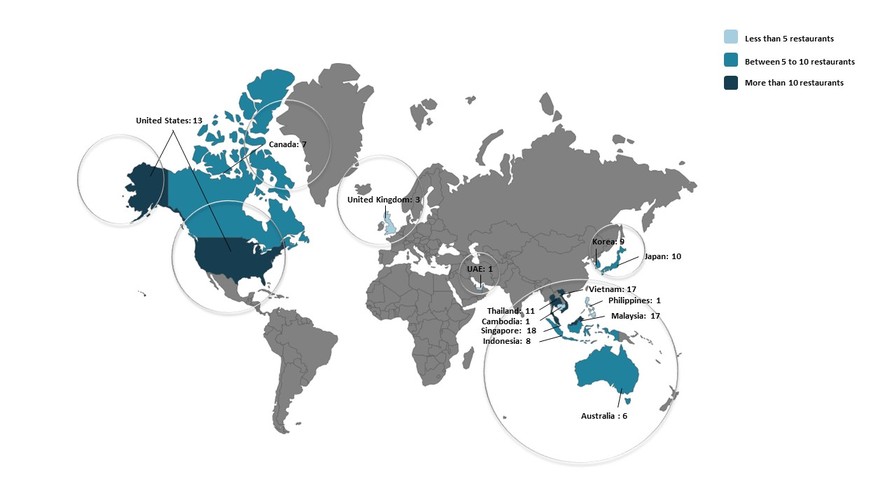
- 39 -
Haidilao Restaurant Performance
The following table summarizes key performance indicators of our restaurants for the years indicated.
|
|
For the Year Ended December 31, |
||||
|
|
2022 |
|
2023 |
|
2024 |
Total guest visits (million) |
|
|
|
|
|
|
Southeast Asia |
|
16.1 |
|
18.8 |
|
20.7 |
East Asia |
|
2.2 |
|
2.9 |
|
3.3 |
North America |
|
2.2 |
|
3.0 |
|
3.7 |
Others(1) |
|
1.2 |
|
2.0 |
|
2.2 |
Overall |
|
21.7 |
|
26.7 |
|
29.9 |
Table turnover rate(2) (times per day) |
|
|
|
|
|
|
Southeast Asia |
|
3.4 |
|
3.5 |
|
3.7 |
East Asia |
|
3.0 |
|
3.6 |
|
4.4 |
North America |
|
3.1 |
|
3.7 |
|
4.1 |
Others(1) |
|
3.1 |
|
3.8 |
|
3.9 |
Overall |
|
3.3 |
|
3.5 |
|
3.8 |
Average spending per guest(3) (US$) |
|
|
|
|
|
|
Southeast Asia |
|
20.2 |
|
19.5 |
|
19.6 |
East Asia |
|
26.6 |
|
27.8 |
|
28.3 |
North America |
|
52.0 |
|
45.3 |
|
42.3 |
Others(1) |
|
40.3 |
|
40.2 |
|
41.6 |
Overall |
|
25.2 |
|
24.8 |
|
25.0 |
Average daily revenue per restaurant(4) (US$ in thousands) |
|
|
|
|
|
|
Southeast Asia |
|
15.1 |
|
15.0 |
|
15.7 |
East Asia |
|
11.0 |
|
12.9 |
|
17.1 |
North America |
|
18.4 |
|
20.4 |
|
22.0 |
Others(1) |
|
20.5 |
|
23.6 |
|
24.9 |
Overall |
|
15.4 |
|
16.3 |
|
17.7 |
Notes:
| (1) | Others include Australia, the United Kingdom and the United Arab Emirates. |
| (2) | Calculated by dividing the total tables served for the year by the product of total Haidilao restaurant operation days for the year and average table count during the year in the same geographic region. |
| (3) | Calculated by dividing the revenue generated from Haidilao restaurant operations for the year by total guest visits for the year in the same geographic region. |
| (4) | Calculated by dividing the revenue from Haidilao restaurant operations for the year by the total Haidilao restaurant operation days for the year in the same geographic region. |
- 40 -
Same Store Sales
The following table sets forth details of our same store sales for the years indicated.
|
|
As of/For the Year Ended December 31, |
||||||
|
|
2022 |
|
2023 |
|
2023 |
|
2024 |
Number of Same Stores(1) |
|
|
|
|
|
|
|
|
Southeast Asia |
|
51 |
|
60 |
||||
East Asia |
|
13 |
|
13 |
||||
North America |
|
16 |
|
18 |
||||
Others |
|
5 |
|
7 |
||||
Total |
|
85 |
|
98 |
||||
Same Store Sales(2) (US$ in thousands) |
|
|
|
|
|
|
|
|
Southeast Asia |
|
291,834 |
|
299,667 |
|
348,237 |
|
360,213 |
East Asia |
|
56,072 |
|
73,209 |
|
65,545 |
|
79,970 |
North America |
|
105,956 |
|
118,449 |
|
135,311 |
|
147,834 |
Others |
|
39,441 |
|
45,224 |
|
61,599 |
|
65,974 |
Total |
|
493,303 |
|
536,549 |
|
610,692 |
|
653,991 |
Average same store sales per day(3)(US$ in thousands) |
|
|
|
|
|
|
|
|
Southeast Asia |
|
15.8 |
|
16.2 |
|
16.0 |
|
16.4 |
East Asia |
|
11.9 |
|
15.5 |
|
13.9 |
|
16.8 |
North America |
|
18.2 |
|
20.3 |
|
20.6 |
|
22.4 |
Others |
|
21.6 |
|
25.1 |
|
24.4 |
|
26.1 |
Total |
|
16.0 |
|
17.4 |
|
17.1 |
|
18.3 |
Average same store table turnover rate(4) (times/day) |
|
|
|
|
|
|
|
|
Southeast Asia |
|
3.4 |
|
3.6 |
|
3.6 |
|
3.8 |
East Asia |
|
3.2 |
|
4.0 |
|
3.6 |
|
4.3 |
North America |
|
3.0 |
|
3.6 |
|
3.7 |
|
4.1 |
Others(5) |
|
3.1 |
|
3.6 |
|
3.7 |
|
3.9 |
Total |
|
3.3 |
|
3.6 |
|
3.6 |
|
3.9 |
Notes
| (1) | Includes restaurants that commenced operations prior to the beginning of the periods under comparison and opened for more than 300 days in 2022, 2023 and 2024. |
| (2) | Refers to the aggregate gross revenue from Haidilao restaurant operations at our same stores for the year indicated. |
| (3) | Calculated by dividing the gross revenue from Haidilao restaurant operations for the year by the total Haidilao restaurant operation days at our same stores for the year. |
| (4) | Calculated by dividing the total tables served for the year by the product of total Haidilao restaurant operation days for the year and average table count at our same stores during the year. |
| (5) | Others include Australia and the United Kingdom. |
Delivery Business
We started to offer delivery services at Haidilao restaurants in 2019. We provide delivery services through our hotline and social media accounts as well as local online food delivery platforms.
We aim to provide our guests a true Haidilao dining experience even if they do not dine in our restaurants. For each delivery order, we generally include side dishes and a complementary care package containing napkins and peppermint candies. To guarantee freshness and hygiene, our food is packed in sealed food containers, and we allow our guests to return the food if the seal is damaged. In such an event, we will seek compensation from the relevant third-party responsible for food delivery.
- 41 -
Others
We also generated revenue from other activities, primarily including sales of hot pot condiment products and food under the Haidilao brand and secondary brands to local guests and retailers. These products aim to enable our guests to enjoy Haidilao hot pot experience at home.
Organization Structure
We adopt a management system focused on balancing standardization and localization. Our restaurants are divided into several groups, taking into account their locations and restaurant performances. We believe managing restaurants by group enables us to formulate more effective business strategies and operating guidelines that fit the needs of the group. Each group is overseen by a regional manager, to whom all restaurant managers in the group report directly. The regional managers are generally responsible for implementing business strategies and management of restaurant operations in the group. The regional managers are supported by several core business functions under our headquarters, including product management, finance, IT and food safety, among others.
Headquarters
Our headquarters maintain control over critical aspects of our restaurant operations, including food safety, legal, IT, finance and restaurant expansion strategy. Our headquarters set corporate goals, business strategies and operational standards so that we can achieve high-quality management and scalable growth. Under the framework set out by our headquarters, we grant significant autonomy to regional managers and restaurant managers to execute our corporate objectives in each country.
Regional Managers
Our regional managers who act as key roles for restaurant operations in a certain region as determined by our headquarters, are responsible for overall management and strategies implementation within the region. As our regional managers are normally promoted from the restaurant manager pool, we believe they are familiar with local restaurant operations and market conditions, enabling them to formulate the most suitable business strategy for each group. For example, regional managers are responsible for implementing marketing strategies and executing restaurant expansion plans. Regional managers are also responsible for assessment of restaurants and restaurant managers within the group, including formulating KPIs, conducting restaurant performance evaluation and review within the group. From time to time, our headquarters may adjust the composition of each region.
Restaurant Level
Our restaurant managers are responsible for day-to-day management of our restaurants. We grant significant autonomy and decision-making power to them in operating restaurants. They are responsible for restaurant staff assessment and promotion, handling complaints and emergency situations, holding staff meetings and reviewing financial and performance metrics. Depending on restaurant size, each restaurant is normally staffed with 60 to 120 employees, which are assigned to beginner, intermediate and advanced-level roles. New joiners will start from beginner roles and move up to more advanced roles when they gain sufficient experience.
Expansion Plan, Site Selection and Development
We have established a series of internal procedures to implement our expansion plans and new restaurant development. Our headquarters together with our regional managers determine the overall strategic expansion plan of each group, for example, whether to enter into a new market and whether to open new restaurants in existing market. We encourage our regional managers and restaurant managers to submit proposals for new restaurants, which will be subject to our headquarters’ approval. We generally adopt a bottom-up approach in expanding our restaurant network. We align the financial interests of our restaurant managers with their ability to cultivate new locations and leaders to open new restaurants, which has become a significant driver in our expansion. Under our leadership program, existing restaurant managers can identify and train restaurant manager candidates through our leadership training program.
- 42 -
We have established standardized procedures to open a new restaurant. For each new restaurant project, our regional managers are primarily responsible for choosing new restaurant managers based on recommendations from restaurant managers. After the restaurant manager is identified and the restaurant premise is determined, the new restaurant manager will be responsible for project execution with the support from regional managers. Our headquarters will also supervise and provide guidance on the expansion process. The following chart illustrates the major steps in our restaurant opening process after a new restaurant project has been determined.

| ● | Selection of restaurant manager. We believe the ideal new restaurant manager should have extensive experience as restaurant staff so that he/she is familiar with every detail of restaurant operations. As of December 31, 2024, all of our restaurant managers were home grown and have served various non-managerial positions, such as waiters or janitors. Our restaurant managers are encouraged to recommend new restaurant manager candidates, normally being their mentees. If the new restaurant was originally proposed by an existing restaurant manager, we will consider his or her recommendation for the new restaurant manager as the first choice, subject to regional manager’s review and approval. In other cases, our regional manager will review the restaurant manager candidates recommended by each restaurant manager to select the most suitable candidate. |
| ● | Site selection. Our headquarters are responsible for providing guidance in our site selection process with the consideration of our Group’s strategic growth. Our regional managers are responsible for identifying suitable locations, since they have a deeper understanding of the local market. We carefully consider potential markets and devote a substantial amount of time and effort to evaluating each potential restaurant site. |
| ● | Lease arrangement. Subject to negotiations with our landlords, we generally enter into long-term leases ranging from three to twenty years with an option to renew for our restaurants in order to secure more favorable terms. We do not own any property for substantially all of our restaurant sites and believe such strategy can significantly reduce our capital expenditures. |
| ● | New restaurant project execution. The new restaurant manager will be responsible for project execution, with assistance provided by the regional manager and our headquarters. |
| ● | Restaurant operations and review. The regional manager will continue to provide support and guidance after the new restaurant is opened, including conducting site visits, and reviewing initial table turnover rates and other performance metrics. New restaurants are subject to the same restaurant performance assessment as existing restaurants in the same group. Regional managers are available to provide training and assistance to new restaurants that are rated C or lower. |
Restaurant Performance Assessment
We conduct monthly evaluation of the performance of our restaurants and derive a monthly rating for each restaurant based on the criteria above, which also ties to the rating of each restaurant manager. The ratings of each restaurant will be published on a monthly basis via online meeting or internal announcement, incentivizing them to improve their performance in the following months. We also derive a final rating for each restaurant each quarter, taking into account the ratings of the restaurant in the three months.
We also have a mystery guest review program, allowing us to understand the performance of restaurants from our guests’ points of view. We invite certain mystery guests to register on our designated mobile app and apply to be a mystery guest at a specific restaurant. Once the task is assigned, they are invited to visit our restaurants and provide a feedback report on their dining experience. The report covers various aspects including services, food quality and environment and the reviewers are required to provide an overall rating to the restaurant. The rating from mystery guest reviewers forms one of the important criteria for our restaurant performance assessment.
Training and Promotion
We conduct comprehensive training for all of our employees, from management positions to restaurant staff. We create an outcome-oriented and merit-based working environment and seek to instill Haidilao’s core values and culture in our employees. Substantially all of our restaurant managers are promoted internally from junior roles at our restaurants.
- 43 -
Supply Chain
Supply Network
Our ability to offer consistently high-quality food across our restaurants depends largely upon the ability to procure the highest quality food ingredients commercially available. Our overall procurement strategy is generally based on the guest volume of our restaurants.
For markets where we have a larger business scale, we generally adopt a centralized procurement system for major food ingredients and consumables we use. We have set up two central kitchens in Singapore and Malaysia, primarily responsible for manufacturing and processing food ingredients used in our restaurants, including meats that require processing and flavoring, and vegetables that require washing and cutting. We believe this model can streamline our supply chain management practice and reduce staff costs in relation to food preparation at each restaurant, while maintaining the consistency in taste, quality and food safety. Based on our business demand, we are also exploring opportunities to open more central kitchens in other markets where we have greater presence to achieve economies of scale.
For other markets we operate in, we normally procure food ingredients directly from local suppliers to ensure regulatory compliance in each jurisdiction. After we receive requests for new food ingredients from restaurants, our procurement team in each country shall be responsible to identify suitable local suppliers. In order to better manage our costs in relation to food ingredients, we are also exploring opportunities for bulk procurement for our restaurants across different countries.
Supply Chain Management
| ● | Selection of suppliers. We have established stringent supplier selection procedures. For each food ingredient supplier candidate, we examine its qualification and conduct on-site inspection and sample testing if we consider necessary. Only suppliers that can pass all these assessments can be included in our qualified supplier list. We only procure food ingredients from these qualified suppliers. |
| ● | Management and review of suppliers. We have formulated a performance evaluation system to assess the performance of each of our suppliers regularly. Based on the quality of supplies, price and services, each supplier is graded with low-risk, mid-risk and high-risk. For high-risk suppliers, we will reduce our purchase amount with them, or find new suppliers to replace them. |
| ● | Stringent standards for food ingredients. We formulate inspection standards for each type of supplies we procure, including physical inspection as well as testing for chemicals and foreign substances. |
| ● | Inspections and testing. We conduct extensive inspection and testing of product supplies. Our food safety specialists are responsible for conducting on-site examination on our suppliers. In addition, we also engage reputable third-party laboratories to conduct sample testing to ensure that our food ingredient supplies comply with the applicable food safety laws and regulations. |
Food Safety and Quality Control
We place the utmost priority on the health and safety of our guests and dedicate a significant amount of resources in maintaining our food safety and quality control system. We have established a food safety department at our headquarters overseeing our food safety practice and formulating our food safety protocols and strategies. In each country that we operate in, we implemented detailed food safety and quality control protocols based on local standards and regulatory requirements. We also constantly monitor regulatory updates in relation to food safety regulations and make adjustments to our protocols accordingly. Each restaurant also has one food safety specialist, who is responsible for supervising the food safety practice and conducting regular checks and examinations at the restaurant. The food safety specialists are required to attend periodic internal training and pass our quality and safety tests.
- 44 -
Restaurant Decoration
On October 17, 2023, we entered into a master decoration project management service agreement with YIZHIHUA (SINGAPORE) CO. PTE. LTD. (“YIZHIHUA”), a private limited company established in Singapore and controlled by the brother of Mr. Yong Zhang, our largest shareholder. Pursuant to this agreement, YIZHIHUA will provide decoration project management-related services to our restaurants (excluding those in Malaysia). In addition, on the same date, we entered into a framework agreement for engineering, procurement and construction services for renovation work with YIZHIHUA, pursuant to which YIZHIHUA will provide our restaurants in Malaysia with renovation work-related services. The term of each agreement is between January 1, 2024 and December 31, 2026. These two agreements have replaced the agreement we entered into on December 12, 2022 with Beijing Shuyun Dongfang Decoration Project Co., Ltd., a limited liability company established in the PRC and controlled by the brother of Mr. Yong Zhang, our largest shareholder, which was valid between December 30, 2022 and December 31, 2023.
Restaurant Operations
| ● | Detailed and standardized procedures. We have developed a series of food safety, hygiene and quality control protocols that set out guidelines detailed down to different methods of cleaning different types of kitchenware, sterilization schedules and the cleaning schedule for restrooms. Our food safety specialists also establish food safety procedures for each restaurant, taking into account local regulatory requirements. From time to time, our food safety specialists will make recommendations to our food safety, hygiene and quality control protocols based on issues identified in restaurants and regulatory updates. |
| ● | Extensive inspection. Our regional manager is responsible for conducting monthly inspection for each restaurant. If any food safety issue is identified, the food safety specialist will assist the restaurant manager to rectify the issue and conduct a follow-up inspection after rectification is completed. |
| ● | Clear accountability. We have established clear responsibility for our restaurant managers and our food safety staff. Each restaurant is divided into thirteen different areas, such as the kitchen, dining area and waiting area and the restaurant manager assigns one designated person for each area. |
| ● | Compliance. Our food safety specialist reviews and keeps abreast of local laws and regulations to formulate and update internal food safety policies. |
| ● | Design and technology. We believe that investing in restaurant design and technology allows us to enhance quality control and reduce the risk of human error. We have established kitchens with automated and smart equipment in Singapore, which we believe will allow us to achieve more consistency in handling food and maintaining hygiene in the kitchen area. |
| ● | Continuous training programs. We continuously provide training programs to our restaurant staff on the operating procedures and quality standards on an annual basis. Post-training tests are conducted to ensure the effectiveness of training. |
Marketing
Our service quality is the most vital factor influencing customer satisfaction and customer retention, and also enhances our brand image. We primarily rely on our guests’ spontaneous word-of-mouth to attract new customers. Leveraging our leading position in the industry market for Chinese cuisine restaurants and Haidilao’s brand image, our restaurants have attracted many celebrities to visit, including movie directors, pop stars, and social media influencers. Their social media posts of dining at Haidilao have become one of our most effective channels to attract more guests.
We engage with our guests, in particular through the social media accounts we operate (e.g., Facebook and Instagram). These online platforms have enabled us to spread our culture and Haidilao dining experiences to a larger audience. From time to time, our regional managers may also design, implement and launch marketing campaigns based on local customs and preferences. For example, we have launched marketing campaigns in Japan during cherry blossom seasons. We also held live streaming events on TikTok to promote our online campaigns in Malaysia and Indonesia.
- 45 -
Technologies
We seek to distinguish ourselves in the restaurant industry by implementing advanced information technology to support our development. To this end, we have implemented a set of management information systems to not only enhance our guest experience but also improve the efficiency of operations. Details of our key technology applications are set forth below:
| ● | Automated ordering. All orders at our restaurants are placed on tablet computers. This expedites service and enables our management to collect and analyze consumption behavior, spending and inventory data on a timely basis. This system also allows us to track ordering history and recommend dishes to members based on their consumption behavior. |
| ● | Automatic busser. We have developed and applied automatic busser equipment in our restaurants. These automatic bussers can automatically deliver dishes to each table, which significantly improve our operation efficiency. |
| ● | Immersive dining. We have launched tech-forward restaurants in Singapore, which use architectural lighting, audio and visual technologies to create a full-sensory immersive dining experience. |
- 46 -
| ● | Customized flavors. We adopted technology that would automate the preparation of soup bases and customize the depth of flavors, such as spiciness, oiliness, richness and thickness based on personal preferences. Our guests will be able to create his/her own personalized soup base. The unique choices of each guest are stored in our membership system and can be automatically ordered the next time he/she visits. Further, as some local guests have a lower tolerance for spicy food, our customized flavor technology enables them to adjust the spiciness of their Sichuan-style soup bases, making our restaurants more appealing to local guests. |
Competition
Currently, the international market for Chinese cuisine restaurants is very fragmented, with approximately 700,000 restaurants internationally. We primarily compete with other chain and single-store restaurants with respect to food quality and consistency, brand reputation, value for money, ambiance, service, location, supply of quality food ingredients and availability of trained employees.
Environmental Social and Corporate Governance (“ESG”)
We are committed to building a lasting brand, and we believe our long-term success rests on our ability to make positive impact on the environment and society. Adhering to the concept of sustainable development on an ongoing basis, we have implemented and continue to improve sustainable development and ESG management by developing an ESG management mechanism involving collaborations at all levels within our company and actively communicating with stakeholders. We are committed to integrating sustainable development concepts into our daily operations. We have taken the following environmental sustainability and social responsibility initiatives.
| ● | Energy saving and green operation. We proactively monitor information relating to pollutant emissions to avoid energy waste. As such, we have established an air-conditioning and mechanical ventilation system to automatically determine the real-time business status of the restaurant, realize intelligent linkage control and supply the appropriate volume of fresh air. We have implemented an intelligent kitchen management system (“IKMS”) in certain restaurants in Singapore. The IKMS can collect and analyze the data collected from the kitchen and offer real-time monitoring of the overall operating status, such as production, inventory and shelf life. We also plan to implement an energy management system (“EMS”) in certain restaurants. The EMS system can monitor the use of electricity in our restaurants. Through these intelligent systems, we can significantly reduce waste and save energy at our restaurants. In addition, we will continue to deepen the concept of green operation, actively promote energy conservation and consumption reduction, and pursue efficient operation. |
| ● | Anti-food waste project. In most of our restaurants, we allow our guests to order half-portion dishes to promote awareness of food waste, while ensuring the diversity of food that our guests can enjoy. In addition, we also launched combo meals for individual guests in certain restaurants. Further, we have implemented advanced stock tracking and inventory management system to avoid raw materials waste. |
| ● | Nutritious meals. Our broad menu allows guests to enjoy balanced meals consisting of proteins, vegetables, grains and other nutritious ingredients. In addition, we have formed product development teams to regularly introduce localized menu offerings that promote a healthy diet. |
| ● | Controlling usage of food additives and other chemicals. Our suppliers are required to provide information on the use of food additives and other chemicals in their products in accordance with local laws and regulations. We also adopt strict rules for procurement, storage, inventory management and usage of food additives and other chemicals at our restaurants. Our food quality specialists conduct daily food safety inspections to ensure food quality and safety. |
| ● | Workforce diversity. We are committed to providing diverse and equal employment opportunities to our employees. As of December 31, 2024, over 47% of our total employees were females. We will continue to adhere to a fair, transparent and sound employee recruitment and management system and promote diversity in our workforce. |
- 47 -
Intellectual Property
On December 12, 2022, we entered into a trademark license agreement with Sichuan Haidilao Catering Co., Ltd. (“Sichuan Haidilao”), a limited liability company established in the PRC and controlled by Mr. Yong Zhang, our largest shareholder. Pursuant to this agreement, Sichuan Haidilao agrees to license to our company over 360 trademarks registered by Sichuan Haidilao, including Haidilao (“海底捞”), in all the jurisdictions in which we operate on an exclusive and royalty-free basis for a perpetual term, to the extent permissible under the Hong Kong Listing Rules and relevant laws and regulations.
In addition, a number of proprietary know-how and trade secrets are also of significant importance to our operations, including the recipes for certain food ingredients and soup bases. We protect such intellectual property by relying on the protection afforded under applicable trade secret laws, implementing intellectual property management policies, installing secure information technology systems and entering into confidentiality arrangements with employees and third parties who may have access to our proprietary know-how and trade secrets. Our product development department is responsible for management of all of our recipes.
Employees
We value our employees and believe high quality guest service comes from happy employees. We endeavor to manage and motivate our employees in order to maximize the working proceeds through constant training programs, competitive compensation package and clear promotion scheme. As of December 31, 2024, we had a total of 13,057 full-time and part-time employees.
Insurance
We maintain various insurance policies to safeguard against risks and unexpected events. We have purchased insurance covering key aspects of our operations, such as property insurance. We do not maintain business interruption insurance, malpractice liability insurance or key-man life insurance. We consider our insurance coverage to be adequate for our business and in line with the industry norm in the countries in which we operate.
Legal Proceedings
From time to time, we may be involved in various claims and legal actions that arise in the ordinary course of business. We do not believe that the ultimate resolution of any pending claims and legal actions will have a material adverse effect on our financial position, results of operations, liquidity and capital resources.
Regulations
This section sets forth a summary of the significant regulations or requirements in the jurisdictions where we conduct our material business operations, namely Singapore, the United States, Malaysia and Vietnam.
Singapore Laws and Regulations
License, Registration and Permits
Appointed under section 3 of the Sale of Food Act 1973 (the “SFA”), the Singapore Food Agency (the “Agency”) was formed as a statutory board under the Ministry of Sustainability and the Environment (formerly known as the Ministry of the Environment and Water Resources) (the “MSE”) on April 1, 2019 to oversee food safety and food security in Singapore. The establishment of the Agency brought together food- related functions that used to be carried out by three separate arms (being the former Agri-Food & Veterinary Authority of Singapore, the National Environment Agency and the Health Science Authority) under one single entity. Under section 5 of the Singapore Food Agency Act 2019, the Agency’s functions include, amongst others, the regulation of businesses engaged in the handling or supply of food so as to minimize food safety risks and the accreditation of persons in the food industry.
Non-Retail Food Business Regulatory Requirements
As part of the Agency’s food safety system pipeline, (i) establishments where food is manufactured, processed, prepared or packed for the purpose of distribution to wholesalers and retailers; (ii) cold stores that are used for the storage of meat and/or fish products and (iii) slaughterhouses for slaughtering of animals such as poultry, are required to obtain a licence issued by the Agency in order to operate in Singapore.
- 48 -
Pursuant to section 21 of the SFA, “a person must not carry on a non-retail food business except in accordance with a licence issued to the person by the Director-General under this Part.” In this regard, “non-retail food business” is defined under section 2F of the SFA and includes, amongst others, “central kitchens supplying food prepared, cooked and packed for the purpose of distribution to retail food businesses.” Failure to comply with the requirements under this section 21 of the SFA is an offence and pursuant to section 24(1) of the SFA, such person may be arrested without a warrant by any police officer or authorized officer and taken before a Magistrate’s Court in Singapore.
| (a) | In relation to the central kitchen operations (as defined above) carried out, pursuant to section 12 of the Wholesome Meat and Fish Act 1999 (the “WMF”), “[a] person must not use any premises or permit any premises to be used as a processing establishment or a cold store except under and in accordance with the conditions of a licence granted by the Director-General.” Pursuant to section 12(2) of the WMF, a person who uses any premises as a processing establishment or a cold store without a licence, upon conviction, may be liable to a fine not exceeding SGD10,000 or to imprisonment for a term not exceeding twelve (12) months or to both. |
| (b) | A licence is also required where: fresh fruit or vegetable is imported for sale, supply, distribution or transshipment pursuant to section 7 of the Control of Plants Act 1993 (the “CPA”) (failing which it is an offence liable on conviction to a fine not exceeding SGD10,000 or to imprisonment for a term not exceeding three (3) years or to both); and meat products and fish products are imported, exported or transshipped pursuant to section 5(1) of the WMF or imported for sale, supply or distribution in Singapore pursuant to section 6(1) of the WMF (failing which it is an offence liable on conviction to a fine of up to SGD100,000 or to imprisonment for a term not exceeding three (3) years or to both, depending on the nature of the offence). |
(each a “Product Licence,” collectively, the “Product Licences”)
Further, pursuant regulation 14 of the Food Regulations (enacted pursuant to section 56(1) of the SFA), “No person shall import any food that has not been registered with the Director-General.” Regulation 14(2) of the Food Regulations clarifies that any imported food is deemed registered if it is imported under a permit to import issued pursuant to the Regulations of Imports and Exports Regulations with the required particulars (including but not limited to the product description and country of origin of the product) approved to the satisfaction of the Agency. Accordingly, registration is also required for traders who import processed food products (being all food products and supplements of food nature) and food appliances are imported into Singapore (“Import Registration”). Documentary proof that the imported products are produced under sanitary conditions in a regulated establishment is required for any Import Registration (in particular in relation to the importation of packaged mineral and drinking water and ice, minimally processed fruits and vegetables, coconut milk and grated coconut etc.). Pursuant to regulation 5 of the Food Regulations, any importation, advertisement, manufacture, sale, consignment or delivery of prepacked food must also bear a label that contains the particulars as provided under the Food Regulations (including but not limited to the common name or a description sufficient to indicate the true nature of the food and the appropriate designation of each ingredient in the case of food consisting of two or more ingredients). In this regard, “prepacked” is defined under regulation 2 of the Food Regulations to mean “packed or made up in advance ready for sale in a wrapper or container.” Accordingly, it is an offence under the Food Regulations to include any written, pictorial or other descriptive matters appearing on or attached to, or supplied or displayed with food (including any advertisements in relation to the same) that includes any claim or suggestion that is false, misleading or deceptive, or is likely to create an erroneous impression regarding the value, merit or safety of the food product so labelled (unless otherwise allowed under the Food Regulations).
Such Product Licences and Import Registration shall be valid for the period as stated on the respective licences or registrations unless it is revoked or renewed upon its expiry. As a general note, the licensee or registered entity is to inform the Agency within fourteen (14) days should there be any changes in relation to the particulars of the licensee or registered entity. In addition, for each individual consignment of fresh fruits or vegetables, meat products or fish products and processed food products and food appliances, the licensee or registered entity is required to obtain a permit for such consignment. The import of the consignment must also be carried out in accordance with the conditions of such permit issued and such other requirements as stated under the CPA, WMF, SFA or Food Regulations (as applicable). These conditions generally include the need for the products transhipped to comply with prescribed/sanitary standards and do not include any prohibited substances (e.g. prohibited pesticide residues). A failure to obtain the necessary permits for each consignment is an offence and is punishable under the respective acts.
Empowered by the SFA, the Agency is authorized to inspect all food processing establishments to ensure that the licensees and their food production personnel adhere to good manufacturing practices and implement food safety programs for the safe production of food on such premises.
- 49 -
Material Regulations and Procedures with respect to the operation of retail food shops and food stalls in Singapore
All retail food establishments and food stalls must be licensed in Singapore by the Agency in order to operate. In this regard, section 2 of the Environmental Public Health Act 1987 (the “EPHA”) defines “food establishment” to mean any place or any premise or part thereof used for the sale, or for the preparation or manufacture for sale, or for the storage or packing for sale, of food, whether cooked or not, intended for human consumption.
Pursuant to section 32 of the EPHA, “A person must not operate or use or knowingly permit a food establishment to be used for any of the purposes specified in the First Schedule without first obtaining a licence from the Director-General, Food Administration.” In this regard, paragraph 1 of the First Schedule of the EPHA includes a retail food establishment, which is defined as a place “where food is sold wholly by retail (whether or not the food sold is also prepared, stored or packed for sale or consumed at such premises), including (a) an eating establishment, such as a restaurant.” Section 33 of the EPHA also requires that any person who “hawk, sell or expose for sale any food or goods of any kind” or “set up or use any stall […] for the purposes of hawking, selling or exposing for sale any food or goods of any kind” in any premises or public place is required to first obtain a licence from the Agency.
Failure to comply with the requirements under section 32 or 33 of the EPHA is an offence and upon conviction, pursuant to section 41A(1) of the EPHA, such person shall be liable to a fine of up to SGD10,000 and, where the person is a repeated offender, a fine of up to SGD20,000 or to imprisonment for a term not exceeding three (3) months or to both (depending on the nature of the offence). In particular, regulation 5(1) of the Environmental Public Health (Food Hygiene) Regulations (the “EPH Regulations”) states that “Every licensee shall use the licensed premises only for the purpose for which the licence is granted.” Further, pursuant to regulation 6(2) of the EPH Regulations, “A licensee who is permitted to carry out food catering shall insert his licence number in all advertisements relating to his food catering business.” Amongst others, it has been emphasized by the Agency that all food establishment operators are required to renew their licence before the licence expiry date should they wish to continue with the business operations.
Operators are reminded that they will be required to submit a new licence application and stop operations until they have obtained a new licence. Operators who continue to operate without a valid licence (i.e., expired licence) will constitute an offence under the EPHA and may be liable, on conviction, to a fine not exceeding SGD10,000.
Specific Licenses and Registration in relation to the operations of a Restaurant in Singapore
For the supply of liquor, pursuant to section 4(1) of the Liquor Control (Supply and Consumption) Act 2015 (the “LCA”), “a person must not supply any liquor unless the person is authorized by a liquor licence to supply the liquor.” In this regard, “supply” is defined under section 2 of the LCA to include, amongst others, to sell, offer or agree to sell, barter or exchange the liquor (whether the reward or consideration is received or to be received by the supplier specifically for the liquor or as part of services or other goods sold, bartered or exchanged) or to serve, send, forward or deliver the liquor in connection with sale, barter or exchange and includes causing or permitting to be supplied.
Section 5(1) of the LCA provides that, “where licensed premises are specified in the liquor licence of a licensee, the licensee must not supply any liquor except at those licensed premises.” Failure to comply with this section 5(1) is an offence and shall, on conviction, be subject to a fine not exceeding SGD10,000. Further, section 6(1) of the LCA also provides that the supply of alcohol is only permitted, amongst such other conditions, during the trading hours specified in the liquor licence. It is an offence under the LCA for a person to supply liquor without a valid licence, and pursuant to section 4(3) of the LCA, such person may, on conviction, be subject to a fine not exceeding SGD20,000 and a repeated offender may be subject to a fine not exceeding SGD20,000 or to imprisonment for a term not exceeding three (3) months or to both. Notably, pursuant to section 32(1) of the LCA, any offence under the LCA by a body corporate may also result in the officer-in-charge (e.g. licence holder) being charged and tried in the same manner as the body corporate, if such offence is committed with the officer’s consent or is attributable to his/her act or default.
- 50 -
Laws and Regulations on Food Safety and Environment Matters
Food Safety
Pursuant to section 56 of the SFA, the minister may make regulations on, amongst others, (a) prescribing the standard of strength, weight, quality or quantity of any food or of any ingredient or component part thereof; (b) prohibiting the addition or use of any specified thing or of more than the specified quantity or proportion thereof to any food or food contact article; (c) regulate the identification and labelling of food or food contact articles for sale, including specifying the matter that must or must not be contained in any such label and the manner of labelling; (d) set out standards for the maintenance, cleanliness, sanitation and hygiene of premises at which a non-retail food business is carried out; or (e) set out requirements that apply to imported food or food contact articles to ensure that the food or food contact article is safe and suitable and to support a secure and reliable supply of imported food in Singapore, including keeping of records in relation to the source or traceability and handling of the food or food contact article imported.
In relation to the above, the Food Regulations enacted pursuant to section 56(1) of the SFA sets out general requirements, amongst others, in relation to (i) labelling of products; (ii) restrictions against importation and manufacturing of food articles containing regulated food additives; and (iii) restrictions against the importation and sale of products containing such prohibited incidental constituents. Part IV of the Food Regulations also specifically sets out the standards and particular labelling requirements for different categories of food products. A person who fails to comply with the requirements under the Food Regulations shall, upon conviction, be liable to a fine not exceeding SGD1,000 and in the case of a second or subsequent conviction, to a fine not exceeding SGD2,000.
Further, the Sale of Food (Food Establishments) Regulations (the “SFA Regulations”) sets out general food hygiene requirements in relation to (i) the storage of food, (ii) the packaging of food, (iii) the transportation of food, and (iv) personal cleanliness for those engaged in the preparation of food. With regards to point (iii) above (the transportation of food), pursuant to regulation 10 of the SFA Regulations, every licensee is required to ensure that during transportation, food is “protected from any likelihood of contamination” and “kept under a suitable temperature so a snot to affect its wholesomeness and safety.” The same is also provided under section 23(1) of the SFA, which provides, inter alia, that the surface of any vehicle used to transport food which the food is likely to come into contact must be kept in a state of cleanliness, good order and condition so as to prevent any risk of contamination of the food. A licensee who contravenes the regulations under the SFA Regulations shall be guilty of an offence and shall be liable, on conviction, to a fine not exceeding SGD5,000 and, in the case of a continuing offence, to a further fine not exceeding SGD100 for every day or part thereof during which the offence continues after conviction.
Similarly, Part III of the Environmental Public Health (Food Hygiene) Regulations (which is enacted pursuant to section 111 of the EPHA) (the “EPHA Regulations”) also sets out general food hygiene standards that licensees (i.e. food establishment licensees) have to adhere to generally. Amongst others, these include storage and refrigeration of food requirements and time-stamping requirements. On this note, failure of a licensee to comply with the requirements under the EPHA Regulations, shall upon conviction, be liable to a fine not exceeding SGD2,000 and in the case of a continuing offence, to a further fine of not exceeding SGD100 for every day or part thereof during which the offence continues after conviction. Notwithstanding, this may also affect the licensing and renewal (if any) of the licensee’s licence granted under the EPHA.
All food processing establishments, cold stores and slaughterhouses must comply with the WFA, SFA and the Conditions of Licensing for Food Establishments prescribed by the Agency (last updated on February 14, 2024). Food handlers (e.g. chefs, cooks and kitchen assistants) working in food retail establishments must complete the WSQ Food Safety Course Level 1 certification and thereafter, be registered with the Agency. Such persons are also required to attend and complete a refresher course training every five (5) years starting from the date of first obtaining the Food Safety Course Level 1 certification. In this regard, regulation 10 of the EPHA Regulations requires that any employee or assistant of a licensee who is engaged in the sale or preparation of any food must be registered with the Agency. Further, pursuant to regulation 10A of the EPHA Regulations, licensees are also required to appoint a senior staff member to be trained as a Food Hygiene Officer, who must also be registered with the Agency. The appointed Food Hygiene Officer is required to attend such course (including refresher course) as is required by the Agency.
- 51 -
The Agency imposes a Points Demerit System whereby demerit points are given for each public health offence that is convicted in court or compounded, depending on severity, ranging from 0 demerit points for minor offences, 4 demerit points for major offences, to 6 demerit points for serious offences. Pursuant to section 99 of the EPHA, food establishments which accumulate twelve (12) or more demerit points within any twelve (12) month period may have its license to operate suspended for a certain period or be revoked, depending on past suspension records.
The Agency also conducts annual on-site audit assessments on Agency-licensed local food establishments to determine their grading status and provide on-site advice to help them improve and upgrade their premises. All licensed food establishments (including cold stores, slaughterhouses and food processing establishments) in Singapore are categorized into four (4) grades (A being excellent to D being pass). Each food establishment will be graded annually based on its food hygiene and food safety standards before its licence expires. The grade awarded will encourage the establishment to strive for better grades and seek improvement in food hygiene and safety standards. The areas of audit assessment of food establishments include (but are not limited to) general cleanliness and housekeeping of premises, food storage, food processing equipment and facilities, food hygiene training and documentation.
Notwithstanding the foregoing, a new food safety licensing framework, the Safety Assurance for Food Establishments (the “SAFE”), will be implemented in phases at the end of 2025 to replace the current annual grading scheme. Under the SAFE framework, food establishments are categorized under three categories (depending on the amount of food handling involved and the level of food safety risks) and will be awarded Bronze, Silver or Gold, which corresponds each with a three (3), five (5), or ten (10) year licence duration. Food establishments will be assessed based on their track records, such as having no major food safety lapses over a specific period, as well as being able to put in place systems to strengthen food safety assurance.
Commencing from July 30, 2021, baseline environmental sanitation (“ES”) standards are mandatory for specified premises, which includes, amongst others, food courts and canteens, schools and specified shopping malls. This includes canteens that hold specific Agency issued Foodshop licences. Such licensees are required to implement the ES standards and develop an ES program for their premises and to oversee its implementation. The ES program must be submitted to the National Environment Agency (“NEA”) within one (1) month from the implementation of the ES regime for the sector or upon the commencement of operations for new specified premises. The ES program is required to adhere to the baseline standards developed by the ES Technical Committee convened under the NEA, which includes, amongst others, implementing minimum routine cleaning and disinfection frequencies and carrying out yearly maintenance of surfaces or fixtures. Such selected retail foodshops are expected to ensure that premises are clean and relatively free of visible litter, stain, environmental waste, spillage and soilage.
Public Health and Environmental Matters
Issued by the NEA, the COPEH provides the guidelines to address environmental health concerns in the design of buildings. The COPEH sets out the objectives to be met and stipulates the minimum basic design criteria. Specifically, section 3 of the COPEH sets out design criteria relating to the ventilation, ducting and kitchen exhaust systems for foodshops at building plan and pre-operation (pre-licensing) stages which should be complied with when the companies are renovating leased properties for the operation of the restaurant business.
Separately, pursuant to section 26 of the Fire Safety Act 1993 (the “FSA”), it is an offence if “the owner or occupier causes, or does or omits to do anything that is likely to cause, a specified fire hazard to arise at the building.” Section 2 of the FSA defines a “specified fire hazard” to include, amongst others “the obstruction of escape routes, passageways, common property or limited common property of the building such as might render escape in the event of fire more difficult.”
- 52 -
Consolidation of the existing regulations relating to food-related functions and the implementation of the Food Safety and Security Act by 2028
Although the establishment of the Agency sought to consolidate the different food-related functions under one agency, Singapore did not have a consolidated food-related legislation as different food-related laws were enacted at different points in history and regulated by different government agencies across the years. In light of the foregoing, the Food Safety and Security Bill (“FSSB”) was passed by the Singapore Parliament on January 8, 2025 to (amongst others) (1) consolidate and amend the existing laws and regulations relating to food safety in connection with the production of primary produce, the supply of food and the provision of drinking water and (2) improve food security in Singapore. In connection thereto, consequential and related amendments will be made to certain food-related legislation, including the repeal of the SFA and WMF in due course once the Food Safety and Security Act 2025 of Singapore (“FSSA”) is fully in force. As announced during the second reading of the FSSB in parliament on January 8, 2025, to facilitate a smooth transition for the industry, the changes as set out under the FSSA will be implemented in phases, starting with defined foods and non-packaged drinking water in the second half of 2025 and it is envisaged that all the amendments proposed under the FSSA will be in full force by 2028. With effect from February 27, 2025, section 402 of the FSSA (which deals with the validation of any amount collected as, amongst others, a fee for a permit or application fee for a licence under the WMF on or after November 12, 2024) has come into force. To this end, the Agency (or such other relevant regulatory authorities) will inform the industry and public ahead of the implementation of the relevant provisions under the FSSA to allow time for them to prepare for the changes.
The key features (and amendments) under the FSSA are summarized below:
| (a) | consolidate and refresh existing food-related legislation. Amongst others, the FSSA seeks to avoid overlapping and duplicative requirements in the areas of importing and rearing of food producing animals and the cultivation of edible plants; |
| (b) | strengthen Singapore’s food safety regime to better protect consumers and promote public health (wherein, inter alia, the coverage of food safety legislation will be extended to include the donation and free distribution of food and key food distribution nodes will be required to keep records for traceability) and to support the industry’s development and prepare for emerging trends; and |
| (c) | keep pace with emerging challenges in safeguarding food security (wherein, inter alia, a minimum stockholding requirement will be implemented for the purposes of administering the Rice Stockpile Scheme and local farms will be required to implement a farm management plan to mitigate risks to food safety, disease spread and water quality). |
In addition, in view of the implementation of the FSSA (and specifically, the repeal of the SFA, WMF and the consequential amendments to other food-related legislation), we wish to highlight the following key changes applicable to the existing food-related licenses, registrations and/or permits as described in the preceding paragraphs:
| (1) | By way of background, Division 4 of Part 14 of the FSSA sets out the general provisions on FSSA authorisations (which pursuant to section 3 of the FSSA, includes, amongst others, a licence granted under Part 3 of the FSSA, a consignment permit and a food business licence to carry on a licensable food business at premises stated in the licence). Pursuant to section 292(1) of the FSSA, an application for an FSSA authorisation must be made to the Agency. Further, in granting an FSSA authorisation to any person, the Agency may impose any conditions that the Agency considers requisite or expedient having regard to the purposes of the FSSA. Once granted, every FSSA authorisation (other than a pre-market approval), and any rights, benefits or privileges under such authorisation, are not transferable or assignable to any other person, and a transfer or an assignment, or purported transfer or assignment, of such FSSA authorisation (or of any rights, benefits or privileges under such authorisation), is void and of no effect. |
| (2) | Specifically, with respect to food business licences, section 102(1) of the FSSA provides that, unless otherwise exempted, a person commits an offence if such person is an owner or occupier of any premises who uses such premises to carry on a licensable food business but is not a holder of a licence to carry on that licensable food business at the premises. In this regard, “licensable food business” is defined under section 6(1) (read together with the First Schedule) of the FSSA and includes, amongst others, the following: |
| (i) | “a food business involving the operating of a commissary kitchen or centralised commercial kitchen where food is prepared and packed for another food business or for the same food business, to sell at premises other than those of the commissary kitchen or centralised commercial kitchen, for consumption at those other premises”; |
- 53 -
| (ii) | a food business engaged in storing meat or meat products, or fish or fish products in, “a cold‑storage room or like premises, or a refrigerator, chiller or like equipment, which is designed or adapted for storing food in a low‑temperature controlled environment, being food intended for sale to any other food business (whether wholesale or retail and whether licensable or not) or for export”; |
| (iii) | a food business where “(a) food preparation or cooking is carried out in premises (but not a home) for sale, and served, on the order of a customer, predominantly for immediate consumption on those premises; and (b) those premises are furnished or fitted with tables, counters, chairs, benches or like facilities designed or adapted for use in the service and consumption of food” (which shall include, a restaurant, café or bar); and |
| (iv) | a “food business carried on as a stall comprised in a multi-unit premises” (which shall include, each cooked food stall in a food court or coffee shop, where at least one of which is operated by a person who is not the proprietor of the food court or coffee shop). |
Accordingly, it is noted that the food business licence (granted under the FSSA) will replace the individual licences under the SFA, WMF and/or EPHA (as applicable). In addition, the Second Schedule of the FSSA further provides savings and transitional provisions wherein every licence granted under (amongst others), section 12(1) of the WMF authorising the use of any premises stated in that licence as a processing establishment or a cold store, section 21 of the SFA to carry on a non-retail food business at any premises stated in the licence, section 32 of the EPHA and section 33 of the EPHA to hawk, sell or expose for sale any food of any kind, shall continue, so far as it is not inconsistent with the provisions of the FSSA, as if it were a licence under the FSSA to carry on a corresponding licensable food business as described in the First Schedule of the FSSA, at those premises. Further, such licence shall remain in effect for the period it was originally issued unless earlier revoked under section 96 of the FSSA. For completeness, a person (being an individual) guilty of an offence under section 102(1) of the FSSA shall be liable on conviction to a fine not exceeding SGD15,000 or to imprisonment for a term not exceeding six (6) months or to both and, where the individual is a repeated offender, a fine not exceeding SGD30,000 or to imprisonment for a term not exceeding twelve (12) months or to both.
| (3) | In addition, Part 3 of the FSSA sets out the provisions vis-à-vis the export of export-controlled items, import of import-controlled items and transshipment of transshipment-controlled items. Under Part 3 of the FSSA, a licence is required to, inter alia, import an import-controlled item, export an export-controlled item and transship a consignment comprising any transshipment-controlled item. In this regard, “import-controlled item” refers to (amongst others) any fresh fruits and vegetables, meat and meat products, fish and fish products, and eggs and egg products, while “export-controlled item” and “transshipment controlled item” refers to (amongst others) any meat or meat product, fish or fish products, and any egg. Failure to obtain the requisite licence under Part 3 of the FSSA is an offence and upon conviction, such person (being an individual) shall be liable on conviction to a fine not exceeding SGD15,000 or to imprisonment for a term not exceeding six (6) months or to both and, where the individual is a repeated offender, a fine not exceeding SGD30,000 or to imprisonment for a term not exceeding twelve (12) months or to both. |
| (4) | Pursuant to section 307(1) of the FSSA, the Agency may, with the approval of the Minister, make regulations prescribing anything that is required or permitted to be prescribed, or is otherwise necessary or convenient for carrying out or giving effect to, under any provision of the FSSA. Such regulations may apply to (amongst others) all forms or kinds of food, in respect of all food premises or particular categories of food premises, or differently according to differences in time, place or circumstance. |
As can be noted from the amendments alluded to above, the standardized definition under the FSSA across the industry and the establishment of a common penalty framework provides a common operating context for players in the industry and reduces complexity of the various existing legislations, which in turn supports improved compliance with legal requirements directed at protecting public health.
- 54 -
Labor, Employment & Work Safety
Employment Act 1968
The Employment Act 1968 of Singapore (“EA”) is administered by the Ministry of Manpower (“MOM”) and stipulates the rights and obligations of employers and employees. As a general note, the EA covers every employee who is under a contract of service with an employer, including workman (Part IV of the EA). Specifically, section 2 of the EA defines an “employee” to mean “a person who has entered into or works under a contract of service with an employer and includes a workman.” Notably, since April 1, 2019, managers and executives with a monthly basic salary of more than SGD4,500 are also covered under the EA. In particular, not all parts of the EA are applicable to every employee or employer who comes within the definition of an employee (as highlighted above). In this regard, Part IV of the EA sets out rest days, hours of work, holidays and other conditions of service that apply only in relation to:
| (a) | workman who is in receipt of a salary not exceeding SGD4,500 a month; and |
| (b) | every employee (other than a workman or a person employed in a managerial or an executive position) who receives a salary not exceeding SGD2,600 a month. |
(in both instances, excluding overtime payments, bonus payments, annual wage supplements, productivity incentive payments and any allowance however described)
The EA also provides for regulations relating to (i) the minimum number of days of annual leave, (ii) paid public holidays and sick leave, and (iii) statutory protection against wrongful dismissal, for all employees covered under the EA. To this end, the leave entitlements under Part 10 of the EA are mandatory for any employee that falls within the scope of the EA. Section 90 of the EA provides that where an employer employs any person as an employee contrary to the provisions of Part 10 or fails to pay any salary in accordance with the provisions of Part 10, such employer shall be guilty of an offence and shall be liable on first conviction to a fine not exceeding SGD5,000.
Employment of Foreign Manpower Act 1990
Together with the Immigration Act 1959 and the Employment Agencies Act 1958, the employment of foreign employees in Singapore is governed and regulated by the Employment of Foreign Manpower Act 1990 (the “EFMA”) and its subsidiary regulations, which are also administered by the MOM. Specifically, the EFMA regulates and protects the well-being of foreign workers in Singapore and sets out the responsibilities of employers who employ such foreign workers. In this regard, section 5(1) of EMFA states that an employer “must not employ a foreign employee unless the foreign employee has a valid work pass.” Any employer who employs a foreign employee without a valid work pass shall be guilty of an offence and shall, on first conviction, be liable to a fine of at least SGD5,000 and not more than SGD30,000 or to imprisonment for a term not exceeding twelve (12) months or to both.
In this regard, a “foreign employee” is defined under section 2 of the EMFA to include, amongst others, “any foreigner, other than a self-employed foreigner, who seeks or is offered employment in Singapore.” Further, section 5(3) of the EFMA specifically states that the employment of a foreign employee must be in accordance with the conditions of his or her work pass, failing which such employer shall be guilty of an offence and shall be liable on conviction to a fine not exceeding SGD10,000. Employers are also required to comply with the conditions stipulated under the Employment of Foreign Manpower (Work Passes) Regulations 2012 for each specific work pass type. This includes, amongst others, the requirement to purchase and maintain medical insurance coverage with a limit of at least SGD60,000 for the total amount of claims for medical costs of a foreign employee’s in-patient care and day surgery per 12-month period of the foreign employee’s employment for work permit and S-pass holders.
- 55 -
Foreign Worker Quota and Levy
To employ migrant workers for the services sector, a company is required to meet specific requirements relating to business activity, worker’s source country or region, quota and levy. The number of work permit holders that a company can hire is limited by a quota and subject to a levy. Introduced by the government to regulate the foreign manpower numbers in Singapore, the employer is required to pay foreign worker levy (the “FWL”) in relation to its employees holding a work permit or S pass. The amount of FWL to be paid for each such worker is determined by the sector the employer/company belongs to, and the educational qualifications and skills of the specific employee. In general, based on the latest guidelines by the Ministry of Manpower (last updated July 1, 2024), the formula for the maximum number of foreign workers that would apply to businesses falling under the “services” sector (including restaurants and approved food establishments) is multiplying the Local Qualifying Salary (the “LQS”) count (i.e., the number of local workers who can be used to calculate the work permit and S-pass quota entitlement) by 0.538462. The LQS count is based on the average of 3 months’ declared salaries and CPF (as defined below) contributions, and is reviewed regularly to keep pace with rising local wages. Presently, the LQS is SGD1,600 (i.e., a local worker who earns at least SGD1,600 per month is considered one (1) local worker whilst a local worker earning at least SGD800 but below SGD1,600 per month is considered a half (0.5) local worker). From September 1, 2022 onwards, companies who employ foreign workers are required to pay progressive wages (“PW”) to local workers covered by relevant sectoral or occupational PWs (for example, amongst others, cleaning, security and landscape maintenance sectors) and at least the LQS to all other local workers (full time or part-time workers). Specifically, the Progressive Wage Model for Food Services Sector (which covers full-time or part-time food services employees on a contract of service, working in a premise that has the Agency issued Food Retail or Food Processing (Central Kitchen) licence) came into effect from March 1, 2023.
Central Provident Fund
The central provident fund (the “CPF”) is a mandatory social security savings scheme funded by contributions from employers and employees (Singapore Citizens and Permanent Residents only) and is considered a key pillar in Singapore’s social security system to meet the retirement, housing and healthcare needs of Singapore Citizens and Permanent Residents. The rate of contribution into CPF is dependent on the age of the employee and can range from 12.5% to 37% of one’s monthly wages and is as set out in the First Schedule of the Central Provident Fund Act 1953 (the “CPF Act”). Specifically, section 9 of the CPF Act provides that where an employer fails to make the necessary contributions in respect of any month when due, the employer is liable to pay interest on the amount for every day the amount remains unpaid at a rate of 1.5% per month or the sum of SGD5, whichever greater.
Workplace Safety and Health Act
Section 12 of the Workplace Safety and Health Act 2006 (the “WSHA”) requires every employer to take, so far as is reasonably practicable, such measures as are necessary to ensure the safety and health of the employer’s employees at work, including, amongst others, providing and maintaining for the employees a work environment which is safe, without risk to health, and adequate as regards facilities and arrangements for their welfare at work and ensuring that adequate safety measures are taken in respect of any machinery, equipment, plant, article or process used by the employees.
Pursuant to section 24(1) of the Work Injury Compensation Act 2019 (the “WICA”), every employer is required to “insure and maintain insurance under one or more approved employee insurance policies with one or more designated employer’s insurers against all liabilities that the employer may incur under this Act in respect of every employee of the employer” (such insurance known as the “Work Injury Compensation Insurance”). Such liability includes personal injury suffered by an employee by an accident arising out of and in the course of his/her employment. Notably, section 24(2)(a) of the WICA read with Paragraph 1 of the Second Schedule of the Work Injury Compensation (Insurance) Regulations 2020 notes that Work Injury Compensation Insurance is mandated only for any employee doing manual work (regardless of salary level) and all employees doing non-manual work, earning a salary of SGD2,600 or less a month (excluding any overtime pay, bonus pay, annual wage supplement, productivity incentive payment or allowance).
- 56 -
Laws & Regulations in relation to Taxes
Corporate Income Tax
Companies (whether resident or non-resident) that carry on a business in Singapore are taxed on (i) their Singapore-sourced income when it arises and (ii) on foreign-sourced income when it is remitted or deemed remitted to Singapore. Under the Income Tax Act 1947 (the “ITA”), the prevailing corporate income tax rate is 17%, and a company’s statutory income (for the purposes of determining assessable and chargeable income) is based on the full amount of its income for the year preceding the year of assessment (the “YA”). For the avoidance of doubt, a “year of assessment” refers to a period of twelve (12) months between January 1 and December 31 of a given year.
Under section 43(1) of the ITA, every company will be taxed at the rate of 17% of chargeable income for each YA unless, amongst others, a company falls under (a) the partial tax exemption in section 43(6) of the ITA applicable to all companies save for Qualifying Companies (the “Partial Tax Exemption”); or (b) the tax exemption for “qualifying company[ies]” in section 43(6C) of the ITA (the “Qualifying Company[ies]”) in their first three YAs, provided such YAs fall on or after YA 2008 (the “Qualifying Company Tax Exemption”).
Under the Partial Tax Exemption, a company is subject to the tax rate of 17% under section 43(1) of the ITA, save that for YA 2008 to 2019, for every dollar of the first SGD10,000 of chargeable income, only 25% is chargeable with tax and every dollar of the next SGD290,000 of chargeable income, only 50% is chargeable with tax. For YA 2020 and subsequent YAs, for every dollar of the first SGD10,000 of the chargeable income, only 25% is chargeable with tax, and for every dollar of the next SGD190,000 of the chargeable income, only 50% is chargeable with tax.
Under the Qualifying Company Tax Exemption, a Qualifying Company in its first three (3) YAs (each a “Qualifying YA”) which fall after YA 2008, is subject to the tax rate of 17% under section 43(1) of the ITA, save that for YA 2008 to 2019, every dollar of the first SGD100,000 of chargeable income is exempted from tax and for every dollar of the next SGD200,000 of chargeable income, only 50% is chargeable. For YA 2020 and subsequent YAs, only 25% of every dollar of its first SGD100,000 of chargeable income for a Qualifying YA is exempt from tax, and only 50% of every dollar of its next SGD100,000 of chargeable income for that Qualifying YA is chargeable with tax.
Generally, foreign income derived from outside Singapore is taxable in Singapore when remitted to and received in Singapore. Such foreign income may thus be taxed twice — once in the foreign jurisdiction and a second time in Singapore. However, certain tax reliefs are provided to alleviate any double taxation suffered in Singapore. Specifically, in relation to foreign-sourced dividends, foreign branch profits and foreign-sourced income, section 13(8) of the ITA provides that, amongst others, (i) any dividend derived from any territory outside Singapore; or (ii) any profit derived from any trade or business carried on by a branch in any territory outside Singapore of a company resident in Singapore, that is received by any person, not being an individual or resident in Singapore, is exempt from tax, provided that, amongst others: (a) the income is subject to tax of a similar character to income tax (by whatever name called), or qualified domestic minimum top-up tax (but disregarding any excluded top-up tax), under the law of the territory from which the income is received; (b) at the time the income is received in Singapore by the person resident in Singapore, the highest rate of tax of a similar character to income tax (by whatever name called) (but disregarding any excluded top-up tax or qualified domestic minimum top-up tax), levied under the law of the territory from which the income is received on any gains or profits from any trade or business carried on by any company in that territory at that time is not less than 15%; and (c) the Comptroller is satisfied that the tax exemption would be beneficial to the person resident in Singapore.
- 57 -
Singapore withholding tax (known as tax deduction at source in other countries) refers to the tax withheld and paid to the Inland Revenue Authority of Singapore (the “IRAS”), when a Singapore company or individual pays a non-resident payment for services of specific natures performed in Singapore. Provided for under sections 45A to 45H of the ITA, payments including, amongst others, (i) interests, commissions or fees in connection with any loan or indebtedness; (ii) royalties or other payments for the use of or the right to use any movable property; or (iii) rent or other payment for the use of any movable property, is subject to withholding tax when paid to non-resident companies. The rate of withholding tax is dependent on the nature of the payment. For example, payments to non-resident company director are subject to 24% withholding tax. This applies to all forms of income (salary, bonus, director’s fees, accommodation, gains from stocks and shares, and other payments). However, where such payment is made to Singapore branches of non-resident company, withholding tax is waived.
Goods and Services Tax
Goods and Services Tax (the “GST”) is a broad-based consumption tax levied on the import of goods (collected by the Singapore Customs), as well as nearly all supplies of goods and services in Singapore. This is similar to Value-Added Tax (the “VAT”) in other jurisdictions. Under section 8(1) of the Goods and Services Tax Act 1993 (the “GST Act”), a person (i.e. business) who is or is required to be registered under section 9 of the GST Act is required, pursuant to section 16 of the GST Act) to charge GST of: (a) 7% from July 1, 2007 to December 31, 2022 (both dates inclusive); (ii) 8% from January 1, 2023 to December 31, 2023 (both dates inclusive); and (iii) 9% from and including January 1, 2024, on any taxable supply made by it in the course or furtherance of any business carried on by it. Such persons required to be registered are as set out in Paragraph 1 of the First Schedule of the GST Act, including (i) business whose total value of all its taxable supplies made in Singapore, at the end of any quarter the last day of which is a day before January 1, 2019, and immediately preceding three quarters or calendar year respectively has exceeded SGD1 million; or (ii) at the end of the year 2019 or a subsequent calendar year, the total value of all of (a) the taxable supplies made in Singapore and (b) if the subsequent calendar year is 2022 or later, the taxable supplies in Singapore under paragraph 3(2)(b)(ii) and (3A) of the Seventh Schedule of the GST Act in that calendar year, has exceeded SGD1 million.
Section 61 of the GST Act provides that where a person fails to apply for registration as required by the First Schedule of the GST Act, such persons shall be guilty of an offence and shall on conviction, (a) pay a penalty equal to 10% of the tax due in respect of each year or part thereof beginning on the date on which the person is required to make the notification or to apply for registration, as the case may be; (b) be liable to a fine not exceeding SGD10,000; and (c) be liable to a further penalty of SGD50 for every day during which the offence continues after conviction. As a registered person under the GST Act, a company is further required to file accurate GST returns and pay the tax due in a timely manner.
Under the GST Act, GST may be payable on a transfer of assets in a business sale or under an amalgamation. However, pursuant to section 34A(1) of the GST Act, if the corporate reorganization involves the transfer of business (as a whole or part thereof) as a going concern, such a transaction is treated as neither a supply of goods nor a supply of services. Simply put, such a transfer would not be subject to GST.
Dividend Distribution
Singapore has adopted a one-tier corporate tax system pursuant to which tax paid by a Singapore resident company on its corporate profits is a final tax. Dividends payable by a Singapore resident company to its shareholders are exempt from Singapore income tax in the hands of the shareholders. There is also no withholding tax on such dividend payments on both resident and non-resident shareholders.
For completeness, section 403(1) of the Companies Act 1967 provides that no dividend is payable to the shareholders of any company except out of the profits available for distribution. This may further be subject to the company’s constitution or shareholders’ agreement (if any). In this regard, section 403(2) of the Companies Act further provides that every director or chief executive officer of a company who willfully pays or permits to be paid any dividend in contravention of this section, upon conviction, shall:
| (a) | without prejudice to any other liability, be guilty of an offence and shall be liable on conviction to a fine not exceeding SGD5,000 or to imprisonment for a term not exceeding twelve (12) months; and |
- 58 -
| (b) | also be liable to the creditors of the company for the amount of the debts due by the company to them respectively to the extent by which the dividends so paid have exceeded the profits and such amount may be recovered by the creditors or the liquidator suing on behalf of the creditors. |
Transfer Pricing Regulatory Framework
OECD TP Guidelines
The arm’s length principle, which is the international standard for Organization for Economic Co- operation and Development (“OECD”) member countries with respect to transfer pricing, provides broad parity of tax treatment for both associated and independent enterprises. The arm’s length principle requires that transactions with a related party to be made under comparable conditions and circumstances as a transaction with an independent party.
Determining whether arm’s length consideration has been provided in a controlled transaction (i.e., transaction with a related party) is, in theory, achieved by contrasting or comparing the choices made and the outcomes derived by the taxpayer with those that would have resulted from the interaction of the forces of supply and demand in the open market, or from negotiations amongst independent parties in more complex settings. In effect, the arm’s length principle relies upon the open market or the behavior of parties dealing independently as a benchmark. The arm’s length standard is applied by comparing controlled transactions with transactions between independent enterprises which consisted of two steps.
| (a) | First by delineating the controlled transaction through identifying the “commercial or financial relations and economically relevant circumstances attaching to those relations” between the associated enterprises; and |
| (b) | Second by comparing those conditions and economically relevant circumstances with that of comparable transactions between independent enterprises. |
Singapore Transfer Pricing Guidelines 7th Edition (published June 14, 2024) (“Singapore TP Guidelines”)
The Singapore TP Guidelines endorse the arm’s length principle as the standard to guide transfer pricing, and provide guidance on how to apply the arm’s length principle to transactions between related parties. In this regard, section 2 of the ITA defines “related parties” as, inter alia, where either party is directly or indirectly controlled by the other party; or where both parties are directly or indirectly controlled by a common person. This guidance on the application of the arm’s length principle remains broadly consistent with the OECD TP Guidelines.
The Singapore TP Guidelines refer to the five internationally accepted transfer pricing methods which are consistent with the OECD TP Guidelines, and state that IRAS has no specific preference for any one method. Instead, the method that produces the most reliable results, taking into account the quality of available data and the degree and accuracy of adjustments, should be chosen. The Singapore TP Guidelines include a recommendation (neither mandatory nor prescriptive) to undertake a three-step approach to apply the arm’s length principle:
| (a) | Step 1: Conduct a comparability analysis — When conducting a comparability analysis, all the relevant facts and circumstances relating to the transaction must be considered; |
| (b) | Step 2: Identify the most appropriate transfer pricing method and tested party — Amongst others, the CUP method is the preferred method for determining and evaluating the arm’s length pricing for transactions involving products with very similar characteristics and undertaken in similar market or economic conditions, specifically. related party loans; and |
| (c) | Step 3: Determine the arm’s length results — Typically, with respect to related party loans, there are three steps: (i) identify a suitable base reference rate; (ii) calculate the estimated credit rating of the borrower; (iii) once the credit rating is determined, identify comparable benchmarking data to estimate an appropriate/arm’s length interest rate. |
- 59 -
Amongst others, section 34D(1)(b) of the ITA enshrines the concept of “arm’s length conditions” as conditions that are made or imposed between [two related parties] in their commercial or financial relations (called in this section actual commercial or financial relations) which differ from conditions which would be made or imposed if they were not related parties and dealing independently with one another in comparable circumstances (called in this section arm’s length conditions)”. In this case, where IRAS is of the opinion that transactions are not at arm’s length, section 34D(1A) of the ITA allows for the comptroller (i.e., IRAS) to make the following adjustments as it deems appropriate to reflect the true price:
| (a) | increase the amount of the income of a person for the year of assessment, being such person whose amount of income for a year of assessment that accrued in or is derived from Singapore, or is received in Singapore from outside Singapore, would be greater if arm’s length conditions had been made or imposed; |
| (b) | reduce the amount of the deduction that may be allowed to a person for the year of assessment, being such person whose amount of deduction that may be allowed would be less if arm’s length conditions had been made or imposed; or |
| (c) | reduce the amount of the loss of a person for the year of assessment, being such person whose amount of any loss would be less had the arm’s length conditions been made or imposed. |
Transfer Pricing Methods
The OECD TP Guidelines and Singapore TP Guidelines set out five internationally accepted methods that establish whether the conditions imposed in the commercial or financial relations between associated enterprises are consistent with the arm’s length principle. The methods are:
| (a) | The comparable uncontrolled price method (“CUP method”) — The CUP method, in theory, can be applied to a wide range of cross border associated party dealings including royalties, interest rates, related party services, and prices for tangible products. It can be applied from the perspective of either the provider or the recipient. However, the application of the CUP method in practice is usually limited, except in relation to certain commodity transactions or where internal comparable uncontrolled transactions exist; |
| (b) | The resale price method (“RP method”) — The RP method is generally regarded as most appropriate for the pricing of product transfers to a marketing or distribution operation which does not add substantially to the product value by physically altering the product or does not contribute valuable intangibles prior to resale. Hence, this method applies from the perspective of purchaser. The RP method may be difficult to apply where, before resale; the products are further processed or incorporated into a more complicated product so that the identity is transformed; |
| (c) | The cost plus method (“CP method”) — The CP method is generally regarded as most useful where semi-finished goods are transferred between cross border associated parties, where associated parties have concluded joint facility agreements, where associated parties have long-term buy-and-supply arrangements, as well as where the controlled transactions under consideration involve the provision of services. This method would normally be applied from the perspective of the provider of the service; |
| (d) | The transactional net margin method (“TNMM”) — The TNMM compares the net profit margin from a controlled transaction with the net profit margin derived on an internal or external comparable uncontrolled transaction. The TNMM can be directly or indirectly applied to review a wide range of cross border associated party dealings (including royalties, interest rates, related party services, and tangible products). The TNMM also provides flexibility in application, whether applied to grouped transactions or on a whole-of-entity basis; and |
| (e) | The transactional profit split method (“PS method”) — The PS method identifies the total profits derived by associated parties from a controlled transaction (or aggregated group of controlled transactions) and then splits those profits between the parties according to the relative economic value of their contributions to the transactions. |
- 60 -
United States Laws and Regulations
License, Registration and Permits
Business License
A business license is a type of legal authorization to operate a business in a city, county, or state. A license may even be required on a federal level. As required by the local government, a general business license must be obtained in the city in which the business is located.
For the restaurants operating in the state of California, a business license certificate shall be obtained pursuant to the Union City Municipal Code.
In respect of the restaurant in the state of New York, it is required to obtain a certificate of authority from the Department of Taxation and Finance, subject to the New York Codes, Rules and Regulations. This certificate is necessary for businesses engaging in the sale of taxable goods and services to collect and remit sales tax.
For the restaurants operating in the state of Washington, a business license shall be acquired from the Department of Revenue subject to the Revised Code of Washington. The business license application process includes registration for state taxes and compliance with local licensing requirements.
Alcoholic Beverage License
Some of our businesses in the United States involve the sale of alcoholic beverages, which require obtaining liquor licenses. In the state of California, subject to the California Alcoholic Beverage Control Act, restaurants involved in the sale of alcoholic beverages need to obtain an alcoholic beverage license from the Department of Alcoholic Beverage Control (the “ABC”) for the state of California. To obtain this license, the restaurant must provide necessary information to ABC for investigation and pay the required license fees. The restaurant must meet specific requirements, including operating and maintaining the establishment as a bona fide public eating place and making substantial sales of meals during normal meal hours.
Furthermore, according to the California Responsible Beverage Service Training Program Act, which came into effect on July 1, 2022, servers and their managers involved in the sale or service of alcoholic beverages must obtain Responsible Beverage Service (“RBS”) Training Program certification. This certification process involves registering in the RBS portal, completing training from an authorized provider, and passing the ABC certification exam within 30 days of confirmed training.
In respect of restaurants in the state of New York, it is required to obtain a liquor license from the New York State Liquor Authority, subject to the Alcoholic Beverage Control Law of the State of New York.
For restaurants operating in the state of Texas, a beverage certificate shall be acquired from the Texas Alcoholic Beverage Commission, subject to the Texas Alcoholic Beverage Code.
Food Safety and Environment Matters
Food Safety
Employees working in the restaurants may include food handlers who are involved in the preparation, storage, or service of food. Pursuant to the California Health and Safety Code, specifically Section 113948, food handlers in California restaurants, unless exempt, are required to obtain a food handler card within 30 days of the date of hire. This card is obtained after completing a food safety training course and passing an assessment. The food handler card is valid for three years from the date of issuance. Employers are required to maintain records documenting that each food handler employed possesses a valid food handler card.
Furthermore, effective January 1, 2024, Senate Bill 476 mandates that employers must cover the costs associated with the food handler training and testing, and compensate employees for the time spent completing these requirements.
- 61 -
In the state of Washington, all food workers who work with unpackaged food, food equipment or utensils, or with any surface where unwrapped food is placed, are required to obtain a food worker card. According to Chapter 246-217 of the Washington Administrative Code (“WAC”), food service workers must obtain this card within 14 calendar days from the beginning of employment at a food service establishment. To acquire the card, individuals must complete food safety training and pass an examination conducted by the local health officer or their designee. The initial food worker card is valid for two years from the date of issuance.
Health Permit
The restaurants in the United States must obtain a local health permit from the county, as the business involves the preparation, handling, or distribution of food. Health permits are typically issued by the county health department.
In some states, businesses that involve contact with the human body may also require health department permits. Restaurants are subject to inspection by the health department before the permit is issued and will undergo annual inspections thereafter, subject to local policies. To obtain and maintain the health permit, staff must complete their food handler courses and keep their certifications up to date.
In California, restaurants must obtain a health permit from the local health department before opening for business. This permit requires compliance with various regulations related to food handling, sanitation, and kitchen facilities. Regular health inspections are conducted to ensure ongoing compliance with health and safety regulations.
In New York State, food service establishments such as sit-down restaurants, take-out restaurants, and schools must comply with Subpart 14-1 of the New York State Sanitary Code. This regulation outlines the requirements for obtaining and maintaining a Food Service Establishment Permit, including adherence to food safety standards and regular inspections.
Environmental regulatory compliance
Restaurants in the United States are subject to state and local laws and regulations concerning environmental compliance, particularly regarding the management of cooking oil and kitchen grease. These regulations are often enforced at the municipal level.
Many states and municipalities require food service establishments to install grease traps or interceptors to prevent fats, oils, and grease (“FOG”) from entering the wastewater system. For instance, in Georgia, under-the-sink type grease interceptors are regulated by state and local plumbing codes, and outdoor in-ground grease traps must be properly sized and installed according to the Georgia Department of Public Health’s Rules and Regulations for Onsite Sewage Management Systems Chapter 511-3-1.
Regular maintenance and cleaning of grease traps are typically mandated to ensure proper functioning and compliance. For example, in Massachusetts, establishments that produce FOGS (fats, oils, grease, and solids) are required to have a grease trap or interceptor and adhere to specific maintenance schedules as dictated by the Board of State Examiners of Plumbers and Gas Fitters.
Improper disposal of cooking oil and grease can lead to environmental issues, such as sewer blockages and water contamination, and may result in significant fines. The National Small Business Administration states that non-compliance with grease trap regulations can result in fines up to $15,000 per day.
To ensure compliance, restaurants should:
| ● | Install and properly maintain grease traps or interceptors as required by local regulations. |
| ● | Keep accurate records of grease trap maintenance and waste disposal activities. |
| ● | Train staff on proper grease management practices. |
| ● | Partner with licensed waste management services for the disposal or recycling of used cooking oil. |
By adhering to these practices and staying informed about local regulations, restaurants can effectively manage environmental compliance related to cooking oil and kitchen grease.
- 62 -
Labor, Employment and Working Safety
Statutory Benefits
Under the relevant provisions for general welfare in the United States, including the Social Security Act, Federal Unemployment Tax Act (“FUTA”), and the Patient Protection and Affordable Care Act (“ACA”), employers are required to provide statutory employee benefits to their employees. These benefits typically include health insurance, social security, medical care, unemployment insurance, and disability insurance.
| Ø | Social Security |
Employers must withhold and match Social Security and Medicare taxes. A 2025 law removes the Windfall Elimination Provision (“WEP”) and Government Pension Offset (“GPO”), increasing benefits for certain public retirees.
| Ø | Unemployment Insurance |
Employers pay federal and state payroll taxes to fund unemployment benefits. The FUTA tax rate is 6% on the first $7,000 of wages, with potential credits reducing it to 0.6%. State rates vary.
| Ø | Health Insurance |
Under the ACA, large employers (50+ employees) must offer affordable health coverage or face penalties. The affordability threshold adjusts annually.
| Ø | Workers’ Compensation Insurance |
Employers must provide insurance covering medical expenses and lost wages for work-related injuries. Requirements vary by state.
| Ø | Disability Insurance |
Some states (CA, HI, NJ, NY, RI, PR) require employers to offer disability insurance for non-work-related illnesses or injuries.
| Ø | Family and Medical Leave |
The Family and Medical Leave Act (“FMLA”) allows eligible employees to take up to 12 weeks of unpaid, job-protected leave. Some states also mandate paid leave under Paid Family and Medical Leave (“PFML”) laws.
Occupational Safety and Health Act
The United States Occupational Safety and Health Act of 1970 (the “OSH Act”) and the regulations adopted pursuant to the OSH Act, along with similar statutes and regulations adopted by individual states concerning occupational health and safety, require employers to:
| 1. | Provide a Safe Workplace: Ensure a workplace free from recognized serious hazards and comply with applicable safety regulations. |
| 2. | Maintain Safe Tools and Equipment: Ensure that employees have and use safe tools and equipment. |
| 3. | Offer Safety Training: Provide safety training and develop operating procedures that facilitate employee compliance with safety and health requirements. |
| 4. | Keep Records: Maintain records of work-related injuries and illnesses. |
| 5. | Manage Hazardous Materials: Keep records of hazardous materials used or generated and provide such information to employees and relevant government authorities upon request. |
- 63 -
Patient Protection and Affordable Care Act
Under the Patient Protection and Affordable Care Act (“ACA”), employers with 50 or more full-time equivalent employees, known as Applicable Large Employers (“ALE”s), must either:
| 1. | Offer Minimum Essential Coverage: Provide health insurance that is affordable and offers minimum value to their full-time employees (and their dependents), or |
| 2. | Make Employer Shared Responsibility Payments: Potentially pay a shared responsibility payment to the Internal Revenue Service (“IRS”) if they do not offer compliant coverage. |
Recent Updates:
| ● | Affordability Percentage Adjustment: For plan years beginning in 2025, the ACA’s affordability percentage under the employer mandate rules will increase slightly to 9.02%. This adjustment may provide ALEs with more flexibility when setting employee contribution rates for health coverage. |
| ● | Reporting Requirements Simplification: Effective for the 2024 reporting year, ALEs are no longer required to distribute Forms 1095-C to full-time employees unless requested. Instead, these forms must be provided upon request, within 30 days or by January 31, whichever is later. To utilize this method, employers must post a clear and accessible notice informing individuals of their right to request the form. |
| ● | Penalty Amount Adjustments: The IRS has modified the penalty amounts under the ACA’s employer mandate for 2025. These adjustments affect the calculations for employer shared responsibility payments, emphasizing the importance for ALEs to review and update their compliance strategies accordingly. |
Taxation
Corporate Income Tax
The United States imposes a federal corporate income tax at a flat rate of 21% on corporations registered within the country. In addition to federal taxation, corporations may also be subject to state-level corporate income taxes, with rates varying by state.
Dividend Distribution
Pursuant to Sections 1441 and 1442 of the Internal Revenue Code, dividends and other distributions payable to non-U.S. holders by U.S. corporations are generally subject to a 30% federal withholding tax rate. However, this rate can be reduced or eliminated if an applicable income tax treaty exists between the United States and the holder’s country of residence. For instance, dividends paid by a U.S. domestic subsidiary to a foreign parent corporation with the required percentage of stock ownership may be subject to a reduced withholding tax rate, often around 5%, depending on specific treaty provisions.
It’s important to note that if there is no income tax treaty between the United States and the non-U.S. holder’s country (e.g., Singapore), the standard 30% withholding tax rate applies. Additionally, the corporation is required to file the appropriate tax forms, such as Form 1042 and related Form 1042-S, to report these payments.
Other Material Regulations
Import Tariffs
Goods imported from overseas are generally subject to the United States import duties. The rates of duty are set forth in the Harmonized Tariff Schedule of the United States (the “HTS”) which identifies applicable duties for the universe of imported goods, organized by class and specific articles.
- 64 -
There are a number of provisions of U.S. trade law that may allow or result in the modification of these duties. For instance, Sections 201 through 204 of the Trade Act of 1974 provide the authority and procedures for the United States to take various actions to facilitate a domestic industry’s adjustment to import competition. Under such Sections, if the International Trade Commission (“ITC”) determines that an article is being imported in such increased quantities as to threaten domestic producers of similar products, the United States may, among other things, increase or impose a duty, or a tariff-rate quota.
In recent years, the U.S. government has implemented significant changes to import tariff policies:
| ● | May 2024: The U.S. government announced tariff increases on certain imports from China, including: |
| o | Raising tariffs on certain steel and aluminum products from 0-7.5% to 25%; |
| o | Increasing tariffs on electric vehicles from 25% to 100%; |
| o | Raising tariffs on both lithium-ion electric vehicle batteries (effective in 2024) and non-electric vehicle batteries (effective in 2026) from 7.5% to 25%; |
| o | Implementing a 25% tariff on battery components, parts, and critical minerals (including natural graphite and permanent magnets), effective in 2024 or 2026; |
| o | Increasing tariffs on solar cells from 25% to 50%. |
These adjustments replace and expand upon tariffs first introduced in 2018, aiming to provide additional protection to U.S. industries.
| ● | April 2, 2025: The U.S. administration announced a new “Reciprocal Tariff” policy, designed to align U.S. import tariffs with the tariff rates imposed by other countries on U.S. goods. This policy may lead to increased trade tensions and potential retaliatory measures from key trading partners. |
Product Safety Law
Product safety in the United States is primarily regulated by the Consumer Product Safety Commission (the “CPSC”), an independent federal agency responsible for protecting the public from unreasonable risks of injury associated with consumer products. The CPSC administers and enforces various statutes, including the Consumer Product Safety Act, and publishes regulations to implement these laws, specifying requirements for manufacturers, importers, distributors, and retailers to ensure product safety.
Products Liability Law
The United States state law generally imposes liability on all manufacturers and retailers (and parties in the supply chain) for injuries that result from unsafe, defective and dangerous products sold to consumers. The term “product liability” refers to the legal liability of manufacturers and sellers to compensate buyers, users, and even bystanders for damages or injuries suffered because of defects in goods purchased. In addition, United States laws and regulations (for example, the Consumer Product Safety Improvement Act of 2008) can impose obligations on manufacturers and retailers (and parties in the supply chain) to remedy product defects, which can include safety recall campaigns.
Product Liability Law sets out the full range of legal responsibilities of manufacturers, distributors and sellers of products. Parties involved in selling or distributing a product are subject to liability for harm caused by a defect in that product. Generally speaking, any and all entities in the supply chain of a product can potentially be held liable. This includes manufacturers of component parts (at the top of the chain), assembling manufacturers, wholesalers, and retail store owners (at the bottom of the chain).
There is no federal Products Liability Law in the United States. As such, each state determines the liability of product designers, manufacturers, distributors and sellers. Several states have passed statutes relating to Products Liability Law but most Products Liability Law is based on common law and is similar in most jurisdictions.
- 65 -
Malaysian Laws and Regulations
Business Operations
Local Government Act 1976 (“LGA 1976”)
Under the LGA 1976 and the by-laws of the respective local councils and authorities issued under the LGA 1976 (“By-Laws”), no person shall operate any activity of trade, business and industry or use any place or premises in Malaysia for any activity of trade, business and industry and/or display any signboard without a license issued by the local councils.
As such, the company that is currently occupying various business premises in Malaysia, is required to obtain business/signboard license for each premises it occupied for purposes of its businesses, display the licenses at the premises and produce the licenses upon request. The By-Laws provides for certain requirements which the licensee shall adhere to, amongst others, in relation to the disposal of refuse, effluent and sewage pollution, work safety, fire prevention, cleanliness of the food establishment, requirement to obtain Halal certificate (if applicable) and installation of grease trap in the kitchen.
Pursuant to the LGA 1976 and the By-Laws, any person who operates or occupies a business premise without a license shall be liable to a fine not exceeding RM500 or imprisonment for a term not exceeding 6 months or both. Under the By-Laws, the local councils and authorities also have the rights to order for the closure of any premises if he is satisfied that there has been a breach of any condition or restriction of the license or contravention of any provision of the By-Laws.
Industrial Co-Ordination Act 1975 (“ICA 1975”)
The ICA 1975 governs the licensing requirement of manufacturing licenses in Malaysia. The objectives of the legislation are to co-ordinate and ensure orderly development of manufacturing activities in Malaysia.
“Manufacturing activity” in accordance with the ICA 1975 means the making, altering, blending, ornamenting, finishing or otherwise treating or adapting any article or substance with a view to its use, sale, transport, delivery or disposal and includes the assembly of parts and ship repairing but shall not include any activity normally associated with retail or wholesale trade. The legislation requires any person engaging in any manufacturing activity in Malaysia with a shareholders’ fund of RM2,500,000 and above or employing 75 or more full-time paid employees to obtain a manufacturing license issued by the Ministry of International Trade and Industry of Malaysia.
Consumer Protection
Consumer Protection Act 1999 (“CPA”)
The CPA provides for the protection of consumers, the establishment of the national consumer advisory council and the tribunal for consumer claims, and connected matters. The CPA stipulates amongst others, the following:
| (a) | no person shall engage in conduct that, in relation to goods or services, is misleading or deceptive, or is likely to mislead or deceive, the public as to the nature, manufacturing process, characteristics, suitability for a purpose, availability or quantity, of the goods or services; |
| (b) | no person shall advertise for supply at a specified price, goods or services which that person (1) does not intend to offer for supply; or (2) does not have reasonable grounds for believing can be supplied, at that price for a period that is, and in quantities that are, reasonable having regard to the nature of the market in which the person carries on business and the nature of the advertisement; |
| (c) | no person shall supply, or offer to or advertise for supply, any goods or services which do not comply with the safety standards prescribed under the CPA; and |
| (d) | the goods supplied to a consumer shall be goods of acceptable quality, fit for any particular purpose that the consumer makes known, correspond with description, correspond with the sample or demonstration model in quality, of reasonable price, and which spare parts and repairs are available for a reasonable period of time. |
- 66 -
Any body corporate who commits an offence shall be liable to a fine not exceeding RM250,000 and for a second or subsequent offence, to a fine not exceeding RM500,000. In the case of a continuing offence, the offender shall, in addition to the penalties mentioned above, be liable to a fine not exceeding RM1,000.00 for each day or part of a day during which the offence continues after conviction.
Trade Description Act 2011 (“TDA 2011”)
The TDA 2011 aims to facilitate good trade practices and protect the interest of consumers by eliminating false trade descriptions and false or misleading statements, conducts and practices in relation to the supply of goods and services. The TDA 2011 further standardizes the surveillance and issuance of Halal certificates via the Trade Description (Definition of Halal) Order 2011 and the Trade Descriptions (Certification and Marking of Halal) Order 2011 which provide for matters pertaining to Halal.
All applications for Halal certification by chain restaurants or franchise are managed by the Department of Islamic Development Malaysia (“JAKIM”) who will be the competent authority to issue Halal certificates. Pursuant to the Trade Description (Certification and Marking of Halal) Order 2011, all food and goods, or services in relation to the food and goods shall not be described as Halal unless they are certified as Halal via a certificate of authentication issued by a competent authority and marked with the Halal logo as specified in the order.
A body corporate in contravention with the Trade Description (Certification and Marking of Halal) Order 2011 shall be guilty of an offence and on conviction, be liable for a fine not exceeding RM200,000, and for a second or subsequent offence, for a fine not exceeding RM500,000.
Food Safety
Food Act 1983 (“FA 1983”), Food Regulations 1985 (“FR 1985”) and Food Hygiene Regulations 2009 (“FHR 2009”)
The FA 1983 and the FR 1985 are laws governing food safety and quality control, including standards, hygiene, import and export, advertisement and accreditation of laboratories. The legislation applies to all foods, whether locally produced or imported, which are sold in Malaysia, and covers a broad spectrum from compositional standards to food additives, nutrient supplements, contaminants, packages and containers, food labelling, procedure for taking samples, food irradiation, provision for food not specified in the regulations and penalty.
Under the FA 1983, “food premises” means premises used for or in connection with the preparation, preservation, packaging, storage, conveyance, distribution or sale of any food, or the relabelling, reprocessing or reconditioning of any food, and any food that is sold, exposed or offered for sale at any food premises shall be deemed to be sold, exposed or offered for sale for human consumption.
The FHR 2009 which governs and control the hygiene and safety of food sold in Malaysia requires the food premises be registered with the Ministry of Health and to conspicuously display the certificate of registration issued thereof within the food premises. The objectives are to ensure food premises are hygienic and satisfactory in terms of design and building, ensure food handlers maintain personal hygiene and avoid practices that can contaminate food, and amongst others to provide for requirement of mandatory food safety assurance programs in food manufacturing factories.
The FHR 2009 also requires the owner of the food premises to ensure its employees working within the food premises who are directly involved in the preparation of food, come into contact with food or food contact surfaces and handle packaged or unpackaged food or appliances to undergo a food handlers training from an institution approved by the Ministry of Health and to be medically examined and vaccinated by a registered medical practitioner. Any food handler who works in any food premises fails to undergo a training or to obtain a food handlers training certificate commits an offence, and shall on conviction be liable to a fine not exceeding RM10,000 or to imprisonment for a term not exceeding two years.
Environmental Matters
Environmental Quality Act 1974
The Environmental Quality Act 1974 sets out the provisions in respect of prevention, abatement, control of pollution and enhancement of the environment. The legislation restricts, unless licensed to do so, the pollution of the atmosphere, noise pollution, pollution of the soil, pollution of inland waters, prohibits the discharge of oil into Malaysian waters, discharge of wastes into Malaysian waters and prohibits open burning.
- 67 -
Pollution of the atmosphere
Any person who contravenes the provisions relating to the pollution of the atmosphere commits an offence and shall, on conviction, be liable to a fine of not less than RM10,000 and not exceeding RM1,000,000 or to imprisonment for a term not exceeding five years or to both, and shall also be liable to a further fine not exceeding RM1,000 for every day during which the offence continues after a notice by the Director General of Environmental Quality requiring him to cease the act specified therein has been served on him.
Noise pollution
Any person who contravenes the provisions relating to the noise pollution commits an offence and shall, on conviction, be liable to a fine of not less than RM10,000 and not exceeding RM250,000 or to imprisonment for a term not exceeding five years or to both, and shall also be liable to a further fine not exceeding RM1,000 for every day during which the offence continues after a notice by the Director General of Environmental Quality requiring him to cease the act specified therein has been served on him.
Pollution of the soil
Any person who contravenes the provisions relating to the pollution of the soil commits an offence and shall, on conviction, be liable to a fine of not less than RM50,000 and not exceeding RM500,000 or to imprisonment for a term not exceeding five years or to both, and shall also be liable to a further fine not exceeding RM1,000 for every day during which the offence continues after a notice by the Director General of Environmental Quality requiring him to cease the act specified therein has been served on him.
Pollution of inland waters
Any person who contravenes the provisions relating to the pollution of inland waters commits an offence and shall, on conviction, be punished with imprisonment for a term not exceeding five years and shall also be liable to a fine of not less than RM50,000 and not exceeding RM10,000,000.
Discharge of oil into Malaysian waters
Any person who contravenes the provisions relating to the discharge of oil into Malaysian Waters commits an offence and shall, on conviction, be liable to a fine of not less than RM100,000 and not exceeding RM10,000,000 or to imprisonment for a term not exceeding five years or to both.
Discharge of wastes into Malaysian waters
Any person who contravenes the provisions relating to the discharge of wastes into Malaysian Waters commits an offence and shall, on conviction, be liable to a fine of not less than RM50,000 and not exceeding RM10,000,000 or to imprisonment for a term not exceeding five years or to both.
Open burning
Any person who contravenes the provisions relating to the open burning commits an offence and shall, on conviction, be liable to a fine of not less than RM25,000 and not exceeding RM1,000,000 or to imprisonment for a term not exceeding five years or both, and shall also be liable to a further fine not exceeding RM5,000 for every day during which the offence continues after a notice by the Director General of Environmental Quality requiring him to cease the act specified therein has been served on him.
The Environmental Quality (Scheduled Wastes) Regulations 2005 further regulates the notification of the generation, disposal, treatment, storage and labelling of the scheduled wastes. Scheduled wastes shall only be disposed of at prescribed premises and be treated at prescribed premises or on-site treatment facilities.
- 68 -
Labor, Employment and Work Safety
Employment Act 1955 (“EA 1955”)
The EA 1955 and the regulations made thereunder govern the employment laws in Peninsular Malaysia and set out the basic terms and conditions of employment, as well as the rights and responsibilities of employers and employees who fall within the ambit of the EA 1955.
Following the enactment of the Employment (Amendment) Act 2022 on January 1, 2023 which aims at increasing and improving the protection and welfare of employees and ensuring that the Malaysian labor law provisions are in accordance with international labor standards, the definition of “employee” pursuant to the EA 1955 is extended to include any person who has entered into a contract of service irrespective of wages save for some specific provisions which do not apply to employees whose wages exceed RM4,000 a month or any person who, irrespective of the amount of wages, is engaged in, among others, manual labor, the operation or maintenance of any mechanically propelled vehicle operated for the transport of passengers or goods or for reward or for commercial purposes, supervises other employees engaged in manual labor, in any capacity in any vessel registered in Malaysia, or as a domestic servant.
In addition, Malaysia has also implemented a minimum wage policy that has raised the basic wages of all employees (except for domestic servants) to RM1,700 per month under the Minimum Wages Order 2024.
Pursuant to the EA 1955, any term or condition of a contract of service or of an agreement which provides a term or condition of service which is less favorable to an employee than a term or condition of service prescribed by the EA 1955 or the subsidiary legislation made thereunder shall be void and of no effect to that extent and the more favorable provisions of the EA 1955 or the subsidiary legislation thereof shall be substituted therefor.
Employees Provident Fund Act 1991 (“EPFA”)
The EPFA provides for the law relating to a scheme of savings for employees’ retirement purposes and for matters incidental thereto. Every employee and every employer of a person who falls within the ambit of the EPFA is liable to pay monthly contributions on the amount of wages at the rate set out in the Third Schedule of EPFA. Any employer who fails, within such period as may be prescribed by the minister, to pay any contributions for which he is liable under the EPFA to pay in respect of or on behalf of any employee in respect of any month, shall be guilty of an offence and shall, on conviction, be liable to imprisonment for a term not exceeding three years or to a fine not exceeding RM10,000 or both.
Employees’ Social Security Act 1969 (“ESSA”)
The ESSA provides social security for employees in the private sector in certain contingencies such as workplace injuries, emergencies, occupational sickness and death. The Social Security Organization (“SOCSO”) was established as one of the governmental departments under the Ministry of Human Resources of Malaysia to administer, implement and enforce the ESSA.
The contribution payable under the ESSA in respect of an employee shall comprise contributions payable by the employer the employee, respectively, which shall be paid to SOCSO. There are two categories where the contributions fall into, namely insurance for the contingencies of invalidity and employment injury and insurance for the contingency of employment injury only. Failure to pay such contribution payable or within the time prescribed by regulations or non-compliance with any of the requirements of the ESSA or the rules or the regulations in respect of which no special penalty is provided, constitutes an offence and on conviction, shall be punishable with imprisonment for a term which may extend to two years, or with fine not exceeding RM10,000, or with both.
Occupational Safety and Health Act 1994 (“OSHA 1994”)
The OSHA 1994 makes provisions for securing the safety, health and welfare of persons at work, as well as for protecting others against the risks to safety or health in connection with the activities of persons at work. For information, the Occupational Safety and Health (Amendment) Act 2022 which brings about substantial amendments to the initial provisions of the OSHA 1994 has been passed as law and came into effect on 1 June 2024.
- 69 -
Duty to ensure safety, health and welfare of persons at work
The OSHA 1994 covers all places of work and introduces obligations that applies to a “principal” who is defined as any person who in the course of or for the purposes of his trade, business, profession or undertaking contracts with a contractor for the execution by or under the contractor of the whole or any part or any part of any work undertaken by the principal.
Pursuant to the OSHA 1994, it sets out the general duties of an employer and principal to its employees and any contractor the principal engages, including any direct subcontractor, indirect subcontractor or employee employed by such contractor or subcontractor at work who act under the direction of the principal (as the case may be) to ensure, so far as is practicable, the safety, health and welfare at work. The matters in which the duty extends include, in particular, the following:
| (a) | the provision and maintenance of the plants and systems of work that are, so far as is practicable, safe and without risks to health; |
| (b) | the provision of such information, instruction, training and supervision as is necessary to ensure, in so far as is practicable, the safety and health of its employees at work; |
| (c) | the provision and maintenance of a working environment, which is as far as possible, safe, without risks to health, and adequate as regards to facilities for their welfare at work; |
| (d) | the making of arrangements including the allocation of sufficient time, budget and other resources for ensuring, so far as is practicable, safety and absence of risks to health in connection with use or operation, handling, storage or transport of plant and substances; |
| (e) | so far as is practicable, as regards to any place of work under the control of the principal, the maintenance of a place of work in a condition that is safe and without risks to health, and the provision and maintenance of the means of access to and egress from it that are safe and without such risks; |
| (f) | the development and implementation of procedures for dealing with emergencies that may arise while such persons are at work; and |
| (g) | the conduct of risk assessment in relation to the safety and health risk posed to any person who may be affected by his undertaking at the place of work, as well as the determination of the risk control. |
Pursuant to the OSHA 1994, it shall be the duty of every employer to formulate a written safety and health policy with respect to the safety and health at work of his employees.
Failure to comply with the general duties of employers and/or principals under Part IV of the OSHA 1994 constitutes an offence and the employer and/or principal is liable to a fine not exceeding RM500,000 or to imprisonment for a term not exceeding two years or to both.
Duty to establish a safety and health committee
The employer shall also establish a safety and health committee at the place of work if there are 40 or more persons employed at the place of work. An occupier of a place of work is also required to employ a competent person to act as a safety and health officer at the place of work.
Failure to comply with the duty to establish a safety and health committee constitutes an offence and the employer is liable to a fine not exceeding RM100,000 or to imprisonment for a term not exceeding one year or to both.
Duty to appoint an occupational safety and health coordinator
An occupier of a workplace that has been gazetted as requiring a safety and health officer must appoint a person who is competent to act as a safety and health officer to ensure the due observances of the provisions of the OSHA 1994 and any related regulations, as well as for promoting safe work conduct at the workplace. A person shall be appointed as a safety and health officer for one workplace at a time, unless otherwise authorised by the Director General of the Occupational Safety and Health. Employers who have five or more employees at other workplace that has not been so gazetted, are required to appoint an employee to act as an occupational safety and health coordinator to coordinate occupational safety and health issues at the workplace.
- 70 -
Failure to comply with the duty to appoint an occupational safety and health coordinator constitutes an offence and the employer is liable to a fine not exceeding RM50,000 or to imprisonment for a term not exceeding six months or to both.
Taxes
Income Tax Act 1967 (“ITA”)
The ITA imposes income tax which is charged for each year of assessment upon the income of any person accruing in or derived from Malaysia or received in Malaysia from outside Malaysia.
The corporate tax rate in Malaysia is 24% in general. A company is considered a tax resident in Malaysia if its management and control are exercised in Malaysia i.e. place where the directors’ meeting of the company is held. Such resident companies with a paid-up capital of RM2.5 million or less and gross income from business of not more than RM50 million, will be charged at a tax rate of 15% for the first RM150,000 of chargeable income, a tax rate of 17% for the next RM450,000 and any subsequent chargeable income will be taxed at 24%, provided always that the company is not part of a group of companies where any of their related companies have a paid-up capital of more than RM2.5 million.
Service Tax Act 2018 (“Service Tax Act”)
Under the Service Tax Act, service tax is charged and levied on any taxable services provided in Malaysia by a registered person in carrying on his or her business. A taxable person listed under the Service Tax Regulations 2018 (“Service Tax Regulations”) providing taxable services listed under the same regulations is liable to register if the value of its taxable services for a period of 12 months exceeds the thresholds (as applicable) stipulated in the Service Tax Regulations.
A restaurant operator is a taxable person and the provision of preparing and serving of food or drinks is a taxable service pursuant to Group B, First Schedule of the Service Tax Regulation, and the total value of taxable service is at RM1,500,000. Pursuant to the Service Tax (Rate of Tax) Order 2018, the prevailing service tax rate is at 6%.
- 71 -
Sales Tax Act 2018
Sales tax administered in Malaysia is a single-stage tax charged and levied on locally manufactured taxable goods at the manufacturer’s level and as such is often referred to as manufacturer’s tax. The tax is also imposed on taxable goods imported into Malaysia at the point of entry. In the case of locally manufactured goods, sales tax is charged and levied when such goods are sold or disposed of by the manufacturers. Taxable goods are goods of a class or kind not for the time being exempted from sales tax. Sales tax is an ad valorem tax and rates between 5% to 10% apply based on the group of taxable goods. General rule is sales tax is levied on imported and locally manufactured goods (except those exempted by the Ministry of Finance, Malaysia).
Personal Data Protection Act 2010 (“PDPA”)
The PDPA applies to (a) any person who processes and (b) any person who has control over or authorises the processing of any personal data in respect of commercial transactions (“Data Controller”).
Pursuant to the PDPA, the processing of personal data shall be in compliance with various personal data protection principles, namely (a) the General Principle; (b) the Notice and Choice Principle; (c) the Disclosure Principle; (d) the Security Principle; (e) the Retention Principle; (f) the Data Integrity Principle; and (g) the Access Principle (collectively, “Personal Data Protection Principles”). A Data Controller who contravenes any of the Personal Data Protection Principle as set out in the PDPA commits an offence and shall, on conviction, be liable to a fine not exceeding RM1,000,000 or to imprisonment for a term not exceeding three years or to both.
The Personal Data Protection (Amendment) Act 2024 (“PDPA Amendment Act”) has been passed as law and gazetted on 17 October 2024. The PDPA Amendment Act provides amongst others –
| (a) | the obligation of the Data Controller and data processors to appoint at least one data protection officer, who will be accountable to the respective organisation for its compliance with the PDPA; |
| (b) | the obligation of the Data Controller to notify both the Personal Data Protection Commissioner and relevant data subjects of personal data breaches; and |
| (c) | provisions relating to the right of the data subject to request Data Controller to transmit their personal data to another data controller of their choice, subject to technical feasibility and compatibility of the data format, |
and the provisions introduced by the PDPA Amendment Act above will come into operation on 1 June 2025.
Vietnamese Laws and Regulations
License, Registration and Permits
Business Registration
Pursuant to the Law on Investment which was promulgated by the 13th National Assembly of the Socialist Republic of Vietnam on November 26, 2014, and came into effect on July 1, 2015 (the “LOI 2014”); and Law on Investment which was promulgated by the 14th National Assembly of the Socialist Republic of Vietnam during its 9th session on June 17, 2020, and came into effect on January 1, 2021 (the “LOI 2020”), an enterprise established under foreign laws shall be defined as a foreign investor and may conduct the investment activity directly or indirectly, among other forms, under the following basic forms: (i) a foreign investor establishes a foreign-invested company within the territory of Vietnam, independently or jointly with any other investor, (ii) a foreign investor contributes capital or purchases shares or stakes of an enterprise established under Vietnamese laws, or (iii) a foreign investor enters into a business cooperation contract (BCC) for business cooperation and distribution of profits or products without establishing a business organization.
Furthermore, the foreign-invested business organizations established under Vietnamese laws on Investment, must satisfy the conditions and follow investment procedures applied to foreign investors in case: (i) over 50% (or from 51% under the LOI 2014) of its charter capital or more is held by a foreign investor(s) or the majority of the general partners are foreigners if the business organization is a partnership; (ii) over 50% (or from 51% under the LOI 2014) of its charter capital or more is held by a business organization(s) mentioned in point (i) of this paragraph or by foreign investor(s) and a business organization(s) mentioned in point (i) of this paragraph.
- 72 -
Except for (i) prohibited fields specified in the negative list under the LOI 2014 and the LOI 2020, and (ii) fields with prohibition on market access specified in the negative list under the LOI 2020, which are not permitted to invest, the foreign investor must obtain permit for investment in other fields from competent authorities, i.e. Investment registration certificate (the “IRC”) for investment basic forms mentioned in the first paragraph and Notice of conditions satisfaction for capital contribution, shares purchase and stakes purchase for investment form mentioned in point (ii) of the first paragraph.
For foreign investors who establish a foreign-invested company within the territory of Vietnam, after the issuance of the IRC, they need to carry out the procedures to obtain a Certificate of Enterprise Registration from the Business Registration Office under the local Department of Planning and Investment for establishing and then operating the companies. After being granted a Certificate of Enterprise Registration, the company will be a legal person and thus be eligible to enter into any business relation on its own behalf. The conduct of business activities of the company must be in accordance with its business lines registered with the Business Registration Office.
Business Location Registration
Under Law on Enterprises No. 68/2014/QH13 and Law on Enterprises No.59/2020/QH14, a business location of an enterprise is the place at which specific business operations are carried out.
For business locations that are restaurants, under Decree No. 78/2015/ND-CP and Decree 01/2021/ND-CP, firstly, they are required to send a notification of establishment of a business location to the Business Registration Office under the local Department of Planning and Investment, which shall then update information about the business location on the National Enterprise Registration Database and, upon the request of the enterprise, issue a Certificate for Registration of Business Location.
Besides, under Decree No. 15/2018/ND-CP issued by the Government on February 2, 2018, last amended on November 14, 2019, restaurant shall obtain the Certificate for Food Safety Eligibility before operating, except for the restaurants within hotels.
Furthermore, pursuant to the provisions of the LOI 2014 and the LOI 2020, spirit trading is on the list of conditional business lines. Decree No. 105/2017/ND-CP issued by the Government on September 14, 2017, deals with activities related to trade in alcohol including production, import, distribution, wholesaling and retailing of alcohol, and sale of alcohol for on-site consumption. The term “sale of alcohol for on-premises consumption” means an act of directly selling alcohol to a buyer for consumption right on the premises. The company shall obtain the license to sell alcohol at the premises for each restaurant. However, on February 5, 2020, the Government issued Decree No. 17/2020/ND-CP, which took effect from March 22, 2020, amended Decree No. 105/2017/ND-CP. Accordingly, the company shall need to satisfy the following conditions to sell spirits having at least 5.5% alcohol by volume for on-premises consumption: (i) having the right to legally use a fixed place of business, a clear address; (ii) alcohol consumed on premises shall be provided by the trader having the license for alcohol production/distribution/wholesaling/retailing; (iii) complying with regulations of the law on environmental protection, food safety and firefighting and prevention; and (iv) registering sale of alcohol for on-premises consumption with the Economic and Infrastructure Division of the district where the restaurant is located.
In addition, the Law on Fire Prevention and Fighting No. 27/2001/QH10 was promulgated by the National Assembly on June 29, 2001, and last amended on November 22, 2013, regulates the basic measures for fire prevention; designs on fire prevention and fighting, examination and approval thereof; requirements in fire prevention and fighting measures for establishments; as well as equipment of fire prevention and fighting means for establishments. Following Decree No. 136/2020/ND-CP issued on November 24, 2020, restaurants are on the list of facilities requiring fire management. On May 10, 2024, the Government issued Decree No. 50/2024/ND-CP, which took effect on May 15, 2024 to amend Decree No. 136/2020/ND-CP and modified the list of facilities requiring fire management. Specially, only restaurants with a total business area of at least 100 m2 or a total volume of at least 500 m3 are subject to fire prevention and fighting management.
However, it remains unchanged that depending on the specific business space or volume of the restaurant, it shall need to obtain the fire prevention plan approved by competent authorities and/or the certificate of design appraisal and design appraisal document and the written approval of fire safety commissioning results.
Food Safety and Environment Matters
The Law on Food Safety No. 55/2010/QH12 was promulgated by the National Assembly on June 17, 2010, and last amended on June 15, 2018 (the “Law on Food Safety”) provided the rights and obligations of organizations and individuals in assuring food safety.
- 73 -
The Law on Environmental Protection No. 72/2020/QH14 of the Socialist Republic of Vietnam, which was issued by the National Assembly on November 17, 2020, came into effect on January 1, 2022 (the “Law on Environmental Protection”), provides general regulations as well as the detailed regulations on many issues related to environmental protection.
Environmental Criteria for Investment Project Classification
Under Article 28.1 of the Law on Environmental Protection, environmental criteria for investment project classification include: (i) scale, capacity and type of production, business and service; (ii) area of land, land with the water surface, and sea used; scale of extraction of natural resources; and (iii) environmentally sensitive factors including high-density residential areas; water source used for supply of domestic water, etc. In this regard, according to the environmental criteria set out above, investment projects shall be classified into Group I, II, III and IV. For example, among others, Group I investment projects are those that pose a high risk of adverse environmental impacts, including large-scale and capacity projects involved in types of production, business and services that are likely to cause environmental pollution; projects providing hazardous waste treatment service; projects involving import of scrap from foreign countries as production materials.
Based on the investment projects classification as well as the environmental-affecting factors of each project, the project investor and/or related parties must carry out procedures to apply for an environmental license or environmental registration in accordance with the Law on Environmental Protection.
Environmental Protection During Production, Business Operation and Service Provision
Business operation and service provision are required to collect, classify, store, and treat waste under the Law on Environmental Protection and environmental standards. In general, on the basis of waste classification, waste generators are required to classify waste at source and storage waste in appropriate equipment. Regarding the collection and treatment of waste, under the Law on Environmental Protection and as well as related guiding documents, waste generators can transfer solid waste and wastewater to appropriate functional entities to carry out waste collection and treatment.
Waste Classification
The Law on Environmental Protection provides waste management requirements for domestic solid waste; normal industrial solid waste; hazardous waste and wastewater; dusts, exhaust gases and other pollutants. In general, all kinds of waste must be: (i) managed during its generation, reduction, classification, collection, storage, transfer, transport, reuse, recycling, treatment and disposal; (ii) treated by licensed facilities having an appropriate environmental license; and (iii) are encouraged to be reused, recycled with a view to maximization of its value.
Sanctions of The Violation of Laws on Environmental Protection
Pursuant to the Criminal Code No. 100/2015/QH13 which is promulgated by the National Assembly of the Socialist Republic of Vietnam on November 27, 2015, among others, the act of violation of the laws on environmental protection can be prosecuted for criminal liability based on the scale and consequences of environmental pollution, environmental emergencies, the types of waste to be illegal discharged.
Under the Law on Environmental Protection and related guiding documents, the acts of violation of rights and responsibilities regarding environmental protection can be subject to administrative penalties. In this regard, Decree No. 155/2016/ND-CP promulgated by the Government of the Socialist Republic of Vietnam on November 18, 2016 on sanctioning of administrative violations in environmental protection amended and supplemented by Decree No. 55/2021/ND-CP (the “Decree No.155/2016/ND-CP”) and Decree 45/2022/ND-CP replacing the Decree No.155/2016/ND-CP since August 25, 2022 have provided legal background on specifying acts of administrative violation, sanctioning forms and levels, remedies; etc. Accordingly, any organization or individual who violates the regulations of environmental protection may, depending on the nature and seriousness of the violation, also be subject to (i) a caution or a monetary fine; (ii) the additional penalty(s) and (iii) the measure(s) for remedying consequences.
Labor, Employment and Occupational Safety
The Labor Code No. 45/2019/QH14 of the Socialist Republic of Vietnam, which was issued by the National Assembly on November 20, 2019, came into effect on January 1, 2021 (the “Labor Code”), provides general regulations as well as the detailed regulations on many issues related to labor.
- 74 -
Labor Contract
Labor contract is an agreement between an employee and an employer on a paid job, salary, working conditions, and the rights and obligations of each party in the labor relations. Under the Labor Code, a labor contract shall be concluded in writing, except for the case where labor contracts with a term of less than 01 months, both parties may conclude an oral contract.
Salary
The term “salary” in the Labor Code includes wages by job or title, allowances and other additional amounts. The wages by job or title shall not fall below the statutory minimum wages, which shall be promulgated by the Government from time to time. On December 14, 2020, the Government promulgated Decree No. 145/2020/ND-CP, which came into effect on February 1, 2021 (“Decree 145/2020/ND-CP”), elaborates some detailed articles about salary, including: salary payment forms; calculating methods of overtime salaries, night work salaries, night overtime salaries.
Following the Labor Code, an enterprise shall have to build pay scales, payrolls and labor productivity norms as the basis for recruitment and use of labor, negotiation and payment of salaries and publicly post at the workplace before implemented. The employer shall consult with the internal employee representative organization during establishment of the pay scale, payroll and labor productivity norms.
Foreign Employees Who Work in Vietnam
Decree No. 152/2020/ND-CP which was issued by the Government on December 30, 2020, came into effect on February 15, 2021, and amended by Decree No. 70/2023/ND-CP which was issued by the Government on September 18, 2023 and came into effect on the same date (“Decree 152/2020/ND-CP”), sets forth foreign workers working in Vietnam and recruitment, management of Vietnamese workers working for foreign organizations and individuals in Vietnam. According to Decree 152/2020/ND-CP, enterprises shall only employ foreigners to hold positions of managers, executive directors, specialists, and technical workers the professional requirements for which cannot be met by Vietnamese workers, and the recruitment of foreign employees in Vietnam shall be explained and subject to written approval by competent authorities. A foreign employee who works in Vietnam shall be in compliance with the legal requirements and has a work permit granted by a competent authority of Vietnam. In certain cases, the foreign employee may work in Vietnam without work permit.
Internal Labor Regulations
Internal Labor Regulations, which are prescribed in the Labor Code and the Decree 145/2020/ND-CP, are issued by the employer with the following key contents: (i) Working hours and rest periods; (ii) Order at the workplace; (iii) Occupational safety and health; (iv) Actions against sexual harassment in the workplace; (v) Protection of the assets and technological and business secrets and intellectual property of the employer; (vi) Cases in which reassignment of employees are permitted; (vii) Violations against labor regulations and disciplinary measures; (viii) Material responsibility; (ix) The person having the competence to take disciplinary measures.
An employer who has more than 10 employees must have written internal labor regulation. Such a internal labor regulation must be registered at the provincial labor authority of the province where the employer registers its business activities and locates its headquarters, and shall only come into effect after registering.
Occupational Safety and Hygiene
The Law on Occupational Safety and Hygiene No. 84/2015/QH13 (“Law on Occupational Safety and Hygiene”) which was issued by the National Assembly on June 25, 2015, came into effect on July 1, 2016, deals with occupational hygiene and safety assurance; policies and benefits for victims of occupational accidents and occupational diseases; rights and obligations of organizations or individuals relating to occupational hygiene. Pursuant to the Law on Occupational Safety and Hygiene, the employer must provide adequate personal protective equipment and healthcare for employees who have occupation as prescribed in List of heavy, harmful or dangerous occupations and extremely heavy, harmful or dangerous occupations.
- 75 -
In addition, the Law on Occupational Safety and Hygiene sets out the general duty of the employer to ensure occupational safety and hygiene at the workplace within their responsibility by issuing written internal regulations on occupational safety and hygiene; providing training and supervision on work safety; carrying out adequate policies applicable to victims of the occupational accidents and occupational diseases; and paying the occupational accident insurance for the employees.
Taxes
Corporate Income Tax
According to the Law on Corporate Income Tax (“CIT”), which was promulgated on June 3, 2008, came into effect on January 1, 2009, and amended by the Law on amendments to the Law on Corporate Income Tax 2013, the Law on amendments to the laws on taxation 2014 and the Law on Investment 2020, a standard income tax rate of 20% shall be applied to enterprises that have established under the laws of Vietnam, foreign enterprises with or without permanent establishment.
The difference between Total Revenue — Deductible Expenses is considered an income from main business activities, which is entitled to CIT incentives, if any. Normally, other forms of income such as gains from foreign exchange revaluation, income from disposal of fixed assets, interest income, etc. not related to the main business are not entitled to CIT incentives, and thus, shall be subject to the standard CIT rate of 20%. On the other hand, an expense might be deductible for CIT purpose if the following conditions are met: (i) such expense is actually incurred and relevant to the company’s business activities, (ii) such expense must be supported by proper documents, (iii) payments above VND20 million must be supported by bank payment vouchers (or deemed as made via banks), (iv) such expense is not in the list of non- deductible expenses.
Regarding tax losses, tax losses are is carried forward within a maximum period of 5 years after the loss- making year. Carry-back of tax loss is not allowed. Losses from incentive business activities can be offset against income from non-incentive activities. Losses from the transfer of real estate, investment projects, rights to participate in investment projects (except for mineral exploitation and exploration projects) can be offset against profits from other business activities.
Regarding capital assignment profit tax, although not specifically a separate tax, Capital Assignments Profit Tax (“CAPT”) applies a 20% tax to gains from assignment of capital in limited liability companies in Vietnam. The time of determining taxable income is the time of capital transfer.
Dividend distribution
Under the Double Taxation Avoidance Agreements to which Vietnam is a party, Vietnam is entitled to levy taxes on dividend income. Under the provisions of the current law on CIT, Vietnam has not yet imposed tax on income from dividends of enterprises, thus, there is no CIT on dividends paid to corporate shareholders. Nonetheless, a 5% personal income tax shall be applied on dividends paid to individual shareholders, whether the individual is tax resident or non-resident.
- 76 -
C.Organizational Structure
The following diagram illustrates our corporate structure, including our principal subsidiaries, as of the date of this annual report:
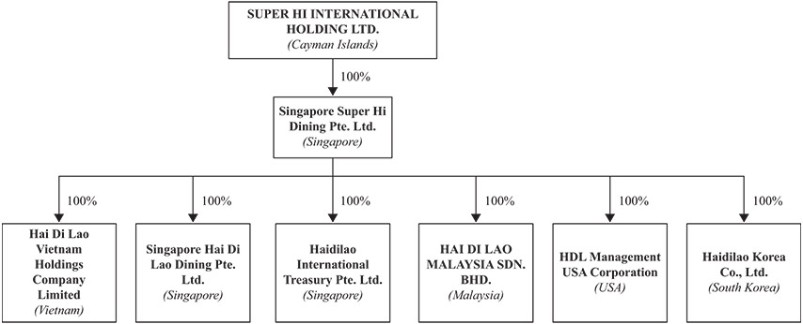
*: The diagram above omits the names of subsidiaries that are insignificant individually and in the aggregate.
D.Property, Plants and Equipment
Our company’s headquarters are located in Singapore. We occupy certain properties for the use of restaurants, warehouses and offices. As of December 31, 2024, we leased over 190 properties with a total gross floor area of over 132,000 square meters for our restaurants in countries where we currently have or plan to open restaurants. For our restaurants, we enter into lease agreements with lease periods ranging from three to twenty years with an option for renewal as we believe this will enable us to secure more favorable lease terms and ensure that our restaurant can be operated in a stable and consistent manner.
ITEM 4A. UNRESOLVED STAFF COMMENTS
Not applicable.
ITEM 5. OPERATING AND FINANCIAL REVIEW AND PROSPECTS
The following discussion of our financial condition and results of operations is based upon and should be read in conjunction with our consolidated financial statements and their related notes included elsewhere in this annual report. This annual report contains forward-looking statements. See “Forward-Looking Information.” In evaluating our business, you should carefully consider the information provided under the caption “Item 3. Key Information—D. Risk Factors” in this annual report. We caution you that our businesses and financial performance are subject to substantial risks and uncertainties.
A.Operating Results
Overview
We are a leading Chinese cuisine restaurant brand, operating Haidilao hot pot restaurant in the international market. With roots in Sichuan from 1994, Haidilao has become one of the most popular and largest Chinese cuisine brands in the world. Since opening our first restaurant in Singapore in 2012, we have expanded to 122 self-operated restaurants in 14 countries across four continents as of December 31, 2024, making it the largest Chinese cuisine restaurant brand in the international market in terms of number of countries covered by self-operated restaurants.
- 77 -
Benefiting from our proven management philosophy and successful localization efforts, we have built an international Haidilao restaurant network with highly standardized operations, effective management systems, and motivated employees. We have achieved strong growth and margin expansion in the past year.
| ● | Restaurant network expansion. Our number of restaurants increased from 94 restaurants as of January 1, 2022 to 122 restaurants as of December 31, 2024. While we continued focusing on the expansion within existing countries and enhancing their operating performance over the past three years, we keep exploring new markets and our restaurant network covered 14 countries as of December 31, 2024. |
| ● | Same-store sales growth. Alongside our continual restaurant network expansion, we have also achieved meaningful same-store sales growth of 8.8% and 7.1% in 2023 and 2024, respectively. |
| ● | Table turnover rate. Our overall table turnover rate improved from 3.3 times per day in 2022 to 3.5 times per day in 2023, and further improved to 3.8 times per day in 2024. |
| ● | Average daily revenue per restaurant. Our average daily revenue per restaurant increased from US$15.4 thousand in 2022 to US$16.3 thousand in 2023, and further increased to US$17.7 thousand in 2024. |
| ● | Income from operation margin. Our income from operation margin improved from 0.2% in 2022 to 6.3% in 2023, and further improved to 6.8% in 2024. |
| ● | Restaurant level operating margin. Our restaurant level operating margin improved from 4.1% in 2022 to 9.0% in 2023, and further improved to 10.1% in 2024. |
Our revenues increased by 23.0% from US$558.2 million in 2022 to US$686.4 million in 2023, and further increased by 13.4% from US$686.4 million in 2023 to US$778.3 million in 2024. We recorded net loss of US$41.3 million in 2022. We turned to net profit of US$25.3 million and US$21.4 million in 2023 and 2024, respectively. The slight decrease in our net profit in 2024 was primarily due to the increase in net foreign exchange loss of US$14.7 million, mainly driven by the foreign exchange fluctuations, particularly the depreciation of local currencies against the U.S. dollar, which is partially offset by (i) an increase in revenue driven by ongoing business expansion and continuous efforts in increasing guest visits and table turnover rate; and (ii) an improvement in operational efficiency.
Key Line Items Affecting Our Results of Operations
Revenue
We generated revenue from (i) Haidilao restaurant operations; (ii) delivery business; and (iii) others, primarily consisting of revenue from sales of hot pot condiment products and food under Haidilao brand and secondary brands to local guests and retailers. The following table sets forth a breakdown of our revenue in absolute amounts and as percentages of the total revenue for the years indicated.
|
|
For the Year Ended December 31 |
|
||||||||||
|
|
2022 |
|
2023 |
|
2024 |
|
||||||
|
|
(US$ in thousands, except for percentages) |
|
||||||||||
Haidilao restaurant operations |
|
545,612 |
|
97.7 |
% |
661,162 |
|
96.3 |
% |
747,296 |
|
96.0 |
% |
Delivery business |
|
6,572 |
|
1.2 |
% |
9,807 |
|
1.4 |
% |
11,293 |
|
1.5 |
% |
Others |
|
6,041 |
|
1.1 |
% |
15,393 |
|
2.3 |
% |
19,719 |
|
2.5 |
% |
Total |
|
558,225 |
|
100.0 |
% |
686,362 |
|
100.0 |
% |
778,308 |
|
100.0 |
% |
- 78 -
As of December 31 , 2024, our restaurant network had 122 restaurants covering 14 countries. The following table summarizes the breakdown of our revenue from Haidilao restaurant operations by geographic region for the years indicated.
|
|
For the Year Ended December 31 |
|
||||||||||
|
|
2022 |
|
2023 |
|
2024 |
|
||||||
|
|
(US$ in thousands, except for percentages) |
|
||||||||||
Southeast Asia |
|
325,553 |
|
59.7 |
% |
368,457 |
|
55.7 |
% |
405,429 |
|
54.3 |
% |
East Asia |
|
57,137 |
|
10.5 |
% |
79,134 |
|
12.0 |
% |
93,900 |
|
12.6 |
% |
North America |
|
113,374 |
|
20.8 |
% |
134,129 |
|
20.3 |
% |
158,131 |
|
21.2 |
% |
Others(1) |
|
49,548 |
|
9.0 |
% |
79,442 |
|
12.0 |
% |
89,836 |
|
11.9 |
% |
Total |
|
545,612 |
|
100.0 |
% |
661,162 |
|
100.0 |
% |
747,296 |
|
100.0 |
% |
Notes:
| (1) | Others include Australia, the United Kingdom and the United Arab Emirates. |
Other Income
Our other income primarily consisted of (i) government grants; and (ii) interest income from bank deposits, rental deposits, loans to related parties, and other financial assets. The table below summarizes a breakdown of our other income for the years indicated.
|
|
For the Year Ended December 31 |
||||
|
|
2022 |
|
2023 |
|
2024 |
|
|
(US$ in thousands) |
||||
Interest income on: |
|
|
|
|
|
|
Bank deposits |
|
355 |
|
1,370 |
|
4,438 |
Rental deposits |
|
437 |
|
476 |
|
636 |
Loans to related parties |
|
225 |
|
— |
|
— |
Other financial assets |
|
41 |
|
— |
|
— |
|
|
1,058 |
|
1,846 |
|
5,074 |
Government grants |
|
4,998 |
|
3,164 |
|
1,322 |
Others |
|
645 |
|
1,685 |
|
1,127 |
Total |
|
6,701 |
|
6,695 |
|
7,523 |
- 79 -
Raw Materials and Consumables Used
Our raw materials and consumables used consisted of costs for (i) food ingredients used in the restaurants, including the soup base and menu items; (ii) consumables used in the restaurant operation, including disposable items, such as napkins, disposable tableware and table cloths; and (iii) others, including logistics and transportation fees. The following table sets forth a breakdown of our raw materials and consumables used for the years indicated.
|
|
For the Year Ended December 31 |
||||
|
|
2022 |
|
2023 |
|
2024 |
|
|
(US$ in thousands) |
||||
Food ingredient costs |
|
172,750 |
|
209,214 |
|
224,701 |
Consumables |
|
18,956 |
|
20,923 |
|
27,248 |
Others |
|
4,940 |
|
4,578 |
|
5,774 |
Total |
|
196,646 |
|
234,715 |
|
257,723 |
Staff Costs
Our staff costs consisted of (i) employee salaries and other allowances; (ii) employee welfare; and (iii) retirement benefit scheme contributions. The following table sets forth a breakdown of our staff costs for the years indicated.
|
|
For the Year Ended December 31 |
||||
|
|
2022 |
|
2023 |
|
2024 |
|
|
(US$ in thousands) |
||||
Salaries and other allowances |
|
174,602 |
|
206,602 |
|
238,445 |
Employee welfare |
|
3,442 |
|
8,372 |
|
8,459 |
Retirement benefit scheme contributions |
|
10,883 |
|
11,059 |
|
12,389 |
Total |
|
188,927 |
|
226,033 |
|
259,293 |
Rentals and Related Expenses
Our rentals and related expenses mainly represented property management fees, variable lease payments and lease payments for short-term leases we entered into in relation to our offices and warehouses.
Utilities Expenses
Our utilities expenses primarily consisted of expenses in relation to electricity, gas and water.
Depreciation and Amortization
Our depreciation and amortization represented depreciation charges for our property, plant and equipment, which primarily include leasehold improvements, leasehold land and building, freehold land, machinery, transportation equipment, furniture and fixtures and right-of-use assets.
Travelling and Communication Expenses
Our travelling and communication expenses mainly consisted of international and regional travel expenses of staff for new restaurants opening and restaurant operation inspection.
Listing Expenses
We incurred listing expenses in relation to our listing by way of introduction on the Hong Kong Stock Exchange and listing of the ADSs on the Nasdaq Global Market.
- 80 -
Other Expenses
Our other expenses comprised (i) administrative expenses; (ii) outsourcing service fees; (iii) bank charges; (iv) consulting service expenses; and (v) others, which mainly consisted of daily maintenance expenses, storage expenses and business development expenses.
Other Gains (Losses) — Net
Our net other gains (losses) primarily consisted of (i) net impairment loss or reversal of impairment recognized in respect of property, plant and equipment and right-of-use assets, representing amounts we recorded; (ii) impairment loss recognized in respect of goodwill and other intangible asset of acquired brands; (iii) loss or gain on disposal of property, plant and equipment and provision for early termination of leases, which was in relation to the capital expenditures we invested for restaurants as originally planned but later decided not to open as a result from our dynamic evaluation of our expansion plan and the temporary closure of certain restaurants; (iv) loss or gain on modification and termination of leases, arising from reversals of right of use assets and lease liabilities in relation to the termination of leases for restaurants we decided to suspend the opening of; (v) net foreign exchange losses, arising from remeasurement of balances which are not denominated in functional currency; (vi) net gain or loss arising on financial assets at fair value through profit or loss (“FVTPL”); and (vii) others.
Finance Costs
Finance costs represented (i) interests on lease liabilities; (ii) interests on loans from related parties, mainly HDL Group to support the business expansion; (iii) interests on bank borrowings; and (iv) interests charge on unwinding of discounts, primarily in relation to provisions for restoration of the premises we used for the restaurants.
Income Tax Expense
We are incorporated as an exempted company and as such is not subject to Cayman Islands taxation. The taxation of our Group is calculated at the rates prevailing in relevant jurisdictions, which ranged from 17% to 35% on the estimated assessable profits in 2022, 9% to 33% in 2023 and 9% to 33% in 2024.
Recently Issued Accounting Pronouncements
For a summary of recently issued accounting pronouncements, see note 3 to our consolidated financial statements included elsewhere in this annual report.
- 81 -
Results of Operations
The following table sets forth a summary of our consolidated results of operations for the years indicated. This information should be read together with our consolidated financial statements and related notes included elsewhere in this annual report. The operating results in any year are not necessarily indicative of the results that may be expected for any future periods.
|
|
Year Ended December 31, |
||||
|
|
2022 |
|
2023 |
|
2024 |
|
|
(US$ in thousands) |
||||
Revenue |
|
558,225 |
|
686,362 |
|
778,308 |
Other income |
|
6,701 |
|
6,695 |
|
7,523 |
Raw materials and consumables used |
|
(196,646) |
|
(234,715) |
|
(257,723) |
Staff costs |
|
(188,927) |
|
(226,033) |
|
(259,293) |
Rentals and related expenses |
|
(13,006) |
|
(17,161) |
|
(20,136) |
Utilities expenses |
|
(19,743) |
|
(26,054) |
|
(28,358) |
Depreciation and amortization |
|
(72,952) |
|
(78,557) |
|
(80,972) |
Traveling and communication expenses |
|
(4,776) |
|
(5,756) |
|
(6,449) |
Listing expense |
|
(6,310) |
|
(1,745) |
|
(2,460) |
Other expenses |
|
(55,510) |
|
(62,682) |
|
(70,735) |
Other (losses) gains– net |
|
(26,793) |
|
1,177 |
|
(17,924) |
Finance costs |
|
(12,493) |
|
(8,424) |
|
(8,538) |
(Loss) Profit before tax |
|
(32,230) |
|
33,107 |
|
33,243 |
Income tax expense |
|
(9,033) |
|
(7,850) |
|
(11,844) |
(Loss) Profit for the year |
|
(41,263) |
|
25,257 |
|
21,399 |
Other comprehensive income/(expense) |
|
|
|
|
|
|
Exchange differences arising on translation of foreign operations |
|
8,385 |
|
4,627 |
|
12,028 |
Total comprehensive income (expense) for the year |
|
(32,878) |
|
29,884 |
|
33,427 |
(Loss) Earnings per share – Basic and diluted (USD). |
|
(0.07) |
|
0.05 |
|
0.04 |
Non-IFRS Financial Measure
In evaluating our business, we consider and use a non-IFRS measure, restaurant level operating profit margin, which is calculated by dividing (i) restaurant level operating profit by (ii) restaurant level revenue, as supplemental measures to review and assess our operating performance. The presentation of these non-IFRS financial measures is not intended to be considered in isolation or as a substitute for the financial information prepared and presented in accordance with IFRS Accounting Standards.
Restaurant level operating profit margin is a supplemental measure of operating performance of our restaurants and its calculations thereof may not be comparable to similar measures reported by other companies. Restaurant level operating profit margin has limitations as an analytical tool and should not be considered as a substitute for analysis of our results as reported under IFRS Accounting Standards.
Restaurant level revenue refers to the total revenue generated from our two major service lines – Haidilao restaurant operations and delivery business.
Restaurant level operating profit is calculated by deducting from restaurant level revenue certain restaurant level costs and expenses, including (i) restaurant level expenses, including cost of restaurant level raw materials and consumables used, restaurant level staff costs, restaurant level property rentals and related expenses, restaurant level utilities expenses, restaurant level depreciation and amortization, restaurant level traveling and communication expenses and other restaurant level expenses, including preopening expenses in each region; and (ii) management fees incurred in each region. The cost of restaurant level raw materials and consumables used included the cost of food ingredients and consumables associated with central kitchens that are used within our Haidilao restaurants as well as those procured directly from suppliers.
We believe that restaurant level operating profit margin is an important measure to evaluate the performance and profitability of each of our restaurants, individually and in the aggregate. We use restaurant level operating profit margin information to benchmark our performance versus competitors.
- 82 -
The table set forth below reconciles total revenue to restaurant level revenue:
|
|
For the Year Ended December 31, |
||||
|
|
2022 |
|
2023 |
|
2024 |
|
(US$ in thousands) |
|||||
Total revenue |
|
558,225 |
|
686,362 |
|
778,308 |
Less: Revenue (Others) |
|
(6,041) |
|
(15,393) |
|
(19,719) |
Restaurant level revenue |
|
552,184 |
|
670,969 |
|
758,589 |
The computation of restaurant level operating margin is as follows:
|
|
For the Year Ended December 31, |
|
||||
|
|
2022 |
|
2023 |
|
2024 |
|
|
|
(US$ in thousands) |
|
||||
Restaurant level revenue |
|
552,184 |
|
670,969 |
|
758,589 |
|
Less: Restaurant level costs and expenses |
|
(529,698) |
|
(610,695) |
|
(682,075) |
|
Restaurant level operating profit |
|
22,486 |
|
60,274 |
|
76,514 |
|
Restaurant level operating margin* |
|
4.1 |
% |
9.0 |
% |
10.1 |
% |
* |
Restaurant level operating margin is calculated by dividing (i) restaurant level operating profit by (ii) restaurant level revenue. |
The table set forth below reconciles income from operation, the most directly comparable IFRS measure to the restaurant level operating profit.
|
|
For the Year Ended December 31, |
|
||||
|
|
2022 |
|
2023 |
|
2024 |
|
|
|
(US$ in thousands) |
|
||||
Income from operation (1) |
|
899 |
|
43,121 |
|
53,311 |
|
Less: |
|
|
|
|
|
|
|
Revenue (Others) |
|
(6,041) |
|
(15,393) |
|
(19,719) |
|
Other income (2) |
|
(5,643) |
|
(4,849) |
|
(2,449) |
|
Add non-restaurant level cost and expenses(3): |
|
|
|
|
|
|
|
Raw materials and consumables used(4) |
|
4,041 |
|
8,021 |
|
10,343 |
|
Staff costs |
|
4,939 |
|
10,349 |
|
10,992 |
|
Rentals and related expenses |
|
367 |
|
730 |
|
989 |
|
Utilities expenses |
|
356 |
|
1,431 |
|
1,783 |
|
Depreciation and amortization |
|
4,779 |
|
7,864 |
|
6,353 |
|
Traveling and communication expenses |
|
219 |
|
768 |
|
995 |
|
Listing expenses |
|
6,310 |
|
1,745 |
|
2,460 |
|
Other expenses |
|
7,161 |
|
11,100 |
|
10,136 |
|
Other gains (losses) – net(5) |
|
5,099 |
|
(4,613) |
|
1,320 |
|
Restaurant level operating profit |
|
22,486 |
|
60,274 |
|
76,514 |
|
Restaurant level operating margin |
|
4.1 |
% |
9.0 |
% |
10.1 |
% |
(1) |
Income from operation is calculated by profit for the year excluding interest income (included within other income), finance costs, unrealized foreign exchange differences arising from remeasurement of balances which are not denominated in functional currency, net gain arising on financial assets at FVTPL and income tax expense. |
(2) |
Other income primarily consists of the subsidies received from the local governments for our business development but does not include non-operating interest income. |
(3) |
Non-restaurant level cost and expenses mainly relate to costs associated with Revenue (Others), operational costs and expenses associated with central kitchens, and corporate and unallocated costs. |
(4) |
Raw materials and consumables used in non-restaurant level operations mainly relate to cost of food ingredients purchased by central kitchens that are not used for Haidilao restaurants, but which are used for sales of hot pot condiment products and food under Haidilao brand and secondary brands to local guests and retailers. |
- 83 -
(5) |
Other gains (losses) – net primarily consist of net impairment (loss) reversal recognized in respect of property, plant and equipment and right-of-use assets, but do not include unrealized foreign exchange differences arising from remeasurement of balances which are not denominated in functional currency and net gain arising on financial assets at FVTPL. |
Year Ended December 31, 2024 Compared to Year Ended December 31, 2023
Revenue
Our revenue amounted to US$778.3 million in 2024, representing an increase of 13.4% from US$686.4 million in 2023, primarily driven by an increase of US$86.1 million in revenue from Haidilao restaurant operations.
Our revenue from Haidilao restaurant operations amounted to US$747.3 million in 2024, representing an increase of 13.0% from US$661.2 million in 2023. This increase was mainly due to (i) the enhanced Haidilao restaurant operations driven by improved table turnover rates and customer traffic growth through our continuous efforts; and (ii) the continued strategic expansion of our business network throughout 2024.
Our revenue from delivery business amounted to US$11.3 million in 2024, representing an increase of 15.3% from US$9.8 million in 2023. This increase was mainly due to (i) the growth of our brand influence; and (ii) our continuous efforts in promoting our food delivery services by collaborating with local food delivery platforms.
Our revenue from others amounted to US$19.7 million in 2024, representing an increase of 27.9% from US$15.4 million in 2023, driven by (i) the increasing popularity of hot pot condiment products and Haidilao-branded and sub-branded food products among local customers and retailers; and (ii) the incubation of secondary branded restaurants through strategic exploration of diverse business forms.
Other Income
Our other income amounted to US$7.5 million in 2024, representing an increase of 11.9% from US$6.7 million in 2023. This increase was mainly due to higher interest income on bank deposits driven by increased cash holdings resulting from revenue growth and the unutilized proceeds from initial public offering on the Nasdaq Stock Market, partially offset by reduced government grants received in relation to COVID-19.
Raw Materials and Consumables Used
Our raw materials and consumables used amounted to US$257.7 million in 2024, representing an increase of 9.8% from US$234.7 million in 2023. This increase was mainly because we purchased more food ingredients driven as our business continued to grow. As a percentage of revenue, our raw materials and consumables used decreased from 34.2% in 2023 to 33.1% in 2024, primarily attributable to (i) enlargement of business scale driven by revenue increase; (ii) the optimization of our procurement costs; and (iii) the enhancement of our restaurant management strategies, including the development of localized supply chains tailored to restaurant operations.
Staff Costs
Our staff cost amounted to US$259.3 million in 2024, representing an increase of 14.7% from US$226.0 million in 2023. This increase was mainly due to the increase in the number of employees, which was in line with (i) the expansion of restaurant network; (ii) the increase in guest visits and table turnover rate; and (iii) our operation strategy of ensuring sufficient number of employees to provide superior customer experience in catering services, product quality, restaurant environment and food safety, as well as the increase in statutory minimum wages in certain countries where we operated.
Rentals and Related Expenses
Our rentals and related expenses amounted to US$20.1 million in 2024, representing an increase of 16.9% from US$17.2 million in 2023. This increase was mainly due to (i) increased property management fees resulting from the opening of new restaurants; and (ii) the increase in variable lease payments in line with the increase in revenue from relevant restaurants.
- 84 -
Utilities Expenses
Our utilities expenses amounted to US$28.4 million in 2024, representing an increase of 8.8% from US$26.1 million in 2023. This increase was mainly due to the increase in the number of restaurants and table turnover rate.
Depreciation and Amortization
Our depreciation and amortization amounted to US$81.0 million in 2024, representing an increase of 3.1% from US$78.6 million in 2023. This increase was mainly due to (i) an increase in depreciation of property, plant and equipment of US$1.2 million; and (ii) an increase in depreciation of right-of-use assets of US$1.2 million. As a percentage of revenue, depreciation and amortization decreased from 11.5% in 2023 to 10.4% in 2024, primarily due to the increase in our revenue.
Travelling and Communication Expenses
Our travelling and communication expenses amounted to US$6.4 million in 2024, representing an increase of 10.3% from US$5.8 million in 2023. This increase was mainly due to the increase of business travels in line with our business expansion. As a percentage of revenue, our traveling and communication expenses remained relatively stable in 2023 and 2024, both at 0.8%.
Other Expenses
Our other expenses amounted to US$70.7 million in 2024, representing an increase of 12.8% from US$62.7 million in 2023. This increase was primarily driven by (i) an increase in outsourcing service fee of US$6.8 million, stemming from restaurant network expansion and improved table turnover rates; (ii) an increase in banking fees of US$1.6 million, mainly arising from credit card transaction fees incurred during our restaurant operations.
Other (Losses) Gains – Net
We recorded net other losses of US$17.9 million in 2024, as compared to net other gains of US$1.2 million in 2023. This change was mainly due to (i) an increase in net foreign exchange loss of US$14.7 million; and (ii) a net increase in impairment loss of US$6.0 million on property, plant and equipment, primarily resulting from business initiatives implemented following our evaluations of restaurant performance; partially offset by an increase in gains arising on financial assets at FVTPL of US$1.5 million.
Finance Costs
Our finance costs remained relatively stable at US$8.4 million and US$8.5 million in 2023 and 2024, respectively.
Income Tax Expenses
We recorded income tax expenses of US$7.9 million and US$11.8 million in 2023 and 2024, respectively. The taxation of our Group was calculated at the rates prevailing in relevant jurisdictions, which ranged from 9% to 33% on the estimated assessable profits during the year ended December 31, 2024.
Year Ended December 31, 2023 Compared to Year Ended December 31, 2022
Revenue
Our revenue amounted to US$686.4 million in 2023, representing an increase of 23.0% from US$558.2 million in 2022, primarily driven by an increase of US$115.6 million in revenue from Haidilao restaurant operations.
Our revenue from Haidilao restaurant operations amounted to US$661.2 million in 2023, representing an increase of 21.2% from US$545.6 million in 2022. This increase was mainly due to (i) the overall continued recovery of the service industry in the international market; (ii) the improved operating performance of Haidilao restaurants, coupled with the increase in table turnover rates and customer flow as a result of our great efforts; and (iii) the continued expansion of our business in 2023.
- 85 -
Our revenue from delivery business amounted to US$9.8 million in 2023, representing an increase of 48.5% from US$6.6 million in 2022. This increase was mainly due to (i) the growth of our brand influence; and (ii) our continuous efforts in promoting our food delivery services by collaborating with local food delivery platforms.
Our revenue from others amounted to US$15.4 million in 2023, representing an increase of 156.7% from US$6.0 million in 2022. This increase was mainly due to the growing popularity of the above products.
Other Income
Our other income remained stable at US$6.7 million in both 2022 and 2023.
Raw Materials and Consumables Used
Our raw materials and consumables used amounted to US$234.7 million in 2023, representing an increase of 19.4% from US$196.6 million in 2022. This increase was mainly due to the increase in food ingredient costs attributable to the increased procurement amount resulting from the revenue growth. As a percentage of revenue, our raw materials and consumables used decreased from 35.2% in 2022 to 34.2% in 2023, primarily attributable to (i) enlargement of business scale driven by revenue increase; (ii) the optimization of our procurement costs; and (iii) the enhancement of our restaurant management strategies, including those in establishing localized supply chains based on restaurants needs.
Staff Costs
Our staff cost amounted to US$226.0 million in 2023, representing an increase of 19.6% from US$188.9 million in 2022. This increase was mainly due to the increase in the number of employees in line with the expansion of restaurant network and the increase in guest visits and table turnover rate, as well as the increase in wages for the employees. As a percentage of revenue, our staff costs decreased from 33.8% in 2022 to 32.9% in 2023, primarily due to enlargement of business scale driven by revenue increase.
Rentals and Related Expenses
Our rentals and related expenses amounted to US$17.2 million in 2023, representing an increase of 32.3% from US$13.0 million in 2022. This increase was mainly due to (i) increased property management fees resulting from the opening of new restaurants in 2023; and (ii) the increase in variable lease payments in line with the increase in revenue from relevant restaurants.
Utilities Expenses
Our utilities expenses amounted to US$26.1 million in 2023, representing an increase of 32.5% from US$19.7 million in 2022. This increase was mainly due to the increase in the number of restaurants, a higher table turnover rate as well as heightened electricity costs in certain countries or regions. As a percentage of revenue, the utilities expenses remained relatively stable at 3.5% and 3.8% in 2022 and 2023, respectively.
Depreciation and Amortization
Our depreciation and amortization amounted to US$78.6 million in 2023, representing an increase of 7.7% from US$73.0 million in 2022. This increase was mainly due to (i) an increase in depreciation of property, plant and equipment of US$5.4 million; and (ii) an increase in depreciation of right-of-use assets of US$0.1 million, as we continue to expand our restaurant network. As a percentage of revenue, depreciation and amortization decreased from 13.1% in 2022 to 11.5% in 2023, primarily due to the increase in our revenue in 2023.
Travelling and Communication Expenses
Our travelling and communication expenses amounted to US$5.8 million in 2023, representing an increase of 20.8% from US$4.8 million in 2022. This increase was mainly due to the increase of business travels in line with our business expansion. As a percentage of revenue, our traveling and communication expenses remained relatively stable at 0.9% and 0.8% in 2022 and 2023, respectively.
- 86 -
Other Expenses
Our other expenses amounted to US$62.7 million in 2023, representing an increase of 13.0% from US$55.5 million in 2022. This increase was mainly due to (i) an increase in outsourcing service fee of US$6.8 million, resulting from the expansion of our restaurant network and the increase in table turnover rate; and (ii) an increase in bank charges of US$2.2 million mainly arising from credit card transaction fees incurred during our restaurant operations.
Other Gains (Losses) – Net
We recorded net other gains of US$1.2 million in 2023, as compared to net other losses of US$26.8 million in 2022. This change was mainly due to (i) a decrease in net foreign exchange losses of US$16.9 million; and (ii) a net reversal of impairment loss in respect of property, plant and equipment and right-of-use assets of US$7.6 million recorded in 2023 as we continue to recover and grow our business following the pandemic, as compared net impairment loss of US$7.8 million recorded in 2022; partially offset by a decrease in gain on lease termination of US$3.0 million.
Finance Costs
Our finance costs amounted to US$8.4 million in 2023, representing a decrease of 32.8% from US$12.5 million in 2022. This decrease was mainly due to the settlement of loans with Haidilao International by way of capitalization in June 2022.
Income Tax Expenses
We recorded income tax expenses of US$9.0 million and US$7.9 million in 2022 and 2023, respectively. The taxation of the Group was calculated at the rates prevailing in relevant jurisdictions, which ranged from 9% to 33% on the estimated assessable profits during the year ended December 31, 2023.
B.Liquidity and Capital Resources
Cash Flows and Working Capital
We had net cash from operating activities of US$68.3 million, US$114.0 million and US$119.7 million in 2022, 2023, and 2024, respectively.
As of December 31, 2024, we had a total of US$254.7 million in cash and cash equivalents. As of the same date, 58.5% of our cash and cash equivalents were denominated in U.S. dollars. We did not have any outstanding bank borrowings as of the same date.
Our principal source of liquidity has been cash generated from our operations. Our primary uses of cash are to fund our operations, expansion and capital expenditures. We have adopted prudent treasury policies in cash and financial management and closely monitors its liquidity and capital resources on a regular basis and strives to maintain optimum liquidity that can meet its working capital needs while supporting the continuing business operations.
We believe that our current cash equivalents as of December 31, 2024 are sufficient to meet our current and anticipated working capital requirements and capital expenditures for at least the next 12 months. We may, however, need additional cash resources in the future if we experience changes in business conditions or other developments. We may also need additional cash resources in the future if we identify and wish to pursue opportunities for investment, acquisition, capital expenditure or similar actions.
- 87 -
The following table sets forth a summary of our cash flows for the periods indicated.
|
|
For the Year Ended December 31, |
||||
|
|
2022 |
|
2023 |
|
2024 |
|
|
(US$ in thousands) |
||||
Summary of Consolidated Cash Flow Data: |
|
|
|
|
|
|
Net cash from operating activities |
|
68,321 |
|
114,045 |
|
119,696 |
Net cash from (used in) investing activities |
|
888 |
|
(11,775) |
|
(27,616) |
Net cash (used in) from financing activities |
|
(65,869) |
|
(43,787) |
|
12,577 |
Net increase in cash and cash equivalents |
|
3,340 |
|
58,483 |
|
104,657 |
Cash and cash equivalents at the beginning of the year |
|
89,546 |
|
93,878 |
|
152,908 |
Effect of foreign exchange rate changes |
|
992 |
|
547 |
|
(2,846) |
Cash and cash equivalents at the end of the year |
|
93,878 |
|
152,908 |
|
254,719 |
Operating Activities
For the year ended December 31, 2024, our net cash generated from operating activities was US$119.7 million. The difference between our profit before tax of US$33.2 million and operating cash flow was primarily due to (i) a decrease in trade payables of US$3.7 million, reflecting our ongoing efforts to strengthen supplier relationships and optimize our supply chain; (ii) an increase in inventories of US$1.8 million to meet our growing customer demand and support our expanding operations in 2024; and (iii) adjustment of non-cash and non-operating items of US$102.6 million, mainly representing depreciation of property, plant and equipment of US$43.9 million, depreciation of right-of-use assets of US$36.9 million, and net foreign exchange loss of US$20.5 million.
For the year ended December 31, 2023, our net cash generated from operating activities was US$114.0 million. The difference between our profit before tax of US$33.1 million and operating cash flow was primarily due to (i) an increase in contract liabilities of US$7.2 million resulting from an increase in revenue related to customers under our customer loyalty program in 2023 and higher estimated future redemption rate; (ii) an increase in trade and other receivables and prepayments of US$7.5 million primarily resulting from the increase in operating revenue in 2023; (iii) an increase in other payables of US$5.8 million in relation to staff costs, which was in line with the increase in the number of our employees; and (iv) adjustment of non-cash and non-operating items of US$86.6 million, mainly representing depreciation of property, plant and equipment of US$42.7 million, depreciation of right-of-use assets of US$35.7 million, finance costs of US$8.4 million and net foreign exchange loss of US$7.4 million.
For the year ended December 31, 2022, our net cash generated from operating activities was US$68.3 million. The difference between our loss before tax of US$32.2 million and operating cash flow was primarily due to (i) an increase in trade and other receivables and prepayments of US$14.8 million mainly due to increase in operating revenue during the festive season in the last quarter of 2022; (ii) an increase in inventories of US$9.2 million reflecting the inventories we kept for the new restaurants we opened in 2022; (iii) an increase in trade payables of US$7.8 million as we purchased more raw materials to support our restaurant operations after business recovery from the COVID-19 pandemic; and (iv) adjustment of non-cash and non-operating items of US$111.5 million, mainly representing depreciation of property, plant and equipment of US$37.3 million, depreciation of right-of-use assets of US$35.6 million, net foreign exchange loss of US$18.7 million, and finance costs of US$12.5 million.
Investing Activities
For the year ended December 31, 2024, our net cash used in investing activities was US$27.6 million, which was primarily attributable to (i) purchase of financial assets at FVTPL of US$233.2 million; and (ii) purchase of property, plant and equipment of US$34.7 million; partially offset by redemption of financial assets at fair value through profit or loss of US$236.3 million.
For the year ended December 31, 2023, our net cash used in investing activities was US$11.8 million, which was primarily attributable to (i) purchase of financial assets at FVTPL of US$97.3 million; and (ii) purchase of property, plant and equipment of US$32.8 million mainly for restaurants we planned to open; partially offset by (i) redemption of financial assets at FVTPL of US$98.8 million; and (ii) proceeds from disposal of a subsidiary of US$17.4 million.
For the year ended December 31, 2022, our net cash from investing activities was US$0.9 million, which was primarily attributable to (i) redemption of financial assets at FVTPL of US$36.2 million; and (ii) the collection of loans to related parties of US$29.1 million. The loans to related parties were mainly related to the purchase of certain equipment and the Haidilao restaurants; partially offset by purchase of property, plant and equipment of US$60.5 million mainly for restaurants we planned to open.
- 88 -
Financing Activities
For the year ended December 31, 2024, our net cash generated from financing activities was US$12.6 million, which was primarily attributable to proceeds from our listing on the Nasdaq Stock Market of US$56.1 million, partially offset by repayments of lease liabilities of US$43.5 million.
For the year ended December 31, 2023, our net cash used in financing activities was US$43.8 million, which was primarily attributable to repayments of lease liabilities of US$43.4 million.
For the year ended December 31, 2022, our net cash used in financing activities was US$65.9 million, which was primarily attributable to (i) cash paid in relation to the Group Reorganization of US$39.0 million; (ii) repayments of loans from related parties of US$51.7 million; and (iii) repayments of lease liabilities of US$36.1 million; partially offset by proceeds from issue of our share of US$23.1 million.
Material Cash Requirements
Our material cash requirements as of December 31, 2024 and any subsequent period primarily include our capital expenditure.
Capital Expenditures
Our capital expenditure represented additions to (i) leasehold land and building; (ii) freehold land; (iii) leasehold improvements; (iv) machinery; (v) transportation equipment; (vi) furniture and fixture; and (vii) renovation in progress. We incurred capital expenditures of US$63.7 million, US$31.2 million and US$37.4 million in 2022, 2023 and 2024, respectively. Fluctuations in our capital expenditure were primarily for our restaurants opened in the respective years and those still in the process of renovation and preparation. We will continue to make capital expenditures to meet the expected growth of our business. We plan to finance future capital expenditures through cash generated from its operations, the unutilized proceeds from initial public offering on the Nasdaq Stock Market, and cash and cash equivalents.
Off-Balance Sheet Arrangements
As of December 31, 2024, we did not have any material off-balance sheet arrangements.
C.Research and Development, Patents and Licenses, etc.
See “Item 4. Information on the Company—B. Business Overview—Our Haidilao Business—Intellectual Property.”
D.Trend Information
Other than as disclosed elsewhere in this annual report, we are not aware of any trends, uncertainties, demands, commitments or events for the current fiscal year that are reasonably likely to have a material effect on our net revenues, income, profitability, liquidity or capital resources, or that would cause the disclosed financial information to be not necessarily indicative of future operating results or financial conditions.
- 89 -
E.Critical Accounting Estimates
Our consolidated financial statements are prepared in accordance with the International Financial Reporting Standards (“IFRS Accounting Standards”). The preparation of our financial statements requires us to make assumptions and estimates about future events and apply judgments that affect the reported amounts of assets, liabilities, revenues and expenses and the related disclosures. We base our estimates on historical experience and other assumptions that we believe to be reasonable under the circumstances. Actual results may differ from these estimates. The critical accounting estimates that we believe to have the most significant impacts to our consolidated financial statements are described below.
Impairment Assessment of Property, Plant and Equipment and Right-of-Use Assets
Property, plant and equipment and right-of-use assets are reviewed for impairment whenever events or changes in circumstances indicate that the carrying amount of an asset may not be recoverable. For restaurant assets, impairment is tested at the individual restaurant level as a cash generating unit (CGU).
Some restaurants have also achieved significant improvement in their operations because of the optimization of the internal management and general improvement of market conditions. Accordingly, the management concluded that there were indications for reversal of impairment on certain property, plant and equipment and right-of-use assets.
The recoverable amounts of CGUs are determined based on value in use calculation. That calculation used discounted cash flow projections based on financial budgets approved by our management covering the remaining lease periods which are between 1 to 5 years with pre-tax discount rates ranging from 8.5% to 24.2% and 8.1% to 19.6% per annum as of December 31, 2023 and 2024 which varies in restaurants operated in different countries. Cash flows beyond the 5-year period for those CGUs with remaining lease terms more than 5 years are extrapolated using a steady 0% to 3% growth rate per annum. Other key assumptions for the value in use calculations related to the estimation of cash inflows/outflows included revenue growth rate and average percentage of costs and operating expenses of revenue for the forecast periods, which are based on the CGUs’ past performance and the management’s expectations for the market development.
Based on the results of the assessments, our management determined that the recoverable amounts of certain CGUs are lower than the carrying amounts. The impairment loss has been allocated to each category of property, plant and equipment and right-of-use assets such that the carrying amount of each category of asset is not reduced below the highest of its fair value less cost of disposal, its value in use and zero. The reversal of impairment loss for the CGUs have been allocated to each category of property, plant and equipment and right-of-use assets such that the carrying amount of each category of asset is not increased above its recoverable amount and the carrying amount that would have been determined had no impairment loss been recognized for the asset in prior periods.
As of December 31, 2023 and 2024, the carrying amount of property, plant and equipment subject to impairment assessment were US$109.6 million and US$30.2 million, respectively, before taking into account the accumulated impairment losses of US$35.2 million and US36.0 million, respectively, in respect of property, plant and equipment that have been recognized.
Based on the value in use calculation and the allocation, gross impairment loss of US$12.5 million, US$5.3 million and US$5.3 million, and gross reversal of US$4.8 million, US$9.0 million and US$3.0 million has been recognized against the carrying amount of property, plant and equipment for the years ended December 31, 2022, 2023 and 2024, respectively.
Determination on Discount Rates of Lease Contracts
As our leases do not provide an implicit rate, we apply incremental borrowing rates as the discount rates of lease liabilities, which require financing spread adjustments and lease specific adjustments based on the relevant market rates. The assessments of the adjustments in determining the discount rates involved management judgment, which may significantly affect the amount of lease liabilities and right-of-use assets.
As of December 31, 2023 and 2024, the carrying amounts of right-of-use assets were US$167.6 million and US$185.5 million, respectively, and the carrying amounts of lease liabilities were US$202.9 million and US$212.6 million, respectively.
- 90 -
Deferred Tax Assets
We recognize deferred tax assets for all deductible temporary differences to the extent that it is probable that taxable profits will be available against which those deductible temporary differences can be utilized. The realizability of the deferred tax asset mainly depends on whether sufficient future taxable profits or taxable temporary differences will be available in the future, which is a key source of estimation uncertainty. In cases where the actual future taxable profits generated are less or more than expected or change in facts and circumstances which result in revision of future taxable profits estimation, a material reversal or further recognition of deferred tax assets may arise, which would be recognized in profit or loss for the period in which such a reversal or further recognition takes place.
As of December 31, 2023 and 2024, deferred tax assets of US$2.0 million and US$3.8 million have been recognized in the consolidated statements of financial position. No deferred tax asset has been recognized on the tax losses of US$142.7 million and US$127.3 million and other deductible temporary differences of US$105.4 million and US$81.2 million, due to the unpredictability of future profit streams as of the same dates.
ITEM 6. DIRECTORS, SENIOR MANAGEMENT AND EMPLOYEES
A.Directors and Executive Officers
The following table sets forth information regarding our directors and executive officers as of the date of this annual report.
Directors and Executive Officers |
|
Age |
|
Position/Title |
Ping Shu |
|
55 |
|
Director and Chairman |
June Lijuan Yang |
|
46 |
|
Director and Chief Executive Officer |
Yu Li |
|
39 |
|
Director and Chief Operating Officer |
Li Liu |
|
38 |
|
Director |
Anthony Kang Uei Tan |
|
51 |
|
Independent Director |
Ser Luck Teo |
|
56 |
|
Independent Director |
Jown Jing Vincent Lien |
|
64 |
|
Independent Director |
Cong Qu |
|
42 |
|
Chief Financial Officer and Board Secretary |
Shaohua Zhou |
|
38 |
|
Vice President |
Ms. Ping Shu has served as our director and chairman of the board of directors since December 13, 2023. Ms. Shu has extensive experience in restaurant management and strategic planning. Ms. Shu served as a director of Haidilao International Holding Ltd. (“HDL Group”) (HKEx: 6862) from July 2015 to August 2021. Ms. Shu completed the Senior Management PRC Enterprise Master of Business Administration program and Financial Master of Business Administration Program jointly hosted by Cheung Kong Graduate School of Business and other institutes in November 2015 and completed the executive master of business administration program jointly hosted by Shanghai Jiaotong University and Singapore Nanyang Technological University in July 2016. Ms. Shu obtained the doctorate of advanced professional studies in applied finance (specialization in wealth management) from the Université de Genève in September 2022.
Ms. June Lijuan Yang has served as our director and chief executive officer since July 1, 2024. From June 1997 to March 2001, Ms. Yang served as a manager at Sichuan Haidilao Catering Co., Ltd (“Sichuan Haidilao”). In April 2001, she was appointed as a director of Sichuan Haidilao and re-designated as a non-executive director of Sichuan Haidilao in January 2018. Ms. Yang’s career and leadership further expanded through her various roles at HDL Group, including (i) as a director from July 2015 to January 2018; (ii) as the chief operating officer from January 2018 to March 2022; (iii) as the deputy chief executive officer from August 2021 to March 2022; (iv) as an executive director from August 2021 to June 2024; and (v) as the chief executive officer from March 2022 to June 2024. Ms. Yang completed the PRC Entities CEO and Finance CEO Program hosted by the Cheung Kong Graduate School of Business in September 2016.
Mr. Yu Li has served as our director since March 2023 and chief operating officer since March 2025. He also served as our chief executive officer from March 2023 to June 2024. Mr. Li possesses over 17 years of experience in the catering industry. Mr. Li joined HDL Group in November 2007. He was responsible for the operation and management of the Haidilao restaurants in Japan, Korea, Thailand and Taiwan from May 2021 to March 2022 and served as the chief operating officer (mainland China) of HDL Group from March 2022 to October 2022. Mr. Li also served as an executive director of HDL Group from August 2021 to September 2022. Mr. Li completed the MBA program held by National Chengchi University in Taiwan in October 2017.
- 91 -
Ms. Li Liu has served as our director since May 2022. She also served as the product director of our company from March 2022 to August 2023. Ms. Liu has over 12 years of experience in the catering service sector. Ms. Liu joined HDL Group in October 2012 and held various positions since then, including a restaurant front office manager, a restaurant manager, and the overseas product director. She also served as the project head of HDL Group’s snack and dessert development programs in mainland China and was in charge of product development of HDL Group from November 2021 to March 2022. Ms. Liu obtained her bachelor’s degree in business administration from West Coast University in the United States in September 2008.
Mr. Anthony Kang Uei Tan has served as our independent director and, for purposes of the Hong Kong Listing Rules, an independent non-executive director of our company, since December 2022. Mr. Tan has extensive experience across the public sector and various industries in the private sector with strong professional skills in strategy, budgeting, media, property, government relations and nonprofit management. He devoted himself to the Singapore public sector for more than 16 years and worked in various organizations in Singapore, including Ministry of Finance, Ministry of Home Affairs, Ministry of Manpower, Ministry of Health and Mr. Lee Kuan Yew’s Office. Mr. Tan also held and has been holding senior positions in both public and private companies, including serving as the deputy chief executive officer at Singapore Press Holdings Limited (SGX: T39) from July 2016 to December 2021 and as the chief executive officer at MOH Holdings Pte. Ltd. since December 2021. Mr. Tan also served as an independent director at Straco Corporation Limited (SGX: S85) since May 2024. Mr. Tan obtained his bachelor’s degree in social science from National University of Singapore in July 1997 and his master’s degree in management from Stanford University in May 2005. He also received the Advanced Management Program certificate from Harvard Business School in July 2021.
Mr. Ser Luck Teo has served as our independent director and, for purposes of the Hong Kong Listing Rules, an independent non-executive director of our company, since December 2022. Mr. Teo was a member of the Parliament of Singapore from May 2006 to June 2020. From May 2006 to July 2017, Mr. Teo served in the Singapore government cabinet and held various senior positions, including (i) the minister of state for the Ministry of Trade and Industry, (ii) the senior parliamentary secretary for the Ministry of Transport and the Ministry of Community Development, Youth and Sports, (iii) the minister of state for the Ministry of Manpower, and (iv) the mayor of the North East District of Singapore. Mr. Teo also held and has been holding a directorship at various companies, including United Engineers Limited (SGX: U04 and delisted in February 2020) from September 2017 to February 2020, MindChamps Preschool Limited (SGX: CNE) from December 2020 to September 2022, Serial System Ltd. (SGX: S69) since July 2017, BRC Asia Limited (SGX: BEC) since November 2017, China Aviation Oil (Singapore) Corporation Ltd. (SGX: G92) since April 2019, Straco Corporation Limited (SGX: S85) since July 2019, and Yanlord Land Group Limited (SGX: Z25) since February 2020. Mr. Teo obtained his bachelor’s degree in accountancy from National University of Singapore in June 1992. He was certified as a fellow and advisor by the Institute of Singapore Chartered Accountants (the “ISCA”) in May 2009 and has been elected as the president of the ISCA since April 2022.
Mr. Jown Jing Vincent Lien has served as our independent director and, for purposes of the Hong Kong Listing Rules, an independent non-executive director of our company, since December 2022. Mr. Lien has over 20 years of experience in the banking industry, specializing in corporate finance and capital management in mainland China, Hong Kong, Singapore and other regions in Southeast Asia. He has been holding and used to hold a directorship at various companies, such as the Maritime and Port Authority of Singapore from February 2012 to February 2024. Mr. Lien obtained his bachelor’s degree in business administration from the University of New Brunswick in Canada in 1986 and was awarded an honorary doctoral degree in business administration from HyupSung University in South Korea in February 2018. Mr. Lien has also been a council member at the Lien Ying Chow Legacy Fellowship since August 2017.
Ms. Cong Qu has served as our financial director (currently chief financial officer) since August 2023 and our board secretary since December 2022. Ms. Qu served as the secretary of the board of directors of HDL Group from March 2018 to May 2019 and as a joint company secretary of HDL Group from May 2018 to May 2019. From October 2019 to August 2023, she held various positions at HDL Group, including a restaurant manager, a coach and a regional manager. Previously, Ms. Qu was an executive director at the investment banking department of China International Capital Corporation Limited (“CICC”), where she worked for nearly ten years from July 2008 to February 2018. During her tenure at CICC, she advised dozens of companies of various sizes on their capital markets and business transactions, including initial public offerings on the HKEx, the Shenzhen Stock Exchange and the Shanghai Stock Exchange, placings, private equity financings, and mergers and acquisitions. She has extensive experience with international capital markets, corporate governance, communication with regulatory authorities and investor relations. Ms. Qu obtained her bachelor’s degree in mathematics and applied mathematics and master’s degree in probability and statistics from Peking University in July 2005 and July 2008, respectively.
- 92 -
Mr. Shaohua Zhou has served as our vice president and senior regional manager since March 2022. Mr. Zhou has over 14 years of experience in the catering service sector. Mr. Zhou joined HDL Group in October 2010 and was relocated to Singapore as a project manager in January 2013 to assist with the local business development in Singapore after HDL Group decided to expand the overseas business and start its first overseas restaurant in Singapore. Since then he had held various positions, including a restaurant duty manager, a branch manager and a regional manager. Mr. Zhou obtained his college degree in tourism management from Dalian Polytechnic University in China in July 2010.
B.Compensation
For the year ended December 31, 2024, we paid an aggregate of US$3.5 million in cash to our directors and executive officers. We have not set aside or accrued any amount to provide pension, retirement or other similar benefits to our directors and executive officers.
Employment Agreements and Indemnification Agreements
We have entered into employment agreements with each of our executive officers. Under these agreements, each of our executive officers is employed for a specified time period. We may terminate employment for cause, at any time, without advance notice or remuneration, for certain acts of the executive officer, such as conviction or plea of guilty to a felony or any misdemeanor involving moral turpitude, willful misconduct or gross negligence, or continued failure to perform agreed duties. We may also terminate an executive officer’s employment without cause upon a 30-day advance written notice. In such case of termination by us, we will provide severance payments to the executive officer as may be agreed with the executive officer. The executive officers may resign at any time with a 30-day advance written notice.
Each executive officer has agreed to hold, both during and after the termination or expiry of his or her employment agreement, in strict confidence and not to use, except as required in the performance of his or her duties in connection with the employment or pursuant to applicable law, any of our confidential information or trade secrets, any confidential information or trade secrets of our customers or prospective customers, or the confidential or proprietary information of any third party received by us and for which we have confidential obligations. The executive officers have also agreed to disclose in confidence to us all inventions, designs and trade secrets which they conceive, develop or reduce to practice during the executive officer’s employment with us and to assign all right, title and interest in them to us, and assist us in obtaining and enforcing patents, copyrights and other legal rights for these inventions, designs and trade secrets.
In addition, each executive officer has agreed to be bound by non-competition and non-solicitation restrictions during the term of his or her employment and, in the event that such executive officer leaves our company, such executive officer agrees not to disclose to any party any company confidential information he or she received without the prior written consent of our company. Specifically, each executive officer has agreed not to (i) approach our suppliers, clients, customers or contacts or other persons or entities introduced to the executive officer in his or her capacity as a representative of us for the purpose of doing business with such persons or entities that will harm our business relationships with these persons or entities; (ii) assume employment with or provide services to any of our competitors, or engage, whether as partner, licensor or otherwise, any of our competitors, without our express consent; or (iii) seek directly or indirectly, to solicit the services of any of our employees who is employed by us on or after the date of the executive officer’s termination, or in the year preceding such termination, without our express consent.
We have also entered into indemnification agreements with each of our directors and executive officers. Under these agreements, we agree to indemnify our directors and executive officers against certain liabilities and expenses incurred by such persons in connection with claims made by reason of their being a director or officer of our company.
Share Award Scheme
On June 24, 2022, we adopted a share award scheme (“Share Award Scheme”) to attract and retain the best available personnel, provide additional incentives to directors, officers, employees and consultants, and promote the success of our business. The maximum aggregate number of ordinary shares which may be issued pursuant to all awards under the Share Award Scheme is 61,933,000. As of the date of this annual report, awards to receive 61,933,000 ordinary shares of our company under the Share Award Scheme have been granted and are outstanding.
- 93 -
A decision of our board or the committee of our board or person(s) to which our board has delegated its authority shall be final and binding on the administration of the Share Award Scheme and all persons affected thereby. We use the ESOP Platform I and the ESOP Platform II to implement the Share Award Scheme. The ESOP Platform I refers to Super Hi Ltd., a company incorporated in the British Virgin Islands with limited liability and wholly-owned by SUPER HI INTERNATIONAL HOLDING LTD. SHARE AWARD SCHEME Trust I, a trust set up by our company as the settlor for the benefit of the grantees other than the directors and other connected persons of our company (as defined under the Hong Kong Listing Rules) pursuant to the Share Award Scheme. The ESOP Platform II refers to Super Hi International Ltd., a company incorporated in the British Virgin Islands with limited liability and wholly-owned by SUPER HI INTERNATIONAL HOLDING LTD. SHARE AWARD SCHEME Trust II, a trust set up by our company as the settlor for the benefit of the grantees who are directors or other connected persons of our company (as defined under the Hong Kong Listing Rules) pursuant to the Share Award Scheme. We have appointed Futu Trustee Limited as the trustee for each of SUPER HI INTERNATIONAL HOLDING LTD. SHARE AWARD SCHEME Trust I and SUPER HI INTERNATIONAL HOLDING LTD. SHARE AWARD SCHEME Trust II. As of March 31, 2025, the ESOP Platform I and the ESOP Platform I and the ESOP Platform II, in aggregate, owned 9.52% of our total issued and outstanding ordinary shares.
Pursuant to the Share Award Scheme, before the awards corresponding to any underlying ordinary shares of our company held by the ESOP Platform I or the ESOP Platform II are vested, none of the ESOP Platform I, the ESOP Platform II, or their trustee is entitled to exercise any voting rights in respect of any such ordinary shares. After the related awards are vested, the underlying ordinary shares of our company will be transferred by the ESOP Platform I or the ESOP II Platform, as applicable, to the related grantees in accordance with the Share Award Scheme, and such grantees will become the beneficial owners of such ordinary shares. As of the date of this annual report, the vesting conditions (including both service conditions and performance conditions) of the Share Award Scheme have not yet been determined and no shared understanding of the terms and conditions of the share-based payment arrangement between our company and the grantees has been reached. Therefore, no share-based payment expense has been incurred up to the date of this annual report. Ordinary shares of our company held by the ESOP Platform I or the ESOP Platform II are issued and outstanding under Cayman Islands law. See notes 26 and 27 to our audited consolidated financial statements included elsewhere in this annual report for more details.
Set forth below is a summary of the key terms of the Share Award Scheme:
Types of Awards. The Share Award Scheme permits awards of ordinary shares of our company from the ESOP Platform I or the ESOP Platform II, as approved by our board or a committee to which the board delegates the authority.
Plan Administration. Our board has the power to administer the Share Award Scheme. The board may delegate the authority to administer the Share Award Scheme to a committee of the board or other person(s) as deemed appropriate. A decision of our board or the committee of the board or person(s) to which the board has delegated its authority shall be final and binding on all persons affected thereby. Our board and the committee of the board or person(s) to which the board has delegated its authority, determines, among other things, the participants to receive awards, the number of awards to be granted to each participant, and the terms and conditions of each award, subject to the Hong Kong Listing Rules.
Award Agreement. Awards granted under the Share Award Scheme are evidenced by an award letter that sets forth the terms, conditions and limitations for each award, which may include the term of the award, the provisions applicable in the event that the participant’s employment or service terminates, and provisions governing the cancellation and modification of the award.
Eligibility. We may grant awards to (i) employees or directors of our company, including our subsidiaries; (ii) employees or directors of our holding companies, fellow subsidiaries or associated companies; or (iii) service providers, who our board or its delegate(s) considers, in their sole discretion, to have contributed or will contribute to our company. We shall not make any grants of awards to service providers which cause the aggregate number of ordinary shares underlying such grants pursuant to the Share Award Scheme and any other share schemes (excluding award shares that have been forfeited in accordance with the Share Award Scheme) to exceed 6,193,300, unless approved by shareholders of our company.
Vesting Schedule. Our board the committee of the board of directors or person(s) to which the board delegates its authority may from time to time while the Share Award Scheme is in force and subject to all applicable laws, determine the vesting schedule, provided that the vesting period for awards granted shall not be less than 12 months.
Exercise of Awards. The exercise price per share, if any, shall be determined by our board or its delegate(s), in their absolute discretion, which may take into account the prevailing closing price of our ordinary shares, the purpose of the Share Award Scheme and the characteristics and profile of the related participant.
- 94 -
Transfer Restrictions. Any award granted under the Share Award Scheme but not yet vested shall be personal to the grantee and shall not be assignable or transferable and no grantee shall in any way, sell, transfer, charge, mortgage, encumber or create any interest in favor of any other person over or in relation to any such award, or enter into any agreement to do so.
Termination and Amendment of the Share Award Scheme. Unless terminated earlier as determined by our board, the Share Award Scheme shall be valid and effective during the period commencing on June 24, 2022 and ending on the business day immediately prior to the 10th anniversary of June 24, 2022 (after which no further awards will be granted), and thereafter for so long as there are any non-vested award shares granted prior to the expiration of the Share Award Scheme, in order to give effect to the vesting of such award shares or otherwise as may be required in accordance with the Share Award Scheme rules. The early termination as determined by the board shall not affect any subsisting rights in respect of the award shares already granted to a participant.
The following table summarizes, as of March 31, 2025, awards we have granted to our directors and executive officers:
|
|
Ordinary Shares |
|
Exercise Price |
|
|
|
|
Name |
|
Underlying Awards |
|
(US$/Share*) |
|
Date of Grant |
|
Date of Expiration |
Yu Li |
|
* |
|
N.A |
|
December 12, 2022 |
|
June 23, 2032 |
Li Liu |
|
* |
|
N.A |
|
December 12, 2022 |
|
June 23, 2032 |
Shaohua Zhou |
|
* |
|
N.A |
|
December 12, 2022 |
|
June 23, 2032 |
Total |
|
6,233,050 |
|
|
|
|
|
|
Notes:
* |
Less than 1% of our total ordinary shares outstanding as of March 31, 2025. |
As of March 31, 2025, our other officers, employees and service providers other than directors and executive officers as a group had the right to receive 55,699,950 ordinary shares under the Share Award Scheme.
C.Board Practices
Board of Directors
Our board of directors currently consists of seven directors. A director is not required to hold any shares in our company by way of qualification. A director who is in any way, whether directly or indirectly, interested in a contract or proposed contract with our company, is required to declare the nature of his or her interest at a meeting of our directors. A director may vote with respect to any contract, proposed contract or arrangement notwithstanding that he or she may be interested therein, and if he or she does so, his or her vote shall be counted and he or she may be counted in the quorum at any meeting of our directors at which any such contract or proposed contract or arrangement is considered. Our directors may exercise all the powers of our company to raise or borrow money, and to mortgage or charge its undertaking, property and assets (present and future) and uncalled capital or any part thereof, to issue debentures, bonds, or other securities, whether outright or as collateral security for any debt, liability or obligation of our company or of any third party. None of our non-executive directors has a service contract with us that provides for benefits upon termination of service.
The Listing Rules of the Nasdaq Stock Market generally require that a majority of an issuer’s board of directors must consist of independent directors. However, the Listing Rules of the Nasdaq Stock Market permit foreign private issuers like us to follow “home country practice” in certain corporate governance matters. We rely on this “home country practice” exception and do not have a majority of independent directors serving on our board of directors.
Committees of the Board of Directors
We have established three committees under the board of directors: an audit committee, a remuneration committee and a nomination committee. We have adopted terms of reference for each of the three committees. Each committee’s members and functions are described below.
- 95 -
Audit Committee. Our audit committee consists of Mr. Ser Luck Teo, Mr. Anthony Kang Uei Tan and Mr. Jown Jing Vincent Lien. The chairman of the audit committee is Mr. Ser Luck Teo. We have determined that Mr. Ser Luck Teo, Mr. Anthony Kang Uei Tan and Mr. Jown Jing Vincent Lien satisfy the “independence” requirements of Rule 5605(a)(2) of the Listing Rules of the Nasdaq Stock Market and Rule 10A-3 under the Exchange Act. We have determined that Mr. Ser Luck Teo qualifies as an “audit committee financial expert.” The audit committee reviews and monitors the financial reporting, risk management and internal control systems of our company and assists the board in fulfilling its responsibility over the audit. The audit committee is responsible for, among other things:
| ● | proposing the appointment, re-appointment or replacement of external audit firm, providing advice to the board of directors, and approving the remuneration and engagement terms of external audit institution; |
| ● | reviewing and monitoring external audit institution to see if it is independent and objective and whether its auditing process is effective, discussing the nature, scope and method of auditing and the relevant reporting responsibilities with the audit institution prior to the commencement of audit work, and formulating and implementing policies for engaging external audit institutions to provide non-audit services; |
| ● | supervising our internal audit system and its implementation and reviewing our financial information and the related disclosures; |
| ● | communication between internal auditors and external auditors; |
| ● | performing other responsibilities required by laws, regulations, rules, regulatory documents, articles of association and assigned by our board; |
| ● | reviewing our audit plan report, annual report, half-year report quarterly data; and |
| ● | reviewing our financial reporting system, risk management and internal control systems and reviewing material connected transactions. |
Remuneration Committee. Our remuneration committee consists of Mr. Ser Luck Teo, Mr. Anthony Kang Uei Tan, Mr. Jown Jing Vincent Lien and Ms. Ping Shu. The chairman of the remuneration committee is Mr. Jown Jing Vincent Lien. We have determined that Mr. Ser Luck Teo, Mr. Anthony Kang Uei Tan and Mr. Jown Jing Vincent Lien satisfy the “independence” requirements of Rule 5605(a)(2) of the Listing Rules of the Nasdaq Stock Market. The remuneration committee formulates appraisal standards and conducts appraisals for our directors and managers and formulates and reviews the remuneration policies and proposals for our directors and senior management. The remuneration committee is responsible for, among other things:
| ● | making proposals and recommendations to our board of directors on remuneration plans or proposals and establishment of formal and transparent procedures for the formulation of the remuneration plans or proposals according to the primary scope, responsibilities, importance of the management positions of directors and senior management members and the remuneration standards of relevant positions in other relevant enterprises; |
| ● | formulating the specific remuneration packages for all executive directors and senior management members, and making recommendation to the board of directors on remuneration of non-executive directors; |
| ● | reviewing and approving matters relating to share schemes (as amended from time to time); |
| ● | reviewing the performance of duties of our non-independent directors and senior management members and conducting annual performance appraisals on them; and |
| ● | performing other responsibilities required by laws, regulations, rules, regulatory documents, articles of association and assigned by the board of directors. |
- 96 -
Nomination Committee. Our nomination committee consists of Ms. Ping Shu, Mr. Ser Luck Teo, Mr. Anthony Kang Uei Tan and Mr. Jown Jing Vincent Lien. The chairman of the nomination committee is Ms. Ping Shu. We have determined that Mr. Ser Luck Teo, Mr. Anthony Kang Uei Tan and Mr. Jown Jing Vincent Lien satisfy the “independence” requirements of Rule 5605(a)(2) of the Listing Rules of the Nasdaq Stock Market. The nomination committee identifies, screens and recommends to our board appropriate candidates to serve as our directors, oversees the process of evaluating the performance of our directors, and develops and recommends to our board nomination guidelines. The nomination committee is responsible for, among other things:
| ● | reviewing the structure, size and composition of our board of directors at least annually and making recommendations on any proposed changes to our board of directors to complement our corporate strategy; |
| ● | identifying individuals suitably qualified to become our board members and selecting or making recommendations to our board of directors on the selection of individuals nominated for a directorship based on merit and having due regard to the board diversity policy and other factors which are relevant to us; |
| ● | assessing the independence of independent non-executive directors; |
| ● | making recommendations to the board of directors on the appointment or re-appointment of directors and succession planning for directors, taking into account our corporate strategy and mix of skills, knowledge, experience and diversity needed in the future; |
| ● | developing, reviewing, implementing and monitoring, as appropriate, the policy for the nomination of directors and making recommendations to the board of directors for consideration and approval; |
| ● | reviewing the policy on board diversity policy and any measurable objectives for implementing such policy as may be adopted by the board of directors from time to time and reviewing the progress on achieving the objectives; and making disclosures of such results in our annual report; and |
| ● | doing such things to enable the nomination committee to discharge its powers and functions conferred on it by the board of directors. |
Duties of Directors
Under Cayman Islands law, our directors owe fiduciary duties to our company, including a duty of loyalty, a duty to act honestly, and a duty to act in what they consider in good faith to be in our best interests. Our directors must also exercise their powers only for a proper purpose. Our directors also have a duty to exercise the skill they actually possess and such care and diligence that a reasonably prudent person would exercise in comparable circumstances. In fulfilling their duty of care to us, our directors must ensure compliance with our memorandum and articles of association, as amended and restated from time to time, and the class rights vested thereunder in the holders of the shares. Our company has the right to seek damages if a duty owed by our directors is breached. A shareholder may in certain circumstances have rights to damages if a duty owed by the directors is breached.
Our board of directors has all the powers necessary for managing, directing and supervising our business affairs. The functions and powers of our board of directors include, among others:
| ● | convening shareholders’ annual and extraordinary general meetings and reporting its work to shareholders at such meetings; |
| ● | appointing officers and determining the term of office of the officers; |
| ● | exercising the borrowing powers of our company and mortgaging the property of our company; and |
| ● | approving the transfer of shares in our company, including the registration of such shares in our share register. |
- 97 -
Terms of Directors and Officers
Our directors may be elected by an ordinary resolution of our shareholders. At each annual general meeting, one third of our directors for the time being (or if their number is not a multiple of three, then the number nearest to but not less than one third) shall retire from office by rotation provided that every director shall be subject to retirement at an annual general meeting at least once every three years. Our directors to retire by rotation shall include any director who wishes to retire and not offer himself for re-election. Any further directors so to retire shall be those who have been longest in office since their last re-election or appointment but as between persons who became or were last re-elected directors on the same day those to retire will (unless they otherwise agree among themselves) be determined by lot.
Our board has the power to appoint any person as a director either to fill a casual vacancy on the board or as an addition to the existing board. Any director so appointed shall hold office only until the first annual general meeting of our company after his appointment and shall then be eligible for re-election.
A director may be removed by an ordinary resolution of our company before the expiration of his or her term of office (but without prejudice to any claim which such director may have for damages for any breach of any contract between him or her and our company) and members of our company may by ordinary resolution appoint another in his or her place. Unless otherwise determined by our company in general meeting, the number of directors shall not be less than two. There is no maximum number of directors unless otherwise determined from time to time by members of our company in general meeting.
The office of director shall be vacated if:
| (A) | he or she resigns by notice in writing delivered to our company or tendered at a board meeting; |
| (B) | he or she becomes of unsound mind or dies; |
| (C) | without special leave, he or she is absent from meetings of the board for six (6) consecutive months, and the board resolves that his or her office is vacated; |
| (D) | he or she becomes bankrupt or has a receiving order made against him or her or suspends payment or compounds with his or her creditors; |
| (E) | he or she is prohibited from being a director by law; or |
| (F) | he or she ceases to be a director by virtue of any provision of law or is removed from office pursuant to our articles of association. |
The board may appoint one or more of its body to be managing director, joint managing director, or deputy managing director or to hold any other employment or executive office with our company for such period and upon such terms as the board may determine and the board may revoke or terminate any of such appointments. The board may delegate any of its powers, authorities and discretions to committees consisting of such director or directors and other persons as the board thinks fit, and it may from time to time revoke such delegation or revoke the appointment of and discharge any such committees either wholly or in part, and either as to persons or purposes, but every committee so formed must, in the exercise of the powers, authorities and discretions so delegated, conform to any regulations that may from time to time be imposed upon it by the board.
Our officers are appointed by and serve at the discretion of the board of directors, and may be removed by our board of directors.
- 98 -
D.Employees
As of December 31, 2022, 2023 and 2024, we had 10,217, 12,891 and 13,057 full-time and part-time employees. The following table sets forth the numbers of our employees categorized by function as of December 31, 2024.
|
|
As of December 31, 2024 |
Headquarters, regional managers and administrative staff |
|
563 |
Managerial restaurant staff |
|
389 |
Kitchen staff |
|
4,770 |
Waiting staff |
|
5,236 |
Reception staff |
|
732 |
Others(1) |
|
1,367 |
Total |
|
13,057 |
Note:
| (1) | Primarily including midnight restaurant staff and restaurant staff responsible for food delivery. |
E.Share Ownership
Except as specifically noted, the following table sets forth information with respect to the beneficial ownership of our ordinary shares as of March 31, 2025 by:
| ● | each of our directors and executive officers; and |
| ● | each of our principal shareholders who beneficially own 5% or more of our total outstanding shares. |
The calculations in the table below are based on 650,299,000 ordinary shares issued and outstanding as of March 31, 2025.
- 99 -
Beneficial ownership is determined in accordance with the rules and regulations of the SEC. In computing the number of shares beneficially owned by a person and the percentage ownership of that person, we have included shares that the person has the right to acquire within 60 days, including through the exercise of any option, warrant or other right or the conversion of any other security, if any. These shares, however, are not included in the computation of the percentage ownership of any other person.
|
|
Ordinary Shares Beneficially Owned |
||||
|
|
Total |
|
|
|
|
|
|
ordinary |
|
|
|
|
|
|
shares |
|
% of |
|
|
|
|
beneficially |
|
beneficial |
|
% of aggregate voting |
|
|
owned |
|
ownership |
|
power |
Directors and Executive Officers**: |
|
|
|
|
|
|
Ping Shu(2) |
|
42,596,202 |
|
6.55 |
|
6.55 |
June Lijuan Yang(5) |
|
17,757,122 |
|
2.73 |
|
2.73 |
Yu Li |
|
— |
|
— |
|
— |
Li Liu |
|
— |
|
— |
|
— |
Anthony Kang Uei Tan |
|
— |
|
— |
|
— |
Ser Luck Teo |
|
— |
|
— |
|
— |
Jown Jing Vincent Lien |
|
— |
|
— |
|
— |
Shaohua Zhou |
|
— |
|
— |
|
— |
Cong Qu |
|
— |
|
— |
|
— |
All Directors and Executive Officers as a Group |
|
60,353,324 |
|
9.28 |
|
9.28 |
Principal Shareholders: |
|
|
|
|
|
|
Yong Zhang entities(1) |
|
295,070,923 |
|
45.37 |
|
45.37 |
SP NP LTD(2) |
|
42,596,202 |
|
6.55 |
|
6.55 |
LHY NP LTD(3) |
|
33,115,501 |
|
5.09 |
|
5.09 |
ESOP Planforms(4) |
|
61,933,000 |
|
9.52 |
|
9.52 |
Notes
** |
Except as indicated otherwise below, the business address of our directors and executive officers is 1 Paya Lebar Link #09- 04 PLQ 1 Paya Lebar Quarter Singapore 408533. The business address of Anthony Kang Uei Tan is 52 Crowhurst Drive Singapore 557931. The business address of Ser Luck Teo is 74 Stratton Drive Singapore 805672. The business address of Jown Jing Vincent Lien is 1 Raffles Place, 5100 Singapore. |
† |
For each person and group included in this column, percentage ownership is calculated by dividing the number of shares beneficially owned by such person or group by the sum of the total number of shares outstanding as of March 31, 2025. |
| (1) | Represents (i) 114,873,912 ordinary shares held by ZY NP LTD, an investment holding company incorporated in the British Virgin Islands and controlled by Mr. Yong Zhang, and (ii) 180,197,011 ordinary shares held by NP United Holding Ltd, an investment holding company incorporated in the British Virgin Islands. Mr. Yong Zhang owns a 51.78% equity interest in NP United Holding Ltd through ZY NP LTD. Ms. Ping Shu, our director and chairman of the board of directors, is Mr. Yong Zhang’s spouse and owns a 16.07% equity interest in NP United Holding Ltd through SP NP LTD, an investment holding company incorporated in the British Virgin Islands and controlled by Ms. Ping Shu. Mr. Sean Yonghong Shi owns a 16.07% equity interest in NP United Holding Ltd through SYH NP LTD, an investment holding company incorporated in the British Virgin Islands and controlled by Mr. Sean Yonghong Shi. Ms. Hailey Lee, who is Mr. Sean Yonghong Shi’s spouse, owns the remaining 16.07% equity interest in NP United Holding Ltd through LHY NP LTD, an investment holding company incorporated in the British Virgin Islands and controlled by Ms. Hailey Lee. |
- 100 -
Each of Mr. Yong Zhang and Ms. Ping Shu owns shares in their respective personal capacity and through the entities respectively controlled by them, and mutually disclaims beneficial ownership of the shares directly and indirectly held by the other person. Each of Mr. Sean Yonghong Shi and Ms. Hailey Lee owns shares in their respective personal capacity and through the entities respectively controlled by them, and mutually disclaims beneficial ownership of the shares directly and indirectly held by the other person. Mr. Yong Zhang has the power to direct the actions of NP United Holding Ltd, including the voting and disposal of NP United Holding Ltd’s equity interest in our company. Accordingly, Mr. Yong Zhang is deemed to indirectly own all of the 180,197,011 ordinary shares of our company held by NP United Holding Ltd, while Ms. Ping Shu, Mr. Sean Yonghong Shi and Ms. Hailey Lee are only entitled to their respective pro-rata economic interest in NP United Holding Ltd. The registered address of each of ZY NP LTD and NP United Holding Ltd is Trinity Chambers, P.O., Box 4301, Road Town, Tortola, British Virgin Islands.
| (2) | Represents 42,596,202 ordinary shares held by SP NP LTD, an investment holding company incorporated in the British Virgin Islands and controlled by Ms. Ping Shu, our director and chairman of the board of directors. Ms. Ping Shu is Mr. Yong Zhang’s spouse. Each of Mr. Yong Zhang and Ms. Ping Shu owns shares in their respective personal capacity and through the entities respectively controlled by them, and mutually disclaims beneficial ownership of the shares directly and indirectly held by the other person. The registered office of SP NP LTD is Trinity Chambers, P.O., Box 4301, Road Town, Tortola, British Virgin Islands. |
| (3) | Represents 33,115,501 ordinary shares held by LHY NP LTD, an investment holding company incorporated in the British Virgin Islands and controlled by Ms. Hailey Lee. As of the date of this annual report, Mr. Sean Yonghong Shi, who is Mr. Hailey Lee’s spouse, owns 16,963,201 ordinary shares of our company through SYH NP LTD, an investment holding company incorporated in the British Virgin Islands and controlled by Mr. Sean Yonghong Shi. Each of Mr. Sean Yonghong Shi and Ms. Hailey Lee owns shares in their respective personal capacity and through the entities respectively controlled by them, and mutually disclaims beneficial ownership of the shares directly and indirectly held by the other person. In addition, as of the date of this annual report, Ms. Hailey Lee owns 3,750,000 ordinary shares of our Company. The registered office of LHY NP LTD is Trinity Chambers, P.O., Box 4301, Road Town, Tortola, British Virgin Islands. |
| (4) | Represents (i) 43,353,100 ordinary shares held by Super Hi Ltd. (the “ESOP Platform I”), a company incorporated in the British Virgin Islands with limited liability and (ii) 18,579,900 ordinary shares held by Super Hi International Ltd. (the “ESOP Platform II”), a company incorporated in the British Virgin Islands with limited liability. The registered address of each of the ESOP Platform I and the ESOP Platform II is Trinity Chambers, PO Box 4301, Road Town, Tortola, British Virgin Islands. We use the ESOP Platform I and the ESOP Platform II to implement the Share Award Scheme. The ESOP Platform I refers to Super Hi Ltd., a company incorporated in the British Virgin Islands with limited liability and wholly-owned by SUPER HI INTERNATIONAL HOLDING LTD. SHARE AWARD SCHEME Trust I, a trust set up by our company as the settlor for the benefit of the grantees other than the directors and other connected persons of our company (as defined under the Hong Kong Listing Rules) pursuant to the Share Award Scheme. The ESOP Platform II refers to Super Hi International Ltd., a company incorporated in the British Virgin Islands with limited liability and wholly-owned by SUPER HI INTERNATIONAL HOLDING LTD. SHARE AWARD SCHEME Trust II, a trust set up by our company as the settlor for the benefit of the grantees who are directors or other connected persons of our company (as defined under the Hong Kong Listing Rules) pursuant to the Share Award Scheme. We have appointed Futu Trustee Limited as the trustee for each of SUPER HI INTERNATIONAL HOLDING LTD. SHARE AWARD SCHEME Trust I and SUPER HI INTERNATIONAL HOLDING LTD. SHARE AWARD SCHEME Trust II. Pursuant to the arrangements we have entered into with the trustee for each ESOP Platform, the board of directors of our company exercises investment control over each ESOP Platform. |
Pursuant to the Share Award Scheme, before the awards corresponding to any underlying ordinary shares of our company held by the ESOP Platform I or the ESOP Platform II are vested, none of the ESOP Platform I, the ESOP Platform II, or their trustee is entitled to exercise any voting rights in respect of any such ordinary shares. After the related awards are vested, the underlying ordinary shares of our company will be transferred by the ESOP Platform I or the ESOP II Platform, as applicable, to the related grantees in accordance with the Share Award Scheme, and such grantees will become the beneficial owners of such ordinary shares. As of the date of this annual report, the vesting conditions (including both service conditions and performance conditions) of the Share Award Scheme have not yet been determined and no shared understanding of the terms and conditions of the share- based payment arrangement between our company and the grantees has been reached. Therefore, no share-based payment expense has been incurred up to the date of this annual report. Ordinary shares of our company held by the ESOP Platform I or the ESOP Platform II are issued and outstanding under Cayman Islands law. See “Item 6. Directors, Senior Management and Employees—B. Compensation—Share Award Scheme” and notes 26 and 27 to our audited consolidated financial statements included elsewhere in this annual report for more details.
- 101 -
| (5) | Represents (i) 14,677,922 ordinary shares and (ii) 307,920 ADSs (representing 3,079,200 ordinary shares) held by Ms. June Lijuan Yang; |
To our knowledge, as of December 31, 2024, 24,033,000 of our ordinary shares were held by one record holder in the United States, which is Citibank, N. A., the depositary of our ADS program. The number of beneficial owners of our ADSs in the United States is much larger than the number of record holders of our ordinary shares in the United States.
We are not aware of any arrangement that may, at a subsequent date, result in a change of control of our company. See “Item 10. Additional Information—A. Share Capital” for historical changes in our shareholding structure.
F.Disclosure of Registrant’s Action to Recover Erroneously Awarded Compensation
Not applicable.
ITEM 7. MAJOR SHAREHOLDERS AND RELATED PARTY TRANSACTIONS
A.Major Shareholders
See “Item 6. Directors, Senior Management and Employees—E. Share Ownership.”
B.Related Party Transactions
Employment Agreements and Indemnification Agreements
See “Item 6. Directors, Senior Management and Employees—B. Compensation—Employment Agreements and Indemnification Agreements.”
Share Award Scheme
See “Item 6. Directors, Senior Management and Employees—B. Compensation—Share Award Scheme.”
Other Transactions with Related Parties
Trademark license from Sichuan Haidilao. On December 12, 2022, we entered into a trademark license agreement with Sichuan Haidilao Catering Co., Ltd. (“Sichuan Haidilao”), a limited liability company established in the PRC and controlled by Mr. Yong Zhang, our largest shareholder. Pursuant to this agreement, Sichuan Haidilao agrees to license to our company certain trademarks registered by Sichuan Haidilao, including Haidilao (“海底捞”), in all the jurisdictions where we operate on an exclusive and royalty-free basis for a perpetual term, to the extent permissible under the Hong Kong Listing Rules and relevant laws and regulations.
Transaction with Yihai. We purchase hot pot soup flavoring and Chinese-style compound condiment products and other related supplies from Yihai International Holding Ltd., a company incorporated in the Cayman Islands with limited liability (“Yihai”) and listed on the HKEx (HKEx: 1579). Yihai is controlled by Mr. Yong Zhang, our largest shareholder. In 2022, 2023 and 2024, US$12.1 million, US$13.7 million and US$16.6 million in purchase of goods was incurred under this agreement, respectively.
Disposal of JAPAN HAI. On October 31, 2023, we sold all of our equity interest in JAPAN HAI Co., Ltd., a wholly-owned subsidiary of our company (“JAPAN HAI”), to Newpai, a wholly-owned subsidiary of HDL Group, for a cash consideration of US$17.4 million. JAPAN HAI primarily engages in managing and developing hot spring hotels in Japan.
As of March 31, 2025, entities controlled by Mr. Yong Zhang collectively own 45.37% of our outstanding shares. As the largest shareholder of our company, Mr. Yong Zhang, who is the spouse of Ms. Ping Shu, our director and chairman of the board of directors, has substantial influence over our business.
C.Interests of Experts and Counsel
Not applicable.
- 102 -
ITEM 8. FINANCIAL INFORMATION
A.Consolidated Statements and Other Financial Information
We have appended consolidated financial statements filed as part of this annual report.
Legal Proceedings
From time to time, we may be involved in various claims and legal actions that arise in the ordinary course of business. We do not believe that the ultimate resolution of any pending claims and legal actions will have a material adverse effect on our financial position, results of operations, liquidity and capital resources.
Dividend Policy
We have never declared or paid dividends on our ordinary shares. We currently expect to retain all future earnings for use in the operation and expansion of our business and do not have any present plan to pay any dividends.
Pursuant to our articles of association, (i) any future declarations and payments of dividends (other than interim dividends) will be at the recommendation of our board at its absolute discretion for approval by our shareholders at a general meeting; and (ii) interim dividends may be paid by our board if justified by the profits of our company. There can be no assurance that we will be able to declare or distribute any dividend in the amount set out in any plan of our board or at all. In addition, as a company incorporated in the Cayman Islands, we may declare and pay a dividend out of profits and/or share premium account, provided always that in no circumstances may a dividend be declared or paid out of share premium if such payment would result in our company being unable to pay its debts as they fall due in the ordinary course of business. If we pay any dividends on our ordinary shares, we will pay those dividends which are payable in respect of the ordinary shares underlying the ADSs to the depositary, as the registered holder of such ordinary shares, and the depositary then will pay such amounts to the ADS holders in proportion to the ordinary shares underlying the ADSs held by such ADS holders, subject to the terms of the deposit agreement, including the fees and expenses payable thereunder. See “Item 12. Description of Securities Other Than Equity Securities⸺D. American Depositary Shares.” Cash dividends on our ordinary shares, if any, will be paid in U.S. dollars.
B.Significant Changes
Except as disclosed elsewhere in this annual report, we have not experienced any significant changes since the date of our audited consolidated financial statements included in this annual report.
ITEM 9. THE OFFER AND LISTING
A.Offering and Listing Details
Our ADSs, each representing ten (10) ordinary shares, have been listed on the Nasdaq Stock Market since May 17, 2024 under the symbol “HDL.”
Our ordinary shares have been listed on the Hong Kong Stock Exchange, by way of introduction, since December 30, 2022 under the stock code “9658.”
B.Plan of Distribution
Not applicable.
C.Markets
Our ADSs, each representing ten (10) ordinary shares, have been listed on the Nasdaq Stock Market since May 17, 2024 under the symbol “HDL.”
Our ordinary shares have been listed on the Hong Kong Stock Exchange, by way of introduction, since December 30, 2022 under the stock code “9658.”
- 103 -
D.Selling Shareholders
Not applicable.
E.Dilution
Not applicable.
F.Expenses of the Issue
Not applicable.
ITEM 10. ADDITIONAL INFORMATION
A.Share Capital
History of Securities Issuances
The following is a summary of our securities issuances in the past three years.
Ordinary Shares
On May 6, 2022, we issued one ordinary share to Charlotte Clote at par value US$0.000005, which was transferred to Newpai Ltd. (“Newpai”), a wholly-owned subsidiary of HDL Group, on the same date. On June 1, 2022, we issued two ordinary shares to Newpai in exchange for loan capitalization of US$471,336,000 and cash injection of US$23,144,000.
- 104 -
On December 12, 2022, we issued 43,353,100 ordinary shares, 18,579,900 ordinary shares and 557,399,997 ordinary shares at par value US$0.000005 to the ESOP Platform I, the ESOP Platform II and Newpai, respectively. We use the ESOP Platform I and the ESOP Platform II to implement the Share Award Scheme. The ESOP Platform I refers to Super Hi Ltd., a company incorporated in the British Virgin Islands with limited liability and wholly-owned by SUPER HI INTERNATIONAL HOLDING LTD. SHARE AWARD SCHEME Trust I, a trust set up by our company as the settlor for the benefit of the grantees other than the directors and other connected persons of our company (as defined under the Hong Kong Listing Rules) pursuant to the Share Award Scheme. The ESOP Platform II refers to Super Hi International Ltd., a company incorporated in the British Virgin Islands with limited liability and wholly-owned by SUPER HI INTERNATIONAL HOLDING LTD. SHARE AWARD SCHEME Trust II, a trust set up by our company as the settlor for the benefit of the grantees who are directors or other connected persons of our company (as defined under the Hong Kong Listing Rules) pursuant to the Share Award Scheme. We have appointed Futu Trustee Limited as the trustee for each of SUPER HI INTERNATIONAL HOLDING LTD. SHARE AWARD SCHEME Trust I and SUPER HI INTERNATIONAL HOLDING LTD. SHARE AWARD SCHEME Trust II.
Our ordinary shares have been listed on the HKEx since December 30, 2022 under the stock code “9658.” The Hong Kong listing of our ordinary shares was achieved through HDL Group’s distribution (the “Distribution”) of 100% of its equity interest in SUPER HI INTERNATIONAL HOLDING LTD. (held by Newpai) to qualified holders of HDL Group’s ordinary shares as of the close of business on the record date of December 20, 2022 (the “Record Date”). Each qualified holder of HDL Group’s ordinary shares of record received one ordinary share of our company for every ten shares of HDL Group’s ordinary shares that it held on the Record Date. Following the Distribution, we became an independent, publicly-traded company and HDL Group retains no ownership interest in our company.
We have granted awards to receive our ordinary shares to certain of our directors, executive officers, employees and service providers under the Share Award Scheme, for their past and future services. See “Item 6. Directors, Senior Management and Employees—B. Compensation—Share Award Scheme.”
B.Memorandum and Articles of Association
We are an exempted company incorporated under the laws of the Cayman Islands and our affairs are governed by our memorandum and articles of association, the Companies Act (As Revised) of the Cayman Islands (the “Companies Act”), and the common law of the Cayman Islands.
The following are summaries of material provisions of our memorandum and articles of association and of the Companies Act, insofar as they relate to the material terms of our ordinary shares.
Objects of Our Company. Under our memorandum and articles of association, the objects of our company are unrestricted and we have and are capable of exercising all the functions of a natural person of full capacity irrespective of any question of corporate benefit.
Classes of Shares. The share capital of our company consists of ordinary shares.
Voting Rights and Right to Demand a Poll. Subject to any special rights or restrictions as to voting for the time being attached to any shares, at any general meeting on a poll every member present in person or by proxy or, in the case of a member being a corporation, by its duly authorized representative shall have one vote for every fully paid share of which he is the holder but so that no amount paid up or credited as paid up on a share in advance of calls or installments is treated for the foregoing purposes as paid up on the share. A member entitled to more than one vote need not use all his votes or cast all the votes he uses in the same way.
At any general meeting a resolution put to the vote of the meeting is to be decided by way of a poll save that the chairman of the meeting may in good faith, allow a resolution which relates purely to a procedural or administrative matter to be voted on by a show of hands in which case every member present in person (or being a corporation, is present by a duly authorized representative), or by proxy(ies) shall have one vote provided that where more than one proxy is appointed by a member which is a clearing house (or its nominee(s)), each such proxy shall have one vote on a show of hands. Votes (whether on a show of hands or by way of poll) may be cast by such means, electronic or otherwise, as the directors or the chairman of the meeting may determine.
Any corporation which is a member may by resolution of its directors or other governing body authorize such person as it thinks fit to act as its representative at any meeting of our company or at any meeting of any class of members. The person so authorized shall be entitled to exercise the same powers on behalf of such corporation as the corporation could exercise if it were an individual member and such corporation shall for the purposes of our articles of association be deemed to be present in person at any such meeting if a person so authorized is present thereat.
- 105 -
If a recognized clearing house (or its nominee(s)) is a member of our company it may authorize such person or persons as it thinks fit to act as its representative(s) at any meeting of our company or at any meeting of any class of members of our company provided that, if more than one person is so authorized, the authorization shall specify the number and class of shares in respect of which each such person is so authorized. A person authorized pursuant to this provision shall be deemed to have been duly authorized without further evidence of the facts and be entitled to exercise the same powers on behalf of the recognized clearing house (or its nominee(s)) as if such person was the registered holder of the shares of our company held by that clearing house (or its nominee(s)) including, the right to speak and to vote, and where a show of hands is allowed, the right to vote individually on a show of hands.
All members have the right to speak and vote at a general meeting except where a member is required, by the rules of the HKEx, to abstain from voting to approve the matter under consideration.
Where our company has any knowledge that any member is, under the rules of the HKEx, required to abstain from voting on any particular resolution of our company or restricted to voting only for or only against any particular resolution of our company, any votes cast by or on behalf of such member in contravention of such requirement or restriction shall not be counted.
Dividends. Our company in general meeting may declare dividends in any currency to be paid to the members but no dividend shall be declared in excess of the amount recommended by the board. Dividends may be declared and paid out of the profits of our company, realized or unrealized, or from any reserve set aside from profits which the directors determine is no longer needed. With the sanction of an ordinary resolution dividends may also be declared and paid out of share premium account or any other fund or account which can be authorized for this purpose in accordance with the Companies Act.
Except in so far as the rights attaching to, or the terms of issue of, any share may otherwise provide, (i) all dividends shall be declared and paid according to the amounts paid up on the shares in respect whereof the dividend is paid but no amount paid up on a share in advance of calls shall for this purpose be treated as paid up on the share and (ii) all dividends shall be apportioned and paid pro rata according to the amount paid up on the shares during any portion or portions of the period in respect of which the dividend is paid. The directors may deduct from any dividend or other monies payable to any member or in respect of any shares all sums of money (if any) presently payable by him to our company on account of calls or otherwise.
Whenever the board or our company in general meeting has resolved that a dividend be paid or declared on the share capital of our company, the board may further resolve either (a) that such dividend be satisfied wholly or in part in the form of an allotment of shares credited as fully paid up, provided that the members entitled thereto will be entitled to elect to receive such dividend (or part thereof) in cash in lieu of such allotment, or (b) that members entitled to such dividend will be entitled to elect to receive an allotment of shares credited as fully paid up in lieu of the whole or such part of the dividend as the board may think fit.
Our company may also upon the recommendation of the board by an ordinary resolution resolve in respect of any one particular dividend of our company that it may be satisfied wholly in the form of an allotment of shares credited as fully paid up without offering any right to members to elect to receive such dividend in cash in lieu of such allotment.
Any dividend, interest or other sum payable in cash to the holder of shares may be paid by cheque or warrant sent through the post addressed to the holder at his registered address, or in the case of joint holders, addressed to the holder whose name stands first in the register of our company in respect of the shares at his address as appearing in the register or addressed to such person and at such addresses as the holder or joint holders may in writing direct. Every such cheque or warrant shall, unless the holder or joint holders otherwise direct, be made payable to the order of the holder or, in the case of joint holders, to the order of the holder whose name stands first on the register in respect of such shares, and shall be sent at his or their risk and payment of the cheque or warrant by the bank on which it is drawn shall constitute a good discharge to our company. Any one of two or more joint holders may give effectual receipts for any dividends or other moneys payable or property distributable in respect of the shares held by such joint holders.
Whenever the board or our company in general meeting has resolved that a dividend be paid or declared the board may further resolve that such dividend be satisfied wholly or in part by the distribution of specific assets of any kind.
All dividends or bonuses unclaimed for one year after having been declared may be invested or otherwise made use of by the board for the benefit of our company until claimed and our company shall not be constituted a trustee in respect thereof. All dividends or bonuses unclaimed for six years after having been declared may be forfeited by the board and shall revert to our company.
No dividend or other monies payable by our company on or in respect of any share shall bear interest against our company.
- 106 -
Annual General Meetings and Extraordinary General Meetings. Our company must hold an annual general meeting of our company every financial year and such general meeting must be held within six (6) months after the end of our company’s financial year unless a longer period would not infringe the rules of the HKEx.
Extraordinary general meetings may be convened on the requisition of one or more members holding, at the date of deposit of the requisition, not less than one-tenth of the paid up capital of our company having the right of voting at general meetings, on a one vote per share basis. Such requisition shall be made in writing to the board or the secretary for the purpose of requiring an extraordinary general meeting to be called by the board for the transaction of any business or resolution specified in such requisition. Such meeting shall be held within two months after the deposit of such requisition. If within 21 days of such deposit, the board fails to proceed to convene such meeting, the requisitionist(s) himself/herself (themselves) may do so in the same manner, and all reasonable expenses incurred by the requisitionist(s) as a result of the failure of the board shall be reimbursed to the requisitionist(s) by our company.
An annual general meeting must be called by notice of not less than twenty-one (21) clear days. All other general meetings must be called by notice of at least fourteen (14) clear days. The notice is exclusive of the day on which it is served or deemed to be served and of the day for which it is given, and must specify the time and place of the meeting and particulars of resolutions to be considered at the meeting and, in the case of special business, the general nature of that business.
In addition, notice of every general meeting must be given to all members of our company other than to such members as, under the provisions of our memorandum and articles of association or the terms of issue of the shares they hold, are not entitled to receive such notices from our company, and also to, among others, the auditors for the time being of our company.
Any notice to be given to or by any person pursuant to our memorandum and articles of association may be served on or delivered to any member of our company personally, by post to such member’s registered address or by advertisement in newspapers in accordance with the requirements of the HKEx. Subject to compliance with Cayman Islands law and the rules of the HKEx, notice may also be served or delivered by our company to any member by electronic means.
All business that is transacted at an extraordinary general meeting and at an annual general meeting is deemed special, save that in the case of an annual general meeting, each of the following business is deemed an ordinary business:
| (A) | the declaration and sanctioning of dividends; |
| (B) | the consideration and adoption of the accounts and balance sheet and the reports of the directors and the auditors; |
| (C) | the election of directors in place of those retiring; |
| (D) | the appointment of auditors and other officers; and |
| (E) | the fixing of the remuneration of the directors and of the auditors. |
No business shall be transacted at any general meeting unless a quorum is present when the meeting proceeds to business, but the absence of a quorum shall not preclude the appointment of a chairman. The quorum for a general meeting shall be two members present in person (or, in the case of a member being a corporation, by its duly authorized representative) or by proxy or, for quorum purposes only, two persons appointed by the clearing house as authorized representative or proxy, and entitled to vote. In respect of a separate class meeting (other than an adjourned meeting) convened to sanction the modification of class rights the necessary quorum shall be two persons holding or representing by proxy not less than one-third in nominal value of the issued shares of that class.
Any member of our company entitled to attend and vote at a meeting of our company is entitled to appoint another person as his proxy to attend and vote instead of him. A member who is the holder of two or more shares may appoint more than one proxy to represent him and vote on his behalf at a general meeting of our company or at a class meeting. A proxy need not be a member of our company and is entitled to exercise the same powers on behalf of a member who is an individual and for whom he acts as proxy as such member could exercise. In addition, a proxy is entitled to exercise the same powers on behalf of a member which is a corporation and for which he acts as proxy as such member could exercise as if it were an individual member. Votes may be given either personally (or, in the case of a member being a corporation, by its duly authorized representative) or by proxy.
- 107 -
Special and ordinary resolutions. A special resolution of our company must be passed by a majority of not less than three-fourths of the votes cast by such members as, being entitled so to do, vote in person or, in the case of such members as are corporations, by their duly authorized representatives or, where proxies are allowed, by proxy at a general meeting of which notice has been duly given in accordance with our memorandum and articles of association.
Under the Companies Act, a copy of any special resolution must be forwarded to the Registrar of Companies in the Cayman Islands within fifteen (15) days of being passed.
An ordinary resolution is defined in our articles of association to mean a resolution passed by a simple majority of the votes of such members of our company as, being entitled to do so, vote in person or, in the case of corporations, by their duly authorized representatives or, where proxies are allowed, by proxy at a general meeting of which notice has been duly given in accordance with our articles of association.
Variation of Rights of Existing Shares or Classes of Shares. Subject to the Companies Act, if at any time the share capital of our company is divided into different classes of shares, all or any of the special rights attached to the shares or any class of shares may (unless otherwise provided for by the terms of issue of that class) be varied, modified or abrogated either with the consent in writing of the holders of not less than three-fourths in nominal value of the issued shares of that class or with the sanction of a special resolution passed at a separate general meeting of the holders of the shares of that class. To every such separate general meeting the provisions of our articles of association relating to general meetings will mutatis mutandis apply, but so that the necessary quorum (other than at an adjourned meeting) shall be two persons holding or representing by proxy not less than one-third in nominal value of the issued shares of that class and at any adjourned meeting two holders present in person or by proxy (whatever the number of shares held by them) shall be a quorum. Every holder of shares of the class shall be entitled to one vote for every such share held by him.
Any special rights conferred upon the holders of any shares or class of shares shall not, unless otherwise expressly provided in the rights attaching to the terms of issue of such shares, be deemed to be varied by the creation or issue of further shares ranking pari passu therewith.
Alteration of Capital. Our company may by ordinary resolution of its members:
| (A) | increase its share capital by the creation of new shares; |
| (B) | consolidate all or any of its capital into shares of larger amount than its existing shares; |
| (C) | divide its shares into several classes and attach to such shares any preferential, deferred, qualified or special rights, privileges, conditions or restrictions as our company in general meeting or as the directors may determine; |
| (D) | subdivide its shares or any of them into shares of smaller amount than is fixed by our memorandum and articles of association; or |
| (E) | cancel any shares which, at the date of passing of the resolution, have not been taken and diminish the amount of its capital by the amount of the shares so cancelled. |
Our company may reduce its share capital or any capital redemption reserve or other undistributable reserve in any way by special resolution.
Transfer of Shares. All transfers of shares may be effected by an instrument of transfer in the usual or common form or in a form prescribed by the HKEx or in such other form as the board may approve and which may be under hand or, if the transferor or transferee is a clearing house or its nominee(s), by hand or by machine imprinted signature or by such other manner of execution as the board may approve from time to time.
Notwithstanding the foregoing, for so long as any shares are listed on the HKEx, titles to such listed shares may be evidenced and transferred in accordance with the laws applicable to and the rules and regulations of the HKEx that are or shall be applicable to such listed shares. The register of members in respect of its listed shares (whether the principal register or a branch register) may be kept by recording the particulars required by Section 40 of the Companies Act in a form otherwise than legible if such recording otherwise complies with the laws applicable to and the rules and regulations of the HKEx that are or shall be applicable to such listed shares.
- 108 -
The instrument of transfer shall be executed by or on behalf of the transferor and the transferee provided that the board may dispense with the execution of the instrument of transfer by the transferee. The transferor shall be deemed to remain the holder of the share until the name of the transferee is entered in the register of members in respect of that share.
The board may, in its absolute discretion, at any time transfer any share upon the principal register to any branch register or any share on any branch register to the principal register or any other branch register.
The board may decline to recognize any instrument of transfer unless a fee (not exceeding the maximum sum as the HKEx may determine to be payable) determined by the directors is paid to our company, the instrument of transfer is properly stamped (if applicable), it is in respect of only one class of share and is lodged at the relevant registration office or registered office or such other place at which the principal register is kept accompanied by the relevant share certificate(s) and such other evidence as the board may reasonably require to show the right of the transferor to make the transfer (and if the instrument of transfer is executed by some other person on his behalf, the authority of that person so to do).
The registration of transfers may be suspended and the register closed on giving notice by advertisement in any newspaper or by any other means in accordance with the requirements of the HKEx, at such times and for such periods as the board may determine. The register of members must not be closed for periods exceeding in the whole thirty (30) days in any year. The period of thirty (30) days may be extended for a further period or periods not exceeding thirty (30) days in respect of any year if approved by members by ordinary resolution.
Subject to the above, fully paid shares are free from any restriction on transfer and free of all liens in favor of our company.
Power of Our Company to Purchase its Own Shares. Our company is empowered by the Companies Act and our articles of association to purchase our own shares subject to certain restrictions and the board may only exercise this power on behalf of our company subject to any applicable requirements imposed from time to time by the HKEx. The board may accept the surrender for no consideration of any fully paid share.
Power of any subsidiary of our company to own shares in our company. There are no provisions in our memorandum and articles of association relating to ownership of shares in our company by a subsidiary.
Calls on Shares and Forfeiture of Shares. The board may from time to time make such calls upon the members in respect of any monies unpaid on the shares held by them respectively (whether on account of the nominal value of the shares or by way of premium). A call may be made payable either in one lump sum or by installments. If the sum payable in respect of any call or instalment is not paid on or before the day appointed for payment thereof, the person or persons from whom the sum is due shall pay interest on the same at such rate not exceeding twenty per cent. (20%) per annum as the board may agree to accept from the day appointed for the payment thereof to the time of actual payment, but the board may waive payment of such interest wholly or in part. The board may, if it thinks fit, receive from any member willing to advance the same, either in money or money’s worth, all or any part of the monies uncalled and unpaid or installments payable upon any shares held by him, and upon all or any of the monies so advanced our company may pay interest at such rate (if any) as the board may decide.
If a member fails to pay any call on the day appointed for payment thereof, the board may serve not less than fourteen (14) clear days’ notice on him requiring payment of so much of the call as is unpaid, together with any interest which may have accrued and which may still accrue up to the date of actual payment and stating that, in the event of non-payment at or before the time appointed, the shares in respect of which the call was made will be liable to be forfeited.
If the requirements of any such notice are not complied with, any share in respect of which the notice has been given may at any time thereafter, before the payment required by the notice has been made, be forfeited by a resolution of the board to that effect. Such forfeiture will include all dividends and bonuses declared in respect of the forfeited share and not actually paid before the forfeiture.
A person whose shares have been forfeited shall cease to be a member in respect of the forfeited shares but shall, notwithstanding, remain liable to pay to our company all monies which, at the date of forfeiture, were payable by him to our company in respect of the shares, together with (if the board shall in its discretion so require) interest thereon from the date of forfeiture until the date of actual payment at such rate not exceeding twenty per cent. (20%) per annum as the board determines.
- 109 -
Liquidation. A resolution that our company be wound up by the court or, unless otherwise provided by the Companies Act, be wound up voluntarily shall be a special resolution. Subject to any special rights, privileges or restrictions as to the distribution of available surplus assets on liquidation for the time being attached to any class or classes of shares:
| (A) | if our company is wound up and the assets available for distribution amongst the members of our company shall be more than sufficient to repay the whole of the capital paid up at the commencement of the winding up, the excess shall be distributed pari passu amongst such members in proportion to the amount paid up on the shares held by them respectively; and |
| (B) | if our company is wound up and the assets available for distribution amongst the members as such shall be insufficient to repay the whole of the paid-up capital, such assets shall be distributed so that, as nearly as may be, the losses shall be borne by the members in proportion to the capital paid up, or which ought to have been paid up, at the commencement of the winding up on the shares held by them respectively. |
If our company is wound up (whether the liquidation is voluntary or by the court) the liquidator may, with the authority of a special resolution and any other sanction required by the Companies Act divide among the members in specie or kind the whole or any part of the assets of our company whether the assets shall consist of property of one kind or shall consist of properties of different kinds and the liquidator may, for such purpose, set such value as he deems fair upon any one or more class or classes of property to be divided as aforesaid and may determine how such division shall be carried out as between the members or different classes of members. The liquidator may, with the like authority, vest any part of the assets in trustees upon such trusts for the benefit of members as the liquidator, with the like authority, shall think fit, but so that no contributory shall be compelled to accept any shares or other property in respect of which there is a liability.
Redemption, Repurchase and Surrender of Shares. We may issue shares on terms that such shares are subject to redemption, at our option or at the option of the holders of these shares, on such terms and in such manner as may be determined, before the issue of such shares, by our board of directors or by our shareholders by ordinary resolutions. Our company may also repurchase any of our shares on such terms and in such manner as have been approved by our board of directors or by an ordinary resolution of our shareholders. Under the Companies Act, the redemption or repurchase of any share may be paid out of our company’s profits or out of the proceeds of a new issue of shares made for the purpose of such redemption or repurchase, or out of capital (including share premium account and capital redemption reserve) if our company can, immediately following such payment, pay its debts as they fall due in the ordinary course of business. In addition, under the Companies Act no such share may be redeemed or repurchased (a) unless it is fully paid up, (b) if such redemption or repurchase would result in there being no shares outstanding or (c) if the company has commenced liquidation. In addition, our company may accept the surrender of any fully paid share for no consideration.
Issuance of Additional Shares. Subject to the provisions of the Companies Act and our memorandum and articles of association and to any special rights conferred on the holders of any shares or class of shares, any share may be issued (a) with or have attached thereto such rights, or such restrictions, whether with regard to dividend, voting, return of capital, or otherwise, as the directors may determine, or (b) on terms that, at the option of our company or the holder thereof, it is liable to be redeemed.
The board may issue warrants or convertible securities or securities of similar nature conferring the right upon the holders thereof to subscribe for any class of shares or securities in the capital of our company on such terms as it may determine.
Subject to the provisions of the Companies Act and our memorandum and articles of association and, where applicable, the rules of the HKEx and without prejudice to any special rights or restrictions for the time being attached to any shares or any class of shares, all unissued shares in our company are at the disposal of the board, which may offer, allot, grant options over or otherwise dispose of them to such persons, at such times, for such consideration and on such terms and conditions as it in its absolute discretion thinks fit, but so that no shares shall be issued at a discount to their nominal value.
Neither our company nor the board is obliged, when making or granting any allotment of, offer of, option over or disposal of shares, to make, or make available, any such allotment, offer, option or shares to members or others with registered addresses in any particular territory or territories being a territory or territories where, in the absence of a registration statement or other special formalities, this would or might, in the opinion of the board, be unlawful or impracticable. Members affected as a result of the foregoing sentence shall not be, or be deemed to be, a separate class of members for any purpose whatsoever.
- 110 -
Inspection of Books and Records. The board shall cause true accounts to be kept of the sums of money received and expended our company, and the matters in respect of which such receipt and expenditure take place, and of the property, assets, credits and liabilities of our company and of all other matters required by the Companies Act or necessary to give a true and fair view of our company’s affairs and to explain its transactions.
The accounting records must be kept at the registered office or at such other place or places as the board decides and shall always be open to inspection by any director. No member (other than a director) shall have any right to inspect any accounting record or book or document of our company except as conferred by law or authorized by the board or our company in general meeting. However, an exempted company must make available at its registered office in electronic form or any other medium, copies of its books of account or parts thereof as may be required of it upon service of an order or notice by the Tax Information Authority pursuant to the Tax Information Authority Act of the Cayman Islands.
A copy of every balance sheet and profit and loss account (including every document required by law to be annexed thereto) which is to be laid before our company at its general meeting, together with a printed copy of the directors’ report and a copy of the auditors’ report, shall not less than twenty-one (21) days before the date of the meeting and at the same time as the notice of annual general meeting be sent to every person entitled to receive notices of general meetings of our company under the provisions of our memorandum and articles of association; however, subject to compliance with all applicable laws, including the rules of the HKEx, we may send to such persons summarized financial statements derived from our company’s annual accounts and the directors’ report instead provided that any such person may by notice in writing served on our company, demand that our company sends to him, in addition to summarized financial statements, a complete printed copy of our company’s annual financial statement and the directors’ report thereon.
At the annual general meeting or at a subsequent extraordinary general meeting in each year, the members shall by ordinary resolution appoint an auditor to audit the accounts of our company and such auditor shall hold office until the next annual general meeting. Moreover, the members may, at any general meeting, by ordinary resolution remove the auditor at any time before the expiration of his terms of office and shall by ordinary resolution at that meeting appoint another auditor for the remainder of his term. The remuneration of the auditors shall be fixed by an ordinary resolution passed at a general meeting or in such manner as the members may by ordinary resolution determine.
The financial statements of our company shall be audited by the auditor in accordance with generally accepted auditing standards which may be those of a country or jurisdiction other than the Cayman Islands. The auditor shall make a written report thereon in accordance with generally accepted auditing standards and the report of the auditor must be submitted to the members in general meeting.
Anti-Takeover Provisions. Some provisions of our articles of association may discourage, delay or prevent a change of control of our company or management that shareholders may consider favorable, including provision that only one-third of the board of directors is up for election during each annual general meeting.
However, under Cayman Islands law, our directors may only exercise the rights and powers granted to them under our memorandum and articles of association for a proper purpose and for what they believe in good faith to be in the best interests of our company.
Exempted Company. We are an exempted company with limited liability incorporated under the Companies Act. The Companies Act distinguishes between ordinary resident companies and exempted companies. Any company that is registered in the Cayman Islands but conducts business mainly outside of the Cayman Islands may apply to be registered as an exempted company. The requirements for an exempted company are essentially the same as for an ordinary company except that an exempted company:
| ● | does not have to file an annual return of its shareholders with the Registrar of Companies; |
| ● | is not required to open its register of members for inspection; |
| ● | does not have to hold an annual general meeting; |
| ● | may issue negotiable or bearer shares or shares with no par value; |
| ● | may obtain an undertaking against the imposition of any future taxation (such undertakings are usually given for 20 years in the first instance); |
| ● | may register by way of continuation in another jurisdiction and be deregistered in the Cayman Islands; |
- 111 -
| ● | may register as a limited duration company; and |
| ● | may register as a segregated portfolio company. |
“Limited liability” means that the liability of each shareholder is limited to the amount unpaid by the shareholder on the shares of the company (except in exceptional circumstances, such as involving fraud, the establishment of an agency relationship or an illegal or improper purpose or other circumstances in which a court may be prepared to pierce or lift the corporate veil).
Differences in Corporate Law
The Companies Act is derived, to a large extent, from the older Companies Acts of England but does not follow recent English statutory enactments and, accordingly, there are significant differences between the Companies Act of the Cayman Islands and the current Companies Act of England. In addition, the Companies Act of the Cayman Islands differs from laws applicable to U.S. corporations and their shareholders. Set forth below is a summary of certain significant differences between the provisions of the Companies Act applicable to us and the laws applicable to companies incorporated in the United States and their shareholders.
Mergers and Similar Arrangements. The Companies Act permits mergers and consolidations between Cayman Islands companies and between Cayman Islands companies and non-Cayman Islands companies. For these purposes, (i) “merger” means the merging of two or more constituent companies and the vesting of their undertaking, property and liabilities in one of such companies as the surviving company, and (ii) a “consolidation” means the combination of two or more constituent companies into a consolidated company and the vesting of the undertaking, property and liabilities of such companies to the consolidated company. In order to effect such a merger or consolidation, the directors of each constituent company must approve a written plan of merger or consolidation, which must then be authorized by (a) a special resolution of the shareholders of each constituent company, and (b) such other authorization, if any, as may be specified in such constituent company’s articles of association. The written plan of merger or consolidation must be filed with the Registrar of Companies of the Cayman Islands together with a declaration as to the solvency of the surviving or consolidated company, a declaration as to the assets and liabilities of each constituent company and an undertaking that a copy of the certificate of merger or consolidation will be given to the members and creditors of each constituent company and that notification of the merger or consolidation will be published in the Cayman Islands Gazette. Court approval is not required for a merger or consolidation that is effected in compliance with these statutory procedures.
A merger between a Cayman parent company and its Cayman subsidiary or subsidiaries does not require authorization by a resolution of shareholders of that Cayman subsidiary if a copy of the plan of merger is given to every member of that Cayman subsidiary to be merged unless that member agrees otherwise. For this purpose a company is a “parent” of a subsidiary if it holds issued shares that together represent at least 90.0% of the votes at a general meeting of the subsidiary.
The consent of each holder of a fixed or floating security interest over a constituent company is required unless this requirement is waived by a court in the Cayman Islands.
Save in certain limited circumstances, a shareholder of a Cayman constituent company who dissents from the merger or consolidation is entitled to payment of the fair value of his shares (which, if not agreed between the parties, will be determined by the Cayman Islands court) upon dissenting to the merger or consolidation; provided that the dissenting shareholder complies strictly with the procedures set out in the Companies Act. The exercise of dissenter rights will preclude the exercise by the dissenting shareholder of any other rights to which he or she might otherwise be entitled by virtue of holding shares, save for the right to seek relief on the grounds that the merger or consolidation is void or unlawful.
Separate from the statutory provisions relating to mergers and consolidations, the Companies Act also contains statutory provisions that facilitate the reconstruction and amalgamation of companies by way of schemes of arrangement; provided that the arrangement is approved by (a) 75% in value of the shareholders or class of shareholders, or (b) a majority in number representing 75% in value of the creditors or class of creditors, as the case may be, that are present and voting either in person or by proxy at a meeting, or meetings, convened for that purpose. The convening of the meetings and subsequently the arrangement must be sanctioned by the Grand Court of the Cayman Islands. While a dissenting shareholder has the right to express to the court the view that the transaction ought not to be approved, the court can be expected to approve the arrangement if it determines that:
| ● | the statutory provisions as to the required majority vote have been met; |
- 112 -
| ● | the shareholders have been fairly represented at the meeting in question and the statutory majority are acting bona fide without coercion of the minority to promote interests adverse to those of the class; |
| ● | the arrangement is such that may be reasonably approved by an intelligent and honest man of that class acting in respect of his interest; and |
| ● | the arrangement is not one that would more properly be sanctioned under some other provision of the Companies Act. |
The Companies Act also contains a statutory power of compulsory acquisition, which may facilitate the “squeeze out” of dissentient minority shareholders upon a tender offer. When a tender offer is made and accepted by holders of 90.0% of the shares affected within four months, the offeror may, within a two- month period commencing on the expiration of such four-month period, require the holders of the remaining shares to transfer such shares to the offeror on the terms of the offer. An objection can be made to the Grand Court of the Cayman Islands but this is unlikely to succeed in the case of an offer that has been so approved unless there is evidence of fraud, bad faith or collusion.
If an arrangement and reconstruction by way of scheme of arrangement is thus approved and sanctioned, or if a tender offer is made and accepted, in accordance with the foregoing statutory procedures, a dissenting shareholder would have no rights comparable to appraisal rights, which would otherwise ordinarily be available to dissenting shareholders of Delaware corporations, providing rights to receive payment in cash for the judicially determined value of the shares.
Shareholders’ Suits. In principle, we will normally be the proper plaintiff to sue for a wrong done to us as a company, and as a general rule a derivative action may not be brought by a minority shareholder. However, based on English authorities, which would in all likelihood be of persuasive authority in the Cayman Islands, the Cayman Islands court can be expected to follow and apply the common law principles (namely the rule in Foss v. Harbottle and the exceptions thereto) so that a non-controlling shareholder may be permitted to commence a class action against or derivative actions in the name of the company to challenge actions where:
| ● | a company acts or proposes to act illegally or ultra vires (and is therefore incapable of ratification by the shareholders); |
| ● | the act complained of, although not ultra vires, could only be effected duly if authorized by more than a simple majority vote that has not been obtained; and |
| ● | those who control the company are perpetrating a “fraud on the minority.” |
Indemnification of Directors and Executive Officers and Limitation of Liability. Cayman Islands law does not limit the extent to which a company’s memorandum and articles of association may provide for indemnification of officers and directors, except to the extent any such provision may be held by the Cayman Islands courts to be contrary to public policy, such as to provide indemnification against civil fraud or the consequences of committing a crime. Our articles of association provide that we shall indemnify our directors and officers against all actions, proceedings, costs, charges, expenses, losses, damages or liabilities incurred or sustained by such directors or officer, other than by reason of such person’s dishonesty or fraud, in or about the conduct of our company’s business or affairs (including as a result of any mistake of judgment) or in the execution or discharge of his duties, powers, authorities or discretions, including, without prejudice to the generality of the foregoing, any costs, expenses, losses or liabilities incurred by such director or officer in defending (whether successfully or otherwise) any civil proceedings concerning our company or its affairs in any court whether in the Cayman Islands or elsewhere. This standard of conduct is generally the same as permitted under the Delaware General Corporation Law for a Delaware corporation.
In addition, we have entered into indemnification agreements with our directors and executive officers that provide such persons with additional indemnification beyond that provided in our articles of association.
Insofar as indemnification for liabilities arising under the Securities Act may be permitted to our directors, officers or persons controlling us under the foregoing provisions, we have been informed that in the opinion of the SEC, such indemnification is against public policy as expressed in the Securities Act and is therefore unenforceable.
- 113 -
Directors’ Fiduciary Duties. Under Delaware corporate law, a director of a Delaware corporation has a fiduciary duty to the corporation and its shareholders. This duty has two components: the duty of care and the duty of loyalty. The duty of care requires that a director act in good faith, with the care that an ordinarily prudent person would exercise under similar circumstances. Under this duty, a director must inform himself of, and disclose to shareholders, all material information reasonably available regarding a significant transaction. The duty of loyalty requires that a director act in a manner he reasonably believes to be in the best interests of the corporation. He must not use his corporate position for personal gain or advantage. This duty prohibits self-dealing by a director and mandates that the best interest of the corporation and its shareholders take precedence over any interest possessed by a director, officer or controlling shareholder and not shared by the shareholders generally. In general, actions of a director are presumed to have been made on an informed basis, in good faith and in the honest belief that the action taken was in the best interests of the corporation. However, this presumption may be rebutted by evidence of a breach of one of the fiduciary duties. Should such evidence be presented concerning a transaction by a director, the director must prove the procedural fairness of the transaction, and that the transaction was of fair value to the corporation.
As a matter of Cayman Islands law, a director of a Cayman Islands company is in the position of a fiduciary with respect to the company and therefore it is considered that he owes the following duties to the company — a duty to act bona fide in the best interests of the company, a duty not to make a profit based on his position as director (unless the company permits him to do so), a duty not to put himself in a position where the interests of the company conflict with his personal interest or his duty to a third party, and a duty to exercise powers for the purpose for which such powers were intended. A director of a Cayman Islands company owes to the company a duty to act with skill and care. It was previously considered that a director need not exhibit in the performance of his duties a greater degree of skill than may reasonably be expected from a person of his knowledge and experience. However, English and Commonwealth courts have moved towards an objective standard with regard to the required skill and care and these authorities are likely to be followed in the Cayman Islands.
Shareholder Action by Written Consent. Under the Delaware General Corporation Law, a corporation may eliminate the right of shareholders to act by written consent by amendment to its certificate of incorporation. Cayman Islands law and our articles of association provide that our shareholders may approve corporate matters by way of a unanimous written resolution signed by or on behalf of each shareholder who would have been entitled to vote on such matter at a general meeting without a meeting being held.
Shareholder Proposals. Under the Delaware General Corporation Law, a shareholder has the right to put any proposal before the annual meeting of shareholders; provided that it complies with the notice provisions in the governing documents. A special meeting may be called by the board of directors or any other person authorized to do so in the governing documents, but shareholders may be precluded from calling special meetings.
The Companies Act does not provide shareholders with any right to requisition a general meeting or to put any proposal before a general meeting. However, these rights may be provided in a company’s articles of association. Our articles of association allow any one or more of our shareholders who together hold shares that carry in aggregate not less than one-tenth of the paid up capital of our company entitled to vote at general meetings to requisition an extraordinary general meeting of our shareholders, in which case our board is obliged to convene an extraordinary general meeting and to put the resolutions so requisitioned to a vote at such meeting. Other than this right to requisition a shareholders’ meeting, our articles of association do not provide our shareholders with any other right to put proposals before annual general meetings or extraordinary general meetings. As an exempted Cayman Islands company, we are not obliged by law to call shareholders’ annual general meetings but our articles of association requires us to have an annual general meeting held in each financial year.
Cumulative Voting. Under the Delaware General Corporation Law, cumulative voting for elections of directors is not permitted unless the corporation’s certificate of incorporation specifically provides for it. Cumulative voting potentially facilitates the representation of minority shareholders on a board of directors since it permits the minority shareholder to cast all the votes to which the shareholder is entitled on a single director, which increases the shareholder’s voting power with respect to electing such director. There are no prohibitions in relation to cumulative voting under the laws of the Cayman Islands but our articles of association do not provide for cumulative voting. As a result, our shareholders are not afforded any less protections or rights on this issue than shareholders of a Delaware corporation.
- 114 -
Removal of Directors. Under the Delaware General Corporation Law, a director of a corporation with a classified board may be removed only for cause with the approval of a majority of the issued and outstanding shares entitled to vote, unless the certificate of incorporation provides otherwise. Under our articles of association, directors may be removed with or without cause, by an ordinary resolution of our shareholders. A director will also cease to be a director if he (i) becomes bankrupt or has a receiving order or makes any arrangement or composition with his creditors; (ii) dies or becomes of unsound mind; (iii) resigns his office by notice in writing or tendered at a board meeting; (iv) without special leave of absence from our board, is absent from meetings of our board for six consecutive months and our board resolves that his office be vacated; or (v) is removed from office pursuant to any other provision of our articles of association.
Transactions with Interested Shareholders. The Delaware General Corporation Law contains a business combination statute applicable to Delaware corporations whereby, unless the corporation has specifically elected not to be governed by such statute by amendment to its certificate of incorporation, it is prohibited from engaging in certain business combinations with an “interested shareholder” for three years following the date that such person becomes an interested shareholder. An interested shareholder generally is a person or a group who or which owns or owned 15% or more of the target’s outstanding voting shares within the past three years. This has the effect of limiting the ability of a potential acquirer to make a two- tiered bid for the target in which all shareholders would not be treated equally. The statute does not apply if, among other things, prior to the date on which such shareholder becomes an interested shareholder, the board of directors approves either the business combination or the transaction that resulted in the person becoming an interested shareholder. This encourages any potential acquirer of a Delaware corporation to negotiate the terms of any acquisition transaction with the target’s board of directors.
Cayman Islands law has no comparable statute. As a result, we cannot avail ourselves of the types of protections afforded by the Delaware business combination statute. However, although Cayman Islands law does not regulate transactions between a company and its significant shareholders, the directors of our company are required to comply with fiduciary duties, which they owe to our company under Cayman Islands laws, including the duty to ensure that, in their opinion, any such transactions must be entered into bona fide in the best interests of the company and not with the effect of constituting a fraud on the minority shareholders. Our articles of association also provides that where our company has knowledge that any of our shareholders is, under the rules and regulations of the HKEx, required to abstain from voting on any particular resolution of our company or restricted to voting only for or only against any particular resolution of our company, any votes cast by or on behalf of such shareholder in contravention of such requirement or restriction is not to be counted.
Dissolution; Winding up. Under the Delaware General Corporation Law, unless the board of directors approves the proposal to dissolve, dissolution must be approved by shareholders holding 100% of the total voting power of the corporation. Only if the dissolution is initiated by the board of directors may it be approved by a simple majority of the corporation’s outstanding shares. Delaware law allows a Delaware corporation to include in its certificate of incorporation a supermajority voting requirement in connection with dissolutions initiated by the board.
Under Cayman Islands law, a company may be wound up by either an order of the courts of the Cayman Islands or by a special resolution of its members or, if the company is unable to pay its debts as they fall due, by an ordinary resolution of its members. The court has authority to order winding up in a number of specified circumstances including where it is, in the opinion of the court, just and equitable to do so. Under the Companies Act and our articles of association, our company may be dissolved, liquidated, or wound up by a special resolution of our shareholders.
Variation of Rights of Shares. Under the Delaware General Corporation Law, a corporation may vary the rights of a class of shares with the approval of a majority of the outstanding shares of such class, unless the certificate of incorporation provides otherwise. Under our articles of association, if our share capital is divided into more than one class of shares, we may vary the rights attached to any class with the written consent of the holders of at least three-fourths in nominal value of the issued shares of that class or with the sanction of a special resolution passed at a separate meeting of the holders of the shares of that class.
Amendment of Governing Documents. Under the Delaware General Corporation Law, a corporation’s governing documents may be amended with the approval of a majority of the outstanding shares entitled to vote, unless the certificate of incorporation provides otherwise. Under the Companies Act and our articles of association, our memorandum and articles of association may only be amended by a special resolution of our shareholders.
- 115 -
Rights of Non-Resident or Foreign Shareholders. There are no limitations imposed by our memorandum and articles of association on the rights of non-resident or foreign shareholders to hold or exercise voting rights on our shares. In addition, there are no provisions in our memorandum and articles of association that require our company to disclose shareholder ownership above any particular ownership threshold.
C.Material Contracts
We have not entered into any material contracts other than in the ordinary course of business and other than those described in “Item 4. Information on the Company,” “Item 7. Major Shareholders and Related Party Transactions—B. Related Party Transactions” or elsewhere in this annual report.
D.Exchange Controls
Under Cayman Islands law, there are currently no restrictions on the export or import of capital, including foreign exchange controls or restrictions that affect the remittance of dividends, interest or other payments to non-resident holders of our shares.
E.Taxation
The following discussion of Cayman Islands and United States federal income tax consequences of an investment in our ADSs or ordinary shares is based upon laws and interpretations thereof in effect as of the date of this annual report, all of which are subject to change or differing interpretation, possibly with retroactive effect. This summary does not deal with all possible tax consequences relating to an investment in our ADSs or ordinary shares, such as the tax consequences under U.S. state and local tax laws or under the tax laws of jurisdictions other than the Cayman Islands and the United States.
Cayman Islands Tax Considerations
The Cayman Islands currently levies no taxes on individuals or corporations based upon profits, income, gains or appreciation and there is no taxation in the nature of inheritance tax or estate duty. There are no other taxes likely to be material to us levied by the government of the Cayman Islands except for stamp duties which may be applicable on instruments executed in, or brought within the jurisdiction of the Cayman Islands. The Cayman Islands are a party to a double tax treaty entered into with the United Kingdom in 2010 but otherwise is not party to any double tax treaties. There are no exchange control regulations or currency restrictions in the Cayman Islands.
Pursuant to the Tax Concessions Act of the Cayman Islands, our company has obtained an undertaking:
The undertaking for our company is for a period of twenty years from May 25, 2022.
Payments of dividends and capital in respect of our shares will not be subject to taxation in the Cayman Islands and no withholding will be required on the payment of a dividend or capital to any holder of the shares, nor will gains derived from the disposal of our shares be subject to Cayman Islands income or corporation tax.
No stamp duty is payable in respect of the issue of shares by our company and no stamp duty is payable on transfers of shares of our company provided our company does not hold any interest in land in the Cayman Islands.
- 116 -
United States Federal Income Tax Consideration
The following discussion describes the material United States federal income tax consequences to a United States Holder (as defined below) of an investment in the ADSs or our ordinary shares in the offering. This discussion is based on the federal income tax laws of the United States as of the date of this annual report, including the United States Internal Revenue Code of 1986, as amended, or the Code, existing and proposed Treasury Regulations promulgated thereunder, judicial authority, published administrative positions of the United States Internal Revenue Service, or IRS, and other applicable authorities, all as of the date of this annual report. All of the foregoing authorities are subject to change, which change could apply retroactively and could significantly affect the tax consequences described below. We have not sought any ruling from the IRS with respect to the statements made and the conclusions reached in the following discussion and there can be no assurance that the IRS or a court will agree with our statements and conclusions.
This discussion applies only to a United States Holder (as defined below) that holds ADSs or ordinary shares as capital assets for United States federal income tax purposes (generally, property held for investment). The discussion neither addresses the tax consequences to any particular investor nor describes all of the tax consequences applicable to persons in special tax situations, such as:
| ● | banks and other financial institutions; |
| ● | insurance companies; |
| ● | regulated investment companies; |
| ● | real estate investment trusts; |
| ● | brokers or dealers in stocks and securities, or currencies; |
| ● | persons who use or are required to use a mark-to-market method of accounting; |
| ● | certain former citizens or residents of the United States subject to Section 877 of the Code; |
| ● | entities subject to the United States anti-inversion rules; |
| ● | tax-exempt organizations and entities; |
| ● | persons subject to the alternative minimum tax provisions of the Code; |
| ● | persons whose functional currency is other than the United States dollar; |
| ● | persons holding ADSs or ordinary shares as part of a straddle, hedging, conversion or integrated transaction; |
| ● | persons that actually or constructively own 10% or more of the total combined voting power of all classes of our voting stock; |
| ● | persons who acquired ADSs or ordinary shares pursuant to the exercise of an employee stock option or otherwise as compensation; |
| ● | partnerships or other pass-through entities, or persons holding ADSs or ordinary shares through such entities; or |
| ● | persons that held, directly, indirectly or by attribution, ordinary shares or other ownership interests in us prior to the initial public offering on the Nasdaq Stock Market. |
Except as described below, this discussion does not address any reporting obligations that may be applicable to persons holding ADSs or ordinary shares through a bank, financial institution or other entity, or a branch thereof, located, organized or resident outside the United States. This discussion also does not address any non-U.S. tax, alternative minimum tax, state or local tax, or non-income tax (such as the U.S. federal gift or estate tax) considerations, or the Medicare tax on net investment income.
- 117 -
If a partnership (including an entity or arrangement treated as a partnership for United States federal income tax purposes) holds the ADSs or ordinary shares, the tax treatment of a partner in the partnership generally will depend upon the status of the partner and the activities of the partnership. A partnership or partner in a partnership holding ADSs or ordinary shares should consult its own tax advisors regarding the tax consequences of investing in and holding the ADSs or ordinary shares.
THE FOLLOWING DISCUSSION IS FOR INFORMATIONAL PURPOSES ONLY AND IS NOT A SUBSTITUTE FOR CAREFUL TAX PLANNING AND ADVICE. HOLDERS SHOULD CONSULT THEIR OWN TAX ADVISORS WITH RESPECT TO THE APPLICATION OF THE UNITED STATES FEDERAL INCOME TAX LAWS TO THEIR PARTICULAR SITUATIONS, AS WELL AS ANY TAX CONSEQUENCES ARISING UNDER THE FEDERAL ESTATE OR GIFT TAX LAWS OR THE LAWS OF ANY STATE, LOCAL OR NON-UNITED STATES TAXING JURISDICTION OR UNDER ANY APPLICABLE TAX TREATY.
For purposes of the discussion below, a “United States Holder” is a beneficial owner of the ADSs or ordinary shares that is, for United States federal income tax purposes:
| ● | an individual who is a citizen or resident of the United States; |
| ● | a corporation (or other entity treated as a corporation for United States federal income tax purposes) created or organized in or under the laws of the United States, any state thereof or the District of Columbia; |
| ● | an estate, the income of which is subject to United States federal income taxation regardless of its source; or |
| ● | a trust, if (i) a court within the United States is able to exercise primary jurisdiction over its administration and one or more United States persons have the authority to control all of its substantial decisions or (ii) a valid election is in place under applicable Treasury Regulations to treat such trust as a domestic trust. |
The discussion below assumes that the representations contained in the deposit agreement and any related agreement are true and that the obligations in such agreements will be complied with in accordance with their terms.
ADSs
It is generally expected that a United States Holder of ADSs will be treated as the owner of the underlying ordinary shares represented by those ADSs for United States federal income tax purposes. The remainder of this discussion assumes that a United States Holder of the ADSs will be treated in this manner. Accordingly, deposits or withdrawals of ordinary shares for ADSs generally is not expected to be subject to United States federal income tax.
Dividends and Other Distributions on the ADSs or Our Ordinary Shares
Subject to the passive foreign investment company rules discussed below, the gross amount of any distribution that we make to you with respect to the ADSs or ordinary shares will be taxable as a dividend, to the extent paid out of our current or accumulated earnings and profits, as determined under United States federal income tax principles. Such income (including any withheld taxes) will be includable in your gross income on the day actually or constructively received by you, if you own the ordinary shares, or by the depositary, if you own ADSs. Because we do not intend to determine our earnings and profits on the basis of United States federal income tax principles, any distribution paid generally will be reported as a “dividend” for United States federal income tax purposes. Such dividends will not be eligible for the dividends- received deduction allowed to qualifying corporations under the Code with respect to certain dividends.
Dividends received by a non-corporate United States Holder may qualify for the lower rates of tax applicable to “qualified dividend income,” if the dividends are paid by a “qualified foreign corporation” and other conditions discussed below are met. A non-United States corporation is treated as a qualified foreign corporation with respect to dividends paid by that corporation on shares (or American depositary shares backed by such shares) that are readily tradable on an established securities market in the United States. However, a non-United States corporation will not be treated as a qualified foreign corporation if it is a passive foreign investment company in the taxable year in which the dividend is paid or the preceding taxable year.
- 118 -
Under a published IRS Notice, common or ordinary shares, or ADSs representing such shares, are considered to be readily tradable on an established securities market in the United States if they are listed on the Nasdaq Stock Market, as the ADSs (but not our ordinary shares) are expected to be. Based on existing guidance, it is unclear whether the ordinary shares will be considered readily tradable on an established securities market in the United States, because only the ADSs, and not the underlying ordinary shares, will be listed on a securities market in the United States. In addition, there can be no assurance that our ADSs will be considered readily tradeable on an established securities market in later years.
Even if dividends would be treated as paid by a qualified foreign corporation, a non-corporate United States Holder will not be eligible for reduced rates of taxation if it does not hold the ADSs or our ordinary shares for more than 60 days during the 121-day period beginning 60 days before the ex-dividend date or if the United States Holder elects to treat the dividend income as “investment income” pursuant to Section 163(d)(4) of the Code.
You should consult your own tax advisors regarding the availability of the lower tax rates applicable to qualified dividend income for any dividends that we pay with respect to the ADSs or our ordinary shares, as well as the effect of any change in applicable law after the date of this prospectus.
For purposes of calculating your foreign tax credit limitation, dividends paid to you with respect to the ADSs or our ordinary shares will be treated as income from sources outside the United States and generally will constitute passive category income. The rules relating to the determination of the foreign tax credit are complex, and you should consult your tax advisors regarding the availability of a foreign tax credit in your particular circumstances.
Disposition of the ADSs or Our Ordinary Shares
You will recognize gain or loss on a sale or exchange of the ADSs or ordinary shares in an amount equal to the difference between the amount realized on the sale or exchange and your tax basis in the ADSs or ordinary shares. Subject to the discussion under “— Passive Foreign Investment Company” below, such gain or loss generally will be capital gain or loss. Capital gains of a non-corporate United States Holder, including an individual, which has held the ADSs or ordinary shares for more than one year, are currently eligible for reduced tax rates. The deductibility of capital losses is subject to limitations.
Any gain or loss that you recognize on a disposition of the ADSs or ordinary shares generally will be treated as United States-source income or loss for foreign tax credit limitation purposes.
Passive Foreign Investment Company
A non-United States corporation such as SUPER HI INTERNATIONAL HOLDING LTD., will be treated as a passive foreign investment company, or PFIC, for United States federal income tax purposes for any taxable year if, after applying applicable look-through rules, either:
| ● | at least 75% of its gross income for such year is passive income; or |
| ● | at least 50% of the value of its assets (determined based on a quarterly average) during such year is attributable to assets that produce or are held for the production of passive income (“asset test”). |
For this purpose, passive income generally includes dividends, interest, royalties and rents (other than certain royalties and rents derived in the active conduct of a trade or business and not derived from a related person). In addition, we will be treated as owning a proportionate share of the assets and earning a proportionate share of the income of any other corporation in which we own, directly or indirectly, 25% or more (by value) of the stock.
Based on the historical value of our assets, the composition of our income and assets and the trade price of the ADSs as of the date of this annual report, we do not believe we were a PFIC for our prior taxable year ending December 31, 2024. However, the determination of PFIC status is based on an annual determination that cannot be made until the close of a taxable year, involves extensive factual investigation, including ascertaining the fair market value of all our assets on a quarterly basis and the character of each item of income that we earn, and is subject to uncertainty in several respects. Accordingly, we cannot assure you that we will not be treated as a PFIC for our prior taxable year ending December 31, 2024, or for our current or any future taxable year or that the IRS will not take a contrary position.
- 119 -
Changes in the composition of our income or composition of our assets may cause us to become a PFIC. The determination of whether we will be a PFIC for any taxable year may depend in part upon the value of our goodwill not reflected on our balance sheet (which may depend upon the market value of the ADSs from time to time, which may be volatile) and also may be affected by how, and how quickly, we spend our liquid assets and the cash raised in the IPO offering on the Nasdaq Stock Market. In estimating the value of our goodwill, we have taken into account our market capitalization following the listing of the ADSs on the Nasdaq Stock Market. Among other matters, if our market capitalization is less than anticipated or subsequently declines, we may be or become a PFIC for the current or future taxable years because our liquid assets and cash (which are for this purpose considered assets that produce passive income) may then represent a greater percentage of our overall assets. Further, while we believe our classification methodology and valuation approach is reasonable, it is possible that the IRS may challenge our classification or valuation of our goodwill, which may result in our being or becoming a PFIC for the current or one or more future taxable years.
If we are a PFIC for any taxable year during which you hold ADSs or ordinary shares, we will continue to be treated as a PFIC with respect to you for all succeeding years during which you hold ADSs or ordinary shares, unless we were to cease to be a PFIC and you make a “deemed sale” election with respect to the ADSs or ordinary shares. If such election is made, you will be deemed to have sold the ADSs or ordinary shares you hold at their fair market value and any gain from such deemed sale would be subject to the rules described in the following two paragraphs. After the deemed sale election, so long as we do not become a PFIC in a subsequent taxable year, the ADSs or ordinary shares with respect to which such election was made will not be treated as shares in a PFIC and, as a result, you will not be subject to the rules described below with respect to any “excess distribution” you receive from us or any gain from an actual sale or other disposition of the ADSs or ordinary shares. You are strongly urged to consult your tax advisors as to the possibility and consequences of making a deemed sale election if we are and then cease to be a PFIC and such an election becomes available to you.
If we are a PFIC for any taxable year during which you hold ADSs or ordinary shares, then, unless you make a “mark-to-market” election (as discussed below), you generally will be subject to special adverse tax rules with respect to any “excess distribution” that you receive from us and any gain that you recognize from a sale or other disposition, including, in some circumstances, a pledge, of ADSs or ordinary shares. For this purpose, distributions that you receive in a taxable year that are greater than 125% of the average annual distributions that you received during the shorter of the three preceding taxable years or your holding period for the ADSs or ordinary shares will be treated as an excess distribution. Under these rules:
| ● | the excess distribution or recognized gain will be allocated ratably over your holding period for the ADSs or ordinary shares; |
| ● | the amount of the excess distribution or recognized gain allocated to the taxable year of distribution or gain, and to any taxable years in your holding period prior to the first taxable year in which we were treated as a PFIC, will be treated as ordinary income; and |
| ● | the amount of the excess distribution or recognized gain allocated to each other taxable year will be subject to the highest tax rate in effect for individuals or corporations, as applicable, for each such year and the resulting tax will be subject to the interest charge generally applicable to underpayments of tax. |
If we are a PFIC for any taxable year during which you hold ADSs or ordinary shares and any of our non-United States subsidiaries or other corporate entities in which we own equity interests for U.S. federal income tax purposes is also a PFIC, you would be treated as owning a proportionate amount (by value) of the shares of each such non-United States entity classified as a PFIC (each such entity, a lower tier PFIC) for purposes of the application of these rules. You should consult your own tax advisor regarding the application of the PFIC rules to any of our lower tier PFICs.
As an alternative to the foregoing rules, a United States Holder of “marketable stock” in a PFIC may make a mark-to-market election with respect to such stock, provided that certain requirements are met. Marketable stock is stock that is regularly traded on a qualified exchange or other market under applicable Treasury regulations. Our ADSs, but not our ordinary shares, are listed on the Nasdaq Stock Market, which is a qualified exchange for these purposes. We anticipate that our ADSs should qualify as being regularly traded, but no assurances are given in this regard. If a valid mark-to-market election is made with respect to the ADSs, the United States Holder generally will (i) include as ordinary income for each taxable year that we are classified as a PFIC the excess, if any, of the fair market value of the ADSs held at the end of the taxable year over the adjusted tax basis of such ADSs and (ii) deduct as an ordinary loss the excess, if any, of the adjusted tax basis of the ADSs held at the end of the taxable year over the fair market value of such ADSs held at the end of the taxable year, but only to the extent of the net amount previously included in income as a result of the mark-to-market election. The U.S. holder’s adjusted tax basis in the ADSs would be adjusted to reflect any income or loss resulting from the mark-to-market election.
- 120 -
Because a mark-to-market election cannot be made for any lower-tier PFICs that we may own, if we were a PFIC for any taxable year, a United States Holder that makes the mark-to-market election may continue to be subject to the tax and interest charges under the general PFIC rules with respect to such United States Holder’s indirect interest in any investments held by us that are treated as an equity interest in a PFIC for United States federal income tax purposes.
In certain circumstances, a shareholder in a PFIC may avoid the adverse tax and interest-charge regime described above by making a “qualified electing fund” election to include in income its share of the corporation’s income on a current basis. However, you may make a qualified electing fund election with respect to the ADSs or ordinary shares only if we agree to furnish you annually with a PFIC annual information statement as specified in the applicable Treasury regulations. We currently do not intend to prepare or provide the information that would enable you to make a qualified electing fund election.
A United States Holder that holds the ADSs or ordinary shares in any year in which we are a PFIC will be required to file an annual report containing such information as the United States Treasury Department may require. You should consult your own tax advisor regarding the application of the PFIC rules to your ownership and disposition of the ADSs or ordinary shares and the availability, application and consequences of the elections discussed above.
Information Reporting and Backup Withholding
Information reporting to the IRS and backup withholding generally will apply to dividends in respect of the ADSs or our ordinary shares, and the proceeds from the sale or exchange of the ADSs or our ordinary shares, that are paid to you within the United States (and in certain cases, outside the United States), unless you furnish a correct taxpayer identification number and make any other required certification, generally on IRS Form W-9 or you otherwise establish an exemption from information reporting and backup withholding. Backup withholding is not an additional tax. Amounts withheld as backup withholding generally are allowed as a credit against your United States federal income tax liability, and you may be entitled to obtain a refund of any excess amounts withheld under the backup withholding rules if you file an appropriate claim for refund with the IRS and furnish any required information in a timely manner.
United States Holders should consult their tax advisors regarding the application of the information reporting and backup withholding rules.
Information with Respect to Foreign Financial Assets
United States Holders who are individuals (and certain entities closely held by individuals) generally will be required to report our name, address and such information relating to an interest in the ADSs or ordinary shares as is necessary to identify the class or issue of which the ADSs or ordinary shares are a part. These requirements are subject to exceptions, including an exception for ADSs or ordinary shares held in accounts maintained by certain financial institutions and an exception applicable if the aggregate value of all “specified foreign financial assets” (as defined in the Code) does not exceed US$50,000.
United States Holders should consult their tax advisors regarding the application of these information reporting rules.
F.Dividends and Paying Agents
Not applicable.
G.Statement by Experts
Not applicable.
H.Documents on Display
We previously filed a registration statement on Form F-1 (Registration No. 333-278940) with the SEC to register the issuance and sale of our Class A ordinary shares represented by ADSs in our initial public offering. We have also filed a registration statement on Form F-6 (Registration No. 333-279250) with the SEC to register the ADSs.
- 121 -
We are subject to the periodic reporting and other informational requirements of the Exchange Act. Under the Exchange Act, we are required to file reports and other information with the SEC. Specifically, we are required to file annually a Form 20-F no later than four months after the close of each fiscal year. All information we file with the SEC can be obtained over the internet at the SEC’s website at www.sec.gov. As a foreign private issuer, we are exempt from the rules under the Exchange Act prescribing the furnishing and content of quarterly reports and proxy statements, and officers, directors and principal shareholders are exempt from the reporting and short-swing profit recovery provisions contained in Section 16 of the Exchange Act.
We will furnish Citibank, N.A., the depositary of our ADSs, with our annual reports, which will include a review of operations and annual audited consolidated financial statements prepared in conformity with IFRS, and all notices of shareholders’ meetings and other reports and communications that are made generally available to our shareholders. The depositary will make such notices, reports and communications available to holders of ADSs and, upon our request, will mail to all record holders of ADSs the information contained in any notice of a shareholders’ meeting received by the depositary from us.
In accordance with Nasdaq Stock Market Rule 5250(d), we will post this annual report on our website, http://www.superhiinternational.com. In addition, we will provide hardcopies of our annual report to shareholders, including ADS holders, free of charge upon request.
I.Subsidiary Information
Not applicable.
J.Annual Report to Security Holders
As an issuer listed on the Hong Kong Stock Exchange, we are required to publish an annual report for the fiscal year ended December 31, 2024, which we plan to furnish as an exhibit to a current report on Form 6-K via EDGAR to be filed on the same date of this annual report on Form 20-F.
ITEM 11. QUANTITATIVE AND QUALITATIVE DISCLOSURES ABOUT MARKET RISK
Foreign Currency Risk
We undertook certain transactions in foreign currencies, which expose us to foreign currency risk. In addition, we have intra-group balances with several subsidiaries denominated in foreign currency which also expose us to foreign currency risk. We do not use any derivative contracts to hedge against our exposure to currency risk. We manage our currency risk by closely monitoring the movement of the foreign currency rates and considers hedging significant foreign currency exposure should such need arise.
Interest Rate Risk
We are exposed to fair value interest rate risk in relation to pledged bank deposits and lease liabilities. We are also exposed to cash flow interest risk in relation to variable-rate bank balances which carry prevailing market interests. We manage the interest rate risk by maintaining a balanced portfolio of fixed rate and floating rate bank borrowings and bank balances. We manage our interest rate exposures by assessing the potential impact arising from any interest rate movements based on interest rate level and outlook. Our management will review the proportion of borrowings in fixed and floating rates and ensure they are within reasonable range.
Credit Risk
Our maximum exposure to credit risk which will cause a financial loss to us due to failure to discharge an obligation by the counterparties arises from the carrying amount of the respective recognized financial assets as stated in the consolidated statement of financial position (including deposits, trade receivables, other receivables, amounts due from related parties, financial assets at FVTPL, pledged bank deposits and bank balances).
We consider pledged bank deposits and bank balances that are deposited with financial institutions with high credit rating to be low credit risk financial assets. In addition, trade receivables in connection with bills settled through payment platforms and the issuer of other financial assets are also with high credit rating and no past due history. We consider these assets to be short-term in nature and the estimated loss rates are low as the probability of default is negligible on the basis of high-credit-rating issuers, and accordingly, no expected credit loss was recognized.
- 122 -
In determining the ECL for deposits and other receivables, we have taken into account the historical default experience and forward-looking information, as appropriate, for example we have considered the consistently low historical default rate in connection with deposits and the strong financial capability of the lessors, and concluded that credit risk inherent in our outstanding deposits and other receivables is insignificant. We have assessed those deposits and other receivable have not had a significant increase in credit risk since initial recognition and risk of default is insignificant, therefore the estimated loss rates of these assets are low, and accordingly, no expected credit loss has been recognized.
Liquidity Risk
In the management of the liquidity risk, the management of our Group monitors and maintains a reasonable level of cash and cash equivalents which is deemed adequate by us to finance our operations and mitigate the effects of fluctuations in cash flows. For details, see “Item 5. Operating and Financial Review and Prospects—B. Liquidity and Capital Resources.”
Inflation Risk
The primary inflationary factors affecting our operations are cost of food ingredients, labor, fuel, utility costs, materials used in the construction of our restaurants, and insurance. Although almost all of our restaurant team members make more than the minimum wage, increases in the applicable federal, state or local minimum wage may have an impact on our labor costs. Additionally, many of our leases require us to pay taxes, maintenance, utilities and insurance, all of which are generally subject to inflationary increases. Historically, inflation has not had a material effect on our results of operations in the international market.
ITEM 12. DESCRIPTION OF SECURITIES OTHER THAN EQUITY SECURITIES
A.Debt Securities
Not applicable.
B.Warrants and Rights
Not applicable.
C.Other Securities
Not applicable.
- 123 -
D.American Depositary Shares
Fees and Charges Our ADS holders May Have to Pay
As an ADS holder, you will be required to pay the following fees (some of which may be cumulative) under the terms of the deposit agreement:
Service |
|
Fees |
|
Issuance of ADSs (e.g., an issuance of ADS upon a deposit of ordinary shares, upon a change in the ADS(s)-to-ordinary share ratio, ADS conversions, or for any other reason), excluding ADS issuances as a result of distributions of ordinary shares) |
|
Up to U.S. 5¢ per ADS issued |
|
|
|
|
|
Cancellation of ADSs (e.g., a cancellation of ADSs for delivery of deposited property, upon a change in the ADS(s)-to-ordinary share ratio, ADS conversions, upon termination of the Deposit Agreement, or for any other reason) |
|
Up to U.S. 5¢ per ADS cancelled |
|
|
|
|
|
Distribution of cash dividends or other cash distributions (e.g., upon a sale of rights and other entitlements) |
|
Up to U.S. 5¢ per ADS held |
|
|
|
|
|
Distribution of ADSs pursuant to (i) stock dividends or other free stock distributions, or (ii) exercise of rights to purchase additional ADSs |
|
Up to U.S. 5¢ per ADS held |
|
|
|
|
|
Distribution of financial instruments, including, without limitation, securities other than ADSs or rights to purchase additional ADSs (e.g., upon a spin-off and contingent value rights) |
|
Up to U.S. 5¢ per ADS held |
|
|
|
|
|
ADS Services |
|
Up to U.S. 5¢ per ADS held on the applicable record date(s) established by the depositary bank |
|
|
|
|
|
Registration of ADS transfers (e.g., upon a registration of the transfer of registered ownership of ADSs, upon a transfer of ADSs into DTC and vice versa, or for any other reason) |
|
Up to U.S. 5¢ per ADS (or fraction thereof) transferred |
|
|
|
|
|
Conversion of ADSs of one series for ADSs of another series (e.g., upon conversion of Partial Entitlement ADSs for Full Entitlement ADSs, or upon conversion of Restricted ADSs (each as defined in the Deposit Agreement) into freely transferable ADSs, and vice versa or conversion of ADSs for unsponsored American Depositary Shares (e.g., upon termination of the Deposit Agreement). |
|
Up to U.S. 5¢ per ADS (or fraction thereof) converted |
|
As an ADS holder you will also be responsible to pay certain charges (some of which may be cumulative) such as:
| ● | taxes (including applicable interest and penalties) and other governmental charges; |
| ● | the registration fees as may from time to time be in effect for the registration of ordinary shares on the share register and applicable to transfers of ordinary shares to or from the name of the custodian, the depositary bank or any nominees upon the making of deposits and withdrawals, respectively; |
| ● | certain SWIFT, cable, telex and facsimile transmission and delivery expenses; |
- 124 -
| ● | the fees, expenses, spreads, taxes and other charges of the depositary bank and/or service providers (which may be a division, branch or affiliate of the depositary bank) in the conversion of foreign currency; |
| ● | the reasonable and customary out-of-pocket expenses incurred by the depositary bank in connection with compliance with exchange control regulations and other regulatory requirements applicable to ordinary shares, ADSs and ADRs; |
| ● | the fees, charges, costs and expenses incurred by the depositary bank, the custodian, or any nominee in connection with the ADR program; and |
| ● | the amounts payable to the Depositary by any party to the Deposit Agreement pursuant to any ancillary agreement to the Deposit Agreement in respect of the ADR program, the ADSs and the ADRs. |
ADS fees and charges for (i) the issuance of ADSs, and (ii) the cancellation of ADSs are charged to the person for whom the ADSs are issued (in the case of ADS issuances) and to the person for whom ADSs are cancelled (in the case of ADS cancellations). In the case of ADSs issued by the depositary bank into DTC, the ADS issuance and cancellation fees and charges may be deducted from distributions made through DTC, and may be charged to the DTC participant(s) receiving the ADSs being issued or the DTC participant(s) holding the ADSs being cancelled, as the case may be, on behalf of the beneficial owner(s) and will be charged by the DTC participant(s) to the account of the applicable beneficial owner(s) in accordance with the procedures and practices of the DTC participants as in effect at the time. ADS fees and charges in respect of distributions and the ADS service fee are charged to the holders as of the applicable ADS record date. In the case of distributions of cash, the amount of the applicable ADS fees and charges is deducted from the funds being distributed. In the case of (i) distributions other than cash and (ii) the ADS service fee, holders as of the ADS record date will be invoiced for the amount of the ADS fees and charges and such ADS fees and charges may be deducted from distributions made to holders of ADSs. For ADSs held through DTC, the ADS fees and charges for distributions other than cash and the ADS service fee may be deducted from distributions made through DTC, and may be charged to the DTC participants in accordance with the procedures and practices prescribed by DTC and the DTC participants in turn charge the amount of such ADS fees and charges to the beneficial owners for whom they hold ADSs. In the case of (i) registration of ADS transfers, the ADS transfer fee will be payable by the ADS Holder whose ADSs are being transferred or by the person to whom the ADSs are transferred, and (ii) conversion of ADSs of one series for ADSs of another series (which may entail the cancellation, issuance and transfer of ADSs and the conversion of ADSs from one series to another series), the applicable ADS issuance, cancellation, transfer and conversion fees will be payable by the Holder whose ADSs are converted or by the person to whom the converted ADSs are delivered.
In the event of refusal to pay the depositary bank fees, the depositary bank may, under the terms of the deposit agreement, refuse the requested service until payment is received or may set off the amount of the depositary bank fees from any distribution to be made to the ADS holder. Note that the fees and charges you may be required to pay may vary over time and may be changed by us and by the depositary bank. You will receive prior notice of such changes. The depositary bank may reimburse us for certain expenses incurred by us in respect of the ADR program, by making available a portion of the ADS fees charged in respect of the ADR program or otherwise, upon such terms and conditions as we and the depositary bank agree from time to time.
Fees and Other Payments Made by the Depositary to Us
Citibank, N.A., as the depositary, has agreed to reimburse us for certain expenses we incur that are related to establishment and maintenance of the ADR program upon such terms and conditions as we and the depositary may agree from time to time. The depositary may make available to us a set amount or a portion of the depositary fees charged in respect of the ADR program or otherwise upon such terms and conditions as we and the depositary may agree from time to time. In 2024, we received an after-tax reimbursement payment of US$15,664.60 from the depositary.
Conversion Between Ordinary Shares in Hong Kong and ADSs
Dealings and Settlement of Ordinary Shares in Hong Kong
Dealings in our ordinary shares on the Hong Kong Stock Exchange will be conducted in Hong Kong dollars. Our ordinary shares are traded on the Hong Kong Stock Exchange in board lots of 1,000 ordinary shares. The transaction costs of dealings in our ordinary shares on the Hong Kong Stock Exchange include:
| ● | Hong Kong Stock Exchange trading fee of 0.005% of the consideration of the transaction, charged to each of the buyer and seller; |
- 125 -
| ● | SFC transaction levy of 0.0027% of the consideration of the transaction, charged to each of the buyer and seller; |
| ● | FRC transaction levy of 0.00015% of the consideration of the transaction, charged to each of the buyer and seller; |
| ● | trading tariff of HK$0.50 on each and every purchase or sale transaction. The decision on whether or not to pass the trading tariff onto investors is at the discretion of brokers; |
| ● | transfer deed stamp duty of HK$5.00 per transfer deed (if applicable), payable by the seller; |
| ● | ad valorem stamp duty at a total rate of 0.2% of the value of the transaction, with 0.1% payable by each of the buyer and the seller; |
| ● | stock settlement fee, which is currently 0.002% of the gross transaction value, subject to a minimum fee of HK$2.00 and a maximum fee of HK$100.00 per side per trade; |
| ● | brokerage commission, which is freely negotiable with the broker (other than brokerage commissions for IPO transactions which are currently set at 1% of the subscription or purchase price and will be payable by the person subscribing for or purchasing the securities); and |
| ● | charge of HK$2.50 by the Hong Kong share registrar, for each transfer of ordinary shares from one registered owner to another, each share certificate canceled or issued by it and any applicable fee as stated in the share transfer forms used in Hong Kong. |
Investors must settle their trades executed on the Hong Kong Stock Exchange through their brokers directly or through custodians. For an investor who has deposited his/her ordinary shares in his/her stock account or in his/her designated CCASS Participant’s stock account maintained with CCASS, settlement will be effected in CCASS in accordance with the General Rules of CCASS and CCASS Operational Procedures in effect from time to time. For an investor who holds the physical certificates, settlement certificates and the duly executed transfer forms must be delivered to his/her broker or custodian before the settlement date.
An investor may arrange with his/her broker or custodian on a settlement date in respect of his/her trades executed on the Hong Kong Stock Exchange. Under the Listing Rules and the General Rules of CCASS and CCASS Operational Procedures in effect from time to time, the date of settlement must be the second business day (a day on which the settlement services of CCASS are open for use by CCASS Participants) following the trade date (T+2). For trades settled under CCASS, the General Rules of CCASS and CCASS Operational Procedures in effect from time to time provided that the defaulting broker may be compelled to compulsorily buy-in by HKSCC the day after the date of settlement (T+3), or if it is not practicable to do so on T+3, at any time thereafter. HKSCC may also impose fines from T+2 onwards.
Conversion between Ordinary Shares Trading in Hong Kong and ADSs
We have established a branch register of members in Hong Kong, or the Hong Kong share register, which are maintained by our Hong Kong share registrar, Computershare Hong Kong Investor Services Limited. Our principal register of members, or the Cayman share register, are maintained by our principal share registrar, Conyers Trust Company (Cayman) Limited in the Cayman Islands.
Holders of ordinary shares registered on the Hong Kong share register are able to exchange these ordinary shares into ADSs, and vice versa.
In connection with the listing of our ordinary shares on the Hong Kong Stock Exchange, and to facilitate fungibility and conversion between ADSs and ordinary shares and trading between the Nasdaq Stock Market and the Hong Kong Stock Exchange, we moved a portion of our issued ordinary shares from our register of members maintained in the Cayman Islands to our Hong Kong share register. We are not under any obligation to maintain or increase the number of ordinary shares on the Hong Kong share register to facilitate any withdrawals of ADSs to convert into ordinary shares listed on the Hong Kong Exchange.
Converting Ordinary Shares Trading in Hong Kong into ADSs
An investor who holds ordinary shares registered in Hong Kong and who intends to convert them to ADSs to trade on the Nasdaq Stock Market must deposit or have his or her broker deposit the ordinary shares with the depositary’s Hong Kong custodian, in exchange for ADSs.
- 126 -
A deposit of ordinary shares trading in Hong Kong in exchange for ADSs involves the following procedures:
| ● | If ordinary shares have been deposited with CCASS, the investor must transfer the ordinary shares to the depositary’s account with the custodian within CCASS by following the CCASS procedures for transfer and submit and deliver a duly completed and signed letter of transmittal to the custodian via his or her broker. |
| ● | If ordinary shares are held outside CCASS, the investor must arrange to deposit his or her ordinary shares into CCASS for delivery to the depositary’s account with the custodian within CCASS, and must submit and deliver a duly completed and signed letter of transmittal to the custodian via his or her broker. |
| ● | Upon payment of its fees and expenses and of any taxes or charges, such as stamp taxes or stock transfer taxes or fees, if applicable, and subject in all case to the terms of the deposit agreement, the depositary will register the corresponding number of ADSs in the name(s) requested by an investor and will deliver the ADSs to the designated DTC account of the person(s) designated by an investor or his or her broker if such ADSs are to be held in book-entry form through DTC’s “Direct Registration System.” |
For ordinary shares deposited in CCASS, under normal circumstances, the above steps generally require two business days, provided that the investor has provided timely and complete instructions. For ordinary shares held outside CCASS in physical form, the above steps may take 14 business days, or more, to complete. Temporary delays may arise. For example, the transfer books of the depositary may from time to time be closed to ADS issuances. The investor will be unable to trade the ADSs until the procedures are completed.
Converting ADSs to Ordinary Shares Trading in Hong Kong
An investor who holds ADSs and who intends to convert his/her ADSs into ordinary shares that trade on the Hong Kong Stock Exchange must cancel the ADSs the investor holds, withdraw ordinary shares from our ADS program and cause his or her broker or other financial institution to trade such ordinary shares on the Hong Kong Stock Exchange.
An investor that holds ADSs indirectly through a broker or other financial institution should follow the procedure of the broker or financial institution and instruct the broker to arrange for cancelation of the ADSs and transfer of the underlying ordinary shares from the depositary’s account with the custodian within the CCASS system to the investor’s Hong Kong stock account. For investors holding ADSs directly, subject to the applicable transfer restrictions, the following steps must be taken:
| ● | To withdraw ordinary shares from our ADS program, an investor who holds ADSs may turn in such ADSs at the office of the depositary (and the applicable ADR(s) if the ADSs are held in certificated form), and send an instruction to cancel such ADSs to the depositary. |
| ● | Upon payment or net of its fees, payment of CCASS’ fees and expenses, and payment of expenses and of any taxes or charges, such as stamp taxes or stock transfer taxes or fees, if applicable, and subject in all cases to the terms of the deposit agreement, the depositary will instruct the custodian to deliver ordinary shares underlying the canceled ADSs to the CCASS account designated by an investor. |
| ● | If an investor prefers to receive ordinary shares outside CCASS, he or she must receive ordinary shares in CCASS first and then arrange for the withdrawal from CCASS. Investors can then obtain a transfer form signed by HKSCC Nominees Limited (as the transferor) and register ordinary shares in their own names with the Hong Kong share registrar. |
For ordinary shares to be received in CCASS, under normal circumstances, the above steps generally require two business days, provided that the investor has provided timely and complete instructions.
For ordinary shares to be received outside CCASS in physical form, the above steps may take 14 business days, or more, to complete. The investor will be unable to trade the ordinary shares on the Hong Kong Stock Exchange until the procedures are completed.
Temporary delays may arise. For example, the transfer books of the depositary may from time to time be closed to ADS cancelations. In addition, completion of the above steps and procedures for delivery for ordinary shares in a CCASS account is subject to there being a sufficient number of ordinary shares on the Hong Kong share register to facilitate a withdrawal from the ADS program directly into the CCASS system. We are not under any obligation to maintain or increase the number of ordinary shares on the Hong Kong share register to facilitate such withdrawals.
- 127 -
Depositary Requirements
Before the depositary delivers ADSs or permits withdrawal of ordinary shares, the depositary may require:
| ● | payment of all amounts required pursuant to the deposit agreement, including the issuance and cancellation fees therein, any stock transfer or other tax or other governmental charges and any stock transfer or registration fees in effect; |
| ● | production of satisfactory proof of the identity and genuineness of any signature or other information it deems necessary; and |
| ● | compliance with terms and procedures it may establish, from time to time, consistent with the deposit agreement, including completion and presentation of transfer documents. |
The depositary may refuse to deliver, transfer, or register issuances, transfers, and cancellations of ADSs generally when the transfer books of the depositary or our Hong Kong share registrar or Cayman Islands share registrar are closed or at any time if the depositary or we determine it advisable to do so, subject to such refusal complying with U.S. federal securities laws.
All costs attributable to the transfer of ordinary shares to effect a withdrawal from or deposit of ordinary shares into our ADS program will be borne by the investor requesting the transfer. In particular, holders of ordinary shares and ADSs should note that HK$2.50 will be charged by the Hong Kong share registrar, for each transfer of ordinary shares from one registered owner to another, each share certificate canceled or issued by it and any applicable fee as stated in the share transfer forms used in Hong Kong. In addition, holders of ordinary shares and ADSs must pay up to US$5.00 per 100 ADSs (or portion thereof) for each issuance of ADSs and each cancelation of ADSs, as the case may be, in connection with the deposit of ordinary shares into, or withdrawal of ordinary shares from, our ADS program.
- 128 -
PART II.
ITEM 13. DEFAULTS, DIVIDEND ARREARAGES AND DELINQUENCIES
None.
ITEM 14. MATERIAL MODIFICATIONS TO THE RIGHTS OF SECURITY HOLDERS AND USE OF PROCEEDS
Material Modifications to the Rights of Security Holders
See “Item 10. Additional Information—B. Memorandum and Articles of Association—Ordinary Shares” for a description of the rights of securities holders, which remain unchanged.
Use of Proceeds
The following “Use of Proceeds” information relates to the registration statement on Form F-1 (File Number: 333-278940) relating to our initial public offering of 2,692,700 ADSs representing 26,927,000 ordinary shares, and the underwriters’ partial exercise of their option to purchase from us 403,900 additional ADSs representing 4,039,000 ordinary shares, at an initial offering price of US$19.56 per ADS. The registration statement was declared effective by the SEC on May 16, 2024. Morgan Stanley Asia Limited and Huatai Securities (USA), Inc. were the representatives of the underwriters.
We raised approximately US$51.66 million in net proceeds from our initial public offering, after deducting underwriting commissions and the offering expenses payable by us, including the net proceeds we received from the underwriters’ partial exercise of their option to purchase additional ADSs from us. None of the transaction expenses included payments to directors or officers of our company or their associates, persons owning more than 10% or more of our equity securities, or our affiliates. None of the net proceeds from the initial public offering were paid, directly or indirectly, to any of our directors or officers or their associates, persons owning 10% or more of our equity securities, or our affiliates.
For the period from May 16, 2024 to December 31, 2024, we have used less than 45% of the net proceeds from our initial public offering for strengthening our brand and expanding our restaurant network globally, investing in our supply chain management capabilities, research and development, and working capital and general corporate purposes. There is no material change in the use of proceeds as described in our registration statement on Form F-1. We still intend to use the remainder of the proceeds from our initial public offering for purposes as disclosed in our registration statement on Form F-1.
ITEM 15. CONTROLS AND PROCEDURES
Evaluation of Disclosure Controls and Procedures
Our management, with the participation of our chief financial officer, has performed an evaluation of the effectiveness of our disclosure controls and procedures (as defined in Rule 13a-15(e) under the Exchange Act) as of the end of the period covered by this annual report, as required by Rule 13a-15(b) under the Exchange Act. Based upon that evaluation, our management, with the participation of our chief financial officer, has concluded that, as of December 31, 2024, our disclosure controls and procedures were effective.
Our management is responsible for establishing and maintaining adequate internal control over financial reporting (as defined in Rules 13a-15(f) and 15d-15(f) under the Exchange Act) and for the assessment of the effectiveness of our internal control over financial reporting. Internal control over financial reporting is designed to provide reasonable assurance regarding the reliability of financial reporting and the preparation of financial statements for external purposes in accordance with IFRS as issued by the IASB.
Because of its inherent limitations, internal control over financial reporting may not prevent or detect misstatements. Also, projections of any evaluation of effectiveness to future periods are subject to the risks that controls may become inadequate because of changes in conditions, or that the degree of compliance with the policies or procedures may deteriorate.
- 129 -
As a company with less than US$1.235 billion in net revenues for our last fiscal year, we qualify as an “emerging growth company” pursuant to the Jumpstart Our Business Startups Act (“JOBS Act”). An emerging growth company may take advantage of specified reduced reporting and other requirements that are otherwise applicable generally to public companies. These provisions include exemption from the auditor attestation requirement under Section 404 of the Sarbanes-Oxley Act of 2002, in the assessment of the emerging growth company’s internal control over financial reporting.
Management’s Annual Report on Internal Control over Financial Reporting
This annual report does not include a report of management’s assessment regarding internal control over financial reporting due to a transition period established by rules of the SEC for newly public companies.
Changes in Internal Control over Financial Reporting
Below is a description of changes to internal control over financial reporting that have had, or are reasonably likely to have, a material effect on our internal control over financial reporting during the period covered by this Form 20-F.
Remediation of Previously Existing Material Weaknesses
In the course of preparing our consolidated financial statements as of and for the year ended December 31, 2023, we identified a material weakness in our internal control over financial reporting as of December 31, 2023, in accordance with the standards established by the PCAOB of the United States. The material weakness identified relates to our lack of sufficient accounting and financial reporting personnel with requisite knowledge and comprehensive accounting and reporting policies and procedures relating to the application and compliance with SEC rules and regulations. We have (i) hired additional accounting and financial reporting personnel with SEC reporting experience, (ii) expanded the capabilities of existing accounting and financial reporting personnel through continuous training and education in the accounting and reporting requirements under SEC rules and regulations, as well as International Financial Reporting Standards, or IFRS Accounting Standards, and (iii) established effective monitoring and oversight controls for non-recurring and complex transactions to ensure the accuracy and completeness of our company’s consolidated financial statements and related disclosures. We have successfully tested the related internal controls. Therefore, as of December 31, 2024, we have concluded that the material weakness has been remediated.
Attestation Report of the Registered Public Accounting Firm
Since we are an “emerging growth company” as defined under the JOBS Act, we are exempt from the requirement to comply with the auditor attestation requirements that our independent registered public accounting firm attest to and report on the effectiveness of our internal control structure and procedures for financial reporting.
ITEM 16. [RESERVED]
ITEM 16A. AUDIT COMMITTEE FINANCIAL EXPERT
Our board of directors has determined that Mr. Ser Luck Teo, a member of our audit committee and independent director (under the standards set forth in Rule 5605(c)(2) of the Nasdaq Stock Market Rules and Rule 10A-3 under the Securities Exchange Act of 1934), is an audit committee financial expert.
ITEM 16B. CODE OF ETHICS
Our board of directors has adopted a code of ethics that applies to our directors, officers and employees.
- 130 -
ITEM 16C. PRINCIPAL ACCOUNTANT FEES AND SERVICES
The following table sets forth the aggregate fees by the categories specified below in connection with certain professional services rendered by Deloitte & Touche LLP (PCAOB ID: 1046), our principal external auditor, for the years indicated. We did not pay any other fees to our principal external auditors during the years indicated below.
|
|
For the Year Ended December 31, |
||
|
|
2023 |
|
2024 |
|
|
(US$ in thousands) |
||
Audit fees(1) |
|
453 |
|
1,066 |
Audit related fees(2) |
|
2,249 |
|
12 |
Tax fees(3) |
|
34 |
|
167 |
Total |
|
2,736 |
|
1,245 |
Note:
| (1) | “Audit fees” means the aggregate fees billed for professional services rendered by our principal external auditor, including the audits of our annual financial statements, the quarterly reviews of our condensed consolidated financial information, and statutory audits for certain of our subsidiaries required by non-US jurisdictions. |
| (2) | “Audit related fees” means the aggregate fees billed for professional services rendered by our principal external auditor that are reasonably related to the performance of the audit or review of our financial statements and are not reported under “Audit fees.” For the year ended December 31, 2023, audit related fees also included fees for the professional services rendered in connection with our initial public offering in the United States. |
| (3) | “Tax fees” means the aggregate fees billed in each of the fiscal years listed for professional services rendered by our principal external auditor for tax compliance, tax advice and tax planning. |
The policy of our audit committee is to pre-approve all audit and other service provided by Deloitte & Touche LLP, including audit services, tax services and other services described above, other than those for de minimis services which are approved by the audit committee prior to the completion of the audit.
ITEM 16D. EXEMPTIONS FROM THE LISTING STANDARDS FOR AUDIT COMMITTEES
Not applicable.
ITEM 16E. PURCHASES OF EQUITY SECURITIES BY THE ISSUER AND AFFILIATED PURCHASERS
None.
ITEM 16F. CHANGE IN REGISTRANT’S CERTIFYING ACCOUNTANT
Not applicable.
- 131 -
ITEM 16G. CORPORATE GOVERNANCE
As a Cayman Islands company listed on the Nasdaq Stock Market, we are subject to the Nasdaq Stock Market Rules. However, the Nasdaq Stock Market Rules permit a foreign private issuer like us to follow the corporate governance practices of its home country. Certain corporate governance practices in the Cayman Islands, which is our home country, may differ significantly from the Nasdaq Stock Market’s corporate governance requirements applicable to U.S. domestic issuers. We also rely on exemptions afforded to controlled companies. Our board of directors is not composed of a majority of independent directors. Furthermore, not all members of our remuneration committee and our nomination committee are independent directors. See “Item 3. Key Information⸺D. Risk Factors⸺Risks Relating to Our ADSs and Ordinary Shares⸺As an exempted company incorporated in the Cayman Islands, we are permitted to adopt certain home country practices in relation to corporate governance matters that differ significantly from the Nasdaq Stock Market’s corporate governance requirements; these practices may afford less protection to shareholders than they would enjoy if we complied fully with the Nasdaq Stock Market’s corporate governance requirements.”
Other than the home country practice described above, we are not aware of any significant differences between our corporate governance practices and those followed by U.S. domestic companies under the Nasdaq Stock Market’s corporate governance requirements.
ITEM 16H. MINE SAFETY DISCLOSURE
Not applicable.
ITEM 16I. DISCLOSURE REGARDING FOREIGN JURISDICTIONS THAT PREVENT INSPECTIONS
Not applicable.
ITEM 16J. INSIDER TRADING POLICIES
Our board of directors has established insider trading policies and procedures to provide guidance on the purchases, sales, and other dispositions of our securities by our directors, officers, employees, and consultants, with the goal of promoting compliance with applicable laws, listing rules, and regulations relating to insider trading.
The Insider Trading Policy is filed as Exhibit 11.2 to this annual report on Form 20-F.
ITEM 16K. CYBERSECURITY
Cybersecurity Risk Management and Strategy
We have implemented comprehensive cybersecurity risk assessment procedures to ensure effectiveness in cybersecurity management, strategy and governance and reporting cybersecurity risks. We have also integrated cybersecurity risk management into our overall enterprise risk management system.
We have developed a comprehensive cybersecurity threat defense system to address both internal and external threats. This system encompasses various levels, including network, host and application security and incorporates systematic security capabilities for threat defense, monitoring, analysis, response, deception and countermeasures. We strive to manage cybersecurity risks and protect sensitive information through various means, such as technical safeguards, procedural requirements, an intensive program of monitoring on our corporate network, continuous testing of aspects of our security posture internally and with outside vendors, a robust incident response program and regular cybersecurity awareness training for employees. Our IT department regularly monitors the performance of our apps, platforms and infrastructure to enable us to respond quickly to potential problems, including potential cybersecurity threats. We conduct internal due diligence of all third-party providers before engagement and continue to oversee and identify cybersecurity risks relevant to the use of third-party providers. We maintain ongoing monitoring to ensure compliance with our cybersecurity standards, including strict controls of privileged access granted to service providers. We may, from time to time, engage accessors, consultants, auditors or other third parties as needed to resolve problems arising from cybersecurity.
As of the date of this annual report, we have not experienced any material cybersecurity incidents or identified any material cybersecurity threats that have affected or are reasonably likely to materially affect us, our business strategy, results of operations or financial condition.
- 132 -
Cybersecurity Governance
Our board of directors is responsible for overseeing risks related to cybersecurity. Our board of directors shall (i) maintain oversight of the disclosure related to cybersecurity matters in current reports or periodic reports of our company, (ii) review updates to the status of any material cybersecurity incidents or material risks from cybersecurity threats to our company, and the disclosure issues, if any, presented by our management, and (iii) review disclosure concerning cybersecurity matters in our annual report on Form 20-F presented by our management.
At the management level, our head of the IT department, Pengwei Xie, who is an expert in cybersecurity with over 10 years of experience in information security operation and management, and catering operations, is responsible for assessing, identifying and managing cybersecurity risks and monitoring the prevention, detection, mitigation, and remediation of cybersecurity incidents. If a cybersecurity incident occurs, Mr. Xie will promptly organize personnel for an internal assessment. If it is further determined that the incident could potentially be a material cybersecurity event, Mr. Xie will promptly report the incident and assessment results to our chief executive officer, and, to the extent appropriate, involve external experts to provide advice. Our chief executive officer reports to our board of directors (i) on updates to the status of any material cybersecurity incidents or material risks from cybersecurity threats to our company, and the disclosure issues, if any, and (ii) in connection with disclosure concerning cybersecurity matters in our annual report on Form 20-F. Our management shall prepare disclosure material on the cybersecurity incident for review and approval by our board of directors before it is disseminated to the public.
- 133 -
PART III.
ITEM 17. FINANCIAL STATEMENTS
We have elected to provide financial statements pursuant to “Item 18. Financial Statements.”
ITEM 18. FINANCIAL STATEMENTS
The consolidated financial statements of SUPER HI INTERNATIONAL HOLDING LTD. and its subsidiaries and the related notes are included at the end of this annual report.
ITEM 19. EXHIBITS
Exhibit Number |
|
Description of Document |
|---|---|---|
|
|
|
1.1* |
|
Memorandum and Articles of Association of the Registrant, as currently in effect |
2.1 |
|
Registrant’s Specimen American Depositary Receipt (included in Exhibit 2.3) |
2.2 |
|
|
2.3 |
|
|
2.4* |
|
|
4.1 |
|
|
4.2 |
|
|
4.3 |
|
|
4.4 |
|
|
4.5 |
|
|
4.6 |
|
|
4.7 |
|
|
4.8 |
|
- 134 -
Exhibit Number |
|
Description of Document |
|---|---|---|
|
|
|
4.9 |
|
|
4.10 |
|
|
4.11 |
|
|
4.12 |
|
|
4.13 |
|
|
4.14 |
|
|
8.1* |
|
|
11.1 |
|
|
11.2* |
|
|
12.1* |
|
Principal Executive Officer Certification Pursuant to Section 302 of the Sarbanes-Oxley Act of 2002 |
12.2* |
|
Principal Financial Officer Certification Pursuant to Section 302 of the Sarbanes-Oxley Act of 2002 |
13.1** |
|
Principal Executive Officer Certification Pursuant to Section 906 of the Sarbanes-Oxley Act of 2002 |
13.2** |
|
Principal Financial Officer Certification Pursuant to Section 906 of the Sarbanes-Oxley Act of 2002 |
15.2* |
|
|
97.1* |
|
|
101.INS* |
|
Inline XBRL Instance Document—this instance document does not appear in the Interactive Data File because its XBRL tags are embedded within the Inline XBRL document |
101.SCH* |
|
Inline XBRL Taxonomy Extension Schema Document |
101.CAL* |
|
Inline XBRL Taxonomy Extension Calculation Linkbase Document |
101.DEF* |
|
Inline XBRL Taxonomy Extension Definition Linkbase Document |
101.LAB* |
|
Inline XBRL Taxonomy Extension Label Linkbase Document |
101.PRE* |
|
Inline XBRL Taxonomy Extension Presentation Linkbase Document |
104* |
|
Cover Page Interactive Data File (embedded within the Inline XBRL document) |
* |
Filed herewith. |
** |
Furnished herewith. |
- 135 -
SIGNATURES
The registrant hereby certifies that it meets all of the requirements for filing its annual report on Form 20-F and that it has duly caused and authorized the undersigned to sign this annual report on its behalf.
|
SUPER HI INTERNATIONAL HOLDING LTD. |
||
|
By: |
/s/ Ping Shu |
|
|
|
Name: |
Ping Shu |
|
|
Title: |
Chairman of the Board of Directors |
Date: April 24, 2025
- 136 -
SUPER HI INTERNATIONAL HOLDING LTD. AND ITS SUBSIDIARIES
CONSOLIDATED FINANCIAL STATEMENTS
C O N T E N T S |
|
|
|
|
|
PAGE(S) |
|
|
|
|
|
Report of Independent Registered Public Accounting Firm (PCAOB ID: 1046) |
|
2 |
|
|
|
|
|
Consolidated statements of profit or loss and other comprehensive income |
|
3 |
|
|
|
|
|
|
4 |
|
|
|
|
|
|
|
5 - 6 |
|
|
|
|
|
|
|
7 -8 |
|
|
|
|
|
|
|
9 -59 |
|
F-1
REPORT OF INDEPENDENT REGISTERED PUBLIC ACCOUNTING FIRM
To the Shareholders and the Board of Directors of Super Hi International Holding Ltd.
Opinion on the Financial Statements
We have audited the accompanying consolidated statements of financial position of Super Hi International Holding Ltd. and its subsidiaries (the “Group”) as of December 31, 2023 and 2024, the related consolidated statements of profit or loss and other comprehensive income, changes in equity and cash flows for each of the three years in the period ended December 31, 2024, and the related notes (collectively referred to as the “financial statements”). In our opinion, the financial statements present fairly, in all material respects, the financial position of the Group as of December 31, 2023 and 2024, and the results of its operations and its cash flows for each of the three years in the period ended December 31, 2024, in conformity with IFRS Accounting Standards as issued by the International Accounting Standards Board (IASB).
Basis for Opinion
These financial statements are the responsibility of the Group’s management. Our responsibility is to express an opinion on the Group’s financial statements based on our audits. We are a public accounting firm registered with the Public Company Accounting Oversight Board (United States) (PCAOB) and are required to be independent with respect to the Group in accordance with the U.S. federal securities laws and the applicable rules and regulations of the Securities and Exchange Commission and the PCAOB.
We conducted our audits in accordance with the standards of the PCAOB. Those standards require that we plan and perform the audit to obtain reasonable assurance about whether the financial statements are free of material misstatement, whether due to error or fraud. The Group is not required to have, nor were we engaged to perform, an audit of its internal control over financial reporting. As part of our audits, we are required to obtain an understanding of internal control over financial reporting but not for the purpose of expressing an opinion on the effectiveness of the Group’s internal control over financial reporting. Accordingly, we express no such opinion.
Our audits included performing procedures to assess the risks of material misstatement of the financial statements, whether due to error or fraud, and performing procedures that respond to those risks. Such procedures included examining, on a test basis, evidence regarding the amounts and disclosures in the financial statements. Our audits also included evaluating the accounting principles used and significant estimates made by management, as well as evaluating the overall presentation of the financial statements. We believe that our audits provide a reasonable basis for our opinion.
/s/ Deloitte & Touche LLP
Singapore
March 25, 2025
We have served as the Group’s auditor since 2022.
F-2
SUPER HI INTERNATIONAL HOLDING LTD. AND ITS SUBSIDIARIES
CONSOLIDATED STATEMENTS OF PROFIT OR LOSS AND OTHER COMPREHENSIVE INCOME
For the years ended December 31, 2022, 2023 and 2024
|
|
Notes |
|
2022 |
|
2023 |
|
2024 |
|
|
|
|
USD’000 |
|
USD’000 |
|
USD’000 |
Revenue |
|
6 |
|
558,225 |
|
686,362 |
|
778,308 |
Other income |
|
7 |
|
6,701 |
|
6,695 |
|
7,523 |
Raw materials and consumables used |
|
|
|
(196,646) |
|
(234,715) |
|
(257,723) |
Staff costs |
|
12 |
|
(188,927) |
|
(226,033) |
|
(259,293) |
Rentals and related expenses |
|
12 |
|
(13,006) |
|
(17,161) |
|
(20,136) |
Utilities expenses |
|
|
|
(19,743) |
|
(26,054) |
|
(28,358) |
Depreciation and amortization |
|
12 |
|
(72,952) |
|
(78,557) |
|
(80,972) |
Traveling and communication expenses |
|
|
|
(4,776) |
|
(5,756) |
|
(6,449) |
Listing expenses |
|
|
|
(6,310) |
|
(1,745) |
|
(2,460) |
Other expenses |
|
8 |
|
(55,510) |
|
(62,682) |
|
(70,735) |
Other gains (losses) – net |
|
9 |
|
(26,793) |
|
1,177 |
|
(17,924) |
Finance costs |
|
10 |
|
(12,493) |
|
(8,424) |
|
(8,538) |
(Loss) Profit before tax |
|
|
|
(32,230) |
|
33,107 |
|
33,243 |
Income tax expense |
|
11.1 |
|
(9,033) |
|
(7,850) |
|
(11,844) |
(Loss) Profit for the year |
|
12 |
|
(41,263) |
|
25,257 |
|
21,399 |
Other comprehensive income |
|
|
|
|
|
|
|
|
Item that may be reclassified subsequently to profit or loss: |
|
|
|
|
|
|
|
|
Exchange differences arising on translation of foreign operations |
|
|
|
8,385 |
|
4,627 |
|
12,028 |
Total comprehensive (expense) income for the year |
|
|
|
(32,878) |
|
29,884 |
|
33,427 |
(Loss) Profit for the year attributable to: |
|
|
|
|
|
|
|
|
Owners of the Company |
|
|
|
(41,248) |
|
25,653 |
|
21,801 |
Non-controlling interests |
|
|
|
(15) |
|
(396) |
|
(402) |
|
|
|
|
(41,263) |
|
25,257 |
|
21,399 |
Total comprehensive (expense) income attributable to: |
|
|
|
|
|
|
|
|
Owners of the Company |
|
|
|
(32,863) |
|
30,280 |
|
33,829 |
Non-controlling interests |
|
|
|
(15) |
|
(396) |
|
(402) |
|
|
|
|
(32,878) |
|
29,884 |
|
33,427 |
(Loss) Earnings per share |
|
|
|
|
|
|
|
|
Basic and diluted (USD) |
|
13 |
|
(0.07) |
|
0.05 |
|
0.04 |
See accompanying notes to consolidated financial statements.
F-3
SUPER HI INTERNATIONAL HOLDING LTD. AND ITS SUBSIDIARIES
CONSOLIDATED STATEMENTS OF FINANCIAL POSITION
As at December 31, 2023 and 2024
|
|
Notes |
|
2023 |
|
2024 |
|
|
|
|
USD’000 |
|
USD’000 |
Non-current assets |
|
|
|
|
|
|
Property, plant and equipment |
|
14 |
|
168,724 |
|
151,901 |
Right-of-use assets |
|
15 |
|
167,641 |
|
185,514 |
Intangible assets |
|
16 |
|
402 |
|
278 |
Deferred tax assets |
|
11.2 |
|
1,995 |
|
3,799 |
Other receivables |
|
18 |
|
1,961 |
|
1,961 |
Prepayment |
|
18 |
|
295 |
|
373 |
Rental and other deposits |
|
|
|
16,903 |
|
17,372 |
|
|
|
|
357,921 |
|
361,198 |
Current assets |
|
|
|
|
|
|
Inventories |
|
17 |
|
29,762 |
|
31,521 |
Trade and other receivables and prepayments |
|
18 |
|
29,324 |
|
30,754 |
Rental and other deposits |
|
|
|
3,882 |
|
3,378 |
Pledged bank deposits |
|
20 |
|
3,086 |
|
2,855 |
Bank balances and cash |
|
20 |
|
152,908 |
|
254,719 |
|
|
|
|
218,962 |
|
323,227 |
Current liabilities |
|
|
|
|
|
|
Trade payables |
|
21 |
|
34,375 |
|
30,711 |
Other payables |
|
22 |
|
34,887 |
|
38,100 |
Amounts due to related parties |
|
19 |
|
842 |
|
1,329 |
Tax payables |
|
|
|
9,556 |
|
5,411 |
Lease liabilities |
|
23 |
|
38,998 |
|
41,407 |
Contract liabilities |
|
24 |
|
8,306 |
|
9,669 |
Provisions |
|
25 |
|
1,607 |
|
1,941 |
|
|
|
|
128,571 |
|
128,568 |
Net current assets |
|
|
|
90,391 |
|
194,659 |
Non-current liabilities |
|
|
|
|
|
|
Deferred tax liabilities |
|
11.2 |
|
1,347 |
|
7,504 |
Lease liabilities |
|
23 |
|
163,947 |
|
171,219 |
Contract liabilities |
|
24 |
|
3,098 |
|
2,980 |
Provisions |
|
25 |
|
7,799 |
|
12,493 |
|
|
|
|
176,191 |
|
194,196 |
Net assets |
|
|
|
272,121 |
|
361,661 |
Capital and reserves |
|
|
|
|
|
|
Share capital of the Company |
|
27 |
|
3 |
|
3 |
Share premium |
|
27 |
|
494,480 |
|
550,593 |
Shares held under share award scheme |
|
27 |
|
* |
|
* |
Reserves |
|
|
|
(224,397) |
|
(190,568) |
Equity attributable to owners of the Company |
|
|
|
270,086 |
|
360,028 |
Non-controlling interests |
|
|
|
2,035 |
|
1,633 |
Total equity |
|
|
|
272,121 |
|
361,661 |
* |
Less than USD1,000 |
See accompanying notes to consolidated financial statements.
F-4
SUPER HI INTERNATIONAL HOLDING LTD. AND ITS SUBSIDIARIES
CONSOLIDATED STATEMENTS OF CHANGES IN EQUITY
For the years ended December 31, 2022, 2023 and 2024
|
|
|
|
|
|
Shares |
|
|
|
Reserves |
|
|
|
|
|
|
||||||
|
|
Share |
|
|
|
held under |
|
Net parent investment |
|
|
|
|
|
|
|
|
|
|
|
|
||
|
|
capital |
|
|
|
share |
|
Combined |
|
|
|
|
|
|
|
|
|
|
|
Non- |
|
|
|
|
of the |
|
Share |
|
award |
|
capital of |
|
Other |
|
Translation |
|
Merger |
|
Accumulated |
|
|
|
controlling |
|
|
|
|
Company |
|
premium |
|
scheme |
|
subsidiaries |
|
reserve |
|
reserve |
|
reserve |
|
losses |
|
Subtotal |
|
interests |
|
Total |
|
|
USD’000 |
|
USD’000 |
|
USD’000 |
|
USD’000 |
|
USD’000 |
|
USD’000 |
|
USD’000 |
|
USD’000 |
|
USD’000 |
|
USD’000 |
|
USD’000 |
|
|
|
|
|
|
|
|
(Note 27) |
|
|
|
|
|
|
|
|
|
|
|
|
|
|
As at January 1, 2022 |
|
— |
|
— |
|
— |
|
50,920 |
|
9,380 |
|
(684) |
|
— |
|
(246,798) |
|
(187,182) |
|
— |
|
(187,182) |
Loss for the year |
|
— |
|
— |
|
— |
|
— |
|
(2,644) |
|
— |
|
— |
|
(38,604) |
|
(41,248) |
|
(15) |
|
(41,263) |
Other comprehensive income |
|
— |
|
— |
|
— |
|
— |
|
— |
|
8,385 |
|
— |
|
— |
|
8,385 |
|
— |
|
8,385 |
Total comprehensive income (expense) for the year |
|
— |
|
— |
|
— |
|
— |
|
(2,644) |
|
8,385 |
|
— |
|
(38,604) |
|
(32,863) |
|
(15) |
|
(32,878) |
|
|
|
|
|
|
|
|
|
|
|
|
|
|
|
|
|
|
|
|
|
|
|
Capital injections |
|
— |
|
— |
|
— |
|
1,535 |
|
— |
|
— |
|
— |
|
— |
|
1,535 |
|
— |
|
1,535 |
Issue of shares of the Company (Note 27) |
|
3 |
|
23,144 |
|
— |
|
— |
|
— |
|
— |
|
— |
|
— |
|
23,147 |
|
— |
|
23,147 |
Loan Capitalization (Note 27) |
|
* |
|
471,336 |
|
— |
|
— |
|
— |
|
— |
|
— |
|
— |
|
471,336 |
|
— |
|
471,336 |
Issue of ordinary shares to share award scheme trusts (Note 27) |
|
— |
|
— |
|
* |
|
* |
|
— |
|
— |
|
— |
|
— |
|
— |
|
— |
|
— |
Non-controlling interest arising from acquisition of a subsidiary |
|
— |
|
— |
|
— |
|
— |
|
— |
|
— |
|
— |
|
— |
|
— |
|
480 |
|
480 |
Capital injection from non-controlling interests |
|
— |
|
— |
|
— |
|
— |
|
— |
|
— |
|
— |
|
— |
|
— |
|
1,766 |
|
1,766 |
Net contribution from the Retained Group |
|
— |
|
— |
|
— |
|
— |
|
5,888 |
|
— |
|
— |
|
— |
|
5,888 |
|
— |
|
5,888 |
Deemed distribution arising from the Group Reorganization |
|
— |
|
— |
|
— |
|
(52,455) |
|
(12,624) |
|
— |
|
23,024 |
|
— |
|
(42,055) |
|
— |
|
(42,055) |
As at December 31, 2022 |
|
3 |
|
494,480 |
|
* |
|
— |
|
— |
|
7,701 |
|
23,024 |
|
(285,402) |
|
239,806 |
|
2,231 |
|
242,037 |
|
|
|
|
|
|
Shares |
|
Reserves |
|
|
|
|
|
|
||||
|
|
Share |
|
|
|
held under |
|
|
|
|
|
|
|
|
|
|
|
|
|
|
capital |
|
|
|
share |
|
|
|
|
|
|
|
|
|
Non- |
|
|
|
|
of the |
|
Share |
|
award |
|
Translation |
|
Merger |
|
Accumulated |
|
|
|
controlling |
|
|
|
|
Company |
|
premium |
|
scheme |
|
reserve |
|
reserve |
|
losses |
|
Subtotal |
|
interests |
|
Total |
|
|
USD’000 |
|
USD’000 |
|
USD’000 |
|
USD’000 |
|
USD’000 |
|
USD’000 |
|
USD’000 |
|
USD’000 |
|
USD’000 |
As at January 1, 2023 |
|
3 |
|
494,480 |
|
* |
|
7,701 |
|
23,024 |
|
(285,402) |
|
239,806 |
|
2,231 |
|
242,037 |
Profit (Loss) for the year |
|
— |
|
— |
|
— |
|
— |
|
— |
|
25,653 |
|
25,653 |
|
(396) |
|
25,257 |
Other comprehensive income |
|
— |
|
— |
|
— |
|
4,627 |
|
— |
|
— |
|
4,627 |
|
— |
|
4,627 |
Total comprehensive income (expense) for the year |
|
— |
|
— |
|
— |
|
4,627 |
|
— |
|
25,653 |
|
30,280 |
|
(396) |
|
29,884 |
Non-controlling interest arising from incorporation of a subsidiary |
|
— |
|
— |
|
— |
|
— |
|
— |
|
— |
|
— |
|
200 |
|
200 |
As at December 31, 2023 |
|
3 |
|
494,480 |
|
* |
|
12,328 |
|
23,024 |
|
(259,749) |
|
270,086 |
|
2,035 |
|
272,121 |
* |
Less than USD1,000 |
See accompanying notes to consolidated financial statements.
F-5
SUPER HI INTERNATIONAL HOLDING LTD. AND ITS SUBSIDIARIES
CONSOLIDATED STATEMENTS OF CHANGES IN EQUITY
For the years ended December 31, 2022, 2023 and 2024
|
|
|
|
|
|
Shares held |
|
|
|
|
|
|
|
|
|
|
|
|
|
|
Share capital |
|
|
|
under share |
|
Reserves |
|
|
|
Non- |
|
|
||||
|
|
of the |
|
Share |
|
award |
|
Translation |
|
Merger |
|
Accumulated |
|
|
|
controlling |
|
|
|
|
Company |
|
premium |
|
scheme |
|
reserve |
|
reserve |
|
losses |
|
Subtotal |
|
interests |
|
Total |
|
|
USD’000 |
|
USD’000 |
|
USD’000 |
|
USD’000 |
|
USD’000 |
|
USD’000 |
|
USD’000 |
|
USD’000 |
|
USD’000 |
As at January 1, 2024 |
|
3 |
|
494,480 |
|
* |
|
12,328 |
|
23,024 |
|
(259,749) |
|
270,086 |
|
2,035 |
|
272,121 |
Profit (Loss) for the year |
|
— |
|
— |
|
— |
|
— |
|
— |
|
21,801 |
|
21,801 |
|
(402) |
|
21,399 |
Other comprehensive income |
|
— |
|
— |
|
— |
|
12,028 |
|
— |
|
— |
|
12,028 |
|
— |
|
12,028 |
Total comprehensive income (expense) for the year |
|
— |
|
— |
|
— |
|
12,028 |
|
— |
|
21,801 |
|
33,829 |
|
(402) |
|
33,427 |
Issue of shares of the Company (Note 27) |
|
* |
|
56,113 |
|
— |
|
— |
|
— |
|
— |
|
56,113 |
|
— |
|
56,113 |
As at December 31, 2024 |
|
3 |
|
550,593 |
|
* |
|
24,356 |
|
23,024 |
|
(237,948) |
|
360,028 |
|
1,633 |
|
361,661 |
* |
Less than USD1,000 |
See accompanying notes to consolidated financial statements.
F-6
SUPER HI INTERNATIONAL HOLDING LTD. AND ITS SUBSIDIARIES
CONSOLIDATED STATEMENTS OF CASH FLOWS
For the years ended December 31, 2022, 2023 and 2024
|
|
2022 |
|
2023 |
|
2024 |
|
|
USD’000 |
|
USD’000 |
|
USD’000 |
Operating activities |
|
|
|
|
|
|
(Loss) Profit before tax |
|
(32,230) |
|
33,107 |
|
33,243 |
Adjustments for: |
|
|
|
|
|
|
Finance costs |
|
12,493 |
|
8,424 |
|
8,538 |
Interest income |
|
(1,058) |
|
(1,846) |
|
(5,074) |
Depreciation of property, plant and equipment |
|
37,346 |
|
42,742 |
|
43,939 |
Depreciation of right-of-use assets |
|
35,560 |
|
35,709 |
|
36,910 |
Amortization of intangible assets |
|
46 |
|
106 |
|
123 |
Impairment loss, net of reversal |
|
|
|
|
|
|
– property, plant and equipment |
|
7,721 |
|
(3,728) |
|
2,308 |
– right-of-use assets |
|
106 |
|
(3,916) |
|
(2,355) |
– goodwill |
|
— |
|
1,122 |
|
— |
– intangible assets |
|
— |
|
1,600 |
|
— |
Loss on disposal of property, plant and equipment and provision for early termination of leases |
|
6,890 |
|
2,388 |
|
2,290 |
Net gain on lease termination |
|
(5,146) |
|
(2,161) |
|
(1,476) |
Loss on lease modification |
|
— |
|
366 |
|
— |
Net gain arising on financial assets at fair value through profit or loss |
|
(195) |
|
(1,552) |
|
(3,100) |
Loss on disposal of a subsidiary (Note 39) |
|
— |
|
605 |
|
— |
Covid-19-related rent concessions |
|
(1,006) |
|
— |
|
— |
Other rental concessions |
|
— |
|
(596) |
|
— |
Net foreign exchange loss |
|
18,731 |
|
7,378 |
|
20,501 |
Operating cash flows before movements in working capital |
|
79,258 |
|
119,748 |
|
135,847 |
Increase in inventories |
|
(9,226) |
|
(3,778) |
|
(1,759) |
Increase in trade and other receivables and prepayments |
|
(14,810) |
|
(7,529) |
|
(1,103) |
Decrease in rental and other deposits |
|
2,211 |
|
19 |
|
— |
Decrease in amounts due from related parties |
|
277 |
|
— |
|
— |
Increase (Decrease) in trade payables |
|
7,761 |
|
2,065 |
|
(3,687) |
Increase in other payables |
|
4,222 |
|
5,771 |
|
287 |
Increase in contract liabilities |
|
1,417 |
|
7,187 |
|
1,245 |
Decrease in provisions |
|
(515) |
|
(150) |
|
— |
Increase in amounts due to related parties |
|
8 |
|
66 |
|
487 |
Cash generated from operations |
|
70,603 |
|
123,399 |
|
131,317 |
Income taxes paid, net of refunds |
|
(2,282) |
|
(9,354) |
|
(11,621) |
Net cash from operating activities |
|
68,321 |
|
114,045 |
|
119,696 |
Investing activities |
|
|
|
|
|
|
Interest received from bank deposits |
|
355 |
|
1,370 |
|
4,052 |
Interest received from related parties |
|
225 |
|
— |
|
— |
Interest received from other financial assets |
|
120 |
|
— |
|
— |
F-7
SUPER HI INTERNATIONAL HOLDING LTD. AND ITS SUBSIDIARIES
CONSOLIDATED STATEMENTS OF CASH FLOWS
For the years ended December 31, 2022, 2023 and 2024
|
|
2022 |
|
2023 |
|
2024 |
|
|
USD’000 |
|
USD’000 |
|
USD’000 |
Purchase of financial assets at fair value through profit or loss |
|
— |
|
(97,250) |
|
(233,236) |
Redemption of financial assets at fair value through profit or loss |
|
36,159 |
|
98,816 |
|
236,336 |
Proceeds on redemption of other financial assets |
|
4,703 |
|
— |
|
— |
Purchase of property, plant and equipment |
|
(60,471) |
|
(32,801) |
|
(34,742) |
Proceeds on disposals of property, plant and equipment |
|
103 |
|
1,790 |
|
134 |
Purchase of intangible assets |
|
— |
|
(173) |
|
— |
Payments for rental deposits |
|
(4,219) |
|
(1,949) |
|
(2,027) |
Refund of rental deposits |
|
— |
|
446 |
|
1,867 |
Acquisition of a subsidiary, net of cash acquired (Note 36) |
|
(2,902) |
|
— |
|
— |
New loans to non-controlling interests |
|
(1,955) |
|
— |
|
— |
Collection of loans to related parties |
|
29,106 |
|
— |
|
— |
Proceeds from disposal of a subsidiary (Note 39) |
|
— |
|
17,389 |
|
— |
Withdrawal of pledged bank deposits |
|
— |
|
587 |
|
— |
Placement of pledged bank deposits |
|
(336) |
|
— |
|
— |
Net cash from (used in) investing activities |
|
888 |
|
(11,775) |
|
(27,616) |
Financing activities |
|
|
|
|
|
|
Repayments of bank borrowings |
|
(2,927) |
|
(562) |
|
— |
New addition of loans from related parties raised |
|
40,277 |
|
— |
|
— |
Repayments of loans from related parties |
|
(51,650) |
|
— |
|
— |
Repayments of lease liabilities |
|
(36,112) |
|
(43,425) |
|
(43,536) |
Proceeds from issue of share of the Company |
|
23,147 |
|
— |
|
56,113 |
Proceeds from capital injections |
|
1,535 |
|
— |
|
— |
Interest paid |
|
(5,150) |
|
— |
|
— |
Cash paid related to the Group Reorganization |
|
(38,984) |
|
— |
|
— |
Capital injection from non-controlling interests |
|
1,766 |
|
200 |
|
— |
Net contribution from the Retained Group |
|
5,888 |
|
— |
|
— |
Cash balances transferred to the Retained Group related to the Group Reorganization |
|
(3,659) |
|
— |
|
— |
Net cash (used in) from financing activities |
|
(65,869) |
|
(43,787) |
|
12,577 |
Net increase in cash and cash equivalents |
|
3,340 |
|
58,483 |
|
104,657 |
Cash and cash equivalents at beginning of the year |
|
89,546 |
|
93,878 |
|
152,908 |
Effect of foreign exchange rate changes |
|
992 |
|
547 |
|
(2,846) |
Cash and cash equivalents at end of the year |
|
93,878 |
|
152,908 |
|
254,719 |
Represented by: |
|
|
|
|
|
|
Bank balances and cash (Note 20) |
|
93,878 |
|
152,908 |
|
254,719 |
See accompanying notes to consolidated financial statements.
F-8
SUPER HI INTERNATIONAL HOLDING LTD. AND ITS SUBSIDIARIES
NOTES TO THE CONSOLIDATED FINANCIAL STATEMENTS
Years ended December 31, 2022, 2023 and 2024
1.GENERAL INFORMATION
Super Hi International Holding Ltd. (the “Company”) was incorporated in the Cayman Islands as an exempted company with limited liability on May 6, 2022 under the Companies Law, Cap. 22 (Law 3 of 1961, as consolidated and revised) of the Cayman Islands. The head office and principal place of business in Singapore is at 1 Paya Lebar Link #09-04 PLQ 1 Paya Lebar Quarter Singapore 408533 and registered office at Cricket Square, Hutchins Drive, PO Box 2681, Grand Cayman, KY1-1111 in Cayman Islands.
The Company is an investment holding company and its subsidiaries (together, the “Group”) are principally engaged in the restaurants operation, delivery business and others located in overseas market outside Mainland China, Hong Kong, Macau and Taiwan (the “Spin-off Business”). The principal activities of the subsidiaries are disclosed in Note 37 to the consolidated financial statements. The Spin-off Business was previously conducted under Haidilao International Holding Ltd (“Haidilao International”) prior to the reorganization.
Prior to December 30, 2022, the Company was a wholly-owned subsidiary of Newpai Ltd (“Newpai”), who in turn is a wholly-owned subsidiary of Haidilao International, a company listed on the Hong Kong Stock Exchange (“HKSE”). The majority shareholders of Haidilao International are Mr. Yong Zhang and his spouse namely Ms. Ping Shu (collectively the “Controlling Shareholders”). On December 30, 2022, the Company completed the concurrent spin-off and listing of its shares on the HKSE (referred to as the “Spin- off”). The Spin-off was achieved through Newpai’s distribution of 100% of its equity interest to Haidilao International, which in turn distributed 100% of its equity interest in the Company to qualified holders of Haidilao International in proportion to their respective shareholding in Haidilao International. Each qualified holder of Haidilao International received 1 share of the Company for every 10 shares of Haidilao International. Following the Distribution, Newpai and Haidilao International held no interest in the Company and the Company ceased to be subsidiary of Newpai and Haidilao International. Following the Spin-off, the Controlling Shareholders effectively owned more than 50% interests in the Company and are the ultimate controlling parties of both Haidilao International and the Company.
Items included in the financial statements of each of the Group’s entities are recorded using the currency of the primary economic environment in which the entity operates (the “Functional Currency”). The Functional Currency of the Company is United State Dollar (“USD”), which is also the presentation currency of the consolidated financial statements.
2. |
GROUP REORGANIZATION AND BASIS OF PRESENTATION OF CONSOLIDATED FINANCIAL STATEMENTS |
Prior to the Group’s reorganization as described below, the Spin-off Business was carried out by certain then subsidiaries of Haidilao International. Haidilao International and its subsidiaries, excluding the Group, are collectively referred to as the “Retained Group”. In preparation for the listing of the Company’s shares on the Main Board of the Stock Exchange of Hong Kong Limited, the companies and business now comprising the Group underwent a group reorganization (the “Group Reorganization”) which involves major steps as follows:
| i. | On December 9, 2020, Singapore Super Hi Dining Pte. Ltd. (“Singapore Super Hi”) was incorporated in Singapore by Hai Di Lao Holdings Pte. Ltd. (“Haidilao Singapore”), a wholly-owned subsidiary of Newpai, with an issued share capital of Singapore Dollar (“SGD”) 1. Both Haidilao Singapore and Newpai are wholly-owned subsidiaries of Haidilao International. |
| ii. | During the year ended December 31, 2022, the Retained Group provided loans in an amount of USD40,277,000 to Singapore Super Hi and its related subsidiaries. Part of this balance was used for the Group Reorganization further described below. The remaining balance was settled as part of the Group Reorganization through a loan capitalization. Refer to item vi below and Note 27 for further details. |
| iii. | On March 25, 2021, 1,999,999 shares of Singapore Super Hi were issued to Haidilao Singapore, increasing the share capital of Singapore Super Hi to SGD2,000,000. This capital injection was presented within the combined capital in the statement of equity roll forward during the year ended December 31, 2021. On February 7, 2022, Haidilao Singapore transferred its entire 2,000,000 shares of Singapore Super Hi to Newpai who paid USD1,501,000 in cash to Haidilao Singapore. Upon completion of the transfer, Singapore Super Hi became a wholly-owned subsidiary of Newpai. |
F-9
SUPER HI INTERNATIONAL HOLDING LTD. AND ITS SUBSIDIARIES
NOTES TO THE CONSOLIDATED FINANCIAL STATEMENTS
Years ended December 31, 2022, 2023 and 2024
| iv. | From February 2022 to June 2022, Singapore Super Hi has undergone a series of transactions to acquire the Spin-off Business from the Retained Group as set out in further details below: |
Acquisitions of legal entities:
| a. | Singapore Super Hi acquired 100% ownership from Haidilao Singapore in a number of oversea companies, including Haidilao Korea Co., Ltd, Hai Di Lao Malaysia Sdn. Bhd., Hai Di Lao Melbourne Proprietary Limited, Haidilao New Zealand Limited, U.K. Haidilao Pte. Ltd., Hai Di Lao (Switzerland) Ltd, Hai Di Lao Canada Restaurants Group, Hai Di Lao Germany GmbH, Singapore Hai Di Lao Dining Pte. Ltd., Hai Di Lao Sydney Proprietary Limited, Hai Di Lao Spain S.L.U., PT Haidilao Indonesia Restaurants, Hai Di Lao Vietnam Co., Ltd, Haidilao International Treasury Pte. Ltd., Singapore Hiseries Pte. Ltd. and Jomamigo Dining Malaysia Sdn. Bhd., Haidilao Japan Co., Ltd, for a total cash consideration amounting to the equivalent of USD20,632,000. |
| b. | Singapore Super Hi acquired 100% ownership in Haidilao International Food Services Malaysia Sdn. Bhd. from Haidilao International Food Services Pte. Ltd., a wholly-owned subsidiary of Hadilao International for a cash consideration equivalent to USD1,429,000. |
| c. | Singapore Super Hi acquired 49% ownership in Haidilao Proprietary (Thailand) Limited from Haidilao Singapore at a cash consideration approximating US$1. The remaining 51% equity interest of Hai Di Lao Proprietary (Thailand) Limited was held by two third party shareholders in the form of preference shares. According to the Articles of Association of Hai Di Lao Proprietary (Thailand) Limited, Singapore Super Hi has a majority voting rights amounting to 98.97% and therefore has control over the relevant activities of Hai Di Lao Proprietary (Thailand) Limited. |
| d. | Singapore Super Hi acquired 100% ownership from Newpai of HDL Management USA Corporation by issuing 10,000,000 ordinary shares to Newpai for no cash consideration. |
Acquisition of businesses:
| e. | Singapore Super Hi acquired the central kitchen business from Haidilao Singapore (the “Central Kitchen Business”) and raw material procurement business from Haidilao International Food Services Pte. Ltd (the “IFS Business”) for a cash consideration amounting to USD9,553,000. Pursuant to the agreements between relevant counterparties, Singapore Super Hi agreed to purchase the respective group of assets, referred as the Central Kitchen Business and IFS Business (the “Purchased Assets”), which included inventories, property, plant and equipment, certain deposits and prepayments. The net assets of the Central Kitchen Business and IFS Business amounted to USD12,624,000 at the date of transfer. Upon transfer of the Central Kitchen Business and IFS Business, the assets and liabilities other than the Purchased Assets amounting to USD3,071,000 (net) (Remaining Assets). The Remaining Assets remained with Haidilao International Food Services Pte. Ltd. |
| v. | In June 2022, the Company acquired 100% ownership in Singapore Super Hi from Newpai for a cash consideration equivalent to USD7,370,000. |
| vi. | In June 2022, the Company settled USD471.3 million of loans from the Retained Group by issuing one share to Newpai. The difference between the net carrying amount of the loan capitalized and the par value of share issued of USD0.000005 amounted to USD471,336,000 was recorded in Share Premium in the consolidated statement of changes in equity. Additionally, the Company issued 1 share to Newpai for a cash consideration amounting to USD23,144,000. The difference between the cash paid and the par value of the share capital was recognized as Share Premium in the consolidated statement of changes in equity. |
F-10
SUPER HI INTERNATIONAL HOLDING LTD. AND ITS SUBSIDIARIES
NOTES TO THE CONSOLIDATED FINANCIAL STATEMENTS
Years ended December 31, 2022, 2023 and 2024
The total consideration for the above Group Reorganization included a total cash amount of USD38,984,000 as well as the Remaining Assets of the Retained Group amounting to USD3,071,000 and is presented as Deemed Distribution arising from the Group reorganization in the consolidated statement of changes in equity. The total paid up capital of the legal entities acquired amounted to USD52,455,000 and was recorded in combined capital of subsidiaries in the consolidated statement of changes in equity. Merger reserve represents the difference between the cash paid for the acquisition of legal entities (USD29,431,000) and the total paid up capital of those legal entities (USD52,455,000) (refer to steps iv(a) through iv(d) above). Other Reserve represents the net investment of Central Kitchen Business and IFS Business from the Retained Group prior to the transfer of such business to the Group.
Pursuant to the Group Reorganization as detailed above, the Company became the holding company of the Group. The Group comprising the Company and its subsidiaries (including the Central Kitchen Business and the IFS Business) resulting from the Group Reorganization had been under the common control of the Controlling Shareholders throughout the year or since their respective dates of incorporation, where there was a shorter period, and was regarded as a continuing entity. Therefore, merger accounting had been applied for the preparation of the consolidated financial statements.
The consolidated statement of profit or loss and other comprehensive income, consolidated statement of changes in equity and consolidated statement of cash flows of the Group for the year ended December 31, 2022 included the results, change in equity and cash flows of the companies now comprising the Group (including the Central Kitchen Business and the IFS Business) as if the current group structure had been in existence throughout the years ended December 31, 2022, or since their respective dates of incorporation, if shorter.
Intra-group balances, transactions and unrealized gains/losses on intra-group transactions are eliminated in full in preparing the consolidated financial statements.
Historically and prior to the business transfers as above mentioned, the Central Kitchen Business and IFS Business were carried out by Haidilao Singapore and Haidilao International Food Services Pte. Ltd., respectively. Haidilao Singapore and Haidilao International Food Services Pte. Ltd. also carried out other business which had not been transferred to the Group. The financial information of Central Kitchen Business and IFS Business, were derived and extracted from the accounting records of Haidilao Singapore and Haidilao International Food Services Pte. Ltd., on the following bases: for the assets, liabilities, income and expenses that were specifically attributed to the Central Kitchen Business and IFS Business, they were included in the consolidated financial statements for the year ended December 31, 2022. Items that did not meet the criteria above were not included in the consolidated financial statements.
In addition, historically and prior to the Group Reorganization as above mentioned, certain expenses incurred by Haidilao International and its subsidiaries were specifically attributable to the Spin-off Business or related to both the Spin-off Business and the other business (the “Retained Business”). For the purpose of preparation of the consolidated financial statements, those expenses that were specifically attributable to the Spin-off Business were included in the consolidated financial statements and the expenses that had been incurred commonly for both the Spin-off Business and the Retained Business were allocated between the Spin- off Business and the Retained Business on a reasonable basis.
Prior to the completion of the Group Reorganization, no separate bank accounts were maintained by the Central Kitchen Business and the treasury functions of the Central Kitchen Business were centrally administrated under the Retained Group. The net cash flows used in the Central Kitchen Business and spent on the certain expenses attributable/allocated to the Spin-off Business or the net cash flows generated by the Central Kitchen Business were funded by the Retained Group or kept in the bank accounts of the Retained Group. Those were reflected as “net contribution from the retained group” under the statements of cash flows. Additionally, the funds provided for or withdrawn from the Retained Group were presented as net contribution from/return to the Retained Group in the consolidated statements of changes in equity as there were no cash and cash equivalents balance for the Central Kitchen Business and the cash spent on the certain expenses attributable/allocated to the Spin-off Business would not be repaid to the Retained Group as agreed among relevant entities. Therefore, the net cash paid or received in each period is considered a contribution or distribution.
F-11
SUPER HI INTERNATIONAL HOLDING LTD. AND ITS SUBSIDIARIES
NOTES TO THE CONSOLIDATED FINANCIAL STATEMENTS
Years ended December 31, 2022, 2023 and 2024
For the IFS Business, there were separate bank accounts maintained and solely used for the payment and collection pertaining to the IFS Business. Therefore, bank balances and cash of the IFS Business were included in the Group’s consolidated statements of financial position before the transfer of the IFS Business. Upon transfer of the IFS Business, those bank balances and cash were retained in the Retained Group, which is reflected in the financing activities of the statements of cash flows as Cash balances transferred to Retained Group related to the Group Reorganization.
Upon the completion of the Group Reorganization immediately prior to the spin-off and listing, Newpai, a company incorporated in the British Virgin Islands (“BVI”) and a wholly-owned subsidiary of Haidilao International, became the immediate holding company of the Company.
Prior to the Spin-off, on December 12, 2022, the Company issued 557,399,997 shares to Newpai for cash at par value of USD0.000005 each for a total consideration of USD3,000 (Note 27). The issuance of such shares was accounted akin to a stock split due to the nominal consideration.
3.ADOPTION OF NEW AND REVISED STANDARDS
Adoption of new and revised Standards – For the purpose of preparing and presenting the consolidated financial statements for the years ended December 31, 2022, 2023 and 2024, the Group has consistently applied the accounting policies which conform with IFRS Accounting Standards as issued by the International Accounting Standards Board (IASB), which are effective for the annual period beginning on or after January 1, 2024, throughout the three years ended December 31, 2024.
Except as described below, the application of the amendments to IFRS Accounting Standards in the current year has had no material impact on the Group’s financial positions and performance for the current and prior years and/or on the disclosures set out in these consolidated financial statements.
Amendments to IAS 1: Classification of Liabilities as Current or Non-current
The Group has adopted the amendments to IAS 1, published in January 2020, for the first time in the current year.
The amendments affect only the presentation of liabilities as current or non-current in the statement of financial position and not the amount or timing of recognition of any asset, liability, income or expenses, or the information disclosed about those items.
The amendments clarify that the classification of liabilities as current or non-current is based on rights that are in existence at the end of the reporting period, specify that classification is unaffected by expectations about whether an entity will exercise its right to defer settlement of a liability, explain that rights are in existence if covenants are complied with at the end of the reporting period, and introduce a definition of ‘settlement’ to make clear that settlement refers to the transfer to the counterparty of cash, equity instruments, other assets or services.
Amendment to IAS 1 : Non-current Liabilities with Covenants
The Group has adopted the amendments to IAS 1, published in November 2022, for the first time in the current year.
The amendments specify that only covenants that an entity is required to comply with on or before the end of the reporting period affect the entity’s right to defer settlement of a liability for at least twelve months after the reporting date (and therefore must be considered in assessing the classification of the liability as current or non-current). Such covenants affect whether the right exists at the end of the reporting period, even if compliance with the covenant is assessed only after the reporting date (e.g. a covenant based on the entity’s financial position at the reporting date that is assessed for compliance only after the reporting date).
F-12
SUPER HI INTERNATIONAL HOLDING LTD. AND ITS SUBSIDIARIES
NOTES TO THE CONSOLIDATED FINANCIAL STATEMENTS
Years ended December 31, 2022, 2023 and 2024
The IASB also specifies that the right to defer settlement of a liability for at least twelve months after the reporting date is not affected if an entity only has to comply with a covenant after the reporting period. However, if the entity’s right to defer settlement of a liability is subject to the entity complying with covenants within twelve months after the reporting period, an entity discloses information that enables users of financial statements to understand the risk of the liabilities becoming repayable within twelve months after the reporting period. This would include information about the covenants (including the nature of the covenants and when the entity is required to comply with them), the carrying amount of related liabilities and facts and circumstances, if any, that indicate that the entity may have difficulties complying with the covenants.
The adoption of these new and amended accounting standards did not have any material effect on the financial statement.
New and revised IFRS Accounting Standards in issue but not yet effective
At December 31, 2024, the Group has not applied the following new and revised IFRS Accounting Standards that have been issued but are not yet effective:
Amendments to IAS 21 |
|
Lack of Exchangeability1 |
Amendments IFRS 9 and IFRS 7 |
|
Classification and measurement of financial instruments2 |
Amendments IFRS 9 and IFRS 7 |
|
Contracts Referencing Nature-dependent Electricity2 |
Annual Improvements to IFRS Accounting Standards |
|
Annual Improvements to IFRS Accounting Standards — Volume 112 |
IFRS 18 |
|
Presentation and Disclosures in the Financial Statements3 |
Amendments to IFRS 10 and IAS 28 |
|
Sales or Contribution of Assets between an Investor and its Associate or Joint Venture4 |
1Effective for annual periods beginning on or after January 1, 2025, with early application permitted.
2Effective for annual periods beginning on or after January 1, 2026, with early application permitted.
3Effective for annual periods beginning on or after January 1, 2027, with early application permitted.
4Effective date is deferred indefinitely.
The directors do not expect that the adoption of the new and amendments to IFRS Accounting Standards listed above will have a material impact on the consolidated financial statements of the Group in future periods, except if indicated below.
IFRS 18 Presentation and Disclosures in Financial Statements
IFRS 18 replaces IAS 1, carrying forward many of the requirements in IAS 1 unchanged and complementing them with new requirements. In addition, some IAS 1 paragraphs have been moved to IAS 8 and IFRS 7. Furthermore, IASB has made minor amendments to IAS 7 and IAS 33 Earnings per Share.
IFRS 18 introduces new requirements to:
| ● | present specified categories and defined subtotals in the statement of profit or loss; |
| ● | provide disclosures on management-defined performance measures (MPMs) in the notes to the financial statements; and |
| ● | improve aggregation and disaggregation. |
An entity is required to apply IFRS 18 for annual reporting periods beginning on or after January 1, 2027, with earlier application permitted. The amendments to IAS 7 and IAS 33, as well as the revised IAS 8 and IFRS 7, become effective when an entity applies IFRS 18. IFRS 18 requires retrospective application with specific transition provisions.
The directors of the Company anticipate that the application of these amendments may have an impact on the Group’s consolidated financial statements in future periods.
F-13
SUPER HI INTERNATIONAL HOLDING LTD. AND ITS SUBSIDIARIES
NOTES TO THE CONSOLIDATED FINANCIAL STATEMENTS
Years ended December 31, 2022, 2023 and 2024
4. |
BASIS OF PREPARATION OF CONSOLIDATED FINANCIAL STATEMENTS AND MATERIAL ACCOUNTING POLICIES INFORMATION |
Basis of accounting
The consolidated financial statements have been prepared in accordance with IFRS Accounting Standards issued by the IASB.
The consolidated financial statements have been prepared on historical cost basis, except for certain financial instruments that are measured at fair values at the end of each reporting period, as explained in the accounting policies below. Historical cost is generally based on the fair value of the consideration given in exchange for goods and services.
Fair value is the price that would be received to sell an asset or paid to transfer a liability in an orderly transaction between market participants at the measurement date, regardless of whether that price is directly observable or estimated using another valuation technique. In estimating the fair value of an asset or a liability, the Group takes into account the characteristics of the asset or liability if market participants would take those characteristics into account when pricing the asset or liability at the measurement date. Fair value for measurement and/or disclosure purposes in these consolidated financial statements is determined on such a basis, except for share-based payment transactions that are within the scope of IFRS 2 Share- based Payment, leasing transactions that are within the scope of IFRS 16 Leases, and measurements that have some similarities to fair value but are not fair value, such as net realizable value in IAS 2 Inventories or value in use in IAS 36 Impairment of Assets.
In addition, for financial reporting purposes, fair value measurements are categorized into Level 1, 2 or 3 based on the degree to which the inputs to the fair value measurements are observable and the significance of the inputs to the fair value measurement in its entirety, which are described as follows:
| ● | Level 1 inputs are quoted prices (unadjusted) in active markets for identical assets or liabilities that the Group can access at the measurement date; |
| ● | Level 2 inputs are inputs, other than quoted prices included within Level 1, that are observable for the asset or liability, either directly or indirectly; and |
| ● | Level 3 inputs are unobservable inputs for the asset or liability. |
Going concern
The directors have, at the time of approving the consolidated financial statements, a reasonable expectation that the Group have adequate resources to continue in operational existence for the foreseeable future. Thus they continue to adopt the going concern basis of accounting in preparing the consolidated financial statements.
The material accounting policies are set out below.
Basis of consolidation
The consolidated financial statements incorporate the financial statements of the Company and entities controlled by the Company and its subsidiaries. Control is achieved when the Company:
| ● | Has the power over the investee; |
| ● | Is exposed, or has rights, to variable returns from its involvement with the investee; and |
| ● | Has the ability to use its power to affect its returns. |
F-14
SUPER HI INTERNATIONAL HOLDING LTD. AND ITS SUBSIDIARIES
NOTES TO THE CONSOLIDATED FINANCIAL STATEMENTS
Years ended December 31, 2022, 2023 and 2024
Consolidation of a subsidiary begins when the Group obtains control over the subsidiary and ceases when the Group loses control of the subsidiary. Specifically, the results of subsidiaries acquired or disposed of during the year are included in the consolidated statement of profit or loss and other comprehensive income from the date the Group gains control until the date when the Group ceases to control the subsidiary.
Where necessary, adjustments are made to the financial statements of subsidiaries to bring the accounting policies used into line with the Group’s accounting policies.
All intragroup assets and liabilities, equity, income, expenses and cash flows relating to transactions between the members of the Group are eliminated on consolidation.
Non-controlling interests in subsidiaries are identified separately from the Group’s equity therein. Those interests of non-controlling shareholders that are present ownership interests entitling their holders to a proportionate share of net assets upon liquidation are initially measured at the non-controlling interests’ proportionate share of the fair value of the acquiree’s identifiable net assets.
Subsequent to acquisition, the carrying amount of non-controlling interests is the amount of those interests at initial recognition plus the non-controlling interests’ share of subsequent changes in equity.
Profit or loss and each component of other comprehensive income are attributed to the owners of the Company and to the non-controlling interests. Total comprehensive income of the subsidiaries is attributed to the owners of the Company and to the non-controlling interests even if this results in the non-controlling interests having a deficit balance.
When the Group loses control of a subsidiary, the gain or loss on disposal recognized in profit or loss is calculated as the difference between (i) the aggregate of the fair value of the consideration received and the fair value of any retained interest and (ii) the previous carrying amount of the assets (including goodwill), less liabilities of the subsidiary and any non-controlling interests. All amounts previously recognized in other comprehensive income in relation to that subsidiary are accounted for as if the Group had directly disposed of the related assets or liabilities of the subsidiary (i.e. reclassified to profit or loss or transferred to another category of equity as required/permitted by applicable IFRS Accounting Standards). The fair value of any investment retained in the former subsidiary at the date when control is lost is regarded as the fair value on initial recognition for subsequent accounting under IFRS 9 Financial Instruments when applicable, or the cost on initial recognition of an investment in an associate or a joint venture.
Merger accounting for business combination involving businesses under common control
The consolidated financial statements incorporate the financial statements items of the combining businesses in which the common control combination occurs as if they had been consolidated from the date when the combining businesses first came under the control of the controlling party.
The net assets of the combining businesses are consolidated using the existing book values from the controlling party’s perspective. No amount is recognized in respect of goodwill or bargain purchase gain at the time of common control combination. Additionally, any consideration paid over the paid in capital acquired of legal entities under common control is recorded in merger reserve in the consolidated statements of equity.
The consolidated statements of profit or loss and other comprehensive income include the results of each of the combining businesses from the earliest date presented or since the date when the combining businesses first came under the common control, where there is a shorter period.
F-15
SUPER HI INTERNATIONAL HOLDING LTD. AND ITS SUBSIDIARIES
NOTES TO THE CONSOLIDATED FINANCIAL STATEMENTS
Years ended December 31, 2022, 2023 and 2024
Business combination
Acquisitions of businesses are accounted for using the acquisition method. The consideration transferred in a business combination is measured at fair value, which is calculated as the sum of the acquisition-date fair values of assets transferred by the Group, liabilities incurred by the Group to the former owners of the acquiree and the equity interest issued by the Group in exchange for control of the acquiree. Acquisition-related costs are recognized in profit or loss as incurred.
At the acquisition date, the identifiable assets acquired and the liabilities assumed are recognized at their fair value, except that:
| ● | Deferred tax assets or liabilities, and assets or liabilities related to employee benefit arrangements are recognized and measured in accordance with IAS 12 Income Taxes and IAS 19 Employee Benefits respectively; |
| ● | Lease liabilities are recognized and measured at the present value of the remaining lease payments (as defined in IFRS 16 Leases) as if the acquired leases were new leases at the acquisition date, except for leases for which the lease term ends within 12 months of the acquisition date. Right-of-use assets are recognized and measured at the same amount as the relevant lease liabilities, adjusted to reflect favorable or unfavorable terms of the lease when compared with market terms. |
Goodwill is measured as the excess of the sum of the consideration transferred and the amount of any non-controlling interests in the acquiree over the net amount of the identifiable assets acquired and the liabilities assumed as at acquisition date.
Goodwill
Goodwill arising on an acquisition of a business is carried at cost as established at the date of acquisition of the business (see the accounting policy above) less accumulated impairment losses, if any.
Goodwill is not amortized but is reviewed for impairment at least annually. For the purposes of impairment testing, goodwill is allocated to each of the Group’s cash-generating units (or group of cash- generating units) that is expected to benefit from the synergies of the combination, which represent the lowest level at which the goodwill is monitored for internal management purposes and not larger than an operating segment.
A cash-generating unit (or group of cash-generating units) to which goodwill has been allocated is tested for impairment annually or more frequently when there is indication that the unit may be impaired. For goodwill arising on an acquisition in a reporting period, the cash-generating unit (or group of cash- generating units) to which goodwill has been allocated is tested for impairment before the end of that reporting period. If the recoverable amount is less than its carrying amount, the impairment loss is allocated first to reduce the carrying amount of any goodwill and then to the other assets on a pro-rata basis based on the carrying amount of each asset in the unit (or group of cash-generating units).
Foreign currencies
In preparing the financial statements of each individual group entity, transactions in currencies other than the Functional Currency of that entity (foreign currencies) are recognized at the rates of exchanges prevailing on the dates of the transactions. At the end of the reporting period, monetary items denominated in foreign currencies are retranslated at the rates prevailing at that date. Non-monetary items carried at fair value that are denominated in foreign currencies are retranslated at the rates prevailing on the date when the fair value was determined. Non-monetary items that are measured in terms of historical cost in a foreign currency are not retranslated.
Exchange differences arising on the settlement of monetary items, and on the retranslation of monetary items, are recognized in profit or loss in the period in which they arise.
F-16
SUPER HI INTERNATIONAL HOLDING LTD. AND ITS SUBSIDIARIES
NOTES TO THE CONSOLIDATED FINANCIAL STATEMENTS
Years ended December 31, 2022, 2023 and 2024
For the purpose of presenting the consolidated financial statements, the assets and liabilities of the Group’s operations are translated into the presentation currency of the Group (USD) using exchange rates prevailing at the end of the reporting period. Income and expenses items are translated at the average exchange rates for the period, unless exchange rates fluctuate significantly during that period, in which case the exchange rates at the date of transactions are used. Exchange differences arising, if any, are recognized in other comprehensive income and accumulated in equity under the heading of translation reserve (attributed to non-controlling interests as appropriate).
Upon the disposal of the entire interest in a foreign operation during the year, all of the exchange differences accumulated in the foreign exchange translation reserve in respect of that operation attributable to the owners of the company are reclassified to profit or loss.
Revenue from contracts with customers
Information about the Group’s accounting policies relating to contracts with customers is provided in Note 6.
Government grants
Government grants are not recognized until there is reasonable assurance that the Group will comply with the conditions attaching to them and that the grants will be received.
Government grants are recognized as other income in profit or loss on a systematic basis over the periods in which the Group recognizes as expenses the related costs for which the grants are intended to compensate.
Government grants related to income that are receivable as compensation for expenses or losses already incurred or for the purpose of giving immediate financial support to the Group with no future related costs are recognized in profit or loss in the period in which they become receivable.
Employee benefits
Retirement benefit costs
Payments to defined contribution retirement benefit schemes, state-managed retirement benefit schemes and the mandatory provident fund scheme are recognized as an expense when employees have rendered service entitling them to the contributions.
Short-term employee benefits
Short-term employee benefits are recognized at the undiscounted amount of the benefits expected to be paid as and when employees rendered the services. All short-term employee benefits are recognized as an expense.
A liability is recognized for benefits accruing to employees (such as wages and salaries, annual leave and sick leave) after deducting any amount already paid.
Taxation
Income tax expense represents the sum of the current and deferred tax. Income tax expense is recognized in profit or loss, except when it relates to items that are recognized in other comprehensive income or directly in equity, in which case, the current and deferred tax are also recognized in other comprehensive income or directly in equity, respectively. Where current tax or deferred tax arises from the initial accounting for a business combination, the tax effect is included in the accounting for the business combination.
F-17
SUPER HI INTERNATIONAL HOLDING LTD. AND ITS SUBSIDIARIES
NOTES TO THE CONSOLIDATED FINANCIAL STATEMENTS
Years ended December 31, 2022, 2023 and 2024
Current tax payable is based on taxable profit for the year. Taxable profit differs from profit (loss) before tax because of income or expense that are taxable or deductible in other years and items that are never taxable or deductible. The Group’s liability for current tax is calculated using tax rates that have been enacted or substantively enacted by the end of the reporting period.
Deferred tax is recognized on temporary differences between the carrying amounts of assets and liabilities in the consolidated financial statements and the corresponding tax bases used in the computation of taxable profit. Deferred tax liabilities are generally recognized for all taxable temporary differences. Deferred tax assets are generally recognized for all deductible temporary differences to the extent that it is probable that taxable profits will be available against which those deductible temporary differences can be utilized. Such deferred tax assets and liabilities are not recognized if the temporary difference arises from the initial recognition (other than in a business combination) of assets and liabilities in a transaction that affects neither the taxable profit nor the accounting profit and at the time of the transaction does not give rise to equal taxable and deductible temporary differences. In addition, deferred tax liabilities are not recognized if the temporary difference arises from the initial recognition of goodwill.
Deferred tax liabilities are recognized for taxable temporary differences associated with investments in subsidiaries, except where the Group is able to control the reversal of the temporary difference and it is probable that the temporary difference will not reverse in the foreseeable future. Deferred tax assets arising from deductible temporary differences associated with such investments and interests are only recognized to the extent that it is probable that there will be sufficient taxable profits against which to utilize the benefits of the temporary differences and they are expected to reverse in the foreseeable future.
The carrying amount of deferred tax assets is reviewed at the end of each reporting period and reduced to the extent that it is no longer probable that sufficient taxable profits will be available to allow all or part of the asset to be recovered.
Deferred tax assets and liabilities are measured at the tax rates that are expected to apply in the period in which the liability is settled or the asset is realized, based on tax rate (and tax laws) that have been enacted or substantively enacted by the end of the reporting period.
The measurement of deferred tax liabilities and assets reflects the tax consequences that would follow from the manner in which the Group expects, at the end of the reporting period, to recover or settle the carrying amount of its assets and liabilities.
For the purposes of measuring deferred tax for leasing transactions in which the Group recognizes the right-of-use assets and the related lease liabilities, the Group first determines whether the tax deductions are attributable to the right-of-use assets or the lease liabilities.
For leasing transactions in which the tax deductions are attributable to the lease liabilities and provision for restoration in which the tax deductions are attributable to ultimate costs incurred, the Group applies IAS 12 Income tax requirements to the lease liabilities, the provision for restoration and the related assets separately. The Group recognizes a deferred tax asset related to lease liabilities, the provisions for decommissioning and restoration to the extent that it is probable that taxable profit will be available against which the deductible temporary difference can be utilized and a deferred tax liability for all taxable temporary differences.
Deferred tax assets and liabilities are offset when there is a legally enforceable right to set off current tax assets against current tax liabilities and when they relate to income taxes levied to the same taxable entity by the same taxation authority.
Share-based payments
Equity-settled share-based payment transactions
Shares granted to employees
Equity-settled share-based payments to employees and others providing similar services are measured at the fair value of the equity instruments at the grant date.
F-18
SUPER HI INTERNATIONAL HOLDING LTD. AND ITS SUBSIDIARIES
NOTES TO THE CONSOLIDATED FINANCIAL STATEMENTS
Years ended December 31, 2022, 2023 and 2024
The fair value of the equity-settled share-based payments determined at the grant date without taking into consideration all non-market vesting conditions is expensed on a straight-line basis over the vesting period, based on the Group’s estimate of equity instruments that will eventually vest, with a corresponding increase in equity (shares held under share award scheme). At the end of each reporting period, the Group revises its estimate of the number of equity instruments expected to vest based on assessment of all relevant non-market vesting conditions. The impact of the revision of the original estimates, if any, is recognized in profit or loss such that the cumulative expense reflects the revised estimate, with a corresponding adjustment to the share-based payments reserve. For shares that vest immediately at the date of grant, the fair value of the shares granted is expensed immediately to profit or loss.
When shares granted are vested, the amount previously recognized in share-based payment reserve will be transferred to share premium.
Property, plant and equipment
Property, plant and equipment are tangible assets that are held for use in the production or supply of goods or services, or for administrative purposes. Property, plant and equipment other than freehold lands and renovation in progress as described below are stated in the consolidated statement of financial position at cost less subsequent accumulated depreciation and subsequent accumulated impairment losses, if any.
Freehold lands are not depreciated and are measured at cost less subsequent accumulated impairment losses, if any.
Renovation in progress is carried at cost, less any recognized impairment loss. Costs include any costs directly attributable to bringing the asset to the location and condition necessary for it to be capable of operating in the manner intended by the management. Depreciation of these assets, on the same basis as other property assets, commences when the assets are ready for their intended use.
When the Group makes payments for ownership interests of properties which includes both leasehold land and building elements, the entire consideration is allocated between the leasehold land and the building elements in proportion to the relative fair values at initial recognition. To the extent the allocation of the relevant payments can be made reliably, interest in leasehold land is presented as “right-of-use assets” in the consolidated statement of financial position. When the consideration cannot be allocated reliably between non-lease building element and undivided interest in the underlying leasehold land, the entire properties are classified as property, plant and equipment.
Depreciation is recognized so as to write off the cost of assets other than freehold lands and renovation in progress less their residual values over their estimated useful lives, using the straight-line method (Note 14). The estimated useful lives, residual values and depreciation method are reviewed at the end of the reporting period, with the effect of any changes in estimate accounted for on a prospective basis.
An item of property, plant and equipment is derecognized upon disposal or when no future economic benefits are expected to arise from the continued use of the asset. Any gain or loss arising on the disposal or retirement of an item of property, plant and equipment is determined as the difference between the sales proceeds and the carrying amount of the asset and is recognized in profit or loss.
Intangible assets
Intangible assets acquired separately
Intangible assets with finite useful lives that are acquired separately are carried at costs less accumulated amortization and any accumulated impairment losses. Amortization for intangible assets with finite useful lives is recognized on a straight-line basis over their estimated useful lives. The estimated useful life and amortization method are reviewed at the end of each reporting period, with the effect of any changes in estimate being accounted for on a prospective basis.
F-19
SUPER HI INTERNATIONAL HOLDING LTD. AND ITS SUBSIDIARIES
NOTES TO THE CONSOLIDATED FINANCIAL STATEMENTS
Years ended December 31, 2022, 2023 and 2024
Intangible assets of the Group mainly consisted of software and license and are amortized on a straight- line basis over the following periods:
Software |
1 to 3 years |
License |
2 to 15 years |
The useful lives of licenses are determined over the shorter of the relevant contractual license term (including the assessed optional periods) and the periods over which the Group expects to use those licenses.
Intangible asset acquired in a business combination
Intangible asset acquired in a business combination is recognized separately from goodwill and is initially recognized at their fair value at the acquisition date (which is regarded as their cost).
Following initial acquisition, intangible asset is carried at cost less any accumulated amortization and any accumulated impairment losses. Intangible asset acquired through business combination was related to brand name of Hao Noodle & Tea Holdings Inc. (“HN&T”) with indefinite useful lives, is tested for impairment annually, or more frequently if the events and circumstances indicate that the carrying value may be impaired either individually or at the cash-generating unit level. Such intangible asset is not amortized. The useful life of an intangible asset with an indefinite useful life is reviewed annually to determine whether the useful life assessment continues to be supportable. If not, the change in useful life from indefinite to finite is made on a prospective basis.
An intangible asset is derecognized on disposal, or when no future economic benefits are expected from use or disposal. Gains or losses arising from derecognition of an intangible asset, measured as the difference between the net disposal proceeds and the carrying amount of the asset, is recognized in profit or loss when the asset is derecognized.
Impairment on property, plant and equipment, right-of-use assets and intangible assets other than goodwill
At the end of the reporting period, the Group reviews the carrying amounts of its property, plant and equipment, right-of-use assets, intangible assets with finite useful lives to determine whether there is any indication that these assets have suffered an impairment loss. If any such indication exists, the recoverable amount of the relevant asset is estimated in order to determine the extent of the impairment loss (if any).
The recoverable amount of property, plant and equipment and right-of-use assets, and intangible assets are estimated individually. When it is not possible to estimate the recoverable amount individually, the Group estimates the recoverable amount of the cash-generating unit to which the asset belongs.
In testing a cash-generating unit for impairment, corporate assets are allocated to the relevant cash- generating unit when a reasonable and consistent basis of allocation can be established, or otherwise they are allocated to the smallest group of cash-generating units for which a reasonable and consistent allocation basis can be established. The recoverable amount is determined for the cash-generating unit or group of cash- generating units to which the corporate asset belongs, and is compared with the carrying amount of the relevant cash-generating unit or group of cash-generating units.
Recoverable amount is the higher of fair value less costs of disposal and value in use. In assessing value in use, the estimated future cash flows are discounted to their present value using a pre-tax discount rate that reflects current market assessments of the time value of money and the risks specific to the asset (or a cash- generating unit) for which the estimates of future cash flows have not been adjusted.
If the recoverable amount of an asset (or a cash-generating unit) is estimated to be less than its carrying amount, the carrying amount of the asset (or a cash-generating unit) is reduced to its recoverable amount. For corporate assets or portion of corporate assets which cannot be allocated on a reasonable and consistent basis to a cash-generating unit, the Group compares the carrying amount of a group of cash- generating units, including the carrying amounts of the corporate assets or portion of corporate assets allocated to that group of cash-generating units, with the recoverable amount of the group of cash-generating units. In allocating the impairment loss, the impairment loss is allocated first to reduce the carrying amount of any goodwill (if applicable) and then to the other assets on a pro-rata basis based on the carrying amount of each asset in the unit or the group of cash-generating units. The carrying amount of an asset is not reduced below the highest of its fair value less costs of disposal (if measurable), its value in use (if determinable) and zero. The amount of the impairment loss that would otherwise have been allocated to the asset is allocated pro rata to the other assets of the unit or the group of cash-generating units. An impairment loss is recognized immediately in profit or loss.
F-20
SUPER HI INTERNATIONAL HOLDING LTD. AND ITS SUBSIDIARIES
NOTES TO THE CONSOLIDATED FINANCIAL STATEMENTS
Years ended December 31, 2022, 2023 and 2024
Where an impairment loss subsequently reverses, the carrying amount of the asset (or a cash- generating unit or a group of cash-generating units) is increased to the revised estimate of its recoverable amount, but so that the increased carrying amount does not exceed the carrying amount that would have been determined had no impairment loss been recognized for the asset (or a cash-generating unit or a group of cash-generating units) in prior year. A reversal of an impairment loss is recognized immediately in profit or loss.
Inventories
Inventories, representing condiment products, food ingredients and beverages, are stated at the lower of cost and net realizable value. Cost of inventories are determined on a weighted average method. Net realizable value represents the estimated selling price for inventories less all estimated costs of completion and costs necessary to make the sale. Costs necessary to make the sale include incremental costs directly attributable to the sale and non-incremental costs which the Group must incur to make the sale.
Provisions
Provisions are recognized when the Group has a present obligation (legal or constructive) as a result of a past event, it is probable that the Group will be required to settle that obligation, and a reliable estimate can be made of the amount of the obligation.
The amount recognized as a provision is the best estimate of the consideration required to settle the present obligation at the end of the reporting period, taking into account the risks and uncertainties surrounding the obligation. When a provision is measured using the cash flows estimated to settle the present obligation, its carrying amount is the present value of those cash flows (where the effect of the time value of money is material).
Restoration provisions
Provisions for the costs to restore leased assets to their original condition, as required by the terms and conditions of the lease, are recognized at the date of inception of the lease based on management’s best estimate of the expenditure that would be required to restore the assets. Estimates are regularly reviewed and adjusted as appropriate for new circumstances.
Leases
The Group as lessee
The Group assesses whether a contract is or contains a lease, at inception of the contract. Such contract will not be reassessed unless the terms and conditions of the contract are subsequently changed. A right-of- use asset and a corresponding lease liability are recognized with respect to all lease arrangements, except for short-term leases of certain office premises and staff quarters that have a lease term of 12 months or less from the commencement date and do not contain a purchase option and leases of low value assets. For these leases, the Group recognizes the lease payments as an operating expense on a straight-line basis over the term of the lease.
As a practical expedient, IFRS 16 Leases permits a lessee not to separate non-lease components, and instead account for any lease and associated non-lease components as a single arrangement. The Group has not used this practical expedient. For contracts that contain a lease component and one or more additional lease or non-lease components, the Group allocates the consideration in the contract to each lease component on the basis of the relative stand-alone price of the lease component and the aggregate stand-alone price of the non-lease components.
Lease liabilities
The lease liability is initially measured at the present value of lease payments that are unpaid at the commencement date. In calculating the present value of lease payments, the Group uses the incremental borrowing rate at the lease commencement date if the interest rate implicit in the lease is not readily determinable.
F-21
SUPER HI INTERNATIONAL HOLDING LTD. AND ITS SUBSIDIARIES
NOTES TO THE CONSOLIDATED FINANCIAL STATEMENTS
Years ended December 31, 2022, 2023 and 2024
The incremental borrowing rate depends on the term, currency and start date of the lease, and is determined based on a series of inputs including: the risk-free rate based on government bond rates; a country- specific risk adjustment; a credit risk adjustment based on bond yields; and an entity-specific adjustment when the risk profile of the entity that enters into the lease is different to that of the Group and the lease does not benefit from a guarantee from the Group.
Lease payments included in the measurement of the lease liability comprise fixed payments (including in- substance fixed payments) less any lease incentives receivable and payments of penalties for terminating a lease if the lease term reflects the Group exercising an option to terminate the lease.
The Group remeasures lease liabilities (and makes a corresponding adjustment to the related right-of- use assets) whenever:
| ● | the lease term has changed or there is a change in the assessment of exercise of a purchase option, in which case the related lease liability is remeasured by discounting the revised lease payments using a revised discount rate at the date of reassessment. |
| ● | the lease payments change due to changes in market rental rates following a market rent review, in which cases the related lease liability is remeasured by discounting the revised lease payments using the initial discount rate. |
Lease modifications
Except for Covid-19-related rent concessions in which the Group applied the practical expedient (see below), the Group accounts for a lease modification as a separate lease if:
| ● | the modification increases the scope of the lease by adding the right to use one or more underlying assets; and |
| ● | the consideration for the leases increases by an amount commensurate with the stand-alone price for the increase in scope and any appropriate adjustments to that stand-alone price to reflect the circumstances of the particular contract. |
For a lease modification that is not accounted for as a separate lease, the Group remeasures the lease liability, less any lease incentives receivable, based on the lease term of the modified lease by discounting the revised lease payments using a revised discount rate at the effective date of the modification.
The Group accounts for the remeasurement of lease liabilities by making corresponding adjustments to the relevant right-of-use asset.
Covid-19-related rent concessions
In relation to rent concessions that occurred as a direct consequence of the Covid-19 pandemic, the Group has elected to apply the practical expedient not to assess whether the change is a lease modification if all of the following conditions are met:
| ● | the change in lease payments results in revised consideration for the lease that is substantially the same as, or less than, the consideration for the lease immediately preceding the change; |
| ● | any reduction in lease payments affects only payments originally due on or before June 30, 2022; and |
| ● | there is no substantive change to other terms and conditions of the lease. |
A lessee applying the practical expedient accounts for changes in lease payments resulting from rent concessions the same way it would account for the changes applying IFRS 16 Leases if the changes are not a lease modification. Forgiveness or waiver of lease payments are accounted for as variable lease payments. The related lease liabilities are adjusted to reflect the amounts forgiven or waived with a corresponding adjustment recognized in the profit or loss in the period in which the event occurs.
F-22
SUPER HI INTERNATIONAL HOLDING LTD. AND ITS SUBSIDIARIES
NOTES TO THE CONSOLIDATED FINANCIAL STATEMENTS
Years ended December 31, 2022, 2023 and 2024
Right-of-use assets
A right-of-use asset is initially measured at cost comprising the initial lease liability, any lease payments made at or before the commencement date, less any lease incentives received and any initial direct costs; and any restoration costs. The right-of-use assets are measured at cost, less any accumulated depreciation and impairment losses, and adjusted for any remeasurement of lease liabilities other than adjustments to lease liabilities resulting from Covid-19-related rent concessions in which the Group applied the practical expedient.
Right-of-use assets are depreciated on a straight-line basis over the shorter of its estimated useful life and the lease term, and are tested for impairment in accordance with the policy similar to that adopted for property, plant and equipment in Note 14.
Refundable rental deposits
Refundable rental deposits paid are accounted under IFRS 9 Financial Instruments and initially measured at fair value. Adjustments to fair value at initial recognition are considered as additional lease payments and included in the cost of right-of-use assets.
Financial instruments
Financial assets and financial liabilities are recognized when a group entity becomes a party to the contractual provisions of the instrument.
Financial assets and financial liabilities are initially measured at fair value except for trade receivables arising from contracts with customers which are initially measured in accordance with IFRS 15 Revenue from Contracts with Customers. Transaction costs that are directly attributable to the acquisition or issue of financial assets and financial liabilities (other than financial assets or financial liabilities at fair value through profit or loss (“FVTPL”)) are added to or deducted from the fair value of the financial assets or financial liabilities, as appropriate, on initial recognition. Transaction costs directly attributable to the acquisition of financial assets or financial liabilities at FVTPL are recognized immediately in profit or loss.
The effective interest method is a method of calculating the amortized cost of a financial asset or financial liability and of allocating interest income and interest expense over the relevant period. The effective interest rate is the rate that exactly discounts estimated future cash receipts and payments (including all fees and points paid or received that form an integral part of the effective interest rate, transaction costs and other premiums or discounts) through the expected life of the financial asset or financial liability, or, where appropriate, a shorter period, to the amortized cost on initial recognition.
Financial assets
All regular way purchases or sales of financial assets are recognized and derecognized on a trade date basis. Regular way purchases or sales are purchases or sales of financial assets that require delivery of assets within the time frame established by regulation or convention in the market place.
Classification and subsequent measurement of financial assets
Financial assets that meet the following conditions are subsequently measured at amortized cost:
| ● | the financial asset is held within a business model whose objective is to hold financial assets in order to collect contractual cash flows; and |
| ● | the contractual terms give rise on specified dates to cash flows that are solely payments of principal and interest on the principal amount outstanding. |
F-23
SUPER HI INTERNATIONAL HOLDING LTD. AND ITS SUBSIDIARIES
NOTES TO THE CONSOLIDATED FINANCIAL STATEMENTS
Years ended December 31, 2022, 2023 and 2024
A financial asset is held for trading if:
| ● | it has been acquired principally for the purpose of selling in the near term; or |
| ● | on initial recognition it is a part of a portfolio of identified financial instruments that the Group manages together and has a recent actual pattern of short-term profit-taking; or |
| ● | it is a derivative that is not designated and effective as a hedging instrument. |
Interest income is recognized using the effective interest method for financial assets measured subsequently at amortized cost. Interest income is calculated by applying the effective interest rate to the gross carrying amount of a financial asset, except for financial assets that have subsequently become credit-impaired (see below). For financial assets that have subsequently become credit- impaired, interest income is recognized by applying the effective interest rate to the amortized cost of the financial asset from the next reporting period. If the credit risk on the credit-impaired financial instrument improves so that the financial asset is no longer credit-impaired, interest income is recognized by applying the effective interest rate to the gross carrying amount of the financial asset from the beginning of the reporting period following the determination that the asset is no longer credit-impaired.
Financial assets that do not meet the criteria for being measured at amortized cost or designated as FVTOCI are measured at FVTPL.
Financial assets at FVTPL are measured at fair value at the end of each reporting period, with any fair value gains or losses recognized in profit or loss. The net gain or loss recognized in profit or loss includes any dividend or interest earned on the financial asset and is included in the “other gains (losses) — net” line item.
Impairment of financial assets
The Group performs impairment assessment under expected credit loss (“ECL”) model on financial assets (including deposits, trade and other receivables, amounts due from related parties, other financial assets, pledged bank deposits and bank balances) which are subject to impairment assessment under IFRS 9 Financial Instruments. The amount of ECL is updated at each reporting date to reflect changes in credit risk since initial recognition.
Lifetime ECL represents the ECL that will result from all possible default events over the expected life of the relevant financial instrument. In contrast, 12 months ECL (“12m ECL”) represents the portion of lifetime ECL that is expected to result from default events that are possible within 12 months after the reporting date. Assessments are done based on the Group’s historical credit loss experience, adjusted for factors that are specific to the debtors, general economic conditions and an assessment of both the current conditions at the reporting date as well as the forecast of future conditions.
The Group always recognizes lifetime ECL for trade receivables. The ECL on these assets are assessed on a collective basis for portfolios of financial instruments that share similar economic risk characteristics.
For all other instruments, the Group measures the loss allowance equal to 12m ECL, unless when there has been a significant increase in credit risk since initial recognition, in which case the Group recognizes lifetime ECL. The assessment of whether lifetime ECL should be recognized is based on significant increases in the likelihood or risk of a default occurring since initial recognition.
F-24
SUPER HI INTERNATIONAL HOLDING LTD. AND ITS SUBSIDIARIES
NOTES TO THE CONSOLIDATED FINANCIAL STATEMENTS
Years ended December 31, 2022, 2023 and 2024
In assessing whether the credit risk has increased significantly since initial recognition, the Group compares the risk of a default occurring on the financial instrument as at the reporting date with the risk of a default occurring on the financial instrument as at the date of initial recognition. In making this assessment, the Group considers both quantitative and qualitative information that is reasonable and supportable, including historical experience and forward-looking information that is available without undue cost or effort.
In particular, the following information is taken into account when assessing whether credit risk has increased significantly:
| ● | an actual or expected significant deterioration in the financial instrument’s external (if available) or internal credit rating; |
| ● | significant deterioration in external market indicators of credit risk, e.g. a significant increase in the credit spread, or the credit default swap prices for the debtor; |
| ● | existing or forecast adverse changes in business, financial or economic conditions that are expected to cause a significant decrease in the debtor’s ability to meet its debt obligations; |
| ● | an actual or expected significant deterioration in the operating results of the debtor; and |
| ● | an actual or expected significant adverse change in the regulatory, economic, or technological environment of the debtor that results in a significant decrease in the debtor’s ability to meet its debt obligations. |
Irrespective of the outcome of the above assessment, the Group presumes that the credit risk has increased significantly since initial recognition when contractual payments are more than 30 days past due, unless the Group has reasonable and supportable information that demonstrates otherwise.
Despite the aforegoing, the Group assumes that the credit risk on a debt instrument has not increased significantly since initial recognition if the debt instrument is determined to have low credit risk at the reporting date. A debt instrument is determined to have low credit risk if (i) it has a low risk of default, (ii) the borrower has a strong capacity to meet its contractual cash flow obligations in the near term and (iii) adverse changes in economic and business conditions in the longer term may, but will not necessarily, reduce the ability of the borrower to fulfil its contractual cash flow obligations. The Group considers a debt instrument to have low credit risk when it has an internal or external credit rating of “investment grade” as per globally understood definition.
The Group regularly monitors the effectiveness of the criteria used to identify whether there has been a significant increase in credit risk and revises them as appropriate to ensure that the criteria are capable of identifying significant increase in credit risk before the amount becomes past due.
For internal credit risk management, the Group considers an event of default occurs when information developed internally or obtained from external sources indicates that the debtor is unlikely to pay its creditors, including the Group, in full (without taking into account any collaterals held by the Group).
Irrespective of the above, the Group considers that default has occurred when a financial asset is more than 90 days past due unless the Group has reasonable and supportable information to demonstrate that a more lagging default criterion is more appropriate.
F-25
SUPER HI INTERNATIONAL HOLDING LTD. AND ITS SUBSIDIARIES
NOTES TO THE CONSOLIDATED FINANCIAL STATEMENTS
Years ended December 31, 2022, 2023 and 2024
A financial asset is credit-impaired when one or more events that have a detrimental impact on the estimated future cash flows of that financial asset have occurred. Evidence that a financial asset is credit-impaired includes observable data about the following events:
| (a) | significant financial difficulty of the issuer or the borrower; |
| (b) | a breach of contract, such as a default or past due event; |
| (c) | the lender(s) of the borrower, for economic or contractual reasons relating to the borrower’s financial difficulty, having granted to the borrower a concession(s) that the lender(s) would not otherwise consider; |
| (d) | it is becoming probable that the borrower will enter bankruptcy or other financial reorganization; or |
| (e) | the disappearance of an active market for that financial asset because of financial difficulties. |
The Group writes off a financial asset when there is information indicating that the counterparty is in severe financial difficulty and there is no realistic prospect of recovery, for example, when the counterparty has been placed under liquidation or has entered into bankruptcy proceedings, or in the case of trade receivables, when the amounts are over two years past due, whichever occurs sooner. Financial assets written off may still be subject to enforcement activities under the Group’s recovery procedures, taking into account legal advice where appropriate. A write-off constitutes a derecognition event. Any subsequent recoveries are recognized in profit or loss.
The measurement of ECL is a function of the probability of default, loss given default (i.e. the magnitude of the loss if there is a default) and the exposure at default. The assessment of the probability of default and loss given default is based on historical data and forward-looking information. Estimation of ECL reflects an unbiased and probability-weighted amount that is determined with the respective risks of default occurring as the weights. The Group uses a practical expedient in estimating ECL on trade receivables using a provision matrix taking into consideration historical credit loss experience, adjusted for forward-looking information that is available without undue cost or effort.
Generally, the ECL is the difference between all contractual cash flows that are due to the Group in accordance with the contract and the cash flows that the Group expects to receive, discounted at the effective interest rate determined at initial recognition.
The Group measures ECL on an individual basis for certain deposits, amounts due from related parties and other financial assets, or on a collective basis for portfolios of financial instruments that share similar economic risk characteristics. Lifetime ECL for certain trade receivables are considered on a collective basis taking into consideration past due information and relevant credit information such as forward-looking macroeconomic information. For collective assessment, the Group takes into consideration past-due status when formulating the grouping. The grouping is regularly reviewed by the management to ensure the constituents of each group continue to share similar credit risk characteristics.
Interest income is calculated based on the gross carrying amount of the financial asset unless the financial asset is credit-impaired, in which case interest income is calculated based on amortized cost of the financial asset.
The Group recognizes an impairment gain or loss in profit or loss for all financial instruments with a corresponding adjustment to their carrying amount through a loss allowance account.
F-26
SUPER HI INTERNATIONAL HOLDING LTD. AND ITS SUBSIDIARIES
NOTES TO THE CONSOLIDATED FINANCIAL STATEMENTS
Years ended December 31, 2022, 2023 and 2024
Derecognition of financial assets
The Group derecognizes a financial asset only when the contractual rights to the cash flows from the asset expire, or when it transfers the financial asset and substantially all the risks and rewards of ownership of the asset to another entity.
On derecognition of a financial asset measured at amortized cost, the difference between the asset’s carrying amount and the sum of the consideration received and receivable is recognized in profit or loss.
Financial liabilities and equity
Classification as debt or equity
Debt and equity instruments are classified as either financial liabilities or as equity in accordance with the substance of the contractual arrangements and the definitions of a financial liability and an equity instrument.
Equity instruments
An equity instrument is any contract that evidences a residual interest in the assets of the Group after deducting all of its liabilities. Equity instruments issued by the Group are recognized at the proceeds received, net of direct issue costs.
Financial liabilities
All financial liabilities are subsequently measured at amortized cost using the effective interest method.
Financial liabilities including bank borrowings, other borrowings, amounts due to related parties, trade payables and other payables are subsequently measured at amortized cost, using the effective interest method.
Derecognition of financial liabilities
The Group derecognizes financial liabilities when, and only when, the Group’s obligations are discharged, cancelled or have expired. The difference between the carrying amount of the financial liability derecognized and the consideration paid and payable is recognized in profit or loss.
5.KEY SOURCES OF ESTIMATION UNCERTAINTY
The following are the key assumptions concerning the future, and other key sources of estimation uncertainty at the end of the reporting period that may have a significant risk of causing a material adjustment to the carrying amounts of assets and liabilities within the next financial year, are related to the following areas, and further explained in the respective notes:
Note 14 ‘Property, plant and equipment’: Impairment of property, plant and equipment and right-of- use assets
Note 23 ‘Lease liabilities’: Determination on discount rates of lease contracts
F-27
SUPER HI INTERNATIONAL HOLDING LTD. AND ITS SUBSIDIARIES
NOTES TO THE CONSOLIDATED FINANCIAL STATEMENTS
Years ended December 31, 2022, 2023 and 2024
6.REVENUE
Note 11.2 ‘Deferred tax assets (liabilities)’: Recoverability of deferred tax assets During the years ended December 31, 2022, 2023 and 2024, the Group’s revenue which represents the amount received and receivable, net of discounts and sales related taxes, from Haidilao restaurant operation, delivery business and others, which is generated from sales of hot pot condiment products and food under secondary brands to local guests and retailers, are as follows:
|
|
2022 |
|
2023 |
|
2024 |
|
|
USD’000 |
|
USD’000 |
|
USD’000 |
Types of services or goods |
|
|
|
|
|
|
Haidilao restaurant operation |
|
545,612 |
|
661,162 |
|
747,296 |
Delivery business |
|
6,572 |
|
9,807 |
|
11,293 |
Others |
|
6,041 |
|
15,393 |
|
19,719 |
Total |
|
558,225 |
|
686,362 |
|
778,308 |
Timing of revenue recognition |
|
|
|
|
|
|
At a point in time |
|
558,225 |
|
686,362 |
|
778,308 |
Material accounting policy information
Revenues are derived principally from restaurant operation, delivery business and others.
Restaurant operation
Revenue from restaurants owned by the Group are recognized when a customer takes possession of the food and tenders payment, which is when the obligation performance is satisfied. Sales from restaurant operations are presented net of sales taxes and discounts.
The Group operates a customer loyalty scheme through which loyalty points are granted to the customers on consuming in the restaurants that entitle them to consume by offsetting the loyalty points on future purchases and consumptions in the restaurants. These loyalty points provide a right to consume by offsetting the loyalty points to customers that they would not receive without past purchases and consumptions in the restaurants. The promise to provide the right to the customer is therefore a separate performance obligation. The transaction price is allocated between the restaurant operation service provided and the loyalty points on a pro-rata stand-alone selling price basis, as determined by menu pricing and loyalty points terms. The stand-alone selling price of each loyalty point is estimated based on the right to be given when the loyalty points are redeemed by the customer and the likelihood of redemption, as evidenced by the Group’s historical experience. The performance obligation related to loyalty points is deemed to have been satisfied, and the amount deferred in the statement of financial position is recognized as revenue, when the points are converted to a reward and redeemed, or the likelihood of redemption is remote.
Proceeds from the sales of prepaid cards and vouchers are recognized as contract liabilities and recognized as revenues when redeemed by the customer. These prepaid cards and vouchers have no expiration and can be utilized in the future consumption in restaurants at customers’ discretion.
Delivery business
The Group also offers food delivery service to the customers who can order the takeaway food through third-party aggregators’ platforms or from certain of the Group’s restaurants.
When control of the takeaway food has transferred, being at the point the customers receive the takeaway food delivered by the delivery staff of third-party aggregators or the Group’s own riders, the Group recognizes revenue, excluding delivery fees and platform charges if the food is delivered by the third-party aggregators.
F-28
SUPER HI INTERNATIONAL HOLDING LTD. AND ITS SUBSIDIARIES
NOTES TO THE CONSOLIDATED FINANCIAL STATEMENTS
Years ended December 31, 2022, 2023 and 2024
Others
Other revenues include sales of hot pot condiment products and food under secondary brands to local guests and retailers. Other revenues are recognized at point in time upon transfer of control of products to customers in an amount that reflects the consideration the Group expects to receive in exchange for those products.
7.OTHER INCOME
|
|
2022 |
|
2023 |
|
2024 |
|
|
USD’000 |
|
USD’000 |
|
USD’000 |
Interest income on: |
|
|
|
|
|
|
– bank deposits |
|
355 |
|
1,370 |
|
4,438 |
– rental deposits |
|
437 |
|
476 |
|
636 |
– loans to related parties |
|
225 |
|
— |
|
— |
– other financial assets |
|
41 |
|
— |
|
— |
|
|
1,058 |
|
1,846 |
|
5,074 |
Government grants (Note) |
|
4,998 |
|
3,164 |
|
1,322 |
Others |
|
645 |
|
1,685 |
|
1,127 |
|
|
6,701 |
|
6,695 |
|
7,523 |
Note: |
The amounts mainly represent the subsidies received from the local governments for the Group’s business development. The Group recognized government grants of USD2,594,000 and USD1,995,000 for the years ended December 31, 2022 and 2023 in respect of Covid-19-related subsidies, of which USD510,000 and USD1,993,000 for the years ended December 31, 2022 and 2023 were related to employment support scheme provided by the local government. No COVID - 19 - related subsidies was recognized in 2024. There were no unfulfilled conditions for all the government grants in the years in which they were recognized as other income. |
8.OTHER EXPENSES
|
|
2022 |
|
2023 |
|
2024 |
|
|
USD’000 |
|
USD’000 |
|
USD’000 |
Administrative expenses (Note) |
|
23,921 |
|
19,505 |
|
17,850 |
Consulting services expenses |
|
7,754 |
|
8,615 |
|
7,134 |
Bank charges |
|
8,705 |
|
10,893 |
|
12,505 |
Daily maintenance expenses |
|
4,959 |
|
5,756 |
|
7,439 |
Outsourcing service fee |
|
5,931 |
|
12,714 |
|
19,507 |
Business development expenses |
|
1,501 |
|
2,747 |
|
3,945 |
Storage expenses |
|
2,739 |
|
2,452 |
|
2,355 |
|
|
55,510 |
|
62,682 |
|
70,735 |
Note: |
Administrative expenses mainly include expenses incurred on employee activities, commercial insurance, conference and other miscellaneous expenses, which individually are not material to the Group. |
F-29
SUPER HI INTERNATIONAL HOLDING LTD. AND ITS SUBSIDIARIES
NOTES TO THE CONSOLIDATED FINANCIAL STATEMENTS
Years ended December 31, 2022, 2023 and 2024
9.OTHER GAINS (LOSSES) — NET
|
|
2022 |
|
2023 |
|
2024 |
|
|
USD’000 |
|
USD’000 |
|
USD’000 |
Net (impairment loss) reversal of impairment recognized, in respect of |
|
|
|
|
|
|
– property, plant and equipment (Note 14) |
|
(7,721) |
|
3,728 |
|
(2,308) |
– right-of-use assets (Note 15) |
|
(106) |
|
3,916 |
|
2,355 |
– goodwill (Note i) |
|
— |
|
(1,122) |
|
— |
– intangible assets (Note i and 16) |
|
— |
|
(1,600) |
|
— |
|
|
(7,827) |
|
4,922 |
|
47 |
Loss on disposal of property, plant and equipment and provision for early termination of leases |
|
(6,890) |
|
(2,388) |
|
(2,290) |
Net gain on lease termination |
|
5,146 |
|
2,161 |
|
829 |
Loss on lease modification |
|
— |
|
(366) |
|
— |
Net foreign exchange loss |
|
(21,889) |
|
(4,988) |
|
(19,704) |
Net gain arising on financial assets at FVTPL (Note ii) |
|
195 |
|
1,552 |
|
3,100 |
Others |
|
4,472 |
|
284 |
|
94 |
Total |
|
(26,793) |
|
1,177 |
|
(17,924) |
Notes:
i. |
During the year ended December 31, 2023, management observed continuing weak performance of HN&T against the forecasts due to competition which has caused management to reconsider its assumptions on the future plan. Based on the recoverable amount, the weak performance resulted in an impairment loss of USD1.1 million and USD1.6 million on the goodwill and intangible assets (brand name) respectively. |
ii. |
Financial assets at FVTPL relates to investments in short - term money market funds. The funds are measured at fair value using quoted prices from liquid markets, which are Level 1 and 2 financial instruments in terms of IFRS 13: Fair Value Measurement. |
F-30
SUPER HI INTERNATIONAL HOLDING LTD. AND ITS SUBSIDIARIES
NOTES TO THE CONSOLIDATED FINANCIAL STATEMENTS
Years ended December 31, 2022, 2023 and 2024
10. |
FINANCE COSTS |
|
|
2022 |
|
2023 |
|
2024 |
|
|
USD’000 |
|
USD’000 |
|
USD’000 |
Interests on loans from related parties |
|
3,880 |
|
— |
|
— |
Interests on lease liabilities |
|
8,277 |
|
8,088 |
|
8,047 |
Interests on bank borrowings |
|
51 |
|
— |
|
— |
Interests charge on unwinding of provisions |
|
285 |
|
336 |
|
491 |
|
|
12,493 |
|
8,424 |
|
8,538 |
11. |
INCOME TAX |
11.1.INCOME TAX EXPENSE
|
|
2022 |
|
2023 |
|
2024 |
|
|
USD’000 |
|
USD’000 |
|
USD’000 |
Current tax: |
|
|
|
|
|
|
– current year |
|
8,259 |
|
11,926 |
|
7,866 |
– over provision of tax in prior years |
|
(386) |
|
(893) |
|
(390) |
Deferred tax (Note 11.2) |
|
1,160 |
|
(3,183) |
|
4,368 |
|
|
9,033 |
|
7,850 |
|
11,844 |
The Company is incorporated as an exempted company and as such is not subject to Cayman Islands taxation.
The taxation of the Group is calculated at the rates prevailing in the relevant jurisdictions at 9% to 33% on the estimated assessable profits for the year ended December 31, 2024 (2022 and 2023: 9% to 33%).
The income tax expense for the years ended December 31, 2022, 2023 and 2024 can be reconciled to the (loss) profit before tax per the consolidated statements of profit or loss and other comprehensive income as follows:
|
|
2022 |
|
2023 |
|
2024 |
|
|
USD’000 |
|
USD’000 |
|
USD’000 |
(Loss) Profit before tax |
|
(32,230) |
|
33,107 |
|
33,243 |
Tax at 17% (Note) |
|
(5,479) |
|
5,628 |
|
5,651 |
Tax effect of expenses not deductible for tax purposes |
|
6,848 |
|
4,438 |
|
4,762 |
Tax effect of income not taxable for tax purposes |
|
(1,104) |
|
(197) |
|
(129) |
Tax effect of tax losses not recognized |
|
10,783 |
|
4,029 |
|
2,840 |
Tax effect of deductible temporary differences not recognized and utilization of temporary differences not recognized previously |
|
(296) |
|
(270) |
|
(847) |
Utilization of tax losses previously not recognized |
|
(1,822) |
|
(5,376) |
|
(4,752) |
Tax exemption and rebates |
|
(320) |
|
(899) |
|
(65) |
Withholding tax |
|
1,318 |
|
1,906 |
|
2,810 |
Over provision of tax in prior years |
|
(386) |
|
(893) |
|
(390) |
Effect of different tax rates of subsidiaries operating in other jurisdictions |
|
(540) |
|
(481) |
|
1,561 |
Others |
|
31 |
|
(35) |
|
403 |
Income tax expense for the year |
|
9,033 |
|
7,850 |
|
11,844 |
Note: |
17% represents the domestic tax rate of Singapore, the largest region where the Group’s business was located for the years ended December 31, 2022, 2023 and 2024. |
F-31
SUPER HI INTERNATIONAL HOLDING LTD. AND ITS SUBSIDIARIES
NOTES TO THE CONSOLIDATED FINANCIAL STATEMENTS
Years ended December 31, 2022, 2023 and 2024
11.2.DEFERRED TAX ASSETS (LIABILITIES)
For the purpose of presentation in the consolidated statements of financial position, certain deferred tax assets and liabilities have been offset. The following is the analysis of the deferred tax balances for the financial reporting purpose:
|
|
As at |
|
As at |
|
As at |
|
|
December 31, |
|
December 31, |
|
December 31, |
|
|
2022 |
|
2023 |
|
2024 |
|
|
USD’000 |
|
USD’000 |
|
USD’000 |
|
|
|
|
|
|
|
Deferred tax assets |
|
50,554 |
|
43,787 |
|
51,916 |
Deferred tax liabilities |
|
(53,146) |
|
(43,139) |
|
(55,621) |
|
|
(2,592) |
|
648 |
|
(3,705) |
The followings are the major deferred tax assets and liabilities recognized and movements thereon during the years ended December 31, 2022, 2023 and 2024:
|
|
|
|
|
|
|
|
|
|
|
|
|
|
|
|
|
|
|
|
|
|
|
|
|
|
|
|
|
|
|
|
|
|
|
|
|
|
|
|
|
Accelerated |
|
Right-of- |
|
|
|
|
|
|
|
|
|
|
tax |
|
use |
|
Lease |
|
Tax |
|
|
|
|
|
|
depreciation |
|
assets |
|
liabilities |
|
losses |
|
Others |
|
Total |
|
|
USD’000 |
|
USD’000 |
|
USD’000 |
|
USD’000 |
|
USD’000 |
|
USD’000 |
At January 1, 2022 |
|
(74) |
|
(52,948) |
|
51,952 |
|
25 |
|
62 |
|
(983) |
(Charge) credit to profit or loss (Note 11.1) |
|
(1,833) |
|
(89) |
|
(487) |
|
1,034 |
|
215 |
|
(1,160) |
Acquisition of a subsidiary (Note 36) |
|
(440) |
|
— |
|
— |
|
— |
|
— |
|
(440) |
Exchange adjustments |
|
(13) |
|
2,059 |
|
(2,059) |
|
4 |
|
— |
|
(9) |
At December 31, 2022 |
|
(2,360) |
|
(50,978) |
|
49,406 |
|
1,063 |
|
277 |
|
(2,592) |
Credit (charge) to profit or loss (Note 11.1) |
|
550 |
|
8,396 |
|
(7,555) |
|
1,098 |
|
694 |
|
3,183 |
Exchange adjustments |
|
2 |
|
155 |
|
(99) |
|
(3) |
|
2 |
|
57 |
At December 31, 2023 |
|
(1,808) |
|
(42,427) |
|
41,752 |
|
2,158 |
|
973 |
|
648 |
Credit (charge) to profit or loss (Note 11.1) |
|
313 |
|
(7,706) |
|
8,385 |
|
(783) |
|
(4,577) |
|
(4,368) |
Exchange adjustments |
|
(9) |
|
2,281 |
|
(2,020) |
|
(202) |
|
(35) |
|
15 |
At December 31, 2024 |
|
(1,504) |
|
(47,852) |
|
48,117 |
|
1,173 |
|
(3,639) |
|
(3,705) |
Deferred tax assets have not been recognized in respect of the following items:
|
|
As at |
|
As at |
|
|
December 31, |
|
December 31, |
|
|
2023 |
|
2024 |
|
|
USD’000 |
|
USD’000 |
Tax losses (Note i) |
|
142,657 |
|
127,280 |
Other deductible temporary differences (Note ii) |
|
105,359 |
|
81,177 |
|
|
248,016 |
|
208,457 |
Notes:
| i. | Included in unrecognized tax losses are losses of USD60,558,000 that will expire in 2026 to 2034 (2023: USD76,034,000 that will expire in 2026 to 2033) and tax losses of USD66,722,000 (2023: USD66,623,000) may be carried forward indefinitely. |
F-32
SUPER HI INTERNATIONAL HOLDING LTD. AND ITS SUBSIDIARIES
NOTES TO THE CONSOLIDATED FINANCIAL STATEMENTS
Years ended December 31, 2022, 2023 and 2024
No deferred tax asset has been recognized in relation to the above tax losses due to the unpredictability of future profit streams of those loss-making subsidiaries and it is not probable that taxable profit will be available against which the tax losses can be utilized.
| ii. | As at December 31, 2024, the Group has other deductible temporary differences of USD 81,177,000 (2023: USD105,359,000) mainly arising from temporary differences of impairment loss and leasing transactions that may be carried forward indefinitely. No deferred tax asset has been recognized in relation to such deductible temporary difference as it is not probable that taxable profit will be available against which the deductible temporary differences can be utilized. |
Key sources of estimation uncertainty
Recoverability of deferred tax asset
As at December 31, 2023 and 2024, deferred tax assets of USD1,995,000 and USD3,799,000 have been recognized in the consolidated statements of financial position respectively. No deferred tax asset has been recognized on the tax losses of USD142,657,000 and USD127,280,000 and other deductible temporary differences of USD105,359,000 and USD81,177,000 due to the unpredictability of future profit streams as at December 31, 2023 and 2024. The realizability of the deferred tax asset mainly depends on whether sufficient future taxable profits or taxable temporary differences will be available in the future, which is a key source of estimation uncertainty. In cases where the actual future taxable profits generated are less or more than expected, or change in facts and circumstances which result in revision of future taxable profits estimation, a material reversal or further recognition of deferred tax assets may arise, which would be recognized in profit or loss for the period in which such a reversal or further recognition takes place.
12.(LOSS) PROFIT FOR THE YEAR
The Group’s (loss) profit for the years ended December 31, 2022, 2023 and 2024 have been arrived at after charging (crediting):
|
|
2022 |
|
2023 |
|
2024 |
|
|
USD’000 |
|
USD’000 |
|
USD’000 |
Depreciation of property, plant and equipment |
|
37,346 |
|
42,742 |
|
43,939 |
Depreciation of right-of-use assets |
|
35,560 |
|
35,709 |
|
36,910 |
Amortization of intangible assets |
|
46 |
|
106 |
|
123 |
Total depreciation and amortization |
|
72,952 |
|
78,557 |
|
80,972 |
|
|
|
|
|
|
|
Property and equipment rentals: |
|
|
|
|
|
|
– Office premises and equipment (short-term leases) |
|
288 |
|
448 |
|
2,307 |
– Restaurants |
|
|
|
|
|
|
– Covid-19-related rent concessions (Note 15) |
|
(1,006) |
|
— |
|
— |
– Variable lease payments (Note 15) |
|
1,653 |
|
3,420 |
|
4,005 |
Subtotal |
|
935 |
|
3,868 |
|
6,312 |
Other rental related expenses |
|
12,071 |
|
13,293 |
|
13,824 |
Total rentals and related expenses |
|
13,006 |
|
17,161 |
|
20,136 |
|
|
|
|
|
|
|
Directors’ emoluments |
|
1,045 |
|
2,155 |
|
1,572 |
Staff costs: |
|
|
|
|
|
|
Salaries and other allowances |
|
173,557 |
|
205,633 |
|
236,923 |
Employee welfare |
|
3,442 |
|
7,240 |
|
8,459 |
Retirement benefit contributions |
|
10,883 |
|
11,005 |
|
12,339 |
Total staff costs |
|
188,927 |
|
226,033 |
|
259,293 |
Note: |
The variable lease payments refers to the property rentals based on pre-determined percentages of revenue less minimum rentals of the respective leases. |
F-33
SUPER HI INTERNATIONAL HOLDING LTD. AND ITS SUBSIDIARIES
NOTES TO THE CONSOLIDATED FINANCIAL STATEMENTS
Years ended December 31, 2022, 2023 and 2024
13.(LOSS) EARNINGS PER SHARE
The calculation of the basic (loss) earnings per share attributable to the owners of the Company is based on the following data:
|
|
2022 |
|
2023 |
|
2024 |
|
|
USD’000 |
|
USD’000 |
|
USD’000 |
(Loss) Profit for the year attributable to the owners of the Company for the purpose of calculating (loss) earnings per share |
|
(41,248) |
|
25,653 |
|
21,801 |
|
|
2022 |
|
2023 |
|
2024 |
|
|
‘000 |
|
‘000 |
|
‘000 |
Weighted average number of ordinary shares for the purpose of calculating (loss) earnings per share (Note) |
|
557,400 |
|
557,400 |
|
576,727 |
Note: |
The weighted average number of ordinary shares for the purpose of basic (loss) earnings per share has been determined on the basis of the shares issued to Newpai in 2022 (Note 2) which has been adjusted retrospectively to the beginning of the period reported. |
No diluted (loss) earnings per share for the years ended December 31, 2022, 2023 and 2024 was presented as there were no potential ordinary shares in issue for the years ended December 31, 2022, 2023 and 2024.
14.PROPERTY, PLANT AND EQUIPMENT
|
|
Leasehold |
|
|
|
|
|
|
|
|
|
|
|
|
|
|
|
|
land and |
|
Freehold |
|
Leasehold |
|
|
|
Transportation |
|
Furniture |
|
Renovation |
|
|
|
|
building |
|
lands |
|
improvement |
|
Machinery |
|
equipment |
|
and fixture |
|
in progress |
|
Total |
|
|
USD’000 |
|
USD’000 |
|
USD’000 |
|
USD’000 |
|
USD’000 |
|
USD’000 |
|
USD’000 |
|
USD’000 |
|
|
(Note ii) |
|
|
|
|
|
|
|
|
|
|
|
|
|
|
COST |
|
|
|
|
|
|
|
|
|
|
|
|
|
|
|
|
At January 1, 2023 |
|
2,086 |
|
11,224 |
|
276,181 |
|
14,969 |
|
1,871 |
|
31,668 |
|
21,685 |
|
359,684 |
Additions (Note i) |
|
— |
|
— |
|
12,220 |
|
1,780 |
|
256 |
|
2,908 |
|
14,078 |
|
31,242 |
Disposal of a subsidiary (Note 39) |
|
(1,843) |
|
(9,919) |
|
(28) |
|
(9) |
|
(350) |
|
(126) |
|
(2,465) |
|
(14,740) |
Transfer from renovation in progress |
|
— |
|
— |
|
17,476 |
|
— |
|
— |
|
— |
|
(17,476) |
|
— |
Disposals |
|
— |
|
— |
|
(3,119) |
|
(1,027) |
|
(238) |
|
(1,234) |
|
(1,107) |
|
(6,725) |
Exchange adjustments |
|
(243) |
|
(1,305) |
|
(1,230) |
|
(1) |
|
(34) |
|
(278) |
|
(240) |
|
(3,331) |
At December 31, 2023 |
|
— |
|
— |
|
301,500 |
|
15,712 |
|
1,505 |
|
32,938 |
|
14,475 |
|
366,130 |
Additions (Note i) |
|
— |
|
— |
|
5,520 |
|
1,589 |
|
274 |
|
3,352 |
|
26,679 |
|
37,414 |
Transfer from renovation in progress |
|
— |
|
— |
|
30,251 |
|
— |
|
— |
|
— |
|
(30,251) |
|
— |
Disposals |
|
— |
|
— |
|
(9,564) |
|
(1,204) |
|
(167) |
|
(1,216) |
|
(1,183) |
|
(13,334) |
Exchange adjustments |
|
— |
|
— |
|
(6,502) |
|
(490) |
|
(134) |
|
(847) |
|
(672) |
|
(8,645) |
At December 31, 2024 |
|
— |
|
— |
|
321,205 |
|
15,607 |
|
1,478 |
|
34,227 |
|
9,048 |
|
381,565 |
|
|
|
|
|
|
|
|
|
|
|
|
|
|
|
|
|
DEPRECIATION AND IMPAIRMENT |
|
|
|
|
|
|
|
|
|
|
|
|
|
|
|
|
At January 1, 2023 |
|
576 |
|
— |
|
143,351 |
|
4,724 |
|
1,150 |
|
12,439 |
|
— |
|
162,240 |
Charge for the year |
|
157 |
|
— |
|
36,935 |
|
2,815 |
|
182 |
|
2,653 |
|
— |
|
42,742 |
Net reversal impairment recognized in profit or loss |
|
— |
|
— |
|
(3,674) |
|
— |
|
— |
|
(129) |
|
75 |
|
(3,728) |
Disposal of a subsidiary (Note 39) |
|
(656) |
|
— |
|
(14) |
|
(6) |
|
(184) |
|
(40) |
|
— |
|
(900) |
Eliminated on disposals |
|
— |
|
— |
|
(862) |
|
(634) |
|
(212) |
|
(709) |
|
— |
|
(2,417) |
Exchange adjustments |
|
(77) |
|
— |
|
(359) |
|
— |
|
(14) |
|
(80) |
|
(1) |
|
(531) |
At December 31, 2023 |
|
— |
|
— |
|
175,377 |
|
6,899 |
|
922 |
|
14,134 |
|
74 |
|
197,406 |
F-34
SUPER HI INTERNATIONAL HOLDING LTD. AND ITS SUBSIDIARIES
NOTES TO THE CONSOLIDATED FINANCIAL STATEMENTS
Years ended December 31, 2022, 2023 and 2024
|
|
Leasehold |
|
|
|
|
|
|
|
|
|
|
|
|
|
|
|
|
land and |
|
Freehold |
|
Leasehold |
|
|
|
Transportation |
|
Furniture |
|
Renovation |
|
|
|
|
building |
|
lands |
|
improvement |
|
Machinery |
|
equipment |
|
and fixture |
|
in progress |
|
Total |
|
|
USD’000 |
|
USD’000 |
|
USD’000 |
|
USD’000 |
|
USD’000 |
|
USD’000 |
|
USD’000 |
|
USD’000 |
|
|
|
|
|
|
|
|
|
|
|
|
|
|
|
|
|
DEPRECIATION AND IMPAIRMENT (cont’d) |
|
|
|
|
|
|
|
|
|
|
|
|
|
|
|
|
At January 1, 2024 |
|
— |
|
— |
|
175,377 |
|
6,899 |
|
922 |
|
14,134 |
|
74 |
|
197,406 |
Charge for the year |
|
— |
|
— |
|
37,564 |
|
2,741 |
|
163 |
|
3,471 |
|
— |
|
43,939 |
Net impairment recognized in profit or loss |
|
— |
|
— |
|
1,209 |
|
24 |
|
— |
|
1,075 |
|
— |
|
2,308 |
Eliminated on disposals |
|
— |
|
— |
|
(8,852) |
|
(867) |
|
(129) |
|
(1,201) |
|
(75) |
|
(11,124) |
Exchange adjustments |
|
— |
|
— |
|
(2,056) |
|
(254) |
|
(107) |
|
(449) |
|
1 |
|
(2,865) |
At December 31, 2024 |
|
— |
|
— |
|
203,242 |
|
8,543 |
|
849 |
|
17,030 |
|
— |
|
229,664 |
|
|
|
|
|
|
|
|
|
|
|
|
|
|
|
|
|
CARRYING AMOUNT |
|
|
|
|
|
|
|
|
|
|
|
|
|
|
|
|
At December 31, 2023 |
|
— |
|
— |
|
126,123 |
|
8,813 |
|
583 |
|
18,804 |
|
14,401 |
|
168,724 |
|
|
|
|
|
|
|
|
|
|
|
|
|
|
|
|
|
At December 31, 2024 |
|
— |
|
— |
|
117,963 |
|
7,064 |
|
629 |
|
17,197 |
|
9,048 |
|
151,901 |
Note i:
In 2024, the Group purchased for new additions of USD37,414,000 and renovation fee payables carried forward from prior year of USD1,472,000 (Note 22). There is USD4,144,000 remains unpaid includes in renovation fee payables (Note 22).
In 2023, the Group purchased for new additions of USD31,242,000 and renovation fee payables carried forward from prior year of USD3,457,000 (Note 22). There is USD1,472,000 remains unpaid includes in renovation fee payables (Note 22). Prepayment of USD426,000 for plant, property and equipment carried forward from prior year was utilized in 2023.
Note ii:
In the opinion of the directors of the Group, allocations of the carrying amounts between the leasehold land and building elements cannot be made reliably and therefore the entire carrying amounts of the leasehold land and building is presented as property, plant and equipment.
The above items of property, plant and equipment, except for freehold lands and renovation in progress, after taking into account the residual value, are depreciated on a straight-line basis at the following rates per annum:
Leasehold land and building |
|
5.88% – 25.00% |
Leasehold improvement |
|
5.56% – 33.00% or lease term |
Machinery |
|
12.50% – 33.00% |
Transportation equipment |
|
10.00% – 25.00% |
Furniture and fixture |
|
5.26% – 33.00% |
Key sources of estimation uncertainty
Impairment assessment of property, plant and equipment and right-of-use assets
Property, plant and equipment and right-of-use assets are reviewed for impairment whenever events or changes in circumstances indicate that the carrying amount of an asset may not be recoverable. For restaurant assets, impairment is tested at the individual restaurant level as a cash generating unit (CGU).
F-35
SUPER HI INTERNATIONAL HOLDING LTD. AND ITS SUBSIDIARIES
NOTES TO THE CONSOLIDATED FINANCIAL STATEMENTS
Years ended December 31, 2022, 2023 and 2024
Some restaurants have also achieved significant improvement in their operations because of the optimization of the internal management and general improvement of market conditions. Accordingly, the management concluded that there were indications for reversal of impairment on certain property, plant and equipment and right-of-use assets.
The recoverable amounts of CGUs are determined based on value in use calculation. That calculation used discounted cash flow projections based on financial budgets approved by the management of the Group covering the remaining lease periods which are between 1 to 5 years with pre-tax discount rates ranging from 8.5% to 24.2% and 8.1% to 19.6% per annum as at December 31, 2023 and 2024 which varies in restaurants operated in different countries. Cash flows beyond the 5-year period for those CGUs with remaining lease terms more than 5 years are extrapolated using a steady 0% to 3% growth rate per annum. Other key assumptions for the value in use calculations related to the estimation of cash inflows/outflows included revenue growth rate and average percentage of costs and operating expenses of revenue for the forecast periods, which are based on the CGUs’ past performance and the management’s expectations for the market development.
Based on the results of the assessments, the management of the Group determined that the recoverable amounts of certain CGUs are lower than the carrying amounts. The impairment loss has been allocated to each category of property, plant and equipment and right-of-use assets such that the carrying amount of each category of asset is not reduced below the highest of its fair value less cost of disposal, its value in use and zero. The reversal of impairment loss for the CGUs have been allocated to each category of property, plant and equipment and right-of-use assets such that the carrying amount of each category of asset is not increased above its recoverable amount and the carrying amount that would have been determined had no impairment loss been recognized for the asset in prior periods.
As at December 31, 2023 and 2024, the carrying amounts of property, plant and equipment subject to impairment assessment were USD109,581,000 and USD30,198,000 respectively, before taking into account the accumulated impairment losses of USD35,168,000 and USD36,008,000 in respect of property, plant and equipment that have been recognized.
As at December 31, 2023 and 2024, the carrying amounts of right-of-use assets subject to impairment assessment were USD105,300,000 and USD24,130,000 respectively, before taking into account the accumulated impairment losses of USD26,108,000 and USD22,159,000 in respect of right-of-use assets that have been recognized.
Based on the value in use calculation and the allocation, gross impairment loss of USD12,474,000,USD5,299,000 and USD5,332,000, and gross reversal of USD4,753,000, USD9,027,000 and USD3,024,000 has been recognized against the carrying amount of property, plant and equipment for the years ended December 31, 2022, 2023 and 2024, respectively.
15. |
RIGHT-OF-USE ASSETS |
|
|
Leased |
|
|
properties |
|
|
USD’000 |
At December 31, 2023 |
|
|
Carrying amount |
|
167,641 |
At December 31, 2024 |
|
|
Carrying amount |
|
185,514 |
For the year ended December 31, 2022 |
|
|
Depreciation charge |
|
35,560 |
Impairment loss recognized in profit or loss |
|
106 |
For the year ended December 31, 2023 |
|
|
Depreciation charge |
|
35,709 |
Reversal of impairment loss recognized in profit or loss |
|
(3,916) |
For the year ended December 31, 2024 |
|
|
Depreciation charge |
|
36,910 |
Reversal of impairment loss recognized in profit or loss |
|
(2,355) |
F-36
SUPER HI INTERNATIONAL HOLDING LTD. AND ITS SUBSIDIARIES
NOTES TO THE CONSOLIDATED FINANCIAL STATEMENTS
Years ended December 31, 2022, 2023 and 2024
|
|
2022 |
|
2023 |
|
2024 |
|
|
USD’000 |
|
USD’000 |
|
USD’000 |
Amount recognized in profit or loss: |
|
|
|
|
|
|
Expense relating to short-term leases |
|
288 |
|
448 |
|
2,307 |
Variable lease payments not included in the measurement of lease liabilities |
|
1,653 |
|
3,420 |
|
4,005 |
Other movements: |
|
|
|
|
|
|
Total cash outflow for leases (Note) |
|
38,053 |
|
47,293 |
|
49,848 |
Additions to right-of-use assets |
|
60,133 |
|
23,420 |
|
56,896 |
Acquisition of a subsidiary (Note 36) |
|
5,064 |
|
— |
|
— |
Derecognition of right-of-use assets arising from |
|
|
|
|
|
|
lease termination |
|
(20,888) |
|
(24,076) |
|
(7,272) |
Remeasurement of provision for restoration |
|
(1,091) |
|
— |
|
3,850 |
(Decrease) Increase due to the modification of leases |
|
— |
|
(1,310) |
|
6,781 |
Note:
During the years ended December 31, 2023 and 2024, the amount includes payments of principal and interest portion of lease liabilities of USD43,425,000 and USD43,536,000 respectively which are presented in financing cash flows and payment of variable lease payments and short-term leases of USD3,868,000 and USD6,312,000 respectively which are presented in operating cash flows.
During the years ended December 31, 2023 and 2024, the Group leases various premises for its operations. Lease contracts are entered into for fixed terms of 12 months to 20 years, but may have termination options as described below. Lease terms are negotiated on an individual basis and contain a wide range of different terms and conditions. In determining the lease term and assessing the length of the non-cancellable period, the Group applies the definition of a contract and determines the period for which the contract is enforceable.
Variable lease payments
Leases of restaurants are either with only fixed lease payments or contain variable lease payment that are based on 0.25% to 8.0% and 0.3% to 10.0% of sales with minimum annual lease payments that are fixed over the lease term for the years ended December 31, 2023 and 2024. The payment terms are common in restaurants in the countries and areas where the Group operates. The amounts of fixed and variable lease payments paid to relevant lessors for the years ended December 31, 2023 and 2024 are as follows:
For the year ended December 31, 2023
|
|
Number |
|
Fixed |
|
Variable |
|
Total |
|
|
of leases |
|
payments |
|
payments |
|
payments |
|
|
|
|
USD’000 |
|
USD’000 |
|
USD’000 |
Office premises without variable lease payments |
|
6 |
|
352 |
|
— |
|
352 |
Leases without variable lease payments |
|
193 |
|
21,135 |
|
— |
|
21,135 |
Leases with variable lease payments |
|
61 |
|
22,386 |
|
3,420 |
|
25,806 |
Total |
|
260 |
|
43,873 |
|
3,420 |
|
47,293 |
F-37
SUPER HI INTERNATIONAL HOLDING LTD. AND ITS SUBSIDIARIES
NOTES TO THE CONSOLIDATED FINANCIAL STATEMENTS
Years ended December 31, 2022, 2023 and 2024
For the year ended December 31, 2024
|
|
Number |
|
Fixed |
|
Variable |
|
Total |
|
|
of leases |
|
payments |
|
payments |
|
payments |
|
|
|
|
USD’000 |
|
USD’000 |
|
USD’000 |
Office premises without variable lease payments |
|
10 |
|
457 |
|
— |
|
457 |
Leases without variable lease payments |
|
225 |
|
25,298 |
|
— |
|
25,298 |
Leases with variable lease payments |
|
72 |
|
20,088 |
|
4,005 |
|
24,093 |
Total |
|
307 |
|
45,843 |
|
4,005 |
|
49,848 |
The overall financial effect of using variable payment terms is that higher rental costs are incurred by stores with higher sales. Variable rental expenses are expected to continue to represent a similar proportion of store sales in future years.
Termination options
The Group has termination options in a number of leases for restaurants. These are used to maximize operational flexibility in terms of managing the assets used in the Group’s operations. The majority of termination options held are exercisable only by the Group and not by the respective lessors.
The Group assessed at lease commencement date and concluded it is reasonably certain not to exercise the termination options. In addition, the Group reassesses whether it is reasonably certain not to exercise a termination option, upon the occurrence of either a significant event or a significant change in circumstances that is within the control of the lessee.
During the years ended December 31, 2023 and 2024, the Group decided to discontinue the operations of certain restaurants before the expiry of original lease terms of those restaurants. As a result, the Group is reasonably certain to exercise the termination option stipulated in the lease agreements for the relevant restaurants, and lease liabilities and right-of-use assets have been adjusted to reflect the shorter lease term. Any differences will be recognized in profit and loss as provision for early termination.
Restrictions or covenants on leases
Lease liabilities of USD212,626,000 (2023: USD202,945,000) are recognized with related right-of-use assets of USD185,514,000 (2023: USD167,641,000) as at year end. The lease agreements do not impose any covenants other than the security deposits that are held by the lessor. Leased assets may not be used as security for borrowing purposes.
Leases committed
As at December 31, 2023 and 2024, the Group has entered into new leases for several restaurants that have yet to commence, with average non-cancellable period ranging from 3 to 5 years, the total future undiscounted cash flows over the non-cancellable period amounted to USD3,946,000 and USD1,192,000 as at December 31, 2023 and 2024, respectively.
Rent concessions
In 2022, certain lessors of restaurants provided rent concessions to the Group through rent reductions ranging from 10% to 100% monthly rents over 0.5 to 6 months. These rent concessions occurred as a direct consequence of Covid-19 pandemic and met all of the conditions in IFRS 16.46B, and the Group applied the practical expedient not to assess whether the changes constitute lease modifications. The effects on changes in lease payments due to forgiveness or waiver by the lessors for the relevant leases of USD1,006,000 were recognized as negative variable lease payments for the years ended 2022. There was no Covid-19 related rent concession received during the years ended December 31, 2023 and 2024.
Based on the value in use calculation and the allocation, gross impairment loss of USD7,617,000, USD3,523,000 and USD776,000 and gross reversal of USD7,511,000, USD7,439,000 and USD3,131,000 has been recognized against the carrying amount of right-of-use assets for the years ended December 31, 2022, 2023 and 2024, respectively.
Details of impairment assessment of right-of-use assets are set out in Note 14.
F-38
SUPER HI INTERNATIONAL HOLDING LTD. AND ITS SUBSIDIARIES
NOTES TO THE CONSOLIDATED FINANCIAL STATEMENTS
Years ended December 31, 2022, 2023 and 2024
16. |
INTANGIBLE ASSETS |
|
|
|
|
|
|
Brand |
|
|
|
|
|
|
|
|
name |
|
|
|
|
Software |
|
License |
|
(Note) |
|
Total |
|
|
USD’000 |
|
USD’000 |
|
USD’000 |
|
USD’000 |
COST |
|
|
|
|
|
|
|
|
At January 1, 2023 |
|
129 |
|
421 |
|
1,600 |
|
2,150 |
Additions |
|
108 |
|
65 |
|
— |
|
173 |
Disposal of a subsidiary (Note 39) |
|
(71) |
|
— |
|
— |
|
(71) |
Exchange adjustments |
|
3 |
|
— |
|
— |
|
3 |
At December 31, 2023 |
|
169 |
|
486 |
|
1,600 |
|
2,255 |
Additions |
|
7 |
|
— |
|
— |
|
7 |
Disposals |
|
(10) |
|
— |
|
— |
|
(10) |
Exchange adjustments |
|
1 |
|
(2) |
|
— |
|
(1) |
At December 31, 2024 |
|
167 |
|
484 |
|
1,600 |
|
2,251 |
ACCUMULATED DEPRECIATION |
|
|
|
|
|
|
|
|
At January 1, 2023 |
|
98 |
|
115 |
|
— |
|
213 |
Charge for the year |
|
55 |
|
51 |
|
— |
|
106 |
Eliminated on disposal of a subsidiary (Note 39) |
|
(62) |
|
— |
|
— |
|
(62) |
Exchange adjustments |
|
(4) |
|
— |
|
— |
|
(4) |
At December 31, 2023 |
|
87 |
|
166 |
|
— |
|
253 |
Charge for the year |
|
58 |
|
65 |
|
— |
|
123 |
Exchange adjustments |
|
— |
|
(3) |
|
— |
|
(3) |
At December 31, 2024 |
|
145 |
|
228 |
|
— |
|
373 |
ACCUMULATED IMPAIRMENT |
|
|
|
|
|
|
|
|
At January 1, 2023 |
|
— |
|
— |
|
— |
|
— |
Impairment during the year |
|
— |
|
— |
|
1,600 |
|
1,600 |
At December 31, 2023 and December 31, 2024 |
|
— |
|
— |
|
1,600 |
|
1,600 |
CARRYING AMOUNT |
|
|
|
|
|
|
|
|
At December 31, 2023 |
|
82 |
|
320 |
|
— |
|
402 |
At December 31, 2024 |
|
22 |
|
256 |
|
— |
|
278 |
Note: |
The brand name was founded in New York in 2016 and played a crucial role in the retention of customer and overall operation of HN&T. Being a Michelin awarded brand, HN&T had garnered wide range of positive reviews from the local media which the management of the Group expected the brand to bring in economic benefits and attract more local customers to generate net cash flows for the Group. |
As a result, the brand name was considered by the management of the Group as having an indefinite useful life because it was expected to contribute to net cash inflows indefinitely. The brand name will not be amortized until its useful life is determined to be finite. Instead it will be tested for impairment annually and whenever there is an indication that it may be impaired.
F-39
SUPER HI INTERNATIONAL HOLDING LTD. AND ITS SUBSIDIARIES
NOTES TO THE CONSOLIDATED FINANCIAL STATEMENTS
Years ended December 31, 2022, 2023 and 2024
17. |
INVENTORIES |
|
|
As at |
|
As at |
|
|
December 31, |
|
December 31, |
|
|
2023 |
|
2024 |
|
|
USD’000 |
|
USD’000 |
Condiment products |
|
5,692 |
|
7,451 |
Food ingredients |
|
16,983 |
|
14,293 |
Beverage |
|
1,025 |
|
1,634 |
Other materials |
|
6,062 |
|
8,143 |
|
|
29,762 |
|
31,521 |
18.TRADE AND OTHER RECEIVABLES AND PREPAYMENTS
|
|
As at |
|
As at |
|
|
December 31, |
|
December 31, |
|
|
2023 |
|
2024 |
|
|
USD’000 |
|
USD’000 |
Trade receivables (Note i) |
|
18,430 |
|
14,952 |
|
|
|
|
|
Other receivables and prepayments: |
|
|
|
|
Prepayment to suppliers |
|
10,097 |
|
14,584 |
Others (Note ii) |
|
3,053 |
|
3,552 |
|
|
13,150 |
|
18,136 |
|
|
|
|
|
Total |
|
31,580 |
|
33,088 |
|
|
|
|
|
Current |
|
29,324 |
|
30,754 |
Non-current (Note ii) |
|
2,256 |
|
2,334 |
|
|
31,580 |
|
33,088 |
As at January 1, 2023, trade receivables from contracts with customers amounted to USD9,470,000.
Notes:
| i. | Majority of trade receivables were from payment platforms which are normally settled within 30 days. Trade receivables are aged within 30 days based on the date of rendering of services. There were no past due trade receivables at end of each reporting period. |
| ii. | Includes in others are mainly long-term loans to non-controlling interest holders amounted to USD1,961,000 (2023: USD1,961,000). The loans are unsecured, interest-free and repayable in 5 years. |
F-40
SUPER HI INTERNATIONAL HOLDING LTD. AND ITS SUBSIDIARIES
NOTES TO THE CONSOLIDATED FINANCIAL STATEMENTS
Years ended December 31, 2022, 2023 and 2024
19.AMOUNTS DUE TO RELATED PARTIES
Amounts due to related parties:
|
|
As at |
|
As at |
|
|
December 31, |
|
December 31, |
|
|
2023 |
|
2024 |
|
|
USD’000 |
|
USD’000 |
Trade nature (Note): |
|
|
|
|
Related companies controlled by the Controlling Shareholders |
|
842 |
|
1,329 |
Note: |
Amounts due to related parties arising from the purchase of food ingredients and condiment products were with a credit term of 30 to 60 days. |
20. |
PLEDGED BANK DEPOSITS/BANK BALANCES AND CASH |
|
|
As at |
|
As at |
|
|
December 31, |
|
December 31, |
|
|
2023 |
|
2024 |
|
|
USD’000 |
|
USD’000 |
Bank balances and cash |
|
|
|
|
– Cash on hand |
|
40 |
|
811 |
– Bank balances (Note i) |
|
152,868 |
|
253,908 |
|
|
152,908 |
|
254,719 |
Pledged bank deposits (Note ii) |
|
3,086 |
|
2,855 |
|
|
155,994 |
|
257,574 |
Notes:
| i. | As at December 31, 2024, bank balances of the Group carried interest at market rates which ranges from Nil to 3.70% (2023: Nil to 5.05)% per annum. |
| ii. | As at December 31, 2024, bank deposits of USD2,855,000 (2023: USD3,086,000) carrying interest rate at Nil to 5.00% (2023: Nil to 4.25%) per annum, are pledged to banks to secure the rental payments to the lessors. |
21.TRADE PAYABLES
Trade payables are non-interest bearing and the majority are with a credit term of 30-60 days. An aged analysis of the Group’s trade payables, as at the end of each reporting period, based on the invoice date, is as follows:
|
|
As at |
|
As at |
|
|
December 31, |
|
December 31, |
|
|
2023 |
|
2024 |
|
|
USD’000 |
|
USD’000 |
Within 60 days |
|
34,375 |
|
30,711 |
F-41
SUPER HI INTERNATIONAL HOLDING LTD. AND ITS SUBSIDIARIES
NOTES TO THE CONSOLIDATED FINANCIAL STATEMENTS
Years ended December 31, 2022, 2023 and 2024
22.OTHER PAYABLES
|
|
As at |
|
As at |
|
|
December 31, |
|
December 31, |
|
|
2023 |
|
2024 |
|
|
USD’000 |
|
USD’000 |
Staff cost payable |
|
20,262 |
|
24,249 |
Other taxes payables |
|
9,372 |
|
8,399 |
Renovation fee payables (Note 14) |
|
1,472 |
|
4,144 |
Listing expenses payables |
|
1,334 |
|
— |
Others |
|
2,447 |
|
1,308 |
|
|
34,887 |
|
38,100 |
23.LEASE LIABILITIES
|
|
As at |
|
As at |
|
|
December 31, |
|
December 31, |
|
|
2023 |
|
2024 |
|
|
USD’000 |
|
USD’000 |
Lease liabilities payable: |
|
|
|
|
Within one year |
|
38,998 |
|
41,407 |
Within a period of more than one year but not exceeding two years |
|
34,180 |
|
34,843 |
Within a period of more than two years but not exceeding five years |
|
72,807 |
|
73,725 |
Within a period of more than five years |
|
56,960 |
|
62,651 |
|
|
202,945 |
|
212,626 |
Less: Amounts due for settlement within one year shown under current liabilities |
|
38,998 |
|
41,407 |
Amounts due for settlement after one year shown under non-current liabilities |
|
163,947 |
|
171,219 |
The incremental borrowing rates applied to lease liabilities range from 0.77% to 9.50% (2023: 1.48% to 8.91%) per annum as at December 31, 2024.
Key sources of estimation uncertainty
Determination on discount rates of lease contracts
The Group applies incremental borrowing rates as the discount rates of lease liabilities, which require financing spread adjustments and lease specific adjustments based on the relevant market rates. The assessments of the adjustments in determining the discount rates involved management judgment, which may significantly affect the amount of lease liabilities and right-of-use assets. As at December 31, 2023 and 2024, the carrying amounts of right-of-use assets are USD167,641,000 and USD185,514,000 respectively and the carrying amounts of lease liabilities are USD202,945,000 and USD212,626,000 respectively.
24. |
CONTRACT LIABILITIES |
|
|
As at |
|
As at |
|
|
December 31, |
|
December 31, |
|
|
2023 |
|
2024 |
|
|
USD’000 |
|
USD’000 |
Customer loyalty scheme |
|
10,921 |
|
11,642 |
Prepaid cards and issued vouchers |
|
483 |
|
1,007 |
|
|
11,404 |
|
12,649 |
As at January 1, 2023, contract liabilities amounted to USD4,217,000.
F-42
SUPER HI INTERNATIONAL HOLDING LTD. AND ITS SUBSIDIARIES
NOTES TO THE CONSOLIDATED FINANCIAL STATEMENTS
Years ended December 31, 2022, 2023 and 2024
The following table shows the revenue recognized related to carried forward contract liabilities during the year.
|
|
2022 |
|
2023 |
|
2024 |
|
|
USD’000 |
|
USD’000 |
|
USD’000 |
Customer loyalty scheme |
|
2,004 |
|
3,366 |
|
7,583 |
Prepaid cards and issued vouchers |
|
276 |
|
350 |
|
483 |
|
|
2,280 |
|
3,716 |
|
8,066 |
The transaction price allocated to the remaining performance obligation (unsatisfied or partially unsatisfied) as at year end and the expected timing of recognizing revenue are as follows:
|
|
As at December 31, 2023 |
||||
|
|
Customer |
|
Prepaid cards |
|
|
|
|
loyalty |
|
and issued |
|
|
|
|
scheme |
|
vouchers |
|
Total |
|
|
USD’000 |
|
USD’000 |
|
USD’000 |
|
|
(Note i) |
|
(Note ii) |
|
|
Within one year |
|
7,823 |
|
483 |
|
8,306 |
More than one year but within two years |
|
3,019 |
|
— |
|
3,019 |
More than two years |
|
79 |
|
— |
|
79 |
|
|
10,921 |
|
483 |
|
11,404 |
|
|
As at December 31, 2024 |
||||
|
|
Customer |
|
Prepaid cards |
|
|
|
|
loyalty |
|
and issued |
|
|
|
|
scheme |
|
vouchers |
|
Total |
|
|
USD’000 |
|
USD’000 |
|
USD’000 |
|
|
(Note i) |
|
(Note ii) |
|
|
Within one year |
|
8,662 |
|
1,007 |
|
9,669 |
More than one year but within two years |
|
2,898 |
|
— |
|
2,898 |
More than two years |
|
82 |
|
— |
|
82 |
|
|
11,642 |
|
1,007 |
|
12,649 |
Notes:
| i. | The customer loyalty points have a valid period between 2 years to 5 years since the loyalty points were granted to customers and can be redeemed anytime within the valid period at customers’ discretion. The amounts disclosed above represented the Group’s expectation on the timing of redemption made by customers. |
| ii. | The Group issued prepaid cards and vouchers which have no expiration and can be utilized in the future consumption in restaurants at customers’ discretion. The amounts disclosed above represented the Group’s expectation on the timing of utilization made by customers. |
Material accounting policy information
Refer to Note 6 for the material accounting policy information relating to recognition of revenue and contract liabilities in relation to the above items.
F-43
SUPER HI INTERNATIONAL HOLDING LTD. AND ITS SUBSIDIARIES
NOTES TO THE CONSOLIDATED FINANCIAL STATEMENTS
Years ended December 31, 2022, 2023 and 2024
25.PROVISIONS
|
|
As at |
|
As at |
|
|
December 31, |
|
December 31, |
|
|
2023 |
|
2024 |
|
|
USD’000 |
|
USD’000 |
Provision for restoration (Note) |
|
9,406 |
|
14,434 |
|
|
|
|
|
Less: Amounts expected to be paid within one year |
|
1,607 |
|
1,941 |
Amounts shown under non-current liabilities |
|
7,799 |
|
12,493 |
Note: The provision is related to costs expected to be incurred to restore the leasehold properties according to lease agreements.
The movements in provisions during the years ended December 31, 2023 and 2024 are as follows:
|
|
|
|
Provision for |
|
|
|
|
Provision for |
|
early termination |
|
|
|
|
restoration |
|
of leases |
|
Total |
|
|
USD’000 |
|
USD’000 |
|
USD’000 |
At January 1, 2023 |
|
9,695 |
|
1,624 |
|
11,319 |
Provision in the year |
|
357 |
|
— |
|
357 |
Utilized in the year |
|
(311) |
|
(1,624) |
|
(1,935) |
Interests accrued |
|
363 |
|
— |
|
363 |
Exchange adjustments |
|
(698) |
|
— |
|
(698) |
At December 31, 2023 |
|
9,406 |
|
— |
|
9,406 |
|
|
|
|
|
|
|
Provision in the year |
|
1,178 |
|
675 |
|
1,853 |
Remeasurement in the year |
|
4,015 |
|
— |
|
4,015 |
Utilized in the year |
|
(283) |
|
(675) |
|
(958) |
Interests accrued |
|
491 |
|
— |
|
491 |
Exchange adjustments |
|
(373) |
|
— |
|
(373) |
At December 31, 2024 |
|
14,434 |
|
— |
|
14,434 |
26.SHARE-BASED PAYMENTS
Pursuant to the board resolution dated on December 12, 2022, the board of the Company had approved, subject to acceptance by the grantees, the grant of an aggregate of 61,933,000 shares to selected participants, including employees, several directors and chief executives of the Company mainly to recognize their contributions in order to incentivize them to remain with the Group, and to motivate them to strive for the future development of the Group (the “Share Award Scheme”).
As at December 31, 2023 and 2024, the vesting conditions (including both of service conditions and performance conditions) of the Share Award Scheme have not yet been agreed and no shared understanding of the terms and conditions of the share-based payment arrangement between the Company and the grantees have been reached, accordingly, no share-based payment transaction was accounted for during the year ended December 31, 2023 and 2024.
F-44
SUPER HI INTERNATIONAL HOLDING LTD. AND ITS SUBSIDIARIES
NOTES TO THE CONSOLIDATED FINANCIAL STATEMENTS
Years ended December 31, 2022, 2023 and 2024
27.SHARE CAPITAL & SHARE PREMUIM
Share Capital of the Company
|
|
|
|
Shown in the |
|
|
|
|
consolidated |
|
|
|
|
financial |
|
|
Number of shares |
|
statements |
|
|
|
|
USD’000 |
Ordinary shares at par value of USD0.000005 each |
|
|
|
|
Authorized: |
|
|
|
|
As at January 1, 2023, December 31, 2023 and 2024 |
|
10,000,000,000 |
|
— |
Issued and fully paid: |
|
|
|
|
As at January 1, 2022 |
|
— |
|
— |
Incorporation of the Company |
|
1 |
|
— |
Issue of Shares |
|
557,399,998** |
|
3 |
Loan capitalisation |
|
1 |
|
* |
Issue of ordinary shares to share award scheme trust |
|
61,933,000 |
|
* |
As at January 1, 2023 and December 31, 2023 |
|
619,333,000 |
|
3 |
Issue of Shares |
|
30,966,000 |
|
* |
As at December 31, 2024 |
|
650,299,000 |
|
3 |
Share Premium of the Company
|
|
2023 |
|
2024 |
|
|
USD’000 |
|
USD’000 |
As at beginning of year |
|
494,480 |
|
494,480 |
Premium arising on issue of equity shares, net off issuance costs |
|
— |
|
56,113 |
As at end of year |
|
494,480 |
|
550,593 |
* :Less than USD1,000.
**:The issuance of shares included 1 share issued in June 2022 for cash injection and 557,399,997 shares issued in December 2022 (refer to note below).
Note: |
On May 6, 2022, the Company was incorporated in the Cayman Islands as an exempted company with 10,000,000,000 shares with a par value of USD0.000005 each. Upon incorporation, one share was allotted and issued to an independent third-party subscriber and such share was then transferred to Newpai. |
On June 1, 2022, one share of the Company was allotted and issued to Newpai for Loan Capitalization (as defined in Note 35) with the amount of USD471,336,000 and another one share of the Company was allotted and issued to Newpai for cash injection with the amount of USD23,144,000 (Note 2). The new shares allotted and issued rank pari passu in all respects with the existing shares.
On December 12, 2022, 557,399,997 shares were allotted and issued to Newpai for cash at par value of USD0.000005 each (Note 2).
F-45
SUPER HI INTERNATIONAL HOLDING LTD. AND ITS SUBSIDIARIES
NOTES TO THE CONSOLIDATED FINANCIAL STATEMENTS
Years ended December 31, 2022, 2023 and 2024
On December 12, 2022, in order to implement the Share Award Scheme, 61,933,000 shares were allotted and issued to the companies (“ESOP Platforms”) which are wholly-owned and managed by the trustee appointed by the Company to manage and administer the Share Award Scheme. These shares have been fully paid at par value of USD0.000005 each with payment made out of the share premium of the Company. These shares are considered legally issued and outstanding under the Cayman Islands law and are therefore reflected in the roll forward of outstanding ordinary shares. However, as the ESOP Platforms act solely as a deposit for the Company’s shares for which the vesting conditions (including both of service conditions and performance conditions) of the Share Award Scheme have not yet been agreed as at December 31, 2022 and 2023 (Note 26), the shares held under Share Award Scheme were presented as treasury shares in the consolidated financial statements of the Group. Accordingly, these treasury shares are excluded from the weighted average number of ordinary shares for the purpose of calculation of (loss) earnings per share (Note 13).
In May 2024, the Company issued 3,096,600 American Depositary Shares (“ADSs”), with each ADS representing 10 ordinary shares. The issue price was USD1.956 per share and each share has a par value of USD0.000005. Amounts received above the par value, net off issuance costs, are recorded as share premium.
28.RETIREMENT BENEFIT SCHEMES
The Group participates in defined contribution retirement schemes organized by the relevant local government authorities where the Group operates. Certain employees of the Group eligible for participating in the retirement schemes are entitled to retirement benefits from the schemes. The Group is required to make contributions to the retirement schemes up to the time of retirement of the eligible employees, excluding those employees who resign before their retirement, at a percentage that is specified by the local government authorities.
The total expense recognized in profit or loss of approximately USD10,883,000, USD11,005,000 and USD12,389,000 for the years ended December 31, 2022, 2023 and 2024 (Note 12), represents contributions paid/payable to these plans by the Group at rates specified in the rules of the plans. During the years ended December 31, 2022, 2023 and 2024, the Group had no forfeited contributions (by employers on behalf of employees who leave the scheme prior to vesting fully in such contributions) in the defined social security contribution schemes which may be used by the Group to reduce the existing level of contributions. There were also no forfeited contributions available to be utilized for such use.
F-46
SUPER HI INTERNATIONAL HOLDING LTD. AND ITS SUBSIDIARIES
NOTES TO THE CONSOLIDATED FINANCIAL STATEMENTS
Years ended December 31, 2022, 2023 and 2024
29.RECONCILIATION OF LIABILITIES ARISING FROM FINANCING ACTIVITIES
The table below details changes in the Group’s liabilities arising from financing activities, including both cash and non-cash changes. Liabilities arising from financing activities are those for which cash flows were, or future cash flows will be, classified in the Group’s consolidated statement of cash flows from financing activities:
|
|
|
|
|
|
Non-cash changes |
|
|
||||||||||||
|
|
At |
|
|
|
|
|
Lease |
|
Disposal |
|
Covid-19 |
|
|
|
|
|
|
|
At |
|
|
January 1, |
|
Financing |
|
Interest |
|
liabilities |
|
of lease |
|
related rent |
|
Loan |
|
Exchange |
|
Group |
|
December 31, |
|
|
2022 |
|
cash flows |
|
accruals |
|
recognized |
|
liabilities |
|
concessions |
|
capitalization |
|
difference |
|
reorganization |
|
2022 |
|
|
USD’000 |
|
USD’000 |
|
USD’000 |
|
USD’000 |
|
USD’000 |
|
USD’000 |
|
USD’000 |
|
USD’000 |
|
USD’000 |
|
USD’000 |
|
|
|
|
|
|
|
|
|
|
|
|
|
|
(Note 27) |
|
|
|
|
|
|
Bank borrowings |
|
3,799 |
|
(2,927) |
|
— |
|
— |
|
— |
|
— |
|
— |
|
(276) |
|
— |
|
596 |
Lease liabilities (Note 23) |
|
243,194 |
|
(36,112) |
|
8,277 |
|
64,176 |
* |
(26,034) |
|
(1,006) |
|
— |
|
(10,792) |
|
— |
|
241,703 |
Interest payable on bank borrowings |
|
— |
|
(51) |
|
51 |
|
— |
|
— |
|
— |
|
— |
|
— |
|
— |
|
— |
Interest payable to related parties |
|
1,219 |
|
(5,099) |
|
3,880 |
|
— |
|
— |
|
— |
|
— |
|
— |
|
— |
|
— |
Loans from related parties |
|
498,575 |
|
(11,373) |
|
— |
|
— |
|
— |
|
— |
|
(471,336) |
|
— |
|
(15,866) |
|
— |
Acquisition consideration payables to related companies controlled by the Controlling Shareholders |
|
— |
|
(38,984) |
|
— |
|
— |
|
— |
|
— |
|
— |
|
— |
|
38,984 |
|
— |
|
|
746,787 |
|
(94,546) |
|
12,208 |
|
64,176 |
|
(26,034) |
|
(1,006) |
|
(471,336) |
|
(11,068) |
|
23,118 |
|
242,299 |
*Includes lease liabilities arising from acquisition of a subsidiary (Note 36) amounted to USD5,064,000.
|
|
|
|
|
|
Non-cash changes |
|
|
||||||||
|
|
At |
|
|
|
|
|
Lease |
|
Disposal |
|
|
|
|
|
At |
|
|
January 1, |
|
Financing |
|
Interest |
|
liabilities |
|
of lease |
|
Other rental |
|
Exchange |
|
December 31, |
|
|
2023 |
|
cash flows |
|
accruals |
|
recognized |
|
liabilities |
|
concessions |
|
difference |
|
2023 |
|
|
USD’000 |
|
USD’000 |
|
USD’000 |
|
USD’000 |
|
USD’000 |
|
USD’000 |
|
USD’000 |
|
USD’000 |
|
|
|
|
|
|
|
|
|
|
|
|
|
|
|
|
|
Bank borrowings |
|
596 |
|
(562) |
|
— |
|
— |
|
— |
|
— |
|
(34) |
|
— |
Lease liabilities (Note 23) |
|
241,703 |
|
(43,425) |
|
8,088 |
|
22,687 |
|
(27,181) |
|
(596) |
|
1,669 |
|
202,945 |
|
|
242,299 |
|
(43,987) |
|
8,088 |
|
22,687 |
|
(27,181) |
|
(596) |
|
1,635 |
|
202,945 |
|
|
|
|
|
|
Non-cash changes |
|
|
||||||||
|
|
At |
|
|
|
|
|
Lease |
|
|
|
|
|
|
|
At |
|
|
January 1, |
|
Financing |
|
Interest |
|
liabilities |
|
Lease |
|
Disposal of |
|
Exchange |
|
December 31, |
|
|
2024 |
|
cash flows |
|
accruals |
|
recognized |
|
modifications |
|
lease liabilities |
|
difference |
|
2024 |
|
|
USD’000 |
|
USD’000 |
|
USD’000 |
|
USD’000 |
|
USD’000 |
|
USD’000 |
|
USD’000 |
|
USD’000 |
|
|
|
|
|
|
|
|
|
|
|
|
|
|
|
|
|
Lease liabilities (Note 23) |
|
202,945 |
|
(43,536) |
|
8,047 |
|
55,275 |
|
6,781 |
|
(8,605) |
|
(8,281) |
|
212,626 |
30.DIVIDEND
No dividend was paid or proposed for ordinary shareholders of the Company during the years ended December 31, 2022, 2023 and 2024, nor has any dividend been proposed since its incorporation.
F-47
SUPER HI INTERNATIONAL HOLDING LTD. AND ITS SUBSIDIARIES
NOTES TO THE CONSOLIDATED FINANCIAL STATEMENTS
Years ended December 31, 2022, 2023 and 2024
31.FINANCIAL INSTRUMENTS AND FINANCIAL RISK MANAGEMENT
Categories of the financial instruments
|
|
As at |
|
As at |
|
|
December 31, |
|
December 31, |
|
|
2023 |
|
2024 |
|
|
USD’000 |
|
USD’000 |
Financial assets |
|
|
|
|
Financial assets at amortized cost |
|
198,262 |
|
296,828 |
|
|
|
|
|
|
|
|
|
|
Financial liabilities |
|
|
|
|
Financial liabilities at amortized cost |
|
60,732 |
|
61,741 |
Lease liabilities |
|
202,945 |
|
212,626 |
Financial risk management objectives and policies
The Group’s major financial instruments include rental and other deposits, trade and other receivables, financial assets at FVTPL, pledged bank deposits, bank balances and cash, trade payables, amounts due to related parties, other payables and bank borrowings. Details of these financial instruments are disclosed in respective notes. The risks associated with these financial instruments include market risk, credit risk and liquidity risk. The policies on how to mitigate these risks are set out below. The management of the Group manages and monitors these exposures to ensure appropriate measures are implemented on a timely and effective manner.
(a)Market risk
(a)(i)Foreign currency risk
The Group undertakes certain transactions in foreign currencies, which expose the Group to foreign currency risk. In addition, the Company has intra - group balances with several subsidiaries denominated in foreign currency which also expose the Group to foreign currency risk. The Group does not use any derivative contracts to hedge against its exposure to currency risk. The management manages its currency risk by closely monitoring the movement of the foreign currency rates and considers hedging significant foreign currency exposure should such need arise.
F-48
SUPER HI INTERNATIONAL HOLDING LTD. AND ITS SUBSIDIARIES
NOTES TO THE CONSOLIDATED FINANCIAL STATEMENTS
Years ended December 31, 2022, 2023 and 2024
The carrying amounts of the Group’s foreign currency denominated monetary assets and monetary liabilities included the intra - group balances denominated in foreign currencies, as at the end of the reporting period are as follows:
|
|
Assets |
||
|
|
As at |
|
As at |
|
|
December 31, |
|
December 31, |
|
|
2023 |
|
2024 |
|
|
USD’000 |
|
USD’000 |
Monetary assets |
|
|
|
|
– denominated in Chinese Yuan (“CNY”) |
|
33 |
|
13 |
– denominated in SGD |
|
92 |
|
6,143 |
– denominated in USD |
|
39,607 |
|
19,389 |
– denominated in Hong Kong Dollar (“HKD”) |
|
— |
|
252 |
– denominated in Euro (“EUR”) |
|
— |
|
14 |
|
|
Liabilities |
||
|
|
As at |
|
As at |
|
|
December 31, |
|
December 31, |
|
|
2023 |
|
2024 |
|
|
USD’000 |
|
USD’000 |
Monetary liabilities |
|
|
|
|
– denominated in CNY |
|
4,324 |
|
4,690 |
– denominated in SGD |
|
441 |
|
291 |
– denominated in USD |
|
787,966 |
|
493,713 |
– denominated in HKD |
|
13 |
|
55 |
– denominated in EUR |
|
2,163 |
|
2,033 |
Sensitivity analysis
The following table details the Group’s sensitivity to a 10% weaken in the functional currency of the relevant group entities against the relevant foreign currencies. 10% is the sensitivity rate used in the management’s assessment of the reasonably possible change in the foreign exchange rates. The sensitivity analysis includes only outstanding foreign currency denominated monetary items, and adjusts their translation at the end of each reporting period for a 10% change in foreign currency rates. A positive (negative) number below indicates an increase (decrease) in post-tax profit during the years. For a 10% strengthen of the functional currency of relevant group entities, there would be an equal and opposite impact on the profit after loss.
The Group
|
|
2023 |
|
2024 |
|
|
USD’000 |
|
USD’000 |
Profit or loss |
|
|
|
|
– CNY impact |
|
(429) |
|
(468) |
– SGD impact |
|
(35) |
|
585 |
– USD impact |
|
(74,836) |
|
(47,432) |
– HKD impact |
|
(1) |
|
20 |
– EUR impact |
|
(216) |
|
(202) |
The above sensitivity analysis is prepared assuming the financial instruments outstanding at the end of the reporting period were outstanding for the whole year.
F-49
SUPER HI INTERNATIONAL HOLDING LTD. AND ITS SUBSIDIARIES
NOTES TO THE CONSOLIDATED FINANCIAL STATEMENTS
Years ended December 31, 2022, 2023 and 2024
(a)(ii)Interest rate risk
The Group is exposed to fair value interest rate risk in relation to pledged bank deposits (Note 20), and lease liabilities (Note 23). The Group is also exposed to cash flow interest risk in relation to variable-rate bank balances (Note 20) which carry prevailing market interests. The management of the Group manage the interest rate risk by maintaining a balanced portfolio of fixed rate and floating rate bank borrowings and bank balances. The Group manage its interest rate exposures by assessing the potential impact arising from any interest rate movements based on interest rate level and outlook. The management will review the proportion of borrowings in fixed and floating rates and ensure they are within reasonable range.
No sensitivity analysis on interest rate risk is presented as the management consider the sensitivity on interest rate risk on bank balances is insignificant.
(b)Credit risk
The Group’s maximum exposure to credit risk which will cause a financial loss to the Group due to failure to discharge an obligation by the counterparties is arising from the carrying amount of the respective recognized financial assets as stated in the consolidated statements of financial position (including deposits, trade receivables, other receivables, amounts due from related parties, financial assets at FVTPL, pledged bank deposits and bank balances).
The management of the Group considers pledged bank deposits and bank balances that are deposited with financial institutions with high credit rating to be low credit risk financial assets. In addition, trade receivables in connection with bills settled through payment platforms and the issuer of other financial assets are also with high credit rating and no past due history. The management of the Group considers these assets are short-term in nature and the estimated loss rate are low as the probability of default is negligible on the basis of high-credit-rating issuers, and accordingly, no expected credit loss was recognized.
In determining the ECL for deposits and other receivables, the management of the Group has taken into account the historical default experience and forward-looking information, as appropriate, for example the Group has considered the consistently low historical default rate in connection with deposits and the strong financial capability of the lessors, and concluded that credit risk inherent in the Group’s outstanding deposits and other receivables is insignificant. The management of the Group has assessed those deposits and other receivable have not had a significant increase in credit risk since initial recognition and risk of default is insignificant, therefore the estimated loss rates of these assets are low, and accordingly, no expected credit loss has been recognized.
Except as described above, there has been no material change in the estimation techniques or significant assumptions made throughout the years ended December 31, 2022, 2023 and 2024.
(c)Liquidity risk
In the management of the liquidity risk, the management of the Group monitors and maintains a reasonable level of cash and cash equivalents which is deemed adequate by the management to finance the Group’s operations and mitigate the effects of fluctuations in cash flows. The Group relies on the cash generated from operating activities as the main source of liquidity. For the year ended December 31, 2024, the Group had net cash generating from operating activities of USD119,696,000 (2022: USD68,321,000, 2023: USD114,045,000).
F-50
SUPER HI INTERNATIONAL HOLDING LTD. AND ITS SUBSIDIARIES
NOTES TO THE CONSOLIDATED FINANCIAL STATEMENTS
Years ended December 31, 2022, 2023 and 2024
The following table details the Group’s remaining contractual maturity for its financial liabilities. The table has been drawn up based on the undiscounted cash flows of financial liabilities based on the earliest date on which the Group can be required to pay. Specifically, amount due to related parties with a repayment on demand clause are included in the earliest time band regardless of the probability of the counterparties choosing to exercise their rights.
The table includes both interests and principal cash flows. To the extent that interest flows are floating rate, the undiscounted amount is derived from interest rate at the end of the reporting period.
|
|
|
|
|
|
|
|
Over |
|
|
|
|
|
|
|
|
Weighted |
|
|
|
Over |
|
1 year |
|
|
|
|
|
|
|
|
average |
|
On demand |
|
2 months |
|
but |
|
|
|
Total |
|
|
|
|
interest |
|
or within |
|
but within |
|
within |
|
Over |
|
undiscounted |
|
Carrying |
|
|
rate |
|
2 months |
|
1 year |
|
2 years |
|
2 years |
|
cash flows |
|
amount |
|
|
|
|
USD’000 |
|
USD’000 |
|
USD’000 |
|
USD’000 |
|
USD’000 |
|
USD’000 |
As at December 31, 2023 |
|
|
|
|
|
|
|
|
|
|
|
|
|
|
Financial liabilities |
|
|
|
|
|
|
|
|
|
|
|
|
|
|
Trade payables |
|
— |
|
34,375 |
|
— |
|
— |
|
— |
|
34,375 |
|
34,375 |
Other payables |
|
— |
|
25,515 |
|
— |
|
— |
|
— |
|
25,515 |
|
25,515 |
Amounts due to related parties |
|
— |
|
842 |
|
— |
|
— |
|
— |
|
842 |
|
842 |
Total |
|
— |
|
60,732 |
|
— |
|
— |
|
— |
|
60,732 |
|
60,732 |
Lease liabilities |
|
5.20 |
% |
7,764 |
|
35,483 |
|
39,266 |
|
182,402 |
|
264,915 |
|
202,945 |
As at December 31, 2024 |
|
|
|
|
|
|
|
|
|
|
|
|
|
|
Financial liabilities |
|
|
|
|
|
|
|
|
|
|
|
|
|
|
Trade payables |
|
— |
|
30,711 |
|
— |
|
— |
|
— |
|
30,711 |
|
30,711 |
Other payables |
|
— |
|
29,701 |
|
— |
|
— |
|
— |
|
29,701 |
|
29,701 |
Amounts due to related parties |
|
— |
|
1,329 |
|
— |
|
— |
|
— |
|
1,329 |
|
1,329 |
Total |
|
|
|
61,741 |
|
— |
|
— |
|
— |
|
61,741 |
|
61,741 |
Lease liabilities |
|
5.14 |
% |
9,377 |
|
34,214 |
|
38,365 |
|
192,746 |
|
274,702 |
|
212,626 |
32.FAIR VALUE MEASUREMENTS OF FINANCIAL INSTRUMENTS
Some of the Group’s financial assets are measured at fair for financial reporting. In estimating the fair value, the Group uses market-observable data to the extent it is available. Where Level 1 inputs are not available, the Group determines the appropriate valuation techniques and inputs for fair value measurements and works closely with the qualified valuer to establish the appropriate valuation techniques and inputs to the model.
The management of the Group considers that the carrying amounts of financial assets and financial liabilities recorded at amortized cost in the consolidated financial statements approximate their respective fair values at the end of each reporting period.
33.CAPITAL MANAGEMENT
The Group manages its capital to ensure that entities in the Group will be able to continue as a going concern while maximizing the return to shareholders through the optimization of debt and equity balances. The Group’s overall strategy remains unchanged during the years ended December 31, 2022, 2023 and 2024.
The capital structure of the Group consists of net debt, which includes the lease liabilities disclosed in Note 23, net of cash and cash equivalents and equity attributable to owners of the Company, comprising issued share capital of the Company, accumulated losses and other reserves.
F-51
SUPER HI INTERNATIONAL HOLDING LTD. AND ITS SUBSIDIARIES
NOTES TO THE CONSOLIDATED FINANCIAL STATEMENTS
Years ended December 31, 2022, 2023 and 2024
The management of the Group reviews the capital structure regularly. As part of this review, the management of the Group considers the cost of capital and the risks associated with each class of capital. Based on recommendations of the management, the Group will balance its overall capital structure through new shares issues as well as raising of borrowings.
34.RELATED PARTY DISCLOSURES
Save as the amounts due from / to related parties disclosed in Note 19, the related party transactions are detailed as below:
(A)Related party transactions
During the years ended December 31, 2022, 2023 and 2024, the Group has entered into the following transactions with related parties:
Purchase of goods/services from related parties
Relationship |
|
Nature of transaction |
|
2022 |
|
2023 |
|
2024 |
|
|
|
|
USD’000 |
|
USD’000 |
|
USD’000 |
Related companies controlled by the Controlling Shareholders |
|
Purchase of condiment products and instant hot pot products |
|
12,057 |
|
13,712 |
|
16,576 |
Related companies controlled by the Controlling Shareholders |
|
Interest expenses |
|
3,829 |
|
— |
|
— |
Related companies controlled by the Controlling Shareholders |
|
Office expenses charges |
|
245 |
|
— |
|
— |
Income from related parties
Relationship |
|
Nature of transaction |
|
2022 |
|
2023 |
|
2024 |
|
|
|
|
USD’000 |
|
USD’000 |
|
USD’000 |
Related companies controlled by the Controlling Shareholders |
|
Interest income |
|
224 |
|
— |
|
— |
The Group is licensed by Sichuan Haidilao Catering Co., Ltd., a company controlled by the Controlling Shareholders, to use the trademark on a royalty-free basis.
The Group owns the proprietary rights to the formulas of Super Hi Customized Products (the “Condiments Formulae”) in regions other than mainland China, Hong Kong, Macau and Taiwan regions and licenses the Condiments Formulae to Yihai International Holding Ltd. and its subsidiaries (companies controlled by the Controlling Shareholders) and its contracted manufacturers to use for production on a royalty-free basis.
Disposal of a subsidiary
Relationship |
|
Nature of transaction |
|
2022 |
|
2023 |
|
2024 |
|
|
|
|
USD’000 |
|
USD’000 |
|
USD’000 |
Related companies controlled by the Controlling Shareholders |
|
Disposal of a subsidiary |
|
— |
|
605 |
|
— |
On October 31, 2023 the Group disposed all its equity interest in a wholly owned subsidiary, JAPAN HAI Co., Ltd to Newpai for a cash consideration of JPY2.6 billion (equivalent to USD17.4 million). Details of assets and liabilities disposed of, and the calculation of the loss on disposal are disclosed in Note 39.
F-52
SUPER HI INTERNATIONAL HOLDING LTD. AND ITS SUBSIDIARIES
NOTES TO THE CONSOLIDATED FINANCIAL STATEMENTS
Years ended December 31, 2022, 2023 and 2024
(B)Remuneration of key management personnel of the Group
|
|
2022 |
|
2023 |
|
2024 |
|
|
USD’000 |
|
USD’000 |
|
USD’000 |
Directors’ fee |
|
— |
|
180 |
|
215 |
Short-term employee benefits |
|
1,348 |
|
1,324 |
|
1,554 |
Performance related bonuses |
|
263 |
|
1,464 |
|
1,616 |
Retirement benefit scheme contributions |
|
10 |
|
74 |
|
96 |
|
|
1,621 |
|
3,042 |
|
3,481 |
35.MAJOR NON-CASH TRANSACTIONS
For the year ended December 31, 2022, the Group had the following major non-cash transactions:
| i. | In June 2022, pursuant to the resolutions reached between the directors of Newpai and the Company, amounts due to related parties of USD471,336,000 in aggregate have been settled by capitalizing as equity of the Company (the “Loan Capitalization”) (Note 27). |
| ii. | As disclosed in note 2(iv)(d), as part of the Group Reorganization, Singapore Super Hi issued 10,000,000 ordinary shares in exchange for Newpai’s 100% ownership of HDL Management USA Corporation. There is no cash consideration. At the time of acquisition, the share capital of HDL Management USA Corporation amounted to USD5,962,000 which was further recorded in combined capital of subsidiaries in the consolidated statement of equity prior to being eliminated as part of the Group Reorganization. |
| iii. | In June 2022, upon transfer of the Central Kitchen Business and IFS Business, the assets and liabilities other than the Purchased Assets with the carrying amount of USD3,071,000, including bank balances and cash, trade and other receivables and prepayments, trade payables, other payables, amounts due from related parties and amounts due to related parties, have been retained in the Retained Group. The relevant effects arising from such transfer have been reflected in the consolidated statement of changes in equity and taken into consideration when preparing the consolidated financial statement of cash flows as well. |
For the years ended December 31, 2023 and 2024, the Group did not have any major non-cash transactions.
36. |
ACQUISITION OF A SUBSIDIARY |
On October 10, 2022, the Group acquired 80% equity interest in HN&T with a cash consideration of USD3,040,000. This acquisition has been accounted for as acquisition of business using the acquisition method. The goodwill arising on the acquisition was approximately USD1,122,000. HN&T is incorporated in USA and its principal activities being restaurant operations, offering authentic Chinese cuisine under the brand “Hao Noodle” and “Hao Noodle and Tea by Madam Zhu’s Kitchen” located in New York. The acquisition enabled the Group to expand its presence in the restaurant operation business in the United States.
Consideration transferred
|
|
2022 |
|
|
USD’000 |
Cash |
|
3,040 |
F-53
SUPER HI INTERNATIONAL HOLDING LTD. AND ITS SUBSIDIARIES
NOTES TO THE CONSOLIDATED FINANCIAL STATEMENTS
Years ended December 31, 2022, 2023 and 2024
Asset and liabilities recognized at the date of acquisition
|
|
USD’000 |
Current assets |
|
|
Inventories |
|
50 |
Trade and other receivables and prepayments |
|
37 |
Bank balances and cash |
|
138 |
Non-current assets |
|
|
Property, plant and equipment |
|
1,701 |
Right-of-use assets |
|
5,064 |
Intangible asset – brand name (Note 16) |
|
1,600 |
Deposits |
|
30 |
Current liabilities |
|
|
Trade payables |
|
(384) |
Other payables |
|
(334) |
Non-current liabilities |
|
|
Lease liabilities |
|
(5,064) |
Deferred tax liabilities |
|
(440) |
|
|
2,398 |
Note: |
The fair value of brand name at the date of acquisition amounted to USD1,600,000, which was based on a valuation performed by an independent professional valuer. |
Non-controlling interests
The non-controlling interests (20% ownership interest in HN&T) recognized at the acquisition date was measured by reference to the proportionate share of recognized amount of net assets of HN&T and amounted to approximately USD480,000.
Goodwill arising at the date of acquisition
|
|
USD’000 |
Consideration transferred |
|
3,040 |
Add: Non-controlling interest |
|
480 |
Less: Recognized amount of net asset acquired |
|
(2,398) |
|
|
1,122 |
Goodwill arose on the acquisition of HN&T because the consideration paid for the combination effectively included amounts in relation to the benefit of expected synergies, location of the existing restaurants, assembled workforce and expectation of future economic benefit. These benefits are not recognized separately from goodwill because they do not meet the recognition criteria for identifiable intangible assets.
None of the goodwill was deductible for tax purposes.
Net cash outflow arising on acquisition
|
|
2022 |
|
|
USD’000 |
Consideration paid in cash |
|
3,040 |
Less: Bank balances and cash |
|
(138) |
|
|
2,902 |
Acquisition-related costs (included in other expenses) is insignificant.
F-54
SUPER HI INTERNATIONAL HOLDING LTD. AND ITS SUBSIDIARIES
NOTES TO THE CONSOLIDATED FINANCIAL STATEMENTS
Years ended December 31, 2022, 2023 and 2024
Impact of acquisition on the results of the Group
HN&T contributed USD1,100,000 revenue and USD75,000 to the Group’s loss for the period between the date of acquisition and December 31, 2022.
If the acquisition of HN&T had been completed on the first day of the financial year, the impact to the Group’s revenue and loss for the year would not have been material.
37.PARTICULARS OF SUBSIDIARIES OF THE COMPANY
Details of the major subsidiaries directly and indirectly held by the Company are set out below:
|
|
|
|
|
|
|
|
|
|
|
|
|
|
|
Place of |
|
|
|
|
|
|
|
|
|
|
|
|
incorporation/ |
|
|
|
|
|
|
|
|
|
|
|
|
establishment |
|
|
|
Proportion ownership interest and |
|
|
||||
|
|
and principal |
|
Issued and fully paid |
|
voting power held by the Company as at |
|
|
||||
|
|
place of |
|
ordinary share capital/ |
|
December 31, |
|
December 31, |
|
December 31, |
|
Principal |
Name of subsidiaries |
|
business |
|
registered capital |
|
2022 |
|
2023 |
|
2024 |
|
activities |
|
|
|
|
|
|
% |
|
% |
|
% |
|
|
Singapore Super Hi Dining Pte. Ltd. |
|
Singapore |
|
Ordinary share capital SGD10,117,416 |
|
100% |
|
100% |
|
100% |
|
Wholesale and Food Manufacturing |
Haidilao International Treasury Pte. Ltd. |
|
Singapore |
|
Ordinary share capital SGD1,000,000 |
|
100% |
|
100% |
|
100% |
|
Financial management |
Singapore Hiseries Pte. Ltd. |
|
Singapore |
|
Ordinary share capital SGD3,000,000 |
|
100% |
|
100% |
|
100% |
|
Restaurant operation |
Singapore Hai Di Lao Dining Pte. Ltd. |
|
Singapore |
|
Ordinary share capital SGD3,000,000 |
|
100% |
|
100% |
|
100% |
|
Restaurant operation |
HDL Management USA Corporation |
|
USA |
|
Ordinary share capital USD5,970,005 |
|
100% |
|
100% |
|
100% |
|
Management consultation |
Haidilao Catering (U.S.A.) Inc. |
|
USA |
|
Ordinary share capital USD10,000 |
|
100% |
|
100% |
|
100% |
|
Restaurant operation |
Haidilao Restaurant California Inc. |
|
USA |
|
Ordinary share capital USD2,000,000 |
|
100% |
|
100% |
|
100% |
|
Restaurant operation |
Haidilao Restaurant Group, Inc. |
|
USA |
|
Ordinary share capital USD10,000 |
|
100% |
|
100% |
|
100% |
|
Restaurant operation |
Haidilao Hot Pot Industry Inc. |
|
USA |
|
Ordinary share capital USD500,000 |
|
100% |
|
100% |
|
100% |
|
Restaurant operation |
Haute Hotpots Corporation |
|
USA |
|
Ordinary share capital USD500,000 |
|
100% |
|
100% |
|
100% |
|
Restaurant operation |
F-55
SUPER HI INTERNATIONAL HOLDING LTD. AND ITS SUBSIDIARIES
NOTES TO THE CONSOLIDATED FINANCIAL STATEMENTS
Years ended December 31, 2022, 2023 and 2024
|
|
Place of |
|
|
|
|
|
|
|
|
|
|
|
|
incorporation/ |
|
|
|
|
|
|
|
|
|
|
|
|
establishment |
|
|
|
Proportion ownership interest and |
|
|
||||
|
|
and principal |
|
Issued and fully paid |
|
voting power held by the Company as at |
|
|
||||
|
|
place of |
|
ordinary share capital/ |
|
December 31, |
|
December 31, |
|
December 31, |
|
Principal |
Name of subsidiaries |
|
business |
|
registered capital |
|
2022 |
|
2023 |
|
2024 |
|
activities |
|
|
|
|
|
|
% |
|
% |
|
% |
|
|
Haidilao Hot Pot Century City Inc. |
|
USA |
|
Ordinary share capital USD500,000 |
|
100% |
|
100% |
|
100% |
|
Restaurant operation |
Haidilao Hot Pot Fremont Inc. |
|
USA |
|
Ordinary share capital USD500,000 |
|
100% |
|
100% |
|
100% |
|
Restaurant operation |
Haidilao Hot Pot Seattle, Inc. |
|
USA |
|
Ordinary share capital USD500,000 |
|
100% |
|
100% |
|
100% |
|
Restaurant operation |
Haidilao Hot Pot Bellevue Inc. |
|
USA |
|
Ordinary share capital USD500,000 |
|
100% |
|
100% |
|
100% |
|
Restaurant operation |
Haidilao Hot Pot Houston Inc. |
|
USA |
|
Ordinary share capital USD150,000 |
|
100% |
|
100% |
|
100% |
|
Restaurant operation |
Haidilao Hot Pot Chicago Inc. |
|
USA |
|
Ordinary share capital USD150,000 |
|
100% |
|
100% |
|
100% |
|
Restaurant operation |
Haidilao Hot Pot Dallas Inc. |
|
USA |
|
Ordinary share capital USD500,000 |
|
100% |
|
100% |
|
100% |
|
Restaurant operation |
Haidilao Hot Pot Jersey City Inc. |
|
USA |
|
Ordinary share capital USD500,000 |
|
100% |
|
100% |
|
100% |
|
Restaurant operation |
Haidilao Hot Pot Daly City Inc. |
|
USA |
|
Ordinary share capital USD500,000 |
|
100% |
|
100% |
|
100% |
|
Restaurant operation |
Haidilao Hot Pot San Diego Inc. |
|
USA |
|
Ordinary share capital USD500,000 |
|
100% |
|
100% |
|
100% |
|
Restaurant operation |
Haidilao Hot Pot Las Vegas, Inc. |
|
USA |
|
Ordinary share capital USD500,000 |
|
100% |
|
100% |
|
100% |
|
Restaurant operation |
Haidilao Hotpot Arizona Inc. |
|
USA |
|
Ordinary share capital USD500,000 |
|
N/A |
|
100% |
|
100% |
|
Restaurant operation |
Haidilao Japan Co., Ltd. |
|
Japan |
|
Ordinary share capital JPY50,000,000 |
|
100% |
|
100% |
|
100% |
|
Restaurant operation |
Haidilao Korea Co., Ltd. |
|
South Korea |
|
Ordinary share capital KRW6,285,740,000 |
|
100% |
|
100% |
|
100% |
|
Restaurant operation |
Hai Di Lao Sydney Proprietary Limited |
|
Australia |
|
Ordinary share capital Australian Dollar (“AUD”) 3,500,001 |
|
100% |
|
100% |
|
100% |
|
Restaurant operation |
Hai Di Lao Melbourne Proprietary Limited |
|
Australia |
|
Ordinary share capital AUD1 |
|
100% |
|
100% |
|
100% |
|
Restaurant operation |
U.K. Haidilao Pte. Ltd. |
|
UK |
|
Ordinary share capital Great British Pound 500,000 |
|
100% |
|
100% |
|
100% |
|
Restaurant operation |
Hai Di Lao Canada Restaurants Group Ltd. |
|
Canada |
|
Registered capital Canadian Dollar (“CAD”) 17,000,100 |
|
100% |
|
100% |
|
100% |
|
Restaurant operation |
Hai Di Lao Malaysia Sdn. Bhd. |
|
Malaysia |
|
Ordinary share capital Malaysian Ringgit (“MYR”) 6,000,000 |
|
100% |
|
100% |
|
100% |
|
Restaurant operation |
F-56
SUPER HI INTERNATIONAL HOLDING LTD. AND ITS SUBSIDIARIES
NOTES TO THE CONSOLIDATED FINANCIAL STATEMENTS
Years ended December 31, 2022, 2023 and 2024
|
|
Place of |
|
|
|
|
|
|
|
|
|
|
|
|
incorporation/ |
|
|
|
|
|
|
|
|
|
|
|
|
establishment |
|
|
|
Proportion ownership interest and |
|
|
||||
|
|
and principal |
|
Issued and fully paid |
|
voting power held by the Company as at |
|
|
||||
|
|
place of |
|
ordinary share capital/ |
|
December 31, |
|
December 31, |
|
December 31, |
|
Principal |
Name of subsidiaries |
|
business |
|
registered capital |
|
2022 |
|
2023 |
|
2024 |
|
activities |
|
|
|
|
|
|
% |
|
% |
|
% |
|
|
Haidilao International Food Services Malaysia Sdn Bhd |
|
Malaysia |
|
Ordinary share capital MYR6,000,000 |
|
100% |
|
100% |
|
100% |
|
Wholesale and Food Manufacturing |
Hai Di Lao Vietnam Holdings Company Limited |
|
Vietnam |
|
Ordinary share capital USD1,000,000 |
|
100% |
|
100% |
|
100% |
|
Restaurant operation |
PT Haidilao Indonesia Restaurants |
|
Indonesia |
|
Ordinary share capital Indonesian Rupiah (“IDR”) 35,000,000,000 |
|
100% |
|
100% |
|
100% |
|
Restaurant operation |
Hai Di Lao Proprietary (Thailand) Limited (Note i) |
|
Thailand |
|
Ordinary share capital Thai Baht 122,448,980 |
|
98.97% |
|
98.97% |
|
98.97% |
|
Restaurant operation |
New Super Hi (Xi’an) Management Consulting Co., Ltd. (Note ii) |
|
The PRC |
|
Ordinary share capital USD4,000,000 |
|
100% |
|
100% |
|
100% |
|
Management consultation |
Hai Di Lao UAE Restaurant L.L.C |
|
United Arab Emirates |
|
Ordinary share capital United Arab Emirates Dirham 300,000 |
|
100% |
|
100% |
|
100% |
|
Restaurant operation |
HAIDILAO Philippines Restaurant Corporation |
|
Philippines |
|
Ordinary share capital Philippine Peso 25,000,000 |
|
100% |
|
100% |
|
100% |
|
Restaurant operation |
HN&T (Note iii) |
|
USA |
|
Registered capital N/A |
|
80% |
|
80% |
|
80% |
|
Restaurant operation |
Hai Di Lao Huo Guo (Cambodia) Co., Ltd |
|
Cambodia |
|
Ordinary share capital Cambodian Riel 200,000,000 |
|
N/A |
|
100% |
|
100% |
|
Restaurant operation |
Haidilao Hot Pot MA Inc. |
|
USA |
|
Ordinary share capital USD500,000 |
|
N/A |
|
N/A |
|
100% |
|
Restaurant operation |
Haidilao Hotpot GA Inc |
|
USA |
|
Registered capital USD500,000 |
|
N/A |
|
N/A |
|
100% |
|
Restaurant operation |
At the end of the reporting period, the Company has other subsidiaries that are not material to the Group. All subsidiaries in the Group are limited liability companies and have adopted December 31 as their financial year end date.
Notes:
| i. | On July 1, 2022, all the ordinary shares of Hai Di Lao Proprietary (Thailand) Limited (“HDL Thailand”) held by the two shareholders incorporated in the USA were transferred to Singapore Super Hi and a certain number of preferred shares were issued to those shareholders. Upon completion, the Company hold ordinary shares representing a 49% shareholding in HDL Thailand and the above two USA shareholders hold preference shares representing a 51% shareholding. According to the Articles of Association of HDL Thailand, the Company has a majority of voting rights at 98.97% and therefore has control over the relevant activities of the HDL Thailand. The preference shares holders will receive non-cumulative dividend declared by the Company at a fixed rate of 3% per annum of the share value issued and paid up on the year the dividend payment is declared. |
| ii. | This subsidiary is a wholly foreign owned enterprise with limited liability established in the PRC. |
| iii. | On October 10, 2022, the Group acquired an 80% equity interest of HN&T with a cash consideration of USD3,040,000. |
| iv. | None of the subsidiaries had issued any debt securities at the end of each year. |
F-57
SUPER HI INTERNATIONAL HOLDING LTD. AND ITS SUBSIDIARIES
NOTES TO THE CONSOLIDATED FINANCIAL STATEMENTS
Years ended December 31, 2022, 2023 and 2024
38.CAPITAL COMMITMENTS
At the end of each reporting period, the Group had the following capital commitments:
|
|
As at |
|
As at |
|
|
December |
|
December |
|
|
31, 2023 |
|
31, 2024 |
|
|
USD’000 |
|
USD’000 |
Capital expenditure in respect of acquisition of property, plant and equipment contracted for but not provided in the consolidated financial statements |
|
6,650 |
|
13,140 |
39.DISPOSAL OF A SUBSIDIARY
On October 31, 2023, the Group entered into a sale agreement to dispose of JAPAN HAI Co., Ltd, which was incorporated on September 15, 2023 and primarily engages in hotel management and operation and holds the license for developing hot springs in Japan. Prior to the incorporation of JAPAN HAI Co., Ltd, such hotel business and license were directly held by the Group’s subsidiary Haidilao Japan Co., Ltd. The disposal was completed on October 31, 2023, on which date control of JAPAN HAI Co., Ltd passed to the acquirer.
The net assets of JAPAN HAI Co., Ltd, at the date of disposal were as follows:
|
|
2023 |
|
|
USD’000 |
Non-current assets |
|
|
Property, plant and equipment |
|
13,840 |
Intangible assets |
|
9 |
Deposit |
|
29 |
Current assets |
|
|
Trade and other receivables and prepayments |
|
4,681 |
Current liabilities |
|
|
Trade payables |
|
(3) |
Other payables |
|
(562) |
Net assets disposed off |
|
17,994 |
Consideration received and net cash inflow arising on disposal |
|
|
Cash |
|
17,389 |
Loss on disposal |
|
|
Consideration received |
|
17,389 |
Net assets derecognized |
|
(17,994) |
Loss on disposal |
|
605 |
The loss on disposal is included in the profit for the year recorded under “Other gains (losses) — net”.
Impact of disposal on the results of the Group
The hotel business of JAPAN HAI Co., Ltd, which was held under Haidilao Japan Co., Ltd before September 15, 2023, contributed loss of USD631,000 and USD1,319,000 for the year ended December 31, 2022 and 2023. The impact to the Group’s profit (loss) for the year is not material.
F-58
SUPER HI INTERNATIONAL HOLDING LTD. AND ITS SUBSIDIARIES
NOTES TO THE CONSOLIDATED FINANCIAL STATEMENTS
Years ended December 31, 2022, 2023 and 2024
40.SEGMENT INFORMATION
Information reported to the Chief Executive Officer, who is identified as the chief operating decision maker of the Company, in order to allocate resources and to assess performance, focuses on the operating results of the Group as a whole as the Group’s resources are integrated. Accordingly, no operating segment information is presented.
No individual customer contributes to over 10% of total revenue of the Group during the years ended December 31, 2022, 2023 and 2024.
The Group operates mainly in Southeast Asia, North America and others.
The Group’s revenue from external customers by geographic area, based on location of operation, is detailed as below:
|
|
2022 |
|
2023 |
|
2024 |
|
|
USD’000 |
|
USD’000 |
|
USD’000 |
Singapore |
|
143,183 |
|
158,887 |
|
162,582 |
United States of America |
|
89,834 |
|
103,524 |
|
109,890 |
Malaysia |
|
60,323 |
|
81,163 |
|
98,532 |
Vietnam |
|
75,375 |
|
77,951 |
|
87,827 |
Others |
|
189,510 |
|
264,837 |
|
319,477 |
Total |
|
558,225 |
|
686,362 |
|
778,308 |
The Group’s non-current assets presented below by geographic area excluded other receivables, rental and other deposits, prepayment and deferred tax assets:
|
|
As at |
|
As at |
|
|
December 31, |
|
December 31, |
|
|
2023 |
|
2024 |
|
|
USD’000 |
|
USD’000 |
Singapore |
|
60,589 |
|
41,741 |
United States of America |
|
63,924 |
|
84,740 |
Australia |
|
46,668 |
|
41,896 |
Others |
|
165,586 |
|
169,316 |
Total |
|
336,767 |
|
337,693 |
F-59
Exhibit 1.1

Second Amended and Restated
Memorandum of Association of
SUPER HI INTERNATIONAL HOLDING LTD.
特海国际控股有限公司
(Conditionally adopted by a special resolution dated 20 June 2022 and with effect from 21 June 2022)
Conyers Dill & Pearman
Cayman Islands
conyers.com
|
|
|
|
www.verify.gov.ky File#: 390481 |
Filed: 23-Jun-2022 09:21 EST |
THE COMPANIES ACT (2022 REVISION)
EXEMPTED COMPANY LIMITED BY SHARES
SECOND AMENDED AND RESTATED
MEMORANDUM OF ASSOCIATION
OF
SUPER HI INTERNATIONAL HOLDING LTD.
特海国际控股有限公司
(Conditionally adopted by a special resolution dated 20 June 2022 and
with effect from 21 June 2022)
|
1.
The name of the Company is SUPER HI INTERNATIONAL HOLDING LTD. and its dual foreign name is 特海国际控股有限公司.
|
|
|
2.
The Registered Office of the Company shall be at the offices of Conyers Trust Company (Cayman) Limited, Cricket Square, Hutchins Drive, PO Box 2681, Grand Cayman, KY1- 1111, Cayman Islands.
|
|
|
3.
Subject to the following provisions of this Memorandum, the objects for which the Company is established are unrestricted and shall include, but without limitation:
|
|
|
(a)
to act and to perform all the functions of a holding company in all its branches and to coordinate the policy and administration of any subsidiary company or companies wherever incorporated or carrying on business or of any group of companies of which the Company or any subsidiary company is a member or which are in any manner controlled directly or indirectly by the Company;
|
|
|
(b)
to act as an investment company and for that purpose to subscribe, acquire, hold, dispose, sell, deal in or trade upon any terms, whether conditionally or absolutely, shares, stock, debentures, debenture stock, annuities, notes, mortgages, bonds, obligations and securities, foreign exchange, foreign currency deposits and commodities, issued or guaranteed by any company wherever incorporated, or by any government, sovereign, ruler, commissioners, public body or authority, supreme, municipal, local or otherwise, by original subscription, tender, purchase, exchange, underwriting, participation in syndicates or in any other manner and whether or not fully paid up, and to meet calls thereon.
|
|
|
|
|
|
www.verify.gov.ky File#: 390481 |
Filed: 23-Jun-2022 09:21 EST |
4. Subject to the following provisions of this Memorandum, the Company shall have and be capable of exercising all the functions of a natural person of full capacity irrespective of any question of corporate benefit, as provided by Section 27(2) of the Companies Act. |
|
5. Nothing in this Memorandum shall permit the Company to carry on a business for which a licence is required under the laws of the Cayman Islands unless duly licensed. |
|
6. The Company shall not trade in the Cayman Islands with any person, firm or corporation except in furtherance of the business of the Company carried on outside the Cayman Islands; provided that nothing in this clause shall be construed as to prevent the Company effecting and concluding contracts in the Cayman Islands, and exercising in the Cayman Islands all of its powers necessary for the carrying on of its business outside the Cayman Islands. |
|
7. The liability of each member is limited to the amount from time to time unpaid on such member’s shares. |
|
8. The share capital of the Company is US$50,000 divided into 10,000,000,000 shares of a nominal or par value of US$0.000005 each, with the power for the Company, insofar as is permitted by law, to redeem or purchase any of its shares and to increase or reduce the said share capital subject to the provisions of the Companies Act and the Articles of Association of the Company and to issue any part of its capital, whether original, redeemed or increased, with or without any preference, priority or special privilege or subject to any postponement of rights or to any conditions or restrictions; and so that, unless the conditions of issue shall otherwise expressly declare, every issue of shares, whether declared to be preference or otherwise, shall be subject to the power hereinbefore contained. |
|
9. The Company may exercise the power contained in the Companies Act to deregister in the Cayman Islands and be registered by way of continuation in another jurisdiction. |
|
|
|
|
|
www.verify.gov.ky File#: 390481 |
Filed: 23-Jun-2022 09:21 EST |
The Companies Act (As Revised)
Company Limited by Shares
THIRD AMENDED AND RESTATED ARTICLES OF ASSOCIATION
OF
SUPER HI INTERNATIONAL HOLDING LTD.
特海国际控股有限公司
(Conditionally adopted by a special resolution dated December 12, 2022 with effect from the
listing of shares of the Company on The Stock Exchange of Hong Kong Limited and with effect
from December 30, 2022)
|
|
|
|
www.verify.gov.ky File#: 390481 |
Filed: 04-Jan-2023 10:44 EST |
I N D E X
SUBJECT |
|
Article No. |
Table A |
|
1 |
Interpretation |
|
2 |
Share Capital |
|
3 |
Alteration Of Capital |
|
4-7 |
Share Rights |
|
8-9 |
Variation Of Rights |
|
10-11 |
Shares |
|
12-15 |
Share Certificates |
|
16-21 |
Lien |
|
22-24 |
Calls On Shares |
|
25-33 |
Forfeiture Of Shares |
|
34-42 |
Register Of Members |
|
43-44 |
Record Dates |
|
45 |
Transfer Of Shares |
|
46-51 |
Transmission Of Shares |
|
52-54 |
Untraceable Members |
|
55 |
General Meetings |
|
56-58 |
Notice Of General Meetings |
|
59-60 |
Proceedings At General Meetings |
|
61-65 |
Voting |
|
66-74 |
Proxies |
|
75-80 |
Corporations Acting By Representatives |
|
81 |
Written Resolutions Of Members |
|
82 |
Board Of Directors |
|
83 |
Retirement Of Directors |
|
84-85 |
Disqualification Of Directors |
|
86 |
Executive Directors |
|
87-88 |
Alternate Directors |
|
89-92 |
Directors’ Fees And Expenses |
|
93-96 |
Directors’ Interests |
|
97-100 |
General Powers Of The Directors |
|
101-106 |
Borrowing Powers |
|
107-110 |
Proceedings Of The Directors |
|
111-120 |
Managers |
|
121-123 |
Officers |
|
124-127 |
Register of Directors and Officers |
|
128 |
Minutes |
|
129 |
Seal |
|
130 |
Authentication Of Documents |
|
131 |
|
|
|
|
www.verify.gov.ky File#: 390481 |
Filed: 04-Jan-2023 10:44 EST |
Destruction Of Documents |
|
132 |
Dividends And Other Payments |
|
133-142 |
Reserves |
|
143 |
Capitalisation |
|
144-145 |
Subscription Rights Reserve |
|
146 |
Accounting Records |
|
147-151 |
Audit |
|
152-157 |
Notices |
|
158-160 |
Signatures |
|
161 |
Winding Up |
|
162-163 |
Indemnity |
|
164 |
Financial Year |
|
165 |
Amendment To Memorandum and Articles of Association And Name of Company |
|
166 |
Information |
|
167 |
|
|
|
|
www.verify.gov.ky File#: 390481 |
Filed: 04-Jan-2023 10:44 EST |
1
THE COMPANIES ACT (AS REVISED)
COMPANY LIMITED BY SHARES
THIRD AMENDED AND RESTATED ARTICLES OF ASSOCIATION
OF
SUPER HI INTERNATIONAL HOLDING LTD.
特海国际控股有限公司
(Conditionally adopted by a special resolution dated December 12, 2022 with effect from the
listing of shares of the Company on The Stock Exchange of Hong Kong Limited and with effect
from December 30, 2022)
TABLE A | |
1.The regulations in Table A in the Schedule to the Companies Act (as defined in Article 2) do not apply to the Company. |
|
INTERPRETATION | |
2.(1) In these Articles, unless the context otherwise requires, the words standing in the first column of the following table shall bear the meaning set opposite them respectively in the second column. |
|
WORD |
|
MEANING |
|
|
|
|
|
“Act” |
|
the Companies Act, (2022 Revision), Cap. 22 of the Cayman Islands and any amendments thereto or re-enactments thereof for the time being in force and includes every other law incorporated therewith or substituted therefor. |
|
“Articles” |
|
these Articles in their present form or as supplemented or amended or substituted from time to time. |
|
“Auditor” |
|
the auditor of the Company for the time being and may include any individual or partnership. |
|
“Board” or “Directors” |
|
the board of directors of the Company or the directors |
|
|
|
|
|
www.verify.gov.ky File#: 390481 |
Filed: 04-Jan-2023 10:44 EST |
2
|
|
present at a meeting of directors of the Company at which a quorum is present. |
|
“capital” |
|
the share capital of the Company from time to time. |
|
“clear days” |
|
in relation to the period of a notice that period excluding the day when the notice is given or deemed to be given and the day for which it is given or on which it is to take effect. |
|
“clearing house” |
|
a clearing house recognised by the laws of the jurisdiction in which the shares of the Company are listed or quoted on a stock exchange in such jurisdiction. |
|
“close associate” |
|
in relation to any Director, shall have the same meaning as defined in the Listing Rules as modified from time to time, except that for purposes of Article 100 where the transaction or arrangement to be approved by the Board is a connected transaction referred to in the Listing Rules, it shall have the same meaning as that ascribed to “associate” in the Listing Rules. |
|
“Company” |
|
SUPER HI INTERNATIONAL HOLDING LTD. 特海国际控股有限公司 |
|
“competent regulatory authority” |
|
a competent regulatory authority in the territory where the shares of the Company are listed or quoted on a stock exchange in such territory. |
|
“debenture” and “debenture holder” |
|
include debenture stock and debenture stockholder respectively. |
|
“Designated Stock Exchange” |
|
a stock exchange in respect of which the shares of the Company are listed or quoted and where such stock exchange deems such listing or quotation to be the primary listing or quotation of the shares of the Company. |
|
“head office” |
|
such office of the Company as the Directors may from time to time determine to be the principal office of the Company. |
|
|
|
|
|
www.verify.gov.ky File#: 390481 |
Filed: 04-Jan-2023 10:44 EST |
3
“Listing Rules” |
|
the rules and regulations of the Designated Stock Exchange. |
|
“Member” |
|
a duly registered holder from time to time of the shares in the capital of the Company. |
|
“month” |
|
a calendar month. |
|
“Notice” |
|
written notice unless otherwise specifically stated and as further defined in these Articles. |
|
“Office” |
|
the registered office of the Company for the time being. |
|
“ordinary resolution” |
|
a resolution shall be an ordinary resolution when it has been passed by a simple majority of votes cast by such Members as, being entitled so to do, vote in person or, in the case of any Member being a corporation, by its duly authorised representative or, where proxies are allowed, by proxy at a general meeting of which Notice has been duly given in accordance with Article 59. |
|
“paid up” |
|
paid up or credited as paid up. |
|
“Register” |
|
the principal register and where applicable, any branch register of Members to be maintained at such place within or outside the Cayman Islands as the Board shall determine from time to time. |
|
“Registration Office” |
|
in respect of any class of share capital such place as the Board may from time to time determine to keep a branch register of Members in respect of that class of share capital and where (except in cases where the Board otherwise directs) the transfers or other documents of title for such class of share capital are to be lodged for registration and are to be registered. |
|
“Seal” |
|
common seal or any one or more duplicate seals of the Company (including a securities seal) for use in the Cayman Islands or in any place outside the Cayman Islands. |
|
|
|
|
|
www.verify.gov.ky File#: 390481 |
Filed: 04-Jan-2023 10:44 EST |
4
“Secretary” |
|
any person, firm or corporation appointed by the Board to perform any of the duties of secretary of the Company and includes any assistant, deputy, temporary or acting secretary. |
|
“special resolution” |
|
a resolution shall be a special resolution when it has been passed by a majority of not less than three-fourths of votes cast by such Members as, being entitled so to do, vote in person or, in the case of such Members as are corporations, by their respective duly authorised representative or, where proxies are allowed, by proxy at a general meeting of which Notice has been duly given in accordance with Article 59. |
|
|
|
a special resolution shall be effective for any purpose for which an ordinary resolution is expressed to be required under any provision of these Articles or the Statutes. |
|
“Statutes” |
|
the Act and every other law of the Legislature of the Cayman Islands for the time being in force applying to or affecting the Company, its memorandum of association and/or these Articles. |
|
“substantial shareholder” |
|
a person who is entitled to exercise, or to control the exercise of, 10% or more (or such other percentage as may be prescribed by the Listing Rules from time to time) of the voting power at any general meeting of the Company. |
|
“year” |
|
a calendar year. |
|
(2)In these Articles, unless there be something within the subject or context inconsistent with such construction: |
|
(a) words importing the singular include the plural and vice versa; |
|
(b) words importing a gender include both gender and the neuter; |
|
(c) words importing persons include companies, associations and bodies of persons whether corporate or not; |
|
|
|
|
|
www.verify.gov.ky File#: 390481 |
Filed: 04-Jan-2023 10:44 EST |
5
(d) the words: |
|
(i) “may” shall be construed as permissive; |
|
(ii) “shall” or “will” shall be construed as imperative; |
|
(e) expressions referring to writing shall, unless the contrary intention appears, be construed as including printing, lithography, photography and other modes of representing words or figures in a visible form, and including where the representation takes the form of electronic display, provided that both the mode of service of the relevant document or notice and the Member’s election comply with all applicable Statutes, rules and regulations; |
|
(f) references to any law, ordinance, statute or statutory provision shall be interpreted as relating to any statutory modification or re-enactment thereof for the time being in force; |
|
(g) save as aforesaid words and expressions defined in the Statutes shall bear the same meanings in these Articles if not inconsistent with the subject in the context; |
|
(h) references to a document (including, but without limitation, a resolution in writing) being signed or executed include references to it being signed or executed under hand or under seal or by electronic signature or by any other method and references to a Notice or document include a Notice or document recorded or stored in any digital, electronic, electrical, magnetic or other retrievable form or medium and information in visible form whether having physical substance or not; |
|
(i) reference to a meeting shall, where the context is appropriate, include a meeting that has been postponed by the Board pursuant to Article 64; |
|
(j) where a Member is a corporation, any reference in these Articles to a Member shall, where the context requires, refer to a duly authorised representative of such Member; and |
|
(k) Section 8 and Section 19 of the Electronic Transactions Act of the Cayman Islands, as amended from time to time, shall not apply to these Articles to the extent it imposes obligations or requirements in addition to those set out in these Articles. |
|
|
|
|
|
www.verify.gov.ky File#: 390481 |
Filed: 04-Jan-2023 10:44 EST |
6
SHARE CAPITAL | |
3.(1)The share capital of the Company at the date on which these Articles come into effect shall be divided into shares of a par value of United States dollars 0.000005 each. |
|
(2)Subject to the Act, the Company’s Memorandum and Articles of Association and, where applicable, the Listing Rules, and/or the rules and regulations of any competent regulatory authority, the Company shall have the power to purchase or otherwise acquire its own shares and such power shall be exercisable by the Board in such manner, upon such terms and subject to such conditions as it in its absolute discretion thinks fit and any determination by the Board of the manner of purchase shall be deemed authorised by these Articles for purposes of the Act. The Company is hereby authorised to make payments in respect of the purchase of its shares out of capital or out of any other account or fund which can be authorised for this purpose in accordance with the Act. |
|
(3)Subject to compliance with the Listing Rules and the rules and regulations of any other competent regulatory authority, the Company may give financial assistance for the purpose of or in connection with a purchase made or to be made by any person of any shares in the Company. |
|
(4)The Board may accept the surrender for no consideration of any fully paid share. |
|
(5)No share shall be issued to bearer. |
|
ALTERATION OF CAPITAL | |
4.The Company may from time to time by ordinary resolution in accordance with the Act alter the conditions of its Memorandum of Association to: |
|
(a) increase its capital by such sum, to be divided into shares of such amounts, as the resolution shall prescribe; |
|
(b) consolidate and divide all or any of its capital into shares of larger amount than its existing shares; |
|
(c) divide its shares into several classes and without prejudice to any special rights previously conferred on the holders of existing shares attach thereto respectively any preferential, deferred, qualified or special rights, privileges, conditions or such restrictions which in the absence of any such determination by the Company in general meeting, as the Directors may determine provided |
|
|
|
|
|
www.verify.gov.ky File#: 390481 |
Filed: 04-Jan-2023 10:44 EST |
7
always that where the Company issues shares which do not carry voting rights, the words “non-voting” shall appear in the designation of such shares and where the equity capital includes shares with different voting rights, the designation of each class of shares, other than those with the most favourable voting rights, must include the words “restricted voting” or “limited voting”; |
|
(d) sub-divide its shares, or any of them, into shares of smaller amount than is fixed by the Company’s Memorandum of Association (subject, nevertheless, to the Act), and may by such resolution determine that, as between the holders of the shares resulting from such sub-division, one or more of the shares may have any such preferred, deferred or other rights or be subject to any such restrictions as compared with the other or others as the Company has power to attach to unissued or new shares; |
|
(e) cancel any shares which, at the date of the passing of the resolution, have not been taken, or agreed to be taken, by any person, and diminish the amount of its capital by the amount of the shares so cancelled or, in the case of shares, without par value, diminish the number of shares into which its capital is divided. |
|
5.The Board may settle as it considers expedient any difficulty which arises in relation to any consolidation and division under the last preceding Article and in particular but without prejudice to the generality of the foregoing may issue certificates in respect of fractions of shares or arrange for the sale of the shares representing fractions and the distribution of the net proceeds of sale (after deduction of the expenses of such sale) in due proportion amongst the Members who would have been entitled to the fractions, and for this purpose the Board may authorise some person to transfer the shares representing fractions to their purchaser or resolve that such net proceeds be paid to the Company for the Company’s benefit. Such purchaser will not be bound to see to the application of the purchase money nor will his title to the shares be affected by any irregularity or invalidity in the proceedings relating to the sale. |
|
6.The Company may from time to time by special resolution, subject to any confirmation or consent required by the Act, reduce its share capital or any capital redemption reserve or other undistributable reserve in any manner permitted by law. |
|
7.Except so far as otherwise provided by the conditions of issue, or by these Articles, any capital raised by the creation of new shares shall be treated as if it formed part of the original capital of the Company, and such shares shall be subject to the provisions contained in these Articles with reference to the payment of calls and instalments, transfer and transmission, forfeiture, lien, cancellation, surrender, voting and otherwise. |
|
|
|
|
|
www.verify.gov.ky File#: 390481 |
Filed: 04-Jan-2023 10:44 EST |
8
SHARE RIGHTS | |
8.Subject to the provisions of the Act and the Company’s Memorandum and Articles of Association and to any special rights conferred on the holders of any shares or class of shares, any share in the Company (whether forming part of the present capital or not) may be issued with or have attached thereto such rights or restrictions whether in regard to dividend, voting, return of capital or otherwise as the Board may determine. |
|
9.Subject to the provisions of the Act, Listing Rules and the Memorandum and Articles of Association of the Company, and to any special rights conferred on the holders of any shares or attaching to any class of shares, shares may be issued on the terms that they may be, or at the option of the Company or the holder are, liable to be redeemed on such terms and in such manner, including out of capital, as the Board may deem fit. |
|
VARIATION OF RIGHTS | |
10.Subject to the Act and without prejudice to Article 8, all or any of the special rights for the time being attached to the shares or any class of shares may, unless otherwise provided by the terms of issue of the shares of that class, from time to time (whether or not the Company is being wound up) be varied, modified or abrogated either with the consent in writing of the holders of not less than three-fourths in nominal value of the issued shares of that class or with the sanction of a special resolution passed at a separate general meeting of the holders of the shares of that class. To every such separate general meeting all the provisions of these Articles relating to general meetings of the Company shall, mutatis mutandis, apply, but so that: |
|
(a) the necessary quorum (other than at an adjourned meeting) shall be two persons (or in the case of a Member being a corporation, its duly authorised representative) holding or representing by proxy not less than one-third in nominal value of the issued shares of that class and at any adjourned meeting of such holders, two holders present in person or (in the case of a Member being a corporation) its duly authorised representative or by proxy (whatever the number of shares held by them) shall be a quorum; and |
|
(b) every holder of shares of the class shall be entitled to one vote for every such share held by him. |
|
11.The special rights conferred upon the holders of any shares or class of shares shall not, unless otherwise expressly provided in the rights attaching to or the terms of issue of such shares, be deemed to be varied, modified or abrogated by the creation or issue of |
|
|
|
|
|
www.verify.gov.ky File#: 390481 |
Filed: 04-Jan-2023 10:44 EST |
9
further shares ranking pari passu therewith. |
|
SHARES | |
12.(1)Subject to the Act, these Articles, any direction that may be given by the Company in general meeting and, where applicable, the Listing Rules and without prejudice to any special rights or restrictions for the time being attached to any shares or any class of shares, the unissued shares of the Company (whether forming part of the original or any increased capital) shall be at the disposal of the Board, which may offer, allot, grant options over or otherwise dispose of them to such persons, at such times and for such consideration and upon such terms and conditions as the Board may in its absolute discretion determine but so that no shares shall be issued at a discount to their nominal value. Neither the Company nor the Board shall be obliged, when making or granting any allotment of, offer of, option over or disposal of shares, to make, or make available, any such allotment, offer, option or shares to Members or others with registered addresses in any particular territory or territories being a territory or territories where, in the absence of a registration statement or other special formalities, this would or might, in the opinion of the Board, be unlawful or impracticable. Members affected as a result of the foregoing sentence shall not be, or be deemed to be, a separate class of members for any purpose whatsoever. |
|
(2)The Board may issue warrants or convertible securities or securities of similar nature conferring the right upon the holders thereof to subscribe for any class of shares or securities in the capital of the Company on such terms as it may from time to time determine. |
|
13.The Company may in connection with the issue of any shares exercise all powers of paying commission and brokerage conferred or permitted by the Act. Subject to the Act, the commission may be satisfied by the payment of cash or by the allotment of fully or partly paid shares or partly in one and partly in the other. |
|
14.Except as required by law, no person shall be recognised by the Company as holding any share upon any trust and the Company shall not be bound by or required in any way to recognise (even when having notice thereof) any equitable, contingent, future or partial interest in any share or any fractional part of a share or (except only as otherwise provided by these Articles or by law) any other rights in respect of any share except an absolute right to the entirety thereof in the registered holder. |
|
15.Subject to the Act and these Articles, the Board may at any time after the allotment of shares but before any person has been entered in the Register as the holder, recognise a renunciation thereof by the allottee in favour of some other person and may accord to any allottee of a share a right to effect such renunciation upon and subject to such terms and conditions as the Board considers fit to impose. |
|
|
|
|
|
www.verify.gov.ky File#: 390481 |
Filed: 04-Jan-2023 10:44 EST |
10
SHARE CERTIFICATES | |
16.Every share certificate shall be issued under the Seal or a facsimile thereof or with the Seal printed thereon and shall specify the number and class and distinguishing numbers (if any) of the shares to which it relates, and the amount paid up thereon and may otherwise be in such form as the Directors may from time to time determine. The seal of the Company may only be affixed or imprinted to a share certificate with the authority of the Directors, or be executed under the signature of appropriate officials with statutory authority, unless otherwise determined by the Directors. No certificate shall be issued representing shares of more than one class. The Board may by resolution determine, either generally or in any particular case or cases, that any signatures on any such certificates (or certificates in respect of other securities) need not be autographic but may be affixed to such certificates by some mechanical means or may be printed thereon. |
|
17.(1)In the case of a share held jointly by several persons, the Company shall not be bound to issue more than one certificate therefor and delivery of a certificate to one of several joint holders shall be sufficient delivery to all such holders. |
|
(2)Where a share stands in the names of two or more persons, the person first named in the Register shall as regards service of notices and, subject to the provisions of these Articles, all or any other matters connected with the Company, except the transfer of the shares, be deemed the sole holder thereof. |
|
18.Every person whose name is entered, upon an allotment of shares, as a Member in the Register shall be entitled, without payment, to receive one certificate for all such shares of any one class or several certificates each for one or more of such shares of such class upon payment for every certificate after the first of such reasonable out-of-pocket expenses as the Board from time to time determines. |
|
19.Share certificates shall be issued within the relevant time limit as prescribed by the Act or as the Designated Stock Exchange may from time to time determine, whichever is the shorter, after allotment or, except in the case of a transfer which the Company is for the time being entitled to refuse to register and does not register, after lodgment of a transfer with the Company. |
|
20.(1)Upon every transfer of shares the certificate held by the transferor shall be given up to be cancelled, and shall forthwith be cancelled accordingly, and a new certificate shall be issued to the transferee in respect of the shares transferred to him at such fee as is provided in paragraph (2) of this Article. If any of the shares included in the certificate so given up shall be retained by the transferor a new certificate for the balance shall be issued to |
|
|
|
|
|
www.verify.gov.ky File#: 390481 |
Filed: 04-Jan-2023 10:44 EST |
11
him at the aforesaid fee payable by the transferor to the Company in respect thereof. |
|
(2)The fee referred to in paragraph (1) above shall be an amount not exceeding the relevant maximum amount as the Designated Stock Exchange may from time to time determine provided that the Board may at any time determine a lower amount for such fee. |
|
21.If a share certificate shall be damaged or defaced or alleged to have been lost, stolen or destroyed a new certificate representing the same shares may be issued to the relevant Member upon request and on payment of such fee as the Designated Stock Exchange may determine to be the maximum fee payable or such lesser sum as the Board may determine and, subject to compliance with such terms (if any) as to evidence and indemnity and to payment of the costs and reasonable out-of-pocket expenses of the Company in investigating such evidence and preparing such indemnity as the Board may think fit and, in case of damage or defacement, on delivery of the old certificate to the Company provided always that where share warrants have been issued, no new share warrant shall be issued to replace one that has been lost unless the Directors are satisfied beyond reasonable doubt that the original has been destroyed. |
|
LIEN | |
22.The Company shall have a first and paramount lien on every share (not being a fully paid share) for all moneys (whether presently payable or not) called or payable at a fixed time in respect of that share. The Company shall also have a first and paramount lien on every share (not being a fully paid share) registered in the name of a Member (whether or not jointly with other Members) for all amounts of money presently payable by such Member or his estate to the Company whether the same shall have been incurred before or after notice to the Company of any equitable or other interest of any person other than such member, and whether the period for the payment or discharge of the same shall have actually arrived or not, and notwithstanding that the same are joint debts or liabilities of such Member or his estate and any other person, whether a Member or not. The Company’s lien on a share shall extend to all dividends or other moneys payable thereon or in respect thereof. The Board may at any time, generally or in any particular case, waive any lien that has arisen or declare any share exempt in whole or in part, from the provisions of this Article. |
|
23.Subject to these Articles, the Company may sell in such manner as the Board determines any share on which the Company has a lien, but no sale shall be made unless some sum in respect of which the lien exists is presently payable, or the liability or engagement in respect of which such lien exists is liable to be presently fulfilled or discharged nor until the expiration of fourteen (14) clear days after a notice in writing, stating and demanding payment of the sum presently payable, or specifying the liability or engagement and demanding fulfilment or discharge thereof and giving notice of the intention to sell in |
|
|
|
|
|
www.verify.gov.ky File#: 390481 |
Filed: 04-Jan-2023 10:44 EST |
12
default, has been served on the registered holder for the time being of the share or the person entitled thereto by reason of his death or bankruptcy. |
|
24.The net proceeds of the sale shall be received by the Company and applied in or towards payment or discharge of the debt or liability in respect of which the lien exists, so far as the same is presently payable, and any residue shall (subject to a like lien for debts or liabilities not presently payable as existed upon the share prior to the sale) be paid to the person entitled to the share at the time of the sale. To give effect to any such sale the Board may authorise some person to transfer the shares sold to the purchaser thereof. The purchaser shall be registered as the holder of the shares so transferred and he shall not be bound to see to the application of the purchase money, nor shall his title to the shares be affected by any irregularity or invalidity in the proceedings relating to the sale. |
|
CALLS ON SHARES | |
25.Subject to these Articles and to the terms of allotment, the Board may from time to time make calls upon the Members in respect of any moneys unpaid on their shares (whether on account of the nominal value of the shares or by way of premium), and each Member shall (subject to being given at least fourteen (14) clear days’ Notice specifying the time and place of payment) pay to the Company as required by such notice the amount called on his shares. A call may be extended, postponed or revoked in whole or in part as the Board determines but no Member shall be entitled to any such extension, postponement or revocation except as a matter of grace and favour. |
|
26.A call shall be deemed to have been made at the time when the resolution of the Board authorising the call was passed and may be made payable either in one lump sum or by instalments. |
|
27.A person upon whom a call is made shall remain liable for calls made upon him notwithstanding the subsequent transfer of the shares in respect of which the call was made. The joint holders of a share shall be jointly and severally liable to pay all calls and instalments due in respect thereof or other moneys due in respect thereof. |
|
28.If a sum called in respect of a share is not paid before or on the day appointed for payment thereof, the person from whom the sum is due shall pay interest on the amount unpaid from the day appointed for payment thereof to the time of actual payment at such rate (not exceeding twenty per cent. (20%) per annum) as the Board may determine, but the Board may in its absolute discretion waive payment of such interest wholly or in part. |
|
29.No Member shall be entitled to receive any dividend or bonus or to be present and vote (save as proxy for another Member) at any general meeting either personally or by |
|
|
|
|
|
www.verify.gov.ky File#: 390481 |
Filed: 04-Jan-2023 10:44 EST |
13
proxy, or be reckoned in a quorum, or exercise any other privilege as a Member until all calls or instalments due by him to the Company, whether alone or jointly with any other person, together with interest and expenses (if any) shall have been paid. |
|
30.On the trial or hearing of any action or other proceedings for the recovery of any money due for any call, it shall be sufficient to prove that the name of the Member sued is entered in the Register as the holder, or one of the holders, of the shares in respect of which such debt accrued, that the resolution making the call is duly recorded in the minute book, and that notice of such call was duly given to the Member sued, in pursuance of these Articles; and it shall not be necessary to prove the appointment of the Directors who made such call, nor any other matters whatsoever, but the proof of the matters aforesaid shall be conclusive evidence of the debt. |
|
31.Any amount payable in respect of a share upon allotment or at any fixed date, whether in respect of nominal value or premium or as an instalment of a call, shall be deemed to be a call duly made and payable on the date fixed for payment and if it is not paid the provisions of these Articles shall apply as if that amount had become due and payable by virtue of a call duly made and notified. |
|
32.On the issue of shares the Board may differentiate between the allottees or holders as to the amount of calls to be paid and the times of payment. |
|
33.The Board may, if it thinks fit, receive from any Member willing to advance the same, and either in money or money’s worth, all or any part of the moneys uncalled and unpaid or instalments payable upon any shares held by him and upon all or any of the moneys so advanced (until the same would, but for such advance, become presently payable) pay interest at such rate (if any) as the Board may decide. The Board may at any time repay the amount so advanced upon giving to such Member not less than one (1) month’s Notice of its intention in that behalf, unless before the expiration of such notice the amount so advanced shall have been called up on the shares in respect of which it was advanced. Such payment in advance shall not entitle the holder of such share or shares to participate in respect thereof in a dividend subsequently declared. |
|
FORFEITURE OF SHARES | |
34.(1)If a call remains unpaid after it has become due and payable the Board may give to the person from whom it is due not less than fourteen (14) clear days’ Notice: |
|
(a)requiring payment of the amount unpaid together with any interest which may have accrued and which may still accrue up to the date of actual payment; and |
|
|
|
|
|
www.verify.gov.ky File#: 390481 |
Filed: 04-Jan-2023 10:44 EST |
14
(b)stating that if the Notice is not complied with the shares on which the call was made will be liable to be forfeited. |
|
(2)If the requirements of any such Notice are not complied with, any share in respect of which such Notice has been given may at any time thereafter, before payment of all calls and interest due in respect thereof has been made, be forfeited by a resolution of the Board to that effect, and such forfeiture shall include all dividends and bonuses declared in respect of the forfeited share but not actually paid before the forfeiture. |
|
35.When any share has been forfeited, notice of the forfeiture shall be served upon the person who was before forfeiture the holder of the share. No forfeiture shall be invalidated by any omission or neglect to give such Notice. |
|
36.The Board may accept the surrender of any share liable to be forfeited hereunder and, in such case, references in these Articles to forfeiture will include surrender. |
|
37.Any share so forfeited shall be deemed the property of the Company and may be sold, re-allotted or otherwise disposed of to such person, upon such terms and in such manner as the Board determines, and at any time before a sale, re-allotment or disposition the forfeiture may be annulled by the Board on such terms as the Board determines. |
|
38.A person whose shares have been forfeited shall cease to be a Member in respect of the forfeited shares but nevertheless shall remain liable to pay the Company all moneys which at the date of forfeiture were presently payable by him to the Company in respect of the shares, with (if the Directors shall in their discretion so require) interest thereon from the date of forfeiture until payment at such rate (not exceeding twenty per cent. (20%) per annum) as the Board determines. The Board may enforce payment thereof if it thinks fit, and without any deduction or allowance for the value of the forfeited shares, at the date of forfeiture, but his liability shall cease if and when the Company shall have received payment in full of all such moneys in respect of the shares. For the purposes of this Article any sum which, by the terms of issue of a share, is payable thereon at a fixed time which is subsequent to the date of forfeiture, whether on account of the nominal value of the share or by way of premium, shall notwithstanding that time has not yet arrived be deemed to be payable at the date of forfeiture, and the same shall become due and payable immediately upon the forfeiture, but interest thereon shall only be payable in respect of any period between the said fixed time and the date of actual payment. |
|
39.A declaration by a Director or the Secretary that a share has been forfeited on a specified date shall be conclusive evidence of the facts therein stated as against all persons claiming to be entitled to the share, and such declaration shall (subject to the execution of an instrument of transfer by the Company if necessary) constitute a good title to the share, and |
|
|
|
|
|
www.verify.gov.ky File#: 390481 |
Filed: 04-Jan-2023 10:44 EST |
15
the person to whom the share is disposed of shall be registered as the holder of the share and shall not be bound to see to the application of the consideration (if any), nor shall his title to the share be affected by any irregularity in or invalidity of the proceedings in reference to the forfeiture, sale or disposal of the share. When any share shall have been forfeited, notice of the declaration shall be given to the Member in whose name it stood immediately prior to the forfeiture, and an entry of the forfeiture, with the date thereof, shall forthwith be made in the register, but no forfeiture shall be in any manner invalidated by any omission or neglect to give such notice or make any such entry. |
|
40.Notwithstanding any such forfeiture as aforesaid the Board may at any time, before any shares so forfeited shall have been sold, re-allotted or otherwise disposed of, permit the shares forfeited to be bought back upon the terms of payment of all calls and interest due upon and expenses incurred in respect of the share, and upon such further terms (if any) as it thinks fit. |
|
41.The forfeiture of a share shall not prejudice the right of the Company to any call already made or instalment payable thereon. |
|
42.The provisions of these Articles as to forfeiture shall apply in the case of non-payment of any sum which, by the terms of issue of a share, becomes payable at a fixed time, whether on account of the nominal value of the share or by way of premium, as if the same had been payable by virtue of a call duly made and notified. |
|
REGISTER OF MEMBERS | |
43.(1)The Company shall keep in one or more books a Register of its Members and shall enter therein the following particulars, that is to say: |
|
(a)the name and address of each Member, the number and class of shares held by him and the amount paid or agreed to be considered as paid on such shares; |
|
(b) the date on which each person was entered in the Register; and |
|
(c) the date on which any person ceased to be a Member. |
|
(2)The Company may keep an overseas or local or other branch register of Members resident in any place, and the Board may make and vary such regulations as it determines in respect of the keeping of any such register and maintaining a Registration Office in connection therewith. |
|
44.The Register and branch register of Members maintained in Hong Kong, as |
|
|
|
|
|
www.verify.gov.ky File#: 390481 |
Filed: 04-Jan-2023 10:44 EST |
16
the case may be, shall be open to inspection for at least two (2) hours during business hours by Members without charge or by any other person, upon a maximum payment of Hong Kong dollars 2.50 or such lesser sum specified by the Board, at the Office or such other place at which the Register is kept in accordance with the Act or, if appropriate, upon a maximum payment of Hong Kong dollars 1.00 or such lesser sum specified by the Board at the Registration Office. The Register including any overseas or local or other branch register of Members may, after notice has been given by advertisement in an appointed newspaper or any other newspapers in accordance with the requirements of any Designated Stock Exchange or by any electronic means in such manner as may be accepted by the Designated Stock Exchange to that effect, be closed at such times or for such periods not exceeding in the whole thirty (30) days in each year as the Board may determine and either generally or in respect of any class of shares. |
|
RECORD DATES | |
45.Subject to the Listing Rules, notwithstanding any other provision of these Articles the Company or the Directors may fix any date as the record date for: |
|
(a)determining the Members entitled to receive any dividend, distribution, allotment or issue; |
|
(b)determining the Members entitled to receive notice of and to vote at any general meeting of the Company. |
|
TRANSFER OF SHARES | |
46.(1)Subject to these Articles, any Member may transfer all or any of his shares by an instrument of transfer in the usual or common form or in a form prescribed by the Designated Stock Exchange or in any other form approved by the Board and may be under hand or, if the transferor or transferee is a clearing house or its nominee(s), by hand or by machine imprinted signature or by such other manner of execution as the Board may approve from time to time. |
|
(2)Notwithstanding the provisions of subparagraph (1) above, for so long as any shares are listed on the Designated Stock Exchange, titles to such listed shares may be evidenced and transferred in accordance with the laws applicable to and the Listing Rules that are or shall be applicable to such listed shares. The register of members of the Company in respect of its listed shares (whether the Register or a branch register) may be kept by recording the particulars required by Section 40 of the Act in a form otherwise than legible if such recording otherwise complies with the laws applicable to and Listing Rules that are or |
|
|
|
|
|
www.verify.gov.ky File#: 390481 |
Filed: 04-Jan-2023 10:44 EST |
17
shall be applicable to such listed shares. |
|
47.The instrument of transfer shall be executed by or on behalf of the transferor and the transferee provided that the Board may dispense with the execution of the instrument of transfer by the transferee in any case which it thinks fit in its discretion to do so. Without prejudice to the last preceding Article, the Board may also resolve, either generally or in any particular case, upon request by either the transferor or transferee, to accept mechanically executed transfers. The transferor shall be deemed to remain the holder of the share until the name of the transferee is entered in the Register in respect thereof. Nothing in these Articles shall preclude the Board from recognising a renunciation of the allotment or provisional allotment of any share by the allottee in favour of some other person. |
|
48.(1)The Board may, in its absolute discretion, and without giving any reason therefor, refuse to register a transfer of any share (not being a fully paid up share) to a person of whom it does not approve, or any share issued under any share incentive scheme for employees upon which a restriction on transfer imposed thereby still subsists, and it may also, without prejudice to the foregoing generality, refuse to register a transfer of any share to more than four (4) joint holders or a transfer of any share (not being a fully paid up share) on which the Company has a lien. |
|
(2)No transfer shall be made to an infant or to a person of unsound mind or under other legal disability. |
|
(3)The Board in so far as permitted by any applicable law may, in its absolute discretion, at any time and from time to time transfer any share upon the Register to any branch register or any share on any branch register to the Register or any other branch register. In the event of any such transfer, the shareholder requesting such transfer shall bear the cost of effecting the transfer unless the Board otherwise determines. |
|
(4)Unless the Board otherwise agrees (which agreement may be on such terms and subject to such conditions as the Board in its absolute discretion may from time to time determine, and which agreement the Board shall, without giving any reason therefor, be entitled in its absolute discretion to give or withhold), no shares upon the Register shall be transferred to any branch register nor shall shares on any branch register be transferred to the Register or any other branch register and all transfers and other documents of title shall be lodged for registration, and registered, in the case of any shares on a branch register, at the relevant Registration Office, and, in the case of any shares on the Register, at the Office or such other place at which the Register is kept in accordance with the Act. |
|
49.Without limiting the generality of the last preceding Article, the Board may decline to recognise any instrument of transfer unless:- |
|
|
|
|
|
www.verify.gov.ky File#: 390481 |
Filed: 04-Jan-2023 10:44 EST |
18
(a) a fee of such maximum sum as the Designated Stock Exchange may determine to be payable or such lesser sum as the Board may from time to time require is paid to the Company in respect thereof; |
|
(b) the instrument of transfer is in respect of only one class of share; |
|
(c) the instrument of transfer is lodged at the Office or such other place at which the Register is kept in accordance with the Act or the Registration Office (as the case may be) accompanied by the relevant share certificate(s) and such other evidence as the Board may reasonably require to show the right of the transferor to make the transfer (and, if the instrument of transfer is executed by some other person on his behalf, the authority of that person so to do); and |
|
(d) if applicable, the instrument of transfer is duly and properly stamped. |
|
50.If the Board refuses to register a transfer of any share, it shall, within two (2) months after the date on which the transfer was lodged with the Company, send to each of the transferor and transferee notice of the refusal. |
|
51.The registration of transfers of shares or of any class of shares may, after notice has been given by announcement or by electronic communication or by advertisement in any newspapers or by any other means in accordance with the requirements of any Designated Stock Exchange to that effect be suspended at such times and for such periods (not exceeding in the whole thirty (30) days in any year) as the Board may determine. The period of thirty (30) days may be extended for a further period or periods not exceeding thirty (30) days in respect of any year if approved by the Members by ordinary resolution. |
|
TRANSMISSION OF SHARES | |
52.If a Member dies, the survivor or survivors where the deceased was a joint holder, and his legal personal representatives where he was a sole or only surviving holder, will be the only persons recognised by the Company as having any title to his interest in the shares; but nothing in this Article will release the estate of a deceased Member (whether sole or joint) from any liability in respect of any share which had been solely or jointly held by him. |
|
53.Any person becoming entitled to a share in consequence of the death or bankruptcy or winding-up of a Member may, upon such evidence as to his title being produced as may be required by the Board, elect either to become the holder of the share or to have some person nominated by him registered as the transferee thereof. If he elects to become the holder he shall notify the Company in writing either at the Registration Office or |
|
|
|
|
|
www.verify.gov.ky File#: 390481 |
Filed: 04-Jan-2023 10:44 EST |
19
Office, as the case may be, to that effect. If he elects to have another person registered he shall execute a transfer of the share in favour of that person. The provisions of these Articles relating to the transfer and registration of transfers of shares shall apply to such notice or transfer as aforesaid as if the death or bankruptcy of the Member had not occurred and the notice or transfer were a transfer signed by such Member. |
|
54.A person becoming entitled to a share by reason of the death or bankruptcy or winding-up of a Member shall be entitled to the same dividends and other advantages to which he would be entitled if he were the registered holder of the share. However, the Board may, if it thinks fit, withhold the payment of any dividend payable or other advantages in respect of such share until such person shall become the registered holder of the share or shall have effectually transferred such share, but, subject to the requirements of Article 72(2) being met, such a person may vote at meetings. |
|
UNTRACEABLE MEMBERS | |
55.(1)Without prejudice to the rights of the Company under paragraph (2) of this Article, the Company may cease sending cheques for dividend entitlements or dividend warrants by post if such cheques or warrants have been left uncashed on two consecutive occasions. However, the Company may exercise the power to cease sending cheques for dividend entitlements or dividend warrants after the first occasion on which such a cheque or warrant is returned undelivered. |
|
(2)The Company shall have the power to sell, in such manner as the Board thinks fit, any shares of a Member who is untraceable, but no such sale shall be made unless: |
|
(a) all cheques or warrants in respect of dividends of the shares in question, being not less than three in total number, for any sum payable in cash to the holder of such shares in respect of them sent during the relevant period in the manner authorised by the Articles have remained uncashed; |
|
(b) so far as it is aware at the end of the relevant period, the Company has not at any time during the relevant period received any indication of the existence of the Member who is the holder of such shares or of a person entitled to such shares by death, bankruptcy or operation of law; and |
|
(c) the Company, if so required by the Listing Rules, has given notice to, and caused advertisement in newspapers in accordance with the requirements of, the Designated Stock Exchange to be made of its intention to sell such shares in the manner required by the Designated Stock Exchange, and a period of three (3) months or such shorter period as may be allowed by the Designated |
|
|
|
|
|
www.verify.gov.ky File#: 390481 |
Filed: 04-Jan-2023 10:44 EST |
20
Stock Exchange has elapsed since the date of such advertisement. |
|
For the purpose of the foregoing, the “relevant period” means the period commencing twelve (12) years before the date of publication of the advertisement referred to in paragraph (c) of this Article and ending at the expiry of the period referred to in that paragraph. |
|
(3)To give effect to any such sale the Board may authorise some person to transfer the said shares and an instrument of transfer signed or otherwise executed by or on behalf of such person shall be as effective as if it had been executed by the registered holder or the person entitled by transmission to such shares, and the purchaser shall not be bound to see to the application of the purchase money nor shall his title to the shares be affected by any irregularity or invalidity in the proceedings relating to the sale. The net proceeds of the sale will belong to the Company and upon receipt by the Company of such net proceeds it shall become indebted to the former Member for an amount equal to such net proceeds. No trust shall be created in respect of such debt and no interest shall be payable in respect of it and the Company shall not be required to account for any money earned from the net proceeds which may be employed in the business of the Company or as it thinks fit. Any sale under this Article shall be valid and effective notwithstanding that the Member holding the shares sold is dead, bankrupt or otherwise under any legal disability or incapacity. |
|
GENERAL MEETINGS | |
56.An annual general meeting of the Company shall be held in each financial year other than the financial year of the Company’s adoption of these Articles and such annual general meeting must be held within six (6) months after the end of the Company’s financial year (unless a longer period would not infringe the Listing Rules, if any) at such time and place as may be determined by the Board. |
|
57.Each general meeting, other than an annual general meeting, shall be called an extraordinary general meeting. General meetings may be held in any part of the world as may be determined by the Board. Notwithstanding any provisions in these Articles, any general meeting or any class meeting may be held by means of such telephone, electronic or other communication facilities as to permit all persons participating in the meeting to communicate with each other, and participation in such a meeting shall constitute presence at such meeting. Unless otherwise determined by the Directors, the manner of convening and the proceedings at a general meeting set out in these Articles shall, mutatis mutandis, apply to a general meeting held wholly by or in-combination with electronic means. |
|
58.The Board may whenever it thinks fit call extraordinary general meetings. Any one or more Member(s) holding at the date of deposit of the requisition not less than |
|
|
|
|
|
www.verify.gov.ky File#: 390481 |
Filed: 04-Jan-2023 10:44 EST |
21
one-tenth of the paid up capital of the Company carrying the right of voting at general meetings of the Company, on a one vote per share basis, shall at all times have the right, by written requisition to the Board or the Secretary of the Company, to require an extraordinary general meeting to be called by the Board for the transaction of any business or resolution specified in such requisition; and such meeting shall be held within two (2) months after the deposit of such requisition. If within twenty-one (21) days of such deposit the Board fails to proceed to convene such meeting the requisitionist(s) himself (themselves) may do so in the same manner, and all reasonable expenses incurred by the requisitionist(s) as a result of the failure of the Board shall be reimbursed to the requisitionist(s) by the Company. |
|
NOTICE OF GENERAL MEETINGS | |
59.(1)An annual general meeting must be called by Notice of not less than twenty-one (21) clear days. All other general meetings (including an extraordinary general meeting) must be called by Notice of not less than fourteen (14) clear days but if permitted by the Listing Rules, a general meeting may be called by shorter notice, subject to the Act, if it is so agreed: |
|
(a) in the case of a meeting called as an annual general meeting, by all the Members entitled to attend and vote thereat; and |
|
(b) in the case of any other meeting, by a majority in number of the Members having the right to attend and vote at the meeting, being a majority together representing not less than ninety-five per cent. (95%) of the total voting rights at the meeting of all the Members. |
|
(2)The notice shall specify the time and place of the meeting and particulars of resolutions to be considered at the meeting and, in case of special business, the general nature of the business. The notice convening an annual general meeting shall specify the meeting as such. Notice of every general meeting shall be given to all Members other than to such Members as, under the provisions of these Articles or the terms of issue of the shares they hold, are not entitled to receive such notices from the Company, to all persons entitled to a share in consequence of the death or bankruptcy or winding-up of a Member and to each of the Directors and the Auditors. |
|
60.The accidental omission to give Notice of a meeting or (in cases where instruments of proxy are sent out with the Notice) to send such instrument of proxy to, or the non-receipt of such Notice or such instrument of proxy by, any person entitled to receive such Notice shall not invalidate any resolution passed or the proceedings at that meeting. |
|
|
|
|
|
www.verify.gov.ky File#: 390481 |
Filed: 04-Jan-2023 10:44 EST |
22
PROCEEDINGS AT GENERAL MEETINGS | |
61.(1)All business shall be deemed special that is transacted at an extraordinary general meeting, and also all business that is transacted at an annual general meeting, with the exception of: |
|
(a) the declaration and sanctioning of dividends; |
|
(b) consideration and adoption of the accounts and balance sheet and the reports of the Directors and Auditors and other documents required to be annexed to the balance sheet; |
|
(c) the election of Directors whether by rotation or otherwise in the place of those retiring; |
|
(d) appointment of Auditors (where special notice of the intention for such appointment is not required by the Act) and other officers; and |
|
(e) the fixing of the remuneration of the Auditors, and the voting of remuneration or extra remuneration to the Directors. |
|
(2)No business other than the appointment of a chairman of a meeting shall be transacted at any general meeting unless a quorum is present at the commencement of the business. Two (2) Members entitled to vote and present in person (in the case of a Member being a corporation) by its duly authorised representative or by proxy or, for quorum purposes only, two persons appointed by the clearing house as authorised representative or proxy shall form a quorum for all purposes. |
|
62.If within thirty (30) minutes (or such longer time not exceeding one hour as the chairman of the meeting may determine to wait) after the time appointed for the meeting a quorum is not present, the meeting, if convened on the requisition of Members, shall be dissolved. In any other case it shall stand adjourned to the same day in the next week at the same time and place or to such time and place as the Board may determine. If at such adjourned meeting a quorum is not present within half an hour from the time appointed for holding the meeting, the meeting shall be dissolved. |
|
63.The chairman of the Company or if there is more than one chairman, any one of them as may be agreed amongst themselves or failing such agreement, any one of them elected by all the Directors present shall preside as chairman at a general meeting. If at any meeting no chairman, is present within fifteen (15) minutes after the time appointed for holding the meeting, or is willing to act as chairman, the deputy chairman of the Company or if there is more than one deputy chairman, any one of them as may be agreed amongst |
|
|
|
|
|
www.verify.gov.ky File#: 390481 |
Filed: 04-Jan-2023 10:44 EST |
23
themselves or failing such agreement, any one of them elected by all the Directors present shall preside as chairman. If no chairman or deputy chairman is present or is willing to act as chairman of the meeting, the Directors present shall choose one of their number to act, or if one Director only is present he shall preside as chairman if willing to act. If no Director is present, or if each of the Directors present declines to take the chair, or if the chairman chosen shall retire from the chair, the Members present in person or (in the case of a Member being a corporation) by its duly authorised representative or by proxy and entitled to vote shall elect one of their number to be chairman of the meeting. |
|
64.Prior to the holding of a general meeting, the Board may postpone, and at a general meeting, the chairman may (without the consent of the meeting) or shall at the direction of the meeting, adjourn the meeting from time to time (or indefinitely) and from place to place, but no business shall be transacted at any adjourned or postponed meeting other than the business which might lawfully have been transacted at the meeting had the adjournment or the postponement not taken place. Notice of a postponement must be given to all Members by any means as the Board may determine. When a meeting is adjourned for fourteen (14) days or more, at least seven (7) clear days’ notice of the adjourned meeting shall be given specifying the time and place of the adjourned meeting but it shall not be necessary to specify in such notice the nature of the business to be transacted at the adjourned meeting and the general nature of the business to be transacted. Save as aforesaid, it shall be unnecessary to give notice of an adjournment. |
|
65.If an amendment is proposed to any resolution under consideration but is in good faith ruled out of order by the chairman of the meeting, the proceedings on the substantive resolution shall not be invalidated by any error in such ruling. In the case of a resolution duly proposed as a special resolution, no amendment thereto (other than a mere clerical amendment to correct a patent error) may in any event be considered or voted upon. |
|
VOTING | |
66.(1)Subject to any special rights or restrictions as to voting for the time being attached to any shares by or in accordance with these Articles, at any general meeting on a poll every Member present in person or by proxy or, in the case of a Member being a corporation, by its duly authorised representative shall have one vote for every fully paid share of which he is the holder but so that no amount paid up or credited as paid up on a share in advance of calls or instalments is treated for the foregoing purposes as paid up on the share. A resolution put to the vote of a meeting shall be decided by way of a poll save that the chairman of the meeting may in good faith, allow a resolution which relates purely to a procedural or administrative matter to be voted on by a show of hands in which case every Member present in person (or being a corporation, is present by a duly authorised representative), or by proxy(ies) shall have one vote provided that where more than one |
|
|
|
|
|
www.verify.gov.ky File#: 390481 |
Filed: 04-Jan-2023 10:44 EST |
24
proxy is appointed by a Member which is a clearing house (or its nominee(s)), each such proxy shall have one vote on a show of hands. For purposes of this Article, procedural and administrative matters are those that (i) are not on the agenda of the general meeting or in any supplementary circular that may be issued by the Company to its Members; and (ii) relate to the chairman’s duties to maintain the orderly conduct of the meeting and/or allow the business of the meeting to be properly and effectively dealt with, whilst allowing all Members a reasonable opportunity to express their views. Votes (whether on a show of hands or by way of poll) may be cast by such means, electronic or otherwise, as the Directors or the chairman of the meeting may determine. |
|
(2)Where a show of hands is allowed, before or on the declaration of the result of the show of hands, a poll may be demanded: |
|
(a) by at least three Members present in person or in the case of a Member being a corporation by its duly authorised representative or by proxy for the time being entitled to vote at the meeting; or |
|
(b) by a Member or Members present in person or in the case of a Member being a corporation by its duly authorised representative or by proxy and representing not less than one-tenth of the total voting rights of all Members having the right to vote at the meeting; or |
|
(c) by a Member or Members present in person or in the case of a Member being a corporation by its duly authorised representative or by proxy and holding shares in the Company conferring a right to vote at the meeting being shares on which an aggregate sum has been paid up equal to not less than one-tenth of the total sum paid up on all shares conferring that right. |
|
A demand by a person as proxy for a Member or in the case of a Member being a corporation by its duly authorised representative shall be deemed to be the same as a demand by the Member. |
|
67.Where a resolution is voted on by a show of hands, a declaration by the chairman that a resolution has been carried, or carried unanimously, or by a particular majority, or not carried by a particular majority, or lost, and an entry to that effect made in the minute book of the Company, shall be conclusive evidence of the facts without proof of the number or proportion of the votes recorded for or against the resolution. The result of the poll shall be deemed to be the resolution of the meeting. The Company shall only be required to disclose the voting figures on a poll if such disclosure is required by the Listing Rules. |
|
68.On a poll votes may be given either personally or by proxy. |
|
|
|
|
|
www.verify.gov.ky File#: 390481 |
Filed: 04-Jan-2023 10:44 EST |
25
69.A person entitled to more than one vote on a poll need not use all his votes or cast all the votes he uses in the same way. |
|
70.All questions submitted to a meeting shall be decided by a simple majority of votes except where a greater majority is required by these Articles or by the Act. In the case of an equality of votes, the chairman of such meeting shall be entitled to a second or casting vote in addition to any other vote he may have. |
|
71.Where there are joint holders of any share any one of such joint holders may vote, either in person or by proxy, in respect of such share as if he were solely entitled thereto, but if more than one of such joint holders be present at any meeting the vote of the senior holder who tenders a vote, whether in person or by proxy, shall be accepted to the exclusion of the votes of the other joint holders, and for this purpose seniority shall be determined by the order in which the names stand in the Register in respect of the joint holding. Several executors or administrators of a deceased Member in whose name any share stands shall for the purposes of this Article be deemed joint holders thereof. |
|
72.(1)A Member who is a patient for any purpose relating to mental health or in respect of whom an order has been made by any court having jurisdiction for the protection or management of the affairs of persons incapable of managing their own affairs may vote, by his receiver, committee, curator bonis or other person in the nature of a receiver, committee or curator bonis appointed by such court, and such receiver, committee, curator bonis or other person may vote by proxy, and may otherwise act and be treated as if he were the registered holder of such shares for the purposes of general meetings, provided that such evidence as the Board may require of the authority of the person claiming to vote shall have been deposited at the Office, head office or Registration Office, as appropriate, not less than forty-eight (48) hours before the time appointed for holding the meeting, or adjourned meeting, as the case may be. |
|
(2)Any person entitled under Article 53 to be registered as the holder of any shares may vote at any general meeting in respect thereof in the same manner as if he were the registered holder of such shares, provided that forty-eight (48) hours at least before the time of the holding of the meeting or adjourned meeting, as the case may be, at which he proposes to vote, he shall satisfy the Board of his entitlement to such shares, or the Board shall have previously admitted his right to vote at such meeting in respect thereof. |
|
73.(1)No Member shall, unless the Board otherwise determines, be entitled to attend and vote and to be reckoned in a quorum at any general meeting unless he is duly registered and all calls or other sums presently payable by him in respect of shares in the Company have been paid. |
|
(2)All Members shall have the right to (a) speak at a general meeting; and (b) vote |
|
|
|
|
|
www.verify.gov.ky File#: 390481 |
Filed: 04-Jan-2023 10:44 EST |
26
at a general meeting except where a Member is required, by the Listing Rules, to abstain from voting to approve the matter under consideration. |
|
(3)Where the Company has knowledge that any Member is, under the Listing Rules, required to abstain from voting on any particular resolution of the Company or restricted to voting only for or only against any particular resolution of the Company, any votes cast by or on behalf of such Member in contravention of such requirement or restriction shall not be counted. |
|
74.If: |
|
(a) any objection shall be raised to the qualification of any voter; or |
|
(b) any votes have been counted which ought not to have been counted or which might have been rejected; or |
|
(c) any votes are not counted which ought to have been counted; |
|
the objection or error shall not vitiate the decision of the meeting or adjourned meeting on any resolution unless the same is raised or pointed out at the meeting or, as the case may be, the adjourned meeting at which the vote objected to is given or tendered or at which the error occurs. Any objection or error shall be referred to the chairman of the meeting and shall only vitiate the decision of the meeting on any resolution if the chairman decides that the same may have affected the decision of the meeting. The decision of the chairman on such matters shall be final and conclusive. |
|
PROXIES | |
75.Any Member entitled to attend and vote at a meeting of the Company shall be entitled to appoint another person as his proxy to attend and vote instead of him. A Member who is the holder of two or more shares may appoint more than one proxy to represent him and vote on his behalf at a general meeting of the Company or at a class meeting. A proxy need not be a Member. In addition, a proxy or proxies representing either a Member who is an individual or a Member which is a corporation shall be entitled to exercise the same powers on behalf of the Member which he or they represent as such Member could exercise. |
|
76.The instrument appointing a proxy shall be in writing under the hand of the appointor or of his attorney duly authorised in writing or, if the appointor is a corporation, either under its seal or under the hand of an officer, attorney or other person authorised to sign the same. In the case of an instrument of proxy purporting to be signed on behalf of a corporation by an officer thereof it shall be assumed, unless the contrary appears, that such |
|
|
|
|
|
www.verify.gov.ky File#: 390481 |
Filed: 04-Jan-2023 10:44 EST |
27
officer was duly authorised to sign such instrument of proxy on behalf of the corporation without further evidence of the facts. |
|
77.The instrument appointing a proxy and (if required by the Board) the power of attorney or other authority (if any) under which it is signed, or a certified copy of such power or authority, shall be delivered to such place or one of such places (if any) as may be specified for that purpose in or by way of note to or in any document accompanying the notice convening the meeting (or, if no place is so specified at the Registration Office or the Office, as may be appropriate) not less than forty-eight (48) hours before the time appointed for holding the meeting or adjourned meeting at which the person named in the instrument proposes to vote. No instrument appointing a proxy shall be valid after the expiration of twelve (12) months from the date named in it as the date of its execution, except at an adjourned meeting in cases where the meeting was originally held within twelve (12) months from such date. Delivery of an instrument appointing a proxy shall not preclude a Member from attending and voting in person at the meeting convened and in such event, the instrument appointing a proxy shall be deemed to be revoked. |
|
78.Instruments of proxy shall be in any common form or in such other form as the Board may approve (provided that this shall not preclude the use of the two-way form) and the Board may, if it thinks fit, send out with the notice of any meeting forms of instrument of proxy for use at the meeting. The instrument of proxy shall be deemed to confer authority to vote on any amendment of a resolution put to the meeting for which it is given as the proxy thinks fit. The instrument of proxy shall, unless the contrary is stated therein, be valid as well for any adjournment of the meeting as for the meeting to which it relates. |
|
79.A vote given in accordance with the terms of an instrument of proxy shall be valid notwithstanding the previous death or insanity of the principal, or revocation of the instrument of proxy or of the authority under which it was executed, provided that no intimation in writing of such death, insanity or revocation shall have been received by the Company at the Office or the Registration Office (or such other place as may be specified for the delivery of instruments of proxy in the notice convening the meeting or other document sent therewith) two (2) hours at least before the commencement of the meeting or adjourned meeting, at which the instrument of proxy is used. |
|
80.Anything which under these Articles a Member may do by proxy he may likewise do by his duly appointed attorney and the provisions of these Articles relating to proxies and instruments appointing proxies shall apply mutatis mutandis in relation to any such attorney and the instrument under which such attorney is appointed. |
|
CORPORATIONS ACTING BY REPRESENTATIVES | |
|
|
|
|
www.verify.gov.ky File#: 390481 |
Filed: 04-Jan-2023 10:44 EST |
28
81.(1)Any corporation which is a Member may by resolution of its directors or other governing body authorise such person as it thinks fit to act as its representative at any meeting of the Company or at any meeting of any class of Members. The person so authorised shall be entitled to exercise the same powers on behalf of such corporation as the corporation could exercise if it were an individual Member and such corporation shall for the purposes of these Articles be deemed to be present in person at any such meeting if a person so authorised is present thereat. |
|
(2)If a clearing house (or its nominee(s)), being a corporation, is a Member, it may authorise such persons as it thinks fit to act as its representatives at any meeting of the Company or at any meeting of any class of Members provided that, if more than one person is so authorised, the authorisation shall specify the number and class of shares in respect of which each such representative is so authorised. Each person so authorised under the provisions of this Article shall be deemed to have been duly authorised without further evidence of the facts and be entitled to exercise the same rights and powers on behalf of the clearing house (or its nominee(s)) as if such person was the registered holder of the shares of the Company held by the clearing house (or its nominee(s)) including, the right to speak and to vote, and where a show of hands is allowed, the right to vote individually on a show of hands. |
|
(3)Any reference in these Articles to a duly authorised representative of a Member being a corporation shall mean a representative authorised under the provisions of this Article. |
|
WRITTEN RESOLUTIONS OF MEMBERS | |
82.A resolution in writing signed (in such manner as to indicate, expressly or impliedly, unconditional approval) by or on behalf of all persons for the time being entitled to receive notice of and to attend and vote at general meetings of the Company shall, for the purposes of these Articles, be treated as a resolution duly passed at a general meeting of the Company and, where relevant, as a special resolution so passed. Any such resolution shall be deemed to have been passed at a meeting held on the date on which it was signed by the last Member to sign, and where the resolution states a date as being the date of his signature thereof by any Member the statement shall be prima facie evidence that it was signed by him on that date. Such a resolution may consist of several documents in the like form, each signed by one or more relevant Members. |
|
BOARD OF DIRECTORS | |
|
|
|
|
www.verify.gov.ky File#: 390481 |
Filed: 04-Jan-2023 10:44 EST |
29
83.(1)Unless otherwise determined by the Company in general meeting, the number of Directors shall not be less than two (2). There shall be no maximum number of Directors unless otherwise determined from time to time by the Members in general meeting. The Directors shall be elected or appointed in the first place by the subscribers to the Memorandum of Association or by a majority of them and thereafter in accordance with Article 84 called for such purpose and who shall hold office for such term as the Members may determine or, in the absence of such determination, in accordance with Article 84 or until their successors are elected or appointed or their office is otherwise vacated. |
|
(2)Subject to the Articles and the Act, the Company may by ordinary resolution elect any person to be a Director either to fill a casual vacancy on the Board, or as an addition to the existing Board. |
|
(3)The Directors shall have the power from time to time and at any time to appoint any person as a Director either to fill a casual vacancy on the Board or as an addition to the existing Board. Any Director so appointed shall hold office only until the first annual general meeting of the Company after his appointment and shall then be eligible for re-election. |
|
(4)Neither a Director nor an alternate Director shall be required to hold any shares of the Company by way of qualification and a Director or alternate Director (as the case may be) who is not a Member shall be entitled to receive notice of and to attend and speak at any general meeting of the Company and of all classes of shares of the Company. |
|
(5)The Members may, at any general meeting convened and held in accordance with these Articles, by ordinary resolution remove a Director (including a managing or other executive Director) at any time before the expiration of his term of office notwithstanding anything to the contrary in these Articles or in any agreement between the Company and such Director (but without prejudice to any claim for damages under any such agreement). |
|
(6)A vacancy on the Board created by the removal of a Director under the provisions of subparagraph (5) above may be filled by the election or appointment by ordinary resolution of the Members at the meeting at which such Director is removed. |
|
(7)The Company may from time to time in general meeting by ordinary resolution increase or reduce the number of Directors but so that the number of Directors shall never be less than two (2). |
|
RETIREMENT OF DIRECTORS | |
84.(1)Notwithstanding any other provisions in the Articles, at each annual general |
|
|
|
|
|
www.verify.gov.ky File#: 390481 |
Filed: 04-Jan-2023 10:44 EST |
30
meeting one-third of the Directors for the time being (or, if their number is not a multiple of three (3), the number nearest to but not less than one-third) shall retire from office by rotation provided that every Director shall be subject to retirement at an annual general meeting at least once every three years. |
|
(2)A retiring Director shall be eligible for re-election and shall continue to act as a Director throughout the meeting at which he retires. The Directors to retire by rotation shall include (so far as necessary to ascertain the number of directors to retire by rotation) any Director who wishes to retire and not to offer himself for re-election. Any further Directors so to retire shall be those of the other Directors subject to retirement by rotation who have been longest in office since their last re-election or appointment and so that as between persons who became or were last re-elected Directors on the same day those to retire shall (unless they otherwise agree among themselves) be determined by lot. Any Director appointed by the Board pursuant to Article 83(3) shall not be taken into account in determining which particular Directors or the number of Directors who are to retire by rotation. |
|
85.No person other than a Director retiring at the meeting shall, unless recommended by the Directors for election, be eligible for election as a Director at any general meeting unless a Notice signed by a Member (other than the person to be proposed) duly qualified to attend and vote at the meeting for which such notice is given of his intention to propose such person for election and also a Notice signed by the person to be proposed of his willingness to be elected shall have been lodged at the head office or at the Registration Office provided that such Notices must be lodged with the Company at least fourteen (14) days prior to the date of the general meeting of election but no earlier than the day after despatch of the Notice of the general meeting appointed for such election. |
|
DISQUALIFICATION OF DIRECTORS | |
86. The office of a Director shall be vacated if the Director: |
|
(1)resigns his office by notice in writing delivered to the Company at the Office or tendered at a meeting of the Board; |
|
(2)becomes of unsound mind or dies; |
|
(3)without special leave of absence from the Board, is absent from meetings of the Board for six consecutive months, and his alternate Director, if any, shall not during such period have attended in his stead and the Board resolves that his office be vacated; |
|
(4)becomes bankrupt or has a receiving order made against him or suspends payment or compounds with his creditors; |
|
|
|
|
|
www.verify.gov.ky File#: 390481 |
Filed: 04-Jan-2023 10:44 EST |
31
(5)is prohibited by law from being a Director; or |
|
(6)ceases to be a Director by virtue of any provision of the Statutes or is removed from office pursuant to these Articles. |
|
EXECUTIVE DIRECTORS | |
87.The Board may from time to time appoint any one or more of its body to be a managing director, joint managing director or deputy managing director or to hold any other employment or executive office with the Company for such period (subject to their continuance as Directors) and upon such terms as the Board may determine and the Board may revoke or terminate any of such appointments. Any such revocation or termination as aforesaid shall be without prejudice to any claim for damages that such Director may have against the Company or the Company may have against such Director. A Director appointed to an office under this Article shall be subject to the same provisions as to removal as the other Directors of the Company, and he shall (subject to the provisions of any contract between him and the Company) ipso facto and immediately cease to hold such office if he shall cease to hold the office of Director for any cause. |
|
88.Notwithstanding Articles 93, 94, 95 and 96, an executive director appointed to an office under Article 87 hereof shall receive such remuneration (whether by way of salary, commission, participation in profits or otherwise or by all or any of those modes) and such other benefits (including pension and/or gratuity and/or other benefits on retirement) and allowances as the Board may from time to time determine, and either in addition to or in lieu of his remuneration as a Director. |
|
ALTERNATE DIRECTORS | |
89.Any Director may at any time by Notice delivered to the Office or head office or at a meeting of the Directors appoint any person (including another Director) to be his alternate Director. Any person so appointed shall have all the rights and powers of the Director or Directors for whom such person is appointed in the alternative provided that such person shall not be counted more than once in determining whether or not a quorum is present. An alternate Director may be removed at any time by the body which appointed him and, subject thereto, the office of alternate Director shall continue until the happening of any event which, if he were a Director, would cause him to vacate such office or if his appointer ceases for any reason to be a Director. Any appointment or removal of an alternate Director shall be effected by Notice signed by the appointor and delivered to the Office or head office or tendered at a meeting of the Board. An alternate Director may also be a Director in his own |
|
|
|
|
|
www.verify.gov.ky File#: 390481 |
Filed: 04-Jan-2023 10:44 EST |
32
right and may act as alternate to more than one Director. An alternate Director shall, if his appointor so requests, be entitled to receive notices of meetings of the Board or of committees of the Board to the same extent as, but in lieu of, the Director appointing him and shall be entitled to such extent to attend and vote as a Director at any such meeting at which the Director appointing him is not personally present and generally at such meeting to exercise and discharge all the functions, powers and duties of his appointor as a Director and for the purposes of the proceedings at such meeting the provisions of these Articles shall apply as if he were a Director save that as an alternate for more than one Director his voting rights shall be cumulative. |
|
90.An alternate Director shall only be a Director for the purposes of the Act and shall only be subject to the provisions of the Act insofar as they relate to the duties and obligations of a Director when performing the functions of the Director for whom he is appointed in the alternative and shall alone be responsible to the Company for his acts and defaults and shall not be deemed to be the agent of or for the Director appointing him. An alternate Director shall be entitled to contract and be interested in and benefit from contracts or arrangements or transactions and to be repaid expenses and to be indemnified by the Company to the same extent mutatis mutandis as if he were a Director but he shall not be entitled to receive from the Company any fee in his capacity as an alternate Director except only such part, if any, of the remuneration otherwise payable to his appointor as such appointor may by Notice to the Company from time to time direct. |
|
91.Every person acting as an alternate Director shall have one vote for each Director for whom he acts as alternate (in addition to his own vote if he is also a Director). If his appointor is for the time being absent from Hong Kong or otherwise not available or unable to act, the signature of an alternate Director to any resolution in writing of the Board or a committee of the Board of which his appointor is a member shall, unless the notice of his appointment provides to the contrary, be as effective as the signature of his appointor. |
|
92.An alternate Director shall ipso facto cease to be an alternate Director if his appointor ceases for any reason to be a Director, however, such alternate Director or any other person may be re-appointed by the Directors to serve as an alternate Director PROVIDED always that, if at any meeting any Director retires but is re-elected at the same meeting, any appointment of such alternate Director pursuant to these Articles which was in force immediately before his retirement shall remain in force as though he had not retired. |
|
DIRECTORS’ FEES AND EXPENSES | |
93.The ordinary remuneration of the Directors shall from time to time be determined by the Company in general meeting and shall (unless otherwise directed by the resolution by which it is voted) be divided amongst the Board in such proportions and in |
|
|
|
|
|
www.verify.gov.ky File#: 390481 |
Filed: 04-Jan-2023 10:44 EST |
33
such manner as the Board may agree or, failing agreement, equally, except that any Director who shall hold office for part only of the period in respect of which such remuneration is payable shall be entitled only to rank in such division for a proportion of remuneration related to the period during which he has held office. Such remuneration shall be deemed to accrue from day to day. |
|
94.Each Director shall be entitled to be repaid or prepaid all travelling, hotel and incidental expenses reasonably incurred or expected to be incurred by him in attending meetings of the Board or committees of the Board or general meetings or separate meetings of any class of shares or of debentures of the Company or otherwise in connection with the discharge of his duties as a Director. |
|
95.Any Director who, by request, goes or resides abroad for any purpose of the Company or who performs services which in the opinion of the Board go beyond the ordinary duties of a Director may be paid such extra remuneration (whether by way of salary, commission, participation in profits or otherwise) as the Board may determine and such extra remuneration shall be in addition to or in substitution for any ordinary remuneration provided for by or pursuant to any other Article. |
|
96.The Board shall obtain the approval of the Company in general meeting before making any payment to any Director or past Director of the Company by way of compensation for loss of office, or as consideration for or in connection with his retirement from office (not being payment to which the Director is contractually entitled). |
|
DIRECTORS’ INTERESTS | |
97. A Director may: |
|
(a) hold any other office or place of profit with the Company (except that of Auditor) in conjunction with his office of Director for such period and upon such terms as the Board may determine. Any remuneration (whether by way of salary, commission, participation in profits or otherwise) paid to any Director in respect of any such other office or place of profit shall be in addition to any remuneration provided for by or pursuant to any other Article; |
|
(b) act by himself or his firm in a professional capacity for the Company (otherwise than as Auditor) and he or his firm may be remunerated for professional services as if he were not a Director; |
|
(c) continue to be or become a director, managing director, joint managing |
|
|
|
|
|
www.verify.gov.ky File#: 390481 |
Filed: 04-Jan-2023 10:44 EST |
34
director, deputy managing director, executive director, manager or other officer or member of any other company promoted by the Company or in which the Company may be interested as a vendor, shareholder or otherwise and (unless otherwise agreed) no such Director shall be accountable for any remuneration, profits or other benefits received by him as a director, managing director, joint managing director, deputy managing director, executive director, manager or other officer or member of or from his interests in any such other company. Subject as otherwise provided by these Articles the Directors may exercise or cause to be exercised the voting powers conferred by the shares in any other company held or owned by the Company, or exercisable by them as Directors of such other company in such manner in all respects as they think fit (including the exercise thereof in favour of any resolution appointing themselves or any of them directors, managing directors, joint managing directors, deputy managing directors, executive directors, managers or other officers of such company) or voting or providing for the payment of remuneration to the director, managing director, joint managing director, deputy managing director, executive director, manager or other officers of such other company and any Director may vote in favour of the exercise of such voting rights in manner aforesaid notwithstanding that he may be, or about to be, appointed a director, managing director, joint managing director, deputy managing director, executive director, manager or other officer of such a company, and that as such he is or may become interested in the exercise of such voting rights in manner aforesaid. |
|
98.Subject to the Act and to these Articles, no Director or proposed or intending Director shall be disqualified by his office from contracting with the Company, either with regard to his tenure of any office or place of profit or as vendor, purchaser or in any other manner whatsoever, nor shall any such contract or any other contract or arrangement in which any Director is in any way interested be liable to be avoided, nor shall any Director so contracting or being so interested be liable to account to the Company or the Members for any remuneration, profit or other benefits realised by any such contract or arrangement by reason of such Director holding that office or of the fiduciary relationship thereby established provided that such Director shall disclose the nature of his interest in any contract or arrangement in which he is interested in accordance with Article 99 herein. |
|
99.A Director who to his knowledge is in any way, whether directly or indirectly, interested in a contract or arrangement or proposed contract or arrangement with the Company shall declare the nature of his interest at the meeting of the Board at which the question of entering into the contract or arrangement is first considered, if he knows his interest then exists, or in any other case at the first meeting of the Board after he knows that he is or has become so interested. For the purposes of this Article, a general Notice to the Board by a Director to the effect that: |
|
|
|
|
|
www.verify.gov.ky File#: 390481 |
Filed: 04-Jan-2023 10:44 EST |
35
(a) he is a member or officer of a specified company or firm and is to be regarded as interested in any contract or arrangement which may after the date of the Notice be made with that company or firm; or |
|
(b) he is to be regarded as interested in any contract or arrangement which may after the date of the Notice be made with a specified person who is connected with him; |
|
shall be deemed to be a sufficient declaration of interest under this Article in relation to any such contract or arrangement, provided that no such Notice shall be effective unless either it is given at a meeting of the Board or the Director takes reasonable steps to secure that it is brought up and read at the next Board meeting after it is given. |
|
100.(1)A Director shall not vote (nor be counted in the quorum) on any resolution of the Board approving any contract or arrangement or any other proposal in which he or any of his close associates is materially interested, but this prohibition shall not apply to any of the following matters namely: |
|
(i) the giving of any security or indemnity either:- |
|
(a) to the Director or his close associate(s) in respect of money lent or obligations incurred or undertaken by him or any of them at the request of or for the benefit of the Company or any of its subsidiaries; or |
|
(b) to a third party in respect of a debt or obligation of the Company or any of its subsidiaries for which the Director or his close associate(s) has himself/ themselves assumed responsibility in whole or in part and whether alone or jointly under a guarantee or indemnity or by the giving of security; |
|
(ii) any proposal concerning an offer of shares or debentures or other securities of or by the Company or any other company which the Company may promote or be interested in for subscription or purchase where the Director or his close associate(s) is/are or is/are to be interested as a participant in the underwriting or sub-underwriting of the offer; |
|
(iii) any proposal or arrangement concerning the benefit of employees of the Company or its subsidiaries including: |
|
(a) the adoption, modification or operation of any employees’ share |
|
|
|
|
|
www.verify.gov.ky File#: 390481 |
Filed: 04-Jan-2023 10:44 EST |
36
scheme or any share incentive or share option scheme under which the Director or his close associate(s) may benefit; or |
|
(b) the adoption, modification or operation of a pension fund or retirement, death or disability benefits scheme which relates to the Director, his close associate(s) and employee(s) of the Company or any of its subsidiaries and does not provide in respect of any Director, or his close associate(s), as such any privilege or advantage not generally accorded to the class of persons to which such scheme or fund relates; |
|
(iv) any contract or arrangement in which the Director or his close associate(s) is/are interested in the same manner as other holders of shares or debentures or other securities of the Company by virtue only of his/their interest in shares or debentures or other securities of the Company. |
|
(2)If any question shall arise at any meeting of the Board as to the materiality of the interest of a Director (other than the chairman of the meeting) or as to the entitlement of any Director (other than such chairman) to vote and such question is not resolved by his voluntarily agreeing to abstain from voting, such question shall be referred to the chairman of the meeting and his ruling in relation to such other Director shall be final and conclusive except in a case where the nature or extent of the interest of the Director concerned as known to such Director has not been fairly disclosed to the Board. If any question as aforesaid shall arise in respect of the chairman of the meeting such question shall be decided by a resolution of the Board (for which purpose such chairman shall not vote thereon) and such resolution shall be final and conclusive except in a case where the nature or extent of the interest of such chairman as known to such chairman has not been fairly disclosed to the Board. |
|
GENERAL POWERS OF THE DIRECTORS | |
101.(1)The business of the Company shall be managed and conducted by the Board, which may pay all expenses incurred in forming and registering the Company and may exercise all powers of the Company (whether relating to the management of the business of the Company or otherwise) which are not by the Statutes or by these Articles required to be exercised by the Company in general meeting, subject nevertheless to the provisions of the Statutes and of these Articles and to such regulations being not inconsistent with such provisions, as may be prescribed by the Company in general meeting, but no regulations made by the Company in general meeting shall invalidate any prior act of the Board which would have been valid if such regulations had not been made. The general powers given by this Article shall not be limited or restricted by any special authority or power given to the Board by any other Article. |
|
|
|
|
|
www.verify.gov.ky File#: 390481 |
Filed: 04-Jan-2023 10:44 EST |
37
(2)Any person contracting or dealing with the Company in the ordinary course of business shall be entitled to rely on any written or oral contract or agreement or deed, document or instrument entered into or executed as the case may be by any two of the Directors acting jointly on behalf of the Company and the same shall be deemed to be validly entered into or executed by the Company as the case may be and shall, subject to any rule of law, be binding on the Company. |
|
(3)Without prejudice to the general powers conferred by these Articles it is hereby expressly declared that the Board shall have the following powers: |
|
(a) to give to any person the right or option of requiring at a future date that an allotment shall be made to him of any share at par or at such premium as may be agreed; |
|
(b) to give to any Directors, officers or servants of the Company an interest in any particular business or transaction or participation in the profits thereof or in the general profits of the Company either in addition to or in substitution for a salary or other remuneration; and |
|
(c) to resolve that the Company be deregistered in the Cayman Islands and continued in a named jurisdiction outside the Cayman Islands subject to the provisions of the Act. |
|
(4)The Company shall not make any loan, directly or indirectly, to a Director or his close associate(s) if and to the extent it would be prohibited by the Companies Ordinance (Chapter 622 of the laws of Hong Kong) as if the Company were a company incorporated in Hong Kong. |
|
Article 101(4) shall only have effect for so long as the shares of the Company are listed on The Stock Exchange of Hong Kong Limited. |
|
102.The Board may establish any regional or local boards or agencies for managing any of the affairs of the Company in any place, and may appoint any persons to be members of such local boards, or any managers or agents, and may fix their remuneration (either by way of salary or by commission or by conferring the right to participation in the profits of the Company or by a combination of two or more of these modes) and pay the working expenses of any staff employed by them upon the business of the Company. The Board may delegate to any regional or local board, manager or agent any of the powers, authorities and discretions vested in or exercisable by the Board (other than its powers to make calls and forfeit shares), with power to sub-delegate, and may authorise the members of any of them to fill any vacancies therein and to act notwithstanding vacancies. Any such appointment or delegation may be made upon such terms and subject to such conditions as |
|
|
|
|
|
www.verify.gov.ky File#: 390481 |
Filed: 04-Jan-2023 10:44 EST |
38
the Board may think fit, and the Board may remove any person appointed as aforesaid, and may revoke or vary such delegation, but no person dealing in good faith and without notice of any such revocation or variation shall be affected thereby. |
|
103.The Board may by power of attorney appoint under the Seal any company, firm or person or any fluctuating body of persons, whether nominated directly or indirectly by the Board, to be the attorney or attorneys of the Company for such purposes and with such powers, authorities and discretions (not exceeding those vested in or exercisable by the Board under these Articles) and for such period and subject to such conditions as it may think fit, and any such power of attorney may contain such provisions for the protection and convenience of persons dealing with any such attorney as the Board may think fit, and may also authorise any such attorney to sub-delegate all or any of the powers, authorities and discretions vested in him. Such attorney or attorneys may, if so authorised under the Seal of the Company, execute any deed or instrument under their personal seal with the same effect as the affixation of the Company’s Seal. |
|
104.The Board may entrust to and confer upon a managing director, joint managing director, deputy managing director, an executive director or any Director any of the powers exercisable by it upon such terms and conditions and with such restrictions as it thinks fit, and either collaterally with, or to the exclusion of, its own powers, and may from time to time revoke or vary all or any of such powers but no person dealing in good faith and without notice of such revocation or variation shall be affected thereby. |
|
105.All cheques, promissory notes, drafts, bills of exchange and other instruments, whether negotiable or transferable or not, and all receipts for moneys paid to the Company shall be signed, drawn, accepted, endorsed or otherwise executed, as the case may be, in such manner as the Board shall from time to time by resolution determine. The Company’s banking accounts shall be kept with such banker or bankers as the Board shall from time to time determine. |
|
106.(1)The Board may establish or concur or join with other companies (being subsidiary companies of the Company or companies with which it is associated in business) in establishing and making contributions out of the Company’s moneys to any schemes or funds for providing pensions, sickness or compassionate allowances, life assurance or other benefits for employees (which expression as used in this and the following paragraph shall include any Director or ex-Director who may hold or have held any executive office or any office of profit under the Company or any of its subsidiary companies) and ex-employees of the Company and their dependants or any class or classes of such person. |
|
(2)The Board may pay, enter into agreements to pay or make grants of revocable or irrevocable, and either subject or not subject to any terms or conditions, pensions or other benefits to employees and ex-employees and their dependants, or to any of such persons, |
|
|
|
|
|
www.verify.gov.ky File#: 390481 |
Filed: 04-Jan-2023 10:44 EST |
39
including pensions or benefits additional to those, if any, to which such employees or ex-employees or their dependants are or may become entitled under any such scheme or fund as mentioned in the last preceding paragraph. Any such pension or benefit may, as the Board considers desirable, be granted to an employee either before and in anticipation of or upon or at any time after his actual retirement. |
|
BORROWING POWERS | |
107.The Board may exercise all the powers of the Company to raise or borrow money and to mortgage or charge all or any part of the undertaking, property and assets (present and future) and uncalled capital of the Company and, subject to the Act, to issue debentures, bonds and other securities, whether outright or as collateral security for any debt, liability or obligation of the Company or of any third party. |
|
108.Debentures, bonds and other securities may be made assignable free from any equities between the Company and the person to whom the same may be issued. |
|
109.Any debentures, bonds or other securities may be issued at a discount (other than shares), premium or otherwise and with any special privileges as to redemption, surrender, drawings, allotment of shares, attending and voting at general meetings of the Company, appointment of Directors and otherwise. |
|
110.(1)Where any uncalled capital of the Company is charged, all persons taking any subsequent charge thereon shall take the same subject to such prior charge, and shall not be entitled, by notice to the Members or otherwise, to obtain priority over such prior charge. |
|
(2)The Board shall cause a proper register to be kept, in accordance with the provisions of the Act, of all charges specifically affecting the property of the Company and of any series of debentures issued by the Company and shall duly comply with the requirements of the Act in regard to the registration of charges and debentures therein specified and otherwise. |
|
PROCEEDINGS OF THE DIRECTORS | |
111.The Board may meet for the despatch of business, adjourn and otherwise regulate its meetings as it considers appropriate. Questions arising at any meeting shall be determined by a majority of votes. In the case of any equality of votes the chairman of the meeting shall have an additional or casting vote. |
|
112. A meeting of the Board may be convened by the Secretary on request of a |
|
|
|
|
|
www.verify.gov.ky File#: 390481 |
Filed: 04-Jan-2023 10:44 EST |
40
Director or by any Director. The Secretary shall convene a meeting of the Board whenever he shall be required so to do by any Director. Notice of a meeting of the Board shall be deemed to be duly given to a Director if it is given to such Director in writing or verbally (including in person or by telephone) or via electronic mail or by telephone or in such other manner as the Board may from time to time determine. |
|
113.(1)The quorum necessary for the transaction of the business of the Board may be fixed by the Board and, unless so fixed at any other number, shall be two (2). An alternate Director shall be counted in a quorum in the case of the absence of a Director for whom he is the alternate provided that he shall not be counted more than once for the purpose of determining whether or not a quorum is present. |
|
(2)Directors may participate in any meeting of the Board by means of a conference telephone, electronic or other communications equipment through which all persons participating in the meeting can communicate with each other simultaneously and instantaneously and, for the purpose of counting a quorum, such participation shall constitute presence at a meeting as if those participating were present in person. |
|
(3)Any Director who ceases to be a Director at a Board meeting may continue to be present and to act as a Director and be counted in the quorum until the termination of such Board meeting if no other Director objects and if otherwise a quorum of Directors would not be present. |
|
114.The continuing Directors or a sole continuing Director may act notwithstanding any vacancy in the Board but, if and so long as the number of Directors is reduced below the minimum number fixed by or in accordance with these Articles, the continuing Directors or Director, notwithstanding that the number of Directors is below the number fixed by or in accordance with these Articles as the quorum or that there is only one continuing Director, may act for the purpose of filling vacancies in the Board or of summoning general meetings of the Company but not for any other purpose. |
|
115.The Board may elect one or more chairman and one or more deputy chairman of its meetings and determine the period for which they are respectively to hold such office. If no chairman or deputy chairman is elected, or if at any meeting no chairman or deputy chairman is present within five (5) minutes after the time appointed for holding the same, the Directors present may choose one of their number to be chairman of the meeting. |
|
116.A meeting of the Board at which a quorum is present shall be competent to exercise all the powers, authorities and discretions for the time being vested in or exercisable by the Board. |
|
117.(1)The Board may delegate any of its powers, authorities and discretions to |
|
|
|
|
|
www.verify.gov.ky File#: 390481 |
Filed: 04-Jan-2023 10:44 EST |
41
committees, consisting of such Director or Directors and other persons as it thinks fit, and they may, from time to time, revoke such delegation or revoke the appointment of and discharge any such committees either wholly or in part, and either as to persons or purposes. Any committee so formed shall, in the exercise of the powers, authorities and discretions so delegated, conform to any regulations which may be imposed on it by the Board. |
|
(2)All acts done by any such committee in conformity with such regulations, and in fulfilment of the purposes for which it was appointed, but not otherwise, shall have like force and effect as if done by the Board, and the Board shall have power, with the consent of the Company in general meeting, to remunerate the members of any such committee, and charge such remuneration to the current expenses of the Company. |
|
118.The meetings and proceedings of any committee consisting of two or more members shall be governed by the provisions contained in these Articles for regulating the meetings and proceedings of the Board so far as the same are applicable and are not superseded by any regulations imposed by the Board under the last preceding Article. |
|
119.A resolution in writing signed by all the Directors except such as are temporarily unable to act through ill-health or disability, and all the alternate Directors, if appropriate, whose appointors are temporarily unable to act as aforesaid shall (provided that such number is sufficient to constitute a quorum and further provided that a copy of such resolution has been given or the contents thereof communicated to all the Directors for the time being entitled to receive notices of Board meetings in the same manner as notices of meetings are required to be given by these Articles) be as valid and effectual as if a resolution had been passed at a meeting of the Board duly convened and held. Such resolution may be contained in one document or in several documents in like form each signed by one or more of the Directors or alternate Directors and for this purpose a facsimile signature of a Director or an alternate Director shall be treated as valid. Notwithstanding the foregoing, a resolution in writing shall not be passed in lieu of a meeting of the Board for the purposes of considering any matter or business in which a substantial shareholder of the Company or a Director has a conflict of interest and the Board has determined that such conflict of interest to be material. |
|
120.All acts bona fide done by the Board or by any committee or by any person acting as a Director or members of a committee, shall, notwithstanding that it is afterwards discovered that there was some defect in the appointment of any member of the Board or such committee or person acting as aforesaid or that they or any of them were disqualified or had vacated office, be as valid as if every such person had been duly appointed and was qualified and had continued to be a Director or member of such committee. |
|
MANAGERS | |
|
|
|
|
www.verify.gov.ky File#: 390481 |
Filed: 04-Jan-2023 10:44 EST |
42
121.The Board may from time to time appoint a general manager, a manager or managers of the Company and may fix his or their remuneration either by way of salary or commission or by conferring the right to participation in the profits of the Company or by a combination of two or more of these modes and pay the working expenses of any of the staff of the general manager, manager or managers who may be employed by him or them upon the business of the Company. |
|
122.The appointment of such general manager, manager or managers may be for such period as the Board may decide, and the Board may confer upon him or them all or any of the powers of the Board as they may think fit. |
|
123.The Board may enter into such agreement or agreements with any such general manager, manager or managers upon such terms and conditions in all respects as the Board may in their absolute discretion think fit, including a power for such general manager, manager or managers to appoint an assistant manager or managers or other employees whatsoever under them for the purpose of carrying on the business of the Company. |
|
OFFICERS | |
124.(1)The officers of the Company shall consist of at least one chairman, the Directors and Secretary and such additional officers (who may or may not be Directors) as the Board may from time to time determine, all of whom shall be deemed to be officers for the purposes of the Act and these Articles. |
|
(2)The Directors shall, as soon as may be after each appointment or election of Directors, elect amongst the Directors a chairman and if more than one (1) Director is proposed for this office, the Directors may elect more than one chairman in such manner as the Directors may determine. |
|
(3)The officers shall receive such remuneration as the Directors may from time to time determine. |
|
125.(1)The Secretary and additional officers, if any, shall be appointed by the Board and shall hold office on such terms and for such period as the Board may determine. If thought fit, two (2) or more persons may be appointed as joint Secretaries. The Board may also appoint from time to time on such terms as it thinks fit one or more assistant or deputy Secretaries. |
|
(2)The Secretary shall attend all meetings of the Members and shall keep correct minutes of such meetings and enter the same in the proper books provided for the purpose. He shall perform such other duties as are prescribed by the Act or these Articles or as may be |
|
|
|
|
|
www.verify.gov.ky File#: 390481 |
Filed: 04-Jan-2023 10:44 EST |
43
prescribed by the Board. |
|
126.The officers of the Company shall have such powers and perform such duties in the management, business and affairs of the Company as may be delegated to them by the Directors from time to time. |
|
127.A provision of the Act or of these Articles requiring or authorising a thing to be done by or to a Director and the Secretary shall not be satisfied by its being done by or to the same person acting both as Director and as or in place of the Secretary. |
|
REGISTER OF DIRECTORS AND OFFICERS | |
128.The Company shall cause to be kept in one or more books at its Office a Register of Directors and Officers in which there shall be entered the full names and addresses of the Directors and Officers and such other particulars as required by the Act or as the Directors may determine. The Company shall send to the Registrar of Companies in the Cayman Islands a copy of such register, and shall from time to time notify to the said Registrar of any change that takes place in relation to such Directors and Officers as required by the Act. |
|
MINUTES | |
129.(1)The Board shall cause minutes to be duly entered in books provided for the purpose: |
|
(a) of all elections and appointments of officers; |
|
(b) of the names of the Directors present at each meeting of the Directors and of any committee of the Directors; |
|
(c) of all resolutions and proceedings of each general meeting of the Members, meetings of the Board and meetings of committees of the Board and where there are managers, of all proceedings of meetings of the managers. |
|
(2) Minutes shall be kept by the Secretary at the head office. |
|
SEAL | |
130.(1)The Company shall have one or more Seals, as the Board may determine. For the |
|
|
|
|
|
www.verify.gov.ky File#: 390481 |
Filed: 04-Jan-2023 10:44 EST |
44
purpose of sealing documents creating or evidencing securities issued by the Company, the Company may have a securities seal which is a facsimile of the Seal of the Company with the addition of the word “Securities” on its face or in such other form as the Board may approve. The Board shall provide for the custody of each Seal and no Seal shall be used without the authority of the Board or of a committee of the Board authorised by the Board in that behalf. Subject as otherwise provided in these Articles, any instrument to which a Seal is affixed shall be signed autographically by one Director and the Secretary or by two Directors or by such other person (including a Director) or persons as the Board may appoint, either generally or in any particular case, save that as regards any certificates for shares or debentures or other securities of the Company the Board may by resolution determine that such signatures or either of them shall be dispensed with or affixed by some method or system of mechanical signature. Every instrument executed in manner provided by this Article shall be deemed to be sealed and executed with the authority of the Board previously given. |
|
(2)Where the Company has a Seal for use abroad, the Board may by writing under the Seal appoint any agent or committee abroad to be the duly authorised agent of the Company for the purpose of affixing and using such Seal and the Board may impose restrictions on the use thereof as may be thought fit. Wherever in these Articles reference is made to the Seal, the reference shall, when and so far as may be applicable, be deemed to include any such other Seal as aforesaid. |
|
AUTHENTICATION OF DOCUMENTS | |
131.Any Director or the Secretary or any person appointed by the Board for the purpose may authenticate any documents affecting the constitution of the Company and any resolution passed by the Company or the Board or any committee, and any books, records, documents and accounts relating to the business of the Company, and to certify copies thereof or extracts therefrom as true copies or extracts, and if any books, records, documents or accounts are elsewhere than at the Office or the head office the local manager or other officer of the Company having the custody thereof shall be deemed to be a person so appointed by the Board. A document purporting to be a copy of a resolution, or an extract from the minutes of a meeting, of the Company or of the Board or any committee which is so certified shall be conclusive evidence in favour of all persons dealing with the Company upon the faith thereof that such resolution has been duly passed or, as the case may be, that such minutes or extract is a true and accurate record of proceedings at a duly constituted meeting. |
|
DESTRUCTION OF DOCUMENTS | |
132.(1)The Company shall be entitled to destroy the following documents at the following times: |
|
|
|
|
|
www.verify.gov.ky File#: 390481 |
Filed: 04-Jan-2023 10:44 EST |
45
(a) any share certificate which has been cancelled at any time after the expiry of one (1) year from the date of such cancellation; |
|
(b) any dividend mandate or any variation or cancellation thereof or any notification of change of name or address at any time after the expiry of two (2) years from the date such mandate variation cancellation or notification was recorded by the Company; |
|
(c) any instrument of transfer of shares which has been registered at any time after the expiry of seven (7) years from the date of registration; |
|
(d) any allotment letters after the expiry of seven (7) years from the date of issue thereof; and |
|
(e) copies of powers of attorney, grants of probate and letters of administration at any time after the expiry of seven (7) years after the account to which the relevant power of attorney, grant of probate or letters of administration related has been closed; |
|
and it shall conclusively be presumed in favour of the Company that every entry in the Register purporting to be made on the basis of any such documents so destroyed was duly and properly made and every share certificate so destroyed was a valid certificate duly and properly cancelled and that every instrument of transfer so destroyed was a valid and effective instrument duly and properly registered and that every other document destroyed hereunder was a valid and effective document in accordance with the recorded particulars thereof in the books or records of the Company. Provided always that: (1) the foregoing provisions of this Article shall apply only to the destruction of a document in good faith and without express notice to the Company that the preservation of such document was relevant to a claim; (2) nothing contained in this Article shall be construed as imposing upon the Company any liability in respect of the destruction of any such document earlier than as aforesaid or in any case where the conditions of proviso (1) above are not fulfilled; and (3) references in this Article to the destruction of any document include references to its disposal in any manner. |
|
(2)Notwithstanding any provision contained in these Articles, the Directors may, if permitted by applicable law, authorise the destruction of documents set out in sub-paragraphs (a) to (e) of paragraph (1) of this Article and any other documents in relation to share registration which have been microfilmed or electronically stored by the Company or by the share registrar on its behalf provided always that this Article shall apply only to the destruction of a document in good faith and without express notice to the Company and its share registrar that the preservation of such document was relevant to a claim. |
|
|
|
|
|
www.verify.gov.ky File#: 390481 |
Filed: 04-Jan-2023 10:44 EST |
46
DIVIDENDS AND OTHER PAYMENTS | |
133.Subject to the Act, the Company in general meeting may from time to time declare dividends in any currency to be paid to the Members but no dividend shall be declared in excess of the amount recommended by the Board. |
|
134.Dividends may be declared and paid out of the profits of the Company, realised or unrealised, or from any reserve set aside from profits which the Directors determine is no longer needed. With the sanction of an ordinary resolution dividends may also be declared and paid out of share premium account or any other fund or account which can be authorised for this purpose in accordance with the Act. |
|
135.Except in so far as the rights attaching to, or the terms of issue of, any share otherwise provide: |
|
(a) all dividends shall be declared and paid according to the amounts paid up on the shares in respect of which the dividend is paid, but no amount paid up on a share in advance of calls shall be treated for the purposes of this Article as paid up on the share; and |
|
(b) all dividends shall be apportioned and paid pro rata according to the amounts paid up on the shares during any portion or portions of the period in respect of which the dividend is paid. |
|
136.The Board may from time to time pay to the Members such interim dividends as appear to the Board to be justified by the profits of the Company and in particular (but without prejudice to the generality of the foregoing) if at any time the share capital of the Company is divided into different classes, the Board may pay such interim dividends in respect of those shares in the capital of the Company which confer on the holders thereof deferred or non-preferential rights as well as in respect of those shares which confer on the holders thereof preferential rights with regard to dividend and provided that the Board acts bona fide the Board shall not incur any responsibility to the holders of shares conferring any preference for any damage that they may suffer by reason of the payment of an interim dividend on any shares having deferred or non-preferential rights and may also pay any fixed dividend which is payable on any shares of the Company half-yearly or on any other dates, whenever such profits, in the opinion of the Board, justifies such payment. |
|
137.The Board may deduct from any dividend or other moneys payable to a Member by the Company on or in respect of any shares all sums of money (if any) presently payable by him to the Company on account of calls or otherwise. |
|
|
|
|
|
www.verify.gov.ky File#: 390481 |
Filed: 04-Jan-2023 10:44 EST |
47
138.No dividend or other moneys payable by the Company on or in respect of any share shall bear interest against the Company. |
|
139.Any dividend, interest or other sum payable in cash to the holder of shares may be paid by cheque or warrant sent through the post addressed to the holder at his registered address or, in the case of joint holders, addressed to the holder whose name stands first in the Register in respect of the shares at his address as appearing in the Register or addressed to such person and at such address as the holder or joint holders may in writing direct. Every such cheque or warrant shall, unless the holder or joint holders otherwise direct, be made payable to the order of the holder or, in the case of joint holders, to the order of the holder whose name stands first on the Register in respect of such shares, and shall be sent at his or their risk and payment of the cheque or warrant by the bank on which it is drawn shall constitute a good discharge to the Company notwithstanding that it may subsequently appear that the same has been stolen or that any endorsement thereon has been forged. Any one of two or more joint holders may give effectual receipts for any dividends or other moneys payable or property distributable in respect of the shares held by such joint holders. |
|
140.All dividends or bonuses unclaimed for one (1) year after having been declared may be invested or otherwise made use of by the Board for the benefit of the Company until claimed. Any dividend or bonuses unclaimed after a period of six (6) years from the date of declaration shall be forfeited and shall revert to the Company. The payment by the Board of any unclaimed dividend or other sums payable on or in respect of a share into a separate account shall not constitute the Company a trustee in respect thereof. |
|
141.Whenever the Board or the Company in general meeting has resolved that a dividend be paid or declared, the Board may further resolve that such dividend be satisfied wholly or in part by the distribution of specific assets of any kind and in particular of paid up shares, debentures or warrants to subscribe securities of the Company or any other company, or in any one or more of such ways, and where any difficulty arises in regard to the distribution the Board may settle the same as it thinks expedient, and in particular may issue certificates in respect of fractions of shares, disregard fractional entitlements or round the same up or down, and may fix the value for distribution of such specific assets, or any part thereof, and may determine that cash payments shall be made to any Members upon the footing of the value so fixed in order to adjust the rights of all parties, and may vest any such specific assets in trustees as may seem expedient to the Board and may appoint any person to sign any requisite instruments of transfer and other documents on behalf of the persons entitled to the dividend, and such appointment shall be effective and binding on the Members. The Board may resolve that no such assets shall be made available to Members with registered addresses in any particular territory or territories where, in the absence of a registration statement or other special formalities, such distribution of assets would or might, |
|
|
|
|
|
www.verify.gov.ky File#: 390481 |
Filed: 04-Jan-2023 10:44 EST |
48
in the opinion of the Board, be unlawful or impracticable and in such event the only entitlement of the Members aforesaid shall be to receive cash payments as aforesaid. Members affected as a result of the foregoing sentence shall not be or be deemed to be a separate class of Members for any purpose whatsoever. |
|
142.(1)Whenever the Board or the Company in general meeting has resolved that a dividend be paid or declared on any class of the share capital of the Company, the Board may further resolve either: |
|
(a) that such dividend be satisfied wholly or in part in the form of an allotment of shares credited as fully paid up, provided that the Members entitled thereto will be entitled to elect to receive such dividend (or part thereof if the Board so determines) in cash in lieu of such allotment. In such case, the following provisions shall apply: |
|
(i) the basis of any such allotment shall be determined by the Board; |
|
(ii) the Board, after determining the basis of allotment, shall give not less than two (2) weeks’ Notice to the holders of the relevant shares of the right of election accorded to them and shall send with such notice forms of election and specify the procedure to be followed and the place at which and the latest date and time by which duly completed forms of election must be lodged in order to be effective; |
|
(iii) the right of election may be exercised in respect of the whole or part of that portion of the dividend in respect of which the right of election has been accorded; and |
|
(iv) the dividend (or that part of the dividend to be satisfied by the allotment of shares as aforesaid) shall not be payable in cash on shares in respect whereof the cash election has not been duly exercised (“the non-elected shares”) and in satisfaction thereof shares of the relevant class shall be allotted credited as fully paid up to the holders of the non-elected shares on the basis of allotment determined as aforesaid and for such purpose the Board shall capitalise and apply out of any part of the undivided profits of the Company (including profits carried and standing to the credit of any reserves or other special account, share premium account, capital redemption reserve other than the Subscription Rights Reserve (as defined below)) as the Board may determine, such sum as may be required to pay up in full the appropriate number of shares of the relevant class for allotment and distribution to and amongst the holders of the non-elected shares on |
|
|
|
|
|
www.verify.gov.ky File#: 390481 |
Filed: 04-Jan-2023 10:44 EST |
49
such basis; or |
|
||
(b) that the Members entitled to such dividend shall be entitled to elect to receive an allotment of shares credited as fully paid up in lieu of the whole or such part of the dividend as the Board may think fit. In such case, the following provisions shall apply: |
|
||
(i) the basis of any such allotment shall be determined by the Board; |
|
||
(ii) the Board, after determining the basis of allotment, shall give not less than two (2) weeks’ Notice to the holders of the relevant shares of the right of election accorded to them and shall send with such notice forms of election and specify the procedure to be followed and the place at which and the latest date and time by which duly completed forms of election must be lodged in order to be effective; |
|
||
(iii) the right of election may be exercised in respect of the whole or part of that portion of the dividend in respect of which the right of election has been accorded; and |
|
||
(iv) the dividend (or that part of the dividend in respect of which a right of election has been accorded) shall not be payable in cash on shares in respect whereof the share election has been duly exercised (“the elected shares”) and in lieu thereof shares of the relevant class shall be allotted credited as fully paid up to the holders of the elected shares on the basis of allotment determined as aforesaid and for such purpose the Board shall capitalise and apply out of any part of the undivided profits of the Company (including profits carried and standing to the credit of any reserves or other special account, share premium account, capital redemption reserve other than the Subscription Rights Reserve (as defined below)) as the Board may determine, such sum as may be required to pay up in full the appropriate number of shares of the relevant class for allotment and distribution to and amongst the holders of the elected shares on such basis. |
|
||
(2) (a) The shares allotted pursuant to the provisions of paragraph (1) of this Article shall rank pari passu in all respects with shares of the same class (if any) then in issue save only as regards participation in the relevant dividend or in any other distributions, bonuses or rights paid, made, declared or announced prior to or contemporaneously with the payment or declaration of the relevant dividend unless, contemporaneously with the announcement by the Board of their |
|
||
|
|
|
|
www.verify.gov.ky File#: 390481 |
Filed: 04-Jan-2023 10:44 EST |
50
proposal to apply the provisions of sub-paragraph (a) or (b) of paragraph (1) of this Article in relation to the relevant dividend or contemporaneously with their announcement of the distribution, bonus or rights in question, the Board shall specify that the shares to be allotted pursuant to the provisions of paragraph (1) of this Article shall rank for participation in such distribution, bonus or rights. |
|
(b) The Board may do all acts and things considered necessary or expedient to give effect to any capitalisation pursuant to the provisions of paragraph (1) of this Article, with full power to the Board to make such provisions as it thinks fit in the case of shares becoming distributable in fractions (including provisions whereby, in whole or in part, fractional entitlements are aggregated and sold and the net proceeds distributed to those entitled, or are disregarded or rounded up or down or whereby the benefit of fractional entitlements accrues to the Company rather than to the Members concerned). The Board may authorise any person to enter into on behalf of all Members interested, an agreement with the Company providing for such capitalisation and matters incidental thereto and any agreement made pursuant to such authority shall be effective and binding on all concerned. |
|
(3)The Company may upon the recommendation of the Board by ordinary resolution resolve in respect of any one particular dividend of the Company that notwithstanding the provisions of paragraph (1) of this Article a dividend may be satisfied wholly in the form of an allotment of shares credited as fully paid up without offering any right to shareholders to elect to receive such dividend in cash in lieu of such allotment. |
|
(4)The Board may on any occasion determine that rights of election and the allotment of shares under paragraph (1) of this Article shall not be made available or made to any shareholders with registered addresses in any territory where, in the absence of a registration statement or other special formalities, the circulation of an offer of such rights of election or the allotment of shares would or might, in the opinion of the Board, be unlawful or impracticable, and in such event the provisions aforesaid shall be read and construed subject to such determination. Members affected as a result of the foregoing sentence shall not be or be deemed to be a separate class of Members for any purpose whatsoever. |
|
(5)Any resolution declaring a dividend on shares of any class, whether a resolution of the Company in general meeting or a resolution of the Board, may specify that the same shall be payable or distributable to the persons registered as the holders of such shares at the close of business on a particular date, notwithstanding that it may be a date prior to that on which the resolution is passed, and thereupon the dividend shall be payable or distributable to them in accordance with their respective holdings so registered, but |
|
|
|
|
|
www.verify.gov.ky File#: 390481 |
Filed: 04-Jan-2023 10:44 EST |
51
without prejudice to the rights inter se in respect of such dividend of transferors and transferees of any such shares. The provisions of this Article shall mutatis mutandis apply to bonuses, capitalisation issues, distributions of realised capital profits or offers or grants made by the Company to the Members. |
|
RESERVES | |
143.(1)The Board shall establish an account to be called the share premium account and shall carry to the credit of such account from time to time a sum equal to the amount or value of the premium paid on the issue of any share in the Company. Unless otherwise provided by the provisions of these Articles, the Board may apply the share premium account in any manner permitted by the Act. The Company shall at all times comply with the provisions of the Act in relation to the share premium account. |
|
(2)Before recommending any dividend, the Board may set aside out of the profits of the Company such sums as it determines as reserves which shall, at the discretion of the Board, be applicable for any purpose to which the profits of the Company may be properly applied and pending such application may, also at such discretion, either be employed in the business of the Company or be invested in such investments as the Board may from time to time think fit and so that it shall not be necessary to keep any investments constituting the reserve or reserves separate or distinct from any other investments of the Company. The Board may also without placing the same to reserve carry forward any profits which it may think prudent not to distribute. |
|
CAPITALISATION | |
144.(1)The Company may, upon the recommendation of the Board, at any time and from time to time pass an ordinary resolution to the effect that it is desirable to capitalise all or any part of any amount for the time being standing to the credit of any reserve or fund (including a share premium account and capital redemption reserve and the profit and loss account) whether or not the same is available for distribution and accordingly that such amount be set free for distribution among the Members or any class of Members who would be entitled thereto if it were distributed by way of dividend and in the same proportions, on the footing that the same is not paid in cash but is applied either in or towards paying up the amounts for the time being unpaid on any shares in the Company held by such Members respectively or in paying up in full unissued shares, debentures or other obligations of the Company, to be allotted and distributed credited as fully paid up among such Members, or partly in one way and partly in the other, and the Board shall give effect to such resolution provided that, for the purposes of this Article, a share premium account and any capital redemption reserve or fund representing unrealised profits, may be applied only in paying |
|
|
|
|
|
www.verify.gov.ky File#: 390481 |
Filed: 04-Jan-2023 10:44 EST |
52
up in full unissued shares of the Company to be allotted to such Members credited as fully paid. |
|
(2)Notwithstanding any provisions in these Articles, the Board may resolve to capitalise all or any part of any amount for the time being standing to the credit of any reserve or fund (including a share premium account and the profit and loss account) whether or not the same is available for distribution by applying such sum in paying up unissued shares to be allotted to (i) employees (including directors) of the Company and/or its affiliates (meaning any individual, corporation, partnership, association, joint-stock company, trust, unincorporated association or other entity (other than the Company) that directly, or indirectly through one or more intermediaries, controls, is controlled by or is under common control with, the Company) upon exercise or vesting of any options or awards granted under any share incentive scheme or employee benefit scheme or other arrangement which relates to such persons that has been adopted or approved by the Members at a general meeting, or (ii) any trustee of any trust to whom shares are to be allotted and issued by the Company in connection with the operation of any share incentive scheme or employee benefit scheme or other arrangement which relates to such persons that has been adopted or approved by the Members at a general meeting. |
|
145.The Board may settle, as it considers appropriate, any difficulty arising in regard to any distribution under the last preceding Article and in particular may issue certificates in respect of fractions of shares or authorise any person to sell and transfer any fractions or may resolve that the distribution should be as nearly as may be practicable in the correct proportion but not exactly so or may ignore fractions altogether, and may determine that cash payments shall be made to any Members in order to adjust the rights of all parties, as may seem expedient to the Board. The Board may appoint any person to sign on behalf of the persons entitled to participate in the distribution any contract necessary or desirable for giving effect thereto and such appointment shall be effective and binding upon the Members. |
|
SUBSCRIPTION RIGHTS RESERVE | |
146.The following provisions shall have effect to the extent that they are not prohibited by and are in compliance with the Act: |
|
(1)If, so long as any of the rights attached to any warrants issued by the Company to subscribe for shares of the Company shall remain exercisable, the Company does any act or engages in any transaction which, as a result of any adjustments to the subscription price in accordance with the provisions of the conditions of the warrants, would reduce the subscription price to below the par value of a share, then the following provisions shall apply: |
|
|
|
|
|
www.verify.gov.ky File#: 390481 |
Filed: 04-Jan-2023 10:44 EST |
53
(a) as from the date of such act or transaction the Company shall establish and thereafter (subject as provided in this Article) maintain in accordance with the provisions of this Article a reserve (the “Subscription Rights Reserve”) the amount of which shall at no time be less than the sum which for the time being would be required to be capitalised and applied in paying up in full the nominal amount of the additional shares required to be issued and allotted credited as fully paid pursuant to sub- paragraph (c) below on the exercise in full of all the subscription rights outstanding and shall apply the Subscription Rights Reserve in paying up such additional shares in full as and when the same are allotted; |
|
(b) the Subscription Rights Reserve shall not be used for any purpose other than that specified above unless all other reserves of the Company (other than share premium account) have been extinguished and will then only be used to make good losses of the Company if and so far as is required by law; |
|
(c) upon the exercise of all or any of the subscription rights represented by any warrant, the relevant subscription rights shall be exercisable in respect of a nominal amount of shares equal to the amount in cash which the holder of such warrant is required to pay on exercise of the subscription rights represented thereby (or, as the case may be the relevant portion thereof in the event of a partial exercise of the subscription rights) and, in addition, there shall be allotted in respect of such subscription rights to the exercising warrantholder, credited as fully paid, such additional nominal amount of shares as is equal to the difference between: |
|
(i) the said amount in cash which the holder of such warrant is required to pay on exercise of the subscription rights represented thereby (or, as the case may be, the relevant portion thereof in the event of a partial exercise of the subscription rights); and |
|
(ii) the nominal amount of shares in respect of which such subscription rights would have been exercisable having regard to the provisions of the conditions of the warrants, had it been possible for such subscription rights to represent the right to subscribe for shares at less than par and immediately upon such exercise so much of the sum standing to the credit of the Subscription Rights Reserve as is required to pay up in full such additional nominal amount of shares shall be capitalised and applied in paying up in full such additional nominal amount of shares which shall forthwith be allotted credited as fully paid to the exercising warrantholders; and |
|
|
|
|
|
www.verify.gov.ky File#: 390481 |
Filed: 04-Jan-2023 10:44 EST |
54
(d) if, upon the exercise of the subscription rights represented by any warrant, the amount standing to the credit of the Subscription Rights Reserve is not sufficient to pay up in full such additional nominal amount of shares equal to such difference as aforesaid to which the exercising warrantholder is entitled, the Board shall apply any profits or reserves then or thereafter becoming available (including, to the extent permitted by law, share premium account) for such purpose until such additional nominal amount of shares is paid up and allotted as aforesaid and until then no dividend or other distribution shall be paid or made on the fully paid shares of the Company then in issue. Pending such payment and allotment, the exercising warrantholder shall be issued by the Company with a certificate evidencing his right to the allotment of such additional nominal amount of shares. The rights represented by any such certificate shall be in registered form and shall be transferable in whole or in part in units of one share in the like manner as the shares for the time being are transferable, and the Company shall make such arrangements in relation to the maintenance of a register therefor and other matters in relation thereto as the Board may think fit and adequate particulars thereof shall be made known to each relevant exercising warrantholder upon the issue of such certificate. |
|
(2)Shares allotted pursuant to the provisions of this Article shall rank pari passu in all respects with the other shares allotted on the relevant exercise of the subscription rights represented by the warrant concerned. Notwithstanding anything contained in paragraph (1) of this Article, no fraction of any share shall be allotted on exercise of the subscription rights. |
|
(3)The provision of this Article as to the establishment and maintenance of the Subscription Rights Reserve shall not be altered or added to in any way which would vary or abrogate, or which would have the effect of varying or abrogating the provisions for the benefit of any warrantholder or class of warrantholders under this Article without the sanction of a special resolution of such warrantholders or class of warrantholders. |
|
(4)A certificate or report by the auditors for the time being of the Company as to whether or not the Subscription Rights Reserve is required to be established and maintained and if so the amount thereof so required to be established and maintained, as to the purposes for which the Subscription Rights Reserve has been used, as to the extent to which it has been used to make good losses of the Company, as to the additional nominal amount of shares required to be allotted to exercising warrantholders credited as fully paid, and as to any other matter concerning the Subscription Rights Reserve shall (in the absence of manifest error) be conclusive and binding upon the Company and all warrantholders and shareholders. |
|
|
|
|
|
www.verify.gov.ky File#: 390481 |
Filed: 04-Jan-2023 10:44 EST |
55
ACCOUNTING RECORDS | |
147.The Board shall cause true accounts to be kept of the sums of money received and expended by the Company, and the matters in respect of which such receipt and expenditure take place, and of the property, assets, credits and liabilities of the Company and of all other matters required by the Act or necessary to give a true and fair view of the Company’s affairs and to explain its transactions. |
|
148.The accounting records shall be kept at the Office or, at such other place or places as the Board decides and shall always be open to inspection by the Directors. No Member (other than a Director) shall have any right of inspecting any accounting record or book or document of the Company except as conferred by law or authorised by the Board or the Company in general meeting. |
|
149.Subject to Article 150, a printed copy of the Directors’ report, accompanied by the balance sheet and profit and loss account, including every document required by law to be annexed thereto, made up to the end of the applicable financial year and containing a summary of the assets and liabilities of the Company under convenient heads and a statement of income and expenditure, together with a copy of the Auditors’ report, shall be sent to each person entitled thereto at least twenty-one (21) days before the date of the general meeting and at the same time as the notice of annual general meeting and laid before the Company at the annual general meeting held in accordance with Article 56 provided that this Article shall not require a copy of those documents to be sent to any person whose address the Company is not aware or to more than one of the joint holders of any shares or debentures. |
|
150.Subject to due compliance with all applicable Statutes, rules and regulations, including, without limitation, the Listing Rules, and to obtaining all necessary consents, if any, required thereunder, the requirements of Article 149 shall be deemed satisfied in relation to any person by sending to the person in any manner not prohibited by the Statutes, summarised financial statements derived from the Company’s annual accounts and the directors’ report which shall be in the form and containing the information required by applicable laws and regulations, provided that any person who is otherwise entitled to the annual financial statements of the Company and the directors’ report thereon may, if he so requires by notice in writing served on the Company, demand that the Company sends to him, in addition to summarised financial statements, a complete printed copy of the Company’s annual financial statement and the directors’ report thereon. |
|
151.The requirement to send to a person referred to in Article 149 the documents referred to in that article or a summary financial report in accordance with Article 150 shall be deemed satisfied where, in accordance with all applicable Statutes, rules and regulations, including, without limitation, the Listing Rules, the Company publishes copies of the |
|
|
|
|
|
www.verify.gov.ky File#: 390481 |
Filed: 04-Jan-2023 10:44 EST |
56
documents referred to in Article 149 and, if applicable, a summary financial report complying with Article 150, on the Company’s computer network or in any other permitted manner (including by sending any form of electronic communication), and that person has agreed or is deemed to have agreed to treat the publication or receipt of such documents in such manner as discharging the Company’s obligation to send to him a copy of such documents. |
|
AUDIT | |
152.(1)At the annual general meeting or at a subsequent extraordinary general meeting in each year, the Members shall by ordinary resolution appoint an auditor to audit the accounts of the Company and such auditor shall hold office until the next annual general meeting. Such auditor may be a Member but no Director or officer or employee of the Company shall, during his continuance in office, be eligible to act as an auditor of the Company. |
|
(2)The Members may, at any general meeting convened and held in accordance with these Articles, by ordinary resolution remove the Auditor at any time before the expiration of his term of office and shall by ordinary resolution at that meeting appoint another Auditor in his stead for the remainder of his term. |
|
153.Subject to the Act the accounts of the Company shall be audited at least once in every year. |
|
154.The remuneration of the Auditor shall be fixed by an ordinary resolution passed at a general meeting or in such manner as the Members may by ordinary resolution determine. |
|
155.The Directors may fill any casual vacancy in the office of Auditor but while any such vacancy continues the surviving or continuing Auditor or Auditors, if any, may act. The remuneration of any Auditor appointed by the Directors under this Article may be fixed by the Board. Subject to Article 152(2), an Auditor appointed under this Article shall hold office until the next following annual general meeting of the Company and shall then be subject to appointment by the Members under Article 152(1) at such remuneration to be determined by the Members under Article 154. |
|
156.The Auditor shall at all reasonable times have access to all books kept by the Company and to all accounts and vouchers relating thereto; and he may call on the Directors or officers of the Company for any information in their possession relating to the books or affairs of the Company. |
|
157.The statement of income and expenditure and the balance sheet provided for |
|
|
|
|
|
www.verify.gov.ky File#: 390481 |
Filed: 04-Jan-2023 10:44 EST |
57
by these Articles shall be examined by the Auditor and compared by him with the books, accounts and vouchers relating thereto; and he shall make a written report thereon stating whether such statement and balance sheet are drawn up so as to present fairly the financial position of the Company and the results of its operations for the period under review and, in case information shall have been called for from Directors or officers of the Company, whether the same has been furnished and has been satisfactory. The financial statements of the Company shall be audited by the Auditor in accordance with generally accepted auditing standards. The Auditor shall make a written report thereon in accordance with generally accepted auditing standards and the report of the Auditor shall be submitted to the Members in general meeting. The generally accepted auditing standards referred to herein may be those of a country or jurisdiction other than the Cayman Islands. If so, the financial statements and the report of the Auditor should disclose this fact and name such country or jurisdiction. |
|
NOTICES | |
158.Any Notice or document (including any “corporate communication” within the meaning ascribed thereto under the Listing Rules), whether or not, to be given or issued under these Articles from the Company to a Member shall be in writing or by cable, telex or facsimile transmission message or other form of electronic transmission or communication and any such Notice and document may be served or delivered by the Company on or to any Member either personally or by sending it through the post in a prepaid envelope addressed to such Member at his registered address as appearing in the Register or at any other address supplied by him to the Company for the purpose or, as the case may be, by transmitting it to any such address or transmitting it to any telex or facsimile transmission number or electronic number or address or website supplied by him to the Company for the giving of Notice to him or which the person transmitting the notice reasonably and bona fide believes at the relevant time will result in the Notice being duly received by the Member or may also be served by advertisement in appropriate newspapers in accordance with the requirements of the Designated Stock Exchange or, to the extent permitted by the applicable laws, by placing it on the Company’s website or the website of the Designated Stock Exchange, and giving to the member a notice stating that the notice or other document is available there (a “notice of availability”). The notice of availability may be given to the Member by any of the means set out above other than by posting it on a website. In the case of joint holders of a share all notices shall be given to that one of the joint holders whose name stands first in the Register and notice so given shall be deemed a sufficient service on or delivery to all the joint holders |
|
159.Any Notice or other document: |
|
(a) if served or delivered by post, shall where appropriate be sent by airmail and shall be deemed to have been served or delivered on the day following that on |
|
|
|
|
|
www.verify.gov.ky File#: 390481 |
Filed: 04-Jan-2023 10:44 EST |
58
which the envelope containing the same, properly prepaid and addressed, is put into the post; in proving such service or delivery it shall be sufficient to prove that the envelope or wrapper containing the notice or document was properly addressed and put into the post and a certificate in writing signed by the Secretary or other officer of the Company or other person appointed by the Board that the envelope or wrapper containing the Notice or other document was so addressed and put into the post shall be conclusive evidence thereof; |
|
(b) if sent by electronic communication, shall be deemed to be given on the day on which it is transmitted from the server of the Company or its agent. A Notice placed on the Company’s website or the website of the Designated Stock Exchange, is deemed given by the Company to a Member on the day following that on which a notice of availability is deemed served on the Member; |
|
(c) if served or delivered in any other manner contemplated by these Articles, shall be deemed to have been served or delivered at the time of personal service or delivery or, as the case may be, at the time of the relevant despatch or transmission; and in proving such service or delivery a certificate in writing signed by the Secretary or other officer of the Company or other person appointed by the Board as to the act and time of such service, delivery, despatch or transmission shall be conclusive evidence thereof; and |
|
(d) may be given to a Member either in the English language only or in both the English language and the Chinese language or, with the consent of or election by any member, in the Chinese language only to such member, subject to due compliance with all applicable Statutes, rules and regulations. |
|
160.(1)Any Notice or other document delivered or sent by post to or left at the registered address of any Member in pursuance of these Articles shall, notwithstanding that such Member is then dead or bankrupt or that any other event has occurred, and whether or not the Company has notice of the death or bankruptcy or other event, be deemed to have been duly served or delivered in respect of any share registered in the name of such Member as sole or joint holder unless his name shall, at the time of the service or delivery of the Notice or document, have been removed from the Register as the holder of the share, and such service or delivery shall for all purposes be deemed a sufficient service or delivery of such Notice or document on all persons interested (whether jointly with or as claiming through or under him) in the share. |
|
(2)A Notice may be given by the Company to the person entitled to a share in consequence of the death, mental disorder or bankruptcy of a Member by sending it through the post in a prepaid letter, envelope or wrapper addressed to him by name, or by the title of |
|
|
|
|
|
www.verify.gov.ky File#: 390481 |
Filed: 04-Jan-2023 10:44 EST |
59
representative of the deceased, or trustee of the bankrupt, or by any like description, at the address, if any, supplied for the purpose by the person claiming to be so entitled, or (until such an address has been so supplied) by giving the notice in any manner in which the same might have been given if the death, mental disorder or bankruptcy had not occurred. |
|
(3)Any person who by operation of law, transfer or other means whatsoever shall become entitled to any share shall be bound by every Notice in respect of such share which prior to his name and address being entered on the Register shall have been duly given to the person from whom he derives his title to such share. |
|
SIGNATURES | |
161.For the purposes of these Articles, a facsimile or electronic transmission message purporting to come from a holder of shares or, as the case may be, a Director or alternate Director, or, in the case of a corporation which is a holder of shares from a director or the secretary thereof or a duly appointed attorney or duly authorised representative thereof for it and on its behalf, shall in the absence of express evidence to the contrary available to the person relying thereon at the relevant time be deemed to be a document or instrument in writing signed by such holder or Director or alternate Director in the terms in which it is received. The signature to any Notice or document to be given by the Company may be written, printed or in electronic form. |
|
WINDING UP | |
162.(1)Subject to Article 162(2), the Board shall have power in the name and on behalf of the Company to present a petition to the court for the Company to be wound up. |
|
(2)Unless otherwise provided by the Act, a resolution that the Company be wound up by the court or to be wound up voluntarily shall be a special resolution. |
|
163.(1)Subject to any special rights, privileges or restrictions as to the distribution of available surplus assets on liquidation for the time being attached to any class or classes of shares (i) if the Company shall be wound up and the assets available for distribution amongst the Members shall be more than sufficient to repay the whole of the capital paid up at the commencement of the winding up, the excess shall be distributed pari passu amongst such members in proportion to the amount paid up on the shares held by them respectively and (ii) if the Company shall be wound up and the assets available for distribution amongst the Members as such shall be insufficient to repay the whole of the paid-up capital such assets shall be distributed so that, as nearly as may be, the losses shall be borne by the Members in proportion to the capital paid up, or which ought to have been paid up, at the commencement |
|
|
|
|
|
www.verify.gov.ky File#: 390481 |
Filed: 04-Jan-2023 10:44 EST |
60
of the winding up on the shares held by them respectively. |
|
(2)If the Company shall be wound up (whether the liquidation is voluntary or by the court) the liquidator may, with the authority of a special resolution and any other sanction required by the Act, divide among the Members in specie or kind the whole or any part of the assets of the Company and whether or not the assets shall consist of properties of one kind or shall consist of properties to be divided as aforesaid of different kinds, and may for such purpose set such value as he deems fair upon any one or more class or classes of property and may determine how such division shall be carried out as between the Members or different classes of Members. The liquidator may, with the like authority, vest any part of the assets in trustees upon such trusts for the benefit of the Members as the liquidator with the like authority shall think fit, and the liquidation of the Company may be closed and the Company dissolved, but so that no contributory shall be compelled to accept any shares or other property in respect of which there is a liability. |
|
INDEMNITY | |
164.(1)The Directors, Secretary and other officers and every Auditor of the Company at any time, whether at present or in the past, and the liquidator or trustees (if any) acting or who have acted in relation to any of the affairs of the Company and everyone of them, and everyone of their heirs, executors and administrators, shall be indemnified and secured harmless out of the assets and profits of the Company from and against all actions, costs, charges, losses, damages and expenses which they or any of them, their or any of their heirs, executors or administrators, shall or may incur or sustain by or by reason of any act done, concurred in or omitted in or about the execution of their duty, or supposed duty, in their respective offices or trusts; and none of them shall be answerable for the acts, receipts, neglects or defaults of the other or others of them or for joining in any receipts for the sake of conformity, or for any bankers or other persons with whom any moneys or effects belonging to the Company shall or may be lodged or deposited for safe custody, or for insufficiency or deficiency of any security upon which any moneys of or belonging to the Company shall be placed out on or invested, or for any other loss, misfortune or damage which may happen in the execution of their respective offices or trusts, or in relation thereto; PROVIDED THAT this indemnity shall not extend to any matter in respect of any fraud or dishonesty which may attach to any of said persons. |
|
(2)Each Member agrees to waive any claim or right of action he might have, whether individually or by or in the right of the Company, against any Director on account of any action taken by such Director, or the failure of such Director to take any action in the performance of his duties with or for the Company; PROVIDED THAT such waiver shall not extend to any matter in respect of any fraud or dishonesty which may attach to such Director. |
|
|
|
|
|
www.verify.gov.ky File#: 390481 |
Filed: 04-Jan-2023 10:44 EST |
61
FINANCIAL YEAR | |
165.Unless otherwise determined by the Directors, the financial year of the Company shall end on the 31st day of December in each year. |
|
AMENDMENT TO MEMORANDUM AND ARTICLES OF ASSOCIATION AND NAME OF COMPANY | |
166.No Article shall be rescinded, altered or amended and no new Article shall be made until the same has been approved by a special resolution of the Members. A special resolution shall be required to alter the provisions of the memorandum of association or to change the name of the Company. |
|
INFORMATION | |
167.No Member shall be entitled to require discovery of or any information respecting any detail of the Company’s trading or any matter which is or may be in the nature of a trade secret or secret process which may relate to the conduct of the business of the Company and which in the opinion of the Directors it will be inexpedient in the interests of the members of the Company to communicate to the public. |
|
|
|
|
|
www.verify.gov.ky File#: 390481 |
Filed: 04-Jan-2023 10:44 EST |
ASSISTANT SECRETARY’S CERTIFICATE
OF
SUPER HI INTERNATIONAL HOLDING LTD.
特海国际控股有限公司
Cricket Square, Hutchins Drive
P.O. Box 2681
Grand Cayman KY1-1111
Cayman Islands
We, Conyers Trust Company (Cayman) Limited, Assistant Secretary of SUPER HI INTERNATIONAL HOLDING LTD. 特海国际控股有限公司 (the “Company”) DO HEREBY CERTIFY that the following is a Special Resolution passed by the Members of the Company at an Annual General Meeting held on 12th June 2024, and that such resolution has not been modified.
Special Resolution
“THAT:
(A) |
the existing amended and restated articles of association of the Company (the “Articles”) be amended in the following manner (the “Proposed Amendments”) with immediate effect: |
(i)the definition of “Act” in Article 2(1) be deleted in its entirety and replaced with the following:-
““Act” |
the Companies Act, Cap. 22 of the Cayman Islands and any amendments thereto or re-enactments thereof for the time being in force and includes every other law incorporated therewith or substituted therefor.” |
(ii)Article 150 be deleted in its entirety and replaced with the following:
“Subject to due compliance with all applicable Statutes, rules and regulations, including, without limitation, the Listing Rules, the requirements of Article 149 shall be deemed satisfied in relation to any person by sending to the person in any manner not prohibited by the Statutes, summarised financial statements derived from the Company’s annual accounts and the directors’ report which shall be in the form and containing the information required by applicable laws and regulations, provided that any person who is otherwise entitled to the annual financial
|
|
|
|
www.verify.gov.ky File#: 390481 |
Filed: 20-Jun-2024 09:24 EST |
statements of the Company and the directors’ report thereon may, if he so requires by notice in writing served on the Company, demand that the Company sends to him, in addition to summarised financial statements, a complete printed copy of the Company’s annual financial statement and the directors’ report thereon.”
(iii) |
Article 151 be amended by deleting the words “, and that person has agreed or is deemed to have agreed to treat the publication or receipt of such documents in such manner as discharging the Company’s obligation to send to him a copy of such documents”. |
(iv) |
Article 158 be deleted in its entirety and replaced with the following: |
“(1) |
Any Notice or document (including any “corporate communication” and “actionable corporate communication” within the meaning ascribed thereto under the rules of Designated Stock Exchange), whether or not, to be given or issued under these Articles from the Company shall be in writing or by cable, telex or facsimile |
transmission message or other form of electronic transmission or electronic communication and, subject to compliance with the rules of Designated Stock Exchange, any such Notice and document may be given or issued by any of the following means:
(a) |
by serving it personally on the relevant person; |
(b) |
by sending it through the post in a prepaid envelope addressed to such Member at his registered address as appearing in the Register or at any other address supplied by him to the Company for the purpose; |
(c) |
by delivering or leaving it at such address as aforesaid; |
(d) |
by placing an advertisement in appropriate newspapers or other publication and where applicable, in accordance with the requirements of the Designated Stock Exchange; |
(e) |
by sending or transmitting it as an electronic communication to the relevant person at such electronic address as he may provide under Article 158(3); |
|
|
|
|
www.verify.gov.ky File#: 390481 |
Filed: 20-Jun-2024 09:24 EST |
(f) |
by publishing it on the Company’s website or the website of the Designated Stock Exchange; or |
(g) |
by sending or otherwise making it available to such person through such other means, whether electronically or otherwise, to the extent permitted by and in accordance with the Statutes and other applicable laws, rules and regulations. |
(2) |
In the case of joint holders of a share all notices shall be given to that one of the joint holders whose name stands first in the Register and notice so given shall be deemed a sufficient service on or delivery to all the joint holders. |
(3) |
Every Member or a person who is entitled to receive notice from the Company under the provisions of the Statutes or these Articles may register with the Company an electronic address to which Notices can be served upon him. |
(4) |
Subject to any applicable laws, rules and regulations and the terms of these Articles, any notice, document or publication, including but not limited to the documents referred to in Articles 149, 150 and 158 may be given in the English language only or in both the English language and the Chinese language or, with the consent of or election by any member, in the Chinese language only to such Member.” |
(v) |
Article 159(b) be amended by deleting the last sentence in its entirety and replacing it with the words “A Notice, document or publication placed on either the Company’s website or the website of the Designated Stock Exchange, is deemed given or served by the Company on the day it first so appears on the relevant website, unless the rules of the Designated Stock Exchange specify a different date. In such cases, the deemed date of service shall be as provided or required by the rules of the Designated Stock Exchange.” |
|
|
|
|
www.verify.gov.ky File#: 390481 |
Filed: 20-Jun-2024 09:24 EST |
(vi) |
Article 159(d) be deleted in its entirety and replaced with the following: |
“if published as an advertisement in a newspaper or other publication permitted under these Articles, shall be deemed to have been served on the day on which the advertisement first so appears.”
(B) |
any director, secretary or registered office provider of the Company be and is hereby authorised to do all acts and things and execute all such documents, deeds and make all such arrangements that he/she shall, in his/her absolute discretion, deem necessary or expedient to give effect to the Proposed Amendments and to make relevant registrations and filings in accordance with the relevant requirements of the applicable laws, rules and regulations in the Cayman Islands and Hong Kong.” |
|
/s/ Rowan Wu |
|
Rowan Wu |
|
for and on behalf of |
|
Conyers Trust Company (Cayman) Limited Assistant Secretary |
|
GENERAL |
|
|
Dated this 20th day of June 2024 |
|
|
|
|
|
www.verify.gov.ky File#: 390481 |
Filed: 20-Jun-2024 09:24 EST |
Exhibit 2.4
Description of Rights of Securities Registered under Section 12 of the Securities Exchange Act of 1934 (the “Exchange Act”)
As of December 31, 2024, SUPER HI INTERNATIONAL HOLDING LTD., (“we,” “our,” “our company,” or “us”) had the following series of securities registered pursuant to Section 12(b) of the Securities Exchange Act of 1934, as amended, or the Exchange Act:
Title of each class |
|
Trading symbol(s) |
|
Name of exchange on which registered |
American depositary shares, each represents ten (10) ordinary shares, par value US$0.000005 per share |
|
HDL |
|
Nasdaq Global Market |
|
|
|
|
|
ordinary shares, par value US$0.000005 per share |
|
9658 |
|
The Stock Exchange of Hong Kong Limited |
This exhibit contains a description of the rights of (i) the holders of ordinary shares and (ii) the holders of ADSs. Underlying ordinary shares represented by the ADSs are held by Citibank, N. A., as depositary, and holders of ADSs will not be treated as holders of the ordinary shares.
Description of Ordinary Shares
The following is a summary of material provisions of our currently effective third amended and restated articles of association (our “Memorandum and Articles of Association”), as well as the Companies Act (As Revised) of the Cayman Islands (the “Companies Act”) insofar as they relate to the material terms of our ordinary shares. Notwithstanding this, because it is a summary, it may not contain all the information that you may otherwise deem important. For more complete information, you should read the entire Memorandum and Articles of Association, which has been filed with the SEC as an exhibit to our current report on Form 6-K (File No. 001-42101), as amended, initially filed with the Commission on June 12, 2024.
Type and Class of Securities (Item 9.A.5 of Form 20-F)
Each ordinary share has US$0.000005 par value. The number of ordinary shares that have been issued as of the last day of the fiscal year ended December 31, 2024 is provided on the cover of the annual report on Form 20-F for the fiscal year ended December 31, 2024 (the “2024 Form 20-F”). Our ordinary shares are issued in registered form and are issued when registered in our register of members. We may not issue shares to bearer.
Preemptive Rights (Item 9.A.3 of Form 20-F)
Our shareholders do not have preemptive rights.
Limitations or Qualifications (Item 9.A.6 of Form 20-F)
Not applicable.
Rights of Other Types of Securities (Item 9.A.7 of Form 20-F)
Not applicable.
Rights of Ordinary Shares (Item 10.B.3 of Form 20-F)
See “Item 10. Additional Information—B. Memorandum and Articles of Association” of the 2024 Form 20-F.
Limitations on the Rights to Own Ordinary Shares (Item 10.B.6 of Form 20-F)
There are no limitations under the laws of the Cayman Islands or under our Memorandum and Articles of Association that limit the right of non-resident or foreign owners to hold or vote ordinary shares, other than anti-takeover provisions contained in our Memorandum and Articles of Association which may discourage, delay or prevent a change of control of our company or management that shareholders may consider favorable.
Provisions Affecting Any Change of Control (Item 10.B.7 of Form 20-F)
See “Item 10. Additional Information—B. Memorandum and Articles of Association” of the 2024 Form 20-F.
Ownership Threshold (Item 10.B.8 of Form 20-F)
There are no provisions under Cayman Islands law applicable to our company, or under our Memorandum and Articles of Association, that require our company to disclose shareholder ownership above any particular ownership threshold.
Differences Between the Law of Different Jurisdictions (Item 10.B.9 of Form 20-F)
The Companies Act is derived, to a large extent, from the older Companies Acts of England but does not follow recent English statutory enactments and, accordingly, there are significant differences between the Companies Act of the Cayman Islands and the current Companies Act of England. In addition, the Companies Act of the Cayman Islands differs from laws applicable to U.S. corporations and their shareholders. Set forth below is a summary of certain significant differences between the provisions of the Companies Act applicable to us and the laws applicable to companies incorporated in the United States and their shareholders.
Mergers and Similar Arrangements. The Companies Act permits mergers and consolidations between Cayman Islands companies and between Cayman Islands companies and non-Cayman Islands companies. For these purposes, (i) “merger” means the merging of two or more constituent companies and the vesting of their undertaking, property and liabilities in one of such companies as the surviving company, and (ii) a “consolidation” means the combination of two or more constituent companies into a consolidated company and the vesting of the undertaking, property and liabilities of such companies to the consolidated company. In order to effect such a merger or consolidation, the directors of each constituent company must approve a written plan of merger or consolidation, which must then be authorized by (a) a special resolution of the shareholders of each constituent company, and (b) such other authorization, if any, as may be specified in such constituent company’s articles of association. The written plan of merger or consolidation must be filed with the Registrar of Companies of the Cayman Islands together with a declaration as to the solvency of the surviving or consolidated company, a declaration as to the assets and liabilities of each constituent company and an undertaking that a copy of the certificate of merger or consolidation will be given to the members and creditors of each constituent company and that notification of the merger or consolidation will be published in the Cayman Islands Gazette. Court approval is not required for a merger or consolidation that is effected in compliance with these statutory procedures.
A merger between a Cayman parent company and its Cayman subsidiary or subsidiaries does not require authorization by a resolution of shareholders of that Cayman subsidiary if a copy of the plan of merger is given to every member of that Cayman subsidiary to be merged unless that member agrees otherwise. For this purpose a company is a “parent” of a subsidiary if it holds issued shares that together represent at least 90.0% of the votes at a general meeting of the subsidiary.
The consent of each holder of a fixed or floating security interest over a constituent company is required unless this requirement is waived by a court in the Cayman Islands.
Save in certain limited circumstances, a shareholder of a Cayman constituent company who dissents from the merger or consolidation is entitled to payment of the fair value of his shares (which, if not agreed between the parties, will be determined by the Cayman Islands court) upon dissenting to the merger or consolidation; provided that the dissenting shareholder complies strictly with the procedures set out in the Companies Act. The exercise of dissenter rights will preclude the exercise by the dissenting shareholder of any other rights to which he or she might otherwise be entitled by virtue of holding shares, save for the right to seek relief on the grounds that the merger or consolidation is void or unlawful.
Separate from the statutory provisions relating to mergers and consolidations, the Companies Act also contains statutory provisions that facilitate the reconstruction and amalgamation of companies by way of schemes of arrangement; provided that the arrangement is approved by (a) 75% in value of the shareholders or class of shareholders, or (b) a majority in number representing 75% in value of the creditors or class of creditors, as the case may be, that are present and voting either in person or by proxy at a meeting, or meetings, convened for that purpose. The convening of the meetings and subsequently the arrangement must be sanctioned by the Grand Court of the Cayman Islands. While a dissenting shareholder has the right to express to the court the view that the transaction ought not to be approved, the court can be expected to approve the arrangement if it determines that:
The Companies Act also contains a statutory power of compulsory acquisition, which may facilitate the “squeeze out” of dissentient minority shareholders upon a tender offer. When a tender offer is made and accepted by holders of 90.0% of the shares affected within four months, the offeror may, within a two- month period commencing on the expiration of such four-month period, require the holders of the remaining shares to transfer such shares to the offeror on the terms of the offer. An objection can be made to the Grand Court of the Cayman Islands but this is unlikely to succeed in the case of an offer that has been so approved unless there is evidence of fraud, bad faith or collusion.
If an arrangement and reconstruction by way of scheme of arrangement is thus approved and sanctioned, or if a tender offer is made and accepted, in accordance with the foregoing statutory procedures, a dissenting shareholder would have no rights comparable to appraisal rights, which would otherwise ordinarily be available to dissenting shareholders of Delaware corporations, providing rights to receive payment in cash for the judicially determined value of the shares.
Shareholders’ Suits. In principle, we will normally be the proper plaintiff to sue for a wrong done to us as a company, and as a general rule a derivative action may not be brought by a minority shareholder. However, based on English authorities, which would in all likelihood be of persuasive authority in the Cayman Islands, the Cayman Islands court can be expected to follow and apply the common law principles (namely the rule in Foss v. Harbottle and the exceptions thereto) so that a non-controlling shareholder may be permitted to commence a class action against or derivative actions in the name of the company to challenge actions where:
Indemnification of Directors and Executive Officers and Limitation of Liability. Cayman Islands law does not limit the extent to which a company’s memorandum and articles of association may provide for indemnification of officers and directors, except to the extent any such provision may be held by the Cayman Islands courts to be contrary to public policy, such as to provide indemnification against civil fraud or the consequences of committing a crime. Our articles of association provide that we shall indemnify our directors and officers against all actions, proceedings, costs, charges, expenses, losses, damages or liabilities incurred or sustained by such directors or officer, other than by reason of such person’s dishonesty or fraud, in or about the conduct of our company’s business or affairs (including as a result of any mistake of judgment) or in the execution or discharge of his duties, powers, authorities or discretions, including, without prejudice to the generality of the foregoing, any costs, expenses, losses or liabilities incurred by such director or officer in defending (whether successfully or otherwise) any civil proceedings concerning our company or its affairs in any court whether in the Cayman Islands or elsewhere. This standard of conduct is generally the same as permitted under the Delaware General Corporation Law for a Delaware corporation.
In addition, we have entered into indemnification agreements with our directors and executive officers that provide such persons with additional indemnification beyond that provided in our articles of association.
Insofar as indemnification for liabilities arising under the Securities Act may be permitted to our directors, officers or persons controlling us under the foregoing provisions, we have been informed that in the opinion of the SEC, such indemnification is against public policy as expressed in the Securities Act and is therefore unenforceable.
Directors’ Fiduciary Duties. Under Delaware corporate law, a director of a Delaware corporation has a fiduciary duty to the corporation and its shareholders. This duty has two components: the duty of care and the duty of loyalty. The duty of care requires that a director act in good faith, with the care that an ordinarily prudent person would exercise under similar circumstances. Under this duty, a director must inform himself of, and disclose to shareholders, all material information reasonably available regarding a significant transaction. The duty of loyalty requires that a director act in a manner he reasonably believes to be in the best interests of the corporation. He must not use his corporate position for personal gain or advantage. This duty prohibits self-dealing by a director and mandates that the best interest of the corporation and its shareholders take precedence over any interest possessed by a director, officer or controlling shareholder and not shared by the shareholders generally. In general, actions of a director are presumed to have been made on an informed basis, in good faith and in the honest belief that the action taken was in the best interests of the corporation. However, this presumption may be rebutted by evidence of a breach of one of the fiduciary duties. Should such evidence be presented concerning a transaction by a director, the director must prove the procedural fairness of the transaction, and that the transaction was of fair value to the corporation.
As a matter of Cayman Islands law, a director of a Cayman Islands company is in the position of a fiduciary with respect to the company and therefore it is considered that he owes the following duties to the company — a duty to act bona fide in the best interests of the company, a duty not to make a profit based on his position as director (unless the company permits him to do so), a duty not to put himself in a position where the interests of the company conflict with his personal interest or his duty to a third party, and a duty to exercise powers for the purpose for which such powers were intended. A director of a Cayman Islands company owes to the company a duty to act with skill and care. It was previously considered that a director need not exhibit in the performance of his duties a greater degree of skill than may reasonably be expected from a person of his knowledge and experience.
However, English and Commonwealth courts have moved towards an objective standard with regard to the required skill and care and these authorities are likely to be followed in the Cayman Islands.
Shareholder Action by Written Consent. Under the Delaware General Corporation Law, a corporation may eliminate the right of shareholders to act by written consent by amendment to its certificate of incorporation. Cayman Islands law and our articles of association provide that our shareholders may approve corporate matters by way of a unanimous written resolution signed by or on behalf of each shareholder who would have been entitled to vote on such matter at a general meeting without a meeting being held.
Shareholder Proposals. Under the Delaware General Corporation Law, a shareholder has the right to put any proposal before the annual meeting of shareholders; provided that it complies with the notice provisions in the governing documents. A special meeting may be called by the board of directors or any other person authorized to do so in the governing documents, but shareholders may be precluded from calling special meetings.
The Companies Act does not provide shareholders with any right to requisition a general meeting or to put any proposal before a general meeting. However, these rights may be provided in a company’s articles of association. Our articles of association allow any one or more of our shareholders who together hold shares that carry in aggregate not less than one-tenth of the paid up capital of our company entitled to vote at general meetings to requisition an extraordinary general meeting of our shareholders, in which case our board is obliged to convene an extraordinary general meeting and to put the resolutions so requisitioned to a vote at such meeting. Other than this right to requisition a shareholders’ meeting, our articles of association do not provide our shareholders with any other right to put proposals before annual general meetings or extraordinary general meetings. As an exempted Cayman Islands company, we are not obliged by law to call shareholders’ annual general meetings but our articles of association requires us to have an annual general meeting held in each financial year.
Cumulative Voting. Under the Delaware General Corporation Law, cumulative voting for elections of directors is not permitted unless the corporation’s certificate of incorporation specifically provides for it. Cumulative voting potentially facilitates the representation of minority shareholders on a board of directors since it permits the minority shareholder to cast all the votes to which the shareholder is entitled on a single director, which increases the shareholder’s voting power with respect to electing such director. There are no prohibitions in relation to cumulative voting under the laws of the Cayman Islands but our articles of association do not provide for cumulative voting. As a result, our shareholders are not afforded any less protections or rights on this issue than shareholders of a Delaware corporation.
Removal of Directors. Under the Delaware General Corporation Law, a director of a corporation with a classified board may be removed only for cause with the approval of a majority of the issued and outstanding shares entitled to vote, unless the certificate of incorporation provides otherwise. Under our articles of association, directors may be removed with or without cause, by an ordinary resolution of our shareholders. A director will also cease to be a director if he (i) becomes bankrupt or has a receiving order or makes any arrangement or composition with his creditors; (ii) dies or becomes of unsound mind; (iii) resigns his office by notice in writing or tendered at a board meeting; (iv) without special leave of absence from our board, is absent from meetings of our board for six consecutive months and our board resolves that his office be vacated; or (v) is removed from office pursuant to any other provision of our articles of association.
Transactions with Interested Shareholders. The Delaware General Corporation Law contains a business combination statute applicable to Delaware corporations whereby, unless the corporation has specifically elected not to be governed by such statute by amendment to its certificate of incorporation, it is prohibited from engaging in certain business combinations with an “interested shareholder” for three years following the date that such person becomes an interested shareholder. An interested shareholder generally is a person or a group who or which owns or owned 15% or more of the target’s outstanding voting shares within the past three years. This has the effect of limiting the ability of a potential acquirer to make a two- tiered bid for the target in which all shareholders would not be treated equally. The statute does not apply if, among other things, prior to the date on which such shareholder becomes an interested shareholder, the board of directors approves either the business combination or the transaction that resulted in the person becoming an interested shareholder. This encourages any potential acquirer of a Delaware corporation to negotiate the terms of any acquisition transaction with the target’s board of directors.
Cayman Islands law has no comparable statute. As a result, we cannot avail ourselves of the types of protections afforded by the Delaware business combination statute. However, although Cayman Islands law does not regulate transactions between a company and its significant shareholders, the directors of our company are required to comply with fiduciary duties, which they owe to our company under Cayman Islands laws, including the duty to ensure that, in their opinion, any such transactions must be entered into bona fide in the best interests of the company and not with the effect of constituting a fraud on the minority shareholders. Our articles of association also provides that where our company has knowledge that any of our shareholders is, under the rules and regulations of the HKEx, required to abstain from voting on any particular resolution of our company or restricted to voting only for or only against any particular resolution of our company, any votes cast by or on behalf of such shareholder in contravention of such requirement or restriction is not to be counted.
Dissolution; Winding up. Under the Delaware General Corporation Law, unless the board of directors approves the proposal to dissolve, dissolution must be approved by shareholders holding 100% of the total voting power of the corporation. Only if the dissolution is initiated by the board of directors may it be approved by a simple majority of the corporation’s outstanding shares. Delaware law allows a Delaware corporation to include in its certificate of incorporation a supermajority voting requirement in connection with dissolutions initiated by the board.
Under Cayman Islands law, a company may be wound up by either an order of the courts of the Cayman Islands or by a special resolution of its members or, if the company is unable to pay its debts as they fall due, by an ordinary resolution of its members. The court has authority to order winding up in a number of specified circumstances including where it is, in the opinion of the court, just and equitable to do so. Under the Companies Act and our articles of association, our company may be dissolved, liquidated, or wound up by a special resolution of our shareholders.
Variation of Rights of Shares. Under the Delaware General Corporation Law, a corporation may vary the rights of a class of shares with the approval of a majority of the outstanding shares of such class, unless the certificate of incorporation provides otherwise. Under our articles of association, if our share capital is divided into more than one class of shares, we may vary the rights attached to any class with the written consent of the holders of at least three-fourths in nominal value of the issued shares of that class or with the sanction of a special resolution passed at a separate meeting of the holders of the shares of that class.
Amendment of Governing Documents. Under the Delaware General Corporation Law, a corporation’s governing documents may be amended with the approval of a majority of the outstanding shares entitled to vote, unless the certificate of incorporation provides otherwise. Under the Companies Act and our articles of association, our memorandum and articles of association may only be amended by a special resolution of our shareholders.
Rights of Non-Resident or Foreign Shareholders. There are no limitations imposed by our memorandum and articles of association on the rights of non-resident or foreign shareholders to hold or exercise voting rights on our shares. In addition, there are no provisions in our memorandum and articles of association that require our company to disclose shareholder ownership above any particular ownership threshold.
Debt Securities (Item 12.A of Form 20-F)
Not applicable.
Warrants and Rights (Item 12.B of Form 20-F)
Not applicable.
Other Securities (Item 12.C of Form 20-F)
Not applicable.
Description of American Depositary Shares (Items 12.D.1 and 12.D.2 of Form 20-F)
Citibank, N.A. has agreed to act as the depositary bank for the American Depositary Shares. Citibank’s depositary offices are located at 388 Greenwich Street, New York, New York 10013. American Depositary Shares are frequently referred to as “ADSs” and represent ownership interests in securities that are on deposit with the depositary bank. ADSs may be represented by certificates that are commonly known as “American Depositary Receipts” or “ADRs.” The depositary bank typically appoints a custodian to safekeep the securities on deposit. In this case, the custodian is Citibank, N.A. — Hong Kong, having its principal office at 9/F, Citi Tower, One Bay East, 83 Hoi Bun Road, Kwun Tong, Kowloon, Hong Kong.
We have appointed Citibank as depositary bank pursuant to a deposit agreement. A copy of the deposit agreement is on file with the SEC under cover of a Registration Statement on Form F-6. You may obtain a copy of the deposit agreement from the SEC’s Public Reference Room at 100 F Street, N.E., Washington, D.C. 20549 and from the SEC’s website (www.sec.gov). Please refer to Registration Number 333-279250 when retrieving such copy.
We are providing you with a summary description of the material terms of the ADSs and of your material rights as an owner of ADSs. Please remember that summaries by their nature lack the precision of the information summarized and that the rights and obligations of an owner of ADSs will be determined by reference to the terms of the deposit agreement and not by this summary. We urge you to review the deposit agreement in its entirety. The portions of this summary description that are italicized describe matters that may be relevant to the ownership of ADSs but that may not be contained in the deposit agreement.
Each ADS represents the right to receive, and to exercise the beneficial ownership interests in, ten (10) ordinary shares that are on deposit with the depositary bank and/or custodian. An ADS also represents the right to receive, and to exercise the beneficial interests in, any other property received by the depositary bank or the custodian on behalf of the owner of the ADS but that has not been distributed to the owners of ADSs because of legal restrictions or practical considerations.
We and the depositary bank may agree to change the ADS-to-Share ratio by amending the deposit agreement. This amendment may give rise to, or change, the depositary fees payable by ADS owners. The custodian, the depositary bank and their respective nominees will hold all deposited property for the benefit of the holders and beneficial owners of ADSs. The deposited property does not constitute the proprietary assets of the depositary bank, the custodian or their nominees. Beneficial ownership in the deposited property will under the terms of the deposit agreement be vested in the beneficial owners of the ADSs. The depositary bank, the custodian and their respective nominees will be the record holders of the deposited property represented by the ADSs for the benefit of the holders and beneficial owners of the corresponding ADSs. A beneficial owner of ADSs may or may not be the holder of ADSs. Beneficial owners of ADSs will be able to receive, and to exercise beneficial ownership interests in, the deposited property only through the registered holders of the ADSs, the registered holders of the ADSs (on behalf of the applicable ADS owners) only through the depositary bank, and the depositary bank (on behalf of the owners of the corresponding ADSs) directly, or indirectly, through the custodian or their respective nominees, in each case upon the terms of the deposit agreement.
If you become an owner of ADSs, you will become a party to the deposit agreement and therefore will be bound to its terms and to the terms of any ADR that represents your ADSs. The deposit agreement and the ADR specify our rights and obligations as well as your rights and obligations as an owner of ADSs and those of the depositary bank. As an ADS holder you appoint the depositary bank to act on your behalf in certain circumstances. The deposit agreement and the ADRs are governed by New York law. However, our obligations to the holders of ordinary shares will continue to be governed by the laws of the Cayman Islands, which may be different from the laws in the United States.
In addition, applicable laws and regulations may require you to satisfy reporting requirements and obtain regulatory approvals in certain circumstances. You are solely responsible for complying with such reporting requirements and obtaining such approvals. Neither the depositary bank, the custodian, us or any of their or our respective agents or affiliates shall be required to take any actions whatsoever on your behalf to satisfy such reporting requirements or obtain such regulatory approvals under applicable laws and regulations.
As an owner of ADSs, we will not treat you as one of our shareholders and you will not have direct shareholder rights. The depositary bank will hold on your behalf the shareholder rights attached to the ordinary shares underlying your ADSs. As an owner of ADSs you will be able to exercise the shareholders rights for the ordinary shares represented by your ADSs through the depositary bank only to the extent contemplated in the deposit agreement. To exercise any shareholder rights not contemplated in the deposit agreement you will, as an ADS owner, need to arrange for the cancellation of your ADSs and become a direct shareholder.
The manner in which you own the ADSs (e.g., in a brokerage account vs. as registered holder, or as holder of certificated vs. uncertificated ADSs) may affect your rights and obligations, and the manner in which, and extent to which, the depositary bank’s services are made available to you. As an owner of ADSs, you may hold your ADSs either by means of an ADR registered in your name, through a brokerage or safekeeping account, or through an account established by the depositary bank in your name reflecting the registration of uncertificated ADSs directly on the books of the depositary bank (commonly referred to as the “direct registration system” or “DRS”). The direct registration system reflects the uncertificated (book-entry) registration of ownership of ADSs by the depositary bank. Under the direct registration system, ownership of ADSs is evidenced by periodic statements issued by the depositary bank to the holders of the ADSs. The direct registration system includes automated transfers between the depositary bank and The Depository Trust Company (“DTC”), the central book-entry clearing and settlement system for equity securities in the United States. If you decide to hold your ADSs through your brokerage or safekeeping account, you must rely on the procedures of your broker or bank to assert your rights as ADS owner. Banks and brokers typically hold securities such as the ADSs through clearing and settlement systems such as DTC. The procedures of such clearing and settlement systems may limit your ability to exercise your rights as an owner of ADSs. Please consult with your broker or bank if you have any questions concerning these limitations and procedures. All ADSs held through DTC will be registered in the name of a nominee of DTC. This summary description assumes you have opted to own the ADSs directly by means of an ADS registered in your name and, as such, we will refer to you as the “holder.” When we refer to “you,” we assume the reader owns ADSs and will own ADSs at the relevant time.
The registration of the ordinary shares in the name of the depositary bank or the custodian shall, to the maximum extent permitted by applicable law, vest in the depositary bank or the custodian the record ownership in the applicable ordinary shares with the beneficial ownership rights and interests in such ordinary shares being at all times vested with the beneficial owners of the ADSs representing the ordinary shares. The depositary bank or the custodian shall at all times be entitled to exercise the beneficial ownership rights in all deposited property, in each case only on behalf of the holders and beneficial owners of the ADSs representing the deposited property.
Dividends and Distributions
As a holder of ADSs, you generally have the right to receive the distributions we make on the securities deposited with the custodian. Your receipt of these distributions may be limited, however, by practical considerations and legal limitations. Holders of ADSs will receive such distributions under the terms of the deposit agreement in proportion to the number of ADSs held as of the specified record date, after deduction of the applicable fees, taxes and expenses.
Distributions of Cash
Whenever we make a cash distribution for the securities on deposit with the custodian, we will deposit the funds with the custodian. Upon receipt of confirmation of the deposit of the requisite funds, the depositary bank will arrange for the funds received in a currency other than U.S. dollars to be converted into U.S. dollars and for the distribution of the U.S. dollars to the holders, subject to the laws and regulations of the Cayman Islands.
The conversion into U.S. dollars will take place only if practicable and if the U.S. dollars are transferable to the United States. The depositary bank will apply the same method for distributing the proceeds of the sale of any property (such as undistributed rights) held by the custodian in respect of securities on deposit.
The distribution of cash will be made net of the fees, expenses, taxes and governmental charges payable by holders under the terms of the deposit agreement. The depositary bank will hold any cash amounts it is unable to distribute in a non-interest bearing account for the benefit of the applicable holders and beneficial owners of ADSs until the distribution can be effected or the funds that the depositary bank holds must be escheated as unclaimed property in accordance with the laws of the relevant states of the United States.
Distributions of Ordinary Shares
Whenever we make a free distribution of ordinary shares for the securities on deposit with the custodian, we will deposit the applicable number of ordinary shares with the custodian. Upon receipt of confirmation of such deposit, the depositary bank will either distribute to holders new ADSs representing the ordinary shares deposited or modify the ADS-to- ordinary shares ratio, in which case each ADS you hold will represent rights and interests in the additional ordinary shares so deposited. Only whole new ADSs will be distributed. Fractional entitlements will be sold and the proceeds of such sale will be distributed as in the case of a cash distribution.
The distribution of new ADSs or the modification of the ADS-to- ordinary shares ratio upon a distribution of ordinary shares will be made net of the fees, expenses, taxes and governmental charges payable by holders under the terms of the deposit agreement. In order to pay such taxes or governmental charges, the depositary bank may sell all or a portion of the new ordinary shares so distributed.
No such distribution of new ADSs will be made if it would violate a law (e.g., the U.S. securities laws) or if it is not operationally practicable. If the depositary bank does not distribute new ADSs as described above, it may sell the ordinary shares received upon the terms described in the deposit agreement and will distribute the proceeds of the sale as in the case of a distribution of cash.
Distributions of Rights
Whenever we intend to distribute rights to subscribe for additional ordinary shares, we will give prior notice to the depositary bank and we will assist the depositary bank in determining whether it is lawful and reasonably practicable to distribute rights to subscribe for additional ADSs to holders.
The depositary bank will establish procedures to distribute rights to subscribe for additional ADSs to holders and to enable such holders to exercise such rights if it is lawful and reasonably practicable to make the rights available to holders of ADSs, and if we provide all of the documentation contemplated in the deposit agreement (such as opinions to address the lawfulness of the transaction). You may have to pay fees, expenses, taxes and other governmental charges to subscribe for the new ADSs upon the exercise of your rights. The depositary bank is not obligated to establish procedures to facilitate the distribution and exercise by holders of rights to subscribe for new ordinary shares other than in the form of ADSs.
The depositary bank will not distribute the rights to you if:
The depositary bank will sell the rights that are not exercised or not distributed if such sale is lawful and reasonably practicable. The proceeds of such sale will be distributed to holders as in the case of a cash distribution. If the depositary bank is unable to sell the rights, it will allow the rights to lapse.
Elective Distributions
Whenever we intend to distribute a dividend payable at the election of shareholders either in cash or in additional shares, we will give prior notice thereof to the depositary bank and will indicate whether we wish the elective distribution to be made available to you. In such case, we will assist the depositary bank in determining whether such distribution is lawful and reasonably practicable.
The depositary bank will make the election available to you only if it is reasonably practicable and if we have provided all of the documentation contemplated in the deposit agreement. In such case, the depositary bank will establish procedures to enable you to elect to receive either cash or additional ADSs, in each case as described in the deposit agreement.
If the election is not made available to you, you will receive either cash or additional ADSs, depending on what a shareholder in the Cayman Islands would receive upon failing to make an election, as more fully described in the deposit agreement.
Other Distributions
Whenever we intend to distribute property other than cash, ordinary shares or rights to subscribe for additional ordinary shares, we will notify the depositary bank in advance and will indicate whether we wish such distribution to be made to you. If so, we will assist the depositary bank in determining whether such distribution to holders is lawful and reasonably practicable.
If it is reasonably practicable to distribute such property to you and if we provide to the depositary bank all of the documentation contemplated in the deposit agreement, the depositary bank will distribute the property to the holders in a manner it deems practicable.
The distribution will be made net of fees, expenses, taxes and governmental charges payable by holders under the terms of the deposit agreement. In order to pay such taxes and governmental charges, the depositary bank may sell all or a portion of the property received.
The depositary bank will not distribute the property to you and will sell the property if:
The proceeds of such a sale will be distributed to holders as in the case of a cash distribution.
Redemption
Whenever we decide to redeem any of the securities on deposit with the custodian, we will notify the depositary bank in advance. If it is practicable and if we provide all of the documentation contemplated in the deposit agreement, the depositary bank will provide notice of the redemption to the holders.
The custodian will be instructed to surrender the shares being redeemed against payment of the applicable redemption price. The depositary bank will convert into U.S. dollars upon the terms of the deposit agreement the redemption funds received in a currency other than U.S. dollars and will establish procedures to enable holders to receive the net proceeds from the redemption upon surrender of their ADSs to the depositary bank. You may have to pay fees, expenses, taxes and other governmental charges upon the redemption of your ADSs. If less than all ADSs are being redeemed, the ADSs to be retired will be selected by lot or on a pro rata basis, as the depositary bank may determine.
Changes Affecting Ordinary Shares
The ordinary shares held on deposit for your ADSs may change from time to time. For example, there may be a change in nominal or par value, split-up, cancellation, consolidation or any other reclassification of such ordinary shares or a recapitalization, reorganization, merger, consolidation or sale of assets of the Company.
If any such change were to occur, your ADSs would, to the extent permitted by law and the deposit agreement, represent the right to receive the property received or exchanged in respect of the ordinary shares held on deposit. The depositary bank may in such circumstances deliver new ADSs to you, amend the deposit agreement, the ADRs and the applicable Registration Statement(s) on Form F-6, call for the exchange of your existing ADSs for new ADSs and take any other actions that are appropriate to reflect as to the ADSs the change affecting the Shares. If the depositary bank may not lawfully distribute such property to you, the depositary bank may sell such property and distribute the net proceeds to you as in the case of a cash distribution.
Transfer, Combination and Split Up of ADRs
As an ADR holder, you will be entitled to transfer, combine or split up your ADRs and the ADSs evidenced thereby. For transfers of ADRs, you will have to surrender the ADRs to be transferred to the depositary bank and also must:
To have your ADRs either combined or split up, you must surrender the ADRs in question to the depositary bank with your request to have them combined or split up, and you must pay all applicable fees, charges and expenses payable by ADR holders, pursuant to the terms of the deposit agreement, upon a combination or split up of ADRs.
Withdrawal of Ordinary Shares Upon Cancellation of ADSs
As a holder, you will be entitled to present your ADSs to the depositary bank for cancellation and then receive the corresponding number of underlying ordinary shares at the custodian’s offices. Your ability to withdraw the ordinary shares held in respect of the ADSs may be limited by U.S. and Cayman Islands law considerations applicable at the time of withdrawal. In order to withdraw the ordinary shares represented by your ADSs, you will be required to pay to the depositary bank the fees for cancellation of ADSs and any charges and taxes payable upon the transfer of the ordinary shares. You assume the risk for delivery of all funds and securities upon withdrawal. Once canceled, the ADSs will not have any rights under the deposit agreement.
If you hold ADSs registered in your name, the depositary bank may ask you to provide proof of identity and genuineness of any signature and such other documents as the depositary bank may deem appropriate before it will cancel your ADSs. The withdrawal of the ordinary shares represented by your ADSs may be delayed until the depositary bank receives satisfactory evidence of compliance with all applicable laws and regulations. Please keep in mind that the depositary bank will only accept ADSs for cancellation that represent a whole number of securities on deposit.
You will have the right to withdraw the securities represented by your ADSs at any time except for:
The deposit agreement may not be modified to impair your right to withdraw the securities represented by your ADSs except to comply with mandatory provisions of law.
Voting Rights
As a holder, you generally have the right under the deposit agreement to instruct the depositary bank to exercise the voting rights for the ordinary shares represented by your ADSs. The voting rights of holders of ordinary shares are described in “Description of Share Capital”.
At our request, the depositary bank will distribute to you any notice of shareholders’ meeting received from us together with information explaining how to instruct the depositary bank to exercise the voting rights of the securities represented by ADSs. In lieu of distributing such materials, the depositary bank may distribute to holders of ADSs instructions on how to retrieve such materials upon request.
If the depositary bank timely receives voting instructions from a holder of ADSs, it will endeavor to vote the securities (in person or by proxy) represented by the holder’s ADSs as follows:
If the depositary does not receive voting instructions from a holder of ADSs as of the applicable ADS record date on or before the date established by the depositary for such purpose, such holder will be deemed, and the depositary will deem such holder, to have instructed the depositary to give a discretionary proxy to a person designated by us to vote the securities represented by ADSs; provided, however, that no such discretionary proxy will be given by the depositary with respect to any matter to be voted upon as to which we inform the depositary that (a) we do not wish such proxy to be given, (b) substantial opposition exists or (c) the rights of holders of securities represented by ADSs may be adversely affected.
Securities for which no voting instructions have been received will not be voted (except as otherwise contemplated in the deposit agreement). Please note that the ability of the depositary bank to carry out voting instructions may be limited by practical and legal limitations and the terms of the securities on deposit. We cannot assure you that you will receive voting materials in time to enable you to return voting instructions to the depositary bank in a timely manner.
Fees and Charges
As an ADS holder, you will be required to pay the following fees (some of which may be cumulative) under the terms of the deposit agreement:
Service |
|
Fees |
|
●
Issuance of ADSs (e.g., an issuance of ADS upon a deposit of ordinary shares, upon a change in the ADS(s)-to-ordinary share ratio, ADS conversions, or for any other reason), excluding ADS issuances as a result of distributions of ordinary shares)
|
|
Up to U.S. 5¢ per ADS issued |
|
●
Cancellation of ADSs (e.g., a cancellation of ADSs for delivery of deposited property, upon a change in the ADS(s)-to-ordinary share ratio, ADS conversions, upon termination of the Deposit Agreement, or for any other reason)
|
|
Up to U.S. 5¢ per ADS cancelled |
|
●
Distribution of cash dividends or other cash distributions (e.g., upon a sale of rights and other entitlements)
|
|
Up to U.S. 5¢ per ADS held |
|
●
Distribution of ADSs pursuant to (i) stock dividends or other free stock distributions, or (ii) exercise of rights to purchase additional ADSs
|
|
Up to U.S. 5¢ per ADS held |
|
●
Distribution of financial instruments, including, without limitation, securities other than ADSs or rights to purchase additional ADSs (e.g., upon a spin-off and contingent value rights)
|
|
Up to U.S. 5¢ per ADS held |
|
●
ADS Services
|
|
Up to U.S. 5¢ per ADS held on the applicable record date(s) established by the depositary bank |
|
●
Registration of ADS transfers (e.g., upon a registration of the transfer of registered ownership of ADSs, upon a transfer of ADSs into DTC and vice versa, or for any other reason)
|
|
Up to U.S. 5¢ per ADS (or fraction thereof) transferred |
|
●
Conversion of ADSs of one series for ADSs of another series (e.g., upon conversion of Partial Entitlement ADSs for Full Entitlement ADSs, or upon conversion of Restricted ADSs (each as defined in the Deposit Agreement) into freely transferable ADSs, and vice versa or conversion of ADSs for unsponsored American Depositary Shares (e.g., upon termination of the Deposit Agreement)).
|
|
Up to U.S. 5¢ per ADS (or fraction thereof) converted |
As an ADS holder you will also be responsible to pay certain charges (some of which may be cumulative) such as:
ADS fees and charges for (i) the issuance of ADSs, and (ii) the cancellation of ADSs are charged to the person for whom the ADSs are issued (in the case of ADS issuances) and to the person for whom ADSs are cancelled (in the case of ADS cancellations). In the case of ADSs issued by the depositary bank into DTC, the ADS issuance and cancellation fees and charges may be deducted from distributions made through DTC, and may be charged to the DTC participant(s) receiving the ADSs being issued or the DTC participant(s) holding the ADSs being cancelled, as the case may be, on behalf of the beneficial owner(s) and will be charged by the DTC participant(s) to the account of the applicable beneficial owner(s) in accordance with the procedures and practices of the DTC participants as in effect at the time. ADS fees and charges in respect of distributions and the ADS service fee are charged to the holders as of the applicable ADS record date. In the case of distributions of cash, the amount of the applicable ADS fees and charges is deducted from the funds being distributed. In the case of (i) distributions other than cash and (ii) the ADS service fee, holders as of the ADS record date will be invoiced for the amount of the ADS fees and charges and such ADS fees and charges may be deducted from distributions made to holders of ADSs. For ADSs held through DTC, the ADS fees and charges for distributions other than cash and the ADS service fee may be deducted from distributions made through DTC, and may be charged to the DTC participants in accordance with the procedures and practices prescribed by DTC and the DTC participants in turn charge the amount of such ADS fees and charges to the beneficial owners for whom they hold ADSs. In the case of (i) registration of ADS transfers, the ADS transfer fee will be payable by the ADS Holder whose ADSs are being transferred or by the person to whom the ADSs are transferred, and (ii) conversion of ADSs of one series for ADSs of another series (which may entail the cancellation, issuance and transfer of ADSs and the conversion of ADSs from one series to another series), the applicable ADS issuance, cancellation, transfer and conversion fees will be payable by the Holder whose ADSs are converted or by the person to whom the converted ADSs are delivered.
In the event of refusal to pay the depositary bank fees, the depositary bank may, under the terms of the deposit agreement, refuse the requested service until payment is received or may set off the amount of the depositary bank fees from any distribution to be made to the ADS holder.
Certain depositary fees and charges (such as the ADS services fee) may become payable shortly after the closing of the ADS offering. Note that the fees and charges you may be required to pay may vary over time and may be changed by us and by the depositary bank. You will receive prior notice of such changes. The depositary bank may reimburse us for certain expenses incurred by us in respect of the ADR program, by making available a portion of the ADS fees charged in respect of the ADR program or otherwise, upon such terms and conditions as we and the depositary bank agree from time to time.
Amendments and Termination
We may agree with the depositary bank to modify the deposit agreement at any time without your consent. We undertake to give holders 30 days’ prior notice of any modifications that would materially prejudice any of their substantial rights under the deposit agreement. We will not consider to be materially prejudicial to your substantial rights any modifications or supplements that are reasonably necessary for the ADSs to be registered under the Securities Act or to be eligible for book-entry settlement, in each case without imposing or increasing the fees and charges you are required to pay. In addition, we may not be able to provide you with prior notice of any modifications or supplements that are required to accommodate compliance with applicable provisions of law.
You will be bound by the modifications to the deposit agreement if you continue to hold your ADSs after the modifications to the deposit agreement become effective. The deposit agreement cannot be amended to prevent you from withdrawing the ordinary shares represented by your ADSs (except as permitted by law).
We have the right to direct the depositary bank to terminate the deposit agreement. Similarly, the depositary bank may in certain circumstances on its own initiative terminate the deposit agreement. In either case, the depositary bank must give notice to the holders at least 30 days before termination. Until termination, your rights under the deposit agreement will be unaffected.
After termination, the depositary bank will continue to collect distributions received (but will not distribute any such property until you request the cancellation of your ADSs) and may sell the securities held on deposit. After the sale, the depositary bank will hold the proceeds from such sale and any other funds then held for the holders of ADSs in a non-interest bearing account. At that point, the depositary bank will have no further obligations to holders other than to account for the funds then held for the holders of ADSs still outstanding (after deduction of applicable fees, taxes and expenses).
In connection with any termination of the deposit agreement, the depositary bank may make available to owners of ADSs a means to withdraw the ordinary shares represented by ADSs and to direct the depositary of such ordinary shares into an unsponsored American depositary share program established by the depositary bank. The ability to receive unsponsored American depositary shares upon termination of the deposit agreement would be subject to satisfaction of certain U.S. regulatory requirements applicable to the creation of unsponsored American depositary shares and the payment of applicable depositary fees.
Books of Depositary
The depositary bank will maintain ADS holder records at its depositary office. You may inspect such records at such office during regular business hours but solely for the purpose of communicating with other holders in the interest of business matters relating to the ADSs and the deposit agreement.
The depositary bank will maintain in New York facilities to record and process the issuance, cancellation, combination, split-up and transfer of ADSs. These facilities may be closed from time to time, to the extent not prohibited by law.
Limitations on Obligations and Liabilities
The deposit agreement limits our obligations and the depositary bank’s obligations to you. Please note the following:
As the above limitations relate to our obligations and the depositary’s obligations to you under the deposit agreement, we believe that, as a matter of construction of the clause, such limitations would likely to continue to apply to ADS holders who withdraw the ordinary shares from the ADS facility with respect to obligations or liabilities incurred under the deposit agreement before the cancellation of the ADSs and the withdrawal of the ordinary shares, and such limitations would most likely not apply to ADS holders who withdraw the ordinary shares from the ADS facility with respect to obligations or liabilities incurred after the cancellation of the ADSs and the withdrawal of the ordinary shares and not under the deposit agreement.
In any event, you will not be deemed, by agreeing to the terms of the deposit agreement, to have waived our or the depositary’s compliance with U.S. federal securities laws and the rules and regulations promulgated thereunder. In fact, you cannot waive our or the depositary’s compliance with U.S. federal securities laws and the rules and regulations promulgated thereunder.
Taxes
You will be responsible for the taxes and other governmental charges payable on the ADSs and the securities represented by the ADSs. We, the depositary bank and the custodian may deduct from any distribution the taxes and governmental charges payable by holders and may sell any and all property on deposit to pay the taxes and governmental charges payable by holders. You will be liable for any deficiency if the sale proceeds do not cover the taxes that are due.
The depositary bank may refuse to issue ADSs, to deliver, transfer, split and combine ADRs or to release securities on deposit until all taxes and charges are paid by the applicable holder. The depositary bank and the custodian may take reasonable administrative actions to obtain tax refunds and reduced tax withholding for any distributions on your behalf. However, you may be required to provide to the depositary bank and to the custodian proof of taxpayer status and residence and such other information as the depositary bank and the custodian may require to fulfill legal obligations. You are required to indemnify us, the depositary bank and the custodian for any claims with respect to taxes based on any tax benefit obtained for you.
Foreign Currency Conversion
The depositary bank will arrange for the conversion of all foreign currency received into U.S. dollars if such conversion is practical, and it will distribute the U.S. dollars in accordance with the terms of the deposit agreement. You may have to pay fees and expenses incurred in converting foreign currency, such as fees and expenses incurred in complying with currency exchange controls and other governmental requirements.
If the conversion of foreign currency is not practical or lawful, or if any required approvals are denied or not obtainable at a reasonable cost or within a reasonable period, the depositary bank may take the following actions in its discretion:
Governing Law/Waiver of Jury Trial
The deposit agreement, the ADRs and the ADSs will be interpreted in accordance with the laws of the State of New York. The rights of holders of ordinary shares (including ordinary shares represented by ADSs) are governed by the laws of the Cayman Islands.
Exhibit 8.1
List of Principal Subsidiaries of the Registrant
Subsidiaries |
Place of Incorporation |
Singapore Super Hi Dining Pte. Ltd. |
Singapore |
Hai Di Lao Vietnam Holdings Company Limited |
Vietnam |
Singapore Hai Di Lao Dining Pte. Ltd. |
Singapore |
Haidilao International Treasury Pte. Ltd. |
Singapore |
HAI DI LAO MALAYSIA SDN. BHD. |
Malaysia |
HDL Management USA Corporation |
USA |
Haidilao Korea Co., Ltd. |
South Korea |
Exhibit 11.2
SUPER HI INTERNATIONAL HOLDING LTD.
STATEMENT OF POLICIES
GOVERNING MATERIAL NON-PUBLIC INFORMATION AND
THE PREVENTION OF INSIDER TRADING
(Adopted by the Board of Directors of SUPER HI INTERNATIONAL HOLDING LTD.
and became effective on April 26, 2024)
This Statement of Policies Governing Material Non-Public Information and the Prevention of Insider Trading (this “Statement”) applies to all directors, officers, employees and consultants of SUPER HI INTERNATIONAL HOLDING LTD. and its subsidiaries and affiliated entities (collectively, the “Company”) and extends to all activities within and outside an individual’s duties at the Company.
Every director, officer, employee and consultant of the Company must review this Statement, and when requested by the Company, must execute and return the Certificate of Compliance attached hereto within seven (7) calendar days after receiving the request.
This Statement consists of four sections: Section I provides an overview; Section II sets forth the Company’s policies prohibiting insider trading; Section III explains insider trading; and Section IV explains the prohibition of market misconduct in Hong Kong.
I.
SUMMARY
Preventing insider trading is necessary to comply with U.S. and Hong Kong securities laws, including Rules Governing the Listing of Securities on The Stock Exchange of Hong Kong Limited (the “Hong Kong Listing Rules”) and to preserve the reputation and integrity of the Company as well as that of all persons affiliated with it. “Insider trading” occurs when any person purchases or sells a security while in possession of inside information relating to the security. As explained in Section III below, “inside information” is information which is considered to be both “material” and “non-public.”
The Company considers strict compliance with the policies set forth in this Statement (collectively, the “Policy”) to be a matter of utmost importance. Violation of the Policy could cause extreme reputational damage and possible legal liability to you and the Company. Knowing or willful violations of the letter or spirit of the Policy will be grounds for immediate dismissal from the Company. Violation of the Policy might expose the violator to severe criminal penalties as well as civil liability to any person harmed by the violation. The monetary damages flowing from a violation could be multiple times the profit realized by the violator, not to mention the attorney’s fees of the persons harmed.
The board of directors of SUPER HI INTERNATIONAL HOLDING LTD. has appointed the Financial Director and Board Secretary of SUPER HI INTERNATIONAL HOLDING LTD., Ms. Cong Qu, as the Compliance Officer for the Company (the “Compliance Officer”).
Questions regarding this Statement should be directed to the Compliance Officer by e-mail at superhidmb@superhi-inc.com.
II.
POLICIES PROHIBITING INSIDER TRADING
For purposes of this Statement, the terms “dealing” and “purchase” and “sell” of securities include any acquisition, disposal or transfer of, or offer to acquire, dispose of or transfer, or creation of pledge, charge or any other security interest in, any securities of the Company or any entity whose assets solely or substantially comprise securities of the Company, and the grant, acceptance, acquisition, disposal, transfer, exercise or discharge of options (whether call, put or both) or other right or obligation, present or future, conditional or unconditional, to acquire, dispose of or transfer securities, or any interest in securities, of the Company. The Policy does not apply to the exercise of a tax withholding right pursuant to which you elect to have the Company withhold ordinary shares or American Depositary Shares (“ADSs”) subject to an option or other award to satisfy tax withholding requirements.
Notwithstanding the definition in the paragraph above, the following dealings are not subject to the provisions of this section:
(i) taking up of entitlements under a rights issue, bonus issue, capitalization issue or other offer made by the Company to holders of its securities (including an offer of shares in lieu of a cash dividend) but, for the avoidance of doubt, applying for excess shares in a rights issue or applying for shares in excess of an assured allotment in an open offer is a “dealing”;
(ii) allowing entitlements to lapse under a rights issue or other offer made by the Company to holders of its securities (including an offer of shares in lieu of a cash dividend);
(iii) undertakings to accept, or the acceptance of, a general offer for shares in the Company made to shareholders other than those that are concert parties (as defined under The Codes on Takeovers and Mergers and Share Buy-backs) of the offeror;
(iv) exercise of share options or warrants or acceptance of an offer for shares pursuant to an agreement entered into with the Company before a period during which dealing is prohibited under the Model Code for Securities Transactions by Directors of Listed Issuers (the “Model Code”) at the pre-determined exercise price, being a fixed monetary amount determined at the time of grant of the share option or warrant or acceptance of an offer for shares;
(v) an acquisition of qualification shares where, under the Company’s constitutional documents, the final date for acquiring such shares falls within a period when dealing is prohibited under the Model Code and such shares cannot be acquired at another time;
(vi) dealing where the beneficial interest or interests in the relevant security of the Company do not change;
(vii) dealing where a shareholder places out his existing shares in a “top-up” placing where the number of new shares subscribed by him pursuant to an irrevocable, binding obligation equals the number of existing shares placed out and the subscription price (after expenses) is the same as the price at which the existing shares were placed out;
2
(viii) dealing where the beneficial ownership is transferred from another party by operation of law; and
(ix) acceptance or vesting of shares pursuant to the terms of share awards granted by the Company before a period during which dealing is prohibited under this code at the purchase price, if any, fixed at the time of grant of the awards.
A.No Trading – No director, officer, employee or consultant may purchase or sell any ADSs, ordinary shares or other securities of the Company or enter into a binding security trading plan in compliance with Rule 10b5-1 under the U.S. Securities Exchange Act of 1934, as amended (a “Trading Plan”) while in possession of material non-public information relating to the Company or its ADSs, ordinary shares or other securities (the “Material Information”).
In the event that the Material Information possessed by you relates to the ADSs, ordinary shares or other Company securities, the above policy will require waiting for at least forty-eight (48) hours after public disclosure of the Material Information by the Company, which forty-eight (48) hours must include in all events at least one full Trading Day on the Nasdaq Stock Market and the Stock Exchange of Hong Kong Limited (the “Hong Kong Stock Exchange”) following the public disclosure. The term “Trading Day” is defined, (i) in relation to the Nasdaq Stock Market , as a day on which the Nasdaq Stock Market is open for trading, and (ii) in relation to the Hong Kong Stock Exchange, as a day on which the Hong Kong Stock Exchange is open for trading. Except for public holidays in the United States and Hong Kong (as the case may be), the Nasdaq Stock Market’s regular trading hours are from 9:30 a.m. to 4:00 p.m., New York City time, Monday through Friday, and the Hong Kong Stock Exchange’s regular trading hours are from 9:30 a.m. to 4.00 p.m., Hong Kong time, Monday through Friday.
In addition, no director, officer, employee or consultant may purchase or sell any Company security or enter into a Trading Plan, without the prior clearance by the Compliance Officer, during any period designated as a “limited trading period” by the Company, regardless of whether the director, officer, employee or consultant possesses any Material Information.
Furthermore, all transactions in Company securities (including without limitation, acquisitions and dispositions of the ADSs, the sale of ordinary shares issued upon exercise of share options and the execution of a Trading Plan, but excluding the acceptance of options granted by the Company and the exercise of options that does not involve the sale of securities) by directors, officers and key employees designated by the Company from time to time must be pre-approved by the Compliance Officer.
Please see Section III below for an explanation of the Material Information.
B.Trading Window – Assuming none of the “no trading” restrictions set forth in Section II-A above applies, no director, officer, employee or consultant may purchase or sell A “Trading Window” is the period in any fiscal quarter of the Company commencing at the close of business on the second Trading Day following the date of the Company’s public disclosure of its financial results for the prior year, half-year or quarter, as applicable, and ending on December 31, March 31, June 30 or September 30, as the case may be.
3
any security of the Company or enter into a Trading Plan other than during a Trading Window.
In other words,
(1) beginning on January 1 of each year, no director, officer, employee or consultant may purchase or sell any security of the Company or enter into a Trading Plan until the close of business on the second Trading Day following the date of the Company’s public disclosure of its financial results for the fiscal year ended on December 31 of the prior year;
(2) beginning on July 1 of each year, no director, officer, employee or consultant may purchase or sell any security of the Company or enter into a Trading Plan until the close of business on the second Trading Day following the date of the Company’s public disclosure of its financial results for the fiscal quarter and six months ended on June 30 of that year; and
(3) beginning on April 1 and October 1 of each year, no director, officer, employee or consultant may purchase or sell any security of the Company or enter into a Trading Plan until the close of business on the second Trading Day following the date of the Company’s public disclosure of its financial results for the fiscal quarter ended on March 31 and September 30 of that year, respectively.
If the Company’s public disclosure of its financial results for the prior period occurs on a Trading Day more than four hours before the Nasdaq Stock Market or the Hong Kong Stock Exchange closes (as appropriate), then the date of disclosure is considered to be the first Trading Day of the Nasdaq Stock Market or the Hong Kong Stock Exchange (as the case may be) following the public disclosure.
For reference, a director and any other person required by Model Code, appendix C3 to the Hong Kong Listing Rules, must not deal in any Company’s securities on any day on which the Company’s financial results are published and:
(i) during the period of 60 days immediately preceding the publication date of the annual results or, if shorter, the period from the end of the relevant financial year up to the publication date of the results; and
(ii) during the period of 30 days immediately preceding the publication date of the quarterly results (if any) and half-year results or, if shorter, the period from the end of the relevant quarterly or half-year period up to the publication date of the results,
unless the circumstances are exceptional, for example, where a pressing financial commitment has to be met as described in section C of the Model Code. In any event, the director must comply with the notification procedure in paragraph D below.
4
(“Hong Kong Blackout Period”)
Please note that trading in Company securities during the Trading Window is not a “safe harbor,” and all directors, officers, employees and consultants must strictly comply with all the policies set forth in this Statement.
When in doubt, do not trade! Check with the Compliance Officer first.
C.Notification – A director and any other person required by Model Code must not deal in any Company’s securities without first notifying in writing the chairman or a director (otherwise than himself) designated by the board for the specific purpose and receiving a dated written acknowledgement. In his own case, the chairman must first notify the board at a board meeting, or alternatively notify a director (otherwise than himself) designated by the board for the purpose and receive a dated written acknowledgement before any dealing. The designated director must not deal in any Company’s securities without first notifying the chairman and receiving a dated written acknowledgement. In each case,
(a) a response to a request for clearance to deal must be given to the relevant director within five business days of the request being made; and
(b) the clearance to deal in accordance with (a) above must be valid for no longer than five business days of clearance being received.
Note: For the avoidance of doubt, the restriction under section A of this Statement applies if inside information develops following the grant of clearance.
A written record should be maintained by the Company that the appropriate notification was given and acknowledged pursuant to this section D, and for the director concerned to have received written confirmation to that effect.
D.No Tipping – No director, officer, employee or consultant may directly or indirectly disclose any Material Information to anyone who trades in securities (so-called “tipping”), regardless of whether the person or entity who receives the information, the “tippee,” is related to you and regardless of whether you receive any monetary benefit from the tippee.
E.Confidentiality – No director, officer, employee or consultant may communicate any Material Information to anyone outside the Company under any circumstances unless approved by the Compliance Officer in advance, or to anyone within the Company other than on a need-to-know basis.
F.No Comment – No director, officer, employee or consultant may discuss any internal matters or developments of the Company with anyone outside of the Company, except as required in the performance of regular corporate duties.
5
Unless you are expressly authorized to the contrary, if you receive any inquiries about the Company or its securities by the financial press, investment analysts or others, or any requests for comments or interviews, you are required to decline comment and direct the inquiry or request to the Company’s Financial Director, who is responsible for coordinating and overseeing the release of Company information to the investing public, analysts and others in compliance with applicable laws and regulations.
G.Corrective Action – If you become aware that any potential Material Information has been or may have been inadvertently disclosed, you must notify the Compliance Officer immediately so that the Company can determine whether or not corrective action, such as general disclosure to the public, is warranted.
H.Rule 10b5-1 Trading Plans – Rule 10b5-1 provides an affirmative defense against insider trading liability under U.S. securities laws. A person subject to this Policy can rely on this defense and trade in the Company’s securities, if the transaction occurs pursuant to a pre-arranged written Trading Plan that was entered into when the person was not in possession of material non-public information and that complies with the requirements of Rule 10b5-1. Notwithstanding the foregoing, (i) a director and any other person required by the Model Code must not trade in the Company’s securities during the Hong Kong Blackout Period; and (ii) the defense under Rule 10b5-1 should not conflict with the insider dealing provisions contained in the SFO as set out in section IV below.
Anyone subject to this Policy who wishes to enter into a Trading Plan must submit the Trading Plan to the Compliance Officer for approval at least five business days prior to the planned entry into the Trading Plan. Trading Plans may not be adopted by a person when he or she is in possession of material non-public information about the Company or its securities and must comply with the requirements of Rule 10b5-1 (including specified waiting periods and limitations on multiple overlapping plans and single trade plans).
Once a Trading Plan is adopted, you must not exercise any subsequent influence over the amount of securities to be traded, the price at which they are to be traded or the date(s) of the trade(s). You may amend or replace a Trading Plan only during periods when trading is permitted in accordance with this Policy, and you must submit any proposed amendment or replacement of a Trading Plan to the Compliance Officer for approval prior to adoption. You must provide notice to the Compliance Officer prior to terminating a Trading Plan. You should understand that a modification or termination of a Trading Plan may call into question your good faith in entering into and operating the plan (and therefore may jeopardize the availability of the affirmative defense against insider trading allegations).
III.
EXPLANATION OF INSIDER TRADING
As noted above, “insider trading” refers to the purchase or sale of a security while in possession of “material” “non-public” information relating to the security. “Securities” include not only stocks, bonds, notes and debentures, but also options, warrants and similar instruments (including the ADSs trading on the Nasdaq Stock Market and the ordinary shares trading on the Hong Kong Stock Exchange). “Purchase” and “sale” are defined broadly under the U.S. federal securities law. “Purchase” includes not only the actual purchase of a security, but any contract to purchase or otherwise acquire a security. “Sale” includes not only the actual sale of a security, but any contract to sell or otherwise dispose of a security. These definitions extend to a broad range of transactions including conventional cash-for-stock transactions, the grant and exercise of stock options and acquisitions and exercises of warrants or puts, calls or other options related to a security. It is generally understood that insider trading includes the following:
6
| ● | trading by insiders while in possession of material non-public information; |
| ● | trading by persons other than insiders while in possession of material non-public information where the information either was given in breach of an insider’s fiduciary duty to keep it confidential or was misappropriated; and |
| ● | communicating or tipping material non-public information to others, including recommending the purchase or sale of a security while in possession of material non-public information. |
As noted above, for purposes of this Statement, the terms “purchase” and “sell” of securities exclude the acceptance of options granted by the Company and the exercise of options that does not involve the sale of securities. Among other things, the cashless exercise of options does involve the sale of securities and therefore is subject to the policies set forth in this Statement.
What Facts are Material?
The materiality of a fact depends upon the circumstances. A fact is considered “material” if there is a substantial likelihood that a reasonable investor would consider it important in making a decision to buy, sell or hold a security or where the fact is likely to have a significant effect on the market price of the securities. Information may be material even if it relates to future, speculative or contingent events and even if it is significant only when considered in combination with publicly available information. Material information can be positive or negative and can relate to virtually any aspect of a company’s business or to any type of security, debt or equity.
Examples of material information include (but are not limited to) information concerning:
| ● | dividends; |
| ● | corporate earnings or earnings forecasts, or changes to previously released earnings announcements or guidance; |
| ● | changes in financial condition or asset value; |
| ● | negotiations for the mergers or acquisitions or dispositions of significant subsidiaries or assets; |
| ● | negotiations for material business alliance and collaboration arrangements; |
| ● | significant new contracts or the loss of a significant contract; |
| ● | significant new products or services; |
| ● | significant marketing plans or changes in these plans; |
7
| ● | capital investment plans or changes in these plans; |
| ● | material litigation, administrative action or governmental investigations or inquiries about the Company or any of its subsidiaries, officers or directors; |
| ● | significant borrowings or financings; |
| ● | defaults on borrowings; |
| ● | new equity or debt offerings; |
| ● | adoption of repurchase plans or amendment of existing repurchase plans; |
| ● | significant personnel changes; |
| ● | a cybersecurity incident or risk that may adversely impact the Company’s business, reputation or share value; |
| ● | changes in accounting methods and write-offs; and |
| ● | any substantial change in industry circumstances or competitive conditions which could significantly affect the Company’s earnings or prospects for expansion. |
A good general rule of thumb: when in doubt, do not trade.
What is Non-public?
Information is “non-public” if it is not available to the general public. In order for information to be considered public, it must be widely disseminated in a manner making it generally available to investors through such media as Dow Jones, Reuters Economic Services, The Wall Street Journal, Bloomberg, Associated Press, PR Newswire or United Press International, or filings with the Securities and Exchange Commission or publications on the website of the Hong Kong Stock Exchange. Circulation of rumors, even if accurate and reported in the media, does not constitute effective public dissemination.
In addition, even after a public announcement, a reasonable period of time must lapse for the market to react to the information. Generally, one should allow approximately forty-eight (48) hours following publication as a reasonable waiting period before the information is deemed to be public.
Who is an Insider?
“Insiders” include directors, officers, employees and consultants of a company and anyone else who has material inside information about a company. Insiders have independent fiduciary duties to their company and its shareholders not to trade on material non-public information relating to the company’s securities. All directors, officers, employees and consultants of the Company are considered insiders with respect to material non-public information about business, activities and securities of the Company. Directors, officers, employees and consultants may not trade the Company’s securities while in possession of material non-public information relating to the Company or tip (or communicate except on a need-to-know basis) the information to others.
8
It should be noted that trading by members of a director’s, officer’s, employee’s or consultant’s household can be the responsibility of the director, officer, employee or consultant under certain circumstances and could give rise to legal and Company-imposed sanctions.
Trading by Persons Other than Insiders
Insiders may be liable for communicating or tipping material non-public information to a third party (a “tippee”), and insider trading violations are not limited to trading or tipping by insiders. Persons other than insiders also can be liable for insider trading, including tippees who trade on material non-public information tipped to them or individuals who trade on material non-public information which has been misappropriated.
Tippees inherit an insider’s duties and are liable for trading on material non-public information tipped to them by an insider. Similarly, just as insiders are liable for the insider trading of their tippees, so are tippees who pass the information along to others who trade. In other words, a tippee’s liability for insider trading is no different from that of an insider. Tippees can obtain material non-public information by receiving overt tips from others or through, among other things, conversations at social, business, or other gatherings.
Penalties for Engaging in Insider Trading
Penalties for trading on or tipping material non-public information can extend significantly beyond any profits made or losses avoided, both for individuals engaging in the unlawful conduct and their employers. The Securities and Exchange Commission and the Department of Justice in the United States have made the civil and criminal prosecution of insider trading violations a top priority. The Securities and Futures Commission (“SFC”) in Hong Kong also regularly prosecutes individuals for insider trading. Enforcement remedies available to the government or private plaintiffs under the federal securities laws include:
| ● | administrative sanctions; |
| ● | securities industry self-regulatory organization sanctions; |
| ● | civil injunctions; |
| ● | damage awards to private plaintiffs; |
| ● | disgorgement of all profits; |
| ● | civil fines for the violator of up to three times the amount of profit gained or loss avoided; |
| ● | civil fines for the employer or other controlling person of a violator (i.e., where the violator is an employee or other controlled person) of up to the greater of approximately US$2,500,000 or three times the amount of profit gained or loss avoided by the violator; |
| ● | criminal fines for individual violators of up to US$5,000,000 (US$25,000,000 for an entity); and |
| ● | jail sentences of up to 20 years. |
9
In addition, insider trading could result in serious sanctions by the Company, including immediate dismissal. Insider trading violations are not limited to violations of the U.S. federal securities laws: other U.S. federal and state civil or criminal laws, such as the laws prohibiting mail and wire fraud and the Racketeer Influenced and Corrupt Organizations Act (RICO), also may be violated upon the occurrence of insider trading.
Material Non-public Information Regarding Other Companies
This Policy and the guidelines described herein also apply to material non-public information relating to other companies, including the Company’s customers, vendors and suppliers (“Business Partners”), particularly when that information is obtained in the course of employment with, or other services performed by, or on behalf of, the Company. Civil and criminal penalties, and discipline, including termination of employment for cause, may result from trading on material non-public information regarding the Company’s Business Partners. Each individual should treat material non-public information about the Company’s Business Partners with the same care required with respect to information related directly to the Company.
Individual Responsibility
Each person subject to this Policy is individually responsible for complying with this Policy and ensuring the compliance of any family members, such as spouses, minor children, adult family members who share the same household, and any other person or entity whose securities trading decisions are influenced or controlled by the person whose transactions are subject to this Policy. Accordingly, you should make your family and household members aware of the need to confer with you before they trade in the Company’s securities, and you should treat all such transactions for the purposes of this Policy and applicable securities laws concerning trading while in possession of material non-public information as if the transactions were for your own account.
IV.
PROHIBITION OF MARKET MISCONDUCT IN HONG KONG
Market misconducts prohibited by the Securities and Futures Ordinance (Cap. 571 of the Laws of Hong Kong) (“SFO”) include insider dealing, false trading, price rigging, stock market manipulation, disclosure of information about prohibited transactions, and disclosure of false and misleading information. Market misconducts may result in civil action or criminal prosecution, but a party in breach will not be penalized repeatedly for the same act.
Insider dealing provisions contained in the SFO (primarily Section 270 of the SFO) prohibit any person in connection with the company who is in possession of the relevant information from dealing in or procuring other persons to deal in the securities of the company. Further, these persons are prohibited from disclosing the relevant information to other persons who may trade in the securities of the company.
The relevant principles of insider dealing and inside information are largely similar to principles of non-public information (as set out above); please note that the Company is not exempt from the market misconduct and insider dealing provisions of the SFO. For further details, please refer to the SFO and the Guidelines on Disclosure of Inside Information issued by the Securities and Futures Commission.
10
Section 307A(1) of the SFO defines “inside information” in relation to a listed corporation. The three key elements in the concept of inside information are:–
(a) the information about the particular corporation must be specific;
(b) the information must not be generally known to that segment of the market which deals or which would likely deal in the corporation’s securities; and
(c) the information would, if so known, be likely to have a material effect on the price of the corporation’s securities.
“Insider dealing” is when any person connected with the company holds the relevant information (being inside information, as described above) in relation to the company deals in the listed securities or derivatives of the company (or in the listed securities or derivatives of a related corporation of the company) or counsels or procures another person to deal in such securities or derivatives, knowing or having reasonable cause to believe that such other persons will deal in them.
In particular, Sections 270 and 291 of the SFO set out certain occasions and offences of insider dealing. Insider dealing in relation to a listed corporation takes place when:
| ● | Person with inside information deals in shares of a corporation with which he is connected – Sections 270(1)(a) and 291(1) |
| ● | Bidder of take-over offer (being inside information) deals in shares of target – Sections 270(1)(b) and 291(2) |
| ● | Person connected with a corporation discloses inside information about that corporation – Sections 270(1)(c) and 291(3) |
| ● | Bidder of take-over offer leaks take-over information – Sections 270(1)(d) and 291(4) |
| ● | Recipient of inside information from a person connected with a corporation deals in shares of that corporation – Sections 271(1)(e) and 291(5) |
| ● | Recipient of inside information about a take-over from bidder deals in shares of the target – Sections 270(1)(f) and 291(6) |
| ● | Person with inside information facilitates or discloses such information to facilitate dealing on an overseas market – Sections 270(2) and 291(7) |
Section 279 of the SFO imposes a duty on all officers of a corporation to take reasonable measures to ensure that proper safeguards exist to prevent the corporation from acting in a way which would result in the corporation perpetrating any market misconduct. Under Section 258 of the SFO, where a corporation has been identified as having been engaged in market misconduct and the market misconduct is directly or indirectly attributable to a breach by any person as an officer of the corporation of the duty imposed on him under section 279, the Market Misconduct Tribunal of Hong Kong may make one or more of the orders in respect of that person even if that person has not been identified as having engaged in market misconduct himself.
11
CERTIFICATION OF COMPLIANCE
TO: |
Compliance Officer |
|
|
FROM: |
|
|
|
RE: |
STATEMENT OF POLICIES OF SUPER HI INTERNATIONAL HOLDING LTD. GOVERNING MATERIAL NON-PUBLIC INFORMATION AND THE PREVENTION OF INSIDER TRADING |
I have received, reviewed, and understand the policies set forth in the above-referenced Statement of Policies (such policies, as from time to time amended, the “Policies”) and hereby undertake, as a condition to my present and continued employment at or association with SUPER HI INTERNATIONAL HOLDING LTD. or any of its subsidiaries or affiliated entities, to comply fully with the Policies.
I hereby certify that I have adhered to the Policies during the time period that I have been employed by or associated with SUPER HI INTERNATIONAL HOLDING LTD. or any of its subsidiaries or affiliated entities.
I agree to adhere to the Policies in the future.
Signature: |
|
|
|||
Name: |
|
|
|||
ID Card Number: |
|
|
|||
Title: |
|
|
|||
Date: |
|
|
|||
Exhibit 12.1
Certification by the Principal Executive Officer
Pursuant to Section 302 of the Sarbanes-Oxley Act of 2002
I, June Lijuan Yang, certify that:
1. |
I have reviewed this annual report on Form 20-F of SUPER HI INTERNATIONAL HOLDING LTD.; |
2. |
Based on my knowledge, this report does not contain any untrue statement of a material fact or omit to state a material fact necessary to make the statements made, in light of the circumstances under which such statements were made, not misleading with respect to the period covered by this report; |
3. |
Based on my knowledge, the financial statements, and other financial information included in this report, fairly present in all material respects the financial condition, results of operations and cash flows of the company as of, and for, the periods presented in this report; |
4. |
The company’s other certifying officer(s) and I are responsible for establishing and maintaining disclosure controls and procedures (as defined in Exchange Act Rules 13a-15(e) and 15d-15(e)) and internal control over financial reporting (as defined in Exchange Act Rules 13a-15(f) and 15d-15(f)) for the company and have: |
(a) |
Designed such disclosure controls and procedures, or caused such disclosure controls and procedures to be designed under our supervision, to ensure that material information relating to the company, including its consolidated subsidiaries, is made known to us by others within those entities, particularly during the period in which this report is being prepared; |
(b) |
[Intentionally omitted]; |
(c) |
Evaluated the effectiveness of the company’s disclosure controls and procedures and presented in this report our conclusions about the effectiveness of the disclosure controls and procedures, as of the end of the period covered by this report based on such evaluation; and |
(d) |
Disclosed in this report any change in the company’s internal control over financial reporting that occurred during the period covered by the annual report that has materially affected, or is reasonably likely to materially affect, the company’s internal control over financial reporting; and |
5. |
The company’s other certifying officer(s) and I have disclosed, based on our most recent evaluation of internal control over financial reporting, to the company’s auditors and the audit committee of the company’s board of directors (or persons performing the equivalent functions): |
(a) |
All significant deficiencies and material weaknesses in the design or operation of internal control over financial reporting which are reasonably likely to adversely affect the company’s ability to record, process, summarize and report financial information; and |
(b) |
Any fraud, whether or not material, that involves management or other employees who have a significant role in the company’s internal control over financial reporting. |
Date: April 24, 2025
|
||
By: |
|
/s/ June Lijuan Yang |
Name: |
|
June Lijuan Yang |
Title: |
|
Chief Executive Officer |
Exhibit 12.2
Certification by the Principal Financial Officer
Pursuant to Section 302 of the Sarbanes-Oxley Act of 2002
I, Cong Qu, certify that:
1. |
I have reviewed this annual report on Form 20-F of SUPER HI INTERNATIONAL HOLDING LTD.; |
2. |
Based on my knowledge, this report does not contain any untrue statement of a material fact or omit to state a material fact necessary to make the statements made, in light of the circumstances under which such statements were made, not misleading with respect to the period covered by this report; |
3. |
Based on my knowledge, the financial statements, and other financial information included in this report, fairly present in all material respects the financial condition, results of operations and cash flows of the company as of, and for, the periods presented in this report; |
4. |
The company’s other certifying officer and I are responsible for establishing and maintaining disclosure controls and procedures (as defined in Exchange Act Rules 13a-15(e) and 15d-15(e)) and internal control over financial reporting (as defined in Exchange Act Rules 13a-15(f) and 15d-15(f)) for the company and have: |
(a) |
Designed such disclosure controls and procedures, or caused such disclosure controls and procedures to be designed under our supervision, to ensure that material information relating to the company, including its consolidated subsidiaries, is made known to us by others within those entities, particularly during the period in which this report is being prepared; |
(b) |
[Intentionally omitted]; |
(c) |
Evaluated the effectiveness of the company’s disclosure controls and procedures and presented in this report our conclusions about the effectiveness of the disclosure controls and procedures, as of the end of the period covered by this report based on such evaluation; and |
(d) |
Disclosed in this report any change in the company’s internal control over financial reporting that occurred during the period covered by the annual report that has materially affected, or is reasonably likely to materially affect, the company’s internal control over financial reporting; and |
5. |
The company’s other certifying officer and I have disclosed, based on our most recent evaluation of internal control over financial reporting, to the company’s auditors and the audit committee of the company’s board of directors (or persons performing the equivalent functions): |
(a) |
All significant deficiencies and material weaknesses in the design or operation of internal control over financial reporting which are reasonably likely to adversely affect the company’s ability to record, process, summarize and report financial information; and |
(b) |
Any fraud, whether or not material, that involves management or other employees who have a significant role in the company’s internal control over financial reporting. |
Date: April 24, 2025
|
||
By: |
|
/s/ Cong Qu |
Name: |
|
Cong Qu |
Title: |
|
Chief Financial Officer |
Exhibit 13.1
Certification by the Principal Executive Officer
Pursuant to Section 906 of the Sarbanes-Oxley Act of 2002
In connection with the Annual Report of SUPER HI INTERNATIONAL HOLDING LTD. (the “Company”) on Form 20-F for the year ended December 31, 2024 as filed with the Securities and Exchange Commission on the date hereof (the “Report”), I, June Lijuan Yang, Chief Executive Officer of the Company, certify, pursuant to 18 U.S.C. Section 1350, as adopted pursuant to Section 906 of the Sarbanes-Oxley Act of 2002, that to my knowledge:
(1) |
The Report fully complies with the requirements of Section 13(a) or 15(d) of the Securities Exchange Act of 1934; and |
(2) |
The information contained in the Report fairly presents, in all material respects, the financial condition and results of operations of the Company. |
Date: April 24, 2025
By: |
/s/ June Lijuan Yang |
|
Name: |
June Lijuan Yang |
|
Title: |
Chief Executive Officer |
|
Exhibit 13.2
Certification by the Principal Financial Officer
Pursuant to Section 906 of the Sarbanes-Oxley Act of 2002
In connection with the Annual Report of SUPER HI INTERNATIONAL HOLDING LTD. (the “Company”) on Form 20-F for the year ended December 31, 2024 as filed with the Securities and Exchange Commission on the date hereof (the “Report”), I, Cong Qu, Chief Financial Officer of the Company, certify, pursuant to 18 U.S.C. Section 1350, as adopted pursuant to Section 906 of the Sarbanes-Oxley Act of 2002, that to my knowledge:
(1) |
The Report fully complies with the requirements of Section 13(a) or 15(d) of the Securities Exchange Act of 1934; and |
(2) |
The information contained in the Report fairly presents, in all material respects, the financial condition and results of operations of the Company. |
Date: April 24, 2025
By: |
/s/ Cong Qu |
|
Name: |
Cong Qu |
|
Title: |
Chief Financial Officer |
|
Exhibit 15.2
|
|
CONYERS DILL & PEARMAN |
|
|
29th Floor |
|
One Exchange Square |
|
8 Connaught Place |
|
Central |
|
Hong Kong |
|
|
|
T +852 2524 7106 | F +852 2845 9268 |
|
|
|
conyers.com |
24 April 2025
Matter No.1007028/110758936
(852) 2842 9588
Lilian.Woo@conyers.com
SUPER HI INTERNATIONAL HOLDING LTD.
Cricket Square
Hutchins Drive
PO Box 2681
Grand Cayman KY1-1111
Cayman Islands
Dear Sirs,
Re: SUPER HI INTERNATIONAL HOLDING LTD. (the “Company”)
We refer to the annual report of the Company for the fiscal year ended December 31, 2024 on Form 20-F (the “Annual Report”) to be filed with the U.S. Securities Exchange Commission (the “Commission”) pursuant to Section 13 or 15(D) of the Securities Exchange Act of 1934 on or about 24 April 2025 (the “Annual Report”).
We consent to the filing of this letter as an exhibit to the Annual Report and to the inclusion therein of the reference to our name in the form and context in which it appears.
In giving such consent, we do not thereby admit that we are experts within the meaning of Section 11 of the U.S. Securities Act, 1933 or that we are in the category of persons whose consent is required under Section 7 of the Securities Act, or the Rules and Regulations of the Commission promulgated thereunder.
Yours faithfully,
/s/ Conyers Dill & Pearman
Conyers Dill & Pearman
Partners: Piers J. Alexander, Crystal C. Au-Yeung, Christopher W. H. Bickley, Peter H. Y. Ch’ng, Anna W. T. Chong, Angie Y. Y. Chu, Vivien C. S. Fung, Richard J. Hall, Norman Hau, Wynne Lau, Ryan A. McConvey,
Teresa F. Tsai, Flora K. Y. Wong, Lilian S. C.
Consultant: David M. Lamb
BERMUDA | BRITISH VIRGIN ISLANDS | CAYMAN ISLANDS
Exhibit 97.1
CLAWBACK POLICY
SUPER HI INTERNATIONAL HOLDING LTD.
PURPOSE
Woo SUPER HI INTERNATIONAL HOLDING LTD. (the “Company”) believes that it is in the best interests of the Company and its shareholders to create and maintain a culture that emphasizes integrity and accountability and that reinforces the Company’s pay-for-performance compensation philosophy. The Company’s Board of Directors (the “Board”) has therefore adopted this policy, which provides for the recoupment of certain executive compensation in the event that the Company is required to prepare an accounting restatement of its financial statements due to material noncompliance with any financial reporting requirement under the federal securities laws (this “Policy”). This Policy is designed to comply with Section 10D of the Securities Exchange Act of 1934, as amended (the “Exchange Act”), the rules promulgated thereunder, and the listing standards of the Nasdaq Stock Market.
ADMINISTRATION
This Policy shall be administered by the Remuneration Committee of the Board (the “Remuneration Committee”). Any determinations made by the Remuneration Committee shall be final and binding on all affected individuals.
COVERED EXECUTIVES
This Policy applies to the Company’s current and former executive officers (as determined by the Remuneration Committee in accordance with Section 10D of the Exchange Act, the rules promulgated thereunder, and the listing standards of the Nasdaq Stock Market) and such other senior executives or employees who may from time to time be deemed subject to this Policy by the Remuneration Committee (collectively, the “Covered Executives”). This Policy shall be binding and enforceable against all Covered Executives.
RECOUPMENT; ACCOUNTING RESTATEMENT
In the event that the Company is required to prepare an accounting restatement of its financial statements due to the Company’s material noncompliance with any financial reporting requirement under the securities laws, including any required accounting restatement (i) to correct an error in previously issued financial statements that is material to the previously issued financial statements, or (ii) that would result in a material misstatement if the error were corrected in the current period or left uncorrected in the current period (each an “Accounting Restatement”), the Remuneration Committee will reasonably promptly require reimbursement or forfeiture of the Overpayment (as defined below) received by any Covered Executive (x) after beginning service as a Covered Executive, (y) who served as a Covered Executive at any time during the performance period for the applicable Incentive-Based Compensation (as defined below), and (z) during the three (3) completed fiscal years immediately preceding the date on which the Company is required to prepare an Accounting Restatement and any transition period (that results from a change in the Company’s fiscal year) within or immediately following those three (3) completed fiscal years.
1
INCENTIVE-BASED COMPENSATION
For purposes of this Policy, “Incentive-Based Compensation” means any compensation that is granted, earned, or vested based wholly or in part upon the attainment of a financial reporting measure, including, but not limited to: (i) non-equity incentive plan awards that are earned solely or in part by satisfying a financial reporting measure performance goal; (ii) bonuses paid from a bonus pool, where the size of the pool is determined solely or in part by satisfying a financial reporting measure performance goal; (iii) other cash awards based on satisfaction of a financial reporting measure performance goal; (iv) restricted stock, restricted stock units, stock options, stock appreciation rights, and performance share units that are granted or vest solely or in part based on satisfaction of a financial reporting measure performance goal; and (v) proceeds from the sale of shares acquired through an incentive plan that were granted or vested solely or in part based on satisfaction of a financial reporting measure performance goal.
Compensation that would not be considered Incentive-Based Compensation includes, but is not limited to: (i) salaries; (ii) bonuses paid solely based on satisfaction of subjective standards, such as demonstrating leadership, and/or completion of a specified employment period; (iii) non-equity incentive plan awards earned solely based on satisfaction of strategic or operational measures; (iv) wholly time-based equity awards; and (v) discretionary bonuses or other compensation that is not paid from a bonus pool that is determined by satisfying a financial reporting measure performance goal.
A financial reporting measure is: (i) any measure that is determined and presented in accordance with the accounting principles used in preparing financial statements, or any measure derived wholly or in part from such measure, such as revenues, EBITDA, or net income or (ii) stock price and total shareholder return. Financial reporting measures include, but are not limited to: revenues; net income; operating income; profitability of one or more reportable segments; financial ratios (e.g., accounts receivable turnover and inventory turnover rates); net assets or net asset value per share; earnings before interest, taxes, depreciation and amortization; funds from operations and adjusted funds from operations; liquidity measures (e.g., working capital, operating cash flow); return measures (e.g., return on invested capital, return on assets); earnings measures (e.g., earnings per share); revenue per user, or average revenue per user, where revenue is subject to an accounting restatement; cost per employee, where cost is subject to an accounting restatement; any of such financial reporting measures relative to a peer group, where the Company’s financial reporting measure is subject to an accounting restatement; and tax basis income.
OVERPAYMENT: AMOUNT SUBJECT TO RECOVERY
The amount to be recovered will be the amount of Incentive-Based Compensation received that exceeds the amount of Incentive-Based Compensation that otherwise would have been received had it been determined based on the restated amounts, and must be computed without regard to any taxes paid (the “Overpayment”). Incentive-Based Compensation is deemed “received” in the Company’s fiscal period during which the financial reporting measure specified in the incentive-based compensation award is attained, even if the vesting, payment or grant of the incentive-based compensation occurs after the end of that period.
2
For Incentive-Based Compensation based on stock price or total shareholder return, where the amount of erroneously awarded compensation is not subject to mathematical recalculation directly from the information in the Accounting Restatement, the amount must be based on a reasonable estimate of the effect of the Accounting Restatement on the stock price or total shareholder return upon which the Incentive-Based Compensation was received, and the Company must maintain documentation of the determination of that reasonable estimate and provide such documentation to the Nasdaq Stock Market.
METHOD OF RECOUPMENT
The Remuneration Committee will determine, in its sole discretion, the method or methods for recouping any Overpayment hereunder which may include, without limitation:
· |
requiring reimbursement of cash Incentive-Based Compensation previously paid; |
· |
seeking recovery of any gain realized on the vesting, exercise, settlement, sale, transfer, or other disposition of any equity-based awards granted as Incentive-Based Compensation; |
· |
offsetting any or all of the Overpayment from any compensation otherwise owed by the Company to the Covered Executive; |
· |
cancelling outstanding vested or unvested equity awards; and/or |
· |
taking any other remedial or recovery action permitted by law, as determined by the Remuneration Committee. |
LIMITATION ON RECOVERY; NO ADDITIONAL PAYMENTS
The right to recovery will be limited to Overpayments received during the three (3) completed fiscal years prior to the date on which the Company is required to prepare an Accounting Restatement and any transition period (that results from a change in the Company’s fiscal year) within or immediately following those three (3) completed fiscal years. In no event shall the Company be required to award Covered Executives an additional payment if the restated or accurate financial results would have resulted in a higher Incentive-Based Compensation payment.
NO INDEMNIFICATION
The Company shall not indemnify any Covered Executives against the loss of any incorrectly awarded Incentive-Based Compensation.
3
INTERPRETATION
The Remuneration Committee is authorized to interpret and construe this Policy and to make all determinations necessary, appropriate, or advisable for the administration of this Policy. It is intended that this Policy be interpreted in a manner that is consistent with the requirements of Section 10D of the Exchange Act and the applicable rules or standards adopted by the Securities and Exchange Commission or the Nasdaq Stock Market.
EFFECTIVE DATE
This Policy shall be effective as of the date it is adopted by the Board (the “Effective Date”) and shall apply to Incentive-Based Compensation (including Incentive-Based Compensation granted pursuant to arrangements existing prior to the Effective Date).
AMENDMENT; TERMINATION
The Board may amend this Policy from time to time in its discretion. The Board may terminate this Policy at any time.
OTHER RECOUPMENT RIGHTS
The Board intends that this Policy will be applied to the fullest extent of the law. The Remuneration Committee may require that any employment or service agreement, cash-based bonus plan or program, equity award agreement, or similar agreement entered into on or after the adoption of this Policy shall, as a condition to the grant of any benefit thereunder, require a Covered Executive to agree to abide by the terms of this Policy. Any right of recoupment under this Policy is in addition to, and not in lieu of, any other remedies or rights of recoupment that may be available to the Company pursuant to the terms of any similar policy in any employment agreement, equity award agreement, cash-based bonus plan or program, or similar agreement and any other legal remedies available to the Company.
IMPRACTICABILITY
The Remuneration Committee shall recover any Overpayment in accordance with this Policy except to the extent that the Remuneration Committee determines such recovery would be impracticable because:
(A) The direct expense paid to a third party to assist in enforcing this Policy would exceed the amount to be recovered;
(B) Recovery would violate home country law of the Company where that law was adopted prior to November 28, 2022; or
(C) Recovery would likely cause an otherwise tax-qualified retirement plan, under which benefits are broadly available to employees of the Company, to fail to meet the requirements of 26 U.S.C. 401(a)(13) or 26 U.S.C. 411(a) and regulations thereunder.
SUCCESSORS
This Policy shall be binding and enforceable against all Covered Executives and their beneficiaries, heirs, executors, administrators or other legal representatives.
4