エドガーで原本を確認する
UNITED STATES
SECURITIES AND EXCHANGE COMMISSION
WASHINGTON, D.C. 20549
FORM 20-F
(Mark One)
☐ |
REGISTRATION STATEMENT PURSUANT TO SECTION 12(b) OR 12 (g) OF THE SECURITIES EXCHANGE ACT OF 1934 |
|
|
OR | |
|
|
☒ |
ANNUAL REPORT PURSUANT TO SECTION 13 OR 15(d) OF THE SECURITIES EXCHANGE ACT OF 1934 For the fiscal year ended December 31, 2024 |
OR | |
|
|
☐ |
TRANSITION REPORT PURSUANT TO SECTION 13 OR 15(d) OF THE SECURITIES EXCHANGE ACT OF 1934 |
|
|
OR | |
|
|
☐ |
SHELL COMPANY REPORT PURSUANT TO SECTION 13 OR 15(d) OF THE SECURITIES EXCHANGE ACT OF 1934 |
|
Date of event requiring this shell company report |
|
For the transition period from to |
Commission file number: 001-39601
MINISO Group Holding Limited |
(Exact name of Registrant as specified in its charter) |
|
N/A |
(Translation of Registrant’s name into English) |
|
Cayman Islands |
(Jurisdiction of incorporation or organization) |
|
|
8F, M Plaza, No. 109, Pazhou Avenue Haizhu District, Guangzhou 510000 Guangdong Province The People’s Republic of China |
(Address of principal executive offices) |
|
|
Jingjing Zhang, Chief Financial Officer Telephone: +86 20 3622 8788 Email: ir@miniso.com 8F, M Plaza, No. 109, Pazhou Avenue Haizhu District, Guangzhou 510000 Guangdong Province The People’s Republic of China |
(Name, Telephone, E-mail and/or Facsimile number and Address of Company Contact Person) |
Securities registered or to be registered pursuant to Section 12(b) of the Act:
Title of each class |
|
Trading symbol(s) |
|
Name of each exchange on which registered |
American depositary shares (each American depositary share representing four ordinary shares, par value US$0.00001 per share) |
|
MNSO |
|
The New York Stock Exchange |
|
|
|
|
|
Ordinary shares, par value US$0.00001 per share* |
|
|
|
The New York Stock Exchange |
|
|
|
|
|
Ordinary shares, par value US$0.00001 per share |
|
9896 |
|
The Stock Exchange of Hong Kong Limited |
* |
Not for trading, but only in connection with the listing on The New York Stock Exchange of American depositary shares. |
Securities registered or to be registered pursuant to Section 12(g) of the Act:
None |
(Title of Class) |
Securities for which there is a reporting obligation pursuant to Section 15(d) of the Act:
None |
(Title of Class) |
Indicate the number of outstanding shares of each of the Issuer’s classes of capital or common stock as of the close of the period covered by the annual report.
1,249,871,833 ordinary shares, par value US$0.00001 per share as of December 31, 2024.
Indicate by check mark if the registrant is a well-known seasoned issuer, as defined in Rule 405 of the Securities Act. ☒ Yes ☐ No
If this report is an annual or transition report, indicate by check mark if the registrant is not required to file reports pursuant to Section 13 or 15(d) of the Securities Exchange Act of 1934. ☐ Yes ☒ No
Note — Checking the box above will not relieve any registrant required to file reports pursuant to Section 13 or 15(d) of the Securities Exchange Act of 1934 from their obligations under those Sections.
Indicate by check mark whether the registrant: (1) has filed all reports required to be filed by Section 13 or 15(d) of the Securities Exchange Act of 1934 during the preceding 12 months (or for such shorter period that the registrant was required to file such reports), and (2) has been subject to such filing requirements for the past 90 days. ☒ Yes ☐ No
Indicate by check mark whether the registrant has submitted electronically every Interactive Data File required to be submitted pursuant to Rule 405 of Regulation S-T (§232.405 of this chapter) during the preceding 12 months (or for such shorter period that the registrant was required to submit such files). ☒ Yes ☐ No
Indicate by check mark whether the registrant is a large accelerated filer, an accelerated filer, a non-accelerated filer or an emerging growth company. See definition of “large accelerated filer,” “accelerated filer,” and “emerging growth company” in Rule 12b-2 of the Exchange Act: (Check one):
Large Accelerated Filer |
☒ |
Accelerated Filer |
☐ |
Non-Accelerated Filer |
☐ |
Emerging Growth Company |
☐ |
If an emerging growth company that prepares its financial statements in accordance with U.S. GAAP, indicate by check mark if the registrant has elected not to use the extended transition period for complying with any new or revised financial accounting standards† provided pursuant to Section 13(a) of the Exchange Act. ☐
†The term “new or revised financial accounting standard” refers to any update issued by the Financial Accounting Standards Board to its Accounting Standards Codification after April 5, 2012.
Indicate by check mark whether the registrant has filed a report on and attestation to its management’s assessment of the effectiveness of its internal control over financial reporting under Section 404(b) of the Sarbanes-Oxley Act (15 U.S.C. 7262(b)) by the registered public accounting firm that prepared or issued its audit report. ☒ Yes ☐ No
If securities are registered pursuant to Section 12(b) of the Act, indicate by check mark whether the financial statements of the registrant included in the filing reflect the correction of an error to previously issued financial statements. ☐
Indicate by check mark whether any of those error corrections are restatements that required a recovery analysis of incentive-based compensation received by any of the registrant’s executive officers during the relevant recovery period pursuant to §240.10D-1(b).
Indicate by check mark which basis of accounting the registrant has used to prepare the financial statements included in this filing:
U.S. GAAP ☐ |
|
IFRS Accounting Standards as issued |
|
Other ☐ |
If “Other” has been checked in response to the previous question, indicate by check mark which financial statement item the registrant has elected to follow. ☐ Item 17 ☐ Item 18
If this is an annual report, indicate by check mark whether the registrant is a shell company (as defined in Rule 12b-2 of the Exchange Act). ☐ Yes ☒ No
(APPLICABLE ONLY TO ISSUERS INVOLVED IN BANKRUPTCY PROCEEDINGS DURING THE PAST FIVE YEARS)
Indicate by check mark whether the registrant has filed all documents and reports required to be filed by Sections 12, 13 or 15(d) of the Securities Exchange Act of 1934 subsequent to the distribution of securities under a plan confirmed by a court. ☐ Yes ☐ No
TABLE OF CONTENTS
|
|
|
1 |
||
3 |
||
4 |
||
4 |
||
4 |
||
4 |
||
79 |
||
121 |
||
121 |
||
141 |
||
150 |
||
157 |
||
159 |
||
160 |
||
175 |
||
176 |
||
181 |
||
181 |
||
Material Modifications to the Rights of Security Holders and Use of Proceeds |
181 |
|
181 |
||
182 |
||
182 |
||
182 |
||
183 |
||
183 |
||
Purchases of Equity Securities by the Issuer and Affiliated Purchasers |
183 |
|
185 |
||
186 |
||
186 |
||
Disclosure Regarding Foreign Jurisdictions that Prevent Inspections |
186 |
|
186 |
||
186 |
||
188 |
||
188 |
||
188 |
||
188 |
||
190 |
||
i
INTRODUCTION
In this annual report, except where the context otherwise requires, unless otherwise indicated and for purposes of this annual report only:
| ● | “ADSs” refers to our American depositary shares, each representing four ordinary shares, par value US$0.00001 per share; |
| ● | “China” or “PRC” refers to the People’s Republic of China; |
| ● | “Core SKU” refers to SKU that generates over RMB100,000 in sales for over a consecutive 12-month period; |
| ● | “GMV” refers to the total value of all merchandises sold by us and our retail partners and distributors to end customers, before deducting sales rebates and including the VAT and sales taxes collected from consumers, as applicable, regardless of whether the merchandises are returned; |
| ● | “HKEx Listing Rules” refers to the Rules Governing the Listing of Securities on The Stock Exchange of Hong Kong Limited, as amended, supplemented or otherwise modified from time to time; |
| ● | “Hong Kong,” “HK” and “Hong Kong S.A.R.” refer to the Hong Kong Special Administrative Region of the PRC; |
| ● | “Hong Kong dollars” and “HK$” refer to the legal currency of Hong Kong; |
| ● | “Hong Kong Stock Exchange” refers to the Stock Exchange of Hong Kong Limited; |
| ● | “IFRS” refers to IFRS Accounting Standards as issued by the International Accounting Standards Board; |
| ● | “MINISO,” “we,” “us,” “our company” and “our” refer to MINISO Group Holding Limited, our Cayman Islands holding company and its subsidiaries; |
| ● | “MINISO Retail Partner” refers to franchisee under our MINISO Retail Partner model, a franchise-like store model with chain store characteristics, where the franchisee bears the store opening capital expenditure and store operating expenses to join our “MINISO” or “TOP TOY” branded retail store franchise. Other distinguishing features of the MINISO Retail Partner model include: (1) we retain ownership of inventory in the franchisee’s store before it gets sold to consumers; (2) we provide store management and consultation services to the franchisee for a fee, which include standardized guidance in certain key aspects of store operation; and (3) the franchisee keeps the remaining portion of the in-store sales proceeds after remitting a certain portion to us; |
| ● | “MINISO store” refers to any of the stores operated under the “MINISO” brand name, including those directly operated by us, those operated under the MINISO Retail Partner model, and those operated under the distributor model; |
| ● | “revenue” refers to our revenue from continuing operations, excluding the revenue from discontinued operations; |
| ● | “RMB” and “Renminbi” refer to the legal currency of China; |
| ● | “SKU” refers to stock keeping unit; |
| ● | “TOP TOY-brand products” refers to pop toy products of our own brands or brands codeveloped with IP licensors that are sold under the TOP TOY label; |
| ● | “TOP TOY store” refers to any store operated under the “TOP TOY” brand name, including those directly operated by us and those operated under the MINISO Retail Partner model; and |
1
| ● | “US$,” “U.S. dollars,” “$,” and “dollars” refer to the legal currency of the United States. |
We present our financial results in RMB. We make no representation that any RMB or U.S. dollar amounts could have been, or could be, converted into U.S. dollars or RMB, as the case may be, at any particular rate, or at all. The PRC government promulgates legislations on its foreign currency reserves in part through regulation of the conversion of RMB into foreign exchange. This annual report contains translations of certain foreign currency amounts into U.S. dollars for the convenience of the reader. Unless otherwise stated, all translations of Renminbi into U.S. dollars were made at the rate at RMB7.2993 to US$1.0000, the exchange rate as set forth in the H.10 statistical release of the Board of Governors of the Federal Reserve System in effect as of December 31, 2024.
We changed our fiscal year end from June 30 to December 31 in January 2024 and filed a transition report on Form 20-F covering the six-month period from July 1, 2023 through December 31, 2023. Unless otherwise noted, all references in this annual report to years are to the calendar year from January 1 to December 31 and to our fiscal year or years are to the fiscal year or years which, prior to the transition period, ended on June 30, and from and after the transition period, ended on December 31. To enhance the comparability of our financial results of 2024, we have also included in this annual report the unaudited financial results for the twelve months ended December 31, 2023, which are derived from the arithmetic combination of our audited financial results for the six months ended December 31, 2023 and the twelve months ended June 30, 2023, after arithmetic adjustments made to exclude the financial results of the first six months of 2023.
2
FORWARD-LOOKING INFORMATION
This annual report on Form 20-F contains forward-looking statements that reflect our current expectations and views of future events. These statements are made under the “safe harbor” provisions of the U.S. Private Securities Litigation Reform Act of 1995. You can identify these forward-looking statements by words or phrases such as “may,” “could,” “should,” “would,” “will,” “expect,” “anticipate,” “aim,” “estimate,” “intend,” “plan,” “believe,” “likely to,” “project,” “continue,” “potential” or other similar expressions. We have based these forward-looking statements largely on our current expectations and projections about future events and financial trends that we believe may affect our financial condition, results of operations, business strategy and financial needs. These forward-looking statements include, but are not limited to, statements about:
| ● | our mission, goals and strategies; |
| ● | our future business development, financial conditions and results of operations; |
| ● | the expected growth of the retail market and the market of branded variety retail of lifestyle products in China and globally; |
| ● | our expectations regarding demand for and market acceptance of our products; |
| ● | our expectations regarding our relationships with consumers, suppliers, MINISO Retail Partners, local distributors, and our other business partners; |
| ● | competition in our industry; |
| ● | relevant government policies and regulations relating to our business and our industry; and |
| ● | general economic and business conditions globally and in China. |
You should read this annual report and the documents that we refer to in this annual report and have filed as exhibits to this annual report completely and with the understanding that our actual future results may be materially different from what we expect. Other sections of this annual report discuss factors which could adversely impact our business and financial performance. Moreover, we operate in an evolving environment. New risk factors emerge from time to time and it is not possible for our management to predict all risk factors, nor can we assess the impact of all factors on our business or the extent to which any factor, or combination of factors, may cause actual results to differ materially from those contained in any forward-looking statements. We qualify all of our forward-looking statements by these cautionary statements.
You should not rely upon forward-looking statements as predictions of future events. The forward-looking statements made in this annual report relate only to events or information as of the date on which the statements are made in this annual report. Except as required by law, we undertake no obligation to update or revise publicly any forward-looking statements, whether as a result of new information, future events or otherwise, after the date on which the statements are made or to reflect the occurrence of unanticipated events.
3
PART I
Item 1. |
Identity of Directors, Senior Management and Advisers |
Not applicable.
Item 2.Offer Statistics and Expected Timetable
Not applicable.
Item 3.Key Information
The Holding Foreign Companies Accountable Act
Pursuant to the Holding Foreign Companies Accountable Act, as amended by the Consolidated Appropriations Act, 2023 in December 2022, or the HFCAA, if the SEC determines that we have filed audit reports issued by a registered public accounting firm that has not been subject to inspections by the Public Company Accounting Oversight Board, or the PCAOB, for two consecutive years, the SEC will prohibit our shares or the ADSs from being traded on a national securities exchange or in the over-the-counter trading market in the United States.
On December 16, 2021, the PCAOB issued a report to notify the SEC of its determination that the PCAOB was unable to inspect or investigate completely registered public accounting firms headquartered in mainland China and Hong Kong, including our auditor.
In November 2022, the SEC conclusively listed us as a Commission-Identified Issuer under the HFCAA following the filing of the annual report on Form 20-F for the fiscal year ended June 30, 2022. On December 15, 2022, the PCAOB issued a report that vacated its December 16, 2021 determination and removed mainland China and Hong Kong from the list of jurisdictions where it is unable to inspect or investigate completely registered public accounting firms. As of the date of this annual report, the PCAOB has not issued any new determination that it is unable to inspect or investigate completely registered public accounting firms headquartered in any jurisdiction. For this reason, we do not expect to be identified as a Commission-Identified Issuer under the HFCAA after we file this annual report on Form 20-F.
Each year, the PCAOB will determine whether it can inspect and investigate completely audit firms in mainland China and Hong Kong, among other jurisdictions. If the PCAOB determines in the future that it no longer has full access to inspect and investigate completely accounting firms in mainland China and Hong Kong and we continue to use an accounting firm headquartered in one of these jurisdictions to issue an audit report on our financial statements filed with the SEC, we would be identified as a Commission-Identified Issuer following the filing of the annual report on Form 20-F for the relevant fiscal year. There can be no assurance that we would not be identified as a Commission-Identified Issuer for any future fiscal year, and if we were so identified for two consecutive years, we would become subject to the prohibition on trading under the HFCAA. For more details, see “Item 3. Key Information—D. Risk Factors—Risks Related to Doing Business in China—The PCAOB had historically been unable to inspect our auditor in relation to their audit work performed for our financial statements and the inability of the PCAOB to conduct inspections of our auditor in the past has deprived our investors of the benefits of such inspections” and “Item 3. Key Information—D. Risk Factors—Risks Related to Doing Business in China—The ADSs may be prohibited from trading in the United States under the HFCAA in the future if the PCAOB is unable to inspect or investigate completely auditors located in China. The delisting of the ADSs, or the threat of their being delisted, may materially and adversely affect the value of your investment.”
4
Doing Business in China
A substantial portion of our business operations are conducted in China and we face various risks and uncertainties related to doing business in China. We are subject to complex and evolving laws and regulations in mainland China. For example, we face risks associated with regulatory approvals on offshore offerings and oversight on cybersecurity and data privacy, which may impact our ability to conduct certain businesses, accept foreign investments, or list on a United States or other foreign exchange. These risks could result in a material adverse change in our operations and the value of our ADSs, significantly limit or completely hinder our ability to continue to offer securities to investors, or cause the value of such securities to significantly decline or be worthless. For a detailed description of risks related to doing business in China, please refer to risks disclosed under “Item 3.D. Key Information—Risk Factors—Risks Related to Doing Business in China.”
PRC government’s significant authority in regulating our operations and its oversight over offerings conducted overseas by, and foreign investment in, China-based issuers could significantly limit or completely hinder our ability to offer or continue to offer securities to investors. For example, the PRC Data Security Law and the PRC Personal Information Protection Law in 2021 posed additional challenges to our cybersecurity and data privacy compliance, including without limitation, challenges in discharging our extra responsibilities in relation to establishing data security management systems for our entire operational process, organizing education and training sessions on data security, employing corresponding technical and other necessary measures to safeguard data security, formulating internal management systems and operating procedures, adopting corresponding security technical measures, and preventing unauthorized access as well as breach, tampering, or loss of personal information. The Cybersecurity Review Measures issued by the Cyberspace Administration of China, or the CAC and several other governmental authorities in mainland China in December 2021 and the Regulations on Cyber Data Security Management or the Cyber Data Regulations published by the State Council on September 24, 2024, which became effective on January 1, 2025, also resulted in uncertainties and potential additional restrictions on China-based overseas-listed companies like us. For example, uncertainty exists as to how the Cybersecurity Review Measures and the Cyber Data Regulations may be interpreted or implemented and whether the PRC regulatory agencies, including the CAC, may adopt new regulations or detailed implementation rules and interpretation thereof. If the detailed rules, implementations, or the final promulgated version of the draft regulations mandate clearance of cybersecurity review and other specific actions to be completed by us, we will face uncertainties as to whether such clearance can be timely obtained, the failure of which may subject us to penalties, which could materially and adversely affect our business and results of operations and the price of the ADSs. See “Item 3. Key Information—D. Risk Factors—Risks Related to Our Business and Industry—Failure to protect personal or confidential information against security breaches could subject us to significant reputational, financial and legal consequences and substantially harm our business and results of operations” for additional details.
Furthermore, anti-monopoly regulators in mainland China have promulgated new anti-monopoly and competition laws and regulations and strengthened the enforcement under these laws and regulations. There remain uncertainties as to how the laws, regulations and guidelines recently promulgated will be implemented and whether these laws, regulations and guidelines will have a material impact on our business, financial condition, results of operations and prospects. If any non-compliance is identified by relevant authorities, we may be subject to fines and other penalties. See “Item 3. Key Information—D. Risk Factors—Risks Related to Our Business and Industry—Mainland China’s M&A Rules and certain other regulations establish complex procedures for certain acquisitions of mainland China companies by foreign investors, which could make it more difficult for us to pursue growth through acquisitions in mainland China.” In addition, implementation of industry-wide regulations may cause the value of such securities to significantly decline. For more details, see “Item 3. Key Information—D. Risk Factors—Risks Relating to Doing Business in China—The PRC government’s oversight and regulation over our business operations could result in a material change in our operations and the value of our ordinary shares or the ADSs.”
Risks and uncertainties arising from the legal system in mainland China, including risks and uncertainties regarding the enforcement of laws and quickly evolving rules and regulations in mainland China, could result in a material adverse change in our operations and the value of our ADSs. For more details, see “Item 3. Key Information—D. Risk Factors—Risks Relating to Doing Business in China—Uncertainties in the interpretation and enforcement of laws and regulations in mainland China could limit the legal protections available to you and us.”
5
In addition to our operations in mainland China, we have operations in Hong Kong. The operational risks associated with being based in and having operations in mainland China also apply to operations in Hong Kong. While entities and businesses in Hong Kong operate under different sets of laws from mainland China, the legal risks associated with being based in and having operations in mainland China could apply to our operations in Hong Kong, if the laws applicable to mainland China become applicable to entities and businesses in Hong Kong in the future.
We believe that there is uncertainty as to whether the courts of Hong Kong would (i) recognize or enforce judgments of United States courts obtained against us or our directors or officers predicated upon the civil liability provisions of the securities laws of the United States or any state in the United States, or (ii) entertain original actions brought in Hong Kong against us or our directors or officers predicated upon the securities laws of the United States or any state in the United States. A judgment of a court in the United States predicated upon U.S. federal or state securities laws may be forced in Hong Kong at common law by bringing an action in a Hong Kong court on that judgment for the amount due thereunder, and then seeking summary judgment on the strength of the foreign judgment, provided that the foreign judgment, among other things, is (i) for a debt or a definite sum of money (not being taxes or similar charges to a foreign government taxing authority or a fine or other penalty), and (ii) final and conclusive on the merits of the claim, but not otherwise. Such a judgment may not, in any event, be so enforced in Hong Kong if (a) it was obtained by fraud, (b) the proceedings in which the judgment was obtained were opposed to natural justice, (c) its enforcement or recognition would be contrary to the public policy of Hong Kong, (d) the court of the United States was not jurisdictionally competent, or (e) the judgment was in conflict with a prior Hong Kong judgment. Hong Kong has no arrangement for the reciprocal enforcement of judgments with the United States. As a result, there is uncertainty as to the enforceability in Hong Kong, in original actions or in actions for enforcement, of judgments of United States courts of civil liabilities predicated solely upon the federal securities laws of the United States or the securities laws of any State or territory within the United States.
There are relevant laws and regulations in Hong Kong regarding data security, such as the Personal Data (Privacy) Ordinance and the Unsolicited Electronic Messages Ordinance, which impose obligations regarding the collection and handling of personal data in Hong Kong. In addition, new laws or regulations related to data security in Hong Kong may be enacted or promulgated in the future, and such new laws and regulations may also have a material impact on our business in Hong Kong. As of the date of this annual report, we have not received any notice or allegation from the governmental authority in Hong Kong alleging any breach or non-compliance of applicable data security laws.
Our business operations in Hong Kong are also subject to the Competition Ordinance in Hong Kong, which prohibits anti-competitive agreements, abuse of market power and anti-competitive mergers and acquisitions. As of the date of this annual report, no issues relating to the Competition Ordinance or our compliance with the Competition Ordinance have resulted in any material impact on our ability to conduct business. We are not now nor have ever been a party to any inquiries or investigations relating to the Competition Ordinance.
As of the date of this annual report, regulatory actions related to data security or anti-monopoly concerns in Hong Kong do not have a material impact on our ability to conduct business, accept foreign investment in the future, continue to list on a United States stock exchange or maintain our listing status on the Hong Kong Stock Exchange. However, new regulatory actions related to data security or anti-monopoly concerns in Hong Kong may be taken in the future, and such regulatory actions may have a material impact on our ability to conduct business, accept foreign investment, continue to list on a United States stock exchange or maintain our listing status on the Hong Kong Stock Exchange. For a detailed description of risks related to doing business in China, please refer to risks disclosed under “Item 3.D. Key Information—Risk Factors—Risks Related to Doing Business in China.”
Under the PRC Enterprise Income Tax Law, dividends paid by a foreign invested entity to any of its foreign non-resident enterprise investors are subject to a 10% withholding tax. Thus, the dividends, if and when payable by our subsidiaries in mainland China to their respective shareholders established in Hong Kong, would be subject to a 10% withholding tax. A lower tax rate will be applied if such foreign non-resident enterprise investor’s jurisdiction of incorporation has entered into a tax treaty or arrangement with mainland China for the avoidance of double taxation and the prevention of fiscal evasion with respect to taxes on income.
6
Permissions Required from the PRC Authorities
Permissions required from the PRC authorities for our operations
Our operations in mainland China are governed by mainland China laws and regulations. As advised by JunHe LLP, our PRC legal adviser, except that (i) we are in the process of completing the commercial franchise filing for the “TOP TOY” brand, (ii) we have not obtained the certificate for fire control inspection for four of our directly operated TOP TOY stores and three of our directly operated MINISO stores, and (iii) the lease agreements for some of our leased properties in mainland China have not been registered with the relevant PRC government authorities in mainland China as required by mainland China laws, as of the date of this annual report, our mainland China subsidiaries have obtained all requisite licenses and permits from the relevant mainland China government authorities for the business operations in mainland China. See “Item 3. Key Information—D. Risk Factors—Risks Related to Doing Business in China—Any lack of requisite approvals, licenses or permits applicable to our business may have a material and adverse impact on our business, financial condition and results of operations” and “Item 3. Key Information—D. Risk Factors—Risks Related to Doing Business in China—Our leased property interest may be defective and such defects may negatively affect our right to such leases” for more details. Given the uncertainties of interpretation and implementation of relevant laws and regulations and the enforcement practice by relevant government authorities, we may be required to obtain additional licenses, permits, filings or approvals for the functions and services of our platform in the future.
Our operations in Hong Kong are governed by Hong Kong laws and regulations. As of the date of this annual report, our Hong Kong subsidiaries have obtained business registrations and other permits and certificates required for the rented premises, such as fire control certificates. These are the requisite licenses and permits from the government authorities in Hong Kong for our business operations in Hong Kong. Given the uncertainties of interpretation and implementation of relevant laws and regulations and the enforcement practice by relevant government authorities, and that the scope of our business operations in Hong Kong may change in the future, we may be required to obtain additional licenses, permits, filings or approvals for our business operations in Hong Kong in the future.
Permissions required from the PRC authorities for overseas financing activities
The PRC government has recently sought to exert more oversight and control over capital raising activities of listed companies that are conducted overseas and/or foreign investment in China-based issuers. In December 2021, the Cyberspace Administration of China, or the CAC, together with other authorities, jointly promulgated the Cybersecurity Review Measures, which became effective on February 15, 2022 and replaced its predecessor regulation. Pursuant to the Cybersecurity Review Measures, critical information infrastructure operators, or the CIIOs, that procure internet products and services and network platform operators that conduct data process activities must be subject to the cybersecurity review if their activities affect or may affect national security. The Cybersecurity Review Measures further stipulates that network platform operators that hold personal information of over one million users shall apply with the Cybersecurity Review Office for a cybersecurity review before any public offering at a foreign stock exchange, and relevant governmental authorities may initiate cybersecurity review if such governmental authorities consider that relevant network products or services and data processing affect or may affect national security. As advised by JunHe LLP, our PRC legal adviser, we were not subject to the cybersecurity review requirement under the Cybersecurity Review Measures with regard to our initial public offering in the United States and our public offering and listing in Hong Kong because (i) our initial public offering in the United States was completed prior to the Cybersecurity Review Measures took effect, and (ii) our public offering and listing in Hong Kong was not regarded as a listing abroad within the meaning of the Cybersecurity Review Measures as confirmed by the China Cybersecurity Review Technology and Certification Center, an organization delegated by the CAC to receive consultations and applications for cybersecurity reviews, or the CCRC, during a phone consultation conducted on March 25, 2022 by our PRC legal advisor, JunHe LLP.
7
On September 24, 2024, the State Council published the Cyber Data Regulations, which became effective on January 1, 2025. The Cyber Data Regulations restates and further specifies the legal requirements for personal information, important data, cross-border data transfer, network platform services, and data security. If the network data processing activities have or may have impact on national security, such activities shall be subject to national security review in accordance with relevant laws and regulations. Any failure to comply with such requirements may subject us to, among others, suspension of services, fines, revoking relevant business permits or business licenses and penalties. As of the date of this annual report, we have not been informed by any PRC governmental authorities that our products or services are deemed to be provided to any CIIO, nor have we been identified as a CIIO by any PRC governmental authorities, nor have we received any notice from any PRC governmental authorities requiring us to undergo a cybersecurity review or network data security review by the CAC.
Since the measures are relatively new, uncertainties exist with respect to the interpretation and implementation of these regulations. In anticipation of the strengthened implementation of cybersecurity laws and regulations and the continued expansion of our business, we cannot rule out the possibility that we may be deemed to be a “critical information infrastructure operator” or a “network platform operator” that affects or may affect national security under the Cybersecurity Review Measures. If that were to happen, we would be required to follow cybersecurity review procedures even if we do not engage in public offerings in a foreign exchange. In addition to laws, regulations and other applicable rules regarding data privacy and cybersecurity, industry associations may propose new and different privacy standards. See “Item 4. Information on the Company—B. Business Overview—Regulations.” Any failure or perceived failure to comply with these laws, regulations or policy may result in inquiries and other proceedings or actions against us by governmental authorities, users, consumers or others, such as warnings, fines, penalties, required rectifications, service suspension or removal of mobile apps from the relevant app stores and/or other sanctions, as well as negative publicity and damage to our reputation, which could cause us to lose customers and business partners and have an adverse effect on our business and results of operations.
On February 17, 2023, China Securities Regulatory Commission, or the CSRC, released several regulations regarding the filing requirements for overseas offerings and listings by domestic companies, including the Trial Administrative Measures of Overseas Securities Offering and Listing by Domestic Companies and five supporting guidelines (collectively, the “Overseas Listing Trial Measures”), which took effect on March 31, 2023. According to the Overseas Listing Trial Measures, PRC domestic enterprises that have completed overseas listings are not required to make any immediate filing with the CSRC. However, such companies will be required to comply with the filing requirements under the Overseas Listing Trial Measures if and when they pursue any future securities offerings and listings outside of mainland China, including but not limited to follow-on offerings and secondary listings, unless otherwise provided thereunder. The filing requirements for overseas financing activities discussed above are applicable to indirect offshore issuance of securities and listings in the name of offshore enterprises of which the principal business activities are conducted in mainland China with the underlying equity, assets, income, or other similar interests in enterprises in mainland China. If we conduct such indirect issuance of securities and listings, we would be subject to such filing requirements. Any failure to obtain or delay in obtaining such approval or completing such review or filing procedures under the Overseas Listing Trial Measures or otherwise, for any future securities offerings and listings outside of mainland China, including but not limited to follow-on offerings and secondary listings, could subject us to restrictions and penalties imposed by the CSRC, which could include fines and penalties on our operations in mainland China, or other actions that could materially and adversely affect our business, financial condition, results of operations, and prospects, as well as the trading price of the ADSs. Since we completed our initial public offering in the United States and our dual primary listing in Hong Kong, both prior to the Overseas Listing Trial Measures coming into effect, as advised by our PRC legal advisor, JunHe LLP, we therefore are not required to submit filings to the CSRC under the Overseas Listing Trial Measures for our initial public offering and listing. However, we are required to complete the filing procedures with the CSRC pursuant to the requirements of the Overseas Listing Trial Measures for our subsequent issuance of equity securities.
8
The filing requirements for overseas financing activities discussed above are applicable to indirect offshore issuance of securities and listings in the name of offshore enterprises of which the principal business activities are conducted in mainland China with the underlying equity, assets, income, or other similar interests in enterprises in mainland China. Were we conduct such indirect issuance of securities and listings, we would be subject to such filing requirements. In connection with the offering of 2032 Securities, we have (i) completed the pre-issuance registration with the NDRC and obtained a certificate evidencing such registration, (ii) filed the requisite information on our equity linked securities with the NDRC within the time period as required by the NDRC after the issuance of our equity linked securities, and (iii) submitted the filing with the CSRC within the time period as required under the Trial Administrative Measures of Overseas Securities Offerings and Listings by Domestic Companies after the completion of the offering of our equity linked securities. For more detailed information, see “Item 3. Key Information—D. Risk Factors—Risks Related to Doing Business in China—The approval of the CSRC or other PRC government authorities may be required in connection with future offerings or future issuance of securities abroad under mainland China law, and, if required, we cannot predict whether or for how long we will be able to obtain such approval,” and “Item 3. Key Information—D. Risk Factors—Risks Related to Doing Business in China—If we cannot obtain sufficient cash when we need it, we may not be able to meet our payment obligations under our outstanding and future obligations in relation to our equity linked securities.”
If the CSRC, CAC or other relevant regulatory agencies subsequently determine that approval or filing is required for any of our offshore offerings, future offerings of securities overseas or to maintain the listing status of the ADSs, we cannot guarantee that we will be able to obtain such approval or complete the filing in a timely manner, or at all. The CSRC, CAC or other regulatory agencies also may take actions requiring us, or making it advisable for us, not to proceed with such offering or maintain the listing status of our listed securities. If we proceed with any of such offering or maintain the listing status of our listed securities without obtaining the CSRC’s or other relevant regulatory agencies’ approval or filing to the extent it is required, or if we are unable to comply with any new approval requirements which might be adopted for offerings that we have completed prior to the publication of the above-referenced opinions, we may face regulatory actions or other sanctions from the CSRC, CAC or other regulatory agencies. These regulatory agencies may impose fines and penalties on our operations in mainland China, limit our ability to pay dividends outside of mainland China, limit our operating privileges in mainland China, delay or restrict the repatriation of the proceeds from offering of securities overseas into mainland China or take other actions that could have a material adverse effect on our business, financial condition, results of operations and prospects, as well as the trading price of the listed securities.
Furthermore, if there are any other approvals, filings and/or other administration procedures to be obtained from or completed with the CSRC, CAC or other regulatory agencies as required by any new laws and regulations for any of our future proposed offering of securities overseas or the listing of the listed securities, we cannot assure you that we can obtain the required approval or complete the required filings or other regulatory procedures in a timely manner, or at all. Any failure to obtain the relevant approvals or complete the filings and other relevant regulatory procedures may subject us to regulatory actions or other sanctions from the CSRC or other regulatory agencies, which may have a material adverse effect on our business, financial condition or results of operations. Uncertainties and/or negative publicity regarding these regulations could also have a material adverse effect on the trading price of our listed securities.
9
Our Holding Company Structure
We are not an operating company but a Cayman Islands holding company with operations primarily conducted by our subsidiaries in China, and to a lesser extent by our subsidiaries outside China. We do not use a variable interest entity structure. The following diagram illustrates our corporate structure consisting of our principal subsidiaries as of the date of this annual report:
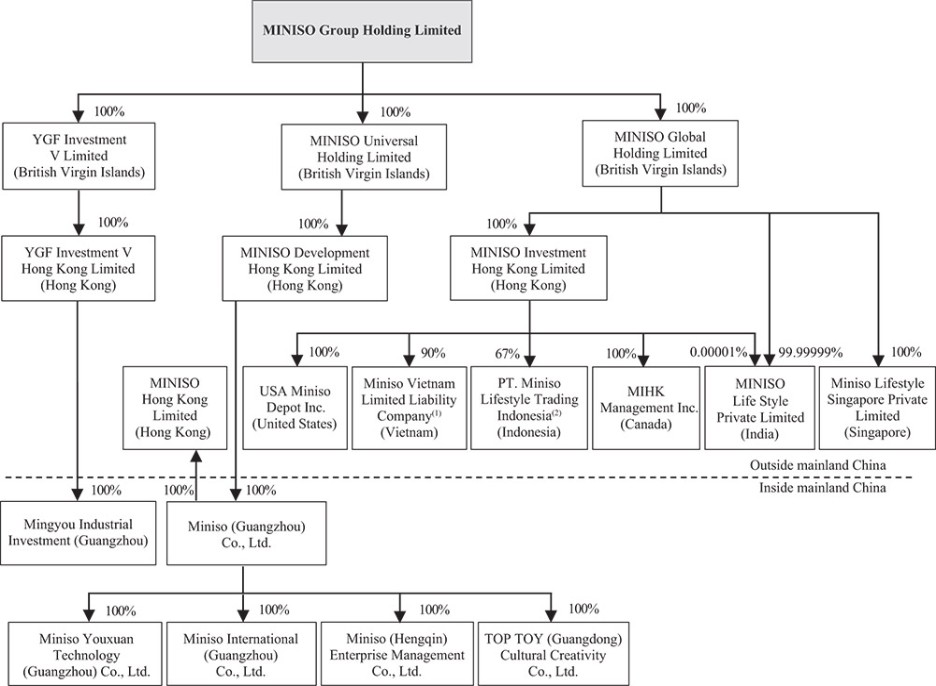
| (1) | The remaining 10% shares of Miniso Vietnam Limited Liability Company is held by an individual distributor in Vietnam. |
| (2) | The remaining shares of PT. Miniso Lifestyle Trading Indonesia is held by PT. Mitra Retail Indonesia and PT. Yar Noor International as to 20% and 13%, respectively. |
10
MINISO Group Holding Limited is a Cayman holding company and our operations are conducted primarily through subsidiaries in China. By purchasing the ADSs, you are purchasing interests in our Cayman holding company, as opposed to interests in our subsidiaries in China. Except for certain specific industries, current laws and regulations in mainland China do not prohibit direct foreign investment in mainland China companies. However, foreign investment laws in mainland China are constantly evolving and there is uncertainty with respect to future laws and regulations as well as regulatory actions to be taken by the PRC government in this regard. Were this holding company structure to be challenged or disallowed by PRC regulatory authorities, our business operations would be materially and adversely affected and the value of the ADSs could significantly decline or become worthless. Our holding company structure also involves certain risks in terms of dividend distribution, direct investment in entities in mainland China and obtaining benefits under relevant tax treaty. See “Item 3.D. Key Information—Risk Factors—Risks Related to Doing Business in China—MINISO Group Holding Limited is a Cayman holding company and we may rely on dividends and other distributions on equity paid by our mainland China subsidiaries to fund any cash and financing requirements we may have, and any limitation on the ability of our mainland China subsidiaries or Hong Kong subsidiaries to make payments to us could have a material and adverse effect on our ability to conduct our business,” “Item 3.D. Key Information—Risk Factors—Risks Related to Doing Business in China—Mainland China regulation of loans to and direct investment in mainland China entities by offshore holding companies and governmental administration of currency conversion may delay or prevent us from using the proceeds of our offshore offerings to make loans to or make additional capital contributions to our mainland China subsidiaries, which could materially and adversely affect our liquidity and our ability to fund and expand our business,” “Item 3.D. Key Information—Risk Factors—Risks Related to Doing Business in China—Mainland China regulations relating to offshore investment activities by mainland China residents may limit our mainland China subsidiaries’ ability to increase their registered capital or distribute profits to us or otherwise expose us or our mainland China resident beneficial owners to liability and penalties under laws of mainland China” and “Item 3.D. Key Information—Risk Factors—Risks Related to Doing Business in China—We may not be able to obtain certain benefits under relevant tax treaty on dividends paid by our mainland China subsidiaries to us through our Hong Kong subsidiary.” See also “Item 4. Information on the Company—B. Business Overview—Regulations—Mainland China—Regulation related to foreign exchange” and “Item 4. Information on the Company—B. Business Overview—Regulations—Mainland China—Regulation related to dividend distribution.”
Transfer of Funds and Other Assets Within Our Organization
We are not an operating company but a Cayman Islands holding company with operations primarily conducted by our subsidiaries in China, and to a lesser extent by our subsidiaries outside China. Our ability to pay dividends to the shareholders and to service any debt it may incur may depend upon dividends paid by our PRC subsidiaries. If any of our subsidiaries incurs debt on its own behalf in the future, the instruments governing such debt may restrict its ability to pay dividends to us. In addition, under PRC laws and regulations, our PRC subsidiaries are permitted to pay dividends only out of their retained earnings, if any, as determined in accordance with PRC accounting standards and regulations. Furthermore, our PRC subsidiaries are required to make appropriations to certain statutory reserve funds or may make appropriations to certain discretionary funds, which are not distributable as cash dividends except in the event of a solvent liquidation of the companies.
11
Furthermore, if certain procedural requirements are satisfied, the payment of current account items, including profit distributions and trade and service related foreign exchange transactions, can be made in foreign currencies without prior approval from State Administration of Foreign Exchange (the “SAFE”) or its local branches. However, where RMB is to be converted into foreign currency and remitted out of mainland China to pay capital expenses, such as the repayment of loans denominated in foreign currencies, or where foreign currency is converted into RMB and remitted into mainland China to purchase goods or services from our mainland China subsidiaries, prior approval from or registration with competent government authorities or its authorized banks is required. The PRC government may take measures at its discretion from time to time to restrict access to foreign currencies for current account or capital account transactions. If the foreign exchange administration system prevents us from obtaining sufficient foreign currencies to satisfy our foreign currency demands, we may not be able to pay dividends in foreign currencies to our offshore intermediary holding companies or ultimate parent company, and therefore, our shareholders or investors in our ADSs. Further, we cannot assure you that new regulations or policies will not be promulgated in the future, which may further restrict the remittance of RMB out of the mainland China. We cannot assure you, in light of the restrictions in place, or any amendment to be made from time to time, that our current or future mainland China subsidiaries will be able to satisfy their respective payment obligations that are denominated in foreign currencies, including the remittance of dividends outside of the mainland China. As a result of the restrictions discussed above, to the extent cash in the business is in a mainland China entity, the funds may not be available to fund operations or for other use outside of mainland China due to interventions in or the imposition of restrictions and limitations on the ability of us or our mainland China subsidiaries by the PRC government to transfer cash. These restrictions and limitations imposed by the PRC government in mainland China are not applicable to cash transfers in and out of Hong Kong or our Hong Kong subsidiaries. If the laws applicable to mainland China become applicable to entities and businesses in Hong Kong in the future, funds in Hong Kong or in our Hong Kong subsidiaries may not be available to fund operations or for other use outside of Hong Kong. See “Item 4. Information on the Company—B. Business Overview—Regulations—Mainland China—Regulation related to foreign exchange” and “Item 4. Information on the Company—B. Business Overview—Regulations—Mainland China—Regulation related to dividend distribution.” See also “Item 3.D. Key Information—Risk Factors—Risks Related to Doing Business in China—MINISO Group Holding Limited is a Cayman holding company and we may rely on dividends and other distributions on equity paid by our mainland China subsidiaries to fund any cash and financing requirements we may have, and any limitation on the ability of our mainland China subsidiaries or Hong Kong subsidiaries to make payments to us could have a material and adverse effect on our ability to conduct our business” for more information.
Under PRC laws, MINISO Group Holding Limited may fund our PRC subsidiaries only through capital contributions or loans, subject to satisfaction of applicable government registration and approval requirements. In the fiscal years ended June 30, 2022 and 2023, the six months ended December 31, 2023 and the fiscal year ended December 31, 2024, the amount of capital contribution made by MINISO Group Holding Limited and/or intermediate holding companies to our PRC subsidiaries was RMB1,332.0 million, RMB26.0 million, nil and RMB59.8 million (US$8.2 million), respectively. No loans were extended by MINISO Group Holding Limited to our PRC subsidiaries during these periods. In addition, our PRC subsidiaries may receive cash payments from our certain offshore subsidiaries for product sales to such offshore subsidiaries. In the fiscal years ended June 30, 2022 and 2023, the six months ended December 31, 2023 and the fiscal year ended December 31, 2024, our PRC subsidiaries received RMB1,824.4 million, RMB2,661.0 million, RMB1,671.5 million and RMB4,728.4 million (US$647.8 million), respectively, from such payments. In the fiscal years ended June 30, 2022 and 2023, the six months ended December 31, 2023 and the fiscal year ended December 31, 2024, no assets other than cash were transferred through our organization.
12
On August 17, 2022, our board of directors declared a cash dividend in the amount of US$0.172 per ADS, or US$0.043 per ordinary share, payable as of the close of business on September 9, 2022 to shareholders of record as of the close of business on August 31, 2022. The aggregate amount of cash dividends paid was US$53.6 million. On August 22, 2023, our board of directors declared another cash dividend in the amount of US$0.412 per ADS, or US$0.103 per ordinary share, payable as of the close of business on September 19, 2023 to shareholders of record as of the close of business on September 7, 2023. The aggregate amount of cash dividend paid was US$128.8 million (RMB 923.7 million). On March 12, 2024, our board of directors declared a special cash dividend in the amount of US$0.2900 per ADS, or US$0.0725 per ordinary share, to shareholders of record as of the close of business on March 28, 2024. The aggregate amount of cash dividends paid was US$90.6 million (RMB644.8 million). On August 30, 2024, our board of directors declared an interim cash dividend in the amount of US$0.2744 per ADS, or US$0.0686 per ordinary share, to shareholders of record as of the close of business on September 13, 2024. The aggregate amount of cash dividends paid was US$85.2 million (RMB601.1 million). On March 21, 2025, our board of directors declared a final cash dividend in the amount of US$ 0.3268 per ADS, or US$0.0817 per ordinary share, to shareholders of record as of the close of business on April 8, 2025. The aggregate amount of cash dividends paid was US$101.4 million (RMB740.4 million). All of the above-mentioned dividend distributions were funded by surplus cash on our balance sheet. Other than these dividends, MINISO Group Holding Limited has not declared or paid any cash dividends. We intend to distribute dividends annually in the future representing no less than 50% of our annual adjusted net profit, a non-IFRS measure, which is defined as profit for the period excluding equity-settled share-based payment expenses. However, whether or not we actually distribute dividends and, if yes, when we are going to distribute dividends are at the discretion of our board of directors. See “Item 8. Financial Information—A. Consolidated Statements and Other Financial Information—Dividend Policy” for details. For mainland China and United States federal income tax considerations of an investment in the ADSs, see “Item 10. Additional Information—E. Taxation.”
In addition to the dividend policy discussed above, we have adopted cash management policies, including specific policies governing approvals with respect to fund transfers throughout our organization. Our management and the audit committee of the board of directors oversee our major financial risk exposures. We maintain an authorization policy on cash management, setting forth the scope of authority for certain treasury matters that are delegated by our board of directors to be approved by our management. Under this policy, certain treasury matters, such as intercompany loans, capital contribution made by our company and/or its intermediate holding companies to its subsidiaries and dividends distributed from our company’s subsidiaries to the holding company, are clearly defined, with the level of approval required for each matter specifically identified. When funding is required, we will obtain all necessary approvals from our management and relevant governmental authorities, including the SAFE.
Other than the transfers of funds within our organization discussed above, there were no other transfer of assets, dividends or distributions made between our company and our subsidiaries, and no transfer of cash or other assets, dividends or distributions made to U.S. investors for the fiscal years ended June 30, 2022 and 2023, the six months ended December 31, 2023, and the year ended December 31, 2024. There are no additional tax consequences upon cash payments for capital contribution or product sales within our organization discussed above. Under the current laws of the Cayman Islands, we are not subject to tax on income or capital gains. In addition, upon payments of dividends to our shareholders, no Cayman Islands withholding tax will be imposed.
A.Selected Financial Data
We changed our fiscal year end from June 30 to December 31 in January 2024. The following tables present the selected consolidated financial information of our company. The selected consolidated statement of profit or loss and other comprehensive income data for the fiscal years ended June 30, 2022 and 2023, the six months ended December 31, 2023 and the fiscal year ended December 31, 2024, the selected consolidated statement of financial position data as of June 30, 2023 and December 31, 2023 and 2024, and selected consolidated statement of cash flows data for the fiscal years ended June 30, 2022 and 2023, the six months ended December 31, 2023 and the fiscal year ended December 31, 2024 have been derived from our audited consolidated financial statements included in this annual report beginning on page F-1. The unaudited financial data for the six months ended June 30, 2022 and the year ended December 31, 2023 is presented solely for the purpose of providing meaningful comparisons with that for the six months ended June 30, 2023 and the year ended December 31, 2024, respectively. The selected consolidated statement of financial position data as of June 30, 2020, 2021 and 2022 and the selected consolidated statement of profit or loss and other comprehensive income data for the fiscal years ended June 30, 2020 and 2021 have been derived from our audited consolidated financial statements not included in this annual report. Our consolidated financial statements are prepared and presented in accordance with IFRS Accounting Standards, or IFRS, issued by the International Accounting Standard Board, or IASB. Our historical results are not necessarily indicative of results expected for future periods. You should read the following selected financial data in conjunction with the consolidated financial statements and related notes and “Item 5. Operating and Financial Review and Prospects” included elsewhere in this annual report.
13
The following table presents our selected consolidated statement of profit or loss and other comprehensive income data for the fiscal years ended June 30, 2020, 2021, 2022 and 2023, the six months ended December 31, 2022 and 2023 and the years ended December 31, 2023 and 2024:
|
|
|
|
|
|
|
|
|
|
For the six months ended |
|
For the year ended |
||||||
|
|
For the fiscal year ended June 30, |
|
December 31, |
|
December 31, |
||||||||||||
|
|
2020 |
|
2021 |
|
2022 |
|
2023 |
|
2022 |
|
2023 |
|
2023 |
|
2024 |
||
|
|
RMB |
|
RMB |
|
RMB |
|
RMB |
|
RMB |
|
RMB |
|
RMB |
|
RMB |
|
US$ |
|
|
|
|
|
|
|
|
|
|
(Unaudited) |
|
|
|
(Unaudited) |
|
|
|
|
|
|
(in thousands, except for share and per share data) |
||||||||||||||||
Selected consolidated statement of profit or loss and other comprehensive income data: |
|
|
|
|
|
|
|
|
|
|
|
|
|
|
|
|
|
|
Continuing operations: |
|
|
|
|
|
|
|
|
|
|
|
|
|
|
|
|
|
|
Revenue |
|
8,978,986 |
|
9,071,659 |
|
10,085,649 |
|
11,473,208 |
|
5,266,878 |
|
7,632,467 |
|
13,838,797 |
|
16,994,025 |
|
2,328,172 |
Cost of sales |
|
(6,246,488) |
|
(6,640,973) |
|
(7,015,888) |
|
(7,030,156) |
|
(3,281,218) |
|
(4,391,428) |
|
(8,140,366) |
|
(9,356,965) |
|
(1,281,899) |
Gross profit |
|
2,732,498 |
|
2,430,686 |
|
3,069,761 |
|
4,443,052 |
|
1,985,660 |
|
3,241,039 |
|
5,698,431 |
|
7,637,060 |
|
1,046,273 |
Other income |
|
37,208 |
|
52,140 |
|
25,931 |
|
17,935 |
|
14,311 |
|
18,993 |
|
22,617 |
|
21,595 |
|
2,959 |
Selling and distribution expenses(1) |
|
(1,190,477) |
|
(1,206,782) |
|
(1,442,339) |
|
(1,716,093) |
|
(798,127) |
|
(1,363,114) |
|
(2,281,080) |
|
(3,519,534) |
|
(482,174) |
General and administrative expenses(1) |
|
(796,435) |
|
(810,829) |
|
(816,225) |
|
(633,613) |
|
(313,908) |
|
(357,689) |
|
(677,394) |
|
(931,651) |
|
(127,636) |
Other net income/(loss) |
|
45,997 |
|
(40,407) |
|
87,308 |
|
114,106 |
|
72,850 |
|
21,105 |
|
62,361 |
|
114,696 |
|
15,713 |
(Credit loss)/ reversal of credit loss on trade and other receivables |
|
(25,366) |
|
(20,832) |
|
(28,924) |
|
1,072 |
|
(3,716) |
|
(2,080) |
|
2,708 |
|
2,469 |
|
338 |
Impairment loss on non-current assets |
|
(36,844) |
|
(2,941) |
|
(13,485) |
|
(3,448) |
|
— |
|
(4,547) |
|
(7,995) |
|
(8,846) |
|
(1,212) |
Operating profit |
|
766,581 |
|
401,035 |
|
882,027 |
|
2,223,011 |
|
957,070 |
|
1,553,707 |
|
2,819,648 |
|
3,315,789 |
|
454,261 |
Finance income |
|
25,608 |
|
40,433 |
|
66,344 |
|
145,225 |
|
64,684 |
|
123,969 |
|
204,510 |
|
118,672 |
|
16,258 |
Finance costs |
|
(31,338) |
|
(28,362) |
|
(33,396) |
|
(34,622) |
|
(16,345) |
|
(25,202) |
|
(43,479) |
|
(92,915) |
|
(12,729) |
Net finance (costs)/income |
|
(5,730) |
|
12,071 |
|
32,948 |
|
110,603 |
|
48,339 |
|
98,767 |
|
161,031 |
|
25,757 |
|
3,529 |
Fair value changes of paid-in capital subject to redemption and other preferential rights/ redeemable shares with other preferential rights |
|
(680,033) |
|
(1,625,287) |
|
— |
|
— |
|
— |
|
— |
|
— |
|
— |
|
— |
Share of loss of equity-accounted investee, net of tax |
|
— |
|
(4,011) |
|
(8,162) |
|
— |
|
— |
|
268 |
|
268 |
|
5,986 |
|
820 |
Profit/(loss) before taxation |
|
80,818 |
|
(1,216,192) |
|
906,813 |
|
2,333,614 |
|
1,005,409 |
|
1,652,742 |
|
2,980,947 |
|
3,347,532 |
|
458,610 |
Income tax expense |
|
(210,949) |
|
(213,255) |
|
(267,070) |
|
(551,785) |
|
(241,498) |
|
(396,665) |
|
(706,952) |
|
(712,104) |
|
(97,558) |
(Loss)/profit for the year/period from continuing operations |
|
(130,131) |
|
(1,429,447) |
|
639,743 |
|
1,781,829 |
|
763,911 |
|
1,256,077 |
|
2,273,995 |
|
2,635,428 |
|
361,052 |
Discontinued operations: |
|
|
|
|
|
|
|
|
|
|
|
|
|
|
|
|
|
|
Loss for the year from discontinued operations, net of tax |
|
(130,045) |
|
— |
|
— |
|
— |
|
— |
|
— |
|
— |
|
— |
|
— |
(Loss)/profit for the year/period |
|
(260,176) |
|
(1,429,447) |
|
639,743 |
|
1,781,829 |
|
763,911 |
|
1,256,077 |
|
2,273,995 |
|
2,635,428 |
|
361,052 |
Attributable to: |
|
|
|
|
|
|
|
|
|
|
|
|
|
|
|
|
|
|
Equity shareholders of the Company |
|
(262,267) |
|
(1,415,010) |
|
638,170 |
|
1,768,926 |
|
764,090 |
|
1,248,405 |
|
2,253,241 |
|
2,617,560 |
|
358,604 |
Non-controlling interests |
|
2,091 |
|
(14,437) |
|
1,573 |
|
12,903 |
|
(179) |
|
7,672 |
|
20,754 |
|
17,868 |
|
2,448 |
(Loss)/profit for the year/period |
|
(260,176) |
|
(1,429,447) |
|
639,743 |
|
1,781,829 |
|
763,911 |
|
1,256,077 |
|
2,273,995 |
|
2,635,428 |
|
361,052 |
(Loss)/earnings per share(2) |
|
|
|
|
|
|
|
|
|
|
|
|
|
|
|
|
|
|
—Basic |
|
(0.26) |
|
(1.18) |
|
0.53 |
|
1.42 |
|
0.61 |
|
1.00 |
|
1.81 |
|
2.11 |
|
0.29 |
—Diluted |
|
(0.26) |
|
(1.18) |
|
0.52 |
|
1.41 |
|
0.61 |
|
1.00 |
|
1.80 |
|
2.10 |
|
0.29 |
(Loss)/earnings per share(2) – Continuing operations |
|
|
|
|
|
|
|
|
|
|
|
|
|
|
|
|
|
|
—Basic |
|
(0.12) |
|
(1.18) |
|
0.53 |
|
1.42 |
|
0.61 |
|
1.00 |
|
1.81 |
|
2.11 |
|
0.29 |
—Diluted |
|
(0.12) |
|
(1.18) |
|
0.52 |
|
1.41 |
|
0.61 |
|
1.00 |
|
1.80 |
|
2.10 |
|
0.29 |
Other comprehensive income /(loss)for the year |
|
6,361 |
|
(16,548) |
|
40,494 |
|
41,198 |
|
(13,634) |
|
(32,504) |
|
22,328 |
|
19,128 |
|
2,621 |
Total comprehensive income/(loss) for the year |
|
(253,815) |
|
(1,445,995) |
|
680,237 |
|
1,823,027 |
|
750,277 |
|
1,223,573 |
|
2,296,323 |
|
2,654,556 |
|
363,673 |
Equity shareholders of the Company |
|
(256,583) |
|
(1,429,621) |
|
677,667 |
|
1,803,797 |
|
746,698 |
|
1,217,804 |
|
2,274,903 |
|
2,635,833 |
|
361,108 |
Non-controlling interests |
|
2,768 |
|
(16,374) |
|
2,570 |
|
19,230 |
|
3,579 |
|
5,769 |
|
21,420 |
|
18,723 |
|
2,565 |
Notes:
| (1) | Equity-settled share-based payment expenses were allocated as follows: |
14
|
|
|
|
|
|
|
|
|
|
|
|
|
|
|
|
|
|
|
|
|
|
|
|
|
|
|
For the six months ended |
|
For the year ended |
||||||||
|
|
For the fiscal year ended June 30, |
|
December 31, |
|
December 31, |
||||||||||||
|
|
2020 |
|
2021 |
|
2022 |
|
2023 |
|
2022 |
|
2023 |
|
2023 |
|
2024 |
||
|
|
RMB |
|
RMB |
|
RMB |
|
RMB |
|
RMB |
|
RMB |
|
RMB |
|
RMB |
|
US$ |
|
|
|
|
|
|
|
|
(Unaudited) |
|
|
|
|
|
(Unaudited) |
|
|
|
|
|
|
(in thousands) |
||||||||||||||||
Equity-settled share-based payment expenses: |
|
|
|
|
|
|
|
|
|
|
|
|
|
|
|
|
|
|
Selling and distribution expenses |
|
127,743 |
|
131,215 |
|
52,000 |
|
44,824 |
|
16,622 |
|
41,506 |
|
69,709 |
|
13,454 |
|
1,843 |
General and administrative expenses |
|
236,637 |
|
150,104 |
|
30,835 |
|
18,058 |
|
9,958 |
|
4,926 |
|
13,025 |
|
71,730 |
|
9,827 |
Total |
|
364,380 |
|
281,319 |
|
82,835 |
|
62,882 |
|
26,580 |
|
46,432 |
|
82,734 |
|
85,184 |
|
11,670 |
| (2) | Our company was incorporated on January 7, 2020 during the reorganization to establish our current offshore structure and we issued 976,634,771 ordinary shares in January 2020. For purposes of calculating basic and diluted loss per share for the fiscal years ended June 30, 2020, the number of outstanding ordinary shares used in the calculation was 865,591,398, which excluded 111,043,373 ordinary shares held by certain share incentive awards holding vehicles as of June 30, 2020 as these shares were regarded as treasury shares for purposes of calculating per share data. The number of ordinary shares used in the calculation has been retroactively adjusted to reflect the issuance of ordinary shares by our company in connection with the incorporation of our company and the reorganization as if these events had occurred at the beginning of the earliest period presented. For purposes of calculating basic and diluted earnings per share for the fiscal year ended June 30, 2022, the weighted average number of ordinary shares in issue used in the calculation was 1,205,527,348 and 1,216,637,439, respectively. For purposes of calculating basic and diluted earnings per share for the fiscal year ended June 30, 2023, the weighted average number of ordinary shares in issue used in the calculation was 1,243,320,377 and 1,250,545,116, respectively. For purposes of calculating basic and diluted earnings per share for the six months ended December 31, 2023, the weighted average number of ordinary shares in issue used in the calculation was 1,244,926,865 and 1,251,635,862, respectively. For purposes of calculating basic and diluted earnings per share for the year ended December 31, 2023, the weighted average number of ordinary shares in issue used in the calculation was 1,244,720,534 and 1,252,361,115, respectively. For purposes of calculating basic and diluted earnings per share for the fiscal year ended December 31, 2024, the weighted average number of ordinary shares in issue used in the calculation was 1,239,394,263 and 1,246,817,617, respectively. |
The following table presents our selected consolidated statement of financial position data as of June 30, 2020, 2021, 2022 and 2023 and December 31, 2023 and 2024:
|
|
As of June 30, |
|
As of December 31, |
||||||||||||
|
|
2020 |
|
2021 |
|
2022 |
|
2023 |
|
2022 |
|
2023 |
|
2024 |
||
|
|
RMB |
|
RMB |
|
RMB |
|
RMB |
|
RMB |
|
RMB |
|
RMB |
|
US$ |
|
|
|
|
|
|
|
|
|
|
(Unaudited) |
|
|
|
|
|
|
|
|
(in thousands) |
||||||||||||||
Selected consolidated statement of financial position data: |
|
|
|
|
|
|
|
|
|
|
|
|
|
|
|
|
Cash and cash equivalents |
|
2,853,980 |
|
6,771,653 |
|
5,348,492 |
|
6,489,213 |
|
5,186,601 |
|
6,415,441 |
|
6,328,121 |
|
866,949 |
Inventories |
|
1,395,674 |
|
1,496,061 |
|
1,188,095 |
|
1,450,519 |
|
1,474,792 |
|
1,922,241 |
|
2,750,389 |
|
376,802 |
Trade and other receivables |
|
729,889 |
|
824,725 |
|
1,056,198 |
|
1,150,156 |
|
1,108,501 |
|
1,518,357 |
|
2,207,013 |
|
302,360 |
Total current assets |
|
4,986,599 |
|
9,199,087 |
|
8,072,562 |
|
9,904,005 |
|
8,743,692 |
|
10,327,634 |
|
11,655,501 |
|
1,596,798 |
Total assets |
|
5,836,251 |
|
10,705,030 |
|
11,281,788 |
|
13,447,713 |
|
11,997,380 |
|
14,485,309 |
|
18,120,128 |
|
2,482,449 |
Trade and other payables |
|
2,419,795 |
|
2,809,182 |
|
3,072,991 |
|
3,019,302 |
|
2,939,852 |
|
3,389,826 |
|
3,943,988 |
|
540,324 |
Total current liabilities |
|
3,309,643 |
|
3,482,855 |
|
3,788,671 |
|
3,885,595 |
|
3,711,558 |
|
4,406,979 |
|
5,727,189 |
|
784,623 |
Total liabilities |
|
6,159,297 |
|
4,052,876 |
|
4,254,388 |
|
4,529,445 |
|
4,188,353 |
|
5,294,092 |
|
7,764,606 |
|
1,063,748 |
Total equity/(deficit) |
|
(323,046) |
|
6,652,154 |
|
7,027,400 |
|
8,918,268 |
|
7,809,027 |
|
9,191,217 |
|
10,355,522 |
|
1,418,701 |
Total equity and liabilities |
|
5,836,251 |
|
10,705,030 |
|
11,281,788 |
|
13,447,713 |
|
11,997,380 |
|
14,485,309 |
|
18,120,128 |
|
2,482,449 |
15
The following table presents our selected consolidated statement of cash flows data for the fiscal years ended June 30, 2020, 2021, 2022 and 2023, the six months ended December 31, 2023 and the years ended December 31, 2023 and 2024:
|
|
|
|
For the six months ended |
|
For the year ended |
||||||||||||
|
|
For the fiscal year ended June 30, |
|
December 31, |
|
December 31, |
||||||||||||
|
|
2020 |
|
2021 |
|
2022 |
|
2023 |
|
2022 |
|
2023 |
|
2023 |
|
2024 |
||
|
|
RMB |
|
RMB |
|
RMB |
|
RMB |
|
RMB |
|
RMB |
|
RMB |
|
RMB |
|
US$ |
|
|
|
|
|
|
|
|
|
|
(Unaudited) |
|
|
|
(Unaudited) |
|
|
|
|
|
|
(in thousands) |
||||||||||||||||
Selected consolidated statement of cash flow data: |
|
|
|
|
|
|
|
|
|
|
|
|
|
|
|
|
|
|
Net cash generated from operating activities |
|
826,484 |
|
916,320 |
|
1,406,262 |
|
1,666,030 |
|
433,256 |
|
1,097,541 |
|
2,330,315 |
|
2,168,334 |
|
297,061 |
Net cash generated from/(used in) investing activities |
|
462,815 |
|
(518,797) |
|
(2,125,918) |
|
(293,406) |
|
(485,719) |
|
177,073 |
|
369,386 |
|
(533,254) |
|
(73,055) |
Net cash (used in)/generated from financing activities |
|
(117,706) |
|
3,536,184 |
|
(733,559) |
|
(325,956) |
|
(149,789) |
|
(1,320,899) |
|
(1,497,066) |
|
(1,720,623) |
|
(235,724) |
Net increase/(decrease) in cash and cash equivalents |
|
1,171,593 |
|
3,933,707 |
|
(1,453,215) |
|
1,046,668 |
|
(202,252) |
|
(46,285) |
|
1,202,635 |
|
(85,543) |
|
(11,719) |
Cash and cash equivalents at beginning of year as presented in the consolidated statement of cash flows |
|
1,686,218 |
|
2,853,980 |
|
6,771,653 |
|
5,348,492 |
|
5,348,492 |
|
6,489,213 |
|
5,186,601 |
|
6,415,441 |
|
878,912 |
Effect of movements in exchange rates on cash held |
|
(3,831) |
|
(16,034) |
|
30,054 |
|
94,053 |
|
40,361 |
|
(27,487) |
|
26,205 |
|
(1,777) |
|
(243) |
Cash and cash equivalents at end of year as presented in the consolidated statement of cash flows |
|
2,853,980 |
|
6,771,653 |
|
5,348,492 |
|
6,489,213 |
|
5,186,601 |
|
6,415,441 |
|
6,415,441 |
|
6,328,121 |
|
86,949 |
Cash and cash equivalents at end of year as presented in the consolidated statement of financial position |
|
2,853,980 |
|
6,771,653 |
|
5,348,492 |
|
6,489,213 |
|
5,186,601 |
|
6,415,441 |
|
6,415,441 |
|
6,328,121 |
|
866,949 |
B.Capitalization and Indebtedness
Not applicable.
C.Reasons for the Offer and Use of Proceeds
Not applicable.
D.Risk Factors
Summary of Risk Factors
Investing in our ADSs involves significant risks. You should carefully consider all of the information in this annual report before making an investment in the ADSs. Below please find a summary of the principal risks we face, organized under relevant headings.
Risks related to our business and industry
Risks and uncertainties related to our business and industry include, but are not limited to, the following:
| ● | Our success depends upon the continued strength of our brands. If we are unable to maintain and enhance our brands, our business and operating results may be adversely affected; |
| ● | The growth and profitability of our business depend on the level of consumer demand and discretionary spending. A severe or prolonged economic downturn in China or around the world could materially and adversely affect consumer discretionary spending and therefore adversely affect our business, financial condition and results of operations; |
16
| ● | Our success is dependent on the continued popularity of our products, our continued innovation and successful launches of new products, and our anticipation of and timely responses to changes in consumer preferences; |
| ● | If we are unable to offer our products at prices that are highly appealing to consumers or maintain competitive prices, our business and results of operations would be materially and adversely affected; |
| ● | If we fail to offer high-quality products to consumers, our business, reputation, results of operations and financial condition will be materially and adversely affected; |
| ● | Expanding product offerings may expose us to new challenges and more risks; |
| ● | If we are unable to attract purchases from new and existing consumers, our business, financial condition and results of operations may be materially and adversely affected; |
| ● | We primarily rely on our retail partners and distributors to expand our store network. If we are unable to expand our store network successfully, our business, results of operations would be adversely affected; |
| ● | If we, our MINISO Retail Partners or local distributors fail to successfully operate MINISO stores, our business and results of operations would be adversely affected; |
| ● | Our international operations are subject to a variety of costs and legal, regulatory, political and economic risks; |
| ● | If our MINISO Retail Partners or local distributors do not satisfactorily fulfill their responsibilities and commitments, our brand image, results of operations could be materially harmed; |
| ● | If we fail to maintain the relationship with our MINISO Retail Partners or our local distributors or fail to attract new MINISO Retail Partners or local distributors to join our store network, our business, results of operations and financial condition could be materially and adversely affected; and |
| ● | Illegal actions or misconduct of our MINISO Retail Partners, local distributors, sub-contractors or sub-distributors, third-party suppliers or other service providers, or any failure by them to provide satisfactory products or services could materially and adversely affect our business, reputation, financial condition and results of operations. |
Risks related to doing business in China
A substantial portion of our business operations are conducted in China and we face various risks and uncertainties related to doing business in China, in particular, risks arising from the legal system in mainland China, including risks and uncertainties regarding the enforcement of laws and that rules and regulations in mainland China can change quickly with little advance notice, and the risk that the Chinese government may intervene or influence your operations at any time, or may exert more control over offerings conducted overseas and/or foreign investment in China-based issuers, which could result in a material change in your operations and/or the value of your securities. Risks and uncertainties related to doing business in China include, but are not limited to, the following:
| ● | The PCAOB had historically been unable to inspect our auditor in relation to their audit work performed for our financial statements and the inability of the PCAOB to conduct inspections of our auditor in the past has deprived our investors of the benefits of such inspections. See “Item 3. Key Information—D. Risk Factors—Risks Related to Doing Business in China—The PCAOB had historically been unable to inspect our auditor in relation to their audit work performed for our financial statements and the inability of the PCAOB to conduct inspections of our auditor in the past has deprived our investors of the benefits of such inspections” on page 54; |
17
| ● | The ADSs may be prohibited from trading in the United States under the HFCAA in the future if the PCAOB is unable to inspect or investigate completely auditors located in China. The delisting of the ADSs, or the threat of their being delisted, may materially and adversely affect the value of your investment. See “Item 3. Key Information—D. Risk Factors—Risks Related to Doing Business in China—The ADSs may be prohibited from trading in the United States under the HFCAA in the future if the PCAOB is unable to inspect or investigate completely auditors located in China. The delisting of the ADSs, or the threat of their being delisted, may materially and adversely affect the value of your investment” on page 54; |
| ● | The PRC government has significant authority in regulating our operations and may influence our operations. It may exert more oversight and control over offerings conducted overseas by, and/or foreign investment in, China-based issuers, which could significantly limit or completely hinder our ability to offer or continue to offer securities to investors and may cause the value of our ordinary shares or the ADSs to significantly decline or be worthless. See “Item 3. Key Information—D. Risk Factors—Risks Related to Doing Business in China—The PRC government’s oversight and regulation over our business operations could result in a material change in our operations and the value of our ordinary shares or the ADSs” on page 55; |
| ● | Changes in China’s or global economic, political or social conditions or government policies could have a material and adverse effect on our business and results of operations. See “Item 3. Key Information—D. Risk Factors—Risks Related to Doing Business in China—Changes in China’s or global economic, political or social conditions or government policies could have a material and adverse effect on our business and results of operations” on page 56; |
| ● | Uncertainties with respect to the legal system in mainland China could adversely affect us. Certain laws and regulations in mainland China can evolve quickly, which bring risks and uncertainties to their interpretation and enforcement. Administrative and court proceedings in mainland China may be protracted. Some government policies and internal rules may not be published on a timely manner. These risks and uncertainties may make it difficult for us to meet or comply with requirements under the applicable laws and regulations. See “Item 3. Key Information—D. Risk Factors—Risks Related to Doing Business in China—Uncertainties in the interpretation and enforcement of mainland China laws and regulations could limit the legal protections available to you and us” on page 56; |
| ● | Litigation and negative publicity surrounding China-based companies listed in the U.S. may result in increased regulatory scrutiny of us and negatively impact the trading price of the ADSs and could have a material adverse effect upon our business, including our results of operations, financial condition, cash flows and prospects. See “Item 3. Key Information—D. Risk Factors—Risks Related to Doing Business in China—Litigation and negative publicity surrounding China-based companies listed in the U.S. may result in increased regulatory scrutiny of us and negatively impact the trading price of the ADSs and could have a material adverse effect upon our business, including our results of operations, financial condition, cash flows and prospects” on page 57; and |
| ● | MINISO Group Holding Limited is a Cayman holding company and we may rely on dividends and other distributions on equity paid by our mainland China subsidiaries to fund any cash and financing requirements we may have, and any limitation on the ability of our mainland China subsidiaries or Hong Kong subsidiaries to make payments to us could have a material and adverse effect on our ability to conduct our business. See “Item 3. Key Information—D. Risk Factors—Risks Related to Doing Business in China—MINISO Group Holding Limited is a Cayman holding company and we may rely on dividends and other distributions on equity paid by our mainland China subsidiaries to fund any cash and financing requirements we may have, and any limitation on the ability of our mainland China subsidiaries or Hong Kong subsidiaries to make payments to us could have a material and adverse effect on our ability to conduct our business” on page 58. |
Risks related to the ADSs and our ordinary shares
Risks and uncertainties related to the ADSs and our ordinary shares include, but are not limited to, the following:
| ● | The trading price of the ADSs and our ordinary shares has been volatile, which could result in substantial losses to investors; |
18
| ● | The concentration of our share ownership among executive officers, directors, and principal shareholders and their affiliated entities will likely limit your ability to influence corporate matters and could discourage others from pursuing any change of control transaction that holders of our ordinary shares and the ADSs may view as beneficial; and |
| ● | Techniques employed by short sellers may drive down the market price of our ordinary shares or the ADSs. |
Risks Related to Our Business and Industry
Our success depends upon the continued strength of our brands. If we are unable to maintain and enhance our brands, our business and operating results may be adversely affected.
We sell our products under our own brands, mainly “MINISO,” our flagship brand, and “TOP TOY.” For the fiscal year ended December 31, 2024, revenue generated under our MINISO brand accounted for approximately 94% of our total revenue. TOP TOY, which we launched in December 2020, is a brand that is committed to building a comprehensive shopping platform for pop toys. See “Item 4. Information on the Company—B. Business Overview—Our Products—Brand strategies.” We believe that our brands have significantly contributed to the success of our business and that maintaining and enhancing our brands is critical to retaining and expanding our consumer base. Our marketing, design, research and products are aimed at promoting awareness of our “MINISO” brand and “TOP TOY” brand.
We seek to promote our brand image through marketing initiatives, including celebrity endorsement, marketing through video and short-video platforms, and key opinion leader promotion, as well as other social media-based marketing and promotion activities. Promoting and strengthening our brand image depends on our ability to adapt to a rapidly changing media environment and preferences of consumers to receiving information, including our increasing reliance on social media and online dissemination of advertising campaigns. If we do not continue to maintain and strengthen our brand image and grow the value of brands, in particular, the “MINISO” brand and “TOP TOY” brand, we may lose the opportunity to build a critical mass of consumers. In addition, we have been continually promoting our brands and products in a very active manner. Certain consumers may perceive our brands and/or our products in different ways or even misinterpret our brands before learning more about our company, our brands and our products. If consumers or other parties claim that our marketing approach is misleading or otherwise improper, we may be subject to lawsuits or other legal proceedings, which would negatively affect our brand image, undermine the trust and credibility we have established and impose an adverse impact on our business.
Furthermore, as we continue to grow in size, expand our product offerings and extend our geographic reach, maintaining high-quality, high-appeal and high affordability of our products may be more difficult and we cannot assure you that we will be able to maintain consumers’ confidence in our brands. If consumers perceive or experience a reduction in the quality of our products, or consider in any way that we fail to deliver a consistently high-quality products, our brand value could suffer, which could have a material and adverse effect on our business.
In addition, any negative publicity, with or without merits, relating to our products, shareholders, management, employees, operations, retail partners, local distributors, suppliers and other business partners, industry or products similar to ours, could materially and adversely affect consumer perceptions of our brands and result in decreased demand for our products.
We consider our trademarks, brand names and our other intellectual properties such as patents relating to product design to be material to our business. Due to the popularity of our products and our brand recognition in the retail industry in China, we have become an attractive target of copycat. We have seen copycat products on the market that attempt to cause confusion or diversion of consumer traffic from us. There are also companies that use company names that are highly similar to our corporate names used in China. If consumers misidentify copycat products as our products, our brand image and reputation could also be harmed. If we are unable to adequately protect these intellectual property rights, we may lose these rights, our brand image may be harmed, and our competitive position and business may suffer. See “—We may not be able to prevent others from unauthorized use of our intellectual property, which could harm our business and competitive position” for more information.
19
The growth and profitability of our business depend on the level of consumer demand and discretionary spending. A severe or prolonged economic downturn in China or around the world could materially and adversely affect consumer discretionary spending and therefore adversely affect our business, financial condition and results of operations.
The success of our business depends, to a significant extent, on the level of consumer demand and discretionary spending both in China and in the international markets where we operate. A number of factors beyond our control may affect the level of consumer demand and discretionary spending on merchandise that we offer, including, among other things:
| ● | general economic and industry conditions; |
| ● | disposable income of consumers; |
| ● | discounts, promotions and merchandise offered by our competitors; |
| ● | negative reports and publicity about the retailing industry; |
| ● | outbreak of viruses or widespread illness; |
| ● | unemployment levels; |
| ● | minimum wages and personal debt levels of consumers; |
| ● | consumer confidence in future economic conditions; |
| ● | fluctuations in the financial markets; and |
| ● | natural disasters, war, terrorism and other hostilities. |
Reduced consumer confidence and spending cut backs may result in reduced demand for our products, in particular discretionary items. Reduced demand also may require increased selling and promotional expenses. Adverse economic conditions and any related decrease in consumer demand for our merchandise could have a material adverse effect on our business, financial condition and results of operations. For example, during the COVID-19 pandemic, consumers made significantly less frequent trips to brick-and-mortar retailers, including MINISO stores. The COVID-19 pandemic also resulted in a severe and negative impact on the Chinese and the global economy. Negative economic conditions may limit the consumer confidence and the amount of disposable income available to consumers, which may impact our consumer demand Even before the outbreak of COVID-19, the global macroeconomic environment was facing numerous challenges. The growth rate of the Chinese economy has been slowing down. There is considerable uncertainty over the long-term effects of the expansionary monetary and fiscal policies which had been adopted by the central banks and financial authorities of some of the world’s leading economies, including the United States and China, even before 2020. The war in Ukraine and the imposition of broad economic sanctions on Russia could raise energy prices and disrupt global markets. The Israeli-Palestinian military conflicts may further exacerbate the existing global economic challenges, in aspects including the supply chain, logistics and inflation. Unrest, terrorist threats and the potential for war in the Middle East and elsewhere may increase market volatility across the globe. There have also been concerns about the relationship between China and other countries, including but not limited to the surrounding Asian countries, which may potentially have economic impact. In particular, there is significant uncertainty about the future relationship between the United States and China with respect to trade policies, treaties, government regulations and tariffs. Economic conditions in China are sensitive to global economic conditions, as well as changes in domestic economic and political policies and the expected or perceived overall economic growth rate in China. Any severe or prolonged slowdown in the global or Chinese economy may materially and adversely affect our business, results of operations and financial condition.
20
In addition, many of the factors identified above also affect commodity rates, transportation costs, costs of labor, insurance and healthcare, lease costs, measures that create barriers to or increase the costs associated with international trade, changes in other laws and regulations and other economic factors, all of which may impact our cost of sales, our selling and distribution expenses, and general and administrative expenses, which could have a material adverse effect on our business, financial condition and results of operations.
Our success is dependent on the continued popularity of our products, our continued innovation and successful launches of new products, and our anticipation of and timely responses to changes in consumer preferences.
The success of our operations depends on our ability to continually offer quality products that are attractive to consumers. Consumer preferences differ across and within each of the countries and regions in which we operate or plan to operate and may shift over time in response to changes in demographic and social trends, economic circumstances and the marketing efforts of our competitors. We must stay abreast of emerging consumer preferences and anticipate product trends that will appeal to existing and potential consumers. Our philosophy is to launch approximately 100 new MINISO SKUs, every 7 days, carefully selected from a large library of 10,000 product ideas, which we refer to as the “711 philosophy.” In the fiscal year ended December 31, 2024, we launched an average of over 1,180 SKUs under the “MINISO” brand per month, and offered consumers a wide selection of over 12,600 core SKUs, the vast majority of which are under the “MINISO” brand. There can be no assurance that our existing products will continue to be favored by consumers or that we will be able to anticipate or respond to changes in consumer preferences in a timely manner. In particular, as we expand into new countries and regions, we may not be able to launch products that appeal to local consumers due to our lack of understanding on local cultures and lifestyles. Our failure to anticipate, identify or react to these particular preferences could adversely affect our sales performance and our profitability.
We devote significant resources to product design and development. As of December 31, 2024, we had a network consisting of an in-house team of over 300 designers and 18 design teams, including internationally renowned independent designers, professional design studios and design academies from six countries. We have also developed an approach to collaborate with highly popular IP licensors to create co-branded products. These efforts allow us to launch products that appeal to consumers and constantly change SKUs to respond to evolving consumer preference. However, we may not be successful in developing innovative new products, and our new products may not be commercially successful. We also cannot assure you that our co-branding initiatives will continue to be successful in the future. To the extent that we are not able to effectively gauge the direction of our key markets and successfully identify, develop and design new or improved products in response to changing market preference, our financial results and our competitive position may suffer. Moreover, there are inherent market risks associated with new product introductions, including uncertainties about marketing and consumer preference, and there can be no assurance that we will be successful in introducing new products with designs that are appealing to consumers. We may expend substantial resources developing new products that may not achieve expected sales levels.
If we are unable to offer our products at prices that are highly appealing to consumers or maintain competitive prices, our business and results of operations would be materially and adversely affected.
A critical differentiator of our business is our ability to offer value to consumers, including offering quality products at prices that are highly appealing to consumers, which is pivotal to the success of our business. We vigorously execute our pricing strategy in our daily business operations. However, we face various challenges in maintaining the current price rates. For example, we may not have sufficient bargaining power in negotiating terms with our suppliers and procure products at favorable prices. As a result, we may have to price our products at higher-than-expected prices to achieve profitability. Even if we are able to price as we expected, our profit margin, if any, may be lower than our anticipation. Further, increases in raw material prices or production costs may also be shifted to us by our suppliers and result in our pressure to increase prices. Any increase in product prices may cause our sales volume to decline, and more importantly, undermine our brand positioning and image, making us less attractive to consumers and less competitive in the marketplace. Accordingly, the occurrence of any of the above would adversely affect our overall profitability, business, financial condition and results of operations.
21
In addition, the prices of the products we sell can be influenced by general economic conditions. For example, general inflation in the prices of the products we sell could cause us to mark up prices and thereby may negatively affect our product sales. Adverse general economic conditions could also increase costs to us, such as shipping rates, freight costs and store occupancy costs and further reduce our sales or increase our cost of sales, selling and distribution expenses, or general and administrative expenses. Our pricing strategy and competitive pressure may inhibit our ability to reflect these increased costs in the prices of our products without losing competitive position, and therefore reduce our profitability and materially adversely affect our business, financial condition and results of operations. In addition, price reductions by our competitors may result in the reduction of our prices and a corresponding reduction in our profitability. Accordingly, we may face periods of intense competition in the future, which could have a material adverse effect on our profitability and results of operations.
We are subject to additional risks in maintaining our products at appealing or competitive prices in the overseas markets. Substantially all of our products are manufactured in China and shipped to overseas markets. Countries to which we make export sales may take restrictive measures, such as trade tariffs, or anti-dumping duties and other non-tariff barriers, to protect their home markets. Any imposition of tariffs, anti-dumping duties, or other non-tariff barriers in one or more markets could result in additional costs to us and negatively affect our ability to price our products at appealing or competitive rates and/or a material reduction in our supplies of relevant products in those markets, which could have a material adverse effect on our business, results of operations and financial condition.
If we fail to offer high-quality products to consumers, our business, reputation, results of operations and financial condition will be materially and adversely affected.
Offering high-quality products is essential to the success of our business. In order to ensure that we continually offer high quality products to consumers, we engage third parties to evaluate quality control qualifications of potential suppliers before we enroll such suppliers in our supplier base. Our quality control team is involved throughout the whole process of product development, from product design, raw material selection, to product manufacturing, and finally to several layers of quality inspections. Despite the fact that we have implemented several tiers of quality control measures, we have historically experienced product quality issues such as failure to comply with relevant product specifications and cannot assure you that our products will not have any quality issues in the future. Any product quality issue may result in claims, lawsuits, fines, penalties and negative publicities, and loss of consumer confidence in our products, which in turn would have material and adverse effects on our business, reputation, operating results and financial conditions. See also “—Should a product liability issue, recall or personal injury issue arise, it may damage our reputation and brand image, which may result in a material adverse effect on our business, reputation, results of operations and financial condition.”
Expanding product offerings may expose us to new challenges and more risks.
We strive to offer consumers a wide variety of merchandises that are responsive to consumers’ evolving needs and provide them with a treasure hunt shopping experience by frequently changing SKUs/product assortments in each store. Offering new SKUs, expansion into diverse new product categories and increased number of products and SKUs as well as launching new brands involve new risks and challenges. Our lack of familiarity with these products and lack of relevant consumer data relating to these products may make it more difficult for us to anticipate consumer demand and preferences. We may misjudge consumer demand, resulting in inventory buildup and possible inventory write-down. For example, we recorded an inventory write-down of RMB25.1 million for the fiscal year ended December 31,2024. It may also make it more difficult for us to inspect and control quality and ensure proper handling, storage and delivery. We may experience higher return rates on new products, receive more consumer complaints about them and face costly product liability claims related to our new products, which would harm our brand and reputation as well as our financial performance. Furthermore, we may not have much purchasing power in new categories of products and we may not be able to negotiate favorable terms with suppliers. We may need to price aggressively to gain market share or remain competitive in new product categories. It may be difficult for us to achieve profitability in the new product categories and our profit margin, if any, may be lower than we anticipate, which would adversely affect our overall profitability and results of operations. We cannot assure you that we will be able to recoup our investments in introducing these new product categories.
22
If we are unable to attract purchases from new and existing consumers, our business, financial condition and results of operations may be materially and adversely affected.
Our future growth depends on our ability to continue to attract purchases from new consumers and existing consumers. In order to retain existing consumers and attract new consumers, we strive to give consumers a relaxing and engaging shopping environment by carefully designing store layout, decoration and lighting to create a welcoming ambience for consumers. We also launched our MINISO membership program in China and further expanded this membership program to overseas markets. In addition, managers of MINISO stores keep consumers constantly engaged by sharing MINISO content through Weixin chat groups and Weixin public account as well as other Weixin sharing channels. However, our consumer engagement efforts may not be as effective as we anticipate. In addition, competition for consumers has intensified as competitors have moved into, or increased their presence in, our geographic markets. They may make more investments in product design and development and maintain more competitive prices. Also, the use of mobile and web-based technology that facilitates online shopping and real-time product and price comparisons will also increase the competition. We expect this competition to continue to increase. Our competitors may offer promotions or loyalty program incentives that could attract consumers who purchases our products or divide their loyalty among several retailers. If we are unable to retain the loyalty of existing consumers and attract new consumers, our revenues could decrease and we may not be able to expand our business base as planned, which could have a material adverse effect on our business, financial condition and results of operations.
We primarily rely on our retail partners and distributors to expand our store network. If we are unable to expand our store network successfully, our business, results of operations would be adversely affected.
We plan to expand our store network both domestically and internationally and we primarily rely on our MINISO Retail Partners and local distributors to realize such expansion. However, we may not be able to expand our store network as we planned. The number and timing of the stores actually opened during any given period are subject to a number of risks and uncertainties. For example, we may not be able to identify MINISO Retail Partners and local distributors with sufficient resources and strong local ties to collaborate with us. If our MINISO Retail Partners and local distributors fail to operate MINISO stores successfully for whatever reasons, they may not be willing or able to renew their agreements with us. As a result, the number of MINISO stores in our store network will decrease, which would negatively affect our store expansion plan.
Apart from relying on our MINISO Retail Partners and local distributors to expand our store network, we also establish and operate MINISO stores by ourselves. Expanding our store network through opening MINISO stores by ourselves also involves certain risks and uncertainties, such as our ability to obtain adequate funding for development and expansion costs, identify strategic markets globally, identify locations with large consumer traffic and commercial potential and secure leases on commercially reasonable terms, supply products in a timely manner to MINISO stores in different geographical locations, obtain the required licenses, permits and approvals, and recruit and retain talents with sufficient experience in the retail industry. Any risks and uncertainties listed above, either individually or in aggregate, might delay or fail our plan to increase the number of stores in desirable locations at manageable cost levels.
In addition to the above factors, our overseas expansions face additional difficulties and challenges. We have limited experience operating in overseas markets and may face competition from major, established competitors in these markets. These competitors usually have more experience and resources for their business operations in those markets. In addition, the real estate, employment and labor, transportation and logistics, regulatory, and other operating requirements in these markets differ significantly from those in China. Moreover, a number of factors could have an adverse impact on our operating results if our efforts to expand internationally are not successful. These factors include changes in market needs and product trends, economic fluctuations, political and social turbulence, relevant countries or regions’ relationships with China, changes in legal regulations or other conditions and difficulties in employing and training appropriate local management and employees. There is no assurance that our international store expansion will not continue to decelerate or even fail in the future.
23
If we, our MINISO Retail Partners or local distributors fail to successfully operate MINISO stores, our business and results of operations would be adversely affected.
As of December 31, 2024, approximately 93% of MINISO stores in our global network were established and operated by our MINISO Retail Partners and local distributors. Therefore, successful operations of MINISO stores by our MINISO Retail Partners and local distributors directly affect our results of operations. However, we cannot control many factors that impact the profitability of their MINISO stores. Despite the fact that we have direct access to key operational data from MINISO Retail Partner stores, which enable us to help our MINISO Retail Partners systematically customize merchandising down to the store level and coordinate inventory management on real-time basis, we are unable to directly engage in the operation of their MINISO stores, nor do we have access to or a complete control over every aspect of their store operations. The quality of MINISO store operations may be compromised if we fail to effectively monitor the operation of MINISO stores by our MINISO Retail Partners or local distributors. Even if we can effectively monitor the operation of MINISO stores by our MINISO Retail Partners or local distributors, there are still a number of factors beyond our control which may result in failure by our MINISO Retail Partners and local distributors to successfully operate MINISO stores in a manner consistent with our standards and requirements. For example, our MINISO Retail Partners and local distributors may not be able to find suitable locations for opening MINISO stores, hire and effectively train qualified managers and other store operating personnel, encounter financial difficulties or fail to achieve expected level of sales, which may cause delays in making payments to us under our agreements with them. While we have the right to terminate our agreements with MINISO Retail Partners or local distributors if they breach any material provisions of these agreements, we may not be able to identify problems and take action in a timely manner. As a result, our image and reputation may suffer, and our results of operations could be adversely affected.
The successful operation of MINISO stores also hinges on the ability to provide superior shopping experience. If we, our MINISO Retail Partners or local distributors are unable to provide a superior shopping experience, consumers may lose confidence in us. In order to provide such superior shopping experience, we and our MINISO Retail Partners/local distributors strive to provide consumers with a wide variety of carefully designed high quality products, frequently changing product assortment to enable a treasure hunt shopping experience, offer our products at competitive prices, and timely response to consumer demands. However, there can be no assurance that these strategies can be executed effectively. Any negative publicity or poor feedback regarding consumer service may harm our brand and reputation and in turn cause us to lose consumers and market share.
There are also a number of factors that may affect the successful operation of MINISO stores. These factors include, without limitation, our ability to maintain and enhance the quality of our products; our ability to successfully implement our pricing strategies; our ability to offer new products to timely respond to changes in market opportunities and consumer preferences; our ability to continually increase the number of items sold to consumers; our ability to retain existing consumers and attract new consumers; our ability to attract new and maintain relationships with our existing third-party suppliers and other service providers; our ability to manage costs of our operations; our ability to handle negative publicity, allegations, and legal proceedings; our ability to ensure full compliance with relevant laws and regulations, and maintain adequate and effective control, supervision and risk management over MINISO stores; and our ability to monitor the overall operation of MINISO stores. Many factors beyond our control, including macroeconomic and regulatory environment, could also adversely affect the successful operation of MINISO stores.
In the past, we, our MINISO Retail Partners and local distributors shut down a small number of underperforming MINISO stores and may continue to do so in the future. We may also terminate our cooperation with MINISO Retail Partners or local distributors if their business, financial conditions and operation results are far below our expectation. In addition, if our MINISO Retail Partners and/or local distributors run into financial difficulties or even become bankrupt as a result of unsuccessful operation, worsening of local economic conditions or whatever reason, our business and results of operations would be adversely affected.
24
Our international operations are subject to a variety of costs and legal, regulatory, political and economic risks.
Our business and results of operations are affected by our ability to execute our globalization strategy, which primarily involves expanding into new international markets and growing our store network overseas. Our revenue from markets outside of mainland China was RMB2,643.5 million, RMB3,822.4 million, RMB2,789.3 million, RMB4,705.0 million and RMB6,681.9 million (US$915.4 million) in the fiscal years ended June 30, 2022 and 2023, the six months ended December 31, 2023 and the fiscal year ended December 31, 2024, accounting for 26.2%, 33.3%, 36.5%, 34.0% and 39.3% of our total revenue for the same periods, respectively. Compared with operating in our home market, China, operating internationally subject us to additional risks and challenges such as:
| ● | limited brand recognition (compared with our home market in China); |
| ● | need to manage costs of securing optimal locations for opening stores; |
| ● | difficulties encountered when setting up or leasing new warehouses and establishing overseas supply chain; |
| ● | difficulty to manage logistics and inventory effectively to meet the needs of new and existing stores on a timely basis; |
| ● | difficulty to find qualified partners for overseas cooperation; |
| ● | inability to anticipate foreign consumers’ preferences and customs; |
| ● | difficulties in hiring experienced staff and managing foreign operations; |
| ● | burdens of complying with a wide variety of local laws and regulations; |
| ● | wars, political and economic instability; |
| ● | trade restrictions; |
| ● | lesser degrees of intellectual property protection; |
| ● | tariffs and customs duties and the classifications of our goods by applicable governmental bodies; |
| ● | a legal system subject to undue influence or corruption; and |
| ● | high inflation. |
Historically, we had some business operations in Ukraine and our products were sold in Russia. We have temporarily terminated our operations in Ukraine, and we had terminated all operations in Russia as of March 31, 2023 and have not generated any revenue from Russia since then.
25
Our international expansion plans will place increased demands on our operational, managerial and administrative resources. For example, we have limited experience operating in overseas markets and may face competition from major, established competitors in these markets. These competitors usually have more experience and resources for their business operations in those markets. In addition, the real estate, employment and labor, transportation and logistics, regulatory, and other operating requirements in these markets differ significantly from those in China. In particular, we face regulatory uncertainties and may incur substantial compliance costs when we enter into a new overseas market. Regulations in different overseas markets could vary significantly. Being compliant with laws and regulations in one jurisdiction does not necessarily mean our business model/business practice would comply with laws and regulations in another jurisdiction and we may need to make adjustments to our business model/business practice accordingly to comply with local laws. Given the complexity, uncertainties and frequent changes in these laws, rules, regulations, policies and measures in overseas markets, including changes in their interpretation and implementation, our business activities and growth may be adversely affected if we do not respond to the changes in a timely manner or fail to fully comply with the applicable laws, rules, regulations, policies and measures, including as a result of ambiguities in them. Non-compliance may subject us to sanctions by regulatory authorities, to monetary penalties, or to restrictions on our activities or revocation of our licenses, which may result in a material adverse effect on our business, financial condition and results of operations in the relevant overseas market. We also have to closely monitor changes in local laws and complete all necessary procedures and filings accordingly. Furthermore, we may also from time to time encounter legal disputes with various parties in overseas markets in our ordinary course of business operations.
Moreover, a number of factors could have an adverse impact on our operating results if our efforts to expand internationally are not successful. These factors include changes in market needs and product trends, economic fluctuations, political and social turbulence, relevant countries or regions’ relationships with China, changes in legal regulations or other conditions and difficulties in employing and training appropriate management and local employees. For example, the escalation of tensions between China and India as a result of border clashes between troops from the two countries in recent years resulted in a number of mobile apps developed by Chinese companies and operated in India being banned by the Indian government. We are unable to predict how international relations between China and India will develop, and what measures the India government will take towards products and services provided by and business operations of Chinese companies in India. There can be no assurance that we will not be targeted or affected by similar actions in the future, and our business operations and operating results in India will not be materially and adversely impacted by such actions. These increased demands and challenges may cause us to operate our business less efficiently, which in turn could cause deterioration in the performance of our existing businesses and could have a material adverse effect on our business, results of operations or financial condition.
If our MINISO Retail Partners or local distributors do not satisfactorily fulfill their responsibilities and commitments, our brand image, results of operations could be materially harmed.
Our products are sold to consumers through either our directly operated stores or through stores operated by our MINISO Retail Partners or local distributors. As of December 31, 2024, approximately 93% of MINISO stores in our global network were established and operated by our MINISO Retail Partners and local distributors. We typically enter into franchise agreements with our MINISO Retail Partners or master license agreements and product sales agreements with our local distributors. These agreements set out each party’s responsibilities under different cooperation model. See “Item 4. Information on the Company—B. Business Overview—Our Store Network” for more information on different types of store operation models.
26
We believe consumers expect the same quality of our products regardless of whether they visit a store operated directly by us or by a MINISO Retail Partner or a local distributor, so we provide operational guidelines on key aspects of store operations ranging from frontline store-level staff training, store layout, merchandise mix, interior design, inventory management, to pricing recommendation so as to maintain our uniform brand image across MINISO stores. However, we cannot assure you that we will be successful in monitoring store operations by our MINISO Retail Partners or local distributors and detecting any and all inconsistencies with our brand image or values or non-compliance with the provisions of our cooperation agreements by them. For example, our local distributors may deviate from our pricing strategy and sell our products at higher prices without our consent, which will jeopardize our brand positioning and image. Our MINISO Retail Partners or local distributors may also breach other provisions of the agreements with us or otherwise engage in illegal actions or misconducts. In addition, we typically do not allow local distributors to have sub-contractors or sub-distributors or otherwise assigning the rights under the licensing agreement to a third party without our prior written consent. Once we consent, our local distributors are generally entitled to choose their sub-contractors or sub-distributors and negotiate the transaction terms directly with them. We typically do not have any contractual relationship with any sub-contractors or sub-distributors and do not control or deal with them directly. As a result, we have very limited control over sub-contractors or sub-distributors and cannot guarantee that they are able to provide satisfactory services to consumers. See also “—Illegal actions or misconduct of our MINISO Retail Partners, local distributors, sub-contractors or sub-distributors, third-party suppliers or other service providers, or any failure by them to provide satisfactory products or services could materially and adversely affect our business, reputation, financial condition and results of operations.” Any non-compliance by our MINISO Retail Partners, local distributors or any sub-contractors and sub-distributors with our operational guidelines could, among other things, diminish the overall shopping experience delivered to consumers, negatively affect our brand reputation or demands for our products.
If we fail to maintain the relationship with our MINISO Retail Partners or our local distributors or fail to attract new MINISO Retail Partners or local distributors to join our store network, our business, results of operations and financial condition could be materially and adversely affected.
As of December 31, 2024, approximately 93% of MINISO stores globally are operated by our MINISO Retail Partners and local distributors. As a result, maintaining the relationship with our MINISO Retail Partners and local distributors and attracting new MINISO Retail Partners and local distributors to join our store network are critical to our business and results of operations. However, we may not be able to maintain our relationship with MINISO Retail Partners and local distributors due to a number of factors, some of which are beyond our control. For example, if our existing products or new products fail to attract consumers, our MINISO Retail Partners and local distributors may experience sales declines. As a result, they may not be able to generate investment returns as they expected, and thus choose not to renew their agreements with us. Sales declines or unsuccessful operation of MINISO stores could also arise from failures by our MINISO Retail Partners and local distributors to lease premises in optimal locations with large consumer traffic and commercial potentials, hire and train qualified store managers or other sales personnel, insufficient experience in operating retail stores, and lack of overall store management experience, among others. Although we are able to provide management and consultation services to support their store operation, we cannot assure you that with these supports our MINISO Retail Partners and local distributors will be able to successfully operate MINISO stores. As a result, our MINISO Retail Partners and local distributors may terminate their agreements with us or choose not to renew such agreements with us. For the fiscal year ended December 31, 2024, the number of terminated MINISO Retail Partners and distributors of MINISO brand was 152 and 39, respectively, compared to the number of new MINISO Retail Partners and distributors of 210 and 61, respectively.
In addition, we may also be unable to continually offer attractive terms or economic benefits to our MINISO Retail Partners or local distributors. As a result, our MINISO Retail Partners or local distributors may not be effectively motivated to sell more products or continue the cooperative relationships with us. If our MINISO Retail Partners or local distributors decide to shut down MINISO stores they opened, we will refund the corresponding deposit to them. If our MINISO Retail Partners or local distributors decide to shut down a large number of MINISO stores within a very short period of time, we may need a large amount of cash to refund the deposits. As a result, we may experience liquidity risks. In addition, we may not be able to attract a sufficient number of new MINISO Retail Partners and local distributors to join our network and open MINISO stores, which will negatively affect our future business growth. The occurrence of any of the above could have a material and adverse effect on our expansion plans, business prospects, results of operations and financial condition.
27
Illegal actions or misconduct of our MINISO Retail Partners, local distributors, sub-contractors or sub-distributors, third-party suppliers or other service providers, or any failure by them to provide satisfactory products or services could materially and adversely affect our business, reputation, financial condition and results of operations.
Our reputation and operation may be harmed by illegal or unsatisfactory actions taken by our MINISO Retail Partners, local distributors, sub-contractors or sub-distributors, third-party suppliers, and other third parties over which we have limited control. Any failure to obtain the requisite licenses and approvals from governmental authorities and any failure of our product suppliers to ensure product quality or to comply with our quality standards or other laws and regulations could result in regulatory penalties and negative publicities, interrupt our operations, result in claims against us, and subject us to damages and harm our reputation and brand image. Any delay in delivery of our products, damage to our products during the course of delivery and inappropriate actions taken by deliverymen of our delivery service providers could also cause consumer complaints and negative publicities.
In addition, if our MINISO Retail Partners, local distributors, sub-contractors or sub-distributors engage in any unlawful activities, fail to provide a satisfactory shopping experience, or are involved in any claims, allegations, lawsuits, litigations, administrative penalties or other legal proceedings, with or without merits, no matter whether we are a party or not, we might also be subject to reputational risks. Historically, a local distributor in an overseas market engaged in activities that caused harm to our reputation, our business and results of operations in Canada. After we became aware of the activities, we took several actions against the distributor including requiring the distributor to initiate a legal proceeding under the Companies’ Creditors Arrangement Act. Pursuant to the legal proceeding, we acquired certain assets of the distributor consisting of MINISO store operations as a consideration to reduce a portion of overdue payment owed to us by the distributor. We have been operating in the Canadian market since then through our own subsidiaries in Canada and either directly operate MINISO stores by ourselves or through cooperation with local distributors. We also entered into new agreements with local distributors. In November 2024, we initiated legal proceedings against a former distributor in Thailand for violations of intellectual property rights and non-compete obligations. The former distributor subsequently filed counterclaims against us. The amount in dispute is immaterial to our business operations and financial position. In an effort to prevent the recurrence of similar incidents, we reviewed and updated the contract terms with local distributors and the mechanism for cooperation with local distributors. We also optimized our internal control procedures with respect to contract management and financial management of overseas companies, in particular Canada subsidiaries, regarding distributor management. Despite the fact that we have representatives in our overseas markets and such representatives, among other responsibilities, supervise the operating activities of our MINISO Retail Partners and local distributors and our efforts to prevent similar incidents from happening, we cannot assure you that similar incidents would not happen in the future. We also cannot guarantee that our MINISO Retail Partners, local distributors, sub-contractors or sub-distributors will fully comply with relevant provisions in our agreements with them regarding various operational standards. If any of our MINISO Retail Partners, local distributors, sub-contractors or sub-distributors engage in any type of illegal actions or misconducts, our business, reputation, financial condition and results of operations could be materially and adversely affected.
As we expand our online sales channels, we have entered into cooperation with third parties such as live streaming platforms and broadcasters to promote the sales of our products. The promotion of our products on living streaming platforms are conducted in real time. Broadcasters may inadvertently have conversations or engage in activities that are inappropriate, contentious, immoral, disrespectful or even unlawful, which could cause serious damage our reputation and brand image and could very likely result in negative publicity about us. We may also be subject to administrative penalties or involved in lawsuits as a result. Any negative publicity about live streaming platforms we cooperate with may also negatively affect public perception about our brand image.
In the event that we become subject to claims caused by actions taken by our MINISO Retail Partners, local distributors, sub-contractors or sub-distributors, third-party suppliers, and other third parties, we may seek compensation from or take other actions against the relevant MINISO Retail Partners, local distributors, third-party suppliers, or other service providers. However, such compensation may be limited. For example, we may not be able to get fully compensated from our suppliers in case that our losses attributed to their actions exceed the maximum amount of indemnification we are able to seek from them. If no claim can be asserted against our MINISO Retail Partners, local distributors, sub-contractors or sub-distributors, suppliers or other service providers, or amounts that we claim cannot be fully recovered from our MINISO Retail Partners, local distributors, sub-contractors or sub-distributors, suppliers or other service providers, we may be required to bear such losses and compensation at our own costs, which could have a material and adverse effect on our business, financial condition and results of operations.
28
Furthermore, our distributors may be unable or unwilling to provide us with information in relation to their inventory levels and sales of our products in a timely manner, or at all. As we do not fully control the inventory and sales data belonging to our distributors, we rely on information provided to us by our distributors. As a result, our ability to accurately track the sales of our products by and the inventory level of our distributors is limited. Our sales to distributors may not be reflective of actual sales trends to consumers, and we may not be able to timely gather sufficient information and data regarding the market demand and consumers’ preferences for our products. Failure to accurately track sales and inventory levels of our distributors and timely gather market information may cause channel stuffing risks and/or cause us to incorrectly predict sales trends and impede our ability to quickly align our marketing and product strategies in response to market changes.
Our revenue per MINISO store has experienced, and may continue to experience, significant fluctuations from period to period.
Our revenue growth historically was largely driven by the expansion of our MINISO store network. Our revenue per MINISO store, which is calculated by dividing the revenue of MINISO brand by the average number of MINISO stores of the relevant period, has fluctuated significantly historically.
A variety of factors may cause fluctuation in our revenue per MINISO store, including the following:
| ● | the size, store format and the geographic location of MINISO stores; |
| ● | decrease in store openings and closure of stores; |
| ● | change in our store mix, including China market versus international markets, breakdown in different tier cities in China, and breakdown in different locations within the same tier cities; |
| ● | MINISO stores’ ability to maintain and increase sales to existing consumers, attract new consumers and satisfy consumer demands; |
| ● | the frequency of consumer visits to MINISO stores and the quantity and mix of products consumers purchase; |
| ● | the pricing of our products or change in our pricing strategies or those of our competitors; |
| ● | timing and costs of marketing and promotional programs organized by us and/or our MINISO Retail Partners and local distributors; |
| ● | our MINISO Retail Partners and local distributors’ ability to manage inventory and provide superior consumer experience; |
| ● | the competition that we and/or our MINISO Retail Partners and local distributors face in the markets, for example, the entry of new competitors, introduction of new products or services by competitors and their marketing efforts; |
| ● | epidemics and pandemics; |
| ● | economic and geopolitical conditions in China and overseas markets; and |
| ● | seasonal variations in demand. |
As a result, you may not be able to rely on our historical revenue per MINISO store as an indication of our future performance. Our revenue per MINISO store may further decrease and is not expected to grow significantly in the near future.
29
We rely on third-party suppliers to provide products to us. If we fail to manage or expand our relationships with third-party suppliers, or otherwise fail to procure products on favorable terms, our business and growth prospects may suffer.
We source our products from third-party suppliers. For the fiscal year ended December 31, 2024, we had approximately 1,800 domestic and overseas suppliers. Our suppliers work closely with our designers and product managers in product design and manufacturing so that we can seamlessly provide consumers with ever-changing merchandises across the globe. We strive to establish mutually beneficial relationships with our suppliers. We typically enter into two-year framework agreements with our suppliers and place orders under these framework agreements. These framework agreements are usually renewable upon mutual agreement between us and our suppliers. We cannot assure you that our current suppliers will continue to sell products to us on commercially acceptable terms, or at all, after the expiration of the current agreements. Even if we maintain good relationships with our suppliers, their ability to supply products to us in sufficient quantity, in a timely manner and at competitive prices may be adversely affected by economic conditions, labor actions, regulatory or legal decisions, customs and import restrictions, natural disasters or other causes. In addition, in the event that we are not able to purchase a sufficient quantity of merchandise at favorable prices, our revenues and cost of revenues may be materially and adversely affected.
We require our suppliers to comply with confidentiality provisions in our agreements with them to protect our interest. However, we cannot assure you that our suppliers will fully comply with these requirements. Failure to comply with such obligations may lead to a leakage of confidential information that is critical to our product design and business operations or otherwise harm our competitive positions and business operations.
Our suppliers typically provide us a payment term of 30 to 90 days. If our suppliers cease to provide us with favorable payment terms, our requirements for working capital may increase and our operations may be materially and adversely affected. We will also need to establish new supplier relationships to ensure that we have access to a steady supply of products on favorable commercial terms. If we are unable to develop and maintain good relationships with suppliers that would allow us to obtain a sufficient amount and variety of quality merchandise on acceptable commercial terms, it may inhibit our ability to offer sufficient products sought by consumers, or to offer these products at competitive prices.
Any adverse developments in our relationships with suppliers could materially and adversely affect our business and growth prospects. Any disputes with suppliers could adversely affect our reputation and subject us to damages and negative publicity. Furthermore, we purchased products on an arm’s length basis from related-party suppliers and may continue to do so in the future. We cannot rule out the possibility that there will be other parties alleging that these transactions were not conducted on an arm’s length basis. In addition, as part of our growth strategy, we plan to further expand our product offerings. If we fail to manage our relationship with existing suppliers and attract new suppliers to cooperate with us for any reason, our business and growth prospects may be materially and adversely affected.
In addition, our agreements with suppliers have various provisions on other topics such as employment and workplace safety. However, we do not have direct control over our suppliers or other business partners. Any non-compliance with these provisions by the suppliers could result in negative publicity against us, which could materially and adversely affect our reputation, brand image, business operations and results of operations.
We have undertaken strategic collaborations with IP licensors. If we fail to expand or maintain our collaboration with IP licensors, or our existing collaboration with any of our IP licensors is terminated or curtailed, or if we are no longer able to benefit from such business collaborations, our business and results of operations may be adversely affected.
Strategic collaborations with IP licensors is a key strategy for us to expand our product offerings. We collaborate with multiple IP licensors owning a number of popular brands to jointly develop products that attract consumers. If we are unable to expand or maintain our collaboration with these IP licensors in the future, our business and operating results may be materially and adversely affected. To the extent we cannot maintain our cooperative relationships with any of these IP licensors, it may be very difficult for us to identify qualified alternative IP licensors, which may divert significant management attention from existing business operations and adversely impact our daily operation and consumer experience. Our cooperation with IP licensors may also be adversely affected by negative publicities regarding our IP licensors, which could negatively affect our reputation, business and results of operations.
30
In addition, the license agreements we entered into with IP licensors contain extensive and detailed provisions setting forth scope of licenses, such as categories and sub-categories of products authorized to use licensed IPs and various excluded sub-categories of products, number of products within each category that are allowed to use licensed IPs, territories where sales of co-branded products are allowed, among others. We, our employees and our business partners may inadvertently breach such IP protection provisions and therefore subject us to liabilities under our agreements with IP licensors. Disputes may also arise due to reasons that we are unable to foresee. If we are unable to resolve disputes with IP licensors, we may not be able to continue our cooperation with our IP licensors, which could have a material and adverse effect on our business and operating results.
Our agreements with IP licensors generally have a term of not more than three years. If we are unable to sell all of the co-branded products in our inventory within a reasonable period of time after the expiration of relevant agreements, we will not be able to continue to sell those products and may have to destroy our inventories. As a result, we may have to write down such inventories, which would result in negative impacts on our operating results and financial conditions. See “—If we fail to manage our inventory effectively, our results of operations, financial condition and liquidity may be materially and adversely affected” for more information on inventory related risks.
Should a product liability issue, recall or personal injury issue arise, it may damage our reputation and brand image, which may result in a material adverse effect on our business, reputation, results of operations and financial condition.
Products that we sell could become subject to contamination, product tampering, mislabeling, recall or other damage. Products that we sell could also lead to personal injuries. Product liability or personal injury claims may be asserted against us with respect to any of the products we sell. A successful product liability claim against us could require us to pay a substantial monetary award and the coverage limits under our insurance programs and the indemnification amounts available to us may not be adequate to protect us against these claims. We may also not be able to maintain insurance against such claims on acceptable terms in the future. Our agreements with our suppliers generally require our suppliers to deposit certain amount of money in our bank accounts to ensure their compliance with the agreements with us and compensate us for any losses we may incur as a result of product defects. However, such limited amounts may not be sufficient to cover our losses arising from product liability issues. Although we may seek indemnification or contribution from our suppliers in certain circumstances, we cannot assure you that we will be able to receive indemnification or contribution in full in a timely manner, or at all.
In addition, the PRC government, media outlets and public advocacy groups have been increasingly focused on consumer protection in recent years. The products sold by us may be defectively designed, manufactured or of quality issue, or cause harm and adverse effect to the health of our customers. The offerings of such products by us may expose us to liabilities associated with consumer protection laws. Pursuant to the Consumers Rights and Interests Protection Law of the PRC, or the Consumers Rights and Interests Protection Law, business operators must guarantee that the commodities they sell satisfy the requirements for personal safety, provide consumers with authentic information about the commodities, and guarantee the quality, function, usage and term of validity of the commodities. Failure to comply with the Consumer Rights and Interests Protection Law may subject business operators to civil liabilities such as refunding purchase prices, replacement of commodities, repairing, ceasing damages, compensation, and restoring reputation, and even subject the business operators or to criminal penalties when personal damages are involved or if the circumstances are severe. Although we would have legal recourse against the supplier or manufacturer of such products under the PRC law if the liabilities are attributable to the supplier or manufacturer, attempting to enforce our rights against the supplier or manufacturer may be expensive, time-consuming and ultimately futile.
Moreover, government investigations of or other regulatory measures regarding product quality issues or product liability or personal injury claims, even if unsuccessful or not fully pursued, could generate substantial negative publicity about our products and business, which would have material adverse effects on our reputation, brand, business, prospects and operating results, and these effects could persist over a long term.
We have historically initiated voluntary product recalls. We may in the future, voluntarily or involuntarily, initiate product recalls if any of our products is proven to be defective or non-compliant with applicable laws and regulations. Such recalls, whether voluntary or involuntary, could involve significant expenses and could adversely affect our brand image in our target markets, as well as our business, prospects, financial condition and results of operations.
31
Our return and exchange policies allow consumers to return or exchange products they purchased. For example, in China, consumers can return products with defects they purchased within 7 days of purchase or exchange products with defects they purchased within 15 days of purchase. In addition, we provide warranties for most of the products we sell, subject to certain conditions, such as warranty only applies to normal use. The length of warranty period varies between different categories of products. For example, in China, we generally provide a warranty term of six months for electronic accessories we sell to consumers. The occurrence of any material defects in our products could make us liable for damages and warranty claims. In addition, we could incur significant costs to correct any defects, warranty claims or other problems, including costs related to product recalls. Any negative publicity related to the perceived quality of our products could affect our brand image, decrease distributor and consumer demand, and adversely affect our operating results and financial condition. While our warranty is limited to repairs and returns, warranty claims may result in litigation, the occurrence of which could adversely affect our business and operating results.
If we are unable to manage our growth or execute our strategies effectively, our business and prospects may be materially and adversely affected.
Our business has continued to grow in recent years, and we expect continued growth in our business and revenues. We plan to further expand and upgrade our store network both in China and globally and enhance our product development and supply chain capabilities. To drive sustainable growth and enhance our competitive positioning, our management may from time to time evaluate potential strategic initiatives, including new business line development, operational optimization, or corporate restructuring. We face certain risks in executing these strategies and we cannot assure you that we will be able to execute our growth strategies successfully and realize our expected growth. For example, as we continue to expand our store network and increase our product offerings, we will need to work with a large number of new suppliers, MINISO Retail Partners and local distributors efficiently and establish and maintain mutually beneficial relationships with our existing and new suppliers, MINISO Retail Partners and local distributors. New products we are going to offer in the future may also not be accepted by the market. To support our growth, we also plan to deepen consumer engagement, provide consumers with multi-channel experience, and accelerate digital transformation of MINISO stores and TOP TOY stores. All these efforts will require significant managerial, financial and human resources. We cannot assure you that we will be able to effectively manage our growth or to implement all these measures successfully or that our new business initiatives will be successful. If we are not able to manage our growth or execute our strategies effectively, our expansion may not be successful and our business and prospects may be materially and adversely affected. In addition, we may expand and upgrade our office space and facilities by acquiring land to build an office building, which may lead to increased capital expenditure and negatively affect the funds available for executing our growth strategies or for our business operations.
If we fail to manage our inventory effectively, our results of operations, financial condition and liquidity may be materially and adversely affected.
Our scale and business model require us to manage a large volume of inventory effectively. We depend on our demand forecasts for various kinds of products to make purchase decisions and to manage our inventory. Demand for products, however, can change significantly between the time inventory is ordered and the date by which we target to sell it. Demand may be affected by seasonality, new product launches, changes in product cycles and pricing, product defects, changes in consumer spending patterns, changes in consumer tastes with respect to our products and other factors, and consumers may not order products in the quantities that we expect. In addition, when we begin selling a new product, we may not be able to accurately forecast demand. The procurement of certain types of inventory may require significant lead time and prepayment, and they may not be returnable.
Our inventories were RMB1,188.1 million as of June 30, 2022, RMB1,450.5 million as of June 30, 2023, RMB1,922.2 million as of December 31, 2023 and RMB2,750.4 million (US$376.8 million) as of December 31, 2024. Our inventory turnover days for a given period are equal to average balances of inventories calculated from the beginning and ending balances of the period divided by cost of inventories during the period and then multiplied by the number of days during the period. Our inventory turnover days were 70 days for the fiscal year ended June 30, 2022, 68 days for the fiscal year ended June 30, 2023, 69 days for the six months ended December 31, 2023 and 91 days for the fiscal year ended December 31, 2024. In addition, as we plan to continue expanding our product offerings, we expect to include more products in our inventory, which will make it more challenging for us to manage our inventory effectively and will put more pressure on our warehousing system. For the fiscal year ended June 30, 2022, we recorded a reversal of inventory write-down of RMB44.7 million. For the fiscal year ended June 30, 2023, we recorded a reversal of inventory write-down of RMB19.9 million. For the six months ended December 31, 2023, we recorded a write-down of inventory of RMB1.9 million. For the fiscal year ended December 31, 2024, we recorded a write-down of inventory of RMB25.1 million (US$3.4 million).
32
If we fail to manage our inventory effectively, we may be subject to a heightened risk of inventory obsolescence, a decline in inventory values, and significant inventory write-downs or write-offs. To reduce our inventory level, we usually choose to sell certain of our products at lower prices, which may lead to lower gross margins. High inventory levels may also require us to commit substantial capital resources, preventing us from using that capital for other important purposes. Any of the above may materially and adversely affect our results of operations and financial condition.
On the other hand, if we underestimate demand for our products, or if our suppliers fail to supply quality products in a timely manner, we may experience inventory shortages, which might result in missed sales, diminished brand loyalty and lost revenues, any of which could harm our business and reputation.
We are subject to certain risks relating to the warehousing and shipment of our products.
Before delivery of our products to stores, we store them in warehouses we leased in China and other countries. If any accidents, including fires, were to occur, causing damage to our finished products or our warehouses, our ability to supply products to stores on time and our market reputation, financial condition, results of operations or business could be materially and adversely affected. We often outsource the delivery of our products to stores and to our online consumers to third-party logistics and transportation companies. Relying on these third parties increases the risk that we may fail to deliver finished products on time. The efficient operation of stores depends on the timely receipt of products from our warehouses. Such logistics services could be suspended and thereby interrupt the supply of our products if unforeseen events occur which are beyond our control, such as poor handling of and damage to our finished products, transportation bottlenecks, pandemics and/or labor strikes. If our products are not delivered on time or are delivered in a damaged state, our market reputation could be adversely affected. These third parties may also employ personnel who may be represented by labor unions. Disruptions in the delivery of products due to work stoppages by employees or contractors of any of these third parties could delay the timely receipt of products. There can be no assurance that such stoppages or disruptions will not occur in the future. The occurrence of any of these problems alone, or together, could have a material adverse effect on our financial condition, results of operations or business.
If we fail to successfully implement our e-commerce initiative, our business and results of operations could be adversely impacted.
The retail industry continues to rapidly evolve and consumers increasingly embrace e-commerce. As a result, the portion of total consumer expenditures with retailers occurring through e-commerce platforms is increasing. We have been implementing our e-commerce initiative to capture additional consumer base and provide our existing consumers new shopping experience. Our e-commerce initiative includes expanding our online offerings and broadening our online sales channels by collaborating with e-commerce platforms and online-to-offline platforms. To implement our e-commerce initiative, we will also cooperate with retail platforms and leverage our vast network of store-based communities to allow consumers to conveniently place orders with their store of choice, ultimately to provide consumers with seamless multi-channel shopping experience. We cannot assure you that we will be able to make, improve, or develop attractive, user-friendly and secure online sales channels that offer a wide assortment of merchandise at affordable prices with rapid and low-cost delivery options. We may also not be able to continually meet the changing expectations of online shoppers, developments in online and digital platform merchandising and related technology. All of these could place us at a competitive disadvantage, result in the loss of e-commerce and other sales, harm our reputation, and have a material adverse impact on the growth of our e-commerce business, reputation and results of operations. In addition, if our e-commerce channels or our other client-facing technology systems do not function as designed or experience cyber-attacks, we may experience a loss of consumer confidence, data security breaches, lost sales, or be exposed to fraudulent purchases, any of which could adversely affect our business, reputation and results of operations. See “—Failure to protect personal or confidential information against security breaches could subject us to significant reputational, financial and legal consequences and substantially harm our business and results of operations.”
33
We face intense competition. We may not be able to maintain or may lose market share and consumers if we fail to compete effectively.
The retail industry is intensely competitive and has low entry barriers. We compete for consumers, product suppliers and IP licensors. Our current or potential competitors include (i) traditional retailers, including specialty retail stores, supermarkets, and department stores; (ii) online retailers; and (iii) variety retailers competing with us locally. See “Item 4. Information on the Company—B. Business Overview—Competition.” In addition, new and enhanced technologies may increase the competition in the retail industry. New competitive business models may appear, for example based on new forms of social media or social commerce. Increased competition may reduce our margins and market share and impact brand recognition, or result in significant losses.
Some of our current or future competitors may have more operating experience, greater brand recognition, better supplier relationships, larger consumer bases, higher penetration in certain regions or greater financial, technical or marketing resources than we do. Those smaller companies or new entrants may be acquired by, receive investment from or enter into strategic relationships with well-established and well-financed companies or investors which would help enhance their competitive positions. Some of our competitors may be able to secure more favorable terms from suppliers, devote greater resources to marketing and promotional campaigns, adopt more aggressive pricing or inventory policies and devote substantially more resources to their websites, mobile apps and systems development than us. We cannot assure you that we will be able to compete successfully against current or future competitors, and competitive pressures may have a material and adverse effect on our business, financial condition and results of operations.
We may not be able to sustain our historical growth rates.
We have experienced rapid growth since our inception in 2013. However, there is no assurance that we will be able to maintain our historical growth rates in future periods and it is difficult to evaluate our future prospects based on our historical performance. Our revenue growth may slow or our revenues may decline for any number of possible reasons and some of them are beyond our control, such as decreased consumer spending, increased competition, slowdown in the growth or contraction of the retail or online retail industry in China and around the world, emergence of alternative business models, changes in government policies or general economic conditions, and natural disasters or virus outbreaks. We will continue to expand our store network and product offerings and may explore new operating models to bring greater convenience and better experience to consumers and increase consumer base and number of transactions. Implementation of our expansion plan and execution of our new business initiatives are subject to uncertainty and the total number of SKUs sold and number of transacting consumers may not grow at the rate we expect for the reasons stated above. In addition, there may be particular complexities, regulatory or otherwise, associated with our expansion into new product categories or new markets. If our growth rate declines, investors’ perceptions of our business and business prospects may be adversely affected and the market price of the ADSs could decline.
Our results of operations could be negatively affected by fair value changes and other risks of financial assets measured at fair value through profit or loss.
We have invested in certain financial products. Those financial products represented wealth management products, asset management schemes and trust management schemes. The fair value of these financial products are measured by our management regularly and we record profit or loss to reflect the fair value changes. We recorded investment income for the financial products we purchased of RMB63.8 million, RMB42.9 million, RMB14.3 million, RMB41.8 million and RMB81.1 million (US$11.1 million) in the fiscal years ended June 30, 2022 and 2023, the six months ended December 31, 2023 and the years ended December 31, 2023 and 2024, respectively. To reflect the net change in fair value of such financial products, we also recorded a net income of RMB5.7 million in the fiscal year ended June 30, 2022, a net loss of RMB3.7 million in the fiscal year ended June 30, 2023, a net income of RMB14.3 million in the six months ended December 31, 2023, a net income of RMB6.7 million in the year ended December 31, 2023, a net income of RMB29.9 million (US$4.1 million) in the fiscal year ended December 31, 2024. We expect to continue to record such investment income and fair value changes, which would affect our results of operations in the future.
34
Our results of operations could be negatively affected by the non-recurring nature of government grants and preferential tax treatment.
We recorded other income of government grants of RMB16.7 million, RMB8.8 million, RMB8.1 million, RMB7.1 million and RMB7.8 million (US$1.1 million) for the fiscal years ended June 30, 2022 and 2023, the six months ended December 31, 2023 and the fiscal year ended December 31, 2023 and 2024, respectively. Government grants mainly represented unconditional cash awards granted by local authorities in China. During the fiscal year ended June 30, 2022, government grants also included subsidies obtained by the subsidiaries in the U.S. under the Paycheck Protection Program Rule. Whether or not we will receive any government grants and, if yes, the amount of such grants are highly uncertain and beyond our control. There is no assurance that we will continue to receive any government grants in the future. Such uncertainties will affect our results of operations in the future. In addition, certain of our subsidiaries enjoy preferential tax treatments. However, we cannot assure you that these subsidiaries will continue to enjoy preferential tax treatments in the future. If these subsidiaries are unable to enjoy preferential tax treatments in the future, our results of operations will be negatively affected.
Our deferred tax assets may not be recovered.
Our deferred tax assets may not be recovered. As of December 31, 2024, our deferred tax assets amounted to RMB181.9 million (US$24.9 million), representing approximately 1.0% of our total assets. We periodically assess the probability of the realization of deferred tax assets, using accounting judgments and estimates with respect to, among other things, historical operating results, expectations of future earnings and tax planning strategies. In particular, these deferred tax assets can only be recognized to the extent that it is probable that future taxable profits will be available, against which the deferred tax assets can be utilized. However, we cannot assure you that our expectation of future earnings will materialize, due to factors beyond our control such as general economic conditions or, negative development of a regulatory environment, in which case we may not be able to recover our deferred tax assets, which in turn could have a material adverse effect on our financial condition and results of operations.
We are subject to credit risks related to our trade receivables.
Our trade receivables are derived mainly from credit sales to certain distributors. For these distributors, we allow a credit term of 30 to 180 days. For other distributors, we generally require them to make part or all payments in advance for their product procurement. The total balance of our trade receivables before loss allowance was approximately RMB375.8 million as of June 30, 2022, RMB394.7 million as of June 30, 2023, RMB523.0 million as of December 31, 2023 and RMB757.3 million (US$103.7 million) as of December 31, 2024. We also made loss allowance of RMB85.1 million as of June 30, 2022, RMB88.8 million as of June 30, 2023, RMB78.4 million as of December 31, 2023 and RMB67.7 million (US$9.3 million) as of December 31, 2024. If any of these distributors with significant outstanding trade receivable balances were to become insolvent or otherwise unable to make payments in a timely manner, or at all, we would have to make further provisions against such trade receivables, or write off the relevant amounts, either of which could adversely affect our profitability and liquidity position.
If we determine our goodwill or intangible assets to be impaired, our results of operations and financial condition would be adversely affected.
On March 11, 2021, we acquired 70% of the shares of MINISO SG Pte. Ltd. from two third parties at a cash consideration of SGD2,100,000 (equivalent to RMB10,257,000). We recorded goodwill of RMB19.6 million in connection with the acquisition. The value of goodwill is based on forecasts, which are in turn based on a number of assumptions. If any of the assumptions does not materialize, or if the performance of our business is not consistent with such assumptions, we may be required to have a significant write-off of our goodwill and record an impairment loss, which could in turn adversely affect our results of operations. We will determine whether goodwill is impaired at least on an annual basis and there are inherent uncertainties relating to these factors and to our management’s judgment in applying these factors to the impairment assessment. We could be required to evaluate the impairment prior to the annual assessment if there are any impairment indicators, including disruptions to business operations and unexpected significant declines in operating results or a decline in our market capitalization. We may also suffer from significant impairment loss even if we determine to amend any assumption used in our impairment testing. If we record an impairment loss as a result of these or other factors, our results of operations and financial condition may be adversely affected.
35
We record intangible assets of RMB8.8 million (US$1.2 million) as of December 31, 2024. Our intangible assets represent software. Intangible assets are tested for impairment whenever events or changes in circumstances indicate that the carrying amount may not be recoverable. We recorded impairment losses of intangible assets of nil as of December 31, 2024. However, we cannot guarantee that we will not record greater impairment losses of intangible assets in the future. Material impairment of intangible assets could negatively affect our financial condition and results of operations.
If we are unable to honor our obligations in respect of our contract liabilities, our cash or liquidity position could be negatively affected.
Our current contract liabilities primarily consist of advance payments received from customers for purchase of goods from us, license fees and membership fees we received, and the transaction price allocated to loyalty points. We normally request 20% to 100% advance payment for purchase of goods from certain overseas distributors prior to our delivery of goods, which gives rise to contract liabilities at the start of a sales order, until the revenue of sales of products recognized on the corresponding sale order exceeds the amount of payments received in advance. With respect to license fees and membership fees, unamortized portion of upfront license fees and membership fees received was recognized as contract liability. Our total contract liabilities amounted to RMB413.2 million as of June 30, 2022, RMB339.6 million as of June 30, 2023, RMB365.0 million as of December 31, 2023 and RMB358.4 million (US$49.1 million) December 31, 2024. Were we unable to deliver products to certain overseas distributors, we would have to return the corresponding advance payments we received to distributors. For the license fees and membership fees, we do not allow a refund of payments made. However, in practice, we refunded a very limited amount of license fees and membership fees to customers. To the extent we refund payments received, our cash position or liquidity position would be negatively affected.
Unfavorable fluctuations in the price, availability and quality of raw materials to our third-party suppliers could cause material production delays or materially increase our cost of sales.
The success of our overall business depends in part on the ability of third-party suppliers to timely obtain sufficient quantities of the necessary raw materials, of sufficient quality, at commercially acceptable prices to process and manufacture our products. Generally, unfavorable fluctuations in price, quality, or availability of necessary raw materials could have a negative effect on our gross profit margins and our ability to deliver our products to the market in a timely manner. If supplies of the necessary raw materials substantially decrease or if there are significant increases in prices of such raw materials, our third-party suppliers may incur additional costs to acquire sufficient quantities of these materials in order to maintain our product offering schedules. We may have to increase the retail prices of our products due to the increase in their procurement prices. So far, we are able to leverage our bargaining power and transfer additional cost of raw materials to customers due to our cost plus mark-up pricing strategy. However, we cannot assure you that we will always be able to do so in the future. Moreover, increases in wages and labor costs in China and other countries in Asia may also lead to material increases in our cost of sales, thereby decreasing our gross profit margins. Any of the above may materially and adversely harm our business, brand image, financial condition, results of operations or reputation.
Our return and exchange policies may negatively affect our results of operations.
We have adopted consumer-friendly return and exchange policies that make it convenient and easy for consumers to return or exchange the products they purchased. For example, MINISO stores in mainland China typically allow consumers to return the products with defects within 7 days of purchase and exchange products with defects within 15 days of purchase. For the products purchased on our online shopping mall, consumers generally have a term of seven days to return or exchange products after a purchase. We may also be required by law to adopt new or amend existing return and exchange policies from time to time. These policies improve consumers’ shopping experience and promote consumer loyalty, which in turn help us acquire and retain consumers. However, these policies also subject us to additional costs and expenses which we may not recoup through increased revenue. Our ability to handle a large volume of returns is unproven. If our return and exchange policy is misused by a significant number of consumers, our costs may increase significantly and our results of operations may be materially and adversely affected. If we revise these policies to reduce our costs and expenses, consumers may be dissatisfied, which may result in loss of existing consumers or failure to acquire new consumers at a desirable pace, which may negatively affect our results of operations.
36
Fluctuations in currency exchange rates may lead to volatility in our results of operations.
Our operations in countries outside China are conducted primarily in the local currencies of those countries or regions. We prepare our consolidated financial statements in RMB for reporting purposes. Foreign currency-denominated amounts such as the US dollar, Euro, Japanese yen and other foreign currencies are translated into RMB using exchange rates for the current period. In recent years, fluctuations in currency exchange rates that were unfavorable have had adverse effects on our reported results of operations. As a result of such translations, fluctuations in currency exchange rates from period-to-period that are unfavorable to us may result in our consolidated financial statements reflecting significant adverse period-over-period changes in our financial performance or reflecting a period-over-period improvement in our financial performance that is not as robust as it would be without such fluctuations in the currency exchange rates. Such unfavorable currency exchange rate fluctuations will adversely affect our results of operations. In addition, foreign currency-denominated cash and cash equivalents are exposed to fluctuations in the value of RMB against the currencies in which these cash and cash equivalents are denominated. As a result of the fluctuations in currency exchange rate, we recorded net foreign exchange gain of RMB14.0 million for the fiscal year ended June 30, 2022. For the fiscal year ended June 30, 2023, we recorded net foreign exchange gain of RMB109.1 million. For the six months ended December 31, 2023, we recorded net foreign exchange loss of RMB15.0 million. For the years ended December 31, 2023 and 2024, we recorded net foreign exchange gain of RMB39.9 million and a net foreign exchange loss of RMB33.7 million (US$4.6 million).
We may purchase products or services with a currency other than the local currency. When we must acquire the currency to pay for such products or services and the exchange rates for the payment currency fluctuate in a manner unfavorable to us, our cost of sales may increase and we may be unable or unwilling to shift the costs to the products we sell, which will have an adverse effect on our gross profit. Consequently, unfavorable fluctuations in currency exchange rates have and may continue to adversely affect our results of operations.
Our business is operated globally. Global inflationary pressures could negatively affect our results of operations and cash flows.
The profitability of our operations depends, to some extent, on our ability to obtain resources economically such as energy, raw materials, finished and semi-finished products, and effectively control our cost and expense such as remuneration, rental expense, delivery expense, among others. High inflation may pose a threat to our business operations and adversely affect our financial results and cash flows as we may have to pay a higher price for the energy, raw materials, semi-finished and finished products, among others. As of the date of this annual report, we have not been subject to any material adverse impacts due to inflationary pressures. However, we are unable to predict how inflation will develop in the countries and regions where we have business operations or our products are sold. Any deterioration of inflationary pressures in the future may have material negative impacts on our business operations, results of operations and financial condition.We may not be able to effectively pass such increases in price to our customers since we may not be able to know whether our consumers would accept price raising in our products and we may need time to conduct survey before the decision of product-pricing, which may undermine gross margins of our products. If global inflationary pressure persists or deteriorates, we may also not be able to effectively expand our stores network since our MINISO Retail Partners, distributors may be reluctant to pay at a higher price in remuneration, rental expense and delivery expense, among others, and therefore terminate the cooperation with us. Those countries and regions that suffer surging inflation rate may face certain risk of social unrest, such as strikes and riots, which may cause temporary or permanent store closure and stoppage of our business operations, further undermining our results of operation and stores expansion plans.
37
Our success depends on the continuing and collaborative efforts of our management team and other key personnel, and our business may be severely disrupted if we lose their services.
Our success heavily depends upon the continued services of our management. In particular, we rely on the expertise and experience of Mr. Guofu Ye, our chairman and chief executive officer, and other executive officers. If one or more of our senior management were unable or unwilling to continue in their present positions, we might not be able to replace them easily or at all, and our business, financial condition and results of operations may be materially and adversely affected. If any of our senior management joins a competitor or forms a competing business, we may lose consumers, suppliers, know-how and key professionals and staff members. Our senior management has entered into employment agreements and confidentiality and non-competition agreements with us. However, if any dispute arises between our officers and us, we may have to incur substantial costs and expenses in order to enforce such agreements or we may be unable to enforce them in a timely manner, or at all. In addition, there may have been negative publicities about our management, which could negatively affect our reputation, brand image and business operations. Furthermore, we do not have key-man insurance for any of our executive officers or other key personnel. Events or activities attributed to our executive officers or other key personnel, and related publicity, whether or not justified, may affect their ability or willingness to continue to serve our company or dedicate their full time and efforts to our company and negatively affect our brand and reputation, resulting in an adverse effect on our business, operating results and financial condition.
Competition for qualified personnel is often intense. If we are unable to recruit, train and retain sufficient qualified personnel while controlling our labor costs, our business may be materially and adversely affected.
Our ability to continue to conduct and expand our operations depends on our ability to attract and retain a large and growing number of qualified personnel globally. Our ability to meet our labor needs, including our ability to find qualified personnel to fill positions that become vacant, while controlling labor costs, is generally subject to numerous external factors, including the availability of a sufficient number of qualified persons in the work force of the markets in which we operate, unemployment levels within those markets, prevailing wage rates, changing demographics, health and other insurance costs and adoption of new or revised employment and labor laws and regulations. If we are unable to locate, attract or retain qualified personnel, or manage leadership transition successfully, the quality of service we provide to consumers may decrease and our financial performance may be adversely affected. In addition, if our costs of labor or related costs increase for other reasons or if new or revised labor laws, rules or regulations or healthcare laws are adopted or implemented that further increase our labor costs, our financial performance could be materially adversely affected.
If we are unable to conduct our marketing activities effectively, our results of operations and financial condition may be materially and adversely affected.
We have incurred expenses on a variety of different marketing and brand promotion efforts designed to enhance our brand recognition and increase sales of our products. We incurred promotion and advertising expenses of RMB242.7 million, RMB316.0 million, RMB246.9 million, RMB415.6 million and RMB572.4 million (US$78.4 million) for the fiscal years ended June 30, 2022 and 2023, the six months ended December 31, 2023 and the years ended December 31, 2023 and 2024, respectively. However, there is no assurance that our brand promotion and marketing activities will be well-received by consumers and result in the levels of product sales that we anticipate. Under extreme situations, our marketing efforts through celebrity endorsement may have a material adverse effect on our brand image. For example, any misconducts by our celebrity spokespersons or any negative publicities that our celebrity spokespersons are involved in, either directly or indirectly, may result in the public’s negative perception of our brands and thus adversely affect our reputation, business and results of operations. In addition, we have been continually promoting our brands and products in a very active manner. Certain consumers may perceive our MINISO brand and/or our products in different ways or even interpret our MINISO brand as a Japanese brand before learning more about our company, our brands and our products. If consumers or other parties claim that our marketing approach is misleading or otherwise improper, we may be subject to lawsuits or other legal proceedings, which would negatively affect our brand image, undermine the trust and credibility we have established and impose an adverse impact on our business. Marketing approaches and tools in the consumer products market in China are evolving, which further requires us to enhance our marketing approaches and experiment with new marketing methods to keep pace with industry developments and consumer preferences. Failure to refine our existing marketing approaches or to introduce new marketing approaches in a cost-effective manner could reduce our market share, cause our revenues to decline and negatively impact our profitability.
38
We may not be able to prevent others from unauthorized use of our intellectual property, which could harm our business and competitive position.
We consider our copyrights, trademarks, trade names, internet domain names, patents and other intellectual property rights invaluable to our ability to continue to develop and enhance our brand recognition. We have invested significant resources to develop our own intellectual property. Failure to maintain or protect these rights could harm our business. We rely on a combination of patents, patent applications, trade secrets, including know-how, copyrights, trademarks, intellectual property licenses, contractual rights and any other agreements to establish and protect our proprietary rights in our products. In addition, we enter into confidentiality and non-disclosure agreements with our employees and business partners. See “Item 4. Information on the Company—B. Business Overview—Intellectual Property.” Despite these measures, any of our intellectual property rights could be challenged, invalidated, circumvented or misappropriated. In addition, there can be no assurance that our patent and trademark applications will be approved, that any issued patents or registered trademarks will adequately protect our intellectual property, or that such patents and trademarks will not be challenged by third parties or found by a judicial authority to be invalid or unenforceable. Statutory laws and regulations are subject to judicial interpretation and enforcement and may not be applied consistently due to the lack of clear guidance on statutory interpretation. Confidentiality, invention assignment and non-compete agreements may be breached by counterparties, and there may not be adequate remedies available to us for any such breach. Accordingly, we may not be able to effectively protect our intellectual property rights or to enforce our contractual rights.
Due to the popularity of our products and our brand recognition in the retail industry in China, we have become an attractive target of copycat. We have seen copycat products on the market that attempt to cause confusion or diversion of consumer traffic from us. We have also brought a lawsuit against a third party that infringed our trademark rights and engaged in unfair competition. Any unauthorized use of our intellectual property by third parties may adversely affect our current and future revenues and our reputation. However, preventing unauthorized uses of intellectual property rights could be difficult, costly and time-consuming and the steps we take may be inadequate to prevent the infringement or misappropriation of our intellectual property. In the event that we resort to litigation to enforce our intellectual property rights, such litigation could result in substantial costs and a diversion of our managerial and financial resources, and could put our intellectual property at risk of being invalidated or narrowed in scope. We can provide no assurance that we will prevail in such litigation, and even if we do prevail, we may not obtain a meaningful recovery. In addition, our trade secrets may be leaked or otherwise become available to, or be independently discovered by, our competitors. Any failure in maintaining, protecting or enforcing our intellectual property rights could have a material adverse effect on our business, financial condition and results of operations.
We may need to defend ourselves against patent, trademark or other proprietary rights infringement or unfair competition claims, which may be time-consuming and would cause us to incur substantial costs. We may also suffer from negative publicities relating to intellectual property infringement claims.
Companies, organizations or individuals, including our competitors, may hold or obtain patents, trademarks or other proprietary rights that would prevent, limit or interfere with our ability to make, use, develop, sell or market our products, which could make it more difficult for us to operate our business. Additionally, we may receive from time to time letters alleging infringement of patents, trademarks or other intellectual property rights by us and we may be involved in intellectual property right infringement claims. For example, we have been and may continue to be involved in intellectual property lawsuits, in particular, lawsuits alleging that certain of our products infringed other parties’ utility model patents or design patents. Some of those claims involve products that were designed by our suppliers or third-party designers. We have provisions in our agreements with suppliers or third-party designers requiring them to indemnify us all costs and expenses arising from claims that the products they manufacture or design infringe third parties’ intellectual property rights. Furthermore, historically certain of our subsidiaries, related parties, franchisee stores were involved in disputes regarding trademark, copyright and unfair competition with third parties and we may continue to be involved in such disputes or subject to lawsuits.
Intellectual property related negative publicities, with or without merits, may also harm our brand image and reputation. For example, there are negative publicities alleging that our company logo involves plagiarism. Although our company logo has been duly registered as a trademark and we are not involved in any lawsuits alleging that our company logo infringes their intellectual property rights, these negative publicities could still adversely affect our brand image and reputation.
39
Additionally, our applications and uses of intellectual property rights relating to our design, product, software or other technologies could be found to infringe upon existing intellectual property ownership and rights. We may also fail to own or apply for key trademarks in a timely fashion, or at all, which may damage our reputation and brand.
We rely on our information systems to process transactions, summarize results and manage our business. Any malfunction of our systems could harm our ability to conduct our operations.
We depend on a variety of information technology systems, including systems owned and managed by third-party vendors, for the efficient functioning of our business, including, without limitation, transaction processing and the management of our employees, facilities, logistics, inventories, stores and client-facing digital applications and operations. See “Item 4. Information on the Company—B. Business Overview—Technology Capabilities” for more information. Our technology systems may not deliver desired results or may do so on a delayed schedule. For example, when we first installed our major store operation system, SAP Enterprise Resource Planning system, or SAP ERP system, to certain MINISO stores upon entering into a new overseas market, our SAP ERP system experienced functionality issues. Although such issues were resolved in a timely manner, we cannot assure you we would not encounter similar issues in the future. In addition, large volume transaction during peak seasons such as Chinese New Year could also cause functionality issues of our SAP ERP system or system of other third-parties that are connected to our SAP ERP system. Any improper functioning of our SAP ERP system could cause interruptions of store operations. Daily operations of MINISO stores relies on SAP ERP system. If we are unable to maintain our cooperation with the provider of our SAP ERP system, we may not be able continue to effectively use such SAP ERP system in our business operations and we may also not be able to find any suitable alternatives at commercially reasonable terms in a timely manner. As a result, our business operations, results of operations and financial condition would be materially and adversely affected. We use AI and big data in managing and analyzing store-level inventories. See “Item 4. Information on the Company–B. Business Overview” for details. The failure of such technologies to perform effectively or as expected may cause us to misjudge and mismanage store-level inventories, in which case the business of the affected stores, and our operations and financial condition may be adversely affected. Additionally, our technology systems are subject to damage or interruption from power surges and outages, facility damage, physical theft, computer and telecommunications failures, inadequate or ineffective redundancy, malicious code (including computer viruses, worms, ransomware, or similar), cyberattacks (including account compromise; phishing; denial of service attacks; and application, network or system vulnerability exploitation), software upgrade failures or code defects, natural disasters and human error. Design defects or damage or interruption to these systems may require a significant investment to fix or replace, disrupt our operations, result in the loss or corruption of critical data, and harm our reputation, all of which could materially adversely affect our business or results of operations.
We also rely heavily on our information technology staff. Failure to meet these staffing needs may negatively affect our ability to fulfill our technology initiatives while continuing to provide maintenance on existing systems. We rely on third parties to maintain and periodically upgrade many of these systems so that they can continue to support our business. We license the software programs supporting many of our systems from independent software developers. The inability of these vendors, developers or us to continue to maintain and upgrade these systems and software programs could disrupt or reduce the efficiency of our operations if we were unable to convert to alternate systems in an efficient and timely manner and could expose us to greater risk of a cyberattack. In addition, costs and delays associated with the implementation of new or upgraded systems and technology, including the migration of applications to the cloud, or with maintenance or adequate support of existing systems also could disrupt or reduce the efficiency of our operations, fail to operate as designed, result in the potential loss or corruption of data or information, disrupt operations and affect our ability to meet business and reporting requirements and adversely affect our profitability.
40
If we fail to adopt new technologies to cater to changing consumer requirements or emerging industry standards, or if our efforts to invest in the development of new technologies are unsuccessful or ineffective, our business may be materially and adversely affected.
To remain competitive, we need to continue to stay abreast of evolving industry trends and to enhance and improve our technology accordingly. Our success will depend, in part, on our ability to identify, develop, acquire or license leading technologies useful in our business, and respond to technological advances and emerging industry standards and practices in a cost-effective and timely way. In recent years, we invested in the development of many new technologies and business initiatives. See “Item 4. Information on the Company—B. Business Overview—Technology Capabilities.” The investments in new technologies entail significant technical and business risks. We cannot assure you that we will be able to successfully develop or effectively use new technologies, recoup the costs of developing new technologies or adapt our websites, mobile apps, proprietary technologies and systems to meet consumer requirements or emerging industry standards. If we are unable to develop technologies successfully or adapt in a cost-effective and timely manner in response to changing market conditions or consumer requirements, whether for technical, legal, financial or other reasons, our business, prospects, financial condition and results of operations may be materially and adversely affected.
Failure to protect personal or confidential information against security breaches could subject us to significant reputational, financial and legal consequences and substantially harm our business and results of operations.
The protection of consumer, employee, supplier, MINISO Retail Partner, local distributors and company data is critical to our business. A significant breach of consumer, employee, supplier, MINISO Retail Partner, local distributor or company data could attract a substantial amount of media attention, damage our relationships with consumers and our reputation and result in lost sales, fines or lawsuits. Throughout our operations, we receive, retain and transmit certain personal information that consumers provide to purchase products or services, enroll in promotional programs, participate in our membership program, or otherwise communicate and interact with us. During such information collection process, we take necessary steps and strive to comply with relevant PRC laws and regulations with respect to privacy and personal data protection. If we fail to fully comply with applicable privacy, data security and personal information protection laws, regulations, policies or other requirements, we may be subject to civil or regulatory liabilities or challenged for a potential infringement which may subject us to significant legal, financial and operational consequences. We cannot assure you that all stores operated under our brands would be able to fully comply with applicable laws regulating privacy, data security and personal information protection or other statutory requirements at all times. If any of these stores fails to do so, it could harm our reputation and expose us to regulatory actions or claims from third parties, all of which could materially and adversely affect our business, financial position and results of operations. In addition, such failure could incur extra costs for us and possibly disrupt our business.
In addition, certain aspects of our operations depend upon the secure transmission of confidential information over public networks. Although we deploy a layered approach to address information security threats and vulnerabilities designed to protect confidential information against data security breaches, a compromise of our data security systems or of those of businesses with whom we interact, which results in confidential information being accessed, obtained, damaged or used by unauthorized or improper persons, could harm our reputation and expose us to regulatory actions and claims from consumers, financial institutions, payment card associations and other persons, any of which could materially and adversely affect our business, financial position and results of operations. In addition, a security breach could require that we expend substantial additional resources related to the security of information systems and disrupt our business.
As we implement our e-commerce initiative, we face heightened risks in the secure storage of personal information or confidential information and its secure transmission over public networks. From time to time, we collect, store and process certain volume of consumers’ personal information through our self-operated e-commerce channels to sell our products or provide our services, and we receive information of orders of and payments by consumers through third-party e-commerce channels in the course of our fulfillment of such orders. Online payments for our products are settled through third-party online payment services. We also share certain personal information about consumers with contracted third-party couriers, such as their names, addresses, and phone numbers. In addition, we have accumulated a large volume of data, which cover consumer’s browsing and consumption behavior information, product manufacturing and sales information, warehousing and distribution information, consumer service information, among others. Maintaining complete security for the storage and transmission of confidential information on our technology system is essential to maintaining our operating efficiency and consumer confidence as well as complying with the applicable laws and standards.
41
We have adopted security policies and measures to protect our proprietary data and consumer information. However, advances in technology, the expertise of hackers, improper use or sharing of data, new discoveries in the field of cryptography or other events or developments could result in a compromise or breach of the technology that we use to protect confidential information. Our security measures may be undermined due to the actions of outside parties, employee error, malfeasance, or otherwise, and, as a result, an unauthorized party may obtain access to our data systems and misappropriate business and personal information. Because the techniques used to obtain unauthorized access, disable or degrade service, or sabotage systems change frequently and may not immediately produce signs of intrusion, we may be unable to anticipate these techniques or to implement adequate preventative measures. Any such breach or unauthorized access could result in significant legal and financial exposure, damage to our reputation, and potentially have an adverse effect on our business.
The regulatory environment surrounding information security and privacy is increasingly demanding, and it frequently imposes new and changing requirements. In China, the PRC Constitution, the PRC Criminal Law, the PRC Civil Code, the PRC Data Security Law and the PRC Cyber Security Law protect individual privacy in general, which require certain authorization or consent from Internet users prior to collection, use or disclosure of their personal data and also protection of the security of the personal data of such users. On June 10, 2021, Standing Committee of the PRC National People’s Congress published the Data Security Law of the PRC, effective on September 1, 2021, which lays out the lawful methods and security requirements by which entities or individuals may collect and process data. For example, pursuant to the newly enacted PRC Data Security Law, our mainland China subsidiaries are required to establish and complete data security management systems for the entire process, organize and carry out education and training on data security, employ corresponding technical measures and other necessary measures to safeguard data security when carryout data handling activities. These requirements may lead to a substantial change in our operations and an increase in associated costs. Failure to comply with these regulations, policies or requirements could result in a material change in our operations or significantly limit or completely hinder our ability to offer or continue to offer the ADSs to investors and cause the value of the ADSs to significantly decline or become worthless. Moreover, the PRC Data Security Law provides a national data security review system, under which data processing activities that affect or may affect national security shall be reviewed, but it does not set forth details on how the data security review will be implemented. Any organizational or individual data processing activities that violate the PRC Data Security Law shall bear the corresponding civil, administrative or criminal liabilities depending on specific circumstances. In early July 2021, regulatory authorities in China launched cybersecurity investigations in several China-based companies that are listed in the United States. Subsequently, on December 28, 2021, the CAC and other twelve PRC regulatory authorities jointly issued the Cybersecurity Review Measures, which require that (i) any procurement of network products and services by critical information infrastructure operators, which affects or may affect national security, or (ii) any data processing activities by network platform operators, which affect or may affect national security, or (iii) any network platform operator which has personal information of more than one million users and is going to be listed in a foreign country, shall be subject to cybersecurity review. On September 24, 2024, the State Council published the Regulations on Network Data Security Management, or the Cyber Data Regulations, which became effective on January 1, 2025. The Cyber Data Regulations restates and further specifies the legal requirements for personal information, important data, cross-border data transfer, network platform services, and data security. If the network data processing activities have or may have impact on national security, such activities shall be subject to national security review in accordance with relevant laws and regulations. Since the measures are relatively new, there exists uncertainties with respect to their interpretation and implementation. In anticipation of the strengthened implementation of cybersecurity laws and regulations and the continued expansion of our business, we cannot rule out the possibility that we may be deemed to be a “critical information infrastructure operator” or a “network platform operator” that affects or may affect national security under the Cybersecurity Review Measures. If that were to happen, we would be required to follow cybersecurity review procedures. In addition to laws, regulations and other applicable rules regarding data privacy and cybersecurity, industry associations may propose new and different privacy standards. See “Item 4. Information on the Company—B. Business Overview—Regulations.”
42
There have also been other significant developments in the PRC regulatory and enforcement regime regarding cybersecurity, information security, privacy and data protection. On July 6, 2021, the General Office of the CPC Central Committee and the General Office of the State Council jointly promulgated the Opinions on Strictly Cracking Down on Illegal Securities Activities in Accordance with the Law, which emphasized the need to strengthen cross-border regulatory collaboration and to improve relevant laws and regulations on data security, cross-border data transmission, and confidential information management, and provided that efforts will be made to amend the regulations on strengthening the confidentiality and file management framework relating to the offering and listing of securities overseas, to enforce the responsibility of overseas listed companies with respect to information security, and to strengthen and standardize the management of cross-border information transmission mechanisms and procedures. In addition, on August 20, 2021, the SCNPC promulgated the Personal Information Protection Law, which integrates the scattered rules with respect to personal information rights and privacy protection and took effect in November 2021. The Personal Information Protection Law aims at protecting the personal information rights and interests, regulating the processing of personal information, ensuring the orderly and free flow of personal information in accordance with the law and promoting the reasonable use of personal information. The Personal Information Protection Law applies to the processing of personal information within China, as well as certain personal information processing activities outside China, including those for the provision of products and services to individuals within China or for the analysis and assessment of acts of individuals within China. Processors processing personal information exceeding the threshold to be set by the relevant authorities and operators of critical information infrastructure are required to store, within the PRC territory, all personal information collected and produced within the PRC. These laws and regulations are relatively new, and there remain uncertainties with respect to their interpretation and implementation. In addition, additional laws or regulations on this subject matter may be promulgated in the future which may in turn impose further requirements on us.
We are constantly in the process of evaluating the potential impact of the PRC Cyber Security Law, the Data Security Law, the Personal Information Protection Law and other laws, regulations and policies relating to cybersecurity, privacy, data protection and information security on our current business practices. All these laws and regulations may result in additional expenses and obligations to us and subject us to negative publicity, which could harm our reputation and negatively affect the trading price of the ADSs. We expect that these areas will receive greater public scrutiny and attention from regulators and more frequent and rigid investigation or review by regulators, which may increase our compliance costs and subject us to heightened risks and challenges. Despite our efforts to comply with applicable laws, regulations and other obligations relating to cybersecurity, privacy, data protection and information security, it is possible that our practices, offerings or services could fail to meet all of the requirements imposed on us by such laws, regulations or obligations. We have not experienced any material breaches of any of our cybersecurity measures and we have not been subject to any penalties, fines, suspensions, or investigations from the CAC. However, as uncertainties remain with respect to the interpretation and implementation of these laws, regulations and policies regarding cybersecurity, privacy, data protection and information security and how these laws, regulations and policies will be implemented in practice, we cannot assure you that we will comply with such laws, regulations and policies and we may be ordered to rectify or terminate any actions that are deemed illegal by regulatory authorities. Any failure or perceived failure to comply with these laws, regulations or policies may result in inquiries and other proceedings or actions against us by governmental authorities, users, consumers or others, such as warnings, fines, penalties, required rectifications, service suspension or removal of mobile apps from the relevant app stores and/or other sanctions, as well as negative publicity and damage to our reputation, which could cause us to lose customers and business partners and have an adverse effect on our business and results of operations. There are relevant laws and regulations in Hong Kong regarding data security, such as the Personal Data (Privacy) Ordinance and the Unsolicited Electronic Messages Ordinance, which impose obligations regarding the collection and handling of personal data in Hong Kong. In addition, new laws or regulations related to data security in Hong Kong may be enacted or promulgated in the future, and such new laws and regulations may also have a material impact on our business in Hong Kong.
43
As we implement our e-commerce initiative and promote our loyalty programs in overseas market, we may become subject to new laws and regulations applying to the solicitation, collection, processing or use of personal or consumer information that could affect how we store, process and share data with consumers, suppliers and other third parties. For example, in May 2018 the European Union’s new regulation governing data practices and privacy called the General Data Protection Regulation, or the GDPR, became effective and substantially replaced the data protection laws of the individual European Union member states. The law requires companies to meet more stringent requirements regarding the handling of personal data of individuals in the EU than were required under predecessor EU requirements. In the United Kingdom, a Data Protection Bill that substantially implements the GDPR also became law in May 2018. The law also increases the penalties for non-compliance, which may result in monetary penalties of up to 20.0 million Euros or 4% of a company’s worldwide turnover, whichever is higher. In the United States, various federal, state and foreign legislative and regulatory bodies, or self-regulatory organizations, may expand current laws or regulations, enact new laws or regulations or issue revised rules or guidance regarding privacy, data protection, information security. For example, California recently enacted the California Consumer Privacy Act, which, among other things, requires new disclosures to California consumers and afford such consumers new abilities to opt out of certain sales of personal information. Outside of the European Union and the U.S., many countries and territories have laws, regulations, or other requirements relating to privacy, data protection, information security, and consumer protection, and new countries and territories are adopting such legislation or other obligations with increasing frequency. Compliance with changes in privacy and information security laws and standards may result in significant expense due to increased investment in technology and the development of new operational processes. If we or those with whom we share information fail to comply with these laws and regulations or experience a data security breach, our reputation could be damaged and we could be subject to additional litigation and regulatory risks.
We may, from time to time, be subject to legal proceedings during the course of our business operations. Our directors, management, shareholders and employees may also from time to time be subject to legal proceedings, which could adversely affect our reputation and results of operations.
From time to time, we are subject to allegations, and may be party to legal claims and regulatory proceedings, relating to our business operations inside and outside China, such as our cooperation with MINISO Retail Partners, local distributors, suppliers, landlords or other third parties, labor disputes with our employees, intellectual property infringement claims, product defect claims, and tort claims. Such allegations, claims and proceedings may be brought by third parties, including consumers, suppliers, employees, business partners, governmental or regulatory bodies, competitors or other third parties, and may include class actions. For example, we have been involved in labor disputes in California. In two of the cases, two employees of our subsidiary in the United States alleged that, among others, we failed to pay minimum wage and overtime wages, authorize or permit meal periods and rest periods, and provide complete and accurate wage statements. The plaintiffs in these two cases have reached a settlement agreement with us for US$1,250,000, which was granted final approval by the court in February 2024. We have settled the payment with the plaintiffs. The remaining actions are currently still ongoing and the plaintiffs’ claims represent an immaterial amount to our company. In response to these lawsuits, we have taken a series of measures to prevent similar incidents from happening again. However, despite our efforts, we may continue to be involved in additional lawsuits in the United States or other jurisdictions in the future. For example, we are currently also involved in securities class actions in the United States. See “—Our company and certain of our officers and directors have been named as defendants in a shareholder class action lawsuit” and “Item 8. Financial Information—A. Consolidated Statements and Other Financial Information—Legal Proceedings.” Besides, we are also involved in lawsuits in relation to illicit competition. See “Item 5. Operating and Financial Review and Prospects—B. Liquidity and Capital Resources Contingent Liabilities and Treasury Policy—Contingent liabilities” for further details.
The outcome of litigation, particularly class action lawsuits, is difficult to assess or quantify. Plaintiffs in these types of lawsuits may seek recovery of very large or indeterminate amounts, and the magnitude of the potential loss relating to such lawsuits may remain unknown for substantial periods of time. We may incur significant expenses related to such proceedings, which may negatively affect our operating results if changes to our business operations are required. There may also be negative publicity associated with litigation that could decrease consumer acceptance of our product offerings, regardless of whether the allegations are valid or whether we are ultimately found liable. In addition, our directors, management, shareholders and employees may from time to time be subject to litigation, regulatory investigations, proceedings and/or negative publicity or otherwise face potential liability and expense in relation to commercial, labor, employment, securities or other matters, which could adversely affect our reputation and results of operations. As a result, litigation may adversely affect our business, financial condition, results of operations or liquidity.
44
As a public company dually listed on the New York Stock Exchange and the Hong Kong Stock Exchange, we may face additional exposure to claims and lawsuits. These claims could divert management time and attention away from our business and result in significant costs to investigate and defend, regardless of the merits of the claims. In some instances, we may elect or be forced to pay substantial damages if we are unsuccessful in our efforts to defend against these claims, which could harm our business, financial condition and results of operations.
Our company and certain of our officers and directors have been named as defendants in a shareholder class action lawsuit.
Companies that have experienced volatility in the volume and market price of their shares have been subject to an increased incidence of securities class action litigation. We are currently also involved in a securities class action in the United States. In August 2022, a putative federal securities class action was filed against us and certain of our officers and directors, alleging that we made misleading misstatements or omissions regarding our business operations and financials in violation of the Securities Act of 1933 and the Securities Exchange Act of 1934. Lead plaintiff was appointed in November 2022 and filed the operative complaint to the court. We and other defendants filed a motion to dismiss the complaint, and the motion was granted by the court in February 2024, with leave to amend. Plaintiffs filed a motion for reconsideration of the court’s decision in late March 2024, which was rejected by the court. Plaintiff has until April 28, 2025 to file a further amended complaint. Our directors were unable to assess the outcome of the action or reliably estimate the potential losses, if any. We anticipate that we or certain of our directors or officers may be a target for similar lawsuits in the future, including putative class action lawsuits brought by our shareholders and lawsuits against our directors and officers as a result of their position in other public companies. We cannot assure you that our directors or officers and we will be able to prevail in their defense or reverse any unfavorable judgment on appeal, and our directors or officers and we may decide to settle lawsuits on unfavorable terms. Any adverse outcome of these cases, including any plaintiffs’ appeal of the judgment in these cases, could result in payments of substantial monetary damages or fines, or changes to our business practices, and thus materially and adversely affect our business, financial condition, results of operation, cash flows, and reputation. In addition, we cannot assure you that our insurance carriers will cover all or part of the defense costs, or any liabilities that may arise from these matters. The litigation process may utilize a significant portion of our cash resources and divert management’s attention from the day-to-day operations of our company, all of which could harm our business. We also may be subject to claims for indemnification related to these matters, and we cannot predict the impact that indemnification claims may have on our business or financial performance.
We face risks relating to our acquisitions, investments and alliances.
As part of our business strategy, we have pursued, and intend to continue to pursue, selective strategic investments and acquisitions of businesses and assets to expand our business and strengthen our market-leading position. For example, in early 2025, we completed the acquisition of an aggregate of 29.4% of the issued and outstanding shares of Yonghui Superstores Co., Ltd., a retail chain operator in China, for a total cash consideration of approximately RMB6.3 billion. While we believe this acquisition will provide significant benefits to our company, we cannot guarantee that we will realize these expected benefits. Factors such as integration challenges, market conditions, or unforeseen obstacles may prevent us from achieving the anticipated synergies, growth opportunities, or other expected advantages of the acquisition.
Acquisitions, investments and alliances in general involve numerous risks, including:
| ● | difficulties in integrating the operations and personnel of the acquired companies, |
| ● | heightened competition in the marketplace, potentially undermining anticipated synergies and benefits; |
| ● | unforeseen demands on resources for integration and post-integration operations, potentially leading to increased costs and expenses that could impact our financial performance; |
| ● | the possible negative publicity or harm to our reputation associated with our acquisitions, investments and alliances; |
| ● | disruption of our ongoing business, distraction of and significant time and attention required from our management and employees and increases in our expenses; |
45
| ● | difficulties in executing new business initiatives, entering markets or lines of business in which we have no or limited direct prior experience, |
| ● | the possible loss of key employees and consumers, which could increase our hiring and training costs and disrupt our business, and difficulties in achieving the synergies we anticipated or levels of revenue, profitability, productivity or other benefits we expected, including departure of skilled professionals and proven management teams of acquired businesses, as well as the loss of established client relationships of those businesses we invest in or acquire; |
| ● | for investments over which we may not obtain management and operational control, we may lack influence over the controlling partners or shareholders, or may not have aligned interests with those of our partners or other shareholders; |
| ● | additional or conflicting regulatory requirements, heightened restrictions on and scrutiny of investments, acquisitions and foreign ownership in other jurisdictions, on national security grounds or for other reasons, regulatory requirements (such as filings and approvals under the anti-monopoly and competition laws, rules and regulations,), the risk that acquisitions or investments may fail to close, due to political and regulatory challenges, as well as related compliance and publicity risks; |
| ● | actual or alleged misconduct, unscrupulous business practices or non-compliance by us or any company we acquire or invest in or by its affiliates or current or former employees, whether before, during or after our acquisition or investments; |
| ● | significantly increase our interest expense, leverage and debt service requirements if we incur additional debt to pay for an acquisition or investment, issue common stock that would dilute our current shareholders’ percentage ownership, or incur asset write-offs and restructuring costs and other related expenses; |
| ● | difficulties in identifying and selecting appropriate targets and strategic partners, including potential loss of opportunities for strategic transactions with competitors of our investee companies and strategic partners; |
| ● | difficulties in conducting sufficient and effective due diligence on potential targets and unforeseen or hidden liabilities or additional incidences of non-compliance, operating losses, costs and expenses that may adversely affect us following our acquisitions or investments or other strategic transactions; and |
| ● | actual or potential impairment charges or write-offs of investments in equity method investees, intangible assets (including intellectual property we acquire) or real properties, and goodwill recorded in connection with invested businesses, particularly investments in publicly traded companies, in the event that a decline in fair value below the carrying value of our equity method investments is other-than-temporary, or the carrying amount of a reporting unit to which goodwill is allocated exceeds its fair value. |
In connection with acquisitions, joint ventures or strategic investments outside China, we also may from time to time, in some instances enter into foreign currency contracts or other derivative instruments to hedge some or all of the foreign currency fluctuation risks, which subjects us to the risks associated with such derivative contracts and instruments. No assurance can be given that our acquisitions, joint ventures and other strategic investments will be successful and will not materially adversely affect our business, financial condition or results of operations.
46
Any lack of requisite approvals, licenses or permits applicable to our business may have a material and adverse impact on our business, financial condition and results of operations.
In accordance with the relevant laws and regulations in jurisdictions in which we operate, we are required to maintain various approvals, licenses, permits and filings to operate our business, including but not limited to business license, filing for medical device operation, filing for pre-packaged food, commercial franchise filing, and fire safety inspection. Depending on the investment amount and property area, we may be required to secure additional permits or complete further filings or registrations for the construction and decoration work on the leased properties where our stores operate. These may include, but are not limited to, obtaining a construction permit, filing for as-built project inspections, and completing the necessary fire safety inspections and filing procedures. These approvals, licenses, permits and filings are obtained upon satisfactory compliance with, among other things, the applicable laws and regulations.
As of the date of this annual report, we, as a franchiser engaging in franchise activities in relation to our core brand “MINISO”, had completed commercial franchise filing pursuant to relevant PRC laws. In addition, we also franchised other parties to engage in business operations using our “TOP TOY” brand. As advised by JunHe LLP, our PRC legal adviser, PRC laws and regulations require a franchiser to have at least two directly operated stores and has operated each of the two directly operated stores for over one year before engaging in franchising activities. Our PRC legal adviser also advised us that a franchiser is required to make filings with relevant government authorities within 15 days after entering into the first franchising agreement. When we engaged in franchising activities under our “TOP TOY” brand, we did not satisfy the legal requirement mentioned above, nor did we make relevant filings on time, primarily due to the relevant employees’ failure to fully understand the requirements under applicable laws and regulations. We have made adjustments to our business operations under our “TOP TOY” brand, as a result of which we satisfied the relevant legal requirements for the “TOP TOY” brand in July 2022. We are in the process of completing the filings for the “TOP TOY” brand. Before we are in full compliance with relevant legal requirements, we may be subject to a confiscation of all franchise fees we received and franchise fees we are going to receive in the future until we are in full compliance. In addition, we may also be imposed a maximum aggregate fine up to RMB500,000 for our commercial franchising activities under the “TOP TOY” brand.
In addition, as advised by JunHe LLP, our PRC legal advisor, according to the Fire Prevention Law, a store operator shall apply with the local fire and rescue department for a fire control inspection before it opens for business. However, we failed to obtain the certificate for fire control inspection four of our directly operated TOP TOY stores and three of our directly operated MINISO stores in mainland China. We are currently taking rectification measures, which may potentially include modifying the store entrance and fire exit design of the stores and communicating with the landlord of the MINISO store to amend the registered use of the premises. However, we cannot assure you that the measures we take will successfully rectify the non-compliance in a timely manner. It is also possible that we may have to relocate to other premises so as to continue to operate these stores. Given the difficulty of modifying the design of and reconstructing the store entrance or fire exit and amending the registered use of the relevant premises, we do not expect to obtain the certificate for fire inspection for these stores in the near future.
As we continue to expand our business operations and the PRC regulators continue to exert more oversight on administrative management of certain aspects, the relevant government authorities in jurisdictions where we operate require additional licenses or permits or provides more strict supervision requirements in the future, or if we have to obtain relevant licenses or permits in a short period of time. We cannot assure you that we would be able to obtain such licenses or permits or meet all the supervision requirements in a timely manner, or at all, and there will not be violations or suspected violations that result in us becoming subject to governmental investigations, fines and other legal or administrative sanctions. If we fail to comply with applicable regulations or maintain and renew the relevant licensed or permits in a timely manner, we could be subject to fines or be forced to close or temporarily cease part or all of our operations or other penalties, any of which could have a material adverse effect on our business, prospects, financial condition and results of operation.
If we fail to maintain an effective system of internal control over financial reporting, we may be unable to accurately report our financial results or prevent fraud.
We are a public company in the United States subject to the reporting requirements of the Exchange Act, the Sarbanes-Oxley Act of 2002 and the rules and regulations of the New York Stock Exchange, or the NYSE. Section 404 of the Sarbanes-Oxley Act, or Section 404, requires that we include a report from management on the effectiveness of our internal control over financial reporting in our annual report on Form 20-F. In addition, our independent registered public accounting firm must attest to and report on the effectiveness of our internal control over financial reporting.
47
Our management concluded that our internal control over financial reporting was effective as of December 31, 2024. See “Item 15. Controls and Procedures.” Our independent registered public accounting firm has audited the consolidated financial statements included in this annual report, and, as part of the audit, has reported on the effectiveness of our internal control over financial reporting as of December 31, 2024, concluding that, in their opinion, we maintained, in all material aspects, effective internal control over financial reporting as of December 31, 2024 based on criteria established in Internal Control – Integrated Framework (2013) issued by the Committee of Sponsoring Organizations of the Treadway Commission. In the future, however, if we fail to maintain an effective system of internal control over financial reporting, our management may not be able to conclude that we have effective internal control over financial reporting at a reasonable assurance level. Even if our management concludes that our internal control over financial reporting is effective, our independent registered public accounting firm, after conducting its own independent testing, may issue an adverse report if it is not satisfied with our internal controls or the level at which our controls are documented, designed, operated or reviewed, or if it interprets the relevant requirements differently from us.
In addition, our internal control over financial reporting will not prevent or detect all errors and all fraud. A control system, no matter how well designed and operated, can provide only reasonable, not absolute, assurance that the control system’s objectives will be met. Because of the inherent limitations in all control systems, no evaluation of controls can provide absolute assurance that misstatements due to error or fraud will not occur or that all control issues and instances of fraud will be detected.
If we are not able to comply with the requirements of Section 404 of the Sarbanes-Oxley Act in a timely manner, or if we are unable to maintain proper and effective internal controls, we may not be able to produce timely and accurate financial statements. If that were to happen, the trading price of our ordinary shares or the ADSs could decline and we could be subject to sanctions or investigations by the NYSE, the SEC or other regulatory authorities.
Our leased property interest may be defective and such defects may negatively affect our right to such leases.
We currently lease several premises in China. Ownership certificates or other similar proof of certain leased properties have not been provided to us by the relevant lessors. Therefore, we cannot assure you that such lessors are entitled to lease the relevant real properties to us. It is also likely that the construction of such leased properties was illegal and such properties may be ordered by relevant government authorities to be demolished. If any of the foregoing happens, we may not be able to continue to use such leased properties and have to relocate to other premises. We cannot assure you that suitable alternative locations are readily available on commercially reasonable terms, or at all, and if we are unable to relocate our operations in a timely manner, our operations may be adversely affected. In addition, we also lease properties in other jurisdictions and may be subject to similar issues or risks.
In addition, under the PRC laws and regulations, lease agreements in general are required to be registered with the local land and real estate administration bureau. The lease agreements for some of our leased properties in China have not been registered with the relevant PRC government authorities. Although failure to do so does not in itself invalidate the leases, we may be subject to fines if we fail to rectify such non-compliance within the prescribed time frame after receiving notice from the relevant PRC government authorities. The penalty ranges from RMB1,000 to RMB10,000 for each unregistered lease, at the discretion of the relevant authority. In the event that any fine is imposed on us for our failure to register our lease agreements, we may not be able to recover such losses from the lessors.
We have limited insurance coverage, which could expose us to significant costs.
We maintain certain insurance policies to safeguard against various risks and unexpected events associated with our business and operations, including property insurance covering inventory and warehouse. Miniso Hong Kong Limited also maintains commercial general liability insurance. We also provide social security insurance including pension insurance, unemployment insurance, work-related injury insurance, maternity insurance and medical insurance for our employees. Additionally, we provide accident insurance for certain employees we dispatched to overseas countries. However, insurance companies in China currently offer limited business-related insurance products. We do not maintain business interruption insurance, nor do we maintain key-man life insurance. We cannot assure you that our insurance coverage is sufficient to prevent us from any loss or that we will be able to successfully claim our losses under our current insurance policy on a timely basis, or at all. If we incur any loss that is not covered by our insurance policies, or the compensated amount is significantly less than our actual loss, our business, financial condition and results of operations could be materially and adversely affected.
48
If we cannot obtain sufficient cash when we need it, we may not be able to meet our payment obligations under our outstanding and future obligations in relation to our equity linked securities.
In January 2025, we issued equity linked securities due 2032, or the 2032 Securities, which are convertible debt securities that shall be settled wholly in cash, with an aggregate principal amount of US$550,000,000 and an expected maturity date on January 14, 2032. The 2032 Securities constitute direct, unconditional, unsubordinated and, subject to the terms and conditions of the 2032 Securities, unsecured obligations of ours and bear interest at a rate of 0.5% per year, payable semiannually in arrears on January 14 and July 14 of each year, beginning on July 14, 2025. The 2032 Securities may be exercised on or after the date which is six years after January 14, 2025 to the date falling 10 scheduled trading days prior to the maturity date. The 2032 Securities will mature on January 14, 2032, unless earlier redeemed, repurchased or converted in accordance with their terms prior to such date. The exercise price at which the 2032 Securities will be exchanged was initially HK$64.395 per ordinary share, subject to adjustment upon the occurrence of certain events. Holders of the 2032 Securities may require us to redeem all or some of such holder’s 2032 Securities on January 14, 2028 and January 14, 2030 or in the event of certain fundamental changes. We may redeem the 2032 Securities in the event of certain changes to tax laws or if less than 10% of the aggregate principal amount of the 2032 Securities originally issued remains outstanding at such time.
Our ability to fulfill payment obligations is dependent upon our ability to manage our business operations, generate sufficient cash flows, raise additional capital and the other factors discussed in this section. There can be no assurance that we will be able to manage any of these risks successfully. If we are unable to obtain funding in a timely manner or on commercially acceptable terms, we may not be able to meet our payment obligations under our 2032 Securities. If we fail to pay interest on the 2032 Securities, we will be in default under the terms and conditions governing the 2032 Securities, which in turn may constitute a default under existing and future agreements governing such securities.
We are a holding company, and we rely principally on dividends and other distributions from our PRC subsidiaries for our cash needs, including the funds necessary to help us meet our payment obligations under the 2032 Securities and our other obligations. Our subsidiaries are distinct legal entities and do not have any obligation, legal or otherwise, to provide us with distributions or advances. Furthermore, under PRC laws and regulations, our PRC subsidiaries are subject to certain restrictions with respect to paying dividends or otherwise transferring any of their net assets to us. Remittance of dividends by a wholly foreign-owned enterprise out of China is also subject to examination by the banks designated by SAFE. For risks relating to the fund flows of our operations in China, see “Item 3. Key Information—D. Risk Factors—Risks Relating to Doing Business in China—MINISO Group Holding Limited is a Cayman holding company and we may rely on dividends and other distributions on equity paid by our mainland China subsidiaries to fund any cash and financing requirements we may have, and any limitation on the ability of our mainland China subsidiaries or Hong Kong subsidiaries to make payments to us could have a material and adverse effect on our ability to conduct our business.”
We may need additional capital, and financing may not be available on terms acceptable to us, or at all.
We believe our cash and cash equivalents and our anticipated cash flows from operations will be sufficient to meet our current and anticipated needs for general corporate purposes for at least the next 12 months. We may, however, need additional cash resources in the future if we experience changes in business conditions or other developments. We may also need additional cash resources in the future if we find and wish to pursue opportunities for investment, acquisition, capital expenditure or similar actions. If we determine in the future that our cash requirements exceed the amount of cash and cash equivalents we have on hand, we may seek to issue equity or equity linked securities or obtain debt financing. The issuance and sale of additional equity would result in further dilution to our shareholders. The incurrence of indebtedness would result in increased fixed obligations and could result in operating covenants that would restrict our operations. We cannot assure you that financing will be available in amounts or on terms acceptable to us, if at all.
49
We have granted, and may continue to grant, options and other types of awards under our share incentive plan, which may result in increased equity-settled share-based payment expenses.
In order to attract and retain qualified employees, provide incentives to our directors and employees, and promote the success of our business, we adopted a share incentive plan in September 2020, which amended and restated share incentive plan(s) we, our predecessor or any of our subsidiaries adopted previously, if any, in its/their entirety and all awards granted and outstanding thereunder survived the termination of previous share incentive plan(s). The terms and conditions of those survived awards remain unchanged and continue to be effective and binding under the 2020 share incentive plan. To comply with Chapter 17 of the HKEx Listing Rules, on June 24, 2022, our board of directors amended and restated the 2020 share incentive plan, which we refer to as the Amended and Restated 2020 Share Incentive Plan in this annual report. The maximum aggregate number of ordinary shares that may be issued under the Amended and Restated 2020 Share Incentive Plan is 147,301,128, consisting of (i) 92,586,048 ordinary shares, which have been issued to several share incentive awards holding vehicles for the grant of restricted shares, options or other type of awards, and (ii) 54,715,080 ordinary shares reserved for issuance pursuant to any awards to be granted under the Amended and Restated 2020 Share Incentive Plan.
As of February 28, 2025, we had outstanding options to purchase a total of 3,887,464 ordinary shares and 31,333,754 restricted share units that were outstanding under the Amended and Restated 2020 Share Incentive Plan. For the fiscal year ended December 31, 2024, we recorded equity-settled share-based payment expenses of RMB85.2 million (US$11.7 million).
We believe the granting of share-based awards is of significant importance to our ability to attract and retain key personnel and employees, and we will continue to grant share-based awards to employees in the future. As a result, our expenses associated with equity-settled share-based payment expenses may increase, which may have an adverse effect on our results of operations.
Changes in international trade policies, or the escalation of tensions in international relations, particularly with regard to China, may adversely impact our business and operating results.
Recently, there have been heightened tensions in international relations, particularly between the United States and China. The U.S. government has made statements and taken certain actions that may lead to potential changes to U.S. and international trade policies towards China.
The U.S. government has implemented policies restricting international trade and investment, such as tariffs, export controls, economic or trade sanctions, and foreign investment filing and approval requirements. These actions may materially and adversely affect international trade, global financial markets, and the stability of the global economic condition. In the past, the U.S. government has imposed higher tariffs on certain products imported from China to penalize China for what it characterizes as unfair trade practices. China has responded by imposing higher tariffs on certain products imported from the United States. On April 2, 2025, President Trump announced that the United States would impose a 10% tariff on most countries, effective on April 5, 2025, and individualized higher tariff rates on countries with which the United States has proportionately large trade deficits in goods, including, among others, a 34% additional tariff on goods imported from China. Following this action, China responded by imposing an additional tariff on goods imported from the United States, and the two countries sequentially further increased the additional tariff charged on each other, bringing the cumulative tariffs imposed on each other to over 100%. Other economies that are affected by increased tariffs by the United States are also considering imposing or increasing tariffs on goods from the United States, although after President Trump announced a 90-day pause on the individualized higher tariff rates for other countries, it is unclear how this situation will develop. As of the date of this annual report, there is still a high degree of uncertainty surrounding U.S. tariff policy, how it will be implemented, and how other countries will react to it. It also remains uncertain whether increased tariffs and trade tensions will create further disruptions and uncertainties to the international trade and lead to a downturn to the global economy. It remains unclear what additional actions, if any, will be taken by the U.S. or other governments with respect to international trade agreements, the imposition of tariffs on goods imported into the U.S., tax policy related to international commerce, or other trade matters. Any unfavorable government policies on international trade, such as capital controls or tariffs, or the U.S. dollar payment and settlement system may affect the demand for our products, impact the competitive position of our products, prevent us from selling products in certain countries, or even our participation in the U.S. dollar payment and settlement system, which would materially and adversely affect our international operations, results of operations and financial condition. If any new tariffs, legislation and/or regulations are implemented, or if existing trade agreements are renegotiated or, in particular, if the U.S. government takes retaliatory trade actions due to the recent U.S.-China trade tension, such changes could have an adverse effect on our business, financial condition and results of operations.
50
In addition, the United States government has taken efforts to limit the outbound U.S. investments to China. On August 9, 2023, the Biden administration of the United States released an executive order directing the Department of Treasury to create an outbound foreign direct investment review program that would require reporting on or (in more narrow circumstances) prohibit investments by U.S. persons involving “covered national security technologies and products.” On October 28, 2024, the Department of Treasury issued a final rule to implement the executive order, providing details on technical specifications and other aspects of the operative regulations, which came into effect on January 2, 2025. This is referred to as the Outbound Investment Rule. The Outbound Investment Rule imposes investment prohibitions and notification requirements on U.S. persons for a wide range of investments in entities associated with “countries of concern,” currently only China, that are engaged in activities relating to (i) semiconductors and microelectronics, (ii) quantum information technologies, and (iii) artificial intelligence systems. These entities are collectively defined as “Covered Foreign Persons.” U.S. persons subject to the Outbound Investment Rule are prohibited from making, or required to report, transactions involving Covered Foreign Persons that are defined as “covered transactions,” although the Outbound Investment Rule excludes some investments from the scope of covered transactions, including those in publicly traded securities. The Outbound Investment Rule introduces new hurdles and uncertainties for cross-border collaborations, investments, and funding opportunities of China-based issuers including us. We do not believe that MINISO Group Holding Limited would be defined as a Covered Foreign Person under the Outbound Investment Rule because we do not engage in a “covered activity” (as defined in the Outbound Investment Rule) or otherwise meet the definition of Covered Foreign Persons provided in the Outbound Investment Rule. However, there is no assurance that the U.S. Department of Treasury will take the same view as ours. If we were to be deemed a “Covered Foreign Person,” and if U.S. persons were to engage in a “covered transaction” (as defined under the Outbound Investment Rule) that involves the acquisition of our equity interests, such U.S. persons may need to make a notification pursuant to the Outbound Investment Rule. In addition, even though U.S. persons’ acquisitions of publicly traded securities (such as our ADSs) will be exempted from the scope of covered transactions under the Outbound Investment Rule, the rule could still limit our ability to raise capital or contingent equity capital from U.S. investors given that the relevant laws, regulations, and policies continue to evolve and we cannot rule out the possibility of being deemed a Covered Foreign Person in the future due to different views taken by the U.S. Department of Treasury, potential amendments to the Outbound Investment Rule or the introduction of additional regulations. For example, on February 21, 2025, the White House released President Trump’s “America First Investment Policy” memorandum, outlining several initiatives to incentivize investment from U.S. allies and partners while restricting investments involving “foreign adversaries,” including China. Among other things, the policy aims to expand the industry sectors covered by the U.S. outbound investment regulations and supplement outbound restrictions through the imposition of sanctions. As of the date of this annual report, the proposed changes under the America First Investment Policy are not implemented, although the proposed restrictions may further deepen the uncertainties for cross-border collaborations, investments, and funding opportunities for China-based issuers including us. If our ability to raise such capital is significantly and negatively affected, it could be detrimental to our business, financial condition and prospects, and our ADSs may significantly decline in value.
In addition to trade related tensions between China and the United States, the U.S. government escalated tensions between the U.S. and China in recent years by revoking Hong Kong’s special trading status and further sanctioning Chinese companies such as Huawei. Also, the Congress of the United States enacted the Uyghur Forced Labor Prevention Act (UFLPA) in December 2021. Effective from June 21, 2022, the UFLPA creates a rebuttable presumption that goods mined, produced, or manufactured (wholly or in part) in China’s Xinjiang Uyghur Autonomous Region are made with forced labor, where goods designated as such will be subject to an import ban into the United States. The President of the United States may also impose sanctions on companies that knowingly engage in, are responsible for, or facilitate forced labor in Xinjiang. We plan to review our supplier relationships and make efforts to comply with any new law that may affect us. However, there is no assurance that we will be able to identify all activities conducted by our suppliers or other business partners as we do not have a control over them. To the extent we identify any potential non-compliance by any of our suppliers, we may have to find and establish relationships with alternative qualified suppliers under commercially acceptable terms. We cannot assure you that we will be able to do so in a timely manner. Under extreme situations, we may be subject to negative publicities or even be subject to regulatory actions, which may negatively affect our reputation and brand image, our business and results of operations, and may materially and adversely affect the price of our ordinary shares or the ADSs.
The war in Ukraine and sanctions on Russia also increased the uncertainties in the relations between China and the United States, and tensions between two countries could be heightened as a result. These tensions have affected both diplomatic and economic ties between the two countries. Heightened tensions could reduce levels of trade, investments, technological exchanges, and other economic activities between the two major economies. The existing tensions and any further deterioration in the relationship between the United States and China may have a negative impact on the general, economic, political, and social conditions in both countries and, given our reliance on the Chinese market, adversely impact our business, financial condition, and results of operations.
51
Furthermore, the tension between China and India as a result of border clashes between troops of China and India have also resulted in a number of mobile apps developed by Chinese companies and operated in India being banned by the Indian government. We are unable to predict how international relations between China and other countries will develop. To the extent tensions in international relations between China and other countries escalate, our international operations, financial condition and results of operations could be materially and adversely affected.
There have also been concerns about the relationship between China and other countries which may potentially have economic effects. In particular, there is significant uncertainty about the future relationship between the United States and China with respect to a wide range of issues including trade policies, treaties, government regulations and tariffs.
We are subject to anti-corruption, anti-bribery, anti-money laundering, financial and economic sanctions and similar laws, and non-compliance with such laws can subject us to administrative, civil and criminal fines and penalties, collateral consequences, remedial measures and legal expenses, all of which could adversely affect our business, results of operations, financial condition and reputation.
We are subject to anti-corruption, anti-bribery, anti-money laundering, financial and economic sanctions and similar laws and regulations in various jurisdictions in which we conduct activities, including the U.S. Foreign Corrupt Practices Act, or FCPA, the U.K. Bribery Act 2010, and other anti-corruption laws and regulations. Any non-compliance with anti-corruption, anti-bribery, anti-money laundering or financial and economic sanctions laws could subject us to whistleblower complaints, adverse media coverage, investigations, and severe administrative, civil and criminal sanctions, collateral consequences, remedial measures and legal expenses, all of which could materially and adversely affect our business, results of operations, financial condition and reputation.
We sell our products to many countries or regions. Certain countries, regions, or individual counterparties with which we trade or operate in, or may trade or operate in the future, may be or become the subject of economic sanctions of one or more countries that may have jurisdiction over all or portions of our operations. Although we have adopted a policy of complying with all sanctions laws applicable to us, we have operations in a large number of countries, and there is no assurance we will be successful in complying with these types of laws, including sanctions programs administered by the U.S. Department of Treasury’s Office of Foreign Asset Controls, or OFAC, Her Majesty’s Treasury of the United Kingdom, the European Union and its Member States, and others.
Any violation of economic sanctions, or even an alleged or suspected violation, could harm our reputation and cause financial institutions or other counterparties to refuse to do business with us. Our relationships with very few international financial institutions have been affected as a result of the UN reports, as they have sought details about our business with sanctioned parties, and future events could have a further impact. Such events could also cause some investors to sell or avoid purchasing our securities, to be consistent with their internal investment policies or to avoid reputational damage. All of these may negatively affect our business, our results of operations, or the trading price of our ordinary shares or the ADSs. In addition, changes in economic sanctions laws in the future could also adversely impact our business and investments in our ordinary shares or the ADSs.
52
Natural disasters and unusual weather conditions, power outages, pandemic outbreaks, terrorist acts, global political events and other serious catastrophic events could disrupt business and result in lower sales and otherwise materially adversely affect our financial performance.
We are vulnerable to health epidemics. For example, at the height of the COVID-19 pandemic, we experienced significant business disruptions. In addition to the impact of health epidemics, natural disasters, such as fires, earthquakes, hurricanes, floods, tornadoes, unusual weather conditions, power outages, other pandemic outbreaks, terrorist acts or disruptive global political events, or similar disruptions could materially adversely affect our business and financial performance. Uncharacteristic or significant weather conditions can affect consumer shopping patterns, which could lead to lost sales or greater than expected markdowns and materially adversely affect our results of operations. These events could result in server interruptions, breakdowns, system failures, technology platform failures or internet failures, which could cause the loss or corruption of data or malfunctions of software or hardware as well as adversely affect our ability to operate our platforms and sell our products. These events could also result in increases in fuel (or other energy) prices or a fuel shortage, delays in opening new stores, the temporary lack of an adequate work force in a market, the temporary or long-term disruption in the supply of products from some domestic and overseas suppliers, the temporary disruption in the transport of goods to overseas, delay or increased transportation costs in the delivery of goods to our warehouses or stores, the inability of consumers to reach or have transportation to stores directly affected by such events, the temporary reduction in the availability of products in stores and disruption of our utility services or to our information systems. These events also can have indirect consequences such as increases in the costs of insurance if they result in significant loss of property or other insurable damage. To the extent these events result in the closure of one or more of stores or our administrative offices or impact one or more of our key suppliers, our operations and financial performance could be materially adversely affected. Our headquarters is located in Guangzhou, where most of our executives, management and the majority of our employees currently reside. Most of our system hardware and back-up systems are hosted in facilities located in Guangzhou. Consequently, if any natural disasters, health epidemics or other public safety concerns were to affect Guangzhou, our operation may experience material disruptions, which may materially and adversely affect our business, financial condition and results of operations.
Adverse developments affecting financial institutions or the financial services industry in general, such as actual events or concerns involving liquidity, defaults or non-performance by financial institutions or transactional counterparties, could adversely affect our current and projected business operations and our financial condition and results of operations.
Adverse developments that affect financial institutions, transactional counterparties or other third parties, or concerns or rumors about any events of these kinds or other similar risks, have in the past and may in the future lead to market-wide liquidity problems. For example, on March 10, 2023, Silicon Valley Bank (“SVB”) was closed by the California Department of Financial Protection and Innovation, which appointed the Federal Deposit Insurance Corporation (“FDIC”) as receiver. Similarly, on March 12, 2023, Signature Bank and Silvergate Capital Corp. were each swept into receivership. Although the U.S. Department of Treasury, FDIC and Federal Reserve Board have announced a program to provide up to $25 billion of loans to financial institutions secured by certain of such government securities held by financial institutions to mitigate the risk of potential losses on the sale of such instruments, widespread demands for customer withdrawals or other liquidity needs of financial institutions for immediately liquidity may exceed the capacity of such program. There is no guarantee that the U.S. Department of Treasury, FDIC and Federal Reserve Board will provide access to uninsured funds in the future in the event of the closure of other banks or financial institutions, or that they would do so in a timely fashion. As of December 31, 2024, we operated our business in around 90 countries and regions. Although we currently neither hold bank accounts in nor have banking relationship with SVB, Signature Bank and Silvergate Capital Corp, there are factors that could adversely affect us, including, among others, events such as liquidity constraints or failures, the ability to perform obligations under various types of financial, credit or liquidity agreements or arrangements, disruptions or instability in the financial services industry or financial markets, or concerns or negative expectations about the prospects for companies in the financial services industry. In the event that these factors negatively affected financial institutions or financial services industry companies with which we have financial or business relationships, our liquidity, business operations and financial condition could be adversely affected.
53
Moreover, our MINISO Retail Partners, distributors or suppliers could also be adversely affected by any of the liquidity or other risks that are described above, including but not limited to delayed access or loss of access to uninsured deposits or loss of the ability to draw on existing credit facilities involving a troubled or failed financial institution. If any MINISO Retail Partner, distributor or supplier goes bankrupt or becomes insolvency, or fails to make payments when due, or defaults or breaches any material contractual obligations, our business operations and results of operations could also be adversely affected.
Risks Related to Doing Business in China
The PCAOB had historically been unable to inspect our auditor in relation to their audit work performed for our financial statements and the inability of the PCAOB to conduct inspections of our auditor in the past has deprived our investors of the benefits of such inspections.
Our auditor, the independent registered public accounting firm that issues the audit report included elsewhere in this annual report, as an auditor of companies that are traded publicly in the United States and a firm registered with the PCAOB, is subject to laws in the United States pursuant to which the PCAOB conducts regular inspections to assess its compliance with the applicable professional standards. The auditor is located in mainland China, a jurisdiction where the PCAOB was historically unable to conduct inspections and investigations completely before 2022. As a result, we and investors in the ADSs were deprived of the benefits of such PCAOB inspections. The inability of the PCAOB to conduct inspections of auditors in China in the past has made it more difficult to evaluate the effectiveness of our independent registered public accounting firm’s audit procedures or quality control procedures as compared to auditors outside of China that are subject to the PCAOB inspections. On December 15, 2022, the PCAOB issued a report that vacated its December 16, 2021 determination and removed mainland China and Hong Kong from the list of jurisdictions where it is unable to inspect or investigate completely registered public accounting firms. However, if the PCAOB determines in the future that it no longer has full access to inspect and investigate completely accounting firms in mainland China and Hong Kong, and we use an accounting firm headquartered in one of these jurisdictions to issue an audit report on our financial statements filed with the SEC, we and investors in our ADSs would be deprived of the benefits of such PCAOB inspections again, which could cause investors and potential investors in the ADSs to lose confidence in our audit procedures and reported financial information and the quality of our financial statements.
The ADSs may be prohibited from trading in the United States under the HFCAA in the future if the PCAOB is unable to inspect or investigate completely auditors located in China. The delisting of the ADSs, or the threat of their being delisted, may materially and adversely affect the value of your investment.
Pursuant to the HFCAA, if the SEC determines that we have filed audit reports issued by a registered public accounting firm that has not been subject to inspections by the PCAOB for two consecutive years, the SEC will prohibit our shares or ADSs from being traded on a national securities exchange or in the over-the-counter trading market in the United States.
On December 16, 2021, the PCAOB issued a report to notify the SEC of its determination that the PCAOB was unable to inspect or investigate completely registered public accounting firms headquartered in mainland China and Hong Kong and our auditor was subject to that determination. In November 2022, the SEC conclusively listed us as a Commission-Identified Issuer under the HFCAA following the filing of our annual report on Form 20-F for the fiscal year ended June 30, 2022. On December 15, 2022, the PCAOB removed mainland China and Hong Kong from the list of jurisdictions where it is unable to inspect or investigate completely registered public accounting firms. For this reason, we do not expect to be identified as a Commission-Identified Issuer under the HFCAA after we file this annual report on Form 20-F for the fiscal year ended December 31, 2024.
54
Each year, the PCAOB will determine whether it can inspect and investigate completely audit firms in mainland China and Hong Kong, among other jurisdictions. If the PRC government adopts positions at any time in the future that would prevent the PCAOB from continuing to inspect or investigate completely accounting firms headquartered in mainland China or Hong Kong or the PCAOB determines in the future that it no longer has full access to inspect and investigate completely accounting firms in mainland China and Hong Kong and we use an accounting firm headquartered in one of these jurisdictions to issue an audit report on our financial statements filed with the SEC, we would be identified as a Commission-Identified Issuer following the filing of the annual report on Form 20-F for the relevant fiscal year. In accordance with the HFCAA, our securities would be prohibited from being traded on a national securities exchange or in the over-the-counter trading market in the United States if we are identified as a Commission-Identified Issuer for two consecutive years in the future. The PCAOB has indicated that it could inspect all China- and Hong Kong-based auditors in 2022, 2023 and 2024. However, such position can be changed in the future and does not grant an automatic grace period. Although our ordinary shares have been listed on the Hong Kong Stock Exchange and the ADSs and ordinary shares are fully fungible, we cannot assure you that an active trading market for our ordinary shares on the Hong Kong Stock Exchange will be sustained or that the ADSs can be converted and traded with sufficient market recognition and liquidity, if our shares and the ADSs are prohibited from trading in the United States. A prohibition of being able to trade in the United States would substantially impair your ability to sell or purchase our ADSs when you wish to do so, and the risk and uncertainty associated with delisting would have a negative impact on the price of our ADSs. Also, such a prohibition would significantly affect our ability to raise capital on terms acceptable to us, or at all, which would have a material adverse impact on our business, financial condition, and prospects.
The PRC government’s oversight and regulation over our business operations could result in a material change in our operations and the value of our ordinary shares or the ADSs.
We conduct our business primarily in mainland China. Our operations in mainland China are governed by mainland China laws and regulations. The PRC government has regulatory oversight over the conduct of our business, and may intervene or influence our operations as the government deems appropriate to advance regulatory and societal goals and policy positions. Currently, the PRC government does not directly intervene in our operations through political orders or otherwise, nor have our business operations and/or the value of the ADSs been materially adversely affected. Nonetheless, we cannot rule out the possibility that the PRC government may, through the evolving regulatory system, intervene or exert more influence over our operations, offerings conducted overseas and/or foreign investment in China-based issuers. If this were to occur, we could be subject to material adverse changes in our operation and/or the value of the ADSs. For example, the PRC government has published new policies that affected certain industries and we cannot rule out the possibility that it will in the future release regulations or policies that directly or indirectly affect our industry or require us to seek additional permission to continue our operations, which could result in a material adverse change in our operation and/or the value of the ordinary shares or the ADSs. For example, data security laws in mainland China have imposed certain new requirements for business operations in mainland China. Failure to comply with these new legal requirements could have a material impact on our operations or significantly limit or completely hinder our ability to offer or continue to offer the ADSs to investors and cause the value of the ADSs to significantly decline or become worthless. See “—Failure to protect personal or confidential information against security breaches could subject us to significant reputational, financial and legal consequences and substantially harm our business and results of operations.” Therefore, investors of our company and our business face potential uncertainty from actions taken by the PRC government affecting our business.
In addition, the Chinese government has indicated an intent to exert more oversight over offerings that are conducted overseas and/or foreign investment in China-based issuers. On February 17, 2023, the CSRC issued the Trial Administrative Measures of Overseas Securities Offering and Listing by Domestic Enterprises, or the Trial Measures, as well as five guidelines for the filing-based administration of overseas securities offerings and listings by mainland China domestic companies, which came into effect on March 31, 2023. These rules apply to (i) mainland China companies that seek to directly offer or list securities on overseas markets; and (ii) mainland China companies that seek to indirectly offer or list securities on overseas markets. Mainland China companies that seek to offer or list securities on overseas markets, both directly and indirectly, shall fulfil the filing procedure and report relevant information to the CSRC according to such rules. Since the Trial Measures have only been recently published, there may be uncertainties as to their implementation, interpretation and impact on our future offerings or financings. We may not be able to complete the filing described above if the filing materials are incomplete or do not meet the requirements of the CSRC. Any failure to obtain or delay in completing the CSRC filing for any of our offshore offerings in the future may subject us to rectification order, warning, or fines imposed by the CSRC or other mainland China regulatory authorities, which may materially and adversely affect our business, financial condition, and results of operations and could significantly limit or completely hinder our ability to offer or continue to offer securities to investors and cause the value of such securities to significantly decline or be worthless. See “—We are required to complete filing procedures with the CSRC in connection with this offering. In addition, the approval of the CSRC or other PRC government authorities may be required in connection with future offerings or future issuance of securities abroad under mainland China laws, and, if required, we cannot predict whether or for how long we will be able to obtain such approval.”
55
Changes in China’s or global economic, political or social conditions or government policies could have a material and adverse effect on our business and results of operations.
A majority of our operations are located in China. Accordingly, our business, prospects, financial condition and results of operations may be influenced to a significant degree by political, economic and social conditions in China generally and by continued economic growth in China as a whole.
While the Chinese economy has experienced significant growth over the past decades, growth has been uneven, both geographically and among various sectors of the economy. The retail industry is highly sensitive to general economic changes. Any adverse changes in economic conditions in China, in the policies of the Chinese government or in the laws and regulations in China could have a material adverse effect on the overall economic growth of China. Such developments could adversely affect our business and operating results, lead to a reduction in demand for our services and adversely affect our competitive position. The Chinese government has implemented various measures to encourage economic growth and guide the allocation of resources. Some of these measures may benefit the overall Chinese economy, but may have a negative effect on us. For example, our financial condition and results of operations may be adversely affected by government’s guidance over capital investments or changes in tax regulations.
The global macroeconomic environment also faces challenges. Health epidemics have caused significant downward pressure for the global economy. Geopolitical tension and conflicts, energy crisis, inflation risk, interest rate increases, instability in the financial system, and the tightening of monetary policy by the U.S. Federal Reserve also impose new challenges and uncertainties on the global economy. It is unclear whether these challenges and uncertainties will be contained or resolved, and what effects they may have on the global political and economic conditions in the long term. Any prolonged slowdown in the global and Chinese economy may reduce the demand for our products and services and materially and adversely affect our business and results of operations.
Uncertainties in the interpretation and enforcement of laws and regulations in mainland China could limit the legal protections available to you and us.
The PRC legal system is a civil law system based on written statutes. Unlike the common law system, prior court decisions may be cited for reference but have limited precedential value.
Our PRC subsidiaries are foreign-invested enterprises and are subject to laws and regulations applicable to foreign-invested enterprises as well as various Chinese laws and regulations generally applicable to companies incorporated in China. For instance, on March 15, 2019, the Standing Committee of National People’s Congress promulgated the PRC Foreign Investment Law, which became effective on January 1, 2020. The PRC Foreign Investment Law replaces the trio of existing laws regulating foreign investment in China, namely, the Wholly Foreign-owned Enterprises Law, the Sino-foreign Equity Joint Ventures Law, and the Sino-foreign Cooperative Joint Ventures Law, together with their implementation rules and ancillary regulations, and embodies an expected PRC regulatory trend to rationalize its foreign investment regulatory regime in line with prevailing international practice and the legislative efforts to unify the corporate legal requirements for both foreign and domestic investments. However, since some of these laws and regulations are relatively new and the PRC legal system continues to evolve, the interpretations and enforcement of these laws, regulations and rules involve uncertainties.
From time to time, we may have to resort to administrative and court proceedings to enforce our legal rights. However, since PRC administrative and court authorities have the authority and discretion in interpreting and implementing statutory and contractual terms, it may be difficult to evaluate the outcome of administrative and court proceedings and the level of protection we enjoy. In addition, like many other jurisdictions, administrative and court proceedings in China could also be protracted, resulting in substantial costs and diversion of resources and management attention. All of these uncertainties could materially and adversely affect our business operations.
56
Furthermore, on July 6, 2021, certain PRC regulatory authorities issued Opinions on Strictly Cracking Down on Illegal Securities Activities and further emphasized to strengthen the cross-border regulatory collaboration, to improve relevant laws and regulations on data security, cross-border data transmission, and confidential information management, and provided that efforts will be made to revise the regulations on strengthening the confidentiality and file management relating to the offering and listing of securities overseas, to implement the responsibility on information security of overseas listed companies, and to strengthen the standardized management of cross-border information provision mechanisms and procedures. However, these opinions were newly issued, and there were no further explanations or detailed rules or regulations with respect to such opinions, and there are still uncertainties regarding the interpretation and implementation of these opinions.
These and other similar legal and regulatory developments could lead to legal and economic uncertainty, affect how we operate our business, how we process and use data, and how we transfer personal data from one jurisdiction to another, which could negatively impact demand for our products. We may incur substantial costs to comply with such laws and regulations, to meet the demands of our customers relating to their own compliance with applicable laws and regulations, and to establish and maintain internal compliance policies.
PRC government has oversight over the conduct of our business and it has exerted more oversight over offerings that are conducted overseas and/or foreign investment in China-based issuers. Any such action could significantly limit or completely hinder our ability to offer or continue to offer securities to investors and cause the value of such securities to significantly decline or be worthless. See “Item 4. Information on the Company—B. Business Overview—Regulations—Mainland China—M&A rules and overseas listings” for more details.
Litigation and negative publicity surrounding China-based companies listed in the U.S. may result in increased regulatory scrutiny of us and negatively impact the trading price of the ADSs and could have a material adverse effect upon our business, including our results of operations, financial condition, cash flows and prospects.
We believe that litigation and negative publicity surrounding companies with operations in China that are listed in the U.S. have negatively impacted stock prices for such companies. Various equity-based research organizations have published reports on China-based companies after examining, among other things, their corporate governance practices, related party transactions, sales practices and financial statements that have led to special investigations and stock suspensions on national exchanges. Any similar scrutiny of us, regardless of its lack of merit, could result in a diversion of management resources and energy, potential costs to defend ourselves against rumors, decreases and volatility in the trading price of our ordinary shares or the ADS, and increased directors and officers insurance premiums and could have a material adverse effect upon our business, including our results of operations, financial condition, cash flows and prospects.
57
MINISO Group Holding Limited is a Cayman holding company and we may rely on dividends and other distributions on equity paid by our mainland China subsidiaries to fund any cash and financing requirements we may have, and any limitation on the ability of our mainland China subsidiaries or Hong Kong subsidiaries to make payments to us could have a material and adverse effect on our ability to conduct our business.
MINISO Group Holding Limited is a Cayman holding company and our operations are conducted primarily through subsidiaries in China. By purchasing the ADSs, you are purchasing interests in our Cayman holding company, as opposed to interests in our subsidiaries in China. Except for certain specific industries, current laws and regulations in mainland China do not prohibit direct foreign investment in mainland China companies. However, foreign investment laws in mainland China are constantly evolving and there is uncertainty with respect to future laws and regulations as well as regulatory actions to be taken by the PRC government in this regard. Were this holding company structure to be challenged or disallowed by PRC regulatory authorities, our business operations would be materially and adversely affected and the value of the ADSs could significantly decline or become worthless. We are a holding company, and we may rely on dividends and other distributions on equity paid by our mainland China subsidiaries for our cash and financing requirements, including the funds necessary to pay dividends and other cash distributions to our shareholders and service any debt we may incur. Current mainland China regulations permit our subsidiaries mainland China to pay dividends to us only out of their accumulated after-tax profits upon satisfaction of relevant statutory conditions and procedures, if any, determined in accordance with Chinese accounting standards and regulations. In addition, each of our mainland China subsidiaries is required to set aside at least 10% of its accumulated profits each year, if any, to fund certain reserve funds until the total amount set aside reaches 50% of its registered capital. For a detailed discussion of applicable mainland China regulations governing distribution of dividends, see “Item 4. Information on the Company—B. Business Overview—Regulations—Mainland China—Regulation related to dividend distribution.” Additionally, if our mainland China subsidiaries incur debt on their own behalf in the future, the instruments governing their debt may restrict their ability to pay dividends or make other distributions to us. Any limitation on the ability of our mainland China subsidiaries or Hong Kong subsidiaries to pay dividends or make other distributions to us could materially and adversely limit our ability to grow, make investments or acquisitions that could be beneficial to our business, pay dividends, or otherwise fund and conduct our business. As a result of these restrictions, to the extent cash in the business is in a mainland China entity, the funds may not be available to fund operations or for other use outside of mainland China due to interventions in or the imposition of restrictions and limitations on the ability of us or our mainland China subsidiaries by the PRC government to transfer cash. These restrictions and limitations imposed by the PRC government in mainland China are not applicable to cash transfers in and out of Hong Kong or our Hong Kong subsidiaries. If the laws applicable to mainland China become applicable to entities and businesses in Hong Kong in the future, funds in Hong Kong or in our Hong Kong subsidiaries may not be available to fund operations or for other use outside of Hong Kong.
To address the persistent capital outflow and the Renminbi’s depreciation against the U.S. dollar in the fourth quarter of 2016, the People’s Bank of China and the State Administration of Foreign Exchange, or SAFE, have implemented a series of capital regulatory measures in the subsequent months, including stricter vetting procedures for China-based companies to remit foreign currency for overseas acquisitions, dividend payments and shareholder loan repayments. For instance, the Circular on Promoting the Reform of Foreign Exchange Management and Improving Authenticity and Compliance Review, or the SAFE Circular 3, issued on January 26, 2017, provides that the banks shall, when dealing with dividend remittance transactions from domestic enterprise to its offshore shareholders of more than US$50,000, review the relevant board resolutions, original tax filing form and audited financial statements of such domestic enterprise based on the principle of genuine transaction. The PRC government may continue to strengthen its capital regulatory measures and our PRC subsidiaries’ dividends and other distributions may be subject to tightened scrutiny in the future. Any limitation on the ability of our PRC subsidiaries to pay dividends or make other distributions to us could materially and adversely limit our ability to grow, make investments or acquisitions that could be beneficial to our business, pay dividends, or otherwise fund and conduct our business.
In addition, the Enterprise Income Tax Law and its implementation rules provide that a withholding tax at a rate of 10% will be applicable to dividends payable by Chinese companies to non-PRC-resident enterprises unless reduced under treaties or arrangements between the PRC central government and governments of other countries or regions where the non-PRC resident enterprises are tax resident. See “—If we are classified as a PRC resident enterprise for PRC income tax purposes, such classification could result in unfavorable tax consequences to us and our non-PRC shareholders or ADS holders.”
58
Increases in labor costs and enforcement of stricter labor laws and regulations in China may adversely affect our business and our profitability.
China’s overall economy and the average wage in China have increased in recent years and are expected to continue to grow. The average wage level for our employees has also increased in recent years. We expect that our labor costs, including wages and employee benefits, will continue to increase. Unless we are able to pass on these increased labor costs to those who pay for our services, our profitability and results of operations may be materially and adversely affected.
In addition, we have been subject to stricter regulatory requirements in terms of entering into labor contracts with our employees and paying various statutory employee benefits, including pensions, housing fund, medical insurance, work-related injury insurance, unemployment insurance and maternity insurance to designated government agencies for the benefit of our employees. Pursuant to the PRC Labor Contract Law and its implementation rules, employers are subject to stricter requirements in terms of signing labor contracts, minimum wages, paying remuneration, determining the term of employee’s probation and unilaterally terminating labor contracts. In the event that we decide to terminate some of our employees or otherwise change our employment or labor practices, the PRC Labor Contract Law and its implementation rules may limit our ability to effect those changes in a desirable or cost-effective manner, which could adversely affect our business and results of operations.
In October 2010, the Standing Committee of the National People’s Congress promulgated the PRC Social Insurance Law, effective on July 1, 2011 and amended on December 29, 2018. On April 3, 1999, the State Council promulgated the Regulations on the Administration of Housing Funds, which was amended on March 24, 2002 and March 24, 2019. Companies registered and operating in China are required under the Social Insurance Law and the Regulations on the Administration of Housing Funds to apply for social insurance registration and housing fund deposit registration within 30 days of their establishment and to pay for their employees different social insurance including pension insurance, medical insurance, work-related injury insurance, unemployment insurance and maternity insurance to the extent required by law. We could be subject to orders by the competent labor authorities for rectification and failure to comply with the orders may further subject us to administrative fines.
As the interpretation and implementation of labor-related laws and regulations are still evolving, we cannot assure you that our employment practices do not and will not violate labor-related laws and regulations in China, which may subject us to labor disputes or government investigations. We cannot assure you that we have complied or will be able to comply with all labor-related law and regulations including those relating to obligations to make social insurance payments and contribute to the housing provident funds. Certain of our PRC subsidiaries made insufficient contributions to social security insurance and housing provident fund. The social insurance authorities may demand us to make payments or supplementary payments for the unpaid social insurance premium within a prescribed time limit together with a 0.05% surcharge of the unpaid social insurance premium from the due date. If the payment is not made within such time limit, the authorities may impose a fine ranging from one to three times of the total outstanding amount. The housing provident fund administration center may also order us to pay the outstanding amount within a prescribed time limit. If the payment is not made within such time limit, an application may be made to the PRC courts for compulsory enforcement. As advised by our PRC legal adviser, although there are no explicit legal provisions or regulations that impose additional penalties for such under-payment, we may be ordered to pay the outstanding amount of the housing provident fund. If we are deemed to have violated relevant labor laws and regulations, we could be required to provide additional compensation to our employees and our business, financial condition and results of operations will be adversely affected.
Fluctuations in exchange rates could have a material and adverse effect on our results of operations and the value of your investment.
The conversion of Renminbi into foreign currencies, including Hong Kong dollars and the U.S. dollars, is based on rates set by the People’s Bank of China. The Renminbi has fluctuated against Hong Kong dollars and the U.S. dollars, at times significantly and unpredictably. The value of Renminbi against Hong Kong dollars, the U.S. dollars and other currencies is affected by changes in China’s political and economic conditions and by China’s foreign exchange policies, among other things. We cannot assure you that Renminbi will not appreciate or depreciate significantly in value against Hong Kong dollars and the U.S. dollars in the future. It is difficult to predict how market forces or PRC or U.S. government policy may impact the exchange rate between Renminbi and the U.S. dollars in the future.
59
Any significant appreciation or depreciation of Renminbi may materially and adversely affect our revenues, earnings and financial position, and the value of, and any dividends payable on, our ordinary shares or the ADSs in foreign currency. For example, to the extent that we need to convert U.S. dollars we receive into Renminbi to pay our operating expenses, appreciation of Renminbi against the U.S. dollars would have an adverse effect on the RMB amount we would receive from the conversion. Conversely, a significant depreciation of Renminbi against the U.S. dollars may significantly reduce the U.S. dollars equivalent of our earnings, which in turn could adversely affect the price of our ordinary shares or the ADSs.
Very limited hedging options are available in China to reduce our exposure to exchange rate fluctuations. We did not enter into any hedging transactions in an effort to reduce our exposure to foreign currency exchange risk in the fiscal year ended December 31, 2024. While we may decide to enter into more hedging transactions in the future, the availability and effectiveness of these hedges may be limited and we may not be able to adequately hedge our exposure or at all. In addition, our currency exchange losses may be magnified by PRC exchange administrative regulations that restrict our ability to convert Renminbi into foreign currency. As a result, fluctuations in exchange rates may have a material adverse effect on your investment.
Mainland China regulation of loans to and direct investment in mainland China entities by offshore holding companies and governmental administration of currency conversion may delay or prevent us from using the proceeds of our offshore offerings to make loans to or make additional capital contributions to our mainland China subsidiaries, which could materially and adversely affect our liquidity and our ability to fund and expand our business.
We are an offshore holding company conducting our operations in China through our PRC subsidiaries. We may make loans to our PRC subsidiaries subject to the approval from governmental authorities and limitation of amount, or we may make additional capital contributions to our wholly foreign-owned subsidiaries in China. Any loans to our wholly foreign-owned subsidiaries in China, which are treated as foreign-invested enterprises under PRC law, are subject to PRC regulations and foreign exchange loan registrations. For example, loans by us to our wholly foreign-owned subsidiaries in China to finance their activities cannot exceed statutory limits, i.e. the difference between its total amount of investment and its registered capital, or certain amount calculated based on elements including capital or net assets and the cross-border financing leverage ratio (“Macro-prudential Management Mode”) under relevant PRC laws and the loans must be registered with the local counterpart of the State Administration of Foreign Exchange, or SAFE, or filed with SAFE in its information system. According to the notice of the People’s Bank of China and the State Administration of Foreign Exchange on Increasing the Macro-prudent Adjustment Parameter for Cross-border Financing issued on January 13, 2025, the macro-prudent adjustment parameter for cross-border financing has been increased from 1.5 to 1.75. Moreover, any medium or long-term loan to be provided by us to our PRC subsidiaries must also be registered with the NDRC.
We may also decide to finance our wholly foreign-owned subsidiaries in China by means of capital contributions. These capital contributions shall go through registration procedures from competent administration for market regulation. SAFE issued the Circular on the Management Concerning the Reform of the Payment and Settlement of Foreign Currency Capital of Foreign-Invested Enterprises, or SAFE Circular 19, which took effect on June 1, 2015. SAFE Circular 19 allows for the use of RMB converted from the foreign currency-denominated capital for equity investments in the PRC provided that such usage shall fall into the scope of business of the foreign-invested enterprise, which will be regarded as the reinvestment of foreign-invested enterprise. In addition, SAFE promulgated the Circular Regarding Further Promotion of the Facilitation of Cross-Border Trade and Investment on October 23, 2019, or SAFE Circular 28, pursuant to which all foreign-invested enterprises can make equity investments in the PRC with their capital funds in accordance with the law. As SAFE Circular 28 is relatively new and the relevant government authorities have broad discretion in interpreting the regulation, it is unclear whether SAFE will permit such capital funds to be used for equity investments in the PRC in actual practice.
In light of the various requirements imposed by PRC regulations on loans to and direct investment in PRC entities by offshore holding companies, we cannot assure you that we will be able to complete the necessary government registrations or reporting of information on foreign investment on a timely basis, if at all, with respect to future loans to our PRC subsidiaries or future capital contributions by us to our wholly foreign-owned subsidiaries in China. As a result, uncertainties exist as to our ability to provide prompt financial support to our PRC subsidiaries when needed. If we fail to complete such registrations or record-filings, our ability to use foreign currency, including the proceeds we received from our initial public offering, and to capitalize or otherwise fund our PRC operations may be negatively affected, which could materially and adversely affect our liquidity and our ability to fund and expand our business.
60
Governmental administration of currency conversion may limit our ability to utilize cash generated from our revenues effectively and affect the value of your investment.
The PRC government implements administrative measures on the convertibility of the RMB into foreign currencies and, in certain cases, the remittance of currency out of China. We receive substantially all of our revenues dominated in RMB. Under our current corporate structure, our company in the Cayman Islands may rely on dividend payments from our PRC subsidiaries to fund any cash and financing requirements we may have. Under existing PRC foreign exchange regulations, payments of current account items, such as profit distributions and trade and service-related foreign exchange transactions, can be made in foreign currencies without prior approval from SAFE by complying with certain procedural requirements. Therefore, our wholly foreign-owned subsidiaries in China are able to pay dividends in foreign currencies to us without prior approval from SAFE, subject to the condition that the remittance of such dividends outside of the PRC complies with certain procedures under PRC foreign exchange regulation, such as the overseas investment registrations by our shareholders or the ultimate shareholders of our corporate shareholders who are PRC residents. But approval from or registration with appropriate government authorities or delegated banks is required where RMB is to be converted into foreign currency and remitted out of China to pay capital expenses such as the repayment of loans denominated in foreign currencies. The PRC government may also at its discretion restrict access in the future to foreign currencies for current account transactions. If the foreign exchange administration system prevents us from obtaining sufficient foreign currencies to satisfy our foreign currency demands, we may not be able to pay dividends in foreign currencies to our shareholders, including holders of our ordinary shares or the ADSs.
Mainland China regulations relating to offshore investment activities by mainland China residents may limit our mainland China subsidiaries’ ability to increase their registered capital or distribute profits to us or otherwise expose us or our mainland China resident beneficial owners to liability and penalties under laws of Mainland China.
SAFE requires PRC residents or entities to register with SAFE or its local branch or its designated banks in connection with their establishment or control of an offshore entity established for the purpose of overseas investment or financing. In addition, such PRC residents or entities must update their SAFE registrations when the offshore special purpose vehicle undergoes certain material events. According to the SAFE Circular on Further Simplification and Improvement in Foreign Exchange Administration Policies on Direct Investment, which became effective on June 1, 2015, local banks will examine and handle foreign exchange registration for overseas direct investment, including the initial foreign exchange registration and amendment registration, under SAFE Circular 37 from June 1, 2015. See “Item 4. Information on the Company—B. Business Overview—Regulations—Mainland China—Regulation related to foreign exchange.”
We are committed to complying with and to ensuring that our shareholders and beneficial owners who are subject to these regulations will comply with the relevant SAFE rules and regulations. However, due to inherent uncertainty in the implementation of the regulatory requirements by the PRC authorities, such registration might not be always practically available in all circumstances as provided in those regulations. As of the date of this annual report, Mr. Guofu Ye and Ms. Yunyun Yang, who directly or indirectly hold shares in our Cayman Islands holding company, have completed the initial foreign exchange registrations and have been communicating with the bank designated by SAFE regarding updating their registration as required in connection with a subsequent restructuring of their respective offshore special purpose vehicles, which may not be completed in a timely manner, or at all.
In addition, we have notified all shareholders or beneficial owners who directly or indirectly hold shares in our Cayman Islands holding company and are known to us as being PRC residents to complete their registration with or to obtain approval by the local SAFE, the National Development and Reform Commission, or the NDRC, or MOC branches. However, we may not be informed of the identities of all the PRC residents holding direct or indirect interests in our company, nor can we compel our beneficial owners to comply with applicable registration or approval requirements. As a result, we cannot assure you that all of our shareholders or beneficial owners who are PRC residents have complied with, and will in the future make, obtain or update any applicable registrations or approvals required by, SAFE, NDRC and MOC regulations. Failure by such shareholders or beneficial owners to comply with SAFE, NDRC and MOC regulations, or failure by us to amend the foreign exchange registrations of our PRC subsidiaries, could subject us to fines or legal sanctions, restrict our overseas or cross-border investment activities, limit our PRC subsidiaries’ ability to make distributions or pay dividends to us or affect our ownership structure, which could adversely affect our business and prospects.
61
China’s M&A Rules and certain other PRC regulations establish complex procedures for certain acquisitions of PRC companies by foreign investors, which could make it more difficult for us to pursue growth through acquisitions in China.
A number of PRC laws and regulations have established procedures and requirements that could make merger and acquisition activities in China by foreign investors more time consuming and complex. In addition to the Anti-monopoly Law itself, these include the Regulations on Mergers and Acquisitions of Domestic Enterprises by Foreign Investors, or the M&A Rules, adopted by six PRC regulatory agencies in 2006, which was amended in 2009, and the Rules of the Ministry of Commerce on Implementation of Security Review System of Mergers and Acquisitions of Domestic Enterprises by Foreign Investors, or the Security Review Rules, promulgated in 2011. These laws and regulations impose requirements in some instances that MOFCOM be notified in advance of any change-of-control transaction in which a foreign investor takes control of a PRC domestic enterprise. In addition, the Anti-Monopoly Law requires that relevant governmental authorities be notified in advance of any concentration of undertaking if certain thresholds are triggered. Moreover, the Security Review Rules specify that mergers and acquisitions by foreign investors that raise “national defense and security” concerns and mergers and acquisitions through which foreign investors may acquire de facto control over domestic enterprises that raise “national security” concerns are subject to strict review by MOFCOM, and prohibit any attempt to bypass a security review, including by structuring the transaction through a proxy or contractual control arrangement. In the future, we may grow our business by acquiring complementary businesses. Complying with the requirements of the relevant regulations to complete such transactions could be time consuming, and any required approval processes, including approval from MOFCOM, may delay or inhibit our ability to complete such transactions, which could affect our ability to expand our business or maintain our market share.
Furthermore, the PRC government authorities may strengthen oversight over foreign investment in China-based issuers like us. For instance, the relevant PRC governments promulgated the Opinions on Strictly Cracking Down on Illegal Securities Activities, among which, it is mentioned that the administration and supervision of Chinese concept stocks will be strengthened, and the special provisions of the State Council on overseas issuance and listing of shares by those limited by shares companies will be revised, clarifying the responsibilities of domestic industry competent authorities and regulatory authorities. However, the Opinions on Strictly Cracking Down on Illegal Securities Activities were only issued on July 6, 2021, and no further explanation or detailed rules and regulations with respect to the opinions have been issued yet, leaving uncertainties regarding the interpretation and implementation of the Opinions on Strictly Cracking Down on Illegal Securities Activities. It is possible that any new rules or regulations may impose additional requirements on us.
Any failure to comply with PRC regulations regarding the registration requirements for employee stock incentive plans may subject the PRC plan participants or us to fines and other legal or administrative sanctions.
Pursuant to the Notice on Issues Concerning the Foreign Exchange Administration for Domestic Individuals Participating in Stock Incentive Plan of Overseas Publicly Listed Company, issued by SAFE in February 2012, employees, directors, supervisors and other senior management participating in any stock incentive plan of an overseas publicly listed company who are PRC citizens or who are non-PRC citizens residing in China for a continuous period of not less than one year, subject to a few exceptions, are required to register with SAFE through a domestic qualified agent, which could be a PRC subsidiary of such overseas listed company, and complete certain other procedures. We and our directors, executive officers and other employees who are PRC citizens or who reside in the PRC for a continuous period of not less than one year and who have been granted restricted shares, or options are subject to these regulations. Failure to complete the SAFE registrations may subject them to fines and legal sanctions and may also limit our ability to contribute additional capital into our wholly foreign-owned subsidiaries in China and limit these subsidiaries’ ability to distribute dividends to us. We also face regulatory uncertainties that could restrict our ability to adopt additional incentive plans for our directors and employees under PRC law.
62
The approval of the CSRC or other PRC government authorities may be required in connection with future offerings or future issuance of securities abroad under mainland China law, and, if required, we cannot predict whether or for how long we will be able to obtain such approval.
The Regulations on Mergers and Acquisitions of Domestic Enterprises by Foreign Investors, or the M&A Rules, adopted by six PRC regulatory agencies in 2006 and amended in 2009, requires an overseas special purpose vehicle formed for listing purposes through acquisitions of PRC domestic companies and controlled by PRC persons or entities to obtain the approval of the CSRC prior to the listing and trading of such special purpose vehicle’s securities on an overseas stock exchange. The interpretation and application of the regulations remain unclear, and our offshore offerings may ultimately require approval of the CSRC. If the CSRC approval is required, it is uncertain whether we can or how long it will take us to obtain the approval and, even if we obtain such CSRC approval, the approval could be rescinded. Any failure to obtain or delay in obtaining the CSRC approval for any of our offshore offerings, or a rescission of such approval if obtained by us, would subject us to sanctions imposed by the CSRC or other PRC regulatory authorities, which could include fines and penalties on our operations in China, restrictions or limitations on our ability to pay dividends outside of China, and other forms of sanctions that may materially and adversely affect our business, financial condition, and results of operations.
On July 6, 2021, the relevant PRC government authorities issued Opinions on Strictly Cracking Down on Illegal Securities Activities in accordance with the Law. These opinions emphasized the need to strengthen the administration over illegal securities activities and the supervision on overseas listings by China-based companies and proposed to take effective measures, such as promoting the construction of relevant regulatory systems to deal with the risks and incidents faced by China-based overseas-listed companies. Subsequently, CAC and other twelve PRC regulatory authorities jointed issued the Cybersecurity Review Measures which further strengthened the cybersecurity review measures of entities seeking offshore listing. Our initial public offering in the United States was completed prior to the relevant regulations took effect. Our public offering and listing in Hong Kong is not treated as a listing abroad within the meaning of the Cybersecurity Review Measures as confirmed by the CCRC during a phone consultation conducted on March 25, 2022 by our PRC legal advisor, JunHe LLP. Therefore, we are of the view that we were not subject to the cybersecurity review requirement under the Cybersecurity Review Measures with regard to our public offering and listing in Hong Kong.
On September 24, 2024, the State Council published the Cyber Data Regulations, which became effective on January 1, 2025. The Cyber Data Regulations restates and further specifies the legal requirements for personal information, important data, cross-border data transfer, network platform services, and data security. If the network data processing activities have or may have impact on national security, such activities shall be subject to national security review in accordance with relevant laws and regulations. Any failure to comply with such requirements may subject us to, among others, suspension of services, fines, revoking relevant business permits or business licenses and penalties.
As of the date of this annual report, we have not received any interview requests or enquiry from the PRC government in relation to cybersecurity, nor have we encountered any incident of data or personal information leakage, violation of data processing, data protection and privacy laws and regulations or investigation or other legal proceeding against us that will adversely affect our business operations. Thus, we believe that we would be able to comply with the Cybersecurity Review Measures and the Cyber Data Regulations, and the Cybersecurity Review Measures and the Cyber Data Regulations would not have a material adverse impact on our business operations. For more details, see “—Risks Related to Our Business and Industry—Failure to protect personal or confidential information against security breaches could subject us to significant reputational, financial and legal consequences and substantially harm our business and results of operations.”
63
On February 17, 2023, the CSRC issued the Trial Administrative Measures of Overseas Securities Offering and Listing by Domestic Enterprises, or the Trial Measures, as well as five guidelines for the filing-based administration of overseas securities offerings and listings by PRC domestic companies, which came into effect on March 31, 2023. These rules apply to (i) PRC companies that seek to directly offer or list securities on overseas markets; and (ii) PRC companies that seek to indirectly offer or list securities on overseas markets. PRC companies that seek to offer or list securities on overseas markets, both directly and indirectly, shall fulfill the filing procedure and report relevant information to the CSRC according to such rules. Since the Trial Measures have only been recently published, there may be uncertainties as to their implementation, interpretation and impact on our future offerings or financings. We may not be able to complete the filing described above if the filing materials are incomplete or do not meet the requirements of the CSRC. Any failure to obtain or delay in completing the CSRC filing for any of our offshore offerings, may subject us to rectification order, warning, or fines imposed by the CSRC or other PRC regulatory authorities, which may materially and adversely affect our business, financial condition, and results of operations. For more details, see “Item 4. Information on the Company-B. Business Overview-Regulations-China-M&A rules and overseas listings.”
If the CSRC, CAC or other relevant PRC regulatory agencies subsequently determine that approval or filing is required for any of our offshore offerings, future offerings of securities overseas or to maintain the listing status of the ADSs, we cannot guarantee that we will be able to obtain the approval or complete the filing in a timely manner, or at all. The CSRC, CAC or other PRC regulatory agencies also may take actions requiring us, or making it advisable for us, not to proceed with such offering or maintain the listing status of our listed securities. If we proceed with any of such offering or maintain the listing status of our listed securities without obtaining the CSRC’s or other relevant PRC regulatory agencies’ approval or filing to the extent it is required, or if we are unable to comply with any new approval requirements which might be adopted for offerings that we have completed prior to the publication of the above-referenced opinions, we may face regulatory actions or other sanctions from the CSRC, CAC or other PRC regulatory agencies. These regulatory agencies may impose fines and penalties on our operations in China, limit our ability to pay dividends outside of China, limit our operating privileges in China, delay or restrict the repatriation of the proceeds from offering of securities overseas into China or take other actions that could have a material adverse effect on our business, financial condition, results of operations and prospects, as well as the trading price of the listed securities.
Furthermore, if there are any other approvals, filings and/or other administration procedures to be obtained from or completed with the CSRC, CAC or other PRC regulatory agencies as required by any new laws and regulations for any of our future proposed offering of securities overseas or the listing of the listed securities, we cannot assure you that we can obtain the required approval or complete the required filings or other regulatory procedures in a timely manner, or at all. Any failure to obtain the relevant approvals or complete the filings and other relevant regulatory procedures may subject us to regulatory actions or other sanctions from the CSRC or other PRC regulatory agencies, which may have a material adverse effect on our business, financial condition or results of operations. Uncertainties and/or negative publicity regarding these PRC regulations could have a material adverse effect on the trading price of our listed securities.
Failure to make adequate contributions to various government-sponsored employee benefits plans as required by PRC regulations may subject us to penalties.
Companies operating in China are required to participate in various government-sponsored employee benefit plans, including certain social insurance, housing funds and other welfare-oriented payment obligations, and contribute to the plans in amounts equal to certain percentages of salaries, including bonuses and allowances, of employees up to a maximum amount specified by the local government from time to time at locations where our employees are based. The requirements of employee benefit plans have not been implemented consistently by the local governments in China given the different levels of economic development in different locations. We have not made contributions in full to social insurance and housing provident fund for some of our employees based on relevant PRC regulations. If we are determined by local authorities to fail to make adequate contributions to any employee benefits as required by relevant PRC regulations, we may face late fees or fines in relation to the underpaid employee benefits. In addition, our provision for these liabilities may not be adequate, particularly in light of the recent tightening regulations. As a result, our financial condition and results of operations may be materially and adversely affected.
64
Discontinuation of any of the government subsidies or imposition of any additional taxes and surcharges could adversely affect our financial condition and results of operations.
Our PRC subsidiaries have received financial subsidies from PRC local government authorities. The financial subsidies result from discretionary incentives and policies adopted by PRC local government authorities. Local governments may decide to change or discontinue such financial subsidies at any time. The discontinuation of such financial subsidies or imposition of any additional taxes could adversely affect our financial condition and results of operations.
If we are classified as a PRC resident enterprise for PRC income tax purposes, such classification could result in unfavorable tax consequences to us and our non-PRC shareholders or ADS holders.
Under the PRC Enterprise Income Tax Law and its implementation rules, an enterprise established outside of the PRC with a “de facto management body” within the PRC is considered a PRC resident enterprise. The implementation rules define the term “de facto management body” as the body that exercises full and substantial control over and overall management of the business, production, personnel, accounts and properties of an enterprise. In 2009, the State Administration of Taxation, or the SAT issued a circular, known as SAT Circular 82, which provides certain specific criteria for determining whether the “de facto management body” of a PRC-controlled enterprise that is incorporated offshore is located in China. Although SAT Circular 82 only applies to offshore enterprises controlled by PRC enterprises or PRC enterprise groups, not those controlled by PRC individuals or foreigners like us, the criteria set forth in the circular may reflect the SAT’s general position on how the “de facto management body” test should be applied in determining the tax resident status of all offshore enterprises. According to SAT Circular 82, an offshore incorporated enterprise controlled by a PRC enterprise or a PRC enterprise group will be regarded as a PRC tax resident by virtue of having its “de facto management body” in China and will be subject to PRC enterprise income tax on its global income only if all of the following conditions are met: (i) the primary location of the day-to-day operational management is in the PRC; (ii) decisions relating to the enterprise’s financial and human resource matters are made or are subject to approval by organizations or personnel in the PRC; (iii) the enterprise’s primary assets, accounting books and records, company seals, and board and shareholder resolutions, are located or maintained in the PRC; and (iv) at least 50% of voting board members or senior executives habitually reside in the PRC.
We believe that none of our entities outside of China is a PRC resident enterprise for PRC tax purposes. However, the tax resident status of an enterprise is subject to determination by the PRC tax authorities and uncertainties remain with respect to the interpretation of the term “de facto management body.” If the PRC tax authorities determine that we are a PRC resident enterprise for enterprise income tax purposes, we will be subject to the enterprise income tax on our global income at the rate of 25% and we will be required to comply with PRC enterprise income tax reporting obligations. In addition, gains realized on the sale or other disposition of the ADSs or our ordinary shares may be subject to PRC tax, at a rate of 10% in the case of non-PRC enterprises or 20% in the case of non-PRC individuals (in each case, subject to the provisions of any applicable tax treaty), if such gains are deemed to be from PRC sources. It is unclear whether non-PRC shareholders of our company would be able to claim the benefits of any tax treaties between their country of tax residence and the PRC in the event that we are treated as a PRC resident enterprise. Any such tax may reduce the returns on your investment in our ordinary shares or the ADSs.
65
We may not be able to obtain certain benefits under relevant tax treaty on dividends paid by our mainland China subsidiaries to us through our Hong Kong subsidiary.
We are a holding company incorporated under the laws of the Cayman Islands and as such rely on dividends and other distributions on equity from our PRC subsidiaries to satisfy part of our liquidity requirements. Pursuant to the PRC Enterprise Income Tax Law, a withholding tax rate of 10% currently applies to dividends paid by a PRC “resident enterprise” to a foreign enterprise investor, unless any such foreign investor’s jurisdiction of incorporation has a tax treaty with China that provides for preferential tax treatment. Pursuant to the Arrangement between the PRC and the Hong Kong Special Administrative Region for the Avoidance of Double Taxation and Tax Evasion on Income, such withholding tax rate may be lowered to 5% if a Hong Kong resident enterprise owns no less than 25% of a PRC enterprise. According to the Announcement of the State Administration of Taxation on Issues concerning the “Beneficial Owner” in Tax Treaties, which became effective in April 2018, whether a resident enterprise is a “beneficial owner” that can apply for a low tax rate under tax treaties depends on an overall assessment of several factors, which may bring uncertainties to the applicability of preferential tax treatment under the tax treaties. Furthermore, the Administrative Measures for Non-Resident Enterprises to Enjoy Treatments under Tax Treaties, which became effective in January 2020, requires non-resident enterprises to determine whether they are qualified to enjoy the preferential tax treatment under the tax treaties, file relevant report with the tax authorities and retain the relevant materials for future inspection. There are also other conditions for enjoying the reduced withholding tax rate according to other relevant tax rules and regulations. See “Item 5. Operating and Financial Review and Prospects—A. Operating Results—Taxation.” In the future we intend to re-invest all earnings, if any, generated from our PRC subsidiaries for the operation and expansion of our business in China. Should our tax policy change to allow for offshore distribution of our earnings, we would be subject to a significant withholding tax. We cannot assure you that our determination regarding our qualification to enjoy the preferential tax treatment will not be challenged by the relevant tax authority or we will be able to complete the necessary filings with the relevant tax authority and enjoy the preferential withholding tax rate of 5% under the arrangement with respect to dividends to be paid by our PRC subsidiaries to our Hong Kong subsidiary.
We face uncertainty with respect to indirect transfers of equity interests in PRC resident enterprises by their non-PRC holding companies.
In February 2015, SAT issued the Public Notice Regarding Certain Corporate Income Tax Matters on Indirect Transfer of Properties by Non-Resident Enterprises, or SAT Public Notice 7. SAT Public Notice 7 extends its tax jurisdiction to not only indirect transfers but also transactions involving transfer of other taxable assets, through the offshore transfer of a foreign intermediate holding company. In addition, SAT Public Notice 7 provides certain criteria on how to assess reasonable commercial purposes and has introduced safe harbors for internal group restructurings and the purchase and sale of equity through a public securities market. SAT Public Notice 7 also brings challenges to both the foreign transferor and transferee (or other person who is obligated to pay for the transfer) of the taxable assets. Where a non-resident enterprise conducts an “indirect transfer” by transferring the taxable assets indirectly by disposing of the equity interests of an overseas holding company, the non-resident enterprise being the transferor, or the transferee, or the PRC entity which directly owned the taxable assets may report to the relevant tax authority such indirect transfer. Using a “substance over form” principle, the PRC tax authority may disregard the existence of the overseas holding company if it lacks a reasonable commercial purpose and was established for the purpose of reducing, avoiding or deferring PRC tax. As a result, gains derived from such indirect transfer may be subject to PRC enterprise income tax, and the transferee or other person who is obligated to pay for the transfer is obligated to withhold the applicable taxes, currently at a rate of 10% for the transfer of equity interests in a PRC resident enterprise. On October 17, 2017, SAT issued the Announcement of the State Administration of Taxation on Issues Concerning the Withholding of Non-resident Enterprise Income Tax at Source, or SAT Bulletin 37, which came into effect on December 1, 2017. The SAT Bulletin 37 further clarifies the practice and procedure of the withholding of non-resident enterprise income tax.
We face uncertainties on the reporting and consequences of future private equity financing transactions, share exchanges or other transactions involving the transfer of shares in our company by investors that are non-PRC resident enterprises. The PRC tax authorities may pursue such non-resident enterprises with respect to a filing or the transferees with respect to withholding obligation, and request our PRC subsidiaries to assist in the filing. As a result, we and non-resident enterprises in such transactions may become at risk of being subject to filing obligations or being taxed under SAT Public Notice 7 and SAT Bulletin 37, and may be required to expend valuable resources to comply with them or to establish that we and our non-resident enterprises should not be taxed under these regulations, which may have a material adverse effect on our financial condition and results of operations.
66
If the custodians or authorized users of controlling non-tangible assets of our company, including our corporate chops and seals, fail to fulfill their responsibilities, or misappropriate or misuse these assets, our business and operations could be materially and adversely affected.
Under PRC law, legal documents for corporate transactions are executed using the chops or seal of the signing entity or with the signature of a legal representative whose designation is registered and filed with the relevant branch of the State Administration for Market Regulation. Although we usually utilize chops to enter into contracts, the designated legal representatives of each of our PRC subsidiaries have the apparent authority to enter into contracts on behalf of such entities without chops and bind such entities. All designated legal representatives of our PRC subsidiaries are members of our senior management team who have signed employment agreements with us or our PRC subsidiaries under which they agree to abide by various duties they owe to us. In order to maintain the physical security of our chops and chops of our PRC entities, we generally store these items in secured locations accessible only by the authorized personnel in the legal or finance or other functional departments of each of our subsidiaries. Although we monitor such authorized personnel, there is no assurance such procedures will prevent all instances of abuse or negligence. Accordingly, if any of our authorized personnel misuse or misappropriate our corporate chops or seals, we could encounter difficulties in maintaining control over the relevant entities and experience significant disruption to our operations. If a designated legal representative obtains control of the chops in an effort to obtain control over any of our PRC subsidiaries, we or our PRC subsidiaries would need to pass a new shareholder or board resolution to designate a new legal representative and we would need to take legal action to seek the return of the chops, apply for new chops with the relevant authorities, or otherwise seek legal redress for the violation of the representative’s fiduciary duties to us, which could involve significant time and resources and divert management attention away from our regular business. In addition, the affected entity may not be able to recover corporate assets that are sold or transferred out of our control in the event of such a misappropriation if a transferee relies on the apparent authority of the representative and acts in good faith.
Risks Related to the ADSs and our Ordinary Shares
The trading price of the ADSs and our ordinary shares has been volatile, which could result in substantial losses to investors.
The trading price of the ADSs and our ordinary shares has been volatile and could fluctuate widely due to factors beyond our control. This may happen because of broad market and industry factors, including the performance and fluctuation of the market prices of other companies with business operations located mainly in China that have listed their securities in Hong Kong or the United States. The securities of some of these companies, including internet-based companies, have experienced significant volatility since their initial public offerings, including, in some cases, substantial price declines in their trading prices. The trading performances of other Chinese companies’ securities after their offerings may affect the attitudes of investors toward Chinese companies listed in Hong Kong or the United States in general and consequently may impact the trading performance of our ordinary shares or the ADSs, regardless of our actual operating performance.
In addition to market and industry factors, the price and trading volume for our ordinary shares or the ADSs may be highly volatile for factors specific to our own operations, including the following:
| ● | actual or anticipated variations in our revenues, earnings and cash flow; |
| ● | the financial projections we may provide to the public, any changes in these projections or our failure to meet these projections; |
| ● | announcements of new investments, acquisitions, strategic partnerships or joint ventures by us or our competitors; |
| ● | announcements of new offerings, solutions and expansions by us or our competitors; |
| ● | failure of securities analysts to initiate or maintain coverage of our company, changes in financial estimates by securities analysts who follow our company or our failure to meet these estimates or the expectations of investors; |
67
| ● | detrimental adverse publicity about us, our services or our industry; |
| ● | announcements of new regulations, rules or policies relevant to our business; |
| ● | additions or departures of key personnel; |
| ● | release of lockup or other transfer restrictions on our outstanding equity securities or sales of additional equity securities; |
| ● | potential litigation or regulatory investigations; and |
| ● | other events or factors, including those resulting from war, epidemics, incidents of terrorism or responses to these events. |
Any of these factors may result in large and sudden changes in the volume and price at which our ordinary shares or the ADSs will trade.
In the past, shareholders of public companies have often brought securities class action suits against those companies following periods of instability in the market price of their securities. We are currently also involved in securities class actions in the United States. See “— Risks Related to Our Business and Industry — Our company and certain of our officers and directors have been named as defendants in a shareholder class action lawsuit.” These securities class actions could divert a significant amount of our management’s attention and other resources from our business and operations and require us to incur significant expenses to defend the suit, which could harm our results of operations. Any such class action suit, whether or not successful, could harm our reputation and restrict our ability to raise capital in the future. In addition, if a claim is successfully made against us, we may be required to pay significant damages, which could have a material adverse effect on our financial condition and results of operations.
The concentration of our share ownership among executive officers, directors, and principal shareholders and their affiliated entities will likely limit your ability to influence corporate matters and could discourage others from pursuing any change of control transaction that holders of our ordinary shares and the ADSs may view as beneficial.
As of February 28, 2025, our executive officers, directors, and their affiliated entities together held approximately 59.5% of our total voting power. As a result of the concentration of ownership, these shareholders will have considerable influence over matters such as decisions regarding mergers and consolidations, amendments to our constitutional documents, election of directors and other significant corporate actions. Such shareholders may take actions that are not in the best interest of us or our other shareholders. This concentration of ownership may discourage, delay or prevent a change in control of our company, which could have the effect of depriving our other shareholders of the opportunity to receive a premium for their shares as part of a sale of our company and may reduce the price of the ADSs or our ordinary shares. This concentrated control will limit your ability to influence corporate matters and could discourage others from pursuing any potential merger, takeover or other change of control transactions that holders of our ordinary shares and the ADSs may view as beneficial.
Techniques employed by short sellers may drive down the market price of our ordinary shares or the ADSs.
Short selling is the practice of selling securities that the seller does not own but rather has borrowed from a third party with the intention of buying identical securities back at a later date to return to the lender. The short seller hopes to profit from a decline in the value of the securities between the sale of the borrowed securities and the purchase of the replacement shares, as the short seller expects to pay less in that purchase than it received in the sale. As it is in the short seller’s interest for the price of the security to decline, many short sellers publish, or arrange for the publication of, negative opinions regarding the relevant issuer and its business prospects in order to create negative market momentum and generate profits for themselves after selling a security short.
68
Public companies listed in the United States that have substantially all of their operations in China have been the subject of short selling. Much of the scrutiny and negative publicity has centered on allegations of a lack of effective internal control over financial reporting resulting in financial and accounting irregularities and mistakes, inadequate corporate governance policies or a lack of adherence thereto and, in many cases, allegations of fraud. As a result, many of these companies are now conducting internal and external investigations into the allegations and, in the interim, are subject to shareholder lawsuits and/or SEC enforcement actions.
We have been the subject of unfavorable allegations made by short sellers. On July 26, 2022, short seller Blue Orca Capital issued a report and made several allegations against us. We immediately formed an independent committee consisting of independent directors to oversee an independent investigation regarding the allegations made in the report. The independent investigation, overseen by the independent committee and conducted with the assistance of third-party professional advisors including an international law firm and forensic accounting experts from a well-regarded forensic accounting firm that is not our auditor, was substantially completed on September 15, 2022. Based on findings of the independent investigation, which encompassed the allegations in the short seller report regarding our franchise business model and land deals involving our chairman, the independent committee has concluded that key allegations made in the short seller report were not substantiated. We may continue to be the subject of unfavorable allegations made by short sellers in the future. Whether such allegations are proven to be true or untrue, we could have to expend a significant amount of resources to investigate such allegations and/or defend ourselves. While we would strongly defend against any such short seller attacks, we may be constrained in the manner in which we can proceed against the relevant short seller by principles of freedom of speech, applicable state law or issues of commercial confidentiality. Such a situation could be costly and time-consuming, and could distract our management from growing our business. Even if such allegations are ultimately proven to be groundless, allegations against us could severely impact our business operations, and any investment in our ordinary shares or the ADSs could be greatly reduced or even rendered worthless.
If securities or industry analysts do not publish research or publishes inaccurate or unfavorable research about our business, or if they adversely change their recommendations regarding our ordinary shares or the ADSs, the market price for our ordinary shares or the ADSs and trading volume could decline.
The trading market for our ordinary shares or the ADSs will depend in part on the research and reports that securities or industry analysts publish about us or our business. If research analysts do not establish and maintain adequate research coverage or if one or more of the analysts who covers us downgrades our ordinary shares or the ADSs or publishes inaccurate or unfavorable research about our business, the market price for our ordinary shares or the ADSs would likely decline. If one or more of these analysts cease coverage of our company or fail to publish reports on us regularly, we could lose visibility in the financial markets, which, in turn, could cause the market price or trading volume for our ordinary shares or the ADSs to decline.
The sale or availability for sale of a substantial amount of our ordinary shares or the ADSs could adversely affect their market price.
Sales of a substantial amount of our ordinary shares or the ADSs in the public market, or the perception that these sales could occur, could adversely affect the market price of our ordinary shares or the ADSs and could materially impair our ability to raise capital through equity offerings in the future. Shares held by existing shareholders may also be sold in the public market in the future subject to volume and other restrictions as applicable under Rules 144 and 701 under the Securities Act. Certain holders of our ordinary shares may cause us to register under the Securities Act the sale of their shares, subject to the applicable lock-up period. Registration of these shares under the Securities Act would result in ADSs representing these shares becoming freely tradable without restriction under the Securities Act immediately upon the effectiveness of the registration. Sales of these registered shares in the form of ADSs in the public market could cause the price of the ADSs to decline. We cannot predict what effect, if any, market sales of securities held by our significant shareholders or any other shareholder or the availability of these securities for future sale will have on the market price of our ordinary shares or the ADSs.
69
Because the amount, timing, and whether or not we distribute dividends at all is entirely at the discretion of our board of directors, you must rely on price appreciation of our ordinary shares or the ADSs for return on your investment.
Although we have adopted a dividend policy, the amount, timing, and whether or not we actually distribute dividends at all is entirely at the discretion of our board of directors. Our board of directors has discretion as to whether to distribute dividends, subject to certain requirements of Cayman Islands law. In addition, our shareholders may by ordinary resolution declare a dividend, but no dividend may exceed the amount recommended by our directors. Under Cayman Islands law, a Cayman Islands company may pay a dividend out of either profit or share premium account provided that in no circumstances may a dividend be paid if this would result in the company being unable to pay its debts as they fall due in the ordinary course of business. Even if our board of directors decides to declare and pay dividends, the timing, amount and form of future dividends, if any, will depend on our future results of operations and cash flow, our capital requirements and surplus, the amount of distributions, if any, received by us from our subsidiaries, our financial condition, contractual restrictions and other factors deemed relevant by our board of directors. Accordingly, the return on your investment in our ordinary shares or the ADSs will likely depend entirely upon any future price appreciation of our ordinary shares or the ADSs. There is no guarantee that our ordinary shares or the ADSs will appreciate in value after our initial public offering or even maintain the price at which you purchased our ordinary shares or the ADSs. You may not realize a return on your investment in our ordinary shares or the ADSs, and you may even lose your entire investment in our ordinary shares or the ADSs.
We are a “controlled company” within the meaning of the NYSE Listed Company Manual and, as a result, may rely on exemptions from certain corporate governance requirements that provide protection to shareholders of other companies.
We are a “controlled company” as defined under the NYSE Listed Company Manual because Mr. Guofu Ye, our chairman of the board of directors and our chief executive officer, and Ms. Yunyun Yang, our vice president, own more than 50% of our total voting power through their holding entities. Mr. Ye and Ms. Yang, through YYY MC Limited, an entity controlled by them, pledged certain amount of shares in our Company beneficially owned by them. See “Item 7. Major Shareholders and Related Party Transactions—A. Major Shareholders” for more details. For so long as we remain a controlled company under that definition, we are permitted to elect to rely, and may rely, on certain exemptions from corporate governance rules, including an exemption from the rule that a majority of our board of directors must be independent directors or that we have to establish a nominating committee and a compensation committee composed entirely of independent directors. Currently, we rely on the exemption with respect to the requirement that a majority of the board of directors consist of independent directors. If we rely on additional exemptions in the future, you will not have the same protection afforded to shareholders of companies that are subject to these corporate governance requirements.
There can be no assurance that we will not be a passive foreign investment company, or PFIC, for United States federal income tax purposes for any taxable year, which could subject United States investors in the ADSs or ordinary shares to significant adverse United States income tax consequences.
We will be classified as a passive foreign investment company, or PFIC, for United States federal income tax purposes for any taxable year if either (a) 75% or more of our gross income for such year consists of certain types of “passive” income or (b) 50% or more of the value of our assets (generally determined on the basis of a quarterly average) during such year produce or are held for the production of passive income (the “asset test”).
70
Based on the current and anticipated value of our assets and the composition of our income and assets, including goodwill and other unbooked intangibles, we do not believe we were a PFIC for our taxable year ended December 31, 2024 and we do not presently expect to be a PFIC for the current taxable year or the foreseeable future. However, there can be no assurance in this regard because our PFIC status is a factual determination made annually that will depend, in part, upon the value of our assets and the composition of our income and assets. Fluctuations in the market price of the ADSs or our ordinary shares may cause us to become a PFIC for the current or subsequent taxable years because the value of our assets for purposes of the asset test, including the value of our goodwill and unbooked intangibles, may be determined by reference to the market price of the ADSs or our ordinary shares from time to time (which may be volatile). The market price of our ADSs may continue to fluctuate considerably and, consequently, we cannot assure you of our PFIC status for any taxable year. In addition, the composition of our income and our assets will be affected by how, and how quickly, we spend our liquid assets. Under circumstances where our revenue from activities that produce passive income significantly increases relative to our revenue from activities that produce non-passive income, or where we determine not to deploy significant amounts of cash for active purposes, our risk of becoming classified as a PFIC may substantially increase.
If we are a PFIC in any taxable year, a U.S. Holder (as defined in “Item 10. Additional Information—E. Taxation—U.S. Federal Income Tax Considerations”) may incur significantly increased U.S. income tax on gain recognized on the sale or other disposition of the ADSs or our ordinary shares and on the receipt of distributions on the ADSs or our ordinary shares to the extent such distribution is treated as an “excess distribution” under the U.S. federal income tax rules, and such U.S. Holder may be subject to burdensome reporting requirements. Further, if we are a PFIC for any year during which a U.S. Holder holds the ADSs or our ordinary shares, we generally will continue to be treated as a PFIC for all succeeding years during which such U.S. Holder holds the ADSs or our ordinary shares, unless we were to cease to be a PFIC and the U.S. Holder were to make a “deemed sale” election with respect to the ADSs or our ordinary shares. For more information see “Item 10. Additional Information—E. Taxation—U.S. Federal Income Tax Considerations—Passive Foreign Investment Company Considerations” and “Item 10. Additional Information—E. Taxation—U.S. Federal Income Tax Considerations—Passive Foreign Investment Company Rules.”
Our third amended and restated memorandum and articles of association give us power to take certain actions that could discourage a third party from acquiring us, which could limit our shareholders’ opportunity to sell their ordinary shares or the ADSs at a premium.
Our third amended and restated memorandum and articles of association give us power to take certain actions that could have the effect of depriving our shareholders of an opportunity to sell their shares at a premium over prevailing market prices by discouraging third parties from seeking to obtain control of our company in a tender offer or similar transaction. Our board of directors has the authority, without further action by our shareholders, to issue preferred shares in one or more series and to fix their designations, powers, preferences, privileges, and relative participating, optional or special rights and the qualifications, limitations or restrictions, including dividend rights, conversion rights, voting rights, terms of redemption and liquidation preferences, any or all of which may be greater than the rights associated with our ordinary shares, in the form of ADSs or otherwise. Preferred shares could be issued quickly with terms calculated to delay or prevent a change in control of our company or make removal of management more difficult. If our board of directors decides to issue preferred shares, the price of our ordinary shares or the ADSs may fall and the voting and other rights of the holders of our ordinary shares or the ADSs may be materially and adversely affected. However, our exercise of any such power that may limit the ability of others to acquire control of our company or cause us to engage in change-of-control transactions under the memorandum and articles after our listing on the Hong Kong Stock Exchange is subject to our overriding obligations to comply with all applicable Hong Kong laws and regulations, the HKEx Listing Rules, and the Codes on Takeovers and Mergers and Share Buy-backs. We have adopted our third amended and restated memorandum and articles of association in a general meeting of our shareholders held on July 11, 2022, which became effective on July 13, 2022, to comply with such obligations.
71
You may face difficulties in protecting your interests, and your ability to protect your rights through Hong Kong or U.S. courts may be limited, because we are incorporated under Cayman Islands law.
We are an exempted company incorporated under the laws of the Cayman Islands. Our corporate affairs are governed by our third amended and restated memorandum and articles of association, the Companies Act, and the common law of the Cayman Islands. The rights of shareholders to take action against our directors, actions by our minority shareholders and the fiduciary duties of our directors owed to us under Cayman Islands law are to a large extent governed by the common law of the Cayman Islands. The common law of the Cayman Islands is derived in part from comparatively limited judicial precedent in the Cayman Islands as well as from the common law of England, the decisions of whose courts are of persuasive authority, but are not binding, on a court in the Cayman Islands. The rights of our shareholders and the fiduciary duties of our directors owed to us under Cayman Islands law are not as clearly established as they would be under statutes or judicial precedent in Hong Kong or some jurisdictions in the United States. In particular, the Cayman Islands has a less developed body of securities laws than Hong Kong or the United States. Some U.S. states, such as Delaware, have more fully developed, clearly pronounced and judicially interpreted bodies of corporate law than the Cayman Islands. In addition, Cayman Islands companies may not have the standing to initiate a shareholder derivative action in a Hong Kong court or a federal court of the United States.
Shareholders of Cayman Islands exempted companies like us have no general rights under Cayman Islands law to inspect corporate records or to obtain copies of lists of shareholders of these companies (other than the memorandum and articles of association, the register of mortgages and charges and special resolutions passed by the company’s shareholders). Our directors have discretion under our third amended and restated memorandum and articles of association to determine whether or not, and under what conditions, our corporate records may be inspected by our shareholders, but are not obliged to make them available to our shareholders, except as conferred by law or authorized by our directors or by an ordinary resolution of our shareholders and save that any register held in Hong Kong shall during normal business hours (subject to such reasonable restrictions as our board of directors may impose) be open to inspection by our shareholder without charge and any other person on payment of a fee of such amount not exceeding the maximum amount as may from time to time be permitted under the HKEx Listing Rules as our board of directors may determine for each inspection, provided that we may be permitted to close the register in terms equivalent to section 632 of the Companies Ordinance. This may make it more difficult for you to obtain the information needed to establish any facts necessary for a shareholder motion or to solicit proxies from other shareholders in connection with a proxy contest.
As a result of all of the above, our public shareholders may have more difficulty in protecting their interests in the face of actions taken by management, members of our board of directors or controlling shareholders than they would as public shareholders of a company incorporated in Hong Kong or the United States. For a discussion of significant differences between the provisions of the Companies Act of the Cayman Islands and the laws applicable to companies incorporated in the United States and their shareholders, see “Item 10. Additional Information—B. Memorandum and Articles of Association—Differences in Corporate Law.”
You may experience difficulties in effecting service of legal process, enforcing foreign judgments or bringing actions in mainland China against us or our management named in this annual report based on foreign laws.
We are an exempted company incorporated under the laws of the Cayman Islands, however, we conduct substantially all of our operations outside of the United States and a majority of our assets are located in China. In addition, all our directors and officers reside within mainland China for a significant portion of the time and all of them are PRC nationals. As a result, it may be difficult for you to bring an action against us or against these individuals in the United States and effect service of process upon us or our directors and officers residing in mainland China. in the event that you believe that your rights have been infringed under the U.S. federal securities laws or otherwise. The recognition and enforcement of foreign judgments are provided for under the PRC Civil Procedures Law. Courts in mainland China may recognize and enforce foreign judgments in accordance with the requirements of the PRC Civil Procedures Law based either on treaties between mainland China and the country where the judgment is made or on principles of reciprocity between jurisdictions. Mainland China does not have any treaties or other forms of reciprocity with the United States that provide for the reciprocal recognition and enforcement of foreign judgments. In addition, according to the PRC Civil Procedures Law, the courts in mainland China will not enforce a foreign judgment against us or our director and officers if they decide that the judgment violates the basic principles of PRC laws or national sovereignty, security or public interest. As a result, it is uncertain whether and on what basis a mainland China court would enforce a judgment rendered by a court in the United States. Hence, our public shareholders may have more difficulty in protecting their interests through actions against us, our directors or officers than would shareholders of a corporation incorporated in a jurisdiction in the United States.
72
It may be difficult for overseas regulators to conduct investigation or collect evidence within China.
Shareholder claims or regulatory investigation that are common in the United States generally are difficult to pursue as a matter of law or practicality in China. For example, in China, there are significant legal and other obstacles to providing information needed for regulatory investigations or litigation initiated outside China. Although the authorities in China may establish a regulatory cooperation mechanism with the securities regulatory authorities of another country or region to implement cross-border supervision and administration, such cooperation with the securities regulatory authorities in the Unities States may not be efficient in the absence of mutual and practical cooperation mechanism. Furthermore, according to Article 177 of the PRC Securities Law, or Article 177, which became effective in March 2020, no overseas securities regulator is allowed to directly conduct investigation or evidence collection activities within the territory of the PRC. While detailed interpretation of or implementation rules under Article 177 have yet to be promulgated, the inability for an overseas securities regulator to directly conduct investigation or evidence collection activities within China may further increase difficulties faced by you in protecting your interests. See also “—The ADSs may be prohibited from trading in the United States under the HFCAA in the future if the PCAOB is unable to inspect or investigate completely auditors located in China. The delisting of the ADSs, or the threat of their being delisted, may materially and adversely affect the value of your investment” for risks associated with the PCAOB’s inability to inspect or fully investigate auditors located in China, and “—You may face difficulties in protecting your interests, and your ability to protect your rights through Hong Kong or U.S. courts may be limited, because we are incorporated under Cayman Islands law” for risks associated with investing in us as a Cayman Islands company.
You may experience dilution of your holdings due to inability to participate in rights offerings.
We may, from time to time, distribute rights to our shareholders, including rights to acquire securities. However, we cannot make such rights available to you in the United States unless we register both the rights and the securities to which the rights relate under the Securities Act or an exemption from the registration requirements is available. Under the deposit agreement, the depositary will not distribute rights to holders of ADSs unless the distribution and sale of rights and the securities to which these rights relate are either exempt from registration under the Securities Act with respect to all holders of ADSs, or are registered under the provisions of the Securities Act. The depositary may, but is not required to, attempt to sell these undistributed rights to third parties, and may allow the rights to lapse. We may be unable to establish an exemption from registration under the Securities Act, and we are under no obligation to file a registration statement with respect to these rights or underlying securities or to endeavor to have a registration statement declared effective. Accordingly, holders of ADSs may be unable to participate in our rights offerings and may experience dilution of their holdings as a result.
You may not receive cash dividends if the depositary decides it is impractical to make them available to you.
The depositary will pay cash dividends on the ADSs only to the extent that we decide to distribute dividends on our ordinary shares or other deposited securities. To the extent that there is a distribution, the depositary of the ADSs has agreed to pay to you the cash dividends or other distributions it or the custodian receives on our ordinary shares or other deposited securities after deducting its fees and expenses. You will receive these distributions in proportion to the number of ordinary shares your ADSs represent. However, the depositary may, at its discretion, decide that it is inequitable or impractical to make a distribution available to any holders of ADSs. For example, the depositary may determine that it is not practicable to distribute certain property through the mail, or that the value of certain distributions may be less than the cost of mailing them. In these cases, the depositary may decide not to distribute such property to you.
Holders of the ADSs may be subject to limitations on transfer of ADSs.
ADSs are transferable on the books of the depositary. However, the depositary may close its books at any time or from time to time when it deems expedient in connection with the performance of its duties. The depositary may close its books from time to time for a number of reasons, including in connection with corporate events such as a rights offering, during which time the depositary needs to maintain an exact number of ADS holders on its books for a specified period. The depositary may also close its books in emergencies, and on weekends and public holidays. The depositary may refuse to deliver, transfer or register transfers of the ADSs generally when our share register or the books of the depositary are closed, or at any time if we or the depositary thinks it is advisable to do so because of any requirement of law or of any government or governmental body, or under any provision of the deposit agreement, or for any other reason.
73
We incur increased costs as a result of being a public company.
We are a public company and expect to incur significant legal, accounting and other expenses that we did not incur as a private company. The Sarbanes-Oxley Act of 2002, as well as rules subsequently implemented by the Securities and Exchange Commission, or the SEC, the NYSE, impose various requirements on the corporate governance practices of public companies. We expect these rules and regulations to increase our legal and financial compliance costs and to make some corporate activities more time-consuming and costly.
As a result of being a public company, we need to adopt policies regarding internal controls and disclosure controls and procedures. Operating as a public company also makes it more difficult and more expensive for us to obtain director and officer liability insurance, and we may be required to accept reduced policy limits and coverage or incur substantially higher costs to obtain the same or similar coverage. In addition, we incur additional costs associated with our public company reporting requirements. It may also be more difficult for us to find qualified persons to serve on our board of directors or as executive officers. In addition, we incur expenses in relation to management assessment according to requirements of Section 404(a) of the Sarbanes-Oxley Act of 2002. We also incur additional significant expenses and devote substantial management effort toward ensuring compliance with the requirements of Section 404(b) of the Sarbanes-Oxley Act of 2002 and the other rules and regulations of the SEC. We are currently evaluating and monitoring developments with respect to these rules and regulations, and we cannot predict or estimate with any degree of certainty the number of additional costs we may incur or the timing of such costs.
As a public company listed on the Hong Kong Stock Exchange, we are subject to laws, rules and regulations in Hong Kong that are applicable to us. As a dual-listed company in Hong Kong and the United States, we have to comply with laws and regulations on both markets. However, Hong Kong and the United States have different regulatory regime governing matters related to listed companies and in certain cases have fairly different requirements on certain matters. We have been and will continue to incur additional costs and expenses in complying with the complex regulatory systems on both markets. Failure to comply with any regulatory requirements could result in material adverse impact on the trading of our ordinary share or the ADSs and reputation and subject us to administrative penalties.
We are a foreign private issuer within the meaning of the rules under the Exchange Act, and as such we are exempt from certain provisions applicable to United States domestic public companies.
Because we qualify as a foreign private issuer under the Exchange Act, we are exempt from certain provisions of the securities rules and regulations in the United States that are applicable to U.S. domestic issuers, including:
| ● | the rules under the Exchange Act requiring the filing with the SEC of quarterly reports on Form 10-Q or current reports on Form 8-K; |
| ● | the sections of the Exchange Act regulating the solicitation of proxies, consents, or authorizations in respect of a security registered under the Exchange Act; |
| ● | the sections of the Exchange Act requiring insiders to file public reports of their stock ownership and trading activities and liability for insiders who profit from trades made in a short period of time; and |
| ● | the selective disclosure rules by issuers of material non-public information under Regulation FD. |
We are required to file an annual report on Form 20-F within four months of the end of each fiscal year. In addition, we intend to publish our results on a quarterly basis as press releases, distributed pursuant to the rules and regulations of the NYSE. Press releases relating to financial results and material events will also be furnished to the SEC on Form 6-K. However, the information we are required to file with or furnish to the SEC will be less extensive and less timely compared to that required to be filed with the SEC by U.S. domestic issuers. As a result, you may not be afforded the same protections or information that would be made available to you were you investing in a U.S. domestic issuer.
74
As an exempted company incorporated in the Cayman Islands, we are permitted to adopt certain home country practices in relation to corporate governance matters that differ significantly from the NYSE listing standards; these practices may afford less protection to shareholders than they would enjoy if we complied fully with such corporate governance listing standards.
We are subject to the NYSE’s corporate governance listing standards. However, the NYSE’s rules permit a foreign private issuer like us to follow the corporate governance practices of its home country. We have chosen to follow corporate governance practices in the Cayman Islands, which is our home country, in terms of making amendment to our share incentive plan. See “Item 16G. Corporate Governance” for further details. If we choose to follow other home country practices in the future, our shareholders may be afforded less protection than they would otherwise enjoy under the NYSE corporate governance listing standards applicable to U.S. domestic issuers.
The voting rights of holders of ADSs are limited by the terms of the deposit agreement, and holders of ADSs may not be able to exercise the right to direct how the ordinary shares, which are represented by the ADSs, are voted.
Holders of the ADSs do not have the same rights as our shareholders. Holders of the ADSs will not have any direct right to attend general meetings of our shareholders or to cast any votes at such meetings. Holders of the ADSs will only be able to exercise the voting rights carried by the underlying ordinary shares, which are represented by the ADSs, indirectly by giving voting instructions to the depositary in accordance with the provisions of the deposit agreement. Under the deposit agreement, holders of the ADSs may vote only by giving voting instructions to the depositary. Upon receipt of the voting instructions, the depositary will try, as far as is practicable, to vote the ordinary shares underlying the ADSs in accordance with the instructions. If we ask for instructions from holders of the ADSs, then upon receipt of the voting instructions, the depositary will try to vote the underlying ordinary shares in accordance with these instructions. If we do not instruct the depositary to ask for instructions from holders of the ADSs, the depositary may still vote in accordance with instructions given by holders of the ADSs, but it is not required to do so. Holders of the ADSs will not be able to directly exercise the right to vote with respect to the underlying ordinary shares unless holders of the ADSs withdraw the shares, and become the registered holder of such shares prior to the record date for the general meeting. Under our third amended and restated memorandum and articles of association, the minimum notice period required to be given by our company to our registered shareholders to convene a general meeting will not be less than 21 days for an annual general meeting and not less than 14 days for any other general meetings (including an extraordinary general meeting). When a general meeting is convened, holders of the ADSs may not receive sufficient advance notice of the meeting to withdraw the underlying ordinary shares represented by the ADSs and become the registered holder of such ordinary shares to allow holders of the ADSs to attend the general meeting and to vote directly with respect to any specific matter or resolution to be considered and voted upon at the general meeting. In addition, under our currently effective memorandum and articles of association, for the purposes of determining those shareholders who are entitled to attend and vote at any general meeting, our directors may close our register of members and/or fix in advance a record date for such meeting, and such closure of our register of members or the setting of such a record date may prevent holders of the ADSs from withdrawing the ordinary shares underlying the ADSs and becoming the registered holder of such shares prior to the record date, so that holders of the ADSs would not be able to attend the general meeting or to vote directly. If we ask for instructions from holders of the ADSs, the depositary will notify holders of the ADSs of the upcoming vote and will arrange to deliver our voting materials to holders of the ADSs. We have agreed to give the depositary notice of shareholder meetings at least 40 days in advance of such meetings. Nevertheless, we cannot ensure that holders of the ADSs will receive the voting materials in time to ensure that holders of the ADSs can instruct the depositary to vote the underlying ordinary shares represented by the ADSs. In addition, the depositary and its agents are not responsible for failing to carry out voting instructions or for their manner of carrying out voting instructions. This means that holders of the ADSs may not be able to exercise the right to direct how the underlying ordinary shares represented by the ADSs are voted and holders of the ADSs may have no legal remedy if the underlying ordinary shares represented by the ADSs are not voted as requested by holders of the ADSs. In addition, an ADS holder will not be able to call a shareholders’ meeting. Except in limited circumstances, the depositary for the ADSs will give us a discretionary proxy to vote the underlying ordinary shares represented by the ADSs if holders of the ADSs do not vote at shareholders’ meetings, which could adversely affect interests of holders of the ADSs.
75
Forum selection provisions in our third amended and restated memorandum and articles of association and our deposit agreement with the depositary bank could limit the ability of holders of our ordinary shares, the ADSs or other securities to obtain a favorable judicial forum for disputes with us, our directors and officers, the depositary bank, and potentially others.
Our third amended and restated memorandum and articles of association provide that the United States District Court for the Southern District of New York (or, if the United States District Court for the Southern District of New York lacks subject matter jurisdiction over a particular dispute, the state courts in New York County, New York) shall be the exclusive forum within the United States for the resolution of any complaint asserting a cause of action arising out of or relating in any way to the federal securities laws of the United States. Our agreement with the depositary bank also provides that the United States District Court for the Southern District of New York (or, if the United States District Court for the Southern District of New York lacks subject matter jurisdiction over a particular dispute, the state courts in New York County, New York) is the exclusive forum for the resolution of any complaint asserting a cause of action arising under the Securities Act or the Exchange Act, regardless of whether such a cause of action under the Securities Act or the Exchange Act is alleged to be direct or derivative in nature. However, the enforceability of similar federal court choice of forum provisions has been challenged in legal proceedings in the United States, and it is possible that a court could find this type of provision to be inapplicable, unenforceable, or inconsistent with other documents that are relevant to the filing of such lawsuits. If a court were to find the federal choice of forum provision contained in our third amended and restated memorandum and articles of association or our deposit agreement with the depositary bank to be inapplicable or unenforceable in an action, we may incur additional costs associated with resolving such action in other jurisdictions. If upheld, the forum selection clause in our third amended and restated memorandum and articles of association, as well as the forum selection provisions in the deposit agreement, may limit a security-holder’s ability to bring a claim against us, our directors and officers, the depositary bank, and potentially others in his or her preferred judicial forum, and this limitation may discourage such lawsuits. In addition, the Securities Act provides that both federal and state courts have jurisdiction over suits brought to enforce any duty or liability under the Securities Act or the rules and regulations thereunder. Accepting or consent to this forum selection provision does not constitute a waiver by you of compliance with federal securities laws and the rules and regulations thereunder. You may not waive compliance with federal securities laws and the rules and regulations thereunder. The exclusive forum provision in our third amended and restated memorandum and articles of association will not operate so as to deprive the courts of the Cayman Islands from having jurisdiction over matters relating to our internal affairs.
We are entitled to amend the deposit agreement and to change the rights of ADS holders under the terms of such agreement, or to terminate the deposit agreement, without the prior consent of the ADS holders.
We are entitled to amend the deposit agreement and to change the rights of the ADS holders under the terms of such agreement, without the prior consent of the ADS holders. We and the depositary may agree to amend the deposit agreement in any way we decide is necessary or advantageous to us. Amendments may reflect, among other things, operational changes in the ADS program, legal developments affecting ADSs or changes in the terms of our business relationship with the depositary. In the event that the terms of an amendment impose or increase fees or charges (other than taxes and other governmental charges, registration fees, cable (including SWIFT) or facsimile transmission costs, delivery costs or other such expenses) or that would otherwise prejudice any substantial existing right of the ADS holders, such amendment will not become effective as to outstanding ADSs until the expiration of 30 days after notice of that amendment has been disseminated to the ADS holders, but no prior consent of the ADS holders is required under the deposit agreement. Furthermore, we may decide to terminate the ADS facility at any time for any reason. For example, terminations may occur when the ADSs are delisted from the stock exchange in the United States on which the ADSs are listed and we do not list the ADSs on another stock exchange in the United States, nor is there a symbol available for over-the-counter trading of the ADSs in the United States. If the ADS facility will terminate, ADS holders will receive at least 90 days’ prior notice, but no prior consent is required from them. Under the circumstances that we decide to make an amendment to the deposit agreement that is disadvantageous to ADS holders or terminate the deposit agreement, the ADS holders may choose to sell their ADSs or surrender their ADSs and become direct holders of the underlying ordinary shares, but will have no right to any compensation whatsoever.
76
Your rights to pursue claims against the depositary as a holder of ADSs are limited by the terms of the deposit agreement.
Under the deposit agreement, any legal suit, action or proceeding against or involving us or the depositary, arising out of or relating in any way to the deposit agreement or the transactions contemplated thereby or by virtue of owning the ADSs may only be instituted in the United States District Court for the Southern District of New York (or, if the United States District Court for the Southern District of New York lacks subject matter jurisdiction over a particular dispute, in the state courts in New York County, New York), and you, as a holder of the ADSs, will have irrevocably waived any objection which you may have to the laying of venue of any such proceeding, and irrevocably submitted to the exclusive jurisdiction of such courts in any such action or proceeding. It is possible that a court could find this type of forum selection provision to be inapplicable, unenforceable, or inconsistent with other documents that are relevant to the filing of such lawsuits. For risks related to the enforceability of such exclusive forum selection provision, please see “—Forum selection provisions in our third amended and restated memorandum and articles of association and our deposit agreement with the depositary bank could limit the ability of holders of our ordinary shares, the ADSs or other securities to obtain a favorable judicial forum for disputes with us, our directors and officers, the depositary bank, and potentially others.” Accepting or consent to this forum selection provision does not constitute a waiver by you of compliance with federal securities laws and the rules and regulations thereunder. You may not waive compliance with federal securities laws and the rules and regulations thereunder.
The deposit agreement provides that the depositary or an ADS holder may require any claim asserted by it against us arising out of or relating to our ordinary shares, the ADSs or the deposit agreement be referred to and finally settled by an arbitration conducted under the terms described in the deposit agreement, although the arbitration provisions do not preclude you from pursuing any claim, including claims under the Securities Act or the Exchange Act in the United States District Court for the Southern District of New York (or such state courts if the United States District Court for the Southern District of New York lacks subject matter jurisdiction). The exclusive forum selection provisions in the deposit agreement also do not affect the right of any party to the deposit agreement to elect to submit a claim against us to arbitration, or our duty to submit that claim to arbitration, as provided in the deposit agreement, or the right of any party to an arbitration under the deposit agreement, to commence an action to compel that arbitration, or to enter judgment upon or to enforce an award by the arbitrators, in any court having jurisdiction over an action of that kind.
ADS holders may not be entitled to a jury trial with respect to claims arising under the deposit agreement, which could result in less favorable outcomes to the plaintiff(s) in any such action.
The deposit agreement governing the ADSs representing our ordinary shares provides that the United States District Court for the Southern District of New York (or, if the United States District Court for the Southern District of New York lacks subject matter jurisdiction over a particular dispute, in the state courts in New York County, New York) have exclusive jurisdiction to hear and determine claims arising under the deposit agreement (including claims arising under the Exchange Act or the Securities Act) and in that regard, to the fullest extent permitted by law, ADS holders waive the right to a jury trial of any claim they may have against us or the depositary arising out of or relating to our ordinary shares, the ADSs or the deposit agreement, including any claim under the U.S. federal securities laws.
If we or the depositary opposed a jury trial demand based on the waiver, the court would determine whether the waiver was enforceable based on the facts and circumstances of that case in accordance with the applicable state and federal law. To our knowledge, the enforceability of a contractual pre-dispute jury trial waiver in connection with claims arising under the federal securities laws has not been finally adjudicated by the United States Supreme Court. However, we believe that a contractual pre-dispute jury trial waiver provision is generally enforceable, including under the laws of the State of New York, which govern the deposit agreement. In determining whether to enforce a contractual pre-dispute jury trial waiver provision, courts will generally consider whether a party knowingly, intelligently and voluntarily waived the right to a jury trial. We believe that this is the case with respect to the deposit agreement and the ADSs. It is advisable that you consult legal counsel regarding the jury waiver provision before investing in the ADSs.
77
If you or any other holders or beneficial owners of ADSs bring a claim against us or the depositary in connection with matters arising under the deposit agreement or the ADSs, including claims under federal securities laws, you or such other holder or beneficial owner may not be entitled to a jury trial with respect to such claims, which may have the effect of limiting and discouraging lawsuits against us and / or the depositary. If a lawsuit is brought against us and/or the depositary under the deposit agreement, it may be heard only by a judge or justice of the applicable trial court, which would be conducted according to different civil procedures and may result in different outcomes than a trial by jury would have had, including results that could be less favorable to the plaintiff(s) in any such action.
Nevertheless, if this jury trial waiver provision is not enforced, to the extent a court action proceeds, it would proceed under the terms of the deposit agreement with a jury trial. No condition, stipulation or provision of the deposit agreement or ADSs serves as a waiver by any holder or beneficial owner of ADSs or by us or the depositary of compliance with any substantive provision of the U.S. federal securities laws and the rules and regulations promulgated thereunder.
The depositary for the ADSs will give us a discretionary proxy to vote our ordinary shares underlying your ADSs if you do not vote at shareholders’ meetings, except in limited circumstances, which could adversely affect your interests.
Under the deposit agreement for the ADSs, if you do not vote, the depositary will give us a discretionary proxy to vote our ordinary shares underlying your ADSs at shareholders’ meetings if:
| ● | we have instructed the depositary that we wish a discretionary proxy to be given; |
| ● | we reasonably do not know of any substantial opposition to the matter to be voted on at the meeting; or |
| ● | the matter to be voted on at the meeting is not materially adverse to the interests of shareholders. |
The effect of this discretionary proxy is that if you do not vote at shareholders’ meetings, you cannot prevent our ordinary shares underlying your ADSs from being voted, except under the circumstances described above. This may make it more difficult for shareholders to influence the management of our company. Holders of our ordinary shares are not subject to this discretionary proxy.
The different characteristics of the capital markets in Hong Kong and the U.S. may negatively affect the trading prices of our ordinary shares and/or the ADSs.
We are subject to Hong Kong and the United States listing and regulatory requirements concurrently. The Hong Kong Stock Exchange and the NYSE have different trading hours, trading characteristics (including trading volume and liquidity), trading and listing rules, and investor bases (including different levels of retail and institutional participation). As a result of these differences, the trading prices of our ordinary shares and the ADSs may not be the same, even allowing for currency differences. Fluctuations in the price of the ADSs due to circumstances peculiar to the U.S. capital markets could materially and adversely affect the price of our ordinary shares, or vice versa. Certain events having significant negative impact specifically on the U.S. capital markets may result in a decline in the trading price of our ordinary shares notwithstanding that such event may not impact the trading prices of securities listed in Hong Kong generally or to the same extent, or vice versa. Because of the different characteristics of the U.S. and Hong Kong capital markets, the historical market prices of the ADSs may not be indicative of the trading performance of our ordinary shares and/or the ADSs.
Exchange between our ordinary shares and the ADSs may adversely affect the liquidity and/or trading price of each other.
Subject to compliance with U.S. securities laws and the terms of the deposit agreement, holders of our ordinary shares may deposit ordinary shares with the depositary in exchange for the issuance of the ADSs. Any holder of ADSs may also surrender ADSs and withdraw the underlying ordinary shares represented by the ADSs pursuant to the terms of the deposit agreement for trading on the Hong Kong Stock Exchange. In the event that a substantial number of ordinary shares are deposited with the depositary in exchange for ADSs or vice versa, the liquidity and trading price of our ordinary shares on the Hong Kong Stock Exchange and the ADSs on the NYSE may be adversely affected.
78
The time required for the exchange between our ordinary shares and the ADSs might be longer than expected and investors might not be able to settle or effect any sale of their securities during this period, and the exchange of ordinary shares into ADSs involves costs.
There is no direct trading or settlement between the NYSE and the Hong Kong Stock Exchange on which the ADSs and our ordinary shares are respectively traded. In addition, the time differences between Hong Kong and New York and unforeseen market circumstances or other factors may delay the deposit of ordinary shares in exchange of ADSs or the withdrawal of ordinary shares represented by the ADSs. Investors will be prevented from settling or effecting the sale of their securities during such periods of delay. In addition, there is no assurance that any exchange of ordinary shares into ADSs (and vice versa) will be completed in accordance with the timelines investors may anticipate.
Furthermore, the depositary for the ADSs is entitled to charge holders fees for various services including for the issuance of ADSs upon deposit of ordinary shares, cancelation of ADSs, distributions of cash dividends or other cash distributions, distributions of ADSs pursuant to share dividends or other free share distributions, distributions of securities other than ADSs and annual service fees. As a result, shareholders who exchange ordinary shares into ADSs, and vice versa, may not achieve the level of economic return the shareholders may anticipate.
Item 4.Information on the Company
A.History and Development of the Company
We commenced our business operations in 2013 and established Miniso (Guangzhou) Co., Ltd., or Miniso Guangzhou, our current PRC holding company and one of our major operating entities in China, in October 2017. After Miniso Guangzhou was established, businesses that were originally conducted by our predecessor entity in China and related assets and liabilities were transferred to Miniso Guangzhou and its subsidiaries in China during the period from November 2017 to November 2018. Miniso Guangzhou also acquired the equity interests in certain companies that were ultimately controlled by Mr. Guofu Ye.
In December 2017, Miniso Guangzhou established Miniso (Hengqin) Enterprise Management Co., Ltd. in China, which serves as a licensor that licenses other parties the right to use our trademarks in China.
In May 2018, Miniso Guangzhou acquired all equity interest of (i) Miniso International (Guangzhou) Co., Ltd., or Miniso International, which was established in China in May 2017 by our predecessor entity, and (ii) Miniso Youxuan Technology (Guangzhou) Co., Ltd., or Miniso Youxuan, which was established as a wholly-owned subsidiary of Miniso International in China in August 2017. Miniso International primarily engages in international trade businesses. Miniso Youxuan and its subsidiaries are primarily responsible for implementing our e-commerce initiative.
During the period from September 2018 to September 2019, we (i) acquired 67% of the equity securities of PT. Miniso Lifestyle Trading Indonesia, which was established in January 2017 in Indonesia by a company controlled by Mr. Guofu Ye, (ii) established MIHK Management Inc. as the holding company of our business operations in Canada, (iii) acquired 100% of the equity securities of USA Miniso Depot Inc., which was established by an individual on behalf of Mr. Guofu Ye in the United States, (iv) acquired 100% of the equity securities of Miniso Life Style Private Limited, which was established in June 2017 in India by a company controlled by Mr. Guofu Ye, and (v) established Miniso Lifestyle Singapore Private Limited in Singapore in September 2019 as a wholly-owned subsidiary of Miniso Hong Kong Limited, which transferred all equity interests of Miniso Lifestyle Singapore Private Limited to Miniso Global Holding Limited in May 2020 during a reorganization discussed below. The main businesses operated by these subsidiaries are as follows:
| ● | PT. Miniso Lifestyle Trading Indonesia primarily engages in selling our products to local distributors, which in turn sell our products to local consumers. |
| ● | MIHK Management Inc. conducts business operations in Canada through its subsidiaries. Prior to the establishment of Miniso Canada, our local distributors operated MINISO stores in Canada. |
| ● | USA Miniso Depot Inc. serves as the holding company of our business operations in the United States and operates our business in the United States through its subsidiaries. |
79
| ● | Miniso Life Style Private Limited primarily engages in import and export business, local distributions, and franchising activities. |
| ● | Miniso Lifestyle Singapore Private Limited primarily engages in international trade businesses in Singapore. |
In addition to the above overseas operations, we also conduct business operations through subsidiaries in overseas markets such as Hong Kong, Ukraine, and Vietnam. Besides, our products are sold in a number of other overseas markets such as Mexico, Philippines, and Saudi Arabia, through MINISO stores operated by our MINISO Retail Partners and/or local distributors.
During a reorganization in 2020, we established our current offshore holding structure. Specifically, we established MINISO Group Holding Limited in Cayman Islands in January 2020 as our offshore holding company. In the same month, MINISO Group Holding Limited further established in British Virgin Islands (i) Miniso Universal Holding Limited, or Miniso Universal, as our offshore holding company of our operations in China, and (ii) Miniso Global Holding Limited, or Miniso Global, as our offshore holding company of our overseas operations. In February 2020, Miniso Universal further established Miniso Development Hong Kong Limited, or Miniso Development HK, in Hong Kong to (a) hold Miniso Guangzhou, our PRC holding company, and (b) engage in overseas operations through entering into master license agreements and product sales agreements with overseas MINISO Retail Partners and local distributors.
After the completion of the reorganization in 2020, Miniso Global became the offshore holding company of our overseas operations and hold our overseas subsidiaries directly or indirectly through Miniso Investment Hong Kong Limited, or Miniso Investment HK, a subsidiary we established in Hong Kong in November 2017. Miniso Hong Kong Limited, or Miniso HK, which we established in Hong Kong in January 2018, currently serves as a licensor that licenses the right to use our trademarks to overseas parties. Miniso HK also enters into intellectual property related agreements for our overseas operations.
In September 2020, Miniso Guangzhou established TOP TOY (Guangdong) Technology Co., Ltd. (later renamed as TOP TOY (Guangdong) Cultural Creativity Co., Ltd.) in China, which primarily engages in our art toys business.
On October 15, 2020, we completed our initial public offering and listed our ADSs on the New York Stock Exchange under the symbol “MNSO.” We raised approximately US$625.3 million in net proceeds from the issuance of new shares from the initial public offering after deducting underwriting commissions and the offering expenses payable by us.
In December 2020, we formed a joint venture, YGF Investment V Limited, or YGF Investment, in the British Virgin Islands with YGF MC Limited, a company jointly controlled by our controlling shareholders, Mr. Guofu Ye and Ms. Yunyun Yang, to acquire land use right of a parcel of land in Guangzhou and to establish a new headquarters building for MINISO through such joint venture’s subsidiary in Guangzhou. We hold 20% of the shares of YGF Investment, while YGF MC Limited hold the remaining 80%. The total investment for the headquarters building project was estimated to be approximately RMB2,885 million, including approximately RMB1,780 million as consideration for acquisition of land use right and the remaining as building costs. In October 2021, we acquired the remaining 80% equity interest in YGF Investment. The total consideration of this transaction was RMB694.5 million, representing the lower of the actual investment amount by YGF MC Limited as of August 31, 2021 and the appraisal value of the equity interests confirmed by a third-party valuation firm, deducted by the estimated accumulative loss of YGF Investment that YGF MC Limited should bear up to the closing of this transaction. The consideration for the acquisition was determined based on arm’s length negotiation among the parties and has been fully settled in cash on October 29, 2021. After the acquisition, YGF Investment became our wholly-owned subsidiary and we have also consolidated the financial results of YGF Investment into our financial statements since the completion of this acquisition.
On July 13, 2022, we completed a global offering of our ordinary shares and listed our ordinary shares on the Main Board of the Hong Kong Stock Exchange for trading under the stock code “9896.” We raised net proceeds of approximately HK$482.1 million from the global offering after deducting underwriting commissions and other offering related costs and expenses payable by us, including the net proceeds we received from the partial exercise of the over-allotment option by the international underwriters. Upon the listing of our ordinary shares on the Hong Kong Stock Exchange, we unwound our dual-class shareholding structure and all the issued shares of our Company (including the Class B ordinary shares with super-voting rights) were converted and redesignated into ordinary shares which entitle holders to one vote for each share.
80
In November 2022, Miniso Investment HK acquired 90% of the total outstanding shares of Miniso Vietnam Limited Liability Company from a shareholder of such company. Miniso Vietnam Limited Liability Company was originally established by an individual distributor in Vietnam in August 2017. The remaining 10% of the total outstanding shares of Miniso Vietnam Limited Liability Company is currently held by this individual distributor. Miniso Vietnam Limited Liability Company primarily engaged in retailing and wholesales business.
On March 13, 2023, ordinary shares of our company were included in the Shanghai-Hong Kong Stock Connect and Shenzhen-Hong Kong Stock Connect programs. Effective from March 13, 2023, our company was also selected and included as a constituent stock of the following indexes by Hang Seng Indexes Company Limited: (i) Hang Seng Composite Index; (ii) Hang Seng Composite MidCap Index; (iii) Hang Seng Composite LargeCap & MidCap Index; (iv) Hang Seng Composite MidCap & SmallCap Index; (v) Hang Seng Composite Industry Index – Consumer Discretionary; and (vi) Hang Seng Stock Connect Greater Bay Area Composite Index.
In September 2024, we entered into share purchase agreements with certain shareholders of Yonghui Superstores Co., Ltd., or Yonghui, to acquire an aggregate of 29.4% of the issued and outstanding shares of Yonghui for a total cash consideration of approximately RMB6.3 billion, or the Acquisition. The Acquisition was approved by our shareholders in an extraordinary general meeting held on January 17, 2025 and was completed in February 2025.
Our principal executive offices are located at 8F, M Plaza, No. 109, Pazhou Avenue, Haizhu District, Guangzhou 510000, Guangdong province, the People’s Republic of China. Our telephone number at this address is +86 20 3622 8788. Our registered office in the Cayman Islands is located at PO Box 309, Ugland House, Grand Cayman KY1-1104, Cayman Islands. Our agent for service of process in the United States is Puglisi & Associates, located at 850 Library Avenue, Suite 204, Newark, Delaware 19711.
Our corporate website is https://ir.miniso.com. The information contained on our website is not a part of this annual report.
B.Business Overview
We are a global value retailer offering a variety of trendy lifestyle products featuring IP design. We have successfully incubated two brands, MINISO and TOP TOY, since we opened our first store in China in 2013. In 2024, we generated revenue of RMB16.0 billion (US$2.2 billion) from MINISO brand and the aggregate GMV of MINISO brand reached approximately RMB29.0 billion (US$4.0 billion). TOP TOY, a new brand we launched in December 2020 to pioneer the concept of pop toy collection stores, achieved a revenue of RMB983.5 million (US$134.7 million) and a GMV of RMB1,410.4 million (US$193.2 million) in the same year.
We have built our flagship brand “MINISO” as a globally recognized retail brand and established a store network worldwide. As of December 31, 2024, we had in our extensive global store network approximately 7,500 MINISO stores in approximately 90 countries and regions throughout the world, including over 4,300 MINISO stores in mainland China and approximately 3,100 MINISO stores overseas. Observing an emerging pop toy culture, we leveraged our extensive retail know-how, supply chain capabilities, and established a platform to launch the “TOP TOY” brand with the strategic goal of entering into the pop toy market and eventually building our platform of pop toys. We believe that our “TOP TOY” brand is highly complementary to our “MINISO” brand, as it caters to a broader consumer demographic with a much wider product price range and higher average order value. Our experience as a leading global value retailer has helped us realize our strategic goal with TOP TOY and make rapid headway in the pop toy market in China. As of December 31, 2024, we had a total of 276 TOP TOY stores.
Design, quality, and affordability are at the core of every MINISO product we deliver, and we continually and frequently roll out MINISO products of these qualities. In 2024, we launched an average of over 1,180 SKUs under the “MINISO” brand per month, and offered consumers a wide selection of over 12,600 core SKUs, the vast majority of which are under the “MINISO” brand. Our MINISO product offering spans across 11 major categories, including home decor, small electronics, textile, accessories, beauty tools, toys, cosmetics, personal care, snacks, fragrance and perfumes, and stationery and gifts. Under the TOP TOY brand, we offered over 11,100 SKUs as of December 31, 2024 across categories including blind boxes, toy bricks, model figures, model kits, collectible dolls, Ichiban Kuji and other popular toys.
81
We believe a quality offline retail experience is essential for our ability to retain and attract consumers and maintain their engagement. We therefore promote a relaxing, treasure-hunting, and engaging shopping experience that appeals to all demographics regardless of their cultural background and the geographical location of the stores. In particular, we organize pop toy workshops and shows in our TOP TOY stores and various other offline events where consumers can simply enjoy and have fun, making the offline retail experience more immersive and engaging for consumers in the process. Our focus on delivering distinct value propositions within a relaxing and engaging shopping environment generates excitement and encourages frequent visits, allowing us to build a large and loyal base of consumers mostly from the younger generations.
We pair value concepts with a touch of appeal, creativity and innovation, focusing on long-term sustainability instead of short-term profits. Our highly effective approach to retail, which mainly encompasses dynamic product development, an efficient supply chain, and deep operation know-how backed by digitalization, is critical to the success and forms the backbone of our business.
| ● | Dynamic product development. The collective efforts of product managers, designers and suppliers help us achieve dynamic product development. Our experienced product managers are responsible for identifying trends, co-creating product designs in collaboration with our designers, coordinating with suppliers on production and bringing the finished products to market. We have made significant investment in our design capabilities by maintaining a dedicated and capable in-house design team and partnering with capable third-party designers, and have established our MINISO Design Academy to fully integrate these design capabilities to create trendy, attractive and quality products. Our philosophy is to launch approximately 100 new MINISO SKUs, every 7 days, carefully selected from a large library of 10,000 product ideas, which we refer to as the “711 philosophy.” We believe our efficiency and speed-to-market at large scale are difficult for competitors to replicate. |
Our co-branding collaborations with IP licensors that own a number of popular brands allow us to capitalize on cultural phenomena or influential trends in mass media by featuring their elements in our product design and adding exciting diversity to our products. Our established co-branding relationships with IP licensors such as Disney, Sanrio and Universal, are a strong testimony to our brand value and elevate our brand equity and awareness by unlocking new possibilities of product design. As a result, more consumers are attracted to MINISO and TOP TOY stores to enjoy a shopping experience replete with pleasant surprises.
| ● | Efficient supply chain. Leveraging our unmatched and massive global supply chain, we source directly from qualified manufacturers that can meet our demands. Our large procurement volumes as a result of our scale further contribute to our procurement cost advantages. We maintain a mutually beneficial relationship with our suppliers by being punctual with our payments to them and helping them grow with us. In addition, we digitally integrate almost all of our suppliers and streamline the supply chain process through our supply chain management system and regularly assist suppliers in improving production efficiency and cost control, which enable us to continuously optimize our supply chain efficiency, with our inventory turnover days decreased from 70 days in the fiscal year ended June 30, 2022 to 68 days in the fiscal year ended June 30, 2023. Our inventory turnover days increased to 91 days in 2024, mainly attributable to the increase in number of MINISO directly-operated stores overseas and inventories prepared for directly-operated stores and stores operated under MINISO Retail Partner model which we expect to open in the near future. We believe our efficient supply chain sets the foundation for our competitive product pricing strategy. |
| ● | Deep operation know-how backed by digitalization. We have accumulated in-depth operational know-how based on our deep insights into consumer tastes and preferences developed from serving millions of consumers on a daily basis. We use such know-how to optimize and systemize key aspects of store operation from welcoming ambience and friendly staff, to easy-to-navigate store layout, and precise product curation. |
82
Our technology augments our operational know-how by digitalizing every aspect of our business operations and giving us deeper insights into consumer preferences. With our self-developed intelligent store management tools, we are able to provide store managers with real-time sales and inventory data and inventory replenishment and merchandise display management suggestions based on big data analytics, and tailor our store merchandise selection accordingly. The real-time inventory level covers our directly operated stores and MINISO stores operated by MINISO Retail Partners in China. We monitor the store-level inventories mainly through our SAP ERP system, which has tailored inventory modules, and through our merchandise display management system, which is designed to visualize, synchronize and optimize shelf display management at the MINISO stores. By digitalizing the management of merchandise placement in each store, it allows us to centrally and digitally manage and adjust merchandise display in each store, monitor the in-store stock of specific products, maintain up-to-date records of the inventories kept by MINISO Retail Partners and optimize product replenishment. In addition, our store AI assistant can also generate and provide MINISO store managers with real-time inventory level and other important store operating metrics and their analytics, empowering the store managers to enhance merchandise management and monitor the store-level inventories.
We have also developed an AI store monitoring system that supports real-time automatic store-level management. We adopt AI image recognition technologies to facilitate real-time automatic store layout check, order/payment fraud detection, store congestion control and store worker attendance check, among other things. For example, leveraging image recognition and detection technologies, our AI store monitoring system detects any semblance of congestion near a store’s cash registers, and reminds store managers to add cashiers in time.
In addition, our data analytics capabilities and insights derived from proprietary consumer data have guided us in developing products that meet prevailing consumer tastes and preferences. Beyond our physical store premises, we have also engaged consumers through various online channels, including our MINISO membership program, Weixin mini-programs, third-party e-commerce and online-to-offline platforms, and store-based communities on Weixin. Such expanded consumer engagement, coupled with our intelligent consumer profiling technologies and data analytics capabilities, allow us to enhance the accuracy of our targeted marketing and consumer engagement efforts.
Our path to success in our home market, mainland China, where we had expanded to approximately over 4,300 MINISO store as of December 31, 2024, depends on the effectiveness and scalability of our MINISO Retail Partner model. Under this model, MINISO Retail Partners mobilize their resources to open and operate MINISO stores at optimal locations and shoulder the associated capital expenditure and operating expenses, while we let them use our brand and provide them with valuable guidance on key aspects of store operation in exchange for a pre-agreed portion of in-store sales proceeds. The MINISO Retail Partners keep the remaining sales proceeds and we retain inventory ownership until in-store sale to consumers. The MINISO Retail Partner model aligns the interests and creates mutual benefits between us and the MINISO Retail Partners, allowing us to achieve rapid store network expansion with consistent brand image and consumer experience in an asset-light manner, and enabling our MINISO Retail Partners to attain attractive investment returns. Our MINISO Retail Partners are also motivated to maintain a loyal relationship with us. As of December 31, 2024, 626 of our 1,071 MINISO Retail Partners had invested in MINISO stores for over three years.
Our rich product design, relaxing shopping experience, efficient supply chain, and deep operation know-how backed by digitalization make our business highly scalable globally. Since we opened our first MINISO store in China in 2013, we had expanded to approximately 7,500 MINISO stores by entering into approximately 90 countries and regions all over the world as of December 31, 2024. We accomplished such international store expansion under flexible models tailored to local conditions, including direct operation, the MINISO Retail Partner model, and partnership with local distributors. Our insights into local consumer tastes and preferences and our sourcing capabilities enable us to meet the local demands in each international market. As a testament to our expanding international operation, our revenue from markets outside of China accounted for 26.2%, 33.3%, 36.2%, 36.5%, 34.0% and 39.3% of our total revenue for the fiscal years ended June 30, 2022 and 2023, the six months ended December 31, 2022 and 2023 and the years ended December 31, 2023 and 2024, respectively.
83
In the fiscal years ended June 30, 2022 and 2023, we recorded revenue of RMB10,085.6 million and RMB11,473.2 million, and gross profit of RMB3,069.8 million and RMB4,443.1 million, respectively. In the six months ended December 31, 2022 and 2023, we recorded revenue of RMB5,266.9 million and RMB7,632.5 million, and gross profit of RMB1,985.7 million and RMB3,241.0 million, respectively. In 2023 and 2024, we recorded revenue of RMB13,838.8 million and RMB16,994.0 million (US$2,328.2 million), and gross profit of RMB5,698.4 million and RMB7,637.1 million (US$1,046.3 million), respectively. We recorded net profit of RMB639.7 million and RMB1,781.8 million in the fiscal years ended June 30, 2022 and 2023, RMB763.9 million and RMB1,256.1 million in the six months ended December 31, 2022 and 2023, and RMB2,274.0 million and RMB2,635.4 million (US$361.1 million) in the years ended December 31, 2023 and 2024, respectively. Our adjusted net profit, a non-IFRS financial measure, was RMB722.6 million and RMB1,844.7 million in the fiscal years ended June 30, 2022 and 2023, RMB790.5 million and RMB1,302.5 million in the six months ended December 31, 2022 and 2023, and RMB2,356.7 million and RMB2,720.6 million (US$372.7 million) in the years ended December 31, 2023 and 2024, respectively.
Our Business Model
The following diagram illustrates our business model and the various participants in our business:
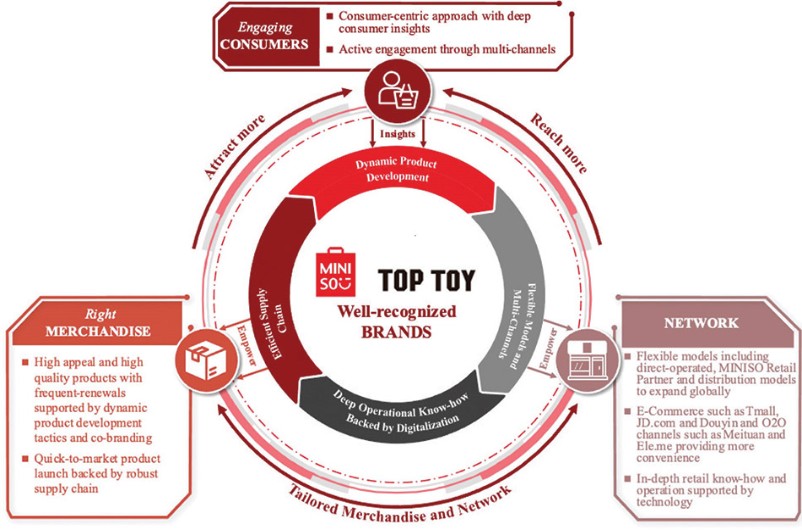
The following is a flow chart illustrating the business flows of our key business functions:

84
Our Products
Our flagship brand “MINISO” offers a frequently-refreshed assortment lifestyle products covering diverse consumer needs, and consumers are attracted to our products’ trendiness, creativeness, high quality and affordability. Our MINISO product offering encompassed over 12,600 core SKUs in the fiscal year ended December 31, 2024 across 11 major categories: home decor, small electronics, textile, accessories, beauty tools, toys, cosmetics, personal care, snacks, fragrance and perfumes, and stationery and gifts. In December 2020, we launched a new brand, “TOP TOY,” which is committed to building our platform of pop toys. Under the fast-growing TOP TOY brand, we offered around 11,100 SKUs as of December 31, 2024 across major categories: blind boxes, toy bricks, model figures, model kits, collectible dolls, Ichiban Kuji, and other popular toys.
We are able to deliver our value propositions by leveraging our supply chain capabilities that are built on China’s large supply chain, our large procurement volumes, our punctual payment to suppliers, and our digitalized, continuously optimized supply chain, which collectively contribute to our overall supply chain efficiency and procurement cost advantages.
Our philosophy is to launch approximately 100 new MINISO SKUs, every 7 days, carefully selected from a large library of 10,000 product ideas, which we refer to as the “711 philosophy.” In 2024, we launched an average of over 1,180 SKUs per month under our MINISO brand, and offered consumers a wide selection of over 12,600 core SKUs. Under the TOP TOY brand, we offered around 11,100 SKUs as of December 31, 2024. In general, our products are frequently refreshed to satisfy the evolving needs and preferences of consumers.
In 2024, around 90% of the MINISO products had retail prices under RMB50 in China. TOP TOY products have a wide range of retail prices and approximately 67% of the TOP TOY products had retail prices ranging from RMB40 to RMB300 in China in 2024.
We adopt a cost plus mark-up pricing strategy for products we sell. The products we sell are manufactured by third-party manufacturers. We set prices for the products to be sold to customers based on manufacturing costs plus a mark-up. As a result, the level of our gross profit margin is dependent on the level of mark-ups we added on top of costs we incurred.
Brand strategies
We sell the vast majority of our products under our flagship brand “MINISO,” which targets primarily the younger generation. Under this brand, we aim to deliver a wide range of lifestyle products that are high-quality and highly affordable. Almost all of the MINISO products are self-developed. To attract and keep the interest of consumers, we update our MINISO product portfolio frequently with new and trendy products. With our “711 philosophy” for our product rollout under the MINISO brand, every 7 days, we aim to launch approximately 100 new MINISO SKUs carefully selected from a large library of 10,000 product ideas. In 2024, we launched an average of over 1,180 SKUs under the MINISO brand per month.
We have developed and incubated new brands rapidly and successfully, such as the “TOP TOY” brand we launched in December 2020 to pioneer the concept of pop toy collection stores. TOP TOY provides a one-stop shopping platform for consumers attracted to pop culture through its cultivation of independent design teams and artists, incubation of IPs, and promotion and spreading of pop culture through its pop toy product line. TOP TOY’s expansion of the concept of pop toys from blind boxes to other major categories has also distinguished itself from other pop toy brands in China. In comparison to the MINISO brand, TOP TOY has a product lineup more focused on trendy products, targets a consumer demographic that is wider in terms of age and more balanced in terms of gender distribution, relies more on cultivation of our own IPs to co-develop them into popular IP products with independent design artists, and has a much wider product price range and higher average order value. While products of third-party brands are still the majority of the TOP TOY product portfolio, we have steadily increased and will continue to increase the proportion of TOP TOY-brand products. Sales contribution from TOP TOY self-developed products was around 37% in 2024, compared to 34% in 2023 and we plan to further increase this ratio in the future.
Product design and development
Popular and well-designed products that respond to evolving consumer tastes and needs are the core attraction to our consumers, and our product design and development capabilities are instrumental to us continuing to maintain this core attraction.
85
Product design capabilities
We work with both in-house designers and independent design teams globally to create innovative design concepts for us. As of December 31, 2024, we had a designer network that includes an in-house team of over 300 designers as well as 18 design teams consisting of internationally renowned independent designers, professional design studios and design academies from 5 countries and regions. To integrate the design capabilities of these design teams with our own, we have established the MINISO Design Academy consisting of a selection of our in-house designers. The MINISO Design Academy is mainly responsible for liaising with third-party designers and adding visual and packaging designs to the product prototype designs submitted by design teams, so that the final products have consistent appearance as the rest of our branded products. The vast majority of our SKUs feature elements of designs by our in-house design team.
We generally enter into form agreements with independent designers, artists and professional design studios. We generally pay a design service fee for each design we engage our design teams to make either as a fixed sum or as a percentage of its sales revenue, subject to a pre-agreed cap, and we generally own all intellectual property rights relating to the design. We sometimes allow the design teams to receive a small percentage of the sales revenue from products featuring their design in addition to the design service fee when the product sales exceed a certain threshold. The design teams are liable for any disputes, controversies or claims arising out of or in connection with the design concepts. Our agreements with these design teams typically have a term of not more than three years.
As for design academies, we generally pay a fee as stated in the collaboration agreements to support the training and design of students in the academies. In return, we may be granted intellectual property rights of the designs, or pre-emption rights to acquire intellectual property rights.
As a testament to our excellence in product design, we had won a total of 32 reputable international design awards as of December 31, 2024, including iF Product Design Awards, Red Dot Design Awards, European Product Design Awards, K-Design Awards, A’ Design Awards, Red Star Design Awards and Superior Taste Awards.
Product development
The collective efforts among product managers, designers and suppliers help us achieve dynamic product development. As of December 31, 2024, we had a team of over 200 product managers, who are responsible for identifying trends, co-creating product designs, coordinating with suppliers on production and bringing the finished products to market. Our product development process begins with a product idea identified by our product managers from market research and inputs from suppliers. The product managers collaborate with our designers in developing the product idea to concrete product design, and then present the design to our suppliers for their inputs regarding production feasibility. Our product managers work closely with our designers and suppliers in product design to ensure that our product designs are innovative, trendy, feasible and appealing to mass consumers. The product managers then have the suppliers produce product prototypes and present them as part of the product proposal to our rigorous weekly merchandising committee meetings for approval. If approved, the product design will be further refined based on cooperation among the product managers, the designers and the suppliers before it is manufactured and becomes ready for sale.
Our technology capabilities play an important role in our product development process. For example, our Smart Merchandise Selection Assistant enables us to monitor and discover popular hits on major social media platforms and automate rapid identification of new and emerging trends, which maximize our ability to react quickly to rapidly changing consumer tastes and preferences. Our technology capabilities also allow us to monitor sales performance and consumer feedback of each SKU closely, helping us to actively manage product life cycles and continuously improve existing SKUs. See “—Technology Capabilities—Digitalized supply chain management—Product lifecycle management system.”
We hold weekly merchandising committee meetings to adjust our merchandising strategies for market trends and select new SKUs to bring to market, with rigorous SKU selection criteria and deep involvement of our chairman and other experienced senior management. In certain international markets, we also have localized merchandising strategies supported by collaboration among our product managers, local suppliers and our international operation teams, and we tend to source uniquely local products directly from local sources. As a result, our new SKUs are responsive to prevailing market needs and local consumer tastes and preferences.
86
Co-branding collaborations and co-development of IP products
Co-branding with IP licensors is another example of our efforts to frequently refresh our product assortment. During the course of our business operations, we have developed an approach to collaborating with highly popular IP licensors in developing co-branded products. We believe these co-branding collaborations are a strong testimony to our brand value and elevate our brand equity and awareness by unlocking new possibilities of product design. In addition, we actively explore co-branding collaboration with IP licensors that resonate with a broad group of consumers globally. By orchestrating well-paced product launch plans, we release new co-branded product collections in a successive and coherent manner to maximize consumer reach.
We had established co-branding relationships with multiple IP licensors who own a number of popular brands such as Disney, Sanrio and Universal. The terms and conditions of our agreements with IP licensors vary as they are typically based on form agreements provided by the licensors. However, our agreements with IP licensors typically have a term of not more than three years. Under these agreements, we are licensed to manufacture, sell and promote co-branded products within licensed territories and we may not reassign such rights to any third party without the approval of the IP licensors. The royalties we are obligated to pay our IP licensors typically consist of fixed minimum of royalties and royalties equal to a certain percentage of sales of co-branded products. None of the agreements between our IP licensors and us constitutes a material contract. The co-branding collaborations allow us to capitalize on cultural phenomena or influential trends in mass media by featuring their elements in our product design, adding exciting diversity to our products and attracting more consumers to MINISO stores as a result.
We have also developed the ability to identify and cultivate new IPs and co-develop them with independent design artists into popular IP products, mostly under our TOP TOY brand. We form close collaboration with talented independent design artists by empowering them with scalable sales channels, real-time consumer feedback, as well as strong supply chain capabilities, which help turn their design ideas efficiently and faithfully into products. Contractually, we retain ownership of the IPs co-developed with independent design artists.
Our Store Network
As of December 31, 2024, we served consumers primarily through a network of about 7,500 MINISO stores, including over 4,300 MINISO stores in mainland China and approximately 3,100 MINISO stores overseas. The following table shows the number of MINISO stores in mainland China and internationally as of the dates presented:
|
|
As of June 30, |
|
As of December 31, |
||||||
|
|
2022 |
|
2023 |
|
2022 |
|
2023 |
|
2024 |
Number of MINISO stores |
|
|
|
|
|
|
|
|
|
|
Mainland China |
|
3,226 |
|
3,604 |
|
3,325 |
|
3,926 |
|
4,386 |
– Directly operated stores |
|
14 |
|
15 |
|
16 |
|
26 |
|
25 |
– Stores operated under MINISO Retail Partner model |
|
3,195 |
|
3,569 |
|
3,290 |
|
3,878 |
|
4,335 |
– Stores operated under distributor model |
|
17 |
|
20 |
|
19 |
|
22 |
|
26 |
Overseas |
|
1,973 |
|
2,187 |
|
2,115 |
|
2,487 |
|
3,118 |
– Directly operated stores |
|
133 |
|
176 |
|
153 |
|
238 |
|
503 |
– Stores operated under MINISO Retail Partner model |
|
208 |
|
252 |
|
246 |
|
283 |
|
404 |
– Stores operated under distributor model |
|
1,632 |
|
1,759 |
|
1,716 |
|
1,966 |
|
2,211 |
Total |
|
5,199 |
|
5,791 |
|
5,440 |
|
6,413 |
|
7,504 |
The following table shows the number of TOP TOY stores globally as of the dates presented:
|
|
As of June 30, |
|
As of December 31, |
||||||
|
|
2022 |
|
2023 |
|
2022 |
|
2023 |
|
2024 |
Number of TOP TOY stores |
|
97 |
|
118 |
|
117 |
|
148 |
|
276 |
– Directly operated stores |
|
7 |
|
9 |
|
8 |
|
14 |
|
40 |
– Stores operated under MINISO Retail Partner model |
|
90 |
|
109 |
|
109 |
|
134 |
|
236 |
87
MINISO and TOP TOY stores are neatly organized, well maintained and typically in optimal locations. The standardized layout, decoration and lighting, modestly priced products, and the friendly staff in a MINISO store all contribute to a welcoming ambience for store visitors, who will find the store easy to navigate due to its optimized product arrangement and display. Such standardized store presentation scheme leads to a consistent, distinct style and shopping experience across MINISO stores, reinforcing a uniform brand image to consumers. In our TOP TOY stores, we organize pop toy workshops and shows where consumers can simply enjoy and have fun, bringing consumers an immersive, engaging shopping experience.
We manage the potential competition or cannibalization among (1) MINISO Retail Partners and distributors; and (2) all stores operated by us, MINISO Retail Partners and distributors primarily through the following measures: (i) Apart from directly-operated stores, stores in each country are primarily operated under the same model. In China, substantially all stores except those in Tibet are operated by MINISO Retail Partners. In overseas markets, except for stores in a few countries directly operated by us, the vast majority of stores are operated under the distributor model. This prevents competition or cannibalization between MINISO Retail Partners and distributors; (ii) In most countries and regions outside China, other than directly-operated stores, stores are operated by one distributor in each country or region or a few distributors operating in different parts of a country or region, which prevents competition or cannibalization among distributors; (iii) We centrally manage and plan for new store openings based on a variety of factors such as the population, economic conditions and market potential of each city, region and country. New store openings by MINISO Retail Partners and distributors and the location of the new stores are subject to our approval. We make recommendations to MINISO Retail Partners and distributors based on the existing store network, the financial strength of the relevant MINISO Retail Partners or distributors, and the local market conditions, taking into account and aiming to minimize the potential competition or cannibalization among stores operated by us, MINISO Retail Partners and distributors.
With respect to the retail sales of the different channels, without taking into account the effect of value-added tax, or VAT, and sales taxes, (i) with MINISO Retail Partners, we set an agreed percentage of in-store sales proceeds payable by MINISO Retail Partners to us; (ii) with distributors, we generate revenue from sales to distributors, and the price at which we sell to distributors is usually a percentage of the price at which the distributors sells the same products to end customers; and (iii) with our directly operated stores and online sales channels, as we sell directly to end customers, substantially all of the total sales proceeds generated from these channels are retained by us.
88
Store operations in mainland China
As of December 31, 2024, apart from 528 directly operated MINISO stores and 40 directly operated TOP TOY stores, substantially all of our other MINISO and TOP TOY stores in mainland China were operated under our MINISO Retail Partner model. The following table shows the aggregate numbers of MINISO stores in mainland China for the periods indicated:
|
|
For the fiscal year ended |
|
For the six months |
|
For the year ended |
||||||
|
|
June 30, |
|
ended December 31, |
|
December 31, |
||||||
|
|
2022 |
|
2023 |
|
2022 |
|
2023 |
|
2023 |
|
2024 |
Directly operated stores: |
|
|
|
|
|
|
|
|
|
|
|
|
Number of stores at the beginning of the period |
|
5 |
|
14 |
|
14 |
|
15 |
|
16 |
|
26 |
Number of new stores opened during the period |
|
13 |
|
7 |
|
5 |
|
13 |
|
15 |
|
10 |
Number of closed stores during the period (2) |
|
4 |
|
6 |
|
3 |
|
2 |
|
5 |
|
11 |
Net (decrease)/ increase in number of stores during the period |
|
9 |
|
1 |
|
2 |
|
11 |
|
10 |
|
(1) |
Number of stores at the end of the period |
|
14 |
|
15 |
|
16 |
|
26 |
|
26 |
|
25 |
Stores operated under MINISO Retail Partner model: |
|
|
|
|
|
|
|
|
|
|
|
|
Number of stores at the beginning of the period |
|
2,919 |
|
3,195 |
|
3,195 |
|
3,569 |
|
3,290 |
|
3,878 |
Number of new stores opened during the period(1) |
|
477 |
|
546 |
|
213 |
|
412 |
|
745 |
|
756 |
Number of closed stores during the period (1)(2) |
|
201 |
|
172 |
|
118 |
|
103 |
|
157 |
|
299 |
Net increase in number of stores during the period |
|
276 |
|
374 |
|
95 |
|
309 |
|
588 |
|
457 |
Number of stores at the end of the period |
|
3,195 |
|
3,569 |
|
3,290 |
|
3,878 |
|
3,878 |
|
4,335 |
Stores operated under distributor model: |
|
|
|
|
|
|
|
|
|
|
|
|
Number of stores at the beginning of the period |
|
15 |
|
17 |
|
17 |
|
20 |
|
19 |
|
22 |
Number of new stores opened during the period |
|
3 |
|
3 |
|
2 |
|
2 |
|
3 |
|
4 |
Number of closed stores during the period (2) |
|
1 |
|
— |
|
— |
|
— |
|
— |
|
— |
Net increase in number of stores during the period |
|
2 |
|
3 |
|
2 |
|
2 |
|
3 |
|
4 |
Number of stores at the end of the period |
|
17 |
|
20 |
|
19 |
|
22 |
|
22 |
|
26 |
| (1) | The number of MINISO Retail Partner-operated stores that opened or closed during the period/year excluded the movement of stores resulting from relocation or upgrade. |
| (2) | The closure of MINISO stores was due to various reasons, including the expiration of store leases, increases in rental costs, changes in the layout of the shopping malls where the stores were located, the unprofitability of certain stores, and closures initiated by MINISO Retail Partners or distributors for other considerations. |
Our ability to penetrate into various tiers of cities is evidenced by our proven track record of successfully penetrating into various lower-tier cities in mainland China despite our previous experience operating in mostly high-tier Chinese cities. The following table shows the aggregate numbers of MINISO stores in mainland China by city-tiers for the periods indicated:
|
|
As of June 30, |
|
As of December 31, |
||||||
|
|
2022 |
|
2023 |
|
2022 |
|
2023 |
|
2024 |
Number of MINISO stores in mainland China |
|
|
|
|
|
|
|
|
|
|
First-tier cities |
|
466 |
|
474 |
|
453 |
|
522 |
|
587 |
Second-tier cities |
|
1,377 |
|
1,496 |
|
1,395 |
|
1,617 |
|
1,822 |
Third- or lower-tier cities |
|
1,383 |
|
1,634 |
|
1,477 |
|
1,787 |
|
1,977 |
Total |
|
3,226 |
|
3,604 |
|
3,325 |
|
3,926 |
|
4,386 |
We had grown the number of TOP TOY stores in mainland China from 97 as of June 30, 2022 to 118 as of June 30, 2023, 148 as of December 31, 2023 and further to 272 as of December 31, 2024. Among the 272 TOP TOY stores as of December 31, 2024, 38 were directly operated, and 234 were operated under the MINISO Retail Partner Model. TOP TOY has also begun to expand to overseas markets since 2024. This strategic move aligns with our plan to expand globally and strengthen our brand presence. As of December 31, 2024, we had a total of 276 TOP TOY stores.
89
The MINISO Retail Partner model is a hybrid store operation model that takes advantageous elements from the franchise store model and the self-operated chain store model, both of which are industry norms. Under this model, we provide operational guidance in the form of store management and consultation services to MINISO Retail Partners, operating in an asset-light manner.
Under our MINISO Retail Partner model, MINISO Retail Partners mobilize their resources to open and operate stores at optimal locations, shouldering the associated capital expenditure and operating expenses. On the other hand, we provide store management and consultation services to MINISO Retail Partners for a fee, retain store inventory ownership until in-store sale to consumers and receive a pre-agreed portion of the sales proceeds. The store management and consultation services optimize and unify store operations in key aspects, mainly including store layout and decoration, interior design, staff training, pricing, product curation and inventory replenishment, to maintain consistent brand image, consumer experience and product pricing across stores. While these key aspects of store operations are standardized, merchandise mix and product display are two primary aspects of store operations that can be customized by MINISO Retail Partner stores. We constantly monitor the operations of MINISO Retail Partner stores to help them customize merchandise mix and product display at a store level and advise on inventory management on a real-time basis. In general, managers of each store examine and record on the system inventories when they arrive at the stores, and the system records are automatically updated upon the sale of products when store cashiers scan the products. Our MINISO Retail Partners generally examine the inventories held at their stores on a monthly basis, the results of which are recorded on our system and available to us for review. We also conduct comprehensive examinations of inventories for all MINISO Retail Partner-operated stores at least once a year, checking against system data and recording updates as appropriate. Our contractual agreements with MINISO Retail Partners, which include a sales agreement, license agreement, and a store renovation agreement, typically last for three years or less.
Below is a summary of the key contractual terms with our MINISO Retail Partners:
Payments for goods. We set an agreed percentage of in-store sales proceeds payable by MINISO Retail Partners to us, while the MINISO Retail Partners keep the remaining in-store sales proceeds. For most of MINISO Retail Partners, sales proceeds generated from the stores they operate are deposited in an escrow account with a commercial bank, which will automatically fund the relevant portions to our account and the account of MINISO Retail Partners based on pre-agreed percentage between MINISO Retail Partners and us. We check sales proceeds data against bank account information on a daily basis.
Management of stores. Under our license agreements, we provide store management and consultation service to our MINISO Retail Partners in return for a store management and consultation services fee and a sales-based royalty, each equal to a low single-digit percentage of in-store sales proceeds, payable by MINISO Retail Partners at the close of every business day. MINISO Retail Partners pay for store operating expenses, including logistics costs from product delivery to their stores.
Term/duration. The terms of our contracts with MINISO Retail Partners are generally not more than three years and renewable upon negotiation prior to the termination of the agreement.
Termination. Prior to expiration of contractual term, these agreements can typically be terminated under force majeure events, by mutual agreement or due to bankruptcy or certain breaches of contractual obligations by either party, such as failure to pay fees due, assignment of contractual rights without the other party’s permission, MINISO Retail Partner selling counterfeit products or products not procured from us in its store, and MINISO Retail Partner not opening a store within an agreed time frame.
Location and renovation. MINISO Retail Partners are not able to open stores at a non-designated location. We recommend providers for store renovation and decoration for the MINISO Retail Partners, with the associated costs being borne by them.
Product offering and pricing. MINISO Retail Partners shall only offer products supplied by us. They are able to set the retail price of the products to be sold in store within five percent of the price recommended by us for the same products with our written consent.
90
Licensing rights. MINISO Retail Partners are not able to have sub-contractors or sub-distributors or otherwise assign the rights under the licensing agreements to a third party without our prior written consent. A fixed annual license fee of between RMB0 and RMB100,000 is to be paid by MINISO Retail Partners on a per-store basis. We may charge certain MINISO Retail Partners who own multiple MINISO stores at a preferential rate. We may waive certain license fees for MINISO Retail Partners who operate a large number of stores.
Inventory. The goods we dispatch to MINISO Retail Partners’ premise for sale are under our inventory ownership until the goods are sold to consumers. In general, we do not have any obligation or practice to accept any return of unsold products, except in rare cases such as a latent defect that is spotted before putting on the shelf or wears and tears of unsold products resulting from transportation, which is in line with industry practice. MINISO Retail Partners are generally required to place an inventory deposit with us, which generally covers the estimated maximum value of inventories held by the relevant MINISO Retail Partners at their stores at a point of time during the period of time in which they act as our MINISO Retail Partners. Generally, inventory deposits are returned to MINISO Retail Partners upon the termination of their relationship with us. We may deduct from the deposit unsettled amounts payable by the MINISO Retail Partners to us, if any, under the relevant agreements.
We usually choose MINISO Retail Partners with financial strength and strong local ties who can secure optimal locations for new stores, with our other main criteria for selecting MINISO Retail Partners being their management ability and industry experience. Most of our MINISO Retail Partners are individuals and many of our large MINISO Retail Partners are experienced retailers who own and operate retail stores in various sectors, such as apparel, cosmetics, lifestyle products and others. We have demonstrated a proven track record to rapidly build up our store network in tier-one and tier-two cities in China and successfully penetrate into lower-tier cities with our newly opened MINISO stores mainly located in lower-tier cities in China. Following the trajectory of our MINISO store network, we have typically positioned our new TOP TOY stores in core commercial areas in first- and second-tier cities since China at the inception of the TOP TOY brand. We verify the potential MINISO Retail Partners’ financial strength by examining the content and status of their lease agreements for the store locations and monitoring whether they pay all upfront deposits on time.
As of the date of this annual report, to our knowledge, substantially all of our MINISO Retail Partners in mainland China are independent third parties, except for one partner that constitutes a related party to us due to significant influence by Mr. Guofu Ye. We are the seller of products in our relationship with MINISO Retail Partners. We believe that our sales to MINISO Retail Partners reflected genuine market demand and there was effective management and control over the inventory levels. We recognize revenue from product sales to MINISO Retail Partners when they sell the products to end-customers in their own MINISO or TOP TOY stores. We do not impose a minimum purchase or sale target on our MINISO Retail Partners.
We plan to focus on establishing and reinforcing the recognition of the TOP TOY brand and expanding our TOP TOY store network mostly in higher-tier cities in mainland China in the near future while also expanding into lower-tier cities.
The MINISO Retail Partner model represents a mutually beneficial relationship between us and the MINISO Retail Partners, where we achieve rapid store network expansion with consistent brand image and consumer experience in an asset-light manner, and our MINISO Retail Partners attain attractive investment opportunities. Our MINISO Retail Partners are also motivated to maintain a loyal relationship with us.
91
The following table shows the number of our MINISO Retail Partners that invested in MINISO stores in mainland China for the period/year indicated:
|
|
|
|
|
|
|
|
|
|
|
|
|
|
|
For the fiscal year ended |
|
For the six months ended |
|
For the year ended |
||||||
|
|
June 30, |
|
December 31, |
|
December 31, |
||||||
|
|
2022 |
|
2023 |
|
2022 |
|
2023 |
|
2023 |
|
2024 |
Number of MINISO Retail Partners at the beginning of the period/year(1) |
|
815 |
|
912 |
|
912 |
|
1,022 |
|
981 |
|
1,049 |
Number of new MINISO Retail Partners during the period/year |
|
177 |
|
216 |
|
147 |
|
79 |
|
148 |
|
161 |
Number of terminated MINISO Retail Partners during the period/year |
|
80 |
|
106 |
|
78 |
|
52 |
|
80 |
|
139 |
Net increase in number of MINISO Retail Partners during the period/year |
|
97 |
|
110 |
|
69 |
|
27 |
|
68 |
|
22 |
Number of MINISO Retail Partners at the end of the period/year |
|
912 |
|
1,022 |
|
981 |
|
1,049 |
|
1,049 |
|
1,071 |
Notes:
| (1) | The number of MINISO Retail Partners at a given date is calculated based on the number of individuals and entities with effective contractual relationships with us on that date. |
As of December 31, 2024, of all 1,071 MINISO Retail Partners which invested in MINISO stores, 626 of them had invested for over three years.
We only had one distributor for the MINISO brand in Tibet in China during the fiscal years ended June 30, 2022 and 2023, the six months ended December 31, 2023 and the years ended December 31, 2023 and 2024. As of the date of this annual report, there has been no conversion of our collaboration partners in mainland China from a MINISO Retail Partner to a distributor, or vice versa.
Our TOP TOY stores are operated under the MINISO Retail Partners model as well. We had 9, 18, 42 and 64 MINISO Retail Partners operating TOP TOY stores as of June 30, 2022 and 2023 and December 31, 2023 and 2024, respectively. Some MINISO Retail Partners in mainland China may invest in both MINISO and TOP TOY stores.
Overseas store operations
We have adopted flexible store operation models, including direct operation, MINISO Retail Partner model and the distributor model as we expand our global footprints, depending on the growth potential, local regulation and other factors in the markets. In consideration of the evolving local regulatory requirements, market conditions and their operational needs, our overseas franchisees may sometimes convert from a MINISO Retail Partner to a distributor, or vice versa.
92
As of December 31, 2024, in international markets under MINISO brand, there were 503 stores directly operated by us and over 2,600 MINISO Retail Partner stores and stores under the distributor model. As of the date of this annual report, to our knowledge, except for two distributors that are our equity investees, all of our overseas Retail Partners and distributors are independent third parties. For each of the fiscal years ended June 30, 2022 and 2023, the six months ended December 31, 2023 and the years ended December 31, 2023 and 2024, the respective transaction amount with these two distributors accounted for insignificant percentages of our total revenue. The following table shows the aggregate numbers of MINISO stores in overseas markets for the periods indicated:
|
|
For the fiscal year ended |
|
For the six months ended |
|
For the year ended |
||||||
|
|
June 30, |
|
December 31, |
|
December 31, |
||||||
|
|
2022 |
|
2023 |
|
2022 |
|
2023 |
|
2023 |
|
2024 |
Directly operated stores |
|
|
|
|
|
|
|
|
|
|
|
|
Number of stores at the beginning of the period |
|
127 |
|
133 |
|
133 |
|
176 |
|
153 |
|
238 |
Number of new stores opened during the period |
|
26 |
|
76 |
|
39 |
|
87 |
|
124 |
|
279 |
Number of closed stores during the period(1) |
|
20 |
|
33 |
|
19 |
|
25 |
|
39 |
|
14 |
Net increase in number of stores during the period |
|
6 |
|
43 |
|
20 |
|
62 |
|
85 |
|
265 |
Number of stores at the end of the period |
|
133 |
|
176 |
|
153 |
|
238 |
|
238 |
|
503 |
Stores operated under MINISO Retail Partner model |
|
|
|
|
|
|
|
|
|
|
|
|
Number of stores at the beginning of the period |
|
195 |
|
208 |
|
208 |
|
252 |
|
246 |
|
283 |
Number of new stores opened during the period |
|
18 |
|
69 |
|
45 |
|
55 |
|
79 |
|
145 |
Number of closed stores during the period(1) |
|
5 |
|
25 |
|
7 |
|
24 |
|
42 |
|
24 |
Net increase in number of stores during the period |
|
13 |
|
44 |
|
38 |
|
31 |
|
37 |
|
121 |
Number of stores at the end of the period |
|
208 |
|
252 |
|
246 |
|
283 |
|
283 |
|
404 |
Stores operated under distributor model |
|
|
|
|
|
|
|
|
|
|
|
|
Number of stores at the beginning of the period |
|
1,488 |
|
1,632 |
|
1,632 |
|
1,759 |
|
1,716 |
|
1,966 |
Number of new stores opened during the period |
|
239 |
|
314 |
|
156 |
|
247 |
|
405 |
|
402 |
Number of closed stores during the period(1) |
|
95 |
|
187 |
|
72 |
|
40 |
|
155 |
|
157 |
Net increase in number of stores during the period |
|
144 |
|
127 |
|
84 |
|
207 |
|
250 |
|
245 |
Number of stores at the end of the period |
|
1,632 |
|
1,759 |
|
1,716 |
|
1,966 |
|
1,966 |
|
2,211 |
| (1) | The closure of MINISO stores was due to various reasons, such as expiration of store leases, increases in store rental, changes in the layout of shopping malls where the stores are located, unprofitableness of certain stores, and closure by MINISO Retail Partners or distributors for other considerations, as applicable. |
In the majority of international markets, we expand our store network by collaborating with local distributors with abundant local resources and retail experiences. When selecting local distributors, we prioritize those with financial strength and sufficient resources to open MINISO stores at optimal locations, while also considering the distributor’s management ability and industry experience. Our distributors are primarily corporates, and the nature of the business operation of our distributors is diverse, such as fashion, mobile communication retail, food retail, consulting and household goods retail. Such distributor model is an industry norm and allows us to effectively expand in international markets leveraging the financial resources and market experience of the local distributors.
93
We are the seller of products in our relationship with distributors. We believe that our sales to distributors reflected genuine market demand and there was effective management and control over the inventory levels held by our distributors. In order to mitigate channel stuffing risks, we have adopted stringent control measures, including but not limited to: (i) collecting inventory and sales data from each overseas markets and making quarterly analysis; and (ii) conducting site visits to and inventory examinations of overseas stores. We conduct such data collection, visits and examinations regularly to monitor the sales, inventory levels, and quality control of our distributors. Through these activities, we monitor our distributors’ compliance with the terms and conditions of the relevant agreements and any potential risks in relation to channel stuffing. If we discover non-compliant issues or risks, we conduct further investigation, notify the relevant distributors, work with the distributors to take rectification or mitigation measures, or terminate the distributor relationship. In addition, we generally require our distributors to make advance payments in full for our products. We typically do not accept any return of unsold products, except in rare cases such as a latent defect subject to a product recall, which is in line with industry practice. We also do not impose a minimum purchase or sale target on our distributors. With respect to distributors, our product return rates as a percentage of total GMV during the fiscal years ended June 30, 2022 and 2023, the six months ended December 31, 2023 and the years ended December 31, 2024 were close to zero. We have maintained generally stable and healthy relationships with our distributors. We recognize revenue from product sales to distributors when the products are shipped from or delivered to the locations specified in our sales agreements with the distributors, at which point the distributors take ownership of the products and assume the risk of loss.
Under the distributor model, we typically enter into a license agreement and a sales agreement with each of our local distributors. Below is a summary of the key contractual terms with our distributors:
Product offering and pricing. We grant our local distributors an exclusive right to establish MINISO stores in certain licensed territories. Our local distributors also have pricing right over the inventory sold in store, although we normally have contractual terms that allow us to recommend product pricing. Without our written consent, our local distributors are not allowed to sell in the licensed MINISO stores any products that are not our MINISO branded products. Our local distributors can only sell our products through licensed MINISO stores within licensed territories, any breach of such license will entitle us to terminate the sale agreement with such local distributor and claim damages.
Intellectual property rights. In order to maintain a consistent brand image and a minimum level of monitoring of the operations of MINISO stores operated by our local distributors, we license our local distributors to use our intellectual property rights such as brand name and trademarks in the licensed territories in a manner pursuant to the license agreements such as no further sublicense of our intellectual properties and using such intellectual properties without prejudicing our rights to such intellectual properties. Any breach of such intellectual property license provisions may be deemed to be a material breach.
License fee. We typically charge a fixed amount of license fee between RMB0 and RMB1,000,000 for each MINISO store opened under distributor model in overseas market. The license fees for our distributors are determined based on various factors, including but not limited to location of the store, local economic conditions and number of stores the relevant distributor owns. The license fees for our distributors are normally a one-off payment. We may grant preferential license fees to distributors who operate multiple stores. We may waive license fees for distributors who operate a large number of stores and/or with whom we have had a long-term relationship.
Obligations of distributors. We require our local distributors to deposit with us a compliance deposit to ensure that our local distributors perform their obligations under the license agreements. The license agreements also set forth certain targets for number of new stores. Failing to meet such targets by our local distributors may be construed as a material breach under the license agreements.
Operational standards and store management. The license agreements set out a set of operational standards for our local distributors to follow and we have the right to supervise the operation of MINISO stores by our local distributors. Though we do not have the same level of operational involvement with the local distributors as we do with MINISO Retail Partners, we provide assistance to them in many ways to ensure consistent store quality, management style and image, which include provision of staff training and other guidance in terms of store operation.
Term. Our license agreements and sales agreements usually have a term of two to ten years. In the event of material breaches by our local distributors, we will be entitled to (i) confiscate the compliance deposit and seek additional damages if the compliance deposit cannot fully cover the losses we incurred, and (ii) unilaterally terminate the license agreements.
94
Sub-licensing. Our distributors typically do not have the right to sub-contract or sub-license their rights under the license agreement without our express written consent. Once we consent, our distributors are generally entitled to choose their sub-contractors or sub-distributors and negotiate the transaction terms directly with them. We typically do not have any contractual relationship with any sub-contractors or sub-distributors and do not control or deal with them directly, as our distributors enter into contractual relationship with and manage their sub-contractors or sub-distributors directly.
Inventory. Generally inventory ownership is transferred to distributors when inventory is shipped from or delivered to the locations specified in sales agreements. In general, we do not have any obligation or practice to accept any return of unsold products, except in rare cases such as a latent defect subject to a product recall.
The distributor model differs from the MINISO Retail Partner model in a few key facets. Operationally, although we have the right to supervise the operation of distributor stores to ensure that they adhere to certain operational standards, we do not provide store management and consultation services to distributors and have less operational involvement with them. In terms of product sales, generally inventory ownership is transferred to distributors when inventory is on board, while we retain inventory ownership until in-store sale to consumers under the MINISO Retail Partner model. In our agreements with MINISO Retail Partners, there is no equivalent to the performance targets in our license agreements with distributors, which usually specify the number of MINISO stores the distributors must open and successfully operate in their licensed territory within an agreed time frame.
In strategic markets with large population and huge market potential such as North America, we typically enter the markets by opening and operating stores on our own, which are meant to serve as pioneer stores in the region. In this way, we can more efficiently and directly gain local consumer insights and operational know-how. When local business partners become interested after seeing the performance of our pioneer stores, we invite some of them to join under our MINISO Retail Partner model or distributor model to more rapidly expand our store network in these markets.
The following table shows the number of our distributors in overseas markets for the periods indicated:
|
|
For the fiscal year ended |
|
For the six months ended |
|
For the year ended |
||||||
|
|
June 30, |
|
December 31, |
|
December 31, |
||||||
|
|
2022 |
|
2023 |
|
2022 |
|
2023 |
|
2023 |
|
2024 |
Number of distributors at the beginning of the period(1) |
|
170 |
|
200 |
|
200 |
|
229 |
|
212 |
|
230 |
Number of new distributors during the period(2) |
|
42 |
|
42 |
|
25 |
|
8 |
|
25 |
|
61 |
Number of terminated distributors during the period(2) |
|
12 |
|
13 |
|
13 |
|
7 |
|
7 |
|
39 |
Net increase in number of distributors during the period |
|
30 |
|
29 |
|
12 |
|
1 |
|
18 |
|
22 |
Number of distributors at the end of the period(1) |
|
200 |
|
229 |
|
212 |
|
230 |
|
230 |
|
252 |
| (1) | Number of distributors at a given date is calculated based on the number of individuals and entities with effective contractual relationships with us at that date. |
| (2) | Change of contracting entities by the same distributor is not taken into account in the calculation of numbers of new or terminated distributors. |
As of June 30, 2022 and 2023 and December 31, 2023 and 2024, we had 31, 61, 78 and 114 MINISO Retail Partners in overseas markets, respectively. The increase in the number of MINISO Retail Partners as of June 30, 2023 was primarily due to the increase in the number of MINISO Retail Partners in Vietnam and Indonesia. The increase in the number of MINISO Retail Partners as of December 31, 2024 was primarily due to the increase in the number of MINISO Retail Partners in Indonesia.
Our Supply Chain
Our supply chain capabilities allow us to offer an evolving assortment of quality products at exceptional value.
95
Our supplier network
As of December 31, 2024, we sourced from approximately 1,800 suppliers, who are qualified manufacturers in China or other countries and regions, with some having extensive experience in supplying to other global brands. We involve our suppliers throughout our supply chain process, from product design to product shipment. In the product design stage, our product managers will solicit our suppliers’ input and feedback on preliminary product designs. After a product is launched to market, our suppliers, being digitally integrated into our supply chain management system, will manufacture products based on orders automatically generated by the system based on real-time inventory level and sales data and confirmed by us. When the products are produced, our suppliers in China will generally also manage product shipment from their sites to our warehouses, subject to our instructions as to delivery location and timeliness. This thorough supplier involvement throughout the supply chain process via digital integration, coupled with the close working relationships with qualified suppliers fostered by our large procurement volumes and punctual payments to them, are the key reasons why we can operate an efficient supply chain, maintain a vast portfolio of core SKUs, frequently launch a sizeable number of new SKUs, and maintain competitive cost advantages; we do not rely on agreements with suppliers to achieve these goals.
We carefully nurture our relationship with suppliers and empower them to grow with us and adapt to our changing business needs. We select our suppliers mainly based on their production quality, capacity and reputation and position within their respective industry. None of our suppliers individually supplied more than 10% of our procurements in the fiscal year ended December 31, 2024.
We operate a centralized procurement system when sourcing from our suppliers. We digitally integrate our suppliers and streamline the supply chain process through our SCM (supply chain management) system. To illustrate, assume we are in the process of developing a new series of products and anticipates that our sales volume for the next three months after the launch will reach a certain level based on the sales plan. We will share such plan with our suppliers for this series of products over the SCM system and grant them access to the real-time sales data on the SCM system. The suppliers will then order raw materials and plan for manufacturing and logistics accordingly based on the three-month plan. If, one month after the launch, the suppliers see on the SCM system that the actual sales at our stores exceeded the original estimate, they will promptly adjust their manufacturing timetable and accelerate manufacturing and delivery to meet the higher-than-expected demand. If, on the other hand, the suppliers see that the demand has been lower than expected, as reflected in the real-time sales data on the SCM system, they can also adjust their plans to avoid oversupply and manage inventory risks. On the SCM system, warehouse information such as operation hours and capacity is available, and suppliers are able to reserve warehouse time slots and third-party logistics services as needed. For more information of our warehouses and logistics, see “—Warehouses and logistics.”
We have been strengthening our cooperation with existing qualified suppliers and attracting new capable suppliers. We further optimize our supply chain by regularly providing improvement advice to our suppliers on various production-related areas, including product quality, production efficiency, and cost control, so that supply chain optimization becomes an ongoing process. We have also sent experts to important suppliers to help them optimize production efficiency and cost control on site, among other production related areas.
Our framework agreements with our suppliers are legally binding and typically contain the following salient terms:
Product delivery. Our framework agreements with suppliers usually include terms to ensure that our suppliers will adhere to our delivery instructions, such as those stipulating our suppliers’ obligations to pay liquidated damages for their failure to deliver goods on time.
Quality control. Our framework agreements with suppliers usually include terms that require supplier to obey our quality control standards, such as those stipulating our suppliers’ obligations to compensate us for losses arising from defects in product quality.
Breach of contract. Our framework agreements with suppliers usually include terms of liability for breach of contract, such as that suppliers shall repair, replace, or recall the relevant products according to our requirements and bear the costs incurred thereby for providing products with quality problems.
96
Intellectual property rights. Our framework agreements with suppliers usually include terms to ensure that our suppliers provide products that are free from IP defects including potential infringement of the legitimate rights and interests of any third party. Suppliers’ failure to meet such requirements will entitle us to terminate the agreement with such supplier in certain circumstances and claim damages.
Confidentiality. Our suppliers shall take adequate measures to keep all sensitive information from us strictly confidential. Suppliers and other relevant responsible parties shall be jointly and severally liable for our losses due to unauthorized disclosure of our business secrets and intellectual property information.
Term/duration. Our framework agreements with suppliers are usually of a term of two years.
Production
We outsourced the production of our products to third party manufacturers. Leveraging China’s strong supply chain capabilities in the lifestyle product sector, we sourced our products from approximately 1,800 suppliers as of December 31, 2024. We outsource our products production primarily through the original equipment manufacturer (“OEM”) or original design manufacturer (“ODM”) model, primarily because (i) these suppliers are mostly qualified manufacturers in China, with some having extensive supplying experience in the lifestyle products sector, and thus the OEM/ODM model allows us to optimize the manufacturing capacities and design resources of the suppliers to help our business development, (ii) the OEM/ODM model allows us to meet our demand for rapid product development so that we are able to have more flexibilities to maintain a diverse and frequently refreshed product portfolio, and (iii) the outsourcing arrangements allow us to control and manage product costs and better manage and minimize investment risks. We leverage our design capabilities and participate in product design with both OEMs and ODMs but are generally more deeply involved in the design process with OEMs. As such, we typically use ODMs to directly manage and take charge of the development and design of more standard products as these products require less design efforts from our own product managers and designers; and we typically use OEMs more often for products that require or allow new design ideas and concepts as our product managers and designers can work with OEMs to refine product design and prototype leveraging the manufacturing expertise of OEMs and their inputs on production feasibility. In some cases, we purchase certain products directly from suppliers without participating in the product design process, but the sales contribution of such products in MINISO stores in mainland China was less than 10% during the years ended December 31, 2024.
We select our suppliers based on various factors, but we generally prioritize industry leaders such as those with a long history of operation, a good reputation or publicly listed companies. Other factors considered include, production quality, capacity, price, compliance with applicable laws and regulations, history of cooperation and intention to grow with us and adapt to our changing business needs. For details of the key terms of the agreements with our manufacturers, see “—Our supplier network.”
We have been strengthening our cooperation with existing qualified suppliers and attracting new capable suppliers by regularly providing improvement advice to our suppliers on various production-related matters, including product quality, production efficiency and cost control, so as to constantly optimize our supply chain. We generally manage our relationship with suppliers including third-party manufacturers in the following aspects:
| (i) | Supplier selection. We deploy a series of quality control procedures since the onboarding of our suppliers. Suppliers are required to go through detailed and comprehensive qualification and ability verification. In addition, we have a third-party factory inspection mechanism to conduct quality check and ESG assessment. We have also in place a series of stringent standards such as product quality standards, testing manuals, and supplier quality behavior agreements to conduct quality inspection on our products. |
| (ii) | Quality control. We have in place digitalized quality control systems including a supplier quality control system and a big-data quality risk control system. See “—Technology Capabilities” for details. |
| (iii) | SCM system and lead-time management. We digitally integrate our suppliers and streamline the supply chain process through our SCM system. See “—Our supplier network” for details. |
| (iv) | Product liability. Our framework agreements with our suppliers are legally binding and have terms that ensure our suppliers will adhere to our delivery instructions and quality control standards, such as those stipulating our suppliers’ obligations to pay liquidated damages for their failure to deliver goods on time and to compensate us for losses arising from defects in product quality. |
97
We have adopted measures to prevent the risk of over-reliance on certain product suppliers. Given our diverse product portfolio and frequently refreshed SKUs, currently no supplier has an outsized impact on our business operations. We believe we have sufficient alternative suppliers for our business that represent alternatives of comparable quality and prices.
Our supply chain management system
We utilize our supply chain management system to maintain close collaboration with our suppliers and deeply integrate them into our product development and inventory management process. Our supply chain management system allows us to plan, manage, monitor and coordinate on every step of the supply chain process, improve inventory management, and shorten order and reorder lead time. For example, the merchandising and procurement module of this system automatically generates orders and reorders of appropriate size to suppliers based on real-time inventory level and store-level sales forecast, streamlining the order and reorder processes. In addition, the automated replenishment module of this system regulates the store-level inventory replenishment process, and calculates just-in-time adjustment among stores for slow-moving SKUs to optimize our network-wide merchandise mix while mitigating inventory risk.
With the help of our supply chain management system, our inventory management is highly efficient, and we had average inventory turnover of 70 days, 69 days, 81 days, 76 days and 91 days in the fiscal years ended June 30, 2022 and 2023, the six months ended December 31, 2023 and the years ended December 31, 2023 and 2024, respectively.
Quality control
We have stringent quality assurance and control procedures in place to ensure supplier compliance with our product safety and quality standards. Suppliers have to undergo on-boarding procedures with a rigorous quality screening process before we begin working with them. In addition, our framework agreements with suppliers have clauses that ensure a baseline quality of the products produced by the suppliers, including those related to technical specification, quality specification, inspection standards, and defective product handling. Upon receipt of product shipments from suppliers, we perform quality inspection on random samples to detect any quality issue. We also pay regular visits to our suppliers to ensure that their facilities, equipment and finished products are up to our standards. We also have online quality control systems that visualize our standard quality inspection procedures and allows us to coordinate with our suppliers, MINISO Retail Partners and distributors on detecting and correcting any quality issues.
Warehouses and logistics
As of December 31, 2024, our products were distributed through approximately 35 leased warehouses, around 20 of which were located in China. We distribute products out of each warehouse mostly to nearby markets, while also using some of our warehouses in China to distribute to international markets.
In China, suppliers are generally responsible for delivering products to our warehouses either by themselves or through third-party logistics service providers. Generally, in international markets, a majority of products are from our operation in China, which are delivered to the local warehouses by third-party logistics service providers engaged by us, while a minority of products are from local suppliers, which are delivered by these local suppliers or third-party logistics service providers engaged by them to local warehouses.
Products are distributed from our warehouses to MINISO stores (other than those operated by local distributors) at a frequency depending on demand, and shipments are allocated dynamically based on real-time consumer demand and inventory data.
98
Sales and Marketing
Sales channels
We sell the majority of our products through our extensive offline store network, but we have also started to develop online sales channels, which have become increasingly important. Our sales channels mainly comprise the following:
MINISO stores. As of December 31, 2024, there were approximately 7,500 MINISO stores across the globe, with over 4,300 MINISO stores in mainland China and over 3,100 MINISO stores overseas.
TOP TOY stores. As of December 31, 2024, there were 276 TOP TOY stores, 272 of which were located in mainland China.
Online channels. We supplement our offline store network by accepting online orders via our Weixin mini-programs, online distributors and our online stores on major third-party e-commerce and O2O platforms. Consumers may order products to be delivered from either local MINISO and TOP TOY stores or from our warehouses using either type of these online sales channels.
Marketing and consumer engagement
We believe our wide assortment of trendy, innovative and affordable products are what draw consumers to visit MINISO and TOP TOY stores, and the shopping experience at MINISO and TOP TOY stores also helps turn store visitors into repeat visitors or purchasers. To promote our brand image, we have launched various marketing initiatives, including the appointment of celebrity brand ambassadors and featuring them in promotional material, marketing through video and short-video platforms, and KOL promotion on livestreams, with online and social media-based marketing and promotion efforts being our focus going forward. Specifically, our membership program and store-based consumer community are two marketing and consumer engagement measures that have proved particularly effective in China.
Membership program. We launched our MINISO membership program in mainland China in August 2018. As of June 30, 2022 and 2023, December 31, 2023 and December 31, 2024, the number of MINISO members with at least one purchase over the past 12 months was approximately 36 million, 34 million, 41 million and 46 million, respectively. Our MINISO membership used to be structured in two tiers: premium membership and free membership, with the former requiring a membership fee but also enjoying more membership benefits than the latter. For example, premium members were entitled to special prices for select products and additional discounts on top of promotions both in store and on our Weixin mini-programs. However, we have ceased to accept new premium membership registrations or renewals of such program since March 2023. The term of the premium membership is one year or one month since the registration or renewal. The existing premium members can still enjoy relevant benefits before the expiration of their previously paid premium membership.
The free membership program is the main membership program and is structured in three tiers: golden membership, silver membership and common membership, with accumulating consumption points generated by customers’ purchases and being categorized according to the level of consumption points. For example, all of our members are entitled to coupons available in stores and our Weixin mini-programs and birthday privilege, with the golden membership being granted coupons of higher value.
As of December 31, 2024, the number of TOP TOY members with at least one purchase over the past 12 months was approximately 3 million. The successful implementation of the membership program has driven customer spending. Our membership program also provides valuable consumer data that allow us to personalize our digital marketing efforts and has been key to our multi-channel customer engagement strategy.
Store-based consumer community. MINISO and TOP TOY stores in mainland China generally display a QR code that allows consumers visiting the stores to join the stores’ Weixin groups, which are managed by our specialists. These specialists keep consumers constantly engaged by sharing mainly product-related information and promotion, sometimes in livestreaming format, in these Weixin groups. Consumers who are group participants may be enticed to shop for our products.
99
Technology Capabilities
We have developed an advanced and comprehensive technology system, which lays the foundation for our efficient business development and connects every chain of our business operations including, mainly, supply chain management, store operations, customer engagement, and targeted marketing. Empowered by our highly scalable and effective technology platform, we are able to achieve consistent and centralized store management and rapidly expand our global footprint with consistent quality and localized features.
The chart below illustrates our technology system:

Notes:
| 1. | Intelligent inventory replenishment module; |
| 2. | Zhiku management system (智庫); |
| 3. | Together known as our digitalized supply chain tools for international operation; |
| 4. | Zhizhu Network (知珠網) |
Technology workforce. As of December 31, 2024, over 200 of our employees were engaged in research and development activities, representing around 3% of our total employee number. Among these employees, approximately 11% have master’s degrees or above.
SAP ERP system. At the core of our technology capabilities is our SAP ERP system, which has different modules or sub-systems that connect and manage different aspects of our business operation, including warehouse management, merchandising, sales, consumer and transaction data, human resource and finance. Our other technology systems are integrated with the SAP ERP system, thereby allowing data sharing and better coordination across systems.
Digitalized supply chain management. Our digitalized supply chain management is supported by our supply chain management system, product lifecycle management system, proprietary intelligent inventory replenishment module,
100
digitalized supply chain tools for international operation, proprietary Zhizhu Network (知珠網) and Zhiku Management System (智庫), and online quality control systems.
| ● | Supply chain management system. Our supply chain management system connects us with our suppliers, and it can give suppliers access to certain sales data on our end for better production coordination. By integrating suppliers into our supply chain management process, our supply chain management system also allows us to plan, manage and monitor every step of the supply chain process, leading to improved inventory management and shorten order and reorder lead time. |
| ● | Product lifecycle management system. To facilitate input of design ideas and concepts from store managers and assistants across our store network, we have developed a proprietary module on the product lifecycle system on which frontline workers provide a rich and constant supply of the latest ideas and consumer information that serve as the basis for the next successful product design. In addition, the core processes of product development are digitalized and modularized in the product lifecycle management system through close and efficient collaboration of our designers, product managers, and other participants. The product lifecycle system thus evolves the traditional manufacturing process into a consumer-driven process by connecting the strong manufacturing ability of our large supplier network with our unique customer insights and massive data. |
| ● | Inventory replenishment module. Trained by massive data collected from our SAP ERP system and normalized through a comprehensive process, the algorithms underlying the inventory replenishment module output a demand forecast for a particular inventory unit to ensure healthy levels of stock. Further, by analyzing store location (which affects the number and demographics of store visitors), historical sales, weather, shelf arrangement and store layout, this module also customizes the stock mix of each store to offer a unique mix of choices to consumers. As a result, the inventory replenishment module has helped us significantly enhance the inventory management efficiency of MINISO and TOP TOY stores. |
| ● | Digitalized supply chain tools for international operation. To connect our vast network of international MINISO stores with our supplier base in China, we have developed smart supply chain tools specifically for our international operation, including the MINISO Electronic Ordering System (“EOS”) and the MINISO Ordering System (“MOS”). The EOS serves the “warehouse to warehouse” part of the international supply chain, connecting the warehouses of our international stores with Chinese suppliers through our central management. The MOS digitalizes the “warehouse to store” path, helping stores in various parts of the world manage their inventories. Traditionally, international store operators usually rely on subjective estimates of future sales when placing advance orders and managing inventories and spend substantial amounts of time on offline ordering meetings, often resulting in inefficiencies and wastes. The EOS and MOS systems were designed specifically to solve these pain points with their intelligent sales forecast and ordering recommendations. The systems generate tailor-made sale forecasts based on a comprehensive analysis of past sales, product popularity gauged through online communication channels, marketing plans and other data, and based on such sale forecasts, the systems make ordering recommendations to the stores. |
| ● | Zhizhu Network (知珠網) and Zhiku Management System. Our proprietary Zhizhu Network (which focuses on the international markets) and Zhiku Management System (which focuses on China) enable us to monitor and discover popular hits on major social media platforms and automate rapid identification of new and emerging trends, which maximize our ability to react quickly to rapidly changing consumer tastes and preferences. With natural language processing capabilities embedded, Zhizhu Network and Zhiku Management System can conduct detailed analyses of positive and negative online comments on the large number of products it researches, guiding our product managers and designers in developing and optimizing products to address evolving consumer needs. |
101
| ● | Online quality control systems. Leveraging the SAP ERP system, we have developed digitalized quality control systems: a supplier quality control system and a “big-data quality risk control system.” The supplier quality control system is built into a module within our supply chain management system, and it supports each step of our quality control throughout the product lifecycle, from supplier qualification assessment and research and development quality management to product testing and consumer feedback. The “big-data quality risk control system” collects and analyzes information on potential quality issues from external channels, such as government inspections, consumer complaints and social media, and presents useful data that help us identify and take appropriate actions to address quality problems. |
Digitalized operational capabilities. Leveraging our big data analytics and artificial intelligence (AI) technologies, we have developed strong digitalized operational capabilities to enhance and streamline store operation, which are exemplified by our self-developed mobile intelligent store management tools and AI store monitoring system.
| ● | Mobile intelligent store management tools. Our self-developed mobile intelligent store management tools consist of a merchandise display management system and an AI assistant to store managers. The merchandise display management system is designed to visualize, synchronize and optimize shelf display management at MINISO and TOP TOY stores. By digitalizing the management of merchandise placement in each store, it allows us to centrally and digitally manage and adjust merchandise display in each store, monitor the in-store stock of specific products, and optimize product replenishment. The AI assistant to store managers provide store managers with real-time inventory level, product sales trends, pricing information, and other important store operating metrics and their analytics, empowering the store managers to enhance merchandise management and streamline store operation. It also assists store managers in monitoring stores to ensure precise product curation and standardized staff operations, helping them guide staff performance and deal with store emergencies in a timely manner. |
| ● | AI store monitoring. We have adopted AI image recognition technologies for store management, which facilitate real-time automatic store-level management including store layout check, and order or payment fraud detection, among other things. |
Digitalized consumer engagement and marketing tools. We have invested significantly in digitalizing and enhancing direct consumer engagement by employing intelligent consumer profiling technologies and targeted marketing efforts informed by data analytics.
| ● | Intelligent consumer profiling. We have developed intelligent consumer-profiling technologies to take advantage of the insights derived from our engagement with consumers to create customized consumer profiles to inform our marketing efforts. |
| ● | Targeted marketing. We engage in highly accurate and specialized marketing efforts through various digital channels. Leveraging our big data and AI capabilities, we are able to deliver unique and continuously optimized content, including personalized coupons and product recommendations, to each targeted individual through personalized channels. |
Data Privacy and Security
We are committed to protecting consumers’ personal information privacy and security, and we have an internal team dedicated to handling data privacy and security. We have obtained and implemented a series of policies on data collection, processing and usage, such as a data protection policy, a set of third-party information security guidelines and an incident response policy. We have obtained the ISO/IEC 27001:2013 information security certification and the ISO/IEC 27701:2019 privacy protection certification issued by the British Standards Institution, an internationally renowned standards body. These certifications attest to the sufficiency of our information security and privacy protection measures.
Data protection policies. We have a company-wide data protection policy that sets data protection and security standards internally and regulates the collection, handling, storage and transferring of data pertaining to suppliers, consumers, business partners and employees.
102
Third-party information security guidelines. These guidelines govern how we manage interactions with suppliers and service providers to ensure information security and data protection, and they stipulate the responsibilities, procedures and requirements to be followed by our employees in managing information security and data privacy with suppliers and service providers. These procedures include, but are not limited to, requiring any employee, agent or outsourcing partner of the supplier or service partner to sign a confidentiality agreement that forbids unauthorized disclosure and provides for handling method of any personal data from our side.
Incident response policy. Our incident response policy implements the incident response mandate provided in the data protection policy, describes the incident response plan that has to be followed by relevant personnel through the incident lifecycle, and ensures quick detection and reporting of and response to data leakage incidents.
We currently use third-party clouds to host our network infrastructure. The third-party cloud service providers have extensive encryption protocols and other security measures in place to safeguard our data. To help ensure the confidentiality and integrity of our data, we take comprehensive and rigorous data security measures. We back up our consumer and other forms of personal data on a regular basis to minimize the risk of data loss. We also conduct frequent reviews of our back-up systems to help ensure that they function properly and are well maintained.
We follow strictly the relevant laws and regulations, including the recently promulgated Regulations on the Administration of Cyber Data Security, in collecting the personal information of consumers, and we conduct regular self-inspections and correct any irregularities found to ensure our maximum protection of each consumer’s personal information. Despite the data privacy and security policies and measures adopted, there is no guarantee that advances in technology, the expertise of hackers, new discoveries in the field of cryptography or other events or developments will not result in a compromise or breach of the technology that we use to protect confidential information. See “Item 3. Key Information—D. Risk Factors—Risks Related to Our Business and Industry—Failure to protect personal or confidential information against security breaches could subject us to significant reputational, financial and legal consequences and substantially harm our business and results of operations” for details on our compliance with PRC laws on protection of personal information.
Competition
The global branded variety retail market and pop toy market in China are intensely competitive and fragmented. While we do not believe there are many variety retailers competing with us at the global level, we face fierce competition from variety retailers in local markets. In addition, we also face competition from traditional retailers, including specialty retail stores, supermarkets and department stores, and online retailers, that sell lifestyle and pop toy products.
We believe that we are positioned favorably against our competitors on the basis of (i) our fast-growing store network, (ii) our frequently-refreshed product assortment with universal appeal, (iii) our efficient and digitalized supply chain, (iv) our in-depth know-how and digitalization, which drive our operational excellence, (v) our multi-channel operation and consumer engagement, (vi) our global scalability and capability penetrating into various tiers of cities, and (vii) our experienced founder and entrepreneurial management team. These competitive advantages all contribute to the core value propositions of our products, which remain the key attraction to consumers around the globe. See “Item 3. Key Information—D. Risk Factors—Risks Related to Our Business and Industry—We face intense competition. We may not be able to maintain or may lose market share and consumers if we fail to compete effectively.”
Intellectual Property
We regard our trademarks, domain names, know-how, trade secrets and similar intellectual property as critical to our success, and we rely on trademark and copyright law and confidentiality and non-compete agreements with our employees and others to protect our proprietary rights. We collaborate with IP licensors owning a number of popular brands around the world. We had around 1,122 trademarks, 346 patents, 814 copyrights relating to various aspects of our operations, and approximately 10 registered domain names (including www.miniso.com) in China as of December 31, 2024. In addition, we owned over 1,000 trademarks outside China as of December 31, 2024.
103
Insurance
We consider our insurance coverage to be adequate as we have in place all the mandatory insurance policies required by applicable laws and regulations and in accordance with the commercial practices in our industry. We maintain various insurance policies to safeguard against risks and unexpected events, including property insurance covering inventory and warehouses. We provide social security insurance for our employees as required by PRC law. We do not maintain business interruption insurance, nor do we maintain key-man insurance. See “Item 3. Key Information—D. Risk Factors—Risks Related to Our Business and Industry—We have limited insurance coverage, which could expose us to significant costs” for risk factors relating to our insurance policies.
Regulations
This section sets forth a summary of the most significant rules and regulations that affect our business activities in China and Hong Kong.
Mainland China
Regulation related to foreign investment
The establishment, operation and management of companies in China are mainly governed by the PRC Company Law, as most recently amended in 2018, which applies to both PRC domestic companies and foreign-invested companies. On March 15, 2019, the National People’s Congress approved the Foreign Investment Law, and on December 26, 2019, the State Council promulgated the Implementing Rules of the Foreign Investment Law, or the Implementing Rules, to further clarify and elaborate the relevant provisions of the Foreign Investment Law. The Foreign Investment Law and the Implementing Rules both took effect on January 1, 2020 and replaced three previous major laws on foreign investments in China, namely, the Sino-foreign Equity Joint Venture Law, the Sino-foreign Cooperative Joint Venture Law and the Wholly Foreign-owned Enterprise Law, together with their respective implementing rules. Pursuant to the Foreign Investment Law, “foreign investments” refer to investment activities conducted by foreign investors (including foreign natural persons, foreign enterprises or other foreign organizations) directly or indirectly in the PRC, which include any of the following circumstances: (i) foreign investors setting up foreign-invested enterprises in the PRC solely or jointly with other investors, (ii) foreign investors obtaining shares, equity interests, property portions or other similar rights and interests of enterprises within the PRC, (iii) foreign investors investing in new projects in the PRC solely or jointly with other investors, and (iv) investment in other methods as specified in laws, administrative regulations, or as stipulated by the State Council. The Implementing Rules introduce a see-through principle and further provide that foreign-invested enterprises that invest in the PRC shall also be governed by the Foreign Investment Law and the Implementing Rules.
The Foreign Investment Law and the Implementing Rules provide that a system of pre-entry national treatment and negative list shall apply to the administration of foreign investment, where “pre-entry national treatment” means that the treatment given to foreign investors and their investments at market entry stage is no less favorable than that given to domestic investors and their investments, and “negative list” means the special administrative measures for foreign investment’s entry to specific fields or industries. Foreign investments beyond the negative list will be granted national treatment. Foreign investors shall not invest in the prohibited fields as specified in the negative list, and foreign investors who invest in the restricted fields shall comply with certain special requirements on shareholding and senior management personnel, etc. In the meantime, relevant competent government departments will formulate a catalogue of the specific industries, fields and regions in which foreign investors are encouraged and guided to invest according to the national economic and social development needs. The current industry entry clearance requirements governing investment activities in the PRC by foreign investors are set out in two categories, namely the Special Entry Management Measures (Negative List) for the Access of Foreign Investment (2024 version), and the Encouraged Industry Catalogue for Foreign Investment (2022 version), which were promulgated by the National Development and Reform Commission, or the NDRC, and the Ministry of Commerce, or the MOFCOM, and took effect on November 1, 2024 and on January 1, 2023, respectively. Industries not listed in these two catalogues are generally deemed “permitted” for foreign investment unless specifically restricted by other PRC laws.
104
According to the Implementing Rules, the registration of foreign-invested enterprises shall be handled by the State Administration for Market Regulation, or the SAMR, or its authorized local counterparts. Where a foreign investor invests in an industry or field subject to licensing in accordance with laws, the relevant competent government department responsible for granting such license shall review the license application of the foreign investor in accordance with the same conditions and procedures applicable to PRC domestic investors unless it is stipulated otherwise by the laws and administrative regulations, and the competent government department shall not impose discriminatory requirements on the foreign investor in terms of licensing conditions, application materials, reviewing steps and deadlines, etc.
Pursuant to the Foreign Investment Law and the Implementing Rules, and the Information Reporting Measures for Foreign Investment jointly promulgated by the MOFCOM and the SAMR, which took effect on January 1, 2020, a foreign investment information reporting system has been established and foreign investors or foreign-invested enterprises shall report investment information to competent commerce departments of the government through the enterprise registration system and the national enterprise credit information publicity system, and the administration for market regulation shall forward the above investment information to the competent commerce departments in a timely manner. As a foreign-invested enterprise, our PRC subsidiaries, Miniso Guangzhou and Mingyou Industrial Investment (Guangzhou) Limited, or Mingyou, shall observe these measures and report investment information accordingly. In addition, the Implementing Rules require that foreign-invested enterprises that were established before the Foreign Investment Law came into effect shall adjust in a five-year transition period provisions of their articles of association relating to the corporate governance to comply with the Foreign Investment Law. For example, the highest decision-making body of a Sino-foreign joint venture enterprise shall be adjusted from the board of directors to the shareholders meeting, or, in the case of sole-shareholder structure, the shareholder itself. We completed such adjustment to the extent as required by the Foreign Investment Law in March 2020.
Regulation related to food operation activities
According to the Food Safety Law of the PRC, or the Food Safety Law, as effective on June 1, 2009 and most recently amended on April 29, 2021, the State Counsel implements a licensing system for the food production and trading. Licenses are required to engage in food production, food selling, or catering services.
On August 31, 2015, China Food and Drug Administration promulgated the Administrative Measures for Food Operation Licensing, which was amended on November 17, 2017. According to the Administrative Measures for Food Operation Licensing, a food operation license shall be obtained in accordance with the law to engage in food selling and catering services within China. The principle of one license for one site, which means a food operator shall obtain a food operation license to engage in food operation activities in one operation site, shall apply to the licensing for food operation. Food and drug administrative authorities shall implement classified licensing for food operation according to food operators’ types of operation and the degree of risk of their operation projects. However, a permit is not required for the sale of edible agricultural products and prepacked food. The sale of pre-packed food shall be reported to the local food safety regulatory department.
Our major PRC subsidiaries engaged in sales of pre-packed food, including Miniso (Guangzhou) Co., Ltd., have reported to the local food safety regulatory departments accordingly.
Regulation related to business activities involving medical devices
The Regulation on the Supervision and Administration of Medical Devices as effective on April 1, 2000 and most recently amended by the State Council on December 6, 2024 regulates the research and development, production, operation, use as well as supervision and administration of medical devices in the PRC. Medical devices are classified according to their risk levels. Class I medical devices are medical devices with low risks, the safety and effectiveness of which can be ensured through routine administration. Class II medical devices are medical devices with moderate risks, which are strictly controlled and administered to ensure their safety and effectiveness. Class III medical devices are medical devices with relatively high risks, which are strictly controlled and administered through special measures to ensure their safety and effectiveness. The evaluation of the risk levels of medical devices take into consideration the expected objectives, structural features, methods of use and other factors of medical devices.
105
The Measures for the Supervision and Administration of the Operation of Medical Devices which issued by the SAMR and took effect on May 1, 2022 regulates the business activities involving medical devices as well as supervision and administration of such activities in the PRC. Business activities involving medical devices are regulated in accordance with the medical devices’ risk levels. No filing or license is required for business activities involving Class I medical devices. Filing is required for business activities involving Class II medical devices. A license is required for business activities involving Class III medical devices. A purchase inspection recording system for the medical devices is required for purchased medical devices operators, and a recording system for sale is required for wholesalers of Class II and Class III medical devices and retailers of Class III medical devices also.
Our PRC subsidiaries, Miniso (Guangzhou) Co., Ltd., Miniso Youxuan Technology (Guangzhou) Co., Ltd. and Miniso International (Guangzhou) Co., Ltd., have obtained certificates issued by Guangzhou Administration for Market Regulation for the filing of their operation of Class II medical device.
Regulation related to product quality and consumers protection
According to the Product Quality Law of the PRC, which took effect on September 1, 1993 and was amended by the Standing Committee of National People’s Congress or the SCNPC on July 8, 2000, August 27, 2009 and December 29, 2018 respectively, products for sale must satisfy relevant safety standards and sellers shall adopt measures to maintain the quality of products for sale. Sellers shall not mix impurities or imitations into products, or pass counterfeit goods off as genuine ones, or defective products as good ones or substandard products as standard ones. For sellers, any violation of state or industrial standards for health and safety or other requirements may result in civil liabilities and administrative penalties, such as compensation for damages, fines, confiscation of products illegally manufactured or sold and the proceeds from the sales of such products illegally manufactured or sold, and even revoking business license; in addition, severe violations may subject the responsible individual or enterprise to criminal liabilities. Consumers or victims who suffer injuries or property losses due to product defects may demand compensation from either the producer or the seller. Where the liability lies with the producer, the seller shall, after settling the claim, have the right to recover such claim from the producer, and vice versa.
According to the Consumers Rights and Interests Protection Law of the PRC, or the Consumers Rights and Interests Protection Law, which became effective on January 1, 1994 and was amended by the SCNPC on August 27, 2009 and October 25, 2013, respectively, business operators should guarantee that the products and services they provide satisfy the requirements for personal or property safety, and provide consumers with authentic information about the quality, function, usage and term of validity of the products or services. Where business operators have discovered any defect in the goods or services they provided, which may endanger personal or property safety, they shall forthwith report to relevant administrative authorities and notify consumers, and adopt measures such as suspension of selling, alerts, recalls, decontamination, destruction, and suspension of manufacturing or services. In the case where recall measures are adopted, the business operator shall bear necessary expenses incurred by consumers resulting from the recall of goods. Furthermore, if business operators deceive consumers or knowingly sell substandard or defective products, they should not only compensate consumers for their losses, but also pay additional damages equal to three times the price of the goods or services.
On January 6, 2017, the State Administration for Industry and Commerce issued the Interim Measures for Seven-day Unconditional Return of Online Purchased Goods, which became effective on March 15, 2017 and was amended on October 23, 2020, further clarifying the scope of consumers’ rights to make returns without a reason, including exceptions to such rights, the standard of “good condition”, and return procedures.
We sell lifestyle products to consumers and are subject to these product quality and consumer protection laws and regulations in China. For a detailed description on the risks associated with product quality and product liability, see “Item 3. Key Information—D. Risk Factors—Risks Related to Our Business and Industry—If we fail to offer high-quality products to consumers, our business, reputation, results of operations and financial condition will be materially and adversely affected” and also “—Should a product liability issue, recall or personal injury issue arise, it may damage our reputation and brand image, which may result in a material adverse effect on our business, reputation, results of operations and financial condition.”
106
Regulation related to commercial franchising
Pursuant to the Regulations on the Administration of Commercial Franchising, or the Franchising Regulations, which took effect on May 1, 2007, commercial franchising refers to the business activities where a franchisor, being an enterprise possessing registered trademarks, corporate logos, patents, proprietary technology, or other business resources, licenses through contracts its business resources to the franchisees, being other business operators, and the franchisees carry out business operation under a uniform business model and pay franchising fees to the franchisor pursuant to the contracts. The Franchising Regulations set forth a number of prerequisite requirements for the franchisors, including the possession of a mature business model, the capability to provide business guidance, technical support, and business training to the franchisees, and the ownership of at least two direct stores which shall have been in operation for at least one year in China. The Franchising Regulations also set forth the requirements governing the franchise agreements. For example, the franchisors and franchisees are required to enter into franchising agreements containing certain required terms, and the franchise term thereunder shall be no less than three years unless otherwise agreed by the franchisee.
Pursuant to the Administrative Measures on the Filing of the Commercial Franchise, which took effect on December 29, 2023, and the Franchising Regulations, within 15 days after executing the first franchise agreement, the franchisor shall file with the MOFCOM or its local counterparts for record, and if there occurs any change to the franchisor’s business registration, business resources, and the franchisee store network throughout China, the franchisor shall apply to MOFCOM for alteration within 30 days after the occurrence of such change. Furthermore, within the first quarter of each year, the franchisor shall report the execution, revocation, termination, and renewal of the franchise agreements occurring in the previous year to MOFCOM or its local counterparts.
Furthermore, the franchisor is required to implement information disclosure system. The Administrative Measures on the Information Disclosure of Commercial Franchising, which took effect on April 1, 2012, provides a list of information that the franchisor shall disclose to franchisees in writing at least 30 days prior to the execution of the franchising agreements, except such agreements are renewed under the original terms.
We have been engaging in commercial franchising activities under our “MINISO” brand and “TOP TOY” brand. With respect to our core “MINISO” brand, our PRC subsidiary, Miniso (Hengqin) Enterprise Management Co., Ltd., has completed the filing for commercial franchising. However, we did not satisfy the requirement to make relevant filings in relation to our “TOP TOY” brand on time. For a detailed description of the risks associated with our franchising activities under our “TOP TOY” brand, see “Item 3. Key Information—D. Risk Factors—Risks Related to Our Business and Industry—Any lack of requisite approvals, licenses or permits applicable to our business may have a material and adverse impact on our business, financial condition and results of operations.”
Regulation related to data, cyber and information security and privacy protection
On November 7, 2016, the SCNPC promulgated the Cyber Security Law of the PRC, or the Cyber Security Law, effective June 1, 2017, to protect cyberspace security and order. Pursuant to the Cyber Security Law, any individual or organization using the network must comply with the constitution and the applicable laws, follow the public order and respect social moralities, and must not endanger cyber security, or leverage the network to engage in activities that endanger the national security, honor and interests, or infringe on the fame, privacy, intellectual property and other legitimate rights and interests of others. The Cyber Security Law sets forth various security protection obligations for network operators, which are defined as “owners and administrators of networks and network service providers.” Pursuant to the Cyber Security Law, network operators shall follow the “lawful, justifiable and necessary” principle in collecting and using personal information, and shall disclose the rules for collection and use, expressly notify the purpose, methods and scope of such collection and use, and obtain the consent of the person whose personal information is to be collected.
Furthermore, on November 28, 2019, the Secretary Bureau of the Cyberspace Administration of China, the General Office of the Ministry of Industry and Information Technology, the General Office of the Ministry of Public Security, and the General Office of the State Administration for Market Regulation promulgated the Identification Method of Illegal Collection and Use of Personal Information Through App, which provides guidance for regulatory authorities to identify the illegal collection and use of personal information through mobile apps and for mobile app operators to conduct self-examination and self-correction.
107
On June 10, 2021, the SCNPC promulgated the Data Security Law, which took effect in September 2021. The Data Security Law provides for data security and privacy obligations on entities and individuals carrying out data activities. The Data Security Law also introduces a data classification and hierarchical protection system based on the importance of data in economic and social development, as well as the degree of harm it will cause to national security, public interests, or legitimate rights and interests of individuals or organizations when such data is tampered with, destroyed, leaked, or illegally acquired or used. The appropriate level of protection measures is required to be taken for each respective category of data. For example, a processor of important data shall designate the personnel and the management body responsible for data security, carry out risk assessments for its data processing activities and file the risk assessment reports with the competent authorities. In addition, the Data Security Law provides a national security review procedure for those data activities which may affect national security and imposes export restrictions on certain data and information.
On July 6, 2021, the General Office of the CPC Central Committee and the General Office of the State Council jointly promulgated the Opinions on Strictly Cracking Down on Illegal Securities Activities in Accordance with the Law, which emphasized the need to strengthen cross-border regulatory collaboration and to improve relevant laws and regulations on data security, cross-border data transmission, and confidential information management, and provided that efforts will be made to amend the regulations on strengthening the confidentiality and file management framework relating to the offering and listing of securities overseas, to enforce the responsibility of overseas listed companies with respect to information security, and to strengthen and standardize the management of cross-border information transmission mechanisms and procedures.
On August 20, 2021, the SCNPC promulgated the Personal Information Protection Law, which integrates the scattered rules with respect to personal information rights and privacy protection and took effect in November 2021. The Personal Information Protection Law aims at protecting the personal information rights and interests, regulating the processing of personal information, ensuring the orderly and free flow of personal information in accordance with the law and promoting the reasonable use of personal information. Personal information, as defined in the Personal Information Protection Law, refers to information related to identified or identifiable individuals and is recorded by electronic or other means but excluding the anonymized information. The Personal Information Protection Law applies to personal information processing activities within China, as well as certain personal information processing activities outside China, including those for provision of products and services to individuals within China or for analyzing and assessing acts of individuals within China. The Personal Information Protection Law provides the circumstances under which a personal information processor could process personal information, which include but not limited to, where the consent of the individual concerned is obtained and where it is necessary for the conclusion or performance of a contract to which the individual is a contractual party. It also stipulates certain specific rules with respect to the obligations of a personal information processor, such as to inform the purpose, the method of processing, the type of personal information processed and retention period to the individuals, and the obligation of the third party who has access to the personal information by way of co-processing or delegation etc. Processors processing personal information exceeding the threshold to be set by the relevant authorities and critical information infrastructure operators are required to store, within the PRC territory, the personal information collected and produced within the PRC. Specifically, a personal information processor who use personal information to make automated decision-making shall ensure the transparency of decision-making and the fairness and impartiality of the results, and shall not impose unreasonable differential treatment on individuals in terms of pricing and other transaction conditions. The relevant governmental authorities shall organize assessment on mobile apps’ personal information protection and publicize the outcome.
The mobile apps that are identified as not in compliance with personal information protection requirements under such law may be required to suspend or terminate the services and the operators may also be subject to penalties including confiscation of illegal revenues and fines. Furthermore, the Personal Information Protection Law also provides for the rights of individuals whose personal information is processed, and takes special care of the personal information of children under 14 and sensitive personal information.
On December 28, 2021, the CAC, together with other relevant departments, jointly promulgated the Cybersecurity Review Measures, which became effective from February 15, 2022. According to the Cybersecurity Review Measures, a network platform operator who possesses personal information of more than one million users shall apply for cybersecurity review before the listing of the network platform operator’s securities abroad, and the relevant governmental authorities may initiate cybersecurity review if such governmental authorities consider relevant network products or services and data processing affect or may affect national security. We do not think listing in Hong Kong is listing abroad.
108
On September 24, 2024, the State Council published the Cyber Data Regulations, which became effective on January 1, 2025. The Cyber Data Regulations restates and further specifies the legal requirements for personal information, important data, cross-border data transfer, network platform services, and data security. If the network data processing activities have or may have impact on national security, such activities shall be subject to national security review in accordance with relevant laws and regulations. Any failure to comply with such requirements may subject us to, among others, suspension of services, fines, revoking relevant business permits or business licenses and penalties.
During the course of our business operations, we receive, retain and transmit certain personal information of our consumers with their consent when they purchase our products, enroll in promotional programs, participate in our membership program, or otherwise communicate and interact with us. As a result, we are subject to these laws and regulations related to information security and privacy protection. For a detailed description of the risks associated with the collection of personal information of consumers, see “Item 3. Key Information—D. Risk Factors—Risks Related to Our Business and Industry—Failure to protect personal or confidential information against security breaches could subject us to significant reputational, financial and legal consequences and substantially harm our business and results of operations.”
Regulation related to intellectual property
Patent. Patents in the PRC are principally protected under the PRC Patent Law, which was initially promulgated in 1984 and was amended in 1992, 2000, 2008 and 2020. The duration of a patent right for inventions, utility models and designs shall be 20 years, 10 years and 15 years from the application date respectively.
Copyright. Copyrights in the PRC, including software copyrights, is principally protected under the PRC Copyright Law, which took effect on June 1, 1991 and was amended in 2001, 2010 and 2020 and related rules and regulations. The PRC Copyright Law specifies that works of Chinese citizens, legal persons or other organizations, namely ingenious intellectual achievements in the fields of literature, art and science that can be presented in a certain form, whether published or not, shall enjoy the copyright. The copyright holder can enjoy multiple rights, including the right of publication, the right of authorship, and the right of reproduction. Pursuant to the Regulations on the Protection of Computer Software, which was promulgated in 2001 and amended in 2013, the term of protection for software copyrights is 50 years. The Regulation on the Protection of the Right to Communicate Works to the Public over Information Networks, as most recently amended on January 30, 2013, provides specific rules on fair use, statutory license, and a safe harbor for use of copyrights and copyright management technology and specifies the liabilities of various entities for violations, including copyright holders, libraries and Internet service providers.
Trademark. Registered trademarks are protected under the PRC Trademark Law, which was adopted on August 23, 1982 and subsequently amended in 1993, 2001, 2013 and 2019 respectively as well as by the Implementation Regulations of the PRC Trademark Law adopted by the State Council in 2002 and as most recently amended in 2014 and related rules and regulations. The State Intellectual Property Office, formerly known as the Trademark Office of the State Administration for Industry and Commerce, handles trademark registrations and grants a protection term of ten years to registered trademarks and the term may be renewed for another ten years period upon request by the trademark owner.
Domain name. Domain names are protected under the Administrative Measures on Internet Domain Names promulgated by the MIIT on August 24, 2017 and effective since November 1, 2017. Domain name registrations are handled through domain name service agencies established under the relevant regulations, and applicants become domain name holders upon successful registration.
As a branded variety retailer, we design and sell lifestyle products. We rely on these laws and regulations in China to protect our intellectual property rights. As of December 31, 2024, we had about 1,122 trademarks, 346 patents (including invention patents, utility model patents, and appearance design patents), 814 copyrights, and approximately 10 registered domain names (including www.miniso.com) in China. In addition, we owned over 1,000 trademarks outside China as of December 31, 2024.
109
Regulation related to employment, social insurance and housing fund
Pursuant to the PRC Labor Law, which was initially promulgated in 1994 and was amended in 2009 and 2018 and the PRC Labor Contract Law, which was promulgated on June 29, 2007 and amended on December 28, 2012, employers must execute written labor contracts with full-time employees. All employers must comply with local minimum wage standards. Violations of the PRC Labor Contract Law and the PRC Labor Law may result in the imposition of fines and other administrative and criminal liability in the case of serious violations.
In addition, according to the PRC Social Insurance Law implemented on July 1, 2011 and most recently amended on December 29, 2018 and the Regulations on the Administration of Housing Funds, which was promulgated by the State Council in 1999 and most recently amended in 2019, employers in China must provide employees with welfare schemes covering pension insurance, unemployment insurance, maternity insurance, work-related injury insurance, and medical insurance and housing funds.
Our operations in China are subject to these laws and regulations. We have not made contributions in full to social insurance and housing provident fund for some of our employees based on relevant PRC regulations. See “Item 3. Key Information—D. Risk Factors—Risks Related to Our Business and Industry—Failure to make adequate contributions to various government-sponsored employee benefits plans as required by PRC regulations may subject us to penalties” for risks associated with such non-compliance.
Regulation related to fire prevention
The Fire Prevention Law of the PRC, or the Fire Prevention Law, was adopted on April 29, 1998 and last amended on April 29, 2021. According to the Fire Prevention Law and other relevant laws and regulations of the PRC, the emergency management authority of the State Council and its local counterparts at or above county level shall monitor and administer the fire prevention affairs. The fire and rescue department of such a people’s government are responsible for implementation. The Fire Prevention Law provides that the fire prevention design or construction of a construction project must conform to the national fire prevention technical standards.
According to the Fire Prevention Law, the constructor or user entity shall apply to the fire and rescue department of the local people’s government at or above county level for a fire safety inspection before a public gathering place is put into use or opens for business. Any construction illegally putting into use or operating a public gathering place without being permitted by the rescue department or without conforming to the use and operation conditions as the constructor or user undertakes upon inspection shall be ordered to stop construction, stop use or stop production or business operation and be fined not less than RMB30,000 but not more than RMB300,000.
As of the date of this annual report, we have not obtained the certificate for fire control inspection for four of our directly operated TOP TOY stores and three of our directly operated MINISO stores in mainland China. For a detailed description of the risks associated with the lack of such certificate, see “Item 3. Key Information—D. Risk Factors—Risks Related to Our Business and Industry—Any lack of requisite approvals, licenses or permits applicable to our business may have a material and adverse impact on our business, financial condition and results of operations.”
Regulation related to foreign exchange
The principal regulations governing foreign currency exchange in China are the Foreign Exchange Administration Regulations, as most recently amended in 2008. Under PRC foreign exchange regulations, payments of current account items, such as profit distributions, interest payments and trade and service-related foreign exchange transactions, can be made in foreign currencies without prior approval from the State Administration of Foreign Exchange, or SAFE, by complying with certain procedural requirements. By contrast, approval from or registration with appropriate government authorities is required where RMB is to be converted into foreign currency and remitted out of China to pay capital account items, such as direct investments, repayment of foreign currency-denominated loans, repatriation of investments and investments in securities outside of China.
110
In 2012, SAFE promulgated the Circular of Further Improving and Adjusting Foreign Exchange Administration Policies on Foreign Direct Investment, or Circular 59, which substantially amends and simplifies the previous foreign exchange procedure. Pursuant to Circular 59, the opening and deposit of various special purpose foreign exchange accounts, such as pre-establishment expenses accounts, foreign exchange capital accounts and guarantee accounts, the reinvestment of RMB proceeds derived by foreign investors in the PRC, and remittance of foreign exchange profits and dividends by a foreign-invested enterprise to its foreign shareholders no longer require the approval or verification of SAFE, and multiple capital accounts for the same entity may be opened in different provinces, which was not possible previously. In 2013, SAFE promulgated Notice of State Administration of Foreign Exchange on Promulgation of the Provisions on Foreign Exchange Control on Direct Investments in China by Foreign Investors and Supporting Documents, which specified that the administration by SAFE or its local branches over direct investment by foreign investors in the PRC must be conducted by way of registration and banks must process foreign exchange business relating to the direct investment in the PRC based on the registration information provided by SAFE and its branches. In February 2015, SAFE promulgated the Notice on Further Simplifying and Improving the Administration of the Foreign Exchange Concerning Direct Investment, or SAFE Notice 13. Instead of applying for approvals regarding foreign exchange registrations of foreign direct investment and overseas direct investment from SAFE, entities and individuals may apply for such foreign exchange registrations from qualified banks. The qualified banks, under the supervision of SAFE, may directly review the applications, conduct the registration and perform statistical monitoring and reporting responsibilities.
In March 2015, SAFE promulgated the Circular of the SAFE on Reforming the Management Approach regarding the Settlement of Foreign Capital of Foreign-invested Enterprise, or Circular 19, which expands a pilot reform of the administration of the settlement of the foreign exchange capitals of foreign-invested enterprises nationwide. Circular 19 allows all foreign-invested enterprises established in the PRC to settle their foreign exchange capital on a discretionary basis according to the actual needs of their business operation, provides the procedures for foreign invested companies to use RMB converted from foreign currency-denominated capital for equity investments and removes certain other restrictions under previous rules and regulations. However, Circular 19 continues to prohibit foreign-invested enterprises from, among other things, using RMB funds converted from their foreign exchange capital for expenditure beyond their business scope and providing entrusted loans or repaying loans between non-financial enterprises. SAFE promulgated the Notice of the State Administration of Foreign Exchange on Reforming and Standardizing the Foreign Exchange Settlement Management Policy of Capital Account, or Circular 16, effective in June 2016, which reiterates some of the rules set forth in Circular 19. Circular 16 provides that discretionary foreign exchange settlement applies to foreign exchange capital, foreign debt offering proceeds and remitted foreign listing proceeds, and the corresponding RMB capital converted from foreign exchange may be used to extend loans to related parties or repay inter-company loans (including advances by third parties). However, there are substantial uncertainties with respect to interpretation and implementation of Circular 16 in practice.
In January 2017, SAFE promulgated the Circular on Further Improving Reform of Foreign Exchange Administration and Optimizing Genuineness and Compliance Verification, or Circular 3, which stipulates several capital control measures with respect to the outbound remittance of profits from domestic entities to offshore entities, including (i) banks must check whether the transaction is genuine by reviewing board resolutions regarding profit distribution, original copies of tax filing records, audited financial statements and stamp with the outward remittance sum and date on the original copies of tax filing records and (ii) domestic entities must retain income to account for previous years’ losses before remitting any profits. Moreover, pursuant to Circular 3, domestic entities must explain in detail the sources of capital and how the capital will be used, and provide board resolutions, contracts and other proof as a part of the registration procedure for outbound investment.
On October 23, 2019, SAFE issued Circular of the State Administration of Foreign Exchange on Further Promoting the Facilitation of Cross-border Trade and Investment, or the Circular 28, which took effect on the same day. Circular 28 allows non-investment foreign-invested enterprises to use their capital funds to make equity investments in China, with genuine investment projects and in compliance with effective foreign investment restrictions (negative list) and other applicable laws. However, as the Circular 28 was newly issued, there are still substantial uncertainties as to its interpretation and implementations in practice.
111
Our PRC subsidiaries are subject to these regulations on foreign exchange in various aspects of their operations, such as profit distributions for those which are foreign-invested enterprises, trade and service-related foreign exchange transactions, conversion of foreign currency-denominated capital for expenditure and equity investments. For a detailed description of the risks associated with our ability to use foreign currency, see “Item 3. Key Information—D. Risk Factors—Risks Related to Doing Business in China—Mainland China regulation of loans to and direct investment in mainland China entities by offshore holding companies and governmental administration of currency conversion may delay or prevent us from using the proceeds of our offshore offerings to make loans to or make additional capital contributions to our mainland China subsidiaries, which could materially and adversely affect our liquidity and our ability to fund and expand our business.”
Regulation related to dividend distribution
The principal regulation governing dividends distributions by companies is the PRC Company Law, pursuant to which both domestic companies and foreign-invested companies in the PRC are required to set aside as general reserves at least 10% of their after-tax profit, until the cumulative amount of their reserves reaches 50% of their registered capital unless laws regarding foreign investment provide otherwise. PRC companies are not permitted to distribute any profits until any losses from prior fiscal years have been offset. Profits retained from prior fiscal years may be distributed together with distributable profits from the current fiscal year.
We are a holding company, and we may rely on dividends and other distributions on equity paid by our mainland China subsidiaries for our cash and financing requirements. For a detailed description of the risks associated with any limitation on the ability of our PRC subsidiaries to make payments to us, see “Item 3. Key Information—D. Risk Factors—Risks Related to Doing Business in China—MINISO Group Holding Limited is a Cayman holding company and we may rely on dividends and other distributions on equity paid by our mainland China subsidiaries to fund any cash and financing requirements we may have, and any limitation on the ability of our mainland China or Hong Kong subsidiaries subsidiaries to make payments to us could have a material and adverse effect on our ability to conduct our business.”
Regulation related to foreign exchange registration of overseas investment by PRC residents
In 2014, SAFE issued the SAFE Circular on Relevant Issues Relating to Domestic Resident’s Investment and Financing and Roundtrip Investment through Special Purpose Vehicles, or SAFE Circular 37. SAFE Circular 37 regulates foreign exchange matters in relation to the use of special purpose vehicles by PRC residents or entities to seek offshore investment and financing or conduct round trip investment in China. Under SAFE Circular 37, a “special purpose vehicle” refers to an offshore entity established or controlled, directly or indirectly, by PRC residents or entities for the purpose of seeking offshore financing or making offshore investment, using legitimate onshore or offshore assets or interests, while “round trip investment” refers to direct investment in China by PRC residents or entities through special purpose vehicles, namely, establishing foreign-invested enterprises to obtain ownership, control rights and management rights. SAFE Circular 37 provides that, before making a contribution into a special purpose vehicle, PRC residents or entities are required to complete foreign exchange registration with SAFE or its local branch. At the same time, SAFE has issued the Operation Guidance for the Issues Concerning Foreign Exchange Administration over Round-trip Investment regarding the procedures for SAFE registration under the SAFE Circular 37, which became effective on July 4, 2014 as an attachment of Circular 37.
In 2015, the SAFE Notice 13 amended SAFE Circular 37 by requiring PRC residents or entities to register with qualified banks rather than SAFE or its local branch in connection with their establishment or control of an offshore entity established for the purpose of overseas investment or financing. PRC residents or entities who had contributed legitimate onshore or offshore interests or assets to special purpose vehicles but had not registered as required before the implementation of the SAFE Circular 37 must register their ownership interests or control in the special purpose vehicles with qualified banks. An amendment to the registration is required if there is a material change with respect to the special purpose vehicle registered, such as any change of basic information (including change of the PRC residents, name and operation term), increases or decreases in investment amount, transfers or exchanges of shares, and mergers or divisions. Failure to comply with the registration procedures set forth in SAFE Circular 37 and the subsequent notice, or making misrepresentations or failing to disclose the control of the foreign-invested enterprise that is established through round-trip investment, may result in restrictions being imposed on the foreign exchange activities of the relevant foreign-invested enterprise, including payment of dividends and other distributions, such as proceeds from any reduction in capital, share transfer or liquidation, to its offshore parent or affiliate, and the capital inflow from the offshore parent, and may also subject relevant PRC residents or entities to penalties under PRC foreign exchange administration regulations.
112
According to the above circulars and regulations, PRC residents who establish or control offshore special purpose vehicles for the purpose of financing or investment shall register with SAFE or its designated local entity. As of the date of this annual report, Mr. Guofu Ye and Ms. Yunyun Yang, who directly or indirectly hold our shares, have completed the initial foreign exchange registrations and are communicating with the bank designated by SAFE regarding updating their registration as required in connection with a recent restructuring of their respective offshore special purpose vehicles. For a detailed description of the risks associated with any failure by us, our shareholders or beneficial owners to comply with these regulations, see “Item 3. Key Information—D. Risk Factors—Risks Related to Doing Business in China—Mainland China regulations relating to offshore investment activities by mainland China residents may limit our mainland China subsidiaries’ ability to increase their registered capital or distribute profits to us or otherwise expose us or our mainland China resident beneficial owners to liability and penalties under mainland China law.”
Regulation related to stock incentive plans
In February 2012, SAFE promulgated the Notice on Foreign Exchange Administration of PRC Residents Participating in Share Incentive Plans of Offshore Listed Companies, or the Stock Option Rules, replacing the previous rules issued by SAFE in March 2007. Under the Stock Option Rules and other relevant rules and regulations, domestic individuals, which means the PRC residents and non-PRC citizens residing in China for a continuous period of not less than one year, except for foreign diplomatic and consular agencies stationed in China and representative offices of international organizations stationed in China, subject to a few exceptions, who participate in a stock incentive plan in an overseas publicly-listed company are required to register with SAFE or its local branches and complete certain other procedures. Participants of a stock incentive plan who are PRC residents must retain a qualified PRC agent, which could be a PRC subsidiary of the overseas publicly-listed company or another qualified institution selected by the PRC subsidiary, to conduct the SAFE registration and other procedures with respect to the stock incentive plan on behalf of its participants. The participants must also retain an overseas entrusted institution to handle matters in connection with their exercise of stock options, the purchase and sale of corresponding stocks or interests and fund transfers. In addition, the PRC agent is required to amend the SAFE registration with respect to the stock incentive plan if there is any material change to the stock incentive plan, the PRC agent or the overseas entrusted institution or other material changes. The PRC agents must, on behalf of the PRC residents who have the right to exercise the employee share options, apply to SAFE or its local branches for an annual quota for the payment of foreign currencies in connection with the PRC residents’ exercise of the employee share options. The foreign exchange proceeds received by the PRC residents from the sale of shares under the stock incentive plans granted and dividends distributed by the overseas listed companies must be remitted into the bank accounts in the PRC opened by the PRC agents before distribution to such PRC residents. In addition, SAFE Circular 37 provides that PRC residents who participate in a share incentive plan of an overseas unlisted special purpose company may register with SAFE or its local branches before exercising rights.
The above regulations apply to our directors, executive officers and other employees in connection with their exercise of stock options. For a detailed description of the risks associated with any failure to comply with these regulations, see “Item 3. Key Information—D. Risk Factors—Risks Related to Doing Business in China—Any failure to comply with PRC regulations regarding the registration requirements for employee stock incentive plans may subject the PRC plan participants or us to fines and other legal or administrative sanctions.”
Regulation related to tax
Enterprise income tax. Under the Enterprise Income Tax Law of the PRC, or the EIT Law, which became effective on January 1, 2008 and was most recently amended on December 29, 2018, and its implementing rules, enterprises are classified as resident enterprises and non-resident enterprises. PRC resident enterprises typically pay an enterprise income tax at the rate of 25% while non-PRC resident enterprises without any branches in the PRC should pay an enterprise income tax in connection with their income from the PRC at the tax rate of 10%. An enterprise established outside of the PRC with its “de facto management bodies” located within the PRC is considered a “resident enterprise,” meaning that it can be treated in a manner similar to a PRC domestic enterprise for enterprise income tax purposes. The implementing rules of the EIT Law define a de facto management body as a managing body that in practice exercises “substantial and overall management and control over the production and operations, personnel, accounting, and properties” of the enterprise.
113
The EIT Law and its implementation rules provide that an income tax rate of 10% should normally be applicable to dividends payable to investors that are “non-resident enterprises,” and gains derived by such investors, which (a) do not have an establishment or place of business in the PRC or (b) have an establishment or place of business in the PRC, but the relevant income is not effectively connected with the establishment or place of business to the extent such dividends and gains are derived from sources within the PRC. Such income tax on the dividends may be reduced pursuant to a tax treaty between China and other jurisdictions. Pursuant to the Arrangement Between the Mainland of China and the Hong Kong Special Administrative Region for the Avoidance of Double Taxation on Income, or the Double Tax Avoidance Arrangement, and other applicable PRC laws, if a Hong Kong resident enterprise is determined by the competent PRC tax authority to have satisfied the relevant conditions and requirements under such Double Tax Avoidance Arrangement and other applicable laws, the 10% withholding tax on the dividends the Hong Kong resident enterprise receives from a PRC resident enterprise may be reduced to 5% upon receiving approval from in-charge tax authority. However, based on the Notice on Certain Issues with Respect to the Enforcement of Dividend Provisions in Tax Treaties issued on February 20, 2009 by the State Taxation Administration, or the STA, if the relevant PRC tax authorities determine, in their discretion, that a company benefits from such reduced income tax rate due to a structure or arrangement that is primarily tax-driven, such PRC tax authorities may adjust the preferential tax treatment; and based on the Announcement on Relevant Issues Concerning the “Beneficial Owners” in Tax Treaties issued on February 3, 2018 by the STA and effective from April 1, 2018, comprehensive analysis based on the stipulated factor therein and actual circumstances shall be adopted when recognizing the “beneficial owner” and agents and designated wire beneficiaries are specifically excluded from being recognized as “beneficial owners.”
Value-added tax and business tax. Pursuant to applicable PRC tax regulations, any entity or individual conducting business in the service industry was generally required to pay a business tax at the rate of 5% on the revenues generated from providing such services. However, if the services provided were related to technology development and transfer, such business tax may be exempted subject to approval by the relevant tax authorities. Whereas, pursuant to the Provisional Regulations on Value-Added Tax of the PRC and its implementation regulations, unless otherwise stipulated by the State Council, any entity or individual engaged in the sales of goods, provision of processing, repairs and replacement services and importation of goods into China is generally required to pay a value-added tax, or VAT, for revenues generated from sales of products, while qualified input VAT paid on taxable purchase can be offset against such output VAT.
The Ministry of Finance, or the MOF, and the STA promulgated the Pilot Plan for Imposition of Value-Added Tax to Replace Business Tax in November 2011, and promulgated the Notice on Fully Promoting the Pilot Plan for Replacing Business Tax by Value-Added Tax in March 2016, which provides that VAT is generally imposed in lieu of business tax in the modern service industries on a nationwide basis. VAT of a rate of 6% applies to revenue derived from the provision of some modern services. Certain small taxpayers under PRC law are subject to reduced value-added tax at a rate of 3%. Unlike business tax, a taxpayer is allowed to offset the qualified input VAT paid on taxable purchases against the output VAT chargeable on the modern services provided.
On April 4, 2018, the MOF and the STA issued the Notice on Adjustment of VAT Rates, which took effect on May 1, 2018 and provides that the taxable goods previously subject to VAT rates of 17% and 11% respectively are subject to lower VAT rates of 16% and 10% respectively starting from May 1, 2018. Furthermore, according to the Announcement on Relevant Policies for Deepening Value-added Tax Reform jointly promulgated by the MOF, the STA and the General Administration of Customs, which became effective on April 1, 2019, the taxable goods previously subject to VAT rates of 16% and 10% respectively become subject to lower VAT rates of 13% and 9% respectively starting from April 1, 2019.
M&A rules and overseas listings
On August 8, 2006, six PRC regulatory agencies, including the China Securities Regulatory Commission, or the CSRC, adopted the Regulations on Mergers of Domestic Enterprises by Foreign Investors, or the M&A Rules, which became effective on September 8, 2006 and was amended on June 22, 2009. Foreign investors shall comply with the M&A Rules when they purchase equity interests of a domestic company or subscribe the increased capital of a domestic company, and thus changing the nature of the domestic company into a foreign-invested enterprise; or when the foreign investors establish a foreign-invested enterprise in the PRC, purchase the assets of a domestic company and operate the assets; or when the foreign investors purchase the asset of a domestic company, establish a foreign-invested enterprise by injecting such assets and operate the assets. The M&A Rules purport, among other things, to require offshore special purpose vehicles formed for overseas listing purposes through acquisitions of PRC domestic companies and controlled by PRC companies or individuals, to obtain the approval of the CSRC prior to publicly listing their securities on an overseas stock exchange.
114
On February 17, 2023, the CSRC released the Trial Administrative Measures of Overseas Securities Offering and Listing by Domestic Companies (《境內企業境外發行證券和上市管理試行辦法》) as well as five guidelines for the filing-based administration of overseas securities offerings and listings by PRC companies (collectively, the “New Filing Rules”), which came into effect on 31 March 2023. The New Filing Rules apply to (i) PRC companies that seek to directly offer or list securities on overseas markets; and (ii) PRC companies that seek to indirectly offer or list securities on overseas markets. PRC companies that seek to offer or list securities on overseas markets, both directly and indirectly, shall fulfill the filing procedure and report relevant information to the CSRC according to these rules. Subject to specific circumstances, the New Filing Rules require that, among other things, (i) initial public offerings or listings on overseas markets shall be filed with the CSRC within three working days after the relevant application is submitted overseas, (ii) subsequent securities offerings of an issuer on the same overseas market where it has previously offered and listed securities shall be filed with the CSRC within three working days after the offering is completed, and (iii) subsequent securities offerings or listings of an issuer on other overseas markets other than where it has offered and listed securities shall be filed with the CSRC within three working days after the relevant application is submitted overseas. If a PRC company fails to complete the filing procedure or the filing documents submitted by a PRC company contain misrepresentation, misleading statement or material omission, such PRC company may be subject to order to rectify, warnings and fines, and its controlling shareholders, actual controllers, the person directly in charge and other directly responsible persons may also be subject to fines. However, since the New Filing Rules are newly promulgated, the interpretation, application and enforcement of the New Filing Rules remain uncertain.
Enforceability of Civil Liabilities in Mainland China
JunHe LLP, our PRC counsel, has advised us that there is uncertainty as to whether the courts in mainland China would:
| ● | recognize or enforce judgments of United States courts obtained against us or our directors or officers predicated upon the civil liability provisions of the securities laws of the United States or any state in the United States; or |
| ● | entertain original actions brought in each respective jurisdiction against us or our directors or officers predicated upon the securities laws of the United States or any state in the United States. |
JunHe LLP has further advised us that the recognition and enforcement of foreign judgments are provided for under the PRC Civil Procedures Law. Courts in mainland China may recognize and enforce foreign judgments in accordance with the requirements of the PRC Civil Procedures Law based either on treaties between China and the jurisdiction where the judgment is made or on principles of reciprocity between jurisdictions. China does not have any treaties or other forms of written reciprocity with the United States or the Cayman Islands that provide for the reciprocal recognition and enforcement of foreign judgments. In addition, according to the PRC Civil Procedures Law, courts in mainland China will not enforce a foreign judgment against us or our directors and officers if they decide that the judgment violates the basic principles of laws in mainland China or national sovereignty, security, or public interest. As a result, it is uncertain whether and on what basis a court mainland China would enforce a judgment rendered by a court in the United States or in the Cayman Islands. Under the PRC Civil Procedures Law, foreign shareholders may originate actions based on laws in mainland China against a company in mainland China for disputes if they can establish sufficient nexus to mainland China for a court in mainland China to have jurisdiction, and meet other procedural requirements, including, among others, that (i) the plaintiff must have a direct interest in the case, (ii) there must be a specific defendant, a concrete claim, a factual basis and a cause for the suit, and (iii) the action must fall within the range of civil actions accepted by the courts in mainland China and within the jurisdiction of the court in mainland China with which it is filed. The court in mainland China will determine whether to accept the complaint in accordance with the PRC Civil Procedures Law. It will be, however, difficult for U.S. investors to initiate actions against us in mainland China in accordance with laws in mainland China because we are incorporated under the laws of the Cayman Islands and it will be difficult for U.S. investors, by virtue only of holding the ADSs or ordinary shares, to establish a connection to mainland China for a court in mainland China to have jurisdiction as required under the PRC Civil Procedures Law.
115
Hong Kong
There is no specific statutory requirement for us to obtain any license to carry out our business in Hong Kong other than the requirement to have a business registration certificate under the Business Registration Ordinance (Chapter 310 of the Laws of Hong Kong). We do not import any food, dutiable commodities under the Dutiable Commodities Ordinance (Cap. 109) or any prohibited articles under the Import and Export Ordinance (Cap. 60) in or into Hong Kong. Below is a summary of the laws and regulations in Hong Kong which are material to our business.
Business Registration Ordinance (Chapter 310 of the Laws of Hong Kong)
For our operations in Hong Kong, we are required to apply for business registration and display a valid business registration certificate at the place of business under the Business Registration Ordinance (Chapter 310 of the Laws of Hong Kong). We currently hold valid business registration certificates.
Sale of Goods Ordinance (Chapter 26 of the Laws of Hong Kong)
The Sale of Goods Ordinance (Chapter 26 of the Laws of Hong Kong) governs the formation, performance and remedies of contract for the sale of goods in Hong Kong and the transfer of title of goods sold. The ordinance also sets out certain implied terms or conditions and warranties generally relating to the safety and suitability of goods supplied under a contract of sale for goods in Hong Kong, including:
| (a) | where there is a sale of goods by description, the goods shall correspond with the description; |
| (b) | where the seller sells goods in the course of a business, the goods shall be of a merchantable quality, i.e. (a) as fit for the purpose or purposes for which the goods of that kind are commonly bought; (b) of such standard of appearance and finish; (c) as free from defects (including minor defects); (d) as safe; and (e) as durable, as it is reasonable to expect having regard to any description applied to them, the price (if relevant) and all the other relevant circumstances; and |
| (c) | where the seller sells goods in the course of a business and the buyer makes known to the seller (whether expressly or by implication) any particular purpose for which the goods are being bought, the goods supplied under the contract shall be reasonably fit for that purpose. |
Under section 55 of the Sale of Goods Ordinance, where there is a breach of warranty by the seller, the buyer is not, by reason only of such breach of warranty, entitled to reject the goods, but he may set up against the seller the breach of warranty in diminution or extinction of the price, or maintain an action against the seller for damages for the breach of warranty.
Consumer Goods Safety Ordinance (Chapter 456 of the Laws of Hong Kong)
The Consumer Goods Safety Ordinance (Chapter 456 of the Laws of Hong Kong) imposes a duty on manufacturers, importers and suppliers of consumer goods (i.e. goods which are ordinarily supplied for private use or consumption) to ensure that the consumer goods they supplied are safe.
Under section 6 of the Ordinance, a person shall not supply, manufacture or import into Hong Kong consumer goods, unless the consumer goods comply with the general safety requirement as provided under the ordinance or with the applicable safety standard(s) or safety specification(s) as approved by the Secretary for Commerce and Economic Development for the particular consumer goods. A person who contravenes section 6 commits and offence and is liable to (i) on first conviction, to a level 6 fine of HK$100,000 and imprisonment for 1 year; (ii) on subsequent convictions, to a fine of HK$500,000 and to imprisonment for 2 years; and (iii) where the offence is a continuing offence, in addition to the fine specified in (i) and (ii), the person shall be liable to a fine of HK$1,000 for each day the offence continued.
116
Where the Commissioner of Customs and Excise reasonably believes that the consumer goods is non-compliant with the approved standard or a safety standard or safety specification established by regulation, the Commissioner is empowered under the Ordinance to (i) serve a prohibition notice prohibiting a person from supplying those consumer goods for a specified period not exceeding 6 months; and (ii) serve a recall notice requiring the immediate withdrawal of any consumer goods if there is a significant risk that the consumer goods will cause a serious injury and do not comply with the approved standard or a safety standard or safety specification established by regulation. Any person who is served with a notice and fails or refuses to comply with the notice commits an offence and is liable to a fine of up to HK$500,000 and to imprisonment for 2 years and, where the offence is a continuing offence, a fine of HK$1,000 for each day the offence continued.
Trade Description Ordinance (Chapter 362 of the Laws of Hong Kong)
The Trade Descriptions Ordinance (Chapter 362 of the Laws of Hong Kong) aims to prohibit false trade description, false, misleading or incomplete information, false marks and misstatements in respect of goods and services provided in the course of trade. The definition of trade description under section 2 of the ordinance covers a broad range of matters including but not limited to: quantity, method of manufacture, composition, fitness for purpose, availability, compliance with a standard specified or recognized by any person, price, approval by any person, a person by whom they have been acquired, the goods being of same kind as goods supplied to a person, place or date of manufacture.
Section 2 also provides that a trade description which is false to a material degree or which, though not false, is misleading, that is to say, likely to be taken for a trade description of a kind that would be false to a material degree, would be regarded as a false trade description.
Section 7 provides that it is an offence for any person who, in the course of any trade or business, applies a false trade description to any goods or supplies or offer to supply any goods to which a false description is applied. Section 7A provides that it is an offence for a trader who applies a false trade description to a service supplied or offered to be supplied to a consumer, or supplies or offers to supply to a consumer a service to which a false trade description is applied. Section 12 further prohibits any person from importing or exporting any goods to which a false trade description or forged trade mark is applied.
Sections 13E, 13F, 13G, 13H and 13I of the ordinance provide that a trader commits an offence if the trader engages, in relation to a consumer, in a commercial practice that is a misleading omission, or is aggressive, or constitutes bait advertising, or constitutes a bait and switch, or wrongly accepting payment for a product.
Any person who commits an offence under sections 7, 7A, 13E, 13F, 13G, 13H or 13I shall be liable, on conviction on indictment, to a fine of HK$500,000 and to imprisonment for 5 years, and on summary conviction, to a level 6 fine of HK$100,000 and imprisonment for 2 years.
Trade Marks Ordinance (Chapter 559 of the Laws of Hong Kong)
The Trade Marks Ordinance (Chapter 559 of the Laws of Hong Kong) makes provision in respect of the registration of trademarks and provides for connected matters.
The ordinance provides that a person infringes a registered trade mark if he uses in the course of trade or business a sign which is:
| (a) | identical to the registered trade mark in relation to goods or services which are identical to those for which it is registered; |
| (b) | identical to the registered trade mark in relation to goods or services which are similar to those for which it is registered and such use is likely to cause confusion on the part of the public; |
| (c) | similar to the registered trade mark in relation to goods or services which are identical to or similar to those for which it is registered and such use is likely to cause confusion on the part of the public; or |
117
| (d) | identical or similar to the registered trade mark in relation to goods or services which are not identical or similar to those for which the trademark is registered, and the trade mark is entitled to protection under the Paris Convention as a well-known trade mark, and such use, being without due cause, takes unfair advantage of or is detrimental to the distinctive character or repute of a trade mark. |
The ordinance further provides that the owner of a trade mark may bring infringement proceedings against the infringer for damages, injunction, accounts or any other relief available in law.
Import and Export Ordinance (Chapter 60 of the Laws of Hong Kong)
The Import and Export Ordinance (Chapter 60 of the Laws of Hong Kong) stipulates that all cargo which is imported or exported shall be recorded in a manifest which shall contain such particulars as the Commissioner of Customs and Excise may prescribe.
Import and Export (Registration) Regulations (Chapter 60E of the Laws of Hong Kong) provides that every person who imports or exports any article other than an exempted article shall lodge an accurate and complete import or export declaration relating to such article using services provided by a specified body with the Commissioner of Customs and Excise within 14 days after the importation or exportation of the article. Our Group imports products in Hong Kong. Any person who fails or neglects to declare within 14 days after importation or exportation without reasonable excuse is liable to a fine of HK$1,000 upon summary conviction and HK$100 in respect of every day such declaration has not been lodged. Penalty of up to HK$200 shall also be payable for late lodgment of a declaration.
Competition Ordinance (Chapter 619 of the Laws of Hong Kong)
The Competition Ordinance (Chapter 619 of the Laws of Hong Kong) is intended to, among others, prohibit conduct that prevents, restricts or distorts competition in Hong Kong, and prohibit mergers that substantially lessen competition in Hong Kong. There are three competition rules under the Competition Ordinance, namely, the First Conduct Rule, the Second Conduct Rule and the Merger Rule.
The First Conduct Rule prohibits anti-competitive agreements if the object or effect of the agreement, concerted practice or decision is to prevent, restrict or distort competition in Hong Kong. The Second Conduct Rule prohibits abuse of market power if the object or effect of the conduct is to prevent, restrict or distort competition in Hong Kong. The Merger Rule prohibits anti-competitive mergers and acquisitions, and currently only applies to mergers involving carrier license holders within the meaning of the Telecommunications Ordinance (Chapter 106 of the Laws of Hong Kong).
Penalties for infringement of the First Conduct Rule and the Second Conduct Rule that may be imposed by the Competition Tribunal includes pecuniary penalty that may amount to 10% of the turnover of the companies concerned for up to 3 years in which the contravention occurs (section 93), disqualification order against a director (section 101) and prohibition order (section 151A) etc. Further, pursuant to section 67 of the Competition Ordinance, if the Competition Commissioner has reasonable cause to believe that (i) a contravention of the First Conduct Rule has occurred and the contravention involves serious anti-competitive conduct; or (ii) a contravention of the Second Conduct Rule has occurred, the Commissioner may, instead of commencing proceedings, issue an infringement notice to the person against whom it proposes to bring proceedings, offering not to bring those proceedings on the condition that the person makes a commitment to comply with the requirements of the notice. Pursuant to section 68, such person is not obliged to make a commitment to comply with the requirements of the infringement notice, but if he does not make the commitment within the compliance period, the Competition Commissioner may bring proceedings against that person in the Competition Tribunal in relation to the alleged contravention of the conduct rule.
118
Inland Revenue Ordinance (Chapter 112 of the Laws of Hong Kong)
Under the Inland Revenue Ordinance (Chapter 112 of the Laws of Hong Kong), for a company carrying on a trade, profession or business in Hong Kong, its assessable profits arising in or derived from Hong Kong shall be chargeable to profits tax.
The Inland Revenue Ordinance also provides for the obligation to do the followings:
| (a) | to keep sufficient records of the company’s income and expenditure to enable the assessable profit to be readily ascertained for at least 7 years; |
| (b) | to inform the Inland Revenue Department of its chargeability to tax; |
| (c) | to submit tax return as required; and |
| (d) | to inform the Inland Revenue Department of the commencement and cessation of employment of its employees. |
119
C.Organizational Structure
The following diagram illustrates our corporate structure consisting of our principal subsidiaries as of the date of this annual report. We do not use a variable interest entity structure.
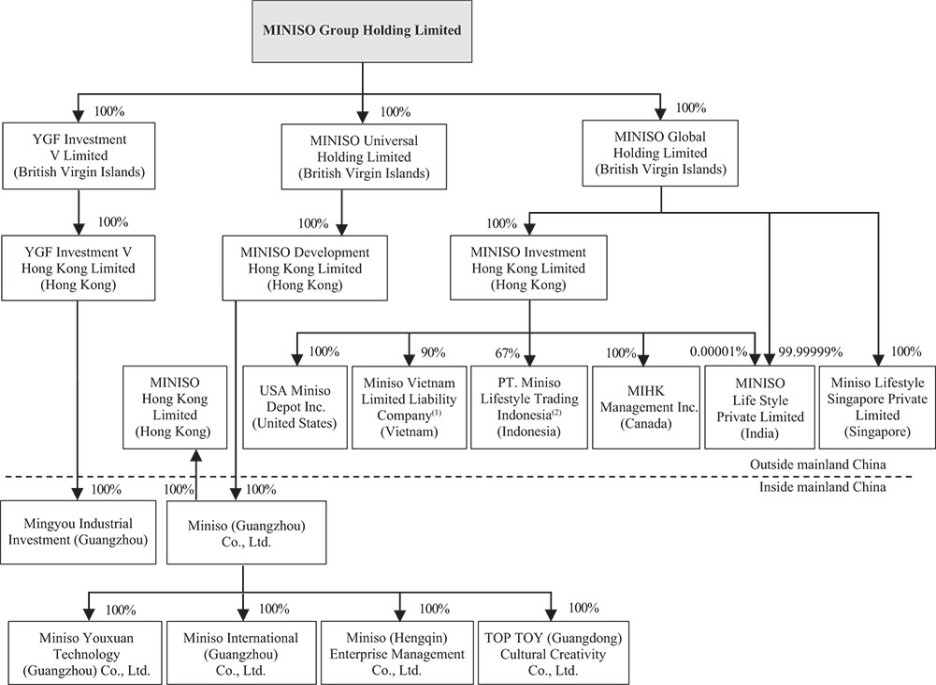
| (1) | The remaining 10% shares of Miniso Vietnam Limited Liability Company is held by an individual distributor in Vietnam. |
| (2) | The remaining shares of PT. Miniso Lifestyle Trading Indonesia is held by PT. Mitra Retail Indonesia and PT. Yar Noor International as to 20% and 13%, respectively. |
D.Property, Plant and Equipment
Our corporate headquarters is located in Guangzhou, China, where we lease office space with an area of approximately 27,300 square meters. We generally make rental payments on a monthly or quarterly basis. In addition, as of December 31, 2024, we had also leased office space of approximately 10,150 square meters in about 15 other cities in China and approximately 6,000 square meters in about 11 countries and regions overseas. As of December 31, 2024, we had leased a number of warehouses inside China with a total size of approximately 260,000 square meters and about 15 warehouses outside of China. Ownership certificates or other similar proof of certain leased properties have not been provided to us by the relevant lessors, and the lease agreements for some of our leased properties in China have not been registered with the relevant PRC government authorities. See “Item 3. Key Information—D. Risk Factors—Risks Related to Our Business and Industry—Our leased property interest may be defective and such defects may negatively affect our right to such leases.” As of December 31, 2024, we owned apartment units in Guangzhou with a total area of approximately 10,300 square meters for employee dormitory.
120
We purchased a parcel of land in Guangzhou of approximately 6,600 square meters for our headquarters building project. We obtained the land use rights certificate for this parcel of land on May 9, 2022. As of the date of this annual report, the foundation construction phase was completed and the construction of the headquarters building has commenced. We expect that the construction project will be completed by the end of 2025.
Our servers are primarily hosted at internet data centers owned by major internet data center providers in China. We believe that our current facilities are adequate and that we will be able to obtain additional facilities, principally through leasing, to accommodate any future expansion plans.
Item 4A.Unresolved Staff Comments
None.
Item 5.Operating and Financial Review and Prospects
The following discussion of our financial condition and results of operations is based upon, and should be read in conjunction with, our audited consolidated financial statements and the related notes included in this annual report on Form 20-F. This report contains forward-looking statements. See “Forward-Looking Information.” In evaluating our business, you should carefully consider the information provided under the caption “Item 3. Key Information—D. Risk Factors” in this annual report on Form 20-F. We caution you that our businesses and financial performance are subject to substantial risks and uncertainties.
A. |
Operating Results |
We are a global value retailer offering a variety of trendy lifestyle products featuring IP design. We have built our flagship brand “MINISO” as a globally recognized retail brand and established a store network worldwide. Observing an emerging pop toy culture, we introduced the “TOP TOY” brand with the goal of entering into the pop toy market and eventually building our platform of pop toys. In 2024, we launched an average of over 1,180 SKUs under the “MINISO” brand per month, and offered consumers a wide selection of over 12,600 core SKUs, the vast majority of which are under the “MINISO” brand. Our MINISO product offerings span 11 major categories, including home decor, small electronics, textile, accessories, beauty tools, toys, cosmetics, personal care, snacks, fragrance and perfumes, and stationery and gifts. Under the TOP TOY brand, we offered around 11,100 SKUs as of December 31, 2024 across major categories that include blind boxes, toy bricks, model figures, model kits, collectible dolls, Ichiban Kuji and other popular toys. Our highly effective approach to retail, which mainly encompasses dynamic product development, an efficient supply chain and deep operational know-how backed by digitalization, is critical to the success and forms the backbone of our business.
We have two reportable segments: (i) MINISO brand, including mainly the design, purchasing and sale of lifestyle products, and (ii) TOP TOY brand, including mainly the design, purchasing and sale of pop toys.
Our revenue was RMB10,085.6 million and RMB11,473.2 million in the fiscal years ended June 30, 2022 and 2023, RMB5,266.9 million and RMB7,632.5 million in the six months ended December 31, 2022 and 2023, and RMB13,838.8 million and RMB16,994.0 million (US$2,328.2 million) in the years ended December 31, 2023 and 2024, respectively. Our gross profit was RMB3,069.8 million and RMB4,443.1 million in the fiscal years ended June 30, 2022 and 2023, RMB1,985.7 million and RMB3,241.0 million in the six months ended December 31, 2022 and 2023, and RMB5,698.4 million and RMB7,637.1 million (US$1,046.3 million) in the years ended December 31, 2023 and 2024, respectively. We recorded a profit of RMB639.7 million and RMB1,781.8 million in the fiscal years ended June 30, 2022 and 2023, RMB763.9 million and RMB1,256.1 million in the six months ended December 31, 2022 and 2023, and RMB2,274.0 million and RMB2,635.4 million (US$361.1 million) in the years ended December 31, 2023 and 2024, respectively.
121
Major Factors Affecting Our Results of Operations
Our business and results of operations are affected by a number of general factors that impact the overall consumption and market for lifestyle and pop toy products, including overall economic trends and their impact on consumer behavior, production and procurement costs and the competitive environment. Unfavorable changes in any of these general conditions could materially and adversely affect our results of operations.
While our business is influenced by these general factors, our results of operations are more directly affected by the following company-specific factors.
Store network expansion in China
Our ability to expand our store network in China is a key driver of our revenue growth. Our revenue generated from China was RMB7,442.2 million and RMB7,650.8 million in the fiscal years ended June 30, 2022 and 2023, RMB3,360.2 million and RMB4,843.1 million in the six months ended December 31, 2022 and 2023, and RMB9,133.8 million and RMB10,312.1 million (US$1,412.8 million) in the years ended December 31, 2023 and 2024, respectively. As of December 31, 2024, apart from 25 directly operated MINISO stores and 38 directly operated TOP TOY stores, substantially all of our MINISO and TOP TOY stores in mainland China were operated under our MINISO Retail Partner model. Our store network expansion in China is primarily sustained by our continued success in encouraging our retail partners to open more MINISO stores at optimal locations. As a result, the number of MINISO stores in mainland China increased from 3,226 as of June 30, 2022 to over 3,600 as of June 30, 2023, to over 3,900 as of December 31, 2023, and further 4,386 as of December 31, 2024. Additionally, the fast growth of our new brand TOP TOY since December 2020 has also contributed to the expansion of our store network in China. As of December 31, 2024, we had opened 272 TOP TOY stores in mainland China.
Globalization strategy
Our results of operations are affected by our ability to execute our globalization strategy, which primarily involves expanding into new international markets and growing our store network overseas. Our revenue from markets outside of mainland China was RMB2,643.5 million and RMB3,822.4 million in the fiscal years ended June 30, 2022 and 2023, RMB1,906.7 million and RMB2,789.3 million in the six months ended December 31, 2022 and 2023, and RMB4,705.0 million and RMB6,681.9 million (US$ 915.4 million) in the years ended December 31, 2023 and 2024, accounting for 26.2%, 33.3%, 36.2%, 36.5%, 34.0% and 39.3%, of our total revenue for the same periods, respectively. In the majority of the international markets, we expand our store network by using the distributor model. Depending on factors such as market environment and local regulations, we also utilize the MINISO Retail Partner model for international store network expansion in an asset-light manner and the direct operation model. The significant revenue contribution from international markets demonstrates the appeal of our “MINISO” brand across geographical and cultural boundaries. The number of MINISO stores outside of mainland China increased from 1,973 as of June 30, 2022 to approximately 2,200 as of June 30, 2023, to approximately 2,500 as of December 31, 2023 and further to over 3,100 as of December 31, 2024.
Revenue per MINISO store
While we continue to expand our store network, our results of operations are also affected by revenue per MINISO store. Our revenue per MINISO store, which is calculated by dividing (a) revenue of MINISO brand by (b) the average number of stores at the beginning and the end of the relevant period, has fluctuated significantly historically, and may continue to fluctuate in future periods. As a global value retailer offering a variety of trendy lifestyle products featuring IP design, we expect to continue to face intense competition in a variety of the markets we operate. Our ability to take a disciplined approach in store network expansion while we increase penetration into more lower-tier cities in China and expand internationally using a distributor, self-operating or retail partner model, and to develop efficient supply chains and deepen customer engagement in these new regions, will affect our revenue per MINISO store and our results of operations. Our revenue per MINISO store was RMB1.9 million and RMB2.0 million in the fiscal years ended June 30, 2022 and 2023, RMB0.9 million and RMB1.2 million in the six months ended December 31, 2022 and 2023, and RMB2.2 million and RMB2.3 million (US$0.3 million) in the years ended December 31, 2023 and 2024, respectively.
122
Product value propositions
We primarily generate revenues from sales of high-quality and affordable lifestyle and pop toy products that are responsive to the evolving tastes and needs of consumers. Our product managers identify market trends and collaborate closely with our designers and suppliers to develop and roll out products that balance appeal, quality and price. Furthermore, our co-branding collaborations with IP licensors owning popular brands unlock new product design possibilities and elevate our brand awareness. Further, we identify and cultivate new IPs and co-develop them with independent design artists into popular IP products, mostly under our TOP TOY brand. As a result of our distinctive approach to product design and development, our flagship brand “MINISO” maintained a portfolio of over 12,600 core SKUs spanning 11 major categories, with an average of over 1,180 SKUs launched per month in the year ended December 31, 2024. Under the fast-growing TOP TOY brand, we offered around 11,100 SKUs as of December 31, 2024 across major categories, including blind boxes, toy bricks, model figures, model kits, collectible dolls, Ichiban Kuji and other popular toys.
Efficient supply chain
Our ability to manage an integrated and seamless supply chain significantly impacts the results of our operations, as cost-effective procurement sets the foundation for our competitive product pricing, and efficient planning affects our speed to market. Leveraging China’s large supply chain in the lifestyle product sector, we source from qualified suppliers who are able to meet our demands. As part of our efforts to optimize supply chain, we build mutually beneficial relationships with our suppliers by procuring products in large volumes, being punctual with our payments to them in the ordinary course of business and guiding them towards better production efficiency and enhanced cost control. In addition, we digitally integrate suppliers through our supply chain management system to better coordinate with them and streamline the supply chain process for enhanced productivity. These strengths of our supply chain have led to sustained advantages in both procurement cost and efficiency, which allows us to price competitively.
Key Components of Our Results of Operations
Revenue
We primarily derive our revenue from sales of lifestyle and pop toy products through sales to MINISO Retail Partners, sales to offline distributors, retail sales in directly operated stores and through online channels. Other sources of revenue mainly include license fees from MINISO Retail Partners and distributors, and sales-based royalties and sales-based management and consultation service fees income from MINISO Retail Partners. The following table sets forth the components of our revenue by amounts and percentages of our total revenue broken down by revenue source for the periods presented:
|
|
|
|
|
|
|
|
|
|
|
|
|
|
|
|
|
|
|
|
|
|
|
|
|
|
|
|
|
For the fiscal year ended June 30, |
|
For the six months ended December 31, |
|
For the year ended December 31, |
||||||||||||||||||||
|
|
2022 |
|
2023 |
|
2022 |
|
2023 |
|
2023 |
|
2024 |
||||||||||||||
|
|
RMB |
|
% |
|
RMB |
|
% |
|
RMB |
|
% |
|
RMB |
|
% |
|
RMB |
|
% |
|
RMB |
|
US$ |
|
% |
|
|
|
|
|
|
|
|
|
|
(Unaudited) |
|
|
|
|
|
|
|
(Unaudited) |
|
|
|
|
|
|
|
|
|
|
(in thousands, except for percentages) |
||||||||||||||||||||||||
Revenue: |
|
|
|
|
|
|
|
|
|
|
|
|
|
|
|
|
|
|
|
|
|
|
|
|
|
|
Sales of lifestyle and pop toy products |
|
8,997,662 |
|
89.2 |
|
10,357,235 |
|
90.3 |
|
4,754,711 |
|
90.3 |
|
6,921,694 |
|
90.7 |
|
12,524,218 |
|
90.6 |
|
15,441,214 |
|
2,115,438 |
|
90.8 |
– Retail sales in self-operated stores |
|
555,226 |
|
5.5 |
|
990,048 |
|
8.6 |
|
419,628 |
|
8.0 |
|
1,004,114 |
|
13.2 |
|
1,574,534 |
|
11.4 |
|
3,158,895 |
|
432,767 |
|
18.6 |
– Product sales to franchisees(1) |
|
5,499,267 |
|
54.5 |
|
5,960,518 |
|
52.0 |
|
2,537,738 |
|
48.2 |
|
3,857,191 |
|
50.5 |
|
7,279,971 |
|
52.6 |
|
7,923,836 |
|
1,085,561 |
|
46.6 |
– Sales to offline distributors |
|
2,072,061 |
|
20.5 |
|
2,612,742 |
|
22.8 |
|
1,381,140 |
|
26.2 |
|
1,660,860 |
|
21.7 |
|
2,892,462 |
|
20.9 |
|
3,369,238 |
|
461,584 |
|
19.8 |
– Online sales(2) |
|
651,039 |
|
6.5 |
|
706,397 |
|
6.2 |
|
374,502 |
|
7.1 |
|
355,380 |
|
4.7 |
|
687,275 |
|
5.0 |
|
941,055 |
|
128,924 |
|
5.5 |
– Other sales channels(3) |
|
220,069 |
|
2.2 |
|
87,530 |
|
0.8 |
|
41,703 |
|
0.8 |
|
44,149 |
|
0.6 |
|
89,976 |
|
0.7 |
|
48,190 |
|
6,602 |
|
0.3 |
License fees, sales-based royalties, and sales-based management and consultation service fees |
|
685,394 |
|
6.8 |
|
687,575 |
|
6.0 |
|
303,835 |
|
5.7 |
|
426,369 |
|
5.6 |
|
810,109 |
|
5.8 |
|
869,182 |
|
119,077 |
|
5.2 |
– License fees |
|
109,166 |
|
1.1 |
|
84,711 |
|
0.7 |
|
48,288 |
|
0.9 |
|
37,074 |
|
0.5 |
|
73,497 |
|
0.5 |
|
96,836 |
|
13,266 |
|
0.6 |
– Sales-based royalties |
|
97,453 |
|
1.0 |
|
102,089 |
|
0.9 |
|
43,245 |
|
0.8 |
|
66,113 |
|
0.9 |
|
124,957 |
|
0.9 |
|
131,402 |
|
18,002 |
|
0.8 |
– Sales-based management and consultation service fees |
|
478,775 |
|
4.7 |
|
500,775 |
|
4.4 |
|
212,302 |
|
4.0 |
|
323,182 |
|
4.2 |
|
611,655 |
|
4.4 |
|
640,944 |
|
87,809 |
|
3.8 |
Others(4) |
|
402,593 |
|
4.0 |
|
428,398 |
|
3.7 |
|
208,332 |
|
4.0 |
|
284,404 |
|
3.7 |
|
504,470 |
|
3.6 |
|
683,629 |
|
93,657 |
|
4.0 |
Total |
|
10,085,649 |
|
100.0 |
|
11,473,208 |
|
100.0 |
|
5,266,878 |
|
100.0 |
|
7,632,467 |
|
100.0 |
|
13,838,797 |
|
100.0 |
|
16,994,025 |
|
2,328,172 |
|
100.0 |
| (1) | Represents sales to/revenue from MINISO Retail Partners. |
| (2) | Online sales does not include sales through O2O platforms, which are accounted for in sales through offline channels. |
| (3) | “Other sales channels” mainly represents group-buying channels. |
| (4) | “Others” mainly represents sales of fixtures to franchisees and distributors. |
123
The following table breaks down our revenue by geographic region for the periods presented:
|
|
|
|
|
|
|
|
|
|
|
|
|
|
|
|
|
|
|
|
|
|
|
|
|
|
|
|
|
For the fiscal year ended June 30, |
|
For the six months ended December 31, |
|
For the year ended December 31, |
||||||||||||||||||||
|
|
2022 |
|
2023 |
|
2022 |
|
2023 |
|
2023 |
|
2024 |
||||||||||||||
|
|
RMB |
|
% |
|
RMB |
|
% |
|
RMB |
|
% |
|
RMB |
|
% |
|
RMB |
|
% |
|
RMB |
|
US$ |
|
% |
|
|
|
|
|
|
|
|
|
|
(Unaudited) |
|
|
|
|
|
|
|
(Unaudited) |
|
|
|
|
|
|
|
|
|
|
(in thousands, except for percentages) |
||||||||||||||||||||||||
Revenue: |
|
|
|
|
|
|
|
|
|
|
|
|
|
|
|
|
|
|
|
|
|
|
|
|
|
|
Mainland China |
|
7,442,156 |
|
73.8 |
|
7,650,821 |
|
66.7 |
|
3,360,167 |
|
63.8 |
|
4,843,127 |
|
63.4 |
|
9,133,781 |
|
66.0 |
|
10,312,116 |
|
1,412,754 |
|
60.7 |
Other Asian countries excluding China(1) |
|
1,174,323 |
|
11.6 |
|
1,821,080 |
|
15.9 |
|
958,847 |
|
18.2 |
|
1,157,261 |
|
15.2 |
|
2,019,494 |
|
14.5 |
|
2,541,817 |
|
348,228 |
|
15.0 |
North America |
|
391,017 |
|
3.9 |
|
729,702 |
|
6.4 |
|
314,839 |
|
6.0 |
|
743,897 |
|
9.7 |
|
1,158,760 |
|
8.4 |
|
1,985,051 |
|
271,951 |
|
11.7 |
Latin America |
|
798,102 |
|
7.9 |
|
1,008,356 |
|
8.7 |
|
497,235 |
|
9.4 |
|
660,039 |
|
8.7 |
|
1,171,160 |
|
8.5 |
|
1,445,691 |
|
198,059 |
|
8.5 |
Europe |
|
174,691 |
|
1.7 |
|
151,496 |
|
1.3 |
|
76,464 |
|
1.5 |
|
154,737 |
|
2.0 |
|
229,769 |
|
1.7 |
|
414,493 |
|
56,785 |
|
2.4 |
Others |
|
105,360 |
|
1.1 |
|
111,753 |
|
1.0 |
|
59,326 |
|
1.1 |
|
73,406 |
|
1.0 |
|
125,833 |
|
0.9 |
|
294,857 |
|
40,395 |
|
1.7 |
Total |
|
10,085,649 |
|
100.0 |
|
11,473,208 |
|
100.0 |
|
5,266,878 |
|
100.0 |
|
7,632,467 |
|
100.0 |
|
13,838,797 |
|
100.0 |
|
16,994,025 |
|
2,328,172 |
|
100.0 |
(1) |
Represents sales to/revenue from MINISO Retail Partners. |
Cost of sales
Our cost of sales mainly consists of cost of inventories. Cost of inventories accounted for 97.9% and 97.6% of our total cost of sales for the fiscal year ended June 30, 2022 and 2023, 97.4% and 97.8% for the six months ended December 31, 2022 and 2023, and 97.7% and 97.2% for the years ended December 31, 2023 and 2024, respectively. Cost of inventories comprises carrying amount of inventories sold and inventory write-down. Other than cost of inventories, cost of sales also include logistics expenses and depreciation and amortization expense. Logistics expenses mainly represent shipping expenses for the products sold to customers through e-commerce channels. Our cost of sales was RMB7,015.9 million and RMB7,030.2 million in the fiscal years ended June 30, 2022 and 2023, RMB3,281.2 million and RMB4,391.4 million in the six months ended December 31, 2022 and 2023, and RMB8,140.4 million and RMB9,357.0 million (US$1,281.9 million) in the years ended December 31, 2023 and 2024, respectively.
Gross profit and margin
The following table sets forth our gross profit and gross margin for the periods presented:
|
|
For the fiscal year ended June 30, |
|
For the six months ended December 31, |
|
For the year ended December 31, |
||||||||
|
|
2022 |
|
2023 |
|
2022 |
|
2023 |
|
2023 |
|
2024 |
||
|
|
RMB |
|
RMB |
|
RMB |
|
RMB |
|
RMB |
|
RMB |
|
US$ |
|
|
|
|
|
|
(Unaudited) |
|
|
|
(Unaudited) |
|
|
|
|
|
|
(in thousands) |
||||||||||||
Gross profit |
|
3,069,761 |
|
4,443,052 |
|
1,985,660 |
|
3,241,039 |
|
5,698,431 |
|
7,637,060 |
|
1,046,273 |
Gross margin (%) |
|
30.4 |
|
38.7 |
|
37.7 |
|
42.5 |
|
41.2 |
|
44.9 |
|
44.9 |
Other income
Other income consists of tax refund, government grants and income from depositary bank. Government grants mainly represented unconditional cash awards granted by the local authorities in China. In the fiscal year ended June 30, 2022, other income also included subsidies obtained by our subsidiaries in the United States under the Paycheck Protection Program Rule. There is no assurance that we will continue to receive any government grants in the future.
124
Selling and distribution expenses
Selling and distribution expenses primarily consist of (i) payroll and employee benefits, which cover salaries, wages and bonus, contributions to social security contribution plan, welfare expenses, and equity-settled share-based payment expenses, (ii) rental and related expenses, (iii) depreciation and amortization expenses, (iv) promotion and advertising expenses, (v) licensing expenses, (vi) logistics expenses, and (vii) travelling expenses. Our selling and distribution expenses were RMB1,442.3 million and RMB1,716.1 million in the fiscal years ended June 30, 2022 and 2023, RMB798.1 million and RMB1,363.1 million in the six months ended December 31, 2022 and 2023, and RMB2,281.1 million and RMB3,519.5 million (US$482.2 million) in the years ended December 31, 2023 and 2024, respectively.
General and Administrative Expenses
General and administrative expenses primarily consist of (i) payroll and employee benefits, which cover salaries, wages and bonus, contributions to social security contribution plan, welfare expenses, and equity-settled share-based payment expenses, (ii) depreciation and amortization expenses, (iii) travelling expenses, (iv) IT service fees, and (v) professional service fees. Our general and administrative expenses were RMB816.2 million and RMB633.6 million in the fiscal years ended June 30, 2022 and 2023, RMB313.9 million and RMB357.7 million in the six months ended December 31, 2022 and 2023, and RMB677.4 million and RMB931.7 million (US$127.6 million) in the years ended December 31, 2023 and 2024, respectively.
Other net income/(loss)
Other net income/(loss) mainly consists of (i) net foreign exchange gain/(loss), (ii) investment income from other investments, and (iii) net change in fair value of other investments.
Taxation
Our income tax expense represented a significant portion of our profit for the year/period for the fiscal years ended June 30, 2022 and 2023, the six months ended December 31, 2022 and 2023 and the years ended December 31, 2023 and 2024, primarily because of the occurrence of a large non-tax deductible expense item in these periods, namely equity-settled share-based payment expenses. Our equity-settled share-based payment expenses totaled RMB82.8 million and RMB62.9 million in the fiscal years ended June 30, 2022 and 2023, RMB26.6 million and RMB46.4 million in the six months ended December 31, 2022 and 2023, and RMB82.7 million and RMB85.2 million (US$11.7 million) in the years ended December 31, 2023 and 2024, respectively. The effect of unused tax losses not recognized was RMB44.9 million, RMB23.0 million and RMB7.1 million in the fiscal years ended June 30, 2022 and 2023 and in the six months ended December 31, 2022, respectively, and the effect of utilization of tax losses previously not recognized was RMB8.0 million in the six months ended December 31, 2023. The effect of unused tax losses not recognized was RMB7.9 million and the effect of unused tax losses being utilized was RMB56.3 million (US$7.7 million) in the years ended December 31, 2023 and 2024, respectively.
Cayman Islands
The Cayman Islands currently levies no taxes on individuals or corporations based upon profits, income, gains or appreciation.
British Virgin Islands
Our BVI subsidiaries and all dividends, interest, rents, royalties, compensation and other amounts paid by our BVI subsidiaries to persons who are not resident in the BVI and any capital gains realized with respect to any shares, debt obligations, or other securities of our BVI subsidiaries by persons who are not resident in the BVI are exempt from all provisions of the Income Tax Ordinance in the BVI.
125
Hong Kong
Under the current Hong Kong Inland Revenue Ordinance, our Hong Kong subsidiaries are subject to Hong Kong profits tax at the rate of 16.5% on their taxable income generated from the operations in Hong Kong. A two-tiered profits tax rates regime was introduced in 2018 where the first HKD2 million of assessable profits earned by a company will be taxed at half of the current tax rate (8.25%) whilst the remaining profits will continue to be taxed at 16.5%. There is an anti-fragmentation measure where each group will have to nominate only one company in the group to benefit from the progressive rates.
Mainland China
Under the Enterprise Income Tax Law, our subsidiaries established in mainland China are subject to a unified statutory enterprise income tax rate of 25%. A subsidiary of ours established in Hengqin New Area of Zhuhai, a pilot free trade zone in China, met the criteria for a preferential income tax rate of 15% prior to December 31, 2022. Furthermore, enterprises that are recognized as high and new technology enterprises in accordance with the Administrative Measures for the Determination of High and New Tech Enterprises issued by the Ministry of Science, the Ministry of Finance and the State Administration of Taxation are entitled to enjoy a preferential income tax rate of 15%. A subsidiary of ours established in Guangzhou obtained the High and New Technology Enterprise qualification and is thus entitled to a preferential income tax rate of 15% for the three years ending December 31, 2024. This subsidiary can reapply for such qualification as a High and New Technology Enterprise after the current certificate expires.
United States
Under the United States Internal Revenue Code, our subsidiaries established in United States are subject to a federal corporate income tax rate of 21% and variable state income and franchise tax, depending on which state the subsidiaries have nexus with. Most of our subsidiaries in the United States are operating in the state of California and Texas, and thus they will be subject to state income tax rate of 8.84% and 0.75%, respectively. Our other subsidiaries in the United States are mainly subject to state corporate income tax rates ranging from 4.9% to 11.5% depending on the location of the operation.
Indonesia
The statutory tax rate is 22% from the tax year ended December 31, 2021 and onwards.
India
Under the Income Tax Act 1961 enacted in India, our subsidiary incorporated in India is subject to a profit tax rate of 26% for the tax year ended March 31, 2022 and 29.12% from the tax year ended March 31, 2023 and onwards.
Canada
Under the Canadian federal and provincial tax rules, our subsidiaries incorporated in Canada are subject to the combined Canadian federal and provincial statutory income tax rates ranging from 23% to 31% depending on the location of the operation.
Singapore
Under the Income Tax Act enacted in Singapore, the subsidiaries incorporated in Singapore are subject to a tax rate of 17% on its chargeable income.
Vietnam
Under the Law on Corporate Income Tax enacted in Vietnam, the subsidiary incorporated in Vietnam is subject to a tax rate of 20% on its assessable income.
126
Results of Operations
The following table sets forth a summary of our consolidated results of operations for the periods indicated, both in absolute amounts and as percentages of our total net revenues. This information should be read together with our consolidated financial statements and related notes included elsewhere in this annual report. The results of operations in any period are not necessarily indicative of the results that may be expected for any future period.
|
|
For the fiscal year ended June 30, |
|
For the six months ended December 31, |
|
For the year ended December 31, |
||||||||
|
|
2022 |
|
2023 |
|
2022 |
|
2023 |
|
2023(2) |
|
2024 |
||
|
|
RMB |
|
RMB |
|
RMB |
|
RMB |
|
RMB |
|
RMB |
|
US$ |
|
|
|
|
|
|
(Unaudited) |
|
|
|
(Unaudited) |
|
|
|
|
|
|
(in thousands) |
||||||||||||
Revenue |
|
10,085,649 |
|
11,473,208 |
|
5,266,878 |
|
7,632,467 |
|
13,838,797 |
|
16,994,025 |
|
2,328,172 |
Cost of sales |
|
(7,015,888) |
|
(7,030,156) |
|
(3,281,218) |
|
(4,391,428) |
|
(8,140,366) |
|
(9,356,965) |
|
(1,281,899) |
Gross profit |
|
3,069,761 |
|
4,443,052 |
|
1,985,660 |
|
3,241,039 |
|
5,698,431 |
|
7,637,060 |
|
1,046,273 |
Other income |
|
25,931 |
|
17,935 |
|
14,311 |
|
18,993 |
|
22,617 |
|
21,595 |
|
2,959 |
Selling and distribution expenses(1) |
|
(1,442,339) |
|
(1,716,093) |
|
(798,127) |
|
(1,363,114) |
|
(2,281,080) |
|
(3,519,534) |
|
(482,174) |
General and administrative expenses(1) |
|
(816,225) |
|
(633,613) |
|
(313,908) |
|
(357,689) |
|
(677,394) |
|
(931,651) |
|
(127,636) |
Other net income |
|
87,308 |
|
114,106 |
|
72,850 |
|
21,105 |
|
62,361 |
|
114,696 |
|
15,713 |
(Credit loss)/reversal of credit loss on trade and other receivables |
|
(28,924) |
|
1,072 |
|
(3,716) |
|
(2,080) |
|
2,708 |
|
2,469 |
|
338 |
Impairment loss on non-current assets |
|
(13,485) |
|
(3,448) |
|
— |
|
(4,547) |
|
(7,995) |
|
(8,846) |
|
(1,212) |
Operating profit |
|
882,027 |
|
2,223,011 |
|
957,070 |
|
1,553,707 |
|
2,819,648 |
|
3,315,789 |
|
454,261 |
Finance income |
|
66,344 |
|
145,225 |
|
64,684 |
|
123,969 |
|
204,510 |
|
118,672 |
|
16,258 |
Finance costs |
|
(33,396) |
|
(34,622) |
|
(16,345) |
|
(25,202) |
|
(43,479) |
|
(92,915) |
|
(12,729) |
Net finance income |
|
32,948 |
|
110,603 |
|
48,339 |
|
98,767 |
|
161,031 |
|
25,757 |
|
3,529 |
Share of (loss)/profit of equity-accounted investees, net of tax |
|
(8,162) |
|
— |
|
— |
|
268 |
|
268 |
|
5,986 |
|
820 |
Profit before taxation |
|
906,813 |
|
2,333,614 |
|
1,005,409 |
|
1,652,742 |
|
2,980,947 |
|
3,347,532 |
|
458,610 |
Income tax expense |
|
(267,070) |
|
(551,785) |
|
(241,498) |
|
(396,665) |
|
(706,952) |
|
(712,104) |
|
(97,558) |
Profit for the year/period |
|
639,743 |
|
1,781,829 |
|
763,911 |
|
1,256,077 |
|
2,273,995 |
|
2,635,428 |
|
361,052 |
Note:
| (1) | Equity-settled share-based payment expenses were allocated as follows: |
| (2) | The unaudited financial results for the twelve months ended December 31, 2023 presented here and below are derived from the arithmetic combination of our audited financial results for the six months ended December 31, 2023 and the twelve months ended June 30, 2023, after arithmetic adjustments made to exclude the financial results of the first six months of 2023. Such information is included for comparison purposes only. |
|
|
|
|
|
|
|
|
|
|
|
|
|
|
|
|
|
For the fiscal year ended |
|
For the six months ended |
|
For the year ended |
||||||||
|
|
June 30, |
|
December 31, |
|
December 31, |
||||||||
|
|
2022 |
|
2023 |
|
2022 |
|
2023 |
|
2023 |
|
2024 |
||
|
|
RMB |
|
RMB |
|
RMB |
|
RMB |
|
RMB |
|
RMB |
|
US$ |
|
|
|
|
|
|
(Unaudited) |
|
|
|
|
|
|
|
|
|
|
(in thousands) |
||||||||||||
Equity-settled share-based payment expenses: |
|
|
|
|
|
|
|
|
|
|
|
|
|
|
Selling and distribution expenses |
|
52,000 |
|
44,824 |
|
16,622 |
|
41,506 |
|
69,709 |
|
13,454 |
|
1,843 |
General and administrative expenses |
|
30,835 |
|
18,058 |
|
9,958 |
|
4,926 |
|
13,025 |
|
71,730 |
|
9,827 |
Total |
|
82,835 |
|
62,882 |
|
26,580 |
|
46,432 |
|
82,734 |
|
85,184 |
|
11,670 |
127
Year ended December 31, 2023 compared to year ended December 31, 2024
Revenue
Revenue was RMB16,994.0 million (US$2,328.2 million), representing an increase of 22.8% year over year, primarily driven by an 18.3% year-over-year increase in average store count.
Revenue from MINISO brand increased by 22.0% to RMB16,002.6 million (US$2,192.3 million), driven by (i) an increase of 10.9% in revenue from MINISO brand in mainland China, and (ii) an increase of 41.9% in revenue from MINISO brand in overseas markets. The year-over-year increase was primarily due to an increase of 21.8% in average store count. The overseas revenue contributed 41.7% of revenue from MINISO brand, compared to 35.9% in 2023.
Revenue from TOP TOY brand increased by 44.7% to RMB983.5 million (US$134.7 million), primarily powered by a low-single digit same-store sales growth and a rapid growth in average store counts.
During the period, the total number of MINISO stores, including those in China and overseas markets, increased from 6,413 as of December 31, 2023 to 7,504 as of December 31, 2024. Our revenue per MINISO store, however, increased by 3.9% from RMB2.2 million in 2023 to RMB2.3 million (US$0.3 million) in 2024. See “Item 3. Key Information—D. Risk Factors—Risks Related to Our Business and Industry—Our revenue per MINISO store has experienced, and may continue to experience, significant fluctuations from period to period.”
Cost of sales
Our cost of sales was RMB9,357.0 million (US$1,282 million) in 2024, which was stable compared to cost of sales of RMB8,140.4 million in 2023.
Gross profit and gross margin
Gross profit increased by 34.0% from RMB5,698.4 million in the year ended December 31, 2023 to RMB7,637.1 million (US$1,046.3 million) in 2024, and gross margin increased from 41.2% to 44.9% during the same period. The increase in gross profit and gross margin was mainly driven by (i) higher gross margin in overseas markets contributed by product optimization and higher revenue contribution from directly operated markets, and (ii) higher gross margin of TOP TOY due to a shift in product mix towards more profitable products.
Other income
Our other income was RMB21.6 million (US$3.0 million) in 2024, compared to RMB22.6 million in 2023.
Selling and distribution expenses
Our selling and distribution expenses increased by 54.3% from RMB2,281.1 million in 2023 to RMB3,519.5 million (US$482.2 million) in 2024. Excluding equity-settled share-based payment expenses, our selling and distribution expenses increased from RMB2,211.4 million to RMB3,506.1 million during the same period. The year-over-year increase was mainly attributable to our investments into directly operated stores to pursue the future success of our business, especially in strategic overseas markets such as the U.S. market. As of December 31, 2024, total number of directly operated stores in overseas markets was 505, doubling from a year ago. In 2024, revenue from directly operated stores also doubled, while related expenses including rental and related expenses, depreciation and amortization expenses together with payroll excluding share-based compensation expenses increased by 72.2%. Promotion and advertising expenses increased by 37.7% in 2024, as a percentage of revenue stabilizing at around 3% in both comparative periods. Licensing expenses increased by 29.2%, as a percentage of revenue stabilizing at around 2% in both comparative periods. Logistics expenses increased by 51.0%, mainly reflecting the rising freight costs caused by the tension in international shipping.
128
General and administrative expenses
Our general and administrative expenses increased by 37.5% from RMB677.4 million in 2023 to RMB931.7 million (US$127.6 million) in 2024. Excluding equity-settled share-based payment expenses, our general and administrative expenses increased by 29.4% from RMB664.4 million to RMB859.9 million during the same period, which was primarily due to the increase of personnel-related expenses in relation to the growth of our business.
Other net income
Our other net income was RMB114.7 million (US$15.7 million) in 2024, as compared to other net income of RMB62.4 million in 2023. The year-over-year increase was mainly due to an increase in investment income in wealth management products, and an increase in fair value of an investment, partially offset by a net foreign exchange loss.
Impairment loss on non-current assets
Our impairment loss on non-current assets was RMB8.0 million and RMB8.8 million (US$1.2 million) in 2023 and 2024, respectively. The impairment loss on non-current assets was related to our directly operated stores.
Operating profit
As a result of the foregoing, we recorded operating profit of RMB3,315.8 million (US$454.3 million) in 2024, representing an increase of 17.6% from RMB2,819.6 million in 2023.
Net finance income
Our net finance income was RMB25.8 million (US$3.5 million), compared to RMB161.0 million in 2023. The year-over-year decrease was mainly due to a decrease in interest income as a result of lower interest rate and reduced bank deposits principal as we reallocated certain resources to wealth management products, coupled with an increase in finance cost due to increased interest expenses on lease liabilities in line with our investment in directly operated stores.
Share of loss of equity-accounted investee, net of tax
For the year ended December 31,2024, our share of loss of an equity-accounted investee, net of tax was RMB6.0 million, which was mainly due to our investment(s) into and share of profit of the associate companies. For the year ended December 31, 2023, our share of profit of an equity-accounted investee, net of tax was RMB0.3 million.
Income tax expense
We recorded income tax expense of RMB712.1 million (US$97.6 million) in 2024, compared to RMB707.0 million in 2023.
Profit for the year
As a result of the foregoing, our profit for the year increased by 15.9% from RMB2,274 million in 2023 to RMB2,635.4 million (US$361.1 million) in 2024.
Six months ended December 31, 2022 compared to six months ended December 31, 2023
Revenue
Our revenue increased by 44.9% from RMB5,266.9 million in the six months ended December 31, 2022 to RMB7,632.5 million in the six months ended December 31, 2023, attributable to (i) an increase of 46.3% in revenue from overseas markets, and (ii) an increase of 44.1% in revenue from China.
Revenue generated from our operations in China was RMB4,843.1 million in the six months ended December 31, 2023, increasing by 44.1% from RMB3,360.2 million in the six months ended December 31, 2022. The increase in revenue from the China market was primarily due to (i) an increase of 44.6% in revenue from MINISO brand in China, and (ii) an increase of 65.8% in revenue from TOP TOY in China.
129
Revenue generated from overseas markets was RMB2,789.3 million in the six months ended December 31, 2023, increasing by 46.3% from RMB1,906.7 million in the six months ended December 31, 2022.
The total number of MINISO stores, including those in China and overseas markets, increased from 5,440 as of December 31, 2022 to 6,413 as of December 31, 2023. Our revenue per MINISO store increased by 26.6% from RMB0.9 million in the six months ended December 31, 2022 to RMB1.2 million in the six months ended December 31, 2023.
Cost of sales
Our cost of sales increased by 33.8% from RMB3,281.2 million for the six months ended December 31, 2022 to RMB4,391.4 million for the six months ended December 31, 2023.
Gross profit and gross margin
Gross profit increased by 63.2% from RMB1,985.7 million in the six months ended December 31, 2022 to RMB3,241.0 million in the six months ended December 31, 2023, and gross margin increased from 37.7% to 42.5% for the same periods. The increase in gross margin was mainly driven by (i) higher gross margin in overseas markets contributed by product optimization and higher revenue contribution from directly operated markets, (ii) higher gross margin in China contributed by newly launched products in relation to our execution of strategic brand upgrade of MINISO, and the cost-saving measures we adopted to reduce the costs of certain products, and (iii) higher gross margin of TOP TOY due to a shift in product mix towards more profitable products.
Other income
Our other income increased by 32.7% from RMB14.3 million in the six months ended December 31, 2022 to RMB19.0 million in the six months ended December 31, 2023, primarily due to an increase in income from depositary bank.
Selling and distribution expenses
Our selling and distribution expenses increased by 70.8% from RMB798.1 million in the six months ended December 31, 2022 to RMB1,363.1 million in the six months ended December 31, 2023. The increase was primarily attributable to (i) increased personnel-related expenses, logistics expenses and IP licensing expenses in relation to the growth of our business, (ii) increased depreciation expenses of the right-of-use assets in relation to directly operated stores, and (iii) increased promotion and advertising expenses, mainly in connection with our brand upgrade and the opening of new stores in overseas markets.
General and administrative expenses
Our general and administrative expenses increased by 13.9% from RMB313.9 million in the six months ended December 31, 2022 to RMB357.7 million in the six months ended December 31, 2023. This increase was primarily due to increased personnel-related expenses in relation to the growth of our business.
Other net income
Our other net income was RMB21.1 million in the six months ended December 31, 2023, compared to other net income of RMB72.9 million in the six months ended December 31, 2022. The decrease was mainly due to net foreign exchange loss, partially offset by net change in fair value of other investments.
Impairment loss on non-current assets
For the six months ended December 31, 2022, we did not record any impairment loss on non-current assets. For the six months ended December 31, 2023, we recorded impairment loss on non-current assets of RMB4.5 million, which was related to our directly operated stores.
130
Operating profit
As a result of the foregoing, we recorded operating profit of RMB1,553.7 million in the six months ended December 31, 2023, representing an increase of 62.3% from RMB957.1 million in the six months ended December 31, 2022.
Net finance income
Our net finance income increased by 104.3% from RMB48.3 million in the six months ended December 31, 2022 to RMB98.8 million in the six months ended December 31, 2023, mainly due to an increase in interest income as a result of increased principal in bank deposits.
Income tax expense
We recorded income tax expense of RMB396.7 million in the six months ended December 31, 2023, compared to RMB241.5 million in the six months ended December 31, 2022.
Profit for the period
As a result of the foregoing, our profit for the period increased by 64.4% from RMB763.9 million in the six months ended December 31, 2022 to RMB1,256.1 million in the six months ended December 31, 2023.
Fiscal year ended June 30, 2022 compared to fiscal year ended June 30, 2023
Revenue
Our revenue increased by 13.8% from RMB10,085.6 million in the fiscal year ended June 30, 2022 to RMB11,473.2 million in the fiscal year ended June 30, 2023, mainly attributable to (i) an increase of 44.6% in revenue from overseas markets, and (ii) an increase of 2.8% in revenue from China.
Revenue generated from our operations in China was RMB7,650.8 million in the fiscal year ended June 30, 2023, increasing by 2.8% from RMB7,442.2 million in the fiscal year ended June 30, 2022. The increase in revenue from the China market was primarily due to (i) an increase of 5.6% and 2.8% in revenue from MINISO offline stores and e-commerce in China, and (ii) an increase of 19.3% in revenue from TOP TOY in China.
As our operations in the international markets gradually recovered from the pandemic, we realized a 44.6% growth in revenue from international markets from RMB2,643.5 million in the fiscal year ended June 30, 2022 to RMB3,822.4 million in the fiscal year ended June 30, 2023.
During the period, the total number of MINISO stores, including those in China and overseas markets, increased from 5,199 as of June 30, 2022 to 5,791 as of June 30, 2023. Our revenue per MINISO store increased by 3.8% from RMB1.9 million in the fiscal year ended June 30, 2022 to RMB2.0 million in the fiscal year ended June 30, 2023.
Cost of sales
Our cost of sales was RMB7,030.2 million in the fiscal year ended June 30, 2023, which was stable compared to cost of sales of RMB7,015.9 million in fiscal year ended June 30, 2022.
Gross profit and gross margin
Gross profit increased by 44.7% from RMB3,069.8 million in the fiscal year ended June 30, 2022 to RMB4,443.1 million in the fiscal year ended June 30, 2023, and gross margin increased from 30.4% to 38.7% during the same period. The increase in gross profit and gross margin was mainly driven by (i) a higher revenue contribution from overseas markets, which was 33.3% in the fiscal year ended June 30, 2023, compared to 26.2% in the fiscal year ended June 30, 2022, (ii) higher gross margin in China contributed by newly launched products in relation to our strategic brand upgrade of MINISO, and the cost-saving measures we adopted to reduce costs of certain products, and (iii) higher gross margin of TOP TOY due to a shift of product mix towards more profitable products.
131
Other income
Our other income decreased by 30.8% from RMB25.9 million in the fiscal year ended June 30, 2022 to RMB17.9 million in the fiscal year ended June 30, 2023, primarily due to a decrease in government grant.
Selling and distribution expenses
Our selling and distribution expenses increased by 19.0% from RMB1,442.3 million in the fiscal year ended June 30, 2022 to RMB1,716.1 million in the fiscal year ended June 30, 2023. Excluding equity-settled share-based payment expenses, our selling and distribution expenses increased from RMB1,390.3 million to RMB1,671.3 million during the same period. The increase was primarily attributable to (i) increased personnel-related expenses, (ii) increased licensing expenses in relation to our growing IP library and enriched offerings of IP products, and (iii) increased promotion and advertising expenses, mainly in connection with our strategic brand upgrade of MINISO in China.
General and administrative expenses
Our general and administrative expenses decreased by 22.4% from RMB816.2 million in the fiscal year ended June 30, 2022 to RMB633.6 million in the fiscal year ended June 30, 2023. Excluding equity-settled share-based payment expenses, our general and administrative expenses decreased by 21.6% from RMB785.4 million to RMB615.6 million during the same period, which was primarily due to (i) decreased personnel-related expenses in relation to our cost control measures among our corporate crew, and (ii) decreased depreciation and amortization expenses due to capitalization of the depreciation of land use right in construction cost of our headquarters building.
Other net income
Our other net income was RMB114.1 million in the fiscal year ended June 30, 2023, compared to other net income was RMB87.3 million in the fiscal year ended June 30, 2022. The increase was mainly attributable to a net foreign exchange gain of RMB109.1 million in the fiscal year ended June 30, 2023, compared to RMB14.0 million in the fiscal year ended June 30, 2022, partially offset by a decrease in investment income from wealth management products as a result of reduced principal of such products.
Impairment loss on non-current assets
Our impairment loss on non-current assets was RMB13.5 million and RMB3.4 million in the fiscal years ended June 30, 2022 and 2023, respectively. The impairment loss on non-current assets was related to our directly operated stores.
Operating profit
As a result of the foregoing, we recorded operating profit of RMB2,223.0 million in the fiscal year ended June 30, 2023, representing an increase of 152.0% from RMB882.0 million in the fiscal year ended June 30, 2022.
Net finance income
Our net finance income increased by 235.7% from RMB32.9 million in the fiscal year ended June 30, 2022 to RMB110.6 million in the fiscal year ended June 30, 2023, mainly due to an increase in interest income as a result of increased principal in bank deposits.
Share of loss of equity-accounted investee, net of tax
For the fiscal year ended June 30 2023, we did not record any share of loss of an equity-accounted investee, net of tax. For the fiscal year ended June 30, 2022, our share of loss of an equity-accounted investee, net of tax was RMB8.2 million, which was mainly due to our investment into and share of 20% of loss of a company which was established to acquire the land use right of a parcel of land in Guangzhou for the purpose of establishing a new headquarters building in August 2020. In October 2021, we acquired the remaining 80% equity interest in this company and have since then owned 100% equity interests of the then equity-accounted investee.
132
Income tax expense
We recorded income tax expense of RMB551.8 million in the fiscal year ended June 30, 2023, compared to RMB267.1 million in the fiscal year ended June 30, 2022.
Profit for the year
As a result of the foregoing, our profit for the year increased by 178.5% from RMB639.7 million in the fiscal year ended June 30, 2022 to RMB1,781.8 million in the fiscal year ended June 30, 2023.
Non-IFRS Financial Measure
In evaluating the business, we consider and use adjusted net profit as a supplemental measure to review and assess our operating performance. We define adjusted net profit as profit excluding equity-settled share-based payment expenses.
We present the non-IFRS financial measure because it is used by our management to evaluate our operating performance and formulate business plans. The non-IFRS financial measure enables our management to assess our operating results without considering the impacts of the aforementioned non-cash items that we do not consider to be indicative of our operating performance in the future. Accordingly, we believe that the use of the non-IFRS financial measure provides useful information to investors and others in understanding and evaluating our operating results in the same manner as our management and board of directors.
The non-IFRS financial measure is not defined under IFRS nor presented in accordance with IFRS. The non-IFRS financial measure has limitations as analytical tools. One of the key limitations of using the non-IFRS financial measure is that it does not reflect all items of income and expense that affect our operations. Further, the non-IFRS financial measure may differ from non-IFRS information used by other companies, including peer companies, and therefore their comparability may be limited.
The non-IFRS financial measure should not be considered in isolation or construed as an alternative to profit or any other measure of performance prepared and presented in accordance with IFRS. Investors are encouraged to review our historical non-IFRS financial measure in light of the most directly comparable IFRS measure, as shown below. The non-IFRS financial measure presented here may not be comparable to similarly titled measures presented by other companies. Other companies may calculate similarly titled measures differently, limiting the usefulness of such measure when analyzing our data comparatively. We encourage you to review our financial information in its entirety and not rely on a single financial measure.
We recorded adjusted net profit of RMB722.6 million and RMB1,844.7 million in the fiscal years ended June 30, 2022 and 2023, RMB790.5 million and RMB1,302.5 million in the six months ended December 31, 2022 and 2023, and RMB2,356.7 million and RMB2,720.6 million (US$372.7 million) in the years ended December 31, 2023 and 2024, respectively. The following table reconciles our adjusted net profit for the fiscal years ended June 30, 2022 and 2023, the six months ended December 31, 2022 and 2023 and the years ended December 31, 2023 and 2024 to the most directly comparable financial measure calculated and presented in accordance with IFRS, which is profit for the year/period.
|
|
For the fiscal year ended June 30, |
|
For the six months ended December 31, |
|
For the year ended December 31, |
||||||||
|
|
2022 |
|
2023 |
|
2022 |
|
2023 |
|
2023 |
|
2024 |
||
|
|
RMB |
|
RMB |
|
RMB |
|
RMB |
|
RMB |
|
RMB |
|
US$ |
|
|
|
|
|
|
(Unaudited) |
|
|
|
(Unaudited) |
|
|
|
|
|
|
(in thousands) |
||||||||||||
Profit for the year/period |
|
639,743 |
|
1,781,829 |
|
763,911 |
|
1,256,077 |
|
2,273,995 |
|
2,635,428 |
|
361,052 |
Add back: |
|
|
|
|
|
|
|
|
|
|
|
|
|
|
Equity-settled share-based payment expenses |
|
82,835 |
|
62,882 |
|
26,580 |
|
46,432 |
|
82,734 |
|
85,184 |
|
11,670 |
Adjusted net profit |
|
722,578 |
|
1,844,711 |
|
790,491 |
|
1,302,509 |
|
2,356,729 |
|
2,720,612 |
|
372,722 |
133
Critical Accounting Policies and Estimates
We prepare our financial statements in accordance with IFRS issued by the IASB, which requires us to make judgments, estimates, and assumptions. We continually evaluate these estimates and assumptions based on the most recently available information, our own historical experience, and various other assumptions that we believe to be reasonable under the circumstances. Since the use of estimates is an integral component of the financial reporting process, actual results could differ from our expectations as a result of changes in our estimates. Some of our accounting policies require a higher degree of judgment than others in their application and require us to make significant accounting estimates. The following descriptions of significant accounting policies, judgments, and estimates should be read in conjunction with our consolidated financial statements and other disclosures included in this annual report. When reviewing our financial statements, you should consider (i) our selection of significant accounting policies, (ii) the judgments and other uncertainties affecting the application of such policies, and (iii) the sensitivity of reported results to changes in conditions and assumptions.
Revenue recognition
Product sales to retail partners. We have entered into a series of agreements with certain retail partners, primarily in China, Indonesia and Vietnam, which mainly include a license agreement and a sales agreement (collectively “Franchise Agreements”), whereby the retail partners are licensed to operate the retail partner stores and are authorized to sell, in their own retail stores, the products that they have purchased from us. Revenue from sales to these retail partners is recognized at the point when they obtain the legal title of the products and become obliged to pay for the products, which is when the retail partners sell the products to their customers in their own retail stores.
For product sales to retail partners, we have determined that the retail partners are the customers of us. The retail partners operate retail stores at their own chosen locations under the framework set out under the Franchise Agreements. At inception of the franchise arrangement, retail partners are required to place a deposit with us which covers the estimated maximum value of merchandise that their stores may hold throughout the franchise period, and this amount is reviewed upon renewal of the franchisee arrangement. The deposit is refundable at the expiry of the Franchise Agreements, provided that the retail partners have no remaining merchandise unsold and have settled other balances with us.
The retail partners employ and manage their own staff to operate the stores and serve their customers (i.e. end consumers who visit the stores), and bear the costs associated with the operation. The retail partners’ retail stores generally carry a wide range of merchandise that they exercise discretion to select from our array of product categories.
The retail partners are responsible for the placement, physical custody and condition of the merchandise that they have selected after the deliveries are accepted in stores. They also control the physical access to merchandise in possession through their operation of the retail stores. In general, we do not have any obligation or practice to accept any return of unsold products, except in rare cases such as a latent defect subject to a product recall or certain limited seasonal items that have passed their sales season.
The retail partners have the right to price their merchandise within a specified range of the recommended retail price set by us. They also have the ability to carry out discretionary promotional campaigns for their stores or decide whether to participate in promotional campaigns launched by us. The retail partners can offer more discounts on selected items beyond the range specified in discretionary promotional campaigns, and will have to bear a substantial portion of reduced margin from lowering the sales price for such campaigns.
Recent Accounting Pronouncements
A list of recent accounting pronouncements that are relevant to us is included in note 2 to our consolidated financial statements, which are included in this annual report.
134
B. |
Liquidity and Capital Resources |
Source of Liquidity and Working Capital Sufficiency
Cash flows from operating activities and financing activities have been our primary sources of liquidity. Our cash and cash equivalents were RMB5,348,5 million, RMB6,489.2 million,RMB6,415.4 million and RMB6,328.1 million (US$ 866.9 million) as of June 30, 2022 and 2023 and December 31, 2023 and 2024, respectively. As of December 31, 2024, 84.3%, 8.2%, 0.4% and 7.1% of our cash and cash equivalents were denominated in Renminbi, U.S. dollars, Hong Kong dollars and other currencies, respectively. Cash and cash equivalents comprise cash at bank and on hand, demand deposits with banks and other financial institutions, and short-term, highly liquid investments that are readily convertible into known amounts of cash. As of December 31, 2024, we did not have any unused banking facilities.
As of December 31, 2024, we had an outstanding borrowing of RMB4.3 million (US$0.6 million), which represented a loan obtained from a minority shareholder of a subsidiary in Singapore with principal amount of SGD1,350,000 (equivalent to RMB7,215,000 on December 31, 2024), an interest rate of 3% per annum and a maturity date of July 31, 2027.
In January 2025, we issued equity linked securities due 2032, or the 2032 Securities, which are convertible debt securities that shall be settled wholly in cash, with an aggregate principal amount of US$550,000,000 and an expected maturity date on January 14, 2032. The 2032 Securities constitute direct, unconditional, unsubordinated and, subject to the terms and conditions of the 2032 Securities, unsecured obligations of ours and bear interest at a rate of 0.5% per year, payable semiannually in arrears on January 14 and July 14 of each year, beginning on July 14, 2025. Holders of the 2032 Securities may exchange their 2032 Securities for cash at any time on or after the date which is six years after the closing date to the date falling 10 scheduled trading days prior to the maturity date. The 2032 Securities will mature on January 14, 2032, unless earlier redeemed, repurchased or converted in accordance with their terms prior to such date. The exercise price at which the 2032 Securities will be exchanged will initially be HK$64.395 per ordinary share, subject to adjustment upon the occurrence of certain events. Holders may exchange their 2032 Securities for cash: (i) at any time on or after January 14, 2031 to the date falling 70 scheduled trading days prior to the maturity date, or the Initial Exercise Period; and (ii) at any time from the date falling 69 scheduled trading days preceding the maturity date to the date falling 10 scheduled trading days preceding the maturity date, or the Final Exercise Period, in accordance with the terms of the Securities. Upon exercise by a holder of their 2032 Securities, the holder will receive a cash settlement amount in U.S. dollars and equal to the number of cash settled shares underlying the exercised securities (a notional concept calculated by dividing the principal amount of the Securities by the applicable exercise price on the exercise date) multiplied by (i) if exercised during the Initial Exercise Period, the volume weighted average price of an ordinary share over a specified period of trading days; or (ii) if exercised during the Final Exercise Period, the higher of (a) the applicable exercise price of the 2032 Securities, and (b) the volume weighted average price of an ordinary share over a specified period of trading days, calculated in accordance with the terms and conditions of the 2032 Securities. Holders of the 2032 Securities may require us to redeem all or some of such holder’s 2032 Securities on January 14, 2028 and January 14, 2030 or in the event of certain fundamental changes. We may redeem the 2032 Securities in the event of certain changes to tax laws or if less than 10% of the aggregate principal amount of the 2032 Securities originally issued remains outstanding at such time.
Based on our current cash and cash equivalents and anticipated cash flows from operations, we believe that we will have sufficient funds to meet our working capital and capital expenditure requirements for at least the next 12 months from December 31, 2024.
In utilizing the proceeds from our offerings, we may make additional capital contributions to our PRC subsidiaries, establish new PRC subsidiaries and make capital contributions to these new PRC subsidiaries, make loans to our PRC subsidiaries, or acquire offshore entities with operations in China in offshore transactions. However, most of these uses are subject to PRC regulations. See “Item 3. Key Information—D. Risk Factors—Risks Related to Doing Business in China—Mainland China regulation of loans to and direct investment in mainland China entities by offshore holding companies and governmental administration of currency conversion may delay or prevent us from using the proceeds of our offshore offerings to make loans to or make additional capital contributions to our mainland China subsidiaries, which could materially and adversely affect our liquidity and our ability to fund and expand our business.”
We may decide to enhance our liquidity position or increase our cash reserve for future investments through additional capital and finance funding. The issuance and sale of additional equity would result in further dilution to our shareholders. The incurrence of indebtedness would result in increased fixed obligations and could result in operating covenants that would restrict our operations. We cannot assure you that financing will be available in amounts or on terms acceptable to us, if at all.
135
Cash Flows
The following table sets forth a summary of our cash flows for the periods indicated:
|
|
For the fiscal year |
|
For the six months |
|
For the year |
||||||||
|
|
ended June 30, |
|
ended December 31, |
|
ended December 31, |
||||||||
|
|
2022 |
|
2023 |
|
2022 |
|
2023 |
|
2023 |
|
2024 |
||
|
|
RMB |
|
RMB |
|
RMB |
|
RMB |
|
RMB |
|
RMB |
|
US$ |
|
|
|
|
|
|
(Unaudited) |
|
|
|
(Unaudited) |
|
|
|
|
|
|
(in thousands) |
||||||||||||
Net cash generated from operating activities |
|
1,406,262 |
|
1,666,030 |
|
433,256 |
|
1,097,541 |
|
2,330,315 |
|
2,168,334 |
|
297,061 |
Net cash (used in)/generated from investing activities |
|
(2,125,918) |
|
(293,406) |
|
(485,719) |
|
177,073 |
|
369,386 |
|
(533,254) |
|
(73,055) |
Net cash used in financing activities |
|
(733,559) |
|
(325,956) |
|
(149,789) |
|
(1,320,899) |
|
(1,497,066) |
|
(1,720,623) |
|
(235,724) |
Net (decrease)/increase in cash and cash equivalents |
|
(1,453,215) |
|
1,046,668 |
|
(202,252) |
|
(46,285) |
|
1,202,635 |
|
(85,543) |
|
(11,719) |
Cash and cash equivalents at beginning of year as presented in the consolidated statement of cash flows |
|
6,771,653 |
|
5,348,492 |
|
5,348,492 |
|
6,489,213 |
|
5,186,601 |
|
6,415,441 |
|
878,912 |
Effect of movements in exchange rates on cash held |
|
30,054 |
|
94,053 |
|
40,361 |
|
(27,487) |
|
26,205 |
|
(1,777) |
|
(243) |
Cash and cash equivalents at the end of the fiscal year |
|
5,348,492 |
|
6,489,213 |
|
5,186,601 |
|
6,415,441 |
|
6,415,441 |
|
6,328,121 |
|
866,949 |
Operating activities
Net cash generated from operating activities for the fiscal year ended December 31, 2024 was RMB2,168.3 million (US$297.1 million). This amount was primarily attributable to a profit of RMB2,635.4 million (US$361.1 million) for the year, as adjusted by certain non-cash items, primarily consisting of (i) depreciation and amortization of RMB808.7 million (US$110.8 million), and (ii) income tax of RMB712.1 million (US$97.6 million), which were partially offset by an interest income of RMB118.7 million (US$16.3 million), and changes in certain working capital accounts that affected operating cash flows, primarily consisting of an increase in trade and other payables of RMB561.4 million (US$76.9 million), partially offset by (i) an increase in inventories of RMB828.1 million (USD113.5) million and (ii) an increase in trade and other receivables of RMB836.8 million(USD114.6 million). The increase in inventory was mainly due to an increase in the number of stores. The increase in trade and other receivables was mainly due to an increase in miscellaneous expenses paid on behalf of franchisees, trade receivables and prepayments for repurchase of shares.
Net cash generated from operating activities for the six months ended December 31, 2023 was RMB1,097.5 million, as compared to a profit for the period of RMB1,256.1 million. The difference was due to the adjustment of certain non-cash items, primarily consisting of (i) depreciation and amortization of RMB285.2 million, and (ii) income tax of RMB396.7 million, which were partially offset by an interest income of RMB124.0 million, and changes in certain working capital accounts that affected operating cash flows, primarily consisting of (i) an increase in inventory of RMB471.7 million, and (ii) an increase in trade and other receivables of RMB316.5 million. The increase in inventory was mainly due to an increase in the number of stores. The increase in trade and other receivables was mainly due to an increase in trade receivable.
Net cash generated from operating activities for the fiscal year ended June 30, 2023 was RMB1,666.0 million. This amount was primarily attributable to a profit of RMB1,781,8 million for the year, as adjusted by certain non-cash items, primarily consisting of (i) depreciation and amortization of RMB391.2 million, and (ii) income tax of RMB551.8 million, which were partially offset by an interest income of RMB145.2 million, and changes in certain working capital accounts that affected operating cash flows, primarily consisting of (i) an increase in inventory of RMB250.9 million, and (ii) an increase in trade and other receivables of RMB185.8 million. The increase in inventory was mainly due to an increase in the number of stores. The increase in trade and other receivables was mainly due to an increase in VAT recoverable.
136
Net cash generated from operating activities for the fiscal year ended June 30, 2022 was RMB1,406.3 million. This amount was primarily attributable to a profit of RMB639.7 million for the year adjusted for certain non-cash items, primarily consisting of (i) depreciation and amortization of RMB389.9 million, and (ii) income tax of RMB267.1 million, and changes in certain working capital accounts that affected operating cash flows, primarily consisting of (i) a decrease in inventories of RMB308.0 million and (ii) an increase in trade and other payables of RMB180.1 million, partially offset by an increase in trade and other receivables of RMB190.1 million. The decrease in inventories was mainly due to enhanced inventory management so as to reduce inventory level of offline stores. The increase in trade and other payables was mainly due to increases in accrued expenses on licensing expenses and listing expenses in relation to the public offering and listing of our ordinary shares for trading on the Hong Kong Stock Exchange. The increase in trade and other receivables was mainly due to increases in prepayments for listing expenses in relation to the public offering and listing of our ordinary shares for trading on the Hong Kong Stock Exchange and VAT recoverable.
Investing activities
Net cash generated from investing activities for the fiscal year ended December 31, 2024 was RMB533.3 million (US$73.1 million), consisting primarily of proceeds from disposal of other investments of RMB14.3 billion (US$1,954.7 million), partially offset by payments for purchases of other investments RMB14.1 billion (US$1,934.1 million) and payments for purchases of property, plant, equipment and intangible assets of RMB762.5 million (US$104.5 million).
Net cash generated from investing activities for the six months ended December 31, 2023 was RMB177.1 million, consisting primarily of proceeds from disposal of other investments of RMB2,504.0 million, release of term deposits of RMB581.4 million and interest income of RMB122.2 million, partially offset by payment for purchases of other investments of RMB2,554.0 million, payment for purchases of property, plant, equipment and intangible assets of RMB264.8 million and placement of term deposits of RMB210.4 million.
Net cash generated from investing activities for the fiscal year ended June 30, 2023 was RMB293.4 million, consisting primarily of payment for purchases of other investments of RMB7,880.8 million, placement of term deposits of RMB761.4 million and payment for purchases of property, plant, equipment and intangible assets of RMB174.1 million, partially offset by proceeds from disposal of other investment of RMB7,808.4 million, refund of prepayments of RMB200.0 million and release of term deposits of RMB316.5 million.
Net cash used in investing activities in the fiscal year ended June 30, 2022 was RMB2,125.9 million, consisting primarily of payment for purchases of other investments of RMB12,627.3 million, payment for acquisition of land use right of RMB944.1 million, acquisition of a subsidiary, net of cash acquired of RMB683.5 million and payment for purchases of property, plant, equipment and intangible assets of RMB290.1 million, partially offset by proceeds from disposal of other investments of RMB12,525.5 million.
Financing activities
Net cash used in financing activities for the fiscal year ended December 31, 2024 was RMB1,720.6 million (US$235.7 million), primarily due to dividends paid to equity shareholders of our company of RMB1,244.3 million (US$170.5 million), payment of capital element and interest element of lease liabilities of RMB725.1 million (US$99.3 million) and prepayments for repurchase of shares of RMB313.4 million (US$42.9 million), partially offset by proceeds from loans and borrowings of RMB563.8 million (US$77.2 million).
Net cash used in financing activities for the six months ended December 31, 2023 was RMB1,320.9 million, primarily due to dividends payment of RMB923.7 million, payment of capital element and interest element of lease liabilities of RMB236.5 million, prepayments for repurchase of shares of RMB87.3 million and payments for repurchase of shares of RMB73.6 million.
Net cash used in financing activities for the fiscal year ended June 30, 2023 was RMB326.0 million, primarily due to proceeds from Hong Kong public offering and exercise of the over-allotment option, net of underwriting commissions and other issuance costs of RMB469.7 million, payment of capital element and interest element of lease liabilities of RMB346.0 million and dividends payment of RMB370.8 million.
137
Net cash used in financing activities in the fiscal year ended June 30, 2022 was RMB733.6 million, primarily due to payment of capital element and interest element of lease liabilities of RMB317.0 million and dividends payments of RMB306.3 million.
Holding company structure
MINISO Group Holding Limited is a holding company with no material operations of its own. We conduct our operations through our subsidiaries. As a result, MINISO Group Holding Limited’s ability to pay dividends, to some extent, depends upon dividends paid by our subsidiaries. If our existing subsidiaries or any newly formed ones incur debt on their own behalf in the future, the instruments governing their debt may restrict their ability to pay dividends to us. In addition, our wholly foreign-owned subsidiary in China is permitted to pay dividends to us only out of its retained earnings, if any, as determined in accordance with PRC accounting standards and regulations. Under PRC law, each of our foreign invested subsidiaries in China may pay dividend from the after-tax profit after (i) it sets aside at least 10% of its after-tax profits each year, if any, to fund certain statutory reserve funds until such reserve funds reach 50% of its registered capital, and (ii) any losses of such PRC subsidiary from prior fiscal years have been offset. The statutory reserve funds are not distributable as cash dividends. Remittance of dividends by a wholly foreign-owned company out of China is subject to examination by the banks designated by SAFE. See “Item 4. Information on the Company—B. Business Overview—Regulations—Mainland China—Regulation related to dividend distribution.”
Contingent Liabilities and Treasury Policy
Contingent liabilities
Commitment of tax payments
In connection with the acquisition of the land use right by Mingyou Industrial Investment (Guangzhou) Co., Ltd., or Mingyou, for the construction of our new headquarters building, MINISO Guangzhou entered into a letter of intent on November 26, 2020 with the local government of the district where our new headquarters building is located and committed to pay an aggregate amount of tax levies of no less than RMB965.0 million to a local government in Guangzhou for a five-year period starting from January 1, 2021, with RMB160.0 million in 2021, RMB175.0 million in 2022, RMB190.0 million in 2023, RMB210.0 million in 2024 and RMB230.0 million in 2025. If the above entities fail to meet the committed amount for any of the five calendar years, MINISO Guangzhou will be liable to compensate for the shortfall.
We met the commitments for the calendar years of 2021, 2022 and 2023 and therefore MINISO Guangzhou was not required to make any compensation to the local government. In March 2024, MINISO Guangzhou provided a performance guarantee of RMB210.0 million issued by a commercial bank to this local government in respect of the commitment of tax payments for the calendar year of 2024, which is valid from April 1, 2024 to March 31, 2025. Our directors have assessed that, based on the projection of and actual relevant taxes and surcharges paid and payable during the calendar year of 2024, we expect to be able to meet the commitment for the calendar year of 2024 and thus it is not probable that MINISO Guangzhou needs to make any compensation to the local government under the above performance guarantee. As such, no provision has been made in respect of this matter as of December 31, 2024.
Securities class action
In August 2022, a putative federal securities class action was filed against our company and certain officers and directors, alleging that we made misleading misstatements or omissions regarding its business operations and financials in violation of the Securities Act of 1933 and the Securities Exchange Act of 1934. The action is captioned In re MINISO Group Holding Limited Securities Litigation, 1:22-cv-09864 (S.D.N.Y.). Lead plaintiff was appointed in November 2022 and filed the operative complaint to the court. We and other defendants filed a motion to dismiss the complaint, and the motion was granted by the court in February 2024, with leave to amend. Plaintiffs filed a motion for reconsideration of the court’s decision, which was rejected by the court. Plaintiff has until April 28, 2025 to file a further amended complaint.
138
Off-balance sheet arrangements
We have not entered into any financial guarantees or other commitments to guarantee the payment obligations of any third parties. In addition, we have not entered into any derivative contracts that are indexed to our shares and classified as shareholder’s equity or that are not reflected in our consolidated financial statements. Furthermore, we do not have any retained or contingent interest in assets transferred to an unconsolidated entity that serves as credit, liquidity or market risk support to such entity. We do not have any variable interest in any unconsolidated entity that provides financing, liquidity, market risk or credit support to us or engages in leasing, hedging or product development services with us.
Treasury policy
We believe we can make better use of our cash by making appropriate investments in short-term investment products, which generate income without interfering with our business operation or capital expenditures. Our investment decisions with respect to financial products are made on a case-by-case basis and after due and careful consideration of a number of factors, including, but not limited to, the market conditions, the economic developments, the anticipated investment conditions, the investment cost, the duration of the investment and the expected benefit and potential loss of the investment. We have established a set of internal control measures which allow us to achieve reasonable returns on our investment while mitigating our exposure to high investment risks. These policies and measures were formulated by our senior management.
In order to make full use of idle funds, improve the utilization rate of surplus funds, and increase our income, under the premise of not affecting our normal business activities, subject to approval from our chief financial officer, we may purchase a certain amount of wealth management products from financial institutions. According to our internal policies, the manager of our treasury department should make proposals to invest in wealth management products to our chief financial officer and such proposals must be reviewed and approved by our chief financial officer. In assessing a proposal to invest in wealth management products, a number of criteria must be met, including but not limited to the following:
| ● | the purchase of wealth management products is limited to low-risk products such as term deposits, principal-guaranteed and interest-paying products, treasury notes issued by banks, and wealth management products with risk level below R2. The purchase of high-risk financial instruments such as securities and futures is strictly prohibited. |
| ● | the expected return of the purchased wealth management products should be not lower than bank’s deposit interest rate for term deposits of the same period, the product structure should be relatively simple, and the purchases should be made from financial institutions with large operation scale, overall strength and good credit standing. |
| ● | the treasury department is responsible for setting up a detailed ledger for wealth management products, the manager of the treasury department manages the financial products, and tracks the progress and safety of wealth management products. In the event of an abnormal situation, the manager of the treasury department should report the situation to the chief financial officer in a timely manner so that we can take effective measures immediately to reduce potential losses. |
Material Cash Requirements
Our material cash requirements as of December 31, 2024 and any subsequent interim period primarily include capital expenditures, purchase of inventories, contractual obligations and obligations under our 2032 Securities, and we intend to fund those requirements with our cash balance. We will continue to make cash commitments, including capital expenditures, to meet the expected growth of our business.
139
Capital expenditures
Our capital expenditures are primarily incurred for the purposes of building our new headquarters project, purchasing IT systems and renovating MINISO stores that we directly operated. Our capital expenditures were RMB1,234.2 million and RMB264.8 million in the fiscal years ended June 30, 2022 and 2023, RMB78.0 million and RMB264.8 million in the six months ended December 31, 2022 and 2023, and RMB360.9 million and RMB762.5 million (US$104.5 million) in the years ended December 31, 2023 and 2024, respectively.
Purchases of inventories
Our purchase of inventories primarily includes lifestyle and pop toy products. Our inventories purchase amount were RMB6,642.5 million and RMB7,068.7 million in the fiscal years ended June 30, 2022 and 2023, RMB3,420.5 million and RMB4,721.4 million in the six months ended December 31, 2022 and 2023, and RMB8,369.6 million and RMB9,901.0 million (US$1,356.4 million) in the years ended December 31, 2023 and 2024, respectively.
Contractual obligations
Capital commitments
Our capital commitments mainly include contracted purchases of software, property, construction projects, property improvements. Our capital commitments were RMB842.9 million, RMB982.6 million, RMB837.2 million and RMB633.5 million (US$86.8 million) as of June 30, 2022 and 2023 and December 31, 2023 and 2024, respectively. The capital commitments as of December 31, 2024 were mainly attributable to the construction of the headquarters building.
Lease liabilities
Our lease liabilities are in relation to properties that we lease primarily for our office premises, directly operated stores and warehouses. Our lease liabilities were RMB651.1 million and RMB885.7 million, RMB1,245.3 million and RMB2,538.5 million (US$347.8 million) as of June 30, 2022 and 2023 and December 31, 2023 and 2024, respectively.
2032 Securities obligations
2032 Securities obligations consist of the principal amount and cash interests in connection with our 2032 Securities. The 2032 Securities bear interest at a rate of 0.5% per year, payable semiannually in arrears on January 14 and July 14 of each year, beginning on July 14, 2025. Holders of the 2032 Securities may exchange their 2032 Securities for cash at any time on or after the date which is six years after the closing date to the date falling 10 scheduled trading days prior to the maturity date. Holders of the 2032 Securities may require us to redeem all or some of such holder’s 2032 Securities on January 14, 2028 and January 14, 2030 or in the event of certain fundamental changes. We may redeem the 2032 Securities in the event of certain changes to tax laws or if less than 10% of the aggregate principal amount of the 2032 Securities originally issued remains outstanding at such time.
C. |
Research and Development |
See “Item 4. Information on the Company—B. Business Overview—Technology Capabilities” and “Item 4. Information on the Company—B. Business Overview—Intellectual Property.”
D. |
Trend Information |
Other than as disclosed elsewhere in this annual report, we are not aware of any trends, uncertainties, demands, commitments or events for the period since January 1, 2025 that are reasonably likely to have a material and adverse effect on our net revenues, income, profitability, liquidity or capital resources, or that would cause the disclosed financial information to be not necessarily indicative of future results of operations or financial conditions.
140
E. |
Critical Accounting Estimates |
For our critical accounting estimates, see “Item 5. Operating and Financial Review and Prospects—A. Operating Results—Critical Accounting Policies and Estimates.”
Item 6.Directors, Senior Management and Employees
A.Directors and Senior Management
The following table sets forth information regarding our executive officers and directors as of the date of this annual report.
Directors and |
|
Age |
|
Position/Title |
|---|---|---|---|---|
Guofu Ye |
|
47 |
|
Founder, Chairman of the Board of Directors and Chief Executive Officer |
Lili Xu |
|
43 |
|
Independent Non-executive Director |
Yonghua Zhu |
|
44 |
|
Independent Non-executive Director |
Yongping Wang |
|
56 |
|
Independent Non-executive Director |
Yunyun Yang |
|
48 |
|
Vice President |
Jingjing Zhang |
|
38 |
|
Chief Financial Officer and Vice President |
Mr. Guofu Ye has served as a director of our company since January 2020 and was re-designated as executive director upon the listing of our ordinary shares on the Hong Kong Stock Exchange in July 2022. Mr. Ye is our founder and has served as the chairman of our company and the chief executive officer of our company since February 2020. Mr. Ye is responsible for the overall strategy, business development and management of our operations. Mr. Ye founded Miniso Corporation, our predecessor, in August 2009 and has since then served as the chief executive officer of Miniso Corporation until August 2018. After Miniso Guangzhou, our PRC holding entity before we established our offshore holding structure, was established in October 2017, Mr. Ye has since then been serving as a director and the general manager of Miniso Guangzhou. Mr. Ye accumulated immense mastery in trendy fashion during the period of Chinese economic transformation and seized the opportunity to improve the social quality consumption patterns, bringing a new business model in China. Mr. Ye has also served as a director of Yonghui Superstores Co., Ltd (SSE: 601933) since March 2025. Mr. Ye received his junior college diploma in economic management from Zhongnan University of Economics and Law in China in July 2001.
Ms. Lili Xu has served as our independent director since October 2020 and was re-designated as an independent non-executive director upon our listing on the Hong Kong Stock Exchange on July 13, 2022. Ms. Xu has served as an independent director of Yalla Group Limited (NYSE: YALA), a social networking and entertainment platform company listed on the New York Stock Exchange, since February 2021. In addition, Ms. Xu has served as the chief financial officer of ClouDr Group Limited (HKEX: 9955), a chronic condition management solution provider in China listed on the Main Board of the Hong Kong Stock Exchange, since October 2020. Prior to that, Ms. Xu served as the chief financial officer of Tongdao Liepin Group (HKEX: 6100), a company engaging in the provision of a variety of talent acquisition services to individual, businesses and head hunters listed on the Main Board of the Hong Kong Stock Exchange, from March 2014 to September 2020 and an executive director from March 2018 to September 2020. Prior to that, Ms. Xu held various positions at General Electric Company (NYSE: GE), a high-tech industrial company listed on the New York Stock Exchange, including as the chief financial officer of GE Power Generation Services China, from January 2005 to March 2014. Ms. Xu received a bachelor’s degree in international business from Nanjing University in China in June 2003 and a master of science degree in local economic development from the London School of Economics and Political Science in the United Kingdom in November 2004. Ms. Xu is a public accountant certified by the Board of Accountancy of Washington State of the United States since June 2012.
Mr. Yonghua Zhu has served as our independent director since October 2020 and was re-designated as an independent non-executive director upon our listing on the Hong Kong Stock Exchange on July 13, 2022. Mr. Zhu has been the founding partner of Long-Z (formerly Meituan DragonBall Capital), a venture capital fund, since January 2017 in charge of the overall investment of Long-Z and a vice president of Meituan (HKEX: 3690) (formerly known as Meituan Dianping). Mr. Zhu served as an executive director of the department of investment in modern agriculture and food at Legend Holdings Corporation (HKEX: 3396), a leading industrial investment and operations company in China listed on the Main Board of the Hong Kong Stock Exchange, from November 2014 to December 2016. Mr. Zhu worked at Tiantu Capital, an investment management company, from July 2007 to October 2014, including as a partner from December 2013 to October 2014. Mr. Zhu received a master’s degree in finance from Newcastle University in the United Kingdom in December 2005.
141
Mr. Yongping Wang has served as our independent director since November 2021 and was re-designated as an independent non-executive director upon our listing on the Hong Kong Stock Exchange on July 13, 2022. Mr. Wang has served as the president of China Commercial Real Estate Association since August 2016 and as a vice chairman of the Commerce Economy Association of China since April 2018. Mr. Wang has also served as an independent director of Easyhome New Retail Group Co., Ltd. (SZSE: 0785), a China-based company engaging in investment, development, merchandize distributorship, marketing and service of the home building material industry and listed on the Shenzhen Stock Exchange, since December 2019, and an independent non-executive director of SCE Intelligent Commercial Management Holdings Limited (HKEX: 0606), a China-based investment holding company that mainly provides integrated property management services listed on the Main Board of the Hong Kong Stock Exchange, since June 2021, and an independent director of Winner Technology Co., Ltd., or Winner Technology (SZSE: 300609), a China-based company principally engaged in offline consumer behavior data analysis, and listed on the Shenzhen Stock Exchange, since May 2023, and a director of Yonghui Superstores Co., Ltd (SSE: 601933) since March 2025. From April 2017 to May 2020, he served as an independent director at Winner Technology. Mr. Wang was an independent director of Shanghai Youyouto Investment Development Co., Ltd., a limited liability company established in China principally engaged in the operation of children’s indoor amusement park, from March 2016 to March 2019, where he was primarily responsible for providing independent advice on its operations and management. Before joining us, Mr. Wang held various senior management positions in several national commercial real estate institutions. Mr. Wang served as director at Beijing Sperry Real Estate Brokerage Co., Ltd. from March 2014 to February 2020. He also served as an executive general manager mainly responsible for its daily management at Zhongshang Lianmeng (Beijing) Real Estate Consulting Co., Ltd. from April 2011 to December 2020. Mr. Wang served as an executive vice secretary-general, vice chairman and secretary-general at China Federation of Urban Commercial Outlets Construction Administration from November 2003 to July 2010. He served as a director at Zhongshang Lianmeng (Beijing) Commercial Investment Co., Ltd. from September 2011 to July 2017. Mr. Wang also served as an executive editor-in-chief and editor-in-chief at Journal of Commercial Economics from May 2002 to September 2018 and as a reporter and a chief reporter, mainly responsible for business news gathering and editing at China Business Herald from September 1990 to April 2002. Mr. Wang received his bachelor’s degree in economics from Hangzhou College of Commerce (now known as Zhejiang Gongshang University) in China in July 1990.
Ms. Yunyun Yang has served as a vice president of our company since February 2020. Ms. Yang is responsible for the risk management and internal controls of our operations. Ms. Yang has been serving as a director of Miniso Corporation since August 2009 and served as an executive vice president of the risk management center of Miniso Corporation from September 2009 to August 2018. After Miniso Guangzhou was established, Ms. Yang has served as an executive vice president of Miniso Guangzhou in charge of risk management since August 2018 and served as a director of Miniso Guangzhou from December 2018 to March 2020. Ms. Yang completed a specialist online course on mental health education at Beijing Normal University in July 2020.
Mr. Jingjing Zhang has served as the chief financial officer of our company since January 2023. Prior to his promotion as the chief financial officer, Mr. Zhang served as the vice president of capital markets of our company from September 2022, in charge of our company’s capital markets matters, including investor relations, strategic investment and acquisitions, as well as corporate strategy and treasury. Mr. Zhang joined us in January 2021 as the director of capital markets. Mr. Zhang has over 10 years of experience in capital markets. Before joining us, Mr. Zhang started his career in auditing at PricewaterhouseCoopers, after which he served in various roles mainly in capital markets in the U.S., Hong Kong and China A share markets, including Qutoutiao Inc. (NASDAQ: QTT) and Weibo Corp. (NASDAQ: WB). Mr. Zhang has served as a director of Yonghui Superstores Co., Ltd (SSE: 601933) since March 2025. Mr. Zhang received his dual bachelor degrees in World History and Business Administration from Nankai University in June 2011. Mr. Zhang currently is an FMBA candidate of the executive program at China Europe International Business School. Mr. Zhang is a Chartered Financial Analyst and a non-practicing member of the Chinese Institute of Certified Public Accountants.
B.Compensation
For the fiscal year ended December 31, 2024, we paid an aggregate of RMB16.9 million (US$2.3 million) in cash to our executive officers and an aggregate of RMB3.3 million (US$0.4 million) in cash to our non-executive directors. We have not set aside or accrued any amount to provide pension, retirement or other similar benefits to our directors and executive officers. Our PRC subsidiaries are required by law to make contributions equal to certain percentages of each employee’s salary for his or her pension insurance, medical insurance, unemployment insurance and other statutory benefits and a housing provident fund.
142
Employment Agreements and Indemnification Agreements
We have entered into employment agreements with each of our executive officers. Under these agreements, each of our executive officers is employed for a specified time period. We may terminate employment for cause, at any time, for certain acts of the executive officer, such as continued failure to satisfactorily perform, willful misconduct or gross negligence in the performance of agreed duties, conviction or entry of a guilty or nolo contendere plea of any felony or any misdemeanor involving moral turpitude, or dishonest act that results in material to our detriment or material breach of the employment agreement. We may also terminate an executive officer’s employment without cause upon 60-day advance written notice. In such case of termination by us, we will pay the executive officer, in lieu of benefits under any severance plan or policy of us, any such amount as may be agreed between the executive officer and us. The executive officer may resign at any time with a 60-day advance written notice.
Each executive officer has agreed to hold, both during and after the termination or expiry of his or her employment agreement, in strict confidence and not to use, except as required in the performance of his or her duties in connection with the employment or pursuant to applicable law, any of our confidential information or trade secrets, any confidential information or trade secrets of our clients or prospective clients, or the confidential or proprietary information of any third party received by us and for which we have confidential obligations. The executive officers have also agreed to disclose in confidence to us all inventions, designs and trade secrets which they conceive, develop or reduce to practice during the executive officer’s employment with us and to assign all right, title and interest in them to us, and assist us in obtaining and enforcing patents, copyrights and other legal rights for these inventions, designs and trade secrets.
In addition, each executive officer has agreed to be bound by non-competition and non-solicitation restrictions during the term of his or her employment and typically for one year following the last date of employment. Specifically, each executive officer has agreed not to (i) solicit from any customer doing business with us during the effective term of the employment agreement business of the same or of a similar nature to our business; (ii) solicit from any of our known potential customer business of the same or of a similar nature to that which has been the subject of our known written or oral bid, offer or proposal, or of substantial preparation with a view to making such a bid, proposal or offer; (iii) solicit the employment or services of, or hire or engage, any person who is known to be employed or engaged by us; or (iv) otherwise interfere with our business or accounts, including, but not limited to, with respect to any relationship or agreement between any vendor or supplier and us.
We have also entered into indemnification agreements with each of our directors and executive officers. Under these agreements, we agree to indemnify our directors and executive officers against certain liabilities and expenses incurred by such persons in connection with claims made by reason of their being a director or officer of our company.
Share Incentive Plan
In September 2020, our shareholders and board of directors approved a share incentive plan to attract and retain qualified personnel, provide incentives to employees, directors and consultants, and promote the success of our business. The share incentive plan amended and restated share incentive plan(s) we, our predecessor or any of our subsidiaries adopted previously, if any, in its/their entirety and all awards granted and outstanding thereunder survived the termination of previous share incentive plan(s). The terms and conditions of the survived awards remain unchanged and continue to be effective and binding under the share incentive plan. To comply with Chapter 17 of the HKEx Listing Rules, on June 24, 2022, our board of directors amended and restated the 2020 share incentive plan, which we refer to as the Amended and Restated 2020 Share Incentive Plan in this annual report.
The maximum aggregate number of ordinary shares that may be issued under Amended and Restated 2020 Share Incentive Plan is 147,301,128, consisting of (i) 92,586,048 ordinary shares, which have been issued to several share incentive awards holding vehicles for the grant of restricted shares, options or other type of awards, and (ii) 54,715,080 ordinary shares reserved for issuance pursuant to any awards to be granted under the Amended and Restated 2020 Share Incentive Plan. On October 18, 2022, we transferred all of the 1,546,909 ADSs that we repurchased as of September 22, 2022 pursuant to a share repurchase program we adopted in December 2021 to our share incentive awards holding vehicles under the Amended and Restated 2020 Share Incentive Plan for future grants of share incentive awards. The 6,187,636 ordinary shares underlying the 1,546,909 repurchased ADSs were deemed to be issued from the pool of 54,715,080 reserved shares under the Amended and Restated 2020 Share Incentive Plan, and thus the amount of reserved shares available for future grants was reduced to 48,527,444. On March 20, 2024, we granted 20,871,490 RSUs representing the same number of new shares from the poll of 48,527,444 reserved shares, and thus the amount of reserved shares available for future grants was reduced to 27,655,954.
143
As of February 28, 2025, we had outstanding options to purchase a total of 3,887,464 ordinary shares and 31,333,754 restricted share units that were outstanding under the Amended and Restated 2020 Share Incentive Plan.
Survived share incentive awards
The following paragraphs summarize the principal terms of share incentive awards we adopted previously and survived the termination of our previous share incentive plan(s), if any. Other than these terms, the survived share incentive awards are also bound by the terms of the Amended and Restated 2020 Share Incentive Plan.
Restricted shares
Our board of directors approved grants of 79,425,248 restricted shares to our employees and issued these restricted shares to several share incentive holding vehicles to hold these restricted shares on behalf of our employees. The total number of restricted shares granted to our employees and held by those share incentive holding vehicles was subsequently reduced to 78,528,548 in September 2020. All restricted shares granted are subject to repurchase arrangements and transfer restrictions. As of February 28, 2025, other than 2,785,136 restricted shares that had been forfeited or repurchased, all restrictions on 75,743,41 previously granted restricted shares had been lifted. As of February 28, 2025, we were able to further grant share incentive awards with 2,785,136 underlying ordinary shares.
Repurchase arrangements. Within certain period(s) after the grant date, certain portion(s) of restricted shares granted are subject to repurchases by the actual controlling person of our company or its designed person or entity. Upon a termination of employment for cause, the actual controlling person of our company or its designed person or entity has the right to repurchase not only the portion that is subject to repurchase arrangements, but the portion that is not subject to repurchase arrangements. The award agreements also provide whether, how and in what prices the repurchases are going to be made in the case of a change-in-control, dissolution and liquidation, debt settlement, change of position and different types of termination of employment.
Transfer restrictions. Unless otherwise approved by the board of directors of our company or pursuant to laws governing succession by will or intestacy, the grantees are not allowed to transfer any restricted shares granted prior to and within certain periods after our company’s initial public offering. Within five years after our company’s initial public offering, the amount of shares that can be transferred by each grantee in each year shall not be higher than 20% of the total amount of restricted shares granted to such grantee. Such transfer shall be interpreted to include pledge, encumber, guarantee arrangements or any other forms of transfer.
Options
We issued a total of 31,618,125 ordinary shares to MCYP Management Limited, the holding vehicle that holds ordinary shares underlying the options granted and/or to be granted to grantees. The total number of ordinary shares issued to MCYP Management Limited for the grant of options was subsequently reduced to 14,057,500 in September 2020.
As of February 28, 2025, options to purchase a total of 3,887,464 ordinary shares granted to our employees are outstanding. The following paragraphs summarize key terms of the option award agreements.
Vesting schedule. Options granted are subject to a five-year vesting schedule set forth in each award agreement with 20% of granted options become vested in each anniversary and the options granted will vest in accordance with, among other factors, such vesting schedule.
Exercise, forfeiture and repurchase. In the event that a grantee’s employment with us is terminated for cause, unless otherwise determined by the board of directors, unvested portion of options granted to such grantee will be forfeited upon such termination of employment. With respect to the portion vested but not yet exercised and the portion vested and exercised, the actual controlling person of our company or its designed person or entity has the right to repurchase such portion of options/ordinary shares at a price determined by the board of directors. The award agreements also provide how options will be vested, forfeited, or exercised in the case of a change-in-control, dissolution and liquidation, debt settlement, change of position and different types of termination of employment.
144
Transfer restrictions. Unless otherwise approved by the board of directors of our company or pursuant to laws governing succession by will or intestacy, the grantees are not allowed to transfer any restricted shares granted prior to and within certain periods after our company’s initial public offering. Within five years after our company’s initial public offering, the amount of ordinary shares received after exercise that can be transferred by each grantee in each year shall not be higher than 20% of the total amount of options granted to such grantee. Such transfer shall be interpreted to include pledge, encumber, guarantee arrangements or any other forms of transfer.
Expiration. The options granted will not expire until the tenth anniversary of the grant date.
Restricted share units
To make full use of the ordinary shares held by MCYP Management Limited, we started to grant restricted share units in December 2022 based on ordinary shares held by MCYP Management Limited that were available for further grant of awards. The ordinary shares underlying the restricted share units granted are held by MCYP Management Limited. Upon vesting of granted restricted share units, the corresponding ordinary shares will be deemed to be issued to the relevant grantees. As of February 28, 2025, we had a total of 6,574,800 restricted share units granted and outstanding.
New share incentive awards
Apart from the survived share incentive awards, the Amended and Restated 2020 Share Incentive Plan also reserved certain amount of ordinary shares to be issued pursuant to any new awards to be granted under the Amended and Restated 2020 Share Incentive Plan. On March 20, 2024, we granted 20,871,490 RSUs representing the same number of new shares from the poll of 48,527,444 reserved shares, and thus the amount of reserved shares available for future grants was reduced to 27,655,954.
The following paragraphs summarize the principal terms of the Amended and Restated 2020 Share Incentive Plan.
Type of Awards. The Amended and Restated 2020 Share Incentive Plan permits the awards of options, restricted share units, restricted shares or other types of award approved by a committee that administers the plan.
Plan Administration. Our board of directors or a committee appointed by the board of directors will administer the Amended and Restated 2020 Share Incentive Plan. The plan administrator will determine the participants to receive awards, the type and number of awards to be granted to each participant, and the terms and conditions of each grant.
Award Agreement. Awards granted under the Amended and Restated 2020 Share Incentive Plan are evidenced by an award agreement that sets forth the terms, conditions and limitations for each award, which may include the term of the award, the provisions applicable in the event that the grantee’s employment or service terminates, and our authority to unilaterally or bilaterally amend, modify, suspend, cancel or rescind the award.
Eligibility. We may grant awards to our directors, employees and consultants.
Vesting Schedule. In general, the plan administrator determines the vesting schedule, which is specified in the relevant award agreement.
Exercise of Options. The plan administrator determines the exercise price for each award, which is stated in the relevant award agreement. Options that are vested and exercisable will terminate if they are not exercised prior to the time as the plan administrator determines at the time of grant. However, the maximum exercisable term is ten years from the date of effectiveness of the Amended and Restated 2020 Share Incentive Plan.
Transfer Restrictions. Awards may not be transferred in any manner by the participant other than in accordance with the exceptions provided in the Amended and Restated 2020 Share Incentive Plan or the relevant award agreement or otherwise determined by the plan administrator, such as transfers by will or the laws of descent and distribution.
145
Termination and Amendment. Unless terminated earlier, the Amended and Restated 2020 Share Incentive Plan has a term of ten years from the date of effectiveness of the plan. Our board of directors has the authority to terminate, amend, suspend or modify the plan in accordance with our articles of association. However, without the prior written consent of the participant, no such action may adversely affect in any material way any award previously granted pursuant to the Amended and Restated 2020 Share Incentive Plan. To the extent required by the HKEx Listing Rules, amendments to the Amended and Restated 2020 Share Incentive Plan shall be subject to approval by our shareholders in a general meeting.
The following table summarizes, as of February 28, 2025, the number of granted and outstanding options and restricted share units held by our directors and executive officers.
|
|
Options/Restricted |
|
Grant/Exercise |
|
|
|
Date of |
Name |
|
Share Units |
|
Price |
|
Date of Grant |
|
Expiration |
Lili Xu |
|
* |
|
US$0.000 per share |
|
October 15, 2020 |
|
January 16, 2030 |
Yonghua Zhu |
|
* |
|
US$0.000 per share |
|
October 15, 2020 |
|
January 16, 2030 |
Yonghua Zhu |
|
* |
|
US$0.000 per share |
|
October 15, 2021 |
|
January 16, 2030 |
Yonghua Zhu |
|
* |
|
US$0.000 per share |
|
October 15, 2022 |
|
— |
Yonghua Zhu |
|
* |
|
US$0.000 per share |
|
October 20, 2023 |
|
— |
Yonghua Zhu |
|
* |
|
US$0.000 per share |
|
October 15, 2024 |
|
— |
Jingjing Zhang |
|
* |
|
US$0.036 per share |
|
December 6, 2022 |
|
— |
Jingjing Zhang |
|
* |
|
US$0.00001 per share |
|
March 20, 2024 |
|
— |
All directors and executive officers as a group |
|
537,695 |
|
|
|
|
|
|
* |
Less than 1% of our total ordinary shares on an as-converted basis outstanding as of February 28, 2025. |
As of February 28, 2025, our employees other than directors and executive officers as a group held (i) outstanding options to purchase 3,867,464 ordinary shares with an exercise price of US$0.036 per share, and (ii) 30,816,059 outstanding restricted share units.
C.Board Practices
Board of Directors
Our board of directors consists of four directors. A director is not required to hold any shares in our company by way of qualification. A director who is in any way, whether directly or indirectly, interested in a contract or transaction or proposed contract or transaction with our company is required to declare the nature of his interest at a meeting of our directors. Subject to the NYSE rules, the HKEx Listing Rules and disqualification by the chairman of the relevant board meeting, a director may vote in respect of any contract or transaction or proposed contract or transaction notwithstanding that he may be interested therein, and if he does so his vote shall be counted and he shall be counted in the quorum at any meeting of our directors at which any such contract or transaction or proposed contract or transaction is considered. Our directors may exercise all the powers of our company to raise or borrow money and to mortgage or charge its undertaking, property and assets (present and future) and uncalled capital or any part thereof, to issue debentures, debenture stock, bonds and other securities, whether outright or as collateral security for any debt, liability or obligation of our company or of any third party.
Committees of the Board of Directors
We have established three committees under the board of directors: an audit committee, a compensation committee, and a nominating and corporate governance committee. We have adopted a charter for each of the three committees. Each committee’s members and functions are described below.
146
Audit Committee
Our audit committee consists of Lili Xu, Yonghua Zhu and Yongping Wang. Lili Xu is the chairwoman of our audit committee. We have determined that Lili Xu, Yonghua Zhu and Yongping Wang satisfy the “independence” requirements of Section 303A of the Corporate Governance Rules of the NYSE and Rule 10A-3 under the Exchange Act. We have determined that Lili Xu qualifies as an “audit committee financial expert.” The audit committee is in compliance with Rule 3.21 of the HKEx Listing Rules and the Corporate Governance Code set out in Appendix 14 to the HKEx Listing Rules, or the Corporate Governance Code. Lili Xu, being the chairwoman of our audit committee, is appropriately qualified as required under Rules 3.10(2) and 3.21 of the HKEx Listing Rules. The audit committee oversees our accounting and financial reporting processes and the audits of the financial statements of our company. The audit committee is responsible for, among other things:
| ● | appointing the independent auditors and pre-approving all auditing and non-auditing services permitted to be performed by the independent auditors; |
| ● | reviewing with the independent auditors any audit problems or difficulties and management’s response; |
| ● | discussing the annual audited financial statements with management and the independent auditors; |
| ● | reviewing the adequacy and effectiveness of our accounting and internal control policies and procedures and any steps taken to monitor and control major financial risk exposures; |
| ● | reviewing the yearly report prepared by management assessing the effectiveness of our internal control over financial reporting and stating management’s responsibility for establishing and maintaining adequate internal control over financial reporting prior to its inclusion in our annual report on Form 20-F; |
| ● | reviewing and approving all proposed related party transactions; |
| ● | meeting separately and periodically with management and the independent auditors; |
| ● | monitoring compliance with our code of business conduct and ethics, including reviewing the adequacy and effectiveness of our procedures to ensure proper compliance; and |
| ● | assuming other duties and responsibilities as required under the NYSE Listed Company Manual and the HKEx Listing Rules. |
Compensation Committee
Our compensation committee consists of Lili Xu, Yonghua Zhu, Yongping Wang and Guofu Ye. Yonghua Zhu is the chairman of our compensation committee. We have determined that Lili Xu, Yonghua Zhu and Yongping Wang satisfy the “independence” requirements of Section 303A of the Corporate Governance Rules of the NYSE. The compensation committee assists the board in reviewing and approving the compensation structure, including all forms of compensation, relating to our directors and executive officers. Our chief executive officer may not be present at any committee meeting during which his compensation is deliberated. The compensation committee is in compliance with Rule 3.25 of the HKEx Listing Rules and the Corporate Governance Code. The compensation committee is responsible for, among other things:
| ● | reviewing and approving, or recommending to the board for its approval, the compensation for our chief executive officer and other executive officers; |
| ● | reviewing and recommending to the board for determination with respect to the compensation of our non-employee directors; |
| ● | reviewing periodically and approving any incentive compensation or equity plans, programs or similar arrangements; |
147
| ● | selecting compensation consultant, legal counsel or other adviser only after taking into consideration all factors relevant to that person’s independence from management; and |
| ● | assuming other duties and responsibilities as required under the NYSE Listed Company Manual and the HKEx Listing Rules. |
Nominating and Corporate Governance Committee
Our nominating and corporate governance committee consists of Lili Xu, Yonghua Zhu, Yongping Wang and Guofu Ye. Yongping Wang is the chairman of our nominating and corporate governance committee. Lili Xu, Yonghua Zhu and Yongping Wang satisfy the “independence” requirements of Section 303A of the Corporate Governance Rules of the NYSE. The nominating and corporate governance committee also complies with the requirements in respect of nomination committee in the Corporate Governance Code. The nominating and corporate governance committee assists the board of directors in selecting individuals qualified to become our directors and in determining the composition of the board and its committees. The nominating and corporate governance committee is responsible for, among other things:
| ● | selecting and recommending to the board nominees for election by the shareholders or appointment by the board; |
| ● | reviewing annually with the board the current composition of the board with regards to characteristics such as independence, knowledge, skills, experience and diversity; |
| ● | making recommendations on the frequency and structure of board meetings and monitoring the functioning of the committees of the board; |
| ● | advising the board periodically with regards to significant developments in the law and practice of corporate governance as well as our compliance with applicable laws and regulations, and making recommendations to the board on all matters of corporate governance and on any remedial action to be taken; and |
| ● | assuming other duties and responsibilities as required under the NYSE Listed Company Manual and the HKEx Listing Rules. |
Duties of Directors
Under Cayman Islands law, our directors owe fiduciary duties to our company, including a duty of loyalty, a duty to act honestly and a duty to act in what they consider in good faith to be in our best interests. Our directors must also exercise their powers only for a proper purpose. Our directors also owe to our company a duty to act with skill and care. It was previously considered that a director need not exhibit in the performance of his duties a greater degree of skill than may reasonably be expected from a person of his knowledge and experience. However, English and Commonwealth Courts have moved toward an objective standard with regard to the required skill and care and these authorities are likely to be followed in the Cayman Islands. In fulfilling their duty of care to us, our directors must ensure compliance with our memorandum and articles of association, as amended and restated from time to time, and the class rights vested thereunder in the holders of the shares. In certain limited exceptional circumstances, a shareholder may have the right to seek damages in our name if a duty owed by our directors is breached.
Our board of directors has all the powers necessary for managing, and for directing and supervising, our business affairs. The functions and powers of our board of directors include, among others:
| ● | convening shareholders’ annual and extraordinary general meetings and reporting its work to shareholders at such meetings; |
| ● | declaring dividends and distributions; |
| ● | appointing officers and determining the term of office of the officers; |
148
| ● | exercising the borrowing powers of our company and mortgaging the property of our company; and |
| ● | approving the transfer of shares in our company, including the registration of such shares in our share register. |
Terms of Directors and Executive Officers
Our directors may be appointed by an ordinary resolution of our shareholders. Alternatively, our board of directors may, by the affirmative vote of a simple majority of the directors present and voting at a board meeting appoint any person as a director to fill a casual vacancy on our board or as an addition to the existing board, any director so appointed shall hold office only until the first annual general meeting after his or her appointment and shall then be eligible for re-election at that meeting. Save for the foregoing, our directors are not automatically subject to a term of office and hold office until such time as they are removed from office by an ordinary resolution of our shareholders. In addition, a director will cease to be a director if he (i) becomes bankrupt or makes any arrangement or composition with his creditors; (ii) dies or is found to be or becomes of unsound mind; (iii) resigns his office by notice in writing; (iv) without special leave of absence from our board, is absent from meetings of our board for three consecutive meetings and our board resolves that his office be vacated; or (v) is removed from office pursuant to any other provision of our articles of association.
Our officers are appointed by and serve at the discretion of the board of directors, and may be removed by our board of directors.
D.Employees
We had a total of 7,003 full-time employees as of December 31, 2024. 2,742 of our full-time employees were located in China and 4,261 full-time employees were located in overseas countries. The following table sets forth the number of our employees in China by function as of December 31, 2024.
Functions |
|
Number of Employees |
Product Development and Supply Chain Management |
|
1,233 |
General and Administrative |
|
533 |
Operations |
|
4,580 |
Sales and Marketing |
|
167 |
Technology |
|
211 |
Business Development |
|
157 |
Logistics |
|
122 |
Total |
|
7,003 |
Our total remuneration cost incurred for the fiscal year ended December 31, 2024 was RMB1,475.9 million, as compared to RMB1,022.4 million for the year ended December 31, 2023.
Our success depends on our ability to attract, motivate, train and retain qualified personnel. We adopt high standards in recruitment with strict procedures to ensure the quality of new hires. We use various methods for our recruitment, including campus recruitment, online recruitment, internal recommendation and recruitment through headhunter firms or agents, to satisfy our demand for different types of talents. We believe we offer our employees competitive compensation packages and an environment that encourages self-development and creativity. We provide training programs for our employees in order to enhance their professional and technical skills and understanding of our industry. We design and offer different training programs for employees at different positions and departments based on their differing needs. As a result, we have generally been able to attract and retain qualified personnel. We believe that we maintain a good working relationship with our employees, and we have not experienced any work stoppages due to labor disputes in the past. None of our employees are represented by labor unions.
149
Under applicable laws, we participate in various government statutory employee benefit plans, including social insurance funds, namely, medical insurance, maternity insurance, workplace injury insurance, unemployment insurance, and pension benefits, as well as a housing provident fund. We are required under applicable laws to contribute to employee benefit plans at specified percentages of the salaries, bonuses, and certain allowances of our employees up to a maximum amount specified by the local government from time to time. Bonuses are generally discretionary and based in part on employee performance and in part on the overall performance of our business. We have granted, and plan to continue to grant, share-based incentive awards to our employees in the future to incentivize their contributions to our growth and development. Certain of our PRC subsidiaries made insufficient contributions to social security insurance and housing provident fund. If we were ordered to make such payment, we would do so within the prescribed period. As of the date of this annual report, no material administrative action, fine or penalty had been taken or imposed by the relevant regulatory authorities against us with respect to our social security insurance contributions or housing provident fund, nor had we received any order or been informed to settle the under-contributions. Moreover, as of the date of this annual report, we were not aware of any complaint filed by any of our employees regarding our social security insurance and housing provident fund policy. For social security insurance, pursuant to the Urgent Notice on Enforcing the Requirement of the General Meeting of the State Council and Stabilizing the Levy of Social Security Insurance Payment promulgated on September 21, 2018, administrative enforcement authorities are prohibited from organizing and conducting centralized collection of enterprises’ historical social security insurance arrears.
We enter into standard labor contracts with our employees. We also enter into standard confidentiality agreements with all of our employees and non-compete agreements with our key employees. The non-compete restricted period typically expires two years after the termination of employment period.
E.Share Ownership
For information regarding the share ownership of our directors and officers, see “Item 7. Major Shareholders and Related Party Transactions—A. Major Shareholders.” For information as to stock options granted to our directors, executive officers and other employees, see “Item 6. Directors, Senior Management and Employees—B. Compensation—Share Incentive Plan.”
Item 7.Major Shareholders and Related Party Transactions
A.Major Shareholders
The following table sets forth information with respect to the beneficial ownership of our shares as of February 28, 2025 by:
| ● | each of our current directors and executive officers; and |
| ● | each person known to us to own beneficially 5% or more of our total outstanding ordinary shares. |
Upon listing on the Hong Kong Stock Exchange, we unwound our dual-class shareholding structure by converting and re-designating issued shares, consisting of Class A ordinary shares, each of which entitled the holder thereof to one vote, and Class B ordinary shares, each of which entitled the holder thereof to three votes, into ordinary shares, each of which entitles the holder thereof to one vote.
150
Percentage of beneficial ownership is based on a total of 1,249,871,833 outstanding ordinary shares of our company as of February 28, 2025. Beneficial ownership is determined in accordance with the rules and regulations of the SEC. Accordingly, in computing the number of shares beneficially owned by a person and the percentage ownership of that person, we have included shares that the person has the right to acquire within 60 days, including through the exercise of any option, warrant or other right or the conversion of any other security, in both the numerator and the denominator. These shares, however, are not included in the computation of the percentage ownership of any other person.
|
|
Ordinary Shares Beneficially Owned |
|
||
Directors and executive officers**: |
|
Amount |
|
%† |
|
Guofu Ye(1) |
|
789,541,061 |
|
63.2 |
% |
Lili Xu |
|
* |
|
* |
|
Yonghua Zhu |
|
* |
|
* |
|
Yongping Wang |
|
— |
|
— |
|
Yunyun Yang(2) |
|
789,541,061 |
|
63.2 |
% |
Jingjing Zhang |
|
* |
|
* |
|
All directors and executive officers as a group |
|
789,761,901 |
|
63.2 |
% |
|
|
|
|
|
|
Principal shareholders: |
|
|
|
|
|
Mini Investment Limited(3) |
|
328,290,482 |
|
26.3 |
% |
YYY MC LIMITED(4) |
|
257,849,197 |
|
20.6 |
% |
YGF MC LIMITED(5) |
|
203,401,382 |
|
16.3 |
% |
Norges Bank(6) |
|
62,869,064 |
|
5.0 |
% |
Notes:
* |
Aggregate number of shares accounts for less than 1% of our total ordinary shares outstanding on an as-converted basis. |
** |
Unless otherwise specified in this annual report, the business address of our directors and executive officers is 8F, M Plaza, No. 109, Pazhou Avenue, Haizhu District, Guangzhou 510000, Guangdong Province, the People’s Republic of China. The business address of Ms. Lili Xu is Room 1001, No. 355 Hongqiao Road, Xuhui District, Shanghai, the People’s Republic of China. The business address of Mr. Yonghua Zhu is Hengdian Plaza, 4 Wangjing East Road, Chaoyang District, Beijing, the People’s Republic of China. The business address of Mr. Yongping Wang is Room 1910, Block B, SOHO Plaza, 8 Gongren Stadium North Road, Chaoyang District, Beijing, the People’s Republic of China. |
† |
For each person or group included in this column, percentage of ownership is calculated by dividing the number of ordinary shares beneficially owned by such person or group, including shares that such person or group has the right to acquire within 60 days of August 31, 2022, by the sum of (i) the total number of outstanding ordinary shares as of August 31, 2022, and (ii) the number of ordinary shares that such person or group has the right to acquire within 60 days of August 31, 2022, such as ordinary shares underlying share options, restricted shares, and warrants held by such person or group that are exercisable within 60 days of August 31, 2022. |
| (1) | Represents (i) 328,290,482 ordinary shares held by Mini Investment Limited, a limited liability company incorporated under the laws of British Virgin Islands, (ii) 203,401,382 ordinary shares (including 8,896,000 ordinary shares in the form of ADSs) held by YGF MC LIMITED, a limited liability company incorporated under the laws of British Virgin Islands, and (iii) 257,849,197 ordinary shares held by YYY MC LIMITED, a limited liability company incorporated under the laws of British Virgin Islands. In September 2023, Mini Investment Limited transferred 14,000,000 shares to its wholly owned subsidiary Mini Investments SP1 Limited, or Mini Investments. Mini Investments entered into a prepaid forward sale contract (the “YGF Contract”) with Goldman Sachs International, or Goldman. Pursuant to the YGF Contract, Mini Investments transferred the 14,000,000 Shares held by it to Goldman as credit support, and Goldman made a prepayment to Mini Investments. Goldman subsequently conducted hedging activities with these Shares pursuant to the YGF Contract. Upon expiration of the YGF Contract, which is approximately two years following cash prepayment to Mini Investments, Mini Investments will settle with cash payment or by delivering required number of shares. The 789,541,061 shares beneficially owned by Mr. Guofu Ye do not include the 14,000,000 shares that were transferred under the YGF Contract. In January 6, 2025, Mini Investment Limited entered into a security lending agreement with an affiliate of one of the placing banks as the initial borrower to facilitate sales of the borrowed shares in order to facilitate initial hedging by certain security holders of the market risk they are exposed with respect to the 2032 Securities The initial borrower shall receive all the proceeds from the sale of the relevant ordinary shares. Neither the us nor the lender will receive any proceeds from the sale of the relevant ordinary shares. The lending arrangement and investor hedging arrangement are separated from and independent of the 2032 Securities. |
Mini Investment Limited is wholly owned by YGF Development Limited, a limited liability company incorporated under the laws of British Virgin Islands. All shares of YGF Development Limited are held by TMF (Cayman) Ltd. on behalf of YGF Trust, with TMF (Cayman) Ltd. as the trustee, and Mr. Ye and his family members as beneficiaries. Mr. Guofu Ye is both the settlor and the protector of YGF Trust and is deemed to be the controlling person of the trust. Mr. Guofu Ye is the sole shareholder of YGF MC LIMITED. YYY MC LIMITED is wholly owned by YYY Development Limited, a limited liability company incorporated under the laws of British Virgin Islands. All shares of YYY Development Limited are held by TMF (Cayman) Ltd. on behalf of YYY Trust, with TMF (Cayman) Ltd. as the trustee, and Ms. Yang and her family members as beneficiaries. Ms. Yunyun Yang is both the settlor and the protector of YYY Trust and is deemed to be the controlling person of the trust. Ms. Yunyun Yang is Mr. Guofu Ye’s spouse. Mr. Guofu Ye and Ms. Yunyun Yang make joint decisions on the exercise of the voting power of the shares owned by them through their holding vehicles. As a result, Mr. Ye is deemed to be a beneficial owner of the shares held by YYY MC LIMITED.
151
| (2) | Represents (i) 328,290,482 ordinary shares held by Mini Investment Limited, a limited liability company incorporated under the laws of British Virgin Islands, (ii) 203,401,382 ordinary shares (including 8,896,000 ordinary shares in the form of ADSs) held by YGF MC LIMITED, a limited liability company incorporated under the laws of British Virgin Islands, and (iii) 257,849,197 ordinary shares held by YYY MC LIMITED, a limited liability company incorporated under the laws of British Virgin Islands. |
Mini Investment Limited is wholly owned by YGF Development Limited, a limited liability company incorporated under the laws of British Virgin Islands. All shares of YGF Development Limited are held by TMF (Cayman) Ltd. on behalf of YGF Trust, with TMF (Cayman) Ltd. as the trustee, and Mr. Ye and his family members as beneficiaries. Mr. Guofu Ye is both the settlor and the protector of YGF Trust and is deemed to be the controlling person of the trust. Mr. Guofu Ye is the sole shareholder of YGF MC LIMITED. Mr. Guofu Ye is Ms. Yunyun Yang’s spouse. Mr. Guofu Ye and Ms. Yunyun Yang make joint decisions on the exercise of the voting power of the shares owned by them through their holding vehicles. As a result, Ms. Yunyun Yang is deemed to be a beneficial owner of the shares held by Mini Investment Limited and YGF MC LIMITED. YYY MC LIMITED is wholly owned by YYY Development Limited, a limited liability company incorporated under the laws of British Virgin Islands. All shares of YYY Development Limited are held by TMF (Cayman) Ltd. on behalf of YYY Trust, with TMF (Cayman) Ltd. as the trustee, and Ms. Yang and her family members as beneficiaries. Ms. Yunyun Yang is both the settlor and the protector of YYY Trust and is deemed to be the controlling person of the trust. The 328,290,482 Shares beneficially owned by Mini Investment Limited do not include the 14,000,000 shares that were transferred under the YGF Contract. In January 6, 2025, Mini Investment Limited entered into a security lending agreement with an affiliate of one of the placing banks as the initial borrower to facilitate sales of the borrowed shares in order to facilitate initial hedging by certain security holders of the market risk they are exposed with respect to the 2032 Securities. The initial borrower shall receive all the proceeds from the sale of the relevant ordinary shares. Neither us nor the lender shall receive any proceeds from the sale of the relevant ordinary shares. The lending arrangement and investor hedging arrangement are separated from and independent of the 2032 Securities
| (3) | Represents 328,290,482 ordinary shares held by Mini Investment Limited, a limited liability company incorporated under the laws of British Virgin Islands. Mini Investment Limited is wholly owned by YGF Development Limited, a limited liability company incorporated under the laws of British Virgin Islands. All shares of YGF Development Limited are held by TMF (Cayman) Ltd. on behalf of YGF Trust, with TMF (Cayman) Ltd. as the trustee, and Mr. Ye and his family members as beneficiaries. Mr. Guofu Ye is both the settlor and the protector of YGF Trust and is deemed to be the controlling person of the trust. Mr. Guofu Ye and Ms. Yunyun Yang make joint decisions on the exercise of the voting power of the shares owned by them through their holding vehicles. As a result, both Mr. Guofu Ye and Ms. Yunyun Yang are deemed to be beneficial owners of the shares held by Mini Investment Limited. The business address of Mini Investment Limited is c/o 8F, M Plaza, No. 109, Pazhou Avenue, Haizhu District, Guangzhou 510000, Guangdong Province, the People’s Republic of China. The 328,290,482 shares beneficially owned by Mini Investment Limited do not include the 14,000,000 Shares that were transferred under the YGF Contract. In January 6, 2025, Mini Investment Limited entered into a security lending agreement with an affiliate of one of the placing banks as the initial borrower to facilitate sales of the borrowed shares in order to facilitate initial hedging by certain security holders of the market risk they are exposed with respect to the 2032 Securities. The initial borrower shall receive all the proceeds from the sale of the relevant ordinary shares. Neither us nor the lender shall receive any proceeds from the sale of the relevant ordinary shares. The lending arrangement and investor hedging arrangement are separated from and independent of the 2032 Securities. |
| (4) | Represents 257,849,197 ordinary shares held by YYY MC LIMITED, a limited liability company incorporated under the laws of British Virgin Islands. YYY MC LIMITED is wholly owned by YYY Development Limited, a limited liability company incorporated under the laws of British Virgin Islands. All shares of YYY Development Limited are held by TMF (Cayman) Ltd. on behalf of YYY Trust, with TMF (Cayman) Ltd. as the trustee, and Ms. Yang and her family members as beneficiaries. Ms. Yunyun Yang is both the settlor and the protector of YYY Trust and is deemed to be the controlling person of the trust. Mr. Guofu Ye and Ms. Yunyun Yang make joint decisions on the exercise of the voting power of the shares owned by them through their holding vehicles. As a result, both Mr. Guofu Ye and Ms. Yunyun Yang are deemed to be beneficial owners of the shares held by YYY MC LIMITED. The business address of YYY MC LIMITED is c/o 8F, M Plaza, No. 109, Pazhou Avenue, Haizhu District, Guangzhou 510000, Guangdong Province, the People’s Republic of China. |
| (5) | Represents 203,401,382 ordinary shares and 8,896,000 ordinary shares in the form of ADSs held by YGF MC LIMITED, a limited liability company incorporated under the laws of British Virgin Islands. Mr. Guofu Ye is the sole shareholder of YGF MC LIMITED. The business address of YGF MC LIMITED is c/o 8F, M Plaza, No. 109, Pazhou Avenue, Haizhu District, Guangzhou 510000, Guangdong Province, the People’s Republic of China. Mr. Guofu Ye and Ms. Yunyun Yang make joint decisions on the exercise of the voting power of the shares owned by them through their holding vehicles. As a result, both Mr. Guofu Ye and Ms. Yunyun Yang are deemed to be beneficial owners of the shares held by YGF MC LIMITED. |
| (6) | Represents 62,869,064 ordinary shares (including in the form of ADSs) beneficially owned by Norges Bank based on a Schedule 13G filed by Norges Bank on April 14, 2025. The shares reported therein are invested on behalf of the Government of Norway. The address of Norges Bank is Bankplassen 2, PO Box 1179 Sentrum, Oslo, NO-0107, Oslo, Norway. |
To our knowledge, as of February 28, 2025, on the same basis of calculation as above, 10.0% of our total issued and outstanding ordinary shares were held by one record shareholder in the United States, namely, The Bank of New York Mellon, the depositary of our ADS program, which held 124,431,684 ordinary shares represented by 31,107,921 ADSs. The number of beneficial owners of the ADSs in the United States is likely to be much larger than the number of record holders of our ordinary shares in the United States.
Except for the above, we are not aware of any arrangement that may, at a subsequent date, result in a change of control of our company.
152
B.Related Party Transactions
Shareholders Agreement
We entered into a shareholder agreement on February 26, 2020 with our shareholders, consisting of holders of ordinary shares and holders of Series A preferred shares. The shareholders agreement provides for certain shareholders’ rights, including rights of first refusal and rights of co-sale, preemptive rights, redemption rights, liquidation preference, information and inspection rights, and contains provisions governing our board of directors and other corporate governance matters. These special rights, as well as the corporate governance provisions, terminated immediately after the completion of our initial public offering in October 2020.
Registration Rights
Under this shareholders agreement, we have also granted certain registration rights to holders of our Series A preferred shares. Set forth below is a description of such registration rights.
Demand Registration Rights. If, at any time following the earlier of 180 days after the effective date of the registration statement of our initial public offering, we receive a request from holders of registrable securities holding at least 5% of the registrable securities then outstanding requesting us to effect a registration of the registrable securities under the Securities Act of such requesting shareholder’s registrable securities where the anticipated gross proceeds (before the deduction of any discounts or commissions) would be at least US$200 million, then we need to promptly give notice of such requested registration to the other shareholders and thereupon shall use our reasonable best efforts to effect, as expeditiously as possible, the registration under the Securities Act of all registrable securities for which the requesting shareholder has requested registration and all other registrable securities that other shareholders requested us to register. If the number of registrable securities requested to be included in such registration (including any securities that we proposes to be included that are not registrable securities) exceeds the largest number of shares that can be sold without having an adverse effect on such offering, the amount of securities that will actually be included in the registration will follow a priority list agreed by our shareholders and us. We are not be obligated to effect more than a total of three demand registrations and in no event shall we be required to effect more than one demand registration within any six-month period. We shall pay all registration expenses in connection with each demand registration.
Piggyback Registration Rights. If, at any time following 180 days after the effective date of the registration statement of our initial public offering, we propose to register any of our securities under the Securities Act, we shall at each such time give prompt notice to each holder of registrable securities at least 20 business days prior to the anticipated filing date of the registration statement relating to such registration, offering such shareholder(s) the opportunity to include in such registration statement the number of registrable securities such shareholder(s) may request. Upon the request of any such shareholder(s) made within five business days after the receipt of notice from us, we shall use our reasonable best efforts to effect the registration under the Securities Act of all registrable securities that we have been so requested to register by all such shareholders. If the number of registrable securities that we and such shareholders intend to include in such registration exceeds the largest number of shares that can be sold without having an adverse effect on such offering, the amount of securities that will actually be included in the registration will follow a priority list agreed by our shareholders and us. Holders of registrable securities may make unlimited number of requests to register registrable securities under this piggyback registration. We shall pay all registration expenses in connection with each piggyback registration.
Termination of Registration Rights. The registration rights will terminate with respect to any holder of registrable securities upon the earliest of: (i) the date of the completion of a liquidation event, (ii) when all registrable securities held by that shareholder may be sold without restriction under Rule 144(k) within a 90-day period, (iii) the date that is the fifth anniversary following the completion of our initial public offering, and (iv) another date as may be mutually agreed in writing by us and that holder of registrable securities.
153
Other Related Party Transactions
Provision of information technology support and consulting services
We entered into an information technology support and consulting services agreement with Haydon (Shanghai) Technology Co., Ltd., a company controlled by Mr. Guofu Ye. Pursuant to the agreement, we provided business management systems deployment and support services during the fiscal years ended June 30, 2022 and 2023, the six months ended December 31, 2023 and the fiscal year ended December 31, 2024 for a consideration of RMB5.7 million, RMB0.9 million, RMB26.0 thousand and RMB50.0 thousand million (US$6.8 thousand), respectively.
We entered into an information technology support and consulting services agreement with Wow Colour Beauty Guangdong Technology Limited, a company controlled by Mr. Guofu Ye. Pursuant to the agreement, we provided business management systems deployment and support services during the fiscal years ended June 30, 2022 and 2023, the six months ended December 31, 2023 and the fiscal year ended December 31, 2024 for a consideration of RMB7.1 million, RMB2.7 million, RMB1.5 million and RMB3.0 million (US$0.4 million), respectively.
We entered into an information technology support and consulting services agreement with ACC Super Accessories Shenzhen Technology Limited, a company significantly influenced by Mr. Guofu Ye. Pursuant to the agreement, we provided business management systems deployment and support services during the fiscal years ended June 30, 2022 and 2023, the six months ended December 31, 2023 and the fiscal year ended December 31, 2024 for a consideration of RMB2.7 million, RMB0.2 million, RMB0.1 million and RMB81.0 thousand (US$11.1 thousand), respectively.
We entered into an information technology support and consulting services agreement with Henhaohe Tea Guangdong limited, a company controlled by Mr. Guofu Ye. Pursuant to the agreement, we provided business management systems deployment and support services during the fiscal years ended June 30, 2022 and 2023 for a consideration of RMB8.4 million and RMB0.2 million, respectively.
Sales of products
During the fiscal year ended June 30, 2023, the six months ended December 31, 2023 and the fiscal year ended December 31, 2024, we sold goods of RMB18.0 million, RMB11.6 million and RMB15.7 million (US$2.2 million) to Miniso Lifestyle Nigeria Limited, a company controlled by Mr. Guofu Ye.
For the fiscal year ended June 30, 2022, we sold goods of RMB17.0 million, to OasVision International Limited, a company controlled by Mr. Guofu Ye.
For the fiscal year ended June 30, 2022, we sold goods of RMB11.0 thousand, to Haydon (Shanghai) Technology Co., Ltd., a company controlled by Mr. Guofu Ye.
For the fiscal year ended June 30, 2023, the six months ended December 31, 2023 and the fiscal year ended December 31, 2024, we sold goods of RMB4.0 million, RMB3.0 million and RMB5.6 million (US$0.8 million), respectively, to Miniso (Zhaoqing) Industrial Investment Co., Ltd., a company controlled by Mr. Guofu Ye.
For the fiscal year ended June 30, 2023 and the fiscal year ended December 31, 2024, we sold goods of RMB85.0 thousand and RMB3.0 thousand (US$0.4 thousand), respectively, to WoW Colour Beauty Guangdong Technology Limited, a company controlled by Mr. Guofu Ye.
For the six months ended December 31, 2023 and the fiscal year ended December 31, 2024, we sold goods of RMB10.0 million, and RMB78.7 million (US$10.8 million), respectively, to KOURITEN LIMITED, one of our equity investees.
For the fiscal year ended December 31, 2024, we sold goods of RMB5.6 million (US$0.8 million), respectively, to Miniso Winky Italy S.r.l., one of our equity investees.
154
License Fee
We entered into an licensing agreement with KOURITEN LIMITED, one of our equity investees. Pursuant to the agreement, we provided licensing right during the six months ended December 31, 2023 and the fiscal year ended December 31, 2024 for a consideration of RMB87.0 thousand and RMB4.1 million (US$0.6 million).
Purchases of products
For the fiscal years ended June 30, 2022 and 2023, the six months ended December 31, 2023 and the fiscal year ended December 31, 2024, we purchased goods from Shanghai Kerong Networks Limited, a company that Mr. Guofu Ye has significant influence, for a consideration of RMB15.5 million, RMB12.1 million, RMB2.3 million and RMB2.4 million (US$0.3 million), respectively. As of December 31, 2024, the outstanding payable amount to Shanghai Kerong Networks Limited was RMB162.0 thousand (US$22.2 thousand).
For the fiscal years ended June 30, 2022 and 2023, the six months ended December 31, 2023 and the fiscal year ended December 31, 2024, we purchased lifestyle products from Wow Colour Beauty Guangdong Technology Limited, a company controlled by Mr. Guofu Ye, for a consideration of RMB1.0 million, RMB1.0 thousand, RMB23.0 thousand and RMB0.1 million (US$14.0 thousand), respectively. As of December 31, 2024, the outstanding payable amount to Wow Colour Beauty Guangdong Technology Limited was RMB51.0 thousand (US$7.0 thousand).
For the fiscal year ended June 30, 2022, we purchased goods from Nome Design (Guangzhou) Limited for a consideration of RMB0.1 million. As of December 31, 2024, the total amount of outstanding payable to Nome Design (Guangzhou) Limited was nil.
For the fiscal year ended June 30, 2022, we purchased lifestyle products from Haydon (Shanghai) Technology Co., Ltd., a company controlled by Mr. Guofu Ye, for a consideration of RMB53.0 thousand. As of December 31, 2024, the outstanding payable amount to Haydon (Shanghai) Technology Co., Ltd. was nil.
For the fiscal year ended June 30, 2022, we purchased lifestyle products from 199 Global Holding (Guangzhou) Limited, a company controlled by Mr. Guofu Ye, for a consideration of RMB0.2 million. As of December 31, 2024, the outstanding payable amount to 199 Global Holding (Guangzhou) Limited was nil.
For the fiscal years ended June 30, 2022 and 2023, we purchased lifestyle products from ACC Super Accessories Shenzhen Technology Limited, a company significantly influenced by Mr. Guofu Ye, for a consideration of RMB48.0 thousand and RMB0.2 million respectively. As of December 31, 2024, the outstanding payable amount to ACC Super Accessories Shenzhen Technology Limited was RMB9.0 thousand (US$1.3 thousand).
For the fiscal year ended June 30, 2023, we purchased products from ACC Super Accessories International Trade (Shenzhen) Co., Ltd., a company significantly influenced by Mr. Guofu Ye, for a consideration of RMB0.5 million. As of December 31, 2024, outstanding payable amount to ACC Super Accessories International Trade (Shenzhen) Co., Ltd. was nil.
For the fiscal year ended June 30, 2023, we purchase goods of RMB0.4 million, from Guangzhou Mingyou Business Development Co., Ltd., a company significantly influenced by Mr. Guofu Ye. As of December 31, 2024, outstanding payable amount to Guangzhou Mingyou Business Development Co., Ltd. was RMB83.0 thousand (US$11.4 thousand).
For the fiscal year ended December 31, 2024, we purchase goods of RMB80.0 thousand (US$11.0 thousand), from Add a friend (Guangzhou) Co., Ltd., a company controlled by Mr. Guofu Ye. As of December 31, 2024, outstanding payable amount to Add a friend (Guangzhou) Co., Ltd. was nil.
Purchase of catering services
For the fiscal year ended June 30, 2022, we purchased catering services from Guangzhou Chuyunju Catering Service Co., Ltd., a company controlled by Mr. Guofu Ye, for a consideration of RMB8.8 million. As of December 31, 2024, our outstanding payable amount to Chuyunju Catering Service Co., Ltd. was RMB4.2 million (US$0.6 million).
155
For the fiscal year ended June 30, 2022 and 2023, the six months ended December 31, 2023 and the fiscal year ended December 31, 2024, we purchased catering services from Guangzhou Chuyunju Catering Management Co., Ltd., a company controlled by Mr. Guofu Ye, for a consideration of RMB3.1 million, RMB6.1 million, RMB3.9 million and RMB7.6 million (US$1.0 million), respectively. As of December 31, 2024, our outstanding payable amount to Guangzhou Chuyunju Catering Management Co., Ltd. was RMB2.1 million (US$0.3 million).
Rental and related expenses
In June 2022, we entered into a three-year lease agreement with fixed lease payments in respect of certain properties from Miniso (Zhaoqing) Industrial Investment Co., Ltd., a company controlled by Mr. Guofu Ye, for storage of inventories. At the commencement date of the lease, we recognized a right-of-use asset and a lease liability of RMB35.4 million. During the fiscal year ended June 30, 2023, we entered into additional lease agreements with Miniso (Zhaoqing) Industrial Investment Co., Ltd. for lease of additional properties for storage of inventories with fixed lease payments ranging from two to three years. We recognized right-of-use assets and lease liabilities of RMB69.3 million in total at the commencement dates of these new leases. We also settled payment of rental deposits of RMB10.6 million, RMB0.1 million and RMB5.9 million (US$0.8 million), respectively, in connection with these leases during the fiscal year ended June 30, 2023, the six months ended December 31, 2023 and the year ended December 31, 2024. For the fiscal years ended June 30, 2022 and 2023, the six months ended December 31, 2023 and the year ended December 31, 2024, we paid lease payments of RMB4.1 million, RMB26.6 million, RMB19.3 million and RMB43.4 million (US$5.9 million), respectively, to Miniso (Zhaoqing) Industrial Investment Co., Ltd. As of December 31, 2024, lease liabilities due to Miniso (Zhaoqing) Industrial Investment Co., Ltd. was RMB104.1 million (US$14.3 million).
In March 2023, we entered into a five-year lease agreement with fixed lease payments with Guangzhou Mingyou Business Development Co., Ltd., a company significantly influenced by Mr. Guofu Ye, in respect of a property for store operation. In April 2023, the five-year lease agreement was cancelled and replaced with a short-term lease agreement for the same property out of commercial considerations. A right-of-use asset and a lease liability of RMB35,993,000 were initially recognized at the commencement date of the five-year lease agreement and were subsequently derecognized upon the cancellation of the agreement. In January 2024, we entered into another twelve-month lease agreement with Guangzhou Mingyou Business Development Co., Ltd. for the same property.Total rental and related expenses incurred in connection with the lease of this property during the fiscal year ended June 30, 2023, the six months ended December 31, 2023 and the year ended December 31, 2024 were RMB2.4 million, RMB4.0 million and RMB8.0 million (US$1.1 million), respectively. We also paid rental deposit of RMB1.7 million in connection with the lease of this property during the fiscal year ended June 30, 2023.
In August 2023, we entered into a lease agreement with fixed lease payments with Guangzhou Mingyou Business Management Co., Ltd., a company significantly influenced by Mr. Guofu Ye, in respect of a property for an one-off marketing campaign. During the six months ended December 31, 2023, we had a payment of earnest money in connection with lease of a property for store opertation of RMB1.0 million to Guangzhou Mingyou Business Management Co., Ltd.
Loan to Related Party
In June 2024, we entered into a loan agreement with Miniso Winky Italy S.r.l., one of our equity investees. During the fiscal year ended December 31, 2024, we lent an amount of RMB19.7 million (US$2.7 million) to Miniso Winky Italy S.r.l. pursuant to the loan agreement. As of December 31, 2024, the current trade and other receivables from Miniso Winky Italy S.r.l. was RMB19.9 million (US$2.7 million).
Equity transactions
In December 2020, we formed a joint venture in the British Virgin Islands with YGF MC Limited, a company jointly controlled by our controlling shareholders, Mr. Guofu Ye and Ms. Yunyun Yang, to acquire land use right of a parcel of land in Guangzhou and to establish a new headquarters building for MINISO through such joint venture’s subsidiary in Guangzhou, Mingyou Industrial Investment (Guangzhou) Limited, or Mingyou. We held 20% of the shares of the joint venture company while YGF MC Limited held the remaining 80% of the shares of the joint venture company. In October 2021, we acquired the remaining 80% equity interest in YGF Investment and became fully entitled to the land use right of the parcel of land for establishing our new headquarters building. The total consideration of this transaction was RMB694.5 million. The consideration has been fully settled in cash on October 29, 2021.
156
Employment Agreements and Indemnification Agreements
See “Item 6. Directors, Senior Management and Employees—B. Compensation—Employment Agreements and Indemnification Agreements.”
Share Incentive Plan
See “Item 6. Directors, Senior Management and Employees—B. Compensation—Share Incentive Plan.”
C.Interests of Experts and Counsel
Not applicable.
Item 8.Financial Information
A. |
Consolidated Statements and Other Financial Information |
We have appended consolidated financial statements filed as part of this annual report.
Legal Proceedings
In August 2022, a putative federal securities class action was filed against us and certain of our officers and directors, or the Defendants, alleging that Defendants made misleading misstatements or omissions regarding our business operations and financials in violation of the Securities Act of 1933 and the Securities Exchange Act of 1934. The action is captioned In re MINISO Group Holding Limited Securities Litigation, 1:22-cv-09864 (S.D.N.Y.). The lead plaintiff selection process was completed in November 2022 and an amended complaint was filed shortly thereafter. The court granted Defendants’ motion to dismiss in February 2024 with leave to amend. Plaintiffs filed a motion for reconsideration of the court’s decision in late March 2024, which was rejected by the court. Plaintiff has until April 28, 2025 to file a further amended complaint.
We have been involved in labor disputes in California. In two of the cases, two employees of our subsidiary in the United States alleged that, among others, we failed to pay minimum wage and overtime wages, authorize or permit meal periods and rest periods, and provide complete and accurate wage statements. The plaintiffs in these two cases have reached a settlement agreement with us for US$1,250,000, which was granted final approval by the court in February 2024. We have settled the payment with the plaintiffs.
Besides, we are also involved in lawsuits in relation to illicit competition. See “Item 5. Operating and Financial Review and Prospects—B. Liquidity and Capital Resources Contingent Liabilities and Treasury Policy—Contingent liabilities” for further details.
Litigation or any other legal or administrative proceeding, regardless of the outcome, is likely to result in substantial cost and diversion of our resources, including our management’s time and attention. See “Item 3. Key Information on the Company—D. Risk Factors—Risks Related to Our Business and Industry—We may, from time to time, be subject to legal proceedings during the course of our business operations. Our directors, management, shareholders and employees may also from time to time be subject to legal proceedings, which could adversely affect our reputation and results of operations” and “Item 3. Key Information on the Company—D. Risk Factors—Risks Related to Our Business and Industry—Our company and certain of our officers and directors have been named as defendants in a shareholder class action lawsuit.”
157
Dividend Policy
On July 27, 2023, our board of the directors has approved and adopted a dividend policy, effective immediately upon approval. Pursuant to the dividend policy, we plan to declare and distribute an annual dividend no less than 50% of our annual adjusted net profit, a non-IFRS measure defined as profit for the period excluding equity-settled share-based payment expenses. Our board of directors will take into account the actual and expected operations and profitability conditions, capital requirements and surplus, overall financial position, contractual restrictions and other factors that our board of directors may deem relevant in evaluating the decision to declare dividend and the exact amount of dividends for distribution. Although we intend to distribute dividends in the future, the amount, timing, and whether or not we actually distribute dividends at all are at the discretion of our board of directors.
On August 19, 2021, our board of directors declared a cash dividend in the amount of US$0.156 per ADS, or US$0.039 per ordinary share, payable as of the close of business on September 9, 2021 to shareholders of record as of the close of business on August 31, 2021. The aggregate amount of cash dividends paid was US$47.2 million, which was funded by surplus cash on our balance sheet.
On August 17, 2022, our board of directors declared a cash dividend in the amount of US$0.172 per ADS, or US$0.043 per ordinary share, payable to the holders of the ADSs as of the close of business on September 9, 2022 and to shareholders of record as of the close of business on August 31, 2022. The aggregate amount of cash dividends paid was approximately US$53.6 million, which was funded by surplus cash on our balance sheet.
On August 22, 2023, our board of directors approved the distribution of a cash dividend in the amount of US$0.412 per ADS or US$0.103 per ordinary share, payable as of the close of business on September 19, 2023 to the holders of ADSs and ordinary shares of record as of the close of business on September 7, 2023, New York Time and Beijing/Hong Kong Time, respectively. The aggregate amount of cash dividend paid was US$128.8 million.
On March 12, 2024, our board of directors approved the distribution of a special cash dividend in the amount of US$0.2900 per ADS or US$ 0.0725 per ordinary share, to holders of ADSs and ordinary shares of record as of the close of business on March 28, 2024, New York Time and Beijing/Hong Kong Time, respectively. The aggregate amount of cash dividend paid was US$90.6 million.
On August 30, 2024, our board of directors approved the distribution of an interim cash dividend in the amount of US$0.2744 per ADS or US$0.0686 per ordinary share, to holders of ADSs and ordinary shares of record as of the close of business on September 13, 2024, New York Time and Beijing/Hong Kong Time, respectively. The aggregate amount of cash dividend paid was US$85.2 million.
On March 21, 2025, our board of directors declared a final cash dividend in the amount of US$ 0.3268 per ADS, or US$0.0817 per ordinary share, to shareholders of record as of the close of business on April 8, 2025. The aggregate amount of cash dividends paid was US$101.4 million (RMB740.4 million), which is approximately 50% of our adjusted net profit for the six months ended December 31, 2024.
Our board of directors has discretion on whether to distribute dividends, subject to certain requirements of Cayman Islands law. In addition, our shareholders may by ordinary resolution declare a dividend, but no dividend may exceed the amount recommended by our board of directors. In either case, all dividends are subject to certain restrictions under Cayman Islands law, namely that our company may only pay dividends out of profits or share premium account, and provided always that in no circumstances may a dividend be paid if this would result in our company being unable to pay its debts as they fall due in the ordinary course of business. Even if we decide to pay dividends, the form, frequency and amount will depend upon our future operations and earnings, capital requirements and surplus, general financial condition, contractual restrictions and other factors that the board of directors may deem relevant.
158
We are a holding company incorporated in the Cayman Islands. We may rely on dividends from our subsidiaries in China and overseas for our cash requirements, including any payment of dividends to our shareholders. PRC and other regulations may restrict the ability of our subsidiaries to pay dividends to us. In particular, PRC laws require that dividends be paid by PRC companies only out of the profit for the year calculated according to PRC accounting principles. PRC laws also require a PRC company to set aside at least 10% of its after-tax profits, if any, to fund its statutory reserves, which are not available for distribution as cash dividends. Pursuant to the PRC Company Law, each of our PRC subsidiaries may pay dividend from the after-tax profit after (i) it sets aside as general reserves at least 10% of its after-tax profit until the cumulative amount of its reserves reaches 50% of its registered capital, and (ii) any losses of such PRC subsidiary from prior fiscal years have been offset. See “Item 4. Information on the Company—B. Business Overview—Regulations—Mainland China—Regulation related to dividend distribution.”
If we pay any dividends on our ordinary shares, with respect to holders of the ADSs, our depositary, as the registered holder of ordinary shares, will pay such amounts to the ADS holders to the same extent as holders of our ordinary shares, in proportion to the ordinary shares underlying the ADSs held by such ADS holders, subject to the terms of the deposit agreement, including the fees and expenses payable thereunder. See “Item 12. Description of Securities Other than Equity Securities—D. American Depositary Shares.” Cash dividends on our ordinary shares, if any, will be paid in U.S. dollars.
B.Significant Changes
Except as disclosed elsewhere in this annual report, we have not experienced any significant changes since the date of our audited consolidated financial statements included in this annual report.
Item 9. |
The Offer and Listing |
A. |
Offering and Listing Details |
Our ADSs have been listed on The New York Stock Exchange since October 15, 2020. Our ADSs currently trade on The New York Stock Exchange under the symbol “MNSO.” One ADS represented four ordinary shares.
Our ordinary shares have been listed on the Hong Kong Stock Exchange since July 13, 2022 under the stock code “9896.”
B. |
Plan of Distribution |
Not applicable.
C.Markets
Our ADSs have been listed on The New York Stock Exchange since October 15, 2020 under the symbol “MNSO.”
Our ordinary shares have been listed on the Hong Kong Stock Exchange since July 13, 2022 under the stock code “9896.”
D. |
Selling Shareholders |
Not applicable.
E. |
Dilution |
Not applicable.
F. |
Expenses of the Issue |
Not applicable.
159
Item 10.Additional Information
A. |
Share Capital |
Not applicable.
B. |
Memorandum and Articles of Association |
We are a Cayman Islands exempted company with limited liability and our affairs are governed by our memorandum and articles of association, as amended and restated from time to time, and the Companies Act (As Revised) of the Cayman Islands, which is referred to as the Companies Act below, and the common law of the Cayman Islands.
On July 11, 2022, we held a general meeting and, among others, (i) altered our authorized share capital by re-designating all authorized shares (whether issued or unissued) as ordinary shares, (ii) unwound our dual-class shareholding structure by converting and re-designating all issued shares, consisting of Class A ordinary shares, each of which entitled the holder thereof to one vote, and Class B ordinary shares, each of which entitled the holder thereof to three votes, into ordinary shares, each of which entitles the holder thereof to one vote, (iii) adopted the third amended and restated memorandum and articles of association, and (iv) adopted “名創優品集團控股有限公司” as our dual foreign name. The following are summaries of material provisions of our third amended and restated memorandum and articles of association which became effective on July 13, 2022 and of the Companies Act, insofar as they relate to the material terms of our ordinary shares.
Objects of our company. Under our third amended and restated memorandum and articles of association, the objects of our company are unrestricted and we have the full power and authority to carry out any object not prohibited by the laws of the Cayman Islands.
Dividends. Our directors may from time to time declare dividends (including interim dividends) and other distributions on our shares in issue and authorize payment of the same out of the funds of our company lawfully available therefor. In addition, our shareholders may declare dividends by ordinary resolution, but no dividend shall exceed the amount recommended by our directors. Our third amended and restated memorandum and articles of association provide that dividends may be declared and paid out of the funds of our Company lawfully available therefor. Under the laws of the Cayman Islands, our company may pay a dividend out of either profit or share premium account; provided that in no circumstances may a dividend be paid if this would result in our company being unable to pay its debts as they fall due in the ordinary course of business.
Ordinary shares. Our ordinary shares are issued in registered form and are issued when registered in our register of members. We may not issue shares to bearer. Our shareholders who are non-residents of the Cayman Islands may freely hold and vote their shares.
Voting rights. In respect of all matters subject to a shareholders’ vote, each holder of ordinary shares is entitled to one vote per share on all matters subject to vote at our general meetings. At any general meeting a resolution put to the vote of the meeting shall be decided on a poll save that the chairman of the meeting may, in good faith, allow a resolution which relates purely to a procedural or administrative matter as prescribed under the HKEx Listing Rules to be voted on by a show of hands.
An ordinary resolution to be passed at a meeting by the shareholders requires the affirmative vote of a simple majority of the votes attaching to the ordinary shares cast at a meeting, while a special resolution requires the affirmative vote of no less than three-fourths of the votes attaching to the ordinary shares cast at a meeting. A special resolution will be required for important matters such as a change of name or making changes to our memorandum and articles of association. Our shareholders may, among other things, divide or consolidate their shares by ordinary resolution.
160
General meetings of shareholders. As a Cayman Islands exempted company, we are not obliged by the Companies Act to call shareholders’ annual general meetings. However, our third amended and restated memorandum and articles of association provide that we shall hold a general meeting as our annual general meeting in each financial year. The annual general meeting shall be specified as such in the notices calling it and shall be held at such time and place as may be determined by our directors. Shareholders’ general meetings may be convened by the chairman of our board of directors or by our directors (acting by a resolution of our board). Advance written notice of at least twenty-one (21) days is required for the convening of the annual general meeting and advance written notice of at least fourteen (14) days is required for the convening of any other general meeting of our shareholders (including an extraordinary general meeting). We may, however convene a general meeting on a shorter notice if it is agreed (a) in the case of an annual general meeting, by all shareholders (or their proxies) entitled to attend and vote thereat; and (b) in the case of an extraordinary general meeting, by a majority of the shareholders having a right to attend and vote at the meeting and present at the meeting. A quorum required for any general meeting of shareholders consists of, at the time when the meeting proceeds to business, one or more of our shareholders holding shares which carry in aggregate (or representing by proxy) not less than one-third of all votes attaching to all of our shares in issue and entitled to vote at such general meeting.
The Companies Act provides shareholders with only limited rights to requisition a general meeting, and does not provide shareholders with any right to put any proposal before a general meeting. However, these rights may be provided in a company’s articles of association. Our third amended and restated memorandum and articles of association provide that upon the requisition of any one or more of our shareholders holding shares which carry in aggregate not less than one-tenth of the paid up capital of our company, on a one vote per share basis, that carry the right to vote at general meetings, our board will convene an extraordinary general meeting and put the resolutions so requisitioned to a vote at such meeting.
Transfer of ordinary shares. Subject to the restrictions set out below, any of our shareholders may transfer all or any of his or her ordinary shares by an instrument of transfer in the usual or common form or any other form approved by our board of directors.
Our board of directors may, in its absolute discretion, decline to register any transfer of any ordinary share which is not fully paid up or on which we have a lien. Our board of directors may also decline to register any transfer of any ordinary share unless:
| ● | the instrument of transfer is lodged with us, accompanied by the certificate for the ordinary shares to which it relates and such other evidence as our board of directors may reasonably require to show the right of the transferor to make the transfer; |
| ● | the instrument of transfer is in respect of only one class of ordinary shares; |
| ● | the instrument of transfer is properly stamped, if required; |
| ● | in the case of a transfer to joint holders, the number of joint holders to whom the ordinary share is to be transferred does not exceed four; and |
| ● | a fee of such maximum sum as the NYSE or the Hong Kong Stock Exchange may determine to be payable or such lesser sum as our directors may from time to time require is paid to us in respect thereof. |
If our directors refuse to register a transfer they shall, within three months after the date on which the instrument of transfer was lodged, send to each of the transferor and the transferee notice of such refusal.
The registration of transfers may, on ten calendar days’ notice being given by advertisement in such one or more newspapers, by electronic means or by any other means in accordance with the rules of the NYSE be suspended and the register closed at such times and for such periods as our board of directors may from time to time determine; provided, however, that the registration of transfers shall not be suspended nor the register closed for more than 30 days in any year as our board may determine.
161
Liquidation. On the winding up of our company, if the assets available for distribution amongst our shareholders shall be more than sufficient to repay the whole of the share capital at the commencement of the winding up, the surplus shall be distributed amongst our shareholders in proportion to the par value of the shares held by them at the commencement of the winding up, subject to a deduction from those shares in respect of which there are monies due, of all monies payable to our company for unpaid calls or otherwise. If our assets available for distribution are insufficient to repay all of the paid-up capital, such the assets will be distributed so that, as nearly as may be, the losses are borne by our shareholders in proportion to the par value of the shares held by them.
Calls on shares and forfeiture of shares. Our board of directors may from time to time make calls upon shareholders for any amounts unpaid on their shares in a notice served to such shareholders at least 14 days prior to the specified time and place of payment. The shares that have been called upon and remain unpaid are subject to forfeiture.
Redemption, repurchase and surrender of shares. We may issue shares on terms that such shares are subject to redemption, at our option or at the option of the holders of these shares, on such terms and in such manner as may be determined, before the issue of such shares, by our board of directors or by our shareholders by special resolution. Our company may also repurchase any of our shares (including any redeemable shares) on such terms and in such manner as have been approved by our board of directors or by an ordinary resolution of our shareholders, provided always that any such repurchase shall only be made in accordance with any relevant code, rules or regulations issued by the Hong Kong Stock Exchange or the Securities and Futures Commission of Hong Kong from time to time in force. Under the Companies Act, the redemption or repurchase of any share may be paid out of our Company’s profits or out of the proceeds of a new issue of shares made for the purpose of such redemption or repurchase, or out of capital (including share premium account and capital redemption reserve) if our company can, immediately following such payment, pay its debts as they fall due in the ordinary course of business. In addition, under the Companies Act no such share may be redeemed or repurchased (i) unless it is fully paid up, (ii) if such redemption or repurchase would result in there being no shares outstanding, or (iii) if the company has commenced liquidation. In addition, our company may accept the surrender of any fully paid share for no consideration.
Variations of rights of shares. Whenever the capital of our company is divided into different classes the rights attached to any such class may, subject to any rights or restrictions for the time being attached to any class, only be materially adversely varied with the sanction of a special resolution passed at a separate meeting of the holders of the shares of that class. The rights conferred upon the holders of the shares of any class issued with preferred or other rights shall not, subject to any rights or restrictions for the time being attached to the shares of that class, be deemed to be varied by the creation, allotment or issue of further shares ranking pari passu with or subsequent to them or the redemption or purchase of any shares of any class by our company.
Issuance of additional shares. Our third amended and restated memorandum and articles of association authorize our board of directors to issue additional ordinary shares from time to time as our board of directors shall determine, to the extent of available authorized but unissued shares, without the need for any approval or consent from our shareholders.
Our third amended and restated memorandum and articles of association also authorize our board of directors, subject to compliance with the HKEx Listing Rules and the Codes on Takeovers and Mergers and Share Buy-backs, without the need for any approval or consent from our shareholders, to establish from time to time one or more series of preferred shares and to determine, with respect to any series of preferred shares, the terms and rights of that series, including:
| ● | the designation of the series; |
| ● | the number of shares of the series; |
| ● | the dividend rights, dividend rates, conversion rights, voting rights; and |
| ● | the rights and terms of redemption and liquidation preferences. |
162
Our board of directors may, subject to compliance with the HKEx Listing Rules and the Codes on Takeovers and Mergers and Share Buy-backs, issue preferred shares, without the need for any approval or consent from, or other action by, our shareholders to the extent authorized but unissued. Issuance of these shares may dilute the voting power of holders of ordinary shares.
Inspection of books and records. Holders of our ordinary shares will have no general right under Cayman Islands law to inspect or obtain copies of our list of shareholders or our corporate records (other than copies of our memorandum and articles of association, our register of mortgages and charges and any special resolutions passed by our shareholders). Our directors have discretion under our third amended and restated memorandum and articles of association to determine whether or not, and under what conditions, our corporate records may be inspected by our shareholders, but are not obliged to make them available to our shareholders, except as conferred by law or authorized by our directors or by an ordinary resolution of our shareholders and save that any register held in Hong Kong shall during normal business hours (subject to such reasonable restrictions as our board of directors may impose) be open to inspection by our shareholder without charge and any other person on payment of a fee of such amount not exceeding the maximum amount as may from time to time be permitted under the HKEx Listing Rules as our board of directors may determine for each inspection, provided that we may be permitted to close the register in terms equivalent to section 632 of the Companies Ordinance. However, we intend to provide our shareholders with annual audited financial statements.
Anti-takeover provisions. Some provisions of our third amended and restated memorandum and articles of association may discourage, delay or prevent a change of control of our company or management that shareholders may consider favorable, including provisions that:
| ● | authorize our board of directors, subject to compliance with the HKEx Listing Rules and the Codes on Takeovers and Mergers and Share Buy-backs, to issue preferred shares in one or more series and to designate the price, rights, preferences, privileges and restrictions of such preference shares without any further vote or action by our shareholders; and |
| ● | limit the ability of shareholders to requisition and convene general meetings of shareholders. |
However, under Cayman Islands law, our directors may only exercise the rights and powers granted to them under our third amended and restated memorandum and articles of association for a proper purpose and for what they believe in good faith to be in the best interests of our company and the exercise of such rights and powers is subject to our overriding obligations to comply with all applicable Hong Kong laws and regulations, the HKEx Listing Rules, and the Codes on Takeovers and Mergers and Share Buy-backs.
Exempted company. We are an exempted company incorporated with limited liability under the Companies Act. The Companies Act distinguishes between ordinary resident companies and exempted companies. Any company that is registered in the Cayman Islands but conducts business mainly outside of the Cayman Islands may apply to be registered as an exempted company. The requirements for an exempted company are essentially the same as for an ordinary company except that an exempted company:
| ● | does not have to file an annual return of its shareholders with the Registrar of Companies; |
| ● | is not required to open its register of members for inspection; |
| ● | does not have to hold an annual general meeting; |
| ● | may issue shares with no par value; |
| ● | may obtain an undertaking against the imposition of any future taxation (such undertakings are usually given for 20 years in the first instance); |
| ● | may register by way of continuation in another jurisdiction and be deregistered in the Cayman Islands; |
| ● | may register as a limited duration company; and |
163
| ● | may register as a segregated portfolio company. |
“Limited liability” means that the liability of each shareholder is limited to the amount unpaid by the shareholder on the shares of the company (except in exceptional circumstances, such as involving fraud, the establishment of an agency relationship or an illegal or improper purpose or other circumstances in which a court may be prepared to pierce or lift the corporate veil).
Exclusive forum. The United States District Court for the Southern District of New York (or, if the United States District Court for the Southern District of New York lacks subject matter jurisdiction over a particular dispute, the state courts in New York County, New York) shall be the exclusive forum within the United States for the resolution of any complaint asserting a cause of action arising out of or relating in any way to the federal securities laws of the United States, regardless of whether such legal suit, action, or proceeding also involves parties other than our company. For the avoidance of doubt, any complaint that asserts a cause of action arising out of or relating in any way to the Securities Act or the Exchange Act shall be subject to the exclusive forum selection clause above, regardless of whether the putative cause of action under the Securities Act or the Exchange Act is alleged to be direct or derivative in nature. Any person or entity purchasing or otherwise acquiring any of our ordinary shares, the ADSs or other securities shall be deemed to have notice of and consented to the provisions of our articles of association. For the avoidance of doubt and without limiting the jurisdiction of the courts of the Cayman Islands and the courts of Hong Kong to hear, settle and/or determine disputes related to our company and without prejudice to the foregoing exclusive forum selection in relation to the resolution of any complaint asserting a cause of action, whether alleged to be direct or derivative, arising out of or relating in any way to the federal securities laws of the United States, our company, our shareholders, our directors and officers agree to submit to the jurisdiction of the courts of the Cayman Islands and Hong Kong, to the exclusion of other jurisdictions, for (i) any derivative action or proceeding brought on behalf of our company, (ii) any action asserting a claim of breach of a fiduciary duty owed by any director, officer or other employee of our company to our company or our shareholders, (iii) any action asserting a claim arising pursuant to any provision of the Companies Act (as revised) of the Cayman Islands or our memorandum and articles of association including but not limited to any purchase or acquisition of shares, security, or guarantee, provided in consideration thereof, or (iv) any action asserting a claim against our company which if brought in the United States would be a claim arising under the internal affairs doctrine (as such concept is recognized under the laws of the United States from time to time). See “Item 3. Key Information—D. Risk Factors—Risks Related to the ADSs and Our Ordinary Shares—Forum selection provisions in our third amended and restated memorandum and articles of association and our deposit agreement with the depositary bank could limit the ability of holders of our ordinary shares, the ADSs or other securities to obtain a favorable judicial forum for disputes with us, our directors and officers, the depositary bank, and potentially others.”
Registered Office and Objects
Our registered office in the Cayman Islands is located at the offices of Maples Corporate Services Limited, PO Box 309, Ugland House, Grand Cayman KY1-1104, Cayman Islands, or at such other location within the Cayman Islands as our directors may from time to time decide. The objects for which our company is established are unrestricted and we have full power and authority to carry out any object not prohibited by the Companies Act or any other law of the Cayman Islands.
Differences in Corporate Law
The Companies Act is derived, to a large extent, from the older Companies Acts of England but does not follow recent English statutory enactments and accordingly there are significant differences between the Companies Act and the current Companies Act of England. In addition, the Companies Act differs from laws applicable to U.S. corporations and their shareholders. Set forth below is a summary of certain significant differences between the provisions of the Companies Act applicable to us and the laws applicable to companies incorporated in the United States and their shareholders.
164
Mergers and similar arrangements. The Companies Act permits mergers and consolidations between Cayman Islands companies and between Cayman Islands companies and non-Cayman Islands companies. For these purposes, (i) “merger” means the merging of two or more constituent companies and the vesting of their undertaking, property and liabilities in one of such companies as the surviving company, and (ii) a “consolidation” means the combination of two or more constituent companies into a consolidated company and the vesting of the undertaking, property and liabilities of such companies to the consolidated company. In order to effect such a merger or consolidation, the directors of each constituent company must approve a written plan of merger or consolidation, which must then be authorized by (a) a special resolution of the shareholders of each constituent company, and (b) such other authorization, if any, as may be specified in such constituent company’s articles of association. The written plan of merger or consolidation must be filed with the Registrar of Companies of the Cayman Islands together with a declaration as to the solvency of the consolidated or surviving company, a list of the assets and liabilities of each constituent company and an undertaking that a copy of the certificate of merger or consolidation will be given to the members and creditors of each constituent company and that notification of the merger or consolidation will be published in the Cayman Islands Gazette. Court approval is not required for a merger or consolidation which is effected in compliance with these statutory procedures.
A merger between a Cayman parent company and its Cayman subsidiary or subsidiaries does not require authorization by a resolution of shareholders of that Cayman subsidiary if a copy of the plan of merger is given to every member of that Cayman subsidiary to be merged unless that member agrees otherwise. For this purpose a company is a “parent” of a subsidiary if it holds issued shares that together represent at least ninety percent (90%) of the votes at a general meeting of the subsidiary.
The consent of each holder of a fixed or floating security interest over a constituent company is required unless this requirement is waived by a court in the Cayman Islands.
Save in certain limited circumstances, a shareholder of a Cayman constituent company who dissents from the merger or consolidation is entitled to payment of the fair value of his shares (which, if not agreed between the parties, will be determined by the Cayman Islands court) upon dissenting to the merger or consolidation, provide the dissenting shareholder complies strictly with the procedures set out in the Companies Act. The exercise of dissenter rights will preclude the exercise by the dissenting shareholder of any other rights to which he or she might otherwise be entitled by virtue of holding shares, save for the right to seek relief on the grounds that the merger or consolidation is void or unlawful.
Separate from the statutory provisions relating to mergers and consolidations, the Companies Act also contains statutory provisions that facilitate the reconstruction and amalgamation of companies by way of schemes of arrangement, provided that the arrangement is approved by (a) 75% in value of the shareholders or class of shareholders, as the case may be, or (b) a majority in number representing 75% in value of the creditors or each class of creditors, as the case may be, with whom the arrangement is to be made, that are present and voting either in person or by proxy at a meeting, or meetings, convened for that purpose. The convening of the meetings and subsequently the arrangement must be sanctioned by the Grand Court of the Cayman Islands. While a dissenting shareholder has the right to express to the court the view that the transaction ought not to be approved, the court can be expected to approve the arrangement if it determines that:
| ● | the statutory provisions as to the required majority vote have been met; |
| ● | the shareholders have been fairly represented at the meeting in question and the statutory majority are acting bona fide without coercion of the minority to promote interests adverse to those of the class; |
| ● | the arrangement is such that may be reasonably approved by an intelligent and honest man of that class acting in respect of his interest; and |
| ● | the arrangement is not one that would more properly be sanctioned under some other provision of the Companies Act. |
165
The Companies Act also contains a statutory power of compulsory acquisition which may facilitate the “squeeze out” of dissentient minority shareholder upon a tender offer. When a tender offer is made and accepted by holders of 90.0% of the shares affected within four months, the offeror may, within a two-month period commencing on the expiration of such four-month period, require the holders of the remaining shares to transfer such shares to the offeror on the terms of the offer. An objection can be made to the Grand Court of the Cayman Islands but this is unlikely to succeed in the case of an offer which has been so approved unless there is evidence of fraud, bad faith or collusion.
If an arrangement and reconstruction by way of scheme of arrangement is thus approved and sanctioned, or if a tender offer is made and accepted in accordance with the foregoing statutory procedures, a dissenting shareholder would have no rights comparable to appraisal rights, which would otherwise ordinarily be available to dissenting shareholders of Delaware corporations, providing rights to receive payment in cash for the judicially determined value of the shares.
Shareholders’ suits. In principle, we will normally be the proper plaintiff to sue for a wrong done to us as a company, and as a general rule a derivative action may not be brought by a minority shareholder. However, based on English authorities, which would in all likelihood be of persuasive authority in the Cayman Islands, the Cayman Islands court can be expected to follow and apply the common law principles (namely the rule in Foss v. Harbottle and the exceptions thereto) so that a non-controlling shareholder may be permitted to commence a class action against or derivative actions in the name of the company to challenge actions where:
| ● | a company acts or proposes to act illegally or ultra vires (and is therefore incapable of ratification by the shareholders); |
| ● | the act complained of, although not ultra vires, could only be effected duly if authorized by more than a simple majority vote that has not been obtained; and |
| ● | those who control the company are perpetrating a “fraud on the minority.” |
Indemnification of directors and executive officers and limitation of liability. Cayman Islands law does not limit the extent to which a company’s memorandum and articles of association may provide for indemnification of officers and directors, except to the extent any such provision may be held by the Cayman Islands courts to be contrary to public policy, such as to provide indemnification against civil fraud or the consequences of committing a crime. Our third amended and restated memorandum and articles of association provide that that we shall indemnify our officers and directors against all actions, proceedings, costs, charges, expenses, losses, damages or liabilities incurred or sustained by such directors or officer, other than by reason of such person’s dishonesty, willful default or fraud, in or about the conduct of our company’s business or affairs (including as a result of any mistake of judgment) or in the execution or discharge of his duties, powers, authorities or discretions, including, without prejudice to the generality of the foregoing, any costs, expenses, losses or liabilities incurred by such director or officer in defending (whether successfully or otherwise) any civil proceedings concerning our company or its affairs in any court whether in the Cayman Islands or elsewhere. This standard of conduct is generally the same as permitted under the Delaware General Corporation Law for a Delaware corporation. In addition, we have entered into indemnification agreements with each of our directors and executive officers that will provide such persons with additional indemnification beyond that provided in our third amended and restated memorandum and articles of association.
Insofar as indemnification for liabilities arising under the Securities Act may be permitted to our directors, officers or persons controlling us under the foregoing provisions, we have been informed that in the opinion of the SEC, such indemnification is against public policy as expressed in the Securities Act and is therefore unenforceable.
166
Directors’ fiduciary duties. Under Delaware corporate law, a director of a Delaware corporation has a fiduciary duty to the corporation and its shareholders. This duty has two components: the duty of care and the duty of loyalty. The duty of care requires that a director act in good faith, with the care that an ordinarily prudent person would exercise under similar circumstances. Under this duty, a director must inform himself of, and disclose to shareholders, all material information reasonably available regarding a significant transaction. The duty of loyalty requires that a director acts in a manner he reasonably believes to be in the best interests of the corporation. He must not use his corporate position for personal gain or advantage. This duty prohibits self-dealing by a director and mandates that the best interest of the corporation and its shareholders take precedence over any interest possessed by a director, officer or controlling shareholder and not shared by the shareholders generally. In general, actions of a director are presumed to have been made on an informed basis, in good faith and in the honest belief that the action taken was in the best interests of the corporation. However, this presumption may be rebutted by evidence of a breach of one of the fiduciary duties. Should such evidence be presented concerning a transaction by a director, the director must prove the procedural fairness of the transaction, and that the transaction was of fair value to the corporation.
As a matter of Cayman Islands law, a director of a Cayman Islands company is in the position of a fiduciary with respect to the company and therefore it is considered that he owes the following duties to the company—a duty to act bona fide in the best interests of the company, a duty not to make a profit based on his position as director (unless the company permits him to do so), a duty not to put himself in a position where the interests of the company conflict with his personal interest or his duty to a third party, and a duty to exercise powers for the purpose for which such powers were intended. A director of a Cayman Islands company owes to the company a duty to exercise the skill they actually possess and such care and diligence that a reasonably prudent person would exercise in comparable circumstances. It was previously considered that a director need not exhibit in the performance of his duties a greater degree of skill than may reasonably be expected from a person of his knowledge and experience. However, English and Commonwealth courts have moved towards an objective standard with regard to the required skill and care and these authorities are likely to be followed in the Cayman Islands.
Shareholder action by written consent. Under the Delaware General Corporation Law, a corporation may eliminate the right of shareholders to act by written consent by amendment to its certificate of incorporation. Cayman Islands law and our third amended and restated memorandum and articles of association provide that our shareholders may approve corporate matters by way of a unanimous written resolution signed by or on behalf of each shareholder who would have been entitled to vote on such matter at a general meeting without a meeting being held.
Shareholder proposals. Under the Delaware General Corporation Law, a shareholder has the right to put any proposal before the annual meeting of shareholders; provided that it complies with the notice provisions in the governing documents. A special meeting may be called by the board of directors or any other person authorized to do so in the governing documents, but shareholders may be precluded from calling special meetings.
The Companies Act provides shareholders with only limited rights to requisition a general meeting, and does not provide shareholders with any right to put any proposal before a general meeting. However, these rights may be provided in a company’s articles of association. Our third amended and restated memorandum and articles of association allow any one or more of our shareholders holding shares which carry in aggregate not less than one-tenth of the paid up capital of our company, on a one vote per share basis that carry the right to vote at general meetings of our company, in which case our board is obliged to convene an extraordinary general meeting and to put the resolutions so requisitioned to a vote at such meeting. Other than this right to requisition a shareholders’ meeting, our third amended and restated memorandum and articles of association do not provide our shareholders other right to put proposal before a meeting. As an exempted Cayman Islands company, we are not obliged by law to call shareholders’ annual general meetings, however, our third amended and restated memorandum and articles of association provide that we shall hold a general meeting as our annual general meeting in each financial year.
Cumulative voting. Under the Delaware General Corporation Law, cumulative voting for elections of directors is not permitted unless the corporation’s certificate of incorporation specifically provides for it. Cumulative voting potentially facilitates the representation of minority shareholders on a board of directors since it permits the minority shareholder to cast all the votes to which the shareholder is entitled on a single director, which increases the shareholder’s voting power with respect to electing such director. There are no prohibitions in relation to cumulative voting under the laws of the Cayman Islands but our third amended and restated memorandum and articles of association do not provide for cumulative voting.
167
Removal of directors. Under the Delaware General Corporation Law, a director of a corporation with a classified board may be removed only for cause with the approval of a majority of the issued and outstanding shares entitled to vote, unless the certificate of incorporation provides otherwise. Under our third amended and restated memorandum and articles of association, directors may be removed with or without cause, by an ordinary resolution of our shareholders. An appointment of a director may be on terms that the director shall automatically retire from office (unless he has sooner vacated office) at the next or a subsequent annual general meeting or upon any specified event or after any specified period in a written agreement between the company and the director, if any; but no such term shall be implied in the absence of express provision. In addition, a director’s office shall be vacated if the director (i) becomes bankrupt or makes any arrangement or composition with his creditors; (ii) dies or is found to be or becomes of unsound mind; (iii) resigns his office by notice in writing to the company; (iv) without special leave of absence from our board of directors, is absent from three consecutive meetings of the board and the board resolves that his office be vacated; or (v) is removed from office pursuant to any other provisions of our third amended and restated memorandum and articles of association.
Transactions with interested shareholders. The Delaware General Corporation Law contains a business combination statute applicable to Delaware corporations whereby, unless the corporation has specifically elected not to be governed by such statute by amendment to its certificate of incorporation, it is prohibited from engaging in certain business combinations with an “interested shareholder” for three years following the date that such person becomes an interested shareholder. An interested shareholder generally is a person or a group who or which owns or owned 15% or more of the target’s outstanding voting shares within the past three years. This has the effect of limiting the ability of a potential acquirer to make a two-tiered bid for the target in which all shareholders would not be treated equally. The statute does not apply if, among other things, prior to the date on which such shareholder becomes an interested shareholder, the board of directors approves either the business combination or the transaction which resulted in the person becoming an interested shareholder. This encourages any potential acquirer of a Delaware corporation to negotiate the terms of any acquisition transaction with the target’s board of directors.
Cayman Islands law has no comparable statute. As a result, we cannot avail ourselves of the types of protections afforded by the Delaware business combination statute. However, although Cayman Islands law does not regulate transactions between a company and its significant shareholders, it does provide that such transactions must be entered into bona fide in the best interests of the company and not with the effect of constituting a fraud on the minority shareholders.
Restructuring. A company may present a petition to the Grand Court of the Cayman Islands for the appointment of a restructuring officer on the grounds that the company:
| (a) | is or is likely to become unable to pay its debts; and |
| (b) | intends to present a compromise or arrangement to its creditors (or classes thereof) either pursuant to the Companies Act, the law of a foreign country or by way of a consensual restructuring. |
The Grand Court may, among other things, make an order appointing a restructuring officer upon hearing of such petition, with such powers and to carry out such functions as the court may order. At any time (i) after the presentation of a petition for the appointment of a restructuring officer but before an order for the appointment of a restructuring officer has been made, and (ii) when an order for the appointment of a restructuring officer is made, until such order has been discharged, no suit, action or other proceedings (other than criminal proceedings) shall be proceeded with or commenced against the company, no resolution to wind up the company shall be passed, and no winding up petition may be presented against the company, except with the leave of the court. However, notwithstanding the presentation of a petition for the appointment of a restructuring officer or the appointment of a restructuring officer, a creditor who has security over the whole or part of the assets of the company is entitled to enforce the security without the leave of the court and without reference to the restructuring officer appointed.
Dissolution; Winding up. Under the Delaware General Corporation Law, unless the board of directors approves the proposal to dissolve, dissolution must be approved by shareholders holding 100% of the total voting power of the corporation. Only if the dissolution is initiated by the board of directors may it be approved by a simple majority of the corporation’s outstanding shares. Delaware law allows a Delaware corporation to include in its certificate of incorporation a supermajority voting requirement in connection with dissolutions initiated by either an order of the courts of the Cayman Islands or by the board of directors.
168
Under Cayman Islands law, a company may be wound up by either an order of the courts of the Cayman Islands or by a special resolution of its members or, if the company is unable to pay its debts as they fall due, by an ordinary resolution of its members. The court has authority to order winding up in a number of specified circumstances including where it is, in the opinion of the court, just and equitable to do so.
Variation of rights of shares. Under the Delaware General Corporation Law, a corporation may vary the rights of a class of shares with the approval of a majority of the outstanding shares of such class, unless the certificate of incorporation provides otherwise. Under our third amended and restated memorandum and articles of association, if our share capital is divided into more than one class of shares, the rights attached to any such class may, subject to any rights or restrictions for the time being attached to any class, only be materially adversely varied with the sanction of a special resolution passed at a separate meeting of the holders of the shares of that class. The rights conferred upon the holders of the shares of any class issued with preferred or other rights shall not, subject to any rights or restrictions for the time being attached to the shares of that class, be deemed to be varied by the creation, allotment or issue of further shares ranking pan passu with or subsequent to them or the redemption or purchase of any shares of any class by our company. The rights of the holders of shares shall not be deemed to be varied by the creation or issue of shares with preferred or other rights including, without limitation, the creation of shares with enhanced or weighted voting rights.
Amendment of governing documents. Under the Delaware General Corporation Law, a corporation’s governing documents may be amended with the approval of a majority of the outstanding shares entitled to vote, unless the certificate of incorporation provides otherwise. As permitted by Cayman Islands law, our third amended and restated memorandum and articles of association may only be amended with a special resolution of our shareholders.
Rights of non-resident or foreign shareholders. There are no limitations imposed by our third amended and restated memorandum and articles of association on the rights of non-resident or foreign shareholders to hold or exercise voting rights on our shares. In addition, there are no provisions in our third amended and restated memorandum and articles of association that require our company to disclose shareholder ownership above any particular ownership threshold.
C. |
Material Contracts |
We have not entered into any material contracts other than in the ordinary course of business and other than those described in “Item 4. Information on the Company” or elsewhere in this annual report on Form 20-F.
D. |
Exchange Controls |
See “Item 4. Information on the Company—B. Business Overview—Regulations—Mainland China—Regulation related to foreign exchange.”
E. |
Taxation |
The following summary of the Cayman Islands, PRC and U.S. federal income tax considerations of an investment in the ADSs or ordinary shares is based upon laws and relevant interpretations thereof in effect as of the date of this annual report, all of which are subject to change. This summary does not deal with all possible tax considerations relating to an investment in the ADSs or ordinary shares, such as the tax considerations under U.S. state and local tax laws or under the tax laws of jurisdictions other than the Cayman Islands, the People’s Republic of China and the United States.
Cayman Islands Taxation
The Cayman Islands currently levies no taxes on individuals or corporations based upon profits, income, gains or appreciation and there is no taxation in the nature of inheritance tax or estate duty. There are no other taxes likely to be material to us levied by the government of the Cayman Islands except for stamp duties which may be applicable on instruments executed in, or, after execution, brought within the jurisdiction of the Cayman Islands. The Cayman Islands is not party to any double tax treaties that are applicable to any payments made to or by our company. There are no exchange control regulations or currency restrictions in the Cayman Islands.
169
Payments of dividends and capital in respect of our ordinary shares and ADSs will not be subject to taxation in the Cayman Islands and no withholding will be required on the payment of a dividend or capital to any holder of our ordinary shares or the ADSs, nor will gains derived from the disposal of our ordinary shares or the ADSs be subject to Cayman Islands income or corporation tax.
People’s Republic of China Taxation
Under the PRC Enterprise Income Tax Law and its implementation rules, an enterprise established outside of the PRC with a “de facto management body” within the PRC is considered a resident enterprise and will be subject to the enterprise income tax at the rate of 25% on its global income. The implementation rules define the term “de facto management body” as the body that exercises full and substantial control over and overall management of the business, production, personnel, accounts and properties of an enterprise. In April 2009, the State Administration of Taxation issued a circular, known as SAT Circular 82, which provides certain specific criteria for determining whether the “de facto management body” of a PRC-controlled enterprise that is incorporated offshore is located in China. Although this circular only applies to offshore enterprises controlled by PRC enterprises or PRC enterprise groups, not those controlled by PRC individuals or foreigners, the criteria set forth in the circular may reflect the State Administration of Taxation’s general position on how the “de facto management body” test should be applied in determining the tax resident status of all offshore enterprises. According to SAT Circular 82, an offshore incorporated enterprise controlled by a PRC enterprise or a PRC enterprise group will be regarded as a PRC tax resident by virtue of having its “de facto management body” in China and will be subject to the enterprise income tax at the rate of 25% for its global income only if all of the following conditions are met: (i) the primary location of the day-to-day operational management is in the PRC; (ii) decisions relating to the enterprise’s financial and human resource matters are made or are subject to approval by organizations or personnel in the PRC; (iii) the enterprise’s primary assets, accounting books and records, company seals, and board and shareholder resolutions are located or maintained in the PRC; and (iv) at least 50% of voting board members or senior executives habitually reside in the PRC. Further to the SAT Circular 82, the SAT issued the SAT Bulletin 45, which became effective since September 2011, to provide more guidance on the implementation of the SAT Circular 82. The SAT Bulletin 45 provides for detailed procedures and administration with respect to determination of residence status and administration of post-determination matters.
We believe that MINISO Group Holding Limited is not a PRC resident enterprise for PRC tax purposes. MINISO Group Holding Limited is not controlled by a PRC enterprise or PRC enterprise group and we do not believe that MINISO Group Holding Limited meets all of the conditions above. MINISO Group Holding Limited is a company incorporated outside the PRC. As a holding company, its key assets are its ownership interests in its subsidiaries, and its key assets are located, and its records (including the resolutions of its board of directors and the resolutions of its shareholders) are maintained, outside the PRC. Therefore, we do not believe that MINISO Group Holding Limited meets all of these conditions or MINISO Group Holding Limited is a PRC resident enterprise for PRC tax purposes even if the conditions for “de facto management body” prescribed in the SAT Circular 82 are applicable. For the same reasons, we believe our other entities outside of China are not PRC resident enterprises either. However, the tax resident status of an enterprise is subject to determination by the PRC tax authorities and uncertainties remain with respect to the interpretation of the term “de facto management body.” There can be no assurance that the PRC government will ultimately take a view that is consistent with us.
If the PRC tax authorities determine that MINISO Group Holding Limited is a PRC resident enterprise for enterprise income tax purposes, we may be required to withhold a 10% withholding tax from dividends we pay to our shareholders that are non-resident enterprises, including the holders of the ADSs. In addition, non-resident enterprise shareholders (including the ADS holders) may be subject to a 10% PRC tax on gains realized on the sale or other disposition of ADSs or ordinary shares, if such income is treated as sourced from within the PRC. It is unclear whether our non-PRC individual shareholders (including the ADS holders) would be subject to any PRC tax on dividends or gains obtained by such non-PRC individual shareholders in the event we are determined to be a PRC resident enterprise. If any PRC tax were to apply to such dividends or gains, it would generally apply at a rate of 20% unless a reduced rate is available under an applicable tax treaty. It is also unclear whether non-PRC shareholders of MINISO Group Holding Limited would be able to claim the benefits of any tax treaties between their country of tax residence and the PRC in the event that MINISO Group Holding Limited is treated as a PRC resident enterprise.
170
Provided that our Cayman Islands holding company, MINISO Group Holding Limited, is not deemed to be a PRC resident enterprise, holders of the ADSs and ordinary shares who are not PRC residents will not be subject to PRC income tax on dividends distributed by us or gains realized from the sale or other disposition of our shares or ADSs. However, under SAT Public Notice 7 and SAT Bulletin 37, where a non-resident enterprise conducts an “indirect transfer” by transferring taxable assets, including, in particular, equity interests in a PRC resident enterprise, indirectly by disposing of the equity interests of an overseas holding company, the non-resident enterprise, being the transferor, or the transferee, or the PRC entity which directly owns such taxable assets may report to the relevant tax authority such indirect transfer. Using a “substance over form” principle, the PRC tax authority may disregard the existence of the overseas holding company if it lacks a reasonable commercial purpose and was established for the purpose of reducing, avoiding or deferring PRC tax. As a result, gains derived from such indirect transfer may be subject to PRC enterprise income tax, and the transferee or other person who is obligated to pay for the transfer is obligated to withhold the applicable taxes, currently at a rate of 10% for the transfer of equity interests in a PRC resident enterprise. We and our non-PRC resident investors may be at risk of being required to file a return and being taxed under SAT Public Notice 7 and SAT Bulletin 37, and we may be required to expend valuable resources to comply with SAT Public Notice 7 and SAT Bulletin 37, or to establish that we should not be taxed under these circulars. See “Item 3. Key Information—D. Risk Factors—Risks Related to Doing Business in China—We face uncertainty with respect to indirect transfers of equity interests in PRC resident enterprises by their non-PRC holding companies.”
U.S. Federal Income Tax Considerations
The following discussion is a summary of U.S. federal income tax considerations generally applicable to the ownership and disposition of our ADSs or ordinary shares by U.S. Holders (as defined below) that will hold our ADSs or ordinary shares as “capital assets” (generally, property held for investment) under the U.S. Internal Revenue Code of 1986, as amended (the “Code”). This discussion is based upon applicable provisions of the Code, Treasury regulations promulgated thereunder (“Regulations”), pertinent judicial decisions, interpretive rulings of the Internal Revenue Service (the “IRS”), and other applicable authorities, all as currently in effect as of the date hereof and all of which are subject to change, possibly with retroactive effect. This discussion does not address all aspects of U.S. federal income taxation that may be relevant to particular investors in light of their individual investment circumstances, including investors subject to special tax rules (for example, certain financial institutions, insurance companies, broker-dealers, pension plans, regulated investment companies, real estate investment trusts, cooperatives, tax-exempt organizations (including private foundations), partnerships (or other entities or arrangements treated as partnerships for U.S. federal income tax purposes) and their partners, holders who are not U.S. Holders, holders who own (directly, indirectly or constructively) 10% or more of our equity (by vote or value), investors that will hold their ADSs or ordinary shares as part of a straddle, hedge, conversion, constructive sale, or other integrated transaction for U.S. federal income tax purposes, investors that are traders in securities that have elected the mark-to-market method of accounting, investors that have a functional currency other than the U.S. dollar or certain former citizens or long-term residents of the United States), all of whom may be subject to tax rules that differ significantly from those discussed below.
In addition, this discussion does not address any non-U.S., state, local or any U.S. federal estate, gift, any minimum tax or Medicare contribution tax considerations. You should consult your tax advisor regarding the U.S. federal, state, local and non-U.S. income and other tax considerations of owning and disposing of our ADSs or ordinary shares.
General
For the purposes of this discussion, a “U.S. Holder” is a beneficial owner of our ADSs or ordinary shares that is for U.S. federal income tax purposes, (i) an individual citizen or resident of the United States, (ii) a corporation, or other entity treated as a corporation for U.S. federal income tax purposes, created in, or organized under the law of the United States, any state thereof or the District of Columbia, (iii) an estate the income of which is subject to U.S. federal income taxation regardless of its source or (iv) a trust that (A) is subject to the primary supervision of a court within the United States and all substantial decisions of which one or more U.S. persons have the authority to control or (B) has a valid election in effect under applicable Regulations to be treated as a U.S. person.
If a partnership or other entity or arrangement treated as a partnership for U.S. federal income tax purposes holds our ADSs or ordinary shares, the tax treatment of a partner in such partnership will generally depend on the status of the partner and the activities of the partnership. Partners in a partnership holding our ADSs or ordinary shares should consult their tax advisors regarding the tax considerations of holding and disposing of our ADSs or ordinary shares.
171
For U.S. federal income tax purposes, a U.S. Holder that holds ADSs will generally be treated as the holder of the underlying ordinary shares represented by those ADSs, and therefore deposits or withdrawals of ordinary shares for ADSs will generally not be subject to U.S. federal income tax. The remainder of this discussion assumes that a U.S. Holder of the ADSs or ordinary shares will be treated in this manner.
Passive Foreign Investment Company Considerations
A non-U.S. corporation, such as our company, will be classified as a passive foreign investment company (a “PFIC”) for U.S. federal income tax purposes for any taxable year, if either (i) 75% or more of its gross income for such year consists of certain types of “passive” income or (ii) 50% or more of the value of its assets (generally determined on the basis of a quarterly average) during such year produce or are held for the production of passive income (the “asset test”). Passive income generally includes dividends, interest, royalties, rents, annuities, and net gains from the sale or exchange of property producing such income. For this purpose, cash is generally categorized as a passive asset and the company’s unbooked intangibles associated with active business activity are taken into account as non-passive assets. We will be treated as owning our proportionate share of the assets and earning our proportionate share of the income of any other corporation in which we own, directly or indirectly, at least 25% (by value) of the stock.
Based on the current and anticipated value of our assets and the composition of our income and assets, including goodwill and other unbooked intangibles, we do not believe we were a PFIC for our taxable year ended December 31, 2024 and we do not presently expect to be a PFIC for the current taxable year or the foreseeable future. However, there can be no assurance in this regard because our PFIC status is a factual determination made annually that will depend, in part, upon the value of our assets and the composition of our income and assets. Fluctuations in the market price of our ADSs or ordinary shares may cause us to become a PFIC for the current or subsequent taxable years because the value of our assets for purposes of the asset test, including the value of our goodwill and unbooked intangibles, may be determined by reference to the market price of our ADSs or ordinary shares from time to time (which may be volatile). The market price of our ADSs may continue to fluctuate considerably and, consequently, we cannot assure you of our PFIC status for any taxable year. In addition, the composition of our income and our assets will be affected by how, and how quickly, we spend our liquid assets. Under circumstances where our revenue from activities that produce passive income significantly increases relative to our revenue from activities that produce non-passive income, or where we determine not to deploy significant amounts of cash for active purposes, our risk of becoming classified as a PFIC may substantially increase.If we are classified as a PFIC for any taxable year during which a U.S. Holder holds our ADSs or ordinary shares, the PFIC tax rules discussed below under “—Passive Foreign Investment Company Rules” will generally apply to such U.S. Holder for such taxable year and, unless the U.S. Holder makes certain elections, will generally apply in future years even if we cease to be a PFIC. The discussion below under “—Dividends” and “—Sale or Other Disposition of ADSs or Ordinary Shares” assumes that we will not be classified as a PFIC for U.S. federal income tax purposes.
Dividends
Any cash distributions (including the amount of any PRC tax withheld if we are deemed to be a PRC resident enterprise under PRC tax law) paid on our ADSs or ordinary shares out of our current or accumulated earnings and profits, as determined under U.S. federal income tax principles, will generally be includible in a U.S. Holder’s gross income as dividend income on the day actually or constructively received by such holder, in the case of ordinary shares, or by the depositary, in the case of ADSs. Because we do not intend to determine our earnings and profits on the basis of U.S. federal income tax principles, any distribution paid will generally be treated as dividend income for U.S. federal income tax purposes. Dividends received on our ADSs or ordinary shares will not be eligible for the dividends received deduction allowed to corporations under the Code.
Individuals and other non-corporate U.S. Holders will be subject to tax on any such dividends at the lower capital gains tax rate applicable to “qualified dividend income,” provided that certain conditions are satisfied, including that (i) our ADSs or ordinary shares on which the dividends are paid are readily tradable on an established securities market in the United States, or, in the event that we are deemed to be a PRC resident enterprise under the PRC tax law, we are eligible for the benefits of the U.S.-PRC income tax treaty (the “Treaty”), (ii) we are neither a PFIC nor treated as such with respect to the U.S. Holder (as discussed below) for the taxable year in which the dividend was paid or the preceding taxable year and (iii) certain holding period requirements are met. Our ADSs, but not our ordinary shares, are listed on the New York Stock Exchange so we anticipate that our ADSs should qualify as readily tradable on an established securities market in the United States.
172
For U.S. foreign tax credit purposes, dividends paid on our ADSs or ordinary shares will generally be treated as income from foreign sources and will generally constitute passive category income. If we are deemed to be a PRC resident enterprise under PRC tax law, a U.S. Holder may be subject to PRC withholding taxes on dividends paid on our ADSs or ordinary shares. Depending on a U.S. Holder’s particular circumstances, such holder may be eligible, subject to a number of complex limitations, to claim a foreign tax credit in respect of any nonrefundable foreign withholding taxes imposed on dividends received on our ADSs or ordinary shares. If a U.S. Holder does not elect to claim a foreign tax credit for foreign tax withheld, such holder is permitted instead to claim a deduction, for U.S. federal income tax purposes, for the foreign tax withheld, but only for a year in which such holder elects to do so for all creditable foreign income taxes. The rules governing the foreign tax credit are complex. U.S. Holders should consult their tax advisors regarding the availability of the foreign tax credit or deductions under their particular circumstances.
Sale or Other Disposition of ADSs or Ordinary Shares
A U.S. Holder will generally recognize capital gain or loss upon the sale or other disposition of our ADSs or ordinary shares in an amount equal to the difference, if any, between the amount realized upon the disposition and such holder’s adjusted tax basis in such ADSs or ordinary shares, both determined in U.S. dollars. Any capital gain or loss will be long-term capital gain or loss if the U.S. Holder’s holding period in the ADSs or ordinary shares exceeds one year at the time of disposition and such gain or loss will generally be U.S.-source gain or loss for U.S. foreign tax credit purposes, which will generally limit the availability of foreign tax credits. Long-term capital gains of individuals and other non-corporate U.S. Holders generally are eligible for a reduced rate of taxation. The deductibility of a capital loss may be subject to limitations.
As described in “ —E. Taxation —People’s Republic of China Taxation,” if we are deemed to be a PRC resident enterprise under the Enterprise Income Tax Law, gains from the disposition of our ADSs or ordinary shares may be subject to PRC income tax and will generally be U.S.-source, which may limit the ability to receive a foreign tax credit. If a U.S. Holder is eligible for the benefits of the Treaty, such holder may be able to elect to treat such gain as PRC-source income under the Treaty. However, if a U.S. Holder is not eligible for the benefits of the Treaty or does not elect to apply the Treaty, then such holder may not be able to claim a foreign tax credit arising from any PRC tax imposed on the disposition of our ADSs or ordinary shares. The rules regarding foreign tax credits and deduction of foreign taxes are complex. U.S. Holders should consult their tax advisors regarding the availability of a foreign tax credit or deduction in light of their particular circumstances, including their eligibility for benefits under the Treaty.
Passive Foreign Investment Company Rules
If we are a PFIC for any taxable year during which a U.S. Holder holds our ADSs or ordinary shares, such holder will be subject to special tax rules with respect to any “excess distribution” that such holder receives and any gain such holder realizes from a sale or other disposition (including a pledge) of our ADSs or ordinary shares, unless such holder makes a “mark-to-market” election as discussed below. Distributions a U.S. Holder receives in a taxable year that are greater than 125% of the average annual distributions such holder received during the shorter of the three preceding taxable years or such holder’s holding period for the ADSs or ordinary shares will be treated as an excess distribution. Under these special tax rules:
| ● | the excess distribution or gain will be allocated ratably over such holder’s holding period for the ADSs or ordinary shares; |
| ● | amounts allocated to the current taxable year and any taxable years in such holder’s holding period prior to the first taxable year in which we are classified as a PFIC (a “pre-PFIC year”) will be taxable as ordinary income; and |
| ● | amounts allocated to each prior taxable year, other than the current taxable year or a pre-PFIC year, will be subject to tax at the highest tax rate in effect applicable to such holder for that year, and such amounts will be increased by an additional tax equal to interest on the resulting tax deemed deferred with respect to such years. |
Any distributions other than “excess distributions” will be treated as discussed above under “Item 10. Additional Information—E. Taxation—U.S. Federal Income Taxation—Dividends.”
173
Alternatively, a U.S. Holder of “marketable stock” (as defined below) in a PFIC may make a mark-to-market election for such stock of a PFIC to elect out of the tax treatment discussed in the preceding paragraph. If a U.S. Holder makes a valid mark-to-market election for the ADSs or ordinary shares, such holder will include in income for each year that we are a PFIC an amount equal to the excess, if any, of the fair market value of the ADSs or ordinary shares as of the close of such holder’s taxable year over such holder’s adjusted basis in such ADSs or ordinary shares. The U.S. Holder will be allowed a deduction for the excess, if any, of the adjusted basis of the ADSs or ordinary shares over their fair market value as of the close of the taxable year. However, deductions will be allowable only to the extent of any net mark-to-market gains on the ADSs or ordinary shares included in the U.S. Holder’s income for prior taxable years. Amounts included in the U.S. Holder’s income under a mark-to-market election, as well as gain on the actual sale or other disposition of the ADSs or ordinary shares in a year that we are a PFIC, will be treated as ordinary income. Ordinary loss treatment will also apply to the deductible portion of any mark-to-market loss on the ADSs or ordinary shares, as well as to any loss realized on the actual sale or disposition of the ADSs or ordinary shares in a year that we are a PFIC, to the extent that the amount of such loss does not exceed the net mark-to-market gains previously included in income for such ADSs or ordinary shares. A U.S. Holder’s basis in the ADSs or ordinary shares will be adjusted to reflect any such gain or loss amounts. If a U.S. Holder makes a mark-to-market election, tax rules that apply to distributions by corporations that are not PFICs would apply to distributions by us (except that the lower applicable capital gains rate would not apply). If a U.S. Holder makes a valid mark-to-market election, and we subsequently cease to be classified as a PFIC, such holder will not be required to take into account the mark-to-market income or loss described above during any period during which we are not classified as a PFIC.
The mark-to-market election is available only for “marketable stock” which is stock that is traded other than in de minimis quantities on at least 15 days during each calendar quarter (“regularly traded”) on a qualified exchange or other market, as defined in applicable Regulations. Our ADSs are listed on the New York Stock Exchange, which is a qualified exchange for these purposes, and, consequently, assuming that the ADSs are regularly traded, it is expected that the mark-to-market election will be available to U.S. Holders of ADSs if we are or become a PFIC. However, there can be no assurance that our ADSs will continue to be regularly traded on a qualified exchange in later years. Ourr ordinary shares are listed on the Hong Kong Stock Exchange, which must meet certain trading, listing, financial disclosure and other requirements to be treated as a qualified exchange for these purposes, and no assurance can be given that our ordinary shares will be regularly traded for purposes of the mark-to-market election.
Because a mark-to-market election cannot technically be made for any lower-tier PFICs that we may own (as discussed below), a U.S. Holder may continue to be subject to the general PFIC rules with respect to such holder’s indirect interest in any investment held by us that is treated as an equity interest in a PFIC for U.S. federal income tax purposes.
We do not intend to provide the information necessary for U.S. Holders to make qualified electing fund elections, which, if available, would result in tax treatment different from (and generally less adverse than) the general tax treatment for PFICs described above.
If we are a PFIC for any taxable year during which a U.S. Holder holds our ADSs or ordinary shares and any of our non-U.S. subsidiaries are also PFICs, such holder will be treated as owning a proportionate amount (by value) of the shares of each such non-U.S. subsidiary classified as a PFIC for purposes of the application of these rules.
If we are classified as a PFIC, a U.S. Holder must generally file an annual report with the IRS. U.S. Holders should consult their tax advisors concerning the U.S. federal income tax considerations of owning and disposing of our ADSs or ordinary shares if we are or become a PFIC, including the unavailability of a qualified electing fund election, the possibility of making a mark-to-market election and the annual PFIC filing requirements, if any.
F. |
Dividends and Paying Agents |
Not applicable.
G. |
Statement by Experts |
Not applicable.
174
H. |
Documents on Display |
We are subject to the periodic reporting and other informational requirements of the Exchange Act. Under the Exchange Act, we are required to file reports and other information with the SEC. Specifically, we are required to file annually a Form 20-F within four months after the end of each fiscal year, which is June 30. All information filed with the SEC can be obtained over the internet at the SEC’s website at www.sec.gov. As a foreign private issuer, we are exempt from the rules under the Exchange Act prescribing the furnishing and content of quarterly reports and proxy statements, and officers, directors and principal shareholders are exempt from the reporting and short-swing profit recovery provisions contained in Section 16 of the Exchange Act.
We will furnish The Bank of New York Mellon, the depositary of our ADSs, with our annual reports, which will include a review of operations and annual audited consolidated financial statements prepared in conformity with IFRS, and all notices of shareholders’ meetings and other reports and communications that are made generally available to our shareholders. The depositary will make such notices, reports and communications available to holders of ADSs and, upon our request, will mail to all record holders of ADSs the information contained in any notice of a shareholders’ meeting received by the depositary from us.
In accordance with NYSE Rule 203.01, we will post this annual report on Form 20-F on our website at http://ir.miniso.com. In addition, we will provide hardcopies of our annual report free of charge to shareholders and ADS holders upon request.
I. |
Subsidiary Information |
Not applicable.
Item 11.Quantitative and Qualitative Disclosures about Market Risk
Interest Rate Risk
Our exposure to interest rate risk primarily relates to the 2032 Securities and interest income generated by excess cash, which is mostly held in interest-bearing bank deposits and wealth management products. The interest rate risk may result from many factors, including, among others, government monetary and tax policies, domestic and international economic and political considerations that are beyond our control.
We account for our 2032 Securities on an amortized cost basis and our recognized value of the 2032 Securities does not reflect changes in fair value. Also, because our 2032 Securities bear interest at a fixed rate, we have not incurred financial statement impact resulting from changes in interest rates. However, changes in market interest rates impact the fair value of the 2032 Securities along with other variables such as our credit spreads and the market price and volatility of our ADSs and ordinary shares. Increases in market interest rates would result in a decrease in the fair value of our outstanding 2032 Securities and decreases in market interest rates would result in an increase in the fair value of our outstanding 2032 Securities.
In addition, we may from time to time invest in interest-earning instruments. Investments in both fixed rate and floating rate interest-earning instruments carry certain interest rate risk associated with our investment return. Fixed rate securities may have their fair market value adversely impacted due to a rise in interest rates, while floating rate securities may produce less income than expected if interest rates fall.
Foreign Exchange Risk
Our financial reporting currency is the RMB and changes in foreign exchange rates can significantly affect our reported results and consolidated trends. In addition, our results of operations, including margins, are affected by the fluctuation in foreign exchange rates. Our international operations generate revenues primarily in U.S. dollars. Generally, a weakening of the RMB against the U.S. dollar has a positive effect on our results of operations, while a strengthening of the RMB against the U.S. dollar has the opposite effect. We have not used any derivative financial instruments to hedge exposure to such risk for the fiscal year ended December 31, 2024.
175
The conversion of Renminbi into foreign currencies, including U.S. dollars, is based on rates set by the People’s Bank of China. The Renminbi has fluctuated against the U.S. dollar, at times significantly and unpredictably. It is difficult to predict how market forces or PRC or U.S. government policy may impact the exchange rate between Renminbi and the U.S. dollar in the future. To the extent that we need to convert U.S. dollars into Renminbi for our operations, appreciation of the Renminbi against the U.S. dollar would have an adverse effect on the RMB amount we receive from the conversion. Conversely, if we decide to convert Renminbi into U.S. dollars for the purpose of making payments for dividends on our ordinary shares or ADSs or for other business purposes, appreciation of the U.S. dollar against the Renminbi would have a negative effect on the U.S. dollar amounts available to us.
To the extent that we need to convert U.S. dollars into RMB for our operations, appreciation of the RMB against the U.S. dollar would have an adverse effect on the RMB amount we receive from the conversion. Conversely, if we decide to convert RMB into U.S. dollars for the purpose of making payments for dividends on our ordinary shares or ADSs or for other business purposes, appreciation of the U.S. dollar against the RMB would have a negative effect on the U.S. dollar amounts available to us.
As of December 31, 2024, our net exposure arising from U.S. dollar-denominated recognized assets and liabilities, including cash and cash equivalents, trade and other receivables, and trade and other payables, and expressed in Renminbi, were RMB277.9 million. If the U.S. dollar had appreciated or depreciated by 1% against the RMB, our profit after tax and retained earnings for the fiscal year ended December 31, 2024 would have increased or decreased by RMB2.3 million.
Item 12.Description of Securities Other than Equity Securities
A. |
Debt Securities |
Not applicable.
B. |
Warrants and Rights |
Not applicable.
C. |
Other Securities |
Not applicable.
176
D. |
American Depositary Shares |
Fees and Charges Our ADS holders May Have to Pay
The Bank of New York Mellon, as depositary, will register and deliver American Depositary Shares, also referred to as ADSs. Each ADS will represent four ordinary shares (or a right to receive four ordinary shares) deposited with The Hongkong and Shanghai Banking Corporation Limited, as custodian for the depositary in Hong Kong. Each ADS will also represent any other securities, cash or other property that may be held by the depositary. The deposited shares together with any other securities, cash or other property held by the depositary are referred to as the deposited securities. The depositary’s office at which the ADSs will be administered and its principal executive office are located at 240 Greenwich Street, New York, New York 10286.
Persons depositing or withdrawing shares or ADS holders must pay: |
|
For |
|---|---|---|
$5.00 (or less) per 100 ADSs (or portion of 100 ADSs) |
|
Issuance of ADSs, including issuances resulting from a distribution of shares or rights or other property Cancellation of ADSs for the purpose of withdrawal, including if the deposit agreement terminates |
|
|
|
$.05 (or less) per ADS |
|
Any cash distribution to ADS holders |
|
|
|
A fee equivalent to the fee that would be payable if securities distributed to you had been shares and the shares had been deposited for issuance of ADSs |
|
Distribution of securities distributed to holders of deposited securities (including rights) that are distributed by the depositary to ADS holders |
|
|
|
$.05 (or less) per ADS per calendar year |
|
Depositary services |
|
|
|
Registration or transfer fees |
|
Transfer and registration of shares on our share register to or from the name of the depositary or its agent when you deposit or withdraw shares |
|
|
|
Expenses of the depositary |
|
Cable (including SWIFT) and facsimile transmissions (when expressly provided in the deposit agreement) Converting foreign currency to U.S. dollars |
|
|
|
Taxes and other governmental charges the depositary or the custodian has to pay on any ADSs or shares underlying ADSs, such as stock transfer taxes, stamp duty or withholding taxes |
|
As necessary |
|
|
|
Any charges incurred by the depositary or its agents for servicing the deposited securities |
|
As necessary |
Fees and Other Payments Made by the Depositary to Us
The depositary has agreed to reimburse us for a portion of certain expenses we incur that are related to establishment and maintenance of the ADR program, including investor relations expenses. There are limits on the amount of expenses for which the depositary will reimburse us, but the amount of reimbursement available to us is not related to the amounts of fees the depositary collects from investors. Further, the depositary has agreed to reimburse us certain fees payable to the depositary by holders of ADSs. Neither the depositary nor we can determine the exact amount to be made available to us because (i) the number of ADSs that will be issued and outstanding, (ii) the level of service fees to be charged to holders of ADSs, and (iii) our reimbursable expenses related to the program are not known at this time.
For the fiscal year ended December 31, 2024, we were entitled to receive RMB12.7 million (US$1.7 million) from the depositary as reimbursement for our expenses incurred for establishment and maintenance of the ADR program. This amount has been fully paid to us as of the date of this annual report.
177
Conversion between Ordinary Shares and ADSs
Our ordinary shares commenced trading on the Hong Kong Stock Exchange on July 13, 2022. Dealings in our ordinary shares on the Hong Kong Stock Exchange are conducted in Hong Kong dollars. Our ordinary shares are traded on the Hong Kong Stock Exchange in board lots of 200 ordinary shares.
Dealings and settlement of shares in Hong Kong
The transaction costs of dealings in our ordinary shares on the Hong Kong Stock Exchange include:
| ● | Hong Kong Stock Exchange trading fee of 0.005% of the consideration of the transaction, charged to each of the buyer and seller; |
| ● | Securities and Futures Commission of Hong Kong, or SFC, transaction levy of 0.0027% of the consideration of the transaction, charged to each of the buyer and seller; |
| ● | Accounting and Financial Reporting Council, or AFRC, transaction levy of 0.00015% of the consideration of the transaction, charged to each of the buyer and seller; |
| ● | trading tariff of HK$0.50 on each and every purchase or sale transaction. The decision on whether or not to pass the trading tariff onto investors is at the discretion of brokers; |
| ● | transfer deed stamp duty of HK$5.00 per transfer deed (if applicable), payable by the seller; |
| ● | ad valorem stamp duty at a total rate of 0.26% of the value of the transaction, with 0.13% payable by each of the buyer and the seller; |
| ● | stock settlement fee, which is currently 0.002% of the gross transaction value, subject to a minimum fee of HK$2.00 and a maximum fee of HK$100.00 per side per trade; |
| ● | brokerage commission, which is freely negotiable with the broker; and |
| ● | Computershare Hong Kong Investor Services Limited, or the Hong Kong Share Registrar, will charge between HK$2.50 to HK$20, depending on the speed of service (or such higher fee as may from time to time be permitted under the HKEx Listing Rules), for each transfer of ordinary shares from one registered owner to another, each share certificate cancelled or issued by it and any applicable fee as stated in the share transfer forms used in Hong Kong. |
Investors in Hong Kong must settle their trades executed on the Hong Kong Stock Exchange through their brokers directly or through custodians. For an investor in Hong Kong who has deposited his/her ordinary shares in his/her stock account or in his/her designated CCASS Participant’s stock account maintained with CCASS, settlement will be effected in CCASS in accordance with the General Rules of CCASS and CCASS Operational Procedures in effect from time to time. For an investor who holds the physical certificates, settlement certificates and the duly executed transfer forms must be delivered to his/her broker or custodian before the settlement date.
An investor may arrange with his/her broker or custodian on a settlement date in respect of his/her trades executed on the Hong Kong Stock Exchange. Under the HKEx Listing Rules and the General Rules of CCASS and CCASS Operational Procedures in effect from time to time, the date of settlement must be the second settlement day (a day on which the settlement services of CCASS are open for use by CCASS Participants) following the trade date (T+2). For trades settled under CCASS, the General Rules of CCASS and CCASS Operational Procedures in effect from time to time provided that the defaulting broker may be compelled to compulsorily buy-in by HKSCC the day after the date of settlement (T+3), or if it is not practicable to do so on T+3, at any time thereafter. HKSCC may also impose fines from T+2 onwards.
178
Transfer of ordinary shares to Hong Kong share register
For the purposes of trading on the Hong Kong Stock Exchange, the ordinary shares must be registered in the Hong Kong Share Registrar maintained by Computershare Hong Kong Investor Services Limited. Our Cayman share registrar will continue to be maintained by Maples Fund Services (Cayman) Limited. An investor who holds ordinary shares and wishes to trade ADSs on the NYSE must deposit or have his/her broker deposit with The Hongkong and Shanghai Banking Corporation Limited, as custodian of our depositary bank (the “Depositary’s Custodian”), ordinary shares, or evidence of rights to receive ordinary shares, so as to receive the corresponding ADSs as described below.
Converting shares trading in Hong Kong to ADSs
An investor who holds ordinary shares registered in Hong Kong and who intends to deposit them for delivery of ADSs to trade on the NYSE must deposit or have his or her broker deposit the ordinary shares with the depositary’s Hong Kong custodian, The Hongkong and Shanghai Banking Corporation Limited, in exchange for ADSs.
A deposit of ordinary shares trading in Hong Kong in exchange for ADSs involves the following procedures:
| ● | If ordinary shares have been deposited with CCASS, the investor must transfer ordinary shares to the depositary’s account with the custodian within CCASS by following the CCASS procedures for transfer and submit and deliver a duly completed and signed letter of transmittal to the custodian via his or her broker. |
| ● | If ordinary shares are held outside CCASS, the investor must arrange to deposit his or her ordinary shares into the CCASS for delivery to the depositary’s account with the custodian within CCASS, and must submit ADS delivery instructions to the custodian via his or her broker. |
| ● | Upon payment of its fees and expenses and of any taxes or charges, such as stamp taxes or stock transfer taxes or fees, if applicable, and subject in all cases to the terms of the deposit agreement, the depositary will register the corresponding number of ADSs in the name(s) requested by an investor and will deliver the ADSs as instructed by the depositor. |
For ordinary shares deposited in CCASS, under normal circumstances, the above steps generally require two business days, provided that the investor has provided timely and complete instructions. For ordinary shares held outside CCASS in physical form, the above steps may take 14 business days, or more, to complete, because the ordinary shares must be moved from the Cayman register to the Hong Kong register in order to be eligible for CCASS. Other delays in ADS delivery may arise, in either case. For example, the transfer books of the depositary may from time to time be closed to ADS issuances. The investor will be unable to trade the ADSs until the procedures are completed.
Surrender of ADSs for delivery of shares trading in Hong Kong
An investor who holds ADSs and who wishes to receive ordinary shares that trade on the Hong Kong Stock Exchange must surrender the ADSs to the depositary to receive delivery of ordinary shares from the ADS program and cause his or her broker or other financial institution to trade such ordinary shares on the Hong Kong Stock Exchange.
An investor that holds ADSs indirectly through a broker or other financial institution should follow the procedure of the broker or financial institution and instruct the broker to arrange for surrender of the ADSs, and delivery of the underlying ordinary shares from the depositary’s account with the custodian within the CCASS system to the investor’s Hong Kong stock account.
For investors holding ADSs directly, the following steps must be taken:
| ● | To withdraw ordinary shares from the ADS program, an investor who holds ADSs may surrender such ADSs at the office of the depositary (and physically deliver the applicable ADR(s) if the ADSs are held in certificated form), and send an instruction to cancel such ADSs to the depositary. |
179
| ● | Upon payment of its fees and expenses and of any taxes or charges, such as stamp taxes or stock transfer taxes or fees, if applicable, and subject in all cases to the terms of the deposit agreement, the depositary will instruct the custodian to deliver ordinary shares underlying the canceled ADSs to the CCASS account designated by the surrendering investor. |
| ● | If an investor prefers to receive ordinary shares outside CCASS, he or she must receive ordinary shares in CCASS first and then arrange for withdrawal from CCASS. Investors can then obtain a transfer form signed by HKSCC Nominees Limited (as the transferor) and register ordinary shares in their own names with the Hong Kong Share Registrar. |
For ordinary shares to be received in CCASS, under normal circumstances, the above steps generally require two business days, provided that the investor has provided timely and complete instructions.
For ordinary shares to be received outside CCASS in physical form, the above steps may take 14 business days, or more, to complete. The investor will be unable to trade the ordinary shares on the Hong Kong Stock Exchange until the procedures are completed.
Temporary delays may arise. For example, the transfer books of the depositary may from time to time be closed to ADS cancelations. In addition, completion of the above steps and procedures for delivery for ordinary shares in a CCASS account is subject to there being a sufficient number of ordinary shares on the Hong Kong share register to facilitate a withdrawal from the ADS program directly into the CCASS system. We are not under any obligation to maintain or increase the number of ordinary shares on the Hong Kong share register to facilitate such withdrawals.
Depositary requirements
Before the depositary delivers ADSs or permits withdrawal of ordinary shares, the depositary may require:
| ● | production of satisfactory proof of the identity and genuineness of any signature or other information it deems necessary; and |
| ● | compliance with procedures it may establish, from time to time, consistent with the deposit agreement, including completion and presentation of transfer documents. |
The depositary may refuse to deliver, transfer, or register issuances, transfers and cancelations of ADSs generally when the transfer books of the depositary or our Hong Kong share registrar or Cayman share registrar are closed or at any time if the depositary or we determine it advisable to do so, subject to such refusal complying with U.S. federal securities laws.
All costs attributable to the transfer of ordinary shares to effect a withdrawal from or deposit of ordinary shares into the ADS program will be borne by the investor requesting the transfer. In particular, holders of ordinary shares and ADSs should note that the Hong Kong Share Registrar will charge between HK$2.50 to HK$20, depending on the speed of service (or such higher fee as may from time to time be permitted under the HKEx Listing Rules), for each transfer of ordinary shares from one registered owner to another, each share certificate canceled or issued by it and any applicable fee as stated in the share transfer forms used in Hong Kong. In addition, holders of ordinary shares and ADSs must pay up to US$5.00 per 100 ADSs (or portion thereof) for each issuance of ADSs and each cancelation of ADSs, as the case may be, in connection with the deposit of ordinary shares into, or withdrawal of ordinary shares from, the ADS program.
180
PART II
Item 13.Defaults, Dividend Arrearages and Delinquencies
None.
Item 14.Material Modifications to the Rights of Security Holders and Use of Proceeds
Material Modifications to the Rights of Security Holders
None.
Use of Proceeds from Our Initial Public Offering in the United States
The following “Use of Proceeds” information relates to the registration statement on Form F-1 (File Number: 333-248991) relating to our initial public offering of 30,400,000 ADSs representing 121,600,000 then Class A ordinary shares, without taking into account over-allotment, at an initial offering price of US$20.00 per ADS. The registration statement was declared effective by the SEC on October 14, 2020. Goldman Sachs (Asia) L.L.C. and BofA Securities, Inc. were the representatives of the underwriters.
We raised approximately US$625.3 million in net proceeds from our initial public offering, after deducting underwriting commissions and the offering expenses payable by us. None of the transaction expenses included payments to directors or officers of our company or their associates, persons owning more than 10% or more of our equity securities or our affiliates. None of the net proceeds we received from the initial public offering were paid, directly or indirectly, to any of our directors or officers or their associates, persons owning 10% or more of our equity securities or our affiliates.
As of December 31, 2024, we had used approximately US$185.4 million of the net proceeds from our initial public offering, including approximately US$32.8 million in purchasing IT systems and renovating MINISO stores that we directly operated, approximately US$144.9 million in our new headquarters building project and US$7.7 million in the lease of a warehouse. We still intend to use the proceeds from our initial public offering, as disclosed in our registration statements on Form F-1 for the initial public offering, to expand our store network, invest in our warehouse and logistics network, invest in our business and infrastructure expansion, technologies and information systems, and use the remainder for general corporate purposes.
Item 15.Controls and Procedures
Disclosure Controls and Procedures
Our management, with the participation of our chief executive officer and chief financial officer, has performed an evaluation of the effectiveness of our disclosure controls and procedures (as defined in Rule 13a-15(e) under the Exchange Act) as of the end of the period covered by this report, as required by Rule 13a-15(b) under the Exchange Act.
Based upon that evaluation, our management has concluded that, as of December 31, 2024, our disclosure controls and procedures were effective in ensuring that the information required to be disclosed by us in the reports that we file and furnish under the Exchange Act was recorded, processed, summarized and reported, within the time periods specified in the SEC’s rules and forms, and that the information required to be disclosed by us in the reports that we file or submit under the Exchange Act is accumulated and communicated to our management, including our chief executive officer and chief financial officer, as appropriate, to allow timely decisions regarding required disclosure.
Management’s Annual Report on Internal Control over Financial Reporting
Our management is responsible for establishing and maintaining adequate internal control over financial reporting, as such term is defined in Rule 13a-15(f) under the Exchange Act, for our company. A company’s internal control over financial reporting is a process designed to provide reasonable assurance regarding the reliability of financial reporting and the preparation of financial statements for external purposes in accordance with generally accepted accounting principles.
181
A company’s internal control over financial reporting includes those policies and procedures that (i) pertain to the maintenance of records that, in reasonable detail, accurately and fairly reflect the transactions and dispositions of the assets of the company, (ii) provide reasonable assurance that transactions are recorded as necessary to permit preparation of financial statements in accordance with generally accepted accounting principles, and that receipts and expenditures of the company are being made only in accordance with authorizations of management and directors of the company, and (iii) provide reasonable assurance regarding prevention or timely detection of unauthorized acquisition, use, or disposition of the company’s assets that could have a material effect on the financial statements.
Because of its inherent limitations, internal control over financial reporting may not prevent or detect misstatements. Also, projections of any evaluation of effectiveness to future periods are subject to the risk that controls may become inadequate because of changes in conditions, or that the degree of compliance with the policies or procedures may deteriorate.
As required by Section 404 of the Sarbanes-Oxley Act of 2002 and related rules promulgated by the Securities and Exchange Commission, our management, including our chief executive officer and chief financial officer, assessed the effectiveness of internal control over financial reporting as of December 31, 2024 using the criteria set forth in the report “Internal Control—Integrated Framework (2013)” published by the Committee of Sponsoring Organizations of the Treadway Commission (known as COSO). Based on this evaluation, our management concluded that our internal control over financial reporting was effective as of December 31, 2024.
Attestation Report of the Registered Public Accounting Firm
Our independent registered public accounting firm, KPMG Huazhen LLP, has audited our internal control over financial reporting as of December 31, 2024 based on criteria established in Internal Control – Integrated Framework (2013) issued by the Committee of Sponsoring Organizations of the Treadway Commission, as stated in its report, which appears on page F-2 of this annual report.
Changes in Internal Control over Financial Reporting
There were no changes in our internal controls over financial reporting that occurred during the period covered by this annual report on Form 20-F that have materially affected, or are reasonably likely to materially affect, our internal control over financial reporting.
Item 16.[Reserved]
Item 16A.Audit Committee Financial Expert
Our board of directors has determined that Ms. Lili Xu, an independent non-executive director and chairwoman of our audit committee, is an audit committee financial expert.
Item 16B.Code of Ethics
Our board of directors has adopted a code of ethics that applies to our directors, officers and employees, including certain provisions that specifically apply to our senior officers, including our chief executive officer, chief financial officer, other chief senior officers, senior finance officer, controller, senior vice presidents, vice presidents and any other persons who perform similar functions for us. We have filed our code of business conduct and ethics as Exhibit 99.1 to our registration statement on Form F-1 (File Number 333- 248991), as amended, initially filed with the SEC on September 23, 2020. The code is also available on our official website under the corporate governance section at our investor relations website http://ir.miniso.com.
182
Item 16C.Principal Accountant Fees and Services
The following table sets forth the aggregate fees by categories specified below in connection with certain professional services rendered by our independent registered public accounting firm for the periods indicated:
|
|
For the fiscal year ended |
|
Year ended |
|
|
June 30, |
|
December 31, |
|
|
2023 |
|
2024 |
|
|
(in RMB thousands) |
||
Audit fees(1) |
|
14,700 |
|
15,000 |
Audit-related fees(2) |
|
— |
|
2,000 |
Tax fees(3) |
|
1,130 |
|
609 |
All other fees(4) |
|
264 |
|
317 |
Notes:
* Our current auditors, KPMG Huazhen LLP, will retire upon the expiration of their current term of office at the conclusion of the forthcoming annual general meeting of our shareholders. With recommendation from the audit committee, our board of directors has also resolved to propose to appoint Ernest & Young and Ernst & Young Hua Ming LLP as our new auditors following the retirement of KPMG Huazhen LLP, subject to the approval of our shareholders at the annual general meeting.
| (1) | “Audit fees” represents the aggregate fees billed for each of the fiscal years listed above for professional services rendered by our principal accounting firm for the audit of our annual financial statements or services that are normally provided by the auditors in connection with statutory and regulatory filings or engagements. |
| (2) | “Audit-related fees” represents the aggregate fees billed for each of the fiscal years listed above for assurance and related services by our principal accounting firm that are reasonably related to the performance of the audit or review of our financial statements and are not reported under audit fees in footnote (1) above. |
| (3) | “Tax fees” represents the aggregate fees billed for each of the fiscal years listed above for professional services rendered by our principal accounting firm for tax compliance and tax advice. |
| (4) | “All other fees” represents the aggregate fees for services rendered by our principal accounting firm other than services reported under “audit fees,” “audit-related fees” and “tax fees.” |
The policy of our audit committee is to pre-approve all audit and non-audit services provided by our independent registered public accounting firm, including audit services, audit-related services and tax services as described above, other than those for de minimis services which are approved by the audit committee prior to the completion of the audit.
Item 16D.Exemptions from the Listing Standards for Audit Committees
Not applicable.
Item 16E.Purchases of Equity Securities by the Issuer and Affiliated Purchasers
Our board of directors authorized and approved a share repurchase program on September 15, 2023, under which we may repurchase up to US$200 million in value of our outstanding ordinary shares and/or the ADSs representing our ordinary shares over a period starting from the date on which the new share repurchase program was approved to the expiration date of such plan.
183
The table below is a summary of the shares repurchased by us during the effective period of the share repurchase program. All shares were repurchased in the open market pursuant to the share repurchase program adopted on September 15, 2023.
|
|
|
|
|
|
Total Number of |
|
|
|
|
|
|
Average Price |
|
ADSs/Ordinary Shares |
|
Approximate |
|
|
Total Number of |
|
Paid Per |
|
Purchased as Part of |
|
Dollar Value of |
|
|
ADSs/Ordinary |
|
ADS/Ordinary |
|
the Publicly |
|
ADSs that May |
Period |
|
Shares Purchased |
|
Share |
|
Announced Plan |
|
Yet Be Purchased(1) |
September 2023 (from September 16 to September 30) |
|
— |
|
— |
|
— |
|
US$200.0 million |
October 2023 |
|
— |
|
— |
|
— |
|
US$200.0 million |
November 2023 |
|
— |
|
— |
|
— |
|
US$200.0 million |
December 2023(1) |
|
362,527 ADSs 708,400 ordinary shares |
|
US$19.24 HK$37.04 |
|
362,527 ADSs 708,400 ordinary shares |
|
US$189.7 million |
January 2024(1) |
|
254,600 ADSs 1,055,200 ordinary shares |
|
US$18.97 HK$32.49 |
|
254,600 ADSs 1,055,200 ordinary shares |
|
US$180.4 million |
February 2024 |
|
175,000 Ordinary shares |
|
HK$33.87 |
|
175,000 Ordinary shares |
|
US$179.7 million |
March 2024 |
|
— |
|
— |
|
— |
|
US$179.7 million |
April 2024 |
|
— |
|
— |
|
— |
|
US$179.7 million |
May 2024 |
|
— |
|
— |
|
— |
|
US$179.7 million |
June 2024 |
|
— |
|
— |
|
— |
|
US$179.7 million |
July 2024(1) |
|
175,435 ADSs 2,300,800 ordinary shares |
|
US$17.76 HK$34.1 |
|
175,435 ADSs 2,300,800 ordinary shares |
|
US$166.5 million |
August 2024 |
|
— |
|
— |
|
— |
|
US$166.5 million |
Total(1) |
|
792,562 ADSs 4,239,400 ordinary shares |
|
US$18.82 HK$34.19 |
|
792,562 ADSs 4,239,400 ordinary shares |
|
US$166.5 million |
| (1) | The amounts are originally denominated in HK$ and have been translated into US$ at the rate of HK$7.80 to US$1.00. The conversion rate and the Hong Kong dollar equivalent is for illustration purposes only. |
| (2) | Repurchases consisted of ADSs repurchased on the NYSE and ordinary shares repurchased on the Hong Kong Stock Exchange. |
As of the date of this annual report, 792,562 of the ADSs and 4,239,400 of the ordinary shares repurchased by our company under the share repurchase program adopted on September 15, 2023 have been cancelled.
Before the expiration of the share repurchase program we adopted in September 2023, our board of directors authorized and approved a new share repurchase program on August 30, 2024, under which we may repurchase up to HK$2 billion (US$256.4 million at an exchange rate of RMB7.2993 to US$1.0000) in value of our outstanding ordinary shares and/or the ADSs representing our ordinary shares over a period of 12 months starting from the date on which the new share repurchase program was approved. On March 21, 2025, our board of directors authorized and approved for an extension of the duration of this share repurchase program to June 30, 2026.
184
The table below is a summary of the shares repurchased by us during the effective period of the share repurchase program. All shares were repurchased in the open market pursuant to the share repurchase program adopted on August 30, 2024.
|
|
|
|
|
|
Total Number of |
|
|
|
|
|
|
Average Price |
|
ADSs/Ordinary Shares |
|
Approximate |
|
|
Total Number of |
|
Paid Per |
|
Purchased as Part of |
|
Dollar Value of |
|
|
ADSs/Ordinary |
|
ADS/Ordinary |
|
the Publicly |
|
ADSs that May |
Period |
|
Shares Purchased |
|
Share |
|
Announced Plan |
|
Yet Be Purchased(1) |
August 2024 (August 31) |
|
— |
|
— |
|
— |
|
US$256.4 million |
September 2024(2) |
|
935,351 ADSs 2,466,000 ordinary shares |
|
US$14.90 HK$27.34 |
|
935,351 ADSs 2,466,000 ordinary shares |
|
US$233.8 million |
October 2024 |
|
50,200 ADSs |
|
US$15.34 |
|
50,200 ADSs |
|
US$233.1 million |
November 2024 |
|
— |
|
— |
|
— |
|
US$233.1 million |
December 2024 |
|
— |
|
— |
|
— |
|
US$233.1 million |
January 2025 |
|
— |
|
— |
|
— |
|
US$233.1 million |
February 2025 |
|
— |
|
— |
|
— |
|
US$233.1 million |
March 2025(2) |
|
13,150 ADSs 1,266,600 ordinary shares |
|
US$18.40 HK$37.07 |
|
13,150 ADSs 1,266,600 ordinary shares |
|
US$226.8 million |
April 2025(2) (as of April 17, 2025) |
|
281,114 ADSs |
|
US$15.99 |
|
281,114 ADSs |
|
US$204.4 million |
Total |
|
1,279,815 ADSs |
|
US$15.19 |
|
1,279,815 ADSs |
|
US$204.4 million |
| (1) | The amounts are originally denominated in HK$ and have been translated into US$ at the rate of HK$7.80 to US$1.00. The conversion rate and the Hong Kong dollar equivalent is for illustration purposes only. |
| (2) | Repurchases consisted of ADSs repurchased on the NYSE and ordinary shares repurchased on the Hong Kong Stock Exchange. |
As of the date of this annual report, 1,279,815 of the ADSs and 8,448,000 of the ordinary shares repurchased by our company under the share repurchase program adopted on August 30, 2024 and among which 985,551 of the ADSs and 2,466,000 of the ordinary shares have been cancelled.
Item 16F.Change in Registrant’s Certifying Accountant
Not applicable.
185
Item 16G.Corporate Governance
As a Cayman Islands company listed on the NYSE, we are subject to the NYSE corporate governance listing standards. NYSE rules permit a foreign private issuer like us to follow the corporate governance practices of its home country. Furthermore, we are also permitted to rely on exemptions afforded to controlled companies. We are a “controlled company” as defined under the NYSE because Mr. Guofu Ye, our chairman of the board of directors and our chief executive officer, and Ms. Yunyun Yang, our vice president, own more than 50% of our total voting power. For so long as we remain a controlled company under that definition, we are permitted to elect to rely, and may rely, on certain exemptions from corporate governance rules, including an exemption from the rule that a majority of our board of directors must be independent directors or that we have to establish a nominating committee and a compensation committee composed entirely of independent directors. Currently, we rely on the exemption with respect to the requirements that (i) a nominating committee composed entirely of independent directors, and (ii) a compensation committee composed entirely of independent directors. If we choose to reply on additional exemptions in the future, our shareholders may not be afforded the same protection that they would otherwise enjoy under these exempted NYSE corporate governance listing standards.
Other than the requirements discussed above, there are no significant differences between our corporate governance practices and those followed by domestic listed companies as required under the NYSE Listed Company Manual. Since we have chosen to rely on exemptions afforded to controlled companies, our shareholders may be afforded less protection than they otherwise would enjoy under the NYSE corporate governance listing standards applicable to issuers that are not controlled companies. See “Item 3. Key Information—D. Risk Factors—Risks Related to the ADSs and Our Ordinary Shares—As an exempted company incorporated in the Cayman Islands, we are permitted to adopt certain home country practices in relation to corporate governance matters that differ significantly from the NYSE listing standards; these practices may afford less protection to shareholders than they would enjoy if we complied fully with such corporate governance listing standards.”
Item 16H.Mine Safety Disclosure
Not applicable.
Item 16I.Disclosure Regarding Foreign Jurisdictions that Prevent Inspections
Not applicable.
Item 16J.Insider Trading Policies
Our board of directors has established insider trading policies and procedures governing the purchase, sale, and other dispositions of our securities by our directors, officers, employees and other relevant persons to promote compliance with applicable insider trading laws, rules and regulations, and listing standards.
Our Amended and Restated Statement of Policies Governing Material Non-Public Information and The Prevention of Insider Trading is filed as Exhibit 11.2 to this annual report on Form 20-F.
Item 16K.Cybersecurity
Risk Management and Strategy
We have implemented comprehensive cybersecurity risk assessment procedures to ensure effectiveness in cybersecurity management, strategy and governance and reporting cybersecurity risks. We have also integrated cybersecurity risk management into our overall enterprise risk management system.
186
We have developed a comprehensive cybersecurity threat defense system to address both internal and external threats. We strive to manage cybersecurity risks and protect sensitive information through various means, such as technical safeguards, procedural requirements, intensive and comprehensive monitoring on our corporate network, continuous testing of aspects of our security posture internally and with outside vendors, a robust incident response program and regular cybersecurity awareness training for employees. Our IT department conducts real-time monitoring of the performance of our platforms, apps and infrastructure to enable us to respond quickly to potential problems, including potential cybersecurity threats and ensure the security of our digital assets.
As of the date of this annual report, we have not experienced any material cybersecurity incidents or identified any material cybersecurity threats that have affected or are reasonably likely to materially affect us, our business strategy, results of operations or financial condition.
Governance
Our board of directors is responsible for overseeing our cybersecurity risk management and be informed on risks from cybersecurity threats, assuming the following responsibilities: (i) maintaining oversight of the disclosure related to cybersecurity matters in our periodic reports, (ii) reviewing updates to the status of any material cybersecurity incidents or material risks from cybersecurity threats to our company, and the relevant disclosure issues, if any, presented by our chief executive officer, chief financial officer and cybersecurity officer, if necessary, on a quarterly basis, and (iii) review disclosure concerning cybersecurity matters in our annual report on Form 20-F, along with a report highlighting particular disclosure issues, if any, presented by our chief executive officer, chief financial officer and cybersecurity officer if necessary. The chief executive officer, chief financial officer and cybersecurity officer are responsible for assessing, identifying and managing material risks from cybersecurity threats to our company, monitoring the prevention, detection, mitigation and remediation of material cybersecurity incident, and maintaining oversight of the disclosure in Form 6-K for material cybersecurity incidents, if any.
187
PART III
Item 17.Financial Statements
We have elected to provide financial statements pursuant to Item 18.
Item 18.Financial Statements
The consolidated financial statements of MINISO Group Holding Limited and its subsidiaries are included at the end of this annual report.
Item 19.Exhibits
Exhibit |
|
Description of Document |
|---|---|---|
|
|
|
1.1 |
|
|
2.1 |
|
Registrant’s specimen American depositary receipt (included in Exhibit 2.3) |
2.2 |
|
|
2.3 |
|
|
2.4 |
|
|
2.5 |
|
|
4.1 |
|
|
4.2 |
|
|
4.4 |
|
|
4.5* |
|
|
4.6* |
|
|
4.7* |
|
|
8.1* |
|
|
11.1 |
|
|
11.2* |
|
|
12.1* |
|
|
12.2* |
|
|
13.1** |
|
|
13.2** |
|
|
15.1* |
|
Consent of KPMG Huazhen LLP, an independent registered public accounting firm |
15.2* |
|
|
15.3* |
|
|
97.1* |
|
188
Exhibit |
|
Description of Document |
|---|---|---|
|
|
|
101.INS* |
|
Inline XBRL Instance Document — the instance document does not appear in the Interactive Data File because its XBRL tags are embedded within the Inline XBRL document |
101.SCH* |
|
Inline XBRL Taxonomy Extension Schema Document |
101.CAL* |
|
Inline XBRL Taxonomy Extension Calculation Linkbase Document |
101.DEF* |
|
Inline XBRL Taxonomy Extension Definition Linkbase Document |
101.LAB* |
|
Inline XBRL Taxonomy Extension Label Linkbase Document |
101.PRE* |
|
Inline XBRL Taxonomy Extension Presentation Linkbase Document |
104.* |
|
Cover Page Interactive Data File — the cover page XBRL tags are embedded within the Exhibit 101 Inline XBRL document set |
* |
Filed herewith |
** |
Furnished herewith |
189
SIGNATURES
The registrant hereby certifies that it meets all of the requirements for filing its annual report on Form 20-F and that it has duly caused and authorized the undersigned to sign this annual report on its behalf.
|
MINISO Group Holding Limited |
|
|
|
|
|
By: |
/s/ Guofu Ye |
|
Name: |
Guofu Ye |
|
Title: |
Chief Executive Officer |
Date: April 24, 2025
190
MINISO Group Holding Limited
INDEX TO CONSOLIDATED FINANCIAL STATEMENTS
|
|
|
CONTENTS |
|
Page |
Report of Independent Registered Public Accounting Firm (KPMG Huazhen LLP, Guangzhou, China, Auditor Firm ID: 1186) |
|
F-2 |
|
F-4 |
|
|
F-5 |
|
|
F-6 |
|
|
F-7 |
|
|
F-11 |
|
|
F-12 |
F-1
Report of Independent Registered Public Accounting Firm
To the Shareholders and Board of Directors
MINISO Group Holding Limited
Opinion on the Consolidated Financial Statements and Internal Control Over Financial Reporting
We have audited the accompanying consolidated statements of financial position of MINISO Group Holding Limited and subsidiaries (the Company) as of June 30, 2023, December 31, 2023 and December 31, 2024, the related consolidated statements of profit or loss, profit or loss and other comprehensive income, changes in equity, and cash flows for years ended June 30, 2022 and 2023, the six months ended December 31, 2023 and the year ended December 31, 2024, and the related notes (collectively, the consolidated financial statements). We also have audited the Company’s internal control over financial reporting as of December 31, 2024, based on criteria established in Internal Control – Integrated Framework (2013) issued by the Committee of Sponsoring Organizations of the Treadway Commission.
In our opinion, the consolidated financial statements referred to above present fairly, in all material respects, the financial position of the Company as of June 30, 2023, December 31, 2023 and December 31, 2024, and the results of its operations and its cash flows for the years ended June 30, 2022 and 2023, the six months ended December 31, 2023 and the year ended December 31, 2024, in conformity with IFRS Accounting Standards as issued by the International Accounting Standards Board. Also in our opinion, the Company maintained, in all material respects, effective internal control over financial reporting as of December 31, 2024 based on criteria established in Internal Control – Integrated Framework (2013) issued by the Committee of Sponsoring Organizations of the Treadway Commission.
Basis for Opinions
The Company’s management is responsible for these consolidated financial statements, for maintaining effective internal control over financial reporting, and for its assessment of the effectiveness of internal control over financial reporting, included in the accompanying Management’s Annual Report on Internal Control over Financial Reporting. Our responsibility is to express an opinion on the Company’s consolidated financial statements and an opinion on the Company’s internal control over financial reporting based on our audits. We are a public accounting firm registered with the Public Company Accounting Oversight Board (United States) (PCAOB) and are required to be independent with respect to the Company in accordance with the U.S. federal securities laws and the applicable rules and regulations of the Securities and Exchange Commission and the PCAOB.
We conducted our audits in accordance with the standards of the PCAOB. Those standards require that we plan and perform the audits to obtain reasonable assurance about whether the consolidated financial statements are free of material misstatement, whether due to error or fraud and whether effective internal control over financial reporting was maintained in all material respects.
Our audits of the consolidated financial statements included performing procedures to assess the risks of material misstatement of the consolidated financial statements, whether due to error or fraud, and performing procedures that respond to those risks. Such procedures included examining, on a test basis, evidence regarding the amounts and disclosures in the consolidated financial statements. Our audits also included evaluating the accounting principles used and significant estimates made by management, as well as evaluating the overall presentation of the consolidated financial statements. Our audit of internal control over financial reporting included obtaining an understanding of internal control over financial reporting, assessing the risk that a material weakness exists, and testing and evaluating the design and operating effectiveness of internal control based on the assessed risk. Our audits also included performing such other procedures as we considered necessary in the circumstances. We believe that our audits provide a reasonable basis for our opinions.
F-2
Definition and Limitations of Internal Control Over Financial Reporting
A company’s internal control over financial reporting is a process designed to provide reasonable assurance regarding the reliability of financial reporting and the preparation of financial statements for external purposes in accordance with generally accepted accounting principles. A company’s internal control over financial reporting includes those policies and procedures that (1) pertain to the maintenance of records that, in reasonable detail, accurately and fairly reflect the transactions and dispositions of the assets of the company; (2) provide reasonable assurance that transactions are recorded as necessary to permit preparation of financial statements in accordance with generally accepted accounting principles, and that receipts and expenditures of the company are being made only in accordance with authorizations of management and directors of the company; and (3) provide reasonable assurance regarding prevention or timely detection of unauthorized acquisition, use, or disposition of the company’s assets that could have a material effect on the financial statements.
Because of its inherent limitations, internal control over financial reporting may not prevent or detect misstatements. Also, projections of any evaluation of effectiveness to future periods are subject to the risk that controls may become inadequate because of changes in conditions, or that the degree of compliance with the policies or procedures may deteriorate.
Critical Audit Matter
The critical audit matter communicated below is a matter arising from the current period audit of the consolidated financial statements that was communicated or required to be communicated to the audit committee and that: (1) relates to accounts or disclosures that are material to the consolidated financial statements and (2) involved our especially challenging, subjective, or complex judgments. The communication of a critical audit matter does not alter in any way our opinion on the consolidated financial statements, taken as a whole, and we are not, by communicating the critical audit matter below, providing a separate opinion on the critical audit matter or on the accounts or disclosures to which it relates.
Assessment of impairment of property, plant and equipment and right-of-use assets related to certain self-operated stores
As discussed in Notes 11 and 12 to the consolidated financial statements, the Company had property, plant and equipment and right-of-use assets related to self-operated stores of RMB475,771 thousand and RMB2,264,064 thousand respectively, as of December 31, 2024. As discussed in Note 2(h)(ii), each individual self-operated store is a separate cash-generating unit (“CGU”). For self-operated stores where an indication of impairment is identified, an impairment assessment will be performed by comparing the carrying value of the self-operated stores with their recoverable amounts being the higher of fair value less costs of disposal and value in use. If the carrying value of the self-operated stores exceeds their recoverable amounts, the Company writes down the property, plant and equipment and right-of-use assets which belong to the self-operated stores to the estimated recoverable amounts.
We identified the assessment of impairment of property, plant and equipment and right-of-use assets related to certain self-operated stores as a critical audit matter. Complex auditor judgement was required in evaluating the market rentals used by the Company in estimating the self-operated stores' fair value less costs of disposal. Specifically, specialized skills and knowledge were needed to evaluate the reasonableness of comparable transactions used by the Company to estimate the market rentals.
The following are the primary procedures we performed to address this critical audit matter.
We evaluated the design and tested the operating effectiveness of certain internal controls related to the Company’s impairment assessment process for property, plant and equipment and right-of-use assets related to the self-operated stores. This included controls related to the determination of the market rentals.
For those self-operated stores with an impairment indication, we involved valuation professionals with specialized skills and knowledge, who assisted in evaluating the reasonableness of the comparable transactions used by the Company to estimate market rentals for a selection of those self-operated stores, by comparing the respective market rental with the passing rent, location, floor level and property size.
/s/ KPMG Huazhen LLP
We have served as the Company’s auditor since 2019.
Guangzhou, China
April 24, 2025
F-3
Consolidated statements of profit or loss
(Expressed in thousands of Renminbi, except for per share data)
|
|
|
|
|
|
|
|
For the six |
|
For the year |
|
|
|
|
|
|
|
|
months ended |
|
ended |
|
|
|
|
For the year ended June 30, |
|
December 31, |
|
December 31, |
||
|
|
Note |
|
2022 |
|
2023 |
|
2023 |
|
2024 |
|
|
|
|
RMB’000 |
|
RMB’000 |
|
RMB’000 |
|
RMB’000 |
|
|
|
|
|
|
|
|
|
|
|
Revenue |
|
5 |
|
10,085,649 |
|
11,473,208 |
|
7,632,467 |
|
16,994,025 |
Cost of sales |
|
6 |
|
(7,015,888) |
|
(7,030,156) |
|
(4,391,428) |
|
(9,356,965) |
|
|
|
|
|
|
|
|
|
|
|
Gross profit |
|
|
|
3,069,761 |
|
4,443,052 |
|
3,241,039 |
|
7,637,060 |
Other income |
|
|
|
25,931 |
|
17,935 |
|
18,993 |
|
21,595 |
Selling and distribution expenses |
|
6 |
|
(1,442,339) |
|
(1,716,093) |
|
(1,363,114) |
|
(3,519,534) |
General and administrative expenses |
|
6 |
|
(816,225) |
|
(633,613) |
|
(357,689) |
|
(931,651) |
Other net income |
|
7 |
|
87,308 |
|
114,106 |
|
21,105 |
|
114,696 |
(Credit loss)/reversal of credit loss on trade and other receivables |
|
|
|
(28,924) |
|
1,072 |
|
(2,080) |
|
2,469 |
Impairment loss on non-current assets |
|
|
|
(13,485) |
|
(3,448) |
|
(4,547) |
|
(8,846) |
|
|
|
|
|
|
|
|
|
|
|
Operating profit |
|
|
|
882,027 |
|
2,223,011 |
|
1,553,707 |
|
3,315,789 |
Finance income |
|
|
|
66,344 |
|
145,225 |
|
123,969 |
|
118,672 |
Finance costs |
|
|
|
(33,396) |
|
(34,622) |
|
(25,202) |
|
(92,915) |
|
|
|
|
|
|
|
|
|
|
|
Net finance income |
|
8 |
|
32,948 |
|
110,603 |
|
98,767 |
|
25,757 |
|
|
|
|
|
|
|
|
|
|
|
Share of (loss)/profit of equity-accounted investees, net of tax |
|
|
|
(8,162) |
|
— |
|
268 |
|
5,986 |
|
|
|
|
|
|
|
|
|
|
|
Profit before taxation |
|
|
|
906,813 |
|
2,333,614 |
|
1,652,742 |
|
3,347,532 |
Income tax expense |
|
9 |
|
(267,070) |
|
(551,785) |
|
(396,665) |
|
(712,104) |
|
|
|
|
|
|
|
|
|
|
|
Profit for the year/period |
|
|
|
639,743 |
|
1,781,829 |
|
1,256,077 |
|
2,635,428 |
|
|
|
|
|
|
|
|
|
|
|
Attributable to: |
|
|
|
|
|
|
|
|
|
|
Equity shareholders of the Company |
|
|
|
638,170 |
|
1,768,926 |
|
1,248,405 |
|
2,617,560 |
Non-controlling interests |
|
|
|
1,573 |
|
12,903 |
|
7,672 |
|
17,868 |
|
|
|
|
|
|
|
|
|
|
|
Profit for the year/period |
|
|
|
639,743 |
|
1,781,829 |
|
1,256,077 |
|
2,635,428 |
|
|
|
|
|
|
|
|
|
|
|
Earnings per share |
|
|
|
|
|
|
|
|
|
|
Basic earnings per share (RMB) |
|
10 |
|
0.53 |
|
1.42 |
|
1.00 |
|
2.11 |
Diluted earnings per share (RMB) |
|
10 |
|
0.52 |
|
1.41 |
|
1.00 |
|
2.10 |
The accompanying notes are an integral part of these consolidated financial statements.
F-4
Consolidated statements of profit or loss and other comprehensive income
(Expressed in thousands of Renminbi, except for per share data)
|
|
|
|
|
|
For the six |
|
For the year |
|
|
|
|
|
|
months ended |
|
ended |
|
|
For the year ended June 30, |
|
December 31, |
|
December 31, |
||
|
|
2022 |
|
2023 |
|
2023 |
|
2024 |
|
|
RMB’000 |
|
RMB’000 |
|
RMB’000 |
|
RMB’000 |
|
|
|
|
|
|
|
|
|
Profit for the year/period |
|
639,743 |
|
1,781,829 |
|
1,256,077 |
|
2,635,428 |
|
|
|
|
|
|
|
|
|
Items that may be reclassified subsequently to profit or loss: |
|
|
|
|
|
|
|
|
Exchange differences on translation of financial statements of foreign operations |
|
40,494 |
|
41,198 |
|
(32,504) |
|
19,128 |
|
|
|
|
|
|
|
|
|
Other comprehensive income/(loss) for the year/period |
|
40,494 |
|
41,198 |
|
(32,504) |
|
19,128 |
|
|
|
|
|
|
|
|
|
Total comprehensive income for the year/period |
|
680,237 |
|
1,823,027 |
|
1,223,573 |
|
2,654,556 |
|
|
|
|
|
|
|
|
|
Attributable to: |
|
|
|
|
|
|
|
|
Equity shareholders of the Company |
|
677,667 |
|
1,803,797 |
|
1,217,804 |
|
2,635,833 |
Non-controlling interests |
|
2,570 |
|
19,230 |
|
5,769 |
|
18,723 |
|
|
|
|
|
|
|
|
|
Total comprehensive income for the year/period |
|
680,237 |
|
1,823,027 |
|
1,223,573 |
|
2,654,556 |
The accompanying notes are an integral part of these consolidated financial statements.
F-5
Consolidated statements of financial position
(Expressed in thousands of Renminbi)
|
|
|
|
As at June 30, |
|
As at December 31, |
||
|
|
Note |
|
2023 |
|
2023 |
|
2024 |
|
|
|
|
RMB’000 |
|
RMB’000 |
|
RMB’000 |
ASSETS |
|
|
|
|
|
|
|
|
Non-current assets |
|
|
|
|
|
|
|
|
Property, plant and equipment |
|
11 |
|
534,634 |
|
769,306 |
|
1,436,939 |
Right-of-use assets |
|
12 |
|
2,552,600 |
|
2,900,860 |
|
4,172,083 |
Intangible assets |
|
|
|
25,277 |
|
19,554 |
|
8,802 |
Goodwill |
|
|
|
21,069 |
|
21,643 |
|
21,418 |
Deferred tax assets |
|
9(c) |
|
161,617 |
|
104,130 |
|
181,948 |
Other investments |
|
13 |
|
73,870 |
|
90,603 |
|
123,399 |
Trade and other receivables |
|
15 |
|
74,641 |
|
135,796 |
|
341,288 |
Term deposits |
|
|
|
100,000 |
|
100,000 |
|
140,183 |
Interests in equity-accounted investees |
|
|
|
— |
|
15,783 |
|
38,567 |
|
|
|
|
|
|
|
|
|
|
|
|
|
3,543,708 |
|
4,157,675 |
|
6,464,627 |
Current assets |
|
|
|
|
|
|
|
|
Other investments |
|
13 |
|
205,329 |
|
252,866 |
|
100,000 |
Inventories |
|
14 |
|
1,450,519 |
|
1,922,241 |
|
2,750,389 |
Trade and other receivables |
|
15 |
|
1,150,156 |
|
1,518,357 |
|
2,207,013 |
Cash and cash equivalents |
|
16 |
|
6,489,213 |
|
6,415,441 |
|
6,328,121 |
Restricted cash |
|
17 |
|
27,073 |
|
7,970 |
|
1,026 |
Term deposits |
|
|
|
581,715 |
|
210,759 |
|
268,952 |
|
|
|
|
|
|
|
|
|
|
|
|
|
9,904,005 |
|
10,327,634 |
|
11,655,501 |
|
|
|
|
|
|
|
|
|
Total assets |
|
|
|
13,447,713 |
|
14,485,309 |
|
18,120,128 |
EQUITY |
|
|
|
|
|
|
|
|
Share capital |
|
22(a) |
|
95 |
|
95 |
|
94 |
Additional paid-in capital |
|
22(a) |
|
7,254,871 |
|
6,331,375 |
|
4,683,577 |
Other reserves |
|
22(b) |
|
1,106,718 |
|
1,114,568 |
|
1,329,126 |
Retained earnings |
|
|
|
539,331 |
|
1,722,157 |
|
4,302,177 |
|
|
|
|
|
|
|
|
|
Equity attributable to equity shareholders of the Company |
|
|
|
8,901,015 |
|
9,168,195 |
|
10,314,974 |
Non-controlling interests |
|
|
|
17,253 |
|
23,022 |
|
40,548 |
|
|
|
|
|
|
|
|
|
Total equity |
|
|
|
8,918,268 |
|
9,191,217 |
|
10,355,522 |
|
|
|
|
|
|
|
|
|
LIABILITIES |
|
|
|
|
|
|
|
|
Non-current liabilities |
|
|
|
|
|
|
|
|
Contract liabilities |
|
5 |
|
46,754 |
|
40,954 |
|
35,145 |
Loans and borrowings |
|
19 |
|
7,215 |
|
6,533 |
|
4,310 |
Other payables |
|
20 |
|
— |
|
12,411 |
|
59,842 |
Lease liabilities |
|
21 |
|
556,801 |
|
797,986 |
|
1,903,137 |
Deferred income |
|
|
|
33,080 |
|
29,229 |
|
34,983 |
|
|
|
|
643,850 |
|
887,113 |
|
2,037,417 |
Current liabilities |
|
|
|
|
|
|
|
|
Loans and borrowings |
|
19 |
|
— |
|
726 |
|
566,955 |
Trade and other payables |
|
20 |
|
3,019,302 |
|
3,389,826 |
|
3,943,988 |
Contract liabilities |
|
5 |
|
292,887 |
|
324,028 |
|
323,292 |
Lease liabilities |
|
21 |
|
328,933 |
|
447,319 |
|
635,357 |
Deferred income |
|
|
|
6,778 |
|
6,644 |
|
5,376 |
Current taxation |
|
|
|
237,695 |
|
238,436 |
|
252,221 |
|
|
|
|
|
|
|
|
|
|
|
|
|
3,885,595 |
|
4,406,979 |
|
5,727,189 |
|
|
|
|
|
|
|
|
|
Total liabilities |
|
|
|
4,529,445 |
|
5,294,092 |
|
7,764,606 |
|
|
|
|
|
|
|
|
|
Total equity and liabilities |
|
|
|
13,447,713 |
|
14,485,309 |
|
18,120,128 |
The accompanying notes are an integral part of these consolidated financial statements.
F-6
Consolidated statements of changes in equity
(Expressed in thousands of Renminbi)
|
|
|
|
|
|
|
|
|
|
|
|
|
|
|
|
|
|
|
|
|
|
|
|
|
|
|
|
|
Attributable to equity shareholders of the Company |
|
|
|
|
||||||||||||||||
|
|
|
|
|
|
Additional |
|
|
|
|
|
Share-based |
|
|
|
PRC |
|
|
|
|
|
|
|
|
|
|
|
|
Share |
|
paid-in |
|
Merger |
|
Treasury |
|
payment |
|
Translation |
|
statutory |
|
Accumulated |
|
|
|
Non-controlling |
|
Total |
|
|
Note |
|
capital |
|
capital |
|
reserve |
|
shares |
|
reserve |
|
reserve |
|
reserve |
|
losses |
|
Total |
|
interests |
|
equity |
|
|
|
|
RMB’000 |
|
RMB’000 |
|
RMB’000 |
|
RMB’000 |
|
RMB’000 |
|
RMB’000 |
|
RMB’000 |
|
RMB’000 |
|
RMB’000 |
|
RMB’000 |
|
RMB’000 |
|
|
|
|
Note 22(a) |
|
Note 22(a) |
|
Note 22(b)(i) |
|
Note 22(b)(v) |
|
Note 22(b)(iii) |
|
Note 22(b)(ii) |
|
Note 22(b)(iv) |
|
|
|
|
|
|
|
|
|
|
|
|
|
|
|
|
|
|
|
|
|
|
|
|
|
|
|
|
|
|
|
|
|
Balance at July 1, 2021 |
|
|
|
92 |
|
8,289,160 |
|
117,912 |
|
(2,306) |
|
767,757 |
|
(20,006) |
|
64,648 |
|
(2,558,291) |
|
6,658,966 |
|
(6,812) |
|
6,652,154 |
Changes in equity for the year ended June 30, 2022 |
|
|
|
|
|
|
|
|
|
|
|
|
|
|
|
|
|
|
|
|
|
|
|
|
Profit for the year |
|
|
|
— |
|
— |
|
— |
|
— |
|
— |
|
— |
|
— |
|
638,170 |
|
638,170 |
|
1,573 |
|
639,743 |
Other comprehensive income for the year |
|
|
|
— |
|
— |
|
— |
|
— |
|
— |
|
39,497 |
|
— |
|
— |
|
39,497 |
|
997 |
|
40,494 |
|
|
|
|
|
|
|
|
|
|
|
|
|
|
|
|
|
|
|
|
|
|
|
|
|
Total comprehensive income for the year |
|
|
|
— |
|
— |
|
— |
|
— |
|
— |
|
39,497 |
|
— |
|
638,170 |
|
677,667 |
|
2,570 |
|
680,237 |
|
|
|
|
|
|
|
|
|
|
|
|
|
|
|
|
|
|
|
|
|
|
|
|
|
Dividend declared |
|
22(d) |
|
— |
|
(306,255) |
|
— |
|
— |
|
— |
|
— |
|
— |
|
— |
|
(306,255) |
|
— |
|
(306,255) |
Exercise of options |
|
23(b) |
|
— |
* |
589 |
|
— |
|
— |
|
— |
|
— |
|
— |
|
— |
|
589 |
|
— |
|
589 |
Release of ordinary shares from share incentive plan |
|
|
|
— |
* |
(670) |
|
— |
|
670 |
|
— |
|
— |
|
— |
|
— |
|
— |
|
— |
|
— |
Repurchase of shares |
|
22(b)(v) |
|
— |
|
— |
|
— |
|
(82,160) |
|
— |
|
— |
|
— |
|
— |
|
(82,160) |
|
— |
|
(82,160) |
Equity settled share-based transactions |
|
23 |
|
— |
|
— |
|
— |
|
— |
|
82,835 |
|
— |
|
— |
|
— |
|
82,835 |
|
— |
|
82,835 |
Appropriation to statutory reserve |
|
22(b)(iv) |
|
— |
|
— |
|
— |
|
— |
|
— |
|
— |
|
24,460 |
|
(24,460) |
|
— |
|
— |
|
— |
Balance at June 30, 2022 |
|
|
|
92 |
|
7,982,824 |
|
117,912 |
|
(83,796) |
|
850,592 |
|
19,491 |
|
89,108 |
|
(1,944,581) |
|
7,031,642 |
|
(4,242) |
|
7,027,400 |
*The amount was less than RMB1,000.
The accompanying notes are an integral part of these consolidated financial statements.
F-7
Consolidated statements of changes in equity (continued)
(Expressed in thousands of Renminbi)
|
|
|
|
|
|
|
|
|
|
|
|
|
|
|
|
|
|
|
|
|
|
|
|
|
|
|
|
|
Attributable to equity shareholders of the Company |
|
|
|
|
||||||||||||||||
|
|
|
|
|
|
Additional |
|
|
|
|
|
Share-based |
|
|
|
PRC |
|
(Accumulated |
|
|
|
|
|
|
|
|
|
|
Share |
|
paid-in |
|
Merger |
|
Treasury |
|
payment |
|
Translation |
|
statutory |
|
losses)/retained |
|
|
|
Non-controlling |
|
Total |
|
|
Note |
|
capital |
|
capital |
|
reserve |
|
shares |
|
reserve |
|
reserve |
|
reserve |
|
earnings |
|
Total |
|
interests |
|
equity |
|
|
|
|
RMB’000 |
|
RMB’000 |
|
RMB’000 |
|
RMB’000 |
|
RMB’000 |
|
RMB’000 |
|
RMB’000 |
|
RMB’000 |
|
RMB’000 |
|
RMB’000 |
|
RMB’000 |
|
|
|
|
Note 22(a) |
|
Note 22(a) |
|
Note 22(b)(i) |
|
Note 22(b)(v) |
|
Note 22(b)(iii) |
|
Note 22(b)(ii) |
|
Note 22(b)(iv) |
|
|
|
|
|
|
|
|
|
|
|
|
|
|
|
|
|
|
|
|
|
|
|
|
|
|
|
|
|
|
|
|
|
Balance at July 1, 2022 |
|
|
|
92 |
|
7,982,824 |
|
117,912 |
|
(83,796) |
|
850,592 |
|
19,491 |
|
89,108 |
|
(1,944,581) |
|
7,031,642 |
|
(4,242) |
|
7,027,400 |
|
|
|
|
|
|
|
|
|
|
|
|
|
|
|
|
|
|
|
|
|
|
|
|
|
Changes in equity for the year ended June 30, 2023 |
|
|
|
|
|
|
|
|
|
|
|
|
|
|
|
|
|
|
|
|
|
|
|
|
Profit for the year |
|
|
|
— |
|
— |
|
— |
|
— |
|
— |
|
— |
|
— |
|
1,768,926 |
|
1,768,926 |
|
12,903 |
|
1,781,829 |
Other comprehensive income for the year |
|
|
|
— |
|
— |
|
— |
|
— |
|
— |
|
34,871 |
|
— |
|
— |
|
34,871 |
|
6,327 |
|
41,198 |
|
|
|
|
|
|
|
|
|
|
|
|
|
|
|
|
|
|
|
|
|
|
|
|
|
Total comprehensive income for the year |
|
|
|
— |
|
— |
|
— |
|
— |
|
— |
|
34,871 |
|
— |
|
1,768,926 |
|
1,803,797 |
|
19,230 |
|
1,823,027 |
|
|
|
|
|
|
|
|
|
|
|
|
|
|
|
|
|
|
|
|
|
|
|
|
|
Issuance of ordinary shares relating to Hong Kong public offering and exercise of the over-allotment option, net of underwriting commissions and other issuance costs |
|
22(a)(iii) |
|
3 |
|
408,018 |
|
— |
|
— |
|
— |
|
— |
|
— |
|
— |
|
408,021 |
|
— |
|
408,021 |
Dividend declared |
|
22(d) |
|
— |
|
(370,787) |
|
— |
|
— |
|
— |
|
— |
|
— |
|
— |
|
(370,787) |
|
— |
|
(370,787) |
Offset of accumulated losses |
|
22(a) |
|
— |
|
(730,898) |
|
— |
|
— |
|
— |
|
— |
|
— |
|
730,898 |
|
— |
|
— |
|
— |
Exercise of options and subscription of restricted share units |
|
23(b)(c) |
|
— |
* |
380 |
|
— |
|
— |
|
— |
|
— |
|
— |
|
— |
|
380 |
|
— |
|
380 |
Release of ordinary shares from share incentive plan |
|
|
|
— |
* |
(616) |
|
— |
|
616 |
|
— |
|
— |
|
— |
|
— |
|
— |
|
— |
|
— |
Repurchase of shares |
|
22(b)(v) |
|
— |
|
— |
|
— |
|
(32,711) |
|
— |
|
— |
|
— |
|
— |
|
(32,711) |
|
— |
|
(32,711) |
Cancellation of shares |
|
22(a)(v) |
|
— |
* |
(31,841) |
|
— |
|
31,841 |
|
— |
|
— |
|
— |
|
— |
|
— |
|
— |
|
— |
Equity settled share-based transactions |
|
23 |
|
— |
|
— |
|
— |
|
— |
|
62,882 |
|
— |
|
— |
|
— |
|
62,882 |
|
— |
|
62,882 |
Appropriation to statutory reserve |
|
22(b)(iv) |
|
— |
|
— |
|
— |
|
— |
|
— |
|
— |
|
15,912 |
|
(15,912) |
|
— |
|
— |
|
— |
Acquisition of non-controlling interests |
|
|
|
— |
|
(2,209) |
|
— |
|
— |
|
— |
|
— |
|
— |
|
— |
|
(2,209) |
|
2,166 |
|
(43) |
Acquisition of a subsidiary with non-controlling interests |
|
24(a) |
|
— |
|
— |
|
— |
|
— |
|
— |
|
— |
|
— |
|
— |
|
— |
|
99 |
|
99 |
|
|
|
|
|
|
|
|
|
|
|
|
|
|
|
|
|
|
|
|
|
|
|
|
|
Balance at June 30, 2023 |
|
|
|
95 |
|
7,254,871 |
|
117,912 |
|
(84,050) |
|
913,474 |
|
54,362 |
|
105,020 |
|
539,331 |
|
8,901,015 |
|
17,253 |
|
8,918,268 |
*The amount was less than RMB1,000.
The accompanying notes are an integral part of these consolidated financial statements.
F-8
Consolidated statements of changes in equity (continued)
(Expressed in thousands of Renminbi)
|
|
|
|
|
|
|
|
|
|
|
|
|
|
|
|
|
|
|
|
|
|
|
|
|
|
|
|
|
Attributable to equity shareholders of the Company |
|
|
|
|
||||||||||||||||
|
|
|
|
|
|
Additional |
|
|
|
|
|
Share-based |
|
|
|
PRC |
|
|
|
|
|
|
|
|
|
|
|
|
Share |
|
paid-in |
|
Merger |
|
Treasury |
|
payment |
|
Translation |
|
statutory |
|
Retained |
|
|
|
Non-controlling |
|
Total |
|
|
Note |
|
capital |
|
capital |
|
reserve |
|
shares |
|
reserve |
|
reserve |
|
reserve |
|
earnings |
|
Total |
|
interests |
|
equity |
|
|
|
|
RMB’000 |
|
RMB’000 |
|
RMB’000 |
|
RMB’000 |
|
RMB’000 |
|
RMB’000 |
|
RMB’000 |
|
RMB’000 |
|
RMB’000 |
|
RMB’000 |
|
RMB’000 |
|
|
|
|
Note 22(a) |
|
Note 22(a) |
|
Note 22(b)(i) |
|
Note 22(b)(v) |
|
Note 22(b)(iii) |
|
Note 22(b)(ii) |
|
Note 22(b)(iv) |
|
|
|
|
|
|
|
|
|
|
|
|
|
|
|
|
|
|
|
|
|
|
|
|
|
|
|
|
|
|
|
|
|
Balance at July 1, 2023 |
|
|
|
95 |
|
7,254,871 |
|
117,912 |
|
(84,050) |
|
913,474 |
|
54,362 |
|
105,020 |
|
539,331 |
|
8,901,015 |
|
17,253 |
|
8,918,268 |
|
|
|
|
|
|
|
|
|
|
|
|
|
|
|
|
|
|
|
|
|
|
|
|
|
Changes in equity for the six months ended December 31, 2023 |
|
|
|
|
|
|
|
|
|
|
|
|
|
|
|
|
|
|
|
|
|
|
|
|
Profit for the period |
|
|
|
— |
|
— |
|
— |
|
— |
|
— |
|
— |
|
— |
|
1,248,405 |
|
1,248,405 |
|
7,672 |
|
1,256,077 |
Other comprehensive loss for the period |
|
|
|
— |
|
— |
|
— |
|
— |
|
— |
|
(30,601) |
|
— |
|
— |
|
(30,601) |
|
(1,903) |
|
(32,504) |
|
|
|
|
|
|
|
|
|
|
|
|
|
|
|
|
|
|
|
|
|
|
|
|
|
|
|
|
|
|
|
|
|
|
|
|
|
|
|
|
|
|
|
|
|
|
|
|
|
|
Total comprehensive income for the period |
|
|
|
— |
|
— |
|
— |
|
— |
|
— |
|
(30,601) |
|
— |
|
1,248,405 |
|
1,217,804 |
|
5,769 |
|
1,223,573 |
Dividend declared |
|
22(d) |
|
— |
|
(923,664) |
|
— |
|
— |
|
— |
|
— |
|
— |
|
— |
|
(923,664) |
|
— |
|
(923,664) |
Exercise of options and subscription of restricted share units |
|
23(b)(c) |
|
— |
* |
168 |
|
— |
|
— |
|
— |
|
— |
|
— |
|
— |
|
168 |
|
— |
|
168 |
Repurchase of shares |
|
22(b)(v) |
|
— |
|
— |
|
— |
|
(73,560) |
|
— |
|
— |
|
— |
|
— |
|
(73,560) |
|
— |
|
(73,560) |
Equity settled share-based transactions |
|
23 |
|
— |
|
— |
|
— |
|
— |
|
46,432 |
|
— |
|
— |
|
— |
|
46,432 |
|
— |
|
46,432 |
Appropriation to statutory reserve |
|
22(b)(iv) |
|
— |
|
— |
|
— |
|
— |
|
— |
|
— |
|
65,579 |
|
(65,579) |
|
— |
|
— |
|
— |
|
|
|
|
|
|
|
|
|
|
|
|
|
|
|
|
|
|
|
|
|
|
|
|
|
Balance at December 31, 2023 |
|
|
|
95 |
|
6,331,375 |
|
117,912 |
|
(157,610) |
|
959,906 |
|
23,761 |
|
170,599 |
|
1,722,157 |
|
9,168,195 |
|
23,022 |
|
9,191,217 |
*The amount was less than RMB1,000.
The accompanying notes are an integral part of these consolidated financial statements.
F-9
Consolidated statements of changes in equity (continued)
(Expressed in thousands of Renminbi)
|
|
|
|
|
|
|
|
|
|
|
|
|
|
|
|
|
|
|
|
|
|
|
|
|
|
|
|
|
Attributable to equity shareholders of the Company |
|
|
|
|
||||||||||||||||
|
|
|
|
|
|
Additional |
|
|
|
|
|
Share-based |
|
|
|
PRC |
|
|
|
|
|
|
|
|
|
|
|
|
Share |
|
paid-in |
|
Merger |
|
Treasury |
|
payment |
|
Translation |
|
statutory |
|
Retained |
|
|
|
Non-controlling |
|
Total |
|
|
Note |
|
capital |
|
capital |
|
reserve |
|
shares |
|
reserve |
|
reserve |
|
reserve |
|
earnings |
|
Total |
|
interests |
|
equity |
|
|
|
|
RMB’000 |
|
RMB’000 |
|
RMB’000 |
|
RMB’000 |
|
RMB’000 |
|
RMB’000 |
|
RMB’000 |
|
RMB’000 |
|
RMB’000 |
|
RMB’000 |
|
RMB’000 |
|
|
|
|
Note 22(a) |
|
Note 22(a) |
|
Note 22(b)(i) |
|
Note 22(b)(v) |
|
Note 22(b)(iii) |
|
Note 22(b)(ii) |
|
Note 22(b)(iv) |
|
|
|
|
|
|
|
|
|
|
|
|
|
|
|
|
|
|
|
|
|
|
|
|
|
|
|
|
|
|
|
|
|
Balance at January 1, 2024 |
|
|
|
95 |
|
6,331,375 |
|
117,912 |
|
(157,610) |
|
959,906 |
|
23,761 |
|
170,599 |
|
1,722,157 |
|
9,168,195 |
|
23,022 |
|
9,191,217 |
|
|
|
|
|
|
|
|
|
|
|
|
|
|
|
|
|
|
|
|
|
|
|
|
|
Changes in equity for the year ended December 31, 2024 |
|
|
|
|
|
|
|
|
|
|
|
|
|
|
|
|
|
|
|
|
|
|
|
|
Profit for the year |
|
|
|
— |
|
— |
|
— |
|
— |
|
— |
|
— |
|
— |
|
2,617,560 |
|
2,617,560 |
|
17,868 |
|
2,635,428 |
Other comprehensive income for the year |
|
|
|
— |
|
— |
|
— |
|
— |
|
— |
|
18,273 |
|
— |
|
— |
|
18,273 |
|
855 |
|
19,128 |
|
|
|
|
|
|
|
|
|
|
|
|
|
|
|
|
|
|
|
|
|
|
|
|
|
Total comprehensive income for the year |
|
|
|
— |
|
— |
|
— |
|
— |
|
— |
|
18,273 |
|
— |
|
2,617,560 |
|
2,635,833 |
|
18,723 |
|
2,654,556 |
|
|
|
|
|
|
|
|
|
|
|
|
|
|
|
|
|
|
|
|
|
|
|
|
|
Dividend declared and paid to equity shareholders of the Company |
|
22(d) |
|
— |
|
(1,244,251) |
|
— |
|
— |
|
— |
|
— |
|
— |
|
— |
|
(1,244,251) |
|
— |
|
(1,244,251) |
Dividend declared and paid to non-controlling interests |
|
|
|
— |
|
— |
|
— |
|
— |
|
— |
|
— |
|
— |
|
— |
|
— |
|
(1,612) |
|
(1,612) |
Exercise of options and subscription of restricted share units |
|
23(b)(c) |
|
— |
* |
649 |
|
— |
|
— |
|
— |
|
— |
|
— |
|
— |
|
649 |
|
— |
|
649 |
Repurchase of shares |
|
22(b)(v) |
|
— |
|
— |
|
— |
|
(330,221) |
|
— |
|
— |
|
— |
|
— |
|
(330,221) |
|
— |
|
(330,221) |
Cancellation of shares |
|
22(a)(v) |
|
(1) |
|
(403,781) |
|
— |
|
403,782 |
|
— |
|
— |
|
— |
|
— |
|
— |
|
— |
|
— |
Equity settled share-based transactions |
|
23 |
|
— |
|
— |
|
— |
|
— |
|
85,184 |
|
— |
|
— |
|
— |
|
85,184 |
|
— |
|
85,184 |
Appropriation to statutory reserve |
|
22(b)(iv) |
|
— |
|
— |
|
— |
|
— |
|
— |
|
— |
|
37,540 |
|
(37,540) |
|
— |
|
— |
|
— |
Acquisition of non-controlling interests |
|
|
|
— |
|
(415) |
|
— |
|
— |
|
— |
|
— |
|
— |
|
— |
|
(415) |
|
415 |
|
— |
|
|
|
|
|
|
|
|
|
|
|
|
|
|
|
|
|
|
|
|
|
|
|
|
|
Balance at December 31, 2024 |
|
|
|
94 |
|
4,683,577 |
|
117,912 |
|
(84,049) |
|
1,045,090 |
|
42,034 |
|
208,139 |
|
4,302,177 |
|
10,314,974 |
|
40,548 |
|
10,355,522 |
*The amount was less than RMB1,000.
The accompanying notes are an integral part of these consolidated financial statements.
F-10
Consolidated statements of cash flows
(Expressed in thousands of Renminbi)
|
|
|
|
|
|
|
|
For the six |
|
For the year |
|
|
|
|
|
|
|
|
months ended |
|
ended |
|
|
|
|
For the year ended June 30, |
|
December 31, |
|
December 31, |
||
|
|
Note |
|
2022 |
|
2023 |
|
2023 |
|
2024 |
|
|
|
|
RMB’000 |
|
RMB’000 |
|
RMB’000 |
|
RMB’000 |
Cash flows from operating activities |
|
|
|
|
|
|
|
|
|
|
Cash generated from operations |
|
18(a) |
|
1,636,392 |
|
2,084,952 |
|
1,448,307 |
|
2,995,609 |
Income tax paid |
|
|
|
(230,130) |
|
(418,922) |
|
(350,766) |
|
(827,275) |
|
|
|
|
|
|
|
|
|
|
|
Net cash from operating activities |
|
|
|
1,406,262 |
|
1,666,030 |
|
1,097,541 |
|
2,168,334 |
|
|
|
|
|
|
|
|
|
|
|
Cash flows from investing activities |
|
|
|
|
|
|
|
|
|
|
Payment for purchases of property, plant, equipment and intangible assets |
|
|
|
(290,108) |
|
(174,147) |
|
(264,766) |
|
(762,538) |
Payment for acquisition of land use right |
|
|
|
(944,099) |
|
— |
|
— |
|
— |
Proceeds from disposal of property, plant and equipment |
|
|
|
351 |
|
5,224 |
|
427 |
|
12,446 |
Refund of prepayments |
|
|
|
— |
|
200,000 |
|
— |
|
— |
Payments for purchases of other investments |
|
|
|
(12,627,323) |
|
(7,880,763) |
|
(2,553,982) |
|
(14,117,719) |
Proceeds from disposal of other investments |
|
|
|
12,525,477 |
|
7,808,395 |
|
2,503,982 |
|
14,267,719 |
Placement of term deposits |
|
|
|
(236,878) |
|
(761,371) |
|
(210,405) |
|
(302,158) |
Release of term deposits |
|
|
|
— |
|
316,542 |
|
581,371 |
|
213,521 |
Interest income |
|
|
|
66,344 |
|
145,225 |
|
122,231 |
|
112,404 |
Investment income from other investments |
|
|
|
63,801 |
|
42,921 |
|
14,281 |
|
81,145 |
Loan to an equity-accounted investee |
|
|
|
— |
|
— |
|
— |
|
(19,926) |
Payments for investments in equity-accounted investees |
|
|
|
— |
|
— |
|
(16,066) |
|
(18,148) |
Acquisition of subsidiaries, net of cash acquired |
|
24 |
|
(683,483) |
|
4,568 |
|
— |
|
— |
|
|
|
|
|
|
|
|
|
|
|
Net cash (used in)/from investing activities |
|
|
|
(2,125,918) |
|
(293,406) |
|
177,073 |
|
(533,254) |
Cash flows from financing activities |
|
|
|
|
|
|
|
|
|
|
Proceeds from Hong Kong public offering and exercise of the over-allotment option, net of underwriting commissions and other issuance costs |
|
|
|
— |
|
469,683 |
|
— |
|
— |
Proceeds from capital injection from shareholders, subscription of restricted shares, restricted share units and exercise of options |
|
|
|
589 |
|
382 |
|
168 |
|
649 |
Proceeds from loans and borrowings |
|
18(b) |
|
— |
|
— |
|
— |
|
563,800 |
Repayment of loans and borrowings |
|
18(b) |
|
(5,295) |
|
(206) |
|
— |
|
(718) |
Payment of capital element and interest element of lease liabilities |
|
18(b) |
|
(317,017) |
|
(346,008) |
|
(236,519) |
|
(725,075) |
Payments of repurchase of shares |
|
|
|
(82,160) |
|
(32,711) |
|
(73,560) |
|
(313,416) |
Prepayments for repurchase of shares |
|
|
|
(3,375) |
|
(3,693) |
|
(87,324) |
|
— |
Interest paid |
|
18(b) |
|
(1,000) |
|
— |
|
— |
|
— |
Dividends paid to non-controlling interests |
|
|
|
— |
|
— |
|
— |
|
(1,612) |
Dividends paid to equity shareholders of the Company |
|
22(d) |
|
(306,255) |
|
(370,787) |
|
(923,664) |
|
(1,244,251) |
Payments of listing expenses relating to Hong Kong public offering |
|
|
|
(19,046) |
|
(42,616) |
|
— |
|
— |
|
|
|
|
|
|
|
|
|
|
|
Net cash used in financing activities |
|
|
|
(733,559) |
|
(325,956) |
|
(1,320,899) |
|
(1,720,623) |
|
|
|
|
|
|
|
|
|
|
|
Net (decrease)/increase in cash and cash equivalents |
|
|
|
(1,453,215) |
|
1,046,668 |
|
(46,285) |
|
(85,543) |
Cash and cash equivalents at the beginning of the year/period |
|
|
|
6,771,653 |
|
5,348,492 |
|
6,489,213 |
|
6,415,441 |
Effect of movements in exchange rates on cash held |
|
|
|
30,054 |
|
94,053 |
|
(27,487) |
|
(1,777) |
|
|
|
|
|
|
|
|
|
|
|
Cash and cash equivalents at the end of the year/period |
|
16 |
|
5,348,492 |
|
6,489,213 |
|
6,415,441 |
|
6,328,121 |
The accompanying notes are an integral part of these consolidated financial statements.
F-11
Notes to the consolidated financial statements
(Expressed in thousands of Renminbi, unless otherwise indicated)
1 General information and list of principal subsidiaries
1.1 General information
MINISO Group Holding Limited (the “Company”) was incorporated in the Cayman Islands on January 7, 2020, as an exempted company with limited liability under the Companies Law, Cap.22 (Law 3 of 1961, as consolidated and revised) of the Cayman Islands. The Company completed its initial public offering (“IPO”) on October 15, 2020 and the Company’s American Depositary Shares (“ADSs”) have been listed on the New York Stock Exchange since then. Each ADS of the Company represents four ordinary shares. The Company’s ordinary shares have also been listed on The Stock Exchange of Hong Kong Limited (the “Hong Kong Stock Exchange”) since July 13, 2022.
The accompanying consolidated financial statements comprise the Company and its subsidiaries (together, the “Group”). The Group is principally engaged in the retail and wholesale of lifestyle and pop toy products across the People’s Republic of China (the “PRC”) and other countries in Asia, America, and Europe, etc. The Company does not conduct any substantive operations of its own but conducts its primary business operations through its subsidiaries.
1.2 List of principal subsidiaries
Set out below is a list of the Company’s principal subsidiaries as at December 31, 2024:
|
|
Place of |
|
|
|
Group’s effective |
|
|
|
|
incorporation/ |
|
Issued |
|
interest |
|
|
Company name |
|
establishment and business |
|
and paid-up capital |
|
(direct or indirect) |
|
Principal activities |
MINISO Universal Holding Limited |
|
BVI |
|
USD- |
|
100% |
|
Investment holding |
MINISO Global Holding Limited |
|
BVI |
|
USD- |
|
100% |
|
Investment holding |
MINISO Development Hong Kong Limited |
|
Hong Kong |
|
HKD- |
|
100% |
|
Investment holding and wholesale of lifestyle products |
MINISO Investment Hong Kong Limited |
|
Hong Kong |
|
HKD80,100,000 |
|
100% |
|
Investment holding |
MINISO Hong Kong Limited |
|
Hong Kong |
|
HKD350,000,000 |
|
100% |
|
Wholesale of lifestyle products |
MINISO (Guangzhou) Co., Ltd. (i)(ii) |
|
PRC |
|
RMB139,693,019 |
|
100% |
|
Wholesale and retail of lifestyle products |
MINISO (Hengqin) Enterprise Management Co., Ltd. (ii) |
|
PRC |
|
RMB10,000,000 |
|
100% |
|
Brand licensing |
MINISO International (Guangzhou) Co., Ltd. (ii) |
|
PRC |
|
RMB65,000,000 |
|
100% |
|
Wholesale of lifestyle products |
MINISO Youxuan Technology (Guangzhou) Co., Ltd. (ii) |
|
PRC |
|
RMB10,000,000 |
|
100% |
|
Online sales of lifestyle products |
Pt. MINISO Lifestyle Trading Indonesia |
|
Indonesia |
|
IDR53,289,350,000 |
|
67% |
|
Wholesale and retail of lifestyle products |
MINISO Life Style Private Limited |
|
India |
|
INR669,540,570 |
|
100% |
|
Wholesale and retail of lifestyle products |
USA MINISO Depot Inc. |
|
United States |
|
USD67,041,441 |
|
100% |
|
Wholesale and retail of lifestyle products |
MIHK Management Inc. |
|
Canada |
|
CAD100 |
|
100% |
|
Wholesale and retail of lifestyle products |
MINISO LIFESTYLE SINGAPORE PRIVATE LIMITED |
|
Singapore |
|
SGD3,000 |
|
100% |
|
Wholesale and retail of lifestyle products |
MINISO VIETNAM LIMITED LIABILITY COMPANY |
|
Vietnam |
|
VND20,000,000,000 |
|
90% |
|
Wholesale and retail of lifestyle products |
TOP TOY (Guangdong) Cultural Creativity Co., Ltd. (Formerly known as TOP TOY (Guangdong) Technology Co., Ltd.) (ii) |
|
PRC |
|
RMB5,000,000 |
|
100% |
|
Wholesale and retail of pop toy products |
Mingyou Industrial Investment (Guangzhou) Co., Ltd. (i)(ii) |
|
PRC |
|
RMB2,126,000,000 |
|
100% |
|
Development of headquarters building |
Notes:
(i)These entities are wholly-owned foreign companies established in the PRC.
(ii)These entities are limited liability companies established in the PRC.
F-12
2 Material accounting policies
(a) Statement of compliance
The accompanying consolidated financial statements have been prepared in accordance with IFRS Accounting Standards (“IFRSs”) as issued by the International Accounting Standards Board (“IASB”), and were authorized for issue by the Company’s board of directors on April 24, 2025.
Material accounting policies adopted by the Group are disclosed below. The Group has consistently applied these accounting policies to all periods presented in these consolidated financial statements, unless otherwise stated .
The IASB has issued certain amendments to IFRSs that are first effective or available for early adoption for the current accounting period of the Group. Note 2(c) provides information on any changes in accounting policies resulting from initial application of these developments to the extent that they are relevant to the Group for the current accounting period reflected in these financial statements.
(b) Basis of preparation
The Company has changed its financial year end date from June 30 to December 31 on January 17, 2024. The accompanying consolidated financial statements of the Group are for the year ended December 31, 2024. The comparative information presented in these consolidated financial statements for the years ended June 30, 2022 and 2023, the six months ended December 31, 2023 are therefore not comparable.
The measurement basis used in the preparation of the financial statements is the historical cost basis except that other investments are stated at their fair value as explained in Note 2(m).
(c) Changes in accounting policies
The Group has applied the following new and amended IFRSs issued by the IASB to the financial statements for the year ended December 31, 2024 :
| ● | Amendments to IAS 1, Presentation of financial statements – Classification of liabilities as current or non-current (“2020 amendments”) and amendments to IAS 1, Presentation of financial statements – Non-current liabilities with covenants (“2022 amendments”) |
| ● | Amendments to IFRS 16, Leases – Lease liability in a sale and leaseback |
| ● | Amendments to IAS 7, Statement of cash flows and IFRS 7, Financial instruments: Disclosures – Supplier finance arrangements |
The Group has not applied any new standard or interpretation that is not yet effective for the year ended December 31, 2024 as set out in Note 31. The amendments do not have a material effect on how the Group’s results and financial position for the current or prior periods have been prepared or presented.
(d) Basis of consolidation
(i) Subsidiaries and non-controlling interests
Subsidiaries are entities controlled by the Group. The Group controls an entity when it is exposed, or has rights, to variable returns from its involvement with the entity and has the ability to affect those returns through its power over the entity. When assessing whether the Group has power, only substantive rights (held by the Group and other parties) are considered.
F-13
The financial statements of subsidiaries are included in the consolidated financial statements from the date on which control commences until the date on which control ceases. Intra-group balances, transactions and cash flows and any unrealized profits arising from intra-group transactions are eliminated in full in preparing the consolidated financial statements. Unrealized losses resulting from intra-group transactions are eliminated in the same way as unrealized gains but only to the extent that there is no evidence of impairment.
Non-controlling interests represent the equity in a subsidiary not attributable directly or indirectly to the Company, and in respect of which the Group has not agreed any additional terms with the holders of those interests which would result in the Group as a whole having a contractual obligation in respect of those interests that meets the definition of a financial liability. Non-controlling interests are measured initially at their proportionate share of the subsidiary’s net identifiable assets at the date of acquisition.
Non-controlling interests are presented in the consolidated statement of financial position within equity, separately from equity attributable to equity shareholders of the Company. Non-controlling interests in the results of the Group are presented on the face of the consolidated statement of profit or loss and consolidated statement of profit or loss and other comprehensive income as an allocation of the total profit or loss and total comprehensive income for the period between non-controlling interests and the equity shareholders of the Company.
When the Group loses control of a subsidiary, it derecognizes the assets and liabilities of the subsidiary, and any related non-controlling interests and other components of equity. Any resulting gain or loss is recognized in profit or loss. Any interest retained in that former subsidiary is measured at fair value when control is lost.
In the Company’s statement of financial position, an investment in a subsidiary is stated at cost less impairment losses (see Note 2(h)(ii)).
(ii) Interests in equity-accounted investees
The Group’s interests in equity-accounted investees comprises interests in associates.
An associate is an entity in which the Group or Company has significant influence, but not control or joint control, over its management, including participation in the financial and operating policy decisions.
An interest in an associate is accounted for using the equity method.Under the equity method, the investment is initially recorded at cost, adjusted for any excess of the Group’s share of the acquisition-date fair values of the investee’s identifiable net assets over the cost of the investment (if any). The cost of the investment includes purchase price, other costs directly attributable to the acquisition of the investment, and any direct investment into the associate or joint venture that forms part of the Group’s equity investment. Thereafter, the investment is adjusted for the post acquisition change in the Group’s share of the investee’s net assets and any impairment loss relating to the investment (see Note 2(h)(ii)). At each reporting date, the Group assesses whether there is any objective evidence that the investment is impaired. Any acquisition-date excess over cost, the Group’s share of the post- acquisition, post-tax results of the investees and any impairment losses for the reporting period are recognized in the consolidated statement of profit or loss, whereas the Group’s share of the post-acquisition post-tax items of the investees’ other comprehensive income is recognized in the consolidated statement of profit or loss and other comprehensive income.
When the Group’s share of losses exceeds its interest in the associate, the Group’s interest is reduced to nil and recognition of further losses is discontinued except to the extent that the Group has incurred legal or constructive obligations or made payments on behalf of the investee. For this purpose, the Group’s interest is the carrying amount of the investment under the equity method, together with any other long-term interests that in substance form part of the Group’s net investment in the associate, after applying the ECL model to such other long-term interests where applicable (see Note 2(h)(i)).
F-14
Unrealized gains arising from transactions with equity - accounted investees are eliminated against the investment to the extent of the Group’s interest in the investee. Unrealized losses are eliminated in the same way as unrealized gains, but only to the extent there is no evidence of impairment.
(iii) Goodwill
Goodwill represents the excess of
(i) the aggregate of the fair value of the consideration transferred, the amount of any non-controlling interest in the acquiree and the fair value of the Group’s previously held equity interest in the acquiree; over
(ii) the net fair value of the acquiree’s identifiable assets and liabilities measured as at the acquisition date.
When (ii) is greater than (i), then this excess is recognized immediately in profit or loss as a gain on a bargain purchase.
Goodwill is stated at cost less accumulated impairment losses. Goodwill arising on a business combination is allocated to each cash-generating unit, or groups of cash generating units, that is expected to benefit from the synergies of the combination and is tested annually for impairment (see Note 2(h)(ii)).
On disposal of a cash generating unit during the reporting period, any attributable amount of purchased goodwill is included in the calculation of the profit or loss on disposal.
(iv) Business combinations
Except for business combinations under common control , the Group accounts of business combinations using the acquisition method when the acquired set of activities and assets meets the definition of a business and control is transferred to the Group (see Note 2(d)(i)). In determining whether a particular set of activities and assets is a business, the Group assess whether the set of assets and activities acquired includes, at a minimum, an input and substantive process and whether the acquired set has the ability to produce outputs.
The Group has an option to apply a ‘concentration test’ that permits a simplified assessment of whether an acquired set of activities and assets is not a business. The optional concentration test is met if substantially all of the fair value of the gross assets acquired is concentrated in a single identifiable asset of group of similar identifiable assets.
(v) Asset acquisition
Groups of assets acquired and liabilities assumed are assessed to determine if they are business or asset acquisitions. On an acquisition-by-acquisition basis, the Group chooses to apply a simplified assessment of whether an acquired set of activities and assets is an asset rather than business acquisition, when substantially all of the fair value of the gross assets acquired is concentrated in a single identifiable asset or group of similar identifiable assets.
When a group of assets acquired and liabilities assumed do not constitute a business, the overall acquisition cost is allocated to the individual identifiable assets and liabilities based on their relative fair values at the date of acquisition. An exception is when the sum of the individual fair values of the identifiable assets and liabilities differs from the overall acquisition cost. In such case, any identifiable assets and liabilities that are initially measured at an amount other than cost in accordance with the Group’s policies are measured accordingly, and the residual acquisition cost is allocated to the remaining identifiable assets and liabilities based on their relative fair values at the date of acquisition.
When acquiring assets by obtaining a controlling interest in a legal entity that does not constitute a business as a step acquisition, the previously held equity interest is included as part of the cost of the acquisition and is not remeasured.
F-15
(e) Property, plant and equipment
Property, plant and equipment are stated at cost less accumulated depreciation and accumulated impairment losses (see Note 2(h)(ii)).
The cost of self-constructed items of property, plant and equipment includes the cost of materials, direct labor, the initial estimate, where relevant, of the costs of dismantling and removing the items and restoring the site on which they are located, and an appropriate proportion of production overheads.
Gains or losses arising from the retirement or disposal of an item of property, plant and equipment are determined as the difference between the net disposal proceeds and the carrying amount of the item and are recognized in profit or loss on the date of retirement or disposal.
Depreciation is calculated to write off the cost of items of property, plant and equipment, less their estimated residual value, if any, using the straight-line method over their estimated useful lives and is generally recognized in profit or loss.
No depreciation is provided in respect of the construction in progress.
The estimated useful lives of property, plant and equipment are as follows:
Apartments |
|
30 years |
Leasehold improvements |
|
Over the shorter of lease term |
|
|
or the estimated useful lives |
|
|
of the assets |
Office equipment |
|
2 – 5 years |
Store operating equipment |
|
2 – 5 years |
Motor vehicles |
|
3 - 5 years |
Moulds |
|
1 - 2 years |
Amortization methods, useful lives and residual values, if any, are reviewed at each reporting date and adjusted if appropriate.
(f) Intangible assets
Intangible assets that are acquired by the Group are stated at cost less accumulated amortization (where the estimated useful life is finite) and accumulated impairment losses (see Note 2(h)(ii)).
Amortization is calculated write off the cost of intangible assets with finite useful lives using straight-line method over their estimated useful lives and is generally recognized in profit or loss. Their estimated useful lives of intangible assets are as follows:
Software |
|
5 years |
Amortization methods and useful lives are reviewed at each reporting date and adjusted if appropriate.
F-16
(g) Leased assets
At inception of a contract, the Group assesses whether the contract is, or contains, a lease. A contract is, or contains, a lease if the contract conveys the right to control the use of an identified asset for a period of time in exchange for consideration. Control is conveyed where the customer has both the right to direct the use of the identified asset and to obtain substantially all of the economic benefits from that use.
As a lessee
Where the contract contains lease component(s) and non-lease component(s), the Group has elected not to separate non-lease components and accounts for each lease component and any associated non-lease components as a single lease component for all leases.
At the lease commencement date, the Group recognizes a right-of-use asset and a lease liability, except for short-term leases that have a lease term of 12 months or less and leases of low-value assets which, for the Group are primarily staff apartments with lease term of less than 12 months. When the Group enters into a lease in respect of a low-value asset, the Group decides whether to capitalize the lease on a lease-by-lease basis. The lease payments associated with those leases which are not capitalized are recognized as an expense on a systematic basis over the lease term.
Where the lease is capitalized, the lease liability is initially recognized at the present value of the lease payments payable over the lease term, discounted using the interest rate implicit in the lease or, if that rate cannot be readily determined, using a relevant incremental borrowing rate. After initial recognition, the lease liability is measured at amortized cost and interest expense is calculated using the effective interest method. Variable lease payments that do not depend on an index or rate are not included in the measurement of the lease liability and hence are charged to profit or loss in the accounting period in which they are incurred.
The right-of-use asset recognized when a lease is capitalized is initially measured at cost, which comprises the initial amount of the lease liability plus any lease payments made at or before the commencement date, and any initial direct costs incurred. Where applicable, the cost of the right-of-use assets also includes an estimate of costs to dismantle and remove the underlying asset or to restore the underlying asset or the site on which it is located, discounted to their present value, less any lease incentives received. The right-of-use asset is subsequently stated at cost less accumulated depreciation and impairment losses (see Note 2(h)(ii)). Depreciation is calculated to write off the cost of items of right-of-use assets, using the straight-line method over the unexpired lease term.
The lease liability is remeasured when there is a change in future lease payments arising from a change in an index or rate, or there is a change in the Group’s estimate of the amount expected to be payable under a residual value guarantee, or there is a change arising from the reassessment of whether the Group will be reasonably certain to exercise a purchase, extension or termination option. When the lease liability is remeasured in this way, a corresponding adjustment is made to the carrying amount of the right-of-use asset, or is recorded in profit or loss if the carrying amount of the right-of-use asset has been reduced to zero.
The lease liability is also remeasured when there is a change in the scope of a lease or the consideration for a lease that is not originally provided for in the lease contract (“lease modification”) that is not accounted for as a separate lease. In this case the lease liability is remeasured based on the revised lease payments and lease term using a revised discount rate at the effective date of the modification. The only exceptions are rent concessions that occurred as a direct consequence of the COVID-19 pandemic and met the conditions set out in paragraph 46B of IFRS 16 Leases. In such cases, the Group has taken advantage of the practical expedient not to assess whether the rent concessions are lease modifications, and recognized the change in consideration as negative variable lease payments in profit or loss in the period in which the event or condition that triggers the rent concessions occurred.
The Group presents right-of-use assets and presents lease liabilities separately in the consolidated statements of financial position.
F-17
(h) Credit losses and impairment of assets
(i) Credit losses from financial instruments
The Group recognizes a loss allowance for expected credit losses (ECLs) on financial assets measured at amortized cost (including cash and cash equivalents, restricted cash, term deposits, trade and other receivables).
Other financial assets measured at fair value through profit or loss, including other investments, are not subject to the ECL assessment.
Measurement of ECLs
ECLs are a probability-weighted estimate of credit losses. Credit losses are measured as the present value of all expected cash shortfalls (i.e. the difference between the cash flows due to the Group in accordance with the contract and the cash flows that the Group expects to receive).
The expected cash shortfalls are discounted using the following discount rates where the effect of discounting is material:
| ● | fixed-rate financial assets and trade and other receivables: effective interest rate determined at initial recognition or an approximation thereof. |
The maximum period considered when estimating ECLs is the maximum contractual period over which the Group is exposed to credit risk.
In measuring ECLs, the Group takes into account reasonable and supportable information that is available without undue cost or effort. This includes information about past events, current conditions and forecasts of future economic conditions.
ECLs are measured on either of the following bases:
| ● | 12-month ECLs: these are losses that are expected to result from possible default events within the 12 months after the reporting date; and |
| ● | lifetime ECLs: these are losses that are expected to result from all possible default events over the expected lives of the items to which the ECL model applies. |
Loss allowances for trade receivables are always measured at an amount equal to lifetime ECLs. ECLs on these financial assets are estimated using a provision matrix based on the Group’s historical credit loss experience, adjusted for factors that are specific to the debtors and an assessment of both the current and forecast general economic conditions at the reporting date.
For all other financial instruments, the Group recognizes a loss allowance equal to 12-month ECLs unless there has been a significant increase in credit risk of the financial instrument since initial recognition, in which case the loss allowance is measured at an amount equal to lifetime ECLs.
F-18
Significant increases in credit risk
In assessing whether the credit risk of a financial instrument has increased significantly since initial recognition, the Group compares the risk of default occurring on the financial instrument assessed at the reporting date with that assessed at the date of initial recognition. In making this reassessment, the Group considers that a default event occurs when (i) the borrower is unlikely to pay its credit obligations to the Group in full, without recourse by the Group to actions such as realizing security (if any is held); or (ii) the financial asset is 30 days past due. The Group considers both quantitative and qualitative information that is reasonable and supportable, including historical experience and forward-looking information that is available without undue cost or effort.
In particular, the following information is taken into account when assessing whether credit risk has increased significantly since initial recognition:
| ● | failure to make payments of principal or interest on their contractually due dates; |
| ● | an actual or expected significant deterioration in a financial instrument’s external or internal credit rating (if available); |
| ● | an actual or expected significant deterioration in the operating results of the debtor; and |
| ● | existing or forecast changes in the technological, market, economic or legal environment that have a significant adverse effect on the debtor’s ability to meet its obligation to the Group. |
Depending on the nature of the financial instruments, the assessment of a significant increase in credit risk is performed on either an individual basis or a collective basis. When the assessment is performed on a collective basis, the financial instruments are grouped based on shared credit risk characteristics, such as past due status and credit risk ratings.
ECLs are remeasured at each reporting date to reflect changes in the financial instrument’s credit risk since initial recognition. Any change in the ECL amount is recognized as an impairment gain or loss in profit or loss. The Group recognizes an impairment gain or loss for all financial instruments with a corresponding adjustment to their carrying amount through a loss allowance account.
Basis of calculation of interest income
Interest income recognized in accordance with Note 2(t)(iv) is calculated based on the gross carrying amount of the financial asset unless the financial asset is credit-impaired, in which case interest income is calculated based on the amortized cost (i.e. the gross carrying amount less loss allowance) of the financial asset.
At each reporting date, the Group assesses whether a financial asset is credit-impaired. A financial asset is credit-impaired when one or more events that have a detrimental impact on the estimated future cash flows of the financial asset have occurred.
F-19
Evidence that a financial asset is credit-impaired includes the following observable events:
| ● | significant financial difficulties of the debtor; |
| ● | a breach of contract, such as a default or past due event; |
| ● | it is becoming probable that the borrower will enter into bankruptcy or other financial reorganization; |
| ● | significant changes in the technological, market, economic or legal environment that have an adverse effect on the debtor; or |
| ● | the disappearance of an active market for a security because of financial difficulties of the issuer. |
Write-off policy
The gross carrying amount of a financial asset is written off (either partially or in full) to the extent that there is no realistic prospect of recovery. This is generally the case when the Group determines that the debtor does not have assets or sources of income that could generate sufficient cash flows to repay the amounts subject to the write-off.
Subsequent recoveries of an asset that was previously written off are recognized as a reversal of impairment in profit or loss in the period in which the recovery occurs.
(ii) Impairment of other non-current assets
Internal and external sources of information are reviewed at the end of each reporting period to identify indications that the following assets may be impaired or, an impairment loss previously recognized no longer exists or may have decreased:
| ● | property, plant and equipment; |
| ● | right-of-use assets; |
| ● | intangible assets; |
| ● | goodwill; |
| ● | interests in equity-accounted investees; and |
| ● | investments in subsidiaries in the Company’s statement of financial position. |
F-20
For cash-generating units (“CGU”s) where an indication of impairment is identified, an impairment assessment is performed by comparing the carrying value of the CGUs with their recoverable amounts. If the carrying value of the CGUs exceeds their recoverable amounts, the Company writes down the assets which belong to the CGUs to the estimated recoverable amounts.
An impairment loss is reversed if there has been a favorable change in the estimates used to determine the recoverable amount of an asset or CGU.
A reversal of an impairment loss is limited to the asset's carrying amount that would have been determined had no impairment loss been recognized in prior periods. Reversals of impairment losses are credited to profit or loss in the periods in which the reversals are recognized.
| ● | Determination of CGUs |
Assets are grouped together into the smallest group of assets that generates cash inflows from continuing use that are largely independent of the cash inflows of other assets or CGUs (e.g. the Group's individual self-operated stores).
| ● | Calculation of recoverable amount |
The recoverable amount of an asset or CGUs is the higher of its fair value less costs of disposal and value in use.
(i) Inventories
Inventories are finished goods which are held for sale, including the products placed at franchisees’ stores, and low value consumables to be consumed in the ordinary course of business.
Inventories are carried at the lower of cost and net realizable value.
Cost of inventories is calculated using the weighted average method.
Net realizable value is the estimated selling price in the ordinary course of business less the estimated costs necessary to make the sale.
When inventories are sold, the carrying amount of those inventories is recognized as an expense in the period in which the related revenue is recognized.
The amount of any write-down of inventories to net realizable value is recognized as an expense in the period the write-down occurs. The amount of any reversal of any write-down of inventories is recognized as a reduction in the amount of inventories recognized as an expense in the period in which the reversal occurs.
Loss of inventories is recognized as an expense in the period the loss occurs. For the products placed at franchisees’ stores, the Group bears inventory loss up to a pre-determined loss rate as agreed with franchisees. The Group requires compensations from franchisees for the inventory losses in excess of the pre-determined loss rate.
F-21
(j) Contract liabilities
A contract liability is recognized when the customer pays non-refundable consideration before the Group recognizes the related revenue (see Note 2(t)). A contract liability would also be recognized if the Group has an unconditional right to receive non-refundable consideration before the Group recognizes the related revenue. In such cases, a corresponding receivable would also be recognized (see Note 2(k)).
For a single contract with the customer, either a net contract asset or a net contract liability is presented. For multiple contracts, contract assets and contract liabilities of unrelated contracts are not presented on a net basis.
When the contract includes a significant financing component, the contract balance includes interest accrued under the effective interest method (see Note 2(t)).
(k) Trade and other receivables
A receivable is recognized when the Group has an unconditional right to receive consideration. A right to receive consideration is unconditional if only the passage of time is required before payment of that consideration is due. If revenue has been recognized before the Group has an unconditional right to receive consideration, the amount is presented as a contract asset.
Receivables are stated at amortized cost using the effective interest method less allowance for credit losses (see Note 2(h)(i)).
(l) Cash and cash equivalents
Cash and cash equivalents comprise cash at bank and on hand, demand deposits with banks and other financial institutions, and short-term, highly liquid investments that are readily convertible into known amounts of cash and which are subject to an insignificant risk of changes in value, having been within three months of maturity at acquisition. Cash and cash equivalents are assessed for ECL in accordance with the policy set out in Note 2(h)(i).
(m) Other investments
Other investments are classified as measured at fair value through profit or loss (FVTPL). Changes in the fair value of the investments are recognized in profit or loss.
(n) Trade and other payables
Trade and other payables are initially recognized at fair value and subsequently stated at amortized cost unless the effect of discounting would be immaterial, in which case they are stated at cost.
(o) Share capital
Ordinary shares are classified as equity.
Incremental costs directly attributable to the issuance of new shares are recognized in equity as a deduction, net of tax, from the proceeds.
F-22
(p) Interest-bearing borrowings
Interest-bearing borrowings are measured initially at fair value less transaction costs. Subsequent to initial recognition, interest-bearing borrowings are stated at amortized cost using the effective interest method. Interest expense is recognized in accordance with the Group’s accounting policy for borrowing costs (see Note 2(v)).
(q) Employee benefits
(i) Short term employee benefits
Short-term employee benefits are expensed as the related service is provided. A liability is recognized for the amount expected to be paid if the Group has a present legal or constructive obligation to pay this amount as a result of past service provided by the employee and the obligation can be estimated reliably.
(ii) Contributions to defined contribution plans
Pursuant to the relevant laws and regulations of the PRC, the Group’s subsidiaries in mainland China participate in a defined contribution of basic pension insurance in the social insurance system established and managed by government organizations. The Group makes contributions to basic pension insurance plans based on the applicable benchmarks and rates stipulated by the government. Basic pension insurance contributions are recognized as part of the cost of assets or charged to profit or loss as the related services are rendered by the employees.
The Group also participates in a pension scheme under the rules and regulations of the Mandatory Provident Fund Scheme Ordinance (the “MPF Scheme”) for all employees in Hong Kong, which is a defined contribution retirement scheme. The contributions to the MPF Scheme are based on minimum statutory contribution requirement of 5% of eligible employees’ relevant aggregate income. Contributions to the plan vest immediately. There are no forfeited contributions for the MPF Scheme as the contributions are fully vested to the employees upon payment to the scheme. The assets of this pension scheme are held separately from those of the Group in independently administered funds.
The Group participates in various defined contribution retirement benefit plans which are available to all other overseas subsidiaries. A defined contribution plan is a pension plan under which the Group pays fixed contributions into a fund and the Group has no legal or constructive obligations to pay further contributions if the fund does not hold sufficient assets to pay all employees the benefits relating to employee services in the current and prior periods. The Group’s contributions to the defined contribution plans are expensed as incurred.
(iii) Share-based payments
The Group operates certain equity-settled share-based compensation plans, under which the Group receives services from employees as consideration for equity instruments of the Group.
The fair value of share awards granted to employees is recognized as an employee cost with a corresponding increase in the share-based payment reserve. The fair value is measured at grant date, taking into account the terms and conditions upon which the shares or share options were granted. Where the employees have to meet vesting conditions before becoming unconditionally entitled to the shares or share options, the total estimated fair value of the shares or share options is spread over the vesting period, taking into account the probability that the shares or share options will vest.
During the vesting period, the number of shares that is expected to vest is reviewed. Any resulting adjustment to the cumulative fair value recognized in prior years is charged/credited to the profit or loss for the period of the review, unless the original employee expenses qualify for recognition as an asset, with a corresponding adjustment to the share-based payment reserve. On vesting date, the amount recognized as an expense is adjusted to reflect the actual number of shares that vest (with a corresponding adjustment to equity).
F-23
If new equity instruments are granted to the employee and, on the date when those new equity instruments are granted, the entity identifies the new equity instruments granted as replacement equity instruments for the cancelled equity instruments, the entity shall account for the granting of replacement equity instruments in the same way as a modification of the original grant of equity instruments.
At the date the replacement awards are granted, the entity accounts for any incremental fair value in addition to the grant-date fair value of the original award. The incremental fair value is the difference between the fair value of the replacement award and the net fair value of the cancelled award, both measured at the date on which the replacement award is issued. The net fair value is the fair value of the cancelled award measured immediately before the cancellation, less any payment made to the employees on cancellation.
The Group recognizes the effects of modifications that increase the total fair value of the share-based payment arrangement or are otherwise beneficial to the employee. If the Group modifies the terms or conditions of the share awards granted without reducing the number of equity instruments granted in a manner that reduces the total fair value of the share-based payment arrangement, or is not otherwise beneficial to the employee, the Group nevertheless continues to recognize as a minimum the original grant date fair value of the equity instruments granted (unless those equity instruments are forfeited) as if that modification had not occurred.
(iv) Termination benefits
Termination benefits are recognized at the earlier of when the Group can no longer withdraw the offer of those benefits and when it recognizes restructuring costs involving the payment of termination benefits.
(r) Income tax
Income tax for the period comprises current tax and movements in deferred tax assets and liabilities. Current tax and movements in deferred tax assets and liabilities are recognized in profit or loss except to the extent that they relate to items recognized in other comprehensive income or directly in equity, in which case the relevant amounts of tax are recognized in other comprehensive income or directly in equity, respectively.
Current tax is the expected tax payable on the taxable income for the period, using tax rates enacted or substantively enacted at the end of each reporting period, and any adjustment to tax payable in respect of previous periods. The amount of current tax payable is the best estimate of the tax amount expected to be paid or received that reflects uncertainty related to income taxes, if any.
Deferred tax assets and liabilities arise from deductible and taxable temporary differences respectively, being the differences between the carrying amounts of assets and liabilities for financial reporting purposes and their tax bases. Deferred tax assets also arise from unused tax losses and unused tax credits. Deferred tax is not recognized for:
| ● | temporary differences arising from the initial recognition of assets or liabilities in a transaction that is not a business combination and that affects neither accounting profit nor taxable profit (or deductible loss) and does not give rise to equal taxable and deductible temporary differences; |
| ● | temporary differences relating to investments in subsidiaries to the extent that the Group is able to control the timing of the reversal of the temporary differences and it is probable that the differences will not reverse in the foreseeable future ; and |
| ● | those related to the income taxes arising from tax laws enacted or substantively enacted to implement the Pillar Two model rules published by the Organization for Economic Co – operation and Development. |
The Group recognized deferred tax assets and deferred tax liabilities separately in relation to its lease liabilities and right-of-use assets.
F-24
Deferred tax assets are recognized to the extent that it is probable that future taxable profits will be available against which the asset can be utilized. Future taxable profits are determined based on the reversal of relevant taxable temporary differences. If the amount of taxable temporary differences is insufficient to recognize a deferred tax asset in full, the future taxable profits, adjusted for reversals of existing temporary differences, are considered, based on the business plans for individual subsidiaries in the Group. Deferred tax assets are reviewed at each reporting date and are reduced to the extent that it is no longer probable that sufficient taxable profits will be available to allow the related tax benefit to be utilized. Such reduction is reversed to the extent that it becomes probable that sufficient taxable profits will be available.
Unrecognized deferred tax assets are reassessed at each reporting date and recognized to the extent that it has become probable that future taxable profits will be available against which they can be used.
Deferred tax is measured at the tax rates that are expected to be applied to temporary differences when they reverse, using tax rates enacted or substantively enacted at the reporting date, and reflects uncertainty related to income taxes, if any. The measurement of deferred tax reflects the tax consequences that would follow from the manner in which the Group expects, at the reporting date, to recover or settle the carrying amount of its assets and liabilities.
Deferred tax assets and deferred tax liabilities are offset if all of the following conditions are met:
| ● | the taxable entity has a legally enforceable right to set off current tax assets against current tax liabilities; |
| ● | they relate to income taxes levied by the same taxation authority on either: |
| ● | the same taxable entity; or |
| ● | different taxable entities, which intend either to settle current tax liabilities and assets on a net basis, or to realize the assets and settle the liabilities simultaneously, in each future period in which significant amounts of deferred tax liabilities or assets are expected to be settled or recovered. |
(s) Provisions and contingent liabilities
Provisions are recognized when the Group has a legal or constructive obligation arising as a result of a past event, it is probable that an outflow of economic benefits will be required to settle the obligation and a reliable estimate can be made. Where the time value of money is material, provisions are stated at the present value of the expenditure expected to settle the obligation.
Where it is not probable that an outflow of economic benefits will be required, or the amount cannot be estimated reliably, the obligation is disclosed as a contingent liability, unless the probability of outflow of economic benefits is remote. Possible obligations, whose existence will only be confirmed by the occurrence or non-occurrence of one or more future events are also disclosed as contingent liabilities unless the probability of outflow of economic benefits is remote.
(t) Revenue and other income
Income is classified by the Group as revenue when it arises from the sale of products and the provision of services.
Revenue is recognized when control over the product or service is transferred to the customer, at the amount of promised consideration to which the Group is expected to be entitled in exchange for the satisfaction of a specific performance obligation, excluding those amounts collected on behalf of third parties. Revenue excludes value added tax or other sales taxes and is after deduction of any sales rebates and sales return.
F-25
The Group allocates the transaction price expected to be received from franchisees or distributors to different performance obligations based on their relative standalone selling prices. In particular, the consideration in arrangements with franchisees and distributors includes sales-based amounts. Such sales-based amounts are excluded from the transaction price until the sales by franchisees have occurred and would be allocated entirely to the franchise/distributor license fees as they relate entirely to the Group’s promise to provide franchisees/distributors access to the Group’s brand name and trademarks.
The Group takes advantage of the practical expedient in paragraph 63 of IFRS 15 and does not adjust the consideration for the effects of any significant financing component if the expected period of financing is 12 months or less.
Further details of the Group’s revenue and other income recognition policies are as follows:
(i) Sales of products
Retail sales in self-operated stores
Revenue from retail sales to customers in self-operated stores is recognized at the point when the end customer takes possession of and pays for the products.
Product sales to franchisees
The Group has entered into a series of agreements with certain franchisees, primarily in the PRC and Indonesia, which mainly include a license agreement and a sales agreement (collectively “Franchise Agreements”), whereby the franchisees are licensed to operate the franchised stores and are authorized to sell, in their own retail stores, the products that they have purchased from the Group. Revenue from sales to these franchisees is recognized at the point when they obtain the legal title of the product and become obliged to pay for the products, which is when the franchisees sell the product to their customers in the franchisees’ stores.
For product sales to franchisees, the Group has determined that the franchisees are the customers of the Group. The franchisees operate retail stores at their own chosen locations under the framework set out under the Franchise Agreements. At inception of the franchise arrangement, franchisees are required to place a deposit with the Group which covers the estimated maximum value of merchandise that their stores may hold throughout the franchise period, and this amount is reviewed upon renewal of the franchisee arrangement. The deposit is refundable at the expiry of the Franchise Agreement, provided that the franchisees have no remaining merchandise unsold and have settled other balances with the Group.
The franchisees employ and manage their own staff to operate the stores and serve their customers (i.e. end consumers who visit the stores), and bear the costs associated with the operation. The franchisees’ retail stores generally carry a wide range of merchandise that they exercise discretion to select from the Group’s array of product categories.
The franchisees are responsible for the placement, physical custody and condition of the merchandise that they have selected after the deliveries are accepted in stores. They also control the physical access to merchandise in possession through their operation of the retail stores. In general, the Group does not have any obligation or practice to accept any return of unsold products, except for rare cases such as a latent defect subject to a product recall or certain limited seasonal items that have passed their sales season.
The franchisees have the right to price their merchandise within a specified range of the recommended retail price set by the Group. They also have the ability to carry out discretionary promotional campaigns for their stores or decide whether to participate in a promotional campaign launched by the Group. The franchisees can offer more discounts on selected items beyond the range specified in discretionary promotional campaigns and will have to bear a substantial portion of reduced margin from lowering the sales price for such campaigns.
F-26
Sales to offline distributors
The Group has entered into a series of agreements with certain offline distributors, primarily overseas, which mainly include a master license agreement and a sales agreement, whereby the distributors are authorized to sub-license the operation of franchised stores in its authorized territory and sell the products that they have purchased from the Group to the franchised stores in its authorized territory. Revenue from sales of products to these distributors is recognized at the point when the products have been shipped from or delivered to the specific locations according to the detailed agreement between the Group and distributors. Revenue is recognized based on the contract price, net of sales rebates.
Online sales
Revenue from online sales to customers, which are conducted through the Group’s self-operated online stores on third-party e-commerce platforms, is recognized at the point when the products are delivered to customers. The Group has also entered into agreements with certain online distributors, who are authorized to sell products to customers through their online stores on various major e-commerce platforms. Revenue is recognized when control of the goods has transferred according to respective agreed terms of delivery, which is at the point in time when the distributor obtains control of the distinct good.
(ii) License fees, sales-based royalties and sales-based management and consultation service fees
Franchisees and distributors are required to provide non-refundable upfront payments in exchange for the franchise right or sub-license right, which represent primarily their right to access the Group’s brand name and trademarks. In addition, franchisees are also required to pay sales-based royalties and sales-based management and consultation services fees for such access. The fixed component of such royalties is recognized as revenue over the estimated license period, while the sales-based component is recognized as revenue when the related sales occur.
(iii) Interest income
Interest income is recognized as it accrues using the effective interest method.
(iv) Government grants
Government grants are recognized in the statement of financial position initially when there is reasonable assurance that they will be received and that the Group will comply with the conditions attaching to them. Grants that compensate the Group for expenses incurred are recognized as other income in profit or loss based on the timing of when the related costs for which the grants are intended to compensate are incurred. Grants that compensate the Group for the cost of an asset are deducted from the carrying amount of the asset and consequently are effectively recognized in profit or loss over the useful life of the asset by way of reduced depreciation expense.
F-27
(u) Translation of foreign currencies
(i) Functional and presentation currency
Item included in the financial statements of each entity in the Group are measured using the currency that best reflects the economic substance of the underlying events and circumstances relevant to the entity (the “functional currency”). The functional currency of the Company is United States Dollars (“USD”). As the major operations of the Group are within the PRC, the Group presents its consolidated financial statements in Renminbi (“RMB”), unless otherwise stated. All values are rounded to the nearest thousand except when otherwise indicated.
(ii) Transactions and balances
Foreign currency transactions during the reporting period are translated into the respective functional currencies of Group companies at the exchange rates at the dates of the transactions.
Monetary assets and liabilities denominated in foreign currencies are translated into the functional currency at the exchange rate at the end of each reporting period. Exchange gains and losses are recognized in profit or loss and presented within other net income.
Non-monetary assets and liabilities that are measured based on historical cost in a foreign currency are translated at the exchange rate at the date of the transaction. Non-monetary assets and liabilities that are measured at fair value in a foreign currency are translated at the exchange rate at the date when the fair value was determined.
(iii) Foreign operations
The results of foreign operations are translated into RMB at the exchange rates approximating the exchange rates at the dates of the transactions. Statement of financial position items are translated into RMB at the exchange rates at the end of each reporting period. The resulting exchange differences are recognized in other comprehensive income and accumulated separately in equity in the translation reserve.
On disposal of a foreign operation, the cumulative amount of the exchange differences in the translation reserve relating to that foreign operation is reclassified from equity to profit or loss when the profit or loss on disposal is recognized.
(v) Borrowing costs
Borrowing costs that are directly attributable to the acquisition or construction of an asset which necessarily takes a substantial period of time to get ready for its intended use are capitalized as part of the cost of that asset. Other borrowing costs are expensed in the period in which they are incurred.
(w) Related parties
| (a) | A person, or a close member of that person’s family, is related to the Group if that person: |
| (i) | has control or joint control over the Group; |
| (ii) | has significant influence over the Group; or |
| (iii) | is a member of the key management personnel of the Group or the Group’s parent. |
F-28
| (b) | An entity is related to the Group if any of the following conditions applies: |
| ● | The entity and the Group are members of the same group (which means that each parent, subsidiary and fellow subsidiary is related to the others). |
| ● | One entity is an associate or joint venture of the other entity (or an associate or joint venture of a member of a group of which the other entity is a member). |
| ● | Both entities are joint ventures of the same third party. |
| ● | One entity is a joint venture of a third entity and the other entity is an associate of the third entity. |
| ● | The entity is a post-employment benefit plan for the benefit of employees of either the Group or an entity related to the Group. |
| ● | The entity is controlled or jointly controlled by a person identified in (a). |
| ● | A person identified in (a)(i) has significant influence over the entity or is a member of the key management personnel of the entity (or of a parent of the entity). |
| ● | The entity, or any member of a group of which it is a part, provides key management personnel services to the Group or to the Group’s parent. |
Close members of the family of a person are those family members who may be expected to influence, or be influenced by, that person in their dealings with the entity.
(x) Segment reporting
Operating segments, and the amounts of each segment item reported in the financial statements, are identified from the financial information provided regularly to the Group’s most senior executive management for the purposes of allocating resources to, and assessing the performance of, the Group’s various lines of business and geographical locations.
Individually material operating segments are not aggregated for financial reporting purposes unless the segments have similar economic characteristics and are similar in respect of the nature of products and services, the type or class of customers, the methods used to distribute the products or provide the services, and the nature of the regulatory environment. Operating segments which are not individually material may be aggregated if they share a majority of these criteria.
F-29
3 Accounting judgements and estimates
The preparation of financial statements requires management to make judgements, estimates and assumptions that affect the application of policies and reported amounts of assets, liabilities, income and expenses. The estimates and associated assumptions are based on historical experience and various other factors that are believed to be reasonable under the circumstances, the results of which form the basis of making the judgements about carrying values of assets and liabilities that are not readily apparent from other sources. Actual results may differ from these estimates.
The estimates and underlying assumptions are reviewed on an ongoing basis. Revisions to accounting estimates are recognized prospectively.
Information about judgements made in applying accounting policies that have the most significant effects on the amounts recognized in the financial statements is included in the following notes:
| ● | Note 2(t)(i)—product sales to franchisees: whether revenue from product sales to franchisees is recognized at the point when the franchisees sell the product to their customers in the franchisees’ stores |
| ● | Note 2(t)(ii)—license fees, sales-based royalties and sales-based management and consultation services fees: whether revenue is recognized over time |
4 Segment reporting
The Group manages its businesses by divisions, which are organized by a mixture of both brands and geography. In a manner consistent with the way in which information is reported internally to the Group’s most senior executive management for the purposes of resource allocation and performance assessment, the Group has presented two reportable segments of MINISO brand and TOP TOY brand during the years ended June 30, 2022 and 2023 and the six months ended December 31, 2023 and the year ended December 31, 2024.
Other operating segments have been aggregated and presented as “other segment”. Business included as other segment did not meet the quantitative thresholds for reportable segments for the years ended June 30, 2022 and 2023, the six months ended December 31, 2023 and the year ended December 31, 2024. The segment information is as follows:
|
|
|
|
Reportable segments |
|
Operations |
|
MINISO brand |
|
Design, buying and sale of lifestyle products |
|
TOP TOY brand |
|
Design, buying and sale of pop toys |
|
(i) |
Segment results, assets and liabilities |
F-30
Information related to each reportable segment is set out below. Segment profit/(loss) before taxation is used to measure performance because management believes that this information is the most relevant in evaluating the results of the respective segments.
|
|
As at and for the year ended June 30, 2022 |
||||||||
|
|
Reportable segments |
|
|
|
|
||||
|
|
MINISO |
|
|
|
Total reportable |
|
Other |
|
|
|
|
brand |
|
TOP TOY brand |
|
segments |
|
segment |
|
Total |
|
|
RMB’000 |
|
RMB’000 |
|
RMB’000 |
|
RMB’000 |
|
RMB’000 |
External revenues |
|
9,468,718 |
|
446,930 |
|
9,915,648 |
|
170,001 |
|
10,085,649 |
Inter-segment revenue |
|
895 |
|
501 |
|
1,396 |
|
215,183 |
|
216,579 |
|
|
|
|
|
|
|
|
|
|
|
Segment revenue |
|
9,469,613 |
|
447,431 |
|
9,917,044 |
|
385,184 |
|
10,302,228 |
Segment profit/(loss) before taxation |
|
941,037 |
|
(81,536) |
|
859,501 |
|
97,455 |
|
956,956 |
Finance income |
|
62,218 |
|
416 |
|
62,634 |
|
3,190 |
|
65,824 |
Finance costs |
|
(26,481) |
|
(6,904) |
|
(33,385) |
|
(11) |
|
(33,396) |
Depreciation and amortization |
|
(317,273) |
|
(32,528) |
|
(349,801) |
|
(1,916) |
|
(351,717) |
Other material non-cash items: |
|
|
|
|
|
|
|
|
|
|
- credit loss on trade and other receivables |
|
(27,054) |
|
(1,762) |
|
(28,816) |
|
(108) |
|
(28,924) |
- impairment loss on non-current assets |
|
(8,656) |
|
(4,829) |
|
(13,485) |
|
— |
|
(13,485) |
Segment assets |
|
8,310,214 |
|
519,814 |
|
8,830,028 |
|
171,163 |
|
9,001,191 |
Additions to non-current assets during the year* |
|
319,809 |
|
141,101 |
|
460,910 |
|
8,510 |
|
469,420 |
Segment liabilities |
|
3,552,457 |
|
620,953 |
|
4,173,410 |
|
62,341 |
|
4,235,751 |
|
|
As at and for the year ended June 30, 2023 |
||||||||
|
|
Reportable segments |
|
|
|
|
||||
|
|
|
|
|
|
Total reportable |
|
Other |
|
|
|
|
MINISO brand |
|
TOP TOY brand |
|
segments |
|
segment |
|
Total |
|
|
RMB’000 |
|
RMB’000 |
|
RMB’000 |
|
RMB’000 |
|
RMB’000 |
External revenues |
|
10,861,222 |
|
533,367 |
|
11,394,589 |
|
78,619 |
|
11,473,208 |
Inter-segment revenue |
|
71 |
|
7,946 |
|
8,017 |
|
367,032 |
|
375,049 |
|
|
|
|
|
|
|
|
|
|
|
Segment revenue |
|
10,861,293 |
|
541,313 |
|
11,402,606 |
|
445,651 |
|
11,848,257 |
Segment profit/(loss) before taxation |
|
2,354,357 |
|
(20,412) |
|
2,333,945 |
|
17,814 |
|
2,351,759 |
Finance income |
|
139,577 |
|
1,201 |
|
140,778 |
|
2,969 |
|
143,747 |
Finance costs |
|
(29,751) |
|
(4,863) |
|
(34,614) |
|
(8) |
|
(34,622) |
Depreciation and amortization |
|
(302,070) |
|
(64,405) |
|
(366,475) |
|
(4,339) |
|
(370,814) |
Other material non-cash items: |
|
|
|
|
|
|
|
|
|
|
- reversal of credit loss/(credit loss) on trade and other receivables |
|
1,409 |
|
(246) |
|
1,163 |
|
(91) |
|
1,072 |
- impairment loss on non-current assets |
|
(1,433) |
|
(2,015) |
|
(3,448) |
|
— |
|
(3,448) |
Segment assets |
|
10,573,747 |
|
361,397 |
|
10,935,144 |
|
190,366 |
|
11,125,510 |
Additions to non-current assets during the year* |
|
933,768 |
|
37,434 |
|
971,202 |
|
4,221 |
|
975,423 |
Segment liabilities |
|
3,937,784 |
|
493,044 |
|
4,430,828 |
|
43,699 |
|
4,474,527 |
F-31
|
|
As at and for the six months ended December 31, 2023 |
||||||||
|
|
Reportable segments |
|
|
|
|
||||
|
|
|
|
|
|
Total |
|
|
|
|
|
|
|
|
TOP TOY |
|
reportable |
|
Other |
|
|
|
|
MINISO brand |
|
brand |
|
segments |
|
segment |
|
Total |
|
|
RMB’000 |
|
RMB’000 |
|
RMB’000 |
|
RMB’000 |
|
RMB’000 |
External revenues |
|
7,251,610 |
|
368,842 |
|
7,620,452 |
|
12,015 |
|
7,632,467 |
Inter-segment revenue |
|
2,198 |
|
4,172 |
|
6,370 |
|
93,921 |
|
100,291 |
|
|
|
|
|
|
|
|
|
|
|
Segment revenue |
|
7,253,808 |
|
373,014 |
|
7,626,822 |
|
105,936 |
|
7,732,758 |
Segment profit before taxation |
|
1,644,839 |
|
6,479 |
|
1,651,318 |
|
2,924 |
|
1,654,242 |
Finance income |
|
120,064 |
|
640 |
|
120,704 |
|
1,911 |
|
122,615 |
Finance costs |
|
(23,042) |
|
(2,146) |
|
(25,188) |
|
(14) |
|
(25,202) |
Depreciation and amortization |
|
(245,796) |
|
(31,906) |
|
(277,702) |
|
(3,058) |
|
(280,760) |
Other material non-cash items: |
|
|
|
|
|
|
|
|
|
|
- (credit loss)/reversal of credit loss on trade and other receivables |
|
(2,791) |
|
988 |
|
(1,803) |
|
(277) |
|
(2,080) |
- impairment loss on non-current assets |
|
(3,682) |
|
(865) |
|
(4,547) |
|
— |
|
(4,547) |
Segment assets |
|
11,547,381 |
|
400,602 |
|
11,947,983 |
|
191,275 |
|
12,139,258 |
Additions to non-current assets during the period* |
|
733,107 |
|
75,329 |
|
808,436 |
|
2,941 |
|
811,377 |
Segment liabilities |
|
4,841,577 |
|
335,870 |
|
5,177,447 |
|
41,403 |
|
5,218,850 |
|
|
As at and for the year ended December 31, 2024 |
||||||||
|
|
Reportable segments |
|
|
|
|
||||
|
|
|
|
|
|
Total |
|
|
|
|
|
|
|
|
TOP TOY |
|
reportable |
|
Other |
|
|
|
|
MINISO brand |
|
brand |
|
segments |
|
segment |
|
Total |
|
|
RMB’000 |
|
RMB’000 |
|
RMB’000 |
|
RMB’000 |
|
RMB’000 |
|
|
|
|
|
|
|
|
|
|
|
External revenues |
|
16,002,565 |
|
983,525 |
|
16,986,090 |
|
7,935 |
|
16,994,025 |
Inter-segment revenue |
|
21,684 |
|
13,858 |
|
35,542 |
|
571,490 |
|
607,032 |
|
|
|
|
|
|
|
|
|
|
|
Segment revenue |
|
16,024,249 |
|
997,383 |
|
17,021,632 |
|
579,425 |
|
17,601,057 |
Segment profit before taxation |
|
3,255,049 |
|
92,428 |
|
3,347,477 |
|
10,109 |
|
3,357,586 |
Finance income |
|
115,431 |
|
1,093 |
|
116,524 |
|
1,651 |
|
118,175 |
Finance costs |
|
(87,117) |
|
(5,798) |
|
(92,915) |
|
— |
|
(92,915) |
Depreciation and amortization |
|
(713,062) |
|
(81,220) |
|
(794,282) |
|
(5,216) |
|
(799,498) |
Other material non-cash items: |
|
|
|
|
|
|
|
|
|
|
- reversal of credit loss on trade and other receivables |
|
1,120 |
|
841 |
|
1,961 |
|
505 |
|
2,466 |
- impairment loss on non-current assets |
|
(7,040) |
|
(1,806) |
|
(8,846) |
|
— |
|
(8,846) |
Segment assets |
|
12,115,859 |
|
939,552 |
|
13,055,411 |
|
51,843 |
|
13,107,254 |
Additions to non-current assets during the year* |
|
2,433,807 |
|
214,698 |
|
2,648,505 |
|
7,002 |
|
2,655,507 |
Segment liabilities |
|
6,925,668 |
|
681,475 |
|
7,607,143 |
|
38,956 |
|
7,646,099 |
Note:
* |
The additions to non-current assets include additions to property, plant and equipment, right-of-use assets and intangible assets. |
F-32
(ii) |
Reconciliations of information on reportable segments to the amounts reported in the financial statements |
|
|
|
|
|
|
For the six |
|
For the Year |
|
|
|
|
|
|
months ended |
|
ended |
|
|
For the year ended June 30, |
|
December 31, |
|
December 31, |
||
|
|
2022 |
|
2023 |
|
2023 |
|
2024 |
|
|
RMB’000 |
|
RMB’000 |
|
RMB’000 |
|
RMB’000 |
i. Revenue |
|
|
|
|
|
|
|
|
Total revenue for reportable segments |
|
9,917,044 |
|
11,402,606 |
|
7,626,822 |
|
17,021,632 |
Revenue for other segment |
|
385,184 |
|
445,651 |
|
105,936 |
|
579,425 |
Elimination of inter-segment revenue |
|
(216,579) |
|
(375,049) |
|
(100,291) |
|
(607,032) |
|
|
|
|
|
|
|
|
|
Consolidated revenue |
|
10,085,649 |
|
11,473,208 |
|
7,632,467 |
|
16,994,025 |
|
|
|
|
|
|
|
|
|
ii. Profit before taxation |
|
|
|
|
|
|
|
|
Total profit before taxation for reportable segments |
|
859,501 |
|
2,333,945 |
|
1,651,318 |
|
3,347,477 |
Profit before taxation for other segment |
|
97,455 |
|
17,814 |
|
2,924 |
|
10,109 |
Unallocated amounts: |
|
|
|
|
|
|
|
|
- Share of loss of equity-accounted investees, net of tax |
|
(8,162) |
|
— |
|
— |
|
— |
- Expenses relating to construction of headquarters building and depreciation expense of apartments for use as staff quarters |
|
(41,981) |
|
(18,145) |
|
(1,500) |
|
(10,054) |
|
|
|
|
|
|
|
|
|
Consolidated profit before taxation |
|
906,813 |
|
2,333,614 |
|
1,652,742 |
|
3,347,532 |
|
|
As at June 30, |
|
As at December 31, |
||
|
|
2023 |
|
2023 |
|
2024 |
|
|
RMB’000 |
|
RMB’000 |
|
RMB’000 |
iii. Assets |
|
|
|
|
|
|
Total assets for reportable segments |
|
10,935,144 |
|
11,947,983 |
|
13,055,411 |
Assets for other segment |
|
190,366 |
|
191,275 |
|
51,843 |
Other unallocated amounts |
|
|
|
|
|
|
- Assets relating to construction of headquarters building |
|
2,078,833 |
|
2,107,557 |
|
2,275,477 |
- Assets relating to an investment holding company |
|
— |
|
— |
|
2,508,145 |
- Apartments for use as staff quarters |
|
243,370 |
|
238,494 |
|
229,252 |
|
|
|
|
|
|
|
Consolidated total assets |
|
13,447,713 |
|
14,485,309 |
|
18,120,128 |
|
|
|
|
|
|
|
iv. Liabilities |
|
|
|
|
|
|
Total liabilities for reportable segments |
|
4,430,828 |
|
5,177,447 |
|
7,607,143 |
Liabilities for other segment |
|
43,699 |
|
41,403 |
|
38,956 |
Other unallocated amounts |
|
|
|
|
|
|
- Liabilities relating to construction of headquarters building |
|
54,918 |
|
75,242 |
|
118,507 |
|
|
|
|
|
|
|
Consolidated total liabilities |
|
4,529,445 |
|
5,294,092 |
|
7,764,606 |
F-33
v. Other material items
|
|
For the year ended June 30, 2022 |
||||||
|
|
Reportable |
|
|
|
|
|
|
|
|
segment |
|
Other |
|
Unallocated |
|
Consolidated |
|
|
totals |
|
segment |
|
amount |
|
totals |
|
|
RMB’000 |
|
RMB’000 |
|
RMB’000 |
|
RMB’000 |
Finance income |
|
62,634 |
|
3,190 |
|
520 |
|
66,344 |
Finance costs |
|
(33,385) |
|
(11) |
|
— |
|
(33,396) |
Depreciation and amortization |
|
(349,801) |
|
(1,916) |
|
(38,154) |
|
(389,871) |
Credit loss on trade and other receivables |
|
(28,816) |
|
(108) |
|
— |
|
(28,924) |
Impairment loss on non-current assets |
|
(13,485) |
|
— |
|
— |
|
(13,485) |
|
|
For the year ended June 30, 2023 |
||||||
|
|
Reportable |
|
|
|
|
|
|
|
|
segment |
|
Other |
|
Unallocated |
|
Consolidated |
|
|
totals |
|
segment |
|
amount |
|
totals |
|
|
RMB’000 |
|
RMB’000 |
|
RMB’000 |
|
RMB’000 |
Finance income |
|
140,778 |
|
2,969 |
|
1,478 |
|
145,225 |
Finance costs |
|
(34,614) |
|
(8) |
|
— |
|
(34,622) |
Depreciation and amortization |
|
(366,475) |
|
(4,339) |
|
(20,353) |
|
(391,167) |
Reversal of credit loss/(credit loss) on trade and other receivables |
|
1,163 |
|
(91) |
|
— |
|
1,072 |
Impairment loss on non-current assets |
|
(3,448) |
|
— |
|
— |
|
(3,448) |
|
|
For the six months ended December 31, 2023 |
||||||
|
|
Reportable |
|
|
|
|
|
|
|
|
segment |
|
Other |
|
Unallocated |
|
Consolidated |
|
|
totals |
|
segment |
|
amount |
|
totals |
|
|
RMB’000 |
|
RMB’000 |
|
RMB’000 |
|
RMB’000 |
Finance income |
|
120,704 |
|
1,911 |
|
1,354 |
|
123,969 |
Finance costs |
|
(25,188) |
|
(14) |
|
— |
|
(25,202) |
Depreciation and amortization |
|
(277,702) |
|
(3,058) |
|
(4,481) |
|
(285,241) |
Credit loss on trade and other receivables |
|
(1,803) |
|
(277) |
|
— |
|
(2,080) |
Impairment loss on non-current assets |
|
(4,547) |
|
— |
|
— |
|
(4,547) |
|
|
For the year ended December 31, 2024 |
||||||
|
|
Reportable |
|
|
|
|
|
|
|
|
segment |
|
Other |
|
Unallocated |
|
Consolidated |
|
|
totals |
|
segment |
|
amount |
|
totals |
|
|
RMB’000 |
|
RMB’000 |
|
RMB’000 |
|
RMB’000 |
|
|
|
|
|
|
|
|
|
Finance income |
|
116,524 |
|
1,651 |
|
497 |
|
118,672 |
Finance costs |
|
(92,915) |
|
— |
|
— |
|
(92,915) |
Depreciation and amortization |
|
(794,282) |
|
(5,216) |
|
(9,196) |
|
(808,694) |
Reversal of credit loss on trade and other receivables |
|
1,961 |
|
505 |
|
3 |
|
2,469 |
Impairment loss on non-current assets |
|
(8,846) |
|
— |
|
— |
|
(8,846) |
F-34
(iii) |
Geographic information |
The geographic information analyses the Group’s revenue and non-current assets by the Group’s country of domicile and other regions. In presenting the geographic information, segment revenue has been based on the geographic location of customers and segment assets are based on the geographic location of the assets.
|
|
|
|
For the six |
|
For the year |
||
|
|
|
|
months ended |
|
ended |
||
|
|
For the year ended June 30, |
|
December 31, |
|
December 31, |
||
|
|
2022 |
|
2023 |
|
2023 |
|
2024 |
|
|
RMB’000 |
|
RMB’000 |
|
RMB’000 |
|
RMB’000 |
i. Revenue |
|
|
|
|
|
|
|
|
Mainland China |
|
7,442,156 |
|
7,650,821 |
|
4,843,127 |
|
10,312,116 |
Asia excluding China |
|
1,174,323 |
|
1,821,080 |
|
1,157,261 |
|
2,541,817 |
North America |
|
391,017 |
|
729,702 |
|
743,897 |
|
1,985,051 |
Latin America |
|
798,102 |
|
1,008,356 |
|
660,039 |
|
1,445,691 |
Europe |
|
174,691 |
|
151,496 |
|
154,737 |
|
414,493 |
Other |
|
105,360 |
|
111,753 |
|
73,406 |
|
294,857 |
|
|
|
|
|
|
|
|
|
|
|
10,085,649 |
|
11,473,208 |
|
7,632,467 |
|
16,994,025 |
|
|
As at June 30, |
|
As at December 31, |
||
|
|
2023 |
|
2023 |
|
2024 |
|
|
RMB’000 |
|
RMB’000 |
|
RMB’000 |
ii. Non-current assets |
|
|
|
|
|
|
Mainland China |
|
2,672,426 |
|
2,906,878 |
|
3,626,187 |
Asia excluding China |
|
121,614 |
|
166,623 |
|
413,285 |
North America |
|
512,322 |
|
644,765 |
|
1,725,032 |
Europe |
|
1,859 |
|
83,246 |
|
72,168 |
Other |
|
— |
|
45,647 |
|
143,858 |
|
|
|
|
|
|
|
|
|
3,308,221 |
|
3,847,159 |
|
5,980,530 |
Non-current assets exclude deferred tax assets, non-current other investments, non-current term deposits and interests in equity-accounted investees.
5 Revenue
The Group’s revenue is primarily derived from the sale of lifestyle and pop toy products through self-operated stores, franchised stores, offline distributors in the PRC and overseas and online sales conducted through the Group’s self-operated online stores on third-party e-commerce platforms and through online distributors. Other sources of revenue mainly include license fees, sales-based royalties and sales-based management and consultation service fees from franchisees and distributors.
F-35
| (i) | Disaggregation of revenue |
In the following table, revenue from contracts with customers is disaggregated by major products and service lines and timing of revenue recognition.
|
|
|
|
|
|
For the six |
|
For the year |
|
|
|
|
|
|
months ended |
|
ended |
|
|
For the year ended June 30, |
|
December 31, |
|
December 31, |
||
|
|
2022 |
|
2023 |
|
2023 |
|
2024 |
|
|
RMB’000 |
|
RMB’000 |
|
RMB’000 |
|
RMB’000 |
Major products/service lines |
|
|
|
|
|
|
|
|
— Sales of lifestyle and pop toy products |
|
|
|
|
|
|
|
|
— Retail sales in self-operated stores |
|
555,226 |
|
990,048 |
|
1,004,114 |
|
3,158,895 |
— Product sales to franchisees |
|
5,499,267 |
|
5,960,518 |
|
3,857,191 |
|
7,923,836 |
— Sales to offline distributors |
|
2,072,061 |
|
2,612,742 |
|
1,660,860 |
|
3,369,238 |
— Online sales |
|
651,039 |
|
706,397 |
|
355,380 |
|
941,055 |
— Other sales channels |
|
220,069 |
|
87,530 |
|
44,149 |
|
48,190 |
|
|
|
|
|
|
|
|
|
Sub-total |
|
8,997,662 |
|
10,357,235 |
|
6,921,694 |
|
15,441,214 |
— License fees, sales-based royalties, and sales-based management and consultation service fees |
|
|
|
|
|
|
|
|
— License fees |
|
109,166 |
|
84,711 |
|
37,074 |
|
96,836 |
— Sales-based royalties |
|
97,453 |
|
102,089 |
|
66,113 |
|
131,402 |
— Sales-based management and consultation service fees |
|
478,775 |
|
500,775 |
|
323,182 |
|
640,944 |
|
|
|
|
|
|
|
|
|
Sub-total |
|
685,394 |
|
687,575 |
|
426,369 |
|
869,182 |
|
|
|
|
|
|
|
|
|
— Others* |
|
402,593 |
|
428,398 |
|
284,404 |
|
683,629 |
|
|
|
|
|
|
|
|
|
|
|
10,085,649 |
|
11,473,208 |
|
7,632,467 |
|
16,994,025 |
Timing of revenue recognition |
|
|
|
|
|
|
|
|
— Point in time |
|
9,321,490 |
|
10,619,987 |
|
7,195,509 |
|
16,101,797 |
— Over time |
|
764,159 |
|
853,221 |
|
436,958 |
|
892,228 |
|
|
|
|
|
|
|
|
|
Revenue from contracts with customers |
|
10,085,649 |
|
11,473,208 |
|
7,632,467 |
|
16,994,025 |
Note:
* |
Others mainly represented sales of fixtures to franchisees and distributors. |
F-36
For the years ended June 30, 2022 and 2023, the six months ended December 31, 2023 and the year ended December 31, 2024, the Group did not have any customer with revenue exceeding 10% of the Group’s total revenue for the respective reporting periods.
| (ii) | Contract balances |
The following table provides information about receivables, contract liabilities from contracts with customers.
|
|
|
|
|
|
|
|
|
|
|
|
|
As at June 30, |
|
As at December 31, |
||
|
|
|
|
2023 |
|
2023 |
|
2024 |
|
|
Note |
|
RMB’000 |
|
RMB’000 |
|
RMB’000 |
Receivables, which are included in ‘trade and other receivables’ |
|
|
|
|
|
|
|
|
— Current portion |
|
|
|
305,963 |
|
426,937 |
|
674,923 |
— Non-current portion |
|
|
|
— |
|
17,612 |
|
14,635 |
|
|
|
|
|
|
|
|
|
Total receivables, which are included in ‘trade and other receivables’ |
|
15 |
|
305,963 |
|
444,549 |
|
689,558 |
|
|
|
|
|
|
|
|
|
Contract liabilities |
|
|
|
|
|
|
|
|
— Current portion |
|
|
|
(292,887) |
|
(324,028) |
|
(323,292) |
— Non-current portion |
|
|
|
(46,754) |
|
(40,954) |
|
(35,145) |
|
|
|
|
|
|
|
|
|
Total contract liabilities |
|
|
|
(339,641) |
|
(364,982) |
|
(358,437) |
|
|
As at June 30, |
|
As at December 31, |
||
|
|
2023 |
|
2023 |
|
2024 |
|
|
RMB’000 |
|
RMB’000 |
|
RMB’000 |
Contract liabilities are analyzed as follows: |
|
|
|
|
|
|
— Advance payments received from customers for purchase of goods |
|
231,636 |
|
267,063 |
|
262,412 |
— Deferred revenue related to license fees |
|
89,498 |
|
82,914 |
|
66,128 |
— Deferred revenue related to others |
|
18,507 |
|
15,005 |
|
29,897 |
|
|
|
|
|
|
|
|
|
339,641 |
|
364,982 |
|
358,437 |
The Group requests 20% to 100% advance payment for purchase of goods from certain domestic and overseas distributors prior to delivery of goods. This gives rise to contract liabilities at the start of a sales order, until the revenue of sales of products recognized on the corresponding sale order exceeds the amount of payments received in advance.
Unamortized portion of upfront license fees and others were recognized as contract liabilities.
F-37
Movements in contract liabilities are as follows:
|
|
Contract |
|
|
liabilities |
|
|
RMB’000 |
Balance at July 1, 2022 |
|
413,180 |
|
|
|
Decrease in contract liabilities as a result of recognizing revenue during the year that was included in the contract liabilities at the beginning of the year |
|
(361,522) |
Increase in contract liabilities as a result of receiving advance payment for purchase of goods |
|
231,636 |
Increase in contract liabilities as a result of receiving payment of license fees |
|
37,840 |
Increase in contract liabilities as a result of receiving payment of others |
|
18,507 |
|
|
|
Balance at June 30, 2023 |
|
339,641 |
Decrease in contract liabilities as a result of recognizing revenue during the period that was included in the contract liabilities at the beginning of the period |
|
(292,887) |
Increase in contract liabilities as a result of receiving advance payment for purchase of goods |
|
267,063 |
Increase in contract liabilities as a result of receiving payment of license fees |
|
36,370 |
Increase in contract liabilities as a result of others |
|
14,795 |
|
|
|
Balance at December 31, 2023 |
|
364,982 |
Decrease in contract liabilities as a result of recognizing revenue during the period that was included in the contract liabilities at the beginning of the period |
|
(324,028) |
Increase in contract liabilities as a result of receiving advance payment for purchase of goods |
|
262,412 |
Increase in contract liabilities as a result of receiving payment of license fees |
|
25,174 |
Increase in contract liabilities as a result of others |
|
29,897 |
|
|
|
Balance at December 31, 2024 |
|
358,437 |
As of June 30, 2023 and December 31, 2023 and 2024, contract liabilities expected to be recognized as revenue after one year were RMB46,754,000, RMB40,954,000 and RMB35,145,000, respectively, mainly represented license fees.
| (iii) | Revenue expected to be recognized in the future arising from contracts with customers in existence at the reporting dates |
Contracts within the scope of IFRS 15
As at June 30, 2023 and December 31, 2023 and 2024, the aggregated amounts of the transaction price allocated to the remaining performance obligations under the Group’s existing contracts were RMB108,005,000, RMB97,919,000 and RMB96,025,000, respectively. These amounts represented revenue of license fees and others. Revenue of license fees is expected to be recognized in the future from license agreements entered into with the franchisees and distributors. The Group will recognize the expected revenue in future over the remaining licensing period, which is mainly expected to occur over the next 1 to 10 years as at June 30, 2023, December 31, 2023 and 2024, respectively.
F-38
6 Expenses by nature
|
|
|
|
|
|
For the six |
|
For the year |
|
|
|
|
|
|
months ended |
|
ended |
|
|
For the year ended June 30, |
|
December 31, |
|
December 31, |
||
|
|
2022 |
|
2023 |
|
2023 |
|
2024 |
|
|
RMB’000 |
|
RMB’000 |
|
RMB’000 |
|
RMB’000 |
Cost of inventories (Note 14(a)) |
|
6,870,976 |
|
6,859,362 |
|
4,292,806 |
|
9,099,543 |
Payroll and employee benefits (i) |
|
864,693 |
|
819,592 |
|
580,801 |
|
1,475,943 |
Rental and related expenses |
|
33,354 |
|
69,174 |
|
80,847 |
|
279,429 |
Depreciation and amortization (ii) |
|
389,871 |
|
391,167 |
|
285,241 |
|
808,694 |
Licensing expenses |
|
149,612 |
|
249,437 |
|
178,241 |
|
420,895 |
Promotion and advertising expenses |
|
242,681 |
|
315,976 |
|
246,883 |
|
572,435 |
Logistics expenses |
|
272,363 |
|
295,933 |
|
203,024 |
|
535,021 |
Travelling expenses |
|
66,172 |
|
66,544 |
|
45,827 |
|
121,506 |
Other expenses |
|
384,730 |
|
312,677 |
|
198,561 |
|
494,684 |
Total cost of sales, selling and distribution and general and administrative expenses |
|
9,274,452 |
|
9,379,862 |
|
6,112,231 |
|
13,808,150 |
Notes:
| (i) | Payroll and employee benefits are analyzed as follows: |
|
|
|
|
|
|
|
|
|
|
|
|
|
|
|
For the six |
|
For the year |
|
|
|
|
|
|
months ended |
|
ended |
|
|
For the year ended June 30, |
|
December 31, |
|
December 31, |
||
|
|
2022 |
|
2023 |
|
2023 |
|
2024 |
|
|
RMB’000 |
|
RMB’000 |
|
RMB’000 |
|
RMB’000 |
Salaries, wages and bonus |
|
666,968 |
|
657,236 |
|
463,208 |
|
1,202,421 |
Contributions to social security contribution plan |
|
77,903 |
|
75,168 |
|
53,977 |
|
140,311 |
Welfare expenses |
|
36,987 |
|
24,306 |
|
17,184 |
|
48,027 |
Equity-settled share-based payment expenses (Note 23) |
|
82,835 |
|
62,882 |
|
46,432 |
|
85,184 |
|
|
864,693 |
|
819,592 |
|
580,801 |
|
1,475,943 |
The Group’s contributions to the defined contribution plans are expensed as incurred and not reduced by contributions forfeited by those employees who leave the plans prior to vesting fully in the contributions.
| (ii) | Depreciation and amortization are analyzed as follows: |
|
|
|
|
|
|
For the six |
|
For the year |
|
|
|
|
|
|
months ended |
|
ended |
|
|
For the year ended June 30, |
|
December 31, |
|
December 31, |
||
|
|
2022 |
|
2023 |
|
2023 |
|
2024 |
|
|
RMB’000 |
|
RMB’000 |
|
RMB’000 |
|
RMB’000 |
Property, plant and equipment (Note 11) |
|
58,865 |
|
70,706 |
|
59,652 |
|
157,214 |
Right-of-use assets (Note 12) |
|
309,606 |
|
334,193 |
|
239,787 |
|
684,462 |
Less: amount capitalized as construction in progress |
|
— |
|
(33,907) |
|
(22,604) |
|
(45,210) |
Intangible assets |
|
21,400 |
|
20,175 |
|
8,406 |
|
12,228 |
|
|
389,871 |
|
391,167 |
|
285,241 |
|
808,694 |
F-39
7 Other net income
|
|
|
|
|
|
For the six |
|
For the year |
|
|
|
|
|
|
months ended |
|
ended |
|
|
For the year ended June 30, |
|
December 31, |
|
December 31, |
||
|
|
2022 |
|
2023 |
|
2023 |
|
2024 |
|
|
RMB’000 |
|
RMB’000 |
|
RMB’000 |
|
RMB’000 |
Net foreign exchange gain/(loss) (i) |
|
14,041 |
|
109,095 |
|
(15,025) |
|
(33,730) |
Losses on disposal of property, plants and equipment and intangible assets |
|
(5,614) |
|
(5,350) |
|
(1,632) |
|
(2,534) |
Investment income from other investments |
|
63,801 |
|
42,921 |
|
14,281 |
|
81,145 |
Scrap income |
|
11,808 |
|
12,137 |
|
5,912 |
|
10,742 |
Net change in fair value of other investments |
|
5,709 |
|
(3,692) |
|
14,270 |
|
29,930 |
(Provision)/reversal of litigation compensation (ii) |
|
(15,576) |
|
(37,710) |
|
408 |
|
300 |
Gains relating to cancellation and modification of lease contracts |
|
13,456 |
|
193 |
|
4,821 |
|
15,201 |
Gain on disposal of a subsidiary |
|
— |
|
— |
|
— |
|
8,759 |
Others |
|
(317) |
|
(3,488) |
|
(1,930) |
|
4,883 |
|
|
87,308 |
|
114,106 |
|
21,105 |
|
114,696 |
Notes:
| (i) | Net foreign exchange gain for the year ended June 30, 2023 was mainly caused by the appreciation of US dollar against Renminbi in certain subsidiaries whose functional currency are Renminbi whereas its holding net assets were mainly denominated in US dollar, which mainly comprised of the US dollar cash and cash equivalents and trade and other receivables. |
| (ii) | Litigation compensation for the years ended June 30, 2022 and 2023 mainly represented the provisions made for the lawsuits relating to employees’ compensation and illicit competition. |
8 Net finance income
|
|
|
|
|
|
For the six |
|
For the year |
|
|
|
|
|
|
months ended |
|
ended |
|
|
For the year ended June 30, |
|
December 31, |
|
December 31, |
||
|
|
2022 |
|
2023 |
|
2023 |
|
2024 |
|
|
RMB’000 |
|
RMB’000 |
|
RMB’000 |
|
RMB’000 |
Finance income |
|
|
|
|
|
|
|
|
—Interest income |
|
66,344 |
|
145,225 |
|
123,969 |
|
118,672 |
|
|
|
|
|
|
|
|
|
Finance costs |
|
|
|
|
|
|
|
|
—Interest on loans and borrowings |
|
(405) |
|
(226) |
|
(90) |
|
(1,292) |
—Interest on lease liabilities |
|
(32,991) |
|
(34,396) |
|
(25,112) |
|
(91,623) |
|
|
(33,396) |
|
(34,622) |
|
(25,202) |
|
(92,915) |
Net finance income |
|
32,948 |
|
110,603 |
|
98,767 |
|
25,757 |
F-40
9 Income taxes
(a) Taxation recognized in consolidated profit or loss:
|
|
|
|
|
|
For the six |
|
For the year |
|
|
|
|
|
|
months ended |
|
ended |
|
|
For the year ended June 30, |
|
December 31, |
|
December 31, |
||
|
|
2022 |
|
2023 |
|
2023 |
|
2024 |
|
|
RMB’000 |
|
RMB’000 |
|
RMB’000 |
|
RMB’000 |
Amounts recognized in consolidated profit or loss |
|
|
|
|
|
|
|
|
Current tax |
|
|
|
|
|
|
|
|
Provision for the year/period |
|
252,989 |
|
557,630 |
|
339,409 |
|
789,640 |
Deferred tax |
|
|
|
|
|
|
|
|
Origination and reversal of temporary differences (Note 9(c)) |
|
14,081 |
|
(5,845) |
|
57,256 |
|
(77,536) |
Tax expense |
|
267,070 |
|
551,785 |
|
396,665 |
|
712,104 |
| 1) | Cayman Islands and the BVI |
Pursuant to the rules and regulations of the Cayman Islands and the BVI, the Group is not subject to any income tax in the Cayman Islands and the BVI.
| 2) | Hong Kong |
Under the current Hong Kong Inland Revenue Ordinance, the Company’s Hong Kong subsidiaries are subject to Hong Kong Profits Tax at the rate of 16.5% on their taxable income generated from the operations in Hong Kong. A two-tiered profits tax rates regime was introduced in 2018 where the first HKD2 million of assessable profits earned by a company will be taxed at half of the current tax rate (8.25%) whilst the remaining profits will continue to be taxed at 16.5%. There is an anti-fragmentation measure where each group will have to nominate only one company in the Group to benefit from the progressive rates.
| 3) | Mainland China |
Under the Corporate Income Tax (“CIT”) Law, the subsidiaries established in mainland China are subject to a unified statutory CIT rate of 25%.
A subsidiary established in Hengqin New Area of Zhuhai, a pilot free trade zone in the PRC, met the criteria for a preferential income tax rate of 15% prior to December 31, 2022.
A subsidiary established in Guangzhou Nansha, a pilot free trade zone in the PRC, met the criteria for a preferential income tax rate of 15%.
A subsidiary established in Guangzhou, the PRC, is qualified as high and new technology enterprise and is entitled to a preferential income tax rate of 15% for three years ended December 31, 2024.
| 4) | United States |
Under United States Internal Revenue Code, the subsidiaries established in United States are subject to a unified Federal CIT rate of 21% and variable state income and franchise tax ranging from 0.75% to 9.8% depends on which state the subsidiaries has nexus with.
| 5) | Indonesia |
The subsidiary incorporated in Indonesia is subject to the prevailing statutory tax rate on taxable income. The statutory tax rate was 25% for fiscal year ended December 31, 2020 and 22% from fiscal year ended December 31, 2021 and onwards.
F-41
| 6) | India |
Under the Income Tax Act 1961 enacted in India, the subsidiary incorporated in India is subject to a profit tax rate of 26% for fiscal year ended March 31, 2022 and 25.17% from fiscal year ended March 31, 2023 and onwards.
| 7) | Canada |
Under the Canadian federal and provincial tax rules, the subsidiaries incorporated in Canada are subject to the combined Canadian federal and provincial statutory income tax rates ranging from 23% to 31% depending on the location of the operation.
| 8) | Singapore |
Under the Income Tax Act enacted in Singapore, the subsidiaries incorporated in Singapore are subject to a tax rate of 17% on its chargeable income.
9) |
Vietnam |
Under the Law on Corporate Income Tax enacted in Vietnam, the subsidiary incorporated in Vietnam is subject to a tax rate of 20% on its assessable income.
(b) Reconciliation between tax expense and accounting profit at applicable tax rates:
|
|
|
|
|
|
For the six |
|
For the year |
|
|
|
|
|
|
months ended |
|
ended |
|
|
For the year ended June 30, |
|
December 31, |
|
December 31, |
||
|
|
2022 |
|
2023 |
|
2023 |
|
2024 |
|
|
RMB’000 |
|
RMB’000 |
|
RMB’000 |
|
RMB’000 |
Profit before taxation |
|
906,813 |
|
2,333,614 |
|
1,652,742 |
|
3,347,532 |
Notional tax on profit before taxation, calculated at the rates applicable to profits in the jurisdictions concerned |
|
214,704 |
|
566,955 |
|
394,856 |
|
859,697 |
Tax effect of share-based compensation expenses (Note 6(i)) |
|
20,254 |
|
15,435 |
|
11,401 |
|
20,127 |
Tax effect of other non-deductible expenses |
|
10,935 |
|
13,666 |
|
7,310 |
|
13,060 |
Effect of preferential tax treatments on assessable profits of certain subsidiaries (Note 9(a)(3)) |
|
(18,001) |
|
(42,739) |
|
(10,756) |
|
(101,522) |
Tax effect of additional deduction on research and development costs |
|
— |
|
(4,217) |
|
(3,476) |
|
(6,179) |
Tax effect of exempted and non-taxable income |
|
(4,044) |
|
(7,421) |
|
(12,481) |
|
(11,978) |
Effect of unused tax losses not recognized/(being utilized) |
|
44,888 |
|
22,956 |
|
(8,002) |
|
(56,271) |
Effect of deductible temporary differences (being utilized)/not recognized |
|
(1,666) |
|
(12,850) |
|
13,718 |
|
1,736 |
Others |
|
— |
|
— |
|
4,095 |
|
(6,566) |
Actual tax expenses |
|
267,070 |
|
551,785 |
|
396,665 |
|
712,104 |
F-42
(c) Movement in deferred tax assets
The components of deferred tax assets recognized in the consolidated statement of financial position and the movements during the reporting periods presented are as follows:
|
|
|
|
|
|
|
|
Loss from |
|
|
|
|
|
|
|
|
|
|
|
|
|
|
|
|
waiver of |
|
|
|
|
|
|
|
|
|
|
|
|
|
|
|
|
intercompany |
|
|
|
|
|
|
|
|
|
|
|
|
|
|
|
|
receivables |
|
|
|
|
|
|
|
|
|
|
Unused |
|
Intra-group |
|
|
|
of |
|
|
|
|
|
|
|
|
|
|
tax |
|
unrealized |
|
Credit loss and |
|
discontinued |
|
Right-of-use |
|
Lease |
|
|
|
|
|
|
losses |
|
profits |
|
impairment |
|
operations |
|
assets |
|
Liabilities |
|
Others |
|
Total |
|
|
RMB’000 |
|
RMB’000 |
|
RMB’000 |
|
RMB’000 |
|
RMB’000 |
|
RMB’000 |
|
RMB’000 |
|
RMB’000 |
Deferred tax assets arising from: |
|
|
|
|
|
|
|
|
|
|
|
|
|
|
|
|
At July 1, 2022 |
|
31,696 |
|
11,097 |
|
41,573 |
|
61,548 |
|
(117,318) |
|
127,421 |
|
(1,684) |
|
154,333 |
Charged to profit or loss |
|
(8,499) |
|
11,944 |
|
(3,519) |
|
(675) |
|
9,543 |
|
(11,976) |
|
9,027 |
|
5,845 |
Exchange rate difference |
|
239 |
|
111 |
|
628 |
|
— |
|
(162) |
|
175 |
|
448 |
|
1,439 |
At June 30, 2023 |
|
23,436 |
|
23,152 |
|
38,682 |
|
60,873 |
|
(107,937) |
|
115,620 |
|
7,791 |
|
161,617 |
Charged to profit or loss |
|
(392) |
|
4,781 |
|
(7,574) |
|
(54,048) |
|
8,770 |
|
(6,563) |
|
(2,230) |
|
(57,256) |
Exchange rate difference |
|
(31) |
|
(113) |
|
73 |
|
— |
|
363 |
|
(370) |
|
(153) |
|
(231) |
At December 31, 2023 |
|
23,013 |
|
27,820 |
|
31,181 |
|
6,825 |
|
(98,804) |
|
108,687 |
|
5,408 |
|
104,130 |
Charged to profit or loss |
|
82,060 |
|
19,694 |
|
7,029 |
|
(6,825) |
|
(337,147) |
|
333,059 |
|
(20,334) |
|
77,536 |
Exchange rate difference |
|
437 |
|
— |
|
(78) |
|
— |
|
(815) |
|
791 |
|
(53) |
|
282 |
At December 31, 2024 |
|
105,510 |
|
47,514 |
|
38,132 |
|
— |
|
(436,766) |
|
442,537 |
|
(14,979) |
|
181,948 |
The Group only recognizes deferred income tax assets for cumulative tax losses if it is probable that future taxable amounts will be available to utilize those tax losses.
(d) Unrecognized deferred tax assets
Deferred tax assets have not been recognized in respect of the following items, because it is not probable that future taxable profit against which the losses can be utilized will be available in the relevant tax jurisdiction.
|
|
|
|
|
|
|
|
|
As at June 30, |
|
As at December 31, |
||
|
|
2023 |
|
2023 |
|
2024 |
|
|
RMB’000 |
|
RMB’000 |
|
RMB’000 |
Deductible temporary differences |
|
49,375 |
|
54,416 |
|
63,546 |
Cumulative tax losses |
|
751,256 |
|
774,584 |
|
447,814 |
Total |
|
800,631 |
|
829,000 |
|
511,360 |
(e) Tax losses carried forward
Tax losses for which no deferred tax asset was recognized will expire as follows:
|
|
As at |
|
|
|
As at |
|
|
|
As at |
|
|
|
|
June 30, |
|
|
|
December 31, |
|
|
|
December 31, |
|
|
|
|
2023 |
|
Expiry date |
|
2023 |
|
Expiry date |
|
2024 |
|
Expiry date |
|
|
RMB’000 |
|
|
|
RMB’000 |
|
|
|
RMB’000 |
|
|
Expire |
|
361,627 |
|
2024-2044 |
|
432,759 |
|
2024-2044 |
|
368,235 |
|
2025-2045 |
Never expire |
|
389,629 |
|
|
|
341,825 |
|
|
|
79,579 |
|
|
Tax losses for which no deferred tax asset was recognized are related to subsidiaries that are not expected to derive sufficient taxable profits in the foreseeable future before unused tax losses expired.
F-43
(f) Uncertain tax position
The Group evaluates whether it is probable that tax authority will accept the tax treatment for each uncertain tax position (including the potential application of interest and penalties) based on the technical merits, and measures the unrecognized benefits associated with the tax positions. As of June 30, 2023 and December 31, 2023 and 2024, the Group did not have any significant unrecognized uncertain tax positions. The Group does not anticipate any significant increase to unrecognized tax benefit within the next 12 months. Interest and penalties related to income tax matters, if any, is included in income tax expense.
(g) Pillar Two income taxes
In 2021, the Organisation for Economic Co-operation and Development published the Global Anti-Base Erosion Model Rules (“Pillar Two model rules”) for a new global minimum tax reform applicable to large multinational enterprises. Certain jurisdictions in which the group operates have implemented Pillar Two income tax legislation based on this framework, and those Pillar Two income tax laws became effective on January 1, 2024. As all subsidiaries within the Group in those jurisdictions have jurisdictional effective tax rates in excess of 15%, the Group has not recognized any Pillar Two related income tax expense for the year ended December 31, 2024.
Other jurisdictions in which the Group operates are in the process of implementing their Pillar Two income tax legislation. Therefore, it is possible that the Group may be subject to additional Pillar Two income taxes in those jurisdictions.
10 Earnings per share
(a) Basic earnings per share
The calculation of basic earnings per share has been based on the following profit attributable to ordinary shareholders and weighted-average number of ordinary shares outstanding.
(i) Profit attributable to ordinary shareholders (basic):
|
|
|
|
|
|
For the six |
|
For the year |
|
|
|
|
|
|
months ended |
|
ended |
|
|
For the year ended June 30, |
|
December 31, |
|
December 31, |
||
|
|
2022 |
|
2023 |
|
2023 |
|
2024 |
|
|
RMB’000 |
|
RMB’000 |
|
RMB’000 |
|
RMB’000 |
Profit attributable to the equity shareholders of the Company |
|
638,170 |
|
1,768,926 |
|
1,248,405 |
|
2,617,560 |
Less: |
|
|
|
|
|
|
|
|
Allocation of undistributed earnings to holders of unvested restricted shares |
|
(1,576) |
|
(424) |
|
— |
|
— |
|
|
|
|
|
|
|
|
|
Profit used to determine basic earnings per share |
|
636,594 |
|
1,768,502 |
|
1,248,405 |
|
2,617,560 |
F-44
The unvested restricted shares granted to employees under the 2020 Share Incentive Plan (see Note 23) are entitled to non-forfeitable dividends during the vesting period. For the purpose of calculating basic earnings per share, the numerators are thus be adjusted for the undistributed earnings attributed to these unvested shares in accordance with their participating rights, which have not been recognized in profit or loss.
(ii) Weighted-average number of ordinary shares (basic):
The weighted average number of ordinary shares of 1,205,527,348, 1,243,320,377, 1,244,926,865 and 1,239,394,263 in issue for the years ended June 30, 2022 and 2023, the six months ended December 31, 2023 and the year ended December 31, 2024, respectively, were calculated as follows:
|
|
|
|
|
|
For the six |
|
For the year |
|
|
|
|
|
|
months ended |
|
ended |
|
|
For the year ended June 30, |
|
December 31, |
|
December 31, |
||
|
|
2022 |
|
2023 |
|
2023 |
|
2024 |
|
|
Number of shares |
|
Number of shares |
|
Number of shares |
|
Number of shares |
Issued ordinary share at the beginning of the year/period |
|
1,204,860,715 |
|
1,202,646,619 |
|
1,244,854,689 |
|
1,243,332,789 |
Effect of shares issued relating to Hong Kong public offering and exercise of the over-allotment option |
|
— |
|
40,181,685 |
|
— |
|
— |
Effect of shares released from share incentive plan (Note 23) |
|
2,369,454 |
|
2,878,812 |
|
281,729 |
|
1,311,146 |
Effect of repurchase of shares (Note 22(b)(v)) |
|
(1,702,821) |
|
(2,386,739) |
|
(209,553) |
|
(5,249,672) |
|
|
|
|
|
|
|
|
|
Weighted average number of ordinary shares |
|
1,205,527,348 |
|
1,243,320,377 |
|
1,244,926,865 |
|
1,239,394,263 |
(b) Diluted earnings per share
Diluted earnings per share is calculated by adjusting the weighted average number of ordinary shares outstanding to assume conversion of all potential dilutive ordinary shares.
For the years ended June 30, 2022 and 2023, the six months ended December 31, 2023 and the year ended December 31, 2024, the calculation of diluted earnings per share were based on the profit attributable to ordinary equity shareholders of the Company of RMB638,170,000, RMB1,768,926,000, RMB1,248,405,000 and RMB2,617,560,000 and the weighted average number of ordinary shares of 1,216,637,439, 1,250,545,116, 1,251,635,862 and 1,246,817,617 shares, respectively, after adjusting by the dilutive effect of share incentive plan, calculated as follows:
|
|
|
|
|
|
For the six |
|
For the year |
|
|
|
|
|
|
months ended |
|
ended |
|
|
For the year ended June 30, |
|
December 31, |
|
December 31, |
||
|
|
2022 |
|
2023 |
|
2023 |
|
2024 |
|
|
Number of shares |
|
Number of shares |
|
Number of shares |
|
Number of shares |
Weighted average number of ordinary shares, basic |
|
1,205,527,348 |
|
1,243,320,377 |
|
1,244,926,865 |
|
1,239,394,263 |
Dilutive effect of share incentive plan (Note 23) |
|
11,110,091 |
|
7,224,739 |
|
6,708,997 |
|
7,423,354 |
|
|
|
|
|
|
|
|
|
Weighted average number of ordinary shares, diluted |
|
1,216,637,439 |
|
1,250,545,116 |
|
1,251,635,862 |
|
1,246,817,617 |
F-45
11 Property, plant and equipment
|
|
|
|
Leasehold |
|
Office |
|
Store operating |
|
Motor |
|
|
|
Construction |
|
|
|
|
Apartments |
|
improvements |
|
equipment |
|
equipment |
|
vehicles |
|
Moulds |
|
in progress |
|
Total |
|
|
RMB’000 |
|
RMB’000 |
|
RMB’000 |
|
RMB’000 |
|
RMB’000 |
|
RMB’000 |
|
RMB’000 |
|
RMB’000 |
Cost: |
|
|
|
|
|
|
|
|
|
|
|
|
|
|
|
|
At July 1, 2022 |
|
242,639 |
|
168,120 |
|
51,043 |
|
46,791 |
|
2,347 |
|
26,409 |
|
58,804 |
|
596,153 |
Acquisition of a subsidiary (Note 24(a)) |
|
— |
|
451 |
|
888 |
|
— |
|
— |
|
— |
|
— |
|
1,339 |
Additions |
|
— |
|
8,710 |
|
7,348 |
|
5,348 |
|
675 |
|
19,585 |
|
155,331 |
|
196,997 |
Transfer from construction in progress |
|
— |
|
36,419 |
|
— |
|
— |
|
— |
|
— |
|
(36,419) |
|
— |
Disposals |
|
— |
|
(75,541) |
|
(5,611) |
|
(5,191) |
|
— |
|
(253) |
|
(2,084) |
|
(88,680) |
Exchange adjustments |
|
— |
|
9,112 |
|
380 |
|
(225) |
|
67 |
|
— |
|
757 |
|
10,091 |
|
|
|
|
|
|
|
|
|
|
|
|
|
|
|
|
|
At June 30, 2023 |
|
242,639 |
|
147,271 |
|
54,048 |
|
46,723 |
|
3,089 |
|
45,741 |
|
176,389 |
|
715,900 |
|
|
|
|
|
|
|
|
|
|
|
|
|
|
|
|
|
Additions |
|
— |
|
18,980 |
|
9,177 |
|
10,479 |
|
306 |
|
11,607 |
|
254,784 |
|
305,333 |
Transfer from construction in progress |
|
— |
|
75,184 |
|
— |
|
— |
|
— |
|
— |
|
(75,184) |
|
— |
Disposals |
|
— |
|
(12,467) |
|
(791) |
|
(6,830) |
|
— |
|
(6,445) |
|
— |
|
(26,533) |
Exchange adjustments |
|
— |
|
(2,685) |
|
(596) |
|
(541) |
|
(26) |
|
— |
|
(504) |
|
(4,352) |
|
|
|
|
|
|
|
|
|
|
|
|
|
|
|
|
|
At December 31, 2023 |
|
242,639 |
|
226,283 |
|
61,838 |
|
49,831 |
|
3,369 |
|
50,903 |
|
355,485 |
|
990,348 |
|
|
|
|
|
|
|
|
|
|
|
|
|
|
|
|
|
Additions |
|
— |
|
139,312 |
|
32,187 |
|
24,352 |
|
2,067 |
|
21,792 |
|
626,541 |
|
846,251 |
Transfer from construction in progress |
|
— |
|
353,298 |
|
— |
|
— |
|
— |
|
— |
|
(353,298) |
|
— |
Disposals |
|
— |
|
(12,810) |
|
(12,200) |
|
(3,619) |
|
— |
|
(5,909) |
|
— |
|
(34,538) |
Exchange adjustments |
|
— |
|
6,405 |
|
(1,998) |
|
1,825 |
|
(8) |
|
— |
|
1,060 |
|
7,284 |
|
|
|
|
|
|
|
|
|
|
|
|
|
|
|
|
|
At December 31, 2024 |
|
242,639 |
|
712,488 |
|
79,827 |
|
72,389 |
|
5,428 |
|
66,786 |
|
629,788 |
|
1,809,345 |
|
|
|
|
|
|
|
|
|
|
|
|
|
|
|
|
|
Accumulated depreciation: |
|
|
|
|
|
|
|
|
|
|
|
|
|
|
|
|
At July 1, 2022 |
|
(7,538) |
|
(56,016) |
|
(24,035) |
|
(26,651) |
|
(1,456) |
|
(17,225) |
|
— |
|
(132,921) |
Charge for the year |
|
(8,712) |
|
(24,270) |
|
(10,981) |
|
(4,690) |
|
(475) |
|
(21,578) |
|
— |
|
(70,706) |
Written back on disposals |
|
— |
|
44,866 |
|
3,058 |
|
3,857 |
|
— |
|
63 |
|
— |
|
51,844 |
Exchange adjustments |
|
— |
|
(3,084) |
|
(887) |
|
587 |
|
(18) |
|
— |
|
— |
|
(3,402) |
|
|
|
|
|
|
|
|
|
|
|
|
|
|
|
|
|
At June 30, 2023 |
|
(16,250) |
|
(38,504) |
|
(32,845) |
|
(26,897) |
|
(1,949) |
|
(38,740) |
|
— |
|
(155,185) |
|
|
|
|
|
|
|
|
|
|
|
|
|
|
|
|
|
Charge for the period |
|
(4,357) |
|
(39,815) |
|
(5,530) |
|
(1,206) |
|
(232) |
|
(8,512) |
|
— |
|
(59,652) |
Written back on disposals |
|
— |
|
9,226 |
|
322 |
|
3,866 |
|
— |
|
6,100 |
|
— |
|
19,514 |
Exchange adjustments |
|
— |
|
(270) |
|
510 |
|
236 |
|
14 |
|
— |
|
— |
|
490 |
|
|
|
|
|
|
|
|
|
|
|
|
|
|
|
|
|
At December 31, 2023 |
|
(20,607) |
|
(69,363) |
|
(37,543) |
|
(24,001) |
|
(2,167) |
|
(41,152) |
|
— |
|
(194,833) |
|
|
|
|
|
|
|
|
|
|
|
|
|
|
|
|
|
Charge for the year |
|
(8,278) |
|
(109,297) |
|
(12,211) |
|
(8,363) |
|
(457) |
|
(18,608) |
|
— |
|
(157,214) |
Written back on disposals |
|
— |
|
3,703 |
|
8,343 |
|
85 |
|
— |
|
5,765 |
|
— |
|
17,896 |
Exchange adjustments |
|
— |
|
(5,142) |
|
641 |
|
(346) |
|
— |
|
— |
|
— |
|
(4,847) |
|
|
|
|
|
|
|
|
|
|
|
|
|
|
|
|
|
At December 31, 2024 |
|
(28,885) |
|
(180,099) |
|
(40,770) |
|
(32,625) |
|
(2,624) |
|
(53,995) |
|
— |
|
(338,998) |
|
|
|
|
|
|
|
|
|
|
|
|
|
|
|
|
|
Impairment: |
|
|
|
|
|
|
|
|
|
|
|
|
|
|
|
|
At July 1, 2022 |
|
— |
|
(38,716) |
|
(1,422) |
|
(3,200) |
|
— |
|
— |
|
— |
|
(43,338) |
Addition |
|
— |
|
(5,640) |
|
(591) |
|
(1,017) |
|
— |
|
— |
|
— |
|
(7,248) |
Written back on disposals |
|
— |
|
24,875 |
|
— |
|
1,140 |
|
— |
|
— |
|
— |
|
26,015 |
Exchange adjustments |
|
— |
|
(2,031) |
|
197 |
|
324 |
|
— |
|
— |
|
— |
|
(1,510) |
|
|
|
|
|
|
|
|
|
|
|
|
|
|
|
|
|
At June 30, 2023 |
|
— |
|
(21,512) |
|
(1,816) |
|
(2,753) |
|
— |
|
— |
|
— |
|
(26,081) |
|
|
|
|
|
|
|
|
|
|
|
|
|
|
|
|
|
Addition |
|
— |
|
(3,459) |
|
— |
|
(1,088) |
|
— |
|
— |
|
— |
|
(4,547) |
Written back on disposals |
|
— |
|
2,701 |
|
— |
|
1,167 |
|
— |
|
— |
|
— |
|
3,868 |
Exchange adjustments |
|
— |
|
351 |
|
158 |
|
42 |
|
— |
|
— |
|
— |
|
551 |
|
|
|
|
|
|
|
|
|
|
|
|
|
|
|
|
|
At December 31, 2023 |
|
— |
|
(21,919) |
|
(1,658) |
|
(2,632) |
|
— |
|
— |
|
— |
|
(26,209) |
|
|
|
|
|
|
|
|
|
|
|
|
|
|
|
|
|
Addition |
|
— |
|
(5,801) |
|
— |
|
(3,045) |
|
— |
|
— |
|
— |
|
(8,846) |
Written back on disposals |
|
— |
|
1,662 |
|
— |
|
— |
|
— |
|
— |
|
— |
|
1,662 |
Exchange adjustments |
|
— |
|
(545) |
|
150 |
|
380 |
|
— |
|
— |
|
— |
|
(15) |
|
|
|
|
|
|
|
|
|
|
|
|
|
|
|
|
|
At December 31, 2024 |
|
— |
|
(26,603) |
|
(1,508) |
|
(5,297) |
|
— |
|
— |
|
— |
|
(33,408) |
|
|
|
|
|
|
|
|
|
|
|
|
|
|
|
|
|
Net book value: |
|
|
|
|
|
|
|
|
|
|
|
|
|
|
|
|
At June 30, 2023 |
|
226,389 |
|
87,255 |
|
19,387 |
|
17,073 |
|
1,140 |
|
7,001 |
|
176,389 |
|
534,634 |
|
|
|
|
|
|
|
|
|
|
|
|
|
|
|
|
|
At December 31, 2023 |
|
222,032 |
|
135,001 |
|
22,637 |
|
23,198 |
|
1,202 |
|
9,751 |
|
355,485 |
|
769,306 |
|
|
|
|
|
|
|
|
|
|
|
|
|
|
|
|
|
At December 31, 2024 |
|
213,754 |
|
505,786 |
|
37,549 |
|
34,467 |
|
2,804 |
|
12,791 |
|
629,788 |
|
1,436,939 |
F-46
The Group had leasehold improvements and store operating equipment related to self-operated stores amounting to RMB71,990,000, RMB128,879,000 and RMB475,771,000 as at June 30, 2023 and December 31, 2023 and 2024, respectively.
In addition, certain of the store - level assets are measured at fair value based on unobservable inputs (Level 3) on a non - recurring basis, if determined to be impaired. The fair value of store - level assets, if determined to be impaired, are primarily represented by the price market participant would pay to sub - lease the operating lease right - of - use assets, which reflects the highest and best use of the assets. Significant unobservable inputs used in the fair value measurement include market rental prices. The direct comparison approach is used as the valuation technique by assuming a sub - lease of each of the properties in its existing state with vacant possession. By making reference to lease transactions as available in the relevant market, comparable properties in close proximity have been selected and adjustments have been made to account for any difference in factors such as location and property size.
F-47
12 Right-of-use assets
The analysis of the net book value of right-of-use assets by class of underlying asset is as follows:
|
|
|
|
Warehouse |
|
Land use |
|
|
|
|
Property |
|
equipment |
|
right |
|
Total |
|
|
RMB’000 |
|
RMB’000 |
|
RMB’000 |
|
RMB’000 |
|
|
(i) |
|
(ii) |
|
(iii) |
|
|
Cost: |
|
|
|
|
|
|
|
|
At July 1, 2022 |
|
1,013,124 |
|
10,648 |
|
1,782,410 |
|
2,806,182 |
Acquisition of a subsidiary (Note 24(a)) |
|
10,467 |
|
— |
|
— |
|
10,467 |
Additions |
|
718,845 |
|
143 |
|
— |
|
718,988 |
Derecognition |
|
(620,305) |
|
— |
|
— |
|
(620,305) |
Exchange adjustments |
|
35,218 |
|
— |
|
— |
|
35,218 |
|
|
|
|
|
|
|
|
|
At June 30, 2023 |
|
1,157,349 |
|
10,791 |
|
1,782,410 |
|
2,950,550 |
|
|
|
|
|
|
|
|
|
Additions |
|
622,913 |
|
— |
|
— |
|
622,913 |
Derecognition |
|
(113,564) |
|
(143) |
|
— |
|
(113,707) |
Exchange adjustments |
|
(14,294) |
|
— |
|
— |
|
(14,294) |
|
|
|
|
|
|
|
|
|
At December 31, 2023 |
|
1,652,404 |
|
10,648 |
|
1,782,410 |
|
3,445,462 |
|
|
|
|
|
|
|
|
|
Additions |
|
2,093,794 |
|
— |
|
— |
|
2,093,794 |
Derecognition |
|
(367,834) |
|
(10,648) |
|
— |
|
(378,482) |
Exchange adjustments |
|
3,820 |
|
— |
|
— |
|
3,820 |
|
|
|
|
|
|
|
|
|
At December 31, 2024 |
|
3,382,184 |
|
— |
|
1,782,410 |
|
5,164,594 |
|
|
|
|
|
|
|
|
|
Accumulated depreciation: |
|
|
|
|
|
|
|
|
At July 1, 2022 |
|
(394,540) |
|
(3,844) |
|
(30,531) |
|
(428,915) |
Charge for the year |
|
(285,393) |
|
(3,592) |
|
(45,208) |
|
(334,193) |
Derecognition |
|
384,771 |
|
— |
|
— |
|
384,771 |
Exchange adjustments |
|
(11,660) |
|
— |
|
— |
|
(11,660) |
|
|
|
|
|
|
|
|
|
At June 30, 2023 |
|
(306,822) |
|
(7,436) |
|
(75,739) |
|
(389,997) |
|
|
|
|
|
|
|
|
|
Charge for the period |
|
(215,399) |
|
(1,784) |
|
(22,604) |
|
(239,787) |
Derecognition |
|
79,886 |
|
48 |
|
— |
|
79,934 |
Exchange adjustments |
|
5,248 |
|
— |
|
— |
|
5,248 |
|
|
|
|
|
|
|
|
|
At December 31, 2023 |
|
(437,087) |
|
(9,172) |
|
(98,343) |
|
(544,602) |
|
|
|
|
|
|
|
|
|
Charge for the year |
|
(637,772) |
|
(1,478) |
|
(45,212) |
|
(684,462) |
Derecognition |
|
227,072 |
|
10,650 |
|
— |
|
237,722 |
Exchange adjustments |
|
(1,169) |
|
— |
|
— |
|
(1,169) |
|
|
|
|
|
|
|
|
|
At December 31, 2024 |
|
(848,956) |
|
— |
|
(143,555) |
|
(992,511) |
|
|
|
|
|
|
|
|
|
Impairment: |
|
|
|
|
|
|
|
|
At July 1, 2022 |
|
(34,678) |
|
— |
|
— |
|
(34,678) |
Reversal |
|
3,800 |
|
— |
|
— |
|
3,800 |
Derecognition |
|
24,439 |
|
— |
|
— |
|
24,439 |
Exchange adjustments |
|
(1,514) |
|
— |
|
— |
|
(1,514) |
|
|
|
|
|
|
|
|
|
At June 30, 2023 |
|
(7,953) |
|
— |
|
— |
|
(7,953) |
|
|
|
|
|
|
|
|
|
Derecognition |
|
7,858 |
|
— |
|
— |
|
7,858 |
Exchange adjustments |
|
95 |
|
— |
|
— |
|
95 |
|
|
|
|
|
|
|
|
|
At December 31, 2023 and December 31, 2024 |
|
— |
|
— |
|
— |
|
— |
|
|
|
|
|
|
|
|
|
Net book value: |
|
|
|
|
|
|
|
|
At June 30, 2023 |
|
842,574 |
|
3,355 |
|
1,706,671 |
|
2,552,600 |
|
|
|
|
|
|
|
|
|
At December 31, 2023 |
|
1,215,317 |
|
1,476 |
|
1,684,067 |
|
2,900,860 |
|
|
|
|
|
|
|
|
|
At December 31, 2024 |
|
2,533,228 |
|
— |
|
1,638,855 |
|
4,172,083 |
F-48
The analysis of expense items in relation to leases recognized in profit or loss is as follows:
|
|
|
|
|
|
For the six |
|
For the year |
|
|
|
|
|
|
months ended |
|
ended |
|
|
For the year ended June 30, |
|
December 31, |
|
December 31, |
||
|
|
2022 |
|
2023 |
|
2023 |
|
2024 |
|
|
RMB’000 |
|
RMB’000 |
|
RMB’000 |
|
RMB’000 |
Depreciation charge of right-of-use assets by class of underlying asset: |
|
|
|
|
|
|
|
|
Property |
|
275,310 |
|
285,393 |
|
215,399 |
|
637,772 |
Warehouse equipment |
|
3,765 |
|
3,592 |
|
1,784 |
|
1,478 |
Land use right |
|
30,531 |
|
45,208 |
|
22,604 |
|
45,212 |
|
|
|
|
|
|
|
|
|
|
|
309,606 |
|
334,193 |
|
239,787 |
|
684,462 |
|
|
|
|
|
|
|
|
|
Interest on lease liabilities (Note 8) |
|
32,991 |
|
34,396 |
|
25,112 |
|
91,623 |
Expense relating to short-term leases and other leases with remaining lease term ending on or before June 30/December 31 |
|
28,384 |
|
15,322 |
|
13,729 |
|
75,755 |
Variable lease payments not included in the measurement of lease liabilities |
|
4,648 |
|
18,614 |
|
24,802 |
|
47,314 |
COVID-19 rent concessions |
|
(35,548) |
|
— |
|
— |
|
— |
Details of total cash outflow for leases and the maturity analysis of lease liabilities are set out in Note 18(c) and Note 21, respectively.
Notes:
| (i) | Property – right-of-use assets |
The Group leases properties for its self-operated stores, warehouse storage and office space. The leases of self-operated stores and warehouse storage typically run for two to twelve years. Leases of offices space typically run for a period of two to five years.
As at June 30, 2023 and December 31, 2023 and 2024, right-of-use assets related to leased properties for self-operated stores amounted to RMB585,231,000, RMB998,032,000 and RMB2,264,064,000, respectively.
Variable lease payments based on sales
Some leases of self-operated stores contain variable lease payments, which typically range from 1% to 18% of the annual or monthly sales that each store makes in excess of a certain breakpoint predetermined with landlord. These terms are common in retail stores in countries such as United states, Canada and Singapore where the Group operates.
| (ii) | Warehouse equipment – right-of-use assets |
The Group leases warehouse equipment, with lease terms of two to three years.
| (iii) | Land use right |
The Group acquired the land use right of a parcel of land located in the PRC during the year ended June 30, 2022 through the acquisition of a subsidiary as disclosed in Note 24(b), with an original lease term of 40 years.
F-49
| (iv) | Rental deposits |
The refundable rental deposit itself is not part of the lease payments and is in the scope of IFRS 9. Therefore, the rental deposit should be measured at fair value on initial recognition. The difference between the initial fair value and the nominal value of the deposit is an additional lease payment made by the Group and it is included in the measurement of the right-of-use assets.
13 Other investments
|
|
As at June 30, |
|
As at December 31, |
||
|
|
2023 |
|
2023 |
|
2024 |
|
|
RMB’000 |
|
RMB’000 |
|
RMB’000 |
Financial assets measured at FVTPL: |
|
|
|
|
|
|
Non-current |
|
|
|
|
|
|
- Investment in an unlisted limited partnership enterprise (i) |
|
73,870 |
|
90,603 |
|
123,399 |
|
|
|
|
|
|
|
Current |
|
|
|
|
|
|
- Investments in trust investment schemes (ii) |
|
205,329 |
|
202,866 |
|
— |
- Investment in a wealth management product (iii) |
|
— |
|
50,000 |
|
— |
- Investment in structured deposit (iv) |
|
— |
|
— |
|
100,000 |
|
|
205,329 |
|
252,866 |
|
100,000 |
| (i) | In June 2023, the Group invested in an unlisted limited partnership enterprise (the “Partnership Enterprise”) with consideration of USD10,409,000 (equivalent to RMB73,870,000). The Partnership Enterprise is specialized in equity investment. According to the partnership agreement, the Partnership Enterprise is managed by its general partner. The Group participates in the Partnership Enterprise as one of the limited partners who does not have power on selection nor removal of assets manager or general partner of the Partnership Enterprise. In addition, the Group does not have any right on making operating, investing and financing decision of the Partnership Enterprise. The director is of the opinion that the Group does not have any control nor significant influence to affect the variable returns through its investment in the Partnership Enterprise, and the investment’s contractual cash flows are not solely payments of principal and interest on the principal amount outstanding, therefore, this investment is accounted for as a financial asset measured at FVTPL. The Group has an intention of holding such investment as a long-term investment. |
| (ii) | In December 2020, the Group invested in a trust investment scheme (“Trust Scheme A”) established and managed by a trust company as the trustee with the principal of RMB100,000,000 and an initial investment period of within one year. The Group subsequently extended the investment period to November 2023. Pursuant to the agreement, the Trust Scheme A is designated to make the majority of its investments in debt securities, while the principal and return of the investment are not guaranteed. Fair value of this investment as of June 30, 2023 was estimated to be RMB101,600,000. As of December 31, 2023, the above investment in Trust Scheme A has been redeemed. |
F-50
In July 2021, the Group invested in another trust investment scheme (“Trust Scheme B”) established and managed by a trust company as the trustee with the principal of RMB100,000,000 and an initial investment period of within one year. The Group subsequently extended the investment period to January 2024. Pursuant to the agreement, the Trust Scheme B is designated to make the majority of its investments in debt securities, while the principal and return of the investment are not guaranteed. Fair value of this investment as of June 30, 2023 and December 31, 2023 was estimated to be RMB103,729,000, RMB101,437,000, respectively. As of December 31, 2024, the above investment in Trust Scheme B has been redeemed.
In July 2023, the Group invested in another trust investment scheme (“Trust Scheme C”) established and managed by a trust company as the trustee with the principal of RMB100,000,000 and an initial investment period of within six months. Pursuant to the agreement, the Trust Scheme C is designated to make the majority of its investments in debt securities and funds, while the principal and return of the investment are not guaranteed. Fair value of this investment as of December 31, 2023 was estimated to be RMB101,429,000. As of December 31, 2024, the above investment in Trust Scheme C has been redeemed.
| (iii) | On December 26, 2023, the Group invested in a wealth management product managed by a bank in the PRC, with the principal amount of RMB50,000,000, which is with an original maturity of 35 days. The underlying investment portfolio of the wealth management product mainly includes money market instruments and other financial instruments with fixed return. The principal and return of the investment in the wealth management product are not guaranteed. Fair value of this investment as at December 31, 2023 is estimated to be RMB50,000,000. As of December 31, 2024, all wealth management products have been redeemed. |
| (iv) | In December 2024, the Group invested in structured deposit managed by a bank in the PRC with the principal guaranteed amounting to RMB100,000,000. This structured deposit is redeemable every seven days and the investment return is settled every seven days. Investment return of the structured deposit is calculated at variable rates determined by reference to intermediate rates of Euro against US dollar. |
Information about the Group’s fair value measurement is included in Note 25(e).
14 Inventories
|
|
As at June 30, |
|
As at December 31, |
||
|
|
2023 |
|
2023 |
|
2024 |
|
|
RMB’000 |
|
RMB’000 |
|
RMB’000 |
Finished goods |
|
1,447,799 |
|
1,917,133 |
|
2,742,092 |
Low-value consumables |
|
2,720 |
|
5,108 |
|
8,297 |
|
|
1,450,519 |
|
1,922,241 |
|
2,750,389 |
(a) The analysis of the amount of inventories recognized as an expense and included in profit or loss is as follows:
|
|
|
|
|
|
For the six |
|
For the year |
|
|
|
|
|
|
months ended |
|
ended |
|
|
For the year ended June 30, |
|
December 31, |
|
December 31, |
||
|
|
2022 |
|
2023 |
|
2023 |
|
2024 |
|
|
RMB’000 |
|
RMB’000 |
|
RMB’000 |
|
RMB’000 |
Carrying amount of inventories sold |
|
6,915,713 |
|
6,879,212 |
|
4,290,874 |
|
9,074,490 |
(Reversal of write-down)/write-down of inventories |
|
(44,737) |
|
(19,850) |
|
1,932 |
|
25,053 |
Cost of inventories recognized in consolidated statements of profit or loss |
|
6,870,976 |
|
6,859,362 |
|
4,292,806 |
|
9,099,543 |
F-51
15 Trade and other receivables
|
|
|
|
|
|
|
|
|
|
|
|
|
As at June 30, |
|
As at December 31, |
||
|
|
Note |
|
2023 |
|
2023 |
|
2024 |
|
|
|
|
RMB’000 |
|
RMB’000 |
|
RMB’000 |
Non-current |
|
|
|
|
|
|
|
|
Trade receivables |
|
|
|
— |
|
18,045 |
|
14,653 |
Less: loss allowance |
|
25(a) |
|
— |
|
(433) |
|
(18) |
|
|
|
|
|
|
|
|
|
Trade receivables, net of loss allowance (iii) |
|
|
|
— |
|
17,612 |
|
14,635 |
Amounts due from related parties |
|
28(c) |
|
10,647 |
|
10,760 |
|
16,708 |
Deposits |
|
|
|
41,834 |
|
81,153 |
|
193,810 |
Prepayments for lease |
|
|
|
— |
|
— |
|
72,000 |
Value-added tax (“VAT”) recoverable |
|
|
|
22,160 |
|
26,271 |
|
44,135 |
|
|
|
|
74,641 |
|
135,796 |
|
341,288 |
|
|
|
|
|
|
|
|
|
Current |
|
|
|
|
|
|
|
|
Trade receivables |
|
|
|
394,727 |
|
504,938 |
|
742,622 |
Less: loss allowance |
|
25(a) |
|
(88,764) |
|
(78,001) |
|
(67,699) |
|
|
|
|
|
|
|
|
|
Trade receivables, net of loss allowance |
|
|
|
305,963 |
|
426,937 |
|
674,923 |
Amounts due from related parties |
|
28(c) |
|
5,602 |
|
27,836 |
|
45,424 |
Miscellaneous expenses paid on behalf of franchisees |
|
|
|
265,335 |
|
336,497 |
|
642,073 |
VAT recoverable |
|
|
|
270,298 |
|
251,162 |
|
208,221 |
Rental deposits |
|
|
|
86,600 |
|
98,141 |
|
71,001 |
Receivables due from online payment platforms and banks (i) |
|
|
|
34,726 |
|
103,406 |
|
77,990 |
Prepayments for inventories |
|
|
|
49,631 |
|
51,084 |
|
73,538 |
Prepayments for licensing expenses |
|
|
|
40,934 |
|
43,996 |
|
65,040 |
Prepayments for promotion and advertising expenses |
|
|
|
17,374 |
|
11,577 |
|
30,349 |
Prepayments for repurchase of shares |
|
|
|
3,693 |
|
87,324 |
|
70,518 |
Others |
|
|
|
70,000 |
|
80,397 |
|
247,936 |
|
|
|
|
1,150,156 |
|
1,518,357 |
|
2,207,013 |
Notes:
| (i) | Receivables due from online payment platforms and banks mainly represented the proceeds of online sales through e-commerce platforms collected by and retained in third-party online payment platforms. Withdrawal of the balances retained in online payment platforms could be made anytime upon the Group’s instructions. The amounts also included those due from banks for offline sales made through customer credit/debit cards and other online payment platforms that require overnight processing by the collection banks. |
| (ii) | All of trade and other receivables classified as current portion are expected to be recovered or recognized as expense within one year. |
| (iii) | Trade receivables relating to certain sales of fixtures to franchisees are collected by installments within the periods ranging from 18 to 38 months and the portion which is expected to be recovered after one year are classified as non - current. All other trade debtors are due within 30 to 180 days from the date of revenue recognition for domestic and overseas customers respectively. |
F-52
16 Cash and cash equivalents
Cash and cash equivalents comprise:
|
|
|
|
|
|
|
|
|
As at June 30, |
|
As at December 31, |
||
|
|
2023 |
|
2023 |
|
2024 |
|
|
RMB’000 |
|
RMB’000 |
|
RMB’000 |
Cash on hand |
|
576 |
|
783 |
|
4,465 |
Cash at bank |
|
6,488,637 |
|
6,414,658 |
|
6,323,656 |
Cash and cash equivalents as presented in the consolidated statements of financial position and in the consolidated statements of cash flows |
|
6,489,213 |
|
6,415,441 |
|
6,328,121 |
17 Restricted cash
|
|
|
|
|
|
|
|
|
As at June 30, |
|
As at December 31, |
||
|
|
2023 |
|
2023 |
|
2024 |
|
|
RMB’000 |
|
RMB’000 |
|
RMB’000 |
Bank deposits held in an escrow bank account (i) |
|
1,391 |
|
4,462 |
|
1,026 |
Bank deposits frozen for legal proceedings |
|
25,682 |
|
3,508 |
|
— |
|
|
27,073 |
|
7,970 |
|
1,026 |
Note:
| (i) | The balance represented cash held in an escrow bank account in the PRC with designated usage of settlement with franchisees. |
F-53
18 Cash flow information
(a) Reconciliation of profit for the reporting period to cash generated from operations:
|
|
|
|
|
|
|
|
For the six |
|
For the year |
|
|
|
|
|
|
|
|
months ended |
|
ended |
|
|
|
|
For the year ended June 30, |
|
December 31, |
|
December 31, |
||
|
|
|
|
2022 |
|
2023 |
|
2023 |
|
2024 |
|
|
Note |
|
RMB’000 |
|
RMB’000 |
|
RMB’000 |
|
RMB’000 |
Profit for the year/period |
|
|
|
639,743 |
|
1,781,829 |
|
1,256,077 |
|
2,635,428 |
Adjustments for: |
|
|
|
|
|
|
|
|
|
|
Interest on lease liabilities |
|
8 |
|
32,991 |
|
34,396 |
|
25,112 |
|
91,623 |
Depreciation and amortization |
|
6 |
|
389,871 |
|
391,167 |
|
285,241 |
|
808,694 |
Interest on loans and borrowings |
|
8 |
|
405 |
|
226 |
|
90 |
|
1,292 |
Interest income |
|
8 |
|
(66,344) |
|
(145,225) |
|
(123,969) |
|
(118,672) |
Investment income from other investments |
|
7 |
|
(63,801) |
|
(42,921) |
|
(14,281) |
|
(81,145) |
Net change in fair value of other investments |
|
7 |
|
(5,709) |
|
3,692 |
|
(14,270) |
|
(29,930) |
Losses on disposal of property, plant and equipment and intangible assets |
|
7 |
|
5,614 |
|
5,350 |
|
1,632 |
|
2,534 |
Impairment loss on non-current assets |
|
|
|
13,485 |
|
3,448 |
|
4,547 |
|
8,846 |
Unrealized foreign exchange loss/(gain) |
|
|
|
6,806 |
|
(45,522) |
|
(25,410) |
|
8,258 |
Effect of lease contract cancellation |
|
|
|
(25,015) |
|
3,681 |
|
(4,821) |
|
(15,201) |
Gains on disposal of subsidiaries |
|
|
|
— |
|
— |
|
— |
|
(8,759) |
Share of loss/(profit) of equity-accounted investees, net of tax |
|
|
|
8,162 |
|
— |
|
(268) |
|
(5,986) |
Equity-settled share-based payment expenses |
|
6 |
|
82,835 |
|
62,882 |
|
46,432 |
|
85,184 |
Income tax |
|
9(a) |
|
267,070 |
|
551,785 |
|
396,665 |
|
712,104 |
|
|
|
|
|
|
|
|
|
|
|
Changes in working capital: |
|
|
|
|
|
|
|
|
|
|
Inventories |
|
|
|
307,966 |
|
(250,851) |
|
(471,722) |
|
(828,148) |
Trade and other receivables |
|
|
|
(190,145) |
|
(185,768) |
|
(316,534) |
|
(836,820) |
Contract liabilities |
|
|
|
86,314 |
|
(73,539) |
|
25,341 |
|
(6,545) |
Trade and other payables |
|
|
|
180,122 |
|
(34,055) |
|
363,327 |
|
561,422 |
Restricted cash |
|
|
|
(28,696) |
|
5,303 |
|
19,103 |
|
6,944 |
Deferred income |
|
|
|
(5,282) |
|
19,074 |
|
(3,985) |
|
4,486 |
|
|
|
|
|
|
|
|
|
|
|
Cash generated from operations |
|
|
|
1,636,392 |
|
2,084,952 |
|
1,448,307 |
|
2,995,609 |
F-54
(b) Reconciliation of liabilities arising from financing activities:
|
|
|
|
|
|
|
|
|
|
|
Loans and |
|
Interest |
|
Lease |
|
|
|
|
borrowings |
|
payable |
|
liabilities |
|
Total |
|
|
RMB’000 |
|
RMB’000 |
|
RMB’000 |
|
RMB’000 |
|
|
|
|
|
|
Note 21 |
|
|
At July 1, 2021 |
|
20,594 |
|
667 |
|
804,412 |
|
825,673 |
|
|
|
|
|
|
|
|
|
Changes from financing cash flows: |
|
|
|
|
|
|
|
|
Repayment of loans and borrowings |
|
(5,295) |
|
— |
|
— |
|
(5,295) |
Interest of loans and borrowings paid |
|
— |
|
(1,000) |
|
— |
|
(1,000) |
Payment of capital element and interest element of lease liabilities |
|
— |
|
— |
|
(317,017) |
|
(317,017) |
|
|
|
|
|
|
|
|
|
Total changes from financing cash flows |
|
(5,295) |
|
(1,000) |
|
(317,017) |
|
(323,312) |
|
|
|
|
|
|
|
|
|
Exchange adjustments |
|
197 |
|
(29) |
|
2,260 |
|
2,428 |
|
|
|
|
|
|
|
|
|
Other changes: |
|
|
|
|
|
|
|
|
Increase in lease liabilities from entering into new leases during the year |
|
— |
|
— |
|
338,131 |
|
338,131 |
Decrease in lease liabilities from derecognition |
|
— |
|
— |
|
(209,712) |
|
(209,712) |
Increase in interest expenses |
|
— |
|
405 |
|
32,991 |
|
33,396 |
Forgiveness of loans and borrowings |
|
(8,548) |
|
— |
|
— |
|
(8,548) |
|
|
|
|
|
|
|
|
|
Total other changes |
|
(8,548) |
|
405 |
|
161,410 |
|
153,267 |
|
|
|
|
|
|
|
|
|
At June 30, 2022 |
|
6,948 |
|
43 |
|
651,065 |
|
658,056 |
F-55
|
|
|
|
|
|
|
|
|
|
|
Loans and |
|
Interest |
|
Lease |
|
|
|
|
borrowings |
|
payable |
|
liabilities |
|
Total |
|
|
RMB’000 |
|
RMB’000 |
|
RMB’000 |
|
RMB’000 |
|
|
|
|
|
|
Note 21 |
|
|
|
|
|
|
|
|
|
|
|
At July 1, 2022 |
|
6,948 |
|
43 |
|
651,065 |
|
658,056 |
|
|
|
|
|
|
|
|
|
Additions through business combination (Note 24(a)) |
|
— |
|
— |
|
15,313 |
|
15,313 |
|
|
|
|
|
|
|
|
|
Changes from financing cash flows: |
|
|
|
|
|
|
|
|
Repayment of loans and borrowings |
|
(206) |
|
— |
|
— |
|
(206) |
Payment of capital element and interest element of lease liabilities |
|
— |
|
— |
|
(346,008) |
|
(346,008) |
|
|
|
|
|
|
|
|
|
Total changes from financing cash flows |
|
(206) |
|
— |
|
(346,008) |
|
(346,214) |
|
|
|
|
|
|
|
|
|
Exchange adjustments |
|
576 |
|
— |
|
25,267 |
|
25,843 |
|
|
|
|
|
|
|
|
|
Other changes: |
|
|
|
|
|
|
|
|
Increase in lease liabilities from entering into new leases during the year |
|
— |
|
— |
|
718,985 |
|
718,985 |
Decrease in lease liabilities from derecognition |
|
— |
|
— |
|
(213,284) |
|
(213,284) |
Increase in interest expenses |
|
— |
|
226 |
|
34,396 |
|
34,622 |
Forgiveness of loans and borrowings |
|
(103) |
|
— |
|
— |
|
(103) |
|
|
|
|
|
|
|
|
|
Total other changes |
|
(103) |
|
226 |
|
540,097 |
|
540,220 |
|
|
|
|
|
|
|
|
|
At June 30, 2023 |
|
7,215 |
|
269 |
|
885,734 |
|
893,218 |
F-56
|
|
|
|
|
|
|
|
|
|
|
|
|
|
|
|
|
|
|
|
Loans and |
|
Interest |
|
Lease |
|
|
|
|
borrowings |
|
payable |
|
liabilities |
|
Total |
|
|
RMB’000 |
|
RMB’000 |
|
RMB’000 |
|
RMB’000 |
|
|
|
|
|
|
Note 21 |
|
|
At July 1, 2023 |
|
7,215 |
|
269 |
|
885,734 |
|
893,218 |
|
|
|
|
|
|
|
|
|
Changes from financing cash flows: |
|
|
|
|
|
|
|
|
Payment of capital element and interest element of lease liabilities |
|
— |
|
— |
|
(236,519) |
|
(236,519) |
|
|
|
|
|
|
|
|
|
Total changes from financing cash flows |
|
— |
|
— |
|
(236,519) |
|
(236,519) |
|
|
|
|
|
|
|
|
|
Exchange adjustments |
|
44 |
|
— |
|
(21,071) |
|
(21,027) |
|
|
|
|
|
|
|
|
|
Other changes: |
|
|
|
|
|
|
|
|
Increase in lease liabilities from entering into new leases during the period |
|
— |
|
— |
|
622,916 |
|
622,916 |
Decrease in lease liabilities from derecognition |
|
— |
|
— |
|
(30,867) |
|
(30,867) |
Increase in interest expenses |
|
— |
|
90 |
|
25,112 |
|
25,202 |
|
|
|
|
|
|
|
|
|
Total other changes |
|
— |
|
90 |
|
617,161 |
|
617,251 |
|
|
|
|
|
|
|
|
|
At December 31, 2023 |
|
7,259 |
|
359 |
|
1,245,305 |
|
1,252,923 |
|
|
Loans and |
|
Interest |
|
Lease |
|
|
|
|
borrowings |
|
payable |
|
liabilities |
|
Total |
|
|
RMB’000 |
|
RMB’000 |
|
RMB’000 |
|
RMB’000 |
|
|
|
|
|
|
Note 21 |
|
|
|
|
|
|
|
|
|
|
|
At January 1, 2024 |
|
7,259 |
|
359 |
|
1,245,305 |
|
1,252,923 |
|
|
|
|
|
|
|
|
|
Changes from financing cash flows: |
|
|
|
|
|
|
|
|
|
|
|
|
|
|
|
|
|
Proceeds from loans and borrowings from third party |
|
563,800 |
|
— |
|
— |
|
563,800 |
Repayment of loans and borrowings |
|
(718) |
|
— |
|
— |
|
(718) |
Payment of capital element and interest element of lease liabilities |
|
— |
|
— |
|
(725,075) |
|
(725,075) |
|
|
|
|
|
|
|
|
|
Total changes from financing cash flows |
|
563,082 |
|
— |
|
(725,075) |
|
(161,993) |
|
|
|
|
|
|
|
|
|
Exchange adjustments |
|
(76) |
|
— |
|
(14,885) |
|
(14,961) |
|
|
|
|
|
|
|
|
|
Other changes: |
|
|
|
|
|
|
|
|
Increase in lease liabilities from entering into new leases during the period |
|
— |
|
— |
|
2,093,794 |
|
2,093,794 |
Decrease in lease liabilities from derecognition |
|
— |
|
— |
|
(152,268) |
|
(152,268) |
Increase in interest expenses |
|
1,000 |
|
292 |
|
91,623 |
|
92,915 |
|
|
|
|
|
|
|
|
|
Total other changes |
|
1,000 |
|
292 |
|
2,033,149 |
|
2,034,441 |
|
|
|
|
|
|
|
|
|
At December 31, 2024 |
|
571,265 |
|
651 |
|
2,538,494 |
|
3,110,410 |
F-57
(c) Total cash out flow for leases:
|
|
|
|
|
|
For the six |
|
For the year |
|
|
|
|
|
|
months ended |
|
ended |
|
|
For the year ended June 30, |
|
December 31, |
|
December 31, |
||
|
|
2022 |
|
2023 |
|
2023 |
|
2024 |
|
|
RMB’000 |
|
RMB’000 |
|
RMB’000 |
|
RMB’000 |
Within operating cash flows |
|
(33,032) |
|
(71,185) |
|
(38,531) |
|
(123,069) |
Within financing cash flows |
|
(317,017) |
|
(346,008) |
|
(236,519) |
|
(725,075) |
|
|
(350,049) |
|
(417,193) |
|
(275,050) |
|
(848,144) |
19 Loans and borrowings
|
|
As at June 30, |
|
As at December 31, |
||
|
|
2023 |
|
2023 |
|
2024 |
|
|
RMB’000 |
|
RMB’000 |
|
RMB’000 |
Non-current liabilitie |
|
|
|
|
|
|
Borrowings from a non-controlling interest shareholder |
|
7,215 |
|
6,533 |
|
4,310 |
|
|
|
|
|
|
|
Current liabilities |
|
|
|
|
|
|
Current portion of borrowings from a non-controlling interest shareholder |
|
— |
|
726 |
|
2,155 |
Other borrowings (i) |
|
— |
|
— |
|
564,800 |
|
|
|
|
|
|
|
|
|
— |
|
726 |
|
566,955 |
(i) |
During the year ended December 31, 2024, the Group obtained certain bank facilities repayable in form of letters of credit to a bank with aggregate amounts of RMB575,578,000 and interest rate ranging from 2.066% to 2.2%. The letters of credit have a maturity less than 12 months as at December 31, 2024. |
20 Trade and other payables
|
|
|
|
|
|
|
|
|
As at June 30, |
|
As at December 31, |
||
|
|
2023 |
|
2023 |
|
2024 |
|
|
RMB’000 |
|
RMB’000 |
|
RMB’000 |
|
|
|
|
|
|
|
Non-current |
|
|
|
|
|
|
Payable relating to construction projects |
|
— |
|
12,411 |
|
59,842 |
|
|
|
|
|
|
|
Current |
|
|
|
|
|
|
Trade payables |
|
653,713 |
|
855,914 |
|
1,278,535 |
Payroll payable |
|
93,065 |
|
166,079 |
|
148,352 |
Accrued expenses |
|
236,594 |
|
309,951 |
|
375,588 |
Other taxes payable |
|
49,072 |
|
43,850 |
|
58,899 |
Deposits |
|
1,785,405 |
|
1,782,181 |
|
1,839,844 |
Payable relating to leasehold improvements |
|
47,654 |
|
59,653 |
|
93,514 |
Payable relating to construction projects |
|
25,835 |
|
33,051 |
|
25,579 |
Amounts due to related parties (Note 28(c)) |
|
6,371 |
|
7,334 |
|
8,123 |
Others |
|
121,593 |
|
131,813 |
|
115,554 |
|
|
3,019,302 |
|
3,389,826 |
|
3,943,988 |
Information about the Group’s exposure to currency and liquidity risks is included in Note 25.
F-58
The credit period granted by suppliers is 30 to 90 days.
Deposits received from suppliers, distributors and franchisees may be repayable to suppliers, distributors and franchisees after more than one year. All of the other trade payables, other payables, accruals and amounts due to related parties or franchisees are expected to be settled within one year or are repayable on demand.
21 Lease liabilities
The following table shows the remaining contractual maturities of the Group’s lease liabilities at the end of the reporting periods:
|
|
As at June 30, 2023 |
|
As at December 31, 2023 |
|
As at December 31,2024 |
||||||
|
|
Present |
|
|
|
Present |
|
|
|
Present |
|
|
|
|
value of the |
|
|
|
value of the |
|
|
|
value of the |
|
|
|
|
minimum lease |
|
Total minimum |
|
minimum lease |
|
Total minimum |
|
minimum lease |
|
Total minimum |
|
|
payments |
|
lease payments |
|
payments |
|
lease payments |
|
payments |
|
lease payments |
|
|
RMB’000 |
|
RMB’000 |
|
RMB’000 |
|
RMB’000 |
|
RMB’000 |
|
RMB’000 |
Within 1 year |
|
328,933 |
|
334,778 |
|
447,319 |
|
457,747 |
|
635,357 |
|
652,942 |
|
|
|
|
|
|
|
|
|
|
|
|
|
After 1 year but within 2 years |
|
251,844 |
|
259,948 |
|
373,712 |
|
403,679 |
|
623,330 |
|
667,829 |
After 2 years but within 5 years |
|
227,048 |
|
260,188 |
|
350,181 |
|
399,187 |
|
806,325 |
|
947,046 |
After 5 years |
|
77,909 |
|
110,215 |
|
74,093 |
|
102,502 |
|
473,482 |
|
682,653 |
|
|
|
|
|
|
|
|
|
|
|
|
|
|
|
556,801 |
|
630,351 |
|
797,986 |
|
905,368 |
|
1,903,137 |
|
2,297,528 |
|
|
|
|
|
|
|
|
|
|
|
|
|
|
|
885,734 |
|
965,129 |
|
1,245,305 |
|
1,363,115 |
|
2,538,494 |
|
2,950,470 |
|
|
|
|
|
|
|
|
|
|
|
|
|
Less: total future interest expenses |
|
|
|
(79,395) |
|
|
|
(117,810) |
|
|
|
(411,976) |
|
|
|
|
|
|
|
|
|
|
|
|
|
Present value of lease liabilities |
|
|
|
885,734 |
|
|
|
1,245,305 |
|
|
|
2,538,494 |
F-59
22 Capital and reserves
(a) Share capital and additional paid-in capital
As at June 30, 2023 and December 31, 2023 and 2024, the Company authorized 10,000,000,000 ordinary shares, with a par value of USD0.00001 each.
As of June 30, 2023 and December 31, 2023 and 2024, analysis of the Company’s issued shares including treasury shares reserved for the share incentive plan, was as follows:
|
|
As at June 30, 2023 |
|
As at December 31, 2023 |
|
As at December 31, 2024 |
||||||
|
|
Number of |
|
|
|
Number of |
|
|
|
Number of |
|
|
|
|
shares |
|
Share capital |
|
shares |
|
Share capital |
|
shares |
|
Share capital |
|
|
|
|
RMB’000 |
|
|
|
RMB’000 |
|
|
|
RMB’000 |
Ordinary shares |
|
1,263,689,685 |
|
95 |
|
1,263,689,685 |
|
95 |
|
1,249,871,833 |
|
94 |
(i) Prior to the Company’s listing on the Hong Kong Stock Exchange, the Company adopted a dual-class share structure, including Class A ordinary shares and Class B ordinary shares. Holders of the Class A ordinary shares and Class B ordinary shares had the same rights except for voting and conversion rights. In respect of matters requiring the votes of shareholders, the holder of Class B ordinary shares was entitled to three votes per share, while the holders of Class A ordinary shares entitled to one vote per share. Each Class B ordinary share was convertible into one Class A ordinary share at any time by the holder thereof, while Class A ordinary shares were not convertible into Class B ordinary shares under any circumstances.
(ii) Pursuant to the annual general meeting of shareholders of the Company held on July 11, 2022, upon and with effect from the Company’s listing on the Hong Kong Stock Exchange, all the authorized Class A ordinary shares (whether issued or unissued) and Class B ordinary shares (whether issued or unissued) are redesignated as ordinary shares of a par value of USD0.00001 each.
(iii) On July 13, 2022, the Company completed its dual primary listing on the Hong Kong Stock Exchange. In connection with the dual primary listing, the Company completed a global offering and issued 41,586,200 ordinary shares, including 486,200 shares upon exercise of the over-allotment option, with a par value of USD0.00001 each and offer price of HKD13.80 each.
(iv) During the years ended June 30, 2022 and 2023, the six months ended December 31, 2023 and the year ended December 31, 2024, 3,897,180, 4,161,100, 636,608 and 2,320,360 of restricted shares, restricted shares units and options were vested and exercised, and were released from treasury shares into ordinary shares.
(v) During the year ended June 30, 2023, 3,462,870 shares were cancelled, which mainly including 3,462,868 shares repurchased under 2022 share repurchase program. During the year ended December 31, 2024, 13,817,852 shares were cancelled under 2023 and 2024 share repurchase program (see Note 22(b)(v)).
(vi) As at June 30, 2023 and December 31, 2023 and 2024, among the ordinary shares issued, 18,834,996, 20,356,896 and 15,878,028 shares were recognized as treasury shares (see Note 22(b)(v)), respectively.
(vii) Pursuant to a resolution approved by the board of directors of the Company on May 16, 2023, the Company transferred RMB730,898,000 (equivalent to USD105 million) of additional paid-in capital to set off its accumulated losses.
F-60
(b) Nature and purposes of reserves
(i) Merger reserve
The merger reserve mainly represents the difference between the consideration paid and the paid-in capital acquired arising from a previous business combination involving entities under common control.
(ii) Translation reserve
The exchange reserve comprises all foreign exchange differences arising from the translation of the financial statements of foreign operations.
(iii) Share-based payment reserve
The share-based payment reserve represents the portion of the grant date fair value of restricted shares, share options and restricted share units granted to the key management personnel and employees of the Group that has been recognized in accordance with the accounting policy adopted for share-based payments in Note 2(q)(iii).
(iv) PRC statutory reserve
PRC statutory reserves are established in accordance with the PRC Company Law and the Articles of Association of the subsidiaries which are established in the PRC. The subsidiaries being wholly foreign-owned enterprise or wholly domestic-owned enterprises, are required to allocate at least 10% of its net profits to a statutory surplus reserve. The transfer to this reserve must be made before distribution of dividends to equity shareholders can be made.
PRC statutory reserve can be used to make good previous years’ losses, if any, and may be converted into capital in proportion to their existing equity holdings, provided that the balance of the statutory surplus reserve after such transfer is not less than 25% of the registered capital.
(v) Treasury shares
The 2020 Share Incentive Plan was administered by twelve special purpose vehicles, and the Group has the power to govern the relevant activities of the twelve special purpose vehicles and can derive benefits from the contributions of the employees who were awarded with the shares under 2020 Share Incentive Plan, therefore, the twelve special purpose vehicles were consolidated.
The balance of treasury shares mainly include the considerations received from special purpose vehicles for unvested and forfeited restricted shares, and the cost of the Company’s shares held by the Group.
On December 21, 2021, the board of directors authorized a share repurchase program under which the Company may repurchase up to USD200 million of its shares until September 21, 2022 (the “2021 Share Repurchase Program”).
During the period from December 21, 2021 to June 30, 2022, the Company repurchased 6,111,276 Class A ordinary shares under the 2021 Share Repurchase Program for a total consideration of USD12,763,000 (equivalent to RMB82,160,000).
On September 29, 2022, the board of directors authorized a new share repurchase program under which the Company may repurchase up to USD100 million of its shares within a period of 12 months starting from September 29, 2022 (the “2022 Share Repurchase Program”).
F-61
During the year ended June 30, 2023, the Company repurchased 3,373,228 ordinary shares on the New York Stock Exchange and 166,000 ordinary shares on the Hong Kong Stock Exchange under the 2021 and 2022 Share Repurchase Programs for total considerations of USD4,370,000 (equivalent to RMB31,175,000) and HKD1,696,000 (equivalent to RMB1,536,000), respectively.
Pursuant to 2021 Share Repurchase Program, the Company had repurchased a total of 6,187,636 ordinary shares on the New York Stock Exchange as of September 21, 2022, the expiry date of the program. In October 2022, the board of directors of the Company approved to transfer all these 6,187,636 repurchased shares to special purpose vehicles for future grants of share awards under the 2020 Share Incentive Plan.
Under the 2022 Share Repurchase Program, 166,000 shares repurchased on the Hong Kong Stock Exchange and 3,296,868 shares repurchased on the New York Stock Exchange were cancelled as of June 30, 2023.
On September 15, 2023, the board of directors authorized a new share repurchase program under which the Company may repurchase up to USD200 million of its shares within a period of 12 months starting from September 15, 2023 (the “2023 Share Repurchase Program”).
During the six months ended December 31, 2023, the Company repurchased 1,450,108 ordinary shares on the New York Stock Exchange and 708,400 ordinary shares on the Hong Kong Stock Exchange under the 2023 Share Repurchase Programs for total considerations of USD6,981,000 (equivalent to RMB49,630,000) and HKD26,290,000 (equivalent to RMB23,930,000), respectively.
On August 30, 2024, the board of directors authorized a new share repurchase program under which the Company may repurchase up to HKD2 billion of its shares within a period of 12 months starting from August 30, 2024 (the “2024 Share Repurchase Program”).
During the year ended December 31, 2024, the Company repurchased ordinary shares under the 2023 and 2024 Share Repurchase Program as follows, and the cost of these shares held by the Group was recorded in treasury shares:
|
|
Shares repurchased on the New York Stock Exchange |
|
Shares repurchased on the Hong Kong Stock Exchange |
||||||||||||
|
|
Number of |
|
Highest |
|
Lowest |
|
|
|
Number of |
|
Highest |
|
Lowest |
|
|
|
|
shares |
|
price paid |
|
price paid |
|
Aggregate |
|
shares |
|
price paid |
|
price paid |
|
Aggregate |
Month |
|
repurchased |
|
per share |
|
per share |
|
price paid |
|
repurchased |
|
per share |
|
per share |
|
price paid |
|
|
|
|
USD |
|
USD |
|
USD’000 |
|
|
|
HKD |
|
HKD |
|
HKD’000 |
January 2024 |
|
1,018,400 |
|
5.00 |
|
4.28 |
|
4,845 |
|
1,055,200 |
|
33.45 |
|
31.00 |
|
34,357 |
February 2024 |
|
— |
|
— |
|
— |
|
— |
|
175,000 |
|
34.00 |
|
33.70 |
|
5,939 |
July 2024 |
|
701,740 |
|
4.50 |
|
4.14 |
|
3,118 |
|
2,300,800 |
|
35.10 |
|
32.05 |
|
78,625 |
September 2024 |
|
3,741,404 |
|
4.07 |
|
3.21 |
|
13,945 |
|
2,466,000 |
|
31.75 |
|
22.90 |
|
67,558 |
October 2024 |
|
200,800 |
|
4.07 |
|
3.75 |
|
771 |
|
— |
|
— |
|
— |
|
— |
|
|
|
|
|
|
|
|
|
|
|
|
|
|
|
|
|
Total |
|
5,662,344 |
|
|
|
|
|
22,679 |
|
5,997,000 |
|
|
|
|
|
186,479 |
|
|
|
|
|
|
|
|
|
|
|
|
|
|
|
|
|
Equivalent to RMB’000 |
|
|
|
|
|
|
|
160,687 |
|
|
|
|
|
|
|
169,534 |
Under the 2023 and 2024 Share Repurchase Program, 6,705,400 shares repurchased on the Hong Kong Stock Exchange and 7,112,452 shares repurchased on the New York Stock Exchange were cancelled as of December 31, 2024.
F-62
(c) Capital management
The Group defines “capital” as including all components of equity. The Group’s policy is to maintain a strong capital base to maintain investors, creditors and market confidence and to sustain future development of the business. There were no changes in the Group’s approach to capital management during the reporting periods. The Group is not subject to any externally imposed capital requirements.
(d) Dividends
During the year ended June 30, 2022, dividends of USD0.039 per ordinary share, amounting to USD47,178,000 (equivalent to RMB306,255,000), in respect of the fiscal year ended June 30, 2021 were declared and paid by the Company. The dividends were distributed from additional paid-in capital.
During the year ended June 30, 2023, special cash dividends of USD0.043 per ordinary share, amounting to USD53,640,000 (equivalent to RMB370,787,000), were declared and paid by the Company. The dividends were distributed from additional paid-in capital.
During the six months ended December 31, 2023, final dividends of USD0.103 per ordinary share, amounting to USD128,758,000 (equivalent to RMB923,664,000), in respect of the year ended June 30, 2023, were declared and paid by the Company. The dividends were distributed from additional paid-in capital.
During the year ended December 31, 2024, special cash dividends of USD0.0725 per ordinary share and interim cash dividends of USD0.0686 per ordinary share, amounting to USD90,635,000 (equivalent to RMB643,176,000) and USD85,221,000 (equivalent to RMB 601,075,000), were declared and paid by the Company. The dividends were distributed from additional paid - in capital.
Final dividends of USD0.0817 per ordinary share, amounting to approximately USD101.4 million, were proposed and approved by the board of directors of the Company on March 21, 2025. The dividends will be distributed from additional paid-in capital. The declaration of the final dividends is a non-adjusting event after the reporting period and have not been recognized as liabilities as of December 31, 2024.
F-63
23 Equity settled share-based payments
The Group has adopted share-based compensation arrangements to incentivize outstanding performance. Pursuant to the 2020 Share Incentive Plan, as amended in June 2022, restricted shares, options, restricted share units or other approved awards may be granted to the Group’s employees, directors, and consultants.
As at June 30, 2022, the maximum aggregate number of shares that could be issued under the 2020 Share Incentive Plan was 92,586,048. In October 2022, 6,187,636 repurchased shares were transferred to special purpose vehicles and reserved for future grants of share awards under the 2020 Share Incentive Plan (Note 22(b)(v)).
As at June 30, 2023, December 31, 2023 and December 31, 2024, the maximum aggregate number of shares that could be issued under the 2020 Share Incentive Plan was 98,773,684.
The 2020 Share Incentive Plan will remain in effect for a period of 103 months, commencing on January 7, 2020, unless terminated earlier by the Company’s board of directors.
(a) Share awards
On August 27, 2018, the board of directors approved the grant of restricted shares of the Company to certain employees of the Group. Some of the restricted shares granted were immediately vested upon grant, while the remaining shares will vest according to individual vesting schedules ranging from two to four years from the grant date. The vesting is conditional upon employees remaining in service throughout a specified period (“Specified Service Period”) without any performance requirements.
If employees leave the Group before a qualified IPO takes place, the awarded shares will be forfeited. The forfeited shares will be repurchased by a shareholder designated by the Group at the original exercise price, and with an additional 10% per annum interest, where applicable. As such, the actual vesting period of the restricted shares is dependent on the occurrence of an IPO. The Group considered that an IPO was probable to occur and has recognized the share-based compensation expenses over the estimated actual vesting period, which is based on the estimate of when an IPO will occur or the Specified Service Period, whichever is longer.
Movements in the number of restricted shares granted to employees and the respective weighted-average grant date fair values are as follows:
|
|
|
|
|
|
Weighted- |
|
|
|
|
Weighted- |
|
average |
|
|
|
|
average |
|
grant date |
|
|
|
|
exercise price |
|
fair value |
|
|
Number of |
|
USD per |
|
USD per |
|
|
restricted |
|
restricted |
|
restricted |
|
|
shares |
|
share |
|
share |
Outstanding as of July 1, 2021 |
|
5,755,788 |
|
0.036 |
|
7.67 |
Vested during the year |
|
(2,114,000) |
|
0.036 |
|
7.67 |
Forfeited during the year |
|
(1,101,368) |
|
0.036 |
|
7.67 |
|
|
|
|
|
|
|
Outstanding as of June 30, 2022 |
|
2,540,420 |
|
0.036 |
|
7.67 |
|
|
|
|
|
|
|
Outstanding as of July 1, 2022 |
|
2,540,420 |
|
0.036 |
|
7.67 |
Vested during the year |
|
(2,496,668) |
|
0.036 |
|
7.67 |
Forfeited during the year |
|
(43,752) |
|
0.036 |
|
7.67 |
|
|
|
|
|
|
|
Outstanding as of June 30, 2023, December 31, 2023 and December 31, 2024 |
|
— |
|
— |
|
— |
Total compensation expense calculated based on the grant date fair value and the estimated forfeiture rate recognized in the consolidated statements of profit or loss for these share awards granted to the Group’s employees were RMB5,067,000 and RMB613,000 for the years ended June 30, 2022 and 2023, respectively.
F-64
(b) Share options
In January and September 2020, the board of directors approved the grants of share options to purchase ordinary shares of the Company to certain employees of the Group.
Each of 20% of the options granted will vest on the 1st trading day following each of the 1st, 2nd, 3rd, 4th and 5th anniversary of the grant date, respectively, on the condition that employees remain in service without any performance requirements. The options lapse on the tenth anniversary of the grant date.
The option activities during the years ended June 30, 2022 and 2023, the six months ended December 31, 2023 and the year ended December 31, 2024 are summarized as follows:
|
|
|
|
|
|
Weighted- |
|
|
|
|
Weighted- |
|
average |
|
|
Number of |
|
average |
|
grant date |
|
|
options |
|
exercise price |
|
fair value |
|
|
|
|
USD per share |
|
USD per share |
Outstanding at July 1, 2021 |
|
12,400,836 |
|
0.036 |
|
3.71 |
Exercised |
|
(1,783,180) |
|
0.036 |
|
3.64 |
Forfeited |
|
(1,699,164) |
|
0.036 |
|
4.01 |
|
|
|
|
|
|
|
Outstanding at June 30, 2022 |
|
8,918,492 |
|
0.036 |
|
3.67 |
|
|
|
|
|
|
|
Exercisable at June 30, 2022 |
|
1,888,574 |
|
0.036 |
|
3.39 |
Non-vested at June 30, 2022 |
|
7,029,918 |
|
0.036 |
|
3.74 |
|
|
|
|
|
|
|
Outstanding at July 1, 2022 |
|
8,918,492 |
|
0.036 |
|
3.67 |
Exercised |
|
(1,376,096) |
|
0.035 |
|
3.90 |
Forfeited |
|
(1,841,000) |
|
0.036 |
|
3.33 |
|
|
|
|
|
|
|
Outstanding at June 30, 2023 |
|
5,701,396 |
|
0.036 |
|
3.72 |
|
|
|
|
|
|
|
Exercisable at June 30, 2023 |
|
2,114,496 |
|
0.036 |
|
3.36 |
Non-vested at June 30, 2023 |
|
3,586,900 |
|
0.036 |
|
3.94 |
|
|
|
|
|
|
|
Outstanding at July 1, 2023 |
|
5,701,396 |
|
0.036 |
|
3.72 |
Exercised |
|
(427,492) |
|
0.036 |
|
4.20 |
Forfeited |
|
(104,800) |
|
0.036 |
|
4.74 |
|
|
|
|
|
|
|
Outstanding at December 31, 2023 |
|
5,169,104 |
|
0.036 |
|
3.66 |
|
|
|
|
|
|
|
Exercisable at December 31, 2023 |
|
2,237,104 |
|
0.036 |
|
3.57 |
Non-vested at December 31, 2023 |
|
2,932,000 |
|
0.036 |
|
3.73 |
|
|
|
|
|
|
|
Outstanding at January 1, 2024 |
|
5,169,104 |
|
0.036 |
|
3.66 |
Exercised |
|
(1,040,440) |
|
0.036 |
|
3.82 |
Forfeited |
|
(221,200) |
|
0.036 |
|
3.95 |
|
|
|
|
|
|
|
Outstanding at December 31, 2024 |
|
3,907,464 |
|
0.036 |
|
3.61 |
|
|
|
|
|
|
|
Exercisable at December 31, 2024 |
|
2,585,464 |
|
0.036 |
|
3.54 |
Non-vested at December 31, 2024 |
|
1,322,000 |
|
0.036 |
|
3.73 |
F-65
Total compensation expense calculated based on the grant date fair value and the estimated forfeiture rate recognized in the consolidated statements of profit or loss for the above options granted to the Group’s employees were RMB77,768,000, RMB33,306,000,RMB7,593,000 and RMB5,879,000 for the years ended June 30, 2022 and 2023, the six months ended December 31, 2023 and the year ended December 31, 2024, respectively.
(c) Restricted share units
| (i) | Granted during the year ended June 30, 2023 |
In October 2022, the board of directors approved the grant of restricted shares units (“RSUs”) to purchase 143,436 ordinary shares of the Company to an independent non-executive director of the Group at nil purchase price. The RSUs were divided into two tranches. The first tranche immediately vested on the grant date, and the remaining tranche will vest in one year from the grant date, on the condition that director remains in service without any performance conditions.
The board of directors also approved the grant of RSUs to purchase 1,333,360 ordinary shares of the Company in aggregate to certain employees of the Group at purchase price of USD0.036 per share during the year ended June 30, 2023. These RSUs were divided into three to five tranches. Certain portions of these RSUs were immediately vested on the grant date, and the remaining tranches will vest based on individual vesting schedules ranging from two to four years from the grant dates, on the condition that the employees remain in service without any performance conditions.
In addition, the board of directors approved the grant of RSUs to purchase 5,084,800 ordinary shares of the Company to an employee of the Group at purchase price of USD0.036 per share in March 2023. Each of 20% of these RSUs granted will vest on the 1st trading day following each of the 1st, 2nd, 3rd, 4th and 5th anniversary of the grant date, on the condition that the employee remains in service and has fulfilled the respective annual net profit targets for the department which the employee is in charge of in each of the calendar years of 2023, 2024, 2025, 2026 and 2027.
(ii) Granted during the six months ended December 31, 2023
In October 2023, the board of directors approved the grant of RSUs to purchase 22,472 ordinary shares of the Company to an independent non-executive director of the Group at nil purchase price. The RSUs were divided into four tranches. The first tranche immediately vested on the grant date, and the remaining tranches will vest on January 15, 2024, April 15, 2024 and July 15, 2024, respectively, on the condition that director remains in service without any performance conditions.
The board of directors also approved the grant of RSUs to purchase 103,200 ordinary shares of the Company in aggregate to certain employees of the Group at purchase price of USD0.036 per share during the six months ended December 31, 2023. These RSUs were divided into three to five tranches. Each tranche will vest based on individual vesting schedules ranging from three to five years from the grant dates, on the condition that the employees remain in service without any performance conditions.
(iii) Granted during the year ended December 31, 2024
In March 2024, the board of directors approved the grant of RSUs to purchase 20,871,490 ordinary shares of the Company to certain employees of the Group at purchase price of USD0.00001 per share with the performance targets to be determined and approved. For the service condition, 10%, 10%, 15%, 20% and 45% of these RSUs will vest on the 1st trading day following each of the 1st, 2nd, 3rd, 4th and 5th anniversary of the date of grant, on the condition that the employees remain in service and have fulfilled the respective performance targets in respective calendar years of 2024, 2025, 2026, 2027 and 2028. As the Company has discretion to set the relevant performance targets, the grant dates for financial reporting purposes are not considered established until the performance targets are determined and approved.
F-66
As of December 31, 2024, the Group has determined and approved the performance targets for the calendar year of 2024 and the grant date of the first tranche of RSUs to purchase 2,087,149 ordinary shares was considered to have been established, while the grant dates of subsequent tranches of RSUs to purchase 18,784,341 ordinary shares in total were not considered to have been established because the Group has not determined and approved the performance targets. Although the grant dates for the subsequent tranches of the RSUs have not been established, the respective service periods are considered to have commenced as at December 31, 2024. As such, the Group estimated and recognized equity-settled share-based payment expenses in respect of the subsequent tranches of the RSUs based on the fair value of Company’s ordinary shares at each balance sheet date and reduced by the present value of the estimated dividends that the related employees will not be entitled to during the vesting periods. The amount of equity-settled share-based payment expenses for the subsequent tranches is being re-estimated at each balance sheet date until the grant dates are established.
In October 2024, the board of directors approved the grant of RSUs to purchase 39,300 ordinary shares of the Company to an independent non-executive director of the Group at nil purchase price. The RSUs were divided into four tranches. The first tranche immediately vested on the grant date, and the remaining tranches will vest on January 15, 2025, April 15, 2025 and July 15, 2025, respectively, on the condition that director remains in service without any performance conditions.
The board of directors also approved the grant of RSUs to purchase 686,680 ordinary shares of the Company in aggregate to certain employees of the Group at purchase price of USD0.036 per share during the year ended December 31, 2024. These RSUs were divided into three to five tranches. Each tranche will vest based on individual vesting schedules ranging from three to five years from the grant dates, on the condition that the employees remain in service without any performance conditions.
(iv) Movements in the number of RSUs granted and the respective weighted-average grant date fair values are as follows:
|
|
|
|
|
|
Weighted-average |
|
|
|
|
Weighted-average |
|
grant date |
|
|
Number of |
|
purchase price |
|
fair value |
|
|
RSUs |
|
USD per RSU |
|
USD per RSU |
|
|
|
|
|
|
|
Outstanding as of July 1, 2022 |
|
— |
|
— |
|
— |
Granted |
|
6,561,596 |
|
0.035 |
|
4.12 |
Vested |
|
(288,336) |
|
0.026 |
|
2.42 |
Forfeited |
|
(107,800) |
|
0.036 |
|
2.89 |
|
|
|
|
|
|
|
Outstanding as of June 30, 2023 |
|
6,165,460 |
|
0.036 |
|
4.22 |
Granted |
|
125,672 |
|
0.030 |
|
5.37 |
Vested |
|
(209,116) |
|
0.024 |
|
3.55 |
Forfeited |
|
(123,760) |
|
0.036 |
|
3.16 |
|
|
|
|
|
|
|
Outstanding as of December 31, 2023 |
|
5,958,256 |
|
0.036 |
|
4.32 |
Granted |
|
21,597,470 |
|
0.001 |
|
5.47 |
Vested |
|
(1,279,920) |
|
0.035 |
|
4.29 |
Forfeited |
|
(1,557,522) |
|
0.005 |
|
5.25 |
|
|
|
|
|
|
|
Outstanding as of December 31, 2024 |
|
24,718,284 |
|
0.008 |
|
5.27 |
The fair value of RSUs was determined with reference to the market prices of the Company’s ordinary shares at the respective grant dates.
F-67
The fair value of RSUs granted during the year ended June 30, 2023, the six months ended December 31, 2023 and the year ended December 31, 2024 was USD27,004,000 (equivalent to RMB186,116,000), USD674,000 (equivalent to RMB4,812,000) and USD118,087,000 (equivalent to RMB847,747,000) in aggregate. Total compensation expense calculated based on the grant date fair value and the estimated forfeiture rate recognized in the consolidated statements of profit or loss for aforementioned RSUs granted were RMB28,963,000, RMB38,839,000 and RMB79,305,000 for the year ended June 30, 2023 and the six months ended December 31, 2023 and the year ended December 31, 2024.
24 Acquisition of subsidiaries
(a)Business combination
On November 30, 2022, the Group acquired 90% of shares and voting rights in MINISO VIETNAM LIMITED LIABILITY COMPANY from a third party, at a cash consideration of VND3,097,377,000 (equivalent to RMB893,000).
The following summarizes the recognized amounts of assets acquired and liabilities assumed at the date of acquisition:
|
|
RMB’000 |
Property, plant and equipment |
|
1,339 |
Right-of-use assets |
|
10,467 |
Inventories |
|
11,573 |
Trade and other receivables |
|
12,852 |
Cash and cash equivalents |
|
5,461 |
Trade and other payables |
|
(25,387) |
Lease liabilities |
|
(15,313) |
|
|
|
Total identifiable net assets acquired |
|
992 |
Less: non-controlling interest |
|
(99) |
Total consideration transferred |
|
893 |
The revenue and profit included in the consolidated statement of profit or loss from the acquisition date to June 30, 2023 contributed by MINISO VIETNAM LIMITED LIABILITY COMPANY was RMB44,036,000 and RMB274,000 respectively.
F-68
(b)Acquisition of assets and liabilities through acquisition of a subsidiary
In December 2020, the Company formed the entity YGF Investment V Limited (“YGF Investment”) in the BVI together with YGF MC Limited, a company controlled by the Controlling Shareholders, to acquire the right to use a parcel of land in the PRC and to build a new headquarters building through the YGF Investment’s subsidiary in the PRC. The Company and YGF MC Limited held 20% and 80% of the shares of YGF Investment, respectively. As of June 30, 2021, the Company had invested RMB356,000,000 in YGF Investment by cash and accounted for its investment using the equity method of accounting.
On October 27, 2021, the Company acquired the 80% interest previously held by YGF MC Limited in YGF Investment, which became a wholly-owned subsidiary of the Group, at a cash consideration of RMB694,479,000.
The cash consideration was determined below:
|
|
RMB’000 |
Consideration for 80% equity interest in YGF Investment |
|
1,375,600 |
Less: the amount of unpaid share capital of YGF MC Limited |
|
(1,001,051) |
Net consideration for 80% equity (via payment to YGF MC Limited) |
|
374,549 |
Settlement of the amount due to fellow subsidiary of YGF MC Limited (via additional capital injection into YGF Investment by the Company) |
|
319,930 |
|
|
694,479 |
Upon completion of the acquisition on October 27, 2021, YGF Investment became a wholly-owned subsidiary of the Group.
The major assets of YGF Investment comprised the land use right and prepayments for the construction project of a new headquarters building, for which no substantive progress was made as at the date of acquisition. The directors of the Company determined that the acquisition of assets and liabilities through acquisition of a subsidiary does not constitute a business combination. As such transaction is a step acquisition, the carrying amount of the previously owned 20% equity interest was included as part of the cost of the acquisition and was not remeasured at the date of acquisition.
The following summarizes the amounts of assets and liabilities recognized in Group’s consolidated financial statements at the date of acquisition:
|
|
RMB’000 |
Property, plant and equipment |
|
10,290 |
Right-of-use assets |
|
1,781,595 |
Prepayments for construction project |
|
200,000 |
Trade and other receivables |
|
58 |
Cash and cash equivalents |
|
10,996 |
Trade and other payables |
|
(964,558) |
|
|
|
Total identifiable net assets acquired |
|
1,038,381 |
Total acquisition cost for the above net assets:
|
|
RMB’000 |
Cash consideration |
|
694,479 |
Add: carrying amount of the Group’s previously held equity interest in YGF Investment at the date of acquisition |
|
343,902 |
|
|
1,038,381 |
F-69
Analysis of net cash outflow of cash and cash equivalents in respect of the acquisition of YGF Investment:
|
|
RMB’000 |
Cash considerations paid |
|
694,479 |
Less: cash and cash equivalents acquired |
|
(10,996) |
Net cash outflow |
|
683,483 |
The value of each identifiable assets and liabilities acquired was determined by the directors of the Company with reference to the valuation carried out by an independent valuer, Jones Lang LaSalle.
25 Financial risk management and fair values
Exposure to credit, liquidity, interest rate and currency risks arises in the normal course of the Group’s business. The Group’s exposure to these risks and the financial risk management policies and practices used by the Group to manage these risks are described below.
| (a) | Credit risk |
Credit risk refers to the risk that a counterparty will default on its contractual obligations resulting in a financial loss to the Group. The Group’s credit risk is primarily attributable to trade and other receivables. The Group’s exposure to credit risk arising from cash and cash equivalents, restricted cash and term deposits is limited because the counterparties are banks and financial institutions with high-credit-quality, for which the Group considers having low credit risk.
Trade receivables
The Group’s trade receivables mainly derive from sales of goods to distributors and franchisees. The Group’s exposure to credit risk is influenced mainly by the individual characteristics of each customer rather than the industry or country in which the customers operate and therefore significant concentrations of credit risk primarily arise when the Group has significant exposure to individual customers. At June 30, 2023 and December 31, 2023 and 2024, 40%, 40% and 35% of the total trade receivables were due from the Group’s five largest debtors, respectively.
Individual credit evaluations are performed on all customers requiring credit over a certain amount. These evaluations focus on the customer’s history of making payments when due and current ability to pay and take into account information specific to the customer as well as pertaining to the economic environment in which the customer operates.
Trade receivables relating to certain sales of fixtures to franchisees are collected by instalments within the periods ranging from 18 to 38 months. All other trade receivables are due within 30 to 180 days from the date of billing. Debtors with balances that are more than 6 months past due are requested to settle all outstanding balances before any further credit is granted. Normally, the Group does not obtain collateral from customers.
The Group measures loss allowances for trade receivables at an amount equal to lifetime ECLs, which is calculated using a provision matrix.
The Group does not provide any guarantees which would expose the Group to credit risk.
F-70
Other receivables
In determining the ECL for remaining other receivables, the management of the Group has taken into account the historical default experience and forward-looking information, as appropriate. The management of the Group has assessed that other receivables have not had a significant increase in credit risk since initial recognition and risk of default is insignificant, and therefore, no credit loss allowance of other receivables is considered necessary by management for the years ended June 30, 2022 and 2023, and the six months ended December 31, 2023 and the year ended December 31, 2024.
(b) Liquidity risk
As at June 30, 2023 and December 31, 2023 and 2024, the Group’s net current assets amounted to RMB6,018,410,000,RMB5,920,655,000 and RMB5,928,312,000, respectively. Individual operating entities within the Group are responsible for their own cash management, including the short-term investment of cash surpluses and the raising of loans to cover expected cash demands, subject to approval by the board when the borrowings exceed certain predetermined levels of authority. The Group’s policy is to regularly monitor its liquidity requirements and its compliance with lending covenants, to ensure that it maintains sufficient reserves of cash, readily realizable marketable securities and adequate committed lines of funding from major financial institutions to meet its liquidity requirements in the short and longer term.
The Group relies on the cash generated from operating activities as the main source of liquidity. For the years ended June 30, 2022 and 2023, the six months ended December 31, 2023 and the year ended December 31, 2024, the Group had net cash generated from operating activities of approximately RMB1,406,262,000,RMB1,666,030,000, RMB1,097,541,000 and RMB2,168,334,000 respectively. In addition, the management of the Group monitors the utilization of borrowings and ensures compliance with borrowing covenants, if any. The Directors believe that the Group and the Company will have sufficient funds available from the operating activities to meet their financial obligations in the foreseeable future.
The following tables show the remaining contractual maturities at the end of each reporting period presented of the Group’s financial liabilities, which are based on contractual undiscounted cash flows (including interest payments computed using contracted rates or, if floating, based on rates current at the end of each reporting period presented) and the earliest date the Group can be required to pay.
|
|
|
|
More |
|
More |
|
|
|
|
|
|
|
|
|
|
than 1 |
|
than 2 |
|
|
|
|
|
Carrying |
|
|
Within |
|
year but |
|
year but |
|
More |
|
|
|
amount at |
|
|
1 year or |
|
less than |
|
less than |
|
than 5 |
|
|
|
June 30, |
|
|
on demand |
|
2 years |
|
5 years |
|
years |
|
Total |
|
2023 |
|
|
RMB’000 |
|
RMB’000 |
|
RMB’000 |
|
RMB’000 |
|
RMB’000 |
|
RMB’000 |
Trade and other payables |
|
3,019,302 |
|
— |
|
— |
|
— |
|
3,019,302 |
|
3,019,302 |
Loans and borrowings |
|
216 |
|
918 |
|
6,716 |
|
— |
|
7,850 |
|
7,215 |
Lease liabilities |
|
334,778 |
|
259,948 |
|
260,188 |
|
110,215 |
|
965,129 |
|
885,734 |
|
|
3,354,296 |
|
260,866 |
|
266,904 |
|
110,215 |
|
3,992,281 |
|
3,912,251 |
|
|
|
|
More |
|
More |
|
|
|
|
|
|
|
|
|
|
than 1 |
|
than 2 |
|
|
|
|
|
Carrying |
|
|
Within |
|
year but |
|
year but |
|
More |
|
|
|
amount at |
|
|
1 year or |
|
less than |
|
less than |
|
than 5 |
|
|
|
December 31, |
|
|
on demand |
|
2 years |
|
5 years |
|
years |
|
Total |
|
2023 |
|
|
RMB’000 |
|
RMB’000 |
|
RMB’000 |
|
RMB’000 |
|
RMB’000 |
|
RMB’000 |
Trade and other payables |
|
3,389,826 |
|
— |
|
12,411 |
|
— |
|
3,402,237 |
|
3,402,237 |
Loans and borrowings |
|
935 |
|
2,360 |
|
4,497 |
|
— |
|
7,792 |
|
7,259 |
Lease liabilities |
|
457,747 |
|
403,679 |
|
399,187 |
|
102,502 |
|
1,363,115 |
|
1,245,305 |
|
|
3,848,508 |
|
406,039 |
|
416,095 |
|
102,502 |
|
4,773,144 |
|
4,654,801 |
F-71
|
|
|
|
More than |
|
More than |
|
|
|
|
|
Carrying |
|
|
Within |
|
1 year but |
|
2 year but |
|
|
|
|
|
amount at |
|
|
1 year or |
|
less than |
|
less than |
|
More than |
|
|
|
December 31, |
|
|
on demand |
|
2 years |
|
5 years |
|
5 years |
|
Total |
|
2024 |
|
|
RMB’000 |
|
RMB’000 |
|
RMB’000 |
|
RMB’000 |
|
RMB’000 |
|
RMB’000 |
|
|
|
|
|
|
|
|
|
|
|
|
|
Trade and other payables |
|
3,943,988 |
|
— |
|
59,842 |
|
— |
|
4,003,830 |
|
4,003,830 |
Loans and borrowings |
|
577,913 |
|
2,257 |
|
2,193 |
|
— |
|
582,363 |
|
571,265 |
Lease liabilities |
|
652,942 |
|
667,829 |
|
947,046 |
|
682,653 |
|
2,950,470 |
|
2,538,494 |
|
|
|
|
|
|
|
|
|
|
|
|
|
|
|
5,174,843 |
|
670,086 |
|
1,009,081 |
|
682,653 |
|
7,536,663 |
|
7,113,589 |
(c) Interest rate risk
Interest rate risk is the risk that the fair value or future cash flows of a financial instrument will fluctuate because of changes in market interest rates. The Group does not account for any fixed-rate financial instruments at fair value through profit or loss at the end of each reporting periods. Therefore, interest-bearing financial instruments at fixed rates do not expose the Group to fair value interest rate risk. The Group’s interest rate risk arises primarily from restricted cash and cash at bank at variable rates, which exposes the Group to cash flow interest rate risk. The Group determines the appropriate weightings of the fixed and floating rate interest-bearing instruments based on the current market conditions and performs regular reviews and monitoring to achieve an appropriate mix of fixed and floating rate exposure. The Group does not enter into financial derivatives to hedge interest rate risk.
(i) Interest rate profile
The following table details the interest rate profile of the Group’s interest-bearing financial instruments at the end of each reporting period presented:
|
|
|
|
As at June 30, |
|
|
|
As at December 31, |
|
|
|
As at December 31, |
|
|
Interest rates |
|
2023 |
|
Interest rates |
|
2023 |
|
Interest rates |
|
2024 |
|
|
% |
|
RMB‘000 |
|
% |
|
RMB‘000 |
|
% |
|
RMB‘000 |
Fixed rate instrument: |
|
|
|
|
|
|
|
|
|
|
|
|
Loans and borrowings |
|
3.0% |
|
(7,215) |
|
3.0% |
|
(7,259) |
|
2.07%~3.0% |
|
(571,265) |
Cash at bank (Note 16) |
|
3.08% ~ 5.25% |
|
1,040,921 |
|
3.75% |
|
103,207 |
|
2.1%~4.36% |
|
3,517 |
Term deposits |
|
0.9% ~ 5.5% |
|
681,715 |
|
0.9% ~ 6.02% |
|
310,759 |
|
1.05%~4.8% |
|
409,135 |
|
|
|
|
1,715,421 |
|
|
|
406,707 |
|
|
|
(158,613) |
Variable rate instrument: |
|
|
|
|
|
|
|
|
|
|
|
|
Restricted cash (Note 17) |
|
0.3% ~ 1.8% |
|
27,073 |
|
0.2% ~ 1.8% |
|
7,970 |
|
0.1%~0.95% |
|
1,026 |
Cash at bank (Note 16) |
|
0% ~ 3.5% |
|
5,447,716 |
|
0% ~ 5.2% |
|
6,311,451 |
|
0%~4.31% |
|
6,320,139 |
|
|
|
|
5,474,789 |
|
|
|
6,319,421 |
|
|
|
6,321,165 |
(ii) Sensitivity analysis
At June 30, 2022, it is estimated that a general increase/decrease of 100 basis points in interest rates, with all other variable held constant, would have increased/decreased the Group’s profit for the year and decreased/increased accumulated losses by approximately RMB37,397,000.
At June 30, 2023 and December 31, 2023 and 2024, it is estimated that a general increase/decrease of 100 basis points in interest rates, with all other variable held constant, would have increased/decreased the Group’s profit for the reporting periods and retained earnings by approximately RMB42,401,000, RMB24,363,000 and RMB47,805,000 respectively.
F-72
(d) Currency risk
The Group is exposed to currency risk primarily through sales and purchases which give rise to receivables, payables and cash balances that are denominated in a foreign currency, i.e. a currency other than the functional currency of the operations to which the transactions relate. The currencies giving rise to this risk are primarily United States dollars, Euros and Hong Kong Dollars. The Group manages this risk as follows:
(i) Exposure to currency risk
The following table details the Group’s exposure at the end of the reporting periods to currency risk arising from recognized assets or liabilities denominated in a currency other than the functional currency of the entity to which they relate. For presentation purposes, the amounts of the exposure are shown in Renminbi, translated using the spot rate at the end of the reporting periods. Differences resulting from the translation of the financial statements of foreign operations into the Group’s presentation currency are excluded.
|
|
Exposure to foreign currencies |
||||||||
|
|
As at June 30, 2023 |
||||||||
|
|
United States |
|
|
|
Hong Kong |
|
|
|
|
|
|
Dollars |
|
Euros |
|
Dollars |
|
Renminbi |
|
Others |
|
|
RMB’000 |
|
RMB’000 |
|
RMB’000 |
|
RMB’000 |
|
RMB’000 |
Trade and other receivables |
|
61,922 |
|
— |
|
— |
|
— |
|
— |
Cash and cash equivalents |
|
455,032 |
|
6,677 |
|
5,100 |
|
2,429 |
|
3 |
Term deposits |
|
344 |
|
— |
|
— |
|
— |
|
— |
Trade and other payables |
|
(83,094) |
|
(4,664) |
|
(13,950) |
|
— |
|
— |
Net exposure arising from recognized assets and liabilities |
|
434,204 |
|
2,013 |
|
(8,850) |
|
2,429 |
|
3 |
|
|
Exposure to foreign currencies |
||||||||
|
|
As at December 31, 2023 |
||||||||
|
|
United States |
|
|
|
Hong Kong |
|
|
|
|
|
|
Dollars |
|
Euros |
|
Dollars |
|
Renminbi |
|
Others |
|
|
RMB’000 |
|
RMB’000 |
|
RMB’000 |
|
RMB’000 |
|
RMB’000 |
Trade and other receivables |
|
141,973 |
|
20 |
|
23,814 |
|
— |
|
3,889 |
Cash and cash equivalents |
|
309,966 |
|
37,492 |
|
7,868 |
|
3,068 |
|
19 |
Term deposits |
|
35,712 |
|
— |
|
— |
|
— |
|
— |
Trade and other payables |
|
(82,669) |
|
(5,151) |
|
(11,401) |
|
(820) |
|
(930) |
Net exposure arising from recognized assets and liabilities |
|
404,982 |
|
32,361 |
|
20,281 |
|
2,248 |
|
2,978 |
|
|
Exposure to foreign currencies |
||||||||
|
|
As at December 31, 2024 |
||||||||
|
|
United States |
|
|
|
Hong Kong |
|
|
|
|
|
|
Dollars |
|
Euros |
|
Dollars |
|
Renminbi |
|
Others |
|
|
RMB’000 |
|
RMB’000 |
|
RMB’000 |
|
RMB’000 |
|
RMB’000 |
|
|
|
|
|
|
|
|
|
|
|
Trade and other receivables |
|
189,003 |
|
43,965 |
|
66,782 |
|
— |
|
18 |
Cash and cash equivalents |
|
173,001 |
|
93,281 |
|
2,112 |
|
8,928 |
|
1,687 |
Term deposits |
|
359 |
|
— |
|
— |
|
— |
|
— |
Trade and other payables |
|
(84,422) |
|
(6,797) |
|
(14,616) |
|
(5,616) |
|
(515) |
Net exposure arising from recognized assets and liabilities |
|
277,941 |
|
130,449 |
|
54,278 |
|
3,312 |
|
1,190 |
F-73
(ii) Sensitivity analysis
The following table indicates the instantaneous change in the Group’s profit after tax and retained earnings that would arise if foreign exchange rates to which the Group has significant exposure at the end of each reporting period had changed at that date, assuming all other risk variables remained constant.
|
|
As at June 30, 2023 |
|
As at December 31, 2023 |
|
As at December 31, 2024 |
||||||
|
|
|
|
Effect on |
|
|
|
Effect on |
|
|
|
Effect on |
|
|
Increase/ |
|
profit for the |
|
Increase/ |
|
profit for the |
|
Increase/ |
|
profit for the |
|
|
(decrease) in |
|
year and |
|
(decrease) in |
|
period and |
|
(decrease) in |
|
year and |
|
|
foreign |
|
retained |
|
foreign |
|
retained |
|
foreign |
|
retained |
|
|
exchange rates |
|
earnings |
|
exchange rates |
|
earnings |
|
exchange rates |
|
earnings |
|
|
|
|
RMB’000 |
|
|
|
RMB’000 |
|
|
|
RMB’000 |
United States Dollars |
|
1 |
% |
4,324 |
|
1 |
% |
3,375 |
|
1 |
% |
2,311 |
|
|
(1) |
% |
(4,324) |
|
(1) |
% |
(3,375) |
|
(1) |
% |
(2,311) |
Euros |
|
1 |
% |
19 |
|
1 |
% |
270 |
|
1 |
% |
1,089 |
|
|
(1) |
% |
(19) |
|
(1) |
% |
(270) |
|
(1) |
% |
(1,089) |
Hong Kong Dollars |
|
1 |
% |
(89) |
|
1 |
% |
208 |
|
1 |
% |
561 |
|
|
(1) |
% |
89 |
|
(1) |
% |
(208) |
|
(1) |
% |
(561) |
Renminbi |
|
1 |
% |
20 |
|
1 |
% |
19 |
|
1 |
% |
31 |
|
|
(1) |
% |
(20) |
|
(1) |
% |
(19) |
|
(1) |
% |
(31) |
Others |
|
1 |
% |
— |
* |
1 |
% |
25 |
|
1 |
% |
10 |
|
|
(1) |
% |
— |
* |
(1) |
% |
(25) |
|
(1) |
% |
(10) |
Note:
* |
The amount was less than RMB1,000. |
Results of the analysis as presented in the above table represent an aggregation of the instantaneous effects on each of the Group entities’ profit after tax and equity measured in the respective functional currencies, and then translated into Renminbi at the exchange rate ruling at the end of the reporting periods for presentation purposes.
The sensitivity analysis assumes that the change in foreign exchange rates had been applied to re-measure those financial instruments held by the Group which expose the Group to foreign currency risk at the end of each reporting period, including inter-company payables and receivables within the Group which are denominated in a currency other than the functional currencies of the lender or the borrower. The analysis excludes differences that would result from the translation of the financial statements of foreign operations into the Group’s presentation currency.
(e) Fair value measurement
(i) Financial assets and liabilities measured at fair value
Fair value hierarchy
The following table presents the fair value of the Group’s financial instruments measured at the end of each reporting period presented on a recurring basis, categorized into the three-level fair value hierarchy as defined in IFRS 13, Fair value measurement.
F-74
The level into which a fair value measurement is classified is determined with reference to the observability and significance of the inputs used in the valuation technique as follows:
| ● | Level 1 valuations: Fair value measured using only Level 1 inputs i.e. unadjusted quoted prices in active markets for identical assets or liabilities at the measurement date. |
| ● | Level 2 valuations: Fair value measured using Level 2 inputs i.e. observable inputs which fail to meet Level 1, and not using significant unobservable inputs. Unobservable inputs are inputs for which market data are not available. |
| ● | Level 3 valuations: Fair value measured using significant unobservable inputs. |
The following table presents the Group’s financial assets that are measured at fair value at the end of each reporting date:
|
|
Fair value at |
|
Fair value measurements as at |
||||
|
|
June 30, |
|
June 30, 2023 categorized into |
||||
|
|
2023 |
|
Level 1 |
|
Level 2 |
|
Level 3 |
|
|
RMB’000 |
|
RMB’000 |
|
RMB’000 |
|
RMB’000 |
Recurring fair value measurement |
|
|
|
|
|
|
|
|
Assets: |
|
|
|
|
|
|
|
|
Other investments: |
|
|
|
|
|
|
|
|
- Investments in trust investment schemes |
|
205,329 |
|
— |
|
205,329 |
|
— |
- Investment in an unlisted Partnership Enterprise |
|
73,870 |
|
— |
|
73,870 |
|
— |
|
|
Fair value at |
|
Fair value measurements as at |
||||
|
|
December 31, |
|
December 31, 2023 categorized into |
||||
|
|
2023 |
|
Level 1 |
|
Level 2 |
|
Level 3 |
|
|
RMB’000 |
|
RMB’000 |
|
RMB’000 |
|
RMB’000 |
Recurring fair value measurement |
|
|
|
|
|
|
|
|
Assets: |
|
|
|
|
|
|
|
|
Other investments: |
|
|
|
|
|
|
|
|
- Investments in trust investment schemes |
|
202,866 |
|
— |
|
202,866 |
|
— |
- Investment in a wealth management product |
|
50,000 |
|
— |
|
50,000 |
|
— |
- Investment in an unlisted Partnership Enterprise |
|
90,603 |
|
— |
|
— |
|
90,603 |
|
|
Fair value at |
|
Fair value measurements as at |
||||
|
|
December 31, |
|
December 31, 2024 categorized into |
||||
|
|
2024 |
|
Level 1 |
|
Level 2 |
|
Level 3 |
|
|
RMB’000 |
|
RMB’000 |
|
RMB’000 |
|
RMB’000 |
Recurring fair value measurement |
|
|
|
|
|
|
|
|
Assets: |
|
|
|
|
|
|
|
|
Other investments: |
|
|
|
|
|
|
|
|
- Investment in structured deposit |
|
100,000 |
|
— |
|
100,000 |
|
— |
- Investment in an unlisted Partnership Enterprise |
|
123,399 |
|
— |
|
— |
|
123,399 |
During the years ended June 30, 2022 and 2023 and the year ended December 31, 2024, there were no transfers between Level 1 and Level 2, or transfer into or out of Level 3. During the six months ended December 31, 2023, the investment in an unlisted Partnership Enterprise was transferred from Level 2 to Level 3. The Group’s policy is to recognize transfers between levels of fair value hierarchy as at the end of each reporting period in which they occur.
F-75
Other investments in Level 2 as at June 30, 2023 and December 31, 2023 and 2024 mainly represented investments in trust investment schemes, a wealth management product and structured deposit. The fair value of these investments was determined by the Group with reference to the fair value quoted by the trust companies or bank, that established and managed the investments (see Note 13), using expected return rates currently available for instruments with similar terms, credit risk, remaining terms and other market data.
The Group invested in an unlisted Partnership Enterprise in late June 2023 with a consideration of USD10,409,000 (equivalent to RMB73,870,000). As at June 30, 2023, the fair value of this investment was measured at the investment consideration, which represented the recent transaction price, and was classified as Level 2.
At December 31, 2023 and 2024, the fair value of the investment in unlisted Partnership Enterprise was determined using summation method of cost approach with the assistance of an independent valuer, based on recent transaction price of the underlying enterprise invested by this Partnership Enterprise and the predetermined distribution mechanism of returns set out in the agreement of the Partnership Enterprise. This investment was classified as Level 3 as no observable inputs for which market data could be used to measure the fair value. The movement during the year ended December 31, 2024 in the balance of the Level 3 fair value measurement was attributable to the fair value adjustment.
The gains arising from the remeasurement of fair value of other investments are included in other net income in the consolidated statements of profit or loss.
(ii) |
Fair values of financial assets and liabilities carried at other than fair value |
The carrying amounts of the Group’s financial instruments carried at amortized cost are not materially different from their fair values as at June 30, 2023 and December 31, 2023 and 2024 because of the short-term maturities of these financial instruments.
26 Commitments
(a) Capital commitments outstanding as at the end of each reporting period presented not provided for in the financial statements were as follows:
|
|
|
|
|
||
|
|
As at June 30, |
|
As at December 31, |
||
|
|
2023 |
|
2023 |
|
2024 |
|
|
RMB’000 |
|
RMB’000 |
|
RMB’000 |
Contracted for construction projects |
|
472,038 |
|
570,840 |
|
557,180 |
Authorized but not contracted for construction projects |
|
510,608 |
|
266,333 |
|
76,366 |
Total |
|
982,646 |
|
837,173 |
|
633,546 |
27 Contingencies
(a) |
The commitment of tax payments |
On October 13, 2020, Mingyou Industrial Investment (Guangzhou) Co., Ltd. (“Mingyou”), being a subsidiary of the Group’s equity-accounted investee prior to October 27, 2021 and a subsidiary of the Group since October 27, 2021, was set up to acquire the land use right of a parcel of land and to establish a new headquarters building for the Group in a district in Guangzhou, the PRC. In connection with the acquisition of the land use right and the construction of new headquarter building by Mingyou, on November 26, 2020, MINISO Guangzhou entered into a letter of intent (“the Letter”) with the local government of that district, whereby MINISO Guangzhou committed to the local government that the aggregate amount of tax levies paid by the subsidiaries of MINISO Guangzhou in that district and Mingyou would be no less than RMB965,000,000 for a five-year period starting from January 1, 2021, with RMB160,000,000 for 2021, RMB175,000,000 for 2022, RMB190,000,000 for 2023, RMB210,000,000 for 2024 and RMB230,000,000 for 2025. If the above entities fail to meet such commitment, MINISO Guangzhou will be liable to compensate the shortfall.
F-76
In January 2021, April 2022 and March 2023, MINISO Guangzhou provided performance guarantees of RMB 160,000,000, RMB175,000,000 and RMB190,000,000 respectively issued by a commercial bank to the local government in respect of the commitments of tax payments for the calendar years of 2021, 2022 and 2023. The above entities had met the commitments for the calendar years of 2021, 2022 and 2023 and therefore MINISO Guangzhou was not required to make any compensation to the local government under the above performance guarantees. The above performance guarantees expired on March 31, 2022, 2023 and 2024, respectively.
In March 2024, MINISO Guangzhou provided performance guarantees of RMB210,000,000, issued by a commercial bank to the local government in respect of the commitments of tax payments for the calendar year 2024, which was valid from April 1, 2024 to March 31, 2025. The directors have assessed that, based on the relevant taxes paid and payable for the calendar year of 2024, the above entities are expected to meet the commitment for the calendar year of 2024 and it thus is not probable that MINISO Guangzhou needs to make such compensation to the local government under the above performance guarantees. No provision has therefore been made in respect of this matter as at December 31, 2024. Subsequently in April 2025, MINISO Guangzhou provided performance guarantees of RMB 230,000,000 issued by a commercial bank to the local government in respect of the commitments of tax payments for the calendar years of 2025.
(b) |
Securities class action |
A putative securities class action lawsuit relating to the disclosures in the Company’s IPO registration and prospectus was filed against the Company and certain of the Company’s officers and directors on August 17, 2022 in the United States. Plaintiffs purport to bring this action on behalf of a class of similarly situated investors and seek monetary damages on behalf of the class. The lead plaintiff was appointed in November 2022 and has filed the complaint to the court. The Company and other defendants has filed the motion to dismiss the complaint which has been granted by the court with leave to amend in February 2024. The plaintiffs have filed and completed briefing on a motion for reconsideration of the court’s decision in April 2024 and intended to file a further amended complaint. As at December 31, 2024, the court’s decision on the motion for reconsideration was pending. The directors and the Group’s litigation counsel were still unable to assess the outcome of the action or reliably estimate the potential losses, if any.
Subsequently in March 2025, the motion for reconsideration of the court's decision was rejected by the court. Plaintiff has until April 28, 2025 to file a further amended complaint.
F-77
28 Material related party transactions
(a) Name and relationship with related parties
The table below set forth the major related parties and their relationships with the Group:
|
|
|
Name of related parties |
|
Relationship with the Group |
|
|
|
Mr. Ye Guofu |
|
Controlling shareholder |
|
|
|
Wow Colour Beauty Guangdong Technology Limited |
|
Under common control of the controlling shareholder |
|
|
|
Nome Design (Guangzhou) Limited |
|
Under common control of the controlling shareholder |
|
|
|
Haydon (Shanghai) Technology Co., Ltd. |
|
Under common control of the controlling shareholder |
|
|
|
Mingyou (i) |
|
Under common control of the controlling shareholder |
|
|
|
Guangzhou Chuyunju Catering Service Co., Ltd. |
|
Under common control of the controlling shareholder |
|
|
|
Guangzhou Chuyunju Catering Management Co., Ltd. |
|
Under common control of the controlling shareholder |
|
|
|
Henhaohe Tea Guangdong limited |
|
Under common control of the controlling shareholder |
|
|
|
OasVision International Limited |
|
Under common control of the controlling shareholder |
|
|
|
MINISO (Zhaoqing) Industrial Investment Co., Ltd. |
|
Under common control of the controlling shareholder |
|
|
|
MINISO Lifestyle Nigeria Limited |
|
Under common control of the controlling shareholder |
|
|
|
Add a friend (Guangzhou) Co., Ltd.(formerly known as MINISO Corporation) |
|
Under common control of the controlling shareholder |
|
|
|
Shanghai Kerong Networks Limited |
|
Significantly influenced by the controlling shareholder |
|
|
|
Shenzhen Zhizhi Brand Incubation Limited (ii) |
|
Significantly influenced by the controlling shareholder |
|
|
|
ACC Super Accessories Shenzhen Technology Limited |
|
Significantly influenced by the controlling shareholder |
|
|
|
ACC Super Accessories International Trade (Shenzhen) Co., Ltd. |
|
Significantly influenced by the controlling shareholder |
|
|
|
Guangzhou Mingyou Business Development Co., Ltd. (formerly known as Guangzhou Mingchuang Business Development Co., Ltd.) |
|
Significantly influenced by the controlling shareholder |
|
|
|
Guangzhou Mingyou Business Management Co., Ltd. |
|
Significantly influenced by the controlling shareholder |
|
|
|
199 Global Holding (Guangzhou) Limited |
|
Significantly influenced by the controlling shareholder |
|
|
|
KOURITEN LIMITED (iii) |
|
Subsidiary of an equity-accounted investee of the Group |
|
|
|
Miniso Winky Italy S.r.l. (iv) |
|
An equity-accounted investee of the Group |
Notes:
| (i) | Mingyou is a subsidiary of YGF Investment, which was an equity accounted investee of the Group prior to October 27, 2021. On October 27, 2021, the Group acquired the remaining 80% interest in YGF investment, YGF investment and Mingyou became wholly-owned subsidiaries of the Group since then (see Note 24(b)). |
F-78
| (ii) | The controlling shareholder sold its equity interests in Shenzhen Zhizhi Brand Incubation Limited to a third party on September 25, 2021. Shenzhen Zhizhi Brand Incubation Limited was no longer a related party of the Group since then. |
| (iii) | On October 26, 2023, the Group invested in the parent company of KOURITEN LIMITED and acquired 25% of its interest. KOURITEN LIMITED became a subsidiary of an equity accounted investee of the Group since then. The transactions between the Group and KOURITEN LIMITED since October 26, 2023 and the balances with KOURITEN LIMITED as at December 31, 2023 and 2024 were included in Notes 28(b) and 28(c), respectively. |
| (iv) | On July 20, 2024, the Group invested in Miniso Winky Italy S.r.l. and acquired 49% of its interest. Miniso Winky Italy S.r.l. became an equity accounted investee of the Group since then. The transactions between the Group and Miniso Winky Italy S.r.l. since July 20, 2024 and the balances with Miniso Winky Italy S.r.l. as at December 31, 2024 was included in Notes 28(b) and 28(c), respectively. |
| (b) | Transactions with related parties |
(i) Key management personnel compensation
Key management personnel compensation comprised the following:
|
|
|
|
|
|
For the six |
|
For the year |
|
|
|
|
|
|
months ended |
|
ended |
|
|
For the year ended June 30, |
|
December 31, |
|
December 31, |
||
|
|
2022 |
|
2023 |
|
2023 |
|
2024 |
|
|
RMB’000 |
|
RMB’000 |
|
RMB’000 |
|
RMB’000 |
Short-term employee benefits |
|
13,018 |
|
13,069 |
|
8,171 |
|
10,510 |
Equity-settled share-based payment expenses (Note 23) |
|
— |
|
718 |
|
508 |
|
6,368 |
|
|
13,018 |
|
13,787 |
|
8,679 |
|
16,878 |
F-79
|
|
|
|
|
|
For the six |
|
For the year |
|
|
|
|
|
|
months ended |
|
ended |
|
|
For the year ended June 30, |
|
December 31, |
|
December 31, |
||
|
|
2022 |
|
2023 |
|
2023 |
|
2024 |
|
|
RMB’000 |
|
RMB’000 |
|
RMB’000 |
|
RMB’000 |
|
|
|
|
|
|
|
|
|
Sales of products |
|
|
|
|
|
|
|
|
- MINISO Lifestyle Nigeria Limited |
|
— |
|
18,046 |
|
11,577 |
|
15,743 |
- OasVision International Limited |
|
16,979 |
|
— |
|
— |
|
- |
- Haydon (Shanghai) Technology Co., Ltd. |
|
11 |
|
— |
|
— |
|
- |
- MINISO (Zhaoqing) Industrial Investment Co., Ltd. |
|
— |
|
4,020 |
|
3,026 |
|
5,556 |
- Wow Colour Beauty Guangdong Technology Limited |
|
— |
|
85 |
|
— |
|
3 |
- KOURITEN LIMITED |
|
— |
|
— |
|
10,048 |
|
78,662 |
- Miniso Winky Italy S.r.l. |
|
— |
|
— |
|
— |
|
5,581 |
|
|
|
|
|
|
|
|
|
Provision of information technology support and consulting services |
|
|
|
|
|
|
|
|
- Haydon (Shanghai) Technology Co., Ltd. (i) |
|
5,688 |
|
916 |
|
26 |
|
50 |
- Wow Colour Beauty Guangdong Technology Limited (i) |
|
7,080 |
|
2,714 |
|
1,466 |
|
3,002 |
- ACC Super Accessories Shenzhen Technology Limited (i) |
|
2,651 |
|
207 |
|
138 |
|
81 |
- Henhaohe Tea Guangdong Limited (i) |
|
8,410 |
|
230 |
|
— |
|
— |
|
|
|
|
|
|
|
|
|
License fee income |
|
|
|
|
|
|
|
|
- KOURITEN LIMITED |
|
— |
|
— |
|
87 |
|
4,138 |
|
|
|
|
|
|
|
|
|
Purchase of products |
|
|
|
|
|
|
|
|
- Shanghai Kerong Networks Limited |
|
15,465 |
|
12,125 |
|
2,286 |
|
2,416 |
- Shenzhen Zhizhi Brand Incubation Limited |
|
4,407 |
|
— |
|
— |
|
— |
- Wow Colour Beauty Guangdong Technology Limited |
|
1,029 |
|
1 |
|
23 |
|
102 |
- Nome Design (Guangzhou) Limited |
|
112 |
|
— |
|
— |
|
— |
- Haydon (Shanghai) Technology Co., Ltd. |
|
53 |
|
— |
|
— |
|
— |
- 199 Global Holding (Guangzhou) Limited |
|
190 |
|
— |
|
— |
|
— |
- ACC Super Accessories Shenzhen Technology Limited |
|
48 |
|
206 |
|
— |
|
— |
- ACC Super Accessories International Trade (Shenzhen) Co., Ltd. |
|
— |
|
452 |
|
— |
|
— |
- Guangzhou Mingyou Business Development Co., Ltd. |
|
— |
|
367 |
|
— |
|
— |
- Add a friend (Guangzhou) Co., Ltd. |
|
— |
|
— |
|
— |
|
80 |
|
|
|
|
|
|
|
|
|
Provision of guarantee for a subsidiary of the then equity-accounted investee |
|
|
|
|
|
|
|
|
- Mingyou (ii) |
|
160,000 |
|
— |
|
— |
|
— |
|
|
|
|
|
|
|
|
|
Purchase of catering services |
|
|
|
|
|
|
|
|
- Guangzhou Chuyunju Catering Service Co., Ltd. |
|
8,816 |
|
— |
|
— |
|
— |
- Guangzhou Chuyunju Catering Management Co., Ltd. |
|
3,104 |
|
6,078 |
|
3,888 |
|
7,637 |
|
|
|
|
|
|
|
|
|
Rental and related expenses |
|
|
|
|
|
|
|
|
- Guangzhou Mingyou Business Development Co., Ltd. (iv) |
|
— |
|
2,359 |
|
4,016 |
|
8,016 |
- MINISO (Zhaoqing) Industrial Investment Co., Ltd. |
|
— |
|
— |
|
200 |
|
5,785 |
- Guangzhou Mingyou Business Management Co., Ltd. |
|
— |
|
— |
|
347 |
|
— |
|
|
|
|
|
|
|
|
|
Payment of lease liabilities |
|
|
|
|
|
|
|
|
- MINISO (Zhaoqing) Industrial Investment Co., Ltd.(iii) |
|
4,147 |
|
26,583 |
|
19,271 |
|
43,417 |
|
|
|
|
|
|
|
|
|
Payment of rental deposits |
|
|
|
|
|
|
|
|
- MINISO (Zhaoqing) Industrial Investment Co., Ltd. (iii) |
|
— |
|
10,647 |
|
113 |
|
5,947 |
- Guangzhou Mingyou Business Development Co., Ltd. (iv) |
|
— |
|
1,710 |
|
— |
|
— |
|
|
|
|
|
|
|
|
|
Loan provided to |
|
|
|
|
|
|
|
|
- Miniso Winky Italy S.r.l. |
|
— |
|
— |
|
— |
|
19,681 |
|
|
|
|
|
|
|
|
|
Payment of earnest money in connection with lease of a property |
|
|
|
|
|
|
|
|
- Guangzhou Mingyou Business Management Co., Ltd. |
|
— |
|
— |
|
1,000 |
|
— |
Notes:
(i) |
Pursuant to the information technology support and consulting services agreements entered into between the Group and Haydon (Shanghai) Technology Co., Ltd., Wow Colour Beauty Guangdong Technology Limited, ACC Super Accessories Shenzhen Technology Limited and Henhaohe Tea Guangdong Limited, the Group provided business management systems deployment and support services to these entities during the years ended June 30, 2022 and 2023, the six months ended December 31, 2023 and the year ended December 31, 2024. |
F-80
(ii) |
On January 25, 2021, MINISO Guangzhou provided a performance guarantee of RMB160,000,000 to a local government for the commitment of tax levies paid by the subsidiaries of MINISO Guangzhou in that district and Mingyou for the calendar year of 2021, which was valid from April 1, 2021 to March 31, 2022. The above entities have met the commitment for the calendar year of 2021 and therefore MINISO Guangzhou is not required to make any compensation to the local government under the above performance guarantee. |
(iii) |
The Group entered into lease agreements with MINISO (Zhaoqing) Industrial Investment Co., Ltd. for lease of properties for storage of inventories and employee dormitories with fixed lease payments for two to five years. |
During the years ended June 30, 2022 and 2023, the six months ended December 31, 2023 and the year ended December 31, 2024, the Group recognized right-of-use assets and lease liabilities of RMB35,438,000, RMB69,295,000, RMB2,065,000 and RMB64,741,000 respectively at the commencement dates of these new leases. The Group also paid rental deposits of RMB10,647,000, RMB113,000 and RMB5,947,000 in connection with these leases during the year ended June 30, 2023, the six months ended December 31, 2023 and the year ended December 31, 2024.
During the years ended June 30, 2022 and 2023, the six months ended December 31, 2023 and the year ended December 31, 2024, the Group made payments of lease liabilities of RMB4,147,000, RMB26,583,000, RMB19,271,000 and RMB43,417,000 respectively to MINISO (Zhaoqing) Industrial Investment Co., Ltd. in connection with the lease of properties.
(iv) |
In March 2023, the Group entered into a five-year lease agreement with fixed lease payments in respect of a property for store operation with Guangzhou Mingyou Business Development Co., Ltd.. In April 2023, the five-year lease agreement was cancelled and replaced with a nine-month lease agreement for the same property out of commercial considerations. A right-of-use asset and a lease liability of RMB35,993,000 were initially recognized at the commencement date of the five-year lease agreement and were subsequently derecognized upon the cancellation of the agreement. Total rental and related expenses incurred in connection with the lease of this property during the year ended June 30, 2023 and the six months ended December 31, 2023 were RMB2,359,000, RMB4,016,000, respectively. The Group also paid rental deposit of RMB1,710,000 in connection with the lease of this property during the year ended June 30, 2023. |
In January 2024, the Group entered into another twelve-month lease agreement with Guangzhou Mingyou Business Development Co., Ltd. for the same property. Total rental and related expenses incurred in connection with the lease of this property during the year ended December 31, 2024 was RMB8,016,000.
F-81
| (c) | Balances with related parties |
|
|
|
|
|
|
|
|
|
As at June 30, |
|
As at December 31, |
||
|
|
2023 |
|
2023 |
|
2024 |
|
|
RMB’000 |
|
RMB’000 |
|
RMB’000 |
Trade related: |
|
|
|
|
|
|
Included in non-current trade and other receivables from related parties: |
|
|
|
|
|
|
- MINISO (Zhaoqing) Industrial Investment Co., Ltd. |
|
10,647 |
|
10,760 |
|
16,708 |
|
|
|
|
|
|
|
Included in current trade and other receivables from related parties: |
|
|
|
|
|
|
- Haydon (Shanghai) Technology Co., Ltd. |
|
46 |
|
54 |
|
53 |
- Wow Colour Beauty Guangdong Technology Limited |
|
767 |
|
1,508 |
|
899 |
- ACC Super Accessories Shenzhen Technology Limited |
|
293 |
|
277 |
|
688 |
- MINISO Lifestyle Nigeria Limited |
|
2,484 |
|
12,427 |
|
786 |
- MINISO (Zhaoqing) Industrial Investment Co., Ltd. |
|
— |
|
3,339 |
|
6,271 |
- Guangzhou Mingyou Business Development Co., Ltd. |
|
2,012 |
|
1,710 |
|
3,173 |
- Guangzhou Mingyou Business Management Co., Ltd. |
|
— |
|
1,000 |
|
1,000 |
- KOURITEN LIMITED |
|
— |
|
7,521 |
|
12,629 |
|
|
5,602 |
|
27,836 |
|
25,499 |
|
|
|
|
|
|
|
Included in trade and other payables to related parties: |
|
|
|
|
|
|
- Shanghai Kerong Networks Limited |
|
1,102 |
|
319 |
|
162 |
- Wow Colour Beauty Guangdong Technology Limited |
|
— |
|
— |
|
51 |
- Nome Design (Guangzhou) Limited |
|
126 |
|
126 |
|
— |
- ACC Super Accessories Shenzhen Technology Limited |
|
9 |
|
9 |
|
9 |
- Guangzhou Chuyunju Catering Service Co., Ltd. |
|
4,204 |
|
4,204 |
|
4,204 |
- Guangzhou Chuyunju Catering Management Co., Ltd. |
|
880 |
|
1,676 |
|
2,072 |
- Guangzhou Mingyou Business Development Co., Ltd. |
|
50 |
|
— |
|
83 |
- MINISO (Zhaoqing) Industrial Investment Co., Ltd. |
|
— |
|
— |
|
542 |
- KOURITEN LIMITED |
|
— |
|
1,000 |
|
1,000 |
|
|
6,371 |
|
7,334 |
|
8,123 |
|
|
|
|
|
|
|
Included in lease liabilities due to related parties: |
|
|
|
|
|
|
- MINISO (Zhaoqing) Industrial Investment Co., Ltd. |
|
78,914 |
|
68,406 |
|
104,097 |
|
|
|
|
|
|
|
Included in contract liabilities due to related parties: |
|
|
|
|
|
|
- MINISO Lifestyle Nigeria Limited |
|
— |
|
— |
|
4,850 |
- Miniso Winky Italy S.r.l. |
|
— |
|
— |
|
1,115 |
- KOURITEN LIMITED |
|
— |
|
2,388 |
|
— |
|
|
— |
|
2,388 |
|
5,965 |
Non-trade related: |
|
|
|
|
|
|
Included in current trade and other receivables from related parties: |
|
|
|
|
|
|
- Miniso Winky Italy S.r.l. |
|
— |
|
— |
|
19,925 |
F-82
29 Company level financial information
The following presents condensed parent company financial information of the Group.
(i) Condensed statement of profit or loss
|
|
|
|
|
|
For the six |
|
For the year |
|
|
|
|
|
|
months ended |
|
ended |
|
|
For the year ended June 30, |
|
December 31, |
|
December 31, |
||
|
|
2022 |
|
2023 |
|
2023 |
|
2024 |
|
|
RMB’000 |
|
RMB’000 |
|
RMB’000 |
|
RMB’000 |
Other income |
|
6,038 |
|
6,468 |
|
10,433 |
|
12,719 |
General and administrative expenses |
|
(19,038) |
|
(37,854) |
|
(20,345) |
|
(20,138) |
Other net income/(loss) |
|
6,607 |
|
(11,418) |
|
5,558 |
|
(554) |
Operating loss |
|
(6,393) |
|
(42,804) |
|
(4,354) |
|
(7,973) |
Finance income |
|
2,930 |
|
25,608 |
|
44,400 |
|
8,750 |
Share of loss of equity-accounted investee, net of tax |
|
(8,162) |
|
— |
|
— |
|
— |
(Loss)/profit before taxation |
|
(11,625) |
|
(17,196) |
|
40,046 |
|
777 |
Income tax expense |
|
— |
|
— |
|
(3,137) |
|
— |
(Loss)/profit for the year/period |
|
(11,625) |
|
(17,196) |
|
36,909 |
|
777 |
(ii) Condensed statement of profit or loss and other comprehensive income
|
|
|
|
|
|
For the |
|
For the year |
|
|
|
|
|
|
six months ended |
|
ended |
|
|
For the year ended June 30, |
|
December 31, |
|
December 31, |
||
|
|
2022 |
|
2023 |
|
2023 |
|
2024 |
|
|
RMB’000 |
|
RMB’000 |
|
RMB’000 |
|
RMB’000 |
(Loss)/profit for the year/period |
|
(11,625) |
|
(17,196) |
|
36,909 |
|
777 |
Items that may be reclassified subsequently to profit or loss: |
|
|
|
|
|
|
|
|
Exchange differences on translation of financial statements of the Company |
|
174,150 |
|
383,743 |
|
(86,224) |
|
36,184 |
Other comprehensive income/(loss) for the year/period |
|
174,150 |
|
383,743 |
|
(86,224) |
|
36,184 |
Total comprehensive income/(loss) for the year/period |
|
162,525 |
|
366,547 |
|
(49,315) |
|
36,961 |
F-83
(iii) Condensed statement of financial position
|
|
|
|
|
|
|
|
|
|
|
Note |
|
As at June 30, |
|
As at December 31, |
||
|
|
|
|
2023 |
|
2023 |
|
2024 |
|
|
|
|
RMB’000 |
|
RMB’000 |
|
RMB’000 |
ASSETS |
|
|
|
|
|
|
|
|
Non-current assets |
|
|
|
|
|
|
|
|
Investments in subsidiaries |
|
|
|
|
|
|
|
|
- Cost-accounted investments in subsidiaries |
|
|
|
2,300,637 |
|
2,259,187 |
|
2,288,729 |
- Amounts due from subsidiaries |
|
|
|
1,443,759 |
|
1,508,405 |
|
723,420 |
|
|
|
|
|
|
|
|
|
|
|
|
|
3,744,396 |
|
3,767,592 |
|
3,012,149 |
Current assets |
|
|
|
|
|
|
|
|
Other receivables |
|
|
|
7,703 |
|
2,450 |
|
4,094 |
Cash and cash equivalents |
|
|
|
1,225,474 |
|
372,459 |
|
8,706 |
Term deposits |
|
|
|
361,371 |
|
145,587 |
|
— |
|
|
|
|
|
|
|
|
|
|
|
|
|
1,594,548 |
|
520,496 |
|
12,800 |
|
|
|
|
|
|
|
|
|
Total assets |
|
|
|
5,338,944 |
|
4,288,088 |
|
3,024,949 |
|
|
|
|
|
|
|
|
|
EQUITY |
|
|
|
|
|
|
|
|
Share capital |
|
22(a) |
|
95 |
|
95 |
|
94 |
Additional paid-in capital |
|
22(a) |
|
7,257,080 |
|
6,333,584 |
|
4,686,201 |
Other reserves |
|
|
|
(1,242,585) |
|
(1,401,580) |
|
(1,290,819) |
Accumulated losses |
|
|
|
(726,810) |
|
(689,901) |
|
(689,124) |
|
|
|
|
|
|
|
|
|
Total equity |
|
|
|
5,287,780 |
|
4,242,198 |
|
2,706,352 |
|
|
|
|
|
|
|
|
|
LIABILITIES |
|
|
|
|
|
|
|
|
Non-current liabilities |
|
|
|
|
|
|
|
|
Deferred income |
|
|
|
8,821 |
|
5,297 |
|
— |
|
|
|
|
8,821 |
|
5,297 |
|
— |
Current liabilities |
|
|
|
|
|
|
|
|
Other payables |
|
|
|
35,565 |
|
33,950 |
|
313,221 |
Deferred income |
|
|
|
6,778 |
|
6,643 |
|
5,376 |
|
|
|
|
|
|
|
|
|
|
|
|
|
42,343 |
|
40,593 |
|
318,597 |
|
|
|
|
|
|
|
|
|
Total liabilities |
|
|
|
51,164 |
|
45,890 |
|
318,597 |
|
|
|
|
|
|
|
|
|
Total equity and liabilities |
|
|
|
5,338,944 |
|
4,288,088 |
|
3,024,949 |
F-84
(iv) Condensed statement of cash flow
|
|
|
|
|
|
For the |
|
For the year |
|
|
|
|
|
|
six months ended |
|
ended |
|
|
For the year ended June 30, |
|
December 31, |
|
December 31, |
||
|
|
2022 |
|
2023 |
|
2023 |
|
2024 |
|
|
RMB’000 |
|
RMB’000 |
|
RMB’000 |
|
RMB’000 |
Net cash used in operating activities |
|
(16,177) |
|
(43,240) |
|
(22,277) |
|
(19,192) |
Net cash from investing activities |
|
120,173 |
|
528,830 |
|
259,852 |
|
932,096 |
Net cash (used in)/from financing activities |
|
(395,322) |
|
43,396 |
|
(1,083,077) |
|
(1,276,775) |
Net (decrease)/increase in cash and cash equivalents |
|
(291,326) |
|
528,986 |
|
(845,502) |
|
(363,871) |
Cash and cash equivalents at beginning of the year/period |
|
925,638 |
|
646,921 |
|
1,225,474 |
|
372,459 |
Effect of movements in exchange rates on cash held |
|
12,609 |
|
49,567 |
|
(7,513) |
|
118 |
Cash and cash equivalents at end of the year/period |
|
646,921 |
|
1,225,474 |
|
372,459 |
|
8,706 |
30 Non-adjusting events after the reporting period
(a)Issuance of USD550,000,000 equity linked securities
On January 6, 2025, the Company has entered into a subscription agreement in connection with the issuance of equity linked securities due January 14, 2032(the “Equity Linked Securities”) with an aggregate principal amount of USD550,000,000 and an interest rate of 0.5% per annum. The holders of the Equity Linked Securities have the right to require the Company to exchange their securities for cash with the settlement amount calculated based on the applicable price per share of the Company.
On January 7, 2025, the Company has further entered into a call spread comprising a lower strike call and a upper strike warrant (the “Call spread”), which will enable the Company to defer potential dilution of the Equity Linked Securities to a higher effective exercise price. The Call Spread is structured such that the exercises under the Call Spread is able to match the exercises under the Equity Linked Securities, and may be exercised: (a) for the lower strike call, if the Equity Linked Securities are exercised and the lower strike exercise price is met; and (b) for the upper strike warrant, if the lower strike call is exercised and the upper strike exercise price is met. The lower strike call will be settled wholly in cash whereas the Company may only issue shares under the upper strike warrant. The Call Spread is separate from, but is part and parcel of, the Equity Linked Securities. No security holders will have any right under the Call Spread.
As of January 14, 2025, the issuances of the Equity Linked Securities and the Call Spread have been completed.
(b)The acquisition of the shares in Yonghui Superstores Co., Ltd (the “Target Company”)
On September 23, 2024, a wholly-owned subsidiary of the Group (the “Purchaser”) entered into the share purchase agreements (the “Share Purchase Agreements”) with THE DAIRY FARM COMPANY LIMITED, Beijing Jingdong Century Trade Co., Ltd. and Suqian Hanbang Investment Management Co., Ltd. (together, the “Sellers”), pursuant to which, the Purchaser has conditionally agreed to acquire and the Sellers have conditionally agreed to sell the 2,668,135,376 shares of the Target Company (representing 29.4% of the entire issued share capital of the Target Company), at the consideration in the amount of RMB6,270,118,134. As at December 31, 2024, the Share Purchase Agreements has not taken effect as part of conditions precedent have not been fulfilled.
On January 17, 2025, the Share Purchase Agreements and the transactions contemplated thereunder were approved on the extraordinary general meeting of the Company. In March 2025, with all conditions precedent set out in the Share Purchase Agreements fulfilled and the settlement of the consideration of RMB6,270,118,000, the acquisition of 29.4% equity interest in the Target Company has completed.
(c)Changes in tariff policies
On April 2, 2025, the U.S. Government announced a 34% tariff on Chinese imports, on top of the existing 20% tariff on Chinese imports. On April 10, 2025, the U.S. Government further increased the tariffs to a total of 145% on Chinese imports. The directors are currently assessing the impact such tariffs would have on the Company's operations for the year ending December 31, 2025.
F-85
31 Amendments and new standards issued but not yet effective
A number of new standards are effective for the annual periods beginning after January 1, 2025 and early application is permitted; however, the Group has not early adopted the new or amended standards in preparing these consolidated financial statements.
The following amended standards and interpretations are not expected to have a significant impact on the Group’s consolidated financial statements.
|
|
Effective for |
|
|
accounting periods |
|
|
beginning on or after |
Amendments to IAS 21, The effects of changes in foreign exchange rates – Lack of exchangeability |
|
1 January 2025 |
|
|
|
Amendments to IFRS 9, Financial instruments and IFRS 7, Financial instruments: disclosures – Amendments to the classification and measurement of financial instruments |
|
1 January 2026 |
|
|
|
Annual improvements to IFRS Accounting Standards – Volume 11 |
|
1 January 2026 |
|
|
|
IFRS 18, Presentation and disclosure in financial statements |
|
1 January 2027 |
|
|
|
IFRS 19, Subsidiaries without public accountability: disclosures |
|
1 January 2027 |
F-86
Exhibit 4.5
EXECUTION VERSION
Strictly confidential
Share Purchase Agreement
This Agreement is made on 23 September 2024
between:
(1) |
THE DAIRY FARM COMPANY, LIMITED (牛奶有限公司), a limited liability company incorporated under the laws of Hong Kong whose registered address is at 5th Floor, Devon House, Taikoo Place, 979 King's Road, Quarry Bay, Hong Kong (the “Seller”); |
(2) |
Guangdong Juncai International Trading Co., Ltd. (广东骏才国际商贸有限公司), a limited liability company incorporated under the laws of the PRC whose registered address is at No. 113, A108, 1st Floor, Xinguang City Plaza South, Liwan District, Guangzhou (the “Purchaser”). |
(the “Parties”, and each a “Party”)
Whereas:
(A) |
The Seller has agreed to sell, and the Purchaser has agreed to purchase, 1,913,135,376 shares in Yonghui Superstores Co., Ltd. (永辉超市股份有限公司) (“Target Shares”), a company incorporated in the PRC and listed on the SSE (as defined below) (the “Target Company”), on and subject to the terms of this Agreement. |
It is agreed as follows:
1 |
Definitions |
In this Agreement, unless the context otherwise requires:
“Affiliate” means, in relation to any person, any other person that directly or indirectly through one or more intermediary entities Controls, is Controlled by, or is under common Control with such person. “Control” means, as used with respect to any person, the possession, directly or indirectly, of the power or authority to direct or cause the direction of the management and policies of such person, whether through the ownership of voting securities, by contract or otherwise; for the avoidance of doubt, such power or authority shall conclusively be presumed to exist by possession of (a) the beneficial ownership or power to direct the vote of more than 50% of the votes entitled to be casted at a meeting of the members or shareholders of such person, or (b) the power to appoint or elect a majority of the members of the board of directors of such person.
“Applicable Laws” means any law, statute, ordinance, rule, regulation, guidelines, code, measure, notice, circular, opinion or order of any governmental authority, including any rules promulgated by a stock exchange or regulatory body applicable to any of the Parties or the transactions contemplated by this Agreement.
“Hong Kong” means the Hong Kong Special Administrative Region of the People’s Republic of China,
“PRC” means People’s Republic of China, excluding for purposes of this Agreement, Hong Kong, the Macau Special Administrative Region of the People’s Republic China and Taiwan;
“SSE” means the Shanghai Stock Exchange;
“SEHK” means The Stock Exchange of Hong Kong Limited;
“NYSE” means the New York Stock Exchange;
“United States” means the United States of America; and
“Trading Day” means a day (i) on which the SSE is open for business and (ii) not a Saturday, a Sunday or a public holiday in Hong Kong or the PRC.
2 |
Sale and Purchase of the Target Shares |
On and subject to the terms of this Agreement, the Seller shall sell, and the Purchaser shall purchase, the Target Shares and together with all rights and obligations attaching to them as at Closing.
3 |
Consideration |
The consideration for the Target Shares under this Agreement shall be an amount in cash equal to RMB4,495,868,134 (the “Consideration”), representing a per share price of RMB2.35, which shall be paid in accordance with Clause 5.2.1.
4 |
Condition |
4.1 |
Condition Precedent to Closing |
The sale and purchase of the Target Shares is conditional upon satisfaction of the following conditions, or its satisfaction subject only to Closing:
4.1.1 |
The Seller having completed the registration procedures with the People's Bank of China and State Administration of Foreign Exchange for the opening of a designated RMB account for receipt of proceeds from sale of A shares. |
4.1.2 |
The SSE having issued a confirmation form (《上海证券交易所上市公司股份协议转让确认表》) with respect to the sale and purchase of the Target Shares, and such confirmation form remaining in full force and effect. |
4.1.3 |
MINISO Group Holding Limited (名创优品集团控股有限公司) having obtained SEHK’s confirmation on no further comments on the circular in respect of the purchase of the Target Shares. |
4.1.4 |
The State Administration for Market Regulation of the PRC having issued a decision not to conduct further review, prohibit, or approve with conditions, with respect to the |
2
notification of concentration of undertakings with respect to the sale and purchase of the Target Shares.
4.1.5 |
MINISO Group Holding Limited (名创优品集团控股有限公司) having obtained shareholders’ approval for the purchase of the Target Shares |
4.2 |
Responsibility for Satisfaction |
4.2.1 |
The Seller shall use its best efforts to cause the satisfaction of the conditions set forth in Clause 4.1.1 as soon as reasonably practicable. The Purchaser shall provide any reasonable and necessary cooperation in a timely manner. |
4.2.2 |
The Purchaser shall use its best efforts to cause the satisfaction of the conditions set forth in Clause 4.1.3 to Clause 4.1.5 as soon as reasonably practicable. The Purchaser shall use best efforts to submit the notification of concentration of undertakings to the State Administration for Market Regulation of the PRC in accordance with Articles 26 and 28 of the Anti-Monopoly Law of the People's Republic of China within 30 days of this Agreement. The Seller shall provide any reasonable and necessary cooperation in a timely manner. |
4.2.3 |
The Parties shall use their best efforts to cause the satisfaction of the conditions set forth in Clause 4.1.2 as soon as reasonably practicable, including jointly applying to the SSE for the confirmation form as soon as reasonably practicable. The Purchaser agrees to advance the handling fees payable by the Seller to the SSE and CSDC. The Parties agree to comply with any extension of the application timetable required by the SSE or the CSDC. |
4.2.4 |
Each Party shall maintain communication with the other Party regarding the conditions listed in Clause 4.1 for which it is responsible under the foregoing provisions, including promptly informing the other Party of the progress of the relevant conditions, any documents or information received from the relevant authorities, SSE or SEHK, and any circumstances that may result in the relevant conditions not being satisfied before the Long Stop Date (as defined below). |
4.2.5 |
Without limiting the generality of the foregoing provisions, the Purchaser agrees that: |
(i) |
To the extent necessary to cause the satisfaction of the conditions in Clauses 4.1.2 to 4.1.4 as soon as practicable and in any event by the Long Stop Date, it shall (and shall cause its relevant Affiliates to) propose, negotiate, accept and execute all reasonable and necessary undertakings or conditions with the relevant authorities, SEHK or SSE to effect the sale, divestiture, licence, or disposition of any necessary assets or businesses of MINISO Group Holding Limited (名创优品集团控股有限公司) or its controlled entities for so long as it would not have a material adverse effect on MINISO Group Holding Limited (名创优品集团控股有限公司) and its Controlled entities taken as a whole; and |
(ii) |
it shall (and shall cause its relevant Affiliates to) ensure that subject to compliance with Applicable Laws, the transaction contemplated under this |
3
Agreement are completed as soon as practicable in priority to any agreements, transactions or other arrangements entered into by the Purchaser or its Affiliate(s) in relation to any shares of the Target Company other than the Target Shares.
4.3 |
Failure to Satisfy Conditions |
If the conditions set out in Clause 4.1 are not satisfied on or before the Long Stop Date, this Agreement (other than Clauses 1, 8 and 10.2 to 10.10) may be terminated by either Party by written notice to the other Party at any time after the Long Stop Date, and no Party shall have any claim against the other under this Agreement, save for rights and liabilities which have accrued before termination or under Clauses 1, 8 and 10.2 to 10.10, provided that the terminating Party shall not be in breach of this Agreement or any Applicable Law of a nature that will or is reasonably expected to prevent any of the conditions set forth in Clause 4.1 from being satisfied. “Long Stop Date” means (i) the date falling six months after the date of this Agreement (if any of the conditions set forth in Clause 4.1.1 to Clause 4.1.5 are not satisfied within six months after the date of this Agreement for reasons attributable to the relevant authority, SEHK or SSE, the date falling eight months after the date of this Agreement), or (ii) such later date as may be agreed by the Parties in writing.
5 |
Closing |
5.1 |
Date and Place |
Subject to Clause 4, completion of the sale and purchase of the Target Shares (“Closing”) shall take place in an appropriate manner on the second Trading Day following the satisfaction of the condition set out in Clause 4.1, or on such other date as may be agreed between the Parties (the “Closing Date”).
5.2 |
Purchaser’s Closing Obligation |
On the Closing Date, the Purchaser shall:
5.2.1 |
pay the Consideration (after deducting the handling fees payable by the Seller to SSE and CSDC which have been advanced by the Purchaser) to the seller’s account by wire transfer of immediately available funds in RMB and deliver to the Seller a copy of the irrevocable wiring instructions evidencing such payment; and |
5.2.2 |
sign all necessary documents and take all necessary actions to submit to China Securities Depository and Clearing Corporation (“CSDC”) the application for registering the transfer of Target Shares to the Purchaser. |
5.3 |
Seller’s Closing Obligation |
On the Closing Date, the Seller shall, against payment by the Purchaser of the amount as set out in Clause 5.2.1 in full:
5.3.1 |
sign all necessary documents and take all necessary actions to submit to CSDC the application for registering the transfer of Target Shares to the Purchaser; and |
5.3.2 |
deliver or cause to be delivered to the Target Company the written resignations of the directors (being Scott Anthony Price and Steve Sun) and the supervisor (being Shen Li) nominated by it to the Target Company, with a copy delivered to the Purchaser. |
4
5.4 |
Breach of Closing Obligations |
If the Purchaser or the Seller fails to comply with any material obligation in Clauses 5.2 or 5.3, the Purchaser, in the case of non-compliance by the Seller, or the Seller, in the case of non-compliance by the Purchaser, shall be entitled (in addition to and without prejudice to all other rights and remedies available) by written notice to the other Party:
5.4.1 |
to terminate this Agreement (other than Clauses 1, 8 and 10.2 to 10.10) without liability on its part; or |
5.4.2 |
to effect Closing so far as practicable having regard to the defaults which have occurred; or |
5.4.3 |
to fix a new date for Closing (being not more than seven Trading Days after the agreed date for Closing) in which case Clauses 5.1, 5.2 and 5.3 shall apply to Closing as so deferred but provided such deferral may only occur once. |
5.5 |
Post-Closing Matters |
If CSDC fails to register the Purchaser as the owner of the Target Shares within 1 Trading Day after the Closing Date, the Parties shall discuss solutions in good faith and execute all necessary documents and take all necessary actions so as to cause CSDC to register the Purchaser as the owner of the Target Shares as soon as practicable.
If, despite the foregoing, CSDC fails to register the Purchaser as the owner of the Target Shares within 10 Trading Days after the Closing Date and the Seller remains registered as the owner of the Target Shares, the Purchaser shall have the right to terminate this Agreement (other than this Clause 5.5, Clauses 1, 8, and 10.2 to 10.10) without any liability, by notifying the Seller in writing and withdrawing from the CSDC the application for the registration of the transfer of the Target Shares to the Purchaser. The Seller shall, after receiving such written notice and documents evidencing such withdrawal of application, promptly apply to the People's Bank of China and State Administration of Foreign Exchange for the return of funds from the designated RMB account for receipt of proceeds from sale of A shares and, on the second Trading Day after receiving such approval, return to the Purchaser the full amount paid by the Purchaser to the Seller in accordance with Clause 5.2.1. The Seller undertakes not to transfer funds out of the designated RMB account for receipt of proceeds from sale of A shares before the Purchaser is registered as the owner of the Target Shares by CSDC.
6 |
Warranties |
6.1 |
Parties’ Warranties |
Each Party warrants to the other Party that the following statements are true and accurate as of the date of this Agreement and as of the Closing Date:
6.1.1 |
It is validly existing and is a company duly incorporated under the law of its jurisdiction of incorporation. It has the legal right and full power and authority to enter into and perform this Agreement. This Agreement constitutes valid and binding obligations on it in accordance with its terms. |
6.1.2 |
The execution by it of this Agreement, and the performance of its obligations thereunder, will not: |
(i) |
result in a breach of any provision of its constitutional documents; |
5
(ii) |
result in a breach of, or constitute a default under, any agreement, licence or other instrument to which it is a party or by which it is bound; or |
(iii) |
result in a breach of any existing order, judgment or decree of any court, governmental agency or regulatory body by which it is bound. |
6.1.3 |
It is not insolvent under the laws of its jurisdiction of incorporation or unable to pay its debts as they fall due. There are no circumstances which may adversely affect its ability to comply with this Agreement. |
6.2 |
Seller’s Additional Warranties |
The Seller warrants to the Purchaser that the following statements are true and accurate as of the date of this Agreement and as of the Closing Date:
6.2.1 |
The Seller is the sole legal and beneficial owner of the Target Shares and has the right to exercise all voting, economic and other rights over the Target Shares. |
6.2.2 |
The Target Shares have been properly and validly issued and are each fully paid. The Target Shares are free from any claim, lien, third party right, security interest of any kind, or any freezing orders from any competent court. |
6.3 |
Purchaser’s Additional Warranties |
The Purchaser warrants to the Seller that the following statements are true and accurate as of the date of this Agreement and as of the Closing Date:
6.3.1 |
it has legitimate and sufficient sources of funds to pay the Consideration and it does not hold any Target Shares for the benefit of any other third party; |
6.3.2 |
it has relied solely upon its own due diligence on the Target Company and the opinions of itself and its professional advisors concerning the Target Shares or Target Company, and has not relied on any information concerning the Target Shares or Target Company provided to the Purchaser by the Seller, or any firm, partner, employee, agent, adviser or representative of the Seller except for the warranties provided by the Seller under this Agreement; and |
6.3.3 |
it fully understands the risks for purchasing the Target Shares, and will not make any claims against the Seller with respect to any losses arising from or in connection with the holding of Target Shares after the Closing. |
7 |
Undertakings |
7.1 |
The Purchaser undertakes to comply with the sell-down restrictions under the Applicable Laws with respect to the Target Shares follow the Closing. |
7.2 |
The Seller undertakes that, from the execution of this Agreement until immediately before the Purchaser is registered as the owner of the Target Shares, if any proposal is considered at a shareholders’ meeting or board meeting of the Target Company that would result in a reduction in the number of voting shares of the Target Company (being any proposal for a reduction in the registered capital of the Target Company or any new share buyback by the |
6
Target Company), the Seller shall, or shall procure the Seller-nominated directors of the Target Company to, to the extent permitted by Applicable Laws, vote against such proposal at the relevant shareholders’ meeting or board meeting.
8 |
Announcement and Confidentiality |
8.1 |
Announcements |
Each Party undertakes to comply with the disclosure and announcement requirements under the Applicable Laws with respect to the transactions contemplated under this Agreement, provided that no announcement, communication or circular in connection with the existence or the subject matter of this Agreement shall be made or issued by or on behalf of either Party or any of its affiliates without the prior written consent of the other Party (such consent not to be unreasonably withheld or delayed).
8.2 |
Confidentiality |
The terms of the confidentiality agreement entered into between the Seller and MINISO Group Holding Limited (名创优品集团控股有限公司) before the date of this Agreement in connection with the transaction contemplated hereunder shall survive the execution of this Agreement.
9 |
Default |
9.1 |
Subject to Clause 9.3, if a Party is in breach of this Agreement, it shall indemnify the other Party for any losses suffered by it as a result of such breach, including any benefit that would have been gained by such other Party from the breaching party’s performance of the Agreement. |
9.2 |
If a Party fails to pay any sum due under this Agreement to the other Party by the due date, an interest at the rate of 0.03% per day shall accrue on the overdue amount from the due date until the date of final payment in full together with all interest thereon. |
9.3 |
The aggregate liability of a Party in respect of all its breaches under this Agreement shall not exceed the Consideration. |
10 |
Other Provisions |
10.1 |
Further Assurances |
Each Party shall, and shall use reasonable endeavours to procure that any necessary third party shall, from time to time execute such documents and perform such acts and things as either of them may reasonably require to transfer the Shares to the Purchaser and to give the other the full benefit of this Agreement.
10.2 |
Whole Agreement |
10.2.1 |
This Agreement contain the whole agreement between the Parties relating to the sale by the Seller and the purchase by the Purchaser of the Target Shares to the exclusion of any terms implied by Applicable Laws which may be excluded by |
7
contract and supersede any previous written or oral agreement between the Parties in relation to such sale and purchase.
10.2.2 |
The Purchaser agrees and acknowledges that, in entering into this Agreement, it is not relying on any representation, warranty or undertaking not expressly incorporated into them. |
10.3 |
Assignment |
No Party may without the prior written consent of the other Party, assign, grant any security interest over, hold on trust or otherwise transfer the benefit of the whole or any part of this Agreement.
10.4 |
Variation |
No variation of this Agreement shall be effective unless in writing and signed by or on behalf of each Party.
10.5 |
Costs |
Each Party will each bear their own respective costs and expenses, incurred in connection with the negotiation, preparation, entry into and implementation of this Agreement.
10.6 |
Tax |
10.6.1 |
The Seller and the Purchaser shall each bear the stamp duty and other taxes payable by it under the Applicable Laws as a result of the transactions contemplated by this Agreement. |
10.6.2 |
The Seller shall timely make tax filings or reports with respect of the transfer and sale of the Target Shares under this Agreement pursuant to Applicable Laws in the PRC, and pay the applicable taxes (if any) in connection therewith. The Purchaser shall take actions and execute documents pursuant to the Applicable Laws and/or requirements of competent tax authority in the PRC in a timely manner for the purpose of such tax filings or reports. As evidence that the relevant tax filings or reports have been duly filed, promptly upon making of such filing, the Seller shall provide the Purchaser with a copy of acknowledgement or receipt in respect of such filing issued by the competent tax authority in the PRC. |
10.6.3 |
All payments to be made by the Purchaser under this Agreement shall be made without deduction of any withholdings. |
10.7 |
Notices |
10.7.1 |
Any notice or other communication in connection with this Agreement (each, a “Notice”) shall be: |
(i) |
in writing in English and Chinese; |
(ii) |
delivered by hand, e-mail, recorded or special delivery or courier using an internationally recognised courier company. |
8
10.7.2 |
A Notice to the Seller shall be sent to the following address, or to such other person or address as the Seller may notify to the Purchaser from time to time: |
The Seller
Address: 5/F Devon House, Taikoo Place, 979 King’s Road, Quarry Bay, Hong Kong SAR
E-mail: ***
Attention: Erica Chan
Title: Group Chief Legal, Governance & Corporate Affairs Officer, DFI Retail Group
10.7.3 |
A Notice to the Purchaser shall be sent to the following address, or to such other person or address as the Purchaser may notify to the Seller from time to time: |
The Purchaser
Address: 1610, Building A, Mingfeng Plaza, 109 Pazhou Avenue, Haizhu District, Guangzhou City, Guangdong Province, China
E-mail: ***
Attention: Neal Su
Title: Strategic Analysis Expert
10.7.4 |
A Notice shall be effective upon receipt and shall be deemed to have been received: |
(i) |
at the time recorded by the delivery company, in the case of recorded delivery; |
(ii) |
at the time of delivery, if delivered by hand or courier; |
(iii) |
at the time of sending if sent by e-mail, provided that receipt shall not occur if the sender receives an automated message that the e-mail has not been delivered to the recipient. |
10.8 |
Language |
This Agreement is written in Chinese and English with equal effect. In the event of inconsistency, the Chinese version shall prevail.
10.9 |
Governing Law |
This Agreement and any non-contractual obligations arising out of or in connection with the Agreement shall be governed by PRC law.
10.10 |
Arbitration |
Any dispute arising out of or connected with this Agreement, including a dispute as to the validity, existence or termination of this Agreement or this Clause 10.10 or any non-contractual obligation arising out of or in connection with this Agreement, shall be resolved by Hong Kong International Arbitration Centre (the “HKIAC”) for arbitration in Hong Kong conducted in English and Chinese languages by three arbitrators pursuant to the HKIAC Administered Arbitration Rules in force when the notice of arbitration is submitted in accordance with the HKIAC Administered Arbitration Rules.
9
This Share Purchase Agreement has been duly executed and become effective on the date first above written.
Guangdong Juncai International Trading Co., Ltd.
By |
/s/ Zhou Shu |
|
|
|
Name: |
Zhou Shu |
|
|
Title: |
Legal representative |
|
This Share Purchase Agreement has been duly executed and become effective on the date first above written.
THE DAIRY FARM COMPANY, LIMITED (牛奶有限公司)
By |
/s/ Clem Charalambos Constantine |
|
|
|
Name: |
Clem Charalambos Constantine |
|
|
Title: |
Director |
|
Supplemental Agreement to Share Purchase Agreement
This Supplemental Agreement (the “Supplemental Agreement”) is made on _18_ December 2024
between:
(3) |
THE DAIRY FARM COMPANY, LIMITED (牛奶有限公司), a limited liability company incorporated under the laws of Hong Kong whose registered address is at 5th Floor, Devon House, Taikoo Place, 979 King's Road, Quarry Bay, Hong Kong (the “Seller”); and |
(4) |
Guangdong Juncai International Trading Co., Ltd. (广东骏才国际商贸有限公司), a limited liability company incorporated under the laws of the PRC whose registered address is at No. 113, A108, 1st Floor, Xinguang City Plaza South, Liwan District, Guangzhou (the “Purchaser”). |
(the “Parties”, and each a “Party”)
WHEREAS:
(B) |
The Seller and the Purchaser entered into the Share Purchase Agreement (as defined below) on 23 September 2024; |
(C) |
The Seller and the Purchaser hereby agree to amend the Share Purchase Agreement in accordance with the terms of this Supplemental Agreement; and |
(D) |
For the avoidance of doubt, the provisions of the Share Purchase Agreement that have not been modified by this Supplemental Agreement shall remain unaffected and shall continue to be in force; in the event of any conflict between the Share Purchase Agreement and this Supplemental Agreement, this Supplemental Agreement shall prevail. |
It is agreed as follows:
11 |
Definitions |
In this Supplemental Agreement, unless the context otherwise requires:
“Share Purchase Agreement” means the share purchase agreement dated 23 September 2024 entered into between the Parties in relation to the acquisition of 1,913,135,376 shares of Yonghui Superstores Co., Ltd.
11.1 |
Incorporation of defined terms |
Unless otherwise stated, terms defined in the Share Purchase Agreement shall have the same meaning in this Supplemental Agreement.
12 |
Amendment |
12.1 |
With effect from the date of this Supplemental Agreement, the Share Purchase Agreement shall be amended as follows: |
12.1.1 |
The original Clause 1 of the Share Purchase Agreement is hereby amended by the addition of the following definitions: |
“Escrow Account” means the bank account which is opened by the Purchaser with the China Construction Bank Corporation or such bank as otherwise agreed by the Parties (the “Escrow Bank”) and which is jointly managed in accordance with the terms and conditions as set out in the account escrow agency agreement entered into by and among the Parties and the Escrow Bank (the “Escrow Agency Agreement”); all handling fees of the Escrow Account shall be paid by the Purchaser;
“Seller’s Designated Account” means the Non-Resident Account designated by the Seller and opened with a bank in the PRC in accordance with the Applicable Laws of the PRC for the transactions contemplated under this Agreement;
“Stamp Duty” means the stamp duty on securities transactions in the PRC (non-trade transfer stamp duty) payable by the Seller with respect to the transfer and sale of the Target Shares under this Agreement pursuant to Applicable Laws, which shall be collected by China Securities Depository and Clearing Corporation (“CSDC”) on behalf of PRC tax authorities; and
“Net Consideration” means the amount of the Consideration after deducting the handling fees payable by the Seller to the SSE and the CSDC and the Stamp Duty payable by the Seller which have been advanced by the Purchaser.
12.1.2 |
The phrase “which shall be paid in accordance with Clause 5.2.1” in the original Clause 3 shall be deleted in its entirety and replaced with the following: “which shall be paid in accordance with Clause 5.2”; Clause 3.2 shall be added to the original Clause 3 of the Share Purchase Agreement as follows: |
For the avoidance of doubt, from the date of this Agreement to the date on which the CSDC registers the Purchaser as the owner of the Target Shares,
(i) |
In the event of an ex-rights event such as a share grant, capitalisation of capital from provident fund, share split, etc. of the Target Company, the Consideration for the Target Shares will remain unchanged; and |
(ii) |
In the event that the Target Company undergoes an ex-dividend event as a result of cash dividend distribution, the Consideration for the Target Shares shall be reduced by the amount of the cash dividend received by the Seller; |
Upon occurrence of the matters as described in this Clause 3.2(i) and/or Clause 3.2(ii), the number of Target Shares and/or the price per share transferred by the Seller to the Purchaser shall, as applicable, be adjusted accordingly at the same time in accordance with the Applicable Laws.
12.1.3 |
The original Clause 5 of the Share Purchase Agreement shall be deleted in its entirety and replaced with the following: |
5 |
Stage I Closing |
5.1 |
Date and Place |
The completion of the sale and purchase of the Target Shares (the “Closing”) shall take place in two stages: the Stage I Closing (as defined below) and the Final Closing (as defined below). Subject to Clause 4, the payment of the Net Consideration by the Purchaser to the Escrow Account and the application for the registration of the transfer of the Target Shares (the “Stage I Closing”) shall take place in an appropriate manner as soon as reasonably practicable.
The payment of the Net Consideration by the Purchaser to the Escrow Account shall take place no later than the tenth Trading Day following the satisfaction of the conditions set out in Clause 4.1, or on such other date as may be agreed between the Parties (the “Stage I Closing Date”); the exact date shall be agreed by the Parties acting reasonably.
5.2 |
Purchaser’s Stage I Closing Obligations |
On the Stage I Closing Date, the Purchaser shall pay (or cause to be paid) the Net Consideration to the Escrow Account by transfer of immediately available funds in RMB and deliver to the Seller a copy of the irrevocable transfer instructions evidencing such payment (for the avoidance of doubt, the Net Consideration may be paid to the Escrow Account by the lending bank which has provided financing to the Purchaser in connection with the transactions contemplated under this Agreement); the Net Consideration in the Escrow Account is restricted to being transferred to the Seller’s Designated Account.
5.3 |
Seller’s Stage I Closing Obligations |
The Seller shall cooperate with the Purchaser to pay the Net Consideration by transfer to the Escrow Account and provide any necessary assistance (if required).
5.4 |
Parties’ Stage I Closing Obligations |
5.4.1 |
If the Parties need a reasonable period of time to prepare the application materials required by the CSDC, the Parties shall use their best endeavours to prepare all necessary documents and take all necessary actions required for applying for the registration of the transfer of the Target Shares as soon as reasonably practicable, without any unreasonable refusal or delay. |
5.4.2 |
After the Purchaser has completed full payment of the amount referred to in Clause 5.2, the Parties shall, in good faith, use their best endeavours to negotiate and agree on a reasonable date (the “Transfer Registration Application Date”) for submitting the complete set of application materials to the CSDC for the registration of the transfer of the Target Shares, without any unreasonable refusal or delay. The Parties shall cooperate (including signing all necessary documents and taking all necessary actions) to submit on the Transfer Registration Application Date the application to the CSDC for registering the transfer of the Target Shares to the Purchaser. |
5.5 |
Breach of Stage I Closing Obligations |
If the Purchaser or the Seller fails to comply with any material obligation in Clauses 5.2, 5.3 or 5.4, the Purchaser, in the case of non-compliance by the Seller, or the Seller, in the case of non-compliance by the Purchaser, shall be entitled (in addition to and without prejudice to all other rights and remedies available) by written notice to the other Party:
5.5.1 |
to terminate this Agreement (other than this Clause 5.5, Clauses 1, 9, and 11.2 to 11.10) without liability on its part; |
5.5.2 |
to effect the Stage I Closing so far as practicable having regard to the defaults which have occurred; or |
5.5.3 |
to fix a new date for the Stage I Closing (being not more than seven Trading Days after the agreed date for the Stage I Closing) in which case Clauses 5.1, 5.2, 5.3 and 5.4 shall apply to the Stage I Closing as so deferred. |
5.6 |
Stage I Post-Closing Matters |
If the CSDC fails to register the Purchaser as the owner of the Target Shares within ten Trading Days after the Transfer Registration Application Date, the Parties shall engage in discussions in good faith to identify appropriate solutions and execute all necessary documents and take all necessary actions so as to cause the CSDC to register the Purchaser as the owner of the Target Shares as soon as practicable. If the CSDC is unable to go through the procedures for the registration of transfer of the Target Shares due to reasons attributable to either Party, such Party shall not unreasonably refuse to provide any information or take any actions as requested by the CSDC, and shall not terminate this Agreement. If the CSDC fails to register the Purchaser as the owner of the Target Shares within twenty Trading Days after the Transfer Registration Application Date and the Seller remains registered as the owner of the Target Shares, the Purchaser shall have the right to terminate this Agreement (other than this Clause 5.6, Clauses 1, 9, and 11.2 to 11.10) without any liability, by notifying the Seller in writing and withdrawing from the CSDC the application for the registration of the transfer of the Target Shares to the Purchaser. After the Seller confirms to the Purchaser the receipt of such written notice and documents evidencing such withdrawal of application, the Purchaser shall have the right to have the Net Consideration in the Escrow Account returned via the original route, for which the Seller shall cooperate with the Purchaser.
6 |
Final Closing |
6.1 |
Date and Place |
Subject to the occurrence of the Stage I Closing, transfer of the Net Consideration to the Seller’s Designated Account in accordance with Clause 6.2 (the “Final Closing”) shall take place in an appropriate manner on the second Trading Day following the date on which the Seller has notified the Purchaser in writing that all documents required for the transfer of funds from the Escrow Account to the Seller's Designated Account in accordance with Clause 6.2 have been obtained (in accordance with the Applicable Laws and the Escrow Agency Agreement), or on such other date (the “Final Closing Date”) as may be agreed between the Parties; for the avoidance of doubt, the completion of the Final Closing shall be deemed to be the completion of the Closing. The opening of the Seller's Designated Account and the transfer of funds from the Escrow Account to the Seller's Designated Account shall comply with the provisions of the Applicable Laws.
6.2 |
Purchaser’s Final Closing Obligations |
On the Final Closing Date, the Purchaser shall transfer (or cause to be transferred) the Net Consideration by transfer of immediately available funds in RMB from the Escrow Account to the Seller's Designated Account through a written instruction jointly given by the Seller and the Purchaser or in a manner permitted by the Escrow Agency Agreement. The payment of the Net Consideration by the Purchaser shall be deemed to be completed upon confirmation of the completion of such funds transfer.
6.3 |
Seller's Final Closing Obligations |
On the Final Closing Date, the Seller shall
6.3.1 |
transfer (or cause to be transferred) the Net Consideration by transfer of immediately available funds in RMB from the Escrow Account to the Seller's Designated Account through a written instruction jointly given by the Seller and the Purchaser or in a manner permitted by the Escrow Agency Agreement. |
To the extent that the Buyer fulfils its obligations under Clause 6.2 and the payment of the Net Consideration has been completed:
6.3.2 |
deliver or cause to be delivered to the Target Company the written resignations of the directors (being Scott Anthony Price and Steve Sun) and the supervisor (being Shen Li) nominated by it to the Target Company, with a copy delivered to the Purchaser. |
6.4 |
Breach of Final Closing Obligations |
If the Purchaser or the Seller fails to comply with any material obligation in Clause 5.2 or Clause 6.3, the Purchaser, in the case of non-compliance by the Seller, or the Seller, in the case of non-compliance by the Purchaser, shall be entitled (in addition to and without prejudice to all other rights and remedies available) by written notice to the other Party:
6.4.1 |
to fix a new date for the Final Closing (being not more than seven Trading Days after the agreed date for the Final Closing) in which case Clauses 6.1, 5.2 and 6.3 shall apply to the Final Closing as so deferred but provided such deferral may only occur once; or |
6.4.2 |
to terminate this Agreement (other than Clause 1, this Clause 6.4.2, Clause 9 and Clauses 11.2 to 11.10) and to ensure that the Parties are restored to the position they were in prior to the signing of this Agreement with respect to the ownership of the Target Shares, including, but not limited to, as applicable, re-registration of the Target Shares in the name of the Seller and/or return of the Net Consideration. |
12.1.4 |
The phrase “the following statements are true and accurate as of the date of this Agreement and as of the Closing Date” in the original Clause 6.1 (which is renumbered as Clause 7.1 pursuant to Clause 2.1.10 of this Supplemental |
Agreement) of the Share Purchase Agreement and in the original Clause 6.3 (which is renumbered as Clause 7.3 pursuant to Clause 2.1.10 of this Supplemental Agreement) of the Share Purchase Agreement, shall be deleted in its entirety and replaced with the following: “the following statements are true and accurate as of the date of this Agreement, as of the Stage I Closing Date and as of the Final Closing Date”.
12.1.5 |
The phrase “the following statements are true and accurate as of the date of this Agreement and as of the Closing Date” in the original Clause 6.2 (which is renumbered as Clause 7.2 pursuant to Clause 2.1.10 of this Supplemental Agreement) of the Share Purchase Agreement shall be deleted in its entirety and replaced with the following: “the following statements are true and accurate as of the date of this Agreement and as of the Transfer Registration Application Date”. |
12.1.6 |
The phrase “and will not make any claims against the Seller with respect to any losses arising from or in connection with the holding of Target Shares after the Closing” in the original Clause 6.3.3 (which is renumbered as Clause 7.3.3 pursuant to Clause 2.1.10 of this Supplemental Agreement) of the Share Purchase Agreement shall be deleted in its entirety and replaced with the following: “and will not make any claims against the Seller with respect to any losses arising from or in connection with the holding of Target Shares after the Stage I Closing”. |
12.1.7 |
The phrase “The Seller shall timely make tax filings or reports with respect of the transfer and sale of the Target Shares under this Agreement pursuant to Applicable Laws in the PRC, and pay the applicable taxes (if any) in connection therewith.” in the original Clause 10.6.2 (which is renumbered as Clause 11.6.2 pursuant to Clause 2.1.10 of this Supplemental Agreement) of the Share Purchase Agreement shall be deleted in its entirety and replaced with the following: “Notwithstanding the provisions of this Clause 11.6.3, the Purchaser shall advance the Stamp Duty payable by the Seller and make payment to the CSDC on behalf of the Seller. The Seller shall timely make tax filings or reports with respect to the transfer and sale of the Target Shares under this Agreement pursuant to Applicable Laws in the PRC, and pay the applicable taxes (if any) in connection therewith, other than the Stamp Duty in the PRC.”. |
12.1.8 |
Clause 11.6.4 shall be added to the original Clause 10.6 (which is renumbered as Clause 11.6 pursuant to Clause 2.1.10 of this Supplemental Agreement) of the Share Purchase Agreement as follows: |
In the event that this Agreement is terminated pursuant to Clause 5.6 or Clause 6.4.2, and the Purchaser has paid to the SSE and the CSDC the handling fees (pursuant to Clause 4.2.3) and the Stamp Duty (pursuant to Clause 11.6.2) payable by the Seller which have been advanced by the Purchaser prior to the termination of this Agreement,
(i) |
the Parties shall use their best efforts to prepare all necessary documents required for applying for the refund of the aforesaid handling fees and the Stamp Duty as soon as reasonably practicable and take all necessary actions to submit the refund application to the SSE and the CSDC, without unreasonable refusal or delay; |
(ii) |
provided that the Purchaser is not in breach of its obligations under this Clause 11.6.4(i), if the aforesaid handling fees and Stamp Duty are not |
refunded in whole or in part after the expiry of twenty Trading Days from the date on which the Parties have submitted the refund application to the SSE and the CSDC, the Seller shall reimburse the Purchaser (or the Purchaser’s Affiliate) for the portion of the handling fees and Stamp Duty which has not been refunded as soon as practicable in an appropriate manner; and
(iii) |
Notwithstanding the provisions of Clause 11.6.4(ii) above, the Parties shall use their best efforts to continue to process refund matters with the SSE and the CSDC as far as reasonably practicable and make appropriate reimbursement arrangement as soon as possible after receiving any subsequent refunds. |
12.1.9 |
In the event that the Share Purchase Agreement and this Supplemental Agreement are terminated for any reason whatsoever, the original Clause 9 (which is renumbered as Clause 10 pursuant to Clause 2.1.10 of this Supplemental Agreement) of the Share Purchase Agreement shall remain in full force and effect. |
12.1.10 |
The numbering of the original Clauses 6 to 10 of the Share Purchase Agreement is renumbered as Clauses 7 to 11, and the reference to the numbering of these clauses in the Share Purchase Agreement shall be amended accordingly. |
12.1.11 |
The above amendments shall not affect the rights and obligations of either Party that have accrued under the Share Purchase Agreement as of the date of this Supplemental Agreement. |
13 |
Miscellaneous |
13.1 |
Language |
This Supplemental Agreement is written in Chinese and English with equal effect. In the event of inconsistency, the Chinese version shall prevail. The form of the complete version of the Share Purchase Agreement, as amended by this Supplemental Agreement, is set out in Schedule 1.
13.2 |
Governing Law |
This Supplemental Agreement and any non-contractual obligations arising out of or in connection with this Supplemental Agreement shall be governed by the PRC law.
13.3 |
Arbitration |
Any dispute arising out of or in connection with this Supplemental Agreement, including a dispute as to the validity, existence or termination of this Supplemental Agreement or this Clause 3.3 or any non-contractual obligation arising out of or in connection with this Supplemental Agreement, shall be resolved by the HKIAC through arbitration in Hong Kong conducted in English and Chinese languages by three arbitrators pursuant to the HKIAC Administered Arbitration Rules in force when the notice of arbitration is submitted in accordance with the HKIAC Administered Arbitration Rules.
Guangdong Juncai International Trading Co., Ltd.
By |
/s/ Ye Guofu |
|
|
|
Name: |
Ye Guofu |
|
|
Title: |
Legal representative |
|
This Share Purchase Agreement has been duly executed and become effective on the date first above written.
THE DAIRY FARM COMPANY, LIMITED (牛奶有限公司)
By |
/s/ Tom Cornelis Gerardus van Der Lee |
|
|
|
Name: |
Tom Cornelis Gerardus van Der Lee |
|
|
Title: |
Director |
|
Exhibit 4.6
Share Purchase Agreement
This Agreement is made by the following parties on 23 September 2024.
Parties to the agreement:
(1) |
Beijing Jingdong Century Trading Co., Ltd.(北京京东世纪贸易有限公司), a company incorporated and existing under the laws of the PRC, its registered address is Room 201, Floor 2, Block C, No. 18, Kechuang 11 Street, Beijing Economic and Technological Development Zone, Beijing (“Seller I”); |
(2) |
Suqian Hanbang Investment Management Co., Ltd.(宿迁涵邦投资管理有限公司), a company incorporated and existing under the laws of the PRC, whose registered address is Room 418, Hengtong Building, No. 19, Hongzehu East Road, Suyu District, Suqian City (the “Seller II”, together with the “Seller I”, the “Sellers”); |
(3) |
Guangdong Juncai International Trading Co., Ltd. (广东骏才国际商贸有限公司), a limited liability company incorporated under the laws of the PRC whose registered address is at No. 113, A108, 1st Floor, Xinguang City Plaza South, Liwan District, Guangzhou (the “Purchaser”). |
(the “Parties”, and each a “Party”)
Whereas:
(A) |
The Sellers have agreed to sell, and the Purchaser has agreed to purchase, 755,000,000 shares in Yonghui Superstores Co., Ltd. (永辉超市股份有限公司) (the “Target Company”), a company incorporated in the PRC and listed on the SSE (as defined below) on and subject to the terms of this Agreement, representing approximately 8.3195% of the total outstanding shares of the Target Company on the date of this Agreement (the “Target Shares”). |
It is agreed as follows:
(1) |
Seller I agrees to transfer 367,227,196 shares of the Target Company (the “Seller I Target Shares”) to the Purchaser in accordance with the terms of this Agreement; |
(2) |
Seller II agrees to transfer 387,772,804 shares of the Target Company (the “Seller II Target Shares”) to the Purchaser in accordance with the terms of this Agreement. |
The Parties agree as follows:
1 |
Definitions |
In this Agreement, unless the context otherwise requires:
“Affiliate” means, in relation to any person, any other person that directly or indirectly through one or more intermediary entities Controls, is Controlled by, or is under common Control with such person. “Control” means, as used with respect to any person, the possession, directly or indirectly, of the power or authority to direct or cause the direction of the management and policies of such person, whether through the ownership of voting securities, by contract or otherwise; for the avoidance of doubt, such power or authority shall conclusively be presumed to exist by possession of (a) the beneficial ownership or power to direct the vote of more than 50% of the votes entitled to be casted at a meeting of the members or shareholders of such person, or (b) the power to appoint or elect a majority of the members of the board of directors of such person.
1
“Applicable Laws” means any law, statute, ordinance, rule, regulation, guidelines, code, measure, notice, circular, opinion or order of any governmental authority, including any rules promulgated by a stock exchange or regulatory body applicable to any of the Parties or the transactions contemplated by this Agreement.
“Hong Kong” means the Hong Kong Special Administrative Region of the People’s Republic of China,
“PRC” means People’s Republic of China, excluding for purposes of this Agreement, Hong Kong, the Macau Special Administrative Region of the People’s Republic China and Taiwan;
“CSRC” means the China Securities Regulatory Commission;
“SSE” means the Shanghai Stock Exchange;
“SEHK” means The Stock Exchange of Hong Kong Limited;
“NYSE” means the New York Stock Exchange;
“United States” means the United States of America; and
“Trading Day” means a day (i) on which the SSE is open for business and (ii) not a Saturday, a Sunday or a public holiday in Hong Kong or the PRC.
2 |
Sale and Purchase of the Target Shares |
On and subject to the terms of this Agreement, the Sellers shall sell, and the Purchaser shall purchase, the Target Shares and together with all rights and obligations attaching to them as at Closing.
3 |
Consideration |
The consideration for the Target Shares under this Agreement shall be an amount in cash equal to RMB1,774,250,000 (the “Consideration”), representing a per share price of RMB2.35, which shall be paid in accordance with Clause 5.2.1. For Seller I, the consideration corresponding to the sale of Seller I Target shares is RMB 862,983,910.60. For Seller 2, the consideration corresponding to the sale of the Seller II Target Shares is RMB 911,266,089.40.
To avoid ambiguity, during the period started from the signing date of this Agreement to the date when CSDC registers the Purchaser as the beneficial owner of the Target shares, the per share price and quantity of the Target Shares to be transferred from the Sellers to the Purchaser shall be adjusted in accordance with the relevant rules or regulation regarding ex-rights as set forth by the CSRC and the SSE, under the circumstances where the per share price and the number of shares of the Target Company changes as a result of shares donation, increased share capital funded by capital reserve, shares allotment etc.
4 |
Condition |
4.1 |
Condition Precedent to Closing |
The sale and purchase of the Target Shares is conditional upon satisfaction of the following conditions, or its satisfaction subject only to Closing:
2
4.1.1 |
The SSE having issued a confirmation form (《上海证券交易所上市公司股份协议转让确认表》) with respect to the sale and purchase of the Target Shares, and such confirmation form remaining in full force and effect. |
4.1.2 |
The State Administration for Market Regulation of the PRC having issued a decision not to conduct further review, prohibit, or approve with conditions, with respect to the notification of concentration of undertakings with respect to the sale and purchase of the Target Shares. |
4.1.3 |
MINISO Group Holding Limited (名创优品集团控股有限公司) having obtained shareholders’ approval for the purchase of the Target Shares. |
4.1.4 |
MINISO Group Holding Limited (名创优品集团控股有限公司) having obtained SEHK’s confirmation on no further comments on the circular in respect of the purchase of the Target Shares. |
4.2 |
Responsibility for Satisfaction |
4.2.1 |
The Sellers shall use their best efforts to cause the satisfaction of the conditions set forth in Clause Error! Reference source not found. to Clause 4.1.4 as soon as reasonably practicable. The Purchaser shall provide reasonable and necessary cooperation in a timely manner. |
4.2.2 |
The Parties shall use their best efforts to cause the satisfaction of the conditions set forth in Clause 4.1 as soon as reasonably practicable. Subject to the provisions of Clause 4.3 of this Agreement, within five trading days from the date when all the preconditions for delivery other than Article 4.1.1 stipulated in Article 4.1 have been met, all Parties shall jointly submit to the SSE with the "Confirmation Form for the Transfer of Shares Agreement of Listed Companies on the SSE" and other necessary application documents for this sale and purchase of the Target Shares. And all Parties shall pay the handling fees related to the compliance review of the Target Shares in accordance with the requirements of the SSE. If the SSE requests an extension of the processing time, the Parties shall agree to proceed as per the request from SSE. |
4.2.3 |
Each Party shall maintain communication with the other Parties regarding the conditions listed in Clause 4.1 for which it is responsible under the foregoing provisions, including promptly informing the other Parties of the progress of the relevant conditions, any documents or information received from the relevant authorities, SSE or SEHK, and any circumstances that may result in the relevant conditions not being satisfied before the Long Stop Date (as defined below). |
4.3 |
Failure to Satisfy Conditions |
If the conditions set out in Clause 4.1 are not satisfied on or before the Long Stop Date, this Agreement (other than Clauses 1, 8 and 10.2 to 10.11) may be terminated by either Party by written notice to the other Parties at any time after the Long Stop Date, and no Party shall have any claim against the other under this Agreement, save for rights and liabilities which have accrued before termination or under Clauses 1, 8 and 10.2 to 10.11, provided that the terminating Party shall not be in breach of this Agreement or any Applicable Law of a nature that will or is reasonably expected to prevent any of the conditions set forth in Clause 4.1 from being satisfied.
3
“Long Stop Date” means (i) the date falling six months after the date of this Agreement (if any of the conditions set forth in Clause Error! Reference source not found. to Clause 4.1 are not satisfied within six months after the date of this Agreement for reasons attributable to the relevant authority, SEHK or SSE, the date falling eight months after the date of this Agreement), or (ii) such later date as may be agreed by the Parties in writing.
5 |
Closing |
5.1 |
Date and Place |
Subject to Clause 4, completion of the sale and purchase of the Target Shares (“Closing”) shall take place in an appropriate manner on the second Trading Day following the satisfaction of the condition set out in Clause 4.1, or on such other date as may be agreed between the Parties (the “Closing Date”). For the avoidance of doubt, unless otherwise agreed in form of written notice by the Sellers, the Closing of the Seller I Target Shares and the Seller II Target Shares shall be carried out at the same time.
5.2 |
Purchaser’s Closing Obligation |
On the Closing Date, the Purchaser shall:
5.2.1 |
The Consideration agreed upon by Seller I and Seller II in accordance with Clause 3 of this Agreement shall be paid via wire transfer in form of immediately available funds denominated in Renminbi to the corresponding accounts of Seller I and Seller II as set forth in Annex I, and deliver the Sellers with a copy of the irrevocable wiring instructions evidencing such payment; and |
5.2.2 |
sign all necessary documents and take all necessary actions to submit to China Securities Depository and Clearing Corporation (“CSDC”) the application for registering the transfer of Target Shares to the Purchaser. |
5.3 |
Sellers' Closing Obligation |
On the Closing Date, the Sellers shall, against payment by the Purchaser of the amount as set out in Clause 5.2.1 in full:
5.3.1 |
sign all necessary documents and take all necessary actions to submit to CSDC the application for registering the transfer of Target Shares to the Purchaser; and |
5.3.2 |
deliver or cause to be delivered to the Target Company the written resignations of the directors (being Ye Zhou) nominated by the Sellers to the Target Company, with a copy delivered to the Purchaser. |
5.4 |
Breach of Closing Obligations |
If the Purchaser or the Sellers fails to comply with any material obligation in Clauses 5.2 or 5.3, the Purchaser, in the case of non-compliance by the Sellers, or the Sellers, in the case of non-compliance by the Purchaser, shall be entitled (in addition to and without prejudice to all other rights and remedies available) by written notice to the other Party:
4
5.4.1 |
to terminate this Agreement (other than Clauses 1, 8 and 10.2 to 10.11) without liability on its part. For the Party that sends out written notice, it shall provide a remedial period of seven trading days from the date of such notice to the Party that had breaching activities. If the breaching activities cannot be remedied with the above mention remedial period, this Agreement shall be terminated in accordance with the Clause 5.4.1; or |
5.4.2 |
to effect Closing so far as practicable having regard to the defaults which have occurred; or |
5.4.3 |
to fix a new date for Closing (being not more than seven Trading Days after the agreed date for Closing) in which case Clauses 5.1, 5.2 and 5.3 shall apply to Closing as so deferred but provided such deferral may only occur once. |
The foregoing rights do not affect other rights and remedies enjoyed by that Party.
5.5 |
Post-Closing Matters |
Under the circumstance that the Purchaser agrees to pay the amount mentioned in Clause 5.2.1 in full in accordance with Clause 5.2, if CSDC fails to register the Purchaser as the owner of the Target Shares within five trading days after the Closing Date, the Parties shall discuss solutions in good faith and execute all necessary documents and take all necessary actions so as to cause CSDC to register the Purchaser as the owner of the Target Shares as soon as practicable.
If, despite the foregoing, CSDC fails to register the Purchaser as the owner of the Target Shares within 10 Trading Days after the Closing Date and this situation is not caused by the Purchaser's breach of this Agreement, the Purchaser has the right to notify the Sellers in written notice, withdraw from the CSDC the application for the registration of the transfer of the Target Shares to the Purchaser and terminate this Agreement (other than this Clause 1, 5.5, 8 and 10.2 to 10.11) without any liability. The Sellers shall, on or before the fifth day upon receiving such written notice and documents evidencing such withdrawal of application, return to the Purchaser the full amount paid by the Purchaser to the Sellers in accordance with Clause 5.2.1.
6 |
Warranties |
6.1 |
Parties’ Warranties |
Each Party warrants to the other Parties that the following statements are true and accurate as of the date of this Agreement and as of the Closing Date:
6.1.1 |
It is validly existing and is a company duly incorporated under the law of its jurisdiction of incorporation. It has the legal right and full power and authority to enter into and perform this Agreement. This Agreement constitutes valid and binding obligations on it in accordance with its terms. |
6.1.2 |
The execution by it of this Agreement, and the performance of its obligations thereunder, will not: |
(i) |
result in a breach of any provision of its constitutional documents; |
5
(ii) |
result in a breach of, or constitute a default under, any agreement, licence or other instrument to which it is a party or by which it is bound; or |
(iii) |
result in a breach of any existing order, judgment or decree of any court, governmental agency or regulatory body by which it is bound. |
6.1.3 |
It is not insolvent under the laws of its jurisdiction of incorporation or unable to pay its debts as they fall due. There are no circumstances which may adversely affect its ability to comply with this Agreement. |
6.2 |
Sellers’ Additional Warranties |
Each of the Seller hereby warrants to the Purchaser that the following statements are true and accurate as of the date of this Agreement and as of the Closing Date:
6.2.1 |
The Sellers have obtained the required internal authority approval for this sale and purchase of the Target Shares. |
6.2.2 |
The Sellers are the sole legal and beneficial owners of the Target Shares and have the right to exercise all voting, economic and other rights over the Target Shares. |
6.2.3 |
The Target Shares have been fully paid. The Target Shares are free from any claim, lien, third party right, security interest of any kind, or any freezing orders from any competent court. |
6.3 |
Purchaser’s Additional Warranties |
The Purchaser warrants to the Sellers that the following statements are true and accurate as of the date of this Agreement and as of the Closing Date:
6.3.1 |
it has legitimate and sufficient sources of funds to pay the Consideration and it does not hold any Target Shares for the benefit of any other third party; |
6.3.2 |
it has relied solely upon its own due diligence on the Target Shares and the opinions of itself and its professional advisors concerning the Target Shares or Target Company, and has not relied on any information concerning the Target Shares or Target Company provided to the Purchaser by the Sellers, or any firm, partner, employee, agent, adviser or representative of the Sellers except for the warranties provided by the Sellers under this Agreement; and |
6.3.3 |
it fully understands the risks for purchasing the Target Shares, and will not make any claims against the Sellers with respect to any losses arising from or in connection with the holding of Target Shares after the Closing. |
7 |
Undertakings |
7.1 |
The Purchaser undertakes to comply with the sell-down restrictions under the Applicable Laws with respect to the Target Shares follow the Closing. |
7.2 |
The Sellers undertake that, from the execution of this Agreement until immediately before the Purchaser is registered as the owner of the Target Shares, if any proposal is considered |
6
at a shareholders’ meeting or board meeting of the Target Company that would result in a reduction in the number of voting shares of the Target Company (being any proposal for a reduction in the registered capital of the Target Company or any new share buyback by the Target Company), the Sellers shall, or shall procure the Sellers-nominated directors of the Target Company to, to the extent permitted by Applicable Laws, vote against such proposal at the relevant shareholders’ meeting or board meeting.
8 |
Announcement and Confidentiality |
8.1 |
Announcements |
Neither Party nor any of its affiliates shall, by itself or through others, make or publish announcements, communications or notices relating to the existence or subject matter of this Agreement without the prior written consent of the other Parties (such consent not to be unreasonably withheld or delayed); However, each Party undertakes to comply with the disclosure and announcement requirements under applicable law in connection with the proposed transaction under this Agreement, and does not require the prior written consent of the other Parties in the case of announcements, communications or notices issued in order to comply with the disclosure and announcement requirements under applicable law in connection with the proposed transaction under this Agreement. In order to ensure the consistency of information disclosure, all Parties shall make reasonable efforts to communicate the disclosure content before publishment.
8.2 |
Confidentiality |
The terms of the confidentiality agreement entered into between the Sellers and MINISO Group Holding Limited (名创优品集团控股有限公司) before the date of this Agreement in connection with the transaction contemplated hereunder shall survive the execution of this Agreement.
9 |
Default |
9.1 |
If one Party violates the terms under this Agreement or the performance of its obligations does not conform to the provisions of this Agreement and therefore causes losses to the other Parties, the amount of compensation for losses shall be equal to the losses caused by the breach of this Agreement, including the benefits that can be obtained after the fulfilment of obligation of the other Parties; however, the amount of compensation for losses does not exceed the possible losses caused by the breach of this Agreement that the breaching Party foresaw or should have foreseen when entering into this Agreement. |
9.2 |
If one Party fails to pay any sum due under this Agreement to the other Party by the due date, an interest at the rate of 0.03% per day shall accrue on the overdue amount from the due date until the date of final payment in full together with all interest thereon. |
9.3 |
The aggregate liability of a Party in respect of all its breaches under this Agreement shall not exceed the Consideration. For the avoidance of doubt, the total liability of each Seller for all |
7
breaches of this Agreement shall not exceed the corresponding consideration available to such Seller under Clause 3 of this Agreement.
10 |
Other Provisions |
10.1 |
Further Assurances |
For the purposes of this Agreement, each Party shall (and shall use reasonable efforts to procure any necessary third party) from time to time execute such documents as may be reasonably requested by the other Parties to be closely related and necessary for the purpose of the transaction for which the Sellers sell the Target Shares and the Purchaser purchases the Target Shares, and do such acts and things as may be reasonably requested by the other Parties to be closely related and necessary for the purpose of the transaction for which the Sellers sell the Target Shares and the Purchaser purchases the Target Shares, to transfer the Target Shares to the Purchaser and enable the other Parties to obtain the full benefits under this Agreement.
10.2 |
Whole Agreement |
10.2.1 |
This Agreement contains the whole agreement between the Parties relating to the sale by the Sellers and the purchase by the Purchaser of the Target Shares to the exclusion of any terms implied by Applicable Laws which may be excluded by contract and supersede any previous written or oral agreement between the Parties in relation to such sale and purchase. |
10.2.2 |
The Purchaser agrees and acknowledges that, in entering into this Agreement, it is not relying on any representation, warranty or undertaking not expressly incorporated into them. |
10.3 |
Most Favourable Treatment |
If the price offered by the Purchaser and/or its related Parties to any other transferor in the same or similar transaction as the proposed transaction under this Agreement is superior to this Agreement, the Seller is entitled to enjoy these more favourable prices. The Parties shall make corresponding amendments or supplements to this agreement so that the Seller can enjoy these more favourable terms.
10.4 |
Assignment |
No Party may without the prior written consent of the other Parties’ assign, grant any security interest over, hold on trust or otherwise transfer the benefit of the whole or any part of this Agreement.
10.5 |
Variation |
No variation of this Agreement shall be effective unless in writing and signed by or on behalf of each Party.
10.6 |
Costs |
Each Party will each bear their own respective costs and expenses, incurred in connection with the negotiation, preparation, entry into and implementation of this Agreement.
8
10.7 |
Tax |
10.7.1 |
The Sellers and the Purchaser shall each bear and pay the stamp duty and other taxes payable by it under the Applicable Laws as a result of the transactions contemplated by this Agreement. |
10.7.2 |
All payments to be made by the Purchaser under this Agreement shall be made without deduction of any withholdings. |
10.8 |
Notices |
10.8.1 |
Any notice or other communication in connection with this Agreement (each, a “Notice”) shall be: |
(i) |
written in Chinese; |
(ii) |
delivered by hand, e-mail, recorded or special delivery or courier using an internationally recognised courier company. |
10.8.2 |
A Notice to the Sellers shall be sent to the following address, or to such other person or address as the Sellers may notify to the Purchaser from time to time: |
The Sellers
Address: Jingdong Headquarters, Kechuang 11 Street, Yizhuang Economic Development Zone, Daxing, Beijing
E-mail: ***
Attention: Feng Qi
Title: Strategic Investment Executive
10.8.3 |
A Notice to the Purchaser shall be sent to the following address, or to such other person or address as the Purchaser may notify to the Sellers from time to time: |
The Purchaser
Address: 1610, Building A, Mingfeng Plaza, 109 Pazhou Avenue, Haizhu District, Guangzhou City, Guangdong Province, China
E-mail: ***
Attention: Neal Su
Title: Strategic Analysis Expert
10.8.4 |
A Notice shall be effective upon receipt and shall be deemed to have been received: |
(i) |
at the time recorded by the delivery company, in the case of recorded delivery; |
(ii) |
at the time of delivery, if delivered by hand or courier; |
(iii) |
at the time of sending if sent by e-mail, provided that receipt shall not occur if the sender receives an automated message that the e-mail has not been delivered to the recipient. |
9
10.9 |
Language |
This Agreement is written in Chinese.
10.10 |
Governing Law |
This Agreement and any non-contractual obligations arising out of or in connection with the Agreement shall be governed by PRC law.
10.11 |
Arbitration |
Any dispute arising out of or in connection with this Agreement, including disputes concerning the validity, existence, or termination of this Agreement or Clause 10.11 under this Agreement, or any non - contractual obligations deriving from or related to this Agreement, shall be referred to arbitration by the China International Economic and Trade Arbitration Commission. The arbitration shall be conducted in Beijing in accordance with the Commission's arbitration rules. For the conduct of the arbitration, a panel of three (3) arbitrators shall be constituted. The Sellers and the Purchaser shall each, respectively, appoint one arbitrator. The third arbitrator shall be appointed by the first two arbitrators. However, in the event that the aforesaid two arbitrators fail to reach an agreement on the appointment of the third arbitrator within a period of ten working days, the presiding arbitrator shall be determined by the China International Economic and Trade Arbitration Commission in accordance with its arbitration rules. The arbitral award shall be final and shall bind all Parties to the dispute.
10
This Agreement has been officially signed on the date first written above, and this Agreement is established and effective from the date when it is signed by the legal representatives of all Parties and affixed with the official seals.
The Seller I |
|
Signatory: Beijing Jingdong |
|
Century Trading Co., Ltd |
|
Representative: Ran Xu |
/s/ Xu Ran |
|
Sign |
11
This Agreement has been officially signed on the date first written above, and this Agreement is established and effective from the date when it is signed by the legal representatives of all Parties and affixed with the official seals.
The Seller II |
|
Signatory: Suqian Hanbang |
|
Investment Management Co., Ltd |
|
Representative: Changming Li |
/s/ Li Changming |
|
Sign |
This Agreement has been officially signed on the date first written above, and this Agreement is established and effective from the date when it is signed by the legal representatives of all Parties and affixed with the official seals.
The Purchaser |
|
Signatory: Guangdong Juncai |
|
International Trading Co., Ltd |
|
Representative: Shu Zhou |
/s/ Zhou Shu |
|
Sign |
Annex I
Seller I Account
***
Seller II Account
***
Exhibit 4.7
14 JANUARY 2025
MINISO GROUP HOLDING LIMITED
名創優品集團控股有限公司
(as Issuer)
and
THE BANK OF NEW YORK MELLON, LONDON BRANCH
(as Trustee)
TRUST DEED
related to
U.S.$550,000,000 0.50 Per Cent. Equity Linked Securities due 2032
CONTENTS
Clause |
Page |
|
|
|
|
1. |
INTERPRETATION |
1 |
|
|
|
2. |
AMOUNT OF THE SECURITIES AND COVENANT TO PAY |
6 |
|
|
|
3. |
FORM OF THE SECURITIES |
7 |
|
|
|
4. |
STAMP DUTIES AND TAXES |
9 |
|
|
|
5. |
COVENANTS RELATING TO THE EXERCISE RIGHTS |
9 |
|
|
|
6. |
NOTICES RELATING TO THE EXERCISE RIGHTS |
11 |
|
|
|
7. |
ADJUSTMENTS TO THE EXERCISE PRICE |
13 |
|
|
|
8. |
INDEMNITY |
15 |
|
|
|
9. |
APPLICATION OF MONEYS RECEIVED BY THE TRUSTEE |
16 |
|
|
|
10. |
COVENANTS |
17 |
|
|
|
11. |
REMUNERATION AND INDEMNIFICATION OF THE TRUSTEE |
21 |
|
|
|
12. |
PROVISIONS SUPPLEMENTAL TO THE TRUSTEE ACT 1925 AND THE TRUSTEE ACT 2000 |
22 |
|
|
|
13. |
TRUSTEE’S DUTY OF CARE AND LIABILITY |
31 |
|
|
|
14. |
WAIVER AND PROOF OF DEFAULT |
31 |
|
|
|
15. |
TRUSTEE NOT PRECLUDED FROM ENTERING INTO CONTRACTS |
32 |
|
|
|
16. |
MODIFICATION AND WAIVER |
32 |
|
|
|
17. |
APPOINTMENT, RETIREMENT AND REMOVAL OF THE TRUSTEE |
32 |
|
|
|
18. |
CURRENCY INDEMNITY |
33 |
|
|
|
19. |
COMMUNICATIONS |
34 |
|
|
|
20. |
CONTRACTS (RIGHTS OF THIRD PARTIES) ACT 1999 |
35 |
|
|
|
21. |
FURTHER ISSUES |
35 |
|
|
|
22. |
COUNTERPARTS |
36 |
|
|
|
23. |
GOVERNING LAW AND JURISDICTION |
36 |
|
|
|
SCHEDULE 1 |
37 |
|
|
|
|
|
FORM OF GLOBAL CERTIFICATE |
|
|
FORM OF CERTIFICATE |
|
|
|
|
SCHEDULE 2 |
50 |
|
|
|
|
|
TERMS AND CONDITIONS OF THE SECURITIES |
|
|
|
|
SCHEDULE 3 |
84 |
|
|
|
|
|
PROVISIONS FOR MEETINGS OF SECURITY HOLDERS |
|
|
|
|
SCHEDULE 4 |
90 |
|
|
|
|
|
FORM OF CERTIFICATE OF SATISFACTION TO THE TRUSTEE |
|
|
|
|
SCHEDULE 5 |
93 |
|
|
|
|
|
FORM OF COMPLIANCE CERTIFICATE TO TRUSTEE |
|
|
|
|
SCHEDULE 6 |
94 |
|
|
|
|
|
FORM OF CERTIFICATE OF PRINCIPAL SUBSIDIARIES |
|
This Trust Deed is made on 14 January 2025 between:
(1) |
MINISO GROUP HOLDING LIMITED 名創優品集團控股有限公司 , a company incorporated in the Cayman Islands with limited liability, as the issuer (the “Issuer”); and |
(2) |
THE BANK OF NEW YORK MELLON, LONDON BRANCH, a banking corporation organised and existing under the laws of the State of New York with limited liability and operating through its branch in London at 160 Queen Victoria Street, London EC4V 4LA, United Kingdom (the “Trustee”, which expression, where the context so admits, includes any successor trustee or other trustee for the time being of this Trust Deed). |
Whereas:
(A) |
The Issuer, incorporated in the Cayman Islands with limited liability, has authorised the issue of U.S.$550,000,000 0.50 Per Cent. Equity Linked Securities due 2032 to be constituted by this Trust Deed. |
(B) |
The Trustee has agreed to act as trustee of this Trust Deed on the following terms and conditions. |
This Trust Deed witnesses and it is declared as follows:
1. |
INTERPRETATION |
1.1 |
Definitions: The following expressions have the following meanings: |
“Agency Agreement” means the agreement referred to as such in the Conditions, and includes any other agreements approved in writing by the Trustee appointing Successor Agents or amending, varying, novating or supplementing any such agreements;
“Agents” means the Principal Agent, the Registrar and the Transfer Agent, their Successors or any of them and shall include such other agent or agents as may be appointed from time to time under the Agency Agreement, and references to Agents are to them acting solely through their specified offices;
“Applicable Law” means any law or regulation including, but not limited to: (i) any statute or regulation; (ii) any rule or practice of any Authority by which any party is bound or with which any party is accustomed to comply; (iii) any agreement between any Authorities; and (iv) any customary agreement between any Authority and any party;
“Appointee” has the meaning given to it in Clause 12.21;
“Audited Financial Reports” means, for a Relevant Period the annual audited consolidated statement of profit or loss and other comprehensive income, consolidated statement of financial position and consolidated statement of cash flows of the Issuer and its consolidated Subsidiaries together with any statements, reports (including any directors’ and auditors’ reports) and notes attached to or intended to be read with any of them, prepared in accordance with IFRS;
“Auditors” means the auditors for the time being of the Issuer or, if they are unable or unwilling to carry out any action requested of them under this Trust Deed, such other international firm of accountants as may be nominated by the Issuer and notified in writing to the Trustee for the purpose;
“Authorised Signatory” means, in relation to the Issuer, any Director or any other officer of the Issuer, who has been authorised by the Issuer to sign the certificates and other documents required by or as contemplated in this Trust Deed, the Agency Agreement or any other transaction document on behalf of, and so as to bind, the Issuer, and which the Issuer has notified in writing to the Trustee and the Agents from time to time as provided in Clause 17.14 of the Agency Agreement;
1
“Authority” means any competent regulatory, prosecuting, Tax or governmental authority in any jurisdiction;
“Certificate” means a certificate representing one or more Securities and, save as provided in the Conditions, comprising the entire holding by a Security Holder of his Securities and, save in the case of the Global Certificate, being substantially in the form set out in Part 2 of Schedule 1;
“Clearstream” means Clearstream Banking S.A.;
“Code” means the U.S. Internal Revenue Code of 1986, as amended;
“Common Depositary” means, in relation to the Securities, a depositary common to Euroclear and Clearstream;
“Conditions” means the terms and conditions applicable to the Securities which shall be substantially in the form set out in Schedule 2, as modified, with respect to any Securities represented by the Global Certificate, by the provisions of such Global Certificate and shall be endorsed on the relevant Certificate and any reference to a particularly numbered Condition shall be construed accordingly;
“CSRC” has the meaning given to it in Condition 4(d);
“Directors” means, in relation to the Issuer, the members of the board of directors of the Issuer from time to time;
“Electronic Consent” has the meaning given to it in Schedule 3;
“Electronic Means” shall mean the following communications methods: (i) non-secure methods of transmission or communication such as e-mail transmission and (ii) secure electronic transmission containing applicable authorisation codes, passwords and/or authentication keys issued by the Trustee and/or the Agents, or another method or system specified by the Trustee and/or the Agents as available for use in connection with its services hereunder;
“Euroclear” means Euroclear Bank SA/NV;
“Event of Default” means an event described in Condition 10;
“Extraordinary Resolution” has the meaning set out in Schedule 3; “FATCA” means:
(a) |
Sections 1471 to 1474 of the Code or any associated regulation, instruction or other official guidance, as amended from time to time; |
(b) |
any treaty, law, regulation, instruction or other official guidance enacted or amended in any other jurisdiction, or relating to an intergovernmental agreement between the United States and any other jurisdiction, which (in either case) facilitates the implementation of paragraph (a) above of this definition; |
(c) |
any agreement pursuant to the implementation of paragraphs (a) or (b) above of this definition with the U.S. Internal Revenue Service, the Government of the United States or any governmental or taxation authority in any other jurisdiction; or |
2
(d) |
any treaty, law, regulation, instruction or other official guidance analogous to paragraphs (a) or (b) of this definition enacted or amended in any other jurisdiction from time to time, and any agreement pursuant to the implementation of any such treaty, law, regulation, instruction or other official guidance with any governmental or taxation authority in any jurisdiction; |
“FATCA Withholding” means any withholding or deduction required pursuant to an agreement described in section 1471(b) of the Code, or otherwise imposed pursuant to sections 1471 through 1474 of the Code, any regulations or agreements thereunder, any official interpretations thereof, or any law implementing an intergovernmental approach thereto;
“FSMA” means the Financial Services and Markets Act 2000;
“Global Certificate” means a Certificate substantially in the form set out in Part 1 of Schedule 1 representing Securities that are registered in the name of a nominee of the Common Depositary and/or any other clearing system;
“HKSE” means The Stock Exchange of Hong Kong Limited;
“Hong Kong” means the Hong Kong Special Administrative Region of the People’s Republic of China;
“IFRS” means the International Financial Reporting Standards issued by the International Accounting Standards Board;
“Issue Date” means 14 January 2025;
“NDRC” has the meaning given to it in Condition 4(d);
“outstanding” means, in relation to the Securities, all the Securities issued except (i) those which have been redeemed in accordance with the Conditions, (ii) those in respect of which the date for redemption has occurred and the redemption moneys (including the premium if any), default interest accrued on such Securities (if any) to the date for such redemption and any default interest payable under the Conditions after such date have been duly paid to the Trustee or to the Principal Paying Agent as provided in Clause 2 and remain available for payment in accordance with the Conditions, (iii) those which have become void or in respect of which claims have become prescribed, (iv) those which have been purchased and cancelled as provided in the Conditions, (v) those in respect of which the Exercise Right has been duly exercised and discharged (and, for the avoidance of doubt, a Security in respect of which a Exercise Date has occurred shall be deemed to remain outstanding until the Exercise Right has been satisfied and discharged even if the holder is removed from the register of Security Holders during the exchange process), and (vi) the Securities represented by any Global Certificate to the extent that it shall have been exchanged for another Global Certificate in respect of the Securities or for the Certificates in definitive form pursuant to its provisions; and provided that for the purposes of (a) ascertaining the right to attend and vote at any meeting of the Security Holders, (b) the determination of how many Securities are outstanding for the purposes of Clause 16, Conditions 10, 14 and 15 and Schedule 3, and (c) the exercise of any discretion, power or authority whether contained in this Trust Deed or any other document or provided by law, which the Trustee is required, expressly or impliedly, to exercise in or by reference to the interests of the Security Holders, those Securities which are beneficially held by or on behalf of the Issuer or any of its Subsidiaries and notified to the Trustee in writing and not cancelled shall (unless no longer so held) be deemed not to remain outstanding;
“Paying Agent” means any person appointed as a paying agent pursuant to the Agency Agreement, each acting through its specified office, or any Successor Paying Agent, and includes the Principal Agent; “Potential Event of Default” means an event or circumstance which could with the giving of notice, lapse of time, issue of a certificate and/or fulfilment of any other requirement provided for in Condition 10 become an Event of Default;
3
“PRC” means the People’s Republic of China, which, for the purpose of this Trust Deed, excludes the Hong Kong Special Administrative Region of the People’s Republic of China, the Macau Special Administrative Region of the People’s Republic of China and Taiwan;
“Principal Agent” means the institution named as such in the Conditions collectively in its capacities as principal paying agent and principal exchange agent acting through its specified office, or any Successor Principal Agent;
“record date” means a date fixed in accordance with the articles of association of the Issuer or otherwise specified by the Issuer for the purpose of determining entitlements to dividends or other distributions to, or rights of, holders of Shares;
“Registrar” means the institution named as such in the Conditions acting through its specified office, or any Successor Registrar;
“Responsible Officer” means any managing director, vice president, trust associate, relationship manager, transaction manager, client service manager, any trust officer or any other officer located at the Specified Corporate Trust Office of the Trustee who customarily performs functions similar to those performed by any persons who at the time shall be such officers, respectively, or to whom any corporate trust matter is referred because of such person's knowledge of and familiarity with the particular subject and in each such case, who shall have direct responsibility for the day to day administration of this Trust Deed;
“Registration Business Day” has the meaning given to it in Condition 4(d);
“Relevant Event” has the meaning given to it in Condition 8(e);
“Relevant Period” means, in relation to the Audited Financial Reports, each period of twelve months ending on the last day of the Issuer’s financial year (currently being 31 December of that financial year) and, in relation to the Unaudited Semi-Annual Financial Reports, each period of six months ending on the last day of the first half of the Issuer’s financial year (currently being 30 June of that financial year);
“Relevant Stock Exchange” means at any time, in respect of the Shares, the Hong Kong Stock Exchange or the Alternative Stock Exchange;
“Specified Corporate Trust Office” means The Bank of New York Mellon, Hong Kong Branch, a banking corporation organized and existing under the laws of the State of New York with limited liability and operating through its branch in Hong Kong at Level 26, Three Pacific Place, 1 Queen’s Road East, Hong Kong; Attention: Global Corporate Trust – [Miniso]; E-mail: honctrmta@bny.com.
“Securities” means the U.S.$550,000,000 0.50 per cent. equity linked securities due 2032 of the Issuer which expression shall include, unless the context requires otherwise, any additional Securities issued in accordance with Condition 15 and consolidated and forming a single series therewith, and, if the context so permits, include the Global Certificate representing the Securities;
4
“Security Holder” and, in respect of any Security, “holder” means a person in whose name a Security is registered in the register of holders of the Securities (or, in the case of joint holders, the first named holder) save that, for so long as such Securities or any part thereof are represented by a Global Certificate deposited with the Common Depositary, each person who is for the time being shown in the records of Euroclear or Clearstream (other than Clearstream, if Clearstream shall be an accountholder of Euroclear, and Euroclear, if Euroclear shall be an accountholder of Clearstream) as the holder of a particular principal amount of the Securities shall be deemed to be the holder of such principal amount of such Securities (and the registered holder of the Securities shall be deemed not to be the holder) for all purposes of this Trust Deed other than with respect to the payment of principal or interest on such principal amount of such Securities, the rights to which shall be vested, as against the Issuer and the Trustee, solely in the Common Depositary and for which purpose the Common Depositary shall be deemed to be the holder of such principal amount of such Securities in accordance with and subject to its terms and the provisions of this Trust Deed; and the words holder and holders and related expressions shall (where appropriate) be construed accordingly;
“Share Option Scheme” means any of the Issuer’s or its Subsidiaries’ employees’ share option scheme, share award scheme, restricted share scheme or employee share incentive scheme or plan (and which such scheme or plan is in compliance with the listing rules of the Relevant Stock Exchange);
“Shareholder” means the person in whose name a Share is registered in the Issuer’s register of shareholders;
“Shares” means the ordinary shares of U.S.$0.00001 each of the Issuer;
“Singapore Stock Exchange” means the Singapore Exchange Securities Trading Limited;
“specified office” means, in relation to an Agent, the office identified with its name at the end of the Conditions or any other office notified to the Trustee pursuant to Clause 18.4 of the Agency Agreement and to the Security Holders pursuant to Clause 10.10;
“Subsidiary” has the meaning set out in Condition 4(d);
“Successor” means, in relation to the Agents, such other or further person as may from time to time be appointed by the Issuer as an Agent with the written approval of, and on terms (other than as to remuneration) approved in writing by, the Trustee and notice of whose appointment is given to Security Holders pursuant to Clause 10.10;
“Tax” or “Taxes” means any present or future taxes, duties, assessments or governmental charges of whatever nature imposed, levied, collected, withheld or assessed by or on behalf of any Authority having power to tax, and “Taxation” shall be construed accordingly;
“this Trust Deed” means this Trust Deed (as from time to time amended, varied, novated and/or supplemented in accordance with this Trust Deed) and any other document executed in accordance with this Trust Deed (as from time to time so amended, varied, novated or supplemented) and expressed to be supplemental to this Trust Deed;
“Transfer Agents” means the Transfer Agents appointed under the Agency Agreement, or any Successor Transfer Agent;
“trust corporation” means a trust corporation (as defined in the Law of Property Act 1925) or a corporation entitled to act as a trustee pursuant to applicable laws relating to trustees;
“Unaudited Semi-Annual Financial Reports” means, for a Relevant Period, the unaudited consolidated statement of profit or loss and other comprehensive income, consolidated statement of financial position and consolidated statement of cash flows of the Issuer and its consolidated Subsidiaries together with any statements, reports (including any directors’ and auditors’ reports) and notes attached to or intended to be read with any of them (if any), prepared in accordance with IFRS; and “Written Resolution” has the meaning given to it in Schedule 3.
5
1.2 |
Construction of Certain References: References to: |
(a) |
costs, charges, remuneration or expenses include any withholding, value added, turnover or similar tax charged in respect thereof; |
(b) |
“U.S. dollars” and “U.S.$” are to the lawful currency for the time being of the United States of America; |
(c) |
“Hong Kong dollars”, “HK dollars”, “HK$” and “Hong Kong cent” are to the lawful currency for the time being of the Hong Kong Special Administrative Region of the People’s Republic of China; and |
(d) |
an action, remedy or method of judicial proceedings for the enforcement of creditors’ rights includes references to the action, remedy or method of judicial proceedings in jurisdictions other than England or Hong Kong as shall most nearly approximate thereto. |
1.3 |
Headings: Headings shall be ignored in construing this Trust Deed. |
1.4 |
Schedules: The Schedules are part of this Trust Deed and have effect accordingly. |
1.5 |
Clauses: References in this Trust Deed to Clauses are to clauses in this Trust Deed unless otherwise stated. |
1.6 |
Alternative Clearing System: References in this Trust Deed to Euroclear and Clearstream shall, wherever the context so permits, be deemed to include reference to any additional or alternative clearing system (an “Alternative Clearing System”) selected by the Issuer and approved in writing by the Trustee, the Principal Agent and the Registrar. |
1.7 |
The Conditions: In this Trust Deed, unless the context requires or the same are otherwise defined, words and expressions defined in the Conditions and not otherwise defined herein shall have the same meaning in this Trust Deed. |
1.8 |
Amended Documents: Save where the contrary is indicated, any reference in this Trust Deed to any other agreement or document shall be construed as a reference to such other agreement or document as the same may have been, or may from time to time be, amended, varied, novated or supplemented. |
2. |
AMOUNT OF THE SECURITIES AND COVENANT TO PAY |
2.1 |
Amount of the Securities: Subject to Condition 15 and Clause 21, the aggregate principal amount of the Securities is limited to U.S.$550,000,000. |
2.2 |
Covenant to Pay: The Issuer will on any date when any Securities become due to be redeemed unconditionally pay to or to the order of the Trustee in U.S. dollars in immediately available funds the principal amount of the Securities becoming due for redemption or repayment on that date together with any applicable interest or premium and will (subject to the Conditions) until such payment (both before and after judgment) unconditionally pay to or to the order of the Trustee interest on the principal amount of the Securities outstanding as set out in the Conditions provided that: |
(a) |
subject to the provisions of Clause 2.4, payment of any sum due in respect of the Securities made to the Principal Agent as provided in the Agency Agreement shall, to that extent, satisfy such obligation except to the extent that there is failure in its subsequent payment to the relevant Security Holders under the Conditions; and |
6
(b) |
a payment made after the due date or pursuant to Condition 10 will be deemed to have been made when the full amount due (including interest accrued) has been received by the Principal Agent or the Trustee and notice to that effect has been given to the Security Holders (if required under Clause 10.8), except to the extent that there is failure in its subsequent payment to the relevant Security Holders under the Conditions. |
The Trustee will hold the benefit of this covenant on trust for itself and the Security Holders.
2.3 |
Discharge: Subject to Clause 2.4, any payment to be made in respect of the Securities by the Issuer or the Trustee may be made as provided in the Conditions and any payment so made will (subject to Clause 2.4) to that extent be a good and complete discharge to the Issuer or the Trustee, as the case may be, except to the extent that there is a failure in its subsequent payment to the relevant Security Holders. |
2.4 |
Payment after a Default: At any time after an Event of Default or a Potential Event of Default has occurred the Trustee may: |
(a) |
by notice in writing to the Issuer and the Agents, require the Agents, until notified by the Trustee to the contrary, so far as permitted by applicable law: |
(i) |
to act as agents of the Trustee under this Trust Deed and the Securities, on the terms of the Agency Agreement (with consequential amendments as necessary and except that the Trustee’s liability for the indemnification, remuneration and expenses of the Agents will be limited to the amounts for the time being held by the Trustee in respect of the Securities on the terms of this Trust Deed and available for such purpose) and thereafter to hold all Certificates and all moneys, documents and records held by them in respect of the Securities to the order of the Trustee; and/or |
(ii) |
to deliver all Certificates and all moneys, documents and records held by them in respect of the Securities to the Trustee or as the Trustee directs in such notice or subsequently, provided that this Clause 2.4(a) shall not apply to any documents or records which the relevant Agent is obliged not to release by any law or regulation to which it is subject; and |
(b) |
by notice in writing to the Issuer require it to make all subsequent payments in respect of the Securities to or to the order of the Trustee and not to the Principal Agent with effect from the issue of any such notice to the Issuer; and from then until such notice is withdrawn, Clause 2.2(a) above shall cease to have effect. |
3. |
FORM OF THE SECURITIES |
3.1 |
The Global Certificate: The Securities will initially be represented by the Global Certificate in registered form in the principal amount of U.S.$550,000,000 which shall be deposited with the Common Depositary for Euroclear and Clearstream. The Global Certificate shall be registered in the name of a nominee of the Common Depositary. The Global Certificate will be exchangeable for Certificates in definitive form only as set out in the Global Certificate. |
3.2 |
Form of Certificates: The Certificates in definitive form, if issued, will be printed in accordance with the requirements of the applicable stock exchange where the Securities are listed and will be substantially in the form set out in Part 2 of Schedule 1 and endorsed with the Conditions. |
3.3 |
Legends on the Securities |
7
Every Security represented by a Global Certificate or a definitive Certificate that bears or is required under this Clause 3.3 to bear the legend set forth in this Clause 3.3 (the “Restricted Securities”) shall be subject to the restrictions on transfer set forth in this Clause 3.3 (including the legend set forth below), unless such restrictions on transfer shall be eliminated or otherwise waived by written consent of the Issuer, and the Security Holder of each such Restricted Security, by such Security Holder’s acceptance thereof, agrees to be bound by all such restrictions on transfer. As used in this Clause 3.3, the term “transfer” encompasses any sale, pledge, transfer or other disposition whatsoever of any Restricted Security.
Any Certificate evidencing the Securities shall bear a legend in substantially the following form as long as it applies:
THIS SECURITY HAS NOT BEEN REGISTERED UNDER THE SECURITIES ACT OF 1933, AS AMENDED (THE “SECURITIES ACT”), OR THE SECURITIES LAWS OF ANY STATE OR OTHER JURISDICTION. NEITHER THIS SECURITY NOR ANY INTEREST OR PARTICIPATION HEREIN MAY BE OFFERED, SOLD, ASSIGNED, TRANSFERRED, PLEDGED, ENCUMBERED, OR OTHERWISE DISPOSED OF IN THE ABSENCE OF SUCH REGISTRATION OR UNLESS SUCH TRANSACTION IS EXEMPT FROM, OR NOT SUBJECT TO, SUCH REGISTRATION.
THE HOLDER OF THIS SECURITY, BY ITS ACCEPTANCE HEREOF, AGREES ON ITS OWN BEHALF AND ON BEHALF OF ANY INVESTOR ACCOUNT FOR WHICH IT HAS PURCHASED SECURITIES, TO OFFER, SELL, OR OTHERWISE TRANSFER SUCH SECURITY, PRIOR TO THE DATE (THE “DISTRIBUTION COMPLIANCE PERIOD END DATE”) THAT IS 40 DAYS AFTER THE DATE OF ORIGINAL ISSUANCE HEREOF, ONLY (A) TO MINISO GROUP HOLDING LIMITED (THE “COMPANY”) OR ONE OF ITS SUBSIDIARIES OR (B) PURSUANT TO OFFERS AND SALES TO NON-U.S. PERSONS THAT OCCUR OUTSIDE THE UNITED STATES WITHIN THE MEANING OF REGULATION S UNDER THE SECURITIES ACT. BY ITS ACQUISITION HEREOF (INCLUDING ANY ACQUISITION OF ANY INTEREST HEREIN), THE HOLDER HEREOF REPRESENTS THAT IT IS NOT A U.S. PERSON NOR IS IT PURCHASING FOR THE ACCOUNT OF A U.S. PERSON AND IS ACQUIRING THIS SECURITY IN AN OFFSHORE TRANSACTION IN ACCORDANCE WITH REGULATION S UNDER THE SECURITIES ACT.
EXCEPT WITH A PRIOR WRITTEN CONSENT OF THE COMPANY, NO AFFILIATE (AS DEFINED IN RULE 144 UNDER THE SECURITIES ACT) OF THE COMPANY OR PERSON THAT HAS BEEN AN AFFILIATE (AS DEFINED IN RULE 144 UNDER THE SECURITIES ACT) OF THE COMPANY DURING THE THREE IMMEDIATELY PRECEDING MONTHS MAY PURCHASE, OTHERWISE ACQUIRE OR OWN THIS SECURITY OR A BENEFICIAL INTEREST HEREIN.
3.4 |
Signature: The Certificates shall be signed manually or in facsimile on behalf of the Issuer by an Authorised Signatory of the Issuer who is duly authorised for the purpose and authenticated manually by or on behalf of the Registrar. The Issuer may use a facsimile signature of a person who at the date of signing a Certificate is an Authorised Signatory even if at the time of issue of the Securities represented by such Certificate he no longer holds such office and/or is no longer so authorised. Securities represented by Certificates (including the Global Certificate) so executed and authenticated will be binding and valid obligations of the Issuer. |
3.5 |
Entitlement to treat holder as owner: The holder of any Security will (except as ordered by a court of competent jurisdiction or save as otherwise required by law) be treated as its absolute owner for all purposes (whether or not it is overdue and regardless of any notice of ownership, trust or any interest in it or any writing (other than the endorsed form of transfer) on, or the theft |
8
or loss of, the Certificate issued in respect of it) and no person will be liable for so treating such holder, and neither the Trustee nor any Agent shall be affected by any notice to the contrary.
4. |
STAMP DUTIES AND TAXES |
4.1 |
Stamp Duties: The Issuer will pay any stamp, issue, registration, documentary, transfer or other taxes, duties, assessments or government charges, including interest and penalties, payable in the Cayman Islands, the PRC, Hong Kong, the United Kingdom, Belgium, Luxembourg and any other jurisdiction in respect of the creation, issue and offering of the Securities and the execution or delivery of this Trust Deed and the Agency Agreement. The Trustee shall not be liable to pay any such taxes, duties, assessments and/or government charges in any jurisdiction and shall not be concerned with, or obligated or required to enquire into, the sufficiency of any amount paid by the Issuer or any Security Holder for this purpose and shall not be liable for any losses as a result of any non-payment by the Issuer or any Security Holder. The Issuer will indemnify the Trustee and the Security Holders, on an after tax basis, from and against all stamp, issue, registration, documentary, transfer or other taxes, duties, assessments and/or government charges paid by any of them in any jurisdiction in connection with any action taken by or on behalf of the Trustee or, as the case may be, the Security Holders to enforce the Issuer’s obligations under this Trust Deed, the Agency Agreement, and/or the Securities. The parties hereto acknowledge that the foregoing indemnities shall survive the resignation or removal of the Trustee and/or the Securities no longer being outstanding and/or the termination of this Trust Deed. |
4.2 |
Change of Taxing Jurisdiction: If the Issuer becomes subject generally to the taxing jurisdiction of a territory or a taxing authority of or in that territory with power to tax other than or in addition to the Cayman Islands or the PRC or any such authority of or in such territory then the Issuer will notify the Trustee in writing as soon as practicable after it becomes aware and give the Trustee an undertaking in form and substance satisfactory to the Trustee in terms corresponding to the terms of Condition 9 with the substitution for, or, as the case may require, the addition to, the references in that Condition to the Cayman Islands and the PRC of references to that other or additional territory or authority to whose taxing jurisdiction the Issuer has become so subject. In such event, this Trust Deed and the Securities will be read accordingly. |
4.3 |
Tax Opt-Out: For the avoidance of doubt, following a Security Holder’s election to not have its Securities redeemed pursuant to Condition 8(b)(ii), the Issuer shall promptly notify Euroclear and Clearstream of the applicable withholding tax rate if the amount of interest is reduced due to such required deduction or withholding. The Issuer will be solely responsible for determining the tax status of Security Holders, calculating, administering, reporting and/or remitting withholding taxes to the relevant tax authority. |
5. |
COVENANTS RELATING TO THE EXERCISE RIGHTS |
So long as any Security remains outstanding, save with the approval of an Extraordinary Resolution, the Issuer will:
5.1 |
Par Value: not make any offer, issue, grant or distribute or take any action the effect of which would be to reduce the Exercise Price below the par value of the Shares, provided always that the Issuer shall not be prohibited from purchasing its Shares to the extent permitted by law; |
5.2 |
Limited Issues of Shares: not issue or pay up any securities, in either case by way of capitalisation of profits or reserves unless, in any such case, it gives rise (or would, if the adjustment would be one per cent. or more of the Exercise Price then in effect, give rise) to an adjustment of the Exercise Price, provided that the Issuer may issue or pay up any security by way of capitalisation of profits or reserves (i) by the issue of fully paid Shares to the Shareholders and other persons entitled to them, (ii) by the issue of Shares paid up in full out of profits or reserves in accordance with applicable law and issued in lieu of a cash dividend or |
9
(iii) by the issue of fully paid equity share capital (other than Shares) to the holders of equity share capital of the same class and other persons entitled thereto, subject in each case to the provisions of Condition 6(c);
5.3 |
Limited Modification of Rights: not modify the rights attaching to the Shares with respect to voting, dividends or liquidation nor issue any other class of ordinary share capital carrying any rights which are more favourable than the rights attaching to Shares but so that nothing in this Clause 5.3 shall prevent (i) the issue of equity share capital pursuant to any Share Option Scheme; (ii) a consolidation or subdivision of the Shares or the conversion of any Shares into stock or vice versa; (iii) a modification to the rights attaching to the Shares which is not, in the opinion of an Independent Financial Advisor, materially prejudicial to the interests of the Security Holders; (iv) the conversion of Shares into, or the issue of any Shares in, uncertificated form (or the conversion of Shares in uncertificated form to certificated form) or the amendment of the articles of association of the Issuer to enable title to securities of the Issuer (including Shares) to be evidenced and transferred without a written instrument or any other alteration to the articles of association of the Issuer made in connection with the matters described in this Clause 5.3 or which are supplemental or incidental to any of the foregoing (including amendments made to enable or facilitate procedures relating to such matters and amendments dealing with the rights and obligations of holders of securities (including Shares) dealt with under such procedures) or (v) any issue of equity share capital which results (or would, if the adjustment would be one per cent. or more of the Exercise Price then in effect, otherwise result) in an adjustment of the Exercise Price; |
5.4 |
Limited Grant of Rights: procure that no securities (whether issued by the Issuer or any of its Subsidiaries) issued without rights to convert into or exchange or subscribe for Shares shall subsequently be granted such rights at a consideration per Share which is less than 95 per cent. of the Current Market Price per Share on the date of the announcement of the proposed inclusion of such rights unless the same gives rise (or would, if the adjustment would be one per cent. or more of the Exercise Price then in effect, give rise) to an adjustment of the Exercise Price and that at no time shall there be in issue Shares of differing par values. For the avoidance of doubt, nothing in this Clause 5.4 shall prevent the issue of any equity share capital by the Issuer pursuant to any Share Option Scheme or any equity share capital (including Shares) pursuant to the exercise provisions of the Securities as set out in Condition 6; |
5.5 |
Authorised Signatory’s Certificate: if an event happens as a result of which the Exercise Price may be adjusted pursuant to the Conditions as soon as practicable send the Trustee a certificate in English signed by one Authorised Signatory of the Issuer on behalf of the Issuer setting out particulars of the event, whether an adjustment to the Exercise Price is to be made and, if so, the Exercise Price prior to such adjustment, the adjusted Exercise Price and the date on which such adjustment takes effect, whether an amount will be carried forward pursuant to Clause 7.2(c) and if so the amount to be carried forward and in any case setting out such other information as the Trustee may require; |
5.6 |
Extend Offer: if an offer is made to all (or as nearly as may be practicable all) Shareholders, or all (or as nearly as may be practicable all) the Shareholders other than the offeror and/or any associate or associates of the offeror to acquire all or a majority of the issued equity share capital of the Issuer, or if any person proposes a scheme with regard to such acquisition, subject to applicable laws and the rules and regulations of any regulatory, administrative or supervisory body (including, without limitation, the Hong Kong Code on Takeovers and Mergers) give notice of such offer or scheme to the Security Holders at the same time as any notice thereof is sent by the Issuer to its Shareholders (or as soon as practicable thereafter) stating that details concerning such offer or scheme may be obtained from the specified offices of the Agents and provide the Agents with such details; |
10
5.7 |
Other undertakings: so long as any Security remains outstanding, save with the approval of an Extraordinary Resolution or with prior approval of the Trustee where, in the opinion of the Trustee, it is not materially prejudicial to the interests of Security Holders to give such approval, the Issuer will: |
(a) |
Listing of Shares: use its reasonable endeavours to maintain a listing for all the issued Shares on the HKSE, and if the Issuer is unable to obtain or maintain such listing, having used such endeavours, the Issuer will use its reasonable endeavours to obtain and maintain a listing for all the issued Shares on an Alternative Stock Exchange as the Issuer may from time to time determine (with prior written notification to the Trustee) and will forthwith give notice to the Security Holders in accordance with Condition 16 of the listing or delisting of the Shares (as a class) by any such stock exchange; |
(b) |
Listing of Securities: use its reasonable endeavours to maintain the listing of the Securities on the Singapore Stock Exchange and if the Issuer is unable to maintain such listing or such listing is unduly onerous, to use its reasonable endeavours to obtain and maintain a listing on such other stock exchange, as is commonly used for the quotation or listing of debt securities (with prior written notification to the Trustee) and will forthwith give notice to the Security Holders in accordance with Condition 16 of the listing or delisting of the Securities by any such stock exchange; and |
5.8 |
No Reduction of Issued Share Capital: not make any reduction of its ordinary share capital or any uncalled liability in respect thereof or of any share premium account or capital redemption reserve fund except, in each case, where the reduction is permitted by applicable law and results in (or would, but for the provision of the Conditions relating to rounding or the carry forward of adjustments, result in) an adjustment to the Exercise Price or is otherwise taken into account for the purposes of determining whether such an adjustment should be made provided always that the Issuer shall not be prohibited from purchasing its Shares to the extent permitted by law. |
For the purposes of this Clause 5, “equity share capital” means the share capital of a company excluding any part of that capital which, neither as respects dividends nor as respects capital, carries any right to participate beyond a specified amount in a distribution.
6. |
NOTICES RELATING TO THE EXERCISE RIGHTS |
6.1 |
Requirement to Give Notice: If after the date of this Trust Deed: |
(a) |
the Issuer authorises the grant, issue or offer to the holders of Shares of options, rights or warrants to subscribe for or purchase either any Shares or any securities convertible into, or exchangeable for or which confer rights to purchase Shares which will, upon grant, issue or offer, give rise to an adjustment to the Exercise Price pursuant to Condition 6(c); |
(b) |
the Issuer declares, or pays or makes a Capital Distribution, or authorises the grant, issue or offer to all or substantially all the holders of Shares as a class of rights or warrants to subscribe for or purchase any securities other than Shares or any securities convertible into or exchangeable for or which confer rights to purchase Shares or securities other than Shares which will, upon declaration or payment, or when made, or upon grant, issue or offer, give rise to an adjustment to the Exercise Price pursuant to Condition 6(c); |
(c) |
there is a re-classification of the Shares (including a sub-division or consolidation of the Issuer’s outstanding Shares) or a consolidation, merger or amalgamation to which the Issuer is a party or any sale or transfer of all or substantially all of the assets or |
11
business of the Issuer which will, upon such an event, give rise to an adjustment to the Exercise Price pursuant to Condition 6(c);
(d) |
except as referred to in Clause 6.1(a) or Clause 6.1(b), the Issuer authorises the issue of any securities convertible into or exchangeable for Shares or any share or securities other than Shares or rights or warrants to subscribe for or purchase Shares or any share or securities other than Shares which will, or authorises the issue of any Shares which will, (or, if in any such case a relevant consideration or offering price fixed by the board of directors of the Issuer to be recommended at a relevant general meeting of Shareholders is adopted, will) upon issue give rise to an adjustment to the Exercise Price pursuant to Condition 6(c); or |
(e) |
there is a voluntary or involuntary dissolution, liquidation or winding-up of the Issuer, |
the Issuer shall as soon as practicable thereafter give written notice thereof to the Trustee and the Principal Agent and, in addition, it will (unless prevented by applicable law or regulation) at least five business days before the applicable (in the case of paragraph (i) below of this Clause 6.1) record date or (in the case of paragraph (ii) below of this Clause 6.1) record date, date of submission, effective date or exchange date, whichever is earlier, or (in the case of paragraph (iii) below of this Clause 6.1) date of submission, or (in the case of paragraph (iv) below of this Clause 6.1) date of issue or (in the case of paragraph (v) below of this Clause 6.1) record date or effective date, whichever is earlier, give notice to the Security Holders in accordance with Condition 16 stating, as the case may require:
(i) |
the record date for such grant, issue or offer of options, rights or warrants or Capital Distribution (in the event of such Capital Distribution not being submitted to a general meeting of Shareholders for approval) (and, in the case of the grant, issue or offer of options, rights or warrants, the period during which such options, rights or warrants may be exercised); |
(ii) |
the date (a) on which such re-classification, subdivision or consolidation, merger, amalgamation, sale, transfer, dissolution, liquidation or winding-up is to be submitted to a general meeting of Shareholders of the Issuer for approval, and (b) which is the record date for the same (if applicable), and (c) on which such re-classification, subdivision or consolidation, merger, amalgamation, sale, transfer, dissolution, liquidation or winding-up is expected to become effective, and (d) as of which it is expected that holders of Shares will be entitled, if at all, to exchange their Shares for securities or other property deliverable upon such re-classification, subdivision or consolidation, merger, amalgamation, sale, transfer, dissolution, liquidation or winding-up; |
(iii) |
(in the event of the declaration of a Capital Distribution referred to in Clause 6.1(b) above, the payment of which must be submitted for approval to a general meeting of Shareholders before such Capital Distribution may be paid or made) the date of such submission; |
(iv) |
(in the event of an issue referred to in Clause 6.1(d) above) the date of such issue; or |
(v) |
(in the event of such re-classification, consolidation, merger, amalgamation, sale, transfer, dissolution, liquidation or winding-up not being submitted to a general meeting of Shareholders of the Issuer for approval) (a) the record date for the same (if applicable), and (b) the date when the same becomes effective; |
12
provided that if the exact date of any such submission referred to in paragraph (ii) or paragraph (iii) above of this Clause 6.1 is not known at the time of such notice to the Trustee and the Principal Agent, such notice shall indicate the approximate date thereof and the Issuer shall give a second notice to the Trustee and the Principal Agent as soon as practicable, specifying the exact date of submission, and provided further that if the period referred to in paragraph (i) above of this Clause 6.1 or the effective date or exchange date referred to in paragraph (ii) above of this Clause 6.1 or the date of issue or effective date referred to in paragraph (iv) or paragraph (v) above of this Clause 6.1 is not known at the time of such first notice to the Trustee and the Principal Agent, the Issuer shall give a second notice (which shall be in writing) to the Trustee and the Principal Agent, at least five business days before the commencement of such period or(as the case may be) before such date specifying such period (and the date of its commencement) and/or such date and shall also (in a case within paragraph (i), paragraph (ii) or paragraph (v) above of this Clause 6.1) cause such second notice to be given to Security Holders at least five business days before the commencement of the applicable period or (as the case may be) before the effective date or exchange date except where such period or date has already been specified in the first notice to the Security Holders. However, in the case of any issue referred to in Clause 6.1(d) above, the Issuer need not give any notice mentioned above before the date on which the relevant consideration per Share for such issue is fixed by the Issuer but in such case the Issuer shall promptly upon the fixing of such consideration give notice in accordance with this Clause 6.
6.2 |
Where Adjustment to Exercise Price Required: If the event referred to in the notice required pursuant to Clause 6.1 would result in an adjustment to the Exercise Price, such notice shall state the Exercise Price in effect at the time such notice is required to be given and the Exercise Price which will result after giving effect to such event or, if such adjusted Exercise Price is not then determinable, the fact that an adjustment in the Exercise Price may result. |
6.3 |
Notice of Adjustment: If, while any Exercise Right is or is capable of being or becoming exercisable, there shall be any adjustment to the Exercise Price or an announcement of the terms of any issue, sale or distribution pursuant to Condition 6(c)(4), Condition 6(c)(5), Condition 6(c)(6) and Condition 6(c)(7) and the announcement of any proposed modification pursuant to Condition 6(c)(8), the Issuer shall (i) as soon as practicable notify (such notice to be signed by an Authorised Signatory) the Security Holders, the Trustee and the Principal Agent in writing of particulars of the event giving rise to the adjustment, the Exercise Price before and (if then determinable) after the adjustment, the date on which the adjustment is likely to become effective, the effect of exercise of their Exercise Rights by Security Holders before then and such other relevant information as the Trustee may require, and (ii) promptly after the adjustment takes effect, give notice to the Security Holders, the Trustee and the Principal Agent stating that the Exercise Price has been adjusted and setting out the event giving rise to the adjustment, the Exercise Price in effect before the adjustment, the adjusted Exercise Price and the effective date of the adjustment. However, a notice pursuant to another sub-Clause of this Clause 6 correctly stating any information required to be given pursuant to this Clause 6.3 shall, as to such information, satisfy the requirements of this Clause 6.3. |
6.4 |
Notice of the End of the Final Exercise Period: The Issuer shall give notice to the Security Holders (in accordance with Condition 16) and to the Trustee and the Agents in writing not less than 30 days nor more than 60 days prior to the end of the Final Exercise Period notifying them of the Exercise Right and the Exercise Price then in effect. |
7. |
ADJUSTMENTS TO THE EXERCISE PRICE |
7.1 |
Adjustments to the Exercise Price: The Exercise Price shall be subject to adjustment in certain events occurring after the issue of the Securities as set out in Condition 6(c). |
13
7.2 |
Calculation of Consideration Receivable: For the purpose of any calculation of the consideration receivable pursuant to Conditions 6(c)(7) and 6(c)(8): |
(a) |
Issue of Shares for Cash: the aggregate consideration receivable for Shares issued for cash shall be the amount of such cash provided that in no case shall any deduction be made for any commission or any expenses paid or incurred by the Issuer for any underwriting of the issue or otherwise in connection therewith; |
(b) |
Issue of Shares on Conversion or Exercise of Securities: (i) the aggregate consideration receivable for the Shares to be issued on the conversion or exchange of any securities shall be deemed to be the consideration received or receivable by the Issuer for any such securities and (ii) the aggregate consideration receivable for the Shares to be issued on the exercise of rights of subscription attached to any securities shall be deemed to be that part (which may be the whole) of the consideration received or receivable by the Issuer for such securities which is attributed by the Issuer to such rights of subscription or, if no part of such consideration is so attributed the Fair Market Value of such rights of subscription as at the date of the announcement of the terms of issue of such securities as determined in good faith by an Independent Financial Advisor, plus in the case of each of (i) and (ii) above of this Clause 7.2(b), the additional minimum consideration (if any) to be received by the Issuer on the conversion or exchange of such securities, or on the exercise of such rights of subscription (the consideration in all such cases to be determined subject to the proviso in Clause 7.2(a)) and (iii) the consideration per Share receivable by the Issuer on the conversion or exchange of, or on the exercise of such rights of subscription attached to, such securities shall be the aggregate consideration referred to in (i) or (ii) above of this Clause 7.2(b) (as the case may be) converted into HK dollars if such consideration is expressed in a currency other than HK dollars at such rate of exchange as may be determined by an Independent Financial Advisor to be the spot rate in effect at the close of business on the date of announcement of the terms of issue of such securities, divided by the number of Shares to be issued on such conversion or exchange or exercise at the initial conversion, exchange or subscription price or rate; |
(c) |
Rounding and Minor Adjustments: on any adjustment, the resultant Exercise Price, if not an integral multiple of one Hong Kong cent, shall be rounded down to the nearest Hong Kong cent. No adjustment shall be made to the Exercise Price if such adjustment (rounded down if applicable) would be less than one per cent. of the Exercise Price then in effect. Any adjustment not required to be made, and/or any amount by which the Exercise Price has been rounded down, shall be carried forward and taken into account in any subsequent adjustment, and such subsequent adjustment shall be made on the basis that the adjustment not required to be made had been made at the relevant time and/or, as the case may be, that the relevant rounding down had not been made. Notice of any adjustments shall be given by the Issuer to Security Holders in accordance with Condition 16 and to the Trustee and the Exchange Agent in writing promptly after the determination thereof; |
(d) |
More than One Event in Quick Succession: where more than one event which gives or may give rise to an adjustment to the Exercise Price occurs within such a short period of time that in the opinion of an Independent Financial Advisor the foregoing provisions would need to be operated subject to some modification in order to give the intended result, such modification shall be made to the operation of the foregoing provisions as may be advised by such Independent Financial Advisor to be in its opinion appropriate for that purpose to give such intended result; and |
(e) |
No Increase in Exercise Price: no adjustment involving an increase in the Exercise Price will be made, except in the case of a consolidation or re-classification of the |
14
Shares as referred to in Condition 6(c)(1). The Issuer may at any time and for a specified period of time only, following notice being given to the Trustee in writing and to the Security Holders in accordance with Condition 16, reduce the Exercise Price, subject to Condition 6(c).
7.3 |
Determinations and Calculations: The Trustee is under no obligation to perform, monitor or verify the calculations required pursuant to the Conditions or this Trust Deed of or in relation to the Exercise Price or any adjustment thereto and shall be entitled to rely on without further investigation or liability all calculations, reports, opinions and determinations reached or made by the Issuer and/or the Independent Financial Advisor. The Trustee shall not be responsible or liable to the Security Holders, the Issuer or any other person for any loss arising from any such failure or reliance or for any delay of the Issuer or the Independent Financial Advisor in making any calculation or determination or for the Issuer or the Independent Financial Advisor making any erroneous calculation or determination. |
7.4 |
Independent Financial Advisor’s Decision Conclusive: If any doubt shall arise as to the appropriate adjustment to the Exercise Price or as to how an adjustment to the Exercise Price under Condition 6(c) should be made, and following consultation between the Issuer and an Independent Financial Advisor, selected by the Issuer at the expense of the Issuer, a written opinion of such Independent Financial Advisor in respect thereof shall be conclusive and binding on the Issuer, the Security Holders, the Agents and the Trustee save in the case of manifest error. |
7.5 |
Independent Financial Advisor: The Trustee shall not be responsible for or under any obligation to appoint an Independent Financial Advisor and shall have no responsibility or liability for verifying any calculation, determination, certification, advice or opinion made, given or reached by it. |
7.6 |
No Duty to Monitor: The Trustee and the Agents shall not be under any duty to monitor whether any event or circumstance has happened or exists which may require an adjustment to be made to the Exercise Price or to make or verify any calculation or determination in connection with the Exercise Price and will not be responsible to Security Holders or any other person for any loss arising from any failure by it to do so or for any delay by the Issuer or any Independent Financial Advisor in making a determination or calculation or any erroneous determination or calculation in connection with the Exercise Price. |
8. |
INDEMNITY |
8.1 |
Suspense Accounts: Any amount received or recovered by the Trustee (otherwise than as a result of a payment by the Issuer to the Trustee in accordance with Clause 2.2) in respect of any sum payable by the Issuer under this Trust Deed or the Securities may be placed in a suspense account and kept there for so long as the Trustee thinks fit. |
8.2 |
Avoidance of Payments: The Issuer shall on demand indemnify the Trustee, on an after tax basis, against any cost, loss, expense or liability sustained or incurred by it as a result of it being required for any reason (including any bankruptcy, insolvency, winding-up, dissolution, or similar law of any jurisdiction) to refund all or part of any amount received or recovered by it in respect of any sum payable by the Issuer under this Trust Deed or any Security and shall in any event pay to the Trustee or on demand the amount as refunded by it. |
8.3 |
Indemnity: As separate, independent and alternative stipulations, the Issuer unconditionally and irrevocably agrees as a primary obligation to indemnify the Trustee against any loss suffered by it as a result of any sum expressed to be payable by the Issuer under this Trust Deed or the Securities not being paid on the date and otherwise in the manner specified in this Trust Deed or any payment obligation of the Issuer under this Trust Deed or the Securities being or becoming void, voidable or unenforceable for any reason (whether or not now existing and |
15
whether or not now known or becoming known to the Trustee), the amount of that loss being the amount expressed to be payable by the Issuer in respect of the relevant sum.
9. |
APPLICATION OF MONEYS RECEIVED BY THE TRUSTEE |
9.1 |
Declaration of Trust: All moneys received by the Trustee in respect of the Securities or amounts payable under this Trust Deed and the Conditions will, despite any appropriation of all or part of them by the Issuer, be held by the Trustee on trust to apply them (subject to Clause 9.2): |
(a) |
first, in payment of all fees, all costs, charges and expenses properly incurred and all liabilities incurred by the Trustee (including without limitation remuneration payable to it) in carrying out its functions and/or duties and/or exercising its rights, powers and discretions under and in accordance with this Trust Deed, the Securities and/or the Agency Agreement (which for the avoidance of doubt includes the fees, costs, charges, expenses of and all other amounts payable to any Appointee appointed by the Trustee hereunder and the Agents for so long as they are acting as agents of the Trustee); |
(b) |
secondly, in payment of any amounts (including principal, premium (if any) and interest) owing in respect of the Securities pari passu and rateably; |
(c) |
thirdly, in payment or satisfaction of all fees, costs, charges, expenses and liabilities incurred by or payable to each Agent (including without limitation remuneration payable to it) in carrying out its duties, discretions or functions under or in connection with the Agency Agreement or in connection with the Securities (if any) but unpaid; and |
(d) |
fourthly, in payment of any balance (if any) to the Issuer for itself. |
If the Trustee holds any moneys in respect of Securities which have become void, the Trustee will hold them on these trusts.
9.2 |
Accumulation: If the amount of the moneys at any time available for payment in respect of the Securities under Clause 9.1 is less than 10 per cent. of the principal amount of the Securities then outstanding, the Trustee may, at its sole discretion, place such moneys on deposit into an interest bearing account (and for the avoidance of doubt, the Trustee shall not be required to obtain best rates or exercise any form of investment discretion with respect to such deposits) in the name or under the control of the Trustee at such bank or other financial institution and in such currency as the Trustee may think fit in light of the cash needs of the transaction and not for purposes of generating income. The Trustee may at any time convert any moneys so deposited into any other currency and shall not be responsible for any loss resulting from any such deposits, whether due to depreciation in value, fluctuations in exchange rates or otherwise, unless such loss results from the Trustee’s gross negligence, wilful misconduct or fraud. The Trustee may at its discretion accumulate such moneys until the accumulations, together with any other funds for the time being under its control and available for such payment, amount to at least 10 per cent. of the principal amount of the Securities then outstanding and then such accumulations and funds (after deduction of, or provision for, any applicable taxes) will be applied as specified in Clause 9.1. For the avoidance of doubt, the Trustee shall in no circumstances, have any discretion to invest any moneys referred to in this Clause 9.2 in eligible investments or otherwise. |
9.3 |
Nothing contained in this Trust Deed shall require (a) the Trustee or the Issuer to do anything which may be illegal or contrary to applicable law or regulation (including, without limitation, Section 619 of the Dodd-Frank Wall Street Reform and Consumer Protection Act), (b) the Trustee to do anything which may cause the Trustee to be considered a sponsor of a covered fund under Section 619 of the Dodd-Frank Wall Street Reform and Consumer Protection Act |
16
and any regulations promulgated thereunder or (c) the Trustee to expend or risk its own funds or otherwise incur any financial liability in the performance of its duties or the exercise of any right, power, authority or discretion hereunder and/or in relation to the Securities unless it believes in its absolute discretion that the repayment of such funds or adequate indemnity against, or security or pre-funding for, such risk or liability is assured to it, and the Trustee may demand prior to taking any such action that there be paid to it in advance such sums as it considers in its discretion (without prejudice to any further demand) shall be sufficient so to indemnify, prefund and/or secure it.
10. |
COVENANTS |
So long as any Security is outstanding, the Issuer will:
10.1 |
Books of Account: keep, and procure that each of its Subsidiaries keeps, proper books of account and, at any time after an Event of Default or Potential Event of Default has occurred or if the Trustee believes or is notified that such an event has occurred, or at any other time on written request from the Trustee following a request from a Security Holder, so far as permitted by Applicable Law, allow, and procure that each such Subsidiary will allow, the Trustee and anyone appointed by it, access to the books of account of the Issuer and/or the relevant Subsidiary, as the case may be, at all reasonable times during normal business hours; |
10.2 |
Notice of Events of Default: notify the Trustee and the Agents in writing promptly on becoming aware of the occurrence of any Event of Default or Potential Event of Default and the action it proposes to take with effect thereto without waiting for the Trustee to take any further action; |
10.3 |
Information: so far as permitted by Applicable Law, give the Trustee such information, opinions, certificates and evidence as it reasonably requires and in such form as it shall reasonably require or consider necessary (including without limitation the procurement by the Issuer of all such certificates called for by the Trustee pursuant to Clause 10.5 and Clause 12.6) to perform its functions and/or obligations and/or exercise its rights, powers and discretions as Trustee under this Trust Deed, the Agency Agreement and/or the Securities or any other document required or contemplated hereunder or thereunder or relating to the transactions herein or therein contemplated or by operation of law; |
10.4 |
Financial Statements etc.: furnish the Trustee with: |
(a) |
a copy of the relevant Audited Financial Reports within 120 days of the end of each Relevant Period prepared in accordance with IFRS (audited by a nationally or internationally recognised firm of independent accountants (which may be the auditor of the Issuer as at the Issue Date)) and if such statements shall be in the Chinese language, together with an English translation of the same translated by (i) a nationally or internationally recognised firm of independent accountants (which may be the auditor of the Issuer as at the Issue Date) or (ii) a professional translation service provider and checked by a nationally or internationally recognised firm of independent accountants (which may be the auditor of the Issuer as at the Issue Date), together with a certificate in English signed by an Authorised Signatory of the Issuer certifying that such translation is complete and accurate; |
(b) |
a copy of the relevant Unaudited Semi-Annual Financial Reports within 90 days of the end of each Relevant Period prepared on a basis consistent with the Audited Financial Reports and if such statements shall be in the Chinese language, together with an English translation of the same translated by (i) a nationally or internationally recognised firm of independent accountants (which may be the auditor of the Issuer as at the Issue Date) or (ii) a professional translation service provider and checked by a nationally or internationally recognised firm of independent accountants (which may |
17
be the auditor of the Issuer as at the Issue Date), together with a certificate in English signed by an Authorised Signatory of the Issuer certifying that such translation is complete and accurate,
provided that, if at any time the capital stock of the Issuer is listed for trading on a recognised stock exchange, the Issuer may furnish to the Trustee, as soon as they are available but in any event not more than 10 calendar days after any financial or other reports of the Issuer are filed with the exchange on which the Issuer’s capital stock is at such time listed for trading, true and correct copies of any financial or other report filed with such exchange in lieu of the reports identified in Clauses 10.4(a) and 10.4(b) above, and if such financial or other reports shall be in the Chinese language, together with an English translation of the same and translated by (a) a nationally or internationally recognised firm of independent accountants (which may be the auditor of the Issuer as at the Issue Date) or (b) a professional translation service provider and checked by a nationally or internationally recognised firm of independent accountants (which may be the auditor of the Issuer as at the Issue Date), together with a certificate in English signed by an Authorised Signatory of the Issuer certifying that such translation is complete and accurate;
10.5 |
Certificate of Issuer: send to the Trustee (i) at the same time as the Audited Financial Reports provided pursuant to Clause 10.4(a) or the annual audited financial statements provided pursuant to the proviso to Clause 10.4, as the case may be, and (ii) within 14 days of any request by the Trustee, a Compliance Certificate of the Issuer substantially in the form set out in Schedule 5 signed by an Authorised Signatory of the Issuer that, having made all reasonable enquiries, to the best knowledge, information and belief of the Issuer as at a date (the “Certification Date”) not more than five days before the date of the certificate: |
(a) |
no Relevant Event, Event of Default or Potential Event of Default has occurred since the Certification Date of the last such certificate or (if none) the date of this Trust Deed or, if such an event had occurred, giving details of it; and |
(b) |
the Issuer has complied with all its covenants and obligations under this Trust Deed and the Securities or, if non-compliance had occurred, giving details of it. |
The Trustee shall be entitled to rely conclusively upon the certificates mentioned above in this Clause 10.5 and shall not be liable to the Issuer, any Security Holder or any other person for such reliance;
10.6 |
Notices to Security Holders: send to the Trustee at least five business days prior to the proposed date of publication, a copy of the form of each notice (which shall in each case be in English) to be given to Security Holders for the Trustee’s approval and, once given, a copy of each notice (such approval, not to constitute approval for the purposes of section 21 of the FSMA of any such notice which is communicated within the meaning of section 21 of the FSMA). For the avoidance of doubt, the Trustee shall not be concerned with, nor shall it be obliged or required to enquire into, the sufficiency or accuracy of the contents of such notices and shall not be liable to the Issuer, the Security Holders or any other person for any such approval by the Trustee; |
10.7 |
Further Acts: so far as permitted by applicable law, execute all such further documents and do all such further things as may be necessary in the reasonable opinion of the Trustee to give effect to this Trust Deed, the Agency Agreement and/or the Securities; |
10.8 |
Notice of Late Payment: forthwith upon written request by the Trustee, give notice to the Security Holders of any unconditional payment to the Principal Agent or the Trustee of any sum due in respect of the Securities made after the due date for such payment; |
10.9 |
[Reserved] |
18
10.10 |
Change in Agents: give at least 14 days’ prior notice to the Security Holders in accordance with Condition 16 of any future appointment, resignation or removal of an Agent or of any change by an Agent of its specified office, and not make any such appointment or removal without the Trustee’s prior written approval. The Issuer shall at all times maintain the Agents as provided in Condition 17; |
10.11 |
Securities Held by Issuer etc.: send to the Trustee as soon as reasonably practicable (and in any event no later than 14 days) after being so requested in writing by the Trustee a certificate of the Issuer, signed by an Authorised Signatory of the Issuer, stating the number of Securities which are beneficially held by or on behalf of any of the Issuer and any of its Subsidiaries at the date of such certificate; |
10.12 |
Notification of Satisfaction of Exercise Rights: notify or procure notification to the Trustee and the Principal Agent promptly when any Exercise Right has been duly exercised and of the principal amount of the Securities in respect of which such Exercise Right has been duly exercised and discharged; |
10.13 |
Optional Redemption: give prior notice in writing to the Trustee, the Principal Agent and the Security Holders of any proposed optional redemption pursuant to Conditions 8(b) and/or 8(c); |
10.14 |
Notification of Relevant Event: notify the Trustee in writing and the holders of the Securities in accordance with the Conditions by not later than 14 days following the day on which it becomes aware of the occurrence of a Relevant Event; |
10.15 |
Filing, Registration and Reporting: duly and punctually comply with or procure that there is complied with all filing, registration, reporting and similar requirements required in accordance with applicable law and regulations from time to time relating in any manner whatsoever to this Trust Deed, the Securities and/or the Agency Agreement; |
10.16 |
Consents, Approvals and Authorisations: obtain, comply with and do all that is necessary to maintain in full force and effect any consent, approval, authorisation, exemption, filing, licence, order, recording or registration (i) to enable the Issuer to lawfully enter into, exercise its rights and perform and comply with its obligations under the Securities and/or this Trust Deed as and when required, (ii) to ensure that such obligations are legally binding and enforceable and (iii) to make the Securities, this Trust Deed and/or the Agency Agreement admissible in evidence in the courts of Hong Kong; |
10.17 |
Compliance: comply with and perform and observe all the provisions of this Trust Deed, the Agency Agreement, the Securities and the Conditions relating to any Securities which are expressed to be binding on it. The Conditions shall be binding on the Issuer and the Security Holders. The Trustee shall be entitled to enforce the obligations of the Issuer under the Securities and the Conditions as if the same were set out and contained in this Trust Deed which shall be read and construed as one document with the Securities; |
10.18 |
Legal Opinions: prior to making any modification or amendment or supplement to any of this Trust Deed, the Agency Agreement, the Securities and the Conditions, procure the delivery of legal opinion(s) as to English and any other relevant law, addressed to the Trustee, dated the date of such modification or amendment or supplement, as the case may be, and in form and substance acceptable to the Trustee from legal advisers acceptable to the Trustee; |
10.19 |
Principal Subsidiaries: within 30 days of a written request by the Trustee, provide a certificate substantially in the form set out in Schedule 6 signed by an Authorised Signatory of the Issuer, which sets out a list of Principal Subsidiaries (as defined in Condition 4(d)) as at the last day of the last financial year of the Issuer or as at the date specified in such request; |
19
10.20 |
Notification to NDRC and CSRC Post-Issuance Filing: comply with the requirements with respect to: |
(a) |
the filings of the requisite information and documents in respect of the Securities with the NDRC as set forth in Condition 4(b), including but not limited to the Initial NDRC Post-Issuance Filing (as set forth in Clause 10.21 below); and |
(b) |
the filings of the requisite information and documents in respect of the Securities with the CSRC as set forth in Condition 4(c), including but not limited to the Initial CSRC Post-Issuance Filing (as set forth in Clause 10.21 below). |
10.21 |
Initial NDRC Post-Issuance Filing and Initial CSRC Post-Issuance Filing: comply with the requirements with respect to the Initial NDRC Post-Issuance Filing and Initial CSRC Post- |
Issuance Filing as set forth in Condition 4(d)(i), and shall
(a) |
within ten Registration Business Days after the later of (i) the submission of the Initial NDRC Post-Issuance Filing and (ii) the submission of the Initial CSRC Post-Issuance Filing, provide the Trustee with a certificate in English substantially in the form set out in Schedule 4 signed by an Authorised Signatory of the Issuer confirming the submission of (x) the Initial NDRC Post-Issuance Filing and (y) the Initial CSRC Post- Issuance Filing and copies of the relevant documents evidencing (x) the Initial NDRC Post-Issuance Filing (if any) and (y) the Initial CSRC Post-Issuance Filing (if any); and |
(b) |
within ten Registration Business Days after the later of (i) the completion of the Initial NDRC Post-Issuance Filing and (ii) the completion of the Initial CSRC Post-Issuance Filing, provide the Trustee with the relevant documents (if any) evidencing the submission of (x) the Initial NDRC Post-Issuance Filing and (y) the Initial CSRC Post- Issuance Filing. |
(the documents in (a) and (b) of this Clause 10.21 together, the “Registration Documents”)
In addition, the Issuer shall, within ten Registration Business Days after the Registration Documents are delivered to the Trustee, give notice to the Security Holders (in accordance with Condition 16) confirming the submission of the Initial NDRC Post-Issuance Filing and the Initial CSRC Post-Issuance Filing. The Issuer shall, within ten Registration Business Days after the completion of the Initial NDRC Post-Issuance Filing and the Initial CSRC Post-Issuance Filing, give notice to the Security Holders (in accordance with Condition 16) confirming the completion of the Initial NDRC Post-Issuance Filing and the Initial CSRC Post-Issuance Filing.
The Trustee shall have no obligation or duty to monitor or assist with or ensure the Initial NDRC Post-Issuance Filing or the Initial CSRC Post-Issuance Filing is submitted or completed, respectively, or to verify the accuracy, validity and/or genuineness of any documents in relation to or in connection with the Initial NDRC Post-Issuance Filing, the Initial CSRC Post-Issuance Filing and/or the Registration Documents or to translate or procure the translation into English of the Registration Documents or documents in relation to or in connection with the Initial NDRC Post-Issuance Filing, the Initial CSRC Post-Issuance Filing or to give notice to the Security Holders confirming the completion of the Initial NDRC Post-Issuance Filing and the Initial CSRC Post-Issuance Filing, and shall not be liable to the Issuer, the Security Holders or any other person for not doing so; and
10.22 |
Information Material to Holders of the Securities: send to the Trustee copies or translations, in each case in English, of all notices, statements, circulars and documents which are issued to the respective shareholders or the creditors generally of the Issuer, and which are material in the context of the Securities as soon as reasonably practicable (but not later than 30 days) after their date of issue and make available to the Agents (without cost to the Agents) as many further |
20
copies or translations as they may request in order to satisfy any request from the holders of the Securities from time to time.
11. |
REMUNERATION AND INDEMNIFICATION OF THE TRUSTEE |
11.1 |
Normal Remuneration: So long as any Security is outstanding, the Issuer will pay the Trustee as remuneration for its services as Trustee such sum on such dates in each case as they may from time to time agree in writing. Such remuneration will accrue from day to day from the date of this Trust Deed. However, if any payment to a Security Holder of moneys due in respect of any Security on exchange of a Security is improperly withheld or refused, such remuneration will again accrue as from the date of such withholding or refusal until payment or delivery to such Security Holder or the Trustee is duly made. |
11.2 |
Extra Remuneration: If an Event of Default or Potential Event of Default shall have occurred or if the Trustee believes or is notified that such an event has occurred, the Issuer hereby agrees that the Trustee shall be entitled to be paid additional remuneration calculated at its normal hourly rates in force from time to time. In any other case, if the Trustee finds it expedient or necessary or is requested by the Issuer to undertake duties which in the opinion of the Trustee are of an exceptional nature or otherwise outside the scope of the Trustee’s normal duties under this Trust Deed, the Agency Agreement, the Securities and/or the Conditions, the Issuer will pay such additional remuneration as the Trustee and the Issuer may agree (and which may be calculated by reference to the Trustee’s normal hourly rates in force from time to time) or, failing agreement as to any of the matters in this Clause 11.2 (or as to such sums referred to in Clause 11.1), as determined by a financial institution or person (acting as an expert) selected by the Trustee and approved by the Issuer or, failing such approval, nominated by the President for the time being of The Law Society of England and Wales. The expenses involved in such nomination and such financial institution’s fee will be borne by the Issuer. The determination of such financial institution or person will be conclusive and binding on the Issuer, the Trustee and the Security Holders. |
11.3 |
Expenses: The Issuer will also on demand by the Trustee pay or discharge all fees, costs, charges and expenses properly incurred and all liabilities incurred by the Trustee in the preparation and execution of this Trust Deed, the Agency Agreement and the Securities and the performance of its functions and duties and the exercise of its rights, powers and/or directions under this Trust Deed, the Agency Agreement and the Securities including, but not limited to, expenses properly incurred in seeking legal, financial, accounting or other advice to discharge its functions and duties and/or exercise any of its rights, powers and/or discretions as aforesaid, travelling expenses, any amounts incurred in relation to or as a result of the appointment or engagement of any Appointee and any stamp, documentary or other taxes or duties paid by the Trustee in connection with any legal proceedings brought or contemplated by the Trustee against the Issuer or to enforce any provision of this Trust Deed, the Agency Agreement or the Securities, together in each case with any applicable value added tax, sales, stamp, issue, registration, documentary or other taxes or duties. Such costs, charges, liabilities and expenses will: |
(a) |
in the case of payments made by the Trustee before such demand, carry interest from the date of the demand at the rate equal to two per cent. per annum above the Trustee’s cost of funds on the date on which the Trustee made such payments, as notified by the Trustee; and |
(b) |
in other cases, carry interest at such rate from 30 days after the date of the demand or (where the demand specifies that payment is to be made on an earlier date) from such earlier date. |
11.4 |
Indemnity: The Issuer hereby unconditionally and irrevocably covenants and undertakes, on demand, to indemnify and hold harmless the Trustee (including any predecessor trustee), its |
21
directors, officers, employees and agents (each an “indemnified party”) in full at all times on an after tax basis against all costs, fees, expenses and disbursements (including without limitation the fees, costs and expenses of legal advisers and other experts) properly incurred and all losses, liabilities, actions, proceedings, claims, demands, penalties, damages and other liabilities whatsoever which may be suffered or brought against or may be incurred by such indemnified party (all such costs, fees, expenses, disbursements, losses, liabilities, actions, proceedings, claims, demands, penalties, damages, taxes, duties, levies and other liabilities whatsoever, collectively “Losses”) as a result of or in connection with (i) their appointment or involvement hereunder or the exercise or non-exercise of any of their rights, discretions, functions, powers or duties hereunder or under the Securities or the taking of any acts in accordance with the terms of this Trust Deed, the Agency Agreement, the Securities or its usual practice; or (ii) this Trust Deed, the Agency Agreement, the Securities and any other transaction documents relating to the transactions herein or therein contemplated, or (iii) any instruction, certificate, communication, direction or other document upon which the Trustee may rely conclusively (without liability) under this Trust Deed, the Agency Agreement and/or the Securities as well as the fees, costs and expenses properly incurred by an indemnified party of defending itself against or investigating any claim or liability with respect of the foregoing; or (iv) fees and properly incurred expenses of counsel and court costs incurred in connection with any action, claim or suit brought to enforce the Trustee’s right to compensation, reimbursement or indemnification, provided that this indemnity shall not apply in respect of an indemnified party to the extent that a court of competent jurisdiction determines that any such Losses incurred or suffered by or brought against such indemnified party arises from the fraud, wilful misconduct or gross negligence of such indemnified party. The Contracts (Rights of Third Parties) Act 1999 applies to this Clause 11.4.
11.5 |
Taxes: The Issuer hereby further undertakes to the Trustee that all monies payable by it to the Trustee or any indemnified party under this Trust Deed (including, but not limited to Clause 11, Clause 4.1 and Clause 18) shall be made without set-off or counterclaim and without deduction or withholding for or on account of any present or future taxes, duties, assessments or governmental charges of, whatever nature imposed, levied, collected, withheld or assessed by or in any jurisdiction or any political subdivision thereof or by an authority thereof or therein having power to tax unless compelled by law, in which event the Issuer will pay such additional amounts as will result in the receipt by the Trustee or such other indemnified party of the amounts which would otherwise have been payable by it to the Trustee or such indemnified party under this Trust Deed (including, but not limited to Clause 11, Clause 4.1 and Clause 18) in the absence of any such set-off, counterclaim, deduction or withholding. |
11.6 |
Interest: All remuneration payable to the Trustee that is not paid on the due date thereof shall carry interest from such due date at the rate of two per cent. per annum over the Trustee’s cost of funds prevailing at the due date of such payment, as notified by the Trustee, until the date of payment of such remuneration in full. |
11.7 |
Continuing Effect: Clause 11 will continue in full force and effect as regards the Trustee even if it no longer is Trustee or the Securities are no longer outstanding or this Trust Deed has been terminated or is expired. |
12. |
PROVISIONS SUPPLEMENTAL TO THE TRUSTEE ACT 1925 AND THE TRUSTEE ACT 2000 |
By way of supplement to the Trustee Act 1925 and the Trustee Act 2000 and subject to Clause 13, it is expressly declared as follows:
12.1 |
Advice: The Trustee and each of its directors, officers, employees and duly appointed Appointees may engage and consult, at the expense of the Issuer, with any legal adviser, expert or other professional adviser (including any lawyer, valuer, accountant, surveyor, banker, |
22
broker, auctioneer, the auditors, investment bank or financial consultant) selected by it and may act in reliance on the opinion or advice of, or any report, confirmation, certificate or information obtained from, any such advisor and the Trustee and each of its respective directors, officers, employees and duly appointed Appointees will not be responsible to Security Holders or any other person for any loss or liability occasioned by any action taken, or omitted to be done or suffered to be taken, in accordance with such opinion, advice, report, confirmation, certificate or information, whether such opinion, advice, report, confirmation, certificate or information is obtained by or addressed to the Issuer, the Trustee or any other person and notwithstanding any monetary or other limit on liability or limit on scope or basis in respect thereof. Any such opinion, advice, report, confirmation, certificate or information may be sent or obtained by letter, email, other electronic communication, and the Trustee and each of its directors, officers, employees and duly appointed Appointees will not be liable to anyone for conclusively relying or acting on any opinion, advice, report, confirmation, certificate or information purporting to be conveyed by such means even if it contains some error or is not authentic and whether or not liability in relation thereto is limited by reference to a monetary cap, methodology or otherwise.
12.2 |
Trustee to Assume Performance: The Trustee need not notify anyone of the execution of this Trust Deed, the Agency Agreement or any other document referred to herein or therein or do anything to find out if an Event of Default or Potential Event of Default or Relevant Event has occurred. Until a Responsible Officer of the Trustee has express notice in writing to the contrary, the Trustee may assume that no Event of Default or Potential Event of Default or Relevant Event has occurred. For the avoidance of doubt, any notice or communication sent to the Trustee in accordance with Clause 19 and with a copy to its Hong Kong Branch shall be deemed to have been sent to a Responsible Officer of the Trustee. |
12.3 |
No Obligations to Monitor: Subject to Clause 12.21, the Trustee shall be under no obligation to monitor or supervise the functions of any other person under the Securities, this Trust Deed, the Agency Agreement or any other agreement or document relating to the transactions herein or therein contemplated, and shall be entitled, in the absence of or express notice in writing of a breach of obligation, to assume that each such person is properly and fully performing and complying with its obligations. In particular, the Trustee shall be under no obligation to monitor any performance (financial or otherwise) of the Issuer and the Trustee shall not be responsible or liable to the holders of the Securities for any loss arising from any failure to do so. The Trustee shall not be responsible or liable for the performance of any of the above persons under or in relation to the Securities, this Trust Deed, the Agency Agreement and any other document referred to herein or therein. |
12.4 |
Resolutions of Security Holders: The Trustee will not be responsible or liable to any person for having acted on a resolution purporting (i) to have been passed at a meeting of Security Holders in respect of which minutes have been made and signed or (ii) to be a Written Resolution made or Electronic Consent obtained in accordance with paragraph 22 of Schedule 3, even if it is later found that there was a defect in the constitution of the meeting or the passing of the resolution or that the resolution was not valid or binding on the Security Holders. |
12.5 |
Illegality/Expenditure of Trustee Funds: Nothing in this Trust Deed, the Securities, the Agency Agreement or any other document referred to herein or therein shall require the Trustee to do anything, and the Trustee may refrain without liability from doing anything in any state or jurisdiction, which in its opinion: (i) may be illegal or contrary to any Applicable Law, directive, court order, arbitral award or fiscal requirement of any governmental agency or state or jurisdiction; or (ii) it would not have power to do in that state or jurisdiction by virtue of any Applicable Law in that state or jurisdiction or if it is determined by any court or other competent Authority in that state or jurisdiction that it does not have such power or (iii) may cause it to expend or risk its own funds or otherwise incur any financial liability in the performance of any of its duties or in the exercise of any of its rights, powers, authority or discretions hereunder or under pursuant to the Conditions and/or the Agency Agreement if it believes that repayment of |
23
such funds or satisfactory indemnity against, and/or security and/or pre-funding for, such risk or the liability is not assured to it. Furthermore, notwithstanding anything else contained in this Trust Deed, the Agency Agreement or the Conditions, the Trustee may (a) refrain from doing anything which would or might in its opinion be contrary to the rules, operating procedures or market practice of any relevant stock exchange or other market or clearing system on which the Securities are listed or through which the Securities are held and/or cleared, or which would or might otherwise render it liable to any person in any state or jurisdiction, and (b) do anything which is, in its opinion, necessary to comply with any of the aforementioned Applicable Laws, directives, court orders, arbitral awards, fiscal requirements, rules, operating procedures or market practice.
12.6 |
Certificate Signed by Authorised Signatories: If the Trustee, in the exercise of its functions, duties, rights, powers and/or discretions under this Trust Deed, the Agency Agreement, the Securities or any other document to which the Trustee is a party in its capacity as such, requires to be satisfied or to have information as to any fact or the expediency of any act, it may call for and accept as sufficient evidence of that fact or the expediency of that act a certificate signed by an Authorised Signatory of the Issuer as to that fact or to the effect that, in their opinion, that act is expedient and the Trustee need not call for further evidence and will not be responsible or liable to any Security Holder or any other person for any loss occasioned by relying or acting on such a certificate. |
12.7 |
Deposit of Documents: The Trustee may appoint as custodian, on any terms, any bank or entity whose business includes the safe custody of documents or any lawyer or firm of lawyers and may deposit this Trust Deed and any other documents with such custodian and pay all sums due in respect thereof at the cost of the Issuer and the Trustee shall not be responsible for or required to insure against any loss incurred in connection with such deposit. The Trustee is not obliged to appoint a custodian of securities payable to bearer. |
12.8 |
Discretion: Notwithstanding anything to the contrary in this Trust Deed, the Agency Agreement and/or the Conditions, the Trustee will have absolute and unfettered discretion as to the exercise or non-exercise of its functions, duties, rights, powers and discretions under this Trust Deed, the Agency Agreement, the Securities, the Conditions and any other transaction documents and will not be responsible for any loss, liability, cost, claim, action, demand, expense or inconvenience which may result from their exercise or non-exercise. Whenever in this Trust Deed, the Agency Agreement and the Securities or by law, the Trustee shall have any discretion or permissive power, it may decline to exercise the same in the absence of approval by or directions from the Security Holders by way of an Extraordinary Resolution. The Trustee shall not be bound to exercise any function, duty, right, discretion or power or to act at the request or direction of the Security Holders unless first indemnified and/or secured and/or pre- funded to its satisfaction against all actions, proceedings, claims and demands to which, in its opinion, it may render itself liable and all fees, costs, charges, damages, expenses and liabilities it may incur by doing so. As between the Trustee and the Security Holders, the exercise of such discretion shall be conclusive and binding. The Trustee shall not be responsible or liable for any loss or liability incurred by any person as a result of any delay in it exercising any such discretion or power or in taking any action, making any decision or giving any direction where the Trustee is seeking such directions or instructions or where directions or instructions sought are not provided by the holders of the Securities. The Trustee shall not be liable to the Issuer or any other person for any fees, loss, costs, charges, liabilities and expenses incurred or suffered by the Issuer or any other person where it is acting on the instructions or at the direction of the Security Holders (whether given by Extraordinary Resolution or otherwise as contemplated or permitted by this Trust Deed and/or the Securities). |
12.9 |
Agents: Subject to Clause 12.21, whenever it considers it expedient in the interests of the Security Holders, the Trustee may, in the conduct of its trust business, instead of acting personally, without the permission of any other party, employ and pay an agent selected by it, |
24
whether or not a lawyer or other professional person, to transact or conduct, or concur in transacting or conducting, any business and to do or concur in doing all acts required to be done by the Trustee (including the receipt and payment of money).
12.10 |
Delegation: Subject to Clause 12.21, the Trustee may, without the permission of any other party, in the execution and exercise of all or any of the trusts, rights, powers, authorities and discretions vested in it by this Trust Deed, the Agency Agreement and the Conditions, act by responsible officers or a responsible officer for the time being of the Trustee and the Trustee may also whenever it thinks fit, whether by power of attorney or otherwise, delegate to any person or persons or fluctuating body of persons (whether being an affiliate, a joint trustee of this Trust Deed or not) all or any of the trusts, powers, authorities and discretions vested in it by this Trust Deed, the Agency Agreement and/or the Securities and any such delegation may be made upon such terms and conditions and subject to such regulations (including power to sub-delegate) as the Trustee may think fit. |
12.11 |
Nominees and Custodians: In relation to any asset held by it under this Trust Deed, the Trustee may, without the permission of any other party, (at the expense of the Issuer) appoint any person to act as its nominee or custodian on any terms. |
12.12 |
Forged Entry on the Register: The Trustee will not be liable to the Issuer or any Security Holder by reason of having accepted as valid or not having rejected any Certificate or any entry on the Register purporting to be such and later found to be forged or not authentic nor shall it be liable for any action taken or omitted to be taken in reliance on any document, certificate or communication believed by it to be genuine and to have been presented or signed by the proper parties. |
12.13 |
Confidentiality: |
The Issuer:
(a) |
acknowledges that information relating to the Issuer or in connection with the transactions contemplated under this Trust Deed may be transferred to jurisdictions which do not have strict data protection or data privacy laws; |
(b) |
acknowledges that such information permitted to be transferred / disclosed / used includes any information regarding third parties provided to the Trustee by the Issuer; and |
(c) |
represents that it has sent to or received from any person regarding whom it has provided information to the Trustee any notices, consents and waivers necessary to permit the processing of that information, and that it will do so in advance of providing such information in the future. |
Unless ordered to do so by a court of competent jurisdiction or any regulatory body in any jurisdiction or as required by Applicable Law, the Trustee shall not be required to disclose to any Security Holder or any other person any confidential financial or other information made available to the Trustee by the Issuer or their respective Subsidiaries, and no Security Holder or any third party shall be entitled to take any action to obtain from the Trustee any such information.
12.14 |
Determinations Conclusive: As between itself and the Security Holders the Trustee may determine all questions and doubts arising in relation to any of the provisions of this Trust Deed, the Agency Agreement and the Securities. Such determinations, whether made upon such a question actually raised or implied in the acts or proceedings of the Trustee, will be conclusive and shall bind all other parties and the Security Holders. |
25
12.15 |
Currency Conversion: Where it is necessary or desirable to convert any sum from one currency to another, it will (unless otherwise provided hereby or required by law) be converted at such rate or rates, in accordance with such method and as at such date as may be specified by the Trustee in its discretion but having regard to current rates of exchange, if available. Any rate, method and date so specified will be binding on the Issuer and the Security Holders. |
12.16 |
Events of Default etc.: The Trustee may, but is not obliged to, determine in its discretion whether or not an Event of Default or Potential Event of Default or any other proposed action or any circumstance is in its opinion capable of remedy and/or materially prejudicial to the interests of the Security Holders. Any such determination will be conclusive and binding on the Security Holders. The Trustee will not be responsible or liable to the Issuer or any Security Holder or any other person for any loss arising from a failure to make such a determination. Without prejudice to the foregoing, the Trustee is not obliged to make a determination under this Clause 12.16 unless first indemnified and/or secured and/or pre-funded to its satisfaction against all actions, proceedings, claims and demands to which it may in its opinion render itself liable and all costs, charges, damages, expenses and liabilities which it may in its opinion incur by so doing. |
12.17 |
Payment for and Delivery of Securities: The Trustee will not be responsible for (i) the receipt or application by the Issuer of the proceeds of the issue of the Securities, (ii) any exchange of Securities or (iii) the delivery of Securities to the persons entitled to them. |
12.18 |
Exercise Price: The Trustee shall have no duty or responsibility to determine whether facts exist or any event or circumstance has happened or exists which may require an adjustment of the Exercise Price or to determine the nature or extent of any such adjustment when made or the method used or to be used in making it or to make any determination or calculation (or any verification of any determination or calculation) in connection with the Exercise Price, and the Trustee will not be responsible or liable to Security Holders or any other person for loss arising out of any failure by it to do so. |
12.19 |
Acceleration: The Trustee may (but shall not be obliged to) declare the Securities immediately due and payable under Condition 10 unless the Trustee is so requested in writing by Security Holders holding at least 25 per cent. of the aggregate principal amount of the Securities then outstanding or is so directed by an Extraordinary Resolution and unless in any such case it has been indemnified and/or secured and/or pre-funded to its satisfaction in respect of all costs, claims, liabilities, actions, proceedings, demands, penalties, damages, fees, disbursements and expenses which it has incurred to that date and to which it may thereby and as a consequence thereof in its opinion render itself, or have rendered itself, liable. |
12.20 |
Securities Held by the Issuer etc.: In the absence of express written notice to the contrary, the Trustee may assume without enquiry (other than requesting a certificate under Clause 10.11) that no Securities are for the time being held by or on behalf of the Issuer or its Subsidiaries. |
12.21 |
Responsibility for Agents etc.: If the Trustee exercises due care in selecting any custodian, agent, delegate or nominee appointed under this Trust Deed (each, an “Appointee”), it will not have any obligation to supervise or monitor the Appointee and shall not be responsible for any loss, liability, cost, claim, action, demand or expense incurred by reason of the Appointee’s act, omission, misconduct or default or the act, omission, misconduct or default of any substitute appointed by the Appointee. |
12.22 |
Interests of Holders through the Clearing Systems: In considering the interests of Security Holders while the Global Certificate is held on behalf of, or registered in the name of any nominee for, a clearing system, the Trustee may have regard to any certificate, report or any other information provided to it by such clearing system or its operator as to the identity (either individually or by category) of its accountholders with entitlements to the Global Certificate and may consider such interests as if such accountholders were the holders of the Securities |
26
represented by the Global Certificate. The Trustee may call for any certificate or other document to be issued by the relevant clearing system as to the principal amount of Securities evidenced by the Global Certificate standing to the account of any person. Any such certificate or other document, in the absence of manifest error, shall be conclusive and binding for all purposes. The Trustee shall not be liable to Security Holders, the Issuer or any other person by reason of having accepted as valid or not having rejected any certificate or other document to such effect purporting to be issued by the relevant clearing system and subsequently found to be forged or not authentic or not to be correct.
12.23 |
No Responsibility for Recitals etc.: The Trustee shall not be responsible for recitals, statements, warranties, representations, statements or covenants of any other party contained in this Trust Deed or any other transaction document relating to the Securities or other document entered into in connection therewith which shall be taken as statements by the Issuer, nor shall the Trustee by the execution of this Trust Deed be deemed to make any representation as to the validity, sufficiency or enforceability of the Securities or this Trust Deed. The Trustee shall be entitled to assume the accuracy and correctness thereof or for the execution, legality, effectiveness, adequacy, genuineness, validity, enforceability or admissibility in evidence of any such agreement or other document or any security constituted thereby or pursuant thereto. |
The Trustee shall not be responsible for the execution, delivery, legality, effectiveness, adequacy, genuineness, validity, enforceability or admissibility in evidence of, or for any matter or thing done or omitted in any way in connection with or in relation to, this Trust Deed, the Agency Agreement, the Securities or any other document relating hereto or thereto, any licence, consent or other authority for the execution, delivery, legality, effectiveness, adequacy, genuineness, validity, performance, enforceability or admissibility in evidence of this Trust Deed, the Agency Agreement, the Securities or any other document relating hereto or thereto. In addition the Trustee shall not be responsible to the Security Holders or any other person for the effect of the exercise or non-exercise of any of its rights, powers, duties and/or discretions hereunder except to the extent that a court of competent jurisdiction determines in a final, non- appealable judgment that the Trustee’s own gross negligence, wilful default or fraud was the cause of any loss to the Security Holders or such other person.
Neither the Trustee nor any of the Agents shall be responsible for monitoring or in any way ascertaining the existence, coming into effect or change of the laws or regulations related to the obligations of the Issuer under this Trust Deed, the Agency Agreement and/or the Conditions or any governmental or regulatory consents, approval, authorisation, resolution, licence or exemption required by the Issuer in relation thereto, or to ascertain whether any certification, if applicable, shall have been done by the Issuer, any Security Holder or any other person and shall not be liable for any failure by the Issuer, any Security Holder or any other person to obtain or maintain any governmental or regulatory consent, approval, authorisation, resolution, licence or exemption and/or to provide any such certification.
12.24 |
No Responsibility for the Issuer’s condition: Each Security Holder shall be solely responsible for making and continuing to make its own independent appraisal of and investigation into the financial condition, creditworthiness, condition, affairs, status and nature of the Issuer, and the Trustee shall not at any time have any responsibility for the same and no Security Holder shall rely on the Trustee in respect thereof. |
12.25 |
Enforcement: The Trustee may at its discretion take and/or institute any steps, actions and/or proceedings against the Issuer to enforce payment of the Securities after the Securities have become due and payable or to declare the Securities due and payable, provided that the Trustee shall not be under any obligation to do any of the foregoing unless it shall have been so requested in writing by the holders of at least 25 per cent. in principal amount of the Securities then outstanding or shall have been so directed by an Extraordinary Resolution and, in any such case, it shall have been indemnified and/or secured and/or pre-funded to its satisfaction. |
27
12.26 |
Consent: Any consent to be given, or any right, discretion or power to be exercised, by the Trustee for the purposes of this Trust Deed, the Agency Agreement or the Securities may be given on such terms and subject to such conditions (if any) as the Trustee thinks fit and notwithstanding anything to the contrary in this Trust Deed, the Agency Agreement or the Securities may be given or exercised retrospectively. |
12.27 |
[Reserved] |
12.28 |
Special Damages and Consequential Loss: Notwithstanding any other term or provision of this Trust Deed, the Agency Agreement or the Conditions or any other transaction document contemplated by or in any of the foregoing to the contrary, the Trustee and its directors, officers, employees and duly appointed Appointees shall not be liable under any circumstances for special, punitive, indirect or consequential loss or damage of any kind whatsoever including but not limited to loss of business, goodwill, reputation, opportunity or profits or anticipated saving, in each case howsoever caused or arising and whether arising directly or indirectly and whether or not foreseeable, even if the Trustee is actually aware of or has been advised of the likelihood of such loss or damage and regardless of the form of action whether the claim for such loss or damage is made in negligence, for breach of contract, breach of trust, breach of fiduciary obligation or otherwise. The provisions of this Clause 12.28 shall survive the termination or expiry of this Trust Deed and/or the Securities no longer being outstanding and/or the resignation or removal of the Trustee. |
12.29 |
Interests of Security Holders: In connection with the exercise of its powers, trusts, authorities or discretions (including, but not limited to, those in relation to any proposed modification, waiver or authorisation of any breach or proposed breach of any of the Conditions or any of the provisions of this Trust Deed, the Agency Agreement or the Securities), the Trustee shall have regard to the general interests of the Security Holders as a class and shall not have regard to any interest arising from circumstances particular to individual Security Holders (whatever their number) and, in particular but without limitation, shall not have regard to the consequences of such exercise for individual Security Holders (whatever their number) resulting from their being for any purpose domiciled or resident in, or otherwise connected with, or subject to the jurisdiction of, any particular territory or otherwise to the tax consequences thereof and no Security Holder shall be entitled to claim from the Issuer or the Trustee, any indemnification or payment in respect of any tax consequence of any such exercise upon individual Security Holders. |
12.30 |
Force Majeure: Notwithstanding anything to the contrary in this Trust Deed, the Agency Agreement, the Securities or in any other transaction document, neither the Trustee nor its directors, officers, employees and duly appointed Appointees shall in any event be liable for any failure or delay in the performance of its obligations or the exercise of its rights, powers and discretions hereunder or thereunder if it is prevented from so performing its obligations or exercising its rights, powers and/or discretions by any circumstances beyond the control of the Trustee, or resulting from the general risks of the holding of assets in any jurisdiction, including, without limitation, any existing or future law, order, judgment or regulation, any existing or future act of a supranational or regulatory body, judicial authority or self-regulatory organisation or governmental authority, regulation of the banking or securities industry including changes in market rules or practice, currency restrictions, devaluations or fluctuations, market conditions affecting the execution or settlement of transactions or the value of assets, breakdown, failure or malfunction of any third party transport, telecommunication, computer services or systems, nationalisation, expropriation, other governmental action, natural disasters, Acts of God, epidemic, flood, fire, war whether declared or undeclared, terrorism, insurrection, revolution, riot, rebellion, civil commotion, strike, lockout, other industrial action, general failure of electricity or other supply, aircraft collision, technical failure, accidental or mechanical or electrical breakdown, interruption of communications or computer facilities, computer failure or failure of any SWIFT or money transmission system or any other reason |
28
which is beyond the control of the Trustee. The provisions of this Clause 12.30 shall survive the termination or expiry of this Trust Deed and/or the Securities no longer being outstanding and/or the resignation or removal of the Trustee.
12.31 |
Insurance: The Trustee shall not be under any obligation to insure any document or any certificate, note, bond or other evidence in respect thereof, or to require any other person to maintain any such insurance. |
12.32 |
Determination of a Court of Competent Jurisdiction: Subject to Sections 750 and 751 of the Companies Act 2006 and notwithstanding anything to the contrary in this Trust Deed, the Agency Agreement, the Conditions and any other transaction documents relating hereto or thereto, the Trustee shall not be liable for any action taken or omitted by it except to the extent that a court of competent jurisdiction determines in a final, non-appealable judgment that the Trustee’s own fraud, gross negligence or wilful default was the cause of any loss to the Security Holders or the Issuer. |
12.33 |
[RESERVED] |
12.34 |
Error of Judgment: The Trustee shall not be liable for any error of judgment made by any officer, director, agent or employee of the Trustee assigned by the Trustee to administer its corporate trust matters, except to the extent that a court of competent jurisdiction determines that the Trustee’s own gross negligence, wilful default or fraud was the cause of any loss. |
12.35 |
Right to Deduct or Withhold: Notwithstanding anything contained in this Trust Deed, the Agency Agreement and/or the Securities to the extent required by any Applicable Law, the Trustee shall be entitled to make a deduction or withholding from any payment which it makes under the Securities for or on account of any Tax, if and only to the extent so required by Applicable Law, in which event the Trustee shall make such payment after such deduction or withholding has been made and shall account to the relevant Authority within the time allowed for the amount so deducted or withheld or, at its option, shall reasonably promptly after making such payment return to the Issuer the amount so deducted or withheld, in which case, the Issuer shall so account to the relevant Authority for such amount For the avoidance of doubt, FATCA Withholding is a deduction or withholding which is deemed to be required by Applicable Law for the purposes of this Clause 12.35. |
12.36 |
Undertaking Regarding Information Reporting and Collection Obligations: Without prejudice to the other provisions of this Trust Deed, the Issuer shall, within ten business days of a written request by the other party and/or the Trustee, supply to that the Trustee such forms, documentation and other information relating to it, its operations, or the Securities as the Trustee reasonably requests for the purposes of the compliance by the Trustee with Applicable Law and shall notify the Trustee promptly in the event that it becomes aware that any of the forms, documentation or other information provided by it is (or becomes) inaccurate in any material respect; provided, however, that no party shall be required to provide any forms, documentation or other information pursuant to this Clause 12.36 to the extent that: (i) any such form, documentation or other information (or the information required to be provided on such form or documentation) is not reasonably available to such party and cannot be obtained by such party using reasonable efforts; or (ii) doing so would or might in the reasonable opinion of such party constitute a breach of any: (a) Applicable Law; (b) fiduciary duty; or (c) duty of confidentiality. |
12.37 |
Notice of Possible Withholding: The Issuer shall notify the Trustee in writing in the event that it determines that any payment to be made by the Trustee under the Securities is a payment which could be subject to any deduction or withholding for or on account of any Taxes including, without limitation, under FATCA, if such payment were made to a recipient that is generally unable to receive payments free from any deduction or withholding for or on account of any Taxes including, without limitation, under FATCA, and the extent to which the relevant |
29
payment is so treated, provided, however, that the obligations of the Issuer under this Clause 12.37 shall apply only to the extent that such payments are so treated by virtue of characteristics of the Issuer, the Securities, or both.
12.38 |
Tax Indemnity: Notwithstanding any other provision of this Trust Deed, the Issuer shall indemnify the Trustee on demand against any liability or loss howsoever incurred in connection with the Issuer’s obligation to withhold or deduct any amount for or on account of Tax including, without limitation, FATCA Withholding. |
12.39 |
Legal Opinions: The Trustee shall not be responsible to any person for (i) failing to request, require or receive any legal opinion relating to the Securities, this Trust Deed and/or the Agency Agreement or (ii) checking or commenting upon the content of any such legal opinion or (iii) the content of any such legal opinion, and the Trustee shall not be responsible for any loss, liability, cost, claim, action, demand, expense or inconvenience incurred and resulting thereby. |
12.40 |
Consolidation, Amalgamation etc.: The Trustee shall not be responsible for any consolidation, amalgamation, merger, reconstruction or scheme of the Issuer, or any sale or transfer of all or substantially all of the assets of the Issuer, or the form or substance of any plan relating thereto or the consequences thereof to any Security Holder. |
12.41 |
Waiver of Conflicts: The Issuer hereby irrevocably waives, in favour of the Trustee, any conflict of interest which may arise by virtue of the Trustee or any affiliate of the Trustee acting in various capacities under the Agency Agreement, this Trust Deed and any other documents relating to the Securities or for other customers of the Trustee. The Issuer hereby acknowledges that the Trustee and its affiliates (together, the “Trustee Parties”) may have interests in, or may be providing or may in the future provide financial or other services to, other parties with interests which an issuer or a guarantor may regard as conflicting with its interests and may possess information (whether or not material to the Issuer) other than as a result of the Trustee Parties acting as Trustee or Agent (as applicable) hereunder or under the Agency Agreement that the Trustee Parties may not be entitled to share with the Issuer. The Issuer agrees that each of the Trustee Parties may deal (whether for its own or its customers’ account) in, or advise on, securities of any party and that such dealing or giving of advice will not constitute a conflict of interest for the purposes of the issue or otherwise in relation to the Securities, this Trust Deed, the Agency Agreement or any other documents relating to the Securities. |
12.42 |
Anti-Money Laundering and Terrorism: The Trustee, at the expense of the Issuer, may take and may instruct any agent or delegate to take any action which it in its sole discretion considers appropriate so as to comply with any Applicable Law, any request of a public or regulatory authority or any policy of the Trustee (including Know Your Client and other compliance policies and procedures) which relates to the prevention of fraud, money laundering, terrorism or other criminal activities or the provision of financial and other services to sanctioned persons or entities. Such action may include but is not limited to the interception and investigation of transactions on the Issuer’s accounts (particularly those involving the international transfer of funds) including the source of or the intended recipient of funds paid into or out of the Issuer’s accounts. In certain circumstances, such action may delay or prevent the processing of the Issuer’s instructions, the settlement of transactions over the Issuer’s accounts or the Trustee’s performance of its obligations under this Trust Deed, the Agency Agreement and/or the Securities. Neither the Trustee nor any agent or delegate will be liable for any loss (whether direct or consequential and including, without limitation, loss of profit or interest) caused in whole or in part by any actions which are taken by the Trustee or any agent or delegate pursuant to this Clause 12.42. |
12.43 |
Not Responsible for Listing: Nothing in this Trust Deed shall require the Trustee to assume an obligation of the Issuer or arising under any provision of the listing, prospectus, disclosure or transparency rules (or equivalent rules of any other applicable competent Authority). |
30
12.44 |
No Implied Duties: The Trustee shall be obliged to perform such duties, and only such duties, as are herein or in this Trust Deed, the Agency Agreement or the Conditions, as applicable, specifically set forth, and no implied duties or obligations shall be read into such documents against the Trustee. |
12.45 |
Powers, Discretions and Functions Additional: The powers, discretions and functions conferred on the Trustee by this Trust Deed, the Agency Agreement and/or the Conditions shall be in addition to any powers, discretions and functions the Trustee may otherwise have under general law or as holder of any of the Securities. |
12.46 |
Sanctions |
(a) |
The Issuer covenants and represents that neither it nor any of its affiliates, subsidiaries, directors or officers are the target or subject of any sanctions enforced by the US Government, (including the Office of Foreign Assets Control of the U.S. Department of the Treasury (“OFAC”)), the United Nations Security Council, the European Union or HM Treasury (collectively “Sanctions”). |
The Issuer covenants and represents that neither it nor any of its affiliates, subsidiaries, directors or officers will use any payments made pursuant to this Trust Deed, (i) to fund or facilitate any prohibited activities of or business with any person who, at the time of such funding or facilitation, is the subject or target of Sanctions, (ii) to fund or facilitate any prohibited activities of or business with any country or territory that is the target or subject of Sanctions, or (iii) in any other manner that will result in a violation of Sanctions by any person.
12.47 |
No Liability |
The Trustee is entitled to refrain from acting in the absence of any approval, directions or instructions and shall not be liable for not acting in such circumstances.
13. |
TRUSTEE’S DUTY OF CARE AND LIABILITY |
Section 1 of the Trustee Act 2000 shall not apply to any function or duty of the Trustee in relation to the trusts constituted by this Trust Deed. Where there are any inconsistencies between the Trustee Act 1925, the Trustee Act 2000 and the provisions of this Trust Deed, the provisions of this Trust Deed shall, to the extent allowed by law, prevail. In the case of any inconsistency with the Trustee Act 2000, the provisions of this Trust Deed shall constitute a restriction or exclusion for the purposes of that Act.
14. |
WAIVER AND PROOF OF DEFAULT |
14.1 |
Waiver: The Trustee may, but is not obliged to, without the consent of the Security Holders and without prejudice to its rights in respect of any subsequent breach, from time to time and at any time, if in its opinion the interests of the Security Holders will not be materially prejudiced thereby, waive or authorise, on such terms as seem expedient to it, any breach or proposed breach by the Issuer of this Trust Deed, the Securities, the Agency Agreement or the Conditions or determine that an Event of Default or Potential Event of Default will not be treated as such, provided that the Trustee will not do so in contravention of an express direction given by an Extraordinary Resolution or a request made pursuant to Condition 10. The Trustee’s waiver or authorisation may be subject to it being indemnified and/or secured and/or pre-funded to its satisfaction and to any other condition which the Trustee requires, including but not limited to obtaining, at the sole expense of the Issuer, advice from or an opinion of any investment bank or legal or other expert and/or the Auditors and/or a certificate signed by an Authorised Signatory of the Issuer. The Trustee shall be entitled to but shall not be obligated to rely on such advice or opinion. No such direction or request will affect a previous waiver, authorisation or determination. Any such waiver, authorisation or determination will be binding |
31
on the Security Holders and, unless the Trustee otherwise agrees, will be notified by the Issuer to the Security Holders as soon as reasonably practicable thereafter in accordance with Condition 16.
14.2 |
Proof of Default: Proof that the Issuer has failed to pay a sum due to the holder of any one Security will (unless the contrary be proved) be sufficient evidence that it has made the same default as regards all other Securities which are then payable. |
15. |
TRUSTEE NOT PRECLUDED FROM ENTERING INTO CONTRACTS |
The Trustee and entities associated with the Trustee and any of their officers, directors and employees may become the owner of, and/or may acquire any interest in, any Securities or the Shares with the same rights that it or he would have had if the Trustee were not appointed under this Trust Deed, and may engage or be interested in any financial or other transaction with the Issuer and any other persons, and may act on, or as depository, trustee, custodian or agent for, any committee or body of Security Holders or other obligations of the Issuer or any other person, as freely as if the Trustee were not appointed under this Trust Deed and shall be entitled to retain and shall not in any way be liable to account to the Issuer, the Security Holders or any other person for any profit made or share of brokerage or commission or remuneration or other amount or benefit received thereby or in connection therewith.
16. |
MODIFICATION AND WAIVER |
The Trustee may (but shall not be obliged to) agree, without the consent of the Security Holders, to (i) any modification of the Conditions or any of the provisions of this Trust Deed or the Agency Agreement that in its opinion is of a formal, minor or technical nature or is made to correct a manifest error or to comply with any mandatory provisions of law, and (ii) any other modification, and any waiver or authorisation of any breach or proposed breach of, or any failure to comply with any of the Conditions or any of the provisions of this Trust Deed and/or the Agency Agreement that is in the opinion of the Trustee not materially prejudicial to the interests of the Security Holders, but the power described in this paragraph (ii) does not extend to any such modification as is mentioned in the proviso to paragraph 3 of Schedule 3. Any such modification, authorisation or waiver shall be binding on the Security Holders and, unless the Trustee agrees otherwise, any modification, authorisation or waiver shall be notified by the Issuer to the Security Holders as soon as reasonably practicable thereafter in accordance with Condition 16.
17. |
APPOINTMENT, RETIREMENT AND REMOVAL OF THE TRUSTEE |
17.1 |
Appointment: Subject as provided in Clause 17.2 below, the Issuer has the power of appointing new trustees but no one may be so appointed unless previously approved by an Extraordinary Resolution. A trust corporation will at all times be a Trustee and may be the sole Trustee. Any appointment of a new Trustee will be notified by the Issuer to the Security Holders as soon as practicable. |
17.2 |
Retirement and Removal: Any Trustee may retire at any time on giving at least 45 days’ written notice to the Issuer without giving any reason and without being responsible for any costs, charges and expenses occasioned by such retirement or the appointment of a new trustee, and the Security Holders may by Extraordinary Resolution remove any Trustee, provided that the retirement or removal of a sole trust corporation will not be effective until a trust corporation is appointed as successor Trustee. If a sole trust corporation gives notice of retirement or an Extraordinary Resolution is passed for its removal, the Issuer will use its reasonable endeavours to procure that another trust corporation be appointed as Trustee but if no such replacement Trustee is appointed by the day falling 15 days prior to the expiry of such 45-day notice period or, as the case may be, by the day falling 30 days after the date of such Extraordinary Resolution, the Trustee shall have the power (i) to petition any court of competent jurisdiction for its |
32
resignation provided that it has notified the Issuer prior to doing so and (ii) to appoint a new trustee, in each case at the cost of the Issuer. The Trustee shall not be responsible for monitoring or supervising any such new trustee.
17.3 |
Co-Trustees: The Trustee may, despite Clause 17.1, by written notice to the Issuer appoint anyone to act as an additional trustee jointly with the Trustee: |
(a) |
if the Trustee considers the appointment to be in the interests of the Security Holders; |
(b) |
to conform with a legal requirement, restriction or condition in a jurisdiction in which a particular act is to be performed; or |
(c) |
to obtain a judgment or to enforce a judgment or any provision of this Trust Deed in any jurisdiction. |
Subject to the provisions of this Trust Deed, the Trustee may confer on any person so appointed such functions as it thinks fit. The Trustee may by written notice to the Issuer and that person remove that person. At the Trustee’s request, the Issuer will forthwith do all things as may be required to perfect such appointment or removal. The Trustee shall not be responsible for monitoring or supervising any such additional trustee and shall not be liable for the acts and/or omissions of any additional trustee. The obligations of each co-trustee shall be several and not joint.
17.4 |
Competence of a Majority of Trustees: If there are more than two Trustees, the majority of them will be competent to perform the Trustee’s functions, provided the majority includes a trust corporation. The obligations and liabilities of the Trustees shall be several and not joint. |
17.5 |
Successor: Any corporation into which the Trustee may be merged or converted or with which it may be consolidated, or any corporation resulting from any merger, conversion or consolidation to which the Trustee shall be a party, or any corporation succeeding to all or substantially all the corporate trust business of the Trustee, shall be the successor to the Trustee hereunder without the execution or filing of any papers or any further act on the part of any of the parties hereto. Notice shall be given to the Issuer by the Trustee as soon as reasonably practicable if any event described in this Clause 17.5 occurs. |
18. |
CURRENCY INDEMNITY |
18.1 |
Currency of Account and Payment: U.S. dollars (the “Contractual Currency”) is the sole currency of account and payment for all sums payable by the Issuer under or in connection with this Trust Deed, the Agency Agreement and the Securities, including damages. |
18.2 |
Extent of Discharge: An amount received or recovered in a currency other than the Contractual Currency (whether as a result of, or of the enforcement of, a judgment or order of a court of any jurisdiction, in the insolvency, winding-up or dissolution of the Issuer or otherwise), by the Trustee or any Security Holder in respect of any sum expressed to be due to it from the Issuer will only discharge the Issuer or to the extent of the Contractual Currency amount which the recipient is able to purchase with the amount so received or recovered in that other currency on the date of that receipt or recovery (or, if it is not practicable to make that purchase on that date, on the first date on which it is practicable to do so). |
18.3 |
Indemnity: If that Contractual Currency amount is less than the Contractual Currency amount expressed to be due to the recipient under this Trust Deed, the Agency Agreement or the Securities, the Issuer will indemnify it, on demand on an after tax basis, against any loss sustained by it as a result. In any event, the Issuer will indemnify the recipient, on demand on an after tax basis, against the cost of making any such purchase. |
33
18.4 |
Indemnity Separate: The indemnities in this Clause 18 and in Clauses 4.1 and 11.4 constitute separate and independent obligations from the other obligations in this Trust Deed, will give rise to a separate and independent cause of action, will apply irrespective of any indulgence granted by the Trustee and/or any Security Holder and will continue in full force and effect despite any judgment, order, claim or proof for a liquidated amount in respect of any sum due under this Trust Deed, the Agency Agreement and/or the Securities or any other judgment or order. |
18.5 |
Continuing Effect: This Clause 18 will continue in full force and effect as regards the Trustee even if it no longer is Trustee. |
19. |
COMMUNICATIONS |
Any communication shall be by letter or email:
in the case of communications to the Issuer, to it at:
MINISO Group Holding Limited
名創優品集團控股有限公司
16F, M Plaza, No. 109, Pazhou Avenue
Haizhu District, Guangzhou 510000, Guangdong Province The People’s Republic of China
Email: chronos@miniso.com
Attention: MINISO Project Chronos Team
and in the case of communications to the Trustee, to it at:
The Bank of New York Mellon, London Branch
160 Queen Victoria Street
London EC4V 4LA
United Kingdom
Attention:Trustee Administration Manager / Project Chronos with a copy to:
The Bank of New York Mellon, Hong Kong Branch
Level 26, Three Pacific Place
1 Queen’s Road East
Hong Kong
Email:honctrmta@bny.com
Attention:Global Corporate Trust / Project Chronos
Any such communication shall take effect in the case of an e-mail, when the relevant receipt of such communication being read is given, or where no read receipt is requested by the sender, at the time of sending, provided that no delivery failure notification is received by the sender within 24 hours of sending the e-mail, or in the case of a letter, at the time of delivery; provided that any communication which is received (or deemed to take effect in accordance with the foregoing) after 5:00 p.m. on a business day or on a non-business day in the place of receipt shall be deemed to take effect at the opening of business on the next following business day in such place. Any communication delivered to any party under this Trust Deed which is to be sent will be written legal evidence.
34
Any of the parties named above may change its address for the purpose of this Clause 19 by giving notice of such change to the other parties to this Trust Deed.
Unless otherwise agreed by the Trustee, all notices and other communications hereunder shall be made in English or shall be accompanied by an English translation thereof certified as a true and accurate translation by a professionally qualified translator or by some other person competent to do so. The Trustee may rely conclusively on any such translation and shall be entitled to assume that it is a complete and accurate translation of the original, and the Trustee shall not be responsible or liable to the Issuer, any Security Holder, the Agents or any other person for doing so.
The Trustee may conclusively rely on and shall be fully authorised and protected in and shall have no liability for acting or omitting to act upon or in reliance on written communications from and instructions of the Issuer with respect to any matter covered in this Trust Deed and/or the Securities and/or the Agency Agreement or on any certificate, instruction, opinion, notice, letter, e-mail, or other document or instrument (including without limitation, a message received from, through or on behalf of Euroclear or Clearstream or any other alternative clearing system), original or copy, delivered or sent by email or electronically to it and believed by it to be genuine and to have been sent by the proper person or persons, and shall not have any responsibility or obligation to verify or confirm that the person giving the same is duly authorised to give instructions, directions, notices, certificates or other communications on behalf of the Issuer and shall not be liable for any losses, liability, costs or expenses incurred or sustained by the Issuer and Security Holder or any other person as a result of such reliance upon or compliance with such instructions, directions, notices, certificates or other communications. The Issuer agrees that the indemnity set out in Clause 11.4 shall apply in respect of any loss or liability suffered by the Trustee as a result of acting upon instructions and directions sent by electronic methods.
In no event shall the Trustee be liable for any losses arising from the Trustee receiving any data from or transmitting any data to the Issuer (or any Authorised Person) or acting upon any notice, instruction or other communications via any Electronic Means. The Trustee has no duty or obligation to verify or confirm that the person who sent such instructions or directions is, in fact, a person authorised to give instructions or directions on behalf of the Issuer (or any Authorised Person). The Issuer agrees that the security procedures, if any, to be followed in connection with a transmission of any such notice, instructions or other communications, provide to it a commercially reasonable degree of protection in light of its particular needs and circumstances.
20. |
CONTRACTS (RIGHTS OF THIRD PARTIES) ACT 1999 |
A person who is not a party to this Trust Deed has no rights under the Contracts (Rights of Third Parties) Act 1999 to enforce any term of this Trust Deed except and to the extent (if any) that this Trust Deed expressly provides for such Act to apply to any of its terms. The parties to this Trust Deed shall have the right to amend, vary or rescind any provision of this Trust Deed without the consent of any such third party.
21. |
FURTHER ISSUES |
21.1 |
Further Issues: The Issuer may from time to time without the consent of the Security Holders create and issue further bonds having the same terms and conditions as the Securities in all respects and so that such further issue shall be consolidated and form a single series with the outstanding Securities. |
21.2 |
Supplemental Trust Deed: Any further securities forming a single series with the Securities shall be constituted by a deed supplemental to this Trust Deed. In any such case, the Issuer shall prior to the issue of any such further securities execute and deliver to the Trustee a trust deed |
35
supplemental to this Trust Deed (in relation to which all applicable stamp duties or other documentation fees, duties or taxes have been paid by the Issuer, and, if applicable, duly stamped or denoted accordingly) containing covenants by the Issuer in the form mutatis mutandis of Clause 2.2 in relation to such further securities and such other provisions (whether or not corresponding to any of the provisions contained in this Trust Deed) as the Trustee shall require including making such consequential modifications to this Trust Deed as the Trustee shall require and such other documents and opinions as the Trustee may require in order to give effect to such issue of any such further securities.
21.3 |
Endorsement by Trustee: A memorandum of every such supplemental trust deed shall be endorsed by the Trustee on this Trust Deed and by the Issuer on its duplicate of this Trust Deed. |
21.4 |
Notice to Trustee: Whenever it is proposed to create and issue any further securities, the Issuer shall give to the Trustee not less than 14 days’ prior notice in writing of its intention so to do stating the amount of further securities proposed to be created and issued, which notice shall be accompanied by a draft of the proposed supplemental trust deed. |
22. |
COUNTERPARTS |
This Trust Deed (and any supplemental trust deed thereto) may be executed in counterpart, all of which when taken together shall constitute one and the same instrument.
23. |
GOVERNING LAW AND JURISDICTION |
23.1 |
Governing Law: This Trust Deed, the Agency Agreement, the Securities and any non- contractual obligations arising out of or in connection with them shall be governed by and construed in accordance with English law. |
23.2 |
Jurisdiction: The Issuer irrevocably submits to the exclusive jurisdiction of the courts of Hong Kong to settle any disputes which may arise out of or in connection with this Trust Deed, the Agency Agreement or the Securities and accordingly any legal action or proceedings arising out of or in connection with this Trust Deed, the Agency Agreement or the Securities (“Proceedings”) may be brought against the Issuer in such courts. The Issuer irrevocably submits to the jurisdiction of such courts and waives any objection to Proceedings in such courts whether on the ground of venue or on the ground that the Proceedings have been brought in an inconvenient forum. |
23.3 |
Waiver of Immunity: The Issuer hereby waives any right to claim sovereign or other immunity from jurisdiction or execution and any similar defence, and irrevocably consents to the giving of any relief or the issue of any process, including, without limitation, the making, enforcement or execution against any property whatsoever (irrespective of its use or intended use) of any order or judgment made or given in connection with any Proceedings. |
36
SCHEDULE 1
Part 1
FORM OF GLOBAL CERTIFICATE
THIS SECURITY HAS NOT BEEN REGISTERED UNDER THE SECURITIES ACT OF 1933, AS AMENDED (THE “SECURITIES ACT”), OR THE SECURITIES LAWS OF ANY STATE OR OTHER JURISDICTION. NEITHER THIS SECURITY NOR ANY INTEREST OR PARTICIPATION HEREIN MAY BE OFFERED, SOLD, ASSIGNED, TRANSFERRED, PLEDGED, ENCUMBERED, OR OTHERWISE DISPOSED OF IN THE ABSENCE OF SUCH REGISTRATION OR UNLESS SUCH TRANSACTION IS EXEMPT FROM, OR NOT SUBJECT TO, SUCH REGISTRATION.
THE HOLDER OF THIS SECURITY, BY ITS ACCEPTANCE HEREOF, AGREES ON ITS OWN BEHALF AND ON BEHALF OF ANY INVESTOR ACCOUNT FOR WHICH IT HAS PURCHASED SECURITIES, TO OFFER, SELL, OR OTHERWISE TRANSFER SUCH SECURITY, PRIOR TO THE DATE (THE “DISTRIBUTION COMPLIANCE PERIOD END DATE”) THAT IS 40 DAYS AFTER THE DATE OF ORIGINAL ISSUANCE HEREOF, ONLY
(A) TO MINISO GROUP HOLDING LIMITED (THE “ISSUER”) OR ONE OF ITS SUBSIDIARIES OR (B) PURSUANT TO OFFERS AND SALES TO NON-U.S. PERSONS THAT OCCUR OUTSIDE THE UNITED STATES WITHIN THE MEANING OF REGULATION S UNDER THE SECURITIES ACT. BY ITS ACQUISITION HEREOF (INCLUDING ANY ACQUISITION OF ANY INTEREST HEREIN), THE HOLDER HEREOF REPRESENTS THAT IT IS NOT A U.S. PERSON NOR IS IT PURCHASING FOR THE ACCOUNT OF A U.S. PERSON AND IS ACQUIRING THIS SECURITY IN AN OFFSHORE TRANSACTION IN ACCORDANCE WITH REGULATION S UNDER THE SECURITIES ACT.
EXCEPT WITH A PRIOR WRITTEN CONSENT OF THE ISSUER, NO AFFILIATE (AS DEFINED IN RULE 144 UNDER THE SECURITIES ACT) OF THE ISSUER OR PERSON THAT HAS BEEN AN AFFILIATE (AS DEFINED IN RULE 144 UNDER THE SECURITIES ACT) OF THE ISSUER DURING THE THREE IMMEDIATELY PRECEDING MONTHS MAY PURCHASE, OTHERWISE ACQUIRE OR OWN THIS SECURITY OR A BENEFICIAL INTEREST HEREIN.
ISIN: XS2972964857
Common Code: 297296485
MINISO GROUP HOLDING LIMITED
(incorporated in the Cayman Islands with limited liability)
U.S.$550,000,000 0.50 Per Cent. Equity Linked Securities due 2032
GLOBAL CERTIFICATE
Global Certificate No. [●]
Registered Holder: The Bank of New York Depository (Nominees) Limited (the “Registered Holder”)
This Global Certificate is issued in respect of the principal amount specified above of the Securities (the “Securities”) of MINISO Group Holding Limited (the “Issuer”). This Global Certificate certifies that the Registered Holder is registered as the holder of such principal amount of the Securities at the date hereof.
37
The Securities in respect of which this Certificate is issued are exchangeable at the Cash Settlement Amount subject to and in accordance with the Conditions and the Trust Deed.
Interpretation and Definitions
References in this Global Certificate to the “Conditions” are to the Terms and Conditions applicable to the Securities (which are in the form set out in Schedule 2 to the trust deed dated 14 January 2025 (the “Trust Deed”) between the Issuer and The Bank of New York Mellon, London Branch as trustee, as such form is supplemented and/or modified and/or superseded by the provisions of this Global Certificate, which in the event of any conflict shall prevail). Other capitalised terms used in this Global Certificate shall have the meanings given to them in the Conditions or the Trust Deed.
This Global Certificate is subject to all such terms in the Trust Deed, and the holder of the Securities is referred to the Trust Deed for a statement of all such terms. To the extent permitted by applicable law, in the event of any inconsistency between the terms of this Global Certificate and the terms of the Trust Deed, the terms of the Trust Deed will prevail.
Promise to Pay
The Issuer, for value received, promises to pay to the holder of the Securities represented by this Global Certificate (subject to surrender of this Global Certificate if no further payment falls to be made in respect of such Securities) on the Maturity Date (or on such earlier date as the amount payable upon redemption or repayment under the Conditions may become repayable in accordance with the Conditions) the amount payable upon redemption or repayment under the Conditions in respect of the Securities represented by this Global Certificate and to pay interest in respect of such Securities from 14 January 2025 (the “Issue Date”) in arrear at the rates, on the dates for payment, and in accordance with the method of calculation provided for in the Conditions, save that the calculation is made in respect of the total aggregate amount of the Securities represented by this Global Certificate, together with such other sums and additional amounts (if any) as may be payable under the Conditions, in accordance with the Conditions.
Each payment will be made to, or to the order of, the person whose name is entered on the Register at the close of business on the Clearing System Business Day immediately prior to the date for payment, where “Clearing System Business Day” means a weekday (Monday to Friday, inclusive) except 25 December and 1 January.
For the purposes of this Global Certificate, (a) the holder of the Securities represented by this Global Certificate is bound by all the provisions of the Trust Deed and those provisions applicable to it of the Agency Agreement, (b) the Issuer certifies that the Registered Holder is, at the date hereof, entered in the Register as the holder of the Securities represented by this Global Certificate, (c) this Global Certificate is evidence of entitlement only, (d) title to the Securities represented by this Global Certificate passes only on due registration on the Register, and (e) only the holder of the Securities represented by this Global Certificate is entitled to payments in respect of the Securities represented by this Global Certificate.
Exchange of Securities Represented by Global Certificates
Owners of interests in the Securities in respect of which this Global Certificate is issued will be entitled to have title to the Securities registered in their names and to receive individual definitive Certificates if either Euroclear or Clearstream or any other clearing system selected by the Issuer and approved in writing by the Trustee, the Principal Agent and the Registrar through which the Securities are held (an “Alternative Clearing System”) is closed for business for a continuous period of 14 days (other than by reason of holidays, statutory or otherwise) or announces an intention permanently to cease business or does in fact do so.
38
In such circumstances, the Issuer will cause sufficient individual definitive Certificates to be executed and delivered to the Registrar for completion, authentication and despatch to the relevant holders of the Securities. A person with an interest in the Securities in respect of which this Global Certificate is issued must provide the Registrar not less than 30 days’ notice at its specified office of such holder’s intention to effect such exchange and a written order containing instructions and such other information as the Issuer and the Registrar may require to complete, execute and deliver such individual definitive Certificates.
Notices
So long as the Securities are represented by the Global Certificate and the Global Certificate is held on behalf of Euroclear and Clearstream or any Alternative Clearing System, notices to holders of the Securities shall be given by delivery of the relevant notice to Euroclear and Clearstream or such Alternative Clearing System, for communication by it to accountholders entitled to an interest in the Securities in substitution for notification as required by the Terms and Conditions of the Securities.
Meetings
For the purposes of any meeting of Security Holders, the holder of the Securities represented by this Global Certificate shall be treated as two persons for the purposes of any quorum requirements of a meeting of Security Holders and as being entitled to one vote in respect of each U.S.$200,000 in principal amount of Securities for which this Global Certificate is issued.
Security Holder’s Redemption
The Security Holder’s redemption options in Conditions 8(d) and Condition 8(e) may be exercised by the holder of this Global Certificate giving notice to the Principal Agent of the principal amount of Securities in respect of which the option is exercised within the time limits specified in the Conditions.
Issuer’s Redemption
The options of the Issuer provided for in Conditions 8(b) and 8(c) shall be exercised by the Issuer giving notice to the Security Holders within the time limits set out in and containing the information required by the Conditions.
Security Holders’ Tax Option
The option of the Security Holders not to have the Securities redeemed as provided in Condition 8(b) shall be exercised by the presentation to the Principal Agent of a duly completed Security Holder’s election notice within the time limits set out in and containing the information required by Condition 8(b).
Transfers
Transfers of interests in the Securities will be effected through the records of Euroclear and Clearstream (or any Alternative Clearing System) and their respective participants in accordance with the rules and procedures of Euroclear and Clearstream (or any Alternative Clearing System) and their respective direct and indirect participants.
Cancellation
Cancellation of any Security represented by this Global Certificate by the Issuer following its redemption, exercise or purchase by the Issuer or any of its Subsidiaries will be effected by a reduction in the principal amount of the Securities in the register of Security Holders and this Global Certificate on its presentation to or to the order of the Registrar for annotation (for information only) in Schedule A to this Global Certificate.
39
Exercise
Subject to the requirements of Euroclear and Clearstream (or any Alternative Clearing System), the Exercise Right attaching to a Security in respect of which this Global Certificate is issued may be exercised at any time during the Exercise Period by the presentation to or to the order of any Exchange Agent of one or more Exercise Notices duly completed by or on behalf of a holder of a book-entry interest in such Securities. Deposit of this Global Certificate with an Exchange Agent together with the relevant Exercise Notice(s) shall not be required. The exercise of the Exercise Right shall be notified by the relevant Exchange Agent to the Registrar and the holder of this Global Certificate.
Trustee’s Powers
In considering the interests of Security Holders while this Global Certificate is registered in the name of a nominee for a clearing system, the Trustee may, to the extent it considers it appropriate to do so in the circumstances, but without being obligated to do so, (a) have regard to any information as may have been made available to it by or on behalf of the relevant clearing system or its operator as to the identity of its accountholders (either individually or by way of category) with entitlements in respect of the Securities and (b) consider such interests on the basis that such accountholders were the holders of the Securities in respect of which this Global Certificate is issued.
This Global Certificate shall not become valid for any purpose until authenticated by or on behalf of the Registrar.
A person who is not a party to this Global Certificate has no right under the Contracts (Rights of Third Parties) Act 1999 to enforce any term of this Global Certificate except to the extent contemplated in Conditions 10 and 12 and otherwise except and to the extent (if any) that this Global Certificate expressly provides for such Act to apply to any of its terms.
This Global Certificate and any non-contractual obligations arising out of or in connection with it shall be governed by and construed in accordance with English law.
40
In witness whereof the Issuer has caused this Global Certificate to be signed on its behalf.
Dated as of the Issue Date.
MINISO GROUP HOLDING LIMITED
By: |
|
|
|
|
|
|
|
Name: |
|
|
|
Title: |
|
Certificate of Authentication
This Global Certificate is authenticated
by or on behalf of the Registrar
without recourse, warranty or liability.
THE BANK OF NEW YORK MELLON SA/NV, DUBLIN BRANCH
as Registrar By:
By: |
|
|
|
|
|
|
|
Name: |
|
|
|
Title: |
|
For the purposes of authentication only.
41
Form of Transfer
For value received the undersigned transfers to |
|
|
|
|
(PLEASE PRINT OR TYPEWRITE NAME AND ADDRESS OF TRANSFEREE)
U.S.$ [●] principal amount of the Securities represented by this Global Certificate, and all rights under them.
Dated |
|
Signed |
Certifying Signature |
Notes:
1 |
The signature of the person effecting a transfer shall conform to a list of duly authorised specimen signatures supplied by the holder of the Securities represented by this Global Certificate or (if such signature corresponds with the name as it appears on the face of this Global Certificate) be certified by a notary public or a recognised bank or be supported by such other evidence as a Transfer Agent or the Registrar may require. |
2 |
A representative of the Security Holder should state the capacity in which he signs e.g. executor. |
PRINCIPAL AGENT
THE BANK OF NEW YORK MELLON, LONDON BRANCH
160 Queen Victoria Street
London EC4V 4LA
United Kingdom
REGISTRAR AND TRANSFER AGENT
THE BANK OF NEW YORK MELLON SA/NV, DUBLIN BRANCH
Riverside Two
Sir John Rogerson’s Quay
Grand Canal Dock
Dublin 2, Ireland
42
Schedule A
Schedule of Increases/Reductions in Principal Amount of Securities in respect of which this
Global Certificate is Issued
The following increases/reductions in the principal amount of Securities in respect of which this Global Certificate is issued have been made as a result of: (i) exercise of Exercise Rights attaching to Securities, (ii) redemption of Securities, (iii) purchase and cancellation of Securities, or (iv) partial exchange for definitive Certificates or (v) further issuances.
Date (Stating reason |
|
Amount of increase/decrease in |
|
Principal amount of |
|
Notation made by or |
43
Part 2
FORM OF CERTIFICATE
THIS SECURITY HAS NOT BEEN REGISTERED UNDER THE SECURITIES ACT OF 1933, AS AMENDED (THE “SECURITIES ACT”), OR THE SECURITIES LAWS OF ANY STATE OR OTHER JURISDICTION. NEITHER THIS SECURITY NOR ANY INTEREST OR PARTICIPATION HEREIN MAY BE OFFERED, SOLD, ASSIGNED, TRANSFERRED, PLEDGED, ENCUMBERED, OR OTHERWISE DISPOSED OF IN THE ABSENCE OF SUCH REGISTRATION OR UNLESS SUCH TRANSACTION IS EXEMPT FROM, OR NOT SUBJECT TO, SUCH REGISTRATION.
THE HOLDER OF THIS SECURITY, BY ITS ACCEPTANCE HEREOF, AGREES ON ITS OWN BEHALF AND ON BEHALF OF ANY INVESTOR ACCOUNT FOR WHICH IT HAS PURCHASED SECURITIES, TO OFFER, SELL, OR OTHERWISE TRANSFER SUCH SECURITY, PRIOR TO THE DATE (THE “DISTRIBUTION COMPLIANCE PERIOD END DATE”) THAT IS 40 DAYS AFTER THE DATE OF ORIGINAL ISSUANCE HEREOF, ONLY
(A) TO MINISO GROUP HOLDING LIMITED (THE “COMPANY”) OR ONE OF ITS SUBSIDIARIES OR (B) PURSUANT TO OFFERS AND SALES TO NON-U.S. PERSONS THAT OCCUR OUTSIDE THE UNITED STATES WITHIN THE MEANING OF REGULATION S UNDER THE SECURITIES ACT. BY ITS ACQUISITION HEREOF (INCLUDING ANY ACQUISITION OF ANY INTEREST HEREIN), THE HOLDER HEREOF REPRESENTS THAT IT IS NOT A U.S. PERSON NOR IS IT PURCHASING FOR THE ACCOUNT OF A U.S. PERSON AND IS ACQUIRING THIS SECURITY IN AN OFFSHORE TRANSACTION IN ACCORDANCE WITH REGULATION S UNDER THE SECURITIES ACT.
EXCEPT WITH A PRIOR WRITTEN CONSENT OF THE COMPANY, NO AFFILIATE (AS DEFINED IN RULE 144 UNDER THE SECURITIES ACT) OF THE COMPANY OR PERSON THAT HAS BEEN AN AFFILIATE (AS DEFINED IN RULE 144 UNDER THE SECURITIES ACT) OF THE COMPANY DURING THE THREE IMMEDIATELY PRECEDING MONTHS MAY PURCHASE, OTHERWISE ACQUIRE OR OWN THIS SECURITY OR A BENEFICIAL INTEREST HEREIN.
ISIN: XS2972964857
Common Code: 297296485
On the front:
MINISO GROUP HOLDING LIMITED
(incorporated in the Cayman Islands with limited liability)
U.S.$550,000,000 0.50 Equity Linked Securities due 2032
CERTIFICATE
Certificate No. [●]
Registered Holder: [●] (the “Registered Holder”)
This Certificate certifies that the Registered Holder is, as at the date hereof, registered as the holder of principal amount of the Securities referred to above (the “Securities”) of MINISO Group Holding Limited (the “Issuer”). The Securities are subject to the Terms and Conditions (the “Conditions”) endorsed hereon and are issued subject to, and with the benefit of, the Trust Deed referred to in the Conditions. Expressions defined in the Conditions have the same meanings in this Certificate.
44
The Securities in respect of which this Certificate is issued are exchangeable at the Cash Settlement Amount subject to and in accordance with the Conditions and the Trust Deed.
The Issuer, for value received, promises to, or to the order of, pay to the holder of the Securities represented by this Certificate (subject to surrender of this Certificate if no further payment falls to be made in respect of such Securities) on the Maturity Date (or on such earlier date as the amount payable upon redemption or repayment under the Conditions may become payable in accordance with the Conditions) the amount payable upon redemption or repayment under the Conditions in respect of the Securities represented by this Certificate together with such other sums and additional amounts (if any) as may be payable under the Conditions, in accordance with the Conditions.
For the purposes of this Certificate, (a) the holder of the Securities represented by this Certificate is bound by all the provisions of the Trust Deed and those provisions applicable to it of the Agency Agreement, (b) the Issuer certifies that the Registered Holder is, at the date hereof, entered in the Register as the holder of the Securities represented by this Certificate, (c) this Certificate is evidence of entitlement only, (d) title to the Securities represented by this Certificate passes only on due registration on the Register, and (e) only the holder of the Securities represented by this Certificate is entitled to payments in respect of the Securities represented by this Certificate.
This Certificate shall not become valid for any purpose until authenticated by or on behalf of the Registrar.
A person who is not a party to this Certificate has no right under the Contracts (Rights of Third Parties) Act 1999 to enforce any term of this Certificate except to the extent contemplated in Conditions 10 and 12 and otherwise except and to the extent (if any) that this Certificate expressly provides for such Act to apply to any of its terms.
This Certificate, and any non-contractual obligations arising out of or in connection with it, shall be governed by and construed in accordance with English law.
45
In witness whereof the Issuer has caused this Certificate to be signed on its behalf.
Date: [●]
MINISO GROUP HOLDING LIMITED
By: |
|
|
|
|
|
|
|
Name: |
|
|
|
Title: |
|
Certificate of Authentication
This Certificate is authenticated
by or on behalf of the Registrar
without recourse, warranty or liability.
THE BANK OF NEW YORK MELLON SA/NV, DUBLIN BRANCH
as Registrar By:
By: |
|
|
|
|
|
|
|
Name: |
|
|
|
Title: |
|
For the purposes of authentication only.
46
On the back:
Terms and Conditions of the Securities
47
Form of Transfer
For value received the undersigned transfers to |
|
|
|
|
(PLEASE PRINT OR TYPEWRITE NAME AND ADDRESS OF TRANSFEREE)
U.S.$[●] principal amount of the Securities represented by this Certificate, and all rights under them.
Dated |
|
Signed |
Certifying Signature |
Notes:
1 |
The signature of the person effecting a transfer shall conform to a list of duly authorised specimen signatures supplied by the holder of the Securities represented by this Certificate or (if such signature corresponds with the name as it appears on the face of this Certificate) be certified by a notary public or a recognised bank or be supported by such other evidence as a Transfer Agent or the Registrar may require. |
2 |
A representative of the Security Holder should state the capacity in which he signs e.g. executor. |
48
[TO BE COMPLETED BY TRANSFEREE:
[INSERT ANY REQUIRED TRANSFEREE REPRESENTATIONS, CERTIFICATIONS ETC.]]
PRINCIPAL AGENT
THE BANK OF NEW YORK MELLON, LONDON BRANCH
160 Queen Victoria Street
London EC4V 4LA
United Kingdom
REGISTRAR AND TRANSFER AGENT
THE BANK OF NEW YORK MELLON SA/NV, DUBLIN BRANCH
Riverside Two
Sir John Rogerson’s Quay
Grand Canal Dock
Dublin 2, Ireland
49
SCHEDULE 2
TERMS AND CONDITIONS OF THE SECURITIES
50
TERMS AND CONDITIONS OF THE SECURITIES
The following, subject to amendment and save for the paragraphs in italics, are the Terms and Conditions of the Securities, substantially as they will appear on the reverse of each of the definitive certificates representing the Securities:
The issue of the U.S.$550,000,000 in aggregate principal amount of 0.5 per cent. equity linked securities due 2032 (the “Securities”, which term shall include, unless the context requires otherwise, any further securities issued in accordance with Condition 15 (Further Issues) and consolidated and forming a single series therewith) of MINISO Group Holding Limited (the “Issuer”) was authorised by written resolutions of the board of directors of the Issuer dated 6 January 2025. The Securities are constituted by a trust deed (as amended and/or supplemented from time to time, the “Trust Deed”) dated 14 January 2025 (the “Issue Date”) made between the Issuer and The Bank of New York Mellon, London Branch, a banking corporation organised and existing under the laws of the State of New York with limited liability and operating through its branch in London at 160 Queen Victoria Street, London, EC4V 4LA, United Kingdom (the “Trustee”, which expression shall include any successor trustee and all persons for the time being acting as trustee or trustees under the Trust Deed) as trustee for itself and the holders (as defined below) of the Securities. These terms and conditions (these “Conditions”) include summaries of, and are subject to, the detailed provisions of the Trust Deed, which includes the form of the Securities. The Issuer has entered into a paying, exercise and transfer agency agreement dated 14 January 2025 (as amended and/or supplemented from time to time, the “Agency Agreement”) relating to the Securities made between the Issuer, the Trustee, The Bank of New York Mellon, London Branch as principal paying agent and principal exchange agent (collectively in such capacities, the “Principal Agent”, which expression shall include any successor principal agent appointed from time to time in connection with the Securities), The Bank of New York Mellon SA/NV, Dublin Branch as registrar (the “Registrar”, which expression shall include any successor registrar appointed from time to time in connection with the Securities) and transfer agent (the “Transfer Agent”, which expression shall include any additional or successor transfer agent appointed from time to time in connection with the Securities), and the other paying agents, exchange agents and transfer agents appointed therein (each a “Paying Agent”, an “Exchange Agent” or, as applicable, a “Transfer Agent” and together with the Registrar and the Principal Agent, the “Agents”). References to the “Principal Agent”, the “Registrar” and the “Agents” below are references to the principal agent, the registrar and the agents for the time being for the Securities. Unless otherwise defined, terms used in these Conditions have the meaning specified in the Trust Deed.
Copies of the Trust Deed and the Agency Agreement are available (a) for inspection at all reasonable times during usual business hours (being between 9:00 a.m. and 3:00 p.m., Monday to Friday (London time) other than public holidays) at the specified office for the time being of the Principal Agent (being, at the time of issue of the Securities, at 160 Queen Victoria Street, London EC4V 4LA, United Kingdom) following prior written request and proof of holding and identity to the satisfaction of the Principal Agent and (b) electronically from the Principal Agent, following prior written request and provision of proof of holding and identity to the satisfaction of the Principal Agent. The Security Holders (as defined below) are entitled to the benefit of and are bound by all provisions of the Trust Deed and are deemed to have notice of (i) all the provisions of the Trust Deed and (ii) the provisions of the Agency Agreement applicable to them.
1 |
Status |
The Securities constitute direct, unconditional, unsubordinated and (subject to Condition 4(a) (Negative Pledge)) unsecured obligations of the Issuer and shall at all times rank pari passu and without any preference or priority among themselves. The payment obligations of the Issuer under the Securities shall, save for such exceptions as may be provided by mandatory provisions of applicable law and subject to Condition 4(a) (Negative Pledge), at all times rank at least equally with all of their respective other present and future unsecured and unsubordinated obligations.
2 |
Form, Denomination and Title |
(a) |
Form and Denomination: The Securities are issued in registered form in the denomination of U.S.$200,000 and integral multiples of U.S.$200,000 in excess thereof (the “Authorised Denomination”) without coupons attached. A security certificate (each a “Certificate”) will be issued to each Security Holder in respect of its registered holding of Securities. Each Certificate will be numbered serially with an identifying number which will be recorded on the relevant Certificate and in the register of Security Holders (the “Register”) which the Issuer will procure to be kept by the Registrar. |
51
Upon issue, the Securities will be represented by the Global Certificate deposited with, and representing Securities registered in the name of a nominee of, a common depositary for Euroclear Bank SA/NV (“Euroclear”) and Clearstream Banking S.A. (“Clearstream”). When the Securities are represented by a Global Certificate, the Conditions are modified by certain provisions contained in the Global Certificate. See “Provisions Relating to the Securities in Global Form”.
(b) |
Title: Title to the Securities passes only by transfer and registration in the Register as described in Condition 3 (Transfers of Securities; Issue of Certificates). The holder of any Security shall (except as otherwise required by law or ordered by a court of competent jurisdiction) be treated as its absolute owner for all purposes (whether or not it is overdue and regardless of any notice of ownership, trust or any interest in it or any writing (other than an endorsed form of transfer) on, or the theft or loss of, the Certificate issued in respect of it) and the Trustee, the Agents and any other person shall not be liable for so treating the holder. In these Conditions, “Security Holder” and (in relation to a Security) “holder” mean the person in whose name a Security is registered in the Register (or in the case of a joint holding, the first named thereof). |
3 |
Transfers of Securities; Issue of Certificates |
(a) |
Register: The Issuer will cause the Register to be kept at the specified office of the Registrar outside Hong Kong and the United Kingdom and in accordance with the terms of the Agency Agreement on which shall be entered the names and addresses of the holders of the Securities and the particulars of the Securities held by them and of all transfers, redemptions and exercises of the Securities. Each Security Holder shall be entitled to receive only one Certificate in respect of its entire holding of Securities. |
(b) |
Transfer: Subject to Conditions 3(e) (Closed Periods) and 3(f) (Regulations) and the terms of the Agency Agreement, a Security may be transferred by delivery of the Certificate issued in respect of that Security, with the form of transfer on the back duly completed and signed by the holder or his attorney duly authorised in writing, to the specified office of either the Registrar or the Transfer Agent together with such evidence as the Registrar or (as the case may be) the Transfer Agent may require to prove the title of the transferor and the authority of the individuals who have executed the form of the transfer; provided, however, that a Security may not be transferred unless the principal amount of the Security transferred and (where not all of the Securities held by the holder are being transferred) the principal amount of the balance of the Securities not so transferred, is an Authorised Denomination. Where not all Securities represented by the surrendered Certificate are the subject of the transfer, a new Certificate in respect of the balance of the Securities will be issued to the transferor. No transfer of a Security will be valid or effective unless and until entered on the Register. |
Transfers of interests in the Securities represented by the Global Certificate will be effected in accordance with the rules and procedures of the relevant clearing systems.
(c) |
Delivery of New Certificates: Each new Certificate to be issued upon a transfer or (if applicable) exercise of Securities will, within seven business days of receipt by the Registrar or, as the case may be, the relevant Transfer Agent of the original Certificate and the form of transfer duly completed and signed, be made available for collection at the specified office of the Registrar or such other relevant Transfer Agent or, if so requested in the form of transfer, be mailed by uninsured mail at the risk of the holder entitled to the Securities (but free of charge to the holder and at the Issuer’s expense) to the address specified in the form of transfer. The Registrar will, within seven business days of receipt by the Registrar or any Transfer Agent of the documents above, register the transfer in question. |
Except in the limited circumstances described in the Global Certificate, owners of interests in the Securities will not be entitled to receive physical delivery of Certificates. The Securities are not issuable in bearer form.
Where only part of the principal amount of the Securities (being that of one or more Securities) in respect of which a Certificate is issued is to be transferred, redeemed, exercised or repurchased, a new Certificate in respect of the Securities not so transferred, redeemed, exercised or repurchased will, within seven business days of delivery of the original Certificate to the Registrar or the Transfer Agent, be made available for collection at the specified office of the Registrar or the Transfer Agent or, if so requested in the form of transfer, be mailed by uninsured mail at the risk of the holder of the Securities not so transferred, redeemed, exercised or repurchased (but free of charge to the holder and at the Issuer’s expense) to the address of such holder appearing on the Register.
52
For the purposes of this Condition 3 (Transfers of Securities; Issue of Certificates) and Condition 6 (Exercise), “business day” shall mean a day other than a Saturday, Sunday or public holiday on which banks are open for business in the city in which the specified office of the Registrar (if a Certificate is deposited with it in connection with a transfer or exercise) or the Transfer Agent with whom a Certificate is deposited in connection with a transfer, settlement or exercise is located.
(d) |
Formalities Free of Charge: Registration of a transfer of Securities and issuance of new Certificates will be effected, without charge to the relevant holder of such Securities, by or on behalf of the Issuer, the Registrar or any Transfer Agents, but (i) upon payment (or the giving of such indemnity and/or security and/or pre-funding as the Issuer may reasonably require or the Registrar or the Transfer Agent may require) in respect of any taxes, duties or other governmental charges which may be levied or imposed in connection with such transfer or issuance and (ii) the Registrar or the Transfer Agent (as the case may be) being satisfied in its absolute discretion with the documents of title or identity of the person making the application and (iii) the Registrar or the Transfer Agent (as the case may be) being satisfied that Condition 3(f) (Regulations) has been complied with. |
(e) |
Closed Periods: No Security Holder may require the transfer of a Security to be registered (i) during the period of seven days ending on (and including) the dates for payment of any principal pursuant to these Conditions (including Condition 8(a) (Maturity), Condition 8(b) (Redemption for Taxation Reasons) and Condition 8(c) (Redemption at the Option of the Issuer)); (ii) after an Exercise Notice (as defined in Condition 6(b) (Exercise Procedure)) has been delivered with respect to a Security; (iii) after a Relevant Event Redemption Notice (as defined in Condition 8(e) (Redemption for Delisting or Change of Control)) has been deposited in respect of such Security pursuant to Condition 8(e) (Redemption for Delisting or Change of Control) or after a put notice has been deposited in respect of such Security pursuant to Condition 8(d) (Redemption at the Option of the Security Holders); and (iv) during the period of seven days ending on (and including) any Interest Record Date (as defined in Condition 7(a) (Payments)). Each such period is a “Closed Period”. |
(f) |
Regulations: All transfers of Securities and entries on the Register will be made subject to the detailed regulations concerning transfer of Securities, the initial form of which is scheduled to the Agency Agreement. The regulations may be changed by the Issuer (with the prior written approval of the Registrar and the Trustee) or by the Registrar (with the prior written approval of the Trustee). A copy of the current regulations will be mailed (free of charge and at the cost of the Issuer) by the Registrar to any Security Holder upon written request and with proof of holding and identity to the satisfaction of the Registrar. |
4 |
Covenants |
(a) |
Negative Pledge: So long as any Security remains outstanding (as defined in the Trust Deed), the Issuer will not, and the Issuer shall procure that none of its Principal Subsidiaries (other than any Listed Subsidiary or a Subsidiary of such Listed Subsidiary) will, create, permit to subsist or arise or have outstanding, any Encumbrance upon the whole or any part of their respective present or future undertaking, assets or revenues (including any uncalled capital) to secure any Relevant Indebtedness or to secure any guarantee of or indemnity in respect of any Relevant Indebtedness unless, at the same time or prior thereto the Securities are secured equally and rateably (i) therewith or by the same Encumbrance, (ii) by security which the Trustee may (but shall not be obliged to) in its absolute discretion deem not materially less beneficial to the interests of the Security Holders or (iii) by such other security, guarantee, indemnity or other arrangement as shall be approved by an Extraordinary Resolution (as defined in the Trust Deed). |
(b) |
NDRC Filings: The Issuer undertakes that it will within the relevant prescribed timeframes after the Issue Date file or cause to be filed with the NDRC (as defined below) the requisite |
53
information and documents in respect of the Securities in accordance with the Administrative Measures for Examination and Registration of Medium- and Long-Term Foreign Debts of Enterprises (企業中長期外債審核登記管理辦法(國家發展和改革委員會令第 56 號)) (“Order 56”) issued by the NDRC and effective from 10 February 2023 and any implementation rules, reports, certificates, approvals or guidelines as issued by the NDRC from time to time, including but not limited to, the Initial NDRC Post-Issuance Filing (as defined below).
(c) |
CSRC Filings: The Issuer undertakes to file or cause to be filed with the CSRC (as defined below) within the relevant prescribed timeframes after the Issue Date the requisite information and documents in respect of the Securities in accordance with the CSRC Filing Rules (as defined below) (the “CSRC Post-Issuance Filings”, which term for the avoidance of doubt, includes the Initial CSRC Post-Issuance Filing (as defined below)) and comply with the continuing obligations under the CSRC Filing Rules and any implementation rules as issued by the CSRC from time to time. |
(d) |
Notification of Submission of Initial NDRC Post-Issuance Filing and Initial CSRC Post- Issuance Filing: The Issuer shall: |
(i) |
file or cause to be filed (I) the initial NDRC post-issuance filing with the NDRC or its competent local counterpart of the information and documents relating to the issue of the Securities that are required to be filed in accordance with Order 56 within ten Registration Business Days after the Issue Date (the “Initial NDRC Post-Issuance Filing”) and (II) the CSRC Filing Report and other requisite information and documents in respect of the Securities that are required to be filed with the CSRC within three Registration Business Days after the Issue Date in accordance with the CSRC Filing Rules (the “Initial CSRC Post-Issuance Filing”), and |
(ii) |
(A) within ten Registration Business Days after the later of (a) the submission of the Initial NDRC Post-Issuance Filing, and (b) the submission of the Initial CSRC Post- Issuance Filing, provide the Trustee with a certificate (substantially in the form scheduled to the Trust Deed) in English signed by an Authorised Signatory (as defined in the Trust Deed) confirming (x) the submission of the Initial NDRC Post-Issuance Filing, and (y) the submission of the Initial CSRC Post-Issuance Filing and copies of the relevant documents evidencing (x) the Initial NDRC Post-Issuance Filing (if any), and (y) the Initial CSRC Post-Issuance Filing (if any); and (B) within ten Registration Business Days after the later of (a) the completion of the Initial NDRC Post-Issuance Filing, and (b) the completion of the Initial CSRC Post-Issuance Filing, provide the Trustee with the relevant documents (if any) evidencing the submission of the Initial NDRC Post-Issuance Filing and the Initial CSRC Post-Issuance Filing (the documents in (A) and (B) of this Condition 4(d)(ii) together, the “Registration Documents”). In addition, the Issuer shall, within ten Registration Business Days after the Registration Documents are delivered to the Trustee, give notice to the Security Holders (in accordance with Condition 16 (Notices)) confirming the submission of the Initial NDRC Post-Issuance Filing and the Initial CSRC Post-Issuance Filing. The Issuer shall, within ten Registration Business Days after the completion of the Initial CSRC Post-Issuance Filing, give notice to the Security Holders (in accordance with Condition 16 (Notices) confirming the completion of the Initial CSRC Post-Issuance Filing. |
The Trustee shall have no obligation or duty to monitor or assist with or ensure the Initial NDRC Post-Issuance Filing or the Initial CSRC Post-Issuance Filing is submitted or completed, respectively, or to verify the accuracy, validity and/or genuineness of any documents in relation to or in connection with the Initial NDRC Post-Issuance Filing, the Initial CSRC Post-Issuance Filing and/or the Registration Documents or to translate or procure the translation into English of the Registration Documents or documents in relation to or in connection with the Initial NDRC Post-Issuance Filing, the Initial CSRC Post-Issuance Filing or to give notice to the Security Holders confirming the completion of the Initial NDRC Post-Issuance Filing and the Initial CSRC Post-Issuance Filing, and shall not be liable to the Issuer, the Security Holders or any other person for not doing so.
In these Conditions:
54
(i) |
“CSRC” means the China Securities Regulatory Commission; |
(ii) |
“CSRC Filing Report” means the filing report of the Issuer in relation to the issuance of the Securities which will be submitted to the CSRC within three Registration Business Days after the Issue Date pursuant to the CSRC Filing Rules; |
(iii) |
“CSRC Filing Rules” means the Trial Administrative Measures of Overseas Securities Offering and Listing by Domestic Companies (境內企業境外發行證券和上市管理試行辦法) and supporting guidelines issued by the CSRC on 17 February 2023, as amended, supplemented or otherwise modified from time to time; |
(iv) |
“Encumbrance” means any mortgage, charge, pledge, lien or other encumbrance or security interest securing any obligation of any person or any other arrangement with similar economic effect; |
(v) |
“Listed Subsidiary” of any person means any Subsidiary of such person whose ordinary shares are listed or dealt in or traded on any internationally recognised stock exchange; |
(vi) |
“NDRC” means the National Development and Reform Commission of the PRC; |
(vii) |
“PRC” means the People’s Republic of China and, for the purposes of these Conditions, except where the context requires, does not include Hong Kong Special Administrative Region of the People’s Republic of China, Macau Special Administrative Region of the People’s Republic of China and Taiwan; |
(viii) |
“Principal Subsidiary” means any Subsidiary of the Issuer: |
(A) |
whose revenue or (in the case of a Subsidiary which itself has Subsidiaries) consolidated revenue, as shown by its latest audited income statement are at least 10 per cent. of the consolidated revenue as shown by the latest audited consolidated income statement of the Issuer and its Subsidiaries, taken as a whole; or |
(B) |
whose total assets or (in the case of a Subsidiary which itself has Subsidiaries) consolidated total assets, as shown by its latest audited balance sheet are at least 10 per cent. of the consolidated total assets of the Issuer and its Subsidiaries as shown by the latest audited consolidated balance sheet of the Issuer and its Subsidiaries including, for the avoidance of doubt, the investment of the Issuer in each Subsidiary whose accounts are not consolidated with the consolidated audited accounts of the Issuer and after adjustment for minority interests; or |
(C) |
to which is transferred the whole or substantially the whole of the assets of a Subsidiary which immediately prior to such transfer was a Principal Subsidiary, provided that (i) the Principal Subsidiary which so transfers its assets shall forthwith upon such transfer cease to be a Principal Subsidiary and the Subsidiary to which the assets are so transferred shall become a Principal Subsidiary and (ii) on or after the date on which the first available audited accounts (consolidated, if appropriate) of the Issuer prepared as of a date later than such transfer are issued, whether such transferor Subsidiary or such transferee Subsidiary is or is not a Principal Subsidiary shall be determined on the basis of such accounts by virtue of the provisions of paragraphs (A) or (B) or (C) of this definition, |
provided that, in relation to paragraphs (A) and (B) above of this definition:
(I) |
in the case of a corporation or other business entity becoming a Subsidiary after the end of the financial period to which the latest consolidated audited accounts of the Issuer relate, the reference to the then latest consolidated audited accounts of the Issuer for the purposes of the calculation above shall, until consolidated audited accounts of the Issuer for the financial period in which the relevant corporation or other business entity becomes a Subsidiary are published be deemed to be a reference to the then latest consolidated audited accounts of the Issuer adjusted to consolidate the latest audited accounts (consolidated in the case of a Subsidiary which itself has Subsidiaries) of such Subsidiary in such accounts; |
55
(II)if at any relevant time in relation to the Issuer or any of its Subsidiaries which itself has Subsidiaries no consolidated accounts are prepared and audited, revenue or total assets of the Issuer and/or any such Subsidiary shall be determined on the basis of pro forma consolidated accounts prepared for this purpose by the Issuer;
(III)if at any relevant time in relation to any Subsidiary of the Issuer, no accounts are audited, its revenue or total assets (consolidated, if appropriate) shall be determined on the basis of pro forma accounts (consolidated, if appropriate) of the relevant Subsidiary prepared for this purpose by the Issuer; and
(IV)if the accounts of any subsidiary (not being a Subsidiary referred to in proviso (I) above) are not consolidated with those of the Issuer, then the determination of whether or not such subsidiary is a Principal Subsidiary shall be based on a pro forma consolidation of its accounts (consolidated, if appropriate) with the consolidated accounts (determined on the basis of the foregoing) of the Issuer.
A certificate in English in substantially the form scheduled to the Trust Deed signed by an Authorised Signatory of the Issuer, listing those entities which as at the last day of the most recent financial year of the Issuer, or as at the date specified in such request, were, in the opinion of the Issuer, Principal Subsidiaries shall, if there is a dispute as to whether any Subsidiary of the Issuer is or is not a Principal Subsidiary, be conclusive and binding on the Issuer, the Issuer and the Security Holders in the absence of manifest error if the same is accompanied by a report by a nationally recognised firm of public accountants addressed to the Issuer as to proper extraction of the figures used by the Issuer in determining the Principal Subsidiaries of the Issuer and mathematical accuracy of the calculation;
(ix) |
“Registration Business Day” means a day, other than a Saturday, Sunday or public holiday, on which commercial banks are generally open for business in Beijing, the PRC; |
(x) |
“Relevant Indebtedness” means any future or present indebtedness incurred outside the PRC in the form of or represented by debentures, loan stock, bonds, notes, bearer participation certificates, depositary receipts, certificates of deposit or other similar securities or instruments or by bills of exchange drawn or accepted for the purpose of raising money which are, or are capable of being, quoted, listed, ordinarily dealt in or traded on any stock exchange or over the counter or on any other securities market and for the avoidance of doubt, “Relevant Indebtedness” does not include indebtedness under any bilateral, syndicated or club loans or credit facilities; and |
(xi) |
any reference to a “subsidiary” or “Subsidiary” of any person is to (i) any company or other business entity of which that person owns or controls (either directly or through one or more other Subsidiaries) more than 50 per cent. of the issued share capital or other ownership interest having ordinary voting power to elect directors, managers or trustees or equivalent body of such company or other business entity or (ii) any company or other business entity which at any time has its accounts consolidated with those of that person or which, under the laws, regulations or generally accepted accounting principles from time to time of the Cayman Islands or Hong Kong, should have its accounts consolidated with those of that person. |
5 |
Interest |
The Securities bear interest on their outstanding principal amount from and including the Issue Date at the rate of 0.5 per cent. per annum, payable semi-annually in arrear in equal instalments on 14 January and 14 July in each year (each an “Interest Payment Date”), commencing on 14 July 2025. Each Security will cease to bear interest:
(a) |
(subject to Condition 6(b)(iii) (Interest Accrual)) where the Exercise Right attached to it shall have been exercised by a Security Holder, from and including the Interest Payment Date immediately preceding the relevant Exercise Date (as defined below), or if none, the Issue Date; or |
(b) |
where such Security is redeemed or repaid pursuant to Condition 8 (Redemption, Purchase and Cancellation) or Condition 10 (Events of Default), from the due date for redemption or repayment thereof, |
56
unless, upon due presentation thereof, payment of principal or premium (if any) is improperly withheld or refused. In such event, such unpaid principal will continue to bear interest at 1.5 per cent. per annum (both before and after judgment) up to but excluding whichever is the earlier of (i) the day on which all sums due in respect of such Security up to that day are received by or on behalf of the relevant holder and (ii) the day falling seven days after the Trustee or the Principal Agent has notified the Security Holders of receipt of all sums due in respect of all the Securities up to that seventh day (except to the extent that there is failure in the subsequent payment to the relevant holders under these Conditions).
If interest is required to be calculated for a period of less than a complete Interest Period (as defined below), the relevant day-count fraction will be determined on the basis of a 360-day year consisting of twelve months of 30 days each and, in the case of an incomplete month, the number of days elapsed.
In these Conditions, the period beginning on and including the Issue Date and ending on but excluding the first Interest Payment Date, and each such successive period beginning on and including an Interest Payment Date and ending on but excluding the next succeeding Interest Payment Date, is called an “Interest Period”.
Interest in respect of any Securities shall be calculated per U.S.$200,000 in principal amount of the Securities (the “Calculation Amount”). The amount of interest payable per Calculation Amount for any period shall, save as provided above in relation to equal instalments, be equal to the product of the rate of interest specified above, the Calculation Amount and the day-count fraction for the relevant period, rounding the resulting figure to the nearest cent (half a cent being rounded upwards).
6 |
Exercise |
(a) |
Exercise Right |
(i) |
Exercise Period: Subject as hereinafter provided, the Security Holders have the right to require the Issuer to exchange their Securities for their Cash Settlement Amount calculated in accordance with Condition 6(a)(v) (Cash Settlement Amount) at any time during the Exercise Period (the “Exercise Right”). “Exercise Period” means either the Initial Exercise Period or the Final Exercise Period. |
Subject to, and as provided in these Conditions, the Exercise Right in respect of a Security may be exercised, at the option of the Security Holder thereof, and subject to any applicable fiscal or other laws or regulations and as hereinafter provided,
(I) |
at any time on or after 14 January 2031 (the “Initial Exercise Period Commencement Date”) to the date falling 70 scheduled Trading Days prior to the Maturity Date (the “Initial Exercise Period End Date”) (both days inclusive) or, if such Security is to be redeemed pursuant to Condition 8(b) (Redemption for Taxation Reasons) or Condition 8(c) (Redemption at the Option of the Issuer) prior to the Initial Exercise Period End Date, not later than the 10th business day before the date fixed for redemption thereof pursuant to Condition 8(b) (Redemption for Taxation Reasons) or Condition 8(c) (Redemption at the Option of the Issuer), as the case may be, unless there shall be default in making payment in respect of such Security on such date fixed for redemption, in which event the Exercise Right may be exercised up to the date on which the full amount of such payment becomes available for payment and notice of such availability has been duly given to Security Holders in accordance with Condition 16 (Notices) or, if earlier, the date falling 10th scheduled Trading Days prior to the Maturity Date (the “Initial Exercise Period”); or |
(II) |
at any time from the date falling 69 scheduled Trading Days preceding the Maturity Date (the “Final Exercise Period Commencement Date”) to the date falling 10 scheduled Trading Days prior to the Maturity Date (the “Final Exercise Period End Date”) (both days inclusive) or, if such Security is to be redeemed pursuant to Condition 8(b) (Redemption for Taxation Reasons) and Condition 8(c) (Redemption at the Option of the Issuer) prior to the Final Exercise Period End Date, not later than the 10th business day before the date fixed for redemption thereof pursuant to Condition 8(b) (Redemption for Taxation Reasons) and |
57
Condition 8(c) (Redemption at the Option of the Issuer) unless there shall be default in making payment in respect of such Security on such date fixed for redemption, in which event the Exercise Right may be exercised up to the date on which the full amount of such payment becomes available for payment and notice of such availability has been duly given to Security Holders in accordance with Condition 16 (Notices) or, if earlier, the date falling 10 scheduled Trading Days prior to the Maturity Date (the “Final Exercise Period”),
in each case, provided that, if such final date for the exercise of Exercise Rights is not a business day at the place aforesaid, then the period for exercise of Exercise Rights by Security Holders shall end on the immediately preceding business day at the place aforesaid.
Notwithstanding the foregoing, if the Exercise Date in respect of a Security would otherwise fall during a period in which the register of shareholders of the Issuer is closed generally or for the purpose of establishing entitlement to any distribution or other rights attaching to the Shares (a “Book Closure Period”), such Exercise Date shall be postponed to the first Stock Exchange Business Day (as defined in Condition 6(b)(i) (Exercise Notice)) following the expiry of such Book Closure Period.
If the Exercise Date in respect of the exercise of any Exercise Right is postponed as a result of the foregoing provision to a date that falls after the expiry of the Exercise Period or after the relevant redemption date, such Exercise Date shall be deemed to be the final day of such Exercise Period or the relevant redemption date, as the case may be.
(ii) |
Exercise Price: The exercise price at which the Securities will be exchanged pursuant to this Condition 6(a) (Exercise Right) (the “Exercise Price”) will initially be HK$64.395 per Share, but will be subject to adjustment in the manner provided in Condition 6(c) (Adjustments to Exercise Price) and/or Condition 6(d) (Adjustment upon Change of Control). |
(iii) |
Revival and/or survival after Default: Notwithstanding the provisions of Condition 6(a)(i) (Exercise Period), if (1) the Issuer shall default in making payment in full in respect of any Security which shall have been called or put for redemption on the date fixed for redemption thereof, (2) any Security has become due and payable prior to the Maturity Date by reason of the occurrence of any of the events under Condition 10 (Events of Default), or (3) any Security is not redeemed on the Maturity Date in accordance with Condition 8(a) (Maturity) or the applicable date for redemption in accordance with Condition 8(d) (Redemption at the Option of the Security Holders) or Condition 8(e) (Redemption for Delisting or Change of Control), the Exercise Right attaching to such Security will revive and/or will continue to be exercisable up to, and including, the close of business (at the place where the Certificate representing such Security is deposited for exercise) on the date upon which the full amount of the moneys payable in respect of such Security has been duly received by the Principal Agent or the Trustee and notice of such receipt has been duly given to the Security Holders and notwithstanding the provisions of Condition 6(a)(i) (Exercise Period), any Security in respect of which the Certificate and Exercise Notice are deposited for exercise prior to such date shall be exercised on the relevant Exercise Date (as defined below) notwithstanding that the full amount of the moneys payable in respect of such Security shall have been received by the Principal Agent or the Trustee before such Exercise Date or that the Exercise Period may have expired before such Exercise Date. |
(iv) |
Meaning of “Shares”: As used in these Conditions, the expression “Shares” means ordinary shares with a par value of U.S.$0.00001 each of the Issuer or shares of any class or classes resulting from any subdivision, consolidation or re-classification of those shares, which as between themselves have no preference in respect of dividends or of amounts payable in the event of any voluntary or involuntary liquidation or dissolution of the Issuer. For the avoidance of doubt, for the purpose of the expression “Shares” in Condition 6(c) (Adjustments to Conversion Price) shall include American |
58
Depositary Shares of the Issuer (the “ADSs”) and the underlying Shares which any ADS represents.
(v) |
Cash Settlement Amount: Upon any valid exercise of Exercise Rights with respect to one or more Securities, the Issuer shall exchange the Securities of the exercising Security Holders at their Cash Settlement Amount by no later than the fifth Hong Kong business day after the end of the relevant Cash Settlement Calculation Period (for the avoidance of doubt, regardless of whether such date falls before, on, or after the Maturity Date). |
The Cash Settlement Amount shall be paid by the Issuer by transfer to a U.S. dollar account maintained by the payee in accordance with the instructions given by the relevant Security Holder in the relevant Exercise Notice. For the avoidance of doubt, such payment shall be made by the Issuer to the relevant Security Holder directly and none of the Agents shall have any duties or obligations in respect of such payment of Cash Settlement Amount.
The Issuer’s obligations to satisfy any Exercise Right in respect of the relevant Exercise Notice shall be discharged only upon payment in full of the relevant Cash Settlement Amount. Upon payment in full of the relevant Cash Settlement Amounts in satisfaction of the Exercise Right of any exercising Security Holder, the right of such exercising Security Holder to any repayment of the principal, premium (if any), interest or any other amounts under the Securities in respect of which Exercise Rights have been exercised shall be extinguished.
“Cash Settlement Amount” means, for the relevant Exercise Period, in respect of any exercise of the Exercise Right, an amount calculated by the Issuer in accordance with the following formula and which shall be payable to a Security Holder as provided in these Conditions upon an exercise of an Exercise Right:
(a) Initial Exercise Period:
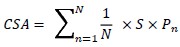
CSA |
= |
the Cash Settlement Amount; |
S |
= |
the Cash Settled Shares; |
Pn |
= |
on the relevant Trading Day, the Volume Weighted Average Price of a Share on such Trading Day falling in the corresponding Cash Settlement Calculation Period, translated into U.S. dollars at the Prevailing Rate on such Trading Day; and |
N |
= |
60, being the number of Trading Days in the Cash Settlement Calculation Period. |
(b) Final Exercise Period:
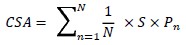
CSA |
= |
the Cash Settlement Amount; |
S |
= |
the Cash Settled Shares; |
Pn |
= |
on the relevant Trading Day, the higher of (i) the applicable Exercise Price and (ii) the Volume Weighted Average Price of a Share on such Trading Day falling in the corresponding Cash Settlement Calculation Period, translated into U.S. dollars at the Prevailing Rate on such Trading Day; and |
59
N |
= |
60, being the number of Trading Days in the Cash Settlement Calculation Period. |
“Cash Settled Shares” means, in respect of any date, the number of Shares determined by dividing the aggregate principal amount of the Securities which are the subject of the relevant exercise of Exercise Rights by such Security Holder by the Exercise Price in effect on such date.
“Cash Settlement Calculation Period” means:
(a) |
during the Initial Exercise Period, 60 consecutive Trading Days commencing on the first Trading Day following the date of the relevant Exercise Notice; or |
(b) |
during the Final Exercise Period, 60 consecutive Trading Days commencing on the 68th scheduled Trading Day preceding the Maturity Date. |
“Hong Kong business day” means a day, other than a Saturday, Sunday or public holiday, on which commercial banks and foreign exchange markets are generally open for business in Hong Kong.
“Volume Weighted Average Price” means, in respect of a Share on any Trading Day, the order book volume-weighted average price of a Share appearing on or derived from Bloomberg for such Share on page “9896 HK EQUITY VWAP” (or its successor page) or such other source as shall be determined to be appropriate by an Independent Financial Advisor (as defined below) on such Trading Day, provided that if on any such Trading Day such price is not available or cannot otherwise be determined as provided above, the Volume Weighted Average Price of a Share in respect of such Trading Day shall be the Volume Weighted Average Price, determined as provided above, on the immediately preceding Trading Day on which the same can be so determined.
(b) |
Exercise Procedure |
(i) |
Exercise Notice: To exercise the Exercise Right attaching to any Security, the holder thereof must complete, execute and deposit at his own expense from 9:00 a.m. to 3:00 |
p.m. on any business day in the location of the specified office of any Exchange Agent a notice of exercise (an “Exercise Notice”) in the form (for the time being current), together with the relevant Certificate or, if notice requiring redemption has been given by the holder of such Security pursuant to Condition 8(d) (Redemption at the Option of the Security Holders) or Condition 8(e) (Redemption for Delisting or Change of Control), then up to the close of business (at the place aforesaid) on the day prior to the giving of such notice. Exchange Rights shall be exercised subject in each case to any applicable fiscal or other laws or regulations applicable in the jurisdiction in which the specified office of the Exchange Agent to whom the relevant Exercise Notice is delivered is located.
The exercise date in respect of a Security (the “Exercise Date”) must fall at a time when the Exercise Right attaching to that Security is expressed in these Conditions to be exercisable (subject to the provisions of Condition 6(a)(iii) (Revival and/or survival after Default) and Condition 10 (Events of Default)) and will be deemed to be the Stock Exchange Business Day immediately following the date of the surrender of the Certificate in respect of such Security and delivery of such Exercise Notice and, if applicable, any payment to be made or indemnity given under these Conditions in connection with the exercise of such Exercise Right. An Exercise Notice deposited outside the hours specified above or on a day which is not a business day at the place of the specified office of the relevant Exchange Agent shall for all purposes be deemed to have been deposited with that Exchange Agent during the hours specified above on the next business day following such day. Any Security Holder who deposits an Exercise Notice during a Closed Period will not be permitted to exchange the Securities for cash(as specified in the Exercise Notice) until the next business day after the end of the Closed Period, which (if all other conditions to the exchange have been fulfilled)
60
will be the Exercise Date for such Securities notwithstanding that such date may fall outside the Exercise Period. An Exercise Notice once delivered shall be irrevocable and may not be withdrawn unless the Issuer consents in writing to such withdrawal. In these Conditions, “Stock Exchange Business Day” means any day (other than a Saturday or Sunday) on which The Stock Exchange of Hong Kong Limited (the “Hong Kong Stock Exchange”) or the Alternative Stock Exchange (as defined in Condition 6(c) (Adjustments to Exercise Price) below), as the case may be, is open for securities dealing.
(ii) |
Retroactive Adjustments: If the Exercise Date in relation to any Security shall be on or after the record date for any issue, distribution, grant, offer or other event that gives rise to the adjustment of the Exercise Price pursuant to Condition 6(c) (Adjustments to Exercise Price) but before the relevant adjustment becomes effective under the relevant Condition (a “Retroactive Adjustment”), upon the relevant adjustment becoming effective the Issuer shall procure the payment to the exercising Security Holder (or in accordance with the instructions contained in the Exercise Notice (subject to applicable exchange control or other laws or other regulations)), of such additional cash amount as is, together with the Cash Settlement Amount payable pursuant to Condition 6(a)(v) (Cash Settlement Amount) above, equal to the Cash Settlement Amount which would have been payable if the relevant adjustment to the Exercise Price had been made and become effective on or immediately after the relevant record date and in such event. |
(iii) |
Interest Accrual: If any notice requiring the redemption of any Securities is given pursuant to Condition 8(b) (Redemption for Taxation Reasons) or Condition 8(c) (Redemption at the Option of the Issuer) on or after the 15th Hong Kong business day prior to a record date which has occurred since the last Interest Payment Date (or in the case of the first Interest Period, since the Issue Date) in respect of any dividend or distribution payable in respect of the Shares where such notice specifies a date for redemption falling on or prior to the date which is 14 days after the Interest Payment Date next following such record date, interest shall (subject as hereinafter provided) accrue on Securities in respect of which Exercise Rights shall have been exercised and in respect of which the Exercise Date falls after such record date and on or prior to the Interest Payment Date next following such record date in each case from and including the preceding Interest Payment Date (or, if such Exercise Date falls before the first Interest Payment Date, from, and including, the Issue Date) to, but excluding, such Exercise Date. Any such interest shall be paid not later than 14 days after the relevant Exercise Date by the Issuer by transfer to a U.S. dollar account maintained by the payee with a bank, in accordance with instructions given by the relevant Security Holder in the Exercise Notice, provided that the Paying Agent shall not in any way be responsible for any such interest payment. |
(c) |
Adjustments to Exercise Price: Upon the occurrence of any of the following events described below, the Exercise Price will be adjusted as follows: |
(1) |
Consolidation, Subdivision, Redesignation or Reclassification: If and whenever there shall be an alteration to the nominal value of the Shares as a result of consolidation, subdivision, redesignation or reclassification, the Exercise Price shall be adjusted by multiplying the Exercise Price in force immediately before such alteration by the following fraction: |

where:
A |
is the nominal amount of one Share immediately after such alteration; and |
B |
is the nominal amount of one Share immediately before such alteration. |
Such adjustment shall become effective on the date such consolidation, subdivision, redesignation or reclassification takes effect.
(2) |
Capitalisation of Profits or Reserves: |
61
(i) |
If and whenever the Issuer shall issue any Shares credited as fully paid to the holders of Shares (the “Shareholders”) by way of capitalisation of profits or reserves (including any share premium account) including Shares paid up out of distributable profits or reserves and/or share premium account (except for any Scrip Dividend (as defined below)) and which would not have constituted a Capital Distribution (as defined below), the Exercise Price shall be adjusted by multiplying the Exercise Price in force immediately before such issue by the following fraction: |
where:
Ais the aggregate nominal amount of the issued Shares immediately before such issue; and
Bis the aggregate nominal amount of the issued Shares immediately after such issue.
Such adjustment shall become effective on the date of issue of such Shares or if a record date is fixed therefor, immediately after such record date.
(ii) |
In the case of an issue of Shares by way of a Scrip Dividend where the aggregate value of such Shares issued by way of Scrip Dividend as determined by reference to the Current Market Price (as defined below) per Share on the date of announcement of the terms of such Scrip Dividend exceeds the amount of the Relevant Cash Dividend (as defined below) or the relevant part thereof and which would not have constituted a Capital Distribution, the Exercise Price shall be adjusted by multiplying the Exercise Price in force immediately before the issue of such Shares by the following fraction: |

where:
A |
is the aggregate nominal amount of the issued Shares immediately before such issue; |
B |
is the aggregate nominal amount of Shares issued by way of such Scrip Dividend multiplied by a fraction of which (i) the numerator is the amount of the whole, or the relevant part, of the Relevant Cash Dividend for which Shareholders have elected to receive as Shares issued by way of Scrip Dividend and (ii) the denominator is the aggregate value of such Shares issued by way of Scrip Dividend as determined by reference to the Current Market Price per Share; and |
C |
is the aggregate nominal amount of Shares issued by way of such Scrip Dividend. |
Such adjustment shall become effective on the date of issue of such Shares issued by way of Scrip Dividend or if a record date is fixed therefor, immediately after such record date.
(3) |
Capital Distributions: If and whenever the Issuer shall pay or make any Capital Distribution to the Shareholders (except to the extent that the Exercise Price falls to be adjusted under Condition 6(c)(2) (Capitalisation of Profits or Reserves) above), the Exercise Price shall be adjusted by multiplying the Exercise Price in force immediately before such Capital Distribution by the following fraction: |

62
where:
A |
is the Current Market Price of one Share on the last Trading Day preceding the date on which the Capital Distribution is publicly announced; and |
B |
is the Fair Market Value (as defined below) of the portion of the Capital Distribution attributable to one Share. |
Such adjustment shall become effective on the date that such Capital Distribution is actually made or paid or if a record date is fixed therefor, immediately after such record date. For the purpose of the above, Fair Market Value shall (subject as provided in the definition of “Fair Market Value”) be determined as at the date on which the Capital Distribution is first publicly announced or, if later, the first date on which the Fair Market Value of the relevant Capital Distribution is capable of being determined as provided herein.
In making any calculation pursuant to this Condition 6(c)(3) (Capital Distributions), such adjustments (if any) shall be made as an Independent Financial Advisor may consider appropriate to reflect (a) any consolidation or subdivision of the Shares, (b) issues of Shares by way of capitalisation of profits or reserves, or any like or similar event, (c) the modification of any rights to dividends of Shares or (d) any change in the fiscal year of the Issuer.
(4) |
Rights Issues of Shares or Options over Shares: If and whenever the Issuer shall issue Shares to all or substantially all Shareholders as a class by way of rights, or issue or grant to all or substantially all Shareholders as a class by way of rights, options, warrants or other rights to subscribe for, purchase or otherwise acquire any Shares, in each case at less than 95 per cent. of the Current Market Price per Share on the date of the first public announcement of the terms of the issue or grant, the Exercise Price shall be adjusted by multiplying the Exercise Price in force immediately before such issue or grant by the following fraction: |
where:
A |
is the aggregate number of Shares in issue immediately before such announcement; |
B |
is the number of Shares which the aggregate consideration receivable for the Shares issued by way of rights or for the options or warrants or other rights issued or granted by way of rights and for the total number of Shares comprised therein would subscribe for, purchase or otherwise acquire at such Current Market Price per Share; and |
C |
is the aggregate number of Shares issued or, as the case may be, comprised in the issue or grant. |
Such adjustment shall become effective on the date of issue of such Shares or issue or grant of such options, warrants or other rights (as the case may be) or where a record date is set, the first date on which the Shares are traded ex-rights, ex-options or ex- warrants, as the case may be.
(5) |
Rights Issues of Other Securities: If and whenever the Issuer shall issue any securities (other than Shares or options, warrants or other rights to subscribe for, purchase or otherwise acquire Shares) to all or substantially all Shareholders as a class by way of rights, or issue or grant to all or substantially all Shareholders as a class by way of rights, options, warrants or other rights to subscribe for, purchase or otherwise acquire any securities (other than Shares or options, warrants or other rights to subscribe for, purchase or otherwise acquire Shares), the Exercise Price shall be adjusted by multiplying the Exercise Price in force immediately before such issue or grant by the following fraction: |
63
where:
A |
is the Current Market Price per Share on the date on which such issue or grant is publicly announced; and |
B |
is the Fair Market Value per Share on the date of such announcement of the portion of the rights attributable to one Share. |
Such adjustment shall become effective on the date of issue of the securities or the issue or grant of such rights, options or warrants (as the case may be) or where a record date is set, the first date on which the Shares are traded ex-rights, ex-options or ex-warrants, as the case may be. For the purpose of the above, Fair Market Value shall (subject as provided in the definition of “Fair Market Value”) be determined as at the date on which the terms of such issue or grant are publicly announced, or if later, the first date on which the Fair Market Value of the aggregate rights attributable to the Shares in relation to such issue or grant is capable of being determined as provided herein.
(6) |
Issues at less than Current Market Price: If and whenever the Issuer shall issue (otherwise than as mentioned in Condition 6(c)(4) (Rights Issues of Shares or Options over Shares) above) any Shares (other than Shares issued on the exercise of any rights of conversion into, or exchange or subscription for, Shares) or shall issue or grant (otherwise than as mentioned in Condition 6(c)(4) (Rights Issues of Shares or Options over Shares) above) any options, warrants or other rights to subscribe for, purchase or otherwise acquire Shares, in each case at a price per Share which is less than 95 per cent. of the Current Market Price per Share on the date of the first public announcement of the terms of such grant or issue, the Exercise Price shall be adjusted by multiplying the Exercise Price in force immediately before such issue by the following fraction: |

where:
A |
is the aggregate number of Shares in issue immediately before the issue of such additional Shares or the grant of such options, warrants or other rights to subscribe for or purchase or otherwise acquire any Shares; |
B |
is the number of Shares which the aggregate consideration receivable for the issue of the maximum number of Shares to be issued or the exercise of such options, warrants or other rights would purchase at such Current Market Price per Share; and |
C |
is the aggregate number of Shares in issue immediately after the issue of such additional Shares. |
References to additional Shares in the above formula shall, in the case of an issue by the Issuer of options, warrants or other rights to subscribe for, purchase or otherwise acquire Shares, mean such Shares to be issued assuming that such options, warrants or other rights are exercised in full at the initial exercise price (if applicable) on the date of issue or grant of such options, warrants or other rights.
Such adjustment shall become effective on the date of issue of such additional Shares or, as the case may be, the issue or grant of such options, warrants or other rights.
(7) |
Other Issues at less than Current Market Price: Save in the case of an issue of securities arising from a conversion or exchange of other securities in accordance with the terms applicable to such securities themselves falling within this Condition 6(c)(7) (Other Issues at less than Current Market Price), if and whenever the Issuer or any of its Subsidiaries (otherwise than as mentioned in Conditions 6(c)(4) (Rights Issues of Shares or Options over Shares), 6(c)(5) (Rights Issues of Other Securities) or 6(c)(6) (Issues at less than Current Market Price)) or (at |
64
the direction or request of or pursuant to any arrangements with the Issuer or any of its Subsidiaries) any other company, person or entity shall issue any securities which by their terms of issue carry rights of conversion into, or exchange or subscription for, Shares to be issued by the Issuer upon conversion, exchange or subscription at a consideration per Share which is less than 95 per cent. of the Current Market Price per Share on the date of the first public announcement of the terms of issue of such securities, the Exercise Price shall be adjusted by multiplying the Exercise Price in force immediately before such issue by the following fraction:
where:
A |
is the aggregate number of Shares in issue immediately before such issue; |
B |
is the number of Shares which the aggregate consideration receivable by the Issuer for the Shares to be issued on exercise or exchange or on exercise of the right of subscription attached to such securities would purchase at such Current Market Price per Share; and |
C |
is the maximum number of Shares to be issued on exercise or exchange of such securities or on the exercise of such rights of subscription attached thereto at the initial exercise, exchange or subscription price or rate on the issue date of such securities. |
Such adjustment shall become effective on the date of issue of such securities.
(8) |
Modification of Rights of Exercise etc.: If and whenever there shall be any modification of the rights of exercise, exchange or subscription attaching to any securities which by their terms of issue carry rights of conversion into, or exchange or subscription for, Shares (other than in accordance with the terms of such securities) so that following such modification the consideration per Share (for the number of Shares available on exercise, exchange or subscription following the modification) is less than 95 per cent. of the Current Market Price per Share on the date of announcement of the proposals for such modification, the Exercise Price shall be adjusted by multiplying the Exercise Price in force immediately before such modification by the following fraction: |
where:
A |
is the aggregate number of Shares in issue immediately before such modification; |
B |
is the maximum number of Shares which the aggregate consideration receivable by the Issuer for the Shares to be issued on exercise or exchange or on exercise of the right of subscription attached to the securities so modified would purchase at such Current Market Price per Share or, if lower, the existing exercise, exchange or subscription price of such securities; and |
C |
is the maximum number of Shares to be issued on exercise or exchange of such securities or on the exercise of such rights of subscription attached thereto at the modified exercise, exchange or subscription price or rate but giving credit in such manner as an Independent Financial Advisor considers appropriate (if at all) for any previous adjustment under this Condition 6(c)(7) (Modification of Rights of Exercise etc.) or Condition 6(c)(7) (Other Issues at less than Current Market Price). |
Such adjustment shall become effective on the date of modification of the rights of exercise, exchange or subscription attaching to such securities.
65
(9) |
Other Offers to Shareholders: If and whenever the Issuer or any of its Subsidiaries or (at the direction or request of or pursuant to any arrangements with the Issuer or any of its Subsidiaries) any other company, person or entity issues, sells or distributes any securities in connection with an offer pursuant to which the Shareholders generally are entitled to participate in arrangements whereby such securities may be acquired by them (except where the Exercise Price falls to be adjusted under Conditions 6(c)(4) (Rights Issues of Shares or Options over Shares), 6(c)(5) (Rights Issues of Other Securities), 6(c)(6) (Issues at less than Current Market Price) or 6(c)(7) (Other Issues at less than Current Market Price)), the Exercise Price shall be adjusted by multiplying the Exercise Price in force immediately before such issue, sale or distribution by the following fraction: |
where:
A |
is the Current Market Price per Share on the date on which such issue, sale or distribution is publicly announced; and |
B |
is the Fair Market Value of the portion of the rights attributable to one Share. |
Such adjustment shall become effective on the date of issue, sale or distribution of the securities. For the purpose of the above, Fair Market Value shall (subject as provided in the definition of “Fair Market Value”) be determined as at the date on which the terms of such issue, sale or distribution of securities are first publicly announced or, if later, the first date on which the Fair Market Value of the portion of the aggregate rights attributable to the Shares is capable of being determined as provided herein.
(10) |
Other Events: If the Issuer determines that an adjustment should be made to the Exercise Price as a result of one or more events or circumstances not referred to in this Condition 6(c) (Adjustments to Exercise Price), the Issuer shall at its own expense consult an Independent Financial Advisor to determine as soon as practicable what adjustment (if any) to the Exercise Price is fair and reasonable to take account thereof, if the adjustment would result in a reduction in the Exercise Price, and the date on which such adjustment should take effect and upon such determination by the Independent Financial Advisor such adjustment (if any) shall be made and shall take effect in accordance with such determination. Notwithstanding the foregoing, the per Share value of any such modification shall not exceed the per Share value of the dilution in the Shareholders’ interest in the Issuer’s equity caused by such events or circumstances. |
In this Condition 6(c) (Adjustments to Exercise Price), where the events or circumstances giving rise to any adjustment pursuant to any of the above adjustments under this Condition 6(c) (Adjustments to Exercise Price) have already resulted or will result in an adjustment to the Exercise Price or where the events or circumstances giving rise to any adjustment arise by virtue of events or circumstances which have already given rise or will give rise to an adjustment to the Exercise Price, such modification (if any) shall be made to the operation of the provisions of this Condition 6 (Exercise) as may be advised by the Independent Financial Advisor to be in its opinion appropriate to give the intended result.
For the purposes of these Conditions:
“Alternative Stock Exchange” means at any time, in the case of the Shares, if they are not at that time listed and traded on the Hong Kong Stock Exchange, such other internationally recognised stock exchange which is the principal stock exchange or securities market on which the Shares are then listed or quoted or dealt in.
“Capital Distribution” means (i) the aggregate distribution of assets in specie by the Issuer for any financial period whenever paid or made and however described (and for these purposes a distribution of assets in specie includes, without limitation, an issue of Shares or other securities credited as fully or partly paid by way of capitalisation of reserves, but excludes any Shares credited as fully paid to the extent an adjustment to the Exercise Price is made in respect thereof under Condition 6(c)(2)(i) (Capitalisation of Profits or Reserves) and a Scrip Dividend adjusted for under Condition 6(c)(2)(ii)
66
(Capitalisation of Profits or Reserves)); and (ii) the aggregate cash dividend or distribution on a gross basis (including, without limitation, the relevant cash amount of a Scrip Dividend) of any kind by the Issuer for any financial period (whenever paid and however described) unless it comprises a purchase or redemption of Shares by or on behalf of the Issuer (or a purchase of Shares by or on behalf of a Subsidiary of the Issuer), where the weighted average price or consideration (before expenses) on any one day in respect of such purchases does not exceed 105 per cent. of the Current Market Price of the Shares either(1) on that date or (2) where an announcement has been made of the intention to purchase Shares at some future date at a specified price, on the Trading Day immediately preceding the date of such announcement and, if in the case of either (1) or (2), the relevant day is not a Trading Day, the immediately preceding Trading Day, in which case such purchase or redemption shall be deemed to constitute a Capital Distribution in an amount equal to the amount by which the aggregate consideration paid (before expenses) in respect of such Shares purchased or redeemed exceeds the product of (i) 105 per cent. of such Current Market Price and (ii) the number of Shares so purchased or redeemed.
“Closing Price” of the Shares for any Trading Day shall be the price published in the Daily Quotation Sheet published by the Hong Kong Stock Exchange or, as the case may be, the equivalent quotation sheet of an Alternative Stock Exchange for such day.
“Current Market Price” means, in respect of a Share on a particular date, the average of the Closing Prices for one Share (being a Share carrying full entitlement to dividend) for the 20 consecutive Trading Days ending on and including the Trading Day immediately preceding such date; provided that if at any time during the said 20 Trading Day-period the Shares shall have been quoted ex-dividend and during some other part of that period the Shares shall have been quoted cum-dividend then:
(i) |
if the Shares to be issued in such circumstances do not rank for the dividend in question, the Closing Price on the dates on which the Shares shall have been quoted cum-dividend shall for the purpose of this definition be deemed to be the amount thereof reduced by an amount equal to the Fair Market Value of that dividend per Share; or |
(ii) |
if the Shares to be issued in such circumstances rank for the dividend in question, the Closing Price on the dates on which the Shares shall have been quoted ex-dividend shall for the purpose of this definition be deemed to be the amount thereof increased by the Fair Market Value of that dividend per Share; |
and provided further that if the Shares on each of the said 20 Trading Days have been quoted cum-dividend in respect of a dividend which has been declared or announced but the Shares to be issued do not rank for that dividend, the Closing Price on each of such dates shall for the purpose of this definition be deemed to be the amount thereof reduced by an amount equal to the Fair Market Value of that dividend per Share.
“Early Closure” means the closure on any day of the Hong Kong Stock Exchange or, if applicable, the Alternative Stock Exchange prior to the time the Closing Price would have otherwise been determined for such day.
“Exchange Disruption” means any event (other than an Early Closure) that disrupts or impairs the ability of market participants in general:
(i) |
to effect transactions in, or obtain market values for, the Shares on the Hong Kong Stock Exchange or, if applicable, the Alternative Stock Exchange; or |
(ii) |
to effect transactions in, or obtain market values for, futures or options contacts relating to the Shares on the Hong Kong Stock Exchange or, if applicable, the Alternative Stock Exchange. |
“Fair Market Value” means, with respect to any asset, security, option, warrant or other right on any date, the fair market value of that asset, security, option, warrant or other right as determined by an Independent Financial Advisor on the basis of commonly accepted market valuation method and taking into account such factors as it considers appropriate, provided that an Independent Financial Advisor will not be required to determine the fair market value where (i) the Capital Distribution is paid in cash, in which case the fair market value of such cash Capital Distribution per Share shall be the amount of such cash Capital Distribution per Share, (ii) any other amounts are paid in cash, in which case the fair market value of such cash amount shall be the amount of cash, and (iii) options, warrants or other rights or securities are or will upon issuance be publicly traded in a market of adequate liquidity (as determined by such Independent Financial Advisor), the fair market value of such options, warrants or other rights or securities shall equal the arithmetic mean of the daily closing price of such options, warrants or other rights or securities during the period of five trading days on the relevant market commencing on the first such trading day such options, warrants or other rights or securities are publicly traded.
67
Such amounts, if expressed in a currency other than Hong Kong dollars shall be translated into Hong Kong dollars at the Prevailing Rate on such date. In addition, in the case of provisos (i) and (ii) above of this definition, the Fair Market Value shall be determined on a gross basis and disregarding any withholding or deduction required to be made for or on account of tax and disregarding any associated tax credit.
“Independent Financial Advisor” means a reputable independent financial advisor or financial institution with appropriate expertise selected and appointed at its own cost by the Issuer and notified in writing to the Trustee. The Trustee shall not be responsible for or under any obligation to appoint an Independent Financial Advisor and neither the Trustee nor any Agent shall have any responsibility or liability for verifying any calculation, determination, certification, advice or opinion made, given or reached by any Independent Financial Advisor.
“Market Disruption Event” means, the occurrence or existence of:
(i) |
a Trading Disruption; |
(ii) |
an Exchange Disruption at any time during the regular trading session on the Hong Kong Stock Exchange or, if applicable, the Alternative Stock Exchange that, in aggregate (calculated individually for each exchange) lasts for more than one-half hour period, without regard to after hours or any other trading outside of the regular trading session hours; or |
(iii) |
an Early Closure by more than one half-hour period. |
“Prevailing Rate” means, in respect of any currency on any day, the bid exchange rate between the relevant currencies prevailing as at or about 12:00 noon (Hong Kong time) on that date as appearing on or derived from the relevant page on Bloomberg or, if there is no such page, on Reuters or such other information service provider that displays the relevant information or, if such a rate cannot be determined at such time, the rate prevailing as at or about 12:00 noon (Hong Kong time) on the immediately preceding day on which such rate can be so determined.
“Relevant Cash Dividend” means any cash dividend specifically declared by the Issuer.
“Scrip Dividend” means any Shares issued in lieu of the whole or any part of any Relevant Cash Dividend, being a dividend which the Shareholders concerned would or could otherwise have received and which would not have constituted a Capital Distribution (and for the avoidance of doubt, no adjustment is to be made under Condition 6(c)(3) (Capital Distributions) in respect of the amount by which the Current Market Price of the Shares exceeds the Relevant Cash Dividend or the relevant part thereof but without prejudice to any adjustment required in such circumstances to be made under Condition 6(c)(2) (Capitalisation of Profits or Reserves)).
“Trading Day” means a day when the Hong Kong Stock Exchange or, as the case may be, an Alternative Stock Exchange is open for the business of dealing in securities (other than a day on which a Market Disruption Event occurs), provided that for the purposes of any calculation where a Closing Price is required, if no Closing Price is reported for one or more consecutive dealing days such day or days will be disregarded in any relevant calculation and shall be deemed not to have existed when ascertaining any period of dealing days.
“Trading Disruption” means any suspension of or limitation imposed on trading by the on the Hong Kong Stock Exchange or, if applicable, the Alternative Stock Exchange or otherwise and whether by reason of movements in price exceeding limits permitted by the Hong Kong Stock Exchange or, if applicable, the Alternative Stock Exchange or otherwise:
(i) |
relating to Shares on the Hong Kong Stock Exchange or, as the case may be, an Alternative Stock Exchange, or |
(ii) |
in futures or options contracts relating to the Shares on the Hong Kong Stock Exchange or, as the case may be, an Alternative Stock Exchange. |
68
On any adjustment, the relevant Exercise Price, if not an integral multiple of one Hong Kong cent, shall be rounded down to the nearest Hong Kong cent. No adjustment shall be made to the Exercise Price where such adjustment (rounded down if applicable) would be less than one per cent. of the Exercise Price then in effect. Any adjustment not required to be made, and any amount by which the Exercise Price has been rounded down, shall be carried forward and taken into account in any subsequent adjustment. Notice of any adjustment shall be given by the Issuer to the Security Holders in accordance with Condition 16 (Notices) and in writing to the Trustee and the Principal Agent as soon as practicable after the determination thereof.
Notwithstanding anything to the contrary in these Conditions, the Exercise Price may not be reduced to below the par value of the Shares or below such par value or such minimum level permitted by applicable laws then in force in the Cayman Islands and Hong Kong as a result of any adjustment hereunder.
If any doubt shall arise as to whether an adjustment falls to be made to the Exercise Price or as to how an adjustment to the Exercise Price under Condition 6(c) (Adjustments to Exercise Price) or Condition 6(d) (Adjustment upon Change of Control) should be made, and following consultation between the Issuer and an Independent Financial Advisor, a written opinion of such Independent Financial Advisor in respect thereof shall be conclusive and binding on the Issuer, the Security Holders and the Trustee, save in the case of manifest error. Where more than one event which gives or may give rise to an adjustment to the Exercise Price occurs within such a short period of time that in the opinion of an Independent Financial Advisor, the foregoing provisions would need to be operated subject to some modification in order to give the intended result, such modification shall be made to the operation of the foregoing provisions as may be advised by such Independent Financial Advisor to be in its opinion appropriate in order to give such intended result.
Any references herein to the date on which a consideration is “fixed” shall, where the consideration is originally expressed by reference to a formula which cannot be expressed as an actual cash amount until a later date, be construed as a reference to the first day on which such actual cash amount can be ascertained.
No adjustment will be made to the Exercise Price when Shares or any rights or options on other securities are issued, offered or granted pursuant to any share option, share award, restricted share or employee incentive scheme or plan (and which such scheme or plan is in compliance with the Rules Governing the Listing of Securities on The Stock Exchange of Hong Kong Limited (the “Listing Rules”) or, if applicable, the listing rules of an Alternative Stock Exchange) (“Share Scheme Shares/Options”), unless any grant or issue of Share Scheme Shares/Options (which, but for this provision, would have required adjustment pursuant to this Condition 6 (Exercise)) would result in the total number of Shares which may be issued upon exercise of such Share Scheme Shares/Options granted during each calendar year representing, in aggregate, over 3 per cent. of the average number of issued and outstanding Shares during such calendar year, in which case only such portion of the grant or issue of Share Scheme Shares/Options that exceeds 3 per cent. of the average number of issued and outstanding Shares during the relevant calendar year shall be taken into account in determining adjustment of the Exercise Price pursuant to this Condition 6 (Exercise).
No adjustment involving an increase in the Exercise Price will be made, except in the case of a consolidation of the Shares as referred to in Condition 6(c)(1) (Consolidation, Subdivision, Redesignation or Reclassification). The Issuer may at any time and for a specified period of time only, following notice being given to the Trustee and the Principal Agent and to the Security Holders in accordance with Condition 16 (Notices), reduce the Exercise Price, subject to the other provisions of this Condition 6(c) (Adjustments to Exercise Price).
Where more than one event which gives or may give rise to an adjustment to the Exercise Price occurs within such a short period of time that, in the opinion of an Independent Financial Advisor, the foregoing provisions would need to be operated subject to some modification in order to give the intended result, such modification shall be made to the operation of the foregoing provisions as may be advised by such Independent Financial Advisor to be in its opinion appropriate in order to give such intended result.
Neither the Trustee nor the Agents shall be under any duty to monitor whether any event or circumstance has happened or exists which may require or lead to an adjustment to be made to the Exercise Price or any calculation (or verification thereof) in connection with the Exercise Price and none of them will be liable or responsible to any Security Holder or any other person for any loss or liability arising from any failure by them to do so.
69
All adjustments to the Exercise Price under Condition 6(c) (Adjustments to Exercise Price) shall be determined by the Issuer and, if applicable, the Independent Financial Advisor, and neither the Trustee nor the Agents shall be responsible for verifying, or otherwise liable for, such determinations or for verifying any calculation, certification, advice or opinion in connection with such determinations.
(d) |
Adjustment upon Change of Control: If a Change of Control (as defined in Condition 8(e) (Redemption for Delisting or Change of Control)) shall occur, the Issuer shall give notice (the “Change of Control Notice”) of that fact to the Trustee and the Principal Agent in writing and to the Security Holders in accordance with Condition 16 (Notices) within seven days after it becomes aware of such Change of Control. Following the giving of a Change of Control Notice, upon any exercise of Exercise Rights such that the relevant Exercise Date falls within the period of 30 days following the later of (i) the relevant Change of Control and (ii) the date on which the Change of Control Notice is given to Security Holders (such period, the “Change of Control Exercise Period”), the Exercise Price shall be adjusted in accordance with the following formula: |
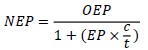
where:
“c” means the number of days from and including the date the Change of Control occurs to but excluding the Maturity Date.
“EP” means 32.5 per cent. expressed as a fraction. “NEP” means the new Exercise Price.
“OEP” means the Exercise Price in effect on the relevant Exercise Date.
“t” means the number of days from and including the Issue Date to but excluding the Maturity Date,
provided that the Exercise Price shall not be reduced pursuant to this Condition 6(d) (Adjustment upon Change of Control) below the level permitted by applicable laws and regulations from time to time (if any).
If the last day of a Change of Control Exercise Period shall fall during a Closed Period, the Change of Control Exercise Period shall be extended such that its last day will be the 15th day following the last day of the Closed Period.
(e) |
Undertakings |
The Issuer has undertaken in the Trust Deed, inter alia, that so long as any Security remains outstanding, save with the approval of an Extraordinary Resolution (as defined in the Trust Deed) of the Security Holders:
(i) |
it will use its reasonable endeavours (a) to maintain a listing for all the issued Shares on the Hong Kong Stock Exchange, and (b) if the Issuer is unable to obtain or maintain such listing, to use its reasonable endeavours to obtain and maintain a listing for all the issued Shares on an Alternative Stock Exchange as the Issuer may from time to time select and notify to the Trustee and will forthwith give notice to the Security Holders in accordance with Condition 16 (Notices) of the listing or delisting of the Shares (as a class) by any of such stock exchanges; |
(ii) |
it will not make any reduction of its ordinary share capital or any uncalled liability in respect thereof or of any share premium account or capital redemption reserve fund except, in each case, where the reduction is permitted by applicable law and results in (or would, but for the provision of these Conditions relating to rounding or the carry forward of adjustments, result in) an adjustment to the Exercise Price or is otherwise |
70
taken into account for the purposes of determining whether such an adjustment should be made (and for the avoidance of doubt, shall not restrict the Issuer from repurchasing any Shares on the Hong Kong Stock Exchange in accordance with the Listing Rules and applicable law);
(iii) |
it will use its reasonable endeavours to list and thereafter maintain the listing of the Securities on the Official List of the Singapore Exchange Securities Trading Limited and if the Issuer is unable to maintain such listing, to use all reasonable endeavours to obtain and maintain a listing on another internationally recognised stock exchange and will forthwith give notice to the Security Holders in accordance with Condition 16 (Notices) and in writing to the Trustee and the Principal Agent of the listing or delisting of the Securities by any such stock exchange; and |
(iv) |
in the Trust Deed, the Issuer has also undertaken with the Trustee that so long as any Security remains outstanding it will not make any offer, issue or distribute or take any action the effect of which would be to reduce the Exercise Price below the par value of the Shares of the Issuer, provided always that the Issuer shall not be prohibited from purchasing its Shares to the full extent permitted by law. |
The Issuer has also given certain other undertakings in the Trust Deed for the protection of the Exercise Rights.
(f) |
Notice of Change in Exercise Price |
The Issuer shall give notice to the Trustee and the Principal Agent in writing and to the Security Holders in accordance with Condition 16 (Notices) of any change in the Exercise Price. Any such notice relating to a change in the Exercise Price shall set forth the event giving rise to the adjustment, the Exercise Price prior to such adjustment, the adjusted Exercise Price and the effective date of such adjustment.
7 |
Payments |
(a) |
Payments: Payment of principal, interest, premium (if any) and default interest (if any) and any other amounts due (other than the Cash Settlement Amount) will be made by transfer to the registered account of the Security Holder. Such payment will only be made after surrender of the relevant Certificate at the specified office of the Paying Agent. |
Interest on Securities due on an Interest Payment Date will be paid on the due date for the payment of interest to the holder shown on the Register at the close of business on the fifteenth day before the due date for the payment of interest (the “Interest Record Date”). Payments of interest on each Security will be made by transfer to the registered account of the Security Holder.
So long as the Securities are represented by a Global Certificate and such Global Certificate is held on behalf of a clearing system, payments of principal, interest, premium (if any) and any other amounts due in respect of the Securities (other than any Cash Settlement Amount) will be made to the holder appearing in the Register at the close of the business day (being for this purpose a day on which Euroclear and Clearstream are open for business) one Business Day before the relevant due date.
(b) |
Registered Accounts: For the purposes of this Condition 7, a Security Holder’s registered account means the U.S. dollar account maintained by or on behalf of it, details of which appear on the Register at the close of business on the Interest Record Date, and a Security Holder’s registered address means its address appearing on the Register at that time. |
(c) |
Fiscal Laws: All payments of principal, premium (if any) and interest (if any) under the Securities are subject in all cases to (i) any applicable fiscal or other laws and regulations in the place of payment, but without prejudice to the provisions of Condition 9 (Taxation) and (ii) if applicable, any withholding or deduction required pursuant to an agreement described in Section 1471(b) of the U.S. Internal Revenue Code of 1986, as amended (the “Code”) or otherwise imposed pursuant to Sections 1471 through 1474 of the Code, any regulations or agreements thereunder, any official interpretations thereof, or (without prejudice to the provisions of |
71
Condition 9 (Taxation)) any law implementing an intergovernmental approach thereto (any such withholding or deduction, a “FATCA Withholding”). For avoidance of doubt, neither the Issuer, the Trustee and the Agents nor any other person will be required to pay any additional amounts in respect of FATCA Withholding. No commissions or expenses shall be charged to the Security Holders in respect of such payments.
(d) |
Payment Initiation: Payment instructions (for value on the due date or, if that is not a business day (as defined below), for value on the first following day which is a business day) will be initiated on the due date for payment (or, if that date is not a business day, on the first following day which is a business day), or, in the case of a payment of principal, if later, on the business day on which the relevant Certificate is surrendered at the specified office of an Agent. |
(e) |
Delay in Payment: Security Holders will not be entitled to any interest or other payment for any delay after the due date in receiving the amount due if the due date is not a business day or if the Security Holder is late in surrendering its Certificate (if required to do so). |
(f) |
Business Day: In this Condition 7 (Payments), “business day” means a day other than a Saturday, Sunday or public holiday on which commercial banks are generally open for business in Hong Kong, New York City, in the city in which the specified office of the Principal Agent is located and, in the case of the surrender of a Certificate, in the city in which the specified office of the relevant Paying Agent whom a Certificate is surrendered for payment is located. If an amount which is due on the Securities is not paid in full, the Registrar will annotate the Register with a record of the amount (if any) in fact paid. |
(g) |
Rounding: When making payments to Security Holders, fraction of one cent will be rounded to the nearest cent (half a cent being rounded upwards). |
8 |
Redemption, Purchase and Cancellation |
(a) |
Maturity: Unless previously redeemed, purchased and cancelled or unless the Exercise Right in respect of such Security has been exercised as provided herein, the Issuer will redeem each Security at its principal amount on 14 January 2032 (the “Maturity Date”), together with interest accrued but unpaid to but excluding such date. The Issuer may not redeem the Securities at its option prior to that date except as provided in Condition 8(b) (Redemption for Taxation Reasons) or Condition 8(c) (Redemption at the Option of the Issuer) below (but without prejudice to Condition 10 (Events of Default)). |
(b) |
Redemption for Taxation Reasons |
(i) |
The Securities may be redeemed at the option of the Issuer in whole, but not in part, at any time, on giving not less than 30 nor more than 60 days’ notice (a “Tax Redemption Notice”) to the Security Holders in accordance with Condition 16 (Notices) (which notice shall be irrevocable) and in writing to the Trustee and the Principal Agent, on the date specified in the Tax Redemption Notice for redemption (the “Tax Redemption Date”) at their principal amount as at such date together with the interest accrued but unpaid to but excluding such date (if any), if the Issuer notifies the Trustee immediately prior to the giving of such notice that (A) the Issuer has or will become obliged to pay Additional Tax Amounts as provided or referred to in Condition 9 (Taxation) as a result of any change in, or amendment to, the laws or regulations of the Cayman Islands, Hong Kong or the PRC or, in each case, any political subdivision or any authority thereof or therein having power to tax, or any change in the general application or official interpretation of such laws or regulations, which change or amendment becomes effective on or after 6 January 2025, and (B) such obligation cannot be avoided by the Issuer taking reasonable measures available to it, provided that changing the Issuer’s jurisdiction of organization shall be deemed not to be a reasonable measure, and further provided that no Tax Redemption Notice shall be given earlier than 90 days prior to the earliest date on which the Issuer would be obliged to pay such Additional Tax Amounts were a payment in respect of the Securities then due. Prior to the publication of any Tax Redemption Notice pursuant to this Condition 8(b) (Redemption for Taxation Reasons), the Issuer shall deliver to the Trustee (x) certificate in English signed by an Authorised Signatory of the Issuer stating that the obligation referred to |
72
in (A) above cannot be avoided by the Issuer taking reasonable measures available to it and (y) an opinion of independent legal or tax advisors of recognised standing to the effect that the Issuer has or would become obligated to pay such Additional Tax Amounts as a result of such change or amendment referred to above in this Condition 8(b)(i) (Redemption for Taxation Reasons). The Trustee shall be entitled to rely conclusively upon and accept such certificate and opinion (without further investigation or enquiry) as sufficient evidence thereof in which event it shall be conclusive and binding on the Issuer and the Security Holders. The Trustee shall have no liability to any Security Holder or any other person for so accepting and relying conclusively on such certificate or opinion.
On the Tax Redemption Date, the Issuer will be bound to redeem the Securities at the principal amount on the Tax Redemption Date together with interest accrued but unpaid to but excluding such date (if any), provided that redemption under this Condition 8(b)(i) (Redemption for Taxation Reasons) may not occur within seven days of the end of a Closed Period, but otherwise may occur when the Exercise Right is expressed in these Conditions to be exercisable.
(ii) |
If the Issuer gives a Tax Redemption Notice pursuant to Condition 8(b)(i) (Redemption for Taxation Reasons), each Security Holder will have the right to elect that its Security(ies) shall not be redeemed and that the provisions of Condition 9 (Taxation) shall not apply in respect of any payment of principal, interest, Cash Settlement Amount, premium (if any) or default interest (if any) to be made in respect of such Security(ies) which falls due after the relevant Tax Redemption Date, whereupon no additional amounts shall be payable by the Issuer in respect thereof pursuant to Condition 9 (Taxation) and subject to the applicable procedures of Euroclear and Clearstream, payment of all amounts by the Issuer to such Security Holder in respect of such Security shall be made subject to the deduction or withholding of any tax required to be deducted or withheld. In the case of Securities represented by Global Certificates, in the absence of applicable Euroclear and Clearstream procedures for such required deduction or withholding or failure by the Issuer to notify Euroclear and Clearstream of the applicable withholding tax rate (if the amount of interest is reduced due to such required deduction or withholding), the Issuer acknowledges and agrees that the Paying Agent will be unable to facilitate payments to Security Holders. To exercise a right pursuant to this Condition 8(b)(ii) (Redemption for Taxation Reasons), the holder of the relevant Security must complete, sign and deposit during normal business hours (being between 9:00 a.m. and 3:00 p.m. (in the location of the specified office of the relevant Paying Agent)) at the specified office of any Paying Agent a duly completed and signed notice of exercise, in the form for the time being current, obtainable from the specified office of any Paying Agent (the “Tax Option Exercise Notice”) together with the Certificate representing the Securities on or before the day falling 10 days prior to the Tax Redemption Date. A Tax Option Exercise Notice, once delivered, shall be irrevocable and may not be withdrawn without the Issuer’s consent. |
(c) |
Redemption at the Option of the Issuer |
On giving not less than 30 nor more than 60 days’ notice (an “Optional Redemption Notice”) to the Principal Agent and the Trustee in writing and to the Security Holders in accordance with Condition 16 (Notices) (which notice will be irrevocable), the Issuer may at any time prior to the Maturity Date redeem in whole, but not in part, the Securities for the time being outstanding at their principal amount, together with interest accrued but unpaid to but excluding such date (if any), provided that prior to the date of such notice at least 90 per cent. in principal amount of the Securities originally issued has already been redeemed, purchased and cancelled or in respect of which Exercise Rights have been exercised.
Redemption under this Condition 8(c) (Redemption at the Option of the Issuer) may not occur within seven days of the end of a Closed Period but otherwise may occur when the Exercise Right is expressed in these Conditions to be exercisable.
(d) |
Redemption at the Option of the Security Holders: The Issuer will, at the option of the holder of any Security, redeem all or some only of such holder’s Securities on 14 January 2028 and 14 |
73
January 2030 (each, a “Put Option Date”) at their principal amount together with interest accrued but unpaid to but excluding such date (if any). To exercise such option, the holder must deposit at the specified office of the Paying Agent a duly completed and signed put notice (the “Optional Put Exercise Notice”) in the form for the time being current, obtainable from the specified office of the Paying Agent, together with the Certificate representing the Securities to be redeemed not more than 60 days and not less than 30 days prior to the relevant Put Option Date.
A put notice, once delivered, shall be irrevocable (and may not be withdrawn unless the Issuer consents to such withdrawal) and the Issuer shall redeem the Securities the subject of the put notices delivered as aforesaid on the relevant Put Option Date.
(e) |
Redemption for Delisting or Change of Control: Following the occurrence of a Relevant Event (as defined below), the holder of each Security will have the right, at such holder’s option, to require the Issuer to redeem all or some only of such holder’s Securities on the Relevant Event Redemption Date (as defined below) at their principal amount together with interest accrued but unpaid to but excluding such date (if any). To exercise such right, the holder of the relevant Security must deposit at the specified office of the Paying Agent a duly completed and signed notice of redemption, in the form for the time being current, obtainable from the specified office of the Paying Agent, specifying the number of Securities to be redeemed and the Relevant Event that has occurred (“Relevant Event Redemption Notice”), together with the Certificate representing the Securities to be redeemed by not later than 60 days following a Relevant Event, or, if later, 60 days following the date upon which notice thereof is given to Security Holders by the Issuer in accordance with Condition 16 (Notices). The “Relevant Event Redemption Date” shall be the 14th day after the expiry of such period of 60 days as referred to above. |
A Relevant Event Redemption Notice, once delivered, shall be irrevocable and may not be withdrawn without the Issuer’s consent and the Issuer shall redeem the Securities the subject of the Relevant Event Redemption Notice as aforesaid on the Relevant Event Redemption Date. The Issuer shall give notice to the Trustee and the Principal Agent in writing and to the Security Holders in accordance with Condition 16 (Notices) by not later than 14 days following the first day on which it becomes aware of the occurrence of a Relevant Event, which notice shall specify the procedure for exercise by the Security Holders of their rights to require redemption of the Securities pursuant to this Condition 8(e) (Redemption for Delisting or Change of Control) and shall give brief details of the Relevant Event.
Neither the Trustee nor the Agents shall be required to monitor or take any steps to ascertain whether a Relevant Event or any event which could lead to a Relevant Event has occurred or may occur and shall be entitled to assume that no such event has occurred until they have received written notice to the contrary from the Issuer. The Trustee and the Agents shall not be required to take any steps to ascertain whether the condition for the exercise of the rights in accordance with this Condition 8(e) (Redemption for Delisting or Change of Control) has occurred. Neither the Trustee nor the Agents shall be responsible for determining or verifying whether a Security is to be accepted for redemption under this Condition 8(e) (Redemption for Delisting or Change of Control) and will not be responsible or liable to the Issuer, any Security Holder or any other person for any loss or liability arising from any failure by them to do so. Neither the Trustee nor the Agents shall be under any duty to determine, calculate or verify the redemption amount payable under this Condition 8(e) (Redemption for Delisting or Change of Control) and will not be responsible or liable to the Issuer, any Security Holder or any other person for any loss or liability arising from any failure by it to do so.
For the purposes of this Condition 8(e) (Redemption for Delisting or Change of Control): “Change of Control” means the occurrence of one or more of the following events:
(i) |
the Permitted Holders together cease to own (directly or indirectly) at least 50 per cent. of the issued share capital of the Issuer; |
(ii) |
the Permitted Holders together cease to be the single largest holder of Voting Rights in the Issuer; |
74
(iii) |
any Person or Persons acting together (other than the Permitted Holders) acquires Control of the Issuer; or |
(iv) |
the Issuer consolidates with or merges into or sells or transfers all or substantially all of the Issuer’s assets to any other person, unless the consolidation, merger, sale or transfer will not result in the other person or persons (other than the Permitted Holders) acquiring Control over the Issuer or the successor entity, |
provided that, for the purposes of determining whether a “Change of Control” has occurred, Mini Investment Limited shall be deemed to own any issued share capital of the Issuer lent by it from time to time pursuant to the securities lending deed entered into between Mini Investment Limited and one of the Joint Lead Managers (or its affiliates) dated on or about 6 January 2025 (as such deed may be amended or extended from time to time);
“Control” means (i) the right to appoint and/or remove all or the majority of the members of the relevant entity’s board of directors or other governing body, whether obtained directly or indirectly, and whether obtained by ownership of share capital, the possession of Voting Rights, contract or otherwise; or (ii) the acquisition or control of more than 50 per cent. of the Voting Rights of the issued share capital of the relevant entity;
“Permitted Holders” means the aggregate shareholding of Mr. Ye Guofu, Ms. Yang Yunyun and Mini Investment Limited and:
(i) |
any heir, estate, lineal descendant (or spouse thereof), spouse or parent of any of Mr. Ye Guofu or Ms. Yang Yunyun; or |
(ii) |
any trust, corporation, partnership or other entity, of which the direct or indirect beneficiaries, equity holders, partners or owners are any of Mr. Ye Guofu, Ms. Yang Yunyun, Mini Investment Limited and/or such other Persons referred to in paragraph |
(i) above;
a “Person” includes any individual, company, corporation, firm, partnership, joint venture, undertaking, association, organisation, trust, state or agency of a state (in each case whether or not being a separate legal entity) but does not include the (i) the Issuer’s board of directors or any other governing board or (ii) the Issuer’s wholly- owned direct or indirect subsidiaries;
a “Relevant Event” occurs:
(i) |
(x) when the Shares cease to be listed or admitted to trading or suspended for trading for a period equal to or exceeding 30 consecutive Trading Days on the Hong Kong Stock Exchange or, if applicable, the Alternative Stock Exchange, or (y) the Issuer voluntarily ceases to list or quote its ADSs on any of the New York Stock Exchange, The NASDAQ Global Select Market, The NASDAQ Global Market or The NASDAQ Capital Market (each, a “Delisting”); or |
(ii) |
when there is a Change of Control; and |
“Voting Rights” means the right generally to vote at a general meeting of shareholders of the Issuer (irrespective of whether or not, at the time, stock of any other class or classes shall have, or might have, voting power by reason of the happening of any event or contingency); and
For the avoidance of doubt, a transfer of the Issuer’s listing between the New York Stock Exchange, The NASDAQ Global Select Market, The NASDAQ Global Market or The NASDAQ Capital Market shall not constitute a Relevant Event.
(f) |
Purchase: Each of the Issuer and any of its Subsidiaries may, subject to applicable laws and regulations, at any time and from time to time purchase Securities at any price in the open market or otherwise. |
(g) |
Cancellation: All Securities which are redeemed, or purchased by the Issuer or any of its Subsidiaries or in respect of which Exercise Rights have been exercised, will forthwith be |
75
cancelled. Certificates in respect of all Securities cancelled will be forwarded to or to the order of the Registrar and such Securities may not be reissued or resold.
(h) |
Redemption Notices: All notices to Security Holders given by or on behalf of the Issuer pursuant to this Condition 8 (Redemption, Purchase and Cancellation) will be irrevocable and will be given in accordance with Condition 16 (Notices) specifying: (i) the Exercise Price as at the date of the relevant notice, (ii) the last day on which the Exercise Rights may be exercised, (iii) the Closing Price of the Shares as at the latest practicable date prior to the publication of the notice, (iv) the principal amount, together with any accrued and unpaid interest, (v) the date for redemption, (vi) the manner in which redemption will be effected and (vii) the aggregate principal amount of the Securities outstanding as at the latest practicable date prior to the publication of the notice. |
If more than one notice of redemption is given (being a notice given by either the Issuer or a Security Holder pursuant to this Condition 8 (Redemption, Purchase and Cancellation)), the first in time shall prevail. Neither the Trustee nor the Agents shall be responsible for calculating or verifying any calculations of any amounts payable under these Conditions.
Neither the Trustee nor the Agents shall be responsible for determining or verifying whether a Security is to be accepted for redemption under this Condition and will not be responsible or liable to Security Holders or any other person for any loss or liability arising from any failure by them to do so. Neither the Trustee nor the Agents shall be under any duty to determine, calculate or verify the redemption amount payable under these Conditions, and none of them will be responsible or liable to any Security Holder or any other person for any loss or liability arising from any failure by them to do so.
9 |
Taxation |
All payments made by the Issuer under or in respect of the Securities, the Trust Deed or the Agency Agreement will be made free from any restriction or condition and be made without deduction or withholding for or on account of any present or future taxes, duties, assessments or governmental charges of whatever nature imposed or levied, collected, withheld or assessed by or on behalf of the Cayman Islands, Hong Kong, the PRC or, in each case, any authority thereof or therein having power to tax, unless deduction or withholding of such taxes, duties, assessments or governmental charges is compelled by law.
Where such withholding or deduction is made by the Issuer by or within the PRC up to and including the aggregate rate applicable on 6 January 2025 (the “Applicable Rate”), the Issuer will increase the amounts paid by it to the extent required, so that the net amount received by Security Holders equals the amounts which would otherwise have been receivable by them had no such withholding or deduction been required.
If the Issuer is required to make a deduction or withholding (a) by or within the PRC in excess of the Applicable Rate, or (b) by or within the Cayman Islands or Hong Kong, the Issuer will pay such additional amounts (the “Additional Tax Amounts”) as will result in the receipt by the Security Holders of the net amounts after such deduction or withholding equal to the amounts which would otherwise have been receivable by them had no such deduction or withholding been required except that no Additional Tax Amounts shall be payable in respect of any Security:
(a) |
Other connection: to a holder (or to a third party on behalf of a holder) who is subject to such taxes, duties, assessments or governmental charges in respect of such Security by reason of his having some connection with the Cayman Islands, Hong Kong or the PRC otherwise than merely by holding the Security or by the receipt of amounts in respect of the Security or where the withholding or deduction could be avoided by the holder making a declaration of non-residence or other similar claim for exemption to the appropriate authority which such holder is legally capable and competent of making but fails to do so; or |
(b) |
Presentation more than 30 days after the relevant date: (in the case of a payment of principal) if the Certificate in respect of such Security is surrendered more than 30 days after the relevant date except to the extent that the holder would have been entitled to such Additional Tax |
76
Amounts on surrendering the relevant Certificate for payment on the last day of such period of 30 days.
For the purposes hereof, “relevant date” means whichever is the later of (1) the date on which such payment first becomes due and (2) if the full amount payable has not been received by the Trustee or the Principal Agent on or prior to such due date, the date on which, the full amount having been so received, notice to that effect shall have been given to the Security Holders and payment made.
References in these Conditions to principal, premium (if any), default interest (if any) and any other amount payable in respect of the Securities shall be deemed also to refer to any additional amounts which may be payable under this Condition 9 (Taxation) or any undertaking or covenant given in addition thereto or in substitution therefor pursuant to the Trust Deed.
Neither the Trustee nor any Agent shall be responsible for paying any taxes, duties, assessments, governmental charges or other payment referred to in this Condition 9 (Taxation) or for determining whether such amounts are payable or the amount thereof, and none of them shall be responsible or liable for any failure by the Issuer, any Security Holder or any other person to pay such taxes, duties, assessments, governmental charges or other payment in any jurisdiction or to provide any notice or information that would permit, enable or facilitate the payment of any principal or other amount under or in respect of the Securities without deduction or withholding for or on account of any taxes, duties, assessments, governmental charges or other payment imposed by or in any jurisdiction.
10 |
Events of Default |
If any of the following events (each an “Event of Default”) occurs, the Trustee at its sole discretion may, and if so requested in writing by the holders of not less than 25 per cent. in aggregate principal amount of the Securities then outstanding or if so directed by an Extraordinary Resolution, shall, (subject in either case to being indemnified and/or secured and/or pre-funded by the holders to its satisfaction) give notice to the Issuer that the Securities are, and they shall immediately become due and repayable at their principal amount, together with any interest accrued but unpaid to but excluding such date (if any), premium (if any), default interest or other amounts unpaid (if any) (subject as provided below and without prejudice to the right of Security Holders to exercise the Exercise Right in respect of their Securities in accordance with Condition 6 (Exercise)) if:
(a) |
Non-Payment of Principal or Premium: a default is made in the payment of any principal or premium (if any) due in respect of the Securities and such failure continues for a period of 7 days; |
(b) |
Non-Payment of Interest: the Issuer fails to pay any interest on any of the Securities when due and such failure continues for a period of 10 days; |
(c) |
Breach of Other Obligations: the Issuer does not perform or comply with one or more of its other obligations in the Securities or the Trust Deed which default is incapable of remedy or, if capable of remedy, is not remedied within 30 days after written notice of such default shall have been given to the Issuer by the Trustee; |
(d) |
Insolvency: the Issuer or any of its Principal Subsidiaries is (or is, or could be, deemed by law or a court to be) insolvent or bankrupt or unable to pay its debts, stops, suspends or threatens to stop or suspend payment of all or a material part of its debts, proposes or makes any agreement for the deferral, rescheduling or other readjustment of all of its debts (or of a material part which it will or might otherwise be unable to pay when due), proposes or makes a general assignment or an arrangement or composition with or for the benefit of the relevant creditors in respect of any of such debts or a moratorium is agreed or declared in respect of or affecting all or a material part of the debts of the Issuer or any of its Principal Subsidiaries; an administrator or liquidator of the Issuer or any of its Principal Subsidiaries or the whole or a material part of the assets and turnover of the Issuer or any of its Principal Subsidiaries is appointed (or application for any such appointment is made); |
(e) |
Cross-Default: (i) any other present or future indebtedness (whether actual or contingent) of the Issuer or any of its Subsidiaries for or in respect of moneys borrowed or raised becomes (or becomes capable of being declared) due and payable prior to its stated maturity by reason of any actual or potential default, event of default or the like (howsoever described), or (ii) any such |
77
indebtedness is not paid when due or, as the case may be, within any applicable grace period, or (iii) the Issuer or any of its Subsidiaries fails to pay when due any amount payable by it under any present or future guarantee for, or indemnity in respect of, any moneys borrowed or raised, provided that the aggregate amount of the relevant indebtedness, guarantees and indemnities in respect of which one or more of the events mentioned above in this Condition 10(e) (Cross- Default) have occurred equals or exceeds U.S.$30,000,000 or its equivalent in any other currency (as reasonably determined on the basis of the middle spot rate for the relevant currency against the U.S. dollar as quoted by any leading bank) on the day on which such indebtedness becomes due and payable or is not paid or any such amount becomes due and payable or is not paid under any such guarantee or indemnity;
(f) |
Enforcement Proceedings: a distress, attachment, execution, seizure before judgment or other legal process is levied, enforced or sued out on or against any material part of the property, assets or revenue of the Issuer or any of the Principal Subsidiaries and is not discharged or stayed within 20 days; |
(g) |
Winding-up: an order is made or an effective resolution passed for the liquidation, winding-up or dissolution, judicial management or administration of the Issuer or any Subsidiary, or the Issuer or any Subsidiary ceases or threatens to cease to carry on all or a substantial part of its business or operations, except in the case of any Subsidiary, for the purpose of and followed by a solvent winding-up, reconstruction, amalgamation, reorganisation, merger or consolidation (i) on terms approved by an Extraordinary Resolution of the Security Holders, or (ii) in the case of a Subsidiary, whereby the undertaking and assets of such Subsidiary are transferred to or otherwise vested in the Issuer or another of their respective Principal Subsidiaries, whether due to a disposal of such Subsidiary on an arm’s length basis or otherwise; |
(h) |
Security Enforced: an encumbrancer or a secured party takes possession or an administrative or other receiver or an administrator or other similar officer is appointed of the whole or a material part of the property, assets or revenue of the Issuer or any of its Principal Subsidiaries (as the case may be) and is not discharged within 20 days; |
(i) |
Nationalisation: (i) any step is taken by any person with a view to the seizure, compulsory acquisition, expropriation or nationalisation of all or a material part of the assets of the Issuer or any of its Subsidiaries or (ii) the Issuer, or any of its Subsidiaries is prevented from exercising normal control over all or a material part of its property, assets and revenue; |
(j) |
Authorisation and Consents: any action, condition or thing (including the obtaining or effecting of any necessary consent, approval, authorisation, exemption, filing, licence, order, recording or registration) at any time required to be taken, fulfilled or done in order (i) to enable the Issuer lawfully to enter into, exercise its rights and perform and comply with its obligations under the Securities and the Trust Deed, (ii) to ensure that those obligations are valid, legal, binding and enforceable and (iii) to make the Securities and the Trust Deed admissible in evidence in the courts of the Cayman Islands or Hong Kong is not taken, fulfilled or done; |
(k) |
Illegality: it is or will become unlawful for the Issuer to perform or comply with any one or more of its obligations under any of the Securities or the Trust Deed; or |
(l) |
Analogous Events: any event occurs which under the laws of any relevant jurisdiction has an analogous effect to any of the events referred to in Conditions 10(d) (Insolvency), 10(f) (Enforcement Proceedings), 10(h) (Winding-up) and 10(i) (Security Enforced). |
Neither the Trustee nor any of the Agents shall be responsible or liable for the performance by the Issuer and any other person appointed by the Issuer in relation to the Securities of the duties and obligations on their part expressed in respect of the same and the Trustee and the Agents need not do anything to ascertain or monitor whether a Potential Event of Default or Event of Default has occurred or is continuing and will not be responsible or liable to the Issuer, any Security Holder or any other person for any loss or liability arising from any failure by them to do so, and unless the Trustee or such an Agent (as the case may be) has received written notice from the Issuer to the contrary, the Trustee and each Agent shall assume that the same are being duly performed.
78
11 |
Prescription |
Claims in respect of amounts due in respect of the Securities will become prescribed unless made within 10 years (in the case of principal or other sums payable hereunder) and five years (in the case of interest or default interest) from the relevant date (as defined in Condition 9 (Taxation)) in respect thereof.
12 |
Enforcement |
At any time after the Securities have become due and repayable, the Trustee may, at its discretion and without further notice, take such actions and/or steps and/or institute such proceedings against the Issuer as it may think fit to enforce repayment of the Securities and to enforce the provisions of the Securities, the Trust Deed and the Agency Agreement, but it will not be bound to take any such actions and/or steps and/or institute any such proceedings unless (a) it shall have been so requested in writing by the holders of not less than 25 per cent. in principal amount of the Securities then outstanding or shall have been so directed by an Extraordinary Resolution of the Security Holders and (b) it shall have been indemnified and/or secured and/or pre-funded to its satisfaction. No Security Holder will be entitled to proceed directly against the Issuer unless the Trustee, having become bound to do so, fails to do so within a reasonable period and such failure shall be continuing.
13 |
Meetings of Security Holders, Modification and Waiver |
(a) |
Meetings: The Trust Deed contains provisions for convening meetings of Security Holders to consider any matter affecting their interests, including without limitation the sanctioning by Extraordinary Resolution of a modification of the Securities or the provisions of these Conditions, the Trust Deed or the Agency Agreement. Such a meeting may be convened by the Issuer or the Trustee and shall be convened by the Trustee if it receives a written request from Security Holders holding not less than 10 per cent. in aggregate principal amount of the Securities for the time being outstanding and is indemnified and/or secured and/or pre-funded to its satisfaction against all fees, costs and expenses. The quorum at any such meeting for passing an Extraordinary Resolution will be two or more persons holding or representing more than 50 per cent. in aggregate principal amount of the Securities for the time being outstanding or, at any adjourned such meeting, two or more persons being or representing Security Holders whatever the principal amount of the Securities so held or represented unless the business of such meeting includes consideration of proposals, inter alia, (i) to modify the due date for any payment in respect of the Securities or the dates on which interest is payable in respect of the Securities, (ii) to reduce or cancel the amount of principal, interest or premium payable in respect of the Securities or changing the method of calculation of interest, (iii) to change the currency of payment of the Securities, (iv) to modify or cancel the Exercise Rights (except by a unilateral and unconditional reduction in the Exercise Price, or any modification to the Exercise Rights solely for the purposes of amending the method of settlement of the Exercise Right (whether through cash or delivery of Shares) and any consequential changes), or (v) to modify the provisions concerning the quorum required at any meeting of the Security Holders or the majority required to pass an Extraordinary Resolution, in which case the necessary quorum for passing an Extraordinary Resolution will be two or more persons holding or representing not less than 66 2/3 per cent., or at any adjourned such meeting not less than 33 per cent., in aggregate principal amount of the Securities for the time being outstanding. An Extraordinary Resolution passed at any meeting of Security Holders will be binding on all Security Holders, whether or not they are present at the meeting. |
The Trust Deed provides that (a) a written resolution signed by or on behalf of the holders of not less than 90 per cent. of the aggregate principal amount of Securities outstanding or (b) passed by Electronic Consent (as defined in the Trust Deed) shall be as valid and effective as a duly passed Extraordinary Resolution of the Security Holders. Such a resolution in writing may be contained in one document or several documents in the same form, each signed by or on behalf of one or more Security Holders. A resolution passed in writing and/or an Electronic Consent will be binding on all Security Holders, whether or not they participated in such written resolution and/or such Electronic Consent.
(b) |
Modification and Waiver: The Trustee may (but shall not be obliged to) agree to, without the consent of the Security Holders, (i) any modification (except as mentioned in the Trust Deed) to, or any waiver or authorisation of any breach or proposed breach of, any of these Conditions |
79
or any of the provisions of the Trust Deed and the Agency Agreement, provided that such modification, waiver or authorisation is not, in the opinion of the Trustee, materially prejudicial to the interests of the Security Holders, or (ii) any modification to any of these Conditions or any of the provisions of the Trust Deed and the Agency Agreement that, in the opinion of the Trustee, is of a formal, minor or technical nature or to correct a manifest error or to comply with any mandatory provisions of applicable law. The Trustee may (but shall not be obliged to), without the consent of the Security Holders, determine any Event of Default or a Potential Event of Default should not be treated as such, provided that, in the opinion of the Trustee, the interests of the Security Holders will not be materially prejudiced thereby. Any such modification, authorisation or waiver shall be binding on the Security Holders and, unless the Trustee agrees otherwise, such modification, authorisation or waiver shall be notified by the Issuer to the Security Holders promptly in accordance with Condition 16 (Notices). The Trustee may request and conclusively rely (without liability) upon a certificate signed by an authorised officer of the Issuer and/or an opinion of counsel concerning the compliance with the above conditions in respect of any waiver, modification and amendments.
In the event of the passing of an Extraordinary Resolution in accordance with Condition 13(a) (Meetings) or a modification, waiver or authorisation in accordance with Condition 13(b) (Modification and Waiver), the Issuer will procure that the Security Holders be notified in accordance with Condition 16 (Notices).
(c) |
Directions from Security Holders: Neither the Trustee nor the Agents shall be liable to the Issuer, any Security Holder or any other person for any action taken by the Trustee or such Agent in accordance with any instruction, direction, request or resolution of the Security Holders. The Trustee shall be entitled to rely conclusively (without liability) on any instruction, direction, request or resolution of Security Holders given by holders of the requisite principal amount of Securities outstanding or passed at a meeting of Security Holders convened and held in accordance with the Trust Deed. Whenever the Trustee is required or entitled by the terms of the Trust Deed, the Agency Agreement or these Conditions to exercise any discretion, right or power, take any action, make any decision or give any direction, the Trustee is entitled, prior to its exercising any such discretion, right or power, taking any such action, making any such decision, or giving any such direction, to seek directions from the Security Holders by way of an Extraordinary Resolution, and the Trustee is not responsible or liable for any loss or liability incurred by the Issuer, any Security Holder or any other person as a result of any delay in it exercising such discretion, right or power, taking such action, making such decision, or giving such direction where the Trustee is seeking such directions or in the event that such directions are not being given. The Trustee shall not be under any obligation to monitor compliance of any person with the provisions of the Trust Deed, the Agency Agreement or these Conditions. |
(d) |
Certificates/Reports: Any certificate, report, opinion or advice of any expert, professional advisor (including the Independent Financial Advisor) or other person called for by or provided to the Trustee (whether or not obtained by or addressed to the Trustee) in accordance with or for the purposes of these Conditions, the Agency Agreement or the Trust Deed may be relied upon conclusively by the Trustee as sufficient evidence of the facts therein (and shall, in absence of manifest error, be conclusive and binding on all parties) notwithstanding that such certificate, report, opinion or advice and/or engagement letter or other document entered into by the Trustee, an Agent and/or the Issuer in connection therewith contains a monetary or other limit on the liability of the relevant expert or person in respect thereof. |
(e) |
Entitlement of the Trustee: In connection with the performance and exercise of its functions, rights, powers, authorities and/or discretions (including but not limited to those referred to in this Condition 13 (Meetings of Security Holders, Modification and Waiver)) the Trustee shall have regard to the interests of the Security Holders as a class and shall not have regard to the consequences of such exercise for individual Security Holders and the Trustee shall not be entitled to require, nor shall any Security Holder be entitled to claim, from the Issuer or the Trustee any indemnification or payment in respect of any tax consequences of any such exercise upon individual Security Holders. |
80
14 |
Replacement of Certificates |
If any Certificate is mutilated, defaced, destroyed, stolen or lost, it may be replaced at the specified office of the Registrar upon payment by the claimant of such costs as may be incurred in connection therewith and on such terms as to evidence (including proof of holding and identity to the satisfaction of the Registrar) and indemnity, security and/or pre-funding as the Issuer and the Registrar may require. Mutilated or defaced Certificates must be surrendered before replacements will be issued.
15 |
Further Issues |
The Issuer may from time to time, without the consent of the Security Holders, create and issue further securities having the same terms and conditions as the Securities in all respects (or in all respects except for the issue date, the first payment of interest thereon and the timing for complying with the requirements set out in these Conditions in relation to the NDRC Filings and the CSRC Filings and the certification and notification thereof to the Trustee and Security Holders) and so that such further issue shall be consolidated and form a single series with the Securities. Such further securities may, with the consent of the Trustee, be constituted by a deed supplemental to the Trust Deed.
16 |
Notices |
All notices to Security Holders shall be validly given if mailed to them at their respective addresses in the Register maintained by the Registrar or published in a leading newspaper having general circulation in Asia. Any such notice shall be deemed to have been given on the later of the date(s) of such publication(s) and the seventh day after being so mailed, as the case may be. Notices and other communications may also be sent via Electronic Means (as defined in the Trust Deed) in accordance with the terms of the Conditions and the Trust Deed.
So long as the Securities are represented by the Global Certificate and the Global Certificate is held on behalf of Euroclear or Clearstream or an Alternative Clearing System, notices to Security Holders may be given by delivery of the relevant notice to Euroclear or Clearstream or such Alternative Clearing System, for communication by it to entitled account holders in substitution for notification as required by the Conditions.
17 |
Agents |
The names of the initial Agents and their specified offices are set out below. The Issuer reserves the right, subject to the prior written approval of the Trustee, at any time to vary or terminate the appointment of any Agent and to appoint any additional or replacement Agent. The Issuer will at all times maintain (a) a Principal Agent, (b) a Registrar which will maintain the Register outside Hong Kong and the United Kingdom and (c) a Transfer Agent. Notice of any such termination or appointment, of any changes in the specified offices of any Agent and of any change in the identity of any Agent will be given promptly by the Issuer to the Security Holders.
18 |
Indemnification of the Trustee and Agents |
The Trust Deed contains provisions for the indemnification of the Trustee and for its relief from responsibility, including without limitation provisions relieving it from taking actions steps and/or actions or instituting proceedings to enforce its rights under the Securities, the Trust Deed, the Agency Agreement and/or these Conditions and in respect of the Securities and payment thereunder or taking other steps and/or actions and/or instituting other proceedings unless first indemnified and/or secured and/or pre-funded to its satisfaction and to be paid its fees, costs, expenses, liabilities, indemnity payments, and other amounts in priority to the claims of the Security Holders.
The Trustee, the Agents and their affiliates are entitled to (a) enter into business transactions with the Issuer and any entity relating to the Issuer and to act as trustee, agent, depositary and/or custodian for the holders of any other securities issued or guaranteed by, or relating to, the Issuer and any entity relating, directly or indirectly, to the Issuer, (b) exercise and enforce its rights, comply with its obligations and perform its duties under or in relation to any such transactions or, as the case may be, any such trusteeship without regard to the interests of, or consequences for, the Security Holders, and (c) retain and not be liable to account for any profit made or any other amount or benefit received thereby or in connection therewith.
81
The Trustee and each Agent may rely conclusively without liability to Security Holders, the Issuer or any other person on any report, information, confirmation or certificate from or any opinion or advice of any accountants, auditors, lawyers, valuers, auctioneers, surveyors, brokers, financial advisers, financial institution or any other expert, whether or not addressed to it and whether their liability in relation thereto is limited (by its terms or by any engagement letter relating thereto or in any other manner) by reference to a monetary cap, methodology or otherwise. The Trustee and each Agent may accept and shall be entitled to rely conclusively (without liability) on any such report, information, confirmation, certificate, opinion or advice, in which case such report, information, confirmation, certificate, opinion or advice shall be binding on the Issuer and the Security Holders.
The Trustee and the Agents shall not be deemed to have knowledge of an Event of Default or any Potential Event of Default unless and until the Agents, or as the case may be, a responsible officer of the Trustee obtains written notification of such Event of Default or Potential Event of Default describing the circumstances of such, and identifying the circumstances constituting such Event of Default or any Potential Event of Default.
None of the Trustee or any Agent shall be liable to the Issuer, any Security Holder or any other person for any action taken by the Trustee or such Agent in accordance with the instructions, direction or request of the Security Holders. The Trustee shall be entitled to rely conclusively (without liability) on any instructions, direction, request or resolution of Security Holders given by holders of the requisite principal amount of Securities outstanding or passed at a meeting of Security Holders convened and held in accordance with the Trust Deed or by way of written resolution or Electronic Consent.
Whenever the Trustee is required or entitled by the terms of the Trust Deed, the Agency Agreement or these Conditions to exercise any discretion or power, take or refrain from any action, make any decision or give any direction, the Trustee is entitled, prior to its exercising any such discretion or power, taking or refraining from any such action, making any such decision, or giving any such direction, to (a) seek directions or clarifications from the Security Holders by way of an Extraordinary Resolution or given as otherwise contemplated or permitted by the Trust Deed and/or the Securities, and (b) be indemnified and/or secured and/or pre-funded to its satisfaction against all actions, proceedings, claims and demands to which it may be or become liable and all costs, charges, damages, expenses (including, but not limited to, legal fees and expenses) and liabilities which may be incurred by it in connection therewith, and the Trustee shall not be responsible or liable for any loss or liability incurred by the Issuer, the Security Holders or any other person as a result of any delay in it exercising such discretion or power, taking or refraining from such action, making such decision, or giving such direction where the Trustee is seeking such directions or clarifications from Security Holders or in the event that no such directions are received.
Each Security Holder shall be solely responsible for making and continuing to make its own independent appraisal and investigation into the financial condition, creditworthiness, condition, affairs, status and nature of the Issuer, and the Trustee shall not at any time have any responsibility or liability for the same and each Security Holder shall not rely on the Trustee in respect thereof.
19 |
Contracts (Rights of Third Parties) Act 1999 |
No person shall have any right to enforce any term or condition of the Securities or any provision of the Trust Deed under the Contracts (Rights of Third Parties) Act 1999 except as contemplated in Condition 12 (Enforcement) and to the extent expressly provided for.
20 |
Governing Law and Submission to Jurisdiction |
(a) |
Governing law: The Securities, the Trust Deed and the Agency Agreement and any non- contractual obligations arising out of or in connection with them are governed by, and shall be construed in accordance with, the laws of England. |
(b) |
Jurisdiction: The Issuer irrevocably submits to the exclusive jurisdiction of the courts of Hong Kong to settle any disputes which may arise out of or in connection with the Securities, the Trust Deed and the Agency Agreement and accordingly any legal action or proceedings arising out of or in connection with the Securities, the Trust Deed and the Agency Agreement (“Proceedings”) may be brought against the Issuer in such courts. Pursuant to the Trust Deed, the Issuer has irrevocably submitted to the jurisdiction of such courts and waived any objections to |
82
Proceedings in any such courts on the ground of venue or on the ground that the Proceedings have been brought in an inconvenient forum.
(c) |
Waiver of immunity: The Issuer hereby waives any right to claim sovereign or other immunity from jurisdiction or execution and any similar defence, and irrevocably consents to the giving of any relief or the issue of any process, including, without limitation, the making, enforcement or execution against any property whatsoever (irrespective of its use or intended use) of any order or judgment made or given in connection with any Proceedings. |
83
SCHEDULE 3
PROVISIONS FOR MEETINGS OF SECURITY HOLDERS
Interpretation
1. |
In this Schedule: |
1.1 |
references to a meeting are to a physical meeting, a virtual meeting or a hybrid meeting of Security Holders and include, unless the context otherwise requires, any adjournment; |
1.2 |
“agent” means a proxy or a representative; |
1.3 |
“Electronic Consent” has the meaning set out in paragraph 22; |
1.4 |
“Extraordinary Resolution” means a resolution passed (i) at a meeting duly convened and held in accordance with this Trust Deed by a majority of at least 75 per cent. of the votes cast; |
(ii) by a Written Resolution or (iii) by an Electronic Consent;
1.5 |
“Written Resolution” has the meaning set out in paragraph 22; and |
1.6 |
references to persons representing a proportion of the Securities are to Security Holders or agents holding or representing in the aggregate at least that proportion in principal amount of the Securities for the time being outstanding. |
Appointment of Proxy or Representative
2. |
A proxy or representative may be appointed in the following circumstances: |
2.1 |
A holder of Securities may, by an instrument in writing in the English language (a “form of proxy”) in the form available from the specified office of any Agent signed by the holder or, in the case of a corporation, executed under its common seal or signed on its behalf by an attorney or a duly authorised officer of the corporation and delivered to the specified office of the Registrar or the Transfer Agent not less than 48 hours before the time fixed for the relevant meeting, appoint the person (a “proxy”) to act on his or its behalf in connection with any meeting of the Security Holders and any adjourned such meeting. |
2.2 |
Any holder of Securities which is a corporation may, by delivering to any Agent not later than 48 hours before the time fixed for any meeting a resolution of its directors or other governing body in English, authorise any person to act as its representative (a “representative”) in connection with any meeting of the Security Holders and any adjourned such meeting. |
2.3 |
If the holder of a Security is an Alternative Clearing System or a nominee of an Alternative Clearing System and the rules or procedures of such Alternative Clearing System so require, such nominee or Alternative Clearing System may appoint proxies in accordance with, and in the form used, by such Alternative Clearing System as part of its usual procedures from time to time in relation to meetings of Security Holders. Any proxy so appointed may, by an instrument in writing in the English language in the form available from the specified office of the Registrar, or in such other form as may have been approved by the Trustee at least seven days before the date fixed for a meeting, signed by the proxy or, in the case of a corporation, executed under its common seal or signed on its behalf by an attorney or a duly authorised officer of the corporation and delivered to the Registrar not later than 48 hours before the time fixed for any meeting, appoint the Principal Agent or any employee of it nominated by it (the “sub-proxy”) to act on his or its behalf in connection with any meeting or proposed meeting of Security Holders. All references to “proxy” or “proxies” in this Schedule other than in this paragraph 2.3 shall be read so as to include references to “sub-proxy” or “sub-proxies”. |
84
2.4 |
For so long as the Securities are eligible for settlement through Euroclear, Clearstream or an Alternative Clearing System’s book-entry settlement system and the rules or procedures of Euroclear, Clearstream or such Alternative Clearing System so require, the Issuer may fix a record date for the purpose of any meeting, provided such record date is no more than 10 days prior to the date fixed for such meeting which shall be specified in the notice convening the meeting. |
2.5 |
Any proxy appointed pursuant to paragraphs 2.1 or 2.3 above or representative appointed pursuant to paragraph 2.2 above shall, so long as such appointment remains in full force, be deemed, for all purposes in connection with the relevant meeting or adjourned meeting of the Security Holders, to be the holder of the Securities to which such appointment relates and the holder of the Securities shall be deemed for such purposes not to be the holder or owner, respectively. |
Powers of Meetings
3. |
A meeting shall, subject to the Conditions and without prejudice to any powers conferred on other persons by this Trust Deed, have power by Extraordinary Resolution: |
3.1 |
to sanction any proposal by the Issuer or the Trustee for any modification, abrogation, variation or compromise of, or arrangement in respect of, the rights of the Security Holders against the Issuer, whether or not those rights arise under this Trust Deed or the Securities; |
3.2 |
to sanction the exchange or substitution for the Securities of, or the conversion of the Securities into, shares, bonds or other obligations or securities of the Issuer or any other entity; |
3.3 |
to assent to any modification of this Trust Deed, the Agency Agreement or the Securities proposed by the Issuer or the Trustee; |
3.4 |
to authorise anyone to concur in and do anything necessary to carry out and give effect to an Extraordinary Resolution; |
3.5 |
to give any authority, direction or sanction required to be given by Extraordinary Resolution; |
3.6 |
to appoint any persons (whether Security Holders or not) as a committee or committees to represent the Security Holders’ interests and to confer on them any powers or discretions which the Security Holders could themselves exercise by Extraordinary Resolution; |
3.7 |
to approve a proposed new Trustee and to remove a Trustee; |
3.8 |
to approve the substitution of any entity for the Issuer (or any previous substitute) as principal debtor or guarantor (as applicable) under the Securities, the Agency Agreement and/or this Trust Deed; and |
3.9 |
to discharge or exonerate the Trustee from any liability in respect of any act or omission for which it may become responsible under this Trust Deed, the Agency Agreement or the Securities, |
provided that the special quorum provisions in paragraph 10 shall apply to any Extraordinary Resolution (a “special quorum resolution”) for the purpose of paragraphs 3.2 or 3.8 or for the purpose of making a modification to this Trust Deed or the Securities which would have the effect of:
(a) |
modifying the maturity of the Securities or a Put Option Date; |
85
(b) |
modifying the circumstances in which the Issuer or Security Holders are entitled to redeem the Securities pursuant to Condition 8(b), Condition 8(c), Condition 8(d) or Condition 8(e); or |
(c) |
reducing or cancelling the principal amount, interest or other amount payable in respect of the Securities; or |
(d) |
changing the denomination or currency of payment of the Securities; or |
(e) |
modifying (except for a unilateral and unconditional reduction in the Exercise Price) or cancelling the Exercise Rights; or |
(f) |
modifying the provisions in this Schedule concerning the quorum required at any meeting of Security Holders or the majority required to pass an Extraordinary Resolution; or |
(g) |
amending this proviso. |
Convening a Meeting
4. |
The Issuer or the Trustee may at any time convene a meeting. If the Trustee receives a written request by Security Holders holding at least 10 per cent. in aggregate principal amount of the Securities for the time being outstanding and is indemnified and/or secured and/or pre-funded to its satisfaction against all costs, liabilities and expenses, the Trustee shall convene a meeting. Every meeting shall be held at a time and place approved by the Trustee. |
A meeting that has been validly convened in accordance with the immediately preceding sub- paragraph of this paragraph 4 may be cancelled by the person who convened such meeting by giving at least seven days’ notice (exclusive of the date on which the notice is given and of the day of the meeting) to the Security Holders (with a copy to the Trustee where such meeting was convened by the Issuer or to the Issuer where such meeting was convened by the Trustee). Any meeting cancelled in accordance with this sub-paragraph shall be deemed not to have been convened.
5. |
At least 21 days’ notice (exclusive of the day on which the notice is given and of the day of the meeting) shall be given to the Security Holders. A copy of the notice shall be given by the party convening the meeting to the other parties. The notice shall specify the day, time and place of meeting and, unless the Trustee otherwise agrees, the nature of the resolutions to be proposed and shall explain how Security Holders may appoint proxies or representatives and the details of the time limits applicable and, where an Extraordinary Resolution will be proposed at the meeting, shall either specify in such notice the terms of such resolution or state the effect on the Security Holders of such resolution, if passed. |
Chairman
6. |
The chairman of a meeting shall be such person as the Trustee may nominate in writing, but if no such nomination is made or if the person nominated is not present within 15 minutes from the time fixed for the meeting, the Security Holders or agents present shall choose one of their number to be chairman, failing which the Issuer may appoint a chairman. |
7. |
The chairman may, but need not, be a Security Holder or agent. The chairman of an adjourned meeting need not be the same person as the chairman of the original meeting. |
Attendance
8. |
The following may attend and speak at a meeting: |
86
8.1 |
Security Holders and agents; |
8.2 |
the chairman; and |
8.3 |
the Issuer and the Trustee (through their respective representatives) and their respective financial and legal advisers. |
No one else may attend or speak.
Quorum and Adjournment
9. |
No business (except choosing a chairman) shall be transacted at a meeting unless a quorum is present at the commencement of business. If a quorum is not present within 15 minutes from the time initially fixed for the meeting, it shall, if convened on the requisition of Security Holders or if the Issuer and the Trustee agree, be dissolved. In any other case it shall be adjourned until such date, not less than 14 nor more than 42 days later, and time and place as the chairman may decide. If a quorum is not present within 15 minutes from the time fixed for a meeting so adjourned, the meeting shall be dissolved. |
10. |
Two or more Security Holders or agents present in person or by proxy shall be a quorum: |
10.1 |
in the cases marked “No minimum proportion” in the table below, whatever the proportion of the Securities which they represent; and |
10.2 |
in any other case, only if they represent the proportion of the Securities shown by the table below. |
Column 1 |
|
Column 2 |
|
Column 3 |
Purpose of meeting |
|
Any meeting except one referred to in column 3 |
|
Meeting previously adjourned through want of a quorum |
|
Required proportion |
|
Required proportion |
|
To pass a special quorum resolution |
|
Not less than 66 2/3 per cent. |
|
Not less than 33 per cent. |
To pass any other Extraordinary Resolution |
|
More than 50 per cent. |
|
No minimum proportion |
Any other purpose |
|
Not less than 10 per cent. |
|
No minimum proportion |
11. |
The holder of the Global Certificate shall (unless such Global Certificate represents only one Security) be treated as two persons for the purposes of any quorum requirements of a meeting of Security Holders. |
12. |
The chairman may, with the consent of (and shall if directed by) a meeting, adjourn the meeting from time to time and from place to place. Only business which could have been transacted at the original meeting may be transacted at a meeting adjourned in accordance with this paragraph or paragraph 9. |
13. |
At least 10 days’ notice of a meeting adjourned through want of a quorum shall be given in the same manner as for an original meeting and that notice shall state the quorum required at the adjourned meeting. No notice need, however, otherwise be given of an adjourned meeting. |
87
Voting
14. |
Each question submitted to a meeting shall be decided by a show of hands unless a poll is (before, or on the declaration of the result of, the show of hands) demanded by any of the chairman, the Issuer, the Trustee or one or more persons representing not less than 2 per cent. of the Securities. |
15. |
Unless a poll is demanded, a declaration by the chairman that a resolution has or has not been passed shall be conclusive evidence of the fact without proof of the number or proportion of the votes cast in favour of or against it. |
16. |
If a poll is demanded, it shall be taken in such manner and (subject as provided below) either at once or after such adjournment as the chairman directs. The result of the poll shall be deemed to be the resolution of the meeting at which it was demanded as at the date it was taken. A demand for a poll shall not prevent the meeting continuing for the transaction of business other than the question on which it has been demanded. |
17. |
A poll demanded on the election of a chairman or on a question of adjournment shall be taken at once. |
18. |
On a show of hands, every person who is present in person and who produces a Security or is a proxy has one vote. On a poll, every such person has one vote for U.S.$200,000 in principal amount of Securities so produced or for which he is a proxy or representative. Without prejudice to the obligations of proxies, a person entitled to more than one vote need not use them all or cast them all in the same way. |
19. |
In case of equality of votes, the chairman shall both on a show of hands and on a poll have a casting vote in addition to any other votes which he may have. |
Effect and Publication of an Extraordinary Resolution
20. |
An Extraordinary Resolution shall be binding on all the Security Holders, whether or not present at the meeting, and each of them shall be bound to give effect to it accordingly. The passing of such a resolution shall be conclusive evidence that the circumstances justify its being passed. The Issuer shall give notice of the passing of an Extraordinary Resolution to Security Holders within 14 days but failure to do so shall not invalidate such resolution. |
Minutes
21. |
Minutes shall be made of all resolutions and proceedings at every meeting and, if purporting to be signed by the chairman of that meeting or of the next succeeding meeting, shall be conclusive evidence of the matters in them. Until the contrary is proved, every meeting for which minutes have been so made and signed shall be deemed to have been duly convened and held and all resolutions passed or proceedings transacted at it to have been duly passed and transacted. |
Written Resolutions and Electronic Consent
22. |
Subject to the following sentence, a written resolution signed by the holders of not less than 90 per cent. of the aggregate principal amount of the Securities outstanding (a “Written Resolution”) may be contained in one document or in several documents in like form, each signed by or on behalf of one or more of the Security Holders. |
For so long as the Securities are in the form of a Global Certificate registered in the name of any nominee for one or more of Euroclear, Clearstream or an Alternative Clearing System (the “relevant clearing system(s)”), then, in respect of any resolution proposed by the Issuer or the Trustee:
88
22.1 |
where the terms of the proposed resolution have been notified to the Security Holders through the relevant clearing system(s), each of the Issuer and the Trustee shall be entitled to rely upon approval of such resolution proposed by the Issuer or the Trustee, as the case may be, given by way of electronic consents communicated through the electronic communications systems of the relevant clearing system(s) in accordance with their operating rules and procedures by or on behalf of the holders of not less than 90 per cent. of the aggregate principal amount of the Securities outstanding (“Electronic Consent”). None of the Issuer or the Trustee shall be liable or responsible to anyone for such reliance; and |
22.2 |
where Electronic Consent is not being sought, for the purpose of determining whether a Written Resolution has been validly passed, the Issuer and the Trustee shall be entitled to rely on consent or instructions given in writing directly to the Issuer and/or the Trustee, as the case may be, (a) by accountholders in the clearing system(s) with entitlements to such Global Certificate and/or, |
(b) where the accountholders hold any such entitlement on behalf of another person, on written consent from or written instruction by the person identified by such accountholder as the person for whom such entitlement is held. For the purpose of establishing the entitlement to give any such consent or instruction, the Issuer and the Trustee shall be entitled to rely on any certificate or other document issued by, in the case of (a) above, Euroclear, Clearstream or any other relevant Alternative Clearing System (the “relevant clearing system”) and, in the case of (b) above, the relevant clearing system and the person identified by the relevant clearing system for the purposes of (b) above. Any resolution passed in such manner shall be binding on all Security Holders, even if the relevant consent or instruction proves to be defective. Any such certificate or other document shall, be conclusive and binding for all purposes. Any such certificate or other document may comprise any form of statement or print out of electronic records provided by the relevant clearing system (including Euroclear’s EUCLID or Clearstream’s CreationOnline system) in accordance with its usual procedures and in which the accountholder of a particular principal amount of the Securities is clearly identified together with the amount of such holding. None of the Issuer and the Trustee shall be liable to any person by reason of having accepted as valid or not having rejected any certificate or other document to such effect purporting to be issued by any such person and subsequently found to be forged or not authentic.
A Written Resolution and/or Electronic Consent shall take effect as an Extraordinary Resolution. A Written Resolution and/or Electronic Consent will be binding on all Security Holders, whether or not they participated in such Written Resolution and/or Electronic Consent.
None of the Trustee or the Agents or the common depositary or its nominee as the registered holder of the Securities (in such capacity) will be required to provide any block voting instructions or voting instructions or verify holder positions for an Electronic Consent if a separate entity is appointed as an information agent by the Issuer.
Trustee’s Power to Prescribe Regulations
23. |
Subject to all other provisions in this Trust Deed, the Trustee may, without the consent of the Security Holders or any other person, prescribe such further regulations regarding the holding of meetings and attendance and voting at them as it in its sole discretion determines including (without limitation) such requirements as the Trustee thinks appropriate to satisfy itself that the persons who purport to make any requisition in accordance with this Trust Deed are entitled to do so and to satisfy itself that persons who purport to attend or vote at a meeting or to sign a Written Resolution or to provide an Electronic Consent are entitled to do so. |
89
SCHEDULE 4
FORM OF CERTIFICATE OF SATISFACTION TO THE TRUSTEE
To:
The Bank of New York Mellon, London Branch (the “Trustee”)
160 Queen Victoria Street
London EC4V 4LA
United Kingdom
Attention:Trustee Administration Manager / Project Chronos
with a copy to:
The Bank of New York Mellon, Hong Kong Branch
Level 26, Three Pacific Place
1 Queen’s Road East
Hong Kong
Attention:Global Corporate Trust / Project Chronos
And to:
The Bank of New York Mellon, London Branch (the “Principal Agent”)
160 Queen Victoria Street
London EC4V 4LA
United Kingdom
Attention:Corporate Trust Administration / Project Chronos
[Date]
Dear Sirs
CERTIFICATE OF SATISFACTION OF FILING CONDITION RELATING TO U.S.$550,000,000 0.50 PER CENT. EQUITY LINKED SECURITIES DUE 2032 (THE “SECURITIES”) ISSUED BY MINISO GROUP HOLDING LIMITED (THE “ISSUER”) (ISIN: XS2972964857 ; COMMON CODE: 297296485)
Pursuant to Condition 4(d)(ii) of the terms and conditions of the Securities (the “Conditions”) and Clause 10.21 of the trust deed dated [14] January 2025 (the “Trust Deed”) relating to the Securities, we hereby certify that the Initial NDRC Post-Issuance Filing and the Initial CSRC Post-Issuance Filing, as described in Condition 4(d) of the Conditions and Clause 10.21 of the Trust Deed, has been completed.
[We attach hereto [a copy/copies] of the relevant document(s) evidencing due submission of the Initial NDRC Post-Issuance Filing and Initial CSRC Post-Issuance Filing].
This Notice shall also be treated as an instruction to the Principal Agent to deliver the appended Notice to Security Holders to Euroclear and Clearstream for onward transmission to the Security Holders.
All words and expressions defined in the Trust Deed shall (save as otherwise provided herein or unless the context otherwise requires) have the same meanings herein.
By:
90
MINISO GROUP HOLDING LIMITED
Name:
Title:
91
APPENDIX1
Notice of Completion of Initial NDRC Post-Issuance Filing and the Initial CSRC Post-Issuance Filing
ISIN: XS2972964857
Common Code: 297296485
U.S.$550,000,000 0.50 PER CENT. EQUITY LINKED SECURITIES DUE 2032 (THE “SECURITIES”) ISSUED BY MINISO GROUP HOLDING LIMITED
Reference is made to Condition 4(d)(ii) of the terms and conditions of the Securities (the “Conditions”). All words and expressions defined in the Conditions shall (save as otherwise provided herein or unless the context otherwise requires) have the same meanings in this Notice.
We hereby notify the holders of the Securities that we have completed the Initial NDRC Post-Issuance Filing and the Initial CSRC Post-Issuance Filing in accordance with, and in the timeframe set forth in, Condition 4(d).
By:
MINISO GROUP HOLDING LIMITED
Name:
Title:
1 |
Form to be extracted as a separate document (without “Appendix”) and sent as an attachment with the Certificate of Completion of Initial NDRC Post-Issuance Filing and Initial CSRC Post-Issuance Filing to the Trustee and the Principal Agent |
92
SCHEDULE 5
FORM OF COMPLIANCE CERTIFICATE TO TRUSTEE
The Bank of New York Mellon, London Branch (the “Trustee”)
160 Queen Victoria Street
London EC4V 4LA
United Kingdom
Attention:Trustee Administration Manager / Project Chronos
with a copy to:
The Bank of New York Mellon, Hong Kong Branch
Level 26, Three Pacific Place
1 Queen’s Road East
Hong Kong
Attention:Global Corporate Trust / Project Chronos
[DATE]
Dear Sirs
COMPLIANCE CERTIFICATE RELATING TO U.S.$550,000,000 0.50 PER CENT. EQUITY LINKED SECURITIES DUE 2032 (THE “SECURITIES”) ISSUED BY MINISO GROUP HOLDING LIMITED (THE “ISSUER”) (ISIN: XS2972964857; COMMON CODE: 297296485)
Pursuant to Clause 10.5 of the trust deed dated 14 January 2025 (the “Trust Deed”) relating to the Securities, we hereby confirm that, having made all reasonable enquiries, to our best knowledge, information and belief as at [date] (the “Certification Date”):
(i) |
no Relevant Event, Event of Default or Potential Event of Default had occurred since the Certification Date of the last such certificate (or if none, the date of the Trust Deed), [Insert details of any Relevant Event/Event of Default/Potential Event of Default if applicable] and |
(ii) |
the Issuer has complied with all its covenants and obligations under the Trust Deed and the Securities [Insert details of any non-compliance if applicable]. |
Capitalised terms used herein and not defined shall have the meanings given in the Terms and Conditions of the Securities.
By:
MINISO GROUP HOLDING LIMITED
Name:
Title:
93
SCHEDULE 6
FORM OF CERTIFICATE OF PRINCIPAL SUBSIDIARIES
The Bank of New York Mellon, London Branch (the “Trustee”)
160 Queen Victoria Street
London EC4V 4LA
United Kingdom
Attention:Trustee Administration Manager / Project Chronos
with a copy to:
The Bank of New York Mellon, Hong Kong Branch
Level 26, Three Pacific Place
1 Queen’s Road East
Hong Kong
Attention:Global Corporate Trust / Project Chronos
[DATE]
Dear Sirs
PRINCIPAL SUBSIDIARIES CERTIFICATE RELATING TO U.S.$550,000,000 0.50 PER CENT. EQUITY LINKED SECURITIES DUE 2032 (THE “SECURITIES”) ISSUED BY MINISO GROUP HOLDING LIMITED (THE “ISSUER”) (ISIN: XS2972964857 ; COMMON CODE: 297296485)
Pursuant to Clause 10.19 of the trust deed dated [14] January 2025 (the “Trust Deed”) relating to the Securities, the Issuer hereby certifies that the following entities are Principal Subsidiaries as at [the last day of its last financial year (being the financial year ended as of [•])]/[the date specified in the request from the Trustee for this certificate]:
| ● | [set out list]. |
Capitalised terms used herein and not defined shall have the meanings given in the Terms and Conditions of the Securities.
By:
MINISO GROUP HOLDING LIMITED
Name:
Title:
94
This Trust Deed is delipvered on the date stated at the beginning.
EXECUTED as a DEED by |
) |
/s/ Mr. Ye Guofu |
|
|
) |
||
authorised signatory for |
) |
||
MINISO GROUP HOLDING LIMITED |
) |
Mr. Ye Guofu |
|
|
|
Chairman of the Board, Executive Director and CEO |
|
|
|
|
|
In the presence of:
/s/ Jingjing ZHANG |
|
Name: Jingjing ZHANG |
|
Title: Chief Financial Officer & Vice President |
|
Signature Page - Tmst Deed
Executed as a Deed by
THE BANK OF NEW YORK MELLON, LONDON BRANCH
By: |
/s/ Joe Lin |
|
|
Name: Joe Lin |
|
|
Title: Vice President |
|
Signature Page - Tmst Deed
Exhibit 8.1
List of Principal Subsidiaries of the Registrant
Subsidiary |
|
Place of Incorporation |
MINISO Universal Holding Limited |
|
British Virgin Islands |
MINISO Global Holding Limited |
|
British Virgin Islands |
YGF Investment V Limited |
|
British Virgin Islands |
MINISO Development Hong Kong Limited |
|
Hong Kong |
MINISO Investment Hong Kong Limited |
|
Hong Kong |
MINISO Hong Kong Limited |
|
Hong Kong |
YGF Investment V Hong Kong Limited |
|
Hong Kong |
MINISO Life Style Private Limited |
|
India |
USA Miniso Depot Inc. |
|
United States |
PT. Miniso Lifestyle Trading Indonesia |
|
Indonesia |
MIHK Management Inc. |
|
Canada |
Miniso Lifestyle Singapore Private Limited |
|
Singapore |
Miniso Vietnam Limited Liability Company |
|
Vietnam |
Miniso (Guangzhou) Co., Ltd. |
|
PRC |
Miniso Youxuan Technology (Guangzhou) Co., Ltd. |
|
PRC |
Miniso International (Guangzhou) Co., Ltd. |
|
PRC |
Miniso (Hengqin) Enterprise Management Co., Ltd. |
|
PRC |
TOP TOY (Guangdong) Cultural Creativity Co., Ltd. |
|
PRC |
Mingyou Industrial Investment (Guangzhou) Co., Ltd. |
|
PRC |
Exhibit 11.2
MINISO GROUP HOLDING LIMITED
AMENDED AND RESTATED STATEMENT OF POLICIES
GOVERNING MATERIAL NON-PUBLIC INFORMATION AND
THE PREVENTION OF INSIDER TRADING
(AS ADOPTED BY THE BOARD OF DIRECTORS OF MINISO GROUP HOLDING LIMITED ON NOVEMBER 21, 2023)
This Amended and Restated Statement of Policies Governing Material Non-Public Information and the Prevention of Insider Trading (this “Statement”) applies to all directors, officers, employees and consultants of MINISO Group Holding Limited and its subsidiaries and affiliated entities (collectively, the “Company”).
This Statement consists of three sections: Section I provides an overview; Section II sets forth the Company’s policies prohibiting insider trading; and Section III explains insider trading.
I.
SUMMARY
Preventing insider trading is necessary to comply with United States securities laws and to preserve the reputation and integrity of the Company, as well as that of all persons affiliated with it. “Insider trading” occurs when any person purchases or sells any securities while in possession of inside information relating to the securities. As explained in Section III below, “inside information” is information which is considered to be both “material” and “non-public.”
The Company considers strict compliance with the policies set forth in this Statement (collectively, the “Policy”) to be a matter of utmost importance. Violation of the Policy could cause extreme reputational damage and possible legal liability to you and the Company. Knowing or willful violations of the letter or spirit of the Policy will be grounds for immediate dismissal from the Company. Violation of the Policy might expose the violator to severe criminal penalties, as well as civil liability to any person harmed by the violation. The monetary damages flowing from a violation could be multiple times the profit realized by the violator, not to mention the attorney’s fees of the persons harmed.
This Statement applies to all directors, officers, employees and consultants of the Company and extends to all of such persons’ activities within and outside their duties at the Company. Every director, officer, employee and consultant of the Company must review this Statement, and when requested by the Company, must execute and return the Certificate of Compliance attached hereto to the Compliance Officer for the Company (the “Compliance Officer”) within seven (7) days after receiving the request. Questions regarding this Statement should be directed to the Compliance Officer by e-mail at compliance@miniso.com.
II.
POLICIES PROHIBITING INSIDER TRADING
For purposes of this Statement, the terms “purchase” and “sell” of securities exclude the acceptance of options or other share-based awards granted by the Company and the exercise of options or vesting of other share-based awards, if applicable, that does not involve the sale of securities. Among other things, the cashless exercise of options does involve the sale of securities and therefore is subject to the policies set forth below. The Policy does not apply to the exercise of a tax withholding right pursuant to which you elect to have the Company withhold ordinary shares or American Depositary Shares (“ADSs”) subject to an option or other award to satisfy tax withholding requirements.
A.No Trading – No director, officer, employee or consultant of the Company may purchase or sell any ADSs, ordinary shares or other securities of the Company or enter into a binding security trading plan in compliance with Rule 10b5-1 under the U.S. Securities Exchange Act of 1934, as amended (a “Trading Plan”) while in possession of material non-public information relating to the Company or its ADSs, ordinary shares or other securities (the “Material Information”).
In the event that the Material Information possessed by you relates to the ADSs or other securities of the Company, the above policy will require waiting for at least forty-eight (48) hours after public disclosure of the Material Information by the Company, which forty-eight (48) hours shall include in all events at least one full Trading Day on the New York Stock Exchange (the “Stock Exchange”) following such public disclosure. The term “Trading Day” is defined as a day on which the Stock Exchange is open for trading. Except for public holidays in the United States, the Stock Exchange’s regular trading hours are from 9:30 a.m. to 4:00 p.m., New York City time, Monday through Friday.
In addition, no director, officer, employee or consultant of the Company may purchase or sell any securities of the Company or enter into a Trading Plan, without the prior clearance by the Compliance Officer, during any period designated as a “limited trading period” by the Company, regardless of whether such director, officer, employee or consultant possesses any Material Information.
Furthermore, all transactions in the securities of the Company (including without limitation, acquisitions and dispositions of the ADSs, the sale of ordinary shares issued upon exercise of options or vesting of other share-based awards and the execution of a Trading Plan, but excluding the acceptance of options or other share-based awards granted by the Company and the exercise of options or vesting of other share-based awards that does not involve the sale of securities) by directors, officers and key employees designated by the Company from time to time must be pre-approved by the Compliance Officer.
Please see Section III below for an explanation of the Material Information.
B.Trading Window – Assuming none of the “no trading” restrictions set forth in Section II-A above applies, no director, officer, employee or consultant of the Company may A “Trading Window” is the period in any fiscal quarter of the Company commencing at the close of business on the second Trading Day following the date of the Company’s public disclosure of its financial results for the prior year or quarter, as applicable, and ending on December 31, March 31, June 30 or September 30, as the case may be.
2
purchase or sell any securities of the Company or enter into a Trading Plan other than during a Trading Window.
In other words,
(1) beginning on January 1 of each year, no director, officer, employee or consultant of the Company may purchase or sell any securities of the Company or enter into a Trading Plan until the close of business on the second Trading Day following the date of the Company’s public disclosure of its financial results for the fiscal year ended on December 31 of the prior year, and
(2) beginning on April 1, July 1 and October 1 of each year, respectively, no director, officer, employee or consultant of the Company may purchase or sell any securities of the Company or enter into a Trading Plan until the close of business on the second Trading Day following the date of the Company’s public disclosure of its financial results for the fiscal quarter ended on March 31, June 30 and September 30 of that year, respectively.
If the Company’s public disclosure of its financial results for the prior period occurs on a Trading Day more than four hours before the Stock Exchange closes, then such date of disclosure shall be considered the first Trading Day following such public disclosure.
Please note that trading in any securities of the Company during the Trading Window is not a “safe harbor,” and all directors, officers, employees and consultants of the Company should strictly comply with the Policy.
When in doubt, do not trade! Check with the Compliance Officer first.
Notwithstanding the foregoing, sale of securities of the Company pursuant to an existing Trading Plan which was entered into in accordance with the Policy and in compliance with applicable law is not subject to the restrictions on trading in Sections II-A and II-B above.
C.No Tipping – No director, officer, employee or consultant of the Company may directly or indirectly disclose any Material Information to anyone who trades in securities (so-called “tipping”), regardless of whether the person or entity who receives the information, the “tippee,” is related to you and regardless of whether you receive any monetary benefit from the tippee.
D.Confidentiality – No director, officer, employee or consultant of the Company may communicate any Material Information to anyone outside the Company under any circumstances unless approved by the Compliance Officer in advance, or to anyone within the Company other than on a need-to-know basis.
3
E.No Comment – No director, officer, employee or consultant of the Company may discuss any internal matters or developments of the Company with anyone outside the Company, except as required for the performance of regular corporate duties. Unless you are expressly authorized to the contrary, if you receive any inquiries about the Company or its securities by the financial press, research analysts or others, or any requests for comments or interviews, you are required to decline comment and direct the inquiry or request to the Company’s Chief Financial Officer, who is responsible for coordinating and overseeing the release of information of the Company to the investing public, analysts and others in compliance with applicable laws and regulations.
F.Corrective Action – If you become aware that any potential Material Information has been or may have been inadvertently disclosed, you must notify the Compliance Officer immediately so that the Company can determine whether or not corrective action, such as general disclosure to the public, is warranted.
G.Rule 10b5-1 Trading Plans – Rule 10b5-1 provides an affirmative defense against insider trading liability under U.S. securities laws. A person subject to this Policy can rely on this defense and trade in the Company’s securities, regardless of their awareness of inside information, if the transaction occurs pursuant to a pre-arranged written Trading Plan that was entered into when the person was not in possession of material non-public information and that complies with the requirements of Rule 10b5-1.
Anyone subject to this Policy who wishes to enter into a Trading Plan must submit the Trading Plan to the Compliance Officer for approval at least five business days prior to the planned entry into the Trading Plan. Trading Plans may not be adopted by a person when he or she is in possession of material non-public information about the Company or its securities and must comply with the requirements of Rule 10b5-1 (including specified waiting periods and limitations on multiple overlapping plans and single trade plans).
Once a Trading Plan is adopted, you must not exercise any subsequent influence over the amount of securities to be traded, the price at which they are to be traded or the date(s) of the trade(s). You may amend or replace a Trading Plan only during periods when trading is permitted in accordance with this Policy, and you must submit any proposed amendment or replacement of a Trading Plan to the Compliance Officer for approval prior to adoption. You must provide notice to the Compliance Officer prior to terminating a Trading Plan. You should understand that a modification or termination of a Trading Plan may call into question your good faith in entering into and operating the plan (and therefore may jeopardize the availability of the affirmative defense against insider trading allegations).
III.
EXPLANATION OF INSIDER TRADING
As noted above, “insider trading” refers to the purchase or sale of a security while in possession of “material” “non-public” information relating to the security. “Securities” include not only stocks, bonds, notes and debentures, but also options, warrants and similar instruments. “Purchase” and “sale” are defined broadly under the U.S. federal securities laws. “Purchase” includes not only the actual purchase of a security, but any contract to purchase or otherwise acquire a security.
4
“Sale” includes not only the actual sale of a security, but any contract to sell or otherwise dispose of a security. These definitions extend to a broad range of transactions, including conventional cash-for-stock transactions, the grant and exercise of stock options and acquisitions and exercises of warrants or puts, calls or other options related to a security. It is generally understood that “insider trading” includes the following:
| ● | trading by insiders while in possession of material non-public information; |
| ● | trading by persons other than insiders while in possession of material non-public information where the information either was given in breach of an insider’s fiduciary duty to keep it confidential or was misappropriated; and |
| ● | communicating or tipping material non-public information to others, including recommending the purchase or sale of a security while in possession of material non-public information. |
As noted above, for purposes of this Statement, the terms “purchase” and “sell” of securities exclude the acceptance of options or other share-based awards granted by the Company and the exercise of options or vesting of other share-based awards that does not involve the sale of securities. Among other things, the cashless exercise of options does involve the sale of securities and therefore is subject to the Policy.
What Facts are Material?
The materiality of a fact depends upon the circumstances. A fact is considered “material” if there is a substantial likelihood that a reasonable investor would consider it important in making a decision to buy, sell or hold a security or where the fact is likely to have a significant effect on the market price of the securities. Information may be material even if it relates to future, speculative or contingent events and even if it is significant only when considered in combination with publicly available information. Material information can be positive or negative and can relate to virtually any aspect of a company’s business or to any type of security, debt or equity.
Examples of material information include (but are not limited to) information concerning:
| ● | dividends; |
| ● | corporate earnings or earnings forecasts, or changes to previously released earnings announcements or guidance; |
| ● | changes in financial condition or asset value; |
| ● | negotiations for the mergers or acquisitions or dispositions of significant subsidiaries or assets; |
| ● | significant new contracts or the loss of a significant contract; |
| ● | significant new products or services; |
| ● | significant marketing plans or changes in such plans; |
5
| ● | capital investment plans or changes in such plans; |
| ● | material litigation, administrative action or governmental investigations or inquiries about the Company, any of its affiliated companies, or any of its officers or directors; |
| ● | significant borrowings or financings; |
| ● | defaults on borrowings; |
| ● | new equity or debt offerings; |
| ● | adoption of repurchase plans or amendment of existing repurchase plans; |
| ● | significant personnel changes; |
| ● | a cybersecurity incident or risk that may adversely impact the Company’s business, reputation or share value; |
| ● | changes in accounting methods and write-offs; and |
| ● | any substantial change in industry circumstances or competitive conditions which could significantly affect the Company’s earnings or prospects for expansion. |
A good general rule of thumb: when in doubt, do not trade.
What is Non-public?
Information is “non-public” if it is not available to the general public. In order for information to be considered public, it must be widely disseminated in a manner making it generally available to investors through such media as Dow Jones, Reuters Economic Services, The Wall Street Journal, Bloomberg, Associated Press, PR Newswire or United Press International. Circulation of rumors, even if accurate and reported in the media, does not constitute effective public dissemination.
In addition, even after a public announcement, a reasonable period of time must lapse in order for the market to react to the information. Generally, one should allow approximately forty-eight (48) hours following publication as a reasonable waiting period before such information is deemed to be public.
Who is an Insider?
“Insiders” include directors, officers, employees and consultants of a company and anyone else who has material non-public information about a company. Insiders have independent fiduciary duties to their company and its shareholders not to trade on material non-public information relating to the company’s securities. All directors, officers, employees and consultants of the Company are considered insiders with respect to material non-public information about business, activities and securities of the Company. The directors, officers, employees and consultants of the Company may not trade the Company’s securities while in possession of material non-public information relating to the Company or tip (or communicate except on a need-to-know basis) such information to others.
6
It should be noted that trading by household members of a director, officer, employee or consultant can be the responsibility of such director, officer, employee or consultant under certain circumstances and could give rise to legal and Company-imposed sanctions.
Trading by Persons Other than Insiders
Insiders may be liable for communicating or tipping material non-public information to a third party (a “tippee”), and insider trading violations are not limited to trading or tipping by insiders. Persons other than insiders also can be liable for insider trading, including tippees who trade on material non-public information tipped to them or individuals who trade on material non-public information which has been misappropriated.
Tippees inherit an insider’s duties and are liable for trading on material non-public information tipped to them by an insider. Similarly, just as insiders are liable for the insider trading of their tippees, so are tippees who pass the material non-public information along to others who trade on such information. In other words, a tippee’s liability for insider trading is no different from that of an insider. Tippees can obtain material non-public information by receiving overt tips from others or through, among other things, conversations at social, business, or other gatherings.
Penalties for Engaging in Insider Trading
Penalties for trading on or tipping material non-public information can extend significantly beyond any profits made or losses avoided, both for individuals engaging in the unlawful conduct and their employers. The United States Securities and Exchange Commission and the United States Department of Justice have made the civil and criminal prosecution of insider trading violations a top priority. Enforcement remedies available to the government or private plaintiffs under the U.S. federal securities laws include:
| ● | administrative sanctions; |
| ● | sanctions by self-regulatory organizations in the securities industry; |
| ● | civil injunctions; |
| ● | damage awards to private plaintiffs; |
| ● | disgorgement of profits gained by the violator; |
| ● | civil fines for the violator of up to three times the amount of profit gained or loss avoided by the violator; |
| ● | civil fines for the employer or other controlling person of a violator (i.e., where the violator is an employee or other controlled person) of up to the greater of approximately US$2,500,000 or three times the amount of profit gained or loss avoided by the violator; |
| ● | criminal fines for individual violators of up to US$5,000,000 (US$25,000,000 for an entity); and |
| ● | jail sentences of up to 20 years. |
7
In addition, insider trading could result in serious sanctions by the Company, including immediate dismissal. Insider trading violations are not limited to violations of the U.S. federal securities laws. Other U.S. federal and state civil or criminal laws, such as the laws prohibiting mail and wire fraud and the Racketeer Influenced and Corrupt Organizations Act (RICO), also may be violated upon the occurrence of insider trading.
Material Non-public Information Regarding Other Companies
This Policy and the guidelines described herein also apply to material non-public information relating to other companies, including the Company’s customers, vendors and suppliers (“Business Partners”), particularly when that information is obtained in the course of employment with, or other services performed by, or on behalf of, the Company. Civil and criminal penalties, and discipline, including termination of employment for cause, may result from trading on material non-public information regarding the Company’s Business Partners. Each individual should treat material non-public information about the Company’s Business Partners with the same care required with respect to information related directly to the Company.
Individual Responsibility
Each person subject to this Policy is individually responsible for complying with this Policy and ensuring the compliance of any family members, such as spouses, minor children, adult family members who share the same household, and any other person or entity whose securities trading decisions are influenced or controlled by the person whose transactions are subject to this Policy. Accordingly, you should make your family and household members aware of the need to confer with you before they trade in the Company’s securities, and you should treat all such transactions for the purposes of this Policy and applicable securities laws concerning trading while in possession of material non-public information as if the transactions were for your own account.
8
CERTIFICATION OF COMPLIANCE
TO: |
Compliance Officer |
RE: |
AMENDED AND RESTATED STATEMENT OF POLICIES OF MINISO GROUP HOLDING LIMITED GOVERNING MATERIAL NON-PUBLIC INFORMATION AND THE PREVENTION OF INSIDER TRADING |
I have received, reviewed, and understand the policies set forth in the above-referenced Amended and Restated Statement of Policies (such policies, as amended from time to time, the “Policy”) and hereby undertake, as a condition to my present and continued employment at or association with MINISO Group Holding Limited or any of its subsidiaries or affiliated entities, to comply fully with the Policy.
I hereby certify that I have adhered to the Policy during the time period that I have been employed by or associated with MINISO Group Holding Limited or any of its subsidiaries or affiliated entities.
I hereby undertake to adhere to the Policy in the future.
Signature: |
|
|
|||
Name: |
|
|
|||
ID Card Number: |
|
|
|||
Title: |
|
|
|||
Date: |
|
|
|||
Exhibit 12.1
Certification by the Principal Executive Officer
Pursuant to Section 302 of the Sarbanes-Oxley Act of 2002
I, Guofu Ye, certify that:
1.I have reviewed this annual report on Form 20-F of MINISO Group Holding Limited;
2.Based on my knowledge, this report does not contain any untrue statement of a material fact or omit to state a material fact necessary to make the statements made, in light of the circumstances under which such statements were made, not misleading with respect to the period covered by this report;
3.Based on my knowledge, the financial statements, and other financial information included in this report, fairly present in all material respects the financial condition, results of operations and cash flows of the company as of, and for, the periods presented in this report;
4.The company’s other certifying officer(s) and I are responsible for establishing and maintaining disclosure controls and procedures (as defined in Exchange Act Rules 13a-15(e) and 15d-15(e)) and internal control over financial reporting (as defined in Exchange Act Rules 13a-15(f) and 15d-15(f)) for the company and have:
(a)Designed such disclosure controls and procedures, or caused such disclosure controls and procedures to be designed under our supervision, to ensure that material information relating to the company, including its consolidated subsidiaries, is made known to us by others within those entities, particularly during the period in which this report is being prepared;
(b)Designed such internal control over financial reporting, or caused such internal control over financial reporting to be designed under our supervision, to provide reasonable assurance regarding the reliability of financial reporting and the preparation of financial statements for external purposes in accordance with generally accepted accounting principles;
(c)Evaluated the effectiveness of the company’s disclosure controls and procedures and presented in this report our conclusions about the effectiveness of the disclosure controls and procedures, as of the end of the period covered by this report based on such evaluation; and
(d)Disclosed in this report any change in the company’s internal control over financial reporting that occurred during the period covered by the annual report that has materially affected, or is reasonably likely to materially affect, the company’s internal control over financial reporting; and
5.The company’s other certifying officer(s) and I have disclosed, based on our most recent evaluation of internal control over financial reporting, to the company’s auditors and the audit committee of the company’s board of directors (or persons performing the equivalent functions):
(a)All significant deficiencies and material weaknesses in the design or operation of internal control over financial reporting which are reasonably likely to adversely affect the company’s ability to record, process, summarize and report financial information; and
(b)Any fraud, whether or not material, that involves management or other employees who have a significant role in the company’s internal control over financial reporting.
Date: April 24, 2025 |
|
|
|
|
|
|
|
By: |
/s/ Guofu Ye |
|
|
|
Name: Guofu Ye |
|
|
|
Title: Chief Executive Officer |
|
|
Exhibit 12.2
Certification by the Principal Financial Officer
Pursuant to Section 302 of the Sarbanes-Oxley Act of 2002
I, Jingjing Zhang, certify that:
1.I have reviewed this annual report on Form 20-F of MINISO Group Holding Limited;
2.Based on my knowledge, this report does not contain any untrue statement of a material fact or omit to state a material fact necessary to make the statements made, in light of the circumstances under which such statements were made, not misleading with respect to the period covered by this report;
3.Based on my knowledge, the financial statements, and other financial information included in this report, fairly present in all material respects the financial condition, results of operations and cash flows of the company as of, and for, the periods presented in this report;
4.The company’s other certifying officer(s) and I are responsible for establishing and maintaining disclosure controls and procedures (as defined in Exchange Act Rules 13a-15(e) and 15d-15(e)) and internal control over financial reporting (as defined in Exchange Act Rules 13a-15(f) and 15d-15(f)) for the company and have:
(a)Designed such disclosure controls and procedures, or caused such disclosure controls and procedures to be designed under our supervision, to ensure that material information relating to the company, including its consolidated subsidiaries, is made known to us by others within those entities, particularly during the period in which this report is being prepared;
(b)Designed such internal control over financial reporting, or caused such internal control over financial reporting to be designed under our supervision, to provide reasonable assurance regarding the reliability of financial reporting and the preparation of financial statements for external purposes in accordance with generally accepted accounting principles;
(c)Evaluated the effectiveness of the company’s disclosure controls and procedures and presented in this report our conclusions about the effectiveness of the disclosure controls and procedures, as of the end of the period covered by this report based on such evaluation; and
(d)Disclosed in this report any change in the company’s internal control over financial reporting that occurred during the period covered by the annual report that has materially affected, or is reasonably likely to materially affect, the company’s internal control over financial reporting; and
5.The company’s other certifying officer(s) and I have disclosed, based on our most recent evaluation of internal control over financial reporting, to the company’s auditors and the audit committee of the company’s board of directors (or persons performing the equivalent functions):
(a)All significant deficiencies and material weaknesses in the design or operation of internal control over financial reporting which are reasonably likely to adversely affect the company’s ability to record, process, summarize and report financial information; and
(b)Any fraud, whether or not material, that involves management or other employees who have a significant role in the company’s internal control over financial reporting.
Date: April 24, 2025 |
|
||
|
|
||
By: |
/s/ Jingjing Zhang |
|
|
|
Name: |
Jingjing Zhang |
|
|
Title: |
Chief Financial Officer |
|
Exhibit 13.1
Certification by the Principal Executive Officer
Pursuant to Section 906 of the Sarbanes-Oxley Act of 2002
In connection with the Annual Report of MINISO Group Holding Limited (the “Company”) on Form 20-F for the year ended December 31, 2024 as filed with the Securities and Exchange Commission on the date hereof (the “Report”), I, Guofu Ye, the chief executive officer of the Company, certify, pursuant to 18 U.S.C. Section 1350, as adopted pursuant to Section 906 of the Sarbanes-Oxley Act of 2002, that to my knowledge:
(1)The Report fully complies with the requirements of Section 13(a) or 15(d) of the Securities Exchange Act of 1934; and
(2)The information contained in the Report fairly presents, in all material respects, the financial condition and results of operations of the Company.
Date: April 24, 2025 |
|
||
|
|
||
By: |
/s/ Guofu Ye |
|
|
|
Name: |
Guofu Ye |
|
|
Title: |
Chief Executive Officer |
|
Exhibit 13.2
Certification by the Principal Financial Officer
Pursuant to Section 906 of the Sarbanes-Oxley Act of 2002
In connection with the Annual Report of MINISO Group Holding Limited (the “Company”) on Form 20-F for the year ended December 31, 2024 as filed with the Securities and Exchange Commission on the date hereof (the “Report”), I, Jingjing Zhang, the chief financial officer of the Company, certify, pursuant to 18 U.S.C. Section 1350, as adopted pursuant to Section 906 of the Sarbanes-Oxley Act of 2002, that to my knowledge:
(1)The Report fully complies with the requirements of Section 13(a) or 15(d) of the Securities Exchange Act of 1934; and
(2)The information contained in the Report fairly presents, in all material respects, the financial condition and results of operations of the Company.
Date: April 24, 2025 |
|
||
|
|
||
By: |
/s/ Jingjing Zhang |
|
|
|
Name: |
Jingjing Zhang |
|
|
Title: |
Chief Financial Officer |
|
Exhibit 15.1
Consent of Independent Registered Public Accounting Firm
We consent to the incorporation by reference in the registration statement (No. 333-255274) on Form S-8 and the registration statement (No. 333-268976) on Form F-3 of our report dated April 24, 2025, with respect to the consolidated financial statements of MINISO Group Holding Limited and the effectiveness of internal control over financial reporting.
/s/ KPMG Huazhen LLP |
|
|
|
Guangzhou, China |
|
April 24, 2025 |
|
Exhibit 15.2

28/F, GDH BCC,
No.21 Zhujiang West Road, Zhujiang New Town
Tianhe District, Guangzhou 510627, P. R. China
T: (86-20) 2805-9088
F: (86-20) 2805-9099
April 24, 2025
MINISO Group Holding Limited
8F, M Plaza, No. 109, Pazhou Avenue
Haizhu District, Guangzhou 510000 Guangdong Province
People’s Republic of China
Dear Sir/Madam,
We hereby consent to the references to our firm and the summaries of our opinions under the headings “Item 3. Key Information—D. Risk Factors —Risks Related to Our Business and Industry,” and Item 3. Key Information—D. Risk Factors—Risks Related to Doing Business in China” included in the annual report of MINISO Group Holding Limited (the “Company”) on Form 20-F for the fiscal year ended December 31, 2024 (the “Annual Report”), which is filed with the Securities and Exchange Commission (the “SEC”) on April 24, 2025. We further consent to the incorporation by reference of the summaries of our opinions that appear in the Annual Report into the Registration Statement on Form S-8 (File No. 333-255274) filed on April 16, 2021 pertaining to 2020 Share Incentive Plan of the Company, and Form F-3 (File No. 333-268976) of the Company filed on December 23, 2022, respectively. We also consent to the filing with the SEC of this consent letter as an exhibit to the Annual Report.
In giving such consent, we do not thereby admit that we come within the category of persons whose consent is required under Section 7 of the Securities Act of 1933, or under the Securities Exchange Act of 1934, in each case, as amended, or the regulations promulgated thereunder.
Yours faithfully,
/s/ Junhe LLP |
|
|
|
JunHe LLP |
|
Exhibit 15.3
Our refKKZ/763998-000001/27123389v2
MINISO Group Holding Limited
8F, M Plaza, No. 109, Pazhou Avenue
Haizhu District, Guangzhou 510000 Guangdong Province
The People’s Republic of China
24 April 2025
Dear Sir and/or Madam
MINISO Group Holding Limited
We have acted as legal advisers as to the laws of the Cayman Islands to MINISO Group Holding Limited, an exempted limited liability company incorporated in the Cayman Islands (the “Company”), in connection with the filing by the Company with the United States Securities and Exchange Commission (the “SEC”) of an annual report on Form 20-F for the year ended 31 December 2024 (the “Annual Report”).
We hereby consent to the reference to our firm under the headings “Item 10. Additional Information—E. Taxation” and “Item 16G. Corporate Governance” in the Annual Report, and we further consent to the incorporation by reference of the summary of our opinions under these headings into the Company’s registration statement on Form S-8 (File No. 333-255274) that was filed on 16 April 2021, pertaining to the Company’s 2020 Share Incentive Plan, the Company's registration statement on Form F-3 (File No. 333-268976) that was filed on 23 December 2022.
We consent to the filing with the SEC of this consent letter as an exhibit to the Annual Report. In giving such consent, we do not thereby admit that we come within the category of persons whose consent is required under Section 7 of the Securities Act of 1933, or under the Securities Exchange Act of 1934, in each case, as amended, or the regulations promulgated thereunder.
Yours faithfully
/s/ Maples and Calder (Hong Kong) LLP
Exhibit 97.1
MINISO GROUP HOLDING LIMITED
Executive Compensation Clawback Policy
Maples and Calder (Hong Kong) LLP The compensation committee (the “Committee”) of the board of directors (the “Board”) of MINISO Group Holding Limited (the “Company”) believes that it is appropriate for the Company to adopt this executive compensation clawback policy (the “Policy”) to be applied to the Executive Officers of the Company and adopts this Policy to be effective as of the Effective Date.
1.Definitions
For purposes of this Policy, the following definitions shall apply:
(a)“Group” means the Company and each of its subsidiaries or consolidated affiliated entities, as applicable.
(b)“Covered Compensation” means any Incentive-Based Compensation granted, vested or paid to a person who served as an Executive Officer at any time during the performance period for the Incentive-Based Compensation and that was Received (i) on or after October 2, 2023 (i.e. the effective date of the NYSE listing standards), (ii) after the person became an Executive Officer, and (iii) at a time that the Company had a class of securities listed on a national securities exchange or a national securities association such as the NYSE.
(c)“Effective Date” means December 1, 2023.
(d)“Erroneously Awarded Compensation” means the amount of Covered Compensation granted, vested or paid to a person during the fiscal period when the applicable Financial Reporting Measure relating to such Covered Compensation was attained that exceeds the amount of Covered Compensation that otherwise would have been granted, vested or paid to the person had such amount been determined based on the applicable Restatement, computed without regard to any taxes paid (i.e., on a pre-tax basis). For Covered Compensation based on stock price or total shareholder return, where the amount of Erroneously Awarded Compensation is not subject to mathematical recalculation directly from the information in a Restatement, the Committee will determine the amount of such Covered Compensation that constitutes Erroneously Awarded Compensation, if any, based on a reasonable estimate of the effect of the Restatement on the stock price or total shareholder return upon which the Covered Compensation was granted, vested or paid and the Committee shall maintain documentation of such determination and provide such documentation to the NYSE.
(e)“Exchange Act” means the U.S. Securities Exchange Act of 1934, as amended.
(f)“Executive Officer” means the Company’s president, principal financial officer, principal accounting officer (or if there is no such accounting officer, the controller), any vice-president of the Company in charge of a principal business unit, division, or function (such as sales, administration, or finance), any other officer who performs a policy-making function, or any other person (whether or not an officer or employee of the Company) who performs similar policy-making functions for the Company. “Policy-making function” does not include policy-making functions that are not significant.
1
Both current and former Executive Officers are subject to the Policy in accordance with its terms.
(g)“Financial Reporting Measure” means (i) any measure that is determined and presented in accordance with the accounting principles used in preparing the Company’s financial statements, and any measures derived wholly or in part from such measures and may consist of IFRS/U.S. GAAP or non-IFRS/non-U.S. GAAP financial measures (as defined under Regulation G of the Exchange Act and Item 10 of Regulation S-K under the Exchange Act), (ii) stock price or (iii) total shareholder return. Financial Reporting Measures need not be presented within the Company’s financial statements or included in a filing with the SEC.
(h)“Home Country” means the Company’s jurisdiction of incorporation, i.e., the Cayman Islands.
(i)“Incentive-Based Compensation” means any compensation that is granted, earned or vested based wholly or in part upon the attainment of a Financial Reporting Measure.
(j)“Lookback Period” means the three completed fiscal years (plus any transition period of less than nine months that is within or immediately following the three completed fiscal years and that results from a change in the Company’s fiscal year) immediately preceding the date on which the Company is required to prepare a Restatement for a given reporting period, with such date being the earlier of: (i) the date the Board, a committee of the Board, or the officer or officers of the Company authorized to take such action if Board action is not required, concludes, or reasonably should have concluded, that the Company is required to prepare a Restatement, or (ii) the date a court, regulator or other legally authorized body directs the Company to prepare a Restatement. Recovery of any Erroneously Awarded Compensation under the Policy is not dependent on if or when the Restatement is actually filed.
(k)“NYSE” means the New York Stock Exchange.
(l)“Received”: Incentive-Based Compensation is deemed “Received” in the Company’s fiscal period during which the Financial Reporting Measure specified in or otherwise relating to the Incentive-Based Compensation award is attained, even if the grant, vesting or payment of the Incentive-Based Compensation occurs after the end of that period.
(m)“Restatement” means a required accounting restatement of any Company financial statement due to the material noncompliance of the Company with any financial reporting requirement under the securities laws, including (i) to correct an error in previously issued financial statements that is material to the previously issued financial statements (commonly referred to as a “Big R” restatement) or (ii) to correct an error in previously issued financial statements that is not material to the previously issued financial statements but that would result in a material misstatement if the error were corrected in the current period or left uncorrected in the current period (commonly referred to as a “little r” restatement). Changes to the Company’s financial statements that do not represent error corrections under the then-current relevant accounting standards will not constitute Restatements. Recovery of any Erroneously Awarded Compensation under the Policy is not dependent on fraud or misconduct by any person in connection with the Restatement.
2
(n)“SEC” means the U.S. Securities and Exchange Commission.
2.Recovery of Erroneously Awarded Compensation
In the event of a Restatement, any Erroneously Awarded Compensation Received during the Lookback Period prior to the Restatement (a) that is then-outstanding but has not yet been paid shall be automatically and immediately forfeited and (b) that has been paid to any person shall be subject to reasonably prompt repayment to the Group in accordance with Section 3 of this Policy. The Committee must pursue (and shall not have the discretion to waive) the forfeiture and/or repayment of such Erroneously Awarded Compensation in accordance with Section 3 of this Policy, except as provided below.
Notwithstanding the foregoing, the Committee (or, if the Committee is not a committee of the Board responsible for the Company’s executive compensation decisions and composed entirely of independent directors, a majority of the independent directors serving on the Board) may determine not to pursue the forfeiture and/or recovery of Erroneously Awarded Compensation from any person if the Committee determines that such forfeiture and/or recovery would be impracticable due to any of the following circumstances: (i) the direct expense paid to a third party (for example, reasonable legal expenses and consulting fees) to assist in enforcing the Policy would exceed the amount to be recovered, including the costs that could be incurred if pursuing such recovery would violate local laws other than the Company’s Home Country laws (following reasonable attempt(s) by the Group to recover such Erroneously Awarded Compensation, the documentation of such attempt(s), and the provision of such documentation to the NYSE), (ii) pursuing such recovery would violate the Company’s Home Country laws adopted prior to November 28, 2022 (provided that the Company obtains an opinion of Home Country counsel acceptable to the NYSE that recovery would result in such a violation and provides such opinion to the NYSE), or (iii) recovery would likely cause any otherwise tax-qualified retirement plan, under which benefits are broadly available to employees of the Group, to fail to meet the requirements of 26 U.S.C. 401(a)(13) or 26 U.S.C. 411(a) and regulations thereunder.
3.Means of Repayment
In the event that the Committee determines that any person shall repay any Erroneously Awarded Compensation, the Committee shall provide written notice to such person by email or certified mail to the physical address on file with the Group for such person, and the person shall satisfy such repayment in a manner and on such terms as required by the Committee, and the Group shall be entitled to set off the repayment amount against any amount owed to the person by the Group, to require the forfeiture of any award granted by the Group to the person, or to take any and all necessary actions to reasonably promptly recover the repayment amount from the person, in each case, to the fullest extent permitted under applicable law, including without limitation, Section 409A of the U.S. Internal Revenue Code and the regulations and guidance thereunder. If the Committee does not specify a repayment timing in the written notice described above, the applicable person shall be required to repay the Erroneously Awarded Compensation to the Group by wire, cash, cashier’s check or other means as agreed by the Committee no later than thirty (30) days after receipt of such notice.
3
No Indemnification No person shall be indemnified, insured or reimbursed by the Group in respect of any loss of compensation by such person in accordance with this Policy, nor shall any person receive any advancement of expenses for disputes related to any loss of compensation by such person in accordance with this Policy, and no person shall be paid or reimbursed by the Group for any premiums paid by such person for any third-party insurance policy covering potential recovery obligations under this Policy. For this purpose, “indemnification” includes any modification to current compensation arrangements or other means that would amount to de facto indemnification (for example, providing the person a new cash award which would be cancelled to effect the recovery of any Erroneously Awarded Compensation). In no event shall the Group be required to award any person an additional payment if any Restatement would result in a higher incentive compensation payment.
4.Miscellaneous
This Policy generally will be administered and interpreted by the Committee, provided that the Board may, from time to time, exercise discretion to administer and interpret this Policy, in which case, all references herein to “Committee” shall be deemed to refer to the Board. Any determination by the Committee with respect to this Policy shall be final, conclusive and binding on all interested parties. Any discretionary determinations of the Committee under this Policy, if any, need not be uniform with respect to all persons, and may be made selectively among persons, whether or not such persons are similarly situated.
This Policy is intended to satisfy the requirements of Section 954 of the Dodd-Frank Wall Street Reform and Consumer Protection Act, as it may be amended from time to time, and any related rules or regulations promulgated by the SEC or the NYSE, including any additional or new requirements that become effective after the Effective Date which upon effectiveness shall be deemed to automatically amend this Policy to the extent necessary to comply with such additional or new requirements.
The provisions in this Policy are intended to be applied to the fullest extent of the law. To the extent that any provision of this Policy is found to be unenforceable or invalid under any applicable law, such provision will be applied to the maximum extent permitted and shall automatically be deemed amended in a manner consistent with its objectives to the extent necessary to conform to applicable law. The invalidity or unenforceability of any provision of this Policy shall not affect the validity or enforceability of any other provision of this Policy. Recovery of Erroneously Awarded Compensation under this Policy is not dependent upon the Group satisfying any conditions in this Policy, including any requirements to provide applicable documentation to the NYSE.
The rights of the Group under this Policy to seek forfeiture or reimbursement are in addition to, and not in lieu of, any rights of recovery, or remedies or rights other than recovery, that may be available to the Group pursuant to the terms of any law, government regulation or stock exchange listing requirement or any other policy, code of conduct, employee handbook, employment agreement, equity award agreement, or other plan or agreement of the Group.
4
5.Amendment and Termination
To the extent permitted by, and in a manner consistent with applicable law, including SEC and NYSE rules, the Committee may terminate, suspend or amend this Policy at any time in its discretion.
6.Successors
This Policy shall be binding and enforceable against all persons and their respective beneficiaries, heirs, executors, administrators or other legal representatives with respect to any Covered Compensation granted, vested or paid to or administered by such persons or entities.
5
MINISO GROUP HOLDING LIMITED
Executive Compensation Clawback Policy
Acknowledgment, Consent and Agreement
I acknowledge that I have received and reviewed a copy of the Executive Compensation Clawback Policy of MINISO Group Holding Limited (as may be amended from time to time, the “Policy”) and I have been given an opportunity to ask questions about the Policy and review it with my counsel. I knowingly, voluntarily and irrevocably consent to and agree to be bound by and subject to the Policy’s terms and conditions, including that I will return any Erroneously Awarded Compensation that is required to be repaid in accordance with the Policy. I further acknowledge, understand and agree that (i) the compensation that I receive, have received or may become entitled to receive from the Group is subject to the Policy, and the Policy may affect such compensation and (ii) I have no right to indemnification, insurance payments or other reimbursement by or from the Group for any compensation that is subject to recovery and / or forfeiture under the Policy. Capitalized terms used but not defined herein have the meanings set forth in the Policy.
Signed: |
|
|
|
|
|
Print Name: |
|
|
|
|
|
Date: |
|
|