株探米国株
英語
エドガーで原本を確認する
0001404644FALSE00014046442024-03-182024-03-18


UNITED STATES
SECURITIES AND EXCHANGE COMMISSION
Washington, D.C. 20549
FORM 8-K
CURRENT REPORT
Pursuant to Section 13 OR 15(d) of The Securities Exchange Act of 1934

Date of Report (date of earliest event reported): November 12, 2025


Neurogene Inc.
(Exact name of registrant as specified in its charter)
Delaware
001-36327
98-0542593
(State or other jurisdiction of incorporation or organization)
(Commission File Number)
(I.R.S. Employer Identification No.)
535 W 24th Street, 5th Floor
New York, NY 10011
(Address of principal executive offices, including zip code)
Registrant's telephone number, including area code: (877) 237-5020

N/A
(Former Name or Former Address, if Changed Since Last Report)

Check the appropriate box below if the Form 8-K filing is intended to simultaneously satisfy the filing obligation of the registrant under any of the following provisions (see General Instruction A.2. below):

☐ Written communications pursuant to Rule 425 under the Securities Act (17 CFR 230.425)

☐ Soliciting material pursuant to Rule 14a-12 under the Exchange Act (17 CFR 240.14a-12)

☐ Pre-commencement communications pursuant to Rule 14d-2(b) under the Exchange Act (17 CFR 240.14d-2(b))

☐ Pre-commencement communications pursuant to Rule 13e-4(c) under the Exchange Act (17 CFR 240.13e-4(c))

Securities registered pursuant to Section 12(b) of the Act:
Title of each class Trading Symbol(s) Name of each exchange on which registered
Common Stock, $0.000001 par value NGNE
The Nasdaq Global Market
Indicate by check mark whether the registrant is an emerging growth company as defined in Rule 405 of the Securities Act of 1933 (§230.405 of this chapter) or Rule 12b-2 of the Securities Exchange Act of 1934 (§240.12b-2 of this chapter).
Emerging growth company ☐
If an emerging growth company, indicate by check mark if the registrant has elected not to use the extended transition period for complying with any new or revised financial accounting standards provided pursuant to Section 13(a) of the Exchange Act. o On November 12, 2025, Neurogene Inc. (the “Company”) issued a press release announcing positive, updated interim clinical data in the pediatric cohort (ages 4-10 cohort) from its ongoing Phase 1/2 trial evaluating NGN-401 gene therapy for the treatment of females with Rett syndrome. A copy of the press release announcing such results is attached as Exhibit 99.1 to this Current Report on Form 8-K.


Item 7.01 Regulation FD Disclosure

On November 12, 2025, the Company also made available on its website a corporate presentation regarding the clinical data described in the press release referenced above. A copy of the presentation is furnished as Exhibit 99.2 to this Current Report on Form 8-K.

The information in this Item 7.01 and Exhibits 99.1 and 99.2 attached hereto are being furnished and shall not be deemed “filed” for the purposes of Section 18 of the Securities Exchange Act of 1934, as amended (the "Exchange Act"), or otherwise subject to the liabilities of that section, nor shall such information or Exhibits 99.1 and 99.2 be deemed incorporated by reference into any filing under the Exchange Act or the Securities Act of 1933, as amended, except as expressly set forth by specific reference to such filing.

Item 9.01 Financial Statements and Exhibits.
(d) Exhibits
 
Exhibit
Number
   Description
99.1   
99.2
104 Cover Page Interactive Data File (embedded within the Inline XBRL document)


SIGNATURE

Pursuant to the requirements of the Securities Exchange Act of 1934, as amended, the registrant has duly caused this report to be signed on its behalf by the undersigned thereunto duly authorized.

NEUROGENE INC.
Date: November 12, 2025 By: /s/ Christine Mikail
Name: Christine Mikail
Title: President, Chief Financial Officer


EX-99.1 2 ngne_prxngn-4012hupdatexfi.htm EX-99.1 Document
image_0.jpg


Neurogene Reports Positive Interim Data in Pediatric Cohort from NGN-401 Gene Therapy Trial for Rett Syndrome
Multidomain, durable gains with continued skill acquisition over time

All 8 participants showed functional gains across spectrum of disease severity

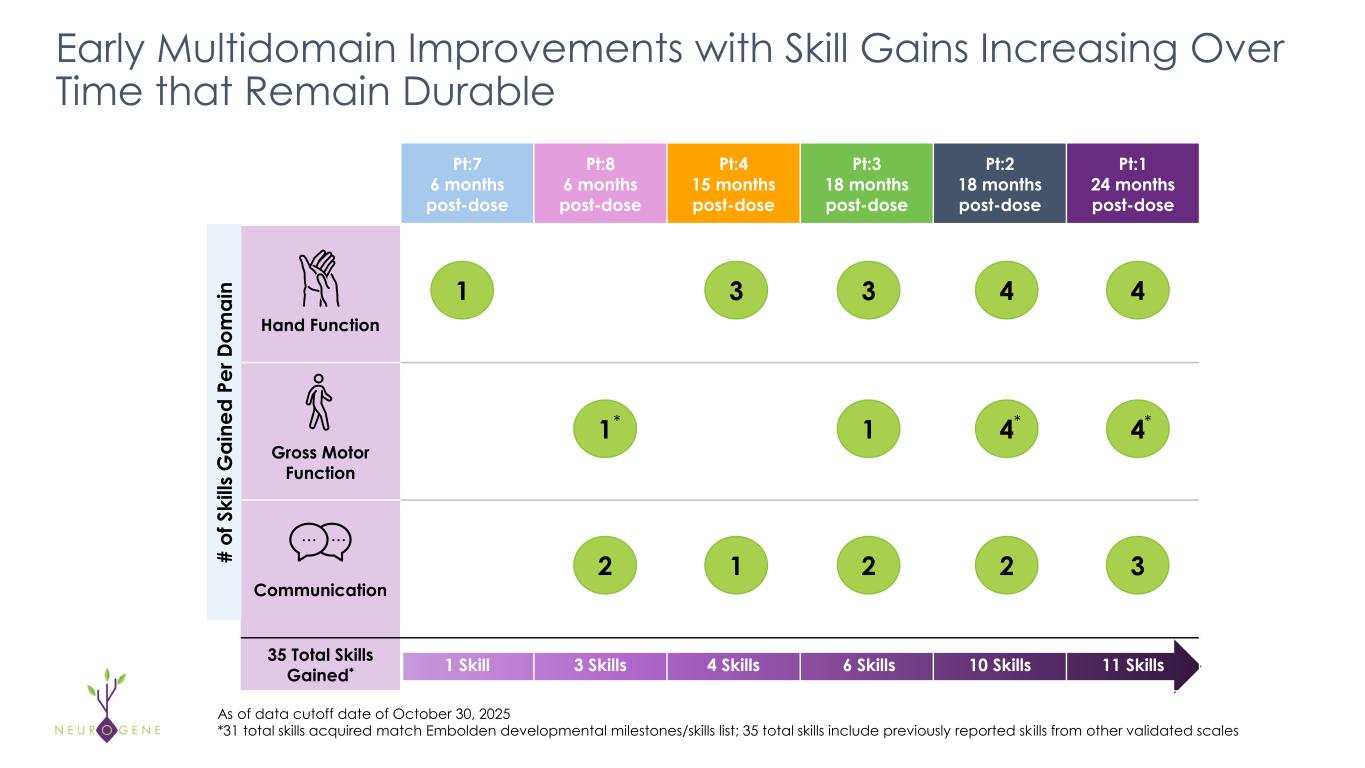
35 total developmental milestones/skills acquired across 8 participants

NGN-401 at the registrational dose continues to be generally well-tolerated, with no evidence of HLH

Neurogene management to discuss results during Stifel 2025 Healthcare Conference webcast today at 4:40 p.m. ET

NEW YORK – November 12, 2025 – Neurogene Inc. (Nasdaq: NGNE), a clinical-stage company founded to bring life-changing genetic medicines to patients and families affected by rare neurological diseases, today announced positive, updated interim clinical data in the pediatric cohort (ages 4-10 cohort) from its ongoing Phase 1/2 trial evaluating NGN-401 gene therapy for the treatment of females with Rett syndrome.

“Updated interim data from our Phase 1/2 trial of NGN-401 show that all pediatric participants, regardless of baseline disease severity, have gained developmental milestones/skills or experienced functional gains, with durability and continued skill acquisition over time,” said Rachel McMinn, Ph.D., Founder and Chief Executive Officer of Neurogene. “These skill gains far exceed the bar for our Embolden registrational trial, and coupled with NGN-401’s tolerability profile at the 1E15 vg dose, create the potential for a best-in-class gene therapy for Rett syndrome. It is gratifying to see the benefits of our strategy to use local delivery to the brain coupled with the naturally occurring full-length human gene as a key to unlocking meaningful efficacy in this devastating disorder. Moreover, we are the only company evaluating a gene therapy in children with Rett syndrome as young as three years old in a single trial, which provides us an efficient path to market and first-in-class potential.”

“In gene therapy for Rett syndrome, caregivers value improvements across multiple domains – hand function, gross motor skills and communication – especially when new abilities are gained and sustained over time. The interim NGN-401 results are particularly encouraging, showing continued skill acquisition across these areas with durable gains observed up to 24 months post treatment,” said Bernhard Suter, M.D., Medical Director of the Blue Bird Circle Rett Center at Texas Children’s Hospital, Associate Professor of Pediatrics and Neurology at Baylor College of Medicine, and principal investigator in the NGN-401 Phase 1/2 clinical trial. “These gains also translate into meaningful improvements in daily function, reduced caregiver burden and greater ability to express needs and wants, while supporting more complex tasks that foster greater independence.”


Interim Phase 1/2 Clinical Data

Safety Data (N=10; as of data cutoff date of October 30, 2025)
•NGN-401 at the 1E15 vg dose has been generally well-tolerated with a favorable safety profile across the pediatric cohort and the adolescent/adult cohort (ages ≥ 11 cohort)
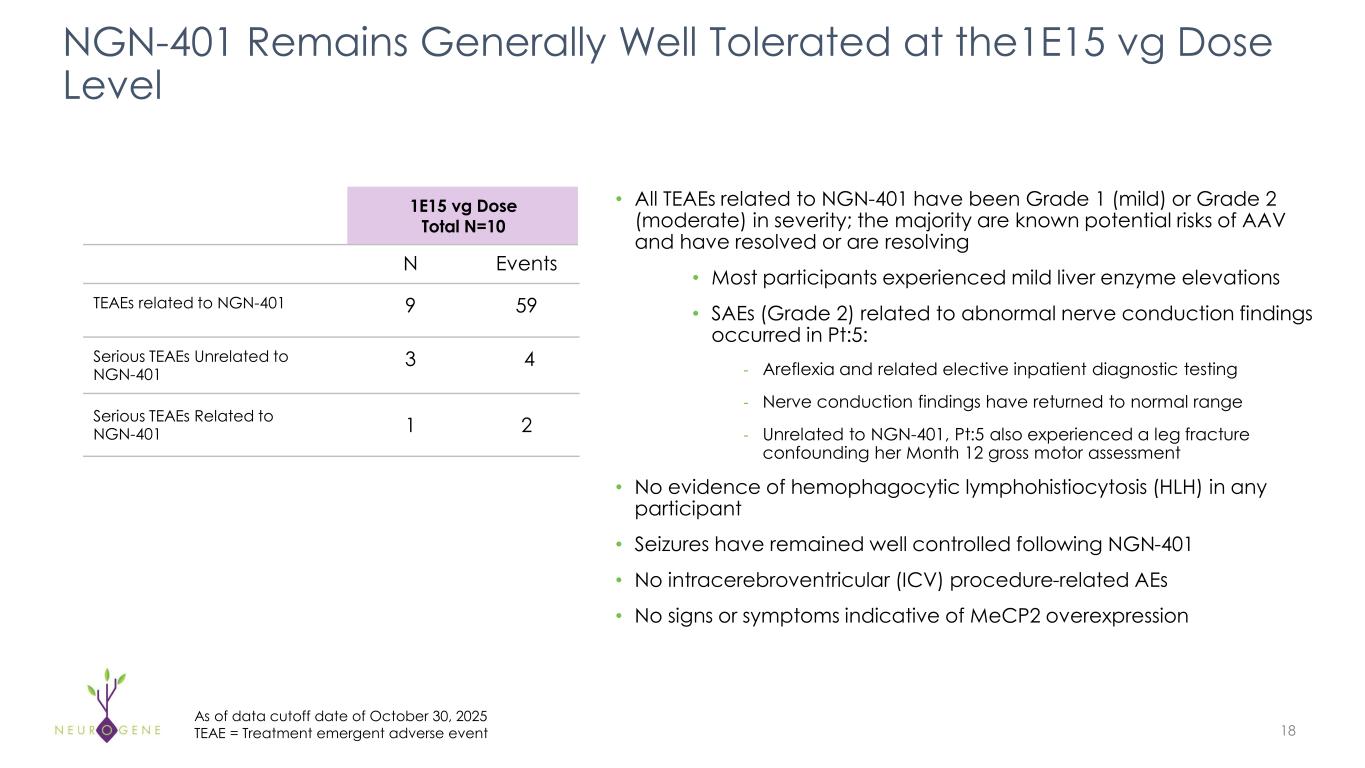
•All treatment-related adverse events have been mild (Grade 1) or moderate (Grade 2) in severity and the majority are known potential risks of AAV and have resolved or are resolving
•No evidence of hemophagocytic lymphohistiocytosis (HLH) has been observed in any participant

Efficacy Data (N=8 in the pediatric cohort; as of data cutoff date of October 30, 2025)
•All pediatric participants experienced functional gains across the spectrum of disease severity, with an aggregate 35 developmental milestones/skills gained across core clinical domains of Rett syndrome – hand function/fine motor, language/communication and ambulation/gross motor
oAll developmental milestones/skills gained have been durable, with multidomain improvements observed in key domains
oParticipants with longer term follow-up continued to gain developmental milestones/skills, with notable gains in executive function and motor planning for those with the longest follow-up
oDevelopmental milestones/skills have been gained by participants recently dosed with six months of follow-up, consistent with previously dosed participants
•Previously reported improvements in the Clinical Global Impression-Improvement (CGI-I) have been durable
•Additional clinical data will be reported in 2026

Neurogene management will discuss these results and the Embolden™ registrational trial at the Stifel 2025 Healthcare Conference today at 4:40 p.m. ET. A live webcast presentation will be accessible from the Investor Relations section of Neurogene’s website under events, where a replay of the event will also be available for a limited time.

About Neurogene
The mission of Neurogene is to treat devastating neurological diseases to improve the lives of patients and families impacted by these rare diseases. Neurogene is developing novel approaches and treatments to address the limitations of conventional gene therapy in central nervous system disorders. This includes selecting a delivery approach to maximize distribution to target tissues and designing products to maximize potency and purity for an optimized efficacy and safety profile. The Company’s novel and proprietary EXACT™ transgene regulation platform technology allows for the delivery of therapeutic levels while limiting transgene toxicity associated with conventional gene therapy.


Neurogene has constructed a state-of-the-art gene therapy manufacturing facility in Houston, Texas. CGMP production of NGN-401 was conducted in this facility and will support pivotal clinical development activities. For more information, visit www.neurogene.com.

About NGN-401
NGN-401 is an investigational AAV9 gene therapy being developed as a one-time treatment for Rett syndrome. It is the first clinical candidate to deliver the full-length human MECP2 gene under the control of Neurogene’s EXACT™ transgene regulation technology. EXACT technology is an important advancement in gene therapy for Rett syndrome, specifically because the disorder requires a treatment approach that enables targeted levels of MECP2 transgene expression without causing overexpression-related toxic effects associated with conventional gene therapy.

NGN-401 was selected by the U.S. Food and Drug Administration (FDA) for its START Pilot Program and has also received Regenerative Medicine Advance Therapy (RMAT) designation, orphan drug designation, Fast Track designation and rare pediatric designation from the FDA. Neurogene was previously granted an INTERACT meeting with the FDA regarding the EXACT technology. NGN-401 also received Priority Medicines (PRIME) designation, orphan designation and advanced therapy medicinal product designation from the European Medicines Agency (EMA) and the Innovative Licensing and Application Pathway (ILAP) designation from the United Kingdom (UK) Medicines and Healthcare products Regulatory Agency (MHRA).

Cautionary Note Regarding Forward-Looking Statements
Statements in this press release which are not historical in nature are intended to be, and hereby are identified as, forward-looking statements within the meaning of the Private Securities Litigation Reform Act of 1995. These statements may discuss goals, intentions and expectations as to future plans, trends, events, results of operations or financial condition, or otherwise, based on current expectations and beliefs of the management of Neurogene, as well as assumptions made by, and information currently available to, management of Neurogene, including, but not limited to, statements regarding: the therapeutic potential and utility, efficacy and clinical benefits of NGN-401; the safety and tolerability profile of NGN-401; the applicability of reported interim results from the NGN-401 Phase 1/2 clinical trial to other participants or potential participants, including adolescent or adult participants; the potential for NGN-401 to be a best-in-class gene therapy for Rett syndrome; trial designs and clinical development plans for our EmboldenTM registrational clinical trial of NGN-401 for Rett Syndrome, including timing of anticipated enrollment and completion of the enrollment in our clinical trial; the response rate, expected durability and deepening of clinical data results from our NGN-401 clinical trials; expected timing for release of additional data from our Phase 1/2 clinical trial of NGN-401; the potential superiority of ICV administration; patient and KOL sentiment relating to priorities on selecting potential gene therapy treatments; the potential for success of the Embolden registrational clinical trial of NGN-401 for Rett Syndrome; and expected future interactions with or positions of the FDA or foreign regulatory authorities.


Forward-looking statements generally include statements that are predictive in nature and depend upon or refer to future events or conditions, and include words such as “may,” “will,” “should,” “would,” “expect,” “anticipate,” “plan,” “likely,” “believe,” “estimate,” “project,” “intend,” “on track,” and other similar expressions or the negative or plural of these words, or other similar expressions that are predictions or indicate future events or prospects, although not all forward-looking statements contain these words. Forward-looking statements are based on current beliefs and assumptions that are subject to risks, uncertainties and assumptions that are difficult to predict with regard to timing, extent, likelihood, and degree of occurrence, which could cause actual results to differ materially from anticipated results and many of which are outside of Neurogene’s control. Such risks, uncertainties and assumptions include, among other things, the risks and uncertainties identified under the heading "Risk Factors" included in Neurogene’s Annual Report on Form 10-K for the year ended December 31, 2024, filed with the Securities and Exchange Commission (SEC) on March 24, 2025, Neurogene’s Quarterly Report on Form 10-Q for the quarter ended June 30, 2025, filed with the SEC on August 11, 2025, and other filings that the Company has made and may make with the SEC in the future. Nothing in this communication should be regarded as a representation by any person that the forward-looking statements set forth herein will be achieved or that the contemplated results of any such forward-looking statements will be achieved. Forward-looking statements in this communication speak only as of the day they are made and are qualified in their entirety by reference to the cautionary statements herein. Except as required by applicable law, Neurogene undertakes no obligation to revise or update any forward-looking statement, or to make any other forward-looking statements, whether as a result of new information, future events or otherwise.

# # #

Company Contact:
Mike Devine
Executive Director, Corporate Communications
michael.devine@neurogene.com

Investor Contact:
Melissa Forst
Argot Partners
Neurogene@argotpartners.com

EX-99.2 3 ngn-4012h25update_final.htm EX-99.2 ngn-4012h25update_final
Every Breakthrough BEGINS WITH BELIEF r r t r BE I S IT BELIEF NGN-401 Phase 1/2 Interim Data Update November 2025


2 Disclaimer Forward Looking Statements This communication contains forward-looking statements within the meaning of the Private Securities Litigation Reform Act of 1995. These statements may discuss goals, intentions and expectations as to future plans, trends, events, results of operations or financial condition, or otherwise, based on current expectations and beliefs of the management of Neurogene, as well as assumptions made by, and information currently available to, management of Neurogene, including, but not limited to, statements regarding: the therapeutic potential and utility, efficacy and clinical benefits of its programs, including its EXACTTM technology and NGN-401; expected levels of demand for NGN-401; the safety and tolerability profile of NGN-401; the applicability of reported interim results from the NGN-401 Phase 1/2 clinical trial to other participants or potential participants, including adolescent or adult participants; trial designs and clinical development plans for our EmboldenTM registrational clinical trial of NGN-401 for Rett Syndrome, including timing of anticipated enrollment and completion of the enrollment in our clinical trial; the response rate, expected durability and deepening of clinical data results from our NGN-401 clinical trials; expected timing for release of additional data from our Phase 1/2 clinical trial of NGN-401; the potential superiority of ICV administration; patient and KOL sentiment relating to priorities on selecting potential gene therapy treatments; the potential for success of the Embolden registrational clinical trial of NGN-401 for Rett Syndrome; expected future interactions with or positions of the FDA or foreign regulatory authorities; and Neurogene's cash runway, including the time period over which existing cash resources may be sufficient to fund the Company’s operations. Forward-looking statements generally include statements that are predictive in nature and depend upon or refer to future events or conditions, and include words such as “may,” “will,” “should,” “would,” “expect,” “anticipate,” “plan,” “likely,” “believe,” “estimate,” “project,” “intend,” and other similar expressions or the negative or plural of these words, or other similar expressions that are predictions or indicate future events or prospects, although not all forward-looking statements contain these words. Statements that are not historical facts are forward-looking statements. Forward-looking statements are based on current beliefs and assumptions that are subject to risks and uncertainties and are not guarantees of future performance. Actual results could differ materially from those contained in any forward-looking statement as a result of various factors, including, without limitation: uncertainties regarding interactions with and feedback received from FDA staff regarding the Embolden registrational trial including the risk that the FDA could change its requirements for the Embolden trial; the ability to raise additional capital to finance operations; the ability of Neurogene to report its data on the predicted timeline; the ability of Neurogene to effectively use the RMAT designation or START program to accelerate development of NGN-401; the potential for negative impacts to patients dosed in the ongoing clinical trials for NGN- 401; the ability to advance NGN-401 through clinical development; the ability to obtain regulatory approval for, and ultimately commercialize, NGN-401; Neurogene’s limited experience in designing and conducting clinical trials; expectations regarding the potential tolerability, safety or efficacy for NGN-401; the ability to attract, hire, and retain skilled executive officers and employees; reliance on third parties, contract manufacturers, and contract research organizations; the ability of Neurogene to protect its intellectual property and proprietary technologies; risks related to Neurogene’s ability to correctly estimate its operating expenses, including its projected cash runway; and legislative, regulatory, political and economic developments and general market conditions. The foregoing review of important factors that could cause actual events to differ from expectations should not be construed as exhaustive and should be read in conjunction with statements that are included herein and elsewhere, including the risk factors included in the Company’s most recent Annual Report on Form 10-K and Quarterly Reports on Form 10-Q filed with the Securities and Exchange Commission, as well as risk factors associated with companies, such as Neurogene, that operate in the biopharma industry. These forward-looking statements involve a number of risks, uncertainties (some of which are beyond Neurogene’s control) or other assumptions that may cause actual results or performance to be materially different from those expressed or implied by these forward-looking statements. Nothing in this communication should be regarded as a representation by any person that the forward-looking statements set forth herein will be achieved or that the contemplated results of any such forward-looking statements will be achieved. Forward-looking statements in this communication speak only as of the day they are made and are qualified in their entirety by reference to the cautionary statements herein. Except as required by applicable law, Neurogene undertakes no obligation to revise or update any forward-looking statement, or to make any other forward-looking statements, whether as a result of new information, future events or otherwise. Industry and Market Data Certain information contained in this Presentation relates to or is based on studies, publications, surveys and Neurogene’s own internal estimates and research. In this Presentation, Neurogene relies on, and refers to, publicly available information and statistics regarding market participants in the sector in which Neurogene competes and other industry data. Any comparison of Neurogene to any other entity assumes the reliability of the information available to Neurogene. Neurogene obtained this information and statistics from third-party sources, including reports by market research firms and company filings. In addition, all of the market data included in this Presentation involve a number of assumptions and limitations, and there can be no guarantee as to the accuracy or reliability of such assumptions. Finally, while Neurogene believes its internal research is reliable, such research has not been verified by any independent source and Neurogene has not independently verified the information. Trademarks This Presentation may contain trademarks, service marks, trade names and copyrights of other companies, which are the property of their respective owners. Solely for convenience, some of the trademarks, service marks, trade names and copyrights referred to in this Presentation may be listed without the TM, SM © or ® symbols, but Neurogene will assert, to the fullest extent under applicable law, the rights of the applicable owners, if any, to these trademarks, service marks, trade names and copyrights.


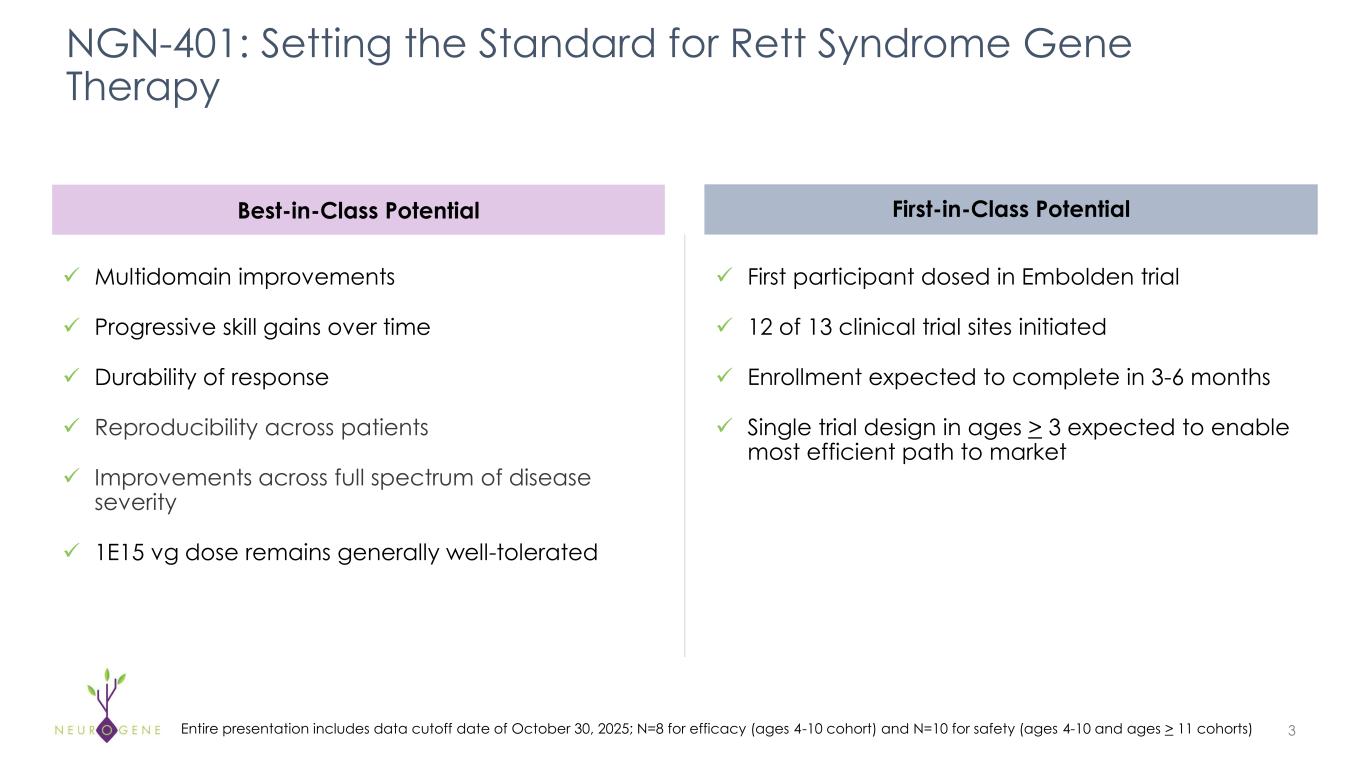
NGN-401: Setting the Standard for Rett Syndrome Gene Therapy 3Entire presentation includes data cutoff date of October 30, 2025; N=8 for efficacy (ages 4-10 cohort) and N=10 for safety (ages 4-10 and ages > 11 cohorts) ✓ Multidomain improvements ✓ Progressive skill gains over time ✓ Durability of response ✓ Reproducibility across patients ✓ Improvements across full spectrum of disease severity ✓ 1E15 vg dose remains generally well-tolerated Best-in-Class Potential First-in-Class Potential ✓ First participant dosed in Embolden trial ✓ 12 of 13 clinical trial sites initiated ✓ Enrollment expected to complete in 3-6 months ✓ Single trial design in ages > 3 expected to enable most efficient path to market


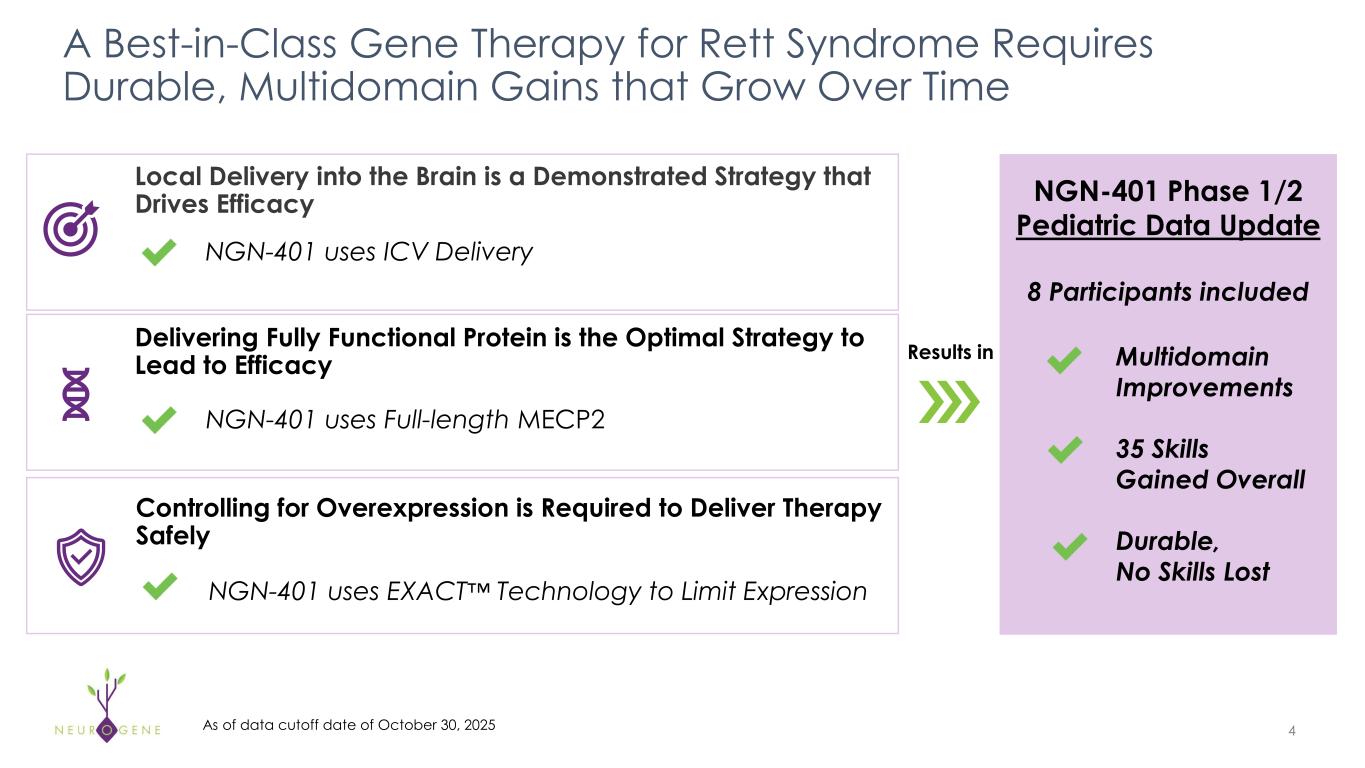
A Best-in-Class Gene Therapy for Rett Syndrome Requires Durable, Multidomain Gains that Grow Over Time 4As of data cutoff date of October 30, 2025 NGN-401 Phase 1/2 Pediatric Data Update 8 Participants included Multidomain Improvements 35 Skills Gained Overall Durable, No Skills Lost Results in Local Delivery into the Brain is a Demonstrated Strategy that Drives Efficacy Delivering Fully Functional Protein is the Optimal Strategy to Lead to Efficacy Controlling for Overexpression is Required to Deliver Therapy Safely NGN-401 uses ICV Delivery NGN-401 uses Full-length MECP2 NGN-401 uses EXACT Technology to Limit Expression


NGN-401 Phase 1/2 Interim Data Summary 5


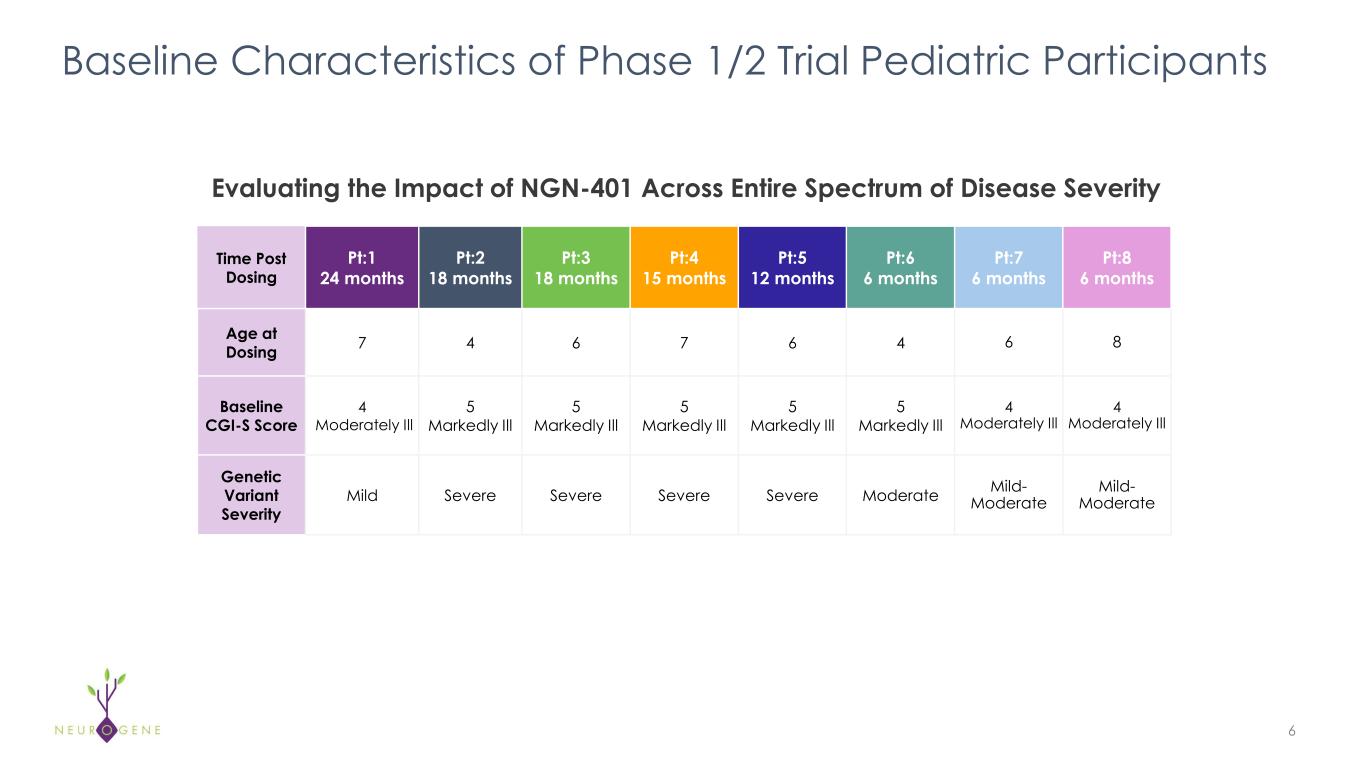
6 Time Post Dosing Pt:1 24 months Pt:2 18 months Pt:3 18 months Pt:4 15 months Pt:5 12 months Pt:6 6 months Pt:7 6 months Pt:8 6 months Age at Dosing 7 4 6 7 6 4 6 8 Baseline CGI-S Score 4 Moderately Ill 5 Markedly Ill 5 Markedly Ill 5 Markedly Ill 5 Markedly Ill 5 Markedly Ill 4 Moderately Ill 4 Moderately Ill Genetic Variant Severity Mild Severe Severe Severe Severe Moderate Mild- Moderate Mild- Moderate Baseline Characteristics of Phase 1/2 Trial Pediatric Participants Evaluating the Impact of NGN-401 Across Entire Spectrum of Disease Severity


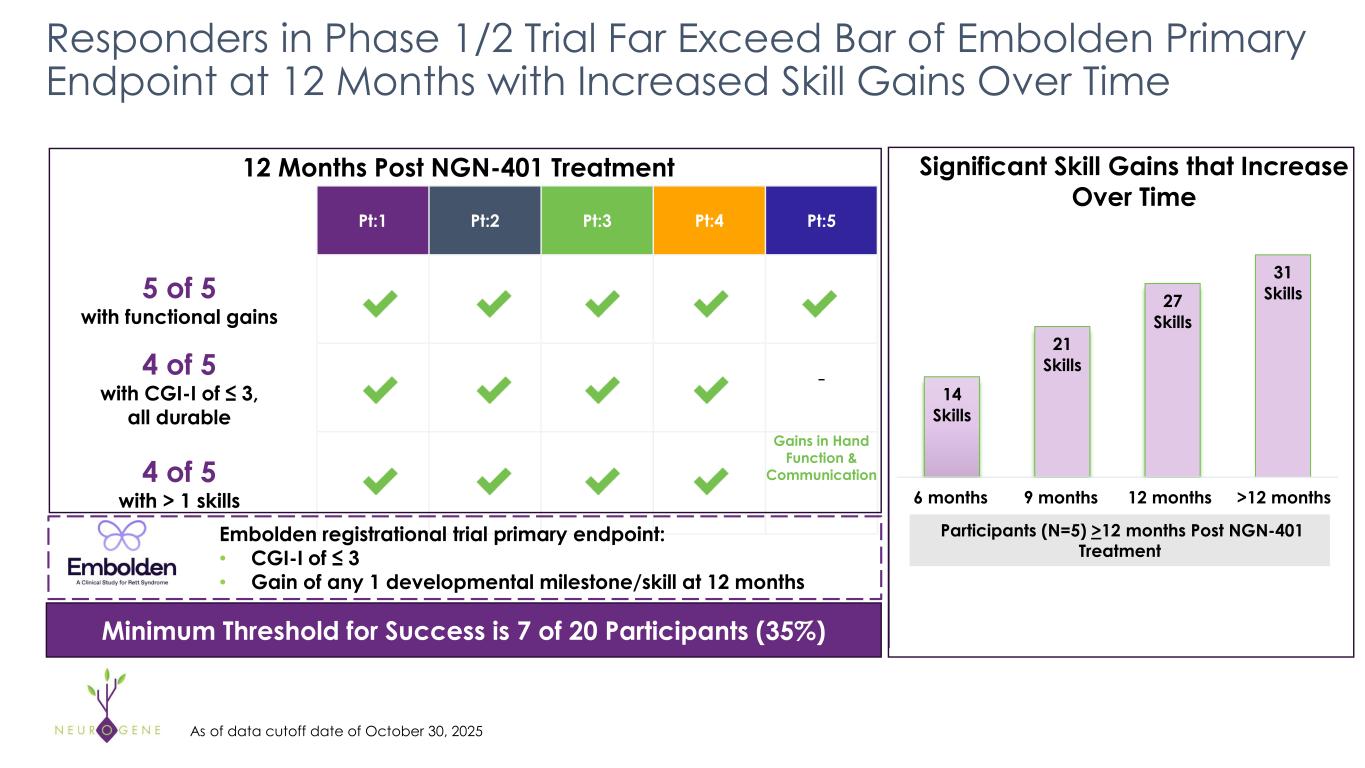
As of data cutoff date of October 30, 2025 Responders in Phase 1/2 Trial Far Exceed Bar of Embolden Primary Endpoint at 12 Months with Increased Skill Gains Over Time Pt:1 Pt:2 Pt:3 Pt:4 Pt:5 5 of 5 with functional gains 4 of 5 with CGI-I of ≤ 3, all durable - 4 of 5 with > 1 skills Gains in Hand Function & Communication Embolden registrational trial primary endpoint: • CGI-I of ≤ 3 • Gain of any 1 developmental milestone/skill at 12 months 12 Months Post NGN-401 Treatment 14 Skills 21 Skills 27 Skills 31 Skills 6 9 12 >12 Participants (N=5) >12 months Post NGN-401 Treatment Significant Skill Gains that Increase Over Time Minimum Threshold for Success is 7 of 20 Participants (35%) 6 months 9 months 12 months >12 months


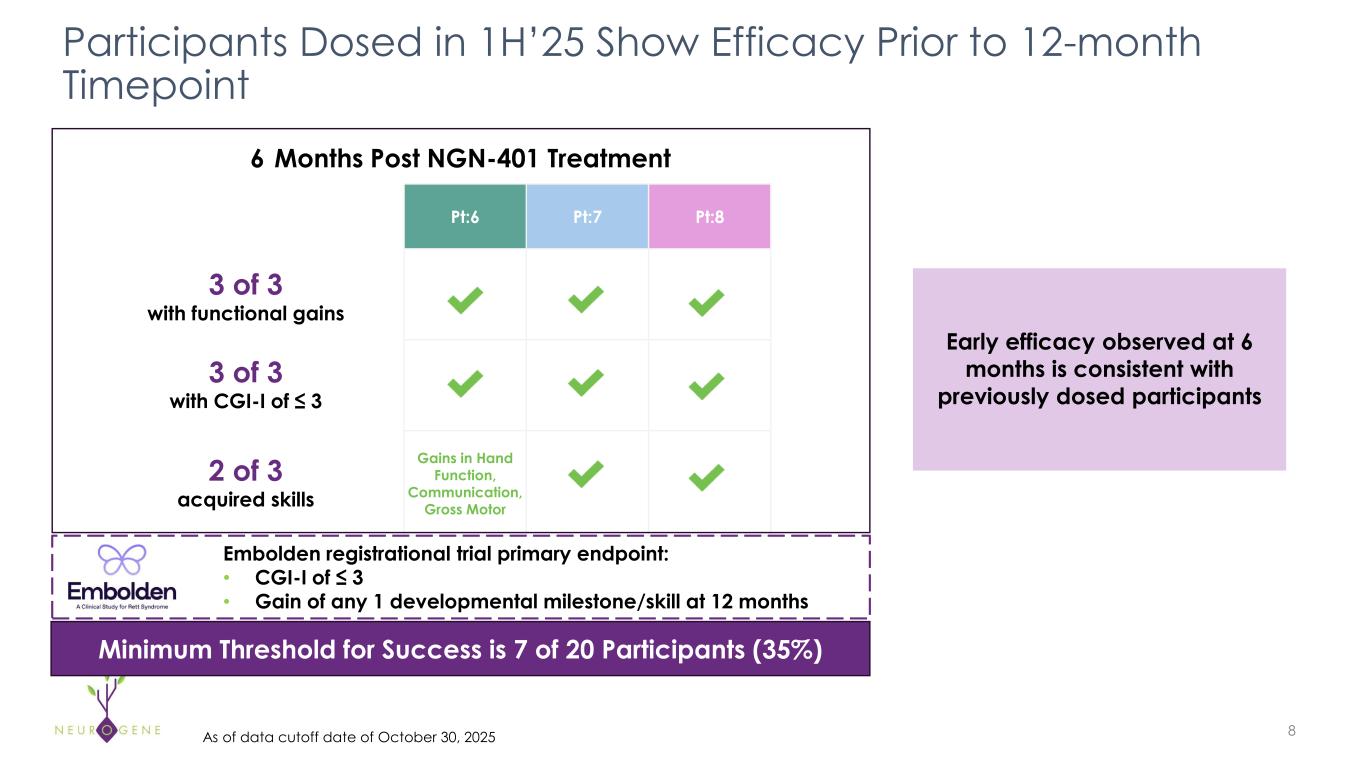
8As of data cutoff date of October 30, 2025 Participants Dosed in 1H’25 Show Efficacy Prior to 12-month Timepoint Pt:6 Pt:7 Pt:8 Gains in Hand Function, Communication, Gross Motor 3 of 3 with functional gains 3 of 3 with CGI-I of ≤ 3 2 of 3 acquired skills Early efficacy observed at 6 months is consistent with previously dosed participants 6 Months Post NGN-401 Treatment Embolden registrational trial primary endpoint: • CGI-I of ≤ 3 • Gain of any 1 developmental milestone/skill at 12 months Minimum Threshold for Success is 7 of 20 Participants (35%)


Pt:7 6 months post-dose Pt:8 6 months post-dose Pt:4 15 months post-dose Pt:3 18 months post-dose Pt:2 18 months post-dose Pt:1 24 months post-dose Hand Function Gross Motor Function Communication 35 Total Skills Gained* 1 Skill 3 Skills 4 Skills 6 Skills 10 Skills 11 Skills Early Multidomain Improvements with Skill Gains Increasing Over Time that Remain Durable # o f S k il ls G a in e d P e r D o m a in 4 4 4 4331 1 2 3212 1 As of data cutoff date of October 30, 2025 *31 total skills acquired match Embolden developmental milestones/skills list; 35 total skills include previously reported skills from other validated scales * **


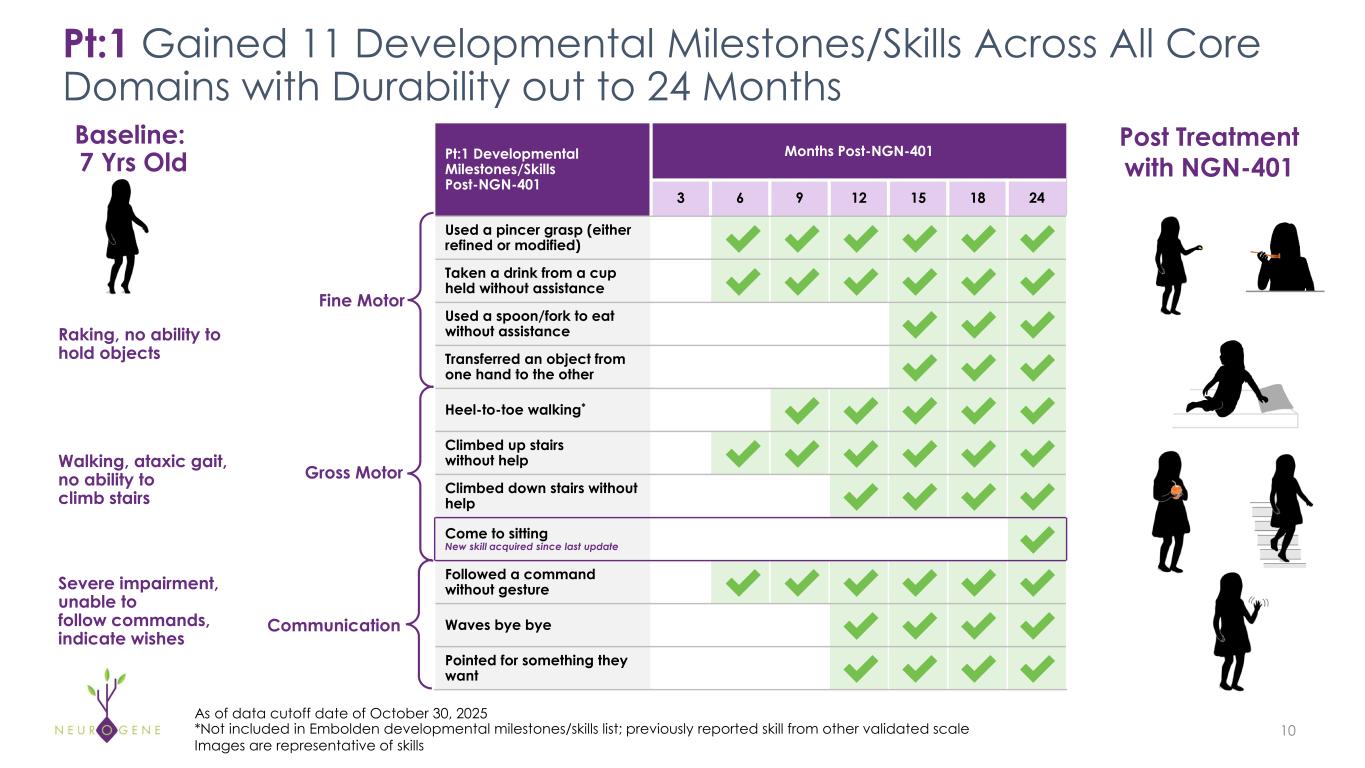
Pt:1 Gained 11 Developmental Milestones/Skills Across All Core Domains with Durability out to 24 Months 10 As of data cutoff date of October 30, 2025 *Not included in Embolden developmental milestones/skills list; previously reported skill from other validated scale Images are representative of skills Pt:1 Developmental Milestones/Skills Post-NGN-401 Months Post-NGN-401 3 6 9 12 15 18 24 Used a pincer grasp (either refined or modified) Taken a drink from a cup held without assistance Used a spoon/fork to eat without assistance Transferred an object from one hand to the other Heel-to-toe walking* Climbed up stairs without help Climbed down stairs without help Come to sitting New skill acquired since last update Followed a command without gesture Waves bye bye Pointed for something they want Fine Motor Gross Motor Communication Baseline: 7 Yrs Old Walking, ataxic gait, no ability to climb stairs Raking, no ability to hold objects Severe impairment, unable to follow commands, indicate wishes Post Treatment with NGN-401


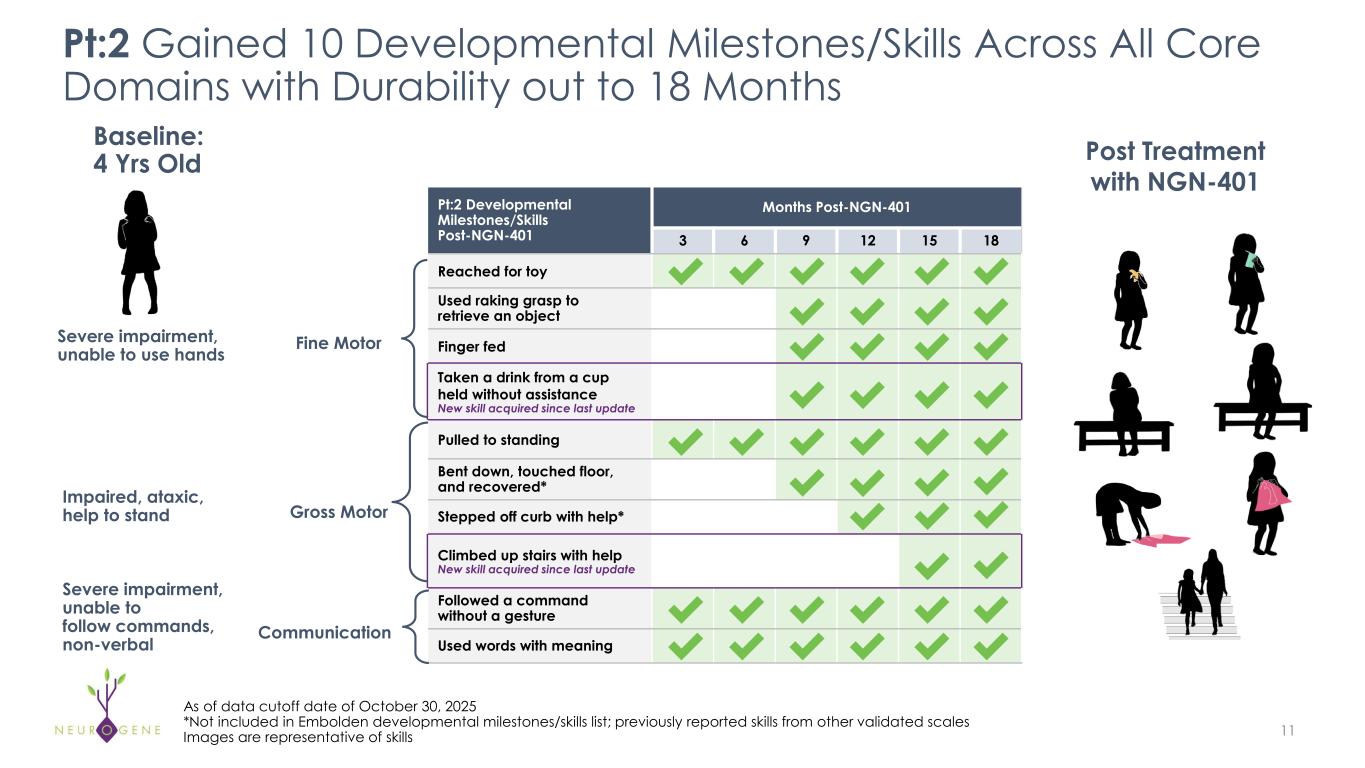
Pt:2 Gained 10 Developmental Milestones/Skills Across All Core Domains with Durability out to 18 Months 11 As of data cutoff date of October 30, 2025 *Not included in Embolden developmental milestones/skills list; previously reported skills from other validated scales Images are representative of skills Pt:2 Developmental Milestones/Skills Post-NGN-401 Months Post-NGN-401 3 6 9 12 15 18 Reached for toy Used raking grasp to retrieve an object Finger fed Taken a drink from a cup held without assistance New skill acquired since last update Pulled to standing Bent down, touched floor, and recovered* Stepped off curb with help* Climbed up stairs with help New skill acquired since last update Followed a command without a gesture Used words with meaning Fine Motor Gross Motor Communication Baseline: 4 Yrs Old Impaired, ataxic, help to stand Severe impairment, unable to use hands Severe impairment, unable to follow commands, non-verbal Post Treatment with NGN-401


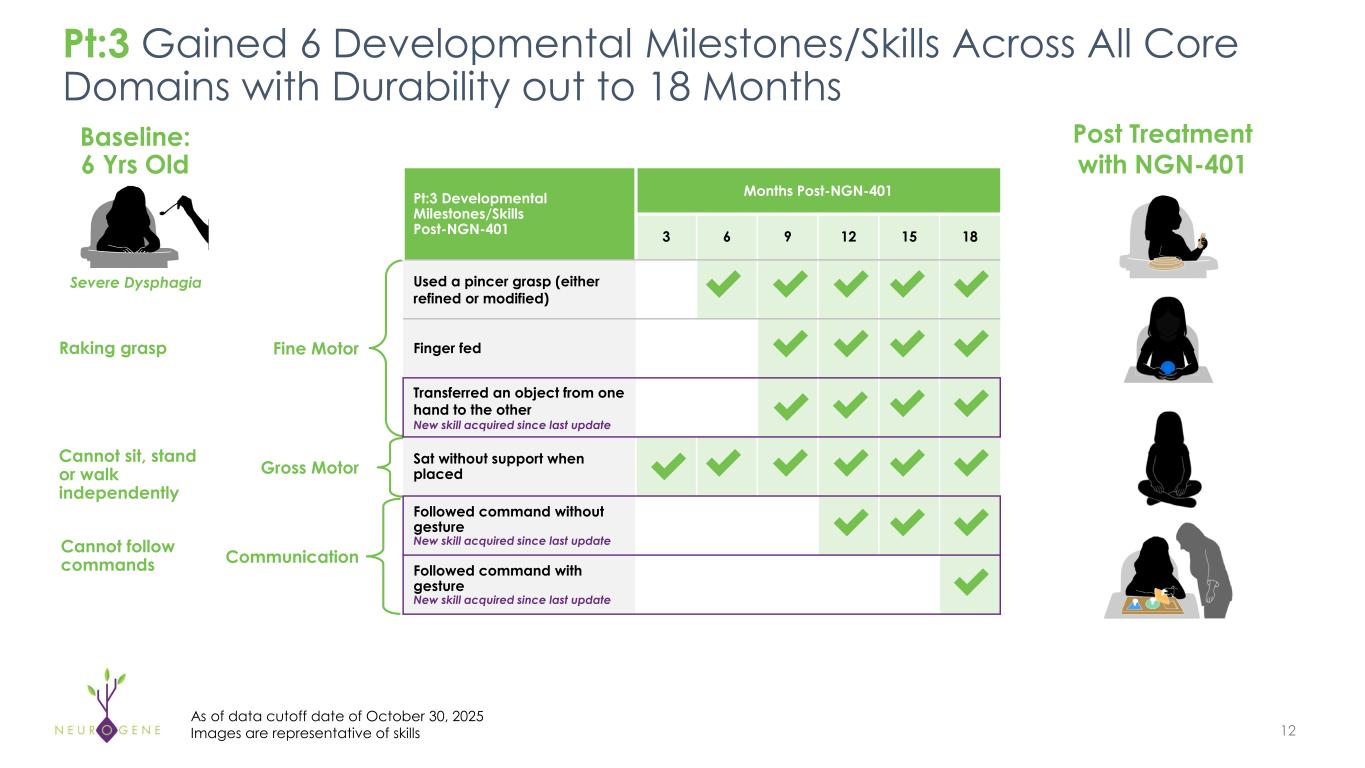
Fine Motor Gross Motor Pt:3 Gained 6 Developmental Milestones/Skills Across All Core Domains with Durability out to 18 Months 12 As of data cutoff date of October 30, 2025 Images are representative of skills Pt:3 Developmental Milestones/Skills Post-NGN-401 Months Post-NGN-401 3 6 9 12 15 18 Used a pincer grasp (either refined or modified) Finger fed Transferred an object from one hand to the other New skill acquired since last update Sat without support when placed Followed command without gesture New skill acquired since last update Followed command with gesture New skill acquired since last update Baseline: 6 Yrs Old Cannot sit, stand or walk independently Raking grasp Post Treatment with NGN-401 Severe Dysphagia Communication Cannot follow commands


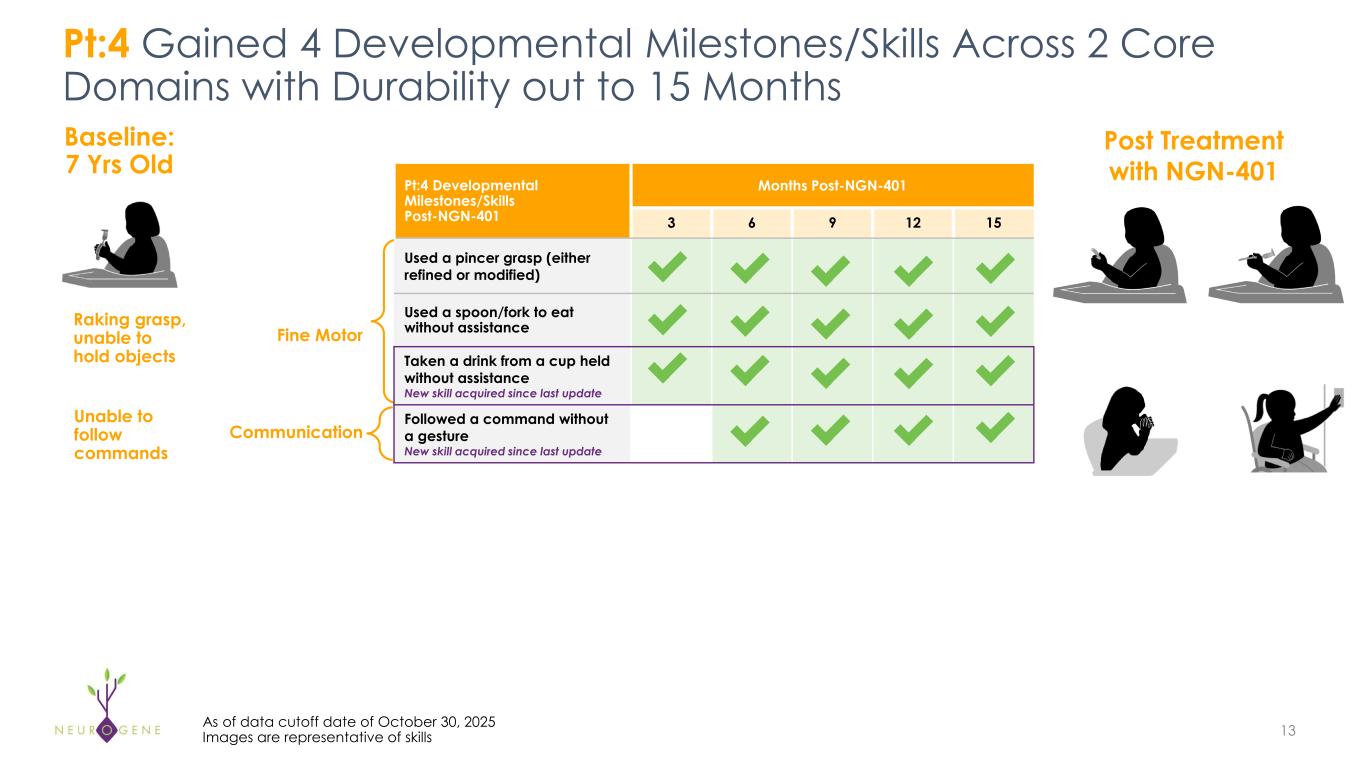
Pt:4 Gained 4 Developmental Milestones/Skills Across 2 Core Domains with Durability out to 15 Months 13 Fine Motor Baseline: 7 Yrs Old Raking grasp, unable to hold objects Pt:4 Developmental Milestones/Skills Post-NGN-401 Months Post-NGN-401 3 6 9 12 15 Used a pincer grasp (either refined or modified) Used a spoon/fork to eat without assistance Taken a drink from a cup held without assistance New skill acquired since last update Followed a command without a gesture New skill acquired since last update Post Treatment with NGN-401 As of data cutoff date of October 30, 2025 Images are representative of skills Communication Unable to follow commands


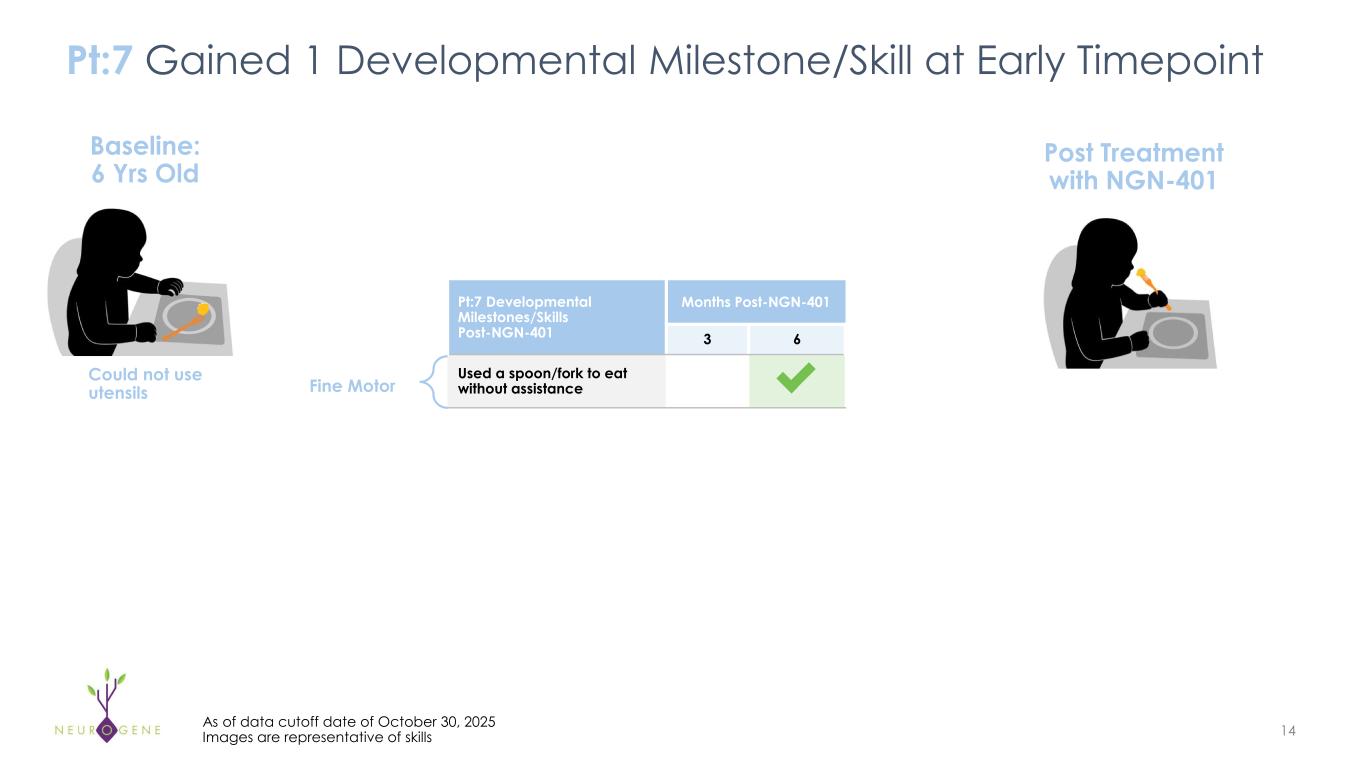
Pt:7 Gained 1 Developmental Milestone/Skill at Early Timepoint 14 As of data cutoff date of October 30, 2025 Images are representative of skills Pt:7 Developmental Milestones/Skills Post-NGN-401 Months Post-NGN-401 3 6 Used a spoon/fork to eat without assistance Baseline: 6 Yrs Old Fine Motor Post Treatment with NGN-401 Could not use utensils


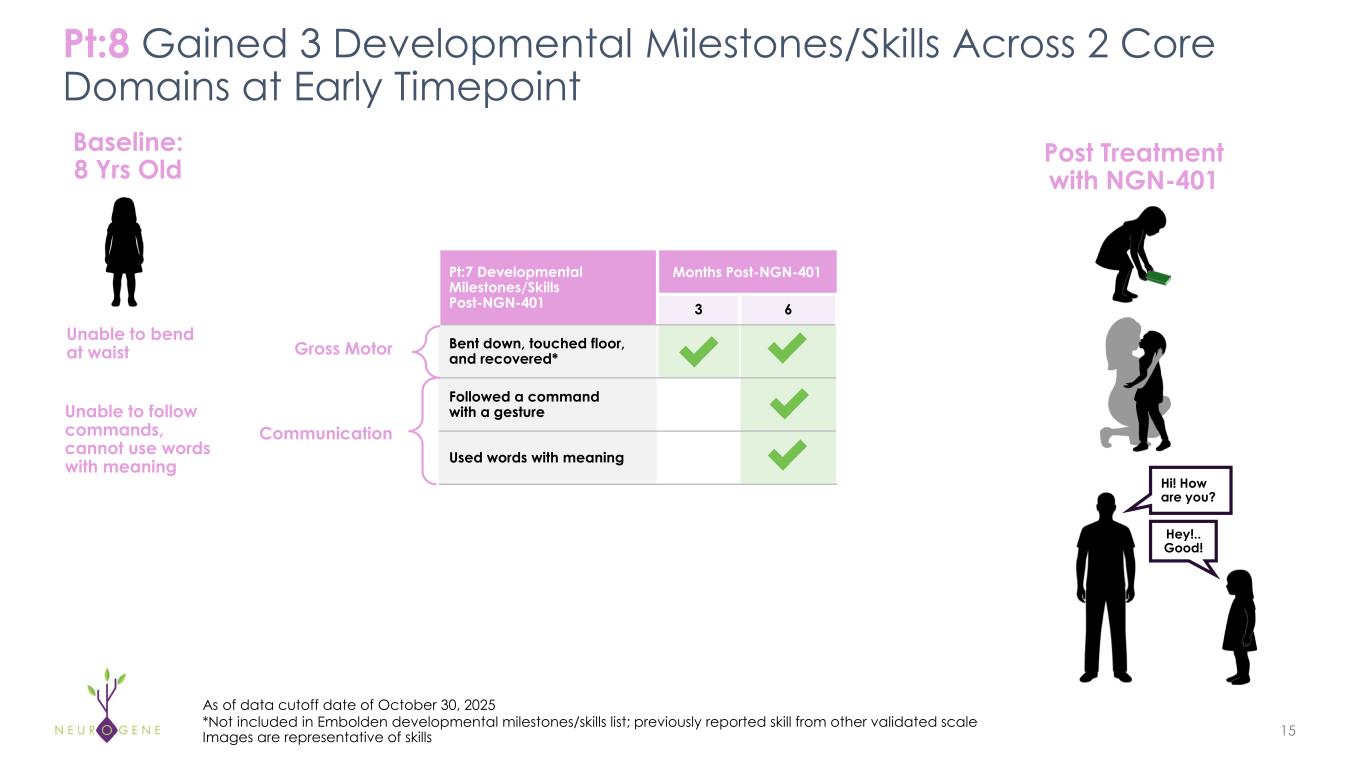
Pt:8 Gained 3 Developmental Milestones/Skills Across 2 Core Domains at Early Timepoint 15 As of data cutoff date of October 30, 2025 *Not included in Embolden developmental milestones/skills list; previously reported skill from other validated scale Images are representative of skills Pt:7 Developmental Milestones/Skills Post-NGN-401 Months Post-NGN-401 3 6 Bent down, touched floor, and recovered* Followed a command with a gesture Used words with meaning Baseline: 8 Yrs Old Gross Motor Communication Unable to follow commands, cannot use words with meaning Unable to bend at waist Post Treatment with NGN-401 Hi! How are you? Hey!.. Good!


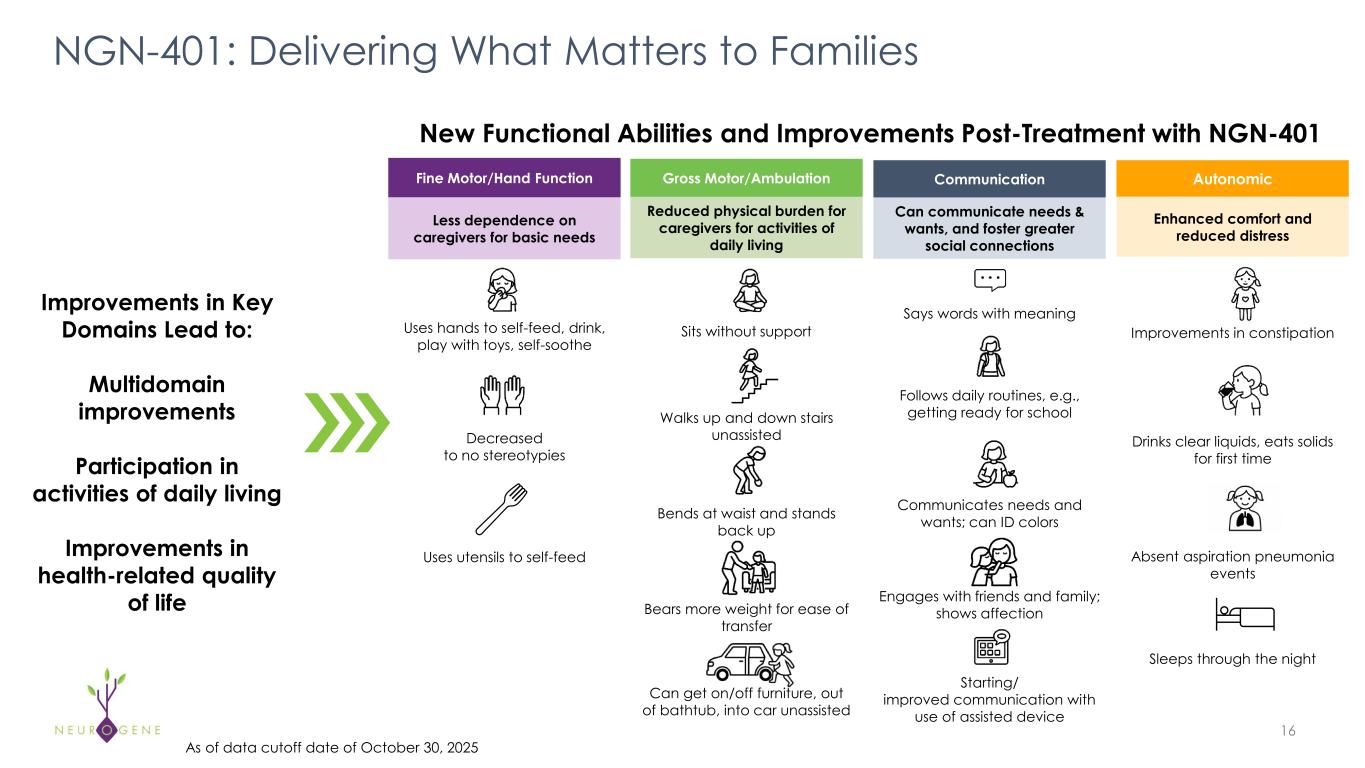
Communication Can communicate needs & wants, and foster greater social connections Says words with meaning Follows daily routines, e.g., getting ready for school Communicates needs and wants; can ID colors Engages with friends and family; shows affection Starting/ improved communication with use of assisted device Autonomic Enhanced comfort and reduced distress Improvements in constipation Drinks clear liquids, eats solids for first time Absent aspiration pneumonia events Sleeps through the night Gross Motor/Ambulation Reduced physical burden for caregivers for activities of daily living Sits without support Walks up and down stairs unassisted Bends at waist and stands back up Bears more weight for ease of transfer Can get on/off furniture, out of bathtub, into car unassisted Fine Motor/Hand Function Less dependence on caregivers for basic needs Uses hands to self-feed, drink, play with toys, self-soothe Decreased to no stereotypies Uses utensils to self-feed 16 As of data cutoff date of October 30, 2025 NGN-401: Delivering What Matters to Families New Functional Abilities and Improvements Post-Treatment with NGN-401 Improvements in Key Domains Lead to: Multidomain improvements Participation in activities of daily living Improvements in health-related quality of life


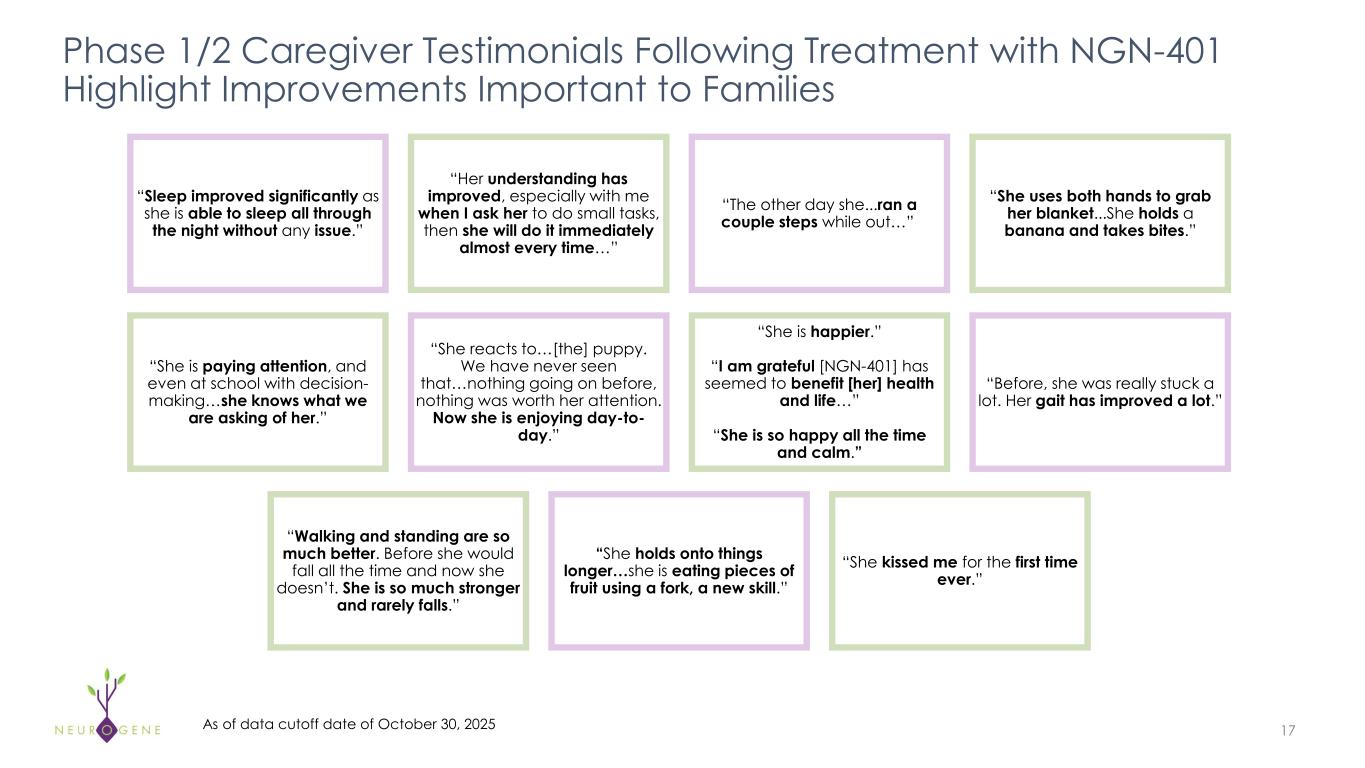
“Sleep improved significantly as she is able to sleep all through the night without any issue.” “Her understanding has improved, especially with me when I ask her to do small tasks, then she will do it immediately almost every time…” “The other day she...ran a couple steps while out…” “She uses both hands to grab her blanket...She holds a banana and takes bites.” “She is paying attention, and even at school with decision- making…she knows what we are asking of her.” “She reacts to…[the] puppy. We have never seen that…nothing going on before, nothing was worth her attention. Now she is enjoying day-to- day.” “She is happier.” “I am grateful [NGN-401] has seemed to benefit [her] health and life…” “She is so happy all the time and calm.” “Before, she was really stuck a lot. Her gait has improved a lot.” “Walking and standing are so much better. Before she would fall all the time and now she doesn’t. She is so much stronger and rarely falls.” “She holds onto things longer…she is eating pieces of fruit using a fork, a new skill.” “She kissed me for the first time ever.” 17As of data cutoff date of October 30, 2025 Phase 1/2 Caregiver Testimonials Following Treatment with NGN-401 Highlight Improvements Important to Families


• All TEAEs related to NGN-401 have been Grade 1 (mild) or Grade 2 (moderate) in severity; the majority are known potential risks of AAV and have resolved or are resolving • Most participants experienced mild liver enzyme elevations • SAEs (Grade 2) related to abnormal nerve conduction findings occurred in Pt:5: - Areflexia and related elective inpatient diagnostic testing - Nerve conduction findings have returned to normal range - Unrelated to NGN-401, Pt:5 also experienced a leg fracture confounding her Month 12 gross motor assessment • No evidence of hemophagocytic lymphohistiocytosis (HLH) in any participant • Seizures have remained well controlled following NGN-401 • No intracerebroventricular (ICV) procedure-related AEs • No signs or symptoms indicative of MeCP2 overexpression 18 NGN-401 Remains Generally Well Tolerated at the1E15 vg Dose Level 1E15 vg Dose Total N=10 N Events TEAEs related to NGN-401 9 59 Serious TEAEs Unrelated to NGN-401 3 4 Serious TEAEs Related to NGN-401 1 2 As of data cutoff date of October 30, 2025 TEAE = Treatment emergent adverse event


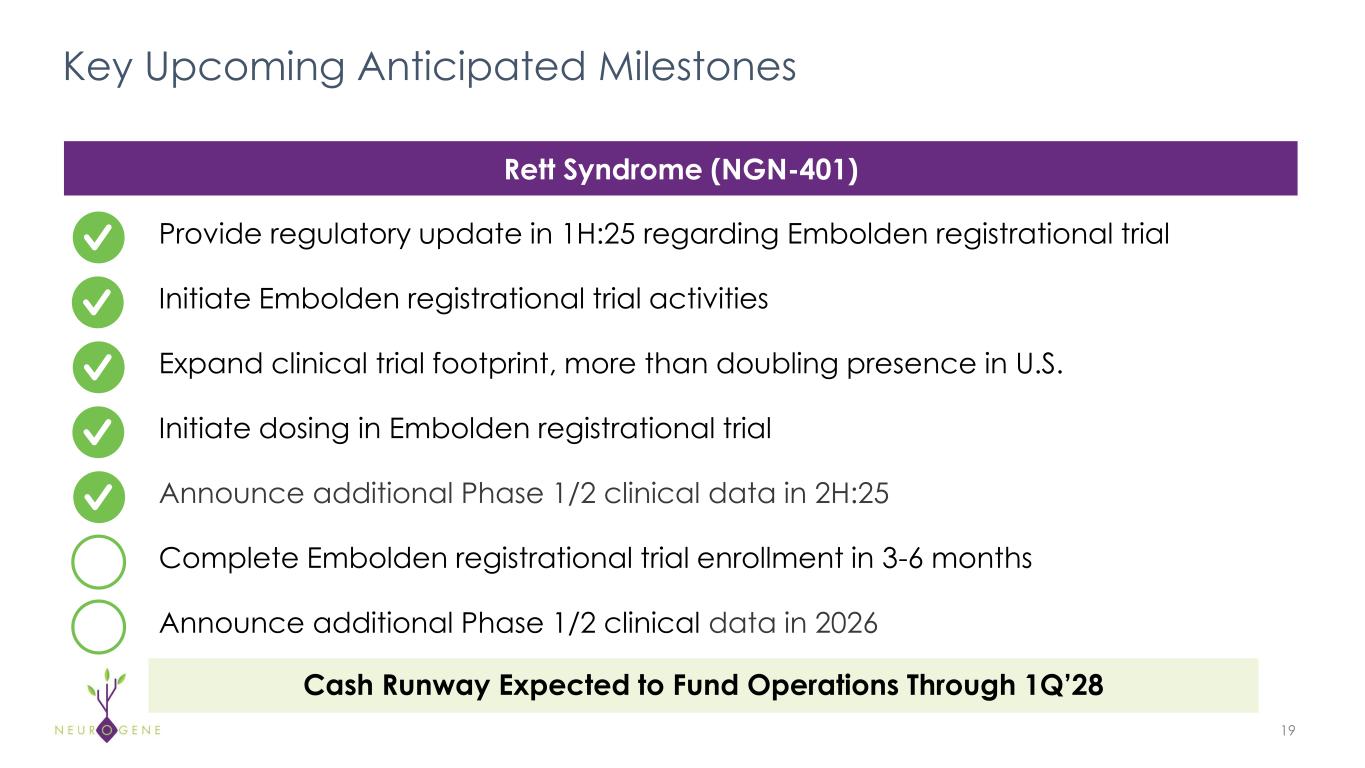
Key Upcoming Anticipated Milestones 19 Provide regulatory update in 1H:25 regarding Embolden registrational trial Initiate Embolden registrational trial activities Expand clinical trial footprint, more than doubling presence in U.S. Initiate dosing in Embolden registrational trial Announce additional Phase 1/2 clinical data in 2H:25 Complete Embolden registrational trial enrollment in 3-6 months Announce additional Phase 1/2 clinical data in 2026 Cash Runway Expected to Fund Operations Through 1Q’28 Rett Syndrome (NGN-401)


Embolden Registrational Trial Overview 20


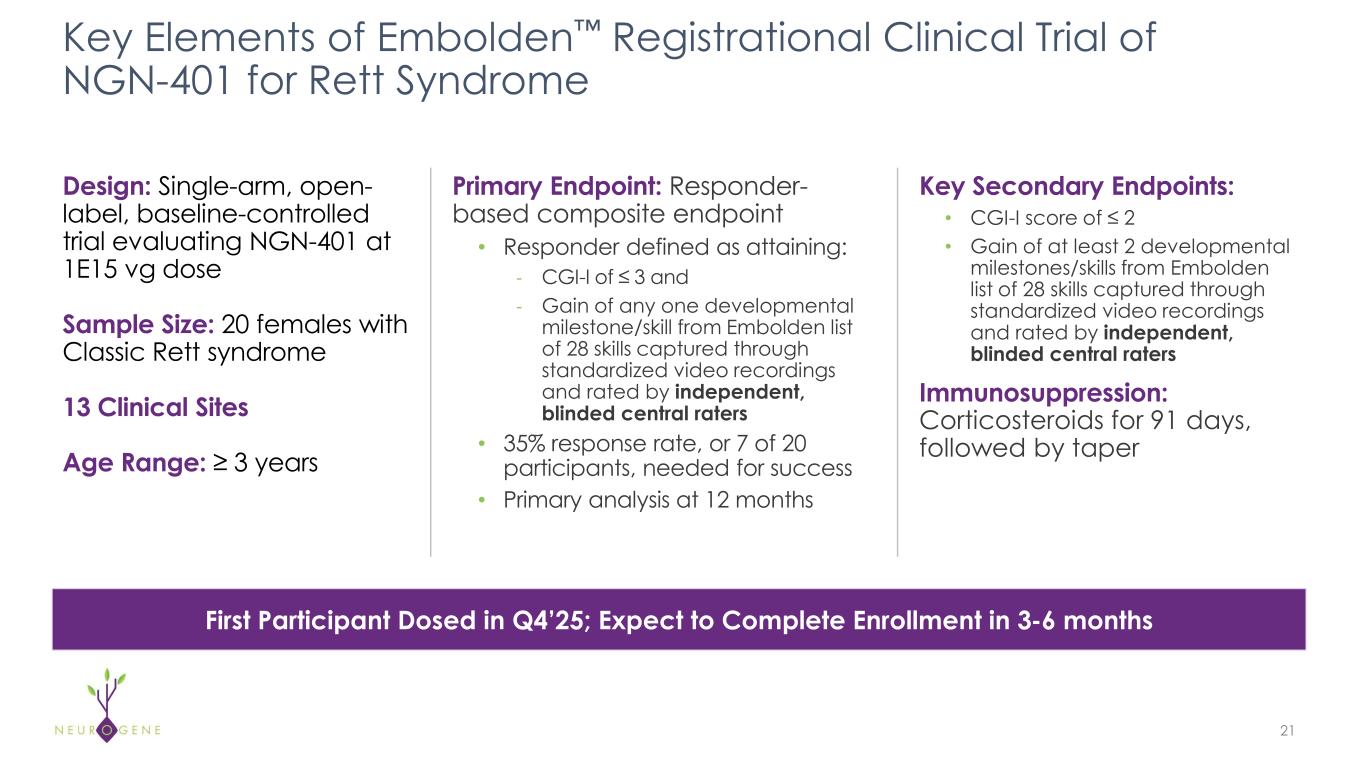
Key Elements of Embolden Registrational Clinical Trial of NGN-401 for Rett Syndrome 21 Design: Single-arm, open- label, baseline-controlled trial evaluating NGN-401 at 1E15 vg dose Sample Size: 20 females with Classic Rett syndrome 13 Clinical Sites Age Range: ≥ 3 years First Participant Dosed in Q4’25; Expect to Complete Enrollment in 3-6 months Key Secondary Endpoints: • CGI-I score of ≤ 2 • Gain of at least 2 developmental milestones/skills from Embolden list of 28 skills captured through standardized video recordings and rated by independent, blinded central raters Immunosuppression: Corticosteroids for 91 days, followed by taper Primary Endpoint: Responder- based composite endpoint • Responder defined as attaining: - CGI-I of ≤ 3 and - Gain of any one developmental milestone/skill from Embolden list of 28 skills captured through standardized video recordings and rated by independent, blinded central raters • 35% response rate, or 7 of 20 participants, needed for success • Primary analysis at 12 months


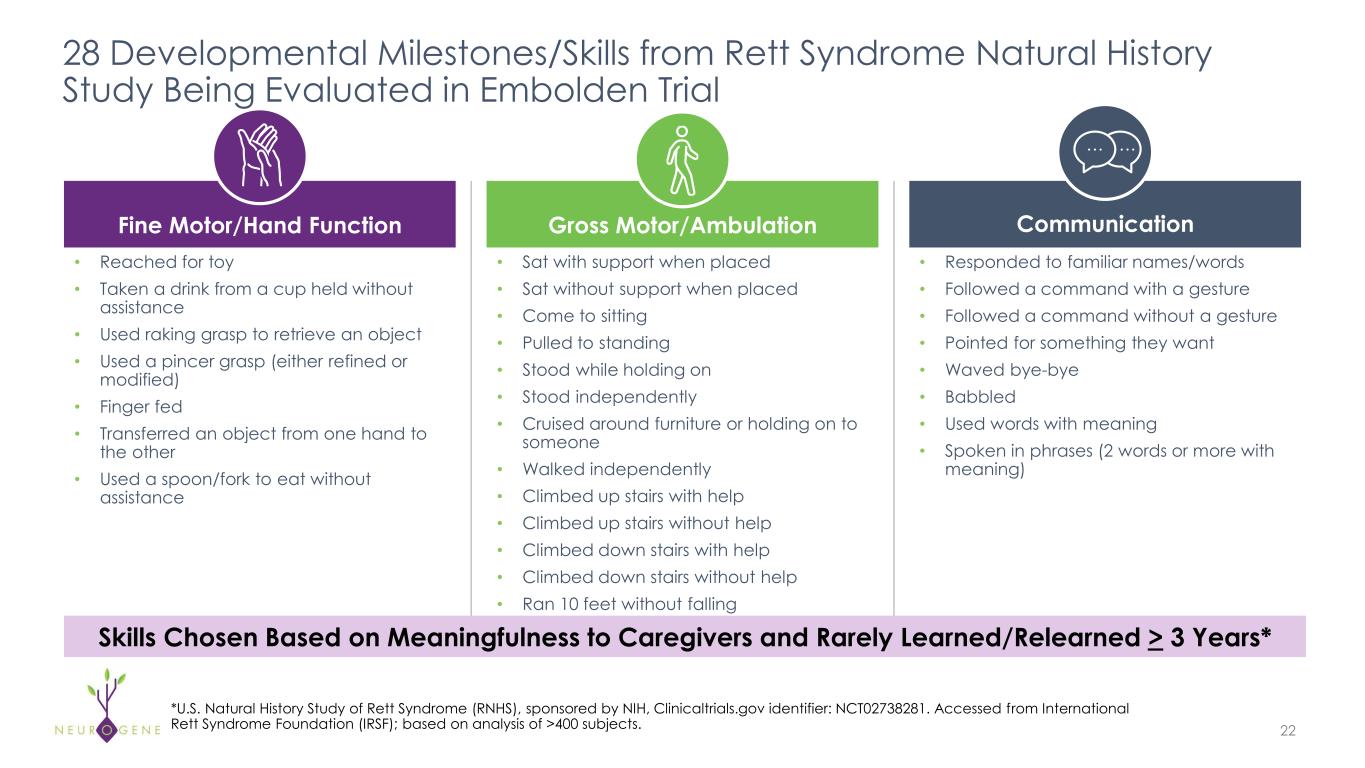
28 Developmental Milestones/Skills from Rett Syndrome Natural History Study Being Evaluated in Embolden Trial 22 *U.S. Natural History Study of Rett Syndrome (RNHS), sponsored by NIH, Clinicaltrials.gov identifier: NCT02738281. Accessed from International Rett Syndrome Foundation (IRSF); based on analysis of >400 subjects. Fine Motor/Hand Function • Reached for toy • Taken a drink from a cup held without assistance • Used raking grasp to retrieve an object • Used a pincer grasp (either refined or modified) • Finger fed • Transferred an object from one hand to the other • Used a spoon/fork to eat without assistance • Sat with support when placed • Sat without support when placed • Come to sitting • Pulled to standing • Stood while holding on • Stood independently • Cruised around furniture or holding on to someone • Walked independently • Climbed up stairs with help • Climbed up stairs without help • Climbed down stairs with help • Climbed down stairs without help • Ran 10 feet without falling • Responded to familiar names/words • Followed a command with a gesture • Followed a command without a gesture • Pointed for something they want • Waved bye-bye • Babbled • Used words with meaning • Spoken in phrases (2 words or more with meaning) Skills Chosen Based on Meaningfulness to Caregivers and Rarely Learned/Relearned > 3 Years* Gross Motor/Ambulation Communication