 エドガーで原本を確認する
U.S. SECURITIES AND EXCHANGE COMMISSION
Washington, D.C. 20549
FORM 40-F
(Check One)
☐ Registration statement pursuant to Section 12 of the Securities Exchange Act of 1934
or
☒ Annual report pursuant to Section 13(a) or 15(d) of the Securities Exchange Act of 1934
For the fiscal year ended December 31, 2025
Commission file number 001-43060
MAYFAIR GOLD CORP.
(Exact name of registrant as specified in its charter)
|
British Columbia, Canada |
1000 |
N/A |
489 McDougall Street
Matheson, Ontario P0K 1N0
Canada
866-360-5600
(Address and Telephone Number of Registrant’s Principal Executive Offices)
Puglisi & Associates
850 Library Avenue, Suite 204
Newark, Delaware 19711
(302) 738-6680
(Name, Address (Including Zip Code) and
Telephone Number (Including Area Code)
of Agent For Service in the United States)
Securities registered or to be registered pursuant to Section 12(b) of the Act.
|
Title of each class |
Trading Symbol |
Name of each exchange on which registered |
Securities registered or to be registered pursuant to Section 12(g) of the Act. None
Securities for which there is a reporting obligation pursuant to Section 15(d) of the Act. None
For annual reports, indicate by check mark the information filed with this Form:
|
☒ Annual Information Form
|
☒ Audited Annual Financial Statements |
Indicate the number of outstanding shares of each of the issuer’s classes of capital or common stock as of the close of the period covered by the annual report: 67,080,496
Indicate by check mark whether the registrant: (1) has filed all reports required to be filed by Section 13 or 15(d) of the Exchange Act during the preceding 12 months (or for such shorter period that the registrant was required to file such reports); and (2) has been subject to such filing requirements for the past 90 days.
☐ Yes ☒ No
Indicate by check mark whether the registrant has submitted electronically every Interactive Data File required to be submitted pursuant to Rule 405 of Regulation S-T (§232.405 of this chapter) during the preceding 12 months (or for such shorter period that the Registrant was required to submit such files).
☒Yes ☐ No
Indicate by check mark whether the registrant is an emerging growth company as defined in Rule 12b-2 of the Exchange Act. ☒
If an emerging growth company that prepares its financial statements in accordance with U.S. GAAP, indicate by check mark if the registrant has elected not to use the extended transition period for complying with any new or revised financial accounting standards provided pursuant to Section 13(a) of the Exchange Act. ☐
Indicate by check mark whether the registrant has filed a report on and attestation to its management’s assessment of the effectiveness of its internal control over financial reporting under Section 404(b) of the Sarbanes-Oxley Act (15 U.S.C. 7262(b)) by the registered public accounting firm that prepared or issued its audit report. ☐
If securities are registered pursuant to Section 12(b) of the Act, indicate by check mark whether the financial statements of the registrant included in the filing reflect the correction of an error to previously issued financial statements. ☐
Indicate by check mark whether any of those error corrections are restatements that required a recovery analysis of incentive-based compensation received by any of the registrant’s executive officers during the relevant recovery period pursuant to §240.10D-1(b). ☐
FORM 40-F
PRINCIPAL DOCUMENTS
The following documents, filed as Exhibits 99.1 through 99.3 hereto, are hereby incorporated by reference into this Annual Report on Form 40-F of Mayfair Gold Corp. (the “Company” or the “Registrant”):
(a)Annual Information Form for the fiscal year ended December 31, 2025;
(b)Management’s Discussion and Analysis of Financial Condition and Results of Operations for the fiscal year ended December 31, 2025; and
(c)Audited Annual Financial Statements for the years ended December 31, 2025 and 2024 and notes thereto, together with the Report of Independent Registered Public Accounting Firm thereon.
Our independent auditor is Davidson & Company LLP, Vancouver, British Columbia, Canada (PCAOB Firm ID 731).
The Company’s Audited Financial Statements included in this Annual Report on Form 40-F have been prepared in accordance with International Financial Reporting Standards, as issued by the International Accounting Standards Board. Therefore, they are not comparable in all respects to financial statements of United States companies that are prepared in accordance with United States generally accepted accounting principles.
ADDITIONAL DISCLOSURE
Resource and Reserve Estimates
The Company’s Annual Information Form for the fiscal year ended December 31, 2025 and the Company’s Management’s Discussion and Analysis of Financial Condition and Results of Operations for the fiscal year ended December 31, 2025, which are attached hereto as Exhibits 99.1 and 99.2, respectively, have been prepared in accordance with the requirements of the securities laws in effect in Canada as of December 31, 2025, which differ in certain material respects from the disclosure requirements of United States securities laws. The terms “mineral reserve”, “proven mineral reserve” and “probable mineral reserve” are Canadian mining terms as defined in accordance with Canadian National Instrument 43-101 Standards of Disclosure for Mineral Projects (“NI 43-101”) and the Canadian Institute of Mining, Metallurgy and Petroleum (the “CIM”) - CIM Definition Standards on Mineral Resources and Mineral Reserves, adopted by the CIM Council, as amended. NI 43-101 is a rule developed by the Canadian Securities Administrators that establishes standards for all public disclosure an issuer makes of scientific and technical information concerning mineral projects. The definitions of these terms differ from the definitions of such terms for purposes of the disclosure requirements of the Securities and Exchange Commission (the “Commission”).
Accordingly, information contained and incorporated by reference into this Annual Report on Form 40-F that describes the Company’s mineral deposits may not be comparable to similar information made public by issuers subject to the Commission’s reporting and disclosure requirements applicable to domestic United States issuers.
Certifications and Disclosure Regarding Controls and Procedures.
(a)Certifications. See Exhibits 99.4, 99.5, 99.6 and 99.7 to this Annual Report on Form 40-F.
(b)Disclosure Controls and Procedures. As of the end of the Company’s fiscal year ended December 31, 2025, an evaluation of the effectiveness of the Company’s “disclosure controls and procedures” was carried out by the Company’s management with the participation of the Chief Executive Officer and Interim Chief Financial Officer, who are the principal executive officer and principal financial officer of the Company, respectively. Based upon that evaluation, the Company’s Chief Executive Officer and Interim Chief Financial Officer have concluded that as of the end of that fiscal year, the Company’s disclosure controls and procedures were effective to ensure that information required to be disclosed by the Company in reports that it files or submits under the Exchange Act is (i) recorded, processed, summarized and reported within the time periods specified in Commission rules and forms and (ii) accumulated and communicated to the Company’s management, including the Chief Executive Officer and Chief Financial Officer, to allow timely decisions regarding required disclosure..
(c)Management’s Annual Report on Internal Control Over Financial Reporting.
This annual report does not include a report of management’s assessment regarding internal control over financial reporting due to a transition period established by rules of the Commission for newly public companies.
(d)Attestation Report of the Registered Public Accounting Firm.
This annual report does not include an attestation report of the Registrant’s registered public accounting firm due to a transition period established by rules of the Commission for newly public companies.
(e)Changes in Internal Control Over Financial Reporting.
During the fiscal year ended December 31, 2025, there were no changes in the Company’s internal control over financial reporting.
Notices Pursuant to Regulation BTR.
None.
Identification of the Audit Committee.
The Company's Board of Directors has a separately-designated standing Audit Committee (the "Audit Committee") established in accordance with Section 3(a)(58)(A) of the Exchange Act. The members of the Audit Committee are Sean Pi, Christine Hsieh, and Carson Block. The Board of Directors has determined that each member of the Audit Committee is "independent" within the meaning of Section 803(A) of the NYSE American Company Guide and "financially literate" within the meaning of Section 803(B) of the NYSE American Company Guide.
Audit Committee Financial Expert.
The Company's Board of Directors has determined that Sean Pi, a member of its Audit Committee, qualifies as an "audit committee financial expert" (as such term is defined in Form 40-F).
Code of Ethics.
Effective in January 2026, the Company has adopted a code of business conduct (the “Code”) that meets the requirements for a “code of ethics” within the meaning of Form 40-F and that applies to all of the Company’s officers, directors and employees, including, without limitation, its principal executive officer, principal financial officer, principal accounting officer or controller, and persons performing similar functions. The Code is available for viewing on the Company’s website, which may be accessed at www.mayfairgold.ca.
The Code was adopted effective in 2026. During the fiscal year ended December 31, 2025, there was no amendment to the Code or waiver, including an implicit waiver, from any provision of the Code If any amendment to the Code is made, or if any waiver from the provisions thereof is granted, the Company may elect to disclose the information about such amendment or waiver required by Form 40-F to be disclosed, by posting such disclosure on the Company’s website, which may be accessed at www.mayfairgold.ca.
Principal Accountant Fees and Services.
The required disclosure is included under the headings “Audit Committee – External Auditor Service Fees” in the Company’s Annual Information Form for the fiscal year ended December 31, 2025, filed as Exhibit 99.1 to this Annual Report on Form 40-F.
Pre-Approval Policies and Procedures.
(a)The Company’s pre-approval policy states that the Audit Committee is responsible for the pre-approval of all audit and non-audit services to be provided by the external auditors, subject to any de minimis exemption available under applicable laws. Such approval of non-audit services can be given either specifically or pursuant to pre-approval policies and procedures adopted by the committee including the delegation of this ability to one or more independent members of the Audit Committee to the extent permitted by applicable law, provided that any pre-approvals granted pursuant to any such delegation may not delegate Audit Committee responsibilities to management of the Corporation, and must be presented to the Audit Committee at the first scheduled meeting of the Audit Committee following such pre-approval.
(b)None of the fees billed by the Company’s independent registered public accountant were approved by the Audit Committee of the Company’s Board of Directors pursuant to the de minimis exception provided by Section (c)(7)(i)(C) of Rule 2-01 of Regulation S-X.
Off-Balance Sheet Arrangements.
The Company does not have any off-balance sheet arrangements.
Cash Requirements
Mayfair Gold's material cash obligations from known contractual and other obligations are discussed in the Mayfair Gold's annual management's discussion and analysis and financial statements included as Exhibits 99.2 and 99.3 to this Annual Report on Form 40-F. The Company's only cash requirements are trade payable liabilities in the amount of $1,167,556 as at December 31, 2025, as disclosed in the Company's Statement of Financial Position in Exhibit 99.2. Trade payables are typically relieved over a period of net 60 days from the date of the receipt of invoices.
Mine Safety Disclosure.
Not applicable.
Disclosure Regarding Foreign Jurisdictions That Prevent Inspections.
Not applicable.
Recovery of Erroneously Awarded Compensation
Not applicable.
NYSE American Statement of Governance Differences.
As a Canadian corporation listed on the NYSE American, the Company is not required to comply with most of the NYSE America’s corporate governance standards, and instead may comply with Canadian corporate governance practices. However, the Company is required to disclose the significant differences between the Company’s corporate governance practices and the requirements applicable to U.S. domestic companies listed on the NYSE American. These significant differences are disclosed on our website at www.mayfairgold.ca. Except as disclosed on our website, we are in compliance with the NYSE American corporate governance standards in all significant respects.
UNDERTAKING AND CONSENT TO SERVICE OF PROCESS
A.Undertaking.
The Company undertakes to make available, in person or by telephone, representatives to respond to inquiries made by the Commission staff, and to furnish promptly, when requested to do so by the Commission staff, information relating to: the securities registered pursuant to Form 40-F; the securities in relation to which the obligation to file an annual report on Form 40-F arises; or transactions in said securities.
B.Consent to Service of Process.
The Company has previously filed a Form F-X in connection with the class of securities in relation to which the obligation to file this report arises.
Any change to the name or address of the agent for service of process of the Company shall be communicated promptly to the Commission by an amendment to the Form F-X referencing the file number of the relevant registration statement.
SIGNATURES
Pursuant to the requirements of the Exchange Act, the registrant certifies that it meets all of the requirements for filing on Form 40-F and has duly caused this annual report to be signed on its behalf by the undersigned, thereunto duly authorized, on April 13, 2026.
Mayfair Gold Corp.
By: /s/ Nicholas Campbell
Name:Nicholas Campbell
Title:Chief Executive Officer
EXHIBIT INDEX
|
Exhibit |
Description |
|
|
|
|
31.1 |
|
|
31.2 |
|
|
32.1 |
|
|
32.2 |
|
|
97.1 |
|
|
99.1 |
Annual Information Form for the fiscal year ended December 31, 2025 |
|
99.2 |
Audited Annual Financial Statements for the years ended December 31, 2025 and 2024 and notes thereto, together with the Report of Independent Registered Public Accounting Firm thereon |
|
99.3 |
|
|
99.4 |
|
|
99.5 |
|
|
99.8 |
|
|
99.9 |
Consent of Tommaso Roberto Raponi, P.Eng. and Ausenco Engineering Canada ULC. |
|
99.10 |
|
|
99.11 |
|
|
99.12 |
|
|
99.13 |
|
|
99.14 |
|
|
99.15 |
|
|
99.16 |
|
|
99.17 |
|
|
99.18 |
|
|
99.19 |
|
99.20 |
|
|
99.21 |
|
|
99.22 |
|
|
101.INS |
XBRL Instance Document |
|
101.SCH |
XBRL Taxonomy Extension Schema Document |
|
101.CAL |
XBRL Taxonomy Extension Calculation Linkbase Document |
|
101.DEF |
XBRL Taxonomy Extension Definition Linkbase Document |
|
101.LAB |
XBRL Taxonomy Extension Label Linkbase Document |
|
101.PRE |
XBRL Taxonomy Extension Presentation Linkbase Document |
|
104 |
Cover Page Interactive Date File |
CERTIFICATION PURSUANT TO RULE 13a-14 OR 15d-14 OF THE SECURITIES EXCHANGE ACT OF 1934, AS ADOPTED PURSUANT TO SECTION 302 OF THE SARBANES-OXLEY ACT OF 2002
I, Nicholas Campbell, certify that:
1.I have reviewed this annual report on Form 40-F of Mayfair Gold Corp.
2.Based on my knowledge, this report does not contain any untrue statement of a material fact or omit to state a material fact necessary to make the statements made, in light of the circumstances under which such statements were made, not misleading with respect to the period covered by this report;
3.Based on my knowledge, the financial statements, and other financial information included in this report, fairly present in all material respects the financial condition, results of operations and cash flows of the issuer as of, and for, the periods presented in this report;
4.The issuer’s other certifying officer and I are responsible for establishing and maintaining disclosure controls and procedures (as defined in Exchange Act Rules 13a-15(e) and 15d-15(e)) for the issuer and have:
(a)Designed such disclosure controls and procedures, or caused such disclosure controls and procedures to be designed under our supervision, to ensure that material information relating to the issuer, including its consolidated subsidiaries, is made known to us by others within those entities, particularly during the period in which this report is being prepared;
(b)Evaluated the effectiveness of the issuer’s disclosure controls and procedures and presented in this report our conclusions about the effectiveness of the disclosure controls and procedures, as of the end of the period covered by this report based on such evaluation; and
(c)Disclosed in this report any change in the issuer’s internal control over financial reporting that occurred during the period covered by the annual report that has materially affected, or is reasonably likely to materially affect, the issuer’s internal control over financial reporting; and
5.The issuer’s other certifying officer and I have disclosed, based on our most recent evaluation of internal control over financial reporting, to the issuer’s auditors and the audit committee of the issuer’s board of directors (or persons performing the equivalent function):
(a)All significant deficiencies and material weaknesses in the design or operation of internal control over financial reporting which are reasonably likely to adversely affect the issuer’s ability to record, process, summarize and report financial information; and
(b)Any fraud, whether or not material, that involves management or other employees who have a significant role in the issuer’s internal control over financial reporting.
Date: April 13, 2026
/s/ Nicholas Campbell
Name: Nicholas Campbell
Title: Chief Executive Officer (principal executive officer)
CERTIFICATION PURSUANT TO RULE 13a-14 OR 15d-14 OF THE SECURITIES EXCHANGE ACT OF 1934, AS ADOPTED PURSUANT TO SECTION 302 OF THE SARBANES-OXLEY ACT OF 2002
I, Kevin Annett, certify that:
1.I have reviewed this annual report on Form 40-F of Mayfair Gold Corp.
2.Based on my knowledge, this report does not contain any untrue statement of a material fact or omit to state a material fact necessary to make the statements made, in light of the circumstances under which such statements were made, not misleading with respect to the period covered by this report;
3.Based on my knowledge, the financial statements, and other financial information included in this report, fairly present in all material respects the financial condition, results of operations and cash flows of the issuer as of, and for, the periods presented in this report;
4.The issuer’s other certifying officer and I are responsible for establishing and maintaining disclosure controls and procedures (as defined in Exchange Act Rules 13a-15(e) and 15d-15(e)) for the issuer and have:
(a)Designed such disclosure controls and procedures, or caused such disclosure controls and procedures to be designed under our supervision, to ensure that material information relating to the issuer, including its consolidated subsidiaries, is made known to us by others within those entities, particularly during the period in which this report is being prepared;
(b)Evaluated the effectiveness of the issuer’s disclosure controls and procedures and presented in this report our conclusions about the effectiveness of the disclosure controls and procedures, as of the end of the period covered by this report based on such evaluation; and
(c)Disclosed in this report any change in the issuer’s internal control over financial reporting that occurred during the period covered by the annual report that has materially affected, or is reasonably likely to materially affect, the issuer’s internal control over financial reporting; and
5.The issuer’s other certifying officer and I have disclosed, based on our most recent evaluation of internal control over financial reporting, to the issuer’s auditors and the audit committee of the issuer’s board of directors (or persons performing the equivalent function):
(a)All significant deficiencies and material weaknesses in the design or operation of internal control over financial reporting which are reasonably likely to adversely affect the issuer’s ability to record, process, summarize and report financial information; and
(b)Any fraud, whether or not material, that involves management or other employees who have a significant role in the issuer’s internal control over financial reporting.
Date: April 13, 2026
/s/ Kevin Annett
Name: Kevin Annett
Title: Chief Financial Officer (principal financial officer)
CERTIFICATION PURSUANT TO 18 U.S.C. SECTION 1350,
AS ADOPTED PURSUANT TO SECTION 906
OF THE SARBANES-OXLEY ACT OF 2002
In connection with the Annual Report of Mayfair Gold Corp. (the “Issuer”) on Form 40-F for the year ended December 31, 2025, as filed with the Securities and Exchange Commission on the date hereof (the “Report”), I, Nicholas Campbell, Chief Executive Officer of the Issuer, certify, pursuant to 18 U.S.C. Section 1350, as adopted pursuant to Section 906 of the Sarbanes-Oxley Act of 2002, that to the best of my knowledge:
1.The Report fully complies with the requirements of Section 13(a) or 15(d) of the Securities Exchange Act of 1934; and
2.The information contained in the Report fairly represents, in all material respects, the financial condition and results of the operations of the Issuer.
Date: April 13, 2026
/s/ Nicholas Campbell
Name: Nicholas Campbell
Title:Chief Executive Officer (principal executive officer)
CERTIFICATION PURSUANT TO 18 U.S.C. SECTION 1350,
AS ADOPTED PURSUANT TO SECTION 906
OF THE SARBANES-OXLEY ACT OF 2002
In connection with the Annual Report of Mayfair Gold Corp. (the “Issuer”) on Form 40-F for the year ended December 31, 2025, as filed with the Securities and Exchange Commission on the date hereof (the “Report”), I, Kevin Annett, Chief Financial Officer of the Issuer, certify, pursuant to 18 U.S.C. Section 1350, as adopted pursuant to Section 906 of the Sarbanes-Oxley Act of 2002, that to the best of my knowledge:
1.The Report fully complies with the requirements of Section 13(a) or 15(d) of the Securities Exchange Act of 1934; and
2.The information contained in the Report fairly represents, in all material respects, the financial condition and results of the operations of the Issuer.
Date: April 13, 2026
/s/ Kevin Annett
Name: Kevin Annett
Title:Chief Financial Officer (principal financial officer)
MAYFAIR GOLD CORP.
(the “Company”)
INCENTIVE COMPENSATION RECOVERY POLICY
I.INTRODUCTION
1.The Board of Directors of the Company believes that it is in the best interests of the Company and its shareholders to create and maintain a culture that emphasizes integrity and accountability and that reinforces the Company's compensation philosophy. The Board has therefore adopted this policy, which provides for the recovery of erroneously awarded incentive compensation in the event that the Company is required to prepare an accounting restatement due to material noncompliance of the Company with any financial reporting requirements under the federal securities laws [, and/or in the event of detrimental conduct by executive officers or other key employees]1 (the “Policy”). This Policy is designed to comply with Section 10D of the Securities Exchange Act of 1934, as amended (the “Exchange Act”), related rules and the listing standards of the NYSE American or any other securities exchange on which the Company’s shares are listed in the future.
II.ADMINISTRATION
1.This Policy shall be administered by the Board or, if so designated by the Board, the Compensation Committee (the “Committee”), in which case, all references herein to the Board shall be deemed references to the Committee. Any determinations made by the Board shall be final and binding on all affected individuals.
III.COVERED EXECUTIVES 2
1.Unless and until the Board determines otherwise, for purposes of this Policy, the term “Covered Executive” means a current or former employee who is or was identified by the Company as the Company’s president, principal financial officer, principal accounting officer (or if there is no such accounting officer, the controller), any vice-president of the Company in charge of a principal business unit, division, or function (such as sales, administration, or finance), any other officer who performs a policy-making function, or any other person (including any executive officer of the Company’s subsidiaries or affiliates) who performs similar policy-making functions for the Company. “Policy-making function” excludes policy-making functions that are not significant.
1 This provision is an optional expansion of the policy to cover detrimental conduct by key employees (who would need to be defined). The client may also wish to draft a separate policy that would not be publicly disclosed.
2 “Covered Executives” is based on the definition of “officer” under Rule 16a-1(f) of the Exchange Act as presented in the listings standards.
- 2 -
2.For the avoidance of doubt, “Covered Executives” will include at least the following Company officers: the Chief Executive Officer, the Chief Financial Officer, the Chief Operating Officer and a Vice President.
3.This Policy covers Incentive Compensation received by a person after beginning service as a Covered Executive and who served as a Covered Executive at any time during the performance period for that Incentive Compensation.
IV.RECOVERY: ACCOUNTING RESTATEMENT
1.In the event of an “Accounting Restatement,” the Company will recover reasonably promptly any excess Incentive Compensation received by any Covered Executive during the three completed fiscal years immediately preceding the date on which the Company is required to prepare an Accounting Restatement, including transition periods resulting from a change in the Company’s fiscal year as provided in Rule 10D-1 of the Exchange Act. Incentive Compensation is deemed “received” in the Company’s fiscal period during which the Financial Reporting Measure specified in the Incentive Compensation award is attained, even if the payment or grant of the Incentive Compensation occurs after the end of that period.
(a)Definition of Accounting Restatement.
(i)For the purposes of this Policy, an “Accounting Restatement” means the Company is required to prepare an accounting restatement of its financial statements filed with the Securities and Exchange Commission (the “SEC”) due to the Company’s material noncompliance with any financial reporting requirements under the federal securities laws (including any required accounting restatement to correct an error in previously issued financial statements that is material to the previously issued financial statements, or that would result in a material misstatement if the error were corrected in the current period or left uncorrected in the current period).
(ii)The determination of the time when the Company is “required” to prepare an Accounting Restatement shall be made in accordance with applicable SEC and national securities exchange rules and regulations.
(iii)An Accounting Restatement does not include situations in which financial statement changes did not result from material non-compliance with financial reporting requirements, such as, but not limited to retrospective: (i) application of a change in accounting principles; (ii) revision to reportable segment information due to a change in the structure of the Company’s internal organization; (iii) reclassification due to a discontinued operation; (iv) application of a change in reporting entity, such as from a reorganization of entities under common control; (v) adjustment to provision amounts in connection with a prior business combination; and (vi) revision for stock splits, stock dividends, reverse stock splits or other changes in capital structure.
(b)Definition of Incentive Compensation.
- 3 -
(i)For purposes of this Policy, “Incentive Compensation” means any compensation that is granted, earned, or vested based wholly or in part upon the attainment of a Financial Reporting Measure, including, for example, bonuses or awards under the Company’s short and long-term incentive plans, grants and awards under the Company’s equity incentive plans, and contributions of such bonuses or awards to the Company’s deferred compensation plans or other employee benefit plans. Incentive Compensation does not include awards which are granted, earned and vested without regard to attainment of Financial Reporting Measures, such as time-vesting awards, discretionary awards and awards based wholly on subjective standards, strategic measures or operational measures.3
(c)Financial Reporting Measures.
(i)“Financial Reporting Measures” are those that are determined and presented in accordance with the accounting principles used in preparing the Company’s financial statements (including non-GAAP financial measures) and any measures derived wholly or in part from such financial measures. For the avoidance of doubt, Financial Reporting Measures include stock price and total shareholder return. A measure need not be presented within the financial statements or included in a filing with the SEC to constitute a Financial Reporting Measure for purposes of this Policy.
(d)Excess Incentive Compensation: Amount Subject to Recovery.
(i)The amount(s) to be recovered from the Covered Executive will be the amount(s) by which the Covered Executive’s Incentive Compensation for the relevant period(s) exceeded the amount(s) that the Covered Executive otherwise would have received had such Incentive Compensation been determined based on the restated amounts contained in the Accounting Restatement. All amounts shall be computed without regard to taxes paid.
(ii)For Incentive Compensation based on Financial Reporting Measures such as stock price or total shareholder return, where the amount of excess compensation is not subject to mathematical recalculation directly from the information in an Accounting Restatement, the Board will calculate the amount to be reimbursed based on a reasonable estimate of the effect of the Accounting Restatement on such Financial Reporting Measure upon which the Incentive Compensation was received. The Company will maintain documentation of that reasonable estimate and will provide such documentation to the applicable national securities exchange.
3 Consider whether to include NEOs’ equity-based compensation to earn points under ISS’s Equity Plan Score Card (“EPSC”): 45. How does ISS assess a company's clawback policy for EPSC purposes? In order to receive EPSC points for the clawback policy factor, the policy should authorize recovery upon a financial restatement and cover all or most equity-based compensation for all NEOs (including both time- and performance vesting equity awards). A clawback policy that adheres to the minimum requirements of the SEC’s finalized clawback rules under Dodd-Frank will not receive EPSC points, because the final rules generally exempt time-vesting equity from compensation that must be covered by the policy.
- 4 -
(e)Method of Recovery.
(i)The Board will determine, in its sole discretion, the method(s) for recovering reasonably promptly excess Incentive Compensation hereunder. Such methods may include, without limitation:
(A)requiring reimbursement of compensation previously paid;
(B)forfeiting any compensation contribution made under the Company’s deferred compensation plans, as well as any matching amounts and earnings thereon;
(C)offsetting the recovered amount from any compensation that the Covered Executive may earn or be awarded in the future (including, for the avoidance of doubt, recovering amounts earned or awarded in the future to such individual equal to compensation paid or deferred into tax–qualified plans or plans subject to the Employee Retirement Income Security Act of 1974 (collectively, “Exempt Plans”); provided that, no such recovery will be made from amounts held in any Exempt Plan of the Company);
(D)taking any other remedial and recovery action permitted by law, as determined by the Board; or
(E)some combination of the foregoing.
V.RECOVERY: DETRIMENTAL CONDUCT.4
1.In the event the Board makes a good faith determination that a Covered Executive or other Key Employee has engaged in Detrimental Conduct, then the Company may recover all or a portion of their Incentive Compensation, or benefits in which they have become vested under the terms of the Company’s Deferred Compensation Plan.
2.The term “Key Employee” includes a Covered Executive and [insert categories of employees subject to the recovery policy.]
3.The term “Detrimental Conduct” means any of the following in relation to the Covered Executive or other Key Employee:
(a)their deliberate and continued failure substantially to perform their duties and responsibilities, which failure has had an adverse effect on the Company;
(b)their knowing and willful violation of any law, government regulation, the Company Code of Business Conduct and Ethics or any Company policy;
(c)their act of fraud or dishonesty resulting, or intended to result in, their personal enrichment at the expense of the Company; or
4 This section is an optional expansion of the policy to cover detrimental conduct by key employees (who would need to be defined). Clients may also wish to draft a separate policy that would not be publicly disclosed.
- 5 -
(d)their gross misconduct in performance of their duties that results in economic harm to the Company.
VI.NO INDEMNIFICATION OR ADVANCE.
1.Subject to applicable law, the Company shall not indemnify, including by paying or reimbursing for premiums for any insurance policy covering any potential losses, any Covered Executives against the loss of any erroneously awarded Incentive Compensation, nor shall the Company advance any costs or expenses to any Covered Executives in connection with any action to recover excess Incentive Compensation.
VII.INTERPRETATION.
1.The Board is authorized to interpret and construe this Policy and to make all determinations necessary, appropriate or advisable for the administration of this Policy. It is intended that this Policy be interpreted in a manner that is consistent with the requirements of Section 10D of the Exchange Act and any applicable rules or standards adopted by the SEC or any national securities exchange on which the Company's securities are listed.
VIII.EFFECTIVE DATE.
1.The effective date of this Policy is January 8, 2026 (the “Effective Date”).5 This Policy applies to Incentive Compensation received by Covered Executives on or after the Effective Date.
2.In addition, this Policy is intended to be and will be incorporated as an essential term and condition of any Incentive Compensation agreement, plan or program that the Company establishes or maintains on or after the Effective Date.
IX.AMENDMENT AND TERMINATION.
1.The Board may amend this Policy from time to time in its discretion, and shall amend this Policy as it deems necessary to reflect changes in regulations adopted by the SEC under Section 10D of the Exchange Act and to comply with any rules or standards adopted by NYSE American or any other securities exchange on which the Company’s shares are listed in the future.
X.OTHER RECOVERY RIGHTS.
1.The Board intends that this Policy will be applied to the fullest extent of the law. Upon receipt of this Policy, each Covered Executive is required to complete the Receipt and Acknowledgement attached as Schedule A to this Policy.6 The Board may require that any employment agreement or similar agreement relating to Incentive Compensation received on or after the Effective Date shall, as a condition to the grant of any benefit thereunder, require a Covered Executive to agree to abide by the terms of this Policy. Any right of recovery under this Policy is in addition to, and not in lieu of, any (i) other remedies or rights of compensation recovery that may be available to the Company pursuant to the terms of any similar policy in any employment agreement, or similar agreement relating to Incentive Compensation, unless any such agreement expressly prohibits such right of recovery, and (ii) any other legal remedies available to the Company. The provisions of this Policy are in addition to (and not in lieu of) any rights to repayment the Company may have under Section 304 of the Sarbanes-Oxley Act of 2002 and other applicable laws.
5 Each listed issuer must comply with its recovery policy for all incentive-based compensation received by executive officers on or after the effective date of the applicable listing standards.
6 Whether to pursue the acknowledgement should be part of a broader discussion on enforceability of the policy and existing clawback enforcement provisions in plans and award agreements.
- 6 -
XI.IMPRACTICABILITY.
1.The Company shall recover any excess Incentive Compensation in accordance with this Policy, except to the extent that certain conditions are met and the Board has determined that such recovery would be impracticable, all in accordance with Rule 10D 1 of the Exchange Act and NYSE American or any other securities exchange on which the Company’s shares are listed in the future.
XII.SUCCESSORS.
1.This Policy shall be binding upon and enforceable against all Covered Executives and their beneficiaries, heirs, executors, administrators or other legal representatives.
- 7 -
Schedule A
INCENTIVE COMPENSATION RECOVERY POLICY
RECEIPT AND ACKNOWLEDGEMENT
I, __________________________________________, hereby acknowledge that I have received and read a copy of the Incentive Compensation Recovery Policy. As a condition of my receipt of any Incentive Compensation as defined in the Policy, I hereby agree to the terms of the Policy. I further agree that if recovery of excess Incentive Compensation is required pursuant to the Policy, the Company shall, to the fullest extent permitted by governing laws, require such recovery from me up to the amount by which the Incentive Compensation received by me, and amounts paid or payable pursuant or with respect thereto, constituted excess Incentive Compensation. If any such reimbursement, reduction, cancelation, forfeiture, repurchase, recoupment, offset against future grants or awards and/or other method of recovery does not fully satisfy the amount due, I agree to immediately pay the remaining unpaid balance to the Company.
|
|
|
|
|
Signature |
|
Date |
MAYFAIR GOLD CORP.
ANNUAL INFORMATION FORM
FOR THE YEAR ENDED DECEMBER 31, 2025
April 13, 2026
489 McDougall Street
Matheson, Ontario, P0K 1N0, Canada www.mayfairgold.ca GENERAL DEVELOPMENT OF THE BUSINESS6
TABLE OF CONTENTS
Page
CAUTIONARY NOTES3
CORPORATE STRUCTURE6
DESCRIPTION OF THE BUSINESS8
MATERIAL MINERAL PROPERTY11
RISK FACTORS11
DIVIDENDS28
DESCRIPTION OF CAPITAL STRUCTURE28
MARKET FOR SECURITIES29
ESCROWED SECURITIES AND SECURITIES SUBJECT TO CONTRACTUAL RESTRICTIONS
ON TRANSFER29
DIRECTORS AND OFFICERS30
PROMOTERS32
LEGAL PROCEEDINGS AND REGULATORY ACTIONS32
INTEREST OF MANAGEMENT AND OTHERS IN MATERIAL TRANSACTIONS33
TRANSFER AGENTS AND REGISTRARS33
MATERIAL CONTRACTS33
INTERESTS OF EXPERTS33
AUDIT COMMITTEE33
ADDITIONAL INFORMATION36
SCHEDULE “A” – SUMMARY FROM THE TECHNICAL REPORT37
SCHEDULE “B” – AUDIT COMMITTEE CHARTER57
- 3 -
This Annual Information Form (“AIF”) is prepared in the form prescribed by National Instrument 51-102 – Continuous Disclosure Obligations of the Canadian Securities Administrators. All dollar amounts in this AIF are expressed in Canadian dollars, unless otherwise indicated. All information in this AIF is as of December 31, 2025, unless otherwise indicated. References in this AIF to “Mayfair”, the “Company” or “our” are to Mayfair Gold Corp. References in this AIF to the “Fenn-Gib Project” is as defined under “Description of the Business – Overview”. References in this AIF to the “Board” are to the board of directors of the Company.
On December 18, 2025, the Company consolidated its outstanding common shares on the basis of two pre-consolidated common shares for one post-consolidated common share (the “Consolidation”) in connection with its application to list on the NYSE American. References in this AIF to “Common Shares” are to common shares in the capital of the Company as adjusted for the Consolidation, unless otherwise noted.
All scientific and technical information contained in this AIF has been reviewed and approved by Drew Anwyll, P.Eng., Chief Operating Officer of the Company, a “Qualified Person”, as defined by National Instrument 43-101 – Standards of Disclosure for Mineral Projects (“NI 43-101”).
CAUTIONARY NOTES
Cautionary Note Regarding Forward-Looking Information
This AIF contains forward-looking information within the meaning of applicable Canadian securities legislation. Often, but not always, forward-looking information can be identified by the use of words such as “plans”, “proposes”, “expects”, “estimates”, “intends”, “anticipates”, or “believes”, or variations (including negative and grammatical variations) of such words and phrases that state that certain actions, events or results “may”, “could”, “would”, “might” or “will” be taken, occur or be achieved. Forward-looking information involves known and unknown risks, uncertainties and other factors which may cause actual results, performance or achievements of the Company to be materially different from future results, performance or achievements expressed or implied by the forward-looking information. Forward-looking information relates to future events or the Company’s future performance, business prospects or opportunities. All statements other than statements of historical fact may be forward-looking information. In particular, forward-looking information in this AIF includes, but is not limited to, information concerning: the expected timing of the Company’s plans and strategy for the Fenn-Gib Project; general exploration and development plans and activities, including costs and timing related thereto; the interpretation of drill results, and mineral resource and mineral reserve estimates; the future price of minerals, particularly gold; mineral resource and mineral reserve estimates and the realization thereof; the development, operational and economic results of economic studies, including with respect to a PFS (as defined below); results of the PFS being consistent with management’s expectations and with the results of the metallurgical test program; other plans with respect to the Fenn-Gib Project; statements regarding perceived merit of the Fenn-Gib Project; magnitude of mineral deposits; exploration and drilling results at the Company’s mineral properties; prospecting licenses and permits; budgets (including the cost of the recommended work program in the Technical Report (as defined below)); work programs (including the recommended work program in the Technical Report, and the ability to achieve the desired results thereof); permitting or other timelines; strategic plans; market price of precious metals; success of exploration activities; and government regulation. Such information is also included, among other places, in this AIF under the headings “General Development of the Business”, “Description of the Business”, “Risk Factors” and Schedule “A” to this AIF and in the Technical Report incorporated by reference herein. Estimates regarding the anticipated timing, amount and cost of exploration and drilling activities are based on assumptions underlying mineral resource and mineral reserve estimates and the realization of such estimates.
- 4 -
Forward-looking information is necessarily based upon a number of factors and assumptions that, if untrue, could cause actual results, performance or achievements to be materially different from future results, performance or achievements expressed or implied by such information. Such forward-looking information is based on the opinions, assumptions and estimates of management, which management considered reasonable as at the date the information is provided. The material factors or assumptions used to develop forward-looking information herein include, but are not limited to: general business, financial and economic conditions, including stress in the global economy; supply and demand for, and the level and volatility of prices of precious metals, in particular, gold; the availability of financing for the Company’s exploration and development projects on reasonable terms; the ability to procure equipment and operating supplies in sufficient quantities and on a timely basis; the ability to attract and retain skilled staff; the accuracy of mineral resource and mineral reserve estimates (including, with respect to size, grade and recoverability) and the geological, operational and price assumptions on which it is based; prevailing and projected market prices and foreign exchange rates; exploitation and drilling estimates and results will not change in a materially adverse manner; proposed developments of mineral projects will be viable operationally and economically as planned; exploration and development activities will be completed as planned and yield expected results; permitting and construction on a continual basis; the Company not experiencing unforeseen delays, issues, unexpected geological or other effects, equipment failures, permitting delays or issues with prospecting licenses and permits; and general economic, market or business conditions will not change in a materially adverse manner. Assumptions relating to the mineral resource and mineral reserve estimates, development, and future economic benefit reported in respect of the Fenn-Gib Project are discussed in the Technical Report. Forward-looking information and other information contained herein concerning mineral exploration and our general expectations concerning mineral exploration are based on estimates prepared by us using data from publicly available industry sources as well as from market research and industry analysis and on assumptions based on data and knowledge of this industry which the Company believes to be reasonable.
Forward-looking information involves risks and uncertainties relating to, among other things, the Company’s reliance on the Fenn-Gib Project; the Company’s operating losses and no history of earnings; liquidity and financing risk; risks related to title to the Company’s property interests; the Company’s ability to obtain necessary permits and licenses, including renewals thereof, in a timely manner or at all; there being no mineral resources or mineral reserves in production at the Fenn-Gib Project; uncertainty of calculation of mineral resources, mineral reserves and metal recoveries; risks related to exploration cost estimates; risks inherent in mineral exploration and development; environmental risks and hazards; reclamation costs and risks; the Company’s ability to secure infrastructure, energy and water supplies; business risk and dependence on personnel; shareholder activism; reputational risk; litigation risks; acquisitions and integration risks; volatility in trading price and volume; risks related to relationships with local communities; geotechnical, hydrological and climate events; adverse economic conditions; compliance with Canada’s Extractive Sector Transparency Measures Act; government regulation risks; breach of confidentiality; management of growth risks; liability for actions of employees, contractors and consultants; competition; market conditions; fluctuations in commodity prices; possible dilution to present and prospective shareholders; political uncertainty; the current global financial condition; international conflicts; inflationary risks; risks related to increasing interest rates; failure to comply with anti-bribery and anti-corruption laws; uninsurable risks; stress in the global economy; tariffs and imposition of other restrictions on trade; public health crises; natural disasters, terrorist acts, civil unrest and other disruptions; information systems and cybersecurity threats; limitation of internal controls and disclosure controls and procedures; conflicts of interest; substantial number of authorized but unissued Common Shares; future sales of Common Shares by existing shareholders; the Company’s dividend policy and tax risks, specifically related to the Company’s classification as a PFIC (as defined herein), as these factors are discussed under the “Risk Factors” section of this AIF, as well as the risk factors in the Company’s annual Management’s Discussion and Analysis (“MD&A”) as at and for the years ended December 31, 2025 and 2024 available under the Company’s SEDAR+ profile at www.sedarplus.ca.
- 5 -
Although the Company has attempted to identify important factors that could cause actual actions, events or results to differ materially from those described in forward-looking information, there may be other factors that cause actions, events or results not to be as anticipated, estimated or intended and accordingly, the foregoing list is not exhaustive. There can be no assurance that forward-looking information will prove to be accurate, and the Company undertakes no obligation to update forward-looking information if circumstances or management’s estimates, assumptions or opinions should change, except as required by applicable law. Accordingly, investors should not place undue reliance on forward-looking information.
Disclosure of Mineral Resources and Mineral Reserves
Disclosure about our exploration properties in this AIF uses the terms “mineral resources”, “measured mineral resources”, “indicated mineral resources” and “inferred mineral resources”, “mineral reserves”, “proven mineral reserves” and “probable mineral reserves”, which are Canadian geological and mining terms as defined in accordance with NI 43-101, set out in the Canadian Institute of Mining, Metallurgy and Petroleum (the “CIM”) – CIM Definition Standards for Mineral Resources and Mineral Reserves, adopted by the CIM Council, as amended.
Mineral resources are not mineral reserves, and do not have demonstrated economic viability, but do have reasonable prospects for economic extraction. Measured and indicated mineral resources are sufficiently well defined to allow geological and grade continuity to be reasonably assumed and permit the application of technical and economic parameters in assessing the economic viability of the mineral resource. Inferred mineral resources are estimated on limited information not sufficient to verify geological and grade continuity or to allow technical and economic parameters to be applied. Inferred mineral resources are too speculative geologically to have economic considerations applied to them to enable them to be categorized as mineral reserves.
Cautionary Note to U.S. Readers Concerning Estimates of Mineral Reserves and Mineral Resources
This AIF and the documents incorporated by reference herein have been prepared in accordance with the requirements of the securities laws in effect in Canada as of the respective dates thereof, which differ in certain material respects from the disclosure requirements of United States securities laws. The terms “mineral reserve”, “proven mineral reserve” and “probable mineral reserve” are Canadian mining terms as defined in accordance with NI 43-101 and the CIM Definition Standards for Mineral Resources and Mineral Reserves, adopted by the CIM Council, as amended. NI 43-101 is a rule developed by the Canadian Securities Administrators that establishes standards for all public disclosure an issuer makes of scientific and technical information concerning mineral projects. The definitions of these terms and other mining terms, such as “inferred mineral resource”, differ from the definitions of such terms, if any, for purposes of the disclosure requirements of the United States Securities and Exchange Commission (the “SEC”). Accordingly, information contained and incorporated by reference in this AIF that describes the Company’s mineral deposits may not be comparable to similar information made public by issuers subject to the SEC’s reporting and disclosure requirements applicable to domestic United States issuers.
Under Canadian rules, estimates of inferred mineral resources are considered too speculative geologically to have the economic considerations applied to them to enable them to be categorized as mineral reserves and, accordingly, may not form the basis of feasibility or pre-feasibility studies, or economic studies except for a preliminary economic assessment as defined under NI 43-101. Investors are cautioned not to assume that part or all of an inferred mineral resource exists or is economically or legally mineable. Mineral resources that are not mineral reserves do not have demonstrated economic viability.
- 6 -
CORPORATE STRUCTURE
The Company was incorporated pursuant to the Business Corporations Act (British Columbia) (the “BCBCA”) on July 30, 2019. The Company’s head office is located at 489 McDougall Street, Matheson, Ontario, P0K 1N0. The Company’s registered office is located at Suite 2200, 885 West Georgia Street, Vancouver, British Columbia, V6C 3E8.
The Company does not have any subsidiaries as at the date of this AIF.
GENERAL DEVELOPMENT OF THE BUSINESS
Three Year History
During the Year Ended December 31, 2023
On January 11, 2023, the Company completed the second tranche of a nonbrokered private placement, issuing 1,500,000 Common Shares at a price of $2.30 per Common Share for gross proceeds of $3,450,000.
On May 17, 2023, the Company completed a non-brokered private placement, issuing 1,210,000 Common Shares on a flowthrough basis at a price of $4.96 per Common Share for gross proceeds of $6,001,600.
On June 8, 2023, the Company completed a non-brokered private placement, issuing 864,500 Common Shares at a price of $3.50 per Common Share for gross proceeds of $3,025,750 to two subscribers: a director of the Company and funds under the direction and control of Muddy Waters Capital, LLC (Muddy Waters).
On June 14, 2023, the Company announced an updated mineral resource estimate for the Fenn-Gib Project, with an effective date of April 6, 2023, increasing indicated mineral resources to 3.38 million ounces of gold.
On November 3, 2023, the Company completed a non-brokered private placement, issuing 1,020,000 Common Shares on a flowthrough basis at a price of $5.88 per Common Share and 1,440,000 Common Shares at a price of $4.20 per Common Share for gross proceeds of $12,047,700.
During the Year Ended December 31, 2024
On March 19, 2024, Muddy Waters, on behalf of certain investment funds managed by it with control and direction over aggregate shares representing approximating 16.77% of the issued and outstanding Common Shares, announced its intent to reconstitute the Board at the next meeting of shareholders of the Company.
On March 28, 2024, the Company announced that it had received a shareholder meeting requisition (the “Requisition”) submitted by MWCGOF SPV III LP, an investment fund controlled by Muddy Waters, indicating their intent to seek shareholder support for the removal of all the directors of the Company at that time and the appointment of Muddy Waters’ nominees to the Board.
On April 17, 2024, the Company announced it had scheduled its annual general and special meeting (the “Meeting”) to be held on June 5, 2024, in response to the Requisition.
On April 18, 2024, the Company announced the appointment of Richard Klue as Vice President, Technical Services of the Company.
On June 5, 2024, the Company held the Meeting at which shareholders voted overwhelmingly in favor of a new slate of directors nominated by Muddy Waters. As a result, Darren McLean, Carson Block, Freddy Brick and Anthony Jew were elected to the Board.
- 7 -
Following the Meeting, Sean Pi, a co-founder of the Company, was appointed as an additional director. Subsequently, Darren McLean was appointed as Chair of the Board and also assumed the roles of Interim Chief Executive Officer and President. This Board reconstitution followed a contested proxy campaign and represented a significant shift in the Company’s governance and strategic direction.
On June 10, 2024, the Company announced the appointment of Darren Prins as Interim Chief Financial Officer and Corporate Secretary of the Company, effective July 7, 2024, and the resignations of Justin Byrd as Chief Financial Officer and Corporate Secretary of the Company, effective July 6, 2024, and Howard Bird as Vice President, Exploration of the Company, effective June 6, 2024.
On June 20, 2024, the Company announced the appointment of Zach Allwright and Christine Hsieh to the Board, replacing Freddy Brick and Anthony Jew.
On September 10, 2024, the Company announced an updated mineral resource estimate for the Fenn-Gib Project, with an effective date of September 3, 2024, increasing indicated mineral resources to 4.31 million ounces of gold.
On October 17, 2024, the Company completed a nonbrokered private placement, issuing 1,670,000 Common Shares at a price of $3.60 per Common Share for gross proceeds of $6,012,000.
On October 28, 2024, the Company announced the appointment of Nicholas Campbell to the position of Vice President of Corporate Development of the Company.
During the Year Ended December 31, 2025
On January 28, 2025, the Company announced the appointment of Nicholas Campbell to the position of Chief Executive Officer of the Company.
On February 13, 2025, the Company announced the appointment of Drew Anwyll to the position of Chief Operating Officer of the Company effective March 1, 2025.
On May 27, 2025, the Company provided an update on its metallurgical test program conducted to advance the Pre-Feasibility Study (“PFS”). The program demonstrated excellent gold discovery in rougher flotation concentrate across all flotation feed grades, achieving between 94-97% recovery of gold to the concentrate. After rougher concentrate regrind and cyanidation, the tests indicate an overall metallurgical gold recovery of approximately 82.5% at a feed grade of 0.8 g/t and 88.4% at 1.5 g/t.
On September 16, 2025, the Company completed a brokered private placement, issuing 12,122,000 Common Shares at a price of $3.30 per Common Share for gross proceeds of $40,002,600 (the “September 2025 Financing”).
On October 14, 2025, the Company filed a technical report prepared in accordance with NI 43-101 for the Fenn-Gib Project titled “National Instrument 43-101 Technical Report – Mineral Resource Estimate Update Fenn-Gib Project, Ontario, Canada”, with an effective date of September 3, 2024, prepared by T. Maunula & Associates Consulting Inc. and Haggarty Technical Services Corporation, since superseded by the Technical Report.
On November 19, 2025, the Company announced the appointment of Zayem Lakhani as Vice President, Capital Markets of the Company.
- 8 -
On November 20, 2025, the Company strengthened its management team with the appointment of Zayem Lakhani as Vice President of Capital Markets.
Subsequent to the Year Ended December 31, 2025
On January 14, 2026, Richard Klue transitioned from his full-time role as Vice President, Technical Services of the Company to an hourly advisory arrangement.
On January 15, 2026, the Company filed the Technical Report. The mineral resource estimate was unchanged from the prior disclosure. The mineral resources reported demonstrate a reasonable prospect of eventual economic extraction, as required under NI 43-101. Mineral resources are not mineral reserves and do not have demonstrated economic viability. It is reasonably expected that the majority of inferred mineral resources could be upgraded to indicated mineral resources with continued exploration. There are no known environmental, permitting, legal, marketing, and other relevant issues that would materially affect the reported mineral resources. See Schedule “A” – Summary from the Technical Report for more details.
On January 27, 2026, the Company commenced trading on the NYSE American under the ticker symbol “MINE”. The Company remains listed on the TSX Venture Exchange (the “TSXV”) under the symbol “MFG” and ceased trading on the OTCQX market. The NYSE American listing aligns with management’s goals for growth in the Company’s business for 2026. As a result of its listing on NYSE American, for the interim period ended March 31, 2026, the Company will no longer be considered a “venture issuer” under applicable Canadian securities laws.
DESCRIPTION OF THE BUSINESS
Overview
The Company is an exploration and development stage company primarily focused on the exploration, development and operation of the 100% owned Fenn-Gib Project (the “Fenn-Gib Project”), a mineral property located in the Guibord, Munro, Michaud and McCool Townships in northeast Ontario, Canada. The Company acquired the Fenn-Gib Project on December 31, 2020 from Lake Shore Gold Corp. (“Lake Shore”) for US$11 million in cash and the grant to Lake Shore of a 1.0% net smelter returns royalty. As of the date hereof, the Fenn-Gib Project has not commenced commercial production.
Further information about the Company can be found in the Company’s regulatory filings available on SEDAR+ at www.sedarplus.ca and on the Company’s website at www.mayfairgold.ca.
Specialized Skill and Knowledge
The Company’s business requires specialized skills and knowledge, including in the areas of mining, environmental permitting, engineering, geology, drilling, metallurgy, construction, community engagement, government relations, logistical planning, project management and implementation of exploration and development programs as well as legal compliance, finance and accounting. The Company competes with numerous other companies for the recruitment and retention of qualified employees and consultants in such fields. In particular, the success of the Company is currently largely dependent on the performance of its directors and officers. To date, the Company has been able to meet its staffing requirements. See “Risk Factors – Business Risk and Dependence on Personnel”.
- 9 -
Competitive Conditions
The precious metal mineral exploration and development business is competitive in all phases. The Company competes with a number of other companies that have resources significantly in excess of those of the Company in the search for and the acquisition of attractive mineral properties, qualified service providers, labour, equipment and suppliers. The Company also competes with other mining companies for production from mineral concessions, claims, leases and other interests, as well as for the recruitment and retention of qualified employees and consultants. The ability of the Company to acquire mineral properties in the future will depend not only on its ability to develop its present property, but also on its ability to select and acquire suitable producing properties or prospects for development or mineral exploration. There can be no assurance that additional capital or other types of financing will be available if needed or that, if available, the terms of such financing will be favourable to the Company. Factors beyond the control of the Company may affect the marketability of minerals discovered by the Company. See “Risk Factors – Competition”.
Components
The Company uses critical components such as water, diesel, drilling consumables and electrical power in its business, all of which are readily available.
Cycles
The Company’s business is not cyclical or seasonal. The Company is able to conduct exploration activities throughout the entire year, however, work is made difficult during transitional seasons where the ground is saturated with water from the melting snow in spring, and before winter when lakes are not frozen. Further, the precious metals sector is volatile and cyclical, and mining in general is subject to commodity price cycles. These cycles can create a weaker financial market for the general mining sector, and in particular for earlier stage development and exploration focused companies within the sector. The Company’s ability to continue to fund exploration and development is impacted by the availability of financing which in turn may be driven by the strength of the precious metals market environment. There is no certainty that gold prices will remain at current levels and that there will be a robust financial market for the precious metals sector.
Economic Dependence
The Company’s business is not substantially dependent on any single commercial contract or group of contracts either from suppliers or contractors.
Changes to Contracts
It is not expected that the Company’s business will be materially affected in the current financial year by the renegotiation or termination of any contracts or sub-contracts.
Environmental Protection
The mining industry is subject to environmental regulations pursuant to applicable legislation. Such legislation provides for restrictions and prohibitions on release or emission of various substances produced in association with certain mining industry operations, in addition to environmental monitoring, reporting and reclamation.
- 10 -
Environmental legislation is evolving in a manner that means stricter standards, and enforcement, fines and penalties for non-compliance are more stringent. Environmental assessments of proposed projects carry a heightened degree of responsibility for companies including their directors, officers and employees.
Due to the early stage of the Company’s activities, environmental protection requirements have had a minimal impact on the Company’s capital expenditures and competitive position. If needed, the Company will make and will continue to make expenditures to ensure compliance with applicable laws and regulations. New environmental laws and regulations, amendments to existing laws and regulations, or more stringent implementations of existing laws and regulations, as well as the costs of complying with such laws and regulations, could have a material adverse effect on the Company by potentially increasing capital and/or operating costs and reducing potential for profitability. See “Risk Factors – Environmental Risks and Hazards”. The Company did not have any environmental liabilities as at December 31, 2025.
Employees and Contractors
As of December 31, 2025, the Company had nine full-time employees. In addition, the Company retains a number of geologists, engineers and other consultants on a temporary contract basis, as required. To continue with the development of its assets, the Company is likely to require additional experienced employees and/or third-party consultants and contractors. The Company has not experienced, and does not expect to experience, significant difficulty in attracting and retaining qualified personnel. However, no assurance can be given that the Company will be able to retain a sufficient number of qualified employees and contractors when necessary. See “Risk Factors – Business Risk and Dependence on Personnel”.
Social and Environmental Policies
Protecting the environment and maintaining a social license with the communities in which the Company operates is integral to the success of the Company. The Company’s approach to social and environmental policies is informed by both the legal guidelines in the jurisdictions in which the Company operates, as well as by a combination of Company-specific policies and standards with a commitment to best practice management. In connection with the latter, the Company is guided by the following principles and practices:
·upholding responsible operations that protect environmental conditions;
·being a responsible member of the communities in which the Company operates by engaging in open dialogue and supporting local development; and
·promoting a positive workplace culture that empowers growth and protects work safety as well as diversity and inclusivity.
The Company’s current exploration and development activities are, and any future exploration or development projects will be, subject to environmental laws and regulations in the jurisdictions in which it operates. There are environmental laws in Canada that apply to the Company’s operations, exploration and development projects and land holdings. These laws address such matters as protection of the natural environment, employee health and safety, waste disposal, remediation of environmental sites, reclamation, control of toxic substances, air and water quality and emissions standards. See “Risk Factors – Environmental Risks and Hazards”. The Company seeks to adopt leading practice environmental programs to manage environmental matters and ensure compliance with applicable legislation.
- 11 -
MATERIAL MINERAL PROPERTY
As of the date hereof, the only mineral property material to the Company is the Fenn-Gib Project. The summary set out in Schedule “A” to this AIF is extracted from, and is qualified in its entirety with reference to, the full text of the technical report entitled “Fenn-Gib Project, NI 43-101 Technical Report and Pre-Feasibility Study, Ontario, Canada” dated January 14, 2026, with an effective date of December 19, 2025 (the “Technical Report”) which was prepared by Tommaso Roberto Raponi, P.Eng., Ausenco Engineering Canada ULC, Tim Maunula, P.Geo., T. Maunula & Associates Consulting Inc., Gordon Zurowski, P.Eng., AGP Mining Consultants Inc., Craig Hall, P.Eng., Knight Piésold Ltd., Richard Cook, P.Geo (Ltd.), Knight Piésold Ltd., and Sarah Barabash, PhD, P.Geo (Ltd.), Ecometrix Inc. The Technical Report is incorporated by reference in this AIF. Readers are encouraged to review the full text of the Technical Report, available under the Company’s profile on SEDAR+ at www.sedarplus.ca or on its website at www.mayfairgold.ca. The Technical Report supports the scientific and technical information set out in this AIF. All capitalized terms not otherwise defined herein are defined in the Technical Report.
RISK FACTORS
The principal activity of the Company is the acquisition and exploration of mineral property assets which is inherently risky. There is intensive government legislation from provincial, federal, municipal and First Nations governments surrounding the exploration for and production of minerals from our and any mining operations. Exploration and development is capital intensive and the Company currently has no source of income. Only the skills of its management and staff in mineral exploration and exploration financing serve to mitigate these risks, and therefore constitute one of the main assets of the Company. The following risk factors could materially affect the Company’s financial condition and/or future operating results and could cause actual events to differ materially from those described in forward-looking information relating to the Company. Additional risks and uncertainties, including those that the Company does not know about now or that it currently deems immaterial, may also adversely affect the Company’s business.
Reliance on the Fenn-Gib Project
The Company’s sole mineral property is the Fenn-Gib Project, and as a consequence, the Company may be exposed to some heightened degree of risk due to the lack of property diversification. Adverse changes or developments affecting Fenn-Gib Project would have a material and adverse effect on the Company’s business, financial condition, results of operations and prospects. The chance of ever reaching the development or production stage at the Fenn-Gib Project is uncertain. If the Company does not obtain new financings, the amount of funds available to the Company to pursue any further exploration or development activities at the Fenn-Gib Project could be reduced and the Company’s plan of operations may be adversely affected. The Company has relied primarily on equity financings to fund our exploration and development programs, including our drilling programs at the Fenn-Gib Project. The Company will continue to require additional financing to complete our plan of operations to carry out any further exploration and development activities on the Fenn-Gib Project. Any impairment in the Company’s ability to raise additional funds through financings would reduce the available funds for such exploration activities, with the result that the Company’s plan of operations may be adversely affected.
Operating Losses and No History of Earnings
To date, the Company has not generated revenues from operations and the Company will continue to incur operating losses and there is no guarantee that we will achieve operating profits. The Company has incurred operating losses on an annual basis for a number of years, primarily arising out of the costs related to continued exploration of mineral resource properties. As of December 31, 2025, the Company had an accumulated deficit of $70,485,745. It is anticipated that the Company could experience an operating loss in future periods until the Company discovers economically mineable mineralized material and successfully develops a mine.
- 12 -
There can be no assurance that the Company will ever achieve significant revenues or profitable operations. The Company has no history of earnings or of a return on investment, and there is no assurance that the Fenn-Gib Project or any other property or business that the Company may acquire or undertake will generate earnings, operate profitably or provide a return on investment in the future.
Liquidity and Financing Risk
The Company has no source of operating cash flow and may need to raise additional funding in the future through the sale of equity or debt securities or by optioning or selling its properties. Any additional equity financing will dilute shareholdings, and debt financing, if available, may involve restrictions on financing and operating activities. No assurance can be given that additional funding will be available for further exploration and development of the Company’s properties when required, upon terms acceptable to the Company or at all. Failure to obtain such additional financing could result in the delay or indefinite postponement of further exploration and development of its properties, or even a loss of property interest, which would have a material adverse impact upon the Company.
Title
Title to mineral properties, as well as the location of boundaries on the grounds, may be disputed. Moreover, additional amounts may be required to be paid to surface right owners in connection with any mining development. At the properties where there are current or planned exploration activities, the Company believes that it has either contractual, statutory, or common law rights to make such use of the surface as is reasonably necessary relating to those activities. Although the Company believes it has taken reasonable measures to ensure proper title to its properties, there is no guarantee that title to its properties will not be challenged or impaired. Successful challenges to the title of the Company’s properties could impair the development of operations on those properties.
Permits and Licenses
Although the Company either currently holds or has applied for or is about to apply for all consents which it requires to carry out its current drilling programs, the Company cannot be certain that it will receive the necessary permits and licenses on acceptable terms or at all, to conduct further exploration and to develop its properties. The failure to obtain such permits, or delays in obtaining such permits, could adversely affect the operations of the Company. Government approvals and permits are currently and may in the future be required in connection with the operations of the Company. To the extent such approvals are required and not obtained, the Company may be curtailed or prohibited from continuing its mining operations or from proceeding with planned exploration or development of mineral properties.
If the Company discovers economically mineable mineralized material, the Company must obtain various approvals, licenses or permits pertaining to environmental protection and use of water resources in connection with the development, if any, of the Fenn-Gib Project. In addition to requiring permits for the development of our mineral concessions where the Fenn-Gib Project is located, the Company may need to obtain other permits and approvals during the life of the project. Obtaining, renewing and continuing to comply with the necessary governmental permits and approvals can be a complex and time-consuming process. The failure to obtain or renew the necessary permits or licenses or continue to meet their requirements could delay future development and could increase the costs related to such activities.
- 13 -
No Mineral Resources or Mineral Reserves in Production
The Fenn-Gib Project is in the pre-development stage only and is without a known body of ore in commercial production. Mineral resources are not mineral reserves and have a greater degree of uncertainty as to their existence and feasibility. Mineral resources that are not mineral reserves do not have demonstrated economic viability. There is no assurance that mineral resources will be converted to proven or probable mineral reserves. Inferred and indicated mineral resources have a substantial degree of uncertainty as to their existence, and economic and legal feasibility. Accordingly, there is no assurance that inferred or indicated mineral resources reported herein or incorporated by reference herein will ever be upgraded to a higher category. Investors are cautioned not to assume that part or all of an inferred or indicated mineral resource exists, or is economically or legally mineable.
Uncertainty of Calculation of Mineral Resources, Mineral Reserves and Metal Recoveries
Although the Company’s reported mineral resources have been prepared by qualified persons, these amounts are estimates only by independent geologists, and the Company cannot be certain that any specified level of recovery of mineral will in fact be realized or that any identified mineral deposit will ever qualify as a commercially mineable (or viable) ore body that can be economically exploited. Mineral resources have not demonstrated economic viability. Any material changes in the quantity of mineralization, grade or stripping ratio, or the metal price may affect the economic viability of the Company’s properties. In addition, the Company cannot be certain that metal recoveries in small-scale laboratory tests will be duplicated in larger scale tests under on-site conditions or during production.
The mineral resource and mineral reserve figures included herein and in the documents incorporated by reference are estimates, which are, in part, based on forward-looking information, and no assurance can be given that the indicated level of precious or base metals will be produced. Although mineral resource and mineral reserve estimates require a high degree of assurance in the underlying data when the estimates are made, unforeseen events and uncontrollable factors can have significant adverse or positive impacts on the estimates. Factors such as inherent sample variability, metal price fluctuations, variations in mining and processing parameters, increased production costs, reduced recovery rates and adverse changes in environmental or mining laws and regulations may render the present proven and probable reserves unprofitable to develop at a particular site or sites for periods of time and/or may require a reassessment of the commercial feasibility of a particular project. Such a reassessment may be the result of a management decision related to a particular project. Even if a project is ultimately determined to be economically viable, the need to conduct such a reassessment may cause substantial delays in development or may interrupt operations, if any, until the reassessment can be completed. Further, it may take many years before production is possible, and during that time the economic feasibility of exploiting a discovery may change. These estimates may, therefore, require adjustments or downward revisions based upon further exploration or development work, drilling or actual production experience.
Mineral resource and mineral reserve estimates are based on drill hole information, which is not necessarily indicative of conditions between and around the drill holes. Accordingly, such mineral resource and mineral reserve estimates may require revision as more geologic and drilling information becomes available and as actual production experience is gained. There is a degree of uncertainty in estimating mineral resources and mineral reserves and of the grades and tonnages that are forecast to be mined and, as a result, the grade and volume of gold that the Company mines, processes and recovers (if any) may not be the same as currently anticipated. Any material reductions in estimates of mineral resources and mineral reserves, or of the Company’s ability to economically extract these mineral resources and mineral reserves, could have a material adverse effect on the Fenn-Gib Project and the Company’s business, financial condition, results of operations, cash flows or prospects.
- 14 -
Exploration Cost Estimates
The Company prepares future exploration and capital cost estimates. Actual costs may vary from the estimates for a variety of reasons such as adverse weather conditions, unexpected labour shortages or strikes, equipment failures and other interruptions in development capabilities. Exploration and development costs may also be affected by increased mine development costs, increases in drilling costs, labour costs, raw material costs, inflation and fluctuations in currency exchange rates. Failure to achieve cost estimates could have a material adverse impact on the Company’s cash flow and overall financial performance.
The Company’s actual financial position and results of operations may differ materially from management’s expectations. As a result, the Company’s revenue, net income and cash flow may differ materially from the Company’s projected revenue, net income and cash flow. The process for estimating the Company’s revenue, net income and cash flow requires the use of judgment in determining the appropriate assumptions and estimates. These estimates and assumptions may be revised as additional information becomes available and as additional analyses are performed. In addition, the assumptions used in planning may not prove to be accurate, and other factors may affect the Company’s financial condition or results of operations.
Risks Inherent in Mineral Exploration and Development
Mineral exploration and development involves a high degree of risk and few properties which are explored are developed into producing mines. The exploration and development efforts of the Company on the Fenn-Gib Project may not result in the discovery of commercial bodies of mineralization which would require the Company to discontinue the Fenn-Gib Project. Substantial expenditures are required to determine if the Fenn-Gib Project has economically mineable mineralized material. There is no certainty that the expenditures to be made by the Company in the exploration and development of its Fenn-Gib Project will result in discoveries of mineralized material in commercial quantities or any level of recovery of ore reserves being realized or that any identified mineral deposit will ever be qualify as a commercially mineable (or viable) ore body which can be legally and economically exploited.
Due to these uncertainties, there can be no assurance that current and future exploration and development programs will result in the discovery of mineral reserves.
Environmental Risks and Hazards
All phases of the Company’s operations are subject to environmental regulation. Environmental legislation is evolving in a manner which will require stricter standards and enforcement, increased fines and penalties for non-compliance, more stringent environmental assessments of proposed projects and heightened degree of responsibility for companies and their officers, directors and employees. There is no assurance that future changes in environmental regulation, if any, will not adversely affect the Company’s operations. Environmental hazards may exist on the properties on which the Company holds interests which are unknown to the Company at present which have been caused by previous or existing owners or operators of the properties. The Company may become liable for such environmental hazards caused by previous owners and operators of the properties even where it has attempted to contractually limit its liability.
Compliance with existing regulations governing the discharge of materials into the environment, or otherwise relating to environmental protection, in the jurisdictions where the Company has property interests, may have a material adverse effect on its exploration activities, results of operations and competitive position. New or expanded regulations, if adopted, could affect the exploration, development, or operation of the Company’s projects or otherwise have a material adverse effect on its operations. Mining and processing gold from the Company’s future development projects will require mining, environmental, and other permits and approvals from the applicable governmental authorities.
- 15 -
The increases in permitting requirements could affect the Company’s environmental management activities including, but not limited to, tailings disposal facilities and water management projects at its mines. As a result of the foregoing risks, project expenditures, production quantities and rates, estimates of rehabilitation expenditures and cash operating costs, among other things, could be materially and adversely affected and could differ materially from anticipated expenditures, production quantities and rates, and costs. In addition, estimated production dates could be delayed materially. Any such events could have a materially adverse effect on the Company’s business, financial condition, results of operations and cash flows.
Reclamation Costs and Risks
Reclamation requirements for the Company’s Fenn-Gib Project and any future properties may be burdensome. There is a risk that monies allotted for reclamation may not be sufficient to cover all risks, due to changes in the nature of any potential waste rock and/or tailings and/or revisions to government regulations. Therefore, additional funds, or reclamation bonds or other forms of financial assurance may be required over the tenure of the properties to cover potential risks. These additional costs may have material adverse impact on the financial condition and results of the Company.
Infrastructure, Energy and Water Supplies
The Company’s business activities depend, to one degree or another, on adequate infrastructure. Reliable roads, bridges, power sources and water supply are important elements of infrastructure, which affect capital and operating costs. If adequate infrastructure becomes unavailable in the future, there can be no assurance that operations will be able to proceed as anticipated; or that the anticipated ongoing operating costs will not be higher than anticipated. Furthermore, unusual, or infrequent weather phenomena, sabotage, government neglect or other interference in the maintenance or provision of necessary infrastructure could adversely affect the Company’s operations and profitability.
Business Risk and Dependence on Personnel
The success of the operations and activities of the Company is dependent to a significant extent on the efforts, abilities, experience and expertise of its management, outside contractors, experts and other advisors, a reliance that is expected to continue in the foreseeable future. As operations grow, the Company may require additional human and material resources to support its development. There is no assurance the Company can maintain the services of its directors, officers or other qualified personnel required to operate its business. Due to the relatively small size of the Company, the loss of these persons or the Company’s inability to attract and retain additional highly skilled employees may lead to the Company having to delay our exploration activities or adversely affect our business and future operations. Although the Company has done so in the past, the Company cannot assure that it will be successful in attracting and re-training skilled and experienced personnel.
The Company’s ability to remain competitive and achieve its growth objectives depends on timely and cost-effective access to skilled labour, equipment, and critical components. There is no assurance that these resources will be consistently available when needed. Any inability to attract or retain qualified personnel, or to secure necessary equipment and supplies, could have a material adverse impact on the Company’s operations and overall performance.
If the loss of any of the Company’s key technical personnel occurs at the Fenn-Gib Project, the Company may have difficulty finding qualified replacements. The Company’s inability to hire and retain the services of qualified persons for these positions in a timely manner could impede the Company’s exploration activities at the Fenn-Gib Project, which would have a material adverse effect on the Company’s ability to conduct business.
- 16 -
Shareholder Activism
Publicly traded companies are often subject to demands or publicity campaigns from activist shareholders advocating for changes to corporate governance practices, such as executive compensation practices, social issues, or for certain corporate actions or reorganizations. The Company faced such a contested proxy campaign in 2024. There can be no assurance that the Company will not again be subject to such campaigns in the future, including proxy contests, media campaigns, or other activities. Responding to challenges from activist shareholders can be costly and time consuming and may divert the attention and resources of the Company’s management, which could have an adverse effect on the Company’s business and results of operations. Even if the Company were to undertake changes or actions in response to activism, activist shareholders may continue to promote or attempt to effect further changes and may attempt to acquire control of the Company. If shareholder activists are ultimately elected to the Board, this could adversely affect the Company’s business and future operations. This type of activism can also create uncertainty about the Company’s future strategic direction, resulting in loss of future business opportunities, which could adversely affect the Company’s business, future operations, profitability, and the Company’s ability to attract and retain qualified personnel.
Reputation Risk
As a result of the increased usage and the speed and global reach of social media and other web-based tools used to generate, publish and discuss user-generated content and to connect with other users, companies today are at much greater risk of losing control over how they are perceived in the marketplace. Damage to the Company’s reputation can be the result of the actual or perceived occurrence of any number of events, and could include any negative publicity (for example, with respect to the Company’s handling of environmental matters or the Company’s dealings with community groups), whether true or not. The Company places a great emphasis on protecting its image and reputation, but does not ultimately have direct control over how it is perceived by others. Reputation loss may lead to increased challenges in developing and maintaining community relations, decreased investor confidence and an impediment to the Company’s overall ability to advance its operations, thereby having a material adverse impact on financial performance, cash flows and growth prospects
Litigation Risks
All industries, including the mining industry, are subject to legal claims, with and without merit. Although the Company is not currently aware of any threatened or pending legal proceedings, there is no guarantee that the Company will not become subject to additional proceedings in the future. There can be no guarantee of the outcome of any such claim. In addition, defense and settlement costs for any legal proceeding can be substantial, even with respect to claims that have no merit. Due to the inherent uncertainty of the litigation process, including the effects of discovery of new evidence or advancement of new legal theories, the difficulty of predicting decisions of judges and juries and the possibility that decisions may be reversed on appeal, there can be no assurance that the resolution of any particular legal proceeding will not have a material effect on the Company’s financial position or results of operations.
Acquisitions and Integration
From time to time, the Company may examine opportunities to acquire additional mining assets and businesses. Any acquisition that the Company may choose to complete may be of a significant size, may change the scale of the Company’s business and operations, and may expose the Company to new geographic, political, operating, financial and geological risks.
- 17 -
The Company’s success in its acquisition activities depends on its ability to identify suitable acquisition candidates, negotiate acceptable terms for any such acquisition, and integrate the acquired operations successfully with those of the Company. Any acquisitions would be accompanied by risks. For example, there may be a significant change in commodity prices after the Company has committed to complete the transaction and established the purchase price or exchange ratio; a material property may prove to be below expectations; the Company may have difficulty integrating and assimilating the operations and personnel of any acquired companies, realizing anticipated synergies and maximizing the financial and strategic position of the combined enterprise, and maintaining uniform standards, policies and controls across the organization; the integration of the acquired business or assets may disrupt the Company’s ongoing business and its relationships with employees, customers, suppliers and contractors; and the acquired business or assets may have unknown liabilities which may be significant. In the event that the Company chooses to raise debt capital to finance any such acquisition, the Company’s leverage will be increased. If the Company chooses to use equity as consideration for such acquisition, existing shareholders may experience dilution. Alternatively, the Company may choose to finance any such acquisition with its existing resources. There can be no assurance that the Company would be successful in overcoming these risks or any other problems encountered in connection with such acquisitions, nor can there be any assurance that any acquisitions materialize into a viable business opportunity.
Trading Price and Volume
The trading volume of the Common Shares may limit the liquidity of an investment in the Common Shares. The market price for the Common Shares may be volatile and subject to wide fluctuations in response to numerous factors, many of which are beyond the Company’s control, including the following: (i) actual or anticipated changes in gold prices; (ii) actual or anticipated fluctuations in the Company’s quarterly financial performance; (iii) recommendations by securities research analysts; (iv) changes in the economic performance or market valuations of other companies that investors deem comparable to the Company; (v) the addition or departure of the Company’s executive officers and other key personnel; (vi) sales or perceived sales of additional Common Shares; (vii) significant acquisitions or business combinations, strategic partnerships, joint ventures or capital commitments by or involving the Company or its competitors; and (viii) news reports relating to trends, concerns, technological or competitive developments, regulatory changes and other related issues in the Company’s industry or target markets.
Financial markets have experienced significant price and volume fluctuations in the last several years that have particularly affected the market prices of equity securities of companies and that have, in many cases, been unrelated to the operating performance, underlying asset values or prospects of such companies. Accordingly, the market price of the Common Shares may decline even if the Company’s operating results, underlying asset values or prospects, have not changed. Additionally, these factors, as well as other related factors, may cause decreases in asset values that are deemed to be other than temporary, which may result in impairment losses.
As well, certain institutional investors may base their investment decisions on consideration of the Company’s environmental, governance and social practices and performance against such institutions’ respective investment guidelines and criteria, and failure to meet such criteria may result in a limited or no investment in the Common Shares by those institutions, which could adversely affect the trading price of the Common Shares. There can be no assurance that continuing fluctuations in the price and volume of publicly traded equity securities will not occur. If such increased levels of volatility and market turmoil continue, the Company’s operations could be adversely impacted, and the trading price of the Common Shares may be adversely affected.
- 18 -
In the past, securities class action litigation has often been initiated following periods of volatility in the market price of a company’s securities. Such litigation, if brought against the Company, could result in substantial costs and a diversion of management’s attention and resources, which could have a material adverse effect on the Company’s business, financial position and results of operations.
Relationships with Local Communities
First Nations interests and rights as well as related consultation issues may impact the Company’s ability to pursue exploration, development and mining at its properties. The Company intends to enter into agreements with First Nations communities in order to manage its relationship with those groups but there is no assurance that claims or other assertions of rights by First Nations communities or consultation issues will not arise on or with respect to the Company’s properties or activities. These could result in significant costs and delays or materially restrict the Company’s activities.
Geotechnical, Hydrological and Climatic Events
All mining operations face geotechnical, hydrological and climate challenges. Unanticipated adverse geotechnical and hydrological conditions, such as landslides, subsidence and uplift, embankment failures and natural hazards may occur in the future and such events may not be detected in advance. Geotechnical instabilities and adverse climatic conditions can be difficult to predict and are often affected by risks and hazards outside of the Company’s control, such as severe weather and seismic activity. Geotechnical failures could result in limited or restricted access to mines, suspension of operations, environmental damage, government investigations, increased monitoring costs, remediation costs, loss of ore and other impacts, which could result in increased costs, and could result in a material adverse effect on the Company’s business, financial condition, results of operations, and prospects.
Adverse Economic Conditions
Any credit crisis and related instability in the global financial system, has had, and may continue to have, an impact on the Company’s business and the Company’s financial condition. The Company may face significant challenges if conditions in the financial markets do not continue to improve. The Company’s ability to access the capital markets may be severely restricted at a time when the Company wishes or needs to access such markets, which could have a materially adverse impact on the Company’s flexibility to react to changing economic and business conditions or carry on our operations.
Market events and conditions, including the disruptions in the international credit markets and other financial systems and the deterioration of global economic conditions have caused significant volatility in commodity prices. These conditions also caused a loss of confidence in global credit and financial markets and resulted in the collapse of, and government intervention in, major banks, financial institutions and insurers and created a climate of greater volatility, less liquidity, widening of credit spreads, a lack of price transparency, increased credit losses and tighter credit conditions. The possibility of a global recession and attempts to control it may impact metals demand and prices. More recently, there has been mounting government debt in many western nations and significant volatility in the price of commodities. Further, the imposition of protectionist or retaliatory trade tariffs by countries may impact the Company’s ability to import materials needed to conduct its operations, construct its projects, or to export its products at prices that are economically feasible.
These events are illustrative of the effect that events beyond the Company’s control may have on commodity prices, demand for metals, availability of credit, investor confidence and general financial market liquidity, all of which may affect the Company’s business. Any or all of these economic factors, as well as other related factors, may cause decreases in asset values that are deemed to be other than temporary, resulting in impairment losses.
- 19 -
If such increased levels of volatility and market turmoil reoccur, the Company’s operations could be adversely impacted and the trading price of the Common Shares may be adversely affected.
Canada’s Extractive Sector Transparency Measures Act
The Canadian Extractive Sector Transparency Measures Act (“ESTMA”), which became effective June 1, 2015, requires public disclosure of payments to governments by entities engaged in the commercial development of oil, gas and minerals who are either publicly listed in Canada or with business or assets in Canada. Mandatory annual reporting is required for extractive companies with respect to payments made to foreign and domestic governments at all levels, including entities established by two or more governments, including indigenous groups. ESTMA requires reporting on the payments of any taxes, royalties, fees, production entitlements, bonuses, dividends, infrastructure improvement payments and any other prescribed payment over $100,000. Failure to report, false reporting or structuring payments to avoid reporting may result in fines of up to $250,000 (which may be concurrent). The Company is currently compliant with its obligations under ESTMA. The ESTMA report is also required to be filed in the United States with the SEC on Form SD.
Government Regulation
The exploration and development activities of the Company are subject to various federal, provincial and local laws governing prospecting, development, production, taxes, labour standards and occupational health, mine safety, toxic substance and other matters. Exploration and development activities are also subject to various federal, provincial and local laws and regulations relating to the protection of the environment. These laws mandate, among other things, the maintenance of air and water quality standards, and land reclamation. These laws also set forth limitations on the generation, transportation, storage and disposal of solid and hazardous waste. Although the Company’s exploration and development activities are currently carried out in accordance with all applicable rules and regulations, no assurance can be given that new rules and regulations will not be enacted or that existing rules and regulations will not be applied in a manner which could limit or curtail production or development.
Failure to comply with applicable laws, regulations and permitting requirements may result in enforcement actions there under, including orders issued by regulatory or judicial authorities causing operations to cease or be curtailed, and may include corrective measures requiring capital expenditures, installation of additional equipment, or remedial actions. Parties engaged in mining operations may be required to compensate those suffering loss or damage by reason of the mining activities and may have civil or criminal fines or penalties imposed for violations of applicable laws or regulations. Amendments to current laws, regulations and permits governing operations and activities of mining companies, or more stringent implementation thereof, could have a material adverse impact on the Company and cause increases in exploration expenses, capital expenditures or production costs or reduction in levels of production at producing properties or require abandonment or delays in development of new mining properties.
Breach of Confidentiality
While discussing potential business relationships or other transactions with third parties, the Company may disclose confidential information relating to the business, operations, or affairs of the Company. Although confidentiality agreements are to be signed by third parties prior to the disclosure of any confidential information, a breach of such confidentiality agreement could put the Company at competitive risk and may cause significant damage to its business. The harm to the Company’s business from a breach of confidentiality cannot presently be quantified but may be material and may not be compensable in damages. There can be no assurance that, in the event of a breach of confidentiality, the Company will be able to obtain equitable remedies, such as injunctive relief from a court of competent jurisdiction in a timely manner, if at all, in order to prevent or mitigate any damage to its business that such a breach of confidentiality may cause.
- 20 -
Management of Growth
The Company may be subject to growth-related risks including capacity constraints and pressure on its internal systems and controls. The ability of the Company to manage growth effectively will require it to continue to implement and improve its operational and financial systems and to expand, train and manage its employee base. The inability of the Company to deal with this growth may have a material adverse effect on the Company’s business, financial condition, results of operations and prospects.
Liability for Actions of Employees, Contractors and Consultants
The Company could be liable for fraudulent or illegal activity by its employees, contractors and consultants resulting in significant financial losses to claims against the Company. The Company is exposed to the risk that its employees, contractors and consultants may engage in fraudulent or other illegal activity. It is not always possible for the Company to identify and deter misconduct by its employees and other third parties and the precautions taken by the Company to detect and prevent this activity may not be effective in controlling unknown or unmanaged risks or losses or in protecting the Company from governmental investigations or other actions or lawsuits stemming from a failure to comply with such laws or regulations. If any such actions are instituted against the Company and it is not successful in defending itself or asserting its rights, those actions could have a significant impact on its business, including the imposition of civil, criminal and administrative penalties, damages, monetary fines, contractual damages, reputational harm, diminished profits and future earnings, the curtailment of the Company’s operations or asset seizures, any of which could have a material adverse effect on the Company’s business, financial condition and results of operations.
Competition
The mining industry is intensively competitive in all its phases. The Company competes with companies possessing greater financial resources and technical facilities than itself for the acquisition of mineral interests as well as for the recruitment and retention of qualified personnel.
Market Conditions
Share market conditions may affect the value of the Company’s quoted securities regardless of the Company’s operating performance. Market prices for shares of early-stage companies are often volatile. Share market conditions are affected by many factors such as: announcement of mineral discoveries; financial results; general economic outlook; introduction of tax reform or other new legislation; interest rates and inflation rates; changes in investor sentiment toward particular market sectors; the demand for, and supply of, capital; and terrorism or other hostilities. The market price of securities can fall as well as rise and may be subject to varied and unpredictable influences on the market for equities in general and resource exploration stocks in particular.
Commodity Prices
The future profitability of the Company will be directly related to the market price of metals, particularly the future price of gold. Metal prices fluctuate considerably and are affected by numerous factors beyond the Company’s control, such as industrial demand, inflation and expectations with respect to the rate of inflation, the strength of the U.S. dollar and of other currencies, interest rates, forward sales by producers, production and cost levels and changes in investment trends.
- 21 -
The effect of these factors on the prices of metals, and therefore the economic viability of the Fenn-Gib Project, cannot be accurately determined. If these prices were to decline significantly or for an extended period of time, the Company might be unable to continue its operations, develop its properties or fulfill its obligations under its agreements with its partners or under its permits and licenses. As a result, the Company might lose its interest in, or be forced to sell, some of its properties. In the event of a sustained, significant drop in metal prices, the Company may be required to reevaluate its assets, resulting in reduced estimates of reserves and resources and in material write-downs of the Company’s investment in mining properties and increased amortization, reclamation and closure charges. Furthermore, since metal prices are established in U.S. dollars, a significant increase in the value of the Canadian dollar relative to the U.S. dollar, coupled with stable or declining metal prices, could adversely affect the Company’s results with respect to development of, and eventual sale of these metals.
Possible Dilution to Present and Prospective Shareholders
To support its ongoing operations and strategic objectives, the Company may issue additional equity securities or securities convertible into equity, and may also consider debt financing. Any such issuance of Common Shares or convertible instruments could result in dilution potentially significant to both current and future shareholders. The Company cannot predict the size of future sales and issuances of equity securities or the effect, if any, that future sales and issuances of equity securities will have on the market price of the Common Shares. Sales or issuances of a substantial number of equity securities, or the perception that such sales could occur, may adversely affect prevailing market prices for the Common Shares. With any additional sale or issuance of equity securities, investors will suffer dilution of their voting power and may experience dilution in our earnings per Common Share.
Furthermore, the exercise of existing convertible securities, including stock options and share purchase warrants, may also dilute the ownership interests of shareholders. As the Company continues to rely on equity-based financing to fund exploration and development activities, the risk of dilution remains a material consideration for investors.
Political Uncertainty
Political, legal, and regulatory changes in Canada, and other countries can impact the Company’s operations and business performance. In 2024 and in 2025, there were national elections in several of the world’s largest economies, including Japan, India, the European Union, France, the United Kingdom, Mexico, the United States, Canada and Germany. These elections have brought, or may bring, new political leadership with substantially different political, social, and economic policy priorities than their predecessors on both domestic and foreign policy matters, including the environment, trade and tariffs, and energy.
These political shifts may create uncertainty about future government policies, regulations, and trade relationships between major global economies which could result in broad-based volatility and decreased investor confidence.
Political risks faced by the Company that could impact its operations or planned operation include:
•changes in government policy and regulations;
•new interpretations of existing laws;
•implementation of new, or expansion of existing, tariffs on exported and/or imported products;
•opposition from government or other political actors to industrial activities;
- 22 -
•extended regulatory review periods and third-party consultation requirements;
•delays or denials of necessary permits and licenses; and
•disruption of critical third-party infrastructure and supply chains.
Changing environmental regulations pose additional challenges. Changes in assessment processes and expanding stakeholder consultation requirements and expectations, including with stakeholders, may extend project timelines, increase compliance costs, increase project execution risk, and limit business opportunities.
Other potential governmental impacts include:
•tax increases;
•higher government royalty rates, including possible retroactive claims;
•new efficiency standards;
•alternative fuel mandates;
•tax and other subsidies for competing energy sources; and
•government support for research into, and mandated uses of, alternative energy technologies.
These government initiatives, particularly those promoting emissions reductions and alternative energy sources, could reduce demand for the Company’s future products.
Current Global Financial Condition
In recent years, global financial markets have experienced significant volatility, affecting a wide range of industries, including the mining and exploration sector. These conditions remain susceptible to sudden disruptions triggered by economic shocks, geopolitical events, or shifts in government policy. The ability of governments and financial institutions to respond effectively to future crises may be constrained by limited fiscal and monetary capacity.
A prolonged or sharp downturn in global economic conditions such as rising inflation, fluctuating interest rates, constrained credit markets, or declining investor confidence could adversely impact Mayfair’s ability to raise capital, manage costs, or advance its exploration and development activities. Factors such as commodity price volatility, geopolitical instability, armed conflict, natural disasters, and broader macroeconomic uncertainty may further amplify these risks.
Should global financial conditions deteriorate, the Company may face challenges in securing equity or debt financing on favorable terms, or at all. This could delay or impair the advancement of the Fenn-Gib Project or other strategic initiatives and may have a material adverse effect on Mayfair’s financial condition, business operations, and long-term growth prospects.
- 23 -
International Conflicts
International conflicts and other geopolitical tensions and events, including war, military action, terrorism, trade disputes and international responses thereto have historically led to, and may in the future, lead to, uncertainty or volatility in global commodity and financial markets and supply chains. Russia’s invasion of Ukraine has led to sanctions being levied against Russia by the international community and may result in additional sanctions or other international action, any of which may have a destabilizing effect on commodity prices, supply chains and global economies more broadly. As Russia is a major exporter of oil and natural gas, the disruption of supplies of oil and natural gas from Russia could cause an ongoing significant worldwide supply shortage and significantly impact pricing of oil and gas. The wars in the Middle East, including the recent U.S. – Israeli war with Iran, has resulted in a significant increase in tension in the region and may have far reaching effects on the global economy. Volatility in commodity prices and supply chain disruptions may adversely affect the Company’s business, financial condition and results of operations. The extent, duration and consequences of the current was in Ukraine, the wars in the Middle East and related international action cannot be accurately predicted at this time and the effects of such conflicts may magnify the impact of the other risks identified in this AIF, including those relating to commodity price volatility and global financial conditions.
The lasting outcome of these conflicts is uncertain, and these conflicts may escalate and may result in escalated tensions within and outside of Eastern Europe and the Middle East, respectively. These tensions have resulted in a significant disruption of supplies of oil and natural gas from the regions, and could result in further significant disruption of supplies globally, potentially causing a significant worldwide supply shortage of oil and natural gas and having a significant impact on worldwide prices of oil and natural gas. A lack of supply of energy and high prices of oil and natural gas could have a significant adverse impact on the world economy. International conflicts are rapidly changing and unforeseeable impacts, including on the Company’s shareholders and counterparties on which the Company relies and transacts with, may materialize and may have an adverse effect on the Company’s operations and trading price of the Common Shares.
Inflationary Risks
The global economic economy has recently experienced relatively high rates of inflation. High inflation rates could cause the prices of materials obtained to be higher. Generally, the Company’s operating costs could escalate and become uncompetitive due to supply chain disruptions, inflationary cost pressures, equipment limitations, escalating supply costs, commodity prices and additional government intervention through stimulus spending or additional regulations. The Company’s inability to manage costs may impact, among other things, future development decisions, which could have a material adverse impact on the Company’s financial performance.
Interest Rate Risks
Increases to benchmark interest rates may have an impact on the Company’s cost of borrowing under any debt financing the Company may negotiate, resulting in a reduced amounts available to fund the Company’s operating activities and could negatively impact the market price of its Common Shares and/or the price of metals, which could have a material adverse effect on the Company’s operations and/or financial condition.
Failure to Comply with Anti-Bribery and Anti-Corruption Laws
The Company’s activities are subject to a number of laws that prohibit various forms of corruption, including local laws that prohibit both commercial and official bribery and anti-bribery laws that have a global reach.
- 24 -
The increasing number and severity of enforcement actions in recent years present particular risks with respect to the Company’s business activities, to the degree that any employee or other person acting on the Company’s behalf might offer, authorize or make an improper payment to a foreign government official, party official, candidate for political office, or political party, an employee of a foreign state-owned or state-controlled enterprise, or an employee of a public international organization. A failure to comply with antibribery and anticorruption laws could have an adverse impact on the Company’s reputation, future profitability and financial condition.
Uninsurable Risks
In the course of exploration, development and production of mineral properties, risks and hazards, including, but not limited to, unexpected or unusual geological or operating conditions, natural disasters, inclement weather conditions, pollution, rock bursts, cave-ins, fires, flooding, earthquakes, civil unrest, terrorism and political violence may occur. These occurrences could result in damage to, or the destruction of, processing facilities, personal injury or death, environmental damage, delays in the Company’s operating activities, asset write-downs, monetary losses and possible legal liability. It is not always possible to fully insure against all risks associated with the Company’s operations or the Company may decide not to take out insurance against certain risks where the premium costs are disproportionate to the Company’s perception of the relevant risks or for other reasons. In other cases, insurance may not be available for certain risks. Should such liabilities arise, they could reduce the funds available for exploration activities or reduce or eliminate any future profitability, and result in increasing costs and a decline in the value of the securities of the Company.
Stress in the Global Economy
Reduction in credit, combined with reduced economic activity and the fluctuations in the U.S. dollar may adversely affect businesses and industries that purchase commodities, affecting commodity prices in more significant and unpredictable ways than the normal risks associated with commodity prices. The availability of services such as drilling contractors and geological service companies and/or the terms on which these services are provided may be adversely affected by the economic impact on the service providers. The adverse effects on the capital markets generally make the raising of capital by equity or debt financing much more difficult and the Company is dependent upon the capital markets to raise financing. Any of these events, or any other events causing turmoil in world financial markets, may have a material adverse effect on the Company’s business, operating results and financial condition.
Tariffs and Imposition of Other Restrictions on Trade
The Company’s ability to procure inputs and equipment required for its operations in Canada, and access to markets for the Canada’s future products, may be subject to interruptions or trade barriers due to policies and tariffs or import/export restrictions of individual countries. The Company’s future products may also be subject to tariffs that do not apply to producers based in other countries which could result in changes to its customer base and disrupt the Company anticipated sales processes. Any disruption to current trade practices could have a material impact on the Company’s ability to procure inputs and equipment for its operations and projects and to market its future products. The Company is reviewing its exposure to the potential tariffs and alternatives to inputs sourced from suppliers that may be subject to the tariffs. There is uncertainty as to whether current tariffs will be enforceable or whether proposed or retaliatory tariffs will be implemented, the quantum of such tariffs, the goods on which they may be applied and the ultimate effect on the Company’s supply chain and costs. Other countries may also adopt other protectionist measures including tariffs, trade barriers and other protectionist or retaliatory measures that could limit the Company’s ability to procure goods and services either in response to the imposition of tariffs or otherwise. Such tariffs or retaliatory actions taken by governments could adversely impact the Company’s business, financial condition and profitability.
- 25 -
Public Health Crises
The Company’s business, financial condition, and results of operations could be materially adversely affected by the outbreak of public health crises, including epidemics, pandemics, or the emergence of new infectious diseases. These events can lead to significant disruptions in global supply chains, financial markets, and labor availability, and may result in increased operational costs, reduced productivity, and delays in project development.
In particular, such crises may impact the Company’s ability to raise capital, maintain workforce health and safety, and access critical services, equipment, and personnel. Restrictions on travel, quarantines, and other public health measures could delay exploration and development activities at the Company’s properties. Additionally, public health emergencies may result in the suspension of operations, cancellation of contracts, or increased insurance premiums and medical-related costs.
There is no assurance that future public health events will not adversely affect global economic conditions in a manner that negatively impacts the demand for precious metals, investor sentiment, or the Company’s share price. The extent and duration of any such impact are inherently uncertain and will depend on future developments beyond the Company’s control, including the effectiveness of governmental responses and the resilience of global markets.
Natural Disasters, Terrorist Acts, Civil Unrest and Other Disruptions
Natural disasters, armed conflicts, civil unrest, and other large-scale disruptive events can significantly impair the ability of affected regions to recover efficiently, potentially resulting in adverse consequences for the Company, its stakeholders, and its operations. Events such as wars, terrorist attacks, public health emergencies, trade disruptions, infrastructure failures, and technological threats can destabilize local and global supply chains, restrict the movement of goods and people, and create volatility in financial markets.
Information Systems and Cybersecurity Threats
The Company relies on secure and adequate operations of information technology systems in the conduct of its operations. Access to and security of the information technology systems are critical to the Company’s operations. To the Company’s knowledge, it has not experienced any material losses relating to disruptions to its information technology systems. The Company has implemented ongoing policies, controls and practices to manage and safeguard the Company and its stakeholders from internal and external cybersecurity threats and to comply with changing legal requirements and industry practice. Given that cyber risks cannot be fully mitigated and the evolving nature of these threats, the Company may not have the resources or technical sophistication to anticipate, prevent, or recover from cyber-attacks and cannot assure that its information technology systems are fully protected from cybercrime or that the systems will not be inadvertently compromised, or without failures or defects. Disruptions to the Company’s information technology systems, including, without limitation, security breaches, power loss, theft, computer viruses, cyber-attacks, natural disasters, non-compliance by third-party service providers and inadequate levels of cybersecurity expertise and safeguards of third-party information technology service providers, may adversely affect the operations of the Company as well as present significant costs and risks including, without limitation, loss or disclosure of confidential, proprietary, personal or sensitive information and third-party data, material adverse effect on its financial performance, compliance with its contractual obligations, compliance with applicable laws, damaged reputation, remediation costs, potential litigation, regulatory enforcement proceedings and heightened regulatory scrutiny.
- 26 -
Limitation of Internal Controls and Disclosure Controls and Procedures
Internal controls over financial reporting are procedures designed to provide reasonable assurance that transactions are properly authorized, assets are safeguarded against unauthorized or improper use, and transactions are properly recorded and reported. A control system, no matter how well designed and operated, can provide only reasonable, not absolute, assurance with respect to the reliability of financial reporting and financial statement preparation.
As of December 31, 2025, the Company was considered a “venture issuer” under applicable securities laws. As a result of its listing on NYSE American in January 2026, for the interim period ended March 31, 2026, the Company will no longer be considered a “venture issuer” under applicable Canadian securities laws. Venture issuers are not required to provide representations in the annual filings relating to the establishment and maintenance of disclosure controls and procedures (“DC&P”) and internal control over financial reporting (“ICFR”), as defined in National Instrument 52-109 — Certification of Disclosure in Issuers’ Annual and Interim Filings. In particular, the chief executive officer and chief financial officer certifying officers do not make any representations relating to the establishment and maintenance of: (a) controls and other procedures designed to provide reasonable assurance that information required to be disclosed by the issuer in its annual filings, interim filings or other reports filed or submitted under securities legislation is recorded, processed, summarized and reported within the time periods specified in securities legislation; and (b) a process to provide reasonable assurance regarding the reliability of financial reporting and the preparation of financial statements for external purposes in accordance with IFRS. The Company’s certifying officers are responsible for ensuring that processes are in place to provide them with sufficient knowledge to support the representations they are making in their certificates regarding the absence of misrepresentations and fair disclosure of financial information. Investors should be aware that inherent limitations on the ability of certifying officers of a venture issuer to design and implement, on a cost-effective basis, DC&P and ICFR may result in additional risks to the quality, reliability, transparency and timeliness of interim and annual filings and other reports provided under securities legislation.
Conflicts of Interests
Certain directors and officers of the Company are or may become associated with other companies involved in natural resource exploration and development and consequently there exists the possibility for such directors to be in a position of conflict. In the event that a director or executive officer has a material interest in any transaction being considered by the Company, any such conflict will be subject to and governed by procedures prescribed by the BCBCA, which require a director or officer of a corporation experiencing such a conflict to disclose their interest and refrain from voting on any such matter unless otherwise permitted by the BCBCA. In addition, Section 142 of the BCBCA provides that every director must act honestly and in good faith with a view to the best interests of the Company. As a fiduciary, a director may not interfere with, or take advantage of, any opportunities that rightfully belong to the Company. Any failure of the directors or officers of the Company to address these conflicts in an appropriate manner, or to allocate opportunities that they become aware of to the Company, could have a material adverse effect on the Company’s business, financial condition, results of operations or prospects.
Substantial Number of Authorized but Unissued Shares
The Company has an unlimited number of Common Shares which may be issued by the Board without further action or approval of the Company’s shareholders. While the Board is required to fulfil its fiduciary obligations in connection with the issuance of such Common Shares, the Common Shares may be issued in transactions with which not all shareholders agree, and the issuance of such Common Shares will cause dilution to the ownership interests of the Company’s shareholders.
- 27 -
Future Sales of Common Shares by Existing Shareholders
Sales of a large number of Common Shares in the public markets, or the potential for such sales, could decrease the trading price of the Common Shares and could impair the Company’s ability to raise capital through future sales of Common Shares. The Company has previously completed private placements at prices per Common Share which may be, from time to time, lower than the market price of the Common Shares. Accordingly, a significant number of the Company’s shareholders at any given time may have an investment profit in the Common Shares that they may seek to liquidate.
Dividends
The Company has never declared or paid any cash dividends on the Common Shares. The Company currently intends to retain future earnings, if any, for future operations, expansion and/or debt repayment, if necessary. The Board does not anticipate paying dividends in the near future. Any decision to declare and pay dividends will be made at the discretion of the Board and will depend on, among other things, the Company’s financial performance, current and anticipated cash requirements and surplus, financial condition, contractual restrictions and financing agreement covenants, solvency tests imposed by corporate law and other factors that the Board may consider relevant.
In addition to the foregoing, the Company’s ability to institute and pay dividends now or in the future may be limited by covenants contained in the agreements governing any indebtedness that the Company may incur in the future including the terms of any credit facilities the Company may enter into with third party lenders. It is not uncommon that credit facilities will prevent a borrower from declaring or paying any dividends (excluding stock dividends) to any of its shareholders or returning any capital (including by way of dividend) to any of its shareholders.
Materially Adverse U.S. Federal Income Tax Consequences for U.S. Shareholders
We generally will be a “passive foreign investment company” (a “PFIC”) within the meaning of Section 1297(a) of the U.S. Internal Revenue Code of 1986, as amended (the “Code”), for a tax year if (a) 75% or more of our gross income for such tax year is “passive income” (generally, certain dividends, interest, rents, royalties, and gains from the disposition of assets producing passive income), or (b) 50% or more of the value of our assets produce, or are held for the production of, passive income, based on the quarterly average of the fair market value of such assets during such tax year. A shareholder who is a “U.S. person” (within the meaning of Section 7701(a)(30) of the Code) should be aware that we believe that we were a PFIC for our prior tax year, and based on current business plans and financial projections, we expect to be a PFIC for the current taxable year and for the foreseeable future. If we are a PFIC for any taxable year during which a U.S. person holds Common Shares, it would likely result in materially adverse U.S. federal income tax consequences for such U.S. person, including, but not limited to, any gain from the sale of the Common Shares would be taxed as ordinary income, as opposed to capital gain, and such gain and certain excess distributions on the Common Shares would be subject to an interest charge, except in certain circumstances. In certain circumstances, the sum of the tax and the interest charge may exceed the total amount of proceeds realized on the disposition, or the amount of excess distribution received, by the U.S. person. It may be possible for shareholders which are U.S. persons to alter such tax consequences by making a “qualified electing fund election,” as defined in Section 1295(a) of the Code (a “QEF Election”) with respect to us or a “mark-to-market election” as defined in Section 1296 of the Code with respect to the Common Shares. For each year that we are classified as a PFIC as determined by us based on our reasonable analysis, upon the written request of a shareholder which is a U.S. person, we will make publicly available a “PFIC Annual Information Statement” for us as described in U.S. Treasury Regulation Section 1.1295-1(g) (or any successor Treasury Regulation) and information and documentation that a shareholder that is a U.S. person is required to obtain for U.S. federal income tax purposes in making a QEF Election with respect to us. We may provide such information on our website.
- 28 -
However, shareholders which are U.S. persons should be aware that we can provide no assurances that we will provide any such information relating to any of our non-U.S. subsidiaries which may be PFICs, and as a result, a QEF Election may not be available with respect to any such non-U.S. subsidiary which maybe a PFIC. Because we may own shares in one or more non-U.S. subsidiaries which may be PFICs at any time, shareholders which are U.S. persons will continue to be subject to the rules discussed above with respect to the taxation of gains and excess distributions with respect to any such non-U.S. subsidiary which is a PFIC for which such shareholders do not obtain such required information. The PFIC rules are extremely complex. A U.S. person holding Common Shares is encouraged to consult its own tax advisor regarding the PFIC rules and the U.S. federal income tax consequences of the acquisition, ownership and disposition of Common Shares.
DIVIDENDS
The Company does not intend to pay dividends. The Company intends to retain its future earnings, if any, to fund the development and growth of its business. There are no restrictions in the articles of the Company or elsewhere which prevent the Company from paying dividends. However, the Company has not paid any dividends in the three most recently completed financial years and does not anticipate paying any dividends in the near future. Any decision to pay dividends on any shares of the Company will be made by the Board on the basis of the Company’s earnings, financial requirements and other factors existing at such future time, including, but not limited to, commodity prices, production levels (if any), capital expenditure requirements, debt service requirements (if any), operating costs, royalty burdens, foreign exchange rates and the satisfaction of the liquidity and solvency tests imposed by the BCBCA for the declaration and payment of dividends.
DESCRIPTION OF CAPITAL STRUCTURE
Authorized Capital
The Company is authorized to issue an unlimited number of Common Shares without par value. As of the date of this AIF, there were 67,080,496 Common Shares issued and outstanding.
Common Shares
The holders of the Common Shares are entitled to receive notice of and attend all meetings of the shareholders of the Company and are entitled to one vote in respect of each Common Share held at such meetings. In the event of liquidation, dissolution or winding-up of the Company, the holders of Common Shares are entitled to share rateably the remaining property or assets of the Company.
- 29 -
MARKET FOR SECURITIES
Trading Price and Volume
The Common Shares are listed and posted for trading on the TSXV under the symbol “MFG”, on the NYSE American under the ticker symbol “MINE” and on the Frankfurt Stock Exchange under the symbol “9M5”.
The following table sets forth information relating to the monthly trading of the Common Shares on the TSXV for the year ended December 31, 2025, presented on a pre-Consolidation basis.
|
Month |
Low ($) |
High ($) |
Volume |
|
January 2025 |
1.61 |
1.82 |
1,209,780 |
|
February 2025 |
1.50 |
1.95 |
2,591,861 |
|
March 2025 |
1.61 |
1.86 |
746,287 |
|
April 2025 |
1.57 |
1.84 |
1,154,857 |
|
May 2025 |
1.60 |
1.80 |
329,091 |
|
June 2025 |
1.60 |
1.81 |
1,784,827 |
|
July 2025 |
1.62 |
1.72 |
695,990 |
|
August 2025 |
1.61 |
1.70 |
691,906 |
|
September 2025 |
1.65 |
2.24 |
6,447,371 |
|
October 2025 |
1.93 |
2.38 |
3,656,182 |
|
November 2025 |
1.90 |
2.38 |
2,139,942 |
|
December 2025 |
2.06 |
2.53 |
1,418,277 |
Prior Sales
The only equity securities that the Company has outstanding that are not listed or quoted on a marketplace are the stock options granted under the Company’s omnibus incentive plan. Set forth below is information with respect to stock options granted during the year ended December 31, 2025.
|
Date of Issue |
Date of Expiry |
Number of stock options granted (1) |
Exercise price of stock options issued ($) (1) |
|
January 28, 2025 |
January 28, 2030 |
175,000 |
1.70 |
|
February 13, 2025 |
February 13, 2030 |
350,000 |
1.85 |
|
November 20, 2025 |
November 20, 2030 |
600,000 |
2.17 |
(1)These stock options were granted prior to the Consolidation and are, therefore, presented on a pre-Consolidation basis. These stock options have since been adjusted in accordance with their applicable terms to give effect to the Consolidation.
ESCROWED SECURITIES AND SECURITIES SUBJECT TO CONTRACTUAL RESTRICTIONS ON TRANSFER
As of the date hereof, there are no securities of the Company that, to the knowledge of the Company, are subject to escrow or a contractual restriction on transfer.
- 30 -
DIRECTORS AND OFFICERS
The following table sets forth, for each director and executive officer of the Company, the name, province or state and country of residence, the currently-held position with the Company, the period during which each such director and executive officer of the Company has served as a director and/or executive officer, and the principal occupation during the five preceding years. All directors of the Company hold office until the next annual meeting of shareholders of the Company or until their successors are elected or appointed.
|
Name, Residence and Offices Presently Held |
Principal Occupation, Business or Employment (for last five years)(1) |
Director and/or Executive Officer Since |
|
Darren McLean(3)(4) Director, Chairman Ontario, Canada |
Director of Research, DFridge Capital Corp. since 2023; Consultant to Muddy Waters Capital LLC since 2023; Vice President, K2 from 2014 to 2023. |
June 5, 2024 |
|
Carson C. Block(2)(4) Director Texas, United States |
Founder and Chief Investment Officer of Muddy Waters Capital LLC since 2015. |
June 5, 2024 |
|
Zach Allwright Director British Columbia, Canada
|
Vice President - Projects and Evaluations for Faraday Copper Corp. (Lundin Group company) since October 2021; Director, North America, Mining Plus Pty Ltd from 2018 to 2021. |
June 20, 2024 |
|
Christine Hsieh(2)(3)(4) Director Laax, Switzerland
|
General Counsel for Nebari Partners, LLC since September 2024; Partner, 42 Legal since September 2024; General Counsel, Promethiem AG from November 2020 to August 2024. |
June 20, 2024 |
|
Sean Pi(2)(3)(4) Director Florida, United States
|
Vice President of New York private equity firm since October 2014. |
June 5, 2024 |
|
Nicholas Campbell Chief Executive Officer British Columbia, Canada |
Chief Executive Officer of the Company since January 2025; Vice President of Corporate Development of the Company from October 2024 to January 2025; Vice President of Capital Markets of Artemis Gold Inc. from July 2020 to February 2023; Executive Vice President of Business Development of SilverCrest Metals Inc. from October 2016 to June 2020.
|
January 27, 2025 |
|
Drew Anwyll Chief Operating Officer Ontario, Canada |
Chief Operating Officer of the Company since February 2025; Chief Operating Officer for Generation Mining from March 2020 to February 2025; President of Mines d’Or Orbec Inc. from 2019 to 2020; Senior Vice-President at Detour Gold from 2014 to 2018. |
March 1, 2025 |
- 31 -
|
Kevin Annett Chief Financial Officer and Corporate Secretary Ontario, Canada |
Chief Financial Officer and Corporate Secretary of the Company since April 2026; Chief Financial Officer, North America for Barrick Mining Corporation from October 2019 to December 2025. |
April 7, 2026 |
|
Zayem Lakhani Vice President Capital Markets British Columbia, Canada |
Vice President, Capital Markets of the Company since November 2025; Portfolio Manager and Head of Canadian Equities at HSBC Global Asset Management from 2019 to November 2025.
|
November 20, 2025 |
(1)The information as to principal occupation, business or employment is not within the knowledge of the Company and has been provided by the respective directors and executive officers of the Company individually.
(2)Member of the Audit Committee.
(3)Member of the Compensation Committee.
(4)Member of the Corporate Governance Committee.
As at the date of this AIF, the directors and executive officers of the Company, as a group, beneficially owned, or controlled or directed, directly or indirectly, an aggregate of 17,180,943 Common Shares, representing approximately 25.61% of the issued and outstanding Common Shares. The information as to the number of Common Shares beneficially owned, or controlled or directed, not being within the knowledge of the Company, has been provided by the respective directors and executive officers of the Company individually and as reported on SEDI.
Corporate Cease Trade Orders, Bankruptcies, Penalties or Sanctions
No director or executive officer of the Company is, as at the date hereof, or has been, within the 10 years before the date hereof, a director, chief executive officer or chief financial officer of any company that:
1.was subject to a cease trade order, an order similar to a cease trade order or an order that denied the relevant company access to any exemption under securities legislation, that was in effect for a period of more than 30 consecutive days and that was issued while the director or executive officer was acting in the capacity as director, chief executive officer or chief financial officer; or
2.was subject to a cease trade order, an order similar to a cease trade order or an order that denied the relevant company access to any exemption under securities legislation, that was in effect for a period of more than 30 consecutive days, that was issued after the director or executive officer ceased to be a director, chief executive officer or chief financial officer and which resulted from an event that occurred while that person was acting in the capacity as director, chief executive officer or chief financial officer.
Other than as described below, no director or executive officer of the Company, or a shareholder holding a sufficient number of securities of the Company to affect materially the control of the Company:
1.is, as at the date hereof, or has been within the 10 years before the date hereof, a director or executive officer of any company that, while that person was acting in that capacity, or within a year of that person ceasing to act in that capacity, became bankrupt, made a proposal under any legislation relating to bankruptcy or insolvency or was subject to or instituted any proceedings, arrangement or compromise with creditors or had a receiver, receiver manager or trustee appointed to hold its assets; or
- 32 -
2.has, within the 10 years before the date hereof, become bankrupt, made a proposal under any legislation relating to bankruptcy or insolvency, or become subject to or instituted any proceedings, arrangement or compromise with creditors, or had a receiver, receiver manager or trustee appointed to hold the assets of the director, executive officer or shareholder.
Mr. McLean was a director of Sonco Gaming UK Ltd. (“Sonco”), a private corporation incorporated in the United Kingdom which operated a land-based casino in London, United Kingdom. A liquidator was appointed on July 6, 2022 and Sonco underwent liquidation and voluntary winding-up as a result of restrictions imposed because of COVID-19.
No director or executive officer of the Company, or a shareholder holding a sufficient number of securities of the Company to affect materially the control of the Company, has been subject to any penalties or sanctions imposed by a court relating to securities legislation or by a securities regulatory authority or has entered into a settlement agreement with a securities regulatory authority, or has been subject to any other penalties or sanctions imposed by a court or regulatory body that would likely be considered important to a reasonable Shareholder in making an investment decision.
Conflicts of Interest
To the best of the Company’s knowledge, and other than as disclosed herein, there are no known existing or potential conflicts of interest between the Company and any directors or officers of the Company, except that certain of the directors and officers serve as directors and officers of other public or private companies and therefore it is possible that a conflict may arise between their duties as a director or officer of the Company and their duties as a director or officer of such other companies.
The directors and officers of the Company are required by law to act honestly and in good faith with a view to the best interests of the Company and to disclose any interests that they may have in any project or opportunity of the Company. If a conflict of interest arises at a meeting of the Board, any director in a conflict is required to disclose his or her interest and abstain from voting on such matter in accordance with the BCBCA.
PROMOTERS
No person has been a promoter of the Company within the two most recently completed financial years or during the current financial year.
LEGAL PROCEEDINGS AND REGULATORY ACTIONS
There are no material legal proceedings that the Company is or was a party to, or that any of the Company’s property is or was the subject of, during the most recently completed financial year and there are no such legal proceedings that the Company knows to be contemplated.
There were no: (i) penalties or sanctions imposed against the Company by a court relating to securities legislation or by a securities regulatory authority during the most recently completed financial year; (ii) other penalties or sanctions imposed by a court or regulatory body against the Company that would likely be considered important to a reasonable investor in making an investment decision; or (iii) settlement agreements that the Company entered into before a court relating to securities legislation or with a securities regulatory authority during the most recently completed financial year.
- 33 -
INTEREST OF MANAGEMENT AND OTHERS IN MATERIAL TRANSACTIONS
No director, executive officer or beneficial holder of 10% or more of the Common Shares, or any associate or affiliate thereof, had any interest, direct or indirect, in any transaction within the three most recently completed financial years or during the current financial year that has materially affected or is reasonably expected to materially affect the Company.
TRANSFER AGENTS AND REGISTRARS
The registrar and transfer agent for the Common Shares is Computershare Investor Services Inc. at its office in Vancouver, British Columbia.
MATERIAL CONTRACTS
The only material contract that the Company has entered into within the last financial year or before the last financial year if that material contract is still in effect is the agency agreement dated September 16, 2025 between Mayfair and Beacon Securities Limited, as lead agent and sole bookrunner, Haywood Securities Inc., Paradigm Capital Inc., BMO Nesbitt Burns Inc., Desjardins Securities Inc., and Red Cloud Securities Inc. in connection with the September 2025 Financing.
INTERESTS OF EXPERTS
The information of a scientific or technical nature regarding the Fenn-Gib Project included or incorporated by reference in this AIF is based on the Technical Report prepared by Tommaso Roberto Raponi, P.Eng., Ausenco Engineering Canada ULC, Tim Maunula, P.Geo., T. Maunula & Associates Consulting Inc., Gordon Zurowski, P.Eng., AGP Mining Consultants Inc., Craig Hall, P.Eng., Knight Piésold Ltd., Richard Cook, P.Geo (Ltd.), Knight Piésold Ltd., and Sarah Barabash, PhD, P.Geo (Ltd.), Ecometrix Inc.; each of whom is a qualified person pursuant to NI 43-101. None of the persons listed have received or will receive a direct or indirect interest in any property of the Company or any of its associates or affiliates, or (ii) is currently expected to be elected, appointed or employed as a director, officer or employee of the Company or of any associates or affiliates of the Company. To the best of the Company’s knowledge, after reasonable inquiry, as of the date hereof, the aforementioned individuals and, as applicable, their firms, beneficially own, directly or indirectly, less than 1% of the outstanding Common Shares.
The auditor of the Company, Davidson & Company LLP, Chartered Professional Accountants, is independent of the Company within the meaning of the Rules of Professional Conduct of the Chartered Professional Accountants of British Columbia.
AUDIT COMMITTEE
In accordance with applicable Canadian securities legislation and, in particular, National Instrument 52-110 – Audit Committees (“NI 52-110”), information with respect to the Company’s audit committee (the “Audit Committee”) is contained below. The full text of the Audit Committee’s charter is attached hereto as Schedule “B”.
- 34 -
Composition of the Audit Committee
The following persons are members of the Audit Committee:
|
Sean Pi |
Independent |
Financially Literate |
|
Carson Block |
Independent |
Financially Literate |
|
Christine Hsieh |
Independent |
Financially Literate |
An Audit Committee member is independent if the member has no direct or indirect material relationship with the Company that could, in the view of the Board, reasonably interfere with the exercise of a member’s independent judgment.
An Audit Committee member is financially literate if he or she has the ability to read and understand a set of financial statements that present a breadth of complexity of accounting issues that are generally comparable to the breadth and complexity of the issues that can reasonably be expected to be raised by the Company’s financial statements.
Relevant Education and Experience
Each member of the Company’s Audit Committee has adequate education and experience relevant to their performance as an Audit Committee member and, in particular, the requisite education and experience that provides the member with:
(a)an understanding of the accounting principles used by the Company to prepare its financial statements and the ability to assess the general application of those principles in connection with estimates, accruals and reserves;
(b)experience preparing, auditing, analysing or evaluating financial statements that present a breadth and level of complexity of accounting issues that are generally comparable to the breadth and complexity of issues that can reasonably be expected to be raised by the Company’s financial statements or experience actively supervising individuals engaged in such activities; and
(c)an understanding of internal controls and procedures for financial reporting.
The education and experience of each member of the Audit Committee relevant to the performance of his or her responsibilities as an Audit Committee member is set forth below.
Sean Pi
Mr. Sean Pi, a partner at Heeney Capital, is a co-founder of the Company and previously served as a director since the formation of the Company in 2019 until March 26, 2024. Previously, Mr. Pi was an investment banker at Evercore Partners, primarily covering diversified industrial companies, and started his career with the same coverage at Wells Fargo. Mr. Pi holds a bachelor’s degree in economics from Princeton University and is a Chartered Financial Analyst charter holder.
Carson C. Block
Mr. Carson C. Block is the founder and Chief Investment Officer of Muddy Waters. Mr. Block began his career in investment banking and equity research prior to moving to Shanghai, China to work as an attorney with the international law firm Jones Day. While at Jones Day, he focused on mergers and acquisitions and foreign direct investment. He subsequently started what is believed to be the first self-storage business in Mainland China. Mr. Block started the predecessor activist investment firm to Muddy Waters in 2010.
- 35 -
Bloomberg BusinessWeek named Mr. Block One of the 50 Most Influential in Global Finance” in 2011. He obtained his Juris Doctorate with high honors from the Chicago-Kent College of Law and a Bachelor of Science in Business Administration from the University of Southern California.
Christine Hsieh
Ms. Christine Hsieh is an international commercial lawyer with 25 years of global practice experience, including 13 years focusing on resources. In her most recent role, Ms. Hsieh was the General Counsel for Nebari Partners and a Partner at 42 Legal. Previously Ms. Hsieh was the Group General Counsel for Promethiem and the Executive Director – M&A of Eurasian Resources Group where she dealt with legal matters related to mining and infrastructure projects. Additionally, she served as Legal Counsel at Glencore International AG and gained early career experience at various law firms in Texas, Switzerland, Singapore, China and Australia, specializing in the global energy and resources sector. She holds a Bachelor of Arts in Economics from the University of California, Berkeley and a law degree from Georgetown University.
Reliance on Certain Exemptions
Since the commencement of the Company’s most recently completed financial year, the Company has not relied on any exemptions under NI 52-110.
Audit Committee Oversight
The Audit Committee has not made any recommendations to the Board to nominate or compensate any auditor other than Davidson & Company LLP, Chartered Professional Accountants.
Pre-Approval Policies and Procedures
All non-audit services to be performed by the external audit firm are pre-approved by the Audit Committee. Before approval is given, the Audit Committee examines the independence of the external auditor in relation to the services to be provided and assesses the reasonableness of the fees to be charged for such services.
External Auditor Service Fees
The following table sets forth the aggregate fees billed to the Company by its external auditor, Davidson & Company LLP, Chartered Professional Accountants, during each of the years ended December 31, 2025 and December 31, 2024:
|
Year Ended |
Audit Fees(1) |
Audit-Related Fees(2) |
Tax Fees(3) |
All Other Fees(4) |
|
December 31, 2025 |
$50,000 |
$20,000 |
nil |
nil |
|
December 31, 2024 |
$52,128 |
Nil |
$3,500 |
$26,093 |
Notes:
(1)“Audit Fees” include fees necessary to perform the annual audit and quarterly reviews of the Company’s financial statements. Audit Fees include fees for review of tax provisions and for accounting consultations on matters reflected in the financial statements. Audit Fees also include audit or other attest services required by legislation or regulation, such as comfort letters, consents, reviews of securities filings and statutory audits.
(2)“Audit-Related Fees” include services that are traditionally performed by the auditor. These audit-related services include employee benefit audits, due diligence assistance, accounting consultations on proposed transactions, internal control reviews and audit or attest services not required by legislation or regulation.
- 36 -
(3)“Tax Fees” include fees for all tax services other than those included in “Audit Fees” and “Audit-Related Fees”. This category includes fees for tax compliance, tax planning and tax advice. Tax planning and tax advice includes assistance with tax audits and appeals, tax advice related to mergers and acquisitions, and requests for rulings or technical advice from tax authorities.
(4)“All Other Fees” include all other non-audit services.
ADDITIONAL INFORMATION
Additional information relating to the Company may be found under the Company’s SEDAR+ profile at www.sedarplus.ca.
Additional information, including directors’ and officers’ remuneration and indebtedness, principal holders of the Company’s securities and securities authorized for issuance under equity compensation plans is contained in the Company’s management information circular dated August 1, 2025 and filed in connection with the annual general and special meeting of shareholders held on September 4, 2025.
Additional financial information is provided in the Company’s annual financial statements and MD&A for the year ended December 31, 2025, each of which is available under the Company’s SEDAR+ profile at www.sedarplus.ca.
- 37 -
SCHEDULE “A” – SUMMARY FROM THE TECHNICAL REPORT
The below summary has been extracted from the Technical Report:
1. Summary
On January 15, 2026, Tommaso Roberto Raponi, P.Eng., qualified of Ausenco Engineering Canada ULC with contributions from Knight Piésold Ltd., AGP Mining Consultants Inc., Ecometrix Inc. an Egis Group Company, and T. Maunula & Associates Consulting Inc. prepared this Technical Report for Mayfair Gold Corp. (Mayfair Gold or the Company) in accordance with the Canadian Securities Administrators’ National Instrument (NI) 43-101 and Form 43-101F1, collectively referred to as the “Fenn-Gib Technical Report and Pre-Feasibility Study” dated January 14, 2026 (the “2026 Technical Report”) for the Fenn–Gib Project (Fenn–Gib or the Project) located in Ontario, Canada. The responsibilities of the engineering companies who were contracted by Mayfair Gold Corp. to prepare this report are as follows:
·Ausenco managed and coordinated the report preparation, developed the Pre-Feasibility Study (“PFS”)-level design and cost estimate for the process plant and general site infrastructure, and completed the economic analysis.
·T. Maunula & Associates Consulting Inc. (“TMAC”) completed the work related to property description, accessibility, local resources, geological setting, deposit type, exploration works, drilling and developed the mineral resource estimate for the project.
·AGP Mining Consultants Inc. (“AGP”) designed the open pit mine, ore stockpiles, mine rock storage areas (“MRSA”), mine production schedule, and mine capital and operating costs.
·Knight Piésold Ltd. (“KP”) completed geotechnical studies, site wide water balancing, and developed the PFS-level design and cost estimate of the tailings storage facility (“TSF”) and water management infrastructure, environment and permitting considerations and closure cost estimate.
·Ecometrix Inc. an Egis Group Company (“Ecometrix”) completed work related to geochemistry.
This summary technical report summarizes the results of the PFS and presents the latest mineral resource and mineral reserve estimates for the Fenn-Gib property. The technical report outlines the development of an open pit mine, processing facilities and related infrastructure both on site and off site. The technical report was prepared pursuant to the requirements of Canadian National Instrument 43-101 (“NI 43-101”). The reported mineral resource and mineral reserve estimates in this technical report were prepared in accordance with the guidelines of the Canadian Institute of Mining, Metallurgy and Petroleum (CIM) Standards (2014) on Mineral Resources and Reserves, Definitions and Guidelines (2019). As of the effective date of this report, the authors of this report are not aware of any known litigation potentially affecting the project. The qualified persons (“QPs”), as defined in NI 43-101, did not verify the legality or terms of any underlying agreement(s) that may exist concerning the project ownership, permits, off-take agreements, license agreements, royalties or other agreement(s) between Mayfair and any third parties. The opinions in this report are based on information collected during investigations by the QPs, which in turn reflects various technical and economic conditions at the time of writing. Given the nature of the mining business, these conditions can change significantly over relatively short periods of time. Consequently, actual results can be significantly more or less favourable.
On October 14, 2025, the Company filed an NI 43-101 Technical Report titled, “Fenn-Gib Technical Report - Mineral Resource Estimate Update” dated October 10, 2025, which was prepared by Tim Maunula, P. Geo qualified of T. Maunula and Associates Consulting Inc. The mineral resource was unchanged from the prior disclosure. The document included additional disclosure associated with mineral processing and metallurgical testing, which was authored by Mr. Steve Haggarty, P.Eng. Both Mr. Maunula and Mr. Haggarty are qualified persons as defined by NI 43-101 and independent of the Company. Fenn-Gib Technical Report and Pre-Feasibility Study” dated January 14, 2026, supersedes the October 10, 2025 report prepared by Tim Maunula, P.Geo.
- 38 -
1.1Project Description, Location, and Ownership
The Fenn–Gib Project is in Guibord and Munro Townships in northeast Ontario. The Project is 43 km northwest of Kirkland Lake and 21 km east of Matheson, south of Abitibi Lake. The property center is at UTM 17N 559078 5374037 (NAD 83) or 48°31′ N 80°12′ W. The Project is accessible year round by Highway 101, which passes through the Project. Highway 101 connects with the Trans-Canada Highway at Matheson. The nearest airport is 20 km north of Timmins, which itself is 80 km from the property. The Project is in a very mining-friendly jurisdiction amongst dozens of historical mines and several active mines between Rouyn and Timmins gold-mining camps.
Mayfair Gold Corp. owns a 100% interest in 21 fee simple patented properties, 145 unpatented mining claims, and six mining lease properties in the Guibord, Munro, Michaud, and McCool Townships in northeast Ontario, Canada (collectively, the Fenn-Gib Project) that cover 1,877.8 hectares (“ha”). Lake Shore Gold Corp. (“LSG”) agreed to sell the Project to Mayfair Gold pursuant to an asset purchase agreement dated June 8, 2020.
Upon closing the acquisition of the Fenn-Gib Project, Mayfair Gold granted LSG a 1% net smelter return (“NSR”) royalty. This royalty was later sold to Metalla Royalty and Streaming Ltd. Additionally Barrick Gold Corporation retains a back-in right to acquire a 51% interest in certain claims by reimbursing Mayfair Gold for twice its expenditures on the property. This right becomes effective if a NI 43-101 technical report confirms a mineral resource of at least 5 million ounces (“Moz”) of gold on the specified claims and will expire on August 18, 2032.
1.2History
From its initial discovery and work in 1911 the Fenn–Gib Property has been explored and developed by various operators, including Pangea Goldfields Incorporated, Lake Shore Gold Corp. (LSG), and Tahoe Resources Inc. (Tahoe).
In 2011, LSG completed a program of eight drill holes, three of which were twins used for verification purposes. In addition, SGS (2011) authored an NI 43-101 technical report and Mineral Resource estimate.
During 2012, exploration activities conducted on the Fenn–Gib Property in the southwest half of Lot 5 Concession VI consisted of LSG’s drilling contractors, Norex Drilling Ltd., completing 34 diamond drill holes (DDH) totalling 15,802 m. Reconnaissance mapping and prospecting were also carried out on both the North and South claim blocks during 2012.
During 2014, LSG carried out outcrop investigations and prospecting consisting of 14 samples.
During 2017, Tahoe conducted a surface-definition diamond drilling program on the Fenn–Gib Deposit, which included 98 holes for a total of 40,235 m.
After 2017, Tahoe completed no further exploration activities or drilling at Fenn–Gib.
1.3Mayfair Gold Exploration and Diamond Drilling
The Company acquired a 100% interest in the Fenn–Gib Property on December 31, 2020, and in mid-January 2021 commenced infill and expansion resource drilling on the Fenn–Gib Deposit on the North Block. As of June 20, 2025, the Company has completed approximately 190,000 m in 339 drill holes.
- 39 -
Exploration conducted by Mayfair Gold since 2021 includes:
·SHA Geophysics Ltd. (SHA) carried out a Heli-GT helicopter-towed, three-axis magnetic gradiometer survey over the North and South property blocks in 2021 (Munroe, 2021).
·Surface work on the North Block included an orientation soil and vegetation sample mobile-metal-ion (MMI) and soil-gas hydrocarbons (SGH) test sampling program during 2022 (Aurora Geosciences, 2023).
·Aurora conducted a direct current (DC) resistivity-induced polarization (IP) survey for the Company on the North Block’s Grid A and Grid B of the Fenn–Gib Project in 2022 and 2023 (Jelenic, 2023).
In 2022, a LiDAR survey and aerial photography acquisition over both the Fenn-Gib Project North and South Blocks was contracted to McElhanney (2022).
The Company commissioned three NI 43-101 Mineral Resource estimate updates on the Fenn–Gib Deposit (Kirkham et al., 2021; Mayfair Gold, 2022; Maunula, 2023).
1.4Geology and Mineralization
The Project is in the southern portion of the Abitibi Subprovince, which is part of the Superior Province of the Canadian Shield. The Abitibi Subprovince is principally composed of volcanic and sedimentary assemblages that have generally been metamorphosed to greenschist facies and intruded by late tectonic plutons of tonalite and trondhjemite affinity.
The Project is underlain by the dominantly volcanic Kidd-Munro assemblage to the north and the dominantly sedimentary Hoyle assemblage to the south. Within the vicinity of the Project, the Porcupine-Destor Fault Zone occurs as a Z-shaped sigmoidal structure that splits into three branches. Both extremities of the Z-shaped structure are east-west trending, while the central portion is more southeasterly trending.
Significant concentrations of gold mineralization on the Project primarily occur within two zones: (1) the Main Zone, and (2) the Deformation Zone. These two zones overlap and are shown in Figure 1-1. The third zone, Footwall Zone, also contains gold mineralization and is approximately 100 m north of the Main Zone.
The Main Zone is a broad zone of disseminated gold mineralization up to 500 m wide, with grades for gold between 0.50 and 3.00 grams per tonne (“g/t”) Au. Massive, pillowed, and variolitic basalts crop out and can be seen in diamond drill core from holes collared near Highway 101. Hydrothermally altered variolitic basalts are the principal hosts of the Main Zone mineralization. These basalts were affected by pervasive and vein silicification, carbonatization, albitization, pervasive but weak hematization, and vein sericitization. Syenite and lamprophyre dykes intruded the basalts and are locally mineralized. Pyrite is the main sulphide mineral and occurs as disseminations and in veins, locally up to 50%, over narrow intervals (average 5% to 10%).
- 40 -
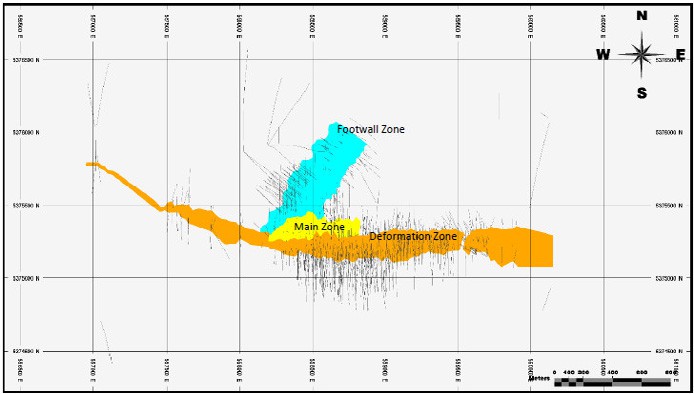
Source:TMAC, 2024
Figure 1-1:Plan View of Mineralized Envelopes
The Deformation Zone contains narrower and higher-grade intersections associated with altered sediments, intermediate dykes, and grey syenite. Gold mineralization is associated with pyrite either in quartz-healed breccias or as very fine disseminations. The Contact Fault has been interpreted to have acted as a channel for gold-bearing hydrothermal fluids and is host to the Deformation Zone and the southern boundary of the Main Zone. The Deformation Zone mineralization has been defined for approximately 2.0 km along strike.
The Footwall Zone is north of the Main Zone (Figure 1-1). The Footwall Zone structural and mineralized corridor strikes in a north-easterly direction and drilling has intercepted the zone over a strike length of approximately 500 m to a vertical depth of about 600 m below surface (open in all directions). The Footwall Zone consists of multiple mineralized zones hosted primarily in the footwall mafic volcanic assemblage, with a steep northerly dip. Mineralization consists of bleached, buff-altered (silica-albite-sericite-carbonate alteration), pillowed mafic volcanic with pyrite ranging from 2% to over 20%.
1.5Deposit Types
Gold deposits within the Abitibi-Greenstone Belt, part of the Abitibi Subprovince, occur in four principal types as identified by Robert and Poulsen (1997) and Berger and Amelin (1998). These include synvolcanic and synsedimentary deposits, syenite-associated deposits, syntectonic mesothermal vein deposits, and remobilized post-tectonic vein deposits. Synvolcanic deposits, such as the Horne Deposit in Quebec, are associated with volcanogenic massive sulphide systems and ocean-floor alteration, while synsedimentary processes contributed to gold localization at deposits like Aunor and Dome in the Timmins camp. Syenite-associated deposits, exemplified by Kerr-Addison and Holt McDermott, are spatially related to syntectonic plutons intruded near regional shear zones, with mineralizing fluids interpreted as magmatic in origin; the Fenn-Gib Deposit is best represented by this model.
- 41 -
Mesothermal vein deposits, including Camflo and Sigma, formed syntectonically from deep crustal metamorphic fluids along active shear zones during orogenesis. A fourth type, represented by the Croesus Mine near Fenn-Gib, comprises late-stage quartz veins formed by remobilization of gold-bearing fluids along north-south fractures. Literature suggests at least three phases of gold introduction in the Abitibi: early synvolcanic and synsedimentary events, intrusion-related mineralization, and a final metamorphism-related phase (Dubé & Mercier-Langevin, 2020).
1.6Exploration
Exploration conducted by Mayfair Gold since 2021 includes helicopter-towed magnetic surveys, surface geochemical sampling programs (MMI and SGH), direct current (“DC”) resistivity-induced polarization surveys, and LiDAR acquisition. These programs have expanded the understanding of mineralization on the property and identified additional exploration targets for future work.
Exploration conducted by Mayfair Gold since 2021 includes:
·SHA Geophysics Ltd. (SHA) carried out a Heli-GT helicopter-towed, three-axis magnetic gradiometer survey over the North and South property blocks in 2021 (Munroe, 2021).
·Surface work on the North Block included an orientation soil and vegetation sample mobile-metal-ion (MMI) and soil-gas hydrocarbons (SGH) test sampling program during 2022 (Aurora Geosciences, 2023).
·Aurora conducted a DC resistivity-induced polarization (IP) survey for the Company on the North Block’s Grid A and Grid B of the Project in 2022 and 2023 (Jelenic, 2023).
In 2022, a LiDAR survey and aerial photography acquisition over both the Fenn-Gib Gold project North and South Blocks was contracted to McElhanney (2022).
1.7Drilling
The Company acquired a 100% interest in the Fenn-Gib Property on December 31, 2020, and in mid-January 2021 commenced infill and expansion resource drilling on the Fenn-Gib Deposit on the North Block. As of June 20, 2025, the Company has completed approximately 190,000 m in 339 drill holes.
1.8Mineral Processing and Metallurgical Testwork
Metallurgical studies associated with the Fenn-Gib Gold project include recent efforts of Mayfair Gold Corp. (2022-2025), and earlier programs conducted by LSG (2014 -2015) and Tahoe (2017-2018). The objective of the various testwork programs was to provide sufficient metallurgical data to support the design of an optimal process to produce dor bars, for refining by others. The metallurgical testing was conducted on composite samples, over a range in head grade from 0.2 to 19.1 g/t Au and 0.3 to 8.1% S2-. Composite sample selection is representative of the range in gold grade, sulphide content, and lithology with a focus on the ore expected during the life-of-mine open pit phases.
The PFS metallurgical testwork program concluded the optimum recovery process is crushing and grinding, followed by flotation, concentrate regrind and cyanidation of the rougher concentrate. The target primary 80% passing grind size (P80) was determined to be 106 μm, with a 23 to 25% rougher flotation mass recovery, yielding a maximum 97% Au recovery to a rougher concentrate. The concentrate regrind target P80 selected was 13 μm, achieving an average leach extraction of 96% Au for an estimated overall 89.6% Au recovery at a 1.5 g/t Au feed grade.
- 42 -
Comprehensive comminution testing was completed on ten composites, considering crusher work index, JKTech Axb rock competency, semi-autogenous grinding (“SAG”), SAG Power Index (“SPI”), Bond ball mill work index, and abrasion index. This work confirmed the mineralized material processed in the early production years to be relatively hard and competent, with a design Axb of 22.7.
Gravity concentration is included in the process design as a provisional allowance; however, the gravity circuit will not be included in the initial project. Provision for this circuit will be incorporated into the process and construction designs to allow for future installation as part of sustaining capital, should the presence of sufficient coarse free gold suitable for gravity concentration be confirmed.
The metallurgical testwork completed is sufficient to inform the development of design criteria for crushing, grinding, flotation, concentrate regrinding and cyanidation of the reground concentrate to produce doré bullion.
1.9Mineral Resource Estimate
Mr. Tim Maunula, P.Geo., Principal Geologist, of TMAC, is the QP responsible for completing the Project’s MRE.
The MRE incorporates extensive drill hole data from surface diamond drill programs combining both historical drilling completed prior to 2017 and Mayfair Gold’s drilling campaigns completed from 2021-2024. The cut-off date for assay data used in the 2024 MRE was April 30, 2024. All data received were in NAD 83 UTM coordinates (Zone 17).
The MRE was:
·prepared using Hexagon Mining, HxGN MinePlan 16.2.1 (MinePlan)
·classified according to the CIM Definition Standards
·reported at a 0.3 g/t Au cut-off grade, which is amenable to open pit extraction.
The MRE for the Project is based on diamond drill hole data consisting of gold assays, geological descriptions, and density measurements.
The drill-hole database for the MRE used 457 historical drill holes (140,283 m) and 291 Mayfair Gold drill holes, which together yielded 217,334 assays used in the MRE.
The primary gold mineralization for the Project was modelled in three domains: Main Zone, Deformation Zone, and Footwall Zone (which included a Footwall Zone High Grade). However, gold mineralization is also contained within the other contiguous geological domains: mafic volcanics, pyroxenite, ultramafic volcanics, and sediments (Section 14.4). Mayfair Gold modelled the rock type groups using Datamine Studio EM (“Datamine”). The QP reviewed and validated these wireframes for use in the MRE. Gold grades were estimated separately by rock type within each domain.
The Fenn-Gib block model was estimated using three interpolation methods: nearest neighbour (“NN”), inverse distance weighting squared (“IDW2”), and ordinary kriging (OK). Uncapped and capped gold grades were estimated for the OK model. Only capped gold grades were estimated for the NN and IDW2 models.
The Fenn-Gib Gold project hosts mineral resources at a 0.3 g/t Au cut-off grade comprised of an indicated resource of 181.3 million tonnes (“Mt”) grading 0.74 g/t Au for 4.3 million contained gold ounces plus an additional Inferred Resource of 8.9 Mt at 0.49 g/t Au containing 141,000 gold ounces.
- 43 -
Table 1-1 presents the MRE reported within a constraining resource pit shell and categorized by resource classification. The MRE has an effective date of September 3, 2024, and was prepared by QP Tim Maunula, P.Geo. Mineral resources that are not mineral reserves do not have demonstrated economic viability.
Table 1-1:Mineral Resource Estimate
|
Resource Category |
Cuf-Off (Au g/t) |
Tonnes (t) |
Au (g/t) |
Au (oz) |
|
Indicated |
0.3 |
181,302,000 |
0.74 |
4,313,000 |
|
Inferred |
0.3 |
8,921,000 |
0.49 |
141,000 |
Notes:
1.Effective date of this updated MRE is September 3, 2024. The assay cut-off date for drill holes included in the mineral resource was April 30, 2024.
2.All mineral resources have been estimated in accordance with the CIM Definitions Standards, as required under National Instrument (NI) 43-101. Mineral resource statement prepared by Tim Maunula, P.Geo. in accordance with NI 43-101.
3.Mineral resources reported demonstrate reasonable prospect of eventual economic extraction, as required under NI 43-101. Mineral resources are not mineral reserves and do not have demonstrated economic viability. The mineral resources may be materially affected by environmental, permitting, legal, marketing, and other relevant issues.
4.Mineral resources are reported at a cut-off grade of 0.30 g/t Au for an open-pit mining scenario using a 50° pit slope angle. Cut-off grades are based on a price of US$2,000/oz gold, and an open pit mining cost of $3.25/t, process cost of $15.50/t and G&A $2.00/t. Metallurgical recovery of 94% was used. Densities were assigned based on interpreted lithology.
5.Troy ounce = tonnes x grade/31.10348. All numbers have been rounded to reflect the relative accuracy of the estimate.
6.The quantity and grade of reported inferred resources are uncertain in nature and there has not been sufficient work to define these inferred resources as indicated or measured resources. It is reasonably expected that many of the inferred mineral resources could be upgraded to Indicated mineral resources with continued exploration.
7.Tonnages and ounces in the tables are rounded to the nearest thousand. Numbers may not total due to rounding.
1.10Mineral Reserve Estimate
The reserves for the Fenn-Gib Gold project are based on the conversion of the indicated mineral resources in the study mine plan within the ultimate open pit limits. No measured mineral resources are within the ultimate pit design. The level of information from drill holes and degree of certainty on assumptions used by the mine plan estimates provides reasonable support to classify Indicated mineral resources conversion directly to probable reserves.
The total mineral reserve for the Fenn-Gib Gold project is shown in Table 1-2.
- 44 -
Table 1-2:Fenn-Gib Proven and Probable Mineral Reserves – December 19, 2025
|
Reserve Class |
Process Feed (Mt) |
Grade Au (g/t) |
Contained Gold Moz |
|
Proven |
- |
- |
- |
|
Probable |
25.13 |
1.29 |
1.04 |
|
Total Reserves |
25.13 |
1.29 |
1.04 |
Notes:
1.This mineral reserve estimate has an effective date of December 19, 2025
2.The mineral reserve estimation was completed under the supervision of Gordon Zurowski, P.Eng. of AGP Mining Consultants Inc., who is a QP as defined under NI 43-101
3.Mineral reserves are stated within the ultimate design pit based on:
(a)US$1,750/ounce gold price
(b)Pit Limit corresponds to a pit shell with a revenue factor of 0.55, corresponding to a US$962 /ounce gold price
(c)An elevated cut-off grade of 0.80 g/t Au for all pit phases
(d)Preliminary mining cost assumptions of C$3.24/tonne mined of waste, C$3.23/tonne mined of ore, with an incremental mining cost of C$0.02/tonne/5m bench mined below the 5,310 m elevation
(e)Preliminary processing cost assumptions of C$14.50/tonne processed, general & administration assumption of C$2.10/tonne processed, and stockpile rehandle cost assumption of C$1.00/tonne processed
(f)Preliminary process recovery assumptions of 92.6% for gold
(g)An exchange rate of C$1.35 equal to US$1.00
(h)The preliminary economic, cost and recovery assumptions used at the time of mine planning and reserve estimation may not necessarily conform to those stated in the economic model
4.Pit slope inter-ramp slope angle assumptions ranged from 28 - 65° and overall slope angles ranging from 21 - 51°
The QP has not identified any known legal, political, environmental, or other risks that would materially affect the potential development of mineral reserves.
Technical risks that have been identified as potentially affecting the mineral reserves include mining selectivity near the ore contacts, slope stability, and assumed process recoveries for given rock types. These are considered manageable risks that will be mitigated as more testwork and operating experience is obtained.
- 45 -
1.11Mining Methods
The PFS mine plan is based on open pit mining. With current metal pricing levels, knowledge of the mineralization, grade tenor, grade distribution and proximity to surface open pit mining offers the most reasonable approach for development.
A main pit with three phases together with two smaller satellite pits will provide the open pit feed material necessary to maintain the process plant feed rate at 4,800 tonnes/day (“t/d”). The main pit is proposed as a three-phase design using 5 m benches in ore which provides 25.1 Mt of mill feed grading 1.29 g/t Au. Waste from this pit will total 151.9 Mt for a strip ratio of 6.0:1.0 (waste: mill feed).
The mill feed cut-off is 0.80 g/t Au. During the mine operation minimal material will be stockpiled (0.8 Mt) and only at the beginning of the mine life when ore is encountered during the pre-stripping operation. This will be reclaimed in Year 1.
The pit phases are scheduled to provide 4,800 t/d of feed to the mill over a 14.5-year mining life after one year of pre-production stripping. The pits are sequenced to minimize initial stripping and provide higher feed grades in the early years of mine life while assisting in the construction of the tailings management facility.
The main fleet will consist of three 165 millimeter (“mm”) down the hole drills, two 16 m3 diesel hydraulic shovels and one 13 m3 front end loader. Another 13 cubic meters (“m3”) loader will be at the crusher and can be used in the pit as needed. The truck fleet will total 8 - 92-t trucks at the peak of mining. They will deliver waste material for tailings facility construction. There is also a smaller fleet of two articulated trucks and two 63-tonne trucks for tailings facility maintenance and lift development. The usual assortment of dozers, graders, small backhoes, and other support equipment is considered in the equipment cost estimate.
Year -1 is the start of major mining activity using the mining equipment and the site infrastructure (roads, highway relocation, pads, etc.) are in place. The early phases will provide the highest grade to the mill in the first six years in the schedule. The open pit will be in operation until the middle of Year 15.
Waste material from the pit will be used in the construction of the TSF with excess going into the various MRSA and overburden stockpiles. As the MRSA advances upwards, re-sloping of the sides will be occurring to allow for concurrent reclamation and reducing the visual impact of the facility.
In addition to the main open pit, two satellite pits will be mined and these will be used for water storage and diversion later in the mine life. The Phase 1N pit will be used to provide rock material for various mine infrastructure including haul roads, and pads as needed.
1.12Recovery Methods
Development of the process flowsheet for the Fenn-Gib Gold project is based on metallurgical test work described in Section 13. Crushing and grinding followed by sulphide flotation, rougher concentrate regrinding and cyanidation, carbon adsorption, desorption and regeneration, with cyanide detox of the CIL tailings. Gravity concentration may be included in the flowsheet as a sustaining capital project.
The process flowsheet consists of the following circuits:
•Three-stage crushing of run-of-mine (“ROM”) ore.
- 46 -
•A diverter chute to allow for crushing of waste rock for on-site construction purposes, including the TSF.
•A crushed ore stockpile to provide 24 hours live capacity head of the grinding circuit.
•Ball mill with trommel screen and cyclone classification yielding an 80% passing 106 μm flotation feed.
•Provision for future installation of gravity concentration and intensive leaching of the gravity concentrate.
•Sulphide and fine free gold flotation yielding a rougher concentrate.
•Flotation concentrates dewatering and regrinding yielding an 80% passing 13 μm concentrate for cyanidation.
•Cyanidation and carbon in leach (“CIL”) adsorption of the reground rougher concentrate.
•Acid washing of loaded carbon and AARL carbon stripping followed by EW and refining to produce doré bullion.
•Carbon regeneration.
•Cyanide destruction of CIL tailings using the SO2/air process.
•Process water management.
•Tailings disposal.
1.13Project Infrastructure
The Fenn-Gib Gold project infrastructure plan encompasses all major facilities required for mine development, processing, and support operations. Key components include the following:
•Mine and Process Facilities: An open pit, process plant (including crushing facilities, stockpile covers, reagent warehouse), and mine maintenance facilities (truck shop, wash bay, and warehouses). Essential buildings will be constructed on-site, while non-essential services are planned to be in Matheson.
•Site Access: The project is accessible via Highway 101, with connections to the Trans-Canada Highway and Ontario Northland Rail Line. Timmins Airport provides regional air service.
•Highway 101 Relocation: A 5 km segment of Highway 101 will be realigned to maintain safe separation from the ultimate open pit footprint. Three alignment alternatives were evaluated; the preferred option is included in the PFS design to be constructed following the initial construction phase. The timing will be re-evaluated with the next phase of work and will be pending the approvals associated with this scope.
•Tailings and Waste Management: A paddock-style TSF designed for co-disposal of tailings and PAG mine rock, with staged construction and integrated water reclaim systems. Non-PAG mine rock and overburden from the open pit will be used to construct perimeter embankments. A mine rock storage area and overburden stockpiles are included to store mine rock and overburden not utilized for embankment construction.
•Water Management: Systems include runoff and seepage collection, water management ponds, and a Water Treatment Plant with discharge to Pike River (subject to permitting). A site-wide water balance has been developed with calibration of the model to continue with future site investigations and ongoing site monitoring.
- 47 -
•Power Supply: The site requires approximately 16 megawatt (“MW”). The preferred option is a Hydro One grid connection via a 27.6 kilovolt (“kV”) line from Ramore TS, with contingency plans for temporary on-site generation should the connection schedule be delayed.
•Fuel and Utilities: Dedicated fuel storage facilities will comply with provincial standards. Potable water will be sourced from a domestic well and treated on-site.
•Accommodation: A temporary construction camp for an estimated peak loading of approximately 400 personnel will be located off-site in Matheson; no operations camp is planned.
1.14Market Studies and Contracts
Long-term metal price assumptions and foreign exchange rates (C$/US$) were provided by CIBC Global Mining Group and reviewed by the QP indicate that the gold price and foreign exchange rate used in the financial analysis are appropriate and the Fenn-Gib produced gold is expected to be marketable under current conditions, with no significant barriers to saleability identified. Although no significant contracts are currently in place, the QP considers the market assumptions used in the technical report to be reasonable. Risks associated with pricing and market access are discussed further in Section 25.
1.15Environmental , Permitting and Social Considerations
1.Environmental Considerations
Extensive baseline environmental studies have been conducted since 2021, covering terrestrial and aquatic ecosystems (including species at risk (“SAR”)), groundwater, air quality, noise, and cultural heritage resources.
A preliminary geochemical characterization program was initiated in 2023, with follow up work ongoing as of the fall of 2025. The purpose of this work is to evaluate the metal leaching and acid rock drainage potential of mine rock, overburden, and tailings materials. Preliminary results have indicated a portion of the mine rock and tailings are PAG and require engineered containment and that will be accomplished by subaqueous deposition within the TSF.
2.Closure and Reclamation Considerations
A conceptual closure strategy that will be the basis of the Closure Plan has been developed that is consistent with the requirements of the Mine Rehabilitation Code of Ontario, that includes, among other things, removal of infrastructure, machinery and equipment, stabilization of tailings and MRSAs, securing the open pit to ensure public safety is maintained and allowing the pit to fill with water, and remediation of disturbed surfaces and subsequent revegetation to support designated end land uses. Financial assurance will be provided to cover the full cost of closure and long-term monitoring.
3.Permitting Considerations
The Project will require a suite of permits and approvals typical of mine developments of the sort contemplated at Fenn-Gib, primarily under provincial jurisdiction, to support all mine phases. Select elements of the Project will require approval through one or more provincial class environmental assessment (“EA”) processes. The Project as contemplated does not trigger a comprehensive EA with the Province. The Project is not a Physical Activity as defined in the Physical Activities Regulations under the federal Impact Assessment Act and therefore federal impact assessment (“IA”) is not indicated though an authorization under the federal Fisheries Act may be required in relation to impacts to fish and fish habitat. Early engagement with regulators has been initiated, and no significant impediments to permitting have been identified.
- 48 -
Mayfair is in discussions with the Ontario government regarding entry into the “One Project, One Process” (“1P1P”) initiative that includes facilitation of all necessary provincial approvals through a dedicated Mine Authorization and Permitting Delivery Team (MAPDT).
4.Social Considerations
Social and community engagement is ongoing and proactive. The Project is located within Treaty 9 and the traditional territory of Apitipi Anicinapek Nation, with an active Exploration Agreement in place. Consultation with additional Indigenous communities and local stakeholders has also commenced, and a “good neighbour” agreement with the Town of Matheson is anticipated to address employment, procurement, and community investment.
1.16Capital and Operating Cost
1.Capital Cost Estimate
The capital cost estimate was developed in Q3 2025 dollars based on budgetary quotations for equipment and construction contracts, as well as Ausenco’s in-house database of projects and studies including experience from similar operations. All cost are in Canadian Dollars ($) unless specified otherwise.
The estimate includes mining, processing, onsite infrastructure, tailings and MRSAs, offsite infrastructure, project indirect costs, project delivery, owners’ costs, and contingency.
The following parameters and qualifications were considered:
•No allowance has been made for exchange rate fluctuations.
•There is no escalation added to the estimate.
•A growth allowance was included.
Data for the estimates have been obtained from numerous sources, including:
•mine schedules
•PFS-level engineering design by Ausenco, AGP, and KP
•topographical information obtained from the site survey
•geotechnical investigations
•budgetary equipment quotes from suppliers
•budgetary unit costs from several local contractors for civil, concrete, steel, electrical, piping, and mechanical works
•data from similar recently completed studies and projects.
Major cost categories (permanent equipment, material purchase, installation, subcontracts, indirect costs, and Owner’s costs) were identified and analyzed. A contingency was applied in the cost estimate and was based on ranging the accuracy of the data by discipline and WBS level 2 and applying a deterministic method. An overall contingency amount was derived in this fashion.
- 49 -
The capital cost summary is presented in Table 1-3. The total initial capital cost for the Fenn-Gib Gold project is $450 million; and LOM sustaining costs are $110 million inclusive of closure costs.
Table 1-3:Capital Cost Estimate
|
WBS Level 1
|
WBS Description |
Initial Capital Cost ($M) |
Sustaining Cost ($M) |
Total Cost ($M) |
|
|
1000 |
Mining |
31.4 |
24.4 |
55.8 |
|
|
2000 |
Crushing |
21.6 |
1.1 |
22.7 |
|
|
3000 |
Process Plant |
114.7 |
1.4 |
116.1 |
|
|
4000 |
On Site Infrastructure |
72.4 |
14.6 |
87.0 |
|
|
5000 |
Off Site Infrastructure |
15.6 |
13.3 |
28.9 |
|
|
|
Total Direct Costs |
255.8 |
54.7 |
310.5 |
|
|
6000 |
Project Preliminaries |
35.9 |
0.0 |
35.9 |
|
|
7000 |
Project Delivery |
30.7 |
2.5 |
33.3 |
|
|
8000 |
Owner’s Costs |
61.7 |
3.7 |
65.3 |
|
|
|
Total Indirect Costs |
128.3 |
6.2 |
134.5 |
|
|
|
Total Direct + Indirect Costs |
384.1 |
60.9 |
444.9 |
|
|
9000 |
Contingency |
65.9 |
0.0 |
65.9 |
|
|
|
Total Capital Cost |
450.0 |
60.9 |
510.9 |
|
2.Operating Cost Estimate
The operating cost estimate was prepared in Q3-2025 Canadian dollars ($) and was prepared to a Class 4 estimate with an accuracy of ±25% as defined by the Association for the Advancement of Cost Engineering International. The estimate includes mining, processing, and general and administration (“G&A”) costs.
The mine operating costs have been estimated from first principles with vendor quotations for repair and maintenance costs and other suppliers for consumables. Key inputs to the mine cost are fuel and labour. The mining fleet and support equipment fleets are diesel powered.
The operating costs were calculated based on process and maintenance consumables, workforce and G&A costs.
Common to all operating cost estimates are the following assumptions:
•Costs are estimated based on Q3-2025 pricing without allowances for inflation.
•For material sourced in US dollars, an exchange rate of C$1.35 to US$1.00 was assumed.
•Estimated cost for diesel is $1.13/L.
•Power costs are calculated using a unit price of $0.11/kWh, provided to Ausenco by Mayfair Gold Corp.
The overall operating cost over the life-of-mine of the project is $1,493 million over 15 years, or an average of $59.43/t processed. The operating costs are summarized in Table 1-4 below.
- 50 -
Table 1-4:Operating Cost Summary
Cost Area Total LOM ($M) $/t Processed % of Total
|
Mining1 |
771 |
30.66 |
52% |
|
Process |
483 |
19.22 |
32% |
|
G&A |
171 |
6.82 |
11% |
|
Refining and Royalties |
69 |
2.73 |
5% |
|
Total |
1,493 |
59.43 |
100% |
Note:
1.Equivalent to $4.53/t mined
1.17Economic Analysis
1.Economic Summary
The results of the economic analyses discussed in this chapter represent forward-looking information as defined under Canadian securities law. The results depend on inputs that are subject to known and unknown risks, uncertainties, and other factors that may cause actual results to differ materially from those presented here.
Information that is forward-looking includes:
•mineral resource estimates
•assumed commodity prices and exchange rates
•proposed mine production plan
•projected mining and process recovery rates
•assumptions regarding mining dilution and estimated future production
•sustaining costs and proposed operating costs
•assumptions regarding closure costs and closure requirements
•assumptions regarding environmental, permitting, and social risks.
Additional risks to the forward-looking information includes:
•changes to costs of production from what is assumed
•unrecognized environmental risks
•unanticipated reclamation expenses
•unexpected variations in quantity of ore, grade, or recovery rates
•accidents, labour disputes, and other risks of the mining industry
•geotechnical or hydrogeological considerations during mining being different from what was assumed
•failure of mining methods to operate as anticipated
•failure of plant, equipment, or processes to operate as anticipated
•changes to assumptions as to the availability of electrical power, and the power rates used in the operating cost estimates and financial analysis
- 51 -
•changes to site access, use of water for mining purposes, and to time to obtain environment and other regulatory permits
•ability to maintain the social licence to operate
•changes to interest rates
•changes to tax rates.
The economic analysis was performed assuming a gold price of US$3,100/oz, which was based on long-term consensus analyst estimates. The forecasts are meant to reflect the average metals price expectation over the life of the project. No price inflation or escalation factors were considered. Commodity prices can be volatile, and there is the potential for deviation from the forecast. The economic analysis also used the following assumptions:
•A pre-production period of 36 months including an initial 12-month detailed engineering period followed by 24-month construction and commissioning period.
•A mine life of 14.3 years.
•100% ownership.
•An exchange rate of 1.35 CAD/USD based on a review of current long-term consensus.
•Capital cost funded with 100% equity (no financing cost assumed other than for mining equipment leases).
•Cash flows that are discounted to the start of construction using an end-period discounting convention.
•Metal products are sold in the same year they are produced.
•Project revenues are derived from the sale of gold doré.
•No contractual arrangements for refining exist.
•Costs associated with Indigenous Impact and Benefit Agreements (“IBAs”) have not yet been negotiated and, therefore, are not included in the financial cost model.
The economic analysis was performed assuming a 5% discount rate with no inflation (constant dollar basis). On a pretax basis, the net present value (“NPV”) discounted at 5% is C$981 million; the internal rate of return (“IRR”) is 28.8%, and payback period is 2.6 years. On a post-tax basis, the NPV discounted at 5% is C$652 million; the IRR is 24.1%, and the payback period is 2.7 years. The analysis was performed on an annual cashflow basis; the cashflow output is shown graphically in Figure 1-2 and a summary of the key financial metrics is presented in Table 1-5.
- 52 -
Table 1-5:Economic Analysis Summary Table
|
Descriptiom |
Unit |
PFS Base Case |
|
|
|
|
|
General Assumptions |
|
|
|
Discount Rate |
% |
5 |
|
Gold Price |
US$/oz |
3,100 |
|
Exchange Rate |
C$/US$ |
1.35 |
|
|
|
|
|
Production |
|
|
|
Mine Life |
years |
14.3 |
|
Total Waste Tonnes Mined 1 |
kt |
151,866 |
|
Total Mill Feed Tonnes |
kt |
25,130 |
|
Mill Head Grade (Au) |
g/t |
1.29 |
|
Mill Recovery Rate |
% |
88.3 |
|
Total Mill Ounces Recovered |
koz |
920 |
|
Total Average Annual Production |
koz |
64 |
|
|
|
|
|
Transport, Refining, Royalties |
|
|
|
Gold Payable |
% |
99.95 |
|
Refining & Transport Cost |
US$/oz Au |
5.00 |
|
NSR Royalty |
% |
Varies (LOM avg. 1.7%) |
|
|
|
|
|
Operating Costs |
|
|
|
Mining Cost |
$/t mined |
4.53 |
|
Mining Cost |
$/t processed |
30.66 |
|
Processing Cost |
$/t processed |
19.22 |
|
G & A Cost |
$/t processed |
6.82 |
|
Refining and Royalties |
$/t processed |
2.73 |
|
Total Operating Cost |
$/t processed |
59.43 |
|
Cash Costs 1 |
US$/oz Au |
1,203 |
|
All-In Sustaining Cost (AISC) 2 |
US$/oz Au |
1,292 |
|
|
|
|
|
Capital Expenditures |
|
|
|
Initial Capital Cost |
$M |
450.0 |
|
Sustaining Capital Cost |
$M |
60.9 |
|
Closure Capital Cost |
$M |
49.4 |
|
|
|
|
|
Economics |
|
|
|
Pre-Tax NPV @ 5% |
$M |
980.5 |
|
Pre-Tax IRR |
% |
28.8% |
|
Pre-Tax Payback |
years |
2.6 |
|
Post-Tax MPV @ 5% |
$M |
651.7 |
|
Post-Tax IRR |
% |
24.1% |
|
Post-Tax Paygack |
years |
2.7 |
Notes:
1.Total waste includes overburden, mineralized waste, and waste material.
2.Cash Costs and AISC are Non-GAAP financial measures.
- 53 -
Figure 1-2:After Tax Cash Flow
Note: Cash flow and cumulative cash flow are non-GAAP financial. Source: Ausenco, 2025
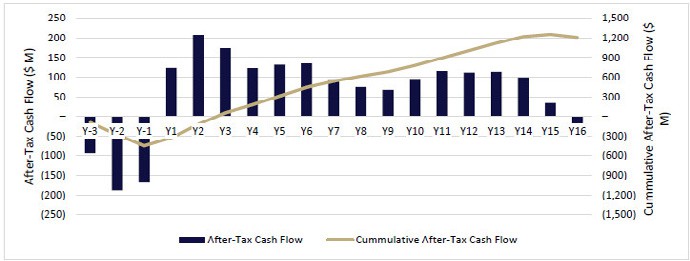
1.Sensitivity Analysis
A sensitivity analysis was conducted on the base case post-tax payback, NPV and IRR of the project using the following variables: gold price, exchange rate, initial capital costs and operating costs. After-tax sensitivity results are shown in Table 1-6.
Table 1-6:After-Tax Sensitivity Analysis
|
After-Tax Results |
|
|
OPEX Sensitivity |
||||
|
|
|
|
-30% |
-15% |
0% |
15% |
30% |
|
NPV 5% (M C$) |
|
|
826 |
739 |
652 |
564 |
476 |
|
IRR (%) |
|
|
27.7% |
25.9% |
24.1% |
22.1% |
20.0% |
|
Payback (yrs) |
|
|
2.4 |
2.5 |
2.7 |
2.9 |
3.2 |
|
|
|
|
|
|
|
|
|
|
|
|
|
|
|
|
|
|
|
After-Tax Results |
|
|
CAPEX Sensitivity |
||||
|
|
|
|
-30% |
-15% |
0% |
15% |
30% |
|
NPV 5% (M C$) |
|
|
773 |
713 |
652 |
591 |
530 |
|
IRR (%) |
|
|
34.2% |
28.4% |
24.1% |
20.7% |
17.8% |
|
Payback (yrs) |
|
|
1.9 |
2.3 |
2.7 |
3.1 |
3.6 |
|
|
|
|
|
|
|
|
|
|
|
|
|
|
|
|
|
|
|
After-Tax Results |
|
|
C$/US$ Exchange Rate Sensitivity |
||||
|
|
|
|
1.25 |
1.30 |
1.35 |
1.40 |
1.45 |
|
NPV 5% (M C$) |
|
|
536 |
594 |
652 |
710 |
767 |
|
IRR (%) |
|
|
21.4% |
22.7% |
24.1% |
25.4% |
26.6% |
|
Payback (yrs) |
|
|
3.0 |
2.8 |
2.7 |
2.6 |
2.5 |
|
|
|
|
|
|
|
|
|
|
|
|
|
|
|
|
|
|
|
After-Tax Results |
|
|
Gold Price Sensitivity (US$/oz) |
||||
|
|
1,600 |
2,100 |
2,600 |
3,100 |
3,600 |
4,100 |
4,600 |
|
NPV 5% (M C$) |
141 |
144 |
399 |
652 |
903 |
1,155 |
1,405 |
|
IRR (%) |
N/A |
10.3% |
17.9% |
24.1% |
29.4% |
34.3% |
38.6% |
|
Payback (yrs) |
N/A |
5.2 |
3.5 |
2.7 |
2.2 |
1.9 |
1.7 |
- 54 -
1.18Adjacent Properties
The Fenn-Gib property is located within Ontario’s “Golden Highway,” a well-established Archean greenstone belt corridor hosting numerous past producing and active gold operations. The property is surrounded by claims and leases held by exploration companies and operators, including STLLR Gold Inc., McEwen Mining Inc., Onyx Gold Inc., and Agnico Eagle Mines Ltd. McEwen Mining’s Fox Complex, located approximately 6 km west, has produced nearly 1 Moz historically and is advancing plans to increase annual output to 60,000 ounces by 2027 and up to 150,000 ounces by 2030. STLLR Gold’s Tower Gold Project, situated southeast along the Porcupine-Destor Fault Zone, reports a current NI 43-101 mineral resource of approximately 3.66 Moz indicated and 4.13 Moz inferred in open pit domains, with additional underground resources exceeding 3 Moz. Onyx Gold is actively exploring the Munro-Croesus Project north of Fenn-Gib, a past producing high grade property proximal to major structural zones. Agnico Eagle controls ground to the south, including the historic Holloway and Holt mines, which collectively produced more than 2 Moz prior to care and maintenance in 2019. The historic Ross Mine, approximately 10 km east, produced over 1 Moz before closing in 1989. While these operations underscore the strong gold endowment of the district, mineralization reported for adjacent properties is not necessarily indicative of mineralization at Fenn-Gib.
1.19Other Relevant Data and Information
1.Project Execution Plan and Schedule
The Project execution plan contemplates delivery under an engineering, procurement, and construction management (“EPCM”) framework with early contractor engagement to support constructability, sequencing, and execution readiness. An early works program, subject to permitting, is intended to advance site preparation, access roads, overburden removal, construction water management, and initial TSF earthworks. Early commissioning of the primary crusher is planned to allow waste rock generated during site development to be processed and reused for construction activities, including road building and TSF development. Early mobilization of the mining fleet, initially supported by a smaller contractor fleet where appropriate, is expected to accelerate pre-stripping and provide material required for critical earthworks. Selective modularization of plant components may be evaluated to reduce onsite labour and improve installation efficiency, supported by a dedicated off-site project management office providing centralized project controls and reporting.
The Project schedule is structured to advance through engineering, procurement, construction, commissioning, and ramp-up to commercial production. The execution timeline is primarily sensitive to the timing of permitting and approvals, long-lead equipment procurement, and TSF earthworks readiness. Engineering is intended to advance in parallel with permitting and Indigenous engagement, targeting a high level of plant design completion at approval and construction-ready TSF packages to support timely initiation of earthworks. Operational readiness planning is expected to proceed in parallel with construction, including development of operating and maintenance strategies, training programs, supply chain planning, and early involvement of operations personnel during commissioning to support a timely transition to steady-state operations. A high-level schedule for the Fenn-Gib Gold project is presented in Figure 1-3.
- 55 -
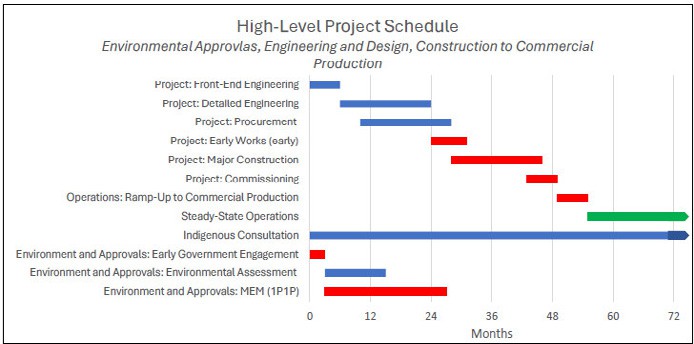 Figure 1-3:High-Level Schedule from FEED through to Commercial Production
Source: Mayfair Gold Corp., 2025
2.Potential Upside Opportunities
The PFS includes the processing of 1 Moz of reserves of the overall 4.3 Moz indicated resource. This presents several conceptual opportunities that are not included in the base case but may become strategically viable in future years. Further technical, economic and regulatory/permitting review is required for any other options following the start-up of the project as described in this study.
1.20Conclusions and Recommendations
Based on the assumptions and parameters presented in the report, the project has a mine plan that is technically feasible and economically viable. The positive financials of the project ($652 million after-tax NPV5% and 24.1% after-tax IRR) support the mineral reserve. To position the Company for a construction decision, it is recommended that critical work streams be advanced in parallel, including front-end engineering development (“FEED”) and detailed design to develop a control budget estimate, permitting and regulatory approvals to secure all necessary authorizations for construction, Indigenous and community engagement and consultation garner input on the project design with impacted communities. Advancing these activities concurrently will ensure technical, regulatory, social, and financial readiness for the next stage of project execution. The budget for this scope is detailed in Table 1-7.
- 56 -
Table 1-7:Recommended Work Program
|
Program Component |
Estimated Total Cost ($M) |
|
Drilling |
5.7 |
|
Mining and Geology |
2.0 |
|
Plant Design |
11.0 |
|
Metallurgical Testwork |
1.0 |
|
Tailings and Water Management Designs |
4.5 |
|
Geotechnical and Site Investigations |
4.6 |
|
Infrastructure Designs |
2.0 |
|
Environmental Studies and Community Engagement |
5.0 |
|
Construction Control Estimate |
0.2 |
|
Total |
36.0 |
- 57 -
SCHEDULE “B” – AUDIT COMMITTEE CHARTER
MAYFAIR GOLD CORP.
(the “Company”)
AUDIT COMMITTEE CHARTER
2.PURPOSE
2.1This charter sets out the Audit Committee’s (the “Committee”) purpose, composition, member qualification, member appointment and removal, responsibilities, operations, manner of reporting to the Board of Directors (the “Board”) of the Company, annual evaluation and compliance with this charter.
2.2The primary responsibility of the Committee is that of oversight of the financial reporting process on behalf of the Board. This includes oversight responsibility for financial reporting and continuous disclosure, oversight of external audit activities, oversight of financial risk and financial management control, and oversight responsibility for compliance with tax and securities laws and regulations as well as whistle blowing procedures. The Committee is also responsible for the other matters as set out in this charter and/or such other matters as may be directed by the Board from time to time. The Committee should exercise continuous oversight of developments in these areas.
3.COMPOSITION
3.1The Committee will be comprised of three or more directors as determined by the Board, all of whom must be directors of the Company and whom shall meet the experience, financial literacy, and independence requirements of National Instrument 52-110 – Audit Committees, Rule 10A-3 under the Securities Exchange Act of 1934 and Sections 803A and 803B of the NYSE American LLC Company Guide and who otherwise satisfy the laws governing the Company.
3.2There will be no member of the Committee who has participated in the preparation of the financial statements of the Company or any current subsidiary of the Company at any time during the past three years.
3.3The members of the Committee will be appointed annually (and from time to time thereafter to fill vacancies on the Committee) by the Board. A Committee member may be removed or replaced at any time at the discretion of the Board and will cease to be a member of the Committee on ceasing to be a director.
3.4The Chairperson (the “Chair”) of the Committee will be appointed by the Board.
3.5A majority of the members of the Committee must not be officers, employees or control persons of the Company or any of its associates or affiliates.
4.DUTIES, POWERS AND RESPONSIBILITIES
4.1The duties and responsibilities of the Committee include:
(a)recommending to the Board the external auditor to be nominated by the Board;
(b)recommending to the Board the compensation of the external auditor to be paid by the Company in connection with:
(i)preparing and issuing the audit report on the Company’s financial
- 58 -
statements, and
(ii)performing other audit, review or attestation services;
(c)reviewing the external auditor’s annual audit plan, fee schedule and any related services proposals (including meeting with the external auditor to discuss any deviations from or changes to the original audit plan, as well as to ensure that no management restrictions have been placed on the scope and extent of the audit examinations by the external auditor or the reporting of their findings to the Committee);
(d)overseeing the work of the external auditor;
(e)ensuring that the external auditor is independent by receiving a report annually from the external auditors with respect to their independence, such report to include disclosure of all engagements (and fees related thereto) for non-audit services provided to Company consistent with The Public Accounting Oversight Board Rule 3526;
(f)ensuring that the external auditor is in good standing with the Canadian Public Accountability Board by receiving, at least annually, a report by the external auditor on the audit firm’s internal quality control processes and procedures, such report to include any material issues raised by the most recent internal quality control review, or peer review, of the firm, or any governmental or professional authorities within the preceding five years, and any steps taken to deal with such issues;
(g)ensuring that the external auditor meets the rotation requirements for partners and staff assigned to the Company’s annual audit by receiving a report annually from the external auditors setting out the status of each professional with respect to the appropriate regulatory rotation requirements and plans to transition new partners and staff onto the audit engagement as various audit team members’ rotation periods expire;
(h)reviewing and discussing with management and the external auditor the annual audited and quarterly unaudited financial statements and related management’s discussion and analysis (“MD&A”), including the appropriateness of the Company’s accounting policies, disclosures (including material transactions with related parties), reserves, key estimates and judgements (including changes or variations thereto) and obtaining reasonable assurance that the financial statements are presented fairly in accordance with International Financial Reporting Standards and the MD&A is in compliance with appropriate regulatory requirements;
(i)reviewing and discussing with management and the external auditor major issues regarding accounting principles and financial statement presentation including any significant changes in the selection or application of accounting principles to be observed in the preparation of the financial statements of the Company and its subsidiaries;
(j)reviewing and discussing with management and the external auditor the external auditor’s written communications to the Committee in accordance with generally accepted auditing standards and other applicable regulatory requirements arising from the annual audit and quarterly review engagements;
(k)reviewing the external auditor’s report to the shareholders on the Company’s annual financial statements;
- 59 -
(l)reporting on and recommending to the Board the approval of the annual financial statements and the external auditor’s report on those financial statements, the quarterly unaudited financial statements, and the related MD&A and press releases for such financial statements, prior to the dissemination of these documents to shareholders, regulators, analysts and the public;
(m)satisfying itself on a regular basis through reports from management and related reports, if any, from the external auditors, that adequate procedures are in place for the review of the Company’s disclosure of financial information extracted or derived from the Company’s financial statements that such information is fairly presented;
(n)overseeing the adequacy of the Company’s system of internal accounting controls and obtaining from management and the external auditor summaries and recommendations for improvement of such internal controls and processes, together with reviewing management’s remediation of identified weaknesses;
(o)reviewing with management and the external auditors the integrity of disclosure controls and internal controls over financial reporting;
(p)reviewing and monitoring the processes in place to identify and manage the principal risks that could impact the financial reporting of the Company and assessing, as part of its internal controls responsibility, the effectiveness of the overall process for identifying principal business risks and report thereon to the Board;
(q)satisfying itself that management has developed and implemented a system to ensure that the Company meets its continuous disclosure obligations through the receipt of regular reports from management and the Company’s legal advisors on the functioning of the disclosure compliance system (including any significant instances of non-compliance with such system), in order to satisfy itself that such system may be reasonably relied upon;
(r)resolving disputes between management and the external auditor regarding financial reporting;
(s)as necessary or required, establishing procedures for:
(i)the receipt, retention and treatment of complaints received by the Company from employees and others regarding accounting, internal accounting controls or auditing matters and questionable practices relating thereto, and
(ii)the confidential, anonymous submission by employees of the Company of concerns regarding questionable accounting or auditing matters;
(t)as necessary or required, reviewing and approving the Company’s hiring policies with respect to partners or employees (or former partners or employees) of either a former or the present external auditor;
(u)pre-approving all non-audit services to be provided to the Company or any subsidiaries by the Company’s external auditor;
(v)overseeing compliance with regulatory authority requirements for disclosure of external auditor services and Committee activities;
- 60 -
(w)as necessary or required, establishing procedures for:
(i)reviewing the adequacy of the Company’s insurance coverage, including the directors’ and officers’ insurance coverage;
(ii)reviewing activities, organizational structure, and qualifications of the chief financial officer (“CFO”) and the staff in the financial reporting area and ensuring that matters related to succession planning within the Company are raised for consideration at the Board;
(iii)obtaining reasonable assurance as to the integrity of the chief executive officer (“CEO”) and other senior management and that the CEO and other senior management strive to create a culture of integrity throughout the Company;
(iv)reviewing fraud prevention policies and programs, and monitoring their implementation; and
(v)reviewing regular reports from management and others (e.g., external auditors, legal counsel) with respect to the Company’s compliance with laws and regulations having a material impact on the financial statements including:
(A)tax and financial reporting laws and regulations;
(B)legal withholding requirements;
(C)environmental protection laws and regulations; and
(D)other laws and regulations which expose directors to liability.
4.2A regular part of Committee meetings shall involve the appropriate orientation of new members as well as the continuous education of all members. Items to be discussed include specific business issues as well as new accounting and securities legislation that may impact the organization. The Chair of the Committee will regularly canvass the Committee members for continuous education needs and in conjunction with the Board education program, arrange for such education to be provided to the Committee on a timely basis.
4.3On an annual basis the Committee shall review and assess the adequacy of this charter taking into account all applicable legislative and regulatory requirements as well as any best practice guidelines recommended by regulators or stock exchanges with whom the Company has a reporting relationship and, if appropriate, recommend changes to the Committee charter to the Board for its approval.
5.AUTHORITY
5.1In addition to all authority required to carry out the duties and responsibilities included in this charter, the Committee has specific authority to:
(a)engage, set and pay the compensation for independent counsel and other advisors as it determines necessary to carry out its duties and responsibilities, and any such consultants or professional advisors so retained by the Committee will report directly to the Committee;
- 61 -
(b)communicate directly with management and any internal auditor, and with the external auditor without management involvement; and
(c)incur ordinary administrative expenses that are necessary or appropriate in carrying out its duties, which expenses will be paid for by the Company.
6.MEETINGS
6.1The quorum for a meeting of the Committee is a majority of the members of the Committee.
6.2The Chair of the Committee shall be responsible for leadership of the Committee, including scheduling and presiding over meetings, preparing agendas, overseeing the preparation of briefing documents to circulate during the meetings as well as pre-meeting materials, and making regular reports to the Board. The Chair of the Committee will also maintain regular liaison with the CEO, CFO, and the lead external audit partner.
6.3The Committee shall meet at least on a quarterly basis.
6.4The Committee will meet in camera separately with each of the CEO and the CFO of the Company at least annually to review the financial affairs of the Company.
6.5The Committee will meet with the external auditor of the Company in camera at least once each year, at such time(s) as it deems appropriate, to review the external auditor’s examination and report.
6.6The external auditor must be given reasonable notice of, and has the right to appear before and to be heard at, each meeting of the Committee.
6.7Each of the Chair of the Committee, members of the Committee, Chairperson of the Board, external auditor, CEO, CFO or secretary shall be entitled to request that the Chair of the Committee call a meeting which shall be held within 48 hours of receipt of such request to consider any matter that such individual believes should be brought to the attention of the Board or the shareholders.
7.REPORTS
7.1The Committee will report, at least annually, to the Board regarding the Committee’s examinations and recommendations.
7.2The Committee will report its activities to the Board to be incorporated as a part of the minutes of the Board meeting at which those activities are reported.
8.MINUTES
8.1The Committee will maintain written minutes of its meetings, which minutes will be filed with the minutes of the meetings of the Board.

Financial Statements
For the years ended December 31, 2025 and 2024
(Expressed in Canadian dollars)
TABLE OF CONTENTS
|
|
Page |
|
Report of Independent registered public accounting firm (Davidson and Company, LLP; Vancouver, Canada; PCAOB ID#731) |
2 |
|
|
|
|
FINANCIAL STATEMENTS: |
|
|
3 |
|
|
Consolidated Statements of Loss and Other Comprehensive Loss |
4 |
|
5 |
|
|
6 |
|
|
7-46 |
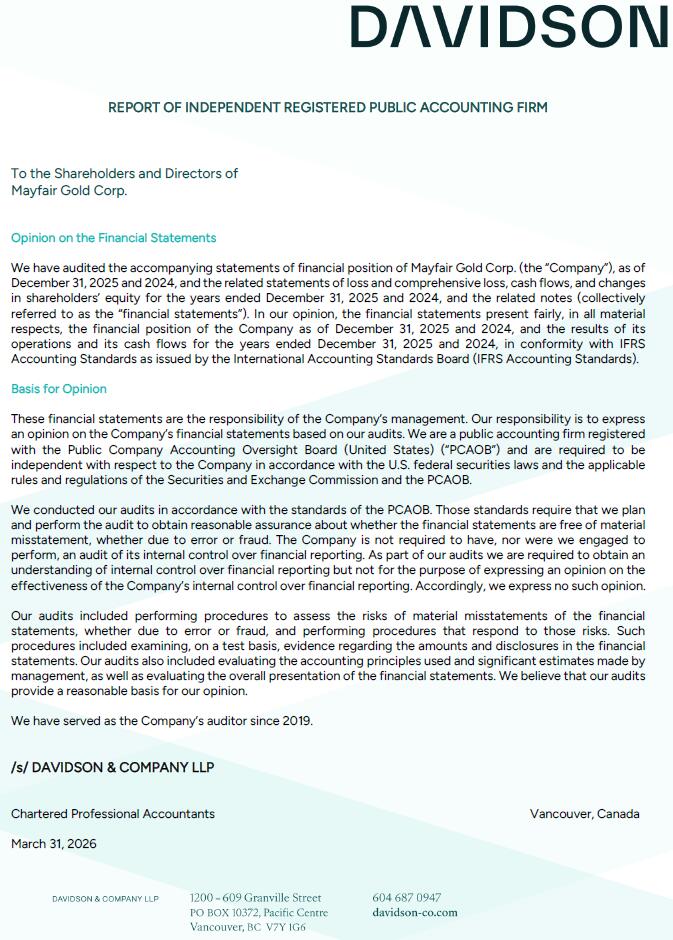
2
MAYFAIR GOLD CORP.
Statements of Financial Position
(Expressed in Canadian dollars)
|
Note |
December 31, 2025 |
December 31, 2024 |
|
|
|
|
$ |
$ |
|
ASSETS |
|
|
|
|
Current |
|
|
|
|
Cash and cash equivalents |
5 |
38,193,983 |
9,534,129 |
|
Other receivables |
13 |
166,961 |
203,700 |
|
Current portion of prepaid expenses and deposits |
7 |
416,890 |
202,326 |
|
|
38,777,834 |
9,940,155 |
|
|
|
|
|
|
|
Prepaid expenses and deposits |
7 |
120,322 |
152,370 |
|
Property, plant and equipment |
8 |
377,198 |
399,322 |
|
Mineral properties |
9 |
13,997,500 |
13,997,500 |
|
Total assets |
|
53,272,854 |
24,489,347 |
|
|
|
|
|
|
LIABILITIES |
|
|
|
|
Current |
|
|
|
|
Accounts payable and accrued liabilities |
13 |
1,167,556 |
749,934 |
|
Total liabilities |
|
1,167,556 |
749,934 |
|
|
|
|
|
|
SHAREHOLDERS’ EQUITY |
|
|
|
|
Share capital |
11 |
116,281,919 |
79,605,844 |
|
Share-based payments reserve |
11 |
6,309,124 |
4,660,036 |
|
Deficit |
|
(70,485,745) |
(60,526,467) |
|
Total shareholders’ equity |
|
52,105,298 |
23,739,413 |
|
Total liabilities and shareholders’ equity |
|
53,272,854 |
24,489,347 |
Nature of operations (Note 1)
Subsequent events (Note 17)
Approved and authorized for issue on behalf of the Board of Directors:
|
/s/ Sean Pi |
|
/s/ Carson Block |
|
|
Director |
|
Director |
|
3
MAYFAIR GOLD CORP.
Statements of Loss and Comprehensive Loss
(Expressed in Canadian dollars, except number of shares)
|
|
|
Years ended December 31, |
|
|
Note |
2025 |
2024 |
|
|
|
|
$ |
$ |
|
Operating expenses |
|
|
|
|
Depreciation |
8 |
30,426 |
58,517 |
|
Exploration and evaluation |
9, 13 |
7,322,650 |
8,416,123 |
|
General and administrative |
12, 13 |
2,290,927 |
5,326,798 |
|
Share-based payments |
11, 13 |
815,478 |
607,048 |
|
|
10,459,481 |
14,408,486 |
|
|
Other income (expenses) |
|
|
|
|
Amortization of flow-through premium liability |
10 |
- |
1,279,110 |
|
Foreign exchange gain (loss) |
|
3,929 |
(13,245) |
|
Interest income |
5, 6 |
431,174 |
329,989 |
|
Other income |
|
65,100 |
130,000 |
|
Loss and comprehensive loss |
|
(9,959,278) |
(12,682,632) |
|
|
|
|
|
|
Loss per share: |
|
|
|
|
Basic and diluted (Note 1) |
|
(0.17) |
(0.24) |
|
|
|
|
|
|
Weighted average number of common shares outstanding: |
|
|
|
|
Basic and diluted (Note 1) |
|
58,199,000 |
52,103,344 |
The accompanying notes are an integral part of these financial statements.
4
MAYFAIR GOLD CORP.
Statements of Cash Flows
(Expressed in Canadian dollars)
|
|
|
Years ended December 31, |
|
|
|
2025 |
2024 |
|
|
|
|
$ |
$ |
|
Operating activities |
|
|
|
|
Loss and comprehensive loss for the year |
|
(9,959,278) |
(12,682,632) |
|
Adjustments for: |
|
|
|
|
Depreciation |
|
30,426 |
58,517 |
|
Share-based payments |
|
815,478 |
607,048 |
|
Amortization of flow-through premium liability |
|
- |
(1,279,110) |
|
Foreign exchange (gain) loss |
|
(3,929) |
13,245 |
|
Interest income on GIC |
|
(43,644) |
- |
|
Changes in non-cash working capital: |
|
|
|
|
Other receivables |
|
36,739 |
80,549 |
|
Prepaid expenses and deposits |
|
(182,516) |
(104,885) |
|
Accounts payable and accrued liabilities |
|
417,662 |
(530,528) |
|
Cash used in operating activities |
|
(8,889,062) |
(13,837,796) |
|
|
|
|
|
|
Investing activities |
|
|
|
|
Purchase of short-term investment |
|
(3,000,000) |
- |
|
Maturity of short-term investment |
|
3,043,644 |
- |
|
Purchases of property, plant and equipment |
|
(8,302) |
(221) |
|
Cash provided by (used in) investing activities |
|
35,342 |
(221) |
|
|
|
|
|
|
Financing activities |
|
|
|
|
Proceeds from issuance of common shares, net of issuance costs |
|
37,397,181 |
5,876,461 |
|
Proceeds from exercise of warrants |
|
112,504 |
- |
|
Proceeds from exercise of options |
|
- |
3,991,676 |
|
Cash provided by financing activities |
|
37,509,685 |
9,868,137 |
|
|
|
|
|
|
Effect of exchange rate on changes in cash and cash equivalents |
|
3,889 |
- |
|
Change in cash and cash equivalents |
|
28,659,854 |
(3,969,880) |
|
Cash and cash equivalents, beginning of year |
|
9,534,129 |
13,504,009 |
|
Cash and cash equivalents, end of year |
|
38,193,983 |
9,534,129 |
|
|
|
|
|
|
Supplemental cash flow information: |
|
|
|
|
Cash interest income received |
|
122,244 |
329,989 |
|
Fair value reversal on exercise of options |
|
- |
3,244,018 |
|
Finders’ warrants issued |
|
877,484 |
- |
|
Interest paid in cash |
|
- |
- |
|
Income tax paid in cash |
|
- |
- |
|
|
|
|
|
The accompanying notes are an integral part of these financial statements.
5
MAYFAIR GOLD CORP.
Statements of Changes in Shareholders’ Equity
(Expressed in Canadian dollars, except number of shares)
|
|
Common shares |
Share Capital |
Share-based payments reserve |
Deficit |
Total shareholders’ equity |
|
|
|
|
# |
$ |
$ |
$ |
$ |
|
Balance, December 31, 2023 |
|
50,156,064 |
66,493,689 |
7,297,006 |
(47,843,835) |
25,946,860 |
|
Issuance of common shares - private placements |
|
1,670,000 |
6,012,000 |
- |
- |
6,012,000 |
|
Share issue costs |
|
- |
(135,539) |
- |
- |
(135,539) |
|
Issuance of common shares - exercise of options |
|
2,815,450 |
3,991,676 |
- |
- |
3,991,676 |
|
Fair value of share options exercised from share-based payments reserve |
|
- |
3,244,018 |
(3,244,018) |
- |
- |
|
Share-based payments |
|
- |
- |
607,048 |
- |
607,048 |
|
Loss and comprehensive loss |
|
- |
- |
- |
(12,682,632) |
(12,682,632) |
|
Balance, December 31, 2024 |
|
54,641,514 |
79,605,844 |
4,660,036 |
(60,526,467) |
23,739,413 |
|
Issuance of common shares - private placement |
|
12,122,002 |
40,002,600 |
- |
- |
40,002,600 |
|
Share issue costs |
|
- |
(3,482,903) |
877,484 |
- |
(2,605,419) |
|
Exercise of warrants |
|
34,092 |
156,378 |
(43,874) |
- |
112,504 |
|
Share-based payments |
|
- |
- |
815,478 |
- |
815,478 |
|
Loss and comprehensive loss |
|
- |
- |
- |
(9,959,278) |
(9,959,278) |
|
Balance, December 31, 2025 |
|
66,797,608 |
116,281,919 |
6,309,124 |
(70,485,745) |
52,105,298 |
The accompanying notes are an integral part of these financial statements.
6
MAYFAIR GOLD CORP.
Notes to the Financial Statements
For the years ended December 31, 2025 and 2024
(Expressed in Canadian dollars)
1.NATURE OF OPERATIONS
Mayfair Gold Corp. (the “Company”) was incorporated pursuant to the Business Corporations Act of British Columbia on July 30, 2019. The Company’s registered office is located at Suite 700 - 1199 West Hastings Street, Vancouver, BC, Canada, V6E 3T5. The Company’s principal place of business is 489 McDougall Street, Matheson, ON, Canada, P0K 1N0. The Company is engaged in the operation, acquisition, exploration and development of mineral properties.
During the year ended December 31, 2025, the Company was listed for trading on the TSX Venture Exchange under the symbol “MFG.V”, the Frankfurt Stock Exchange under the symbol “9M5”, and the OTCQX under the symbol “MFGCF”. On January 27, 2026, the Company commenced trading on the NYSE American under the ticker symbol “MINE”. The Company will remain listed on the TSX Venture Exchange under the symbol “MFG” and ceased trading on the OTCQX market.
These financial statements for the years ended December 31, 2025 and 2024 (“Financial Statements”) have been prepared on a going concern basis, which assumes that the Company will be able to meet its obligations and continue its operations for at least the next twelve months. The Company has not generated revenue from operations to date and will require additional financing or outside participation to undertake further advanced exploration of its mineral properties. Although the Company has been successful in the past in obtaining financing, there is no assurance that it will be able to obtain adequate financing in the future or that such financing will be on terms advantageous to the Company.
Share consolidation
On December 18, 2025, the Company consolidated its outstanding common shares on the basis of two pre-consolidated common shares for one post-consolidated common share (the “Share Consolidation”). All current and comparative references to the number of common shares, weighted average number of common shares, loss per share, stock options and warrants have been restated to give effect to the Share Consolidation.
2.BASIS OF PREPARATION
Statement of compliance
These financial statements were approved by the Board of Directors and authorized for issue on March 31, 2026.
These financial statements have been prepared in accordance with IFRS Accounting Standards (“IFRS”) as issued by the International Accounting Standards Board.
Basis of presentation
The financial statements have been prepared using the historical cost basis, except for certain financial assets and liabilities which are measured at fair value, as specified by IFRS Accounting Standards, as well as information presented in the statements of cash flows. In addition, these financial statements have been prepared using the accrual basis of accounting except for cash flow information.
Functional and presentation currency
The financial statements are presented in Canadian dollars (“CAD”), which is the Company’s functional and presentation currency. The functional currency is the currency of the primary economic environment in which an entity operates. References to “US$” or “USD” are to United States dollars.
7
MAYFAIR GOLD CORP.
Notes to the Financial Statements
For the years ended December 31, 2025 and 2024
(Expressed in Canadian dollars)
3.MATERIAL ACCOUNTING POLICY INFORMATION
a)Cash and cash equivalents
Cash and cash equivalents comprise cash, bank deposits and highly liquid short-term investments that are readily convertible into known amounts of cash.
b)Financial instruments
Financial instruments are accounted for in accordance with IFRS 9 Financial Instruments. A financial instrument is any contract that gives rise to a financial asset of one entity and a financial liability or equity instrument of another entity.
Classification of financial instruments
The Company determines the classification of its financial instruments which are all measured at fair value on initial recognition. Upon initial recognition, a financial asset is classified as measured at: amortized cost, fair value through profit or loss (“FVTPL”), or fair value through other comprehensive income (“FVTOCI”). The classification of financial assets is generally based on the business model in which a financial asset is managed and its contractual cash flow characteristics. A financial liability is classified as measured at amortized cost or FVTPL.
The Company’s financial assets comprise of cash and cash equivalents, other receivables (excluding sales tax recoverable) and deposits which are classified as and measured at amortized cost.
The Company’s financial liabilities comprise of accounts payable and accrued liabilities which are classified as and measured at amortized cost.
Impairment of financial assets at amortized cost
The Company considers all information available, including on a forward-looking basis, to assess the expected credit losses associated with its assets carried at amortized cost. The impairment methodology applied depends on whether there has been a significant increase in credit risk. To assess whether there is a significant increase in credit risk, the Company compares the risk of a default occurring on the asset at the reporting date, with the risk of default as at the date of initial recognition, based on all information available, and reasonable and supportive forward-looking information.
c)Share issuance costs
Professional, consulting, regulatory and other costs directly attributable to financing transactions are recorded as share issue costs as a deduction from equity. Equity instruments issued to agents as financing costs are measured at their fair value at the date the services were provided.
d)Equity instruments
Equity instruments are contracts that give a residual interest in the net assets of the Company. Financial instruments issued by the Company are classified as equity only to the extent that they do not meet the definition of a financial liability or financial asset. The Company’s common shares, stock options and share purchase warrants are classified as equity instruments.
e)Related party transactions
Parties are considered to be related if one party has the ability, directly or indirectly, to control the other party or exercise significant influence over the other party in making financial and operating decisions. In addition, parties are considered to be related if they are subject to common control or common significant influence, related parties may be individuals or corporate entities. A transaction is considered to be a related party transaction when there is a transfer of resources or obligations between related parties.
f)Mineral property and exploration and evaluation costs
Exploration and evaluation (“E&E”) costs are those costs required to find a mineral property and determine commercial viability and technical feasibility. E&E costs include costs to establish an initial mineral resource and determine whether inferred mineral resources can be upgraded to measured and indicated mineral resources and whether measured and indicated mineral resources can be converted to proven and probable reserves.
8
MAYFAIR GOLD CORP.
Notes to the Financial Statements
For the years ended December 31, 2025 and 2024
(Expressed in Canadian dollars)
Exploration and evaluation costs consist of:
·gathering exploration data through topographical and geological studies;
·exploratory drilling, trenching and sampling;
·determining the volume and grade of the resource;
·test work on geology, metallurgy, mining, geotechnical and environmental; and
·conducting and refining engineering, marketing and financial studies
Costs in relation to these activities are expensed as incurred until such time that technical feasibility and commercial viability are demonstrable. At such time, mineral properties are assessed for impairment and an impairment loss, if any, is recognized. Capitalized acquisition costs included in mineral properties are transferred to capitalized costs within property, plant and equipment, or intangible assets, as appropriate. Determination of technical feasibility and commercial viability requires management’s judgment and includes assessment of legal, environmental, social and governmental factors.
The Company recognizes E&E costs as assets when acquired as part of a business combination, or asset purchase, or as a result of rights acquired relating to a mineral property. These assets are recognized at fair value upon acquisition. Capitalized mineral properties consist of:
·acquired interest in exploration properties;
·amounts paid for acquired rights associated with exploration properties; and
·changes in decommissioning and restoration amounts capitalized during the period.
Management reviews its mineral property at each reporting period for signs of impairment and annually after each exploration season to consider if there is impairment in value taking into consideration current year exploration results and management’s assessment of the future probability of profitable operations from the property, or likely gains from the disposition or option of the property. If a property is abandoned or inactive for a prolonged period, or considered to have no future economic potential, the acquisition costs are written off to profit or loss.
g)Share capital
Common shares are classified as equity. Transaction costs directly attributable to the issue of common shares and share options are recognized as a deduction from equity, net of any tax effects. Common shares issued for consideration other than cash, are valued based on their market value at the date the shares are issued. Equity-settled share-based payments to employees and others providing similar services are measured at the fair value of the equity instruments at the grant date.
h)Flow-through shares
Under Canadian income tax legislation, a company is permitted to issue flow-through shares whereby the Company agrees to incur qualifying expenditures and renounce the related income tax deductions to the investors. The proceeds from issuance of these shares are allocated between the offering of shares and the sale of tax benefits. The allocation is made based on the difference between the quoted price of the existing shares and the amount the investor pays for the flow-through shares. A deferred premium liability is recognized for this difference. The Company renounces the deductions for tax purposes related to the eligible exploration and evaluation expenditures on the date the flow-through shares are issued. The premium liability is reduced on a pro-rata basis and recorded in other income based on the corresponding eligible expenditures that have been incurred.
i)Share-based payment transactions
The Company has a stock option plan that provides for the granting of options to Officers, Directors, employees and consultants to acquire shares of the Company. The fair value of the options is measured on grant date and is recognized as an expense with a corresponding increase in share-based payments reserve as the options vest.
Options granted to employees and others providing similar services are measured at grant date at the fair value of instruments issued. Fair value is determined using the Black-Scholes option pricing model taking into account the terms and conditions upon which the options were granted. The amount recognized as an expense is adjusted to reflect the actual number of share options that are expected to vest. Each tranche in an award with graded vesting is considered a separate grant with a different vesting date and fair value. Each grant is accounted for on that basis.
9
MAYFAIR GOLD CORP.
Notes to the Financial Statements
For the years ended December 31, 2025 and 2024
(Expressed in Canadian dollars)
Options granted to non-employees are measured at the fair value of the goods or services received, unless that fair value cannot be estimated reliably, in which case the fair value of the equity instruments issued is used. The value of goods or services is recorded at the earlier of the vesting date, or the date the goods or services are received.
Over the vesting period, share-based payments are recorded as an operating expense and as share-based payments reserve. When options are exercised the consideration received is recorded as share capital and the related share-based payments originally recorded as share-based payment reserve are transferred to share capital.
j)Loss per share
Basic loss or earnings per share is calculated by dividing loss or earnings attributable to common shares by the weighted average number of shares outstanding during the year. Diluted loss or earnings per share is calculated using the denominator of the basic loss or earnings calculation described above adjusted to include the potentially dilutive effect of outstanding stock options.
k)Property, plant and equipment
Property, plant and equipment are recorded at cost and depreciated using the declining-balance basis at the following annual rates:
|
Class of property, plant and equipment |
Depreciation rate |
|
Computers |
50% |
|
Furniture and fixtures |
20% |
|
Buildings |
4% |
|
Land |
nil |
|
Machinery and equipment |
20% |
|
Vehicles |
30% |
Additions during the year are depreciated on a pro-rated basis.
l)Impairment of long-lived assets
At the end of each reporting period, the Company reviews the carrying amounts of its tangible and intangible assets to determine whether there is an indication that those assets have suffered an impairment loss. If any such indication exists, the recoverable amount of the asset is estimated in order to determine the extent of the impairment loss (if any). Where it is not possible to estimate the recoverable amount of an individual asset, the Company estimates the recoverable amount of the cash-generating units (“CGU”) (the smallest identifiable group of assets that generates cash inflows that are largely independent of the cash inflow from other assets or groups of assets). The recoverable amount of the asset (or CGU) is the greater of the asset’s (or CGU’s) fair value less costs to sell and its value in use to which the assets belong.
In assessing value in use, the estimated future cash flows are discounted to their present value using a pre-tax discount rate that reflects current market assessments of the time value of money and the risks specific to the asset.
If the recoverable amount of an asset (or CGU) is estimated to be less than its carrying amount, the carrying amount of the asset (or CGU) is reduced to its recoverable amount. An impairment loss is recognized in profit or loss for the period, unless the relevant asset is carried at a revalued amount, in which case the impairment loss is treated as a revaluation decrease.
The Company uses its best efforts to fully understand all of the aforementioned to make an informed decision based upon historical and current facts surrounding the projects. Discounted cash flow techniques often require management to make estimates and assumptions on reserves and expected future production revenues and expenses.
Where an impairment loss subsequently reverses, the carrying amount of the asset (or CGU) is increased to the revised estimate of its recoverable amount, but to an amount that does not exceed the carrying amount that would have been determined had no impairment loss been recognized for the asset (or CGU) in prior years. A reversal of an impairment loss is recognized immediately in profit or loss.
10
MAYFAIR GOLD CORP.
Notes to the Financial Statements
For the years ended December 31, 2025 and 2024
(Expressed in Canadian dollars)
m)Income taxes and deferred taxes
The income tax expense is comprised of current and deferred income taxes. Current and deferred income tax are recognized in profit or loss, except to the extent that they relate to items recognized directly in equity or equity instruments.
Current income tax is the expected tax payable or receivable on the taxable profit or loss for the year, using tax rates enacted or substantively enacted at the reporting date and any adjustment to tax payable in respect of previous periods. Deferred income tax is recognized in respect of temporary differences between the carrying amounts of assets and liabilities for financial reporting purposes and the amounts used for taxation purposes. Deferred income tax is measured at the tax rates that are expected to be applied to temporary differences when they reverse, based on the laws that have been enacted or substantively enacted by the reporting date. Deferred income tax assets and liabilities are offset if there is a legally enforceable right to offset current income tax liabilities and assets and they relate to income taxes levied by the same tax authority for the same taxable entity. A deferred income tax asset is recognized for unused tax losses, tax credits and deductible temporary differences, to the extent that it is probable that future taxable income will be available against which they can be utilized. Deferred income tax assets are reviewed at each reporting date and are reduced to the extent that it is no longer probable that the related income tax benefit will be realized.
n)Foreign currency
Transactions and balances in currencies other than the Canadian dollar, the currency of the primary economic environment in which the Company operates are translated into the functional currency using the exchange rates prevailing at the dates of the transactions. Foreign exchange gains and losses resulting from the settlement of such transactions and from the translation of monetary assets and liabilities denominated in foreign currencies at the exchange rate prevailing on the statement of financial position date are recognized in profit or loss.
o)Decommissioning and restoration provision
The Company recognizes a provision for statutory, contractual, constructive, or legal obligations associated with decommissioning of mining operations and reclamation and rehabilitation costs arising when environmental disturbance is caused by the exploration or development of mineral properties. Provisions for decommissioning and restoration are recognized in the period in which the obligation is incurred or acquired and are measured based on expected future cash flows to settle the obligation, discounted to their present value. The discount rate is a pre-tax rate that reflects current market assessments of the time value of money and risks specific to liability.
When an obligation is initially recognized, the corresponding cost is capitalized to the carrying amount of the related asset. These costs are depreciated on a basis consistent with the depreciation, depletion, and amortization of the underlying assets.
The obligation is accreted over time for the change in its present value, with this accretion charge recognized as a finance expense in profit or loss. The obligation is also adjusted for changes in the estimated amount and timing of expected future cash flows and changes in the discount rate. Such changes in estimates are added to or deducted from the related asset except where deductions are greater than the carrying value of the related asset, in which case the amount of the excess is recognized in profit or loss.
p)Pronouncements issued but not yet effective
IFRS 18 Presentation and Disclosure in Financial Statements ("IFRS 18")
On April 9, 2024, the IASB issued IFRS 18 Presentation and Disclosure in Financial Statements. IFRS 18 will apply for reporting periods beginning on or after January 1, 2027 and applies to comparative information. IFRS 18 will replace IAS 1; many of the other existing principles in IAS 1 are retained, with limited changes. IFRS 18 will not impact the recognition or measurement of items in the financial statements, but it may change what an entity reports as its ‘operating profit or loss’. Key new concepts introduced in IFRS 18 relate to: (i) the structure of the statement of profit or loss; (ii) required disclosures in the financial statements for certain profit or loss performance measures that are reported outside an entity’s financial statements (that is, management-defined performance measures); and (iii) enhanced principles on aggregation and disaggregation which apply to the primary financial statements and notes in general. The Company is currently assessing the effects of IFRS 18 on the financial statements. It is expected that the adoption of IFRS 18 will have a significant impact on disclosure and presentation.
11
MAYFAIR GOLD CORP.
Notes to the Financial Statements
For the years ended December 31, 2025 and 2024
(Expressed in Canadian dollars)
IFRS 9 Financial Instruments (“IFRS 9”) and IFRS 7 Financial Instruments: Disclosures (“IFRS 7”)
In May 2024, the IASB issued Amendments to the Classification and Measurement of Financial Instruments (Amendments to IFRS 9 and IFRS 7). These amendments updated classification and measurement requirements in IFRS 9 Financial Instruments and related disclosure requirements in IFRS 7 Financial Instruments: Disclosures. The IASB clarified the recognition and derecognition date of certain financial assets and liabilities, and amended the requirements related to settling financial liabilities using an electronic payment system. It clarified how to assess the contractual cash flow characteristics of financial assets in determining whether they meet the ‘solely payments of principal and interest’ criterion, including financial assets that have environmental, social and corporate governance (ESG)-linked features and other similar contingent features. The IASB added disclosure requirements for financial instruments with contingent features that do not relate directly to basic lending risks and costs and amended disclosures relating to equity instruments designated at fair value through other comprehensive income. The amendments are effective for annual periods beginning on or after January 1, 2026 with early application permitted. The Company is currently assessing the effect of these amendments on the financial statements.
4.SIGNIFICANT JUDGMENTS AND SOURCES OF ESTIMATION UNCERTAINTY
The preparation of financial statements under IFRS Accounting Standards requires management to make judgments in applying its accounting policies and estimates that affect the reported amounts of assets and liabilities at the period end date and reported amounts of expenses during the reporting period. Such judgments and estimates are, by their nature, uncertain. Actual outcomes could differ from these estimates.
The impact of such judgments and estimates is pervasive throughout these financial statements and may require accounting adjustments based on future occurrences. These judgments and estimates are continuously evaluated and are based on management’s experience and knowledge of the relevant facts and circumstances. Revisions to accounting estimates are recognized in the period in which the estimate is revised and are accounted for prospectively.
Significant assumptions about the future and other sources of estimation uncertainty that management has made at the end of the reporting period, that could result in a material adjustment to the carrying amounts of assets and liabilities in the event that actual results differ from assumptions made, relate to, but are not limited to, the following:
a) Economic recoverability and probability of future economic benefits of mineral properties
The impairment of exploration and evaluation assets is influenced by judgment in defining a cash-generating unit and determining the indicators of impairment and estimates used to measure impairment losses. The Company is required to measure the recoverable amount of exploration and evaluation assets when there are indicators that their carrying value may be impaired. The assessment of any impairment of exploration and evaluation assets is dependent upon estimates of recoverable amounts that take into account factors such as economic and market conditions and useful lives of the assets.
b)Valuation of share-based payments
The Company uses the Black-Scholes option pricing model for valuation of share-based payments. Option pricing models require the input of subjective assumptions. Changes in the input assumptions can materially affect the fair value estimate and the Company’s earnings and equity reserves.
c)Recognition of deferred tax
The measurement of a deferred tax provision is subject to uncertainty associated with the timing of future events and changes in legislation, tax rates and interpretations by tax authorities. The estimation of taxes includes evaluating the recoverability of deferred tax assets based on an assessment of the Company’s ability to utilize the underlying future tax deductions against future taxable income prior to expiry of those deductions. Management assesses whether it is probable that some or all of the deferred income tax assets will not be realized. The ultimate realization of deferred tax assets is dependent upon the generation of future taxable income. To the extent that management’s assessment of the Company’s ability to utilize future tax deductions changes, the Company would be required to recognize more or fewer deferred tax assets, and future tax provisions or recoveries could be affected.
12
MAYFAIR GOLD CORP.
Notes to the Financial Statements
For the years ended December 31, 2025 and 2024
(Expressed in Canadian dollars)
5.CASH AND CASH EQUIVALENTS
Cash is comprised of cash deposits held in reputable financial institutions and cash equivalents consist of redeemable guaranteed investment certificates (“GICs”).
A summary of the Company’s cash and cash equivalents is as follows:
|
December 31, 2025 |
December 31, 2024 |
|
|
|
$ |
$ |
|
Cash |
38,097,832 |
7,408,166 |
|
Cash equivalents (1) |
96,151 |
2,125,963 |
|
38,193,983 |
9,534,129 |
(1)Cash equivalents consist of redeemable GICs with maturities of 3 to 10 months and interest rates between 1.75% and 2.25%.
During the year ended December 31, 2025, interest income from GICs and deposits in the Company’s savings account totaled $387,530 (2024 - $329,989).
6.SHORT-TERM INVESTMENT
On February 13, 2025, the Company purchased a short-term investment which consisted of a non-redeemable six-month GIC with a value of $3,000,000 and an interest rate of 2.95%, which matured on August 12, 2025. The redemption resulted in interest income of $43,644.
During the year ended December 31, 2025, interest income from the short-term investment totaled $43,644. The relevant GIC was only active in 2025 and therefore interest income from short term investments in 2024 is nil.
7.PREPAID EXPENSES AND DEPOSITS
Prepaid expenses and deposits consist of insurance policy prepayments, listing fee prepayments and other expenses.
A summary of the Company’s prepaid expenses and deposits is as follows:
|
December 31, 2025 |
December 31, 2024 |
|
|
|
$ |
$ |
|
Prepaid expenses |
489,740 |
351,572 |
|
Deposits with suppliers |
47,472 |
3,124 |
|
537,212 |
354,696 |
|
|
|
|
|
|
Current portion |
416,890 |
202,326 |
|
Non-current portion |
120,322 |
152,370 |
The Company’s non-current portion of prepaid expenses consists of directors and officers insurance policy lasting through June 5, 2030.
13
MAYFAIR GOLD CORP.
Notes to the Financial Statements
For the years ended December 31, 2025 and 2024
(Expressed in Canadian dollars)
8.PROPERTY, PLANT AND EQUIPMENT
A summary of the Company’s property, plant and equipment is as follows:
|
Computers |
Furniture and fixtures |
Building |
Land |
Machinery and equipment |
Vehicles |
Total |
|
|
|
$ |
$ |
$ |
$ |
$ |
$ |
$ |
|
Cost |
|
|
|
|
|
|
|
|
Balance, December 31, 2023 |
67,782 |
13,210 |
358,420 |
69,000 |
56,288 |
130,050 |
694,750 |
|
Additions |
221 |
- |
- |
- |
- |
- |
221 |
|
Balance, December 31, 2024 |
68,003 |
13,210 |
358,420 |
69,000 |
56,288 |
130,050 |
694,971 |
|
Additions |
5,302 |
- |
- |
- |
- |
3,000 |
8,302 |
|
Balance, December 31, 2025 |
73,305 |
13,210 |
358,420 |
69,000 |
56,288 |
133,050 |
703,273 |
|
|
|
|
|
|
|
|
|
|
Accumulated depreciation |
|
|
|
|
|
|
|
|
Balance, December 31, 2023 |
67,782 |
7,245 |
36,771 |
- |
25,551 |
99,783 |
237,132 |
|
Depreciation |
13 |
2,642 |
14,337 |
- |
11,258 |
30,267 |
58,517 |
|
Balance, December 31, 2024 |
67,795 |
9,887 |
51,108 |
- |
36,809 |
130,050 |
295,649 |
|
Depreciation |
2,332 |
2,662 |
14,338 |
- |
10,961 |
133 |
30,426 |
|
Balance, December 31, 2025 |
70,127 |
12,549 |
65,446 |
- |
47,770 |
130,183 |
326,075 |
|
|
|
|
|
|
|
|
|
|
Carrying amount |
|
|
|
|
|
|
|
|
Balance, December 31, 2024 |
208 |
3,323 |
307,312 |
69,000 |
19,479 |
- |
399,322 |
|
Balance, December 31, 2025 |
3,178 |
661 |
292,974 |
69,000 |
8,518 |
2,867 |
377,198 |
Depreciation during the year ended December 31, 2025 was $30,426 (2024 - $58,517).
14
MAYFAIR GOLD CORP.
Notes to the Financial Statements
For the years ended December 31, 2025 and 2024
(Expressed in Canadian dollars)
9.MINERAL PROPERTIES
On June 8, 2020, the Company entered into a binding asset purchase agreement (the “Asset Purchase Agreement”) with Lake Shore Gold Corp. (“Lake Shore”). Pursuant to the terms of the Asset Purchase Agreement, the Company agreed to acquire 6 leases on mining lands, 18 patents on mining lands, 144 cell claims and 3 surface rights only patents located in the Guibord, Munro, Michaud and McCool Townships in northeast Ontario, Canada (the “Fenn-Gib Property” collectively).
As consideration for the acquisition of the Fenn-Gib Property the Company agreed to:
i.Pay Lake Shore a cash payment of US$11,000,000; and
ii.Grant Lake Shore a 1.0% net smelter returns royalty derived from the future production of minerals from the Fenn-Gib Property.
On December 31, 2020, the transaction closed and $13,997,500 (US$11,000,000) was paid and recorded as mineral properties. The balance of mineral properties as at December 31, 2025 and 2024 was $13,997,500, representing the historical acquisition cost.
A summary of the Company’s exploration and evaluation expenses at the Fenn-Gib Property is as follows:
|
2025 |
2024 |
|
|
|
$ |
$ |
|
Camp maintenance, supplies, mobilization, general costs |
144,865 |
432,641 |
|
Drilling |
1,578,389 |
2,725,556 |
|
Environmental assessment and pre-feasibility studies |
3,158,703 |
1,244,834 |
|
Exploration contractors |
16,062 |
442,779 |
|
Exploration personnel and program support (Note 13) |
1,239,623 |
1,736,382 |
|
Laboratory analysis |
138,371 |
604,552 |
|
Other exploration and evaluation |
96,931 |
367,144 |
|
Permitting |
949,706 |
862,235 |
|
7,322,650 |
8,416,123 |
10.DEFERRED PREMIUM ON FLOW-THROUGH SHARES
Flow-through units are issued at a premium, which is calculated as the difference between the price of a flow-through unit and the price of a unit at the issuance date. Tax deductions generated by the eligible expenditures are passed through to the shareholders of the flow-through shares once the eligible expenditures are incurred and renounced.
Funds raised through the issuance of flow-through units are required to be expended on qualifying Canadian mineral exploration expenditures, as defined pursuant to Canadian income tax legislation. The flow-through gross proceeds less the qualified expenditures made to date represent the funds received from flow-through share issuances that have not been spent and are held by the Company for such expenditures.
A summary of the Company’s flow-through funding, expenditure requirements and corresponding impact on the flow-through premium liability is as follows:
|
|
Flow-through funding and expenditure requirements |
Flow-through premium liability |
|
|
$ |
$ |
|
Balance, December 31, 2023 |
4,424,217 |
1,279,110 |
|
Flow-through expenditures incurred, renounced, and amortization of flow-through premium liability |
(4,424,217) |
(1,279,110) |
|
Balance, December 31, 2025 and 2024 |
- |
- |
During the year ended December 31, 2025, the Company recognized $nil (2024 - $1,279,110) as amortization of flow-through premium liability under other income in profit or loss.
15
MAYFAIR GOLD CORP.
Notes to the Financial Statements
For the years ended December 31, 2025 and 2024
(Expressed in Canadian dollars)
11.SHARE CAPITAL
Authorized share capital
The Company is authorized to issue an unlimited number of common shares without par value.
Pursuant to the Share Consolidation, the Company consolidated its outstanding common shares on the basis of two pre-consolidated common shares for one post-consolidated common share (Note 1). All current and comparative references to the number of common shares, weighted average number of common shares, loss per share, stock options and warrants have been restated to give effect to the Share Consolidation.
Issued share capital
The number of shares issued and fully paid as at December 31, 2025 is 66,797,608 (December 31, 2024 - 54,641,514).
During the year ended December 31, 2025, the Company also had the following share capital transactions:
·On September 16, 2025, the Company closed a brokered private placement and issued 12,122,002 common shares at a price of $3.30 per share for gross proceeds of $40,002,600. Share issuance costs of $2,605,419 were incurred in connection with the offering. Pursuant to this private placement, the Company issued 681,843 warrants to certain finders. Each warrant entitles the holder to purchase one common share of the Company at a price of $3.30 per warrant and will expire on September 16, 2027. The Company attributed a fair value of $877,484 to the warrants which was determined using the Black-Scholes option pricing model (“BSM”).
·The Company issued 34,092 common shares pursuant to the exercise of 34,092 warrants with a weighted average exercise price of $3.30 for gross proceeds of $112,504. The fair value of the warrants was determined to be $43,874 at initial recognition, resulting in $43,874 being transferred to share capital from reserves.
During the year ended December 31, 2024, the Company had the following share capital transactions:
·The Company issued an aggregate of 2,815,450 common shares pursuant to the exercise of stock options with a weighted average exercise price of $1.42 generating gross proceeds of $3,991,676. In connection with the exercises, the Company transferred $3,244,018 from share-based payments reserve to share capital.
·On October 17, 2024, the Company closed a private placement consisting of the issue of 1,670,000 common shares at a price of $3.60 per share for a total consideration of $6,012,000. Share issuance costs of $135,539 were incurred in connection with the offering.
Stock options
The Company has an omnibus equity incentive plan (“the Plan”) under which non-transferable options, deferred share units, and restricted share units may be granted to directors, officers, employees or service providers of the Company. Under the plan, the maximum number of shares which may be reserved for issuance is 10% of the number of issued and outstanding common shares. The Board of Directors has the authority and discretion to grant stock options as identified in the Plan, which includes provisions limiting the issuance of options to qualified persons and employees of the Company to maximums identified in the Plan and the vesting terms.
During the year ended December 31, 2025, the Company had the following stock option transactions:
·On January 28, 2025, the Company granted 87,500 options to an officer of the Company with each option exercisable into common shares at an exercise price of $3.40 per share. The options are exercisable for a five-year term expiring on January 28, 2030. Of the stock options granted, 29,167 of the options vested immediately, 29,167 will vest on January 28, 2026, and 29,166 will vest on January 28, 2027. The fair value of the options was determined to be $217,623 using the BSM.
·On February 13, 2025, the Company granted 175,000 options to an officer of the Company with each option exercisable into common shares at an exercise price of $3.70 per share. The options are exercisable for a five-year term expiring on February 13, 2030. Of the stock options granted, 58,333 will vest on March 1, 2026, and the remaining 116,667 will vest on a monthly basis thereafter until March 1, 2028. The fair value of the options was determined to be $466,630 using the BSM.
·On November 20, 2025, the Company granted 300,000 options to an officer and consultants of the Company with each option exercisable into common shares at an exercise price of $4.34 per share. The options are exercisable for a five-year term expiring on November 20, 2030. The fair value of the options was determined to be $896,871 using the BSM.
16
MAYFAIR GOLD CORP.
Notes to the Financial Statements
For the years ended December 31, 2025 and 2024
(Expressed in Canadian dollars)
During the year ended December 31, 2024, the Company had the following stock option transactions:
·On April 17, 2024, the Company granted 50,000 stock options to an officer of the Company with an exercise price of $5.08. Of the stock options granted, 50% vested immediately and 50% will vest on April 17, 2025. The options are exercisable for a five-year term expiring on April 17, 2029. The fair value of the options was determined to be $181,172 using the BSM.
·On June 20, 2024, the Company granted 50,000 stock options to two directors of the Company with an exercise price of $3.80. The options are exercisable for a five-year term expiring on June 20, 2029. Of the stock options granted, 16,666 will vest on June 20, 2025, 16,667 will vest on June 20, 2026 and 16,667 will vest on June 20, 2027. The fair value of the options was determined to be $144,455 using the BSM.
·On October 28, 2024, the Company granted 150,000 stock options to an officer of the Company with an exercise price of $4.06. Of the stock options granted, 50,000 vested immediately and 50,000 each will vest on October 28, 2025 and October 28, 2026. The options are exercisable for a five-year term expiring on October 27, 2029. The fair value of the options was determined to be $458,165 using the BSM.
A summary of the Company’s stock option activity is as follows:
|
Stock options outstanding |
Weighted average exercise price |
|
|
|
# |
$ |
|
Balance, December 31, 2023 |
4,874,450 |
2.22 |
|
Granted |
250,000 |
4.21 |
|
Exercised |
(2,815,450) |
1.42 |
|
Expired |
(1,400,000) |
3.39 |
|
Forfeited |
(97,500) |
4.28 |
|
Balance, December 31, 2024 |
811,500 |
3.33 |
|
Granted |
562,500 |
3.99 |
|
Expired |
(156,500) |
3.80 |
|
Balance, December 31, 2025 |
1,217,500 |
3.58 |
A summary of the Company’s outstanding and exercisable stock options as at December 31, 2025 is as follows:
|
Expiry date |
Number of options outstanding |
Number of options exercisable |
Weighted average exercise price |
Weighted average remaining life |
|
|
# |
# |
$ |
Years |
|
February 3, 2028 |
50,000 |
50,000 |
3.00 |
2.09 |
|
November 14, 2028 |
112,500 |
112,500 |
4.28 |
2.87 |
|
April 17, 2029 |
50,000 |
50,000 |
5.08 |
3.30 |
|
June 20, 2029 |
50,000 |
16,666 |
3.80 |
3.47 |
|
October 27, 2029 |
150,000 |
100,000 |
4.06 |
3.82 |
|
January 28, 2030 |
87,500 |
29,167 |
3.40 |
4.08 |
|
February 13, 2030 |
175,000 |
- |
3.70 |
4.12 |
|
December 31, 2030 |
100,000 |
100,000 |
0.94 |
5.00 |
|
November 20, 2030 |
300,000 |
- |
4.34 |
4.89 |
|
January 6, 2032 |
50,000 |
50,000 |
1.80 |
6.02 |
|
December 6, 2032 |
92,500 |
92,500 |
2.58 |
6.94 |
|
1,217,500 |
600,833 |
3.58 |
4.38 |
17
MAYFAIR GOLD CORP.
Notes to the Financial Statements
For the years ended December 31, 2025 and 2024
(Expressed in Canadian dollars)
A summary of the Company’s weighted average inputs used in the BSM to calculate the fair value of the stock options granted during the years ended December 31, 2025 and 2024 is as follows:
|
2025 |
2024 |
|
|
Share price |
$3.90 |
$4.34 |
|
Exercise price |
$3.90 |
$4.21 |
|
Risk-free interest rate |
2.82% |
3.24% |
|
Expected life (years) |
5.00 |
5.00 |
|
Expected volatility |
90.30% |
91.71% |
|
Expected annual dividend yield |
0.00% |
0.00% |
During the year ended December 31, 2025, the Company recognized share-based payments of $815,478 (2024 - $607,048) from the vesting of stock options.
Warrants
During the year ended December 31, 2025, the Company had the following warrant transaction:
·On September 16, 2025, the Company closed a brokered private placement and issued 681,843 warrants with a fair value of $877,484 as share issuance costs. Each warrant entitles the holder to purchase one common share at a price of $3.30 per share until September 16, 2027.
A summary of the Company’s warrant activity is as follows:
|
|
Warrants outstanding |
Weighted average exercise price |
|
|
# |
$ |
|
Balance, December 31, 2024 and 2023 |
- |
- |
|
Issued |
681,843 |
3.30 |
|
Exercised |
(34,092) |
3.30 |
|
Balance, December 31, 2025 |
647,751 |
3.30 |
A summary of the Company’s outstanding warrants as at December 31, 2025, is as follows:
|
Date of expiry |
Number of warrants |
Weighted average exercise price |
Weighted average remaining life |
|
|
# |
$ |
Years |
|
September 16, 2027 |
647,751 |
3.30 |
1.71 |
|
647,751 |
3.30 |
1.71 |
During the year ended December 31, 2025, the Company issued 34,092 common shares pursuant to the exercise of 34,092 warrants with a weighted average exercise price of $3.30 for gross proceeds of $112,504. The weighted average share price on the date of exercise for warrants during the year was $4.33 (2024: nil) per common share. The fair value of the warrants was determined to be $43,874 at initial recognition, resulting in $43,874 being transferred to share capital from reserves.
A summary of the Company’s weighted average inputs used in the BSM to calculate the fair value of the warrants granted during the year ended December 31, 2025 is as follows:
|
Share price |
$4.04 |
|
Exercise price |
$3.30 |
|
Expected life (years) |
2.00 |
|
Risk-free interest rate |
2.46% |
|
Expected volatility |
37.90% |
|
Expected annual dividend yield |
0.00% |
18
MAYFAIR GOLD CORP.
Notes to the Financial Statements
For the years ended December 31, 2025 and 2024
(Expressed in Canadian dollars)
12.GENERAL AND ADMINISTRATIVE
A summary of the Company’s general and administrative expenses is as follows:
|
2025 |
2024 |
|
|
|
$ |
$ |
|
Directors’ fees (Note 13) |
51,280 |
123,036 |
|
Management fees (Note 13) |
719,071 |
2,088,159 |
|
Marketing and public relations |
281,046 |
238,934 |
|
Other general and administrative |
425,925 |
460,697 |
|
Professional fees |
628,727 |
2,223,564 |
|
Transfer agent and regulatory fees |
184,878 |
192,408 |
|
2,290,927 |
5,326,798 |
13.RELATED PARTY TRANSACTIONS AND KEY MANAGEMENT COMPENSATION
Parties are considered to be related if one party has the ability, directly or indirectly, to control the other party or exercise significant influence over the other party in making financial and operating decisions. Related parties may be individuals or corporate entities. A transaction is considered to be a related party transaction when there is a transfer of resources or obligations between related parties.
The Company’s related parties include directors, key management personnel of the Company, including the Chief Executive Officer, Chief Operating Officer (the “COO”), Chief Financial Officer (“CFO”), Vice President of Capital Markets and Vice President of Exploration and their companies and close family members.
A summary of the Company’s related party transactions and key management compensation is as follows:
|
2025 |
2024 |
|
|
|
$ |
$ |
|
Directors’ fees |
51,280 |
123,035 |
|
Exploration personnel and program support (1) |
658,592 |
371,233 |
|
Management fees |
719,071 |
562,246 |
|
Change of control payment to former officer in management fees (2) |
- |
1,525,912 |
|
Professional fees |
- |
1,012,555 |
|
Share-based payments |
770,158 |
458,100 |
|
Other income |
- |
(130,000) |
|
2,199,101 |
3,923,081 |
(1)Amounts relating to the compensation of the Vice President of Technical Services and the COO included in exploration and evaluation expenses.
(2)In December 2024, the Company filed a claim against the former CEO for reimbursement of this amount. The outcome of this lawsuit is not determinable as at the date of these financial statements.
A summary of the amounts due to related parties in accounts payable and accrued liabilities as at December 31, 2025 and 2024 is as follows:
|
December 31, 2025 |
December 31, 2024 |
|
|
|
$ |
$ |
|
Payable to a company partially owned by a director |
- |
130,000 |
|
Payable to a company partially owned by the CFO |
50,291 |
17,778 |
|
Payable to key management personnel |
61,229 |
246 |
|
Payable to other related party |
5,040 |
5,000 |
|
116,560 |
153,024 |
As at December 31, 2025, other receivables include $nil (December 31, 2024 - $130,000) for consulting services rendered to a company partially controlled by a director.
19
MAYFAIR GOLD CORP.
Notes to the Financial Statements
For the years ended December 31, 2025 and 2024
(Expressed in Canadian dollars)
14.FINANCIAL INSTRUMENTS AND RISK MANAGEMENT
Financial instruments measured at fair value are classified into one of Three levels in the fair value hierarchy according to the relative reliability of the inputs used to estimate the fair values. The Three levels of the fair value hierarchy are:
·Level 1 - Unadjusted quoted prices in active markets for identical assets or liabilities;
·Level 2 - Inputs other than quoted prices that are observable for the asset or liability either directly or indirectly; and
·Level 3 - Inputs that are not based on observable market data.
The Company’s financial instruments consist of cash and cash equivalents, other receivables (excluding sales tax recoverable), deposits and accounts payable and accrued liabilities, which are classified as and measured at amortized cost. The carrying values approximate the fair value of these financial instruments due to their short-term nature.
The Company is exposed to certain financial risks by its financial instruments. The risk exposures and their impact on the Company’s financial statements are summarized below.
Credit risk
Credit risk is the risk of financial loss to the Company if a counterparty to a financial instrument fails to fulfill its contractual obligations. The Company’s credit risk relates primarily to cash and cash equivalents and deposits. The Company minimizes its credit risk related to cash and cash equivalents by placing these financial instruments with major financial institutions. The Company considers the credit risk related to cash and cash equivalents and deposits to be minimal.
Interest rate risk
Interest rate risk is the risk that the fair value or future cash flows of a financial instrument will fluctuate because of changes in market interest rates. The objective of interest risk management is to manage and control market risk exposures within acceptable parameters while optimizing returns. The Company has no significant financial instruments with variable interest rates and has assessed interest rate risk as minimal.
Liquidity risk
Liquidity risk is the risk that the Company will not be able to meet its financial obligations when they become due. To mitigate this risk, the Company has a planning and budgeting process in place to determine the funds required to support its ongoing operations and capital expenditures. The Company endeavors to ensure that sufficient funds are raised from equity offerings to meet its operating requirements, after taking into account existing cash and expected exercise of stock options and share purchase warrants. For the year ended December 31, 2025, the Company incurred a loss of $9,959,278 (2024 - $12,682,632). The Company’s cash and cash equivalents are held in business accounts and are available on demand for the Company’s programs. As at December 31, 2025, the Company had a cash and cash equivalents balance of $38,193,983 (December 31, 2024 - $9,534,129) to settle current liabilities of $1,167,556 (December 31, 2024 - $749,934) and has assessed the liquidity risk as minimal.
Foreign exchange risk
Foreign exchange risk arises on financial instruments that are denominated in a currency other than the functional currency of the Company. The Company is exposed to foreign exchange risk from fluctuations in the US dollar to the Canadian dollar on its cash and accounts payable balances.
A summary of the Company’s financial instruments held in USD, expressed in Canadian dollars is as follows:
|
2025 |
2024 |
|
|
|
$ |
$ |
|
Cash and cash equivalents |
936,603 |
78,627 |
|
Accounts payable and accrued liabilities |
19,421 |
34,664 |
|
917,182 |
43,963 |
A 10% change in the US dollar exchange rate relative to the Canadian dollar would change the Company’s profit or loss by approximately $91,718 (December 31, 2024 - $4,396). The Company has assessed the foreign exchange risk as minimal.
20
MAYFAIR GOLD CORP.
Notes to the Financial Statements
For the years ended December 31, 2025 and 2024
(Expressed in Canadian dollars)
15.CAPITAL MANAGEMENT
The Company's objectives when managing capital are to safeguard the Company’s ability to continue as a going concern, so that it can provide returns for shareholders and benefits for other stakeholders.
Historically, the Company has been dependent on external financing to fund its activities. The capital structure of the Company consists of shareholders’ equity. The Company manages its capital structure and adjusts it for changes in economic conditions and the risk characteristics of the underlying assets, being mineral properties.
In order to maintain or adjust its capital structure, the Company may issue new shares through equity offerings or sell assets to fund operations. Management reviews the Company’s capital management approach on a regular basis. The Company is not subject to externally imposed capital requirements. There were no changes in the Company’s approach to capital management during the year ended December 31, 2025.
16.INCOME TAXES
The Company has not recognized any deferred income tax assets. The Company recognizes deferred income tax assets based on the extent to which it is probable that sufficient taxable income will be realized during the carry forward periods to utilize all deferred tax assets.
A summary of the Company’s reconciliation of income taxes at statutory rates for the years ended December 31, 2025 and 2024, is as follows:
|
2025 |
2024 |
|
|
|
$ |
$ |
|
Loss for the year |
(9,959,278) |
(12,682,632) |
|
Income tax recovery at statutory rates |
(2,689,000) |
(3,424,000) |
|
Non-deductible expenditures and non-taxable revenues |
221,000 |
(181,000) |
|
Impact of flow through shares |
- |
1,195,000 |
|
Share issuance costs |
(703,000) |
(37,000) |
|
Adjustment to prior years provision versus statutory tax returns |
19,000 |
- |
|
Change in unrecognized deferred tax assets |
3,152,000 |
2,447,000 |
|
Income tax expense |
- |
- |
The significant components of the Company’s deferred tax assets and liabilities are follows:
|
December 31, 2025 |
December 31, 2024 |
|
|
|
$ |
$ |
|
Share issuance costs and financing fees |
750,000 |
393,000 |
|
Non-Capital losses |
5,604,000 |
4,327,000 |
|
Property and equipment |
69,000 |
80,000 |
|
Mineral resource properties |
4,202,000 |
2,673,000 |
|
Deferred tax assets |
10,625,000 |
7,473,000 |
|
Unrecognized deferred tax assets |
(10,625,000) |
(7,473,000) |
|
Deferred tax assets, net |
- |
- |
21
MAYFAIR GOLD CORP.
Notes to the Financial Statements
For the years ended December 31, 2025 and 2024
(Expressed in Canadian dollars)
The significant components of the Company’s temporary differences, unused tax credits and unused tax losses that have not been included on the consolidated statement of financial position are as follows:
|
December 31, 2025 |
Expiry date range |
December 31, 2024 |
Expiry date range |
|
|
|
$ |
|
$ |
|
|
Temporary differences: |
|
|
|
|
|
Share issuance costs and financing fees |
2,777,000 |
2046 to 2049 |
1,455,000 |
2044 to 2048 |
|
Non-capital losses available for future periods |
20,755,000 |
2039 to 2045 |
16,025,000 |
2039 to 2044 |
|
Property and equipment |
257,000 |
No expiry date |
296,000 |
No expiry date |
|
Mineral resource properties |
15,561,000 |
No expiry date |
9,899,000 |
No expiry date |
|
Total |
39,350,000 |
|
27,675,000 |
|
17.SUBSEQUENT EVENTS
On January 26, 2026, the Company granted 645,000 stock options to directors, officers, employees, and advisors with each option exercisable into common shares at an exercise price of $5.94 per share. The options are exercisable for a five-year term expiring on January 26, 2031. Of the options granted, one third of the options will vest and become exercisable if the option holder is actively employed or engaged with the Company on January 26, 2027, the remaining options will vest and become exercisable on each calendar month starting on February 26, 2027 for twenty-four months thereafter for each subsequent month that the option holder remains actively employed with the Company.
On February 2, 2026, the Company granted 100,000 stock options to an advisor with each option exercisable into common shares at an exercise price of $5.36 per share. The options are exercisable for a five-year term expiring on February 2, 2031. Of the options granted, one third of the options vested on the grant date, one third of the options will vest and become exercisable if the option holder is actively engaged with the Company on February 2, 2027, the remaining options will vest and become exercisable on February 2, 2028 if the option holder remains actively engaged with the Company.
On January 27, 2026, the Company commenced trading on the NYSE American under the ticker symbol “MINE”. The Company will remain listed on the TSX Venture Exchange under the symbol “MFG.V” and ceased trading on the OTCQX market.
During January and February 2026, the Company issued 282,888 common shares upon exercise of 282,888 warrants at an exercise price of $3.30 for total proceeds of $933,530.
22

Management’s Discussion and Analysis
For the years ended December 31, 2025 and 2024
(Expressed in Canadian dollars)
|
|
|
|
MAYFAIR GOLD CORP.
Management’s Discussion and Analysis
For the years ended December 31, 2025 and 2024
(Expressed in Canadian dollars, except where noted otherwise)
MANAGEMENT’S DISCUSSION AND ANALYSIS
This Management’s Discussion and Analysis (“MD&A”) of the results of operations and financial condition of Mayfair Gold Corp. (the “Company”) should be read in conjunction with the Company’s audited financial statements for the years ended December 31, 2025 and 2024 (collectively referred to hereafter as the “Financial Statements”). The Financial Statements are prepared in accordance with International Financial Reporting Standards (“IFRS Accounting Standards”) as issued by the International Accounting Standards Board.
In this MD&A, unless the context otherwise dictates, a reference to “us”, “we”, “our”, or similar terms refers to the Company. The functional currency of the Company is disclosed in the notes to the Financial Statements. All amounts are presented in Canadian dollars, the Company’s presentation and functional currency, unless otherwise stated. All dollar amounts are presented in Canadian dollars, the presentation currency of the Company, except where otherwise noted. References to US$ are to United States dollars. The first, second, third and fourth quarters of the Company’s fiscal years are referred to as “Q1”, “Q2”, “Q3” and “Q4”, respectively. The years ended December 31, 2025 and 2024 are referred to as “Fiscal 2025” and “Fiscal 2024” respectively.
This MD&A is prepared by management and approved by the Board of Directors as of March 31, 2026 (the “MD&A Date”). This discussion covers the years ended December 31, 2025 and 2024 and the subsequent period up to the MD&A Date.
Management is responsible for the preparation and integrity of the Company’s Financial Statements, including the maintenance of appropriate information systems, procedures, and internal controls. Management is responsible for ensuring that information disclosed externally, including the information contained within the Company’s Financial Statements and MD&A, is complete and reliable.
CAUTIONARY NOTE REGARDING FORWARD-LOOKING INFORMATION
Certain statements in this document constitute forward-looking information under applicable securities legislation. Forward-looking information typically contains statements with words such as "anticipate", "believe", "estimate", "will", "expect", "plan", "intend", or similar words suggesting future outcomes or an outlook. Forward-looking information in this document includes, but is not limited to:
·our business plan and investment strategy; and
·general business strategies and objectives.
Such forward-looking information is based on a number of assumptions which may change over time. Assumptions have been made with respect to the following matters, in addition to any other assumptions identified in this document:
·taxes and capital, operating, general and administrative as well as other costs;
·general business, economic and market conditions;
·the ability of the Company to obtain the required capital to finance its investment strategy and meet its commitments and financial obligations;
·the ability of the Company to obtain services and personnel in a timely manner and at an acceptable cost to carry out activities; and
·the timely receipt of required regulatory approvals
Although the Company believes that the expectations reflected in such forward-looking information are reasonable, undue reliance should not be placed on them as there can be no assurance that such expectations will prove to be accurate. Forward-looking information is based on expectations, estimates and projections that involve a number of risks and uncertainties which could cause actual results to differ materially than anticipated and described in the forward-looking information.
2
MAYFAIR GOLD CORP.
Management’s Discussion and Analysis
For the years ended December 31, 2025 and 2024
(Expressed in Canadian dollars, except where noted otherwise)
The material risks and uncertainties include, but are not limited to:
·meet current and future commitments and obligations;
·general business, economic and market conditions;
·the uncertainty of estimates and projections relating to future costs and expenses;
·changes in, or in the interpretation of, laws, regulations or policies;
·the ability to obtain required regulatory approvals in a timely manner;
·the outcome of existing and potential lawsuits, regulatory actions, audits and assessments; and
·other risks and uncertainties described elsewhere in this document.
The foregoing list of risks and uncertainties is not exhaustive. For more information relating to risks and uncertainties, see the section titled "Risks and Uncertainties" herein. The forward-looking information contained in this document is made as of the date hereof and, except as required by applicable securities law, the Company undertakes no obligation to update publicly or revise any forward-looking statements or information, whether as a result of new information, future events or otherwise.
DESCRIPTION OF BUSINESS
Mayfair Gold Corp. was incorporated pursuant to the Business Corporations Act of British Columbia on July 30, 2019. The Company’s registered office is located at Suite 700 - 1199 West Hastings Street, Vancouver, BC, Canada, V6E 3T5. The Company’s principal place of business is 489 MacDougall Street, Matheson, ON, Canada, P0K 1N0. The Company is engaged in the operation, acquisition, exploration and development of mineral properties.
During the year ended December 31, 2025, the Company was listed for trading on the TSX Venture Exchange under the symbol “MFG.V”, the Frankfurt Stock Exchange under the symbol “9M5”, and the OTCQX under the symbol “MFGCF”. On January 27, 2026, the Company commenced trading on the NYSE American under the ticker symbol “MINE”. The Company will remain listed on the TSX Venture Exchange under the symbol “MFG.V” and ceased trading on the OTCQX market.
The Company acquired an undivided 100% interest in the Fenn-Gib Project on June 8, 2020. The Fenn-Gib Project comprises 6 leases on mining lands, 18 patents on mining lands, 144 cell claims and 3 surface rights only patents located in the Guibord, Munro, Michaud and McCool Townships in northeast Ontario, Canada.
Share consolidation
On December 18, 2025, the Company consolidated its outstanding common shares on the basis of two pre-consolidated common shares for one post-consolidated common share (the “Share Consolidation”). All current and comparative references to the number of common shares, weighted average number of common shares, loss per share, stock options and warrants have been restated to give effect to the Share Consolidation.
SHAREHOLDER PROXY CONTEST
On March 19, 2024, Muddy Waters Capital LLC, on behalf of certain investment funds managed by it, with control and direction over aggregate shares approximating 16.77% of the Company, announced its intent to reconstitute the board of directors at the then next annual general and special meeting of the Company (the “Shareholder Proxy Contest”).
During the year ended December 31, 2024, as a result of the Shareholder Proxy Contest, the Company incurred $3.3 million in non-recurring costs. These costs include a $1.5 million cash payment to Patrick Evans, former CEO of the Company and $1.6 million in additional legal and related fees, of which $1.0 million was for the reimbursement of certain legal expenses incurred by other parties to the proxy contest, and $0.2 million in additional corporate insurance premiums. In December 2024, the Company filed a claim against Patrick Evans for reimbursement of the $1.5 million cash payment. The outcome of this lawsuit is not determinable as at the MD&A Date.
3
MAYFAIR GOLD CORP.
Management’s Discussion and Analysis
For the years ended December 31, 2025 and 2024
(Expressed in Canadian dollars, except where noted otherwise)
FENN-GIB PROJECT OVERVIEW
The Fenn-Gib Project comprises two property packages, referred to as the Fenn-Gib North and South Blocks, which are separated by approximately three kilometers. The Fenn-Gib Deposit (see “Fenn-Gib Deposit” below) is located on the North Block along the regional Contact Fault, an east-west to south-east trending shear zone on the Pipestone Fault, which is interpreted to be a splay off the Porcupine-Destro Fault. The Fenn-Gib Deposit hosts significant concentrations of gold mineralization within two zones: (i) the Main Zone, and (ii) the Deformation Zone. These two zones overlap completely. A third zone of mineralization, known as the Footwall Zone, is located approximately 100 meters to the northwest of the Fenn-Gib Deposit. A fourth zone of mineralization, known as the Contact Zone, is located at depth below the current pit-constrained resource.
Sixteen claims encompass the current conceptual pit supported by the Fenn-Gib Deposit. The Company would be subject to a 1% Net Smelter Royalty (NSR) over the sixteen claims, with an additional 1.5% NSR over nine of the sixteen claims.
A summary of the Company’s exploration and evaluation expenses at the Fenn-Gib Project is as follows:
|
|
Q4 2025 |
Q4 2024 |
Fiscal 2025 |
Fiscal 2024 |
|
|
$ |
$ |
$ |
$ |
|
Camp maintenance, supplies, mobilization, general costs |
63,436 |
44,027 |
144,865 |
432,641 |
|
Drilling |
1,224,401 |
94,833 |
1,578,389 |
2,725,556 |
|
Environmental assessment and pre-feasibility studies |
1,049,270 |
704,071 |
3,158,703 |
1,244,834 |
|
Exploration contractors |
2,740 |
254 |
16,062 |
442,779 |
|
Exploration personnel and program support |
357,285 |
402,570 |
1,239,623 |
1,736,382 |
|
Laboratory analysis |
138,371 |
11,896 |
138,371 |
604,552 |
|
Other exploration and evaluation |
29,606 |
70,780 |
96,931 |
367,144 |
|
Permitting |
308,532 |
344,748 |
949,706 |
862,235 |
|
|
3,173,641 |
1,673,179 |
7,322,650 |
8,416,123 |
Deposit
On March 5, 2021, the Company filed a NI 43-101 Technical Report titled “Fenn-Gib Project, Ontario, Canada” dated February 5, 2021 (revised on February 19, 2021), which was prepared by JDS Energy and Mining Inc. The resource for the Fenn-Gib Deposit was based on an Indicated Mineral Resource and Inferred Mineral Resource Estimate undertaken by Garth Kirkham, P. Geo., of Kirkham Geosystems Ltd., a qualified person as defined by NI 43-101 and independent of the Company. The Mineral Resource Estimate incorporated more than 420 drill holes totalling 134,546 meters. The Mineral Resource Estimate for Fenn-Gib Deposit was reported at a base case above a 0.35 g/t Au cut-off, as tabulated below:
2021 Fenn-Gib Resource Estimate by Category Using 0.35 g/t Au Cut-Off
|
US$1,700/oz Gold |
|
|
|
|
|
Style |
Class |
Tonnes |
Au (g/t) |
Au (ounces) |
|
Open pit |
Indicated |
70,203,723 |
0.92 |
2,077,661 |
|
Open pit |
Inferred |
3,774,865 |
0.62 |
74,967 |
On October 18, 2022, the Company announced an updated Interim Mineral Resource Estimate for the Fenn-Gib Project, which was prepared by Garth Kirkham, P. Geo., of Kirkham Geosystems Ltd. The Mineral Resource Estimate, dated October 15, 2022, expanded upon the 2021 Resource Estimate, and incorporated approximately 67,000 meters of additional drill hole results through July 31, 2022. The Interim Mineral Resource Estimate for the Fenn-Gib Deposit was reported at a base case above a 0.35 g/t Au cut-off, as tabulated below:
2022 Fenn-Gib Resource Estimate by Category Using 0.35 g/t Au Cut-Off
|
US$1,750/oz Gold |
|
|
|
|
|
Style |
Class |
Tonnes |
Au (g/t) |
Au (ounces) |
|
Open pit |
Indicated |
118,074,000 |
0.81 |
3,062,000 |
|
Open pit |
Inferred |
13,829,000 |
0.7 |
311,000 |
|
Underground |
Inferred |
1,002,000 |
3.22 |
104,000 |
4
MAYFAIR GOLD CORP.
Management’s Discussion and Analysis
For the years ended December 31, 2025 and 2024
(Expressed in Canadian dollars, except where noted otherwise)
On June 14, 2023, the Company announced an updated Mineral Resource Estimate for the Fenn-Gib Project, which expands upon the 2022 Resource Estimate and incorporates assay results from approximately 47,000 meters of additional drilling. On July 26, 2023, the Company filed a NI 43-101 Technical Report titled “Fenn-Gib Project, Ontario, Canada”, which was prepared by Tim Maunula, P. Geo., of T. Maunula and Associates Consulting Inc. (“TMAC”), with an effective date of April 6, 2023.
Mr. Maunula is a qualified person as defined by NI 43-101 and independent of the Company. The updated Mineral Resource Estimate for the Fenn-Gib Deposit was reported at a base case above a 0.40 g/t Au cut-off, as tabulated below:
2023 Fenn-Gib Resource Estimate by Category Using 0.40 g/t Au Cut-Off
|
US$1,765/oz Gold |
|
|
|
|
|
Style |
Class |
Tonnes |
Au (g/t) |
Au (ounces) |
|
Open pit |
Indicated |
113,687,000 |
0.93 |
3,383,000 |
|
Open pit |
Inferred |
5,724,000 |
0.85 |
157,000 |
On September 10, 2024, the Company announced an updated Mineral Resource Estimate for the Fenn-Gib Project at US$2,000 Gold. Prepared by Tim Maunula, P. Geo., of TMAC as tabulated below:
2024 Fenn-Gib Resource Estimate Using 0.3 g/t Au Cut-Off)
|
US$2,000/oz Gold |
|
|
|
|
|
Style |
Class |
Tonnes |
Au (g/t) |
Au (ounces) |
|
Open pit |
Indicated |
181,302,000 |
0.74 |
4,313,000 |
|
Open pit |
Inferred |
8,921,000 |
0.49 |
141,000 |
On October 14, 2025, the Company filed an NI 43-101 Technical Report titled, “Fenn-Gib Technical Report - Mineral Resource Estimate Update” dated October 10, 2025, which was prepared by Tim Maunula, P. Geo qualified of T. Maunula and Associates Consulting Inc. The mineral resource was unchanged from the prior disclosure. The document included additional disclosure associated with mineral processing and metallurgical testing, which was authored by Mr. Steve Haggarty, P.Eng. Both Mr. Maunula and Mr. Haggarty are qualified persons as defined by NI 43-101 and independent of the Company.
2025 Fenn-Gib Resource Estimate Using 0.3 g/t Au Cut-Off
|
US$2,000/oz Gold |
|
|
|
|
|
Style |
Class |
Tonnes |
Au (g/t) |
Au (ounces) |
|
Open pit |
Indicated |
181,302,000 |
0.74 |
4,313,000 |
|
Open pit |
Inferred |
8,921,000 |
0.49 |
141,000 |
On January 15, 2026, the Company filed an NI 43-101 Technical Report titled, “Fenn-Gib Technical Report and Pre-Feasibility Study” dated January 14, 2026 (the “2026 Technical Report”), which was prepared by Tommaso Roberto Raponi, P.Eng., qualified of Ausenco Engineering Canada ULC with contributions from Knight Piésold Ltd., AGP Mining Consultants Inc., Ecometrix Inc. an Egis Group Company, and T. Maunula & Associates Consulting Inc. The mineral resource was unchanged from the prior disclosure.
2026 Fenn-Gib Resource Estimate Using 0.3 g/t Au Cut-Off
|
US$2,000/oz Gold |
|
|
|
|
|
Style |
Class |
Tonnes |
Au (g/t) |
Au (ounces) |
|
Open pit |
Indicated |
181,302,000 |
0.74 |
4,313,000 |
|
Open pit |
Inferred |
8,921,000 |
0.49 |
141,000 |
The 2026 resource estimate was unchanged from 2025 resource estimate.
The mineral resources reported demonstrate a reasonable prospect of eventual economic extraction, as required under NI 43-101. Mineral resources are not mineral reserves and do not have demonstrated economic viability. It is reasonably expected that the majority of inferred mineral resources could be upgraded to indicated mineral resources with continued exploration. There are no known environmental, permitting, legal, marketing, and other relevant issues that would materially affect the reported mineral resources.
5
MAYFAIR GOLD CORP.
Management’s Discussion and Analysis
For the years ended December 31, 2025 and 2024
(Expressed in Canadian dollars, except where noted otherwise)
2026 Fenn-Gib Mineral Reserve Estimate Using a 0.8 g/t Cut-Off
The 2026 Technical Report was the first financial study on the Fenn-Gib Project. The reserves for the Fenn-Gib Gold project are based on the conversion of the indicated mineral resources in the study mine plan within the ultimate open pit limits. No measured mineral resources are within the ultimate pit design. The level of information from drill holes and degree of certainty on assumptions used by the mine plan estimates provides reasonable support to classify Indicated mineral resources conversion directly to probable reserves. The mineral reserve estimation was completed under the supervision of Gordon Zurowski, P.Eng. of AGP Mining Consultants Inc., who is a QP as defined under NI 43-101.
|
US$1,750/oz Gold |
|
|
|
|
|
Style |
Class |
Tonnes (Mt) |
Au (g/t) |
Au (M oz) |
|
Open pit |
Proven |
- |
- |
- |
|
Open pit |
Probable |
25.13 |
1.29 |
1.04 |
All mineral resources and reserves have been estimated in accordance with Canadian Institute of Mining and Metallurgy and Petroleum definitions, as required under NI 43-101. Ounce (troy) = metric tonnes x grade / 31.10348. All numbers have been rounded to reflect the relative accuracy of the estimate.
Exploration Program
A 2021 exploration program focused on both infill and step-out drilling, which was intended to identify additional gold mineralization within the Fenn-Gib Deposit area. The Fenn-Gib Phase 1 drill program commenced on January 19, 2021, with one drill rig and ramped up to four drill rigs by mid-July 2021. The 2021 program completed the planned 50,000 meters of drilling by December 31, 2021.
Based on positive results from the Fenn-Gib 2021 Phase 1 drill program, a 30,000-meter Phase 2 drill program continued in 2022. In addition, a 10,000-meter Phase 1 regional exploration program commenced on the Fenn-Gib North and South Blocks. The Fenn-Gib Phase 2 program and Phase 1 regional exploration drill program, comprised of North Block (7,512 meters) and South Block (3,486 meters), were completed in the third quarter of 2022. Based upon assay results from the Fenn-Gib Phase 1 and 2 drill programs received by the end of July 2022, an updated interim resource estimate was completed and announced on October 18, 2022, as described above.
With mineralization at the Fenn-Gib Deposit area remaining open in most directions, a 30,000-meter Phase 3 drill program commenced in the second half of 2022 to continue delineating mineralization. A Phase 2 regional exploration program commenced on the Fenn-Gib North Block. The Fenn-Gib Phase 3 drill program was completed in January 2023. The Company commenced a 30,000-meter Fenn-Gib Phase 4 drill program in the first quarter of 2023, which was completed in the third quarter of 2023.
As drilling continued to identify new mineralization at the Fenn-Gib Deposit, the Company commenced a 20,000-meter Phase 5 drill program in the third quarter of 2023. Drilling for this campaign completed in the fourth quarter of 2023, which reinforced the need for additional drilling. The Company commenced a 26,500-meter Phase 6 drill program at the Fenn-Gib Project in the first quarter of 2024, which was completed in the second quarter of 2024. As of December 31, 2025, the Company has completed a total of 438 surface drill holes on the Fenn-Gib Project, representing 204,771 meters.
A summary of the Company’s drilling program for the Fenn-Gib Project is as follows:
|
|
Holes |
Meters |
|
North Block Surface DDH Drilling |
# |
m |
|
2021 Mayfair holes DDH |
90 |
54,937 |
|
2022 Mayfair holes DDH |
118 |
61,997 |
|
2023 Mayfair holes DDH |
89 |
54,976 |
|
2023 Geotech holes DDH |
7 |
3,230 |
|
2024 Mayfair holes DDH |
42 |
18,230 |
|
2025 Mayfair holes DDH |
59 |
4,282 |
|
|
405 |
197,650 |
|
South Block Surface DDH Drilling |
|
|
|
2022 holes DDH |
18 |
3,457 |
|
2024 holes DDH |
15 |
3,664 |
|
|
33 |
7,121 |
|
Total Fenn-Gib Drilling |
438 |
204,771 |
6
MAYFAIR GOLD CORP.
Management’s Discussion and Analysis
For the years ended December 31, 2025 and 2024
(Expressed in Canadian dollars, except where noted otherwise)
During February 2026, the Company reported initial results from its 2025 Grade Control Drilling Program, which comprised 56 tightly spaced (10 m x 10 m) vertical diamond drill holes totaling approximately 4,200 metres within the core of the Phase 1 starter pit. These interim results, representing assays from 36 of the 56 completed holes, indicate a modest positive grade reconciliation relative to the 2026 Pre-Feasibility Study (“PFS”) block model and provide increased confidence in the near-surface grade distribution and ore geometry expected during the early years of mining. The program is designed to validate local grade variability, support improved ore–waste boundary definition, and inform dilution and ore-loss assumptions in advance of construction and project financing. These results were not incorporated into the 2026 PFS, and no conclusions regarding impacts to the mineral resource estimate or mine plan will be drawn until the remaining assays are received and QA/QC procedures are complete.
Metallurgical Test Program
Fenn-Gib has been the subject of multiple metallurgical testing campaigns since 2011. Test work has focused on gold recovery and has included gravity concentration, whole-ore cyanide leaching, flotation, flotation-cyanidation, flotation-pressure oxidation, rock hardness and material characterization studies.
In late 2024, metallurgical testing commenced with the intention of improving the understanding of the mineralization response to potential plant flow sheets with the testing of grind size, rougher flotation and concentrate mass pull, flotation concentrate regrind sizing and cyanidation response for various plant feed gold grades, sulphide concentration, mineralogical content, rock hardness, at various depths, and lithologies. This phase of metallurgical testing is complete. Refer to the news release dated May 27, 2025 “Mayfair Provides Update on 2025 Metallurgical Test Results Supporting the Fenn-Gib Pre-feasibility Study” and the Technical Report titled, “Fenn-Gib Technical Report - Mineral Resource Estimate Update” (document dated October 10, 2025 with an effective date of September 3, 2024).
In summary, metallurgical testing of Fenn-Gib composite samples over a range in head grade from 0.2 to 19.1 g/t Au and 0.3 to 8.1% S2-resulted in the development of a hybrid process approach, which is applicable to all associated deposit lithologies and rock types.
Treatment of Fenn-Gib mineralization considers a P80 106 µm flotation feed size with an approximate 23% mass pull to a rougher concentrate. Subsequent regrinding of the concentrate to P80 10 to 13 µm is followed by cyanidation yielding an estimated overall 89.6% Au extraction at a 1.5 g/t Au feed grade.
Metallurgical test work and associated process criteria defined to date is representative and supports the associated Mineral Resource Estimate and the Mineral Reserve Estimate and is complete to support a Pre-Feasibility study (“PFS”). Future test work will focus on specific parameters required for process design and advanced engineering, along with additional variability test work to improve technical confidence and statistical accuracy of gold recovery estimates.
With this phase of metallurgical testing along with the past work, the Company has included the test results in the PFS and have defined metallurgical performance for the 4,800 tonne per day plant.
Pre-Feasibility Study (“PFS”)
During Q1 2024, the Company announced the commencement of a PFS on the Fenn-Gib project. In connection with the study, the Company utilized the services of AGP Mining Consultants, Halyard Inc, Terracon Geo technique and Environmental Applications Group as lead engineers and scientists to further the metallurgical, geotechnical, mining, hydrogeology, and environmental evaluations completed to date, to develop a clearly defined project description in support of a potential environmental assessment.
In April 2025, the Company announced a revised program for its PFS, noting that additional metallurgical test work will continue into the first half of 2025 and will be used to advance the engineering and inform the revised 4,800 t/d PFS. The Company expects to complete the PFS in Q4 2025.
As of May 2025, the Company announced that all major engineering consultant firms had commenced work on the PFS. Ausenco Engineering Canada ULC will lead the PFS, with a primary focus on process plant design and metallurgical testing. AGP Mining Consultants Inc. will advance mine planning and the mineral reserve estimate; Knight Piésold Ltd., based in North Bay, will progress tailings storage facilities and water management designs; Additional scope will be advanced by TBT Engineering for the planned highway 101 diversion and TWD Engineering for the site power supply work.
7
MAYFAIR GOLD CORP.
Management’s Discussion and Analysis
For the years ended December 31, 2025 and 2024
(Expressed in Canadian dollars, except where noted otherwise)
On January 8, 2026, the Company announced the results of the PFS. The study outlines Mayfair’s strategy to reduce execution risk and prioritize high-margin material early in the mine plan, supported by a realistic and financeable initial capital outlay. This approach enables rapid value generation from Fenn-Gib while preserving long-term flexibility to deploy free cash flow toward regional growth opportunities or advancing secondary assets to diversify and expand production. Economic results are presented on an unlevered basis to highlight the strong standalone project returns. Mayfair intends to prudently utilize project-level debt and other financing options to minimize overall cost of capital and maximize per-share economic returns. Initial capital expenditures are estimated at $450 million, including a 26% contingency on direct costs. The PFS considers a conventional open-pit mining operation and incorporates modular processing plant designs, allowing for a simplified construction schedule of less than 24 months, reducing inflation and execution risks. The Project will proceed under the Provincial Class Environmental Assessment (“EA”) process and does not trigger a Comprehensive EA or federal Impact Assessment under current regulations. Social and community engagement has focused primarily on the Apitipi Anicinapek Nation (“AAN”) due to its proximity to the Fenn-Gib site.
The Company and AAN have an active Exploration Agreement in place and will continue to advance consultation collaboratively, with the intention of developing a Community Benefit Agreement for the Project.
The Project plans to advance three key strategies in parallel: Ontario-led environmental approvals, Indigenous agreements, and engineering-design-procurement. These initiatives aim to enable major construction within 24–36 months, with commercial operations targeted within five years. The PFS assumes an average annual gold production of 71.3 koz over the first 6-years of operation and a total life of mine (“LOM”) production of 920 koz over 14.3 years of operation.
Site Investigations
During Q2 2024, GeoCentric Environmental Inc completed a site investigation to assess the overburden material and hydrogeological characteristic of the Fenn-Gib property. The site investigation was carried out between May 6th and May 29th, 2024. The scope included vertical geotechnical drilling, in situ testing, monitoring well installation, overburden and bedrock logging, and laboratory analysis. 19 drillholes were completed throughout and adjacent to the Fenn-Gib property.
During Q3-Q4 2024 and Q1 2025, Terracon Geotechnique completed a site investigation to support the overall site development and infrastructure locations. The site investigation was carried out between September-October 2024 and February 2025. The scope included vertical geotechnical, in situ testing, monitoring well installations, overburden and bedrock logging, test pit excavations, sample collection, and laboratory testing of representative samples. 25 drillholes and 21 test pits.
During Q3 and Q4 2025, Knight Piésold Ltd. (KP) carried out a site investigation for the PFS level design arrangements for the Tailings Storage Facility (TSF) and associated water management infrastructure. The site investigation was carried out between September 16th and October 11th. The scope included vertical geotechnical, in situ testing, monitoring well installations, overburden and bedrock logging, test pit excavations, sample collection, and laboratory testing of representative samples. 8 drillholes and 18 test pits were completed in the proposed TSF location and 2 drillholes and 7 tests pits were completed in the Open Pit location for a program total of 10 drillholes and 25 test pits.
Notice of Project Status (“NPS”)
On February 5, 2026, the Company formally submitted a Notice of Project Status (“NPS”) for the Fenn-Gib Gold Project. The NPS submission represents a meaningful milestone in the continued advancement of the Project.
The submission of the NPS formally registers the Fenn-Gib Gold Project with the Province of Ontario and notifies the Ministry of Energy and Mines (“MEM”) that the Company intends to advance the Project to become a "mine in production" as defined in the Ontario Mining Act. With the submission of the NPS, the Company will continue to advance the technical studies, consultation processes, and permitting and approvals processes required to support planned future development.
This milestone is underscored by the Company’s ongoing dedication to meaningful engagement with the Apitipi Anicinapek Nation, a local First Nation rightsholder within the Treaty 9 area, as well as with other regional Indigenous and local communities and stakeholders as the Project continues to advance. Advancing the Project reflects the Company’s proactive approach to regulatory compliance and supports continued derisking through environmental, technical and socioeconomic work that will underpin future construction and operating approvals.
8
MAYFAIR GOLD CORP.
Management’s Discussion and Analysis
For the years ended December 31, 2025 and 2024
(Expressed in Canadian dollars, except where noted otherwise)
TECHNICAL INFORMATION
Technical information included in this MD&A has been reviewed on behalf of the Company and approved by Drew Anwyll, P.Eng., Chief Operating Officer of Mayfair, and a Qualified Person as defined by National Instrument 43-101 - Standards of Disclosure for Mineral Properties (“NI 43-101”).
SELECTED ANNUAL INFORMATION
The selected annual information below is derived from the Company’s Financial Statements.
|
|
Years ended December 31, |
||
|
|
2025 |
2024 |
2023 |
|
|
$ |
$ |
$ |
|
Net loss |
(9,959,278) |
(12,682,632) |
(15,948,020) |
|
Basic and diluted loss per share(1) |
(0.17) |
(0.24) |
(0.34) |
|
Total assets |
53,272,854 |
24,489,347 |
28,493,187 |
|
Total liabilities |
1,167,556 |
749,934 |
2,546,327 |
(1)Comparative loss per share numbers were re-presented on a “after share consolidation” basis. (See page 3 of this MD&A)
The Company’s net loss decreased over the last three years primarily due to decreasing exploration expenditures (2025 - $7,322,650; 2024 - $8,416,123; 2023 - $13,703,003) as the Company completed various exploratory drill programs and focused exploration and evaluation activities on the completion of studies and the permitting process as well as lower share-based payments expense (2025 - $815,478; 2024 - $607,048; 2023 - $2,505,617) due to recognizing smaller portions of the fair value of the unvested stock options and granting of fewer stock options which vest immediately.
The increase in total assets from 2024 to 2025 primarily reflects movements in cash. Cash provided by financing activities of $37,509,685 was offset by cash used in operating activities of $8,889,062, resulting in a net increase in cash and total assets. The decrease in total assets from 2023 to 2024 primarily reflects movements in cash. Cash provided by financing activities of $9,868,137 was offset by cash used in operating activities of $13,837,796, resulting in a net decrease in cash and total assets.
SUMMARY OF QUARTERLY RESULTS
A summary of the Company’s quarterly results is as follows:
|
|
Q4 2025 |
Q3 2025 |
Q2 2025 |
Q1 2025 |
|
|
$ |
$ |
$ |
$ |
|
Operating expenses |
(4,105,042) |
(2,324,575) |
(2,165,132) |
(1,864,730) |
|
Loss for the period |
(3,789,410) |
(2,241,177) |
(2,113,058) |
(1,815,633) |
|
Loss per share - basic and diluted(1) |
(0.05) |
(0.04) |
(0.04) |
(0.04) |
|
Total assets |
53,272,854 |
56,748,042 |
22,667,265 |
22,667,265 |
|
|
Q4 2024 |
Q3 2024 |
Q2 2024 |
Q1 2024 |
|
|
$ |
$ |
$ |
$ |
|
Operating expenses |
(2,410,002) |
(1,484,124) |
(6,032,285) |
(4,482,075) |
|
Loss for the period |
(2,226,607) |
(1,434,837) |
(5,711,375) |
(3,309,813) |
|
Loss per share - basic and diluted(1) |
(0.04) |
(0.02) |
(0.12) |
(0.06) |
|
Total assets |
24,489,347 |
20,238,119 |
22,181,209 |
24,919,516 |
(1)Comparative loss per share numbers were re-presented on a “after share consolidation” basis. (See page 3 of this MD&A)
During the last eight quarters, the Company’s loss ranged between $1,434,837 and $5,711,375. Loss during the quarters mainly comprised exploration and evaluation expenses as well as consulting fees, legal and professional fees, management fees and office expenses to support the exploration activities for the Fenn-Gib Project and to maintain the public listing of the Company. During Q2 2024, the net loss was higher compared to other quarters due to $3.3 million in non-recurring costs related to the Shareholder Proxy Contest. During Q4 2024 through Q4 2025, net loss was lower compared to other quarters mainly due to the completion of various exploratory drill programs, which were ongoing in the prior year comparable periods, and a focus towards the completion of studies, the permitting process and engineering work for mine infrastructure, waste management, and electrical infrastructure in the current period.
9
MAYFAIR GOLD CORP.
Management’s Discussion and Analysis
For the years ended December 31, 2025 and 2024
(Expressed in Canadian dollars, except where noted otherwise)
SOURCES AND USES OF CASH
A summary of the Company’s sources and uses of cash is as follows
|
|
Fiscal 2025 |
Fiscal 2024 |
|
|
$ |
$ |
|
Net cash used in operating activities |
(8,889,062) |
(13,837,796) |
|
Net cash provided by (used in) investing activities |
35,342 |
(221) |
|
Net cash provided by financing activities |
37,509,685 |
9,868,137 |
|
|
|
|
|
Effect of exchange rate on changes in cash and cash equivalents |
3,889 |
- |
|
Change in cash and cash equivalents |
28,659,854 |
(3,969,880) |
|
Cash and cash equivalents, beginning of year |
9,534,129 |
13,504,009 |
|
Cash and cash equivalents, end of year |
38,193,983 |
9,534,129 |
Cash used in operating activities was $8,889,062 compared to $13,837,796 in the prior year. Cash used in the year ended December 31, 2024 was significantly higher due to additional management fees and professional fees incurred as a result of the Shareholder Proxy Contest as well as the completion of various exploratory drill programs. Current year cash use is comprised primarily of costs related to the completion of studies and permitting.
Cash provided by investing activities was $35,342 compared to cash used in investing activities of $221 in the prior year mainly due to the maturity of a short-term guaranteed investment certificate (“GIC”) in the current year. Interest received was offset by the purchase of $5,302 for computer equipment and $3,000 for vehicles.
Cash provided by financing activities was $37,509,685 compared to $9,868,137 in the prior year. Cash provided by financing activities in the current year resulted from a private placement for net proceeds of $37,397,181 whereas cash provided by financing activities in the prior year was a result of the option exercises of $3,991,676 and a private placement for net proceeds of $5,876,461. The funds from the current year private placement will be used for metallurgical and detailed engineering at the Fenn-Gib Project, and for working capital and general corporate purposes.
RESULTS OF OPERATIONS
A summary of the Company’s results of operations is as follows:
|
|
Q4 2025 |
Q4 2024 |
Fiscal 2025 |
Fiscal 2024 |
|
|
$ |
$ |
$ |
$ |
|
Operating expenses |
|
|
|
|
|
Depreciation |
7,607 |
8,079 |
30,426 |
58,517 |
|
Exploration and evaluation |
3,173,641 |
1,673,179 |
7,322,650 |
8,416,123 |
|
General and administrative |
707,261 |
652,877 |
2,290,927 |
5,326,798 |
|
Share-based payments |
216,533 |
75,867 |
815,478 |
607,048 |
|
|
4,105,042 |
2,410,002 |
10,459,481 |
14,408,486 |
|
|
|
|
|
|
|
Other income (expenses) |
|
|
|
|
|
Amortization of flow-through premium liability |
- |
- |
- |
1,279,110 |
|
Foreign exchange gain (loss) |
(14,440) |
4,207 |
3,929 |
(13,245) |
|
Interest income |
272,774 |
49,188 |
431,174 |
329,989 |
|
Other income |
57,298 |
130,000 |
65,100 |
130,000 |
|
Loss for the period |
(3,789,410) |
(2,226,607) |
(9,959,278) |
(12,682,632) |
10
MAYFAIR GOLD CORP.
Management’s Discussion and Analysis
For the years ended December 31, 2025 and 2024
(Expressed in Canadian dollars, except where noted otherwise)
Q4 2025 compared to Q4 2024
Loss for the period increased to $3,789,410 compared to $2,226,607 in the prior year comparable period. The primary drivers of this increase were as follows:
·Exploration and evaluation expenses increased to $3,173,641 from $1,673,179 in the prior year comparable period due to the completion of the 2024 exploration programs and the 2025 focus on provincial environmental approvals process and permitting activities and the completion of a Pre-Feasibility Study.
·General and administrative expenses increased to $707,261 from $652,877 in the prior year comparable period mainly due to the reduction of senior management, including the Company’s Chief Executive Officer (“CEO”), lowering management fees paid to directors, officers, and related entities in the prior year comparable period. In Q1 2025, the Company’s new CEO and Chief Operating Officer (“COO”) were appointed and regular executive compensation resumed.
·Share-based payments increased to $216,533 from $75,867 in the prior year comparable period mainly due to the vesting of 175,000 options granted to the Company’s CEO and 350,000 options granted to the Company’s COO in Q1 2025.
Fiscal 2025 compared to Fiscal 2024
Loss for the year decreased to $9,959,278 compared to $12,682,632 in the prior year. The primary drivers of this decrease were as follows:
·Exploration and evaluation expenses decreased to $7,322,650 from $8,416,123 in the prior year due to the completion of the 2024 exploration programs and the 2025 focus on provincial environmental approvals process and permitting activities and the completion of a Pre-Feasibility Study.
·General and administrative expenses decreased to $2,290,927 from $5,326,798 in the prior year mainly due to a payment to the former CEO as well as legal fees related to the Shareholder Proxy Contest incurred in the prior year.
The drivers for offsetting the decrease in loss for the year were as follows:
·Share-based compensation increased to $815,478 from $607,048 in the prior year mainly due to the vesting of 175,000 options granted to the Company’s CEO and 350,000 options granted to the Company’s COO in Q1 2025.
SHARE CAPITAL HIGHLIGHTS
The number of shares issued and fully paid as at December 31, 2025 is 66,797,608 (December 31, 2024 - 54,641,514).
During year ended December 31, 2025, the Company had the following share capital transaction:
·On September 16, 2025, the Company closed a brokered private placement and issued 12,122,002 common shares at a price of $3.30 per share for gross proceeds of $40,002,600. Share issuance costs of $2,605,419 were incurred in connection with the offering. Pursuant to this private placement, the Company issued 681,843 warrants to certain finders. Each warrant entitles the holder to purchase one common share of the Company at a price of $3.30 per warrant and will expire on September 16, 2027. The Company attributed a fair value of $877,484 to the warrants which was determined using the Black-Scholes option pricing model.
·The Company issued 34,092 common shares pursuant to the exercise of 34,092 warrants with a weighted average exercise price of $3.30 for gross proceeds of $112,504. The fair value of the warrants was determined to be $43,874 at initial recognition, resulting in $43,874 being transferred to share capital from reserves.
During the year ended December 31, 2024, the Company had the following share capital transactions:
·The Company issued an aggregate of 2,815,450 common shares pursuant to the exercise of stock options with a weighted average exercise price of $1.42 generating gross proceeds of $3,991,676.
·On October 17, 2024, the Company closed a private placement consisting of the issue of 1,670,000 common shares at a price of $3.60 per share for a total consideration of $6,012,000. Share issuance costs of $135,539 were incurred in connection with the offering.
11
MAYFAIR GOLD CORP.
Management’s Discussion and Analysis
For the years ended December 31, 2025 and 2024
(Expressed in Canadian dollars, except where noted otherwise)
LIQUIDITY AND CAPITAL RESOURCES
The Company has financed its operations primarily through the issuance of common shares. The Company continues to seek capital through various means including the issuance of equity and debt. The Company’s Financial Statements have been prepared on a going concern basis which assumes that the Company will be able to realize its assets and discharge its liabilities in the normal course of business for the foreseeable future.
As at December 31, 2025, the Company has an accumulated deficit of $70,485,745 (December 31, 2024 - $60,526,467), cash and cash equivalents of $38,193,983 (December 31, 2024 - $9,534,129), and accounts payable and accrued liabilities of $1,167,556 (December 31, 2024 - $749,934).
As at December 31, 2025, the Company had working capital of $37,610,278 (December 31, 2024 - $9,190,221). In addition to the Company’s accumulated deficit, the Company has not generated revenues from operations to date and will require additional financing or outside participation to undertake further advanced exploration of its mineral properties.
RELATED PARTY TRANSACTIONS
Parties are considered to be related if one party has the ability, directly or indirectly, to control the other party or exercise significant influence over the other party in making financial and operating decisions. Related parties may be individuals or corporate entities. A transaction is considered to be a related party transaction when there is a transfer of resources or obligations between related parties.
The Company’s related parties include directors, key management personnel of the Company, including the CEO, COO, Chief Financial Officer (“CFO”), Vice President of Capital Markets, Vice President of Exploration, their close family members, HC Alternative I, Ltd (“HC Alternative”), a company partially owned by a director, Heeney Capital Corp (“Heeney Capital”), a company partially owned by a director, and Invictus Accounting Group LLP (“Invictus Accounting”), a company in which the Company’s CFO is a partner.
A summary of the Company’s transactions with key management personnel is as follows:
|
|
Fiscal 2025 |
Fiscal 2024 |
|
|
$ |
$ |
|
Directors’ fees |
51,280 |
123,035 |
|
Exploration personnel and program support (1) |
658,592 |
371,233 |
|
Management fees |
719,071 |
562,246 |
|
Change of control payment to former officer in management fees (2) |
- |
1,525,912 |
|
Professional fees |
- |
1,012,555 |
|
Share-based payments |
770,158 |
458,100 |
|
Other income |
- |
(130,000) |
|
|
2,199,101 |
3,923,081 |
(1)Amounts relating to the compensation of the Vice President of Technical Services and the COO included in exploration and evaluation expenses.
(2)In December 2024, the Company filed a claim against the former CEO for reimbursement of this amount. The outcome of this lawsuit is not determinable as at the date of this MD&A.
A summary of the amounts due to related parties as at December 31, 2025 and 2024 is as follows:
|
|
2025 |
2024 |
|
|
$ |
$ |
|
Payable to Heeney Capital |
- |
130,000 |
|
Payable to Invictus Accounting |
50,291 |
17,778 |
|
Payable to key management personnel |
61,229 |
246 |
|
Payable to other related party |
5,040 |
5,000 |
|
|
116,560 |
153,024 |
As at December 31, 2025, other receivables include $nil (December 31, 2024 - $130,000) for consulting services rendered to HC Alternative.
12
MAYFAIR GOLD CORP.
Management’s Discussion and Analysis
For the years ended December 31, 2025 and 2024
(Expressed in Canadian dollars, except where noted otherwise)
FINANCIAL INSTRUMENTS AND RISK MANAGEMENT
Financial instruments measured at fair value are classified into one of three levels in the fair value hierarchy according to the relative reliability of the inputs used to estimate the fair values. The three levels of the fair value hierarchy are:
·Level 1 - Unadjusted quoted prices in active markets for identical assets or liabilities;
·Level 2 - Inputs other than quoted prices that are observable for the asset or liability either directly or indirectly; and
·Level 3 - Inputs that are not based on observable market data.
The Company’s financial instruments consist of cash and cash equivalents, other receivables (excluding sales tax recoverable), deposits and accounts payable and accrued liabilities, which are classified as and measured at amortized cost. The carrying values approximate the fair value of these financial instruments due to their short-term nature.
The Company is exposed to certain financial risks by its financial instruments. The risk exposures and their impact on the Company’s Financial Statements are summarized below.
Credit risk
Credit risk is the risk of financial loss to the Company if a counterparty to a financial instrument fails to fulfill its contractual obligations. The Company’s credit risk relates primarily to cash and cash equivalents and deposits. The Company minimizes its credit risk related to cash and cash equivalents by placing these financial instruments with major financial institutions. The Company considers the credit risk related to cash and cash equivalents and deposits to be minimal.
Interest rate risk
Interest rate risk is the risk that the fair value or future cash flows of a financial instrument will fluctuate because of changes in market interest rates. The objective of interest risk management is to manage and control market risk exposures within acceptable parameters while optimizing returns. The Company has no significant financial instruments with variable interest rates and has assessed interest rate risk as minimal.
Liquidity risk
Liquidity risk is the risk that the Company will not be able to meet its financial obligations when they become due. To mitigate this risk, the Company has a planning and budgeting process in place to determine the funds required to support its ongoing operations and capital expenditures. The Company endeavors to ensure that sufficient funds are raised from equity offerings to meet its operating requirements, after taking into account existing cash and expected exercise of stock options and share purchase warrants. For the year ended December 31, 2025, the Company incurred a loss of $9,959,278 (2024 - $12,682,632). The Company’s cash and cash equivalents are held in business accounts and are available on demand for the Company’s programs. As at December 31, 2025, the Company had cash and cash equivalents $38,193,983 (December 31, 2024 - $9,534,129) to settle current liabilities of $1,167,556 (December 31, 2024 - $749,934) and has assessed the liquidity risk as minimal.
Foreign currency risk
Foreign exchange risk arises on financial instruments that are denominated in a currency other than the functional currency of the Company. The Company is exposed to foreign exchange risk from fluctuations in the US dollar to the Canadian dollar on its cash and accounts payable balances.
A summary of the Company’s financial instruments held in USD, expressed in Canadian dollars is as follows:
|
|
Years ended December 31, |
|
|
|
2025 |
2024 |
|
|
$ |
$ |
|
Cash and cash equivalents |
936,603 |
78,627 |
|
Accounts payable and accrued liabilities |
19,421 |
34,664 |
|
|
917,182 |
43,963 |
A 10% change in the US dollar exchange rate relative to the Canadian dollar would change the Company’s profit or loss by approximately $91,718 (December 31, 2024 - $4,396). The Company has assessed foreign currency risk as minimal.
13
MAYFAIR GOLD CORP.
Management’s Discussion and Analysis
For the years ended December 31, 2025 and 2024
(Expressed in Canadian dollars, except where noted otherwise)
CAPITAL MANAGEMENT
The Company's objectives when managing capital are to safeguard the Company’s ability to continue as a going concern, so that it can provide returns for shareholders and benefits for other stakeholders.
Historically, the Company has depended on external financing to fund its activities. The capital structure of the Company currently consists of shareholders’ equity, which was $52,105,298 as at December 31, 2025 (December 31, 2024 - $23,739,413). The Company manages its capital structure and makes adjustments to it for changes in economic conditions and the risk characteristics of the underlying assets, being mineral properties.
In order to maintain or adjust its capital structure, the Company may issue new shares through equity offerings or sell assets to fund operations. Management reviews the Company’s capital management approach on a regular basis. The Company is not subject to externally imposed capital requirements. There were no changes in the Company’s approach to capital management during the year ended December 31, 2025.
SUBSEQUENT EVENTS
On January 26, 2026, the Company granted 645,000 stock options to its directors, officers, employees, and advisors at an exercise price of $5.94 per share. These options expire on January 26, 2031. Of the options granted, one third of the options will vest and become exercisable if the Optionee is actively employed with the Company on January 26, 2027, the remaining options will vest and become exercisable on each calendar month starting on February 26, 2027 for twenty-four months thereafter for each subsequent month that the Optionee remains actively employed with the Company.
On February 2, 2026, the Company granted 100,000 stock options to an advisor with each option exercisable into common shares at an exercise price of $5.36 per share. The options are exercisable for a five-year term expiring on February 2, 2031. Of the options granted, one third of the options vested on the grant date, one third of the options will vest and become exercisable if the option holder is actively engaged with the Company on February 2, 2027, the remaining options will vest and become exercisable on February 2, 2028 if the option holder remains actively engaged with the Company.
On January 27, 2026, the Company commenced trading on the NYSE American under the ticker symbol “MINE”. The Company will remain listed on the TSX Venture Exchange under the symbol “MFG.V” and ceased trading on the OTCQX market.
During January and February 2026, the Company issued 282,888 common shares upon exercise of 282,888 warrants at an exercise price of $3.30 for total proceeds of $933,530.
OUTSTANDING SHARE DATA
A summary of the Company’s issued and outstanding securities is as follows (as impacted by the Share Consolidation):
|
|
December 31, 2025 |
MD&A Date |
|
Common shares |
66,797,608 |
67,080,496 |
|
Stock options |
1,217,500 |
1,962,500 |
|
Warrants |
647,751 |
364,863 |
PROPOSED TRANSACTIONS
As at December 31, 2025 and the MD&A Date, the Company has no proposed transactions.
OFF-BALANCE SHEET ARRANGEMENTS
As at December 31, 2025 and the MD&A Date, the Company has no off-balance sheet arrangements.
14
MAYFAIR GOLD CORP.
Management’s Discussion and Analysis
For the years ended December 31, 2025 and 2024
(Expressed in Canadian dollars, except where noted otherwise)
SIGNIFICANT ACCOUNTING JUDGEMENTS AND SOURCES OF ESTIMATION UNCERTAINTY
The preparation of financial statements under IFRS Accounting Standards requires management to make judgments in applying its accounting policies and estimates that affect the reported amounts of assets and liabilities at the period end date and reported amounts of expenses during the reporting period. Such judgments and estimates are, by their nature, uncertain. Actual outcomes could differ from these estimates.
The impact of such judgments and estimates is pervasive throughout these financial statements and may require accounting adjustments based on future occurrences. These judgments and estimates are continuously evaluated and are based on management’s experience and knowledge of the relevant facts and circumstances. Revisions to accounting estimates are recognized in the period in which the estimate is revised and are accounted for prospectively.
Significant assumptions about the future and other sources of estimation uncertainty that management has made at the end of the reporting period, that could result in a material adjustment to the carrying amounts of assets and liabilities in the event that actual results differ from assumptions made, relate to, but are not limited to, the following:
Economic recoverability and probability of future economic benefits of mineral properties
The impairment of exploration and evaluation assets is influenced by judgment in defining a cash-generating unit and determining the indicators of impairment and estimates used to measure impairment losses. The Company is required to measure the recoverable amount of exploration and evaluation assets when there are indicators that their carrying value may be impaired. The assessment of any impairment of exploration and evaluation assets is dependent upon estimates of recoverable amounts that take into account factors such as economic and market conditions and useful lives of the assets.
Valuation of share-based payments
The Company uses the Black-Scholes option pricing model for valuation of share-based payments. Option pricing models require the input of subjective assumptions. Changes in the input assumptions can materially affect the fair value estimate and the Company’s earnings and equity reserves.
Recognition of deferred tax
The measurement of a deferred tax provision is subject to uncertainty associated with the timing of future events and changes in legislation, tax rates and interpretations by tax authorities. The estimation of taxes includes evaluating the recoverability of deferred tax assets based on an assessment of the Company’s ability to utilize the underlying future tax deductions against future taxable income prior to expiry of those deductions. Management assesses whether it is probable that some or all of the deferred income tax assets will not be realized. The ultimate realization of deferred tax assets is dependent upon the generation of future taxable income. To the extent that management’s assessment of the Company’s ability to utilize future tax deductions changes, the Company would be required to recognize more or fewer deferred tax assets, and future tax provisions or recoveries could be affected.
CONTROLS AND PROCEDURES
Disclosure controls and procedures are designed to provide reasonable assurance that material information is gathered and reported to management, as appropriate to allow for timely decisions about public disclosure. The Company has disclosure controls and procedures in place to provide reasonable assurance that any information required to be disclosed by the Company under securities legislation is recorded, processed, summarized, and reported within the applicable time periods and that required information is accumulated and communicated to the Company’s management, so that decisions can be made about the timely disclosure of that information.
Management has evaluated the effectiveness of the design and operation of the Company’s disclosure controls as of December 31, 2025 and concluded that the disclosure controls and procedures were effective.
Internal Controls over Financial Reporting
Management is responsible for establishing and maintaining adequate internal controls over financial reporting as such term is defined in the rules of the National Instrument 52-109 in Canada (“NI 52-109”). The Company’s internal controls over financial reporting is designed to provide reasonable assurance regarding the reliability of the Company’s financial reporting for external purposes in accordance with IFRS as issued by the International Accounting Standards Board.
15
MAYFAIR GOLD CORP.
Management’s Discussion and Analysis
For the years ended December 31, 2025 and 2024
(Expressed in Canadian dollars, except where noted otherwise)
The Company’s internal controls over financial reporting include:
·Maintaining records, that in reasonable detail, accurately and fairly reflect our transactions and dispositions of the assets of the Company;
·Providing reasonable assurance that transactions are recorded as necessary for preparation of the Financial Statements in accordance with IFRS as issued by the International Accounting Standards Board;
·Providing reasonable assurance that receipts and expenditures are made in accordance with authorizations of management and the directors of the Company; and
·Providing reasonable assurance that unauthorized acquisition, use or disposition of Company assets that could have a material effect on the Company’s Financial Statements would be prevented or detected on a timely basis.
Management has evaluated the effectiveness of internal controls over financial reporting as of December 31, 2025 and concluded that those controls were effective.
Limitation of Controls and Procedures
Management believes that any disclosure controls and procedures or internal control over financial reporting, no matter how well designed and operated, have their inherited limitations. Due to those limitations (resulting from unrealistic or unsuitable objectives, human judgment in decision making, human errors, management overriding internal control, circumventing controls by the individual acts of some persons, by collusion of two or more people, external events beyond the entity’s control), internal control can only provide reasonable assurance that the objectives of the control system are met.
The design of a control system must reflect the fact that there are resource constraints, and the benefits of controls must be considered relative to their costs. Due to the inherent limitations in a cost-effective control system, misstatements due to error or fraud may occur and not be detected. There were no changes in internal controls of the Company during the year ended December 31, 2025 that have materially affected, or are likely to materially affect, the Company’s internal control over financial reporting.
RISKS AND UNCERTAINTIES
In conducting its business, the Company faces a number of risks and uncertainties, many of which are beyond its ability to control or predict. Because of these risks and uncertainties, actual results may differ materially from those expressed or implied by forward-looking statements, and investors are cautioned not to place undue reliance on such statements, which speak only as of the date hereof.
The principal activity of the Company is the acquisition and exploration of mineral property assets which is inherently risky. There is intensive government legislation from provincial, federal, municipal and First Nations governments surrounding the exploration for and production of minerals from our and any mining operations. Exploration and development is capital intensive and the Company currently has no source of income. Only the skills of its management and staff in mineral exploration and exploration financing serve to mitigate these risks and therefore constitute one of the main assets of the Company.
The following are identified as main risk factors that could cause actual results to differ materially from those stated in any forward-looking statements made by, or on behalf of, the Company.
Title
Title to mineral properties, as well as the location of boundaries on the grounds, may be disputed. The properties may be subject to prior unregistered agreements, interests or First Nations land claims and title may be affected by undetected defects. In particular, the legal nature of First Nations land claims is complex and the impact of any such claim on the Company’s ownership interests in its mineral properties cannot be predicted with any degree of certainty. No assurance can be given that a broad recognition of First Nation rights in the areas in which the mineral properties are located, by way of a negotiated settlement or judicial pronouncement, would not have an adverse effect on the Company’s activities. Moreover, additional amounts may be required to be paid to surface right owners in connection with any mining development.
At the properties where there are current or planned exploration activities, the Company believes that it has either contractual, statutory, or common law rights to make such use of the surface as is reasonably necessary relating to those activities. Although the Company believes it has taken reasonable measures to ensure proper title to its properties, this should not be construed as a guarantee of title. Successful challenges to the title of the Company’s properties could impair the development of operations on those properties as the Company may lose all or a portion of its rights, title, and interest in and to the properties to which the title defects relate.
16
MAYFAIR GOLD CORP.
Management’s Discussion and Analysis
For the years ended December 31, 2025 and 2024
(Expressed in Canadian dollars, except where noted otherwise)
Permits and licenses
The Company’s ability to advance the exploration and developments of its projects is dependent on obtaining licenses and permits from various governmental authorities. Although the Company either currently holds or has applied for or is about to apply for all consents which it requires to carry out its current drilling programs, the Company cannot be certain that it will receive the necessary permits and licenses on acceptable terms or at all, to conduct further exploration and to develop its properties. The failure to obtain such permits, or delays in obtaining such permits, could adversely affect the operations of the Company. Government approvals and permits are currently and may in the future be required in connection with the operations of the Company. To the extent such approvals are required and not obtained, the Company may be curtailed or prohibited from continuing its mining operations or from proceeding with planned exploration or development of mineral properties.
No mineral resources or reserves in production
The properties in which the Company has an interest or right to earn an interest are in the pre-development stages only and are without a known body of ore in commercial production.
Exploration and development efforts may be unsuccessful
There is no certainty that the expenditures to be made by the Company in the exploration and development of its properties as described herein will result in discoveries of mineralized material in commercial quantities. Most exploration and development projects do not result in the discovery of commercially mineable ore deposits and no assurance can be given that any level of recovery of ore reserves will in fact be realized or that any identified mineral deposit will ever qualify as a commercially mineable (or viable) ore body which can be legally and economically exploited.
Uncertainty of calculation of resources and metal recoveries
Although the Company’s reported mineral resources have been prepared by qualified persons, these amounts are estimates only by independent geologists, and the Company cannot be certain that any specified level of recovery of mineral will in fact be realized or that any identified mineral deposit will ever qualify as a commercially mineable (or viable) ore body that can be economically exploited. Mineral resources have not demonstrated economic viability. Any material changes in the quantity of mineralization, grade or stripping ratio, or the metal price may affect the economic viability of the Company’s properties. In addition, the Company cannot be certain that metal recoveries in small-scale laboratory tests will be duplicated in larger scale tests under on-site conditions or during production.
The mineral resource figures included in the MD&A and the documents incorporated by reference are estimates, which are, in part, based on forward-looking information, and no assurance can be given that the indicated level of precious or base metals will be produced. Although resource estimates require a high degree of assurance in the underlying data when the estimates are made, unforeseen events and uncontrollable factors can have significant adverse or positive impacts on the estimates. Factors such as inherent sample variability, metal price fluctuations, variations in mining and processing parameters, increased production costs, reduced recovery rates and adverse changes in environmental or mining laws and regulations may render the present proven and probable reserves unprofitable to develop at a particular site or sites for periods of time and/or may require a reassessment of the commercial feasibility of a particular project. Such a reassessment may be the result of a management decision related to a particular project. Even if the project is ultimately determined to be economically viable, the need to conduct such a reassessment may cause substantial delays in development or may interrupt operations, if any, until the reassessment can be completed.
Until the resources are actually mined and processed, the quantities of mineralization and metal grades must be considered as estimates only. Any material change in the quantity of mineral reserves, mineral resources, grades and recoveries may affect the economic viability of the Company’s properties.
Government regulation
The exploration and development activities of the Company are subject to various federal, provincial and local laws governing prospecting, development, production, taxes, labour standards and occupational health, mine safety, toxic substance and other matters. Exploration and development activities are subject to various federal, provincial and local laws and regulations relating to the protection of the environment. These laws mandate, among other things, the maintenance of air and water quality standards, and land reclamation. These laws set forth limitations on the generation, transportation, storage and disposal of solid and hazardous waste. Although the Company’s exploration and development activities are currently carried out in accordance with all applicable rules and regulations, no assurance can be given that new rules and regulations will not be enacted or that existing rules and regulations will not be applied in a manner which could limit or curtail production or development.
17
MAYFAIR GOLD CORP.
Management’s Discussion and Analysis
For the years ended December 31, 2025 and 2024
(Expressed in Canadian dollars, except where noted otherwise)
Failure to comply with applicable laws, regulations and permitting requirements may result in enforcement actions there under, including orders issued by regulatory or judicial authorities causing operations to cease or be curtailed, and may include corrective measures requiring capital expenditures, installation of additional equipment, or remedial actions. Parties engaged in mining operations may be required to compensate those suffering loss or damage by reason of the mining activities and may have civil or criminal fines or penalties imposed for violations of applicable laws or regulations. Amendments to current laws, regulations and permits governing operations and activities of mining companies, or more stringent implementation thereof, could have a material adverse impact on the Company and cause increases in exploration expenses, capital expenditures or production costs or reduction in levels of production at producing properties or require abandonment or delays in development of new mining properties.
Environmental risks and hazards
All phases of the Company’s operations are subject to environmental regulation. Environmental legislation is evolving in a manner which will require stricter standards and enforcement, increased fines and penalties for non-compliance, more stringent environmental assessments of proposed projects and heightened degree of responsibility for companies and their officers, directors and employees. There is no assurance that future changes in environmental regulation, if any, will not adversely affect the Company’s operations. Environmental hazards may exist on the properties on which the Company holds interests which are unknown to the Company at present which have been caused by previous or existing owners or operators of the properties. The Company may become liable for such environmental hazards caused by previous owners and operators of the properties even where it has attempted to contractually limit its liability.
Competition
The mining industry is intensively competitive in all its phases. The Company competes with companies possessing greater financial resources and technical facilities than itself for the acquisition of mineral interests as well as for the recruitment and retention of qualified personnel. There can be no assurance that the Company will be able to compete
successfully with others in acquiring suitable prospects or recruiting and retaining qualified personnel.
Business risk and dependence on personnel
The success of the operations and activities of the Company is dependent to a significant extent on the efforts and abilities of its management, outside contractors, experts and other advisors. Investors must be willing to rely on management’s discretion and judgment as well as the expertise and competence of the outside contractors, experts and other advisors. Although the Company has been successful in the past, the Company cannot provide assurance of its continued success in attracting and re-training skilled and experienced personnel. If the Company is unable to attract qualified personnel, its ability to grow its business or develop its existing properties could be materially impaired.
Conflicts of interests
Certain directors and officers of the Company are or may become associated with other companies involved in natural resource exploration and development and consequently there exists the possibility for such directors to be in a position of conflict. In the event that a director or executive officer has a material interest in any transaction being considered by the Company, any such conflict will be subject to and governed by procedures prescribed by the Business Corporations Act (British Columbia) (the “BCBCA”), which require a director or officer of a corporation experiencing such a conflict to disclose their interest and refrain from voting on any such matter unless otherwise permitted by the BCBCA. In addition, Section 142 of the BCBCA provides that every director must act honestly and in good faith with a view to the best interests of the Company. As a fiduciary, a director may not interfere with, or take advantage of, any opportunities that rightfully belong to the Company. Any failure of the directors or officers of the Company to address these conflicts in an appropriate manner, or to allocate opportunities that they become aware of to the Company, could have a material adverse effect on the Company’s business, financial condition, results of operations or prospects.
Liquidity and financing risk
The Company has no source of operating cash flow and may need to raise additional funding in the future through the sale of equity or debt securities or by optioning or selling its properties. Any additional equity financing will dilute shareholdings, and debt financing, if available, may involve restrictions on financing and operating activities. No assurance can be given that additional funding will be available for further exploration and development of the Company’s properties when required, upon terms acceptable to the Company or at all. Failure to obtain such additional financing could result in the delay or indefinite postponement of further exploration and development of its properties, or even a loss of property interest, which would have a material adverse impact upon the Company.
18
MAYFAIR GOLD CORP.
Management’s Discussion and Analysis
For the years ended December 31, 2025 and 2024
(Expressed in Canadian dollars, except where noted otherwise)
Exploration cost estimates
The Company prepares future exploration and capital cost estimates. Actual costs may vary from the estimates for a variety of reasons such as adverse weather conditions, unexpected labour shortages or strikes, equipment failures and other interruptions in development capabilities. Exploration and development costs may be affected by increased mine development costs, increases in drilling costs, labour costs, raw material costs, inflation and fluctuations in currency exchange rates. Failure to achieve cost estimates could have a material adverse impact on the Company’s cash flow and overall financial performance.
Uninsurable risks
In the course of exploration, development and production of mineral properties, risks and hazards, including, but not limited to, unexpected or unusual geological or operating conditions, natural disasters, inclement weather conditions, pollution, rock bursts, cave-ins, fires, flooding, earthquakes, civil unrest, terrorism and political violence may occur. It is not always possible to fully insure against all risks associated with the Company’s operations or the Company may decide not to take out insurance against certain risks where the premium costs are disproportionate to the Company’s perception of the relevant risks or for other reasons. Should such liabilities arise, they could reduce the funds available for exploration activities or reduce or eliminate any future profitability, and result in increasing costs and a decline in the value of the securities of the Company.
Market conditions
Share market conditions may affect the value of the Company’s quoted securities regardless of the Company’s operating performance. Market prices for shares of early-stage companies are often volatile. Share market conditions are affected by many factors such as announcement of mineral discoveries; financial results; general economic outlook; introduction of tax reform or other new legislation; interest rates and inflation rates; changes in investor sentiment toward particular market sectors; the demand for, and supply of, capital; and terrorism or other hostilities. The market price of securities can fall as well as rise and may be subject to varied and unpredictable influences on the market for equities in general and resource exploration stocks in particular. There can be no assurance that such fluctuations will not affect the price of the Company’s securities, and consequently purchasers of securities may not be able to sell securities at prices equal to or greater than the price or value at which they purchased the securities or acquired them by way of the secondary market.
Commodity prices
The future profitability of the Company will be directly related to the market price of metals. Metal prices fluctuate considerably and are affected by numerous factors beyond the Company’s control, such as industrial demand, inflation and expectations with respect to the rate of inflation, the strength of the U.S. dollar and of other currencies, interest rates, forward sales by producers, production and cost levels and changes in investment trends. If these prices were to decline significantly or for an extended period of time, the Company might be unable to continue its operations, develop its properties or fulfill its obligations under its agreements with its partners or under its permits and licenses. As a result, the Company might lose its interest in, or be forced to sell, some of its properties. In the event of a sustained, significant drop in metal prices, the Company may be required to re-evaluate its assets, resulting in reduced estimates of reserves and resources and in material write-downs of the Company’s investment in mining properties and increased amortization, reclamation and closure charges. Furthermore, since metal prices are established in U.S. dollars, a significant increase in the value of the Canadian dollar relative to the US dollar, coupled with stable or declining metal prices, could adversely affect the Company’s results with respect to development of, and eventual sale of these metals.
Stress in the global economy
Reduction in credit, combined with reduced economic activity and the fluctuations in the U.S. dollar may adversely affect businesses and industries that purchase commodities, affecting commodity prices in more significant and unpredictable ways than the normal risks associated with commodity prices. The availability of services such as drilling contractors and geological service companies and/or the terms on which these services are provided may be adversely affected by the economic impact on the service providers. The adverse effects on the capital markets generally make the raising of capital by equity or debt financing much more difficult and the Company is dependent upon the capital markets to raise financing. Any of these events, or any other events causing turmoil in world financial markets, may have a material adverse effect on the Company’s business, operating results and financial condition.
19
MAYFAIR GOLD CORP.
Management’s Discussion and Analysis
For the years ended December 31, 2025 and 2024
(Expressed in Canadian dollars, except where noted otherwise)
Tariffs and imposition of other restrictions on trade
The recent implementation of tariffs by the United States and retaliatory tariffs by Canada may cause goods and services required in the ordinary course of the Company’s operations to become limited, altogether unavailable or subject to higher prices. The Company continues to review its exposure to current and potential tariffs and alternatives to inputs sourced from suppliers that are and may be subject to tariffs. There is uncertainty as to whether any additional tariffs or retaliatory tariffs will be implemented, the quantum of such tariffs, the goods on which they may be applied and the ultimate effect on the Company’s supply chain and costs. Other countries may adopt other protectionist measures including tariffs, trade barriers and other protectionist or retaliatory measures that could limit the Company’s ability to procure goods and services either in response to the U.S. Government’s imposition of tariffs or otherwise. Such tariffs or retaliatory actions taken by governments could adversely impact the Company’s business, financial condition and profitability.
Litigation risks
All industries, including the mining industry, are subject to legal claims, with and without merit. Although the Company is not currently aware of any threatened or pending legal proceedings, there is no guarantee that the Company will not become subject to additional proceedings in the future. There can be no guarantee of the outcome of any such claim. In addition, defense and settlement costs for any legal proceeding can be substantial, even with respect to claims that have no merit. Due to the inherent uncertainty of the litigation process, there can be no assurance that the resolution of any particular legal proceeding will not have a material effect on the Company’s financial position or results of operations.
Enforcement of Judgments/Bringing Actions
The Company is organized under the laws of, and headquartered in, British Columbia, Canada. In addition, the majority of the Company's assets are located outside of the United States. As a result, it may be difficult or impossible for an investor to enforce judgments against the Company and its directors and officers obtained in United States courts based upon the civil liability provisions of United States federal securities laws or bring an original action against the Company and its directors and officers to enforce liabilities based upon such United States securities laws.
Infrastructure
Exploration, development, mining and processing activities depend, to one degree or another, on adequate infrastructure. Reliable roads, railways, power sources and water supply are important determinants affecting capital and operating costs. Unusual or infrequent weather phenomena, sabotage, government or other interference in the maintenance or provision of such infrastructure could adversely affect the Company's operations, financial condition and results of operations.
Climate change
Global climate change could exacerbate the frequency and severity of weather-related events, resource shortages, changes in rainfall and storm patterns and intensities, water shortages, rising water levels and changing temperatures which can disrupt the Company’s operations, damage its infrastructure or properties, create financial risk to the business of the Company or otherwise have a material adverse effect on the Company’s financial position or liquidity. These may result in substantial costs to respond during the event, to recover from the event and possibly to modify existing or future infrastructure requirements to prevent recurrence. Climate change could also disrupt the operations of the Company by impacting the availability and cost of materials needed for exploration and development activities and could increase insurance and other operating costs.
Global climate change also results in regulatory risks. There continues to be a lack of consistent climate legislation, which creates economic and regulatory uncertainty. Increased public awareness and concern regarding global climate change may result in more legislative and/or regulatory requirements to reduce or mitigate the effects of greenhouse gas emissions.
Cyber security risks
Cyber security risk is the risk of negative impact on the operations and financial affairs of the Company due to cyberattacks, destruction or corruption of data, and breaches of its electronic systems. Management believes that it has taken reasonable and adequate steps to mitigate the risk of potential damage to the Company from such risks. A cyber security incident against the Company or its contractors and service providers could result in the loss of business sensitive, confidential or personal information as well as violation of privacy and security laws, litigation and regulatory enforcement and costs. The Company has not experienced any material losses relating to cyber-attacks or other information security breaches, however there can be no assurance that it will not incur such losses in the future.
20
MAYFAIR GOLD CORP.
Management’s Discussion and Analysis
For the years ended December 31, 2025 and 2024
(Expressed in Canadian dollars, except where noted otherwise)
Materially Adverse U.S. Federal Income Tax Consequences for U.S. Shareholders
The Company generally will be a "passive foreign investment company" (a "PFIC") under the meaning of Section 1297 of the U.S. Internal Revenue Code of 1986, as amended (the "Code"), if (a) 75% or more of our gross income is "passive income" (generally, dividends, interest, rents, royalties, and gains from the disposition of assets producing passive income) in any taxable year, or (b) if at least 50% or more of the quarterly average value of our assets produce, or are held for the production of, passive income in any taxable year. A shareholder who is a "U.S. person" (as such term is defined in the Code) should be aware that we believe that we were a PFIC during one or more prior taxable years, and based on current business plans and financial projections, we expect to be a PFIC for the current taxable year and for the foreseeable future. If we are a PFIC for any taxable year during which a U.S. person holds Common Shares, it would likely result in materially adverse U.S. federal income tax consequences for such U.S. person, including, but not limited to, any gain from the sale of the Common Shares would be taxed as ordinary income, as opposed to capital gain, and such gain and certain distributions on the Common Shares would be subject to an interest charge, except in certain circumstances. In certain circumstances, the sum of the tax and the interest charge may exceed the total amount of proceeds realized on the disposition, or the amount of excess distribution received, by the U.S. person. It may be possible for U.S. persons to fully or partially mitigate such tax consequences by making a "qualified electing fund election," as defined in the Code (a "QEF Election"). We currently intend to make available to shareholders who are U.S. persons, upon their written request: (a) information as to our status as a PFIC, and (b) for each year in which we are a PFIC, all information and documentation that a shareholder making a QEF Election with respect to us is required to obtain for U.S. federal income tax purposes. We may provide such information on our website. However, there is no assurance that the Company will satisfy the record keeping requirements that apply to a PFIC, or that the Company will continue to supply shareholders with the information that the shareholder is required to report under the rules applicable to making a QEF Election. Therefore, if the Company is a PFIC in any taxable year, there is no assurance that the shareholder will be able to make a QEF Election in respect of the Common Shares. The PFIC rules are extremely complex. A U.S. person holding Common Shares is encouraged to consult its own tax advisor regarding the PFIC rules and the U.S. federal income tax consequences of the acquisition, ownership and disposition of Common Shares.
ADDITIONAL INFORMATION
Additional information about the Company is available on the Company’s website at https://mayfairgold.ca/, SEDAR+ at http://www.sedarplus.ca and the Company’s documents filed with, or furnished to, the United States Securities and Exchange Commission (“SEC”), which are available through the SEC’s Electronic Data Gathering and Retrieval System (“EDGAR”) at www.sec.gov.
21
Form 52-109FV1
Certification of Annual Filings
Venture Issuer Basic Certificate
I, Nicholas Campbell, Chief Executive Officer of Mayfair Gold Corp., certify the following:
1.Review: I have reviewed the AIF, if any, annual financial statements and annual MD&A, including, for greater certainty, all documents and information that are incorporated by reference in the AIF (together, the “annual filings”) of Mayfair Gold Corp. (the “issuer”) for the financial year ended December 31, 2025.
2.No misrepresentations: Based on my knowledge, having exercised reasonable diligence, the annual filings do not contain any untrue statement of material fact or omit to state a material fact required to be stated or that is necessary to make a statement not misleading in light of the circumstances under which it was made, for the period covered by the annual filings.
3.Fair presentation: Based on my knowledge, having exercised reasonable diligence, the annual financial statements together with the other financial information included in the annual filings fairly present in all material respects the financial condition, financial performance and cash flows of the issuer, as of the date of and for the periods presented in the annual filings.
Date: March 31, 2026
|
/s/ “Nicholas Campbell” |
Nicholas Campbell
Chief Executive Officer
|
NOTE TO READER
In contrast to the certificate required for non-venture issuers under National Instrument 52-109 Certification of Disclosure in Issuers’ Annual and Interim Filings (NI 52-109), this Venture Issuer Basic Certificate does not include representations relating to the establishment and maintenance of disclosure controls and procedures (DC&P) and internal control over financial reporting (ICFR), as defined in NI 52-109. In particular, the certifying officers filing this certificate are not making any representations relating to the establishment and maintenance of
i)controls and other procedures designed to provide reasonable assurance that information required to be disclosed by the issuer in its annual filings, interim filings or other reports filed or submitted under securities legislation is recorded, processed, summarized and reported within the time periods specified in securities legislation; and
ii)a process to provide reasonable assurance regarding the reliability of financial reporting and the preparation of financial statements for external purposes in accordance with the issuer’s GAAP.
The issuer’s certifying officers are responsible for ensuring that processes are in place to provide them with sufficient knowledge to support the representations they are making in this certificate. Investors should be aware that inherent limitations on the ability of certifying officers of a venture issuer to design and implement on a cost effective basis DC&P and ICFR as defined in NI 52- 109 may result in additional risks to the quality, reliability, transparency and timeliness of interim and annual filings and other reports provided under securities legislation.
|
Form 52-109FV1
Certification of Annual Filings
Venture Issuer Basic Certificate
I, Darren Prins, interim Chief Financial Officer of Mayfair Gold Corp., certify the following:
1.Review: I have reviewed the AIF, if any, annual financial statements and annual MD&A, including, for greater certainty, all documents and information that are incorporated by reference in the AIF (together, the “annual filings”) of Mayfair Gold Corp. (the “issuer”) for the financial year ended December 31, 2025.
2.No misrepresentations: Based on my knowledge, having exercised reasonable diligence, the annual filings do not contain any untrue statement of material fact or omit to state a material fact required to be stated or that is necessary to make a statement not misleading in light of the circumstances under which it was made, for the period covered by the annual filings.
3.Fair presentation: Based on my knowledge, having exercised reasonable diligence, the annual financial statements together with the other financial information included in the annual filings fairly present in all material respects the financial condition, financial performance and cash flows of the issuer, as of the date of and for the periods presented in the annual filings.
Date: March 31, 2026
|
/s/ “Darren Prins” |
Darren Prins
Interim Chief Financial Officer
|
NOTE TO READER
In contrast to the certificate required for non-venture issuers under National Instrument 52-109 Certification of Disclosure in Issuers’ Annual and Interim Filings (NI 52-109), this Venture Issuer Basic Certificate does not include representations relating to the establishment and maintenance of disclosure controls and procedures (DC&P) and internal control over financial reporting (ICFR), as defined in NI 52-109. In particular, the certifying officers filing this certificate are not making any representations relating to the establishment and maintenance of
i)controls and other procedures designed to provide reasonable assurance that information required to be disclosed by the issuer in its annual filings, interim filings or other reports filed or submitted under securities legislation is recorded, processed, summarized and reported within the time periods specified in securities legislation; and
ii)a process to provide reasonable assurance regarding the reliability of financial reporting and the preparation of financial statements for external purposes in accordance with the issuer’s GAAP.
The issuer’s certifying officers are responsible for ensuring that processes are in place to provide them with sufficient knowledge to support the representations they are making in this certificate. Investors should be aware that inherent limitations on the ability of certifying officers of a venture issuer to design and implement on a cost effective basis DC&P and ICFR as defined in NI 52- 109 may result in additional risks to the quality, reliability, transparency and timeliness of interim and annual filings and other reports provided under securities legislation.
|

CONSENT
To: Mayfair Gold Corp. (the “Company”)
Re: Annual Report on Form 40-F of the Company
Ausenco Engineering Canada ULC is an author of the report titled “Fenn-Gib Gold Project NI 43-101 Technical Report and Pre-Feasibility Study, Ontario, Canada” with a report date of January 14, 2026, with an effective date of December 19, 2025 (the “PFS”), originally prepared for the Company.
Ausenco Engineering Canada ULC understands that the Company wishes to make reference to its name and the PFS in the Annual Report on Form 40-F and any amendments or supplements and/or exhibits thereto or the documents incorporated by reference therein (collectively, the “Form 40-F”). Ausenco Engineering Canada ULC further understands that the Company wishes to use extracts and/or information from the PFS in the Form 40-F. Ausenco Engineering Canada ULC has been provided with a copy of the Form 40-F and has reviewed the proposed disclosure identified above.
Accordingly, in respect of the Form 40-F, Ausenco Engineering ULC does hereby consent to:
·the use of, and references to, its name, including its status as an expert or “qualified person”;
·the use of, and references to, the PFS in the Form 40-F; and
·the use, in the Form 40-F, of any quotation from, or summarization of, or extracts and information from the PFS, or portions thereof, that were prepared by Ausenco Engineering Canada ULC, that Ausenco Engineering ULC supervised the preparation of and/or that Ausenco Engineering Canada ULC has reviewed and approved.
In addition, Tommaso Roberto Raponi, P.Eng., who is named as a “qualified person” in respect of the PFS (the “Qualified Person”), hereby consents, in his personal capacity, to:
·the use of, and references to, his name and professional credentials, including his status as an expert and/or “qualified person”, in the Form 40-F;
·the use of, and references to, the PFS in the Form 40-F; and
·the use, in the Form 40-F, of any quotation from, or summarization of, or extracts and information from the PFS, or portions thereof, that that he prepared, supervised the preparation of, and/or has reviewed and approved.
Dated: April 13, 2026
Ausenco Engineering Canada ULC
|
By: |
/s/ Tommaso Roberto Raponi |
Tommaso Roberto Raponi, P.Eng.
Authorized Signatory
SIGNED by Tommaso Roberto Raponi, P.Eng.,
in his personal capacity as a Qualified Person
|
|
/s/ Tommaso Roberto Raponi |
Tommaso Roberto Raponi, P.Eng.
CONSENT
To: Mayfair Gold Corp. (the “Company”)
Re: Annual Report on Form 40-F of the Company
The undersigned is an author of the works identified below (collectively, the “Expert Reports”):
·Technical report titled “Fenn-Gib Gold Project NI 43-101 Technical Report and Pre-Feasibility Study, Ontario, Canada” with a report date of January 14, 2026, with an effective date of December 19, 2025 (the “PFS”), originally prepared for the Company;
·Technical report titled “National Instrument 43-101 Technical Report—Mineral Resource Update, Fenn-Gib Project, Ontario” with a report date of October 10, 2025, with an effective date of September 3, 2024, originally prepared for the Company;
·An updated Mineral Resource Estimate for the Fenn-Gib Project dated September 10, 2024;
·Technical report titled “Fenn-Gib Project, Ontario, Canada with report date of July 26, 2023 and an effective date of April 6, 2023.
The undersigned understands that the Company wishes to make reference to my name and the PFS and the Expert Reports in the Annual Report on Form 40-F and any amendments or supplements and/or exhibits thereto or the documents incorporated by reference therein (collectively, the “Form 40-F”). The undersigned further understands that the Company wishes to use extracts and/or information from the PFS and the Expert Reports in the Form 40-F. The undersigned has been provided with a copy of the Form 40-F and has reviewed the proposed disclosure identified above.
Accordingly, in respect of the Form 40-F, the undersigned does hereby consent to:
·the use of, and references to, my name, including my status as an expert or “qualified person”;
·the use of, and references to, the PFS and the Expert Reports in the Form 40-F; and
·the use, in the Form 40-F, of any quotation from, or summarization of, or extracts and information from the PFS and the Expert Reports, or portions thereof, that were prepared by the undersigned, that the undersigned supervised the preparation of and/or that the undersigned has reviewed and approved.
Dated: April 13, 2026
|
|
/s/ Tim Maunula |
Tim Maunula, P.Geo.
CONSENT
To: Mayfair Gold Corp. (the “Company”)
Re: Annual Report on Form 40-F of the Company
The undersigned is an author of the report titled “Fenn-Gib Gold Project NI 43-101 Technical Report and Pre-Feasibility Study, Ontario, Canada” with a report date of January 14, 2026, with an effective date of December 19, 2025 (the “PFS”), originally prepared for the Company.
The undersigned understands that the Company wishes to make reference to my name and the PFS in the Annual Report on Form 40-F and any amendments or supplements and/or exhibits thereto or the documents incorporated by reference therein (collectively, the “Form 40-F”). The undersigned further understands that the Company wishes to use extracts and/or information from the PFS in the Form 40-F. The undersigned has been provided with a copy of the Form 40-F and has reviewed the proposed disclosure identified above.
Accordingly, in respect of the Form 40-F, the undersigned does hereby consent to:
·the use of, and references to, my name, including my status as an expert or “qualified person”;
·the use of, and references to, the PFS in the Form 40-F; and
·the use, in the Form 40-F, of any quotation from, or summarization of, or extracts and information from the PFS, or portions thereof, that were prepared by the undersigned, that the undersigned supervised the preparation of and/or that the undersigned has reviewed and approved.
Dated: April 13, 2026
|
|
/s/ Gordon Zurowski |
Gordon Zurowski, P.Eng.
[Letterhead of Knight Piésold Ltd.]
CONSENT
To: Mayfair Gold Corp. (the “Company”)
Re: Annual Report on Form 40-F of the Company
The undersigned is an author of the report titled “Fenn-Gib Gold Project NI 43-101 Technical Report and Pre-Feasibility Study, Ontario, Canada” with a report date of January 14, 2026, with an effective date of December 19, 2025 (the “PFS”), originally prepared for the Company.
The undersigned understands that the Company wishes to make reference to my name and the PFS in the Annual Report on Form 40-F and any amendments or supplements and/or exhibits thereto or the documents incorporated by reference therein (collectively, the “Form 40-F”). The undersigned further understands that the Company wishes to use extracts and/or information from the PFS in the Form 40-F. The undersigned has been provided with a copy of the Form 40-F and has reviewed the proposed disclosure identified above.
Accordingly, in respect of the Form 40-F, the undersigned does hereby consent to:
·the use of, and references to, my name, including my status as an expert or “qualified person”;
·the use of, and references to, the PFS in the Form 40-F; and
·the use, in the Form 40-F, of any quotation from, or summarization of, or extracts and information from the PFS, or portions thereof, that were prepared by the undersigned, that the undersigned supervised the preparation of and/or that the undersigned has reviewed and approved.
Dated: April 13, 2026
|
|
/s/ Craig N. Hall |
Craig N. Hall, P.Eng.
[Letterhead of Knight Piésold Ltd.]
CONSENT
To: Mayfair Gold Corp. (the “Company”)
Re: Annual Report on Form 40-F of the Company
The undersigned is an author of the report titled “Fenn-Gib Gold Project NI 43-101 Technical Report and Pre-Feasibility Study, Ontario, Canada” with a report date of January 14, 2026, with an effective date of December 19, 2025 (the “PFS”), originally prepared for the Company.
The undersigned understands that the Company wishes to make reference to my name and the PFS in the Annual Report on Form 40-F and any amendments or supplements and/or exhibits thereto or the documents incorporated by reference therein (collectively, the “Form 40-F”). The undersigned further understands that the Company wishes to use extracts and/or information from the PFS in the Form 40-F. The undersigned has been provided with a copy of the Form 40-F and has reviewed the proposed disclosure identified above.
Accordingly, in respect of the Form 40-F, the undersigned does hereby consent to:
·the use of, and references to, my name, including my status as an expert or “qualified person”;
·the use of, and references to, the PFS in the Form 40-F; and
·the use, in the Form 40-F, of any quotation from, or summarization of, or extracts and information from the PFS, or portions thereof, that were prepared by the undersigned, that the undersigned supervised the preparation of and/or that the undersigned has reviewed and approved.
Dated: April 13,2026
|
|
/s/ Richard Cook |
Richard Cook. P.Geo. (Ltd.)
CONSENT
To: Mayfair Gold Corp. (the “Company”)
Re: Annual Report on Form 40-F of the Company
The undersigned is an author of the report titled “Fenn-Gib Gold Project NI 43-101 Technical Report and Pre-Feasibility Study, Ontario, Canada” with a report date of January 14, 2026, with an effective date of December 19, 2025 (the “PFS”), originally prepared for the Company.
The undersigned understands that the Company wishes to make reference to my name and the PFS in the Annual Report on Form 40-F and any amendments or supplements and/or exhibits thereto or the documents incorporated by reference therein (collectively, the “Form 40-F”). The undersigned further understands that the Company wishes to use extracts and/or information from the PFS in the Form 40-F. The undersigned has been provided with a copy of the Form 40-F and has reviewed the proposed disclosure identified above.
Accordingly, in respect of the Form 40-F, the undersigned does hereby consent to:
·the use of, and references to, my name, including my status as an expert or “qualified person”;
·the use of, and references to, the PFS in the Form 40-F; and
·the use, in the Form 40-F, of any quotation from, or summarization of, or extracts and information from the PFS, or portions thereof, that were prepared by the undersigned, that the undersigned supervised the preparation of and/or that the undersigned has reviewed and approved.
Dated: April 13, 2026
|
|
/s/ Sarah Barabash |
Sarah Barabash, P.Geo. (Limited)
CONSENT
To: Mayfair Gold Corp. (the “Company”)
Re: Annual Report on Form 40-F of the Company
The undersigned has reviewed and approved certain technical and scientific information (the “Reviewed Information”) contained in, referenced in, or incorporated by reference into the Form 40-F (as defined below).
The undersigned understands that the Company wishes to make reference to my name and the Reviewed Information in the Annual Report on Form 40-F and any amendments or supplements and/or exhibits thereto or the documents incorporated by reference therein (collectively, the “Form 40-F”). The undersigned further understands that the Company wishes to use extracts and/or information from the Reviewed Information in the Form 40-F. The undersigned has been provided with a copy of the Form 40-F and has reviewed the proposed disclosure identified above.
Accordingly, in respect of the Form 40-F, the undersigned does hereby consent to:
·the use of, and references to, my name, including my status as an expert or “qualified person”;
·the use of, and references to, the Reviewed Information in the Form 40-F; and
·the use, in the Form 40-F, of any quotation from, or summarization of, or extracts and information from the Reviewed Information, or portions thereof, that were prepared by the undersigned, that the undersigned supervised the preparation of and/or that the undersigned has reviewed and approved.
Dated: April 13, 2026
Drew Anwyll
|
By: |
/s/ Drew Anwyll |
Drew Anwyll, P.Eng.
CONSENT
To: Mayfair Gold Corp. (the “Company”)
Re: Annual Report on Form 40-F of the Company
JDS Energy and Mining Inc. is an author of the NI 43-101 Technical Report titled “Fenn-Gib Project, Ontario, Canada” dated February 5, 2021, revised on February 19, 2021 (the “Expert Report”), originally prepared for the Company.
JDS Energy and Mining Inc. understands that the Company wishes to make reference to its name and the Expert Report in the Annual Report on Form 40-F and any amendments or supplements and/or exhibits thereto or the documents incorporated by reference therein (collectively, the “Form 40-F”). JDS Energy and Mining Inc. further understands that the Company wishes to use extracts and/or information from the Expert Report in the Form 40-F. JDS Energy and Mining Inc. has been provided with a copy of the Form 40-F and has reviewed the proposed disclosure identified above.
Accordingly, in respect of the Form 40-F, JDS Energy and Mining Inc. does hereby consent to:
·the use of, and references to, its name, including its status as an expert or “qualified person”;
·the use of, and references to, the Expert Report in the Form 40-F; and
·the use, in the Form 40-F, of any quotation from, or summarization of, or extracts and information from the Expert Report, or portions thereof, that were prepared by JDS Energy and Mining Inc., that JDS Energy and Mining Inc. supervised the preparation of and/or that JDS Energy and Mining Inc. has reviewed and approved.
Dated: April 13, 2026
JDS Energy and Mining Inc.
|
By: |
/s/ Mike Makarenko |
Mike Makarenko
CONSENT
To: Mayfair Gold Corp. (the “Company”)
Re: Annual Report on Form 40-F of the Company
AGP Mining Consultants Inc. is an author of the report titled “Fenn-Gib Gold Project NI 43-101 Technical Report and Pre-Feasibility Study, Ontario, Canada” with a report date of January 14, 2026, with an effective date of December 19, 2025 (the “PFS”), originally prepared for the Company.
AGP Mining Consultants Inc. understands that the Company wishes to make reference to its name and the PFS in the Annual Report on Form 40-F and any amendments or supplements and/or exhibits thereto or the documents incorporated by reference therein (collectively, the “Form 40-F”). AGP Mining Consultants Inc. further understands that the Company wishes to use extracts and/or information from the PFS in the Form 40-F. AGP Mining Consultants Inc. has been provided with a copy of the Form 40-F and has reviewed the proposed disclosure identified above.
Accordingly, in respect of the Form 40-F, AGP Mining Consultants Inc. does hereby consent to:
·the use of, and references to, its name, including its status as an expert or “qualified person”;
·the use of, and references to, the PFS in the Form 40-F; and
·the use, in the Form 40-F, of any quotation from, or summarization of, or extracts and information from the PFS, or portions thereof, that were prepared by AGP Mining Consultants Inc., that AGP Mining Consultants Inc. supervised the preparation of and/or that AGP Mining Consultants Inc. has reviewed and approved.
Dated: April 13, 2026
AGP Mining Consultants Inc.
|
By: |
/s/ Gordon Zurowski |
Gordon Zurowski, President
[Letterhead of Knight Piésold Ltd.]
CONSENT
To: Mayfair Gold Corp. (the “Company”)
Re: Annual Report on Form 40-F of the Company
Knight Piésold Ltd. is an author of the report titled “Fenn-Gib Gold Project NI 43-101 Technical Report and Pre-Feasibility Study, Ontario, Canada” with a report date of January 14, 2026, with an effective date of December 19, 2025 (the “PFS”), originally prepared for the Company.
Knight Piésold Ltd. understands that the Company wishes to make reference to its name and the PFS in the Annual Report on Form 40-F and any amendments or supplements and/or exhibits thereto or the documents incorporated by reference therein (collectively, the “Form 40-F”). Knight Piésold Ltd. further understands that the Company wishes to use extracts and/or information from the PFS in the Form 40-F. Knight Piésold Ltd. has been provided with a copy of the Form 40-F and has reviewed the proposed disclosure identified above.
Accordingly, in respect of the Form 40-F, Knight Piésold Ltd. does hereby consent to:
·the use of, and references to, its name, including its status as an expert or “qualified person”;
·the use of, and references to, the PFS in the Form 40-F; and
·the use, in the Form 40-F, of any quotation from, or summarization of, or extracts and information from the PFS, or portions thereof, that were prepared by Knight Piésold Ltd., that Knight Piésold Ltd. supervised the preparation of and/or that Knight Piésold Ltd. has reviewed and approved.
Dated: April 13, 2026
Knight Piésold Ltd.
|
By: |
/s/ Craig Hall |
Craig Hall, P.Eng. - Managing Principal
CONSENT
To: Mayfair Gold Corp. (the “Company”)
Re: Annual Report on Form 40-F of the Company
Ecometrix Inc. is an author of the report titled “Fenn-Gib Gold Project NI 43-101 Technical Report and Pre-Feasibility Study, Ontario, Canada” with a report date of January 14, 2026, with an effective date of December 19, 2025 (the “PFS”), originally prepared for the Company.
Egis Canada Ltd., as successor to Ecometrix Inc., understands that the Company wishes to make reference to Ecometrix Inc.’s name and the PFS in the Annual Report on Form 40-F and any amendments or supplements and/or exhibits thereto or the documents incorporated by reference therein (collectively, the “Form 40-F”). Egis Canada Ltd. further understands that the Company wishes to use extracts and/or information from the PFS in the Form 40-F. Egis Canada Ltd. has been provided with a copy of the Form 40-F and has reviewed the proposed disclosure identified above.
Accordingly, in respect of the Form 40-F, Egis Canada Ltd. does hereby consent to:
·the use of, and references to, Ecometrix Inc.’s name, including Ecometrix Inc.’s status as an expert or “qualified person”;
·the use of, and references to, the PFS in the Form 40-F; and
·the use, in the Form 40-F, of any quotation from, or summarization of, or extracts and information from the PFS, or portions thereof, that were prepared by Ecometrix Inc., that Ecometrix Inc. supervised the preparation of and/or that Ecometrix Inc. has reviewed and approved.
Dated: April 13, 2026
Egis Canada Ltd., as successor to Ecometrix Inc.
|
By: |
/s/ Elizabeth Haack |
Elizabeth Haack, Ph.D., Senior Vice-President and National Director - Environment
CONSENT
To: Mayfair Gold Corp. (the “Company”)
Re: Annual Report on Form 40-F of the Company
T. Maunula & Associates Consulting Inc. is an author of the report titled “Fenn-Gib Gold Project NI 43-101 Technical Report and Pre-Feasibility Study, Ontario, Canada” with a report date of January 14, 2026, with an effective date of December 19, 2025 (the “PFS”), originally prepared for the Company.
T. Maunula & Associates Consulting Inc. understands that the Company wishes to make reference to its name and the PFS in the Annual Report on Form 40-F and any amendments or supplements and/or exhibits thereto or the documents incorporated by reference therein (collectively, the “Form 40-F”). T. Maunula & Associates Consulting Inc. further understands that the Company wishes to use extracts and/or information from the PFS in the Form 40-F. T. Maunula & Associates Consulting Inc. has been provided with a copy of the Form 40-F and has reviewed the proposed disclosure identified above.
Accordingly, in respect of the Form 40-F, T. Maunula & Associates Consulting Inc. does hereby consent to:
·the use of, and references to, its name, including its status as an expert or “qualified person”;
·the use of, and references to, the PFS in the Form 40-F; and
·the use, in the Form 40-F, of any quotation from, or summarization of, or extracts and information from the PFS, or portions thereof, that were prepared by T. Maunula & Associates Consulting Inc., that T. Maunula & Associates Consulting Inc. supervised the preparation of and/or that T. Maunula & Associates Consulting Inc. has reviewed and approved.
Dated: April 13, 2026
T. Maunula & Associates Consulting Inc.
|
By: |
/s/ Tim Maunula |
Tim Maunula, P.Geo.
CONSENT
To: Mayfair Gold Corp. (the “Company”)
Re: Annual Report on Form 40-F of the Company
The undersigned is an author of the report titled “National Instrument 43-101 Technical Report—Mineral Resource Update, Fenn-Gib Project, Ontario” with a report date of October 10, 2025, with an effective date of September 3, 2024 (the “Expert Report”), originally prepared for the Company.
The undersigned understands that the Company wishes to make reference to my name and the Expert Report in the Annual Report on Form 40-F and any amendments or supplements and/or exhibits thereto or the documents incorporated by reference therein (collectively, the “Form 40-F”). The undersigned further understands that the Company wishes to use extracts and/or information from the Expert Report in the Form 40-F. The undersigned has been provided with a copy of the Form 40-F and has reviewed the proposed disclosure identified above.
Accordingly, in respect of the Form 40-F, the undersigned does hereby consent to:
·the use of, and references to, my name, including my status as an expert or “qualified person”;
·the use of, and references to, the Expert Report in the Form 40-F; and
·the use, in the Form 40-F, of any quotation from, or summarization of, or extracts and information from the Expert Report, or portions thereof, that were prepared by the undersigned, that the undersigned supervised the preparation of and/or that the undersigned has reviewed and approved.
Dated: April 13, 2026
Steven Haggarty
|
By: |
/s/ Steven Haggarty |
Steven Haggarty, P.Eng.
CONSENT
To: Mayfair Gold Corp. (the “Company”)
Re: Annual Report on Form 40-F of the Company
The undersigned is an author of the NI 43-101 Technical Report titled “Fenn-Gib Project, Ontario, Canada” dated February 5, 2021, revised on February 19, 2021 and the updated Interim Mineral Resource Estimate for the Fenn-Gib Project, dated October 15, 2022 (the “Expert Reports”), originally prepared for the Company.
The undersigned understands that the Company wishes to make reference to my name and the Expert Reports in the Annual Report on Form 40-F and any amendments or supplements and/or exhibits thereto or the documents incorporated by reference therein (collectively, the “Form 40-F”). The undersigned further understands that the Company wishes to use extracts and/or information from the Expert Reports in the Form 40-F. The undersigned has been provided with a copy of the Form 40-F and has reviewed the proposed disclosure identified above.
Accordingly, in respect of the Form 40-F, the undersigned does hereby consent to:
·the use of, and references to, my name, including my status as an expert or “qualified person”;
·the use of, and references to, the Expert Reports in the Form 40-F; and
·the use, in the Form 40-F, of any quotation from, or summarization of, or extracts and information from the Expert Reports, or portions thereof, that were prepared by the undersigned, that the undersigned supervised the preparation of and/or that the undersigned has reviewed and approved.
Dated: April 13, 2026
|
|
/s/ Garth Kirkham |
Garth Kirkham, P. Geo