Document
Effective Date March 31, 2025
Table of Contents
WESTPORT FUEL SYSTEMS INC. 2024 ANNUAL INFORMATION FORM
Reference and Forward-Looking Information
In this Annual Information Form (“AIF”) references to "Westport Fuel Systems,” "Westport,” "the Company,” "we,” "us" and "our" refer to Westport Fuel Systems Inc. and its subsidiaries, collectively, unless the context otherwise requires. All dollar amounts outlined in this AIF are in U.S. dollars unless specifically stated otherwise. Except where otherwise indicated, all information presented is as of December 31, 2024.
Some of the historical data, statistics, and certain other industry information contained in this AIF are derived by the Company from industry consultants or from recognized industry reports regularly published by independent consulting and data compilation organizations. Industry consultants and publications generally state the information provided was obtained from reliable sources. We have not independently verified any of the data from third party sources nor have we ascertained the underlying economic assumptions relied upon in these reports.
Certain statements contained in this AIF and in certain documents incorporated by reference in this AIF, constitute "forward-looking statements". When used in this document, the words "may,” "would,” "could,” "will,” "intend,” "plan,” "anticipate,” "believe,” "estimate,” "expect,” "project" and similar expressions, as they relate to us or our management, are intended to identify forward-looking statements. Such statements are subject to certain risks and uncertainties and are based on several assumptions, all of which are outlined in Schedule "A": Forward Looking Information. While the Company has a reasonable basis for such forward-looking statements, readers are cautioned that actual results may vary materially from the forward-looking statements in this AIF.
Corporate Structure
Our governing corporate statute is the Business Corporations Act (Alberta). Our head office and principal place of business is at 1691 West 75th Avenue, Vancouver, British Columbia V6P 6P2. Our registered office is 4500, 855 2nd Street SW, Calgary, Alberta T2P 4K7. In 2016, we amended our articles to change our name from Westport Innovations Inc. to Westport Fuel Systems Inc. following a merger with Fuel Systems Solutions Inc. on June 1, 2016.
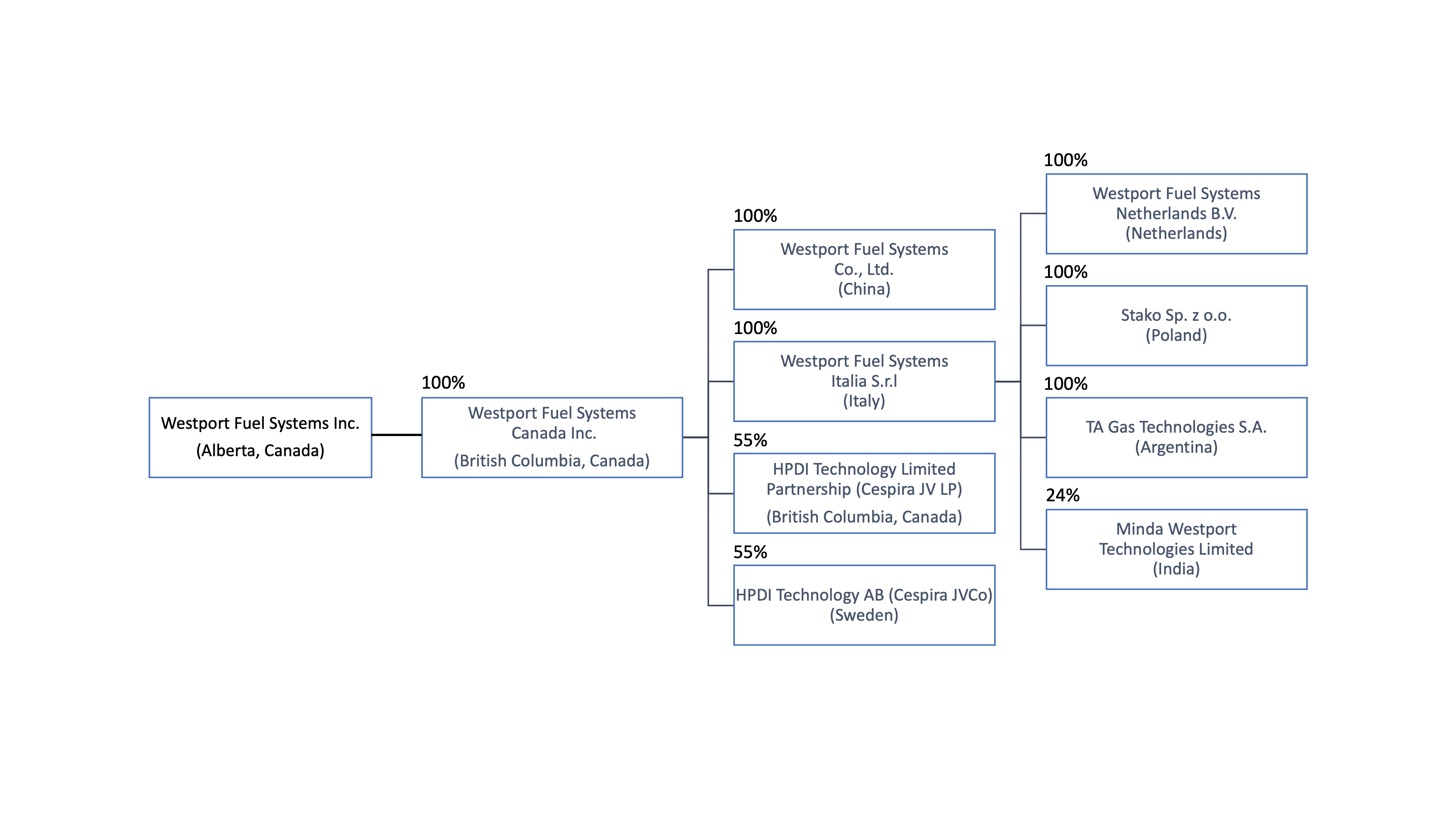
The following chart includes our principal operating subsidiaries as of March 28, 2025, and, for each subsidiary, its place of organization and our percentage of voting interests beneficially owned or over which we exercise control or direction. The structure is not necessarily indicative of our operational structure.
WESTPORT FUEL SYSTEMS INC. 2024 ANNUAL INFORMATION FORM
About Westport Fuel Systems
Business Overview
Headquartered in Vancouver, British Columbia, Canada, with operations in Europe, Asia, North America, and South America, Westport serves customers in approximately 70 countries with leading global transportation brands through a network of distributors, service providers for the aftermarket and direct to Original Equipment Manufacturers (“OEMs”) and Tier 1 and Tier 2 OEM suppliers.
With a focus on engineering, manufacturing, and supplying alternative fuel systems and components for transportation applications, Westport’s diverse product offerings, sold under a wide range of established global brands, enable the use of a number of alternative fuels in the transportation sector that provide environmental and/or economic advantages as compared to diesel, gasoline, or battery powered electric vehicles.
Westport designs, manufactures, develops, validates, certifies, and sells alternative fuel (including alternative fuels such as hydrogen (“H2”), liquefied natural gas (“LNG”), biogas, biomethane, and renewable natural gas (collectively “RNG”), compressed natural gas (“CNG”), and liquefied petroleum gas (“LPG”) components and systems for passenger cars and light-, medium- and heavy-duty commercial vehicles and off-highway applications.
Our portfolio of products includes pressure regulators, injectors, electronic control units, valves and filters, complete bi-fuel, mono-fuel and dual-fuel LPG and natural gas conversion kits and high-pressure hydrogen components. Cespira, our 55% owned joint venture (“JV”) with the Volvo Group ("Volvo"), launched in 2024, is advancing the development and commercialization of the HPDITM fuel system, a fully OEM-integrated solution that enables heavy-duty trucks to operate on natural gas, RNG, hydrogen and other alternative fuels.
WESTPORT FUEL SYSTEMS INC. 2024 ANNUAL INFORMATION FORM
Business Segments
Our diverse portfolio of technologies, products, and services are sold under a wide range of established brands. They provide the foundation for sustainable growth in existing markets and guide our expansion into new and emerging markets worldwide. Our business is operated under the following four segments:
Cespira
In June 2024, Westport and Volvo entered into a series of joint venture agreements (collectively, the "JV Agreement"), establishing Cespira to promote, develop, and commercialize the HPDI fuel system technology (see Material Contracts – Joint Venture Governance Agreements). The JV will prioritize scaling the HPDI fuel system and supporting the global transition to carbon-neutral fuel systems, particularly in heavy-duty, long-haul trucking, where multiple technologies are required to achieve substantial decarbonization. Under the terms of the agreement, Westport owns a 55% equity interest in Cespira, while Volvo owns 45%. Cespira's business operations involve supplying systems, engineering services and components, including LNG HPDI fuel system products, to engine manufacturers and commercial vehicle OEMs. The fully integrated LNG HPDI fuel systems enable diesel engines to operate predominantly on alternative fuels while delivering equivalent power, torque, and fuel efficiency as conventional compression ignition engines. The system can be a cost-effective way to reduce greenhouse gas emissions using renewable fuels such as RNG. Furthermore, the JV is engaged in adapting HPDI fuel systems for hydrogen and other alternative fuel applications in internal combustion engines.
Light-Duty
The Light-Duty segment specializes in LPG and CNG solutions, catering to OEM, delayed OEM (“DOEM”), and independent aftermarket (“IAM”) markets. Customers can choose from Westport IAM conversions, DOEM solutions, or OEM-manufactured monofuel and bi-fuel vehicles. The segment offers industry-leading direct injection engine technology that complies with EURO 7 and EPA 24 standards, along with lightweight, high-quality fuel storage solutions.
The Light-Duty business serves three distinct markets:
1. OEM: Systems are integrated into production lines by vehicle manufacturers.
2. DOEM: Conversions are performed at 0 km in specialized centers operated by Westport or its partners.
3. IAM: Aftermarket products, including conversion kits, support post-sale conversions through an extensive dealer and installer network operating in approximately 70 countries worldwide.
Westport works to distinguish itself as a global company that integrates and manufactures mechanical components, electronics, and fuel storage systems, providing a seamless and efficient solution for our customers.
High-Pressure Controls and Systems
Our High-Pressure Controls and Systems segment is at the forefront of the clean energy revolution, designing, developing, and producing high-demand components for transportation and industrial applications. We partner with the world's leading fuel cell, hydrogen engine and alternative fuel engine manufacturers and companies committed to decarbonizing transport, offering versatile solutions that serve a variety of fuel types. While we believe hydrogen is key to the future decarbonization of transport, our components and solutions are already powering emission-reducing innovation today across a range of alternative fuels. While we are a small enterprise, our strategic position and innovative capabilities position us for significant growth, as the go-to choice for those shaping the future of clean energy, today and tomorrow.
WESTPORT FUEL SYSTEMS INC. 2024 ANNUAL INFORMATION FORM
Heavy-Duty OEM
Our Heavy-Duty OEM business represents historical results from our heavy-duty business for the period January 1, 2024, until the formation of the Cespira joint venture which occurred on June 3, 2024. Going forward, the Heavy-Duty OEM segment will reflect revenue earned from a transitional services agreement in place with Cespira, intended to support the JV in the short-term as the organization establishes its operations.
Production and Operations
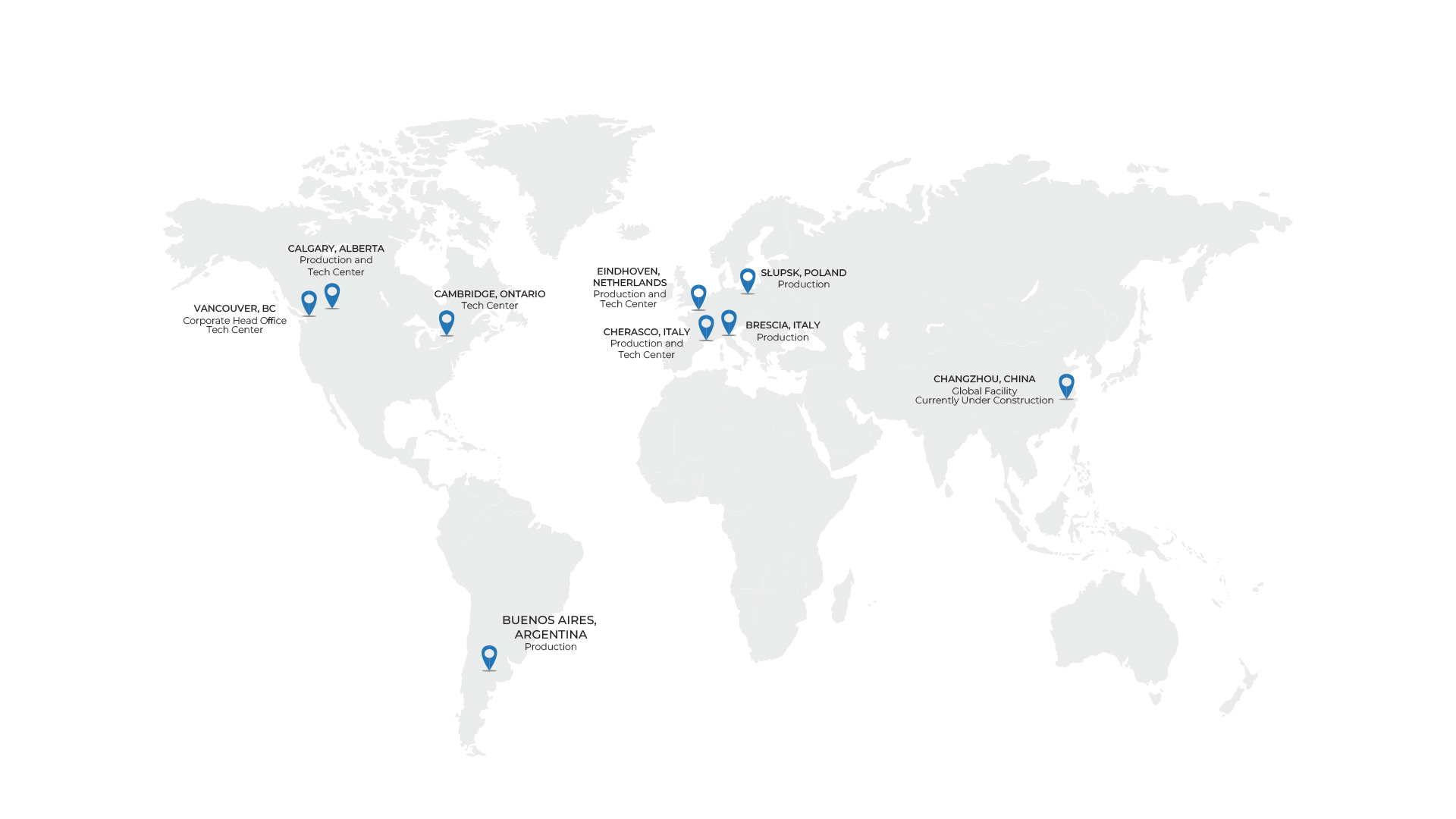
The majority of our manufacturing operations are localized to respond quickly and efficiently to customer and market demands and to assure a high level of service and support.
Europe
Manufacturing activities are carried out in several plants located in Italy (Cherasco, Brescia), Netherlands (Eindhoven) and Poland (Slupsk). Our facilities contain automated assembly lines, sophisticated lathes, milling and cutting equipment, robots to perform machining, assembly of critical electronic components, automated test lines, and robotic welding machinery. Our Italian plants are certified to ISO 9001, IATF 16949 and ISO 14001 standards. In the Netherlands, products are assembled and packaged in NEN-EN-ISO-9001:2015 certified facilities. In Poland, the plant is IATF 16949 certified.
Our Brescia plant supplies components for major OEM customers in the passenger car and medium duty segment. At our plant in Cherasco, LPG components and systems are assembled for the aftermarket, DOEM and OEM customers, LPG alternative fuel systems are installed on cars owned by customer automakers, and electronic boards are produced for the automotive market. At our plant in Slupsk, tanks for the OEM and aftermarket segments are produced and distributed through an extensive global dealer network.
Asia
Please see the Long- Term Investments--Minda Westport Technologies section.
South America
In Buenos Aires, CNG reducers, valves and injectors are manufactured by TA Gas Technology and distributed in Argentina, Brazil, Perú, Colombia, Bolivia and Mexico.
Our Brands
WESTPORT FUEL SYSTEMS INC. 2024 ANNUAL INFORMATION FORM
Business Strategy: Now to Next, Built for the Long-Term
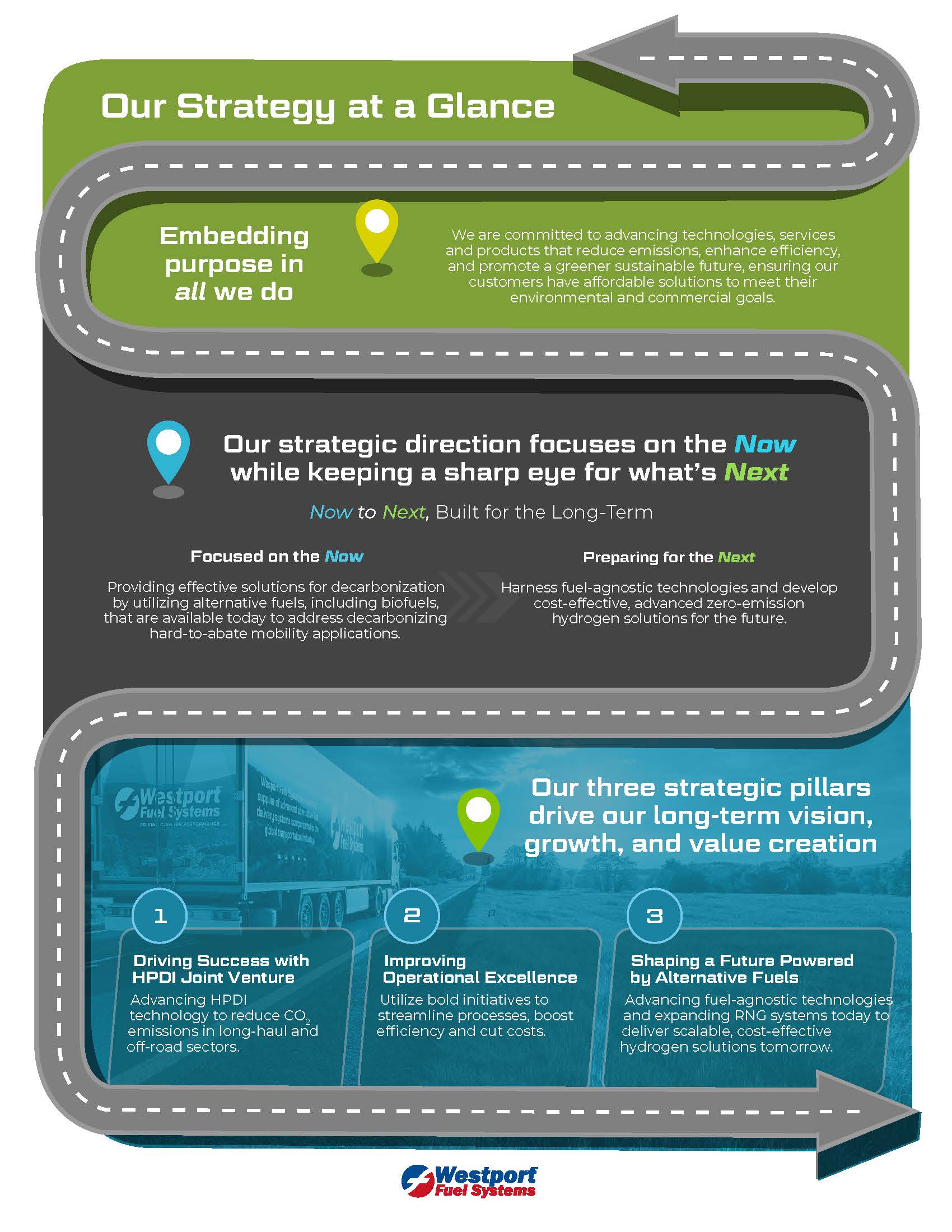
Anchored in Westport’s purpose and commitment to advance technology services and products that reduce emissions, enhance efficiency, and promote a sustainable future, the Company’s strategic plan represents a transformative journey focused on today’s tangible opportunities while preparing the business for future growth. Below is an overview of the plan highlights, objectives, and the three pillars that will guide the business forward.
WESTPORT FUEL SYSTEMS INC. 2024 ANNUAL INFORMATION FORM
WESTPORT FUEL SYSTEMS INC. 2024 ANNUAL INFORMATION FORM
The strategic pillars are the core focus areas. They represent Westport’s, high-level, long-term priorities and serve as the foundation of the strategy, guiding and supporting our decision-making and resource allocation over time. The strategic actions which are outlined below are specific, measurable actions that are designed to contribute to and positively impact the long-term vision.
Strategic Actions:
1. Increase financial flexibility and establish the foundation required to enable Westport to achieve its strategic pillars through enhanced financial performance.
a. Commitment to building transportation solutions that improve the environment and add prosperity to communities. Some of these priorities include: 1) realign cost structure including mitigating inflationary pressures; 2) focus on site-specific margin improvements; and 3) optimize current production portfolio.
2. Streamline operations to enhance agility, while building a world-class manufacturing system that boosts global competitiveness.
a. Unlock new and emerging markets through the delivery of cleaner, affordable transportation solutions.
b. Satisfy the demand for clean, affordable, low emissions transportation with our diverse portfolio of technology solutions for low-carbon gaseous fuels in Europe, North America, South America, Asia, and India.
c. Drive operational excellence and reputation as a Tier 1 supplier with superior quality and reliability.
3. Seek and prioritize investments that align with our strategy to drive growth.
a. Invest in opportunities that address global trends impacting the evolution and diversification of sustainable transportation fuel alternatives.
b. Complement our growth and scale efficiencies through strategic mergers and acquisitions and corporate development activities.
Our Business History - Three Year Look back
Over the past three years, we have focused on expanding the business and making strategic long-term investments to ready the operations for future opportunities. The significant developments in our business over the past three years are set out below.
WESTPORT FUEL SYSTEMS INC. 2024 ANNUAL INFORMATION FORM
2025
Westport Announces Proposed Sale of Westport Fuel Systems Italia S.r.l.
On March 31, Westport announced a proposal to divest Westport Fuel Systems Italia S.r.l., which includes the Light-Duty segment, including the light-duty OEM, delayed OEM, and independent aftermarket businesses, to a wholly-owned investment vehicle of Heliaca Investments Coöperatief U.A., a Netherlands based investment firm supported by Ramphastos Investment Management B.V. a prominent Dutch venture capital and private equity firm.
Cespira Appoints Carlos Gonzalez as President and CEO
On January 22, Cespira announced that it had appointed Carlos Gonzalez as President and CEO, effective April 1, 2025. Carlos succeeds Dan Sceli, CEO of Westport, who held the position on an interim basis since the closing of the JV transaction in June 2024 and will continue to sit on Cespira’s board.
Westport Announces Director Retirement
On January 13, Westport announced that Brenda Eprile retired from Westport’s Board of Directors effective January 6, 2025.
2024
Westport and Volvo Sign and Close a Joint Venture called Cespira
On July 5, we officially launched the Cespira JV between Westport and Volvo, a joint venture focused on promoting, developing, and further accelerating the commercialization of the HPDI technology. Leading up to the announcement, on June 3, it was announced that Westport and Volvo had closed the JV transaction; and on March 11, Westport announced the signing of a definitive agreement with Volvo to establish the JV to accelerate the commercialization and global adoption of Westport's HPDI fuel system technology for long-haul and off-road applications.
Westport Announces At-the-Market Equity Offering Program (the “ATM Program”)
On September 13, we announced an ATM Program that allows the Company to issue and sell up to $35,000,000 (or its Canadian dollar equivalent) of common shares of the Company (the “Common Shares”) from treasury to the public, from time to time, at the Company’s discretion.
Westport Fuel Systems Publishes 2023 ESG Report
On June 25, we published our 2023 ESG Report, which outlined the Company's accomplishments within its primary areas of focus that include reduced emissions and energy consumption, operational health and safety, diversity, equity and inclusion, responsible sourcing, human rights, and ESG governance.
Westport Responds to Strengthened European Decarbonization Targets for Heavy-Duty Vehicles
On April 11, we welcomed the agreement between European legislators regarding the lowering of CO2 emissions in the European Union's (EU) heavy-duty road transport sector. The new standards reflect ambitious decarbonization targets that Westport believes can be achieved by utilizing a blend of new and current vehicle and fuel system technologies such as those in Westport's portfolio while also clearing a path to encourage future investment in the best and most affordable solutions to decarbonize heavy-duty transport.
Westport Announces Methanol HPDI Project with a Leading Global Supplier of Power Solutions for Marine Applications
On February 26, we announced a proof-of-concept project with a global OEM that supplies power solutions for marine applications to test the HPDI fuel system utilizing methanol for marine applications (the "Marine Project").
WESTPORT FUEL SYSTEMS INC. 2024 ANNUAL INFORMATION FORM
Leadership Transition at Westport
On January 16, 2024, we announced Daniel Sceli as the Company's new Chief Executive Officer and a member of Westport’s Board of Directors (the "Board").
2023
Westport Awarded U.S. $33 Million Development Program by Global Heavy Truck Manufacturer
On December 19, we announced that we had been awarded a development program by a global heavy truck manufacturer to adapt the Next Generation LNG HPDI fuel system to meet the Euro 7 emissions requirements for heavy-duty vehicle applications. The value of the development program is estimated to be $33 million and will be funded by the OEM.
Westport Announces Successful Demonstrations
On December 12, we announced the successful completion of a heavy transport demonstration with KAJ Inrikes and others, utilizing a H2 HPDI fuel system-equipped prototype truck hauling a trailer filled with IKEA home-furnishing products in Älmhult, Sweden. On October 10, we announced the successful completion of a heavy transport demonstration with our H2 HPDI fuel system equipped prototype truck hauling a refrigerated trailer in Madrid, Spain. The demo marked the first of its kind in Spain, representing an important step forward in the decarbonization of heavy transport for the country. On May 2, we announced that we would be displaying our HPDI fuel system on commercial vehicles during the Advanced Clean Transportation (ACT) Expo 2023 in Anaheim, California.
Westport Announces New Agreements and Collaborations
On November 6, we announced an agreement with a leading global provider of locomotives and related equipment for the freight and transit rail industries, to adapt our hydrogen HPDI fuel system for use with the locomotive OEM engine design. On July 19, we announced that we entered a non-binding letter of intent with Volvo to establish the Cespira JV to accelerate the commercialization and global adoption of Westport's HPDI fuel system technology for long-haul and off-road applications. On March 6, we announced a collaboration with a global OEM to evaluate the performance, efficiency and emissions of the OEM’s engine equipped with the H2 HPDI fuel system. This collaboration marked Westport’s third major OEM engagement evaluating its H2 HPDI fuel system. On February 27, we announced plans to invest up to $10 million in a global manufacturing facility in Changzhou Hydrogen Valley, China.
2022 ESG Report is Published
On June 29, we released our 2022 ESG report.
Westport Announces Leadership Transitions
On August 22, we announced that David Johnson, Chief Executive Officer, stepped down as Chief Executive Officer and resigned from the Board. Tony Guglielmin, who served on the Westport Board and as Chair of the Audit Committee, was appointed interim CEO. On May 1, we announced the appointment of our new Executive Vice President of Product Development and Chief Technology Officer, Fabien G. Redon.
Westport Provides Updates on Compliance Regulatory Requirements
On June 21, we announced that we received a compliance letter from the Nasdaq Stock Market LLC ("Nasdaq"), notifying Westport that it had regained compliance with the minimum bid price requirements under Nasdaq listing rules.
On May 18, we filed a short form base shelf prospectus with Canadian securities regulatory authorities pursuant to which the Company may, from time to time, offer and issue up to an aggregate amount of $200 million of common shares, preferred shares, debt securities, warrants, subscription receipts, units, or any combination thereof, during the 25-month period that the base shelf prospectus is effective.
WESTPORT FUEL SYSTEMS INC. 2024 ANNUAL INFORMATION FORM
On April 26, we announced our intention to consolidate the Common Shares of Westport on a 10-1 basis to restore compliance with the minimum bid price requirements under Nasdaq listing rules. The consolidation became effective on June 6, 2023.
2022
Westport Provides Updates on Awards and Advances Regarding Hydrogen and Alternative Fuel Technologies
On December 13, we announced a collaboration with Johnson Matthey, a global leader in sustainable technologies, to develop an emissions after treatment system tailored to Westport’s proprietary H2 HPDI fuel system, with the goal of reducing or eliminating emissions. On October 26, the Company and Scania AB ("Scania"), a world-leading provider of transport solutions, announced impressive engine test results of Westport’s H2 HPDI fuel system for heavy-duty vehicle applications. On September 28, we unveiled in Brussels to an audience of policy makers and industry representatives, our new H2 HPDI fuel system for heavy-duty vehicles that is expected to reduce CO2 emissions in alignment with EU decarbonization goals. On May 3, we announced our H2 HPDI fuel system in a demonstrator truck enabled heavy-duty trucks to operate on biomethane (renewable natural gas) and natural gas with the same power, torque, efficiency, and performance as diesel engines, and with better results running on hydrogen, all while meeting global emissions regulations.
On February 7, we announced that Cummins Inc. ("Cummins") and Westport had. agreed to a share purchase agreement for the sale of Westport's stake in the Cummins Westport Inc. ("CWI") joint venture, for proceeds of approximately $22 million. Westport also sold certain of its rights in the intellectual property of CWI for additional proceeds of $20 million. Cummins and Westport also agreed to conduct an initial technical assessment of Westport's HPDI fuel system for potential use on Cummins' hydrogen applications, an application designed to directly inject a fuel into the combustion chamber of an internal combustion engine ("ICE").
On January 27, we announced that we had joined the internationally recognized Hydrogen Council (www.hydrogencouncil.com) as a supporting member. The Hydrogen Council is a global CEO-level advisory body providing a long-term vision for the vital role of hydrogen technologies in an energy transition for cleaner transportation solutions.
Westport Shares Business Growth and New Contract Announcements
On December 7, we announced that we were awarded a program to develop and supply LPG systems to a global OEM to accommodate some of its Euro 7 vehicle platforms, which is forecasted to generate €40 million in annual revenue with production expected to begin in Q1 2025. On July 11, we announced that we were awarded a program to develop and supply LPG systems for several vehicle applications for a global OEM, which was forecasted to provide €38 million in revenue through the end of 2025, with production expected to begin in Q4 2023. Under the program, we will provide fuel systems solutions for the Euro 6 applications to this OEM, supplying the entire LPG system from the fuel tank to the fuel injectors. In parallel, we announced that we were developing fuel systems to respond to future regulations including the proposed Euro 7 standards.
On November 29, we announced we would provide a strategic update and deep dive into the H2 HPDI fuel system at our 2022 Capital Markets Day on December 8, 2022, in Toronto, Canada.
2021 ESG Report is Released
On August 29, we released our 2021 ESG report outlining the Company's accomplishments within the core ESG areas of carbon footprint, operational health and safety, diversity, equity and inclusion, responsible sourcing, human rights, and ESG governance.
WESTPORT FUEL SYSTEMS INC. 2024 ANNUAL INFORMATION FORM
Westport Provides Updates on Compliance Regulatory Requirements
On November 7, the Company announced that on November 3, 2022, it received written notice (“Notification”) from the Nasdaq notifying it that it was not in compliance with the minimum bid price requirement set forth under Nasdaq Listing Rule 5550(a)(2) (“Nasdaq Listing Rule”). In accordance with applicable Nasdaq procedures, the Company had 180 calendar days, or until May 2, 2023, to regain compliance with the Nasdaq Listing Rule.
Westport Announces Leadership Transitions
On September 30, we announced the resignation of Chief Financial Officer (“CFO”) Richard Orazietti and the appointment of William Larkin as successor CFO. On January 25, we announced the appointment of Philip B. Hodge to the Westport Board.
Human Resources and Related Policies
We employ a highly educated and experienced team of professionals focused on the development and commercialization of a portfolio of products and technologies. We actively recruit skilled individuals with diverse backgrounds and provide them with specific training relating to our product and technology portfolios and retain consultants and contract workers with specific expertise when appropriate. Employees must certify to having read, understood, and agree to abide by our Code of Conduct. Online training is also conducted to ensure, our global and diverse workforce is empowered to do the right thing, for the right reason, and in the right way.
As of December 31, 2024, our global workforce was approximately 1,509 individuals, a slight decrease from the previous year as some employees transitioned to join Cespira following the closing of the JV in June 2024. The total count of individuals includes direct employees, and individuals contracted directly for twelve months or longer. Our workforce includes, but is not limited to, a mix of engineers, manufacturing technicians, and commercial professionals who have experience with alternative fuel systems, combustion technologies, controls and engine management, and fuel storage and delivery systems, including cryogenics and high-pressure storage and delivery systems. Our direct employees are represented by labour unions in Italy and Argentina.
We are committed to a workplace free of discrimination and harassment. Our expectations for individual integrity and ethical, moral, and legal conduct are outlined in the Code of Conduct which applies to everyone within the organization, including directors, officers, employees, contractors, agents, and consultants who act on behalf of Westport in any business dealings. An anonymous ethics hotline is made available as an avenue for employees to raise concerns about corporate conduct. Our whistleblower policy includes the reassurance that individuals will be protected from reprisals or victimization for "whistle blowing" in good faith.
Environmental and Social Policies
At Westport, we encourage every member of our organization to make a daily commitment toward creating transportation solutions that enhance the well-being of people and the environment while contributing to the sustainability of our communities. To help fulfill our commitments, Westport aims to accelerate the impact of the energy transition by bringing innovative products to market while attracting, engaging, and retaining top-tier talent by fostering a creative and inclusive culture. Westport's commitment to health and safety remains paramount, and we leverage robust governance practices to facilitate prudent decision-making in the face of risks, ultimately maximizing value creation.
Throughout 2024, we successfully implemented our Corporate Environmental Policy, which underscores our awareness of the necessity for ongoing initiatives and projects dedicated to minimizing the environmental footprint of our organizational activities. The policy is one way Westport is committed to helping shape the practices of our suppliers, customers, and other stakeholders, aligning with our dedication to sustainability and responsible corporate citizenship. We continued our collaboration with Ecovadis Sustainability Rating that was first initiated in 2023, with a view to enhancing the engagement of Westport's suppliers while fostering a deeper comprehension of how, collaboratively, we can contribute to environmental betterment.
WESTPORT FUEL SYSTEMS INC. 2024 ANNUAL INFORMATION FORM
Westport's Human Rights Policy and Diversity Policy guides our daily operations. Some notable achievements for 2024 include the following:
• The Italian facility confirmed its UNI PdR 125:2022 certification which is awarded to companies showcasing a dedication to implementing policies and practices that promote gender equality in the workplace.
• Italy also maintained its ISO 14001:2015 certification after a maintenance assessment in 2024.
• In furtherance of the assessment our Italian facilities underwent with the external certification body RINA in 2023, we had a further assessment in June of 2024 resulting in an increase in score.
• In Poland, we successfully implemented the ISO 14001 certification in 2024, which has resulted in improvements to our waste management practices. Moreover, it has provided a solid foundation for analyzing and identifying potential circular economy initiatives.
• A newly installed solar panel system at our facilities in Poland resulted in the generation of 450 MWh yielding more than 1000 GJ of green energy.
• Westport’s climate-related disclosures are available in the Carbon Disclosure Project (CDP) and ESG Reports, all available on our website https://wfsinc.com/ in the "Sustainability at Westport" section.
Operational Procurement
We organize operational planning into different models to adapt to our diverse customer base and expectations. We operate to optimize our inventories based on customer deliveries, or in a traditional manufacturing planning technique that directly undertakes operational procurement activities. Our procurement is divided into three general categories depending on the type of goods: raw materials, commercial off-the-shelf parts, and custom-made-to-order parts.
• Raw materials are typically sourced from large-scale trading partners and are purchased at a fair market value when benefit can be gained. When practical, we will sign long-term agreements on commodity pricing to access lower market prices.
• Commercial off-the-shelf parts are typically sourced in local regions and can be shared across the organization to ensure a consistent supply where it is needed and to leverage our purchasing power.
• Custom made-to-order parts are sourced from strategic suppliers, or jointly developed with partners, to ensure the best combination of price, quality and delivery. Our supply base is subject to our general terms and conditions or unique long-term supply agreements and is subject to reviewing key performance indicators to ensure we are getting optimal performance and value.
Innovation, Research and Development
Intellectual Property
Our intellectual property strategy is to capture, protect, and utilize our intellectual property in coordination with our business and technology plans and enable the successful commercialization of our proprietary products. Our intellectual property strategy is designed to be adaptive to our target markets in supporting the commercial launch of new products while maintaining Westport’s long-term competitive advantage.
WESTPORT FUEL SYSTEMS INC. 2024 ANNUAL INFORMATION FORM
As a result, we rely on a combination of patents, trade secrets, trademarks, copyrights and contracts to protect our proprietary technology.
We use patents as the primary means of protecting our technological advances and innovations. They include proprietary claims to novel concepts embodied in our components, materials, operating techniques, and systems. We have a proactive approach to identifying, evaluating, and choosing strategic inventions to protect through the timely filing and prosecution of patent applications. Patent applications are filed in various jurisdictions internationally, which are carefully chosen based on the likely value and enforceability of intellectual property rights, and to strategically protect anticipated major commercial markets.
Research and Development
With the closing of the JV, Cespira is responsible for all research and development work undertaken to advance the HPDI fuel system technology. Westport continues to improve the products for Westport’s Light-Duty and High-Pressure Controls and Systems business segments, as we continue to make strategic investments that drive innovation, strengthen our competitive edge, and position us for long-term success.
Long-Term Investments
Cespira
Westport’s JV with Volvo Group, also known as Cespira became effective on June 3, 2024. Westport owns a 55% equity interest in Cespira and Volvo Group owns the remaining 45%.
Cespira enables Westport to remain focused on its long-term strategic priorities. Through Cespira, we aim to accelerate the global commercialization of HPDI, expand our customer base, drive innovation, and strengthen Westport’s financial position by leveraging combined resources and expertise.
Cespira is committed to accelerating the commercialization and global adoption of the HPDI fuel system technology for long-haul and off-road applications. Westport, by way of a transitional services agreement in place with Cespira, is providing as-needed support to Cespira in the short-term as the organization establishes its operations.
Weichai Westport Inc. (WWI)
WWI was our joint venture in China with Weichai Holdings Group Co., Ltd. The Company, indirectly through its wholly owned subsidiary, Westport Innovations (Hong Kong) Limited (“Westport HK”), was the registered holder of a 23.33% equity interest in WWI. In April 2016, we sold a derivative economic interest to Cartesian granting it the right to receive an amount of future income received by Westport HK from WWI equivalent to having an 18.78% equity interest in WWI and concurrently granted Cartesian an option to acquire all the equity securities of Westport HK for a nominal amount. We retained the right to transfer any equity interest held by Westport HK in WWI that was more than an 18.78% interest if such option was exercised. In December 2023, the Company, through its wholly owned subsidiary, Westport HK, signed an equity transfer agreement with WWI for the 4.55% economic interest, with the registration of this transfer being completed on July 29, 2024.
Minda Westport Technologies
Beginning in 2009, Westport Fuel Systems Italia S.r.l. (“WFS Italia”) and Uno Minda Limited (“Uno Minda”) operated Minda Westport Technologies Limited (“MWTL”) as 50/50 joint venture partners. On September 28, 2023, as part of a restructuring initiative of the business of the WFS Group in India, WFS Italia and Uno Minda entered into an Amended and Restated Joint Venture Agreement, along with a Share Purchase Agreement for the purchase by Uno Minda of an additional 26% of the shares of MWTL with a purchase price of approximately $1.75 million (with closing adjustments) (the “SPA”) and an Asset Purchase Agreement whereby MWTL agreed to purchase the majority of the fixed assets and existing inventory of Rohan BRC Gas Equipment Private Limited (“RBRC”) for approximately $1.59 million (with closing adjustments) (the “APA”).
WESTPORT FUEL SYSTEMS INC. 2024 ANNUAL INFORMATION FORM
The transactions described in the SPA and the APA have both closed leaving WFS Italia with a minority stake of 24% in MWTL while commencing a strategic business relationship with MWTL to supply products and provide technical services.
Industry Summary
Overview of the Market
The transportation sector is undergoing a transformation, shaped by evolving regulatory frameworks and groundbreaking technological advancements. This shift is primarily fueled by increasingly stringent emissions standards and the global momentum toward decarbonization. Below is an overview of the most recent trends shaping this dynamic landscape:
Current Trends in Transportation
1. Continuing Focus on Reducing Vehicle Energy Consumption and CO2 Emissions
Regulatory bodies globally continue to refine and adapt emissions standards, with a growing focus on CO2 reduction. As the regulatory landscape evolves, there is increasing momentum toward the adoption of zero-emission and low-carbon technologies, while allowing for a range of approaches to meet sustainability goals.
2. Emerging Role of Alternative Fuels
Hydrogen and RNG are gaining traction as key solutions to reduce well-to-wheel emissions. They are poised to complement electric and fuel-cell technologies in decarbonizing the heavy-duty transport and off-road sectors.
Hydrogen and RNG powered ICE technologies, such as Cespira's HPDI fuel system, are viable and affordable alternatives to electric and fuel cell vehicles, offering a viable route to achieving zero carbon-emission classifications and net zero carbon results without the need for complete vehicle redesigns.
3. Expansion of Infrastructure
Both Europe and North America are making substantial investments in refueling and recharging infrastructure. Regulations in Europe now mandate the establishment of hydrogen refueling stations every 200 km and LNG refueling stations every 400 km along key transportation corridors to support the growth of alternative fuel-powered fleets.1,2 China continues to lead in the development of hydrogen infrastructure, with over 400 hydrogen refueling stations in operation.3 This extensive network highlights the country's strategic focus on hydrogen mobility and its potential to drive industry-wide adoption of clean fuel solutions.
1 https://www.consilium.europa.eu/en/press/press-releases/2023/07/25/alternative-fuels-infrastructure-council-adopts-new-law-for-more-recharging-and-refuelling-stations-across-europe/
2 https://www.lngeurope.org/about-lng/availability-of-lng/#:~:text=There%20is%20no%20consistent%20network%20of%20LNG%20fueling,distance%20between%20each%20other%20on%20all%20TEN_T%20corridors.
WESTPORT FUEL SYSTEMS INC. 2024 ANNUAL INFORMATION FORM
4. Increasing OEM Collaboration
The industry is increasingly embracing joint platform development, cost-sharing, and collaborative purchasing to drive efficiency and innovation. Partnerships are extending beyond OEMs to include fleets, fuel providers, and other stakeholders, reflecting a growing trend toward ecosystem-wide collaboration to address shared challenges and opportunities.
Market Size
The world is growing and the amount of goods that need transport is increasing as well. The transportation industry aspires to get more goods to more people in a cleaner, more efficient, and affordable way.4
Heavy-Duty Truck Market
The global Class 8 truck market saw a notable recovery in 2024, driven by a strong economic rebound and a significant surge in e-commerce activity. The broader Class 4-8 truck segment is projected to continue its growth trajectory through 2025, supported by robust consumer spending and favorable economic conditions, including reduced interest rates which are expected to further stimulate demand for commercial vehicles.5,6
The global market for LNG and RNG powered trucks is experiencing significant growth, driven by increased infrastructure availability, lower fuel costs in some geographies, and growing regulatory pressures to adopt cleaner energy solutions. As the transportation sector continues to transition toward alternative fuels, LNG, RNG and hydrogen are emerging as key enablers of this shift, particularly in the heavy-duty truck segment.7 Major fleets increasingly incorporate RNG into their transportation strategies to meet their emission reduction goals.8 By leveraging RNG, these fleets can significantly lower their carbon footprint while benefiting from a readily available and cost-effective fuel source.
North American Market Performance
•Class 8 Orders: North America recorded approximately 280,000 Class 8 truck orders for the full-year 2024,9 marking a strong recovery as demand continues to be fueled by improving economic conditions and ongoing shifts in supply chain logistics, including e-commerce expansion.
•Political and Regulatory Landscape: The political and regulatory environment in North America is expected to further influence demand for alternatively fueled Class 4-8 trucks, with regulatory frameworks guiding Original Equipment Manufacturer (“OEM”) commitments to sustainability and emissions standards.
3 https://hydrogen-central.com/china-tops-world-hydrogen-stations-fueling-clean-energy-future/#google_vignette
4 Race to Zero: European Heavy Duty Vehicle Market Development Quarterly (January – June 2024) - International Council on Clean Transportation
5 https://www.globenewswire.com/en/news-release/2024/08/28/2936842/0/en/Class-8-truck-Market-to-be-worth-432-6-Bn-by-2032-Says-Global-Market-Insights-Inc.html
6 https://www.spglobal.com/mobility/en/research-analysis/us-medium-heavy-commercial-vehicle-forecast.html
7 Nikola Corporation DHL Supply Chain and Diageo North America Power Up Sustainability Partnership with Deployment of Hydrogen Fuel Cell Trucks -
8 https://s3.eu-central-1.amazonaws.com/hexagonassets/HEX-Q3-2024-Presentation.pdf
9 https://www.ccjdigital.com/economic-trends/article/15711395/class-8-net-orders-saw-23-yearoveryear-increase-exceeding-seasonal-expectations
WESTPORT FUEL SYSTEMS INC. 2024 ANNUAL INFORMATION FORM
•Evolving emission standards, such as the U.S. EPA 27 regulations, are expected to drive increased demand for sustainable Class 4-8 trucks ahead of their implementation. Similarly, regulatory changes like California's Advanced Clean Trucks mandate require truck OEMs to sell more zero-emission vehicles, accelerating the industry's transition toward cleaner technologies. These factors are anticipated to increase the share of alternative fuel options in the truck market in the coming years as both public and private sectors align with decarbonization goals.10
•Class 8 Truck Fleet Transition: Diesel trucks currently dominate the North American Class 8 market, comprising 97% of new truck registrations. This concentration of diesel vehicles presents a substantial opportunity for conversion to cleaner energy solutions, driven by regulatory pressures and the growing availability of alternative fuel infrastructure. Competitive fuel pricing for natural gas and in the future hydrogen, along with advancements in fuel efficiency, will be key drivers of this shift.
•Hydrogen Adoption: While hydrogen use in U.S. heavy-duty trucking is still in its nascent stages, major fleets are beginning to integrate hydrogen technologies into their portfolios. This early-stage adoption, signals increasing interest in hydrogen as a viable solution for decarbonizing the sector, especially as infrastructure develops and hydrogen production becomes more scalable.
European Market Insights
•Truck Registrations: In the first three quarters of 2024, over 250,000 heavy-duty vehicles were sold in the EU-27, showing a slight year-over-year decline. Despite this minor setback, the EU heavy-duty truck market is expected to see growth over the next five years, driven by regulatory incentives, increased infrastructure investments, and the ongoing transition to alternative fuel solutions.11
•LNG Truck Registrations: Natural gas trucks now account for over 2% of all new truck registrations in the region, signaling a steady adoption trajectory in line with Europe’s push to reduce emissions and diversify fuel sources in the transportation sector.12
•Hydrogen Truck Registrations: The hydrogen-powered truck market is emerging and expanding at a steady pace. Recent developments indicate a surge in interest and investment in hydrogen technologies, driven by supportive government policies and the broader push for decarbonization. This momentum underscores the growing role of hydrogen in the future of sustainable transportation.
Chinese Market Dynamics
•Sales Growth: China’s domestic sales and exports of heavy-duty trucks totaled over 900,000 units in 2024, reflecting strong demand in the wake of recovering economic activity and government support for infrastructure and industrial growth.13 Through 2030, a 4% per annum growth rate is anticipated for the Chinese heavy-duty truck market, supported by continued industrial expansion, urbanization, and increasin g adoption of alternative fuel technologies.14
10 https://www.spglobal.com/mobility/en/research-analysis/us-medium-heavy-commercial-vehicle-forecast.html
11 https://theicct.org/publication/r2z-eu-hdv-market-development-quarterly-jan-sept-2024-dec24/
12 https://alternative-fuels-observatory.ec.europa.eu/transport-mode/road/european-union-eu27/vehicles-and-fleet
13 https://www.chinatrucks.org/statistics/2025/0206/article_10991.html
WESTPORT FUEL SYSTEMS INC. 2024 ANNUAL INFORMATION FORM
•LNG Demand Growth: In China, the demand for LNG-powered heavy-duty trucks is growing rapidly, supported by competitive LNG prices and expanding fueling infrastructure. In the first half of 2024, sales of LNG trucks rose 127% year-over-year, reaching over 92,000 units, and accounted for 21% of total heavy-duty truck sales. This surge is expected to continue as additional LNG supply comes online and the government maintains supportive policies for cleaner energy solutions in the transport sector.15
•
•Hydrogen Vehicle Sales: China’s hydrogen-powered commercial vehicle market saw significant growth in 2024, with sales surpassing 5,000 units in the first three quarters. This represents record growth, fueled by strong government incentives and rising demand for zero-emission vehicles across various industries.
Light-Duty Passenger Car Market:
The global market for vehicles powered by LPG continues to expand, with over 28 million vehicles currently in operation worldwide. In Europe, LPG is commonly referred to as Autogas, and the market for Autogas has experienced steady growth.16 In 2023, the Autogas market grew by 6%, primarily driven by demand from key markets such as Turkey and Algeria.
Key Markets and Growth Trends17
•Europe: Turkey, Poland, and Italy are the largest markets for light-duty LPG vehicles in Europe, with a combined total of nearly 11.5 million vehicles. These countries have seen consistent growth in LPG vehicle adoption in recent years. Turkey, Poland, and Ukraine remain some of the largest LPG vehicle markets, with sales concentrated in these regions.
•Emerging Markets: LPG consumption and production are experiencing robust growth in emerging markets across South America, Africa, and Asia. This growth is being fueled by several factors, including favorable fuel pricing, expanding LPG infrastructure, and government incentives aimed at promoting cleaner fuel alternatives.
Renewable LPG and Decarbonization
•Sustainable Solutions: Renewable LPG, derived from renewable sources such as biomass and waste, is gaining momentum as a sustainable solution to support global decarbonization efforts. Its growing adoption is in alignment with regulatory targets aimed at reducing carbon emissions in the transportation sector.
14 https://www.mckinsey.com/industries/automotive-and-assembly/our-insights/a-new-era-trends-shaping-chinas-heavy-duty-trucking-industry
15 https://www.spglobal.com/commodity-insights/en/news-research/latest-news/lng/062624-china-nears-peak-gasoil-demand-as-lng-fueled-heavy-duty-truck-sales-surge
16 Source: EUROPEAN LIQUID GAS CONGRESS, Argus Media
17 Source: EUROPEAN LIQUID GAS CONGRESS, Argus Media
WESTPORT FUEL SYSTEMS INC. 2024 ANNUAL INFORMATION FORM
Fuel Availability
Alternative fueling infrastructure is growing rapidly, a direct result of tighter global emissions standards. The creation of a fueling station network is essential to meeting the targets and demand predictions for 2030 and beyond. Renewables specifically have grown significantly over the past decade, making them both more scalable and widely available. Greater fuel availability for RNG and hydrogen drives faster adoption and is crucial for reaching decarbonization targets.
RNG is making a positive, substantial impact currently and has the capability to make a much larger impact. The use of RNG as a transport fuel bolsters the environmental case for gas-based vehicles and can fully replace natural gas as a source of fuel without any changes required to the engine. The case for using RNG for transport is strongest in transport segments, such as long-haul road freight and shipping where electrification is more challenging. These areas are currently experiencing the greatest adoption, due to climate benefits and availability. RNG is a well-to-wheel climate reduction solution that is available today. Key developments in alternative fuels include:
1. Infrastructure Expansion
a. Regulations are shaping future fueling networks and providing clear guidance for industry stakeholders while the development of fueling infrastructure for RNG and hydrogen is accelerating due to urgent emissions reduction targets and expected demand beyond 2030.
b. Policies requiring hydrogen refueling stations every 200 km in Europe demonstrate global commitment to alternative fuel adoption.
c. Heavy-duty transport is projected to drive significant hydrogen demand in Europe, necessitating refueling infrastructure along key routes by 2030. The European Automobile Manufacturers’ Association estimates that 700 hydrogen refueling stations for trucks will be needed in Europe to achieve a 45% CO2 reduction by 2030.18
2. Alternative Fuels Growth
a. Over the past decade, renewable energy sources have become increasingly scalable and accessible, strengthening their position as long-term solutions for decarbonizing the transportation sector.
b. RNG has emerged as a proven, sustainable alternative to conventional natural gas, with the added benefit of seamless integration into existing gas-based vehicle systems, offering an immediate pathway to reduce emissions in the sector.
c. Hydrogen continues to gain traction as a key enabler of future mobility, with expanding infrastructure facilitating its adoption, particularly in heavy-duty and industrial transport segments.
The transition to zero-emission propulsion systems will be a multi-decade process influenced by market dynamics, cost structures, and technology readiness. Emerging markets may adopt technologies at different rates due to varied infrastructure and economic factors. However, the confluence of government policies, corporate sustainability commitments, and advancing technologies signals a steady move toward decarbonization. This evolving landscape presents both challenges and opportunities, with collaboration among stakeholders being critical to achieving global decarbonization goals.
18 https://www.acea.auto/press-release/truck-and-bus-co2-standards-ambition-levels-for-all-stakeholders-must-be-aligned/
WESTPORT FUEL SYSTEMS INC. 2024 ANNUAL INFORMATION FORM
As regulatory pressures intensify and infrastructure continues to expand, the transportation industry is poised for a sustainable, low-carbon future.
Near-Term Industry Challenges
Inflationary Pressures and Impact on LPG Market and Production Costs
Global inflation trends remain inconsistent, with inflationary pressures easing in many developed countries, while continuing to impact certain emerging and developed markets, including Turkey, Brazil, and India. In key LPG markets such as Poland, Turkey, and Italy, LPG prices have experienced upward pressure. This has been driven by a combination of factors, including inflation in crude oil prices, production disruptions, adverse weather conditions, rising freight costs, and geopolitical conflicts. Ongoing geopolitical risks and climate-related challenges present the potential for further inflationary pressures, particularly on production input costs and energy prices. Such increases could impact the demand for clean energy products, as higher costs may make alternative fuels less competitive relative to conventional energy sources.
Westport sources its components from global suppliers and continues to face inflationary pressure on production input costs. Specifically, the cost of semiconductors, raw materials, and parts has increased, along with higher labor costs, all of which are contributing to margin compression.
Increased Interest Rates
In response to inflationary pressures, central banks in major markets has raised interest rates to multi-decade highs. While some regions, including Canada, the United States, and the Euro Area, have begun reducing rates, current levels remain restrictive and are having a significant impact on both the automotive and clean energy sectors.
Automotive manufacturers and OEMs are facing challenges as higher interest rates are compressing profit margins. This environment is leading to delays and cancellations of clean energy investments as companies prioritize cost-cutting measures. Additionally, elevated interest rates have contributed to a slowdown in global economic growth, particularly in emerging markets such as India and Brazil. These markets, where economic conditions are already volatile, are facing heightened financial pressures, which could further dampen demand for clean energy solutions.19
Hydrogen Eco-System Uncertainty
The hydrogen industry is currently facing economic challenges associated with limited load of available hydrogen which has resulted in high operational costs across the value chain. This has led to delays and cancellations of projects.20 Key cost factors, such as rising renewable electricity prices and increased electrolyzer costs, are having a significant impact on the economics of renewable (green) hydrogen projects. These higher costs, coupled with uncertainties surrounding fuel supply and infrastructure development, make it challenging to predict when hydrogen technology for transport will become a viable decarbonization solution.21 While market adoption of hydrogen technologies may take time, we are positioned to leverage the fuel flexibility of this technology.
19 https://www.iea.org/reports/world-energy-outlook-2024
20 https://www.hydrogenfuelnews.com/neste-hydrogen-project-cancelled/8567862/
21 https://hydrogencouncil.com/wp-content/uploads/2024/09/Hydrogen-Insights-2024.pdf
WESTPORT FUEL SYSTEMS INC. 2024 ANNUAL INFORMATION FORM
This flexibility enables us to capitalize on the growing demand for RNG as a near-term solution, bridging the transition to hydrogen in the future.
Industry Growth Drivers
Aligning industry and economies with the targets laid out in the Paris Agreement—limiting global warming to well below 2°C, continues to drive the replacement of legacy systems powered by fossil fuels with low carbon energy sources such as renewables. While natural barriers to investment exist such as substantial increases in costs and the evolving regulatory environments, particularly when it comes to decarbonizing hard-to-abate sectors such as transportation, there have been significant advances leading to steady growth opportunities. Steady change will be critical regarding fuels used to achieve the CO2 reductions needed to meet various countries' requirements and industries are now turning to both RNG and hydrogen.
Depressed Natural Gas Market Prices
Europe
European natural gas prices, although elevated recently, are still significantly below the record highs of 2022. Lower demand, influenced by reduced economic activity and previous mild weather, has contributed to price moderation. Additionally, the diversification of gas imports continues to be a key focus of European energy policy. Long-term forecasts suggest that natural gas prices will remain well below 2022 peaks. This outlook reinforces the fuel’s cost-effectiveness and its role in advancing the transition to natural gas-powered vehicles.22
North America
In 2024, North American natural gas prices reached pandemic-era lows, driven by oversupply and an exceptionally warm winter. In the U.S., prices are expected to rebound from extreme lows as natural gas rigs are decommissioned and producers delay new projects in response to weak pricing. Additionally, several new export facilities are set to come online, potentially boosting demand. Despite this, storage levels remain well above the five-year average, and mild weather forecasts continue to exert downward pressure on price expectations. U.S. natural gas prices have recently diverged from European markets, staying significantly lower. This favourable pricing environment supports North America's adoption and growth of natural gas-powered vehicles.
In Canada, natural gas prices have also been under pressure due to similar factors as in the U.S. While Canadian producers have adapted operations to manage low prices, production cuts have been less pronounced than in the U.S. Prices are projected to rise toward 2023 levels, though recent forecasts suggest a more moderate increase than initially expected.23
China
China is the world’s largest LNG importer with significant growth projected to 2040. While prices have risen due to greater demand from Europe, China, a price sensitive market, has been reducing imports of LNG with increasing prices and already has a large store of LNG, mitigating some of the impact of rising LNG prices.24
22 European Gas Prices Post Biggest Weekly Decline Since January – BNN Bloomberg
23 Deloitte Sept 2024 NG Price Forecast
24 China’s Gas Demand Surges with Urban Growth and LNG Boom | OilPrice.com
WESTPORT FUEL SYSTEMS INC. 2024 ANNUAL INFORMATION FORM
Government Funding and Policy Support
Hydrogen
In North America, hydrogen development was gaining significant momentum due to robust government support. The Biden-Harris administration introduced several policy measures, including production tax credits and multi-billion-dollar funding initiatives across the hydrogen value chain. Similarly, the Canadian government launched various incentive programs, such as the Clean Hydrogen Investment Tax Credit, aimed at encouraging hydrogen production. Additional funding mechanisms, including the Strategic Innovation Fund and the $15 billion Canada Growth Fund, further bolster clean energy advancements, with hydrogen as a key focus.
A potential shift in U.S. federal policy under a Trump presidency introduces uncertainty for hydrogen development, particularly around key incentives such as the 45V tax credit. Tax credits for hydrogen production and carbon capture, along with funding for hydrogen hubs, have demonstrated significant economic benefits, earning backing from Republican-led states and the oil and gas sector.25
Looking ahead, projections indicate that eligibility criteria for hydrogen tax credits may be eased, potentially increasing support for blue hydrogen. Furthermore, enhanced federal support for natural gas could indirectly benefit hydrogen produced from natural gas. Despite potential federal-level changes, state-led initiatives and ongoing industry expansion are expected to sustain momentum in hydrogen development across the U.S.26
In Europe, hydrogen policy is anchored by a comprehensive framework built on the EU’s hydrogen strategy, which outlines binding targets to accelerate hydrogen adoption. Funding initiatives such as the ‘Important Projects of Common European Interest’ ("IPCEIs") play a crucial role in fostering cross-border collaboration and driving large-scale hydrogen projects.
Globally, hydrogen continues to be expected to play a crucial role in decarbonizing the transportation industry—enabling a clean and resilient energy system.
RNG
The US and Canada have in place policies that provide subsidies to the RNG industry, such as the U.S. Environmental Protection Agency’s (“EPA”) Renewable Fuel Standard (“RFS”) program and Canada’s Clean Fuel Standard. Canada’s $1.5 billion Clean Fuels Fund, launched in 2021, was extended in 2024 for another 5 years to provide support for low-carbon fuels, including RNG. Within the EU, several clean energy funding programs also include support for the RNG industry, such as the European Fund for Strategic Investments ("EFSI") and Horizon 2020 Program.
Competitive Conditions and Advantages
Tier 1 Suppliers
The competitive conditions on the journey toward zero emissions continue to intensify. The rapid rise of electrification, disruptive technologies, CO2 regulations, managing supply chain interruptions, and workforce talent management are all areas of intense competition.
For many Tier 1 suppliers, the formula for success during this sustainable transportation transition has shifted significantly from creating competitive advantage through operational efficiencies in the short term to a longer-term strategy of leveraging existing assets and building new competencies.
25 https://www.hydrogenfuelnews.com/hydrogen-energy-incentives-trump/8568035/
26 https://www.hydrogeninsight.com/policy/analysts-split-on-what-trump-s-re-election-might-mean-for-the-us-clean-hydrogen-sector/2-1-1736348
WESTPORT FUEL SYSTEMS INC. 2024 ANNUAL INFORMATION FORM
The world market for LPG/CNG conversion kits is estimated to be more than one million units per year, and Westport is recognized as a leader, with roughly 25% market share globally.
As a Tier 1 supplier, we have the unique opportunity to position our organization as a global supplier with innovative technology products and systems. We are tackling climate change head-on. We are dedicated to driving cleaner performance for transportation with affordable fuel system solutions - across audiences, across global regions, across fuels, and across applications that meet existing and future emissions regulations.
Powertrains – No One Size Fits All
We recognize there will be a diversity of powertrains used throughout the world. Our competitive advantage is the ability to adapt and deliver today with existing manufacturing and fueling infrastructures. Our products and related technologies compete with:
Manufacturers of on-engine and off-engine components and systems for alternative fuels
These companies produce components, manufacture, and assemble complete systems, and may also manufacture or assemble conversion kits used to convert vehicles fueled by diesel or gasoline to an alternative fuel.
Conversion specialists
These companies convert vehicles to run on alternative fuels by installing alternative fuel components or systems on vehicles or by installing aftermarket components and conversion kits that were originally fueled by diesel or gasoline.
Conventional spark-ignited or direct injection combustion technology
These incumbent technologies such as engines powered by diesel or gasoline produced by global manufacturers, hold a large market share in our target applications. Although we compete with these systems, our business is based on the conversion of these platforms to alternative fuels.
Hydrogen-powered engines: H2ICE and Fuel Cell Electric Vehicles ("FCEVs") system suppliers
In the hydrogen economy there are two technologies: FCEVs and hydrogen internal combustion engines (H2ICE). FCEVs generate electricity from hydrogen in a fuel cell used to power the electric motor, whereas H2ICE burns hydrogen in an internal combustion engine.
Regulatory
In response to growing concerns over climate change, and air quality and health impacts, government regulation and social pressure are driving accelerated global demand for and adoption of reduced emission vehicles. More stringent emissions standards and accelerated timelines towards bans on the sale of internal combustion engine vehicles within the passenger car market have drawn much of the political, industry and media focus. Meanwhile, emissions standards continue to tighten and are also forcing changes in the heavy-duty vehicle segment.
In the long-term, fossil fuels are anticipated to be replaced by low/zero emission propulsion systems for transportation. The transition will be a multi-decade process and regulation will vary across developed and emerging markets, shaping the adoption of various technologies. Feasibility, cost, development time, and the structural readiness of supply chains are all factors in creating a true zero emissions solution, which is compelling, but not practical today for all vehicle platforms.
WESTPORT FUEL SYSTEMS INC. 2024 ANNUAL INFORMATION FORM
However, alternative fuels such as natural gas, hydrogen and RNG are proven to deliver significant well-to-wheel reductions in carbon emissions, and our expertise in these alternative fuels positions Westport to play a significant role in the decarbonization of the transportation industry.27
Carbon neutrality objectives, carbon dioxide ("CO2") emissions, and fuel efficiency standards for vehicles are all critical considerations in future regulatory requirements as governments worldwide are targeting lower fuel consumption and lower CO2 emissions beginning in 2025. The increasing levels of supportive government policy combined with rising corporate adherence to emission reduction goals are creating growth catalysts for Westport in its key markets.
Europe:
The European Union ("EU") is an important jurisdiction that has historically supported the adoption of alternative fuel for lower emissions.
The EU is currently targeting a quicker transition to lessen its reliance on Russian fossil fuels which has driven both the expansion of RNG plants and revised hydrogen production targets.
• In 2023, the EU finalized the revision of its regulations on the deployment of alternative fuel infrastructure which is expected to play a crucial role in driving the growth of the alternative fuel vehicle market. The new legislation sets mandatory national targets for recharging points at least every 60 km on main roads by the end of 2025 and hydrogen refueling infrastructure at least every 200 km on main roads by the end of 2030. This hydrogen refueling infrastructure must be designed for a minimum cumulative capacity of one ton per day and equipped with at least a 700-bar dispenser, making it suitable to refuel both light and heavy-duty vehicles. These new requirements come on top of the existing regulations for a minimum LNG refueling infrastructure to be in place by 2025, which represents an indicative distance of approximately 400 km between stations on the roads linking major cities and nodes.28
• In October 2024, the EU Parliament adopted new measures to strengthen CO2 emission reduction targets for new heavy-duty vehicles. The targets include a 45% reduction in 2030, 65% in 2035 and 90% in 2040 as compared to a 2019 baseline. Industry projections show the path to decarbonization will require the use of a variety of low/zero carbon solutions including RNG and hydrogen.29
• The European Zero Emission Vehicle ("ZEV") definition for heavy duty vehicles was set in October 2024 with a new threshold of 3g CO2/t-km, enabling hydrogen internal combustion engine vehicles, including those using pilot ignition technologies such as Cespira’s HPDI fuel system, to classify under this label alongside battery electric and fuel cell vehicles.30,31
• New car and van fleets must reduce average CO2 emissions by 15% in 2025, 55% by 2030 for cars (50% for vans) and 100% by 2035 relative to 2021 baseline levels. The European Commission is expected to make a proposal for registering vehicles exclusively using CO2 neutral fuels after 2035. It is also expected to develop a common EU methodology, by 2025, for assessing the full life cycle of CO2 emissions of cars and vans placed on the EU market, as well as for the fuels and energy consumed by these vehicles.32 In January 2024, the UK government turned its zero-emission vehicle mandate into law, mandating that 80% of new cars and 70% of new vans be zero emission vehicles by 2030.33
27 Allied Market Research (December 2022): Heavy-Duty Truck Market, Forecast and Size
28 Alternative Fuels Infrastructure - European Commission (europa.eu); Directive - 2014/94 - EN - EUR-Lex (europa.eu);
29 https://www.europarl.europa.eu/news/en/press-room/20240408IPR20305/meps-adopt-stricter-co2-emissions-targets-for-trucks-and-buses
30 https://www.europarl.europa.eu/news/en/press-room/20240408IPR20305/meps-adopt-stricter-co2-emissions-targets-for-trucks-and-buses
31 https://climate.ec.europa.eu/eu-action/transport/road-transport-reducing-co2-emissions-vehicles/reducing-co2-emissions-heavy-duty-vehicles_en
32 https://www.twobirds.com/en/insights/2024/belgium/the-new-european-vehicle-co2emissions-targets?utm
33 https://www.gov.uk/government/news/pathway-for-zero-emission-vehicle-transition-by-2035-becomes-law
WESTPORT FUEL SYSTEMS INC. 2024 ANNUAL INFORMATION FORM
• The REPowerEU package adopted in 2023 aims to rapidly reduce dependence on Russian fossil fuels and fast forward the green transition, in which RNG and hydrogen are expected to play a key role.34 REPowerEU has set a target of 35 billion cubic meters (bcm), additional RNG production per year by 2030, and 20 million tons (Mt) of renewable hydrogen supply by 2030.
• In April 2024, the EU Council adopted the Euro 7 regulation, which sets more stringent emission limits for cars, vans, and trucks. This regulation introduces requirements for vehicle type-approval, including emission limits, durability requirements, and compliance verification methods. Set for implementation by mid-2026 for passenger cars and 2028 for heavy-duty vehicles, these new standards introduce stringent lifetime requirements and new testing measures, including emissions from brakes and tires. 35
North America:
Government agencies in both the United States (U.S.) and Canada have committed to continue cutting emissions from cars, trucks and transport vehicles while focusing on increasing emissions standards.
• In December 2022, the EPA adopted a final rule, “Control of Air Pollution from New Motor Vehicles: Heavy-Duty Engine and Vehicle Standards,” that sets stronger emissions standards to further reduce air pollution. This includes pollutants that create ozone and particulate matter, from new heavy-duty vehicles and engines starting in the 2027 model year.36
• In June 2023, the EPA adopted the Renewable Fuel Standards (“RFS”) program for 2023-2025, establishing the applicable volumes and percentage standards for cellulosic biofuel, biomass-based diesel, advanced biofuel, and total renewable fuel. This rule includes steady growth of biofuels for use in the nation’s fuel supply until 2025.
• In December 2023, the Government of Canada published its final Electric Vehicle Availability Standard. These regulations set ZEV sales targets for manufacturers and importers of new passenger cars, sport utility vehicles, and pickup trucks. The regulations require that at least 20% of new vehicles sold in Canada will be zero emission by 2026, at least 60% by 2030, and 100% by 2035. 37
• In March 2024, the EPA finalized new, more protective Multi-Pollutant Emissions Standards for light-duty and medium-duty vehicles, starting with the 2027 model year. These standards aim to reduce both greenhouse gases (“GHGs”) and criteria pollutants, thereby improving air quality and public health.38
• Beginning with the 2024 model year, the EPA implemented more stringent NOx emission standards for heavy-duty vehicles. These standards will become progressively stricter with the 2027 and subsequent model years, aiming to significantly curb NOx emissions, a major contributor to air pollution.
• In April 2024, the EPA announced new GHG emissions standards for heavy-duty highway vehicles, applicable from model year 2027 onwards. This initiative is part of the Phase 3 program, targeting substantial reductions in GHG emissions from the heavy-duty sector. 39
• An increasing number of U.S. states are adopting similar ZEV regulations for new light-duty passenger vehicles. California requires that 100% of new vehicles be ZEVs by 2035. As of 2024, 11 other states have adopted similar standards: Colorado, Connecticut, Delaware, Maine, Maryland, Massachusetts, Minnesota, New Mexico, New York, New Jersey, Oregon, Rhode Island, Vermont, Virginia, and Washington.
34 The European Commission (https://commission.europa.eu): Priorities; The European Green Deal; REPowerEU: affordable, secure and sustainable energy for Europe Additional states have adopted California’s current ZEV regulations, and altogether over 40% of the North American vehicle market could have similar ZEV requirements by 2027.
35 https://www.consilium.europa.eu/en/press/press-releases/2024/04/12/euro-7-council-adopts-new-rules-on-emission-limits-for-cars-vans-and-trucks/
36 https://www.epa.gov/regulations-emissions-vehicles-and-engines/final-rule-and-related-materials-control-air-pollution
37 https://tc.canada.ca/en/road-transportation/innovative-technologies/zero-emission-vehicles/canada-s-zero-emission-vehicle-sales-targets
38 https://www.federalregister.gov/documents/2024/04/18/2024-06214/multi-pollutant-emissions-standards-for-model-years-2027-and-later-light-duty-and-medium-duty
39 https://www.federalregister.gov/documents/2024/04/22/2024-06809/greenhouse-gas-emissions-standards-for-heavy-duty-vehicles-phase-3?utm_source=chatgpt.com
WESTPORT FUEL SYSTEMS INC. 2024 ANNUAL INFORMATION FORM
• For medium and heavy-duty vehicles, the California Air Resources Board (“CARB”) requires all new medium- and heavy-duty vehicles sold in California to be a ZEV by 2045 as part of the Advanced Clean Trucks regulation. Zero-emission technologies are defined as battery electric and fuel cell electric vehicles. Beginning in 2024, manufacturers seeking certification for Class 2b through Class 8 chassis or complete vehicles with combustion engines were required to sell zero-emission trucks as an increasing percentage of their annual California sales. In addition, CARB’s Advanced Clean Fleets Regulation approved in April 2023 requires fleets above 50 trucks to purchase minimum ZEV percentages from 2024, reaching 100% between 2035 and 2042 depending on the vehicle categories. In November 2023, the CARB held a workshop on hydrogen internal combustion engines and their use in California’s trucks. However, CARB has no current plan to make a regulatory change on this topic until the agency sees some data and results of ongoing test programs.
• The U.S. Inflation Reduction Act (“IRA”) of 2022 supports investment in clean fuel production, refueling infrastructure and vehicles including RNG and hydrogen and represents the single largest investment in climate and energy in American history. The IRA actively promotes hydrogen and RNG by introducing a new clean fuel production credit and reinstalling expired alternative fuel credits until 2024; making “energy storage technologies” (including hydrogen storage) eligible for the investment tax credit; revising the clean vehicle credit for passenger vehicles and introducing a substantial credit for clean commercial vehicles, a key use case for hydrogen; and reviving and expanding the alternative fuel station credit which will foster more alternative fuel fueling stations.
• Canada’s Hydrogen Strategy is aimed at positioning hydrogen as a key component of the country’s transition to a low-carbon economy, including hydrogen playing a significant role in Canada’s energy mix by 2030. The strategy outlines Canada’s approach to developing hydrogen as a clean energy source, emphasizing its role in decarbonizing various sectors, including transportation, industry, and electricity generation.
China:
China’s VI standards are more stringent than their European counterparts in some respects. China VI called for application of Euro VI standards for all new heavy-duty vehicles starting in mid-2021. China VI-b, implemented in July 2023, introduces slightly more stringent testing requirements and aims to significantly reduce vehicle emissions, including nitrogen oxides and particulate matter. China VII standards remain under development and are focused on tightening regulations for both light-duty and heavy-duty vehicles. New standards would likely be implemented from 2030, requiring stricter limits on nitrogen oxides ("NOx"), new cold start requirements, as well as improved on-board diagnostics ("OBD") and remote monitoring systems. China is advancing efforts to enhance fuel efficiency and reduce emissions from diesel and LNG heavy-duty vehicles with the implementation of the national “fourth stage” of fuel consumption standard that mandates a reduction in fuel consumption by approximately 12% - 16% across various heavy-duty vehicle categories. The standards will be mandatory for all newly manufactured vehicles beginning in August 2027.
Annually, China emits more CO2 than the entire developed world combined and will likely face tremendous challenges to meet its 2030 peak carbon emissions and 2060 carbon neutrality targets, particularly in the class 8 truck transportation industry. To meet these targets, China has implemented aggressive goals and policies to transform the transportation sector including for new energy vehicles to reach 25% of total auto sales by 2025 from about 5% in 202040, with primary focus on electrical vehicles, plug-in hybrid electric vehicles, and fuel cell electric
40 New energy vehicles to make up 20% of China's new car sales by 2025 | Reuters vehicles. China has also been at the forefront of natural gas vehicle adoption globally and includes one of the world’s most extensive network of refueling stations.
WESTPORT FUEL SYSTEMS INC. 2024 ANNUAL INFORMATION FORM
• By October 2024, the annual sales of LNG and CNG heavy-duty trucks reached over 185,000 units. Adoption of natural gas trucks has been on the rise, mainly due to the widening price difference between diesel and natural gas.
• China is the largest hydrogen producer in the world. Hydrogen mobility is seen as crucial to decarbonize China’s transport sector. The country has set a target of having a fleet of 50,000 hydrogen vehicles by the end of 2025, focused primarily on medium- and heavy-duty trucks.
Capital Structure
Description of Capital Structure
Our authorized share capital consists of an unlimited number of Common Shares and an unlimited number of preferred shares ("Preferred Shares") issuable in series with no par value. As of December 31, 2024, our issued share capital consisted of 17,282,934 Common Shares and no Preferred Shares. Our Board may at any time issue Preferred Shares in one or more series, each series consisting of such a number of Preferred Shares as may be determined by the Board. The Board may determine at the time of issuance the designation, rights, privileges, restrictions, and conditions attached to each series of Preferred Shares.
As more fully described below under "Description of Common Shares,” the holders of our Common Shares are entitled to notice of, to attend and to one vote per Common Share at all meetings of our shareholders. The holders of our Preferred Shares have no right to receive notice of or to be present at or vote either in person, or by proxy, at any of our general meetings by virtue of or in respect of their holding of Preferred Shares.
Subject to any rights, privileges, restrictions and conditions that may have been determined by the directors to apply to any series of Preferred Shares or any restrictions in any of our debt agreements, the Board shall have complete discretion to pay dividends on any class or classes of shares or any series within a class of shares issued and outstanding in any particular year to the exclusion of any other class or classes of shares or any series within a class of shares out of any or all profits or surplus available for dividends.
On our winding-up, liquidation or dissolution or upon the happening of any other event giving rise to a distribution of our assets other than by way of a dividend amongst our shareholders for the purposes of winding-up the Company's affairs, subject to any rights, privileges, restrictions and conditions that may have been determined by the Board to attach to any series of Preferred Shares, the holders of all Common Shares and Preferred Shares shall be entitled to participate pari passu.
Description of Common Shares
The holders of our Common Shares are entitled to one vote per Common Share at meetings of shareholders, to receive such dividends as declared by the Board, and to receive Westport Fuel Systems' remaining property and assets upon dissolution or winding-up. The Common Shares are not subject to any future call or assessment, and there is no exchange, pre-emptive, conversion, redemption or retraction rights attached to the Common Shares.
The following table provides additional information regarding the outstanding Common Shares as well as Westport Fuel Systems outstanding performance share units ("PSUs"), restricted share units ("RSUs"), restricted phantom shares ("RPSs") and deferred share units ("DSUs") issued under our Omnibus Plan as of December 31, 2024.
WESTPORT FUEL SYSTEMS INC. 2024 ANNUAL INFORMATION FORM
|
|
|
|
|
|
| OUTSTANDING COMMON SHARES, PSUs, RSUs, RPSs & DSU's |
| |
Share Units |
| Shares Outstanding |
17,282,934 |
| PSUs |
|
Outstanding |
105,771 |
Exercisable |
|
| RSUs |
|
Outstanding |
175,502 |
Exercisable |
310 |
| RPSs |
|
Outstanding |
4,356 |
Exercisable |
|
| DSUs |
|
Outstanding |
242,739 |
Exercisable |
|
|
|
| Total |
17,811,612 |
Awards of PSUs, RSUs, RPSs make up the long-term incentives ("LTIs") which were established to support retention, facilitate executive stock ownership and reward for multi-year shareholder value creation. LTIs comprise a significant "at-risk" element of total compensation for Executive Management and the design and magnitude of long-term incentives are guided by several factors, including: the design must be aligned with shareholder value creation, the design should be supportive of the Corporation's business goals and strategic plan, and the design must be retentive. Awards of DSU's are a part of Director compensation.
Market for Securities
The outstanding Common Shares are listed and posted for trading on the Toronto Stock Exchange ("TSX") under the trading symbol "WPRT.” The following table sets forth the market price ranges (in Canadian dollars) and the aggregate volume of trading of the Common Shares on the TSX for the periods indicated:
WESTPORT FUEL SYSTEMS INC. 2024 ANNUAL INFORMATION FORM
|
|
|
|
|
|
|
|
|
|
|
|
|
|
|
|
|
|
TSX (WPRT) IN CANADIAN DOLLARS |
Period |
High (C$) |
Low (C$) |
Close (C$) |
Volume |
January 2024 |
8.95 |
7.27 |
8.42 |
178,100 |
February 2024 |
9.24 |
7.38 |
8.40 |
162,900 |
March 2024 |
9.99 |
7.32 |
9.01 |
365,300 |
April 2024 |
9.01 |
7.50 |
7.61 |
193,600 |
May 2024 |
8.59 |
7.12 |
7.36 |
241,700 |
June 2024 |
9.00 |
7.37 |
7.60 |
126,900 |
July 2024 |
8.90 |
7.42 |
8.25 |
127,300 |
August 2024 |
8.48 |
7.50 |
7.71 |
134,000 |
September 2024 |
7.73 |
5.96 |
6.20 |
275,800 |
October 2024 |
6.30 |
5.62 |
5.77 |
150,000 |
November 2024 |
6.70 |
5.48 |
6.50 |
150,800 |
December 2024 |
6.68 |
4.74 |
5.14 |
210,700 |
January 2025 |
7.12 |
5.20 |
6.34 |
218,000 |
February 2025 |
6.75 |
5.96 |
6.11 |
74,400 |
March 2025 (until March 28) |
6.10 |
4.83 |
5.57 |
102,700 |
The outstanding Common Shares are also listed and posted for trading on the Nasdaq Global Select Market (“NASDAQ”) under the trading symbol "WPRT.” The following table sets forth the market price ranges (in US dollars) and the aggregate volume of trading of the Common Shares on the NASDAQ for the periods indicated:
WESTPORT FUEL SYSTEMS INC. 2024 ANNUAL INFORMATION FORM
|
|
|
|
|
|
|
|
|
|
|
|
|
|
|
NASDAQ GLOBAL SELECT MARKET (WPRT) |
Period |
High ($) |
Low ($) |
Close ($) |
Volume |
January 2024 |
6.70 |
5.51 |
6.31 |
818,800 |
February 2024 |
6.85 |
5.55 |
6.20 |
703,100 |
March 2024 |
7.41 |
5.43 |
6.74 |
1,612,900 |
April 2024 |
6.74 |
5.45 |
5.45 |
947,000 |
May 2024 |
6.35 |
5.21 |
5.39 |
1,009,000 |
June 2024 |
6.60 |
5.39 |
5.57 |
675,900 |
July 2024 |
6.50 |
5.40 |
5.98 |
528,500 |
August 2024 |
6.20 |
5.50 |
5.71 |
443,500 |
September 2024 |
5.72 |
4.42 |
4.59 |
1,270,900 |
October 2024 |
4.63 |
4.02 |
4.12 |
1,126,200 |
November 2024 |
4.81 |
3.91 |
4.75 |
1,461,600 |
December 2024 |
4.76 |
3.26 |
3.58 |
2,029,700 |
January 2025 |
4.78 |
3.58 |
4.37 |
1,198,100 |
February 2025 |
4.76 |
4.03 |
4.24 |
544,900 |
March 2025 (until March 28) |
4.25 |
3.36 |
3.86 |
648,800 |
In the twelve-month period ended December 31, 2024, Westport granted the following RSUs, RPSs, PSUs and DSUs pursuant to the Westport Fuel Systems Omnibus Plan. The following grants are in Canadian dollars.
|
|
|
|
|
|
|
|
|
|
|
|
|
|
|
WESTPORT FUEL SYSTEMS OMNIBUS PLAN GRANTS IN UNITS AND CANADIAN DOLLARS* |
| DATE |
NUMBER OF SECURITIES GRANTED (RSUs) |
NUMBER OF SECURITIES GRANTED (RPSs) |
NUMBER OF SECURITIES GRANTED (DSUs) |
PER SHARE MARKET VALUE OF SHARES UNDERLYING SECURITIES AT TIME OF UNIT ISSUANCE ($CDN) |
| 3/27/2024 |
50,000 |
|
|
|
$ |
9.31 |
|
| 6/13/2024 |
|
|
119,835 |
|
$ |
8.25 |
|
| 9/16/2024 |
54,215 |
|
|
|
$ |
7.18 |
|
*For the year ended December 31, 2024, the Company awarded 50,000 RSU’s and 119,835 DSU's to be cash-settled when the vesting conditions are met.
WESTPORT FUEL SYSTEMS INC. 2024 ANNUAL INFORMATION FORM
Prior Securities Issued
No securities of Westport Fuel Systems not listed or quoted on any exchange were issued during the year ended December 31, 2024, other than RSUs, RPSs, and PSUs. Additional information with respect to the issuance of securities under Westport’s equity compensation plan during the most recently completed financial year will be outlined in the Company Management Information Circular in respect of its 2025 Annual General and Special Meeting of Shareholders which is expected to be held on May 15, 2025, and which will be made available on the SEDAR Plus website.
Dividend Policy
To date, we have not paid out any dividends on our Common Shares, and any future dividends will be declared at the Board's discretion. Future payment of dividends will be dependent on our ability to pay, including factors such as cash on hand, sustainable cash flow and achieving profitability, the financial requirements to fund growth, our general financial condition, and other factors that the Board may consider appropriate in the circumstances. Under some of our credit facilities, any dividends, shareholder loan repayments and other capital withdrawals require prior consent from our lenders.
Directors and Executive Officers
Board of Directors
Our shareholders elect the members of our Board at each annual general meeting. Directors typically hold office until their successor is appointed or until the next annual general meeting of shareholders at which time they may be re-elected or replaced. The following tables set forth the names and municipalities of residence of all the current members of our Board, serving Board members as at December 31, 2024 who are no longer serving, and named executive officers, as well as the positions and offices held by such persons in the last five years, their principal occupations and in case of the directors, the month and year in which they became directors.
WESTPORT FUEL SYSTEMS INC. 2024 ANNUAL INFORMATION FORM
|
|
|
|
|
|
|
|
|
|
|
|
|
NAME
AND
MUNICIPALITY
OF RESIDENCE
|
OFFICE |
PRINCIPAL OCCUPATION AND POSITIONS DURING
THE LAST FIVE YEARS
|
DIRECTOR SINCE |
|
BUCHIGNANI, MICHELE(1)
Vancouver, BC Canada
|
Director |
Corporate Director; CEO of McLean Drive Consulting Ltd
since 2010; Managing Partner of McLean Drive
Holdings LP since 2012.
|
March 2018 |
|
EPRILE, BRENDA(2)
Toronto, ON Canada
|
Director |
Corporate Director |
October 2013 –
January 2025
|
|
GUGLIELMIN, TONY(3)
Vancouver, BC Canada
|
Director |
Interim CEO of Westport Fuel Systems from August 22, 2023, to January 16, 2024. Corporate Director, SVP and Chief Financial Officer of Ballard Power Systems from 2010 to 2021. |
January 2021 |
|
HANCOCK, DAN(4)
Indianapolis, IN USA
|
Director and Chair of the Board |
Corporate Director and President of DMH Strategic Consulting since 2011. |
July 2017 |
|
HODGE, PHILIP(5)
Calgary, AB Canada
|
Director |
President, Chief Executive Officer and Director of Pine Cliff Energy. Director of the Explorers and Producers Association of Canada. |
January 2022 |
|
SCHALLER, KARL-VIKTOR(6)
Munich, Germany
|
Director |
Honorary Professor and Managing Director of kvs consulting, Executive Vice President Motorbike Engineering at BMW AG from April 2014 to July 2019. |
April 2020 |
|
SCELI, DANIEL
Ottawa, ON Canada
|
Director and CEO |
Chief Executive Officer of Westport Fuel Systems from January 16, 2024 to present. Chief Executive Officer, 2019 to 2022 - Cadillac Products Automotive Company. |
January 2024 |
|
WHEATMAN, EILEEN(7)
Petaluma, CA USA
|
Director |
President of Douglas Telecommunications, Corporate Director, Vice-President and Director of Broadband One. |
April 2020 |
NOTES:
1. Chair of the Human Resources and Compensation Committee and member of the Audit Committee
2. Retired from the Board of Directors effective January 6, 2025
3. Chair of the Audit Committee and member of the Nominating and Corporate Governance Committee
4. Chair of the Board of Directors, and Board Member of Cespira (JV)
5. Chair of the Nominating and Corporate Governance Committee and member of Human Resources and Compensation Committee
6. Member of Nominating and Corporate Governance Committee and Board Member of Cespira (JV)
7. Member of the Audit Committee and Human Resources and Compensation Committee
WESTPORT FUEL SYSTEMS INC. 2024 ANNUAL INFORMATION FORM
Audit Committee Matters
Mandate
The mandate of the Audit Committee as prescribed by the Board is set out in the Audit Committee Charter. The latest version of our Audit Committee Charter is attached as "Schedule B.”
Composition
Each Audit Committee member is financially literate and can perform their responsibilities as a member on the Audit Committee based on their education and experience, set forth in the table below. As of March 31, 2025, the following Directors serve as Audit Committee members.41
|
|
|
|
|
|
|
|
|
|
|
|
Audit Committee Member |
Independent |
Financially Literate* |
Education / Experience |
Tony Guglielmin |
Yes (Chair) |
Yes |
See note 1 |
Michele Buchignani |
Yes |
Yes |
See note 2 |
Eileen Wheatman |
Yes |
Yes |
See note 3 |
*Defined as an individual that has the ability to read and understand a set of financial statements that present a breadth and level of complexity of accounting issues that are generally comparable to the breadth and complexity of the issues that can reasonably be expected to be raised by the issuer’s financial statements.
Note 1: Mr. Guglielmin holds a Master of Business Administration degree from McGill University and during the course of his career has served as the Chief Financial Officer of Canada Line Rapid Transit (2005 to 2010) and Ballard Power Systems (2010 to 2021).
Note 2: Ms. Buchignani holds a Juris Doctor degree from the University of Toronto and has completed the Stanford Executive Program through the Stanford University Graduate School of Business. Ms. Buchignani served as the Managing Director and Head of the Private Equity Funds Group of CIBC World Markets (1996 to 2003) and a Director of Teacher's Private Capital (2005 to 2009).
Note 3: Ms. Wheatman holds Bachelor's degree in Business Management from Humboldt State University, with emphasis in accounting, supplemented by Masters' classes in Estate Taxation from San Francisco Golden Gate University. Ms. Wheatman served as the controller (1996 to 1999) and later Chief Financial Officer (1999 to 2017) of Douglas Telecommunications Inc. until being named President (2017 to current). Prior to joining Douglas Telecommunications Inc., Ms. Wheatman was the Senior Manager of the Audit Department of Pisenti and Brinker, CPAs (1987-1996).
Reliance on Certain Exemptions
At no time since the commencement of Westport’s most recently completed financial year has the Company relied on any exemption in Sections 2.4 (De Minimis Non-audit Services), 3.2 (Initial Public Offerings), 3.3(2) (Controlled Companies), 3.4 (Events Outside Control of Member), 3.5 (Death, Disability or Resignation of Audit Committee Member), 3.6 (Temporary Exemption for Limited and Exceptional Circumstances) or 3.8 (Acquisition of Financial Literacy) of National Instrument 52-110 Audit Committees ("NI 52-110"), or an exemption from NI 52-110, in whole or in part, granted under Part 8 of NI 52-110.
Audit Committee Oversight
At no time since our most recently completed financial year began was the Audit Committee to recommend nominating or compensating an external auditor not adopted by the Board.
WESTPORT FUEL SYSTEMS INC. 2024 ANNUAL INFORMATION FORM
Pre-Approval of Policies and Procedures
The Audit Committee is mandated to review the provision of non-audit services and consider the effect of any such services on the independence of the external auditors.
Non-Audit Services
The SEC rules on auditor independence as they relate to public companies include prohibitions or restrictions on services that may be provided by auditors to their audit clients and require that all services provided to a listed entity audit client, including its subsidiaries, be pre-approved by the client's audit committee. In accordance with those rules, the Audit Committee has approved, adopted and made effective a preapproval policy as part of the Audit Committee Charter. That policy requires that any proposed audit and permitted non-audit services be provided by the external auditors to Westport Fuel Systems or its subsidiaries must receive prior approval from the Audit Committee. As a practical matter, the policy also contemplates that such proposals may be received and considered by the Audit Committee Chair (or such other member of the Audit Committee who may be delegated authority to approve audit and permitted non-audit services) for approval of the proposal on behalf of the Audit Committee, in which case the Audit Committee Chair will then inform the Audit Committee of any approvals granted at the next scheduled meeting.
External Auditor Fees and Services
The following table shows the aggregate fees relating to the years ended December 31, 2024 and 2023 billed to Westport by its independent registered public accounting firm or “external auditors,” KPMG LLP, and other members of its network globally. The following table is shown in Canadian dollars.
|
|
|
|
|
|
|
|
|
|
|
|
|
|
|
| EXTERNAL AUDITOR FEES & SERVICES IN CANADIAN DOLLARS |
|
|
12/31/2024 |
12/31/2023 |
| Audit Fees |
|
$ |
2,642,909.00 |
|
|
$ |
2,466,269.00 |
|
| Audit-Related Fees |
|
$ |
19,877.00 |
|
|
$ |
37,946.00 |
|
| Tax Fees |
|
|
|
|
| All Other Fees |
|
$ |
5,421.00 |
|
|
$ |
19,118.00 |
|
|
|
|
|
|
Total(1) |
|
$ |
2,668,207.00 |
|
|
$ |
2,503,332.00 |
|
|
|
|
|
|
NOTES:
1. Out-of-pocket costs incurred in connection with providing professional services, including reimbursed costs, technology, support and administration charges are included in the total.
Audit Fees
Audit fees represent the aggregate fees billed for each of the last two fiscal years for professional services rendered by the external auditors for the audit of our annual financial statements and reviews of our quarterly financial reporting, and other services that are normally provided by the accountant in connection with statutory and regulatory filings or engagements for those fiscal years.
WESTPORT FUEL SYSTEMS INC. 2024 ANNUAL INFORMATION FORM
Audit-Related Fees
Audit-related fees represent the aggregate fees billed for each of the last two fiscal years for professional services rendered by the external auditors. Fees disclosed under this category are for assurance and related services of other entities or derivative projects and are not reported under the heading audit fees above.
Tax Fees
Tax fees represent the aggregate fees billed for each of the last two fiscal years for professional services rendered by the external auditors KPMG LLP, or other members of its network. Fees disclosed under this category are for professional services rendered for tax compliance, tax advice and tax planning.
All Other Fees
"Other Fees" represent the aggregate fees billed for each of the last two fiscal years for professional services rendered by the external auditors KPMG LLP, or other members of its network, which are not related to one of the categories described. Fees to be disclosed under this category include all products and services other than those described under the headings audit fees, audit-related fees and tax fees above.
Executive Officers
In January 2024, Westport appointed Daniel Sceli as the Company’s new Chief Executive Officer and a member of the Westport Board of Directors -- assuming the role from Tony Guglielmin who served as Interim CEO from August 2023 through to January 16, 2024. The following table sets forth the names and location of residence of the current executive officers as well as the positions and offices held by such persons in the last five years and their principal occupations.
|
|
|
|
|
|
|
|
|
NAME AND MUNICIPALITY OF RESIDENCE |
OFFICE |
PRINCIPAL OCCUPATION AND POSITIONS DURING THE LAST FIVE YEARS |
SCELI, DANIEL Ottawa, ON Canada |
Chief Executive Officer |
Chief Executive Officer since January 2024, Chief Executive Officer, 2019 to 2022 - Cadillac Products Automotive Company, Chief Executive Officer, 2008 to 2019 - Peterson American Corporation. |
LARKIN, WILLIAM
Lake Forest, CA USA |
Chief Financial Officer |
Chief Financial Officer since December 2022, previously Chief Financial Officer June 2019 to August 2022 - Akumin Inc./Alliance HealthCare Services, Inc. - (Akumin - September 2021- August 2022; Alliance - June 2019 - August 2021 (Alliance was Acquired by Akumin on September 1, 2021). |
FOLLETT, LANCE
Surrey, BC Canada |
Chief Legal Officer and Executive Vice President |
Chief Legal Officer and Executive Vice President since 2020, previously Senior Vice President of Corporate Development and Intellectual Property, 2017 to 2020. Vice President of Corporate Development 2013 to 2017. |
VAN AERLE, BART Eindhoven, Netherlands |
Executive Vice President, IAM & LD OEM |
Vice President since 2020 in conjunction with serving as CEO, Prins (subsidiary of Westport) since 2000. |
WESTPORT FUEL SYSTEMS INC. 2024 ANNUAL INFORMATION FORM
Shareholdings of Directors and Executive Officers
As of March 28, 2025, our Board members and executive officers as a group beneficially owned, directly or indirectly, 101,872 of our Common Shares, representing approximately 0.5879% of the 17,326,732 Common Shares outstanding on such date.
Cease Trade Orders, Bankruptcies, Penalties or Sanctions
Other than described below, none of the directors or executive officers is, as of the date of this AIF, or was within ten years before the date of this AIF, a director, CEO or CFO of any company (including Westport Fuel Systems) that: (i) was subject to a cease trade, an order similar to a cease trade order or an order that denied the relevant company access to any exemption under securities legislation (each, an "Order") for a period of more than 30 consecutive days that was issued while the director or executive officer was acting in the capacity as director, CEO or CFO; or (ii) was subject to such an Order that was issued after the director or executive officer ceased to be a director, CEO or CFO and which resulted from an event that occurred while that person was acting in the capacity as director, CEO or CFO.
Other than as described below, none of the directors or executive officers, or, to our knowledge, shareholders holding a sufficient number of securities of the Company to materially affect the control of the Company, is, as of the date of this AIF, or has been within the ten years before the date of this AIF, a director, executive officer or CFO of any company (including Westport Fuel Systems) that, while that person was acting in that capacity, or within a year of that person ceasing to act in that capacity, became bankrupt, made a proposal under any legislation relating to bankruptcy or insolvency or was subject to or instituted any proceedings, arrangement or compromise with creditors or had a receiver, receiver manager or trustee appointed to hold its assets.
None of the directors or executive officers (in their personal capacity), or, to the Company's knowledge, shareholders holding a sufficient number of securities of the Company to materially affect the control of the Company, has, within the ten years before the date of this AIF, become bankrupt, made a proposal under any legislation relating to bankruptcy or insolvency, or become subject to or instituted any proceedings, arrangement or compromise with creditors or had a receiver, receiver manager or trustee appointed to hold their assets.
None of the directors or executive officers, or, to the Company's knowledge, shareholders holding a sufficient number of securities of the Company to materially affect the control of the Company, has been subject to: (i) any penalties or sanctions imposed by a court relating to securities legislation or by a securities regulatory authority or has entered into a settlement agreement with a securities regulatory authority; or (ii) any other penalties or sanctions imposed by a court or regulatory body that would likely be considered important to a reasonable investor in making an investment decision.
Conflicts of Interest
Certain directors and officers of Westport Fuel Systems may currently, or in the future, also serve as directors and/or officers of other entities that may be involved in the same industry as Westport, or have competing interests, and therefore it is possible that a conflict may arise between their duties as directors or officers of Westport Fuel Systems and their duties as directors and/or officers of such other companies. Such potential conflicts are described below.
Westport and the directors attempt to minimize such conflicts. If such a conflict of interest arises at a meeting of the Board, a director who has such a conflict is required to communicate such conflict to the Board and abstain from voting for or against the approval of such items of which they are conflicted. In appropriate cases, Westport will establish a special committee of independent directors to review a matter in which directors, or management, may have a conflict.
WESTPORT FUEL SYSTEMS INC. 2024 ANNUAL INFORMATION FORM
In accordance with the requirements of the Business Corporations Act (Alberta), the directors of Westport are required to act honestly, in good faith and in the best interests of Westport. In determining whether or not Westport will participate in a particular transaction, the directors will primarily consider the potential benefits to Westport, the degree of risk to which Westport may be exposed, and its financial position at that time. Other than as indicated, Westport has no other procedures or mechanisms to deal with conflicts of interest. Other than as described above, there are no known existing or potential material conflicts of interest between Westport or any of its subsidiaries and any director or officer of Westport or of any of its subsidiaries.
Risk Factors
An investment in our business involves risk, and readers should carefully consider the risks described below and in our other filings on the SEDAR Plus website. Our ability to generate revenue and profit from our technologies is dependent on a number of factors, and the risks identified below, if they were to occur, could have a material impact on our business, financial condition, liquidity, results of operations or prospects. Additional risks and uncertainties not presently known to us or that we currently consider immaterial may also impair our business operations. These risk factors could materially affect our future operating results and could cause actual events to differ materially from those described in our forward-looking statements.
Risks Related to our Business and the Automotive Industry
Due to the significant investments required for direct injection ("DI") technology, including the need for specialized calibrations, competition in this space remains limited, as not all competitors can meet these demanding requirements. Westport, however, has established itself as a leader in DI technology, leveraging its expertise and advanced engineering to stay at the forefront of innovation. This strong market position allows Westport to deliver high-performance solutions that set it apart from competitors who struggle to keep pace with the complexities of DI technology.
At the same time, some of our product's face, and will continue to face, significant competition from alternative powertrain technologies, including from incumbent technologies, and in particular increased market competition with respect to aftermarket kit providers. As the market for natural gas engine products continues to grow, this competition may increase. New developments in technology may negatively affect the development or sale of some or all our products or make our products noncompetitive or obsolete. Other companies, many of which have substantially greater customer bases, businesses, and financial and other resources than us, are currently engaged in the development of products and technologies that are similar to, or may be competitive with, certain of our products and technologies. In addition, the terms of some of our joint venture agreements allow for the potential for the introduction of competing products in certain markets by our joint venture partners.
Competition for our products may come from current power technologies, improvements to current power technologies and new alternative power technologies (such as fuel cell and battery electric technologies), including other fuel systems and in particular increased competition with respect to natural gas tanks and aftermarket kit providers. Each of our target markets is currently serviced by existing manufacturers with existing customers and suppliers using proven and widely accepted technologies. Many existing manufacturers have or had natural gas engine programs and could develop new engines without our help or components, using more conventional technologies or technologies from competitive companies. Additionally, there are competitors working on developing technologies such as cleaner diesel engines, fuel cells, advanced batteries and hybrid battery/internal combustion engines, and new fuels in each of our targeted markets. Each of these competitors has the potential to capture market share in various markets, which could have a material adverse effect on our position in the industry and our financial results. For our products to be successful against competing technologies, especially diesel engines, they must offer advantages in one or more of these areas: regulated or unregulated emissions performance, including CO2 reduction; fuel economy; fuel cost; engine performance; power density; engine and fuel system weight; and engine and fuel system price.
WESTPORT FUEL SYSTEMS INC. 2024 ANNUAL INFORMATION FORM
There can be no assurance that our products will be able to offer advantages in all or any of these areas.
The market for vehicles with our fuel systems may be limited or may take longer to develop than we anticipate and/or certain products may not achieve widespread adoption.
Vehicles with alternative fuel systems represent an emerging market, and we do not know whether end-users will ultimately want to use them or to pay for their initial incremental purchase price. The development of a mass market for our fuel systems may be affected by many factors, some of which are beyond our control, including: the emergence of newer, more competitive technologies and products; the future cost of natural gas, LPG and other fuels used by our systems; the future cost of diesel, gasoline and other alternative fuels that may be used by competitive technologies; the ability to successfully build the refueling infrastructure necessary for our systems; changes to regulatory requirements; availability of government incentives; customer perceptions of the safety of our products; and customer reluctance to try a new product. If a market fails to develop or develops more slowly than we anticipate, we may be unable to recover the investments we will have made in the development of our products and may never achieve profitability.
Our technologies have been commercialized in heavy-duty trucks, medium-duty vehicles, and light-duty vehicles, and they have been demonstrated in high horsepower applications. However, we do not know whether we will successfully grow all these market offerings as required to realize a long-term sustainable business where higher volumes are important drivers to bring costs in line with customer expectations.
Ability to Continue as a Going Concern.
We believe we have considered all possible impacts of known events arising from the risks related to supply chain, and fuel prices in preparing our annual financial statements for the year ended December 31, 2024. However, changes in circumstances due to these risks could affect our judgments and estimates associated with our liquidity and other critical accounting estimates. For the year ended December 31, 2024, we continue to sustain operating losses and use cash to support our business activities. Cash provided by operating activities was $7.2 million for the year ended December 31, 2024 was primarily driven by reductions in working capital. As of December 31, 2024, we held $37.6 million in cash and cash equivalents against $33.7 million in long-term debt. Based on our projected capital expenditures, debt servicing obligations and operating requirements under our current business plan, we are projecting that our cash and cash equivalents will not be sufficient to fund our operations through the next twelve months from the date of the issuance of this AIF. These conditions raise substantial doubt about Westport's ability continue as a going concern within one year after the date of this AIF is issued.
Failure to complete the sale of Westport Fuel Systems Italia S.r.l.
The Company must raise additional capital to fund operations to continue as a going concern. We plan to improve our liquidity position by selling certain subsidiaries in Europe and Argentina which comprise substantially all the assets and liabilities of the Light-Duty segment and continue our cost reduction initiatives. On March 30, 2025, we entered into a share purchase agreement (the "Agreement") with a wholly-owned investment vehicle of Heliaca Investments Coöperatief U.A. ("Heliaca Investments"), a Netherlands based investment firm supported by Ramphastos Investments Management B.V., a prominent Dutch venture capital and private equity firm, to sell all of the issued and outstanding shares of Westport Fuel Systems Italia S.r.l. (the "Transaction"). The Transaction provides for a base purchase price of $73.1 million (€67.7 million), subject to certain adjustments and potential earnouts of up to an estimated $6.5 million (€6.0 million) if certain conditions are achieved, in accordance with terms of the Agreement. If we are successful in closing the Transaction, we will receive sufficient cash to fund our operations for the next twelve months and alleviate the risk of substantial doubt identified.
WESTPORT FUEL SYSTEMS INC. 2024 ANNUAL INFORMATION FORM
The completion of the Transaction is subject to the satisfaction of a number of customary conditions, which include, among others, approval of two-thirds of the votes cast by Shareholders of the Company, at a special meeting of Shareholders of the Company expected to take place in the second quarter of 2025. In addition, if the Proposed Transaction is not completed, the ongoing business of the Company may be adversely affected as a result of the costs (including opportunity costs) incurred in respect of pursuing the Proposed Transaction, and the Company could experience negative reactions from the financial markets, which could cause a decrease in the market price of the Common Shares, particularly if the market price reflects market assumptions that the Proposed Transaction will be completed or completed on certain terms. The Company may also experience negative reactions from its customers and employees and there could be negative impact on the Company’s ability to attract future acquisition opportunities. Failure to complete the Proposed Transaction or a change in the terms of the Proposed Transaction could each have a material adverse effect on the Company’s business, financial condition and results of operations.
There is no assurance that the sale of WFS Italia will close. If the Transaction is not completed the ongoing business of the Company may be adversely affected and our current liquidity position raises substantial doubt about our ability to continue as a going concern. As such, there can be no assurances that Westport will be successful in obtaining sufficient funding to improve our liquidity position. Accordingly, we concluded under the accounting standards that these plans do not alleviate the substantial doubt about Westport's ability to continue as a going concern. See our annual financial statements and MD&A for the year ended December 31, 2024 for additional details on the Company’s discussion on going concern.
Our growth is dependent on available refueling infrastructure, fuel price differentials and environmental regulations, policies and government incentives which may not persist or develop as we anticipate.
Natural gas and hydrogen must be carried on board in liquefied or compressed form and refueling infrastructure is not as well developed as gasoline and diesel fuel infrastructure in many jurisdictions, such as the United States and Canada. Although alternative refueling infrastructure is expanding, there can be no assurance of the successful expansion of the availability of such infrastructure to meet projected demand. If customers are unable to obtain fuel conveniently and affordably, a mass market for vehicles with our technology is unlikely to develop.
The acceptance of low carbon fueled engines may depend in large part on the price differential between low carbon fuels and diesel after incentives. Current oil price volatility and natural gas price volatility may change what has historically been a price advantage for natural gas. This price differential is affected by many factors, including changes in the resource base for natural gas compared with crude oil, availability of shale gas, pipeline transportation capacity for natural gas, refining capacity for crude oil, exports for refined products and government excise and fuel tax policies and geopolitical pressures such as those arising from the conflict between Russia and the Ukraine. There can be no assurance that natural gas will have a price advantage over diesel and gasoline fuels. This may impact upon potential customers' decisions to adopt natural gas fuelled vehicles as a transportation energy solution in the short term.
While we have benefited historically from certain government environmental policies, mandates and regulations around the world, there are indications this may change regarding fossil natural gas, where some jurisdictions are keen to move to incentives for only carbon neutral or carbon free fuels. Examples of such regulations include those that provide economic incentives, subsidies, tax credits and other benefits to purchasers of low emission vehicles, restrict the sale of engines that do not meet emission standards, fine the sellers of non-compliant engines, tax the operators of diesel engines and require the use of more expensive ultra-low sulfur diesel fuel. There can be no assurance that these policies, mandates, and regulations will be continued. Incumbent industry participants with a vested interest in gasoline and diesel, many of which have substantially greater resources than we do, may invest significant time and money to influence environmental regulations in ways that delay or repeal requirements for clean vehicle emissions. If these are discontinued, if current requirements are relaxed, or if other regulations (for example those related to zero carbon) are implemented that may impact our business, we may experience a material impact on our competitive position.
WESTPORT FUEL SYSTEMS INC. 2024 ANNUAL INFORMATION FORM
Failure of our products to perform as expected could negatively impact our ability to develop, market and sell our products.
If our products contain defects in design and manufacture that cause them not to perform as expected or that require repair, our ability to develop, market and sell our products could be impaired. While we attempt to address any identified product issues as effectively and rapidly as possible, any lack of timeliness may impede production or not satisfy our customers. While we have performed extensive quality control on our products, we cannot provide assurance that we will be able to detect and fix all defects in our products prior to their sale to or installation for customers.
Any product defects, delays or legal restrictions on product features, or other failure of our products to perform as expected, could harm our reputation and result in delivery delays, product recalls, product liability claims, breach of warranty claims, and significant warranty and other expenses, and could have a material adverse impact on our business, financial condition, operating results and prospects.
We may need or want to raise additional funds to grow our business and meet our financial obligations. If we cannot raise additional funds when we need or want them, our operations and prospects could be negatively affected.
The design and manufacture of gaseous fuel systems is a capital-intensive business, and the specific timing of cash inflows and outflows may fluctuate substantially from period to period. We have made strides in improving the profitability of our businesses especially with the growth of the HPDI fuel system business that now sits in Cespira, but until we are consistently generating positive free cash flows, we may need or want to raise additional funds through the issuance of equity, equity-related or debt securities or through obtaining credit from financial institutions to fund, together with our organic cash flows from operations, the costs of developing and manufacturing our current or future products, to pay any significant unplanned or accelerated expenses or for new significant strategic investments, or to refinance our indebtedness, even if not required contractually. We need sufficient capital to fund our ongoing operations, including Cespira, and continue R&D projects for future generations of our products and/or technologies. We cannot be certain that additional funds will be available to us on favorable terms when required, or at all. If we cannot raise additional funds when we need them, our financial condition, results of operations, business and prospects could be materially and adversely affected.
We are dependent on relationships with our suppliers.
While we have negotiated supply agreements with various manufacturers and have entered into strategic supply agreements with certain suppliers, certain of these manufacturers may presently be the sole supplier of key components for our products, and we are dependent on their ability to source materials, manage their capacity, workforce, and schedules as well as their ability to ramp up capacity and maintain quality and cost to support our production requirements. For several reasons, including but not limited to shortages of parts, labor disruptions, lack of capacity and equipment failure, a supplier may fail to supply materials or components that meet our quality, quantity or cost requirements or to supply any at all. If we are not able to resolve these issues or obtain substitute sources for these materials or components in a timely manner on terms acceptable to us or at all, our ability to manufacture certain products may be harmed, and we may be subjected to cancellation of orders or penalties for failed or late deliveries, which could have a material adverse effect on our business and financial results. Our products also use steel and other materials that are in global demand. The prices and quantities at which those supplies are available fluctuate and may increase significantly. Similarly, tariffs imposed on such materials, supplies and components may lead to a significant increase in the price availability of such materials and supplies.
WESTPORT FUEL SYSTEMS INC. 2024 ANNUAL INFORMATION FORM
Competitive pressure may not allow us to increase the sales price of our products. Any such increases may therefore negatively affect our margins and financial condition. We mitigate these risks by seeking secondary suppliers, carrying inventory and locking in long-term pricing when possible. There are no guarantees, that we will be successful in securing alternative suppliers or that our inventory levels will be sufficient for our production requirements.
We conduct business in foreign markets that carry risk.
We conduct a substantial portion of our business in numerous foreign markets around the world that carry risks relating to: political and economic uncertainty, including those related to nationalization, war, civil unrest, insurrection, acts of terrorism, and other political risk; corruption risks; high inflation; trade, customs and tax risks; currency exchange rates; limitations on the repatriation of funds; competition to attract and retain qualified employees; risks of pandemics or other outbreaks of illness, disease or virus; expropriation of property and equipment; and other risks associated with conducting business internationally, including other actions by governments that may adversely affect our operations. Expansion of our business internationally to where gaseous fuel systems are opening due to favorable climate change-related regulation is an important element of our long-term strategy. Consequently, our exposure to the risks described above may be greater in the future and the potential risks to us will vary from country to country and are unpredictable. The occurrence of any such risks could have an adverse effect on our operations, profitability and financial condition.
We derive a substantial portion of our revenue from production and sales by subsidiaries outside of Canada, and the payment of dividends or the making of other cash payments or advances by these subsidiaries to us may be subject to restrictions or exchange controls on the transfer of funds in or out of the respective countries or result in the imposition of taxes on such payments or advances. We have organized our foreign operations in part based on certain assumptions about various tax laws (including capital gains and withholding taxes), foreign currency exchange and capital repatriation laws and other relevant laws of a variety of foreign jurisdictions. While we believe that such assumptions are reasonable, we cannot provide assurance that foreign taxation or other authorities will reach the same conclusion. Further, we cannot provide assurance that future developments, including changes in government, civil unrest, changes in laws or other disturbances, would not have an adverse impact on our ongoing operations, and thus not have an adverse impact on our operational and financial results.
International Operations and Sanctions
Westport Fuel Systems has conducted a portion of our light-duty OEM and IAM businesses in Russia by selling our products to numerous OEMs and other IAM customers. Due to the Russian invasion of Ukraine in late February 2022, the United States, European Union, Canada and other Western countries and organizations have announced and enacted numerous sanctions against Russia to impose severe economic pressure on the Russian economy and government. The sanctions have had a significant impact on our ability to conduct business with our Russian customers due to restrictions caused by ownership and the ability of some Russian customers to pay for goods because of banking restrictions. In addition, recent limitations and restrictions imposed on the export of Russian natural gas have had a significant impact on the price of natural gas. In the second quarter of 2024, Westport Fuel Systems determined to terminate its business in Russia. Notwithstanding such determination, and while Westport Fuel Systems does not intend to continue or grow its business in Russia, as a result of certain obligations under existing contracts, Westport Fuel Systems had ongoing sales in Russia in 2024. Revenues from sales to Russian customers were $1.4 million and $8.6 million for the three and twelve months ended December 31, 2024 compared to $3.2 million and $13.4 million for the same periods in 2023.
We could be adversely affected by the operations of our joint ventures and joint venture partners.
WESTPORT FUEL SYSTEMS INC. 2024 ANNUAL INFORMATION FORM
We conduct certain of our operations through joint ventures under contractual arrangements under which we share some or all management responsibilities with one or more partners. Joint venture operations carry a range of risks, including those relating to: (1) failure of our joint venture partner(s) to satisfy contractual obligations; (2) strategic objectives of joint venture partner(s) that may differ from our own; (3) potential conflicts between us and our joint venture partner(s) that lead to delays in decision-making; and (4) additional complexity and limitations to implement some or all of our operational policies, Code of Conduct and controls, or control legal and regulatory compliance, within the joint venture(s). Employees or agents of our joint venture or joint venture partners may undertake actions that would result in a violation of law, including but not limited to, tax laws, customs laws, environmental laws, labor laws, permitting laws and regulations, industry laws or international anti-corruption and anti-bribery laws, including Canadian anti-corruption laws and the U.S. FCPA. The likelihood of such occurrences and their potential effect on us vary depending on the joint venture arrangement, however, the occurrence of any such risks could have an adverse effect on our operations, profitability and reputation.
Our limited production trials, commercial launch activities and field tests could encounter problems.
We conduct limited production trials and field tests on several of our products as part of our product development cycle, and we are working on scaling up our production capabilities. These trials, production readiness activities and field tests may encounter problems and delays for several reasons, including the failure of our technology, the failure of the technology of others, the failure to combine these technologies properly, and the failure to maintain and service the test prototypes properly. Some of these potential problems and delays are beyond our control. Any problem or perceived problem with our limited production trials and field tests could hurt our reputation and the reputation of our products and delay their commercial launch.
We could become subject to product liability claims.
Our business exposes us to potential product liability claims that are inherent to natural gas, LPG, hydrogen and products that use these gases. Natural gas, LPG and hydrogen are flammable gases and are potentially dangerous products. Any accidents involving our products or other natural gas, LPG or hydrogen-based products could materially impede widespread market acceptance and demand for our engines and fuel systems. In addition, we may be subject to a claim by end-users or others alleging that they have suffered property damage, personal injury or death because our products did not perform adequately. Such a claim could be made whether our products perform adequately under the circumstances. From time to time, we may be subject to product liability claims in the ordinary course of business, and we carry a limited amount of product liability insurance for this purpose. However, our current insurance policies may not provide sufficient or any coverage for such claims, and we cannot predict whether we will be able to maintain our insurance coverage on commercially acceptable terms.
Natural gas, LPG, hydrogen, and products that use these gases entail inherent safety and environmental risks that may result in substantial liability to us.
Natural gas, LPG and hydrogen are flammable gases and are potentially hazardous products. Our operations, including our R&D and manufacturing processes, are subject to all the risks and hazards inherent to natural gas, LPG and hydrogen and products that use these gases, including equipment defects, malfunctions and failures and natural disasters, which could result in uncontrollable flows of natural gas, fires, explosions and other damages. Although we believe that our procedures for using, handling, storing and disposing of natural gas, LPG, hydrogen and other hazardous materials comply with legally prescribed standards, we cannot completely eliminate the risk of contamination or injury resulting from natural gas, LPG, hydrogen and other hazardous materials, and we may incur liability as a result of such contamination or injury. In the event of an accident, we could be held liable for damages or penalized with fines, and the liability could exceed our insurance and other resources in which event Westport could incur significant costs that could have a material adverse effect upon its financial condition.
WESTPORT FUEL SYSTEMS INC. 2024 ANNUAL INFORMATION FORM
We could lose or fail to attract the human capital necessary to run our business.
Our success depends in large part on our ability, and that of our affiliates, to attract and retain key management, engineering, scientific, manufacturing, and operating human capital. As we develop additional capabilities, we may require more skilled employees. Given the highly specialized nature of our products, our employees must be highly skilled and have a sound understanding of our industry, business, or technology. Recruiting employees for the alternative fuel industry is also highly competitive. Although to date we have been successful in recruiting and retaining qualified employees, there can be no assurance that we will continue to attract and retain the human capital needed for our business. The failure to attract or retain qualified employees could have a material adverse effect on our business.
Warranty claims could be higher than forecasted.
There may be a risk that the warranty accrual included in our cost of product revenue is not sufficient, and we may recognize additional expenses, including those related to litigation, because of warranty claims in excess of our current expectations. Such warranty claims may necessitate a re-design, re-specification, a change in manufacturing processes, and/or recall of our products, which may have an adverse impact on our finances and on existing or future sales. Although we attempt to mitigate against these risks through our sales and marketing initiatives and our product development, quality assurance, support and service programs, there can be no assurance that such initiatives and programs are adequate or that sales of our commercial products will continue to grow and contribute financially. Even in the absence of any warranty claims, a product deficiency such as a manufacturing defect or a safety issue could be identified, necessitating a product recall, which could have an adverse impact on our finances and on existing or future sales.
We may have difficulty responding to significant demand growth for our products.
As products are launched, sales may be more than we expect. During periods of quicker than anticipated expansion, we may have difficulty expanding the scope of our operations to match the increased demand. In addition, we may be required to place more reliance on our strategic partners and suppliers, some of whom may not be capable of meeting our production demands in terms of timing, quantity, quality or cost. Difficulties in effectively managing the budgeting, forecasting and other process control issues presented by any rapid expansion could harm our business, prospects, results of operations or financial condition.
We may not realize the anticipated benefits from joint ventures, investments, or acquisitions.
Our current joint ventures, and any future joint venture, investment, or acquisition, could expose us to certain liabilities, including those that we fail or are unable to identify during the investment or acquisition process. In addition, joint ventures and acquisitions often result in difficulties in integration, and, if such difficulties were to occur, they could adversely affect our results. We have historically and may, in the future, seek to expand our business through acquisitions, investments and/or joint ventures. Any such transactions will be in part dependent on management's ability to identify, acquire and develop suitable acquisition targets in both new and existing markets. In certain circumstances, acceptable acquisition targets might not be available. Acquisitions, specifically, involve a number of risks including: (i) the possibility that we, as a successor owner, may be legally and financially responsible for liabilities of prior owners; (ii) the possibility that we may pay more than the acquired company or assets are worth; (iii) the additional expenses associated with completing an acquisition and amortizing any acquired intangible assets; (iv) the difficulty of integrating the operations and employees of an acquired business; (v) the challenge of implementing uniform standards, controls, procedures and policies throughout an acquired business; (vi) the inability to integrate, train, retain and motivate key employees of an acquired business; and (vii) the potential disruption of our ongoing business and the distraction of management from our day-to-day operations. These risks and difficulties, if they materialize, could disrupt our ongoing business, distract management, result in the loss of key human capital, increase expenses and otherwise have a material adverse effect on our business, results of operations and financial performance.
WESTPORT FUEL SYSTEMS INC. 2024 ANNUAL INFORMATION FORM
We have foreign currency risk.
Although we report in U.S. dollars, many of our operating expenses are in Canadian dollars and Euros. Foreign exchange gains and losses are included in the results of operations. Moreover, a majority of our revenue is in Euros and a portion is in U.S. dollars. A decline in the U.S dollar relative to the Canadian dollar, or a decline in the Euro relative to the U.S. dollar could negatively impact margins and other financial results. We have not entered into foreign exchange contracts to hedge against gains and losses from foreign currency fluctuations.
We are at risk of cyber based attacks.
Westport Fuel Systems' information technology systems serve an important role in the operation of its business. Westport relies on various technologies to operate its production facilities, interact with customers, vendors, and employees and to report on its business. Interruption, failure or unsuccessful implementation and integration of Westport’s information technology systems could result in material and adverse impacts on the Company’s financial condition, operations, sales, and reputation and could also result in damage to Company operations. Westport's information technology systems and networks could be interrupted or fail due to a variety of causes, such as natural disaster, fire, power outages, vandalism, or cyber-based attacks. Any such interruption or failure could result in operational disruptions or the misappropriation of sensitive or proprietary data that could subject Westport to civil and criminal penalties, litigation or have a negative impact on the Company’s reputation. There can be no assurance that such disruptions or misappropriations and the resulting repercussions will not negatively impact the Company’s cash flows and have a material adverse effect on its business, operations, financial condition, and operational results. Although to date Westport has not experienced any material losses relating to cyber risks, there can be no assurance that Westport will not incur such losses in the future. Given the increased use in remote access to the Company's information technology systems, our exposure to any cyber risks may be increased. Westport’s risk and exposure cannot be fully mitigated due to the nature of these threats. Westport’s Information Technology leadership continues to develop and enhance internal controls, policies and procedures designed to protect systems, servers, computers, software, data and networks from attack, damage, or unauthorized access. As cyber threats continue to evolve, the Company may be required to expend additional resources to continue to modify or enhance protective measures or to investigate and remediate any security vulnerabilities.
Legal, Regulatory and Other Related Risks
Our failure to comply with anti-corruption laws could have a material adverse effect on our reputation and results of operations.
Our operations are governed by, and involve interactions with, many levels of government in numerous countries. We are required to comply with anti-corruption and anti-bribery laws, including the Canadian Corruption of Foreign Public Officials Act (the "CFPOA") and the U.S. Foreign Corrupt Practices Act (“FCPA”), as well as similar laws in the countries in which we conduct business. In recent years, the U.S. Department of Justice and the Securities and Exchange Commission (“SEC”) and the Royal Canadian Mounted Police have brought an increasing number of FCPA and CFPOA enforcement cases for non-compliance, many resulting in very large fines, penalties and deferred criminal prosecutions. A company may be liable for violations by its employees, contractors, and third-party agents. Our Code of Conduct, Anti-Bribery and Corruption policies and programs mandate compliance with anti-bribery and corruption laws. Notwithstanding these policies and programs, there can be no assurance that all employees and third-party intermediaries working on our behalf will comply with anti-bribery and corruption laws, which would result in significant penalties, fines and/or sanctions imposed on us, and/or have a material adverse effect on our operations.
WESTPORT FUEL SYSTEMS INC. 2024 ANNUAL INFORMATION FORM
We could become involved in legal proceedings and commercial or contractual disputes, which could have a material adverse effect on our business, results of operations and financial condition.
From time to time, we may be involved in proceedings or disputes with other parties arising in the ordinary course of business that may result in litigation. If we are unable to resolve these disputes favourably, it may have a material adverse impact on the financial condition, cash flow and results of operations of the Company. Such proceedings or disputes are typically claims that arise in the ordinary course of business, including, without limitation, commercial or contractual disputes, and other disputes with customers and suppliers, joint venture parties, intellectual property matters, tax matters and employment matters. The outcome with respect to outstanding, pending or future proceedings cannot be predicted with certainty and may be determined adversely to Westport and could have a material adverse effect on the Company's assets, liabilities, business, financial condition and results of operations. Even if the Company prevails in any such legal proceedings, the proceedings could be costly and time-consuming and may divert the attention of management and key personnel from business operations, which could have an adverse effect on Westport’s financial condition.
We depend on our intellectual property and our failure to protect that intellectual property could adversely affect our future growth and success.
Failure to protect our existing and future intellectual property rights could seriously harm our business and prospects and may result in the loss of our ability to exclude others from practicing our technology. If we do not adequately ensure our ability to use certain technology, we may have to pay others for the right to use their intellectual property, pay damages for infringement or misappropriation and/or be enjoined from using such intellectual property. Our patents do not guarantee us the right to practice our technologies if other parties' own intellectual property rights are necessary to practice such technologies. Our patent position is subject to complex factual and legal issues that may give rise to uncertainty as to the validity, scope and enforceability of a particular patent. As is the case in many other industries, the web of intellectual property ownership in our industry is complicated and, in some cases, it is difficult to define with precision where one property begins and another ends.
We also seek to protect our proprietary intellectual property, including intellectual property that may not be patented or patentable, in part by confidentiality agreements and, if applicable, inventors' rights agreements with our strategic partners and employees. There can be no assurance that these agreements will not be breached, that we will have adequate remedies for any breach or that such persons or institutions will not assert rights to intellectual property arising out of these relationships.
Certain intellectual property has been licensed to us from third parties who may also license such intellectual property to others, including our competitors. If necessary or desirable, we may seek further licenses under the patents or other intellectual property rights of others. However, we can give no assurances that we will obtain such licenses or that the terms of any offered licenses will be acceptable to us. The failure to obtain or renew a license from a third party for intellectual property we use at present could cause us to incur substantial costs and to suspend the manufacture or shipment of products or our use of processes requiring such intellectual property.
We could become engaged in intellectual property litigation or disputes that may negatively affect our business.
Claims may be made by third parties that the practice of our technology infringes upon patents owned by those third parties. Although we have seen no valid basis for any claims, as our business grows, parties may attempt to take advantage of that growth and assert claims and demands for compensation. Our response to such claims will be commensurate with the seriousness of the allegations, their potential effect on our business and the strength of our position.
WESTPORT FUEL SYSTEMS INC. 2024 ANNUAL INFORMATION FORM
We will examine a range of options, from formal legal action to obtaining a declaratory judgment of non-infringement, to the initiation of design changes. We intend to vigorously defend our intellectual property.
We are currently engaged in material intellectual property litigation against others who we believe are infringing on our rights. In addition, we could become subject to lawsuits in which it is alleged that we have infringed the intellectual property rights of others or in which the scope, validity and enforceability of our intellectual property rights is challenged. Our involvement in intellectual property litigation or disputes could be time consuming and result in significant expense to us, diversion of resources, and delays or stoppages in the development, production and sales of products or intellectual property, whether or not any claims have merit, or such litigation or disputes are resolved in our favor. Any such result could require the expenditure of substantial time and other resources and could have a material adverse effect on our business and financial results.
Economic sanctions and/or tariffs may impact the business of certain of our foreign subsidiaries and joint ventures.
Some of our foreign subsidiaries, joint ventures or future acquisitions may sell products to customers in countries whose companies, governments, and people may be subject to sanctions, tariffs, and embargoes imposed by, including but not limited to, the U.S., Canadian, and European Union governments. Although these sanctions, tariffs, and embargoes may not prohibit those foreign subsidiaries and joint ventures from selling products and providing services in these countries, they may prohibit us and our domestic subsidiaries and joint ventures, as well as employees of our foreign subsidiaries and joint ventures who are US, Canadian, and European citizens, from participating in, approving or otherwise facilitating any aspect of the business activities in those countries. The constraints on our ability to have U.S., Canadian or European persons, including our senior management, provide managerial oversight and supervision over sales in embargoed countries may negatively affect the financial or operating performance of such business activities. We routinely monitor changes in economic sanctions laws and adapt our procedures to remain in compliance with such laws.
We could become liable for environmental damages resulting from our research, development or manufacturing activities.
The nature of our business and products exposes us to potential claims and liability for environmental damage, personal injury, loss of life, and damage to or destruction of property, including potentially for claims due to the release of methane and other GHGs. Our business is subject to numerous laws and regulations that govern environmental protection and human health and safety. These laws and regulations have changed frequently in the past and it is reasonable to expect additional and more stringent changes in the future. Our operations may not comply with future laws and regulations, including those related to climate change, and we may be required to make significant unanticipated capital and operating expenditures. If we fail to comply with applicable environmental laws and regulations, governmental authorities may seek to impose fines, penalties, compliance orders, injunctions, civil liability, or criminal sanctions, or to revoke or deny the issuance or renewal of operating permits, and private parties may seek damages from us. Under those circumstances, we might be required to curtail or cease operations, conduct site remediation or other corrective action, or pay substantial damage claims. In addition, depending on the nature of the claim, our current insurance policies may not provide sufficient or any coverage for such claims.
Failure to comply with privacy laws to which we are subject could harm the Company.
Our privacy policy is posted on our website, and any failure by us to comply with it or with privacy, data protection or security laws or regulations to which we are subject, that relate to the collection, use, retention, security and transfer of personally identifiable information could result in regulatory or litigation-related actions against us, legal liability, fines, damages, ongoing audit requirements and other significant costs. Substantial expenses and operational changes may be required in connection with maintaining compliance with such laws, and certain emerging privacy laws are still subject to a high degree of uncertainty as to their interpretation and application.
WESTPORT FUEL SYSTEMS INC. 2024 ANNUAL INFORMATION FORM
Additional or higher tariffs may impact the demand for our products.
Increases in trade conflicts and protectionism, as well as political developments, could result in additional or The ongoing threat of tariffs may cause volatility in the demand and pricing of our products in the markets we serve, with concerns over supply chain disruptions leading to fluctuations in purchasing patterns. Additionally, the uncertainty surrounding trade policies has affected the U.S. dollar exchange rate, which in turn impacts our sales and cost structure by influencing raw material costs, pricing competitiveness, and cross-border trade dynamics. To the extent such U.S. tariffs have and may continue to lead to retaliatory tariffs on imports of United States products, or otherwise cause an increase in the prices of the inputs the Company uses in its operations or diminished availability of such inputs, the Company’s ability to maintain its current cost structure or level of operations may be materially and adversely affected. In addition, general or specific tariffs having an adverse effect on our customers may significantly reduce the demand for our products. Any of these risks may result in, among other things, the Company experiencing reduced production levels, higher costs and lower operating margins, any of which could have a material and adverse effect on our financial position, results of operations and liquidity. If these or any other of the risks contemplated by this AIF manifest themselves in a manner that has a disproportionate effect on the Company’s operations, the Company’s financial condition and results of operations may be materially and adversely affected.
Risks Related to our Common Shares
Our Common Share price may fluctuate.
The stock market in general, and the market prices of securities of technology companies in particular, can be extremely volatile, and fluctuations in our Common Share price may be unrelated to our operating performance. Our Common Share price has been and could in the future be subject to significant fluctuations in response to many factors, including: actual or anticipated variations in our results of operations; the addition or loss of customers; announcements of technological innovations; new products or services by us or our competitors; changes in financial estimates or recommendations by securities analysts; conditions or trends in our industry; our announcements of significant acquisitions, strategic relationships, joint ventures or capital commitments; additions or departures of key employees; general market conditions; and other events or factors, many of which may be beyond our control. Therefore, you bear the market risk associated with fluctuations in the price of our Common Shares. Unstable market conditions could cause the trading price of our Common Shares to decline or fluctuate in a rapid or unpredictable manner and, in that case, investors could lose all or part of their investment in such securities. See "Market for Securities" for the 52-week trading price of our Common Shares.
There can be no assurance that the current trading price will be maintained, and it is possible that our Common Share price could drop significantly. In addition, future sales of substantial amounts of our Common Shares, or securities convertible into or exchangeable for shares of our Common Shares, into the public market, or the perception that those sales could occur, could negatively affect the market price of our Common Shares and our ability to raise capital in the future. An issuance of additional Common Shares could also dilute the percentage ownership interest and corresponding voting power of the existing holders of such securities. Holders of our Common Shares are not entitled to pre-emptive rights or other protections against dilution.
Litigation, including litigation due to Common Share price volatility or other factors, could cause us to incur substantial costs and divert our management's time and attention.
WESTPORT FUEL SYSTEMS INC. 2024 ANNUAL INFORMATION FORM
From time to time, we may become involved in, or become liable for legal, contractual, and other claims by various parties, including customers, suppliers, former employees, class action plaintiffs and others, including litigation related to the volatility of our Common Shares and investigations or reviews by regulatory bodies. If we become involved in signification litigation, investigations or reviews by regulatory bodies or other proceedings in the future, it could result in substantial costs and diversion of management’s attention and resources and could adversely affect our financial condition, business, and prospects. On an ongoing basis, we attempt to assess the likelihood of any adverse judgments or outcomes to these proceedings or claims, although it is difficult to predict final outcomes with any degree of certainty. Except as disclosed from time to time in our financial statements, we do not believe that any of the proceedings or claims to which we are party will have a material adverse effect on our financial position; however, we cannot provide any assurance to this effect.
We do not currently pay and do not anticipate paying any cash dividends on our Common Shares in the near future; therefore, our shareholders may not be able to receive a return on their Common Shares until they sell them.
We have never paid or declared any cash dividends on our Common Shares. We do not anticipate paying any cash dividends on our Common Shares in the foreseeable future because, among other reasons, our current credit facilities restrict our ability to pay dividends, and we currently intend to retain any future earnings to finance our business. The future payment of dividends will be dependent on factors such as cash on hand and achieving profitability, the financial requirements to fund growth, our general financial condition, and other factors our Board may consider appropriate in the circumstances. Until we pay dividends, which we may never do, our shareholders will not be able to receive a return on their Common Shares unless they sell them.
If we are characterized as a Passive Foreign Investment Company ("PFIC"), U.S. holders may be subject to adverse U.S. federal income tax consequences.
Based in part on current operations and financial projections, we do not expect to be a PFIC for U.S. federal income tax purposes for our current taxable year or in the foreseeable future. However, we must make an annual determination as to whether we are a PFIC based on the types of income we earn and the types and value of our assets from time to time, all of which are subject to change. Therefore, we cannot assure you that we will not be a PFIC for our current taxable year or any future taxable year. A non-U.S. corporation generally will be considered a PFIC for any taxable year if either (1) at least 75% of its gross income is passive income or (2) at least 50% of the value of its assets (based on an average of the quarterly values of the assets during a taxable year) is attributable to assets that produce or are held to produce passive income. Our assets' market value may be determined largely by the market price of our Common Shares, which is likely to fluctuate. In addition, the composition of our income and assets will be affected by how, and how quickly, we use any cash that we raise. If we were to be treated as a PFIC for any taxable year during which you hold Common Shares, certain adverse U.S. federal income tax consequences could apply to U.S. holders.
As a foreign private issuer, we are subject to different U.S. securities laws and rules than a domestic U.S. issuer, which may limit the information publicly available to our U.S. shareholders.
We are a foreign private issuer under applicable U.S. federal securities laws and, therefore, we are not required to comply with all the periodic disclosure and current reporting requirements of the U.S. Securities Exchange Act of 1934, as amended (the "Exchange Act") and related rules and regulations. As a result, we do not file the same reports that a U.S. domestic issuer would file with the SEC, although we will be required to file with or furnish to the SEC the continuous disclosure documents that we are required to file in Canada under Canadian securities laws. In addition, our officers, directors, and principal shareholders are exempt from the reporting and "short swing" profit recovery provisions of Section 16 of the Exchange Act. Therefore, our shareholders may not know on as timely a basis when our officers, directors and principal shareholders purchase or sell our Common Shares as the reporting periods under the corresponding Canadian insider reporting requirements are longer.
WESTPORT FUEL SYSTEMS INC. 2024 ANNUAL INFORMATION FORM
In addition, as a foreign private issuer, we are exempt from the proxy rules under the Exchange Act.
We may lose our foreign private issuer status in the future, which could result in significant additional costs and expenses to us.
To maintain our status as a foreign private issuer, most of our Common Shares must be either directly or indirectly owned by non-residents of the U.S. unless we also satisfy one of the additional requirements necessary to preserve this status. We may in the future lose our foreign private issuer status if a majority of our Common Shares are held in the U.S. and we fail to meet the additional requirements necessary to avoid loss of foreign private issuer status. The regulatory and compliance costs to us under U.S. federal securities laws as a U.S. domestic issuer may be significantly more than the costs we incur as a Canadian foreign private issuer eligible to use the multi-jurisdictional disclosure system ("MJDS"). If we are not a foreign private issuer, we would not be eligible to use the MJDS or other foreign issuer forms and would be required to file periodic and current reports and registration statements on U.S. domestic issuer forms with the SEC, which are more detailed and extensive than the forms available to a foreign private issuer. In addition, we may lose the ability to rely upon exemptions from corporate governance requirements of the Nasdaq Listing Rules that are available to foreign private issuers.
U.S. investors may not be able to obtain enforcement of civil liabilities against us.
The enforcement by investors of civil liabilities under the U.S. federal or state securities laws may be affected adversely by the fact that we are governed by the Business Corporations Act (Alberta), a statute of the Province of Alberta, Canada, that the majority of our officers and directors and some of the experts named in this AIF, are residents of Canada or otherwise reside outside the U.S., and that all, or a substantial portion of their assets and a substantial portion of our assets, are located outside the U.S. It may not be possible for investors to effect service of process within the U.S. on certain of our directors and officers or the experts named in this AIF or enforce judgments obtained in the U.S. courts against us, certain of our directors and officers or the experts named in this AIF based upon the civil liability provisions of U.S. federal securities laws or the securities laws of any state of the U.S.
There is some doubt as to whether a judgment of a U.S. court based solely upon the civil liability provisions of U.S. federal or state securities laws would be enforceable in Canada against us, our directors and officers or the experts named in this AIF. There is also doubt as to whether an original action could be brought in Canada against us or our directors and officers or the experts named in this AIF to enforce liabilities based solely upon U.S. federal or state securities laws.
Material Contracts
EDC Loan Agreement
EDC is Canada's export credit agency, providing financing, insurance, bonding, trade knowledge and connections to support Canadian companies. To bolster liquidity and support the Westport LNG HPDI 2.0 fuel system program launch and commercialization, Westport entered into a $20 million secured term loan agreement in December 2017 with EDC (the “EDC Loan Agreement”). Since that time, there have been several amendments, with the most recent occurring in May 2024. At that time, the security structure was revised to align with the launch of the HPDI joint venture. The maturity date of the loan remains September 15, 2026.
WESTPORT FUEL SYSTEMS INC. 2024 ANNUAL INFORMATION FORM
Volvo Investment Agreement
On March 11, 2024, Westport entered into an investment agreement (the “Investment Agreement”) with Volvo, providing for the establishment of, and sale of a 45% interest in the JV to accelerate the commercialization and global adoption of Westport's HPDI fuel system technology for long-haul and off-road applications. Pursuant to the Investment Agreement, Westport transferred all or substantially all of the assets applicable to the HPDI system-related business currently carried on by Westport to the JV, following which Volvo acquired a 45% interest in the JV for cash consideration of $28,350,000 subject to certain adjustments and hold backs under the terms of the Investment Agreement, plus, subject to the satisfaction of certain earn certain earn-out conditions, up to a further $45,000,000 (plus interest) as additional consideration, payable in the form of an earn-out. Closing of the JV was on June 3, 2024. A copy of the Investment Agreement is available on the SEDAR Plus website (www.sedarplus.ca).
Joint Venture Governance Agreements
In connection with the closing of the JV transaction, Westport and Volvo entered into the following agreements which provide for the governance and management of the JV group entities (the "JV Group"):
Joint Venture Limited Partnership Agreement
Westport and Volvo, as limited partners, and 1463861 B.C. Ltd (the "JV GP"), as the general partner of the Canadian joint venture limited partnership (the "JV LP"), entered into an amended and restated limited partnership agreement dated June 3, 2024 (the "JV Limited Partnership Agreement"), which governs the management of the JV LP and the conduct of the JV business. The JV Limited Partnership Agreement, among other things, sets forth the business of the partnership; the powers of the JV LP; the powers and obligations of the JV GP; the capital commitment and future capital requirements of the limited partners, including the right of the JV GP to issue requests for additional funding from the limited partners; remedies of the limited partners in the case of a funding default; the restrictions on transfer of partnership units; and how distributions are to be made to the limited partners. A copy of the JV Limited Partnership Agreement is available on the SEDAR Plus website.
JV GP Unanimous Shareholders' Agreement
Westport and Volvo, as shareholders of the JV GP, together with the JV GP, also entered into a unanimous shareholders agreement dated June 3, 2024 (the "GP USA"), which sets forth the governance of the JV GP, including matters related to: the rights and obligations of Westport and Volvo as the holders of the JV GP shares; the election of directors of the JV GP and director nomination rights; restrictions on the powers of the JV GP, including matters requiring board approval or shareholder approval; and management and control of certain of the affairs of the JV GP. A copy of the GP USA is available on the SEDAR Plus website.
JVCo Shareholders Agreement
Westport and Volvo, as shareholders of HPDI Technology AB (the "JVCo"), the Swedish arm of the JV Group, entered into a shareholders agreement dated June 3, 2024 (the "JVCo Shareholders Agreement"), which sets forth the governance of the JVCo, and the conduct of the JV business, including matters related to: the rights and obligations in respect of the ownership of the JVCo Shares; the election of directors of the JVCo and director nomination rights; the management and control of certain of JVCo's affairs, including restriction on the company and matters requiring board approval or shareholder approval; capital funding requirements, including the right of the board to issue requests for additional funding from shareholders; and remedies of the other shareholder in the case a funding default by a shareholder, amongst certain other matters. A copy of the JVCo Shareholders Agreement is available on the SEDAR Plus website.
WESTPORT FUEL SYSTEMS INC. 2024 ANNUAL INFORMATION FORM
Legal and Regulatory Proceedings
On December 15, 2021, Westport filed patent infringement lawsuits against various auto manufacturers in the court of the Eastern District of Texas. The patents in question relate to directly actuated injection valve technology. On April 4, 2022, a third-party action was filed in the court of the Eastern District of Virginia for declaratory judgment of non-infringement of the 2 patents in question in the actions filed by Westport. In February of 2023, Westport’s motion to transfer the third-party action to the Eastern District of Texas was granted. Westport’s actions against the auto manufacturers and the third-party action are currently continued pending, with a motion to lift the stay for the third party action having been filed on February 18, 2025 after the patents in question were found to be valid pursuant to the February 3, 2025 decisions resulting from the Inter-Partes Review (“IPR”) of the patents by the United States Patent & Trademark Office. Westport is represented in these lawsuits by counsel on a partial contingency basis. It also entered into an investment agreement with a funder pursuant to which the funder has agreed to fund certain fees and costs associated with the lawsuits.
Additional Information
Additional information regarding Westport can be found on the SEDAR Plus website. Information as to directors' and officers' remuneration and indebtedness, principal holders of our securities and securities authorized for issuance under our equity compensation plans, is contained in our most recent Management Information Circular.
Additional financial information is contained in our financial statements and MD&A for the year ended December 31, 2024, which should be read in conjunction with this AIF. Additional information relating to Westport Fuel Systems may be found on the SEDAR Plus website.
Interests of Management and Others in Material Transactions
Other than as described below or elsewhere in this AIF, no director or officer of Westport, no person or company beneficially owning, or controlling or directing, directly or indirectly, more than ten percent (10%) of any class or series of the Company's outstanding voting securities, nor any associate or affiliate of such persons or companies, has had any material interest, direct or indirect, in any transaction within our three most recently completed financial years or during the current financial year that has materially affected or is reasonably expected to materially affect Westport Fuel Systems.
Transfer Agent and Registrar
Our transfer agent and registrar for our Common Shares is Computershare Trust Company of Canada at its principal offices in Vancouver, British Columbia, Calgary, Alberta and Toronto, Ontario. Our U.S. transfer agent is Computershare Trust Company, N.A. 350 Indiana Street, Suite 750, Golden, CO 80401.
Interests of Experts
KPMG LLP are our auditors and have confirmed they are independent within the meaning of the relevant rules and related interpretations prescribed by the relevant professional bodies in Canada and any applicable legislation or regulations and that they are independent accountants with respect to Westport under all relevant U.S. professional and regulatory standards.
Schedule "A": Forward-Looking Information
Certain statements contained in this AIF and in certain documents incorporated by reference in this AIF, constitute "forward-looking statements". When used in this document, the words "may", "would", "could", "will", "intend", "plan", "anticipate", "believe", "estimate", "expect", "project" and similar expressions, as they relate to us or our management, are intended to identify forward-looking statements.
WESTPORT FUEL SYSTEMS INC. 2024 ANNUAL INFORMATION FORM
This AIF contains forward-looking statements pertaining to the following:
• the long-term replacement of fossil fuels with low/zero emissions propulsion systems for transportation (as set out, for example, under the heading “REGULATORY");
• the future supply of demand for and costs of hydrogen (set out for example under "INDUSTRY GROWTH DRIVERS", "REGULATORY" and under the heading "RISK FACTORS", particularly under the subheading "The market for vehicles with our fuel systems may be limited or may take longer to develop than we anticipate and/or certain products may not achieve widespread adoption" );
• the successful development of HPDI fuel system technology by Cespira and the ability of HPDI to reduce greenhouse gas emissions in a cost-effective way (as set out, for example, under the heading "ABOUT WESTPORT FUEL SYSTEMS - BUSINESS SEGMENTS - CESPIRA");
• the ability of Cespira to accelerate the commercialization of HPDI fuel system globally and realize certain performance benefits and efficiencies, including improving margins in our core business, expanding our customer base and strengthening our financial position (as set out, for example, under the headings "ABOUT WESTPORT FUEL SYSTEMS - BUSINESS OVERVIEW" and "BUSINESS SEGMENTS");
•the ability to successfully close the Transaction and realize sufficient cash from in order to continue funding our operations as a going concern (as set out, for example, under the heading "RISK FACTORS", particularly under the subheadings "Ability to Continue as a Going Concern" and "Failure to complete the Sale of Westport Fuel Systems Italia S.r.l.");
•the ability to obtain shareholder approval for the Transaction, in accordance with terms of the Agreement (as set out, for example, under the heading "RISK FACTORS", particularly under the subheading "Failure to complete the Sale of Westport Fuel Systems Italia S.r.l.");
• the future demand for Westport Fuel Systems products, increasing adoption of alternative fuel for transportation, increasing penetration within our existing markets and expansion into new and emerging markets geographically, and continuing growth in the transportation sector and in the natural gas engine market (as set out, for example, under the headings "ABOUT WESTPORT FUEL SYSTEMS - BUSINESS SEGMENTS", "BUSINESS STRATEGY: NOW TO NEXT, BUILT FOR THE LONG-TERM" and under the heading "RISK FACTORS", particularly under the subheadings "Our growth is dependent on available refueling infrastructure, fuel price differentials and environmental regulations, policies and government incentives which may not persist or develop as we anticipate" and “We may not realize the anticipated benefits from joint ventures, investments, or acquisitions”);
• our ability to successfully launch new technology and market initiatives (as set out, for example, under the headings "ABOUT WESTPORT FUEL SYSTEMS - BUSINESS STRATEGY: NOW TO NEXT, BUILT FOR THE LONG-TERM", "INNOVATION, RESEARCH AND DEVELOPMENT - RESEARCH AND DEVELOPMENT" and "RISK FACTORS", particularly under the subheading "We may have difficulty responding to significant demand growth for our products");
• our ability to exploit opportunities in sustainable transportation fuel alternatives by leveraging the fuel-agnostic technologies (as set out, for example, under the headings "ABOUT WESTPORT FUEL SYSTEMS - BUSINESS OVERVIEW AND BUSINESS SEGMENTS" and "INDUSTRY SUMMARY - OVERVIEW OF MARKET - CURRENT TRENDS IN TRANSPORTATION");
WESTPORT FUEL SYSTEMS INC. 2024 ANNUAL INFORMATION FORM
• our ability to expand, exploit and protect our intellectual property (as set out, for example, under the headings "INNOVATION AND RESEARCH AND DEVELOPMENT – INTELLECTUAL PROPERTY" and "RISK FACTORS", particularly under the subheadings, "We depend on our intellectual property and our failure to protect that intellectual property could adversely affect our future growth and success" and "We could become engaged in intellectual property litigation or disputes that may negatively affect our business");
• our capital expenditure and investment programs (as set out, for example, under the headings "ABOUT WESTPORT FUEL SYSTEMS - BUSINESS STRATEGY: NEW TO NEXT, BUILT FOR THE LONG-TERM" and "INNOVATION, RESEARCH AND DEVELOPMENT - LONG-TERM INVESTMENTS" and "RISK FACTORS", particularly under the subheadings "We may not realize the anticipated benefits from joint ventures, investments or acquisitions" and "The market for vehicles with our fuel systems may be limited or may take longer to develop than we anticipate and/or certain products may not achieve widespread adoption");
• the future desirability and use of alternative fuel sources within the transportation industry and commodity prices and the fuel price differential between natural gas or LPG with diesel (as set out, for example, under the headings "INDUSTRY SUMMARY - OVERVIEW OF MARKET - MARKET SIZE" and "RISK FACTORS", particularly under the subheadings "The market for vehicles with our fuel systems may be limited or may take longer to develop than we anticipate and/or certain products may not achieve widespread adoption" and "Our growth is dependent on available refueling infrastructure, fuel price differentials and environmental regulations, policies and government incentives which may not persist or develop as we anticipate");
• ongoing relationships between us and our business partners (as set out, for example, under the heading “RISK FACTORS”, particularly under the subheading “We could be adversely affected by the operations of our joint ventures and joint venture partners”);
• potential disputes regarding the rights and obligations of the parties and which may in the future arise under our agreements with our strategic partners (as set out, for example, under the heading "RISK FACTORS", particularly under the subheading " We could be adversely affected by the operations of our joint ventures and joint venture partners ");
• our ability to continue to compete with our competitors and their technologies, and the capital and operating costs of vehicles using our technologies relative to competing technologies (as set out, for example, under the headings "INDUSTRY GROWTH DRIVERS - COMPETITIVE CONDITIONS AND ADVANTAGES" and "RISK FACTORS", particularly, under the subheading "Risks related to our business and the automotive industry");
• continuing growth in the transportation sector and in the natural gas engine market (as set out, for example, under the headings "INDUSTRY SUMMARY - "OVERVIEW OF MARKET" and "INDUSTRY GROWTH DRIVERS" and "RISK FACTORS", particularly under the subheadings "The market for vehicles with our fuel systems may be limited or may take longer to develop than we anticipate and/or certain products may not achieve widespread adoption" and "Our growth is dependent on available refueling infrastructure, fuel price differentials and environmental regulations, policies and government incentives which may not persist or develop as we anticipate");
• our ability to streamline operations and implement effective cost cutting measures to boost competitiveness (as set out, for example, under the headings "ABOUT WESTPORT FUEL SYSTEMS - BUSINESS STRATEGY: NEW TO NEXT, BUILT FOR THE LONG-TERM")
•our ability to raise additional capital or to earn enough revenue to fund our operations as a going concern (as set out, for example, under the heading "RISK FACTORS", particularly under the subheadings "We may need or want to raise additional funds to grow our business and meet our financial obligations. If we cannot raise additional funds when we need or want them, our operations and prospects could be negatively affected" and "Ability to Continue as a Going Concern" and "Failure to complete the Sale of Westport Fuel Systems Italia S.r.l.");
WESTPORT FUEL SYSTEMS INC. 2024 ANNUAL INFORMATION FORM
• profit margins and production costs of engines incorporating our technologies (as set out, for example, under the heading "RISK FACTORS", particularly under the subheadings "The market for vehicles with our fuel systems may be limited or may take longer to develop than we anticipate and/or certain products may not achieve widespread adoption", "Additional or higher tariffs may impact the demand for our products", "Warranty claims could be higher than forecasted" and "We have foreign currency risk");
• the impact of tariffs on the cost of materials, supplies and components used in our technologies (as set out in as set out, for example, under the heading "RISK FACTORS", particularly under the subheading "We are dependent on relationships with our suppliers");
• the further development of infrastructure supporting the application of natural gas or hydrogen as an alternative fuel (as set out, for example, under the heading "REGULATORY" and "INDUSTRY SUMMARY - FUEL AVAILABILITY" and "RISK FACTORS", particularly under the subheadings "The market for vehicles with our fuel systems may be limited or may take longer to develop than we anticipate and/or certain products may not achieve widespread adoption" and "Our growth is dependent on available refueling infrastructure, fuel price differentials and environmental regulations, policies and government incentives which may not persist or develop as we anticipate");
• increasingly stringent environmental and emissions legislation and regulations in the future (as set out, for example, under the headings "INDUSTRY SUMMARY - OVERVIEW OF MARKET" and "REGULATORY" and "RISK FACTORS" particularly under the subheadings "Our growth is dependent on available refueling infrastructure, fuel price differentials and environmental regulations, policies and government incentives which may not persist or develop as we anticipate" and "We could become liable for environmental damages resulting from our research, development or manufacturing activities");
• our ability to attract and retain employees (as set out, for example, under the heading "HUMAN RESOURCES AND RELATED POLICIES" and "RISK FACTORS", particularly under the subheading "We could lose or fail to attract the human capital necessary to run our business");
• demand for engines incorporating our technologies (as set out, for example, under the headings "INDUSTRY SUMMARY - OVERVIEW OF THE MARKET" and "RISK FACTORS", particularly under the subheading, "The market for vehicles with our fuel systems may be limited or may take longer to develop than we anticipate and/or certain products may not achieve widespread adoption");
• our estimates and assumptions used in our accounting policies, accruals, including warranty accruals, and financial condition, and our adoption, timing and ability to meet certain accounting standards (as set out, for example, "RISK FACTORS", particularly under "Warranty claims could be higher than forecasted" and in our quarterly and annual financial statements);
• our future growth and the expected changes to the transportation sector (as set out, for example, under the headings "ABOUT WESTPORT FUEL SYSTEMS - BUSINESS OVERVIEW", "OUR BUSINESS HISTORY" and "INDUSTRY SUMMARY - OVERVIEW OF THE MARKET");
• our ability to predict if or when we will operate profitably or generate positive cash flows (as set out for example, under the heading "RISK FACTORS", particularly under the subheading "We may need or want to raise additional funds to grow our business and meet our financial obligations. If we cannot raise additional funds when we need or want them, our operations and prospects could be negatively affected");
WESTPORT FUEL SYSTEMS INC. 2024 ANNUAL INFORMATION FORM
• our compliance with environmental regulations and regulatory policies and our ongoing assessments of targets for improving our commitment to environmental and social responsibilities (as set out, for example, under the headings "OUR BUSINESS STRATEGY - ENVIRONMENTAL AND SOCIAL POLICIES" and "RISK FACTORS", particularly, under the subheading, "We could become liable for environmental damages resulting from our research, development or manufacturing activities");
• the strategy of our Transportation segment (as set out, for example, under the heading "ABOUT WESTPORT FUEL SYSTEMS - BUSINESS STRATEGY: NOW TO NEXT, BUILT FOR THE LONG-TERM"); and
• expected fluctuations in our revenues and results of operations (set out, for example, under the heading "RISK FACTORS", particularly under the subheadings "We may need or want to raise additional funds to grow our business and meet our financial obligations. If we cannot raise additional funds when we need or want them, our operations and prospects could be negatively affected", and "Warranty claims could be higher than forecasted").
Such statements reflect the management of Westport Fuel Systems’ current views with respect to future events and are subject to certain risks and uncertainties and are based upon several factors and assumptions. Actual results may differ materially from those expressed in the foregoing forward-looking statements due to several uncertainties and risks, including the risks described in this AIF and in the documents incorporated by reference into this AIF and other unforeseen risks. Such risks, uncertainties, factors and assumptions include, without limitation:
• supply of, demand for and price of lower/zero emission propulsion systems for transportation (as set out, for example, under "RISK FACTORS", particularly, under the subheadings "The market for vehicles with our fuel systems may be limited or may take longer to develop than we anticipate and/or certain products may not achieve widespread adoption" and "Our growth is dependent on available refueling infrastructure, fuel price differentials and environmental regulations, policies and government incentives which may not persist or develop as we anticipate");
• actions of government and governmental authorities, including, without limitation, the imposition of tariffs, implementation of emission and fuel consumption standards, the implementation of policies or other measures that promote the supply of and demand for LNG, RNG and hydrogen (as set out, for example, under "RISK FACTORS", particularly, under the subheadings "Our growth is dependent on available refueling infrastructure, fuel price differentials and environmental regulations, policies and government incentives which may not persist or develop as we anticipate" and "We conduct business in foreign markets that carry risk");
• conditions in the hydrogen and other industries, including fluctuations in the supply, demand and price for hydrogen, including demand for hydrogen in transportation and the implementation of hydrogen fueling infrastructure (as set out, for example, under "RISK FACTORS", particularly, under the subheading "Our growth is dependent on available refueling infrastructure, fuel price differentials and environmental regulations, policies and government incentives which may not persist or develop as we anticipate");
• market acceptance of our products (as set out, for example, under "RISK FACTORS", particularly, under the subheadings "The market for vehicles with our fuel systems may be limited or may take longer to develop than we anticipate and/or certain products may not achieve widespread adoption" and "We could become subject to product liability claims");
WESTPORT FUEL SYSTEMS INC. 2024 ANNUAL INFORMATION FORM
•obtaining shareholder approval for, and closing, the Transaction (as set out, for example, under the heading "RISK FACTORS", particularly under the subheadings "Ability to Continue as a Going Concern" and "Failure to complete the Sale of Westport Fuel Systems Italia S.r.l.");
•the ability to raise additional capital or earn enough revenue to fund operations as a going concern (as set out, for example, under the heading "RISK FACTORS", particularly under the subheadings "We may need or want to raise additional funds to grow our business and meet our financial obligations. If we cannot raise additional funds when we need or want them, our operations and prospects could be negatively affected" and "Ability to Continue as a Going Concern" and "Failure to complete the Sale of Westport Fuel Systems Italia S.r.l.");
• product development delays and delays in contractual commitments (as set out, for example, under "RISK FACTORS", particularly, under the subheadings "We are dependent on relationships with our suppliers", "We could be adversely affected by the operations of our joint ventures and joint venture partners", "Our limited production trials, commercial launch activities and field tests could encounter problems" and "We could become engaged in intellectual property litigation or disputes that may negatively affect our business");
• changing environmental legislation and regulations (as set out, for example, under "RISK FACTORS", particularly, under the subheadings "The market for vehicles with our fuel systems may be limited or may take longer to develop than we anticipate and/or certain products may not achieve widespread adoption" and "Our growth is dependent on available refueling infrastructure, fuel price differentials and environmental regulations, policies and government incentives which may not persist or develop as we anticipate");
• the ability to attract and retain business partners (as set out, for example, under the heading "RISK FACTORS", particularly under the subheading "We may need or want to raise additional funds to grow our business and meet our financial obligations. If we cannot raise additional funds when we need or want them, our operations and prospects could be negatively affected");
• the success of our joint ventures (as set out, for example, under the heading “RISK FACTORS”, particularly under the subheading “We could be adversely affected by the operations of our joint ventures and joint venture partners”);
• the success of our business partners and OEMs with whom we partner (as set out, for example, under the heading "RISK FACTORS,” under the subheading " We could be adversely affected by the operations of our joint ventures and joint venture partners ");
• future levels of government funding and incentives (as set out, for example, under the heading "RISK FACTORS", particularly, under the subheading "Our growth is dependent on available refueling infrastructure, fuel price differentials and environmental regulations, policies and government incentives which may not persist or develop as we anticipate");
• competition from other technologies (as set out, for example, under the heading, "RISK FACTORS", particularly under the subheadings "Risks related to our business and the automotive industry" and "The market for vehicles with our fuel systems may be limited or may take longer to develop than we anticipate and/or certain products may not achieve widespread adoption");
• price differential between CNG, LNG, RNG and LPG relative to petroleum-based fuels (as set out, for example, under the heading "RISK FACTORS,” under the subheading "Our growth is dependent on available refueling infrastructure, fuel price differentials and environmental regulations, policies and government incentives which may not persist or develop as we anticipate");
WESTPORT FUEL SYSTEMS INC. 2024 ANNUAL INFORMATION FORM
• limitations on our ability to protect our intellectual property (as set out, for example, under the heading "RISK FACTORS,” under the subheading "We depend on our intellectual property and our failure to protect that intellectual property could adversely affect our future growth and success");
• potential claims or disputes in respect of our intellectual property (as set out, for example, under the heading "RISK FACTORS,” under the subheadings "We depend on our intellectual property and our failure to protect that intellectual property could adversely affect our future growth and success" and "We could become engaged in intellectual property litigation or disputes that may negatively affect our business");
• limitations in our ability to successfully integrate acquired businesses (as set out, for example, under the heading "RISK FACTORS,” under the subheading "We may not realize the anticipated benefits from joint ventures, investments or acquisitions");
• limitations in the development of natural gas or hydrogen refueling infrastructure (as set out, for example, under the heading "RISK FACTORS,” under the subheading "Our growth is dependent on available refueling infrastructure, fuel price differentials and environmental regulations, policies and government incentives which may not persist or develop as we anticipate");
• the ability to provide and access the capital required for research, product development, operations and marketing (as set out, for example, under the heading "RISK FACTORS", particularly under the subheading "We may need or want to raise additional funds to grow our business and meet our financial obligations. If we cannot raise additional funds when we need or want them, our operations and prospects could be negatively affected");
• there could be unforeseen claims made against us (as set out, for example, under the heading "RISK FACTORS", particularly under the subheadings "We could become subject to product liability claims", "We could become liable for environmental damages resulting from our research, development or manufacturing activities", "We could become engaged in intellectual property litigation or disputes that may negatively affect our business" and "Natural gas, LPG, hydrogen and products that use these gases entail inherent safety and environmental risks that may result in substantial liability to us");
• our international business operations could expose us to regulatory risks or factors beyond our control such as currency exchange rates, changes in governmental policy, trade barriers, trade embargoes, investigation of sanctions relating to corruption of foreign public officials or international sanctions and delays in the development of international markets for our products (as set out, for example, under the heading "RISK FACTORS", particularly under the subheadings "We conduct business in foreign markets that carry risk", "Our growth is dependent on available refueling infrastructure, fuel price differentials and environmental regulations, policies and government incentives which may not persist or develop as we anticipate", "We could be adversely affected by the operations of our joint ventures and joint venture partners", "Our failure to comply with anti-corruption laws could have a material adverse effect on our reputation and results of operations", and "Economic sanctions may impact on the business of certain of our foreign subsidiaries and joint ventures");
• other risks relating to our Common Shares including the ability of the Board to issue Preferred Shares at its discretion discussed in more detail in this AIF under the heading "Description of Capital Structure" (as set out, for example, under the heading "RISK FACTORS" particularly under the subheadings "Our Common Share price may fluctuate", "We do not currently pay and do not anticipate to pay any cash dividends on our Common Shares in the foreseeable future; therefore, our shareholders may not be able to receive a return on their Common Shares until they sell them", "If we are characterized as a Passive Foreign Investment Company ("PFIC"), U.S. holders may be subject to adverse U.S. federal income tax consequences", "As a foreign private issuer, we are subject to different U.S. securities laws and rules than a domestic U.S. issuer, which may limit the information publicly available to our U.S. shareholders", "We may lose our foreign private issuer status in the future, which could result in significant additional costs and expenses to us," and "U.S. investors may not be able to obtain enforcement of civil liabilities against us"); and
WESTPORT FUEL SYSTEMS INC. 2024 ANNUAL INFORMATION FORM
• risk of conflict related to directors and officers of Westport Fuel Systems who may currently, or in the future, also serve as directors and/or officers of other public companies that may be involved in the same industry as Westport Fuel Systems, as discussed in more detail in this AIF under the heading "Conflicts of Interest."
You should not rely on any forward-looking statements. Any forward-looking statement is made only as of the date of this AIF. We undertake no obligation to update or revise any forward-looking statements, whether because of new information, future events or otherwise, except as otherwise required by law. The forward-looking statements in this AIF are expressly qualified by this cautionary statement.
Schedule "B": Charter of the Audit Committee
REVIEWED AND ACCEPTED BY THE BOARD OF DIRECTORS ON August 7, 2024
1.0 PURPOSE OF THE CHARTER
The Audit Committee (the “Committee”) is a standing committee of the Board of Directors (the “Board”) of Westport Fuel Systems Inc. (“WFS”), established to assist the Board in fulfilling its oversight responsibilities with respect to:
• WFS's accounting and financial reporting processes and audits of its financial statements;
• the integrity of WFS's financial statements, management's discussion and analysis ("MD&A") and other information provided to shareholders and others;
WFS's risk assessment and risk management processes, including assessment of significant financial and accounting risk exposures and actions taken to mitigate these risks;
• the effectiveness of systems implemented and maintained by WFS management ("Management") to manage those risks, in particular with regard to internal controls and critical information systems pertaining to financial reporting;
• compliance with legal and regulatory requirements and the promotion of legal and ethical conduct;
• the independence and qualifications of the external auditors; and
• the performance of WFS's internal audit function and external auditors.
This Charter (the "Charter") has been adopted by the Board to assist the Committee in the exercise of its duties and responsibilities.
2.0 AUTHORITY
WESTPORT FUEL SYSTEMS INC. 2024 ANNUAL INFORMATION FORM
The Committee has unrestricted access to WFS personnel and documents and to its external auditor and will be provided with the resources necessary to carry out its responsibilities. The Committee shall have the authority to authorize investigations into any matter within the Committee's scope of responsibility and the Committee Chair (as defined below) is empowered, in his or her discretion, and in consultation with the Chairperson of the Board (the "Board Chair"), to retain independent counsel and other professional advisors at WFS's expense. The Committee shall set the compensation and oversee the work of any such outside counsel or other advisors retained by the Committee.
The Committee shall have sole authority to recommend to the Board the appointment, termination and compensation of the external auditors who shall report directly to the Committee. The Committee is entitled to appropriate funding with respect to compensation set for the payment of compensation to independent external auditors, for the payment of compensation to any external advisors retained by the Committee and for any expenses necessary for the Committee to carry out its duties as determined solely by the Committee.
3.0 LIMITATIONS OF THE AUDIT COMMITTEE’S ROLE
While the Committee has the responsibilities and powers set forth in this Charter, it is not the duty of the Committee to plan or conduct audits or to determine that WFS financial statements are complete, accurate and in accordance with generally accepted accounting principles. The external auditor is responsible for planning and conducting audits. Management is responsible for preparing complete, accurate financial statements in accordance with generally accepted accounting principles.
4.0 COMPOSITION
The Committee shall consist, at a minimum, of three members of the Board, each of whom shall be affirmatively determined to be financially literate by the Board, and one of whom shall be designated the Chair (the "Committee Chair"), as annually appointed by the Independent Directors (as that term is defined in the Charter of the Board) (the "Independent Directors"). The Committee shall be composed solely of Independent Directors. Unless approved by the Board Chair, no Director may serve on the Committee if, including the membership on the Committee, they sit on more than three public company audit committees. No member of the Committee shall have participated in the preparation of WFS's or any of its subsidiaries' financial statements at any point during the last three years. Each of the Directors on the Committee shall possess a basic level of "financial literacy", and at least one member should qualify as an "audit committee financial expert", as defined by Item 407(d)(5) of Regulation S-K, and be financially sophisticated as described in Section 5605(c)(2)(A) of the NASDAQ Manual.
5.0 MEETINGS
Regular meetings of the Committee shall be held at least four times per year at such times and places as it deems necessary to fulfill its responsibilities. The meetings will be scheduled to permit timely review of the interim and annual financial statements, as well as WFS's other financial disclosures and related compliance matters. Additional meetings may be called as often as the Committee deems necessary. A quorum of two members of the Committee, one of whom must be the Committee Chair, unless he or she has designated another member to act as Committee Chair, is required for each meeting. If a quorum is present at a meeting, a majority of the members of the Committee in attendance at such meeting is required to approve any matter decided by the Committee at such meeting. Matters may be decided outside of a meeting by the unanimous written consent of all members of the Committee. The Committee is governed by all other procedural rules regarding meetings, actions without meetings, notice and waiver of notice as are applicable to the Board.
The Committee Chair shall, in consultation with the Board Chair, Management and the internal and external auditors, set the Committee meeting agendas. Committee members may recommend agenda items subject to approval by the Committee Chair.
WESTPORT FUEL SYSTEMS INC. 2024 ANNUAL INFORMATION FORM
The Committee shall meet in executive session with Management, the external auditors, and as a Committee to discuss any matters that the Committee or each of these groups believes should be discussed. The Committee and WFS's Chief Legal Officer (or, in the event no individual currently has such title, the individual filling the role typically associated with such title in replacement for such individual), shall also meet in executive session to review legal matters that, in Management or the Committee's opinion, may have a material impact on the financial statements. In addition to the above scheduled meetings, any member of the Committee, the Chairman or the auditors may, subject to required notice, call a meeting of the Committee at any time.
Committee minutes shall be prepared and subsequently approved for all meetings. Copies of such minutes shall be filed with the Corporate Secretary of WFS or with the secretary of the meeting and circulated to all Board members.
6.0 ROLE AND RESPONSIBILITIES OF THE COMMITTEE
The following paragraphs outline the principal responsibilities and duties of the Committee in carrying out its purpose outlined in Section 1 of this Charter. These responsibilities and duties should serve as a guide, with the understanding that the Committee may carry out additional functions and adopt additional policies and procedures as may be appropriate in light of evolving circumstances and legal and regulatory requirements. The Committee shall also carry out any other responsibilities and duties delegated to it by the Board from time to time related to the purpose of the Committee outlined in Section 1 of this Charter.
6.1 Oversight of the External Auditors
The Committee is responsible for recommending to the Board:
• the selection of an independent, registered, external audit firm for the purpose of auditing WFS’s annual financial statements and internal controls over financial reporting;
• the retention of such external auditors;
• the compensation of the external auditors; and
• the selection, retention, compensation and oversight of any other registered public accounting firm engaged for the purpose of preparing or issuing audit reports or performing any other audit, review, or attest services for WFS.
The Committee shall evaluate, on at least an annual basis, the qualifications, performance and independence of the external auditors. The Committee is responsible for ensuring that it receives from the external auditors a formal written statement delineating all relationships between the external auditors and WFS and its subsidiaries, consistent with the standards described in Section 5605(c)(1)(B) of the NASDAQ Manual, and is responsible for actively engaging in a dialogue with the external auditors with respect to any disclosed relationships or services that may impact the objectivity and independence of the external auditors and for taking, or recommending that the Board take, appropriate action to oversee the independence of the external auditors.
As part of its oversight of auditor independence, the Committee shall also review and approve WFS's policy regarding the hiring of partners and employees and former partners and employees of its present and former external auditors.
With regard to overseeing the work of external auditors, the Committee is responsible for the following activities:
• approving the audit scope and engagement fees;
WESTPORT FUEL SYSTEMS INC. 2024 ANNUAL INFORMATION FORM
• reviewing the results of their work;
• establishing policies and procedures for the Committee’s pre-approval of permitted services on an on-going basis;
• pre-approving any permitted non-audit services or delegating such authority to the Committee Chair;
• evaluating their performance and at least annually, receiving input from WFS’s CEO and/or the CFO on audit quality, quality of engagement team, and relationship with the auditors; and
• resolving any disagreements between Management and external auditors regarding financial reporting.
WFS's external auditors shall report directly to the Committee. The Committee shall review with the external auditors, on at least an annual basis, (a) the external auditors' internal quality-control procedures, (b) any material issues raised by the most recent internal quality control review, peer review, the Canadian Public Accountability Board or the Public Company Accounting Oversight Board, or any publicly available report by any governmental or professional authorities within the preceding five years respecting one or more audits carried out by the firm, (c) any steps taken to deal with any such issues and (d) all relationships between the external auditors and WFS or any of its subsidiaries. The Committee shall evaluate the qualifications, performance and independence of the external auditors, including considering whether the auditor's quality controls are adequate, and the provision of permitted non-audit services is compatible with maintaining the auditor's independence, taking into account the opinions of Management and internal auditors. The Committee shall present its conclusions with respect to the external auditor's qualifications, performance and independence to the Board.
The Committee shall review with the external auditors matters relating to the conduct of the audit, including (a) the proposed scope of their examination with emphasis on accounting and financial areas where the Committee, the external auditors or Management believe special attention should be directed; (b) the results of their audit, including their audit findings report and resulting letter, if any, of recommendations for Management; (c) their evaluation of the adequacy and effectiveness of WFS's internal controls over financial reporting; (d) significant areas of disagreement, if any, with Management; (e) cooperation received from Management in the conduct of the audit; (f) significant accounting, reporting, regulatory or industry developments affecting WFS; and (g) significant changes to WFS's accounting principles, policies, controls, procedures and practices proposed or contemplated by the external auditors or Management.
The Committee shall discuss with the external auditors and Management: (a) all critical accounting policies and practices to be used in an audit; (b) any issues and disclosure requirements regarding: (1) the use of "pro forma" or "adjusted" non-GAAP information, as well as financial information and earnings guidance provided to analysts and rating agencies; (2) any off-balance sheet arrangements; and (3) significant business risks or exposures and Management's assessment of the steps taken to monitor, control and minimize such risk; (c) other material written communications between the auditors and Management; and (d) any other matters required to be discussed by Public Company Accounting Oversight Board Auditing Standard No. 1301, Communications with Audit Committees. The Committee shall monitor the audit partners' rotation required by law.
6.2 Oversight of Risk Management Processes Pertaining to Financial Reporting
Risk management is an important part of maintaining a sound system of internal control. As part of the risk management oversight responsibility of the Board and as delegated to the Committee by the Board, the Committee shall be responsible for monitoring the range of risks pertaining to Westport’s financial reporting and making recommendations as required to the Board regarding appropriate responsibilities and delegations for the identification, monitoring and management of these risks.
WESTPORT FUEL SYSTEMS INC. 2024 ANNUAL INFORMATION FORM
In this respect, the Committee shall:
• have the primary oversight role with respect to processes in place for identifying and monitoring the management of the principal risks that could impact the financial reporting of WFS; and
• assess, as part of its oversight of the system of internal controls and critical information systems pertaining to financial reporting, the effectiveness of the overall process for identifying business and financial risks impacting WFS and provide its views to the Board.
6.3 Oversight of Internal Control
The Committee shall have the responsibility to review and monitor that Management has designed and implemented an effective system of internal control and critical information systems pertaining to financial reporting and to provide any recommendations with respect to such systems to the Board.
Management shall be required to provide the Committee, at least annually, a report on internal controls, including reasonable assurance that such controls are adequate to facilitate reliable and timely financial information. The Committee shall also review and follow-up on any areas of internal control weakness identified by the external auditors with the auditors and Management.
6.4 Oversight of Legal and Regulatory Compliance Pertaining to Financial Reporting and Promotion of Legal and Ethical Conduct
The Committee shall consult periodically with Management with respect to WFS's policies and procedures regarding compliance with applicable laws and regulations pertaining to financial reporting and with WFS's Code of Conduct. The Committee shall consult with WFS's Chief Legal Officer (or, in the event no individual currently has such title, the individual filling the role typically associated with such title in replacement for such individual) with respect to any significant legal and regulatory matters that may have a significant impact on WFS's financial statements or compliance policies pertaining to financial reporting.
The Committee shall oversee the implementation, operation and effectiveness of WFS's mechanisms for the receipt, retention and treatment of complaints regarding WFS's accounting, internal controls or auditing matters and the confidential, anonymous submission by WFS employees of concerns regarding questionable accounting or auditing matters. In this regard, the Committee shall have responsibility for the implementation and periodic review, not less than annually, of WFS's Whistleblower Policy and related communication channels.
The Committee shall carry out such other specific responsibilities with regard to the Board's oversight of WFS's compliance with all applicable laws and regulations, as may be delegated by the Board to the Committee.
6.5 Oversight of Continuous Disclosure Obligations, Financial Reporting and Other External Reporting
The Committee shall satisfy itself that Management has developed and maintains appropriate programs and policies regarding continuous disclosure obligations applicable to WFS and will have oversight over such programs and policies to effectively communicate with its stakeholders.
Prior to public disclosure, the Committee shall review the following:
WESTPORT FUEL SYSTEMS INC. 2024 ANNUAL INFORMATION FORM
• the draft and final quarterly and annual financial statements, MD&A and earnings press releases to ensure that all disclosures are in compliance with regulatory requirements, public financing documents or prospectuses; and
• other draft timely disclosure documents containing financial information that would likely be material to either the quarterly or annual financial statements.
The Committee shall review and approve the final quarterly financial statements and related MD&A of WFS. The Committee shall additionally review and recommend to the Board the approval of the final WFS annual financial statements and related MD&A.
In each instance where a draft is reviewed, the CFO of WFS or his or her delegate shall affirm, in writing or via e-mail, to Committee members that no significant changes have been made to the draft other than those specifically agreed to by the Committee for inclusion or such draft shall be re-circulated to the Committee.
In discharging its responsibilities, the Committee will review:
all critical accounting policies and practices used or to be used by WFS and changes in the selection and application of accounting principles.
significant financial reporting issues that have arisen in connection with the preparation of such financial statements;
analyses prepared by Management, and/or the external auditors setting forth significant financial reporting issues and judgments made in connection with the preparation of the financial statements, including analyses of the effects of alternative GAAP methods on the financial statements;
matters considered by Management's Disclosure Committee in its review of quarterly, annual and other timely disclosure documents before submission; and
the effect of emerging regulatory and accounting initiatives.
The Committee shall review and discuss with the external auditors any audit problems or difficulties and Management's response thereto. This review shall include any difficulties encountered by the auditors in the course of performing their audit work, including any restrictions on the scope of their activities or their access to information and any significant disagreements with Management.
The Committee shall also review and assess the adequacy of the reporting systems and related internal controls developed and implemented by Management in connection with disclosures relating to environmental, social and governance ("ESG") matters and other non-financial data included in WFS Sustainability Reports.
6.6 Oversight of Internal Audit
The Committee shall:
• review and approve WFS’s internal audit department’s annual audit plan and all major changes in the plan;
• review and discuss with the internal auditors the scope, progress and results of executing the internal audit plan;
• receive reports on the status of significant findings, recommendations and Management’s responses;
WESTPORT FUEL SYSTEMS INC. 2024 ANNUAL INFORMATION FORM
• review the reporting relationship, activities, staffing, organizational structure and credentials of the Internal Audit Department;
• review and concur in the appointment, replacement, reassignment, or dismissal of the Internal Audit Director, who shall have direct access to the Committee; and
• review the annual performance of the internal audit function.
6.7 Related Companies Financial Results
WFS's audited consolidated financial statements may include the results of other companies, in whole or in part, in which WFS maintains an equity interest. The Committee shall establish a coordination and communications framework with the accountants, auditors and, where applicable, audit committees of these companies. The Committee shall satisfy itself that WFS's consolidated financial statements accurately reflect the results of all companies included, regardless of whether these companies were audited by different external auditors.
6.8 Related Party Transactions
The Committee shall review, approve, or ratify, any transaction between WFS and any related person (as defined in Item 404 of Regulation S-K under the United States Securities Act of 1933, as amended) on an ongoing basis.
6.9 Approval of Audit and Permitted Non-Audit Services Provided by the External Auditors
Over the course of any year there will be two levels of approvals that will be provided. The first is the existing annual Committee approval of the audit engagement and identifiable permitted non-audit services for the coming year. The second is in-year Committee pre-approvals of proposed audit and permitted non-audit services as they arise.
Any proposed audit and permitted non-audit services to be provided by the external auditors to WFS or its subsidiaries must receive prior approval from the Committee. The CFO of WFS, or his or her delegate, shall act as the primary contact to receive and assess any proposed engagements from the external auditors. The Committee shall not approve any non-audit services to be provided by the external auditors to WFS where either: (i) the sum of non-audit fees are expected to exceed the sum of audit fees, audit-related fees and permitted tax compliance/preparation fees; or (ii) the sum of audit fees and audit-related fees is expected to total less than 50% of Westport's overall fees payable to WFS's external auditor (excluding fees resulting from one time transactions). The Committee shall satisfy itself of the adequacy of any public disclosure related to the audit fees paid to the external auditors.
The Committee is also authorized to approve non-audit services that may be provided by a party that is not the external auditors. Examples may be consulting advice relating to financial statements, tax advice and tax consulting services, or any other consulting services that the Committee determines that it will obtain from any party that is not the external auditors.
In the majority of such instances, proposals may be received and considered by the Committee Chair (or such other member of the Committee who may be delegated authority to approve audit and permitted non-audit services), for approval of the proposal on behalf of the Committee. The Committee Chair will then inform the Committee of any approvals granted at the next scheduled meeting.
7.0 OTHER RESPONSIBILITIES
WESTPORT FUEL SYSTEMS INC. 2024 ANNUAL INFORMATION FORM
A. Review of Charter. The Committee shall review and reassess the adequacy of this Charter at least annually and recommend to the Board any amendments or modifications to its Charter that the Committee deems appropriate. The Committee shall also prepare and disclose a summary of its mandate to shareholders.
B. Annual Performance Evaluation. At least annually, as part of the Board's and its committee self- assessment process, the Committee shall evaluate its own performance and report the results of such evaluation to WFS's Nominating and Corporate Governance Committee.
C. Audit Committee Information in the AIF. The Committee shall review and recommend for Board approval the Audit Committee information required to be included in WFS's Annual Information Form / Form 40F, in compliance with applicable regulations.
D. Annual Review of Transactions Involving Directors and Officers. The Committee shall annually review a summary of the Directors' and Executive Officers' travel and entertainment expenses, related party transactions and any conflicts of interest.
E. Other Activities. The Committee shall perform any other activities consistent with this Charter, WFS's bylaws, and governing laws that the Board or Committee determines are necessary or appropriate.
8.0 NO RIGHTS CREATED
This document is a statement of broad policies and is intended to be part of the Committee's flexible governance framework. While this Charter should comply with all applicable law and WFS's constating documents, including its Articles and By-laws, this Charter does not create any legally binding obligations on the Committee, the Board, any Director or WFS.
 エドガーで原本を確認する