エドガーで原本を確認する
UNITED STATES
SECURITIES AND EXCHANGE COMMISSION
Washington, DC 20549
FORM 20-F
ANNUAL REPORT PURSUANT TO SECTION 13 OR 15(d)
OF THE SECURITIES EXCHANGE ACT OF 1934
For the fiscal year ended December 31, 2024
Commission File Number: 001-34429
PAMPA ENERGÍA S.A.
(Exact name of registrant as specified in its charter)
Pampa Energy Inc.
(Translation of registrant’s name into English)
Argentina
(Jurisdiction of incorporation or organization)
Maipú 1
C1084ABA, City of Buenos Aires
Argentina
(Address of principal executive offices)
María Carolina Sigwald
Maipú 1
C1084ABA, City of Buenos Aires
Argentina
Tel.: + 54 11 4344 6000 / Fax: + 54 11 4344 6473
(Name, telephone, e-mail and/or facsimile number and address of company contact person)
Securities registered or to be registered pursuant to Section 12(b) of the Act:
| Title of each class | Trading Symbol | Name of each exchange on which registered |
|
Common Stock American Depositary Shares, each representing 25 shares of common stock, par value Ps.1.00 per share |
PAM |
New York Stock Exchange* New York Stock Exchange |
| * Not for trading, but only in connection with the registration of American Depositary Shares, pursuant to the requirements of the Securities and Exchange Commission. | ||
Securities registered or to be registered pursuant to Section 12(g) of the Act:
None
Securities for which there is a reporting obligation pursuant to Section 15(d) of the Act:
None
Indicate the number of outstanding shares of each of the issuer’s classes of capital or common stock as of the close of the period covered by the annual report:
|
1,359,641,441 outstanding shares of common stock, par value Ps.1.00 per share, excluding 3,878,939 treasury shares.
|
Indicate by check mark if the registrant is a well-known seasoned issuer, as defined in Rule 405 of the Securities Act.
| ☒ Yes | ☐ No |
If this report is an annual or transition report, indicate by check mark if the registrant is not required to file reports pursuant to Section 13 or 15(d) of the Securities Exchange Act of 1934.
| ☐ Yes | ☒ No |
Indicate by check mark whether the registrant: (1) has filed all reports required to be filed by Section 13 or 15(d) of the Securities Exchange Act of 1934 during the preceding 12 months (or for such shorter period that the registrant was required to file such reports) and (2) has been subject to such filing requirements for the past 90 days.
| ☒ Yes | ☐ No |
Indicate by check mark whether the registrant has submitted electronically every Interactive Data File required to be submitted pursuant to Rule 405 of Regulation S-T (232.405 of this chapter) during the preceding 12 months (or for such shorter period that the registrant was required to submit such files).
| ☒ Yes | ☐ No |
Indicate by check mark whether the registrant is a large accelerated filer, an accelerated filer, a non-accelerated filer, or an emerging growth company. See the definitions of “large accelerated filer,” “accelerated filer,” and “emerging growth company” in Rule 12b-2 of the Exchange Act.
| Large Accelerated Filer | ☒ | Accelerated Filer | ☐ |
| Non-Accelerated Filer | ☐ | Emerging Growth Company | ☐ |
If an emerging growth company that prepares its financial statements in accordance with U.S. GAAP, indicate by check mark if the registrant has elected not to use the extended transition period for complying with any new or revised financial accounting standards† provided pursuant to Section 13(a) of the Exchange Act. ☐
† The term “new or revised financial accounting standard” refers to any update issued by the Financial Accounting Standards Board to its Accounting Standards Codification after April 5, 2012.
Indicate by check mark whether the registrant has filed a report on and attestation to its management’s assessment of the effectiveness of its internal control over financial reporting under Section 404(b) of the Sarbanes-Oxley Act (§ 15 U.S.C. 7262(b)) by the registered public accounting firm that prepared or issued its audit report. ☒
If securities are registered pursuant to Section 12(b) of the Act, indicate by check mark whether the financial statements of the registrant included in the filing reflect the correction of an error to previously issued financial statements. ☐
Indicate by check mark whether any of those error corrections are restatements that required a recovery analysis of incentive based compensation received by any of the registrant’s executive officers during the relevant recovery period pursuant to §240.10D-1(b). ☐
Indicate by check mark which basis of accounting the registrant has used to prepare the financial statements included in this filing:
| U.S. GAAP ☐ | International Financial Reporting Standards as issued by the International Accounting Standards Board ☒ | Other ☐ |
If “Other” has been checked in response to the previous question, indicate by check mark which financial statement item the registrant has elected to follow.
| ☐ Item 17 | ☐ Item 18 |
Indicate by check mark whether the registrant is a shell company (as defined in Rule 12b-2 of the Exchange Act).
| ☐ Yes | ☒ No |
TABLE OF CONTENTS
PRESENTATION OF INFORMATION
This document comprises Pampa’s annual report on Form 20-F for the year ended December 31, 2024. This annual report was approved by our Board of Directors by resolution following its meeting held on April 16, 2025. In this annual report, we use the terms “we”, “us”, “our”, “registrant” and the “Company” to refer to Pampa and its subsidiaries.
Financial Information
This annual report contains our audited consolidated statements of financial position as of December 31, 2024 and 2023, and the related consolidated statements of comprehensive income, changes in equity and cash flows for each of the three years in the period ended December 31, 2024, and the notes thereto (the “Consolidated Financial Statements”).
Our Consolidated Financial Statements are set forth in Item 18 beginning on page F-1 of this annual report. Our Consolidated Financial Statements are prepared in accordance with IFRS Accounting Standards as issued by the International Accounting Standards Board (the “IASB”). The Consolidated Financial Statements included in this annual report have been approved by resolution of the Board of Directors’ meeting of the Company held on March 5, 2025 and by the Shareholder’s meeting held on April 7, 2025.
The Consolidated Financial Statements have been audited by Price Waterhouse & Co. S.R.L., an independent registered public accounting firm in Buenos Aires, Argentina whose report is included in this annual report.
Consistent with Item 18 of Form 20-F, we provide the disclosure required under Accounting Standards Codification (“ASC”) 932 of the Financial Accounting Standards Board (the “FASB”) relating to extractive activities—Oil and Gas (formerly, FASB Statement of Financial Accounting Standards No. 69—Disclosures about Oil and Gas Producing Activities) (“ASC Topic 932”), as is required regardless of the basis of accounting on which we prepare our financial statements.
Functional and Presentation Currency
The information included in the Consolidated Financial Statements has been recorded in the functional currency of the Company, which is the currency of the primary economic environment in which the Company operates. The Company’s functional currency is U.S. Dollars, which is also the presentation currency.
The results and financial position of subsidiaries, joint ventures and associates that have a different functional currency have been translated into the Company’s functional currency and the results from the translation process have been recognized in “Other Comprehensive Income (loss)”. For more information, see Note 4.3 to our Consolidated Financial Statements.
Rounding
Certain figures included in this annual report (including percentage amounts) have been subject to rounding adjustments. Accordingly, certain totals may not precisely equal the sum of the numbers presented.
PRESENTATION OF INFORMATION CONCERNING RESERVES
The proved hydrocarbon reserves included in this report for the year ended December 31, 2024, are those that we have the right to extract and sell based on assignments granted to us by the respective governmental authorities.
The estimates of our remaining proved recoverable oil and gas reserve volumes for the five years ended December 31, 2024 included in this report have been calculated according to the technical definitions required by the U.S. Securities and Exchange Commission. GaffneyCline conducted reserves audits of our estimates of our proved reserves as of December 31, 2024. All reserves estimates involve some degree of uncertainty. For a description of the risks relating to reserves and reserves estimates, see “Item 3. Key Information—Risk Factors—Risk Relating to our Oil and Gas Business—Our estimated oil and gas reserves are based on assumptions that may prove inaccurate,” and “We face significant competition in the acquisition of exploratory acreage and oil and natural gas reserves.”
|
|
FORWARD-LOOKING STATEMENTS
This annual report contains estimates and forward-looking statements, principally in “Item 3. Risk Factors,” “Item 4. Our Business” and “Item 5. Operating and Financial Review and Prospects.” Some of the matters discussed herein concerning our business operations and financial performance include estimates and forward-looking statements within the meaning of the U.S. Securities Act of 1933, as amended (the “Securities Act”) and the U.S. Securities Exchange Act of 1934, as amended (the “Exchange Act”).
Our estimates and forward-looking statements are mainly based on our current expectations and estimates of future events and trends that affect or may affect our business and results of operations. Although we believe that these estimates and forward-looking statements are based upon reasonable assumptions, they are subject to several risks and uncertainties and are made in light of information currently available to us.
Our estimates and forward-looking statements may be influenced by the following factors, among others:
| - | general economic, business, social and political conditions in Argentina, and any possible changes and/or deterioration in such conditions, and other regions where we, our associates or joint ventures operate, such as the rate of economic growth, fluctuations in exchange rates of the Peso or high inflation rates; |
| - | government interventions, resulting in changes in the economy, taxes, tariffs, the regulatory framework or environmental matters, or in the delay or withholding of governmental approvals; |
| - | the policies of the new administration in Argentina, including the ability of the new administration to foster economic growth, implement business-friendly policies and facilitate access to foreign capital by Argentine companies; |
| - | the failure of governmental authorities to approve proposed measures or transactions described in this annual report; |
| - | changes in the laws and regulations applicable to the energy sector in Argentina; |
| - | uncertainties relating to future government approvals or legal actions, such as provisional remedies, that could affect our tariffs; |
| - | the availability of financing at reasonable terms to Argentine companies, such as us; |
| - | export limitations to our production; |
| - | import restrictions on consumables that are key for the maintenance of our assets; |
| - | more severe restrictions on the ability to exchange Pesos into foreign currencies or to transfer funds abroad; |
| - | the effect of steep local currency depreciation on our Peso-denominated revenues; |
| - | changes in the price of hydrocarbons and their derivatives; |
| - | competition in the hydrocarbon sector and related industries; |
| - | changes in the price of electricity and other related services; |
| - | electricity shortages; |
| - | competition in the electricity sector, public utility services and related industries; |
| - | cybersecurity events, including potential cyberattacks; |
| - | armed conflict, acts of terrorism or civil unrest; |
| - | climate change and severe weather events; |
| - | obsolescence of products manufactured in our petrochemical facilities; |
| - | the volume of crude oil, natural gas and derivatives we produce and sell; |
| - | our ability to renew certain concessions; |
| - | the ability to develop and monetize conventional and unconventional reserves; |
| - | our ability to develop our expansion projects and to win awards for new potential projects; |
| - | changes to our reserves estimates; |
| - | tariff updates; |
| - | changes to our capital expenditure plans; and |
| - | other risks factors discussed under “Item 3. Risk Factors.” |
The words “believe”, “may”, “will”, “aim”, “estimate”, “continue”, “anticipate”, “intend”, “expect” and similar words are intended to identify estimates and forward-looking statements. Estimates and forward-looking statements speak only as of the date they were made, and we undertake no obligation to update or to renew any estimates and/or forward-looking statements because of new information, future events or other factors. Estimates and forward-looking statements involve risks and uncertainties and are not guarantees of future performance. Our future results may differ materially from those expressed in these estimates and forward-looking statements. In light of the risks and uncertainties described above, the estimates and forward-looking statements discussed in this annual report might not occur, and our future results and our performance may differ materially from those expressed in these forward-looking statements due to factors including, but not limited to, those mentioned above.
|
|
GLOSSARY
Glossary of certain terms used in this Annual Report
Unless the context indicates otherwise, the following terms have the meanings shown below:
| · | “A3”: A3 Mercados S.A. (former Mercado Abierto Electrónico S.A. – MAE) |
| · | “ADEERA”: Asociación de Distribuidores de Energía Eléctrica de la República Argentina; |
| · | “ADR”: American Depositary Receipt; |
| · | “ADS” or “ADSs”: American Depositary Shares; |
| · | “AGEERA”: Asociación de Generadores de Energía Eléctrica de la República Argentina; |
| · | “AGUERA”: Asociación Grandes Usuarios de Energía Eléctrica de la República Argentina.; |
| · | “ANSES”: National Social Security Agency (Administración Nacional de la Seguridad Social); |
| · | “Anti-Money Laundering Law”: Law No. 25,246, subsequently amended by, among others, Laws No. 26,087, 26,119, 26,268, 26,683, 26,733, 26,734 and Decree No. 27/2018; |
| · | “ARCA” Federal Tax and Customs Authority (Agencia de Recaudación y Control Aduanero, former Administración Federal de Ingresos Públicos -AFIP-); |
| · | “ATEERA”: Asociación de Transportistas de Energía Eléctrica de la República Argentina; |
| · | “Authorized Markets”: securities markets in Argentina that require authorization from the CNV to operate; |
| · | “BCRA” or “Central Bank”: Central Bank of the Republic of Argentina (Banco Central de la República Argentina); |
| · | “Banco Nación”: Banco de la Nación Argentina; |
| · | “BASE”: Buenos Aires Stock Exchange; |
| · | “Bases Law”: Law Nº 27,742 (Ley de Bases y Puntos de Partida para la Libertad de los Argentinos) |
| · | “bbl”: Barrel of crude oil; |
| · | “BCL”: Business Corporation Law; |
| · | “Board of Directors”: the board of directors of Pampa Energía S.A.; |
| · | “boe”: Barrel of oil equivalent; |
| · | “ByMA”: Argentine stock exchange and markets (Bolsas y Mercados Argentinos S.A.); |
| · | “CAMMESA”: Wholesale Electric Market Administration Company (Compañía Administradora del Mercado Eléctrico Mayorista Sociedad Anónima); |
| · | “Caja de Valores”: Caja de Valores S.A.; |
| · | “CC”: Combined Cycle; |
| · | “CENCH”: unconventional hydrocarbon exploitation concession; |
| · | “CIESA” Compañía de Inversiones de Energía; |
| · | “CISA”: Comercializadora e Inversora S.A.; |
| · | “CITELEC” Compañía Inversora en Transmisión Eléctrica Citelec S.A.; |
| · | “CML”: Capital Markets Law No. 26,831, as amended by, among others, Law 27,440; |
| · | “CMIEE”: Average Incremental Charge of Surplus Demand (Cargo Medio Incremental de la Demanda Excedente); |
| · | “CNG”: compressed natural gas; |
| · | “CNV”: Comisión Nacional de Valores; |
| · | “Corporate Criminal Liability Law”: Corporate Criminal Liability Law No. 27,401; |
| · | “CPB”: Central Piedra Buena S.A. or “Central Térmica Piedra Buena”; |
| · | “CPI”: Consumers Prices Index; |
| · | “CSJN”: Corte Suprema de Justicia de la Nación; |
| · | “CTB”: CT Barragán S.A.; |
| · | “CTEB”: Central Térmica Ensenada de Barragán; |
| · | “CTIW”: Central Térmica Ingeniero White; |
| · | “CTG”: Central Térmica Güemes S.A.; |
| · | “CTGEBA” or “Genelba”: Central Térmica Genelba; |
| · | “CTLL”: Central Térmica Loma La Lata S.A. or “Central Térmica Loma La Lata”; |
| · | “CTP”: Central Térmica Piquirenda; |
| · | “CTPP”: Central Térmica Parque Pilar; |
| · | “DNU”: Necessity and Urgency Decree; |
| · | “DoP”: delivery or pay; |
| · | “Edenor”: Empresa Distribuidora y Comercializadora Norte S.A.; |
| · | “Edesur”: Empresa Distribuidora Sur S.A.; |
| · | “EMESA”: Empresa Mendocina de Energía Sociedad Anónima; |
| · | “ENARSA”: Energía Argentina S.A. (former Integración Energética Argentina S.A.); |
| · | “ENARGAS”: Ente Nacional Regulador del Gas or National Gas Regulatory Entity; |
|
|
| · | “Energy Secretariate”: Secretaría de Energía; |
| · | “Energy Plus” or “Energía Plus”: a program under SE Resolution 1,281/2006; |
| · | “ENRE”: Ente Nacional Regulador de la Electricidad or Electricity Regulatory Entity; |
| · | “ENOPSA”: Energía Operaciones ENOPSA S.A. (former Petrobras Energía Operaciones Ecuador S.A.); |
| · | “Exchange Act”: United States Securities Exchange Act of 1934, as amended; |
| · | “FO or GO”: Fuel Oil or Gas Oil; |
| · | “FODER”: Fondo para el Desarrollo de Energía Renovables; |
| · | “FONINVEMEM”: Fund for Investments required to increase the Power Supply in the Electricity Wholesale Market (Fondo Para Inversiones Necesarias que Permitan Incrementar la Oferta de Energía Eléctrica en el Mercado Eléctrico Mayorista); |
| · | “Foundation”: Fundación Pampa Energía S.A; |
| · | “GPM”: Perito Francisco Pascasio Moreno Pipeline (former Nestor Kirchner Pipeline); |
| · | “GaffneyCline”: Gaffney, Cline & Associates; |
| · | “G&P”: Gas y Petróleo de Neuquén S.A.; |
| · | “GDP”: Gross Domestic Product; |
| · | “GHG” Greenhouse gas; |
| · | “Greenwind”: Greenwind S.A.; |
| · | “GO and FO”: natural gas or liquid fuels; |
| · | “GT”: gas turbine; |
| · | “GU”: Large Users (Grandes Usuarios); |
| · | “GUMA”: Major Large Users (Grandes Usuarios Mayores); |
| · | “GUME”: Minor Large Users (Grandes Usuarios Menores); |
| · | “GUDI”: Major Distribution Users (Grandes Usuarios del Distribuidor); |
| · | “GWh”: Gigawatt-Hour; |
| · | “HIDISA”: Hidroeléctrica Diamante S.A.; |
| · | “HINISA”: Hidroeléctrica Los Nihuiles S.A.; |
| · | “HMRT”: hours with a high thermal demand; |
| · | “HPPL”: Pichi Picún Leufú Hydroelectric Complex; |
| · | “Hydrocarbons Law”: Law No. 17,319 as amended by Law No. 27,007; |
| · | “IGJ”: City of Buenos Aires’s Public Registry of Commerce (Inspección General de Justicia); |
| · | “IMF”: International Money Fund; |
| · | “INDEC”: National Statistics and Census Institute (Instituto Nacional de Estadística y Censos); |
| · | “Independent Reserves Engineers Firm”: GaffneyCline; |
| · | “IPIM”: Wholesale Domestic Price Index (Índice de Precios Internos al por Mayor); |
| · | “IREC”: International Renewable Energy Certificates; |
| · | “J.P. Morgan”: JPMorgan Chase Bank, N.A; |
| · | “LNG”: liquefied natural gas; |
| · | “LPG”: liquefied petroleum gas; |
| · | “MAT”: Term Market (Mercado a Término); |
| · | “MAT ER”: Renewable Energy Term Market; |
| · | “MBTU”: millions of British Thermal Units (BTU); |
| · | “MDP”: Ministry of Productive Development (former SGE); |
| · | “ME&M”: Ministry of Energy and Mining; |
| · | “MLC”: Free Exchange Market (Mercado Libre de Cambios); |
| · | “MW”: Megawatt; |
| · | “MWh”: Megawatt-Hour |
| · | “National CPI”: a CPI which is based on a survey conducted by the INDEC and several provincial statistical offices in 39 urban areas including each of Argentina’s provinces; |
| · | “NYSE”: New York Stock Exchange; |
| · | “OCP Ltd.”: Oleoducto de Crudos Pesados Ltd.; |
| · | “OCP S.A.”: Oleoducto de Crudos Pesados Ecuador S.A. |
| · | “Official Gazette”: Official Gazette of Argentina (Boletín Oficial de la República Argentina); |
| · | “Oldelval”: Oleoductos del Valle S.A.; |
| · | “Pampa” or “the Company”: Pampa Energía S.A.; |
| · | “Pampa Bloque18”: Pampa Bloque18 S.A.S.; |
| · | “Pampa Group”: Pampa and its subsidiaries; |
| · | “PEA”: Parque Eólico Arauco II; |
| · | “PEB”: Pampa Energía Bolivia S.A.; |
| · | “PEMC”: Parque Eólico Ingeniero Mario Cebreiro; |
| · | “PEN”: National Executive Branch (Poder Ejecutivo Nacional); |
| · | “PEPE II”: Parque Eólico Pampa Energía II; |
| · | “PEPE III”: Parque Eólico Pampa Energía III; |
|
|
| · | “PEPE IV”: Parque Eólico Pampa Energía IV; |
| · | “PEPE VI”: Parque Eólico Pampa Energía VI; |
| · | “Pesos” or “Ps.”: Argentine Pesos; |
| · | “Petrobras Argentina”: Petrobras Argentina S.A.; |
| · | “Petrobras”: Petroleo Brasileiro S.A; |
| · | “Petrolera Pampa”: Petrolera Pampa S.A.; |
| · | “PGSM”: Puerto General San Martin; |
| · | “PISA”: Pampa Inversiones S.A.; |
| · | “PIST”: Transportation System Entry Point or natural gas price at the wellhead (Punto de Ingreso al de Sistema de Transporte); |
| · | “Plan Gas.Ar”: the Plan to Promote Argentine Natural Gas Production; |
| · | “Polisur”: PBB Polisur S.A; |
| · | “PPA” or “PPAs”: relevant wholesale electricity supply agreements or power purchase agreements (Contratos de Abastecimiento Mayorista de Electricidad); |
| · | “PROCELAC”: Procuraduría de Criminalidad Económica y Lavado de Activos; |
| · | “Public Emergency Law”: Law No. 25,561 – the Public Emergency and Exchange Rate Regime Reform Law; |
| · | “QHSE”: Quality, Health, Safety and Environment; |
| · | “Refinor”: Refinería del Norte S.A.; |
| · | “RENPER”: National Registry of Renewable Source Electric Power Generation Projects (Registro de Proyectos de Generación de Energía Eléctrica de Fuente Renovable); |
| · | “Reserves Report”: the year-end reserves report by GaffneyCline; |
| · | “RTI”: Revisión Tarifaria Integral (Comprehensive Tariff Review); |
| · | “SACDE”: Sociedad Argentina de Construcción y Desarrollo Estratégico S.A.; |
| · | “SADI”: the Argentine Electricity Interconnected Grid (Sistema Argentino de Interconexión); |
| · | “SBR”: styrene butadiene rubber; |
| · | “SE”: Secretariat of Energy (Secretaría de Energía); |
| · | “SEC”: U.S. Securities and Exchange Commission; |
| · | “Securities Act”: U.S. Securities Act of 1933, as amended; |
| · | “SEE”: Subsecretariat of Electric Energy, former Secretariat of Electric Energy (Subsecretaría de Energía Eléctrica); |
| · | “SESA”: Southern Energy S.A. |
| · | “SGE”: Former Government Secretariat of Energy (former Ministry of Energy (former ME&M)) (former Secretaría de Gobierno de Energía (former Ministry of Energy (former ME&M)); |
| · | “SHC”: Undersecretary of Hydrocarbons and Fuels (Subsecretaría de Recursos Hidrocarburíferos (former Secretaría de Recursos Hidrocarburíferos)); |
| · | “Social Solidarity and Productive Reactivation Law”: Law No. 27,541; |
| · | “SRRYME”: Secretary of Renewable Resources and Electricity Market (Secretaría de Recursos Renovables y Mercado Eléctrico); |
| · | “ST”: steam turbine; |
| · | “TGS”: Transportadora de Gas del Sur S.A.; |
| · | “TJSM”: Termoeléctrica José de San Martín S.A.; |
| · | “TMB”: Termoeléctrica Manuel Belgrano S.A.; |
| · | “ToP”: take or pay; |
| · | “Transba”: Empresa de Transporte de Energía Eléctrica por Distribución Troncal de la Provincia de Buenos Aires Transba S.A.; |
| · | “Transener”: Compañía de Transporte de Energía Eléctrica en Alta Tensión Transener S.A.; |
| · | “UIF”: Financial Information Unit (Unidad de Información Financiera); |
| · | “U.S.”: United Stated of America; |
| · | “U.S.$ and/ or U.S. Dollars”: U.S. currency; |
| · | “UTE” or “UTEs”: joint operations (Unión Transitoria); |
| · | “VAR”: Vientos de Arauco Renovables S.A.U.; |
| · | “VAT”: Value Added Tax; |
| · | “VMOS”: VMOS S.A. |
| · | “WEM”: Wholesale Electricity Market; |
| · | “WEM Large Users”: WEM users with a capacity higher than 300 KW; |
| · | “YPF”: YPF S.A. |
|
|
| Item 1. | Identity of Directors, Senior Management and Advisers |
Not applicable.
| Item 2. | Offer Statistics and Expected Timetable |
Not applicable.
| Item 3. | Key Information |
EXCHANGE RATES
Exchange Rates
The following table sets forth the high, low, average and period-end exchange rates for the periods indicated, expressed in Pesos per U.S. Dollar and not adjusted for inflation. There can be no assurance that the Peso will not depreciate or appreciate again in the future. The Federal Reserve Bank of New York does not report a noon buying rate for Pesos.
| Exchange rates(1) | |||||
| (in Pesos per U.S. Dollars) | |||||
| High | Low | Average(2) | Period end | ||
| Year ended December 31, | |||||
| 2020 | 84.150 | 59.815 | 70.599 | 84.150 | |
| 2021 | 102.720 | 84.700 | 95.161 | 102.720 | |
| 2022 | 177.160 | 103.000 | 130.810 | 177.160 | |
| 2023 | 808.450 | 178.150 | 295.295 | 808.450 | |
| 2024 | 1,032.000 | 810.700 | 916.164 | 1,032.000 | |
| Month | |||||
| January 2025 | 1,053.500 | 1,032.500 | 1,043.614 | 1,053.500 | |
| February 2025 | 1,064.750 | 1,054.250 | 1,058.425 | 1,064.750 | |
| March 2025 | 1,074.000 | 1,064.250 | 1,068.972 | 1,074.000 | |
| April 2025(3) | 1,200.000 | 1,074.750 | 1,100.825 | 1,200.000 | |
Source: Banco Nación
| (1) | Represents the average of exchange rates on the last day of each month during the period. |
| (2) | Average of the lowest and highest daily rates in the month. |
| (3) | Represents the average of the lowest and highest daily rates from April 1 through April 15, 2025. |
Pursuant to Argentine law, in the case that we pay dividends, we are required to determine the amount in Pesos. Exchange rate fluctuations will affect the U.S. Dollar amounts received by holders of American Depositary Shares, on conversion by us or by the depositary of cash dividends on the shares represented by such ADSs. Fluctuations in the exchange rate between the Peso and the U.S. Dollar will affect the U.S. Dollar equivalent of the Peso price of our shares on the BASE and, as a result, can also affect the market price of our ADSs.
|
|
RISK FACTORS
The following summarizes some, but not all, of the risks provided below. Please carefully consider all of the information discussed in this Item 3.D. “Risk Factors” in this annual report for a more thorough description of these and other risks:
Risks Related to Argentina
| · | Our business, operational results and financial condition depend on economic and political conditions in Argentina, which remain vulnerable |
| · | The policies or measures adopted by the Argentine Government from time to time may adversely affect the Argentine economy and the sectors in which we operate |
| · | Exchange rate volatility may adversely affect the Argentine economy |
| · | Inflation could adversely affect the Argentine economy and our operational results |
| · | Argentina’s ability to obtain financing from international markets could be limited, which may impair its ability to implement reforms and foster economic growth |
| · | Argentine corporations may be restricted from making payments in foreign currencies or from importing certain products |
| · | Argentine public expenditure may generate negative consequences for the Argentine economy |
| · | Failure to adequately address actual and perceived risks of institutional deterioration and corruption may adversely affect Argentina’s economy and financial condition |
| · | Our operating costs could increase as a result of the promotion or adoption of certain measures by the Argentine Government as well as pressure from union sectors |
| · | Government intervention in the electricity sector may have an impact on our business operations, financial condition and/or results of operations |
| · | External shocks and “contagion” effects could have an adverse effect on the Argentine economy |
| · | The Argentine economy and finances may be adversely affected as a consequence of a decrease in the international prices of commodities |
| · | Any downgrade in Argentina’s and/or Pampa’s credit rating or rating outlook could adversely affect both the rating and the market price of the Company's ADSs and shares |
Risks Relating to our Company
| · | We operate a material portion of our business pursuant to public concessions granted by provincial and national governments, the revocation or termination of which would have a material adverse effect on our business |
| · | Our performance is largely dependent on recruiting and retaining key personnel |
| · | We employ a largely unionized labor force and could be subject to organized labor action, including work stoppages, that could have a material adverse effect on our business |
| · | In the event of an accident or other event not covered by our insurance policies, we could face significant losses that could result in a material adverse effect on our business and operational results |
| · | We conduct a portion of our operations through joint ventures and co-controlled companies, and our failure to continue such joint ventures and co-controlled companies or to settle any potential material disagreements with our partners could have a material adverse effect on the success of these operations |
| · | If we are not able to effectively hedge our currency risk in full and a devaluation of the Argentine Peso occurs, our results of operations and financial condition could be materially adversely affected |
| · | We are involved in various legal proceedings which could result in unfavorable rulings against us |
| · | Cybersecurity events, such as a cyber-attack could adversely affect our business, financial condition, operational results and cash flows |
| · | Our operations could cause environmental risks and any change in environmental laws could increase our operating costs |
| · | We may be unable to collect payments of amounts due, or to collect them in a timely manner, from customers, CAMMESA, ENARSA, the Argentine Government and other customers |
| · | Certain of our outstanding financial indebtedness includes bankruptcy, reorganization proceedings and expropriation events of default and we may be required to repay all of our outstanding debt upon the occurrence of any such events |
| · | Covenants in our indebtedness could adversely restrict our financial and operating flexibility |
| · | Our businesses are subject to risks arising from natural disasters, pandemics, catastrophic accidents and terrorist attacks. Additionally, our businesses are subject to the risk of mechanical or electrical failures and any resulting unavailability may affect our ability to fulfill our contractual commitments and thus adversely affect our business and financial performance |
| · | Our activities may be adversely affected by events in other countries in which we do business |
| · | The national antitrust authorities could decide not to approve the acquisition of the CTEB |
| · | We continue evaluating investment projects to expand our activity, which could imply an increase in our indebtedness |
| · | Climate change, energy transition and regulatory framework promoted for such purposes could affect our business, our results of operations and financial condition |
| · | Guarantees that we granted to third parties could be called, which could have an adverse effect on the Company's consolidated results of operations |
| · | We granted certain environmental and operational guarantees in favor of the Ecuadorian Government in connection with the OCP concession |
Risks Relating to Our Business
Risks Relating to our Oil and Gas Business
| · | Oil and gas companies have been affected by certain measures taken by the Argentine Government and may be further affected by additional changes in their regulatory framework |
| · | Argentine oil and gas production concessions and exploration permits are subject to certain conditions and may not be renewed or could be revoked |
| · | Our oil and gas reserves may decline |
| · | Substantial or extended declines and volatility in the prices of crude oil, oil products and natural gas may have an adverse effect on our operational results and financial condition |
| · | Export duties and import regulations on our products negatively affected the profitability of our operations |
| · | Oil and gas prices and sale conditions could affect our level of capital expenditures |
| · | Limits on exports and imports of hydrocarbons and related oil products have affected and may continue to affect our operational results |
| · | We may not be the operating partner in all of the joint arrangements (joint operations for accounting purposes) in which we participate, and actions undertaken by the operators in such joint arrangements could have a material adverse effect on the success of these operations |
| · | We conduct most of the operations through joint arrangements (joint operations for accounting purposes), and our failure to resolve any material disagreements with our partners or to continue such joint arrangements could have a material adverse effect on the success of such operations |
| · | Our failure to comply with our investment commitments could negatively affect our operational results |
| · | Oil and gas activities are subject to significant economic, environmental and operational risks |
|
|
| · | Unless we replace our oil and gas reserves, such reserves and production will deplete over time |
| · | Our estimated oil and gas reserves are based on assumptions that may prove inaccurate |
| · | We face significant competition in the acquisition of exploratory acreage and oil and natural gas reserves |
| · | We may incur significant costs and liabilities related to environmental, health and safety matters |
| · | Limitations on local pricing in Argentina may adversely affect our operational results |
| · | We are exposed to contractions in the crude oil and natural gas demand and to contractions in the demand for any of their by-products |
Risks Relating to Our Generation Business
| · | There are electricity transmission constraints in Argentina that may affect the dispatch of our plants and the commercialization of the capacity and energy generated by us, which could materially adversely affect the financial results of our generation business |
| · | We could be adversely affected by sudden increases in energy demand given current levels of power generation and difficulty in increasing the capacity of transmission and distribution companies in the short or medium term |
| · | Changes in certain regulations may require the adjustment of the facilities of our power plants that may require new investments or may affect the dispatch of our generators |
| · | New measures encouraging renewable and nuclear energy generation projects may affect our generation sales |
| · | Our ability to generate electricity in our thermal generation plants depends on the availability of natural gas (and other fuels), and fluctuations in the supply or price of gas could materially adversely affect our operational results |
| · | Penalties may be applied under our energy supply agreements with CAMMESA, which may adversely affect the revenues derived from such contracts or from our generation units |
| · | Penalties and or other sanctions may be applied for breaches to applicable regulation or for not having in a timely manner the required permits for the operation of our generation units and authorizations for new power generation, which may adversely affect the availability and revenues derived from our generation units and delay the estimated entry into commercial operations of new projects |
| · | A breach to our energy supply agreements with CAMMESA and/or WEM Large Users may cause penalties and, ultimately, the termination of such agreements, which could adversely affect our operational results |
| · | Revenues from our wind farms depend on meteorological conditions and the ability to contract the energy to be produced by the wind farms to WEM Large Users |
| · | Our ability to generate electricity at our hydroelectric generation plants may be negatively affected by poor hydrological conditions, which could, in turn affect our operational results |
| · | Operational difficulties could limit our ability to generate electricity, which could adversely affect our operational results |
| · | We may face extra costs due to the termination of the concession agreements for HINISA and/or HIDISA that are expected to occur on June 1, 2025 |
| · | We could be exposed to third-party claims on real property where CPB is located that could result in the imposition of significant damages, for which we have not established a provision in our consolidated financial statements for potential losses |
| · | Our profits may be affected by our failure to fulfill the requirements of the Energy Plus Program or by the modification or the cancellation of such program |
| · | The guarantees granted by us to our affiliates could be enforced, which could have an adverse effect on results of our operations |
| · | Our energy projects may not perform as expected, which may adversely affect our business and financial condition |
| · | We may face competition in the electricity sector and related industries |
| · | Risks arise for our business from technological changes in the energy market |
| · | Our suppliers may not be able to provide spare parts and/or upgrades to our generation units |
| · | If in the future we are not in a position to renew our PPAs or execute new PPAs, or if such PPAs are unilaterally modified or resolved, or if any other measures are adopted by the Argentine Government in relation to the PPAs or the energy sector in general, our results of operations and financial condition could be materially adversely affected |
| · | Electricity demand may be affected by price increases, which could lead power generators to record lower revenues |
| · | The generation activity involves the handling of dangerous elements such as fuels that have an associated potential risk for premises and people |
| · | Our power generation assets –especially our hydroelectric units and our wind farms – may be affected by severe meteorological events which may lead to their outage, a conditional operation, or damages that may require extended measures and works |
Risks Relating to our Shares and ADSs
| · | Restrictions on the movement of capital out of Argentina may impair the ability of holders of ADSs to receive dividends and distributions, and the proceeds of any sale of, the shares underlying the ADSs, which could affect the market value of the ADSs |
| · | ADS holders’ ability to receive cash dividends may be limited |
| · | Under Argentine law, shareholder rights may be fewer or less well-defined than in other jurisdictions |
| · | Holders of ADSs may be unable to exercise voting rights with respect to the common shares underlying the ADSs at our shareholders’ meetings |
| · | Our shareholders may be subject to liability for certain votes of their securities |
| · | Provisions of our bylaws and of Argentine securities laws could deter takeover attempts and have an adverse impact on the price of our shares and the ADSs |
| · | There can be no assurance that we will not be a passive foreign investment company, or PFIC, for U.S. federal income tax purposes for any taxable year, which could subject U.S. holders of our shares or ADSs to adverse U.S. federal income tax consequences |
|
|
Risks Related to Argentina
Overview
We are a stock corporation (sociedad anónima) incorporated under the laws of the Republic of Argentina; most of our revenues are earned in Argentina and most of our operations, facilities and customers are located in Argentina. Our financial condition and operational results depend to a significant extent on macroeconomic, regulatory, political and financial conditions prevailing in Argentina, including, among others, growth rates, inflation rates, currency exchange rates, interest rates and taxes. Our business is subject to the effects of other local, regional and international events and conditions that may impact Argentina in any manner. For example, a slowdown in economic growth or economic recession could lead to a decreased demand for electricity in the service areas in which we operate or a decline in the purchasing power of our customers, which, in turn, could lead to a higher delinquency rate from our customers or increased energy losses due to illegal use of our services. Actions of the Argentine Government concerning the economy, including measures with respect to inflation, interest rates, price controls (including tariffs and other compensation of utility companies), foreign exchange controls and taxes, have had and may in the future have a material adverse effect on private sector entities, including us. Our activities are highly regulated and subject to uncertainties due to political and economic factors, changes in legislation, expropriations, termination and modification of contractual rights, revocation of permits and consents, the need to obtain permits from regulatory authorities, foreign currency restrictions, price controls, currency fluctuations and increases in royalties, among others.
We cannot assure you that the Argentine Government will not adopt policies that could adversely affect the Argentine economy or our business, financial condition or operational results. In addition, we cannot assure you that future economic, regulatory, social and political developments in Argentina will not impair our business, financial condition or operational results, or cause the market value of our ADSs and common shares to decline
Our business, operational results and financial condition depend on economic and political conditions in Argentina, which remain vulnerable
Most of our revenues are earned in Argentina and most of our operations, facilities and customers are located in Argentina. Our financial condition and operational results depend to a significant extent on macroeconomic, regulatory, political and financial conditions prevailing in Argentina.
The Argentine economy has experienced significant volatility in recent decades, characterized by periods of low or negative growth, high levels of inflation and currency devaluation. Sustainable economic growth in Argentina depends on a variety of factors including the international demand for Argentine exports, the stability and competitiveness of the Peso against foreign currencies, confidence among consumers and foreign and domestic investors, a stable rate of inflation, national employment levels and the circumstances of Argentina’s regional trade partners.
After three consecutive quarter-on-quarter declines, Argentina’s GDP grew 3.9% in the third quarter of 2024. On a year-by-year basis, however, Argentina’s real GDP decreased by 2.1% since the third quarter of 2023.The IMF expects Argentina’s economy to grow by 5.0% in 2025, driven by improved access to credit, falling inflation, and deregulation. However, we cannot guarantee that this estimate will be met.
The current Argentine administration faces significant macroeconomic challenges, such as reducing the inflation rate, achieving commercial and fiscal surpluses, accumulating reserves, supporting the peso, further eliminating exchange controls, refinancing debt owed to private creditors, and improving the competitiveness of the Argentine economy. Since the current Argentine administration took office, a large number of measures aimed at deregulating the Argentine economy and limiting government intervention in the private sector have been implemented, including the suspension of public work tenders and reduction in energy and transport subsidies, and it is expected that further measures will be adopted in the future. However, several of these measures are being challenged in Congress and submitted to judicial proceedings.
The Argentine macroeconomic environment, remains vulnerable, as reflected by the following economic conditions: (i) inflation remains high reaching 117.8% in 2024, but its levels are expected to be lower in the future; (ii) poverty and extreme poverty remain high, reaching 38.1% and 8.2%, respectively, during the second semester of 2024; (iii) investment as a percentage of GDP remains low to sustain the growth rate of the past decades; (iv) protests or strikes, such as those observed in recent past years, may negatively affect the stability of the political, social and economic environment and could negatively impact global financial market confidence in the Argentine economy; (v) energy or natural gas supply may not be sufficient to supply increased industrial activity (thereby limiting industrial development) and consumption; (vi) unemployment and informal employment remain high; and (vii) the Argentine Government’s economic expectations may not be met and the process of restoring the confidence in the Argentine economy may take longer than anticipated.
|
|
Argentina’s economy may be adversely affected if political and social pressures inhibit the implementation by the Argentine Government of policies designed to control inflation, generate growth and enhance consumer and investor confidence, or if policies implemented by the Argentine Government that are designed to achieve these goals are not successful. These events could materially affect our financial condition and operational results or cause the market value of our ADSs and our common shares to decline. Also, the Argentine economy could be affected by a regional or global crisis. See “The Argentine economy is vulnerable to external shocks that could be caused by significant economic difficulties of Argentina’s major regional trading partners, or by more general “contagion” effects. Such external shocks and “contagion” effects could have a material adverse effect on Argentina’s economic growth, and consequently, on our operational results and financial condition”.
We cannot assure you that a decline in economic growth will not adversely affect our business, financial condition or operational results and cause the market value of our ADSs and our common shares to decline.
The policies or measures adopted by the Argentine Government from time to time may adversely affect the Argentine economy and the sectors in which we operate
The Argentine Government has historically exercised significant influence over the economy, and our Company operates in a highly regulated environment. In the recent past, the Argentine Government has directly intervened in the economy, including through the implementation of expropriation and nationalization measures, price controls and exchange controls. Since we operate in a context in which the governing law and applicable regulations change frequently, in part as the result of changes in government administrations, it is difficult to predict if and how our activities will be affected by such changes.
In 2023, Javier Milei was elected President of Argentina, taking office on December 10, 2023. Once in office, President Milei announced various “shock” measures and policies, including the Decree 70/2023, which initiated a comprehensive series of measures designed to reform both the State and Argentine economy. The decree made various amendments in several areas, such as economic, labor, foreign trade, energy and legal policy, often with the goal of repealing relevant regulations. Additionally, significant adjustments were implemented in the Argentine Civil and Commercial Code, mainly focused on foreign currency obligations, as well as easing of regulation of contracts and restrictions to judicial authority in contractual intervention.
Although Decree No. 70/2023 became effective as of December 29, 2023, it remains subject to congressional and judicial review. Decree No. 70/2023 was rejected by the Senate on March 14, 2024, but, as of the date of this report, the House of Representatives (Cámara de Diputados) has yet to expedite about the Decree. Also, legal actions are underway questioning Decree’s No. 70/2023’s constitutionality.
Concurrently with Decree 70/2023, President Javier Milei submitted an “Omnibus Law” bill to the National Congress, that included liberal economic measures and a strong fiscal adjustment. The bill aimed to deregulate the economy, modernize the state by reducing ministries and structures of the National Government, ease labor laws, and privatize state-owned companies. On February 6, 2024, the lower house sent back the Omnibus Law bill to a legislative committee for consideration due to a lack of consensus, marking a major setback for the bill. Later, in April 2024, the National Executive Branch sent a new version of the Omnibus Law bill, with a more limited scope to the National Congress. On June 27, 2024 the bill was approved by the National Congress, enacting the Bases Law.
Moreover, with mid-term congressional elections taking place in 2025, the political and economic uncertainty remains high, and this may influence the ability of the National Congress and the Executive Power to apply new political and economic measures, and affect those already in force, which may have a negative effect on the Argentine economy and, therefore, may have unfavorable consequences for Pampa.
We cannot assure you that the reforms spearheaded by President Milei will be sustained in the long term. Argentine courts have suspended certain articles of the Urgency Decree No. 70/2023, particularly those related to labor matters that require companies to assume greater responsibility for the costs and risks associated with subcontracted labor and the calculation of salaries, severance payments, and social security contributions.
Moreover, companies operating in Argentina may face risks such as strikes, social unrest, mandatory amendment of existing contracts, and changes in taxation policies, including tax increases and retroactive tax claims. We cannot guarantee that the Argentine economic, regulatory, social and political framework or the policies or measures that the Argentine Government adopts or may adopt will not adversely affect the market value of our ADSs, business, financial condition, and/or operational results, nor can we assert that they will be successful in correcting the energy production sector in Argentina.
|
|
Exchange rate volatility may adversely affect the Argentine economy
The Argentine Peso has been subject to significant devaluation against the U.S. Dollar in the past and may be subject to fluctuations in the future. According to the exchange rate information published by the Banco de la Nación Argentina, the Argentine Peso has depreciated 27.7%, 356.3% and 72.5% in 2024, 2023 and 2022, respectively, although it is estimated that the Peso has appreciated against the U.S. dollar in real terms around 40% during 2024, being the most strengthened currency in real terms during the last year. We cannot predict whether and to what extent the value of the Peso could depreciate or appreciate against the U.S. dollar and the way in which any such fluctuations could affect our business. The value of the Peso compared to other currencies is dependent, in addition to other factors, on the level of international reserves maintained by the BCRA, which have also shown significant fluctuations in recent years. As of April 15, 2025, the international reserves of the BCRA totaled U.S.$ 36,799 million. As of such date, the international reserves included the IMF’s initial disbursement under the Extended Fund Facility (EFF) approved by the IMF Executive Board on April 11, 2025 (see: “Argentina’s ability to obtain financing from international markets could be limited, which may impair its ability to implement reforms and foster economic growth”). Fluctuations in the value of the Peso may also adversely affect the Argentine economy, the prices of our products, our financial condition and operational results. The devaluation of the Argentine Peso may have a negative impact on the ability of certain Argentine businesses to service their foreign currency-denominated debt, lead to high inflation, significantly reduce real wages, jeopardize the stability of businesses whose success depends on domestic market demand, including public utilities and the financial industry, and adversely affect the Argentine Government’s ability to honor its foreign debt obligations.
On the other hand, a significant appreciation of the Argentine Peso against the U.S. Dollar could also present risks for the Argentine economy, including the possibility of a reduction in exports (as a consequence of the loss of external competitiveness). Any such increase could also have a negative effect on economic growth and employment, reduce the Argentine public sector’s revenues from tax collection in real terms and have a material adverse effect on our business, our operational results and our ability to repay our debt within the respective maturity dates and may affect the market value of our ADSs, as a result of the overall effects of the weakening of the Argentine economy.
Inflation could adversely affect the Argentine economy and our operational results
Historically, inflation has materially undermined the Argentine economy and the Argentine Government’s ability to create conditions that allow growth. In recent years, Argentina has confronted inflationary pressures, evidenced by significantly higher fuel, energy and food prices, among other factors.
Since the new administration took office, it has applied certain measures (see “The policies or measures adopted by the Argentine Government from time to time may adversely affect the Argentine economy and the sectors in which we operate”) in relation to price deregulations in food supplies, health insurances, communications, transport, electricity and gas tariffs and the price of gasoline that have affected prices, creating additional inflationary pressure at first.
According to data published by the INDEC, during 2024 there was a significant deceleration of year-on-year inflation with respect to 2023. The National CPI variation during 2024 was 117.8%, a significant deceleration compared to the 211.4% in 2023. Notwithstanding the deceleration of inflation during 2024, inflation continues to be high. During 2025, CPI rates for January, February and March were 2.2%, 2.4% and 3.7%, respectively; consolidating a lowering inflation rate as in 2024. As of to the date of this report, the Argentine Government seems to have stabilized the value of the Argentine Peso through fiscal and monetary policies having a positive impact on lowering inflation rates. If such policies cannot be maintained, or in the future are no longer effective, an increase in inflation rates could be expected.
A high inflation rate affects Argentina’s foreign competitiveness by diluting the effects of the Peso depreciation, negatively impacting employment and the level of economic activity and undermining confidence in Argentina’s banking system, which may further limit the availability of domestic and international credit to businesses. In turn, a portion of the Argentine debt continues to be adjusted by the “CER” (a Reference Stabilization Coefficient), a currency index that is strongly correlated with inflation. Therefore, any significant increase in inflation would drive an increase in the Argentine external debt, either in whole or in part, as appropriate, and consequently in Argentina’s financial obligations, which could exacerbate the stress on the Argentine economy. An inflationary environment could undermine our operational results, adversely affect our ability to finance the working capital needs of our businesses on favorable terms and our operational results and cause the market value of our ADSs and our common shares to decline.
|
|
There is uncertainty regarding the effectiveness of the policies implemented by the Argentine Government to control, maintain and further reduce inflation and the potential impact of those policies in the future. We cannot assure that the inflation rate will not increase in the future or that measures taken or to be taken by the Argentine Government to control inflation will be effective in the long term. High inflation may adversely affect the Argentine economy, which in turn may have a negative impact in our financial condition and operational results.
Argentina’s ability to obtain financing from international markets could be limited, which may impair its ability to implement reforms and foster economic growth
Argentina faces difficulties in accessing capital markets due to its history of debt restructuring and creditor litigation. Since the 2001 crisis, the country has undergone multiple restructurings, including debt swaps in 2005, 2010 and 2020, as well as agreements with the IMF in 2018 and 2022. These processes have allowed refinancing commitments but have affected investor’ confidence and macroeconomic stability.
The country has resorted to international organizations such as the IMF and the Paris Club to obtain financing, with successive revisions and disbursements conditioned to the fulfillment of fiscal and monetary goals. In this context, the government of Javier Milei, which took office in December 2023, has continued with debt negotiations and payments, including a repayment of U.S.$900 million to the IMF and the approval of the eighth revision of the agreement with the IMF in June 2024, which allowed for new disbursements of U.S.$800 million, and U.S.$640 million. On April 8, 2025 the IMF and the Argentine Government reached a staff-level agreement on a comprehensive economic program that could be supported by a 48-month arrangement under the Extended Fund Facility (EFF) totaling U.S.$ 20 billion. The IMF’s Executive Board approved the arrangement on April 11, 2025 with an immediate disbursement of U.S.$ 12 billion, and a first review planned for June 2025 with an associated disbursement of about U.S.$ 2 billion.
The lack of foreign investment and adequate financing hinders sustainable growth, which could aggravate fiscal problems and increase inflation. The difficulty in sustaining growth with price stability could lead to a new episode of economic instability, affecting both public finances and the private sector.
For private sector actors, such as us, this scenario represents higher financing costs, restrictions on access to credit and risks derived from macroeconomic volatility. Uncertainty about the government's ability to implement effective policies casts doubt on the stability of the business environment, affecting the private sectors’ planning and growth perspectives.
Argentine corporations may be restricted from making payments in foreign currencies or from importing certain products
Exchange controls could adversely affect our financial condition or results of operations and our ability to meet our foreign currency obligations and execute our financing plans.
Despite the elimination of restrictions on accessing the foreign exchange market for individuals, certain restrictions in Argentina still persist for corporations. See “Item 10. Additional Information. Exchange Controls”. These restrictions affect corporations’ ability to access the MLC to acquire foreign currency to transfer funds to other countries, service debt, make payments outside Argentina and other operations which require, in some cases, prior approval by the Central Bank. These restrictions may affect our operations and our expansions projects, as they require the import of services and goods for which payment may be restricted. The Argentine Government may impose or create further restrictions on the access to the MLC. In such a case, the ability of Argentine corporations to make payments outside Argentina and to comply with their obligations and duties may be affected.
The Argentine Government could maintain a single official exchange rate or create multiple exchange rates for different types of transactions, substantially modifying the applicable exchange rate at which we acquire currency to service our outstanding foreign currency-denominated liabilities or even dollarize the economy, as the current President Milei has expressed during his presidential campaign. We cannot predict what the impact of such policy would be on the Argentine economy or on our financial position should it be adopted.
Additional volatility, appreciation or depreciation of the Peso against the U.S. dollar or reduction of the Central Bank’s reserves because of currency intervention could adversely affect the Argentine economy and our ability to service our debt obligations and could affect the value of our ADSs and our common shares. We cannot assure you that the official exchange rate will not fluctuate significantly in the future. Despite the current administration’s intention to further eliminate restrictions, there can be no assurances regarding future modifications to exchange controls or if they will be totally eliminated for the short or long term. In the future, the Argentine Government may introduce new exchange controls and/or strengthen the existing ones, create restrictions on transfers to other countries, restrictions on capital movement or other measures in response to an eventual capital flight, further inflation or a significant depreciation in the Peso, measures that could, in turn, affect our ability to access the international capital markets.
|
|
We cannot predict whether, and to what extent, the value of the Argentine Peso may depreciate or appreciate against the U.S. dollar or other foreign currencies, and how these uncertainties will affect our businesses. Existing and future measures may negatively affect Argentina’s international competitiveness, discouraging foreign investments and lending by foreign investors or increasing foreign capital outflow, which could have an adverse effect on economic activity in Argentina, and which in turn could adversely affect our business and results of operations. We cannot predict how these conditions will affect our ability to meet our liabilities denominated in currencies other than the Argentine Peso. Any limitations or restrictions on transferring funds abroad imposed by the government could undermine our ability to access international capital markets, pay dividends on our ADSs or make payments (of principal or interest) under our outstanding indebtedness in U.S. dollars, as well as to comply with any other obligation denominated in foreign currency, to import certain products or goods that we use as inputs or affect in other ways our business and our operational results, or cause the market value of our ADSs and our common shares to decline.
Argentine public expenditure may generate negative consequences for the Argentine economy
Public expenditure has significantly increased throughout the last decades in Argentina. In the past, the Argentine Government adopted several measures to finance its high public expenditure, including, among others, using the resources of the Central Bank and the ANSES to fund its financial needs, and implementing an expansionary monetary policy that increased inflation levels.
The current administration has indicated its intention to reduce the fiscal deficit by reducing public spending. Measures taken to achieve this include (i) devaluing the Argentine peso by 50% against the U.S. dollar; (ii) suspending public works; (iii) reducing subsidies for energy and transportation services; (iv) halting official advertising; and (v) reducing the number of ministries and secretariats.
As a result of the measures taken by the current administration, in December 2024, primary expenditure in the National Public Sector fell by 27% year-on-year in real terms. Moreover, according to statistical information published by the Ministry of Economy, as of December 2024, Argentina achieved a primary surplus of Ps. 10,405,810 million, thus closing 2024 with a surplus of 1.8% of GDP, registering, in addition, a financial surplus for the first time since 2010.
Primary surplus may be sustained and even increased in the future if public expenditure is further reduced at a faster rate than the Argentine Government’s revenues. Despite the foregoing, we cannot be certain that the fiscal surplus generated by President Milei’s spending cuts will be sustained or that spending cuts will not lead to political and social upheaval. Opposition to the current administration’s austerity measures could result in a return to 2023 levels of public spending.
A new fiscal deficit may generate further complications for the Argentine Government’s ability to access the financial markets in the long term, and, at the same time, limit even more Argentine corporations’ access to those markets. See “Argentina’s ability to obtain financing from international markets could be limited, which may impair its ability to implement reforms and foster economic growth and, consequently, affect our business, results of our operations and growth prospects.”
We cannot predict how the measures that the Argentine Government has applied and may continue to apply will impact the Argentine economy and, in turn, our business, our financial condition and the result of our operations.
Failure to adequately address actual and perceived risks of institutional deterioration and corruption may adversely affect Argentina’s economy and financial condition
A lack of a solid and transparent institutional framework for contracts with the Argentine Government and its agencies and corruption allegations have affected and continue to affect Argentina. Argentina ranked 99 of 180 countries in the Transparency International’s 2024 Corruption Perceptions Index.
|
|
As of the date of this annual report, there are various ongoing investigations into allegations of money laundering and corruption being conducted by the Office of the Argentine Federal Prosecutor, which have negatively impacted the Argentine economy and political environment. Depending on the results of these investigations and how long it takes to finalize them, companies involved may be subject to, among other consequences, a decrease in their credit ratings, having claims filed against them by investors in their equity and debt securities, and may further experience restrictions on their access to financing through the capital markets, all of which will likely decrease their income. Additionally, if criminal cases against companies move forward, they may be restricted from rendering services or may face new restrictions due to their customers’ internal policies and procedures. These adverse effects could restrict these companies’ ability to conduct their operating activities and to fulfill their financial obligations. Consequently, the number of suppliers available for our operations may be reduced which could in turn have an adverse effect on our commercial activities and results of operations.
The Argentine Government has announced several measures aimed at strengthening Argentina’s institutions and reducing corruption. These measures include creating a special prosecutor’s office in charge of investigations involving national and provincial officials related to illicit enrichment and asset increases, plea bargains in exchange for cooperation with the judiciary in corruption investigations, greater access to public information, the seizure of assets from officials prosecuted for corruption, expanded powers for the Anti-Corruption Office, and the enactment of a new public ethics law, among others. We cannot guarantee that the implementation of these measures will be successful or that, once implemented, they will achieve the desired result.
We cannot estimate the impact that the new measures could have on the Argentine economy. Similarly, it is not possible to predict the duration of corruption investigations, nor which companies might be involved or how far-reaching the effects of these investigations might be, particularly in the energy sector, or if there will be any other future investigations in this or other industry, which may negatively impact the Argentine economy. In turn, the decrease in investor confidence resulting from any of these, among other issues, could have a significant adverse effect on the growth of the Argentine economy, which could, in turn, harm our business, financial condition and operational results and affect the trading price of our common shares and ADSs.
Our operating costs could increase as a result of the promotion or adoption of certain measures by the Argentine Government as well as pressure from union sectors
In the past, the National Government has promoted and adopted laws and collective labor agreements that imposed on private sector employers the obligation to maintain certain salary levels and provide additional benefits to their employees. In addition, employers have come under strong pressure from their employees and from unions to grant wage increases and other benefits.
By virtue of Decree No. 70/2023 and the Bases Law, the Argentine Government enacted a series of measures aimed at easing existing labor regulations and alleviating the labor burdens on employers.
Although the plans and first measures implemented by the current administration (see “The policies or measures adopted by the Argentine Government from time to time may adversely affect the Argentine economy and the sectors in which we operate”) are aimed at reducing the involvement of the government in the private sector and, consequently, decreasing compliance expenses, we cannot assure that such measures will achieve their purpose and that, in the near or distant future, the Argentine Government will not enact measures that result in increases in the minimum salary and/or in benefits, compensation or other labor costs that employers must bear. Any salary increase and/or any other labor cost could result in higher costs and a decrease in the results of the Company’s operations. See “We employ a largely unionized labor force and could be subject to organized labor action, including work stoppages, that could have a material adverse effect on our business”.
Government intervention in the electricity sector may have an impact on our business operations, financial condition and/or results of operations
Historically, the Argentine Government has exerted a significant influence on the economy, including the energy sector, and companies such as us that operate in this sector have done so in a highly regulated context that aims mainly at guaranteeing the supply of domestic demand.
To address the Argentine economic crisis in 2001 and 2002, the Argentine Government adopted the Public Emergency Law No. 25,561 (the “Public Emergency Law”) and other regulations, which made a number of material changes to the regulatory framework applicable to the electricity sector and tariffs on public services. Over the years, the energy sector was one of the sectors most affected by the economic policies that the Argentine Government adopted from the crisis of 2001 onwards. At that time, a freeze on natural gas and electricity rates was imposed, which disincentivized investments in the sector. The Argentine government tried to boost investment by subsidizing energy consumption, but these measures were ineffective and caused both oil and gas production and electricity generation, transmission and distribution to stagnate, while consumption continued to grow. The energy crisis led to a scarcity scenario. The National Government’s response was to increase energy imports, generating adverse consequences for the trade balance and the international reserves of the BCRA. These measures severely affected electricity generation, distribution and transmission companies. See “Item 4. The Argentine Energy Sector—Electricity Regulatory Framework”.
|
|
Currently, although many of the aforementioned measures persist, the current National Government has expressed its intention to eliminate them to encourage free competition and deregulate the economy. As an example, the DNU 70/2023 and the Bases Law have been key initiatives of the current government to reduce state intervention in the economy. These measures seek to deregulate commerce, services and industry throughout the national territory and remove all restrictions on the supply of goods and services, as well as any regulatory requirement that distorts market prices, prevents free private initiative or prevents the spontaneous interaction of supply and demand.
Despite the plans of the new administration to deregulate the economy and, hence, the energy market, we cannot assure you that such measures will correct problems in the generation, transportation and distribution of energy in Argentina. Similarly, we cannot assure you that certain other regulations or measures that may be adopted by the Argentine Government will not have a material adverse effect on our business and operational results or on the market value of our shares and ADSs or that the Argentine Government will not adopt further emergency legislation or other similar regulations in the future that may increase our obligations, including increased taxes, unfavorable alterations to our tariff structures or remuneration scheme and other regulatory obligations, compliance with which would increase our costs and may have a direct negative impact on our operational results and cause the market value of our ADSs and our common shares to decline.
External shocks and “contagion” effects could have an adverse effect on the Argentine economy
Although economic conditions vary from country to country, investors’ perceptions of events occurring in certain countries have in the past substantially affected, and may continue to substantially affect, capital flows into and investments in securities of issuers from other countries, including Argentina.
The effects of a global or regional financial crisis and related turmoil in the global financial system may have a negative impact on our business, capacity to access credit and international capital markets, financial condition and operational results, which is likely to be more severe on an emerging market economy, such as Argentina. There can be no assurance that the Argentine financial system and securities markets will not be adversely affected by policies that may be adopted by foreign governments or the Argentine Government in the future. Argentina can also be adversely affected by negative economic or financial events that take place in other countries, subsequently affecting our operations and financial condition, including our ability to repay our debt at its maturity date.
This occurred on numerous occasions, such as in 2008, when the global economic crisis resulted in a sharp economic decline in Argentina’s economic activity throughout 2009, accompanied by inflationary pressures, depreciation of the Peso and a drop in consumer and investor confidence. In 2020, a new global financial crisis began as a result of Covid-19. Similarly, in 2022, another crisis was triggered as a result of the military invasion of Ukraine by the Russian Federation, which had a strong impact on the world’s main stock exchanges and on the economic and trade relations of many countries. Economic slowdowns, especially in Argentina’s major trading partners such as Brazil, led to declines in the Argentine economy in the past.
Also, a new Donald Trump administration has taken office in the U.S. in January 2025. In the early stages of this administration, there is significant uncertainty about the future relationship between the United States and other countries with respect to trade policies, taxes, government regulations, and tariffs. The Trump administration has announced tariffs increases, which could lead to corresponding punitive actions by the countries with which the U.S. trades. Any changes or potential changes in trade policies in the United States, the potential corresponding actions by other countries in which we do business and their political and economic relationships could adversely and materially affect our business, results of operations, and financial condition.
At the same time, the war between Ukraine and Russia has had a significant economic impact worldwide, causing high volatility in the prices of primary commodities. Any further escalation of the conflict could lead to increased volatility in global oil and gas prices. Destabilization of global oil and gas prices could reduce the price of oil and natural gas and adversely affect our profitability. Increases in oil and gas prices may not persist and could be followed by price decreases based on factors beyond our control, including geopolitical events.
|
|
In this sense, in Argentina, the natural gas supply may be affected, with negative effects on the energy generation, especially for industries. The shortage of natural gas may adversely affect our generation dispatch assets. While we do not have any material business or financial ties to Russia or Ukraine as part of our own business, the impact of higher energy prices and higher prices for certain goods and services resulting in higher inflation and disruptions to financial markets across the globe may impact our business in the future. Further escalation of such armed conflict could lead to supply disruptions and higher energy costs, among others, which could adversely affect our results of operations.
The conflict between Israel, Hamas and Hezbollah and other hostilities in the Middle East may escalate, contributing to world economic instability and uncertainty in global financial markets, adversely affecting our operations. President Javier Milei expressed a pro-Israeli position and the Argentine Government has included Hamas in the list of terrorist organizations. We cannot predict the future impact of the Argentine Government’s posture on the political and economic relations with the Middle Eastern countries, which are important oil producers.
There can be no assurance that the Argentine financial system and securities markets will not be adversely affected by policies that may be adopted by foreign governments or the Argentine Government in the future, or by events in the economies of developed countries or in other emerging markets.
Finally, international investors’ perceptions of events occurring in one market may generate a “contagion” effect by which an entire region or class of investment is disfavored by international investors. Argentina could be adversely affected by negative economic or financial developments in other emerging and developed countries, which in turn may have a material adverse effect on the Argentine economy and, indirectly, on our business, financial condition and results of operations, and the market value of our ADSs and common shares.
The effects of an economic crisis on our customers and on us cannot be predicted. Weak global and local economic conditions could lead to reduced demand or lower prices for energy, hydrocarbons and related oil products and petrochemicals, which could have a negative effect on our revenues. Economic factors such as unemployment, inflation and the unavailability of credit could also have a material adverse effect on the demand for energy and, therefore, on our business, financial condition and operational results. The financial and economic situation in Argentina or in other countries, such as Brazil, may also have a negative impact on us and third parties with whom we do, or may do, business.
The Argentine economy and finances may be adversely affected as a consequence of a decrease in the international prices or production of commodities
The commodities market is characterized by its volatility. Commodities exports contribute significantly to the revenues of the Argentine Government. Consequently, the condition of the Argentine economy remains relatively dependent on the price of its exports (mainly soy). During 2018 and 2023, Argentina suffered severe droughts that caused significant economic headwinds for Argentina.
A sustained decrease in the international price of the main commodities exported by Argentina, or any future climate event or condition may have an adverse effect on the agricultural sector. This would negatively impact the revenues of the Argentine Government and its capacity to comply with the payments of its public debt, eventually generating recessive or inflationary pressures, thus affecting our business, financial situation and the results of our operations.
Any downgrade in Argentina's and/or Pampa’s credit rating or rating outlook could adversely affect both the rating and the market price of the Company's ADSs and shares
Argentina’s long-term debt denominated in foreign currency, as of the date of this report, is rated “Caa1” by Moody’s, “B-“ by S&P and “CCC” by Fitch.
Pampa and its subsidiaries are also assigned credit ratings, which are based on information provided by Pampa or obtained by risk rating agencies from independent sources. These ratings are also influenced by the credit ratings of Argentine Government bonds and general opinions related to the Argentine financial system considered as a whole.
On January 8, 2025, Moody’s Ratings (Moody's) raised Argentina’s local currency debt rating from Caa1 to B3 and the foreign currency debt rating from Caa3 to Caa1. This increase was justified by greater predictability and consistency in the country’s economic policy, which has resulted in a rapid reduction of the monetary and fiscal imbalances that were driving high inflation. As a consequence of the improvement in Argentina’s rating, Moody’s raised Pampa’s credit rating from “Caa3” to “Caa1”, along with the rating of six infrastructure companies that operate in the country.
|
|
In turn, on February 6, 2025, S&P ratified Argentina’s long- and short-term foreign and local currency sovereign ratings at “CCC/C”, maintaining a stable outlook, confirmed the national scale rating at “raB+” and improved the transfer and convertibility assessment from “CCC” to “B-” reflecting a slight improvement in foreign currency access conditions. As a consequence of the improvement in Argentina’s rating, S&P improved Pampa’s debt rating in local and foreign currency, from “CCC” to “B-”, along with other Argentinean companies credit ratings.
Notwithstanding this, the Company cannot guarantee that its ratings or Argentina’s rating outlook will remain stable. A downgrade, suspension or withdrawal of Pampa's credit ratings could give rise to the following consequences, among others: (i) an increase in financing costs and other difficulties related to fundraising; (ii) the
need to provide additional guarantee in relation to financial market operations; and (iii) the termination or cancellation of existing agreements.
Risks Relating to our Company
We operate a material portion of our business pursuant to public concessions granted by provincial and national governments, the revocation or termination of which would have a material adverse effect on our business
We conduct a material part of our businesses pursuant to public concessions granted by provincial and national governments in Argentina. These concessions contain several requirements regarding the operation of those businesses and compliance with laws and regulations. Compliance with our obligations under our concessions is, in certain cases, secured by a pledge of our shares in the concessionaires in favor of the governments. Accordingly, upon the occurrence of specified events of default under these concessions, the governments would be entitled to foreclose on its pledge of the concessionaire and sell our shares in that concessionaire to a third party. Such sale would have a severe negative impact on our ability to operate a material portion of our business, and as a result, our operational results would be materially adversely affected. Finally, our concessions also generally provide for termination in the case of insolvency or bankruptcy of the concessionaire. If any of our concessions are terminated or if the governments forecloses its pledge over the shares we own in any of our concessionaire companies, such companies could not continue to operate as a going concern, and in turn our consolidated operational results would be materially adversely affected and the market value of our shares and ADSs could decline.
Our performance is largely dependent on recruiting and retaining key personnel
Our current and future performance and the operation of our business are dependent upon the contributions of our senior management and our skilled team of engineers and other employees. We depend on our ability to attract, train, motivate and retain key management and specialized personnel with the necessary skills and experience. There is no guarantee that we will be successful in retaining and attracting key personnel and the replacement of any key personnel who were to leave could be difficult and time consuming. The loss of the experience and services of key personnel or the inability to recruit suitable replacements and additional staff could have a material adverse effect on our business, financial condition and operational results.
We employ a largely unionized labor force and could be subject to organized labor action, including work stoppages, that could have a material adverse effect on our business
The sectors in which we operate are generally unionized across the country. As of December 31, 2024, 50.78% of our workforce was represented by unions under collective bargaining agreements. Although our relations with trade unions have been historically stable, we cannot be sure that we will not experience work stoppages or disruptions in the future, which could have material adverse effects on our business and revenues. A primary reason for this is that our collective bargaining agreements are negotiated on an annual basis. As such, we are unable to guarantee the continuity of current terms and conditions in subsequent collective bargaining agreements, nor that we will not be subject to strikes or work stoppages before or during the negotiation process. If we are unable to negotiate salary agreements or are subject to strikes or work stoppages, our operations, financial condition and the market value of our shares and ADSs could be materially affected in an adverse way.
|
|
In the event of an accident or other event not covered by our insurance policies, we could face significant losses that could result in a material adverse effect on our business and operational results
We carry insurance policies that are consistent with industry standards in each of our different business segments. Although we believe our insurance coverage is commensurate with international standards, no assurance can be given of the existence or sufficiency of risk coverage for any particular risk or loss both in our ongoing businesses or in the construction stages of our ongoing or future projects. If an accident or other event occurs that is not covered by our current insurance policies in any of our business segments or projects, we may experience material losses or have to disburse significant amounts from our own funds, which may have a material adverse effect on our net profits and our overall financial condition and the market value of our shares and ADSs.
We conduct a portion of our operations through joint ventures and co-controlled companies, and our failure to continue such joint ventures and co-controlled companies or to settle any potential material disagreements with our partners could have a material adverse effect on the success of these operations
We conduct a portion of our operations through joint ventures and co-controlled companies and, as a result, the continuation of such joint ventures and co-controlled companies is vital to our continued success. In the event that any of our partners were to decide to terminate its relationship with us in any such joint venture or co-controlled companies or sell its interest in such joint venture, we may not be able to replace our partner or obtain the necessary financing to purchase our partner’s interest. Furthermore, in certain cases such as Transener and TGS, we are not able to acquire our partners’ interests under applicable Argentine regulations. As a result, the failure to continue some of our joint ventures or co-controlled companies or to resolve any potential disagreement with our partners or to find new partners could adversely affect our ability to conduct the business that is the subject of such joint venture or co-controlled company, which would in turn negatively affect our financial condition and operational results and the market value of our shares and ADSs.
If we are not able to effectively hedge our currency risk in full and a devaluation of the Argentine Peso occurs, our results of operations and financial condition could be materially adversely affected
Our revenues are mainly collected in Argentine Pesos. Thus, we are exposed to an exchange rate risk of Peso-denominated trade receivables mainly related to the power generation segment’s spot market remuneration scheme established by SE Resolutions. For more information, see “Item 4. The Argentine Energy Sector—Electricity Regulatory Framework”. Furthermore, a significant portion of our existing financial indebtedness is denominated in U.S. Dollars. If we are not able to effectively hedge all or a significant portion of our currency risk exposure, a devaluation of the Argentine Peso, may have a material adverse effect on our financial condition and results of operations.
We are involved in various legal proceedings which could result in unfavorable rulings against us
We are party to a number of legal proceedings, some of which have been pending for several years. We cannot be certain that these claims will be resolved in our favor and responding to the demands of litigation may divert our management’s time and attention and our financial resources. See “Item 8. Legal Proceedings”.
Cybersecurity events, such as a cyber-attack could adversely affect our business, financial condition, operational results and cash flows
We rely heavily on internet-based data processing, communication, and information exchange platforms, including systems like Supervisory Control and Data Acquisition and DCS Software, Inc. The increasing sophistication and frequency of cyber-attacks, coupled with our growing reliance on internet-connected equipment and systems, have heightened our vulnerability to cybersecurity incidents.
These incidents could include computer break-ins, fraud, phishing, identity theft, and other disruptions that compromise the security of information stored in and transmitted through our computer systems and network infrastructure. A successful cyber-attack could lead to business operation disruptions, fraud, property damage, stolen customer information, substantial revenue loss, response costs, financial loss, increased regulation, litigation, and reputational damage. Additionally, our power generation operations, which are partially connected to manufacturer systems for maintenance and control, could be affected by attacks on third parties.
In 2024, we implemented several measures to mitigate these risks:(i) for the eighth consecutive year, we conducted an annual cybersecurity training plan for all employees to raise awareness and educate them on risks, threats, and best practices in information security; (ii) we maintain disaster recovery plans for both administrative and control environments to ensure preparedness and recovery in the event of disasters that could disrupt normal operations; and (iii) we established a process for managing security incidents to identify, manage, record, and analyze security threats or incidents within the organization.
|
|
Despite facing various cybersecurity threats in 2024, none resulted in significant loss or negative impact on our operations, thanks to the measures we implemented. However, the evolving nature of these threats means that our risk and exposure cannot be fully calculated or mitigated.
While we have not experienced significant losses related to cybersecurity events, our contingency plans and insurance coverage may not be sufficient to cover all liabilities associated with such events. Therefore, we continue to implement security technology devices and establish operational procedures to prevent and counteract the negative effects of cybersecurity incidents. Nevertheless, it is possible that not all of our current and future systems will be entirely free from vulnerabilities, making cybersecurity a material risk for us. A cyber-attack, whether targeting us or third-party infrastructure, could adversely affect our business, operational results, and financial condition.
Our operations could cause environmental risks and any change in environmental laws could increase our operating costs
Some of our operations are subject to environmental risks that could arise unexpectedly and cause material adverse effects on our operational results and financial condition. In addition, the occurrence of any of these risks could lead to personal injury, loss of life, environmental damage, repair and expenses, equipment damage and liability in civil, criminal and administrative proceedings. We cannot assure you that we will not incur additional costs related to environmental issues in the future, which could adversely affect our operational results and financial condition. In addition, we cannot ensure that our insurance coverage is sufficient to cover the losses that could potentially arise from these environmental risks.
Moreover, we are subject to a broad range of environmental legislation, both in Argentina and in other countries where companies we have interests in are located. Local, provincial and national authorities in Argentina and other countries where companies we have interests in are located may implement new environmental laws and regulations and may require us to incur higher costs to comply with new standards. The imposition of more stringent regulatory and permit requirements in relation to our operations in Argentina could significantly increase the costs of our activity.
We cannot predict the effects of the implementation of any new environmental laws and regulations on our financial condition and operational results.
We may be unable to collect payments of amounts due, or to collect them in a timely manner, from customers, CAMMESA, ENARSA, the Argentine Government and other customers
As electricity generators, fuel producers and in our petrochemical business, we receive payments from our customers, CAMMESA, ENARSA and the Argentine Government. These payments could be altered and/or delayed.
We collect funds from CAMMESA for energy and capacity sold on the spot market, as well as under PPAs. CAMMESA, in turn, supplies this energy to the distributors, who must make payments to CAMMESA for the electricity provided and are currently indebted to CAMMESA for substantial sums owed for the energy supplied.
Accordingly, payments to generators should be settled within 42 days from the end of each month; however, in recent years there have been significant delays in such payments. Also, during 2024, payments corresponding to the months of December 2023 and January 2024 were paid with Argentinean Sovereign Bonds due in 2038 (BONO USD 2038 L.A.) according to our agreement entered into on May 27, 2024, resulting in significant losses on our results (for more information please see “Relevant Events - Payment agreement with CAMMESA”).
Regarding direct contracts with customers, the possibility to agree or renew contracts in the MAT was suspended, except for the Energy Plus and MAT ER programs. Therefore revenues of generators depend mostly on payments received from CAMMESA.
Finally, our generation units, which sell their production under the Energy Plus regime and MAT ER, primarily collect revenues from WEM Large Users.
|
|
We cannot assure you that measures aimed to reduce the debt of distributors will be implemented, that CAMMESA will be able to pay generators or that the WEM Large Users will comply with their payment obligations.
Furthermore, we have participated and continue to participate in programs aimed at promoting or incentivizing natural gas instrumented production by the Argentine Government to achieve self-sufficiency and, in turn, generate higher levels of activity, investment, and employment in the national natural gas sector. See “Item 4. The Argentine Energy Sector—Oil & Gas Regulatory Framework”.
Under these programs, we have entered into natural gas supply contracts with CAMMESA (which supplies this fuel to electricity market generators) and ENARSA, receiving payments from both as consideration for the supplied gas, and a portion from the Argentine Government as subsidies for the gas. Currently, payments due from both CAMMESA and ENARSA, as well as from the Argentine Government, are significantly delayed.
We cannot guarantee whether CAMMESA, ENARSA, and the Argentine Government will continue with such payment delays, or if they could be altered in any way or if any other of our customers could delay or alter their payments to us. Such delays or modifications could negatively affect our operational results, revenues, investment plans and financial position, including our ability to pay our debts when due and, consequently, the market value of our shares and ADS.
Certain of our outstanding financial indebtedness includes bankruptcy, reorganization proceedings and expropriation events of default and we may be required to repay all of our outstanding debt upon the occurrence of any such events
As of the date of this annual report, certain expropriation and condemnation events with respect to us may constitute an event of default, which, if declared, could trigger the acceleration of our obligations under the relevant indebtedness and require us to immediately repay all such accelerated indebtedness. In addition, a significant part of our outstanding financial indebtedness includes certain events of default related to bankruptcy and voluntary reorganization proceedings (“concurso preventivo”). If we are not able to comply with certain payment obligations as a result of our financial situation and if the requirements set forth in the Argentine Bankruptcy Law No. 24,522 are met, any creditor, including us, would be qualified to file for bankruptcy, or we would be able to file for a voluntary reorganization proceeding (“concurso preventivo”). In addition, certain of our outstanding financial indebtedness also includes cross-default or cross-acceleration provisions that could cause all of our indebtedness to be accelerated if the indebtedness including the expropriation or bankruptcy or reorganization proceeding events of default goes into default or is accelerated. In such case, we would expect to actively pursue formal waivers from the corresponding financial creditors to avoid such potential situation, but if those waivers are not timely obtained and an immediate repayment is required, we could face short-term liquidity problems, which could adversely affect our operational results and cause the market value of our ADSs to decline.
Covenants in our indebtedness could adversely restrict our financial and operating flexibility
Some of our current indebtedness includes, and our future indebtedness may include, affirmative and restrictive covenants that limit our ability to create liens, incur additional indebtedness, dispose of our assets, pay dividends or consolidate, merge or sell part of our businesses. These restrictions may limit our ability to operate our business and may prohibit or limit our ability to enhance our operations or take advantage of potential business opportunities as they arise. The breach of any of these covenants or the failure to meet any of such conditions could result in a default under the relevant indebtedness. Our ability to comply with these covenants may be affected by events beyond our control, including prevailing economic, financial and industry conditions and the renegotiation of concessions and licenses used in our businesses.
Our businesses are subject to risks arising from natural disasters, pandemics, catastrophic accidents and terrorist attacks. Additionally, our businesses are subject to the risk of mechanical or electrical failures and any resulting unavailability may affect our ability to fulfill our contractual commitments and thus adversely affect our business and financial performance
Our power generation facilities, pipelines and hydrocarbon blocks or the third-party fuel transportation or power transmission infrastructure that we rely on may be damaged by flooding, fires, earthquakes and other catastrophic disasters arising from natural or accidental or intentional human causes. Public health crises, such as the Covid-19 pandemic or other similar crisis, could lead to labor stoppages or could cause demand for energy to plummet, negatively affecting our business. We could experience severe business disruptions, significant decreases in revenues based on lower demand arising from catastrophic events, or significant additional costs not otherwise covered by business interruption insurance clauses. There may be an important time lag between a major accident, catastrophic event or terrorist attack and our definitive recovery from our insurance policies, which typically carry non-recoverable deductible amounts and are subject to caps per event. In addition, any of these events could cause adverse effects on the demand of some of our customers and of consumers generally in the affected market. Some of these considerations could have a material adverse effect on our business, financial condition and our result of operations.
|
|
For example, as a result of the storm that occurred on January 11, 2025, in San Rafael, Mendoza, significant damage was caused to the Atuel Canyon, rendering the Nihuil 2 and Nihuil 3 power plants out of service and inoperative. The corresponding insurance claims have been filed under the terms of our All-Risk Operational insurance policy, and we have initiated the loss adjustment process as well as official communications with the authorities. As of the date of this report, we are assessing the condition of the affected equipment and the extent of the damage.
Additionally, our facilities are subject to the risk of mechanical or electrical failures and may experience periods of unavailability affecting our ability to fulfill our contractual commitments, such as during the general blackout suffered in June 2019. Any unplanned unavailability of our facilities may adversely affect our financial condition or operational results and our ability to fulfill our contractual commitments, so we could be subject to fines and penalties. Although our power generation and transmission units did not suffer any damage, we cannot guarantee that any other event in the Argentine grid would not affect our units and consequently their availability to fulfill our contractual commitments and our operational results.
Our activities may be adversely affected by events in other countries in which we do business
Although most of our operations and activities are concentrated in Argentina, we have investments in other countries in Latin America, including Bolivia and Ecuador. Latin America has experienced significant economic, social, political and regulatory volatility. In recent periods, many governments in Latin America have taken steps to assert greater control or increase their share of revenues from the energy sector, spurred by soaring oil and gas prices and nationalist policies. The level of government intervention in the economy of Latin American countries has adversely affected our business and operational results, and it may adversely affect it in the future.
The national antitrust authorities could decide not to approve the acquisition of the CTEB
In 2019, Pampa and YPF were jointly awarded the National and International Public Bid No. CTEB 02/2019, which was launched through Resolution No. 160/19 of the Secretary of Government of Energy, regarding the sale and transfer by IEASA (now ENARSA) of the goodwill of the CTEB (the “CTB Transaction”). The transaction closed on June 26, 2019.
As of the date of this annual report, the CTB Transaction has not been approved by the national antitrust authorities. In the event that the CTB Transaction is not approved, the business, the financial situation and the results of the operations of the Company could be substantially and adversely affected. Further, the Company could even be forced to reverse and unwind such transactions and undo all their effects.
|
|
We continue evaluating investment projects to expand our activity, which could imply an increase in our indebtedness
We have entered into or could enter into credit facilities and have incurred or will incur other forms of indebtedness, including for investment projects. Leveraged assets are more sensitive to declines in revenues, increases in expenses and interest rates, and adverse economic, market and industry developments. The incurrence of indebtedness could result in increased fixed payment obligations, and we may be required to agree to certain restrictive covenants, such as limitations on our ability to incur additional debt, limitations on our ability to make investments, and other operating restrictions that could adversely impact our ability to conduct our business.
Some of our subsidiaries’ investment projects could be guaranteed by Pampa, resulting in the incurrence of additional guaranteed debt and causing us to become liable for such obligations. Therefore, if we declare bankruptcy or are liquidated, the guaranteed lenders will have priority over the claims for payment of our notes to the extent of the assets that constitute their guarantee.
Furthermore, if such subsidiaries are unable or fail to pay any of their indebtedness in respect of which our Company has provided a guarantee, we may be required to pay all amounts due under such indebtedness, which may affect our financial health and make us more vulnerable to adverse economic conditions. If assets remain after the payment of the guaranteed lenders, those assets could be insufficient to satisfy the credits of the holders of our corporate bonds and other unsecured debt, as well as the credits of other general creditors who will be entitled to participate pro rata with the holders of our corporate bonds.
Climate change, energy transition and regulatory framework promoted for such purposes could affect our business, our results of operations and financial condition
Global climate change creates new challenges for the energy industry and its adverse effects are a common concern of humanity. Consequently, the United Nations and several countries have adopted, or are evaluating the adoption of new measures and/or regulatory requirements for the mitigation or reduction of GHG emissions in the atmosphere, such as taxes on carbon, raising efficiency standards or adopting cap and trade regimes. Certain mitigation actions could require radical changes to development models, such as the transition from the use of conventional energy sources to the use of renewable energy sources, which reduce environmental pollution, contribute to sustainable development and avoid global warming since the GHG emissions of renewable energy sources are usually very low.
The risks associated with climate change involve severe weather events; legal and regulatory risks, including eventual litigation with respect to environmental damage and climate change; market risk; reputational risk with investors; lower consumption of fossil fuels; and energy transitions in the global economy towards a lower carbon energy matrix with the inclusion of substitute products for fossil fuels and greater use of electricity, which may cause a negative impact on the demand for our products in the long term and could have an adverse effect on our results of operations.
The progress and challenges of the energy transition could have a significant adverse effect on the Company if it is unable to keep up with the pace of the global energy transition and allocate its resources towards efficient energy sources and resources to address the concerns related to climate change, which could have a material adverse effect on the results of our operations and our financial condition.
Guarantees that we granted to third parties could be called, which could have an adverse effect on the Company's consolidated results of operations
Pampa, or other companies within the Pampa Group, are empowered to guarantee timely compliance with payment and commercial obligations of other companies of the group to third parties; and guarantees could be executed in accordance with their terms and conditions.
The Company cannot assure that this will not occur in the future and that defaults will not occur that impact the execution of said guarantees. If they occur, such situations could also have an adverse effect on the Company's consolidated results of operations.
|
|
We granted certain environmental and operational guarantees in favor of the Ecuadorian Government in connection with the OCP concession
In compliance with the provisions of the Construction and Operation Agreement, OCP Ltd. arranged for OCP S.A. to provide the Ministry of Energy and Mines of Ecuador with an Operational Guarantee and an Environmental Guarantee, each for the sum of U.S.$ 50,000,000, which would remain in force during the operational period until the ninetieth day following the expiration or termination of the Construction and Operation Agreement subject, among other conditions, to the non-existence of claims under such guarantees . See: “Item 4 - Our Holding and Other Business- Ecuador – Oleoducto de Crudos Pesados”.
The Construction and Operation Agreement terminated on November 30, 2024 and, on that date, all shares of OCP S.A. were transferred and delivered to the Ecuadorian State at no cost, along with the titles and rights to the concession’s assets, all in accordance with the Construction and Operation Agreement. See: “Item 4 – Information on the Company – Our Business - Relevant Events – Oil and Gas - Acquisition of Shares in OCP Ltd. and Termination of the Concession”.
In accordance with the terms of the Construction and Operation Agreement, each of the Operational Guarantee and the Environmental Guarantee were due to expire on March 1, 2025, and at that time, no claim had been submitted that could be interpreted pursuant to the Construction and Operation Agreement as a claim under either the Operational Guarantee or the Environmental Guarantee. However, Citibank Ecuador has informed OCP Ltd. that it does not agree that the guarantees have expired in accordance with their terms, alleging that OCP S.A. did not comply with certain formalities required for the expiration of the guarantees. We do not agree with Citibank Ecuador’s position and OCP Ltd. has formally notified Citibank Ecuador of the reasons why its allegations are incorrect. OCP Ltd. has not received a response to such notice as of the date of this report.
Moreover, OCP Ltd has requested the Ecuadorian State to notify Citibank Ecuador of the expiration of such Guarantees, to which it has not received any response so far.
We do not believe there is any legal basis for a claim under Environmental Guarantee (which would be only triggered by a termination of the Construction and Operation Agreement due to OCP S.A.’s failure to pay compensation for its environmental liability under that agreement, which did not occur) or the Operational Guarantee (which would only be triggered by the existence of a Capacity Deficiency (as defined in the Construction and Operation Agreement), which did not exist). Accordingly, we believe the guarantees should be extinguished and have no further force in accordance with their terms.
OCP Ltd is taking and will take all actions necessary aiming to terminate the guarantees in accordance with the terms of the Construction and Operation Agreement. On April 11, 2025, OCP Ltd. initiated an arbitration proceeding before the International Centre for Settlement of Investment Disputes in order to obtain the effective release of the Environmental and Operational Guarantees and to be compensated for the damages and losses caused by the lack of such release; and alternatively, to receive from the Ecuadorian State an amount equal to the Environmental and Operational Guarantees in addition to all other damages and losses caused by Ecuadorian State actions, plus interest.
We cannot guarantee that the Ecuadorian State will not attempt to enforce the guarantees despite the expiration of such guarantees in accordance with their terms, in which case OCP Ltd. intends to vigorously oppose any such attempts through all applicable legal procedures and available defenses.
Risks Relating to Our Businesses
Risks Relating to our Oil and Gas Business
Oil and gas companies have been affected by certain measures taken by the Argentine Government and may be further affected by additional changes in their regulatory framework
Since December 2011, the Argentine Government has adopted from time to time a number of measures concerning the repatriation of funds obtained from oil and gas exportation and charges applicable to the production of liquid gas, which has affected the oil and gas business. Beginning in April 2012, the Argentine Government provided for the nationalization of YPF and imposed major changes to the system under which oil companies operate, principally through Law No. 26,741, Decree No. 1277/2012 and Law No. 27,007. Further changes in such regulations may increase the adverse effect of such measures on the business, revenues and our result of operations and financial condition. Furthermore, the current administration of the Argentine Government has shown interest in including ENARSA in privatization processes.
Argentine oil and gas production concessions and exploration permits are subject to certain conditions and may not be renewed or could be revoked
The Hydrocarbons Law provides for oil and gas concessions to remain in effect for 25, 30 or 35 years, depending on the concession, beginning on the date of their award, and further provides for the concession term to be extended for periods of ten additional years, subject to terms and conditions approved by the grantor at the time of the extension. See “Item 4. The Argentine Energy Sector—Oil & Gas Regulatory Framework”.
|
|
We cannot assure you that our concessions will be extended in the future as a result of the review by the relevant authorities of the investment plans submitted for such purposes, or that additional requirements to obtain such concessions or permits will not be imposed.
Hydrocarbon activities (including exploitation, industrialization, transportation and commercialization) in the territory of Argentina are deemed of “national public interest.” We cannot assure you that any measures that may be adopted by the Argentine Government to secure Argentina’s self-sufficiency in oil and gas supply will not have a material adverse effect on the Argentine economy and, as a consequence, adversely affect our financial condition, our operational results and the market value of our shares and ADSs.
Our oil and gas reserves may decline
The possibility of replacing our crude oil and gas reserves in the future depends on our ability to access new reserves through successful exploration, reserve acquisitions and investments. Although we have geological and engineering assessments that estimate certain unproven reserves, contingent, and prospective resources, we cannot guarantee their success in their exploration and future development.
The exploration and development of reserves can only be carried out if the economic and operational prospects are feasible, taking into consideration, among others, factors such as pricing, demand, terms and conditions of sale and environmental impact. Without successful exploration activities or reserves acquisitions, our proved reserves would decline as our oil and gas production would be forced to rely on our current portfolio of assets. If we are not able to successfully find, develop or acquire sufficient additional reserves, our reserves and therefore our production may decline and, consequently, this may adversely affect our future operational results and financial condition.
Substantial or extended declines and volatility in the prices of crude oil, oil products and natural gas may have an adverse effect on our operational results and financial condition
A significant amount of our revenue is derived from crude oil, oil products and natural gas sales. Factors affecting international prices for crude oil and related oil products include: political developments in crude oil producing regions, particularly the Middle East; the ability of the Organization of Petroleum Exporting Countries and other crude oil-producing nations to set and maintain crude oil production levels and prices; global and regional supply and demand for crude oil, gas and related products; competition from other energy sources; domestic and foreign government regulations; weather conditions; storage capacity and global and local conflicts or acts of terrorism. We have no control over these factors. Although crude oil prices had maintained an increasing trend in recent years, at the beginning of 2020 the conflict between Saudi Arabia and Russia, which was magnified with the effects of the global crisis caused by Covid-19, resulted in a collapse of crude oil prices. Recently, due to the conflict between Russia and Ukraine, and the fact that Russia is the second largest oil exporter in the world and the largest producer of natural gas, world oil prices jumped over U.S.$110 per barrel, and the cost of natural gas reached a new record high in Europe. In 2024, oil and gas prices experienced a slight decline compared to 2023 due to factors like sluggish demand, increased non-OPEC production and a stable global supply. Moreover, during the first week of April 2025, developments in trade policy and oil production led to a significant drop in oil prices, specially due to tariffs on imports imposed by the United States. The Brent crude oil spot price fell by 14% from April 2 to $66 per barrel (b) on April 7.
As a result, we cannot assure that substantial or extended declines in international prices of crude oil and related oil products will not have a material adverse effect on our business, operational results and financial condition and the value of our proven reserves. In addition, significant decreases in the prices of crude oil and related oil products may require the incurrence of impairment charges in the future or cause us to reduce or alter the timing of our capital expenditures, and this could adversely affect our production forecasts in the medium-term and our reserves estimates in the future.
Export duties and import regulations on our products negatively affected the profitability of our operations
On August 22, 2018, the Argentine Government issued a new Natural Gas Exportation Procedure regulating the process to obtain the authorizations needed to export natural gas. Afterwards, on September 4, 2018, the Argentine Government published Decree No. 793/2018 which imposed an exportation duty on several goods including natural gas until December 31, 2020. The exports duty consists of a Ps. 4 tax on every U.S.$1.00 worth of exports, with a maximum tax rate of 12% on the value of exports. Thereafter, the Social Solidarity and Productive Reactivation Law modified the prior exportation duties for hydrocarbons that are commercialized in the external market. Additionally, since the effective date of the Decree No. 488/20 (Barril Criollo), exports of oil, natural gas and liquefied gas have been exempted from export duties as long as the price of Brent published by the SE at the close of each month was equal to or lower than U.S.$45/bbl. However, the export duty rate was subject to a gradual increase up to 8% as the reference price rose, which rate was to be applied if the price was equal to or higher than U.S.$60/bbl. On April 27, 2021, through Resolution No. 360/2021, the SE created a new natural gas exportation procedure regulating the procedure for obtaining natural gas export authorizations. This exportation procedure was later modified by SE Resolution No. 774/2022. See “Item 4. The Argentine Energy Sector—Oil & Gas Regulatory Framework”.
|
|
We cannot guarantee that the Argentine Government will not create new export and import regulations or amend the ones currently in place. We cannot predict the impact that any such changes may have on our operational results and financial condition.
Oil and gas prices and sale conditions could affect our level of capital expenditures
The prices that we are able to obtain for our hydrocarbon products affect the viability of investments in new exploration and development activities, and as a result, the timing and amount of our projected capital expenditures for such purposes. We budget capital expenditures by considering, among others, the market prices for our hydrocarbon products. In the event that current domestic prices decrease, the ability to improve our hydrocarbon recovery rates, identify new reserves and carry out certain other capital expenditure plans is likely to be affected, which, in turn, could have an adverse effect on our operational results.
Prices for oil and natural gas are subject to large fluctuations in response to relatively minor changes in the supply of and demand for oil and natural gas, market uncertainty, and a variety of other economic factors that are beyond our control. Historically, factors affecting the prices of oil and natural gas include:
| · | changes in the supply of and demand for hydrocarbons, which are affected by general economic and business conditions; |
| · | the costs of exploring, producing, and delivering oil and gas; |
| · | the ability or willingness of the Organization of Petroleum Exporting Countries (“OPEC”) and the expanded alliance known as OPEC+ to set and maintain production levels for oil; |
| · | the level of oil and gas exploration and production activity; |
| · | the level of excess production capacity; |
| · | the level of refining and storage capacity; |
| · | the level of oil and gas inventories; |
| · | access to potential resources; |
| · | political and economic uncertainty and geopolitical unrest; |
| · | governmental laws, policies, regulations, subsidies, and other actions, including initiatives to promote the use of renewable energy sources; |
| · | speculation as to the future price of oil and the speculative trading of oil and gas futures contracts; |
| · | technological advances affecting energy consumption; and |
| · | extreme weather conditions, natural disasters, and public health or similar issues, such as pandemics and epidemics. |
Limits on exports and imports of hydrocarbons and related oil products have affected and may continue to affect our operational results
In recent periods, the Argentine Government has introduced a series of measures limiting exports and imports of hydrocarbons and related oil products, which have prevented oil and gas companies from benefiting from the prices of these commodities in the international markets and materially affected the competitiveness and operational results of those companies. Pursuant to the gas exportations regime approved by SE Resolution No. 774/2022, gas exportations are authorized in the Neuquina and Austral basin (i) during the non-winter season (between October 2023 and April 2024) for up to 9 MM m3/d in the Neuquén basin and for 2 MM m3 / day in the Austral basin; and (ii) during the winter season for up to 3 MM m3/d in the Neuquén basin. See “Item 4. The Argentine Energy Sector—Oil & Gas Regulatory Framework”.
The Argentine Government measures in connection with export-import restrictions may significantly and adversely affect our profitability and prevent us from capturing, in the event that international prices so reflect it, the upside of export prices, and may negatively affect the total volume of refined products sold in the domestic market due to the need to regulate processed crude oil volumes in accordance with our storage capacity, adversely affecting our financial condition and operational results.
|
|
We may not be the operating partner in all of the joint arrangements (joint operations for accounting purposes) in which we participate, and actions undertaken by the operators in such joint arrangements could have a material adverse effect on the success of these operations
We generally undertake our activities in exploration and exploitation of hydrocarbons in a particular area by entering into an agreement with third parties to participate in joint arrangements (joint operations for accounting purposes). Under the terms and conditions of these agreements, one of the parties takes the role of operator of the joint operation, and thus assumes responsibility for executing all activities undertaken pursuant to the joint operation agreement. However, we may not assume the role of operator and therefore, in such cases, we are exposed to risks relating to the performance of and the measures taken by the operator to carry out the activities. Such actions could have a material adverse effect on the success of these joint operations, and thus adversely affect our financial condition and operational results.
We conduct most of the operations through joint arrangements (joint operations for accounting purposes), and our failure to resolve any material disagreements with our partners or to continue such joint arrangements could have a material adverse effect on the success of such operations
We conduct most of our oil and gas operations through joint operations and as a result, the continuation of such joint operations is vital to their success. In the event that any of our partners were to decide to terminate the relationship in respect of a joint operation or sell their interest in a joint operation, we may not be able to replace that partner or obtain the necessary financing to purchase that partner’s interest. Accordingly, our failure to resolve disagreements with our partners or to maintain our joint operations could adversely affect our ability to conduct the underlying operations of such joint operations, which, in turn, could negatively affect our financial condition and operational results.
Our failure to comply with our investment commitments could negatively affect our operational results
We have commitments to make certain investments, such as, among others, under investment agreements. Failure to comply with such commitments in a timely manner could result in a breach of the relevant partnership agreement, foreclosure of any guarantees and/or the loss of all rights over the underlying area which could have an adverse effect on our operational results. See “Item 4. The Argentine Energy Sector—Oil & Gas Regulatory Framework” and “Our Oil and Gas Business”.
Oil and gas activities are subject to significant economic, environmental and operational risks
Oil and gas exploration and production activities are subject to particular economic and industry-specific operational risks, some of which are beyond our control, such as production, equipment and transportation risks, as well as natural hazards and other uncertainties, including those relating to the physical characteristics of oil or natural gas fields. Our operations may be curtailed, delayed or cancelled due to bad weather conditions, mechanical difficulties, shortages or delays in the delivery of equipment, compliance with governmental requirements, fire, explosions, blow-outs, pipe failure, abnormally pressured formations and environmental hazards, such as oil spills, gas leaks, ruptures or discharges of toxic gases. If these risks materialize, we may suffer substantial operational losses or disruptions in our operations. Drilling may be unprofitable, not only with respect to dry wells, but also with respect to wells that are productive but do not produce sufficient net revenues to return a profit after drilling, operating and other costs are considered.
Unless we replace our oil and gas reserves, such reserves and production will deplete over time
Production from oil and gas fields declines as reserves are depleted, with the rate of decline depending on reservoir characteristics. Accordingly, the amount of proved reserves declines as these reserves are produced. The level of our future oil and natural gas reserves and production, and therefore our cash flows and income, are highly dependent on our success in efficiently developing current reserves, entering into new investment agreements and economically finding or acquiring additional recoverable reserves. While we have had success in identifying and developing commercially exploitable deposits and drilling locations in the past, we may be unable to replicate that success in the future. We may not identify any more commercially exploitable deposits or successfully drill, complete or produce more oil or gas reserves, and the wells that we have drilled and currently plan to drill may not result in the discovery or production of any further oil or natural gas. If we are unable to replace our current and future production, the value of reserves will decrease, and our operational results could be negatively affected, as well as our financial condition and operational results.
|
|
Our estimated oil and gas reserves are based on assumptions that may prove inaccurate
We estimate our oil and gas reserves at least once a year. Our oil and gas reserves estimation as of December 31, 2024 was audited by GaffneyCline, as the Independent Reserves Engineers Firm, based on in its year-end Reserves Report. Although classified as “proved reserves,” the reserves estimates set forth in the Reserves Report are based on certain assumptions that may prove inaccurate. The Independent Reserves Engineers Firm’s primary economic assumptions in estimates included oil and gas sales prices determined according to the guidelines described in the Reserves Report, future expenditures and other economic assumptions (including interests, royalties and taxes) provided by us.
The estimation process is initiated with an initial review of the assets by geophysicists, geologists and engineers. A reserves coordinator protects the integrity and impartiality of the reserves estimates through supervision and technical support to technical teams responsible for the preparation of the reserves estimates. Our reserves estimates are approved by the Executive Director of Oil and Gas. Reserves engineering is a subjective process of estimating underground accumulations involving a certain degree of uncertainty. Reserves estimates depend on the quality of the available engineering and geological data as of the estimation date and on the interpretation and judgment thereof.
Oil and gas reserves engineering is a subjective process of estimating accumulations of oil and gas that cannot be measured in an exact way and estimates of other engineers may differ materially from those set out in this annual report. Numerous assumptions and uncertainties are inherent in estimating quantities of proved oil and gas reserves, including projecting future rates of production, timing and amounts of development expenditures and prices of oil and gas, many of which are beyond our control. Results of drilling, testing and production after the date of the estimate may require revisions to be made. The estimate of our oil and gas reserves would be impacted if, for example, we were unable to sell the oil and natural gas we produced. Accordingly, reserves estimates are often materially different from the quantities of oil and gas that are ultimately recovered, and if such recovered quantities are substantially lower than the initial reserves estimate, this could have a material adverse impact on our operational results. See “Item 4. Our Oil and Gas Business—Reserves”.
We face significant competition in the acquisition of exploratory acreage and oil and natural gas reserves
The Argentine oil and gas industry is extremely competitive. When we bid for exploration or exploitation rights with respect to a hydrocarbon block, we face significant competition not only from private companies, but also from national or provincial public companies. In fact, the provinces of La Pampa, Neuquén and Chubut have formed companies to carry out oil and gas activities on behalf of their respective provincial governments. The state-owned energy companies ENARSA, YPF and other provincial companies (such as G&P and Empresa de Desarrollo Hidrocarburífero Provincial S.A.) are also highly competitive in the Argentine oil and gas market. As a result, we cannot assure you that we will be able to acquire new exploratory acreage or oil and gas reserves in the future, which could negatively affect our financial condition and operational results. There can be no assurance that the participation of ENARSA or YPF (or any province-owned company) in the bidding processes for new oil and gas concessions will not influence market forces in such a manner that could have an adverse effect on our financial condition and operational results.
We may incur significant costs and liabilities related to environmental, health and safety matters
Our operations, like those of other companies in the Argentine oil and gas industry, are subject to a wide range of environmental, health and safety laws and regulations. These laws and regulations have a substantial impact on our operations and could result in material adverse effects on our financial position and operational results.
Environmental, health and safety regulation and case law in Argentina is developing at a rapid pace and no assurance can be provided that such developments will not increase our cost of doing business and complying with applicable regulations. In addition, due to concern over the risk of climate change, a number of countries have adopted, or are considering the adoption of, new regulatory requirements to reduce greenhouse gas emissions, such as carbon taxes, increased efficiency standards, or the adoption of cap and trade regimes. If adopted in Argentina, these requirements could make our products more expensive as well as shift hydrocarbon demand toward relatively lower-carbon sources such as renewable energies.
|
|
Limitations on local pricing in Argentina may adversely affect our operational results
In recent years, due to regulatory, economic and government policy factors, domestic crude oil, gasoline, diesel and other fuel prices have differed substantially from the prices for such products prevailing on the international and regional markets, and the ability to increase or maintain prices to adjust to international price or domestic cost variations has been limited. See “Item 4. The Argentine Energy Sector—Oil & Gas Regulatory Framework”.
Regarding natural gas, revenues we obtain as a result of selling natural gas in Argentina are subject to government regulations and could be negatively affected, particularly considering the evolution of gas prices for residential consumers, which in turn are still subject to subsidies, and the evolution of sale price to electric generation plants. This situation, in addition to CAMMESA’s bidding processes, which promoted strong competition in the demand of power generation plants, had a sensitive effect on the demand for the remaining segments, generating a lower quantity of firm commitments and/or contracts for shorter terms. We cannot assure that in the future new regulations on local oil prices will not be applied.
We cannot assure you that we will be able to maintain or increase the domestic prices of our products, and limitations on our ability to do so could adversely affect our financial condition and operational results. Similarly, we cannot affirm that hydrocarbon prices in Argentina will track increases or decreases in hydrocarbon prices in the international or regional markets. Discrepancies between domestic and international prices may adversely affect our financial condition and operational results.
We are exposed to contractions in the crude oil and natural gas demand and to contractions in the demand for any of their by-products
Crude oil and natural gas demand are highly influenced by economic activity and growth locally and globally. While demand increased in the past, it has also experienced significant contraction and is subject to future volatility. Crude oil by-products demand may also contract under certain conditions, particularly during economic downturns. According to the latest OPEC estimates in February 2025, global demand for crude oil is expected to increase by 1.45 million barrels per day during 2025.
A further contraction in demand or the maintenance of current demand levels for long periods of time could negatively affect our results of operations.
Risks Relating to Our Generation Business
There are electricity transmission constraints in Argentina that may affect the dispatch of our plants and the commercialization of the capacity and energy generated by us, which could materially adversely affect the financial results of our generation business
During certain times of the year, more electricity can be generated than can be transmitted. Consequently, our dispatch may be affected. We cannot make any assurance that required investments will be made to increase the capacity of the transmission system. As a result of lower dispatch, our generation business may record lower operating profits than we anticipate, which could adversely affect our consolidated operational results and financial condition and the market value of our shares and ADSs. See “Item 4. The Argentine Energy Sector—Electricity Regulatory Framework”.
We could be adversely affected by sudden increases in energy demand given current levels of power generation and difficulty in increasing the capacity of generation and transmission companies in the short or medium term
Until 2016, the increase in electricity demand was greater than the structural increase in electricity generation, transmission and distribution capacities, which led to power shortages and disruptions, on certain occasions. A sustained increase in electricity demand could generate future shortages. In addition, the condition of the Argentine electricity market has provided little incentive to generators and distributors to further invest in increasing their generation and distribution capacity, respectively, which would require material long-term financial commitments. Although there were several investments in generation during the following years, which increased the installed capacity, the highest density of investments was concentrated in the Greater Buenos Aires area. It is still necessary to make several investments in the transmission and distribution system to guarantee the delivery of electricity to the users and reduce the frequency of interruptions.
The dispatch of electricity by generators could be substantially and adversely affected since the transmission line may lack sufficient capacity to transport the output of all connected power plants. As a result, our operational results could be affected, as well as our financial condition.
|
|
We cannot guarantee that we will not experience a lack of dispatch from our units or government intervention could not adversely affect our business’ financial condition and operational results and cause the market value of our ADSs and our common shares to decline.
Changes in certain regulations may require the adjustment of the facilities of our power plants that may require new investments or may affect the dispatch of our generators
Certain regulations, particularly those related to the environment (e.g. emissions limits, prohibitions to use certain consumables or materials, etc.) and public safety (e.g. public roads and railway crossings), may vary from time to time, which may require adjustment and work on our power plants. We cannot assure you that these kind of measures or any future measure will not lead to us record lower revenues and operational results as a result of the new investments or lack of availability or dispatch until such investments are made.
Additionally, the dispatch scheme established as a consequence of Plan Gas.Ar which divided the dispatch of thermal generators in five categories according to the source of the natural gas supply was recently abrogated. According to SE Resolution N0 21/25, power generators may, as from March 1, 2025, supply its own fuels and their dispatch will be conditioned to their “Variables Production Cost” (“Costo Variable de Producción” or “CVP”). Consequently, our power plants dispatch may be affected. Such modifications or any other modifications or any other measures may result in a lower dispatch of our generators, and our generation business may record lower operating profits than we anticipate and, in turn, such modifications could adversely affect our operational results and financial conditions. See “Item 4. The Argentine Energy Sector—Electricity Regulatory Framework”.
New measures encouraging renewable and nuclear energy generation projects may affect our generation sales
Law No. 27,191 was enacted on October 15, 2015, determining, among other things, that by December 31, 2025, 20% of the total domestic energy demand must be sourced from renewable energy sources. In order to meet such goal, the statute required wholesale users and CAMMESA to cover their respective portion of domestic energy demand with renewable sources of energy at 8% by December 31, 2017. The percentage of domestic energy demand required to be covered by renewable energy increases every two years, reaching 20% by 2025. The statute also includes tax and other benefits for new renewable energy projects.
Additionally, under Resolution 281/2017 the ME&M regulated the contracts for energy of renewable sources among WEM agents. Such resolution allows GUMA and GUME to purchase their total energy demand from a generator of renewable sources that made an investment in generation (see “Item 4. Our Generation Business—Renewable Energy”). However, we cannot make any assurances that the implementation of this law and its regulation will not affect our generation sales, particularly sales under the Energy Plus regime, which, in turn, could adversely affect our operational results and financial condition.
On December 20, 2024, President Javier Milei announced the “Argentine Nuclear Plan”, outlining a policy agenda that would construct new nuclear reactors across the country in a bid to fuel energy-intensive artificial intelligence projects. An increase in nuclear energy production could potentially impact our generation sales.
Our ability to generate electricity in our thermal generation plants depends on the availability of natural gas (and other fuels), and fluctuations in the supply or price of gas could materially adversely affect our operational results
The supply or price of gas used in our generation business has been and may from time to time continue to be affected by, among others, the availability of gas in Argentina, our ability to enter into contracts with local gas producers and gas transportation companies, and the need to import a larger amount of gas at a higher price than the price applicable to domestic supply in the event of a shortage in domestic production. In addition, in December 2023, through Decree No. 55/23, the Argentine Government declared the emergency of the National Energy Sector regarding generation, transportation and distribution of electric power, as well as transportation and distribution of natural gas until December 31, 2024. Decree No. 1023/24 extended the emergency and its associated actions until July 9, 2025.
Several of our generation facilities are equipped to run solely on gas and, in the event that gas becomes unavailable, these facilities will not be able to switch to other types of fuel in order to continue generating electricity. If we are unable to purchase gas at prices that are favorable to us, if the supply of gas is reduced or if CAMMESA does not provide gas to our generation facilities, our costs could increase or our ability to profitably operate our generation facilities could be impaired. Moreover, WEM supply agreements under Energía Plus and SEE Resolution 287/17 also require that the generator covers its fuel supply. Although our generators have agreed to assign their natural gas supply to cover such obligations to CAMMESA, such assignment is expected to terminate on November 1, 2025. Moreover, SE Resolution No 21/25 enables certain generators to supply its own fuels. If we cannot guarantee our fuel supply, penalties under such supply agreements may apply, which, together with a lower production of the relevant generation units, could adversely affect our operational results. See “Item 4. The Argentine Energy Sector—Electricity Regulatory Framework”.
|
|
Any disruption or inability to acquire the necessary fuels for our generation business could, in turn, materially adversely affect our operational results and financial condition and the market value of our ADSs.
Penalties may be applied under our energy supply agreements with CAMMESA, which may adversely affect the revenues derived from such contracts or from our generation units
We have executed several energy supply agreements with CAMMESA in which a breach of our commitments allows CAMMESA to apply penalties to us that may adversely affect the revenues derived from such contracts, such as: (i) a breach of the availability commitments set forth in our WEM supply agreements under SE Resolution No. 220/2007, SEE Resolution No. 21/2016, SEE Resolution 287/17 and SE Resolution 59/23 allows CAMMESA to apply penalties to us that may adversely impact the revenues derived from such agreement, which in turn may adversely affect our results or reduce the capacity payments under the relevant PPA; and (ii) a breach of the energy delivery commitments set forth in PEA’s PPA allows CAMMESA to apply penalties that may adversely impact the revenues derived from such agreements and, ultimately, result in the obligation to sell the assets involved in the operation of the wind farm, which in turn may adversely affect our results. See “Item 4. Our Generation Business—Renewable Energy” and “Electricity Regulatory Framework”.
Penalties and or other sanctions may be applied for breaches to applicable regulation or for not having in a timely manner the required permits for the operation of our generation units and authorizations for new power generation, which may adversely affect the availability and revenues derived from our generation units and delay the estimated entry into commercial operations of new projects
Our generation units are subject to an extensive regulation from local, provincial and national authorities. A breach to such regulation or to obtain and keep in a timely manner the relevant permits and authorizations may result in fines and other sanctions which could affect our operational results if they were to be imposed. Also, our expansion projects require several permits and authorizations to be obtained at scheduled dates in order to accomplish entry into commercial operations at the estimated dates. In the past, we experienced several delays from relevant authorities in the issuance of such permits and authorizations. We cannot assure you that, even when fulfilling all and any legal requirements, the relevant permits would be granted as scheduled. Delays in the entry into commercial operations may result in penalties, loss of dispatch priorities, loss of sales and increased costs and payments, which would affect our operational results. Likewise, we cannot assure you that new environmental protective regulation would not prevent us from obtaining the relevant permits and authorizations for the development of new projects.
A breach to our energy supply agreements with CAMMESA and/or WEM Large Users may cause penalties and, ultimately, the termination of such agreements, which could adversely affect our operational results
A breach of certain conditions set forth in the PPAs, such as those under SE Resolution No. 220/2007, SEE Resolution No. 21/2016, SEE Resolution No. 287/17 and PEA’s PPA, may cause the early termination of such agreements if the generator loses its authorization to act as a generator in the WEM, initiates bankruptcy procedures, suffers judicial intervention or certain other events happen, which could adversely affect our operational results. See “Item 4. The Argentine Energy Sector—Electricity Regulatory Framework”. Moreover, in the agreements with WEM Large Users, a breach to certain conditions may cause the early termination of such agreements or the application of penalties if: (i) the generator loses its authorization to act as a generator in the WEM, initiates bankruptcy procedures, suffers judicial intervention, or certain other events occur, which could adversely affect our operational results; or (ii) the generator does not meet the energy committed as DoP set forth in the agreements.
Revenues from our wind farms depend on meteorological conditions and the ability to contract the energy to be produced by the wind farms to WEM Large Users
Our wind farm’s energy generation depends on the prevailing meteorological conditions. Meteorological conditions that result in lower winds could lead to a breach of our sales commitments with CAMMESA (in the case of PEA) and WEM Large Users (PEPE II, PEPE III, PEPE IV and PEPE VI). Such breach could lead, in turn, to the application of penalties in favor of our clients (such penalties differ based on the type of contract executed with each project client).
|
|
Moreover, PEPE II, PEPE III, PEPE IV and PEPE VI depend on their ability to have their estimated energy generation fully contracted with WEM Large Users and for each project to maintain its priority dispatch. If a project loses its priority dispatch, its ability to contract its energy generation could be impaired. Moreover, if the energy generation is not contracted with WEM Large Users, then such energy will be remunerated according to the spot market remuneration scheme, which establishes lower prices. The ability to contract the projects’ energy generation may also be impaired by regulatory measures taken by CAMMESA or the relevant authorities. For example, measures that affect WEM Large Users to exit the “Group Purchase Mechanism” (Mecanismo de Compra Conjunta), a mechanism by means of which WEM Large Users may comply with their statutory obligations to purchase renewable energy from CAMMESA, would result in lower demand for renewable energy from MAT ER projects and, therefore, potentially affect our operational results.
Our ability to generate electricity at our hydroelectric generation plants may be negatively affected by hydrological conditions, which could, in turn affect our operational results
Prevailing hydrological conditions could adversely affect the operations of our hydroelectric generation plants owned by HINISA, HIDISA and HPPL, in several ways which we cannot fully predict. Hydrological conditions since 2006, the year in which our units recorded the greatest intake to date, have been poor. The worst conditions were registered in 2014, in which the water intake at HINISA and HIDISA available for electricity generation was 62% and 64% lower, respectively, as compared to 2006. A prolonged continuation of poor conditions could force the Argentine Government to focus its generation efforts on the use of other sources of electricity generation. In the event of electricity shortages, the Argentine Government could mandate the implementation of broad electricity conservation programs, including mandatory reductions in electricity generation or consumption; the Argentine Government could also mandate increased production from thermal plants that use fossil fuels as their generation sources and preserve the available water resources for future electricity generation. Although such a shift in production could benefit our thermal generation plants, it would negatively affect our hydroelectric plants, and any mandated reduction in electricity generation or consumption could reduce revenues in our generation business and lead to a decline in our consolidated operational results, which may have a material adverse effect on our financial condition and the market value of our shares and ADSs.
Moreover, in a case where the water level of the dams of our hydroelectric facilities decreases to the minimums established in the applicable concession contract, the local water authority (i.e., the Province of Mendoza and the Interjurisdictional Authority (“Autoridad Interjurisdiccional de Cuenca” or “AIC”) would gain control of the amount of water that may be dispatched in order to assure the continuity of other water uses, such as human consumption and irrigation.
Operational difficulties could limit our ability to generate electricity, which could adversely affect our operational results
We may experience operational difficulties that could require us to temporarily suspend operations or otherwise affect our ability to generate electricity and, as a result, adversely impact our operating results. These difficulties may affect our generation equipment, electromechanical components or, in general, any of our assets required for the supply of electricity. We cannot make any assurances that events of such nature will not occur in the future. While we maintain comprehensive insurance for each of our facilities, we cannot make any assurances that the amounts for which we are insured or the amounts that we may receive under such insurance policies would cover all of our losses. If operational difficulties prevent our generation of electricity, the disruption may lead to reduced revenues from our generation business, which would have an adverse effect on our operational results and may negatively affect the market value of our shares or ADSs.
|
|
We may face extra costs due to the termination of the concession agreements for HINISA and/or HIDISA that are expected to occur on June 1, 2025
The initial Concessions Agreements of HINISA and HIDISA terminated on June 1 and October 19, 2024, respectively. As from such dates we have been operating the facilities under a one-year term extension provided for in each concession agreement. The National Government has extended the term of the Comahue hydroelectric concessions through the issuance of a decree calling for the relevant concessionaries to adhere to an additional one-year term extension while taking the necessary measures to call for tenders to settle new concessions.
On the other hand, the Province of Mendoza, created a new corporation “Hidroelectricidad Mendocina” to be the future owner of the Nihuiles assets once we have reverted the assets.
In the case of HPPL, the concession is expected to expire in the year 2029. We cannot assure that, when the concession expires, we will be able to renew such concession. Moreover, it is expected that in the reversion of the assets, we would incur in extra costs and investments, which may have an adverse effect on our operational results.
We could be exposed to third-party claims on real property where CPB is located that could result in the imposition of significant damages, for which we have not established a provision in our consolidated financial statements for potential losses
At the time of CPB’s privatization in 1997, the Province of Buenos Aires agreed to expropriate and transfer to CPB the real property on which the plant was built and to create administrative easements in our favor over the third-party lands through which a gas pipeline and an electricity transmission line run. Although the Province of Buenos Aires is in the process of expropriating the property on which the plant is built, as of the date of this annual report, it had not transferred all of the real property with clear and marketable title to us. In addition, the Province of Buenos Aires has not created the administrative easements for CPB’s gas pipeline or the electricity transmission line. In July 2008, we sued the Province of Buenos Aires seeking the creation of the administrative easements in our favor. We have received several complaint letters from third parties seeking compensation for the use of this land. If the Province does not complete the expropriation process or the administrative easement process, we may be exposed to judicial claims by third parties seeking compensation or damages for which we have not established a provision in our consolidated financial statements. If we were required to pay material damages or compensation for the right to use this real property as a result of adverse outcomes from legal proceedings, we could be required to use cash from operations to cover such costs, which could have a materially adverse effect on our financial condition and consolidated operational results and cause the market value of our ADSs to decline. This risk extends to our thermal generation plant CTIW which is constructed on CPB’s real property.
Our profits may be affected by our failure to fulfill the requirements of the Energy Plus Program or by the modification or the cancellation of such program.
If we do not comply with the requirements of the Energy Plus Program (SE Resolution No. 1281/2006), the non-compliant party would have to sell the production on the spot market, and also, eventually, under the remuneration scheme applicable to the spot market, which could affect our revenues. In October 2015, CAMMESA issued Note No. B-102407-4, pursuant to which it mandated us to sell our uncommitted production under the Energy Plus Program to the spot market under the current spot market price scheme established.
The recent enactment of SE Resolution No. 21/25 establishes a deadline for the execution of new contracts or the renewal of supply agreements under Energy Plus Contracts, therefore, it is expected that such market will come to an end upon the termination of such contracts. See “Item 4. The Argentine Energy Sector—Electricity Regulatory Framework”.
The guarantees granted by us to our affiliates could be enforced, which could have an adverse effect on results of our operations
The Company has guaranteed the fulfillment of payment and commercial obligations of some of its affiliates. In the event that the affiliates do not comply with the obligations assumed, the guarantees granted by the Company could be enforced in accordance with their terms and conditions. As of the date of this annual report, no breaches have occurred that triggered the guarantees, but we cannot assure you that they will not occur in the future. Such breaches may have an adverse effect on our operational results.
|
|
Our energy projects may not perform as expected, which may adversely affect our business and financial condition
Our energy projects and other operating assets may not continue to perform as they have in the past and there is a risk of equipment failure due to wear and tear, latent defect, design error, operator error, extreme weather events or early obsolescence, among other things, which could have an adverse effect on our assets, liabilities, business, financial condition, results of operations and cash flow. Equipment failure at our assets could also result in significant personal injury or loss of life, damage to and destruction of property, plant and equipment and contamination of, or damage to, the environment and suspension of operations. This could be on a large scale, such as the failure of a wind turbine or on a small scale, such as equipment catching on fire. The occurrence of any one of these events may result in our being named as a defendant in lawsuits asserting claims for substantial damages, including for environmental cleanup costs, personal injury and property damage and fines and/or penalties as well as reputational harm.
In addition, certain defects may be detected on the wind turbines used in our energy projects, that could potentially affect their effectiveness and generation capacity and, in turn may affect the operations of our wind farms. These defects could eventually affect our wind farm operations and have an adverse effect in the compliance of their energy supply agreements and, ultimately, on the business, our financial condition, operational results or our ability to pay our debts. While our projects meet rigorous quality standards, there can be no assurance that such projects will not experience operational process or product failures and other problems, including as a result of outdated technology, or through manufacturing or design defects, process or other failures of contractors or third-party suppliers, cyber-attacks or other intentional acts that could result in potential product, safety, regulatory or environmental risks.
We may face competition in the electricity sector and related industries
Numerous strong and capable participants characterize the power generation markets in which we operate, many of which may have extensive and diversified developmental or operating experience and financial resources similar to or significantly greater than ours. An increase in competition could cause reductions in prices and increase acquisition prices for fuel, raw materials and existing assets and, therefore, adversely affect our results of operations and financial condition. Recently the SE has sent to AGEERA, ADEERA; ATEERA and AGUERA certain “Guidelines” for the progressive normalization of the WEM (the “Guidelines”) in which it outlined various measures to be implemented to promote and encourage competition. We cannot assure that the final measures to be approved will not affect our market share and our ability to conduct business in a new WEM.
Moreover, we and our competitors are connected to the same electrical grid that has limited capacity for transportation, which, under certain circumstances, may reach its capacity limits. Therefore, new generators may connect, or existing generators may increase, their outputs and dispatch more electric power to the same grid that would prevent us from delivering our energy to our customers. In addition, the Argentine Government might not make the necessary investments to increase the system’s capacity. In fact, the Argentine Government is studying several mechanisms to promote transportation investments to be funded by the private sector. The funding parties would be granted reserved transportation capacity.
As a result, an increase in competition could affect our ability to deliver our product to our customers, which would adversely affect our business, results of operations and financial condition.
Risks arise for our business from technological changes in the energy market
The energy market is subject to far-reaching technological change, both on the generation and demand sides. With respect to energy generation, examples include the development of energy storage devices (battery storage in the megawatt range) or facilities for the temporary storage of power through conversion to gas (so-called “power-to-gas-technology”), the increase in energy supply due to new technological applications such as fracking or the digitalization of generation and distribution networks. New technologies to increase energy efficiency and improve heat insulation, for the direct generation of power at the consumer level, or that will enhance refeeding (for example, by using power storage for renewable generation) may, on the demand side, lead to structural market changes in favor of energy sources with low or zero carbon dioxide emissions or in favor of decentralized power generation, (for instance, via small-scale power plants within or close to residential areas or industrial facilities).
If our business cannot react to changes caused by new technological developments and the associated changes in market structure, these changes may have an adverse effect on our operational results.
|
|
Our suppliers may not be able to provide spare parts and/or upgrades to our generation units
We cannot assure you that the manufacturers of our generation units and their suppliers will provide in a timely manner the spare parts and/or upgrades required for the maintenance of such equipment. Consequently, in case of outage of a unit, the term for its entry into service shall be longer than expected or alternative solutions would be required. Such situations will affect our operations and have an adverse effect in the compliance of the relevant energy supply agreement with CAMMESA and WEM Large Users and, ultimately, on the business, our financial condition, operational results or our ability to pay our debts.
If in the future we are not in a position to renew our PPAs or execute new PPAs, or if such PPAs are unilaterally modified or resolved, or if any other measures are adopted by the Argentine Government in relation to the PPAs or the energy sector in general, our results of operations and financial condition could be affected
We have executed several energy supply agreements with CAMMESA under SE Resolution No. 220/2007, SEE Resolution No. 21/2016, SEE Resolution 287/17 and Renovar Programs. In 2021 and 2022, three PPAs expired and were not renewed. Consequently, energy not committed under sales contracts with CAMMESA will be remunerated at the Spot market. See “Item 4. The Argentine Energy Sector—Electricity Regulatory Framework”. We cannot assure you that we will be in a position to renew our PPAs or execute new PPAs, or that such PPAs will not be unilaterally modified or resolved or that certain other regulations or measures that may be adopted by the Argentine Government in connection with the electricity regulatory framework will not have a material adverse effect on our business, operational results and financial condition.
Electricity demand may be affected by price increases, which could lead power generators to record lower revenues
Since 2002, electricity demand in Argentina has grown significantly, driven mainly by the relatively low cost, in real terms, of electricity for consumers due to subsidies from the Argentine Government. The current administration (for more information see “The policies or measures adopted by the Argentine Government from time to time may adversely affect the Argentine economy and the sectors in which we operate”) has stated that one of its main goals is to reduce public expenditure, applying a zero deficit policy. This may result in electricity subsidy cuts and, consequently, tariffs increases. See “Item 4. The Argentine Energy Sector—Electricity Regulatory Framework”. We cannot guarantee that the measures or regulations adopted in the future by the Argentine Government in relation to tariffs could not have a significant adverse effect on our business, our operational results and our financial situation, or that a new public emergency law will not be sanctioned in the future. We cannot assure you that the regulatory obligations to which the Company is subject will not be further increased, including, but not limited to, higher taxes, unfavorable alterations in rate structures and other regulatory obligations, compliance with which could increase our costs and have a direct negative impact on the results of our operations and our financial condition.
The generation activity involves the handling of dangerous elements such as fuels that have an associated potential risk for premises and people
Although the Company complies with all standards and best practices related to environmental safety, an accident involving the materials with which the Company operates could have consequences of environmental impact, damage to industrial facilities, and damage to people, causing a damage to the Company due to the possible unavailability of the equipment and, consequently, could affect our financial condition and our operational results.
Our power generation assets –especially our hydroelectric units and our wind farms – may be affected by severe meteorological events which may lead to their outage, a conditional operation, or damages that may require extended measures and works
Our power generation assets –especially our hydroelectric units and our wind farms – may be affected by severe meteorological events which may lead to their outage, a conditional operation, or damages that may require extended measures and works. In January 2025, an unprecedented storm stroke the Cañon del Atuel where HINISA’s assets are located, which caused a flood that gravely affected our power generation units in Nihuil II and III. It also destroyed the roads to access the sites. While the national and provincial agencies are reconstructing the access roads, there are still constraints to access the sites and start with the cleaning and remediation activities. The units are still out of service.
|
|
We cannot assure that events as the one described above will not happen again in our generation assets and consequently cause their outage and impact our revenues or generate extra costs for their entry into service.
Risks Relating to our Shares and ADSs
Restrictions on the movement of capital out of Argentina may impair the ability of holders of ADSs to receive dividends and distributions, and the proceeds of any sale of, the shares underlying the ADSs, which could affect the market value of the ADSs
Previous national administrations have established restrictions on the conversion of Argentine currency into foreign currencies and on the remittance to foreign investors of proceeds from their investments in Argentina. Conversion of dividends, distributions, or the proceeds from any sale of shares from Pesos into U.S. Dollars, as well as the transfer of those funds abroad, is limited (see “Item 10. Additional Information—Exchange Controls”). Future restrictions on the movement of capital to and from Argentina such as those that previously existed could, if reinstated, impair or prevent the conversion of dividends, distributions, or the proceeds from any sale of shares, as the case may be, from Pesos into U.S. Dollars and the remittance of such U.S. Dollars abroad. Also, certain of our indebtedness includes covenants limiting the payment of dividends. The current administration promised it will abolish all currency restrictions after taking office but, as of the date of this report, such restrictions still remain. We cannot assure you that the Argentine Government will not take similar measures in the future. In such a case, the depositary for the ADSs may hold the Pesos it cannot otherwise convert for the account of the ADS holders who have not been paid. In addition, any future adoption by the Argentine Government of restrictions on the movement of capital out of Argentina may affect the ability of our foreign shareholders and holders of ADSs to obtain the full value of their shares and ADSs and may adversely affect the market value of our shares and ADSs.
ADS holders’ ability to receive cash dividends may be limited
Our shareholders’ ability to receive cash dividends may be limited by the ability of the depositary to convert cash dividends paid in Pesos into U.S. Dollars. Under the terms of our deposit agreement with the depositary for the ADSs, the depositary will convert any cash dividend or other cash distribution we pay on the common shares underlying the ADSs into U.S. Dollars, if it can do so on a reasonable basis and can transfer the U.S. Dollars to the United States. If this conversion is not possible or if any government approval is needed and cannot be obtained, the deposit agreement allows the depositary to distribute the foreign currency only to those ADS holders to whom it is possible to do so. If the exchange rate fluctuates significantly during a time when the depositary cannot convert the foreign currency, shareholders may lose some or all of the value of the dividend distribution.
Under Argentine law, shareholder rights may be fewer or less well-defined than in other jurisdictions
Our corporate affairs are governed by our bylaws and by BCL, which differ from the legal principles that would apply if we were incorporated in a jurisdiction in the United States, such as the States of Delaware or New York, or in other jurisdictions outside Argentina. In addition, the rights of holders of the ADSs or the rights of holders of our common shares under BCL to protect their interests relative to actions by our board of directors may be fewer and less well-defined than those under the laws of those other jurisdictions. Although insider trading and price manipulation are illegal under Argentine law, the Argentine securities markets are not as highly regulated or supervised as the U.S. securities markets or markets in some other jurisdictions. In addition, rules and policies against self-dealing and regarding the preservation of shareholder interests may be less well-defined and enforced in Argentina than in the United States, putting holders of our common shares and ADSs at a potential disadvantage.
Holders of ADSs may be unable to exercise voting rights with respect to the common shares underlying the ADSs at our shareholders’ meetings
Shares underlying the ADSs are held by the depositary in the name of the holder of the ADS. As such, we will not treat holders of ADSs as one of our shareholders and, therefore, holders of ADSs will not have shareholder rights. The depositary will be the holder of the shares underlying the ADSs and holders may exercise voting rights with respect to the shares represented by the ADSs only in accordance with the deposit agreement relating to the ADSs. There are no provisions under Argentine law or under our bylaws that limit the exercise by ADS holders of their voting rights through the depositary with respect to the underlying shares. However, there are practical limitations on the ability of ADS holders to exercise their voting rights due to the additional procedural steps involved in communicating with these holders. For example, holders of our shares will receive notice of shareholders’ meetings through publication of a notice in the Official Gazette, an Argentine newspaper of general circulation and the daily bulletin of the BASE and will be able to exercise their voting rights by either attending the meeting in person or voting by proxy. ADS holders, by comparison, do not receive notice directly from us. Instead, in accordance with the deposit agreement, we provide the notice to the depositary. If we ask it to do so, the depositary will mail to holders of ADSs the notice of the meeting and a statement as to the manner in which instructions may be given by holders. To exercise their voting rights, ADS holders must then instruct the depositary as to voting the shares represented by their ADSs. Due to these procedural steps involving the depositary, the process for exercising voting rights may take longer for ADS holders than for holders of shares and shares represented by ADSs may not be voted as the holders of ADSs desire. Shares represented by ADSs for which the depositary fails to receive timely voting instructions may, if requested by us, be voted at the corresponding meeting either in favor of the proposal of the board of directors or, in the absence of such a proposal, in accordance with the majority.
|
|
Our shareholders may be subject to liability for certain votes of their securities
Because we are a limited liability corporation, our shareholders are not liable for our obligations. Shareholders are generally liable only for the payment of the shares they subscribe. However, shareholders who have a conflict of interest with us and who do not abstain from voting at the respective shareholders’ meeting may be liable for damages to us, but only if the transaction would not have been approved without such shareholders’ votes. Furthermore, shareholders who willfully or negligently vote in favor of a resolution that is subsequently declared void by a court as contrary to the law or our bylaws may be held jointly and severally liable for damages to us or to other third parties, including other shareholders.
Provisions of our bylaws and of Argentine securities laws could deter takeover attempts and have an adverse impact on the price of our shares and the ADSs
Our bylaws and Argentine securities laws contain provisions that may discourage, delay or impair a change of control of our Company, such as the requirement, upon the acquisition of a controlling interest in our capital stock, to launch a mandatory tender offer to acquire all our voting stock and any securities convertible into, or entitling the holder thereof to subscribe for or acquire, any voting shares in our capital stock. These provisions may delay, defer or prevent a transaction or a change of control that might otherwise be in the best interest of our shareholders and may adversely affect the market value of our shares and ADSs. In addition, the provisions of our bylaws and of Argentine securities laws with respect to the obligation to launch a mandatory tender offer differ in certain respects; as of the date of filing of this annual report, it is unclear whether the provisions of our bylaws, which might be more beneficial to minority shareholders under certain circumstances than the provisions of Argentine securities laws in effect as of the date hereof, would prevail over the provisions of Argentine securities laws.
There can be no assurance that we will not be a passive foreign investment company, or PFIC, for U.S. federal income tax purposes for any taxable year, which could subject U.S. holders of our shares or ADSs to adverse U.S. federal income tax consequences
A non-U.S. corporation will be a passive foreign investment company (“PFIC”) if, in any particular year, either (i) 75% or more of its gross income for such year consists of certain types of “passive” income or (ii) 50% or more of the value of its assets (generally determined on the basis of a quarterly average) is attributable to assets that produce or are held for the production of passive income (the “asset test”).
Based on our Consolidated Financial Statements and relevant market and shareholder data, we believe that we were not a PFIC for U.S. federal income tax purposes in 2024. In addition, based on our current expectations regarding the value and nature of our assets, the sources and nature of our income, and relevant market and shareholder data, we do not expect to become a PFIC in 2025 or in future taxable years. However, because the PFIC tests must be applied each year, and the composition of our income and assets and the value of our assets may change, it is possible that we may be a PFIC in the current or a future year. In particular, because the value of our assets may be determined for purposes of these tests by reference to the market price of our common shares or ADSs, fluctuations in the market price of our common shares or ADSs may cause us to become a PFIC.
If we are a PFIC in any taxable year, a U.S. Holder (as defined in “Taxation—United States Federal Income Tax Considerations”) may incur significantly increased U.S. federal income tax on gain recognized on the sale or other disposition of our common shares or ADSs and on the receipt of distributions on our common shares or ADSs to the extent such gain or distribution is treated as an “excess distribution” under the relevant U.S. federal income tax rules, and such U.S. Holder may be subject to burdensome reporting requirements. Further, if we are a PFIC for any year during which a U.S. Holder holds our common shares or ADSs, we will generally continue to be treated as a PFIC for all subsequent years during which such U.S. Holder holds our common shares or ADSs, unless we cease to be a PFIC and the U.S. Holder makes a special “purging” election on IRS Form 8621.
For more information, see “Item 10. Additional Information—Taxation—United States Federal Income Tax Considerations—Passive Foreign Investment Company Rules”.
|
|
| Item 4. | Information on the Company |
HISTORY AND DEVELOPMENT OF THE COMPANY
Pampa is incorporated as a sociedad anónima under the laws of Argentina. Our principal executive offices are located at Maipú 1, City of Buenos Aires, Argentina (C1084ABA). Our telephone number is + 54 11 4344 6000. Our website address is www.pampaenergia.com. None of the information available on our website or elsewhere is included or incorporated by reference into this annual report. Our authorized representative in the United States for our registration statement with the SEC is Puglisi Associates, located at 850 Library Avenue, Suite 204, Newark, Delaware 19711.
We were incorporated on January 12, 1945 and registered before the Public Registry on February 21, 1945 for a duration lasting until June 30, 2044, under the name Frigorífico La Pampa S.A. In 2003, we suspended our former business activities, which were limited to the ownership and operation of a cold storage warehouse building. In 2005, the Company was acquired by its current principal shareholders to serve as a corporate vehicle for its investments in Argentina. Following such acquisition, we changed our corporate name to Pampa Holding S.A. We changed our corporate name again, to Pampa Energía S.A, in September 2008 and have operated under this name since then. As a result of several acquisitions made since 2006, we are currently one of the leading independent energy integrated companies in Argentina and, directly and/or through our subsidiaries and joint controlled companies, we participate in the electricity and gas value chains.
In July 2016, we acquired from Petrobras all of the shares of Petrobras Participaciones S.L, which in turn owned, at such time, 67.2% of the shares of Petrobras Argentina (the “Acquisition”). Since the Acquisition, we started a corporate reorganization process and have merged certain subsidiaries into Pampa, including, among others, Petrobras Argentina, Petrolera Pampa, CTG, CTLL and CPB, by way of absorption, with Pampa as the surviving company. The respective Shareholders’ Meetings approved the mergers and the CNV granted its administrative consent to the mergers, which were registered with the IGJ. Moreover, in 2024, the Board of Directors approved the merger between Pampa as the surviving company, and part of CISA’s assets, effective from January 1, 2024. On April 29, 2024, the respective Shareholders’ Meetings approved the merger. As of the date of this annual report, IGJ’s approvals are still pending.
The SEC maintains an internet site (http://www.sec.gov) that contains reports, proxy and information statements and other information regarding issuers that file electronically with the SEC.
Capital Expenditures and Divestitures
For a description of our capital expenditures, see “Item 5. Operating and Financial Review and Prospects—Liquidity and Capital Resources.”
For a description of our strategic divestments, see “Item 4. Information on the Company— Our Business—Relevant Events— Strategic Divestments.”
|
|
OUR BUSINESS
Overview
We are an Argentine energy company, participating mainly in the production of oil and gas and power generation. As of December 31, 2024, we and our joint ventures and affiliates are engaged in the generation and transmission of electricity, exploration, production, commercialization and transportation of oil and gas, and production of petrochemical products:
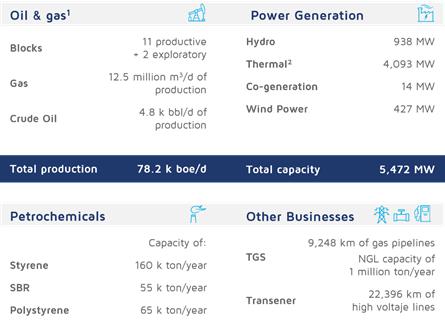
Note: As of December 31, 2024. Numbers are rounded, so they may not sum up. CTEB, Transener and TGS are affiliates, which under IFRS are not consolidated in the financial statements. 1) Average 2024 production. It includes 0.9 kbbl of crude oil produced in Gobernador Ayala, assigned to Pluspetrol in October 2024.2) It includes 847 MW at CTEB.
Oil and Gas. We are engaged in the oil and gas business through the exploration and exploitation of direct interests blocks located in Argentina, with operations in 11 production blocks, 2 exploratory blocks and 688 productive wells. The Company is the fifth-largest gas producer with 9% of the country’s gas output and the third-largest shale gas producer with 8% market share.
| · | As of December 31, 2024, our combined crude oil and natural gas proved reserves amounted to approximately 231.2 million boe, 55% of which were proved developed reserves. Natural gas accounted for approximately 93% of our combined proved reserves and liquid hydrocarbons for 7%. 57% of our combined proved reserves come from shale formations, mainly in Sierra Chata, El Mangrullo and Rincón de Aranda; and |
| · | As of December 31, 2024, our combined oil and gas production in Argentina averaged 78.2 thousand boe per day. Crude oil accounted for approximately 4.8 thousand boe per day, while natural gas accounted for approximately 73.4 thousand boe per day. |
Our oil and gas business segment recorded U.S.$730 million in revenue and an operating profit of U.S.$69 million for the fiscal year ended December 31, 2024.
For more information about our Oil and Gas Business, please see “Item 4. Our Oil and Gas Business”.
Generation. Our generation installed capacity reached approximately 5,472 MW as of December 31, 2024, which represents approximately 13% of Argentina’s installed capacity.
Our generation business segment recorded U.S.$672 million in revenue and an operating profit of U.S.$204 million for the fiscal year ended December 31, 2024.
For more information about our Generation Business, please see “Item 4. Our Generation Business”.
Petrochemicals. We are engaged in the petrochemicals business through two plants that are entirely based in Argentina and produce styrene, styrene butadiene rubber and polystyrene, with a domestic market share of 100%, 93% and 98% (per Company estimates), respectively as of December 31, 2024.
Our petrochemicals business segment recorded U.S.$516 million in revenue and an operating profit of U.S.$43 million for the fiscal year ended December 31, 2024.
|
|
For more information about our Petrochemicals Business, please see “Item 4. Our Petrochemicals Business”.
Holding and Other Business. We also hold other interests, including:
| · | a 25.5% co-controlling interest in TGS, the country’s largest gas transportation company, owning and operating 9,248 km of gas pipelines, a natural gas liquids processing plant, General Cerri, with a production capacity of over 1 million tons/year, and a gathering pipeline and gas treatment plant located in Vaca Muerta, province of Neuquén, which provides unregulated midstream services; |
| · | a 26.33% co-controlling interest in Transener. Additionally, Transener holds a 100% interest in Transba. As of December 31, 2024, our electricity transmission operations covered approximately 22.4 thousand kilometers of high voltage transmission lines, representing approximately 86% of the high-voltage system in Argentina; |
| · | a 100% interest in OCP Ltd., a company that controlled OCP S.A., a former licensee company of an oil pipeline in Ecuador that has a transportation capacity of 450,000 barrels/day. OCP S.A.’s concession expired on November 30, 2024. For more information, see Relevant Events – Oil and Gas - Acquisition of Shares in OCP Ltd. and Termination of the Concession; |
| · | a 70% interest in Enecor S.A., an independent electricity transmission company that provides operation and maintenance services, by subcontracting Transener, for 21 km of 132 kV double-triad electricity lines, from the Paso de la Patria transforming station, in the Province of Corrientes. Such services are provided under a 95-year concession, which is due to expire in 2088; and |
| · | a 11.11% interest in VMOS related to the “Vaca Muerta Oil Sur Project” for the construction, development, and operation of an oil pipeline approximately 437 km in length, from Allen to Punta Colorada, in the Province of Río Negro. Pampa will have a transportation, storage, and dispatch capacity of 50,000 barrels per day. |
Our holding and other business segment recorded U.S.$65 million in revenue and an operating profit of U.S.$124 million for the fiscal year ended December 31, 2024.
For more information about our Holdings and Others Business, please see “Item 4. Our Holdings and Others Business”.
Relevant Events
Oil and Gas
Sale of Gobernador Ayala
On September 13, 2024, in response to an offer received from a third party, Pluspetrol S.A. (the operator) decided to exercise its preemptive right, as stipulated in the Joint Operating Agreement, and acquire our 22.51% undivided interest in the rights and obligations of the hydrocarbon exploitation concession and the joint operating agreement over the Gobernador Ayala area. The participation in the Gobernador Ayala area contributed only 1.2% of the Company’s total hydrocarbon production during the third quarter of 2024. On October 21, 2024, the transaction was closed for a base price of U.S.$ 23 million.
Participation of the Company in the Vaca Muerta Oil Sur Project
On December 16, 2024, we confirmed our participation in the “Vaca Muerta Oil Sur Project” as shareholder of VMOS along with YPF, Vista Energy Argentina S.A.U., and Pan American Sur S.A., Pluspetrol S.A., Shell Argentina S.A. and Chevron Argentina S.R.L. as Class A shareholders and Gas y Petróleo del Neuquén S.A. as Class B shareholder. We currently hold a 11.11% stake in VMOS, which may vary depending on the entry of other shareholders into the project.
VMOS will develop an investment project consisting of the construction, development, and operation of a pipeline approximately 437 km in length, running from Allen to Punta Colorada in the Province of Río Negro. The project will include a loading and unloading terminal with interconnected monobuoys, a tank farm, and ancillary facilities associated with these assets to export crude oil and liquids via very large crude carriers, known as VLCCs.
|
|
The project will demand an estimated investment of U.S.$3 billion, funded through shareholders’ contributions and external financing. We have secured a take-or-pay transportation contract for 50 kbpd, including storage and dispatch capacity. On November 15, 2024, VMOS submitted an application to join the “Incentives Regime for Large Investments” (“RIGI”), in accordance with the Bases Law and Regulatory Decree No. 749/2024, as amended or supplemented from time to time, to be considered a Strategic Long-Term Export Project. Vaca Muerta Oil Sur Project RIGI’s application was approved on March 21, 2025 by the Ministry of Economy’s Resolution Nº 302/2025.
VMOS will streamline crude oil evacuation and exports from the Vaca Muerta formation, and specifically, for us, from the Rincón de Aranda area, reduce logistics costs, open new markets for Argentine oil, increase foreign currency inflows, create employment opportunities and expand our firm transportation capacity.
FLNG Project
On January 15, 2025, we acquired a participation in a floating liquefied natural gas project in Argentina, including the posting of the floating liquefied gas vessel “Hilli Episeyo” and the construction of all the required additional facilities in the San Matías Gulf, in the Province of Río Negro (the “FLNG Project”), together with Pan American Energy S.L., Golar FLNG Holding Company Limited, YPF and Harbour Energy. The vessel is expected to start operating on September 2027. Our share in the company that will undertake the FLNG Project, SESA, is 20%.
SESA has submitted the application to adhere to the new RIGI, in accordance with Law 27,442, Regulatory Decree No. 749/2024, and other regulations that may amend and/or complement them, to be considered a Strategic Long-Term Export Project.
The FLNG Project is strategic to monetizing our Vaca Muerta reserves, placing Argentina within the liquefied natural gas global market, and boosting foreign currency inflows, job creation, and the domestic supply chain.
Acquisition of Shares in OCP Ltd. and Termination of the Concession
On August 30, 2024, we acquired 36% of OCP Ltd, in which we already held 64% of the capital, for a price of U.S.$ 23 million, thereby increasing our indirect stake to 100%. As a result, we indirectly gained control of 100% of OCP S.A.
OCP Ltd. held the whole capital stock and voting rights of OCP S.A., which operates the main private oil pipeline in Ecuador, which extends for 485 kilometers and transports an average of 150,000 barrels per day of Ecuadorian crude oil—approximately 30% of the national production—and 10,000 barrels per day of Colombian crude oil.
The expiration of the pipeline concession was initially scheduled for January 20, 2024, considering the extension of the term due to the suspension of contractual obligations resulting from force majeure events. On this date, OCP Ltd. was expected to transfer and deliver all shares of OCP S.A. to the Ecuadorian State at no cost, along with the titles and rights to the pipeline’s assets. To facilitate this process, a “Transition Committee” was established in 2023 in accordance with the Construction and Operation Contract signed in 2001.
However, successive extensions of the concession term were granted by the Ministry of Energy and Mines of Ecuador during 2024 —which extended the term first until July 31, 2024, then until August 19, 2024 and lastly until November 30, 2024, and on that date, all shares of OCP S.A. were transferred and delivered to the Ecuadorian State at no cost, along with the titles and rights to the pipeline's assets, all in accordance with the pipeline concession contract.
| Generation |
Commissioning of PEPE VI
In preparation for the commissioning of the PEPE VI wind turbines, SE authorized the private use of the 500 kV interconnector (Res. SE No. 82/24) and ENRE granted access to transmission capacity (Res. ENRE 384/24). In addition, in July and August 2024, 10 Vestas wind turbines of 4.5 MW each were commissioned, for a total capacity of 45 MW.
|
|
In September 2024, 7 additional wind turbines were commissioned at PEPE VI, totaling 31.5 MW, and on October 22, 2024, another 4 wind turbines were added, totaling 18 MW.
The installation of all aerogenerators and civil works was completed in October 2024, and the entire installed capacity of 140 MW was commissioned in November 2024. With this investment of approximately U.S.$250 million, Pampa has a wind power capacity of 427 MW, positioning itself as one of the leading renewable energy producers in the country.
Hydroelectric concessions termination
On June 4, 2024, we announced the beginning of a 12-month transition period for the concession held by HINISA, in which we hold a 52.04% stake. On June 11, 2024, we announced that the transition period was modified and reduced to 6 months. HINISA’s concessions, granted by the Province of Mendoza and the National Government for the use of water resources and electric power generation, were originally set to expire on June 1, 2024. The Province of Mendoza, through Decree No. 1,021 issued on May 27, 2024, and the National Energy Secretariat, via Resolution RESOL-2024-83-APN-SE#MEC and RESOL-2024-98-APN-SIYC#MEC, have both established a twelve-month transition period effective from June 1, 2024, during which HINISA will continue to manage the hydroelectric complex, with designated observers from the provincial government.
The concessions for HINISA expired on November 30, 2024. On November 29, 2024, the SE extended the transition period for 6 months. The new expiration date is June 1, 2025.
In the case of HIDISA, its concession expired on October 19, 2024. These concessions include one granted by the Province of Mendoza for the use of water assets and resources and another grated by the Argentine Federal Government for electricity generation. We hold 61% of HIDISA’s share capital.
On October 18, 2024, the Province of Mendoza, through Decree No. 2,096/24, established a 12-month transition period, with the provincial Undersecretary of Energy and Mining appointed as supervisor. Similarly, the Secretariat for the Coordination of Energy and Mining of Argentina, through Resolution No. 1/24, established a transition period until June 1, 2025, and designated the national Subsecretariat of Electric Energy as the supervising authority.
Modification of the order of payment of CAMMESA
Resolution SE No. 34/24 modified the order of payment of economic transactions in the MEM, establishing that the transmission concessionaires have priority in the order of payment in relation to the generation concessionaires of the MEM.
Payment agreement with CAMMESA
On May 27, 2024, an agreement was entered into with CAMMESA instrumenting the exceptional, transitional and unique payment system established in SE Resolution No. 58/24 for the balance of WEM’s unpaid economic transactions. Thus, the December 2023 and January 2024 transactions were canceled through the delivery of government securities (BONO USD 2038 L.A.). The February 2024 transaction was paid in cash with funds available in CAMMESA and transfers made by the Federal Government. In all cases, payments were made without interests. We received Bonds for Ps. 73,776 million FV (U.S.$ 82.6 million) and Ps. 51,473 million in cash (U.S.$ 57.8 million) and recorded Ps. 46,485 million (U.S.$ 53.5 million) impairment in CAMMESA’s receivables considering the received instrument’s market value and the non-recognition of interest under the described cancellation methodology.
Contingency and Forecast Plan for Energy Supply in Critical Months
The SE, through Resolution No. 294/24, established a "Contingency and Forecast Plan for Critical Months of the Period 2024/2026" with the aim of avoiding, reducing or mitigating the critical energy supply condition for the critical days of the period 2024/2026. The plan identifies different measures for different segments of the industry.
With regard to electricity generation, it includes an accession scheme that recognizes an additional, complementary and exceptional remuneration, based on the available power and generation, that promotes the availability of thermal generation plants in the critical months and hours, effective from December 2024 to March 2026. This additional compensation may be extended by the Subsecretary of Electrical Energy for 12 additional months, subject to the presentation of a maintenance program for each generating unit.
|
|
The remuneration scheme provides (i) a remuneration per capacity of U.S.$ 2,000/MW-month, adjusted by a criticality factor that takes into account the node where the generating unit is located and the actual availability of the unit during the most critical hours, and 50% of this remuneration for the power in excess of the committed power; and (ii) a remuneration for the energy generated during the most critical days and hours, also adjusted by the criticality factor, which varies between U.S.$ 3.4/MWh and U.S.$ 10.5/MWh, depending on the fuel used and the generation technology.
On the other hand, CAMMESA will implement an exceptional dispatch procedure that will allow the strategic use of generation units to reduce the risk of supply restrictions during peak consumption periods. Such a procedure may include the possibility of reserving the dispatch of the remaining operating hours of those units that are nearing the end of their useful life, in order to allow their use during periods of maximum demand by the SADI.
Within the framework of these regulations, on 20 November 2024, Pampa expressed its adherence to the Commitment to Improve Power Availability and Reliability for the Thermal Power Plants CPB, CTG, CT Piquirenda, CTLL, CTGEBA and Ecoenergía, effective from 1 December 2024 until 31 March 2026, for a maximum amount of U.S.$ 26,275,612.
Updates for the spot remuneration scheme for capacity not covered by contracts
SE Resolutions No. 9/24 and No. 99/24 updated the remuneration values for spot generation, establishing an increase of 73.9% and 25%, respectively, regarding the economic transactions of February and June 2024.
In addition, SE Resolutions No. 193/24, No. 233/24 and No. 285/24 and SCEyM Resolution 20/24 established further increases of 3%, 5%, 2.7% and 6% regarding the economic transactions of August, September, October and November 2024, respectively. Subsequently, Resolution 387/2024 established a 5% increase for December 2024 and Resolution 603/2024 a 4% increase for January 2025. Currently, Res. 27/2025 provides for a further increase of 4% for February 2025.
Changes in the electricity regulatory framework
The Bases Law established guiding principles to modify the electricity regulatory framework in order to guarantee free contracting in the MAT, the promotion of investments, etc. The Bases Law also established principles to modify the electricity regulatory framework in order to guarantee free contracting in the MAT, the promotion of investments, etc.
On 28 January 2025, Resolution SE No. 21/25 was published, which established various modifications to the current dispatch regulation and the functioning of the MEM Term Market (MAT). Many of the aspects introduced by the resolution require future detailed regulations and/or clarifications for their implementation. For more details see “Item 4. The Argentine Energy Sector—Electricity Regulatory Framework”.
On January 28, 2025, the SE issued Resolution No. 21/25, introducing regulatory changes to the MAT and the MEM. Implementation of these changes will require additional rulemaking and/or clarifications. The most significant aspects include:
| · | Thermal, hydro, and nuclear units commissioned from January 1, 2025, as well as generators procuring their fuel through new infrastructure, are exempt from the contracting suspension in the MAT. |
| · | As of October 31, 2025, new or renewed Energía Plus contracts will not be permitted. Existing contracts will remain valid until their expiration, after which the Energía Plus program will be discontinued. Power plants operating under this scheme will then transition to market mechanisms defined by the SE as part of the MEM normalization process. |
| · | The electricity dispatch and gas allocation scheme for power generation, established by Resolution SE No. 354/20, was repealed effective as of February 1, 2025. This scheme had prioritized dispatch based on ENARSA’s contract obligations with Bolivia and the Plan Gas. A new dispatch criterion took effect on March 1, 2025, allowing generators that choose to procure their fuel to compete based on declared variable costs once CAMMESA has allocated the ToP volumes under Plan Gas. This change may impact the balance between ToP and DoP commitments under Plan Gas. |
|
|
| · | Starting on March 1, 2025, generators selling spot energy can supply their fuel, with recognized costs based on declared and accepted reference prices and variable costs, including freight, transportation, natural gas distribution, and taxes. CAMMESA will continue to centralize fuel procurement for PPAs under Res. SE No. 220/07, 21/17, and 287/17, acting as the fuel supplier of last resort. |
On January 28, 2025, the SE instructed CAMMESA to publish guidelines for the evolution of the MEM, including structural adjustments and changes to power remuneration schemes. CAMMESA posted these reports on its website, granting a 30-day period for MEM Agent Associations to submit feedback. CAMMESA will then assess the impact of the modifications and submit its recommendations to the SE, which will define transitional regulations for adapting the MEM. These changes are expected to take effect on November 1, 2025, overlapping with the start of the 2025-2026 summer period.
We are currently assessing these regulatory developments and awaiting further clarifications from the SE. For more information on the aforementioned regulatory changes, see “Legal And Regulatory Framework And Relationship With The Argentine Government.”
Energy Plus Market
SE Res. 21/25 limits the extension and/or submission of new contracts. The rule is not clear on the deadline, but it could be argued that it would be extended until November 31, 2025. Once the contracts to be included and those already in force have been terminated, the Energy Plus market would cease to exist and the plants authorized under this regime would have to market their electricity and energy under the market rules to be defined by the SE as part of the MEM normalization process.
Strategic Divestments
Refinor
We held a 28.5% interest in Refinor, whose other shareholders were YPF (50%) and Pluspetrol S.A. (21.5%). Refinor is engaged in crude oil refining, natural gas processing, product transportation, marketing and sales.
On September 15, 2022, Pampa and Pluspetrol S.A. entered into an agreement with Hidrocarburos del Norte S.A. in order to sell their participation in Refinor that represented 50% of the outstanding capital stock and voting power of such company, and 100% of its Class A shares. The purchase price for the shares owned by us was U.S.$5.7 million, and the buyer paid 30% of such price at closing, and the remaining 70% balance will be paid 12 months after the closing.
On December 22, 2023, we signed an amendment to the original agreement regarding the payment of the pending balance. The following payments were agreed upon: (i) U.S.$1.4 million were paid on the date of the amendment, and (ii) U.S.$2.6 million to be paid in four consecutive semiannual installments of U.S.$0.65 million each, with the first installment due six months from the date of the amendment.
Organizational structure
The following chart sets forth our corporate structure as of December 31, 2024. See “Exhibit 8.1. List of subsidiaries, Joint Ventures and Associates of Pampa Energía S.A.” We have no significant subsidiaries.
|
|
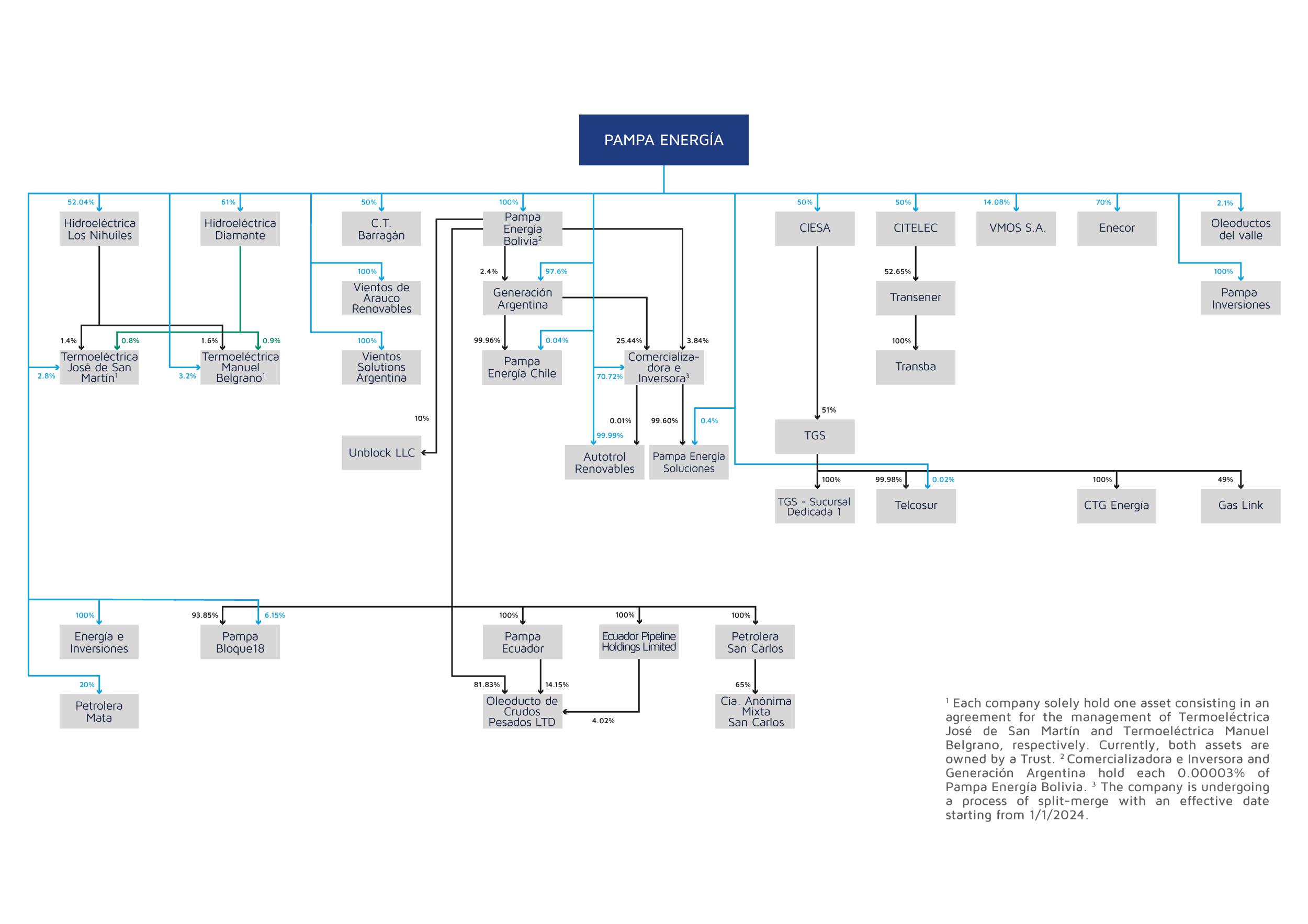
|
|
Our Oil and Gas Business
Exploration and Production
Our strategy is to develop profitable oil and gas reserves with social and environmental responsibility. In this segment, we are focused on three main objectives: (i) development and monetization of unconventional gas reserves; (ii) exploration for reserves replacement; and (iii) optimization of operations and existing infrastructure as leverage for new projects.
As is usual in the oil and gas exploration and production business, we participate in exploration and production activities in conjunction with joint operation partners. Contractual arrangements among participants in a joint operation are usually governed by an operating agreement, which provides those costs, entitlements to production and liabilities are to be shared according to each party’s interest in the joint operation. One party to the joint operation is usually appointed as operator and is responsible for conducting the operations under the overall supervision and control of an operating committee that consists of representatives of each party to the joint operations. While operating agreements generally provide for liabilities to be borne by the participants according to their respective interest, licenses issued by the relevant governmental authority generally provide that participants in joint operations are jointly and severally liable for their obligations to the relevant governmental authority pursuant to the applicable license. In addition to their interest in field production, contractual operators are generally paid their indirect administrative expenses on a monthly basis by their partners in proportion to their participation in the relevant field.
As of December 31, 2024:
| · | our combined crude oil and natural gas proved reserves were 231 million boe, 55% of which were proved developed reserves. Natural gas accounted for approximately 94% of our combined proved reserves and liquid hydrocarbons for 6%; and |
| · | our combined oil and gas production in Argentina averaged 78.2 thousands of boe per day. Crude oil accounted for approximately 4.8 thousands of boe per day, while natural gas accounted for approximately 440 million standard cubic feet per day, or 73.4 thousands of boe per day based on a measure of conversion of 6,000 cubic feet of gas per barrel of oil equivalent. |
During 2024, according to the SE, gas gross production in Argentina decreased by 5% (4.9 billion cubic feet per day on average), whereas oil gross production increased 11% at 702.6 thousand barrels per day (on average). For December 2024, according to the SE, our consolidated oil and gas production accounted for approximately 0.19% and 9% of total oil production and gas production in Argentina, respectively.
Key Information Relating to Oil and Gas
As of December 31, 2024, we had interests in 13 areas, joint operations (UTEs) and agreements in Argentina: 11 oil and gas production areas and 2 exploration blocks located within exploration areas or pending authorization for production, excluding Rio Limay Este, in process of relinquishment. As of December 31, 2024, we were directly the contractual operator of 6 of the 13 blocks in which we hold equity interest.
Acreage
As of December 31, 2024, our total production and exploration acreage, both gross and net, was as follows. The table includes the total production and exploration acreage by the Company, joint operations and associates.
| Acreage | ||||||||
| Production (1) | Exploration (2) | |||||||
| Gross(3) | Net (4) | Gross(3) | Net (4) | |||||
| (in thousands of acres) | ||||||||
| Argentina | 1,281 | 429 | 65 | 57 | ||||
(1) Includes all areas in which we produce commercial quantities of oil and gas or areas in the development stage. (2) Includes all areas in which we are allowed to perform exploration activities but where commercial quantities of oil and gas are not produced, plus areas that are not in the development stage. (3) Does not include Río Limay Este area, which is in process of relinquishment. (4) Adjusted at our working interest ownership in the gross acreage.
|
|
Productive Wells
As of December 31, 2024, our total gross and net productive wells were as follows. The table includes the total gross and net productive wells by the Company, joint operations and associates.
| Oil | Gas | Total (3) | |||||
| Gross (1) | Net (2) | Gross (1) | Net (2) | Gross (1) | Net (2) | ||
|
Argentina
|
272 | 96 | 416 | 226 | 688 | 321 | |
Note: All figures have been subject to rounding, so figures shown as totals may not add up. (1) Refers to the number of wells completed. (2) Refers to fractional ownership working interest in gross productive wells. (3) Includes Oil and Gas productive wells.
Drilling Activities
In 2024, we carried out investment plans aligned with our reserves replacement and production goals, as a means to achieve sustainable growth. A development well, for purposes of the following table, is one that justifies the installation of permanent equipment for the production of oil or gas. A well is deemed to be a dry well if it is determined to be incapable of commercial production. “Gross wells drilled” in the table below refers to the number of wells completed during each fiscal year, regardless of the spud date, and “net wells drilled” relates to our fractional ownership working interest in wells drilled. This table includes wells drilled by the Company, joint operations and associates (includes our discontinued operations). The following table sets forth the number of total wells we drilled in Argentina and the results for the relevant periods.
| Year ended December 31, | |||||||
| 2024 | 2023 | 2022 | |||||
| Argentina | |||||||
| Gross wells drilled: | |||||||
| Production: | |||||||
| Development wells: | |||||||
| Oil | 1 | 9 | 31 | ||||
| Gas | 18 | 35 | 35 | ||||
| Dry wells | - | - | - | ||||
| Total | 19 | 44 | 66 | ||||
| Exploration: | |||||||
| Discovery wells: | |||||||
| Oil | - | - | 3 | ||||
| Gas | - | - | 1 | ||||
| Dry wells | - | - | - | ||||
| Total | 0 | 0 | 4 | ||||
| Net wells drilled: | |||||||
| Production: | |||||||
| Development wells: | |||||||
| Oil | 1 | 3 | 9 | ||||
| Gas | 9 | 24 | 26 | ||||
| Dry wells | - | - | - | ||||
| Total | 10 | 27 | 34 | ||||
| Exploration: | |||||||
| Discovery wells: | |||||||
| Oil | - | - | 1 | ||||
| Gas | - | - | - | ||||
| Dry wells | - | - | - | ||||
| Total | 0 | 0 | 1 | ||||
Note: All figures have been subject to rounding, so figures shown as totals may not add up.
|
|
In 2024, our activity was focused on complying with the production commitments within the Plan Gas.Ar. The core of the activity was concentrated in the Neuquén Basin, mainly in El Mangrullo and Sierra Chata, where 3 wells were drilled in each, all of them being from shale reserves, and Río Neuquén with 10 wells drilled. As for oil, 1 well was drilled in Rincón de Aranda.
Oil and Gas Production
We transport our oil and gas production through several methods depending on the infrastructure available and the cost efficiency of the transportation system in a given location. We use the oil pipeline system and oil tankers to transport oil to our customers. Oil is customarily sold through contracts whereby producers are responsible for transporting produced oil from the field to a port for shipping, with all costs and risks associated with transportation borne by the producer. Gas, however, is sold at the delivery point of the gas pipeline system near the field and, therefore, the customer bears all transportation costs and risks associated therewith. Oil and gas transportation in Argentina operate in an “open access” non-discriminatory environment under which producers have equal and open access to the transportation infrastructure. We maintain limited storage capacity at each oil site and at the terminals from which oil is shipped. In the past, such capacity has been sufficient to store oil without reducing production during temporary unavailability of the pipeline systems, for example, due to maintenance requirements or temporary emergencies.
During 2024, our production was concentrated in three basins: Neuquén, San Jorge and Noroeste. In Argentina, we own 486,000 net acres, and in the Neuquén basin — the most important basin in the country in terms of oil and gas production —we own approximately 325,000 net acres (representing 67% of our total acreage). Our most important fields in the Neuquén basin are El Mangrullo, Sierra Chata, Río Neuquén and Rincón de Aranda. As of December 31, 2024, we lifted hydrocarbons from 688 productive wells in Argentina.
For the year 2024, our average daily production was 4,772 barrels of crude oil and 440 million cubic feet of natural gas. Oil production was maintained and gas production increased 21% compared to our 2023 average.
The following table sets forth our oil and gas production during 2024. Production figures represent our working interest in production (and are therefore net to the Company). In addition, the table includes our working interest in each field, operator and the expiration date of the concessions, in each case as of December 31, 2024. Although some of these concessions may be extended at their expiration, the expiration dates set forth below do not include any extensions not granted as of the date of this annual report.
|
|
2024 Production | ||||||||
| Production Blocks | Location | Basin | Oil (1) | Gas (2) |
Oil (3) |
Operator | Direct and Indirect Interest | Expiration | |
| El Mangrullo | Neuquén | NQN | 17 | 96,179 | 16,047 | Pampa | 100.00 % | 2053 | |
| Sierra Chata | Neuquén | NQN | 83 | 40,505 | 6,834 | Pampa | 45.55% | 2053 | |
| Río Neuquén | Neuquén/Río Negro | NQN | 293 | 19,720 | 3,579 | YPF | 33.07%(4)/31.42%(5) | 2027/2051 | |
| Rincón del Mangrullo (6) | Neuquén | NQN | 8 | 2,691 | 457 | YPF | 50.00% | 2052 | |
| Río Limay Este (Ex Senillosa)(7) | Neuquén | NQN | 0 | 0 | 0 | Pampa | 85.00% | 2040 | |
| Aguaragüe | Salta | NOA | 52 | 1,582 | 315 | Tecpetrol | 15.00% | 2037 | |
| El Tordillo | Chubut | CGSJ | 552 | 153 | 577 | Tecpetrol | 35.67% | 2027 | |
| La Tapera – Puesto Quiroga | Chubut | CGSJ | 29 | 0 | 29 | Tecpetrol | 35.67% | 2027 | |
| Gobernador Ayala (8) | Neuquén | NQN | 319 | 0 | 319 | Pluspetrol | 22.51% | 2036 | |
| Rincón de Aranda | Neuquén | NQN | 329 | 0 | 329 | Pampa | 100.00% | 2058 | |
| Veta Escondida | Neuquén | NQN | 0 | 0 | 0 | Pampa | 55.00% | 2027 | |
| Los Blancos | Salta | NOA | 61 | 0 | 61 | High Luck | 50.00% | 2045 | |
| Total | 1,742 | 160,829 | 28,547 | ||||||
Note: All figures have been subject to rounding, so figures shown as totals may not add up (1) In thousands of boe. (2) Gas production represents only marketable production of natural gas excluding flared gas, injected gas and gas consumed in operations. In millions of cubic feet. (3) In thousands of boe. Gas is converted to oil equivalent using a factor of 6,000 cubic feet of gas per barrel of oil equivalent. (4) Province of Neuquén. (5) Province of Río Negro. (6) Does not include Vaca Muerta formation. (7) In process of relinquishment. (8) the Company sold the area in October 2024.
|
|
The following table sets forth the production of oil and gas in Argentina for the relevant periods:
| Year ended December 31, | |||||||||||
| 2024 | 2023 | 2022 | |||||||||
| Argentina | Oil (1) | Gas (2) | Oil (1) | Gas (2) | Oil (1) | Gas (2) | |||||
| Río Neuquén | 293 | 19,720 | 297 | 20,071 | 268 | 19,276 | |||||
| El Mangrullo | 17 | 96,179 | 25 | 78,128 | 21 | 91,659 | |||||
| Sierra Chata | 83 | 40,505 | 21 | 29,004 | 22 | 8,469 | |||||
| Other blocks | 1,349 | 4,426 | 1,420 | 5,449 | 1,636 | 7,015 | |||||
| Total | 1,742 | 160,829 | 1,762 | 132,652 | 1,948 | 126,419 | |||||
Note: All figures have been subject to rounding, so figures shown as totals may not add up.
(1) Oil production includes other liquid hydrocarbons. Amounts in thousands of barrels.
(2) Gas production represents only marketable production of natural gas excluding flared gas, injected gas and gas consumed in operations. Amounts in millions of cubic feet.
Exploration
Our strategy is focused on constantly searching for new exploration opportunities aligned with our growth targets. In Argentina, we own substantial acreage containing undeveloped unconventional reservoirs, including both tight and shale gas in the Neuquén basin. The following table lists our exploration blocks, joint operations and permits in Argentina as of December 31, 2024, the location and basin of each area, our net working interest and the expiration date for the exploration authorization.
| 2024 Production | ||||||||||||
| Blocks/UTE | Location | Basin | Oil kbbl | Gas mcf | Total kboe | Operator | Interest | Expiration | ||||
| Parva Negra Este | Neuquén | NQN | 0 | 14 | 2 | Pampa | 85,00% | 2025 | ||||
| Las Tacanas Norte | Neuquén | NQN | - | - | - | Pampa | 90,00% | 2027 | ||||
| Total Exploration Blocks | 0 | 14 | 2 | |||||||||
| Total Production | 1,742 | 160,843 | 28,549 | |||||||||
Note: All figures have been subject to rounding, so figures shown as totals may not add up.
As of December 31, 2024, we held interests in approximately 65,000 gross exploration acres in Argentina.
Cost of Sales, Revenues and Price
Cost of Sales, Royalties and Depreciation
The following table sets forth our average cost of sales, royalties and depreciation cost in our oil and gas fields in each geographic area for the fiscal years ended December 31, 2024, 2023 and 2022. This table includes our net share of production, joint operations and associates.
| Year ended December 31, | |||||
| Argentina | 2024 | 2023 | 2022 | ||
| (in U.S.$ per barrel of oil equivalent) | |||||
| Production cost | 6 | 7 | 6 | ||
| Royalties | 3 | 4 | 4 | ||
| Depreciation | 8 | 7 | 5 | ||
| Total | 17 | 18 | 15 | ||
Revenues
The following table sets forth revenues for the oil and gas exploration and production business segment by geographic area for the fiscal years ended December 31, 2024, 2023 and 2022.
|
|
| Year ended December 31, | ||||
| 2024 | 2023 | 2022 | ||
| Argentina | ||||
| (in millions of U.S.$) | ||||
| Oil | 127 | 121 | 136 | |
| Gas | 591 | 534 | 500 | |
| Others | 12 | 11 | 10 | |
| Total | 730 | 666 | 646 | |
The following table sets forth the average sales price per barrel of oil and per million cubic feet of gas for each geographic area for the fiscal years ended December 31, 2024, 2023 and 2022.
| Year ended December 31, | ||||||
| Average price of sale for barrel of Oil and for million cubic feet of Gas | 2024 | 2023 | 2022 | |||
| Argentina | ||||||
| Oil (In U.S.$ per barrel of Oil) | 73 | 69 | 70 | |||
| Gas (In U.S.$ per thousand cubic feet) | 4 | 4 | 4 | |||
Delivery commitments
Natural Gas
Created on November 16, 2020, Plan Gas.Ar seeks to promote Argentine natural gas production and manage the gas cost impact on the Priority Demand’s tariff through tendering long-term supply agreements (DNU No. 892/20).
Initially, the term for onshore production was 4 years, with an additional 4 years for offshore production from January 2021. The term was extended until December 31, 2028, for the 70 million m3 per day base volume awarded under rounds 1 and 3 (DNU No. 730/22).
Agreements are executed between producers (as sellers) and CAMMESA, gas distributors and ENARSA (as purchasers), with a 100% daily DoP and a 75% monthly ToP for CAMMESA and quarterly ToP for gas distributors and ENARSA. The awarded price is adjusted by the following factors: 0.82 in the summer period (October-April), and 1.25 (May-September) for the base volume. CAMMESA and ENARSA, as purchasers, pay the awarded price, whereas gas distributors pay the price set forth in the effective tariff scheme, with the difference being offset by the Federal Government. Moreover, the Federal Government has set a compensation support guarantee system based on tax credit certificates, notwithstanding other applicable mechanisms.
For more information about the different Plan Gas.Ar’s round tenders, please see “Item 4. The Argentine Energy Sector–Oil & Gas Regulatory Framework–Regulations Specifically Applicable to the Gas Market–Plan Gas.Ar”.
Pampa participated and was awarded in all Plan Gas.Ar’s rounds in the Neuquina Basin. Each round’s conditions for Pampa are detailed below:
| Round | Delivery | Volume in million m3/day | Price in U.S.$/MBTU | Expiration |
| 1 & 4.1 | Annual flat | 4.90(1) | 3,60(2) | December 2028 |
| 1 | Winter3 | 1.00 | 4,68 | September 2024 |
| 2 | Winter3 | 0.86 | 4,68 | September 2024 |
| 3 & 4.1 | Annual flat | 2.00 | 3,347(2) | December 2028 |
| 4.2 | Annual flat | 4.80 | 3,485(2) | December 2028 |
| 5.2 Northwest | Monthly variable | 13.5 – 70.5 thousand m3/day | 6 - 9,8(4) | December 2028 |
Note: 1) The total commitment from May 2021 is 7 million m3/day. Out of this, 4.9 are deliveries under Plan Gas.Ar and the balance is sold on the market. 2) 1.25 adjustment factor in the winter and 0.82 for the rest of the year. 3) It covers the months of May through September. 4) Prices start at U.S.$9.8/MBTU and drop to U.S.$6/MBTU in 2028
|
|
Once the Plan Gas.Ar commitments are fulfilled, the remaining natural gas will be allocated to industries, exports, CAMMESA’s monthly tenders and the spot market.
Oil
Regarding Oil deliveries, within the “Vaca Muerta Oil Sur Project”, we will hold a dispatch capacity of 50,000 barrels per day. For more information, see “Item 4. Our Business - Our Holding and Others Business – VMOS”.
Also, we have an agreement signed for 6,000 barrels per day in the “Proyecto Duplicar”, until the end of the Oldelval concession in 2037. For more information, see “Item 4. Our Business - Our Holding and Others Business – Oldelval”.
Reserves
We believe our estimates of remaining proved recoverable oil and gas reserve volumes to be reasonable. Pursuant to Rule 4-10 of Regulation S-X (Title 17 of the Code of Federal Regulations Part 210), proved oil and gas reserves are those quantities of oil and gas, which, by analysis of geoscience and engineering data, can be estimated with reasonable certainty to be economically producible from a given date forward, from known reservoirs, and under existing economic conditions, operating methods, and government regulations prior to the time at which contracts providing the right to operate expire, unless evidence indicates that renewal is reasonably certain, regardless of whether deterministic or probabilistic methods are used for the estimation. The project to extract the hydrocarbons must have commenced or the operator must be reasonably certain that it will commence the project within a reasonable time. The evaluation of our reserves covered the reserves located in areas operated and non-operated by the Company. The proved oil and natural gas reserves were estimated in accordance with Rule 4-10 of Regulation S-X and in accordance with the oil and gas reserves disclosure provisions of FASB Topic 932. GaffneyCline performed an independent audit of 98% of our estimated proved reserves as of December 31, 2024. We provided all information required during the course of the audit process to the satisfaction of GaffneyCline. See the Reserves Report by GaffneyCline, dated January 31, 2025, included as Exhibit 13.2 to this annual report. As of December 31, 2024, 2023 and 2022, 98%, 99%, and 97%, respectively, of our estimated proved oil equivalent reserves were audited by GaffneyCline.
As of December 31, 2024, our liquid hydrocarbon and natural gas proved developed and undeveloped reserves totaled 231.2 million of oil equivalent barrels (boe), 17.2 million barrels of liquid hydrocarbons and 1,284.2 billion cubic feet, or 214.0 million boe, of natural gas, of which 1,255.9 billion cubic feet were estimated to be sales gas and 28.3 billion cubic feet were estimated to be consumed as fuel gas in operation (which are included in our total natural gas proved reserves). For variations of our reserves data, see Reserves Evolution below.
Liquid hydrocarbons and natural gas accounted for 7% and 93%, respectively, of our total proved reserves as of December 31, 2024.
As of December 31, 2024, proved developed reserves of crude oil equivalent represented 55% of our total proved reserves of crude oil equivalent and we had proved reserves equal to approximately nine years of production at 2024 volumes.
The following table sets forth our estimated net proved developed and undeveloped reserves of crude oil and natural gas as of December 31, 2024, including joint operations and associates.
|
Reserves as of December 31, 2024 |
|||
| Reserves Category | Crude oil, condensate and natural gas liquids (millions of barrels) |
Natural Gas (billions cubic feet) |
Oil Equivalent (million boe) |
| Proved Developed | 4.4 | 741.6 | 128.0 |
| Proved Undeveloped | 12.8 | 542.5 | 103.2 |
| Total proved reserves | 17.2 | 1,284.2 | 231.2 |
| Note: Totals may not exactly equal the sum of the individual entries because of rounding. | |||
|
|
The statements contained in this Item 4 regarding exploration and development projects and production estimates are forward-looking and subject to significant risks and uncertainties. Although we believe that these expectations reflected in these forward-looking statements are reasonable, we cannot guarantee that our actual levels of activity, production or performance will meet those expectations. See “Item 3. Key Information—Risk Factors.”
The following table sets forth the breakdown of our total proved reserves of liquid hydrocarbons and natural gas into proved developed and proved undeveloped reserves as of December 31, 2024, 2023 and 2022:
| 2024 | 2023 | 2022 | |||||||||
| Millions of boe (1) | % of total proved reserves | Millions of boe | % of total proved reserves | Millions of boe | % of total proved reserves | ||||||
| Proved developed reserves | 128.0 | 55.4% | 128.4 | 64.5% | 110.0 | 61.3% | |||||
| Proved undeveloped reserves | 103.2 | 44.6% | 70.6 | 35.5% | 69.4 | 38.7% | |||||
| Total Proved Reserves | 231.2 | 100.0% | 199.0 | 100.0% | 179.4 | 100.0% | |||||
Note: Totals may not exactly equal the sum of the individual entries because of rounding.
During 2024, a total of nineteen “gross wells” were completed and three wells finished plug rotation and flowback in January 2024 in the El Mangrullo, Sierra Chata, Rincón de Aranda, Río Neuquén and Aguaragüe areas. Thirteen wells from El Mangrullo and Río Neuquén were changed from proved undeveloped reserves to proved developed reserves.
Estimated reserves were subject to economic evaluation to determine their economic limits. Estimated reserves in Argentina are stated before royalties since royalties have the same impact as taxes on production and are not paid in kind, and therefore are treated as operating costs.
Reserves Evolution
The table below sets forth total proved reserves and proved developed reserves of crude oil, condensate and natural gas liquids, and reserves of natural gas, at the dates indicated. This table includes our net share of the proved reserves of our joint operations and associates:
| Crude oil, condensate and natural gas liquids | Natural gas | |||||
| Argentina | Combined | |||||
| (in thousands of barrels) | (in millions of cubic feet) | (in million boe) (1) | ||||
| Total proved developed and undeveloped reserves as of December 31, 2022 | 10,937 | 1,010,492 | 179.4 | |||
| Proved developed reserves as of December 31, 2022 | 7,722 | 613,505 | 110.0 | |||
| Increase (decrease) originated in: | ||||||
| Revisions of previous estimates | (414) | (64,770) | (11.2) | |||
| Improved recovery | 95 | 28 | 0.1 | |||
| Extensions and discoveries | 2,211 | 301,453 | 52.5 | |||
| Purchase of proved reserves | 527 | 5,381 | 1.4 | |||
| Sale of proved reserves | (7) | (337) | (0.1) | |||
| Year’s production | (1,763) | (128,001) | (23.1) | |||
| Total proved developed and undeveloped reserves as of December 31, 2023 | 11,586 | 1,124,245 | 199.0 | |||
| Proved developed reserves as of December 31, 2023 | 7,592 | 724,775 | 128.4 | |||
| Increase (decrease) originated in: | ||||||
| Revisions of previous estimates | (5) | (10,011) | (1.7) | |||
| Improved recovery | 253 | 56 | 0.3 | |||
| Extensions and discoveries | 9,167 | 321,665 | 62.8 | |||
| Purchase of proved reserves | 0 | 0 | 0.0 | |||
| Sale of proved reserves | (2,003) | (365) | (2.1) | |||
| Year’s production | (1,796) | (151,417) | (27.0) | |||
| Total proved developed and undeveloped reserves as of December 31, 2024 | 17,201 | 1,284,172 | 231.2 | |||
| Proved developed reserves as of December 31, 2024 | 4,409 | 741,634 | 128.0 | |||
|
|
||||||
(1) Gas converted to oil equivalent using a factor of 6,000 cubic feet of gas per barrel of oil equivalent.
|
|
During 2024, previous estimates of our fields located in Argentina were subject to revisions representing a decrease of 1.7 million boe mainly attributable to less than expected natural gas production performance in some wells in Río Neuquén and Sierra Chata areas. Extension and discoveries increased by 62.8 million boe through drilling activities, mostly in the Sierra Chata, El Mangrullo, Rincón de Aranda and Río Neuquén areas. Also, the sale of our interest in the Gobernador Ayala block, caused a reduction of 2.1 million barrels of oil equivalent in our reserves.
As of December 31, 2024, 55% of our proved reserves were developed, while 45% were undeveloped. Proved developed reserves were 128.0 million boe. During 2024, we invested U.S.$ 72.2 million in drilling, completion and facilities, to convert approximately 12.7 million boe of proved undeveloped reserves to proved developed reserves. Our proved undeveloped reserves were 103.2 million boe, all of which corresponded to wells located within one offset of proved developed reserves where the activity has been scheduled to maintain production levels in accordance with contracts and installed facilities. We plan to put approximately 93.8% of these proved undeveloped reserves into production through activities to be implemented over the next five years. The balance of 6.2% (6.4 million boe) will be developed over periods exceeding five years and are mainly located in gas fields where the activity has been scheduled to maintain production levels in accordance with contracts and installed facilities.
The 46% increase (32.6 million boe) in our proved undeveloped reserves in 2024 compared to 2023 was mainly attributable to:
| (1) | a decrease of 12.7 million boe by the conversion of proved undeveloped reserves to proved developed reserves, mainly through drilling, completion and workover activities performed in our production areas in the Neuquén basin, mainly in the El Mangrullo and Río Neuquén areas; |
| (2) | an increase of 44.2 million boe of proved undeveloped reserves by extensions and discoveries, through additional drilling activities, mainly in the El Mangrullo, Sierra Chata, Rincón de Aranda and Río Neuquén areas in the Neuquén basin; and |
| (3) | an increase of 1.2 million boe of proved undeveloped reserves, came from revisions of previous estimates mainly attributable to better performance than expected of proved undeveloped wells in the Rincón de Aranda and El Mangrullo areas. |
The activities described in items (1), (2) and (3) above resulted in a net increase of approximately 32.6 million boe in our proved undeveloped reserves in 2024 compared to 2023.
Internal Control over Proved Reserves
The reserves estimation process begins with an initial evaluation of our assets by geophysicists, geologists, and engineers. A Reserves Technical Officer (Jefe de Reservas) safeguards the integrity and objectivity of our reserves estimates by supervising and providing technical support to technical teams who are responsible for preparing the reserves estimates. Our technical teams have degrees in geophysics, geology, petroleum engineering and accounting, and are trained internally in reserves estimations seminars. The technical officer is responsible for consolidating and auditing the reserves estimation process in compliance with the SEC reserves guidelines. The technical officer primarily responsible for overseeing the preparation of our Reserves Report is a member of the Society of Petroleum Engineers, with over 30 years of experience in exploration and production activities. Our reserves estimates are approved by the Oil and Gas Exploration and Production Director.
The reported hydrocarbon reserves were estimated based on professional, geological, and engineering judgment and on information available prior to December 31, 2024. Thus, they are subject to revisions, upward or downward, as a result of future operations or as additional information becomes available.
|
|
The estimation of reserves is imprecise due to many unknown geologic and reservoir factors that can only be estimated through sampling techniques. Since reserves are therefore only estimates, they cannot be appraised for the purpose of verifying exactness.
There are many uncertainties in estimating quantities of proved reserves and in projecting future rates of production and the timing of development expenditures, including certain factors that are beyond our control. The reserves data set forth in this annual report solely represents estimates of our proved oil and gas reserves. Reserves engineering is a subjective process of estimating underground accumulations of crude oil and natural gas that cannot be precisely measured. The accuracy of reserves estimates stems from available data, engineering and geological interpretation and judgment of reserves and reservoir engineering. As a result, different engineers often obtain different estimates. In addition, results of drilling, testing and production subsequent to the date of an estimate may justify revision of such estimate, so the reserves estimates at a specific time are often different from the quantities of oil and gas that are ultimately recovered. Furthermore, estimates of future net revenues from our proved reserves and the present value thereof are based upon assumptions about future production levels, prices and costs that may prove to be incorrect over time. Estimates of future prices, costs and production volumes are subject to uncertainties and may prove to be incorrect over time. The meaningfulness of such estimates is highly dependent upon the accuracy of the assumptions upon which they are based. Accordingly, we cannot provide assurances that any specified production levels will be reached or that any cash flow arising therefrom will be produced. The actual quantity of our reserves and future net cash flows therefrom may be materially different from the estimates set forth in this annual report.
We replace our reserves through the acquisition of producing fields, exploration, and by “proving up” reserves in existing fields. “Proving up” is the process by which additional reserves classified as “probable and possible reserves” in a producing field are accessed and reclassified as “proved reserves”. We prove up reserves with reservoir management techniques, such as appraisal wells, water flooding, and enhanced oil recovery projects. The reservoir management techniques currently used are appraisal wells, water injection, and the drilling of horizontal producing and injection wells. Technologies such as 3D seismic process, horizontal and step out wells, and reservoir numerical stimulation are also used.
About the Independent Reserves Engineers Firm
GaffneyCline has more than 50 years of excellence in energy consulting, with extensive experience in the world’s oil basins in estimating and auditing reserves and resources. GaffneyCline focuses solely on the petroleum and energy industry, and specializes in the provision of policy, strategy, technical and commercial assistance to governments, financial institutions, and national and international oil, gas and energy companies worldwide. The provision of Reserves and Resources assessments is a core component of GaffneyCline’s business. GaffneyCline is fully familiar with the SEC regulations regarding oil and gas reserves (Rule 4-10 (a) of Regulation S-X). GaffneyCline employs a combination of commercial and technical professionals in main offices in the United Kingdom, United States and Singapore, with supporting offices in Argentina, Australia and Brazil. This staff encompasses all upstream technical disciplines (geology, geophysics, petrophysics, reservoir engineering, drilling and completion and development planning / facilities engineering), with midstream and downstream engineering and economics, commercial, legal and business strategy professionals to complement its technical staff.
The Reserves Report covered 98% of our estimated total proved reserves. In connection with the preparation of the Reserves Report, the Independent Reserves Engineers Firm prepared its own estimates of our proved reserves. In the process of the reserves evaluation, the Independent Reserves Engineers Firm did not independently verify the accuracy and completeness of information and data furnished by us with respect to ownership interests, oil and gas production, well test data, historical costs of operation and development, product prices, or any agreements relating to current and future operations of the fields and sales of production. However, if in the course of the examination something came to the attention of the Independent Reserves Engineers Firm that brought into question the validity or sufficiency of any such information or data, the Independent Reserves Engineers Firm did not rely on such information or data until it had satisfactorily resolved its questions relating thereto or had independently verified such information or data. The Independent Reserves Engineers Firm independently audited reserves estimates to conform to the guidelines of the SEC, including the criteria of “reasonable certainty,” as it pertains to expectations about the recoverability of reserves in future years, under existing economic and operating conditions, consistent with the definition of SEC Regulation S-X Section 210.4-10(a) issued the Reserves Report based upon its evaluation. The Independent Reserves Engineers Firm’s primary economic assumptions in estimates included oil and gas sales prices determined according to SEC guidelines, future expenditures and other economic assumptions (including interests, royalties and taxes) as provided by us. The assumptions, data, methods and procedures used, were appropriate for the purpose served by such report, and the Independent Reserves Engineers Firm used all methods and procedures as it considered necessary under the circumstances to prepare such reports.
|
|
Technology used in reserves estimation
The project to extract the hydrocarbons must have commenced or the operator must be reasonably certain that it will commence the project within five years. The term “reasonable certainty” implies a high degree of confidence that the quantities of oil and/or natural gas actually recovered will equal or exceed the estimate. Reasonable certainty can be established using techniques that have been proven effective by actual production from projects in the same reservoir or an analogous reservoir or by other evidence using reliable technology that establishes reasonable certainty. Reliable technology is a grouping of one or more technologies (including computational methods) that have been field tested and have been demonstrated to provide reasonably certain results with consistency and repeatability in the formation being evaluated or in an analogous formation.
There are various generally accepted methodologies for estimating reserves including volumetric, decline analysis, material balance, simulation models and analogies. Estimates may be prepared using either deterministic methods. The particular method chosen should be based on the evaluator’s professional judgment as being the most appropriate, given the geological nature of the property, the extent of its operating history and the quality of available information. It may be appropriate to employ several methods in reaching an estimate for the property.
Estimates must be prepared using all available information (open and cased hole logs, core analyses, geologic maps, seismic interpretation, production/injection data and pressure test analysis). Supporting data, such as working interest, royalties and operating costs, must be maintained and updated when such information changes materially.
Our estimated proved reserves as of December 31, 2024, are based on estimates generated through the integration of available and appropriate data, utilizing well-established technologies that have been demonstrated in the field to yield repeatable and consistent results. Data used in these integrated assessments include information obtained directly from the subsurface via wellbore, such as well logs, reservoir core samples, fluid samples, static and dynamic pressure information, production test data, and surveillance and performance information. The data utilized also include subsurface information obtained through indirect measurements, including high quality 2-D and 3-D seismic data, calibrated with available well control. Where applicable, geological outcrop information was also utilized. The tools used to interpret and integrate all this data included both proprietary and commercial software for reservoir modeling, simulation and data analysis. In some circumstances, where appropriate analog reservoir models are available, reservoir parameters from these analog models were used to increase the reliability of our reserves estimates.
Our Generation Business
Our power generation assets include: CTG, CTP, CTPP, CTLL, CTIW, CPB, CTGEBA, HPPL, EcoEnergía, PEPE II, PEPE III, PEPE IV, PEPE VI and PEA and interests in CTB, HINISA and HIDISA.
Renewable Energy
PEPE II
PEPE II is located on Provincial Route No. 51, 18 km from the city of Bahía Blanca in the province of Buenos Aires. It was commissioned in May 2019 with an installed capacity of 53 MW, representing 0.1% of Argentina's power. Its 14 Vestas V-136 wind turbines, each with a capacity of 3.8 MW, have a hub height of 120 meters and a net capacity factor P50 of 56%. The average annual generation since 2020 has been 195 GWh.
PEPE III
PEPE III is located in Coronel Rosales, along National Route No. 3, 45 km from Bahía Blanca. It is a twin park of PEPE II with a net capacity factor P50 of 63% and an average annual generation of 217 GWh since 2020.
|
|
PEPE IV
Adjacent to PEPE II, PEPE IV provides 81 MW, equivalent to 0.2% of the country's capacity, through 18 Vestas V-150 wind turbines of 4.5 MW each, with a hub height of 105 meters and a net capacity factor P50 of 63%. Since 2023, the average annual generation has been 205 GWh.
PEA
PEA is located in the province of La Rioja, 90 km north of the provincial capital along Provincial Route No. 9. It was acquired by Pampa in December 2022. PEA has 38 Siemens Gamesa G-114 wind turbines of 2.625 MW each, with a hub height of 80 meters and a net capacity factor P50 of 43%. Its installed capacity is 100 MW, representing 0.2% of Argentina's power. PEA was commissioned in March 2020 and sells its energy to CAMMESA under the RenovAr program (Round 1). The historical average annual generation since 2020 has been 277 GWh.
PEPE VI
In October 2024, with an investment of approximately U.S.$ 250 million, we completed the installation of all wind turbines and civil works for PEPE VI, which was commercially commissioned in different stages as from July 2024 and completed in November 2024. PEPE VI features 31 Vestas wind turbines of 4.5 MW each, with a total installed capacity of 139.5 MW, representing 0.3% of Argentina's power. In 2024, it generated 197 GWh. Currently, minor details are being finalized, and contracts with suppliers are being closed.
Hydroelectric Generation Plants
We hold interests in three hydroelectric generation plants Hidroeléctrica Diamante (through HIDISA), Hidroeléctrica Los Nihuiles (through HINISA) and HPPL (which we fully own).
HIDISA
We own 61% of the voting capital stock of HIDISA, a hydroelectric generation company, located in the Province of Mendoza. The Province of Mendoza, through EMESA, currently owns the remaining capital stock of HIDISA.
HIDISA operates under a provincial concession for the hydroelectric use of water from the Diamante River, located in the department of San Rafael in the Province of Mendoza, and under a national concession for the generation, sale and bulk trading of electricity from Diamante’s hydroelectric system (the “Diamante System”). The Diamante System consists of three dams and three hydroelectric power generation plants (Agua del Toro, Los Reyunos and El Tigre). The Diamante System covers a total distance of approximately 55 km with a height differential between 873 m and 1,338 m. HIDISA has an installed capacity of 388 MW, which represents 0.9% of the installed capacity in Argentina. From 1990 to 2023, the average annual generation has been 526 GWh, with the highest level of generation (943 GWh) recorded in 2006 and the lowest level (303 GWh) recorded in 2022. Also, HIDISA owns 0.9% of the capital stock of TJSM and 0.8% of the capital stock of TMB.
HINISA
We own 52.04% of the voting capital stock of HINISA, a hydroelectric generation company, located in the Province of Mendoza. The Province of Mendoza, through EMESA, currently holds the remaining capital stock of HINISA.
HINISA operates under a provincial concession for the hydroelectric use of water from the Atuel River, located in the department of San Rafael in the Province of Mendoza (approximately 1,100 km southwest of Buenos Aires) and under a national concession for the generation, sale and bulk trading of electricity from the Los Nihuiles’ hydroelectric system (the “Nihuiles System”). The Nihuiles System consists of three dams and three hydroelectric power generation plants (Nihuil I, Nihuil II and Nihuil III), as well as a compensator dam, which is used to manage the system’s water flow for irrigation purposes. The Nihuiles System covers a total distance of approximately 40 km with the grid’s height ranging from 440 m to 480 m. HINISA has an installed capacity of 265 MW, which represents 0.6% of the installed capacity in Argentina. From 1990 to 2023, the average annual generation was 778 GWh, with the highest level of generation (1,250 GWh) recorded in 2006 and the lowest level (428 GWh) recorded in 2022. HINISA also owns 1.6% of the capital stock of TJSM and 1.4% of the capital stock of TMB.
|
|
Termination of concessions. The original term of the HINISA and HIDISA concession agreements was 30 years, starting from June 1, 1994 in the case of HINISA and October 19, 1994 in the case of HIDISA. Thus, the original concessions expired during 2024. However, under the relevant concession agreements both the national and provincial governments opted to extend the concession term for a one-year period as provided therein. Consequently, the reversion of the concession was postponed until June 1, 2025 in the case of HINISA. In the case of HIDISA, the SE extended the transition period until June 1, 2025, while the Province of Mendoza extended it until October 19, 2025.
On March 8, 2025, the National Government and the Province of Mendoza signed an agreement to jointly carry out the public national and international bidding process for the concession of the Diamante and Nihuiles Hydroelectric Complexes as a single business unit. The bidding process will include the transfer of 51% of the shareholding package of the company that becomes the concessionaire and owner of the assets.
The coordination and execution of the bidding was delegated to the Agency for the Transformation of Public Enterprises, and the process is currently expected to be carried out during 2025.
HPPL
A 30-year concession fully-owned by us, it was awarded for hydroelectric power generation at HPPL beginning in August 1999. The HPPL complex has three electricity generating units and is located in the Comahue region, Province of Neuquén. The dam is made up of loose materials with a waterproof concrete side. It has a total length of 1,045 m, a total height of 54 m at the deepest point of the foundation, and a crest at 480.2 m above sea level. HPPL has an installed capacity of 285 MW, which represents 0.7% of Argentina’s installed capacity. From 2000 to 2023, HPPL’s average annual generation was 928 GWh, with a generation record high of 1,430 GWh in 2006, and a record low of 494 GWh in 2016.
Summary of HPPL concession
HPPL’s main corporate purpose is the generation, sale and bulk trading of electric power through the exploitation of hydroelectric systems pursuant to the following terms and conditions:
Term. The term of the HPPL concession agreements is 30 years, starting from August 30, 1999.
Royalty payments. Pursuant to our concession contract and applicable laws, beginning in August 2002 we paid 1% in hydroelectric royalties, with scheduled annual increases of 1% per year until royalties reached a cap of 12%, based upon the tariff rate applied to block sales of the electricity sold. In addition, we pay the Argentine Government a monthly fee for the use of the water source amounting to 0.5% of the same amount used for the calculation of hydroelectric royalties.
Contingency fund. HPPL, along with the other Argentine hydroelectric generation companies, are obligated to make quarterly payments to a foundation that owns and manages a contingency fund created to cover up to 80% of the difference between of the aggregate amount of potential costs relating to any repair of the hydroelectric systems at any of the hydroelectric generation companies’ plants and U.S.$5 million that are not covered by their respective insurance policies.
Fines and Penalties. HPPL is subject to potential penalties and fines under the concessions that are calculated on the basis of the aggregate gross amount invoiced for the 12-month period preceding the imposition of any such penalty. Such penalties and fines range from 0.1% to 1% (in cases of breach of the terms of the agreement or regulations applicable to power generation, dam safety, water management, environmental protection, and non-compliance of instructions from the ORSEP, CAMMESA, any of the regulatory authorities or the ENRE); from 0.02% to 0.2% (in cases of delays or lack of payment of contributions to the contingency fund and insurance policies and for taking action without prior authorization of the respective regulatory authorities); from 0.01% to 0.1% (in cases of failure to submit any requested information or failure to file mandatory reports); from 0.03% to 0.3% (in cases of failure to keep routes and roads open to traffic and free from soil, air or water pollution, and delays in the fulfillment of mandatory work) and from 1% to 10% (in cases of any actions considered by the regulatory authorities as termination events under the concessions). In the event that the fines levied over a 12-month period exceed 20% of the gross amount invoiced for power sales, the granting authority would be entitled to terminate the relevant concession agreement.
Performance guarantees. As security for the performance of their obligations under the respective concessions, HPPL deposited Ps.2.0 million for the benefit of the relevant granting authority under the respective concession. Absent any set-off by the relevant granting authority in the event of a breach or any other event of non-compliance under the terms of the respective concession agreement, the guarantee amounts would be released to HPPL upon the expiration or termination of the respective concession agreement.
|
|
Termination of concessions. HPPL’s concession agreements may be terminated for the following reasons (i) breach of material contractual and legal obligations, in which case, HPPL, shall remain in charge of the concessions during a transitional period established by the granting authority, not exceeding 12 months, and shall indemnify the Argentine Government for any damages caused (the granting authorities may also apply the performance guarantee amounts toward the payment of any damages). Within 90 days following the receipt of the relevant termination notice, a new company must be incorporated, which would be granted a similar concession and a public bidding process would be called for the purpose of selling the shares of such newly-formed company. After deducting all fines, interest and withholdings for prospective claims, the balance would be distributed to HPPL as the only compensation for the transfer of the concessions; (ii) certain bankruptcy events in respect of HPPL, including any liquidation or winding-up proceedings, in which case the termination of the relevant concession shall be automatic; (iii) force majeure or certain actions by third parties that prevent the compliance by HPPL of its obligations under their concession agreement; or (iv) expiration of the term of the concession agreements.
Thermal Generation plants
CTGEBA
CTGEBA is located in Marcos Paz, Province of Buenos Aires. The plant began operating in 1999 and has two CC, one with a 684 MW installed capacity, which consists of two gas turbines of 223 MW each and a 238 MW steam turbine, repowered in October 2020. The second CC consists of a gas turbine of 182 MW, known as Genelba Plus, which was commissioned in 2009 under the Energy Plus Program and repowered in June 2019, as well as a 188 MW gas turbine incorporated in 2019 under the expansion to CC process and steam turbine of 199 MW which was incorporated on July 2, 2020. CTGEBA’s CC is sold in the spot market, whereas Genelba Plus’ gas turbine energy is sold under Energía Plus, and the new gas turbine incorporated in 2019 is sold under a PPA. Currently, the total installed capacity of the CTGEBA complex amounts to 1,253 MW, which represents 2.9% of Argentina’s installed capacity. From 2000 to 2024, CTGEBA’s historical average annual generation was 5,386 GWh, with a generation record high of 8,594 GWh in 2021, and a record low of 3,438 GWh in 2001.
CTEB
CTEB is located in the City of Ensenada, Province of Buenos Aires, owned by CTB, a company that we jointly co-control with YPF. The plant began its operations in 2012 and is currently comprised of (i) two open cycle gas turbines with an installed capacity of 567 MW; and (ii) a steam turbine that completed the combined cycle with up to a 260 MW capacity, which entered into commercial operations on February 22, 2023. Both (i) and (ii) have a total installed capacity of 847 MW, which represents 2% of the installed capacity in Argentina. From 2013 to 2024, the average annual generation amounted to 1,724 GWh, with a high generation record of 4,741 GWh in 2024, and a low record of 255 GWh in 2020. Pampa was in charge of operations until December 31, 2023 and, as of January 2024, Pampa operates CTEB under a shared operation scheme with YPFL.
CTLL
CTLL is located in the Province of Neuquén. The plant was built in 1994 and consists of three gas turbines with an installed capacity of 375 MW, a 180 MW Siemens steam turbine installed in 2011 for its closing to CC and repowered in January 2018, a 105 MW General Electric aeroderivative gas turbine installed in May 2016, the incorporation in August 2017 of a 105 MW General Electric gas turbine and 15 MW from MAN gas engines in August 2021. CTLL has a privileged location due to its proximity to one of the largest gas fields in Latin America, also named Loma de la Lata. CTLL has an installed capacity of approximately 780 MW, representing approximately 1.8% of Argentina’s installed capacity. From 1997 to 2024, CTLL’s average annual generation was 2,475 GWh, with a generation record high of 5,103 GWh in 2022, and a record low of 272 GWh in 2002.
CPB
CPB is a thermal generation plant located in Ingeniero White, Bahía Blanca, Province of Buenos Aires, approximately 600 kilometers away from the City of Buenos Aires. CPB is an open-cycle thermal generation plant that consists of two identical conventional units (Unit 29 and Unit 30) with an installed capacity of 310 MW each. CPB can be powered either by natural gas or by oil No.6 (though it was originally designed and partially equipped to burn coal as well). The plant currently stores up to 60,000 m3 of fuel oil in two separate storage tanks and owns, operates and maintains a 22-kilometer natural gas pipeline that is connected to the main pipeline of TGS. CPB sells electricity to the spot market. CPB has an installed capacity of 620 MW, which represents 1.4% of Argentina’s installed capacity. From 1997 to 2024, CPB’s average annual generation was 1,788 GWh, with a generation record high of 3,434 GWh in 2011, and a record low of 189 GWh in 2002.
|
|
CTG
CTG is located in the northwestern region of Argentina, in the City of General Güemes, Province of Salta. Privatized in 1992, it has a total installed capacity of 361 MW, comprised of (i) 261 MW from steam generation units and (ii) 100 MW from a gas combustion turbine under the Energy Plus Program, which accounts for 0.8% of Argentina’s installed capacity. From 1993 to 2024, its average annual generation was 1,525 GWh, with a generation record high of 1,903 GWh in 1996, and a record low of 225 GWh in 2022 and 2023.
CTIW
CTIW is located in Ingeniero White, Bahía Blanca, in the Province of Buenos Aires, and consists of six high-efficiency Wärtsilä engines. CTIW is able to fire either natural gas or fuel oil. Engines are high-efficiency, with a 46% performance rate. The power plant is interconnected to the 132 kV grid through a substation owned by Transba. Liquid fuel supply is made using CPB’s discharge and storage facilities, and natural gas is also supplied from this power plant's internal facilities. On December 22, 2017, CAMMESA granted the commercial operation of CTIW, pursuant to a PPA executed between CAMMESA and Pampa, as awardee pursuant to the call for new generation capacity under Resolution No. 21/2016 of the SEE. The plant has a total power installed capacity of 100 MW, which accounts for 0.2% of Argentina’s installed capacity. The annual average energy generation from 2018 to 2024 was 262 GWh, with a generation record high of 312 GWh in 2019, and a record low of 145 GWh in 2024.
CTPP
CTPP is located in the Pilar Industrial Complex, in the district of Pilar, Province of Buenos Aires. Construction began in October 2016, and the plant was commissioned on August 29, 2017. The plant, which was built under SEE Resolution No. 21/2016 is made up of six cutting-edge Wärtsilä engines with an approximate 43% performance rate. Natural gas is supplied through a gas pipeline owned by Transportadora de Gas del Norte S.A. and the energy is evacuated through an output field of a 132kv double-bar cable, together with all the necessary auxiliary equipment, in the Pilar Substation No. 158 owned by Edenor (“Pilar Substation”), located at the Pilar Industrial Complex. The power plant has storage tanks for fuel oil which may be used as alternative fuel. CTPP has a total power capacity of 100 MW, which accounts for 0.2% of Argentina’s installed capacity. The annual average energy generation from 2018 to 2024 was 234 GWh, with a generation record high of 321 GWh in 2022, and a record low of 168 GWh in 2019.
CTP
CTP is located in the northwestern region of Argentina, in a location known as Piquirenda, District of Aguaray, Department of General San Martín, in the Province of Salta. Its construction started in early 2008 and was completed in 2010. CTP has a 30 MW thermal electricity generation plant including ten Jenbacher (model JGS 620) gas-powered motor-generators, which accounts for 0.1% of Argentina’s installed capacity. From 2011 to 2024, its average annual generation was 99 GWh, with a generation record high of 156 GWh in 2017, and a record low of 52 GWh in 2022.
ECOENERGÍA
EcoEnergía is a co-generation power plant located at TGS’ General Cerri complex in Bahía Blanca, in the Province of Buenos Aires. The plant was commissioned in 2011 and consists of a steam turbine and sells electricity in the Energía Plus market. EcoEnergia has a power capacity of 14 MW, which accounts for 0.03% of Argentina’s installed capacity. From 2012 to 2024, EcoEnergía’s average annual generation amounted to 87 GWh, with a generation record high of 108 GWh in 2018, and a record low of 68 GWh in 2023.
The following chart depicts our generation assets and our respective shares of the Argentine power generation market as of and for the years ended December 31, 2024, 2023 and 2022. Our generation operations derive revenues from the sale of electricity in the spot market and under term contracts, including Energía Plus contracts and WEM Supply Agreements.
|
|
| Summary of Electricity Generation Assets |
Wind |
Hydroelectric |
Subtotal Hydro + Wind |
|||||||
| PEMC (1) | PEPE II | PEPE III | PEPE IV | PEA | PEPE VI (2) | HINISA | HIDISA | HPPL | ||
| Installed Capacity (MW) | - | 53 | 53 | 81 | 100 | 140 | 265 | 388 | 285 | 1,366 |
| Market Share | 0.0% | 0.1% | 0.1% | 0.2% | 0.2% | 0.3% | 0.6% | 0.9% | 0.7% | 3.2% |
| Net Generation 2024 (GWh) | - | 188 | 202 | 341 | 343 | 197 | 857 | 616 | 890 | 3,633 |
| Market Share | - | 0.1% | 0.1% | 0.2% | 0.24% | 0.14% | 0.6% | 0.4% | 0.6% | 2.6% |
| Sales 2024 (GWh) | - | 201 | 202 | 341 | 343 | 195 | 857 | 616 | 890 | 3,643 |
| Net Generation 2023 (GWh) | 193 | 209 | 204 | 274 | 326 | - | 543 | 361 | 1,060 | 3,170 |
|
Variation Net Generation 2024-2023 |
(100)% | (10)% | (1)% | 24% | 5% | - | 58% | 71% | (16)% | 15% |
| Sales 2023 (GWh) | 193 | 213 | 217 | 274 | 326 | - | 543 | 361 | 1,060 | 3,187 |
| Net Generation 2022 (GWh) | 391 | 231 | 249 | - | 17 | - | 428 | 303 | 707 | 2,326 |
|
Variation Net Generation 2023-2022 |
(50)% | (10)% | (18)% | - | - | - | 27% | 19% | 50% | 36% |
| Sales 2022 (GWh) | 391 | 256 | 249 | - | - | - | 428 | 303 | 707 | 2,335 |
| In U.S.$/MWh | ||||||||||
| Avg. Price 2024 | - | 81 | 64 | 64 | 82 | 64 | 13 | 21 | 13 | 35 |
| Avg. Price 2023 | 70 | 74 | 65 | 65 | 80 | - | 17 | 31 | 11 | 38 |
| Avg. Gross Margin 2024 | - | 49 | 57 | 57 | 64 | 59 | 5 | 10 | 5 | 24 |
| Avg. Gross Margin 2023 | 59 | 55 | 60 | 60 | 69 | - | 1 | 8 | 4 | 26 |
Sources: Pampa Energía S.A. and CAMMESA.
Note: Gross margin before amortization and depreciation. All figures have been subject to rounding, so figures shown as totals may not add up. (1) Divested in July 2023. (2) Gradual commissioning: 45 MW (Jul-24), 36 MW (Aug-24), 13.5 MW (Sep-24), 18 MW (Oct-24), 27 MW (Nov-24).
| Summary of Electricity Generation Assets |
Thermal | ||||||||||
| CTLL | CTG | CTP | CPB | CTPP | CTIW | CTGEBA | ECO-ENERGÍA | CTEB(1) | Subtotal | Total | |
| Installed Capacity (MW) | 780 | 361 | 30 | 620 | 100 | 100 | 1,253 | 14 | 847 | 4,107 | 5,472 |
| Market Share | 1.8% | 0.8% | 0.1% | 1.4% | 0.2% | 0.2% | 2.9% | 0.03% | 2.0% | 9.5% | 13% |
|
Net Generation 2024 (GWh) |
4,754 | 303 | 59 | 262 | 192 | 145 | 7,584 | 70 | 4,741 | 18,111 | 21,743 |
| Market Share | 3.4% | 0.2% | 0.0% | 0.2% | 0.1% | 0.1% | 5.4% | 0.0% | 3.3% | 12.8% | 15.4% |
| Sales 2024 (GWh) | 4,705 | 625 | 59 | 262 | 192 | 145 | 8,043 | 150 | 4,733 | 18,914 | 22,557 |
|
Net Generation 2023 (GWh) |
4,512 | 225 | 75 | 606 | 274 | 265 | 7,548 | 68 | 4,236 | 17,809 | 20,979 |
|
Variation Net Generation 2024-2023 |
5% | 34% | (22)% | (57)% | (30)% | (45)% | 0% | 4% | 12% | 2% | 4% |
| Sales 2023 (GWh) | 4,470 | 547 | 75 | 606 | 274 | 265 | 8,224 | 146 | 4,236 | 18,842 | 22,029 |
|
Net Generation 2022 (GWh) |
5,103 | 225 | 52 | 1,209 | 321 | 308 | 7,746 | 73 | 948 | 15,985 | 18,311 |
|
Variation Net Generation 2023-2022 |
(12)% | 0% | 43% | (50)% | (15)% | (14)% | (3)% | (7)% | 347% | 11% | 15% |
| Sales 2022 (GWh) | 5,103 | 469 | 52 | 1,209 | 321 | 308 | 8,571 | 152 | 948 | 17,133 | 19,468 |
| In U.S.$/MWh | |||||||||||
| Avg. Price 2024 | 20 | 54 | 30 | 124 | - | - | 38 | 36 | 30 | 36 | 36 |
| Avg. Price 2023 | 19 | 65 | 24 | 49 | 135 | 110 | 37 | 39 | 30 | 35 | 35 |
|
Avg. Gross Margin 2024 |
17 | 21 | 3 | 24 | - | 142 | 19 | 10 | 24 | 22 | 23 |
|
Avg. Gross Margin 2023 |
15 | 20 | 4 | 6 | 107 | 86 | 20 | 13 | 23 | 21 | 22 |
Sources: Pampa Energía S.A. and CAMMESA.
Note: Gross margin before amortization and depreciation. All figures have been subject to rounding, so figures shown as totals may not add up.(1) We hold an interest of 50% in CTB.
|
|
Our Petrochemicals Business
The petrochemicals segment is vertically integrated into our gas operations, allowing us to maximize the value chain and consolidate our position in the styrenics market. Our products include octane bases for gasoline, benzene, aromatic solvents, hexane and other hydrogenated paraffinic solvents, propellants for the cosmetic industry, styrene monomer, rubber and polystyrene for markets in Argentina and abroad.
The performance of this segment is influenced by global supply and demand. Pampa is the only Argentine producer of styrene monomer, polystyrene and elastomers, and the only integrated manufacturer transforming oil and gas into plastics. As part of the integration strategy, we use our benzene production to obtain styrene, which in turn is used in the production of polystyrene and SBR.
The petrochemicals division has the following assets:
| · | an integrated petrochemicals complex at PGSM, located in the Province of Santa Fe, with an annual production capacity of 50,000 tons of gases (LPG), which are used as raw material and propellants, 155,000 tons of aromatics, 290,000 tons of gasoline and refined products, 160,000 tons of styrene, 55,000 tons of SBR, 180,000 tons of ethylbenzene and 31,000 tons of ethylene; and |
| · | a polystyrene plant located in the City of Zárate, Province of Buenos Aires, with a production capacity of 65,000 tons of polystyrene. |
The following table sets forth main indicators of sales by major product for the petrochemical division in Argentina for the fiscal year ended December 31, 2024, 2023 and 2022:
| 2024 | 2023 | 2022 | |
| Technical Information | |||
| Sales (in thousand ton): | |||
| Styrene (incl. propylene) | 47 | 55 | 55 |
| SBR | 45 | 43 | 46 |
| Polystyrene | 42 | 56 | 58 |
| Others | 336 | 250 | 262 |
| Sales destination | |||
| Argentina | 63% | 71% | 69% |
| Abroad | 37% | 29% | 31% |
Styrene Division
In 2024, the economic activity contraction and the increase in customer inventories affected domestic demand for all styrenic products, with declines, compared to 2023, of 23% in styrene, 30% in polystyrene and 46% in rubber. However, this impact was partially offset by increased exports of styrene and rubber, mainly to Chile, Brazil and the United States. As for propylene, the sales volume fell by 15%, compared to 2023 reaching 7 kton, due to the ethylene plant’s reduced load.
|
|
Gasoline Reforming Division
In 2024, reforming sales grew by 33% compared to 2023, driven by increases of 54% in octane bases, 28% in solvents and aromatics, 100% in aromatic fractions, 17% in gasoline and 12% in propellant volumes. 362 kton of raw gasoline were processed, 36% more than in 2023, including the import of 34 kton and stock remnants from the closing of 2023, accumulated by the annual plant shutdown scheduled for November.
Our Holding and Other Business
Our holding and other business segment is comprised, among other holdings, of our direct and indirect interest in TGS and Transener.
Our Interest in TGS
TGS is Argentina’s main gas transportation company and operates the largest pipeline system in Latin America. It is also a leading company in producing and commercializing NGL for domestic and export markets, conducting this business from the General Cerri Complex located in Bahía Blanca, Province of Buenos Aires. TGS provides comprehensive solutions for natural gas and telecommunications, through its controlled company, Telcosur. As of December 31, 2024, Pampa holds a 25.5% interest in TGS.
Description of TGS’ Business Segments
Regulated Segment: Gas Transportation
Revenues generated by this segment result mainly from firm natural gas transportation agreements, whereby the gas pipeline capacity is reserved and paid for irrespective of its actual use. TGS provides interruptible services, where gas transportation is subject to the gas pipeline’s available capacity. Moreover, TGS provides operation and maintenance services for assets allocated to the natural gas transportation service for the expansions fostered by the Federal Government and held under trusts created for such effects. For this service, TGS receives the CAU, which is set by ENARGAS.
In constant terms, as of December 31, 2024, annual revenues generated by this segment amounted to U.S.$ 427 million, representing 36% of TGS’s total revenues. These revenues evidence a 249% increase compared to 2023, mainly explained by tariff updates as of April 2024, combined with the appreciation of the Peso in real terms. It is worth recalling that in 2024 transportation contracts on a firm basis accounted for 84% of revenues from sales in this segment, compared to 82% in 2023. As of December 31, 2024 the total capacity hired on a firm basis amounted to 83.5 million m3 per day, with an approximate weighted average life of 10 years. In 2024, natural gas average daily injection into the system operated by TGS amounted to 83.4 million m3 per day, a 10% increase compared to 2023. This injection includes contributions from the Austral, Golfo San Jorge and Neuquina Basins, and gas entering the GPM in Salliqueló which averaged 11.7 million m3 per day.
In 2024, 85 new contracts were executed, 36 for interruptible transportation services and 49 for exchange and displacement services.
Non-Regulated Segment: Production and Marketing of Gas Liquids
Unlike gas transportation, liquids production and commercialization are not regulated by ENARGAS. In 2024, revenues from this segment amounted to Ps. 539 million, 64% higher than those recorded in 2023, mainly due to the appreciation of the Peso in real terms and an improved price for ethane.
Liquids production and commercialization activities are carried out at the Cerri Complex, located close to the City of Bahía Blanca and supplied by all of TGS’s main gas pipelines. Ethane, propane, butane and natural gasoline are recovered at this complex. TGS sells liquids in both domestic and foreign markets. In the domestic market, propane and butane are sold to reseller companies. These products and natural gasoline are sold at international reference prices in the foreign market. Moreover, ethane is sold to Polisur at a price agreed between the parties.
In 2024, the total sold volume amounted to 1,077 ton, a 5% decrease compared to 2023, of which 38% was exported. Out of the total sales destined for the domestic market, 75% were made at U.S.$-denominated prices.
|
|
The dispatch of Liquefied Petroleum Gas was of 331,751 tons, less than the 379,544 tons dispatched in 2023, mainly to supply domestic demand and neighboring countries. This generated improved operating margins and customer diversification. Additionally, TGS leveraged spot Liquefied Petroleum Gas export opportunities, with substantial improvement in premiums. In 2024, TGS continued to consolidate its position in Brazil, aiming to make direct seaborne sales of Liquefied Petroleum Gas to Brazilian distributors in 2025.
Natural Gas Liquids are produced and commercialized and supplied by all of TGS’s main gas pipelines. Ethane, propane, butane and natural gasoline are extracted at Cerri and sold at local and export markets. Propane and butane are sold to fractionating companies in Argentina, whereas they are sold at international prices together with natural gasoline for foreign markets. Moreover, ethane is sold to Polisur at a price agreed between the parties.
Regarding the domestic market, in 2024, TGS continued participating in the Household Gas Bottles’ Program and the Propane for Grids Agreement with regulated prices. By participating in these programs, TGS is forced to sell at prices ostensibly lower than market prices, and the Federal Government is required to reimburse TGS an Ps. denominated economic compensation. Outside these programs, TGS sold 160,697 tons of propane and 2,828 tons of butane, mainly to fractionating companies and, to a lesser extent, to the propellant and automotive industries.
The agreement with Polisur for the sale of ethane is still in force, with improvements in the ToP clause (annual compliance), which ensured TGS increased sales volumes during the first 5 years of the contract. However, ethane sales decreased to 309,894 tons, compared to 394,370 tons in 2023, mainly due to operational difficulties at PBB and the overhaul of the Cerri Complex.
As for gas arriving at the Cerri Complex for processing, a slight decrease compared to 2023 was recorded, attributed to lower production in the Austral Basin. The Neuquina Basin has maintained stable volumes with greater gas wealth, offsetting the decline in the Austral Basin.
As informed to the market by TGS, on March 7, 2025 intense rainfall occurred in the city of Bahía Blanca and surrounding areas, causing flooding throughout the urban area and its surroundings. Such event caused the Saladillo García stream to overflow, directly impacting the Cerri Complex, completely affecting liquid production and partially affecting public natural gas transportation. Further, on March 28, 2025, TGS informed that operations were partially re-established for natural gas transportation and works were being carried out to promptly restart production on Complex Cerri.
Non-Regulated TGS’ Segment: Other Services
The midstream segment is not subject to ENARGAS regulation. In this segment, TGS provides services mainly including treatment, impurity separation and gas compression, gas extraction and transportation in fields, construction, inspection and maintenance of compression plants and gas pipelines, and steam generation services to produce electricity. This segment also includes revenues from telecommunication services provided through the subsidiary Telcosur.
This segment represented 18% of TGS’s total 2024 revenues totaling U.S.$ 215 million, a 97% increase compared to 2023, mainly due to natural gas transportation and conditioning services at Vaca Muerta.
Since 2018, TGS has focused on being a leading provider of integrated services and a key player in the country’s energy development, having invested more than U.S.$ 700 million in midstream infrastructure, a 183-km gas pipeline network crossing multiple hydrocarbon blocks, and a gas conditioning plant in Tratayén that allows entry into the regulated transportation systems.
TGS expanded the Tratayén plant’s capacity from 5.4 to 28 million m3 per day, with an approximate U.S.$ 350 million investment. Works consisted of the installation of two plants of 6.6 million m3 per day each, inaugurated in November 2024 and February 2025. With minimal investment, these plants can be converted to process natural gas in the heart of the Neuquina Basin, enabling the extraction of Natural Gas Liquids.
In 2024, progress was made in engineering studies to expand the Tratayén plant’s processing capacity, construct a multiproduct pipeline to evacuate Natural Gas Liquids for separation at the Tratayén plant, and develop new fractionation, storage and dispatch facilities in Cerri. These projects aim to commercialize Natural Gas Liquids in the international market and improve the infrastructure for growing gas production, which is in line with the upstream segment’s demand.
|
|
In telecommunications, Telcosur entered into new agreements in 2024, increasing its sales capacity and strengthening its operation.
Finally, TGS INTEGRA brings together all support services offered by TGS to the energy market, from third-party pipelines and plants’ operation and maintenance to the execution of minor works and pipeline repair works, scrapper passage assistance, laboratory tasks such as meter calibration and hydrocarbon sample analysis, and turbines and compressors’ overhaul, among others. In 2024, hot-tap, integrity, engineering and operation, and maintenance services for the GPM were awarded. In addition, Golar selected TGS to provide consultancy services on the FLNG project.
Our Interest in Transener
Transener is the leading company in Argentina’s utility service of high voltage electric energy transmission. It holds a concession over 15,361 km of transmission lines and 60 transforming stations, directly operating 86% of the country’s high-voltage lines. In turn, its controlled subsidiary Transba is in charge of the concession of 6,988 km of transmission lines and 114 transforming stations, the Main Distribution Transmission System of the Province of Buenos Aires. Transener also generates additional revenues from, among others, the operation and maintenance of lines and services provided to third parties. As of the date of this report, Pampa holds a 26.3% stake in Transener. The remaining capital stock is held by ENARSA and minority public shareholders as Transener’s Class B common shares are listed on the BASE.
Transener was privatized in July 1993, when CITELEC was awarded the Argentine Government’s controlling stake in Transener. On August 5, 1997, Transener acquired 90% of Transba’s capital stock, when the Province of Buenos Aires privatized the company’s capital stock on August 5, 1997.
Operation and Maintenance
The extra high voltage power transmission grid, operated and maintained by Transener, faces increasing demands year after year. On February 1, 2024, demand reached a new all-time high of 29,653 MW, exceeding by 2% the peak recorded in 2023.
Despite the high demands, at the end of 2024, 0.35 failures per 100 km of line were recorded, a service quality consistent with accepted international parameters for companies operating and maintaining extra high voltage transmission systems.
Annual revenues generated by this segment amounted to U.S.$ 292 million, representing 89% of Transener’s total revenues, a 103% increase when compared to 2023, explained by tariff updates since February 2024, in transition to the Five-Year Tariff Review, combined with the appreciation of the Peso in real terms.
Business Development
Annual revenues generated by this segment amounted to U.S.$ 38 million, representing 11% of Transener’s total revenues, a 115% increase compared to 2023, explained by the appreciation of the Peso in real terms.
Engineering services, works and maintenance
Transener focuses on projects leveraging its competitive advantages, prioritizing interventions in 500 kV and 132 kV systems. During 2024, in addition to providing engineering consultancy for transforming stations in new wind farms, Transener expanded its range of services with the installation of production and demand monitoring systems and experienced significant growth in the provision of access to the interconnected system, including electrical studies, basic engineering and preparation of technical specifications to budget works.
Since its inception, Transener has been committed to operating, maintaining and providing specialized electricity transmission services to private customers, either for exclusive use or linked to public utilities, as independent transporters. Tasks performed include the replacement of transformers and bushings, oil analyses, specialized diagnostics, fiber optic repair, electric and magnetic field measurements, implementation of automated systems and maintenance of both lines and transforming stations, among other services.
|
|
Transener has maintained a transparent remuneration policy in all contractual agreements, with most contracts being continually renewed, reflecting the quality of the service and its customers’ satisfaction.
Communications
In 2024, Transener continued to offer specialized infrastructure services to several communication companies, including the assignment of dark fiber optics over its system and renting space in microwave stations and their antenna-supporting structures. The growing demand for these services resulted in revenues, driven by the volume of services provided and commercial conditions. Transener continues to provide specialized support services for WEM agents’ operational communications and data transmission.
VMOS
On December 16, 2024, we confirmed our participation in the “Vaca Muerta Oil Sur Project” as shareholder of VMOS along with YPF, Vista Energy Argentina S.A.U., and Pan American Sur S.A., Pluspetrol S.A., Shell Argentina S.A. and Chevron Argentina S.R.L. as Class A shareholders and Gas y Petróleo del Neuquén S.A. as Class B shareholder. We currently hold a 11.11% stake in VMOS, which may vary depending on the entry of other shareholders into the Project.
VMOS will develop an investment project consisting of the construction, development, and operation of a pipeline approximately 437 km in length, running from Allen to Punta Colorada in the Province of Río Negro. The project will include a loading and unloading terminal with interconnected monobuoys, a tank farm, and ancillary facilities associated with these assets to export crude oil and liquids via very large crude carriers, known as VLCCs.
The project will demand an estimated investment of U.S.$3 billion, funded through shareholders’ contributions and external financing. Pampa has secured a take-or-pay transportation contract for 50 kbpd, including storage and dispatch capacity. On November 15, 2024, VMOS submitted an application to join the RIGI, in accordance with the Bases Law and Regulatory Decree No. 749/2024, as amended or supplemented from time to time, to be considered a Strategic Long-Term Export Project. Such application was approved on March 21, 2025 by the Ministry of Economy’s Resolution Nº 302/2025.
VMOS will streamline crude oil evacuation and exports from the Vaca Muerta formation, and specifically, for us, from the Rincón de Aranda area, reduce logistics costs, open new markets for Argentine oil, increase foreign currency inflows, create employment opportunities and expand our firm transportation capacity.
FLNG Project
On January 15, 2025, we acquired a participation in the FLNG Project, together with Pan American Energy S.L., Golar FLNG Holding Company Limited, YPF and Harbour Energy. The vessel is expected to start operating on September 2027. Pampa’s share in the company that will undertake the FLNG Project, SESA, is 20%.
SESA has submitted the application to adhere to the new RIGI, in accordance with Law 27,442, Regulatory Decree No. 749/2024, and other regulations that may amend and/or complement them, to be considered a Strategic Long-Term Export Project.
The FLNG Project is strategic to monetizing our Vaca Muerta reserves, placing Argentina within the liquefied natural gas global market, and boosting foreign currency inflows, job creation, and the domestic supply chain.
Oldelval
Oldelval operates main oil pipelines that evacuate oil production from the Neuquina Basin (from the provinces of Neuquén, Mendoza, Rio Negro and La Pampa), including the Allen - Puerto Rosales oil pipeline. This permits the transportation of such production to mainly the Plaza Huincul distillery and Puerto Rosales (a port in the city of Bahía Blanca) for exportation and the supply of distilleries located in the Province of Buenos Aires. Oldelval was granted a pipeline concession, which terminates in 2037. During 2024, Oldelval managed to maintain its transportation service, ensuring operational continuity and a reliable pumping system.
|
|
As of 2024, the transportation capacity of the Allen - Puerto Rosales oil pipeline was of 225,000 barrels per day. However, Oldelval completed the “Proyecto Duplicar”, that increased the Allen - Puerto Rosales oil pipeline’s capacity to 540,000 barrels per day. The project also includes upgrading pumping stations and building a new terminal. The “Proyecto Duplicar” was inaugurated on April 4, 2025 and had an estimated investment of U.S.$ 1.4 billion.
We hold a 2.1% interest in Oldelval.
Enecor
Pampa holds a 70% interest in Enecor, an independent power transportation company which provides operation and maintenance services, by subcontracting Transener, for 21 km of 132 kV double-triad electricity lines from the Paso de la Patria transforming station, in the Province of Corrientes. It is under a 95-year concession, which expires in 2088.
Ecuador
Oleoducto de Crudos Pesados
In 2001, the Ecuadorian government signed with OCP S.A., OCP Ltd. and its shareholders an agreement for the “Construction and Operation of the Heavy Crude Oil Pipeline and Hydrocarbons Transportation Public Service” (the “Construction and Operation Agreement”) granting the rights to build and operate for a 20-year term a 503 km-long pipeline that runs from the northeastern region of Ecuador to the Balao distribution terminal on the Pacific Ocean coast. OCP S.A. operates the main private oil pipeline in Ecuador. The oil pipeline has a transportation capacity of approximately 450,000 barrels per day. The construction of the oil pipeline was completed and began its operations in 2003.
On August 30, 2024, we acquired 36% of OCP Ltd., in which we already held 64% of the capital, for a price of U.S.$ 23 million, thereby increasing our indirect stake to 100%. As a result, we indirectly gained control of 100% of OCP S.A.
The expiration of the pipeline concession was initially scheduled for January 20, 2024. However, successive extensions of the concession term were granted by the Ministry of Energy and Mines of Ecuador during 2024 —which extended the term first until July 31, 2024, then until August 19, 2024 and lastly until November 30, 2024, and on that date, all shares of OCP S.A. were transferred and delivered to the Ecuadorian State at no cost, along with the titles and rights to the pipeline's assets, all in accordance with the pipeline concession contract.
In compliance with the provisions of the Construction and Operation Agreement, OCP Ltd. arranged for OCP S.A. to provide to the Ministry of Energy and Mines of Ecuador with an Operational Guarantee and an Environmental Guarantee, each for the sum of U.S.$ 50,000,000, which would remain in force during the operational period until the ninetieth day following the expiration or termination of the Construction and Operation Agreement subject, among other conditions, to the non-existence of claims under such guarantees. Accordingly, on March 1, 2025 such guarantees should have been considered extinguished in accordance with their terms, as 90 days had elapsed since the termination of the Concession and the Construction and Operation Agreement.
Notwithstanding the above, Citibank Ecuador has unjustifiably stated that OCP S.A. did not comply with certain formalities required for the guarantees to expire 90 days after the termination of the Construction and Operation Contract. OCP Ltd. has formally informed Citibank Ecuador of the reasons why its interpretation is incorrect and has not received a response as of the date of this annual report.
|
|
Moreover, OCP Ltd has requested the Ecuadorian State to notify Citibank of the expiration of such Guarantees, to which it has not received any response so far.
On April 11, 2025, OCP Ltd. initiated an arbitration proceeding before the International Centre for Settlement of Investment Disputes in order to obtain the effective release of the Environmental and Operational Guarantees and to be compensated for the damages and losses caused by the lack of such release; and alternatively, to receive from the Ecuadorian State an amount equal to the Environmental and Operational Guarantees in addition to all damages and losses caused by Ecuadorian State actions, plus interest.
For more information please see: Item 3. Key Information—Risk Factors— Pampa granted certain environmental and operational guarantees in favor of the Ecuadorian Government within the OCP concession and Relevant Events – Oil and Gas - Acquisition of Shares in OCP Ecuador and Termination of the Concession.
|
|
Incentive Regime for Large Investments
The Bases Law and Decree No. 749/2024 creates and regulates the Incentive Regime for Large Investments (RIGI), which establishes a specific promotion and incentive framework for certain investments made by Project Holding Vehicles ("VPU") that meet the stipulated requirements.
One of the main objectives of this regime is to encourage both domestic and foreign "Large Investments" in the country, strengthen competitiveness and economic sector development, increase exports, foster job creation, and ensure a predictable and stable environment for investors.
The RIGI is designed for projects in sectors such as forestry industry, tourism, infrastructure, mining, technology, steel industry, energy, oil, and gas, provided they comply with the regime's requirements. VPUs have a two-year period from the effective date of the Bases Law to adhere to the regime, with the possibility of a one-time extension for an additional year.
Requirements for a "Large Investment" under RIGI
To qualify as a "Large Investment" under RIGI, a project must meet the following conditions:
| - | Minimum Investment Amount: The project must meet a minimum investment threshold in eligible assets, varying by sector but ranging from U.S.$ 200 million to U.S.$ 600 million. |
| - | Investment Execution Timeline: Within the first two years after the approval of the investment plan, the project must execute at least 40% of the minimum investment amount, with a variable percentage allocated for each of those years. |
| - | Long-Term Nature: A project is considered long-term if the present value of its expected cash flow, relative to planned capital investments during the first three years, does not exceed 30%. |
Special Regime for “Strategic Long-Term Export Projects”
The RIGI also includes a specific framework for "Strategic Long-Term Export Projects", aimed at positioning Argentina as a long-term supplier in international markets where it currently holds little presence. These projects require a minimum investment of U.S.$ 2 billion, which may be executed in U.S.$ 1 billion stages. While they receive special benefits, they must also meet the general requirements of the RIGI.
Tax, Customs, and Foreign Exchange Incentives
Projects qualifying under the RIGI will benefit from a range of tax, customs, and foreign exchange incentives, including:
| - | A reduced corporate income tax rate of 25% for VPUs. |
| - | The ability for VPUs to pay VAT (including withholdings) on purchases, construction of fixed assets, or infrastructure investments to suppliers or ARCA (formerly AFIP) using Tax Credit Certificates. |
| - | The option to fully offset the Tax on Bank Debits and Credits against corporate income tax. |
|
|
| - | Exemption from export duties during the first three years of the project. |
| - | Partial exemption from the requirement to settle foreign currency earnings from exports in the local exchange market. Specifically: (i) In the first two years, companies must settle only 20% of their foreign currency earnings. (ii) In the third year, the required percentage increases to 40%. (iii) By the fourth year, companies must fully settle (100%) their foreign currency earnings. |
Current Project Applications under RIGI
As mentioned, both the Vaca Muerta Oil Sur Project and the FLNG Project have applied for RIGI under the Strategic Long-Term Export Projects category. Vaca Muerta Oil Sur Project RIGI’s application was approved on March 21, 2025 by the Ministry of Economy’s Resolution Nº 302/2025. As of the date of this Report, the approval by the relevant authorities of the FLNG Project RIGI’s application is pending.
Quality, Health, Safety and Environment
We are committed to developing our businesses with the highest quality, safety, environmental and labor health standards for personal welfare, environmental care and energy efficiency. We want to meet current needs without compromising future generations, pursuing sustainable development.
Our QHSE Policy incorporates essential principles for health and safety, environmental protection, efficient use of energy and natural resources, and our operations’ reliability. This approach includes ten management principles serving as a guide for agile and effective implementation.
In 2024, we launched the Cultural Evolution Program in QHSE, structured around leadership, learning, communication and participation. Management initiatives in all operations complemented this program, promoting cultural evolution to achieve operational excellence and consolidate our position as a sustainable company. In 2024, the Program had 14 initiatives, achieving more than 93% progress.
Quality
We further our management quality using ISO standards and the Argentine national quality prize model, seeking continuous improvement. We apply methodologies such as the operational risk management matrix (RMM), the QHSE performance cycle, certified management systems administration and daily management quality.
We apply the RMM to reduce the risks inherent in our operations. In 2024, we made progress in mitigating the major risks detected at the 2023 RMM cycles evaluation, achieving 66% progress. Moreover, at Power Generation, we obtained the National Quality Award in digital transformation management, a valuable recognition of leadership, management and results in this field.
We maintained ISO 9001 (quality management), 14001 (environmental management) and 45001 (occupational health and safety) certifications in all businesses and ISO 55001 (asset management) in all power plants, and expanded ISO 50001 certification to Rincón de Aranda, PEA and PEPE VI. In addition, we continued implementing improvements in QHSE applications, automated indicators and reinforced QHSE training through digital and face-to-face platforms and made several campaigns on our “Conecta” platform.
Finally, since 2013, outstanding improvement practices at Pampa have been selected to participate in the annual national meeting of the Argentine Society for Continuous Improvement (Sociedad Argentina Pro-Mejoramiento Continuo, SAMECO) to share our experiences and knowledge. In the 2024 annual meeting, we presented the work: “Optimization of predictive maintenance in hydraulic turbo group braking systems” by HINISA.
Safety
In 2024, we reinforced safety with training in accident investigation and application improvements. We integrated FIELD, which we use to survey improvement opportunities, with our Integrated Findings and Improvements Systems (SIHAM). We developed a new scope analysis application to disseminate and analyze anomalies in all our assets, promoting organizational learning. Besides, new strategic initiatives were continued and developed:
|
|
| - | Field control: verifies preventive practices by asset leaders and their reports and is complemented with preventive behavioral observations; |
| - | Services procurement management: aligning QHSE requirements with the QHSE Policy and its subsequent performance evaluation; |
| - | Process risk management: adopting the Occupational Safety and Health Administration (OSHA) model, to be implemented in 2025; |
| - | Work permits digitalization, integrated with the SAP platform, ensuring security and operational needs. Implementation is planned for the end of 2025; |
| - | Golden Rules Redesign to foster a safety culture supported by participatory and reflective campaigns; and |
| - | Industrial hygiene: improved hygiene, chemical, physical and ergonomic risk maps. |
Environment
We have been members of the United Nations Global Compact since 2019. We have participated again in the “Connecting Companies with the Sustainable Development Goals” program, organized by the Consejo Empresario Argentino para el Desarrollo Sostenible (“CEADS”) and Ernst & Young Argentina. We presented several initiatives contributing to Sustainable Development Goals (“SDG”) 7: “Ensuring access to affordable, reliable, sustainable and modern energy”.
In addition, in 2024, we conducted CO2 emission reduction studies on venting and carbon capture in our reservoirs, as well as leak detection with infrared cameras for rapid maintenance. In addition, under the ISO 14064-1 requirements, we began working on a carbon neutrality strategy and continued with the scope 3 emissions inventory, including emissions from waste generated by our operations, business travel and employee commuting. We also completed a current and potential water risk assessment at each of our assets and developed the biodiversity baseline for CTB, CTIW, CTEB, CTGEBA and CTPP.
At the corporate level, the Pampa Building was recognized with the “Sustainability Eco Seal” granted by the Government of the City of Buenos Aires, and we completed CDP’s climate change, water security, biodiversity and plastics surveys.
Response to Emergency
In 2024, we conducted periodic drills to promote established practices and respond to emergencies quickly and efficiently. We also completed an analysis to align all sites with the corporate contingency and operations management standards. We conducted field risk analyses and incident command system training, strengthening our response capacity in cooperation with local agencies.
Occupational Health
Our health management prioritizes risk reduction and our teammates’ overall well-being. In 2024, we continued conducting annual medical examinations, training programs and more than 8,600 tests under the Policy on Alcohol, Drugs and Psychoactive Substances, maintaining our certification with SEDRONAR as a healthy work environment.
We continued with our Cardioprotection program, providing training in Cardiopulmonary Resuscitation (CPR) and first aid. We conducted vaccination campaigns that reached more than 1,000 people. Additionally, we held workshops on mental health, stress management and disease prevention.
Corporate Responsibility
Social investment is part of a strategic model for building relationships with our stakeholders, led jointly with the Foundation. With a solid commitment to society, we implement programs and actions geared at improving individuals’ quality of life, strengthening education and enhancing the capabilities of the institutions in the communities where we operate.
To support community development and set clear, measurable and assessable goals and interventions, we have framed our social investment strategy on three axes:
|
|
• Education: an essential element for individuals’ growth and autonomy and a necessary condition to access professional and work training;
• Employability: a driver for the effective development of individuals in the short term and communities in the medium and long term; and
• Social inclusion: a trend enabling opportunities and resources for individuals to actively participate in social, environmental, cultural and economic activities in their communities.
Accompaniment in educational paths
We support the completion of technical secondary education and ease teenagers’ transition into university and college in the Provinces of Neuquén, Salta, Mendoza, Buenos Aires and Santa Fe. Our scholarship grantees receive financial support, accompaniment, training and educational outings, and the possibility of exploring formal work environments, providing them with a sharp vision of future career opportunities.
Among other activities, in 2024, we accompanied 1,160 students, including 911 students in the last three years of technical secondary schools and 249 university and college students. As of December 2024, 338 high school and 34 university students from courses associated with our businesses, mainly engineering, had graduated from the program.
We also provided tools to 482 teachers and school authorities, who implemented their learnings with more than 19,000 students. Additionally, we continued strengthening the Foundation’s Schools Network, with the participation of 30 technical schools. In addition, together with Eutopía, we promoted the transformation of 16 technical high schools through 60 principals and teachers, benefiting more than 12,000 students.
As part of our commitment to improve educational institutions, we contributed Ps. 413 million to equip and refurbish schools, universities and training centers of the communities where we operate.
Labor placement training
We conduct professionalizing practices, first-job workshops and training spaces for secondary, college and university students. Their goal is to consolidate, integrate, and expand knowledge and capabilities that match the students’ training profile, thus promoting their employability. In 2024, we offered different experiences to more than 1,900 young students.
Among other activities, thanks to internal internships and partnerships with other entities, we continued fostering more than 1,000 professionalizing practices for students in the last years of technical schools. We developed the program in all of Pampa’s assets for 101 students from 17 technical schools, totaling 13,456 theoretical and practical training hours. At our corporate headquarters, we conducted World of Work Approach Activities for 50 high-school students who performed an average of 40 hours of practice and training in the Company.
Local Assessment and Development of Community Impact Projects
In 2024, we continued implementing 27 action plans, geared toward the community, suppliers and local governments. We also conducted seven workshops with more than 50 leaders.
Skills training and support to productive undertakings
We continue fostering productive activities development and employment creation through courses on job skills for profiles associated with our business or in demand in the community and support effective undertakings generating social and/or environmental benefits.
Enhancement of local organizations
We assist in improving organizations’ institutional management by contributing and supporting projects.
|
|
Volunteering Actions
We promote volunteering activities of our employees in the communities where our assets are located. We currently have 10 active Volunteering Committees made up of 121 members, who meet periodically to define activities and action plans in coordination with local strategic partners. In 2024, we fostered 27 actions, with more than 1,300 participants and 11,000 hours dedicated to solidarity activities.
Professional volunteering
We encourage employees’ involvement and participation in activities, putting their specific skills and expertise into action to support causes, projects and organizations through counseling, technical talks and technical-professional knowledge.
Annual campaigns
In 2024, we performed 5 editions of the Blood Donation Drive in the City of Buenos Aires, Salta and Neuquén, in partnership with local organizations encouraging voluntary blood donation, reaching 129 actual donations, with an impact on up to 516 lives.
Additionally, we conducted a school supplies and toy drive for 786 children and youngsters. In the winter, we carried out the “Together Against Cold Weather” campaign in Salta, Buenos Aires, and Mendoza, where we held cooking workshops, made polar blankets and collected donations, benefiting 9 organizations that support 1,000 people in vulnerable situations.
Finally, we joined the annual “Solidarity Christmas Eve” campaign. In November and December, 366 teammates prepared 1,300 bags of food and gifts for families from more than 35 organizations in the communities where we operate.
Capital Expenditures
For a discussion of our capital expenditures, see “Item 5. Operating and Financial Review and Prospects. Capital Expenditures”.
Seasonality
See “Item 5. Operating and Financial Review and Prospects-Factors Affecting Our Results of Operations-Electricity Demand and Supply”.
Property, Plant and Equipment
Most of our property is located in Argentina, mainly consisting of oil and gas assets that allow us to explore and exploit oil and gas reserves (mainly wells, facilities and pipelines), power plants (thermal plants, hydroelectric complexes and wind farms), petrochemical industrial complex, and corporate office buildings.
Insurance
In our oil and gas business, we carry full insurance, including business interruption and general liability insurance. As of December 31, 2024, the total oil and gas assets covered under these insurance policies are valued at U.S.$782 million.
In our generation business, we carry full insurance for each of our generation assets, including business interruption and general liability insurance. As of December 31, 2024, the total generation assets covered under these policies are valued at U.S.$6,805 million.
In our petrochemical business and distribution business, we also carry full insurance, including business interruption and general liability insurance. As of December 31, 2024, the total assets covered under insurance policies are valued at U.S.$1,425 million.
Patents and Trademarks
None of our commercial activities are conducted under licenses granted by third parties.
|
|
THE ARGENTINE ENERGY SECTOR
OIL & GAS REGULATORY FRAMEWORK
The Argentine Hydrocarbons Law
In 2014, Law No. 27,007 amended the Hydrocarbons Law No. 17,319, introducing new drilling techniques in the industry and changes to terms and extensions of exploration permits and exploitation concessions, levies and royalty rates, concepts for on- and off-shore unconventional exploration and exploitation, and a promotion regime pursuant to Decree No. 929/13, among others.
Later, the Bases Law introduced substantial amendments to Hydrocarbons Law No. 17,319, with the following main objectives: maximization of revenues from the exploitation of hydrocarbon resources, free export (subject to the non-objection of the enforcement authority), hydrocarbon processing activities, among others.
Unconventional Hydrocarbons Exploitation
The Law conferred legal status to the concept of “Unconventional Hydrocarbon Exploitation Concession” created by Decree No. 929/13. The term unconventional hydrocarbon exploitation is defined as the extraction of liquid and/or gaseous hydrocarbons by unconventional stimulation techniques applied in reservoirs situated in geological formations of schist rock or slate (shale gas or shale oil), tight sandstone (tight sands, tight gas, tight oil), coal bed methane and/or deposits characterized, in general, by the presence of low permeability rocks.
Holders of exploration permits and/or hydrocarbon exploitation concessions will be entitled to request an unconventional hydrocarbon exploitation concession to the enforcement authority pursuant to the following terms:
| · | The exploitation concessionaire may request, within its block, the subdivision of the existing block into new unconventional hydrocarbon exploitation blocks and the granting of an unconventional hydrocarbon exploitation concession. Such request will be based on the development of a pilot plan aiming at the commercial exploitation of the discovered reservoir pursuant to acceptable technical and economic criteria and may only be made until December 31, 2028. After this date, no further applications for conversion will be accepted. |
| · | Holders of an unconventional hydrocarbon exploitation concession that are also holders of a preexisting and adjacent exploitation concession may request the unification of both blocks as a single unconventional hydrocarbon exploitation concession, provided they duly demonstrate the geological continuity of these blocks. Such request should be based on the development of a pilot plan. |
Terms for Exploitation Concessions and Permits
The terms for the exploration permits will be established in each tender issued by the enforcement authority according to the exploration’s purpose (conventional or unconventional):
| i. | Conventional exploration: the basic term is divided into two periods of up to three years each, plus an optional extension of up to five years. In this way, the maximum extension for exploration permits is reduced from fourteen to eleven years; |
| ii. | Unconventional exploration: the basic term is divided into two periods of four years each, plus an optional extension of up to five years, that is, up to a maximum of 13 years; and |
| iii. | On and off-shore exploration: the basic term is divided into two periods of three years each, plus an optional extension of one year each. |
Upon the expiration of the first period of the basic term, the permit holder will decide whether to continue exploring the block or to transfer it back in whole to the Government. The whole originally-granted block may be kept provided the obligations arising from the permit have been appropriately met. Upon the expiration of the basic term, the holder of the exploration permit will revert the whole block, unless it exercises its right to extend the period, in which case the reversion will be limited to 50% of the remaining block.
|
|
Exploitation concessions will be granted for the following terms, which will be computed as of the granting resolution’s date:
| i. | Conventional exploitation concession: 25 years; |
| ii. | Unconventional exploitation concession: 35 years; and |
| iii. | Continental shelf and off-shore exploitation concession: 30 years. |
Exploitation concessions granted prior to the entry into force of the Bases Law will continue to be governed, until their expiry, by the conditions established by the existing legal framework. At the end of the term of the exploitation concessions, they may not be awarded without a new bidding procedure.
For new concessions, the granting authority will be able to set different terms, up to a maximum of 10 years, on the basis of well-founded and motivated reasons justifying the deviation from the terms laid down. The possibility of requesting an extension of the 10-year period is removed.
Awarding of Areas
Law No. 17,319 (amended by laws No 27,007 and the Bases Law) proposes drafting of a standard bid form that will be jointly prepared by the SE and the provincial authorities.
The model bidding documents will include the conditions and warranties to be met by the bid, as well as the minimum necessary investments to be made by the successful bidder. Likewise, the model bidding documents will establish mechanisms for adjusting the royalties deemed appropriate, which may take into account, among other variables, the total investments made, the revenues generated and the operating costs incurred.
The evaluation of bids will take into account the total value of the project, including the royalties offered, the investments committed and the associated production, as specified in the respective bid documents.
Bidders will compete on the royalty value based on a fifteen percent (15%) base value that will apply to the Project in each of its phases. The royalty to be offered will be identified as fifteen percent (15%) + “X”. The term “X” is defined as a percentage (%) at the sole discretion of the Bidder, which may be negative.
| · | Levies and Royalties |
| - | Levy |
Law No. 17,319 (amended by laws No 27,007 and the Bases Law) set the levy values per km2 or fraction to be paid annually and in advance by the permit holder, based on the average price of a barrel of oil, adjusted annually to the Brent price:
| a) | Basic Term: |
1st period: the equivalent in pesos of zero point fifty (0.50) barrels of oil per square kilometer.
2nd Period: the equivalent in Argentine Pesos of two (2) barrels of oil per square kilometer.
| b) | Extension: the equivalent in Argentine Pesos of fifteen (15) barrels of oil per square kilometer. |
Royalties
Royalties are defined as the only revenue the jurisdictions holding title to the hydrocarbons will collect, in their capacity as grantors, and are set at a percentage determined in the bidding process.
For contracts in force at the time of enactment of the Bases Law, the royalty will continue to be the one agreed with the PEN or the Provincial Executive Branch, as the case may be, which were established between 12% and 15%.
|
|
The PEN or the Provincial Executive Branch, may reduce royalties by up to 5%, taking into account the productivity, conditions and location of the wells.
| - | Transportation Authorization |
The Bases Law substitutes the "transport concessions" of Law No. 17,319 by a "transport authorization" granted and extended for the same term granted for the originating exploitation concession. After these terms expire, title to the facilities will be transferred back to the Federal or Provincial Government, as applicable, by operation of law and without any charges or encumbrances.
Transport concessions granted prior to the entry into force of the Bases Law shall be subject to the terms and conditions of their grant.
| - | Processing permits |
The Bases Law includes hydrocarbon processing activities within the framework of Law No. 17,319. This allows the PEN or the Provincial Executive Branch to grant permits for the processing of hydrocarbons and their derivatives, the construction and operation of conditioning plants, hydrocarbon separation plants, natural gas liquefaction plants and other necessary facilities and ancillary equipment, without these necessarily being linked to an exploitation concession.
Operators of hydrocarbon processing projects and/or facilities may request an authorization from the authority to transport hydrocarbons and/or their derivatives to their industrialization facilities and from such facilities to the centers and/or facilities for further industrialization or commercialization processes. Such authorizations shall not be subject to any time limit.
Pursuant to Decree No. 1,057/2024, published on November 29, 2024, it will not be mandatory for operators of hydrocarbon processing projects and/or facilities authorized prior to the Bases Law to apply for the conversion of the authorizations and/or permits granted under the new scheme of such law.
| - | Authorizations for underground storage of natural gas |
The Bases Law incorporates into Law No. 17,319 the possibility for the PEN to grant authorizations for the underground storage of natural gas in natural reservoirs of depleted hydrocarbons to any party that: (i) meets the requirements of technical experience and financial capacity; (ii) has the consent of the holder of the exploration permit and/or the exploitation concession in whose area the natural reservoir to be used for storage is located; and (iii) undertakes to build, at its own cost and risk, the necessary facilities to carry out the storage activity.
Such authorizations shall not be limited in time. Likewise, the holder of an underground gas storage authorization may apply for an authorization to transport hydrocarbons to their storage facilities and from there to the transport system, which shall also not be subject to a time limit.
The granting of these authorizations is not subject to the payment of operating bonuses and no similar payments may be imposed for the granting of these authorizations through provincial regulations. Furthermore, the stored natural gas will only pay royalties at the time of its first commercialization.
| - | Export / Import of hydrocarbons |
The Bases Law, within the framework of Law No. 17,319, establishes that the international trade of hydrocarbons shall be free and subject to the no objection of the Secretary of Energy. Licensees, concessionaires, refiners and/or traders will be able to freely export hydrocarbons and/or their derivatives under conditions to be regulated. However, the objection by the Secretary of Energy, which can only be exercised within 30 administrative working days of the exercise of the right to export, may be based on technical or economic reasons relating to the security of supply.
Decree No. 1,057/2024, which regulates the Bases Law, establishes that the Secretary of Energy shall make the corresponding adjustments to all other regulations related to hydrocarbons and/or their derivatives, in particular to Resolutions No. 241/2017 of the former Secretary of Hydrocarbon Resources, No. 360/2021 of the Secretary of Energy, No. 175/2023 of the Secretary of Energy and all other regulations related to the export of hydrocarbons and/or their derivatives.
|
|
Regarding the export of liquid hydrocarbons, producers have been informed by the Note of the Subsecretary of Liquid Fuels NO-2024.135497092-APN-SSCL#MEC of December 10, 2024, that until the regulations on hydrocarbon exports are adapted, the authorization procedure provided for before the entry into force of the Bases Law will continue to apply.
| - | Uniform Legislation |
Law No. 27,007 provides for two types of non-binding commitments between the Federal Government and the provinces regarding tax and environmental issues:
| i. | Environmental Legislation: Provides that the Federal Government and the provinces will seek to establish a uniform environmental legislation primarily aiming to apply the best environmental management practices to hydrocarbon exploration, exploitation and/or transportation with the purpose of furthering the development of the activity while properly protecting the environment. |
| ii. | Tax System: Provides that the Federal Government and the provinces will seek to adopt a uniform fiscal treatment encouraging the development of hydrocarbon activities in their corresponding territories in adherence with the following guidelines: |
| · | The gross receipts tax rate applicable to the extraction of hydrocarbons will not exceed 3%; |
| · | The freezing of the current stamp tax rate and the commitment not to charge with it any financial contracts executed in order to structure investment projects, guarantee and/or warrant investments; |
| · | The commitment by the provinces and its municipalities not to impose new taxes —or increase the existing ones— on permit and concession holders, except for service compensation rates, improvement contributions and general tax increases; and |
| · | The Bases Law empowers the PEN to elaborate, with the agreement of the provinces, a harmonized environmental legislation in order to comply with Law No. 27,007. |
Restrictions on the Reservation of Blocks to National or Provincial Government-Controlled Companies
The amendment to the Hydrocarbons Law restricts the Federal Government and the provinces from reserving new blocks in the future in favor of public or mixed-capital companies or entities, irrespective of their legal form. However, contracts entered by local companies for the exploration and development of reserved blocks before this amendment are safeguarded.
Regarding blocks that have already been reserved in favor of public companies and that have not yet been awarded under joint venture agreements with third parties, associative schemes may be used, in which case the participation of such companies during the development stage will be proportional to their investments. Thus, the “carry” system during the blocks’ development or exploitation stage has been eliminated. Such system has not been prohibited for the exploration stage.
Conventional and Unconventional Hydrocarbon Investment Promotion Regime
On July 11, 2013, the PEN issued Decree No. 929/13, which created the Investment Promotion Regime for the Exploitation of Hydrocarbons —both conventional and unconventional— to encourage investments and the concept of unconventional exploitation concession.
Law No. 27,007 extended the benefits of the Promotion Regime to hydrocarbon projects involving a minimum U.S.$250 million foreign currency direct investment, assessed at the time the hydrocarbon exploitation investment project is presented, to be invested during its first three years. Before the amendment, the Promotion Regime benefits reached investment projects denominated in foreign currency for a minimum of U.S.$1,000 million amount during a term of five years.
Holders of exploration permits and/or hydrocarbon exploitation concessions, and/or third parties associated and registered with the National Registry of Hydrocarbon Investments submitting this kind of project will enjoy, beginning in the third year of execution, the right to freely sell abroad 20% and 60% of the liquid and gaseous hydrocarbon production in the case of conventional and unconventional exploitation projects and offshore projects, respectively, with a 0% export duty, if applicable. Moreover, they will have free availability of 100% of the foreign currency derived from the exportation of these hydrocarbons, provided the applicable projects have involved a minimum of U.S.$250 million of foreign currency entering into the Argentine financial market.
|
|
During periods in which the national production of hydrocarbons is insufficient to meet domestic needs pursuant to Section 6 of the Hydrocarbons Law, those covered by the Promotion Regime will have, beginning in the third year following the execution of their respective investment projects, the right to obtain a price which shall not be lower than the reference export price (without computing the incidence of any applicable withholdings) from the exportable liquid and gaseous hydrocarbon percentage produced under such projects.
According to these investment projects, Law No. 27,007 provides for two contributions payable to the producing provinces, where the investment project is developed: (i) 2.5% of the investment amount paid by the project holder, destined to corporate social responsibility projects; and (ii) an amount determined by the Hydrocarbon Investments Committee paid by the Federal Government, based on the size and scope of the investment project, destined to infrastructure projects.
Regime for access to foreign currency for hydrocarbon exports
By means of Resolution SE No. 808/2023 (as amended by Resolution 827/2023) issued on October 3, 2023, hydrocarbon exporters became eligible to settle 25% of their sales to the foreign market at the CCL exchange rate, while the remaining 75% continued to be settled in the MULC, at the official exchange rate. The objective of this scheme was to incentivize oil and gas exports and bolster the reserves of the BCRA.
Furthermore, through the mentioned resolution, different tariff positions such as crude oil, petroleum oils, and gas were incorporated, in an extraordinary and transitory manner, into the Export Increase Program (PIE) established by Decree No. 576/2022, reinstated by Decree No. 443/2023, and extended by Decree No. 492/2023.
The settlements of export operations of goods, with export settlements dates between October 2, 2023 and October 20, 2023, inclusive, are covered by the referred program, provided that the effective export date of such goods is no later than November 30, 2023.
Subsequently, on October 23, 2023, Decree No. 549/2023 came into effect, allowing hydrocarbon exporters to settle 30% of their sales to the foreign market at the CCL exchange rate, while the remaining 70% continued to be settled at the official exchange rate. To qualify for the scheme, exports must be settled by November 17, 2023.
Regulations Specifically Applicable to the Gas Market
Plan Gas.Ar
According to Decree No. 892/20, on November 16, 2020, the Plan Gas.Ar program was created to promote Argentine natural gas production, reduce and replace LNG and liquid fuels imports, provide supply chain predictability, and manage the impact of the cost of gas on the tariff of the priority demand. The on-shore production term is four years, with an additional four years for offshore production, beginning in January 2021. Beneficiaries of the Unconventional Plan Gas opting to participate in this program should first file their waiver.
Tender methodology and purchasing conditions
The SE instrumented a tender between producers as sellers, and CAMMESA, gas distributors and ENARSA (in the case of Patagonia, Malargüe and the Puna), as purchasers, for a total base volume of 70 million m3/day (67% for the Neuquina Basin), extendable for the winter period (May – September), with 100% daily DoP and 75% monthly ToP condition for CAMMESA and quarterly for gas distributors and ENARSA. The maximum base price for the Neuquina Basin to tender was U.S.$3.7/MBTU. Moreover, the awarded price will be adjusted by a 0.82 factor for the non-winter period, 1.25 for the winter period, and 1.30 for the additional volume during winter.
|
|
The producer commits a minimum production per basin and per month beginning in January 2021 equivalent to the base injection (average between May and July 2020), and a maximum production lower than or equal to 70% of the production committed for the May – July 2021 period in the case of onshore production, and May - July 2020 for offshore production. Additionally, producers must submit an investment plan to maintain the committed production and a national added-value commitment providing the development of direct local, regional and national suppliers.
If the injection in the months of June, July and/or August is lower than that committed, the producer may offset the shortfall with: (i) own production from another basin or acquired from another signatory producer, as long as there is available transportation capacity; (ii) imports on its own account; (iii) a payment equivalent to 2 times the shortfall volume at the tendered price with a 1.25 adjustment factor.
Moreover, participating producers may export on a firm basis, with a preferential order for those tendering lower prices, up to the aggregate volume of 11 million m3/day (64% Neuquina Basin) during the non-winter period, extendable to the winter period, provided there is an oversupply in a specific basin.
Regarding the price payable, purchasers CAMMESA and ENARSA will make the payment at the price awarded under the Plan Gas.Ar call for tenders, whereas gas producers will be paid the amount established in the tariff scheme in force, and the difference in the awarded price will be compensated by the Argentine Government. According to the concession, this compensation will be subject to withholding according to the province and/or the Argentine Government’s royalties rate. As long as the producer submits the production’s affidavit within 30 days after the closing of the injection month, they will receive a provisional payment of 85% of the compensation net of royalties within the following 30 days, and the adjusted payment for the balance within 60 days as of the presentation of the affidavit certified by independent auditors, considering Banco Nación’s selling exchange rate on the last business day of the injection month.
Additionally, according to the Plan Gas.Ar framework, the Argentine Government created a guarantee system to secure compensation, notwithstanding other mechanisms, based on the recognition of fiscal credits, in accordance with the applicable legislation and as regulated by the enforcement authority and/or ARCA. Such mechanism was regulated by SE Resolution No. 125/2021, which instrumented electronic certifications in foreign currency that producers may directly apply to fulfill fiscal liabilities in Plan Gas.Ar default by the Argentine Government. Moreover, the SE will be empowered to make the awardees’ guarantee enforceable before the ARCA. The ARCA instruments said system on March 4, 2021.
Finally, the BCRA should establish appropriate mechanisms to facilitate access to the MLC, as long as the funds have been admitted by the MLC and subsequently to the coming into effect of the DNU, and destined to the financing of projects under the Plan Gas.Ar.
Tender award
On December 15 and 29, 2020, the SE awarded 67.4 million m3/day of natural gas (55% of which was destined to power plants) at an average annual base price of U.S.$3.5/MBTU, as well as an additional volume of 3.6 million m3/day during the winter period at a price of U.S.$4.7/MBTU. Pampa was awarded a base volume of 4.9 million m3/day at U.S.$3.6/MBTU and an additional volume of 1.0 million m3/day during the winter period at a price of U.S.$4.7/MBTU.
Moreover, Pampa was one of the three producers tendering additional volume during the winter period, being awarded 1 million m3/day for U.S.$4.68/MBTU. Out of the 4.9 million m3/day of the base tender, 56% will be destined to power plants and the balance to gas distributors or ENARSA. In contrast, the additional winter volume will be destined to gas distributors or ENARSA.
Hence, Pampa achieved the highest growth in tendered production, with the winter peak injection 20% higher than average output between May and July 2020, with an approximate investment of U.S.$250 million during the four years of Plan Gas.Ar. This winter volume is critical to support the highly seasonal gas demand, reduce gas imports and alternative fuels consumption, and moderate foreign currency reserves.
On February 22, 2021, pursuant to Resolution No. 129/2021, the SE called for a second round to award additional winter gas volumes at Neuquina and Austral Basins, with a daily DoP between 75% and 100% for 2021 and 100% for 2022-2024, and 75% monthly ToP. The maximum bidding price was equivalent to the awarded price on the first round. Through SE Resolution No. 169/21, a total average volume of 3.3 million m3/day at U.S.$4.7/MBTU, is to be delivered as of June 2021. Pampa participated in said round, being awarded 0.8 million m3/day at U.S.$4.7/MBTU. Additionally, the awarded companies will have to enter into a contract with ENARSA.
|
|
On October 19, 2021, through Resolution No. 984/2021, the SE launched the third round to award a total amount of 6 million m3/day of natural gas corresponding, 3 million m3/day at maximum price of U.S.$3.66/MBTU for the Neuquina Basin, 2 million m3/day at maximum price of U.S.$3.52/MBTU for the Austral Basin and 1 million m3/day at maximum price of U.S.$3.577/MBTU for the Northwest Basin. This round is valid from May 1, 2022, to December 31, 2024.
On November 12, 2021, the SE awarded a total of 3 million m3/day, corresponding to the Neuquén Basin at U.S.$3.43/MTBU and the volumes of the Northwest and Austral Basins were declared void. Pampa was awarded a volume of 2 million m3/day at U.S.$3.347/MTBU. Additionally, the awarded companies are required to execute the contracts with ENARSA for the period of May to September and with CAMMESA for the period of October to April.
Assurance Plan
On November 3, 2022, Decree No. 730/2022 (hereinafter, “Decree 730”) was published. Pursuant to such decree, Gas.Ar Plan was modified and replaced by the “Plan to Assure and Reinforce the Federal Production of Hydrocarbons, Domestic Supply, Exports, Import Substitution and Transportation System Expansion for all Argentinean Hydrocarbon Basins 2023-2028” (hereinafter, “Assurance Plan”).
The main goals of the Assurance Plan are (i) to strengthen a flat basis of 70 MM m3/d corresponding to the volumes awarded in Gas.Ar Plan rounds 1 and 3, excluding winter peaks and (ii) to make up a demand for incremental volumes that can be evacuated by using the new transportation capacity to be available upon the construction of GPM (Transport.Ar Program, Resolution No. 67/22). Decree 730 establishes a new effective period up to December 31, 2028.
Methodology and Conditions
The National Executive Power established that contracts are to be awarded by means of a bidding process to be invited by the Energy Secretariat.
On November 14, 2022, Energy Secretariat Resolution No. 770 (hereinafter, “Res. 770”) was published. Pursuant to Res. 770, within the framework of the Assurance Plan, bidding rounds No. 4 (for Neuquen basin) and No. 5 (for Golfo San Jorge and Austral basins) were called.
As regards Neuquen basin, Round No. 4 had the following goals: (i) Round 4.1: extension of the commitments assumed within the framework of Rounds 1 and 3 of Gas.Ar Plan for another 4 years, from January 1, 2025, to December 31, 2028, with the same volumes and prices equal to or lower than the ones awarded in due course. In the event that an awarded producer did not exercise the option to extend, the Energy Secretariat offered the bidders requesting the extension the option to complete the volume; and (ii) Round 4.2: award of incremental volumes: a. July Flat Gas: 11 MM m3/d from 7/1/23 to 12/31/28, b. January Flat Gas: 3 MM m3/d from 1/1/24 to 12/31/28, c. Peak Gas 2024: 7MM m3/d from 5/1 to 9/30, from 2024 to 2028, and d. Peak Gas 2025: 7MM m3/d from 5/1 to 9/30, from 2025 to 2028. As regards the price, bidders had to offer a price lower than or equal to the following: Flat Gas: U$S 4/MMBTU and for Peak Gas: U$S 6,9/MMBTU, to which an adjustment factor of 1.3 had to be applied.
Bidding Rounds
On December 22, 2022, a total volume of 66.4 million m3/day at U.S.$3.6/MBTU was awarded for Round 4.1 pursuant to Energy Secretariat Resolution No. 860 and, for Round 4.2, a total volume of 14 million m3/day at U.S.$3.3/MBTU was awarded for July and January Peak Gas and a total volume of 14 million m3/day at U.S.$3.9/MBTU in wintertime was awarded for Peak Gas 2024 and Peak Gas 2025.
Pampa was awarded the extension of volume and price of previous rounds with 4.8 million m3/day corresponding to July Flat Gas at a price of U.S.$3.485/MBTU.
|
|
On September 27, 2023, under round 5, Pampa was awarded with respect to the Northwest basin, volumes from 13.5 million to 70.5 million m3/day at prices that decrease from U.S.$9.8/MTBU to U.S.$6.0/MBTU.
Natural Gas for the Residential and CNG Segment
| - | Natural Gas Price within the PIST |
In December 2017, the extension period set forth by Law No. 27,200 to the public emergency declared in 2002 terminated. Therefore, Law No. 24,076 was reinstated, which provides that the price of natural gas supply should be determined by the free interaction of supply and demand.
In mid-February 2019, a call for tenders was launched for the supply of natural gas to distribution companies on a firm basis to ToP and DoP up to 70% of the maximum daily volume and for a term of 12 months starting April 2019. For the Noroeste Basin, 9.4 and 3.8 million m3 per day were assigned for the winter (April- September 2019) and summer (October 2019-April 2020), respectively, at an average tender price of U.S.$4.35/MBTU. For the rest of basins, 36.1 and 14.4 million m3 per day were assigned for the winter and the summer, respectively, at an average tender price of U.S.$4.62/MBTU. Pampa participated and was awarded in this tender.
Producers billed to distribution companies in Pesos considering Banco Nación’s average exchange rate for the first 15 days of the month immediately preceding the beginning of each seasonal period or, if lower, the exchange rate stipulated in the agreements (ENARGAS Res. No. 72/19). However, the exchange rate update which should have been implemented on October 1, 2019, applicable to the October 2019 - April 2020 summer seasonal period, was deferred on several occasions. These agreements expired on March 31, 2020. Given the devaluation of the Ps. and the tariff freeze (Social Solidarity and Productive Reactivation Law), beginning in April 2020 pricing agreements started to be based on the range recognized by ENARGAS in the tariff schemes.
In December 2020 the tender under Plan Gas.Ar was conducted, agreeing on the supply to gas distributors and power plants for the 2021-2024 period for a total of 67.4 million m3/day, 35% of which will be destined to distributors. The average tendered annual base price was U.S.$3.5/MBTU, and an additional winter volume of 3.6 million m3/day was awarded at an average annual base price of U.S.$4.7/MBTU to be exclusively destined to the Priority Demand. Pampa participated and was awarded in this tender.
Further, Decree No. 1053/18 provided that the Federal Government would bear the difference between the price of gas purchased by distributors and that recognized in final tariffs between April 2018 and March 2019. As of the date of this annual report, Pampa has collected the first installment of Ps. 41 million. However, on December 14, 2020 Law No. 27,591 was published, which abrogated this Decree. Pampa is evaluating the courses of action to take.
It is worth highlighting that beginning in 2021 and pursuant to SE Res. No. 354/20, the reference price at the PIST was set for natural gas production out of Plan Gas.Ar, at U.S.$2.30/MBTU in the summer (October – April) and U.S.$3.50/MBTU in the winter (May – September) for the Neuquina Basin.
On August 2, 2022, SE issued Resolution No. 610/2022 by means of which the new reference price at PIST was set for natural gas to be applied to natural gas public service users in accordance with the provisions of Decree No. 332/2022.
In the case of ENARSA, it has to pay 100% of the price awarded in Gas.Ar Plan. In February, June and August 2022 public hearings were held to consider the portion of natural gas PIST price that the National State assumes at its own expense within the framework of Gas.Ar Plan. It is worth mentioning that, through Energy Secretariat Resolution No. 610/2022, a gradual increase of the PIST price at which distributors are to pay non-subsidized residential consumptions was established, while distributors are to pay the subsidized price for the remaining subsidized consumers.
On January 10, 2023, SE Resolution No. 6/2023 was published. Pursuant to such resolution, natural gas PIST prices for contracts executed within the framework of Gas.Ar Plan and the Assurance Plan were adapted to the different types of users.
|
|
On April 27, 2023, ENARGAS Resolution No. 186/2023 to 196/2023 were published. Pursuant to these resolutions, natural gas PIST prices for contracts executed within the framework of the Gas.Ar Plan and the Assurance Plan were adapted to the different types of users.
On March 27, 2024, Resolution SE No. 41/2024 was published, establishing the prices in the PIST to be transferred to end users in relation to the agreements concluded within the framework of the Gas.Ar Plan (Decree No. 892/2020 and amendments). These are defined for the following periods: (i) between April 1, 2024 and April 30, 2024; (ii) from May 1, 2024 to September 30, 2024; and (iii) from October 1, 2024 to December 31, 2024.
Likewise, it established the obligation by ENARSA, the producing and distributing companies, and/or sub-distributors of natural gas with agreements from the Gas.Ar Plan to, within 5 consecutive days from the publication of this resolution (i.e., until April 1, 2024) or the next business day (i.e., until April 3, 2024), adjust said instruments and submit them to the Secretary of Energy and the ENARGAS.
Finally, it instructs ENARGAS to: (i) issue tariff tables reflecting monthly variations in the exchange rate of prices to be transferred to tariffs; and (ii) take the necessary measures to ensure that invoices issued by public service providers for the distribution and sub-distribution of gas through networks nationwide reflect PIST gas prices.
By Resolutions No. 93/24, No. 191/24, No. 232/24, No. 284/24, No. 602/24 and Resolution SCEyM No. 18/24, as well as Resolutions SE No. 25/25 and No. 139/25, the SE established the PIST price to be transferred to end users, in relation to the agreements concluded within the framework of the Gas.Ar Plan, for gas consumption from June, September, October and November 2024 and from January and April 2025 respectively and on the effective date of the tariff charts published by ENARGAS.
It should be noted that the update in the PIST values increases the amount to be charged by us directly to the distributors, reducing the price compensation payable by the National State under the GasAr Plan.
- Gas subsidy compensation
On March 6, 2025, ENARGAS’ Resolution No. 125/2025 was published in the Official Gazette, repealing ENARGAS’ Resolutions No. 273/18 and N°399/24 and restructuring the subsidy’s compensation system for natural gas distribution companies, effective as from February 1, 2025. By this new system, the compensations will be received directly by the producers, and must be deducted from the invoices issued by them to the distribution companies. The enactment of clarifying regulations for the resolution is still pending.
| · | Natural Gas for Power Generation |
From December 30, 2019, the fuel supply for power plants was again centralized in CAMMESA (except for generators under Energía Plus and SEE Res. No. 287/17 contracts). Since then, CAMMESA has launched successive calls for tenders to cover its monthly consumption. Moreover, from 2021, most gas supplies to CAMMESA are channeled through Plan Gas.Ar for the volumes committed under this program over a term of 4 years. Generators covered by Energía Plus and SEE Res. No. 287/17 contracts have the option to assign the natural gas operation and transportation to CAMMESA. Pampa acceded to this scheme.
It is worth mentioning that from mid-July 2021, CAMMESA launched, on average, fortnightly calls for Plan Gas.Ar’s awardees to offer surplus volumes on an interruptible basis, with a maximum price equivalent to that awarded in the first round. In 2021, an average of 25.2 million m3/day were awarded at U.S.$3.4/MBTU (U.S.$4.4/MBTU until September and U.S.$2.9/MBTU onwards). After the closing of 2021, an average of 22.1 million m3/day was awarded at U.S.$2.9/MBTU.
| · | Natural Gas Export |
On April 27, 2021, a new procedure to authorize natural gas exports was implemented (SE Res. No. 360/21). New permissions contemplate exports on a firm and preferential basis for Plan Gas.Ar’s awardees and set a minimum sales price equivalent to the off-peak price awarded in round 1. The Company, as an awardee under Plan Gas.Ar, may make firm exports during the summer period, extendable to the winter period when there is an oversupply in a specific basin and with the prior approval of the applicable authority.
In February 2023, Pampa was granted permits to export gas to Chile on a firm basis for a maximum volume of 2.2 million m3/day for the May 2023 – June 2023 period. Subsequently, in June 2023, permits were granted to export gas to Chile on a firm basis for a maximum volume of 0.86 million m3/day from July to September 2023. In August 2023, additional permits were granted on a firm basis for 1.452 million m3/day for the October 2023 - April 2024 period.
In December 2023, permits were granted to export gas to Chile on a firm basis for 0.6 million m3/day for the period from May 2024 to September 2024.
It is worth highlighting that a natural gas export duty has been in effect since May 2020. PEN Executive Order No. 488/20, issued on May 19, 2020, established an export duty exemption as long as the international Brent price was equal to or below U.S.$ 45/bbl. The rate would rise gradually in line with the international reference price until reaching 8%, the cap to be recognized when Brent equals or exceeds U.S.$ 60/bbl. In 2021, the rate remained at 8%, except for January (3.1%) and February (5.7%).
On November 17, 2022, SR Res. No. 774 (Res. SE N° 774/22) was published in lieu of SE No. 360/21. The new procedure defines three exportation areas with different summer limits: Neuquén basin 9 MM m3/day (Oct/23 – Apr/24), Austral basin 2 MM m3/day (Oct/23 – Apr/24) and Noroeste and other basins, not subject to volume limits.
|
|
Volume limits will be allocated as follows: (i) 45% as a function of the awarded producer’s share in the total volume of the basin; and (ii) 55% among those generating the largest weighted price reduction per volume within the basin incremental volume.
A minimum price reference is established, which must be higher than or equal to the maximum between the Brent price percentage to be determined by the Energy Secretariat and the average awarded price adjusted by seasonal index. For the period May-June 2023, the minimum price is equivalent to U.S.$7.73/MBTU. Additionally, a firm volume of 3MM m3/day of exports will be authorized for Neuquén basin for the period May-June 2023 to be distributed among producers awarded in Round 4.2 “July Flat Gas” bid. Discounting volumes from Gas.Ar and/or Assurance Plan contracts with CAMMESA and/or ENARSA is also allowed.
With the enactment of the Bases Law, the free commercialization of hydrocarbons is established and the procedure of non-objection by the Secretary of Energy is introduced. Meanwhile, Decree No. 1.057/2024 establishes that the Secretary of Energy shall adapt, among other regulations related to the export of hydrocarbons, Resolution SE No. 360/21. This regulation has not yet been issued by the Secretary of Energy.
| - | Export of LNG |
Through the Bases Law (amending Law No. 24,076), a special export regime for liquefied natural gas (LNG) was established for those who produce, process, refine, trade, store and/or fraction hydrocarbons and/or their derivatives, subject non-objection of the SE. Moreover, on April 4, 2025, the SE approved the procedure for the export of LNG by means of Resolution No. 145/2025.
The SE may raise objections within 120 administrative working days from the submission of the export notification by the interested party. If the Secretary of Energy does not raise any objection within the aforementioned period, a free export of LNG license is granted.
The LNG export authorizations granted will be final with respect to the LNG volumes authorized for a period of up to 30 years, from the start-up of the liquefaction plant (on land or floating) or its extensions.
In addition, the law provides that within six months of its entry into force, the Secretary of Energy shall carry out a study with a view to issuing a "Declaration of Gas Resource Availability" in the long term. Such declaration shall take into account the sufficiency of the country's gas resources, projected over time, and the supply of natural gas from other sources to regularly satisfy domestic demand and, at the same time, supply on a firm and uninterrupted basis the LNG export projects that are expected to be developed and implemented during the same period of analysis. Decree No. 1057/2024 defines the aspects to be included in this declaration. The ES must update this study at least every five years, or whenever a new LNG export application justifies it due to its size, longer duration and higher investment amounts. Among the grounds for objection, the ES may object to the export, in whole or in part, on the basis of the lack of availability of natural gas in Argentina, according to the Declaration of Availability of Gas Resources.
Program for Access to Foreign Currency for Oil and Gas Incremental Production
On May 28, 2022, Decree No. 277 was published in the Official Gazette, which provided that the SE will be able to enter into pluriannual contracts to cover natural gas demand (for a minimum of three years) by means of future auctions within the framework of Gas.Ar Plan.
Furthermore, Programs for Access to Foreign Currency for Oil Incremental Production (“RADPIP”) and Gas Incremental Production (“RADPIGN”), as well as the Program for Promotion of Employment, Work and Development of Regional and National Suppliers (“RPEPNIH”), were created.
The beneficiaries of these programs will have access to the MLC to pay the principal and interest of trade or financial liabilities abroad, including liabilities to non-resident related companies and distribution of earnings and dividend corresponding to financial statements closed and audited and/or repatriation of investments of nonresidents. This benefit can be transferred to direct suppliers. Both for RADPIP and RADPIGN, access to MLC up to the mentioned amounts will not be subject to the Central Bank prior agreement, should the exchange regulations require so.
|
|
In the case of natural gas, the benefit will be measured according to the Benefited Incremental Injection Volume (“VIIB”) valued at the weighted average export price over the last 12 months, net of export duties. This price cannot be lower than the weighted average price of base gas volumes awarded throughout the year, nor higher than twice the same value. VIIB will be equivalent to 30% of the incremental gas injection of the beneficiary with respect to their baseline.
In the case of oil, the benefit will be measured according to the Benefited Incremental Production Volume (“VPIB”) valued at the average Brent price over the last 12 months, net of export duties and subject to oil quality reductions. VPIB will be equivalent to 20% of the quarterly incremental oil production of the beneficiary with respect to their baseline.
In both cases, the baseline will be the total production/injection of 2021 and the benefit percentage can be increased according to the assumptions set forth in the Decree.
As regards RPEPNIH, supplier development plans will be controlled to ensure regional and national integration. A contracting scheme granting a preferential status to suppliers of goods and/or services of regional and national origin is also considered.
On August 12, 2022, Decree No. 484/2022 regulating DNU 277 was published. Furthermore, on January 16, 2023, Energy Secretariat Resolution 13/23 was published in the Official Gazette to regulate the steps to enroll in and obtain the benefit of access to foreign currency created by DNU 277.
To date, Pampa has been granted the certificates of access to the RADPIGN and RPEPNIH benefits corresponding to the third and fourth quarters of 2022 and the first quarter of 2023. The certificates requested for the second, third, and fourth quarters of 2023 and all four quarters of 2024 are still pending to be granted.
Regulations Specifically Applicable to the Crude Oil Market
| · | Crude Oil Commercialization in the Domestic Market |
As of the date of this annual report, there is no reference price for trading crude oil in the domestic market. However, considering the fuel price netback at the pump, local refiners are accepting prices below export parity.
Since December 2023, the new management of YPF is trying to normalize gasoline and diesel prices in their pumps, leading to convergence of local oil price to export parity.
| · | Liquid Hydrocarbons Export Duty |
The Decree No. 488/20, issued on May 19, 2020, provided for an export duty exemption as long as the international Brent price was equal to or below U.S.$45/bbl, rising gradually as the international reference price increased until reaching 8%, the cap to be recognized when the reference price equals or exceeds U.S.$60/bbl. As of the date of this annual report, the rate amounts to 8%.
Through the Bases Law, it was stipulated that the PEN may not interfere in or set the domestic market prices for any segment of the hydrocarbon production chain.
Midstream
| - | Transport Licenses |
The Bases Law amended Law No. 24,076 to provide that, at least 18 months prior to the expiry of a license, ENARGAS, at the request of the respective supplier, shall carry out an evaluation of the service provided by the supplier with a view to proposing to the National Executive Power the renewal of the license to provide public natural gas transport and distribution services for an additional period of twenty (20) years.
|
|
| · | Regulations Specifically Applicable to the LPG Business |
| - | Household Gas Bottles’ Program and Propane for Grids Agreement |
The program for the supply of butane for gas bottles at subsidized prices, created by Decree No. 470/15 and encompassed under the Household Gas Bottles’ Program (Secretary of Hydrocarbon Resources Resolution No. 56/17, as amended), is currently in force, and provides for the supply of a defined quota of LPG to fractionation companies, under a maximum reference price, to benefit low-income residential users. The sales price for butane and propane sold under the Household Gas Bottles’ Program is determined by the SRH, which set a price of Ps. 9,895/ton for butane and Ps. 9,656/ton for propane beginning on July 1, 2019 (SHC Provisions No. 104/19). Later, prices were updated to Ps. 10,885/ton for both products effective as of October 19, 2020 (SE Resolution No. 30/20). Consequently, the participation in this program forces TGS to produce and sell LPG at prices ostensibly lower than market prices, which entails adopting the necessary mechanisms to minimize its negative impact.
With respect to the Agreement for the Supply of Propane Gas for Undiluted Propane Gas Distribution Grids, on May 30, 2018, TGS executed the 16th extension to the agreement, which set a new methodology for the determination of the price and volumes to be sold under this program for the April 1, 2018 - December 31, 2019 period. On January 14, 2020, TGS received the SE’s instruction to proceed with the deliveries pursuant to such extension. On August 25, 2020, TGS executed the seventeenth extension to the Propane for Grids Agreement, effective until December 31, 2020. As of the date of release of this Annual Report, this program has not been postponed.
Both the Household Gas Bottles’ Program and the Propane for Grids Agreement provide for a compensation payable by the Federal Government to participants, which is calculated as the difference between the sale price under such agreement and the export parity published by the SRH on a monthly basis, although with significant delays in collection terms.
| - | Natural Gas Import Financing Charges |
Regarding Res. I-1,982/11 and I-1,991/11 issued by ENARGAS, which at the time provided for an approximate 700% increase in the natural gas import financing charge (created by Decree No. 2,067/08), on March 26, 2019, TGS was served notice of the first instance ruling upholding its claim for unconstitutionality and nullity of the above-mentioned provisions. The Federal Government appealed this ruling on March 29, 2019; the appeal was granted on April 3, 2019 and has not been resolved as of the date hereof.
On December 1, 2020, the Court hearing the case resolved, taking into consideration the ruling and in view of the reasons alleged by TGS, to extend the validity of the granted injunction for a term of six months in such ordinary proceeding and/or until a final and conclusive ruling is issued.
| - | Export Duty |
As for hydrocarbon exports, beginning in September 2018 there was an export duty of Ps. 4 per exported U.S.$ for propane, butane and LPG, with a maximum 12% rate (Decrees No. 793/18 and 865/18). The Social Solidarity and Productive Reactivation Law provided that, effective as of December 23, 2019, this rate may not exceed 8% of the taxable value or the Free on Board (“FOB”) price. However, until its regulation, Decrees No. 793/18 and 865/18 continued to apply. Decree No. 488/20, issued on May 19, 2020, provided for an export duty exemption as long as the international Brent price was equal to or below U.S.$45/bbl, rising gradually as the reference price increases up to 8%, the cap to be recognized when the Brent equals or exceeds U.S.$60/bbl. As of the date of this annual report, the rate amounts to 8%.
| · | Regulations Specifically Applicable to Crude Oil Transportation |
In June 2016, Oldelval requested the performance of the RTI to the MeyM as tariffs were insufficient to develop a maintenance and investment plan that may guarantee the integrity, efficiency and reliability of the facilities and transportation service. Consequently, on March 10, 2017, a new U.S.$-denominated tariff scheme was published, providing for an average 34% increase, effective for a term of 5 years beginning in March 2017 (MeyM Res. No. 49/17). In November 2018 Pampa divested 21% of Oldelval’s capital stock to ExxonMobil Exploration Argentina S.R.L, keeping a 2.1% equity interest in Oldelval.
|
|
During 2022, Oldelval called for bids to award a contract of firm transportation of up to 36,000 m3/day for Allen- Puerto Rosales oil pipeline section in its capacity as holder of the national concession of liquid hydrocarbon transportation.
However, it received bids for a volume much higher than the one originally tendered, equal to a total volume of 130,752 m3/day, and as a result it decided to expand the original tendered volume and extend it to a total of 50,000 m3/day.
This whole volume was awarded, and contracts have already been executed to transport it, effective up to the end of the transportation concession (2037).
During 2023, Oldelval carried out some minor capacity increase and transported an average of 46,000 m3/day.
| · | Oil Storage and Evacuation |
Related to the tender invited by Oldelval, Oiltanking Ebytem called for bids to increase oil delivery capacity to up to 50,000 m3/day and storage capacity to up to 300,000 m3. These expansions will be solely designed for oil exportation.
ELECTRICITY REGULATORY FRAMEWORK
Overview
Until 1990, virtually all of the electricity supply in Argentina was controlled by the public sector. In 1991, the Argentine Government undertook the privatization of state-owned electricity generation, transmission and distribution companies. In January 1992, the Argentine Congress enacted Law No. 24,065 (the “Regulatory Framework Law”), which established guidelines for the restructuring and privatization of the electricity sector. The ultimate goals of the privatization process was to reduce electricity tariffs and improve the quality of the electricity supply service through competition. The Regulatory Framework Law, which continues to provide the framework for regulation of the electricity sector, distinguished between the generation, transmission and distribution of electricity as separate businesses and made each subject to its own regulatory framework.
The Public Emergency Law combined with the devaluation of the Peso and high rates of inflation had a severe effect on public utilities in Argentina. Because public utilities were no longer able to increase tariffs, inflation led to decreases in their revenues in real terms and a deterioration of their operating performance and financial condition. Most public utilities had also incurred large amounts of foreign currency indebtedness under the Convertibility Law Nº 23,928 regime and, following the devaluation of the Peso, the debt service burden of these companies increased sharply, which led many of them to suspend payments on their foreign currency debt in 2002. This situation caused many Argentine electricity generators, transmission companies and distributors to defer making further investments in their networks. As a result, Argentine electricity market participants, particularly generators, operated at near full capacity, which led to insufficient supply to meet a growing national energy demand.
To address the above-mentioned electricity crisis, the Argentine Government has repeatedly intervened in and modified the rules of the WEM, creating a huge structural deficit in the operation of the WEM. In that sense, and to increase the electric power supply, the Argentine Government established several programs (FONINVEMEM projects, Energy Plus Program, among others), which evidenced a decision by the Argentine Government to take a more active role in promoting energy investments in Argentina. The Argentine Government additionally continued to implement various measures in order to regulate the operation of the WEM and of the intervening agents.
In December 2015 and 2019, the state of emergency with respect to the national electricity system was declared. The state of emergency allowed the Argentine Government to take actions designed to guarantee the supply of electricity in Argentina such as instructing the ME&M to elaborate and implement, with the cooperation of all federal public entities, a coordinated program to guarantee the quality and security of the electricity system and rationalize public entities’ consumption of energy. The Argentine Government continued its intervention in the energy sector and measures allowing its return to normal are still pending.
|
|
On December 16, 2023, Decree No. 55/23 declared the emergency of the national energy sector until December 31, 2024, comprising energy generation, transmission, distribution and the transmission and distribution of natural gas. The decree instructed the SE to take the necessary measures in order to: (i) define new mechanisms to set up competitive and free prices in the energy sector; and (ii) guarantee that energy and natural gas transport and distribution utilities can have the necessary incomes to provide adequate services and investments.
The abovementioned decree ordered the intervention of ENRE and ENARGAS and the execution of new procedures for the election of the members of their boards. Res. SE No. 1/23 and Res. ME No. 5/23 appointed the new controllers for the ENRE and ENARGAS, respectively.
Moreover, Decree No. 55/23 defined new administrative procedures for the determination of new energy and natural gas tariffs schemes. Following the decree, both ENARGAS and SE issued resolutions calling for public hearings for the analysis of the new tariffs and subsidies schemes.
On December 20, 2023, the PEN issued Urgency and Necessity Decree No. 70/2023, declaring once again a state of public emergency with respect to economic, financial, fiscal, administrative, pension, tariff, health and social matters until December 31, 2025. Among other measures, the Decree empowered the SE to (i) redetermine the electricity and natural gas subsidy structures on the basis of the end users’ household income, (ii) calculate the cost of basic consumption on the basis of the rates at each supply point, and (iii) define mechanisms in connection with the allocation of subsidies and their collection by users.
The Decree also introduces a series of amendments to different laws, such as amendments to Law No. 19,550 and Law No. 23,696, establishing that state-owned companies shall be subject to state supervision, and providing that the national state shall not be granted any public law prerogatives or advantages with respect to companies in which the national state is a shareholder. In addition, the Decree introduces amendments and repeals a number of existing laws, such as (i) Law No. 27,545, which established certain rules for the display of products on store shelves, (ii) Law No. 20,680, which granted the Secretary of Commerce the ability to impose severe regulations and penalties relating to supply and distribution of goods, and (iii) Law No. 27,221, which set forth new rules applicable to real estate lease agreements executed for touristic purposes.
Decree No. 70/2023 became effective on December 29, 2023. The Decree is subject to review by the National Congress and could be left without effect in case that both chambers of congress decide to reject it. As of the date of this report, the Decree No. 70/2023 was rejected by the Senate, and review by the House of Representatives (Cámara de Diputados) is still pending. In addition, it is currently the subject of several challenges in Argentine courts. In this respect, it is not possible to predict whether Decree No. 70/23 will remain in force in the future, or whether the current administration will issue new decrees or regulations that could impact our business.
Recently, the Government held public hearings to establish new tariffs for energy transport and distribution, natural gas price and natural gas transport and distribution. Upon its conclusion the Government issued the relevant resolutions which increased the natural gas price and the abovementioned tariffs, cutting off a significant portion of subsidies.
The Decree No. 1023/24 extended the emergency and its associated actions until July 9, 2025. Also, the Bases Law i) provides for the unification of ENRE and ENARGAS into a single regulatory structure; and ii) authorizes the PEN, during the period of the declared emergency, to adapt the regulatory framework for electricity, according to Laws Nos 15.336 and 24.065, in order to:
| - | promote the opening of international trade in electricity; |
| - | ensure free marketing and maximum competition in the sector, guaranteeing final consumers a free choice of supplier; |
| - | promote the economic dispatch of energy transactions based on remuneration in the hourly economic cost of the system, taking into account the hourly marginal cost of the system and the energy not supplied; |
| - | adjust energy system tariffs based on the real cost of supply in order to cover investment needs and ensure the continued provision and regulation of public services; |
|
|
| - | explicitly differentiate the funds to be paid by the end user, with the explicit obligation of the distributor to act as a collection or withholding agent for the amounts to be collected for energy, transport and taxes corresponding to the MEM and the Treasury, as appropriate; and |
| - | ensure the development of electricity transmission infrastructure through open, transparent, efficient and competitive mechanisms. |
On January 28, 2025, Resolution SE No. 21/25 was published, establishing several modifications to the current regulation of the dispatch and operation of the WEM Term Market WEM T, as mentioned in the previous sections. Many of the aspects introduced by the resolution require future development regulations and/or clarifications for their application. The Resolution exempts generators, self-generators and co-generators of conventional thermal, hydroelectric and nuclear sources that enters into commercial operations as of January 1, 2025 from the suspension of contracting in the MAT.
In regard with the Energy Plus market, it restricted the renewal and/or submission of new contracts until October 31, 2025. Existing Energy Plus contracts will remain in force until they are terminated. Once the contracts are terminated, the Energy Plus Market will cease to exist and the generation units authorized under this regime will be remunerated under the new market rules to be defined by the SE as part of the WEM normalization process.
In relation with the dispatch and allocation of natural gas for generation, it repealed, with effect as of February 1, 2025, the dispatch regime established by Resolution SE No. 354/20, which settled a dispatch priority to generators in order to comply with the obligations (TOP and residual) of ENARSA's supply contract with Bolivia and CAMMESA’s and ENARSA natural gas contracts under the “Plan Gas”.
On the other hand, as of March 1, 2025, it authorizes the recognition of fuel costs in accordance with reference prices and the values declared and accepted in the declaration of production costs, plus freight, natural gas transport and distribution costs, and taxes and duties.
CAMMESA will continue to centralize the management of fuels for those unit under CAMMESA’s PPAs (e.g. Res. 220/07, Res. 21/17, Res. 287/17).
Generators remunerated under the Spot Market will be able to manage their own fuel supply, leaving CAMMESA as supplier of last resort.
Finally, it establishes new values for the cost of energy not supplied, setting a maximum of U.S.$ 1,500/MWh as of February 1, 2025, with the following steps; (i) up to 5% 350 U.S.$/MWh; (ii) up to 10% U.S.$ 750/MWh; and iii) more than 10% U.S.$ 1,500/MWh.
Regarding the ability of generators to supply their own fuel, on April 4, 2025, note NO-2025-35216647-APN-SE#MEC was issued, establishing additional guidelines to note NO-2025-16900682-APN-SE#MEC for the gas dispatch priority scheme for thermal generation in the WEM. The new directives state that offers from generators opting to manage their own fuel supply will be considered firm, and in case of non-compliance, they will be penalized with a Deliver or Pay equivalent to 70% of the reference price for the unavailable volume.
A new reference price applicable to different scenarios was set, equivalent to 90% of the weighted average representative price per basin for natural gas at the PIST, using the prices from Round 4.2 for the Neuquina Basin and Round 4.1 for the Austral Basin. For the Northern Basin, prices from the Neuquina Basin will be used. Additionally, the reference price for natural gas originating from neighboring countries was modified.
Reference prices for liquid fuels are determined for each generator based on international indicators, including a premium to cover associated financial and logistical costs. Regarding the payment for liquid fuels and natural gas from neighboring countries, the exchange rate corresponding to the business day prior to the transaction due date will be recognized, linked to the consumption recognized in the respective economic transaction.
On January 28, 2025, the SE sent to CAMMESA Note NO-2025-09628437-APN-SE#MEC, in which it made several reflections on the current state of the MEM and instructed CAMMESA to draft certain briefs proposing new regulatory measures based on the Guidelines included in such note. The Guidelines were sent to AGEERA, ADEERA, ATEERA and AGUERA for them to comment on their content. As of the date of this annual report, all the associations have sent their comments to the SE. The Guidelines set several changes in the structure of the WEM and the compensation schemes for power generation.
Based on CAMMESA’s briefs, the SE will issue transitional rules for the adaptation of the WEM. The new WEM structure is expected to become effective on November 1, 2025. To the date of this report, the Company is evaluating the projected changes and its impact to our generation business.
Regulatory Authorities
As of the date of this annual report, the principal regulatory authorities responsible for the Argentine electricity market are:
(1) the Ministry of Economy, which assumed responsibility over the SE;
(2) the ENRE; and
(3) CAMMESA.
The ENRE is an autonomous agency created by the Regulatory Framework Law. The ENRE has a variety of regulatory and jurisdictional powers, including, among others:
|
|
| · | enforcement of the Regulatory Framework Law and related regulations; |
| · | control of the delivery of electric services and enforcement of the terms of concessions; |
| · | adoption of rules applicable to generators, transmitters, distributors, electricity users and other related parties concerning safety, technical procedures, measurement and billing of electricity consumption, interruption and reconnection of supplies, third-party access to real estate used in the electricity industry and quality of services offered; |
| · | prevention of anticompetitive, monopolistic and discriminatory conduct between participants in the electricity industry; |
| · | imposition of penalties for violations of concessions or other related regulations; and |
| · | arbitration of conflicts between electricity sector participants. |
Until the ENRE intervention pursuant to Decree No. 277/2020, the ENRE was managed by a five-member board of directors appointed by the Argentine Government. Two of these members were nominated by the Federal Council on Electricity (Consejo Federal de la Energía Eléctrica) (the “CFEE”). The CFEE is funded with a percentage of revenues collected by CAMMESA for each MWh sold in the market. Sixty percent of the funds received by the CFEE are reserved for the Fondo Subsidiario para Compensaciones Regionales de Tarifas a Usuarios Finales (regional tariff subsidy fund for end users), from which the CFEE makes distributions to provinces that have met certain specified tariff provisions. The remaining forty percent are used for investments related to the development of electrical services in the interior of Argentina.
Since March 16, 2020, the Executive Branch has successively ordered the intervention of the ENRE. As indicated on the previous chapter, Decree No. 55/23 ordered a new intervention on the ENRE and ENARGAS, cancelled the procedures for the election of the members of their boards and instructed the commencement of new procedures. The Bases Law ordered that the ENRE and the ENARGAS will merge into a new single Regulatory Authority for the energy and the natural gas industries. However, as to date the relevant regulations to that effect have not been implemented.
The creation of the WEM made it necessary to create an entity in charge of the management of the WEM and the dispatch of electricity into the National Interconnection System (the “SIN”). The duties were entrusted to CAMMESA, a private company created for this purpose.
CAMMESA is in charge of:
| · | the dispatch of electricity into the SIN, maximizing the SIN’s safety and the quality of electricity supplied and minimizing wholesale prices in the spot market; |
| · | planning energy capacity needs and optimizing energy use in accordance with the rules set forth from time to time by the SE; |
| · | monitoring the operation of the term market and administering the technical dispatch of electricity under agreements entered into in that market; |
| · | acting as agent of the various WEM agents and carrying out the duties entrusted to it in connection with the electricity industry, including billing and collecting payments for transactions between WEM agents (upon enactment of SE Resolution No. 95/2013, this was limited to the contracts then in force and, thereafter, to those contracts executed under Energy Plus Program); |
| · | purchasing and/or selling power from abroad or to other countries by performing the relevant import/export transactions; |
| · | purchasing and administering of fuels for the WEM generators under certain emergency conditions; and |
| · | providing consulting and other related services. |
|
|
Five groups of entities each hold 20% of the capital stock of CAMMESA. The five groups are the Argentine Government, the associations that represent: (i) the generation companies (AGEERA), (ii) the transmission companies (ATEERA), (iii) the distribution companies (ADEERA) and (iv) the large users (AGUEERA).
CAMMESA is managed by a board formed by representatives of its shareholders. The board of CAMMESA is composed of ten regular and ten alternate directors. Each of the associations that represent generation companies, transmission companies, distribution companies and large users are entitled to appoint two regular and two alternate directors of CAMMESA. The other directors of CAMMESA are under the SE, who is the board chairman and an independent member, who acts as vice chairman. The decisions adopted by the board of directors require the affirmative vote of the board’s chairman. CAMMESA’s operating costs are financed through mandatory contributions by the WEM agents.
Key Participants
Generators
Generators are companies with electricity generating plants that sell output either partially or wholly through the SIN. Generators are subjected to the scheduling and dispatch rules set out in the regulations and managed by CAMMESA. Privately owned generators may also enter into direct contracts with distributors or large users. However, this possibility was suspended by SE Resolution No. 95/2013, which in this respect, remains in effect except for the Energy Plus Program, renewable energy supply contracts and, upon SE Resolution No. 21/25, for generator whose entry into commercial operations takes place as of January 1, 2025. As of December 31, 2023, Argentina had a nominal installed capacity as reported by CAMMESA of 43.8 GWh. In 2023, thermal generation generated 73,018 GWh (52%), hydroelectrically energy generated 38,514 GWh (27%), renewable energy generated 20,085 GWh (14%) and the nuclear energy generated 8,963 GWh (6%). In 2022, imports amounted to 6,214 GWh and exports to 98 GWh.
Transmitters
Transmission companies hold a concession to transmit electric energy from the bulk supply point to electricity distributors. The transmission activity in Argentina is subdivided into two systems: the High Voltage Transmission System (“STEEAT”), which operates at 500 kV and transports electricity between regions, and the regional distribution system (“STEEDT”) which operates at 132/220 kV and connects generators, distributors and large users within the same region. Transener is the only company in charge of the STEEAT, and six regional companies operate within the STEEDT (Transcomahue, EPEN, Transnoa, Transnea, Transpa, Transba and Distrocuyo). In addition to these companies, there are also independent transmission companies that operate under a technical license provided by the STEEAT or STEEDT companies.
Transmission and distribution services are carried out through concessions. These concessions are re-distributed periodically based on a re-bidding process. Transmission companies are responsible for the operation and maintenance of their networks, but not for the expansion of the system. The transmission concessions operate under the technical, safety and reliability standards established by the ENRE. Penalties are applied whenever a transmission concessionaire fails to meet these criteria, particularly those regarding outages and grid downtime. Generators can only build lines to connect to the grid, or directly to customers. Users pay for new transmission capacity undertaken by them or on their behalf. A public hearing process for these projects is conducted by the ENRE, which issues a “Certificate of Public Convenience and Necessity.” Transmission or distribution networks connected to an integrated system must provide open access to third parties under a regulated toll system unless there is a capacity constraint.
Distributors
Distributors are companies holding a concession to distribute electricity to consumers. Distributors are required to supply any and all demand of electricity in their exclusive areas of concession, at prices (tariffs) and conditions set forth in regulations. Penalties for non-supply are included in the concession’s agreements. The three distribution companies (Edenor, Edesur and Empresa Distribuidora La Plata S.A. (“Edelap”)) divested from Servicios Eléctricos del Gran Buenos Aires (“SEGBA”), represent more than 41% of the electricity market in Argentina. Only a few distribution companies (i.e., Empresa Provincial de Energía de Córdoba, Empresa de Energía de Santa Fe and Energía de Misiones) remain in the hands of the provincial governments and cooperatives. Edelap has been transferred to the jurisdiction of the Province of Buenos Aires.
|
|
Concessions were issued for distribution and retail sale, with specific terms for the concessionaire stated in the contract. The concession periods are divided into “management periods” that allow the concessionaire to give up the concession at certain intervals.
Large users
The WEM classifies large users of energy into three categories: (1) GUMAs, (2) GUMEs and, (3) Grandes Usuarios Particulares (Major Particular Users or “GUPAs”).
Each of these categories of users has different requirements with respect to purchases of their energy demand. For example, GUMAs are required to purchase 50% of their demand through supply contracts and the remainder in the spot market, while GUMEs and GUPAs are required to purchase all of their demand through supply contracts.
Limits and restrictions
To preserve competition in the electricity market, participants in the electricity sector are subject to vertical and horizontal restrictions, depending on the market segment in which they operate.
Vertical restrictions
The vertical restrictions apply to companies that intend to participate simultaneously in different sub-sectors of the electricity market. These vertical restrictions were imposed by Law No. 24,065, and apply differently according to each sub-sector as follows:
Generators
| · | Under Section 31 of Law No. 24,065, neither a generation company nor any of its controlled companies or its controlling company, can be the owner or a majority shareholder of a transmitter company or the controlling entity of a transmitter company; and |
| · | Under Section 9 of Decree No. 1,398/1992, since a distribution company cannot own generation units, a holder of generation units cannot own distributions concessions. However, the shareholders of the electricity generator may own an entity that holds distribution units, either by themselves or through any other entity created with the purpose of owning or controlling distribution units. |
Transmitters
| · | Under Section 31 of Law No. 24,065, neither a transmission company nor any of its controlled companies or its controlling entity, can be the owner or majority shareholder or the controlling company of a generation company; |
| · | Under Section 31 of Law No. 24,065, neither a transmission company nor any of its controlled companies nor its controlling company, can be the owner or majority shareholder or the controlling company of a distribution company; and |
| · | Under Section 30 of Law No. 24,065, transmission companies cannot buy or sell electric energy. |
Distributors
| · | Under Section 31 of Law No. 24,065, neither a distribution company, nor any of its controlled companies or its controlling company, can be the owner or majority shareholder or the controlling company of a transmission company; and |
| · | Under Section 9 of Decree No. 1,398/1992, a distribution company cannot own generation units. However, the shareholders of the electricity distributor may own generation units, either by themselves or through any other entity created with the purpose of owning or controlling generation units. |
|
|
Definition of control
The term “control” referred to in Section 31 of Law No. 24,065 (which establishes the vertical restrictions), is not defined in the Regulatory Framework. Section 33 of the BCL states that “companies are considered as controlled by others when the holding company, either directly or through another company: (1) holds an interest, under any circumstance, that grants the necessary votes to control the corporate will in board meetings or ordinary shareholders’ meetings; or (2) exercises a dominant influence as a consequence of holding shares, quotas or equity interest or due to special linkage between the companies.” We cannot assure you, however, that the electricity regulators will apply this standard of control in implementing the restrictions described above.
The regulatory framework outlined above prohibits the concurrent ownership or control of (1) generation and transmission companies, and (2) distribution and transmission companies. Although we are a fully integrated electricity company engaged in the generation, transmission and distribution of electricity in Argentina, we are in compliance with these legal restrictions, as we do not hold a controlling interest, either directly or indirectly, in Transener.
Horizontal restrictions
In addition to the vertical restrictions described above, distribution and transmission companies are subject to horizontal restrictions, as described below.
Transmitters
| · | According to Section 32 of Law No. 24,065, two or more transmission companies can merge or be part of the same economic group only if they obtain an express approval from the ENRE. Such approval is also necessary when a transmission company intends to acquire shares of another electricity transmission company; |
| · | Pursuant to the concession agreements that govern the services rendered by private companies operating transmission lines above 132Kw and below 140Kw, the service is rendered by the concessionaire on an exclusive basis over certain areas indicated in the concession agreement; and |
| · | Pursuant to the concession agreements that govern the services rendered by the private company operating the high-tension transmission services equal to or higher than 220Kw, the company must render the service on an exclusive basis and is entitled to render the service throughout the entire country, without territorial limitations. |
Distributors
| · | Two or more distribution companies can merge or be part of the same economic group only if they obtain an express approval from the ENRE. Such approval is necessary when a distribution company intends to acquire shares of another electricity transmission or distribution company; and |
| · | Pursuant to the concession agreements that govern the services rendered by private companies operating distribution networks, the service is rendered by the concessionaire on an exclusive basis over certain areas indicated in the concession agreement. |
GENERATION
Electricity Prices
Spot prices
The emergency regulations enacted after the Argentine crisis in 2001 had a significant impact on energy prices. Among the measures implemented pursuant to the emergency regulations were the pesification of prices in the WEM, known as the spot market, and the requirement that all spot prices be calculated based on the price of natural gas, even in circumstances where alternative fuel such as diesel is purchased to meet demand due to the lack of supply of natural gas.
|
|
Prior to the crisis, energy prices in the spot market were set by CAMMESA, which determined the price charged by generators for energy sold in the spot market of the WEM on an hourly basis. The spot price reflected supply and demand in the WEM at any given time, which CAMMESA determined using different supply and demand scenarios that dispatched the optimum amount of available supply, taking into account the restrictions of the transmission grid, in such a way as to meet demand requirements while seeking to minimize the production cost and the cost associated with reducing risk of system failure. The spot price set by CAMMESA compensated generators according to the cost of the next unit to be dispatched as measured at the Ezeiza 500 kV substation, which is the system’s load center and is in close proximity to the City of Buenos Aires. Dispatch order was determined by plant efficiency and the marginal cost of providing energy. In determining the spot price, CAMMESA also would consider the different costs incurred by generators outside the province of Buenos Aires.
In addition to energy payments for actual output at the prevailing spot market prices, generators would receive compensation for capacity placed at the disposal of the spot market, including stand-by capacity, additional stand-by capacity (for system capacity shortages) and ancillary services (such as frequency regulation and voltage control).
In October 2019, through SRRYM No. 38/19, the spot price at the WEM was established at 720 Ps./MWh. In May 2021, the spot price at the WEM was raised to 930 Ps./MWh (SE Res. No. 748/21) Resolution 27/25 updated the maximum spot price in the WEM to $12,469/MWh as of the February 2025 economic transaction. Recently, Resolution SE No. 143/25 updated the spot price in the WEM to $12,948/MWh as of April 2025.
With respect to the remuneration for legacy generation capacity, the remuneration scheme established by SEE Res. No. 19/17 remained in force until February 28, 2019. From March 1, 2019 to January 31, 2020 SRRYME Res. No. 1/19 was in effect, and, beginning on February 1, 2020, SE Res. No. 31/20 came in effect. As of February 2021, SE Resolution No. 440/21 increased the values defined in SE Res. No. 31/20 by 29%. It also repealed the automatic adjustment mechanism included in SE Resolution No. 31/20.
On April 21, 2022, the remuneration scheme was modified by SE Resolution No. 238/22 that established a 30% increase in remuneration retroactive to February 2022 and a new 10% increase to be applied beginning in June 2022. It also eliminated the use factor used to calculate generators remuneration and the temporary energy export’s remuneration. On December 12, 2022, the remuneration scheme was modified by SE Resolution No. 826/22, which established a 20% increase in remuneration retroactive to September 2022 and a new 10% increase to be applied as of December 2022. It also established a 25% increase to be applied as of February 1, 2023, and a 28% increase to be applied as of August 2023.
In the case of the remuneration of thermal generation, the differential remuneration for motor-generator technology with a capacity of less than 42MW was eliminated. In addition, the remuneration scheme during peak thermal demand hours (both for thermal and hydroelectric generation) was replaced by a differentiated remuneration scheme during peak hours. The new scheme recognizes a remuneration equivalent to two times the value corresponding to the current price for energy generated, applicable from 18:00 to 23:00 every day during December, January, February, June, July and August, and one times such value for the same hours of the day for March, April, May, September, October and November.
Resolutions SE No. 9/24 and No. 99/24 updated the remuneration values for spot production, establishing an increase of 73.9% and 25%, respectively, for the economic transactions from February 2024 to June 2024.
In addition, Resolutions SE No. 193/24, No. 233/24 and No. 285/24 and Resolution SCEyM 20/24 established further increases of 3%, 5%, 2.7% and 6% for the economic transactions of August, September, October and November 2024, respectively. Subsequently, Resolution 387/2024 established a 5% increase from December 2024 and Resolution 603/2024 a 4% increase for January 2025. Currently, Res. 27/2025 provides for a 4% increase for February 2025 and Resolutions 113/25 and 143/25 provided for further 1,5% increase for March and April, respectively.
Resolution SE No. 294/24 approved a scheme that recognizes an additional, complementary and exceptional remuneration to promote the availability of thermal generation plants in critical months and hours, effective from December 2024 to March 2026.
Finally, SE Resolution No. 34/24 modified the payment terms under the Spot Market and gave energy transporters a priority to collect their revenues over energy generators. Consequently, if CAMMESA does not have enough funds to pay both energy transporters and generators, the first shall collect their revenues before See “Item 4. The Argentine Energy Sector—Electricity Regulatory Framework.”.
|
|
Power plants dispatch
Upon the entry into force of Plan Gas.Ar, Resolution SE No. 354/2020 changed the dispatch of thermal power plants establishing five categories according to the source of the natural gas supply. This scheme modifies the previous cost-based dispatch. It also defined a “unified dispatch” by CAMMESA taking into account the following categories: (1) generators whose natural gas supply comes from the contract that ENARSA has in force with Bolivia up to the “take or pay” volumes; (2) generators whose natural gas supply is assigned by CAMMESA from the natural gas contracts executed under the Plan Gas.Ar regime up to the “take or pay” volumes; (3) generators whose natural gas supply is assigned by CAMMESA from the natural gas contracts executed under the Plan Gas.Ar regime over the “take or pay” volumes and up to the maximum daily volume; (4) generators whose natural gas supply is assigned by CAMMESA from LNG contracts or other firm contracts executed by CAMMESA; and (5) generators whose natural gas supply comes from contracts with natural gas producers not assigned to CAMMESA, spot natural gas supply or other. Within each category the dispatch shall follow the production costs declared by each generator.
The generators excluded from the centralized fuel supply by CAMMESA (i.e., power plants under the Energy Plus Program or with PPAs under SEE Resolution 287/17) may operatively assign the volumes and transport capacity that they have contracted. If they proceed with such an assignment, they will enter in the third category, on the contrary if they don’t execute the assignment, they will enter in the fifth category.
On January 28, 2025, SE Resolution No. 21/25 repealed SE Resolution No. 354/20. Following such decision the SE issued note NO- 025-16900682-APN-SE#MEC in which it instructed CAMMESA on the new conditions for the generators dispatch considering CAMMESA’s obligations under its Plan Gas contracts. The new dispatch conditions, apparently, allows generators that have opted to supply their own fuels, to compete (through CVP declarations) with the natural gas volumes committed under CAMMESA’s Plan Gas contracts after the TOP volumes are met.
On April 4, 2025, note NO-2025-35216647-APN-SE#MEC was issued, establishing additional guidelines to NO-2025-16900682-APN-SE#MEC for the gas dispatch priority scheme for thermal generation in the WEM. The new directives state that offers from generators opting to manage their own fuel supply will be considered firm, and in case of non-compliance, they will be penalized with a Deliver or Pay equivalent to 70% of the reference price for the unavailable volume.
A new reference price applicable to different scenarios was set, equivalent to 90% of the weighted average representative price per basin for natural gas at the PIST, using the prices from Round 4.2 for the Neuquina Basin and Round 4.1 for the Austral Basin. For the Northern Basin, prices from the Neuquina Basin will be used. Additionally, the reference price for natural gas originating from neighboring countries was modified.
Reference prices for liquid fuels are determined for each generator based on international indicators, including a premium to cover associated financial and logistical costs. Regarding the payment for liquid fuels and natural gas from neighboring countries, the exchange rate corresponding to the business day prior to the transaction due date will be recognized, linked to the consumption recognized in the respective economic transaction.
Seasonal prices
The emergency regulations also made significant changes to the seasonal prices charged to distributors in the WEM, including the implementation of a cap (which varies depending on the category of customer) on the cost of electricity charged by CAMMESA to distributors at a price significantly below the spot price charged by generators. See “Item 5. Operating and Financial Review and Prospects—Electricity prices and tariffs.”
Prior to implementation of the emergency regulations, seasonal prices were regulated by CAMMESA as follows:
| · | prices charged by CAMMESA to distributors changed only twice per year (in summer and winter), with interim quarterly revisions in case of significant changes in the spot energy price, despite prices charged by generators in the WEM fluctuating constantly; |
| · | prices were determined by CAMMESA based on the average cost of providing one MWh of additional energy (its marginal cost), as well as the costs associated with the failure of the system and several other factors; and |
| · | CAMMESA would use seasonal database and optimization models in determining the seasonal prices and would consider both anticipated energy supplies and demand as follows: (i) in determining supply, CAMMESA would consider energy supplies provided by generators based on their expected availability, committed imports of electricity and the availability declared by generators; and (ii) in determining demand, CAMMESA included the requirements of distributors and large users purchasing in the WEM as well as committed exports. |
|
|
On January 25, 2016, the ME&M issued Resolution No.6/2016, approving the seasonal WEM prices for each category of users for the period from February 2016 through April 2016. Such resolution readjusted the seasonal prices set forth in the regulatory framework. Energy prices in the spot market had been set by CAMMESA, which determined the price charged by generators for energy sold in the spot market of the WEM on an hourly basis. The WEM prices resulted in the elimination of most energy subsidies and a substantial increase in electricity rates for individuals. Resolution No. 6/2016 introduced different prices according to the customers’ categories. Such resolution also contemplated a social tariff for residential customers who comply with certain consumption requirements, which includes a full exemption for monthly consumptions below or equal to 150 kWh and preferential tariffs for customers who exceed such consumption level but achieve a monthly consumption lower than that of the same period in the immediately preceding year. This resolution also established tariff benefits addressed to residential customers for reducing their consumption. SEE Resolution No. 41/16 approved the winter seasonal prices in line with the prices included in SEE Resolution No. 6/16. During the Macri administration, the SGE issued various resolutions by means of which increased the portion of the generation cost to be paid by end users. However, there is still a portion of the generation costs, of approximately 40% for the quarter Feb/20 - Apr/20 according to CAMMESA’s estimations, that it is not transferred to the end users and it is covered by the Argentine Government. This situation led to a delay in CAMMESA’s payments to generators which together with delayed payments from distributors have a negative impact in generator’s operations.
Moreover, SEE Resolution 20/17 allowed the Provinces to collect the royalties to be paid by hydroelectric generators in kind in order to compensate for the debt of provincial distributors. During 2022, the Province of Neuquén applied for this scheme and obtained the corresponding authorizations (SE Res. No. 769/22).
Resolution SEE 1085/17 established a new scheme for the distribution of the energy transport cost to the final user and generators. Moreover, SRRYME, through Resolutions No. 2/19 and No.7/19, defined the methodology for such distribution and its inclusion in the seasonal price. Even though the latest resolutions defining the seasonal prices increased the energy transport costs, as of the date of this annual report, seasonal prices approved by the SE do not cover all sector costs.
During 2021, the SE approved both winter and summer seasonal prices through different resolutions (Res. SE No. 408/21; 748/2; 1029/21 and 40/22). The main changes included the division of each distributor’s users into different categories in order to fix the reference prices to be applied to such users. For example, different reference prices were set to GUDIs which are health and education public institutions; general consumers (non-residential), residential users, and GUDIs whose activity is crypto mining. The SE defined un-subsidized prices and required distributors (mainly Edenor and Edesur) to calculate the subsidy for each invoice and include such amount in the respective invoice.
Even though the SE approved higher prices than those applicable to residential end users, such prices do not cover the production cost. According to CAMMESA estimates, on average seasonal prices cover around 40% of the cost of production.
During 2022 and 2023, the SE took several measures to reduce energy subsidies and transfer a higher proportion of the cost or energy production to the users. To that end, the SE established a new segmentation scheme.
On February 5, 2024, SE Resolution No. 7/2024 approved the summer seasonal reprogramming (February – April 2024) and established a new segmentation of distributors’ demand with only two categories: (i) “residential” (level 2 and 3 up to a consumption of 400 kWh per month); and (ii) “the rest”. The POTREF for the “The Rest” category was increased by 3,252.61%. The PEE prices for the former categories included in the “The Rest” segment were increased by 117% to 186%. Additionally, new unsubsidized POTREF ($2,682,088/MW-month) and PEE prices were sanctioned ($46,018/MWh; $44,401/MWh and $43,473/MWh depending on the hour of the day).
On May 28, 2024, the National Government published Decree No. 465/2024 in the Official Gazette, which ordered the restructuring of national jurisdiction energy subsidy regimes to ensure a gradual, orderly, and predictable transition to a scheme that allows users to bear the real costs of energy, promote energy efficiency, and ensure vulnerable residential users have access to essential consumption of electricity, natural gas, and bottled natural gas. To this end, a transition period of 6 months (extendable for an equal period) was established, depending on the evolution of the general economic situation and the dynamics of the energy sector.
|
|
Additionally, it amended Decree No. 332/2022, which had established the demand segmentation scheme considering the economic capacity of users (Level 1 (high income), Level 2 (low income), and Level 3 (middle income)). It also empowers the SE to: i) establish subsidized consumption limits for electricity and gas in all residential categories, considering criteria such as the area and time of year; ii) apply energy tariff discounts for users of different levels during a transition period; iii) charge consumption that exceeds subsidized limits at wholesale prices set by the Secretary of Energy, with possible gradual bonuses for Level 2 users; iv) regularly review subsidized consumption limits and discounts, promoting efficient consumption habits, among others.
During this transition period, the evolution of all variables at play will be monitored, information cross-checks will be conducted, and the re-registration and updating of the ESAR (Energy Subsidy Access Registry) will be promoted to ensure that users are in the corresponding segment according to their income level.
By SE Resolution No. 90/24, the application of caps on subsidized consumption volumes in all residential categories and segments was ordered, and discounts or bonuses on the Seasonal Price to be passed on to end users will be applied, establishing that excess consumption amounts be paid at wholesale electricity prices.
Later, Resolution SE No. 19/2024, established that on the final summer seasonal period starting on November 1, 2024 until April 30, 2025, the supply costs will be charged from distributors to large demand and level 1 users. On January 30, 2025, Resolution SE No. 26/2025, established that the final summer seasonal period starting on November 1, 2024, untill April 30, 2025, and, according to the information provided by CAMMESA, only Wholesale Large Users would pay for the actual energy cost of the new seasonal price and Distributor’s demand has subsidized prices.
Term market
Generators may also enter into agreements in the term market to supply energy and capacity to distributors and large users. Distributors are able to purchase energy through agreements in the term market instead of purchasing energy in the spot market. Term agreements typically stipulate a price based on the spot price plus a margin. Prices in the term market have sometimes been lower than the seasonal price that distributors are required to pay in the spot market. However, as a result of the emergency regulations, prices in the term market are currently higher than seasonal prices, particularly with respect to residential tariffs, making it unattractive to distributors to purchase energy under term contracts while prices remain at their current levels.
The term market was suspended by SE Resolution No. 95/2013 which, in this aspect, remains in effect except for the Energy Plus Program, renewable energy supply contracts and generators that entered into commercial operation as of January 1st, 2025 (as per SE Resolution No. 21/25).
Revenues from the Electric Power Generation Activity
Our revenues from the electric power generation activity come from: (i) sales to the Spot market pursuant to the provisions applicable within the WEM administered by CAMMESA; (ii) sales contracts with large users within the MAT (Resolutions No. 1,281/06 and No. 281/17); and (iii) supply agreements with CAMMESA (Resolutions No. 220/07, No. 21/16, No. 287/17 and RenovAr Programs). Furthermore, energy not committed under sales contracts with large users within the MAT and with CAMMESA are remunerated at the Spot market.
Due to the indebtedness of distributors and budgetary constraints from the National Government to cover the subsidies in the electricity sector, on March 18, 2024, the SE modified the payment order under the WEM, prioritizing the payment to transporters over generators (SE Resolution No. 34/24).
Remuneration Scheme for Generation Not Covered by Contracts
SE Res. No. 31/20: February 2020- January 2021
SE Res. No. 31/20 was published on February 27, 2020, modifying certain aspects of the remuneration scheme set forth by SRRYME Res. No. 1/19, effective as of February 1, 2020. The new resolution converts the entire remuneration scheme into local currency at an exchange rate of Ps.60/U.S.$ and establishes an update factor beginning in the second month of its application, which follows a formula consisting of 60% CPI and 40% IPIM. However, on April 8, 2020, the SE instructed CAMMESA to postpone the automatic application of the above-mentioned adjustment formula until further notice.
|
|
Thermal Power Generators
SE Res. No. 31/20 reduces the power capacity remuneration, whether base or guaranteed, depending on the technology used. However, for thermal generation plants with a total installed power capacity lower than or equal to 42 MW, the base power capacity values set out by SRRYME Res. No. 1/19 remain in effect:
| Technology / Scale |
Capacity’s Base Price (Ps./MW-month) |
Variation vs. SRRYME Res. No. 1/19* |
| Large CC Capacity > 150 MW | 100,650 | -45% |
| Small CC Capacity ≤ 150 MW | 112,200 | -45% |
| Large ST Capacity > 100 MW | 143,550 | -45% |
| Small ST Capacity ≤ 100 MW, Internal Combustion Engines Capacity (“ICE”) > 42 MW |
171,600 | -45% |
| Large GT Capacity > 50 MW | 117,150 | -45% |
| Small GT Capacity ≤ 50 MW | 151,800 | -45% |
| Small CC Capacity ≤ 15MW | 204,000 | - |
| Small ST Capacity ≤ 15MW | 312,000 | - |
| Small GT Capacity ≤ 15MW | 276,000 | - |
| ICE ≤ 42 MW | 312,000 | - |
Note: * Assumes an exchange rate of Ps.60/U.S.$.
With regard to the remuneration for the offered guaranteed power capacity, the following scheme remains in effect:
| Period |
Capacity’s Base Price (Ps-/MW-month) |
Variation vs. SRRYME Res. No. 1/19* |
| Summer (December - February) and Winter (June - August) | 360,000 | -14% |
| Other (March - May and September - November) | 270,000 | -18% |
| Internal Combustion Engines ≤ 42 MW, summer/winter | 420,000 | - |
| Internal Combustion Engines ≤ 42 MW, other | 330,000 | - |
Note: * Assumes an exchange rate of Ps. 60/U.S.$.
As is the case for the SRRYME Res. No. 1/19, the SE Res. No. 31/20 provides for the application of a coefficient which results from the unit’s average utilization factor during the last twelve months to the power capacity remuneration. Although the formula remained unchanged for internal combustion engines ≤ 42 MW, in all other cases, if the usage factor is lower than 30%, then 60% of the power capacity payment is collected.
With respect to the additional remuneration in the hours with a HMRT, which consists of the 50 recorded hours with the highest thermal generation dispatch each month, grouped in two 25-hour blocks each, the following will be applied to the average generated capacity during such hours:
| Period, in Ps./MW-HMRT | First 25 HMRT hours | Second 25 HMRT hours |
| Summer (December - February) and Winter (June - August) | 45,000 | 22,500 |
| Other (March - May and September - November) | 7,500 | - |
With respect to the remuneration for generated and operated energy, they remained unchanged in U.S.$ at an exchange rate of Ps.60/U.S.$ but had been set at Ps.240/MWh with natural gas, Ps.420/MWh with fuel oil, Ps.600 with biofuels (except for internal combustion engines, Ps.720/MWh) and Ps.720/MWh with mineral coal. The remuneration for operated energy was set at Ps.84/MWh.
|
|
Hydrological Generators
SE Res. No. 31/20 adjusted the power capacity remuneration and added a new HMRT remuneration. The 1.05 factor over the power capacity is maintained to compensate the impact of programmed maintenance, as well as the 1.20 factor for units maintaining control structures on river courses and not having an associated power plant.
| Scale | Capacity’s Base Price (Ps./MW-month) | Variation vs. SRRYME Res. No. 1/19* |
| Large HI Capacity > 300 MW | 99,000 | -45% |
| Medium HI Capacity > 120 ≤ 300 MW | 132,000 | -45% |
| Small HI Capacity > 50 ≤ 120 MW | 181,500 | -45% |
| Renewable HI Capacity ≤ 50 MW | 297,000 | -45% |
| Large Pumped HI Capacity > 300 MW | 99,000 | +10% |
| Medium Pumped HI Capacity > 120 ≤ 300 MW | 132,000 | -12% |
Note: * Assumes an exchange rate of Ps. 60/U.S.$.
With respect to the HMRT additional remuneration, the following will be applied to the average operated power capacity:
| Scale |
Capacity’s HMRT Price Ps./MW-HMRT |
| Large HI Capacity > 300 MW | 27,500 |
| Medium HI Capacity > 120 ≤ 300 MW | 32,500 |
| Small HI Capacity >50 ≤ 120 MW | 32,500 |
| Renewable HI Capacity ≤ 50 MW | 32,500 |
| Large Pumped HI Capacity > 300 MW | 27,500 |
| Medium Pumped HI Capacity > 120 ≤ 300 | 32,500 |
Weighted by the following coefficients:
| HMRT | December - February, June - August | Other |
| First 25 HMRT hours | 1.2 | 0.2 |
| Second 25 HMRT hours | 0.6 | - |
The prices for generated and operated energy have remained unchanged in U.S.$ at an exchange rate of Ps.60/U.S.$ but have been set at Ps.210/MWh and Ps.84/MWh, respectively. The remuneration for operated energy should correspond to the grid’s optimal dispatch. The provision does not indicate, as it does for thermal generators, which would be the consequence for failing to do so.
|
|
Other Considerations
For energy generated from any unconventional source, SE Res. No. 31/20 provides for a single remuneration value of Ps.1,680/MWh, which equals the previous remuneration at an exchange rate of Ps.60/U.S.$, or 50% of this value if it is generated prior to commercial commissioning.
Furthermore, SE Res. No. 31/2020 provides for the application of all receivables accrued in favor of generators for settlement to the repayment of loans for the execution of overhauls, and sets a discount scheme in the generator’s revenues equivalent to Ps.60/MWh, or Ps.42,000/MW-month for the unit’s actual availability, whichever is higher. It is worth highlighting that all overhauls financing owed by Pampa were canceled under the CAMMESA Agreement for the Regularization and Settlement of Receivables with the WEM.
Current Remuneration Scheme for the Spot Market.
On May 21, 2021, SE Res. No. 440/21 was published in the Official Gazette increasing the remuneration scheme on average 29% under SE Res. No. 31/20. The resolution was retroactive as of February 2021 and rendered ineffective the update factor. The resolution further provided that generators could apply this increase provided they waived and/or dismissed all administrative and/or judicial claims filed due to the non-application of the automatic adjustment formula set by SE Res. No. 31/20. Pampa adhered to this scheme.
The remuneration scheme approved in Resolution No. 440/21 was modified on April 21, 2022, by SE Res. No. 238/22. The latter established a 30% increase in remuneration retroactive to February 2022 and a new 10% increase to be applied from June 2022 onwards. The remuneration scheme was modified on December 12, 2022, by SE Res. No. 826/22, which established a 20% increase in remuneration retroactive to September 2022 and a new 10% increase to be applied as of December 2022. It also established a 25% increase to be applied as of February 1, 2023, and a 28% increase to be applied as of August 2023. It also eliminates the use factor used to calculate generators remuneration and the temporary energy export remuneration.
In September 2023, SE Res.750/2023 established a 23% increase in the remuneration to be applied as of September 2023. In October 2023, SE Res. 869/2023 updated the value of remuneration for spot generation with an 28% increase for November 2023. Finally, SE Resolution No. 9/24 approved a 74% increase as of February 2024. However, the latter resolution indicated in its whereas that the increase was a transitional measure until the SE establishes the necessary measures to comply with the provisions of decree 55/24 and 70/24 to allow a free market between WEM participants.
Resolutions SE No. 9/24 and No. 99/24 updated the remuneration values establishing an increase of 73.9% and 25%, respectively, for the economic transactions of February 2024 and June 2024.
In addition, Resolutions SE No. 193/24, No. 233/24 and No. 285/24 and Resolution SCEyM 20/24 established further increases of 3%, 5%, 2.7% and 6% and for the economic transactions of August, September, October and November 2024, respectively. Subsequently, Resolution 387/2024 established a 5% increase for December 2024 and Resolution 603/2024 a 4% increase for January 2025. Currently, Res. 27/2025 established a 4% increase for February 2025 and Resolutions 113/25 and 143/25 provided for further 1,5% increase for March and April 2025, respectively
Thermal Power Generators
The remuneration comprises a fixed remuneration for the monthly available power capacity, with or without DIGO (Guaranteed Availability Commitment), a variable remuneration for generated and operated energy, and an additional monthly remuneration for the average capacity actually delivered during each month’s HMRT (hours of maximum thermal demand).
The prices for power capacity, in Ps./MW-month, for generators not offering DIGO, are as follows:
| Technology / scale | Jun-24 | Ago-24 | Sep-24 | Oct-24 | Nov-24 | Dic-24 | Feb- 25 | Apr-25 |
| Large CC > 150 MW | 1,342,024 | 1,382,285 | 1,451,399 | 1,490,587 | 1,580,022 | 1,659,023 | 1,794,399 | 1,848,635 |
| Small CC ≤ 150 MW | 1,496,019 | 1,540,900 | 1,617,945 | 1,661,630 | 1,761,328 | 1,849,394 | 2,000,305 | 2,060,765 |
| Large ST > 100 MW | 1,914,030 | 1,971,451 | 2,070,024 | 2,125,915 | 2,253,470 | 2,366,144 | 2,559,222 | 2,636,574 |
| Small ST ≤ 100 MW & ICE | 2,288,030 | 2,356,671 | 2,474,505 | 2,541,317 | 2,693,796 | 2,828,486 | 3,059,290 | 3,151,757 |
| Large GT > 50 MW | 1,562,026 | 1,608,887 | 1,689,331 | 1,734,943 | 1,839,040 | 1,930,992 | 2,088,561 | 2,151,687 |
| Small GT ≤ 50 MW | 2,024,026 | 2,084,747 | 2,188,984 | 2,248,087 | 2,382,972 | 2,502,121 | 2,706,294 | 2,788,757 |
Note: Unlike Res. SE No. 238/22, MCI is not distinguished by size.
|
|
The prices for power capacity, in Ps./MW-month, for generators offering DIGO, are as follows:
| Period | Jun-24 | Ago-24 | Sep-24 | Oct-24 | Nov-24 | Dic-24 | Feb -25 | Apr-25 |
| Summer (Dec-Feb) and winter (Jun-Aug) in general | 4,800,060 | 4,944,062 | 5,191,265 |
Winter: 5,331,429 Summer: 5,311,429 |
5,651,315 | 5,933,881 | 6,418,085 | 6,612,071 |
| Others (Mar-May & Sep-Nov) in general | 3,600,048 | 3,708,049 | 3,893,451 | 3,998,574 | 4,238,488 | 4,450,412 | 4,813,565 | 4,959,055 |
100% of the real power availability is remunerated with DIGO price.
Prices for generated energy according to the fuel used, in Ps./MWh, are as follows:
| Fuel | Jun-24 | Ago-24 | Sep-24 | Oct-24 | Nov-24 | Dic-24 | Feb-25 | Apr-25 |
| Natural gas | 3,203 | 3,299 | 3,464 | 3,558 | 3,771 | 3,960 | 4,283 | 4,412 |
| FO or GO | 5,604 | 5,772 | 6,061 | 6,225 | 6,599 | 6,929 | 7,494 | 7,720 |
| Biofuels in general | 8,001 | 8,241 | 8,653 | 8,887 | 9,420 | 9,891 | 10,698 | 11,021 |
| Mineral coal | 9,601 | 9,889 | 10,383 | 10,663 | 11,303 | 11,868 | 12,837 | 13,225 |
The price for operated energy was set at Ps.1,535/MWh beginning in April 2025, irrespective of the fuel type.
Hydrological Generators
The remuneration is comprised of a fixed remuneration for the monthly available power capacity, a variable remuneration for the generated energy and the operated energy. In addition, a 1.05 factor was set over the power capacity to compensate for programmed maintenance’s impacts, and a 1.20 factor for units maintaining control structures on river courses and not having an associated power plant.
The following chart shows power capacity prices in Ps./MW-month:
| Scale | Jun-24 | Ago-24 | Sep-24 | Oct-24 | Nov-24 | Dic-24 | Feb-25 | Apr-25 |
| Large HI > 300 MW | 1,320,019 | 1,359,620 | 1,427,601 | 1,466,146 | 1,554,115 | 1,631,821 | 1,764,978 | 1,818,325 |
| Medium HI > 120 MW & ≤ 300 MW | 1,760,025 | 1,812,826 | 1,903,467 | 1,954,861 | 2,072,153 | 2,175,761 | 2,353,303 | 2,424,432 |
| Small HI > 50 MW & ≤ 120 MW | 2,420,031 | 2,492,632 | 2,617,264 | 2,687,930 | 2,849,206 | 2,991,666 | 3,235,786 | 3,333,588 |
| Renewable HI ≤ 50 MW | 3,960,051 | 4,078,853 | 4,282,796 | 4,398,431 | 4,662,337 | 4,895,454 | 5,294,923 | 5,454,962 |
|
|
The price for generated energy was set at Ps. 3,857/MWh and for operated energy at Ps. 1,535/MWh, both beginning in April 2025.
The prices of the generated energy in the 5 peak hours (from 6 p.m. to 11 p.m.) will be an equivalent price, applying the following factors:
| Period | Factor |
| Summer (Dec-Feb) and winter (Jun-Aug) in general | 2.0 |
| Others (Mar-May & Sep-Nov) in general | 1.0 |
Other Considerations
For energy generated from an unconventional source, a single remuneration of Ps. 29.951/MWh beginning in February 2025 and of Ps. 30.856/MWh beginning in April 2025. The remuneration is reduced by 50% for energy generated before commissioning.
Differential Remuneration for Conventional Energy
SE Resolution No. 1,281/06: Energy Plus Program
In September 2006, the SEE issued Resolution No. 1281/2006 in an effort to respond to the sustained increase in energy demand following Argentina’s economic recovery after the crisis. This resolution sought to create incentives for energy generation plants in order to meet increasing energy needs. The resolution’s principal objective is to ensure that energy available in the market is used primarily to service residential users and industrial and commercial users whose energy demand is equal to or below 300 kW and who do not have access to other viable energy alternatives. To achieve this, the resolution provided that:
| · | large users in the wholesale electricity market and large customers of distribution companies (in both cases above 300 kilowatts) will be authorized to secure energy supply up to their “base demand” (equal to their demand in 2005) by entering into term contracts; and |
| · | large users in the wholesale electricity market and large customers of distribution companies (in both cases above 300 kilowatts) must satisfy any consumption in excess of their base demand with energy from the Energía Plus system at prices that had to be approved by the ME&M. The Energía Plus system consists of the supply of additional energy generation from new generation and/or generating agents, co-generators or auto-generators that are not agents of the electricity market or who as of the date of the resolution were not part of the WEM. |
The resolution also established the price large users were required to pay for excess demand, if not previously contracted under Energía Plus, a price closer to the marginal cost of operations. This marginal cost is equal to the generation cost of the last generation unit transmitted to supply the incremental demand for electricity at any given time. The SEE established certain temporary price caps to be paid by large users for any excess demand (as of the date of this annual report, Ps.1200 for GUMEs and GUMAs and Ps.0 per MWh for GUDIs).
On January 28, 2025, the SE issued Resolution 21/25 which changed the regulations of the dispatch and operation of the Term Market (MAT) of the Wholesale Electricity Market (MEM). With regard to the Energy Plus market, it established an October 31, 2025 deadline for the execution of new contracts or the renewal of supply agreements under Energy Plus Contracts. It is expected that such market will come to an end upon the termination of such contracts and the contract in force at the time of its enactment.
For information about our projects aimed at taking advantage of Energía Plus Program. See “—Our Business—Our Generation Business.”
WEM Supply Agreements under SE Resolution No. 220/2007
Aiming to modify the market conditions to encourage new investments and increase the generation supply, the SE passed Res. No. 220/07, which empowers CAMMESA to enter into “WEM Supply Commitment Agreements” with WEM Generating Agents for the energy produced with new generation equipment. These are long-term U.S. Dollar-denominated PPAs, and the price payable by CAMMESA should compensate the investment made by the agent at a rate of return to be accepted by the SE. CTLL, CTP and CTEB have entered into agreements with CAMMESA under this Resolution, which account for a gross power capacity of 856 MW.
|
|
Within the framework of these regulations, during 2021 the PPAs of CTP (30 MW) and CTLL’s TV01 (180 MW) completed the 10-year contractual term. Moreover, on April 2022, the PPA that remunerated CT Barragan’s gas turbines ended. As of such dates, the units have been remunerated under the spot scheme described above. Therefore, as of the date of this annual report, only part of CTLL’s TG04 gas turbine capacity (79 MW) and CT Barragan’s vapor turbine, are remunerated under this scheme.
WEM Supply Agreements under SEE Res. No. 21/16
As a result of the state of emergency in the national electricity sector declared by Decree No. 134/15, on March 22, 2016 the SEE issued Res. No. 21/16 launching a call for bids for new thermal power generation capacity with the commitment to making it available through the WEM for the 2016/2017 summer, 2017 winter, and 2017/2018 summer periods. Awarded bidders entered into PPAs for a fixed price (in U.S.$/MW-month) and a variable price excluding fuels (in U.S.$/MWh) with CAMMESA, which acted on behalf of distributors and WEM’s GU.
We were awarded the installation of GT05 in CTLL for 105 MW and the construction of CTIW for a 100 MW capacity, both of which have been in service since August and December 2017, respectively. Furthermore, we acquired and developed CTPP for a 100 MW capacity, which was commissioned for service in August 2017.
SEE Resolution No. 287/17: Co-generation and CC Projects
On May 10, 2017 the SEE issued Res. No. 287/17 launching a call for bids for co-generation projects and the closing to CC over existing equipment. The projects should have low specific consumption (lower than 1,680 kcal/kWh operating on natural gas and 1,820 kcal/kWh operating with alternative liquid fuels), and the new capacity should not increase electricity transmission needs beyond the existing capacity; otherwise, the cost of the necessary extensions would be borne by the bidder.
Awarded projects were remunerated under a PPA for a term of 15 years. The remuneration is made up of the available power capacity price plus the variable non-fuel cost for the delivered energy and the fuel cost (if offered), less penalties and fuel surpluses. Power capacity surpluses would be remunerated as legacy capacity.
Within this framework, in September 2017, the SEE issued Res. No. 820/17 awarding only three co-generation projects for a 506 MW power capacity, and, in October 2017, pursuant to Res. No. 926/17, it awarded projects for a total 1,304 MW power capacity, where Pampa was awarded with Genelba Plus’ closing to CC for a 383 MW capacity. Commercial operations at open cycle started in June 2019, and its commissioning at closed cycle started in July 2020.
Thereafter, SRRYME Resolution No. 25/19 authorized awardees of projects under SEE Resolution No. 287/17 to submit a new scheduled commissioning date, which will operate as the new committed commissioning date under the PPAs, with a limit of 180 days beginning on the originally committed commissioning date. However, Pampa ratified Genelba Plus CC’s commercial commissioning date.
As described above, SE Resolution No. 354/2020 allows generators with PPAs under SEE Resolution 287/17 to assign the operation of the natural gas volumes and transport capacity of their contracts for the supply of the power plants with contracts under the latter resolution. The Company proceeded with such assignment, and an amendment to the PPA must therefore be executed. Even though the SE Resolution No. 21/25 repealed the SE Resolution No. 354/20, CAMMESA will continue to provide the natural gas necessary for the operation of Genelba Plus combined cycle.
|
|
SEE Resolution No. 59/23: Remuneration for combined cycles
On February 7, 2023, the SE issued Resolution No. 59/23, which established a regime pursuant to which the owners of combined cycle plants may adhere to and sign an Availability and Efficiency Improvement Agreement (Availability Agreement) with CAMMESA.
The Availability Agreement contemplates an availability commitment of 85% of the net capacity for a maximum term of 5 years. In consideration for such availability commitment the generator shall collect U.S.$ 2000/MW-months and the dollarization of energy prices (U.S.$3.5/MWh for natural gas and U.S.$6.1/MWh for FO and GO).
It also provides for a 35% reduction in the remuneration to be received by the power plant for the power offered DIGO under SE Res. 826/22 scheme in the months of December, January, February, June, July and August and 15% in the remaining months of the year.
The agent interested in joining the program must submit its application within 90 calendar days to CAMMESA.
The SE, through note NO-2023-28679610-APN-SE#MEC, instructed CAMMESA with certain changes in the application criteria:
i. It allowed CAMMESA to contract the supply of capacity and energy from combined cycles not committed in other contracts. Combined cycles associated with industrial or commercial demand are excluded.
ii. It established, regarding energy remuneration, that in hours when the generation unit is dispatched outside CAMMESA’s optimal dispatch for operational reasons not attributable to forced generation due to transportation, voltage control, or security requirements, the remuneration will be equal to 60% of the net installed power, regardless of the energy delivered by the generation unit.
iii. It corrected the dates to be used for the adjustment in the applicable exchange rate, and therefore, the exchange rate at the closing of the business day prior to the expiration of the transaction will be used.
iv. The generator may request the termination of the contract if the complementary remuneration derived from Res. SE 826/22 or amendments thereto does not reflect the variation of the generation costs. The termination will depend on the analysis and acceptance of the SE.
Within the framework of this resolution, in April 2023, Pampa executed two PPAs for GENELBA and CTLL combined cycles. Additionally, CTB also executed a PPA for its combined cycle.
Contingency and Forecast Plan for Energy Supply in Critical Months
The SE, through Resolution No. 294/24, established a "Contingency and Forecast Plan for Critical Months of 2024/2026" with the aim of avoiding, reducing or mitigating the critical energy supply condition for the critical days of the following years.
The plan identifies different measures for the different segments of the industry.
Regarding electricity generation, it includes an additional remuneration based on the available capacity and generation, in order to promote the availability of thermal generation in the critical months and hours between December 2024 to March 2026. This scheme may be extended by the Undersecretariat of Electrical Energy for a further 12 months term, subject to the filling of a maintenance program for each generating unit.
The remuneration scheme provides (i) a capacity remuneration of U.S.$ 2,000/MW-month, adjusted by a criticality factor that takes into account the node where the generating unit is located and the actual availability of the unit during the most critical hours, and 50% of this remuneration for the capacity in excess of the committed capacity; and (ii) a generated energy remuneration , which varies between U.S.$ 3.4/MWh and U.S.$ 10.5/MWh, depending on the fuel used and the generation technology.
On the other hand, it instructed CAMMESA to implement an exceptional dispatch procedure that will allow the strategic use of generation units to reduce the risk of supply restrictions during peak hours. Such a procedure may include the possibility of reserving the dispatch of the remaining operating hours of those units that are nearing the end of their useful life, in order to allow their use during periods of maximum demand.
|
|
Within the framework of these regulations, on November 20th, 2024, Pampa adhere to such scheme for the relevant units of CPB, CTG, CT Piquirenda, CTLL, CTGEBA and Ecoenergía, effective from 1 December 2024 until 31 March 2026.
Res. SE N° 976/23: New charges for GUDIs
On December 2, 2023, the SEE issued Resolution No. 976/2023, which stipulated that starting February 2024, CAMMESA must invoice the Distributor Agents and/or service providers of the MEM and the MEMSTDF for new charges: the “GUDIs Stabilized Charge” and the “GUDIs Complementary Power Adjustment”. This information must be published in the monthly DTE so that each MEM and/or MEMSTDF Provider can directly transfer the “GUDIs Stabilized Charge” and the “GUDIs Complementary Power Adjustment” to their clients’ invoices. On March, 27, 2024, by Resolution No. 197/24, the ENRE authorized EDENOR and EDESUR to include such charges in the invoices of its relevant clients.
|
|
Differential Remuneration for Renewable Energy
Measures for the Promotion of Renewable Energy Projects
In October 2015, Law No. 27,191 (regulated by Decree No. 531/16) was passed, which amends Law No. 26,190 on the promotion of renewable sources of energy. Among others, it provided that by December 31, 2025, 20% of the total demand for energy in Argentina should be covered with renewable sources of energy. To meet such objective, WEM’s GU and CAMMESA should cover 8% of their demand with such sources by December 31, 2017, the percentage rising every two years until the objective is met. The agreements entered into with GU and GUDI may not have an average price exceeding U.S.$113/MWh.
Additionally, the law provides for several incentives to encourage the construction of renewable energy projects, including tax benefits (advance VAT return, accelerated depreciation on the income tax return, import duty exemptions, etc.) and the creation of the FODER, which is destined, among other objectives, to the granting of loans, capital contributions, etc., for the financing of these projects.
RenovAr Program
ME&M Resolution No. 71/16 issued in May 2016 launched the RenovAr (Round 1) Program’s open call for tenders. In October 2016 and pursuant to Resolution No. 213/16, the ME&M awarded 29 projects for a total 1,142 MW (97% of which were wind and solar energy projects). Additionally, in October 2016 ME&M Resolution No. 252/16 was issued launching the RenovAr (Round 1.5) Program’s call for tenders, and the following month ME&M Resolution No. 281/16 was issued, whereby 30 projects for a total 1,281.5 MW (100% which use wind and solar energy projects) were awarded.
Furthermore, in August 2017 ME&M Resolution No. 275/17 was issued launching the RenovAr (Round 2) Program’s call for tenders, and in December 2017 ME&M Resolutions No. 473/17 and 488/17 were issued, whereby 88 projects for a total 2,043 MW (89% of them wind and solar energy projects) were awarded. Finally, in November 2018, SGE Resolution No. 100/18 launched the RenovAr MiniRen (Round 3) Program’s call for tenders for smaller-scope renewable projects (between 0.5 and 10 MW) contemplating its connection to the facilities of the distribution company corresponding to the location, with a maximum 400 MW facility, of which 350 MW are wind and solar energy projects. SSEERR Resolution No. 91/19 awarded projects for a total capacity of 246MW under RenovAr round 3.
In all projects under the RenovAr rounds, any and all reductions of greenhouse-gas emissions resulting from the power capacity installed throughout the national territory, including that resulting from any other project accounted for to reach the WEM’s renewable power capacity goals set in Law No. 27,191, will be recognized by the Argentine Government towards the fulfillment of the contribution goal under the United Nations Framework Convention on Climate Change and the Paris Agreement.
During 2021, several changes were introduced to the RenovAr regime by the SE Resolution No. 742/21 that modified the penalties scheme. Under such modifications the penalties for breach of supply commitments may be cancelled in installments.
Additionally, an extra term was granted to the projects that experienced a delay in the entry into commercial operations committed date. Depending on the term granted to the project the term of the PPA with CAMMESA and the penalties to be paid during such extra term vary.
Moreover, in order to increase transport capacity, SE Resolution No. 1260/21 approved a scheme that allowed the owners of the projects that did not meet the entry into commercial operations committed date to terminate their commitments with CAMMESA by means of payment of a penalty (equivalent to U.S.$ 17,500/MW for wind and solar projects and U.S.$ 12,500/MW for other technologies) and the fulfillment of other conditions.
Alternatively, the owners of such projects could: (i) request an extension of the entry into commercial operations committed date in which case the term and price of the relevant PPA would be reduced; or (ii) reduce the project capacity (Renovar 3 projects are not eligible for this option).
In each case, the owner of the project must present a waiver to file any and all claims against the SE, CAMMESA, etc., for damages derived from the chosen alternative.
|
|
On March 20, 2023, SE Resolution No. 165/2023 (“Resolution 165”) amended Article 1 of SE Resolution No. 285/2018 (previously amended by SE Resolution No. 742/2021), in connection with the applicable monthly payment cap of penalties foreseen under the power purchase agreements from renewable sources executed under the RenovAr Program Rounds 1, 1.5, 2 and 3 and Resolution No. 202/2016.
On April 25, 2023, SE Resolution No. 284/2023 established a new scheme allowing for RenovAr Rounds 2 and 3 projects with delays, to terminate the PPA executed with CAMMESA upon the payment of a termination fee equal to U.S.$ 35,000/MW and a waiver (i) of any claims against the Federal Government, the SE and CAMMESA and (ii) any tax benefit obtained but not applied to the project.
In November 2023, Resolution SE No. 883/2023 was approved, which established a compensation mechanism for penalties under the Renewable PPAs provided that the amounts to be compensated are invested in new renewable generation capacity. The owners of the projects that request the compensation will have a term of 36 months for the installation of the new renewable power and the new capacity will be remunerated by one of the following options: (i) 100% of the energy generated to be remunerated at a price equal to U.S.$ 20/MWh for a 60-month term; (ii) 20% of the energy generated to be remunerated at a price equal to U.S.$ 20/MWh for a 120-month term and the remaining 80% to be sold either in the MAT, self-consumption, reserved to compensate future penalties or at the spot market; or (iii) 20% of the energy generated to be remunerated at a price equal to U.S.$ 20/MWh for a 180-month term and the remaining 80% to be sold either in the MAT, self-consumption, reserved to compensate future penalties or at the spot market. As of today, PEA is the only asset with a PPA under the Renovar regime.
MAT ER
ME&M Resolution No. 281/17 issued on August 18, 2017 regulated the MAT ER regime, which set the conditions for WEM GU and GUDI to meet their demand supply obligation from renewable sources through the individual purchase within the MAT ER or through self-generation from renewable sources. Furthermore, this Resolution regulates the conditions applicable to renewable power generation projects. Specifically, it created the RENPER, where such projects will be registered.
Projects destined to supply the MAT ER may not be committed under other remuneration mechanisms (e.g., the RenovAr program). Surplus energy exceeding commitments with CAMMESA are remunerated until 10% of the generation at the minimum price for the technology covered by the RenovAr Program, and the balance, at the remuneration value for that type of technology set in SEE Resolution No. 19/17.
Furthermore, agreements executed under the MAT ER regime will be administered and managed in accordance with the WEM procedures. The contractual terms term, allocation priorities, prices and other conditions, notwithstanding the maximum price set forth in Section 9 of Law No. 27,191, may be freely agreed between the parties, although the committed electricity volumes will be limited by the power from renewable sources produced by the generator or supplied by other generators or suppliers with which it has purchase agreements in place.
We registered the PEPE II, III, IV and VI projects with the RENPER. We also requested the corresponding priority dispatch which was subsequently granted.
However, it is worth highlighting that SE Resolution No. 14/22, issued in January 2022, modified the tie-breaking criteria when there is more than one project requesting dispatch priority and the relevant corridor does not have enough transport capacity. The new scheme replaced the original criteria (term, use factor and draw), and instead requires a multiplying factor to be applied on the amounts to be paid to reserve such dispatch priority as established in SE Resolution No. 551/21.
SE Resolution No. 551/21 replaced the guarantee grant to reserve dispatch priority for a scheme in which payments are be made according to the extension of time and the completion of the work. During the committed term a U.S.$500/MW quarterly payment applies. In case of an extension for an additional 180 calendar days with work completed by least 60% the payments will continue to be quarterly and for a U.S.$500/MW amount. If the work is completed by less than 60% the payments will be on a monthly basis. For an extra extension of 360 calendar days the payments will raise to U.S.$1500/MW monthly.
|
|
In May 2023, Resolution SE 360/23 introduced reforms to the regime for granting Dispatch Priority, with key highlights including: (i) projects of the GENREN Program can participate in the MAT ER Regime once their contracts are finalized; (ii) the assignment of dispatch priority to joint projects of incremental demand with new renewable generation as from 10MW is allowed; (iii) projects with partial qualification will pay a dispatch priority charge only for the difference between the assigned and qualified power as long as the qualified power is greater than 50% of the assigned power; (iv) possibility of granting Dispatch Priority called “Referential type A” in corridors without full availability in all hours of the year; and (v) projects with enabled power above their dispatch priority may adhere to the regime to be included in the allocation for the difference.
Under these regulations, the following projects are remunerated: PEPE II, III (53.2 MW each), IV (81 MW) and PEPE VI (140 MW). The energy produced is marketed through PPAs in U.S.$-dollar linked contracts with private parties, with a weighted average term of approximately 5 years.
In addition to its own generation, Pampa commercializes renewable energy generated by third parties, with the volume in 2024 averaging 12.6 GWh, contributing to the margin in the MAT ER segment.
WEM Agents payments to CAMMESA
SRRYME Resolution No. 29/19 relaxed the charges and interest rates applicable to WEM agent in default with CAMMESA.
i. Punitive charges: to those WEM agents with no outstanding balance against CAMMESA in the last three months, the charge for default will be equal to 1% of the debt for each day with a cap.
ii. Default Interests rates: If the WEM agent have duly paid the last three payments to CAMMESA prior to the month in default, no punitive charges shall apply and the interest rate shall be equal to that fixed by Banco de la Nación Argentina for its 30-day discount operations, provided that the payment is made within 15 days from its due date.
iii. Compensation: in the case of delays not exceeding 5 days in a certain month, compensations without the application of compensatory interest are allowed by advancing the payment of the following invoice by 2 days per each day of delay.
iv. Charges reduction extension: SRRYME Resolution No. 29/19 extended the 50% reduction in the charges applicable to WEM agents with outstanding debt against CAMMESA until April 30, 2020. SE Resolution No. 148/2020 extended the application of SRRYME Resolution No. 29/19 until December 31, 2020.
Additionally, on April 8, 2020, the SE instructed CAMMESA to implement an extraordinary payment mechanism for WEM agents affected by the Covid-19 related quarantine. According to such mechanisms, WEM agents may partially cancel their energy supply according to the impact on their sales and postpone the payment of the remaining balance for a period between 15 days to 6 months. Such amounts shall not accrue charges nor interest. This mechanism applies to the energy supplies due from April 1, 2020 to 60 days after the abrogation of the Covid-19 isolation. During 2020, there was no adjustment to the prices set forth in Resolution No. 31/2020.
Moreover, Law No. 27,591 and SE Resolution No. 40/2020 defined a scheme according to which the Argentine Government will cover up to 66% of the distributors’ debt to CAMMESA. The remaining amounts will be cancelled in 60 monthly installments with a 6-months grace period and a reduced interest rate (50% of the WEM’s interest rate). In order to apply for such scheme, the distributor, together with its relevant regulatory body, shall execute an agreement with the SE in which, among other obligations, it shall guarantee a scheme that allows the distributor to regularly pay the amounts due to CAMMESA in 2021 and provide adequate guarantees (e.g., assignment of the amounts owed to the distributor by its clients).
In case the distributor has no debt, or if it is “reasonable”, then credits will be recognized. Such credits might be designated for infrastructure investments or widening the distribution network, among other examples. These distributors shall regularly pay the amounts due to CAMMESA.
|
|
The credits to be recognized under both schemes will be funded by loans from the Unified Fund to the Stabilization Fund, but given that such fund is deficient, it is expected to be covered by transfers from the Argentine Government. However, these schemes tend to regularize the energy sector cash flow.
On March 13, 2025, by means of DNU 186/25 a special regime to allow electricity distributors to regularize their accumulated debt by November 30, 2024 was established. The plan also provides a special credit regime for those distributors that, by 31 December 2023, do not have any unregulated debt with CAMMESA and who have cancelled all transactions for 2024, under the conditions established by the regulations. Regulations to this DNU is yet to be issued.
| Item 4A. | Unresolved Staff Comments |
Not applicable.
| Item 5. | Operating and Financial Review and Prospects |
This section contains forward-looking statements that involve risks and uncertainties. Our actual results may differ materially from those discussed in the forward-looking statements as a result of various factors, including, without limitation, those set forth in “Note 6.1 - Critical accounting estimates and judgments” of our Consolidated Financial Statements “Forward-Looking Statements” and “Item 3. Key Information—Risk Factors” and the matters set forth in this annual report generally.
The following discussion is based on, and should be read in conjunction with, our Consolidated Financial Statements and related notes contained in this annual report.
Sources of Revenues
Oil & Gas
Our oil and gas operations derive revenues from the sale of natural gas to CAMMESA and gas distributors and from the sale to oil and gas industrial clients in the domestic market and to a lesser extent in the foreign market. Revenues are recognized when the control of these products is transferred.
Generation
Our generation operations derive revenues from the sale of electricity sales contracts with large users within the MAT, supply agreements with CAMMESA and sales to the spot market. Revenues are recognized when power plants are available and the delivery of energy is effective.
Petrochemicals
Our petrochemicals operations generate revenues from the sale of styrene, polystyrene and elastomers, and plastics derived from oil production. We produce a wide array of products, such as intermediate gasoline, aromatic solvents, hexane and other hydrogenated paraffinic solvents, propellants for the cosmetic industry, monomer styrene, as well as rubber and polymers for both the domestic and foreign markets from natural gas, virgin naphtha, propane and other supplies. Revenues are recognized when the control of these products is transferred.
Holding and others segment
Our holding and others segment generate revenues mainly from contracts with customers in relation to technical assistance and administration services to related companies.
Factors Affecting Our Results of Operations
Our results of operations are principally affected by economic conditions in Argentina, changes in local and international crude oil prices, natural gas prices and international petrochemical product’s prices, fluctuations in demand for oil related products, natural gas and electricity in Argentina, costs of sales, operating expenses and climate change. See “Risk Factors—Risks Relating to our Company—Climate change, energy transition and regulatory framework promoted for such purposes could affect our business, our results of operations and financial condition”.
Argentine Economic Conditions
Because most of our operations, facilities and customers are located in Argentina, we are affected by general economic conditions in the country. In particular, the general performance of the Argentine economy affects demand for energy, and inflation and fluctuations in currency exchange rates affect our costs and our margins. Inflation primarily affects our business by increasing operating costs, while reducing our revenues in real terms.
|
|
The following table sets forth key economic indicators in Argentina during the years indicated:
| Year ended December 31, | |||||||
| 2024 | 2023 | 2022 | |||||
| Real GDP (% change) | (2.1)% | (1.6)% | 5.0% | ||||
| Nominal GDP (in millions of Ps.) | 535,315,134 | 191,404,997 | 82,436,434 | ||||
| Real Consumption (% change) | (6.3)% | 1.0% | 9.7% | ||||
| Real Investment (% change) | (23.2)% | (2.0)% | 11.1% | ||||
| Industrial Production (% change) | (9.4)% | (1.8)% | 4.2% | ||||
| Consumer Price Index | (117.8)% | 211,4% | 94.8% | ||||
| Nominal Exchange Rate (in Ps. /U.S.$ at year end) | 1,032 | 808.48 | 177.13 | ||||
| Exports (in millions of U.S.$) | 79,721 | 66,789 | 88,446 | ||||
| Imports (in millions of U.S.$) | 60,822 | 73,714 | 81,523 | ||||
| Trade Balance (in millions of U.S.$) | 18,898.6 | (6,925.1) | 6,923 | ||||
| Current Account (% of GDP) | 0.9% | (3.2)% | (0.7)% | ||||
| Reserves (in millions of U.S.$) | 29.6 | 23.1 | 44.6 | ||||
| Tax Collection (in millions of Pesos) | 142,031,453 | 46,463,191 | 21,540,626 | ||||
| Primary Surplus (in millions of Pesos) | 10,405,810 | (5,164,637) | (1,659,749) | ||||
| Public Debt (% of GDP at December 31) * | 83.4% | 156.6% | 85.2% | ||||
| Public Debt Service (% of GDP) | 1.6% | 1.7% | 1.8% | ||||
| External Debt (% of GDP at December 31) | 54.5% | 121.6% | 59.4% | ||||
Sources: INDEC; Central Bank; Ministry of Treasury.
*Includes hold-outs
Macroeconomic Context
In 2024, the new administration launched an economic stabilization plan based on a fiscal and an exchange rate pillar.
In the fiscal sphere, the Government achieved a primary and financial surplus of 2.4% and 0.8% of GDP, respectively, a milestone that had not been reached for 14 years. This result was possible thanks to a 27% adjustment in public spending in real terms, despite political and social challenges. A key component of this reduction was the decrease in energy subsidies: at the beginning of the year, electricity tariffs only covered 22% of the real cost, whereas by the end of 2024, the coverage reached 90%. The reduction in economic subsidies accounted for 12% of the total adjustment.
In line with the economic plan, in July 2024, the “May Pact” was signed, which included fiscal balance and a public spending level below 25% of GDP among its goals. The Treasury has been rigorous in this respect, considering it a central axis of its economic policy. In this way, the achieved surplus has allowed it to meet its obligations, paying both amortizations and interest on its foreign-currency international obligations, significantly reducing the country risk from 1,938 in December 2023 to 635 basis points in December 2024. This improvement has reopened the international capital markets for Argentine companies, with 16 corporate bond issues, including two by Pampa and one by TGS, enabling the refinancing of the companies’ U.S.$ - denominated debts. However, the fiscal adjustment has impacted economic activity, which accumulated a 3% year-on-year decline as of the third quarter of 2024.
On the monetary front, the Government applied a policy that included two main measures: limiting the expansion of the broad monetary base and establishing a foreign exchange crawling peg regime, with a monthly 2% devaluation, to anchor devaluation expectations. This policy was feasible, in part, due to the continuity of capital controls. The wholesale U.S.$ exchange rate closed at Ps. 1,032 / U.S.$ as of December 31, 2024, accumulating a 28% increase vs. the end of 2023 and an average 210% year-on-year increase. A controlled exchange rate, combined with the lack of need to issue money to finance the Treasury given the above-mentioned surplus, resulted in a sharp decrease in the monthly inflation rate, from 25.5% in December 2023 to 2.7% in December 2024.
|
|
Regarding the balance of payments, an estimated U.S.$ 18.9 billion surplus was achieved, with a U.S.$ 5.7 billion energy surplus, the highest in 18 years. This was made possible by oil export growth and lower imports of gas and liquids used for electricity generation, which was driven by the gas production increase at Vaca Muerta. Furthermore, progress was made in regularizing importers’ commercial debt through the issuance of U.S.$ -denominated securities by the BCRA and the elimination of most of the entity’s remunerated liabilities, helping to clean up its balance sheet.
It is worth highlighting that in October, the Government launched a tax amnesty. Under it, more than U.S.$ 32 billion was declared, of which U.S.$ 22 billion entered the system in cash. This result contributed to strengthening fiscal accounts and allowed the Government to rebuild BCRA’s reserves, which closed at approximately U.S.$ 30 billion, U.S.$ 7 billion more than at the end of 2023, strengthening the local market and providing new financing sources.
Finally, towards the end of 2024, the Government started reducing some taxes, including the elimination of the PAÍS tax, with a positive impact on Pampa.
Reserves and Production of oil and gas
Natural gas and oil constitute the main energy sources in the national primary energy matrix. The following chart illustrates their shares as of December 31, 2023, as there is no available information for the year 2024:
2023 Argentine energy matrix
100% = 79.4 million Tons of oil equivalent

Note: It excludes other primary sources for 4.7%. Source: SE.
Natural Gas
In 2024, total gross natural gas production amounted to 139 million m3 per day, a 5% increase compared to 2023. This increase is explained by growth in the Neuquina Basin (an increase of 9.1 million m3 per day compared to 2023) driven by the commissioning of the GPM in August 2023. Such increase was partially offset by falls in production in the remaining basins: Austral ( a decrease of 1.2 million m3/day compared to 2023), Golfo San Jorge ( a decrease of 0.6 million m3/day compared to 2023) and Noroeste ( a decrease of 0.2 million m3/day compared to 2023). Net production grew by 7%, totaling 129 million m3 per day.
Total demand grew by 2% year-on-year, mainly due to higher power plants’ gas consumption, residential demand and exports. Likewise, there was a significant reduction in natural gas imports, with year-on-year decreases of 48% from Bolivia (3.2 million m3/day) and 34% in LNG (4.5 million m3/day), explained by the new evacuation capacity from Neuquén and the reversal of the Northern gas pipeline. In contrast, exports to Chile increased by 10% compared to 2023, reaching 6.5 million m3/day and representing 5% of total production in 2024.
|
|
As of December 31, 2023, the country’s natural gas reserves and resources totaled 1,839 million m3, a 10% increase compared to 2022. Of the total, 27% were proven reserves, and 78% came from unconventional formations.
Evolution of natural
gas production, and reserves and resources*
In billion m3, 2012-2024

Note: * There is no information on reserves for 2024. Source: SE.
Crude Oil
In 2024, total oil production reached 700.7 kbbl per day, a 10% increase compared to 2023. This growth was led by the Neuquina Basin, where production increased by 20%. Oldelval and the Transandinean Pipeline systems have improved the evacuation capacity from Vaca Muerta, which has also contributed to the increase. Out of total production, 69% came from the Neuquina Basin (481 kbbl per day) and 27% from the Golfo San Jorge Basin (190 kbbl per day, a 5% decrease compared to 2023).
Evolution of oil production, and reserves and resources*
In million boe, 2012-2024

Note: * There is no information on reserves for 2024. Source: SE.
For information about the regulatory framework of our oil and gas business, see “Item 4. The Argentine Energy Sector— Oil & Gas Regulatory Framework”.
|
|
Electricity prices and tariffs
Our revenues and margins in our electricity generation businesses are substantially dependent on the prices we are able to charge for the electricity sold by our generation plants, as well as the composition of our transmission tariffs. See “Item 4. The Argentine Energy Sector—Electricity Regulatory Framework”.
Electricity demand and supply
Electricity demand depends to a significant extent on economic and political conditions prevailing from time to time in Argentina, as well as seasonal factors. In general, the demand for electricity varies depending on the performance of the Argentine economy, as businesses and individuals generally consume more energy and are better able to pay their bills during periods of economic stability or growth. As a result, energy demand is affected by Argentine Governmental actions concerning the economy, including with respect to inflation, interest rates, price controls, foreign exchange controls, taxes and energy tariffs.
Electricity consumption in Argentina experienced a slight 0.5% contraction in 2024 when compared to 2023, reaching 140,227 GWh. This was explained by decreases of 1.2% in the commercial segment and 1.3% in the industrial demand, partially offset by a 0.4% increase in the residential sector. The following chart shows the breakdown of electricity consumption in 2024 by type of customer.
Electricity demand by type of customer
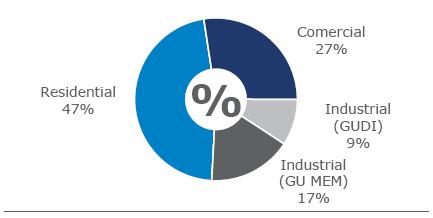
Source: CAMMESA.
Peak Demand Records
| 2017 | 2018 | 2019 | 2020 | 2021 | 2022 | 2023 | 2024 | 2025 | |
| Capacity (MW) | 25,628 | 26,320 | 26,113 | 25,791 | 27,088 | 28,283 | 29,105 | 29,653 | 30,257 |
| Date | Feb-24 | Feb-8 | Jan-29 | Feb-4 | Dec-29 | Dec-6 | Mar-13 | Feb-1 | Feb-10 |
| Temperature (°C) | 27.7 | 30.2 | 34.0 | 29.5 | 31.7 | 29.0 | 31.0 | 31.5 | 31.1 |
| Hour | 14:25 | 15:35 | 14:25 | 14:57 | 14:28 | 14:43 | 15:28 | 14:48 | 14:47 |
Source: CAMMESA.
During 2024, power generation grew by 1% in 2024, reaching 141,592 GWh, compared to 140,580 GWh recorded in 2023, mainly driven by renewable sources (a 2,791 GWh increase compared to 2023), thermal sources (a 2,370 GWh increase compared to 2023) and nuclear power availability (a 1,486 GWh increase compared to 2023), partially offset by a 15% reduction in hydropower generation, net of pumping (a 5,635 GWh decrease when compared to 2023).
The grid maintained its dependence on thermal generation, using both natural gas and liquid fuels (GO and FO) and mineral coal, contributing 53% of the total energy volume or 75,388 GWh, followed by hydropower generation net of pumping of 32,880 GWh (23% of the total energy volume), renewable energies with a generation of 22,875 GWh (16% of the total energy volume) and nuclear power with a generation of 10,449 GWh or 7% of the total energy volume.
|
|
Although the SADI has been a net power importer for the third consecutive year, in 2024, imports decreased by 25% to 4,654 GWh when compared to 2023, exports increased tenfold to 970 GWh compared to 2023, and losses were reduced by 14% to 5,049 GWh compared to 2023. The following chart shows the evolution of electric power generation by type of technology:
Generation by Type of Power Plant
In %, 2014 – 2024

Note: It includes WEM and Patagonian WEM System. Hydroelectric power generation net of pumping. Source: CAMMESA.
During 2024, generation facilities recorded a decrease in their installed capacity of 423 MW compared to the previous year, reaching a total of 43,351 MW as of December 2024. This decrease is mainly due to Yacyretá Power Plant’s lower firm availability (decrease of 1,195 MW compared to 2023) and the decommissioning of obsolete units by 583 MW. However, 925.2 MW from renewable units and 365.5 MW from thermal units were incorporated during 2024, including the 60 MW repowering of the Docksud Power Plant. The chart below shows the composition of installed capacity in Argentina as of December 31, 2024:
2024 Argentine installed power capacity
100% = 43.4 GW

Source: CAMMESA.
|
|
Regarding fuel supply for power generation, beginning on December 30, 2019 and pursuant to MDP Resolution No. 12/19, fuel commercial management and supply was again centralized in CAMMESA, except for generators with contracts under Energía Plus and SEE Resolution No. 287/17. Additionally, following the implementation of Plan Gas.Ar, on December 2, 2020 SE Resolution No. 354/20 was published, which, among other measures, established an optional scheme for the operating assignment of natural gas and its transportation to CAMMESA effective as of January 2021 for such exempted generators. Pampa acceded to this scheme. This new scheme set a new thermal dispatch order centralized in CAMMESA, which prioritizes units supplied with gas imported from Bolivia under a ToP condition, followed by those supplied under Plan Gas.Ar and, lastly, those with gas assigned to CAMMESA.
However, on January 28, 2025, the SE abrogated SE Res. No. 354/20, effective February 1, 2025, and established that, as of March 1, 2025, it will authorize generators to manage their fuel for spot energy units (SE Res. No. SE 21/25).
Fuel consumption for power plants increased by 1% year-on-year in 2024, totaling 45.4 million m3/day of gas equivalent. Natural gas accounted for 92% of total consumption, with a 9% increase, to 41.6 million m3/day, 93% of which was local and 7% imported. The use of alternative fuels (FO, GO and mineral coal) decreased by 65%, 27% and 51%, respectively.
The chart below shows the fuel consumption by type:
Fuel consumption by type
In % and million m3/day of gas equivalent, 2014 – 2023

Source: CAMMESA.
The following chart shows the monthly wholesale price that all electricity system users should pay so that the power grid would not run into a deficit, as well as the seasonal energy price. The wholesale cost includes, besides the energy price, the power capacity payment, the generation cost, fuels such as natural gas, FO, GO and mineral coal, and other minor items. As of December 2024, the coverage amounted to 92%.
|
|
Wholesale monthly cost and seasonal price
In U.S.$/MWh

Source: CAMMESA, converted into U.S.$ at the official FX rate.
Cost of sales
Our most significant costs of sales include purchases of inventory, energy and gas, personnel costs and property, plant and equipment depreciation and works contracts, fees and compensation for services.
Operating expenses
Our most significant operating expenses are administrative and selling expenses, which include related personnel costs, compensation agreements, fees and compensations for services, transportation and freights charges, and taxes.
Results of Operations
The table below provides a summary of our results of operations for the years ended December 31, 2024, and 2023.
| For the year ended December 31, | ||||
| 2024 | 2023 | |||
| Revenue | 1,876 | 1,732 | ||
| Cost of sales | (1,279) | (1,107) | ||
| Gross profit | 597 | 625 | ||
| Selling expenses | (74) | (66) | ||
| Administrative expenses | (239) | (185) | ||
| Exploration expenses | (21) | (7) | ||
| Other operating income | 175 | 177 | ||
| Other operating expenses | (88) | (88) | ||
| Impairment of property, plant and equipment, intangible assets and inventories | (34) | (39) | ||
| Impairment of financial assets | (56) | - | ||
| Share of profit (loss) from associates and joint ventures | 146 | (2) | ||
| Profit from sale/acquisition of companies’ interest | 34 | 9 | ||
| Operating income | 440 | 424 | ||
| Finance income | 32 | 5 | ||
| Finance costs | (185) | (364) | ||
| Other financial results | 211 | 558 | ||
| Financial results, net | 58 | 199 | ||
| Profit before income tax | 498 | 623 | ||
| Income tax | 121 | (318) | ||
| Profit of the year | 619 | 305 | ||
| Total Profit of the year attributable to: | ||||
| Owners of the Company | 619 | 302 | ||
| Non - controlling interest | - | 3 | ||
|
|
| 2024 | 2023 | |||||||
| Revenue | ||||||||
| Oil and Gas | 730 | 666 | ||||||
| Generation | 672 | 648 | ||||||
| Petrochemical | 516 | 507 | ||||||
| Holding and others | 65 | 14 | ||||||
| Eliminations | (107) | (103) | ||||||
| Total Revenue | 1,876 | 1,732 | ||||||
| Gross profit | ||||||||
| Oil and Gas | 215 | 254 | ||||||
| Generation | 305 | 294 | ||||||
| Petrochemical | 29 | 63 | ||||||
| Holding and others | 48 | 14 | ||||||
| Eliminations | - | - | ||||||
| Total Gross profit | 597 | 625 | ||||||
| Operating income (loss) | ||||||||
| Oil and Gas | 69 | 140 | ||||||
| Generation | 204 | 272 | ||||||
| Petrochemical | 43 | 45 | ||||||
| Holding and others | 124 | (33) | ||||||
| Eliminations | - | - | ||||||
| Total operating income | 440 | 424 | ||||||
| Total profit (loss) of the year | ||||||||
| Oil and Gas | (5) | (47) | ||||||
| Generation | 461 | 210 | ||||||
| Petrochemical | 72 | 30 | ||||||
| Holding and others | 91 | 112 | ||||||
| Eliminations | - | - | ||||||
| Total profit of the year | 619 | 305 | ||||||
| Total profit (loss) attributable to owners of the company | ||||||||
| Oil and gas | (5) | (47) | ||||||
| Generation | 461 | 207 | ||||||
| Petrochemical | 72 | 30 | ||||||
| Holding and others | 91 | 112 | ||||||
| Eliminations | - | - | ||||||
| Total profit attributable to owners of the company | 619 | 302 | ||||||
| Total profit attributable to non - controlling interest | ||||||||
| Generation | - | 3 | ||||||
| Total profit attributable to non - controlling interest | - | 3 | ||||||
We are a fully integrated power company in Argentina mainly participating in the oil and gas production and electricity generation businesses.
Through its own activities, subsidiaries and shareholdings in joint ventures and based on the business nature, customer portfolio and risks involved, the Company operates its businesses through following reportable segments:
| ● | Oil and Gas, principally consisting of the Company’s interests in oil and gas areas and through its direct and indirect interests in CISA (until a 2024 corporate reorganization) and Pampa Energía Chile S.A.; |
|
|
| ● | Electricity Generation, principally consisting of our direct and indirect interests in HINISA, HIDISA, Greenwind (until divestment on August 16, 2023), VAR, CTB, TMB, TJSM and through our own electricity generation activities through thermal plants CTG, CPB, Piquirenda, CTLL, CTGEBA, Ecoenergía, CTPP, CTIW, the HPPL hydroelectric complex and PEPE II, III, IV and VI wind farms; |
| ● | Petrochemicals, comprising of the Company’s own styrenics operations and the catalytic reformer plant operations conducted in Argentina; and |
| ● | Holding, Transportation and Others, principally consisting of our interests in joint businesses CITELEC, CIESA and their respective subsidiaries holding the concession over high-voltage electricity transmission and gas transportation, respectively, as well as the stake in OCP and VMOS. The segment’s operation results reflect the impact of the consolidation with OCP, effective as of August 30, 2024, and includes crude oil transportation activity until the end of the concession on November 29, 2024. |
We manage our operating segments based on our individual net result in U.S. dollars.
Fiscal year ended December 31, 2024 compared to the fiscal year ended December 31, 2023
Oil and Gas Segment
|
Oil and Gas (in millions of U.S.$) |
|||||
| For the fiscal year ended | |||||
| December 31, 2024 | December 31, 2023 | Variation | % | ||
| Revenue | 730 | 666 | 64 | 10% | |
| Cost of sales | (515) | (412) | (103) | 25% | |
| Gross profit | 215 | 254 | (39) | (15%) | |
| Selling expenses | (58) | (49) | (9) | 18% | |
| Administrative expenses | (82) | (74) | (8) | 11% | |
| Exploration expenses | (21) | (7) | (14) | 200% | |
| Other operating income and expenses, net | 59 | 54 | 5 | 9% | |
| Impairment of property, plant and equipment | (34) | (38) | 4 | (11%) | |
| Impairment of financial assets | (10) | - | (10) | 100% | |
| Operating income | 69 | 140 | (71) | (51%) | |
| Financial income | 2 | 2 | - | - | |
| Financial costs | (96) | (203) | 107 | (53%) | |
| Other financial results | (11) | (15) | 4 | (27%) | |
| Financial results, net | (105) | (216) | 111 | (51%) | |
| Loss before income tax | (36) | (76) | 40 | (53%) | |
| Income tax | 31 | 29 | 2 | 7% | |
| Loss of the year | (5) | (47) | 42 | (89%) | |
| Owners of the Company | (5) | (47) | 42 | (89%) | |
Revenue
Revenue from our oil and gas segment increased 10%, to U.S.$730 million for the fiscal year ended December 31, 2024, compared to U.S.$666 million for the fiscal year ended December 31, 2023. This increase is mainly explained by the growth in gas production, boosted by the round 4.2 of GasAr Plan, in which we were awarded a maximum flat volume of 4.8 million m3 per day to be evacuated through the Perito Francisco Pascasio Moreno Pipeline (formerly Nestor Kirchner Pipeline) and cooler temperatures compared to 2023, partially offset by lower gas volumes and prices sold to Chile and the industrial sector.
|
|
The average sale price for gas was U.S.$3.7/MBTU for the fiscal year ended December 31, 2024, 12% lower than U.S.$4.2/MBTU recorded in the fiscal year ended December 31, 2023, mainly explained by lower exports to Chile and industrial customer demand. The average sale price for oil was U.S.$70/bbl for the fiscal year ended December 31, 2024, 6% higher than the U.S.$66/bbl average sale price for the fiscal year ended December 31, 2023, in line with the increase of the international price of Brent, which is the main reference for the Company’s oil sale prices.
The following table shows our production and sales for the oil and gas segment for the years shown:
| Fiscal year ended | ||
| December 31, 2024 | December 31, 2023 | |
| Production | ||
| Oil (k bbl/day) | 4.8 | 4.8 |
| Gas (million m3/day) | 12.5 | 10.3 |
| Total (k boe/day) | 78.2 | 65.4 |
| Sales | ||
| Oil (k bbl/day) | 5.0 | 5.0 |
| Gas (million m3/day) | 12.5 | 10.3 |
| Total (k boe/day) | 78.3 | 65.5 |
Cost of Sales
The cost of sales from our oil and gas segment increased by 25%, to U.S.$515 million for the fiscal year ended December 31, 2024, from U.S.$412 million for the fiscal year ended December 31, 2023. The variation is mainly due to higher property, plant and equipment depreciation, higher royalty charges in line with the increase in sale volumes, and higher costs related to the increase in gas activity (maintenance and contractors).
Gross Profit
Gross profit from our oil and gas segment decreased by 15%, to U.S.$215 million for the fiscal year ended December 31, 2024, from U.S.$254 million for the fiscal year ended December 31, 2023. This variation is explained by higher costs and lower average gas sale prices, partially offset by higher gas sale volumes.
Additionally, the gross margin on sales decreased to 29% in the fiscal year ended December 31, 2024, compared to 38% for the fiscal year ended December 31, 2023.
Selling Expenses
Selling expenses from our oil and gas segment increased to U.S.$58 million for the fiscal year ended December 31, 2024, compared to U.S.$49 million for the fiscal year ended December 31, 2023 due to increased gas transportation expenses and taxes mainly explained by higher gas sale volumes.
Administrative Expenses
Administrative expenses from our oil and gas segment increased to U.S.$82 million for the fiscal year ended December 31, 2024, compared to U.S.$74 million for the fiscal year ended December 31, 2023, due to higher labour costs, which surpassed the Argentine peso devaluation, fees and remuneration for services.
Exploration expenses
Exploration expenses from our oil and gas segment amounted to U.S.$21 million for the fiscal year ended December 31, 2024, corresponding to the reduction of unproductive wells in Rincón del Mangrullo, compared to U.S.$7 million for the fiscal year ended December 31, 2023, due to our decision to relinquish the Rio Atuel block.
|
|
Other Operating Income and Expenses, net
Other operating income and expenses, net from our oil and gas segment recorded gains of U.S.$59 million for the fiscal year ended December 31, 2024, compared to U.S.$54 million for the fiscal year ended December 31, 2023, mainly due to higher commercial interests, and the profit from the sale of the Gobernador Ayala block, partially offset by lower GasAr Plan income.
Impairment of property, plant and equipment
Our oil and gas segment recorded an impairment of property, plant, of U.S.$34 million for the fiscal year ended December 31, 2024, compared to U.S.$38 million for the fiscal year ended December 31, 2023, both in the Rincón del Mangrullo and the El Tordillo/La Tapera blocks. These impairments were a product of the recoverable value of the CGUs, given that our strategy to focus our investments on the development and exploitation of unconventional oil and gas reserves.
Impairment of financial assets
Our oil and gas segment recorded an impairment of financial assets of U.S.$10 million, for the fiscal year ended December 31, 2024, while no impairment was recorded for the fiscal year ended December 31, 2023. This variation is explained by the impairment of U.S.$7.4 million of CAMMESA’s receivables and U.S.$2 million of GasAr Plan receivables recorded considering the market value of financial instruments, received under the agreed cancellation methodology set in SE Resolution No. 58/24 and Note NO-2024-54277417- APN-SE#MEC, respectively.
Operating Income
The operating income from our oil and gas segment decreased by U.S.$71 million (51%) to U.S.$69 million for the fiscal year ended December 31, 2024 compared to U.S.$140 million for the fiscal year ended December 31, 2023. This variation is mainly attributable to the decrease in gross profit, the increase in exploration expenses and the impairment of financial assets.
The operating margin in relation to sales for the fiscal year ended December 31, 2024, decreased to 9% compared to 21% for the fiscal year ended December 31, 2023.
Financial Results, Net
Financial results, net from our oil and gas segment amounted to a U.S.$105 million loss for the fiscal year ended December 31, 2024, compared to U.S.$216 million loss for the fiscal year ended December 31, 2023. This variation is mainly due to lower financial interest expenses, partially offset by lower gains from changes in the fair value of financial instruments.
Income Tax
Our oil and gas segment recorded an income tax benefit of U.S.$31 million for the fiscal year ended December 31, 2024, compared to U.S.$29 million income tax benefit for the fiscal year ended December 31, 2023. This variation is mainly related to the non-cash credit on deferred income tax due to an inflation higher than the Argentine peso devaluation.
Loss of the year
As a result of the foregoing, our oil and gas segment recorded a loss of U.S.$5 million for the fiscal year ended December 31, 2024, compared to a U.S.$47 million loss for the fiscal year ended December 31, 2023, both of which were entirely attributable to the owners of the Company.
|
|
Generation Segment
|
Generation (in millions of U.S.$) |
|||||
| For the fiscal year ended | |||||
| December 31, 2024 | December 31, 2023 | Variation | % | ||
| Revenue | 672 | 648 | 24 | 4% | |
| Cost of sales | (367) | (354) | (13) | 4% | |
| Gross profit | 305 | 294 | 11 | 4% | |
| Selling expenses | (3) | (2) | (1) | 50% | |
| Administrative expenses | (52) | (50) | (2) | 4% | |
| Other operating income and expenses, net | 21 | 48 | (27) | (56%) | |
| Share of loss from joint ventures | (21) | (18) | (3) | 17% | |
| Impairment of financial assets | (46) | - | (46) | 100% | |
| Operating income | 204 | 272 | (68) | (25%) | |
| Financial income | 8 | 2 | 6 | 300% | |
| Financial costs | (53) | (119) | 66 | (55%) | |
| Other financial results | 183 | 280 | (97) | (35%) | |
| Financial results, net | 138 | 163 | (25) | (15%) | |
| Profit before income tax | 342 | 435 | (93) | (21%) | |
| Income tax | 119 | (225) | 344 | (153%) | |
| Profit of the year | 461 | 210 | 251 | 120% | |
| Owners of the Company | 461 | 207 | 254 | 123% | |
| Non - controlling interest | - | 3 | (3) | (100%) | |
Revenue
Revenue from our generation segment increased 4%, to U.S.$672 million in the fiscal year ended December 31, 2024, compared to U.S.$648 million in the fiscal year ended December 31, 2023. This variation is mainly explained by: (i) an increase in renewable generation due to the completion of commissioning of PEPE IV in June 2023 and the gradual commissioning of PEPE VI during 2024; (ii) higher spot energy prices in Argentine pesos that outpaced the Argentine peso devaluation; and (iii) higher income from recognition of own fuel due to the greater volume sold. These effects were partially offset by lower Energy Plus demand and prices, due to the decline in industrial activity and the divestment of Greenwind in August 2023.
Power generation during the fiscal year ended December 31, 2024 increased by 2%, to 17,002 GWh compared to 16,743 GWh for the fiscal year ended December 31, 2023, mainly due to higher dispatch of our thermal units and an increase in renewable generation.
The following table shows net power generation and sales (in GWh) for our power generation plants:
| For the fiscal year ended | ||||
| December 31, 2024 | December 31, 2023 | |||
| in GWh | Net generation | Installed capacity (In Mw) | Net generation | Installed capacity (In Mw) |
| (In GWh) | (In GWh) | |||
| Hydroelectric | 2,363 | 938 | 1,964 | 938 |
| Wind | 1,270 | 427 | 1,206 | 206 |
| Thermal | 13,369 | 4,107 | 13,573 | 4,107 |
| Total | 17,002 | 5,471 | 16,743 | 5,251 |
Cost of Sales
Cost of sales from our generation segment increased by 4% to U.S.$367 million for the fiscal year ended December 31, 2024, compared to U.S.$354 million for the fiscal year ended December 31, 2023, mainly explained by higher gas and transportation purchases and higher depreciation of property, plant and equipment, offset by lower energy purchases due to lower marketed volume.
|
|
Gross Profit
Gross profit from our generation segment increased by 4%, to U.S.$305 million for the fiscal year ended December 31, 2024, compared to U.S.$294 million for the fiscal year ended December 31, 2023. This variation is mainly attributable to the increase in sales, partially offset by the increase in the related cost.
Moreover, the gross margin in relation to sales reached 45% in both the fiscal year ended December 31, 2024 and the fiscal year ended December 31, 2023.
Selling Expenses
Selling expenses from our generation segment increased to U.S.$3 million for the fiscal year ended December 31, 2024, compared to U.S.$2 million for the fiscal year ended December 31, 2023.
Administrative Expenses
Administrative expenses from our generation segment did not vary significantly, amounting to U.S.$52 million for the fiscal year ended December 31, 2024, compared to U.S.$50 million for the fiscal year ended December 31, 2023.
Other Operating Income and Expenses, Net
Other operating income and expenses, net from our generation segment decreased to a U.S.$21 million gain for the fiscal year ended December 31, 2024, compared to a U.S.$48 million gain for the fiscal year ended December 31, 2023. This variation is mainly explained by lower overdue interests from CAMMESA due to the drop in CAMMESA’s days sales outstanding ratio, partially offset by insurance recoveries in CTGEBA and PEPE III recorded in 2024.
Share of loss from joint ventures
The share of loss from joint ventures from our generation segment amounted to a U.S.$21 million loss for the fiscal year ended December 31, 2024, compared to a U.S.$18 million loss for the fiscal year ended December 31, 2023. This variation is mainly explained by the impairment of property, plant and equipment recorded by CTB in 2024, offset by the gain linked to the non-monetary credit for deferred income tax given that inflation was higher than the devaluation of the Argentine peso.
Impairment of financial assets
Our generation segment recorded an impairment of financial assets of U.S.$46 million for the fiscal year ended December 31, 2024, while no impairment was recorded for the fiscal year ended December 31, 2023. This variation is explained by the agreement entered into with CAMMESA instrumenting the exceptional, transitional and unique payment system established in SE Resolution No. 58/24 for the balance of unpaid economic transactions in the wholesale electricity market, including: (i) the December 2023 and January 2024 transactions that were settled with sovereign bonds valued at U.S.$0.65 per U.S. dollar of face value in the domestic market; and (ii) the February 2024 transaction that was settled in cash. Both payments did not recognize accrued interest, and as a result, the Company recorded a U.S.$46 million impairment in the related receivables of CAMMESA.
Operating Income
Operating income from our generation segment decreased by U.S.$68 million (25%), to U.S.$204 million for the fiscal year ended December 31, 2024, compared to U.S.$272 million for the fiscal year ended December 31, 2023. This variation is mainly attributable to the impairment in CAMMESA’s receivables and the decrease in CAMMESA’s commercial interests described above.
The operating margin in relation to sales for the fiscal year ended December 31, 2024, decreased to 30% compared to 42% for the fiscal year ended December 31, 2023.
|
|
Financial Results, net
Financial results, net from our generation segment amounted to a U.S.$138 million gain for the fiscal year ended December 31, 2024, compared to a U.S.$163 million gain for fiscal year ended December 31, 2023. This decrease is mainly due to lower gains from changes in the fair value of financial instruments, partially offset by lower financial interest expenses in line with lower peso denominated debt stock and lower foreign currency exchange differences losses over the monetary position in Pesos.
Income Tax
The generation segment recorded an income tax benefit of U.S.$119 million for the fiscal year ended December 31, 2024, compared to a tax charge of U.S.$225 million for the fiscal year ended December 31, 2023. The variation is mainly related to the non-cash credit on deferred income tax due to an inflation higher than the Argentine peso devaluation.
Profit of the year
As a result of the foregoing, the generation segment recorded a U.S.$461 million profit for the fiscal year ended December 31, 2024, entirely attributable to the owners of the Company, compared to a U.S.$210 million profit for the fiscal year ended December 31, 2023, of which U.S.$207 million were attributable to the owners of the Company.
Petrochemicals Segment
|
Petrochemical (in millions of U.S.$) |
|||||
| For the fiscal year ended | |||||
| December 31, 2024 | December 31, 2023 | Variation | % | ||
| Revenue | 516 | 507 | 9 | 2% | |
| Cost of sales | (487) | (444) | (43) | 10% | |
| Gross profit | 29 | 63 | (34) | (54%) | |
| Selling expenses | (13) | (15) | 2 | (13%) | |
| Administrative expenses | (7) | (6) | (1) | 17% | |
| Other operating income and expenses, net | 34 | 6 | 28 | 467% | |
| Impairment of inventory | - | (3) | 3 | (100%) | |
| Operating income | 43 | 45 | (2) | (4%) | |
| Financial income | 21 | - | 21 | 100% | |
| Financial costs | (3) | (3) | - | - | |
| Other financial results | 7 | 15 | (8) | (53%) | |
| Financial results, net | 25 | 12 | 13 | 108% | |
| Profit before income tax | 68 | 57 | 11 | 19% | |
| Income tax | 4 | (27) | 31 | (115%) | |
| Profit of the year | 72 | 30 | 42 | 140% | |
| Owners of the Company | 72 | 30 | 42 | 140% | |
Revenue
Revenue from our petrochemicals segment amounted to U.S.$516 million for the fiscal year ended December 31, 2024, 2% higher than the U.S.$507 million reported for the fiscal year ended December 31, 2023. This variation is mainly due to higher octane basis sale volumes, partially offset by lower styrene and polystyrene sale volumes.
Total sold volumes during the fiscal year ended December 31, 2024 experienced a 16% increase compared to the fiscal year ended December 31, 2023. This variation is mainly explained by higher sales from our reforming plant’s derived products, and lower sale volumes from styrene and polystyrene.
|
|
The following table shows sales volumes in the petrochemicals segment during the specified years:
| Volume sold in k ton | Fiscal year ended | |
| December 31, 2024 | December 31, 2023 | |
| Reforming Plant | 336 | 250 |
| Styrene & polystyrene | 88 | 112 |
| SBR | 45 | 43 |
| Total | 469 | 405 |
Cost of Sales
Cost of sales from our petrochemicals segment increased by 10%, to U.S.$487 million for the fiscal year ended December 31, 2024, compared to U.S.$444 million for the fiscal year ended December 31, 2023. This variation is mainly due to higher volumes sold and cost of our reforming plant’s derived products, partially offset by lower styrene and polystyrene sale volumes.
Gross Profit
Our petrochemical segment gross profit decreased by 54% to U.S.$29 million for the fiscal year ended December 31, 2024, compared to U.S.$63 million for the same period in 2023, mainly due to lower margins in polystyrene and reforming plant, partially offset by higher SBR sale volumes.
The gross margin on sales reached 6% for the fiscal year ended December 31, 2024, compared to 12% for the fiscal year ended December 31, 2023.
Selling Expenses
Selling expenses from our petrochemicals segment decreased to U.S.$13 million for the fiscal year ended December 31, 2024, compared to U.S.$15 million for the fiscal year ended December 31, 2023. This is mainly attributable to a reduction in taxes and commissions consistent with the decline in local sales.
Administrative Expenses
Administrative expenses from our petrochemicals segment did not vary significantly, amounting to U.S.$7 million for the fiscal year ended December 31, 2024, compared to U.S.$6 million for the fiscal year ended December 31, 2023.
Other operating income and expenses, net
Other operating income and expenses, net amounted to a U.S.$34 million gain for the fiscal year ended December 31, 2024, compared to a U.S.$6 million gain for the fiscal year ended December 31, 2023, which is mainly explained by the reversal of the customs contingency provision that had been recorded in previous years.
Impairment of inventory
Our petrochemical segment recorded a U.S.$3 million impairment of SBR inventories during the fiscal year ended December 31, 2023, because of the drop in international prices. No impairment of inventories was recorded during the fiscal year ended December 31, 2024.
Operating Income
The operating income from our petrochemicals segment decreased by U.S.$2 million (4%), to U.S.$43 million for the fiscal year ended December 31, 2024, compared to U.S.$45 million for the fiscal year ended December 31, 2023, mainly attributable to the decrease in gross profit, partially offset by the reversal of the customs contingency provision explained above.
|
|
The operating margin in relation to sales for the fiscal year ended December 31, 2024, decreased to 8% compared to 9% for the fiscal year ended December 31, 2023.
Financial Results, Net
Our petrochemicals segment recorded a U.S.$25 million gain for financial results, net for the fiscal year ended December 31, 2024, compared to a U.S.$12 million gain for the fiscal year ended December 31, 2023, mainly explained by higher interest gains as a result of the recovery of the customs contingency partially offset by lower foreign currency exchange differences gains over the monetary position in Argentine pesos.
Income Tax
The petrochemicals segment recorded an income tax benefit of U.S.$4 million for the fiscal year ended December 31, 2024, compared to a charge of U.S.$27 million for the fiscal year ended December 31, 2023, mainly due to non-taxable results in the year ended December 31, 2024.
Profit of the year
The petrochemicals segment recorded a profit of U.S.$72 million for the fiscal year ended December 31, 2024, compared to U.S.$30 million for the fiscal year ended December 31, 2023, both of which were entirely attributable to the owners of the Company.
Holding, Transportation and Others Segment
|
Holding, transportation and others (in millions of U.S.$) |
|||||
| For the fiscal year ended | |||||
| December 31, 2024 | December 31, 2023 | Variation | % | ||
| Revenue | 65 | 14 | 51 | 364% | |
| Cost of sales | (17) | - | (17) | 100% | |
| Gross profit | 48 | 14 | 34 | 243% | |
| Administrative expenses | (98) | (55) | (43) | 78% | |
| Other operating income and expenses, net | (27) | (19) | (8) | 42% | |
| Share of profit from joint ventures | 167 | 16 | 151 | 944% | |
| Recovery of impairment of intangible assets | - | 2 | (2) | (100%) | |
| Profit from sale of companies’ interest | 34 | 9 | 25 | 278% | |
| Operating income | 124 | (33) | 157 | (476%) | |
| Financial income | 1 | 7 | (6) | (86%) | |
| Financial costs | (33) | (45) | 12 | (27%) | |
| Other financial results | 32 | 278 | (246) | (88%) | |
| Financial results, net | - | 240 | (240) | (100%) | |
| Profit before income tax | 124 | 207 | (83) | (40%) | |
| Income tax | (33) | (95) | 62 | (65%) | |
| Profit of the year | 91 | 112 | (21) | (19%) | |
| Owners of the Company | 91 | 112 | (21) | (19%) | |
Revenue
Revenue from our holding, transportation and others segment increased by 364% to U.S.$65 million in the fiscal year ended December 31, 2024 compared to U.S.$14 million for the fiscal year ended December 31, 2023, mainly explained by the consolidation of OCP, effective as of August 30, 2024, which includes crude oil transportation activity until the end of the concession on November 29, 2024.
|
|
Cost of Sales
Cost of sales from our holding, transportation and others segment amounted to U.S.$17 million for the fiscal year ended December 31, 2024, entirely attributable to the consolidation of OCP, effective as of August 30, 2024, which includes crude oil transportation activity until the end of the concession on November 29, 2024.
Gross Profit
Our holding, transportation and others segment recorded a gross profit of U.S.$48 million for the fiscal year ended December 31, 2024, compared to U.S.$14 million for the fiscal year ended December 31, 2023, mainly explained by the consolidation of OCP, effective as of August 30, 2024, which includes crude oil transportation activity until the end of the concession on November 29, 2024.
Administrative Expenses
Administrative expenses from our holding, transportation and others segment increased to U.S.$98 million for the fiscal year ended December 31, 2024, compared to U.S.$55 million for the fiscal year ended December 31, 2023, mainly due to higher charge for executive compensation agreements and to a lesser extent fees and compensation for services.
Other Operating Income and Expenses, Net
Other operating income and expenses, net from our holding, transportation and others segment recorded a loss of U.S.$27 million for the fiscal year ended December 31, 2024, compared to a U.S.$19 million loss for the fiscal year ended December 31, 2023. The variation is mainly due to provision for contingencies charges recorded in 2024.
Share of profit from joint ventures and associates
Share of profit from joint ventures and associates from our holding, transportation and others segment amounted to U.S.$167 million for the fiscal year ended December 31, 2024, compared to U.S.$16 million for the fiscal year ended December 31, 2023. This variation is explained by higher profit from our stakes in (i) CIESA and CITELEC amounting to U.S.$99 million, consistent with the increase in their rates; and (ii) OCP amounting to U.S.$54 million, mainly due to gains recognized in the acquisition of additional shares in OCP’s capital stock.
Recovery of impairment of intangible assets
The recovery of impairment of intangible assets from our holding, transportation and others segment amounted U.S.$2 million for the fiscal year ended December 31, 2023, while no charges were recorded for the fiscal year ended December 31, 2024.
Profit from sale of companies’ interest
The profit from sale of companies’ interest from our holding, transportation and others segment amounted to U.S.$34 million for the fiscal year ended December 31, 2024, compared to U.S.$9 million for the fiscal year ended December 31, 2023, due to the sale of 0.76% interest in TGS in 2024.
Operating Income
Operating income from our holding, transportation and others segment amounted to a U.S.$124 million profit for the fiscal year ended December 31, 2024, compared to a U.S.$33 million loss for the fiscal year ended December 31, 2023, mainly attributable to the increase in gross profit and share of profits from joint ventures and associates partially offset the increase of administrative expenses.
|
|
Financial Results, Net
Our holding, transportation and others segment recorded U.S.$240 million financial net gain for the fiscal year ended December 31, 2023, mainly due to lower foreign currency net exchange differences gains over the monetary position in Pesos, while no charges were recorded for the year ended December 31, 2024.
Income Tax
Our holding, transportation and others segment recorded a decrease on the income tax charge amounting to U.S.$33 million for the fiscal year ended December 31, 2024, compared to U.S.$95 million for the fiscal year ended December 31, 2023, mainly due to lower profit before taxes.
Profit of the year
Our holding, transportation and others segment recorded a profit of U.S.$91 million for the fiscal year ended December 31, 2024, compared to U.S.$112 million for the fiscal year ended December 31, 2023, both of which were entirely attributable to the owners of the Company.
Fiscal year ended December 31, 2023 compared to the fiscal year ended December 31, 2022
For a discussion of the results for the fiscal year ended December 31, 2023 compared to the fiscal year ended December 31, 2022, please refer to “Item 5. Operating and Financial Review and Prospects” of our Annual Report on Form 20-F for the year ended December 31, 2023 filed on April 30, 2024.
Liquidity and Capital Resources
Analysis of our Financial Condition
Our ability to execute and carry out our strategic business plan depends upon our ability to obtain financing at a reasonable cost and on reasonable terms. Along these lines, and as a guiding principle, financial solvency is the foundation on which the sustainable development of our businesses is built. Pursuant to these strategic guidelines, we seek to: (a) Design a capital structure consistent with industry standards adaptable to the financial markets in which we operate; (b) Maintain a liquidity level—invested in financial assets with high credit quality—that allows us to meet our obligations; (c) Maintain a debt maturity profile consistent with projected cash generation; and (d) Efficiently manage borrowing costs.
Adhering to these guidelines enables us to treat financial management as a key element in the value creation process.
Our business activities are focused on the development and value-enhancement of our energy assets, while continuing to identify, evaluate and invest in other opportunities in the Argentine energy industry that offer significant growth potential and/or synergies.
Total consolidated borrowings as of December 31, 2024 and 2023 were U.S.$ 2,079 million and U.S.$ 1,448 million, respectively. As of December 31, 2024 and 2023, 99% and 95% of our borrowings were denominated in U.S. Dollars, respectively.
As of December 31, 2024 and 2023, cash and cash equivalents were U.S.$738 million and U.S.$ 171 million, respectively. We maintain our cash and cash equivalents in Pesos, and in U.S. Dollars depending on medium term requirements and availability, at all levels of operations. We conducted financings at both variable and fixed rates.
The table below reflects our cash position at the dates indicated and the net cash provided by (used in) operating, investing and financing activities during the years indicated:
| As of December 31, | |||||
| 2024 | 2023 | ||||
| Cash and cash equivalents at the beginning of the year | 171 | 106 | |||
| Net cash generated by operating activities | 435 | 575 | |||
| Net cash used in investing activities | (344) | (446) | |||
| Net cash generated by (used in) financing activities | 476 | (57) | |||
| Exchange difference generated by cash and cash equivalents | - | (7) | |||
| Cash and cash equivalents at the end of the year | 738 | 171 | |||
|
|
Net cash generated by operating activities
Net cash generated by operating activities amounted to U.S.$435 million for the year ended December 31, 2024, attributable to cash flow generated by net income without considering (i) non-cash losses (mainly related to U.S.$342 million for depreciation and amortization of assets, U.S.$106 million for interest accrual, U.S.$61 million for compensation agreements accrual, U.S.$56 million for financial assets impairment, U.S.$34 million for non-financial assets impairment and U.S.$27 million for defined benefit plans accrual), and (ii) non-cash profits (mainly related to U.S.$213 million for changes in the fair value of financial instruments, U.S.$146 million for share of profit from joint ventures and associates, U.S.$121 million for income tax and U.S.$34 million for companies’ interest sales), but considering (iii) changes in operating assets and liabilities (mainly related to an increase of U.S.$411 million in trade and other receivables).
Net cash generated by operating activities amounted to U.S.$575 million for the year ended December 31, 2023, attributable to cash flow generated by net income without considering (i) non-cash losses (mainly related to U.S.$318 million for income tax, U.S.$283 million for interest accrual and U.S.$267 million for depreciation and amortization of assets), and (ii) non-cash profits (mainly related to U.S.$392 million for changes in the fair value of financial instruments and U.S.$190 million for net exchange differences). However, such amounts take into account changes in operating assets and liabilities (mainly related to U.S.$151 million increase in trade and other receivables).
Net cash used in investing activities
Net cash used in investing activities amounted to U.S.$344 million for the year ended December 31, 2024, including payments of U.S.$447 million for purchases of property, plant and equipment and U.S.$48 million for the acquisition of companies; partially offset by U.S.$71 million cash proceeds for purchase of subsidiary; U.S.$39 million collection for equity interests in companies’ sales, and U.S.$37 million collection for joint ventures’ share repurchase.
Net cash used in investing activities amounted to U.S.$446 million for the year ended December 31, 2023, including payments of U.S.$758 million for purchases of property, plant and equipment, partially offset by U.S.$226 million in proceeds for public securities and shares sales and investment funds recovery and U.S.$72 million proceeds from equity interests in companies’ sales.
Net cash generated by or used in financing activities
Net cash generated by our financing activities amounted to U.S.$476 million for the year ended December 31, 2024, principally due to U.S.$1,174 million in proceeds from borrowings; partially offset by U.S.$694 million payments made in connection with bank and financial borrowings (including principal, interests, repurchase and redemption of corporate bonds).
Net cash used in our financing activities amounted to U.S.$57 million for the year ended December 31, 2023, principally due to payments of U.S.$471 million made in connection with bank and financial borrowings (including principal and interest), partially offset by U.S.$424 million in proceeds from borrowings.
Capital Expenditures
The following table sets forth our capital expenditures for the years ended December 31, 2024 and 2023:
|
|
| At December 31, | |||||
| 2024 | 2023 | ||||
| Oil and Gas | 354 | 556 | |||
| Generation | 105 | 259 | |||
| Petrochemical | 6 | 7 | |||
| Holding and others | 10 | 5 | |||
| 475 | 827 | ||||
Our capital expenditures in our oil and gas segment amounted to U.S.$354 million in 2024, mainly related to well and facility works in order to develop the Rincón de Aranda area and to increase gas production in the Sierra Chata and El Mangrullo areas.
In 2024, our capital expenditures in our generation segment amounted to U.S.$105 million mainly related to the completion of the construction of the 140MW in PEPE VI wind farm, which commercial commissioning was completed in November 2024.
Our capital expenditures in our oil and gas segment amounted to U.S.$556 million in 2023, mostly to develop unconventional oil and gas reserves in the Vaca Muerta formation, through well drilling and facilities construction.
In 2023, our capital expenditures in our generation segment amounted to U.S.$259 million mainly due to the construction of the PEPE VI wind farm of 140MW, which is expected to be fully commissioned during the fourth quarter of 2024 and the completion of the expansion works of the PEPE IV wind farm of 81 MW, the expansion of which was completed in June 2023.
Future Capital Requirements
We estimate that our capital investment requirements, debt payment obligations, dividend payments, and working capital will be financed through cash flow from operations, new debt financing, capital contributions, and potential divestments, as well as the prevailing political, economic, and social situation in Argentina. For more information, and those factors that could affect our levels of investments see “Item 3. Key Information - Risk Factors.”
In our generation segment, future capital investments will focus on maintaining our currently operating power plants, including extending the lifespan of two of our combined-cycle plants. In 2024, we completed the first phase of the PEPE VI Wind Farm Project, adding 139.5 MW of capacity with a total investment of U.S.$ 250 million.
In the oil and gas segment, the 2025 investment plan will focus heavily on our unconventional fields, with significant investments in developing our main crude oil area in Vaca Muerta, Rincón de Aranda. Additionally, funds will be allocated to gas production activities, in line with our commitments under the Plan Gas.Ar bidding rounds. Specifically, we will execute a 2025 investment plan of approximately U.S.$ 1 billion, primarily targeting the development of unconventional oil reserves through well drilling in the Vaca Muerta formation and surface facilities for production evacuation.
As part of our equity participation in VMOS and SESA, we will allocate funds in 2025 as capital contributions for the partial financing of the Vaca Muerta Oil Sur Project and the FLNG Project.
For further information on our investment commitments in oil and gas areas and our generation projects, please see Note 18 to our Consolidated Financial Statements.
Description of Indebtedness
Our total consolidated financial indebtedness as of December 31, 2024 was U.S.$ 2,079 million, of which 66% was long-term debt, 95% of which was denominated in U.S. Dollars (excluding U.S.$. linked debt for U.S.$. 96 million). The amount of our total consolidated financial debt does not include Transener, TGS and CTB given that our stake in those companies constitutes an interest in a joint venture, and as such is not consolidated and is valued according to the equity method of accounting in the Consolidated Financial Statements.
|
|
The below is a description of the main characteristics of the indebtedness of our group companies:
| 2024 | 2023 | |
| (in millions of U.S.$) | ||
| Short-Term Debt | ||
| Corporate Bonds | 584 | 126 |
| Financial borrowings | 122 | 67 |
| Bank overdrafts | - | 31 |
| 706 | 224 | |
| Long-Term Debt | ||
| Corporate Bonds(1) | 1,341 | 1,224 |
| Financial borrowings | 32 | - |
| Total | 1,373 | 1,224 |
| Total Indebtedness | 2,079 | 1,448 |
(1) Net of the following face value repurchases: U.S.$ 76.2 million of ON 2026 and U.S.$ 7.5 million of CB 2029 as of December 31, 2024 and U.S.$ 113.7 million of ON 2026, U.S.$ 153.0 million of CB 2027 and U.S.$ 7.5 million of CB 2029 as of December 31, 2023
Financings
During 2024, we continued to enhance our maturity profile, primarily through the following actions: (i) tender offer of our 7.50% notes due January 2027 (the “2027 Notes”) for a total amount of U.S.$ 397 million, (ii) redemption of Class 17 and 15 notes for Ps. 5,980 million and Ps. 18,264 million, respectively, and (iii) repayment at maturity the first amortization of our Class 9 notes for U.S.$ 59.1 million, net of repurchases.
Additionally, short-term bank loans were paid off for a net total amount of Ps. 25,968 million, we cancelled net short-term import financings for an amount equivalent to U.S.$ 16 million, and we obtained local bank loans for a net total amount of U.S.$ 129.5 million.
After the end of the 2024 fiscal year, we redeemed the outstanding total amount of our 2027 Notes for a total amount of U.S.$ 353 million, we cancelled financings with banks for a net total amount of U.S.$ 47.1 million and we cancelled the outstanding of our Series 19 notes for a total amount of Ps. 17,131.3 million.
The following table describes our debt maturity profile for the periods indicated, including principal amount plus the corresponding accrued interest as of December 31, 2024:
| < 1 year | 1-5 years | > 5 years | Total | |
| (in millions of U.S.$) (1) | ||||
| Total Indebtedness | 706 | 614 | 759 | 2,079 |
| (1) | The sums are rounded and they may not add up. |
Corporate Bonds
In 2024, we have participated actively in local and international capital markets, issuing the following notes:
| Notes | Currency |
Face value (in millions) |
Interest Rate | Maturity |
| Class 19 | Pesos | Ps. 17,131.2 | Badlar Privada -1% | Feb-25 |
| Class 20 (*) | U.S.$ | 107.7 | 6% | Mar-26 |
| Class 21 | U.S.$ | 410 | 7.95% | Sep-31 |
| Class 22 | U.S.$-MEP | 84 | 5.75% | Oct-28 |
| Class 23 | U.S.$ | 360 | 7.875% | Dic-34 |
(*) On March 26, 2024, we issued Class 20 notes for a total amount of U.S.$ 55.2. Moreover, on May 14, 2024 we reopened Class 20 notes for a total amount of U.S.$ 52.5 million at an issue price of U.S.$ 1.0079.
|
|
Tender offer and Redemption of 2027 Notes
On August 26, 2024, we announced the tender offer of our 2027 Notes issued on January 24, 2017 for a total amount of U.S.$ 750 million, which accrued interest at a fixed rate of 7.5% maturing in 2027. The tender offer settled on September 5, 2024, reaching approximately 53% of the total, equivalent to U.S.$ 397 million of our 2027 Notes.
The funds for the payment of the tender, the interest accrued from the last payment date to the settlement date of the offer and certain issuance costs, were obtained from the successful issuance of Class 21 notes, issued on September 10, 2024 for a total amount of U.S.$ 410 million, at a fixed interest rate of 7.95%, a yield of 8.25% and maturity on September 10, 2031.
Moreover, on December 16, 2024, we issued Class 23 notes for a total amount of U.S.$ 360 million, at a fixed interest rate and yield of 7.875% maturing in 2034. The Class 23 notes were mainly destined to redeem the outstanding 2027 Notes amounted to U.S.$ 353 million, which redemption was announced on December 5, 2024.
The redemption took place on January 24, 2025 at a redemption price equal to 100% of the outstanding capital amount, plus accrued and unpaid interest as of the redemption date, and plus additional amounts under the 2027 notes’ trust agreement.
FINNVERA Credit Facility
On May and November 2024, we cancelled the last two amortizations of FINNVERA Credit Facility for a total amount of U.S.$ 8 million. The interest rate hedge agreement associated with the credit facility was terminated accordingly.
Credit Ratings
During 2024, Fitch upgraded Pampa’s local long term credit rating from “AA+” to “AAA” due to the consolidation of strong cash flow generation in the gas and power generation businesses and the future prospects related to the development of shale oil in the Rincón de Aranda block. Moreover, S&P upgraded Pampa’s rating, first from “CCC-” to “CCC” due to the upgrade in Argentina`s credit rating, and later, on February 6, 2025, upgraded Pampa’s local and foreign currency debt rating from "CCC" to "B-" as a result of the upgrade in Argentina's “Transfer and Convertibility” assessment. On January 14, 2025, Moody’s upgraded Pampa’s rating from “Caa3” to “Caa1” due to the upgrade in Argentina`s credit rating in foreign currency.
As of the date of this annual report the Pampa ’s ratings are as follows:
| Company | Agency | Rating | ||
| Global | Local(2) | |||
| Pampa | S&P |
B- (1) |
- | |
| Moody’s |
Caa1(3) |
- | ||
| FitchRatings |
B- |
AAA (long term) A1+ (short term) |
||
(1)Upgraded by S&P on February 5, 2025 (2) Local ratings issued by FIX SCR (affiliate of Fitch Ratings) (3) Upgraded by Moody’s on January 14, 2025.
|
|
Covenants of our Indebtedness
Under the terms of the respective outstanding debt, we and certain of our subsidiaries are subject to a number of restrictive covenants, including limitations on incurrence of new indebtedness, capital expenditures and dividend payments, among others. As of December 31, 2024, we and our subsidiaries were in compliance with the covenants under our respective outstanding indebtedness.
| Item 6. | Directors, Senior Management and Employees |
General
We are managed by our board of directors, which is composed of ten directors and an equal or smaller number of alternate directors subject to the annual Shareholders’ Meeting decision. Five of our ten directors are independent according to the criteria and requirements for independent directors under applicable Argentine law. Five of our alternate directors are independent. The directors are elected on a staggered basis each year (three directors at a time in each of the first two years of a three-year cycle, and four in the third year). Our directors are elected for a three-fiscal-year term and can be reelected.
Pursuant to section 12 of our by-laws, any shareholder or group of shareholders who holds more than 3% of our capital stock (each, a “Proposing Shareholder”) may require our board of directors to give notice to our other shareholders of the candidate or candidates to be nominated by such shareholder or group of shareholders at our shareholders’ meeting for election of our board of directors. To such end, the relevant slate executed by the Proposing Shareholder or its representatives, as applicable, will be sent to the chairman of our board of directors, no less than five business days prior to the date of the relevant shareholders’ meeting, to be published in the bulletin of the BASE at least two days prior to the date of our shareholders’ meeting. To facilitate the formation of the slates and the record of the candidates’ names, as of the date of the first notice calling for the relevant meeting, a special book will be made available to our shareholders at our registered office in which the names of the candidates proposed by any proposing shareholder shall be recorded. Similarly, our board of directors will propose to the shareholders’ meeting the candidates for election by slate or, if election by slate is objected to, individually. The names of the candidates proposed by the board will be made known to all our shareholders together with the slates proposed by the Proposing Shareholder. In addition, no proposal for the election of directors may be made, either before or during the shareholders’ meeting, unless written evidence of acceptance of office by the proposed candidates is submitted to us. Such slate or person, as the case may be, who obtains the vote of a majority of the shares present at the meeting will be declared elected. If no slate obtains such majority, a new vote will be taken in which the two slates or persons that obtained the largest number of votes will take part, and the slate or person who obtains the largest number of votes will be declared elected. The preceding rules will not prevent a shareholder who is present at the shareholders’ meeting from proposing candidates not included in the proposals from our board of directors.
Duties and Liabilities of Directors
Pursuant to section 59 of the BCL, directors have the obligation to perform their duties with the loyalty and the diligence of a prudent businessperson. Directors are jointly and severally liable to the company, the shareholders and third parties for the improper performance of their duties, for violating the law, the company’s by-laws or regulations, if any, and for any damage caused by fraud, abuse of authority or negligence, as provided for in Section 274 of the BCL. The following are considered integral to a director’s duty of loyalty: (1) the prohibition on using corporate assets and confidential information for private purposes; (2) the prohibition on taking advantage, or to allow another to take advantage, by action or omission, of the business opportunities of the company; (3) the obligation to exercise board powers only for the purposes for which the law, the company’s by-laws or the shareholders’ or the board of directors’ resolution have intended; and (4) the obligation to take strict care so that acts of the board are not contrary, directly or indirectly, to the company’s interests. A director must inform the board of directors and the supervisory committee of any conflicting interest he or she may have in a proposed transaction and must abstain from voting thereon.
A director shall not be responsible for the decisions taken in a board of directors’ meeting as long as he or she states his or her opposition in writing and informs the supervisory committee before any claim arises. A director’s decision approved by the company’s shareholders releases that director of any responsibility for his decision, unless shareholders representing 5% or more of the company’s capital stock object to that approval, or the decision was taken in violation of applicable law or the company’s by-laws. The company is entitled to file judicial actions against a director if a majority of the company’s shareholders at a shareholders’ meeting request that action.
|
|
Under the BCL, the board of directors is in charge of the administration of the company and, therefore, makes any and all decisions in connection therewith, as well as those decisions expressly provided for in the BCL, the company’s by-laws and other applicable regulations. Furthermore, the board is generally responsible for the execution of the resolutions passed by shareholders’ meetings and for the performance of any particular task expressly delegated by the shareholders. In general, our board of directors may be more involved in operating decision-making than might be customary in other jurisdictions. Under the BCL, the duties and responsibilities of an alternate director, when acting in the place of a director on a temporary or permanent basis, are the same as those discussed above for directors. They have no other duties or responsibilities as alternate directors.
Board of Directors
The following table sets forth information about the members and alternate members of our board of directors. In accordance with Argentine law, each member maintains his or her position on the board until a new shareholders’ meeting elects new directors.
|
Full Name
|
Age | Position | Appointment Date | Termination Date |
| Marcos Marcelo Mindlin | 61 | Chairman | 04/29/2024 | 12/31/2026 |
| Gustavo Mariani | 54 | Vice Chairman | 04/26/2023 | 12/31/2025 |
| Ricardo Alejandro Torres | 67 | Director | 04/26/2023 | 12/31/2025 |
| Damián Miguel Mindlin | 59 | Director | 04/29/2024 | 12/31/2026 |
| Carolina Zang(1)(2) | 52 | Director | 04/07/2025 | 12/31/2027 |
| Gabriel Szpigiel (1) (2) | 58 | Director | 04/07/2025 | 12/31/2027 |
| Daniela Rivarola Meilan (1) (2) | 28 | Director | 04/07/2025 | 12/31/2027 |
| Julia Sofía Pomares (1) (2) | 49 | Director | 04/07/2025 | 12/31/2027 |
| Nicolás Mindlin | 35 | Director | 04/07/2025 | 12/31/2026 |
| Silvana Wasersztrom(1) (2) | 57 | Director | 04/26/2023 | 12/31/2025 |
| Clarisa Lifsic(1)(2) | 62 | Alternate Director | 04/07/2025 | 12/31/2027 |
| María Carolina Sigwald | 57 | Alternate Director | 04/07/2025 | 12/31/2027 |
| María de Lourdes Vázquez (1) (2) | 63 | Alternate Director | 04/29/2024 | 12/31/2026 |
| Clarisa Vittone (1) (2) | 57 | Alternate Director | 04/29/2024 | 12/31/2026 |
| Diego Martín Salaverri | 60 | Alternate Director | 04/07/2025 | 12/31/2027 |
| María Agustina Montes | 43 | Alternate Director | 04/26/2023 | 12/31/2025 |
| Mauricio Penta | 48 | Alternate Director | 04/29/2024 | 12/31/2026 |
| Horacio Jorge Tomás Turri | 64 | Alternate Director | 04/26/2023 | 12/31/2025 |
| Flavia Vanesa Bevilacqua (1) (2) | 40 | Alternate Director | 04/07/2025 | 12/31/2027 |
| Lorena Rappaport (1) (2) | 53 | Alternate Director | 04/07/2025 | 12/31/2027 |
| (1) | Independent Directors under CML and CNV’s regulations. |
| (2) | Independent Directors under Rule 10A-3 under the Securities Exchange Act of 1934, as amended. |
Marcos Marcelo Mindlin and Nicolás Mindlin are father and son. Also, Marcos Marcelo Mindlin and Damián Miguel Mindlin are brothers. There are no other family relationships between the other members of our board of directors.
|
|
Nomination Policy and Nomination Committee
The Company’s board of directors approved a Nomination Policy in order to establish the principles governing the nomination and appointment of members of the Board of Directors.
Within the Nomination Policy framework, the Board of Directors created a Nomination Committee that provides assistance to the Board of Directors and the shareholders in the nomination and appointment of the members of the Board, according to the requirements and procedures set forth in the applicable rules and regulations in force in Argentina, Pampa’s bylaws and the rules of the committee.
The Nomination Committee reports to Pampa’s Board of Directors and consists of three regular members and an equal or lower number of alternate members.
The President of the committee must be independent, as determined by the guidelines set forth by the national securities commission. At present, Pampa’s Nomination Committee is composed as follows:
| Name | Position | |
| Silvana Wasersztrom | President | |
| Gustavo Mariani | Regular Member | |
| Gabriel Szpigiel | Regular Member | |
| María Carolina Sigwald | Alternate Member | |
| Clarisa Lifsic | Alternate Member |
Senior Management
The table below sets forth certain information concerning our senior management:
| Name | Position | Age | ||
| Marcos Marcelo Mindlin | Chairman | 61 | ||
| Gustavo Mariani | Executive Vice president - Chief Executive Officer (CEO) | 54 | ||
| Ricardo Alejandro Torres | Executive Vice president | 67 | ||
| Damián Miguel Mindlin | Executive Vice president | 59 | ||
| Nicolás Mindlin | Executive Vice president | 35 | ||
| Horacio Jorge Tomás Turri | Executive Director of Exploration and Production | 64 | ||
| Adolfo Zuberbuhler | Executive Director of Finances (CFO) | 47 | ||
| María Carolina Sigwald | Executive Director of Legal Affairs | 57 | ||
| Mauricio Penta | Executive Director of Administration, IT and Supply | 48 |
The business address of each of our current directors and executive officers is Maipú 1, City of Buenos Aires, Argentina (C1084ABA).
Set forth below are brief biographical descriptions of the members of our board of directors and our senior management.
|
|
Marcos Marcelo Mindlin was born on January 19, 1964. He has been a member of our board of directors since 2006 and serves as Chairman of Pampa. Mr. Mindlin received a Master of Science in Business Administration from the Universidad del CEMA (Center of Macroeconomic Studies). He also holds a degree in Economics from the Universidad de Buenos Aires. From 1989 to 2004, Mr. Mindlin served as the founder, Senior Portfolio Manager and a shareholder of Grupo Dolphin. From 1991 to 2003, Mr. Mindlin was also a shareholder, Vice-Chairman and Chief Financial Officer of Inversiones y Representaciones S.A. (IRSA), a leading Argentine real estate company listed on the New York Stock Exchange. In November 2003, Mr. Mindlin resigned from IRSA to focus his work on Grupo Dolphin. Mr. Mindlin has extensive expertise in Latin America through his role as Chairman of the board of directors of Grupo Dolphin and several of its affiliates. From 1999 to 2004, Mr. Mindlin also served as Vice Chairman of Alto Palermo S.A. (a leading owner and operator of shopping centers in Buenos Aires), Vice Chairman at Cresud S.A.I.C. (one of the largest listed agricultural companies in Argentina) and ODS S.A. He also served as Director and member of the Executive Committee of Banco Hipotecario, the leading mortgage bank in Argentina. In 2008, Mr. Mindlin founded, and since that time has directed, the Foundation whose purpose is to improve childhood development and education. Mr. Mindlin is also a member and was Chairman of the Board of the Executive Committee of Tzedaká, a leading Jewish-Argentine foundation, and a member of the Council of the Americas. Mr. Mindlin is currently Chairman of Grupo Dolphin Holding S.A., Emes Finance S.A. and member of the board of Orígenes Seguros de Retiro S.A., among others.
Gustavo Mariani was born on September 9, 1970. He has been a member of our board of directors since 2005 and serves as Vice-Chairman and CEO of Pampa. Mr. Mariani holds a degree in Economics from the Universidad de Belgrano and a Master in Finance from the Universidad del CEMA (Center of Macroeconomic Studies) and also is a Chartered Financial Analyst (CFA) since 1998. Mr. Mariani joined Grupo Dolphin in 1993 as an analyst and also served as an investment portfolio manager. Mr. Mariani is currently member of the board of HIDISA, HINISA, Generación Argentina S.A., SACDE, Emes Air S.A., Grupo Emes S.A., Emes Finance S.A., Grupo Dolphin Holding S.A., Orígenes Seguros de Retiro S.A. and the Foundation, among others.
Damián Miguel Mindlin was born on January 3, 1966. He has been a member of our board of directors since November 2005 and serves as Executive Vice president. Mr. Mindlin joined Grupo Dolphin in 1991 as a shareholder and a director. Since November 2003, Mr. Mindlin has served as Investment Portfolio Manager of Grupo Dolphin. He is currently member of the board of SACDE, Profingas S.A., Líneas del Norte S.A., Minera Geometales S.A., Compañía Americana de Transmisión Eléctrica S.A. (CATESA), Líneas de Comahue Cuyo S.A., HIDISA, HINISA, Grupo Emes S.A., Emes Finance S.A, Grupo Dolphin Holding S.A., Líneas Mesopotámicas S.A., Orígenes Seguros de Retiro S.A. and CIESA, among others.
Ricardo Alejandro Torres was born on March 26, 1958. He has been a member of our board of directors since November 2005 and serves as Executive Vice president. Mr. Torres holds a degree in accounting from the Universidad de Buenos Aires and a Master in Business Administration from the Instituto de Altos Estudios Empresariales-Escuela de Negocios de la Universidad Austral and was a professor of Tax and Finance at the school of Economics of the Universidad de Buenos Aires. He is currently member of the board of Pop Argentina S.R.L., SACDE, CITELEC, HIDISA, HINISA, Transba, Transener, Fiplasto S.A., Orígenes Seguro de Retiro S.A. and Fundación Observatorio Argentinos por la Educación, among others.
Nicolás Mindlin was born on November 11, 1989. He has been a member of our board of directors since April 2025 and serves as Executive Vice president of the Company. Mr. Mindlin holds an Industrial Engineer degree from the Technological Institute of Buenos Aires and was CFO of Pampa until his appointment as Executive Vice President. Mr. Mindlin serves as member of the board of Pampa Energía Bolivia S.A. and VAR, among others.
Gabriel Szpigiel was born on February 3, 1967. He has been a member of our Board of Directors since April 2025 and serves as President of our Audit Committee. He holds a degree in Economics from the Universidad de Buenos Aires. With over 30 years of experience as an investment professional, Mr. Szpigiel has held various senior positions at renowned institutions, including ING Bank, Smith Barney, Deutsche Bank in New York and London, and Marathon Asset Management in New York, where he served as Partner and Global Head of Emerging Markets. He is currently a Partner Emeritus at Marathon Asset Management. Additionally, he serves on the boards of the Americas Society/Council of the Americas and Women Across Frontiers. Mr. Szpigiel is also a member of the Latin American Circle of the Guggenheim Museum and has previously served as Vice Chair of the Emerging Markets Traders Association.
Silvana Wasersztrom was born on March 18, 1968. She has been a member of our board since 2019 and serves as member of our Audit Committee. Ms. Wasersztrom is a lawyer and completed postgraduate studies in Tax and Customs Law at the Universidad Austral and Belgrano. Since 2012 she has practiced independently in her firm. Previously, from 1994 to 2002, she worked at Marval, O’Farrell & Mairal Abogados, and did an internship in Tampa, Florida, United States in the year 1992-1993.
|
|
Carolina Zang was born on October 26, 1972. She has been a member of our board of directors since 2022 and serves as member of our Audit Committee. Ms. Zang holds a law degree in Universidad de Buenos Aires and has a Masters in law from New York University School of Law. She is also a partner of Zang, Bergel & Viñes Law Firm in the market and finance area. She worked at Chadbourne & Parke LLP and in the National Legal Directorate of the Secretariat of Natural Resources and Human Environment. Ms. Zang also is a Director in the Bar Association of the City of Buenos Aires, member of the boards of the Adeba Foundation, member of the Cippec Advisory Council and of the Council of Lawyers for Civil and Economic Rights of the Cyrus R. Vance Center for International Justice in New York City. Ms. Zang is also member of the Board of Directors of Banco Hipotecario S.A., among others.
Daniela Rivarola Meilan was born on October 24, 1996. She has been a member of our board of directors since April 2025. She holds a degree in Law from the Universidad de Buenos Aires and in International Relations and Foreign Affairs from the Universidad del Salvador. Ms. Rivarola is a business development professional with extensive experience in identifying market opportunities, contract negotiation, and business relationship management and currently holds the position of head of business development in Decrypto.la.
Julia Sofía Pomares was born on June 6, 1975. She has been a member of our board of directors since 2024. Ms. Pomares is also a member of the board of directors of Sociedad Importadora y Exportadora de la Patagonia La Anónima. Additionally, she serves on the Executive Council of Hacedoras, an organization dedicated to promoting the involvement and influence of women in public policies in Latin America. Furthermore, Ms. Pomares is a founding member of PROLIGE (Leading Women Network in Public and Private Sectors in Argentina). Ms. Pomares holds a Bachelor's Degree in Political Sciences from the University of Argentina, where she graduated with honors. She also obtained a Master's in Comparative Politics and a Master's in Research Methods in Political Science, as well as a PhD in Political Science from the London School of Economics and Political Science. With over 20 years of experience at the intersection of the public and private sectors, Ms. Pomares focuses on emerging technologies, particularly generative AI. She is a member of the Global Solutions Initiative in Berlin and serves as a guest professor at the Government School of Torcuato Di Tella University, where she heads the Master's program in Political Science.
Clarisa Diana Lifsic was born on July 28, 1962. She has been a member of our board of directors since 2022. She is also Director of La Pionera de Anta, La Morocha del Sur, STAT Research y Biomakers SA, among others. Ms. Lifstic holds a Bachelor’s in Economics from the Universidad de Buenos Aires, where she graduated with honors and a Master of Science in Management from the Massachusetts Institute of Technology (Summa Cum Laude).
María Carolina Sigwald was born on November 15, 1967. She has been a member of our board of directors since 2017. She is the Executive Director of Legal Affairs of the Company since November 2017. Ms. Sigwald obtained her law degree from the Universidad de Buenos Aires, where she graduated with honors. She started her professional career as a lawyer in Central Puerto S.A. after its privatization and then joined Chadbourne & Parke in New York and later the IIC in Washington. Carolina returned to Argentina in 1998 as founding partner of Law Firm Díaz Bobillo, Sigwald & Vittone, where she performed as external advisor for energy companies, Pampa among them. She is currently member of the board of CITELEC, CTB, Transba, TGS, CIESA, VMOS, VAR, Pampa Energía Bolivia S.A., Generación Argentina S.A. and the Foundation, among others.
María de Lourdes Vázquez was born on February 11, 1962. She has been member of our board of directors since 2024. Mrs. Vázquez is a lawyer from the Universidad Católica Argentina and holds an LL.M. Master of Laws from Harvard Law School. She also holds a degree in cinematography from the Centro de Investigación Cinematográfica (Argentina). Mrs. Vázquez is dean of the law department in the Universidad de San Andrés where she has been professor in different graduate and postgraduate courses; and is also visiting and associate professor at Harvard University. She has also held in-house counsel positions in EMI Records (New York) and in Virgin Records (London) and as a partner in Marval, O’Farrel & Mairal Law Firm (Buenos Aires).
Clarisa Vittone was born on October 6, 1967. She has been a member of our board of directors since 2022. Mrs. Vittone has a Law degree, with a Specialization in Business Law, from Universidad de Buenos Aires. She also completed a Postgraduate Studies in NGO Management at Universidad de San Andrés. Since 2011 she has been Partner at Amrop Argentina and is member of the Regional Committee of Business Development for Amrop Latinoamerica. She leads in Latin America the practice of diversity and inclusion. Her second area of specialization is in the field of digital talent advising since 2015 companies, promoting digital transformation and the development of digital capabilities for C-level and Boards of Directors. Thirdly, she works in boards consultancy practice. Previously she worked at Valuar, a local prestigious executive search company. Before that, Mrs. Vittone worked for 15 years at Deutsche Bank and EFG Bank in executive roles of corporate, investment and private banking.
|
|
Diego Martín Salaverri was born on August 7, 1964. He has been a member of our Board of Directors since 2021 and a founding partner of the Argentine law firm of Salaverri, Burgio & Wetzler Malbrán. He earned a degree in law in 1988 from the Universidad Católica Argentina, Buenos Aires. Currently, Mr. Salaverri serves as member of the Board of Directors of SACDE and member of the Supervisory Committee of Cardif Seguros S.A., Soluciones de Asistencia Integral S.A., Préstamos y Servicios S.A., Life Seguros de Personas y Patrimoniales S.A., Orígenes Seguros de Retiro S.A., Grupo Dolphin Holding S.A., Partners I S.A. and Norpatagónica S.A., among others.
María Agustina Montes was born on September 28, 1981. She has been a member of our board of directors since 2021. Ms. Montes holds a bachelor’s in law from the Universidad de Buenos Aires. Currently, she serves as Pampa's Corporate Legal and M&A Manager, having joined the company in 2011. She worked at the firm Cleary, Gottlieb, Steen & Hamilton in its New York offices in 2014. Previously, Ms. Montes worked as a lawyer in the firm Bruchou, Fernandez Madero & Lombardi. Currently, Ms. Montes is member of the board of HINISA, Pampa Energía Bolivia S.A., CTB, HIDISA, Transba, TGS and VAR, among others.
Mauricio Penta was born on July 23, 1976. He is the Executive Director of Administration IT and Supply of the Company. Mr. Penta graduated in Public Accounting from the Universidad Argentina de la Empresa and he received an MBA from the Altos Estudios Empresariales. Previously, Mr. Penta worked for Deloitte and Grupo Cencosud as Tax Manager. Mr. Penta serves as member of the board of CTB, Pampa Energía Soluciones S.A., Generación Argentina S.A, and VAR.
Horacio Jorge Tomás Turri was born on March 19, 1961. He serves as Executive Director of Exploration and Production. Mr. Turri is an industrial engineer and received his degree from Instituto Tecnológico Buenos Aires. Mr. Turri served as Chief Executive Officer of Central Puerto S.A., Hidroeléctrica Piedra del Águila and Gener Argentina S.A. He worked as an analyst of investment projects in the oil, gas and electricity sectors at SACEIF Luis Dreyfus from 1990 to 1992. He also worked at Arthur Andersen & Co. and Schlumberger Wireline in 1987-1990 and 1985-1987, respectively. He currently serves as member of the board of TGS and CIESA, among others.
Flavia Vanesa Bevilacqua was born on July 30, 1984. She has been a member of our board of directors since April 2025. She holds a degree in Law and a Master in Business and Economy Law, both from the Universidad Católica Argentina. She is also an international certified compliance and ethics professional from the Universidad del CEMA. Ms. Bevilacqua is currently Corporate Matters Director at the FGS – ANSES, where she previously was coordinator of production, industry and services in such direction. She was also member of the Board of different Argentinean companies such as EDENOR, Mirgor SACIFIA, Transener and Naturgy Ban S.A., among others.
Lorena Rappaport was born on October 21, 1971. She has been a member of our board of directors since 2022. Mrs. Rappaport holds a Bachelor in Law from Universidad de Belgrano in 1997, is a Certified Compliance Officer, by the International Federation of Compliance Associations (IFCA) - Universidad del CEMA - Asociación Argentina de Etica y Compliance in 2016; and holds a specialization in Legal Tech and Innovation granted by George Washington University in 2020.
Adolfo Zuberbuhler was born on March 20, 1978. Mr. Zuberbuhler is currently CFO of Pampa. After many years in banking, he joined the Company in 2007 as an analyst, later served as investment portfolio manager and then as Director of Finance until January 2025 when he was appointed CFO. He has wide experience in capital markets and financial investments. He holds a degree in Business Economics and a master’s degree in applied economics from Universidad Torcuato Di Tella and a diploma in Finance from UNR. He is a professor in the finance department at Universidad del CEMA and a guest professor at the Burgundy School of Business.
On April 16, 2018, the CNV issued Resolution No. 730, which establishes the criteria to determine if a director for the board of directors of companies under public regime shall not be considered independent. The Argentine independence standards under CNV rules differ in many ways from the NYSE, National Association of Securities Dealers Automated Quotation (“NASDAQ”) or the U.S. federal securities law standards. See “Item 16G. Corporate Governance.”
|
|
The following directors, including alternate directors, do not qualify as independent members of our board of directors in accordance with the CNV criteria: Marcos Marcelo Mindlin, Ricardo Alejandro Torres, Damián Miguel Mindlin, Gustavo Mariani, Nicolás Mindlin, María Carolina Sigwald, Diego Martín Salaverri, Mauricio Penta, María Agustina Montes and Horacio Jorge Tomás Turri.
On the other hand, the following directors, including alternate directors, qualify as independent members of our board of directors according to the above-mentioned criteria: Silvana Wasersztrom, Gabriel Szpigiel, Daniela Rivarola Meilan, Julia Sofía Pomares, María Vázquez, Carolina Zang, Clarisa Vittone, Clarisa Lifsic, Lorena Rappaport and Flavia Vanesa Bevilacqua.
Audit Committee
According to the provisions of Section 109 of the CML, the Company established an audit committee. On February 18 and November 21, 2019, the audit committee approved an amendment of the audit charter, including the possibility of reelection of the members of the audit committee for successive terms.
Composition
Our audit committee is composed of three members of the board and of two alternate members. All the members of our audit committee must be independent according to the audit charter and must have professional experience in finance, accounting, law and/or management.
The following table sets forth certain relevant information of the members of our audit committee:
| Name | Position | |
| Gabriel Szpigiel | President | |
| Silvana Wasersztrom | Regular Member | |
| Carolina Zang | Regular Member | |
| Clarisa Lifsic | Alternate Member |
Each of the members of the Audit Committee satisfies the independence requirements of Rule 10A-3 of the Exchange Act. For biographical information on the member of the audit committee, see his biography under “Board of Directors”.
Budget
Our audit committee has an annual budget approved by the ordinary annual shareholders’ meeting based on available funds from, without limitation, our revenues, investments and cost savings.
Duties and authority
Our audit committee is responsible for the performance of the duties that fall within its scope of authority pursuant to the provisions of the CML. These duties include, among others, the following:
| · | supervising the operation of the internal control systems and the administrative-accounting system of the Company as well as the reliability of the administrative-accounting system and of all the financial information for any other material facts submitted to the consideration of the authorities in compliance with the applicable reporting requirements in force; |
| · | issuing an opinion on the external auditors nominated by the board of directors to be retained by the Company and verifying if they are independent pursuant to the CML; |
|
|
| · | reviewing the plans submitted by the external auditors, supervising and assessing their performance and issuing an opinion thereon upon the presentation and publication of the Company’s annual financial statements and overseeing internal audit planning and performance; |
| · | supervising compliance with the risk management information policies in place in the Company; |
| · | issuing an opinion in relation to transactions with related parties in the events set forth in the applicable law and inform the provisions of the applicable law to the extent there is or may be an alleged conflict of interest in the Company; |
| · | providing the market with complete information regarding transactions in which there are conflicts of interest with the members of our corporate bodies or controlling shareholders; |
| · | verifying compliance with applicable standards of conduct; |
| · | issuing an opinion with respect to the reasonableness of the fees of members of the Board of Directors and stock option plans proposed by the Board of Director; |
| · | issuing an opinion with respect to the compliance with legal requirements and on the reasonableness of proposals to issue shares or securities convertible into shares, in the case of capital increases that exclude or limit preemptive rights; |
| · | Providing any report, opinion or statement required by the current regulations in force, with the scope and frequency required by such regulations, as amended; |
| · | Complying with all obligations provided for in our by-laws, as well as regulations binding for us; and |
| · | preparing an annual working plan to be reported to the Board of Directors and the Supervisory Committee within a term of 60 calendar days as from the beginning of the fiscal year. |
Independence Criteria
Pursuant to the CML and CNV regulations, we are required to have an audit committee consisting of at least three members of our Board of Directors. Under CNV regulations, at least a majority of the members of the audit committee must be independent directors under CNV standards (see “Item 16G. Corporate Governance. Section 303A.02”).
Pursuant to NYSE Rule 303A.06, we are required to have an audit committee that complies with Rule 10-A3 of the Securities Exchange Act of 1934, as amended. Under rule 10-A3 of the Securities Exchange Act of 1934, as amended, we are required to comply with certain independence standards. Each member of the audit committee must be independent and a member of the board of directors. Pursuant to Rule 10-A3, in order to be considered “independent”, a member of an audit committee of a listed issuer may not, other than in his or her capacity as a member of the audit committee, the board of directors, or any other board committee:
| · | accept directly or indirectly any consulting, advisory, or other compensatory fee from the issuer or any subsidiary thereof. Compensatory fees do not include the receipt of fixed amounts of compensation under a retirement plan (including deferred compensation) for prior service with the listed issuer (provided that such compensation is not contingent in any way on continued service); or |
| · | be an affiliated person of the issuer or any subsidiary thereof. |
Additionally, as of the date of this annual report, all members of our Audit Committee satisfy the independence requirements of Rule 10A-3 of the Securities Exchange Act of 1934, as amended, applicable NYSE standards to the audit committees of foreign private issuers and CNV requirements.
Supervisory Committee
Our current by-laws set forth a supervisory committee composed of three regular and three alternate members. The members of the supervisory committee shall hold office for a term of three fiscal years. Pursuant to the BCL, only lawyers and accountants admitted to practice in Argentina may serve as members of a supervisory committee of an Argentine sociedad anónima, or limited liability corporation.
|
|
The primary responsibilities of the supervisory committee are to monitor the management’s compliance with the BCL, the by-laws, its regulations, if any, and the shareholders’ resolutions, and to perform these duties include, inter alia, the following:
| (1) | attending meetings of the board of directors, audit committee and shareholders; |
| (2) | calling extraordinary shareholders’ meetings when deemed necessary and ordinary and special shareholders’ meetings when not called by the board of directors; and |
| (3) | investigating written complaints of shareholders. |
In performing these functions, the supervisory committee does not control our operations or assess the merits of the decisions made by the directors. The duties and responsibilities of an alternate member, when acting in the place of a regular member on a temporary or permanent basis, are the same as those discussed above for the regular members. They have no other duties or responsibilities as alternate members.
The following table sets forth certain relevant information of the members of our supervisory committee:
| Name | Position | Age |
| Roberto Antonio Lizondo | Regular Member | 55 |
| José Daniel Abelovich | Regular Member | 68 |
| Martín Fernandez Dussaut | Regular Member | 44 |
| Noemí Cohn | Alternate Member | 65 |
| Tomás Arnaude | Alternate Member | 43 |
| Germán Wetzler Malbrán | Alternate Member | 55 |
Set forth below are brief biographical descriptions of the members of our supervisory committee:
Roberto Antonio Lizondo was born on September 25, 1969. Mr. Lizondo obtained a law degree from Universidad Nacional de Tucumán and a Master of Laws degree from The London School of Economics and Political Science. He is a partner of the Argentine law firm Salaverri, Burgio & Wetzler Malbrán and was a foreign associate of Brown & Wood in 1999-2000. He is a member of the Supervisory Committee of Soluciones de Asistencia Integral S.A., Cardif Seguros S.A. (Life Insurtech) and Life Seguros de Personas y Patrimoniales S.A.
José D. Abelovich. Mr. Abelovich obtained a degree in accounting from Universidad de Buenos Aires. He is a founding member and partner of Lisicki Litvin & Abelovich. Formerly, he was a manager of Harteneck, López y Cía/Coopers & Lybrand and served as senior advisor in Argentina for the United Nations and the World Bank. He is a member of the supervisory committees of CITELEC, CIESA, HIDISA, VAR, Transba, Transener, TGS, Cresud, IRSA and Banco Hipotecario S.A., among others.
Martín Fernandez Dussaut was born on January 29, 1981. Mr. Fernández Dussaut received his law degree from the Universidad Católica Argentina. He is a partner of the Argentine law firm Salaverri, Burgio & Wetzler Malbrán and was a foreign associate at Cleary, Gottlieb, Steen & Hamilton in 2008. He is a member of the Board of Directors of Latin Securities S.A., CT Mitre Office S.A. and Delta Asset Management S.A., among others. Additionally, he is a member of the Supervisory Committee of CIESA, TAP Billetera S.A., Profingas S.A., Minera Geometales S.A., SACDE, CTB, Focolare S.A., Generación Argentina S.A., VAR, Grupo Dolphin Holding S.A., and Numera Analytics S.A.U., among others.
Noemí Ivonne Cohn was born on May 20, 1959. Mrs. Cohn obtained a degree in accounting from Universidad de Buenos Aires. She is a partner of Lisicki Litvin & Abelovich. Mrs. Cohn worked in the audit area of Harteneck, López y Cía/Copers, Coopers & Lybrand in Argentina and Los Angeles, California. Mrs. Cohn is member of the supervisory committees of Cresud, IRSA, Generación Argentina S.A. and VAR, among others.
|
|
Tomás Arnaude was born on December 17, 1981. Mr. Arnaude received his law degree from the Universidad Católica Argentina. He is a partner of the Argentine law firm Salaverri, Burgio & Wetzler Malbrán and was a foreign associate of Shearman & Sterling LLP in 2010 - 2011. He currently serves as a member of the Supervisory Committee of TAP Billetera S.A., SACDE, CTB, Cardif Seguros S.A., Soluciones de Asistencia Integral S.A., Compañía de Inversiones de Energía S.A., Generación Argentina S.A., Life Seguros de Personas y Patrimoniales S.A. and CITELEC, among others.
Germán Wetzler Malbrán was born on April 25, 1970. Mr. Wetzler Malbrán received his law degree from the Universidad Católica Argentina. He is a partner of the Argentine law firm Salaverri, Burgio & Wetzler Malbrán and was a foreign associate of Simpson Thacher & Bartlett LLP in 2005. He currently serves as a member of the Supervisory Committee of Cardif Seguros S.A., Soluciones de Asistencia Integral S.A., Compañía Americana de Transmisión Eléctrica S.A., CTB, Generación Argentina S.A., SACDE, Life Seguros de Personas y Patrimoniales S.A., TAP Billetera S.A., Profingas S.A., Minera Geometales S.A., Focolare S.A., Envases Plásticos S.A., Grupo Dolphin Holding S.A., VAR, Orígenes Seguros de Retiro S.A., Salta Refrescos S.A. and Prestamos y Servicios S.A., among others. Additionally, he is an alternate member of the Board of Directors of Grupo Emes S.A.
Corporate Governance
The Company enacted several policies and practices, including a comprehensive code of conduct:
| · | Code of Conduct. This code, approved by our board, constitutes the guide for making honest decisions in daily activities and defines how to address challenges. It sets out core principles to ensure a service of excellence for our customers and build relationships with our suppliers, teammates, shareholders, authorities, intermediate organizations and the Pampa community. |
| · | Ethics Committee. It is a consultation body. Its main responsibilities include providing guidance on the Code of Conduct, following up on cases received through the ethics hotline, and rendering its opinion on disciplinary actions and conflicts of interest. This committee comprises the human resources, legal and audit departments, with oversight of our CEO. |
| · | Ethics Hotline. The Company has implemented an exclusive channel to report, under strict confidentiality, any suspected misconduct or breach of the Code of Conduct. |
| · | Fraud, Corruption and Other Irregularities Policy. This policy reaffirms transparency and ethics as essential behaviors to lead the Company’s business and achieve sustainable growth. It also prohibits fraud, corruption in any form, or acts of misconduct within Pampa. Moreover, it sets Pampa’s stance on preventing corruption and other acts of misconduct, complementing the principles and values defined in our Code of Conduct. Therefore, both documents should be read in conjunction. This Policy also includes clauses on the obligation to report any actual or suspected violation of laws and/or regulations, as well as the prohibition of retaliation against anyone filing a report legitimately and in good faith or refusing to participate in acts of corruption. |
| · | Related Parties Transactions Policy. Pursuant to this policy, and as stated in the applicable regulations, all high-value transactions (i.e. all exceeding 1% of the net worth of the Company according to the last approved financial statements) made by the Company with individuals and/or legal entities which are considered to be “related parties” pursuant to the provisions set forth in applicable regulations, must be subject to a specific prior authorization and control procedure that is carried out under the coordination of the Company’s legal affairs executive department and which involves both the Company’s board and its Audit Committee, as applicable. |
| · | Policy on Material Information’s Disclosure. This policy regulates processes for publishing relevant information as per the regulatory requirements of the stock exchanges where Pampa’s securities are traded or those in which Pampa is a registered issuer. To ensure the duly execution and compliance with the policy and applicable regulations with respect to this matter, the Company established an Information Disclosure Committee. |
|
|
| · | Policy on Best Security Market Practices. This policy outlines certain restrictions and formalities on trading Pampa and/or its affiliates marketable securities listed in a stock exchange. It ensures transparency and guarantees that no benefit or economic advantage is gained from misusing material non-public information about Pampa and/or its affiliates. It applies to employees (including all of our senior management lines), directors and members of the Supervisory Committee. For more information, please see “11.1. Insider Trading Policy”. |
| · | Integrated Management Policy. This policy is an evolved version of the Quality, Safety, Environment and Labor Health Policy, adapted to the Company’s present situation and the challenges it faces, driving the sustainable development of our businesses. It adds supplementary aspects to QHSE, such as the efficient use of energy and natural resources, the reliability and integrity of our facilities and operations, and asset management optimization. The policy reaffirms that integrated management is an essential part of our operations and includes ten management principles guiding its simple and agile implementation and strengthening Pampa’s culture. |
| · | Self-Assessment Questionnaire for the Board of Directors. Our Board of Directors implemented an annual self-assessment questionnaire to evaluate its own performance and management. The Company’s Corporate Law Department is in charge of examining and filing each questionnaire with the individual answers given by the Board members and, based on the results, it shall submit to the Board any proposed measures deemed useful to improve the performance of the board’s duties. |
| · | Nomination Policy. This policy establishes the principles governing the nomination and appointment of members of the Board of Directors of Pampa and is designed pursuant to the rules and regulations in force in Argentina, the bylaws of the Company and the rules of the Nomination Committee that are applicable to the matter. |
| · | Compensation Policy. This policy is designed in accordance with the laws and regulations in force in Argentina, the bylaws of the Company and the rules of the Compensation Committee and provides guidance on the principles pursuant to which compensation is payable to the members of the Board of Directors of Pampa. It will be used by the shareholders, the Board of Directors and the Compensation Committee to guide their practice. |
| · | Compensation Recovery (Clawback) Policy. This policy was approved by our Board during 2023, in accordance with applicable SEC regulations. For more information about our Clawback Policy, please see Exhibit 6 - Compensation Recovery Policy. |
| · | Dividend Policy. This policy, in accordance with laws and regulations in force in Argentina and the Company’s bylaws, outlines the guidelines for balancing distributed amounts and Pampa’s investment plans. |
| · | Pre-approval of Principal Accountant Services. This Policy standardizes the internal process that allows the Audit Committee to comply with its obligation to grant prior approval of the provision by the external auditor of any kind of authorized service to the Company. |
Compensation of Directors and Officers
The BCL provides that the compensation payable to all directors (including those directors who are also members of senior management) in a fiscal year may not exceed 5% of net income for such fiscal year, if the company is not paying dividends in respect of such net income. The BCL increases the annual limitation on director compensation to up to 25% of net income if all the net income for such year is distributed as dividend. The percentage decreases proportionally based on the relation between the net income and the dividends distributed. The BCL also provides that the shareholders’ meeting may approve the remuneration of the directors in excess of the limits set by the BCL in case the company has no net income or the net income is low, if the relevant directors performed during such fiscal year special commitments or technical-administrative functions. The audit committee issues an opinion with respect to the reasonableness of the fees of members of the Board of Directors. Also, the aggregate amount payable to the Board of Directors’ members will be previously submitted to the Compensation Committee (as defined below) for its opinion as to whether the compensation proposed is consistent with compensation received by directors at other comparable local companies. The compensation of all directors and members of the supervisory committee requires shareholders’ approval at an ordinary shareholders’ meeting.
|
|
At the ordinary shareholders’ meeting held on April 7, 2025, the compensation for Pampa’s directors was set for a total amount of Ps. 14,058 million for the year ended December 31, 2024. This amount includes fees, remunerations, gratifications and benefits of compensation agreements.
Compensation Plans
Stock-based Compensation Plan
With the aim of aligning personnel performance with our strategic plan and creating a transparent and direct link between value creation for the shareholders and personnel remuneration, on February 8, 2017, our board of directors approved the creation of stock-based compensation plan (the “Plan”). In order to implement the Plan, we can create individual plans each year.
The Company acquired 6 million of its own shares, out of which around 2 million were allocated to the compensation of senior managers. As of the date of this annual report, we held in treasury 3,878,939 common shares to be delivered to employees under such plan, which represents 0.3% of our issued capital.
During fiscal years ended December 31, 2022, 2023 and 2024, the Company delivered 0.6, 0.6 and 0.5 million, respectively, of its own shares each year as payments under the stock compensation plan for officers and other key staff. As of the date of this report, during 2025, the Company delivered 0.5 million shares as payments under the stock compensation plan for officers and other key staff.
Compensation Agreements – Senior Management
The Company has executed compensation agreements with the Company’s main executives, aimed at aligning the interests of such executives with those of the Company and its shareholders, creating value for them only to the extent that value is created for the shareholders. These agreements mainly provide for an annual, variable and contingent compensation equivalent to, in the aggregate, to 3.6% of the Company’s annual market value appreciation, measured in U.S. Dollars, with an annual cap of 50% of the accrued amount and 1.8% of the Company’s operating income before interest, taxes and other non-cash items (adjusted EBITDA provision) for the period to be compensated. Accrued amounts which have not been paid by the Company will be deferred to future fiscal periods.
The payment of the annual compensation will be subject to the prior approval of the Shareholders’ Meeting to be held in each fiscal year.
Furthermore, Pampa will deduct from the variable compensation, if applicable, remunerations that beneficiaries may have collected on account of bonds and/or other similar items from subsidiaries of Pampa, proportionally to the Company’s interests in such companies.
|
|
Compensation Policy and Compensation Committee
The Company’s Board of Directors approved a Compensation Policy to provide guidance on the principles pursuant to which compensation is payable to the members of the Board of Directors of Pampa.
Within the Compensation Policy framework, the Board of Directors created a Compensation Committee that will assist them and the shareholders in matters related to the compensation of the members of Pampa’s Board of Directors, in compliance with the requirements and procedures set forth in the applicable rules and regulations in force in Argentina, Pampa’s bylaws and the rules of the committee. The Compensation Committee reports to the Board of Directors and will consist of three regular members and equal or lower number of alternate members, who shall not serve in executive offices at Pampa.
As of the date of this annual report, Pampa’s Compensation Committee is composed as follows:
| Name | Position | |
| Gabriel Szpigiel | President | |
| Silvana Wasersztrom | Regular Member | |
| Carolina Zang | Regular Member | |
| Clarisa Lifsic | Alternate Member |
Share Ownership
As of March 31, 2025, the following members of our board of directors and our senior management had an ownership interest in our capital stock of: Marcos Marcelo Mindlin (14.45%), Gustavo Mariani (2.81%), Damian Miguel Mindlin (2.79%), Ricardo Alejandro Torres (1.89%), Horacio Turri (0.51%) and Mauricio Penta (0.01%). No other member of our board of directors or our senior management beneficially owns any shares of our capital stock. See “Item 7. Major Shareholders and Related Party Transactions.”
Employees
Excluding those employed by us on a temporary basis and including controlled-subsidiaries, as of December 31, 2024, we had 1,847 full time employees. Additionally, we operate CTEB, which is jointly owned with YPF and has 105 full-time employees.
Approximately 50.78% of our workforce is affiliated with a union and/or is a party to a collective bargaining agreement. We have completed salary negotiations for 2024, except for Zarate Plant, where 2024 salary negotiations are still under discussion. We maintain a positive relationship with each of the employee unions at the Company and our subsidiaries’ levels.
We offer a variety of benefits beyond those required by the Argentine Labor Contract Law but make no payments to retirees or terminated employees. In accordance with the agreements we have entered with the unions at some of our subsidiaries, we are required to pay certain seniority premiums to retiring employees as a one-time payment upon retirement.
| Item 7. | Major Shareholders and Related Party Transactions |
Major Shareholders
On April 26, 2023, the extraordinary general meeting of shareholders approved a capital stock reduction through the cancellation of 20,124,225 common treasury shares of Pampa. Consequently, our capital stock decreased to 1,363,520,380 shares.
J.P. Morgan informed us that, as of March 31, 2025, there were 23,128,549 outstanding ADSs. As of such date, there was one registered holder of our ADSs in the United States. Since certain of our ADSs are held by brokers or other nominees, the number of direct record holders in the United States may not be fully indicative of the number of direct beneficial owners in the United States of our ADSs, or of where the direct beneficial owners of such ADSs are resident. We have no information concerning holders with registered addresses in the United States that hold our shares, which are not represented by ADSs.
|
|
The table below sets forth information concerning the beneficial ownership of our common shares as of March 31, 2025:
| Name of Shareholder | Number of Shares | Percentage of our Capital Stock | Percentage of voting power | |||
| Management - Control Group | ||||||
| Marcos Marcelo Mindlin | 197,009,884 | 14.45% | 14.45% | |||
| Gustavo Mariani | 38,378,992 | 2.81% | 2.81% | |||
| Damián Miguel Mindlin | 38,053,720 | 2.79% | 2.79% | |||
| Ricardo Alejandro Torres | 25,766,080 | 1.89% | 1.89% | |||
| Other Major Shareholders | ||||||
| ANSES (¹) | 306,958,364 | 22.51% | 22.51% | |||
| Hidden Lake S.A. | 69,139,594 | 5.07% | 5.07% |
Note: Our major shareholders do not have different voting rights.
(1) On November 20, 2008, the Argentine Congress passed a law unifying the Argentine pension and retirement system into a system publicly administered by the ANSES and eliminating the retirement savings system previously administered by private pension funds under the supervision of a governmental agency. In accordance with the new law, private pension funds transferred all of the assets administered by them under the retirement savings system to the ANSES. These transferred assets included 295,765,953 common shares of the Company, representing 20.50% of our capital stock at that date. The ANSES is subject to the same investment rules, prohibitions and restrictions that were applicable to the Argentine private pension funds under the retirement savings system, except as described in the following sentence. On April 12, 2011, the Executive Power issued Emergency Decree No. 441, which annulled the restrictions under Section 76(f) of Law No. 24,241on the exercise of more than 5% of the voting power in any local or foreign company, such as the Company, in any meeting of shareholders, irrespective of the actual interest held in the relevant company's capital stock. The annulment of the restrictions under Section 76(f) of Law No. 24,241 came into effect on April 14, 2011. As of such date, ANSES may exercise its voting power in any local or foreign company, such as the Company, based on the actual interest held in the relevant company’s capital stock.
Related Party Transactions
The BCL permits directors of a corporation to enter into transactions with that corporation provided that any such transactions are consistent with prevailing market practice. The CML provides that corporations whose shares are subject to public offerings must submit to their respective audit committees the issuance of a prior opinion of all transactions with a related party involving an amount that exceeds 1% of the corporation’s net worth.
Compensation Plans
See “Item 6. Directors, Senior Management and Employees – Compensation Plans”.
For further information on our related parties’ transactions and our outstanding balances from our transactions with related companies (including companies under joint control), please see Note 17 to our Audited Consolidated Financial Statements.
Except as set forth above and as otherwise permitted under applicable law, we are currently not party to any transactions with, and have not made any significant loans to, any of our directors, key management personnel or other related persons, and have not provided any guarantees for the benefit of such persons, nor are there any such transactions contemplated with any such persons.
Interests of experts and counsel
During the year ended December 31, 2022, 2023 and 2024 we engaged the services of the Argentine law firm Salaverri, Burgio & Wetzler Malbrán. One alternate director, Mr. Diego Martín Salaverri, two members of our Supervisory Committee, Martín Fernandez Dussaut and Roberto Antonio Lizondo, and two of the alternate members of our Supervisory Committee, Tomás Arnaude and Germán Wetzler Malbrán, are partners of Salaverri, Burgio & Wetzler Malbrán.
|
|
| Item 8. | Financial Information |
CONSOLIDATED FINANCIAL STATEMENTS
See “Item 18. Financial Statements” beginning on page F-1.
LEGAL PROCEEDINGS
We are party to several civil, commercial, contentious-administrative, tax, customs and labor proceedings and claims that arise in the ordinary course of its business. In determining a proper level of provision, the Company has considered its best estimate mainly with the assistance of legal and tax advisors. As of December 31, 2024, we recorded provisions for U.S.$ 73.8 million in relation to the following proceedings:
| - | Relevant Customs Proceedings - Gasoline Exports: there are an important number of proceedings in process before the National Tax Court (“NTC”) in which the tax authority challenges the tariff heading used by Petrobras during 2008-2014. The fiscal authority takes a position of a higher export duty rate. In five cases, the NTC issued judgments in favor of the Company. Three of these were acquiesced to by the tax authority and, consequently, became final. In the remaining two cases, the period for the tax authority to potentially file an appeal is currently running. |
| - | Petrobras Operaciones S.A. (“POSA”) has filed an international arbitration claim against the Company before the International Chamber of Commerce (“ICC”) on account of alleged breaches to the Assignment Agreement entered into between Petrobras Argentina S.A. (currently Pampa) and POSA in 2016 for the transfer of a 33.6% interest in the “Río Neuquén” Concession. The breaches alleged by POSA in its arbitration claim consist of the failure to transfer certain assets associated with the assigned interest, and differences in the calculation of adjustments in the assignment price. The arbitration will be conducted according to the ICC Rules of Arbitration, the applicable law will be that of the Republic of Argentina, and the seat of arbitration will be Buenos Aires, Argentina. On April 30, 2021, POSA filed its statement of claim and on September 15, 2021, the Company filed its statement of defense and its statement of counterclaim. On December 15, 2021, POSA filed its statement of defense to the counterclaim. After the proceedings were suspended by the Court at the request of the parties, the latter decided to continue with the procedure. On April 3, 2024, ICC notified the parties of the final award issued by the arbitration court on April 2, 2024, resolving to: (i) reject all of POSA’s claims except one, ordering Pampa to pay the corresponding 33.60% of (a) the payments received under the Leasing Agreement up to the date of the Final Award plus interest and (b) the payments that the Company receives under the mentioned contract and (ii) grant Pampa’s counterclaim. On April 10, 2024, the Company filed an action for a partial annulment of the final award. |
Additionally, the Company has recorded provisions for civil, commercial, environmental, administrative, labor, tax and customs complaints brought against the Company corresponding to atomized claims with individual unsubstantial amounts, as well as charges for judicial costs and expenses which, as of December 31, 2024, amount to U.S.$ 21.7 million.
Set forth below are brief descriptions of the nature of the significant legal proceedings or claims in which the Company is a party. As of December 31, 2024, the Company, in accordance with the analysis of our internal and external legal advisors, considers that such legal proceedings are not viable.
Labor Claims - Compensatory Plan
We face several legal proceedings associated with one of our defined benefit plans, the “Compensatory Plan” (see “Item 18. Financial Statements—Note 11.8”). We hereinafter describe the nature of currently-pending labor claims:
| · | Claims alleging that the index (IPC) used to update the plan benefits is ineffective to keep the benefits’ “constant value”. In two of the cases, the Company obtained a favorable judgment, which has been appealed by the plaintiff. On the contrary, another case has obtained an unfavorable judgment for the Company and, consequently, we appealed to the respective Court. |
| · | Claims on an alleged underfunding of the plan upon the elimination of the Company’s contributions based on earnings. The Company obtained a favorable first instance judgment. The plaintiff appealed and the Court of Appeals granted the plaintiff’s claim. Against such ruling, the Company filed a federal extraordinary appeal before the CSJN, which the Court rendered inadmissible. Consequently, the Company filed a motion for reconsideration of dismissal of appeal before the CSJN and filed an appeal on the grounds of unconstitutionality before the Superior Court of Justice of the Autonomous City of Buenos Aires (“STJBA”). The STJBA sustained the Company's motion for reconsideration of dismissal of appeal and, consequently, requested the Chamber of Commerce to send the file to the STJBA, in order to treat the unconstitutionality appeal filed. The Court of Appeals in Commercial Matters rejected the STJBA order so, consequently, the file was sent to the CSJN to resolve the jurisdictional dispute. |
|
|
Tax Claims
Tax on Liquid Fuels and Natural Gas
ARCA claims the payment of Ps. 54 million due to an alleged omission in the payment of the tax on liquid fuels and natural gas for the fiscal periods from January 2006 to August 2011, plus compensatory interest and a fine of Ps. 38 million as a result of alleged tax avoidance. ARCA’s claim is based on the existence of misappropriation of a tax benefit that was meant for sales in regions that are considered by tax law as tax relieved. The proceeding is currently being heard before the NTC, and the evidentiary period has been completed.
Environmental Claims
| - | The Association of Land Owners of Patagonia (ASSUPA) has brought a complaint for an indefinite amount against the Company and other companies seeking the restoration of the environment to the state prior to the exploration, exploitation, production, storage and transportation of hydrocarbon works conducted by the defendants and the prevention of alleged future environmental impacts on certain areas in the Austral Basin. The National Government and the Provinces of Santa Cruz and Tierra del Fuego have been summoned as third parties. The proceeding is at the complaint answer stage. |
| - | ASSUPA has instituted a complaint before the CSJN against 10 companies, including the Company. The National Government and the Provinces of Buenos Aires, La Pampa, Mendoza, Neuquén and Río Negro have been summoned as third parties. The main claim seeks that the defendants should be ordered to redress the alleged environmental damage caused by the hydrocarbon activity developed in the Neuquina Basin and to set up the environmental restoration fund provided for by section 22 of the General Environmental Law. Alternatively, and in case restoration is not possible, it seeks the redress of the allegedly sustained collective damages for an amount estimated at U.S.$547 million based on a United Nations Development Program report. The proceeding is in the complaint answer stage. |
| - | Fundación SurfRider Argentina has requested the performance of preliminary proceedings on account of alleged indications of environmental damage in the City of Mar del Plata. The plaintiff seeks the environmental restoration, or compensation for the alleged damages caused by all companies owning gas stations in the coastal area of the City of Mar del Plata for an alleged fuel leakage from gas stations’ underground storage tanks into the water, soil and marine system. The Foundation estimates damages in the amount of Ps. 200 million. The parties agreed to suspend the procedural deadlines, for the purposes of evaluating the possibility of entering into an agreement with some co-defendants. Subsequently, the partial agreement entered into between the plaintiff and some co-defendants was officially approved. The Company, for its part requested the disassociation from the process because it does not currently own any service station. However, it should be noted that some service station owners (for which the Company was sued) presented in the file agreements entered into with the plaintiff for their official approval. Some have already been officially approved - and the plaintiff was considered to have partially withdrawn the action and right against the owners of said service stations and also against the Company with respect to them - and others are in the approval stage. |
Civil and Commercial Claims
| - | The consumers’ association named “Consumidores Financieros Asociación Civil Para Su Defensa” claim the nominal amount of U.S.$3,650 million as compensation for damages against Pampa, Petrolera Pampa and certain Pampa directors in office during 2016 who are co-plaintiffs together with Petroleo Brasileiro S.A. A complaint has been brought against Petrobras Brasil for the depreciation of the share quotation value as a result of the “lava jato operation” and the so-called “Petrolao”, and the plaintiffs claim Pampa’s, Petrolera Pampa’s and the directors’ joint and several liability alleging the acquisition of indirect control in Petrobras Argentina S.A. may have thwarted the enforcement of a possible judgment favorable to the plaintiff (for up to the amount of the price paid by Pampa for the acquisition of control over Petrobras Argentina S.A.). The plaintiff appealed the Arbitration Court’s decision declaring the dismissal of the main claim upon the failure to pay the arbitration fee. The Court of Appeals in Commercial Matters upheld the filed extraordinary appeal. On its part, Petróleo Brasileiro S.A. filed an appearance, requesting that a lack of substance of the filed appeal should be declared, and, in the alternative, answering such appeal. The Company was notified that the Court of Appeals in Commercial Matters had upheld the appeal and filed a motion in this regard. Subsequently, the CSJN declared the nullity of the decision of the Court of Appeals in Commercial Matters that granted the extraordinary appeal and sent the proceedings back for a new decision. The Court of Appeals in Commercial Matter rejected the extraordinary federal appeal filed by the aforementioned Association. The Association filed a motion of dismissal of appeal before the CSJN, which is studying it. |
|
|
Administrative claims
| - | CTLL (currently Pampa) filed an administrative litigation complaint against the Federal Government for contractual breach during the January 2016-July 2016 period. CTLL claims that CAMMESA’s decision regarding the renewal and recognition of costs associated with natural gas supply agreements should be reversed and that, alternatively, sustained damages should be redressed. Subsequently, CTLL filed a new administrative litigation complaint against the Federal Government for contractual breach during the April 2016-October 2018 period. Both cases are currently pending judgment. |
| - | Upon the determination of the expiration of the Veta Escondida block concession granted by the Province of Neuquén, the Company filed a writ of amparo and, as secondary petition, a declaratory judgment action to achieve certainty under the original jurisdiction of the CSJN pursuant to section 322 of the Federal Code of Civil and Commercial Procedure. The Company requested judgment and the CSJN set a preliminary hearing, which was held. Following the opinion issued by the Attorney General’s Office, the case is currently pending judgment before the CSJN. |
| - | On March 31, 2021, the Company brought a Preliminary Administrative Claim before Argentina’s Ministry of Economy seeking the amount due, plus interest, which was borne by the National State during the term of the Executive Order 1053/18 for the difference in the exchange rate between the price of gas purchased by gas distributors and the price of gas recognized in the final rates of gas distributors for the April 2018-March 2019 period. On September 1, 2021, a motion for prompt intervention was filed. On December 2, 2021, the Company filed a writ of amparo for late payment seeking the defendant’s compliance, which was later rejected. Against this decision, the Company filed an appeal, which was rejected by the acting Court. Since the term for MECON to make a statement on the RAP has expired, the Company brought a proceeding against the National State. The case is open to evidence. |
Civil and Commercial claims
| - | Pampa Bloque18, in its capacity as assignee of the Ecuadorian company Petromanabí S.A., has filed an international arbitration proceeding against the Republic of Ecuador seeking the payment of 12% of the Settlement Value, the latter pursuant to the terms of the Hydrocarbon Exploration and Crude Oil Exploitation Participation Agreement in Block 18 entered into on December 19, 1995 and/or the Hollín Common Field Unified Exploitation Operating Agreement executed on August 7, 2002 —in both cases, as amended. The arbitration will be conducted according to the Arbitration Rules of the United Nations Commission on International Trade Law, the applicable law will be the Ecuadorian law, and the seat of arbitration will be the City of Santiago de Chile. The first stages of the international arbitration process began in 2021. As of the date of this report, the arbitration process is still ongoing. |
| - | The Company has initiated an international arbitration against High Luck Group Limited – Sucursal Argentina for certain breaches of the Farmout Agreement and the Joint Operating Agreement regarding Chirete Block entered into on April 1, 2015. On August 23, 2023, the Arbitration Court issued a Partial Award, with costs against the defendant, in which it ruled that High Luck breached the aforementioned Contract, but that this fact does not enable the Company to exercise the option of retrocession. provided therein. On August 21, 2024, the ICC notified the parties of the Final Award issued by the Arbitrarion Court on August 14, 2024, in which it resolved that: (i) HLG committed a fundamental and material breach of its obligations as operator; (ii) the breach described in the preceding point entitled Pampa to remove HLG as operator; and (iii) HLG shall pay to Pampa 100% of the costs of the arbitration. |
|
|
DIVIDENDS
In accordance with the provisions of the Argentine Personal Asset Tax Law, we are required to pay the personal asset tax, payable by all of our shareholders who are subject to the tax to the ARCA as of December 31 of each year. Although the law permits companies to recover the amounts paid, recovery can be burdensome. In practice, companies usually bear the cost of this tax, which adversely affects their results and does not generate any income tax deduction.
Notwithstanding, the Company has applied for an exemption to pay the personal asset tax for the periods 2016 to 2018, in accordance with the benefits of Law 27,260.
Pursuant to the Argentine Income Tax Law (the “Income Tax Law”), dividends may be subject to income tax. For more information see “Item 10. Additional Information-Taxation”.
We did not declare any dividends for the fiscal years ended on either December 31, 2022, 2023 or 2024.
We have a formal dividend policy, for more information see “Item 6. Directors, Senior Management and Employees—Corporate Governance—Dividend Policy” and “Item 10. Additional Information—Dividends.”
SIGNIFICANT CHANGES
There are no significant changes to the financial information included in the most recent audited consolidated financial statements contained in this annual report, other than as otherwise described in this annual report.
| Item 9. | The Offer and Listing |
TRADING HISTORY
Our capital stock consists of common shares, with a par value of Ps.1.00 each. Each share entitles the holder thereof to one vote at shareholders’ meetings. All outstanding shares are fully paid in and our common shares have been listed on the BASE since 1947. Since October 9, 2009, our ADSs have been listed on the NYSE. The ADSs have been issued by the Bank of New York as depositary. Each ADS represents 25 common shares.
Shares
Our common shares are currently traded on the BASE under the symbol “PAMP”, and our ADSs are traded on the NYSE under the symbol “PAM”.
The following table sets forth, for the years indicated, the reported high and low sales prices as well as the average daily trading volume of our shares traded on the BASE, and of our ADSs traded on the NYSE:
| Buenos Aires Stock Exchange | New York Stock Exchange | ||||||||
| Average Daily | Average Daily | ||||||||
| Pesos per Share | Trading Volume | U.S. Dollars per ADS | Trading Volume | ||||||
| High | Low | Pesos | High | Low | U.S. Dollars | ||||
| 2020(1) | 86.25 | 32.00 | 56,576,326 | 16.69 | 8.72 | 4,380,259 | |||
| 2021(1) | 171.50 | 73.20 | 61,971,893 | 21.28 | 12.17 | 2,133,439 | |||
| 2022(1) | 440.70 | 152.00 | 111,318,600 | 32.00 | 17.97 | 3,100,657 | |||
| 2023(1) | 2,234.00 | 425.00 | 964,980,524 | 52.17 | 26.86 | 7,271,123 | |||
| 2024(1) | 4,315.00 | 1,584.65 | 4,020,615,621 | 93.11 | 38.15 | 14,453,681 | |||
(1) Values provided by Bloomberg.
|
|
The following table sets forth, for the periods indicated, the reported high and low sales prices as well as the average daily trading volume of our shares traded on the BASE, and of our ADSs traded on the NYSE:
| Buenos Aires Stock Exchange | New York Stock Exchange | ||||||||
| Average Daily | Average Daily | ||||||||
| Pesos per Share | Trading Volume | U.S. Dollars per ADS | Trading Volume | ||||||
| High | Low | Pesos | High | Low | U.S. Dollars | ||||
| 2023(1) | |||||||||
| First Quarter | 540.00 | 425.00 | 284,781,804 | 36.87 | 26.86 | 6,187,672 | |||
| Second Quarter | 908.00 | 533.70 | 500,746,593 | 44.30 | 32.10 | 6,055,388 | |||
| Third Quarter | 1,560.45 | 841.05 | 1,002,680,673 | 48,79 | 37.10 | 7,322,361 | |||
| Fourth Quarter | 2,234.00 | 1,150.00 | 2,095,501,525 | 52.17 | 32.91 | 9,482,576 | |||
| 2024(1) | |||||||||
| First Quarter | 2,625.00 | 1,584.65 | 2,290,900,550 | 50.01 | 38.15 | 9,475,477 | |||
| Second Quarter | 2,500.00 | 1,765.10 | 4,405,751,778 | 51,32 | 40.88 | 17,407,336 | |||
| Third Quarter | 3,055.00 | 2,090.00 | 3,804,797,846 | 62.66 | 38.58 | 12,196,478 | |||
| Fourth Quarter | 4,315.00 | 2,935.00 | 5,657,795,511 | 93.11 | 59.02 | 20,448,525 | |||
| 2025(1) | |||||||||
| First Quarter | 4,645.00 | 3,500.00 | 6,238,320,459 | 97.55 | 72.68 | 20,888,133 | |||
| Second Quarter(2) | 4,200.00 | 3,285.00 | 7,216,664,500 | 82.11 | 59.63 | 24,017,834 | |||
(1) Values provided by Bloomberg.
(2) Represents the average of the lowest and highest daily rates from April 1 through April 15, 2025.
The following table sets forth, for the months indicated, the reported high and low sales prices as well as the average daily trading volume of our shares traded on the BASE, and of our ADSs traded on the NYSE:
| Buenos Aires Stock Exchange | New York Stock Exchange | ||||||||
| Average Daily | Average Daily | ||||||||
| Pesos per Share | Trading Volume | U.S. Dollars per ADS(2) | Trading Volume | ||||||
| High | Low | Pesos | High | Low | U.S. Dollars | ||||
| 2024(1) | |||||||||
| November | 3,900.00 | 3,085.00 | 6,003,884,190 | 86.91 | 65.49 | 27,483,387 | |||
| December | 4,315.00 | 3,610.00 | 7,263,841,735 | 93.11 | 82.26 | 21,270,992 | |||
| 2025(1) | |||||||||
| January | 4,645.00 | 3,680.00 | 7,802,084,864 | 97.55 | 78.20 | 27,903,293 | |||
| February | 4,180.00 | 3,500.00 | 5,721,388,762 | 87.91 | 72.68 | 20,468,941 | |||
| March | 4,395.00 | 3,570.00 | 4,930,139,833 | 84.81 | 72.86 | 14,586,296 | |||
| April(2) | 4,200.00 | 3,285.00 | 7,216,664,500 | 82.11 | 59.63 | 24,017,834 | |||
(1) Values provided by Bloomberg.
(2) Represents the average of the lowest and highest daily rates from April 1 through April 15, 2025.
Purchases of Pampa’s Shares
During the year 2024, the Company has not repurchased any of its own shares.
American Depositary Shares
Since October 9, 2009, our ADSs have been listed on the NYSE and trade under the ticker PAM. Each ADS represents 25 common shares (or a right to receive 25 common shares). Pursuant to the provisions of the Deposit Agreement, on January 23, 2017, Pampa sent a notice to The Bank of New York Mellon stating that Pampa (i) removed The Bank of New York Mellon as depositary and (ii) appointed J.P. Morgan as successor Depositary thereunder, effective on the later to occur of the close of business New York City time on (a) February 21, 2017 and (b) the date of effectiveness of the Form F-6 filed with respect to the appointment of J.P. Morgan as successor Depositary under the Deposit Agreement. On February 22, 2017, Pampa filed the F-6 and the appointment of J.P. Morgan became effective as of such date.
|
|
Furthermore, the Company made certain amendments to the Deposit Agreement by Form of Amendment No. 1 to the Second Amended and Restated Deposit Agreement (previously filed as Exhibit 99.A2 to our Registration Statement on Form F-6 POS (File No. 333-216157) on November 18, 2020).
Each ADS will also represent any other securities, cash or other property, which may be held by the ADS Depositary, J.P. Morgan.
The ADS Depositary’s office at which the ADRs are administered is located at 4 New York Plaza, Floor 12, New York, New York 10004. See “Item 12. Description of Securities Other than Equity Securities—Description of American Depositary Shares.” The Designated Market Maker on the trading floor of the NYSE for our ADSs is Barclays Capital.
The ADS Depositary has informed us that, as of December 31, 2024, there were 21,967,199 outstanding ADSs.
THE ARGENTINE SECURITIES MARKET
Trading in the Argentine securities market
Pursuant to the provisions of the CML, the securities market in Argentina is comprised of several Authorized Markets, including the BYMA, the A3, the Mercado de Valores de Córdoba S.A., the Mercado a Término de Rosario S.A., among others. The CML allows the Authorized Markets to delegate certain of its duties and rights as a market to other qualified entities, as previously authorized by the CNV. Securities listed on these exchanges include corporate equity, bonds and government securities.
On December 29, 2016, the CNV authorized BYMA and on January 2, 2017, IGJ and CNV authorized the creation and operation of BYMA. Seventy percent of its capital stock is held by free float and the other 30 percent is owned by BASE.
BYMA is the largest authorized market in Argentina. Pursuant to Resolution No. 18,629, the CNV authorized BYMA to operate as an Authorized Market and allowed BYMA to delegate certain of its rights and duties as a market in the BASE, including without limitation, the right to authorize the listing of issuers and securities in the BYMA, and the right to publish the daily market gazette.
In Argentina, debt and equity securities traded on an exchange or the over-the-counter market must, unless otherwise instructed by their shareholders, be deposited with Caja de Valores. Caja de Valores is the central securities depositary of Argentina and provides central depositary facilities, as well as acting as a clearing house for securities trading and as a transfer and paying agent for securities transactions. Additionally, Caja de Valores handles the settlement of securities transactions carried out by the BASE and operates the computerized exchange information system mentioned above.
BYMA incorporated 99.96% of Caja de Valores’ equity, and as a result, the operating cycle of the capital market industry is vertically integrated. At the technological level, BYMA acquired the Millennium Stock Exchange platform belonging to the London Stock Exchange group as a sign of its innovative vocation and with the aim of providing the best attention to its participants and investors. Millennium, a leading global technology provider in trading and post-trading software, currently serves the London, Milan, Oslo and Johannesburg Stock Exchanges, among others.
Although companies may list all of their capital on BYMA or any other Authorized Market, controlling shareholders in Argentina typically retain the majority of a company’s capital stock, resulting in a relatively small percentage of active trading of the companies’ stock by the public on any such Authorized Market.
Securities may also be listed and traded through over-the-counter market brokers who are linked to an electronic reporting system. The activities of such brokers are controlled and regulated by A3, an electronic over-the-counter market reporting system that functions independently from BYMA. Under an agreement between the BASE and A3, trading in equity and equity-related securities is conducted exclusively on the BASE (now BYMA) and trading in corporate debt securities is conducted on both the S&P MERVAL/BASE (now BYMA) and the A3. Trading in Argentine Government securities, which are not covered by the agreement, may be conducted on either or both of the BYMA and the A3. The agreement does not extend to other Argentine exchanges.
|
|
Regulation of the Argentine securities market
The Argentine securities market is regulated and overseen by the CNV, pursuant to the CML, as well as stockbroker transactions, market operations, the public offering of securities, corporate governance matters relating to public companies and the trading of futures and options. Argentine insurance companies are regulated by a government agency, the Superintendencia de Seguros de la Nación, whereas financial institutions are regulated primarily by the Central Bank.
On June 1, 2001, the Argentine Government issued Decree No. 677/2001, which provided certain guidelines and provisions relating to capital markets transparency and best practices. Further improvements to Argentine securities market regulations were introduced in December 2011 when the Argentine Criminal Code was amended to include insider trading as a criminal offense. In addition, on November 29, 2012, the Argentine Government enacted the CML, which revoked law No. 17,811, and Decree No. 677/2001. However, CML incorporated most of the provisions established in those regulations. These provisions were regulated by the CNV through Resolution No. 622/2013 and further modifications.
On May 9, 2018, the Argentine Congress approved the Law No. 27,440, called Ley de Financiamiento Productivo, which introduced significant reforms to the CML, the Mutual Funds Law No. 24,083 and the Argentine Negotiable Obligations Law No. 23,576, among others.
Prior to offering securities to the public in Argentina, an issuer must meet certain requirements established by the CNV (for example, regarding the issuer’s assets, operating history and management, among others), and only securities authorized for public offering by the CNV may be listed on a stock exchange. Although issuers of listed securities are required to file with the CNV and the stock exchange on which their securities are listed several financial documents (such as, unaudited quarterly financial statements, audited annual financial statements, various other periodic reports), as well as to report any event related to the issuer and its shareholders that may materially affect the value or trading volume of the traded securities, the CNV approval does not imply any kind of certification as to the quality of the securities or the solvency of the issuer.
Money Laundering
The concept of money laundering is commonly used to refer to operations that aim to enter funds from criminal activities into the institutional system and thus convert profits from illegal activities into assets of apparently lawful origin.
On April 13, 2000, the Argentine Congress passed the Anti-Money Laundering Law which classifies money laundering as a crime. Additionally, such law, which amended several sections of the Argentine Criminal Code, has established sanctions for those incurring in such illicit activity and has created the UIF, a unit of the actual Ministry of Justice created to prevent money laundering and financing of terrorist activities.
The Argentine Criminal Code defines money laundering as the exchange, transfer, management, sale or any other use of money or other assets obtained through a crime, by a person who did not take part in such original crime, with the potential result that such original assets (or new assets resulting from such original assets) appear as if obtained through legitimate means, provided that the aggregate value of the assets involved exceed in the aggregate (through one or more related transactions) Ps.300,000. As previously mentioned, the Anti-Money Laundering Law created the UIF, which is in charge of the analysis, supervision and conveyance of information in order to prevent (A) the laundering of assets obtained from: (i) crimes related to illegal traffic and commercialization of narcotics (Law No. 23,737); (ii) crimes related to arms trafficking (Law No. 22,415); (iii) crimes related to the activities of an illegal association as defined in Article 210 bis of the Argentine Criminal Code; (iv) illegal acts committed by illegal associations (Article 210 of the Argentine Criminal Code) organized to commit crimes with political or racial motivation; (v) crimes of fraud against the Public Administration (Article 174, Section 5 of the Argentine Criminal Code); (vi) crimes against the Public Administration under Chapters VI, VII, IX and IX bis of Title XI of Book Two of the Argentine Criminal Code; (vii) crimes of underage prostitution and child pornography under Articles 125, 125 bis, 127 bis and 128 of the Argentine Criminal Code; (viii) crimes related to financing terrorism (Articles 41quinquies and 306 of the Argentine Criminal Code); (ix) crimes of extortion (Article 168 of the Argentine Criminal Code); (x) tax crimes, related to social security and fiscal resources (pursuant to law 24,769) and (xi) crimes related to human trafficking; and (B) crimes related to financing terrorism.
|
|
The Anti-Money Laundering Law assigns information and control duties to certain private sector entities, such as banks, agents, stock exchanges and insurance companies, according to the regulations of the UIF, and for financial entities, the Central Bank.
Financial entities must inform the UIF about any suspicious or unusual transaction, or transactions lacking economic or legal justification, or that are unnecessarily complex. In addition, guidelines and internal procedures were created to detect unusual or suspicious transactions, which must be implemented by financial institutions and other entities.
Pursuant to the same criteria that underlies the aforementioned law, in 2012, the office of the Attorney General issued Resolution No. 914/12, which created the PROCELAC. As PROCELAC has no competence to apply sanctions, its main role is to collaborate with the federal prosecutors in the investigation of crimes and in receiving complaints in order to initiate preliminary investigations.
The UIF issued Resolution No. 156/2018, subsequently amended by, among others, Resolutions No. 117/2019, No. 112/2021, No. 50/2022, No. 14/2023, No. 78/2023, No. 126/2023 and No. 132/2023 (“AML in the Capital Market Sector”). The AML in the Capital Market Sector establishes certain procedures that must be followed by the authorized agents of the CNV involved in the placement, intermediation and public offering of securities (the “Obliged Subjects in the Capital Market Sector”) in order to prevent, detect and report (within the deadlines established) the acts, transactions or omissions that may arise from committing money laundering and terrorist financing crimes in the capital market sector. Additionally, the AML in the Capital Market Sector introduced general guidelines to identify different types of customers (including a distinction between frequent, casual and inactive customers), the requested information, the documentation to be kept and the procedure to detect and report all suspicious transactions within the established deadlines.
The main obligations pursuant to the AML in the Capital Market Sector are the following: (i) to prepare manuals providing the mechanisms and procedures for the prevention of money laundering and financing of terrorism; (ii) to appoint a compliance officer; (iii) to audit regularly; (iv) to provide training programs to the employees; (v) to enforce measures that would allow the Obliged Subjects in the Capital Market Sector to compile the transactions performed by the customers using a computerized method, as well as technological tools which would enable the analysis and supervision of different transactions to identify behaviors and detect potential suspicious operations; (vi) the implementation of technological tools that would result in effective control and prevention procedures against money laundering and financing of terrorism; and (vii) to record the analysis and risk management of the suspicious transactions that were detected and those that, for having been considered suspicious, have been reported.
The Central Bank and the CNV should also comply with provisions of the Anti-Money Laundering Law. In this respect, the CNV regulations provide that entities involved in the public offering of securities (other than issuers), including, among others, underwriters of any primary issuance of securities, must comply with the standards set forth by the UIF. In particular, they must comply with the obligation regarding customer identification and required information, record-keeping, precautions to be taken to report suspicious transactions, policies and procedures to prevent money laundering and terrorist financing. Whilst, the acquirers of notes will provide the information and documentation required regarding the origin and legality of the funds used for the subscription.
On the other hand, pursuant to Resolution No. 156/2018, as amended subsequently, the Obliged Subjects in the Capital Market Sector shall identify and evaluate the risks that they are exposed to and, as a result, to adopt administrative measures for mitigating them, in order to more effectively prevent money laundering. In accordance with this standard, the Obliged Subjects in the Capital Market Sector must have policies and procedures to know their client, which must be applied according to the risk rating resulting from the implemented risk model. Within this framework, individuals are enabled to implement reputable technological platforms, which allow long-distance procedures without the need to present documentation in person, without prejudice to the fulfillment of due diligence duties.
With respect to issuers (such as the Company), CNV regulations provide that any person (either individuals or legal entities) performing significant capital contributions or loans must be identified, whether a shareholder or not at the time of the contributions, and must meet the requirements for general participants in the public offering of securities, set forth in the CNV regulations and the UIF regulations, especially with respect to the identification of such persons and to the origin and legality of the funds and loans provided.
|
|
On October 14, 2016, the UIF issued Resolution No. 135/2016, which was subsequently amended and strengthened the regulations regarding the international exchange of information between similar authorities which may enter into agreements or memoranda of understanding as well as to the foreign public bodies that are members of the Egmont Group of UIF or the Asset Recovery Network of the Financial Action Task Force of Latin American.
On January 11, 2017, the UIF published Resolution No. 4/2017, which established that special due diligence measures must be applied for identifying foreign and domestic investors (who shall comply with the requirements therein set forth to qualify as such) in the Republic of Argentina upon requesting the opening of special investment accounts.
Among different Resolutions, including Resolutions No. 35/2023 and No. 192/2024, the UIF has prepared a list of persons considered to be “politically exposed persons” (“PEP”) in Argentina, taking into account any positions occupied by them in the present or in the past, and their relationship by closeness or affinity with third parties who occupy or have occupied such positions.
Likewise, it is specified that the affidavit through which clients are required to declare whether they do or do not hold the status of PEP must be signed not only at the commencement of the business relationship but also at the moment of changing the PEP status, whether they begin to hold such status or cease to do so.
In July 2019, by Decree No. 489/2019, the PEN created the Public Registry of Persons and Entities Linked to Acts of Terrorism and its Financing (Registro Público de Personas y Entidades Vinculadas a Actos de Terrorismo y su Financiamiento) (the “RePET”), to centralize and manage all information related to the administrative freezing of assets linked to acts of terrorism and its financing. RePET is empowered to provide public access and guarantee the exchange of information with the agencies with competence in the field and with third countries, and the reporting parties must provide all information related to transactions carried out or attempted by individuals or legal entities included in RePET.
In turn, on November 14, 2019, by means of General Resolution No. 816, the CNV adapted the regulations related to the prevention of money laundering and financing of terrorism, in order to include the new obliged subjects contemplated in the Law on Prevention of Money Laundering and in the Regulations on Money Laundering in the Capital Market Scope. Among the new obligated subjects were included crowdfunding platforms, global investment advisory agents and human or legal persons acting in the placement of mutual funds or other collective investment products. This Resolution has been subsequently amended by, among others, General Resolution No. 1026, which modified and reduced the obliged subjects.
On October 21, 2021, the UIF issued Resolution No. 112/2021, as amended, among others, by Resolution No. 200/2024, whereby it establishes the measures and procedures that the regulated entities listed in Article 20 of the Money Laundering Prevention Law must observe to identify the ultimate beneficial owner of the customer in question. In this sense, such Resolution 112/2021 established that the ultimate beneficial owner shall be considered the natural person who owns at least 10% of the capital or voting rights of a legal person, a trust, an investment fund, an affectation patrimony and/or any other legal structure; and/or the natural person who by other means exercises the final control of the same.
Moreover, UIF Resolution No. 61/2023, dated April 14, 2023, approved the “Risk-Based Supervision Procedure of the UIF”. This procedure incorporates a monitoring framework that encompasses a spectrum of activities and tools available in terms of supervision to be applied with a RBA. This marks a substantial change from previous regulations as it aims at the continuous observation and permanent monitoring of the obliged subjects covered by this procedure.
The aim of this procedure is to establish regulatory measures for supervisory procedures aimed at overseeing compliance by obliged subjects with obligations pertaining to the identification, assessment, monitoring, management, and mitigation of AML and TF risks. Its primary objective is to mitigate the risk of obliged subjects being exploited by third parties for criminal purposes related to AML/TF activities.
On May 2, 2023, the UIF issued Resolution No. 72/2023, which unifies the duty of collaboration of the supervisory agencies (BCRA, CNV, Superintendence of Insurance of the Nation, and National Institute of Associative and Social Economy) in supervisory procedures. This regulation facilitates coordination between agencies and adopts a RBA for obliged subjects. Likewise, the “Regulations of the Working Groups” and the “Final Technical Report Model” are approved as a reference for the preparation of reports by the supervisory bodies.
|
|
On May 9, 2023, by Resolution No. 78/2023, minimum requirements for the identification, evaluation, monitoring, management, and mitigation of AML and TF risks were established.
On January 8, 2024, UIF Resolution No. 2/2023 and UIF Resolution No. 1/2023 established new minimum requirements for the identification, evaluation, monitoring, management, and mitigation of AML and TF risks. These requirements apply to certain obliged subjects included in Article 20, paragraphs 2, 10, and 11 of Law No. 25,246. The aim is to ensure that these entities adopt and apply appropriate policies, procedures, and controls to prevent the risk of being used by third parties for criminal AML/TF purposes.
On March 15, 2024, Law 27,739 was published in the Official Gazette, introducing modifications to the Argentine Criminal Code and reforming the system for the prevention of AML/TF, and the Proliferation of Weapons of Mass Destruction. Among the modifications to the Criminal Code, the following stand out: (i) the expansion of the criminal scope of money laundering and terrorism financing; (ii) the introduction of the criminal offense of financing the proliferation of weapons of mass destruction; and (iii) the extension of aggravating factors for terrorism to offenses specified in special laws or laws that incorporate into domestic law criminal offenses provided for in international conventions ratified in Argentina. Additionally, this law also creates: (i) a public registry of beneficial owners, managed by ARCA, to centralize accurate and updated information regarding individuals who are beneficial owners; and (ii) a registry of virtual asset service providers (“Proveedores de Servicios de Activos Virtuales” or PSAVs), managed by CNV, to centralize information regarding individuals and legal entities operating as PSAVs.
On March 19, 2024, Resolution UIF No. 47/2024 was published in the Official Gazette, modifying the Operations Reporting System. Specifically, it incorporates among the requirements for the registration of Obligated Subjects, the certification issued by the National Registry of Recidivism regarding the criminal records of the members of the administrative body and the ultimate beneficiaries. Likewise, it includes a procedure to manage the deregistration as an Obligated Subject.
For more information, you should seek advice from your legal counsel and read the applicable rules mentioned herein, including their amendments, which can be found at the following websites: www.infoleg.gob.ar, the UIF’s website: www.argentina.gob.ar/uif and the Central Bank’s website: www.bcra.gob.ar. The information contained on these websites is not part and shall not be deemed incorporated into this annual report.
Corporate Criminal Liability Law
On March 1, 2018, the Corporate Criminal Liability Law came into effect, after having been enacted by the Argentine Congress on November 8, 2017, providing for the criminal liability of corporate entities for offenses against the public administration and cross-border bribery committed by, among others, of their shareholders, attorneys-in-fact, directors, managers, employees, or representatives. A company found liable under this law may be subject to various sanctions, including, among others, fines from two to five times the undue benefit obtained or that could have been obtained and the partial or total suspension of their activities for up to ten years. In addition, this law extended the criminal liability under the Argentine Criminal Code to actions committed outside Argentina by Argentine citizens or companies domiciled in Argentina.
On April 6, 2018, the PEN issued Decree No. 277/18, which regulates the Corporate Criminal Liability Law, providing that the Anticorruption Office of the Ministry of Justice and Human Rights will establish the guidelines to comply with the Corporate Criminal Liability Law’s provisions related to the Integrity Program. On October 4, 2018, the Anticorruption Office issued Resolution No. 27/2018, which approved the “Integrity’s Guidelines for the best compliance of sections 22 and 23 of the Corporate Criminal Liability Law”.
Upon the enactment and entry into force of the Corporate Criminal Liability Law, our Board of Directors assessed the level of compliance with the Integrity Program set forth in sections 22 and 23 of such law, which seeks to implement a set of internal procedures, mechanisms and actions for integrity, supervision and control, geared at preventing, detecting and correcting the irregularities and acts covered by such law.
|
|
The Integrity Program set forth by law has mandatory and optional requirements, and we have defined the need to comply with all of them.
Furthermore, the Integrity Program is periodically monitored by our Board of Directors to identify the existence of improvement opportunities or necessary updates. Our Board of Directors has defined that our internal audit department will be responsible for the implementation of the Integrity Program.
| Item 10. | Additional Information |
MEMORANDUM AND ARTICLES OF ASSOCIATION
Corporate Purpose
On April 7, 2025, the General Ordinary and Extraordinary Shareholders’ Meeting approved the amendment of Article 4 of the Company’s by-laws, being the registration of such amendment pending registration before the Registry of Commerce. Such amended by-laws were filed with the SEC on Form 6-K on the same date. Article 4 of our by-laws, as amended, provides that our corporate purpose is to carry out the following activities: (a) Industrial: 1) Operations for the generation, transformation, transmission and distribution of electric power; 2) To explore, exploit, prospect, detect, probe and drill hydrocarbon and any other fields, areas and/or wells, and to develop mining activities generally; 3) to purchase, sell, lease and exploit drilling equipment, any spare parts and accessories thereof, and enter into any contracts and perform any acts and transactions related to mining extraction; 4) to manufacture, process, industrialize, purchase, sell, import, export and transport (i) hydrocarbons and any byproducts thereof belonging to the Company or to third parties, either liquid, solid or gaseous; and (ii) chemical products and those derived from the petrochemical industry, such as, without limitation, fertilizers; 5) to enter into any kind of contracts for the performance of works and/or services related to the foregoing activities; 6) Exploitation in any manner of agriculture, livestock-farming, fruit-growing, winemaking, olive grove, forestry growth and/or farming establishments; and 7) Production through any form of industrial process of agricultural or winemaking products or byproducts. (b) Commercial: Commercial transactions by importing, exporting, selling and purchasing, transporting, storing and distributing products, byproducts and goods related to the electric power generation process, mining production and agricultural and winemaking products and byproducts including the exercise or performance of activities as representative or commission, consignment and other agents. (c) Financial: Financial transactions generally; to extend loans and/or make capital contributions to individuals and companies in connection with business operations performed or to be performed; to provide guarantees, collateral and surety in favor of third parties; to sell, purchase and manage shares, governmental securities, debentures and other securities on any of the systems and in any form created or to be created, other than transactions falling within the scope of the Financial Entities Law. (d) Investment: Investing activities in undertakings and companies of any nature, in accordance with and subject to the limitations established by applicable laws and regulations; the Company may organize or take part in the organization of companies or purchase and hold equity interests in companies now existing or to be created in the future in Argentina or abroad, be a party to temporary business associations, cooperative associations, joint ventures and business associations. The Company may also, for investment purposes, purchase, develop and dispose of real and private property of any kind, encumber and convey and receive such property under a lease, a concession or a financial lease. (e) Services: To provide services or act as an agent in its name or for the benefit of third parties.
Year-End Date
Our fiscal year-end date is December 31 each year.
Redemption and Withdrawal Rights
Our shares are subject to a proportional redemption in connection with a capital reduction by the vote of a majority of shareholders at an extraordinary shareholders’ meeting based on a favorable report of a statutory auditor. Any shares so redeemed must be cancelled by us.
|
|
If such were the case, we would be required to reimburse the value of the shares to the shareholders exercising such right in the cases described below.
Whenever our shareholders approve a spin-off or merger in which we are not the surviving corporation and the shares our shareholders receive as a result of such spin-off or merger are not publicly traded, the change of our corporate legal status, a fundamental change in our corporate purpose, change of our domicile outside of Argentina, voluntary withdrawal from public offering or delisting, our continuation in the case of mandatory delisting or cancellation of the public offering authorization, or a total or partial recapitalization following a mandatory reduction of our capital or liquidation, any shareholder that voted against such action or did not attend the meeting at which the decision was taken, may withdraw and receive the book value of its shares, determined on the basis of our latest balance sheet prepared or that should have been prepared in accordance with Argentine laws and regulations, provided that such shareholder exercises its appraisal rights within a determined period. However, because of the absence of legal precedent directly on point, there is doubt as to whether holders of ADSs will be able to exercise their appraisal rights either directly or through the depositary with respect to the shares represented by the ADSs. The appraisal rights must be exercised within the five days following the adjournment of the meeting at which the resolution was adopted, in the event that the dissenting shareholder voted against such resolution, or within 15 days following such adjournment if the dissenting shareholder did not attend such meeting and can prove that it was a shareholder on the date of such meeting. In the case of merger or spin-off, appraisal rights may not be exercised if the shares to be received as a result of such transaction are authorized for public offering or listed. Appraisal rights are extinguished if the resolution giving rise to such rights is revoked at another shareholders’ meeting held within 60 days of the meeting at which the resolution was adopted.
Payment on the appraisal rights must be made within one year of the date of the shareholders’ meeting at which the resolution was adopted, except when the resolution was to delist our shares or to continue following a mandatory delisting, in which case the payment period is reduced to 60 days from the resolution date.
Preemptive and Accretion Rights
Pursuant to section 194 of the BCL, holders of common shares have preemptive rights proportionate to the number of shares held by each holder, to subscribe for shares of capital of the same class owned by the shareholder, and accretion rights to subscribe additional common shares not subscribed by other shareholders on a pro rata basis. Preemptive rights and accretion rights may be waived only by each shareholder on a case-by-case basis. In accordance with section 194 of the BCL, our by-laws provide that the holders of common shares have preemptive rights to subscribe additional common shares in any amount sufficient to maintain their pro rata share of capital.
In this way, pursuant to the BCL, in exceptional cases and on a case by case basis when required for the best interest of the company, the shareholders at an extraordinary meeting with a special majority may decide to limit or suspend shareholders’ preemptive rights, provided that the resolution is included in the agenda of the meeting and the shares to be issued are paid in kind or are issued to cancel preexisting obligations.
Pursuant to Section 6 of our by-laws, Shareholders shall be entitled to first-refusal and accretion rights for the subscription of any newly issued shares, pro rata to their respective shareholding, and the relevant notices shall be published to this effect as legally required. First-refusal and accretion rights may be exercised within the legally established periods and shall be solely limited or suspended by resolution of an Extraordinary Meeting of Shareholders in compliance with the conditions established by section 197 of the BCL.
According to our by-laws, (a) first-refusal and accretion rights shall be solely limited or suspended (i) in accordance with the Section 6 of the bylaws or (ii) when an Extraordinary Meeting of Shareholders approving an issuance of shares and convertible notes has resolved that first-refusal rights shall not be applicable both under section 194 of BCL and under the CML, and in such an event any shareholders wishing to take part in the capital increase shall not be entitled to first-refusal rights and compliance with the conditions for first-refusal rights to be suspended under section 197 of BCL shall not be required; (b) in case of a capital increase through the issuance of shares or convertible notes offered by means of a public offering under the CML and subject to the approval of the meeting of shareholders approving the respective issuance of shares and convertible notes, the first-refusal right contemplated in section 194 of BCL and section 11 of Law No. 23,576 and any other statutory rules that may replace them in the future shall be exercised by means of the placement procedure determined in the respective public offering prospectus; and the holders of shares and convertible notes, as the beneficiaries of such preemptive right, shall be acknowledged priority in the awarding of shares up to the amount they may be entitled to, based on their respective shareholding percentage. This shall be so provided that any purchase orders submitted by the shareholders or holders of convertible notes, as the beneficiaries of such first-refusal right, are placed at the price resulting from the placement procedure or at an established price either equal to or higher than the subscription price determined in the public offering, and accretion rights shall not be applicable. Until the new applicable law permits the foregoing provisions, section 6 of these bylaws shall be applied.
|
|
Pursuant to Argentine Law, if authorized by an extraordinary shareholders’ meeting, companies authorized to make public offerings of their shares may shorten the period during which preemptive rights may be exercised from 30 to up to ten days following the publication of the offering to the shareholders to exercise preemptive rights in the Official Gazette and a newspaper of wide circulation in Argentina. Preemptive rights are exercisable following the described publication (which has to be made for three days) for a period of 30 days, provided such period is not reduced as described above.
Shareholders who have exercised their preemptive rights have the right to exercise accretion rights at the same time, on a pro rata basis, with respect to any unsubscribed common shares. Shares not subscribed by shareholders by virtue of preemptive or accretion rights may be offered to third parties.
Holders of ADSs may be restricted in their ability to exercise preemptive rights if a prospectus under the Securities Act relating thereto has not been filed or is not effective or an exemption from registration is not available.
Voting Rights
Under our by-laws, our common shares entitle the holder thereof to one vote per share at any meeting of our shareholders.
Dividends
In accordance with section 36 of our by-laws, our yearly net income (as adjusted to reflect changes in prior results) is allocated in the following order:
(1) to comply with our legal reserve policy requirement of 5% of our realized and liquid earnings until such reserve equals up to 20% of the capital (pursuant to section 70 of the BCL);
(2) to pay the accrued fees of the members of the Board of Directors and the Supervisory Committee;
(3) for voluntary or contingent reserves, as may be resolved from time to time by our shareholders at the annual ordinary shareholders’ meeting; and
(4) the remainder of the net income for the year may be distributed as dividends on common shares or as otherwise decided by our shareholders at the annual ordinary shareholders’ meeting.
Registration Requirements of Foreign Companies
Under the BCL, foreign companies that hold shares in an Argentine company must register with the public registry of commerce to exercise certain shareholder rights, including voting rights. The registration with the public registry of commerce in certain jurisdictions, such as in the City of Buenos Aires, requires the filing of corporate and accounting documents in order to demonstrate that the foreign shareholder: (1) is not a special purpose vehicle created solely to conduct business in Argentina, (2) owns non-current assets outside of Argentina that are significant compared to its assets owned or to be owned in Argentina and (3) is entitled to conduct business in its place of organization.
Under the CNV provisions, foreign companies could attend a shareholders’ meeting only with a dully authorized official, with no additional formal registration needed. The following are considered to be duly authorized: (i) the legal representative of the company in Argentina, and (ii) an attorney with enough power to represent the company in Argentina. The power could be granted in Argentina or abroad, complying with all legal and formal requirements (duly legalized and apostilled).
|
|
Liquidation Rights
Pursuant to section 109 of the BCL, in the case of our liquidation or dissolution, our assets will be applied to satisfy our outstanding liabilities and then proportionally distributed among holders of our shares.
Ordinary and Extraordinary Shareholders’ Meetings
Shareholders’ meetings may be ordinary meetings or extraordinary meetings. We are required to convene and hold an ordinary meeting of shareholders within four months of the close of each fiscal year to consider the matters specified in the first two paragraphs of Section 234 of the BCL, such as the approval of our financial statements, allocation of net income for such fiscal year, approval of the reports of the board of directors and the audit committee and election, performance and remuneration of directors and members of the supervisory committee. In addition, pursuant to the CML, at an ordinary shareholders’ meetings, our shareholders must consider (1) the disposition of, or creation of any lien over, our assets as long as such decision has not been performed under the ordinary course of business and (2) the execution of administration or management agreements and whether to approve any agreement by virtue of which the assets or services provided to us are paid partial or totally with a percentage of our income, results or earnings, if the payment is material when measured against the volume of the ordinary course of business and our shareholders’ equity. Other matters that may be considered at an ordinary shareholders’ meeting convened and held at any time include the responsibility of directors and members of the supervisory committee, capital increases and the issuance of certain notes. Extraordinary shareholders’ meetings may be called at any time to consider matters beyond the authority of an ordinary meeting including, without limitations, the amendment of our by-laws, issuance of debentures, early dissolution, merger, spin off, reduction of capital stock and redemption of shares, transformation from one type of entity to another, appointment, removal and retribution of the liquidators and limitation or suspension of shareholders’ preemptive rights.
In accordance with Article 21 g) of our by-laws, our board of directors has broad borrowing powers, and may incur any indebtedness without the approval of the shareholders, unless the indebtedness consists of the issuance of notes (pursuant to Law No. 23,576) or debentures (pursuant to the BCL), in which cases, the decision must be approved by our shareholders as described above, except for such bonds that are not convertible into stocks.
On February 17, 2021, the Company’s General Ordinary and Extraordinary Shareholders’ Meeting approved the amendment of Section 30 of the Company’s by-laws in order to allow to virtually hold Shareholder’s meetings in the following way: Article 30: To be validly assembled, an Ordinary Meeting of Shareholders held on first call shall require the presence of shareholders representing a majority of voting shares, and on second call a Meeting shall be validly assembled with any number of such shares present. Extraordinary Meetings of Shareholders shall be validly held on first call with the presence of shareholders representing not less than 60% of voting shares, and on second call the presence of not less than 30% of such shares shall be required. The Shareholder’s Meetings may be held with its members present or communicated between them by other means allowing for the simultaneous transmission of sound, images and words, and Shareholders both physically present and attending remotely shall be computed for purposes of quorum and majority requirements. The minutes of these meetings shall be prepared and signed within five (5) days after the relevant meeting has been held by the President and the appointed Shareholders. If a Shareholders’ Meeting cannot be validly held due to the absence of the required number of attendants, and if an Ordinary Shareholders’ Meeting has not been convened on first and second call at the same time, the Meeting must be convened again within the following 30 days.
Notices of Meetings
Notices of shareholders’ meetings are governed by the provisions of the BCL. Furthermore, notice of shareholders’ meetings must be published for five days in the Official Gazette, in an Argentine newspaper of wide circulation and at the markets’ means of publications, at least 20 but not more than 45 days prior to the date on which the meeting is to be held. Such notice must include information regarding the type of meeting to be held, the date, time and place of such meeting and the agenda. If a quorum is not available at such meeting, a notice for a meeting on second call, which must be held within 30 days of the date on which the first meeting was called, must be published for three days at least eight days before the date of the meeting on second call. The above described notices of shareholders’ meetings may be effected simultaneously for the meeting on second call to be held on the same day as the first meeting, only in the case of ordinary meetings and special shareholders’ meetings of a relevant class of shares. Shareholders’ meetings may be validly held without notice if all the shares of our outstanding share capital are present and resolutions are adopted by unanimous vote of shares entitled to vote.
|
|
Quorum and Voting Requirements
The quorum for ordinary meetings of shareholders on first call is a majority of the shares entitled to vote, and action may be taken by the affirmative vote of an absolute majority of the shares present that are entitled to vote on such action. If a quorum is not available at the first meeting a meeting on second call may be held at which action may be taken by the holders of an absolute majority of the shares present, regardless of the number of such shares. The quorum for an extraordinary shareholders’ meeting on first call is 60% of the shares entitled to vote, and if such quorum is not available, a meeting on second call may be held, for which the quorum is 30% of the shares entitled to vote.
Action may be taken at extraordinary shareholders’ meetings by the affirmative vote of an absolute majority of shares present that are entitled to vote on such action, except that: the approval of a majority of shares with voting rights (for these purposes, non-voting preferred shares shall have voting rights and multiple votes shares shall have one vote per share), is required at both the meetings on first and second call for: (1) the transfer of our domicile outside Argentina, (2) a fundamental change of the corporate purpose set forth in our by-laws, (3) total or partial recapitalization, (4) limitation or suspension of the shareholders’ preemptive and accretion rights, (5) the creation of voluntary reserves with the company’s net profits, if such funds together with the existing voluntary reserves exceeds the amount of capital stock and legal reserves, (6) continuation of the company upon delisting or cancellation of our public offering authorization or (7) merger or spin-off (except if we are the absorbing company), and (8) our anticipated dissolution.
Pursuant to Article 33 of our by-laws: (1) any amendment to the regime of mandatory public tender offer upon acquisition of a controlling interest in our capital stock, as described below under “Mandatory Public Tender Offer Upon Acquisition of 50% of our Voting Shares,” requires for approval the favorable vote of shares representing at least 66.6% of the capital stock issued and outstanding, (2) any amendment to the rules of the Audit Committee as well as any amendment to the regime of mandatory public tender offer upon acquisition of a significant interest in our capital stock as described below under “Mandatory Public Tender Offer upon Acquisition of 35% of our Voting Shares,” shall require for approval the favorable vote of at least 66.6% of the shareholders in attendance at the meeting to the extent that they represent at least 35% of the capital stock issued and (3) any amendment to the special majority regime as established above which shall require for approval the same special majority intended to be amended.
Shareholders’ meetings may be called by the board of directors or the members of the supervisory committee whenever required by law or whenever they deem it necessary. Also, the board or the members of the supervisory committee are required to call shareholders’ meetings upon the request of shareholders representing an aggregate of at least five percent of our outstanding share capital in which case the meeting must take place within 40 days of such shareholders’ request. If the board of directors or the supervisory committee fails to call a meeting following such a request, a meeting may be ordered by the CNV or by the courts. In order to attend a meeting, a shareholder must also deposit with us a certificate of book entry shares registered in its name and issued by Caja de Valores at least three business days prior to the date on which the meeting is to be held. If so entitled to attend a meeting, a shareholder may be represented by proxy. Proxies may not be granted to our board, members of the supervisory committee, officers or employees.
Election of Directors
In accordance with Article 12 of our by-laws, our Board of Directors is composed of ten regular members appointed by the Ordinary Meeting of Shareholders. Our directors will be elected for a three-year term, which terms shall be in force until a replacement director is appointed. The election of our directors will be on a staggered basis, so that one third of the board membership is renewed each year. The directors will be elected by slate, always provided that no shareholder or group of shareholders holding more than 3% of our capital stock objects to such election method. In the event of such an objection, their election will be made individually. Any shareholder or group of shareholders who holds more than 3% of our capital stock (each, a Proposer) may require our Board to give notice to the other shareholders of the candidate slate or individual candidates to be proposed by such shareholder or group of shareholders to the shareholders’ meeting for election. In the case of depositary banks that are holders of shares of our common stock registered in their name, this rule will be applicable to the beneficiaries. To such end, the relevant slate executed by the Proposer or its representatives, as applicable, will be sent to the chairman of our board or whoever replaces him, no less than five business days prior to the date of the relevant shareholders’ meeting, so as to be officially notified by publication in the bulletin of the BASE at least two days prior to the meeting’s date. In order to facilitate the formation of the slates and the record of the candidates’ names, as of the date of the first notice calling for the relevant meeting, a special book will be made available to the shareholders at the registered office in which the names of the slates or candidates proposed by any shareholders shall be recorded. Similarly, our Board of Directors will propose to the shareholders’ meeting a slate of candidates for election by slate or individually, if the former election method were objected to, whose names will be made known to all the shareholders together with the slates proposed by the Proposer. In addition, no proposal for the election of directors may be made, either before or during the shareholders’ meeting, unless written evidence of acceptance of office by the proposed candidates is submitted to us. Such slate or person, as the case may be, who obtains the vote of a majority of the shares present at the meeting will be declared elected. If no slate obtains such majority, a new voting will be taken in which the two slates or persons that obtained the largest number of votes will take part, and the slate or person who obtains the largest number of votes will be declared elected. The preceding rules will not prevent a shareholder who is present at the shareholders’ meeting from proposing candidates not included in the proposals from our Board of Directors. All proposed directors must comply with our Nomination Policy rules prior to their designation.
|
|
There are no provisions under Argentine law or in our by-laws providing for the retirement of directors under an age limit requirement.
Directors’ compensation
In accordance with Article 31 of our by-laws, our director’s compensation is considered and approved by our shareholders in an ordinary meeting held in compliance with such law. Additionally, pursuant to our audit committee charter, our audit committee is responsible for approving, by a vote of only its independent members, any proposal related to the remuneration and compensation of our directors and executive officers, before any proposal, which is always non-binding, is submitted by our Board of Directors to the shareholders for their consideration. Any proposal for remuneration or compensation that is not approved by our audit committee cannot be submitted by the Board of Directors to our shareholders. Annual compensations must comply with our Compensation Policy prior to its approval by the board.
Mandatory Public Tender Offer Upon Acquisition of 35% of Our Voting Shares
Our by-laws provide in Article 38 that in the event that any person, directly or indirectly, individually or in agreement with other persons, by any means or title (pursuant to a sale, an assignment, pursuant to foreclosure proceedings either at court or out of court, or pursuant to any other means of disposal or transfer), acquires or becomes the beneficial owner of shares of our common stock, options, warrants or securities of the company convertible into shares, convertible notes, GDRs or ADRs and options to acquire shares (together, our “Securities”) representing, or entitling in the event of conversion, when added to such person’s prior holding, if any, to 35% or more of our voting stock, even though such interest does not confer control over us, such person or group of persons shall be required to publicly tender for 100% of our outstanding capital stock and Securities at a price no less than the highest of: (1) the share price of the company in U.S. Dollars determined based on a valuation of our net worth prepared by an independent, internationally-recognized investment bank, the valuation must take into account an increase in the company’s capital stock as a result of the exercise of conversion rights as contained in the Securities and must be performed on the basis of the most recent balance sheet approved by the company; (2) 135% of the subscription price (denominated in U.S. Dollars, as of the date of subscription of any shares issued as a result of a capital increase during the 24-month period immediately preceding the date of the notice of such person or group of persons announcing the commencement of the mandatory tender offer for the acquisition of a significant interest herein established, adjusted to reflect any stock split, stock dividends, par value variation, capital reduction, earning capitalization, reserves, accounting adjustments or any other special item of our balance sheet or corporate transactions whereby bonus shares of our common stock and/or Securities are delivered; and (3) 135% of the weighted average listing price in U.S. Dollars (at closing of trading) of our shares of common stock and/or GDRs during the 120-day period immediately preceding the notice announcing the commencement of the mandatory tender offer due to acquisition of a significant interest, in the BASE and in New York and at any other exchange or market in which our shares and Securities are listed, adjusted to reflect any stock split, stock dividend, par value variation, capital reduction, earning capitalization, reserves, accounting adjustments or any other special item of our balance sheet or corporate transactions whereby bonus shares of our common stock and/or Securities are delivered.
|
|
Mandatory Public Tender Offer Upon Acquisition of 50% of Our Voting Shares
Our by-laws provide in Article 38 that in the event that any person, directly or indirectly, individually or in agreement with other persons, by any means or title (pursuant to a sale, an assignment, foreclosure proceedings either at court or out of court, or to any other means of disposal or transfer), acquires or becomes the beneficial owner of shares of our common stock and/or Securities, representing or entitling in the event of conversion, when added to such person’s prior holding, if any, more than 50% of our voting stock or in any other way entitling the purchaser to exercise the power to remove a majority of our directors (each, a Controlling Interest), prior to acquiring such Controlling Interest, such person or group of persons shall make a public tender offer to purchase shares of our common stock and Securities held by all other shareholders at a price no less than the highest of: (1) the share price of the company in U.S. Dollars, determined based on a valuation of our net worth prepared by an independent, internationally-recognized investment bank, the valuation must take into account an increase in the company’s capital stock as a result of the exercise of conversion rights as contained in the Securities of the company and must be performed on the basis of the most recent balance sheet approved by the company; (2) 135% of the subscription price denominated in U.S. Dollars, as of the date of subscription of any shares issued as a result of a capital increase during the 24-month period immediately preceding the date of the notice announcing the commencement of the mandatory tender offer for the acquisition of a significant interest herein established, adjusted to reflect any stock split, stock dividends, par value variation, capital reduction, earning capitalization, reserves, accounting adjustments or any other special item of our balance sheet or corporate transactions whereby bonus shares of our common stock and/or Securities are delivered; (3) 135% of the weighted average listing price in U.S. Dollars (at closing of trading) of our shares of common stock and/or GDRs or ADRs during the 120-day period immediately preceding the notice announcing the commencement of the mandatory tender offer due to acquisition of a significant interest, in the BASE and in New York and at any other exchange or market in which our shares and Securities are listed adjusted to reflect any stock split, stock dividends, par value variation, capital reduction, earning capitalization, reserves, accounting adjustments or any other special item of our balance sheet or corporate transactions whereby bonus shares of our common stock and/or Securities are delivered; and (4) the highest price per share or Securities paid by such person or on behalf of such person, in relation to any acquisition of shares and/or Securities within a period of two years immediately prior to the announcement of Acquisition of a Controlling Interest, adjusted to reflect any stock split, stock dividend, par value variation, capital reduction, earning recapitalization, reserves, accounting adjustments or any other special item of our balance sheet or corporate transactions whereby shares of our common stock or other securities are delivered.
Duty to Inform
Our by-laws provide in Article 38 that any person, whether acting directly or indirectly through other persons or legal entities, as well as any group of people acting in agreement with other persons, who (1) acquires or sells our shares of common stock or Securities by any means or title, (2) alters the configuration or composition of its direct or indirect interest in our capital stock, (3) converts notes into shares of common stock, (4) exercises options to purchase any convertible securities mentioned or (5) changes its intention with respect to its interest in our capital stock, in existence at the time any of the assumptions provided for in preceding (1) to (4), as long as, in each case, the purchase made in each of such assumptions grants control over 5% or more of our capital stock or voting rights, shall, immediately upon consummation of the transaction or change in intentions, inform us of such circumstances, irrespective of compliance with any additional duty that applicable securities rules and regulations may require if such were the case. Future transactions for an amount equivalent to a multiple of 5% of our capital stock or voting rights must also be communicated to us.
Form and Transfer
Our current share capital is represented by book-entry shares. Our shareholders are required to hold their shares through book-entries directly made by Caja de Valores in the shares registry of the company carried by Caja de Valores or through book-entries with brokers, banks and other entities approved by the CNV that have accounts with Caja de Valores, or with the participants of Caja de Valores. Caja de Valores is in charge of maintaining a shares registry on our behalf based on information received from shareholders that choose to hold their shares directly by registration on the shares registry of the company and from participants of Caja de Valores, and in accordance with Argentine Law only those holders listed in the shares registry either directly or through participants of Caja de Valores will be recognized as shareholders. Shares held by participants of the Caja de Valores have the same rights as shares recorded in our shareholders’ register.
|
|
MATERIAL CONTRACTS
Not Applicable.
EXCHANGE CONTROLS
The following is a summary of the main measures taken by the BCRA with the purpose of regulating inflows and outflows in the MLC to maintain the exchange rate stability and protect international reserves in view of the high degree of uncertainty and volatility in the exchange rate by tightening exchange controls and restrictions on the inflow and outflow of foreign exchange. In this regard, the BCRA issued a series of communications which introduced restrictions associated, among other factors, with transactions with stock market assets by companies and the disposal of liquid foreign assets, thus imposing further restrictions on access to the MLC. The latest consolidated text of the applicable foreign exchange regulations as of the date of this annual report can be found in Communication “A” 8191 (as amended, the “FX Regulations”). Through the FX Regulations, the BCRA consolidated the regulations concerning foreign affairs and exchanges into a single body, incorporating successive modifications that had been made to the previous consolidated text and introducing certain amendments.
Among the most important provisions regarding income from the MLC contained in the FX Regulations, the following may be highlighted: (i) the obligation to enter and settle foreign currency transactions in the foreign exchange market within certain specified terms resulting from the export of goods and services by residents and from the receipt of amounts in foreign currency from the disposal to non-residents of non-produced non-financial assets, (ii) the obligation to enter and settle in the MLC disbursements resulting from foreign financial indebtedness of residents after September 1, 2019 and the amounts resulting from the issuance of securities denominated and subscribed in foreign currency with public registration in the country beginning on November 29, 2019, as a requirement, together with the declaration in the BCRA's survey of foreign assets and liabilities, for the subsequent access to the MLC in order to meet the payment of the principal sum and its interest, and (iii) the possibility for entities to carry out swaps and arbitration transactions with customers to the extent that they do not correspond to transactions covered by the obligation to settle in the MLC, among others.
Nevertheless, pursuant to Communication “A” 8226, many aspects of the FX Regulations ceased to have effect or relevance for individual residents of Argentina, given that this communication established that individual residents may access the MLC without prior approval from the BCRA for the purchase of foreign currency for holding or for the establishment of deposits (concept codes A07 and A09), with no major requirements other than paying with debit in their local bank account or with cash in local currency with a U.S.$ 100 per calendar month limit in this second case.
The most important provisions concerning the specific outflow requirements of the MLC are:
| (i) | the imposition of certain restrictions for access to the MLC for the payment of imports and import debts, including interest of goods and services by residents abroad; |
| (ii) | the need to comply with the requirements under which the foreign exchange regulations allow access to the MLC for the transfer abroad of foreign currency from profits and dividends. However, pursuant to Communication A 8226, foreign currency may be transferred abroad as profits and dividends to non-resident shareholders within the framework of the provisions of section 3.4. of the FX Regulations when these correspond to distributable profits obtained from realized gains in regular and audited annual financial statements of fiscal years starting from January 1, 2025; |
| (iii) | the obligation to comply with certain requirements for those who intend to access the MLC for the repayment of the principal sum and interest of financial indebtedness abroad, such as (a) to demonstrate the entry and liquidation of foreign currency in the MLC for an amount equivalent to the nominal value of the financial indebtedness abroad, except in certain cases in which it is considered to be complied with, (b) to contain the declaration corresponding to the indebtedness in question in the last due presentation of the survey of foreign assets and liabilities, (c) the access to the MLC must take place no more than three (3) business days prior to maturity date of the principal sum or interest to be paid, unless the BCRA previously agrees or under the fulfillment of certain requirements and conditions, (d) the possibility of prepaying principal and interest simultaneously with the settlement of a new financial borrowing abroad, under certain situations; (e) the need for BCRA’s prior authorization to access the MLC for the cancellation at maturity date of the principal amount of the financial indebtedness of the non-financial private sector abroad when the creditor is a counterparty related to the debtor, except for certain cases, (f) the lack of BCRA's prior approval to access the MLC for the payment at maturity date of the principal amount and interest of foreign financial indebtedness, when certain conditions are met, (g) the possibility that financial indebtedness with foreign countries may be cancelled, including its principal sum and interest services, as of its maturity through the application of collections of exports of goods and services, to the extent that certain requirements are met, allowing for said collections to be accumulated, for the amounts required in the indebtedness contracts, in accounts abroad and/or in the country in order to guarantee the cancellation of services of the financial indebtedness with foreign countries; |
|
|
| (iv) | access to the MLC to make interest payments on commercial debts for the import of goods and services with related parties abroad as long as the interest maturity occurs from July 5, 2024; |
| (v) | the prohibition of access to the MLC for the payment of debts and other obligations in foreign currency between residents entered into as of September 1, 2019, except for the cancellation as from the maturity of the principal amount and interest of (a) financing in foreign currency granted by local financial entities, including payments for consumption in foreign currency made through credit or purchase cards, (b) the issuance of debt securities made as of September 1, 2019 with the purpose of refinancing debts included in item 3.6.2. of the FX Regulations and that entail an increase of the average duration of the obligations (c) issues made beginning on November 29, 2019 of debt securities with public registration in the country, denominated and subscribed in foreign currency and whose services are payable in foreign currency in the country, to the extent that the total of the funds obtained have been settled in the MLC, (d) promissory notes with public offering issued under General Resolution CNV No. 1003/24 and related, denominated and subscribed in foreign currency and whose principal and interest services are payable in foreign currency in the country, provided that all the funds obtained have been settled in the exchange market, (e) Fiduciary debt securities issued by trustees of financial trusts with a public offering carried out in accordance with the provisions of the CNV on the matter, denominated and subscribed in foreign currency and whose principal and interest services are payable in foreign currency in the country, to the extent that all the funds obtained have been settled in the MLC; |
| (vi) | the possibility of accessing the MLC for the cancellation, upon maturity, of (A) foreign currency obligations between residents instrumented through public registries or deeds as of August 30, 2019, and (B) foreign currency financing granted by local financial institutions outstanding as of August 30, 2019; |
| (vii) | the need for BCRA's prior authorization to access the MLC prior to maturity for debts between residents, unless the transaction falls under any of the situations and all the conditions stipulated in section 3.6.4. and concordant provisions of the FX Regulations, such as (a) financing from local entities for consumption in foreign currency through credit or purchase cards, (b) other financing in foreign currency from local financial entities paid with the income from financial indebtedness abroad, (c) pre-cancellation of interest within the framework of a debt security exchange process, (d) pre-cancellation of principal and interest of a debt security registered in the country simultaneously with the settlement of a financial indebtedness abroad, (e) pre-cancellation of principal and interest of a debt security registered in the country simultaneously with the settlement of a new debt security, (f) Pre-cancellation of principal and interest by a Single Project Vehicle (SPV) - Vehículo de Proyecto Único (VPU) - adhering to the Incentive Regime for Large Investments (IRLI) - Régimen de Incentivo para Grandes Inversiones (RIGI); |
| (viii) | the authorization for the payment of capital and interest services upon their maturity through the application of proceeds of exports of goods and services, to the extent that the requirements set forth in section 7.9. of the FX Regulations, regarding the issuance of debt securities with public registry in the country, denominated in foreign currency and whose services be payable in foreign currency in the country, are complied with; |
| (ix) | the possibility for entities to grant access to the MLC to make payments of principal amount and/or interest to trusts constituted in the country by a resident to guarantee the payment of principal amount and interest services of its obligation, to the extent that it verifies that the debtor would have had access to make the payment on its behalf by complying with the applicable regulatory provisions; |
| (x) | the need for BCRA’s prior authorization to access to the MLC by legal entities for the constitution of external assets and for the constitution of all kinds of guarantees related to the arrangement of derivative transactions; |
|
|
| (xi) | in connection with the purchase of foreign currency for transactions with financial derivatives (a) entities may grant access to the MLC for the payment of premiums, constitution of guarantees and payments corresponding to interest rate hedging contract transactions for the obligations of residents abroad declared and validated, if applicable, in the survey of external assets and liabilities, as long as higher risks are not covered in foreign liabilities that the debtor actually registers in the interest rate which risk is being covered with the execution (b) the remaining financial derivative transactions to be carried out with access to the MLC by residents that are not entities authorized to operate in foreign exchange shall be governed by the provisions of points 3.8. and 3.10. of the FX Regulations, as applicable, and (c) all settlements of futures transactions in regulated markets, forwards, options and any other type of derivatives arranged in the country carried out by entities beginning on September 11, 2019 must be made in local currency; and |
| (xii) | regarding to swaps and arbitrages with clients not associated with an inflow of foreign currency from abroad, entities may carry out with their clients swap and arbitrage transactions not associated with an inflow of foreign currency from abroad in the following cases (a) transfer of foreign currency abroad of human persons from their local accounts in foreign currency to their own bank accounts abroad, (b) transfer of foreign currency abroad for the payment of imports of goods and services pursuant to the provisions of sections 10.10.2.12, 10.10.2.13, and 13.3.9., using foreign currency funds deposited in local financial institutions, (c) arbitrage transactions not involving transfers abroad may be carried out without restrictions as long as the funds are debited from a foreign currency account of the customer in a local financial entity, (d) swap and arbitrage operations with funds deposited in a local account and originating from capital and interest collections in foreign currency of BOPREAL bonds, as long as the required conditions are met and are intended for (i) the payment of commercial debts for imports of goods with customs entry registration until 12.12.23, (ii) the payment of commercial debts for services provided or accrued until 12.12.23, (iii) the payment of debts to non-resident shareholders for profits and dividends as stipulated in point 4.6.1 of the FX Regulations, and (iv) the repatriation of portfolio investments of non-residents originating from profits and dividends collected in the country since 9.1.19, (e) payments of principal or interest on financial indebtedness with foreign countries that comply with the requirements set forth in Section 3.5 of the FX Regulations and are made during the three (3) business days prior to maturity, and (f) the remaining swap and arbitrage transactions may be carried out with customers without the prior approval of the BCRA to the extent that, if implemented as individual transactions passing through Pesos, they may be carried out without such approval in accordance with the exchange regulations in force, being this applicable to local central securities depositories for the funds received in foreign currency for the services of capital and income of foreign currency securities paid in the country. |
In turn, Section 3.16. of the FX Regulations established complementary requirements in connection with outflows through the MLC, the most important provisions include:
| (i) | the informative regime of “Advance of Exchange Transaction” by means of which the entities must submit to the BCRA, at the close of each day and 2 business days in advance, the information on transactions to be carried out at the request of customers or own transactions of the entity as a customer, which imply an access to the MLC for a daily amount equal to or greater than the equivalent of U.S.$ 100,000 (one hundred thousand Dollars) for each of the three business days counted as of the first reported day (without taking into account the accesses for the cancellation of financing from local entities for consumption in foreign currency by means of credit or purchase cards); |
| (ii) | for certain operations, the prior authorization of BCRA is required to access the MLC, unless the entity has a sworn statement from the customer regarding its holdings of liquid foreign assets -with a few exceptions-, stating that (a) all of its foreign currency holdings in the country are deposited in accounts in financial institutions and that it did not possessed Argentine Certificates of Deposit representing foreign shares (CEDEARS) and/or liquid foreign assets available at the beginning of the day on which it requests access to the market for an amount greater than U.S.$ 100,000 (one hundred thousand dollars), being considered liquid external assets, among others: holdings of banknotes and coins in foreign currency, cash in gold coins or bars of good delivery, demand deposits in financial institutions abroad and other investments that allow obtaining immediate availability of foreign currency (for example, investments in external public securities with custody in the country or abroad, funds in investment accounts with investment managers based abroad, crypto-assets, funds in accounts of payment service providers, etc. and excluding those funds deposited abroad that could not be used by the client because they are reserve or guarantee funds constituted by virtue of the requirements set forth in debt contracts or funds provided as collateral for derivative transactions entered into abroad). In the event that such liquid foreign assets exceed U.S.$ 100,000, an additional affidavit may be submitted stating that such excess no longer exists because, among others, the amount exceeding the specified limit corresponds to funds deposited in bank accounts abroad, originating from the new financial indebtedness abroad in the last 180 calendar days and received on or after November 29, 2023; |
|
|
| (iii) | the need for BCRA prior authorization to access the MLC (not applicable to individual residents pursuant to Communication “A” 8226), unless the entity has a sworn statement from the customer with a few exceptions stating that (a) on the day it requests access and in the previous 90 calendar days (not considering operations carried out until April 11, 2025 according to Communication “A” 8226), it has not entered into sales in the country of securities issued by residents for foreign assets with settlement in foreign currency exchanges of securities issued by residents for foreign assets, transfers of securities to depository entities abroad, acquisitions in the country with settlement in pesos of securities issued by non-residents , acquisitions of CEDEAR representing foreign shares of securities, acquisitions of securities representing private debt issued in foreign jurisdiction or deliveries of funds in local currency or other local assets (except funds in foreign currency deposited in local financial institutions) to any person (whether individual or legal, resident or non-resident, related or not), receiving as prior or subsequent consideration, directly or indirectly, by itself or through a related, controlled or controlling entity, external assets, crypto-assets or securities deposited abroad; and finally, there must be a commitment not to conclude the detailed operations during the 90 calendar days following the request for access to the MLC. Likewise, for the access of legal entities to the MLC, it is required to submit an additional affidavit stating: (a) the details of the individuals or legal entities that exercise direct control, according to the rules of the BCRA; and (b) that on the day on which access to the MLC is required and in the previous 90 calendar days (not considering operations carried out until April 11, 2025 according to Communication “A” 8226), no funds in local currency or other liquid local assets (except funds in foreign currency deposited in local financial institutions) were delivered in Argentina, to any individual or legal entity exercising direct control, or to other companies with which it is part of the same economic group, except for those directly associated with habitual transactions for the acquisition of goods and/or services. The requirement indicated in item (b) may be considered fulfilled if an affidavit is submitted with respect to transactions with securities of each of those individuals or legal entities, in accordance with the exchange regulations in force. Finally, the BCRA established that sales of securities settled in foreign currency in the country or abroad should not be taken into account when all the funds obtained from such settlements have been used or will be used within 10 calendar days of the certain operations listed in item 3.16.3.6.iii) of the FX Regulations; and |
| (iv) | the need for BCRA´s prior authorization in the event that the customer is a person or legal entity included by the ARCA in the base of invoices or equivalent documents qualified as apocryphal, this requirement not being applicable for the access to the MLC related to the cancellations of financing in foreign currency granted by local financial entities, including payments for consumption in foreign currency made through credit or purchase cards. |
In line with the provisions of Decree No. 892/2020 with respect to transactions intended to finance projects under the Plan Gas.Ar, the BCRA has provided that that entities may access the MLC to (i) remit foreign currency abroad as profits and dividends to non-resident shareholders as of the second year of the investment and when they correspond to closed and audited balance sheets, and for an amount not exceeding the amount corresponding to them according to the distribution determined by the shareholders' meeting; (ii) to pay the maturity of principal and interest services of indebtedness abroad, provided that the indebtedness has an average life of not less than 2 years; (iii) in case of repatriation of direct investments of non-residents, beginning in the second year, up to the amount of the direct investment contributions settled in the foreign exchange market in the case of capital reduction and/or return of irrevocable contributions made by the local company, when the documentation proving that the applicable legal requirements have been complied with and it has been verified that it has been declared, if applicable, in the last due presentation of the “Relevamiento de activos y pasivos externos” (Survey of Foreign Assets and Liabilities). The transactions covered will be the transactions that have been entered and settled by the MLC as of November 16, 2020 and destined to the financing of projects within the framework of the Plan Gas.Ar. In all cases, the entity must have the documentation that allows it to verify the genuine nature of the operation to be carried out and that the funds were destined to finance projects included in the Plan Gas.Ar.
|
|
In terms of access to the foreign exchange market for the payment of imports of goods, Joint General Resolution No. 5466/2023 of the Secretariat of Commerce and ARCA, as amended, repealed the SIRA and SIRASE regime and created a new regime called SEDI which mainly differs from SIRASE in the following ways: (i) the declaration has a validity period of 360 days from the departure status; (ii) the tax situation analysis and the Economic and Financial Capacity system (“CEF”) are carried out prior to the declaration’s officialization; (iii) state agencies have 30 days to pronounce themselves, and once this period has expired without pronouncement, the declaration will automatically go to the departure status and (iv) within the regime, no information or approval is required regarding the date of access to the MLC (which is processed before the BCRA). Additionally, Resolution 1/2023 of the Secretariat of Commerce repealed the Automatic Licensing regime established by Resolution No. 523/2017. Finally, the Joint General Resolution No. 5478/2024 of ARCA and the Secretariat of Commerce published in the Official Gazette on January 10, 2024, eliminated the CEF analysis as a requirement for SEDI approval.
In terms of accessing the foreign exchange market for the payment of services provided by non-residents, entities may grant access to the foreign exchange market without the need for prior approval from the BCRA to process the said payments to the extent that the remaining applicable regulatory requirements are verified, when the conditions listed in the resolution are met.
Moreover, the BCRA established that importers of goods and services who subscribed to BOPREAL may access the foreign exchange market to pay commercial debts for the imports of goods and services prior to December 13, 2023 for which the subscription of the aforementioned bond has not been requested, to the extent that certain requirements are met.
In addition, pursuant to item 4.7.5. of the FX Regulations, importers of goods and services who subscribed Series 1 BOPREAL prior to January 31, 2024 and for an amount equal to or greater than 25% of the total outstanding for their debts eligible for the provisions of point 4.5 of the FX Regulations, shall access the foreign exchange market to pay such commercial eligible debts by which it did not request the subscription of the aforementioned title, to the extent that the payment does not exceed the equivalent of 50% of the amount settled simultaneously as advance collections of exports of goods that will be cancelled with shipments whose collections would have been due as of 1.03.25 at a monthly maximum rate equivalent to 10% of the total amount of the advances that were framed in this mechanism.
In addition to the other applicable regulatory requirements, the entity must have (i) an affidavit from the importer stating that the prior approval of the BCRA will be necessary for the cancellation of these advance collections for exports of goods before the stipulated deadlines; and (ii) an affidavit from the client stating the amount subscribed to Series I BOPREAL and the amounts of the eligible commercial debts for goods and services for transactions prior to December 13, 2023 and that the payment is within the applicable limits.
For more information regarding Argentina’s foreign exchange policies, you should seek advice from your legal counsel and read the applicable rules mentioned herein, including their amendments, which can be found at the following websites: www.infoleg.gov.ar and the Central Bank’s website: www.bcra.gob.ar. The information contained on these websites is not part and shall not be deemed incorporated into this annual report.
TAXATION
The following summary contains a description of the principal Argentine and U.S. federal income tax consequences of the acquisition, ownership and disposition of common shares or ADSs, but it does not purport to be a comprehensive description of all the tax considerations that may be relevant to a decision to purchase common shares or ADSs. The summary is based upon the tax laws of Argentina and regulations thereunder and on the tax laws of the United States and regulations thereunder as in effect on the date hereof, which are subject to change. No assurance can be given that the courts or tax authorities responsible for the administration of the laws and regulations described herein will agree with this interpretation. Investors should consult their own tax advisors as to the tax consequences of the Acquisition, ownership and disposition of common shares or ADSs.
There are agreements, currently in force, between Argentina and the United States on the exchange of Country-by-Country Reports and automatic exchange of financial account information to facilitate implementation of the U.S. Foreign Account Tax Compliance Act (FATCA), but there is no tax treaty or convention in effect between both countries.
Although there is currently no income tax treaty between Argentina and the United States, there have been negotiations between tax authorities of both countries that may derive in the celebration of such treaty. No assurance can be made as to whether or when a treaty will enter into force or how it will affect the U.S. holders of common shares or ADSs.
|
|
Argentine Tax Considerations Capital gains tax
Resident individuals
The Law No. 27,430 provides for the taxation of Argentine resident individuals’ income from the sale, exchange or other disposition of shares will be subject to income tax rate of 15%.
The Tax Reform establishes an exemption for individuals tax residents on the sale of shares that are publicly traded in stock exchanges under the supervision of the Argentine Securities and Exchange Commission (CNV).
Foreign beneficiaries
Pursuant to the Law No. 27,430, all income resulting from the purchase and sale, exchange or other disposition of shares and other securities earned by foreign beneficiaries will be exempt of the income tax, if they are (i) listed on stock exchanges or securities markets and/or have an authorization for public offering under the supervision of the CNV and (ii) the foreign beneficiaries do not reside in or the funds do not arise from “non-cooperating jurisdictions” (the “publicly traded exemption”). In case the disposition does not meet the requirement mentioned in (i) above and the foreign beneficiaries do not reside in or the funds do not arise from “non-cooperating jurisdictions”, the income obtained will be taxable at a 13.5% rate on the gross price or 15% rate on the net capital gain (with the possibility of adjusting the value of acquisitions from January 1, 2018 and onwards for the purpose of determining the net capital gain, taking into account the variation of the Internal Wholesale Price Index).
In case the foreign beneficiaries reside in or the funds arise from “non-cooperating jurisdictions”, the tax rate applicable for the sale, exchange or other disposition of shares and/or ADSs amounts to 35%. The non-cooperating jurisdictions list is prepared and published by the executive branch. The ARCA has prepared an indicative and non-exhaustive list of jurisdictions considered to be low-or-no-tax jurisdictions, which can be consulted on their web site at: https://www.afip.gob.ar/fiscalidad-internacional/jurisdicciones-no-cooperantes/jurisdicciones-baja-nula-tributacion/que-son.asp. The U.S. is currently not a non-cooperating jurisdiction.
The Tax Reform, effective as of January 1, 2018, specifies that in case of share certificates issued abroad that represent shares issued by Argentine companies (i.e., ADSs), the “source” is defined by the location of the original issuer of the shares. However, the tax will not be due if the publicly traded exemption, described above, applies in respect of the underlying shares.
Local entities
Capital gains obtained by Argentine entities in general, entities organized or incorporated under Argentine law, certain traders and intermediaries, local branches of non-Argentine entities, sole proprietorships and individuals carrying on certain commercial activities in Argentina derived from the sale, exchange or other disposition of our common shares or ADSs are subject to income tax at the rate of 30% for fiscal periods starting on January 1, 2018 until January 1, 2021, and 25% for the fiscal periods starting thereafter. Losses arising from the sale of our common shares or ADSs can be applied to offset such income.
Additionally, a withholding of 7% or 13% is established for the periods mentioned above, on the dividends distributed by the capital companies in favor of their shareholders, when they are legal persons or undivided successions resident in the country, or are foreign beneficiaries.
Law No. 27,630 established a tiered marginal tax rate structure with three segments depending on the level of accumulated taxable net income. The new tax rate structure is applicable for the fiscal year starting on January 1, 2021 and the amounts comprehended in the referred scale are adjusted annually since January 1, 2022, considering the annual variation of the IPC provided by the INDEC, for the month of October of the previous year of the adjustment, in respect with the same period of the previous year.
|
|
Dividends tax
Pursuant to Law No. 26,893, dividends and other profits paid in cash or in kind —except for stock dividends—by companies and other entities incorporated in Argentina referred to in the Argentine Income Tax Law (the “Income Tax Law”), Sections 73 (a)(1), (2), (3), (6) and (7), and Section 69(b), were subject to income tax at a 10% rate except for those beneficiaries that were domestic corporate taxpayers. Law No. 27,260 repealed this withholding tax as of July 23, 2016. Consequently, no withholding tax is to levied on dividends distributed to either Argentine or non-Argentine resident shareholders since then. This treatment applies only to dividends to be distributed at any time out of retained earnings accumulated until the end of the last fiscal year starting before January 1, 2018.
Likewise, the portion of those dividends exceeding the company’s accumulated net taxable income (as determined by application of the Argentine Income Tax Law), if any, is subject to a 35% withholding tax on such excess (the “Equalization Tax”). For purpose of the Equalization Tax, the amount of accumulated net taxable income to be considered shall be determined by (1) deducting the income tax paid by the company, and (2) adding the dividends and profits not subject to tax received as distributions from other corporations. If the distribution is in-kind, then the corporation must pay the tax to the Argentine tax authorities and will be entitled to seek reimbursement from the shareholders.
Dividends to be distributed out of earnings accrued in fiscal years starting on or after January 1, 2018, are to be subject to a tax treatment different from the one previously described, based on the recent enactment of a comprehensive tax reform (Law No. 27,430), published in the Official Gazette on December 29, 2017, and generally effective since January 1, 2018.
Pursuant to Law No. 27,430, dividends and other profits paid in cash or in kind —except for stock dividends—by companies and other entities incorporated in Argentina referred to in the Argentine Income Tax Law, Sections 73 (a)(1), (2), (3), (6), (7) and (8), and Section 73(b) out of retained earnings accumulated in fiscal years starting on or after January 1, 2018, will be subject to withholding tax at a 7% rate (on profits accrued during fiscal years starting January 1, 2018 until January 1, 2021), and at a 13% rate (on profits accrued for the fiscal years starting thereafter), provided that they are distributed to Argentine resident individuals and foreign shareholders (including holders of common shares or ADSs).
Nevertheless, Law No. 27,630 modified the above mentioned 13% rate to 7% rate for fiscal year starting on January 1, 2021.
With respect to dividends paid to shareholders residing abroad, such withholding may be reduced by a tax treaty between Argentina and their country of residence. See “Tax Treaties” below.
Capital reductions and other distributions
Capital reductions and redemptions of our common shares and ADSs are not subject to income tax up to an amount equivalent to the contributed capital corresponding to the common shares and ADSs to be redeemed. Any distribution exceeding this amount, however, will be considered as a dividend for tax purposes and subject to withholding tax as described above.
Other Income Tax provisions
Transfer pricing
The Transfer Pricing regime includes import and export controls of any product with the intervention of an international intermediary, that is not the importer at destination or exporter at origin, respectively.
In addition, for exports of goods with known prices and with the intervention of an intermediary (either related, or located in “non-cooperating” or low or no tax jurisdictions), the law requires the Argentine exporter to file with ARCA the agreements supporting the transactions.
Equalization income tax
Equalization income tax, established by Income Law, art. 74, will not be applicable on profits generated on or after January 1, 2018.
|
|
Upgrade
The Tax Reform re-establishes the adjustment for inflation procedures in the Income Tax Law with the following rules: (i) inflation adjustment of new acquisitions and investments carried out from January 1, 2018 and onwards, considering the variation of the Internal Wholesale Price Index (in Spanish, Indice de Precios Internos al Consumidor Nivel General or IPC) supplied by the INDEC; and (ii) the application of an integral inflation adjustment mechanism when, the variation of the IPC is higher than 100% for the 36-month period before the end of the fiscal period or else, with respect to the first, second and third fiscal year of effectiveness, this procedure will be applicable in case the accumulated variation of the IPC, calculated from the beginning of the first of them and until the end of each year, exceeds fifty-five percent (55%), thirty percent (30%) and fifteen percent (15%) for the first, second and third year of application, respectively. The inflation adjustment that must be calculated in the first three fiscal years beginning on January 1, 2018 must be charged in equal quotas (1/3 in fiscal period 2018 and the remaining 2/3 in equal parts in the remaining fiscal periods, and 1/6 in fiscal periods 2019 and 2020, and the remaining 2/6 in equal parts in the remaining fiscal periods).
Law 27,701 included an important measure in regard to the tax inflation adjustment requirements, which provides that if a taxpayer determines a positive adjustment for inflation according to the requirements in the first and second fiscal years beginning on 1 January 2022, the taxpayer may allocate one-third in that fiscal year and the remaining two-thirds, in equal parts, in the two immediately following fiscal years. These beneficial allocation terms are limited to taxpayers that invest at least ARS 30,000,000,000 in the purchase, construction, manufacture, processing, or definitive importation of fixed assets (except automobiles) during each of the two fiscal years immediately following the year of the initial one-third allocation. Failure to comply with the investment condition will cancel the benefit.
Personal assets tax
Argentine entities, such as us, are required to pay the personal assets tax corresponding to Argentine and foreign individuals and foreign entities for the holding of our shares at December 31 of each year. The applicable tax rate is 0.5% and is levied on the equity value, or the book value, of the shares arising from the last balance sheet. Pursuant to the Personal Assets Tax Law, the Argentine company is entitled to seek reimbursement of such paid tax from the applicable Argentine individuals and/or foreign shareholders or by withholding dividend payments.
Asset Regularization Regime
Law 27.743 established an Asset Regularization Regime. This law provides taxpayers with a clear legal framework to disclose undeclared assets located in Argentina or abroad. The voluntary regime allows individuals, undivided estates and entities to bring previously unreported assets into compliance. This includes real estate, financial instruments and other properties, under specific conditions. Adhering to this regime avoids fines and penalties associated with non-compliance. The law also offers reduced tax rates based on the type and timing of the disclosure, incentivising early participation.
Gross Income Tax
The gross income tax is a local tax; therefore, the rules of the relevant provincial jurisdiction should be considered, which may levy this tax on the customary purchase and sale, exchange or other disposition of common shares and ADSs, and/or the collection of dividends at an average rate between 5% and 10%, unless an exemption is applicable. In the particular case of the City of Buenos Aires, any transaction involving common shares and/or the collection of dividends and revaluations is exempt from this tax. To date, there is no withholding regime provided for foreign holders of common shares and ADSs.
Value added tax
The sale, exchange or other disposition of our common shares or ADSs and the distribution of dividends are exempted from the value added tax.
Transfer taxes
The sale, exchange or other disposition of our common shares or ADSs is not subject to transfer taxes.
|
|
Stamp taxes
Stamp taxes may apply in the City of Buenos Aires and in certain Argentine provinces in case transfer of our common shares or ADSs is performed or executed in such jurisdictions by means of written agreements.
Other taxes
Commissions paid on brokerage transactions for the sale of our common shares on the BCBA are subject to VAT at a rate of 21%.
There is no inheritance, gift, succession or VAT applicable to the ownership, transfer, exchange or disposition of our common shares or ADSs, except for the inheritance tax applicable only to corporations or individuals with tax domicile in the Province of Buenos Aires with a fixed amount tax plus a tax rate between 1% and 9% depending on the relationship and the amount of inheritance).
Tax for an inclusive and caring Argentina (Impuesto Para una Argentina Inclusiva y Solidaria “PAIS”)
The Social Solidarity and Productive Reactivation Law, established on an emergency basis and for the term of five fiscal periods as of the entry into force, a 30% tax on the purchase of foreign currency and other foreign exchange operations carried out by individuals and legal entities resident in Argentina.
As of 23 December 2024, the referred tax has been eliminated, after being in force for five years. The rates varied over the years, with the latest applicable rates being: (i) 7.5% on the acquisition abroad of freight services and other transportation services for import or export operations of goods, or their acquisition in the country when provided by nonresidents, (ii) 7.5% on the import of goods, except luxury goods, and (iii) 25% on the import of services.
The potential investors of the ADS should consult their own tax advisers about the effects of the aforementioned tax according to their particular circumstances
Tax treaties
Argentina has signed tax treaties for the avoidance of double taxation with Australia, Belgium, Bolivia, Brazil, Canada, Chile, Denmark, Finland, France (which amendment protocol is pending ratification), Germany, Italy, Mexico, Norway, Qatar, Russia, Spain, Sweden, Switzerland, Turkey, The Netherlands, the People’s Republic of China, United Arab Emirates, United Kingdom, and Uruguay (through an information exchange treaty that contains clauses for avoidance of double taxation). In addition, Argentina has signed tax treaties Austria, Japan and Luxembourg, but they are still pending approval by the Argentine Congress. In turn, tax treaties are being negotiated with Colombia and Israel, and amendments to the current tax treaty with Germany. There are currently agreements between Argentina and the United States on the exchange of Country-by-Country Reports, and automatic exchange of financial account information to facilitate implementation of the U.S. Foreign Account Tax Compliance Act (FATCA), but there is no tax treaty or convention in force between both countries. It is not clear when, if ever, a treaty will be ratified or entered into effect. As a result, the Argentine tax consequences described in this section will apply, without modification, to a holder of our common shares or ADSs that is a U.S. resident. Foreign shareholders located in certain jurisdictions with a tax treaty in force with Argentina may be exempted from the payment of the personal asset tax.
Value Added Tax (VAT)
Investments Tax Returns
The return of tax credits originated in investments in fixed assets will be given, in cases that, six months after their payment, have not been absorbed by fiscal debits generated by the activity.
Tax on Fuels
The fuel tax scheme is modified, incorporating a tax on carbon dioxide emissions. The same tax pressure existing before the reform will be maintained.
|
|
United States Federal Income Tax Considerations
This summary describes certain U.S. federal income tax consequences for a U.S. holder (as defined below) of acquiring, owning, and disposing of ADSs. This summary applies to a holder only if such holder holds the ADSs as capital assets for tax purposes. This summary does not address the Medicare tax on net investment income or the alternative minimum tax and does not apply to investors that are members of a class of holders subject to special rules, such as:
| · | a dealer in securities or currencies; |
| · | a trader in securities that elects to use a mark-to-market method of accounting for securities holdings; |
| · | a bank; |
| · | a life insurance company; |
| · | a tax-exempt organization; |
| · | an entity treated as a partnership for U.S. federal income tax purposes, or a partner therein; |
| · | a person that holds ADSs that are a hedge or that are hedged against interest rate or currency risks; |
| · | a person that holds ADSs as part of a straddle or conversion transaction for tax purposes; |
| · | former citizens or residents of the United States; |
| · | a person whose functional currency for U.S. tax purposes is not the U.S. Dollar; or |
| · | a person that owns or is deemed to own 10% or more of any class of our stock. |
This summary is based on the Internal Revenue Code of 1986, as amended, its legislative history, existing and proposed regulations promulgated thereunder, published rulings and court decisions, all as currently in effect. These laws are subject to change, possibly on a retroactive basis. Investors should consult their own tax advisors concerning the consequences of purchasing, owning, and disposing of ADSs in their particular circumstances, including the possible application of state, local, non-U.S. or other tax laws. For purposes of this summary, an investor is a “U.S. holder” if such investor is a beneficial owner of an ADS and is:
| · | a citizen or resident of the United States; |
| · | a U.S. domestic corporation; or |
| · | otherwise subject to U.S. federal income tax on a net income basis with respect to income from the ADS. |
In general, if a U.S. holder is the beneficial owner of ADSs, such U.S. holder will be treated as the beneficial owner of the common shares represented by those ADSs for U.S. federal income tax purposes, and no gain or loss will be recognized if such U.S. holder exchanges an ADS for the common shares represented by that ADS.
Passive Foreign Investment Company Rules
Special U.S. federal income tax rules apply to companies that are PFICs. We will be classified as a PFIC in a particular taxable year if either
| • | 75% or more of our gross income for the taxable year is passive income; or |
| • | 50% or more of the value of our assets (generally determined on the basis of a quarterly average) is attributable to assets that produce or are held for the production of passive income. |
|
|
For this purpose, passive income generally includes dividends, interest, gains from certain commodities transactions, rents, royalties and the excess of gains over losses from the disposition of assets that produce passive income.
Based on our Consolidated Financial Statements and relevant market and shareholder data, we believe that we were not treated as a PFIC for U.S. federal income tax purposes in 2024. In addition, based on our current expectations regarding the value and nature of our assets, the sources and nature of our income, and relevant market and shareholder data, we do not expect to become a PFIC in 2025 or in future taxable years. However, the determination of whether we are a PFIC must be made annually based on the facts and circumstances at that time, some of which may be beyond our control, including the valuation of our assets as implied by the market price for our common shares or ADSs. Accordingly, it is possible that we could become a PFIC in the current or a future year.
If we are classified as a PFIC in any taxable year during which a U.S. holder holds our ADSs, such U.S. holder could be subject to a special tax at ordinary income rates on “excess distributions,” including certain distributions by us and gain recognized on the sale of the ADSs. The amount of income tax on any excess distributions will be increased by an interest charge to compensate for tax deferral, calculated as if the excess distributions were earned ratably over the period the U.S. holder held the ADSs. Classification as a PFIC may also have other adverse consequences, including, in the case of individuals, the denial of a step-up in the basis of the ADSs at death. In addition, if we are a PFIC for any year during which a U.S. Holder holds our common shares or ADSs, we will generally continue to be treated as a PFIC for all subsequent years during which such U.S. Holder holds our common shares or ADSs, unless we cease to be a PFIC and the U.S. Holder makes a special “purging” election on IRS Form 8621.
Except where otherwise noted, the remainder of this summary assumes that we were not a PFIC for our 2024 taxable year and that we will not become a PFIC in the current or any future year. U.S. holders should consult their own tax advisers as to our status as a PFIC and the potential tax consequences to them of such status.
Dividends
The gross amount of distributions that U.S. holders receive (prior to deduction of Argentine taxes) generally will be subject to U.S. federal income taxation as foreign source dividend income, to the extent paid out of our current or accumulated earnings and profits, as determined under U.S. federal income tax principles. We do not expect to maintain calculations of our earnings and profits in accordance with U.S. federal income tax principles. U.S. holders therefore should expect that distributions generally will be treated as dividends for U.S. federal income tax purposes. Dividends paid in Argentine Pesos will be included in a U.S. holder’s income in a U.S. Dollars amount calculated by reference to the exchange rate in effect on the date of the depositary’s receipt of the dividend, regardless of whether the payment is in fact converted into U.S. Dollars. A U.S. holder will have a tax basis in such Pesos for U.S. federal income tax purposes equal to the U.S. Dollars value on the date of such receipt. Any subsequent gain or loss in respect of such Pesos arising from exchange rate fluctuations will be ordinary income or loss and will be treated as income from U.S. sources for foreign tax credit purposes. If such a dividend is converted into U.S. Dollars on the date of receipt, investors generally should not be required to recognize foreign currency gain or loss in respect of the dividend income. The U.S. Dollars amount of dividends received by an individual U.S. holder in respect of ADSs generally will be subject to taxation at a maximum rate of 20% if the dividends are “qualified dividends”. Subject to certain exceptions for short-term (60 days or less) positions, dividends paid on the ADSs will be treated as qualified dividends if (1) the ADSs are readily tradable on an established securities market in the United States and (2) we were not, in the year prior to the year in which the dividend was paid, and are not, in the year in which the dividend is paid, a PFIC. The ADSs are listed on the New York Stock Exchange and will qualify as readily tradable on an established securities market in the United States so long as they are so listed. Based on our Consolidated Financial Statements and relevant market and shareholder data, we believe that we were not treated as a PFIC for U.S. federal income tax purposes in 2024. In addition, based on our current expectations regarding the value and nature of our assets, the sources and nature of our income, and relevant market and shareholder data, we do not anticipate becoming a PFIC in 2025 or future taxable years. See “—Passive Foreign Investment Company Rules,” above.
Because the common shares are not themselves listed on a U.S. exchange, dividends received with respect to the common shares may not be treated as qualified dividends. U.S. holders of should consult their own tax advisors regarding the availability of the reduced dividend tax rate in the light of their own particular circumstances.
|
|
Distributions of additional shares in respect of ADSs that are made as part of a pro-rata distribution to all of our shareholders generally will not be subject to U.S. federal income tax, unless a U.S. holder that receives the distribution has the right to receive cash or property, in which case the U.S. holder will be treated as if it received cash equal to the fair market value of the distribution.
Sale or other disposition
Upon a sale or other disposition of ADSs, a U.S. holder will recognize gain or loss for U.S. federal income tax purposes in an amount equal to the difference between the U.S. Dollars value of the amount realized and such U.S. holder’s tax basis, determined in U.S. Dollars, in the ADSs. Generally, such gain or loss realized on the sale or other disposition of ADSs will be treated as U.S. source capital gain or loss, and will be long-term capital gain or loss if the ADSs were held for more than one year. The ability to offset capital losses against ordinary income is limited. Long-term capital gain recognized by an individual U.S. holder, generally is subject to taxation at a reduced rate.
Foreign tax credit considerations
Investors should consult their own tax advisors to determine whether they are subject to any special rules that limit their ability to make effective use of foreign tax credits. Subject to generally applicable limitations and conditions, Argentine withholding tax on dividends paid at the appropriate rate applicable to the U.S. holder may be eligible for a credit against such U.S. holder’s U.S. federal income tax liability. These generally applicable limitations and conditions include new requirements adopted by the U.S. Internal Revenue Service (“IRS”) in regulations promulgated in 2021 and any Argentine tax will need to satisfy these requirements in order to be eligible to be a creditable tax for a U.S. holder. In the case of a U.S. holder that consistently elects to apply a modified version of these rules under temporary guidance and complies with specific requirements set forth in such guidance, the Argentine tax on dividends generally will be treated as meeting the new requirements and therefore as a creditable tax. In the case of all other U.S. holders, the application of these requirements to the Argentine tax on dividends is uncertain and we have not determined whether these requirements have been met. If the Argentine dividend tax is not a creditable tax or the U.S. holder does not elect to claim a foreign tax credit for any foreign income taxes paid or accrued in the same taxable year, the U.S. holder may be able to deduct the Argentine tax in computing such U.S. holder’s taxable income for U.S. federal income tax purposes. Dividend distributions will constitute income from sources without the United States and, for U.S. holders that elect to claim foreign tax credits, generally constitute a “passive category” income for foreign tax credit purposes.
It is unclear whether the Argentine personal assets tax (as described in “—Argentine Tax Considerations Capital gains tax”) is treated as an income tax for U.S. federal income tax purposes. If the Argentine personal assets tax is not treated as an income tax for U.S. federal income tax purposes, a U.S. holder would be unable to claim a foreign tax credit for any Argentine personal assets tax withheld. A U.S. holder may be able to deduct such tax in computing its U.S. federal income tax liability, subject to applicable limitations.
A U.S. holder generally will not be entitled to credit any Argentine tax imposed on the sale or other disposition of ADSs against such U.S. holder’s U.S. federal income tax liability, except in the case of a U.S. holder that consistently elects to apply a modified version of the U.S. foreign tax credit rules that is permitted under issued temporary guidance and complies with the specific requirements set forth in such guidance. Additionally, capital gain or loss recognized by a U.S. holder on the sale or other disposition of the shares generally will be U.S. source gain or loss for U.S. foreign tax credit purposes. Consequently, even if the withholding tax qualifies as a creditable tax a U.S. holder may not be able to credit the tax against its U.S. federal income tax liability unless such credit can be applied (subject to generally applicable conditions and limitations) against tax due on other income treated as derived from foreign sources. If the Argentine tax is not a creditable tax, the tax would reduce the amount realized on the sale or other disposition of the shares even if the U.S. holder has elected to claim a foreign tax credit for other taxes in the same year. U.S. holders should consult their own tax advisors regarding the application of the foreign tax credit rules to a sale or other disposition of the shares and any Argentine tax imposed on such sale or disposition.
The availability and calculation of foreign tax credits and deductions for foreign taxes depend on a U.S. holder’s particular circumstances and involve the application of complex rules to those circumstances. The temporary guidance discussed above also indicates that the Treasury and the IRS are considering proposing amendments to the December 2021 regulations and that the temporary guidance can be relied upon until additional guidance is issued that withdraws or modifies the temporary guidance. U.S. holders should consult their own tax advisors regarding the application of these rules to their particular situations.
|
|
U.S. information reporting and backup withholding rules
Payments of dividends and sales proceeds that are made within the United States or through certain U.S.-related financial intermediaries are subject to information reporting unless the holder is an exempt recipient and may also be subject to backup withholding unless the holder (1) provides its taxpayer identification number and certifies that it is not subject to backup withholding or (2) otherwise establishes an exemption from backup withholding. Investors may obtain a refund of any excess amounts withheld under the backup withholding rules by timely filing the appropriate claim or refund with the IRS and filing any required information.
A holder that is a foreign corporation or a non-resident alien individual may be required to comply with certification and identification procedures in order to establish its exemption from information reporting and backup withholding.
Specified Foreign Financial Assets
Certain U.S. holders that own “specified foreign financial assets” with an aggregate value in excess of U.S.$50,000 on the last day of the taxable year or U.S.$75,000 at any time during the taxable year are generally required to file an information statement along with their tax returns, currently on IRS Form 8938, with respect to such assets. “Specified foreign financial assets” include any financial accounts held at a non-U.S. financial institution, as well as securities issued by a non-U.S. issuer that are not held in accounts maintained by financial institutions. Higher reporting thresholds apply to certain individuals living abroad and to certain married individuals. Regulations extend this reporting requirement to certain entities that are treated as formed or availed of to hold direct or indirect interests in specified foreign financial assets based on certain objective criteria. U.S. holders who fail to report the required information could be subject to substantial penalties. In addition, the statute of limitations for assessment of tax would be suspended, in whole or part. Investors should consult their own tax advisors concerning the application of these rules to their particular circumstances.
DOCUMENTS ON DISPLAY
The materials included in this annual report on Form 20-F, and exhibits therein, may be inspected and copied at the Securities and Exchange Commission’s Public Reference Room at 100 F Street, N.E., Washington, D.C. 20549. You may obtain information on the operation of the Public Reference Room by calling the SEC at 1-800-SEC-0330. Any SEC filings we make are also available to the public over the Internet at the SEC’s website: www.sec.gov.
|
|
| Item 11. | Quantitative and Qualitative Disclosures about Market Risk |
Our activities are exposed to market risk, including the exchange rate risk, the interest rate risk and the price risk. Financial risks are those derived from financial instruments we are exposed to during or at the closing of each fiscal year. Risk management systems and policies are reviewed on a regular basis to reflect changes in market conditions and our activities, with a focus not placed on the individual risks of the business units’ operations, but with a wider perspective focused on monitoring risks affecting the whole portfolio. Financial risk management is controlled by the Financial Department, which identifies, evaluates and covers financial risks. Our risk management strategy seeks to achieve a balance between profitability targets and risk exposure levels.
For further information on our market risks, please see Note 6.2 to our Consolidated Financial Statements.
| Item 12. | Description of Securities Other than Equity Securities |
DESCRIPTION OF AMERICAN DEPOSITARY SHARES
Payment of Taxes
The holders of ADSs will be responsible for any taxes or other governmental charges payable on their ADSs or on the deposited securities represented by any of their ADSs. The depositary may refuse to register any transfer of the ADSs or allow the holders to withdraw the deposited securities represented by their ADSs until such taxes or other charges are paid. The depositary may apply payments owed to the holders or sell deposited securities represented by their American Depositary Shares to pay any taxes owed and the holder will remain liable for any deficiency. If the depositary sells deposited securities, it will, if appropriate, reduce the number of ADSs to reflect the sale and pay to ADS holders any proceeds, or send to ADS holders any property, remaining after it has paid the taxes.
Fees and Expenses for Holders of ADRs
|
Persons
depositing or withdrawing shares |
For: |
| · U.S.$5.00 (or less) per 100 ADSs (or portion of 100 ADSs) |
· Issuance of ADSs, including issuances resulting from a distribution of shares or rights or other property; and · Cancellation of ADSs for the purpose of withdrawal, including if the deposit agreement terminates |
| · U.S.$0.02 (or less) per ADS | · Any cash distribution to ADS holders |
| · A fee equivalent to the fee that would be payable by the holder if the Company distributes shares and the holder deposits the shares with the depositary for issuance of ADSs | · Distribution of securities to holders of deposited securities which are distributed by the depositary to ADS holders |
| · U.S.$0.02 (or less) per ADS per calendar year | · Depositary services |
| · Registration or transfer fees | · Transfer and registration of shares on our share register to or from the name of the depositary or its agent when the holder deposits or withdraws shares |
|
|
| · Expenses of the depositary |
· Cable, telex and facsimile transmissions (when expressly provided in the deposit agreement); and · Converting foreign currency to U.S. Dollars |
| · Taxes and other governmental charges the depositary or the custodian have to pay on any ADS or share underlying an ADS, for example, stock transfer taxes, stamp duty or withholding taxes |
· As necessary
|
| · Any charges incurred by the depositary or its agents for servicing the deposited securities | · As necessary |
Depositary Payments to the Company
J.P. Morgan, as depositary, has agreed to reimburse us for expenses they incur that are related to establishment and maintenance expenses of the ADS program. The depositary has agreed to reimburse us for its continuing annual stock exchange listing fees. The depositary has also agreed to pay the standard out-of-pocket maintenance costs for the ADRs, which consist of the expenses of postage and envelopes for mailing annual and interim financial reports, printing and distributing dividend checks, electronic filing of U.S. Federal tax information, mailing required tax forms, stationery, postage, facsimile, and telephone calls. It has also agreed to reimburse us annually for certain investor relationship programs or special investor relations promotional activities. In certain instances, the depositary has agreed to provide additional payments to the Company based on any applicable performance indicators relating to the ADR facility. There are limits on the amount of expenses for which the depositary will reimburse us, but the amount of reimbursement available to us is not necessarily tied to the amount of fees the depositary collects from investors.
The depositary collects fees for delivery and surrender of ADSs directly from investors depositing shares or surrendering ADSs for the purpose of withdrawal or from intermediaries acting for them. The depositary collects fees related to making distributions to investors by deducting those fees from the amounts distributed or by selling a portion of distributable property to pay the fees. The depositary may collect its annual fee for depositary services by deduction from cash distributions or by directly billing investors or by charging the book-entry system accounts of participants acting for them. The depositary may generally refuse to provide fee-attracting services until its fees for those services are paid.
|
|
| Item 13. | Defaults, Dividend Arrearages and Delinquencies |
Not applicable.
| Item 14. | Material Modifications to the Rights of Security Holders and Use of Proceeds |
Not applicable.
| Item 15. | Controls and Procedures |
(a) Disclosure Controls and Procedures
We have evaluated, with the participation of our chief executive officer and chief financial officer, the effectiveness of the design and operation of the Company’s disclosure controls and procedures pursuant to 13a-15(e) and 15d-15(e) of the Securities Exchange Act of 1934, as of December 31, 2024.
There are inherent limitations to the effectiveness of any system of disclosure controls and procedures, including the possibility of human error and the circumvention or overriding of the controls and procedures. Accordingly, even effective disclosure controls and procedures can only provide reasonable assurance of achieving their control objectives. Based upon our evaluation, our chief executive officer and chief financial officer concluded that, as of December 31, 2024, our disclosure controls and procedures were effective to provide reasonable assurance that information required to be disclosed by us in the reports that we file or submit under the Exchange Act is recorded, processed, summarized and reported, within the time periods specified in the applicable rules and forms, and that it is accumulated and communicated to our management, including our chief executive officer and chief financial officer, as appropriate to allow timely decisions regarding required disclosure.
(b) Management’s Annual Report on Internal Control over Financial Reporting
Our management is responsible for establishing and maintaining adequate internal control over financial reporting as defined in Rules 13a-15(f) and 15d-15(f) under the Securities Exchange Act of 1934. The Company’s internal control over financial reporting was designed to provide reasonable assurance regarding the reliability of financial reporting and the preparation of financial statements for external purposes in accordance with generally accepted accounting principles. The Company’s internal control over financial reporting includes those policies and procedures that:
(i) pertain to the maintenance of records that, in reasonable detail, accurately and fairly reflect the transactions and dispositions of the assets of the Company;
(ii) provide reasonable assurance that transactions are recorded as necessary to permit preparation of financial statements in accordance with generally accepted accounting principles, and that receipts and expenditures of the company are being made only in accordance with authorizations of management and directors of the Company; and
(iii) provide reasonable assurance regarding prevention or timely detection of unauthorized acquisition, use or disposition of the Company’s assets that could have a material effect on the financial statements.
Because of its inherent limitations, internal control over financial reporting may not prevent or detect misstatements. Also, projections of any evaluation of effectiveness to future periods are subject to the risk that controls may become inadequate because of changes in conditions, or that the degree of compliance with the policies or procedures may deteriorate.
Management conducted an evaluation of the effectiveness of our internal control over financial reporting based on the criteria set forth by the Committee of Sponsoring Organizations of the Treadway Commission in Internal Control-Integrated Framework (2013).
Based on such evaluation, Management concluded that our internal control over financial reporting was effective as of December 31, 2024. The effectiveness of our internal control over financial reporting as of December 31, 2024 has been audited by Price Waterhouse & Co S.R.L., an independent registered public accounting firm, as stated in their report which appears herein.
|
|
(c) Attestation Report of the Registered Public Accounting Firm
Reference is made to the report of the Price Waterhouse & Co. S.R.L. on page F-3 of this annual report.
(d) Changes in Internal Control over Financial Reporting
There have been no changes in internal control over financial reporting that occurred during the period covered by this annual report, that have materially affected, or are reasonably likely to materially affect, Pampa’s internal control over financial reporting.
| Item 16A. | Audit Committee Financial Expert |
Gabriel Szpigiel, an independent member of our Board of Directors, under Argentine law and Rule 10A-3, is our “audit committee financial expert” as defined in Item 16A of Form 20-F under the Securities and Exchange Act of 1934 and pursuant to section 407 of Sarbanes Oxley Act.
| Item 16B. | Code of Ethics |
Our Code of Conduct, approved by our Board of Directors, applies to all of our employees, including our principal executive, financial and accounting officers, as well as other corporate governance policies (see “Item 6. Directors, Senior Management and Employees—Corporate Governance”) is posted, both in English and Spanish, on our website at https://ri.pampa.com/en/corporate-governance/code-of-conduct/
| Item 16C. | Principal Accountant Fees and Services |
Principal Accountant’s fees
Price Waterhouse & Co. S.R.L. acted as our independent registered public accounting for the fiscal years ended December 31, 2024 and 2023. The following table discloses the services rendered to Pampa and its consolidated companies by Price Waterhouse & Co. S.R.L and the fees for those services:
| Year ended December 31, | |||
| 2024 | 2023 | ||
| (in million U.S.$) | |||
| Audit Fees (1) | 1.9 | 1.6 | |
| Audit-related Fees (2) | - | - | |
| Tax Fees (3) | - | - | |
| Other non-audit Fees (4) | 0.1 | - | |
|
Total |
2.0 | 1.6 | |
(1) Audit Fees comprised of audit of our financial statements and our subsidiaries, the review of the interim financial statements, review of the Company’s annual report on Form 20-F, work to comply with the requirements of the Sarbanes Oxley – Section 404 and other services rendered by the external auditor in connection with statutory or regulatory filings or engagements.
(2) Audit-related Fees comprised of those outside the normal scope of the services included in an audit but are nevertheless reasonably related to the performance of the audit or review of our financial statements or our subsidiaries and may be effectively and efficiently rendered by the external auditor because of his knowledge of our financial information.
(3) Tax Fees comprised of services rendered by the external auditor for tax compliance.
(4) Other fees, include fees related to the verification of the sustainability report.
For a description of the permissible services included under these headings, please see the description of the categories of services of the “Audit Committee’s Pre-approval Policy” described below.
All of our audit fees contained in the above table were billed by Price Waterhouse & Co. S.R.L.
Audit Committee’s Pre-approval Policy
The Audit Committee has developed a Pre-approval Policy regarding the engagement of services by the external auditor, establishing the obligation to obtain prior approval from the audit committee for any service to be rendered by the external auditor to the Company. The policy ensures that the external auditor preserves its independence and is applicable to the Company.
|
|
The Audit Committee has delegated to one of its members the authority to grant pre-approvals to auditors. The decision of that member to pre-approve a service is presented to the full audit committee at each of its scheduled meetings.
Pre-approval is required for all services rendered by the external auditor. Pre-approval is automatic for i) audit and audit related services not exceeding U.S.$ 10,000 separately nor U.S.$ 70,000 cumulatively per fiscal year and ii) tax services not exceeding U.S.$5,000 separately nor U.S.$25,000 cumulatively per fiscal year.
| Item 16D. | Exemptions from the Listing Standards for Audit Committees |
Not applicable.
| Item 16E. | Purchases of Equity Securities by the Issuer and Affiliated Purchasers |
Not applicable.
| Item 16F. | Change in Registrant’s Certifying Accountant |
Not applicable.
| Item 16G. | Corporate Governance |
Among the corporate governance principles that are applicable at the Company are several provisions of Argentine law, including, but without limitation: (i) the BCL; (ii) the CML; and (iii) the regulations of the CNV approved on September 5, 2013 (the “Regulations”).
In addition, we follow certain corporate governance guidelines and practices that prevail in the international markets and in international regulations applicable to us (sometimes mandatory), including United States law. On August 27, 2009, we registered with the SEC as a “foreign private issuer” and began to trade American Depositary Shares on the NYSE.
Thus, we are subject to the provisions of Section 303A.11 of the NYSE’s Listed Company Manual (“LCM”) and Item 16.G of Form 20-F of the SEC, which require foreign issuers to disclose the differences existing between their corporate governance practices and the corporate governance requirements for U.S. domestic companies under their applicable listing standards. The following table provides the comparison required under the Section 303A.11 of the NYSE LCM and Item 16.G of the SEC’s Form 20-F mentioned above:
|
CORPORATE GOVERNANCE PRACTICES COMPARATIVE TABLE
|
||
| NYSE REQUIREMENTS FOR DOMESTIC COMPANIES | REQUIREMENTS AND OUR PRACTICES | |
| NYSE LCM | DESCRIPTION | DESCRIPTION |
|
Section 303A.01
|
Independent directors must constitute the majority of a listed company’s board of directors. |
Under Argentine law, the board of directors of a listed company need not be composed of a majority of independent directors. Nonetheless, the CML and the CNV’s Regulations require listed companies to have a sufficient number of independent directors to form the audit committee, which must be composed of a majority of independent members.
Although not required by Argentine law, and in accordance with our audit committee’s regulations, all the members of our audit committee must qualify as independent.
|
|
|
|
Section 303A.02 |
This rule establishes the standards that determine whether a director qualifies as independent.
It provides that directors cannot qualify as independent unless the board of directors finds them to have no material relationship with the listed company. A number of per se exclusions from independence apply, generally triggered by having a connection, individually or through an immediate family member, to the listed company or to a company that has a material relationship with the listed company as a shareholder, employee, officer, or director of the listed company.
|
The CNV’s Regulations, specifically Article 11 of Section III, Chapter III, Title II I, indicate the criteria for establishing independence of a director. They provide that any director is not independent when:
(i) has been a member of the management body for the controlling entity or another company belonging to the same economic group of the issuer by a preexistent relationship to the moment of his/her election, or if said relationship had ceased to exist during the previous three years; (ii) is associated to the issuer or any of its shareholders that have significant participation, directly or indirectly, with the issuer; or with companies with which they have significant participation, directly or indirectly; or if he/she was associated to them by an employment relationship for the past three years; (iii) has professional relationships or is affiliated to a professional organization or entity that maintains a frequent professional relationship of such nature and of relevant volume with, or that entitles him or she to a remuneration or fees (different from those corresponding to the functions that he/she fulfills in the management body), from the issuer, the issuer’s shareholders that have directly or indirectly “significant participations” or with companies in which these too have, directly or indirectly, “significant participations. This prohibition comprises the professional relationships and affiliation during the last three years prior to the appointment as director; (iv) holds 5% or more, directly or indirectly, of shares attached with voting rights and/or capital stock of the issuer or any company with a “significant participation” in it; (v) directly or indirectly, sells and/or provides goods and/or services – different from those accounted for in subsection c) – frequently and in such nature and volume relevant to the issuer or its shareholders that have a “significant participation” with it, directly or indirectly, for which he or she has perceived amounts substantially superior to those perceived for his or her functions as a member of the management body. This prohibition comprises the commercial relationships that took place during the last three years prior to his/her appointment as director; (vi) has been director, manager, administrator or principal executive of nonprofit organizations that have been benefited from funds proceeding from the company, its controlling company and any other company belonging to the same organization, by an amount superior to those described in article 12 subsection I) of the Resolution UIF Nº 30/2011 and its amendments thereto; (vii) receives any payment, including the participation in plans or stock option schemes, from the company or from another company belonging to the same economic group, other than the compensation paid as a member of the board of directors, except dividends paid as a shareholder of the company in the terms of paragraph d) and the corresponding to the consideration described in paragraph e); (viii) has been a director for the issuer, the controlling entity or another company belonging to the same economic group of the issuer for more than ten years. If said relationship had ceased to exist during the previous three years, the independent condition will be recovered; (ix) is spouse or a legally recognized partner, up to the third grade of consanguinity or second grade of affinity, of the members of the management body of the company that do not comply with the conditions described in the previous points; (x) is a member of the board of directors or supervisory committee in one or more companies registered as Agente de Negociación, Agente de Liquidación y Compensación y/o Agente de Corretaje de Valores Negociables, which are members of the respective stock exchange market or depend on members of such stock exchange market; and (xi) directly or indirectly, maintains a significant participation in one or more companies registered as Agente de Negociación, Agente de Liquidación y Compensación y/o Agente de Corretaje de Valores Negociables, which are members of the stock exchange market.
In addition, Article 4 of Section III, Chapter I, Title XII of the CNV’s Regulations provides that at each election of directors, the non-independence or independence of any candidates proposed at the shareholders’ meeting must be disclosed. Moreover, after the shareholders’ meeting in which directors are appointed, the personal data of the appointed directors and their qualification as independent or non-independent (in the latter case in the form of an affidavit executed by each director) must be disclosed to the CNV and the exchanges where the company has its securities listed.
|
|
Section 303A.03 |
This rule requires regularly scheduled meetings of non-management directors to increase the involvement and efficiency of such directors.
|
Argentine law does not require that non-executive directors hold separate meetings. Non-executive directors attend the general board meetings, which must be held at least every three months pursuant to Section 267 of the BCL. |
|
Section 303A.04
|
Listed companies must organize a Nominating and Corporate Governance Committee composed entirely of independent directors.
|
The organization of an Appointment and Corporate Governance Committee is not mandatory. In most cases, the functions of such committee are functions that the Audit Committee is already required to perform. Nonetheless, the CNV’s Regulations suggest (among its non-binding recommendations) that an Appointment and Corporate Governance Committee be organized.
We have a Nomination Committee, whose president must be an independent member of the Board of Directors. Additionally, and with respect to corporate governance matters, the Legal Corporate Department of Pampa oversees this area.
|
|
Section 303A.05 |
Listed companies must organize a Compensation Committee composed entirely of independent directors, which satisfy additional independence requirements specific to Compensation Committee membership.
|
The organization of a Compensation Committee is not mandatory under Argentine law. In most cases, some of the functions of such a committee are included in the functions that the audit committee is required to perform. However, the CNV’s Regulations suggest (among its non-binding recommendations) that a Compensation Committee be organized.
Pampa has a Compensation Committee that is currently composed entirely of independent directors.
|
|
Section 303A.06
|
Listed companies must organize an Audit Committee that meets the requirements of Rule 10A-3 set forth in the Securities Exchange Act of 1934.
|
Pursuant to Section 303A.00, Pampa, as a foreign private issuer, is subject to Rule 303A.06, and we are in full compliance.
|
|
|
|
Section 303A.07
|
The audit committee must have at least three members, all of whom must satisfy the requirements for independence set out in Section 303.A.02, in the absence of an applicable exemption, Rule 10A-3(b)(1).
In addition, the audit committee must have written regulations establishing: (i) the purpose of the committee; (ii) the annual assessment of the committee’s performance; and (iii) the committee’s duties and responsibilities.
Finally, the rule establishes that listed companies must have internal audit functions within their organization in order to assist both the audit committee and the company’s management in matters related to risk and internal control processes.
|
Article 109 of the CML and Article 16, Section 5, Chapter III, Title II of the CNV Regulations provide that the audit committee must have at least three board members, the majority of whom must qualify as independent. All the members of our audit committee qualify as independent.
Argentine law requires the audit committee to issue its own regulations. The scope of the committee’s powers and obligations is detailed in Article 110 of the CML and Article 17 and following sections of Section 5, Chapter III, Title II, of the CNV’s Regulations. Such obligations and responsibilities are similar to those attributed to this body under the U.S. law.
Our audit committee has approved its own written regulations.
Argentine law does not require the audit committee to conduct an annual self-assessment. However, the CNV’s Regulations recommend that all directors (i.e., not only the independent directors who are members of the audit committee) complete a self-assessment.
We have adopted this recommendation and have developed a self-assessment form to be completed by all our directors at the close of each fiscal year.
Argentine laws contain no rules regarding internal audit functions. However, Pampa has an internal audit department that is supervised by, and reports to, Pampa’s Audit Committee. Additionally, Pampa’s audit committee regularly reviews, during its meetings, the internal audit reports submitted to it.
|
|
Section 303A.08
|
The shareholders must be given the opportunity to vote on all equity-compensation plans and their material revisions, although there are exceptions to this requirement, such as when these compensation plans serve as labor incentive tools.
|
Directors’ compensation is fixed at the ordinary shareholders’ meeting (Section 234, Subsection 2, of the BCL). That compensation is for national currency cash.
With the aim of aligning the personnel performance, on February 8, 2017, our Board of Directors approved the creation of the stock-based compensation plan in accordance with Section 64 of CML and CNV’s regulations. See “Item 6. Directors, Senior Management and Employees—Stock-based Compensation Plan”. |
|
|
|
Section 303A.09
|
Listed companies must adopt and disclose their corporate governance guidelines.
|
Listed companies must meet the annual disclosure requirements of the CNV’s Regulations. Listed companies must issue a report stating whether and how they followed the recommendations provided by the CNV’s Regulations or explaining the reasons for their failure to adopt such recommendations, and/or whether they plan to adopt them in the future. This information must appear in their annual report, attached to the financial statements for the relevant fiscal year as a separate exhibit. Once filed with the CNV and the exchanges where the company is listed, the CNV’s Regulations report qualifies as public information.
We comply with the CNV’s Regulations annual disclosure requirements and disclose our corporate governance policies and practices. This information may be viewed on the Company’s website, www.pampa.com.
|
|
Section 303A.10
|
Listed companies must adopt and disclose a Code of Ethics and Business Conduct which is applicable to their directors, officers and employees. The Code must require that any waiver of the code for executive officers or directors may be made only by the board or a board committee. In addition, any waiver of the provisions contained in this Code in favor of any of the parties that are subject to it must be immediately disclosed.
|
Under Argentine law there is no requirement that listed companies adopt a Code of Ethics and Business Conduct.
Nonetheless, in 2008, our Board of Directors approved a Code of Business Conduct applicable to all the employees, interns and trainees of Pampa and of its controlled and related companies and subsidiaries. This Code is applicable to all directors and statutory auditors of Pampa and its controlled and related companies and subsidiaries, as well as to their suppliers and consultants. Additionally, in 2010, Pampa approved the implementation of the Ethics Hotline as a channel to be solely used for reporting, in the strictest confidentiality, any presumed irregularity concerning the Business Conduct Code and/or violations thereof. The Code of Ethics was updated by our Board in 2021.
|
|
|
|
Section 303A.12 |
The Chief Executive Officer (CEO) of a listed company must certify on a yearly basis that he or she has no knowledge of any violation or default of the corporate governance listing standards.
Additionally, the CEO must promptly notify the NYSE in writing after any executive officer of the listed company becomes aware of any non-compliance with any provision of the governance listing standards.
Listed companies must submit an executed written affirmation annually to the NYSE. In addition, each listed company must submit an interim written affirmation as and when required by the interim written affirmation form specified by the NYSE.
|
Pursuant to Section 303A.00, Pampa, as a foreign private issuer, is subject to Section 303A.12, with the exception of the annual CEO certification. Pampa is in full compliance with the applicable provisions. |
| Item 16H. | Mine Safety Disclosure |
Not applicable.
| Item 16I. | Disclosure Regarding Foreign Jurisdictions that Prevent Inspections. |
Not applicable.
| Item 16J. | Insider Trading Policies. |
Our Policy on Best Security Market Practices outlines certain restrictions and formalities on trading Pampa and/or its affiliates marketable securities listed in a stock exchange. It seeks that no benefit or economic advantage is gained from misusing material non-public information about Pampa and/or its affiliates. It applies to certain employees (including all of our senior management lines), directors and members of the Supervisory Committee (all of them, Covered Persons).
The terms of this Policy are concordant with those established in Section 117 of the Capital Market Act No. 26.831, as well as other enforcement regulations thereof, Section 1, Article XII, Chapter III, Title I of the Regulations of the CNV (N.T.2013), the rules and regulations of the SEC, the Federal Laws on Financial Instruments of the United States of American and the Sarbanes – Oxley Act. The policy is filed as Exhibit 11.1 to this annual report.
| Item 16K. | Cybersecurity. |
Risk
We maintain a comprehensive process (the “Cybersecurity Program”) for assessing, identifying, and managing potential cybersecurity threats, including risks that could affect our business operations.
The Cybersecurity Program is managed by our Information Security Manager (“CISO”) and overseen by our Chief Information Technology Director (“CIO”), who leads our information security team. This team is responsible for the development and execution of the Cybersecurity Program and is composed of individuals with formal education and degrees and certifications in information technology or cybersecurity and relevant experience working in information technology and cybersecurity, including related industries of the Company. Additionally, they receive periodic updates, training, and education on cybersecurity related topics.
As part of our Cybersecurity Program, the information security team carries out the following activities:
|
|
| · | Coordinates the actions that we execute to detect, respond to and recover from cybersecurity incidents, such as processes to triage, assess severity for, escalate, contain, investigate and remediate the incident, as well as to comply with potentially applicable legal obligations and mitigate brand and reputational damages. |
| · | Uses the National Institute of Standards and Technology (NIST) Cybersecurity Framework to measure our security posture and manage risk. |
| · | Monitors, detects and prevents cybersecurity threats through different software and hardware solutions to protect our environment, such as multifactor authentication, firewalls, penetration testing, and a 24/7 Security Operation Center (“SOC”). |
| · | Conducts annual cybersecurity trainings for all our employees with the aim of deepening awareness and learning regarding risks, threats, and good practices in information security, where different interactive initiatives are performed. During the year 2024, we carried out these trainings for the eighth consecutive year. |
| · | Completes regular tests of our controls through penetration testing, vulnerability scanning and attack simulation. |
| · | Informs the CISO, through e-mails and automated security alerts, of any cybersecurity matter. At least weekly, the CISO informs the CIO the relevant events during the period, having special meeting or communications if urgent matters arise. |
Moreover, our Board recognizes the importance of cybersecurity in safeguarding the Company’s sensitive information and the potential effects that a cybersecurity incident could have on our operations. The Board is responsible for overseeing overall risk management for the Company, including cybersecurity risks, and has delegated responsibility for such oversight to the Audit Committee. Our Board receives annual updates about cybersecurity risks and events from our CISO and CIO. These updates include information regarding the deployment and administration of our Cybersecurity Program, status of projects relating to cybersecurity, and cybersecurity activities of the period, among other matters.
We remain committed to continuously enhancing our Cybersecurity Program to protect our business operations and stakeholders.
During 2024, we were the target of different cybersecurity threats, but they did not result in a significant loss or a negative impact on our operations since no attack attempt achieved its objective due to the measures implemented by the Company. Please see “Risk Factors - Cybersecurity events, such as a cyber-attack could adversely affect our business, financial condition, operational results and cash flows”.
| Item 17. | Financial Statements |
Not applicable.
| Item 18. | Financial Statements |
Our Consolidated Financial Statements are included in this annual report beginning on page F-1.
| Item 19 | Exhibits |
Documents filed as exhibits to this annual report:
| 1.1 | Amended and Restated By-laws (estatutos sociales) of the Registrant (English translation) (previously filed as 6-K (File No. 001-34429) – (Film No. 25818697) on April 7, 2025 and incorporated by reference herein.) |
| 2.1 | Form of Second Amended and Restated Deposit Agreement among the Registrant, J.P. Morgan as successor Depositary thereunder (previously filed as Exhibit 99.A to our Registration Statement on Form F-6 (File No. 333-216157) on February 22, 2017 and incorporated by reference herein, as amended by Form of Amendment No. 1 to the Second Amended and Restated Deposit Agreement (previously filed as Exhibit 99.A2 to our Registration Statement on Form F-6 POS (File No. 333-216157) on November 18, 2020 and incorporated by reference herein.) |
| 2(d) | Description of Securities |
|
|
|
|
|
| 8.1 | List of subsidiaries of Pampa |
| 11.1 |
Policy on Best Security Market Practices
|
| 12.1 | Certification of Gustavo Mariani, Chief Executive Officer pursuant to Section 906 of the Sarbanes-Oxley Act of 2002. |
| 12.2 | Certification of Adolfo Zuberbuhler, Chief Financial Officer pursuant to Section 302 of the Sarbanes-Oxley Act of 2002. |
| 13.1 | Officer Certifications Pursuant to Section 906 of the Sarbanes-Oxley Act of 2002 |
| 13.2 | Reserves Reports of GaffneyCline, dated January 31, 2025. |
|
|
Consent of GaffneyCline. |
| 101.INS | XBRL Instance Document |
| 101.SCH | XBRL Taxonomy Extension Schema Linkbase Document |
| 101.CAL | XBRL Taxonomy Extension Calculation Linkbase Document |
| 101.DEF | XBRL Taxonomy Extension Definition Linkbase Document |
| 101.LAB | XBRL Taxonomy Extension Label Linkbase Document |
| 101.PRE | XBRL Taxonomy Extension Presentation Linkbase Document. |
|
|
SIGNATURE
The registrant hereby certifies that it meets all of the requirements for filing on Form 20-F and that it has duly caused and authorized the undersigned to sign this annual report on its behalf.
| Pampa Energía S.A. | |
| By: /s/ Gustavo Mariani | |
| Name: Gustavo Mariani Title: Chief Executive Officer |
| By: /s/ Adolfo Zuberbuhler | |
| Name: Adolfo Zuberbuhler Title: Chief Financial Officer |
Date: April 16, 2025
|
|
 |
CONSOLIDATED FINANCIAL STATEMENTS
AS OF DECEMBER 31, 2024 AND 2023
FOR THE YEARS ENDED DECEMBER 31, 2024, 2023 AND 2022
(In millions of U.S. dollar (“US$”))
| F- |
Pampa Energía S.A.
| Consolidated Financial Statements as of December 31, 2024 and 2023, and for the Years Ended December 31, 2024, 2023 and 2022 | |
| Report of Independent Registered Public Accounting Firm (PCAOB ID 1349) | F-3 |
| Consolidated Statement of Comprehensive Income | F-11 |
| Consolidated Statement of Financial Position | F-13 |
| Consolidated Statement of Changes in Equity | F-15 |
| Consolidated Statement of Cash Flows | F-17 |
| Notes to the Consolidated Financial Statements | F-18 |
| F- |

Report of Independent Registered Public Accounting Firm
To the Board of Directors and Shareholders of
Pampa Energía Sociedad Anónima (Pampa Energía S.A.)
Opinions on the Financial Statements and Internal Control over Financial Reporting
We have audited the accompanying consolidated statement of financial position of Pampa Energía Sociedad Anónima (Pampa Energía S.A.) and its subsidiaries (the “Company”) as of December 31, 2024 and 2023, and the related consolidated statements of comprehensive income, of changes in equity and of cash flows for each of the three years in the period ended December 31, 2024, including the related notes (collectively referred to as the “consolidated financial statements”). We also have audited the Company's internal control over financial reporting as of December 31, 2024, based on criteria established in Internal Control - Integrated Framework (2013) issued by the Committee of Sponsoring Organizations of the Treadway Commission (COSO).
In our opinion, the consolidated financial statements referred to above present fairly, in all material respects, the financial position of the Company as of December 31, 2024 and 2023, and the results of its operations and its cash flows for each of the three years in the period ended December 31, 2024 in conformity with IFRS Accounting Standards as issued by the International Accounting Standards Board. Also, in our opinion, the Company maintained, in all material respects, effective internal control over financial reporting as of December 31, 2024, based on criteria established in Internal Control - Integrated Framework (2013) issued by the COSO.
Basis for Opinions
The Company's management is responsible for these consolidated financial statements, for maintaining effective internal control over financial reporting, and for its assessment of the effectiveness of internal control over financial reporting, included in Management's Annual Report on Internal Control over Financial Reporting appearing under item 15. Our responsibility is to express opinions on the Company’s consolidated financial statements and on the Company's internal control over financial reporting based on our audits. We are a public accounting firm registered with the Public Company Accounting Oversight Board (United States) (PCAOB) and are required to be independent with respect to the Company in accordance with the U.S. federal securities laws and the applicable rules and regulations of the Securities and Exchange Commission and the PCAOB.
We conducted our audits in accordance with the standards of the PCAOB. Those standards require that we plan and perform the audits to obtain reasonable assurance about whether the consolidated financial statements are free of material misstatement, whether due to error or fraud, and whether effective internal control over financial reporting was maintained in all material respects.
Our audits of the consolidated financial statements included performing procedures to assess the risks of material misstatement of the consolidated financial statements, whether due to error or fraud, and performing procedures that respond to those risks. Such procedures included examining, on a test basis, evidence regarding the amounts and disclosures in the consolidated financial statements. Our audits also included evaluating the accounting principles used and significant estimates made by management, as well as evaluating the overall presentation of the consolidated financial statements. Our audit of internal control over financial reporting included obtaining an understanding of internal control over financial reporting, assessing the risk that a material weakness exists, and testing and evaluating the design and operating effectiveness of internal control based on the assessed risk. Our audits also included performing such other procedures as we considered necessary in the circumstances. We believe that our audits provide a reasonable basis for our opinions.
Price Waterhouse & Co. S.R.L., Bouchard 557, 8th floor, C1106ABG - Autonomous City of Buenos Aires, Argentina
T: +(54.11) 4850.0000, www.pwc.com/ar
| F- |
Definition and Limitations of Internal Control over Financial Reporting
A company’s internal control over financial reporting is a process designed to provide reasonable assurance regarding the reliability of financial reporting and the preparation of financial statements for external purposes in accordance with generally accepted accounting principles. A company’s internal control over financial reporting includes those policies and procedures that (i) pertain to the maintenance of records that, in reasonable detail, accurately and fairly reflect the transactions and dispositions of the assets of the company; (ii) provide reasonable assurance that transactions are recorded as necessary to permit preparation of financial statements in accordance with generally accepted accounting principles, and that receipts and expenditures of the company are being made only in accordance with authorizations of management and directors of the company; and (iii) provide reasonable assurance regarding prevention or timely detection of unauthorized acquisition, use, or disposition of the company’s assets that could have a material effect on the financial statements.
Because of its inherent limitations, internal control over financial reporting may not prevent or detect misstatements. Also, projections of any evaluation of effectiveness to future periods are subject to the risk that controls may become inadequate because of changes in conditions, or that the degree of compliance with the policies or procedures may deteriorate.
Critical Audit Matters
The critical audit matters communicated below are matters arising from the current period audit of the consolidated financial statements that were communicated or required to be communicated to the audit committee and that (i) relate to accounts or disclosures that are material to the consolidated financial statements and (ii) involved our especially challenging, subjective, or complex judgments. The communication of critical audit matters does not alter in any way our opinion on the consolidated financial statements, taken as a whole, and we are not, by communicating the critical audit matters below, providing separate opinions on the critical audit matters or on the accounts or disclosures to which they relate.
The Impact of Proved Estimates of Oil and Gas Reserves on Oil and Gas Segment Property, Plant and Equipment and Allocated Goodwill.
As described in Notes 7 and 11.2 to the consolidated financial statements, as of December 31, 2024, the Company’s consolidated net book value of property, plant and equipment balance of the oil and gas segment was US$ 1.183 million, the goodwill balance allocated to the oil and gas segment was US$ 35 million, and depreciation expense for the year ended December 31, 2024 was US$ 236 million. As described in Note 6.1.7 to the consolidated financial statements, the Company’s management estimates oil and gas reserves which are used in the determination of depreciation of property, plant and equipment used in oil and gas areas, as well as assessing the recoverability of these assets and goodwill allocated to the oil and gas segment. There are numerous uncertainties in estimating proved and unproved reserves, future production profiles, development costs and prices, including several factors beyond the producer’s control. Reserve engineering is a subjective process of estimating underground accumulations involving a certain degree of uncertainty. Reserves estimates depend on the quality of the available engineering and geological data as of the estimation date and on the interpretation and judgment thereof. The estimates of oil and gas reserves have been developed by employed specialists, specifically petroleum engineers, and audited by independent specialists engaged by the Company.
| F- |
The principal considerations for our determination that performing procedures relating to the impact of estimates of proved oil and gas reserves on oil and gas segment property, plant and equipment and allocated goodwill are a critical audit matter are the significant judgment by management, including the use of specialists, when developing the estimates of oil and gas reserves, which in turn led to a high degree of auditor judgment and effort in performing procedures to evaluate the significant assumptions used in developing those estimates, related to future production profiles, development costs and prices.
Addressing the matter involved performing procedures and evaluating
audit evidence in connection with forming our overall opinion on the consolidated financial statements.
These procedures included testing the effectiveness of controls relating to management’s estimates of oil and gas reserves. These
procedures also included, among others, evaluating the methods and significant assumptions used by management in developing these estimates,
related to future production profiles, development costs and prices. The work of management’s engaged specialist was used in performing
the procedures to evaluate the reasonableness of these estimates of proved oil and gas reserves. As a basis for using this work, the specialists’
competence, capability and objectivity were understood, as well as their methods and assumptions. The procedures performed also included
tests of the data used by the Company’s engaged specialists and an evaluation of their findings. Evaluating the significant assumptions
relating to the estimates of proved oil and gas reserves also involved obtaining evidence to support the reasonableness of the assumptions,
including whether the assumptions used were reasonable considering the past performance of the Company, and whether they were consistent
with evidence obtained in other areas of the audit. The procedures performed also included testing that the estimates of oil and gas reserves
were appropriately included in the Company’s determination of depreciation expense, as well as in the impairment of non-financial
assets assessment of oil and gas segment.
Impairment of Non-Financial Long-Lived Assets Related to the
Rincón del Mangrullo and el Tordillo / la Tapera cash generating units within the Oil and Gas Segment
As described in Note 7 to the consolidated financial statements, as of December 31, 2024, the Company’s consolidated property, plant and equipment balance of the oil and gas segment was US$ 1.183 million. According to Notes 4.8, 6.1.1. and 11.1.1, as of December 31, 2024, management has identified impairment indicators in the Rincón del Mangrullo and el Tordillo / la Tapera cash generating units (CGUs). Management analyzes the recoverability of its non-financial long-lived assets when events or changes in circumstances indicate that the carrying amount may not be recoverable. The recoverable amount is the higher of fair value less costs of disposal and value in use. Management used value in use to determine the recoverable amount. The value in use is determined based on the present value of future net cash flows expected to be derived from the CGU, using discount rates that considers the business segment and the country conditions where the operations are performed. Management’s assessment of the existence of impairment indicators and cash flow projections included key judgments and assumptions relating to reference prices for products, production projections, costs evolution, and the discount rate.
| F- |
The principal considerations for our determination that performing procedures relating to the impairment of non-financial long-lived assets related to the Rincón del Mangrullo and el Tordillo / la Tapera CGUs within the oil and gas segment is a critical audit matter are the significant judgment by management when evaluating the existence of impairment indicators and when developing the recoverable value measurement of the non-financial long-lived assets. This in turn led to a high degree of auditor judgment, subjectivity and effort in performing procedures to evaluate management’s assessment of impairment indicators and cash flow projections and key assumptions related to reference prices for products, production projections, costs evolution, and the discount rate. In addition, the audit effort involved the use of professionals with specialized skill and knowledge to assist us in performing these procedures and evaluating the audit evidence obtained.
Addressing the matter involved performing procedures and evaluating audit evidence in connection with forming our overall opinion on the consolidated financial statements. These procedures included testing the effectiveness of controls relating to management’s impairment assessment, including controls over the valuation of the Company’s non-financial long-lived assets. These procedures also included, among others, evaluating the determination of the Company’s CGUs, as well as the allocation of the assets and liabilities thereto; evaluating the reasonableness of management’s assessment over the existence of impairment indicators; testing management’s process for developing the value in use estimate; evaluating the appropriateness of the discounted cash flow model, as well as the mathematical precision of the calculations; testing the completeness, accuracy, and relevance of underlying data used in the model; and evaluating the key assumptions used by management related to reference prices for products, production projections, costs evolution, and the discount rate. Evaluating management’s assumptions involved evaluating whether the assumptions used by management were reasonable considering (i) the current and past performance of the CGUs, (ii) the consistency with external market and industry data, and (iii) whether these assumptions were consistent with evidence obtained in other areas of the audit. Professionals with specialized skill and knowledge were used to assist in the evaluation of the Company’s discounted cash flow model and the discount rate. The procedures performed also included evaluating the sufficiency of the information disclosed in the consolidated financial statements regarding the evaluation of the recoverable value of long-lived non-financial assets.
| /s/ PRICE WATERHOUSE & CO. S.R.L. |
| /s/ Carlos Martin Barbafina (Partner) |
Autonomous City of Buenos Aires, Argentina, March 5, 2025.
We have served as the Company’s auditor since 2006.
| F- |

GLOSSARY OF TERMS
The following are not technical definitions, but they are helpful for the reader’s understanding of some terms used in the notes to the Consolidated Financial Statements of the Company.
Terms |
Definitions |
ADR |
American Depositary Receipt |
AFIP |
Federal Administration of Public Revenue |
BCBA |
Buenos Aires Stock Exchange |
BCRA |
Argentina’s Central Bank |
BNA |
Banco de la Nación Argentina |
BO |
Official Gazette |
CAMMESA |
Compañía Administradora del Mercado Eléctrico Mayorista S.A. |
CB |
Corporate Bonds |
CC |
Combined Cycle |
CENCH |
Hydrocarbons Unconventional Exploitations Concessions |
CGU |
Cash-Generating Unit |
CIESA |
Compañía de Inversiones de Energía S.A. |
CISA |
Comercializadora e Inversora S.A. |
Citelec |
Compañía Inversora en Transmisión Eléctrica Citelec S.A. |
CNV |
National Securities Commission of Argentina |
CNY |
Yuan R. China |
CPB |
Piedra Buena thermal power plant |
CPI |
Consumer's price index |
CSJN |
Argentina’ Supreme Court of Justice |
CTB |
CT Barragán S.A. |
CTEB |
Ensenada Barragán thermal power plant |
CTG |
Güemes thermal power plant |
CTGEBA |
Genelba thermal power plant |
CTIW |
Ingeniero White power plant |
| F- |
GLOSSARY OF TERMS: (Continuation)
Terms |
Definitions |
CTLL |
Loma La Lata thermal power plant |
CTPP |
Parque Pilar power plant |
EcuadorTLC/PB18 |
Ecuador TLC S.A. (currently Pampa Bloque 18) |
EMESA |
Empresa Mendocina de Energía S.A. |
ENARGAS |
National Regulator of Gas |
ENARSA |
Energía Argentina S.A. |
ENRE |
National Regulatory Authority of Electricity |
FTR |
Five-Year Tariff Review |
GASA |
Generación Argentina S.A. |
Greenwind |
Greenwind S.A. |
GU300 |
Large users with demand greater than 300 kW |
HB |
Pumped Hydroelectric Power Plant |
HI |
Hydropower plants |
HIDISA |
Hidroeléctrica Diamante S.A. |
HINISA |
Hidroeléctrica Los Nihuiles S.A. |
HPPL |
Hidroeléctrica Pichi Picún Leufú |
HR |
Renewable Hydroelectric |
IAS |
International Accounting Standards |
IASB |
International Accounting Standards Board |
ICC |
International Chamber of Commerce |
ICSID |
International International Centre for Settlement of Investment Disputes |
IFRIC |
International Financial Reporting Interpretations Committee |
IFRS |
International Financial Reporting Standards |
IGJ |
Public Registry of Organizations |
INDEC |
National Institute of Statistics and Censuses |
KBBL/day |
Thousands of barrels per day |
LGS |
Argentine Business Organizations Law |
| F- |
GLOSSARY OF TERMS: (Continuation)
Terms |
Definitions |
LNG |
Liquefied Natural Gas |
LPG |
Liquefied Petroleum Gas |
MAT |
WEM’s Forward Market |
MATER |
Renewable Energy Forward Market |
MBTU |
Million of BTU |
MEyM |
Ministry of Energy and Mining |
MLC |
Foreign Exchange Market |
MVAr |
Reactive kilovolt-ampere |
MW |
Megawatt |
MWh |
Megawatt - hour |
NTC |
National Tax Court |
NYSE |
New York Stock Exchange |
OCP |
Oleoductos de Crudos Pesados Ltd |
OCPSA |
Oleoductos de Crudos Pesados S.A. |
Oldelval |
Oleoductos del Valle S.A. |
PE Arauco |
Arauco Wind Farm |
PEB |
Pampa Energía Bolivia S.A. |
PECSA |
Pampa Energía Chile S.A. |
PEN |
National Executive Branch |
PEPE II |
Pampa Energía II Wind Farm |
PEPE III |
Pampa Energía III Wind Farm |
PEPE IV |
Pampa Energía IV Wind Farm |
PEPE VI |
Pampa Energía VI Wind Farm |
PISA |
Pampa Inversiones S.A. |
PIST |
Transportation System Entry Point |
Refinor |
Refinería del Norte S.A. |
| F- |
GLOSSARY OF TERMS: (Continuation)
Terms |
Definitions |
RIGI |
Incentive Regime for Large Investments |
RTT |
Transitional Tariff Regime |
SACDE |
Argentine Society of Construction and Strategic Development |
SADI |
Argentine Interconnection System |
SCEyM |
Energy and Mining Coordination Secretary |
SE |
Secretary of Energy |
SEC |
Security and Exchange Commission |
TG |
Gas Turbine |
TGS |
Transportadora de Gas del Sur S.A. |
TGU |
Transporte y Servicios de Gas en Uruguay S.A. |
The Company / Pampa |
Pampa Energía S.A. |
The Group |
Pampa Energía S.A. and its subsidiaries |
TJSM |
Termoeléctrica José de San Martín S.A. |
TMB |
Termoeléctrica Manuel Belgrano S.A. |
Transba |
Empresa de Transporte de Energía Eléctrica por Distribución Troncal de la Provincia de Buenos Aires Transba S.A. |
Transener |
Compañía de Transporte de Energía Eléctrica en Alta Tensión Transener S.A. |
TV |
Vapor Turbine |
US$ |
U.S. dollar |
VAR |
Vientos de Arauco Renovables S.A.U. |
VAT |
Value Added Tax |
VMOS |
VMOS S.A. |
WACC |
Weighted Average Cost of Capital |
WEM |
Wholesale Electrical Market |
YPF |
YPF S.A. |
$ |
Argentine Pesos |
| F- |
CONSOLIDATED STATEMENT OF COMPREHENSIVE INCOME
For the years ended December 31, 2024, 2023 and 2022
(In millions of US$ – unless otherwise stated)
| Note | 12.31.2024 | 12.31.2023 | 12.31.2022 | |||||
| Revenue | 8 | 1,876 | 1,732 | 1,829 | ||||
| Cost of sales | 9 | (1,279) | (1,107) | (1,139) | ||||
| Gross profit | 597 | 625 | 690 | |||||
| Selling expenses | 10.1 | (74) | (66) | (65) | ||||
| Administrative expenses | 10.2 | (239) | (185) | (142) | ||||
| Exploration expenses | 10.3 | (21) | (7) | - | ||||
| Other operating income | 10.4 | 175 | 177 | 131 | ||||
| Other operating expenses | 10.4 | (88) | (88) | (46) | ||||
| Impairment of property, plant and equipment, intangible assets and inventories | (34) | (39) | (38) | |||||
| Impairment of financial assets | (56) | - | (4) | |||||
| Share of profit/loss from associates and joint ventures | 5.3.2 | 146 | (2) | 105 | ||||
| Profit from sale/acquisition of companies´ interest | 34 | 9 | - | |||||
| Operating income | 440 | 424 | 631 | |||||
| Financial income | 10.5 | 32 | 5 | 5 | ||||
| Financial costs | 10.5 | (185) | (364) | (221) | ||||
| Other financial results | 10.5 | 211 | 558 | 166 | ||||
| Financial results, net | 58 | 199 | (50) | |||||
| Profit before income tax | 498 | 623 | 581 | |||||
| Income tax | 10.6 | 121 | (318) | (124) | ||||
| Profit of the year | 619 | 305 | 457 | |||||
| Other comprehensive income (loss) | ||||||||
| Items that will not be reclassified to profit or loss | ||||||||
| Results related to defined benefit plans | - | (5) | (9) | |||||
| Income tax | - | 2 | 3 | |||||
| Exchange differences on translation | 123 | (78) | 21 | |||||
| Items that may be reclassified to profit or loss | ||||||||
| Exchange differences on translation | 138 | (97) | 39 | |||||
| Other comprehensive income (loss) of the year | 261 | (178) | 54 | |||||
| Total comprehensive income of the year | 880 | 127 | 511 |
| F- |
CONSOLIDATED STATEMENT OF COMPREHENSIVE INCOME (Continuation)
For the years ended December 31, 2024, 2023 and 2022
(In millions of US$ – unless otherwise stated)
| Note | 12.31.2024 | 12.31.2023 | 12.31.2022 | |||||
| Total profit of the year attributable to: | ||||||||
| Owners of the company | 619 | 302 | 456 | |||||
| Non-controlling interest | - | 3 | 1 | |||||
| Profit of the year | 619 | 305 | 457 | |||||
| Total comprehensive income of the year attributable to: | ||||||||
| Owners of the Company | 880 | 124 | 510 | |||||
| Non-controlling interest | - | 3 | 1 | |||||
| Total comprehensive income of the year | 880 | 127 | 511 | |||||
| Earnings per share attributable to equity holders of the Company | ||||||||
| Total basic and diluted earning per share | 13.2 | 0.46 | 0.22 | 0.33 |
The accompanying notes are an integral part of these Consolidated Financial Statements.
| F- |
CONSOLIDATED STATEMENT OF FINANCIAL POSITION
As of December 31, 2024 and 2023
(In millions of US$ – unless otherwise stated)
| Note | 12.31.2024 | 12.31.2023 | |||
| ASSETS | |||||
| NON-CURRENT ASSETS | |||||
| Property, plant and equipment | 11.1 | 2,607 | 2,544 | ||
| Intangible assets | 11.2 | 95 | 96 | ||
| Right-of-use assets | 19.1.1 | 11 | 21 | ||
| Deferred tax asset | 11.3 | 157 | - | ||
| Investments in associates and joint ventures | 5.3.2 | 993 | 672 | ||
| Financial assets at fair value through profit and loss | 12.2 | 27 | 35 | ||
| Trade and other receivables | 12.3 | 75 | 18 | ||
| Total non-current assets | 3,965 | 3,386 | |||
| CURRENT ASSETS | |||||
| Inventories | 11.4 | 223 | 205 | ||
| Financial assets at amortized cost | 12.1 | 80 | 105 | ||
| Financial assets at fair value through profit and loss | 12.2 | 850 | 559 | ||
| Derivative financial instruments | 1 | - | |||
| Trade and other receivables | 12.3 | 488 | 296 | ||
| Cash and cash equivalents | 12.4 | 738 | 171 | ||
| Total current assets | 2,380 | 1,336 | |||
| Total assets | 6,345 | 4,722 |
| F- |
CONSOLIDATED STATEMENT OF FINANCIAL POSITION (Continuation)
As of December 31, 2024 and 2023
(In millions of US$ – unless otherwise stated)
| Note | 12.31.2024 | 12.31.2023 | |||
| SHAREHOLDERS´ EQUITY | |||||
| Share capital | 36 | 36 | |||
| Share capital adjustment | 191 | 191 | |||
| Share premium | 516 | 516 | |||
| Treasury shares adjustment | 1 | 1 | |||
| Treasury shares cost | (7) | (7) | |||
| Legal reserve | 44 | 45 | |||
| Voluntary reserve | 1,657 | 1,433 | |||
| Other reserves | (13) | (15) | |||
| Other comprehensive income (loss) | 119 | (19) | |||
| Retained earnings | 742 | 223 | |||
| Equity attributable to owners of the company | 3,286 | 2,404 | |||
| Non-controlling interest | 9 | 9 | |||
| Total equity | 3,295 | 2,413 | |||
| LIABILITIES | |||||
| NON-CURRENT LIABILITIES | |||||
| Provisions | 11.5 | 137 | 150 | ||
| Income tax and minimum notional income tax provision | 11.6 | 75 | 55 | ||
| Deferred tax liability | 11.3 | 49 | 297 | ||
| Defined benefit plans | 11.8 | 30 | 16 | ||
| Borrowings | 12.5 | 1,373 | 1,224 | ||
| Trade and other payables | 12.6 | 84 | 46 | ||
| Total non-current liabilities | 1,748 | 1,788 | |||
| CURRENT LIABILITIES | |||||
| Provisions | 11.5 | 10 | 6 | ||
| Income tax liability | 11.6 | 257 | 17 | ||
| Tax liabilities | 11.7 | 30 | 14 | ||
| Defined benefit plans | 11.8 | 7 | 3 | ||
| Salaries and social security payable | 11.9 | 39 | 19 | ||
| Borrowings | 12.5 | 706 | 224 | ||
| Trade and other payables | 12.6 | 253 | 238 | ||
| Total current liabilities | 1,302 | 521 | |||
| Total liabilities | 3,050 | 2,309 | |||
| Total liabilities and equity | 6,345 | 4,722 |
The accompanying notes are an integral part of these Consolidated Financial Statements.
| F- |
CONSOLIDATED STATEMENT OF CHANGES IN EQUITY
For the years ended December 31, 2024, 2023 and 2022
(In millions of US$ – unless otherwise stated)
| Equity holders of the company | Retained earnings | |||||||||||||||||||||||||
| Share capital | Share capital adjustment | Share premium | Treasury shares adjustment | Treasury shares cost | Legal reserve | Voluntary reserve | Other reserves | Other comprehensive income (loss) | Unappropiated retained earnings (losses) | Equity attributable to owners | Non-controlling interest | Total equity | ||||||||||||||
| Balance as of December 31, 2021 | 36 | 191 | 516 | 1 | (7) | 61 | 659 | (15) | 48 | 295 | 1,785 | 6 | 1,791 | |||||||||||||
| Voluntary reserve constitution | - | - | - | - | - | (16) | 311 | - | - | (295) | - | - | - | |||||||||||||
| Capital reduction | - | - | - | - | 2 | - | (2) | - | - | - | - | - | - | |||||||||||||
| Treasury shares acquisition | - | - | - | - | (18) | - | - | - | - | - | (18) | - | (18) | |||||||||||||
| Profit of the year | - | - | - | - | - | - | - | - | - | 456 | 456 | 1 | 457 | |||||||||||||
| Other comprehensive income of the year | - | - | - | - | - | - | - | - | 33 | 21 | 54 | - | 54 | |||||||||||||
| Balance as of December 31, 2022 | 36 | 191 | 516 | 1 | (23) | 45 | 968 | (15) | 81 | 477 | 2,277 | 7 | 2,284 | |||||||||||||
| Voluntary reserve constitution | - | - | - | - | - | - | 478 | - | - | (478) | - | - | - | |||||||||||||
| Capital reduction | - | - | - | - | 16 | - | (13) | - | - | - | 3 | - | 3 | |||||||||||||
| Dividens ditribution | - | - | - | - | - | - | - | - | - | - | - | (1) | (1) | |||||||||||||
| Profit of the year | - | - | - | - | - | - | - | - | - | 302 | 302 | 3 | 305 | |||||||||||||
| Other comprehensive loss of the year | - | - | - | - | - | - | - | - | (100) | (78) | (178) | - | (178) | |||||||||||||
| Balance as of December 31, 2023 | 36 | 191 | 516 | 1 | (7) | 45 | 1,433 | (15) | (19) | 223 | 2,404 | 9 | 2,413 | |||||||||||||
| F- |
CONSOLIDATED STATEMENT OF CHANGES IN EQUITY (Continuation)
For the years ended December 31, 2024, 2023 and 2022
(In millions of US$ – unless otherwise stated)
| Equity holders of the company | Retained earnings | |||||||||||||||||||||||||
| Share capital | Share capital adjustment | Share premium | Treasury shares adjustment | Treasury shares cost | Legal reserve | Voluntary reserve | Other reserves | Other comprehensive (loss) income | Unappropiated retained earnings (losses) | Equity attributable to owners | Non-controlling interest | Total equity | ||||||||||||||
| Balance as of December 31, 2023 | 36 | 191 | 516 | 1 | (7) | 45 | 1,433 | (15) | (19) | 223 | 2,404 | 9 | 2,413 | |||||||||||||
| Voluntary reserve constitution | - | - | - | - | - | (1) | 224 | - | - | (223) | - | - | - | |||||||||||||
| Stock compensation plans | - | - | - | - | - | - | - | 2 | - | - | 2 | - | 2 | |||||||||||||
| Profit of the year | - | - | - | - | - | - | - | - | - | 619 | 619 | - | 619 | |||||||||||||
| Other comprehensive income of the year | - | - | - | - | - | - | - | - | 138 | 123 | 261 | - | 261 | |||||||||||||
| Balance as of December 31, 2024 | 36 | 191 | 516 | 1 | (7) | 44 | 1,657 | (13) | 119 | 742 | 3,286 | 9 | 3,295 | |||||||||||||
The accompanying notes are an integral part of these Consolidated Financial Statements.
| F- |
CONSOLIDATED STATEMENT OF CASH FLOWS
For the years ended December 31, 2024, 2023 and 2022
(In millions of US$ – unless otherwise stated)
| Note | 12.31.2024 | 12.31.2023 | 12.31.2022 | ||||
| Cash flows from operating activities: | |||||||
| Profit of the year | 619 | 305 | 457 | ||||
| Adjustments to reconcile net profit to cash flows from operating activities | 14.1 | 152 | 406 | 302 | |||
| Changes in operating assets and liabilities | 14.2 | (336) | (136) | (140) | |||
| Net cash generated by operating activities | 435 | 575 | 619 | ||||
| Cash flows from investing activities: | |||||||
| Payment for property, plant and equipment acquisitions | (447) | (758) | (416) | ||||
| Payment for intangible assets acquisitions | - | - | (31) | ||||
| (Payment for purchases) Collection for sales of public securities and shares acquisitions, net | (5) | 130 | (102) | ||||
| (Suscription) Recovery of mutual funds, net | (10) | 96 | (1) | ||||
| Payment for companies´acquisitions | (48) | (1) | (111) | ||||
| Collection for equity interests in companies sales | 39 | 72 | 44 | ||||
| Collection for joint ventures´ share repurchase | 37 | - | - | ||||
| Collections for property, plant and equipment sales | - | 1 | - | ||||
| Collections for intangible assets sales | - | 20 | 21 | ||||
| Dividends collection | 9 | - | 10 | ||||
| Collection for equity interests in areas sales | 9 | - | - | ||||
| Cash addition for purchase of subsidiary | 71 | - | - | ||||
| Collection (Payment) of loans | 1 | (6) | 11 | ||||
| Net cash used in investing activities | (344) | (446) | (575) | ||||
| Cash flows from financing activities: | |||||||
| Proceeds from borrowings | 12.5 | 1,174 | 424 | 308 | |||
| Payment of borrowings | 12.5 | (236) | (191) | (143) | |||
| Payment of borrowings interests | 12.5 | (145) | (280) | (162) | |||
| Payment for treasury shares acquisition | - | - | (18) | ||||
| Repurchase and redemption of corporate bonds | 12.5 | (313) | (6) | (28) | |||
| Payments of leases | (4) | (3) | (3) | ||||
| Dividends payment | - | (1) | - | ||||
| Net cash generated by (used in) financing activities | 476 | (57) | (46) | ||||
| Increase (Decrease) in cash and cash equivalents | 567 | 72 | (2) | ||||
| Cash and cash equivalents at the beginning of the year | 12.4 | 171 | 106 | 110 | |||
| Exchange difference generated by cash and cash equivalents | - | (7) | (2) | ||||
| Increase (Decrease) in cash and cash equivalents | 567 | 72 | (2) | ||||
| Cash and cash equivalents at the end of the year | 12.4 | 738 | 171 | 106 |
The accompanying notes are an integral part of these Consolidated Financial Statements.
| F- |
NOTES TO THE CONSOLIDATED FINANCIAL STATEMENTS
For the years ended December 31, 2024, 2023 and 2022
(In millions of US$ – unless otherwise stated)
NOTE 1: GENERAL INFORMATION
1.1 General information of the Company
The Company’s principal executive office is located in Maipú 1, Autonomous City of Buenos Aires in Argentina, which participates in the energy sector, mainly in the production of oil and gas and power generation.
In the oil and gas segment, the Company develops an important activity in gas and oil exploration and production, reaching a production level of 12.5 million m3/day of natural gas and 4.8 thousand boe/day of oil (including the production from the Gobernador Ayala area until its cession in October 2024) and maintaining 11 productive areas and 2 exploratory areas in Argentina as of December 31, 2024. Its main production blocks are located in the Provinces of Neuquén and Río Negro.
In the generation segment, the Company, directly and through its subsidiaries and joint ventures, has a 5,472 MW installed capacity as of December 31, 2024, which represents approximately 13% of Argentina’s installed capacity, and being one of the largest independent generators in the country.
In the petrochemicals segment, the Company operates 2 high-complexity plants in Argentina producing styrene, synthetic rubber and polystyrene, with a share ranging between 93% and 100%, in the domestic market.
Finally, through the holding, transportation and others segment, the Company participates in the electricity transmission and gas transportation businesses. In the transmission business, the Company jointly controls Citelec, which has a controlling interest in Transener, a company engaged in the operation and maintenance of a 22,396 km high-voltage electricity transmission network in Argentina with an 86% share in the Argentine electricity transmission market. In the gas transportation business, the Company jointly controls CIESA, which has a controlling interest in TGS, a company holding a concession for the transportation of natural gas with 9,248 km of gas pipelines in the center, west and south of Argentina, and which is also engaged in the processing and sale of natural gas liquids through the Cerri Complex, located in Bahía Blanca, in the Province of Buenos Aires, in addition to shale gas transportation and conditioning at Vaca Muerta. Additionally, the segment includes advisory services provided to related companies.
| F- |
|
NOTES TO THE CONSOLIDATED FINANCIAL STATEMENTS
For the years ended December 31, 2024, 2023 and 2022 (Continuation)
(In millions of US$ – unless otherwise stated)
NOTE 1: (Continuation)
1.2 Economic context
The Company operates in an economic context which main variables are experiencing volatility as a result of political and economic events both in the domestic and international spheres.
The Argentine economy recorded a 2.1% and 1.7% accumulated decrease in the Gross Domestic Product as of the third quarter of 2024 and 2023, respectively, a 117.8% and 211.4% cumulative inflation considering the CPI and a 27.7% and 356.3% depreciation of the peso against the U.S. dollar, according to the BNA exchange rate, for fiscal years 2024 and 2023, respectively.
The context of volatility and uncertainty continues as of the date of issuance of these Consolidated Financial Statements. Although in 2024 the current Government promoted regulations aimed at economic deregulation and state reform, it is not currently possible to foresee the associated regulations’ evolution or what new measures might be announced.
The Company’s Management permanently monitors the evolution of the variables affecting its business to define its course of action and identify potential impacts on its assets and financial position.
The Company’s financial statements should be read in the light of these circumstances.
NOTE 2: REGULATORY FRAMEWORK
The main regulations applicable to the Company’s activities are detailed below. It is worth highlighting that this is not an exhaustive list of all regulations the Company is subject to.
2.1 Oil and gas
2.1.1 Argentine Hydrocarbons Law
Law No. 27,007, enacted in 2014, amended Hydrocarbons Law No. 17,319, enacted in 1967, establishing the general principles for the exploration, exploitation, industrialization, transportation and commercialization of hydrocarbon resources in Argentina. The most relevant aspects are as follows:
| - | It empowers the Federal Government or the Provinces to grant exploration permits and concessions to the private sector. |
| - | It establishes the terms for exploration permits: (i) conventional: term of 2 periods of up to 3 years each, plus 1 optional extension for up to 5 years; (ii) unconventional: term of 2 periods of 4 years each, plus 1 optional extension for up to 5 years; and (iii) on the continental shelf and in the territorial sea: term of 2 periods of 3 years each with the possibility of increasing by 1 year each. |
| - | It sets the terms for exploitation concessions, renewable for 10-year terms: (i) conventional: 25 years; (ii) unconventional: 35 years; and (iii) on the continental shelf and in the territorial sea: 30 years. |
| - | It establishes that transportation concessions will be granted for the same term as the originating exploitation concession. |
| - | It fixes exploration and exploitation fee values for each km2 or fraction to be paid annually and in advance, and empowers the enforcement authority to set the payment of extension and exploitation bonds. |
| - | It sets royalties of 12% (increasing up to a total maximum of 18% in the case of extensions) payable monthly to the grantor on the production of liquid hydrocarbons extracted at the wellhead and on natural gas production. |
| F- |
|
NOTES TO THE CONSOLIDATED FINANCIAL STATEMENTS
For the years ended December 31, 2024, 2023 and 2022 (Continuation)
(In millions of US$ – unless otherwise stated)
NOTE 2: (Continuation)
| - | It restricts the Federal Government and the Provinces from reserving new blocks in favor of public or mixed companies or entities, irrespective of their legal form, in the future. |
Subsequently, Law No. 27,742, enacted in 2024, introduces additional amendments to Hydrocarbons Law No. 17,319 aiming to maximize income from the exploitation of resources, especially the following: (i) setting of commercialization prices in the domestic market without the PEN’s intervention; (ii) free international trade of hydrocarbons, in the absence of an objection by the SE; (iii) elimination of extensions to exploitation concessions; (iv) incorporation of authorizations to be granted by the PEN or the Provinces for hydrocarbon processing, conditioning or separation and natural gas liquefaction, not necessarily linked to an exploitation concession; (v) incorporation of standard tender specifications for new awards with a base value of 15% of royalties; (vi) setting of new royalty values payable in each stage regarding the average oil barrel price, annually adjustable based on the Brent price; and (vii) incorporation of authorizations to be granted by the PEN for underground storage of natural gas in natural reservoirs of depleted hydrocarbons.
2.1.1.1 CENCH in the Province of Neuquén
The Ministry of Energy and Natural Resources of the Province of Neuquén established certain parameters for granting CENCH in this province, instrumented through Resolutions No. 53/20 and No. 142/21, and later ratified by Provincial Executive Order No. 2,183/21.
These resolutions provide: (i) the development project’s parameters to apply for a CENCH, including a pilot plan of up to 5 years to demonstrate its technical and economic feasibility; (ii) the incorporation of the payment of a block extension bond for the surface exceeding that covered by the approved pilot plan; and (iii) the annual presentation of continuous development plans and investment commitments.
2.1.2 Gas Market
2.1.2.1 Argentine Natural Gas Production Promotion Plan (“GasAr Plan”)
Executive Order No. 892/20 approved the Argentine Natural Gas Production Promotion Program (“GasAr Plan”) to promote the development of the Argentine gas industry based on a call for tenders mechanism.
SE Resolution No. 317/20 launched the national public call for tenders under GasAr Plan 2020-2024 for the award of a 70 million m3 volume of natural gas per calendar year through the execution of specific contracts between gas producers, distributors and CAMMESA. Furthermore, the Federal Government bears the monthly payment of the difference between the price tendered and that resulting from the tariff schemes through a price complement to be paid directly to producers.
Pursuant to SE Resolution No. 391/20, natural gas volumes were awarded under the GasAr Plan - Round 1 call for tenders, where the Company obtained a base volume of 4.9 million m3/day at an average annual price of US$ 3.60 MBTU for a term of 4 years as from January 1, 2021.
Additionally, the Company was one of the three producers that offered an additional volume during the winter period, with the award of 1 million m3/day for US$ 4.68 MBTU, an essential volume to meet the Argentine demand’s high seasonality.
| F- |
|
NOTES TO THE CONSOLIDATED FINANCIAL STATEMENTS
For the years ended December 31, 2024, 2023 and 2022 (Continuation)
(In millions of US$ – unless otherwise stated)
NOTE 2: (Continuation)
Under SE Resolution No. 169/21, natural gas volumes offered under the GasAr Plan - Round 2 call for tenders where awarded, and the Company was awarded a volume of 0.70 million m3/day, 0.90 million m3/day and 1 million m3/day for the months of June, July and August-September 2021, respectively, as well as 0.86 million m3/day to meet the winter peak for years 2022 through 2024, for US$ 4.68 MBTU.
SE Resolution No. 984/21 called for GasAr Plan - Round 3 for 2022 through 2024 inclusive, with injection starting in May 2022. The volumes were awarded by SE Resolution No. 1,091/21, and the Company was awarded 2 million m3/day for US$ 3.347 MBTU.
Subsequently, Executive Order No. 730/22 established the 2023–2028 Reinsurance and Enhancement Plan for Federal Hydrocarbon Production, Internal Self-Sufficiency, Exports, Import Substitution, and Expansion of Transportation System for All Hydrocarbon Basins in the Country (the “Reinsurance Plan”) and modified the GasAr Plan scheme approved by Executive Order No. 892/20.
The Reinsurance Plan establishes a new term for the regime until December 31, 2028, with the following main objectives: (i) consolidating a 70 MMm3/d flat block (volumes awarded under GasAr Plan’s Round 1 and 3), excluding winter peaks; and (ii) developing the demand for incremental volumes that may be evacuated with the new transportation capacity following the construction of the Francisco Pascasio Moreno Gas Pipeline (SE Resolution No. 326/24), previously called Néstor Kirchner Gas Pipeline (TransportAr Program, SE Resolution No. 67/22).
SE Resolution No. 770/22, called for Tender Rounds 4 and 5 for the Neuquina Basin, and del Golfo and Austral Basins, respectively.
Under SE Resolution No. 860/22, the Company was awarded with: (i) Round 4.1: the extension of the commitments under GasAr Plan - Rounds 1 and 3 until December 2028, maintaining the original prices of US$ 3.6 MBTU and US$ 3.347 MBTU, respectively; and (ii) Round 4.2: 4.8 million m3/day of the demand associated with flat gas for US$ 3.485 MBTU from July 1, 2023 until December 31, 2028.
In December 2024, Pampa entered into agreements to extend the commitments under the contracts awarded in Rounds 1 and 3 of the Reinsurance Plan undertaken with CAMMESA and ENARSA, respectively.
The awards granted to the Company and the executed contracts represented a production commitment of 15.7 million m3/day for the winter periods and 13.8 million m3/day for the summer periods 2023-2024, implying, compared to 2022, a 44% growth in winter production, the period with the largest gas supply needs in the country. As from 2025, the commitment under the Reinsurance Plan remains at 13.8 million m3/day.
Finally, gas volumes under GasAr Plan - Round 5.2 were awarded pursuant to SE Resolution No. 799/23. The Company, jointly with all partners of the Aguaragüe Joint Venture, was awarded 400,000 m3/d of incremental volume to be sold to ENARSA for US$ 9.8 MBTU between October 2023 and December 2026 and US$ 6 MBTU between January 2027 and December 2028. The Company holds a 15% stake in this Joint Venture.
| F- |
|
NOTES TO THE CONSOLIDATED FINANCIAL STATEMENTS
For the years ended December 31, 2024, 2023 and 2022 (Continuation)
(In millions of US$ – unless otherwise stated)
NOTE 2: (Continuation)
2.1.2.2 Accession to GasAr Plan’s payment cancellation scheme
On June 19, 2024, the Company opted into the payment cancellation scheme established in Note NO-2024-54277417- APN-SE#MEC for the cancellation of compensations under the GasAr Plan. Consequently, it accepted (i) the provisional payment for the periods due February and March 2024, in cash, and (ii) the provisional payment for the periods due up to and including January 2024, and the adjusted payment for the periods due up to and including November 2023, through the delivery of government securities (BONO USD 2038 L.A.). The Company received cash for $ 2,884 million (US$ 3.1 million) and Bonds for $ 4,534 million FV (US$ 4.8 million) and recorded a $ 1,763 million (US$ 1.9 million) impairment in the related receivables considering the quoted market value of the instruments maturing in 2038 received under the described cancellation methodology.
2.1.2.3 Natural gas for the residential segment and CNG
SE Resolutions No. 41/24, No. 93/24, No. 191/24, No. 232/24 and No. 284/24, SCEyM Resolution No. 18/24 and SE Resolutions No. 386/24 and No. 602/24 established the PIST price to be passed on to end users pursuant to the agreements entered into under the GasAr Plan for gas consumptions made as from the months of April, June and August through December 2024, respectively, and on the effective date of the tariff schemes published by ENARGAS.
It is worth highlighting that the PIST value updates increase the amount collectable by the Company directly from distributors, decreasing the price compensation payable by the Federal Government under the GasAr Plan.
2.1.2.4 Acquisition of Natural Gas for Generation
The power plant’s fuel supply is centralized in CAMMESA (except for generators with contracts under Energy Plus and under SE Resolution No. 287/17). Likewise, most gas supplies to CAMMESA are made under the GasAr Plan.
Complementarily, CAMMESA launched biweekly calls to GasAr Plan’s awardees that may offer surplus volumes, with a maximum price equivalent to that awarded in GasAr Plan’s first round.
During 2024, an average of 286 million m3/day at US$ 3.4 MBTU (168 million m3/day corresponding to the Neuquina Basin) were awarded in tenders for GasAr Plan’s awardees, and 87 million m3/day at US$ 2.4 MBTU (37 million m3/day of which correspond to the Neuquina Basin) under complementary calls.
2.1.2.5 Natural Gas and Liquefied Natural Gas Exports
(i) Natural Gas
Current regulations establish a procedure to authorize natural gas exports delimiting four export zones: the Neuquina Basin and the Austral Basin, with summer quotas, and the Noroeste Basin and other zones, with no quota definition.
The distribution of firm summer quotas among producers is made considering (i) the share of the producer’s volume in the basin’s total volume, and (ii) the highest discount in the weighted-average price discount per volume against the basin’s incremental volume.
| F- |
|
NOTES TO THE CONSOLIDATED FINANCIAL STATEMENTS
For the years ended December 31, 2024, 2023 and 2022 (Continuation)
(In millions of US$ – unless otherwise stated)
NOTE 2: (Continuation)
For the summer periods (January - April and October - December), an export quota of 9 million m3/d for the Neuquina Basin and 2 million m3/d for the Austral Basin was assigned, with a minimum price equal to the simple average of the Brent crude quotations for the first fifteen days of the month prior to delivery, multiplied by 7% and 5.5% for the 2024 and 2025 summer periods, respectively. The Company was assigned a volume of 606,529 m3/d and 977,963 m3/d for the 2024 and 2025 summer periods, respectively.
In addition, the SE established the export quotas for the winter period (May - September) for a total of 5.9 m3/d and 7 million m3/d for the 2024 and 2025 winter periods, respectively. In line with its participation in the GasAr Plan, the Company was assigned a volume of 610,989 m3/d and 694,236 m3/d for the 2024 and 2025 winter periods, respectively.
It is worth highlighting that, as of the date of issuance of these Consolidated Financial Statements, there is an 8% tax on natural gas exports.
(ii) Liquefied Natural Gas (LNG)
Law No. 27,742 (amending Law No. 24,076), establishes a special LNG export regime for entities producing, processing, refining, commercializing, storing and/or fractionating hydrocarbons and/or their derivatives, subject to non-objection by the SE within 120 business days.
The granted LNG export authorizations will be final regarding the LNG volumes authorized for a term of up to 30 years from the commissioning of the liquefaction plant (on land or floating) or its expansions.
2.1.3 Oil market
2.1.3.1 Crude oil price
As of December 31, 2024, there is no reference price for the sale of crude oil in the domestic market. However, considering pump prices for fuels, local refining companies have historically validated prices below the export parity. As with natural gas exports, there is an 8% export duty on crude oil.
| F- |
|
NOTES TO THE CONSOLIDATED FINANCIAL STATEMENTS
For the years ended December 31, 2024, 2023 and 2022 (Continuation)
(In millions of US$ – unless otherwise stated)
NOTE 2: (Continuation)
2.2 Generation
2.2.1 Generation units
Generation units are remunerated under: i) sales contracts with large users within the MAT (SE Resolutions No. 1,281/06 and No. 281/17); ii) supply agreements with CAMMESA (SE Resolutions No. 220/07, No. 21/16, No. 287/17 and Renovar Programs) and iii) sales to the spot market pursuant to WEM’s regulations (SE Resolution No. 387/24 in force in force at the end of the year and complementary resolutions). The Company’s generating units, held directly and through its subsidiaries and joint ventures, are detailed below:
| Schedule of generating units in operation | ||||
| In operation as of 12.31.2024: | ||||
| Generator | Generating unit | Tecnology | Power | Applicable regime (1) |
| CTG | GUEMTG01 | TG | 100 MW | Energy Plus Res. No. 1,281/06 |
| CTG | GUEMTV11 | TV | ≤100 MW | Resolution No. 387/24 |
| CTG | GUEMTV12 | TV | ≤100 MW | Resolution No. 387/24 |
| CTG | GUEMTV13 | TV | >100 MW | Resolution No. 387/24 |
| Piquirenda | PIQIDI 01-10 | MCI | 30 MW | Resolution No. 387/24 |
| CPB | BBLATV29 | TV | >100 MW | Resolution No. 387/24 |
| CPB | BBLATV30 | TV | >100 MW | Resolution No. 387/24 |
| CT Ing. White | BBLMD01-06 | MCI | 100 MW | Resolution No. 21/16 |
| CTLL | LDLATG01/TG02/TG03/TV01 | CC | >150 MW | Resolution No. 59/23 |
| CTLL | LDLATG04 | TG | 105 MW | Res. No. 220/07 (75%) |
| CTLL | LDLATG05 | TG | 105 MW | Resolution No. 21/16 |
| CTLL | LDLMDI01 | MCI | 15 MW | Resolution No. 387/24 |
| CTGEBA | GEBATG01/TG02/TV01 | CC | >150 MW | Resolution No. 59/23 |
| CTGEBA | GEBATG03 | TG | 169 MW | Energy Plus Res. No. 1,281/06 |
| CTGEBA | GEBATG03/TG04/TV02 | CC | 400 MW | Resolution No. 287/17 |
| Ecoenergía | CERITV01 | TV | 14 MW | Energy Plus Res. No. 1,281/06 |
| CT Parque Pilar | PILBD01-06 | MCI | 100 MW | Resolution No. 21/16 |
| CTB | EBARTG01 - TG02 | TG | >50 MW | Resolution No. 59/23 |
| CTB | EBARTV01 | TV | 279 MW | Resolution No. 220/07 |
| HIDISA | AGUA DEL TORO | HI | HI – Media 120<P≤300 | Resolution No. 387/24 |
| HIDISA | EL TIGRE | HR | Renewable ≤ 50 | Resolution No. 387/24 |
| HIDISA | LOS REYUNOS | HB | HB – Media 120<P≤300 | Resolution No. 387/24 |
| HINISA | NIHUIL I - II - III | HI | HI – Small 50<P≤120 | Resolution No. 387/24 |
| HPPL | PPLEHI | HI | HI – Media 120<P≤300 | Resolution No. 387/24 |
| PEPE II | PAMEEO | Wind | 53 MW | MATER Res. No. 281/17 |
| PEPE III | BAHIEO | Wind | 53 MW | MATER Res. No. 281/17 |
| PEPE IV | PEP3EO - PE32EO | Wind | 81 MW | MATER Res. No. 281/17 |
| PE Arauco (PEPE V) | AR21EO | Wind | 99.75 MW | Renovar |
| PEPE VI | PEP6EO | Wind | 139.5 MW | MATER Res. No. 281/17 |
| (1) | Surplus power capacity and energy are remunerated in the spot market. |
| F- |
|
NOTES TO THE CONSOLIDATED FINANCIAL STATEMENTS
For the years ended December 31, 2024, 2023 and 2022 (Continuation)
(In millions of US$ – unless otherwise stated)
NOTE 2: (Continuation)
2.2.2 Sales contracts with large users within the MAT
2.2.2.1 Energy Plus
SE Resolution No. 1,281/06 set a specific regime for new generation installed by certain agents, authorizing the execution of Energy Plus contracts in the MAT at a price to be negotiated with the GU300 above the base demand (electricity consumption for the year 2005).
Under this regime, the Company —through its power plants CTG, EcoEnergía and CTGEBA, sells its energy and power capacity for a maximum amount of 283 MW with Energy Plus contracts mostly denominated in U.S. dollars, or adjusted by CAMMESA’s price variation instead.
In addition, the Company has power availability agreements in force with other Energy Plus generators whereby, in case of unavailability, it purchases or sells power to support the respective agreements.
It is worth highlighting that SE Resolution No. 21/25 introduces modifications limiting the validity of the Energy Plus regime (see Note 23).
2.2.2.2 Renewable Energy Term Market (“MATER” Regime)
SE Resolution No. 281/17 regulated the regime for large users and WEM distribution agents’ large demands (comprised within Section 9 of Law No. 27,191) to meet the obligation to supply their demand from renewable sources through individual purchases within the MATER, upon conditions to be agreed between the parties.
Under this provision, the Company, through its PEPE II, III and IV wind farms, sells energy for up to 187 MW, and in 2024 it added power capacity for 140 MW through PEPE VI (with 31 wind turbines commissioned between July and November 2024); furthermore, sales started for third-party generators’ renewable energy for an approximate volume of 1.14 MW. Surplus energy is sold in the spot market.
2.2.3 Supply Agreements with CAMMESA
2.2.3.1 SE Resolution No. 220/07
SE Resolution No. 220/07, authorized CAMMESA to enter into long-term agreements with WEM generating agents for the energy produced with new equipment and prices that remunerate the investments made by the agent at a rate of return to be accepted by the SE.
Within the framework of this resolution, the Company has units remunerated under agreements for 79 MW and 280 MW, through CTLL thermal power plant and CTEB´s closed cycle, owned by CTB, respectively.
2.2.3.2 SE Resolution No. 21/16
SE Resolution No. 21/16 called for parties interested in offering new thermal power generation capacity with the commitment to making it available through the WEM for the 2016/2017 summer, 2017 winter, and 2017/2018 summer periods.
| F- |
|
NOTES TO THE CONSOLIDATED FINANCIAL STATEMENTS
For the years ended December 31, 2024, 2023 and 2022 (Continuation)
(In millions of US$ – unless otherwise stated)
NOTE 2: (Continuation)
For the awarded projects, wholesale power purchase agreements were entered into with CAMMESA for a term of 10 years, with a remuneration made up of the available power capacity price plus the variable non-fuel cost for the delivered energy and the fuel cost (if appropriate), less penalties and fuel surpluses.
Pursuant to this resolution, the Company, through its CTLL, CTIW and CTPP power plants, has effective agreements with CAMMESA for the sale of energy and power capacity for a total 305 MW. Surplus power capacity is sold in the spot market.
2.2.3.3 SE Resolution No. 287/17
SE Resolution No. 287/17 launched the call for tenders for low specific consumption, cogeneration and CC closing projects on existing equipment, provided the new capacity does not increase electricity transmission needs or includes the necessary expansions at the tenderer’s cost.
Pursuant to this regulation, the Company, through its CTGEBA thermal power plant, has entered into a wholesale power purchase agreement with CAMMESA for the sale of energy and power capacity for a total 400 MW, for a term of 15 years.
2.2.3.4 Renovar Programs
In order to meet the objectives, set by Law No. 26,190 and Law No. 27,191 promoting the use of renewable sources of energy, the MEyM called for open rounds for the hiring of electric power from renewable sources (Renovar Programs). For the awarded projects, renewable electric power supply agreements were executed for the sale of an annual committed electric power block for a term of 20 years.
Under the Renovar programs, the Company, has a supply contract in place with CAMMESA for a total of 100 MW for the PE Arauco.
2.2.4 Remuneration at the spot market
Spot generation is remunerated with tariffs in pesos that are updated through the issuance of different resolutions. For fiscal year 2024, SE Resolutions No. 9/24, No. 99/24, No. 193/24, No. 233/24 and No. 285/24, SCEyM Resolution No. 20/24 and SE Resolution No. 387/24 provided for 73.9%, 25%, 3%, 5%, 2.7%, 6% and 5% increases as from the February, June and August through December 2024 economic transactions, respectively.
Subsequently, SE Resolutions No. 603/24 and No. 27/25 provided for 4% increases as from the January and February 2025 economic transactions, respectively. Likewise, the maximum spot price in the WEM was updated to $ 12,469/MWh as from February 2025.
The applicable remuneration based on technology as of December 31, 2024 under SE Resolution No. 387/24 is detailed below.
| F- |
|
NOTES TO THE CONSOLIDATED FINANCIAL STATEMENTS
For the years ended December 31, 2024, 2023 and 2022 (Continuation)
(In millions of US$ – unless otherwise stated)
NOTE 2: (Continuation)
2.2.4.1 Remuneration for Available Power Capacity
2.2.4.1.1 Thermal Power Generators
A minimum remuneration for power capacity based on technology and scale was established, and generating, co-generating and self-generating agents owning conventional thermal power plants were allowed to offer guaranteed availability commitments for the energy and power capacity generated by their units and not committed under sales contracts with large users within the MAT or supply agreements with CAMMESA.
Availability commitments are tendered for quarterly periods: a) summer (December through February); b) winter (June through August) and c) ‘other,’ (March through May, and September through November), the thermal generators’ remuneration for committed power capacity being proportional to their compliance.
The minimum remuneration for generators with no availability commitments includes the following scales and prices:
| Schedule of minimum remuneration to thermal generators | |
| Technology / Scale | ($ / MW-month) |
| Large CC Capacity > 150 MW | 1,659,023 |
| Large TV Capacity > 100 MW | 2,366,144 |
| Small TV Capacity ≤ 100 MW | 2,828,486 |
| Large GT Capacity > 50 MW | 1,930,992 |
The remuneration for guaranteed power capacity to generators with availability commitments is:
| Schedule of remuneration for thermal generators with guaranteed power capacity | |
| Period | ($ / MW-month) |
| Summer – Winter | 5,933,881 |
| Fall - Spring | 4,450,412 |
2.2.4.1.2 Hydroelectric Generators
Power capacity availability is determined independently of the reservoir level, the contributions made, or the expenses incurred. In the case of pumping hydroelectric power plants, the operation as turbine and pump is considered to calculate availability.
The base remuneration includes the following scales and prices:
| Schedule of hydroelectric generators by technology and scales values | |
| Technology / Scale | ($ / MW-month) |
| Medium HI Capacity > 120 ≤ 300 MW | 2,175,761 |
| Small HI Capacity > 50 ≤ 120 MW | 2,991,666 |
| Medium Pumped HI Capacity > 120 ≤ 300 MW | 2,175,761 |
| Renewable HI Capacity ≤ 50 MW | 4,895,454 |
| F- |
|
NOTES TO THE CONSOLIDATED FINANCIAL STATEMENTS
For the years ended December 31, 2024, 2023 and 2022 (Continuation)
(In millions of US$ – unless otherwise stated)
NOTE 2: (Continuation)
The payment for power capacity is determined by the actual capacity, hours of unavailability due to programmed and/or agreed maintenance are not computed for the calculation of the remuneration. However, to consider the incidence of such programmed maintenance works, a factor of 1.05 is applied over the power capacity payment.
In the case of hydroelectric power plants maintaining control structures on river courses and not having an associated power plant, a 1.20 factor is applied to the plant at the headwaters.
2.2.4.2 Remuneration for generated and operated energy
The following remunerations were established:
| Schedule of generated and operated energy thermal units remuneration | |||
| Remuneration |
Thermal Power Plants ($ / MWh) |
Pumped Hydropower Plants ($ / MWh) |
Non-conventional Source ($ / MWh) |
| Generated energy | Between 3,960 and 6,929 | 3,462 | 27,691 |
| Operated energy | 1,378 | 1,378 | - |
In the case of thermal generators, the remuneration for generated energy depends on the type of fuel. Furthermore, it is worth highlighting that if the dispatched unit operates outside its optimal dispatch, the remuneration for generated energy is recognized at 60% of the installed net capacity, irrespective of the energy delivered by the unit.
The remuneration for operated energy corresponds with the grid’s optimal dispatch; however, the current resolution does not indicate the consequence if this is not the case. Likewise, in the case of pumped hydropower plants, both the generated energy and that used for pumping are considered. Additionally, if it operates as a synchronous condenser, $986/MVAr is recognized in addition to the price for the energy operated.
Energy generated from non-conventional energy sources (including wind energy) has a remuneration equivalent to the integration of the hours of the month at a price of $ 29,951/MWh. This remuneration is reduced to 50% in the case of energy generated prior to the commercial commissioning by the Agency in Charge of Dispatch.
2.2.4.3 Additional remuneration
As from November 2022, a differentiated remuneration scheme was established for energy generated during peak hours, applicable to thermal and hydroelectric generators, with a value equivalent to twice the value of the current price of energy generated during peak hours (6:00 p.m. to 11:00 p.m.) every day of the months of December, January, February, June, July and August, and one time such value for the same hours of the months of March, April, May, September, October and November.
2.2.4.4 Remuneration for CC
SE Resolution No. 59/23 established a regime allowing for the execution of availability and efficiency improvement agreements with CAMMESA for the adhered CC owners.
| F- |
|
NOTES TO THE CONSOLIDATED FINANCIAL STATEMENTS
For the years ended December 31, 2024, 2023 and 2022 (Continuation)
(In millions of US$ – unless otherwise stated)
NOTE 2: (Continuation)
The agreements imply an availability commitment of 85% of the net power for a maximum term of 5 years, a US$ 2,000/MW-month remuneration for the power capacity made available, and the dollarization of the energy price based on the fuel used (US$ 3.5/MWh in the case of natural gas and US$ 6.1/MWh in the case of fuel oil and gas oil). Additionally, for generators with availability commitments in the spot market, it implies a 35% and 15% reduction in the remuneration to be received for the guaranteed power capacity for the summer-winter and autumn-spring periods, respectively.
The Company executed agreements with CAMMESA for its CTLL and GTGEBA power plants’ CC. Additionally, CTB executed an agreement with CAMMESA for its open cycle’s GT units. The mentioned agreements are effective from March 1, 2023 to February 29, 2028.
2.2.4.5 Additional, complementary and exceptional remuneration for thermal generation
Regarding power generation, SE Resolution No. 294/24 incorporated a scheme recognizing an additional, complementary and exceptional remuneration to promote thermal generation plants’ availability in critical months and hours, effective from December 2024 to March 2026. This additional remuneration may be extended by the SE’s Under-secretariat of Electric Power for an additional 12-month period subject to the presentation of a maintenance program for each generation unit.
The remuneration scheme implies (i) a US$ 2,000/MW-month remuneration for power capacity, adjusted by a criticality factor that considers the node where the generation unit is located, and by the unit’s actual availability in the most critical hours, and a 50% of such remuneration for the power capacity exceeding the committed one; and (ii) a remuneration for the energy generated in the most critical days and hours, also adjusted by the criticality factor, ranging from US$ 3.4/MWh to US$ 10.5/MWh depending on the fuel and the generation technology used.
On its part, CAMMESA must implement an exceptional dispatch procedure allowing for the strategic use of the power generation units to reduce the risks of supply restrictions during peak consumption periods, including the possibility of reserving the dispatch of the remaining operating hours of units nearing the end of their useful life to leverage their use during the SADI’s peak demand times.
Under this regulation, the Company adhered to the call and formalized availability agreements for the energy of its thermal power plants CPB, CTG, Piquirenda, CTLL, CTGEBA and Ecoenergía not committed under other regimes.
2.2.4.6 Suspension of contracts within the MAT
As of December 31, 2024, the suspension of contracts within the MAT (excluding those derived from a differential remuneration scheme) remained in effect.
Subsequently, SE Resolution No. 21/25 introduced regulatory amendments (see Note 23).
| F- |
|
NOTES TO THE CONSOLIDATED FINANCIAL STATEMENTS
For the years ended December 31, 2024, 2023 and 2022 (Continuation)
(In millions of US$ – unless otherwise stated)
NOTE 2: (Continuation)
2.2.5 Fuel supply for thermal power plants
Pursuant to Ministry of Productive Development’s Resolution No. 12/19, the supply of fuels for power generation is centralized in CAMMESA (except for generators under the Energy Plus scheme or with contracts under SE Resolution No. 287/17).
Likewise, as a result of GasAr Plan’s implementation (see Note 2.1.2.1), SE Resolution No. 354/20 established a new dispatch order for generation units based on the fuel supplied for their operation according to a centralized dispatch scheme, and established that the electricity demand should bear, among others, the regulated transportation costs, the cost of natural gas and the corresponding take-or-pay obligations.
On its part, generating agents that maintained the possibility of contracting their fuel supply (i.e., agents under the Energy Plus program or with contracts under SE Resolution No. 287/17) could opt into CAMMESA’s unified dispatch through the operational assignment of the contracted gas and firm transportation volumes and the waiver to file claims regarding the application of SE Resolution No. 354/20, which impacts on the assigned priority order.
In the specific case of generators with wholesale power purchase agreements under SE Resolution No. 287/17, it was provided that they would have the option of canceling the self-supply obligation and the resulting recognition of its associated costs, having to maintain the respective transportation capacity for its management in the centralized dispatch.
The Company assigned the firm transportation and gas volumes committed to supplying Genelba Plus’ CC and Energy Plus contracts, setting certain guidelines for calculating fuel costs to support its Energy Plus contracts. In the case of the supply to Genelba Plus’ CC, the assignment will remain effective during the life of the GasAr Plan, and it may be revoked by the generator with a minimum advance notice of 30 business days. Within this framework, the parties agreed to enter into an addendum to the wholesale power purchase agreement to establish the modifications regarding this new supply scheme, which execution is pending as of the issuance of these Consolidated Financial Statements.
It is worth highlighting that SE Resolution No. 21/25 abrogates the above-mentioned dispatch scheme (see Note 23).
2.2.6 Payment agreement with CAMMESA
On May 27, 2024, an agreement was entered into with CAMMESA instrumenting the exceptional, transitional and unique payment system established in SE Resolution No. 58/24 for the balance of WEM’s unpaid economic transactions. Thus, the December 2023 and January 2024 transactions were canceled through the delivery of government securities (BONO USD 2038 L.A.); whereas the February 2024 transaction was paid in cash with funds available in CAMMESA and transfers made by the Federal Government. In all cases, payments were made without recognizing interest. The Company received Bonds for $ 73,776 million FV (US$ 82.6 million) and $ 51,473 million in cash (US$ 57.8 million), and recorded a $ 46,485 million (US$ 53.5 million) impairment in CAMMESA’s receivables considering the received instrument’s market value and the non-recognition of interest under the described cancellation methodology.
| F- |
|
NOTES TO THE CONSOLIDATED FINANCIAL STATEMENTS
For the years ended December 31, 2024, 2023 and 2022 (Continuation)
(In millions of US$ – unless otherwise stated)
NOTE 2: (Continuation)
2.3 Gas Transportation
2.3.1 TGS’s Tariff situation
PEN Executive Order No. 55/23 dated December 16, 2023 declared the emergency of the national energy sector until December 31, 2024, date which was postponed until July 9, 2025 under PEN Executive Order No. 1,023/24 dated November 19, 2024. Among other issues, it: (i) launches the Five-Year Tariff Review (“FTR”) process, (ii) establishes ENARGAS’ intervention as from January 1, 2024, and (iii) instructs the SE to issue the necessary rules and procedures to pass market prices for the natural gas transmission utility. PEN Executive Order No. 1,023/24 provides that tariff schemes resulting from the tariff review launched under PEN Executive Order 55/23 must not exceed July 9, 2025.
On March 26, 2024, TGS entered into the 2024 transitional agreement (“RTT24”) with ENARGAS, which established a transitional 675% update in natural gas transportation tariffs. This tariff increase entered into effect on April 3, 2024, following the publication of ENARGAS Resolution No. 112/24 in the BO. Under this Resolution, as from May 2024 and until the FTR process’ completion, tariffs would be adjusted monthly by a transitional update index.
However, on May 9, June 5 and July 1, 2024, ENARGAS informed the licensees of the natural gas transportation and distribution utility of the postponement of the above-mentioned monthly tariff adjustment for the months of May, June and July 2024, maintaining tariff schemes in force as from April 3, 2024. Furthermore, ENARGAS communicated the replacement of the tariff update index based on the expected inflation to be estimated by the Ministry of Economy.
Subsequently, effective as from August 1, September 2, October 1, November 4, December 4, 2024, January 1 and February 1, 2025, ENARGAS published new transitional tariff charts with 4%, 1%, 2.7%, 3.5%, 3%, 2.5% and 1.5% increases, respectively, over the current tariffs.
It is worth highlighting that the operation of gas pipelines by TGS requires a high level of investments related to the service’s quality, safety and reliability. This is why it is important to determine the tariff for the public natural gas transportation service on the basis of an economic, prudent and efficient operation, allowing for deriving sufficient income to provide a sustainable, safe and reliable service.
Within the framework of the FTR process, on February 6, 2025 a public hearing was held to consider, among other issues, the FTR and the periodic update methodology for gas transportation and distribution tariffs. TGS presented, among others, its costs and investment plan for the five-year period 2025-2030, the capital base, a proposed WACC of 9.98% real after taxes, requested a tariff increase of 22.7% with respect to the rates in force as of January 2025, and presented alternative tariff adjustment methodologies (IPIM or formula). On the other side, the ENARGAS proposed the application of a 7.18% real after taxes WACC and a periodic tariff adjustment (50% CPI and 50% IPIM).
As of the date of issuance of these Consolidated Financial Statements, the resolution providing for the FTR’s conclusion, granting the corresponding tariff update and providing the framework for the development of the natural gas transportation activity over the 2025-2030 five-year period has not been issued.
| F- |
|
NOTES TO THE CONSOLIDATED FINANCIAL STATEMENTS
For the years ended December 31, 2024, 2023 and 2022 (Continuation)
(In millions of US$ – unless otherwise stated)
NOTE 2: (Continuation)
2.3.2 License extension request
On September 8, 2023, TGS submitted a request to ENARGAS to initiate a license term extension proceeding, for the provision of the gas transportation service contemplating all the scopes of the license approved by Executive Order No. 2,458/92, as of the expiration that will operate on December 28, 2027.
On June 13, 2024, ENARGAS issued a technical and legal report indicating that TGS has amply complied with its obligations under the License. This report allows the ENARGAS comptroller, after the non-binding public hearing held on October 21, 2024, to issue its recommendation report to be submitted to the PEN, which in turn could issue the executive order granting the License’s 20-year extension within 120 working days.
As of the date of issuance of these Consolidated Financial Statements, the PEN executive order granting the extension is pending issuance, which is expected to be issued during the first half of 2025, after giving intervention to the different public bodies.
2.3.3 Regulatory framework of the segment of Production and Commercialization of Liquids
2.3.3.1 Domestic market
The production and commercialization of liquids segment is not subject to regulation by ENARGAS. However, over recent years, the Argentine Government enacted regulations which significantly impacted it.
LPG domestic sales prices are impacted by the provisions of Law No. 26,020 "Regime of the industry and commercialization of liquefied petroleum gas" and the Argentine Government through the public office in charge, that set forth LPG minimum volumes to be sold in the local market in order to guarantee domestic supply. In this context, TGS sells the production of propane and butane to fractionators at prices determined semiannually.
Decree No. 470/15, regulated by SE Resolution No. 49/15, created the “Household Plan” and sets a maximum reference price for the members of the commercialization chain in order to guarantee the supply to low-income residential users, by committing the LPG producers to supply at a fixed price with a quota assigned to each producer.
TGS has filed various administrative and judicial claims challenging the general regulations of the program, as well as the administrative acts that determine the volumes of butane that must be sold in the domestic market, in order to safeguard its economic-financial situation and thus, preventing that this situation does not extend over time.
As from January 24, 2025, SE Resolution No. 15/25 eliminates the maximum sales price set for the products provided under the Household Plan (being the export parity price published by the SE under Law No. 26,020 the limit sale price). Moreover, although this resolution maintains LPG producers’ obligation to supply the domestic market, it eliminates the previously effective product supply contributions.
In addition, TGS is a party of the Propane Gas Supply Agreement for Induced Propane Gas Distribution Networks ("Propane for Networks Agreement") entered into with the Argentine Government and propane producers by which it undertakes to supply propane to induced propane gas distributors and sub- distributors through at a price lower than the market price. In compensation, TGS receives an economic compensation calculated as the difference between the sale price and the export parity determined by the SE.
As of December 31, 2024, the Argentine Government owes TGS $ 10,881 million under these items.
| F- |
|
NOTES TO THE CONSOLIDATED FINANCIAL STATEMENTS
For the years ended December 31, 2024, 2023 and 2022 (Continuation)
(In millions of US$ – unless otherwise stated)
NOTE 2: (Continuation)
2.3.3.2 Foreign market
The rate applicable to the export duties for certain gas and oil derivatives, including the products produced and exported by TGS, is 8%.
During 2024, TGS participated in the Export Increase Program (see Note 2.6.4).
2.4 Transmission
2.4.1 Transener and Transba tariff situation
PEN Executive Order No. 55/23, dated December 16, 2023, declared the emergency in the national energy sector until December 31, 2024, date extended until July 9, 2025 by PEN Decree No. 1,023/24 of November 19, 2024. Among other issues, it is established (i) the launching of the tariff review process in accordance Article 43 of Law No. 24,065 for public electricity distribution and transmission companies under federal jurisdiction and (ii) that the entry into force of the resulting tariff schedules could not exceed July 9, 2025.
Through ENRE Resolutions No. 104/24 and No.105/24, hourly remuneration values effective as from February 19, 2024 (date of publication in the BO) were established, which represented an increase of 179.7% and 191.1% compared to the values in force since November 2023 for Transener S.A. and Transba S.A., respectively. Furthermore, the tariff update formula to be applied monthly as from May 2024 was determined.
However, by instruction of the Ministry of Economy, on May 9, June 11 and July 2, 2024, the ENRE informed Transener S.A. and Transba S.A. of the suspension of the tariff update planned for the months of May, June and July 2024, and modified the update mechanism with a formula based on the inflation projected for the July-December 2024 semester. These measures were emphatically rejected by both companies due to the great impact on the income necessary to render the service, the uncertainty on the methodology and the lack of definition on the source of the involved indexes, and they requested the ENRE to take all the necessary measures to restore income.
Subsequently, effective as from August 1, September 1, October 1, November 1, December 1, 2024, and January 1 and February 1, 2025, the ENRE determined hourly remuneration values, establishing 6%, 6%, 2.7%, 6%, 5%, 4% and 4% increases over effective values for Transener S.A. and Transba S.A.
Moreover, on April 15, 2024, ENRE Resolution No. 223/24 approved the “Program for the tariff review of electric power transmission in 2024”, which set the criteria and methodology for the five-year tariff review process to be taken into consideration by transmission companies when submitting their tariff proposal applicable as from January 1, 2025. In this sense, the information on the capital base, historical costs, property, plant and equipment, status of easements and existing facilities was submitted to the ENRE in due time and form before May 17, 2024, whereas the projected information on costs, investments and required annual remuneration was sent to the ENRE on September 16, 2024.
On August 21, 2024, ENRE Resolution No. 554/24 set the high-voltage and main electricity distribution utility concessionaires’ return rate for the 2025-2029 period at 10.14% after taxes.
| F- |
|
NOTES TO THE CONSOLIDATED FINANCIAL STATEMENTS
For the years ended December 31, 2024, 2023 and 2022 (Continuation)
(In millions of US$ – unless otherwise stated)
NOTE 2: (Continuation)
On October 3, 2024, ENRE Resolution No. 706/24 launched the procedure for determining the remuneration of independent transmission companies, to be applied as of January 1, 2025, including Transener S.A., as operator of the Fourth Line and the Choele Choel - Pto. Madryn Interconnection, and Transba S.A., for the Transportista Independiente de Buenos Aires (TIBA)’s facilities.
Subsequently, ENRE Resolutions No. 5/25 and No. 7/25 dated January 7, 2025 modified the schedule, contemplating the submission of the required annual remuneration before January 20, 2025 and the entry into effect of the resulting tariff schemes by April 1, 2025.
Besides, on January 10, 2025, ENRE Resolution No. 28/25 modified the high-voltage and main electricity distribution utility concessionaires’ return rate defined by ENRE Resolution No. 554/24 to 6.10% after taxes. Transener S.A. and Transba S.A. will file the corresponding appeal for reconsideration since the reasonable profitability requirement mandated by Law No. 24,065 is not complied with. In this sense, and according to the modified tariff review schedule, on January 20, 2025, Transener S.A. and Transba S.A. ratified their required tariffs, considering a 10.14% profitability rate.
Finally, on January 21 and 28, 2025, ENRE Resolutions No. 74/25 and No. 80/25 called for a Public Hearing on the tariff proposals submitted by Transmission Companies and Independent Transmission Companies, to be held on February 25 and 26, 2025, respectively.
2.5 Regulations on access to the MLC
In 2020, BCRA introduced measures with the purpose of regulating inflows and outflows in the MLC to maintain the exchange rate stability and protect international reserves in view of the high degree of uncertainty and volatility in the exchange rate, including restrictions associated with transactions with stock market assets by companies and the disposal of liquid foreign assets.
All foreign currency demand transactions in the MLC require BCRA’s prior authorization, with certain exceptions, such as: (i) in case of an affidavit stating that all foreign currency holdings in the country are deposited in local financial entities and that there are no liquid foreign assets available for an amount greater than US$ 100,000; (ii) in case of deferred payment of certain imports of goods with customs entry registration; (iii) in case of payment of services rendered by non-residents; (iv) in case of an affidavit stating that, on the date of access to the MLC and in the previous 90 days, certain sale, exchange or securities transfer transactions were not entered into, with the commitment not to enter into such transactions during the 90 days following the request for access to the MLC.
In addition, the BCRA imposes, in certain circumstances, the obligation to enter and settle funds received abroad within 20 business days from collection or receipt.
It is worth highlighting that the detailed information does not list all possibly applicable exchange regulations; for more information on Argentina’s exchange rate policies, please visit the Central Bank’s website: www.bcra.gov.ar.
| F- |
|
NOTES TO THE CONSOLIDATED FINANCIAL STATEMENTS
For the years ended December 31, 2024, 2023 and 2022 (Continuation)
(In millions of US$ – unless otherwise stated)
NOTE 2: (Continuation)
2.6 Tax regulations
2.6.1 Income tax
2.6.1.1 Income tax rate
Law No. 27,630, effective in Argentina for fiscal years beginning on or after January 1, 2021, established a tiered rate scheme of 25%, 30% and 35% and, if applicable, a flat tax depending on the level of annual net taxable income.
The income tax rates used at year-end in Argentina, Ecuador, Bolivia, Uruguay and Chile are 35%, 25%, 25%, 25% and 27%, respectively. A 3% surcharge on income tax will be added in Ecuador when the shareholder is an entity incorporated in a jurisdiction considered a tax haven under Ecuadorian law.
In Uruguay, effective January 1, 2023, the Income Tax on Economic Activities (IRAE) includes as Uruguayan-source income certain passive income obtained by entities making up multinational groups and considered non-qualified.
2.6.1.2 Tax on dividends
Law No. 27,430 and modifications introduced by Law No. 27,541 and Law No. 27,630, established a 7% tax on dividends derived from earnings accrued during fiscal years beginning as from January 1, 2018, which be distributed by Argentine companies to individuals, undivided estates or beneficiaries residing abroad.
Dividends resulting from benefits gained until the fiscal year prior to that beginning on January 1, 2018, in Argentina, will remain subject to the 35% withholding on the amount exceeding the untaxed distributable retained earnings (equalization tax’ transition period) for all beneficiaries.
In Bolivia, payments of Bolivian-source income made to foreign beneficiaries are subject to a 12.5% withholding tax on the profits of the foreign beneficiary companies.
In Ecuador, effective January 1, 2020, dividends distributed to foreign shareholders are subject to a 10% withholding tax.
In Chile, dividend payments to non-residents are subject to a 35% withholding tax.
In Uruguay, dividends distributed by IRAE taxpayers are taxed —until the concurrence of the net income taxed by IRAE—, at a general 7% rate, while the amount of a company’s taxable income that remains undistributed after 3 fiscal years is treated as a deemed distribution and is subject to the 7% dividend tax.
2.6.1.3 Tax inflation adjustment
Law No. 27,430 sets out the following rules for the application of the income tax inflation adjustment mechanism:
| (i) | a cost adjustment for goods acquired or investments made during fiscal years beginning after January 1, 2018 taking into consideration the percentage variations in the CPI published by the INDEC; and |
| (ii) | the application of the adjustment provided for by Title VI of the Income Tax Law when variations in the above-mentioned index exceed 100% over the 36 months preceding the closing of the fiscal period to be settled. |
| F- |
|
NOTES TO THE CONSOLIDATED FINANCIAL STATEMENTS
For the years ended December 31, 2024, 2023 and 2022 (Continuation)
(In millions of US$ – unless otherwise stated)
NOTE 2: (Continuation)
Law No. 27,541 provided that, as regards the positive or negative fiscal inflation adjustment determined as a result of the application of the adjustment provided for by Title VI of the Income Tax Law corresponding to the first and second fiscal year starting as from January 1, 2019, one-sixth should be charged in that fiscal period and the remaining five sixths, in equal parts, in the five immediately following fiscal periods.
On December 1, 2022, Law No. 27,701 was published in the BO, which established that taxpayers determining a positive inflation adjustment in the first and second fiscal year starting from January 1, 2022 (inclusive) may allocate one-third in that fiscal period and the remaining two-thirds, in equal parts, in the two immediately following fiscal periods. This computation only applies to subjects making investments in the purchase, construction, manufacture, production or final import of property, plant and equipment, except automobiles, during each of the two fiscal periods immediately following that in which the computation of the first third of the period in question exceeds or equals $ 30,000 million.
As of issuance of these Consolidated Financial Statements, this provision has not yet been regulated.
The Company and its subsidiaries determine and disclose the impact of the tax inflation adjustment for each of the fiscal periods in which it is applicable.
2.6.2 Value-added tax
A procedure is established for the reimbursement of tax credits originated in investments in property, plant and equipment which, after 6 months as from their assessment, have not been absorbed by tax debits generated by the activity.
2.6.3 Tax for an Inclusive and Caring Argentina (Impuesto Para una Argentina Inclusiva y Solidaria, “PAIS”) for import and foreign service procurement transactions
PEN Executive Order No. 377/23, dated July 24, 2023, extended the application of the PAIS tax to the acquisition of services abroad and import transactions for certain goods, exempting the following goods associated with the energy sector under SE Resolutions No. 671/23, 714/23, 824/23 and 955/23: (i) liquid fuels, natural gas and electricity;; (ii) goods destined for the construction and commissioning of the Perito Francisco Pascasio Moreno Gas Pipeline, the Northern gas pipeline reversal project and works making up the Gas Pipelines System Program; (iii) goods destined for power generation works with or without foreign financing for the payment of imports; (iv) goods for works and maintenance of renewable energy generation projects, including PEPE II through IV wind farms, PE Arauco and PEPE VI; and (v) maintenance and construction works at thermal and hydroelectric power plants, including the Company’s assets.
For non-exempted goods and services, AFIP Resolution No. 5,393/23, dated July 25, 2023, provided for an advance payment offsetable against the PAIS tax equivalent to 95% of the total final tax payable for certain goods and merchandise. This advance payment had to be paid by the importer when declaring the import’s intended use. The PAIS tax’s remaining 5% balance had to be paid when accessing the MLC to make the payment abroad, with the intervening bank acting as collection and settlement agent.
The application of the PAIS tax on the acquisition of services abroad and non-exempted import operations ceased to be in force as of December 23, 2024.
| F- |
|
NOTES TO THE CONSOLIDATED FINANCIAL STATEMENTS
For the years ended December 31, 2024, 2023 and 2022 (Continuation)
(In millions of US$ – unless otherwise stated)
NOTE 2: (Continuation)
2.6.4 Export Increase Program
On October 3, 2023, SE Resolution No. 808/23 temporarily included the products sold by the Company, among other exports, under the Export Increase Program created by PEN Executive Order No. 576/22.
Consequently, a certain minimum percentage of the value of exports in foreign currency had to be entered and settled in the MLC, and the remaining percentage could be settled in pesos through the purchase of marketable securities for exports settled during the periods established by the regulations.
Finally, PEN Executive Order No. 28/23 established, as from December 13, 2023, the entry and settlement of at least 80% of the value of foreign currency exports.
2.6.5 Other regimes
Law No. 27,742 created the RIGI, which grants tax, customs and exchange benefits for projects involving investments in long-term assets according to a determined amount per productive sector (from US$ 200 to US$ 600 million) or if the investments qualify as a long-term strategic export project (US$ 2 billion) aiming to encourage major domestic and foreign investments, promote the competitiveness of economic sectors, generate predictability and certainty conditions, increase goods and services exports, advance job creation and further the development of local production chains.
Additionally, Law No. 27,743, “Palliative and Relevant Tax Measures Act”, enacted on July 8, 2024, establishes an Exceptional Tax, Customs and Social Security Obligations Regularization Regime for obligations due as of March 31, 2024, establishing the reduction of compensatory interest depending on the time and form of adhesion, the total remission of fines and the discharge of criminal penalties that may apply to such obligations. It is worth highlighting that, during the third quarter of 2024, the Company paid $ 901 million, including items under discussion with tax authorities, within the framework of the above-mentioned regularization regime.
NOTE 3: BASIS OF PREPARATION
These Consolidated Financial Statements have been prepared in accordance with IFRS´ Accounting Standards issued by IASB, are expressed in million dollars and were approved for their issuance by the Board of Directors on March 5, 2025. Significant accounting policies adopted in the preparation of these Consolidated Financial Statements are described in Note 4, which have been consistently applied.
This consolidated financial information has been prepared under the historical cost convention, modified by the measurement of financial assets at fair value through profit or loss.
These accounting policies have been applied consistently by all Group companies. Additionally, certain non-significant reclassifications have been made to financial statements presented with comparative purposes to keep the consistency in the presentation with the amounts of the current year.
| F- |
|
NOTES TO THE CONSOLIDATED FINANCIAL STATEMENTS
For the years ended December 31, 2024, 2023 and 2022 (Continuation)
(In millions of US$ – unless otherwise stated)
NOTE 4: ACCOUNTING POLICIES
The main accounting policies used in the preparation of these Consolidated Financial Statements are explained below.
Pursuant to CNV General Resolution No. 972/23, the early application of IFRS´ Accounting Standards and/or their amendments is not allowed, unless specifically allowed at the time of adoption.
As of December 31, 2024, the Company has not opted for the early application of IFRS´ Accounting Standards and/or its amendments.
4.1 New accounting standards, amendments and interpretations issued by the IASB effective as of December 31, 2024 and adopted by the Company
The Company has applied the following standards and/or amendments for the first time as of January 1, 2024:
| - | IAS 1 - “Presentation of financial statements” (amended in January 2020 and October 2022) |
| - | IFRS 16 - “Leases” (amended in September 2022) |
| - | IAS 7 - “Statement of Cash Flows” and IFRS 7 - “Financial Instruments - Disclosures” (amended in May 2023) |
The application of the detailed standards and amendments did not have any impact on the results of the operations or the financial position of the Company.
4.2 New standards, amendments and interpretations issued by the IASB not yet effective and which have not been early adopted by the Company
As of December 31, 2024, the Company has not early applied the following standards and/or amendments:
- IAS 21 - “Effects of Changes in Foreign Exchange Rates”: amended in August 2023. It incorporates the accounting treatment in case of lack of currency exchangeability, establishing the guidelines for estimating the exchange rate to reflect the rate at which each transaction would take place at the measurement date under the prevailing economic conditions. The amendments apply to fiscal years starting on or after January 1, 2025, allowing for early adoption. The Company estimates that its application will not impact the results of operations or the Company’s financial position; however, it continues to monitor the exchange rate environment.
- IFRS 18 - “Presentation and Disclosures in Financial Statements”: issued in April 2024. It establishes new presentation and disclosure requirements aiming to ensure that financial statements provide relevant information faithfully representing an entity’s situation. The standard does not affect the recognition or measurement of financial statement items; however, it introduces new requirements for improved comparability among entities. Specifically, the following are worth mentioning: (i) the classification of revenues and expenses into operating, investing and financing categories; (ii) the incorporation of required subtotals; and (iii) the disclosure of performance measures defined by management. The standard is applicable retroactively to fiscal years and interim periods beginning on or after January 1, 2027, allowing for early adoption. The Company is currently analyzing the disclosure impact in the financial statements in relation to the application of the standard.
| F- |
|
NOTES TO THE CONSOLIDATED FINANCIAL STATEMENTS
For the years ended December 31, 2024, 2023 and 2022 (Continuation)
(In millions of US$ – unless otherwise stated)
NOTE 4: (Continuation)
- IFRS 19 - “Subsidiaries without Public Accountability: Disclosures”: issued in April 2024. It allows for reduced disclosures for entities without public accountability which are subsidiaries of an entity that prepares consolidated financial statements available for public use and comply with IFRS accounting standards. The standard is applicable for periods beginning on or after January 1, 2027, allowing for early adoption. The application of the standard will not have an impact on the Company’s results of operations or financial position.
- IFRS 9 and IFRS 7 - “Financial Instruments and Disclosures”: in May 2024, the application guidance for IFRS 9 is modified and disclosure requirements are incorporated into IFRS 7. In particular, it incorporates the option to consider the derecognition of a financial liability before its settlement in case of issuance of electronic payment instructions meeting certain requirements, and incorporates disclosure requirements for investments in equity instruments designated at fair value through other comprehensive income and instruments at amortized cost or fair value through other comprehensive income. The amendments apply to fiscal years beginning on or after January 1, 2026, allowing for early adoption. The application of the standard will not have an impact on the Company’s results of operations or financial position.
- IMPROVEMENTS TO IFRS - Volume 11: in July 2024, minor amendments are incorporated into IFRS 1, IFRS 7, IFRS 9, IFRS 10 and IAS 7. The amendments are applicable to fiscal years beginning on or after January 1, 2026, allowing for early adoption. The application of the amendments will not have an impact on the Company’s operating results or financial position.
- IFRS 9 and IFRS 7 “Financial Instruments and Disclosures”: in December 2024, IFRS 9 is amended and disclosure requirements are incorporated into IFRS 7 concerning nature-dependent electricity purchase agreements. In particular, it allows for exemption from registration at fair value for entities that are net buyers of electricity during the contracts; and makes designation as a hedging instrument more flexible for contracts not meeting the requirements for the above-mentioned exemption. The amendments are applicable to fiscal years beginning on or after Friday, January 1, 2027, allowing for early adoption. The application of the standard will not have an impact on the Company’s results of operations or financial position.
4.3 Effects of changes in foreign exchange rates
4.3.1 Functional and presentation currency
The information included in these Consolidated Financial Statements is recorded and presented in U.S. dollars, which is the Company’s functional currency, that is, the currency of the primary economic environment where the entity operates.
4.3.2 Foreign-currency transactions and balances
Foreign currency transactions are translated into the functional currency at the exchange rates prevailing on each transaction date or valuation date, when items are remeasured. Foreign exchange gains and losses arising on the settlement of monetary items and on translating monetary items at the closing of the fiscal year using year-end exchange rate are recognised within the financial results in the statement of comprehensive income, with the exception of capitalized amounts.
| F- |
|
NOTES TO THE CONSOLIDATED FINANCIAL STATEMENTS
For the years ended December 31, 2024, 2023 and 2022 (Continuation)
(In millions of US$ – unless otherwise stated)
NOTE 4: (Continuation)
4.3.3 Group entities’ translation into functional currency
The results and financial position of subsidiaries, joint ventures and associates whose functional currency is the Argentine Peso, a currency of a hyperinflationary economy, are translated into the Company’s functional currency using the year-end exchange rate. The results generated by the application of the IAS 29 adjustment mechanism for hyperinflationary economies on the opening equity measured in functional currency are recognized under “Other comprehensive income”.
4.3.4 Presentation of Other comprehensive income within the Company’s equity
The Company classifies and directly accumulates within equity, in the retained earnings line, the results generated by the application of the IAS 29 adjustment mechanism on the opening retained earnings, while the remaining results are presented in a separate component of equity and accumulated until the disposal of the foreign operation in “Other comprehensive income”, in accordance with IAS 21.
4.4 Consolidation and participation in companies
4.4.1 Subsidiaries
The Group controls an entity when the Group is exposed to, or has rights to, variable returns from its involvement with the entity and has the ability to affect those returns through its power to direct the activities of the entity. Subsidiaries are fully consolidated from the date on which control is transferred to the Group and ceases consolidation of entities from the date that control ceases.
The acquisition method of accounting is used to account for business combinations by the Group. Thus, identifiable assets acquired and liabilities and contingent liabilities assumed are recognized at their fair value at the acquisition date and the non-controlling interest at the proportional interest in the amounts of the identifiable net assets. The excess consideration transferred over the above-mentioned fair value is recognized as goodwill under Intangible Assets and the shortfall as gain on purchase in profit or loss for the period.
If the business combination is completed in stages, the carrying amount of the previous interest in the acquiree is measured at fair value at the acquisition date. Any gain or loss arising from such measurement is recognized in profit or loss.
Intercompany transactions, balances and unrealized gains and losses on transactions between Group entities are eliminated. Accounting policies of subsidiaries have been changed when necessary to ensure consistency with the policies adopted by the Group.
Non-controlling interests in the results and equity of subsidiaries are shown separately in the Consolidated Statement of Comprehensive Income and Consolidated Statement of Changes in Equity respectively. The Company concluded that there are no significant minority shareholdings that require additional disclosures.
4.4.2 Joint operations
The Company recognizes its direct right to the assets, liabilities, incomes and expenses of joint operations and its share of any jointly held or incurred assets, liabilities, incomes and expenses.
| F- |
|
NOTES TO THE CONSOLIDATED FINANCIAL STATEMENTS
For the years ended December 31, 2024, 2023 and 2022 (Continuation)
(In millions of US$ – unless otherwise stated)
NOTE 4: (Continuation)
4.4.3 Associates and joint businesses
Interests in associates and joint ventures are accounted for using the equity method, after initial recognition at cost. Under this method, investments are adjusted for post-acquisition changes to recognize the Group’s share of the profit or loss for the period and other comprehensive income of each investee.
At the time of acquisition, any difference between the cost of the investment and the Company’s share of the net fair value of the identifiable assets and liabilities in an associate or joint business is recorded as follows: (i) goodwill is included in the carrying amount of the investee and is not amortized; and (ii) any excess of the net fair value over cost is recorded as income for the determination of the Company’s share in the investee’s results.
Unrealized gains and losses on transactions between the Group and its associates and joint businesses are eliminated to the extent of the Group’s interest in these entities. Accounting policies of investees have been modified where necessary to ensure consistency with the accounting policies adopted by the Group.
The carrying amount of investments is reviewed for impairment following the policy described in Note 4.8.
4.5 Segment reporting
Operating segments are reported in a manner consistent with the internal reporting provided to the Executive committee.
The Executive Committee, is the highest decision-making authority, is the body responsible for allocating resources and setting the performance of the entity’s operating segments and has been identified as the body executing the Company’s strategic decisions.
In segmentation the Company considers transactions with third parties and intercompany operations, which are done on internal transfer pricing based on market prices for each product.
4.6 Property, plant and equipment
Property, Plant and Equipment is measured following the cost model. It is recognised at acquisition cost less depreciation a less any accumulated impairment.
Subsequent costs are included in the asset’s carrying amount or recognised as a separate asset, as appropriate, only when it is probable that future economic benefits associated with the item will flow to the group and the cost of the item can be measured reliably. The carrying amount of any component accounted for as a separate asset is derecognised when replaced. All other repairs and maintenance are charged to profit or loss during the reporting period in which they are incurred.
Works in progress are valued according to their degree of progress. The cost of work in progress whose construction will extend over time includes, if applicable, the computation of financial costs accrued on loans granted by third parties and other pre-production costs. Revenues and costs arising from the sale of elements obtained during the start-up process are charged to the profit and loss of the period.
| F- |
|
NOTES TO THE CONSOLIDATED FINANCIAL STATEMENTS
For the years ended December 31, 2024, 2023 and 2022 (Continuation)
(In millions of US$ – unless otherwise stated)
NOTE 4: (Continuation)
Assets’ residual values and useful lives are reviewed, and adjusted if appropriate, at the end of each year. An asset’s carrying amount is written down immediately to its recoverable amount if the asset's carrying amount is greater than its estimated recoverable amount. (see Note 4.8).
Any gain or loss generated by the disposal of an asset is charged or credited to income for the period in which the asset is derecognized.
4.6.1 Oil and gas exploration assets
The Company uses the successful efforts method to account for operations related to oil and gas exploration and production activities. Under this method, the following are capitalized: i) the costs of acquiring properties in oil and gas production and exploration areas; ii) the costs of drilling and equipping exploratory wells that result in the discovery of economically exploitable reserves; iii) the costs of drilling and equipping development wells and; iv) the estimated future costs of abandonment and plugging of wells.
Exploration costs, excluding the costs of exploratory wells, are charged to income during the period in which they are incurred. The exploratory wells’ drilling costs are capitalized until it is determined whether there are proven reserves justifying their commercial development. If no such reserves are found, the drilling costs are charged to income. Occasionally, an exploratory well may determine the existence of reserves, but such reserves may not be classified as proved when drilling is completed, in which case, such costs continue to be capitalized to the extent that the well encounters sufficient reserves to justify its completion as a producing well and the company makes sufficient progress in the economic and operational evaluation of the project’s viability.
4.6.2 Depreciation methods and useful lives
The group depreciates productive wells, machinery and camps in the oil and gas production areas according to the units of production method, by applying the ratio of oil and gas produced to estimated proved developed oil and gas reserves. The acquisition cost of property with proved reserves is depreciated by applying the ratio of oil and gas produced to estimated proved oil and gas reserves. Acquisition costs related to properties with unproved reserves is valued at cost with recoverability periodically assessed on the basis of geological and engineering estimates of possible and probable reserves that are expected to be proved over the life of each concession.
Machinery and generation equipment (including any significant identifiable component) are depreciated under the unit of production method.
The group´s remaining items of property, plant and equipment (including any significant identifiable component) are depreciated by the straight-line method based on estimated useful lives, as detailed below:
| Schedule of estimated useful lives | |
Buildings: |
50 years |
Vehicles: |
3 - 5 years |
Furniture, fittings and communication equipment: |
5 years |
Computer equipment and software: |
3 years |
Tools: |
10 years |
Equipment and machinery: |
10 - 30 years |
The depreciation method is reviewed and, if appropriate, adjusted at the end of each year.
| F- |
|
NOTES TO THE CONSOLIDATED FINANCIAL STATEMENTS
For the years ended December 31, 2024, 2023 and 2022 (Continuation)
(In millions of US$ – unless otherwise stated)
NOTE 4: (Continuation)
4.6.3 Asset retirement obligations and wind turbines decommissioning
Estimated future costs of asset retirement obligations on well abandonment in oil and gas areas and wind turbines decommissioning, discounted at a risk adjusted rate, are capitalized in the cost of the assets and depreciated using the units of production method. Additionally, a liability at the estimated value of the discounted amounts payable is recognised. Changes in the measurement of asset retirement obligations that result from changes in the estimated timing, amount of the outflow of resources required to settle the obligation, or the discount rate, are added to, or deducted from, the cost of the related asset. If a decrease in the liability exceeds the carrying amount of the asset, the excess is recognised immediately in profit or loss.
4.7 Intangible assets
4.7.1 Goodwill
Goodwill is the result of business combinations (See Note 4.4.1) and do not depreciate.
For impairment testing, goodwill acquired in a business combination is allocated from the acquisition date to each of the CGU or group of CGU that are expected to benefit from the synergies of the combination.
4.7.2 Concession arrangements
Corresponding to the Diamante and Nihuiles hydroelectric concessions, they are recorded at cost less amortization and any accumulated impairment losses. Amortization is calculated by the straight-line method according to the useful life, which corresponds to the term of each concession agreement.
4.7.3 Identified intangible assets in acquired investments
Corresponds to intangible assets identified in the moment of the acquisition of companies that meet the criteria established for capitalization less depreciation and less any accumulated impairment. They are amortized by the straight-line method according to the useful life of each asset.
4.7.4 Digital Assets
The Company accounts for digital assets (cryptocurrencies) as intangible assets with indefinite useful life, they are recognised at acquisition cost less any accumulated impairment.
4.8 Impairment of non-financial long-lived assets
Intangible assets that have an indefinite useful life and goodwill are not subject to amortization and are tested annually for impairment, or more frequently if events or changes in circumstances indicate that they might be impaired.
The remaining non-financial long-lived assets are tested for impairment whenever events or changes in circumstances indicate that the carrying amount may not be recoverable. An impairment loss is recognised for the amount by which the asset’s carrying amount exceeds its recoverable amount. The recoverable amount is the higher of an asset’s fair value less costs of disposal and value in use. For the purpose of assessing impairment, assets are grouped at the lowest levels for which there are separately identifiable cash flows which are largely independent of the cash inflows from other assets or groups of assets (CGU).
| F- |
|
NOTES TO THE CONSOLIDATED FINANCIAL STATEMENTS
For the years ended December 31, 2024, 2023 and 2022 (Continuation)
(In millions of US$ – unless otherwise stated)
NOTE 4: (Continuation)
Non-financial long-lived assets, other than goodwill, that have been impaired are reviewed for possible reversal of the impairment at the end of each reporting period.
4.9 Leases
In leases where the Company acts as a Lessor (Note 19.1), a right-of-use asset and a lease liability are recognized on the date on which the leased asset is available for use by the Company.
The lease liability at inception corresponds to the value of the unpaid lease payments discounted using the Company’s incremental borrowing rate. The finance cost is charged to income over the term of the lease to produce a constant periodic interest rate on the remaining liability balance for each period. The lease liability is included within “Trade and other payables”.
The right-of-use asset is measured at cost, which comprises the amount of the initial measurement of the lease liability considering advances net of incentives received, initial direct costs and estimated expenditures to dismantle or restore the underlying asset, if applicable. Right-of-use assets are depreciated using the straight-line method over the asset’s useful life or, if shorter, during the term of the lease.
The Company recognizes short-term lease payments (up to 12 months) and leases in which the underlying asset is a low-value asset (IT equipment and office supplies) as an expense using the straight-line method over the term of the lease.
Leases in which the Company, as a lessor, has transferred all risks and rewards incidental to ownership are classified as financial leases (Note 19.2.1). Financial leases are recognized at the beginning of the lease at the fair value of the leased property or, if lower, the present value of the minimum lease payments to be received. The corresponding lease rights, net of financial charges, are included in “Trade and other receivables”. Financial income is recognized as a profit over the term of the lease to produce a constant periodic interest rate on the remaining liability balance for each period.
Leases in which the Company, as a lessor, has retained a significant portion of the risks and rewards of ownership are classified as operating leases. Revenues from associated leases are recognized in income on a straight-line basis over the term of the lease (Note 19.2.2). The respective leased assets are included in the Consolidated Statement of Financial Position in view of their nature.
4.10 Financial instruments
Based on the entity’s business model for managing the financial assets and the contractual cash flow characteristics, the Group classifies its financial assets in the following categories:
| (i) | Financial assets that are subsequently measured at fair value through profit or loss: they are initially recognized at fair value, transaction costs incurred are expensed and changes in fair value are recognized in “Financial results” in the statement of comprehensive income; and |
| (ii) | Financial assets that are subsequently measured at amortized cost: they are initially recognized at fair value plus costs directly attributable to the acquisition of instruments, and are subsequently measured at amortized cost using the effective interest rate method less any impairment loss. |
| F- |
|
NOTES TO THE CONSOLIDATED FINANCIAL STATEMENTS
For the years ended December 31, 2024, 2023 and 2022 (Continuation)
(In millions of US$ – unless otherwise stated)
NOTE 4: (Continuation)
Conventional purchases and sales of financial assets are recorded on the settlement date.
The Company subsequently measures all investments in equity instruments at fair value through profit or loss. Dividends from these investments are recognized in the income statement.
The company reclassifies financial assets when and only when it changes its business model for managing those financial assets.
Financial assets are derecognized when contractual rights to the cash flows from the assets have expired or been transferred, and the Company has substantially transferred all risks and rewards of asset ownership.
Financial liabilities are initially recognized at fair value less transaction costs incurred and are subsequently measured at amortized cost using the effective interest rate method.
If a debt contract is amended or swapped, the Company records the cancellation of the original liability, and recognizes a new financial liability if the new conditions are substantially different from the original ones. Borrowings are classified as current liabilities unless the Group has an unconditional right to defer settlement of the liability for at least 12 months after the reporting period.
General and specific borrowing costs that are directly attributable to the acquisition, construction or assembly of an asset that necessarily requires a substantial or prolonged period to prepare for its intended use are capitalized during that period. The returns from the temporary investment of funds from specific borrowings pending disbursement in eligible assets are deducted from the borrowing costs for capitalization.
Any other borrowing costs are recorded in the income statement for the period in which they are incurred under “Financial results” in the statement of comprehensive income.
Financial liabilities are derecognized in the event of extinction, that is, when the obligation has been paid, canceled or has expired.
Financial assets and liabilities are offset when there is a legally enforceable right to offset the recognized amounts, and there is an intention to pay on a net basis, or to realize the asset and settle the liability simultaneously.
4.10.1 Impairment of financial assets
The Company assesses the expected credit losses related to its financial instruments at amortized cost.
The Company applies the simplified approach allowed by IFRS 9 to measure expected credit losses for trade receivables and other receivables with similar risk characteristics. For this purpose, receivables are grouped by business segment and based on shared credit risk characteristics and expected credit losses are determined based on rates calculated for different ranges of default days from the due date.
The expected loss rates are based on the sales collection profiles over a period of 24 months before the end of each year, considering historical credit losses experienced within this period that are adjusted, if applicable, to reflect forward-looking information that could affect the ability of customers to settle the receivables.
| F- |
|
NOTES TO THE CONSOLIDATED FINANCIAL STATEMENTS
For the years ended December 31, 2024, 2023 and 2022 (Continuation)
(In millions of US$ – unless otherwise stated)
NOTE 4: (Continuation)
When applicable, provisions for impairment on tax credits have been recognised based on estimates on their uncollectibility within their statutory limitation period, taking into consideration the Company’s current business plans.
4.10.2 Derivative financial instruments and hedging accounts
Derivative financial instruments are recorded at their fair value, determined on the basis of the cash value to be collected or payable required to settle the instrument at the measurement date, net of advances collected or paid. The accounting for subsequent changes in fair value depends on whether the derivative is designated as a hedging instrument and, if so, the nature of the item being hedged. The Company has not formally designated financial instruments as hedging instruments.
4.11 Inventories
This line item includes crude oil stock, raw materials, work in progress and finished products relating to Petrochemicals, Oil and Gas and Generation.
Inventories are stated at the lower of cost or net realizable value. Cost is determined using the weighted average price method and includes expenditure incurred in purchases and production and other necessary costs to bring them to their existing location and condition. In case of manufactured products and production in process, the cost includes a portion of indirect production costs, excluding any idle capacity (slack). The net realizable value is the estimated selling price in the ordinary course of business less the estimated cost of completion and the estimated costs to make the sale.
The Company has classified materials and spare parts into current and non-current, depending on the timing in which they are expected to be used for replacement or improvement on existing assets. The portion of materials and spare parts for maintenance or improvements on existing assets, is exposed under the heading “Property, plant and equipment”.
4.12 Non-current assets (or disposal group) held for sale and discontinued operations
Non-current assets are classified as held for sale if it is considered highly probable that their amount will be recovered through a sale transaction. They are measured at the lower of their carrying amount and fair value less costs to sell, except deferred tax assets, assets arising from employee benefits, financial assets and investment property that are carried at fair value and contractual rights from insurance contracts, which are specifically exempt from this requirement.
Non-current assets are not depreciated while they are classified as held for sale but interest and other expenses attributable to the liabilities of a disposal group classified as held for sale continue to be recognised.
Non-current assets or group of assets classified as held for sale are presented separately from the other assets in the balance sheet. The liabilities of a disposal group classified as held for sale are presented separately from other liabilities in the balance sheet. These assets and liabilities are not offset.
If it is a discontinued operation; a single amount is disclosed in the statement of comprehensive income, which shows results of discontinued operations, net of tax, including the result for the valuation at fair value less cost of sales or asset disposal costs, if applicable.
| F- |
|
NOTES TO THE CONSOLIDATED FINANCIAL STATEMENTS
For the years ended December 31, 2024, 2023 and 2022 (Continuation)
(In millions of US$ – unless otherwise stated)
NOTE 4: (Continuation)
4.13 Cash and cash equivalents
Corresponds to cash on hand, deposits held at call with financial institutions, other short-term, highly liquid investments with original maturities of three months or less that are readily convertible to known amounts of cash and which are subject to an insignificant risk of changes in value. If any, bank overdrafts are shown within borrowings in current liabilities, and there are not disclosed under Cash and cash equivalents in the Consolidated Statement of Cash Flows since they are not part of the Company’s cash management.
Equity’s movements accounted for in accordance with the pertinent decisions of shareholders' meetings and legal or regulatory standards.
All equity accounts were restated in terms of the current measurement unit until the functional currency changeover date (January 1, 2019). The adjustment resulting from the restatement of the accounts Share capital and Treasury shares held until December 31, 2018 is disclosed in the Comprehensive share capital adjustment and Comprehensive treasury shares adjustment lines, respectively.
Share capital represents the capital issued, composed of the contributions that were committed and/or made by the shareholders and represented by shares that comprise outstanding shares at nominal value.
Share premium includes:
| (i) | The portion of the collected price exceeding the face value of the shares issued by the Company, net of absorbed accumulated losses. |
| (ii) | The difference between the fair value of the consideration paid/collected and the accounting value of the equity interest in the subsidiary acquired/sold/diluted which does not represent a loss of control; and |
| (iii) | The difference between the proportional equity value registered before the merger of the subsidiary and the value resulting from applying to the subsidiary’s merged equity interest, the new ownership share resulting from the exchange relationship. |
In accordance with the LGS, 5% of the profit arising from the statement of income for the year, prior years' adjustments, the translation differences which are directly accumulated in Retained earnings (see Note 4.3.4), the amounts transferred from other comprehensive income and prior years' accumulated losses, must be appropriated to a legal reserve until such reserve equals 20% of the Company’s share capital and the related adjustment of share capital. When for any reason, the amount of this reserve is reduced, dividends may not be distributed, until such amount is reached.
The voluntary reserve corresponds to retained earnings as allocated by the Shareholders’ Meeting.
Other reserves correspond to the result of transactions with non-controlling interests that do not result in a loss of control and reserves for stock compensation plans.
| F- |
|
NOTES TO THE CONSOLIDATED FINANCIAL STATEMENTS
For the years ended December 31, 2024, 2023 and 2022 (Continuation)
(In millions of US$ – unless otherwise stated)
NOTE 4: (Continuation)
Retained earnings comprise the profit or loss of the year, the prior year’s retained and undistributed earnings, those transferred from other comprehensive income, prior years’ adjustments by application of IFRS’ Accounting Standards and translation differences appropriated to retained earnings in accordance with the policy described in Note 4.3.4
Other comprehensive income includes gains and losses from the remeasurement process of foreign operations and the translation differences which are not classified and directly accumulated in retained earnings pursuant to the policy described in Note 4.3.4 and actuarial gains and losses for defined benefit plans and the related tax effect.
The distribution of dividends to the Company’s shareholders is recognized as a liability in the year in which the dividends are approved by the Shareholders’ Meeting. The distribution of dividends is made based on the Company’s Stand-Alone Financial Statements, which are presented in pesos, the legal currency in Argentina, pursuant to regulatory requirements.
4.15.1 Compensations payable in cash:
Corresponds to compensation agreements – senior management: fixed compensation and annual, variable and contingent long-term compensation established based on the Company’s annual market value appreciation, with a payment cap calculated over the Company’s adjusted operating income. Any analogous compensation paid to senior managers is deducted from the compensation amount.
The reasonable value of the received services is measured through a share appreciation estimate using the Monte Carlo simulation model. The fair value of the amount payable is accrued and acknowledged as an expense, with the corresponding increase in liabilities. Liabilities are revalued on each balance sheet date. Any change in the fair value of liabilities is disclosed under profit or loss.
4.15.2 Compensations payable in shares:
Corresponds to stock compensation plan by which certain officers and other key staff receive a certain number of the Company’s shares.
The number of shares for each eligible employee is calculated as from a percentage over the total annual remuneration, including the bonus, divided by the weighted average price, in pesos, of the Company’s share and ADR for the same period; with one-third vesting each year, which will be awarded together with the payroll for April of the year following the vesting date, with the requirement that the employment relationship continues at least until each vesting date. The fair value of the received services is measured at the fair value of the shares at the time of granting and is disclosed during the vesting period, together with the corresponding increase in equity.
| F- |
|
NOTES TO THE CONSOLIDATED FINANCIAL STATEMENTS
For the years ended December 31, 2024, 2023 and 2022 (Continuation)
(In millions of US$ – unless otherwise stated)
NOTE 4: (Continuation)
4.16 Defined benefit plans
Defined benefit plans define an amount of pension benefit that an employee will receive on retirement, depending on one or more factors, such as age, years of service and compensation. In accordance with conditions established in each plan, the benefit may consist in a single payment, or in making complementary payments to those made by the pension system.
The defined benefit liability recognised in the financial statement balance sheet, at the end of the reporting period, is the present value of the defined benefit obligation net of the fair value of the plan assets, when applicable. The defined benefit obligation is calculated annually by independent actuaries using the projected unit credit method. The present value of the defined benefit obligation is determined by discounting the estimated future cash outflows using future actuarial assumptions about demographic and financial variables that affect the determination of the amount of such benefits.
Actuarial gains and losses from experience adjustments and changes in actuarial assumptions, are recognised in other comprehensive income (loss) in the period in which they arise and past service costs are recognised immediately in the statement of income (loss).
4.17 Provisions, contingent liabilities and contingent assets
Provisions are recognized when the Company has a present obligation as a result of a past event, an outflow of resources will probably be required to settle it, and a reliable estimate of the amount can be made. They are measured at the present value of the disbursements expected to settle the obligation, taking into account the best information available at the date of preparation of the financial statements, based on assumptions and methods considered appropriate and taking into consideration the opinion of the Company’s legal advisors. Estimates are reviewed and adjusted periodically as additional information is obtained by the Company. The increase in provisions generated by the passage of time is recognized within other financial results.
Contingent liabilities are possible obligations, arising from past events, which existence is subject to the occurrence of uncertain future events not wholly within the control of the Company; or present obligations for which settlement an outflow of resources is not likely to be required or which amount cannot be measured with sufficient reliability. They are not recognized, but information regarding the nature of material contingent liabilities is disclosed in the note.
Contingent liabilities for which the possibility of an eventual outflow of resources for settlement is remote are not disclosed, unless they involve guarantees.
Contingent assets are assets of a possible nature, arising from past events, which existence will be confirmed only by the occurrence or non-occurrence of uncertain future events, which are not entirely within the control of the Company. They are not recognized, but information regarding the nature of material contingent assets is disclosed in the note when the inflow of related economic benefits is deemed probable.
| F- |
|
NOTES TO THE CONSOLIDATED FINANCIAL STATEMENTS
For the years ended December 31, 2024, 2023 and 2022 (Continuation)
(In millions of US$ – unless otherwise stated)
NOTE 4: (Continuation)
4.18 Revenue from contracts with customers
4.18.1 Oil and gas segment
The Company recognizes revenue from the sale of oil and gas to third parties or other segments when control of the product is transferred, that is, at the output of each area, when the oil and gas is delivered to the carrier and to the extent there is no unfulfilled obligation that may affect the acceptance of the product by the purchaser. Revenues from these sales are recognized based on the price per product specified in each contract, to the extent that it is highly probable that there will be no significant reversal.
Revenues are not adjusted for the effect of financing components as sales are made with an average term of 45 days, in line with market practice.
4.18.2 Generation segment
4.18.2.1 Revenues from the sale of energy to the spot market
The Company recognizes revenues for: i) monthly power capacity availability as the different plants are available to generate, ii) generated energy, operated energy and energy generated during peak hours, when the effective delivery of energy occurs, based on the price applicable according to each plant’s technology. Revenues are not adjusted for the effect of financing components as sales are made with an average term of 42 days, in line with market practice.
4.18.2.2 Revenues from contracts with CAMMESA
The Company recognizes revenues from supply contracts with CAMMESA for: i) monthly power capacity availability, if applicable, as the different plants are available to generate and ii) generated energy when the energy is actually delivered, based on the price established in each contract. Revenues are not adjusted for the effect of financing components as sales are made with an average term of 42 days, in line with market practice.
4.18.2.3 Revenues from contracts with the MAT
The Company recognizes revenues from the sale of energy plus and renewable energy upon actual delivery of the energy at the price established in each contract. Revenues are not adjusted for the effect of financing components as sales are made with an average term of 30 days, in line with market practice.
4.18.3 Petrochemical segment
The Company recognizes revenues from the sale of petrochemical products, whether in local or foreign markets, when the control of the product is transferred, that is, when the products are delivered to the client and there is no unfulfilled obligation that could affect the acceptance of the product by the client. The delivery, as established in each contract, is occurs:
| (i) | when the products are dispatched and transported by and in charge of the client, or, |
| (ii) | when the products have been dispatched by the Company to a specific location, the obsolescence risks and loss have been transferred to the client, and the client has accepted the, or when the Company has objective evidence that all acceptance criteria have been met. |
| F- |
|
NOTES TO THE CONSOLIDATED FINANCIAL STATEMENTS
For the years ended December 31, 2024, 2023 and 2022 (Continuation)
(In millions of US$ – unless otherwise stated)
NOTE 4: (Continuation)
Revenues from these sales are recognised based on the price specified in each contract, to the extent that it is highly probable that a significant reversal will not occur. Revenues are not adjusted for the effect of financing components as sales are made with an average credit term not exceeding 40 days, which is consistent with market practice.
4.18.4 Holding, Transportation and Others segment
The Company recognizes revenues from contracts with customers in relation to advisory services to related companies as services are rendered based on the price established in each agreement. Revenues are not adjusted for the effect of financing components, as sales are made with an average credit term of 30 days, which is consistent with market practice.
4.19 Other Income
4.19.1 GasAr Plan
The Company recognizes price complement revenues under the GasAr Plan, with the actual delivery of the gas and based on the price established in the respective regulation, only to the extent that it is highly probable that no significant reversal will occur and that it is probable that the consideration will be received, that is, to the extent that the procedure defined by the Government is formally complied with.
These revenues fall within the scope of IAS 20 since they involve compensation as a consequence of the maintenance or increase in the committed production volume and are shown under the caption other operating income in the statement of comprehensive income. Furthermore, the associated fiscal costs are disclosed under other operating expenses in the consolidated statement of comprehensive income.
4.19.2 Interest
Interest income from financial assets at fair value through profit or loss is included into the result of changes in the fair value of those assets. Interest income from financial assets at amortized are recognised in the statement of income.
Interest income is calculated by using the effective interest rate to the gross carrying amount of a financial asset (without considering impairment provision), except for impaired financial assets, that is calculated by applying the effective interest rate to the carrying amount net of impairment provision.
Commercial interest corresponding to late payment surcharges in the cancellation of sales receivables is disclosed under Other operating income as it provides relevant information on the business’ operations and operating flows.
4.20 Income tax
The tax expenses for the year include current and deferred tax. Tax is recognised in the income statement, except to the extent that it relates to items recognised in other comprehensive income or directly in equity.
The current income tax charge is calculated on the basis of the tax laws. Management periodically evaluates positions taken in tax returns with respect to situations in which applicable tax regulation is subject to interpretation. It establishes provisions, where appropriate, on the basis of amounts expected to be paid to the tax authorities.
| F- |
|
NOTES TO THE CONSOLIDATED FINANCIAL STATEMENTS
For the years ended December 31, 2024, 2023 and 2022 (Continuation)
(In millions of US$ – unless otherwise stated)
NOTE 4: (Continuation)
Deferred income tax is recognised, using the liability method on temporary differences between the tax bases of assets and liabilities and their carrying amounts in the Consolidated Financial Statements. Deferred income tax assets are recognised only to the extent that it is probable that future taxable profit will be available and can be used against temporary differences.
Deferred income tax is provided on temporary differences from investments in subsidiaries, joint ventures and associates, except for deferred income tax liability where the timing of the reversal of the temporary difference is controlled by the group and it is probable that the temporary difference will not reverse in the foreseeable future.
Deferred assets or liabilities are recognised on account of gains or losses from fiscal tax inflation which, pursuant to Law No. 27,541 and No 27,701, are deferred and accounted for in subsequent fiscal periods.
Deferred income tax assets and liabilities are offset when there is a legally enforceable right to offset the recognised amounts and when the deferred income tax assets and liabilities relate to income taxes levied by the same taxation authority on either the same taxable entity or different taxable entities where there is an intention to settle the balances on a net basis.
Current and deferred tax assets and liabilities are stated at their nominal value.
Deferred tax assets and liabilities are measured using the tax rates expected to apply in the period when the asset is realized or the liability is settled.
Finally, receivables have been disclosed on account of the application of the minimum presumed income tax prior to its abrogation as from January 1, 2019, which are computable as an advance payment of income tax in any of the following ten years.
The Company’s management evaluates the recoverability of the recorded receivables at the closing of each fiscal year, and allowances are created as long as it is estimated that the computable amounts will not be recoverable within the statutory limitation period taking into consideration the Company’s current business plans.
| F- |
|
NOTES TO THE CONSOLIDATED FINANCIAL STATEMENTS
For the years ended December 31, 2024, 2023 and 2022 (Continuation)
(In millions of US$ – unless otherwise stated)
NOTE 5: GROUP STRUCTURE
5.1 Corporate reorganization
On March 6, 2024 and April 29, 2024, the Boards of Directors and the Ordinary and Extraordinary General Shareholders’ Meetings of CISA, the Company and GASA approved the reorganization proceeding, under the terms of Section 82 and subsequent sections of the LGS and tax neutrality pursuant to Sections 80 and subsequent sections of the Income Tax Law (as amended 2019), for the spin-off of CISA’s equity and subsequent merger through absorption of a part of its spun-off equity into Pampa and the other part of its spun-off equity into GASA (“Reorganization Proceeding”).
The Reorganization Proceeding, effective January 1, 2024, entailed benefits for the involved companies and the entire economic group, since it allows for greater resource efficiency in financial information management and reduced costs on account of legal and tax advisory fees.
As of the date of issuance of these Consolidated Financial Statements, the Reorganization Proceeding has been approved by the CNV through Resolution RESFC-2024-22892-APN-DIR#CNV dated October 3, 2024 and is pending registration with the IGJ.
5.2 Acquisition of equity interests
5.2.1 Acquisition of additional stake in OCP and concession termination
The Company, through PEB, had an 34.08% equity stake in OCP, which in turn held the whole capital stock and voting rights of OCP SA, the licensee company of an oil pipeline in Ecuador with a transportation capacity of 450,000 barrels/day.
On January 16, 2024, the Company closed the transaction to acquire, through PEB, shares representing an additional 29.66% stake in OCP under the purchase and sale agreement entered into with Repsol OCP de Ecuador S.A. for a price of US$ 15 million. The closing of the transaction involved recognizing profits for US$ 5 million under IAS 28 and obtaining joint control in accordance with the shareholders' agreement.
Subsequently, on August 30, 2024, the transaction for the acquisition by the Company, through PEB, of the shares representing the remaining 36.26% stake in OCP was closed under the purchase and sale agreement entered into with PetroOriental OCP Holdings Ltd. for a price of US$ 22.9 million. The Company thus indirectly obtained control with a 100% stake in OCP’s capital stock and votes.
On the acquisition date, the Company determined the preliminary fair values of the assets acquired and liabilities assumed as of August 30, 2024 and recognized US$ 27.4 million profits to reflect the fair value of the 63.74% former equity interest in OCP and US$ 3.8 million profits from the acquisition since the transaction consisted of a business combination carried out in stages under IFRS 3.
The acquisition contributed to the group revenues from sales for US$ 39.4 million and net earnings for US$ 16.1 million for the August 31 - December 31, 2024 period.
If the acquisition had taken place on January 1, 2024, consolidated revenues from sales and income for the fiscal year ended December 31, 2024 would have been US$ 1,987.3 million and US$ 631.7 million, respectively. The pro forma information was calculated based on the Company and OCP’s results.
| F- |
|
NOTES TO THE CONSOLIDATED FINANCIAL STATEMENTS
For the years ended December 31, 2024, 2023 and 2022 (Continuation)
(In millions of US$ – unless otherwise stated)
NOTE 5: (Continuation)
The Company paid US$ 24 million for the acquisition of the additional interest and added a US$ 71 million balance of cash and cash equivalents, which is disclosed in the Consolidated Statement of Cash Flows under “Payment for acquisitions of companies” and “Cash addition for purchase of subsidiary” within investment activities.
It is worth highlighting that, pursuant to the terms of the concession authorization agreement, OCP has provided an operational guarantee and an environmental guarantee for a total amount of US$ 100 million, including surety bonds made by the Company as shareholder for US$ 84 million, which are disclosed in the line Security deposits under Other receivables in the Consolidated Statement of Financial Position.
Besides, OCP declared dividends for US$ 13.3 million on January 18, 2024, and repurchased a total of 5,740,902,124 own shares on January 22, 2024, for a unit price of US$ 0.01. Consequently, on January 22, 2024, the Company, through PEB, collected dividends in the amount of US$ 8.5 million, and on January 29, 2024, it received US$ 36.6 million on account of the share repurchase.
After successive extensions of the concession term granted to OCPSA by the Ministry of Energy and Mines of Ecuador during 2024 —which extended the term first until July 31, 2024, then until August 19, 2024 and lastly until November 30, 2024—, finally, on October 25, 2024, OCPSA was notified by the Vice Minister of Hydrocarbons of Ecuador of the Authorization Agreement’s termination on November 30, 2024.
Consequently, and pursuant to the authorization agreement, on November 30, 2024, OCP transferred the OCPSA’s shares to the Ecuadorian Government, also transferring all titles, rights and other interests on the oil pipeline, except for cash and cash equivalents for US$ 71 million, which were transferred to OCP prior to the termination date, and a receivable for US$ 4 million to be collected up to January 31, 2025 , which constitute excluded assets under the Authorization Agreement and the agreed procedures. As of the date of issuance of these Consolidated Financial Statements, the aforementioned receivable has not been collected.
During the month of February 2025, OCP received claims from the Ecuadorian Government for alleged compensable damages amounting to approximately US$ 50 million, which, according to the interpretation of OCP and its external legal advisors, are unfounded. In the event OCP and the Ecuadorian Government fail to reach a solution, the Authorization Agreement provides the dispute to be submitted to the jurisdiction and competence of ICSID to be resolved through arbitration. Finally, it should be noted that according to the interpretation of OCP and its advisors, there would be no legal basis for the guarantees to be executed.
| F- |
|
NOTES TO THE CONSOLIDATED FINANCIAL STATEMENTS
For the years ended December 31, 2024, 2023 and 2022 (Continuation)
(In millions of US$ – unless otherwise stated)
NOTE 5: (Continuation)
5.3 Interest in subsidiaries, associates and joint ventures
5.3.1 Subsidiaries information
Unless otherwise indicated, the country of the registered office is also the principal place where the subsidiary develops its activities.
| Schedule of subsidiaries information | ||||||||
| 12.31.2024 | 12.31.2023 | |||||||
| Company | Country | Main activity | Direct and indirect participation % | Direct and indirect participation % | ||||
| Autotrol Renovables S.A. | Argentina | Generation | 100.00% | 100.00% | ||||
| CISA (1) | Argentina | Trader & investment | - | 100.00% | ||||
| Ecuador Pipeline Holdings Limited | Gran Cayman | Investment | 100.00% | 100.00% | ||||
| EISA | Uruguay | Investment | 100.00% | 100.00% | ||||
| Enecor S.A. | Argentina | Electricity transportation | 70.00% | 70.00% | ||||
| Fideicomiso CIESA | Argentina | Investment | 100.00% | 100.00% | ||||
| GASA | Argentina | Generation & Investment | 100.00% | 100.00% | ||||
| HIDISA | Argentina | Generation | 61.00% | 61.00% | ||||
| HINISA | Argentina | Generation | 52.04% | 52.04% | ||||
| OCP (2) | Gran Cayman | Investment | 100.00% | 34.08% | ||||
| Pampa Ecuador Inc | Nevis | Investment | 100.00% | 100.00% | ||||
| PEB | Bolivia | Investment | 100.00% | 100.00% | ||||
| PE Energía Ecuador LTD | Gran Cayman | Investment | 100.00% | 100.00% | ||||
| PECSA | Chile | Trader | 100.00% | 100.00% | ||||
| PESOSA | Argentina | Trader | 100.00% | 100.00% | ||||
| Petrolera San Carlos S.A. | Venezuela | Oil | 100.00% | 100.00% | ||||
| PB18 | Ecuador | Oil | 100.00% | 100.00% | ||||
| PISA | Uruguay | Investment | 100.00% | 100.00% | ||||
| TGU (3) | Uruguay | Gas transportation | - | 51.00% | ||||
| VAR | Argentina | Generation | 100.00% | 100.00% | ||||
| Vientos Solutions Argentina S.A.U. | Argentina | Advisory services | 100.00% | 100.00% |
| (1) | See Note 5.1 |
| (2) | See Note 5.2.1 |
| (3) | Liquidated company. |
| F- |
|
NOTES TO THE CONSOLIDATED FINANCIAL STATEMENTS
For the years ended December 31, 2024, 2023 and 2022 (Continuation)
(In millions of US$ – unless otherwise stated)
NOTE 5: (Continuation)
5.3.2 Information about investments in associates and joint ventures
The following table presents the main activity and financial information used for valuation and percentages of participation in associates and joint ventures; unless otherwise indicated, the share capital consists of common shares, each granting the right to one vote:
| Schedule of investments associates and Joint ventures | ||||||||||||
| Information about the issuer | ||||||||||||
| Main activity | Date | Share capital | Profit (loss) of the year | Equity | Direct and indirect participation % | |||||||
| Joint ventures | ||||||||||||
| CIESA (1) | Investment | 12.31.2024 | 1 | 183 | 1,104 | 50.00% | ||||||
| Citelec (2) | Investment | 12.31.2024 | 1 | 36 | 316 | 50.00% | ||||||
| CTB | Generation | 12.31.2024 | 8 | (38) | 459 | 50.00% | ||||||
| (1) | The Company holds a 50% interest in CIESA, a company that holds a 51% interest in TGS’s capital stock; therefore, the Company has a 25.50% indirect interest in TGS. |
As of December 31, 2024, TGS’s common shares and ADR traded on the BCBA and NYSE were listed at $ 7,020.00 and US$ 29.27, respectively, giving Pampa’s holding an approximate market value of $ 1,422,226 million.
| (2) | The Company has a 50% interest in Citelec, a company that holds a 52.65% interest in Transener’s capital stock; therefore, the Company has a 26.33% indirect interest in Transener. As of December 31, 2024, Transener’s common share price listed at the BCBA was $ 2,750.00, conferring Pampa’s indirect holding an approximate market value of $ 321,916 million. |
| F- |
|
NOTES TO THE CONSOLIDATED FINANCIAL STATEMENTS
For the years ended December 31, 2024, 2023 and 2022 (Continuation)
(In millions of US$ – unless otherwise stated)
NOTE 5: (Continuation)
The details of the balances of investments in associates and joint ventures are as follows:
| Schedule of balances of investment in associates and joint ventures | ||||||
| 12.31.2024 | 12.31.2023 | |||||
| Disclosed in non-current assets | ||||||
| Associates | ||||||
| OCP (1) | - | 23 | ||||
| TGS | - | 14 | ||||
| Total associates | - | 37 | ||||
| Joint ventures | ||||||
| CIESA | 605 | 303 | ||||
| Citelec | 158 | 82 | ||||
| CTB | 230 | 250 | ||||
| Total joint ventures | 993 | 635 | ||||
| Total associates and joint ventures | 993 | 672 |
| (1) | See Note 5.2.1. |
The following tables show the breakdown of the share of profit from associates and joint ventures:
| Schedule of breakdown associates and joint ventures | ||||||
| 12.31.2024 | 12.31.2023 | 12.31.2022 | ||||
| Associates | ||||||
| OCP (1) | - | 5 | (1) | |||
| Refinor | - | - | (12) | |||
| TGS | 1 | 3 | 7 | |||
| Total associates | 1 | 8 | (6) | |||
| Joint ventures | ||||||
| CIESA | 89 | 6 | 43 | |||
| Citelec | 18 | 2 | 3 | |||
| CTB | (21) | (18) | 41 | |||
| Greenwind | - | - | 24 | |||
| OCP (1) | 59 | - | - | |||
| Total joint ventures | 145 | (10) | 111 | |||
| Total associates and joint ventures | 146 | (2) | 105 |
| (1) | See Note 5.2.1. |
| F- |
|
NOTES TO THE CONSOLIDATED FINANCIAL STATEMENTS
For the years ended December 31, 2024, 2023 and 2022 (Continuation)
(In millions of US$ – unless otherwise stated)
NOTE 5: (Continuation)
The evolution of investments in associates and joint ventures is as follows:
| Schedule of evolution of investments in associates and joint ventures | ||||||
| 12.31.2024 | 12.31.2023 | 12.31.2022 | ||||
| At the beginning of the year | 672 | 902 | 770 | |||
| Dividends | (8) | - | (8) | |||
| Increases | 39 | 1 | 1 | |||
| Share repurchase | (37) | - | - | |||
| Decrease due to sale of equity interests | (38) | (58) | (6) | |||
| Decrease due to acquisition of control | (76) | - | (20) | |||
| Profit from sale/acquisition of equity interest | 16 | 3 | - | |||
| Share of profit/loss | 146 | (2) | 116 | |||
| Impairment | - | - | (11) | |||
| Exchange differences on translation | 279 | (174) | 60 | |||
| At the end of the year | 993 | 672 | 902 |
5.3.3 CTB
Impairment of non-financial assets
During the quarter ended June 30, 2024, CTB identified significant changes in the environment in which it operates and, consequently, has determined CTEB’s recoverable amount as of June 30, 2024.
The recoverability assessment resulted in the recognition of an impairment in CTB with a US$ 71 million impact on the Company’s share of profits from associates and joint ventures.
As of December 31, 2024, CTB has identified no indications that may impact the assumptions taken into consideration in the above-mentioned assessment.
5.3.4 Citelec - Transener
Impairment of non-financial assets
The projections used by Transener in the calculation of the recoverable amount of long-lived non-financial assets considered 3 weighted alternatives associated with: (i) the status of negotiations with the ENRE; (ii) the Right-of-Use and Associated Maintenance contract; (iii) Transener’s Management expectations on the transitional tariff increase to be granted until the conclusion of the new RTI; (iv) Transener’s expectations on the new RTI process timeliness and outcome; and (v) the impact of a cost monitoring scheme allowing for periodic updates to current tariffs.
As of December 31, 2024, the book value of Transener’s long-lived non-financial assets does not exceed their recoverable amount.
| F- |
|
NOTES TO THE CONSOLIDATED FINANCIAL STATEMENTS
For the years ended December 31, 2024, 2023 and 2022 (Continuation)
(In millions of US$ – unless otherwise stated)
NOTE 5: (Continuation)
5.3.5 CIESA - TGS
Impairment of non-financial assets in TGS
In view of the 675% tariff updates granted by ENERGAS to TGS as from April 2024 with subsequent monthly increases and the FTR completion process (see Note 2.3), TGS re-estimated the cash flows used to determine the recoverable value (value in use) of the CGU related to the natural gas transportation segment.
The projections used in the calculation of the recoverable amount considered 3 weighted alternatives associated with: (i) the status of negotiations with the Argentine Government; (ii) the contractual rights resulting from the license; (iii) expectations on the transitional tariff increase to be granted until the conclusion of the new FTR; (iv) expectations on the result of the new FTR process; and (v) the impact of a cost monitoring scheme allowing for periodic updates to current tariffs.
As of December 31, 2024, TGS recorded an impairment reversal charge on property, plant and equipment as a result of the recoverability assessment, with a $ 10,104 million (US$ 9.8 million) impact on the Company’s share of profit from associates and joint ventures.
Issuance and cancellation of CB in TGS
On July 24, 2024 and under the Short- and Medium-Term Corporate Bonds Program for up to US$ 2,000 million approved by the CNV, TGS issued 2031 CB for US$ 490 million maturing on July 24, 2031 and accruing interest at an 8.50% rate, payable semiannually. The 2031 CB’s US$ 483.7 million net proceeds were used to make a purchase and cancellation tender offer for the 2018 CB.
As of the date of issuance of these Consolidated Financial Statements, TGS and its controlled companies are in compliance with the covenants established for their whole financial debt.
TransportAr Producción Nacional Pipelines System Program
SE Resolution No. 67/22 created the “TransportAr National Production” Pipelines System Program to execute the necessary works to expand the gas transportation capacity, including a list of gas pipelines to be executed to promote the development, production growth and supply of natural gas, among other objectives.
Subsequently, ENARSA was granted the transportation concession for the Perito Francisco Pascasio Moreno Gas Pipeline, under the terms of Law No. 17,319, over a 35-year term, as well as the power to call for tenders, contract, plan and execute the construction of the infrastructure works included in the program.
On June 5, 2023, TGS was awarded the operation and maintenance of section I of the gas pipeline, including its two compressor plants, for a 5-year term, extendable for up to 12 additional months.
| F- |
|
NOTES TO THE CONSOLIDATED FINANCIAL STATEMENTS
For the years ended December 31, 2024, 2023 and 2022 (Continuation)
(In millions of US$ – unless otherwise stated)
NOTE 5: (Continuation)
In August 2023, transportation operations started at gas pipeline’s Tratayén - Salliqueló section, which crosses the provinces of Neuquén, Río Negro, La Pampa and Buenos Aires, with a 573 km extension and an initial transportation capacity of 11 million m3/day of gas produced at the Vaca Muerta field. As from August 2024, the transportation capacity of the Perito Francisco Pascasio Moreno Gas Pipeline - Tratayén - Salliqueló section was increased to 21 million m3/day with the commissioning of the second natural gas compression station located in Salliqueló.
On November 4, 2024, TGS’s Board of Directors incorporated Transportadora de Gas del Sur S.A. - Dedicated Branch 1 (“Dedicated Branch”), registered with the IGJ on December 2, 2024, to request accession to the RIGI.
The Dedicated Branch’s purpose will be the execution of a single project consisting of the expansion of the transportation capacity of the gas pipeline in its section I, on the Tratayén - Salliqueló route, consisting of the construction of 3 compressor plants, operation and maintenance of pipelines, facilities and plants, and the transportation and disposal of the natural gas transportation capacity resulting from the expansion project.
On December 2, 2024, PEN Executive Order No. 1,060/24 declared the private initiative presented by TGS of national public interest. The price of the transportation capacity resulting from the expansion and payable to the awardee will result from the open call for tenders. As of the date of issuance of these Consolidated Financial Statements, the Federal Government has not issued the call for tenders.
5.4 Operations in oil and gas consortiums
5.4.1 General considerations
The Company is jointly and severally liable with the other participants for meeting the contractual obligations under these arrangements.
The production areas in Argentina are operated pursuant to concession production agreements with free hydrocarbons availability.
For the computable crude oil and natural gas in Argentina production, according to Law No.17,319, are paid royalties equivalent to 12% of the wellhead price of crude oil and natural gas. The wellhead price is calculated by deducting freight and other sales related expenses from the sale prices obtained from transactions with third parties. This rate may increase from 3% to 4% depending on the producing jurisdiction and market value of the product.
| F- |
|
NOTES TO THE CONSOLIDATED FINANCIAL STATEMENTS
For the years ended December 31, 2024, 2023 and 2022 (Continuation)
(In millions of US$ – unless otherwise stated)
NOTE 5: (Continuation)
5.4.2 Oil and gas participation details
As of December 31, 2024, the Company and its associates are part of the joint operations and consortia for the exploration and production of oil and gas as indicated below:
| Schedule of exploration and production of oil and gas | |||||||||
| Participation | Duration Up To | ||||||||
| Name | Location | Direct | Operator | ||||||
| Argentine production | |||||||||
| Río Neuquén | Río Negro and Neuquén | 31.42% and 33.07% | YPF | 2027/2051 | |||||
| Sierra Chata | Neuquén | 45.55% | PAMPA | 2053 | |||||
| El Mangrullo | Neuquén | 100.00% | PAMPA | 2053 | |||||
| La Tapera - Puesto Quiroga | Chubut | 35.67% | Tecpetrol | 2027 | |||||
| El Tordillo | Chubut | 35.67% | Tecpetrol | 2027 | |||||
| Aguaragüe | Salta | 15.00% | Tecpetrol | 2037 | |||||
| Río Limay este (Ex Senillosa) (1) | Neuquén | 85.00% | PAMPA | 2040 | |||||
| Rincón de Aranda | Neuquén | 100.00% | PAMPA | 2058 | |||||
| Veta Escondida | Neuquén | 55.00% | PAMPA | 2027 | |||||
| Rincón del Mangrullo | Neuquén | 50.00% | YPF | 2052 | |||||
| Los Blancos (ex Chirete) (2) | Salta | 50.00% | High Luck Group Limited | 2045 | |||||
| Argentine exploration | |||||||||
| Parva Negra Este | Neuquén | 85.00% | PAMPA | 2025 | |||||
| Las Tacanas Norte | Neuquén | 90.00% | PAMPA | 2027 |
| (1) | In February 2024, the execution of the environmental remediation plan approved by the Under-secretariat of Environment of the Province of Neuquén was completed, a necessary step to relinquish the block. |
| (2) | Operator in the process of removal (see Note 15.6). |
The assets and liabilities as of December 31, 2024 and 2023 and the production cost for the years ended December 31, 2024, 2023 and 2022 of Joint Operations and Consortiums in which the Company has interests are detailed below:
| Schedule of assets and liabilities | ||||||
| 12.31.2024 | 12.31.2023 | 12.31.2022 | ||||
| Non-current assets | 151 | 112 | 227 | |||
| Current assets | 13 | 7 | 16 | |||
| Total assets | 164 | 119 | 243 | |||
| Non-current Liabilities | 52 | 17 | 25 | |||
| Current Liabilities | 26 | 29 | 53 | |||
| Total liabilities | 78 | 46 | 78 | |||
| Production cost | 99 | 94 | 85 |
It is worth highlighting that the information presented does not include charges recorded by the Company as a member of the Joint Operations and Consortiums.
| F- |
|
NOTES TO THE CONSOLIDATED FINANCIAL STATEMENTS
For the years ended December 31, 2024, 2023 and 2022 (Continuation)
(In millions of US$ – unless otherwise stated)
NOTE 5: (Continuation)
Assignment of mixed companies in Venezuela
On May 6, 2022, the Company transferred to Integra Petróleo y Gas S.A. (the “Assignee”) all the rights and obligations of the Company for its direct and indirect interest in the capital of the following mixed companies in the Bolivarian Republic of Venezuela: Petroritupano S.A., Petroven-Bras S.A., Petrowayú S.A. and Petrokariña S.A. (the “Mixed Companies”) that exploit four hydrocarbon production areas in that country: Oritupano Leona, La Concepción, Acema and Mata (the “Areas”). As consideration for the assignment, the Assignee will pay to the Company 50% of any payment it obtains, whether monetary or in kind (including, without limitation, an indemnity, compensation, reparation or similar) related to the direct or indirect interest in the Mixed Companies and the Areas. This transaction is subject to the change of control approval by the Minister of Popular Power of Petroleum of the Bolivarian Republic of Venezuela.
As of the date of issuance of these Consolidated Financial Statements, the Company considers contingent the collection right associated with the assignment, in terms of IAS 37, taking into consideration that it is subject to the change of control approval and subsequent collection of payments by the Assignee.
Relinquishment of the Borde del Limay and Los Vértices block to the province
On October 2, 2024, the Borde del Limay and Los Vértices blocks were relinquished to the province.
Assignment of interest in the Gobernador Ayala block
On September 13, 2024, following an offer received from a third party, Pluspetrol S.A. (operator) expressed its decision to exercise its preferential right under the joint operation agreement and acquire the Company’s undivided 22.51% interest in the rights and obligations of the hydrocarbon exploitation concession and the joint operating agreement on the Gobernador Ayala block.
On October 21, 2024, the transaction was closed for a US$ 23 million base price, including an initial payment of US$ 9 million in cash and 4 installments payable semi-annually for the remaining balance. In addition, the Company recognized a profit of US$ 10.8 million to reflect the result of the transaction disclosed under “Other income” in the line “Results for property, plant and equipment sale”.
5.5 Exploratory well costs
The following table provides the year end balances and activity for exploratory well costs, during the years ended December 31, 2024, 2023 and 2022:
| Schedule of exploratory well costs | ||||||
| 12.31.2024 | 12.31.2023 | 12.31.2022 | ||||
| At the beginning of the year | 32 | 37 | 42 | |||
| Increases | 6 | 2 | 2 | |||
| Transferred to development | - | - | (7) | |||
| Derecognition of unproductive wells | (20) | (7) | - | |||
| At the end of the year | 18 | 32 | 37 | |||
| Number of wells at the end of the year | 4 | 4 | 7 |
| F- |
|
NOTES TO THE CONSOLIDATED FINANCIAL STATEMENTS
For the years ended December 31, 2024, 2023 and 2022 (Continuation)
(In millions of US$ – unless otherwise stated)
NOTE 6: RISKS
6.1 Critical accounting estimates and judgments
The preparation of financial statements requires the Company’s Management to make future estimates and assessments, to apply critical judgment and to establish assumptions affecting the application of accounting policies and the amounts of disclosed assets and liabilities, income and expenses.
The applied estimates and accounting judgments are evaluated on a continuous basis and are based on past experiences and other reasonable factors under the existing circumstances. Actual future results might differ from the estimates and evaluations made at the date of preparation of these Consolidated Financial Statements. The estimates which have a significant risk of producing adjustments on the amounts of the assets and liabilities during the following year are detailed below:
6.1.1 Impairment of non-financial long-lived assets
Non-financial long-lived assets, including identifiable intangible assets and right-of-use assets, are reviewed for impairment at the lowest level for which there are separately identifiable cash flows (CGU). For this purpose, each assets group with independent cash flows, each subsidiary, associate and each jointly controlled company has been considered a single CGU, as all of their assets jointly contribute to the generation of cash inflows, which are derived from a single service or product; thus cash inflows cannot be attributed to individual assets.
The value in use of each CGU is estimated on the basis of the present value of future net cash flows expected to be derived on the CGU. Management uses approved budgets up to one year as the base for cash flow projections that are later extrapolated into a term consistent with the assets’ remaining useful life, taking into consideration the appropriate discount rates. The discount rates used to discount future net cash flows is the WACC, for each CGU a specific WACC was determined which considered the business segment and the country conditions where the operations are performed. In order to calculate the fair value less the costs of disposal, the Company Management uses the estimated value of the future cash flows that a market participant could generate from the appropriate CGU, less the necessary costs to carry out the sale of the corresponding CGU.
The Company Management is required to make judgments at the moment of the future cash flow estimation. The actual cash flows and the values may differ significantly from the expected future cash flows and the related values obtained through discount techniques.
6.1.2 Current and deferred Income tax
The Company’s Management periodically evaluates tax treatments affecting the determination of taxable profit regarding uncertain tax treatment under tax law considering the acceptability of a particular tax treatment by the relevant taxation authority, and, if applicable, recognizes tax provisions to reflect the effect of the uncertainty for each tax treatment based on the amount estimated to be paid to the tax authorities.
If the final tax resolution regarding uncertain tax treatments differs from recognised figures, such differences will have an effect on income tax and deferred income tax at the year of such determination.
| F- |
|
NOTES TO THE CONSOLIDATED FINANCIAL STATEMENTS
For the years ended December 31, 2024, 2023 and 2022 (Continuation)
(In millions of US$ – unless otherwise stated)
NOTE 6: (Continuation)
Deferred tax asset is reviewed at each reporting date and reduced in accordance with the probability that the sufficient taxable base will be available to allow and for the total or partial recovery of these assets. In assessing the recoverability of deferred tax assets, Management considers if it is likely that a portion or all of the deferred tax assets will not be realized. The ultimate realization of deferred tax assets depends on the generation of future taxable income in the periods in which these temporary differences become deductible. To make this assessment, Management takes into consideration the scheduled reversal of deferred tax liabilities, the projections of future taxable income and tax planning strategies.
The generation of future taxable profits may differ from these estimated affecting the deductibility of deferred tax assets.
6.1.3 Provision for contingencies
Liabilities related to claims, lawsuits and other legal proceedings arising from the Company’s activities cannot be estimated with certainty. The Company analyzes the status of each contingency and assesses the potential financial exposure, applying the criteria indicated in Note 4.17; to such effect, it prepares estimates mainly with the assistance of legal counsel, based on the information available to Management at the date of preparation of the Consolidated Financial Statements, and taking into account the litigation and resolution/settlement strategies.
The final resolutions of the litigation could differ from Management's estimates, generating current provisions to be inadequate, which could have a material adverse effect on the statement of financial position, comprehensive income, changes in equity and cash flows.
6.1.4 Asset retirement obligations and decommissioning of wind turbines
Asset retirement obligations in oil and gas areas after completion of operations require the Company’s Management to estimate the number of wells, long-term well abandonment costs and the time remaining until abandonment.
In the same way, the obligations related to the decommissioning of wind turbines in wind farms require the Company’s Management to estimate long-term dismantling costs and the time remaining until the dismantling.
Technology, costs and political, environmental and safety considerations constantly change and may result in differences between actual future costs and estimates.
Asset retirement obligations’ and the decommissioning of wind turbines’ estimates are adjusted at least once a year or more frequently if there are changes in the assumptions considered in the assessment.
| F- |
|
NOTES TO THE CONSOLIDATED FINANCIAL STATEMENTS
For the years ended December 31, 2024, 2023 and 2022 (Continuation)
(In millions of US$ – unless otherwise stated)
NOTE 6: (Continuation)
6.1.5 Impairment of financial assets and other credits
The Group is exposed to losses for uncollectible receivables. The Company Management estimates the final collectability of the accounts receivable.
The accounting of expected credit losses for trade receivables and other receivables with similar risk characteristics is based on the Company's best estimate of the default risk and the calculation of the expected credit losses rates, based on historical information of the behavior of the Company's clients, current market conditions and forward-looking estimates at the end of each reporting period.
In order to estimate collections related to the sale of gas and energy in the spot market and revenues associated with natural gas production promotion plans, the Company mainly considers CAMMESA’s and federal government’s capacity to meet its payment obligations to generators and producers, including the resolutions issued by the SE, which allow the Company to collect its receivables through different mechanisms.
Future adjustments to the allowance may be necessary if future real economic conditions differ substantially from the assumptions used in the assessment for each year.
6.1.6 Actuarial assumptions in defined benefit plans
Commitments with defined benefit plans to employees are recognised as liabilities in the statement of financial position based on actuarial estimates revised annually by an independent actuary, using the projected unit credit method.
The present value of defined benefit pension plan depends on multiple factors that are determined according to actuarial estimates, net of the fair value of the plan assets, when applicable. For this purpose, certain assumptions are used including the discount rate and wage growth rate assumptions. It may be necessary to make adjustments in the future if future real economic conditions materially differ from the assumptions used in the valuation of each year.
6.1.7 Oil and gas reserves
Reserves include oil and gas volumes (in m3 of oil equivalent) that are economically producible, in the areas where the Company operates or has a direct or indirect interest and over which the Company has exploration and exploitation rights.
There are numerous uncertainties in estimating proved and unproved reserves, future production profiles, development costs and prices, including several factors beyond the producer’s control. Reserve engineering is a subjective process of estimating underground accumulations involving a certain degree of uncertainty.
| F- |
|
NOTES TO THE CONSOLIDATED FINANCIAL STATEMENTS
For the years ended December 31, 2024, 2023 and 2022 (Continuation)
(In millions of US$ – unless otherwise stated)
NOTE 6: (Continuation)
Reserves estimates depend on the quality of the available engineering and geological data as of the estimation date and on the interpretation and judgment thereof.
The Company’s estimates of oil and gas reserves have been developed by the Company’s internal specialists, specifically petroleum engineers, and audited by independent specialists engaged by Company.
The Company uses the information obtained from the calculation of reserves in the determination of depreciation of properties, plant and equipment used in oil and gas areas, as well as assessing the recoverability of these assets and including, when applicable, goodwill allocated to the oil and gas segment (see Notes 4.6 to 4.8).
6.1.8 Fair value of financial assets that are not traded in active markets
The fair value of financial instruments that are not traded in active markets is determined using valuation techniques. These valuation techniques consider estimates based on information available to the Management at Consolidated Financial Statements date, for those significant variables that cannot be observed in the market, including the discount rate, among others.
Future adjustments may be necessary if future real economic conditions differ substantially from the assumptions used in the valuation for each period.
6.1.9 Business Combinations
The acquisition method involves the measurement at fair value of the identifiable assets acquired and the liabilities assumed in the business combination at the acquisition date.
For the purpose to determine the fair value of identifiable assets, the Company uses the valuation approach considered the most representative for each asset. These include: i) the income approach, through indirect cash flows (net present value of expected future cash flows) or through the multi-period excess earnings method, ii) the cost approach (replacement value of the good adjusted for loss due to physical deterioration, functional and economic obsolescence) and iii) the market approach through comparable transactions method.
Likewise, in order to determine the fair value of liabilities assumed, the Company’s Management considers the probability of cash outflows that will be required for each contingency, and elaborates the estimates with assistance of legal advisors, based on the information available and taking into account the strategy of litigation and resolution / liquidation.
Management critical judgment is required in selecting the approach to be used and estimating future cash flows. Actual cash flows and values may differ significantly from the expected future cash flows and related values obtained through the mentioned valuation techniques.
6.2 Financial risk management
6.2.1 Financial Risk Factors
The Company’s activities are subject to several financial risks: market risk (including the exchange rate risk, the interest rate risk and the price risk), credit risk and liquidity risk.
| F- |
|
NOTES TO THE CONSOLIDATED FINANCIAL STATEMENTS
For the years ended December 31, 2024, 2023 and 2022 (Continuation)
(In millions of US$ – unless otherwise stated)
NOTE 6: (Continuation)
Financial risk management is encompassed within the Company’s global policies, there is an integrated risk management methodology, where the focus is not placed on the individual risks of the business units’ operations, but there is rather a wider perspective focused on monitoring risks affecting the whole portfolio. The Company’s risk management strategy seeks to achieve a balance between profitability targets and risk exposure levels. Financial risks are those derived from financial instruments the Company is exposed to during or at the closing of each fiscal year. The Company uses derivative instruments to hedge certain risks when it deems it necessary according to its risk management internal policies.
Financial risk management is controlled by the Financial Department, which identifies, evaluates and covers financial risks. Risk management systems and policies are reviewed on a regular basis to reflect changes in market conditions and the Company’s activities, and have been applied consistently during the periods included in these Consolidated Financial Statements. This section includes a description of the main risks and uncertainties which may adversely affect the Company’s strategy, performance, operational results and financial position.
6.2.1.1 Market risks
6.2.1.1.1 Foreign exchange risk
The Company’s results of operations and financial position are exposed to changes in the exchange rate between the Company’s functional currency, which is the U.S. dollar and other currencies, primarily with respect to the Argentine peso (which is the legal currency in Argentina). In some cases, the Company may use derivative financial instruments to mitigate the associated exchange rate risk.
In fiscal year 2024, the U.S. dollar recorded an approximate 27.7% increase against the Argentine peso, from $ 808.45 in December 2023 to $ 1,032 in December 2024, and the Company recorded net foreign exchange loss in the amount of US$ 11 million as of December 31, 2024. Taking into account the net passive financial position in Argentine pesos as of December 31, 2024, the Company estimates that provided all other variables remain constant, a 10% revaluation/(devaluation) of U.S. dollar as compared to the Argentine peso would generate in absolute values a increase/(decrease) of US$ 10 million in the fiscal year’s income, before income tax.
The Group´s exposure to other foreign currency movements is not material.
6.2.1.1.2 Price risk
The Company’s investments in financial assets classified as “at fair value through profit or loss” are sensitive to the risk of changes in the market prices resulting from uncertainties as to the future value of such financial assets.
The Company estimates that provided all other variables remain constant, a 10% revaluation/(devaluation) of each market price would generate the following increase/(decrease) in the fiscal year’s income, before income tax in relation to financial assets at fair value through profit and loss detailed in Note 12.2 to these Consolidated Financial Statements:
| F- |
|
NOTES TO THE CONSOLIDATED FINANCIAL STATEMENTS
For the years ended December 31, 2024, 2023 and 2022 (Continuation)
(In millions of US$ – unless otherwise stated)
NOTE 6: (Continuation)
| Schedule of exposure to the price risk | |||||
| Increase of the result for the year | |||||
| Financial assets | 12.31.2024 | 12.31.2023 | |||
| Shares | 6 | 12 | |||
| Government securities | 69 | 39 | |||
| Corporate Bonds | 11 | 8 | |||
| Mutual funds | 1 | - | |||
| Variation of the result of the year | 87 | 59 | |||
6.2.1.1.3 Cash flow and fair value interest rate risk
The management of the interest rate risk seeks to reduce financial costs and limit the Company’s exposure to interest rate increases; to this effect, the Company evaluates: (i) different liquidity sources available in the financial and capital markets, both local and international; (ii) different interest rate, currency and maturity alternatives available to companies in the industry with a risk similar to the Company's; and (iii) availability, access and cost of interest rate hedging agreements.
Indebtedness at variable rates exposes the Company to the interest rate risk on its cash flows due to the possible volatility they may experience. Indebtedness at fixed rates exposes the Company to the interest rate risk on the fair value of its liabilities, since they may be considerably higher than variable rates.
As of December 31, 2024, 2% of the indebtedness was subject to variable interest rates. Furthermore, 54% of the Company’s debt accruing variable interest rates is denominated in U.S. dollars, mainly at SOFR rate plus an applicable spread.
The Company is not exposed to a significant risk of increases in variable interest rates, since 98% of its financial debt is at a fixed rate and given current market conditions; the Company considers the risk of a significant drop in interest rates to be low, and therefore does not perceive a substantial risk in its fixed rate indebtedness.
The following table shows the breakdown of the Company’s borrowings classified by interest rate and the currency in which they are denominated:
| F- |
|
NOTES TO THE CONSOLIDATED FINANCIAL STATEMENTS
For the years ended December 31, 2024, 2023 and 2022 (Continuation)
(In millions of US$ – unless otherwise stated)
NOTE 6: (Continuation)
| Schedule of borrowings classified by interest rate and currency | |||||
| 12.31.2024 | 12.31.2023 | ||||
| Fixed interest rate: | |||||
| Argentine pesos | - | 33 | |||
| U.S. dollar | 1,929 | 1,210 | |||
| Yuan R.China | - | 5 | |||
| Subtotal loans obtained at a fixed interest rate | 1,929 | 1,248 | |||
| Floating interest rate: | |||||
| Argentine pesos | 17 | 30 | |||
| U.S. dollar | 20 | 41 | |||
| Subtotal loans obtained at a floating interest rate | 37 | 71 | |||
| Non interest accrued: | |||||
| Argentine pesos | - | 11 | |||
| U.S. dollar | 113 | 118 | |||
| Subtotal loans no interest accrued | 113 | 129 | |||
| Total borrowings | 2,079 | 1,448 |
Based on the conducted simulations, and provided all other variables remain constant, a 10% increase/decrease in variable interest rates would generate the following (decrease)/increase in the 2024 fiscal year's income, before income tax, of US$ 1 million.
6.2.1.2 Credit risk
The credit risk represents the exposure to possible losses resulting from the breach by commercial or financial counterparties of their obligations taken on with the Company. This risk stems mainly from economic and financial factors or a possible counterparty default.
In the ordinary course of its business, the Company grants credit to a large customer base, mainly different sectors of industry, including petrochemical companies, natural gas distributors and large electricity users, among others. For this purpose and in accordance with its credit policies, it establishes individual credit limits based on internal or external ratings, approved by the Finance Department, and permanently performs credit assessments on its customers’ financial capacity to minimize the potential risk of uncollectibility losses.
As of December 31, 2024, the Company’s trade receivables totaled US$ 288 million and is classified as current. With the exception of CAMMESA, which represents approximately 37% of such trade receivables, the Company does not have a significant credit risk concentration, as this exposure is distributed among a large number of customers and other counterparties.
The impossibility by CAMMESA to pay these receivables may have a substantially adverse effect on cash income and, consequently, on the result of operations and financial situation which, in turn, may adversely affect the Company’s repayment capacity.
| F- |
|
NOTES TO THE CONSOLIDATED FINANCIAL STATEMENTS
For the years ended December 31, 2024, 2023 and 2022 (Continuation)
(In millions of US$ – unless otherwise stated)
NOTE 6: (Continuation)
The credit risk of liquid funds and other financial investments is limited since the counterparties are high credit quality banking institutions. If there are no independent risk ratings, the Financial Department evaluates the customer’s creditworthiness, based on past experiences and other factors.
The Company applies the simplified approach of IFRS 9 to measure the expected credit losses of trade receivables and other receivables in accordance with the policy described in Note 4.10.
The expected credit loss on trade receivables and financial assets as of December 31, 2024, 2023 and 2022 amounts to US$ 1.5 million, US$ 1 million and US$ 1 million, respectively and was determined based on credit loss rates calculated for days past due detailed below:
| Schedule of expected credit loss on trade receivables and financial assets rates | ||||||||
| 12.31.2024 | Undue | 30 days | 60 days | 90 days | 120 days | 150 days | 180 days | + 180 days |
| Oil and Gas | 0.01% | 0.04% | 0.34% | 6.25% | 19.99% | 27.11% | 28.79% | 37.16% |
| Generation | 0.09% | 0.55% | 3.70% | 8.92% | 12.26% | 14.78% | 16.40% | 21.41% |
| Petrochemicals | 0.01% | 0.11% | 9.50% | 17.12% | 24.00% | 24.24% | 24.93% | 25.46% |
| Holding, Transportation and others | 0.24% | 3.37% | 4.49% | 12.45% | 12.45% | 16.67% | 16.67% | 16.67% |
| 12.31.2023 | Undue | 30 days | 60 days | 90 days | 120 days | 150 days | 180 days | + 180 days |
| Oil and Gas | 0.06% | 0.30% | 2.19% | 3.83% | 5.06% | 10.14% | 10.14% | 10.21% |
| Generation | 0.32% | 1.26% | 8.33% | 16.63% | 20.72% | 23.46% | 27.00% | 28.96% |
| Petrochemicals | 0.00% | 0.00% | 0.00% | 0.00% | 0.00% | 0.00% | 0.00% | 28.96% |
| Holding, Transportation and others | 0.18% | 1.04% | 8.44% | 9.09% | 9.09% | 9.09% | 9.09% | 9.09% |
| 12.31.2022 | Undue | 30 days | 60 days | 90 days | 120 days | 150 days | 180 days | + 180 days |
| Oil and Gas | 0.18% | 0.48% | 13.24% | 31.50% | 32.01% | 32.09% | 32.31% | 32.38% |
| Generation | 0.08% | 0.26% | 2.54% | 7.11% | 14.37% | 21.39% | 27.22% | 33.01% |
| Petrochemicals | 0.00% | 0.00% | 0.00% | 0.00% | 0.00% | 0.00% | 0.00% | 0.00% |
| Holding, Transportation and others | 0.00% | 0.00% | 0.00% | 0.00% | 0.00% | 0.00% | 0.00% | 0.00% |
Finally, although cash, cash equivalents and financial assets are also subject to the impairment requirements of IFRS 9, the identified impairment loss is immaterial.
Allowance of impairment of financial assets and other credits evolution as of December 31, 2024, 2023 and 2022, is detailed in Note 12.3.
The Company’s maximum exposure to credit risk is based on the book value of each financial asset in the Consolidated Financial Statements. On the basis of the change in an assumption, while holding all other assumptions constant, a 5% increase/(decrease) in the estimated trade receivables’ uncollectibility rate would result in US$ 0.05 million (decrease)/increase in fiscal year’s results, before income tax.
| F- |
|
NOTES TO THE CONSOLIDATED FINANCIAL STATEMENTS
For the years ended December 31, 2024, 2023 and 2022 (Continuation)
(In millions of US$ – unless otherwise stated)
NOTE 6: (Continuation)
6.2.1.3 Liquidity risk
The liquidity risk is associated with the Company’s capacity to finance its commitments and conduct its business plans with stable financial sources, as well as with the indebtedness level and the financial debt maturities profile. The cash flow projection is made by the Financial Department.
The Company Management supervises updated projections on liquidity requirements to guarantee the sufficiency of cash and liquid financial instruments to meet operating and financing needs of the Company while keeping at all times a sufficient margin of unused credit facilities. In this way, the aim is that the Company does not breach indebtedness levels or the Covenants, applicable, of any credit facility. Those projections take into consideration the Company’s debt financing plans, the meeting of the covenants and, if applicable, the external regulatory or legal requirements such as, for example, restrictions on the use of foreign currency. Additionally, the Financial Department regularly monitors the available credit for the Company, both in the local and international capital market as well as in the banking sector.
Excess cash and balances above working capital management requirements are managed by the Company’s Treasury Department, which invests them in marketable securities, term deposits and mutual funds, selecting instruments having proper currencies and maturities, and an adequate credit quality and liquidity to meet cash needs estimated in the previously indicated projections.
The Company keeps its sources of financing diversified between banks and the capital market, and it is exposed to the refinancing risk at maturity.
The determination of the Company’s liquidity index for fiscal years ended December 31, 2024 and 2023 is detailed below:
| Schedule of liquidity index | |||||
| 12.31.2024 | 12.31.2023 | ||||
| Current assets | 2,380 | 1,336 | |||
| Current liabilities | 1,302 | 521 | |||
| Liquidity ratio | 1.83 | 2.56 |
The following table includes an analysis of the Company trade receivables, other receivables and financial liabilities, grouped according to their maturity dates and considering the period remaining until their contractual maturity date from the date of the Consolidated Financial Statements. Derivative financial instruments are included in the analysis if their contractual maturities are essential for the understanding of the cash flow calendar. The amounts shown in the table are the contractual undiscounted cash flows.
| F- |
|
NOTES TO THE CONSOLIDATED FINANCIAL STATEMENTS
For the years ended December 31, 2024, 2023 and 2022 (Continuation)
(In millions of US$ – unless otherwise stated)
NOTE 6: (Continuation)
| Schedule of financial liabilities contractual undiscounted cash flows maturity | |||||||
| As of December 31, 2024 | Trade and other receivables | Trade and other payables (1) | Borrowings | ||||
| Less than three months | 330 | 237 | 480 | ||||
| Three months to one year | 21 | 16 | 334 | ||||
| One to two years | 66 | 75 | 250 | ||||
| Two to five years | - | 4 | 735 | ||||
| More than five years | - | 5 | 977 | ||||
| Non set maturity term | 146 | - | - | ||||
| Total | 563 | 337 | 2,776 |
| As of December 31, 2023 | Trade and other receivables | Trade and other payables (1) | Borrowings | ||||
| Less than three months | 261 | 223 | 63 | ||||
| Three months to one year | 13 | 15 | 236 | ||||
| One to two years | 10 | 31 | 277 | ||||
| Two to five years | 6 | 6 | 907 | ||||
| More than five years | - | 9 | 306 | ||||
| Non set maturity term | 24 | - | - | ||||
| Total | 314 | 284 | 1,789 |
| (1) | Includes Lease Liabilities (see Note 19). |
6.3 Capital risk management
The aims of managing capital are to safeguard its capacity to continue operating as an on-going business with the purpose of generating return for its shareholders and benefits to other stakeholders, and keeping an optimal capital structure to reduce the cost of capital.
To keep or adjust its capital structure, the Company may adjust the amount of the dividends paid to its shareholders, reimburse capital to its shareholders, issue new shares, conduct stock repurchase programs or sell assets to reduce its debt.
In line with industry practices, the Company monitors its capital based on the leverage ratio. This ratio is calculated by dividing the net debt by the total capital. The net debt equals the total indebtedness (current and non-current) minus cash and cash equivalents and current financial assets at fair value through profit and loss. The total capital corresponds to the shareholders’ equity as shown in the statement of financial position, plus the net debt.
Financial leverage ratios as of December 31, 2024 and 2023 were as follows:
| Schedule of financial leverage ratios | |||||
| 12.31.2024 | 12.31.2023 | ||||
| Total borrowings | 2,079 | 1,448 | |||
| Less: cash and cash equivalents, and financial assets at fair value through profit and loss | (1,588) | (730) | |||
| Net debt | 491 | 718 | |||
| Total capital | 3,777 | 3,122 | |||
| Leverage ratio | 12.99% | 23.00% |
| F- |
|
NOTES TO THE CONSOLIDATED FINANCIAL STATEMENTS
For the years ended December 31, 2024, 2023 and 2022 (Continuation)
(In millions of US$ – unless otherwise stated)
NOTE 7: SEGMENT INFORMATION
The Company is a fully integrated power company in Argentina, which participates mainly in the production of oil and gas and power generation.
Through its own activities, subsidiaries and share holdings in joint ventures, and based on the business nature, customer portfolio and risks involved, the following business segments have been identified:
Oil and Gas, principally consisting of the Company’s interests in oil and gas areas and through its direct and indirect interest in CISA (until the corporate reorganization detailed in Note 5.1) and PECSA.
Generation, principally consisting of the Company’s direct and indirect interests in HINISA, HIDISA, Greenwind (until its divestment on August 16, 2023), VAR, CTB, TMB, TJSM and through its own electricity generation activities through thermal plants CTG, CPB, Piquirenda, CTLL, CTGEBA, Ecoenergía, CTPP, CTIW, the HPPL hydroelectric complex and PEPE II, PEPE III, PEPE IV and PEPE IV wind farms. It is worth highlighting that the results of the segment’s operations reflect the effects of the consolidation with Greenwind from August 12, 2022 to August 16, 2023 and with VAR as from December 16, 2022.
Petrochemicals, comprising of the Company’s own styrenics operations and the catalytic reformer plant operations conducted in local plants.
Holding, Transportation and Others, principally consisting of our stake in joint businesses CITELEC and CIESA and their respective subsidiaries holding the concession over high-voltage electricity transmission and gas transportation, respectively, the direct interest in VMOS and the indirect interest in OCP, holding activities, and other investment activities. It is worth highlighting that the results of the segment’s operations reflect the effects of the consolidation with OCP as from August 30, 2024, and include the crude oil transportation activity until the termination of the concession on November 29, 2024, see Note 5.2.1.
The Company manages its operating segment based on its individual net result in U.S. dollars.
| F- |
|
NOTES TO THE CONSOLIDATED FINANCIAL STATEMENTS
For the years ended December 31, 2024, 2023 and 2022 (Continuation)
(In millions of US$ – unless otherwise stated)
NOTE 7: (Continuation)
| Schedule of operating segment information | ||||||||||||
| in million of US$ | ||||||||||||
| Consolidated profit and loss information for the year ended December 31, 2024 | Oil and gas | Generation | Petrochemicals | Holding, Transportation and others | Eliminations | Consolidated | ||||||
| Revenue - local market | 515 | 669 | 326 | 65 | - | 1,575 | ||||||
| Revenue - foreign market | 108 | 3 | 190 | - | - | 301 | ||||||
| Intersegment revenue | 107 | - | - | - | (107) | - | ||||||
| Cost of sales | (515) | (367) | (487) | (17) | 107 | (1,279) | ||||||
| Gross profit | 215 | 305 | 29 | 48 | - | 597 | ||||||
| Selling expenses | (58) | (3) | (13) | - | - | (74) | ||||||
| Administrative expenses | (82) | (52) | (7) | (98) | - | (239) | ||||||
| Exploration expenses | (21) | - | - | - | - | (21) | ||||||
| Other operating income | 87 | 35 | 41 | 12 | - | 175 | ||||||
| Other operating expenses | (28) | (14) | (7) | (39) | - | (88) | ||||||
| Impairment of property, plant and equipment, intangible assets and inventories | (34) | - | - | - | - | (34) | ||||||
| Impairment of financial assets | (10) | (46) | - | - | - | (56) | ||||||
| Share of profit from associates and joint ventures | - | (21) | - | 167 | - | 146 | ||||||
| Profit from sale of companies´ interest | - | - | - | 34 | - | 34 | ||||||
| Operating income | 69 | 204 | 43 | 124 | - | 440 | ||||||
| Financial income | 2 | 8 | 21 | 1 | - | 32 | ||||||
| Financial costs | (96) | (53) | (3) | (33) | - | (185) | ||||||
| Other financial results | (11) | 183 | 7 | 32 | - | 211 | ||||||
| Financial results, net | (105) | 138 | 25 | - | - | 58 | ||||||
| Profit (Loss) before income tax | (36) | 342 | 68 | 124 | - | 498 | ||||||
| Income tax | 31 | 119 | 4 | (33) | - | 121 | ||||||
| Profit (Loss) of the year | (5) | 461 | 72 | 91 | - | 619 | ||||||
| Depreciation and amortization | 237 | 100 | 5 | - | - | 342 | ||||||
| F- |
|
NOTES TO THE CONSOLIDATED FINANCIAL STATEMENTS
For the years ended December 31, 2024, 2023 and 2022 (Continuation)
(In millions of US$ – unless otherwise stated)
NOTE 7: (Continuation)
| in million of US$ | ||||||||||||
| Consolidated profit and loss information for the year ended December 31, 2024 | Oil and gas | Generation | Petrochemicals | Holding, Transportation and others | Eliminations | Consolidated | ||||||
| Total profit (loss) of the year attributable to: | ||||||||||||
| Owners of the company | (5) | 461 | 72 | 91 | - | 619 | ||||||
| Non-controlling interest | - | - | - | - | - | - | ||||||
| Consolidated financial position information as of December 31, 2024 | ||||||||||||
| Assets | 1,918 | 3,155 | 173 | 1,116 | (17) | 6,345 | ||||||
| Liabilities | 1,583 | 857 | 109 | 518 | (17) | 3,050 | ||||||
| Net book values of property, plant and equipment | 1,183 | 1,357 | 28 | 39 | - | 2,607 | ||||||
| Additional consolidated information as of December 31, 2024 | ||||||||||||
| Increases in property, plant and equipment, intangible assets and right-of-use assets | 354 | 105 | 6 | 10 | - | 475 | ||||||
| F- |
|
NOTES TO THE CONSOLIDATED FINANCIAL STATEMENTS
For the years ended December 31, 2024, 2023 and 2022 (Continuation)
(In millions of US$ – unless otherwise stated)
NOTE 7: (Continuation)
| in million of US$ | ||||||||||||
| Consolidated profit and loss information for the year ended December 31, 2023 | Oil and gas | Generation | Petrochemicals | Holding, Transportation and others | Eliminations | Consolidated | ||||||
| Revenue - local market | 402 | 648 | 359 | 14 | - | 1,423 | ||||||
| Revenue - foreign market | 161 | - | 148 | - | - | 309 | ||||||
| Intersegment revenue | 103 | - | - | - | (103) | - | ||||||
| Cost of sales | (412) | (354) | (444) | - | 103 | (1,107) | ||||||
| Gross profit | 254 | 294 | 63 | 14 | - | 625 | ||||||
| Selling expenses | (49) | (2) | (15) | - | - | (66) | ||||||
| Administrative expenses | (74) | (50) | (6) | (55) | - | (185) | ||||||
| Exploration expenses | (7) | - | - | - | - | (7) | ||||||
| Other operating income | 86 | 75 | 13 | 3 | - | 177 | ||||||
| Other operating expenses | (32) | (27) | (7) | (22) | - | (88) | ||||||
| (Impairment) Recovery of impairment of property, plant and equipment, intangible assets and inventories | (38) | - | (3) | 2 | - | (39) | ||||||
| Share of profit from associates and joint ventures | - | (18) | - | 16 | - | (2) | ||||||
| Profit from sale of companies´ interest | - | - | - | 9 | - | 9 | ||||||
| Operating income | 140 | 272 | 45 | (33) | - | 424 | ||||||
| Financial income | 2 | 2 | - | 7 | (6) | 5 | ||||||
| Financial costs | (203) | (119) | (3) | (45) | 6 | (364) | ||||||
| Other financial results | (15) | 280 | 15 | 278 | - | 558 | ||||||
| Financial results, net | (216) | 163 | 12 | 240 | - | 199 | ||||||
| Profit before income tax | (76) | 435 | 57 | 207 | - | 623 | ||||||
| Income tax | 29 | (225) | (27) | (95) | - | (318) | ||||||
| Profit (Loss) of the year | (47) | 210 | 30 | 112 | - | 305 | ||||||
| Depreciation and amortization | 166 | 96 | 5 | - | - | 267 | ||||||
| F- |
|
NOTES TO THE CONSOLIDATED FINANCIAL STATEMENTS
For the years ended December 31, 2024, 2023 and 2022 (Continuation)
(In millions of US$ – unless otherwise stated)
NOTE 7: (Continuation)
| in million of US$ | ||||||||||||
| Consolidated profit and loss information for the year ended December 31, 2023 | Oil and gas | Generation | Petrochemicals | Holding, Transportation and others | Eliminations | Consolidated | ||||||
| Total profit (loss) of the year attributable to: | ||||||||||||
| Owners of the company | (47) | 207 | 30 | 112 | - | 302 | ||||||
| Non-controlling interest | - | 3 | - | - | - | 3 | ||||||
| Consolidated financial position information as of December 31, 2023 | ||||||||||||
| Assets | 1,396 | 2,684 | 157 | 631 | (146) | 4,722 | ||||||
| Liabilities | 1,213 | 729 | 137 | 376 | (146) | 2,309 | ||||||
| Net book values of property, plant and equipment | 1,138 | 1,345 | 27 | 34 | - | 2,544 | ||||||
| Additional consolidated information as of December 31, 2023 | ||||||||||||
| Increases in property, plant and equipment and right-of-use assets | 556 | 259 | 7 | 5 | - | 827 | ||||||
| F- |
|
NOTES TO THE CONSOLIDATED FINANCIAL STATEMENTS
For the years ended December 31, 2024, 2023 and 2022 (Continuation)
(In millions of US$ – unless otherwise stated)
NOTE 7: (Continuation)
| in million of US$ | ||||||||||||
| Consolidated profit and loss information for the year ended December 31, 2022 | Oil and gas | Generation | Petrochemical | Holding, Transportation and others | Eliminations | Consolidated | ||||||
| Revenue - local market | 370 | 663 | 425 | 20 | - | 1,478 | ||||||
| Revenue - foreign market | 159 | - | 192 | - | - | 351 | ||||||
| Intersegment revenue | 117 | - | - | - | (117) | - | ||||||
| Cost of sales | (350) | (370) | (536) | - | 117 | (1,139) | ||||||
| Gross profit | 296 | 293 | 81 | 20 | - | 690 | ||||||
| Selling expenses | (45) | (3) | (17) | - | - | (65) | ||||||
| Administrative expenses | (60) | (39) | (5) | (38) | - | (142) | ||||||
| Other operating income | 61 | 25 | 1 | 44 | - | 131 | ||||||
| Other operating expenses | (26) | (5) | (6) | (9) | - | (46) | ||||||
| Impairment of property, plant and equipment, intangible assets and inventories | (30) | - | (2) | (6) | - | (38) | ||||||
| Impairment of financial assets´ | (2) | - | - | (2) | - | (4) | ||||||
| Share of profit from associates and joint ventures | - | 65 | - | 40 | - | 105 | ||||||
| Operating income | 194 | 336 | 52 | 49 | - | 631 | ||||||
| Financial income | 2 | 1 | - | 9 | (7) | 5 | ||||||
| Financial costs | (107) | (82) | (3) | (36) | 7 | (221) | ||||||
| Other financial results | (28) | 72 | 6 | 116 | - | 166 | ||||||
| Financial results, net | (133) | (9) | 3 | 89 | - | (50) | ||||||
| Profit before income tax | 61 | 327 | 55 | 138 | - | 581 | ||||||
| Income tax | (16) | (73) | (15) | (20) | - | (124) | ||||||
| Profit of the year | 45 | 254 | 40 | 118 | - | 457 | ||||||
| Depreciation and amortization | 125 | 82 | 5 | - | - | 212 | ||||||
| F- |
|
NOTES TO THE CONSOLIDATED FINANCIAL STATEMENTS
For the years ended December 31, 2024, 2023 and 2022 (Continuation)
(In millions of US$ – unless otherwise stated)
NOTE 7: (Continuation)
| in million of US$ | ||||||||||||
| Consolidated profit and loss information for the year ended December 31, 2022 | Oil and gas | Generation | Petrochemical | Holding, Transportation and others | Eliminations | Consolidated | ||||||
| Total profit of the year attributable to: | ||||||||||||
| Owners of the company | 45 | 253 | 40 | 118 | - | 456 | ||||||
| Non-controlling interest | - | 1 | - | - | - | 1 | ||||||
| Consolidated financial position information as of December 31, 2022 | ||||||||||||
| Assets | 1,234 | 2,464 | 177 | 1,028 | (161) | 4,742 | ||||||
| Liabilities | 1,248 | 979 | 147 | 245 | (161) | 2,458 | ||||||
| Net book values of property, plant and equipment | 807 | 1,299 | 24 | 34 | - | 2,164 | ||||||
| Additional consolidated information as of December 31, 2022 | ||||||||||||
| Increases in property, plant and equipment, intangible assets and right-of-use assets | 324 | 115 | 7 | 36 | - | 482 | ||||||
| F- |
|
NOTES TO THE CONSOLIDATED FINANCIAL STATEMENTS
For the years ended December 31, 2024, 2023 and 2022 (Continuation)
(In millions of US$ – unless otherwise stated)
NOTE 8: REVENUE
| Schedule of revenue | ||||||
| 12.31.2024 | 12.31.2023 | 12.31.2022 | ||||
| Gas sales | 485 | 432 | 383 | |||
| Oil sales | 127 | 121 | 136 | |||
| Other sales | 11 | 10 | 10 | |||
| Oil and gas sales subtotal | 623 | 563 | 529 | |||
| Energy sales in Spot Market | 206 | 196 | 210 | |||
| Energy sales by supply contracts | 356 | 363 | 346 | |||
| Fuel supply | 102 | 87 | 103 | |||
| Other sales | 8 | 2 | 4 | |||
| Generation sales subtotal | 672 | 648 | 663 | |||
| Products from catalytic reforming sales | 277 | 217 | 270 | |||
| Styrene sales | 71 | 79 | 96 | |||
| Synthetic rubber sales | 83 | 78 | 106 | |||
| Polystyrene sales | 83 | 131 | 141 | |||
| Other sales | 2 | 2 | 4 | |||
| Petrochemicals sales subtotal | 516 | 507 | 617 | |||
| Technical assistance and administration services sales | 25 | 14 | 20 | |||
| Other | 40 | - | - | |||
| Holding, Transportation and others subtotal | 65 | 14 | 20 | |||
| Total revenue (1) | 1,876 | 1,732 | 1,829 |
| (1) | Revenues from CAMMESA represent 33%, 33% and 31% of total revenues for the fiscal years ended December 31, 2024, 2023 and 2022, respectively, and correspond mainly to the Oil & Gas and Generation segments. |
| F- |
|
NOTES TO THE CONSOLIDATED FINANCIAL STATEMENTS
For the years ended December 31, 2024, 2023 and 2022 (Continuation)
(In millions of US$ – unless otherwise stated)
NOTE 9: COST OF SALES
| Schedule of cost of sales | ||||||
| 12.31.2024 | 12.31.2023 | 12.31.2022 | ||||
| Inventories at the beginning of the year | 205 | 173 | 155 | |||
| Plus: Charges of the year | ||||||
| Purchases of inventories, energy and gas | 450 | 411 | 502 | |||
| Salaries and social security charges | 90 | 85 | 79 | |||
| Employees benefits | 19 | 17 | 15 | |||
| Defined benefit plans | 8 | 8 | 5 | |||
| Works contracts, fees and compensation for services | 128 | 111 | 97 | |||
| Property, plant and equipment depreciation | 328 | 254 | 202 | |||
| Intangible assets amortization | 4 | 5 | 1 | |||
| Right-of-use assets amortization | 2 | 1 | 3 | |||
| Energy transportation | 12 | 9 | 8 | |||
| Transportation and freights | 21 | 20 | 16 | |||
| Consumption of materials | 28 | 27 | 30 | |||
| Penalties | 1 | 2 | 1 | |||
| Maintenance | 61 | 47 | 61 | |||
| Canons and royalties | 97 | 92 | 89 | |||
| Environmental control | 6 | 4 | 5 | |||
| Rental and insurance | 27 | 31 | 31 | |||
| Surveillance and security | 6 | 5 | 4 | |||
| Taxes, rates and contributions | 6 | 7 | 5 | |||
| Other | 3 | 3 | 3 | |||
| Total charges of the year | 1,297 | 1,139 | 1,157 | |||
| Less: Inventories at the end of the year | (223) | (205) | (173) | |||
| Total cost of sales | 1,279 | 1,107 | 1,139 | |||
| F- |
|
NOTES TO THE CONSOLIDATED FINANCIAL STATEMENTS
For the years ended December 31, 2024, 2023 and 2022 (Continuation)
(In millions of US$ – unless otherwise stated)
NOTE 10: OTHER ITEMS OF THE STATEMENT OF COMPREHENSIVE INCOME
10.1 Selling expenses
| Schedule of selling expenses | |||||||
| 12.31.2024 | 12.31.2023 | 12.31.2022 | |||||
| Salaries and social security charges | 5 | 5 | 5 | ||||
| Employees benefits | 1 | 1 | 1 | ||||
| Fees and compensation for services | 3 | 3 | 4 | ||||
| Taxes, rates and contributions | 15 | 13 | 14 | ||||
| Transportation and freights | 49 | 43 | 40 | ||||
| Other | 1 | 1 | 1 | ||||
| Total selling expenses | 74 | 66 | 65 |
10.2 Administrative expenses
| Schedule of administrative expenses | |||||||
| 12.31.2024 | 12.31.2023 | 12.31.2022 | |||||
| Salaries and social security charges | 64 | 58 | 50 | ||||
| Employees benefits | 11 | 10 | 8 | ||||
| Defined benefit plans | 19 | 18 | 9 | ||||
| Fees and compensation for services | 39 | 29 | 30 | ||||
| Compensation agreements | 61 | 37 | 19 | ||||
| Directors' and Sindycs' fees | 6 | 7 | 7 | ||||
| Property, plant and equipment depreciation | 8 | 7 | 6 | ||||
| Maintenance | 3 | 2 | 2 | ||||
| Transport and per diem | 2 | 2 | 2 | ||||
| Rental and insurance | 3 | 1 | 1 | ||||
| Surveillance and security | 2 | 1 | 1 | ||||
| Taxes, rates and contributions | 14 | 8 | 6 | ||||
| Communications | 1 | 1 | 1 | ||||
| Other | 6 | 4 | - | ||||
| Total administrative expenses | 239 | 185 | 142 |
10.3 Exploration expenses
| Schedule of exploration expenses | |||||||
| 12.31.2024 | 12.31.2023 | 12.31.2022 | |||||
| Geological and geophysical expenses | 1 | - | - | ||||
| Derecognition of unproductive wells | 20 | 7 | - | ||||
| Total exploration expenses | 21 | 7 | - |
| F- |
|
NOTES TO THE CONSOLIDATED FINANCIAL STATEMENTS
For the years ended December 31, 2024, 2023 and 2022 (Continuation)
(In millions of US$ – unless otherwise stated)
NOTE 10: (Continuation)
10.4 Other operating income and expenses
| Schedule of other operating income and expenses | |||||||
| Note | 12.31.2024 | 12.31.2023 | 12.31.2022 | ||||
| Other operating income | |||||||
| Insurance recovery | 7 | 1 | - | ||||
| Services provided to third parties | - | 1 | 1 | ||||
| Results for property, plant and equipment sale | 11 | 1 | 2 | ||||
| Result from intangible assets sale | - | - | 2 | ||||
| Recovery of provision for contingencies | 30 | - | - | ||||
| Expenses recovery | - | 8 | - | ||||
| Commercial interests | 50 | 70 | 27 | ||||
| Contractual indemnity | - | 7 | - | ||||
| GasAr Plan | 44 | 55 | 56 | ||||
| Compensation for arbitration award | - | - | 37 | ||||
| Export Increase Program | 19 | 24 | - | ||||
| Fair value of consortiums' previous interest | - | 7 | - | ||||
| Other | 14 | 3 | 6 | ||||
| Total other operating income | 175 | 177 | 131 | ||||
| Other operating expenses | |||||||
| Provision for contingencies | (36) | (8) | (4) | ||||
| Provision for environmental remediation | (3) | (4) | - | ||||
| Results for property, plant and equipment sale and derecognition | - | (2) | - | ||||
| Tax on bank transactions | (19) | (18) | (14) | ||||
| PAIS import tax | (3) | (5) | - | ||||
| Donations and contributions | (3) | (3) | (2) | ||||
| Institutional promotion | (2) | (4) | (3) | ||||
| Costs of concessions agreements completion | (6) | (5) | - | ||||
| Contractual penalty | - | (7) | - | ||||
| Readjustment of investment plan | - | - | (9) | ||||
| Royalties GasAr Plan | (6) | (8) | (8) | ||||
| Ecuador's transactional agreement | - | (5) | - | ||||
| Impairment of other receivables | - | (5) | - | ||||
| Other contractual expenses | - | (6) | - | ||||
| Other | (10) | (8) | (6) | ||||
| Total other operating expenses | (88) | (88) | (46) |
| F- |
|
NOTES TO THE CONSOLIDATED FINANCIAL STATEMENTS
For the years ended December 31, 2024, 2023 and 2022 (Continuation)
(In millions of US$ – unless otherwise stated)
NOTE 10: (Continuation)
10.5 Financial results
| Schedule of financial assets | |||||||
| 12.31.2024 | 12.31.2023 | 12.31.2022 | |||||
| Financial income | |||||||
| Financial interests | 9 | 2 | 1 | ||||
| Other interests | 23 | 3 | 4 | ||||
| Total financial income | 32 | 5 | 5 | ||||
| Financial costs | |||||||
| Financial interests (1) | (145) | (304) | (172) | ||||
| Commercial interests | (1) | (1) | (1) | ||||
| Fiscal interests | (28) | (47) | (38) | ||||
| Other interests | (6) | (4) | (5) | ||||
| Bank and other financial expenses | (5) | (8) | (5) | ||||
| Total financial costs | (185) | (364) | (221) | ||||
| Other financial results | |||||||
| Foreign currency exchange difference, net | (11) | 123 | 80 | ||||
| Changes in the fair value of financial instruments | 239 | 444 | 110 | ||||
| Result from present value measurement | (7) | (10) | (14) | ||||
| Result from repurchase and exchange of CB | (10) | 1 | (8) | ||||
| Other financial results | - | - | (2) | ||||
| Total other financial results | 211 | 558 | 166 | ||||
| Total financial results, net | 58 | 199 | (50) |
| (1) | Net of US$ 8 million, US$ 21 million and US$ 11 million capitalized in property, plant and equipment for the years ended December 31, 2024, 2023 and 2022, respectively. |
| F- |
|
NOTES TO THE CONSOLIDATED FINANCIAL STATEMENTS
For the years ended December 31, 2024, 2023 and 2022 (Continuation)
(In millions of US$ – unless otherwise stated)
NOTE 10: (Continuation)
10.6 Income tax
The breakdown of income tax charge is:
| Schedule of income tax benefit expense | |||||||
| 12.31.2024 | 12.31.2023 | 12.31.2022 | |||||
| Current tax | 280 | 19 | 99 | ||||
| Deferred tax | (405) | 272 | 46 | ||||
| Difference between previous fiscal year income tax provision and the income tax statement | 4 | 27 | (21) | ||||
| Total income tax - (Profit) Loss | (121) | 318 | 124 |
Below is a reconciliation between income tax expense and the amount resulting from application of the tax rate on the income before taxes:
| 12.31.2024 | 12.31.2023 | 12.31.2022 | |||||
| Profit before income tax | 498 | 623 | 581 | ||||
| Current income tax rate | 35% | 35% | 35% | ||||
| Income tax at the statutory tax rate | 174 | 218 | 203 | ||||
| Share of profit from companies | (52) | 1 | (37) | ||||
| Non-taxable results | (4) | (17) | (3) | ||||
| Effects of exchange differences and other results associated with the valuation of the currency, net | 136 | 752 | 275 | ||||
| Effects of valuation of property, plant and equipment, intangible assets and financial assets | (737) | (1,146) | (575) | ||||
| Difference between previous fiscal year income tax provision and deferred tax and the income tax statement | 18 | 3 | 2 | ||||
| Effect for tax inflation adjustment | 346 | 501 | 253 | ||||
| Non-deductible cost | (2) | 9 | 4 | ||||
| (Recovery of impairment) Impairment of deferred assets | - | (3) | 2 | ||||
| Total income tax - (Profit) Loss | (121) | 318 | 124 |
| F- |
|
NOTES TO THE CONSOLIDATED FINANCIAL STATEMENTS
For the years ended December 31, 2024, 2023 and 2022 (Continuation)
(In millions of US$ – unless otherwise stated)
NOTE 11: NON-FINANCIAL ASSETS AND LIABILITIES
11.1 Property, plant and equipment
| Schedule of changes in property, plant and equipment | |||||||||||||||
| Original values | |||||||||||||||
| Type of good | At the beginning | Increases (1) | Increases for incorporation (2) | Transfers | Decreases | Impairment | At the end | ||||||||
| Lands | 14 | - | - | - | - | - | 14 | ||||||||
| Buildings | 144 | - | - | - | - | - | 144 | ||||||||
| Equipment and machinery | 1,960 | 1 | 2 | 353 | (11) | (60) | 2,245 | ||||||||
| Wells | 1,195 | 8 | - | 257 | (52) | (95) | 1,313 | ||||||||
| Mining property | 198 | - | - | - | (3) | - | 195 | ||||||||
| Vehicles | 11 | 1 | - | - | (1) | - | 11 | ||||||||
| Furniture and fixtures and software equipment | 62 | 4 | 1 | 2 | (29) | - | 40 | ||||||||
| Communication equipments | 1 | - | - | - | - | - | 1 | ||||||||
| Materials, spare parts and tools | 44 | 55 | - | (49) | (2) | - | 48 | ||||||||
| Petrochemical industrial complex | 32 | - | - | 8 | - | - | 40 | ||||||||
| Civil works | 24 | - | - | 38 | - | - | 62 | ||||||||
| Work in progress | 420 | 382 | - | (562) | (1) | - | 239 | ||||||||
| Advances to suppliers | 64 | 21 | - | (47) | - | - | 38 | ||||||||
| Total at 12.31.2024 | 4,169 | 472 | 3 | - | (99) | (155) | 4,390 | ||||||||
| Total at 12.31.2023 | 3,683 | 814 | - | - | (160) | (168) | 4,169 | ||||||||
| (1) | Includes US$ 8 million and U$S 21 million corresponding to capitalized financial costs in the fiscal year ended December 31, 2024 and 2023. |
| (2) | See Note 5.2.1. |
| F- |
|
NOTES TO THE CONSOLIDATED FINANCIAL STATEMENTS
For the years ended December 31, 2024, 2023 and 2022 (Continuation)
(In millions of US$ – unless otherwise stated)
NOTE 11: (Continuation)
| Depreciation | Net book values | ||||||||||||||
| Type of good | At the beginning | Decreases | For the year (1) | Impairment | At the end | At 12.31.2024 | At 12.31.2023 | ||||||||
| Lands | - | - | - | - | - | 14 | 14 | ||||||||
| Buildings | (83) | - | (9) | - | (92) | 52 | 61 | ||||||||
| Equipment and machinery | (748) | 9 | (146) | 43 | (842) | 1,403 | 1,212 | ||||||||
| Wells | (578) | 17 | (161) | 78 | (644) | 669 | 617 | ||||||||
| Mining property | (124) | 3 | (8) | - | (129) | 66 | 74 | ||||||||
| Vehicles | (8) | 1 | (1) | - | (8) | 3 | 3 | ||||||||
| Furniture and fixtures and software equipment | (57) | 27 | (5) | - | (35) | 5 | 5 | ||||||||
| Communication equipments | (1) | - | - | - | (1) | - | - | ||||||||
| Materials, spare parts and tools | (3) | - | - | - | (3) | 45 | 41 | ||||||||
| Petrochemical industrial complex | (22) | - | (4) | - | (26) | 14 | 10 | ||||||||
| Civil works | (1) | - | (2) | - | (3) | 59 | 23 | ||||||||
| Work in progress | - | - | - | - | - | 239 | 420 | ||||||||
| Advances to suppliers | - | - | - | - | - | 38 | 64 | ||||||||
| Total at 12.31.2024 | (1,625) | 57 | (336) | 121 | (1,783) | 2,607 | |||||||||
| Total at 12.31.2023 | (1,519) | 25 | (261) | 130 | (1,625) | 2,544 | |||||||||
| (1) | As of December 31, 2024, the composition of the segments is as follows: Oil and gas US$ 236 million, Generation US$ 95 million; and Petrochemicals US$ 5 million. |
| F- |
|
NOTES TO THE CONSOLIDATED FINANCIAL STATEMENTS
For the years ended December 31, 2024, 2023 and 2022 (Continuation)
(In millions of US$ – unless otherwise stated)
NOTE 11: (Continuation)
11.1.1 Impairment of Property, plant and equipment
The Company regularly monitors the existence of events or changes in circumstances which may indicate that the book value of property, plant and equipment may not be recoverable in accordance with the policy described in Notes 4.8 and 6.1.1.
During the six-month period ended December 31, 2024, the Company has identified impairment indicators in the Rincón del Mangrullo and el Tordillo / la Tapera CGUs in the oil and gas segment in view of its strategy to focus its investments on the development and exploitation of its unconventional oil and gas reserves, and particularly to comply with the drilling, construction and facility adequacy commitments in the Rincón de Aranda block. In light of the aforementioned impairment indicators, the Company determined the recoverable value of those CGUs.
The methodology used in the estimation of the recoverable amount consisted on calculating each CGU value in use on the present value of future net cash flows expected to be generated by the CGU, discounted with a rate reflecting the weighted average costs of the invested capital.
Oil & Gas segment
As of December 31, 2024 and 2023, the recoverability assessment resulted in the recognition of impairment in the Rincón del Mangrullo and El Tordillo / La Tapera blocks for US$ 34.1 million and US$ 37.7 million, respectively.
Cash flows were prepared based on estimates on the future behavior of certain key assumptions for the determination of the value in use, including the following: (i) reference prices for products; (ii) production projections; (iii) costs evolution; and (iii) a 10.8% and 12.2% after-tax WACC rate for 2024 and 2023, respectively.
Finally, it is important to highlight that as of December 31, 2024 and 2023, the book value of the oil and gas segment assets, including the goodwill assigned to the segment, does not exceed its recoverable value.
| F- |
|
NOTES TO THE CONSOLIDATED FINANCIAL STATEMENTS
For the years ended December 31, 2024, 2023 and 2022 (Continuation)
(In millions of US$ – unless otherwise stated)
NOTE 11: (Continuation)
11.2 Intangible assets
| Schedule of intangible assets | |||||||||||
| Original values | |||||||||||
| Type of good | At the beginning | Increases | Decreases | Impairment (1) | At the end | ||||||
| Concession agreements | 2 | - | - | - | 2 | ||||||
| Goodwill (2) | 35 | - | - | - | 35 | ||||||
| Intangible identified in acquisitions of companies | 71 | - | - | - | 71 | ||||||
| Digital assets | - | 3 | - | - | 3 | ||||||
| Total at 12.31.2024 | 108 | 3 | - | - | 111 | ||||||
| Total at 12.31.2023 | 145 | - | (39) | 2 | 108 | ||||||
| Amortization | |||||||||||
| Type of good | At the beginning | For the year | Impairment | At the end | |||||||
| Concession agreements | (2) | - | - | (2) | |||||||
| Intangible identified in acquisitions of companies | (10) | (4) | - | (14) | |||||||
| Total at 12.31.2024 | (12) | (4) | - | (16) | |||||||
| Total at 12.31.2023 | (7) | (5) | - | (12) | |||||||
| Net book values | |||||||||||
| Type of good | At 12.31.2024 | At 12.31.2023 | |||||||||
| Goodwill (2) | 35 | 35 | |||||||||
| Intangible identified in acquisitions of companies | 57 | 61 | |||||||||
| Digital assets | 3 | - | |||||||||
| Total at 12.31.2024 | 95 | ||||||||||
| Total at 12.31.2023 | 96 | ||||||||||
| (1) | Recoverable price based on the market value of digital assets. |
| (2) | Assigned to oil and gas segment. |
| F- |
|
NOTES TO THE CONSOLIDATED FINANCIAL STATEMENTS
For the years ended December 31, 2024, 2023 and 2022 (Continuation)
(In millions of US$ – unless otherwise stated)
NOTE 11: (Continuation)
11.3 Deferred tax assets and liabilities
The composition of the deferred tax assets and liabilities is as follows:
| Schedule of deferred tax assets and liabilities | |||||
| 12.31.2023 | Profit (Loss) | 12.31.2024 | |||
| Tax loss carryforwards | 144 | (135) | 9 | ||
| Property, plant and equipment | - | 210 | 210 | ||
| Trade and other receivables | 1 | - | 1 | ||
| Provisions | 53 | (4) | 49 | ||
| Salaries and social security payable | 1 | - | 1 | ||
| Defined benefit plans | 4 | 6 | 10 | ||
| Taxes payables | - | 1 | 1 | ||
| Trade and other payables | - | 1 | 1 | ||
| Other | - | 1 | 1 | ||
| Deferred tax asset | 203 | 80 | 283 | ||
| Property, plant and equipment | (222) | 192 | (30) | ||
| Intangible assets | (34) | 2 | (32) | ||
| Investments in companies | (7) | (2) | (9) | ||
| Inventories | (45) | 9 | (36) | ||
| Financial assets at fair value through profit and loss | (18) | 14 | (4) | ||
| Trade and other receivables | (10) | 4 | (6) | ||
| Tax inflation adjustment | (163) | 105 | (58) | ||
| Other | (1) | 1 | - | ||
| Deferred tax liability | (500) | 325 | (175) | ||
| Deferred tax (liability) asset | (297) | 405 | 108 |
| F- |
|
NOTES TO THE CONSOLIDATED FINANCIAL STATEMENTS
For the years ended December 31, 2024, 2023 and 2022 (Continuation)
(In millions of US$ – unless otherwise stated)
NOTE 11: (Continuation)
| 12.31.2022 | Profit (Loss) | Increases for incorporation | 12.31.2023 | ||||
| Tax loss carryforwards | 19 | 125 | - | 144 | |||
| Property, plant and equipment | 151 | (151) | - | - | |||
| Trade and other receivables | 4 | (3) | - | 1 | |||
| Provisions | 59 | (6) | - | 53 | |||
| Salaries and social security payable | 1 | - | - | 1 | |||
| Defined benefit plans | 8 | (6) | 2 | 4 | |||
| Other | 1 | (1) | - | - | |||
| Deferred tax asset | 243 | (42) | 2 | 203 | |||
| Property, plant and equipment | (79) | (188) | 45 | (222) | |||
| Intangible assets | (35) | 1 | - | (34) | |||
| Investments in companies | (8) | 1 | - | (7) | |||
| Inventories | (19) | (26) | - | (45) | |||
| Financial assets at fair value through profit and loss | (15) | (3) | - | (18) | |||
| Trade and other receivables | (23) | 12 | 1 | (10) | |||
| Taxes payables | (2) | 2 | - | - | |||
| Tax inflation adjustment | (138) | (28) | 3 | (163) | |||
| Other | - | (1) | - | (1) | |||
| Deferred tax liability | (319) | (230) | 49 | (500) | |||
| Deferred tax (liability) asset | (76) | (272) | 51 | (297) |
Deferred tax assets and liabilities are offset in the following cases: a) when there is a legally enforceable right to offset tax assets and liabilities; and b) when deferred income tax charges are associated with the same fiscal authority. The following table shows the figures disclosed on the Consolidated Statement of Financial Position, which for its determination, were adequately compensated:
| Schedule of deferred tax asset liability | |||
| 12.31.2024 | 12.31.2023 | ||
| Deferred tax asset | 157 | - | |
| Deferred tax liability | (49) | (297) | |
| Deferred tax asset (liability) | 108 | (297) |
| F- |
|
NOTES TO THE CONSOLIDATED FINANCIAL STATEMENTS
For the years ended December 31, 2024, 2023 and 2022 (Continuation)
(In millions of US$ – unless otherwise stated)
NOTE 11: (Continuation)
11.4 Inventories
| Schedule of inventories | ||||
| 12.31.2024 | 12.31.2023 | |||
| Current | ||||
| Materials and spare parts | 160 | 129 | ||
| Advances to suppliers | 6 | 4 | ||
| In process and finished products | 57 | 72 | ||
| Total (1) | 223 | 205 |
| (1) | It includes impairment loss as a result of the performed recoverability assessment for US$ 0.04 million and US$ 3 million as of December 31, 2024 and 2023, according with the policy described in Note 4.13. |
11.5 Provisions
| Schedule of provisions | ||||
| 12.31.2024 | 12.31.2023 | |||
| Non-Current | ||||
| Contingencies | 95 | 109 | ||
| Asset retirement obligation and wind turbines decommisioning | 25 | 26 | ||
| Environmental remediation | 17 | 15 | ||
| Total Non-Current | 137 | 150 | ||
| Current | ||||
| Asset retirement obligation and wind turbines decommisioning | 5 | 3 | ||
| Environmental remediation | 1 | 2 | ||
| Other provisions | 4 | 1 | ||
| Total Current | 10 | 6 |
| F- |
|
NOTES TO THE CONSOLIDATED FINANCIAL STATEMENTS
For the years ended December 31, 2024, 2023 and 2022 (Continuation)
(In millions of US$ – unless otherwise stated)
NOTE 11: (Continuation)
The evolution of the provisions is set out below:
| Schedule of evolution of provisions | ||||||
| 12.31.2024 | ||||||
| Contingencies | Asset retirement obligation and decommisioning of wind turbines | Environmental remediation | ||||
| At the beginning of the year | 109 | 29 | 17 | |||
| Increases | 41 | 8 | 2 | |||
| Decreases | (1) | - | - | |||
| Foreign currency exchange difference | (4) | - | - | |||
| Decrease due to sale of equity interests in areas | - | (1) | - | |||
| Reversal of unused amounts | (50) | (6) | (1) | |||
| At the end of the year | 95 | 30 | 18 | |||
| 12.31.2023 | ||||||
| Contingencies | Asset retirement obligation and decommisioning of wind turbines | Environmental remediation | ||||
| At the beginning of the year | 107 | 27 | 17 | |||
| Increases | 15 | 6 | 3 | |||
| Decreases | (4) | - | (1) | |||
| Foreign currency exchange difference | (9) | - | - | |||
| Reversal of unused amounts | - | (4) | (2) | |||
| At the end of the year | 109 | 29 | 17 | |||
| 12.31.2022 | ||||||
| Contingencies | Asset retirement obligation and decommisioning of wind turbines | Environmental remediation | ||||
| At the beginning of the year | 106 | 21 | 18 | |||
| Increases | 5 | 6 | - | |||
| Increases for incorporation | - | 1 | - | |||
| Decreases | (1) | - | (1) | |||
| Foreign currency exchange difference | (2) | - | - | |||
| Reversal of unused amounts | (1) | (1) | - | |||
| At the end of the year | 107 | 27 | 17 | |||
| F- |
|
NOTES TO THE CONSOLIDATED FINANCIAL STATEMENTS
For the years ended December 31, 2024, 2023 and 2022 (Continuation)
(In millions of US$ – unless otherwise stated)
NOTE 11: (Continuation)
11.5.1 Provision for Environmental remediation
The Company is subject to extensive environmental regulations in Argentina. The Company’s management believes that its current operations are in compliance with applicable environmental requirements, as currently interpreted and enforced, including regulatory remediation commitments assumed. The Company undertakes environmental impact studies for new projects and investments and, to date, environmental requirements and restrictions imposed on these new projects have not had any material adverse impact on Pampa’s business.
In particular, the Province of La Pampa has submitted a claim to the Company regarding the abandonment of certain wells and the execution of certain tasks associated with the relinquishment of the Jagüel de los Machos and Medanito blocks, which took place in 2015 and 2016, respectively. The Company has challenged the different administrative acts passed by the provincial authorities (including a governor’s executive order) and is addressing claims for the Jagüel de los Machos block in the judicial jurisdiction. During the month of March 2021 the province answered the complaint and the Company has started formal negotiations to resolve the dispute, agreeing on the suspension of procedural time limits. As of December 31, 2024, the Company maintains recorded provisions, regarding these claims, for the estimate of remediation work costs to be incurred in these blocks.
The Company has performed a sensitivity analysis relating to the discount rate. The 1% increase or decrease in the discount rate would not have a significant impact on the Company’s results of operations.
11.5.2 Asset retirement obligations and wind turbines decommissioning
Pursuant to the regulations in force in Argentina, where it develops its oil and gas exploration and production operations, the Company is under an obligation to incur costs associated with the plugging and abandonment of wells. Furthermore, pursuant to the associated usufruct agreements, the Company is under an obligation to decommission wind turbines in wind farms.
The Company has performed a sensitivity analysis relating to the discount rate. The 1% increase or decrease in the discount rate would not have a significant impact on the Company’s results of operations.
11.5.3 Provision for legal proceedings
The Company (directly or indirectly through subsidiaries) is a party to several civil, commercial, contentious-administrative, tax, custom and labor proceedings and claims that arise in the ordinary course of its business. In determining a proper level of provision, the Company has considered its best estimate mainly with the assistance of legal and tax advisors.
As of December 31, 2024, the Company has recorded provisions for US$ 73.8 million in relation to the following processes:
| - | There are a significant number of files pending before the National Tax Court (“NTC”) regarding gasoline exports, where the tax entity challenges the tariff heading assigned by Petrobras Argentina S.A. in 2008-2014. The Treasury’s position involves a higher export duty rate. In five files, the NTC ruled in favor of the Company. Three of which were accepted by the Fiscal authority and, consequently, became final. In the remaining two files, the period for the Fiscal authority to appeal is underway. |
| F- |
|
NOTES TO THE CONSOLIDATED FINANCIAL STATEMENTS
For the years ended December 31, 2024, 2023 and 2022 (Continuation)
(In millions of US$ – unless otherwise stated)
NOTE 11: (Continuation)
| - | Petrobras Operaciones S.A. (“POSA”) has filed an international arbitration claim against the Company before the ICC on account of alleged breaches to the Assignment Agreement entered into between Petrobras Argentina S.A. (currently Pampa) and POSA in 2016 for the transfer of a 33.6% interest in the “Río Neuquén” Concession. The breaches alleged by POSA in its arbitration claim consisted of the failure to transfer certain assets associated with the assigned interest, and differences in the calculation of adjustments in the assignment price. The arbitration was conducted according to the ICC Rules of Arbitration, the applicable law is the one of the Republic of Argentina, and the seat of arbitration is Buenos Aires, Argentina. On April 3, 2024, the ICC Court notified the parties of the Final Award issued on April 2, 2024, resolving to: (i) disallow all but one of POSA’s claims, ordering the Company to pay the corresponding 33.60% of (a) the revenues collected under the Leasing Agreement up to the Final Award’s date for US$ 18.8 million, plus a 6% annual interest rate, and (b) the payments that the Company receives in the future under the before-mentioned agreement; and (ii) sustain the Company’s counterclaim for US$ 2 million plus interest at an annual 6% rate. On April 10, 2024, the Company filed an appeal for partial annulment against the Final Award. |
Additionally, the Company has recorded provisions for civil, commercial, environmental, administrative, labor, tax and customs complaints brought against the Company corresponding to atomized claims with individual unsubstantial amounts, as well as charges for judicial costs and expenses which, as of December 31, 2024, amount to US$ 21.7 million.
11.6 Income tax and minimum notional income tax liability
| Schedule of income tax and minimum notional income tax liability | ||||
| 12.31.2024 | 12.31.2023 | |||
| Non-current | ||||
| Income tax | 69 | 50 | ||
| Minimum notional income tax | 6 | 5 | ||
| Total non-current | 75 | 55 | ||
| Current | ||||
| Income tax, net of witholdings and advances | 257 | 17 | ||
| Total current | 257 | 17 |
11.6.1 Income tax liability
The Company accrued the effect of the tax inflation adjustment in the calculation of the current and deferred income tax provision for each of the fiscal years in which the cumulative CPI variation provided by Law No. 27,430 was exceeded, except in those cases when, on being interim fiscal periods, the mentioned legal parameter has not been exceeded for each of the annual periods.
| F- |
|
NOTES TO THE CONSOLIDATED FINANCIAL STATEMENTS
For the years ended December 31, 2024, 2023 and 2022 (Continuation)
(In millions of US$ – unless otherwise stated)
NOTE 11: (Continuation)
The tax inflation adjustment mechanism set out in Title VI and different supplementary sections of the Income Tax Law is inconsistent in certain aspects generating a confiscatory lien, including, but not limited to, the failure to update tax losses and the cost of acquisitions or investments made before January 1, 2018, which bears resemblance with the parameters in re “Candy S.A.” and “Telefónica”, where the CSJN ordered the application of the inflation adjustment mechanism.
As of December 31, 2024, the Company and its subsidiaries hold a provision for the additional income tax liabilities that should have been assessed due to the stated reasons. The amount provisioned for the periods not prescribed and/or those without a final and conclusive judgment in favor of the Company, including compensatory interest, amounts to US$ 69 million.
11.6.2 Minimum Notional Income Tax liability
The Company and its subsidiaries have filed a petition for declaratory relief under Sect. 322 of the Federal Code of Civil and Commercial Procedure to gain assurance as to the application of the minimum notional income tax for the fiscal years 2011-2018 based on CSJN’s decision in re “Hermitage” passed on June 15, 2010. In this established precedent, the CSJN declared the unconstitutionality of this tax on the grounds that it is unreasonable and it breaches the taxpaying capacity principle when the absence of taxable income in the period evidences that the income presumed by the legislator has not existed.
However, on August 26, 2021, the CSJN dismissed the tax refund claim lodged by the Company for the 2008 and 2009 periods alleging that, despite the evidenced tax losses, the existence of accounting profits is a manifestation of the taxpaying capacity and, therefore, the precepts of the Hermitage precedent are not met.
Considering the CSJN’s current position, the Company and its subsidiaries have recorded, for non-prescribed periods presenting tax losses and accounting profits, liabilities on the amount of the applicable interest on the Notional Income Tax, plus the determined tax provision for those cases in which Minimum Notional Income Tax is not considered to be computable as an Income Tax advance payment. This liability is disclosed under “Non-Current Income tax and minimum notional income tax provision”. The mentioned liability amounts to US$ 6 million.
11.7 Tax liabilities
| Schedule of tax liabilities | ||||
| 12.31.2024 | 12.31.2023 | |||
| Current | ||||
| Value added tax | 3 | - | ||
| Personal assets tax provision | 10 | 3 | ||
| Tax withholdings to be deposited | 8 | 3 | ||
| Royalties | 6 | 6 | ||
| Other | 3 | 2 | ||
| Total current | 30 | 14 |
| F- |
|
NOTES TO THE CONSOLIDATED FINANCIAL STATEMENTS
For the years ended December 31, 2024, 2023 and 2022 (Continuation)
(In millions of US$ – unless otherwise stated)
NOTE 11: (Continuation)
11.8 Defined benefits plans
The main characteristics of benefit plans granted to Company employees are detailed below:
| (i) | Pension and retirement benefits: Benefit plan whereby Company employees, in some cases covered by certain collective bargaining agreements, meeting certain conditions are eligible to receive upon retirement, and in some cases, disability or death, a certain number of salaries according to the provisions of the plan or collective bargain agreement, if applicable. |
| (ii) | Compensatory plan: Benefit plan whereby some of the Company employees meeting certain conditions are eligible to receive upon retirement a certain amount according to the provisions of the plan (based on the last computable salary and the number of years working for the Company) after deducting the benefits from the pension system. The plan, until 2003, called for a contribution to a fund exclusively by the Company and without any contribution by the employees. These contributions were derived to a trust fund and were invested in U.S. dollar-denominated money market instruments in order to preserve the accumulated capital and obtain a return in line with a moderate risk profile. Funds were mainly invested in U.S. government bonds, commercial papers rated A1 or P1, AAAm- rated mutual funds and time deposits in banks rated A+ or higher in the United States of America, in accordance with the Trust Agreement dated on March 27, 2002 entered with The Bank of New York Mellon, duly amended by the Permitted Investment Letter dated on September 14, 2006. The Bank of New York Mellon is the trustee and Willis Towers Watson is the managing agent. In case there is an excess, duly certified by an independent actuary, of the funds to be used to settle the benefits granted by the plan, the Company will be entitled to choose to use it, in which case it may have to notify the trustee thereof. |
| F- |
|
NOTES TO THE CONSOLIDATED FINANCIAL STATEMENTS
For the years ended December 31, 2024, 2023 and 2022 (Continuation)
(In millions of US$ – unless otherwise stated)
NOTE 11: (Continuation)
As of December 31, 2024, 2023 and 2022, the most relevant actuarial information corresponding to the described benefit plans is the following:
| Schedule of benefit plans information | |||||
| 12.31.2024 | |||||
| Present value of the obligation | Present value of assets | Net liability at the end of the year | |||
| At the beginning of the year | 23 | (4) | 19 | ||
| Items classified in profit or loss | |||||
| Current services cost | 1 | - | 1 | ||
| Interest cost | 32 | (6) | 26 | ||
| Items classified in other comprehensive income |
|||||
| Actuarial (gains) losses | (4) | 4 | - | ||
| Benefit payments | (3) | - | (3) | ||
| (Gains) Losses on exchange difference | (8) | 2 | (6) | ||
| At the end of the year | 41 | (4) | 37 | ||
| 12.31.2023 | |||||
| Present value of the obligation | Present value of assets | Net liability at the end of the year | |||
| At the beginning of the year | 38 | (4) | 34 | ||
| Items classified in profit or loss | |||||
| Current services cost | 1 | - | 1 | ||
| Interest cost | 29 | (4) | 25 | ||
| Items classified in other comprehensive income |
|||||
| Actuarial losses (gains) | 7 | (2) | 5 | ||
| Benefit payments | (3) | - | (3) | ||
| (Gains) Losses on exchange difference | (49) | 6 | (43) | ||
| At the end of the year | 23 | (4) | 19 | ||
| F- |
|
NOTES TO THE CONSOLIDATED FINANCIAL STATEMENTS
For the years ended December 31, 2024, 2023 and 2022 (Continuation)
(In millions of US$ – unless otherwise stated)
NOTE 11: (Continuation)
| 12.31.2022 | |||||
| Present value of the obligation | Present value of assets | Net liability at the end of the year | |||
| At the beginning of the year | 33 | (4) | 29 | ||
| Items classified in profit or loss | |||||
| Current services cost | 1 | - | 1 | ||
| Interest cost | 15 | (2) | 13 | ||
| Items classified in other comprehensive income |
|||||
| Actuarial losses | 9 | - | 9 | ||
| Benefit payments | (3) | - | (3) | ||
| (Gains) Losses on exchange difference | (17) | 2 | (15) | ||
| At the end of the year | 38 | (4) | 34 | ||
As of December 31, 2024, 2023 and 2022, the breakdown of net liabilities per type of plan is as follows: a) US$ 20 million, US$ 10 million and US$ 17 million correspond to the Pension and Retirement Benefits Plan and b) US$ 17 million, US$ 10 million and US$ 17 million correspond to the Compensatory Plan, respectively.
Estimated expected benefits payments for the next ten years are shown below. The amounts in the table represent the undiscounted cash flows and therefore do not reconcile to the obligations recorded at the end of the year.
| Schedule of estimated expected benefits payments | |
| 12.31.2024 | |
| Less than one year | 7 |
| One to two years | 4 |
| Two to three years | 3 |
| Three to four years | 3 |
| Four to five years | 4 |
| Six to ten years | 16 |
| F- |
|
NOTES TO THE CONSOLIDATED FINANCIAL STATEMENTS
For the years ended December 31, 2024, 2023 and 2022 (Continuation)
(In millions of US$ – unless otherwise stated)
NOTE 11: (Continuation)
Significant actuarial assumptions used were as follows:
| Schedule of significant actuarial assumptions | |||||
| 12.31.2024 | 12.31.2023 | 12.31.2022 | |||
| Real discount rate | 5% | 5% | 5% | ||
| Real wage increase rate | 1% | 1% | 1% | ||
| Inflation rate | 29% | 156% | 118% |
The following sensitivity analysis shows the effect of a variation in the discount rate and salaries increase on the obligation amount:
| Schedule of sensitivity analysis effect of a variation | |
| 12.31.2024 | |
| Discount rate: 4% | |
| Obligation | 45 |
| Variation | 4 |
| 10% | |
| Discount rate: 6% | |
| Obligation | 38 |
| Variation | (3) |
| (8%) | |
| Real wage increase rate: 0% | |
| Obligation | 40 |
| Variation | (1) |
| (4%) | |
| Real wage increase rate: 2% | |
| Obligation | 43 |
| Variation | 2 |
| 4% |
The sensitivity analyses are based on a change in an assumption while holding all other assumptions constant. In practice, this is unlikely to occur, and changes in some of the assumptions may be correlated. Therefore, the presented analysis may not be representative of the actual change in the defined benefit obligation. The methods and types of assumptions used in preparing the sensitivity analysis did not change compared to the prior period.
| F- |
|
NOTES TO THE CONSOLIDATED FINANCIAL STATEMENTS
For the years ended December 31, 2024, 2023 and 2022 (Continuation)
(In millions of US$ – unless otherwise stated)
NOTE 11: (Continuation)
11.9 Salaries and social security payable
| Schedule of salaries and social security payable | ||||
| 12.31.2024 | 12.31.2023 | |||
| Current | ||||
| Salaries and social security contributions | 6 | 3 | ||
| Provision for vacations | 9 | 5 | ||
| Provision for gratifications and annual bonus for efficiency | 24 | 11 | ||
| Total current | 39 | 19 |
NOTE 12: FINANCIAL ASSETS AND LIABILITIES
12.1 Financial assets at amortized cost
| Schedule of financial assets at amortized cost | ||||
| 12.31.2024 | 12.31.2023 | |||
| Current | ||||
| Term deposit | 80 | 101 | ||
| Notes receivable | - | 4 | ||
| Total current | 80 | 105 |
Due to the short-term nature of investments at amortized cost, it is considered that their book value does not differ from their fair value.
12.2 Financial assets at fair value through profit and loss
| Schedule of financial assets at fair value through profit and loss | ||||
| 12.31.2024 | 12.31.2023 | |||
| Non-current | ||||
| Shares | 27 | 35 | ||
| Total non-current | 27 | 35 | ||
| Current | ||||
| Government securities | 692 | 389 | ||
| Corporate bonds | 110 | 79 | ||
| Shares | 37 | 88 | ||
| Mutual funds | 11 | 3 | ||
| Total current | 850 | 559 |
| F- |
|
NOTES TO THE CONSOLIDATED FINANCIAL STATEMENTS
For the years ended December 31, 2024, 2023 and 2022 (Continuation)
(In millions of US$ – unless otherwise stated)
NOTE 12: (Continuation)
12.3 Trade and other receivables
| Schedule of trade and other receivables | |||||
| Note | 12.31.2024 | 12.31.2023 | |||
| Non-Current | |||||
| Related parties | 16 | 4 | 11 | ||
| Advances to suppliers | 43 | - | |||
| Prepaid expenses | 5 | - | |||
| Tax credits | 8 | 1 | |||
| Receivables for sale of associates | - | 1 | |||
| Receivables for sale of assets | 10 | - | |||
| Contractual indemnity receivable | 2 | 4 | |||
| Expenses to be recovered | 3 | - | |||
| Other | - | 1 | |||
| Other receivables | 75 | 18 | |||
| Total non-current | 75 | 18 | |||
| Note | 12.31.2024 | 12.31.2023 | |||
| Current | |||||
| Receivables | 172 | 105 | |||
| CAMMESA | 107 | 100 | |||
| Related parties | 16 | 10 | 5 | ||
| Impairment of financial assets | (1) | (1) | |||
| Trade receivables, net | 288 | 209 | |||
| Current | |||||
| Related parties | 16 | 11 | 7 | ||
| Tax credits | 8 | 10 | |||
| Receivables for complementary activities | 9 | 1 | |||
| Prepaid expenses | 3 | 5 | |||
| Guarantee deposits | 130 | 19 | |||
| Expenses to be recovered | 8 | 6 | |||
| Insurance to be recovered | 1 | 4 | |||
| Receivables for sale of associates | - | 1 | |||
| Receivables for sale of assets | 6 | - | |||
| GasAr Plan | 7 | 11 | |||
| Contractual indemnity receivable | 2 | 2 | |||
| Receivable for maintenance contract | 1 | - | |||
| Advances to employees | - | 10 | |||
| Other | 14 | 11 | |||
| Other receivables, net | 200 | 87 | |||
| Total current | 488 | 296 |
Due to the short-term nature of investments at amortized cost, it is considered that their book value does not differ from their fair value. For non-current investments at amortized cost, fair values also do not differ significantly from book values.
| F- |
|
NOTES TO THE CONSOLIDATED FINANCIAL STATEMENTS
For the years ended December 31, 2024, 2023 and 2022 (Continuation)
(In millions of US$ – unless otherwise stated)
NOTE 12: (Continuation)
The movements in the impairment of financial assets were as follows:
| Schedule of allowance for the impairment of trade receivables | |||||||
| 12.31.2024 | 12.31.2023 | 12.31.2022 | |||||
| At the beginning of the year | 1 | 6 | 9 | ||||
| Impairment | 55 | 1 | 1 | ||||
| Write off for utilization | (54) | - | (1) | ||||
| Reversal of unused amounts | - | (1) | - | ||||
| Foreign currency exchange difference | (1) | (5) | (3) | ||||
| At the end of the year | 1 | 1 | 6 |
12.4 Cash and cash equivalents
| Schedule of cash and cash equivalents | ||||
| 12.31.2024 | 12.31.2023 | |||
| Cash | 1 | - | ||
| Banks | 73 | 31 | ||
| Term deposit | 46 | - | ||
| Mutual funds | 618 | 140 | ||
| Total | 738 | 171 |
12.5 Borrowings
| Schedule of borrowings | |||||
| 12.31.2024 | 12.31.2023 | ||||
| Non-Current | |||||
| Financial borrowings | 32 | - | |||
| Corporate bonds | 1,341 | 1,224 | |||
| Total non-current | 1,373 | 1,224 | |||
| Current | |||||
| Bank overdrafts | - | 31 | |||
| Financial borrowings | 122 | 67 | |||
| Corporate bonds | 584 | 126 | |||
| Total current | 706 | 224 | |||
| Total | 2,079 | 1,448 |
| F- |
|
NOTES TO THE CONSOLIDATED FINANCIAL STATEMENTS
For the years ended December 31, 2024, 2023 and 2022 (Continuation)
(In millions of US$ – unless otherwise stated)
NOTE 12: (Continuation)
As of December 31, 2024 and 2023, the fair values of the Company’s CB amount approximately to US$ 1,912 million and US$ 1,350 million, respectively. Such values were calculated on the basis of the determined market price of the Company’s CB at the end of each year (fair value level 1).
The carrying amounts of short-term borrowings and bank overdrafts approximate their fair value due to their short-term maturity.
The long-term borrowings were measured at amortized cost, which does not differ significantly from its fair value.
As of the date of issuance of these Consolidated Financial Statements, the Company is in compliance with the covenants established in its indebtedness contracts.
12.5.1 Movements in borrowings:
| Schedule of changes in borrowings | |||||||
| 12.31.2024 | 12.31.2023 | 12.31.2022 | |||||
| Borrowings at the beginning of the year | 1,448 | 1,613 | 1,438 | ||||
| Proceeds from borrowings | 1,174 | 424 | 308 | ||||
| Payment of borrowings | (236) | (191) | (143) | ||||
| Accrued interest | 145 | 304 | 172 | ||||
| Payment of interests | (145) | (280) | (162) | ||||
| Repurchase and redemption of CB | (313) | (6) | (28) | ||||
| Result from repurchase and exchange of CB | 10 | (1) | 8 | ||||
| Increases for incorporation | - | - | 89 | ||||
| Foreign currency exchange difference | (12) | (356) | (80) | ||||
| Decrease for sale of subsidiaries | - | (80) | - | ||||
| Borrowing costs capitalized in property, plant and equipment | 8 | 21 | 11 | ||||
| Borrowings at the end of the year | 2,079 | 1,448 | 1,613 |
| F- |
|
NOTES TO THE CONSOLIDATED FINANCIAL STATEMENTS
For the years ended December 31, 2024, 2023 and 2022 (Continuation)
(In millions of US$ – unless otherwise stated)
NOTE 12: (Continuation)
12.5.2 Details of borrowings:
| Schedule of borrowings composition | |||||||||||||||
| Type of instrument | Company | Currency | Residual value | Interest | Rate | Expiration | Book value as of 12.31.2024 | ||||||||
| Corporate bonds (1)(2) | |||||||||||||||
| Class 19 CB | PAMPA | $ | 17,131 | Variable | Badlar - 1% | Feb-25 | 17 | ||||||||
| Class 18 CB | PAMPA | US$ | 68 | Fixed | 5.00% | Sep-25 | 69 | ||||||||
| Class 16 CB | PAMPA | US$ | 56 | Fixed | 4.99% | Nov-25 | 56 | ||||||||
| Class 20 CB | PAMPA | US$ | 54 | Fixed | 6.00% | Mar-26 | 54 | ||||||||
| Class 9 CB | PAMPA | US$ | 120 | Fixed | 9.50% | Dec-26 | 123 | ||||||||
| Class 1 CB | PAMPA | US$ | 353 | Fixed | 7.50% | Jan-27 | 363 | ||||||||
| Class 13 CB | PAMPA | US$ | 98 | Fixed | 0.00% | Dec-27 | 96 | ||||||||
| Class 22 CB | PAMPA | US$ | 84 | Fixed | 5.75% | Oct-28 | 85 | ||||||||
| Class 3 CB | PAMPA | US$ | 293 | Fixed | 9.13% | Apr-29 | 294 | ||||||||
| Class 21 CB | PAMPA | US$ | 410 | Fixed | 7.95% | Sep -31 | 410 | ||||||||
| Class 23 CB | PAMPA | US$ | 360 | Fixed | 7.88% | Dec-34 | 358 | ||||||||
| 1,925 | |||||||||||||||
| Financial loans (3) | |||||||||||||||
| PAMPA | US$ | 35 | Fixed | 3.00% | Mar-25 | 36 | |||||||||
| PAMPA | US$ | 40 | Fixed | 4.25% | Apr-25 | 40 | |||||||||
| PAMPA | US$ | 15 | Fixed | 5.40% | Mar-26 | 15 | |||||||||
| PAMPA | US$ | 25 | Fixed | 3.00% | May-26 | 26 | |||||||||
| 117 | |||||||||||||||
| Other financial loans (4) | |||||||||||||||
| PAMPA | US$ | 283 | Variable | SOFR + 0% | Aug-25 | 20 | |||||||||
| PAMPA | US$ | 3 | Fixed | Between 9.50% and 10.25% | Between Feb-25 and Sep-25 | 3 | |||||||||
| GASA | U$S | 14,937 | Fixed | 3.25% | May-25 | 14 | |||||||||
| 37 | |||||||||||||||
| 2,079 |
| (1) | Net of repurchases for a face value of US$ 76.2 million for Class 9 CB and US$ 7.5 million for Class 3 CB. |
| (2) | During the current year, on February 5, 2024 and June 27, 2024, the Company redeemed all its Class 17 and Class 15 CB for a total amount of $ 5,980 million and $ 18,264 million, respectively. Additionally, the Company paid at maturity the first redemption of Class 9 CB for a US$ 59 million amount net of repurchases. As of the date of issuance of these Consolidated Financial Statements, US$ 47 million FV of the Class 20 CB and $17,131 million at maturity of Class 19 CB, were canceled. |
| (3) | During the fiscal year ended December 31, 2024, the Company repaid: (i) short-term bank debt with local financial institutions, net of cancellations, for $ 25,968 million; (ii) the last two principal installments of the FINNVERA Credit Facility for US$ 8 million; and (iii) net import financing for the equivalent of US$ 16 million. In addition, it borrowed US$ 130 million net from local banks. Post-closing, the Company borrowed US$ 31 million net bank debt. |
| (4) | During the fiscal year ended December 31, 2024, the Company received disbursements in the amount of US$ 223 million under the credit facilities taken out with BNP Paribas S.A. in 2020. |
| F- |
|
NOTES TO THE CONSOLIDATED FINANCIAL STATEMENTS
For the years ended December 31, 2024, 2023 and 2022 (Continuation)
(In millions of US$ – unless otherwise stated)
NOTE 12: (Continuation)
| Type of instrument | Company | Currency | Residual value | Interest | Rate | Expiration | Book value as of 12.31.2023 | ||||||||
| Corporate bonds (1) | |||||||||||||||
| Class 17 CB | PAMPA | $ | 5,980 | Fixed | Badlar + 2% | May-24 | 9 | ||||||||
| Class 15 CB | PAMPA | $ | 18,264 | Variable | Badlar + 0% | Jul-24 | 29 | ||||||||
| Class 18 CB | PAMPA | US$ | 72 | Fixed | 5.00% | Sep-25 | 73 | ||||||||
| Class 16 CB | PAMPA | US$ | 56 | Fixed | 4.99% | Nov-25 | 56 | ||||||||
| Class 9 CB | PAMPA | US$ | 179 | Fixed | 9.50% | Dec-26 | 184 | ||||||||
| Class 1 CB | PAMPA | US$ | 597 | Fixed | 7.50% | Jan-27 | 611 | ||||||||
| Class 13 CB | PAMPA | US$ | 98 | Fixed | 0.00% | Dec-27 | 96 | ||||||||
| Class 3 CB | PAMPA | US$ | 293 | Fixed | 9.13% | Apr-29 | 292 | ||||||||
| 1,350 | |||||||||||||||
| Financial loans (2)(3) | |||||||||||||||
| PAMPA | US$ | 8 | Variable | SOFR 6M + 4.21% | Nov-24 | 8 | |||||||||
| PAMPA | $ | 3,000 | Variable | Between 80% and 110% | Between Apr-24 and Jun-24 | 5 | |||||||||
| 13 | |||||||||||||||
| Other financial loans (4) | |||||||||||||||
| PAMPA | US$ | 22 | Variable | SOFR + 0.35% | Jul-24 | 23 | |||||||||
| PAMPA | US$ | 12 | Variable | SOFR + 0% | Aug-24 | 12 | |||||||||
| PAMPA | US$ | 14 | Fixed | Between 13% and 16% | Between Jan-24 and Jun-24 | 14 | |||||||||
| PAMPA | CNY | 37 | Fixed | Between 12% and 12.50% | Between Mar-24 and Nov-24 | 5 | |||||||||
| 54 | |||||||||||||||
| Bank overdrafts (2) | |||||||||||||||
| PAMPA | $ | 23,140 | Fixed | Between79.00% and 81.00% | Between Jan-24 and Apr-24 | 31 | |||||||||
| 31 | |||||||||||||||
| 1,448 |
| (1) | Net of repurchases for a face value of US$ 113.7 million for 2026 CB, US$ 153.0 million of 2027 CB, and US$ 7.5 million for 2029 CB. |
| (2) | During the fiscal year ended December 31, 2023, the Company took out short-term bank loans with local financial institutions, net of cancellations, for $ 16,535 million and import financing for CNY 37 million. Additionally, it took out import financing, net, for US$ 6.2 million. |
| (3) | Regarding the FINNVERA credit facility and due to the discontinuation of the Libor benchmark interest rate as from July 2023, on September 5, 2023, Pampa and CACIB (Credit Agricole Corporate & Investment Bank) entered into an amendment to the credit facility replacing the Libor rate with the Term SOFR rate for debt services after November 2023. In this same line, the interest rate hedge agreement associated with the credit facility was also amended. |
| (4) | During the fiscal year ended December 31, 2023, the Company received disbursements in the amount of US$ 2.0 million under the credit facilities taken out with BNP Paribas S.A. in 2020. |
| F- |
|
NOTES TO THE CONSOLIDATED FINANCIAL STATEMENTS
For the years ended December 31, 2024, 2023 and 2022 (Continuation)
(In millions of US$ – unless otherwise stated)
NOTE 12: (Continuation)
12.5.3 Global Program of CB and frequent issuer prospectus
On September 30, 2021, the Company’s General Ordinary and Extraordinary Shareholders’ Meeting resolved to approve the creation of a global corporate bonds program for an amount of up to US$ 2,000 million or its equivalent in other currencies or units of value, in the form of simple corporate bonds non-convertible into shares and/or corporate bonds convertible into shares. The public offering was authorized by the CNV on December 9, 2021.
Subsequently, at the Board of Directors’ meeting held on August 9, 2023, the amount of the program was reduced to US$ 1,400 million to allocate US$ 600 million to the Company’s frequent issuer regime. Such reduction was approved by the CNV in its Provision No. DI-2023-60-APN-GE#CNV dated November 13, 2023.
The Company is registered as a frequent issuer under No. 14 pursuant to Resolution No. DI-2021-4-APN-GE#CNV dated February 26, 2021 of the CNV’s Issuers Management Office, which was ratified by Resolution No. DI-2024-26-APNGE#CNV dated April 30, 2024 of the CNV’s Issuers Management Office.
12.5.4 Issuance of Class 19, 20 and 22 CB
On February 29, 2024, the Company issued Class 19 CB for $ 17,131 million, accruing interest at a variable Badlar rate plus an applicable 1% annual negative margin and maturing on February 28, 2025.
Later, on March 26, 2024, the Company issued Class 20 CB for US$ 55.2 million accruing interest at a fixed 6% rate and maturing on March 26, 2026, and on May 14, 2024 it reopened for an additional US$ 52.5 million at an issuance price of US$ 1.0079.
Finally, on October 4, 2024, the Company issued Class 22 CB with a US$ 83.98 million FV, which will accrue interest at a fixed 5.75% rate and maturing on October 4, 2028.
12.5.5 Tender Offer and Redemption of Class 1 CB - International issuance of Class 21 and 23 CB
On August 26, 2024, Pampa launched the cash tender offer to purchase at par its Class 1 CB issued on January 24, 2017 and maturing in 2027 for US$ 750 million face value at an annual 7.5% fixed interest rate. The repurchase offer ended on September 5, 2024, reaching approximately 53% of the total, equivalent to US$ 397 million.
The funds for the buyback payment, the interest accrued until the offer settlement date and certain issuance costs came from the successful placement of the Class 21 CB, issued on September 10, 2024 for a face value of US$ 410 million, with an annual 7.95% fixed interest rate, an 8.25% yield and maturing on September 10, 2031.
Subsequently, on December 16, 2024 and under the frequent issuer prospectus, Pampa issued Class 23 CB for a US$ 360 million FV and at a fixed annual interest rate and yield of 7.875% maturing in 2034. Funds were primarily destined for the redemption of all the Class 1 CB for a remaining outstanding amount of US$ 353 million, as announced on December 5, 2024.
| F- |
|
NOTES TO THE CONSOLIDATED FINANCIAL STATEMENTS
For the years ended December 31, 2024, 2023 and 2022 (Continuation)
(In millions of US$ – unless otherwise stated)
NOTE 12: (Continuation)
The redemption took place on January 24, 2025 at a redemption price equivalent to 100% of the outstanding capital amount, plus interest accrued and unpaid as of the redemption date under the terms of Class 1 CB’s trust agreement.
12.6 Trade and other payables
| Schedule of trade and other payables | |||||
| Note | 12.31.2024 | 12.31.2023 | |||
| Non-Current | |||||
| Compensation agreements | 71 | 28 | |||
| Finance leases liability | 11 | 14 | |||
| Contractual penalty debt | 2 | 4 | |||
| Other payables | 84 | 46 | |||
| Total non-current | 84 | 46 | |||
| Current | |||||
| Suppliers | 206 | 186 | |||
| Customer advances | 14 | 9 | |||
| Related parties | 16 | 13 | 15 | ||
| Trade payables | 233 | 210 | |||
| Compensation agreements | 12 | 11 | |||
| Liability for acquisition of companies | - | 8 | |||
| Finance leases liability | 4 | 4 | |||
| Contractual penalty debt | 2 | 2 | |||
| Various creditors | 2 | 3 | |||
| Other payables | 20 | 28 | |||
| Total current | 253 | 238 |
Due to the short-term nature of the trade payables and other payables, their carrying amount is considered to be the same as their fair value. For most other non-current debts, fair values are also not significantly different from their book values.
| F- |
|
NOTES TO THE CONSOLIDATED FINANCIAL STATEMENTS
For the years ended December 31, 2024, 2023 and 2022 (Continuation)
(In millions of US$ – unless otherwise stated)
NOTE 12: (Continuation)
12.7 Financial instruments by category
The following table presents financial instruments by category:
| Schedule of financial instruments | ||||||||||
| As of December 31, 2024 | Financial assets/liabilities at amortized cost | Financial assets/liabilities at fair value through profit and loss | Subtotal financial assets/liabilities | Non financial assets/liabilities | Total | |||||
| Assets | ||||||||||
| Trade and other receivables | 496 | - | 496 | 67 | 563 | |||||
| Financial assets at amortized cost | ||||||||||
| Term deposit | 80 | - | 80 | - | 80 | |||||
| Financial assets at fair value through profit and loss | ||||||||||
| Government securities | - | 692 | 692 | - | 692 | |||||
| Corporate bonds | - | 110 | 110 | - | 110 | |||||
| Shares | - | 64 | 64 | - | 64 | |||||
| Mutual funds | - | 11 | 11 | - | 11 | |||||
| Derivative financial instruments | - | 1 | 1 | - | 1 | |||||
| Cash and cash equivalents | 120 | 618 | 738 | - | 738 | |||||
| Total | 696 | 1,496 | 2,192 | 67 | 2,259 | |||||
| Liabilities | ||||||||||
| Trade and other payables | 323 | - | 323 | 14 | 337 | |||||
| Borrowings | 2,079 | - | 2,079 | - | 2,079 | |||||
| Total | 2,402 | - | 2,402 | 14 | 2,416 | |||||
| As of December 31, 2023 | Financial assets/liabilities at amortized cost | Financial assets/liabilities at fair value through profit and loss | Subtotal financial assets/liabilities | Non financial assets/liabilities | Total | |||||
| Assets | ||||||||||
| Trade and other receivables | 279 | 7 | 286 | 28 | 314 | |||||
| Financial assets at amortized cost | ||||||||||
| Term deposit | 101 | - | 101 | - | 101 | |||||
| Notes receivable | 4 | - | 4 | - | 4 | |||||
| Financial assets at fair value through profit and loss | ||||||||||
| Government securities | - | 389 | 389 | - | 389 | |||||
| Corporate bonds | - | 79 | 79 | - | 79 | |||||
| Shares | - | 123 | 123 | - | 123 | |||||
| Mutual funds | - | 3 | 3 | - | 3 | |||||
| Cash and cash equivalents | 31 | 140 | 171 | - | 171 | |||||
| Total | 415 | 741 | 1,156 | 28 | 1,184 | |||||
| Liabilities | ||||||||||
| Trade and other payables | 275 | - | 275 | 9 | 284 | |||||
| Borrowings | 1,448 | - | 1,448 | - | 1,448 | |||||
| Total | 1,723 | - | 1,723 | 9 | 1,732 |
The categories of financial instruments have been determined according to IFRS 9.
| F- |
|
NOTES TO THE CONSOLIDATED FINANCIAL STATEMENTS
For the years ended December 31, 2024, 2023 and 2022 (Continuation)
(In millions of US$ – unless otherwise stated)
NOTE 12: (Continuation)
The income, expenses, gains and losses derived from each of the financial instrument categories are indicated below:
| Schedule of income, expenses, gains and losses from financial instruments | ||||||||||
| As of December 31, 2024 | Financial assets/liabilities at amortized cost | Financial assets/liabilities at fair value through profit and loss | Subtotal financial assets/liabilities | Non Financial assets/ liabilities | Total | |||||
| Interest income | 32 | - | 32 | - | 32 | |||||
| Interest expenses | (146) | - | (146) | (34) | (180) | |||||
| Foreign currency exchange difference, net | (23) | (30) | (53) | 42 | (11) | |||||
| Changes in the fair value of financial instruments | (11) | 250 | 239 | - | 239 | |||||
| Result from present value measurement | (2) | - | (2) | (5) | (7) | |||||
| Other financial results | (15) | - | (15) | - | (15) | |||||
| Total | (165) | 220 | 55 | 3 | 58 | |||||
| As of December 31, 2023 | Financial assets/liabilities at amortized cost | Financial assets/liabilities at fair value through profit and loss | Subtotal financial assets/liabilities | Non Financial assets/ liabilities | Total | |||||
| Interest income | 5 | - | 5 | - | 5 | |||||
| Interest expenses | (307) | - | (307) | (49) | (356) | |||||
| Foreign currency exchange difference, net | (1,035) | (560) | (1,595) | 1,718 | 123 | |||||
| Changes in the fair value of financial instruments | - | 444 | 444 | - | 444 | |||||
| Result from present value measurement | (1) | - | (1) | (9) | (10) | |||||
| Other financial results | (7) | - | (7) | - | (7) | |||||
| Total | (1,345) | (116) | (1,461) | 1,660 | 199 | |||||
| As of December 31, 2022 | Financial assets/liabilities at amortized cost | Financial assets/liabilities at fair value through profit and loss | Subtotal financial assets/liabilities | Non Financial assets/ liabilities | Total | |||||
| Interest income | 5 | - | 5 | - | 5 | |||||
| Interest expenses | (175) | - | (175) | (41) | (216) | |||||
| Foreign currency exchange difference, net | 16 | (85) | (69) | 149 | 80 | |||||
| Changes in the fair value of financial instruments | - | 110 | 110 | - | 110 | |||||
| Result from present value measurement | (1) | - | (1) | (13) | (14) | |||||
| Other financial results | (15) | - | (15) | - | (15) | |||||
| Total | (170) | 25 | (145) | 95 | (50) |
| F- |
|
NOTES TO THE CONSOLIDATED FINANCIAL STATEMENTS
For the years ended December 31, 2024, 2023 and 2022 (Continuation)
(In millions of US$ – unless otherwise stated)
NOTE 12: (Continuation)
12.8 Fair value of financial Instruments
The Company classifies the fair value measurements of financial instruments using a fair value hierarchy, which reflects the relevance of the variables used to perform those measurements. The fair value hierarchy has the following levels:
| - | Level 1: quoted prices (not adjusted) for identical assets or liabilities in active markets. |
| - | Level 2: data different from the quoted prices included in Level 1 observable for the asset or liability, either directly (i.e. prices) or indirectly (i.e. derived from prices). |
| - | Level 3: Asset or liability data based on information that cannot be observed in the market (i.e., unobservable data). |
The following table shows the Company’s financial assets and liabilities measured at fair value as of December 31, 2024 and 2023:
| Schedule of fair value of financial instruments | ||||||||
| As of December 31, 2024 | Level 1 | Level 2 | Level 3 | Total | ||||
| Assets | ||||||||
| Financial assets at fair value through profit and loss |
||||||||
| Government securities | 692 | - | - | 692 | ||||
| Corporate bonds | 110 | - | - | 110 | ||||
| Mutual funds | 11 | - | - | 11 | ||||
| Shares | 37 | - | 27 | 64 | ||||
| Cash and cash equivalents | ||||||||
| Mutual funds | 618 | - | - | 618 | ||||
| Derivative financial instruments | - | 1 | - | 1 | ||||
| Total assets | 1,468 | 1 | 27 | 1,496 | ||||
| As of December 31, 2023 | Level 1 | Level 2 | Level 3 | Total | ||||
| Assets | ||||||||
| Financial assets at fair value through profit and loss |
||||||||
| Government securities | 389 | - | - | 389 | ||||
| Corporate bonds | 79 | - | - | 79 | ||||
| Mutual funds | 3 | - | - | 3 | ||||
| Shares | 88 | - | 35 | 123 | ||||
| Cash and cash equivalents | ||||||||
| Mutual funds | 140 | - | - | 140 | ||||
| Other receivables | ||||||||
| Guarantee deposits on derivative financial instruments | 7 | - | - | 7 | ||||
| Total assets | 706 | - | 35 | 741 |
| F- |
|
NOTES TO THE CONSOLIDATED FINANCIAL STATEMENTS
For the years ended December 31, 2024, 2023 and 2022 (Continuation)
(In millions of US$ – unless otherwise stated)
NOTE 12: (Continuation)
The value of the financial instruments negotiated in active markets is based on the market quoted prices as of the date of these Consolidated Financial Statements. A market is considered active when the quoted prices are regularly available through a stock exchange, broker, sector-specific institution or regulatory body, and those prices reflect regular and current market transactions between parties that act in conditions of mutual independence. The market quotation price used for the financial assets held by the Company is the current offer price. These instruments are included in Level 1.
The fair value of financial instruments that are not negotiated in active markets is determined using valuation techniques. These valuation techniques maximize the use of market observable information, when available, and rely as little as possible on specific estimates of the Company. If all significant variables to establish the fair value of a financial instrument can be observed, the instrument is included in Level 2.
If one or more variables used to determine the fair value cannot be observed in the market, the financial instrument is included in Level 3.
The techniques used for the measurement of assets at fair value with changes in profit (loss), classified as Level 2 and 3, are detailed below:
| - | Derivative Financial Instruments: calculated from variations between market prices at the closing date of the year, and the amount at the time of the contract. |
| - | Shares: it was determined using the income-based approach through the “Indirect Cash Flow” method, that is, the net present value of expected future cash flows, mainly through the collection of dividends taking into consideration the direct equity interest of 2.84% and 3.19%, and the additional equity interest of 2.18% and 2.46% through HIDISA and HINISA, in TJSM and TMB, respectively, resulting from the Federal Government’s restructuring of assets in the energy sector. This restructuring resulted in TMB’s and TJSM’s share transfer from the Federal Government to ENARSA, considering 18.1% and 16.6% discount rate as of December 31, 2024 and 2023, respectively. The key assumptions were prepared based on estimates on the future behavior of certain sensitive variables, including: (i) the dividend distribution policy; (ii) reference prices for energy sold in the spot market; (iii) projections of the availability and dispatch of power plants; (iv) the evolution of structural costs and expenses; (v) macroeconomic variables such as inflation and exchange rates, etc. The Company recognised earnings and losses as a result of changes in the fair value of financial instruments classified as level 3, under the item “Other financial results” of the Consolidated Statement of Comprehensive Income. Current values may substantially differ from projections, mainly on account of: i) the timeliness and magnitude of the distribution of dividends, ii) the timeliness and magnitude of energy price updates, and/or iii) the evolution of costs. The Company estimates that any sensitivity analysis that considers changes in any of the estimates taken individually may lead to distorting conclusions, generating an adverse effect on the Company’s results. |
| F- |
|
NOTES TO THE CONSOLIDATED FINANCIAL STATEMENTS
For the years ended December 31, 2024, 2023 and 2022 (Continuation)
(In millions of US$ – unless otherwise stated)
NOTE 13: EQUITY COMPONENTS
13.1 Share capital
As of December 31, 2024, the share capital amounts to $ 1,364 million, including approximately $ 4 million treasury shares.
13.1.1 Share repurchase programs
Taking into consideration the market volatility and the persisting divergence between the Company’s share price and the economic reality its assets currently or potentially have, which is detrimental to the interests of its shareholders, and considering the Company’s history of strong cash position and fund availability, the Board of Directors has implemented several share repurchase programs, considering in each case that treasury shares may not exceed the 10% capital stock capitalization.
During fiscal year 2022, the Company indirectly acquired 0.9 million ADRs for a value of US$ 18.2 million, which were fully canceled. In fiscal year 2023, the Company did not acquire any own shares.
During fiscal `year 2024, the Company’s Board of Directors approved a plan for the acquisition of the own shares, which effectiveness was conditional upon the ADR and share prices being below US$ 50 and $ 2,664, respectively.
As of the date of issuance of these Consolidated Financial Statements, the 2024 Repurchase Program is no longer in effect and no treasury shares have been acquired under this plan.
13.1.2 Stock Compensation Plan
As of December, 31 2024, 4 million remained in treasury to be delivered to employees under such plan (see Note 4.15).
13.1.3 Capital reductions
On April 27, 2022, General Ordinary and Extraordinary Shareholders’ Meeting resolved to reduce the Company’s capital stock by canceling 2.8 million shares which took place during October 2022. This reduction was registered with the Public Registry on September 14, 2022.
On April 26, 2023, the Company’s General Ordinary and Extraordinary Shareholders’ Meeting resolved to reduce the capital stock through the cancellation of 20.1 million shares, the reduction taking effect in May 2023. This reduction was registered with the Public Registry on June 28, 2023.
| F- |
|
NOTES TO THE CONSOLIDATED FINANCIAL STATEMENTS
For the years ended December 31, 2024, 2023 and 2022 (Continuation)
(In millions of US$ – unless otherwise stated)
NOTE 13: (Continuation)
13.2 Earnings per share
Basic earnings per share are calculated by dividing the result attributable to the Company’s equity interest holders by the weighted average of outstanding common shares during the year. Diluted earnings per share are calculated by adjusting the weighted average of outstanding common shares to reflect the conversion of all dilutive potential common shares.
Potential common shares will be deemed dilutive only when their conversion into common shares may reduce the earnings per share or increase losses per share of the continuing business. Potential common shares will be deemed anti-dilutive when their conversion into common shares may result in an increase in the earnings per share or a decrease in the losses per share of the continuing operations.
The calculation of diluted earnings per share does not entail a conversion, the exercise or another issuance of shares which may have an anti-dilutive effect on the losses per share, or where the option exercise price is higher than the average price of ordinary shares during the period, no dilutive effect is recorded, being the diluted earnings per share equal to the basic. As of December 31, 2024, 2023 and 2022, the Company does not hold any significant potential dilutive shares, therefore there are no differences with the basic earning per share.
| Schedule of earnings (loss) per share | ||||||
| 12.31.2024 | 12.31.2023 | 12.31.2022 | ||||
| Earning attributable to equity holders of the Company | 619 | 302 | 456 | |||
| Weighted average amount of outstanding shares | 1,360 | 1,366 | 1,381 | |||
| Basic and diluted earnings per share | 0.46 | 0.22 | 0.33 |
13.3 Profit distributions
Dividends distributed to individuals, undivided estates or beneficiaries residing abroad, derived from profits generated during fiscal years beginning on or January 1, 2018 are subject to a 7% withholding tax (see Note 2.6.1.2). The distribution of dividends is made based on the Company’s Stand-Alone Financial Statements which are presented in pesos, the legal currency in Argentina, pursuant to regulatory requirements.
| F- |
|
NOTES TO THE CONSOLIDATED FINANCIAL STATEMENTS
For the years ended December 31, 2024, 2023 and 2022 (Continuation)
(In millions of US$ – unless otherwise stated)
NOTE 14: STATEMENT OF CASH FLOWS’ COMPLEMENTARY INFORMATION
14.1 Adjustments to reconcile net profit to cash flows generated by operating activities
| Schedule of adjustments to reconcile net profit to cash flows generated by operating activities | |||||||
| Note | 12.31.2024 | 12.31.2023 | 12.31.2022 | ||||
| Income tax | 10.6 | (121) | 318 | 124 | |||
| Accrued interest | 106 | 283 | 185 | ||||
| Depreciations and amortizations | 9 and 10.2 | 342 | 267 | 212 | |||
| Share of profit from associates and joint ventures | 5.3.2 | (146) | 2 | (105) | |||
| Profit from sale/adquisition of companies´ interest | (34) | (9) | - | ||||
| Results for property, plant and equipment sale and derecognition | 10.4 | (11) | 1 | (2) | |||
| Result for intangible assets sale | 10.4 | - | - | (2) | |||
| Impairment of property, plant and equipment, intangible assets and inventories | 34 | 39 | 38 | ||||
| Impairment of financial assets | 56 | - | 4 | ||||
| Result from present value measurement | 10.5 | 7 | 10 | 14 | |||
| Changes in the fair value of financial instruments | (213) | (392) | (94) | ||||
| Exchange differences, net | - | (190) | (85) | ||||
| Result from repurchase and exchange of CB | 10.5 | 10 | (1) | 8 | |||
| Readjustment of investment plan | 10.4 | - | - | 9 | |||
| Costs of concessions agreements completion | 10.4 | 6 | 5 | - | |||
| Contractual indemnity | 10.4 | - | (7) | - | |||
| Contractual penalty | 10.4 | - | 7 | - | |||
| Compensation for arbitration award | 10.4 | - | - | (37) | |||
| Provision for contingecies, net | 10.4 | 6 | 8 | 4 | |||
| Provision for environmental remediation | 10.4 | 3 | 4 | - | |||
| Fair value of consortiums' previous interest | 10.4 | - | (7) | - | |||
| Impairment of other receivables | 10.4 | - | 5 | - | |||
| Ecuador's transactional agreement | 10.4 | - | 5 | - | |||
| Expenses recovery | 10.4 | - | (8) | - | |||
| Accrual of defined benefit plans | 9 and 10.2 | 27 | 26 | 14 | |||
| Compensation agreements | 10.2 | 61 | 37 | 19 | |||
| Derecognition of unproductive wells | 10.3 | 20 | 7 | - | |||
| Other | (1) | (4) | (4) | ||||
| Adjustments to reconcile net profit to cash flows from operating activities | 152 | 406 | 302 |
| F- |
|
NOTES TO THE CONSOLIDATED FINANCIAL STATEMENTS
For the years ended December 31, 2024, 2023 and 2022 (Continuation)
(In millions of US$ – unless otherwise stated)
NOTE 14: (Continuation)
14.2 Changes in operating assets and liabilities
| Schedule of changes in operating assets and liabilities | ||||||
| 12.31.2024 | 12.31.2023 | 12.31.2022 | ||||
| Increase in trade receivables and other receivables | (411) | (151) | (233) | |||
| Increase in inventories | (20) | (35) | (21) | |||
| Increase in trade and other payables | 75 | 17 | 70 | |||
| Increase in salaries and social security payables | 25 | 20 | 15 | |||
| Defined benefit plans payments | (3) | (3) | (3) | |||
| Increase in tax liabilities | 17 | 27 | 41 | |||
| Decrease in provisions | (19) | (7) | (1) | |||
| Income tax payment | - | - | (2) | |||
| Payments for derivative financial instruments, net | - | (4) | (6) | |||
| Changes in operating assets and liabilities | (336) | (136) | (140) |
14.3 Significant non-cash transactions
| Schedule of significant non-cash transactions | ||||||
| 12.31.2024 | 12.31.2023 | 12.31.2022 | ||||
| Acquisition of property, plant and equipment through an increase in trade payables | (99) | (82) | (75) | |||
| Borrowing costs capitalized in property, plant and equipment | (8) | (21) | (11) | |||
| Compensation trade receivables through an increase in financial assets at fair value through profit and loss | (53) | - | - | |||
| Credit for equity interests in areas sales | 14 | - | - | |||
| Increase of property, plant and equipment through exchange of assets | - | (25) | - | |||
| Increase in right-of-use assets through an increase in other liabilities | - | (13) | (1) | |||
| Decrease in asset retirement obligation and wind turbines decommision through property, plant and equipment | (5) | (5) | (1) | |||
| Acquisition of subsidiary by delivering financial assets at fair value through profit and loss | - | - | (35) | |||
| Decrease in associate's equity interest through increase in other receivables | - | - | 6 | |||
| Receivables for acquisition of subsidiary | - | - | 7 |
| F- |
|
NOTES TO THE CONSOLIDATED FINANCIAL STATEMENTS
For the years ended December 31, 2024, 2023 and 2022 (Continuation)
(In millions of US$ – unless otherwise stated)
NOTE 15: CONTINGENT LIABILITIES AND ASSETS
We hereinafter detail the nature of significant proceedings as of December 31, 2024, not considered as probable by the Company based on the opinion of the Company’s internal and external counselors.
15.1 Labor Claim – Compensatory Plan
The Company faces several legal proceedings associated with the Defined Benefit Plan “Compensatory Plan” (see Note 11.8). We hereinafter describe the nature of currently pending labor claims:
| - | Claims on considering that the index (CPI) used to update the plan benefits is ineffective to keep their “constant value”. In two of the causes, the Company obtained a favorable judgment, which has been appealed by the plaintiff. On the other hand, the Company received an adverse judgment in a claim, consequently, the Company has filed an appeal before the applicable Chamber. |
| - | Claims on an alleged underfunding of the plan upon the elimination of the Company’s contributions based on earnings. The Company obtained a favorable first-instance judgment. The plaintiff filed an appeal, which was sustained by the Commercial Chamber. Against said pronouncement, the Company filed a Federal Extraordinary Appeal before the CSJN, which was disallowed by the Appeals Chamber. Consequently, the Company filed a petition in error before the CSJN and an appeal on the grounds of unconstitutionality before the Supreme Court of Justice of the Autonomous City of Buenos Aires, this Court requested the Chamber to refer back the proceedings and ordered the hearing of the unconstitutionality appeal the Chamber had dismissed. In view of the Chamber's dismissal, the file was sent to the CSJN, which will settle the dispute over jurisdiction. |
15.2 Tax claim
| - | Tax on Liquid Fuels and Natural Gas: |
The AFIP filed a claim in the amount of $ 54 million against the Company for an alleged omission in the payment of Taxes on Liquid Fuels and Natural Gas during fiscal periods January 2006 through August 2011, plus compensatory interest and a penalty of $ 38 million for such omission. The tax entity supports its claim on the allegation that the tax benefit granted to sales to areas declared exempt by the tax law has been misappropriated. The proceeding is currently being heard before the Federal Tax Court, and the evidentiary period has been completed.
15.3 Environmental claims
| - | The Association of Land Owners of Patagonia (ASSUPA) has brought a complaint for an indefinite amount against the Company and other companies seeking the restoration of the environment to the state prior to the exploration, exploitation, production, storage and transportation of hydrocarbon works conducted by the plaintiffs and the prevention of alleged future environmental impacts on certain areas in the Austral Basin. The National Government and the Provinces of Santa Cruz and Tierra del Fuego have been summoned as third parties. The proceeding is at the complaint answer stage. |
| F- |
|
NOTES TO THE CONSOLIDATED FINANCIAL STATEMENTS
For the years ended December 31, 2024, 2023 and 2022 (Continuation)
(In millions of US$ – unless otherwise stated)
NOTE 15: (Continuation)
| - | ASSUPA has instituted a complaint before the CSJN against 10 companies, including the Company. The National Government and the Provinces of Buenos Aires, La Pampa, Mendoza, Neuquén and Río Negro have been summoned as third parties. The main claim seeks that the plaintiffs should be ordered to redress the alleged environmental damage caused by the hydrocarbon activity developed in the Neuquina Basin and to set up the environmental restoration fund provided for by section 22 of the General Environmental Law. Subsidiarily, and in case restoration is not possible, it seeks the redress of the allegedly sustained collective damages for an amount estimated at US$ 547 million based on a United Nations Development Program report. The proceeding is in the complaint answer stage. |
| - | Fundación SurfRider Argentina has requested the performance of preliminary proceedings on account of alleged indications of environmental damage in the City of Mar del Plata. The plaintiff seeks the recomposition of the alleged environmental damage having collective impact, or the compensation for the alleged damages caused by all companies owning gas stations in the coastal area of the City of Mar del Plata for an alleged fuel leakage from gas stations’ underground storage tanks into the water, soil and marine system. The Foundation estimates damages in the amount of $ 200 million. The parties agreed on a stay of the procedural time limits to evaluate the possibility of reaching an agreement with some co-defendants. Subsequently, the partial agreement reached between the plaintiff and some co-defendants was ratified. On its part, the Company has requested to be severed from the proceeding as it does not currently own any service station. However, it should be noted that some service station owners (which have sued the Company), have submitted agreements entered into with the plaintiff for their ratification under the proceeding. Some of them have already been ratified —and the plaintiff was deemed to have partially waived the action and rights against the owners of these service stations and also against the Company regarding them—, whereas others are in the ratification stage. |
15.4 Civil and Commercial Claims
| - | The “Consumidores Financieros Asociación Civil Para Su Defensa” claim the nominal amount of US$ 3,650 million as compensation for damages, Pampa, Petrolera Pampa S.A. and certain Pampa directors in office during 2016 being co-plaintiffs together with Petroleo Brasileiro S.A. A complaint has been brought against Petrobras Brasil for the depreciation of the share quotation value as a result of the “lava jato operation” and the so-called “Petrolao”, and the plaintiffs claim Pampa and the directors’ joint and several liability alleging the acquisition of indirect control in Petrobras Argentina S.A. may have thwarted the enforcement of a possible judgment favorable to the plaintiff (for up to the amount of the price paid by Pampa for the acquisition of control over Petrobras Argentina S.A.). In view of the Arbitration Court’s decision declaring the dismissal of the main claim upon the failure to pay the arbitration fee, the plaintiff filed an extraordinary appeal before the Commercial Court of Appeals, which was finally rejected. The Association filed a petition in error against this decision, which is currently under analysis by the CSJN. |
| F- |
|
NOTES TO THE CONSOLIDATED FINANCIAL STATEMENTS
For the years ended December 31, 2024, 2023 and 2022 (Continuation)
(In millions of US$ – unless otherwise stated)
NOTE 15: (Continuation)
We hereinafter detail the nature of significant legal proceedings brought by the Company as of December 31, 2024 where the related inflows of economic benefits are estimated to be probable by the Company.
15.5 Administrative claims
| - | CTLL (currently Pampa) filed two administrative litigation complaints against the Federal Government for breach of contract, the first one for the January 2016 - March 2016 period, and the second one for the April 2016 - October 2018 period. In these complaints, CTLL claims that CAMMESA’s decision regarding the renewal and recognition of costs associated with natural gas supply agreements should be reversed and that, subsidiarily, sustained damages should be redressed. Currently, both cases are pending judgment. |
| - | Upon the determination of the expiration of the Veta Escondida block concession granted by the Province of Neuquén, the Company filed a declaratory judgment action to achieve certainty under the original jurisdiction of the CSJN pursuant to section 322 of the Federal Code of Civil and Commercial Procedure. Currently, after the opinion rendered by the National Attorney General, the proceeding is pending judgment by the CSJN. |
| - | On March 31, 2021, the Company submitted a Preliminary Administrative Claim (RAP) against the National Ministry of Economy (MECON) to claim the owed amount, plus the applicable interest, assumed by the Federal Government during the term of validity of PEN Executive Order No. 1,053/18 on account of the exchange difference between the price of the gas purchased by gas distributors and that recognised in their final tariffs during the April 2018 - March 2019 period. Upon the expiration of the term for MECON to state its position on the RAP, the Company brought a complaint against the Federal Government, which was timely answered. The case is currently open for evidence. |
15.6 Civil and Commercial Claims
| - | EcuadorTLC (currently Pampa Bloque 18), in its capacity as assignee of the Ecuadorian company Petromanabí S.A., filed an international arbitration proceeding against the Republic of Ecuador seeking the payment of 12% of the Settlement Value, the latter pursuant to the terms of the Hydrocarbon Exploration and Crude Oil Exploitation Participation Agreement in Block 18 entered into on December 19, 1995 and/or the Hollín Common Field Unified Exploitation Operating Agreement executed on August 7, 2002 and amendments. The arbitration is conducted according to the Arbitration Rules of the United Nations Commission on International Trade Law, the applicable law is Ecuadorian law, and the seat of arbitration is the City of Santiago de Chile. In 2021, the first stages of the international arbitration proceeding have already begun. As of the issuance of these Consolidated Financial Statements, the arbitration proceeding is ongoing. |
| - | The Company has instituted an international arbitration proceeding against High Luck Group Limited - Argentina (“HGL”) branch as a result of certain breaches to the Participation Assignment Agreement and the Joint Operation Agreement for the Chirete Block entered into on April 1, 2015. On August 23, 2023, the Arbitration Court issued a Partial Award, court costs being payable by the defendant, declaring that HGL had breached the above-mentioned Agreement, without this fact entitling the Company to exercise the reversal option stipulated therein. On August 21, 2024, the ICC notified the parties of the Final Award issued by the Court on August 14, 2024, ruling that: (i) HLG incurred material and serious breach of the obligations taken on as operator; (ii) the lack of compliance described in the preceding item entitled Pampa to remove HLG as operator; and (iii) HLG will pay Pampa 100% of the arbitration costs. |
| F- |
|
NOTES TO THE CONSOLIDATED FINANCIAL STATEMENTS
For the years ended December 31, 2024, 2023 and 2022 (Continuation)
(In millions of US$ – unless otherwise stated)
NOTE 16: RELATED PARTIES´ TRANSACTIONS
16.1 Balances with related parties
| Schedule of balances with related parties | ||||||||
| As of December 31, 2024 | Trade receivables | Other receivables | Trade payables | |||||
| Current | Non-current | Current | Current | |||||
| Associates and joint ventures | ||||||||
| TGS | 10 | 4 | 8 | 11 | ||||
| Other related parties | ||||||||
| SACDE | - | - | 3 | 2 | ||||
| 10 | 4 | 11 | 13 | |||||
| As of December 31, 2023 | Trade receivables | Other receivables | Trade payables | |||||
| Current | Non-current | Current | Current | |||||
| Associates and joint ventures | ||||||||
| CTB | 1 | - | - | - | ||||
| TGS | 4 | 11 | 6 | 7 | ||||
| Other related parties | ||||||||
| SACDE | - | - | - | 8 | ||||
| Other | - | - | 1 | - | ||||
| 5 | 11 | 7 | 15 | |||||
| F- |
|
NOTES TO THE CONSOLIDATED FINANCIAL STATEMENTS
For the years ended December 31, 2024, 2023 and 2022 (Continuation)
(In millions of US$ – unless otherwise stated)
NOTE 16: (Continuation)
16.2 Operations with related parties
| Schedule of operations with related parties | ||||||||||||||||||||||||
|
Operations for the year |
Sales of goods and services (1) | Purchases of goods and services (2) | Fees and compensation for services (3) | Other operating expenses and income (4) | ||||||||||||||||||||
| 2024 | 2023 | 2022 | 2024 | 2023 | 2022 | 2024 | 2023 | 2022 | 2024 | 2023 | 2022 | |||||||||||||
| Associates and joint ventures | ||||||||||||||||||||||||
| CTB | 2 | 2 | 2 | - | - | - | - | - | - | - | - | - | ||||||||||||
| Refinor | - | - | 11 | - | - | (11) | - | - | - | - | - | - | ||||||||||||
| TGS | 51 | 42 | 51 | (76) | (53) | (53) | - | - | - | - | - | - | ||||||||||||
| Other related parties | ||||||||||||||||||||||||
| Fundación | - | - | - | - | - | - | - | - | - | (2) | (2) | (2) | ||||||||||||
| SACDE | - | - | - | (103) | (65) | (203) | - | - | - | - | - | - | ||||||||||||
| Salaverri, Dellatorre, Burgio & Wetzler | - | - | - | - | - | - | (1) | (1) | (1) | - | - | - | ||||||||||||
| 53 | 44 | 64 | (179) | (118) | (267) | (1) | (1) | (1) | (2) | (2) | (2) | |||||||||||||
| (1) | Corresponds mainly to advisory services provided in the field of technical assistance and sales of gas and refined products. |
| (2) | Correspond to natural gas transportation services, purchases of refined products and other services imputed to cost of sales for US$ 76 million, US$ 53 million and US$ 191 million and infrastructure works contracted to SACDE imputed in property, plant and equipment for US$ 103 million, US$ 65 million and US$ 76 million, of which US$ 21 million, US$ 15 million and US$ 16 million correspond to fees and general expenses calculated on the costs incurred by SACDE and/or Pampa to carry out these for the years ended December 31, 2024, 2023 and 2022, respectively. |
| (3) | Disclosed within administrative expenses. |
| (4) | Corresponds mainly to donations and income from operating leases. |
| F- |
|
NOTES TO THE CONSOLIDATED FINANCIAL STATEMENTS
For the years ended December 31, 2024, 2023 and 2022 (Continuation)
(In millions of US$ – unless otherwise stated)
NOTE 16: (Continuation)
|
Operations for the year |
Finance income (1) | Dividends received | Dividends distribution | |||||||||||||||
| 2024 | 2023 | 2022 | 2024 | 2023 | 2022 | 2024 | 2023 | 2022 | ||||||||||
| Associates and joint ventures | ||||||||||||||||||
| OCP | - | - | - | 9 | - | 10 | - | - | - | |||||||||
| TGS | 1 | 2 | 2 | - | - | - | - | - | - | |||||||||
| Other related parties | ||||||||||||||||||
| EMESA | - | - | - | - | - | - | - | (1) | - | |||||||||
| 1 | 2 | 2 | 9 | - | 10 | - | (1) | - | ||||||||||
| (1) | Corresponds mainly to financial leases and accrued interest on borrowings granted. |
| F- |
|
NOTES TO THE CONSOLIDATED FINANCIAL STATEMENTS
For the years ended December 31, 2024, 2023 and 2022 (Continuation)
(In millions of US$ – unless otherwise stated)
NOTE 16: (Continuation)
16.3 Key management personnel remuneration
The total remuneration accrued in favor of Directors and Executive Officers during the fiscal years ended December 31, 2024, 2023 and 2022 amounts to US$ 67 million (US$ 6 million for directors’ and syndics’ fees and US$ 61 million for Stock Compensation Plans and Compensation Agreements), US$ 44 million (US$ 7 million for directors’ and syndics’ fees and US$ 37 million for Stock Compensation Plans and Compensation Agreements), and US$ 26 million (US$ 7 million for directors’ and syndics’ fees and US$ 19 million for Stock Compensation Plans and Compensation Agreements), respectively.
NOTE 17: INVESTMENT COMMITMENTS
17.1 Development and evacuation projects in Vaca Muerta
Rincón de Aranda’s development
The Company focuses its investments in the development and exploitation of its unconventional oil and gas reserves in the Rincón de Aranda block in the Vaca Muerta formation. The development plan began in August 2024, with an active well drilling campaign and the construction of facilities and treatment plants. Investments are estimated to exceed US$ 1.5 billion over the next three years aiming to reach a production of 45 kbbl/day by the end of 2027.
Vaca Muerta Sur Project
On December 13, 2024, the Company entered into a shareholders’ agreement in VMOS with YPF S.A., Vista Energy Argentina S.A.U. and Pan American Sur S.A.. On December 18, 2024, Pluspetrol S.A. celebrated its incorporation as a shareholder, consequently the Company's stake in VMOS amounts to 14.0845% as of December 31, 2024.
VMOS will develop the Vaca Muerta Sur project, consisting of the construction, development and operation of an approximate 437km long pipeline from Allen to Punta Colorada, Province of Río Negro, with a capacity of up to 550,000 barrels of crude oil per day (“bpd”), expandable up to 700,000 bpd, a loading and unloading terminal equipped with interconnected mooring buoys, a tank farm, and other associated accessory facilities for transportation, storage, dispatch, shipment and export of crude oil and other liquid products.
An estimated US$ 3,000 million investment is anticipated, to be partially funded with external financing and, to a lesser extent, with capital contributions from shareholders, with the first stage of commercial operation expected to begin during the first half of 2027.
Under said project, VMOS has applied for a transportation authorization and adherence to the RIGI as a “Long Term Strategic Export Project”, considering it essential to evacuate the crude oil production from the Vaca Muerta formation, and allowing for an increase in said formation’s crude oil production and export and opening new markets to Argentine oil, also contributing to the development of the country through foreign currency inflows and employment generation.
| F- |
|
NOTES TO THE CONSOLIDATED FINANCIAL STATEMENTS
For the years ended December 31, 2024, 2023 and 2022 (Continuation)
(In millions of US$ – unless otherwise stated)
NOTE 17: (Continuation)
Regarding the shareholding in VMOS, the Company signed a firm transportation contract with a transportation, storage and dispatch capacity of 50,000 bpd for the Allen - Punta Colorada pipeline section, which will allow to evacuate the incremental production of the Rincón de Aranda block.
The aforementioned evacuation capacity is complemented by the firm transportation contract, entered into in 2022 with Oldelval, for a 6,302-bpd dispatch capacity for the Allen - Puerto Rosales pipeline section until the termination of Oldelval’s transportation concession in 2037. Additionally, the Company signed a contract with Oiltanking Ebytem to increase the dispatch capacity by 6,302 bpd and the storage capacity by 37,789 barrels exclusively for oil exports.
Lastly, in 2024 the Company signed a firm transportation contract with YPF for the Loma Campana - Allen pipeline section for a transportation capacity of 6,302 bpd in Phase 1 and 56,608 bpd in Phase 2.
FLNG Project
On November 29, 2024, the Company resolved to approve its initial 20% stake in Southern Energy S.A. (“SESA”) , with Pan American Energy S.A. (“PAE”), Wintershall Dea Argentina (“Wintershall”), YPF y Golar FLNG Subholding Company Limited (“Golar”) as partners.
SESA will develop a gas liquefaction project (the “FLNG Project”), which includes the installation of a liquefaction vessel in the Gulf of San Matías, province of Río Negro, and the construction of all ancillary and complementary facilities. The project is expected to start operations by the end of 2027.
SESA applied to adhere to the RIGI as a “Long Term Strategic Export Project”, considering that the project will position Argentina in the world LNG market, favoring the generation of foreign exchange inflows, job creation and local supplier development.
Specifically, the project is strategic to monetize the Company’s natural gas reserves, with the commitment to supply natural gas from fields in the Neuquina Basin, in the Vaca Muerta formation.
17.2 Investment commitment for the exploration and exploitation of hydrocarbons
As of the issuance of these Consolidated Financial Statements, the Company has committed investments until 2027 for an estimated total amount of US$ 217 million, including commitments associated with the participations detailed in Note 5.4.
| F- |
|
NOTES TO THE CONSOLIDATED FINANCIAL STATEMENTS
For the years ended December 31, 2024, 2023 and 2022 (Continuation)
(In millions of US$ – unless otherwise stated)
NOTE 18: INCIDENTS AT HINISA
On January 11, 2025, there was a strong storm in San Rafael, Province of Mendoza, with rainfall exceeding historical records causing an extraordinary flooding of the Atuel River, inflicting serious damage along the Atuel Canyon. The affected facilities included the Nihuil II and III plants, which, severely damaged, were forced out of service.
The applicable claims were filed with the insurance companies, initiating the claim settlement process and official communications to the authorities.
As of the issuance of these Consolidated Financial Statements, HINISA is assessing the state of the affected equipment.
NOTE 19: LEASES
19.1 Lessee
The Company leases a key part for thermal power plants operation for a 20-year term and has entered into certain oil services agreements (mainly gas compression services) which, considering their characteristics, contain the lease of the assets for the rendering of the services with terms ranging between 2 and 6 years.
The terms of the lease agreements are negotiated on an individual basis and comprise a broad range of terms and conditions.
The evolution of right-of-use assets and lease liabilities recognised as of December 31, 2024 and 2023 is disclosed below:
| F- |
|
NOTES TO THE CONSOLIDATED FINANCIAL STATEMENTS
For the years ended December 31, 2024, 2023 and 2022 (Continuation)
(In millions of US$ – unless otherwise stated)
NOTE 19: (Continuation)
19.1.1 Right of use assets
| Schedule of right of use assets | |||||||||||||
| Original values | |||||||||||||
| Type of good | At the beginning | Increases | Increases by incorporation | Decreases | Transfers | At the end | |||||||
| Machinery and equipment | 27 | - | - | - | (2) | 25 | |||||||
| Advances to suppliers | 6 | - | - | - | (6) | - | |||||||
| Administrative offices | - | - | 1 | (1) | - | - | |||||||
| Total at 12.31.2024 | 33 | - | - | - | (8) | 25 | |||||||
| Total at 12.31.2023 | 20 | 13 | - | - | - | 33 | |||||||
| Amortization | |||||||||||||
| Type of good | At the beginning | For the year | At the end | ||||||||||
| Machinery and equipment | (12) | (2) | (14) | ||||||||||
| Total at 12.31.2024 | (12) | (2) | (14) | ||||||||||
| Total at 12.31.2023 | (11) | (1) | (12) | ||||||||||
| Net book values | |||||||||||||
| Type of good | At 12.31.2024 | At 12.31.2023 | |||||||||||
| Machinery and equipment | 11 | 15 | |||||||||||
| Advances to suppliers | - | 6 | |||||||||||
| Total at 12.31.2024 | 11 | ||||||||||||
| Total at 12.31.2023 | 21 | ||||||||||||
| F- |
|
NOTES TO THE CONSOLIDATED FINANCIAL STATEMENTS
For the years ended December 31, 2024, 2023 and 2022 (Continuation)
(In millions of US$ – unless otherwise stated)
NOTE 19: (Continuation)
19.1.2 Lease liabilities
| Schedule of lease liabilities | |||||
| 12.31.2024 | 12.31.2023 | ||||
| At the beginning of the year | 18 | 12 | |||
| Increases | - | 7 | |||
| Result from measurement at present value (1) | 2 | 2 | |||
| Transfers | (1) | - | |||
| Payments | (4) | (3) | |||
| At the end of the year | 15 | 18 |
| (1) | Included in Other financial results. |
As of December 31, 2024 and 2023, this liability is disclosed under Other current payables in the amounts of US$ 4 million and US$ 4 million and Other non-current payables for US$ 11 million and US$ 14 million, respectively.
The following table includes an analysis of the Company lease liabilities, grouped according to their maturity dates. The amounts shown in the table are the contractual undiscounted cash flows:
| Schedule of lease liabilities payments by maturity | |||
| 12.31.2024 | |||
| Less than three months | 1 | ||
| Three months to one year | 2 | ||
| One to two years | 3 | ||
| Two to three years | 3 | ||
| Three to four years | 2 | ||
| Four to five years | 2 | ||
| More than five years | 14 | ||
| Total | 27 |
19.1.3 Short-term or low value leases
As of December 31, 2024 and 2023, the Company has recognised administrative costs and expenses in the amounts of US$ 4 million, US$ 6 million and US$ 6 million respectively, on account of lease payments associated with short-term leases.
| F- |
|
NOTES TO THE CONSOLIDATED FINANCIAL STATEMENTS
For the years ended December 31, 2024, 2023 and 2022 (Continuation)
(In millions of US$ – unless otherwise stated)
NOTE 19: (Continuation)
19.2 Lessor
19.2.1 Financial leases
Corresponding to the financing granted to TGS for the sale of certain property, plant and equipment belonging to the Oil & Gas business segment. This agreement was entered into on August 11, 2016 and consists of the collection of 119 monthly consecutive installments of US$ 623 thousand, without considering taxes, and a purchase option for a like amount payable at the end of the 120 months of the contract life.
As of December 31, 2024 and 2023, this receivable is disclosed under Other current receivables in the amounts of US$ 7 and US$ 6 million, respectively and under Other non-current receivables for US$ 4 million and US$ 11 million, respectively.
The following table includes an analysis of the Company receivable, grouped according to its maturity dates. The amounts shown in the table are the contractual undiscounted cash flows:
| Schedule of lease receivable by maturity | |||
| 12.31.2024 | |||
| Less than three months | 2 | ||
| Three months to one year | 5 | ||
| One to two years | 4 | ||
| Total | 11 |
19.2.2 Operating leases
The Company has executed lease agreements to install commercial and administrative offices in Pampa Energía S.A.’s building, located in Maipú 1, Autonomous City of Buenos Aires, for three to five years terms.
Future minimum collections from operating leases as of December 31, 2024 are detailed below:
| Schedule of future minimum collections from operating leases | |||
| 12.31.2024 | |||
| Three months to one year | 1 | ||
| One to two years | 1 | ||
| Total | 2 |
Total income from operating leases for the fiscal year ended December 31, 2024, 2023 and 2022 amounts to US$ 1 million, US$ 1 million and US$ 1 million, respectively.
| F- |
|
NOTES TO THE CONSOLIDATED FINANCIAL STATEMENTS
For the years ended December 31, 2024, 2023 and 2022 (Continuation)
(In millions of US$ – unless otherwise stated)
NOTE 20: TERMINATION OF HYDROELECTRIC CONCESSIONS
As the hydroelectric concessions timely granted by the Federal Government and, in some cases, by the Provinces approach expiration, on March 10, 2022, SE Resolution No. 130/22 was published, creating a Concessioned Hydroelectric Exploitations Team (“ETAHC”) to evaluate the status of the hydropower concessions under national jurisdiction, including HIDISA, HINISA, and HPPL.
Through Executive Orders No. 1,021/24 and 1,085/24, the Province of Mendoza established a 12-month transition period for HINISA’s concession as from June 1, 2024, the concession contract’s expiration date, allowing the exploitation of the water resource during such period. It was also determined that the Undersecretary of Energy and Mining would exercise control activities during such period. Moreover, SE Resolution No. 98/24 reduced the concession contract’s transition period to 6 months, extendable for a like period; through SE Resolution No. 383/24, it was extended for a 6-month period. According to the information provided, the new transition period’s termination date will be June 1, 2025.
On October 19, 2024, HIDISA’s concessions —one for the assets and the use of water resources, granted by the Province of Mendoza, and the other for the generation of electric power, granted by the Federal Government— expired. On October 18, 2024, through Executive Order No. 2,096/24, the Province of Mendoza set a 12-month transition period as from the expiration date and established that the Undersecretary of Energy and Mining of the Ministry of Energy and Environment would act as overseer. At the national level, through SCEyM Resolution No. 01/24, the Secretariat of Energy and Mining Coordination established a transition period until June 1, 2025, and appointed the Undersecretary of Electric Energy as overseer.
| F- |
|
NOTES TO THE CONSOLIDATED FINANCIAL STATEMENTS
For the years ended December 31, 2024, 2023 and 2022 (Continuation)
(In millions of US$ – unless otherwise stated)
NOTE 21: DOCUMENTATION KEEPING
On August 14, 2014, the CNV issued General Resolution No. 629, which introduced modifications to the provisions applicable to the keeping and conservation of corporate and accounting books and commercial documentation. To such effect, the Company, have sent non-sensitive work papers and information corresponding to the periods not covered by the statute of limitations for their keeping in the Administración de Archivos S.A. (AdeA)’s data warehouse located at Ruta 36, km 34.5, Florencio Varela, Province of Buenos Aires and in the Iron Mountain Argentina S.A.’s data warehouses located at the following addresses:
| - | Azara 1245 – C.A.B.A. |
| - | Don Pedro de Mendoza 2163 – C.A.B.A. |
| - | Amancio Alcorta 2482 - C.A.B.A. |
| - | San Miguel de Tucumán 601, Carlos Spegazzini, Municipality of Ezeiza, Province of Buenos Aires. |
A list of the documentation delivered for storage, as well as the documentation provided for in Article 5.a.3) Section I, Chapter V, Title II of the PROVISIONS (2013 regulatory provisions and amending rules), is available at the Company headquarters.
NOTE 22: OIL AND GAS RESERVES (Information not covered by the auditors’ report)
The table below presents the estimated proved reserves of oil (including crude oil, condensate and LNG) and natural gas, by geographic area as of December 31, 2024.
| Schedule of proved reserves | ||||||||
| Proved Reserves | ||||||||
| Proved Developed | Proved Undeveloped | Total Proved | ||||||
| Oil and LNG (1) | Natural Gas (2) | Oil and LNG (1) | Natural Gas (2) | Oil and LNG (1) | Natural Gas (2) | |||
| Argentina | 4,409 | 21,001 | 12,792 | 15,363 | 17,201 | 36,364 | ||
| Total at 12.31.2024 | 4,409 | 21,001 | 12,792 | 15,363 | 17,201 | 36,364 | ||
| (1) | In thousands of barrels. |
| (2) | In millions of cubic meters. |
| F- |
|
NOTES TO THE CONSOLIDATED FINANCIAL STATEMENTS
For the years ended December 31, 2024, 2023 and 2022 (Continuation)
(In millions of US$ – unless otherwise stated)
NOTE 23: SUBSEQUENT EVENTS
Modifications to the electricity regulatory framework
In line with the objective of ensuring free contracting in the MAT established by Law No. 27,742, on January 28, 2025, SE Resolution No. 21/25 was published establishing different modifications regulating dispatch and operation at the WEM’s MAT. The main modifications include:
- Generators, self-generators and co-generators of conventional thermal, hydraulic and nuclear sources commissioned as from January 1, 2025 are exempted from the suspension of contracting within the MAT;
- The presentation or renewal of Energy Plus contracts is limited until October 31, 2025, after the expiration of such contracts the Energy Plus market will no longer be in effect;
- The dispatch scheme set by SE Resolution No. 354/20 is abrogated, effective as from February 1, 2025, and no alternative dispatch scheme is established contemplating the obligations under ENARSA’s supply contract with Bolivia and contracts within the GasAr Plan’s framework;
-As from March 1, 2025, the recognition of fuel costs is authorized according to reference prices and the values declared and accepted in the Production Cost Statement plus freight, natural gas transportation and distribution costs, and taxes and fees.
- CAMMESA will continue centralizing fuel supply for contracts entered into under specific schemes (SE Resolutions No. 220/07, No. 21/16 and No. 287/17);
- Generators remunerated under the spot regime may manage their own fuel supply, with CAMMESA remaining as the supplier of last resort; and
- New values for the cost of non-supplied energy are established as from February 1, 2025, with the following tiers: (i) US$ 350 /MWh until 5%; (ii) US$ 750 /MWh until 10%; and (iii) US$ 1,500 /MWh for more than 10%.
Additionally, the SE sent Note NO-2025-09628437-APN-SE#MEC to CAMMESA, making several considerations on the WEM’s condition and instructing CAMMESA to publish a proposal of guidelines for a progressive WEM adjustment contemplating several changes in its structure and generation remuneration schemes.
CAMMESA published the proposal and will receive comments from the WEM Agents’ Associations over a 30-day period to prepare reports contemplating the measurement of the modifications requested to the SE. Based on these reports, the SE will issue transitory rules for the WEM’s adjustment.
As of the date of issuance of these Consolidated Financial Statements, the Company is evaluating changes based on the SE’s reports published by CAMMESA.
| F- |
SUPPLEMENTARY INFORMATION ON OIL AND GAS ACTIVITIES (UNAUDITED)
The following information on oil and gas activities has been prepared in accordance with the methodology prescribed by ASC No. 932 "Extractive Activities - Oil and Gas". This information includes the Company’s and its subsidiaries’ oil and gas production activities.
Costs incurred
The following table presents those costs capitalized as well as expensed that were incurred during each of the years ended as of December 31, 2024, 2023 and 2022. The acquisition of properties includes the cost of acquisition of proved or unproved oil and gas properties. Exploration costs include geological and geophysical costs, costs necessary for retaining undeveloped properties, drilling costs and exploratory well equipment. Development costs include drilling costs and equipment for developmental wells, the construction of facilities for extraction, treatment and storage of hydrocarbons and all necessary costs to maintain facilities for the existing developed reserves.
| Consolidated companies (Argentina) | |||||
| 12.31.2024 | 12.31.2023 | 12.31.2022 | |||
| (in million of US$) | |||||
| Acquisition of properties | |||||
| Proved | - | - | - | ||
| Unproved | - | - | - | ||
| Total property acquisition | - | - | - | ||
| Exploration | 6 | 3 | 2 | ||
| Development | 348 | 541 | 322 | ||
| Total costs incurred | 354 | 544 | 324 | ||
Capitalized cost
The following table presents the capitalized costs as of December 31, 2024, 2023 and 2022, for proved and unproved oil and gas properties, and the related accumulated depreciation as of those dates.
| Consolidated companies (Argentina) | |||||
| 12.31.2024 | 12.31.2023 | 12.31.2022 | |||
| (in million of US$) | |||||
| Proved properties | |||||
| Equipment, camps and other facilities | 518 | 520 | 328 | ||
| Mineral interests and wells | 1,490 | 1,362 | 1,137 | ||
| Other uncompleted projects | 168 | 222 | 151 | ||
| Unproved properties | 17 | 32 | 36 | ||
| Gross capitalized costs | 2,193 | 2,136 | 1,652 | ||
| Accumulated depreciation | (1,010) | (998) | (845) | ||
| Total net capitalized costs | 1,183 | 1,138 | 807 | ||
| S- |
Results of operations
The breakdown of results of the operations shown below summarizes revenues and expenses directly associated with oil and gas producing activities for the years ended December 31, 2024, 2023 and 2022. Income tax for the years presented was calculated utilizing the statutory tax rates.
| Consolidated companies (Argentina) | |||||
| 12.31.2024 | 12.31.2023 | 12.31.2022 | |||
|
(in million of US$)
|
|||||
| Revenue | 623 | 563 | 529 | ||
| Intersegment sales | 107 | 103 | 117 | ||
| Argentine Natural Gas Production Promotion Plan | 44 | 55 | 56 | ||
| Production costs, excluding depreciation | |||||
| Operating costs and others | (269) | (237) | (205) | ||
| Royalties | (93) | (88) | (87) | ||
| Total production costs | (362) | (325) | (292) | ||
| Exploration expenses | (21) | (7) | - | ||
| Depreciation, depletion and amortization | (237) | (166) | (125) | ||
| Results of operations before income tax | 154 | 223 | 285 | ||
| Income tax | (54) | (78) | (100) | ||
| Results of oil and gas operations | 100 | 145 | 185 | ||
Estimated oil and gas reserves
Proved reserves estimated quantities of oil (including crude oil, condensate and natural gas liquids) and natural gas, which available geological and engineering data demonstrates with reasonable certainly to be recoverable in the future from known reservoirs under existing economic and operating conditions. Proved developed reserves are proved reserves that can reasonably be expected to be recovered through existing wells with existing equipment and operating methods. The choice of method or combination of methods employed in the analysis of each reservoir was determined by the stage of development, quality and reliability of basic data, and production history.
The Company believes that its estimates of remaining proved recoverable oil and gas reserve volumes are reasonable and such estimates have been prepared in accordance with the SEC rules, which were issued by the SEC at the end of 2008.
The Company estimates its reserves at least once a year. The Company reserves estimation as of December 31, 2024 was audited by Gaffney, Cline & Associates. Gaffney, Cline & Associates is an independent petroleum engineering consulting firm. The independent audit covered 98% of the estimated reserves located in areas operated and non-operated by the Company. Gaffney, Cline & Associates audited the proved oil and natural gas reserve estimates in accordance with Rule 4-10 of Regulation S-X, promulgated by the SEC, and in accordance with the oil and gas reserves disclosure provisions of ASC Topic 932 of the FASB. We provided all information required during the course of the audit process to Gaffney, Cline & Associates’ satisfaction.
| S- |
Proved reserves are estimated by the Company’s reservoir engineers. Reserves engineering is a subjective process of estimation of hydrocarbon accumulation, which cannot be accurately measured, and the reserve estimation depends on the quality of available information and the interpretation and judgment of the engineers and geologists. Therefore, the reserves estimations, as well as future production profiles, are often different than the quantities of hydrocarbons which are finally recovered. The accuracy of such estimations depends, in general, on the assumptions on which they are based.
The following table sets forth the estimated oil (including crude oil, condensate and natural gas liquids) and natural gas (including natural gas estimated to be consumed as fuel in operations) net proved reserves as of December 31, 2024, 2023 and 2022:
| Reserves as of December 31, 2024 | Reserves as of December 31, 2023 | Reserves as of December 31, 2022 | |||||||||
| Crude oil, condensate and natural gas liquids |
Natural Gas | Crude oil, condensate and natural gas liquids |
Natural Gas | Crude oil, condensate and natural gas liquids |
Natural Gas | ||||||
| Reserves category | (million of barrels) | (billion of cubic feet) | (million of barrels) | (billion of cubic feet) | (million of barrels) | (billion of cubic feet) | |||||
| PROVED Developed | 4.4 | 741.6 | 7.6 | 724.8 | 7.7 | 613.5 | |||||
| PROVED Undeveloped | 12.8 | 542.5 | 4.0 | 399.5 | 3.2 | 397.0 | |||||
| Total proved reseves (developed and undeveloped) |
17.2 | 1,284.2 | 11.6 | 1,124.2 | 10.9 | 1,010.5 | |||||
| S- |
The following table sets forth the reconciliation of our reserves data between December 31, 2022, December 31, 2023 and December 31, 2024:
| Consolidated companies (Argentina) | |||
| Crude Oil, Condensate and natural gas liquids | Natural Gas | ||
| Proved reserves (developed and undeveloped) | (in thousand of barrels) | (in millions of cubic feet) | |
| Reserves as of December 31, 2021 | 12,625 | 866,541 | |
| Increase (decrease) attributable to: | |||
| Revisions of previous estimates | (466) | (72,518) | |
| Improved recovery | 272 | 84 | |
| Extension and discoveries | 454 | 339,021 | |
| Year's production | (1,948) | (122,636) | |
| Reserves as of December 31, 2022 (*) | 10,937 | 1,010,492 | |
| Increase (decrease) attributable to: | |||
| Revisions of previous estimates | (414) | (64,771) | |
| Improved recovery | 95 | 28 | |
| Extension and discoveries | 2,211 | 301,453 | |
| Purchases of proved reserves in place | 527 | 5,381 | |
| Sales of proved reserves in place | (7) | (337) | |
| Year's production | (1,763) | (128,001) | |
| Reserves as of December 31, 2023 (*) | 11,586 | 1,124,245 | |
| Increase (decrease) attributable to: | |||
| Revisions of previous estimates | (5) | (10,011) | |
| Improved recovery | 253 | 56 | |
| Extension and discoveries | 9,167 | 321,665 | |
| Sales of proved reserves in place | (2,003) | (365) | |
| Year's production | (1,796) | (151,417) | |
| Reserves as of December 31, 2024 (*) | 17,201 | 1,284,172 | |
| (*) Includes proved developed reserves: | |||
| As of December 31, 2022 | 7,722 | 613,505 | |
| As of December 31, 2023 | 7,592 | 724,775 | |
| As of December 31, 2024 | 4,409 | 741,634 | |
| S- |
Standardized measure of discounted future net cash flows
The following table discloses estimated future cash flows from future production of proved developed and undeveloped reserves of crude oil, condensate, natural gas liquids and natural gas (excluding natural gas estimated to be consumed as fuel in operations). As prescribed by SEC Modernization of Oil and Gas Reporting rules and ASC 932 of the FASB Accounting Standards Codification (ASC) relating to Extractive Activities - Oil and Gas, such future net cash flows were estimated using the average first day of the month price during the twelve-month period for 2024, 2023 and 2022 using a 10% annual discount factor. Future development and abandonment costs include estimated drilling costs, development and exploitation installations and abandonment costs. These future development costs were estimated based on evaluations made by the Company and operators of the fields in which the Company has an interest. The future income tax was calculated by applying the statutory tax rate in effect in the respective countries in which we have interests, as of the end of each reporting period.
This standardized measure is not intended to be and should not be interpreted as an estimate of the market value of the Company’s reserves. The purpose of this information is to give standardized data to help the users of the financial statements to compare different companies and make certain projections. It is important to point out that this information does not include, among other items, the effect of future changes in prices costs and tax rates, which past experience indicates that are likely to occur, as well as the effect of future cash flows from reserves which have not yet been classified as proved reserves, of a discount factor more representative of the value of money over the lapse of time and of the risks inherent to the production of oil and gas. These future changes may have a significant impact on the future net cash flows disclosed bellow. For all these reasons, this information does not necessarily indicate the perception the Company has on the discounted future net cash flows from the reserve of hydrocarbons.
| 12.31.2024 | 12.31.2023 | 12.31.2022 | |||
|
(in million of US$)
|
|||||
| Future cash inflows | 5,695 | 5,255 | 4,787 | ||
| Future production costs | (2,619) | (2,122) | (1,838) | ||
| Future development and abandonment costs | (977) | (675) | (680) | ||
| Future income tax | (322) | (618) | (484) | ||
| Undiscounted future net cash flows | 1,777 | 1,840 | 1,785 | ||
| 10% annual discount | (632) | (677) | (644) | ||
| Standarized measure of discounted future net cash flows | 1,145 | 1,163 | 1,141 | ||
| S- |
Changes in the standardized measure of discounted future net cash flows
The following table discloses the changes in the standardized measure of discounted future net cash flows for the years ended December 31, 2024, 2023 and 2022:
| Consolidated companies (Argentina) | |||||
| 12.31.2024 | 12.31.2023 | 12.31.2022 | |||
| (in million of US$) | |||||
| Standarized measure at the beginning of year | 1,163 | 1,141 | 950 | ||
| Changes related to Oil & Gas Activities: | |||||
| Sales Net of Production costs | (412) | (396) | (410) | ||
| Net Change in sales prices, net of future production costs | (353) | (182) | 201 | ||
| Changes in future development costs | (582) | (464) | (454) | ||
| Extensions, discoveries and improved recovery, net of futures production and assocciated costs | 581 | 541 | 595 | ||
| Development costs incurred | 348 | 541 | 322 | ||
| Revisions of quantity estimates | (3) | (101) | (124) | ||
| Purchase of reserves in place | - | 22 | - | ||
| Sale of reserves in place | (31) | - | - | ||
| Net change in income tax | 176 | (75) | (59) | ||
| Accretion of discount | 153 | 148 | 123 | ||
| Changes in production rates | 56 | (17) | (21) | ||
| Other changes | 49 | 5 | 18 | ||
| Standarized measure at the end of year | 1,145 | 1,163 | 1,141 | ||
| S- |
Exhibit 2(d)
Description of rights of each class of securities registered under Section 12 of the Securities Exchange Act of 1934
American Depositary Shares (“ADSs”) representing twenty five Common Shares, nominal value P$1.00 each (the “Shares”) of Pampa Energía S.A. (“Pampa” or the “Company”), are listed and trade on the New York Stock Exchange and, in connection with this listing (but not for trading), our Shares are registered under Section 12(b) of the Exchange Act. This exhibit contains a description of the rights of (i) the holders of our Shares and (ii) ADS holders. Shares underlying the ADSs are held by JPMorgan Chase Bank, N.A. (formerly Morgan Guaranty Trust Company of New York, “J.P. Morgan” and/or the “Depositary”), as depositary, and holders of ADSs will not be treated as holders of the shares of our Shares.
Disclosures under the following items are not applicable to us and have been omitted: debt securities (Item 12.A of Form 20-F), warrants and rights (Item 12.B of Form 20-F) and other securities (Item 12.C of Form 20-F).
Shares
Type and Class of Securities (Item 9.A.5 of Form 20-F)
Our capital stock is comprised of common shares, with a par value of Ps.1.00 each. Each share entitles the holder thereof to one vote at shareholders’ meetings. All outstanding shares are fully paid in and our common shares have been listed on the BASE since 1947. Since October 9, 2009, our ADSs have been listed on the NYSE. The ADSs have been issued by the Bank of New York Mellon (“BONY”) as depositary. Each ADS represents 25 Shares.
Pursuant to the provisions of Deposit Agreement, on January 23, 2017, Pampa sent a notice to BONY stating that Pampa (i) removed BONY as depositary and (ii) appointed J.P. Morgan as successor Depositary thereunder, effective on the later to occur of the close of business New York City time on (a) February 21, 2017 and (b) the date of effectiveness of the Form F-6 filed with respect to the appointment of J.P. Morgan as successor Depositary under the Deposit Agreement. On February 22, 2017, Pampa filed the F-6 and the appointment of J.P. Morgan became effective as of such date.
Furthermore, the Company made certain amendments to the Deposit Agreement by Form of Amendment No. 1 to the Second Amended and Restated Deposit Agreement (previously filed as Exhibit 99.A2 to our Registration Statement on Form F-6 POS (File No. 333-216157) on November 18, 2020.
Preemptive Rights (Item 9.A.3 of Form 20-F)
See “Item 10 – Additional Information – Memorandum and Articles of Association – Preemptive and Accretion Rights” in the annual report to which this exhibit is attached.
|
|
Limitations or Qualifications (Item 9.A.6 of Form 20-F)
See “Item 10 – Additional Information – Memorandum and Articles of Association – Preemptive and Accretion Rights” in the annual report to which this exhibit is attached.
Other rights (Item 9.A.7 of Form 20-F)
Not applicable.
Rights, preferences and restrictions (Item 10.B.3 of Form 20-F)
See “Item 10 – Additional Information – Memorandum and Articles of Association – Dividends”; “Item 10 – Additional Information – Memorandum and Articles of Association – Voting Rights”; “Item 10 – Additional Information – Memorandum and Articles of Association – Quorum and Voting Requirements”; “Item 10 – Additional Information – Memorandum and Articles of Association – Election of directors ”; “Item 10 – Additional Information – Memorandum and Articles of Association – Liquidation Rights” and “Item 10 – Additional Information – Memorandum and Articles of Association – Redemption and Withdrawal Rights” in the annual report to which this exhibit is attached.
Requirements for Amendments of Articles of Incorporation (Item 10.B.4 of Form 20-F)
See “Item 10 – Additional Information – Memorandum and Articles of Association – Amendment of Articles of Incorporation” in the annual report to which this exhibit is attached.
Limitations on the Rights to Own Our Shares (Item 10.B.6 of Form 20-F)
See “Item 10 – Additional Information – Exchange Controls” in the annual report to which this exhibit is attached.
Provisions Affecting Any Change of Control (Item 10.B.7 of Form 20-F)
See “Item 10 – Additional Information – Memorandum and Articles of Association - Mandatory Public Tender Offer Upon Acquisition of 35% of Our Voting Shares” and “Item 10 – Additional Information – Memorandum and Articles of Association - Mandatory Public Tender Offer Upon Acquisition of 50% of Our Voting Shares” in the annual report to which this exhibit is attached.
Ownership Threshold (Item 10.B.8 of Form 20-F)
Our by-laws provide in Article 38 that any person, whether acting directly or indirectly through other persons or legal entities, as well as any group of people acting in agreement with other persons, who (1) acquires or sells our shares of common stock or Securities by any means or title, (2) alters the configuration or composition of its direct or indirect interest in our capital stock, (3) converts notes into shares of common stock, (4) exercises options to purchase any convertible securities mentioned or (5) changes its intention with respect to its interest in our capital stock, in existence at the time any of the assumptions provided for in preceding (1) to (4), as long as, in each case, the purchase made in each of such assumptions grants control over 5% or more of our capital stock or voting rights, shall, immediately upon consummation of the transaction or change in intentions, inform us of such circumstances, irrespective of compliance with any additional duty that applicable securities rules and regulations may require if such were the case. Future transactions for an amount equivalent to a multiple of 5% of our capital stock or voting rights must also be communicated to us.
|
|
Under Argentine law, any person acquiring 5% or more of the voting stock of a public company must inform the CNV in writing of the acquisition of such voting stock. Additionally, such person must inform the CNV in writing of each additional acquisition of 5% of the voting stock of that particular company, until such person acquires control of that company.
Differences Between the Law of Different Jurisdictions (Item 10.B.9 of Form 20-F)
Not applicable.
Changes in Our Capital (Item 10.B.10 of Form 20-F)
Not applicable.
|
|
DESCRIPTION OF ADSs
Name of Depositary and address of its principal executive office (Item 12.D.1 of Form 20-F).
J.P. Morgan, will deliver the American Depositary Shares, also referred to as ADSs. The depositary’s office at which the ADRs will be administered is located at 4 New York Plaza, Floor 12 New York, New York 10004.
Description of ADS (item 12.D.2 of Form 20-F)
The following description of the ADSs and certain material provisions of our corporate rules is a summary and does not purport to be complete. It is subject to, and qualified in its entirety by the Deposit Agreement (as defined below), the form of ADS, which contain the terms of the ADSs, and any applicable law, as amended from time to time. In the following description, a “Holder” is the person registered with the Depositary (as defined below).
Copies of the Deposit Agreement are available for inspection at the offices of our Depositary. We encourage you to read the Deposit Agreement (defined below), the ADS form and the applicable sections of our annual report for additional information.
Each ADS will represent 25 common shares (or a right to receive 25 common shares) deposited with the principal Buenos Aires office of Banco Santander Rio S.A., as custodian for the depositary in Argentina. Each ADS will also represent any other securities, cash or other property which may be held by the depositary.
Dividends and Other Distributions
The depositary has agreed to pay to the Holders the cash dividends or other distributions it or the custodian receives on common shares or other deposited securities, after deducting its fees and expenses. The Holders will receive these distributions in proportion to the number of common shares their ADSs represent.
| · | Cash. The depositary will distribute any U.S. dollars available to it resulting from a cash dividend or other cash distribution or the net proceeds of sales of any other distribution or portion thereof (to the extent applicable), on an averaged or other practicable basis, subject to (i) appropriate adjustments for taxes withheld, (ii) such distribution being impermissible or impracticable with respect to certain ADR holders, and (iii) deduction of the depositary’s and/or its agents’ fees and expenses in (1) converting any cash received in foreign currency into U.S. dollars by sale or in such other manner as the depositary may determine to the extent that it determines that such conversion may be made on a reasonable basis, (2) transferring foreign currency or U.S. dollars to the United States by such means as the depositary may determine to the extent that it determines that such transfer may be made on a reasonable basis, (3) obtaining any approval or license of any governmental authority required for such conversion or transfer, which is obtainable at a reasonable cost and within a reasonable time and (4) making any sale by public or private means in any commercially reasonable manner. |
| · | Common Shares. In the case of a distribution in shares, the depositary will issue additional ADRs to evidence the number of ADSs representing such shares. Only whole ADSs will be issued. Any shares which would result in fractional ADSs will be sold and the net proceeds will be distributed in the same manner as cash to the ADR holders entitled thereto. Any fees, taxes and/or charges owing in connection with a common or preferred share distribution will be collected from and/or owing by registered holders of ADRs. |
|
|
| · | Rights. In the case of a distribution of rights to subscribe for additional shares or other rights, if we timely provide evidence satisfactory to the depositary that it may lawfully distribute such rights, the depositary will distribute warrants or other instruments in the discretion of the depositary representing such rights. However, if we do not timely furnish such evidence, the depositary may: (i) sell such rights if practicable and distribute the net proceeds in the same manner as cash to the ADR holders entitled thereto; or (ii) if it is not practicable to sell such rights by reason of the non-transferability of the rights, limited markets therefor, their short duration or otherwise, do nothing, in which case ADR holders will receive nothing and the rights may lapse. |
| · | Other Distributions. The depositary will send to the ADR holders any other securities or property we distribute on deposited securities by any means it thinks is equitable and practical. If it cannot make the distribution in that way, the depositary has a choice. It may decide to sell what we distributed and distribute the net proceeds, in the same way as it does with cash. The depositary may sell a portion of the distributed securities or property sufficient to pay any taxes or its fees and expenses in connection with that distribution. |
The depositary is not responsible if it decides that it is unlawful or impractical to make a distribution available to any ADS holders. We have no obligation to register ADSs, common shares, rights or other securities under the Securities Act. We also have no obligation to take any other action to permit the distribution of ADSs, common shares, rights or anything else to ADS holders. This means that ADS holders may not receive the distributions we make on our common shares or any value for them if it is illegal or impractical for us to make them available to them.
Withdrawal and Transfer
The holders have the right to surrender their ADRs and withdraw the underlying common shares at any time except:
| · | when temporary delays arise because: the depositary has closed its transfer books or we have closed our transfer books; the transfer of common shares is blocked to permit voting at a shareholders’ meeting; or we are paying a dividend on our common shares; |
| · | when the holder owes money to pay fees, taxes and similar charges; or |
| · | when it is necessary to prohibit withdrawals in order to comply with any laws or governmental regulations that apply to ADRs or to the withdrawal of common shares or other deposited securities. |
This right of withdrawal may not be limited by any other provision of the deposit agreement.
Title to the ADR (and to the Deposited Securities represented by the ADSs evidenced hereby), when properly endorsed (in the case of ADRs in certificated form) or upon delivery to the Depositary of proper instruments of transfer, is transferable by delivery with the same effect as in the case of negotiable instruments under the laws of the State of New York. Prior to the transfer of the ADR, the Company, the Depositary or the Custodian may require: (a) payment with respect thereto of (i) any stock transfer or other tax or other governmental charge, (ii) any stock transfer or registration fees in effect for the registration of transfers of Shares or other Deposited Securities upon any applicable register and (iii) any applicable charges as provided in paragraph (7) of the ADR form; (b) the production of proof satisfactory to it of (i) the identity of any signatory and genuineness of any signature and (ii) such other information, including without limitation, information as to citizenship, residence, exchange control approval, beneficial ownership of any securities, compliance with applicable law, regulations, provisions of or governing Deposited Securities and terms of the Deposit Agreement and the ADR, as it may deem necessary or proper; and (c) compliance with such regulations as the Depositary may establish consistent with the Deposit Agreement or as the Depositary reasonably believes are required in order to enable compliance with applicable laws, rules and regulations, including, without limitation, those of the Central Bank, BCBA and the CNV.
|
|
Voting Rights
Holders exercise the voting rights by providing instructions to the depositary through proxy voting cards. Holders may instruct the depositary to vote the common shares underlying their ADSs. As soon as practicable after receiving notice from us of any meeting at which the holders of shares are entitled to vote, or of our solicitation of consents or proxies from holders of shares, the depositary will notify the holder of the upcoming vote and arrange to deliver our voting materials to the holder. The materials will describe the matters to be voted on and explain how the holder may instruct the depositary to vote the common shares or other deposited securities underlying its ADSs as the holder directs by a specified date. For instructions to be valid, the depositary must receive them on or before the date specified. The depositary will try, as far as practical, subject to Argentine law and the provisions of our by-laws, to vote or to have its agents vote the common shares or other deposited securities as the holder instructs. Otherwise, the holder will not be able to exercise its right to vote unless the holder withdraws the common shares. However, the holder may not know about the meeting far enough in advance to withdraw the common shares. We will use our best efforts to request that the depositary notify the holder of upcoming votes, ask for the holder’s instructions and an indication whether or not each resolution to be voted upon has been proposed by the board of directors of the Company, not less than 30 days prior to the meeting date.
If the depositary does not receive voting instructions from the holder by the specified date, it will consider that the holder has authorized and directed it to vote the number of deposited securities represented by its ADSs in favor of all resolutions proposed by our board of directors or, in the case of a resolution not proposed by our board of directors, in the same manner as the majority of all other votes cast at the meeting in respect of that resolution.
Amendment and Termination
We may agree with the depositary to amend the deposit agreement and the ADSs without ADS holders’ consent for any reason. If an amendment adds or increases fees or charges, except for taxes and other governmental charges or expenses of the depositary for registration fees, facsimile costs, delivery charges or similar items, or prejudices a substantial right of ADS holders, it will not become effective for outstanding ADSs until 30 days after the depositary notifies ADS holders of the amendment. At the time an amendment becomes effective, the holders are considered, by continuing to hold their ADS, to agree to the amendment and to be bound by the ADSs and the deposit agreement as amended.
The depositary will terminate the deposit agreement if we ask it to do so. The depositary may also terminate the deposit agreement if the depositary has told us that it would like to resign and we have not appointed a new depositary bank within 60 days. In either case, the depositary must notify the holder at least 45 days before termination.
|
|
After termination, the depositary and its agents will do the following under the deposit agreement but nothing else:
| · | receive and hold (or sell) distributions on Deposited Securities and advise the holders that the deposit agreement is terminated, |
| · | deliver Deposited Securities being withdrawn. |
Six months or more after termination, the depositary may sell any remaining deposited securities by public or private sale. After that, the depositary will hold the money it received on the sale, as well as any other cash it is holding under the deposit agreement for the pro rata benefit of the ADS holders that have not surrendered their ADSs. It will not invest the money and has no liability for interest. The depositary’s only obligations will be to account for the money and other cash. After termination, our only obligations will be to indemnify the depositary and to pay fees and expenses of the depositary that we agreed to pay.
Limitations on Obligations and Liability
The Deposit Agreement expressly limits the obligations and liability of the depositary, ourselves and each of our and the depositary’s respective agents, provided, however, that no provision of the Deposit Agreement is intended to constitute a waiver or limitation of any rights which ADR holders or beneficial owners of ADSs may have under the Securities Act of 1933 or the Exchange Act, to the extent applicable. In the Deposit Agreement it provides that we, the depositary and any such agent:
| · | are not liable if either of us is prevented or delayed by law or circumstances beyond our control from performing our obligations under the deposit agreement; |
| · | are not liable if either of us exercises discretion permitted under the deposit agreement; |
| · | are only obligated to take the actions specifically set forth in the deposit agreement without negligence or bad faith; |
| · | have no obligation to become involved in a lawsuit or other proceeding related to the ADRs or the deposit agreement on the holder’s behalf or on behalf of any other person; |
| · | are not liable for the acts or omissions of any securities depository, clearing agency or settlement system; and |
| · | may rely upon any documents we believe in good faith to be genuine and to have been signed or presented by the proper party; or |
| · | are not liable for the inability of any ADR holder or beneficial owner of ADSs to benefit from, or participate in, any distribution, offering, right or other benefit which is made available to holders of shares but is not made available to ADR holders. |
In the deposit agreement, we and the depositary agree to indemnify each other under certain circumstances.
|
|
Requirements for Depositary Actions
Before the depositary will deliver or register a transfer of ADSs, make a distribution on ADSs, or permit withdrawal of common shares or other property, the depositary may require:
| · | payment of stock transfer or other taxes or other governmental charges and transfer or registration fees charged by third parties for the transfer of any common shares or other deposited securities; |
| · | satisfactory proof of the identity and genuineness of any signature or other information it deems necessary; and |
| · | compliance with regulations it may establish, from time to time, consistent with the deposit agreement, including presentation of transfer documents. |
The depositary may refuse to deliver ADSs or register transfers of ADSs when the transfer books of the depositary or our transfer books are closed or at any time if the depositary or we think it advisable to do so.
Reports and Other Communications
Will ADR holders be able to view our reports?
The depositary will make available for inspection by ADR holders at the offices of the depositary and the custodian the deposit agreement, the provisions of or governing deposited securities, and any written communications from us which are both received by the custodian or its nominee as a holder of deposited securities and made generally available to the holders of deposited securities.
Additionally, if we make any written communications generally available to holders of our shares, and we furnish copies thereof (or English translations or summaries) to the depositary, it will distribute the same to ADR holders.
Books of Depositary
The depositary will maintain in New York facilities for the delivery and surrender of ADSs. The ADS register may be closed from time to time when deemed expedient by the depositary or requested by us.
|
|
Compensation Recovery Policy
| 1. | Purpose. |
The purpose of this Policy is to describe the circumstances in which the Company will be required to repay Erroneously Awarded Compensations and the corresponding procedure to do so pursuant to the Recovery Stipulations.
| 2. | Administration. |
Except as specifically set forth herein, the Clawback Committee shall administer this Policy. Subject to any limitation under the Recovery Stipulations, the Clawback Committee may to take all actions necessary or appropriate to conduct the purpose and intent of this Policy. Any determinations made by the Clawback Committee shall be final and binding on all affected individuals and need not be uniform with respect to each Executive Officer covered by this Policy.
| 3. | Definitions. |
For purposes of this Policy, the following capitalized terms which are not given names shall have the meanings set forth below:
(a) “Accounting Restatement” shall mean an accounting restatement: (i) due to the material noncompliance of the Company with any financial reporting requirement under applicable laws, including any required accounting restatement to correct an error in previously issued financial statements that is material to the previously issued financial statements (a “Big R” restatement); or (ii) that would result in a material misstatement if the error were corrected in the current period or left uncorrected in the current period (a “little r” restatement).
(b) “Board” shall mean the Board of Directors of Pampa.
(c) “Clawback Committee” shall mean the committee responsible for the administration/implementation of this policy and shall be designated to carry out and Accounting Restatement to determine if there exists any Erroneously Awarded Compensation to any Executive Officer. The Clawback Committee shall be formed by the Executive Director of Legal Affairs, the Executive Director of Administration, the Director of Information Technology and Supply and the Director of Human Resources. In the event the Clawback Committee is required to assess the repayment of an Eligible Incentive Compensation to one of its members, such member must be incapacitated to assess its own compensation. And the remaining members of the Clawback Committee must designate an alternate member among the direct reports of the incapacitated member to take part in that assessment. If not possible, the Board of Directors shall designate such alternate member.
(d) “Clawback Eligible Incentive Compensation” shall mean, with respect to each individual who served as an Executive Officer at any time during the applicable performance period for any Incentive-Based Compensation (whether or not such individual is serving as an Executive Officer at the time the Erroneously Awarded Compensation is required to be repaid to the Company), all Incentive-Based Compensation Received by such individual: (i) on or after the Effective Date; (ii) after beginning service as an Executive Officer; (iii) while the Company has a class of securities listed on the Listing Exchange; and (iv) during the applicable Clawback Period.
(e) “Clawback Period” shall mean, with respect to any Accounting Restatement, the three completed fiscal years of the Company immediately preceding the Restatement Date and any transition period (that results from a change in the Company’s fiscal year) of less than nine months within or immediately following those three completed fiscal years.
(f) “Clawback Rules” shall mean Section 10D of the Exchange Act and any applicable rules or standards adopted by the SEC thereunder (including Rule 10D-1 under the Exchange Act) or the Listing Exchange pursuant to Rule 10D-1 under the Exchange Act (including Section 303A.14 of the New York Stock Exchange Listed Company Manual), as well as any other applicable rules that may from time to time replace, amend or complement them.
(g) “Effective Date” shall mean October 2, 2023.
(h) “Exchange Act” shall mean the Securities Exchange Act of 1934, as amended, and the ruled and regulations promulgated thereunder.
(i) “Executive Officer” shall mean any individual who is or was an executive officer of the Company as determined by the Clawback Committee in accordance with the definition of “executive officer” as set forth in the Clawback Rules such as: the president, vice presidents, CEO, CFO and other executive vice presidents of the Company; as well as any other individual who may from time to time be deemed as an “Executive Officer” within the meaning of the Clawback Rules.
(j) “Erroneously Awarded Compensation” shall mean, with respect to the Clawback/Restatement of any Incentive-Based Compensation the amount of Clawback Eligible Incentive Compensation that exceeds the amount of Clawback Eligible Incentive Compensation that otherwise would have been received had it been determined based on the restated amounts, computed without regard to any taxes paid.
(k) “Financial Reporting Measures” shall mean measures that are determined and presented in accordance with the accounting principles used in preparing the Company’s financial statements, and any measures that are derived wholly or in part from such measures. Stock price and total shareholder return shall for purposes of this Policy be considered Financial Reporting Measures. For the avoidance of doubt, a Financial Reporting Measure need not be presented within the Company’s financial statements or included in a filing with the SEC.
(l) “Impracticable” shall mean, in accordance with the good faith determination of the Clawback Committee, or if the Clawback Committee does not consist of independent directors, a majority of the independent directors serving on the Board, that either: (i) the direct expenses paid to a third party to assist in enforcing the Policy against an Executive Officer would exceed the amount to be recovered, after the Company has made a reasonable attempt to recover the applicable Erroneously Awarded Compensation, documented such reasonable attempt(s) and provided such documentation to the Listing Exchange; (ii) the recovery would violate the Argentina Republic law, provided that the Company has obtained a legal opinion by an independent legal counsel, acceptable to the Listing Exchange, or (iii) recovery would likely cause an otherwise tax-qualified retirement plan, under which benefits are broadly available to employees of the Company, to fail to meet the requirements of 26 U.S.C. 401(a)(13) or of 26 U.S.C. 411(a) y regulations thereunder.
(m) “Incentive-Based Compensation” shall mean any compensation granted, earned, or vested wholly or in part upon the attainment of a Financial Reporting Measure.
(n) “Listing Exchange” shall mean the New York Stock Exchange, the Bolsa de Valores de Buenos Aires and/or such other securities association on which the Company’s securities are listed.
(o) “Method of Recovery” shall include, but is not limited to: (i) requiring reimbursement of Erroneously Awarded Compensation; (ii) seeking recovery of any gain realized on the vesting, exercise, settlement, sale, transfer, or other disposition of any equity-based awards; (iii) offsetting the Erroneously Awarded Compensation from any compensation otherwise owed by the Company to the Executive Officer; and/or (iv) taking any other remedial and recovery action permitted by Argentine applicable law, as determined by the Clawback Committee.
(p) “Pampa” and/or “Company” shall mean Pampa Energía S.A. and, if applicable, together with any or each of its subsidiaries as determined by the Clawback Committee.
(q) “Policy” shall mean this Policy for the Recovery of Erroneously Awarded Compensation.
(r) “Received” shall mean all Incentive-Based Compensation assigned to an Executive Officer during the fiscal period during which the Financial Reporting Measure specified in such compensation is attained, even if such payment occurs after the end of a posterior fiscal period.
(s) “Restatement Date” shall mean the earlier to occur of: (i) the date the Board concludes, or reasonably should have concluded, that the Company is required to prepare an Accounting Restatement; or (ii) the date a court, regulator or other legally authorized body directs the Company to prepare an Accounting Restatement.
(t) “SEC” shall mean the U.S Securities and Exchange Commission.
| 4. | Repayment of Erroneously Awarded Compensation. |
(a) In the event that the Company is required to prepare and Accounting Restatement, the Clawback Committee shall be constituted and reasonably promptly determine (in accordance with the applicable Clawback Rules) the amount of any Erroneously Awarded Compensation for each Executive Officer in connection with such Accounting Restatement and shall thereafter provide each Executive Officer with written notice containing the amount of the Erroneously Awarded Compensation and a demand for repayment or return, as applicable. For Clawback Incentive Compensation based on stock price or total shareholder return where the amount of the Erroneously Awarded Compensation is not subject to mathematical recalculation directly from the information in the applicable Accounting Restatement, the Clawback Committee shall determine if said Accounting restatement had or would have had any effect on the stock price and, in which case, it shall determine a reasonable estimate of such effect in order to determine the existence and amount of the Erroneously Awarded Compensation to an Executive Officer. To that end, the Company shall maintain documentation of such determination of that reasonable estimate and provide such documentation to the Listing Exchange. The Clawback Committee is authorized to engage any third-party advisors it deems advisable to perform any calculations contemplated by this Policy.
(b) In the event that any repayment of Erroneously Awarded Compensation is owed to the Company, the Clawback Committee shall recover reasonably promptly the Erroneously Awarded Compensation amounts through any Method of Recovery it deems reasonable and appropriate in its discretion based on all applicable facts and circumstances, taking into account the time value of money and the cost to shareholders of delaying recovery. Except to the extent permitted pursuant to the Clawback Rules and this Policy, in no event may the Company accept an amount that is less than the amount of the Erroneously Awarded Compensation; unless the Clawback Committee determines, at its own discretion, that the recovery is impracticable. In implementing the actions contemplated in this Section 4(b), the Clawback Committee will act in accordance with the listing standards and requirements of the Listing Exchange and with the applicable Clawback Rules.
| 5. | Indemnification Prohibition. |
The Company shall not: (i) indemnify any Executive Officer against the los of any Erroneously Awarded Compensation that is repaid pursuant to the terms of this Policy and/or the Clawback Rukes, including any payment or reimbursement for the cost of third-party insurance purchased by any Executive Officer to cover any such loss; or (ii) enter into any agreement that exempts any Incentive-Based Compensation from the application of this Policy or that waives the Company´s right to recovery of any Erroneously Awarded Compensation. Any such purported indemnification, agreement or waiver made in violation of this section (whether entered before, during or after the Effective Date) shall be null and void and, therefore, not applicable against the Company.
| 6. | Interpretation. |
The Clawback Committee shall interpret this Policy, its applicability and scope in a manner that is consistent with the requirements of the Clawback Rules and any other applicable law or regulation; and shall make all determinations necessary, appropriate, or advisable for the administration of this Policy pursuant to the terms of the Clawback Rules. In the event any provision of this Policy is determined to be unenforceable or invalid under applicable law, such provision shall be applied to the maximum extent permitted by applicable law and shall automatically be deemed amended in a manner consistent with its objectives to the extent necessary to conform to any limitations required by applicable law.
| 7. | Effective Date. |
This Policy shall be effective as of the Effective Date.
| 8. | Amendment; Termination. |
The Clawback Committee may modify or amend this Policy, in whole or in part, from time to time in its discretion and shall amend any or all of the provisions of this Policy as it deems necessary, including as and when it determines that it is legally required by the Clawback Rules, or any federal securities law of the United States of America, SEC rule or Listing Exchange rule. This Policy shall remain in effect only so long as the Clawback Rules apply to the Company and shall be automatically null and void if it such applicability ends. Furthermore, this Policy shall automatically be deemed amended in a manner necessary to comply with any change in the Clawback Rules.
| 9. | Other Recoupment Rights; No Additional Payments. |
Executive Officers shall be contractually bound by the provisions of this Policy only and only if they receive any Incentive-Based Compensation from the Company pursuant to the terms and conditions of this Policy. Executive Officers who cease employment or service with the Company shall continue to be bound by the terms of the Policy during one Clawback Period with respect to an Incentive-Based Compensation received. In addition, any other rights of recoupment under this Policy are supplemental and do not supersede any other recoup od right of recoupment that may be available for the Company under applicable law, regulation or rule or pursuant to the terms of any similar policy in any employment agreement, cash-based bonus plan, equity award agreement or similar agreement and any other legal remedies available to the Company. To the extent that an Executive Officer has already reimbursed the Company for any Erroneously Awarded Compensation Received under any other recovery obligation established by the Company or applicable law, the Clawback Committee shall, at its own discretion, consider it to be appropriate for any such reimbursed amount to be credited to the amount of Erroneously Awarded Compensation that is subject to recovery under this Policy and shall preclude the Company from requesting an additional recovery. The Company shall be entitled to implement any additional clawback or recoupment policies in order to enforce this Policy. Application of this Policy does not preclude the Company from taking any other action to enforce any Executive Officer’s obligations to the Company, including termination of employment or institution of civil or criminal proceedings or any other remedies that may be available to the Company with respect to any Executive Officer.
| 10. | Successors. |
This Policy shall be binding and enforceable against all Executive Officers and their beneficiaries, estates, heirs, executors, administrators, or other legal representatives to the extent required by the Clawback Rules or as otherwise determined by the Clawback Committee.
LIST OF SUBSIDIARIES, JOINT VENTURES AND ASSOCIATES OF PAMPA ENERGÍA S.A.
| 12.31.2024 | ||
| Subsidiaries | Country |
Direct and indirect participation % |
| Autotrol Renovables S.A. | Argentina | 100% |
| Comercializadora e Inversora S.A. (1) | Argentina | 100% |
| Ecuador Pipeline Holdings Limited | Grand Cayman | 100% |
| Enecor S.A. | Argentina | 70% |
| Energía e Inversiones S.A. | Uruguay | 100% |
| Generación Argentina S.A. | Argentina | 100% |
| Hidroeléctrica Diamante S.A. | Argentina | 61% |
| Hidroeléctrica Los Nihuiles S.A. | Argentina | 52.04% |
| Oleoducto de Crudos Pesados LTD | Grand Cayman | 100% |
| Pampa Bloque18 S.A.S. | Ecuador | 100% |
| Pampa Ecuador Inc | Nevis | 100% |
| Pampa Energía Bolivia S.A. | Bolivia | 100% |
| Pampa Energía Chile S.p.A | Chile | 100% |
| Pampa Energía Soluciones S.A. | Argentina | 100% |
| Pampa Inversiones S.A. | Uruguay | 100% |
| Petrolera San Carlos S.A. | Venezuela | 100% |
| Vientos de Arauco Renovables S.A.U. | Argentina | 100% |
| Vientos Solutions Argentina S.A.U. | Argentina | 100% |
|
(1) In process of merger with Pampa Energía S.A. and Generación Argentina S.A. |
|
2) Joint Ventures |
||
| Citelec S.A. | Argentina | 50% |
| Compañía de Transporte de Energía Eléctrica en Alta Tensión S.A. (Transener) (2) | Argentina | 26.33% |
| Compañía de Inversiones de Energía S.A. (CIESA) | Argentina | 50% |
| Transportadora Gas del Sur S.A. (TGS)(3) | Argentina | 25.50% |
| CT Barragán S.A. | Argentina | 50% |
|
(2) The Company holds a 50% interest in Citelec, a company that holds a 52.65% interest in Transener’s capital stock; therefore, the Company holds a 26.33% indirect interest in Transener. (3) The Company holds a 50% interest in CIESA, a company that holds a 51% interest in TGS’s capital stock; therefore, the Company holds a 25.50% indirect interest in TGS. |
| 3) Associates | ||
| Oleoductos del Valle S.A. | Argentina | 2.10% |

1. Purpose
This Policy on Best Security Market Practices (the “Policy”) is applicable to Pampa Energía S.A. (the “Company”) and establishes certain restrictions and formalities for trading operations regarding de sale and purchase of Company securities as well as those of its affiliates; in the pursuit of a greater transparency while ensuring that no Covered Person (as defined hereinafter) obtains any form of economic gain or benefit using the Company´s Confidential Information (as defined in section 2) as well as that of its affiliates.
The terms of this Policy are concordant with those established in Section 117 of the Capital Market Act No. 26.831, as well as other enforcement regulations thereof, Section 1, Article XII, Chapter III, Title I of the Regulations of the Comisión Nacional de Valores (N.T.2013), the rules and regulations of the Securities and Exchange Commission of the United States of America, the Federal Laws on Financial Instruments of the United States of American and the Sarbanes – Oxley Act (the “Legal Framework”).
2. Scope
This policy shall be applicable to every Covered Person. If a Covered Person is subject to a similar policy from a directly or indirectly controlled company, that Covered Person shall abide by this Policy only and therefore be cleared by the Compliance Officer from fulfilling any other obligations under other policies.
3. Definitions
Pursuant to the regulations in force within the legal framework mentioned above, this Policy includes certain definitions such as:
“Material Non-Public Information”: includes all material information of the Company or any of its affiliates that has not been yet publicly announced to the Market and, if made public, might or could have had a substantial effect in the public offering of Covered Securities or in the process of placing such securities in the stock market. For example, material non-public information includes: (i) financial statements, (ii) projections of future earnings or losses, (iii) proposals or plans involving mergers, acquisitions or sale of companies, (iv) information regarding sale or purchase agreements of substantial assets, (v) regulatory actions, particularly those that might be enforced by public, mixed or private entities and/or agencies with controlling or regulatory powers on the issuer of the Covered Securities, (vi) financial liquidity or insolvency problems, (vii) new tender offer of securities, (viii) significant changes in the Company prospects, (ix) entry of significant new contracts, (x) changes in management, and (xi) existence of significant litigation or significant litigation decisions.
“Blackout Periods”: This period that begins and ends regarding the submission dates before the Comisión Nacional de Valores and the Bolsa de Comercio de Buenos Aires of every financial statement, either yearly or quarterly, issued by any Company that owns Covered Securities, shall be established by the Compliance Officer at its own discretion and included in the procedure to this Policy.
The Compliance Officer shall also determine additional blackout periods and limitations to a Blackout Period regarding quantities or certain Covered Persons.
“Covered Persons”: Covered Persons under this Policy are those individuals that due to their work, profession and/or position within the Company or any of its directly or indirectly controlled companies, might have access to Material Non-Public Information; these individuals will be included in a list attached to the procedure to this Policy. The Compliance Officer shall, at its own discretion, include as Covered Persons any person or entity that might have access to Material Non-Public Information of the Company and/or its directly or indirectly controlled companies. The Compliance Officer shall also, temporarily, or permanently, exclude from the scope of this Policy any person or entity listed as Covered Person that pursuant to its own discretion as well as to a signed sworn statement does not have access to Material Non-Public Information.
“Covered Securities”: Covered Securities under this Policy are every and all securities defined as such by the legal framework, including without limitation, stock shares and negotiable instruments. The procedure to be drafted will establish the regulations and applicability of this Policy and will include a list of every Covered Security related to the Company and its directly or indirectly controlled companies. Notwithstanding this list, the Compliance Officer shall, at its own discretion, complement or limit the Covered Securities list.
4. Covered Persons´ Obligations
4.1 Policy Delivery
Every Covered Person shall receive a copy of this Policy and complete, sign and submit to the Compliance Officer an acceptance note, as stipulated in the procedure that will be drafted pursuant to this Policy.
4.2 General Prohibitions
Covered Persons in possession of Material Non-Public Information, whatever the source, shall not as from the moment they become in possession of said information and while that information is not made public, either by themselves of through third parties, directly or indirectly, make any of the following:
• use said Material Non-Public Information to obtain any type of profit, for himself of third parties, regarding any sale or purchase operation with Covered Securities.
• share or make public said information to third parties unless within the framework of his/her daily work, position, or profession. It is understood that those persons are acting within their work framework, position or profession if they share information: (i) to the Company´s administrative and management boards or government agencies, stock markets that might apply, during the correct development of his/her responsibilities; and (ii) to external advisors of the Company (external auditors, legal, financial or tax advisors, investment banks participating in a particular or future transaction, and every other person or entity that due to its role or function must have access to such Material Non-Public Information) for the correct fulfillment of the work they have been hired to perform; • based on Material Non-Public Information, recommend, or advise a third-party to acquire such Covered Securities.
4.3 Prohibition to Trade during Blackout Periods
No Covered Person shall make any transaction in the stock market with any Covered Security within the Blackout Periods. The Compliance Officer, at its own discretion and according to its own understanding, shall exclude any Covered Person under specific scenarios from this obligation.
5. Violations of Insider Trading Policies
The Compliance Officer shall evaluate every violation to this Policy and shall determine the appropriate sanctions, including without limitation, warnings, restitution of the economic gain, among others.
Likewise, according to the specifics of the case, the Compliance Office shall inform said violations to the Audit Committee of the Company and/or the pertinent governmental authorities.
6. Compliance Officer
The Company shall appoint one or more Company Officers as Compliance Office as well as an alternate one. Another Company Officer shall function as Compliance Officer regarding the designated Compliance Officer.
The duties of the Compliance Officer shall be as follows: (i) to assist in the implementation and interpretation of this Policy and supervision of the fulfillment of its stipulations, (ii) to provide copies of this Policy to every current and future Covered Person and any other person that the Compliance Officer shall determine might have access to Material Non-Public Information; (iii) to respond enquiries regarding this Policy; (iv) to establish extraordinary blackout periods during which the Covered Persons are not allowed to trade in with Covered Securities; (v) to validate, review and redefine from time to time the list of Covered Securities that will be included in the corresponding procedure; (vi) to authorize or deny any trading that a Covered Person might want to do with a Covered Security; (vii) to analyze different scenarios and, if applicable, determine every exception or exemption regarding the obligations set forth under this Policy; (viii) to evaluate applicable sanctions in case of breaches or violations to this Policy by any Covered Person.
Exhibit 12.1
Chief Executive Officer Certification
I, Gustavo Mariani, certify that:
1. I have reviewed this annual report on Form 20-F of Pampa Energía S.A.;
2. Based on my knowledge, this report does not contain any untrue statement of a material fact or omit to state a material fact necessary to make the statements made, in light of the circumstances under which such statements were made, not misleading with respect to the period covered by this report;
3. Based on my knowledge, the financial statements, and other financial information included in this report, fairly present in all material respects the financial condition, results of operations and cash flows of the company as of, and for, the periods presented in this report;
4. The company’s other certifying officer(s) and I are responsible for establishing and maintaining disclosure controls and procedures (as defined in Exchange Act Rules 13a-15(e) and 15d-15(e)) and internal control over financial reporting (as defined in Exchange Act Rules 13a-15(f) and 15d-15(f)) for the company and have:
(a) Designed such disclosure controls and procedures, or caused such disclosure controls and procedures to be designed under our supervision, to ensure that material information relating to the company, including its consolidated subsidiaries, is made known to us by others within those entities, particularly during the period in which this report is being prepared;
(b) Designed such internal control over financial reporting, or caused such internal control over financial reporting to be designed under our supervision, to provide reasonable assurance regarding the reliability of financial reporting and the preparation of financial statements for external purposes in accordance with generally accepted accounting principles;
(c) Evaluated the effectiveness of the company’s disclosure controls and procedures and presented in this report our conclusions about the effectiveness of the disclosure controls and procedures, as of the end of the period covered by this report based on such evaluation; and
(d) Disclosed in this report any change in the company’s internal control over financial reporting that occurred during the period covered by the annual report that has materially affected, or is reasonably likely to materially affect, the company’s internal control over financial reporting; and
5. The company’s other certifying officer(s) and I have disclosed, based on our most recent evaluation of internal control over financial reporting, to the company’s auditors and the audit committee of the company’s board of directors (or persons performing the equivalent functions):
(a) All significant deficiencies and material weaknesses in the design or operation of internal control over financial reporting which are reasonably likely to adversely affect the company’s ability to record, process, summarize and report financial information; and
(b) Any fraud, whether or not material, that involves management or other employees who have a significant role in the company’s internal control over financial reporting.
Date: April 16, 2025.
| /s/ Gustavo Mariani | |
| Chief Executive Officer |
Exhibit 12.2
Chief Financial Officer Certification
I, Adolfo Zuberbuhler, certify that:
1. I have reviewed this annual report on Form 20 - F of Pampa Energía S.A.;
2. Based on my knowledge, this report does not contain any untrue statement of a material fact or omit to state a material fact necessary to make the statements made, in light of the circumstances under which such statements were made, not misleading with respect to the period covered by this report;
3. Based on my knowledge, the financial statements, and other financial information included in this report, fairly present in all material respects the financial condition, results of operations and cash flows of the company as of, and for, the periods presented in this report;
4. The company’s other certifying officer(s) and I are responsible for establishing and maintaining disclosure controls and procedures (as defined in Exchange Act Rules 13a-15(e) and 15d-15(e)) and internal control over financial reporting (as defined in Exchange Act Rules 13a-15(f) and 15d-15(f)) for the company and have:
(a) Designed such disclosure controls and procedures, or caused such disclosure controls and procedures to be designed under our supervision, to ensure that material information relating to the company, including its consolidated subsidiaries, is made known to us by others within those entities, particularly during the period in which this report is being prepared;
(b) Designed such internal control over financial reporting, or caused such internal control over financial reporting to be designed under our supervision, to provide reasonable assurance regarding the reliability of financial reporting and the preparation of financial statements for external purposes in accordance with generally accepted accounting principles;
(c) Evaluated the effectiveness of the company’s disclosure controls and procedures and presented in this report our conclusions about the effectiveness of the disclosure controls and procedures, as of the end of the period covered by this report based on such evaluation; and
(d) Disclosed in this report any change in the company’s internal control over financial reporting that occurred during the period covered by the annual report that has materially affected, or is reasonably likely to materially affect, the company’s internal control over financial reporting; and
5. The company’s other certifying officer(s) and I have disclosed, based on our most recent evaluation of internal control over financial reporting, to the company’s auditors and the audit committee of the company’s board of directors (or persons performing the equivalent functions):
(a) All significant deficiencies and material weaknesses in the design or operation of internal control over financial reporting which are reasonably likely to adversely affect the company’s ability to record, process, summarize and report financial information; and
(b) Any fraud, whether or not material, that involves management or other employees who have a significant role in the company’s internal control over financial reporting.
Date: April 16, 2025.
| /s/ Adolfo Zuberbuhler | |
| Chief Financial Officer |
Exhibit 13.1
Officer Certifications Pursuant to Section 906
of the Sarbanes-Oxley Act of 2002
(Subsections (a) and (b) of Section 1350, Chapter 63 of Title 18, United States Code)
Pursuant to section 906 of the Sarbanes-Oxley Act of 2002 (subsections (a) and (b) of section 1350, chapter 63 of title 18, United States Code), each of the undersigned officers of Pampa Energía S.A., a sociedad anónima organized under the laws of Argentina (the “Company”), does hereby certify to such officer’s knowledge that:
The annual report on Form 20-F for the fiscal year ended December 31, 2024 (the “Form 20-F”) of the Company fully complies with the requirements of section 13(a) or 15(d) of the Securities Exchange Act of 1934 and the information contained in the Form 20-F fairly presents, in all material respects, the financial condition and results of operations of the Company.
Date: April 16, 2025
| /s/ Gustavo Mariani | |
| Title: Chief Executive Officer | |
| Date: April 16, 2025 | |
| /s/ Adolfo Zuberbuhler | |
| Title: Chief Financial Officer |
A signed original of this written statement required by Section 906 has been provided to the Company and will be retained by the Company and furnished to the Securities and Exchange Commission or its staff upon request.
Gaffney, Cline & Associates, Inc. 4425 Westway Park Blvd Houston, TX 77041 Tel: +1 713 850 9955 www.gaffneycline.com January 31, 2025 Board of Directors Pampa Energía S.A. Maipú 1 – Piso 22 C 1084ABA Ciudad Autónoma de Buenos Aires. República Argentina Ladies and Gentlemen, Consent of Gaffney, Cline & Associates We hereby consent to the references to Gaffney, Cline & Associates and to the inclusion of our third-party letter report issued on January 31, 2025, as set forth under the sections “Item 4 Information on the Company – Our Oil and Gas Business – Reserves,” “Item 19 Exhibits,” and as Exhibit 13.2 in Pampa Energía Sociedad Anónima’s (Pampa) report on Form 20-F for the year ended December 31, 2024, to be filed with the United States Securities and Exchange Commission (SEC). Our third-party letter report dated January 31, 2024 contains our independent audit of the proved crude oil, condensate, natural gas liquids, gasoline and marketable gas reserves as of December 31, 2024 of the following selected concessions in Argentina in which Pampa holds interests: El Mangrullo, Rio Neuquen, Rincón del Mangrullo, Rincón de Aranda and Sierra Chata. The above-mentioned reserves cover 98% of Pampa’s total proved company reserves. Regarding the total company reserves reported by Pampa in the Form 20-F, GaffneyCline has not audited any reserves reported in the Form 20-F other than the units mentioned above Yours sincerely, Project Manager Eduardo Sanchez J, Principal Advisor

SEC Proved Reserves for Certain Concessions in Argentina as of December 31, 2024 Prepared for Pampa Energía S.A. January 31, 2025 Gaffney, Cline & Associates, Inc. Juana Manso 205, 4th Floor Buenos Aires, Argentina AB-22-200600 Pampa Energía S.A. www.gaffneycline.com January 31, 2025 Mr. Horacio Turri Director Ejecutivo Exploración y Producción Pampa Energía S.A. Maipú 1, Piso 20 C1084ABA Ciudad Autónoma de Buenos Aires República Argentina Dear Mr. Turri, SEC Proved Reserves for Certain Concessions in Argentina as of December 31, 2024. This proved reserves statement has been prepared by Gaffney, Cline & Associates (GaffneyCline) and issued on January 31, 2025 at the request of Pampa Energía S.A. (Pampa or “the Client”). Pampa’s participating interest in each concession is shown in Appendix II. GaffneyCline has conducted an independent audit examination of the crude oil and natural gas proved reserves of five units that Pampa has advised represent 98% of Pampa’s total proved reserves reported in Form 20-F as of December 31, 2024. GaffneyCline is not able to confirm this percentage because we did not audit the other assets. On the basis of technical and other information made available to GaffneyCline concerning these properties, GaffneyCline hereby provides the reserves statement in the following table: Table 1. Statement of Proved Reserves of certain Concessions in Argentina as of December 31, 2024 Reserves Gross (100%) Concession Reserves PAMPA’s Working Interest Reserves Liquids (MMBbl) Gas (Bscf) Fuel Gas (Bscf) Sales Gas (Bscf) Liquids (MMBbl) Gas (Bscf) Fuel Gas (Bscf) Sales Gas (Bscf) Proved Developed Undeveloped 6.32 15.02 1,194.2 1,079.0 32.5 18.5 1,161.7 1,060.5 2.77 12.14 729.6 542.5 16.4 8.8 713.2 533.7 Total Proved 21.34 2,273.2 51.0 2,222.2 14.91 1,272.1 25.2 1,246.9 Notes: 1. Gross concession reserves represent 100% of the volumes estimated to be commercially recoverable from the concessions under the intended development plans. Pampa Energía S.A. January 31, 2025 Page 3 of 23 2. Working interest (WI) reserves represent reserves volumes to the working interest of Pampa in each concession. 3. Working Interest Reserves include 1.8 MMbbl of crude oil and 157.4 Bcf of natural gas in respect of royalties payable to the respective provinces. These obligations are currently paid in cash and, at the request of Pampa, have been treated as a financial obligation and not deducted from reserves volumes. 4. The gas includes fuel (CiO), which is reported separately 5. Totals may not exactly equal the sum of the individual entries because of rounding. Hydrocarbon liquid volumes represent crude oil, condensate and gasoline estimated to be recovered during field separation and are reported in millions of stock tank barrels (MMBbl). Natural gas volumes represent expected gas sales and fuel usage, and are reported in billion (109) standard cubic feet (Bscf) at standard condition of 14.7 psia and 60°F. Gas volumes result from field separation and processing, being reduced by injection, flare and shrinkage and include the volumes of gas consumed at the concessions for production operations. This report relates specifically and solely to the subject matter as defined in the scope of work in the Proposal for Services and is conditional upon the assumptions described herein. The report must be considered in its entirety and must only be used for the purpose for which it was intended. This report is intended for inclusion in Pampa’s fillings (20-F, F-3) with the United States Securities and Exchange Commission. Gas reserves sales volumes are based on firm and existing gas contracts, or on the reasonable expectation of a contract or on the reasonable expectation that any such existing gas sales contracts will be renewed on similar terms in the future. Reserves Assessment GaffneyCline’s audit of the Pampa reserves estimates was based on decline curve analysis to extrapolate the production of existing wells or prepare type curves to estimate future production from the locations proposed by Pampa. Geological information, material balance, fluid laboratory tests and other pertinent information were used to assess the reserves estimates and the classification/categorization of the proposed development plan This audit examination was based on reserves estimates and other information provided by Pampa to GaffneyCline through December 2024, and included such tests, procedures and adjustments as were considered necessary. All questions that arose during the audit process were resolved to GaffneyCline’s satisfaction. The economic tests for the December 31, 2024 reserves volumes were based on prior twelvemonth first-day-of-the-month average reference prices of the crude for fields in the Neuquén Basin, corrected for location and quality. Sales gas and plant product prices were advised by Pampa according to existing contracts and/or regulations. No price escalation has been included, other than as provided for in existing contracts. Pampa Energía S.A. January 31, 2025 Page 4 of 23 Table 2. Hydrocarbon Prices by concession Property Oil, condensate and Gasoline (US$/Bbl) Gas (US$/MMBTU) El Mangrullo 67.00 3.54 Rio Neuquén 67.64 3.54 Sierra Chata 67.06 3.54 Rincon de Mangrullo 67.64 3.54 Rincon de Aranda 66.79 3.54 Production of liquids and gas were estimated up to the economic limit or the end of concession, whichever comes first. Reserves as of December 31, 2024 were calculated in accordance with the SEC rules and Financial Accounting Standards Board (“FASB”) Accounting Standards Codification (“ASC”) 932, as amended. Future capital costs were derived from development plans prepared by Pampa for each concession. Pampa has projected sufficient capital investments and operating expenses to economically produce the projected volumes. Recent historical operating expense data were used as the basis for operating cost projections. Operating expenses include field operating expenses, transportation, compression and allocation of overhead directly related to production or development of the field. No inflation was considered. It is GaffneyCline’s opinion that the estimates of total remaining recoverable hydrocarbon liquid and gas volumes, as of December 31, 2024, are, in the aggregate, reasonable and the reserves categorization is appropriate and consistent with the definitions for reserves in Part 210 rule 4- 10(a) of Regulation S-X of the US Securities and Exchange Commission (see Appendix III). A list of common term used is presented in Appendix IV. GaffneyCline concludes that the methodologies employed by Pampa in the derivation of the reserves estimates are appropriate, and that the quality of the data relied upon and the depth and thoroughness of the reserves estimation process is adequate. This report was prepared in accordance with guidelines specified in item 1202 (a)(8) of Regulation S-K and is to be used for inclusion in certain SEC filings by Pampa. Basis of Opinion This document reflects GaffneyCline’s informed professional judgment based on accepted standards of professional investigation and, as applicable, the data and information provided by the Client, the limited scope of engagement, and the time permitted to conduct the evaluation. In line with those accepted standards, this document does not in any way constitute or make a guarantee or prediction of results, and no warranty is implied or expressed that actual outcome will conform to the outcomes presented herein. GaffneyCline has not independently verified any Pampa Energía S.A. January 31, 2025 Page 5 of 23 information provided by, or at the direction of Pampa and has accepted the accuracy and completeness of this data. GaffneyCline has no reason to believe that any material facts have been withheld but does not warrant that its inquiries have revealed all of the matters that a more extensive examination might otherwise disclose. The opinions expressed herein are subject to and fully qualified by the generally accepted uncertainties associated with the interpretation of geoscience and engineering data and do not reflect the totality of circumstances, scenarios and information that could potentially affect decisions made by the report’s recipients and/or actual results. The opinions and statements contained in this report are made in good faith and in the belief that such opinions and statements are representative of prevailing physical and economic circumstances. There are numerous uncertainties inherent in estimating reserves and resources, and in projecting future production, development expenditures, operating expenses and cash flows. Oil and gas resources assessments must be recognized as a subjective process of estimating subsurface accumulations of oil and gas that cannot be measured in an exact way. Estimates of oil and gas resources prepared by other parties may differ, perhaps materially, from those contained within this report. The accuracy of any resources estimate is a function of the quality of the available data and of engineering and geological interpretation. Results of drilling, testing and production that postdate the preparation of the estimates may justify revisions, some or all of which may be material. GaffneyCline’s review and audit involved reviewing pertinent facts, interpretations and assumptions made by Pampa or others in preparing estimates of reserves and resources. GaffneyCline performed procedures necessary to enable it to render an opinion on the appropriateness of the methodologies employed, adequacy and quality of the data relied on, depth and thoroughness of the reserves and resources estimation process, classification and categorization of reserves and resources appropriate to the relevant definitions used, and reasonableness of the estimates. Definition of Reserves Reserves are estimated remaining quantities of oil and gas and related substances anticipated to be economically producible, as of a given date, by application of development projects to known accumulations. In addition, there must exist, or there must be a reasonable expectation that there will exist, the legal right to produce, or a revenue interest in, the production, installed means of delivering oil and gas or related substances to market, and all permits and financing required to implement the project. Reserves are further categorized in accordance with the level of certainty associated with the estimates and may be sub-classified based on project maturity and/or characterized by development and production status. All categories of reserves volumes quoted herein have been derived within the context of an economic limit test (ELT) assessment (pre-tax and exclusive of accumulated depreciation amounts) prior to any net present value (NPV) analysis. GaffneyCline has not undertaken a site visit and inspection because that was not included in the scope of work. As such, GaffneyCline is not in a position to comment on the operations or facilities Pampa Energía S.A. January 31, 2025 Page 6 of 23 in place, their appropriateness and condition, or whether they are in compliance with the regulations pertaining to such operations. Further, GaffneyCline is not in a position to comment on any aspect of health, safety, or environment of such operation. GaffneyCline is not aware of any carbon pricing impost or GHG emissions related regulations that are applicable to the evaluation of the assets that are the subject of this report. GaffneyCline has also not included the impact of any potential carbon pricing scheme or regulatory compliance costs for GHG emissions that may be implemented in the future. GaffneyCline is not in a position to attest to property title or rights, conditions of these rights (including environmental and abandonment obligations), or any necessary licenses and consents (including planning permission, financial interest relationships, or encumbrances thereon for any part of the appraised properties). GaffneyCline is not aware of any potential changes in regulations applicable to these fields that could affect the ability of Pampa to produce the estimated reserves. Qualifications In performing this study, GaffneyCline is not aware that any conflict of interest has existed. As an independent consultancy, GaffneyCline is providing impartial technical, commercial, and strategic advice within the energy sector. GaffneyCline’s remuneration was not in any way contingent on the contents of this report. In the preparation of this document, GaffneyCline has maintained, and continues to maintain, a strict independent consultant-client relationship with Pampa. Furthermore, the management and employees of GaffneyCline have no interest in any of the assets evaluated or are related with the analysis performed, as part of this report. Staff members who prepared this report hold appropriate professional and educational qualifications and have the necessary levels of experience and expertise to perform the work. The technical qualifications of the person primarily responsible for the preparation of the reserves estimates presented in this report are given in Appendix I. Pampa Energía S.A. January 31, 2025 Page 7 of 23 Notice This report is intended for inclusion in its entirety in Pampa’s fillings (20-F, F-3) with the United States Securities and Exchange Commission (SEC) in accordance with the disclosure set forth in the SEC regulations. Pampa Energia S.A. will obtain GaffneyCline’s prior written approval for any other use of any results, statements or opinions expressed to Pampa Energia S.A. in this report, which are attributed to GaffneyCline. Yours sincerely, Gaffney, Cline & Associates ____________________________ Project Manager Eduardo Sanchez, Principal Advisor _____________________________________ Reviewed by Rawdon Seager, Senior Technical Director Appendices Appendix I Statement of Qualifications Appendix II Pampa’s Participating Interest in each concession Appendix III SEC Reserves Definitions Appendix IV Glossary Pampa Energía S.A. January 31, 2025 Page 8 of 23 Appendix I Statement of Qualifications Pampa Energía S.A. January 31, 2025 Page 9 of 23 Statement of Qualifications Eduardo Sanchez Josseaume Eduardo has 40 years of experience in the oil industry in Latin America and was the person primarily responsible for the audit. His expertise includes evaluation of reserves and resources of exploration and development projects and management of production and exploration assets in Argentina, Peru, Venezuela, Brazil and Bolivia. He holds a MS in Geological Sciences from Universidad Nacional de Buenos Aires, Argentina (UBA). Rawdon Seager Mr. Rawdon Seager, Senior Technical Director, has over 50 years of diversified international experience in the upstream sector of the oil and gas exploration and production industry. He is qualified as a Reserves Auditor through having more than 40 years’ experience in petroleum engineering, with at least 30 years being in responsible charge of the estimation and evaluation of Reserves Information. He holds a Bachelor of Science degree in Physics from Bristol University, England, and a Master of Science degree in Petroleum Engineering from Imperial College, London. Mr. Seager is a member in good standing of the Society of Petroleum Engineers (SPE) and is past Chairman of the SPE Oil and Gas Reserves Committee. He is a past Board member of the Society of Petroleum Evaluation Engineers and is currently the Chairman of the Reserves Definitions Committee. He is also a member in good standing of the American Association of Petroleum Geologists and is a Chartered Petroleum Engineer in the UK. He is registered as a European Engineer with FEANI. Pampa Energía S.A. January 31, 2025 Page 10 of 23 Appendix II Pampa’s Participating Interest in each Concession Pampa Energía S.A. January 31, 2025 Page 11 of 23 Pampa’s Participating Interest in each concession Concession or Contract Basin PAMPA WI Operator El Mangrullo Neuquén 100% Pampa Sierra Chata Neuquén 45.55% Pampa Rio Neuquen-Neuquen Prov. Neuquén 33.07% YPF Rio Neuquen- Rio Negro Prov. Neuquén 31.42% YPF Rincón de Aranda Neuquén 100% Pampa Rincón de Mangrullo Neuquén 50% YPF Pampa Energía S.A. January 31, 2025 Page 12 of 23 Appendix III SEC Reserves Definitions Pampa Energía S.A. January 31, 2025 Page 13 of 23 U.S. SECURITIES AND EXCHANGE COMMISSION (SEC) MODERNIZATION OF OIL AND GAS REPORTING1 Oil and Gas Reserves Definitions and Reporting (a) Definitions (1) Acquisition of properties. Costs incurred to purchase, lease or otherwise acquire a property, including costs of lease bonuses and options to purchase or lease properties, the portion of costs applicable to minerals when land including mineral rights is purchased in fee, brokers' fees, recording fees, legal costs, and other costs incurred in acquiring properties. (2) Analogous reservoir. Analogous reservoirs, as used in resources assessments, have similar rock and fluid properties, reservoir conditions (depth, temperature, and pressure) and drive mechanisms, but are typically at a more advanced stage of development than the reservoir of interest and thus may provide concepts to assist in the interpretation of more limited data and estimation of recovery. When used to support proved reserves, an “analogous reservoir” refers to a reservoir that shares the following characteristics with the reservoir of interest: (i) Same geological formation (but not necessarily in pressure communication with the reservoir of interest); (ii) Same envi ronment of deposi t ion; (iii) Simi lar geological structure; and (iv) Same dr ive mechanism. Instruction to paragraph (a)(2): Reservoir properties must, in the aggregate, be no more favorable in the analog than in the reservoir of interest. (3) Bitumen. Bitumen, sometimes referred to as natural bitumen, is petroleum in a solid or semi-solid state in natural deposits with a viscosity greater than 10,000 centipoise measured at original temperature in the deposit and atmospheric pressure, on a gas free basis. In its natural state it usually contains sulfur, metals, and other nonhydrocarbons. (4) Condensate. Condensate is a mixture of hydrocarbons that exists in the gaseous phase at original reservoir temperature and pressure, but that, when produced, is in the liquid phase at surface pressure and temperature. (5) Deterministic estimate. The method of estimating reserves or resources is called deterministic when a single value for each parameter (from the geoscience, engineering, or economic data) in the reserves calculation is used in the reserves estimation procedure. (6) Developed oil and gas reserves. Developed oil and gas reserves are reserves of any category that can be expected to be recovered: (i) Through existing wells with existing equipment and operating methods or in which the cost of the required equipment is relatively minor compared to the cost of a new well; and (ii) Through installed extraction equipment and infrastructure operational at the time of the reserves estimate if the extraction is by means not involving a well. 1 Extracted from 17 CFR Parts 210, 211, 229, and 249 [Release Nos. 33-8995; 34-59192; FR-78; File No. S7-15-08] RIN 3235-AK00]. Pampa Energía S.A. January 31, 2025 Page 14 of 23 (7) Development costs. Costs incurred to obtain access to proved reserves and to provide facilities for extracting, treating, gathering and storing the oil and gas. More specifically, development1 costs, including depreciation and applicable operating costs of support equipment and facilities and other costs of development activities, are costs incurred to: (i) Gain access to and prepare well locations for drilling, including surveying well locations for the purpose of determining specific development drilling sites, clearing ground, draining, road building, and relocating public roads, gas lines, and power lines, to the extent necessary in developing the proved reserves. (ii) Drill and equip development wells, development-type stratigraphic test wells, and service wells, including the costs of platforms and of well equipment such as casing, tubing, pumping equipment, and the wellhead assembly. (iii) Acquire, construct, and install production facilities such as lease flow lines, separators, treaters, heaters, manifolds, measuring devices, and production storage tanks, natural gas cycling and processing plants, and central utility and waste disposal systems. (iv) Provide improved recovery systems. (8) Development project. A development project is the means by which petroleum resources are brought to the status of economically producible. As examples, the development of a single reservoir or field, an incremental development in a producing field, or the integrated development of a group of several fields and associated facilities with a common ownership may constitute a development project. (9) Development well. A well drilled within the proved area of an oil or gas reservoir to the depth of a stratigraphic horizon known to be productive. (10) Economically producible. The term economically producible, as it relates to a resource, means a resource which generates revenue that exceeds, or is reasonably expected to exceed, the costs of the operation. The value of the products that generate revenue shall be determined at the terminal point of oil and gas producing activities as defined in paragraph (a)(16) of this section. (11) Estimated ultimate recovery (EUR). Estimated ultimate recovery is the sum of reserves remaining as of a given date and cumulative production as of that date. (12) Exploration costs. Costs incurred in identifying areas that may warrant examination and in examining specific areas that are considered to have prospects of containing oil and gas reserves, including costs of drilling exploratory wells and exploratory-type stratigraphic test wells. Exploration costs may be incurred both before acquiring the related property (sometimes referred to in pail as prospecting costs) and after acquiring the property. Principal types of exploration costs, which include depreciation and applicable operating costs of support equipment and facilities and other costs of exploration activities, are: (i) Costs of topographical, geographical and geophysical studies, rights of access to properties to conduct those studies, and salaries and other expenses of geologists, geophysical crews, and others conducting those studies. Collectively, these are sometimes referred to as geological and geophysical or "G&G" costs. (ii) Costs of carrying and retaining undeveloped properties, such as delay rentals, ad valorem taxes on properties, legal costs for title defense, and the maintenance of land and lease records. (iii) Dry hole contributions and bottom hole contributions. (iv) Costs of drilling and equipping exploratory wells. Pampa Energía S.A. January 31, 2025 Page 15 of 23 (v) Costs of drilling exploratory-type stratigraphic test wells. (13) Exploratory well. An exploratory well is a well drilled to find a new field or to find a new reservoir in a field previously found to be productive of oil or gas in another reservoir. Generally, an exploratory well is any well that is not a development well, an extension well, a service well, or a stratigraphic test well as those items are defined in this section. (14) Extension well. An extension well is a well drilled to extend the limits of a known reservoir. (15) Field. An area consisting of a single reservoir or multiple reservoirs all grouped on or related to the same individual geological structural feature and/or stratigraphic condition. There may be two or more reservoirs in a field which are separated vertically by intervening impervious strata, or laterally by local geologic barriers, or by both. Reservoirs that are associated by being in overlapping or adjacent fields may be treated as a single or common operational field. The geological terms "structural feature" and "stratigraphic condition" are intended to identify localized geological features as opposed to the broader terms of basins, trends, provinces, plays, areas-of-interest, etc. (16) Oil and gas producing activities. ( i ) Oil and gas producing activities include: (A) The search for crude oil, including condensate and natural gas liquids, or natural gas (“oil and gas”) in their natural states and original locations; (B) The acquisition of property rights or properties for the purpose of further exploration or for the purpose of removing the oil or gas from such properties; (C) The construction, drilling, and production activities necessary to retrieve oil and gas from their natural reservoirs, including the acquisition, construction, installation, and maintenance of field gathering and storage systems, such as: (1) Lifting the oil and gas to the surface; and (2) Gathering, treating, and field processing (as in the case of processing gas to extract liquid hydrocarbons); and (D) Extraction of saleable hydrocarbons, in the solid, liquid, or gaseous state, from oil sands, shale, coalbeds, or other nonrenewable natural resources which are intended to be upgraded into synthetic oil or gas, and activities undertaken with a view to such extraction. Instruction 1 to paragraph (a)(16)(i): The oil and gas production function shall be regarded as ending at a “terminal point”, which is the outlet valve on the lease or field storage tank. If unusual physical or operational circumstances exist, it may be appropriate to regard the terminal point for the production function as: a. The first point at which oil, gas, or gas liquids, natural or synthetic, are delivered to a main pipeline, a common carrier, a refinery, or a marine terminal; and b. In the case of natural resources that are intended to be upgraded into synthetic oil or gas, if those natural resources are delivered to a purchaser prior to upgrading, the first point at which the natural resources are delivered to a main pipeline, a common carrier, a refinery, a marine terminal, or a facility which upgrades such natural resources into synthetic oil or gas. Instruction 2 to paragraph (a)(16)(i): For purposes of this paragraph (a)(16), the term saleable hydrocarbons means hydrocarbons that are saleable in the state in which the hydrocarbons are delivered. (ii) Oil and gas producing activities do not include: Pampa Energía S.A. January 31, 2025 Page 16 of 23 (A) Transporting, refining, or marketing oil and gas; (B) Processing of produced oil, gas or natural resources that can be upgraded into synthetic oil or gas by a registrant that does not have the legal right to produce or a revenue interest in such production; (C) Activities relating to the production of natural resources other than oil, gas, or natural resources from which synthetic oil and gas can be extracted; or (D) Production of geothermal steam. (17) Possible reserves. Possible reserves are those additional reserves that are less certain to be recovered than probable reserves. (i) When deterministic methods are used, the total quantities ultimately recovered from a project have a low probability of exceeding proved plus probable plus possible reserves. When probabilistic methods are used, there should be at least a 10% probability that the total quantities ultimately recovered will equal or exceed the proved plus probable plus possible reserves estimates. (ii) Possible reserves may be assigned to areas of a reservoir adjacent to probable reserves where data control and interpretations of available data are progressively less certain. Frequently, this will be in areas where geoscience and engineering data are unable to define clearly the area and vertical limits of commercial production from the reservoir by a defined project. (iii) Possible reserves also include incremental quantities associated with a greater percentage recovery of the hydrocarbons in place than the recovery quantities assumed for probable reserves. (iv) The proved plus probable and proved plus probable plus possible reserves estimates must be based on reasonable alternative technical and commercial interpretations within the reservoir or subject project that are clearly documented, including comparisons to results in successful similar projects. (v) Possible reserves may be assigned where geoscience and engineering data identify directly adjacent portions of a reservoir within the same accumulation that may be separated from proved areas by faults with displacement less than formation thickness or other geological discontinuities and that have not been penetrated by a wellbore, and the registrant believes that such adjacent portions are in communication with the known (proved) reservoir. Possible reserves may be assigned to areas that are structurally higher or lower than the proved area if these areas are in communication with the proved reservoir. (vi) Pursuant to paragraph (a)(22)(iii) of this section, where direct observation has defined a highest known oil (HKO) elevation and the potential exists for an associated gas cap, proved oil reserves should be assigned in the structurally higher portions of the reservoir above the HKO only if the higher contact can be established with reasonable certainty through reliable technology. Portions of the reservoir that do not meet this reasonable certainty criterion may be assigned as probable and possible oil or gas based on reservoir fluid properties and pressure gradient interpretations. (18) Probable reserves. Probable reserves are those additional reserves that are less certain to be recovered than proved reserves but which, together with proved reserves, are as likely as not to be recovered. ( i ) When deterministic methods are used, it is as likely as not that actual remaining quantities recovered will exceed the sum of estimated proved plus probable reserves. When probabilistic methods are used, there should be at least a 50% probability that the actual quantities recovered will equal or exceed the proved plus probable reserves estimates. (ii) Probable reserves may be assigned to areas of a reservoir adjacent to proved reserves where data control or interpretations of available data are less certain, even if the interpreted reservoir continuity of structure or productivity does not meet the reasonable certainty criterion. Probable Pampa Energía S.A. January 31, 2025 Page 17 of 23 reserves may be assigned to areas that are structurally higher than the proved area if these areas are in communication with the proved reservoir. (iii) Probable reserves estimates also include potential incremental quantities associated with a greater percentage recovery of the hydrocarbons in place than assumed for proved reserves. (iv) See also guidelines in paragraphs (a)(17)(iv) and (a)(17)(vi) of this section. (19) Probabilistic estimate. The method of estimation of reserves or resources is called probabilistic when the full range of values that could reasonably occur for each unknown parameter (from the geoscience and engineering data) is used to generate a full range of possible outcomes and their associated probabilities of occurrence. (20) Production costs. ( i ) Costs incurred to operate and maintain wells and related equipment and facilities, including depreciation and applicable operating costs of support equipment and facilities and other costs of operating and maintaining those wells and related equipment and facilities, they become part of the cost of oil and gas produced. Examples of production costs (sometimes called lifting costs) are: (A) Costs of labor to operate the wells and related equipment and facilities. (B) Repai rs and maintenance. (C) Materials, supplies, arid fuel consumed and supplies utilized in operating the wells and related equipment and facilities. (D) Property taxes and insurance applicable to proved properties and wells and related equipment and facilities. (E) Severance taxes. (ii) Some support equipment or facilities may serve two or more oil and gas producing activities and may also serve transportation, refining, and marketing activities. To the extent that the support equipment and facilities are used in oil and gas producing activities, their depreciation and applicable operating costs become exploration, development or production costs, as appropriate. Depreciation, depletion, and amortization of capitalized acquisition, exploration, and development costs are not production costs but also become part of the cost of oil and gas produced along with production (lifting) costs identified above. (21) Proved area. The part of a property to which proved reserves have been speci fical ly attributed. (22) Proved oil and gas reserves. Proved oil and gas reserves are those quantities of oil and gas, which, by analysis of geoscience and engineering data, can be estimated with reasonable certainty to be economically producible—from a given date forward, from known reservoirs, and under existing economic conditions, operating methods, and government regulations—prior to the time at which contracts providing the right to operate expire, unless evidence indicates that renewal is reasonably certain, regardless of whether deterministic or probabilistic methods are used for the estimation. The project to extract the hydrocarbons must have commenced or the operator must be reasonably certain that it will commence the project within a reasonable time. ( i ) The area of the reservoir considered as proved includes: (A) The area identified by drilling and limited by fluid contacts, if any, and (B) Adjacent undrilled portions of the reservoir that can, with reasonable certainty, be judged to be continuous with it and to contain economically producible oil or gas on the basis of available geoscience and engineering data. Pampa Energía S.A. January 31, 2025 Page 18 of 23 (ii) In the absence of data on fluid contacts, proved quantities in a reservoir are limited by the lowest known hydrocarbons (LKH) as seen in a well penetration unless geoscience, engineering, or performance data and reliable technology establishes a lower contact with reasonable certainty. (iii) Where direct observation from well penetrations has defined a highest known oil (HKO) elevation and the potential exists for an associated gas cap, proved oil reserves may be assigned in the structurally higher portions of the reservoir only if geoscience, engineering, or performance data and reliable technology establish the higher contact with reasonable certainty. (iv) Reserves which can be produced economically through application of improved recovery techniques (including, but not limited to, fluid injection) are included in the proved classification when: (A) Successful testing by a pilot project in an area of the reservoir with properties no more favorable than in the reservoir as a whole, the operation of an installed program in the reservoir or an analogous reservoir, or other evidence using reliable technology establishes the reasonable certainty of the engineering analysis on which the project or program was based; and (B) The project has been approved for development by all necessary parties and entities, including governmental entities. (v) Existing economic conditions include prices and costs at which economic producibility from a reservoir is to be determined. The price shall be the average price during the 12-month period prior to the ending date of the period covered by the report, determined as an unweighted arithmetic average of the first-day-of-the-month price for each month within such period, unless prices are defined by contractual arrangements, excluding escalations based upon future conditions. (23) Proved properties. Properties with proved reserves. (24) Reasonable certainty. If deterministic methods are used, reasonable certainty means a high degree of confidence that the quantities will be recovered. If probabilistic methods are used, there should be at least a 90% probability that the quantities actually recovered will equal or exceed the estimate. A high degree of confidence exists if the quantity is much more likely to be achieved than not, and, as changes due to increased availability of geoscience (geological, geophysical, and geochemical), engineering, and economic data are made to estimated ultimate recovery (EUR) with time, reasonably certain EUR is much more likely to increase or remain constant than to decrease. (25) Reliable technology. Reliable technology is a grouping of one or more technologies (including computational methods) that has been field tested and has been demonstrated to provide reasonably certain results with consistency and repeatability in the formation being evaluated or in an analogous formation. (26) Reserves. Reserves are estimated remaining quantities of oil and gas and related substances anticipated to be economically producible, as of a given date, by application of development projects to known accumulations. In addition, there must exist, or there must be a reasonable expectation that there will exist, the legal right to produce or a revenue interest in the production, installed means of delivering oil and gas or related substances to market, and all permits and financing required to implement the project. Note to paragraph (a)(26): Reserves should not be assigned to adjacent reservoirs isolated by major, potentially sealing, faults until those reservoirs are penetrated and evaluated as economically producible. Reserves should not be assigned to areas that are clearly separated from a known accumulation by a non-productive reservoir (i.e., absence of reservoir, structurally low reservoir, or negative test results). Such areas may contain prospective resources (i.e., potentially recoverable resources from undiscovered accumulations). (27) Reservoir. A porous and permeable underground formation containing a natural accumulation of producible oil and/or gas that is confined by impermeable rock or water barriers and is individual and separate from other reservoirs. Pampa Energía S.A. January 31, 2025 Page 19 of 23 (28) Resources. Resources are quantities of oil and gas estimated to exist in naturally occurring accumulations. A portion of the resources may be estimated to be recoverable, and another portion may be considered to be unrecoverable. Resources include both discovered and undiscovered accumulations. (29) Service well. A well drilled or completed for the purpose of supporting production in an existing field. Specific purposes of service wells include gas injection, water injection, steam injection, air injection, saltwater disposal, water supply for injection, observation, or injection for in -situ combustion. (30) Stratigraphic test well. A stratigraphic test well is a drilling effort, geologically directed, to obtain information pertaining to a specific geologic condition. Such wells customarily are drilled without the intent of being completed for hydrocarbon production. The classification also includes tests identified as core tests and all types of expendable holes related to hydrocarbon exploration. Stratigraphic tests are classified as “exploratory type” if not drilled in a known area or “development type” if drilled in a known area. (31) Undeveloped oil and gas reserves. Undeveloped oil and gas reserves are reserves of any category that are expected to be recovered from new wells on undrilled acreage, or from existing wells where a relatively major expenditure is required for recompletion. (i) Reserves on undrilled acreage shall be limited to those directly offsetting development spacing areas that are reasonably certain of production when drilled, unless evidence using reliable technology exists that establishes reasonable certainty of economic producibility at greater distances. (ii) Undrilled locations can be classified as having undeveloped reserves only if a development plan has been adopted indicating that they are scheduled to be drilled within five years, unless the specific circumstances, justify a longer time. (iii) Under no circumstances shall estimates for undeveloped reserves be attributable to any acreage for which an application of fluid injection or other improved recovery technique is contemplated, unless such techniques have been proved effective by actual projects in the same reservoir or an analogous reservoir, as defined in paragraph (a)(2) of this section, or by other evidence using reliable technology establishing reasonable certainty. (32) Unproved properties. Properties with no proved reserves. Pampa Energía S.A. January 31, 2025 Page 20 of 23 Appendix IV Glossary Pampa Energía S.A. January 31, 2025 Page 21 of 23 % Percentage 1H05 First Half (6 months) 05 (example) 2H06 Second Half (6 months) 06 (example) oAPI Degrees API (American Petroleum Institute) AAPG American Association of Petroleum Geologists B Billion (109) Bbl Barrels /Bbl per barrel BBbl Billion Barrels Bscf or Bcf Billion standard cubic feet Bscfd or Bcfd Billion standard cubic feet per day Bm3 Billion cubic metres bcpd Barrels of condensate per day BHP Bottom Hole Pressure blpd Barrels of liquid per day bpd Barrels per day boe Barrels of oil equivalent @ xxx mcf/Bbl boepd Barrels of oil equivalent per day @ 6000cf/Bbl bopd Barrels oil per day bwpd Barrels of water per day BS&W Bottom sediment and water BTU British Thermal Units bwpd Barrels water per day CO2 Carbon Dioxide CAPEX Capital Expenditure cm centimetres CNG Compressed Natural Gas Cp Centipoise (a measure of viscosity) Cum Cumulated Production in Millions of barrels oil equivalent Deg C Degrees Celsius Deg F Degrees Fahrenheit DST Drill Stem Test DWT Dead-weight ton DWT Dead-weight ton E&A Exploration & Appraisal E&P Exploration and Production EBIT Earnings before Interest and Tax EBITDA Earnings before interest, tax, depreciation and amortisation EI Entitlement Interest EIA Environmental Impact Assessment ELT Economic Limit Test EMV Expected Monetary Value EOR Enhanced Oil Recovery EUR Estimated Ultimate Recovery FDP Field Development Plan FEED Front End Engineering and Design FWL Free Water Level ft Foot/feet Fx Foreign Exchange Rate g gram g/cc grams per cubic centimetre gal gallon gal/d gallons per day G&A General and Administrative costs GBP Pounds Sterling GCoS Geological Chance of Success GDT Gas Down to GIIP Gas Initially In Place GJ Gigajoules (one billion Joules) GOC Gas Oil Contact GOR Gas Oil Ratio GRV Gross Rock Volumes GTL Gas to Liquids GWC Gas water contact HDT Hydrocarbons Down to HSE Health, Safety and Environment HSFO High Sulphur Fuel Oil HUT Hydrocarbons up to H2S Hydrogen Sulphide IOR Improved Oil Recovery IPP Independent Power Producer IRR Internal Rate of Return J Joule (Metric measurement of energy) I kilojoule = 0.9478 BTU) Pampa Energía S.A. January 31, 2025 Page 22 of 23 k Permeability KB Kelly Bushing KJ Kilojoules (one Thousand Joules) kl Kilolitres km Kilometres km2 Square kilometres kPa Thousands of Pascals (measurement of pressure) KW Kilowatt KWh Kilowatt hour LAS Log ASCII Standard LKG Lowest Known Gas LKH Lowest Known Hydrocarbons LKO Lowest Known Oil LNG Liquefied Natural Gas LoF Life of Field LPG Liquefied Petroleum Gas m Metres M Thousand m3 Cubic metres MBbl Thousand of Barrels MTn Thousand of Tones Mcf or Mscf Thousand standard cubic feet MCM Management Committee Meeting MMcf MMscf Million standard cubic feet m3/d Cubic metres per day mD Measure of Permeability in millidarcies MD Measured Depth MDT Modular Dynamic Tester Mean Arithmetic average of a set of numbers Median Middle value in a set of values MFT Multi Formation Tester mg/l milligrams per litre MJ Megajoules (One Million Joules) Mm3 Thousand Cubic metres Mm3/d Thousand Cubic metres per day MM Million MMm3 Million Cubic metres MMm3/d Million Cubic metres per day MMBbl Millions of barrels MMBTU Millions of British Thermal Units MMBOE Millions of barrels of oil equivalent Mscfd Thousand standard cubic feet per day MMscfd Million standard cubic feet per day MW Megawatt MWD Measuring While Drilling MWh Megawatt hour mya Million years ago NGL Natural Gas Liquids N2 Nitrogen NTG Net/Gross Ratio NPV Net Present Value OBM Oil Based Mud OCM Operating Committee Meeting ODT Oil-Down-To OGIP Original Gas in Place OIIP Oil Initially In Place OOIP Original Oil in Place OPEX Operating Expenditure OWC Oil Water Contact p.a. Per annum Pa Pascals (metric measurement of pressure) P&A Plugged and Abandoned PD Proved Developed Producing Phie effective porosity PI Productivity Index PIIP Petroleum Initially In Place PJ Petajoules (1015 Joules) PSDM Post Stack Depth Migration psi Pounds per square inch psia Pounds per square inch absolute psig Pounds per square inch gauge PUD Proved Undeveloped PVT Pressure, Volume and Temperature P10 10% Probability P50 50% Probability P90 90% Probability Re.MMBOE Reserves in Milions of barrels of oil equivalent Pampa Energía S.A. January 31, 2025 Page 23 of 23 RF Recovery Factor RT Rotary Table R/P Reserve to Production Rw Resistivity of water SCAL Special core analysis cf or scf Standard Cubic Feet cfd or scfd Standard Cubic Feet per day scf/ton Standard cubic foot per ton SL Straight line (for depreciation) so Oil Saturation SPM Single Point Mooring SPE Society of Petroleum Engineers SPEE Society of Petroleum Evaluation Engineers SPS Subsea Production System SS Subsea stb Stock tank barrel STOIIP Stock tank oil initially in place Swi irreducible water saturation sw Water Saturation Tn Tonnes TD Total Depth Tne Tonnes equivalent THP Tubing Head Pressure TJ Terajoules (1012 Joules) Tscf or Tcf Trillion standard cubic feet TCM Technical Committee Meeting TOC Total Organic Carbon TOP Take or Pay Tpd Tonnes per day TVD True Vertical Depth TVDss True Vertical Depth Subsea UFR Umbilical Flow Lines and Risers USGS United States Geological Survey US$ United States dollar VLCC Very Large Crude Carrier Vsh shale volume VSP Vertical Seismic Profiling WC Water Cut WI Working Interest WPC World Petroleum Council WTI West Texas Intermediate wt% Weight percent