0001289419false00012894192025-08-052025-08-05
UNITED STATES
SECURITIES AND EXCHANGE COMMISSION
Washington, D.C. 20549
______________________________
FORM 8-K
______________________________
CURRENT REPORT
Pursuant to Section 13 or 15(d) of
the Securities Exchange Act of 1934
Date of Report (Date of earliest event reported): August 5, 2025
MORNINGSTAR, INC.
(Exact name of registrant as specified in its charter)
|
|
|
|
|
|
|
|
|
|
|
|
|
|
|
|
|
|
|
|
|
|
Illinois
(State or other jurisdiction
of incorporation)
|
000-51280
(Commission
File Number)
|
36-3297908
(I.R.S. Employer
Identification No.)
|
|
|
22 West Washington Street
Chicago, Illinois
(Address of principal executive offices)
|
60602
(Zip Code)
|
|
|
(312) 696-6000
(Registrant’s telephone number, including area code)
|
|
|
N/A
|
|
|
|
(Former name or former address, if changed since last report)
__________________________________
|
|
Check the appropriate box below if the Form 8-K filing is intended to simultaneously satisfy the filing obligation of the registrant under any of the following provisions:
o Written communications pursuant to Rule 425 under the Securities Act (17 CFR 230.425)
o Soliciting material pursuant to Rule 14a-12 under the Exchange Act (17 CFR 240.14a-12)
o Pre-commencement communications pursuant to Rule 14d-2(b) under the Exchange Act (17 CFR 240.14d-2(b))
o Pre-commencement communications pursuant to Rule 13e-4(c) under the Exchange Act (17 CFR 240.13e-4(c))
Indicate by check mark whether the registrant is an emerging growth company as defined in Rule 405 of the Securities Act of 1933 (§230.405 of this chapter) or Rule 12b-2 of the Securities Exchange Act of 1934 (§240.12b-2 of this chapter).
Emerging growth company ¨
If an emerging growth company, indicate by check mark if the registrant has elected not to use the extended transition period for complying with any new or revised financial accounting standards provided pursuant to Section 13(a) of the Exchange Act. ¨
Securities registered pursuant to Section 12(b) of the Act:
|
|
|
|
|
|
|
|
|
Title of Each Class |
Trading Symbol |
Name of Each Exchange on Which Registered |
| Common stock, no par value |
MORN |
The Nasdaq Stock Market LLC |
Item 7.01. Regulation FD Disclosure
In accordance with Morningstar, Inc.’s (the “Company”) policy regarding public disclosure of corporate information, investor questions received by the Company through July 15, 2025, and Company responses (the “Investor Q&A”) are attached to this Current Report on Form 8-K (this “Report”) as Exhibit 99.1 and incorporated herein by reference. The Investor Q&A shall be deemed furnished, not filed, for purposes of this Report.
Information or documents on the Company's website referred to in the Investor Q&A are not incorporated by reference into this Report.
Caution Concerning Forward-Looking Statements
This Report, including the document incorporated by reference herein, contains forward-looking statements as that term is used in the Private Securities Litigation Reform Act of 1995. These statements are based on our current expectations about future events or future financial performance. Forward-looking statements by their nature address matters that are, to different degrees, uncertain, and often contain words such as “aim,” “committed,” “consider,” “estimate,” “future,” “goal,” “ is designed to,” “maintain,” “may,” “objective,” “ongoing,” “could,” “expect,” “intend,” “plan,” “possible,” “potential,” “seek,” “anticipate,” “believe,” “predict,” “prospects,” “continue,” “strategy,” “strive,” “will,” “would,” “determine,” “evaluate,” or the negative thereof, and similar expressions. These statements involve known and unknown risks and uncertainties that may cause the events we discuss not to occur or to differ significantly from what we expect. For us, these risks and uncertainties include, among others:
• failing to maintain and protect our brand, independence, and reputation;
• failure to prevent and/or mitigate cybersecurity events and the failure to protect confidential information, including personal information about individuals;
• changing economic conditions, including prolonged volatility, recessions, or downturns affecting the financial sector and global financial markets, and the impacts of global trade policies, may negatively impact our financial results, including those of our asset-based businesses;
• compliance failures, regulatory action, or changes in laws applicable to our regulated businesses;
• failing to innovate our product and service offerings or meet or anticipate our clients’ changing needs;
• impact of artificial intelligence technologies on our business and reputation, and the legal risks as they are incorporated into our products and tools;
• failure to detect errors in our products or failure of our products to perform properly due to defects, malfunctions or similar problems;
• failing to recruit, develop, and retain qualified employees;
• failing to scale our operations and increase productivity in order to implement our business plans and strategies;
• liability for any losses that result from errors in our automated advisory tools or errors in the use of the information and data we collect;
• inadequacy of our operational risk management, business continuity programs to address materially disruptive event;
• failure of our strategic transaction, acquisitions, divestitures and investments in companies or technologies to yield expected business or financial benefits, negatively impacting our operating results and our ability to deliver long-term value to shareholders;
• failing to maintain growth across our businesses due to changes in geopolitics and the regulatory landscape; • liability relating to the information and data we collect, store, use, create, and distribute or the reports that we publish or are produced by our software products;
• the potential adverse effect of our indebtedness (and rising interest rates) on our cash flow and financial and operational flexibility;
• liability, costs and reputational risks relating to environmental, social and governance considerations;
• our dependence on third-party service providers in our operations;
• inadequacy of our insurance coverage;
• challenges in accounting for tax complexities in the global jurisdictions we operate in could materially affect our tax obligations and tax rates;
• the potential and impact of vendor consolidation and clients' strategic decisions to replace our products and services with in-house products and services;
• our ability to build and maintain short-term and long-term shareholder value and pay dividends to our shareholders;
• our ability to maintain existing business and renewal rates and to gain new business;
• the impact on recently issued accounting pronouncements on our consolidated financial statements and related disclosures; and
• failing to protect our intellectual property rights or claims of intellectual property infringement against us.
A more complete description of these risks and uncertainties can be found in our filings with the Securities and Exchange Commission (SEC), including our most recent Reports on Form 10-K and 10-Q. If any of these risks and uncertainties materialize, our actual future results and other future events may vary significantly from what we expect. We do not undertake to update our forward-looking statements as a result of new information, future events, or otherwise, except as may be required by law. You are advised to review any further disclosures we make on related subjects, and about new or additional risks, uncertainties, and assumptions in our filings with the SEC on Forms 10-K, 10-Q, and 8-K.
Item 9.01. Financial Statements and Exhibits.
(d) Exhibits:
|
|
|
|
|
|
|
|
|
| Exhibit No. |
|
Description |
|
|
|
| 104 |
|
The cover page from this Current Report on Form 8-K formatted in Inline XBRL (included as Exhibit 101). |
_____________________________________________________________________________________
SIGNATURES
Pursuant to the requirements of the Securities Exchange Act of 1934, the registrant has duly caused this report to be signed on its behalf by the undersigned hereunto duly authorized.
|
|
|
|
|
|
|
|
|
|
|
MORNINGSTAR, INC. |
| Date: August 5, 2025 |
|
By:/s/ Michael Holt |
|
|
Name: Michael Holt |
|
|
Title: Chief Financial Officer |
EX-99.1
2
responsestoinvestorquest.htm
EX-99.1
responsestoinvestorquest
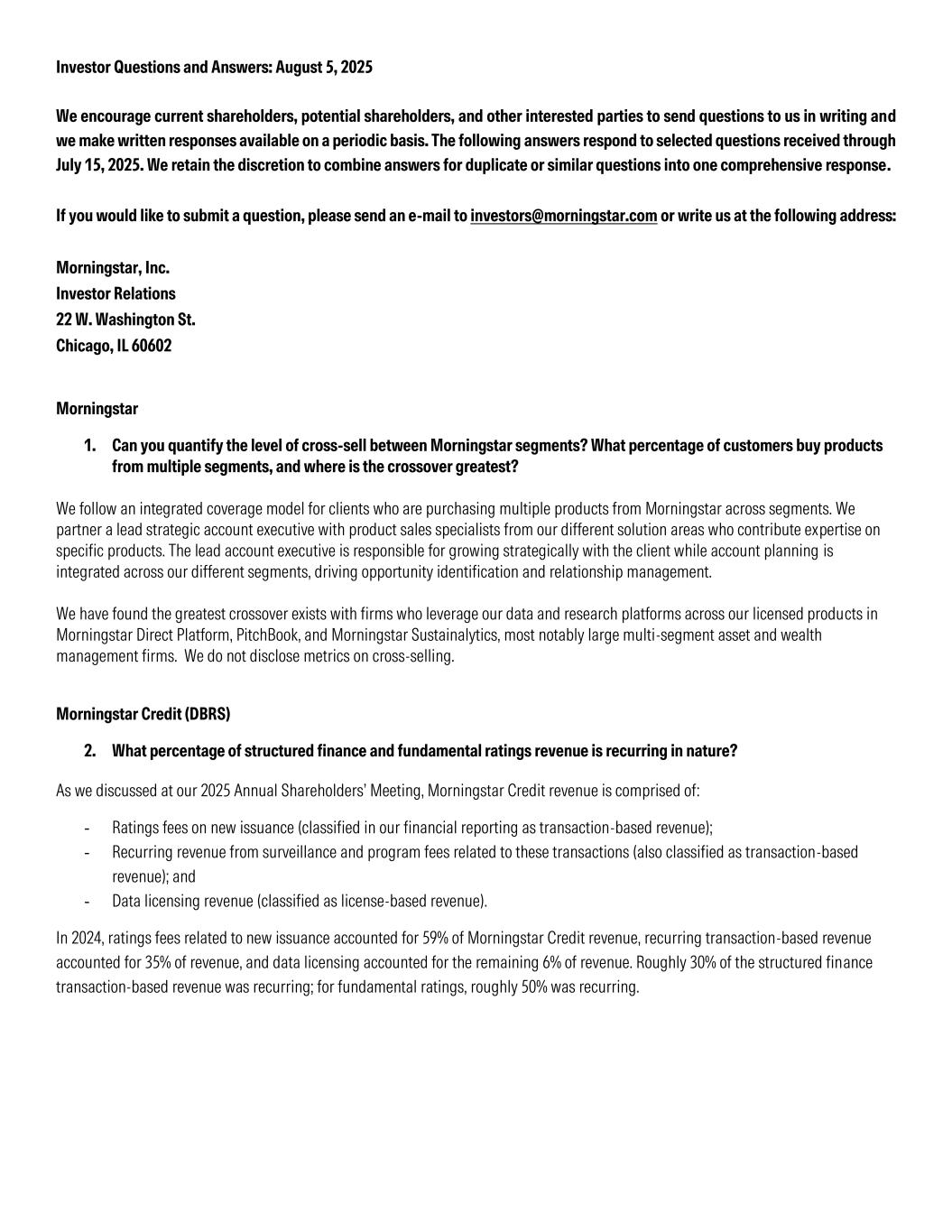
Investor Questions and Answers: August 5, 2025 We encourage current shareholders, potential shareholders, and other interested parties to send questions to us in writing and we make written responses available on a periodic basis. The following answers respond to selected questions received through July 15, 2025. We retain the discretion to combine answers for duplicate or similar questions into one comprehensive response. If you would like to submit a question, please send an e-mail to investors@morningstar.com or write us at the following address: Morningstar, Inc. Investor Relations 22 W. Washington St. Chicago, IL 60602 Morningstar 1. Can you quantify the level of cross-sell between Morningstar segments? What percentage of customers buy products from multiple segments, and where is the crossover greatest? We follow an integrated coverage model for clients who are purchasing multiple products from Morningstar across segments. We partner a lead strategic account executive with product sales specialists from our different solution areas who contribute expertise on specific products. The lead account executive is responsible for growing strategically with the client while account planning is integrated across our different segments, driving opportunity identification and relationship management. We have found the greatest crossover exists with firms who leverage our data and research platforms across our licensed products in Morningstar Direct Platform, PitchBook, and Morningstar Sustainalytics, most notably large multi-segment asset and wealth management firms. We do not disclose metrics on cross-selling. Morningstar Credit (DBRS) 2. What percentage of structured finance and fundamental ratings revenue is recurring in nature? As we discussed at our 2025 Annual Shareholders’ Meeting, Morningstar Credit revenue is comprised of: - Ratings fees on new issuance (classified in our financial reporting as transaction-based revenue); - Recurring revenue from surveillance and program fees related to these transactions (also classified as transaction-based revenue); and - Data licensing revenue (classified as license-based revenue). In 2024, ratings fees related to new issuance accounted for 59% of Morningstar Credit revenue, recurring transaction-based revenue accounted for 35% of revenue, and data licensing accounted for the remaining 6% of revenue. Roughly 30% of the structured finance transaction-based revenue was recurring; for fundamental ratings, roughly 50% was recurring.
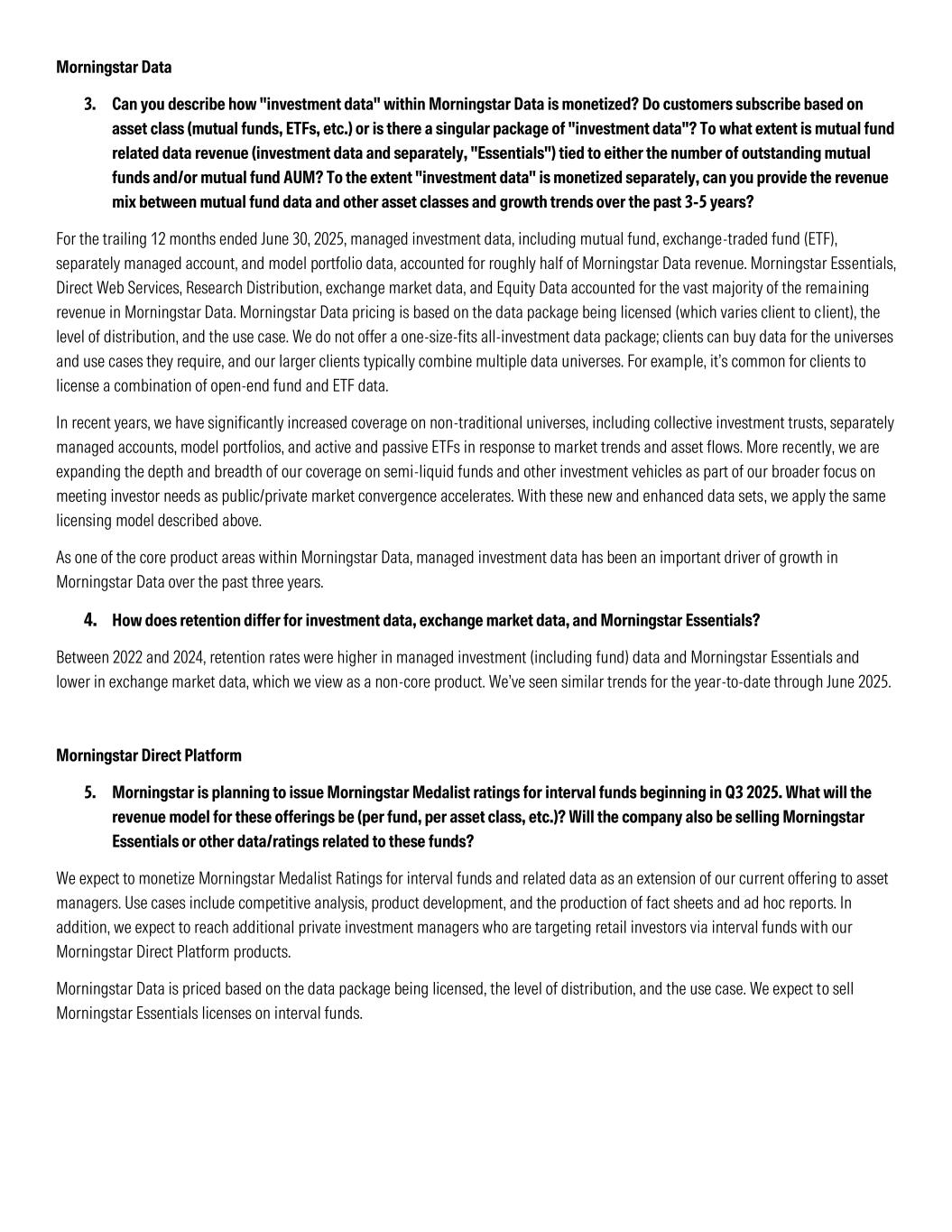
Morningstar Data 3. Can you describe how "investment data" within Morningstar Data is monetized? Do customers subscribe based on asset class (mutual funds, ETFs, etc.) or is there a singular package of "investment data"? To what extent is mutual fund related data revenue (investment data and separately, "Essentials") tied to either the number of outstanding mutual funds and/or mutual fund AUM? To the extent "investment data" is monetized separately, can you provide the revenue mix between mutual fund data and other asset classes and growth trends over the past 3-5 years? For the trailing 12 months ended June 30, 2025, managed investment data, including mutual fund, exchange-traded fund (ETF), separately managed account, and model portfolio data, accounted for roughly half of Morningstar Data revenue. Morningstar Essentials, Direct Web Services, Research Distribution, exchange market data, and Equity Data accounted for the vast majority of the remaining revenue in Morningstar Data. Morningstar Data pricing is based on the data package being licensed (which varies client to client), the level of distribution, and the use case. We do not offer a one-size-fits all-investment data package; clients can buy data for the universes and use cases they require, and our larger clients typically combine multiple data universes. For example, it’s common for clients to license a combination of open-end fund and ETF data. In recent years, we have significantly increased coverage on non-traditional universes, including collective investment trusts, separately managed accounts, model portfolios, and active and passive ETFs in response to market trends and asset flows. More recently, we are expanding the depth and breadth of our coverage on semi-liquid funds and other investment vehicles as part of our broader focus on meeting investor needs as public/private market convergence accelerates. With these new and enhanced data sets, we apply the same licensing model described above. As one of the core product areas within Morningstar Data, managed investment data has been an important driver of growth in Morningstar Data over the past three years. 4. How does retention differ for investment data, exchange market data, and Morningstar Essentials? Between 2022 and 2024, retention rates were higher in managed investment (including fund) data and Morningstar Essentials and lower in exchange market data, which we view as a non-core product. We’ve seen similar trends for the year-to-date through June 2025. Morningstar Direct Platform 5. Morningstar is planning to issue Morningstar Medalist ratings for interval funds beginning in Q3 2025. What will the revenue model for these offerings be (per fund, per asset class, etc.)? Will the company also be selling Morningstar Essentials or other data/ratings related to these funds? We expect to monetize Morningstar Medalist Ratings for interval funds and related data as an extension of our current offering to asset managers. Use cases include competitive analysis, product development, and the production of fact sheets and ad hoc reports. In addition, we expect to reach additional private investment managers who are targeting retail investors via interval funds with our Morningstar Direct Platform products. Morningstar Data is priced based on the data package being licensed, the level of distribution, and the use case. We expect to sell Morningstar Essentials licenses on interval funds.

6. Can you describe how data is sourced for compiling fund ratings? Is the collection of data proprietary in any way or do you rely on public sources such as fund holdings and returns? Morningstar ratings on managed investments draw on a combination of proprietary data, direct submissions from fund groups, public or centralized sources, and analyst research, depending on the market and rating type. While some inputs are public or standardized, the classification, calculations, and many key metrics are proprietary to Morningstar. Please see below for details on inputs for specific ratings: • The Morningstar (Star) Rating is based on proprietary Morningstar Categories (except in Canada) and performance data (NAVs, distributions), which are sourced from central feeds or, more frequently, directly from fund groups. Risk-adjusted return metrics are calculated in-house. The full methodology can be found at this link: https://www.morningstar.com/content/dam/marketing/shared/research/methodology/771945_Morningstar_Rating_for_Funds_ Methodology.pdf. • The ESG Risk Rating for Funds (Globes) draws on Morningstar Categories, fund portfolios (collected directly from asset managers or trustees), and Morningstar Sustainalytics’ proprietary ESG risk scores on underlying holdings. The full methodology can be found at this link: https://www.morningstar.com/content/dam/marketing/shared/research/methodology/744156_Morningstar_Sustainability_Rati ng_for_Funds_Methodology.pdf. • The Morningstar Medalist Rating is based on a combination of direct and indirect analyst-assigned and algorithm-assigned pillars (People, Process, and Parent). Under our research framework, analysts review the three pillars drawing on a variety of inputs with data gathered from publicly available information and analyst due diligence. Inputs to the Medalist rating (including algorithm-assigned pillars) include Morningstar Categories, manager and team data (from regulatory filings or provided by asset managers), fees (from regulatory filings and other materials provided by asset managers), and derived statistics including alpha, success ratios, and adjusted net expense ratios. The full methodology can be found at shareholders.morningstar.com/governance/compliance-disclosures/default.aspx. 7. Have you provided any market share and TAM estimate for Morningstar Direct or Morningstar Advisor Workstation? Given limited license growth in recent years for Direct, is it fair to assume this is a mature/low growth market? We do not currently provide a total addressable market (TAM) estimate for Morningstar Direct Platform or key products in that segment but are considering providing an estimate of Morningstar Direct Platform’s TAM at a later date. We view the core market for Morningstar Direct as mature. That said, we have seen success with higher growth rates in recent years due to investments in the underlying data and capabilities on the platform. In particular, we are able to reach more user groups with Morningstar Direct, including data scientists and portfolio managers. Meanwhile, as part of our Direct Platform strategy, we are also bringing in user groups who work with data, research, and capabilities including reporting. This enables broader commercialization of our Direct Reporting Solutions, and also captures data distribution use cases (which are now reflected in Morningstar Data revenue.) We also anticipate that we will unlock new user segments as we expand our private market data and analytics offerings in Direct as described in a related question this month. Finally, we expect that a modernized interface and ongoing enhancements to the connectivity between Morningstar Direct and other Direct Platform products will support continued growth.

8. At 225 firms and 170k advisors, how penetrated is Morningstar Advisor Workstation? In our 2024 10-K, we disclosed that Morningstar Advisor Workstation served more than 225 firms and 170,000 advisors; we estimate that we serve roughly half of US advisors through the product. While it is a relatively mature market and we’re a leader in the space, we believe that the launch of Morningstar Direct Advisory Suite (the next phase of Morningstar Advisor Workstation) positions us to capture new market share in the US, with an improved user experience, expanded AI capabilities, and new digital reporting. Additionally, Direct Advisory Suite is expected to enable us to expand into new geographies in the future, as noted in our announcement press release, available at newsroom.morningstar.com, offering new opportunities to grow our advisor footprint.
 エドガーで原本を確認する