 エドガーで原本を確認する
UNITED STATES
SECURITIES AND EXCHANGE COMMISSION
Washington, D.C. 20549
FORM 6-K
Report of Foreign Private Issuer
Pursuant to Rule 13a-16 or 15d-16 under
the Securities Exchange Act of 1934
| For the month of November 2025 | Commission File Number: 1-14678 |
CANADIAN IMPERIAL BANK OF COMMERCE
(Translation of registrant’s name into English)
CIBC Square, 81 Bay Street
Toronto, Ontario
Canada M5J 0E7
(Address of principal executive offices)
Indicate by check mark whether the registrant files or will file annual reports under cover of Form 20-F or Form 40-F:
| Form 20-F ☐ | Form 40-F ☑ |
SIGNATURES
Pursuant to the requirements of the Securities Exchange Act of 1934, the registrant has duly caused this report to be signed on its behalf by the undersigned, thereunto duly authorized.
| CANADIAN IMPERIAL BANK OF COMMERCE | |||||
| Date: November 3, 2025 | By: | /s/ Allison Mudge | |||
| Name: | Allison Mudge | ||||
| Title: | Senior Vice-President | ||||
Exhibits
| Exhibits | Description | ||
| 99.1 | Code of Conduct | ||
Exhibit 99.1

|
Table
of
|
A message from Harry Culham, President and CEO | 1 | ||
| Overview | Our purpose | 2 | ||
| Ensuring the effectiveness of our Code | 3 | |||
| Approval of our Code | 4 | |||
| Waivers | 4 | |||
| 1.0
Acting ethically and raising concerns |
1.1 | Guiding decisions | 6 | |
| 1.2 | Expectations of our people leaders | 7 | ||
| 1.3 | Raising concerns | 7 | ||
| 1.4 | Cooperating with investigations | 8 | ||
| 1.5 | Prohibiting retaliation | 8 | ||
|
2.0
|
2.1 | We comply with the law and regulatory requirements | 10 | |
| 2.2 | We adhere to CIBC policies, guidelines, and processes | 11 | ||
| 2.3 | We act within our scope of authority | 11 | ||
| 2.4 | We compete fairly | 12 | ||
| 2.5 | We know our clients and provide appropriate advice | 13 | ||
| 2.6 | We deter, prevent and detect financial crimes | 14 | ||
| 2.7 | We act responsibly in managing inside information and our personal trading in securities | 16 | ||
|
3.0
|
3.1 | We are careful about gifts, entertainment or other advantages or benefits that we offer or accept | 19 | |
 |
3.2 | We do not invest, pool, borrow, lend, or receive personal funds | 20 | |
| 3.3 | We evaluate and carefully select our suppliers | 21 | ||
| 3.4 | We are cautious about personal designations and appointments | 21 | ||
| 3.5 | We obtain appropriate approval(s) before engaging in outside activities and investments | 22 | ||
| 3.6 | We adhere to restrictions on processing personal transactions | 23 | ||
| 4.0
Promoting inclusion, respect, and safety |
4.1 | We prohibit discrimination, harassment, and violence | 25 | |
| 4.2 | We support a healthy and safe work environment | 27 | ||
|
5.0
|
5.1 | We protect the privacy of our clients and team members | 29 | |
| 5.2 | We safeguard confidentiality and CIBC’s information security and property | 30 | ||
| 5.3 | We maintain complete and accurate records and treat data as a critical enabler | 31 | ||
| 5.4 | We use Artificial Intelligence safely and responsibly | 31 | ||
| 6.0 Upholding our brand and representing CIBC |
6.1 | We participate in community activities responsibly | 33 | |
| 6.2 | We are diligent when communicating with government agencies, regulators, or officials | 34 | ||
| 6.3 | We use social media appropriately | 35 | ||
| 6.4 | We obtain approval(s) before public speaking, speaking with media, or writing engagements | 36 | ||
| 6.5 | We respect intellectual property | 37 | ||
| Conclusion | 38 | |||
A message from Harry Culham, President and CEO
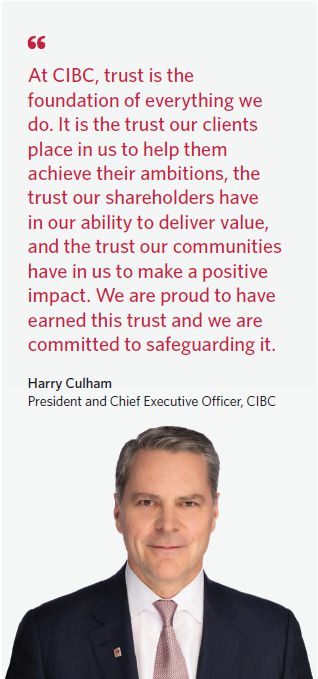
At CIBC, trust is the foundation of everything we do. It is the trust our clients place in us to help them achieve their ambitions, the trust our shareholders have in our ability to deliver value, and the trust our communities have in us to make a positive impact. We are proud to have earned this trust and we are committed to safeguarding it.
Our CIBC Code of Conduct (Code) reflects our unwavering commitment to upholding the highest standards of ethical and professional conduct. Our Code serves as an important roadmap, which guides our decision-making and our interactions with all stakeholders, including our clients, fellow CIBC team members, communities, and those who invest in our bank. By adhering to these principles, we help ensure that CIBC remains a safe and respectful workplace for all.
Each of us has a responsibility to read, understand, and adhere to our Code. It is also important to speak up should we encounter any behaviour inconsistent with our Code, with confidence that every concern will be addressed appropriately.
I am proud to be part of a highly-connected and inclusive team, and our Code is a foundational element in living our purpose for all of our stakeholders.

Harry Culham
President and CEO
| CIBC Code of Conduct – External |
|

Overview
Our Code sets out an integrated framework of key principles, policies, guidelines, and processes designed to empower team members to act in a manner consistent with the highest standards of ethical and professional conduct.
Our Code applies to every single one of us at CIBC1. Each of us has a personal responsibility to read, understand, and abide by our Code.
By respecting both the letter and intent of our Code in everything we do, we help promote a culture of respect and compliance and protect the integrity and security of our bank.

|
Our purpose
CIBC’s purpose – to help make your ambitions a reality – is our north star, driving our actions and decisions. In this fast changing environment, we believe it is more relevant than ever to build a purpose-driven culture, and an inclusive, connected team that lives our purpose every day.
Our Code supports our purpose and sets out the standards we have in place for how we should behave and treat others. This ensures we manage risk and earn the trust of our team, clients, shareholders and communities. |
The terms “we”, “our”, “us” and “team members” refer collectively to all CIBC employees, contingent workers and CIBC Board members, and are intended to indicate that adherence to our Code is both a personal and a shared responsibility of all CIBC employees, contingent workers and CIBC Board members in all regions.
“CIBC” or “bank” means Canadian Imperial Bank of Commerce and its wholly-owned subsidiaries.
“CIBC Board member” means the members of the boards of directors of Canadian Imperial Bank of Commerce and its wholly-owned subsidiaries. |
1. The CIBC Code of Conduct is applicable to all team members of CIBC and its wholly-owned subsidiaries, except for team members in CIBC Cayman Bank Limited and CIBC Cayman Reinsurance Limited) which have their own codes of conduct to comply with local requirements.
| CIBC Code of Conduct – External |
|
Ensuring the effectiveness of our Code
Each year, all employees and contingent workers must complete mandatory training and testing, and attest that they have read, understood, and continually abide by our Code. CIBC Board members are also required to certify to their compliance with our Code.
Links to key contacts and resources, including policies, guidelines, and processes specific to the regions where we have operations, are found throughout our Code. If anything is unclear, or if we have any questions, we will contact our people leader, another appropriate contact listed within our Code, or our Code of Conduct, Mailbox.
We also have mechanisms in place to detect and identify potential violations of our Code, including sound internal controls, robust monitoring processes, and comprehensive reporting. When potential violations of our Code are detected or identified, they are reviewed through the appropriate channels, in accordance with applicable laws and CIBC policies, guidelines, and processes, to determine outcomes and consequences.
We leverage insights and key trends to help improve our Code and ensure it clearly sets out the standards for how we should act and treat our fellow team members, clients, and communities.
As part of these monitoring and reporting processes, we regularly report to the Board of Directors on violations of our Code, as well as conduct and culture risk and key regulatory developments.
|
A contravention of our Code is a serious matter and may give rise to consequences.
An employee who contravenes any provision of our Code may be subject to disciplinary action up to and including termination of employment for cause without notice, or pay in lieu of notice, as well as possible civil, criminal, or regulatory action. Such conduct may also affect their individual performance assessments and compensation.
A contingent worker who contravenes any provision of our Code applicable to contingent workers may be subject to action by CIBC up to and including termination of their assignment without notice, as well as possible civil, criminal, or regulatory action. |

|
Did you know? CIBC’s mandatory training program protects our bank from legal, reputational, and financial risks, and includes, among other topics, courses on our Code, anti-money laundering and anti-terrorist financing, managing risk, preventing and detecting fraud, protecting information, maintaining a respectful and safe workplace, as well as other region and business-specific training.
We can access our mandatory training and testing – and other helpful training and resources – at any point in the year to refresh our learning. |
| CIBC Code of Conduct – External |
|
Approval of our Code
Our Code is approved by the Board of Directors each year.
Waivers
As our Code guides our decisions and sets expectations for how we act and behave, a waiver of our Code is rarely approved. If we have any questions, we speak to our people leader and contact our Code of Conduct, Mailbox.
CIBC’s Board of Directors must approve and publicly disclose waivers for CIBC Board members and certain executive officers.

| CIBC Code of Conduct – External |
|

| 1.0 | Acting ethically and raising concerns |
Acting ethically means being conscientious and principled in our decision making. We must all act in a manner that is consistent with the highest standards of ethical and professional conduct – this means we are honest and act with integrity to make decisions that are in the best interest of CIBC, as well as our team members, clients, shareholders and communities. If we have questions or if something does not seem right, we must raise our concerns.
1.1 Guiding decisions
While our Code sets out the standards for how we are expected to behave, it does not address every situation. This means we must think critically and use judgment when faced with decisions that are challenging or may have significant impact on our bank, ourselves, or others.
|
If something does not seem right or requires further consideration, pause and reflect: · Is this aligned with how we normally operate? · Could this negatively impact you, our team, clients, shareholders or the broader community? · Should we consult our Code or relevant CIBC policies, guidelines, and processes?
|
While it is not always easy to identify these situations, we should trust our instincts. Take the time to understand the facts, and the potential consequences of our action or inaction, so we can take the appropriate next steps. · Review our Code and relevant CIBC policies, guidelines, and processes · Remain objective, avoiding any improper influences and biases · Engage applicable resources for additional information, advice and guidance
|
If we are unsure how to proceed, or the decision exceeds our authority, support is available. We can seek advice from our people leaders as well as other internal resources, including those set out in our Code, to get the help and guidance we need. |
||
|
By applying this framework to situations where the appropriate decision or action is not immediately clear, and reflecting on whether our decisions are being made with the highest standards of ethical and professional conduct, we can all help safeguard the integrity and security of our bank. |
||||
| CIBC Code of Conduct – External |
|
1.2 Expectations of our people leaders
People leaders play a critical role by championing a culture of respect and compliance and driving expected behaviour within their teams. They often act as the first point of contact when a team member has a question or is faced with a dilemma or challenging decision and are responsible for ensuring their team’s understanding of our Code and that their business activities align with CIBC’s risk appetite.
Given their position of influence, people leaders must always remain objective, model the highest standards of ethical and professional conduct, and never prioritize personal or business results over compliance with our Code, laws, regulatory requirements, policies, guidelines or processes. People leaders must actively listen to their teams, and foster an environment where everyone feels safe asking questions or raising concerns without fear of retaliation.
If a people leader is made aware of conduct that does not meet the standards set out in our Code, or our policies, guidelines or processes, they have a responsibility to promptly respond and escalate the concern to appropriate stakeholders. People leaders who do not take this required action may be subject to disciplinary action.
| 1.3 | Raising concerns |
CIBC is committed to reviewing and addressing any concerns raised by our team members in a timely and fair manner, and in accordance with applicable laws and CIBC policies, guidelines, and processes.
If we have questions or feel something is wrong, we must say something. In most cases, our people leaders are our first point of contact, including for situations we believe are inconsistent with our Code or that may be damaging to CIBC or our stakeholders. If the concern is about our people leader, or we are uncomfortable speaking to them, we can contact our people leader’s leader or other key contacts referenced throughout our Code for support and guidance.
CIBC’s confidential Whistleblower Program is also available online and by phone and allows you to anonymously raise concerns in accordance with our Whistleblower Policy.
If we are disclosing information to a regulator or enforcement agency under whistleblower legislation, we do not need approval or consent from any CIBC department to do so. Nothing in our Code, policies, guidelines, or processes, or any agreement in which we may enter with CIBC, prevents us from engaging in activities permitted by whistleblower legislation.

| CIBC Code of Conduct – External |
|
1.4 Cooperating with investigations
In certain circumstances, we may be asked to participate in an internal review, inquiry, or investigation. To this end, we have a duty to cooperate and provide honest, accurate, complete and timely information. While we strive to protect the confidentiality of all parties involved in an internal review, inquiry, or investigation, this may not always be possible depending on the nature of the matter or concern raised.
When requests are made by an external party, such as a request for information from a regulator, we will notify our people leaders before taking any further action. People leaders have a responsibility to promptly address the request, including by escalating to appropriate stakeholders, as may be required.
1.5 Prohibiting retaliation
There is no retaliation for raising a concern. No one may suspend, discharge, discriminate against, harass, threaten or otherwise retaliate against a team member or other person in any way for:
| · | reporting in good faith actual or possible misconduct |
| · | providing information for, or participating in an internal review, inquiry or investigation |
If we believe that we are being retaliated against for raising a concern, we must let CIBC know immediately by contacting our people leaders, HR Business Partner or Employee Relations Consultant for our line of business. Alternatively, CIBC’s confidential Whistleblower Program is available.

| CIBC Code of Conduct – External |
|

|
|
| 2.0 | Acting with honesty, integrity and trust |
Engaging with honesty and the highest standards of ethical and professional conduct is how we demonstrate integrity and earn the trust of our team members, our clients, our shareholders and our communities.

2.1 We comply with the law and regulatory requirements
As a bank with a global presence, we are subject to the laws and regulations of the regions where we do business. We are committed to knowing, understanding and abiding by these laws and regulations, understanding that any violation of legal and regulatory requirements may have serious consequences.
Team members who are registered or licensed by a regulatory or professional body must also abide by their registration or licensing requirements. If our line of business is subject to regulatory requirements which are more restrictive than our Code, policies, guidelines or processes, follow the more restrictive requirements.
|
Did you know? If we are charged with a criminal offence, we must immediately inform our people leaders, even if a court ruling is pending or we are not guilty of the offence. We must also provide our people leaders with updates as legal proceedings progress.
People leaders must immediately inform Corporate Security about the charge as well as the outcome by contacting the CorpSecurity, Mailbox, or the US CorpSecurity Intake, Mailbox (US Only). |
| CIBC Code of Conduct – External |
|
2.2 We adhere to CIBC policies, guidelines, and processes
We are responsible for knowing and adhering to the policies, guidelines, and processes that apply to us and our roles within our bank, and understand that a failure to comply with these policies, guidelines, and processes puts our bank at risk and may have serious repercussions.
We must also comply with instructions given by our people leaders, unless they are inconsistent with our Code, our policies, guidelines, or processes, or the law or regulatory requirements. If we have any questions, or are unsure what action to take, we raise our concerns and seek the appropriate advice and guidance.
 |
Did you know? As set out in the Global Environmental and Social Framework, all team members are responsible for putting our Environmental, Social and Governance (ESG) commitments into action by following CIBC policies, guidelines, and processes. This will ensure we identify, assess, and manage environmental and social risks and impacts in the provision of products and services as well as proactively seek opportunities for positive impact. |
2.3 We act within our scope of authority
We are responsible for understanding the authority permitted by our role or professional qualifications and must always act within the limit of these authorities. If we are dealing with a situation that requires a level of authority that is not permitted by our role or professional qualifications, we seek guidance from our people leaders to help support appropriate next steps.
We only provide advice to our clients that we are authorized and, where required, registered or licensed to provide in the course of our work. This means we do not give clients financial, trust, legal, tax, investment or other advice, nor do we process transactions or enter into an agreement for CIBC, without proper authorization and documentation.
| CIBC Code of Conduct – External |
|
2.4 We compete fairly
We deal fairly, honestly and legally with our competitors. This means we do not communicate, acquire or use competitively sensitive information, trade secrets or proprietary information of others unless we have the right to do so.
Certain agreements between businesses are prohibited by law, regardless of the impact on competition. Specifically, we do not make agreements to:
In addition, there are other laws that prevent CIBC from participating in arrangements or activities that lessen or prevent competition. These laws are complex, so if we have concerns about proposed dealings with competitors or clients, we will discuss them with the Legal Department.

| CIBC Code of Conduct – External |
|
2.5 We know our clients and provide appropriate advice
In our interactions with clients, we get to know them and strive to understand their financial situations. This includes learning about their needs, investment objectives, risk profiles, goals, and aspirations. In turn, this enables us to provide the appropriate and accurate information they require to make financial decisions aligned with their goals.
This means we:
| · | Communicate in a timely manner using plain language that is easy to understand |
| · | Obtain express consent from our clients to purchase products or services |
| · | Clearly explain fees or associated costs with the sale and use of a product or service |
| · | Take ownership by providing a fair, speedy and transparent resolution whenever issues arise |
| · | Perform appropriate due diligence to ensure the facts and information gathered from our clients is accurate and comprehensive |
|
What is sales service failure ? Sales service failure is the sale of financial products or services that are unsuitable for our client; sales that are made without taking reasonable account of our client’s financial goals, needs and circumstances; and sales where clients are provided with incomplete, unclear or misleading information. |
|
When dealing with a client, we never engage in behaviours such as: · Misrepresenting a client’s current, future or past financial position · Taking advantage of, imposing pressure on, or coercing an existing or potential client for any purpose · Using misleading language or selling a product or service that is not suitable or appropriate based on the client’s financial need and circumstances · Imposing conditions that require a client to bring additional business to CIBC · Altering client documents or signed forms in any way, including dates, signatures and initials even if the client consents or we are correcting a mistake · Modifying or misusing anyone’s identity · Recording or knowingly approving a false, misleading or deceptive transaction · Bypassing procedures in a manner that compromises the integrity of CIBC’s records and disclosures, such as creating our own forms or letters · Not identifying or disclosing a conflict of interest · Delaying or advancing the timing of opening or closing an account to meet a time-bound goal · Failing to report a client issue or not following escalation procedures in a timely manner If we identify, or become aware of, any of the above activities we must raise our concerns immediately by speaking with our people leader or another appropriate contact listed within our Code. |

| CIBC Code of Conduct – External |
|
2.6 We deter, prevent and detect financial crimes
We are empowered to act with integrity and maintain public trust by conducting business in accordance with applicable laws, and CIBC policies, guidelines and processes, that support the deterrence, prevention, and detection of financial crimes, including:
| · | Bribery, fraud, kiting, kickbacks, facilitation payments, collusion, theft, payoffs, forgery, tax evasion, undue influence, malicious activity, or other corrupt business practices. |
| · | Money laundering, terrorist financing, foreign interference, or transactions subject to economic sanctions measures. |
We conduct appropriate due diligence, including obtaining current “Know Your Client” information for all client relationships, and comply with applicable reporting and record keeping requirements. We also cooperate with internal investigations related to financial crimes, including investigations conducted by the Enterprise Anti-Money Laundering group.
| At all times, we model the highest standards of ethical and professional conduct to maintain the trust of our team members, our clients, our shareholders and our communities. We do not engage in financial crime – such conduct is strictly prohibited. For further information, see Section 2.1 – We comply with the law and regulatory requirements. |
 Our Anti-Bribery and Anti-Corruption Policy is designed to promote awareness of, and compliance with, bribery and corruption related regulatory requirements, and supplement ethical standards set out in our Code. The policy explicitly sets out CIBC’s commitment to high ethical standards and a zero-tolerance approach to bribery, corruption and facilitation payments. It also helps minimize the risk of improper influence in connection with decisions made by team members, clients, suppliers, and others in connection with CIBC’s activities.
Our Enterprise Anti-Money Laundering and Anti-Terrorist Financing Policy is designed to help protect the safety, soundness, and reputation of CIBC by minimizing the risk that CIBC becomes involved in money laundering or terrorist financing activities, whether inadvertently or otherwise. The policy promotes an anti-money laundering and anti-terrorist financing risk and compliance management culture across CIBC and sets out minimum requirements to detect and deter money laundering and terrorist financing, and assess and mitigate money laundering and terrorist financing risk across our bank.
Our Enterprise Sanctions Policy establishes enterprise-wide requirements for managing sanctions compliance risk by identifying and preventing activities related to sanctions targets pursuant to applicable laws, including requirements to identify, investigate, escalate, resolve and report any business activity involving, directly or indirectly, a sanctioned individual, entity, group or jurisdiction.
Our Integrity and Security Framework is based on ten principles of integrity and security and aligns with the Office of the Superintendent of Financial Institutions' (OSFI) Integrity and Security Guideline. The Framework provides an overview of the policies and procedures that protect our Bank, and sets out the requirements, roles and responsibilities in managing integrity and security across the enterprise.
| |
|
Preventing Bribery and Other Corrupt Business Practices
· We do not, nor do we help clients, fabricate, alter, remove or mask information to avoid legal requirements, or to perpetrate fraud · We do not solicit, give or accept a gift, entertainment, or other advantage or benefit if it could create an actual, potential or perceived obligation, expectation or conflict for CIBC · We follow client authentication procedures to protect CIBC and our clients from unauthorized access to accounts, information, and assets · We raise our concerns when we know, become aware of or suspect any bribery or other corrupt business practice has occurred or is about to occur, or if circumstances exist for bribery or other corrupt business practices |
Preventing Money Laundering, Terrorist Financing and Actions Related to Sanctions Targets
· We do not transact with, or directly or indirectly provide, financial services for, or for the benefit of states, entities or individuals targeted by applicable anti-terrorist financing measures · We escalate any sanctions concerns to the Sanctions team · We report unusual transactions to the Enterprise Anti-Money Laundering group based on what we know about our clients and normal banking activity · We raise our concerns when we think CIBC is being used for criminal activity by contacting the Enterprise Anti-Money Laundering group |
| CIBC Code of Conduct – External |
|
2.6 We deter, prevent and detect financial crimes (continued)
| What is Fraud? | “Fraud” is defined as any intentional act or omission designed to deceive others with a goal of misappropriating property and/or assets or circumventing regulations, the law or CIBC’s policies, guidelines, or processes to achieve financial gain or benefit. |
| What is Bribery? | “Bribery” means giving, promising, offering, requesting, accepting, offering to receive, soliciting, receiving or transfer of a financial or other advantage or benefit, either directly or indirectly, to induce or reward improper performance of any function or activity. Bribery does not have to involve an actual monetary payment and can take many forms, including but not limited to an advantage, business dealing, benefit, covering someone’s expenses, a charitable donation, entertainment or business hospitality, a gift, a facilitation payment, kickback, offers of employment or contracts for goods or services, offers of unpaid student co-op positions or internships, political contribution or donation, or travel, etc. |
| What is Corruption? | “Corruption” means misuse of position or entrusted power for improper personal advantage. |
| What is a Facilitation Payment? | “Facilitation Payment” means a payment made to a public official or agency, either directly or indirectly, for the purpose of expediting or securing the performance of a routine governmental action that the public official or agency is lawfully required to provide without such a payment. Like other bribes, facilitation payments can take the form of cash or anything of value such as gift cards, tickets to events, etc. |
| What is Foreign Interference? | "Foreign interference" includes activities that are within or relating to Canada, detrimental to the interests and security of Canada, and are clandestine or deceptive or involve a threat to any person, including attempts to covertly influence, intimidate, manipulate, interfere, corrupt, or discredit individuals, organizations, and governments to further the interests of a foreign state-or-non-state actor. |
| What is Malicious Activity? | "Malicious activity" includes actions taken with the intent of causing harm including theft, coercion, fraud, manipulation of information or disruptions that are otherwise illegal, malicious, clandestine, or deceptive in nature. Malicious activity can originate from foreign or domestic actors and may have national security implications. |
| What is Undue Influence? | "Undue influence" includes situations where a person or entity engages, with malicious intent, in actions, behaviours, deception, or the use of power to impact actions, decisions, or behaviours in their own or another’s interests. Undue influence can originate from foreign or domestic actors and may have national security implications. |
|
Did you know? When we are contemplating submitting an Unusual Transaction/Activity Report (Canada / US) to our regional AML Group, or have submitted such a report, we must not discuss this fact with the client, with any other person associated with the account in question, or with any other person, including our people leader.. |
Learn more ►
CIBC Supplier Code of Conduct

| CIBC Code of Conduct – External |
|
2.7 We act responsibly in managing inside information and our personal trading in securities
If we have inside information about an entity (including CIBC), we never trade in shares or other securities of that entity, nor do we talk to others about that entity, which includes providing advice. These actions are illegal.
We comply with internal information protocols established to control the use of inside information or any confidential information which was acquired through the course of our employment. We never act on or disclose confidential or inside information, except as required in the normal course of business or in the performance of our assignment and always as set out in CIBC policies.
We also follow applicable regulatory requirements and CIBC policies that may apply to us for personal trading, including pre-clearing trades in securities and CIBC shares. We will contact the Compliance department if we are unsure about how to handle the situation or confidential or material information.
| Inside information means material non-public information about a public company (including CIBC) that, if disclosed, would likely affect the market price of the company’s securities or that a reasonable investor would likely consider important in making an investment decision to buy, hold or sell securities. |
 |
Did you know? Insider trading policies and legal requirements provide that employees and contingent workers, as well as CIBC directors and officers, are prohibited from engaging in the following transactions: · Trading in put options, call options, or forward derivative contracts on CIBC shares · Trading any other over-the-counter derivative products designed to hedge exposure to CIBC shares · Short selling CIBC shares These team members may also be subject to restrictions regarding when they can trade CIBC securities. CIBC Board members, officers and certain other team members are not permitted to buy or sell CIBC securities outside the “Window Periods”. For more information, refer to the applicable Insider Trading Policy. |
| CIBC Code of Conduct – External |
|

|
|
3.0 Identifying and avoiding conflicts of interest
An actual, potential, or perceived conflict of interest can damage CIBC’s reputation. We avoid any situation where our personal interest may conflict or be perceived to conflict with the interests of CIBC, team members, our clients, or suppliers2.
There may be situations where a potential conflict of interest must be disclosed. This disclosure depends on the circumstances and applicable regulatory requirements.
If we need further guidance, or are unsure if an actual, potential or perceived conflict of interest exists, or whether it must be disclosed, we must immediately speak with our people leader or contact the EWC, Mailbox (in the US, Ethics Compliance, Mailbox).
|
Did you know? Examples of an actual, potential or perceived conflict of interest include: · Choosing a supplier or selecting contingent workers for assignments or engagements on the basis of a close personal relationship · Being in a reporting relationship or working with someone with whom we share a close personal relationship where we have, or may be perceived to have, the ability to impact their compensation, work conditions or promotion prospects · Using or sharing information we possess as a result of our CIBC role to further our own personal interests or the interests of someone with whom we have a close personal relationship · Referring team members or clients to a business that is owned or operated by ourselves or someone with whom we have a close personal relationship, unless permitted by CIBC policies or procedures · Co-owning, or our immediate family members co-owning, a business, real estate or rental property with our clients, or co-mingling financial resources with our clients · Failing to comply with restrictions on processing personal transactions |
Close personal relationship: Involves a personal connection, past or present, which may be the result of an emotional bond or financial interaction. Common examples include immediate family members, romantic partners, or those with whom we have a financial relationship.
Immediate family: Our spouse or common law partner, parents, sisters/brothers, children, grandparents, parents-in-law, sisters/brothers-in-law, step-parents, step-children, step-grandparents, step-sisters/brothers, grandchildren, legal dependents, legal guardian, and any corporation or other legal entity that is controlled by us and/or members of our immediate family. |
2. A Supplier is defined as an organization, including their representatives, employees, and subcontractors, who supply goods and services to CIBC, its subsidiaries, or affiliates.
| CIBC Code of Conduct – External |
|
3.1 We are careful about gifts, entertainment or other advantages or benefits that we offer or accept
We are familiar with the restrictions in CIBC policies on giving or accepting gifts, entertainment, other advantages or benefits. Giving or accepting a gift, entertainment or other advantage or benefit to or from a team member, client, supplier, prospective client, member of the media, public official or agencies might create an actual, potential or perceived conflict of interest.
We do not give or accept a gift, entertainment, other advantage or benefit if it could create an actual, potential or perceived obligation, expectation or conflict with our work at CIBC. Even where a conflict of interest does not exist, a gift, entertainment, other advantage, or benefit could be viewed as an attempt to influence a decision. We never try to influence the outcome of a decision by offering or receiving a gift, entertainment, other advantage or benefit.
We adhere to annual maximum limits as set out in CIBC’s Anti-Bribery and Anti-Corruption Policy and other requirements in CIBC policies, guidelines, or processes when we give or accept gifts, entertainment or other advantages or benefits. We also comply with applicable CIBC policies with respect to making Political Donations, such as the Political Activity Policy and US Political Activity Policy.
When we incur expenses, including when using an approved Corporate Card, or approve expenses on behalf of CIBC, we follow CIBC policies, guidelines, and processes to ensure the expenses are reasonable, for a valid business purpose, within limits for gifts and entertainment, where applicable, and supported by receipts.
|
Did you know? When we are careful about gifts, entertainment or other advantages or benefits that we offer or accept, we consider if they are: · Products or services with more than a nominal value · Gifts of cash or cash equivalents · Discounted products · Travel or accommodations · Event tickets
Remember – different rules apply to gifts and entertainment in different regions. For example, the applicable annual maximum value of gifts in Canada is $200. For more information, refer to Learn more. |

| CIBC Code of Conduct – External |
|
3.2 We do not invest, pool, borrow, lend, or receive personal funds
We do not invest, pool, borrow, lend, or receive personal funds or other personal property (directly or indirectly) where an actual, potential or perceived conflict may arise involving a client, team member, or supplier who has an ongoing or prospective business relationship with our bank. This restriction does not apply to:
| · | Transactions with immediate family members |
| · | Transactions with clients who are financial intermediaries (such as department stores or other financial institutions) if the transaction is conducted on market terms and conditions. |
When soliciting charitable donations or fundraising, whether on behalf of CIBC or another organization, we will emphasize the voluntary nature of the donation. We will not put team members (particularly those who report to us, directly or indirectly), clients or suppliers in a position where they may feel obligated to contribute – or fear being treated unfairly if they do not make a donation.
If we are involved in a draw or charitable fundraising contest at CIBC, we must follow applicable requirements, and review the Guidelines for Running Contests at CIBC.

|
Did you know?
· 50/50 draws are considered lotteries or “games of chance” with no element of skill and a licence is required from the relevant government agency. Operating a lottery without a licence is a criminal offence. · Pooling includes savings clubs. While pooling personal funds with team members may sound like a good way to encourage personal savings, this activity would result in a conflict of interest and is prohibited. |
| CIBC Code of Conduct – External |
|
3.3 We evaluate and carefully select our suppliers
We strive to select and work with suppliers that conduct themselves in accordance with our Supplier Code of Conduct. We procure goods and services in accordance with CIBC policies, guidelines, and processes, as well as applicable laws and regulatory requirements to evaluate, negotiate, contract with, and govern our suppliers.
We do not select suppliers, or approve or execute agreements with suppliers, that would place us in a conflict of interest. Our suppliers are also required to exercise reasonable care and diligence to prevent any actual, potential or perceived conflict of interest, and must not attempt to gain advantage or preferential treatment as a result of a conflict of interest.
Learn more ►
CIBC Supplier Code of Conduct
CIBC on Human Rights: Modern Slavery and Human Trafficking Statement
3.4 We are cautious about personal designations and appointments
A conflict of interest may arise where we accept signing authority or a power of attorney from our client for that client’s account. We may also discover that a client has made us a beneficiary, executor or other personal representative (for example, guardian, trustee, committee or curator). CIBC discourages team members from accepting these designations and appointments. Depending on the circumstances, we may have to ask our client to revoke the designation or we may have to decline the appointment. If we want to act as a signing authority, personal representative, remain as a beneficiary or act under a power of attorney, we must obtain prior approval or seek approval as soon as we become aware of the designation or appointment, from our people leader and the Compliance department. In most situations, this does not prevent us from being a beneficiary, acting under a power of attorney, or serving as executor, guardian or other personal representative of an immediate family member. For more information regarding how to submit a declaration, we must review the appropriate outside activities guideline for our region.
Remember, CIBC has the right to require that we renounce any bequest or appointment, or to remove ourselves from dealing with a client’s estate where there is an actual, potential or perceived conflict of interest.

| CIBC Code of Conduct – External |
|
3.5 We obtain appropriate approval(s) before engaging in outside activities and investments
CIBC supports our participation in our communities through taking roles in community organizations, clubs and associations. However, we are expected to devote our working hours to our CIBC work and must avoid positions, associations, investments, or other outside activities that may interfere, or be perceived to interfere, with our work at CIBC or our judgment about doing the right thing for our clients and team members.
Prior to engaging in any potential outside activity, all of us, including contingent workers, are required to discuss the outside activity with our people leaders so that any actual, potential or perceived conflicts of interest are appropriately addressed. If after speaking to our people leaders it is determined that approval to engage in an outside activity is required, we must also declare the outside activity and seek approval from our people leader as well as Compliance using the Outside Business Activities form in the MyComplianceOffice tool3. For information regarding how to submit a declaration, we must review the appropriate outside activities guideline for our region.
|
Be mindful. There may still be a conflict or potential conflict of interest even if we haven’t yet received a benefit by participating in the outside activity. A benefit may include compensation, income or any other form of advantage. |
 |
Did you know? Generally, if we are an unpaid volunteer outside our normal hours of work for a not-for-profit organization – and are not serving as a director, officer, or committee member – approval is not required. For example, community and charity volunteering, such as coaching a sports team, being a guide leader or helping a food bank. |
|
Outside activities can include, but are not limited to:
|
3. CIBC Board members follow board policies to obtain approval for outside activities.
| CIBC Code of Conduct – External |
|
3.6 We adhere to restrictions on processing personal transactions
Processing transactions for ourselves or for those close to us can create a conflict of interest. Transactions include, but are not limited to, inquiries such as accessing a file, profile or account, or performing administrative functions, such as opening a product.
We avoid processing or asking another team member who directly or indirectly reports to us to process a transaction for ourselves, or anyone with whom we share a close personal relationship, a financial interest or for whom we are a personal representative (for example, acting as trustee, executor, guardian, committee, curator, or under a power of attorney). Whenever possible, these transactions must be completed using approved client platforms, such as telephone, online, and mobile banking.
If a personal transaction cannot be completed using approved client platforms, we must follow applicable CIBC policies, guidelines, and processes to mitigate potential conflicts of interest, including seeking appropriate approvals, where required. We must never use our position at CIBC to improperly influence the outcome of a transaction to benefit ourselves or those with whom we share a close personal relationship. Processing personal transactions that compromise our ability to remain objective and maintain the highest standards of ethical and professional conduct are strictly prohibited.

|
Did you know? CIBC Wood Gundy and CIBC Private Wealth Group have established policies and procedures for Investment Advisors and Relationship Managers to deal with members of their immediate family and household members. For more information, including what defines immediate family and household members, Investment Advisors can refer to the CIBC Wood Gundy Conduct Policy, and Relationship Managers can refer to the CIBC Private Wealth Group, LLC Code of Ethics (US). |
| CIBC Code of Conduct – External |
|

|
|
4.0 Promoting inclusion, respect, and safety
We are committed to respecting and protecting human rights throughout our business and supply chains and helping to provide an inclusive, healthy, and safe workplace. We are familiar with and follow CIBC policies, guidelines, and processes, and applicable human rights laws, as well as laws related to health and safety and the prohibition of violence in the workplace.

4.1 We prohibit discrimination, harassment, and violence
|
We help identify, remove, and prevent barriers for our team members and our clients, and take feedback into account to ensure accessibility needs are addressed in a manner consistent with the principles of independence, integration, and access to opportunities.
We are always professional, treat others with dignity and respect, and consider how our behaviour can impact our colleagues, clients, and the broader community. We do not engage in, or tolerate, discrimination, harassment, sexual harassment, or violence of any sort, or any behaviour that is disrespectful or that does not align with our commitment to provide an inclusive, respectful and safe workplace.
This behaviour – whether in-person or online, intentional or unintentional – is strictly prohibited. |
Discrimination
means any intentional or unintentional act, conduct, decision, standard, policy, program,
or practice which creates a distinction between certain individuals or groups based on a
protected characteristic, such as: · age · colour · ethnic or national origin · family or marital status · gender identification or expression · physical or mental disability · race · religion · sex · sexual orientation · any other protected characteristics set out in applicable laws |
|
Did you know? Examples of acceptable behaviours include occasional compliments of a socially acceptable nature, or behaviour generally considered as acceptable by a reasonable individual (unless we are advised it is not acceptable).
Acceptable behaviours also include reasonable direction, coaching, evaluation, appraisal, attendance management or discipline by our people leader based on legitimate business objectives and in accordance with established procedures and guidelines. |
|
| CIBC Code of Conduct – External |
|
4.1 We prohibit discrimination, harassment, and violence (continued)
|
We are proud that our team members can raise concerns without fear of reprisal. If we experience or observe any behaviour that is disrespectful or that does not align with our commitment to provide an inclusive, respectful and safe workplace, we must immediately raise our concerns, speak with our people leader, HR Business Partner or other key contact.
We will not retaliate against any team member who, in good faith and on the basis of a reasonable belief, makes a report or raises questions or concerns regarding discrimination, harassment, sexual harassment or violence in the workplace, or who provides information or assistance for an investigation. |
Learn more ►
CIBC Accessibility Plan

| CIBC Code of Conduct – External |
|
4.2 We support a healthy and safe work environment
We all have a role to play to ensure our work environment is healthy and safe – this is a collaborative effort and a shared duty. We are familiar with and understand our roles and responsibilities with respect to health and safety, as well as discrimination, harassment, and violence prevention.
We take reasonable and necessary precautions to protect ourselves and others in the workplace. We raise health and safety concerns as soon as possible so they can be investigated and that any required corrective action can be taken.
|
Learn more ►
|
Did you know? When planning an event, we must ensure that required procedures and safeguards are in place and any executive approvals and licenses are obtained. Review the Safety when Planning or Participating in CIBC Events or Activities – Information Sheet to learn more. |

| CIBC Code of Conduct – External |
|

|
|
5.0 Safeguarding our information and assets
Safeguarding and protecting the information and assets with which we have been entrusted is a critical component in maintaining the integrity and security of our bank.
5.1 We protect the privacy of our clients and team members
We take all reasonable steps to preserve and protect the privacy of CIBC client and team member personal information.
The Global Privacy Management Framework (Framework) sets out the overarching principles, key activities and accountabilities of CIBC's privacy management program. In order to support and operationalize the Framework, the Global Privacy Policy, and other relevant employee and client privacy policies and statements, establish essential requirements for mitigating risk, including CIBC’s right to monitor, audit, and inspect our use of CIBC systems and technology.
In compliance with applicable laws, our access authority and business procedures, we explain to individuals how we collect, process, and retain their information. We will only collect, use, disclose, and access clients’ or team members’ personal information, including CIBC business contact information, when we have a legitimate or valid business purpose to do so. We also seek to minimize our use of personal information to what is necessary for specific purposes, and we limit access to what is reasonable in the circumstances.
We are familiar with, and follow, procedures to escalate privacy concerns and incidents as soon as possible to ensure potential or actual violations of privacy are investigated, contained, and resolved, as required, in a timely manner.
|
Did you know? Even if consent is provided, accessing the account information of a family member to ensure everything is in good order is not considered a legitimate business purpose and is a breach of privacy. The expectation is that we advise the family member of the proper channels they must use to access their account information (i.e., at a banking centre, via telephone or online banking, or the mobile banking app).
Remember – processing transactions on the profiles or accounts of those with whom we have a close personal relationship, which includes viewing account information, is also prohibited. |
|
Other ways to protect privacy include: · Always being aware of our immediate surroundings when in a public place or working remotely · Never discussing confidential information and client or employee personal information if it may be overheard by unauthorized persons · Minimizing the use of printed copies of CIBC information for work · Checking the recipient address before sending any email and selecting “Send Securely” within Outlook when emailing personal information · Ensuring that all interactions with Artificial Intelligence (AI)/Generative AI technologies are conducted in secure environments and minimize the use of personal information and CIBC information in accordance with CIBC policies, guidelines and processes |
| Remember:
We must not access information about team members or clients without their consent and without a legitimate or valid business purpose to do so. The prohibition against unauthorized access applies regardless of which CIBC system is being used including, COINS, ECIF, CBFE and Horizon. Engaging in this conduct is a serious privacy violation and is strictly prohibited. |
| CIBC Code of Conduct – External |
|
5.2 We safeguard confidentiality and CIBC’s information security and property
CIBC’s information is confidential and one of our most important assets. We take all reasonable and appropriate steps to safeguard CIBC’s information and data, technology systems, resources, software, applications or facilities. CIBC records and monitors our activity on its technology systems, resources and facilities for the purpose of detecting and preventing unauthorized use, sharing or access.
When sending communications through CIBC’s networks, we must always maintain a professional tone and comply with our Code, policies, guidelines, and processes. We follow these requirements whether we are using CIBC’s equipment or our own.
Our personal use of CIBC systems must be reasonable and must not interfere with our job responsibilities and work-related needs. We must not use CIBC systems to view or communicate inappropriate material, access our own account information, or to do work on behalf of another business or organization.
|
To protect CIBC information, we: · Must not share, post or email – to or from a non-CIBC personal email address directly or indirectly - information that is classified by CIBC as Internal, Confidential or Restricted.. · Do not share our passwords for CIBC systems and ensure our devices are protected from unauthorized access · Report suspicious emails using the Report a Phish button in Outlook · Do not leave CIBC-issued computing devices or printed materials unattended · Verify accuracy of all external email addresses including recipients, when using auto-populate features in Outlook When we conduct work for CIBC, we must only use CIBC approved technologies and methods of communication, including AI/Generative AI technologies. Text messaging, using external AI/Generative AI technologies (such as ChatGPT) and messaging on social media applications (for example, WhatsApp, WeChat, etc.) from personal devices for CIBC business purposes is strictly prohibited. |
We do not bypass controls in place that protect CIBC property. These controls include use of safes, vaults and other security equipment; physical or logical access control; and other security-related processes. CIBC requires that we return or destroy CIBC property upon request.
|
Did you know? We must only install authorized CIBC software and hardware on devices when using them for work, and must always follow approved processes for doing so (for example, use Get IT and approved apps from a corporate store)
|
Remember: When accessing our own account information we must not use CIBC internal systems such as COINS, ECIF, CBFE and Horizon. Instead, we must use approved client platforms such as telephone, online and mobile banking. |

| CIBC Code of Conduct – External |
|
5.3 We maintain complete and accurate records and treat data as a critical enabler
We are committed to being accountable, transparent and responsive in how we use, protect and manage data. We use data ethically and only for the purposes for which it was collected. We follow the Data Lifecycle Management Policy which defines the guiding principles, organizational structure, governance roles and responsibilities, and oversight operating model to ensure that data and records are suitable for their intended use and managed against their disposal or destruction requirements.
If CIBC’s records are incomplete or inaccurate, the trust of our stakeholders and the integrity of our reputation may be compromised. We ensure that records of team members, clients, suppliers or others adhere to CIBC’s policies.

5.4 We use Artificial Intelligence safely and responsibly
Guided by CIBC’s Trustworthy AI Principles, we are committed to the safe and responsible use of AI. All team members must adhere to applicable policies, guidelines and processes when developing, procuring, deploying and utilizing AI technologies. This commitment ensures that we promote innovation while maintaining client trust and protecting the integrity of our bank.
| CIBC Code of Conduct – External |
|

|
|
6.0 Upholding our brand and representing CIBC
Our brand brings to life our purpose and our commitment to helping our clients, communities, and team members succeed. It is what we stand for, what we do, and how we do it. In all our interactions, including with clients, colleagues, friends, family, and the broader community, we represent our brand with the highest standards of ethical and professional conduct.
6.1 We participate in community activities responsibly
CIBC supports our involvement in community activities and respects our right to publicly express our personal views given we do so as individuals not as representatives of CIBC. As such, we will not carry on political activities or engage in religious-based advocacy when at work or while representing CIBC. This includes seeking contributions, campaigning, influencing, advocating and/or promoting political causes. This in no way limits our right to observe our individual political or religious views in private. However, in doing so, we must not compromise CIBC’s image or reputation, whether during or outside work hours, and must follow regional policies and obtain approval from our regional Compliance department for any requests for outside political activities.

| CIBC Code of Conduct – External |
|
6.2 We are diligent when communicating with government agencies, regulators, or officials
We only communicate with government agencies, regulators or officials on behalf of CIBC if we have the necessary authority4, and must do so accurately and completely. In certain situations, team members who communicate with government officials on behalf of CIBC must comply with lobbying activity pre-approval, registration and reporting requirements set out in CIBC policies.

4. Unless disclosing information under whistleblower legislation.
| CIBC Code of Conduct – External |
|
6.3 We use social media appropriately
As social media allows wide sharing of information, protecting CIBC’s brand and reputation relies on our shared commitment.
We all must understand what is expected of us when using social media – including internal platforms – during and outside work hours, to ensure that our brand, reputation, client information and other CIBC information is protected and that standards of professionalism are maintained.
|
Did you know? Social media is a broad term which includes all websites and apps that allow information to be shared through online social interaction. Examples include social networks, blogs, and discussion forums.
A social network is a form of social media for sharing information with connected friends, colleagues, or followers. Examples include, but are not limited to, Facebook, X (formerly Twitter), Threads, TikTok, LinkedIn, Instagram, Snapchat, Tumblr, WhatsApp, Weixin (WeChat), and Weibo.
Viva Engage is also a social media platform for internal use only, and must be used appropriately. For questions and discussion about social media at CIBC, including what we can access and what the policy allows, refer to the Social Media Answers group.
Remember – anything shared via social media could be made public or result in revealing our identity, regardless of privacy settings, use of a pseudonym, or whether it was deleted. |

| CIBC Code of Conduct – External |
|
6.4 We obtain approval(s) before public speaking, speaking with media or writing engagements
If we plan to speak or write in a public forum as a CIBC representative, are contacted by a reporter, or may be perceived as a CIBC representative (for example, speaking to the media, presenting a lecture, publishing an article, or submitting a white paper or external report for an industry conference), we obtain prior approval from our people leaders and an appropriate contact from CIBC’s Communications Team.

|
Did you know? If we are, or may be seen as, speaking on behalf of CIBC, we must have approval from our people leader and a representative of the Communications & Public Affairs or US Corporate Communications teams. Depending on the circumstances an Outside Activities Approval Declaration may also be required.
If we will be speaking or writing through our personal capacity in a public forum on a topic unrelated to the financial services sector, and not as a representative of CIBC, we are required to inform our audience that we are not speaking on behalf of CIBC and that opinions expressed are our own. We should keep in mind, however, that others may still see us as representing CIBC.
|
| CIBC Code of Conduct – External |
|
6.5 We respect intellectual property
Intellectual property is a special type of property, which we may create while working for CIBC. For example, our logos and slogans – even our websites, written publications, trade secrets and business processes – are intellectual property that belong to CIBC, even after we leave. CIBC intellectual property is protected by law, including trademark, copyright and patent laws, and cannot be used by others without our permission. We may only use CIBC’s brand name and trademarks outside of CIBC as part of our regular job duties or at an external function where CIBC’s participation has been previously approved.
Other companies also protect their intellectual property and enforce their intellectual property rights. Company brand names, logos, slogans, designs, scents, colour, sounds, taste, holograms and moving images may be protected by trademark law. We are aware that publications in any form of media, images, photographs, broadcasts, recordings, online data or other online materials, and software, even if publicly accessible, or ingested into other technologies such as AI and Generative AI, are often protected by copyright law, terms of use, or both. Before we copy, collect, distribute or use intellectual property that belongs to someone else, we ensure that we have the right to do so.

| CIBC Code of Conduct – External |
|
Conclusion
We all have a role to play in protecting the integrity and security of our bank and sharing accountability for risk identification, management, and mitigation. By reading, understanding, and consistently applying and abiding by the principles of our Code in our day to day interactions, we are helping to uphold our professional obligations and reputation, and bring our purpose to life. If we are ever unsure about what choice to make or how to act in a manner that is consistent with the highest standards of ethical and professional conduct, we must not hesitate to stop and ask for help.

| CIBC Code of Conduct – External |
|


