株探米国株
英語
エドガーで原本を確認する
00012794952025FYfalseP2YP1Mxbrli:sharesiso4217:CADiso4217:CADxbrli:sharesiso4217:USDbte:cashGeneratingUnitxbrli:purebte:usdPerBblbte:cadPerBblbte:CAD_PER_MMBTUbte:shareutr:Ratebte:votebte:usdBblbte:bblPerDaybte:gigajoulesPerDaybte:usdPerGigajoulesbte:mmbtuPerDaybte:usdPerMmbtu00012794952025-01-012025-12-310001279495dei:BusinessContactMember2025-01-012025-12-3100012794952025-12-3100012794952024-12-3100012794952024-01-012024-12-310001279495ifrs-full:IssuedCapitalMember2023-12-310001279495ifrs-full:AdditionalPaidinCapitalMember2023-12-310001279495ifrs-full:AccumulatedOtherComprehensiveIncomeMember2023-12-310001279495ifrs-full:RetainedEarningsMember2023-12-3100012794952023-12-310001279495ifrs-full:IssuedCapitalMember2024-01-012024-12-310001279495ifrs-full:AdditionalPaidinCapitalMember2024-01-012024-12-310001279495ifrs-full:RetainedEarningsMember2024-01-012024-12-310001279495ifrs-full:AccumulatedOtherComprehensiveIncomeMember2024-01-012024-12-310001279495ifrs-full:IssuedCapitalMember2024-12-310001279495ifrs-full:AdditionalPaidinCapitalMember2024-12-310001279495ifrs-full:AccumulatedOtherComprehensiveIncomeMember2024-12-310001279495ifrs-full:RetainedEarningsMember2024-12-310001279495ifrs-full:IssuedCapitalMember2025-01-012025-12-310001279495ifrs-full:AdditionalPaidinCapitalMember2025-01-012025-12-310001279495ifrs-full:RetainedEarningsMember2025-01-012025-12-310001279495ifrs-full:AccumulatedOtherComprehensiveIncomeMember2025-01-012025-12-310001279495ifrs-full:IssuedCapitalMember2025-12-310001279495ifrs-full:AdditionalPaidinCapitalMember2025-12-310001279495ifrs-full:AccumulatedOtherComprehensiveIncomeMember2025-12-310001279495ifrs-full:RetainedEarningsMember2025-12-310001279495bte:GibsonEnergyInc.Member2025-03-012025-03-310001279495bte:GibsonEnergyInc.Member2025-01-012025-12-310001279495ifrs-full:ExplorationAndEvaluationAssetsMember2024-12-310001279495ifrs-full:ExplorationAndEvaluationAssetsMember2023-12-310001279495ifrs-full:ExplorationAndEvaluationAssetsMember2025-01-012025-12-310001279495ifrs-full:ExplorationAndEvaluationAssetsMember2024-01-012024-12-310001279495ifrs-full:ExplorationAndEvaluationAssetsMember2025-12-310001279495ifrs-full:OilAndGasAssetsMemberifrs-full:GrossCarryingAmountMember2023-12-310001279495ifrs-full:OilAndGasAssetsMemberifrs-full:AccumulatedDepreciationAndAmortisationMember2023-12-310001279495ifrs-full:OilAndGasAssetsMember2023-12-310001279495ifrs-full:OilAndGasAssetsMemberifrs-full:GrossCarryingAmountMember2024-01-012024-12-310001279495ifrs-full:OilAndGasAssetsMemberifrs-full:AccumulatedDepreciationAndAmortisationMember2024-01-012024-12-310001279495ifrs-full:OilAndGasAssetsMember2024-01-012024-12-310001279495ifrs-full:OilAndGasAssetsMemberifrs-full:GrossCarryingAmountMember2024-12-310001279495ifrs-full:OilAndGasAssetsMemberifrs-full:AccumulatedDepreciationAndAmortisationMember2024-12-310001279495ifrs-full:OilAndGasAssetsMember2024-12-310001279495ifrs-full:OilAndGasAssetsMemberifrs-full:GrossCarryingAmountMember2025-01-012025-12-310001279495ifrs-full:OilAndGasAssetsMemberifrs-full:AccumulatedDepreciationAndAmortisationMember2025-01-012025-12-310001279495ifrs-full:OilAndGasAssetsMember2025-01-012025-12-310001279495bte:VikingCashGeneratingUnitMemberifrs-full:AccumulatedDepreciationAndAmortisationMemberifrs-full:OilAndGasAssetsMember2025-01-012025-12-310001279495ifrs-full:OilAndGasAssetsMemberifrs-full:GrossCarryingAmountMember2025-12-310001279495ifrs-full:OilAndGasAssetsMemberifrs-full:AccumulatedDepreciationAndAmortisationMember2025-12-310001279495ifrs-full:OilAndGasAssetsMember2025-12-310001279495ifrs-full:OilAndGasAssetsMemberifrs-full:DiscontinuedOperationsMember2025-01-012025-12-310001279495ifrs-full:OilAndGasAssetsMemberifrs-full:DiscontinuedOperationsMember2024-01-012024-12-310001279495bte:LloydminsterCashGeneratingUnitMemberifrs-full:AccumulatedDepreciationAndAmortisationMemberifrs-full:OilAndGasAssetsMember2025-01-012025-12-310001279495ifrs-full:OilAndGasAssetsMemberifrs-full:BottomOfRangeMember2025-12-310001279495ifrs-full:OilAndGasAssetsMemberifrs-full:TopOfRangeMember2025-12-310001279495bte:VikingCashGeneratingUnitAndLloydminsterCashGeneratingUnitMemberbte:Year1Memberbte:WTIMemberbte:OilReserves1Member2025-01-012025-12-310001279495bte:VikingCashGeneratingUnitAndLloydminsterCashGeneratingUnitMemberbte:Year2Memberbte:WTIMemberbte:OilReserves1Member2025-01-012025-12-310001279495bte:VikingCashGeneratingUnitAndLloydminsterCashGeneratingUnitMemberbte:Year3Memberbte:WTIMemberbte:OilReserves1Member2025-01-012025-12-310001279495bte:VikingCashGeneratingUnitAndLloydminsterCashGeneratingUnitMemberbte:Year4Memberbte:WTIMemberbte:OilReserves1Member2025-01-012025-12-310001279495bte:VikingCashGeneratingUnitAndLloydminsterCashGeneratingUnitMemberbte:Year5Memberbte:WTIMemberbte:OilReserves1Member2025-01-012025-12-310001279495bte:VikingCashGeneratingUnitAndLloydminsterCashGeneratingUnitMemberbte:Year6Memberbte:WTIMemberbte:OilReserves1Member2025-01-012025-12-310001279495bte:VikingCashGeneratingUnitAndLloydminsterCashGeneratingUnitMemberbte:Year7Memberbte:WTIMemberbte:OilReserves1Member2025-01-012025-12-310001279495bte:VikingCashGeneratingUnitAndLloydminsterCashGeneratingUnitMemberbte:Year8Memberbte:WTIMemberbte:OilReserves1Member2025-01-012025-12-310001279495bte:VikingCashGeneratingUnitAndLloydminsterCashGeneratingUnitMemberbte:Year9Memberbte:WTIMemberbte:OilReserves1Member2025-01-012025-12-310001279495bte:VikingCashGeneratingUnitAndLloydminsterCashGeneratingUnitMemberbte:Year10Memberbte:WTIMemberbte:OilReserves1Member2025-01-012025-12-310001279495bte:VikingCashGeneratingUnitAndLloydminsterCashGeneratingUnitMemberbte:Year1Memberbte:WCSMemberbte:OilReserves1Member2025-01-012025-12-310001279495bte:VikingCashGeneratingUnitAndLloydminsterCashGeneratingUnitMemberbte:Year2Memberbte:WCSMemberbte:OilReserves1Member2025-01-012025-12-310001279495bte:VikingCashGeneratingUnitAndLloydminsterCashGeneratingUnitMemberbte:Year3Memberbte:WCSMemberbte:OilReserves1Member2025-01-012025-12-310001279495bte:VikingCashGeneratingUnitAndLloydminsterCashGeneratingUnitMemberbte:Year4Memberbte:WCSMemberbte:OilReserves1Member2025-01-012025-12-310001279495bte:VikingCashGeneratingUnitAndLloydminsterCashGeneratingUnitMemberbte:Year5Memberbte:WCSMemberbte:OilReserves1Member2025-01-012025-12-310001279495bte:VikingCashGeneratingUnitAndLloydminsterCashGeneratingUnitMemberbte:Year6Memberbte:WCSMemberbte:OilReserves1Member2025-01-012025-12-310001279495bte:VikingCashGeneratingUnitAndLloydminsterCashGeneratingUnitMemberbte:Year7Memberbte:WCSMemberbte:OilReserves1Member2025-01-012025-12-310001279495bte:VikingCashGeneratingUnitAndLloydminsterCashGeneratingUnitMemberbte:Year8Memberbte:WCSMemberbte:OilReserves1Member2025-01-012025-12-310001279495bte:VikingCashGeneratingUnitAndLloydminsterCashGeneratingUnitMemberbte:Year9Memberbte:WCSMemberbte:OilReserves1Member2025-01-012025-12-310001279495bte:VikingCashGeneratingUnitAndLloydminsterCashGeneratingUnitMemberbte:Year10Memberbte:WCSMemberbte:OilReserves1Member2025-01-012025-12-310001279495bte:VikingCashGeneratingUnitAndLloydminsterCashGeneratingUnitMemberbte:Year1Memberbte:EdmontonParMemberbte:OilReserves1Member2025-01-012025-12-310001279495bte:VikingCashGeneratingUnitAndLloydminsterCashGeneratingUnitMemberbte:Year2Memberbte:EdmontonParMemberbte:OilReserves1Member2025-01-012025-12-310001279495bte:VikingCashGeneratingUnitAndLloydminsterCashGeneratingUnitMemberbte:Year3Memberbte:EdmontonParMemberbte:OilReserves1Member2025-01-012025-12-310001279495bte:VikingCashGeneratingUnitAndLloydminsterCashGeneratingUnitMemberbte:Year4Memberbte:EdmontonParMemberbte:OilReserves1Member2025-01-012025-12-310001279495bte:VikingCashGeneratingUnitAndLloydminsterCashGeneratingUnitMemberbte:Year5Memberbte:EdmontonParMemberbte:OilReserves1Member2025-01-012025-12-310001279495bte:VikingCashGeneratingUnitAndLloydminsterCashGeneratingUnitMemberbte:Year6Memberbte:EdmontonParMemberbte:OilReserves1Member2025-01-012025-12-310001279495bte:VikingCashGeneratingUnitAndLloydminsterCashGeneratingUnitMemberbte:Year7Memberbte:EdmontonParMemberbte:OilReserves1Member2025-01-012025-12-310001279495bte:VikingCashGeneratingUnitAndLloydminsterCashGeneratingUnitMemberbte:Year8Memberbte:EdmontonParMemberbte:OilReserves1Member2025-01-012025-12-310001279495bte:VikingCashGeneratingUnitAndLloydminsterCashGeneratingUnitMemberbte:Year9Memberbte:EdmontonParMemberbte:OilReserves1Member2025-01-012025-12-310001279495bte:VikingCashGeneratingUnitAndLloydminsterCashGeneratingUnitMemberbte:Year10Memberbte:EdmontonParMemberbte:OilReserves1Member2025-01-012025-12-310001279495bte:VikingCashGeneratingUnitAndLloydminsterCashGeneratingUnitMemberbte:Year1Memberbte:AECOMemberbte:NaturalGasReserves1Member2025-01-012025-12-310001279495bte:VikingCashGeneratingUnitAndLloydminsterCashGeneratingUnitMemberbte:Year2Memberbte:AECOMemberbte:NaturalGasReserves1Member2025-01-012025-12-310001279495bte:VikingCashGeneratingUnitAndLloydminsterCashGeneratingUnitMemberbte:Year3Memberbte:AECOMemberbte:NaturalGasReserves1Member2025-01-012025-12-310001279495bte:VikingCashGeneratingUnitAndLloydminsterCashGeneratingUnitMemberbte:Year4Memberbte:AECOMemberbte:NaturalGasReserves1Member2025-01-012025-12-310001279495bte:VikingCashGeneratingUnitAndLloydminsterCashGeneratingUnitMemberbte:Year5Memberbte:AECOMemberbte:NaturalGasReserves1Member2025-01-012025-12-310001279495bte:VikingCashGeneratingUnitAndLloydminsterCashGeneratingUnitMemberbte:Year6Memberbte:AECOMemberbte:NaturalGasReserves1Member2025-01-012025-12-310001279495bte:VikingCashGeneratingUnitAndLloydminsterCashGeneratingUnitMemberbte:Year7Memberbte:AECOMemberbte:NaturalGasReserves1Member2025-01-012025-12-310001279495bte:VikingCashGeneratingUnitAndLloydminsterCashGeneratingUnitMemberbte:Year8Memberbte:AECOMemberbte:NaturalGasReserves1Member2025-01-012025-12-310001279495bte:VikingCashGeneratingUnitAndLloydminsterCashGeneratingUnitMemberbte:Year9Memberbte:AECOMemberbte:NaturalGasReserves1Member2025-01-012025-12-310001279495bte:VikingCashGeneratingUnitAndLloydminsterCashGeneratingUnitMemberbte:Year10Memberbte:AECOMemberbte:NaturalGasReserves1Member2025-01-012025-12-310001279495bte:LloydminsterCashGeneratingUnitMember2025-12-310001279495bte:LloydminsterCashGeneratingUnitMember2025-01-012025-12-310001279495bte:VikingCashGeneratingUnitMember2025-12-310001279495bte:VikingCashGeneratingUnitMember2025-01-012025-12-310001279495ifrs-full:DiscontinuedOperationsMember2025-01-012025-12-310001279495ifrs-full:DiscontinuedOperationsMember2024-01-012024-12-310001279495ifrs-full:DiscontinuedOperationsMember2025-12-310001279495bte:OfficeLeasesMember2023-12-310001279495bte:FieldEquipmentMember2023-12-310001279495bte:VehiclesAndOtherMember2023-12-310001279495bte:OfficeLeasesMember2024-01-012024-12-310001279495bte:FieldEquipmentMember2024-01-012024-12-310001279495bte:VehiclesAndOtherMember2024-01-012024-12-310001279495bte:OfficeLeasesMember2024-12-310001279495bte:FieldEquipmentMember2024-12-310001279495bte:VehiclesAndOtherMember2024-12-310001279495bte:OfficeLeasesMember2025-01-012025-12-310001279495bte:FieldEquipmentMember2025-01-012025-12-310001279495bte:VehiclesAndOtherMember2025-01-012025-12-310001279495bte:OfficeLeasesMember2025-12-310001279495bte:FieldEquipmentMember2025-12-310001279495bte:VehiclesAndOtherMember2025-12-310001279495ifrs-full:NotLaterThanOneYearMember2025-12-310001279495ifrs-full:NotLaterThanOneYearMember2024-12-310001279495ifrs-full:LaterThanOneYearAndNotLaterThanThreeYearsMember2025-12-310001279495ifrs-full:LaterThanOneYearAndNotLaterThanThreeYearsMember2024-12-310001279495ifrs-full:LaterThanThreeYearsAndNotLaterThanFiveYearsMember2025-12-310001279495ifrs-full:LaterThanThreeYearsAndNotLaterThanFiveYearsMember2024-12-310001279495ifrs-full:LaterThanFiveYearsMember2025-12-310001279495ifrs-full:LaterThanFiveYearsMember2024-12-310001279495bte:BankLoanU.S.DollarDenominatedMember2025-12-310001279495bte:BankLoanU.S.DollarDenominatedMember2024-12-310001279495bte:BankLoanCanadianDollarDenominatedMember2025-12-310001279495bte:BankLoanCanadianDollarDenominatedMember2024-12-310001279495ifrs-full:GrossCarryingAmountMember2025-12-310001279495ifrs-full:GrossCarryingAmountMember2024-12-310001279495bte:UnamortizedDebtIssuanceCostsNettingMember2025-12-310001279495bte:UnamortizedDebtIssuanceCostsNettingMember2024-12-310001279495ifrs-full:GrossCarryingAmountMemberbte:BankLoanU.S.DollarDenominatedMember2025-12-310001279495ifrs-full:GrossCarryingAmountMemberbte:BankLoanU.S.DollarDenominatedMember2024-12-310001279495ifrs-full:GrossCarryingAmountMemberbte:BankLoanCanadianDollarDenominatedMember2025-01-012025-12-310001279495bte:RevolvingCreditFacility1Member2025-12-190001279495bte:RevolvingCreditFacility1Member2025-12-180001279495bte:RevolvingCreditFacility1Member2025-12-310001279495bte:RevolvingCreditFacilityOperatingLoanMember2025-12-310001279495bte:RevolvingCreditFacilitySyndicatedLoanMember2025-12-310001279495bte:LongTermNotesAndCreditFacilitiesMemberbte:EffectiveInterestRateMemberifrs-full:WeightedAverageMember2025-12-310001279495bte:LongTermNotesAndCreditFacilitiesMemberbte:EffectiveInterestRateMemberifrs-full:WeightedAverageMember2024-12-310001279495bte:CovenantCompliancePeriodOneMember2025-01-012025-12-310001279495bte:CovenantCompliancePeriodTwoMember2025-01-012025-12-310001279495bte:BaytexMember2025-12-310001279495bte:BaytexMember2024-12-310001279495ifrs-full:FixedInterestRateMemberbte:NotesDueApril2030Member2025-12-310001279495ifrs-full:GrossCarryingAmountMemberbte:NotesDueApril2030Member2025-12-310001279495ifrs-full:GrossCarryingAmountMemberbte:NotesDueApril2030Member2024-12-310001279495ifrs-full:FixedInterestRateMemberbte:NotesDueMarch2032Member2025-12-310001279495ifrs-full:GrossCarryingAmountMemberbte:NotesDueMarch2032Member2025-12-310001279495ifrs-full:GrossCarryingAmountMemberbte:NotesDueMarch2032Member2024-12-310001279495bte:NotesDueApril2030Member2024-12-310001279495bte:NotesDueMarch2032Member2025-12-310001279495bte:NotesDueMarch2032Member2024-12-310001279495ifrs-full:FixedInterestRateMemberbte:NotesDueApril2027Member2024-01-012024-12-310001279495ifrs-full:FixedInterestRateMemberbte:NotesDueApril2027Member2025-01-012025-12-310001279495bte:NotesDueApril2030Member2025-12-310001279495bte:NotesDueMarch2032Member2024-04-010001279495ifrs-full:FixedInterestRateMemberbte:NotesDueMarch2032Member2024-04-010001279495bte:NotesDueMarch2032Member2024-04-012024-04-0100012794952024-04-010001279495ifrs-full:FixedInterestRateMemberbte:NotesDueApril2027Member2024-04-010001279495ifrs-full:ProvisionForDecommissioningRestorationAndRehabilitationCostsMember2024-12-310001279495ifrs-full:ProvisionForDecommissioningRestorationAndRehabilitationCostsMember2023-12-310001279495ifrs-full:ProvisionForDecommissioningRestorationAndRehabilitationCostsMember2025-01-012025-12-310001279495ifrs-full:ProvisionForDecommissioningRestorationAndRehabilitationCostsMember2024-01-012024-12-310001279495ifrs-full:ProvisionForDecommissioningRestorationAndRehabilitationCostsMember2025-12-310001279495ifrs-full:OilAndGasAssetsMemberifrs-full:ProvisionForDecommissioningRestorationAndRehabilitationCostsMember2025-01-012025-12-310001279495ifrs-full:OilAndGasAssetsMemberifrs-full:ProvisionForDecommissioningRestorationAndRehabilitationCostsMember2024-01-012024-12-310001279495country:CAifrs-full:ProvisionForDecommissioningRestorationAndRehabilitationCostsMember2025-12-310001279495country:CAifrs-full:ProvisionForDecommissioningRestorationAndRehabilitationCostsMember2024-12-310001279495country:USifrs-full:ProvisionForDecommissioningRestorationAndRehabilitationCostsMember2025-12-310001279495country:USifrs-full:ProvisionForDecommissioningRestorationAndRehabilitationCostsMember2024-12-310001279495ifrs-full:PreferenceSharesMember2025-12-310001279495ifrs-full:OrdinarySharesMember2025-12-310001279495ifrs-full:IssuedCapitalMember2025-06-242025-06-240001279495ifrs-full:IssuedCapitalMember2025-06-1800012794952025-03-142025-03-1400012794952025-06-132025-06-1300012794952025-09-152025-09-1500012794952025-12-152025-12-150001279495bte:DividendDeclaredMember2026-03-042026-03-040001279495bte:RestrictedShareUnitsRSUMember2025-01-012025-12-310001279495bte:PerformanceShareUnitsPSUMemberifrs-full:BottomOfRangeMember2025-01-012025-12-310001279495bte:PerformanceShareUnitsPSUMemberifrs-full:TopOfRangeMember2025-01-012025-12-310001279495ifrs-full:BottomOfRangeMember2025-01-012025-12-310001279495ifrs-full:TopOfRangeMember2025-01-012025-12-310001279495bte:RestrictedShareUnitsRSUMember2025-12-310001279495bte:RestrictedShareUnitsRSUMember2024-12-310001279495bte:IncentiveAwardPlanMember2025-12-310001279495bte:IncentiveAwardPlanMember2024-12-310001279495bte:DeferredShareUnitPlanMember2025-12-310001279495bte:DeferredShareUnitPlanMember2024-12-310001279495bte:RestrictedShareUnitsRSUMember2023-12-310001279495bte:PerformanceShareUnitsPSUMember2023-12-310001279495bte:IncentiveAwardsMember2023-12-310001279495bte:DirectorShareUnitsMember2023-12-310001279495bte:RestrictedShareUnitsRSUMember2024-01-012024-12-310001279495bte:PerformanceShareUnitsPSUMember2024-01-012024-12-310001279495bte:IncentiveAwardsMember2024-01-012024-12-310001279495bte:DirectorShareUnitsMember2024-01-012024-12-310001279495bte:PerformanceShareUnitsPSUMember2024-12-310001279495bte:IncentiveAwardsMember2024-12-310001279495bte:DirectorShareUnitsMember2024-12-310001279495bte:PerformanceShareUnitsPSUMember2025-01-012025-12-310001279495bte:IncentiveAwardsMember2025-01-012025-12-310001279495bte:DirectorShareUnitsMember2025-01-012025-12-310001279495bte:PerformanceShareUnitsPSUMember2025-12-310001279495bte:IncentiveAwardsMember2025-12-310001279495bte:DirectorShareUnitsMember2025-12-310001279495bte:LightOilandCondensateMembercountry:CA2025-01-012025-12-310001279495bte:LightOilandCondensateMembercountry:CA2024-01-012024-12-310001279495bte:HeavyOilPropertiesMembercountry:CA2025-01-012025-12-310001279495bte:HeavyOilPropertiesMembercountry:CA2024-01-012024-12-310001279495bte:NGLMembercountry:CA2025-01-012025-12-310001279495bte:NGLMembercountry:CA2024-01-012024-12-310001279495bte:NaturalGasMembercountry:CA2025-01-012025-12-310001279495bte:NaturalGasMembercountry:CA2024-01-012024-12-310001279495country:CA2025-01-012025-12-310001279495country:CA2024-01-012024-12-310001279495ifrs-full:DiscontinuedOperationsMembercountry:US2025-01-012025-12-310001279495ifrs-full:DiscontinuedOperationsMembercountry:US2024-01-012024-12-310001279495bte:TradeReceivableAccruedPetroleumAndNaturalGasSalesMember2025-12-310001279495bte:TradeReceivableAccruedPetroleumAndNaturalGasSalesMember2024-12-310001279495bte:PercentageOfRevenueMemberbte:Customer1Member2025-01-012025-12-310001279495bte:PercentageOfRevenueMemberbte:Customer2Member2025-01-012025-12-310001279495bte:PercentageOfRevenueMemberbte:Customer3Member2025-01-012025-12-310001279495bte:PercentageOfRevenueMemberbte:Customer4Member2025-01-012025-12-310001279495bte:ForeignJurisdictionsMember2025-12-310001279495bte:ForeignJurisdictionsMember2024-12-310001279495ifrs-full:UnusedTaxLossesMember2025-12-310001279495ifrs-full:UnusedTaxLossesMember2024-12-310001279495bte:TaxLitigationWithCanadaRevenueAgencyMemberifrs-full:BottomOfRangeMember2016-06-012016-06-300001279495bte:TaxLitigationWithCanadaRevenueAgencyMemberifrs-full:TopOfRangeMember2016-06-012016-06-300001279495bte:TaxLitigationWithCanadaRevenueAgencyMember2016-06-012016-06-300001279495bte:TaxLitigationWithCanadaRevenueAgencyMember2023-10-012023-12-310001279495bte:TaxLitigationWithCanadaRevenueAgencyMember2024-12-310001279495bte:PetroleumandNaturalGasPropertiesRelatedTemporaryDifferencesMember2024-12-310001279495bte:PetroleumandNaturalGasPropertiesRelatedTemporaryDifferencesMember2025-01-012025-12-310001279495bte:PetroleumandNaturalGasPropertiesRelatedTemporaryDifferencesMember2025-12-310001279495bte:FinancialDerivativesRelatedTaxableTemporaryDifferencesMember2024-12-310001279495bte:FinancialDerivativesRelatedTaxableTemporaryDifferencesMember2025-01-012025-12-310001279495bte:FinancialDerivativesRelatedTaxableTemporaryDifferencesMember2025-12-310001279495ifrs-full:OtherTemporaryDifferencesMember2024-12-310001279495ifrs-full:OtherTemporaryDifferencesMember2025-01-012025-12-310001279495ifrs-full:OtherTemporaryDifferencesMember2025-12-310001279495bte:DecommissioningRestorationAndRehabilitationCostsRelatedTemporaryDifferencesMember2024-12-310001279495bte:DecommissioningRestorationAndRehabilitationCostsRelatedTemporaryDifferencesMember2025-01-012025-12-310001279495bte:DecommissioningRestorationAndRehabilitationCostsRelatedTemporaryDifferencesMember2025-12-310001279495ifrs-full:UnusedTaxLossesMember2025-01-012025-12-310001279495bte:FinanceCostsRelatedTemporaryDifferencesMember2024-12-310001279495bte:FinanceCostsRelatedTemporaryDifferencesMember2025-01-012025-12-310001279495bte:FinanceCostsRelatedTemporaryDifferencesMember2025-12-310001279495bte:PetroleumandNaturalGasPropertiesRelatedTemporaryDifferencesMember2023-12-310001279495bte:PetroleumandNaturalGasPropertiesRelatedTemporaryDifferencesMember2024-01-012024-12-310001279495bte:FinancialDerivativesRelatedTaxableTemporaryDifferencesMember2023-12-310001279495bte:FinancialDerivativesRelatedTaxableTemporaryDifferencesMember2024-01-012024-12-310001279495ifrs-full:OtherTemporaryDifferencesMember2023-12-310001279495ifrs-full:OtherTemporaryDifferencesMember2024-01-012024-12-310001279495bte:DecommissioningRestorationAndRehabilitationCostsRelatedTemporaryDifferencesMember2023-12-310001279495bte:DecommissioningRestorationAndRehabilitationCostsRelatedTemporaryDifferencesMember2024-01-012024-12-310001279495ifrs-full:UnusedTaxLossesMember2023-12-310001279495ifrs-full:UnusedTaxLossesMember2024-01-012024-12-310001279495bte:FinanceCostsRelatedTemporaryDifferencesMember2023-12-310001279495bte:FinanceCostsRelatedTemporaryDifferencesMember2024-01-012024-12-310001279495country:CA2024-12-310001279495bte:ForeignAuthorityMember2024-12-310001279495ifrs-full:Level2OfFairValueHierarchyMemberifrs-full:FinancialAssetsAtFairValueThroughProfitOrLossCategoryMember2025-12-310001279495ifrs-full:Level2OfFairValueHierarchyMemberifrs-full:FinancialAssetsAtFairValueThroughProfitOrLossCategoryMember2024-12-310001279495ifrs-full:FinancialAssetsAtFairValueThroughProfitOrLossCategoryMember2025-12-310001279495ifrs-full:FinancialAssetsAtFairValueThroughProfitOrLossCategoryMember2024-12-310001279495ifrs-full:Level1OfFairValueHierarchyMemberifrs-full:FinancialAssetsAtAmortisedCostCategoryMember2025-12-310001279495ifrs-full:Level1OfFairValueHierarchyMemberifrs-full:FinancialAssetsAtAmortisedCostCategoryMember2024-12-310001279495ifrs-full:FinancialAssetsAtAmortisedCostCategoryMemberifrs-full:TradeReceivablesMemberifrs-full:Level1OfFairValueHierarchyMember2025-12-310001279495ifrs-full:FinancialAssetsAtAmortisedCostCategoryMemberifrs-full:TradeReceivablesMemberifrs-full:Level1OfFairValueHierarchyMember2024-12-310001279495ifrs-full:FinancialAssetsAtAmortisedCostCategoryMember2025-12-310001279495ifrs-full:FinancialAssetsAtAmortisedCostCategoryMember2024-12-310001279495ifrs-full:FinancialLiabilitiesAtFairValueThroughProfitOrLossCategoryMemberifrs-full:Level2OfFairValueHierarchyMemberifrs-full:DerivativesMember2025-12-310001279495ifrs-full:FinancialLiabilitiesAtFairValueThroughProfitOrLossCategoryMemberifrs-full:Level2OfFairValueHierarchyMemberifrs-full:DerivativesMember2024-12-310001279495ifrs-full:FinancialLiabilitiesAtFairValueThroughProfitOrLossCategoryMember2025-12-310001279495ifrs-full:FinancialLiabilitiesAtFairValueThroughProfitOrLossCategoryMember2024-12-310001279495ifrs-full:FinancialLiabilitiesAtAmortisedCostCategoryMemberifrs-full:Level1OfFairValueHierarchyMemberbte:TradePayablesMember2025-12-310001279495ifrs-full:FinancialLiabilitiesAtAmortisedCostCategoryMemberifrs-full:Level1OfFairValueHierarchyMemberbte:TradePayablesMember2024-12-310001279495ifrs-full:FinancialLiabilitiesAtAmortisedCostCategoryMemberifrs-full:Level1OfFairValueHierarchyMemberbte:DividendsPayableMember2025-12-310001279495ifrs-full:FinancialLiabilitiesAtAmortisedCostCategoryMemberifrs-full:Level1OfFairValueHierarchyMemberbte:DividendsPayableMember2024-12-310001279495ifrs-full:FinancialLiabilitiesAtAmortisedCostCategoryMemberifrs-full:Level1OfFairValueHierarchyMemberbte:LoansPayable1Member2025-12-310001279495ifrs-full:FinancialLiabilitiesAtAmortisedCostCategoryMemberifrs-full:Level1OfFairValueHierarchyMemberbte:LoansPayable1Member2024-12-310001279495ifrs-full:FinancialLiabilitiesAtAmortisedCostCategoryMemberifrs-full:Level1OfFairValueHierarchyMemberbte:LongTermDebt1Member2025-12-310001279495ifrs-full:FinancialLiabilitiesAtAmortisedCostCategoryMemberifrs-full:Level1OfFairValueHierarchyMemberbte:LongTermDebt1Member2024-12-310001279495ifrs-full:FinancialLiabilitiesAtAmortisedCostCategoryMember2025-12-310001279495ifrs-full:FinancialLiabilitiesAtAmortisedCostCategoryMember2024-12-310001279495ifrs-full:CurrencyRiskMember2025-12-310001279495ifrs-full:CurrencyRiskMemberbte:USDollarDenominatedAssetsMember2025-12-310001279495ifrs-full:CurrencyRiskMemberbte:USDollarDenominatedAssetsMember2024-12-310001279495ifrs-full:CurrencyRiskMemberbte:USDollarDenominatedLiabilitiesMember2025-12-310001279495ifrs-full:CurrencyRiskMemberbte:USDollarDenominatedLiabilitiesMember2024-12-310001279495ifrs-full:CommodityPriceRiskMemberbte:OilPriceMember2025-12-310001279495ifrs-full:CommodityPriceRiskMembersrt:NaturalGasPerThousandCubicFeetMember2025-12-310001279495ifrs-full:CommodityPriceRiskMember2025-12-310001279495bte:OilBasisDifferentialJan2026ToMar2026WCSMember2025-12-310001279495bte:OilBasisDifferentialApr2026ToJune2026WCSMember2025-12-310001279495bte:OilBasisDifferentialJuly2026ToSep2026WCSMember2025-12-310001279495bte:OilBasisDifferentialJan2026ToDec2026OneMember2025-12-310001279495bte:OilBasisDifferentialOct2026ToDec2026WCSMember2025-12-310001279495bte:OilBasisDifferentialJan2026ToMar2026MSWMember2025-12-310001279495bte:OilBasisDifferentialJan2026ToMar2026MSWMemberbte:PriceOneMember2025-12-310001279495bte:OilBasisDifferentialApr2026ToJun2026MSWMember2025-12-310001279495bte:OilBasisDifferentialApr2026ToJun2026MSWMemberbte:PriceOneMember2025-12-310001279495bte:OilBasisDifferentialJuly2026ToSep2026MSWMember2025-12-310001279495bte:OilBasisDifferentialJuly2026ToSep2026MSWMemberbte:PriceOneMember2025-12-310001279495bte:OilBasisDifferentialOct2026ToDec2026MSWMember2025-12-310001279495bte:OilBasisDifferentialOct2026ToDec2026MSWMemberbte:PriceOneMember2025-12-310001279495bte:PurchasedPutOptionJan2026ToJune2026Member2025-12-310001279495bte:PurchasedPutOptionJan2026ToJune2026Memberbte:PriceOneMember2025-12-310001279495bte:SoldCallOptionJan2026ToJune2026Member2025-12-310001279495bte:SoldCallOptionJan2026ToJune2026Memberbte:PriceOneMember2025-12-310001279495bte:OilCollarJan2026ToMar2026OneMember2025-12-310001279495bte:OilCollarJan2026ToMar2026OneMemberbte:PriceOneMember2025-12-310001279495bte:OilCollarJan2026ToMar2026OneMemberbte:PriceTwoMember2025-12-310001279495bte:OilCollarJan2026ToMar2026TwoMember2025-12-310001279495bte:OilCollarJan2026ToMar2026TwoMemberbte:PriceOneMember2025-12-310001279495bte:OilCollarJan2026ToMar2026TwoMemberbte:PriceTwoMember2025-12-310001279495bte:OilCollarJan2026ToJune2026OneMember2025-12-310001279495bte:OilCollarJan2026ToJune2026OneMemberbte:PriceOneMember2025-12-310001279495bte:OilCollarJan2026ToJune2026OneMemberbte:PriceTwoMember2025-12-310001279495bte:OilCollarJan2026ToApr2026Member2025-12-310001279495bte:OilCollarJan2026ToApr2026Memberbte:PriceOneMember2025-12-310001279495bte:OilCollarJan2026ToApr2026Memberbte:PriceTwoMember2025-12-310001279495bte:OilCollarJan2026ToJune2026TwoMember2025-12-310001279495bte:OilCollarJan2026ToJune2026TwoMemberbte:PriceOneMember2025-12-310001279495bte:OilCollarJan2026ToJune2026TwoMemberbte:PriceTwoMember2025-12-310001279495bte:OilCollarJan2026ToJune2026ThreeMember2025-12-310001279495bte:OilCollarJan2026ToJune2026ThreeMemberbte:PriceOneMember2025-12-310001279495bte:OilCollarJan2026ToJune2026ThreeMemberbte:PriceTwoMember2025-12-310001279495bte:OilCollarJan2026ToJune2026FourMember2025-12-310001279495bte:OilCollarJan2026ToJune2026FourMemberbte:PriceOneMember2025-12-310001279495bte:OilCollarJan2026ToJune2026FourMemberbte:PriceTwoMember2025-12-310001279495bte:OilCollarJan2026ToJune2026FiveMember2025-12-310001279495bte:OilCollarJan2026ToJune2026FiveMemberbte:PriceOneMember2025-12-310001279495bte:OilCollarJan2026ToJune2026FiveMemberbte:PriceTwoMember2025-12-310001279495bte:NaturalGasSwapJan2026ToDec2026Member2025-12-310001279495bte:NaturalGasSwapJan2026ToDec2026Memberbte:PriceOneMember2025-12-310001279495bte:NaturalGasBasisDifferentialJan2026ToDec2026Member2025-12-310001279495bte:NaturalGasBasisDifferentialJan2026ToDec2026Memberbte:PriceOneMember2025-12-310001279495bte:NaturalGasCollarJan2026ToDec2026Member2025-12-310001279495bte:NaturalGasCollarJan2026ToDec2026Memberbte:PriceOneMember2025-12-310001279495bte:NaturalGasCollarJan2026ToDec2026Memberbte:PriceTwoMember2025-12-310001279495ifrs-full:LiquidityRiskMember2025-12-310001279495ifrs-full:LiquidityRiskMemberifrs-full:NotLaterThanOneYearMember2025-12-310001279495ifrs-full:LiquidityRiskMemberifrs-full:LaterThanOneYearAndNotLaterThanThreeYearsMember2025-12-310001279495ifrs-full:LiquidityRiskMemberifrs-full:LaterThanThreeYearsAndNotLaterThanFiveYearsMember2025-12-310001279495ifrs-full:LiquidityRiskMemberifrs-full:LaterThanFiveYearsMember2025-12-310001279495bte:TradeReceivablesPurchasersOfPetroleumAndNaturalGasMember2025-01-012025-12-310001279495bte:TradeReceivablesJointInterestReceivableMemberifrs-full:BottomOfRangeMember2025-01-012025-12-310001279495bte:TradeReceivablesJointInterestReceivableMemberifrs-full:TopOfRangeMember2025-01-012025-12-310001279495ifrs-full:TradeReceivablesMemberifrs-full:AccumulatedImpairmentMember2025-12-310001279495ifrs-full:TradeReceivablesMemberifrs-full:AccumulatedImpairmentMember2024-12-310001279495ifrs-full:FinancialAssetsNeitherPastDueNorImpairedMemberifrs-full:CurrentMember2025-12-310001279495ifrs-full:FinancialAssetsNeitherPastDueNorImpairedMemberifrs-full:CurrentMember2024-12-310001279495ifrs-full:FinancialAssetsNeitherPastDueNorImpairedMemberifrs-full:LaterThanOneMonthAndNotLaterThanTwoMonthsMember2025-12-310001279495ifrs-full:FinancialAssetsNeitherPastDueNorImpairedMemberifrs-full:LaterThanOneMonthAndNotLaterThanTwoMonthsMember2024-12-310001279495ifrs-full:FinancialAssetsNeitherPastDueNorImpairedMemberifrs-full:LaterThanTwoMonthsAndNotLaterThanThreeMonthsMember2025-12-310001279495ifrs-full:FinancialAssetsNeitherPastDueNorImpairedMemberifrs-full:LaterThanTwoMonthsAndNotLaterThanThreeMonthsMember2024-12-310001279495ifrs-full:FinancialAssetsPastDueButNotImpairedMemberifrs-full:LaterThanThreeMonthsMember2025-12-310001279495ifrs-full:FinancialAssetsPastDueButNotImpairedMemberifrs-full:LaterThanThreeMonthsMember2024-12-310001279495bte:OperatingExpense1Member2025-01-012025-12-310001279495bte:OperatingExpense1Member2024-01-012024-12-310001279495ifrs-full:SellingGeneralAndAdministrativeExpenseMember2025-01-012025-12-310001279495ifrs-full:SellingGeneralAndAdministrativeExpenseMember2024-01-012024-12-310001279495ifrs-full:FiveYearsBeforeReportingYearMember2025-12-310001279495ifrs-full:GrossCarryingAmountMemberbte:CreditFacilitiesMember2025-12-310001279495ifrs-full:GrossCarryingAmountMemberbte:CreditFacilitiesMember2024-12-310001279495bte:UnamortizedDebtIssuanceCostsNettingMemberbte:CreditFacilitiesMember2025-12-310001279495bte:UnamortizedDebtIssuanceCostsNettingMemberbte:CreditFacilitiesMember2024-12-310001279495ifrs-full:GrossCarryingAmountMemberbte:LongTermNotesMember2025-12-310001279495ifrs-full:GrossCarryingAmountMemberbte:LongTermNotesMember2024-12-310001279495bte:UnamortizedDebtIssuanceCostsNettingMemberbte:LongTermNotesMember2025-12-310001279495bte:UnamortizedDebtIssuanceCostsNettingMemberbte:LongTermNotesMember2024-12-31


UNITED STATES
SECURITIES AND EXCHANGE COMMISSION
Washington, D.C. 20549
    
FORM 40-F
Registration statement pursuant to Section 12 of the Securities Exchange Act of 1934
Annual Report pursuant to Section 13(a) or 15(d) of the Securities Exchange Act of 1934

For the fiscal year ended:    December 31, 2025
Commission File Number:    001-32754
    
BAYTEX ENERGY CORP.
(Exact name of Registrant as specified in its charter)
Alberta 1381 Not Applicable
(Province or other jurisdiction of incorporation or organization) (Primary standard industrial classification code number, if applicable) (I.R.S. employer identification number, if applicable)
2800, 520 - 3rd Avenue S.W.
Calgary, Alberta
T2P 0R3
(587) 952-3000
(Address and telephone number of registrant's principle executive offices)
    
Baytex Energy USA, Inc.
16285 Park Ten Place, Ste 500
Houston, Texas 77084
(713) 722-6500
(Name, address (including zip code) and telephone number (including area code) of agent for service in the United States)

Securities registered pursuant to Section 12(b) of the Act:
Title of each class Trading Symbol(s) Name of each exchange on which registered
Common Shares BTE New York Stock Exchange

Securities registered pursuant to Section 12(g) of the Act:
None

Securities for which there is a reporting obligation pursuant to Section 15(d) of the Act:
None

For annual reports, indicate by check mark the information filed with this form:
    ☒    Annual Information Form        ☒    Audited Annual Financial Statements

Indicate the number of outstanding shares of the issuer's classes of capital or common stock as of the close of the period covered by the annual report: 765,568,147

Indicate by check mark whether the registrant (1) has filed all reports required to be filed by Section 13 or 15(d) of the Exchange Act during the preceding 12 months (or for such shorter period that the Registrant was required to file such reports) and (2) has been subject to such filing requirements for the past 90 days.
Yes ý     No ¨    


Indicate by check mark whether the registrant has submitted electronically every Interactive Data File required to be submitted pursuant to Rule 405 of Regulation S-T (§232.405 of this chapter) during the preceding 12 months (or for such shorter period that the Registrant was required to submit such files).
Yes ý     No ¨

Indicate by check mark whether the registrant is an emerging growth company as defined in Rule 12b-2 of the Exchange Act. ☐ Emerging growth company

If an emerging growth company that prepares its financial statements in accordance with U.S. GAAP, indicate by check mark if the registrant has elected not to use the extended transition period for complying with any new or revised financial accounting standards† provided pursuant to Section 13(a) of the Exchange Act. ☐

† The term “new or revised financial accounting standard” refers to any update issued by the Financial Accounting Standards Board to its Accounting Standards Codification after April 5, 2012.

Indicate by check mark whether the registrant has filed a report on and attestation to its management’s assessment of the effectiveness of its internal control over financial reporting under Section 404(b) of the Sarbanes-Oxley Act (15 U.S.C. 7262(b)) by the registered public accounting firm that prepared or issued its audit report. ☒

If securities are registered pursuant to Section 12(b) of the Act, indicate by check mark whether the financial statements of the registrant included in the filing reflect the correction of an error to previously issued financial statements. ¨

Indicate by check mark whether any of those error corrections are restatements that required a recovery analysis of incentive-based compensation received by any of the registrant's executive officers during the relevant recovery period pursuant to §240.10D-1(b). ☐

CAUTIONARY STATEMENT REGARDING FORWARD-LOOKING STATEMENTS
 
Certain statements in this Annual Report on Form 40-F are forward-looking statements within the meaning of Section 21E of the Securities and Exchange Act of 1934, as amended (the "Exchange Act") and Section 27A of the Securities Act of 1933, as amended. Please see section titled "Special Note Regarding Forward-Looking Statements" in the Annual Information Form, which is Exhibit 99.1 of this Annual Report on Form 40-F.

Principal Documents

The following documents are filed as part of this Annual Report on Form 40-F and incorporated herein by reference:

A.Annual Information Form

For the Registrant's Annual Information Form for the year ended December 31, 2025, see Exhibit 99.1 of this Annual Report on Form 40-F.

B.Audited Annual Financial Statements

For the Registrant's Audited Consolidated Financial Statements for the year ended December 31, 2025, including the report of its Independent Registered Public Accounting Firm with respect thereto, see Exhibit 99.2 of this Annual Report on Form 40-F.

C.Management's Discussion and Analysis

For the Registrant's Management's Discussion and Analysis of the operating and financial results for the year ended December 31, 2025, see Exhibit 99.3 of this Annual Report on Form 40-F.

D. Supplemental Oil and Gas Information

For the Registrant's Supplemental Disclosures about Extractive Activities - Oil and Gas (unaudited), see Exhibit 99.4 of this Annual Report on Form 40-F.


Controls and Procedures

A.Certifications

The required disclosure is included in Exhibits 99.5, 99.6, 99.7 and 99.8 of this Annual Report on Form 40-F.

B. Disclosure Controls and Procedures

As of the end of the Registrant's fiscal year ended December 31, 2025, an internal evaluation was conducted under the supervision of and with the participation of the Registrant's management, including the Chief Executive Officer and the Chief Financial Officer, of the effectiveness of the design and operation of the Registrant's "disclosure controls and procedures" (as defined in Rule 13a-15(e) under Exchange Act). Based on that evaluation, the Chief Executive Officer and the Chief Financial Officer concluded that the design and operation of the Registrant's disclosure controls and procedures were effective to ensure that the information required to be disclosed in the reports that the Registrant files or submits to the Securities and Exchange Commission is (i) recorded, processed, summarized and reported, within the required time periods; and (ii) accumulated and communicated to the Registrant's management, including the Chief Executive Officer and the Chief Financial Officer, to allow timely decisions regarding the required disclosure.

It should be noted that while the Chief Executive Officer and the Chief Financial Officer believe that the Registrant's disclosure controls and procedures provide a reasonable level of assurance that they are effective, they do not expect that the Registrant's disclosure controls and procedures will prevent all errors and fraud. A control system, no matter how well conceived or operated, can provide only reasonable, not absolute, assurance that the objectives of the control system are met.

C.Management's Annual Report on Internal Control Over Financial Reporting

Management's Annual Report on Internal Control Over Financial Reporting is included in the Management's Report that accompanies the Registrant's Audited Consolidated Financial Statements for the year ended December 31, 2025, filed as Exhibit 99.2 to this Annual Report on Form 40-F, and is incorporated herein by reference.

D.Attestation Report of Independent Registered Public Accounting Firm

The Attestation Report of the Registrant's Auditor is included in the Report of Independent Registered Public Accounting Firm that accompanies the Registrant's Audited Consolidated Financial Statements for the year ended December 31, 2025, filed as Exhibit 99.2 of this Annual Report on Form 40-F, and is incorporated herein by reference.

E.Changes in Internal Control Over Financial Reporting

During the year ended December 31, 2025, there were no changes in the Registrant's internal control over financial reporting that have materially affected, or are reasonably likely to materially affect, the Registrant's internal control over financial reporting.

Audit Committee Financial Expert

The Registrant's Board of Directors has determined that Ms. Jennifer Maki is an "audit committee financial expert" (as that term is defined in paragraph 8(b) of General Instruction B to Form 40-F) and is "independent" (as defined by the New York Stock Exchange corporate governance rules).

The Securities and Exchange Commission has indicated that the designation or identification of a person as an "audit committee financial expert" does not (i) mean that such person is an "expert" for any purpose, including without limitation for purposes of Section 11 of the Securities Act of 1933, (ii) impose on such person any duties, obligations or liability that are greater than the duties, obligations and liability imposed on such person as a member of the audit committee and the board of directors in the absence of such designation or identification, or (iii) affect the duties, obligations or liability of any other member of the audit committee or the board of directors.

Code of Ethics

The Registrant has adopted a "code of ethics" (as that term is defined in paragraph 9(b) of General Instruction B to Form 40-F) ("Code of Ethics"), which is applicable to the directors, officers, employees and consultants of the Registrant and its affiliates (including, its principal executive officer, principal financial officer, principal accounting officer or controller, and persons performing similar functions).


The Code of Ethics is available on the Registrant's website at www.baytexenergy.com.

In the past fiscal year, the Registrant has not amended any provision of its Code of Ethics that relates to any element of the code of ethics definition enumerated in paragraph (9)(b) of General Instruction B to Form 40-F, or granted any waiver, including an implicit waiver, from any provision of its Code of Ethics.

If any amendment to the Code of Ethics is made, or if any waiver from the provisions thereof is granted, the Registrant may elect to disclose the information about such amendment or waiver required by Form 40-F to be disclosed, by posting such disclosure on the Registrant’s website, which may be accessed at www.baytexenergy.com.

Principal Accountant Fees and Services

The required disclosure is included under the heading "Audit Committee Information" and subheading "External Auditor Service Fees" in the Registrant's Annual Information Form for the year ended December 31, 2025, filed as Exhibit 99.1 to this Annual Report on Form 40-F, and is incorporated herein by reference. Our independent registered public accounting firm is KPMG LLP, Calgary, Alberta, Canada, Auditor Firm ID: 85.

Off-Balance Sheet Arrangements

The Registrant does not have any "off-balance sheet arrangements" (as that term is described in paragraph 11 of General Instruction B to Form 40-F) that have or are reasonably likely to have a current or future effect on its financial condition, changes in financial condition, revenues or expenses, results of operations, liquidity, capital expenditures or capital resources that is material to investors.

Cash Obligations

The required disclosure is included under the heading "Capital Resources and Liquidity" and subheading "Contractual Obligations and Contingencies" in the Registrant's Management's Discussion and Analysis for the year ended December 31, 2025, filed as Exhibit 99.3 to this Annual Report on Form 40-F, and is incorporated herein by reference.

Identification of the Audit Committee

The Registrant has a separately designated standing audit committee established in accordance with Section 3(a)(58)(A) of the Exchange Act. The Registrant's Audit Committee members consist of Ms. Jennifer Maki, Mr. Steve Reynish and Mr. Don Hrap.

Mine Safety Disclosure

Not applicable.

Disclosure Regarding Foreign Jurisdictions that Prevent Inspections

Not applicable.

Recovery of Erroneously Awarded Compensation

Not applicable.

Compliance with NYSE Corporate Governance Rules

As a Canadian corporation listed on the NYSE, we are not required to comply with most of the NYSE’s corporate governance standards, and instead may comply with Canadian corporate governance practices. However, we are required to disclose the significant differences between our corporate governance practices and the requirements applicable to U.S. domestic companies listed on the NYSE. These significant differences are disclosed on our website at https://www.baytexenergy.com. Except as disclosed on our website, we are in compliance with the NYSE corporate governance standards in all significant respects.


UNDERTAKING

The Registrant undertakes to make available, in person or by telephone, representatives to respond to inquiries made by the Commission staff, and to furnish promptly, when requested to do so by the Commission staff, information relating to: the securities registered pursuant to Form 40-F; the securities in relation to which the obligation to file an annual report on Form 40-F arises; or transactions in said securities.
CONSENT TO SERVICE OF PROCESS

(1)The Registrant has previously filed a Form F-X in connection with the class of securities in relation to which the obligation to file this report arises.

(2)Any change to the name or address of the Registrant's agent for service shall be communicated promptly to the Commission by amendment to Form F-X referencing the file number of the Registrant.


SIGNATURES

Pursuant to the requirements of the Exchange Act, the Registrant certifies that it meets all of the requirements for filing on Form 40-F and has duly caused this report to be signed on its behalf by the undersigned, thereto duly authorized on March 4, 2026.

BAYTEX ENERGY CORP.
By:
/s/ Chad L. Kalmakoff
Name: Chad L. Kalmakoff
Title: Chief Financial Officer


EXHIBIT INDEX
Exhibit No. Document
Executive Incentive Compensation Clawback Policy, dated as of November 24, 2023 (incorporated by reference to Exhibit 97.1 of the Registrant’s Annual Report on Form 40-F for the year ended December 31, 2023 (File No. 001-32754)
Annual Information Form of the Registrant for the fiscal year ended December 31, 2025.
Audited Consolidated Financial Statements of the Registrant for the year ended December 31, 2025 together with the Auditors' Report thereon.
Management's Discussion and Analysis of the operating and financial results of the Registrant for the year ended December 31, 2025.
Supplemental Disclosures about Extractive Activities - Oil and Gas (unaudited).
Certification of Chief Executive Officer under Section 302 of the Sarbanes-Oxley Act of 2002.
Certification of Chief Financial Officer under Section 302 of the Sarbanes-Oxley Act of 2002.
Certification of Chief Executive Officer under Section 906 of the Sarbanes-Oxley Act of 2002.
Certification of Chief Financial Officer under Section 906 of the Sarbanes-Oxley Act of 2002.
Consent of KPMG LLP, Independent Registered Public Accounting Firm.
Consent of McDaniel & Associates Consultants Ltd., independent engineers.
101 Interactive Data Files.


EX-99.1 2 a991-2025aif.htm EX-99.1 Document

Exhibit 99.1


baytexenergy-coloura.jpg


ANNUAL INFORMATION FORM
2025


March 4, 2026


TABLE OF CONTENTS
Page
SELECTED TERMS
ABBREVIATIONS
CONVERSIONS AND CONVENTIONS
SPECIAL NOTES TO READER
CORPORATE STRUCTURE
DEVELOPMENT OF OUR BUSINESS
DESCRIPTION OF OUR BUSINESS
PRINCIPAL PROPERTIES
STATEMENT OF RESERVES DATA
RISK FACTORS
INDUSTRY CONDITIONS
DIVIDENDS
DESCRIPTION OF CAPITAL STRUCTURE
MARKET FOR SECURITIES
DIRECTORS AND OFFICERS
AUDIT COMMITTEE INFORMATION
LEGAL PROCEEDINGS AND REGULATORY ACTIONS
INTEREST OF INSIDERS AND OTHER MATERIAL TRANSACTIONS
TRANSFER AGENT AND REGISTRAR
MATERIAL CONTRACTS
INTERESTS OF EXPERTS
ADDITIONAL INFORMATION

APPENDICES:
APPENDIX A    REPORT OF MANAGEMENT AND DIRECTORS ON OIL AND GAS DISCLOSURE
APPENDIX B    REPORT ON RESERVES DATA BY INDEPENDENT QUALIFIED RESERVES EVALUATOR
APPENDIX C    AUDIT COMMITTEE MANDATE AND TERMS OF REFERENCE


SELECTED TERMS
Capitalized terms in this document have the meanings set forth below:

Entities
Baytex or the Corporation means Baytex Energy Corp., a corporation incorporated under the ABCA.
Baytex Energy means Baytex Energy Ltd., a corporation amalgamated under the ABCA.
Board or Board of Directors means the board of directors of Baytex.
CRA means the Canada Revenue Agency.
NYSE means New York Stock Exchange.
OPEC means the Organization of the Petroleum Exporting Countries.
OPEC+ means OPEC plus a number of other oil exporting countries, including Russia.
Ranger means Ranger Oil Corporation.
SEC means the United States Securities and Exchange Commission.
Shareholders mean the holders from time to time of Common Shares.
subsidiary has the meaning ascribed thereto in the Securities Act (Ontario) and, for greater certainty, includes all corporations, partnerships and trusts owned, controlled or directed, directly or indirectly, by us.
the Merger means the acquisition of all of the issued and outstanding Class A common stock of Ranger by Baytex by way of merger of Ranger and a newly formed indirect wholly owned subsidiary of Baytex.
TSX means the Toronto Stock Exchange.
we, us and our means Baytex and all its subsidiaries on a consolidated basis unless the context requires otherwise.

Securities and Other Terms
2027 Notes means the 8.750% senior unsecured notes due April 1, 2027 issued pursuant to an indenture dated February 5, 2020, which notes were redeemed as of April 1, 2024 and which indenture was terminated and discharged as of April 16, 2024.
2030 Notes means the 8.500% senior unsecured notes due April 30, 2030 issued pursuant to an indenture dated April 27, 2023, which notes were redeemed and which indenture was terminated and discharged as of December 22, 2025.
2032 Notes means the 7.375% senior unsecured notes due March 15, 2032 issued pursuant to an indenture dated April 1, 2024.
ABCA means the Business Corporations Act (Alberta), R.S.A. 2000, c. B-9, as amended, including the regulations promulgated thereunder.
AIF means this annual information form of the Corporation dated March 4, 2026 for the year ended December 31, 2025.
btefooter1a.jpg
1


Baytex Annual 2025 MD&A means Baytex's annual MD&A dated March 4, 2026 for the year ended December 31, 2025.
Canadian GAAP means generally accepted accounting principles in Canada, which are consistent with International Financial Reporting Standards ("IFRS") as issued by the International Accounting Standards Board.
Common Shares means the common shares of Baytex.
Credit Facilities means our secured covenant-based revolving credit facilities with a syndicate of financial institutions.
CSS means cyclic steam stimulation.
GHG means greenhouse gas.
MD&A means management's discussion and analysis of operating and financial results.
NCIB means normal course issuer bid.
Preferred Shares means preferred shares of Baytex.
SAGD means steam-assisted gravity drainage.
Tax Act means the Income Tax Act (Canada), R.S.C. 1985, c. 1 (5th Supp.), as amended, including the regulations promulgated thereunder, as amended from time to time.

Tender Offer has the meaning ascribed thereto under "Development of Our Business – 2025".

Independent Engineering
Baytex Reserves Report means the report of McDaniel dated February 2, 2026 entitled ‘‘Baytex Energy Corp., Evaluation of Petroleum Reserves, Based on Forecast Prices and Costs, As of December 31, 2025’’.
COGE Handbook means the Canadian Oil and Gas Evaluation Handbook maintained by the Society of Petroleum Evaluation Engineers (Calgary Chapter), as amended from time to time.
McDaniel means McDaniel & Associates Consultants Ltd., independent petroleum consultants.
NI 51-101 means National Instrument 51-101 "Standards of Disclosure for Oil and Gas Activities" of the Canadian Securities Administrators.

Reserves Definitions
Gross means:
(a)in relation to our interest in production and reserves, our interest (operating and non-operating) share before deduction of royalties and without including any of our royalty interests;
(b)in relation to wells, the total number of wells in which we have an interest; and
(c)in relation to properties, the total area of properties in which we have an interest.
Net means:
(a)in relation to our interest in production and reserves, our interest (operating and non-operating) share after deduction of royalty obligations, plus our royalty interest in production or reserves;
btefooter1a.jpg
2


(b)in relation to wells, the number of wells obtained by aggregating our working interest in each of our gross wells; and
(c)in relation to our interest in a property, the total area in which we have an interest multiplied by our working interest.
Forecast Prices and Costs are prices and costs that are:
(a)generally acceptable as being a reasonable outlook of the future; and
(b)if, and only to the extent that, there are fixed or presently determinable future prices or costs to which Baytex is legally bound by a contractual or other obligation to supply a physical product, including those for an extension period of a contract that is likely to be extended, those prices or costs rather than the prices and costs referred to in paragraph (a).
Reserves and Reserve Categories
Reserves are estimated remaining quantities of oil and natural gas and related substances anticipated to be recoverable from known accumulations, as of a given date, based on:
(a)analysis of drilling, geological, geophysical and engineering data;
(b)the use of established technology; and
(c)specified economic conditions, which are generally accepted as being reasonable (being the Forecast Prices and Costs used in the estimate).
Proved reserves are those reserves that can be estimated with a high degree of certainty to be recoverable. It is likely that the actual remaining quantities recovered will exceed the estimated proved reserves.
Probable reserves are those additional reserves that are less certain to be recovered than proved reserves. It is equally likely that the actual remaining quantities recovered will be greater or less than the sum of the estimated proved plus probable reserves.
The qualitative certainty levels referred to in the definitions above are applicable to individual reserves entities (which refers to the lowest level at which reserves calculations are performed) and to reported reserves (which refers to the highest level sum of individual entity estimates for which reserves are presented). Reported reserves should target the following levels of certainty under a specific set of economic conditions:
(a)at least a 90 percent probability that the quantities actually recovered will equal or exceed the estimated proved reserves; and
(b)at least a 50 percent probability that the quantities actually recovered will equal or exceed the sum of the estimated proved plus probable reserves.
A qualitative measure of the certainty levels pertaining to estimates prepared for the various reserves categories is desirable to provide a clearer understanding of the associated risks and uncertainties. However, the majority of reserves estimates will be prepared using deterministic methods that do not provide a mathematically derived quantitative measure of probability. In principle, there should be no difference between estimates prepared using probabilistic or deterministic methods.
Development and Production Status
Each of the reserves categories (proved and probable) may be divided into developed and undeveloped categories:
(a)Developed reserves are those reserves that are expected to be recovered from existing wells and installed facilities or, if facilities have not been installed, that would involve a low expenditure
btefooter1a.jpg
3


(for example, when compared to the cost of drilling a well) to put the reserves on production. The developed category may be subdivided into the following categories:
i.Developed producing reserves are those reserves that are expected to be recovered from completion intervals open at the time of the estimate. These reserves may be currently producing or, if shut-in, they must have previously been on production, and the date of resumption of production must be known with reasonable certainty.
ii.Developed non-producing reserves are those reserves that either have not been on production, or have previously been on production, but are shut-in, and the date of resumption of production is unknown.
(b)Undeveloped reserves are those reserves expected to be recovered from known accumulations where a significant expenditure (for example, when compared to the cost of drilling a well) is required to render them capable of production. They must fully meet the requirements of the reserves classification (proved or probable) to which they are assigned.

ABBREVIATIONS
Oil and Natural Gas Liquids Natural Gas
bbl barrel Mcf thousand cubic feet
Mbbl thousand barrels MMcf million cubic feet
MMbbl million barrels Bcf billion cubic feet
NGL natural gas liquids Mcf/d thousand cubic feet per day
bbl/d barrels per day MMcf/d million cubic feet per day
m3
cubic metres
MMbtu million British Thermal Units
Other
API the measure of the density or gravity of liquid petroleum products as compared to water
BOE or boe
barrel of oil equivalent, using the conversion factor of six Mcf of natural gas being equivalent to one bbl of oil. BOEs may be misleading, particularly if used in isolation. A BOE conversion ratio of 6 Mcf: 1 bbl is based on an energy equivalency conversion method primarily applicable at the burner tip and does not represent a value equivalency at the wellhead.
boe/d barrels of oil equivalent per day MSW Mixed Sweet Blend
Mboe thousand barrels of oil equivalent WTI West Texas Intermediate
MMboe million barrels of oil equivalent WCS Western Canadian Select
NYMEX the New York Mercantile Exchange $ Million millions of dollars
AECO the natural gas storage facility located at Suffield, Alberta $000s thousands of dollars

btefooter1a.jpg
4


CONVERSIONS AND CONVENTIONS
The following table sets forth certain conversions between Standard Imperial Units and the International System of Units (or metric units).
To Convert From To Multiply By
Mcf Cubic metres 28.174
Cubic metres Cubic feet 35.494
Bbl Cubic metres 0.159
Cubic metres Bbl 6.293
Feet Metres 0.305
Metres Feet 3.281
Miles Kilometres 1.609
Kilometres Miles 0.621
Acres Hectares 0.400
Hectares Acres 2.500
Certain terms used herein are defined in NI 51-101 and, unless the context otherwise requires, shall have the same meanings in this AIF as in NI 51-101. Unless otherwise indicated, references in this AIF to "$" or "dollars" are to Canadian dollars and references to "US$" are to United States dollars. All financial information contained in this AIF has been presented in Canadian dollars in accordance with Canadian GAAP. All operational information contained in this AIF relates to our consolidated operations unless the context otherwise requires.
SPECIAL NOTES TO READER
Forward-Looking Statements

In the interest of providing our Shareholders and potential investors with information about us, including management's assessment of our future plans and operations, certain statements in this AIF are "forward-looking statements" within the meaning of the United States Private Securities Litigation Reform Act of 1995 and "forward-looking information" within the meaning of applicable Canadian securities legislation (collectively, "forward-looking statements"). In some cases, forward-looking statements can be identified by terminology such as "anticipate", "believe", "continue", "could", "estimate", "expect", "forecast", "intend", "may", "objective", "ongoing", "outlook", "potential", "project", "plan", "should", "target", "would", "will" or similar words suggesting future outcomes, events or performance. The forward-looking statements contained in this AIF speak only as of the date hereof and are expressly qualified by this cautionary statement.

Specifically, this AIF contains forward-looking statements relating to, but not limited to: our business strategies, plans and objectives; our 2026 guidance for exploration and development expenditures and production our dividend policy and our intentions to continue paying dividends on a consistent basis and the timing thereof; our goal of building value by developing our assets and completing selective acquisitions; that we continually review our capital program and our ability to mitigate and adapt to changes in oil and gas prices; that we are competitive with similarly situated companies; that we do not expect to be materially affected by the renegotiation or termination of contracts in 2025; development plans for our properties; undeveloped lease expiries; when we expect to pay material income taxes; our working interest production volume for 2026 based on the future net revenue disclosed in our reserves; our risk management policy's ability to manage our exposure to fluctuations in commodity prices, foreign exchange and interest rates; our use of derivative instruments and the anticipated benefits thereof; that we market our production with attention to maximizing value and counterparty performance; the development plans for our undeveloped reserves; our future abandonment and reclamation liabilities; our funding sources for development capital expenditures and our expectations that interest or other funding
btefooter1a.jpg
5


costs would not make development of any of our properties uneconomic; the impact of existing and proposed governmental and environmental regulation; our assessment of our tax filing position for the years 2011 through 2015; our expectations regarding the timing of receiving a judgment with respect to our notices of appeal with the Tax Court of Canada; and our expectations regarding timing should we be unsuccessful at the Tax of Court of Canada with respect to the aforementioned notices of appeal.

In addition, there are forward-looking statements in this AIF under the headings "General Description of Our Business" and "Statement of Reserves Data" as to our reserves, including with respect thereto, the future net revenues from our reserves, pricing and inflation rates, future development costs, the development of our proved undeveloped reserves and probable undeveloped reserves, future development costs, reclamation and abandonment obligations, tax horizon, exploration and development activities and production estimates.

These forward-looking statements are based on certain key assumptions regarding, among other things: oil and natural gas prices and differentials between light, medium and heavy crude oil prices; well production rates and reserve volumes; the duration and impact of tariffs that are currently in effect on goods exported from or imported into Canada, and that other than the tariffs that are currently in effect, neither the U.S. nor Canada (i) increases the rate or scope of such tariffs, reenacts tariffs that are currently suspended, or imposes new tariffs, on the import of goods from one country to the other, including on oil and natural gas, and/or (ii) imposes any other form of tax, restriction or prohibition on the import or export of products from one country to the other, including on oil and natural gas; our ability to add production and reserves through our exploration and development activities; capital expenditure levels; our ability to borrow under our credit agreements; the receipt, in a timely manner, of regulatory and other required approvals for our operating activities; the availability and cost of labour and other industry services; interest and foreign exchange rates; the continuance of existing and, in certain circumstances, proposed tax and royalty regimes; our ability to develop our crude oil and natural gas properties in the manner currently contemplated; that we will have sufficient financial resources in the future to provide shareholder returns; and current industry conditions, laws and regulations continuing in effect (or, where changes are proposed, such changes being adopted as anticipated). Readers are cautioned that such assumptions, although considered reasonable by Baytex at the time of preparation, may prove to be incorrect.

Actual results achieved will vary from the information provided herein as a result of numerous known and unknown risks and uncertainties and other factors. Such factors include, but are not limited to: the risk of an extended period of low oil and natural gas prices (including as a result of tariffs); risks associated with our ability to develop our properties and add reserves; that we may not achieve the expected benefits of acquisitions and we may sell assets below their carrying value; the availability and cost of capital or borrowing; restrictions or costs imposed by climate change initiatives and the physical risks of climate change; the impact of an energy transition on demand for petroleum productions; availability and cost of gathering, processing and pipeline systems; retaining or replacing our leadership and key personnel; changes in income tax or other laws or government incentive programs; risks associated with large projects; risks associated with higher a higher concentration of activity and tighter drilling spacing; costs to develop and operate our properties; current or future controls, legislation or regulations; restrictions on or access to water or other fluids; public perception and its influence on the regulatory regime; new regulations on hydraulic fracturing; regulations regarding the disposal of fluids; risks associated with our hedging activities; variations in interest rates and foreign exchange rates; uncertainties associated with estimating oil and natural gas reserves; our inability to fully insure against all risks; additional risks associated with our thermal heavy crude oil projects; our ability to compete with other organizations in the oil and gas industry; risks associated with our use of information technology systems; adverse results of litigation; that our Credit Facilities may not provide sufficient liquidity or may not be renewed; failure to comply with the covenants in our debt agreements; risks associated with expansion into new activities; the impact of Indigenous claims; risks of counterparty default; impact of geopolitical risk and conflicts; loss of foreign private issuer status; conflicts of interest between the Corporation and its directors and officers; variability of share buybacks and dividends; risks associated with the ownership of our securities, including changes in market-based factors; risks for United States and other non-resident shareholders, including the ability to enforce civil remedies, differing practices for reporting reserves and production,
btefooter1a.jpg
6


additional taxation applicable to non-residents and foreign exchange risk; and other factors, many of which are beyond our control. Readers are cautioned that the foregoing list of risk factors is not exhaustive. New risk factors emerge from time to time, and it is not possible for management to predict all of such factors and to assess in advance the impact of each such factor on our business or the extent to which any factor, or combination of factors, may cause actual results to differ materially from those contained in any forward-looking statements. Readers should also carefully consider the matters discussed under the heading "Risk Factors" in this AIF.

The above summary of assumptions and risks related to forward-looking statements in this AIF has been provided in order to provide Shareholders and potential investors with a more complete perspective on our current and future operations and such information may not be appropriate for other purposes. There is no representation by us that actual results achieved will be the same in whole or in part as those referenced in the forward-looking statements and we do not undertake any obligation to update publicly or to revise any of the included forward-looking statements, whether as a result of new information, future events or otherwise, except as may be required by applicable securities law. The forward-looking statements contained in this AIF are expressly qualified by this cautionary statement.

The Corporation's future shareholder distributions, including but not limited to the payment of dividends and the future acquisition by the Corporation of Common Shares pursuant to a share buyback (including through its NCIB), if any, and the level thereof is uncertain. Any decision to pay dividends on the Common Shares (including the actual amount, the declaration date, the record date and the payment date in connection therewith) or acquire Common Shares pursuant to a share buyback will be subject to the discretion of the Board and may depend on a variety of factors, including, without limitation, the Corporation's business performance, financial condition, financial requirements, growth plans, expected capital requirements and other conditions existing at such future time including, without limitation, contractual restrictions (including covenants contained in the agreements governing any indebtedness that the Corporation has incurred or may incur in the future, including the terms of the Credit Facilities) and satisfaction of the solvency tests imposed on the Corporation under applicable corporate law. There can be no assurance of the number of Common Shares that the Corporation will acquire pursuant to a share buyback, if any, in the future. Further, the payment of dividends to shareholders is not assured or guaranteed and dividends may be reduced or suspended entirely.

This AIF contains information that may be considered a financial outlook under applicable securities laws about the Corporation's potential financial position, including, but not limited to, our 2026 guidance for development expenditures; our intentions to continue paying dividends; and when we expect to pay material income taxes, all of which are subject to numerous assumptions, risk factors, limitations and qualifications, including those set forth in the above paragraphs. The actual results of operations of the Corporation and the resulting financial results will vary from the amounts set forth in this AIF and such variations may be material. This information has been provided for illustration only and with respect to future periods are based on budgets and forecasts that are speculative and are subject to a variety of contingencies and may not be appropriate for other purposes. Accordingly, these estimates are not to be relied upon as indicative of future results. Except as required by applicable securities laws, the Corporation undertakes no obligation to update such financial outlook, whether as a result of new information, future events or otherwise. The financial outlook contained in this AIF was made as of the date of this AIF and was provided for the purpose of providing further information about the Corporation's potential future business operations. Readers are cautioned that the financial outlook contained in this AIF is not conclusive and is subject to change.

btefooter1a.jpg
7


New York Stock Exchange

As a Canadian corporation listed on the NYSE, we are not required to comply with most of the NYSE's corporate governance standards and, instead, may comply with Canadian corporate governance practices. We are, however, required to disclose the significant differences between our corporate governance practices and the requirements applicable to U.S. domestic companies listed on the NYSE. Except as summarized on our website at www.baytexenergy.com, we are in compliance with the NYSE corporate governance standards.

Foreign Private Issuer Status

The Corporation continues to qualify as a foreign private issuer for the purposes of its U.S. securities filings based on the most recent assessment performed as at June 30, 2025. The Corporation is required to reassess this conclusion annually, at the end of the second quarter. See "Risk Factors – The Corporation could lose its status as a "foreign private issuer" in the United States", which may result in additional compliance costs and restricted access to capital markets.

Access to Documents

Any document referred to in this AIF and described as being accessible on the SEDAR+ website at www.sedarplus.ca or on EDGAR at www.sec.gov (including those documents referred to as being incorporated by reference in this AIF) may be obtained free of charge from us at Suite 2800, Centennial Place, East Tower, 520 - 3rd Avenue S.W., Calgary, Alberta, Canada, T2P 0R3.
CORPORATE STRUCTURE
Baytex Energy Corp. was incorporated on October 22, 2010 pursuant to the provisions of the ABCA. Baytex is the successor to the business of Baytex Energy Trust, which was transitioned to Baytex on December 31, 2010.

Our head and principal office is located at Suite 2800, Centennial Place, East Tower, 520 – 3rd Avenue S.W., Calgary, Alberta, Canada, T2P 0R3. Our registered office is located at 2400, 525 – 8th Avenue S.W., Calgary, Alberta, Canada, T2P 1G1. The Common Shares are currently traded on the TSX and the NYSE under the symbol "BTE".

Inter-Corporate Relationships

The following table provides the name, the percentage of voting securities owned by us and the jurisdiction of incorporation, continuance, formation or organization of our material subsidiaries either, direct or indirect, as at the date hereof.
Percentage of voting securities
(directly or indirectly)
Jurisdiction of Incorporation/
Formation
Baytex Energy Ltd. 100% Alberta

btefooter1a.jpg
8


Our Organizational Structure
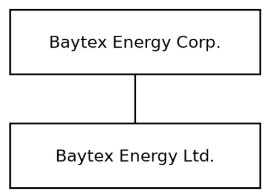
The following simplified diagram shows the inter-corporate relationships among us and our material subsidiaries as of the date hereof.
structurea.jpg
DEVELOPMENT OF OUR BUSINESS
2023

Oil prices were lower in 2023 as a result of global supply growth which resulted in a balanced crude market relative to 2022 when prices were elevated as the global supply shortfall was exacerbated by uncertainty related to Russian supply. The price for WTI averaged US$77.62/bbl for the year.

On February 8, 2023 the Board of Directors appointed Ms. Angela S. Lekatsas as a Director and announced that Mr. Gregory Melchin did not intend to stand for election at the next annual meeting of shareholders.

On February 23, 2023 the Common Shares commenced trading on the NYSE.

On February 28, 2023 Baytex announced its intention to acquire Ranger by way of the Merger. The Merger was completed on June 20, 2023 pursuant to the agreement and plan of merger dated February 27, 2023, as amended from time to time, between Baytex, Ranger and a newly formed indirect wholly owned subsidiary of Baytex. As consideration under the Merger, Baytex issued approximately 311.4 million Common Shares and paid $732.8 million in cash to the former security holders of Ranger. Additionally, Baytex assumed $1.1 billion of Ranger's net debt. The cash portion of the Merger was funded with the Corporation's expanded US$1.1 billion revolving Credit Facility, a US$150 million two-year term loan facility and the net proceeds from the issuance of US$800 million of 2030 Notes. The term loan facility was fully repaid and cancelled in August of 2023.

The Merger increased our Eagle Ford scale and provided an operating platform to effectively allocate capital across the Western Canadian Sedimentary Basin and the Eagle Ford.

In conjunction with closing of the Merger, we increased direct shareholder returns to 50% of free cash flow, which allowed us to increase the value of our share buyback program and introduce a dividend. The remainder of our free cash flow was allocated to debt reduction. On June 23, 2023 we announced the renewal of our NCIB allowing us to purchase up to 68,417,028 Common Shares during the 12-month period commencing June 29, 2023 and ending June 28, 2024.

In 2023, we returned approximately $260 million to shareholders through the NCIB and dividends. During 2023, we repurchased 40.5 million Common Shares under the NCIB for approximately $222 million, representing 4.7% of our issued and outstanding Common Shares, at an average price of $5.48 per Common Share. In addition, we declared two quarterly dividends during 2023 of $0.0225 per Common Share totaling approximately $38 million.

btefooter1a.jpg
9


On closing of the Merger, Jeffrey E. Wojahn and Tiffany ("T.J.") Thom Cepak were appointed to the Board of Directors, providing continuity and experience with the Ranger business and expertise in U.S. regulatory and operating matters.

On November 27, 2023, we announced that we had entered into a definitive agreement to sell certain of our Viking assets located at Forgan and Plato in southwest Saskatchewan (the "Sold Viking Assets"), effective October 1, 2023. On December 11, 2023, we completed the divestiture of the Sold Viking Assets for proceeds of $159.7 million, including closing adjustments. Proceeds from the sale were applied against our Credit Facilities. Production from the Sold Viking Assets at the time of the sale was approximately 4,000 boe/d (100% light and medium crude oil).

On December 6, 2023 we announced our anticipated 2024 exploration and development expenditures range of $1.2 to $1.3 billion, which was designed to generate average annual production of 150,000-156,000 boe/d.

2024

Global benchmark prices for crude oil in 2024 were relatively consistent with 2023 as a result of global supply growth and stable demand which resulted in a balanced crude oil market. The WTI benchmark price averaged US$75.72/bbl for 2024 compared to US$77.62/bbl for 2023.

On April 1, 2024, we closed a private offering of the 2032 Notes having an aggregated principal amount of US$575 million due 2032. Proceeds from the 2032 Notes were used to redeem the remaining US$409.8 million aggregate principal amount of the outstanding 2027 Notes, pay fees and expenses associated with the offering, and repay a portion of the debt outstanding on our Credit Facilities.

On April 22, 2024 we received an exemption order allowing Baytex to purchase up to ten percent (increased from five percent) of its public float of Common Shares through the NYSE and other U.S.-based trading systems as a part of an approved NCIB. The exemption was in place until August 1, 2025. On June 26, 2024 we announced the renewal of our NCIB allowing us to purchase up to 70,112,570 Common Shares during the 12-month period commencing July 2, 2024 and ending July 1, 2025.

On May 9, 2024 we amended our Credit Facilities to, among other things, extend the term by two years to May 2028 and maintained the aggregate principal amount available thereunder of US$1.1 billion.

In 2024, we returned approximately $290 million to shareholders through our NCIB and dividends. During 2024, we repurchased 48.4 million Common Shares under our NCIB at an average price of $4.50 per Common Share for total consideration of $217.9 million. In addition, we declared four quarterly dividends of $0.0225 per Common Share, totaling approximately $72 million.

On December 3, 2024 we announced our anticipated 2025 exploration and development expenditure range of $1.2 to $1.3 billion, which was designed to generate average annual production of 150,000-154,000 boe/d.

On December 20, 2024 we announced the sale of our Kerrobert thermal asset located in southwest Saskatchewan (the "Sold Kerrobert Asset") for net proceeds of approximately $42 million, including closing adjustments. Proceeds from the sale were applied against our Credit Facilities. Production from the Sold Kerrobert Asset at the time of the sale was approximately 2,000 boe/d (100% heavy oil). To reflect the disposition, we updated our 2025 production guidance to 148,000 to 152,000 boe/d.

btefooter1a.jpg
10


2025

Global benchmark prices for crude oil declined in 2025 compared to 2024 as a result of increasing supply and concerns over slowing global economic activity. The WTI benchmark price averaged US$64.81/bbl for 2025 compared to US$75.72/bbl for 2024.

On March 11, 2025 we announced a strategic partnership in the Pembina Duvernay with Gibson Energy Inc. ("Gibson") and the execution of a long-term take-or-pay agreement ("Agreement"). Under the 15-year Agreement, Baytex constructed certain oil and gas infrastructure and have operating responsibility for the term of the Agreement. Gibson invested approximately $50 million of capital expenditures and receive an area of dedication and established return on investment. Construction of the infrastructure was completed in the fourth quarter of 2025.

On June 24, 2025 we announced the renewal of our NCIB allowing us to purchase up to 66,244,464 Common Shares during the 12-month period commencing July 2, 2025 and ending July 1, 2026. On July 14, 2025 we received an exemption order allowing Baytex to purchase up to ten percent of its public float of Common Shares through the NYSE and other U.S.-based trading systems as a part of an approved NCIB. Without the exemption, Baytex would be permitted to purchase up to five percent of its public float of Common Shares. The exemption is in place until July 11, 2028.

On June 27, 2025 we amended our Credit Facilities to extend the term by one year to June 27, 2029 and maintained the aggregate principal amount available thereunder of US$1.1 billion.

On November 12, 2025 Baytex announced it had entered into a definitive purchase and sale agreement to sell its U.S. Eagle Ford assets (the "Divestiture"). The Divestiture closed on December 19, 2025 for net proceeds of US$2.2 billion ($3.0 billion) after closing adjustments. A portion of these proceeds were used to repay our Credit Facilities, redeem the 2030 Notes, and partially redeem the 2032 Notes pursuant to a cash tender offer commenced on December 1, 2025 (the "Tender Offer"). Pursuant to the Tender Offer, we repurchased US$505 million principal amount of the 2032 Notes. Upon closing of the Divestiture we modified our Credit Facilities to decrease the committed amount to $750.0 million from US$1.1 billion and extend maturity from June 27, 2029 to June 27, 2030.

In 2025, we returned approximately $98 million to shareholders through our NCIB and dividends. During 2025, we repurchased 8.1 million Common Shares under our NCIB at an average price of $3.55 per Common Share for total consideration of $28.9 million. In addition, we declared four quarterly dividends of $0.0225 per Common Share, totaling approximately $69 million.

On December 22, 2025 we announced our anticipated 2026 exploration and development expenditure range of $550 to $625 million, which is designed to generate average annual production of 67,000 to 69,000 boe/d. We also announced that Mr. Chad Lundberg, formerly Chief Operating Officer, had been appointed as President and Chief Operating Officer.

Subsequent to Year-end

On January 1, 2026 Ms. Tiffany ("T.J.") Thom Cepak and Ms. Angela S. Lekatsas resigned as directors of the Corporation.

On March 4, 2026 we announced that Chad Lundberg, President and Chief Operating Officer, would succeed Eric Greager as Chief Executive Officer following the Corporation's annual meeting of shareholders to be held on May 7, 2026.

btefooter1a.jpg
11


DESCRIPTION OF OUR BUSINESS
Overview

We are engaged in the acquisition, development and production of crude oil and natural gas in the Western Canadian Sedimentary Basin. Approximately 85% of our production is weighted toward crude oil and NGLs. The Corporation and its predecessors have been in business for more than 30 years and our operating teams are well established with a track record of technical proficiency and operational success. Throughout our history we have endeavoured to create value for our stakeholders by developing our assets and completing selective acquisitions and divestitures.

Competitive Conditions

Baytex is in the oil and natural gas industry, which is highly competitive and capital intensive, and many competitors have financial resources which exceed our own. Baytex competes with other companies for all of its business inputs, including development prospects, access to commodity markets, acquisition opportunities, available capital and staffing. Our competitive position is similar to that of other oil and natural gas producers of a similar size and production profile. See "Industry Conditions" and "Risk Factors".

Environmental and Social Policies

We have an active program to monitor and comply with all environmental laws, rules and regulations applicable to our operations. Our policies require that all employees and contractors report all breaches or potential breaches of environmental laws, rules and regulations to our senior management and all applicable governmental authorities. Any material breaches of environmental law, rules and regulations must be reported to the Board of Directors. Our Health, Safety and Environment Policy is available on our website at www.baytexenergy.com.

In recognition of the importance of our Health, Safety and Environment Policy and targets, including our GHG and methane emission intensity reduction targets, the mandate of the reserves and sustainability committee of the Board of Directors includes specific responsibility for the "oversight and monitoring of the Corporation’s performance related to health, safety, environment, climate and other sustainability matters."

Cyclical and Seasonal Factors

Our operational results and financial condition are dependent on the prices received for our oil and natural gas production. Oil and natural gas prices have fluctuated widely during recent years. Such prices are determined by supply and demand factors, including weather and general economic conditions, as well as conditions in other oil and natural gas regions. Any decline in oil and natural gas prices could have an adverse effect on our financial condition. We mitigate such price risk by closely monitoring commodity markets, implementing our risk management programs and by maintaining financial liquidity. Additionally, we continually review our capital program and implement initiatives to adapt to such price changes. See "Industry Conditions" and "Risk Factors".

The level of activity in the oil and gas industry is dependent on access to areas where operations are conducted. In Canada, seasonal weather variations, including spring break-up which occurs annually, affects access in certain circumstances. Unexpected adverse weather conditions, such as flooding, extreme cold weather, heavy snowfall, heavy rainfall, and forest fires may restrict the Corporation's ability to access its properties and/or operate its wells. See "Industry Conditions" and "Risk Factors".

btefooter1a.jpg
12


Renegotiation or Termination of Contracts

As at the date hereof, we do not anticipate that any aspects of our business will be materially affected during the remainder of 2026 by the renegotiation or termination of any contracts to which we are a party.

Personnel

As at December 31, 2025, Baytex had 227 employees, comprised of 171 employees in our head office and 56 employees in our field operations.

PRINCIPAL PROPERTIES
The following is a description of our principal oil and natural gas properties on production or under development as at December 31, 2025. Unless otherwise specified, gross and net acres and well count information are as at December 31, 2025 and production information represents average working interest production for the year ended December 31, 2025. All of our properties are located onshore in the Provinces of Alberta and Saskatchewan, Canada.

Peace River - Alberta

In the Peace River area of northwest Alberta we produce heavy gravity crude oil and natural gas from the Bluesky formation and the Spirit River (a Clearwater equivalent) formation. The core of our Clearwater play is located on the Peavine Métis settlement. Production in the area occurs through primary and polymer flooding recovery methods. During 2025, production from the area averaged approximately 30,609 boe/d, comprised of 28,961 bbl/d of heavy crude oil, 44 bbl/d of NGL and 9,629 Mcf/d of conventional natural gas. In 2025, Baytex drilled 53 (53.0 net) horizontal multi-lateral wells in this area. As at December 31, 2025, we had proved plus probable reserves of 58 million boe (35 million proved; 23 million probable).

Baytex held approximately 335,460 net undeveloped acres in this area as at December 31, 2025.

Lloydminster - Alberta and Saskatchewan

Our Lloydminster assets consist of several geographically dispersed heavy crude oil operations where we target multiple Manville formations and use multi-lateral horizontal drilling and circulation string horizontal drilling to develop our inventory. In some cases, Baytex's heavy crude oil reservoirs are water flooded and polymer flooded. During 2025, production averaged approximately 12,928 boe/d, comprised of 12,700 bbl/d of heavy crude oil, 19 bbl/d of light and medium crude oil, and 1,258 Mcf/d of conventional natural gas. In 2025, Baytex drilled 67 (55.2 net) oil wells in this area. As at December 31, 2025, we had proved plus probable reserves of 89 million boe (25 million proved; 64 million probable).

Baytex held approximately 135,627 net undeveloped acres in this area at December 31, 2025.

Duvernay - Alberta

Baytex holds a large 100% working interest land position in the Pembina-Gilby area of the Duvernay resource play in central Alberta. Production in the area occurs from the hydraulic fracturing of horizontal wells. During 2025, production averaged 8,328 boe/d, comprised of 6,524 bbl/d of tight oil and NGL and 10,825 Mcf/d of natural gas. During 2025, Baytex drilled 9 (9.0 net) oil wells in this area. As at December 31, 2025, we had proved plus probable reserves of 82 million boe (57 million proved; 25 million probable).

Baytex held approximately 66,815 net undeveloped acres in this area at December 31, 2025.

btefooter1a.jpg
13


Viking - Alberta and Saskatchewan

Our Viking assets are located in the greater Kindersley area in southwest Saskatchewan and in the Esther area of southeastern Alberta. These assets produce light oil from the Viking formation and production occurs primarily from the hydraulic fracturing of horizontal wells. In some areas, reservoirs are placed under waterflood. These assets are characterized by shallow wells with short cycle times and a manufacturing approach to development. During 2025, production averaged 9,771 boe/d, comprised of 8,018 bbl/d of light and medium crude oil and NGL, 10,071 Mcf/d of conventional natural gas, and 74 bbl/d of heavy crude oil. In 2025, Baytex completed 85 (82.0 net) oil wells. As at December 31, 2025 we had proved plus probable reserves of 38 million boe (23 million proved; 15 million probable).

Baytex held approximately 66,092 net undeveloped acres in this area at December 31, 2025.

Average Production

The following table indicates our average daily production from our principal properties for the year ended December 31, 2025.
Average Daily Production (1)
Heavy Crude Oil
(bbl/d)
Bitumen
(bbl/d)
Light and Medium Crude Oil
(bbl/d)
Tight Oil
(bbl/d)
NGL(2)
(bbl/d)
Shale Gas
(Mcf/d)
Conven-tional Natural Gas
(Mcf/d)
Oil Equivalent
(boe/d)
Canada - Heavy
Peace River 28,961  —  —  —  44  —  9,629  30,609 
Lloydminster 12,700  —  19  —  —  —  1,258  12,928 
Remaining properties 1,034  —  —  —  —  680  1,150 
Total 42,695  —  19  —  46  —  11,567  44,687 
Canada - Light
Viking 74  —  7,752  —  266  —  10,071  9,771 
Duvernay —  —  —  3,755  2,769  10,825  —  8,328 
Remaining properties —  251  —  563  —  11,525  2,742 
Total 80  —  8,003  3,755  3,598  10,825  21,596  20,841 
United States
Eagle Ford (3)
—  —  —  47,764  16,698  90,528  —  79,551 
Grand Total 42,775  —  8,022  51,519  20,342  101,353  33,163  145,079 
Note:
(1)Before deduction of royalties and including royalty interests.
(2)Includes condensate.
(3)Eagle Ford assets were disposed of on December 19, 2025. See "Development of our Business – 2025".

btefooter1a.jpg
14


Costs Incurred

The following table summarizes the property acquisition, exploration and development costs by country for the year ended December 31, 2025.
($000s) Canada United States Total
Property acquisition costs
Proved properties 279  1,867  2,146 
Unproved properties 29,872  —  29,872 
Property disposition (11,953) (3,011,350) (3,023,303)
Total Property acquisition costs, net 18,198  (3,009,483) (2,991,285)
Development Costs (1)
547,422  657,719  1,205,141 
Exploration Costs (2)
930  —  930 
Total 566,550  (2,351,764) (1,785,214)
Note:
(1)Development and facilities expenditures.
(2)Cost of land, geological and geophysical capital expenditures.

Oil and Gas Wells

The following table sets forth the number and status of wells in which we have a working interest as at December 31, 2025.
Oil Wells Natural Gas Wells
Producing Non-Producing Producing Non-Producing
Gross Net Gross Net Gross Net Gross Net
Alberta 1,070  1,001.8  808  569.5  82  49.7  196  140.0 
Saskatchewan 2,685  2,427.0  1,289  1,262.4  66  34.8  182  165.9 
Total 3,755  3,428.8  2,097  1,831.9  148  84.5  378  305.9 

Properties with No Attributed Reserves

The following table sets forth our undeveloped land holdings as at December 31, 2025.
Undeveloped Acres
Gross Net
Alberta 585,352  556,139 
Saskatchewan 131,545  116,419 
Total 716,897  672,558 

Undeveloped land holdings are lands that have not been assigned reserves as at December 31, 2025. None of these undeveloped properties have high expected development or operating costs or contractual sales obligations to produce and sell at substantially lower prices than could be realized under normal market conditions.

We estimate the value of our net undeveloped land holdings at December 31, 2025 to be approximately $151 million, as compared to $251 million as at December 31, 2024. This internal evaluation generally represents the estimated replacement cost of our undeveloped land and excludes approximately 14,267 net acres of our undeveloped land that we expect to expire on or before December 31, 2026. In
btefooter1a.jpg
15


determining replacement cost, we analyzed land sale prices paid at provincial crown land sales for properties in the vicinity of our undeveloped land holdings over the preceding three years.

Tax Horizon

Baytex does not expect to pay material cash income taxes prior to 2028 when forecasted using the commodity price forecasts and inflation rates as of January 1, 2026 used to prepare the Baytex Reserves Report. Baytex forecasts that once the tax horizon is reached, cash income taxes will average 8-12% of EBITDA(1) from that point onwards.

Note:
(1)Calculated in accordance with the agreement governing our Credit Facilities which is available on SEDAR+ at www.sedarplus.ca.

Exploration and Development Activities

The following table sets forth the gross and net exploratory and development wells in which we participated during the year ended December 31, 2025.
Exploratory Wells Development Wells Total Wells
Gross Net Gross Net Gross Net
CANADA
Oil Wells —  —  218  203.2  218  203.2 
Natural Gas Wells —  —  2.0  2.0 
Stratigraphic Test Wells 7.0  —  —  7.0 
Service Wells —  —  3.0  3.0 
Total 7.0  223  208.2  230  215.2 
UNITED STATES (1)
Oil Wells —  —  55  41.5  55  41.5 
Natural Gas Wells —  —  10  8.3  10  8.3 
Total —  —  65  49.8  65  49.8 
Note:
(1)Our United States assets were disposed of on December 19, 2025. See "Development of our Business – 2025".

Production Estimates

The following table sets out the volumes of our working interest production estimated for the year ending December 31, 2026, which is reflected in the estimate of future net revenue disclosed in the forecast price tables contained under "Statement of Reserves Data - Disclosure of Reserves Data".
Heavy Crude Oil
(bbl/d)
Bitumen
(bbl/d)
Light and Medium Crude Oil
(bbl/d)
Tight Oil
(bbl/d)
NGL
(bbl/d)(1)
Shale Gas
(Mcf/d)
Natural Gas
(Mcf/d)
Oil Equivalent
(boe/d)
Total Proved 37,476  —  7,823  4,195  4,716  12,482  32,140  61,646 
Total Proved plus Probable 43,274  —  8,486  4,444  4,968  13,040  34,608  69,114 
Note:
(1)Includes condensate.

The Peace River and Lloydminster properties account for 20% or more of the estimated 2026 production volumes. Estimated 2026 production volumes for the Peace River property is 24,292 boe/d on a total proved basis and 28,277 boe/d on a total proved plus probable basis. Estimated 2026 production volumes
btefooter1a.jpg
16


for the Lloydminster property is 14,014 boe/d on a total proved basis and 15,842 boe/d on a total proved plus probable basis.

Production History

The following table summarizes certain information in respect of the production, product prices received, royalties paid, production costs and resulting netback associated with our reserves data for the periods indicated below.
Three Months Ended Year Ended
Dec. 31, 2025 Sep. 30, 2025 Jun. 30, 2025 Mar. 31, 2025 Dec. 31, 2025
Average Sales Volume (1)
CANADA
Light and Medium Crude Oil (bbl/d) 7,295  7,680  7,873  9,268  8,022 
Heavy Crude Oil (bbl/d) 42,628  45,269  42,959  40,192  42,775 
Bitumen (bbl/d) —  —  —  —  — 
Tight Oil (bbl/d) 4,584  4,823  3,177  2,402  3,755 
NGL (bbl/d) (2)
4,640  3,587  3,103  3,228  3,644 
Total liquids (bbl/d) 59,147  61,359  57,112  55,090  58,196 
Shale Gas (Mcf/d) 14,801  13,758  7,915  6,705  10,825 
Conventional Natural Gas (Mcf/d) 34,094  27,203  34,416  37,038  33,163 
Total (boe/d) 67,295  68,185  64,167  62,380  65,528 
UNITED STATES
Tight Oil (bbl/d) 41,232  50,993  49,910  48,971  47,764 
NGL (bbl/d) (2)
14,401  16,919  17,993  17,512  16,698 
Total liquids (bbl/d) 55,633  67,912  67,903  66,483  64,462 
Shale Gas (Mcf/d) 84,950  89,115  96,151  91,988  90,528 
Total (boe/d) 69,792  82,765  83,928  81,814  79,551 
TOTAL
Light and Medium Crude Oil (bbl/d) 7,295  7,680  7,873  9,268  8,022 
Heavy Crude Oil (bbl/d) 42,628  45,269  42,959  40,192  42,775 
Bitumen (bbl/d) —  —  —  —  — 
Tight Oil (bbl/d) 45,816  55,816  53,087  51,373  51,519 
NGL (bbl/d) (2)
19,041  20,506  21,096  20,740  20,342 
Total liquids (bbl/d) 114,780  129,271  125,015  121,573  122,658 
Shale Gas (Mcf/d) 99,751  102,873  104,066  98,693  101,353 
Conventional Natural Gas (Mcf/d) 34,094  27,203  34,416  37,038  33,163 
Total (boe/d) 137,087  150,950  148,095  144,194  145,079 
btefooter1a.jpg
17


Three Months Ended Year Ended
Dec. 31, 2025 Sep. 30, 2025 Jun. 30, 2025 Mar. 31, 2025 Dec. 31, 2025
CANADA
Average Prices Received (3)
Light and Medium Crude Oil ($/bbl) 75.32  84.90  81.46  93.45  84.30 
Heavy Crude Oil ($/bbl) 58.62  67.05  64.43  73.51  65.77 
Bitumen ($/bbl) —  —  —  —  — 
Tight Oil ($/bbl) 76.87  86.64  85.47  95.71  84.82 
NGL ($/bbl) (2)
21.65  24.27  24.91  30.02  24.82 
Shale Gas ($/Mcf) 2.15  0.70  1.57  2.00  1.56 
Conventional Natural Gas ($/Mcf) 2.07  0.63  1.77  2.06  1.69 
Total ($/boe) (4)
53.55  61.88  59.71  67.92  60.61 
Royalties Paid
Light and Medium Crude Oil and NGL ($/bbl) (2)(5)
3.80  4.63  5.00  5.63  4.77 
Heavy Crude Oil ($/bbl) 8.82  10.51  9.94  13.97  10.74 
Bitumen ($/bbl) —  —  —  —  — 
Tight Oil ($/bbl) 9.00  11.18  11.17  10.66  10.43 
Shale Gas ($/Mcf) 0.20  0.06  0.09  0.10  0.12 
Conventional Natural Gas ($/Mcf) 0.10  0.02  0.20  —  0.08 
Total ($/boe) (6)
6.97  8.55  8.19  10.55  8.52 
Operating Expenses (7)
Light and Medium Crude Oil and NGL ($/bbl) (2)(5)
16.60  14.85  17.01  15.37  15.95 
Heavy Crude Oil ($/bbl) 14.16  13.92  15.24  13.37  14.18 
Bitumen ($/bbl) —  —  —  —  — 
Tight Oil ($/bbl) 6.88  7.43  8.76  7.89  7.61 
Shale Gas ($/Mcf) 1.15  1.24  1.46  1.31  1.26 
Conventional Natural Gas ($/Mcf) 2.38  2.70  2.52  2.23  2.44 
Total ($/boe) (6)
13.84  13.55  15.08  13.46  13.98 
Transportation Expenses
Light and Medium Crude Oil and NGL ($/bbl) (2)(5)
0.98  0.97  0.77  0.62  0.83 
Heavy Crude Oil ($/bbl) 4.62  4.70  4.59  4.56  4.62 
Bitumen ($/bbl) —  —  —  —  — 
Tight Oil ($/bbl) 1.53  1.95  1.36  1.41  1.61 
Shale Gas ($/Mcf) 0.25  0.32  0.23  0.24  0.27 
Conventional Natural Gas ($/Mcf) 0.36  0.48  0.41  0.34  0.39 
Total ($/boe) (6)
3.44  3.68  3.52  3.34  3.50 
Resulting Netback (3)(8)
Light and Medium Crude Oil and NGL ($/bbl) (2)(5)
33.07  45.15  42.70  55.44  44.17 
Heavy Crude Oil ($/bbl) 31.02  37.92  34.66  41.61  36.23 
Bitumen ($/bbl) —  —  —  —  — 
Tight Oil ($/bbl) 59.46  66.08  64.18  75.75  65.17 
Shale Gas ($/Mcf) 0.55  (0.92) (0.21) 0.35  (0.09)
Conventional Natural Gas ($/Mcf) (0.77) (2.57) (1.36) (0.51) (1.22)
Total ($/boe) (4)
29.30  36.10  32.92  40.57  34.61 
btefooter1a.jpg
18


Three Months Ended Year Ended
Dec. 31, 2025 Sep. 30, 2025 Jun. 30, 2025 Mar. 31, 2025 Dec. 31, 2025
UNITED STATES (9)
Average Prices Received (3)
Tight Oil ($/bbl) 81.62  88.56  86.77  100.75  89.66 
NGL ($/bbl) (2)
28.43  29.18  29.54  38.22  31.45 
Shale Gas ($/Mcf) 3.96  3.52  3.78  4.92  4.04 
Total ($/boe) (4)
58.91  64.32  62.26  74.01  65.04 
Royalties Paid
Tight Oil ($/bbl) 22.23  23.12  23.98  27.78  24.33 
NGL ($/bbl) (2)
7.81  7.80  7.77  10.33  8.45 
Shale Gas ($/Mcf) 0.99  0.85  0.91  1.20  0.99 
Total ($/boe) (6)
15.96  16.76  16.97  20.19  17.51 
Operating Expenses (7)
Tight Oil ($/bbl) 11.22  9.89  9.56  9.79  10.07 
NGL ($/bbl) (2)
11.22  9.89  9.56  9.79  10.06 
Shale Gas ($/Mcf) 1.87  1.65  1.59  1.63  1.68 
Total ($/boe) (6)
11.22  9.89  9.56  9.79  10.07 
Transportation Expenses
Tight Oil ($/bbl) 1.46  1.61  1.62  1.59  1.57 
NGL ($/bbl) (2)
1.46  1.61  1.62  1.59  1.57 
Shale Gas ($/Mcf) 0.24  0.27  0.27  0.27  0.26 
Total ($/boe) (6)
1.46  1.61  1.62  1.59  1.57 
Resulting Netback (3)(8)
Tight Oil ($/bbl) 46.71  53.94  51.61  61.59  53.69 
NGL ($/bbl) (2)
7.94  9.88  10.59  16.51  11.37 
Shale Gas ($/Mcf) 0.86  0.75  1.01  1.82  1.11 
Total ($/boe) (4)
30.27  36.06  34.11  42.44  35.89 
Notes:
(1)Before deduction of royalties and including royalty interests.
(2)NGL includes condensate.
(3)Before the effects of commodity derivative instruments.
(4)Non-GAAP measure that does not have any standardized meaning prescribed by IFRS and may not be comparable with the calculation of similar measures presented by other entities. See "Specified Financial Measures" in the Baytex Annual 2025 MD&A for information related to this measure, which section has been incorporated by reference herein. The Baytex Annual 2025 MD&A is available on SEDAR+ at www.sedarplus.ca.
(5)In Canada, NGL volumes are grouped with light crude oil volumes for reporting purposes.
(6)Supplementary financial measure. See "Royalties", "Operating Expense", and "Transportation Expense" in the Baytex Annual 2025 MD&A for information related to this measure, which section has been incorporated by reference herein. Baytex Annual 2025 MD&A is available on SEDAR+ at www.sedarplus.ca.
(7)Operating expenses are composed of direct costs incurred to operate both oil and gas wells. A number of assumptions are required to allocate these costs between oil, Conventional natural gas and NGL production.
(8)Netback is calculated by subtracting royalties paid, operating and transportation expenses from revenues.
(9)Our United States assets were disposed of on December 19, 2025. See "Development of our Business - 2025".
btefooter1a.jpg
19


Marketing Arrangements and Forward Contracts

We market our operated oil and natural gas production with the objective of maximizing value and counterparty performance. We have a portfolio of sales contracts with a variety of pricing mechanisms, term commitments and customers and we also have several committed transportation and processing contracts with volume and term commitments that enable us to transport our production to sales points. The Corporation also has a risk management policy pursuant to which we utilize various derivative financial instruments and physical sales contracts to manage our exposure to fluctuations in commodity prices, foreign exchange and interest rates. We also use derivative instruments in various operational markets to optimize our supply or production chain.

When marketing and hedging we engage a number of reputable counterparties to ensure competitiveness, while also managing counterparty credit exposure. For details on our contractual commitments to sell natural gas and crude oil which were outstanding at March 4, 2026, see Note 19 to our audited consolidated financial statements for the year ended December 31, 2025. See "Risk Factors".

STATEMENT OF RESERVES DATA
The Baytex Reserves Report has been prepared in accordance with the standards contained in the COGE Handbook and the reserves definitions contained in NI 51‑101. The statement of reserves data and other oil and natural gas information set forth below is dated December 31, 2025. The effective date of the Baytex Reserves Report is December 31, 2025 and the preparation date of the statement is February 2, 2026. The Baytex Reserves Report was prepared using the average commodity price forecasts and inflation rates of McDaniel, GLJ Petroleum Consultants Ltd. and Sproule ERCE as of January 1, 2026.

Disclosure of Reserves Data

The following tables are a summary as at December 31, 2025 of our proved and probable heavy crude oil, bitumen, light and medium oil, tight oil, NGL, conventional natural gas and shale gas reserves and the net present value of the future net revenue attributable to such reserves evaluated in the Baytex Reserves Report. Our reserves are located in Canada (Alberta and Saskatchewan).

All evaluations of future net revenue are after the deduction of future income tax expenses (unless otherwise noted in the tables), royalties, development costs, production costs and well abandonment costs but before consideration of indirect costs such as administrative, overhead and other miscellaneous expenses. The estimated future net revenue contained in the following tables does not necessarily represent the fair market value of our reserves. There is no assurance that the forecast price and cost assumptions contained in the Baytex Reserves Report will be attained and variations could be material. The tables summarize the data contained in the Baytex Reserves Report and, as a result, may contain slightly different numbers and columns in the tables may not add due to rounding. Other assumptions and qualifications relating to costs and other matters are summarized in the notes to or following the tables below.

The recovery and reserves estimates described herein are estimates only and there is no guarantee that the estimated reserves will be recovered. Readers should review the definitions and information contained in "Selected Terms - Reserves Definitions", "Selected Terms - Reserves and Reserve Categories" and "Selected Terms - Development and Production Status" in conjunction with the following tables and notes. For more information as to the risks involved, see "Risk Factors".


btefooter1a.jpg
20


SUMMARY OF OIL AND NATURAL GAS RESERVES
AS OF DECEMBER 31, 2025
FORECAST PRICES AND COSTS

TIGHT OIL LIGHT AND MEDIUM CRUDE OIL HEAVY CRUDE OIL
RESERVES CATEGORY Gross
(Mbbl)
Net
(Mbbl)
Gross
(Mbbl)
Net
(Mbbl)
Gross
(Mbbl)
Net
(Mbbl)
PROVED:
Developed Producing
4,256  3,593  8,466  8,029  38,513  33,045 
Developed Non‑Producing
—  —  —  —  993  868 
Undeveloped
18,464  15,798  11,252  10,735  19,254  17,184 
TOTAL PROVED 22,719  19,391  19,718  18,764  58,760  51,097 
PROBABLE 10,062  8,065  12,817  11,876  41,149  34,599 
TOTAL PROVED PLUS PROBABLE 32,781  27,455  32,535  30,640  99,909  85,696 
BITUMEN SHALE GAS
CONVENTIONAL NATURAL GAS (1)
RESERVES CATEGORY Gross
(Mbbl)
Net
(Mbbl)
Gross
(MMcf)
Net
(MMcf)
Gross
(MMcf)
Net (MMcf)
PROVED:
Developed Producing
—  —  18,277  16,663  46,117  41,598 
Developed Non‑Producing
—  —  —  —  236  219 
Undeveloped
—  —  55,041  49,697  28,428  24,806 
TOTAL PROVED —  —  73,318  66,360  74,780  66,623 
PROBABLE 44,459  35,743  32,051  28,442  39,115  34,047 
TOTAL PROVED PLUS PROBABLE 44,459  35,743  105,369  94,801  113,896  100,670 
NATURAL GAS LIQUIDS (2)
TOTAL RESERVES
RESERVES CATEGORY Gross
(Mbbl)
Net
(Mbbl)
Gross
(Mboe)
Net
(Mboe)
PROVED:
Developed Producing
7,003  6,115  68,970  60,492 
Developed Non‑Producing
1,033  905 
Undeveloped
17,815  15,577  80,696  71,712 
TOTAL PROVED 24,819  21,694  150,699  133,109 
PROBABLE 10,837  9,129  131,185  109,826 
TOTAL PROVED PLUS PROBABLE 35,657  30,823  281,884  242,936 
Notes:
(1)Conventional natural gas includes associated, non-associated and solution gas.
(2)Natural gas liquids includes condensate.

btefooter1a.jpg
21


SUMMARY OF NET PRESENT VALUES OF FUTURE NET REVENUE
AS OF DECEMBER 31, 2025
FORECAST PRICES AND COSTS


BEFORE INCOME TAXES DISCOUNTED AT (%/year)
UNIT VALUE BEFORE TAX
RESERVES CATEGORY 0%
($000s)
5%
($000s)
10%
($000s)
15%
($000s)
20%
($000s)
10%
$/boe
PROVED:
Developed Producing 141,390  646,691  728,771  724,671  699,707  12.05 
Developed Non‑Producing 28,154  21,281  16,625  13,352  10,976  18.36 
Undeveloped 1,203,787  800,682  537,689  359,276  233,981  7.50 
TOTAL PROVED 1,373,331  1,468,655  1,283,085  1,097,299  944,664  9.64 
PROBABLE 3,418,791  1,951,626  1,258,158  878,533  647,708  11.46 
TOTAL PROVED PLUS PROBABLE 4,792,122  3,420,281  2,541,243  1,975,833  1,592,372  10.46 


AFTER INCOME TAXES DISCOUNTED AT (%/year) (1)
RESERVES CATEGORY 0%
($000s)
5%
($000s)
10%
($000s)
15%
($000s)
20%
($000s)
PROVED:
Developed Producing 141,390  646,691  728,771  724,671  699,707 
Developed Non‑Producing 28,154  21,281  16,625  13,352  10,976 
Undeveloped 1,060,507  678,612  432,752  268,337  154,598 
TOTAL PROVED 1,230,051  1,346,584  1,178,148  1,006,361  865,281 
PROBABLE 2,718,026  1,498,352  934,827  632,670  452,393 
TOTAL PROVED PLUS PROBABLE 3,948,077  2,844,936  2,112,975  1,639,031  1,317,675 
Note:
(1)The after-tax net present value of future net revenue from our oil and gas properties reflects the tax burden on the properties on a theoretical stand-alone basis. It does not consider our corporate structure or any tax planning and therefore does not provide an estimate of the cumulative after-tax value of our consolidated business entities, which may be significantly different. 
TOTAL FUTURE NET REVENUE (UNDISCOUNTED)
AS OF DECEMBER 31, 2025
FORECAST PRICES AND COSTS

($000s) REVENUE ROYALTIES OPERAT-ING COSTS DEVELOP-MENT COSTS
ABANDON-MENT AND RECLAMA-TION COSTS (1)
FUTURE NET REVENUE BEFORE INCOME TAXES INCOME TAXES FUTURE NET REVENUE
AFTER INCOME TAXES
TOTAL PROVED RESERVES 9,105,427  1,115,781  3,616,433  1,914,632  1,085,249  1,373,331  143,280  1,230,051 
TOTAL PROVED PLUS PROBABLE RESERVES 19,107,852  2,823,137  6,915,775  3,431,611  1,145,206  4,792,122  844,045  3,948,077 
Note:
(1)Includes well abandonment, decommissioning and reclamation costs for all producing and non-producing wells and facilities and to be incurred as a result of future development activity.
btefooter1a.jpg
22


FUTURE NET REVENUE BY PRODUCT TYPE
AS OF DECEMBER 31, 2025
FORECAST PRICES AND COSTS
RESERVES CATEGORY PRODUCT TYPE FUTURE NET REVENUE BEFORE INCOME TAXES (discounted at 10%/year)
($000s)

UNIT VALUE (1)
($/bbl; $/Mcf)
Proved Light and Medium Crude Oil (including solution gas and associated byproducts) 243,875  13.00 
Heavy Crude Oil (including solution gas and associated byproducts) 584,899  11.45 
Tight Oil (including solution gas and associated byproducts) 437,815  22.58 
Conventional Natural Gas (associated and non-associated) (including associated byproducts) 16,495  0.47 
Total 1,283,085 
Proved plus
Probable
Light and Medium Crude Oil (including solution gas and associated byproducts) 539,297  17.60 
Heavy Crude Oil (including solution gas and associated byproducts) 1,126,147  13.14 
Bitumen (including solution gas and associated byproducts) 157,145  4.40 
Tight Oil (including solution gas and associated byproducts) 680,418  24.78 
Conventional Natural Gas (associated and non-associated) (including associated byproducts) 38,236  0.78 
Total 2,541,243 
Note:
(1)Unit values are calculated using the 10% discount rate divided by the Major Product Type net reserves for each group.
btefooter1a.jpg
23


Pricing Assumptions

The forecast cost and price assumptions include increases in actual wellhead selling prices and take into account inflation with respect to future operating and capital costs. The reference pricing used in the Baytex Reserves Report is as follows:

SUMMARY OF PRICING AND INFLATION RATE ASSUMPTIONS
AS AT DECEMBER 31, 2025 (1)
FORECAST PRICES AND COSTS
Year
Oil
Natural Gas
Inflation Rate (5)
(%/Yr)
Exchange Rate (6)
($US/$Cdn)
WTI Crude Oil
($US/bbl)
Edmonton Light Crude Oil (2)
($Cdn/bbl)
Western Canadian Select (3) ($Cdn/bbl)
Henry Hub
($US/MMbtu)
AECO Spot (4)
($Cdn/MMbtu)
Historical
2021 68.00 80.35 68.85 3.90 3.55 3.4 0.80
2022 94.80 120.75 99.10 6.40 5.55 6.8 0.77
2023 77.65 100.40 79.55 2.55 2.95 3.9 0.74
2024 76.55 97.50 83.60 2.20 1.45 2.4 0.73
2025 65.50 85.65 75.05 3.55 1.85 2.1 0.72
Forecast (7)
2026 59.92 77.54 65.13 3.74 3.00 0.73
2027 65.10 83.60 70.43 3.78 3.30 2.0 0.74
2028 70.28 90.17 76.90 3.85 3.49 2.0 0.74
2029 71.93 92.32 78.71 3.93 3.58 2.0 0.74
2030 73.37 94.17 80.29 4.01 3.65 2.0 0.74
2031 74.84 96.06 81.90 4.09 3.72 2.0 0.74
2032 76.34 97.98 83.53 4.17 3.80 2.0 0.74
2033 77.87 99.93 85.20 4.26 3.88 2.0 0.74
2034 79.42 101.93 86.91 4.34 3.95 2.0 0.74
2035 81.01 103.97 88.65 4.43 4.03 2.0 0.74
Notes:
(1)Each price from the forecast was adjusted for quality differentials and transportation costs applicable to the specified product and evaluation area.
(2)Price used in the preparation of light and medium crude oil and natural gas liquids reserves in Canada.
(3)Price used in the preparation of heavy crude oil and bitumen reserves in Canada.
(4)Price used in the preparation of natural gas reserves in Canada.
(5)Inflation rates for forecasting prices and costs.
(6)Exchange rate used to generate the benchmark reference prices in this table.
(7)After 2035, prices and costs escalate at 2.0% annually and the exchange rate remains 0.74.

Weighted average prices realized by us for the year ended December 31, 2025, excluding hedging activities, were $65.77/bbl for heavy crude oil, $84.30/bbl for light and medium crude oil, $84.82/bbl for tight oil, $24.82/bbl for NGL, $1.56/Mcf for shale gas and $1.69/Mcf for Conventional natural gas.


btefooter1a.jpg
24


RECONCILIATION OF GROSS RESERVES BY PRINCIPAL PRODUCT TYPE
FORECAST PRICES AND COSTS

CANADA HEAVY CRUDE OIL BITUMEN
Proved
(Mbbl)
Probable
(Mbbl)
Proved Plus Probable
(Mbbl)
Proved
(Mbbl)
Probable
(Mbbl)
Proved Plus Probable
(Mbbl)
December 31, 2024 55,357  34,190  89,547  —  44,489  44,489 
Extensions (1)
14,174  10,144  24,317  —  —  — 
Technical Revisions (2)
6,488  (2,996) 3,492  —  —  — 
Acquisitions (3)
—  —  —  —  —  — 
Dispositions (4)
(147) (256) (403) —  —  — 
Economic Factors (5)
(1,503) 67  (1,436) —  (30) (30)
Production (6)
(15,608) —  (15,608) —  —  — 
December 31, 2025 58,760  41,149  99,909  —  44,459  44,459 

CANADA LIGHT AND MEDIUM CRUDE OIL TIGHT OIL
Proved
(Mbbl)
Probable
(Mbbl)
Proved Plus Probable
(Mbbl)
Proved
(Mbbl)
Probable
(Mbbl)
Proved Plus Probable
(Mbbl)
December 31, 2024 23,604  13,644  37,248  15,935  11,406  27,341 
Extensions (1)
982  89  1,070  7,853  (1,559) 6,293 
Technical Revisions (2)
(664) (1,042) (1,706) 406  291  698 
Acquisitions (3)
—  —  —  —  —  — 
Dispositions (4)
(355) (332) (687) —  —  — 
Economic Factors (5)
(950) 458  (491) (104) (76) (180)
Production (6)
(2,900) —  (2,900) (1,371) —  (1,371)
December 31, 2025 19,718  12,817  32,535  22,719  10,062  32,781 

CANADA
NATURAL GAS LIQUIDS (7)
SHALE GAS
Proved
(Mbbl)
Probable
(Mbbl)
Proved Plus Probable
(Mbbl)
Proved
(MMcf)
Probable
(MMcf)
Proved Plus Probable
(MMcf)
December 31, 2024 15,797  11,400  27,197  48,640  37,041  85,680 
Extensions (1)
8,994  (944) 8,050  26,434  (4,694) 21,740 
Technical Revisions (2)
1,562  493  2,055  2,590  (22) 2,568 
Acquisitions (3)
—  —  —  —  —  — 
Dispositions (4)
(66) (33) (99) —  —  — 
Economic Factors (5)
(140) (78) (219) (395) (273) (668)
Production (6)
(1,328) —  (1,328) (3,951) —  (3,951)
December 31, 2025 24,819  10,837  35,657  73,318  32,051  105,369 

btefooter1a.jpg
25


CANADA
CONVENTIONAL NATURAL GAS (8)
OIL EQUIVALENT
Proved
(MMcf)
Probable
(MMcf)
Proved Plus Probable
(MMcf)
Proved (Mboe) Probable
(Mboe)
Proved Plus Probable
(Mboe)
December 31, 2024 74,789  38,344  113,133  131,265  127,692  258,957 
Extensions (1)
13,463  6,534  19,997  38,652  8,035  46,687 
Technical Revisions (2)
1,854  (5,191) (3,337) 8,533  (4,122) 4,411 
Acquisitions (3)
—  —  —  —  —  — 
Dispositions (4)
(1,442) (700) (2,142) (809) (737) (1,546)
Economic Factors (5)
(1,830) 129  (1,701) (3,068) 317  (2,751)
Production (6)
(12,054) —  (12,054) (23,874) —  (23,874)
December 31, 2025 74,780  39,115  113,896  150,699  131,185  281,884 

UNITED STATES TIGHT OIL
NATURAL GAS LIQUIDS (7)
Proved
(Mbbl)
Probable
(Mbbl)
Proved Plus Probable
(Mbbl)
Proved
(Mbbl)
Probable
(Mbbl)
Proved Plus Probable
(Mbbl)
December 31, 2024 152,265  73,392  225,657  76,126  31,414  107,539 
Extensions (1)
1,011  (1,011) —  396  (396) — 
Acquisitions (3)
—  —  —  —  —  — 
Dispositions (4)
(135,842) (72,381) (208,223) (70,426) (31,018) (101,444)
Production (6)
(17,434) —  (17,434) (6,095) —  (6,095)
December 31, 2025 —  —  —  —  —  — 

UNITED STATES SHALE GAS OIL EQUIVALENT
Proved
(MMcf)
Probable
(MMcf)
Proved Plus Probable
(MMcf)
Proved
(Mboe)
Probable
(Mboe)
Proved Plus Probable
(Mboe)
December 31, 2024 291,135  115,954  407,089  276,913  124,132  401,044 
Extensions (1)
1,944  (1,944) —  1,731  (1,731) — 
Acquisitions (3)
—  —  —  —  —  — 
Dispositions (4)
(260,036) (114,010) (374,047) (249,608) (122,401) (372,008)
Production (6)
(33,043) —  (33,043) (29,036) —  (29,036)
December 31, 2025 —  —  —  —  —  — 

TOTAL HEAVY CRUDE OIL BITUMEN
Proved
(Mbbl)
Probable
(Mbbl)
Proved Plus Probable
(Mbbl)
Proved
(Mbbl)
Probable
(Mbbl)
Proved Plus Probable
(Mbbl)
December 31, 2024 55,357  34,190  89,547  —  44,489  44,489 
Extensions (1)
14,174  10,144  24,317  —  —  — 
Technical Revisions (2)
6,488  (2,996) 3,492  —  —  — 
Acquisitions (3)
—  —  —  —  —  — 
Dispositions (4)
(147) (256) (403) —  —  — 
Economic Factors (5)
(1,503) 67  (1,436) —  (30) (30)
Production (6)
(15,608) —  (15,608) —  —  — 
December 31, 2025 58,760  41,149  99,909  —  44,459  44,459 

btefooter1a.jpg
26


TOTAL LIGHT AND MEDIUM CRUDE OIL TIGHT OIL
Proved
(Mbbl)
Probable
(Mbbl)
Proved Plus Probable
(Mbbl)
Proved
(Mbbl)
Probable
(Mbbl)
Proved Plus Probable
(Mbbl)
December 31, 2024 23,604  13,644  37,248  168,200  84,798  252,997 
Extensions (1)
982  89  1,070  8,864  (2,571) 6,293 
Technical Revisions (2)
(664) (1,042) (1,706) 406  291  698 
Acquisitions (3)
—  —  —  —  —  — 
Dispositions (4)
(355) (332) (687) (135,842) (72,381) (208,223)
Economic Factors (5)
(950) 458  (491) (104) (76) (180)
Production (6)
(2,900) —  (2,900) (18,805) —  (18,805)
December 31, 2025 19,718  12,817  32,535  22,719  10,062  32,781 

TOTAL
NATURAL GAS LIQUIDS (7)
SHALE GAS
Proved
(Mbbl)
Probable
(Mbbl)
Proved Plus Probable
(Mbbl)
Proved
(MMcf)
Probable
(MMcf)
Proved Plus Probable
(MMcf)
December 31, 2024 91,923  42,813  134,736  339,775  152,995  492,770 
Extensions (1)
9,390  (1,340) 8,050  28,378  (6,638) 21,740 
Technical Revisions (2)
1,562  493  2,055  2,590  (22) 2,568 
Acquisitions (3)
—  —  —  —  —  — 
Dispositions (4)
(70,493) (31,051) (101,544) (260,036) (114,010) (374,047)
Economic Factors (5)
(140) (78) (219) (395) (273) (668)
Production (6)
(7,423) —  (7,423) (36,994) —  (36,994)
December 31, 2025 24,819  10,837  35,657  73,318  32,051  105,369 

TOTAL
CONVENTIONAL NATURAL GAS (8)
OIL EQUIVALENT
Proved
(MMcf)
Probable
(MMcf)
Proved Plus Probable
(MMcf)
Proved
(Mboe)
Probable
(Mboe)
Proved Plus Probable
(Mboe)
December 31, 2024 74,789  38,344  113,133  408,177  251,824  660,001 
Extensions (1)
13,463  6,534  19,997  40,383  6,304  46,687 
Technical Revisions (2)
1,854  (5,191) (3,337) 8,533  (4,122) 4,411 
Acquisitions (3)
—  —  —  —  —  — 
Dispositions (4)
(1,442) (700) (2,142) (250,417) (123,137) (373,554)
Economic Factors (5)
(1,830) 129  (1,701) (3,068) 317  (2,751)
Production (6)
(12,054) —  (12,054) (52,910) —  (52,910)
December 31, 2025 74,780  39,115  113,896  150,699  131,185  281,884 
Notes:
(1)Additions resulting from capital expenditures for step-out drilling in previously discovered reservoirs. The majority of extensions were in the Duvernay, Lloydminster, and Peace River business units.
(2)Positive or negative revisions to an estimate resulting from new technical data or revised interpretations on previously assigned reserves. Revisions are usually associated with reservoir performance, operating costs, or development plan changes. Positive proved plus probable revisions in the Duvernay and Peace River business unit were offset by negative revisions in the Viking business unit.
(3)Additions from the purchase of interests at the effective date of this report, plus any production from the closing date of the acquisition to December 31, 2025.
(4)Reduction from the sale of interests. Disposition volume is estimated at December 31, 2024 minus any production from December 31, 2024 to the closing date of the disposition. The Corporation disposed of non-core Canadian assets and all of its U.S. assets during 2025.
(5)Revisions to an estimate resulting from changes to the price forecast, inflation rates, or regulatory changes. Negative revisions were realized due to economic factors.
btefooter1a.jpg
27


(6)Reduction due to production between December 31, 2024 and December 31, 2025. Production averaged 145,079 boe/d in 2025.
(7)Natural gas liquids includes condensate.
(8)Conventional natural gas includes associated, non-associated and solution gas.

Additional Information Relating to Reserves Data

Undeveloped Reserves

Undeveloped reserves are attributed in accordance with standards and procedures contained in the COGE Handbook. Proved undeveloped reserves are those reserves that can be estimated with a high degree of certainty and are expected to be recovered from known accumulations where a significant expenditure is required to render them capable of production. Probable undeveloped reserves are those reserves that are less certain to be recovered than proved reserves and are expected to be recovered from known accumulations where a significant expenditure is required to render them capable of production.

We allocate development capital to our assets annually. We reduce risk by technically assessing the prior year's results from our development programs before committing additional capital. Furthermore, planned activity levels vary each year due to factors such as prevailing commodity prices, capital availability, operational spacing considerations, timing of infrastructure construction and regulatory processes. This approach means that in most cases it will take longer than three years to develop our proved undeveloped reserves and longer than five years to develop our proved plus probable undeveloped reserves. With the exception of our Gemini SAGD project, we plan to develop the majority of our proved undeveloped reserves over the next five years and our probable undeveloped reserves over the next seven years. Excluding our Gemini SAGD project, approximately 51 percent of our proved reserves and 45 percent of our proved plus probable reserves are developed within two years. The remainder of our reserves are scheduled to be developed beyond two years due to the extent of the drilling inventory and annual capital availability.

At our Gemini SAGD project, steam generation represents a large proportion of the capital and operating costs. Therefore, our development plans anticipate that, in order to make the most efficient use of our steam generating and oil treating facilities, the drilling and steaming of wells (once commenced) would take place over approximately 25 years. We have booked 44.5 MMbbls of probable undeveloped reserves to the Gemini SAGD project.

btefooter1a.jpg
28


Proved Undeveloped Reserves

The following table discloses, for each product type, the volumes of proved undeveloped reserves that were attributed during, and the volume booked at year-end for, the three most recently completed financial years.
Light and Medium Crude Oil
Gross (Mbbl)
Tight Oil
Gross (Mbbl)
Heavy Crude Oil
Gross (Mbbl)
Bitumen
Gross (Mbbl)
Year
First Attributed
Booked at Year End
First Attributed
Booked at Year End
First Attributed
Booked at Year End
First Attributed
Booked at Year End
2023 407  15,699  71,679  88,506  4,328  18,445  —  2,105 
2024 594  14,122  15,196  92,759  4,012  19,082  —  — 
2025 75  11,252  6,048  18,464  6,339  19,254  —  — 
Conventional Natural Gas
Gross (MMcf)
Shale Gas
Gross (MMcf)
Natural Gas Liquids
Gross (Mbbl)
Year
First Attributed
Booked at Year End
First Attributed
Booked at Year End
First Attributed
Booked at Year End
2023 769  23,948  93,446  201,607  18,527  54,631 
2024 1,819  24,622  35,230  188,509  8,243  53,117 
2025 8,556  28,428  19,434  55,041  6,531  17,815 

Probable Undeveloped Reserves

The following table discloses, for each product type, the volumes of probable undeveloped reserves that were attributed during, and the volume booked at year-end for, the three most recently completed financial years.
Light and Medium Crude Oil
Gross (Mbbl)
Tight Oil
Gross (Mbbl)
Heavy Crude Oil
Gross (Mbbl)
Bitumen
Gross (Mbbl)
Year
First Attributed
Booked at Year End
First Attributed
Booked at Year End
First Attributed
Booked at Year End
First Attributed
Booked at Year End
2023 247  11,560  55,029  68,578  4,450  21,271  —  45,110 
2024 328  10,551  1,417  66,263  3,735  20,703  —  44,489 
2025 188  10,012  —  8,306  10,771  27,004  —  44,459 
Conventional Natural Gas
Gross (MMcf)
Shale Gas
Gross (MMcf)
Natural Gas Liquids
Gross (Mbbl)
Year
First Attributed
Booked at Year End
First Attributed
Booked at Year End
First Attributed
Booked at Year End
2023 828  19,672  55,986  118,276  12,638  33,386 
2024 1,800  20,598  7,295  115,555  1,612  33,333 
2025 5,211  21,935  —  25,188  —  8,184 

Significant Factors or Uncertainties

The process of estimating reserves is complex. It requires significant judgments and decisions based on available geological, geophysical, engineering, and economic data. These estimates may change substantially as additional data from ongoing development activities and production performance becomes available and as economic conditions impacting oil and gas prices and costs change.

btefooter1a.jpg
29


The reserve estimates contained herein are based on current production forecasts, prices and economic conditions. As circumstances change and additional data becomes available, reserve estimates also change. Estimates made are reviewed and revised, either upward or downward, as warranted by the new information. Revisions are often required due to changes in well performance, commodity prices, economic conditions and governmental restrictions.

Although every reasonable effort is made to ensure that reserve estimates are accurate, reserve estimation is an inferential science. As a result, subjective decisions, new geological or production information and a changing environment may impact these estimates. Revisions to reserve estimates can arise from changes in year-end oil and gas prices and reservoir performance. Such revisions can be either positive or negative.

In the event that prices for oil and gas are not consistent with those used to prepare the Baytex Reserves Report, the volume of our reserves, their net present value and our expected revenues will differ, perhaps materially so, from those stated in the Baytex Reserves Report.

In connection with our operations, we will be liable for our share of ongoing environmental obligations and for the ultimate reclamation of our surface leases, wells and facilities. The total liability associated with these existing surface leases, wells and facilities, inflated at 2% per year, is estimated to be $1,025 million undiscounted ($220 million discounted at 10 percent). This is comprised of $365 million undiscounted ($25 million discounted at 10 percent) associated with active properties, $282 million undiscounted ($154 million discounted at 10 percent) associated with inactive properties, and $378 million undiscounted ($41 million discounted at 10 percent) associated with facilities.

Future Development Costs

The following table sets forth development costs deducted in the estimation of the future net revenue attributable to the reserve categories noted below (using forecast prices and costs).

FUTURE DEVELOPMENT COSTS
AS OF DECEMBER 31, 2025
FORECAST PRICES AND COSTS
($000s)
Proved Reserves Proved plus Probable Reserves
2026 358,545  442,334 
2027 504,930  617,943 
2028 510,960  693,845 
2029 342,894  656,620 
2030 146,454  247,956 
Remaining 50,849  772,913 
Total (undiscounted) 1,914,632  3,431,611 
We expect to fund the development costs of our reserves through a combination of internally generated cash flow, debt and equity financing. Planned activity levels vary each year due to factors such as capital availability, prevailing commodity prices and regulatory processes.

There can be no guarantee that funds will be available or that our Board of Directors will allocate funding to develop all of the reserves attributed in the Baytex Reserves Report. Failure to develop those reserves could have a negative impact on our future cash flow.

btefooter1a.jpg
30


The interest or other costs of external funding are not included in the reserves and future net revenue estimates set forth herein and would reduce reserves and future net revenue to some degree depending upon the funding sources utilized and the costs thereof. We do not anticipate that interest or other funding costs would make development of any of these properties uneconomic.

RISK FACTORS
You should carefully consider the following risk factors, as well as the other information contained in this AIF and our other public filings before making an investment decision. If any of the risks described below materialize, our business, reputation, financial condition, results of operations and cash flow could be materially and adversely affected, which may materially affect the market price of our securities. The risks described below may not be the only risks we face, as our business and operations may also be subject to risks that we do not yet know of, or that we currently believe are immaterial. Residents of the United States and other non-residents of Canada should have additional regard to the risk factors under the heading "Certain Risks for United States and other non-resident Shareholders".

The information set forth below contains forward-looking statements, which are qualified by the information contained in the section of this AIF entitled "Special Notes to Reader - Forward-Looking Statements".

Risks Relating to Our Business and Operations

Crude oil and natural gas prices are volatile. An extended period of low oil and natural gas prices could have a material adverse effect on the Corporation's business, results of operations, or cash flows and financial condition

Our financial condition is substantially dependent on, and highly sensitive to, the prevailing prices of crude oil and natural gas. Low prices for crude oil and natural gas produced by us could have a material adverse effect on our operations, financial condition and the value and amount of our reserves.

Prices for crude oil and natural gas fluctuate in response to changes in the supply of, and demand for, crude oil and natural gas, market uncertainty and a variety of additional factors beyond our control. Crude oil prices are primarily determined by international supply and demand. Factors which affect crude oil prices include the actions of OPEC, OPEC+, the condition of the Canadian, United States, European and Asian economies, the impacts of geopolitical events, including the Russian Ukrainian war, geopolitical developments in Venezuela and conflicts and hostilities in the Middle East, the imposition of tariffs or other adverse economic or political development in the United States, Europe, the Middle East, Africa, South America or Asia, the impact of pandemics/epidemics, government regulation, the supply of crude oil in North America and internationally, the ability to secure adequate transportation for products, the availability of alternate fuel sources and weather conditions. Additionally, the occurrence or threat of terrorist attacks in the United States or other countries could adversely affect the global economy. Natural gas prices realized by us are affected primarily in North America by supply and demand, weather conditions, industrial demand, prices of alternate sources of energy and developments related to the market for liquefied natural gas.

In particular, tariffs or other restrictive measures or countermeasures affecting trade between Canada and the United States and between the United States and other countries, if implemented for any period of time, could have a significant impact on the market for oil and natural gas products, especially with respect to oil and gas produced in Canada, and could result in, among other things, price volatility, an increase to the cost of materials used in oil and gas operations, a relative weakening of the Canadian dollar, widening differentials, and decreased demand due to lower economic activity. For more information with respect to tariffs, see "Industry Conditions - Tariffs".

btefooter1a.jpg
31


All of these factors are beyond our control and can result in a high degree of price volatility. Fluctuations in currency exchange rates further compound this volatility when commodity prices, which are generally set in U.S. dollars, are stated in Canadian dollars.

Our financial performance also depends on revenues from the sale of commodities which differ in quality and location from underlying commodity prices quoted on financial exchanges. Of particular importance are the price differentials between our light/medium crude oil and heavy crude oil (in particular the light/heavy differential) and quoted market prices. Not only are these discounts influenced by regional supply and demand factors, they are also influenced by other factors such as transportation costs, capacity and interruptions, refining demand, storage capacity, the availability and cost of diluents used to blend and transport product and the quality of the oil produced, all of which are beyond our control. In addition, there is not sufficient pipeline capacity for Canadian crude oil to access the American refinery complex or tidewater to access world markets and the availability of additional transport capacity via rail is more expensive and variable, therefore, the price for Canadian crude oil is very sensitive to pipeline and refinery outages, which contributes to this volatility.

Decreases to or prolonged periods of low commodity prices, particularly for oil, may negatively impact our ability to meet guidance targets, maintain our business and meet all of our financial obligations as they come due. It could also result in the shut-in of currently producing wells without an equivalent decrease in expenses due to fixed costs, a delay or cancellation of existing or future drilling, development or construction programs, un-utilized long-term transportation commitments and a reduction in the value and amount of our reserves.

We conduct assessments of the carrying value of our assets in accordance with Canadian GAAP. If crude oil and natural gas forecast prices change, the carrying value of our assets could be subject to revision and our net earnings could be adversely affected.

Our success is highly dependent on our ability to develop existing properties and add to our oil and natural gas reserves

Our oil and natural gas reserves are a depleting resource and decline as such reserves are produced. As a result, our long-term commercial success depends on our ability to find, acquire, develop and commercially produce oil and natural gas reserves. Future oil and natural gas exploration may involve unprofitable efforts, not only from unsuccessful wells, but also from wells that are productive but do not produce sufficient hydrocarbons to return a profit. Completion of a well does not assure a profit on the investment. Drilling hazards or environmental liabilities or damages and various field operating conditions could greatly increase the cost of operations and adversely affect the production from successful wells. Field operating conditions include, but are not limited to, delays or failure in obtaining governmental, landowner or other stakeholder approvals or consents, shut-ins of connected wells resulting from extreme weather conditions, insufficient storage or transportation capacity or other geological and mechanical conditions. While diligent well supervision and effective maintenance operations can contribute to maximizing production rates over time, production delays and declines from normal field operating conditions cannot be eliminated and can be expected to adversely affect revenue and cash flow from operating activities to varying degrees.

There is no assurance we will be successful in developing our reserves or acquiring additional reserves at acceptable costs. Without these reserves additions, our reserves will deplete and as a consequence production from and the average reserve life of our properties will decline, which may adversely affect our business, financial condition, results of operations and prospects.

btefooter1a.jpg
32


The amount of oil and natural gas that we can produce and sell is subject to the availability and cost of gathering, processing and pipeline systems

We deliver our products through gathering, processing and pipeline systems to which we do not own and purchasers of our products rely on third party infrastructure to deliver our products to market. The lack of access to capacity in any of the gathering, processing and pipeline systems could result in our inability to realize the full economic potential of our production or in a reduction of the price offered for our production. Alternately, a substantial decrease in the use of such systems can increase the cost we incur to use them. In addition, many of the pipeline systems that we use are controlled by a single company and rates are set through a regulatory process, as a result we are subject to the outcome of those regulatory processes. Any significant change in market factors, regulatory decisions or other conditions affecting these infrastructure systems and facilities, as well as any delays in constructing new infrastructure systems and facilities, could harm our business and, in turn, our financial condition.

Access to the pipeline capacity for the export of crude oil from Canada has, at times, been inadequate for the amount of Canadian production being exported. This has resulted in significantly lower prices being realized by Canadian producers compared with the WTI price and the Brent price for crude oil. In addition, the pro-rationing of capacity on inter-provincial pipeline systems continues to affect the ability to export oil and natural gas from Canada. There can be no certainty that current investment in pipelines will provide sufficient long-term take-away capacity or that currently operating systems will remain in service. There is also no certainty that short-term operational constraints on pipeline systems, arising from pipeline interruption and/or increased supply of crude oil, will not occur.

There is no certainty that crude-by-rail transportation and other alternative types of transportation for our production will be sufficient to address any gaps caused by operational constraints on pipeline systems. In addition, our crude-by-rail shipments may be impacted by service delays, inclement weather, derailment or blockades and could adversely impact our crude oil sales volumes or the price received for our product. Crude oil produced and sold by us may be involved in a derailment or incident that results in legal liability or reputational harm.

A portion of our production may be processed through facilities controlled by third parties. From time to time these facilities may discontinue or decrease operations either as a result of normal servicing requirements or as a result of unexpected events. A discontinuance or decrease of operations could materially adversely affect our ability to process our production and to deliver the same for sale.

Water use restrictions and/or limited access to water or other fluids may impact the Corporation's ability to fracture its wells or carry out waterflood operations

The Corporation undertakes or intends to undertake certain hydraulic fracturing, SAGD, CSS and waterflooding programs. To undertake such operations the Corporation needs to have access to sufficient volumes of water, or other liquids. There is no certainty that the Corporation will have access to the required volumes of water. In addition, in certain areas there may be restrictions on water use for activities such as hydraulic fracturing, SAGD, CSS and waterflooding. If the Corporation is unable to access such water it may not be able to undertake hydraulic fracturing, SAGD, CSS or waterflooding activities, which may reduce the amount of oil and natural gas that the Corporation is ultimately able to produce from its reserves.

The anticipated benefits of acquisitions may not be achieved and the Corporation may dispose of assets for less than their carrying value on the financial statements

Acquisition of oil and gas properties is a key element of maintaining and growing reserves and production and the success of any acquisition will depend on several factors and involves potential risks and uncertainties. Competition for these assets has been and will continue to be intense. We may not be able to identify attractive acquisition opportunities. Even if we do identify attractive candidates, we may not be
btefooter1a.jpg
33


able to complete the acquisition or do so on commercially acceptable terms. Achieving the benefits of acquisitions depends on successfully consolidating functions and integrating operations and procedures in a timely and efficient manner and the Corporation's ability to realize the anticipated growth opportunities and synergies from combining the acquired businesses and operations with those of the Corporation. The integration of acquired businesses and assets may require substantial management effort, time and resources diverting management's focus from other strategic opportunities and operational matters. Additionally, significant acquisitions can change the nature of our operations and business if acquired properties have substantially different operating and geological characteristics or are in different geographic locations than our existing properties. To the extent that acquired properties are substantially different than our existing properties, our ability to efficiently realize the expected economic benefits of such transactions may be limited.

Even though we assess and review the properties we seek to acquire in a manner consistent with what we believe to be industry practice, such reviews are limited in scope, inexact and not capable of identifying all existing or potentially adverse conditions. As a result, the anticipated and desired benefits of an acquisition may not materialize, and may have a material and adverse effect on our business, financial performance and results of operations.

Management continually assesses the value and contribution of its Corporation's assets. In this regard, certain assets may be periodically disposed of so that the Corporation can focus its efforts and resources more efficiently. Depending on the state of the market for such assets, certain assets of the Corporation, if disposed of, may realize less on disposition than their carrying value on the financial statements of the Corporation.

Variations in foreign exchange rates could adversely affect our financial condition

World oil prices are quoted in United States dollars and the price received by Canadian producers is therefore affected by the Canada/U.S. foreign exchange rate that may fluctuate over time. A material increase in the value of the Canadian dollar may negatively impact our production revenues. Future Canadian/U.S. exchange rates could accordingly impact the future value of Baytex’s reserves as determined by independent reserves evaluators. Although a low value of the Canadian dollar relative to the U.S. dollar may positively impact the price the Corporation receives for crude oil and natural gas production it could also result in an increase in the price of certain goods used in operations which may have a negative impact on the Corporation's financial results.

Availability and cost of capital or borrowing to maintain and/or fund future development and acquisitions

The business of exploring for, developing or acquiring reserves is capital intensive. If external sources of capital (including, but not limited to, debt and equity financing) become limited or unavailable on commercially reasonable terms, our ability to make the necessary capital investments to maintain or expand our oil and natural gas reserves may be impaired. Unpredictable financial markets and the associated credit impacts may impede our ability to secure and maintain cost effective financing and limit our ability to achieve timely access to capital on acceptable terms and conditions. If external sources of capital become limited or unavailable, our ability to make capital investments, continue our business plan, meet all of our financial obligations as they come due and maintain existing properties may be impaired.

Our ability to obtain additional capital is dependent on, among other things, a general interest in energy industry investments and, in particular, interest in our securities. If we are unable to maintain our indebtedness and financial ratios at levels acceptable to investors, or should our business prospects deteriorate, our ability to access additional capital could decrease. Additionally, from time to time, our securities may not meet the investment criteria or characteristics of a particular institutional or other investor, including institutional investors who are not willing or able to hold securities of oil and gas companies for reasons unrelated to financial or operational performance. This may include changes to
btefooter1a.jpg
34


market-based factors or investor strategies, including ESG, or responsible investing criteria/rankings (for example, ESG, social impact or environmental scores), the implementation of new financial market regulations and fossil fuel divestment initiatives undertaken by governments, pension funds and/or other institutional investors. These events would adversely affect the value of our outstanding securities and existing debt and our ability to obtain new financing, and may increase our borrowing costs.

From time to time, we may enter into transactions which may be financed in whole or in part with debt or equity. The level of our indebtedness, from time to time, could impair our ability to obtain additional financing on a timely basis to take advantage of business opportunities that may arise. Additionally, from time to time, we may issue securities from treasury in order to reduce debt, complete acquisitions and/or optimize our capital structure.

There are numerous uncertainties inherent in estimating quantities of recoverable oil and natural gas reserves, including many factors beyond our control

The reserves estimates included in this AIF are estimates only. There are numerous uncertainties inherent in estimating quantities of reserves, including many factors beyond our control. In general, estimates of economically recoverable oil and natural gas reserves and the future net revenues therefrom are based upon a number of factors and assumptions made as of the date on which the reserves estimates were determined, such as geological and engineering estimates which have inherent uncertainties, the assumed effects of regulation by governmental agencies, historical production from the properties, initial production rates, production decline rates, the availability, proximity and capacity of oil and gas gathering systems, pipelines and processing facilities and estimates of future commodity prices and capital costs, all of which may vary considerably from actual results.

All such estimates are, to some degree, uncertain and classifications of reserves are only attempts to define the degree of uncertainty involved. For these reasons, estimates of the economically recoverable oil and natural gas reserves attributable to any particular group of properties, the classification of such reserves based on risk of recovery and estimates of future net revenues expected therefrom, prepared by different engineers or by the same engineers at different times, may vary substantially. Our reserves as at December 31, 2025 are estimated using forecast prices and costs as set forth under "Statement of Reserves Data - Pricing Assumptions". If we realize lower prices for crude oil, natural gas liquids and natural gas and they are substituted for the estimated price assumptions, the present value of estimated future net revenues for our reserves and net asset value would be reduced and the reduction could be significant. Our actual production, revenues, royalties, taxes and development, abandonment and operating expenditures with respect to our reserves will likely vary from such estimates, and such variances could be material.

Estimates of reserves that may be developed and produced in the future are often based upon volumetric calculations and upon analogy to similar types of reserves, rather than upon actual production history. Reserve reports based on these methods are generally less reliable than those based on actual production history. Subsequent evaluation of the same reserves based upon production history will result in variations in the previously estimated reserves and such variances could be material.

Restrictions and/or costs associated with regulatory initiatives to combat climate change and the physical risks of climate change may have a material adverse affect on our business

Regulatory and Policy Initiatives

Our exploration and production facilities and other operational activities emit GHGs. As such, GHG emissions regulation (including carbon taxes) enacted in jurisdictions where we operate will impact us. In addition, certain of our assets have a higher GHG emissions intensity than others and may be disproportionately impacted.

btefooter1a.jpg
35


Negative consequences which could result from new GHG emissions regulation include, but are not limited to: increased operating costs, additional taxes, increased construction and development costs, additional monitoring and compliance costs, a requirement to redesign or retrofit current facilities, permitting delays, additional costs associated with the purchase of emission credits or allowances, the availability to use necessary third-party services and facilities that we rely on, and reduced demand for crude oil. Additionally, if GHG emissions regulation differs by region or type of production, all or part of our production could be subject to costs which are disproportionately higher than those of other producers.

The direct or indirect costs of compliance with GHG emissions regulation may have a material adverse affect on our business, financial condition, results of operations and prospects. At this time, it is not possible to predict whether compliance costs will have a material adverse affect on our financial condition, results of operations or prospects.

Although we provide for the necessary amounts in our annual capital budget to fund our currently estimated obligations, there can be no assurance that we will be able to satisfy our actual future obligations associated with GHG emissions from such funds. For more information on the evolution and status of climate change and related environmental legislation, see "Industry Conditions - Climate Change Regulation and Litigation".

Physical Risk

Climate change has been linked to extreme weather conditions. Extreme hot and cold weather, heavy snowfall, heavy rain fall, hurricanes, drought and wildfires may restrict our ability to access our properties, cause operational difficulties including damage to machinery and facilities. Extreme weather also increases the risk of personnel injury as a result of dangerous working conditions. Certain assets are located where they are exposed to forest fires, floods, heavy rains, hurricanes, drought and other extreme weather conditions which can lead to significant downtime, damage to such assets and/or increased costs of construction and maintenance. Moreover, extreme weather conditions may lead to disruptions in our ability to transport produced oil and natural gas as well as goods and services in our supply chain.

An energy transition that lessens demand for petroleum products may have an adverse affect on our business

A transition away from the use of petroleum products, which may include conservation measures, alternative fuel requirements, increasing consumer demand for alternatives to oil and natural gas and technological advances in fuel economy and renewable energy, could reduce demand for oil and natural gas. Certain jurisdictions have implemented policies or incentives to decrease the use of fossil fuels and encourage the use of renewable fuel alternatives, which may lessen demand for petroleum products and put downward pressure on commodity prices. In addition, advancements in energy efficient products have a similar effect on the demand for oil and gas products. The Corporation cannot predict the impact of changing demand for oil and natural gas products, and any major changes may have a material adverse effect on the Corporation's business and financial condition by decreasing its cash flow from operating activities and the value of its assets.

Failure to retain or replace our leadership and key personnel may have an adverse affect on our business

Our success is dependent upon our management, our leadership capabilities and the quality and competency of our talent. Contributions of the existing management team to the immediate and near-term operations of the Corporation are likely to be of central importance. In addition, certain of the Corporation's current employees may have significant institutional knowledge that must be transferred to other employees prior to their departure from the workforce. If we are unable to retain key personnel and critical talent or to attract and retain new talent with the necessary leadership, professional and technical
btefooter1a.jpg
36


competencies, it could have a material adverse effect on our financial condition, results of operations and prospects.

Income tax laws or other laws or government incentive programs or regulations relating to our industry may in the future be changed or interpreted in a manner that adversely affects us and our Shareholders

Income tax laws and government incentive programs relating to the oil and gas industry may change in a manner that adversely affects our financial condition, results of operations and prospects.

In addition, tax authorities having jurisdiction over us or our Shareholders may disagree with the manner in which we calculate our income for tax purposes or could change their administrative practices to our detriment or the detriment of our Shareholders. We file all required income tax returns and believe that we are in full compliance with the applicable tax legislation. However, such returns are subject to audit and reassessment by the applicable taxation authority. At present, the Canadian tax authorities have reassessed the returns of certain of our subsidiaries. For further details, see "Legal Proceedings and Regulatory Actions". Any such reassessment may have an impact on current and future taxes payable. We believe appropriate provisions for current and deferred income taxes have been made in our Financial Statements; however, it is difficult to predict the outcome of audit findings by tax authorities or their final adjudication by the courts. These findings may increase the amount of our tax liabilities and adversely affect our business, financial condition and results of operations.

We may participate in larger projects and may have more concentrated risk in certain areas of our operations

We have a variety of exploration, development and construction projects underway at any given time. Project delays may result in delayed revenue receipts and cost overruns may result in projects being uneconomic. Our ability to complete projects is dependent on general business, community relationships and market conditions as well as other factors beyond our control, including the availability of skilled labour and manpower, the availability and proximity of pipeline capacity and rail terminals, weather, environmental and regulatory matters, ability to access lands, availability of drilling and other equipment and supplies, and availability of processing capacity.

We could experience adverse impacts associated with a high concentration of activity and tighter drilling spacing

We are subject to drilling, completion and operating risks, including our ability to efficiently execute large-scale project development, as we could experience delays, curtailments and other adverse impacts associated with a high concentration of activity and tighter drilling spacing. A higher concentration of activity and tighter drilling spacing may increase the frequency of operational shut-ins and unintentional communication with other adjacent wells and reduce the total recoverable reserves from the reservoir.

Our financial performance is significantly affected by the cost of developing and operating our assets

Our development and operating costs are affected by a number of factors including, but not limited to: price inflation, increased costs due to tariffs, access to skilled and unskilled labour, availability of equipment, scheduling delays, trucking and fuel costs, failure to maintain quality construction standards, the cost of new technologies and supply chain disruptions. Labour costs, natural gas, electricity, water, diluent and chemicals are examples of some of the operating and other costs that are susceptible to significant fluctuation. Increases to development and operating costs could have a material adverse effect on our financial condition, results of operations or prospects.

btefooter1a.jpg
37


Our information technology systems are subject to certain risks

We utilize and have become increasingly dependent upon a number of information technology systems for the administration and management of our business and are subject to a variety of information technology and system risks as a part of our normal course operations, including potential breakdown, invasion, virus, cyber-attack, cyber-fraud, security breach, and destruction or interruption of the Corporation's information technology systems by third parties or insiders. If our ability to access and use these systems is interrupted and cannot be quickly and easily restored then such event could have a material adverse effect on us. Furthermore, although the Corporation has security measures and controls in line with industry-accepted standards in place to mitigate these risks, a breach of its security measures disruption of critical information technology services, and/or a loss of information could occur and result in a loss of material and confidential information and reputation, breach of privacy laws, and/or disruption to business activities. The significance of any such event is difficult to quantify but may in certain circumstances be material and could have a material adverse effect on the Corporation's business, financial condition, results of operations or our reputation, and any damages may not be adequately covered by the Corporation's current insurance coverage. In addition, our vendors, suppliers and other businesses partners may separately suffer disruptions as a result of such security breaks which may directly or indirectly affect our business activities.

The Corporation's IT systems may incorporate artificial intelligence ("AI"), and development of these capabilities is ongoing. AI introduces risks and unintended consequences that could affect adoption and business operations. Algorithms and training methods may be flawed, and reliance on AI without adequate safeguards can lead to inaccurate outcomes or operational vulnerabilities.

AI also poses data privacy, cyber-security, and intellectual property risks. Improper use may result in unauthorized disclosure of sensitive information or outputs that infringe copyrights, patents, or privacy rights. As legal and regulatory frameworks for AI remain uncertain, future compliance obligations could impose significant costs or limit the Corporation's ability to integrate AI tools.

Adverse results from litigation may have an adverse affect on our business and reputation

In the normal course of our operations, we currently are and from time to time in the future may become involved in, be named as a party to, or be the subject of, various legal proceedings, including regulatory proceedings, tax proceedings and legal actions. In addition, we retained liability for certain legal proceedings related to our prior ownership of assets located in the U.S. Potential litigation may develop in relation to personal injuries, including resulting from exposure to hazardous substances, property damage, property taxes, land and access rights, and environmental issues, including claims relating to contamination or natural resource damages and contract disputes.

The Corporation establishes legal provisions for known and potential claims for which payment is probable and can be reliably estimated. The Corporation also has comprehensive liability insurance coverage; however such insurance does not cover all risks to which we might be exposed and in other cases, may only partially cover losses incurred by the Corporation. The outcome with respect to outstanding, pending or future proceedings cannot be predicted with certainty and may be determined adversely to us and could have a material adverse effect on our assets, liabilities, business, financial condition and results of operations. Furthermore, even if we prevail in any such legal proceedings, the proceedings could be costly and time-consuming and may divert the attention of management and key personnel from business operations, which could have an adverse effect on our financial condition. For further details, see "Legal Proceedings and Regulatory Actions".

btefooter1a.jpg
38


Current or future controls, legislation or regulations applicable to the oil and gas industry could adversely affect us

Operations

The oil and gas industry is subject to extensive controls and regulations governing its operations (including land tenure, exploration, development, completion operations, including the use of hydraulic fracturing, production, refining, transportation and marketing) imposed by legislation enacted by various levels of government. All such controls, regulations and legislation are subject to revocation, amendment or administrative change, some of which have historically been material and in some cases materially adverse. The exercise of discretion by governmental authorities under existing controls, legislation or regulations, the implementation of new controls, legislation or regulations or the modification of existing controls, legislation or regulations affecting the oil and gas industry could reduce demand for crude oil and natural gas, increase our costs, or delay or restrict our operations, all of which would have a material adverse effect on our financial condition, results of operations or prospects. See "Industry Conditions".

Environment

All phases of the oil and natural gas business present environmental risks and hazards and are subject to environmental regulation pursuant to a variety of federal, state, provincial and local laws and regulations. Environmental legislation provides for, among other things, the initiation and approval of new oil and natural gas projects, and restrictions and prohibitions on the spill, release or emission of various substances produced in association with oil and natural gas industry operations. In addition, such legislation sets out the requirements with respect to oilfield waste handling and storage, habitat protection and the satisfactory operation, maintenance, abandonment and reclamation of well and facility sites. New environmental legislation at the federal, state, and provincial levels may increase uncertainty among oil and natural gas industry participants as the new laws are implemented, and the effects of the new rules and standards are felt in the oil and natural gas industry. See "Industry Conditions".

Compliance with environmental legislation can require significant expenditures and a breach of applicable environmental legislation may result in the imposition of fines and penalties, some of which may be material. Environmental legislation is evolving in a manner expected to result in stricter standards and enforcement, larger fines and liabilities and potentially increased capital expenditures and operating costs. The discharge of oil, natural gas or other pollutants into the air, soil or water may give rise to liabilities to governments and third parties and may require the Corporation to incur costs to remedy such discharge. Although the Corporation believes that it is in material compliance with current applicable environmental legislation, no assurance can be given that environmental compliance requirements will not result in a curtailment of production or a material increase in the costs of production, development or exploration activities or otherwise have a material adverse effect on the Corporation's business, financial condition, results of operations and prospects.

The Corporation may have to pay certain costs associated with abandonment and reclamation

The Corporation will need to comply with the terms and conditions of environmental and regulatory approvals and all legislation regarding the abandonment of its projects and reclamation of the project lands at the end of their economic life, which may result in substantial abandonment and reclamation costs. Any failure to comply with the terms and conditions of the Corporation's approvals and legislation may result in the imposition of fines and penalties, which may be material. Generally, abandonment and reclamation costs are substantial. The Corporation records a provision for abandonment and reclamation costs in its financial statements, this provision requires significant judgment and reflects the Corporation's best estimate of the costs to complete the required abandonment and reclamation work. Actual results may be significantly different than the estimated amounts.

btefooter1a.jpg
39


Foreign Investment and Competition Act Legislation

In addition to regulatory requirements mentioned above, our business and financial condition could be influenced by federal legislation affecting, in particular, foreign investment, through legislation such as the Competition Act (Canada) and the Investment Canada Act (Canada).

New regulations on hydraulic fracturing may lead to operational delays, increased costs and/or decreased production volumes

Hydraulic fracturing involves the injection of water, sand and small amounts of additives under pressure into rock formations to stimulate the production of oil and natural gas. Specifically, hydraulic fracturing enables the production of commercial quantities of oil and natural gas from reservoirs that were previously unproductive. Hydraulic fracturing has featured prominently in recent political, media and activist commentary on the subject of water usage, induced seismicity events and environmental damage. Any new laws, regulations or permitting requirements regarding hydraulic fracturing could lead to operational delays, increased operating costs, third party or governmental claims, and could increase the Corporation's costs of compliance and doing business as well as delay the development of oil and natural gas resources from shale formations, which are not commercial without the use of hydraulic fracturing, or could effectively prevent the development of crude oil and natural gas. Restrictions on hydraulic fracturing could also reduce the amount of oil and natural gas that we are ultimately able to produce from our reserves.

Regulations regarding the disposal of fluids used in the Corporation's operations may increase its costs of compliance or subject it to regulatory penalties or litigation

The safe disposal of hydraulic fracturing fluids (including the additives) and water recovered from oil and natural gas wells is subject to ongoing regulatory review by the federal, provincial and state governments, including its effect on fresh water supplies and the ability of such water to be recycled, amongst other things. While it is difficult to predict the impact of any regulations that may be enacted in response to such review, the implementation of stricter regulations may increase the Corporation's costs of compliance.

Acquiring, developing and exploring for oil and natural gas involves many physical hazards. We have not insured and cannot fully insure against all risks related to our operations

Our crude oil and natural gas operations are subject to all of the risks normally incidental to the: (i) storing, transporting, processing, refining and marketing of crude oil, natural gas and other related products; (ii) drilling and completion of crude oil and natural gas wells; including horizontal multi-well pad developments; and (iii) operation and development of crude oil and natural gas properties, including, but not limited to: encountering unexpected formations or pressures, premature declines of reservoir pressure or productivity, blowouts, fires, explosions, equipment failures and other accidents, gaseous leaks, uncontrollable or unauthorized flows of crude oil, natural gas or well fluids, migration of harmful substances, oil spills, corrosion, adverse weather conditions, pollution, acts of vandalism, theft and terrorism and other adverse risks to the environment.

If any of the foregoing risks were to materialize, we could sustain material losses as a result of injury or loss of life, damage to, or destruction of, property, natural resources or equipment, including the costs of repair or replacement, pollution or other environmental harm, interruptions to our ongoing operations, including the reduction or shutting-in of existing production, regulatory investigations and administrative, civil and criminal penalties, and limitation or suspension of current or future operations.

Although we maintain insurance in accordance with customary industry practice, we are not fully insured against all of these risks nor are all such risks insurable and in certain circumstances we may elect not to obtain insurance to deal with specific risks due to the high premiums associated with such insurance or other reasons. In addition, the nature of these risks is such that liabilities could exceed policy limits, in
btefooter1a.jpg
40


which event we could incur significant costs that could have a material adverse effect on our business, financial condition, results of operations and prospects.

Our thermal heavy oil projects face additional risks compared to conventional oil and gas production

Our thermal heavy oil projects are capital intensive projects which rely on specialized production technologies. Certain current technologies for the recovery of heavy oil, such as CSS and SAGD, are energy intensive, requiring significant consumption of natural gas and other fuels in the production of steam that is used in the recovery process. The amount of steam required in the production process varies and therefore impacts costs. The performance of the reservoir can also affect the timing and levels of production using new technologies. A large increase in recovery costs could cause certain projects that rely on CSS, SAGD or other new technologies to become uneconomic, which could have an adverse effect on our financial condition and our reserves. There are risks associated with growth and other capital projects that rely largely or partly on new technologies and the incorporation of such technologies into new or existing operations. The success of projects incorporating new technologies cannot be assured.

Project economics and our earnings may be reduced if increases in operating costs are incurred. Factors which could affect operating costs include, without limitation: the costs imposed by GHG emissions regulations, labour costs, the cost of catalysts and chemicals, the cost of natural gas and electricity, water handling and availability, power outages, produced sand causing issues of erosion, hot spots and corrosion, reliability of facilities, maintenance costs, the cost to transport sales products and the cost to dispose of certain by-products.

We may be unable to compete successfully with other organizations in the oil and natural gas industry, or obtain required vendor services to compete

The oil and natural gas industry is highly competitive in all of its phases. The Corporation competes with numerous other entities in the exploration for, and the development, production and marketing of, oil and natural gas, as well as for capital, acquisitions of reserves and/or resources, undeveloped lands, skilled/qualified labour, access to drilling rigs, service rigs and other equipment and materials such as drilling rigs, hydraulic fracturing pumping equipment and related skilled personnel, access to processing facilities, pipeline and refining capacity, as well as many other services, and in many other respects, with a substantial number of other organizations, many of which may have greater technical and financial resources than the Corporation. As a result, such competition can significantly increase costs and some of the Corporation's competitors may have greater opportunities and be able to access, services or vendors that the Corporation is not able to access, thereby limiting its ability to compete.

Our Credit Facilities may not provide sufficient liquidity and a failure to renew our Credit Facilities at maturity could adversely affect our financial condition

Our Credit Facilities and any replacement credit facilities may not provide sufficient liquidity. The amounts available under our Credit Facilities may not be sufficient for future operations, or we may not be able to obtain additional financing on economic terms, if at all. There can be no assurance that the amount of our Credit Facilities will be adequate for our future financial obligations, including future capital expenditures, or that we will be able to obtain additional funds. In the event we are unable to refinance our debt obligations, it may impact our ability to fund ongoing operations. In the event that the Credit Facilities are not extended prior to maturity, indebtedness under the Credit Facilities will be repayable at that time. There is also a risk that the Credit Facilities will not be renewed for the same amount or on the same terms. See "Description of Capital Structure".

btefooter1a.jpg
41


Expansion into New Activities

Our operations and the expertise of our management are currently focused primarily on oil and natural gas production, exploration and development in the Provinces of Alberta and Saskatchewan. In the future, we may acquire or move into new industry related activities or new geographical areas and may acquire different energy-related assets. As a result, we may face unexpected risks or, alternatively, our exposure to one or more existing risk factors may be significantly increased, which may in turn result in our future operational and financial conditions being adversely affected.

Indigenous Land and Rights Claims

Opposition by Indigenous groups to the conduct of the Corporation's operations, development or exploratory activities in any of the jurisdictions in which the Corporation conducts business may negatively impact it in terms of public perception, diversion of management's time and resources, and legal and other advisory expenses, and could adversely impact the Corporation's progress and ability to explore and develop properties.

Indigenous peoples have claimed Indigenous rights and title in portions of Western Canada. We are not aware that any claims have been made in respect of our properties and assets. However, if a claim arose and was successful, such claim may have a material adverse effect on our business, financial condition, results of operations and prospects. In addition, the process of addressing such claims, regardless of the outcome, is expensive and time consuming and could result in delays in the construction of infrastructure systems and facilities which could have a material adverse effect on our business and financial results.

Public perception and its influence on the regulatory regime

Concern over the impact of oil and gas development on the environment and climate change has received considerable attention in the media and recent public commentary, and the social value proposition of resource development is being challenged. Additionally, certain pipeline leaks, rail car derailments, major weather events and induced seismicity events have gained media, environmental and other stakeholder attention. Future laws and regulation may be impacted by such incidents, which could have a material adverse effect on our financial condition, results of operations or prospects.

We are subject to risk of default by the counterparties to our contracts and our counterparties may deem us to be a default risk

We are subject to the risk that counterparties to our risk management contracts, marketing arrangements and investments of cash and cash equivalents, operating agreements and other suppliers of products and services may default on their obligations under such agreements or arrangements, including as a result of liquidity requirements or insolvency. Furthermore, low oil and natural gas prices increase the risk of bad debts related to our joint venture and industry partners. A failure by such counterparties to make payments or perform their operational or other obligations to us may adversely affect our results of operations, cash flow from operating activities and financial position. Conversely, our counterparties may deem us to be at risk of defaulting on our contractual obligations. These counterparties may require that we provide additional credit assurances by prepaying anticipated expenses or posting letters of credit, which would decrease our available liquidity and increase our costs.

Geopolitical risk and conflicts in or around major oil and gas producing nations can significantly impact commodity prices and, therefore the financial condition of the oil and gas industry

Existing or future conflicts in major oil and gas producing nations and the international response may have potential wide-ranging consequences for global market volatility and economic conditions, including affecting crude oil and natural gas prices. Financial and trade sanctions that may be imposed against countries involved in such conflicts may have continued far-reaching effects on the global economy,
btefooter1a.jpg
42


energy and commodity prices. The short-, medium- and long-term implications of any such conflicts is difficult to predict with any degree of certainty. Depending on the extent, duration, and severity of such conflict(s), it may have the effect of heightening many of the other risks described herein, including, without limitation, risks relating to global market volatility and economic conditions; cybersecurity threats; crude oil and natural gas prices; inflationary pressures, interest rates and costs of capital; change in trade relations and policies, including the potential for tariffs; and supply chains and cost-effective and timely transportation.

Our hedging activities may negatively impact our income and our financial condition

In response to fluctuations in commodity prices, foreign exchange and interest rates, we may utilize various derivative financial instruments and physical sales contracts to manage our exposure under a hedging program. The terms of these arrangements may limit the benefit to us of favourable changes in these factors, including receiving less than the market price for our production, and for certain assets will result in us paying royalties at a reference price which is higher than the hedged price. We may also suffer financial loss due to hedging arrangements if we are unable to produce oil or natural gas to fulfill our delivery obligations. There is also increased exposure to counterparty credit risk. To the extent that our current hedging agreements are beneficial to us, these benefits will only be realized for the period and for the commodity quantities in those contracts. In addition, there is no certainty that we will be able to obtain additional hedges at prices that have an equivalent benefit to us, which may adversely impact our revenues in future periods. For more information about our commodity hedging program, see "Description of our Business - Marketing Arrangements and Forward Contracts".

Failure to comply with the covenants in the agreements governing our debt could adversely affect our financial condition

We are required to comply with the covenants in our Credit Facilities and the 2032 Notes. If we fail to comply with such covenants, are unable to repay or refinance amounts owned at maturity or pay the debt service charges or otherwise commit an event of default, such as bankruptcy, it could result in the seizure and/or sale of our assets by our creditors. The proceeds from any sale of our assets would be applied to satisfy amounts owed to the secured creditors and then unsecured creditors. Only after the proceeds of that sale were applied towards our debt would the remainder, if any, be available for the benefit of our Shareholders.

Conflicts of interest may arise between the Corporation and its directors and officers

Circumstances may arise where directors and officers of the Corporation are directors or officers of other companies involved in the oil and gas industry which are in competition to, or otherwise in conflict with, the interests of the Corporation. Directors are required to abstain from voting on matters when they are in conflict. Employees, including officers, are not permitted to partake in activities that do not support the best interests of the Corporation. Where employee conflicts exist, they are to be provided in writing to our Human Resources Department, which discloses all conflicts to Chief Legal Officer. See "Directors and Officers – Conflicts" and the Corporation’s Code of Business Conduct and Ethics at www.baytexenergy.com.

Risks Related to Ownership of our Securities

Changes in market-based factors may adversely affect the trading price of the Common Shares

The market price of our Common Shares is sensitive to a variety of market-based factors including, but not limited to, commodity prices, interest rates, foreign exchange rates, the decision of certain indices to include our Common Shares and the comparability of the Common Shares to other securities. Any changes in these market-based factors may adversely affect the trading price of the Common Shares.

btefooter1a.jpg
43


Forward-Looking Information rely upon assumptions which may not prove correct

Shareholders and prospective investors are cautioned not to place undue reliance on our forward-looking information. By its nature, forward-looking information involves numerous assumptions, known and unknown risks and uncertainties, of both a general and specific nature, that could cause actual results to differ materially from those suggested by the forward-looking information or contribute to the possibility that predictions, forecasts or projections will prove to be materially inaccurate.

Additional information on the risks, assumption and uncertainties are found under the heading “Special Notes to Reader – Forward-Looking Statements” of this AIF.

Dividends on the Corporation's Common Shares and Common Share repurchases are variable

The future acquisition by the Corporation of Common Shares pursuant to a share buyback (including through its NCIB) and the payment of dividends, if any, and the level thereof is uncertain. Any decision to acquire Common Shares pursuant to a share buyback or to pay dividends will be subject to the discretion of the Board and may depend on a variety of factors, including, without limitation, the Corporation's business performance, financial condition, financial requirements, commodity prices, growth plans, expected capital requirements and other conditions existing at such future time including, without limitation, contractual restrictions and satisfaction of the solvency tests imposed on the Corporation under applicable corporate law. In the future, there can be no assurance of the number of Common Shares that the Corporation will acquire pursuant to a share buyback and there can be no assurance that dividends will be paid or, if paid the amount of such dividends.

The Corporation could lose its status as a "foreign private issuer" in the United States

The Corporation is required to assess its "foreign private issuer" ("FPI") status under U.S. securities laws on an annual basis at the end of its second quarter. While the Corporation currently qualifies as an FPI, it could lose its FPI status in the future. If the Corporation were to lose its status as an FPI it would be required to fully comply with both U.S. and Canadian securities and accounting requirements applicable to domestic issuers in each country. In addition, if the Corporation loses its FPI status, it would be required to report as a U.S. domestic issuer and be subject to other U.S. securities laws applicable to U.S. domestic issuers. The regulatory and compliance costs to the Corporation under U.S. securities laws as a U.S. domestic issuer may be significantly greater than the costs the Corporation incurs as a foreign private issuer. For example, as a U.S. domestic issuer, the Corporation would be required to file periodic reports and registration statements with the SEC on U.S. domestic issuer forms, which are more detailed and extensive in certain respects than the forms available to the Corporation as a foreign private issuer. The Corporation would also be required to report its oil and gas reserves and production information in accordance with applicable U.S. disclosure requirements. Such conversion and modifications would involve additional costs and may restrict the Corporation’s access to capital markets for a period of time until it has satisfied SEC reporting requirements. In addition, the Corporation may lose its ability to rely upon exemptions from certain corporate governance requirements on U.S. stock exchanges that are available to FPIs, which could also increase its costs.

Certain Risks for United States and other non-resident Shareholders

The ability of investors resident in the United States to enforce civil remedies is limited

We are a corporation incorporated under the laws of the Province of Alberta, Canada, our principal office is located in Calgary, Alberta and a substantial portion of our assets are located outside the United States. Most of our directors and officers and the representatives of the experts who provide services to us (such as our auditors and our independent qualified reserves evaluators), and all or a substantial portion of their assets are located outside the United States. As a result, it may be difficult for investors in the United States to effect service of process within the United States upon such directors, officers and
btefooter1a.jpg
44


representatives of experts who are not residents of the United States or to enforce against them judgments of the United States courts based upon civil liability under the United States federal securities laws or the securities laws of any state within the United States. There is doubt as to the enforceability in Canada against us or any of our directors, officers or representatives of experts who are not residents of the United States, in original actions or in actions for enforcement of judgments of United States courts of liabilities based solely upon the United States federal securities laws or securities laws of any state within the United States.

Canadian and United States practices differ in reporting reserves and production and our estimates may not be comparable to those of companies in the United States

We report our production and reserves quantities in accordance with Canadian practices and specifically in accordance with NI 51-101. These practices are different from the practices used to report production and to estimate reserves in reports and other materials filed with the SEC by companies in the United States.

We incorporate additional information with respect to production and reserves which is either not required to be included or prohibited under rules of the SEC and practices in the United States. We follow the Canadian practice of reporting gross production and reserve volumes (before deduction of Crown and other royalties). We also follow the Canadian practice of using forecast prices and costs when we estimate our reserves, whereas the SEC rules require that a 12-month average price, calculated as the unweighted arithmetic average of the first-day-of-the-month price for each month within the 12-month period prior to the end of the reporting period, be utilized.

We have included in this AIF estimates of proved reserves and proved plus probable reserves. Probable reserves have a lower certainty of recovery than proved reserves. The SEC requires oil and gas issuers in their filings with the SEC to disclose only proved reserves but permits the optional disclosure of probable reserves. The SEC definitions of proved reserves and probable reserves are different than NI 51-101; therefore, proved, probable and proved plus probable reserves disclosed in this AIF may not be comparable to United States standards.

As a consequence of the foregoing, our reserves estimates and production volumes in this AIF may not be comparable to those made by companies utilizing United States reporting and disclosure standards.

There is additional taxation applicable to non-residents

Tax legislation in Canada may impose withholding or other taxes on the cash dividends, stock dividends or other property transferred by us to non-resident shareholders. These taxes may be reduced pursuant to tax treaties between Canada and the non-resident shareholder's jurisdiction of residence. Evidence of eligibility for a reduced withholding rate must be filed by the non-resident shareholder in prescribed form with their broker (or in the case of registered shareholders, with the transfer agent). In addition, the country in which the non-resident shareholder is resident may impose additional taxes on such dividends. Any of these taxes may change from time to time.

INDUSTRY CONDITIONS
Companies operating in the oil and natural gas industry are subject to extensive controls and regulation in respect of operations (including land tenure, exploration, development, production, refining and upgrading, transportation, and marketing) as a result of legislation enacted by various levels of government. All current legislation is a matter of public record and we are unable to predict what additional legislation or amendments may be enacted. Outlined below are some of the principal aspects of legislation, regulations and agreements governing the oil and gas industry in western Canada.

btefooter1a.jpg
45


Pricing and Marketing

Oil

In Canada, producers of oil are entitled to negotiate sales contracts directly with oil purchasers. Worldwide supply and demand factors primarily determine oil prices; however, prices are also influenced by regional markets and transportation issues. The specific price depends in part on oil quality, prices of competing fuels, distance to market, availability of transportation, value of refined products, the supply/demand balance and contractual terms of sale.

Oil can be exported from Canada provided that an order approving such export has been obtained from the National Energy Board of Canada (the "NEB") and the term of the export contract does not exceed one year in the case of light crude oil and two years in the case of heavy crude oil. Any Canadian oil export to be made pursuant to a contract of longer duration (to a maximum of 25 years) requires an exporter to obtain an export license from the NEB.

Natural Gas

In Canada, producers of natural gas are entitled to negotiate sales contracts directly with purchasers. Supply and demand determine the price of natural gas, which is calculated at the sale point, being the wellhead, the outlet of a gas processing plant, on a gas transmission system, at a storage facility, at the inlet to a utility system or at the point of receipt by the consumer. Accordingly, the price for natural gas is dependent upon such producer's own arrangements (whether long or short-term contracts and the specific point of sale). As natural gas is also traded on trading platforms such as the Natural Gas Exchange (NGX), Intercontinental Exchange or the New York Mercantile Exchange (NYMEX) in the United States, spot and future prices can also be influenced by supply and demand fundamentals on these platforms.

Natural gas exported from Canada is subject to regulation by the NEB and the Government of Canada. Exporters are free to negotiate prices and other terms with purchasers, provided that the export contracts must continue to meet certain other criteria prescribed by the NEB and the Government of Canada. Natural gas (other than propane, butane and ethane) exports for a term of less than two years or for a term of two to 20 years (in quantities of not more than 30,000 m3/day) must be made pursuant to an NEB order. Any natural gas export to be made pursuant to a contract of longer duration (to a maximum of 25 years) or for a larger quantity requires an export license from the NEB.

North American Free Trade

The North American Free Trade Agreement among the governments of Canada, the United States and Mexico came into force on January 1, 1994. On July 1, 2020 this agreement was updated and replaced by the United States Mexico Canada Agreement "USMCA". In the context of energy resources, Canada continues to remain free to determine whether exports of energy resources to the United States or Mexico will be allowed, provided that any export restrictions do not: (i) reduce the proportion of energy resources exported relative to the total supply of goods of the party maintaining the restriction as compared to the proportion prevailing in the most recent 36-month period; (ii) impose an export price higher than the domestic price (subject to an exception with respect to certain measures which only restrict the volume of exports); and (iii) disrupt normal channels of supply.

All three signatory countries are prohibited from imposing a minimum or maximum export price requirement in any circumstance where any other form of quantitative restriction is prohibited. The signatory countries are also prohibited from imposing a minimum or maximum import price requirement, except as permitted in enforcement of countervailing and anti-dumping orders and undertakings. USMCA requires energy regulators to ensure the orderly and equitable implementation of any regulatory changes and to ensure that the application of those changes will cause minimal disruption to contractual
btefooter1a.jpg
46


arrangements and avoid undue interference with pricing, marketing and distribution arrangements, all of which are important for Canadian oil and natural gas exports.

The USMCA is scheduled to be reviewed on July 1, 2026, where the U.S., Mexico, and Canada will determine whether to extend the agreement for another 16-year term (until 2042) or enter annual reviews until 2036. If a party initiates a withdrawal from the USMCA, such withdrawal will take effect 6 months following notification.

Tariffs

On February 1, 2025, the new U.S. administration issued an executive order directing the United States to impose new tariffs on imports from Canada. The tariffs were implemented on March 4, 2025. The tariffs are an additional 25% rate of duty on all imports from Canada except Canadian energy resources exports, which are subject to a 10% tariff. The impact of these tariffs is subject to a number of factors including duration, change in the amount, scope and nature, and any mitigating actions that may become available is also currently uncertain. The tariffs do not generally apply to USMCA compliant goods.

On February 20, 2026, the U.S. Supreme Court ("SCOTUS") held that the Trump administration lacked legal authority to impose certain tariffs under the International Emergency Economic Powers Act and U.S. Customs and Border Protection announced that it would cease collecting the affected tariffs. In response to the SCOTUS decision, the Trump administration indicated that it intends to impose alternative tariffs or adopt other trade measures on its trading partners, including Canada. SCOTUS' decision, the Trump's administration's response and the ongoing USMCA review add further uncertainty regarding whether crude oil, natural gas, and NGL exports to the U.S. could ultimately be subject to tariffs or other trade measures. These dynamics influence export costs, market access, and demand for Canadian energy products. The impact of continuing or new tariffs or other trade measures on the Canadian economy and Canadian energy producers is uncertain.

Royalties and Incentives

In addition to federal regulation, each province in Canada has legislation and regulations that govern royalties, production rates and other matters. The royalty regime is a significant factor in the profitability of hydrocarbon production. Royalties payable on production from lands other than Crown lands in Canada are determined by negotiation between the mineral freehold owner and the lessee, although production from such lands is subject to certain taxes and royalties. Royalties from production on Crown lands in Canada are determined by governmental regulation and are generally calculated as a percentage of the value of gross production. The rate of royalties payable generally depends in part on prescribed reference prices, well productivity, geographical location, field discovery date, method of recovery and the type or quality of the petroleum product produced.

From time to time, the federal and provincial governments in Canada create incentive programs for exploration and development. Such programs often provide for royalty rate reductions, royalty holidays or royalty tax credits and are generally introduced to encourage specific types of exploration and development activity.

Land Tenure

In the Provinces of Alberta and Saskatchewan, the rights to crude oil and natural gas are predominantly owned by the provincial government. Provincial governments grant rights to explore for and produce oil and natural gas pursuant to leases, licenses, and permits for varying terms, and on conditions set forth in provincial legislation, including requirements to perform specific work or make payments. Government and private leases are generally granted for an initial fixed term but may generally be continued provided certain minimum levels of drilling operations or production have been achieved and all lease rentals have been timely paid, subject to certain exceptions.
btefooter1a.jpg
47


To develop minerals, including oil and gas, it is necessary for the mineral estate owner(s) to have access to the surface estate. Under common law in Canada, the mineral estate is considered the "dominant" estate with the right to extract minerals subject to reasonable use of the surface. Each province has developed and adopted their own statutes that operators must follow both prior to drilling and following drilling, including notification requirements and the provision of compensation for lost land use and surface damages. The surface rights required for pipelines and facilities are generally governed by leases, easements, rights-of-way, permits or licenses granted by landowners or governmental authorities.

Liability Management Rating Programs

The Provinces of Alberta and Saskatchewan both have liability management programs in respect of conventional upstream oil and gas wells, facilities and pipelines. Both programs require a licensee whose deemed liabilities equal or exceed its deemed assets within the jurisdiction to provide a security deposit. In response to energy company insolvencies and the associated financial risk, Alberta and Saskatchewan have expanded their liability management programs to become more stringent in recent years. Additional measures of corporate health, beyond simple asset and liability ratios, are now utilized to determine whether a company can hold, transfer or acquire well licenses. These holistic assessments of companies have reduced the number of parties which can acquire assets. Alberta and Saskatchewan have also introduced mandatory asset retirement obligation spending programs. These programs require a licensee to spend a set percentage of its deemed inactive liability, each year, on abandonment, decommissioning and reclamation.

Environmental Regulation

The oil and natural gas industry is currently subject to stringent environmental regulation pursuant to a variety of municipal, provincial, state and federal controls, laws, rules and regulations governing the spill, release or emission of materials into the environment, or otherwise relating to environmental protection, all of which is subject to governmental review and revision from time to time. Such controls, laws, rules and regulations, among other things, require the acquisition of permits or other approvals to conduct drilling and other regulated activities; restrict the types, quantities and concentration of various substances that can be released into the environment or injected into formations in connection with oil and natural gas drilling and production activities; limit or prohibit drilling activities on certain lands lying within wilderness, wetlands and other protected areas; require remedial measures to mitigate pollution from former and ongoing operations, such as requirements to close pits and plug abandoned wells; impose specific safety and health criteria addressing worker protection; and impose substantial liabilities for pollution resulting from drilling and production operations. In addition, controls, laws, rules and regulations set out the requirements with respect to oilfield waste handling and storage, habitat protection and the satisfactory operation, maintenance, abandonment and reclamation of well and facility sites. Compliance with such controls, laws and regulations can require significant expenditures and a breach of such requirements may result in suspension or revocation of necessary licenses and authorizations, remedial obligations, civil liability and the imposition of material administrative, civil and criminal penalties.
Environmental legislation in the Province of Alberta is, for the most part, set out in the Environmental Protection and Enhancement Act and the Oil and Gas Conservation Act, which impose strict environmental standards with respect to releases of effluents and emissions, including monitoring and reporting obligations, and impose significant penalties for non-compliance. Environmental legislation in the Province of Saskatchewan is, for the most part, set out in the Environmental Management and Protection Act, 2002 and the Oil and Gas Conservation Act, which regulate harmful or potentially harmful activities and substances, any release of such substances, and remediation obligations.

btefooter1a.jpg
48


Climate Change Regulation and Litigation

Canada is a signatory to the United Nations Framework Convention on Climate Change (the "UNFCCC") and is a participant in the Copenhagen Accord, a non-binding agreement created by the UNFCCC that represented a broad political consensus and reinforces commitments to reducing GHG emissions. Canada also signed the Paris Agreement in December 2015, which included a commitment to keep any increase in global temperatures below two degrees Celsius, and a commitment to pursue efforts to limit any increase to 1.5 degrees Celsius. To meet these long-term commitments, nations establish reduction targets through Nationally Determined Contributions. In 2021, Canada joined over 90 other countries in the Global Methane Pledge, which aims to reduce global methane emissions by 30% below 2020 levels by 2030. At the 2023 United Nations Climate Change Conference, Canada reaffirmed its commitment to transition away from fossil fuels and accelerate greenhouse gas reductions.

Canada’s climate plan includes a target to reduce GHG emissions by 40-45% from 2005 levels by 2030 and a commitment to reaching net zero emissions by 2050 has been legislated. Several policy measures have been put in place to assist in achieving these targets. In 2022, Canada released its first Emissions Reduction Plan under the Canadian Net-Zero Emissions Accountability Act. It models a pathway to achieving Canada’s 2030 target and includes a 42% reduction in oil and gas sectorial emissions from current levels. In December 2025, Canada finalized Enhanced Methane Regulations to reduce oil and gas methane emissions. The rules take effect for new facilities January 1, 2028, with full implementation at all sites by 2030. They strive to achieve a 72% reduction in oil and gas methane emissions by 2030 (from 2012 levels). The previous regulations were designed to reduce methane emissions by 40% to 45% by 2025. In November 2024, a draft of the Oil and Gas Sector Emissions Cap Regulations (the "Cap") was released. In November 2025, the governments of Canada and Alberta signed an memorandum of understanding pursuant to which the federal government committed to not implementing the Cap and both governments committed to developing sector-specific stringency factors for large Alberta emitters under the Technology Innovation and Emission Reduction ("TIER"), concluding an agreement on industrial carbon pricing, and establishing a minimum effective credit price of $130 per tonne. In November 2025 the Federal government released its Budget which included Canada’s Climate Competitiveness Strategy. There was an acknowledgement that the Oil and Gas Emissions Cap would not be required if there are effective carbon markets, enhanced methane regulations and deployment of carbon capture in the sector.

Canadian provincial and federal climate policies, including carbon pricing regulations and methane regulations, have financial and operating impacts on our business.

Carbon Pricing

In 2019, the Government of Canada implemented the federal Greenhouse Gas Pollution Pricing Act (the GGPPA). The Act established a federal benchmark carbon pollution pricing system applied to fuel and combustible waste. The Federal government amended the GGPPA in April 2025 – zeroing the consumer carbon price. The future emissions threshold and carbon pricing schedule for industrial emitters under the Federal pricing system has remained unclear and we monitor policy changes that impact our operations.

Enacted federal carbon pricing impacts provincial jurisdictions that do not have an equivalent Output-Based Pricing System in place. The Provinces of Saskatchewan and Alberta, where Baytex operates, have performance standards in place which determine our financial exposure to the federal carbon pollution pricing system. Both provinces have obtained and must maintain federal equivalency for their programs. These provincial programs have associated compliance costs when performance standards, relative to an emissions benchmark, cannot be fully met. Compliance costs differ by province depending on the performance standard requirement and compliance cost rate. Emissions coverage under the performance standards included stationary combustion (since 2019) and flaring (since 2023) emissions.

There are direct costs of compliance fees where performance standards apply. Registering our facilities in provincial performance standards limits the financial exposure of compliance fees. In the Province of
btefooter1a.jpg
49


Saskatchewan, the Output-Based Performance Standard regulation applies to facilities emitting more than 25,000 tonne CO2e. In the Province of Alberta, the Technology Innovation and Emission Reduction regulation applies to facilities that emit more than 100,000 tonne CO2e. In both provinces none of our facilities meet these thresholds; however, in previous years we opted into the provincial regulations by aggregating our operated facilities and, as a result, our operated facilities were not subject to the federal carbon pollution pricing system. Regulatory compliance offset credits are generated in the provincial compliance programs if emissions are reduced beyond the annual compliance rate reduction requirement.

Methane Regulations

In 2018, Environment and Climate Change Canada (ECCC) set in place federal regulations for methane emissions from the oil and gas sector which came into force January 1, 2020. These regulations were initially set to achieve a methane reduction from upstream oil and gas facilities of 40-45% below 2012 levels by 2025. The Provinces take responsibility for energy and natural resources within their boundaries and have bodies to govern these activities. The Provinces of Alberta and Saskatchewan have developed GHG emissions reduction programs of their own that have achieved equivalency under the federal regulations. These programs have increasing regulatory stringency in subsequent years and, if specified climate-related outcomes are not met, additional regulations could come into force. In December 2025, ECCC finalized Enhanced Methane Regulations to reduce oil and gas methane emissions. The rules take effect for new facilities January 1, 2028, with full implementation at all sites by 2030. They strive to achieve a 72% reduction in oil and gas methane emissions by 2030 (from 2012 levels). Updates to provincial methane regulations and equivalency agreements are anticipated in early 2026.

Tightening methane regulations in future years may require retrofitting existing sites, equipment upgrades, GHG reduction project planning, capital investment, air monitoring and other reporting requirements. Additional future costs will be associated with equipment, projects, monitoring and reporting. We continue to monitor ongoing developments and proposed regulations to ensure regulatory compliance can be achieved.

Litigation

In addition, certain municipal entities and advocacy organizations have threatened to sue oil companies in Canada for damage caused by climate change. Certain large oil companies have also been sued in the United States under securities laws for failing to disclose the risks associated with climate change. At this time we cannot predict if we will be included in any such litigation, whether the legal theories advanced in such lawsuits will be accepted by the courts or the potential impact of any such lawsuits.

Indigenous Rights

Constitutionally mandated government-led consultation with and, if applicable, accommodation of, indigenous groups impacted by regulated industrial activity, as well as proponent-led consultation and accommodation or benefit sharing initiatives, play an increasingly important role in the Western Canadian oil and gas industry. In addition, Canada is a signatory to the United Nations Declaration of the Rights of Indigenous Peoples (UNDRIP) and the principles set forth therein may continue to influence the role of Indigenous engagement in the development of the oil and gas industry in Western Canada. In December 2020, the federal government introduced Bill C-15: An Act respecting the United Nations Declaration on the Rights of Indigenous Peoples Act (Bill C-15). The intention of Bill C-15, if passed, is to establish a process whereby the Government of Canada will take all measures necessary to ensure the laws of Canada are consistent with the principles of UNDRIP and to implement an action plan to address UNDRIP's objectives.

Continued development of common law precedent regarding existing laws relating to Indigenous consultation and accommodation as well as the adoption of new laws such as UNDRIP and Bill C-15 are expected to continue to add uncertainty to the ability of entities operating in the Canadian oil and gas
btefooter1a.jpg
50


industry to execute on major resource development and infrastructure projects, including, among other projects, pipelines.

Occupational Health and Safety

The Corporation’s operations must be carried out in accordance with safe work procedures, rules and policies contained in applicable safety legislation. Such legislation requires that every employer ensures the health and safety of all persons at any of its work sites and all workers engaged in the work of that employer. The legislation, which provides for incident reporting procedures, also requires every employer to ensure all of its employees are aware of their duties and responsibilities under the applicable legislation. Penalties under applicable occupational health and safety legislation include significant fines and incarceration.

General

Implementation of more stringent environmental regulations on our operations could affect the capital and operating expenditures and plans for our operations. In addition to the agencies that directly regulate oil and gas operations, there are other state and local conservation and environmental protection agencies that regulate air quality, water quality, fish, wildlife, visual quality, transportation, noise, spills, incidents and transportation.

We believe that, in all material respects, we are in compliance with, and have complied with, all applicable environmental laws and regulations. We have made and will continue to make expenditures in our efforts to comply with all applicable environmental regulations and requirements. We consider these a normal, recurring cost of our ongoing operations and not an extraordinary cost of compliance with governmental regulations. We believe that our continued compliance with existing requirements has been accounted for and will not have a material adverse impact on our financial condition, results of operations and operating cash flows. However, we cannot predict the passage of or quantify the potential impact of any more stringent future laws and regulations at this time.

DIVIDENDS
Commencing in the third quarter of 2023, the Corporation began paying a quarterly dividend on the first business day of each quarter to Shareholders of record on the 15th day of the month prior to the payment date.

Although the Corporation strives to maintain consistent dividend payments, the amount of cash dividends to be paid on Common Shares, if any, will be at the discretion of the Board of Directors and may vary based on a variety of factors. These factors include fluctuations in the price of oil and gas, exchange rates and production rates, reserves growth, the size of development drilling programs and the portion thereof funded from cash flow and the overall level of debt and working capital of the Corporation, the prevailing economic and competitive environment, the taxability of Baytex, Baytex's ability to raise capital, the amount of capital expenditures, the satisfaction of solvency tests imposed by the Business Corporations Act (Alberta) for the declaration and payment of dividends and other conditions existing from time to time. There can be no guarantee that Baytex will maintain the quantum or frequency of its dividends.

The agreements governing the Credit Facilities and the 2032 Notes stipulate that distributions to Shareholders and share repurchases are not permitted if the Corporation is in default under the agreements or the payment of such distribution would cause an event of default.

btefooter1a.jpg
51


The following table sets forth the amount of cash dividends declared per Common Share by the Corporation for the periods indicated.
Declaration Date Dividend
$ per Common Share
July 27, 2023 0.0225
November 2, 2023 0.0225
February 28, 2024 0.0225
May 9, 2024 0.0225
July 25, 2024 0.0225
October 31, 2024 0.0225
March 4, 2025 0.0225
May 5, 2025 0.0225
July 31, 2025 0.0225
October 30, 2025 0.0225

DESCRIPTION OF CAPITAL STRUCTURE
Share Capital

Baytex is authorized to issue an unlimited number of Common Shares without nominal or par value and 10,000,000 Preferred Shares, without nominal or par value, issuable in series. As at the date of this AIF, there are no Preferred Shares outstanding.

The following is a summary of certain provisions of the share capital of Baytex. For a complete description of these provisions, please refer to Baytex's Articles of Incorporation, available on the SEDAR+ website at www.sedarplus.ca (filed on January 10, 2011).

Common Shares

Holders of Common Shares are entitled to notice of meetings of the holders of Common Shares and to attend the meetings and to one vote per Common Share at such meetings (other than for meetings of a class or series of shares of the Corporation other than the Common Shares).

Holders of Common Shares will be entitled to receive dividends as and when declared by the Board, subject to prior satisfaction of all preferential rights to dividends attached to shares of other classes of shares of the Corporation ranking in priority to the Common Shares in respect of dividends.

Holders of Common Shares will be entitled in the event of any liquidation, dissolution or winding-up of the Corporation, whether voluntary or involuntary, or any other distribution of the assets of the Corporation among its shareholders for the purpose of winding-up its affairs, and subject to prior satisfaction of all preferential rights to return of capital on dissolution attached to all shares of other classes of shares of the Corporation ranking in priority to the Common Shares in respect of return of capital on dissolution, to share rateably, together with the holders of shares of any other class of shares of the Corporation ranking equally with the Common Shares in respect of return of capital on dissolution, in such assets of the Corporation as are available for distribution.

btefooter1a.jpg
52


Preferred Shares

Preferred Shares may be issued from time to time in one or more series, each series to consist of such number of shares as may be authorized by the Board, and subject to the provisions of the ABCA, the Board may fix the rights, restrictions, privileges, conditions and designations attached to each series of Preferred Shares. The Preferred Shares shall be entitled to preference over the Common Shares and any other shares of the Corporation ranking junior to the Preferred Shares with respect to payment of dividends and the distribution of assets in the event of liquidation, dissolution or winding-up of the Corporation, whether voluntary or involuntary, to the extent fixed in the case of each respective series, and may also be given such other preferences over the Common Shares and any other shares of the Corporation ranking junior to the Preferred Shares as may be fixed in the case of each such series.

Senior Notes

On April 1, 2024, we issued US$575 million aggregate principal amount of 2032 Notes bearing interest at a rate of 7.375%. The 2032 Notes were issued at 99.266% of par and are redeemable at our option, in whole or in part, at specified redemption prices on or after March 15, 2027 and will be redeemable at par from March 15, 2029 to maturity. Following certain open market repurchases and the Tender Offer, the principal amount of 2032 Notes outstanding is $95.9 million.

For a complete description of the 2032 Notes, reference should be made to the applicable debt indenture, copies of which are accessible on the SEDAR+ website at www.sedarplus.ca. See "Material Contracts".

Credit Facilities

Our Credit Facilities consist of $750.0 million of revolving credit facilities and are comprised of a $50 million operating loan and a $700 million syndicated revolving loan. The Credit Facilities are secured and, unless extended by the lenders, will mature on June 27, 2030.

For additional details regarding the covenants in our Credit Facilities and our compliance therewith, see the Baytex Annual 2025 MD&A. Also see "Material Contracts".

btefooter1a.jpg
53


MARKET FOR SECURITIES
The Common Shares are listed and trade on the TSX and the NYSE under the symbol "BTE". The following tables set forth the price range and trading volume of the Common Shares on the TSX and on all Canadian Exchanges ('Composite') for the periods indicated.
Canada TSX Trading Canada Composite Trading US NYSE Trading
Price Range Price Range Price Range
High
($)
Low
($)
Volume
Traded
High
($)
Low
($)
Volume
Traded
High (US$) Low (US$) Volume Traded
2025
January 3.93  3.49  90,046,429  3.93  3.49  230,099,255  2.75  2.40  47,403,799 
February 3.69  3.18  70,667,472  3.69  3.18  150,183,173  2.58  2.22  52,556,053 
March 3.28  2.82  106,713,620  3.28  2.82  245,187,816  2.31  1.95  68,133,705 
April 3.20  2.08  133,341,212  3.21  2.10  316,524,609  2.23  1.48  67,180,081 
May 2.69  2.07  122,914,064  2.69  2.07  272,987,693  1.94  1.49  73,462,852 
June 2.91  2.32  150,866,634  2.91  2.32  318,974,183  2.12  1.70  109,904,009 
July 3.02  2.47  119,490,553  3.02  2.47  255,235,774  2.20  1.81  79,948,549 
August 3.05  2.73  95,682,091  3.05  2.73  191,965,598  2.23  1.97  53,373,354 
September 3.58  3.03  122,454,595  3.58  3.03  269,227,565  2.61  2.18  62,999,232 
October 3.59  3.12  119,733,937  3.59  3.12  264,333,732  2.56  2.21  64,807,222 
November 4.57  3.27  145,242,310  4.60  3.27  335,073,112  3.24  2.33  72,583,574 
December 4.52  4.15  94,953,338  4.52  4.15  201,538,937  3.25  3.01  44,999,762 

DIRECTORS AND OFFICERS
Directors of the Corporation

The following table sets forth the name, municipality of residence, age as at December 31, 2025, year of appointment as a director of the Corporation and principal occupation for each of the current directors of the Corporation.
Name and Municipality
of Residence
Age Director Since Principal Occupation for Past Five Years
Mark R. Bly (1)
Incline Village, Nevada
66 November 2017 Corporate director.
Trudy M. Curran (2)(3)
Calgary, Alberta
63 July 2016 Corporate director.
Eric T. Greager (4)
Denver, Colorado
56 November 2022 Chief Executive Officer of the Corporation since December 2025. President and Chief Executive Officer of the Corporation since November 2022. Previously served as President and Chief Executive Officer of Civitas Resources (formerly Bonanza Creek Energy, Inc.).
Don G. Hrap (5)(6)
Houston, Texas
66 March 2020 Corporate director.
Jennifer A. Maki (3)(6)
North York, Ontario
55 September 2019 Corporate director.
David L. Pearce (3)(5)
Calgary, Alberta
71 August 2018 Deputy Chairman, Azimuth Capital Management.
btefooter1a.jpg
54


Name and Municipality
of Residence
Age Director Since Principal Occupation for Past Five Years
Stephen D.L. Reynish (2)(6)(7)
Calgary, Alberta
67 November 2020 Corporate director. Previously, President and Chief Executive Officer of Enlighten Innovations from October 2020 until October 2022.
Jeffery E. Wojahn (2)(5)(8)
Denver, Colorado
62 June 2023 Corporate director.
Notes:
(1)Chair of the Board and ex officio member of all board committees to which he is not appointed.
(2)Member of our Nominating and Governance Committee.
(3)Member of our Human Resources and Compensation Committee.
(4)Effective December 19, 2025, Mr. Greager’s title changed from President and Chief Executive Officer to Chief Executive Officer.
(5)Member of our Reserves and Sustainability Committee.
(6)Member of our Audit Committee.
(7)Stephen D.L. Reynish was appointed to the Audit Committee effective February 2, 2026.
(8)Jeffery E. Wojahn was appointed to the Reserves and Sustainability Committee effective February 2, 2026.

Officers of the Corporation

The following table sets forth the name, municipality of residence, age as at December 31, 2025, position held with the Corporation and principal occupation of each of the officers of the Corporation.
Name and Municipality
of Residence
Age Office Principal Occupation for Past Five Years
Eric T. Greager (1)
Denver, Colorado
56 Chief Executive Officer Chief Executive Officer of the Corporation since December 2025. President and Chief Executive Officer of the Corporation since November 2022. Previously served as President and Chief Executive Officer of Civitas Resources (formerly Bonanza Creek Energy, Inc.).
Chad L. Kalmakoff
Calgary, Alberta
49 Chief Financial Officer Chief Financial Officer of the Corporation since November 2022. Previously served as Vice President, Finance of the Corporation since September 2015.
Chad E. Lundberg (2)
Calgary, Alberta
44 President and Chief Operating Officer President and Chief Operating Officer of the Corporation since December 2025. Previously served as Chief Operating Officer since June 2023; Chief Operating & Sustainability Officer since July 2021; and Vice President, Light Oil since December 2018.
James R. Maclean
Calgary, Alberta
46 Chief Legal Officer and Corporate Secretary Chief Legal Officer and Corporate Secretary of the Corporation since June 2023. Previously served as Vice President, General Counsel and Corporate Secretary since February 2022; and as General Counsel and Corporate Secretary since August 2018.
Brian G. Ector
Calgary, Alberta
57 SVP, Capital Markets and Investor Relations SVP, Capital Markets and Investor Relations of the Corporation since June 2023. Previously served as Vice President, Capital Markets since August 2018.
Kendall D. Arthur
Calgary, Alberta
45 SVP and General Manager, Cdn. Heavy Oil Operations SVP and General Manager, Canadian Heavy Oil Operations at the Corporation since June 2023. Previously served as Vice President, Heavy Oil at the Corporation since December 2018.
btefooter1a.jpg
55


Name and Municipality
of Residence
Age Office Principal Occupation for Past Five Years
Nicole Frechette Calgary, Alberta
42 VP and General Manager, Cdn. Light Oil Operations VP and General Manager, Canadian Light Oil Operations at the Corporation since June 2023. Previously served as Vice President, Light Oil from February 2022; Subsurface Manager, Light Oil from August 2021; and held various senior technical and leadership roles with Repsol and Talisman Energy from 2005 until August 2021.
Chris M.P. Lessoway
Calgary, Alberta
41 VP, Finance & Treasurer Vice President of Finance and Treasurer of the Corporation since June 2023. Previously served as Financial Controller of the Corporation since June 2017.
Notes:
(1)Effective December 19, 2025, Mr. Greager’s title changed from President and Chief Executive Officer to Chief Executive Officer.
(2)Effective December 19, 2025, Mr. Lundberg’s title changed from Chief Operating Officer to President and Chief Operating Officer.

Ownership of Securities by Management

As at the date of this AIF, the directors and officers of Baytex, as a group, beneficially owned, or controlled or directed, directly or indirectly, 4,674,473 Common Shares.

Corporate Cease Trade Orders or Bankruptcies

To the Corporation's knowledge, no director or executive officer of Baytex (nor any personal holding company of any of such persons) is, as of the date of this AIF, or was within ten years before the date of this AIF, a director, chief executive officer or chief financial officer of any company (including Baytex), that was subject to a cease trade order (including a management cease trade order), an order similar to a cease trade order or an order that denied the relevant company access to any exemption under securities legislation, in each case that was in effect for a period of more than 30 consecutive days (collectively, an "Order") that was issued while the director or executive officer was acting in the capacity as director, chief executive officer or chief financial officer or was subject to an order that was issued after the director or executive officer ceased to be a director, chief executive officer or chief financial officer and which resulted from an event that occurred while that person was acting in the capacity as director, chief executive officer or chief financial officer.

Other than as disclosed below, to the Corporation's knowledge, no director or executive officer of Baytex (nor any personal holding company of any of such persons), or shareholder holding a sufficient number of our securities to materially affect control of us, is, as of the date of this AIF, or has been within the ten years before the date of this AIF, a director or executive officer of any company (including Baytex) that, while that person was acting in that capacity, or within a year of that person ceasing to act in that capacity, became bankrupt, made a proposal under any legislation relating to bankruptcy or insolvency or was subject to or instituted any proceedings, arrangement or compromise with creditors or had a receiver, receiver-manager or trustee appointed to hold its assets or has, within the ten years before the date of this AIF, become bankrupt, made a proposal under any legislation relating to bankruptcy or insolvency, or become subject to or instituted any proceedings, arrangement or compromise with creditors, or had a receiver, receiver-manager or trustee appointed to hold the assets of the director, executive officer or shareholder.

David Pearce is a director of Courser Energy Ltd. formerly Kaisen Energy Corp. ("Kaisen"). On December 8, 2021, Kaisen sought and obtained protection under the Companies' Creditors Arrangement Act ("CCAA") pursuant to an Order (the "Initial Order") of the Court of Queen's Bench of Alberta (the "Court"). The Initial Order authorized Kaisen to begin a Court-supervised restructuring and granted Kaisen various
btefooter1a.jpg
56


relief, including but not limited to, an initial stay of proceedings against Kaisen and its assets, appointing Ernst & Young Inc. as Monitor (the "Monitor"), and providing Kaisen the opportunity to prepare and file a plan of arrangement under the CCAA for the consideration of its creditors and other stakeholders. On December 17, 2021, the Court approved a plan of arrangement under the CCAA including provisions relating to receiving creditor and stakeholder approval for the plan of arrangement. On March 16, 2022, the Monitor filed a Plan Implementation Certificate confirming that the Plan, as approved by affected creditors and the Court is effective in accordance with its terms and the Sanction Order. As a result, the CCAA proceedings have now concluded and the Monitor has been discharged.

Trudy Curran, a director of Baytex, was a director of Great Panther Mining Ltd. (“Great Panther”) from June 9, 2021 to December 15, 2022. On September 6, 2022, Great Panther filed a notice of intention to make a proposal under the Bankruptcy and Insolvency Act (Canada), which provided Great Panther with creditor protection while it sought to restructure its affairs. On November 18, 2022, the British Columbia Securities Commission issued a cease trade order in respect of Great Panther’s securities as a result of its inability to file its quarterly continuous disclosure documents in accordance with Canadian securities laws. On December 16, 2022, Great Panther made a voluntary assignment into bankruptcy under the Bankruptcy and Insolvency Act (Canada) and Alvarez & Marsal Canada Inc. was appointed licensed insolvency trustee of Great Panther's estate.

Penalties or Sanctions

To the Corporation's knowledge, no director or executive officer of Baytex (nor any personal holding company of any of such persons), or shareholder holding a sufficient number of our securities to materially affect control of us, has been subject to any penalties or sanctions imposed by a court relating to securities legislation or by a securities regulatory authority or has entered into a settlement agreement with a securities regulatory authority or any other penalties or sanctions imposed by a court or regulatory body that would likely be considered important to a reasonable investor in making an investment decision.

Conflicts

There are potential conflicts of interest to which the directors and officers of Baytex will be subject in connection with the operations of Baytex. In particular, certain of the directors and officers of Baytex are involved in managerial or director positions with other oil and gas companies whose operations may, from time to time, be in direct competition with those of Baytex or with entities which may, from time to time, provide financing to, or make equity investments in, competitors of Baytex. Conflicts, if any, will be subject to the procedures and remedies available under the ABCA. The ABCA provides that in the event that a director has an interest in a contract or proposed contract or agreement, the director will disclose his interest in such contract or agreement and will refrain from voting on any matter in respect of such contract or agreement unless otherwise provided in the ABCA.

Our audit committee is responsible for reviewing all related party transactions and its mandate specifies that the audit committee is responsible for ensuring the nature and extent of such transactions are properly disclosed.

AUDIT COMMITTEE INFORMATION
Audit Committee Mandate and Terms of Reference

The text of the Audit Committee’s Mandate and Terms of Reference is attached as Appendix C to this AIF.

btefooter1a.jpg
57


Composition of the Audit Committee

The members of our Audit Committee are Jennifer A. Maki, Don G. Hrap and Steve D.L. Reynish. The relevant education and experience of each Audit Committee member is outlined below:
Name
Relevant Education and Experience
Jennifer A. Maki (1)(2)(3)
Committee Chair
Bachelor of Commerce degree from Queen's University and a postgraduate diploma from the Institute of Chartered Accountants of Ontario. Formerly served as CEO of Vale Canada and Executive Director of Vale-SA-Base Metals. Prior thereto, CFO and Executive Vice President of Vale-SA-Base Metals. Before joining Vale/Inco, worked at PricewaterhouseCoopers LLP for 10 years. Ms. Maki has been named a Fellow of the Chartered Professional Accountants by CPA Ontario and also earned the CERT Certificate in Cybersecurity Oversight from the Software Engineering Institute at Carnegie Mellon University.
Don G. Hrap (1)(2)
Bachelor of Science in Mechanical Engineering and a Master in Business Administration. From 2009-2018, he served as President, Lower 48 at ConocoPhillips with strong breadth and depth of experience across several U.S. oil resource plays. Prior to this at ConocoPhillips, Mr. Hrap was Senior Vice President of Western Canada Gas. He joined ConocoPhillips in 2006 through the merger with Burlington Resources, serving as Senior Vice President of Operations for Burlington Canada. Earlier, he was Vice President for the North American Division at Gulf Canada Resources, where he worked for 17 years.
 Steve D.L. Reynish(1)(2)
Mr. Reynish holds a Masters in Engineering and a Master of Business Administration earned in the UK. Formerly served as Chief Executive Officer of Enlighten Innovations and prior to that was an Executive Vice President at Suncor Energy Inc. for eight years, which included a period as interim Chief Financial Officer. Additionally, the President of Marathon Oil Canada, which he joined through its acquisition of Western Oil Sands. Prior to his entry into Canada, he held senior positions within the Anglo American Group, including Vice President of Mining of Anglo Base Metals in Johannesburg and Chief Executive Officer of Bindura Nickel in Zimbabwe.
Notes:
(1)Independent director.
(2)Financially literate within the meaning of National Instrument 52-110 - Audit Committees and the NYSE listing standards.
(3)An "Audit Committee Financial Expert" pursuant to the SEC’s definition of the term.

Pre-Approval of Policies and Procedures

Although the Audit Committee has not adopted specific policies and procedures for the engagement of non-audit services by our auditors, it does pre-approve all non-audit services to be provided to us and our subsidiaries by the external auditors. The pre-approval for recurring services, such as preliminary work on the integrated audit, securities filings, translation of our financial statements and related MD&A into the French language and tax and tax-related services, is provided on an annual basis and other services are subject to pre-approval as required.

btefooter1a.jpg
58


External Auditor Service Fees

The following table provides information about the fees billed to us and our subsidiaries for professional services rendered by our external auditors, during fiscal 2025 and 2024:
Year
Audit Fees (1)
Audit-Related Fees (2)
Tax Fees (3)
All Other Fees (4)
Total
2025 $ 2,268  $ —  $ 33  $ —  $ 2,301 
2024 $ 2,228  $ —  $ 274  $ —  $ 2,502 
Notes:
(1)Audit fees consist of fees for the audit of our annual financial statements or services that are normally provided in connection with statutory and regulatory filings or engagements. In addition to the fees for annual audits of financial statements and review of quarterly financial statements, services in this category for fiscal 2025 and 2024 also include amounts for audit work performed in relation to the requirements of Section 404 of the Sarbanes-Oxley Act of 2002 relating to internal control over financial reporting.
(2)Audit-related fees consist of fees for assurance and related services that are reasonably related to the performance of the audit or review of our financial statements and are not reported as Audit Fees.
(3)Tax fees include fees for tax compliance, tax advice and tax planning.
(4)Other fees include all other non-audit services.

LEGAL PROCEEDINGS AND REGULATORY ACTIONS
Other than as disclosed below, there are no legal proceedings involving claims for damages for which the potential exposure is more than 10% of our current assets to which we are or were a party, or in respect of which any of our property is or was the subject of, during the most recently completed financial year, nor are there any such material legal proceedings that the Company knows to be contemplated.

In June 2016, certain indirect subsidiary entities received reassessments from the CRA that deny non-capital loss deductions relevant to the calculation of income taxes for the years 2011 through 2015. Following objections and submissions, in November 2023 the CRA issued notices of confirmation regarding their prior reassessments. In February 2024, Baytex filed notices of appeal with the Tax Court of Canada and we estimate it could take between two and three years to receive a judgment. The reassessments do not require us to pay any amounts in order to participate in the appeals process. Should we be unsuccessful at the Tax Court of Canada, additional appeals are available; a process that we estimate could take another two years and potentially longer.

We remain confident that the tax filings of the affected entities are correct and will defend our tax filing positions. During 2023, we purchased $272.5 million of insurance coverage for a premium of $50.3 million which will help manage the litigation risk associated with this matter. The most recent statement of account issued by the CRA assert taxes owing by the trusts of $244.8 million, late payment interest of $244.2 million and a late filing penalty in respect of the 2011 tax year of $4.1 million.

By way of background, we acquired several privately held commercial trusts in 2010 with accumulated non-capital losses of $591.0 million (the "Losses"). The Losses were subsequently deducted in computing the taxable income of those trusts. The reassessments, as confirmed in November 2023, disallow the deduction of the Losses for two reasons. First, the reassessments allege that the trusts were resettled and the resulting successor trusts were not able to access the losses of the predecessor trusts. Second, the reassessments allege that the general anti-avoidance rule of the Tax Act operates to deny the deduction of the losses. In September 2025, the Department of Justice, legal counsel for the Crown, abandoned the position that the trusts were resettled. The issue of whether the general anti-avoidance rule applies remains in dispute. If, after exhausting available appeals, the deduction of Losses continues to be disallowed, either the trusts or their corporate beneficiary will owe cash taxes, late payment interest and potential penalties. The amount of cash taxes owing, late payment interest and potential penalties are dependent upon the taxpayer(s) ultimately liable (the trusts or their corporate beneficiary) and the amount
btefooter1a.jpg
59


of unused tax shelter available to the taxpayer(s) to offset the reassessed income, including tax shelter from subsequent years that may be carried back and applied to prior years.

INTEREST OF INSIDERS AND OTHERS IN MATERIAL TRANSACTIONS
There were no material interests, direct or indirect, of our directors and executive officers, any holder of Common Shares who beneficially owns or controls or directs, directly or indirectly, more than 10 percent of the outstanding Common Shares, or any known associate or affiliate of such persons, in any transactions within the three most recently completed financial years or since the beginning of our last completed financial year which has materially affected or is reasonably expected to materially affect us.

TRANSFER AGENT AND REGISTRAR
Odyssey Trust Company, at its principal offices in Calgary, Alberta, Vancouver, British Columbia and Toronto, Ontario, is the transfer agent and registrar for the Common Shares in Canada. Odyssey Transfer US Inc., at its principal office in Denver, Colorado is the transfer agent and registrar for the Common Shares in the United States. Computershare Trust Company, N.A., at its principal office in Canton, Massachusetts, is the transfer agent and registrar for the Corporation's outstanding 2032 Notes.

MATERIAL CONTRACTS
Except for contracts entered into in the ordinary course of business, the only material contracts entered into by us within the most recently completed financial year, or before the most recently completed financial year but are still material and are still in effect, are the following:
a.the Securities Purchase Agreement by and among BTE USA Intermediate, Inc., as Seller, Baytex Energy USA, Inc. as the Subject Company, and Eagle Ford BuyerCo, LLC, as Purchaser, dated as of November 12, 2025 (filed on SEDAR+ on November 21, 2025);
b.the credit agreement in respect of the Credit Facilities (filed on SEDAR+ on December 22, 2025);
c.the indenture among Baytex, as issuer, certain of its subsidiaries, as guarantors, and Computershare Trust Company, N.A., as indenture trustee, dated April 1, 2024 which governs the 2032 Notes (filed on SEDAR+ on February 18, 2025);
d.our share award incentive plan (filed on SEDAR+ on April 18, 2016) and our subsequently amended share award incentive plan (filed on January 28, 2018, March 1, 2022 and February 23, 2023); and
e.our investor and registration rights agreement (filed on SEDAR+ on March 1, 2023).
Copies of each of these contracts are accessible on the SEDAR+ website at www.sedarplus.ca.

INTERESTS OF EXPERTS
There is no person or company whose profession or business gives authority to a statement made by such person or company and who is named as having prepared or certified a report, valuation, statement or opinion described or included in a filing, or referred to in a filing, made under National Instrument 51-102 - Continuous Disclosure Obligations by us during, or related to, our most recently completed financial year other than McDaniel, our independent qualified reserves evaluator. None of the designated professionals of McDaniel have any registered or beneficial interests, direct or indirect, in any of our securities or other property or of our associates or affiliates either at the time they prepared a report, valuation, statement or opinion, at any time thereafter or to be received by them.

btefooter1a.jpg
60


KPMG LLP are the auditors of the Corporation and have confirmed with respect to the Corporation, that they are independent within the meaning of the relevant rules and related interpretations prescribed by the relevant professional bodies in Canada and any applicable legislation or regulations, and also that they are independent accountants with respect to the Corporation under all relevant U.S. professional and regulatory standards.

In addition, none of the aforementioned persons or companies, nor any director, officer or employee of any of the aforementioned persons or companies, is or is expected to be elected, appointed or employed as a director, officer or employee of Baytex or of any associate or affiliate of Baytex.

ADDITIONAL INFORMATION
Additional information relating to us can be found on our website and on the SEDAR+ website at www.sedarplus.ca. Further information, including directors' and officers' remuneration and indebtedness, principal holders of our securities and securities issued and authorized for issuance under our equity compensation plans will be contained in our Information Circular - Proxy Statement for the annual meeting of Shareholders. Additional financial information is contained in our consolidated financial statements for the year ended December 31, 2025 and the related Baytex Annual 2025 MD&A which are accessible on the SEDAR+ website at www.sedarplus.ca.

For additional copies of this AIF and the materials listed in the preceding paragraph, please contact:

Baytex Energy Corp.
Suite 2800, Centennial Place, East Tower
520 – 3rd Avenue S.W.
Calgary, Alberta T2P 0R3
Phone: (587) 952-3000
Fax: (587) 952-3029
Website: www.baytexenergy.com

btefooter1a.jpg
61


APPENDIX A
REPORT OF MANAGEMENT AND DIRECTORS ON OIL AND GAS DISCLOSURE
Form 51‑101F3
Management of Baytex Energy Corp. ("Baytex") is responsible for the preparation and disclosure of information with respect to Baytex's oil and natural gas activities in accordance with securities regulatory requirements. This information includes reserves data.
Independent qualified reserves evaluators have evaluated Baytex's reserves data. The report of the independent qualified reserves evaluators is presented below.
The Reserves and Sustainability Committee of the Board of Directors of Baytex (the "Reserves Committee") has:
a.reviewed Baytex's procedures for providing information to the independent qualified reserves evaluators;
b.met with the independent qualified reserves evaluators to determine whether any restrictions affected the ability of the independent qualified reserves evaluators to report without reservation; and
c.reviewed the reserves data with management and the independent qualified reserves evaluator.
The Reserves Committee has reviewed Baytex's procedures for assembling and reporting other information associated with oil and natural gas activities and has reviewed that information with management. The Board of Directors of Baytex has, on the recommendation of the Reserves Committee, approved:
a.the content and filing with securities regulatory authorities of Form 51-101F1 containing reserves data and other oil and gas information;
b.the filing of Form 51-101F2 which is the report of the independent qualified reserves evaluators on the reserves data; and
c.the content and filing of this report.
Because the reserves data are based on judgments regarding future events, actual results will vary and the variations may be material.
(signed) "Eric T. Greager"
(signed) "Chad E. Lundberg"
Eric T. Greager Chad E. Lundberg
Chief Executive Officer
President and Chief Operating Officer
(signed) "Don G. Hrap"
(signed) "David L. Pearce"
Don G. Hrap David L. Pearce
Director and Chair of the Reserves and Sustainability Committee
Director and Member of the Reserves and Sustainability Committee

March 4, 2026


APPENDIX B
REPORT ON RESERVES DATA BY INDEPENDENT QUALIFIED RESERVES EVALUATOR
Form 51‑101F2
To the Board of Directors of Baytex Energy Corp. (the “Company”):
1. We have evaluated the Company’s reserves data as at December 31, 2025. The reserves data are estimates of proved reserves and probable reserves and related future net revenue as at December 31, 2025 estimated using forecast prices and costs.
2. The reserves data are the responsibility of the Company’s management. Our responsibility is to express an opinion on the reserves data based on our evaluation.
3. We carried out our evaluation in accordance with standards set out in the Canadian Oil and Gas Evaluation Handbook as amended from time to time (the “COGE Handbook”) maintained by the Society of Petroleum Evaluation Engineers (Calgary Chapter).
4. Those standards require that we plan and perform an evaluation to obtain reasonable assurance as to whether the reserves data are free of material misstatement. An evaluation also includes assessing whether the reserves data are in accordance with principles and definitions presented in the COGE Handbook.
5. The following table shows the net present value of future net revenue (before deduction of income taxes) attributed to proved + probable reserves, estimated using forecast prices and costs and calculated using a discount rate of 10 percent, included in the reserves data of the Company evaluated for the year ended December 31, 2025, and identifies the respective portions thereof that we have evaluated and reported on to the Company’s Board of Directors:
Independent Qualified Reserves Evaluator
Effective Date of
 Evaluation
Report
Location of Reserves Net Present Value of Future Net Revenue $M
(before income taxes, 10% discount rate)
Audited Evaluated Reviewed Total
McDaniel
December 31, 2025 Canada 2,541,243 2,541,243
6.In our opinion, the reserves data respectively evaluated by us have, in all material respects, been determined and are in accordance with the COGE Handbook, consistently applied. We express no opinion on the reserves data that we reviewed but did not audit or evaluate.
7.We have no responsibility to update our report referred to in paragraph 5 for events and circumstances occurring after the effective date of our report.
8.Because the reserves data are based on judgments regarding future events, actual results will vary and the variations may be material.
Executed as to our report referred to above:

MCDANIEL & ASSOCIATES CONSULTANTS LTD.

‘signed by Michael Verney”
_________________________
Michael Verney, P.Eng.
Executive Vice President

Calgary, Alberta, Canada
February 2, 2026


APPENDIX C
BAYTEX ENERGY CORP.
AUDIT COMMITTEE
MANDATE AND TERMS OF REFERENCE
ROLE AND OBJECTIVE
The Audit Committee (the "Committee") is a committee of the board of directors (the "Board") of Baytex Energy Corp. (the "Corporation") to which the Board has delegated certain of its responsibilities. The primary responsibility of the Committee is to review the interim and annual financial statements of the Corporation and to recommend their approval or otherwise to the Board. The Committee is also responsible for reviewing and determining, in its capacity as a committee of the Board, the appointment and compensation of the external auditors of the Corporation, overseeing the work of the external auditors, including the nature and scope of the audit of the annual financial statements of the Corporation, pre-approving services to be provided by the external auditors and reviewing the assessments prepared by management and the external auditors on the effectiveness of the Corporation's internal controls over financial reporting. The objectives of the Committee are to assist the Board in monitoring and overseeing:

1.the preparation and disclosure of the financial statements of the Corporation and related matters;

2.communication between directors and the external auditors;

3.the external auditors’ qualifications and independence;

4.compliance with legal and regulatory requirements;

5.the performance of the Corporation’s external auditor;

6.the integrity, credibility and objectivity of financial reports and statements; and

7.the relationship among the Committee, all independent directors, management and the external auditors.

MEMBERSHIP OF THE COMMITTEE

1.The Committee shall be comprised of not less than three members all of whom are "independent" directors and "financially literate" within the meaning of National Instrument 52-110 "Audit Committees" and the laws, rules and regulations of the U.S. Securities and Exchange Commission (“SEC”) and the New York Stock Exchange (“NYSE”), as applicable, subject to any permitted phase-in periods that may apply. The members of the Committee shall be appointed by the Board from time to time based on the recommendation of the Nominating & Governance Committee.

2.At least one member of the Committee shall have accounting or related financial management expertise, as the Board interprets such qualification in its business judgment. For certainty, any member of the Committee that qualifies as an “audit committee financial expert” under the rules of the SEC will be deemed to meet this requirement. Members of the Committee may not be “affiliates” of the Corporation or any subsidiary of the Corporation. Subject to any permitted exceptions, members of the Committee may not accept, directly or indirectly, any consulting, advisory, or other compensatory fee from the Corporation or any subsidiary thereof. Corporation.

3.A member of the Committee may not simultaneously serve on the audit committees of more than three public companies, unless the Board first determines that such simultaneous service would not impair the ability of such member to effectively serve on the Committee. Any such determination must be publicly disclosed in accordance with the rules of the NYSE.


4.The Board shall appoint a Chair of the Committee, who shall be an independent director.

5.Any member of the Committee may be removed or replaced at any time by the Board and shall cease to be a member of the Committee as soon as such member ceases to be a director. The Board may fill vacancies on the Committee by appointment from among its members. If and whenever a vacancy shall exist on the Committee, the remaining members may exercise all its powers so long as a quorum remains. Subject to the foregoing, each member of the Committee shall hold such office until the close of the next annual meeting of shareholders of the Corporation following appointment as a member of the Committee.

MANDATE AND RESPONSIBILITIES OF THE COMMITTEE

1.It is the responsibility of the Committee to:

a.recommend the audit firm to be nominated as the Corporation’s auditors, for approval by the shareholders of the Corporation; and

b.oversee the staffing, planning, and execution of the audit by the external auditor. The external auditors shall report directly to the Committee.

2.It is the responsibility of the Committee to satisfy itself on behalf of the Board with respect to the Corporation's internal control systems by:

a.identifying, monitoring and mitigating business risks, as detailed further below; and

b.ensuring compliance with legal, ethical and regulatory requirements.

3.It is a primary responsibility of the Committee to review with management and the external auditors the interim and annual financial statements of the Corporation, including disclosures made under “Management’s Discussion and Analysis”, prior to their submission to the Board for approval. The review process should include, without limitation:

a.reviewing major issues regarding accounting policies and principles and financial statement presentations, including any changes in accounting principles, or in their application;

b.reviewing major issues as to the adequacy of the Corporation’s internal controls and any special audit steps adopted in light of material or significant control deficiencies;

c.reviewing significant management judgments, estimates and assumptions that affect the application of accounting policies and their reported amounts;

d.reviewing analyses prepared by management and/or the external auditors setting forth significant financial reporting issues and judgments made in connection with the preparation of the financial statements, including analyses of the effects of alternative GAAP methods on the financial statements;

e.reviewing accounting treatment of unusual or non-recurring transactions;

f.ascertaining compliance with covenants under loan agreements;

g.reviewing disclosure requirements for commitments and contingencies;

h.reviewing adjustments raised by the external auditors, whether or not included in the financial statements;

i.reviewing unresolved differences between management and the external auditors;


j.reviewing the type and presentation of information to be included in the Corporation’s earnings press releases (paying particular attention to any use of “pro forma” or “adjusted” non-GAAP information prior to their public release);
k.reviewing the effect of regulatory and accounting initiatives, as well as off-balance sheet structures, on the financial statements of the Corporation;

l.obtaining explanations of significant variances with comparative reporting periods; and

m.determining through inquiry if there are any related party transactions and ensuring that the nature and extent of such transactions are properly disclosed.

4.The Committee is to review all public disclosure of audited or unaudited financial information by the Corporation before its release (and, if applicable, prior to its submission to the Board for approval), including the interim and annual financial statements of the Corporation, management's discussion and analysis of results of operations and financial condition, earnings press releases, the annual information form and any annual report filed with the U.S. Securities and Exchange Commission. The Committee must be satisfied that adequate procedures are in place for the review of the Corporation's disclosure of financial information and shall periodically assess the accuracy of those procedures.

5.The Committee shall discuss the Corporation’s earnings press releases, as well as financial information and earnings guidance provided to analysts and rating agencies, recognizing that this review and discussion may be done generally (consisting of a discussion of the types of information to be disclosed and the types of presentations to be made).

6.With respect to the external auditors of the Corporation, the Committee shall:

a.in its capacity as a committee of the Board, be directly responsible for the compensation, retention and oversight of the work of the external auditors (including resolution of disagreements between management and the auditor regarding financial reporting) for the purpose of preparing or issuing an audit report or performing other audit, review or attest services for the listed issuer, including the terms of their engagement for the integrated audit;

b.review annually with the external auditors their plan for the audit and, upon completion of the audit, their reports upon the financial statements of the Corporation and its subsidiaries.

c.review with the external auditors their assessment of the internal controls of the Corporation, their written reports containing recommendations for improvement, and management's response and follow-up to any identified weaknesses.
d.meet with the external auditors at least four times per year (in connection with their review of the interim and annual financial statements) and at such other times as the external auditors and the Committee consider appropriate.

e.review with the external auditors any problems or difficulties the external auditors may have encountered during the provision of its audit services and management’s response, including any restrictions on the scope of activities or access to the requested information and any significant disagreements with management;

f.the Committee must pre-approve all services to be provided to the Corporation or its subsidiaries by the external auditors. In pre-approving any service, the Committee shall consider the impact that the provision of such service may have on the external auditors' independence. The Committee may delegate to one or more of its members the authority to pre-approve services, provided that the member report to the Committee at the next scheduled meeting such pre-approval and the member comply with applicable laws, rules and regulations and such other procedures as may be established by the Committee from time to time.


g.when there is to be a change in the external auditors, review the issues related to the change and the information to be included in the required notice to securities regulators of such change;

h.at least annually, review the qualifications, performance and independence of the external auditors including:

i.review the experience and qualifications of the senior members of the external auditors’ team;

ii.confirm with the external auditors that it is in compliance with applicable legal, regulatory and professional standards relating to auditor independence;

iii.review annual reports from the external auditors regarding its independence and consider whether there are any non-audit services or relationships that may affect the objectivity and independence of the external auditors and, if so, recommend to the Board to take appropriate action to satisfy itself of the independence of the external auditor; and obtain and review such reports from the external auditors as may be required by applicable legal and regulatory requirements;

iv.assess performance of the auditors through discussions and or surveys of management and the Board obtain and review a report by the external auditors describing the firm's internal quality-control procedures; any material issues raised by the most recent internal quality-control review, or peer review, of the firm, or by any inquiry or investigation by governmental or professional authorities, within the preceding five years, respecting one or more independent audits carried out by the firm, and any steps taken to deal with any such issues; and (to assess the external auditors’ independence) all relationships between the external auditors and the Corporation;

v.review and evaluate the lead partner of the external auditor;

vi.ensure the regular rotation of the lead audit partner as required by law, and consider whether, in order to assure continuing external auditor independence, there should be regular rotation of the audit firm itself. The Committee should present its conclusions with respect to the external auditors to the full Board.

vii.review and approve the Corporation's hiring policies regarding employees and former employees of the present and former external auditors of the Corporation.

7.Periodically review with management the need for an internal audit function.

8.The Committee shall review the risk assessment and risk management policies and procedures of the Corporation used to identify, manage and mitigate the principle business risks facing the Corporation (as assigned to the Committee under the Corporation’s Enterprise Risk Management system) which is to include reviewing with management:

a.foreign currency, interest rate and commodity price risk mitigation strategies, including the use of derivative financial instruments and compliance with the Corporation’s Hedging Instruments Risk Management Policy;

b.credit risk;

c.the insurance coverages maintained by the Corporation;


d.any legal claims or other contingency, including tax assessments that could have a material effect on the financial position or operation results of the Corporation; and

e.the adequacy of the security measures that are in place in respect of the Corporation’s information systems and the information technology utilized by the Corporation, including cyber risk.

9.    The Committee shall establish procedures for the receipt, retention and treatment of complaints received by the Corporation regarding accounting, internal accounting controls or auditing matters and the confidential, anonymous submission by employees of the Corporation and its subsidiary entities of concerns regarding questionable accounting or auditing matters, as well as, other matters submitted through the Whistleblower program.

10. The Committee shall have the authority to investigate any financial activity of the Corporation. All employees of the Corporation and its subsidiary entities are to cooperate as requested by the Committee.

11. The Committee shall report forthwith any issues arising in connection with its duties, the results of meetings and reviews undertaken and any associated recommendations to the Board.

MEETINGS AND ADMINISTRATIVE MATTERS

1.At all meetings of the Committee every question shall be decided by a majority of the votes cast. In case of an equality of votes, the Chair of the meeting shall not be entitled to a second or casting vote.

2.The Chair shall preside at all meetings of the Committee, unless the Chair is not present, in which case the members of the Committee present shall designate from among the members present a Chair for purposes of the meeting.

3.A quorum for meetings of the Committee shall be a majority of its members, and the rules for calling, holding, conducting and adjourning meetings of the Committee shall be the same as those governing the Board unless otherwise determined by the Committee or the Board.

4.Meetings of the Committee should be scheduled to take place at least four times per year and at such other times as the Chair may determine.

5.Agendas, approved by the Chair, shall be circulated to Committee members along with background information on a timely basis prior to the Committee meetings.

6.The Committee may invite those officers, directors and employees of the Corporation and its subsidiary entities as it may see fit from time to time to attend at meetings of the Committee and assist thereat in the discussion and consideration of the matters being considered by the Committee, provided that the Chief Financial Officer of the Corporation shall attend all meetings of the Committee, unless otherwise excused from all or part of any such meeting by the Chair of the meeting.

7.Minutes of the Committee's meetings will be recorded and maintained and made available to any director who is not a member of the Committee upon request.

8.The Committee shall meet periodically with management and the independent auditor in separate in-camera sessions.

9.The Committee shall conduct an annual evaluation of its performance in fulfilling its duties and responsibilities under this mandate, and shall assess the adequacy of the reporting and information provided by management to support the Committee’s oversight responsibilities.


10.The Committee may retain persons having special expertise and/or obtain independent professional advice, including, without limitation, independent counsel or other advisors, as it determines necessary to carry out its duties, at the expense of the Corporation.

11.The Corporation shall provide appropriate funding, as determined by the Committee, in its capacity as a committee of the Board, for payment of (i) compensation to any external auditors engaged for the purpose of preparing or issuing an audit report or performing other audit, review or attest services for the Corporation; (ii) compensation to any advisors employed by the Committee; and (iii) ordinary administrative expenses of the Committee that are necessary or appropriate in carrying out its duties.

12.Any issues arising from the Committee's meetings that bear on the relationship between the Board and management should be communicated to the Chair of the Board or the Lead Independent Director, as applicable, by the Committee Chair.

13.At least annually, the Committee shall, in a manner it determines to be appropriate, review and assess the adequacy of its mandate and recommend to the Board of Directors any improvements to this mandate that the Committee determines to be appropriate.

Approved by the Board of Directors on July 25, 2024



Exhibit 99.2
MANAGEMENT'S ANNUAL REPORT ON INTERNAL CONTROL OVER FINANCIAL REPORTING
The management of Baytex Energy Corp. (the "Company") is responsible for establishing and maintaining adequate internal control over financial reporting. Under the supervision of our Chief Executive Officer and our Chief Financial Officer we have conducted an evaluation of the effectiveness of our internal control over financial reporting based on the Internal Control-Integrated Framework (2013) issued by the Committee of Sponsoring Organizations of the Treadway Commission ("COSO"). Based on our assessment, we have concluded that as of December 31, 2025, our internal control over financial reporting was effective.
Because of inherent limitations, internal control over financial reporting may not prevent or detect misstatements and even those systems determined to be effective can provide only reasonable assurance with respect to the financial statement preparation and presentation.
The effectiveness of the Company's internal control over financial reporting as of December 31, 2025 has been audited by KPMG LLP, the Company's Independent Registered Public Accounting Firm, who also audited the Company's consolidated financial statements for the year ended December 31, 2025.
MANAGEMENT'S RESPONSIBILITY FOR FINANCIAL STATEMENTS
Management, in accordance with International Financial Reporting Standards (“IFRS”) as issued by the International Accounting Standards Board, has prepared the accompanying consolidated financial statements of the Company. Financial and operating information presented throughout this Annual Report is consistent with that shown in the consolidated financial statements.
Management is responsible for the integrity of the financial information. Internal control systems are designed and maintained to provide reasonable assurance that assets are safeguarded from loss or unauthorized use and to produce reliable accounting records for financial reporting purposes.
KPMG LLP were appointed by the Company's Board of Directors to express an audit opinion on the consolidated financial statements. Their examination included such tests and procedures, as they considered necessary, to provide a reasonable assurance that the consolidated financial statements are presented fairly in accordance with IFRS.
The Board of Directors is responsible for ensuring that management fulfills its responsibilities for financial reporting and internal control. The Board of Directors exercises this responsibility through the Audit Committee, with assistance from the Reserves Committee regarding the annual review of our petroleum and natural gas reserves. The Audit Committee meets regularly with management and the Independent Registered Public Accounting Firm to ensure that management's responsibilities are properly discharged, to review the consolidated financial statements and recommend that the consolidated financial statements be presented to the Board of Directors for approval. The Audit Committee also considers the independence of KPMG LLP and reviews their fees. The Independent Registered Public Accounting Firm has access to the Audit Committee without the presence of management.

/s/ Eric T. Greager /s/ Chad L. Kalmakoff
Eric T. Greager Chad L. Kalmakoff
Chief Executive Officer Chief Financial Officer
Baytex Energy Corp. Baytex Energy Corp.
March 4, 2026


REPORT OF INDEPENDENT REGISTERED PUBLIC ACCOUNTING FIRM
To the Shareholders and Board of Directors of Baytex Energy Corp.
Opinion on the Consolidated Financial Statements
We have audited the accompanying consolidated statements of financial position of Baytex Energy Corp. (the Company) as of December 31, 2025 and 2024, the related consolidated statements of income (loss) and comprehensive income (loss), changes in equity, and cash flows for the years then ended, and the related notes (collectively, the consolidated financial statements). In our opinion, the consolidated financial statements present fairly, in all material respects, the financial position of the Company as of December 31, 2025 and 2024, and its financial performance and its cash flows for the years then ended, in conformity with International Financial Reporting Standards as issued by the International Accounting Standards Board.
We also have audited, in accordance with the standards of the Public Company Accounting Oversight Board (United States) (PCAOB), the Company’s internal control over financial reporting as of December 31, 2025, based on criteria established in Internal Control – Integrated Framework (2013) issued by the Committee of Sponsoring Organizations of the Treadway Commission, and our report dated March 4, 2026 expressed an unqualified opinion on the effectiveness of the Company’s internal control over financial reporting.
Basis for Opinion
These consolidated financial statements are the responsibility of the Company’s management. Our responsibility is to express an opinion on these consolidated financial statements based on our audits. We are a public accounting firm registered with the PCAOB and are required to be independent with respect to the Company in accordance with the U.S. federal securities laws and the applicable rules and regulations of the Securities and Exchange Commission and the PCAOB.
We conducted our audits in accordance with the standards of the PCAOB. Those standards require that we plan and perform the audit to obtain reasonable assurance about whether the consolidated financial statements are free of material misstatement, whether due to error or fraud. Our audits included performing procedures to assess the risks of material misstatement of the consolidated financial statements, whether due to error or fraud, and performing procedures that respond to those risks. Such procedures included examining, on a test basis, evidence regarding the amounts and disclosures in the consolidated financial statements. Our audits also included evaluating the accounting principles used and significant estimates made by management, as well as evaluating the overall presentation of the consolidated financial statements. We believe that our audits provide a reasonable basis for our opinion.
Critical Audit Matters
The critical audit matters communicated below are matters arising from the current period audit of the consolidated financial statements that were communicated or required to be communicated to the audit committee and that: (1) relate to accounts or disclosures that are material to the consolidated financial statements and (2) involved our especially challenging, subjective, or complex judgments. The communication of critical audit matters does not alter in any way our opinion on the consolidated financial statements, taken as a whole, and we are not, by communicating the critical audit matters below, providing separate opinions on the critical audit matters or on the accounts or disclosures to which they relate.
Assessment of the recoverable amount of oil and gas properties
As discussed in note 6 to the consolidated financial statements, the Company identified indicators of impairment and indicators of impairment reversal as of December 31, 2025 related to the Company’s Viking and Lloydminster cash generating units (“CGUs”), respectively. The Company therefore determined the recoverable amount as of December 31, 2025 of each of the CGUs and recorded an impairment of $148.0 million in the carrying amount of the Viking CGU. The determination of recoverable amount of a CGU involves numerous estimates, including cash flows associated with estimated proved plus probable oil and gas reserves of the CGU (“CGU reserves cash flows”) and the discount rate. The estimation of CGU reserves cash flows in the reserve report involves the expertise of independent qualified reserve evaluators, who take into consideration assumptions related to forecasted production volumes, royalty obligations, operating and capital costs and commodity prices (collectively “CGU reserve report assumptions”). The Company engages independent qualified reserve evaluators to estimate CGU reserves cash flows.
We identified the assessment of the recoverable amount of the Viking and Lloydminster CGUs as a critical audit matter. Changes in CGU reserve report assumptions and discount rates could have had a significant impact on the estimate of recoverable amounts and the resulting impairment or impairment reversal in the carrying amount of oil and gas properties relating to the CGUs. A high degree of auditor judgment was required to evaluate the Company’s estimates of CGU reserves cash flows, and related CGU reserve report assumptions, and the discount rates, which were inputs into the calculation of recoverable amounts. Additionally, the evaluation of these recoverable amounts required the involvement of valuation professionals with specialized skills and knowledge.


The following are the primary procedures we performed to address this critical audit matter. We evaluated the design and tested the operating effectiveness of certain internal controls related to the critical audit matter. This included controls related to:
•the Company’s determination of the recoverable amount of each of the CGUs, including the discount rate
•the Company’s determination of the CGU reserve report assumptions and resulting CGU reserves cash flows.
We evaluated the competence, capabilities and objectivity of the independent qualified reserve evaluators engaged by the Company, who estimated the CGU reserves cash flows. We evaluated the methodology used by the independent qualified reserves evaluators to estimate the CGU reserves cash flows for compliance with the applicable regulatory standards. We compared the current year actual CGU production volumes, royalty obligations, operating and capital costs to those estimates used in the prior year estimate of proved reserves by CGU to assess the Company’s ability to accurately forecast. We assessed the forecasted commodity prices used in the estimate of the CGU reserves cash flows by comparing them to those published by other reserve engineering companies. We assessed the forecasted production volumes, royalty obligations, operating and capital costs assumptions used in the current year estimate of the CGU reserves cash flows by comparing them to historical results.
We involved valuation professionals with specialized skills and knowledge, who assisted in:
•evaluating the Company’s determination of discount rates by comparing the inputs of the discount rates against publicly available market data for comparable assets and assessing the resulting discount rates
•evaluating the Company’s estimate of recoverable amount of the CGUs by comparing to publicly available market data and valuation metrics for comparable entities.
Impact of estimated oil and gas reserves on depletion expense related to continuing operations
As discussed in note 3 to the consolidated financial statements, the Company depletes its oil and gas properties using the unit-of-production method by depletable area. Under such method, capitalized costs are depleted over estimated proved plus probable oil and gas reserves by depletable area (“area reserves”). As discussed in note 6 to the consolidated financial statements, the Company recorded depletion expense related to continuing operations of $480.0 million for the year ended December 31, 2025. The estimation of area reserves involves the expertise of independent qualified reserve evaluators who take into consideration assumptions related to forecasted production volumes, royalty obligations, operating and capital costs and commodity prices (collectively “area reserve report assumptions”). The Company engages independent qualified reserve evaluators to estimate area reserves.
We identified the assessment of the impact of estimated area reserves on depletion expense related to continuing operations as a critical audit matter. Changes in area reserve report assumptions could have had a significant impact on the calculation of depletion expense of the depletable area. A high degree of auditor judgment was required in evaluating the area reserves, and related area reserve report assumptions, which were used in the calculation of depletion expense.
The following are the primary procedures we performed to address this critical audit matter. We evaluated the design and tested the operating effectiveness of certain internal controls related to the critical audit matter. This included controls related to:
•the Company’s calculation of depletion expense by depletable area
•the Company’s determination of area reserve report assumptions and resulting area reserves.
We assessed the calculation of depletion expense for compliance with International Financial Reporting Standards as issued by the International Accounting Standards Board. We evaluated the competence, capabilities and objectivity of the independent qualified reserve evaluators engaged by the Company. We evaluated the methodology used by the independent qualified reserve evaluators to estimate area reserves for compliance with the applicable regulatory standards. We compared the current year actual production volumes, royalty obligations, operating and capital costs to those estimates used in the prior year estimate of proved reserves for a selection of CGUs to assess the Company’s ability to accurately forecast. We assessed the forecasted commodity prices used in the estimate of area reserves by comparing them to those published by other reserves engineering companies. We assessed the forecasted production volumes, royalty obligations, operating and capital costs assumptions used in the estimate of area reserves for a selection of CGUs by comparing them to historical results.

/s/ KPMG LLP
Chartered Professional Accountants
We have served as the Company’s auditor since 2016.
Calgary, Canada
March 4, 2026


REPORT OF INDEPENDENT REGISTERED PUBLIC ACCOUNTING FIRM
To the Shareholders and Board of Directors of Baytex Energy Corp.
Opinion on Internal Control Over Financial Reporting
We have audited Baytex Energy Corp.’s (the Company) internal control over financial reporting as of December 31, 2025, based on criteria established in Internal Control - Integrated Framework (2013) issued by the Committee of Sponsoring Organizations of the Treadway Commission. In our opinion, the Company maintained, in all material respects, effective internal control over financial reporting as of December 31, 2025, based on criteria established in Internal Control - Integrated Framework (2013) issued by the Committee of Sponsoring Organizations of the Treadway Commission.
We also have audited, in accordance with the standards of the Public Company Accounting Oversight Board (United States) (PCAOB), the consolidated statements of financial position of the Company as of December 31, 2025 and 2024, the related consolidated statements of income (loss) and comprehensive income (loss), changes in equity, and cash flows for the years then ended, and the related notes (collectively, the consolidated financial statements), and our report dated March 4, 2026 expressed an unqualified opinion on those consolidated financial statements.
Basis for Opinion
The Company’s management is responsible for maintaining effective internal control over financial reporting and for its assessment of the effectiveness of internal control over financial reporting, included in the accompanying Management’s Annual Report on Internal Control over Financial Reporting. Our responsibility is to express an opinion on the Company’s internal control over financial reporting based on our audit. We are a public accounting firm registered with the PCAOB and are required to be independent with respect to the Company in accordance with the U.S. federal securities laws and the applicable rules and regulations of the Securities and Exchange Commission and the PCAOB.
We conducted our audit in accordance with the standards of the PCAOB. Those standards require that we plan and perform the audit to obtain reasonable assurance about whether effective internal control over financial reporting was maintained in all material respects. Our audit of internal control over financial reporting included obtaining an understanding of internal control over financial reporting, assessing the risk that a material weakness exists, and testing and evaluating the design and operating effectiveness of internal control based on the assessed risk. Our audit also included performing such other procedures as we considered necessary in the circumstances. We believe that our audit provides a reasonable basis for our opinion.
Definition and Limitations of Internal Control Over Financial Reporting
A company’s internal control over financial reporting is a process designed to provide reasonable assurance regarding the reliability of financial reporting and the preparation of financial statements for external purposes in accordance with generally accepted accounting principles. A company’s internal control over financial reporting includes those policies and procedures that (1) pertain to the maintenance of records that, in reasonable detail, accurately and fairly reflect the transactions and dispositions of the assets of the company; (2) provide reasonable assurance that transactions are recorded as necessary to permit preparation of financial statements in accordance with generally accepted accounting principles, and that receipts and expenditures of the company are being made only in accordance with authorizations of management and directors of the company; and (3) provide reasonable assurance regarding prevention or timely detection of unauthorized acquisition, use, or disposition of the company’s assets that could have a material effect on the financial statements.
Because of its inherent limitations, internal control over financial reporting may not prevent or detect misstatements. Also, projections of any evaluation of effectiveness to future periods are subject to the risk that controls may become inadequate because of changes in conditions, or that the degree of compliance with the policies or procedures may deteriorate.

/s/ KPMG LLP
Chartered Professional Accountants
Calgary, Canada
March 4, 2026
4


Baytex Energy Corp.
Consolidated Statements of Financial Position
(thousands of Canadian dollars)
As at Notes December 31, 2025 December 31, 2024
ASSETS
Current assets
Cash 19 $ 953,113  $ 16,610 
Trade receivables
15, 19
135,230  387,266 
Prepaids and other assets 35,008  20,178 
Financial derivatives 19 28,898  25,573 
Assets held for sale 4 38,117  — 
1,190,366  449,627 
Non-current assets
Exploration and evaluation assets 5 133,585  124,355 
Oil and gas properties 6 1,918,435  6,921,168 
Other plant and equipment 7,648  8,025 
Lease assets 8 20,812  22,068 
Prepaids and other assets 16 28,224  56,290 
Deferred income tax asset 16 46,344  178,212 
$ 3,345,414  $ 7,759,745 
LIABILITIES
Current liabilities
Trade payables 19 $ 236,373  $ 512,473 
Share-based compensation liability 13 26,108  18,806 
Dividends payable
12,19
17,268  17,598 
Financial derivatives 19 2,406  — 
Liabilities related to asset held for sale 4 23,710  — 
Lease obligations 8 7,175  9,193 
Asset retirement obligations 11 17,138  15,656 
330,178  573,726 
Non-current liabilities
Other long-term liabilities —  20,887 
Share-based compensation liability 13 8,694  5,926 
Financial derivatives 19 —  1,645 
Credit facilities 9 1,138  324,346 
Long-term notes 10 93,834  1,932,890 
Lease obligations 8 15,844  15,459 
Asset retirement obligations 11 506,677  625,295 
Deferred income tax liability 16 —  88,561 
956,365  3,588,735 
SHAREHOLDERS’ EQUITY
Shareholders' capital 12 6,072,562  6,137,479 
Contributed surplus 397,681  361,854 
Accumulated other comprehensive income 13,356  1,093,261 
Deficit (4,094,550) (3,421,584)
2,389,049  4,171,010 
$ 3,345,414  $ 7,759,745 
Subsequent events (notes 4 and 12) and Commitments and Contingencies (note 21)
See accompanying notes to the consolidated financial statements.
/s/ Jennifer A. Maki /s/ Don G. Hrap
Jennifer A. Maki Don G. Hrap
Director, Baytex Energy Corp. Director, Baytex Energy Corp.
1


Baytex Energy Corp.
Consolidated Statements of Income (Loss) and Comprehensive Income (Loss)
(thousands of Canadian dollars, except per common share amounts and weighted average common shares)
Years Ended December 31 Notes 2025 
2024 Revised (1)
Revenue, net of royalties
Petroleum and natural gas sales 15 $ 1,684,648  $ 1,874,046 
Royalties (203,833) (261,205)
1,480,815  1,612,841 
Expenses
Operating 334,317  336,069 
Transportation 83,697  84,211 
Blending and other 234,990  263,943 
General and administrative 67,903  58,363 
Transaction costs —  1,539 
Exploration and evaluation 5 5,534  779 
Depletion and depreciation 484,932  483,314 
Impairment 6 148,000  — 
Share-based compensation 13 24,041  11,871 
Financing and interest 17 322,017  244,951 
Financial derivatives loss (gain) 19 17,071  (2,101)
Foreign exchange (gain) loss 18 (94,019) 155,895 
Gain on dispositions (2,528) (4,134)
Other expense (income) 7,970  (5,141)
1,633,925  1,629,559 
Net loss before income taxes from continuing operations (153,110) (16,718)
Income taxes 16
Current income tax expense 9,721  17,821 
Deferred income tax expense 114,014  62,914 
123,735  80,735 
Net loss from continuing operations $ (276,845) $ (97,453)
Net (loss) income from discontinued operations 7 $ (326,934) $ 334,050 
Net (loss) income $ (603,779) $ 236,597 
Other comprehensive (loss) income
Foreign currency translation adjustment (213,231) 402,344 
Reclassification of cumulative foreign currency translation of discontinued foreign operations 7 (866,674) — 
Comprehensive (loss) income $ (1,683,684) $ 638,941 
Net (loss) income per common share
Continuing operations - basic $ (0.36) $ (0.12)
Discontinued operations - basic $ (0.43) $ 0.41 
Net (loss) income per share - basic $ (0.78) $ 0.29 
Continuing operations - diluted $ (0.36) $ (0.12)
Discontinued operations - diluted $ (0.43) $ 0.41 
Net (loss) income per share - diluted $ (0.78) $ 0.29 
Weighted average common shares 14
Basic 769,180  803,435 
Diluted 769,180  807,711 
(1)Comparative period has been revised to reflect current period presentation. See Note 7 for additional information.

See accompanying notes to the consolidated financial statements.
2


Baytex Energy Corp.
Consolidated Statements of Changes in Equity
(thousands of Canadian dollars)

Notes Shareholders’
 capital
Contributed
 surplus
Accumulated
 other
 comprehensive
 income
Deficit Total equity
Balance at December 31, 2023 $ 6,527,289  $ 193,077  $ 690,917  $ (3,586,196) $ 3,825,087 
Vesting of share awards 12 1,167  —  —  —  1,167 
Repurchase of common shares for cancellation 12 (390,977) 168,777  —  —  (222,200)
Dividends declared 12 —  —  —  (71,985) (71,985)
Comprehensive income —  —  402,344  236,597  638,941 
Balance at December 31, 2024 $ 6,137,479  $ 361,854  $ 1,093,261  $ (3,421,584) $ 4,171,010 
Vesting of share awards 12 330  —  —  —  330 
Repurchase of common shares for cancellation 12 (65,247) 35,827  —  —  (29,420)
Dividends declared 12 —  —  —  (69,187) (69,187)
Comprehensive loss —  —  (213,231) (603,779) (817,010)
Reclassification of cumulative foreign currency translation of discontinued foreign operations 7 —  —  (866,674) —  (866,674)
Balance at December 31, 2025 $ 6,072,562  $ 397,681  $ 13,356  $ (4,094,550) $ 2,389,049 

See accompanying notes to the consolidated financial statements.
3


Baytex Energy Corp.
Consolidated Statements of Cash Flows
(thousands of Canadian dollars)
Years Ended December 31 Notes 2025  2024 
CASH PROVIDED BY (USED IN):
Operating activities
Net (loss) income $ (603,779) $ 236,597 
Adjustments for:
Unrealized foreign exchange (gain) loss 18 (88,538) 153,930 
Exploration and evaluation 5 5,534  779 
Depletion and depreciation 1,264,692  1,385,910 
Impairment 6 148,000  — 
Non-cash financing and accretion 17 170,886  62,270 
Unrealized financial derivatives gain 19 (2,564) (654)
Loss on dispositions 508,080  1,220 
Costs of disposal 7 (26,383) — 
Deferred income tax expense 16 112,241  114,927 
Asset retirement obligations settled 11 (20,318) (28,793)
Change in non-cash working capital 20 18,111  (17,922)
Cash flows from operating activities 1,485,962  1,908,264 
Financing activities
Decrease in credit facilities 9 (334,253) (539,676)
Debt issuance costs (2,997) (25,023)
Payments on lease obligations 8 (13,272) (15,510)
Net proceeds from issuance of long-term notes 10 —  780,936 
Redemption of long-term notes 10 (1,879,806) (580,913)
Repurchase of common shares 12 (29,420) (222,200)
Dividends declared 12 (69,187) (71,985)
Change in non-cash working capital 20 (1,620) 6,200 
Cash flows used in financing activities (2,330,555) (668,171)
Investing activities
Additions to exploration and evaluation assets 5 (930) — 
Additions to oil and gas properties 6 (1,205,141) (1,256,633)
Additions to other plant and equipment (2,281) (5,370)
Additions to assets held for sale 4 (38,117) — 
Advances received for assets held for sale 4 23,334  — 
Property acquisitions (32,018) (52,415)
Proceeds from dispositions, net of cash disposed 3,018,427  46,495 
Change in non-cash working capital 20 17,822  (11,375)
Cash flows from (used in) investing activities 1,781,096  (1,279,298)
Change in cash 936,503  (39,205)
Cash, beginning of year 16,610  55,815 
Cash, end of year $ 953,113  $ 16,610 
Supplementary information
Interest paid $ 202,494  $ 200,218 
Income taxes paid $ 22,094  $ 19,430 

See accompanying notes to the consolidated financial statements.
4


Baytex Energy Corp.
Notes to the Consolidated Financial Statements
For the years ended December 31, 2025 and 2024
(all tabular amounts in thousands of Canadian dollars, except per common share amounts)

1.    REPORTING ENTITY

Baytex Energy Corp. (the “Company” or “Baytex”) is an energy company engaged in the acquisition, development and production of oil and natural gas in the Western Canadian Sedimentary Basin. The Company’s common shares are traded on the Toronto Stock Exchange and the New York Stock Exchange under the symbol BTE. The Company’s head and principal office is located at 2800, 520 – 3rd Avenue S.W., Calgary, Alberta, T2P 0R3, and its registered office is located at 2400, 525 – 8th Avenue S.W., Calgary, Alberta, T2P 1G1.

2.    BASIS OF PREPARATION

The consolidated financial statements have been prepared in accordance with International Financial Reporting Standards ("IFRS") as issued by the International Accounting Standards Board (the "IASB"). The material accounting policies set forth below were consistently applied to all periods presented.

The consolidated financial statements were approved by the Board of Directors of Baytex on March 4, 2026.

The consolidated financial statements have been prepared on a historical cost basis, with the exception of certain fair value measurements noted in the material accounting policies set forth below. The consolidated financial statements are presented in Canadian dollars which is the functional currency of the Company. References to “US$” are to United States ("U.S.") dollars. All financial information is rounded to the nearest thousand, except per share amounts or where otherwise indicated.

The Company's Canadian operations are presented herein as continuing operations and its U.S. operations have been classified and presented as discontinued operations. A segment note is no longer presented as there is only one operating segment remaining at period end. See Note 7 - "Discontinued Operations" for additional information.

Measurement Uncertainty and Judgments

Management makes judgments and assumptions about the future in deriving estimates used in preparation of these consolidated financial statements in accordance with IFRS. Sources of estimation uncertainty include estimates used to determine economically recoverable oil, natural gas, and natural gas liquids ("NGL") reserves, the recoverable amount of long-lived assets or cash-generating units ("CGUs"), the fair value of financial derivatives, the provision for asset retirement obligations and the provision for income taxes and the related deferred tax assets and liabilities.

The preparation of the consolidated financial statements in accordance with IFRS requires management to make judgments, estimates and assumptions that affect the application of accounting policies and reported amounts of assets, liabilities, revenues and expenses. These judgments, estimates and assumptions are based on all relevant information available, including considerations related to various regulatory and legislative requirements, to the Company at the time of financial statement preparation. Actual results could be materially different from those estimates as the effect of future events cannot be determined with certainty. Revisions to estimates are recognized prospectively. The key areas of judgment or estimation uncertainty that have a significant risk of causing material adjustment to the reported amounts of assets, liabilities, revenues, and expenses are discussed below.

Reserves

The Company uses estimates of oil, natural gas and NGL reserves in the calculation of depletion, evaluating the recoverability of deferred income tax assets and in the estimation of recoverable amount for non-financial assets. The process to estimate reserves is complex and requires significant judgment. Estimates of the Company's reserves are evaluated annually by an independent qualified reserves evaluator and represent the estimated recoverable quantities of oil, natural gas and NGL reserves and the related cash flows. This evaluation of reserves is prepared in accordance with the reserves definition contained in National Instrument 51-101 Standards of Disclosure for Oil and Gas Activities and the Canadian Oil and Gas Evaluation Handbook.

Estimates of economically recoverable oil, natural gas and NGL reserves and the related cash flows are based on a number of factors and assumptions. Changes to estimates and assumptions such as forecasted commodity prices, production volumes, capital and operating costs and royalty obligations could have a significant impact on reported reserves. Other estimates include ultimate reserve recovery, marketability of oil and natural gas and other geological, economic and technical factors. Changes in the Company's reserves estimates can have a significant impact on the calculation of depletion, the recoverability of deferred income tax assets and in the estimation of recoverable amount estimates for non-financial assets.

5


Cash-generating Units

The Company's oil and gas properties are aggregated into CGUs which are the smallest identifiable group of assets that generates cash inflows that are largely independent of the cash inflows from other assets or groups of assets. The aggregation of assets in CGUs requires management judgment and is based on geographical proximity, shared infrastructure and similar exposure to market risk.

Identification of Impairment or Impairment Reversal Indicators

Judgment is required to assess when indicators of impairment or impairment reversal exist and when a calculation of the recoverable amount is required. The CGUs comprising oil and gas properties are reviewed at each reporting date to assess whether there is any indication of impairment or impairment reversal. These indicators can be internal such as changes in estimated proved plus probable oil and gas reserves and internally estimated oil and gas resources, or external such as market conditions impacting discount rates or market capitalization. The assessment for each CGU considers significant changes in the forecasted cash flows including reservoir performance, the number of development locations and timing of development, forecasted commodity prices, production volumes, capital and operating costs and royalty obligations.

Measurement of Recoverable Amounts

If indicators of impairment or impairment reversal are determined to exist, the recoverable amount of an asset or CGU is calculated based on the higher of value-in-use ("VIU") and fair value less cost of disposal ("FVLCD"). These calculations require the use of estimates and assumptions including cash flows associated with proved plus probable oil and gas reserves and the discount rate used to present value future cash flows. Any changes to these estimates and assumptions could impact the calculation of the recoverable amount and the carrying value of assets.

Asset Retirement Obligations

The Company's provision for asset retirement obligations is based on estimated costs to abandon and reclaim wells and facilities, the estimated time period during which these costs will be incurred in the future, and risk-free discount rates and inflation rates derived from observable market data. The provision for asset retirement obligations represents management's best estimate of the present value of the future abandonment and reclamation costs required under current regulatory requirements. The timing of asset retirement obligation expenditures may occur earlier than estimated. The timing of asset retirement obligations is supported by externally evaluated reserves with consideration by the Company of regulatory requirements.

Income Taxes

Tax regulations and legislation in the various jurisdictions in which the Company and its subsidiaries operate are subject to change and there are differing interpretations requiring management judgment. Income tax filings are subject to audit and re-assessment and changes in facts, circumstances and interpretations of the applicable legislative requirements may result in a material change to the Company's provision for income taxes.

Environmental Reporting Regulations

Environmental reporting for public enterprises continues to evolve and the Company may be subject to additional future disclosure requirements. The International Sustainability Standards Board ("ISSB") has issued an IFRS Sustainability Disclosure Standard with the objective to develop a global framework for environmental sustainability disclosure. The Canadian Sustainability Standards Board has released voluntary standards for reporting periods starting on or after January 1, 2025 that are aligned with the ISSB release and include suggestions for Canadian-specific modifications. The Canadian Securities Administrators ("CSA") have also issued a proposed National Instrument 51-107 Disclosure of Climate-related Matters which sets forth additional reporting requirements for Canadian Public Companies. In April 2025, the CSA announced it is pausing development of new sustainability reporting requirements to allow issuers to adapt to recent developments in the U.S. and globally. Baytex continues to monitor developments on these reporting requirements and has not yet quantified the cost to comply with these regulations.

3.    MATERIAL ACCOUNTING POLICIES

Consolidation

The consolidated financial statements include the accounts of the Company and its wholly owned subsidiaries. Subsidiaries are entities controlled by the Company. Control exists when the Company has the power to govern the financial and operating policies to obtain benefits from its activities. Intercompany transactions are eliminated in preparation of the consolidated financial statements.

6


Many of the Company's exploration, development and production activities are conducted through jointly owned assets. The consolidated financial statements include the Company's proportionate share of the assets, liabilities, revenues and expenses generated by jointly owned assets.

Revenue Recognition

Revenue from the sale of light oil and condensate, heavy oil, NGL, and natural gas is recognized based on the consideration specified in contracts with customers. Baytex recognizes revenue by unit of production and when control of the product transfers to the customer and collection is reasonably assured. This is generally at the point in time when the customer obtains legal title to the product and it is physically transferred to the customer at the agreed upon delivery point.

Contracts are evaluated based on the nature of the performance obligations, including the Company’s role as either principal or agent. Where the Company acts as principal and has primary responsibility for the transaction, revenue is recognized on a gross basis. Where the Company acts as agent, revenue is recognized on a net basis.

The transaction price for variable price contracts is based on a representative commodity price index, and typically includes adjustments for quality, location, delivery method, or other factors depending on the agreed upon terms of the contract. The amount of revenue recorded varies depending on the grade, quality and quantities of oil or natural gas transferred to customers. Market conditions, which impact the Company's ability to negotiate certain components of the transaction price, can also cause the amount of revenue recorded to fluctuate from period to period.

Pipeline tariffs, tolls and fees charged to other entities for the use of pipelines and facilities owned by Baytex are evaluated by management to determine if these originate from contracts with customers or from incidental or collaborative arrangements. Pipeline tariffs, tolls and fees charged to other entities that are from contracts with customers are recognized in revenue when the related services are provided.

Exploration and Evaluation ("E&E") Assets

Once the legal right to explore has been acquired, costs directly associated with an exploration program are capitalized as E&E assets until results of the exploration program have been evaluated. Costs capitalized as E&E assets include costs of license acquisition, technical services and studies, seismic acquisition, exploration drilling and testing of initial production results.

E&E expenditures are costs incurred in an area where technical feasibility and commercial viability has not yet been determined. The technical feasibility and commercial viability is dependent on whether extracting petroleum and natural gas resources is demonstrable. If the asset is determined not to be technically feasible or commercially viable the accumulated E&E assets associated with the exploration project are charged to E&E expense in the period the determination is made.

Upon determination of technical feasibility and commercial viability, as evidenced by demonstrating the ability to extract mineral resources and management's intention to develop the E&E asset, the accumulated costs associated with the exploration project are tested for impairment and transferred to oil and gas properties.

Oil and Gas Properties

Oil and gas properties are initially recorded at cost and include the costs to acquire, develop, complete geological and geophysical surveys, drill and complete wells for production, and construct and install infrastructure including wellhead equipment and processing facilities.

Oil and gas properties includes costs related to planned major inspection, overhaul and turnaround activities to maintain items of oil and gas properties and benefit future years of operations. Replacements outside of a major inspection, overhaul or turnaround are recognized as oil and gas properties when it is probable the economic benefits of the replacement will be realized by the Company in the future. The carrying amount of any replaced or disposed item of oil and gas properties is derecognized. Repair and maintenance costs incurred for servicing an item of oil and gas properties is recorded as operating expense as incurred.

Depletion

The costs associated with oil and gas properties are depleted on a unit-of-production basis by depletable area over proved plus probable reserves once commercial production has commenced. Forecasted capital costs required to bring proved plus probable reserves into production are included in the depletable base. For purposes of the depletion calculation, petroleum and natural gas reserves are converted to a common unit of measurement on the basis of their relative energy content where six thousand cubic feet of natural gas equates to one barrel of oil equivalent.

7


Impairment or Impairment Reversal

Non-financial Assets

The Company reviews its oil and gas properties and E&E assets at a CGU level for indicators of impairment or impairment reversal at the end of each reporting period. E&E assets are also assessed for impairment upon transfer to oil and gas properties. The recoverable amount of the asset is estimated if indicators of impairment or impairment reversal exist.

When reviewing for indicators of impairment or impairment reversal, and testing for impairment or impairment reversal when indicators have been identified, assets are grouped together at a CGU level. The recoverable amount of an asset or CGU is the higher of its FVLCD and its VIU. The determination of recoverable amount includes estimates of proved plus probable oil and gas reserves and the associated cash flows. Factors that impact these cash flows include forecasted CGU production volumes, royalty obligations, operating costs, capital costs, commodity prices, taxes, along with inflation and discount rates used to estimate present value. FVLCD is the amount that would be obtained from the sale of an asset or CGU in an arm's length transaction. In determining FVLCD, recent comparable market transactions are considered if available. In the absence of such transactions, an appropriate valuation model is used. VIU is assessed using the present value of the estimated future cash flows of the asset or CGU. The estimated future cash flows are adjusted for risks specific to the asset or CGU and are discounted using a discount rate based on the Company’s weighted average cost of capital adjusted for risks specific to the CGU.

Where the carrying amount of a CGU exceeds its recoverable amount, the CGU is considered impaired and is written down to its recoverable amount. The impairment reduces the carrying amount of the individual assets in the CGU on a pro-rata basis.

Impairments may be reversed for all CGUs and individual assets when there is indication that a previously recognized impairment may no longer exist or may have decreased. If such indication exists, the recoverable amount is estimated. An impairment may be reversed only to the extent that the CGU’s revised carrying amount does not exceed the carrying amount that would have been determined, net of depreciation and depletion, had no impairment been recognized.

Impairments and impairment reversals are recorded in net income or loss in the period the impairment or impairment reversal occurs.

Leases

A contract is, or contains, a lease if the contract conveys the right to control the use of an identified asset for a period of time in exchange for consideration. A lease obligation and corresponding right-of-use asset ("lease asset") are recognized at the commencement of the lease. The present value of the lease obligation is based on the future lease payments and is discounted using the Company's incremental borrowing rate when the rate implicit in the lease is not readily available. The Company uses a single discount rate for a portfolio of leases with similar characteristics. The lease asset is recognized at the amount of the lease obligation, adjusted for lease incentives received and initial direct costs, on commencement of the lease. Depreciation is recognized on the lease asset over the shorter of the estimated useful life of the asset or the lease term.

Lease payments are allocated between the liability and interest expense. Interest expense is recognized on the lease obligations using the effective interest rate method and payments are applied against the lease obligation.

Asset Retirement Obligations

The Company recognizes asset retirement obligations when it has a legal or constructive obligation as a result of past events, it is probable that an outflow of economic resources will be required to settle the obligation and a reliable estimate can be made of the amount of the obligation. The Company’s asset retirement obligations are based on its net ownership in wells and facilities. Management estimates the costs to abandon and reclaim the wells and facilities using existing technology and the estimated time period during which these costs will be incurred in the future.

Asset retirement obligations are recognized for future asset retirement costs associated with the abandonment and reclamation of the Company's E&E assets and oil and gas properties. Asset retirement obligations are measured at the present value of management's best estimate of the future cash flows required to settle the present obligation, discounted using the risk-free rate. The present value of the liability is capitalized as part of the cost of the related asset and depleted over its useful life. The asset retirement obligation is accreted until the date of expected settlement of the retirement obligation and is recognized within financing and interest expense in net income or loss. Changes in the future cash flow estimates resulting from revisions to the estimated timing or amount of undiscounted cash flows or the discount rates are recognized as changes in the asset retirement obligation provision and related asset at each reporting date.

8


Foreign Currency Translation

Foreign Transactions

Transactions in foreign currencies are translated to Canadian dollars at the exchange rates prevailing at the time of the transactions. Foreign currency assets and liabilities are translated to Canadian dollars at the period-end exchange rate and revenue and expenses are translated to Canadian dollars using the average exchange rate for the period. Realized and unrealized gains and losses resulting from the settlement or translation of foreign currency transactions are included in net income or loss.

Foreign Operations

The Company had U.S operations owned via U.S. subsidiaries. The assets and liabilities of foreign operations are translated to Canadian dollars at exchange rates in effect at the period-end exchange rate. Revenue and expenses of foreign operations are translated to Canadian dollars using the average exchange rate for the period. Foreign exchange differences are included in other comprehensive income or loss. The cumulative foreign currency translation differences are reclassified from shareholders' equity to net income or loss upon discontinuation of the foreign operations.

Financial Instruments

Financial assets are initially classified into two categories: measured at amortized cost or fair value through profit or loss (“FVTPL”).

The measurement category for each class of financial asset and financial liability is set forth in the following table.
Financial Instrument Classification
Cash Amortized cost
Trade receivables Amortized cost
Financial derivatives Fair value through profit or loss
Trade payables Amortized cost
Dividends payable Amortized cost
Credit facilities Amortized cost
Long-term notes Amortized cost

Debt issuance costs related to the amendment of the Company's credit facilities or the issuance of long-term notes are capitalized and amortized as financing costs over the term of the credit facilities or long-term notes. For a financial asset or a financial liability carried at amortized cost, transaction costs directly attributable to acquiring or issuing the asset or liability are added to, or deducted from, the fair value on initial recognition and amortized through net income or loss over the term of the financial instrument. Transaction costs that are directly attributable to the acquisition or issue of a financial asset or a financial liability classified as FVTPL are expensed at inception of the contract.

The Company formally documents its risk management objectives and strategies to manage exposures to fluctuations in commodity prices, interest rates and foreign currency exchange rates. The Company has not designated its financial derivative contracts as effective accounting hedges, and therefore has not applied hedge accounting. As a result, the Company applies the fair value method of accounting for all derivative instruments. The fair values of these instruments are based on quoted market prices or, in their absence, third-party market indications and forecasts. Attributable transaction costs are recognized in net income or loss when incurred.

The Company accounts for its physical delivery sales contracts as executory contracts. These contracts are entered into and held for the purpose of receipt or delivery of non-financial items in accordance with its expected purchase, sale or usage requirements. As such, these contracts are not considered to be derivative financial instruments and are not recorded at fair value on the statements of financial position. Settlements on these physical delivery sales contracts are recognized in revenue in the period the product is delivered to the sales point.

Income Taxes

Current and deferred income taxes are recognized in net income or loss, except when they relate to items that are recognized directly in equity, in which case the current and deferred taxes are also recognized directly in equity.

9


Current income taxes for the current and prior periods are measured at the amount expected to be recoverable from or payable to the taxation authorities based on the income tax rates enacted at the end of the reporting period. The Company recognizes the financial statement impact of a tax filing position when it is probable that the position will be upheld. The asset or liability is measured based on an assessment of probable outcomes and their associated probabilities.

The Company follows the asset and liability method of accounting for income taxes. Under this method, deferred income taxes are recorded for the effect of any temporary differences between the carrying amounts of assets and liabilities in the consolidated financial statements and the corresponding tax basis used in the computation of taxable income. Deferred income tax liabilities are generally recognized for all taxable temporary differences. Deferred income tax assets are recognized for all deductible temporary differences to the extent future recovery is probable. The carrying amount of deferred income tax assets is reviewed at the end of each reporting period and reduced or increased to the extent that it is no longer probable or becomes probable that sufficient taxable income will be available to allow all or part of the asset to be recovered. Deferred income taxes are calculated using enacted or substantively enacted tax rates. Deferred income tax balances are adjusted for any changes in the enacted or substantively enacted tax rates and the adjustment is recognized in the period that the rate change occurs.

Tax regulations and legislation in the various jurisdictions in which the Company and its subsidiaries operate are subject to change and there are differing interpretations requiring management judgment. Deferred tax assets are recognized when it is considered probable that deductible temporary differences will be recovered in future periods, which requires management judgment. Deferred tax liabilities are recognized when it is considered probable that temporary differences will be payable to tax authorities in future periods, which requires management judgment. Income tax filings are subject to audit and re-assessment and changes in facts, circumstances and interpretations of the standards may result in a material change to the Company's provision for income taxes.

Assets Held for Sale

Assets are classified as held for sale if it is highly probable their carrying amounts will be recovered through a sale rather than through future operating cash flows. This conditions is met when the sale is highly probable and the asset is available for immediate sale in its present condition. Immediately before the assets are classified as held for sale, they are assessed for indicators of impairment or reversal of impairment and are measured at the lower of their carrying amount and fair value less costs of disposal. Any impairment charges are recognized in net income or loss. Assets held for sale and their associated liabilities are classified as current assets and any liabilities associated with assets held for sale are classified as current liabilities.

Future Accounting Pronouncements

IFRS 18 Presentation and Disclosure in Financial Statements was issued in April 2024 and replaces IAS 1 Presentation of Financial Statements. The Standard introduces a more defined structure to the statements of income or loss and comprehensive income or loss, including new categories of income and expenses, defined subtotals, and required disclosure of management‑defined performance measures. The Standard is required to be adopted retrospectively and is effective for fiscal years beginning on or after January 1, 2027, with early adoption permitted. The Company is evaluating the impact that this standard will have on the consolidated financial statements.

IFRS 9 Financial Instruments and IFRS 7 Financial Instruments: Disclosures were amended in May 2024 to clarify the date of recognition and derecognition of financial assets and liabilities. The amendments are effective for fiscal years beginning on or after January 1, 2026, and the Company has determined that the impact from this amendment is immaterial.

4.    ASSETS HELD FOR SALE

In March 2025, Gibson Energy Inc. ("Gibson") and Baytex entered into a 15-year take-or-pay agreement under which Baytex constructed certain oil and gas infrastructure funded by Gibson over the period of construction. As at December 31, 2025, construction was complete, with $38.1 million of construction costs incurred, $23.3 million of advances received from Gibson and $0.4 million of construction payables outstanding. The oil and gas infrastructure assets were classified as assets held for sale at December 31, 2025 at their carrying value, which is equivalent to the fair value less costs to sell.

In February 2026, ownership transferred to Gibson upon completion and acceptance in accordance with the Construction and Conveyance Agreement. No gain or loss was recognized on transfer as the assets were sold at cost.

10


5.    EXPLORATION AND EVALUATION ASSETS
December 31, 2025 December 31, 2024
Balance, beginning of year $ 124,355  $ 90,919 
Capital expenditures 930  — 
Property acquisitions 34,148  39,355 
Divestitures (8,577) (2,009)
Exploration and evaluation expense (5,534) (779)
Transfers to oil and gas properties (note 6) (11,737) (3,131)
Balance, end of year $ 133,585  $ 124,355 

At December 31, 2024 and 2025, the Company assessed its exploration and evaluation assets for indicators of impairment or impairment reversal and concluded that the estimation of recoverable amount was not required for any of its CGUs.

6.    OIL AND GAS PROPERTIES
Cost Accumulated
 depletion
Net book value
Balance, December 31, 2023 $ 15,526,017  $ (8,906,984) $ 6,619,033 
Capital expenditures 1,256,633  —  1,256,633 
Property acquisitions 16,437  —  16,437 
Transfers from exploration and evaluation assets (note 5) 3,131  —  3,131 
Transfers from lease assets (note 8) 8,210  —  8,210 
Change in asset retirement obligations (note 11) 25,253  —  25,253 
Divestitures (187,103) 135,742  (51,361)
Foreign currency translation 794,766  (378,871) 415,895 
Depletion —  (1,372,063) (1,372,063)
Balance, December 31, 2024 $ 17,443,344  $ (10,522,176) $ 6,921,168 
Capital expenditures 1,205,141  —  1,205,141 
Property acquisitions 2,147  —  2,147 
Transfers from exploration and evaluation assets (note 5) 11,737  —  11,737 
Change in asset retirement obligations (note 11) (11,311) —  (11,311)
Divestitures (note 7) (10,838,470) 6,250,607  (4,587,863)
Impairment loss —  (148,000) (148,000)
Foreign currency translation (450,006) 230,586  (219,420)
Depletion (1)
—  (1,255,164) (1,255,164)
Balance, December 31, 2025 $ 7,362,582  $ (5,444,147) $ 1,918,435 
(1)Inclusive of depletion expense related to continuing operations of $480.0 million (2024 - $473.8 million) and discontinued operations $775.1 million (2024 - $898.3 million).

At December 31, 2025, the Company assessed its oil and gas properties for indicators of impairment or impairment reversal and concluded that the estimation of recoverable amount was not required for three of five CGUs. The Company identified indicators of impairment for oil and gas properties in its Viking CGU due to negative technical revisions in proved plus probable reserves. The recoverable amount for the Viking CGU was not sufficient to support its carrying value which resulted in an impairment of $148.0 million recorded at December 31, 2025. The Company identified indicators of impairment reversal for oil and gas properties in its Lloydminster CGU due to a decrease in the asset-specific discount rate. The recoverable amount for the Lloydminster CGU supports its carrying value and no impairment reversal was recorded at December 31, 2025. The recoverable amount is based on a fair value less costs of disposal model using estimated cash flows associated with proved plus probable reserves from an independent reserve report prepared as at December 31, 2025 utilizing a discount rate based on Baytex's corporate weighted average cost of capital adjusted for asset specific factors. The after-tax discount rates applied to the cash flows were between 12% and 14%.

11


At December 31, 2025, the recoverable amount of the Viking and Lloydminster CGUs were calculated using the following benchmark reference prices for the years 2026 to 2035 adjusted for commodity differentials specific to the CGUs. The prices and costs subsequent to 2035 have been adjusted for inflation at an annual rate of 2.0%.
2026 2027 2028 2029 2030 2031 2032 2033 2034 2035
WTI crude oil (US$/bbl) 59.92  65.10  70.28  71.93  73.37  74.84  76.34  77.87  79.42  81.01 
WCS heavy oil ($/bbl) 65.13  70.43  76.90  78.71  80.29  81.90  83.53  85.20  86.91  88.65 
Edmonton par oil ($/bbl) 77.54  83.60  90.17  92.32  94.17  96.06  97.98  99.93  101.93  103.97 
AECO gas ($/mmbtu) 3.00  3.30  3.49  3.58  3.65  3.72  3.80  3.88  3.95  4.03 

The following table demonstrates the sensitivity of the estimated recoverable amount of the Lloydminster and Viking CGUs to reasonably possible changes in key assumptions inherent in the calculation.
Recoverable amount Impairment loss (reversal) Change in discount rate of 1% Change in oil price of $2.50/bbl Change in gas price of $0.25/mcf
Lloydminster CGU $ 327,216  $ —  $ 27,250  $ 82,500  $ 500 
Viking CGU 407,201  148,000  19,000  45,500  3,500 

At December 31, 2024, the Company assessed its oil and gas properties for indicators of impairment or impairment reversal and concluded that the estimation of recoverable amount was not required for any of its CGUs.

12


7.    DISCONTINUED OPERATIONS

On December 19, 2025, the Company completed the disposition of the operated and non-operated assets in its Eagle Ford CGUs. The Eagle Ford CGUs represent a geographical area of the Company's operations, therefore, its results have been classified as discontinued operations in accordance with IFRS 5 Non-current Assets Held for Sale and Discontinued Operations. Upon disposition of the Company's U.S. operations, the cumulative foreign currency translation recognized in accumulated other comprehensive income of $866.7 million was reclassified from shareholders' equity to net income or loss.

The following table summarizes the Company's financial results from discontinued operations:
Years Ended December 31 2025  2024
Revenue, net of royalties
Petroleum and natural gas sales $ 1,888,524  $ 2,334,909 
Royalties (508,305) (618,881)
1,380,219  1,716,028 
Expenses
Operating 292,424  317,880 
Transportation 45,683  48,931 
General and administrative 35,622  23,383 
Depletion and depreciation 779,760  902,596 
Share-based compensation 9,268  6,001 
Financing and interest 22,985  23,423 
Foreign exchange gain (3,624) — 
Loss on dispositions —  5,354 
Other income (4,061) (1,548)
1,178,057  1,326,020 
Net income before income taxes - operations 202,162  390,008 
Income taxes - operations
Current income tax (recovery) expense - operations (8,485) 3,945 
Deferred income tax (recovery) expense - operations (1,773) 52,013 
(10,258) 55,958 
Net income - operations $ 212,420  $ 334,050 
Loss on disposition after tax (539,354)
Net (loss) income - discontinued operations $ (326,934) $ 334,050 
13


USD
CAD (1)
Consideration
Total cash consideration received $ 2,188,322  $ 3,011,897 
Costs to sell (19,169) (26,383)
Net consideration received $ 2,169,153  $ 2,985,514 
Net assets disposed
Oil and gas properties $ (3,320,890) $ (4,570,708)
Cash (3,543) (4,876)
Working capital (2)
35,817  49,299 
Lease assets (6,372) (8,771)
Lease obligations 6,983  9,611 
Asset retirement obligations 65,698  90,424 
Deferred income tax liability 52,476  72,225 
Carrying value of net assets disposed $ (3,169,831) $ (4,362,796)
Loss on disposition before reclassification of foreign currency translation (1,000,678) (1,377,282)
Current income tax expense - disposition (20,758) (28,746)
Reclassification of cumulative foreign currency translation of discontinued foreign operations —  866,674 
Loss on disposition after tax $ (1,021,436) $ (539,354)
(1)Exchange rate used to translate the U.S. denominated values above is the rate as at the closing date being CAD/USD 1.37635.
(2)Working capital includes $193.8 million (US$140.8 million) of trade receivables, $4.7 million (US$3.4 million) of prepaids and other assets, and $247.8 million (US$180.1 million) of trade payables and share-based compensation liability.

The following table summarizes cash flows from discontinued operations reported in the consolidated statements of cash flows:

Years Ended December 31 2025  2024 
Cash provided by (used in) discontinued operations:
Operating activities $ 940,645  $ 1,280,427 
Financing activities (207,371) (85,592)
Investing activities 2,371,215  (787,098)
Increase in cash from discontinued operations $ 3,104,489  $ 407,737 

14


8.    LEASES

Lease Assets

Baytex had the following right-of-use assets:
Office Leases Field Equipment Vehicles and Other Total
Balance, December 31, 2023 $ 15,226  $ 12,029  $ 890  $ 28,145 
Additions 157  7,290  423  7,870 
Modifications —  1,752  267  2,019 
Depreciation (2,650) (5,093) (850) (8,593)
Transfers to oil and gas properties (note 6) —  (8,210) —  (8,210)
Foreign currency translation 358  475  837 
Balance, December 31, 2024 $ 13,091  $ 8,243  $ 734  $ 22,068 
Additions 106  17,918  1,052  19,076 
Dispositions (2,896) (5,865) (8) (8,769)
Modifications (1,904) 4,579  (68) 2,607 
Depreciation (2,393) (10,642) (760) (13,795)
Foreign currency translation (159) (216) —  (375)
Balance, December 31, 2025 $ 5,845  $ 14,017  $ 950  $ 20,812 

Lease Obligations

Baytex had the following future commitments associated with its lease obligations:
December 31, 2025 December 31, 2024
Less than 1 year $ 8,487  $ 10,788 
1 - 3 years 10,690  9,175 
3 - 5 years 7,097  7,200 
After 5 years —  1,928 
Total lease payments $ 26,274  $ 29,091 
Amounts representing interest over the term of the lease (3,255) (4,439)
Present value of net lease payments $ 23,019  $ 24,652 
Less current portion of lease obligations 7,175  9,193 
Non-current portion of lease obligations $ 15,844  $ 15,459 

The Company recorded interest expense related to its lease obligations of $1.3 million and recorded lease payments, excluding interest, of $13.3 million for the year ended December 31, 2025 ($1.3 million and $15.5 million, respectively for the year ended December 31, 2024).

9.    CREDIT FACILITIES
December 31, 2025 December 31, 2024
Credit facilities - U.S. dollar denominated (1)
$ 1,400  $ 206,826 
Credit facilities - Canadian dollar denominated —  134,381 
Credit facilities - principal (2)
$ 1,400  $ 341,207 
Unamortized debt issuance costs (262) (16,861)
Credit facilities $ 1,138  $ 324,346 
(1)U.S. dollar denominated credit facilities balance was US$1.0 million as at December 31, 2025 (December 31, 2024 - US$143.6 million).
(2)The decrease in the principal amount of the credit facilities outstanding from December 31, 2024 to December 31, 2025 is the result of net repayments of $334.3 million and a decrease in the reported amount of U.S. denominated debt of $5.6 million due to foreign exchange.

15


On December 19, 2025, concurrent with the closing of the Eagle Ford asset sale, Baytex modified its credit facilities (the "Credit Facilities") to decrease the committed amount to $750 million from US$1.1 billion and extend its maturity to June 27, 2030 from June 27, 2029. There were no changes to the financial covenants as a result of the modification. The Credit Facilities modification was considered significant and the related debt issuance costs were written off to financing and interest in the period.

At December 31, 2025, Baytex had $750 million of revolving credit facilities that mature on June 27, 2030. The Credit Facilities are secured and are comprised of a $50 million operating loan and a $700 million syndicated revolving loan.

The Credit Facilities contain standard commercial covenants, in addition to the financial covenants detailed below, related to debt incurrence, restricted payments, certain transactions and compliance with applicable laws. Noncompliance with these covenants may result in an event of default, at which point the carrying value of the debt could become repayable within a 12-month period after the reporting date. Baytex continues to be in compliance with all financial and commercial covenants under its debt agreements.

Advances under the Baytex Credit Facilities can be drawn in either Canadian or U.S. funds and bear interest at the bank’s prime lending rate, Canadian Overnight Repo Rate Average rates or Secured Overnight Financing Rates, plus applicable margins.

The weighted average interest rate on the Credit Facilities was 6.7% for the year ended December 31, 2025 (7.6% for the year ended December 31, 2024).

The following table summarizes the financial covenants applicable to the Credit Facilities and the Company's compliance therewith at December 31, 2025.
Covenant Description Position as at December 31, 2025 Covenant
Senior Secured Debt (1) to Bank EBITDA (2) (Maximum Ratio)
0.0:1.0
3.5:1.0
Interest Coverage (3) (Minimum Ratio)
4.4:1.0
3.5:1.0
Total Debt (4) to Bank EBITDA (2) (Maximum Ratio)
0.1:1.0
4.0:1.0
(1)"Senior Secured Debt" is calculated in accordance with the credit facility agreement and is defined as the principal amount of the Credit Facilities and other secured obligations identified in the credit facility agreement. As at December 31, 2025, the Company's Senior Secured Debt totaled $5.8 million.
(2)"Bank EBITDA" is calculated based on terms and definitions set out in the credit facility agreement which adjusts net income or loss for financing and interest expenses, income tax, non-recurring losses, certain specific unrealized and non-cash transactions and is calculated based on a trailing twelve-month basis including the impact of material dispositions as if they had occurred at the beginning of the twelve month period. Bank EBITDA for the year ended December 31, 2025 was $712.4 million.
(3)"Interest coverage" is calculated in accordance with the credit facility agreement and is computed as the ratio of Bank EBITDA to financing and interest expenses, excluding certain non-cash transactions, and is calculated on a trailing twelve-month basis including the impact of material dispositions as if they had occurred at the beginning of the twelve month period. Financing and interest expenses for the year ended December 31, 2025 was $160.1 million.
(4)"Total Debt" is calculated in accordance with the credit facility agreement and is defined as all obligations, liabilities, and indebtedness of Baytex excluding trade payables, share-based compensation liability, dividends payable, asset retirement obligations, leases, deferred income tax liabilities, other long-term liabilities and financial derivative liabilities. As at December 31, 2025, the Company's Total Debt totaled $101.7 million of principal amounts outstanding.

At December 31, 2025, Baytex had $4.4 million of outstanding letters of credit (December 31, 2024 - $5.8 million outstanding).

16


10.    LONG-TERM NOTES
December 31, 2025 December 31, 2024
8.50% notes due April 30, 2030 (1)
$ —  $ 1,152,360 
7.375% notes due March 15, 2032 (2)
95,947  828,259 
Total long-term notes - principal (3)
$ 95,947  $ 1,980,619 
Unamortized debt issuance costs (2,113) (47,729)
Total long-term notes - net of unamortized debt issuance costs $ 93,834  $ 1,932,890 
(1)The 8.50% notes were fully repaid on December 22, 2025. The U.S. dollar denominated principal outstanding of the 8.50% notes was US$800.0 million as at December 31, 2024.
(2)The U.S. dollar denominated principal outstanding of the 7.375% notes was US$70.0 million as at December 31, 2025 (December 31, 2024 - US$575.0 million).
(3)The decrease in the principal amount of long-term notes outstanding from December 31, 2024 to December 31, 2025 is the result of the repurchase and cancellation of US$1.3 billion ($1.8 billion) and changes in the reported amount of U.S. denominated debt of $90.2 million due to changes in the CAD/USD exchange rate used to translate the U.S. denominated amount of long-term notes outstanding.

During the year ended December 31, 2025, Baytex repurchased and cancelled US$800.0 million principal amount of the 8.50% Senior Notes at 105.205% of par value and US$505.0 million principal amount of the 7.375% Senior Notes at 103.807% of par value and recorded an early redemption expense of $85.4 million.

On April 1, 2024, Baytex closed a private offering of the US$575.0 million aggregate principal amount of senior unsecured notes due 2032 ("7.375% Senior Notes"), of which US$70.0 million is outstanding as of December 31, 2025. The 7.375% Senior Notes were priced at 99.266% of par to yield 7.500% per annum, bear interest at a rate of 7.375% per annum and mature on March 15, 2032. The 7.375% Senior Notes are redeemable at our option, in whole or in part, at specified redemption prices on or after March 15, 2027 and will be redeemable at par from March 15, 2029 to maturity. During 2024, Baytex recorded early redemption expense of $24.4 million which is the call premium paid on the redemption of the 8.75% Senior Notes.

The long-term notes do not contain any significant financial maintenance covenants but do contain standard commercial covenants for debt incurrence, restricted payments, certain transactions and compliance with applicable laws. Noncompliance with these covenants may result in an event of default, at which point the carrying value of the debt could become repayable within a 12 month period after the reporting date. These standard commercial covenants do not prohibit the incurrence of indebtedness under the Credit Facilities, as long as the total debt incurred, including the Credit Facilities, does not exceed a specified threshold. Baytex continues to be in compliance with all financial and commercial covenants under its debt agreements.

11.    ASSET RETIREMENT OBLIGATIONS
December 31, 2025 December 31, 2024
Balance, beginning of year $ 640,951  $ 623,399 
Liabilities incurred (1)
20,794  32,635 
Liabilities settled (20,318) (28,793)
Liabilities acquired from property acquisitions —  814 
Liabilities divested (note 7) (104,223) (9,482)
Accretion 23,012  21,226 
Change in estimate (1)
(7,442) 10,113 
Changes in discount rates and inflation rates (1)(2)
(24,663) (17,495)
Foreign currency translation (4,296) 8,534 
Balance, end of year $ 523,815  $ 640,951 
Less current portion of asset retirement obligations 17,138  15,656 
Non-current portion of asset retirement obligations $ 506,677  $ 625,295 
(1)The total of these items reflects the total change in asset retirement obligations of $11.3 million per Note 6 - Oil and Gas Properties ($25.3 million increase in 2024).
(1)The discount and inflation rates used to calculate the liability at December 31, 2025 were 3.9% and 2.0% respectively (December 31, 2024 - 3.3% and 1.8%). The discount and inflation rates used prior to the closing of the sale of our U.S. operations on December 19, 2025 were 4.8% and 2.3%, respectively (December 31, 2024 - 4.0% and 2.3%).

17


At December 31, 2025, the undiscounted, uninflated amount of estimated cash flows required to settle the asset retirement obligations is $674.9 million (December 31, 2024 - $845.0 million). At December 31, 2025, the undiscounted, inflated amount of estimated cash flows required to settle the asset retirement obligations is $915.0 million (December 31, 2024 - $1.2 billion). The discounted amount of estimated cash flow required to settle the asset retirement obligations at December 31, 2025 is $523.8 million (December 31, 2024 - $641.0 million), with expenditures expected to be incurred over the next 52 years. The estimated timing of these cash flows is summarized in the following table.
Total 2026-2030 2031-2035 2036-2040 2041 and beyond
Asset retirement obligations $ 523,815  $ 83,024  $ 151,350  $ 107,635  $ 181,806 

12.    SHAREHOLDERS' CAPITAL
The authorized capital of Baytex consists of an unlimited number of common shares without nominal or par value and 10.0 million preferred shares without nominal or par value, issuable in series. Baytex establishes the rights and terms of the preferred shares upon issuance. As at December 31, 2025, no preferred shares have been issued by the Company and all common shares issued were fully paid. The holders of common shares may receive dividends as declared from time to time and are entitled to one vote per share at any meeting of the holders of common shares. All common shares rank equally with regard to the Company's net assets in the event the Company is wound-up or terminated.
Number of Common Shares
(000s)
Amount
Balance, December 31, 2023 821,681  $ 6,527,289 
Vesting of share awards 272  1,167 
Common shares repurchased and cancelled (48,363) (390,977)
Balance, December 31, 2024 773,590  $ 6,137,479 
Vesting of share awards 112  330 
Common shares repurchased and cancelled (8,134) (65,247)
Balance, December 31, 2025 765,568  $ 6,072,562 

Normal Course Issuer Bid ("NCIB") Share Repurchases

On June 24, 2025, Baytex announced that the TSX accepted the renewal of the NCIB under which Baytex is permitted to purchase for cancellation up to 66.2 million common shares over the 12-month period commencing July 2, 2025, which represents 10% of the Company's public float, as defined by the TSX, as at June 18, 2025. Baytex obtained an exemption order from the Canadian securities regulators which permits the company to purchase its common shares through the NYSE and other U.S.-based trading systems. On June 18, 2025, Baytex had 768.3 million common shares outstanding.

During the year ended December 31, 2025, Baytex recorded $29.4 million related to common share repurchases, which includes $28.9 million of consideration paid for the repurchase and cancellation of common shares as well as $0.5 million of federal tax levied on equity repurchases.

Purchases are made on the open market at prices prevailing at the time of the transaction. During the year ended December 31, 2025, Baytex repurchased and cancelled 8.1 million common shares at an average price of $3.55 per share for total consideration of $28.9 million. During 2024, Baytex repurchased and cancelled 48.4 million common shares at an average price of $4.50 per share for total consideration of $217.9 million. The total consideration paid includes the commissions and fees paid as part of the transaction and is recorded as a reduction to shareholders' equity. The shares repurchased and cancelled are accounted for as a reduction in shareholders' capital at historical cost, with any discount paid recorded to contributed surplus and any premium paid recorded to retained earnings.

During the year ended December 31, 2025, Baytex recorded a $0.5 million liability related to the 2% federal tax on equity repurchases (December 31, 2024 - $4.3 million), which is charged to shareholders’ capital.

18


Dividends

The following dividends were declared by Baytex during the year ended December 31, 2025:
Record Date Payable Date Per Share Amount Dividend Amount
March 14, 2025 April 1, 2025 $ 0.0225  $ 17,289 
June 13, 2025 July 2, 2025 0.0225  17,304 
September 15, 2025 October 1, 2025 0.0225  17,326 
December 15, 2025 January 2, 2026 0.0225  17,268 
Total dividends declared $ 69,187 

On March 4, 2026, the Company's Board of Directors declared a quarterly cash dividend of $0.0225 per share to be paid on April 1, 2026 for shareholders of record on March 13, 2026.

13.    SHARE-BASED COMPENSATION PLAN
For the year ended December 31, 2025, the Company recorded share-based compensation expense of $24.0 million ($11.9 million for the year ended December 31, 2024) which is related to the cash-settled awards for continuing operations. For the year ended December 31, 2025, the Company recorded share-based compensation expense of $9.3 million ($6.0 million for the year ended December 31, 2024) which is related to the cash-settled awards for discontinued operations.

The Company's closing share price on December 31, 2025 was $4.44 (December 31, 2024 - $3.70).

The maximum number of common shares issuable under the Share Award Incentive Plan (and any other long-term incentive plans of the Company) shall not exceed 3.8% of the then-issued and outstanding common shares.

Liabilities associated with cash-settled awards are determined based on the fair value of the award at grant date and are subsequently revalued at each period end until the date of settlement. This valuation incorporates the period-end share price, the number of awards outstanding at each period end, and certain management estimates, such as estimated forfeitures and the performance multiplier, if applicable. Share-based compensation expense related to cash-settled awards is recognized in the consolidated statements of income or loss and comprehensive income or loss over the relevant service period with a corresponding increase or decrease in share-based compensation liability. Classification of the associated short-term and long-term liabilities is dependent on the expected payout dates of the individual awards.

Share Award Incentive Plan

The Company has a full-value award plan (the "Share Award Incentive Plan") pursuant to which restricted awards and performance awards (collectively, "Share Awards") may be granted to directors, officers and employees of the Company and its subsidiaries. Pursuant to the Share Award Incentive Plan, Baytex has the option to settle amounts payable related to Share Awards in cash on the settlement date.

A restricted award entitles the holder of each award to receive one common share of Baytex per restricted award or the equivalent cash value at the time of vesting. A performance award entitles the holder of each award to receive between zero and two common shares per performance award or the cash equivalent value on vesting; the number of common shares issued is determined by a performance multiplier. The multiplier can range between zero and two and is calculated based on a number of factors determined and approved by the Board of Directors on an annual basis. The multiplier is dependent on the performance of the Company relative to predefined corporate performance measures for a particular period. The number of Share Awards is adjusted to account for the payment of dividends from the grant date to the applicable issue date. The Share Awards vest in equal tranches on the first, second and third anniversaries of the grant date and are expensed over the vesting period using the graded vesting method. The cumulative expense is recognized at fair value at each period end and is included in share-based compensation liability.

The weighted average fair value of Share Awards granted during the year ended December 31, 2025 was $2.92 per restricted and performance award ($4.24 for the year ended December 31, 2024).

19


Incentive Award Plan

Baytex has an Incentive Award Plan whereby the participants of the plan are entitled to receive a cash payment equal to the value of one Baytex common share per incentive award at the time of vesting. The incentive awards vest in equal tranches on the first, second and third anniversaries of the grant date and are expensed over the vesting period using the graded vesting method. The cumulative expense is recognized at fair value at each period end and is included in share-based compensation liability.

The weighted average fair value of share awards granted during the year ended December 31, 2025 was $2.93 per incentive award ($4.34 for the year ended December 31, 2024).

Deferred Share Unit Plan ("DSU Plan")

Baytex has a DSU Plan whereby each independent director of Baytex is entitled to receive a cash payment equal to the value of one Baytex common share per DSU award on the date at which they cease to be a member of the Board. The awards vest immediately upon being granted and are expensed in full on the grant date. The units are recognized at fair value at each period end and are included in share-based compensation liability.

The weighted average fair value of share awards granted during the year ended December 31, 2025 was $2.88 per DSU award ($4.46 for the year ended December 31, 2024).

The number of awards outstanding is detailed below:
(000s) Restricted awards Performance awards Incentive awards Director Share Units Total
Balance, December 31, 2023 2,279  3,355  4,483  1,245  11,362 
Granted 13  2,416  3,671  335  6,435 
Added by performance factor —  524  —  —  524 
Vested (1,457) (2,449) (2,577) (162) (6,645)
Forfeited (9) (364) (302) —  (675)
Balance, December 31, 2024 826  3,482  5,275  1,418  11,001 
Granted 3,905  5,927  528  10,365 
Forfeited by performance factor —  (243) —  —  (243)
Vested (804) (2,113) (3,798) —  (6,715)
Forfeited (4) (191) (1,952) —  (2,147)
Balance, December 31, 2025 23  4,840  5,452  1,946  12,261 

14.    PER SHARE AMOUNTS
Baytex calculates basic income or loss per share based on the net income or loss attributable to shareholders using the weighted average number of shares outstanding during the period. Diluted income per share amounts reflect the potential dilution that could occur if share awards were converted to common shares. The treasury stock method is used to determine the dilutive effect of share awards whereby the potential conversion of share awards and the amount of compensation expense, if any, attributed to future services are assumed to be used to purchase common shares at the average market price during the year.

The following table summarizes the weighted average common shares used in calculating net income or loss per share.
Years Ended December 31
(000s) 2025 2024
Weighted average common shares - basic 769,180  803,435 
Dilutive effect of share-based compensation —  4,276 
Weighted average common shares - diluted 769,180  807,711 

For the year ended December 31, 2025, all share awards were excluded from the calculation of diluted loss per share as their effect was anti-dilutive given the Company recorded a loss. For the year ended December 31, 2024, no share awards were excluded from the calculation of diluted income per share as their effect was dilutive.

20


15.    PETROLEUM AND NATURAL GAS SALES
Petroleum and natural gas sales from contracts with customers for the Company's continuing and discontinued operations is set forth in the following table.
Years Ended December 31
2025
2024 (1)
Light oil and condensate $ 366,523  $ 421,383 
Heavy oil 1,261,899  1,403,022 
NGL 29,583  26,017 
Natural gas 26,643  23,624 
Total petroleum and natural gas sales - continuing operations $ 1,684,648  $ 1,874,046 
Total petroleum and natural gas sales - discontinued operations $ 1,888,524  $ 2,334,909 
(1)Comparative period revised to reflect current period presentation. Refer to Note 7 - "Discontinued Operations".

Included in trade receivables at December 31, 2025 is $102.3 million of accrued receivables related to delivered volumes (December 31, 2024 - $325.7 million).

For the year ended December 31, 2025, the Company had four customers that each accounted for 10% or more of total petroleum and natural gas sales for continuing operations. Petroleum and natural gas sales recorded for each of these customers for the year ended December 31, 2025 is summarized in the following table.
Petroleum and natural gas sales by customer - continuing operations % of Total petroleum and natural gas sales - continuing operations
Customer 1 $ 360,653  21  %
Customer 2 $ 275,044  16  %
Customer 3 $ 218,734  13  %
Customer 4 $ 210,679  13  %

16.    INCOME TAXES

The provision for income taxes has been computed as follows:
Years Ended December 31
2025  2024 
Net loss before income taxes from continuing operations $ (153,110) $ (16,718)
Expected income taxes at the statutory rate of 24.16% (2024 – 24.38%) (1)
(36,991) (4,076)
Increase (decrease) in income taxes resulting from:
Effect of foreign exchange (11,022) 19,354 
Effect of change in statutory rates (2)
—  8,287 
Effect of rate adjustments for foreign jurisdictions 55  (3,790)
Effect of change in deferred tax benefit not recognized (3)(4)
159,299  38,070 
Repatriation and related taxes 9,639  17,999 
Adjustments, assessments and other 2,755  4,891 
Income tax expense - continuing operations $ 123,735  $ 80,735 
(1)The expected income tax rate decreased due to changes in the provincial apportionment of Canadian income.
(2)On December 11, 2024, Luxembourg enacted a reduction of the statutory corporate income tax rate to 23.87% from 24.94%, applicable to tax years beginning on January 1, 2025. This change resulted in a deferred tax expense in 2024 on the deferred tax assets of Baytex's Luxembourg subsidiary.
(3)A deferred tax asset of $19.9 million remains unrecognized due to uncertainty surrounding future capital gains (December 31, 2024 - $31.8 million). The unrecognized deferred income tax asset relates to realized and unrealized foreign exchange losses arising from the repayment of previously issued U.S. dollar denominated long-term notes and from the translation of U.S. dollar denominated long-term notes currently outstanding.
(4)A deferred tax asset of $587.7 million remains unrecognized due to uncertainty surrounding future income earned in foreign jurisdictions (December 31, 2024 - $99.4 million). The unrecognized deferred tax asset relates to non-capital losses, of which $1.8 billion will expire from 2032 to 2042, and $714 million does not have an expiry date.
21


In June 2016, certain indirect subsidiary entities received reassessments from the Canada Revenue Agency ("CRA") that deny non-capital loss deductions relevant to the calculation of income taxes for the years 2011 through 2015. Following objections and submissions, in November 2023 the CRA issued notices of confirmation regarding their prior reassessments. In February 2024, Baytex filed notices of appeal with the Tax Court of Canada (“TCC”) and we estimate it could take another two to three years to receive a judgment. The reassessments do not require us to pay any amounts in order to participate in the appeals process. Should we be unsuccessful at the TCC, additional appeals are available; a process that we estimate could take another two years and potentially longer.

We remain confident that the tax filings of the affected entities are correct and will defend our tax filing positions. During 2023, we purchased $272.5 million of insurance coverage for a premium of $50.3 million which will help manage the litigation risk associated with this matter. The most recent statement of account issued by the CRA assert taxes owing by the trusts of $244.8 million, late payment interest of $244.2 million and a late filing penalty in respect of the 2011 tax year of $4.1 million.

By way of background, we acquired several privately held commercial trusts in 2010 with accumulated non-capital losses of $591.0 million (the "Losses"). The Losses were subsequently deducted in computing the taxable income of those trusts. The reassessments, as confirmed in November 2023, disallow the deduction of the Losses for two reasons. First, the reassessments allege that the trusts were resettled and the resulting successor trusts were not able to access the losses of the predecessor trusts. Second, the reassessments allege that the general anti-avoidance rule of the Income Tax Act (Canada) operates to deny the deduction of the losses. In September 2025, the Department of Justice, legal counsel for the Crown, abandoned the position that the trusts were resettled. The issue of whether the general anti-avoidance rule applies remains in dispute. If, after exhausting available appeals, the deduction of the Losses continues to be disallowed, either the trusts or their corporate beneficiary will owe cash taxes, late payment interest and potential penalties. The amount of cash taxes owing, late payment interest and potential penalties are dependent upon the taxpayer(s) ultimately liable (the trusts or their corporate beneficiary) and the amount of unused tax shelter available to the taxpayer(s) to offset the reassessed income, including tax shelter from subsequent years that may be carried back and applied to prior years.

For the year-ended December 31, 2025, Baytex has determined that it meets the requirements of safe-harbor provisions in all the jurisdictions in which we operate and therefore does not anticipate owing any top-up taxes under Pillar Two legislation.

A continuity of the net deferred income tax asset or liability is detailed in the following tables:
As at January 1, 2025 Recognized in Net Loss
Discontinued Operations (3)
Foreign Currency Translation Adjustment December 31, 2025
Taxable temporary differences:
Petroleum and natural gas properties $ (848,321) $ 50,636  $ 562,971  $ 27,955  $ (206,759)
Financial derivatives (5,834) (566) —  —  (6,400)
Other (14,599) 14,109  —  —  (490)
Deductible temporary differences:
Asset retirement obligations 153,805  (8,199) (18,138) (914) 126,554 
Non-capital losses (1)(2)
648,342  (183,391) (343,716) (25,822) 95,413 
Finance costs 156,258  13,397  (127,119) (4,510) 38,026 
Net deferred income tax asset (liability) $ 89,651  $ (114,014) $ 73,998  $ (3,291) $ 46,344 
(1)Canadian non-capital loss carry-forwards at December 31, 2025 totaled $392.7 million, which will expire from 2033 to 2044.
(2)A deferred income tax asset of $0.5 million has been recognized in respect of non-capital losses of a wholly owned financing subsidiary of Baytex; which losses will be offset against future interest income to be earned as a result of an internal debt restructuring.
(3)On December 19, 2025, the Company disposed of its operated and non-operated assets in the Eagle Ford and immediately thereafter liquidated its U.S. subsidiaries, resulting in the extinguishment of the related deferred tax assets and liabilities.

22


As at January 1, 2024 Recognized in Net Income Foreign Currency Translation Adjustment December 31, 2024
Taxable temporary differences:
Petroleum and natural gas properties $ (706,101) $ (100,286) $ (41,934) $ (848,321)
Financial derivatives (2,738) (3,096) —  (5,834)
Other (13,046) (1,434) (119) (14,599)
Deductible temporary differences:
Asset retirement obligations 150,856  1,138  1,811  153,805 
Non-capital losses (1)(2)
647,561  (44,671) 45,452  648,342 
Finance costs 115,280  33,422  7,556  156,258 
Net deferred income tax asset (liability) (3)
$ 191,812  $ (114,927) $ 12,766  $ 89,651 
(1)Non-capital loss carry-forwards at December 31, 2024 totaled $3.3 billion. Canadian non-capital loss carry-forwards of $0.4 billion expire between 2034 and 2043. Foreign non-capital loss carry-forwards total $2.9 billion of which $1.4 billion will expire from 2032 to 2040, and $1.5 billion does not have an expiry date.
(2)    A deferred income tax asset of $178.2 million has been recognized in respect of non-capital losses of a wholly owned financing subsidiary of Baytex; which losses will be offset against future interest income to be earned as a result of an internal debt restructuring.
(3)     The net deferred income tax asset as at December 31, 2024 is comprised of a deferred income tax asset of $178.2 million and a deferred income tax liability of $88.6 million.

17.    FINANCING AND INTEREST
Years Ended December 31
2025 
2024 (1)
Interest on Credit Facilities $ 10,885  $ 38,326 
Interest on long-term notes 149,214  148,968 
Interest on lease obligations 1,333  1,338 
Cash interest $ 161,432  $ 188,632 
Amortization of debt issue costs 56,116  14,704 
Accretion of asset retirement obligations 19,114  17,265 
Net early redemption expense 85,355  24,350 
Financing and interest - continuing operations $ 322,017  $ 244,951 
Financing and interest - discontinued operations $ 22,985  $ 23,423 
(1)Comparative period revised to reflect current period presentation. Refer to Note 7 - "Discontinued Operations".

18.    FOREIGN EXCHANGE
Years Ended December 31
2025 
2024 (1)
Unrealized foreign exchange (gain) loss $ (88,538) $ 153,930 
Realized foreign exchange (gain) loss (5,481) 1,965 
Foreign exchange (gain) loss - continuing operations $ (94,019) $ 155,895 
Foreign exchange gain - discontinued operations $ (3,624) $ — 
(1)Comparative period revised to reflect current period presentation. Refer to Note 7 - "Discontinued Operations".

19.    FINANCIAL INSTRUMENTS AND RISK MANAGEMENT
The Company's financial assets and liabilities are comprised of cash, trade receivables, trade payables, dividends payable, financial derivatives, Credit Facilities and long-term notes. The fair value of cash, trade receivables, trade payables and dividends payable approximates carrying value due to the short term to maturity. The fair value of the Credit Facilities is equal to the principal amount outstanding as the Credit Facilities bear interest at floating rates and credit spreads that are indicative of market rates. The fair value of the long-term notes is determined based on market prices.

23


The carrying value and fair value of the Company's financial instruments carried on the consolidated statements of financial position are classified into the following categories:
December 31, 2025 December 31, 2024
Carrying value Fair value Carrying value Fair value Fair Value Measurement Hierarchy
Financial Assets
FVTPL
Financial Derivatives $ 28,898  $ 28,898  $ 25,573  $ 25,573  Level 2
Total $ 28,898  $ 28,898  $ 25,573  $ 25,573 
Amortized cost
Cash $ 953,113  $ 953,113  $ 16,610  $ 16,610  — 
Trade receivables 135,230  135,230  387,266  387,266  — 
Total $ 1,088,343  $ 1,088,343  $ 403,876  $ 403,876 
Financial Liabilities
FVTPL
Financial Derivatives $ (2,406) $ (2,406) $ (1,645) $ (1,645) Level 2
Total $ (2,406) $ (2,406) $ (1,645) $ (1,645)
Amortized cost
Trade payables $ (236,373) $ (236,373) $ (512,473) $ (512,473) — 
Dividends payable (17,268) (17,268) (17,598) (17,598) — 
Credit Facilities (1)
(1,138) (1,400) (324,346) (341,207) — 
Long-term notes (93,834) (99,808) (1,932,890) (1,990,598) Level 1
Total $ (348,613) $ (354,849) $ (2,787,307) $ (2,861,876)
(1)     The difference in the carrying value and fair value of the Credit Facilities is due to unamortized debt issuance costs. Refer to Note 9.

Baytex classifies the fair value of financial instruments according to the following hierarchy based on the number of observable inputs used to value the instruments:
•Level 1: Values based on unadjusted quoted prices in active markets that are accessible at the measurement date for identical assets or liabilities.
•Level 2: Values based on quoted prices in markets that are not active or model inputs that are observable either directly or indirectly for substantially the full term of the asset or liability.
•Level 3: Values based on prices or valuation techniques that require inputs that are both unobservable and significant to the overall fair value measurement.

There were no transfers between Level 1 and Level 2 during the years ended December 31, 2025 or 2024.

Foreign Currency Risk

In entities with a Canadian dollar functional currency, Baytex is exposed to fluctuations in foreign exchange rates as a result of the U.S. dollar portion of its Credit Facilities, long-term notes and crude oil sales based on U.S. dollar benchmark prices. The Company's net income or loss and cash flow will therefore be impacted by fluctuations in foreign exchange rates.

A $0.01 increase or decrease in the CAD/USD foreign exchange rate on the revaluation of outstanding U.S. dollar denominated assets and liabilities would impact net income or loss before income taxes by approximately $0.6 million.

The carrying amounts of the Company’s U.S. dollar denominated monetary assets and liabilities recorded in entities with a Canadian dollar functional currency at the reporting date are as follows:
Assets Liabilities
December 31, 2025 December 31, 2024 December 31, 2025 December 31, 2024
U.S. dollar denominated US$22,204  US$21,450  US$84,500  US$1,399,881 
24


Commodity Price Risk

Baytex utilizes financial derivative contracts or physical delivery contracts to manage the risk associated with changes in commodity prices. The use of derivatives is governed by a Risk Management Policy approved by the Board of Directors of Baytex which sets out limits on the use of derivatives. Baytex does not use financial derivatives for speculative purposes.

The reported value of commodity financial derivatives is sensitive to changes in forecasted commodity prices. For crude oil contracts outstanding as at December 31, 2025, a US$1.00/bbl change in the underlying benchmark crude oil prices would impact net income or loss before income taxes by approximately $19.0 million. For natural gas contracts outstanding as at December 31, 2025, a US$0.25 change in the underlying benchmark natural gas prices would impact net income or loss before income taxes by approximately $0.9 million.

Financial Derivative Contracts

Baytex had the following commodity financial derivative contracts outstanding as at March 4, 2026.

Remaining Period Volume
Price/Unit (1)
Index
Oil
Basis differential Jan 2026 to Mar 2026
2,500 bbl/d
WTI less US$13.35/bbl
WCS
Basis differential Apr 2026 to Jun 2026
2,500 bbl/d
WTI less US$12.55/bbl
WCS
Basis differential Jul 2026 to Sep 2026
2,500 bbl/d
WTI less US$13.05/bbl
WCS
Basis differential Jan 2026 to Dec 2026
19,500 bbl/d
WTI less US$13.13/bbl
WCS
Basis differential Oct 2026 to Dec 2026
2,500 bbl/d
WTI less US$13.75/bbl
WCS
Basis differential Jan 2026 to Mar 2026
1,000 bbl/d
WTI less US$4.00/bbl
MSW
Basis differential Apr 2026 to Jun 2026
1,000 bbl/d
WTI less US$3.75/bbl
MSW
Basis differential Jul 2026 to Sep 2026
1,000 bbl/d
WTI less US$3.50/bbl
MSW
Basis differential Oct 2026 to Dec 2026
1,000 bbl/d
WTI less US$4.25/bbl
MSW
Purchased put option (2)
Jan 2026 to Jun 2026
2,000 bbl/d
US$60.00/bbl
WTI
Sold call option (2)
Jan 2026 to Jun 2026
2,000 bbl/d
US$70.00/bbl
WTI
Collar (2)
Jan 2026 to Mar 2026
2,000 bbl/d
US$60.00/US$75.00/bbl
WTI
Collar (2)
Jan 2026 to Mar 2026
2,000 bbl/d
US$60.00/US$75.55/bbl
WTI
Collar Jan 2026 to Jun 2026
5,000 bbl/d
US$60.00/US$67.00/bbl
WTI
Collar Jan 2026 to Apr 2026
2,500 bbl/d
US$60.00/US$68.00/bbl
WTI
Collar Jan 2026 to Jun 2026
5,000 bbl/d
US$60.00/US$66.00/bbl
WTI
Collar Jan 2026 to Jun 2026
5,000 bbl/d
US$60.00/US$64.00/bbl
WTI
Collar Jan 2026 to Jun 2026
5,000 bbl/d
US$60.00/US$65.00/bbl
WTI
Collar Jan 2026 to Jun 2026
2,500 bbl/d
US$60.00/US$68.00/bbl
WTI
Natural gas
Swap Jan 2026 to Dec 2026
2,000 GJ/d
$3.21/GJ
AECO
Basis differential Jan 2026 to Dec 2026
2,500 mmbtu/d
NYMEX less US$1.66/mmbtu
NYMEX/AECO
Collar Jan 2026 to Dec 2026
2,500 mmbtu/d
US$4.00/US$5.10/mmtbu
NYMEX
(1)Based on the weighted average price per unit for the period.
(2)Contracts include deferred premiums to be paid throughout the contract term. The weighted average deferred premium is $0.70/bbl.

The following table sets forth the realized and unrealized gains and losses recorded on financial derivatives.
Years Ended December 31
2025  2024 
Realized financial derivatives loss (gain) $ 19,635  $ (1,447)
Unrealized financial derivatives gain (2,564) (654)
Financial derivatives loss (gain) $ 17,071  $ (2,101)

25


Liquidity Risk

Liquidity risk is the risk that Baytex will encounter difficulty in meeting obligations associated with financial liabilities. Baytex manages its liquidity risk through cash and debt management. Such strategies include management of forecasted and actual cash flows from operating, financing and investing activities, available capacity under the existing Credit Facilities, and opportunities to issue additional debt or equity securities.

The timing of undiscounted cash outflows relating to financial liabilities as at December 31, 2025 is outlined in the table below:
Total 2026 2027-2028 2029-2030 2031 and beyond
Trade payables $ 236,373  $ 236,373  $ —  $ —  $ — 
Financial derivatives 2,406  2,406  —  —  — 
Credit Facilities - principal 1,400  —  —  1,400  — 
Long-term notes - principal (1)
95,947  —  —  —  95,947 
Interest on long-term notes (2)
43,929  7,076  14,152  14,152  8,549 
Total $ 380,055  $ 245,855  $ 14,152  $ 15,552  $ 104,496 
(1)The US$70.0 million principal amount of 7.375% senior unsecured notes is due March 15, 2032.
(2)Excludes interest on Credit Facilities as interest payments on Credit Facilities fluctuate based on amounts outstanding and the prevailing interest rate at the time of borrowing.

Credit Risk

Credit risk is the risk that a counterparty to a financial asset will default resulting in Baytex incurring a loss. As at December 31, 2025, the Company is exposed to credit risk with respect to its cash, trade receivables and financial derivatives. Baytex manages these risks through the selection and monitoring of credit-worthy counterparties.

Most of the Company's trade receivables relate to petroleum and natural gas sales. Baytex reviews its exposure to individual entities on a regular basis and manages its credit risk by entering into sales contracts after reviewing the creditworthiness of the entity. Letters of credit or parental guarantees may be obtained prior to the commencement of business with certain counterparties. Credit risk may also arise from financial derivative instruments. Baytex's financial derivative contracts are subject to master netting agreements that create a legally enforceable right to offset by the counterparty the related financial assets and financial liabilities. The maximum exposure to credit risk is equal to the carrying value of the financial assets. The Company considers all financial assets that are not impaired or past due to be of good credit quality.

The majority of the Company's credit exposure on trade receivables at December 31, 2025 relates to accrued revenues. Accounts receivable from purchasers of the Company's petroleum and natural gas sales are typically collected on the 25th day of the month following production. Joint interest receivables are typically collected within one to three months following production.

Should the Company determine that the ultimate collection of a receivable is in doubt, the carrying amount of trade receivables is reduced by adjusting the allowance for doubtful accounts and recording a charge to net income or loss. If the Company subsequently determines the accounts receivable is uncollectible, the receivable and allowance for doubtful accounts are adjusted accordingly. As at December 31, 2025, allowance for doubtful accounts was $1.1 million (December 31, 2024 - $1.0 million).

In determining whether amounts past due are collectible, the Company will assess the nature of the past due amounts as well as the credit worthiness and past payment history of the counterparty. Baytex has estimated the lifetime expected credit loss as at and for the year ended December 31, 2025 to be nominal.

The Company's trade receivables, net of the allowance for doubtful accounts, were aged as follows:
December 31, 2025 December 31, 2024
Current (less than 30 days) $ 132,257  $ 383,968 
31-60 days 783  1,224 
61-90 days 311  492 
Past due (more than 90 days) 1,879  1,582 
$ 135,230  $ 387,266 

The Company manages credit risk by allocating cash and cash equivalents across major Canadian financial institutions that maintain a minimum investment‑grade credit rating, thereby reducing exposure to any single counterparty.
26


20.    SUPPLEMENTAL INFORMATION

Changes in Non-Cash Working Capital Items
Years Ended December 31
2025  2024 
Trade receivables $ 257,783  $ (47,861)
Prepaids and other assets (7,275) 8,531 
Trade payables (276,100) 35,178 
Share-based compensation liability 10,070  (11,000)
Dividends payable (330) (783)
Non-cash working capital disposed 49,299  (6,390)
$ 33,447  $ (22,325)
Changes in non-cash working capital related to:
Operating activities $ 18,111  $ (17,922)
Financing activities (1,620) 6,200 
Investing activities 17,822  (11,375)
Transfers to equity (330) (1,167)
Foreign currency translation on non-cash working capital (536) 1,939 
$ 33,447  $ (22,325)

Income Statement Presentation

Baytex's consolidated statements of income (loss) and comprehensive income (loss) are prepared according to the nature of expense, with the exception of employee compensation costs which are included in both operating expense and general and administrative expense line items.

The following table details the amount of total employee compensation costs included in the operating expense and general and administrative expense.
Years Ended December 31
2025 
2024 (1)
Operating $ 12,372  $ 13,340 
General and administrative 43,687  36,583 
Total employee compensation costs - continuing operations $ 56,059  $ 49,923 
Total employee compensation costs - discontinued operations $ 55,670  $ 38,429 
(1)Comparative period revised to reflect current period presentation. Refer to Note 7 - "Discontinued Operations".

21.    COMMITMENTS AND CONTINGENCIES

Baytex has a number of financial obligations that are incurred in the ordinary course of business. These obligations are of a recurring nature and impact the Company’s cash flow from operations in an ongoing manner. A significant portion of these obligations will be funded by adjusted funds flow (note 23). These obligations as of December 31, 2025 and the expected timing of funding of these obligations, are noted in the table below.
Total 2026 2027-2028 2029-2030 2031 and beyond
Processing agreements $ 4,969  $ 948  $ 563  $ 533  $ 2,925 
Transportation agreements 134,312  40,249  51,388  13,416  29,259 
Total $ 139,281  $ 41,197  $ 51,951  $ 13,949  $ 32,184 

Baytex also has ongoing obligations related to the abandonment and reclamation of well sites and facilities which have reached the end of their economic lives (note 11). The present value of the future estimated abandonment and reclamation costs are included in the asset retirement obligations presented in the statement of financial position. Programs to abandon and reclaim wellsites and facilities are undertaken regularly in accordance with applicable legislative requirements.

27


The Company is, from time-to-time, subject to various claims, demands, audits and other proceedings covering matters that arise in the ordinary course of business activities. Such claims and other proceedings often relate to labour, tax, environmental, title or commercial matters. Baytex retains liability for matters related to our prior ownership of assets located in the U.S. Resolution of these matters may have an unfavorable financial or operating impact on the Company. Certain conditions may exist as at December 31, 2025 which may result in a loss to the Company. However, the Company believes that none of these matters are expected to have a material effect on the results of operations or financial position of the Company.

The Company establishes legal provisions for known and potential claims for which payment is probable and can be reliably estimated. The Company also has comprehensive liability insurance coverage; however such insurance does not cover all risks to which we might be exposed and in other cases, may only partially cover losses incurred by the Company.

22.    RELATED PARTIES

Transactions with key management personnel and directors are noted in the table below.
Years Ended December 31
2025
2024 (1)
Short-term employee benefits $ 7,370  $ 6,460 
Share-based compensation 14,648  9,761 
Total compensation for key management personnel - continuing operations $ 22,018  $ 16,221 
Total compensation for key management personnel - discontinued operations $ 4,705  $ 1,154 
(1)Comparative period revised to reflect current period presentation.

23.    CAPITAL MANAGEMENT

The Company's capital management objective is to maintain a strong financial position that provides flexibility to execute its development programs, provide returns to shareholders and optimize its portfolio through strategic acquisitions. Baytex assesses its capital structure in response to operational requirements and changes in economic conditions. At December 31, 2025, the Company's capital structure was comprised of shareholders' capital, long-term notes, trade receivables, prepaids and other assets, trade payables, share-based compensation liability, dividends payable, other long-term liabilities, cash and the Credit Facilities.

In order to manage its capital structure and liquidity, Baytex may from time-to-time issue equity or debt securities, enter into business transactions including the sale of assets or adjust capital spending to manage current and projected debt levels. There is no certainty that any of these additional sources of capital would be available if required.

The capital-intensive nature of Baytex's operations requires the maintenance of adequate sources of liquidity to fund ongoing exploration and development. Baytex's capital resources consist primarily of adjusted funds flow, available Credit Facilities and proceeds received from the divestiture of oil and gas properties. The following capital management measures and ratios are used to monitor current and projected sources of liquidity.

Net (Cash) Debt

The Company uses net (cash) debt to monitor its current financial position and to evaluate existing sources of liquidity. The Company defines net (cash) debt to be the sum of our Credit Facilities and long-term notes outstanding adjusted for unamortized debt issuance costs, trade payables, dividends payable, share-based compensation liability, other long-term liabilities, cash, trade receivables, and prepaids and other assets. Baytex also uses net (cash) debt projections to estimate future liquidity and whether additional sources of capital are required to fund ongoing operations.

28


The following table reconciles net (cash) debt to amounts disclosed in the primary financial statements.
December 31, 2025 December 31, 2024
Credit Facilities $ 1,138  $ 324,346 
Unamortized debt issuance costs - Credit Facilities (note 9) 262  16,861 
Long-term notes 93,834  1,932,890 
Unamortized debt issuance costs - Long-term notes (note 10) 2,113  47,729 
Trade payables 236,373  512,473 
Cash (953,113) (16,610)
Dividends payable 17,268  17,598 
Share-based compensation liability 34,802  24,732 
Other long-term liabilities —  20,887 
Trade receivables (135,230) (387,266)
Prepaids and other assets (63,232) (76,468)
Net (Cash) Debt $ (765,785) $ 2,417,172 

Adjusted Funds Flow

Adjusted funds flow is used to monitor operating performance and the Company's ability to generate funds for exploration and development expenditures and settlement of abandonment obligations. Adjusted funds flow is comprised of cash flows from operating activities adjusted for changes in non-cash working capital, asset retirements obligations settled during the applicable period and transaction costs.

Adjusted funds flow is reconciled to amounts disclosed in the primary financial statements in the following table.
Years Ended December 31
2025 2024
Cash flows from operating activities $ 1,485,962  $ 1,908,264 
Change in non-cash working capital (18,111) 17,922 
Asset retirement obligations settled 20,318  28,793 
Transaction costs 26,383  1,539 
Adjusted funds flow $ 1,514,552  $ 1,956,518 

29
EX-99.3 4 a993-2025mda.htm EX-99.3 Document
Baytex Energy Corp.
2025 MD&A                                                     1

BAYTEX ENERGY CORP.     Exhibit 99.3
Management’s Discussion and Analysis
For the years ended December 31, 2025 and 2024
Dated March 4, 2026

The following is management’s discussion and analysis (“MD&A”) of the operating and financial results of Baytex Energy Corp. for the years ended December 31, 2025 and 2024. This information is provided as of March 4, 2026. In this MD&A, references to “Baytex”, the “Company”, “we”, “us” and “our” and similar terms refer to Baytex Energy Corp. and its subsidiaries on a consolidated basis, except where the context requires otherwise. The results for the three months and year ended December 31, 2025 ("Q4/2025" and "2025") have been compared with the results for the three months and year ended December 31, 2024 ("Q4/2024" and "2024"). This MD&A should be read in conjunction with the Company’s audited consolidated financial statements (“consolidated financial statements”) for the years ended December 31, 2025 and 2024, together with the accompanying notes and the Annual Information Form ("AIF") for the year ended December 31, 2025. These documents and additional information about Baytex are accessible on the SEDAR+ website at www.sedarplus.ca and through the U.S. Securities and Exchange Commission at www.sec.gov. All amounts are in Canadian dollars, unless otherwise stated, and all tabular amounts are in thousands of Canadian dollars, except for percentages and per common share amounts or as otherwise noted. Operating and financial results for our continuing operations are presented separately from the operating and financial results of discontinued operations. Presentation of comparative period results has been revised to reflect current period presentation.

In this MD&A, barrel of oil equivalent (“boe”) amounts have been calculated using a conversion rate of six thousand cubic feet of natural gas to one barrel of oil, which represents an energy equivalency conversion method applicable at the burner tip and does not represent a value equivalency at the wellhead. While it is useful for comparative measures, it may not accurately reflect individual product values and may be misleading if used in isolation.

This MD&A contains forward-looking information and statements along with certain measures which do not have any standardized meaning in accordance with International Financial Reporting Standards ("IFRS") as issued by the International Accounting Standards Board ("IASB"). The terms "operating netback", "free cash flow", "average royalty rate", "heavy oil, net of blending and other expense" and "total sales, net of blending and other expense" are specified financial measures that do not have any standardized meaning as prescribed by IFRS and therefore may not be comparable to similar measures presented by other companies where similar terminology is used. This MD&A also contains the terms "adjusted funds flow" and "net (cash) debt" which are capital management measures. Refer to our advisory on forward-looking information and statements and a summary of our specified financial measures at the end of the MD&A.

BAYTEX ENERGY CORP.

Baytex Energy Corp. is a Canadian energy company based in Calgary, Alberta. Following the disposition of our U.S. operations in Q4/2025, Baytex has oil and natural gas assets in Western Canada primarily comprised of Viking and Duvernay light oil assets along with heavy oil assets in Peace River and Lloydminster.


Baytex Energy Corp.
2025 MD&A                                                     1

PRESENTATION OF CONTINUING AND DISCONTINUED OPERATIONS

On December 19, 2025, we completed the disposition of the operated and non-operated Eagle Ford assets which comprised our U.S. operating segment. This operating segment represented a geographical area of our operations and its results have been classified as discontinued operations. The financial results for the year ended December 31, 2025 and December 31, 2024 are disaggregated between continuing and discontinued operations in the table below.

In this MD&A, references to "Canada", "Canadian operations" and similar terms refer to the continuing operations of Baytex Energy Corp. and references to "U.S. operations", "Eagle Ford" and similar terms refer to the discontinued operations.

2025 2024
Years Ended December 31 Continuing Discontinued Total Continuing Discontinued Total
Revenue, net of royalties
Petroleum and natural gas sales $ 1,684,648  $ 1,888,524  $ 3,573,172  $ 1,874,046  $ 2,334,909  $ 4,208,955 
Royalties (203,833) (508,305) (712,138) (261,205) (618,881) (880,086)
1,480,815  1,380,219  2,861,034  1,612,841  1,716,028  3,328,869 
Expenses
Operating 334,317  292,424  626,741  336,069  317,880  653,949 
Transportation 83,697  45,683  129,380  84,211  48,931  133,142 
Blending and other 234,990  —  234,990  263,943  —  263,943 
General and administrative 67,903  35,622  103,525  58,363  23,383  81,746 
Transaction costs —  —  —  1,539  —  1,539 
Exploration and evaluation 5,534  —  5,534  779  —  779 
Depletion and depreciation 484,932  779,760  1,264,692  483,314  902,596  1,385,910 
Impairment 148,000  —  148,000  —  —  — 
Share-based compensation 24,041  9,268  33,309  11,871  6,001  17,872 
Financing and interest 322,017  22,985  345,002  244,951  23,423  268,374 
Financial derivatives loss (gain) 17,071  —  17,071  (2,101) —  (2,101)
Foreign exchange (gain) loss (94,019) (3,624) (97,643) 155,895  —  155,895 
(Gain) loss on dispositions (2,528) 510,608  508,080  (4,134) 5,354  1,220 
Other expense (income) 7,970  (4,061) 3,909  (5,141) (1,548) (6,689)
1,633,925  1,688,665  3,322,590  1,629,559  1,326,020  2,955,579 
Net (loss) income before income taxes (153,110) (308,446) (461,556) (16,718) 390,008  373,290 
Income taxes
Current income tax expense 9,721  20,261  29,982  17,821  3,945  21,766 
Deferred income tax expense (recovery) 114,014  (1,773) 112,241  62,914  52,013  114,927 
123,735  18,488  142,223  80,735  55,958  136,693 
Net (loss) income $ (276,845) $ (326,934) $ (603,779) $ (97,453) $ 334,050  $ 236,597 

2025 ANNUAL HIGHLIGHTS

Baytex delivered strong operating results in 2025. Annual production of 145,079 boe/d was consistent with our full year plan after adjusting for the disposition of the Eagle Ford assets on December 19, 2025, and reflects strong results from our drilling programs in Western Canada and the Eagle Ford in Texas. We invested $1.2 billion in exploration and development expenditures and generated free cash flow(1) of $274.9 million in 2025.

Exploration and development expenditures totaled $1.2 billion for 2025. In Canada, we invested $548.4 million and generated production of 65,528 boe/d during 2025 compared to 63,948 boe/d in 2024 which reflects strong well performance from our light oil Duvernay assets and heavy oil development which more than offset the effect of the disposition of our Kerrobert thermal asset in Q4/2024. In the U.S. we invested $657.7 million during 2025 and production averaged 79,551 boe/d compared to 89,100 boe/d in 2024 when we invested $767.1 million.

(1)Specified financial measure that does not have any standardized meaning prescribed by IFRS and may not be comparable with the calculation of similar measures presented by other entities. Refer to the Specified Financial Measures section in this MD&A for further information.


Baytex Energy Corp.
2025 MD&A                                                     2

Oil prices were volatile in 2025 due to concerns over global economic conditions along with increasing supply. The average WTI benchmark price for 2025 was US$64.81/bbl which was US$10.91/bbl lower than an average of US$75.72/bbl for 2024. Our financial results for 2025 reflect lower realized pricing which resulted in adjusted funds flow(1) of $1.5 billion and cash flows from operating activities of $1.5 billion for 2025 compared to 2024 when we generated adjusted funds flow of $2.0 billion and cash flows from operating activities of $1.9 billion.

Baytex completed the disposition of the operated and non-operated Eagle Ford assets on December 19, 2025. Proceeds of approximately US$2.2 billion (after closing adjustments) were used to repay a significant portion of our outstanding debt and to restart our share buyback program. The divestiture positions Baytex as a focused Canadian energy producer with high-quality heavy oil operations as well as an attractive position in the Pembina Duvernay.

Net cash(1) was $765.8 million at December 31, 2025 compared to net debt(1) of $2.4 billion at December 31, 2024. Our net cash(1) position at December 31, 2025 reflects proceeds received from the disposition of the Eagle Ford assets which were used for the repayment of our credit facilities, all of the 8.50% Senior Notes due 2030 and the majority of the 7.375% Senior Notes due 2032. Free cash flow of $274.9 million generated throughout 2025 was allocated to debt repayment along with $98.0 million of shareholder returns including share buybacks and quarterly dividends.

(1)Capital management measure. Refer to the Specified Financial Measures section in this MD&A for further information.

GUIDANCE

Our 2026 annual guidance reflects our plans for the continuing Canadian operations, which includes exploration and development expenditures of $550 - $625 million and is designed to generate annual production of 67,000 - 69,000 boe/d.

The following table compares our 2025 revised annual guidance and 2026 annual guidance to our 2025 results. Production, exploration and development expenditures, and expenses for 2025 were consistent with our revised annual guidance for 2025, which reflects our ongoing efforts to deliver strong operating results while we maintain a competitive cost structure.
2025 Annual Guidance
2025 Results (1)
2026 Annual Guidance (2)
Exploration and development expenditures (3)
~ $1.2 billion $1.21 billion $550 - $625 million
Production (boe/d) (3)
~ 148,000 145,079 67,000 - 69,000
Expenses:
Average royalty rate (3)(4)
~ 22% 21.3 % 15%
Operating (5)(6)
$11.75 - $12.00/boe $11.84/boe $13.75 - $14.25/boe
Transportation (6)(7)
$2.40 - $2.55/boe $2.44/boe $3.40 - $3.60/boe
General and administrative (3)(6)
$95 million ($1.76/boe) $103.5 million ($1.96/boe)
Cash Interest (6)(7)
$180 million ($3.33/boe) $174.1 million ($3.29/boe)
Current Income Taxes (5)
< 1% of EBITDA (8)
1.7% of EBITDA (8)
Leasing expenditures $15 million $13 million $7 million
Asset retirement obligations settled $20 million $20 million $20 million
(1)Includes both continuing and discontinued operations up to closing of the Eagle Ford disposition on December 19, 2025.
(2)As announced on December 22, 2025.
(3)As announced on July 31, 2025.
(4)Specified financial measure that does not have any standardized meaning prescribed by IFRS and may not be comparable with the calculation of similar measures presented by other entities. Refer to the Specified Financial Measures section in this MD&A for further information.
(5)As announced on October 30, 2025.
(6)Refer to Operating Expense, Transportation Expense, General and Administrative Expense and Financing and Interest Expense sections of this MD&A for description of the composition of these measures.
(7)As announced on December 3, 2024.
(8)EBITDA is calculated in accordance with our amended credit facilities agreement which is available on SEDAR+ at www.sedarplus.ca.


Baytex Energy Corp.
2025 MD&A                                                     3

RESULTS OF OPERATIONS

Production
Years Ended December 31
2025 2024 Change
Daily Production
Liquids (bbl/d)
Light oil and condensate 11,897  11,983  (1) %
Heavy oil 42,775  42,313  %
Natural Gas Liquids ("NGL") 3,524  2,749  28  %
Total liquids (bbl/d) 58,196  57,045  %
Natural gas (mcf/d) 43,988  41,412  %
Daily production (boe/d) - continuing operations 65,528  63,948  %
Daily production (boe/d) - discontinued operations 79,551  89,100  (11) %
Total production (boe/d) 145,079  153,048  (5) %
Production Mix - continuing operations
Light oil and condensate 19 % 19 % %
Heavy oil 65 % 66 % (1 %)
NGL 5 % 4 % 1 %
Natural gas 11 % 11 % %

Production from continuing operations in Canada increased to 65,528 boe/d in 2025 compared to 63,948 boe/d in 2024. Our successful light and heavy oil development programs resulted in production that was 1,580 boe/d higher than 2024 despite the disposition of 2,000 boe/d of heavy oil production from the Kerrobert thermal assets in Q4/2024.

Production from discontinued operations of 79,551 boe/d for 2025 was lower than 89,100 boe/d for 2024 which reflects lower activity on the non-operated Eagle Ford assets prior to disposition of all of the Eagle Ford assets on December 19, 2025.

Total production of 145,079 boe/d was consistent with our revised annual guidance of approximately 148,000 boe/d after adjusting for the Eagle Ford disposition on December 19, 2025. We expect production in 2026 to average 67,000 - 69,000 boe/d which reflects growth from our light and heavy oil development activity in Canada.

COMMODITY PRICES

The prices received for our crude oil and natural gas production directly impact our earnings, free cash flow and our financial position.

Crude Oil

Global benchmark prices for crude oil declined in 2025 compared to 2024 as a result of increasing supply and concerns over slowing global economic activity. The WTI benchmark price averaged US$64.81/bbl for 2025 compared to US$75.72/bbl for 2024. Prices for Canadian oil trade at a discount to WTI due to a lack of egress to diversified markets and the cost of transportation from Western Canada. Differentials for Canadian oil prices relative to WTI fluctuate from period to period based on production and inventory levels in Western Canada. Canadian oil differentials were narrower in 2025 compared to 2024 after exports commenced from the TMX pipeline expansion in May 2024.

We compare the price received for our light oil production in Canada to the Edmonton par benchmark oil price. The Edmonton par price averaged $85.53/bbl for 2025 compared to $97.59/bbl for 2024. Edmonton par traded at a US$3.62/bbl discount to WTI in 2025 compared to a discount of US$4.49/bbl for 2024.

We compare the price received for our heavy oil production in Canada to the WCS heavy oil benchmark. The WCS benchmark price for 2025 averaged $75.06/bbl compared to $83.56/bbl for 2024. The WCS heavy oil differential to WTI was US$11.11/bbl in 2025 compared to US$14.73/bbl in 2024 due to the additional egress capacity from the Trans Mountain pipeline expansion.


Baytex Energy Corp.
2025 MD&A                                                     4

Natural Gas

Natural gas prices in Canada were higher in 2025 compared to 2024 which reflects incremental demand and lower inventory levels. Our natural gas pricing is based on the AECO benchmark which trades at a discount to NYMEX as a result of limited market access for Canadian natural gas production. The AECO benchmark averaged $1.86/mcf during 2025 which is higher than $1.44/mcf during 2024.

The following tables compare select benchmark prices and our average realized selling prices for the years ended December 31, 2025 and 2024.
Years Ended December 31
2025  2024  Change
Benchmark Averages
WTI oil (US$/bbl) (1)
64.81  75.72  (10.91)
Edmonton par oil ($/bbl) (2)
85.53  97.59  (12.06)
Edmonton par oil differential to WTI (US$/bbl) (3.62) (4.49) 0.87 
WCS heavy oil ($/bbl) (3)
75.06  83.56  (8.50)
WCS heavy oil differential to WTI (US$/bbl) (11.11) (14.73) 3.62 
AECO 7A natural gas price ($/mcf) (4)
1.86  1.44  0.42 
AECO 5A natural gas price ($/mcf) (5)
1.68  1.45  0.23 
CAD/USD average exchange rate 1.3978  1.3700  0.0278 
(1)WTI refers to the arithmetic average of NYMEX prompt month WTI for the applicable period.
(2)Edmonton par refers to the average posting price for the benchmark MSW crude oil.
(3)WCS refers to the average posting price for the benchmark WCS heavy oil.
(4)AECO 7A refers to the AECO arithmetic average month-ahead index price published by the Canadian Gas Price Reporter ("CGPR").
(5)AECO 5A refers to the AECO arithmetic average daily index price published by the Canadian Gas Price Reporter ("CGPR").


Years Ended December 31
2025 2024 Change
Average Realized Sales Prices
Light oil and condensate ($/bbl) (1)
$ 84.41  $ 96.08  $ (11.67)
Heavy oil, net of blending and other expense ($/bbl) (2)
65.77  73.55  (7.78)
NGL ($/bbl) (1)
23.00  25.85  (2.85)
Natural gas ($/mcf) (1)
1.66  1.56  0.10 
Total sales, net of blending and other expense ($/boe) (2) - continuing operations
$ 60.61  $ 68.79  $ (8.18)
Total sales ($/boe) (2) - discontinued operations
$ 65.04  $ 71.60  $ (6.56)
Total sales, net of blending and other expense ($/boe) (2)
$ 63.04  $ 70.43  $ (7.39)
(1)Calculated as light oil and condensate, NGL or natural gas sales divided by barrels of oil equivalent production volume for the applicable period.
(2)Specified financial measure that does not have any standardized meaning prescribed by IFRS and may not be comparable with the calculation of similar measures presented by other entities. Refer to the Specified Financial Measures section in this MD&A for further information.

Average Realized Sales Prices

Our total sales, net of blending and other expense per boe was $60.61/boe for 2025 for our continuing Canadian operations compared to $68.79/boe for 2024. The decrease in realized pricing was primarily due to lower benchmark oil pricing in 2025 relative to 2024.

We compare our light oil realized price in Canada to the Edmonton par benchmark price. Lower benchmark prices resulted in our realized light oil and condensate price of $84.41/bbl for 2025 compared to $96.08/bbl in 2024. Our realized price represents a discount of $1.12/bbl to the Edmonton par benchmark compared to $1.51/bbl in 2024 which reflects production growth from our Duvernay light oil assets in 2025.


Baytex Energy Corp.
2025 MD&A                                                     5

Our Canadian realized heavy oil price, net of blending and other expense(1) was lower in 2025 compared to 2024 which reflects the decrease in WCS benchmark pricing. Our realized pricing for 2025 represents a discount to the WCS benchmark of $9.29/bbl compared to $10.01/bbl for 2024 which reflects lower blending costs in 2025.

In Canada, our realized NGL price as a percentage of WTI varies based on the product mix of our NGL volumes and changes in the market prices of the underlying products. Expressed in Canadian dollars, our realized NGL price(2) was 25% of WTI in 2025 and 2024.

We compare our Canadian realized natural gas price to the AECO benchmark price. A portion of our natural gas sales is based on the daily index prices which fluctuate independently from the associated monthly index prices. Our realized natural gas price of $1.66/mcf for 2025 reflects higher benchmark prices compared to 2024 when our realized price was $1.56/mcf.

Our total sales for discontinued operations was $65.04/boe for 2025 compared to $71.60/boe for 2024 which was primarily a result of lower benchmark oil prices.

(1)Specified financial measure that does not have any standardized meaning prescribed by IFRS and may not be comparable with the calculation of similar measures presented by other entities. Refer to the Specified Financial Measures section in this MD&A for further information.
(2)Calculated as light oil and condensate, NGL or natural gas sales divided by barrels of oil equivalent production volume for the applicable period.

PETROLEUM AND NATURAL GAS SALES
Years Ended December 31
($ thousands) 2025 2024 Change
Oil sales
Light oil and condensate $ 366,523  $ 421,383  $ (54,860)
Heavy oil 1,261,899  1,403,022  (141,123)
NGL 29,583  26,017  3,566 
Total liquids sales 1,658,005  1,850,422  (192,417)
Natural gas sales 26,643  23,624  3,019 
Total petroleum and natural gas sales 1,684,648  1,874,046  (189,398)
Blending and other expense (234,990) (263,943) 28,953 
Total sales, net of blending and other expense (1) - continuing operations
$ 1,449,658  $ 1,610,103  $ (160,445)
Total sales - discontinued operations
$ 1,888,524  $ 2,334,909  $ (446,385)
Total sales, net of blending and other expense (1)
$ 3,338,182  $ 3,945,012  $ (606,830)
(1)Specified financial measure that does not have any standardized meaning prescribed by IFRS and may not be comparable with the calculation of similar measures presented by other entities. Refer to the Specified Financial Measures section in this MD&A for further information.

Total sales, net of blending and other expense for continuing operations was $1.4 billion for 2025 compared to $1.6 billion reported for 2024. The decrease in our realized pricing for 2025 relative to 2024 resulted in a $195.6 million decrease in total sales, net of blending and other expense which was partially offset by higher production which contributed to a $35.2 million increase in total sales, net of blending and other expense, relative to 2024.

Total sales from our discontinued operations were $1.9 billion in 2025 compared to $2.3 billion in 2024. The decrease in total sales prior to the disposition of our U.S. operations in December 2025 reflects lower production along with lower realized pricing in 2025 relative to 2024.

Total sales, net of blending and other expense of $3.3 billion for 2025 was $0.6 billion lower than $3.9 billion for 2024 which reflects lower benchmark oil prices and a decrease in daily production from the Eagle Ford operations prior to the disposition in December 2025.


Baytex Energy Corp.
2025 MD&A                                                     6

ROYALTIES

Royalties are paid to various government entities and to land and mineral rights owners. Royalties are calculated based on gross revenues or on operating netbacks less capital investment for specific heavy oil projects and are generally expressed as a percentage of total sales, net of blending and other expense. The actual royalty rates can vary depending on the commodity produced, royalty contract terms, commodity price level, royalty incentives and the area or jurisdiction. The following table summarizes our royalties and royalty rates for the years ended December 31, 2025 and 2024.
Years Ended December 31
($ thousands except for % and per boe) 2025 2024 Change
Royalties - continuing operations $ 203,833  $ 261,205  $ (57,372)
Average royalty rate (1)(2) - continuing operations
14.1 % 16.2 % (2.1 %)
Royalties per boe (3) - continuing operations
$ 8.52  $ 11.16  $ (2.64)
Royalties - discontinued operations $ 508,305  $ 618,881  $ (110,576)
Average royalty rate (1)(2) - discontinued operations
26.9 % 26.5 % 0.4 %
Royalties per boe (3) - discontinued operations
$ 17.51  $ 18.98  $ (1.47)
Total royalties $ 712,138  $ 880,086  $ (167,948)
Total average royalty rate (1)(2)
21.3 % 22.3 % (1.0 %)
Royalties per boe (3)
$ 13.45  $ 15.71  $ (2.26)
(1)Average royalty rate is calculated as royalties divided by total sales, net of blending and other expense.
(2)Specified financial measure that does not have any standardized meaning prescribed by IFRS and may not be comparable with the calculation of similar measures presented by other entities. Refer to the Specified Financial Measures section in this MD&A for further information.
(3)Royalties per boe is calculated as royalties divided by barrels of oil equivalent production volume for the applicable period for continuing, discontinued or total operations.

Royalties for continuing operations were $203.8 million or 14.1% of total sales, net of blending and other expense for 2025 compared to $261.2 million or 16.2% in 2024. Total royalty expense for continuing operations was lower in 2025 due to lower total sales, net of blending and other expense, relative to 2024. Our average royalty rate of 14.1% for 2025 was lower than 16.2% for 2024 primarily due to lower benchmark commodity prices for oil.

Royalties for discontinued operations were $508.3 million or 26.9% of total sales in 2025 compared to $618.9 million or 26.5% of total sales in 2024. The decrease in royalties for discontinued operations in 2025 relative to 2024 reflects lower production and realized pricing prior to the disposition of our U.S. operations in December 2025.

Total royalties were $712.1 million or 21.3% of total sales, net of blending and other expense for 2025 which reflects lower realized pricing and production compared to 2024 when total royalties were $880.1 million or 22.3% of total sales, net of blending and other expense. Our total average royalty rate of 21.3% for 2025 was consistent with our annual guidance of approximately 22% for 2025. We expect our average royalty rate to be approximately 15% for 2026 which is consistent with 2025 and reflects the lower royalty rate applicable to our continuing Canadian operations.

OPERATING EXPENSE
Years Ended December 31
($ thousands except for per boe) 2025 2024 Change
Operating expense - continuing operations $ 334,317  $ 336,069  $ (1,752)
Operating expense per boe (1) - continuing operations
$ 13.98  $ 14.36  $ (0.38)
Operating expense - discontinued operations $ 292,424  $ 317,880  $ (25,456)
Operating expense per boe (1) - discontinued operations
$ 10.07  $ 9.75  $ 0.32 
Total operating expense $ 626,741  $ 653,949  $ (27,208)
Total operating expense per boe (1)
$ 11.84  $ 11.67  $ 0.17 
(1)Operating expense per boe is calculated as operating expense divided by barrels of oil equivalent production volume for the applicable period for continuing, discontinued or total operations.

Operating expense for continuing operations was $334.3 million ($13.98/boe) for 2025 compared to $336.1 million ($14.36/boe) for 2024. Total operating expense in 2025 was consistent with 2024 while per boe operating costs were lower which reflects our cost savings initiatives and production growth in 2025.


Baytex Energy Corp.
2025 MD&A                                                     7

Operating expense for discontinued operations was $292.4 million ($10.07/boe) for 2025 compared to $317.9 million ($9.75/boe) in 2024. The decrease in total operating expense reflects lower production prior to the disposition of our U.S. operations in December 2025.

Lower production resulted in total operating expense of $626.7 million ($11.84/boe) for 2025 which was lower compared to $653.9 million ($11.67/boe) for 2024. Total operating expense of $11.84/boe for 2025 was consistent with our revised annual guidance of $11.75 - $12.00/boe. We expect annual operating expense of $13.75 - $14.25/boe for 2026 which is consistent with the 2025 results from our continuing Canadian operations.

TRANSPORTATION EXPENSE

Transportation expense includes the costs to move production to the sales point. The largest component of transportation expense relates to the trucking of oil in Canada to pipeline and rail terminals which can vary depending on trucking rates and hauling distances as we seek to optimize sales prices.

The following table compares our transportation expense for the years ended December 31, 2025 and 2024.
Years Ended December 31
($ thousands except for per boe) 2025 2024 Change
Transportation expense - continuing operations $ 83,697  $ 84,211  $ (514)
Transportation expense per boe (1) - continuing operations
$ 3.50  $ 3.60  $ (0.10)
Transportation expense - discontinued operations $ 45,683  $ 48,931  $ (3,248)
Transportation expense per boe (1) - discontinued operations
$ 1.57  $ 1.50  $ 0.07 
Total transportation expense $ 129,380  $ 133,142  $ (3,762)
Total transportation expense per boe (1)
$ 2.44  $ 2.38  $ 0.06 
(1)Transportation expense per boe is calculated as transportation expense divided by barrels of oil equivalent production volume for the applicable period for continuing, discontinued or total operations.

Transportation expense for continuing operations was $83.7 million ($3.50/boe) for 2025 which is consistent with $84.2 million ($3.60/boe) for 2024.

Transportation expense for discontinued operations was $45.7 million ($1.57/boe) for 2025 compared to $48.9 million ($1.50/boe) in 2024. The decrease in transportation expense reflects lower production from the Eagle Ford operations prior to closing the disposition in December 2025.

Total transportation expense of $129.4 million ($2.44/boe) in 2025 reflects lower production compared to 2024 when total transportation expense was $133.1 million ($2.38/boe). Total transportation expense of $2.44/boe in 2025 was consistent with our revised annual guidance of $2.40 - $2.55/boe for 2025. We expect annual transportation expense of $3.40 - $3.60/boe for 2026 which is consistent with our 2025 results from our continuing Canadian operations.

BLENDING AND OTHER EXPENSE

Blending and other expense primarily includes the cost of blending diluent purchased to reduce the viscosity of our heavy oil transported through pipelines in order to meet pipeline specifications. The purchased diluent is recorded as blending and other expense. The price received for the blended product is recorded as heavy oil sales revenue. We net blending and other expense against heavy oil sales to compare the realized price on our produced volumes to benchmark pricing.

Blending and other expense for continuing operations was $235.0 million for 2025 compared to $263.9 million for 2024. Lower blending and other expense is primarily a result of a decrease in the cost of condensate purchased for blending in 2025 compared to 2024.


Baytex Energy Corp.
2025 MD&A                                                     8

FINANCIAL DERIVATIVES

As part of our normal operations, we are exposed to movements in commodity prices, foreign exchange rates, interest rates and changes in our share price. In an effort to manage these exposures, we utilize various financial derivative contracts which are intended to reduce the volatility in our free cash flow. Contracts settled in the period result in realized gains or losses based on the market price compared to the contract price and the notional volume outstanding. Changes in the fair value of unsettled contracts are reported as unrealized gains or losses in the period as the forward markets fluctuate and as new contracts are entered. The following table summarizes the results of our financial derivative contracts for the years ended December 31, 2025 and 2024.
Years Ended December 31
($ thousands) 2025  2024  Change
Realized financial derivatives gain (loss)
Crude oil $ (26,896) $ (9,186) $ (17,710)
Natural gas 7,261  10,633  (3,372)
Total $ (19,635) $ 1,447  $ (21,082)
Unrealized financial derivatives gain (loss)
Crude oil $ 530  $ 7,548  $ (7,018)
Natural gas 2,034  (6,894) 8,928 
Total $ 2,564  $ 654  $ 1,910 
Total financial derivatives gain (loss)
Crude oil $ (26,366) $ (1,638) $ (24,728)
Natural gas 9,295  3,739  5,556 
Total $ (17,071) $ 2,101  $ (19,172)

We recorded a financial derivatives loss of $17.1 million for 2025 compared to a gain of $2.1 million for 2024. The realized financial derivatives loss of $19.6 million for 2025 resulted from $26.9 million of losses on crude oil contracts which was primarily related to WCS contracts outstanding during 2025 and was partially offset by $7.3 million of gains on natural gas contracts. The unrealized financial derivatives gain of $2.6 million for 2025 resulted from a $0.5 million gain on crude oil contracts and a $2.0 million gain on natural gas contracts. The fair value of our financial derivative contracts resulted in a net asset of $26.5 million at December 31, 2025 compared to a net asset of $23.9 million at December 31, 2024.

Refer to Note 19 of the consolidated financial statements for a complete listing of our outstanding contracts at March 4, 2026.


Baytex Energy Corp.
2025 MD&A                                                     9

OPERATING NETBACK

The following table summarizes our operating netback on a per boe basis for the years ended December 31, 2025 and 2024.
Years Ended December 31
($ per boe except for volume) 2025 2024 Change
Daily production (boe/d) - continuing operations 65,528  63,948  %
Daily production (boe/d) - discontinued operations 79,551  89,100  (11) %
Total production (boe/d) 145,079  153,048  (5) %
Operating netback:
Total sales, net of blending and other expense (1)
$ 60.61  $ 68.79  $ (8.18)
Less:
Royalties (2)
(8.52) (11.16) 2.64 
Operating expense (2)
(13.98) (14.36) 0.38 
Transportation expense (2)
(3.50) (3.60) 0.10 
Operating netback (1) - continuing operations
$ 34.61  $ 39.67  $ (5.06)
Operating netback (1) - discontinued operations
$ 35.89  $ 41.37  $ (5.48)
Operating netback (1)
$ 35.31  $ 40.67  $ (5.36)
Realized financial derivatives gain (loss) (3)
(0.37) 0.03  (0.40)
Operating netback after financial derivatives (1)
$ 34.94  $ 40.70  $ (5.76)
(1)Specified financial measure that does not have any standardized meaning prescribed by IFRS and may not be comparable with the calculation of similar measures presented by other entities. Refer to the Specified Financial Measures section in this MD&A for further information.
(2)Refer to Royalties, Operating Expense and Transportation Expense sections in this MD&A for a description of the composition these measures.
(3)Calculated as realized financial derivatives gain or loss divided by barrels of oil equivalent production volume for the applicable period.

Our operating netback for continuing operations of $34.61/boe for 2025 was lower than $39.67/boe for 2024 due to the decrease in our realized price, which resulted in lower per unit sales net of royalties. Combined operating and transportation expense for 2025 was consistent with 2024.

Operating netback for discontinued operations was $35.89/boe for 2025 which was lower than $41.37/boe for 2024 primarily due to lower realized prices. Our total operating netback for continuing and discontinued operations net of realized gains and losses on financial derivatives was $34.94/boe for 2025 compared to $40.70/boe for 2024.

Total operating netback after financial derivatives of $34.94/boe for 2025 reflects lower realized prices net of royalties compared to $40.70/boe for 2024.

GENERAL AND ADMINISTRATIVE EXPENSE

General and administrative ("G&A") expense includes head office and corporate costs such as salaries and employee benefits, public company costs and administrative recoveries earned for operating exploration and development activities on behalf of our working interest partners. G&A expense fluctuates with head office staffing levels and the level of operated exploration and development activity during the period.


Baytex Energy Corp.
2025 MD&A                                                     10

The following table summarizes our G&A expense for the years ended December 31, 2025 and 2024.
Years Ended December 31
($ thousands except for per boe) 2025 
2024 (1)
Change
Gross general and administrative expense - continuing operations $ 74,832  $ 66,189  $ 8,643 
Overhead recoveries - continuing operations (6,929) (7,826) $ 897 
General and administrative expense - continuing operations $ 67,903  $ 58,363  $ 9,540 
General and administrative expense per boe (2) - continuing operations
$ 2.84  $ 2.49  $ 0.35 
General and administrative expense - discontinued operations (3)
$ 35,622  $ 23,383  $ 12,239 
General and administrative expense per boe (2) - discontinued operations
$ 1.23  $ 0.72  $ 0.51 
Total gross general and administrative expense $ 130,754  $ 107,743  $ 23,011 
Total overhead recoveries $ (27,229) $ (25,997) $ (1,232)
Total general and administrative expense $ 103,525  $ 81,746  $ 21,779 
Total general and administrative expense per boe (2)
$ 1.96  $ 1.46  $ 0.50 
(1)Comparative period revised to reflect current period presentation. Refer to Note 7 of the consolidated financial statements for additional information.
(2)General and administrative expense per boe is calculated as general and administrative expense divided by barrels of oil equivalent production volume for the applicable period for continuing, discontinued or total operations.
(3)General and administrative expense for discontinued operations is net of recoveries.

G&A expense for continuing operations of $67.9 million ($2.84/boe) for 2025 increased from $58.4 million ($2.49/boe) in 2024 due to increases in variable compensation related to the current and prior period, along with higher data systems costs and professional fees.

G&A expense for discontinued operations of $35.6 million ($1.23/boe) for 2025 was higher than $23.4 million ($0.72/boe) for 2024 due to severance costs related to the Eagle Ford disposition and higher costs related to information technology projects.

Total G&A expense of $103.5 million ($1.96/boe) for 2025 was consistent with expectations and above our revised annual guidance of $95 million ($1.76/boe) due to the severance costs related to the Eagle Ford disposition.

FINANCING AND INTEREST EXPENSE

Financing and interest expense includes interest on our credit facilities, the long-term notes and lease obligations as well as non-cash financing costs which include the accretion on our debt issue costs and asset retirement obligations. Financing and interest expense varies depending on debt levels outstanding during the period, the applicable borrowing rates, CAD/USD foreign exchange rates, along with the carrying amount of asset retirement obligations and the discount rates used to present value these obligations.


Baytex Energy Corp.
2025 MD&A                                                     11

The following table summarizes our financing and interest expense for the years ended December 31, 2025 and 2024.
Years Ended December 31
($ thousands except for per boe) 2025 
2024 (1)
Change
Interest on credit facilities $ 10,885  $ 38,326  $ (27,441)
Interest on long-term notes 149,214  148,968  246 
Interest on lease obligations 1,333  1,338  (5)
Cash interest - continuing operations $ 161,432  $ 188,632  $ (27,200)
Amortization of debt issue costs 56,116  14,704  41,412 
Accretion of asset retirement obligations 19,114  17,265  1,849 
Net early redemption expense 85,355  24,350  61,005 
Financing and interest expense - continuing operations $ 322,017  $ 244,951  $ 77,066 
Cash interest per boe (2) - continuing operations
$ 6.75  $ 8.06  $ (1.31)
Financing and interest expense per boe (2) - continuing operations
$ 13.46  $ 10.47  $ 2.99 
Financing and interest expense - discontinued operations $ 22,985  $ 23,423  $ (438)
Financing and interest expense per boe (2) - discontinued operations
$ 0.79  $ 0.72  $ 0.07 
Total cash interest $ 174,116  $ 206,104  $ (31,988)
Total cash interest per boe (2)
$ 3.29  $ 3.68  $ (0.39)
Total financing and interest expense $ 345,002  $ 268,374  $ 76,628 
Total financing and interest expense per boe (2)
$ 6.52  $ 4.79  $ 1.73 
(1)Comparative period revised to reflect current period presentation. Refer to Note 7 of the consolidated financial statements for additional information.
(2)Calculated as cash interest or financing and interest expense divided by barrels of oil equivalent production volume for the applicable period for continuing, discontinued or total operations.

Financing and interest expense for continuing operations reflects balances outstanding on our credit facilities in addition to principal amounts of long-term notes outstanding prior to repayment concurrent with closing of the Eagle Ford disposition.

Financing and interest expense for continuing operations was $322.0 million ($13.46/boe) in 2025 compared to $245.0 million ($10.47/boe) in 2024. Higher interest costs in 2025 relative to 2024 include costs incurred for the early redemption of the 8.50% senior notes in Q4/2025. Cash interest of $161.4 million ($6.75/boe) in 2025 reflects lower debt outstanding in addition to lower rates applicable to our credit facilities compared to 2024 when cash interest was $188.6 million ($8.06/boe). The weighted average interest rate applicable on our credit facilities was 6.7% in 2025 compared to 7.6% in 2024.

Accretion of asset retirement obligations of $19.1 million for 2025 was consistent with $17.3 million for 2024. Amortization of debt issue costs was higher in 2025 relative to 2024 primarily due to the de-recognition of deferred issuance costs associated with the long-term notes that were redeemed in Q4/2025. We also recorded an early redemption expense of $85.4 million in 2025 related to the redemption of the US$800 million 8.50% senior notes and the majority of the 7.375% senior notes. During 2024, Baytex recorded early redemption expense of $24.4 million related to the redemption of the 8.75% Senior Notes.

Total cash interest of $174.1 million ($3.29/boe) for 2025 was lower than our revised annual guidance of $180 million ($3.33/boe) due to lower debt balances following repayment of nearly all of our outstanding debt concurrent with closing of the Eagle Ford disposition.

EXPLORATION AND EVALUATION EXPENSE

Exploration and evaluation ("E&E") expense is related to the expiry of leases and the de-recognition of costs for exploration programs that have not demonstrated commercial viability and technical feasibility. E&E expense will vary depending on the timing of expiring leases, the accumulated costs of the expiring leases and the economic facts and circumstances related to the Company's exploration programs. Exploration and evaluation expense from continuing operations was $5.5 million for 2025 compared to $0.8 million for 2024.


Baytex Energy Corp.
2025 MD&A                                                     12

DEPLETION AND DEPRECIATION

Depletion and depreciation expense varies with the carrying amount of the Company's oil and gas properties, the amount of proved and probable reserves volumes and the rate of production for the period. The following table summarizes depletion and depreciation expense for the years ended December 31, 2025 and 2024.
Years Ended December 31
($ thousands except for per boe) 2025
2024 (1)
Change
Depletion and depreciation - continuing operations $ 484,932  $ 483,314  $ 1,618 
Depletion and depreciation per boe (2) - continuing operations
$ 20.28  $ 20.65  $ (0.37)
Depletion and depreciation - discontinued operations $ 779,760  $ 902,596  $ (122,836)
Depletion and depreciation per boe (2) - discontinued operations
$ 26.85  $ 27.68  $ (0.83)
Total depletion and depreciation $ 1,264,692  $ 1,385,910  $ (121,218)
Total depletion and depreciation per boe (2)
$ 23.88  $ 24.74  $ (0.86)
(1)Comparative period revised to reflect current period presentation. Refer to Note 7 of the consolidated financial statements for additional information.
(2)Depletion and depreciation expense per boe is calculated as depletion and depreciation expense divided by barrels of oil equivalent production volume for the applicable period for continuing, discontinued or total operations.

Depletion and depreciation expense for continuing operations was $484.9 million ($20.28/boe) for 2025 which was consistent with $483.3 million ($20.65/boe) for 2024. Depletion and depreciation expense for discontinued operations was $779.8 million ($26.85/boe) for 2025 which was lower than $902.6 million ($27.68/boe) for 2024 which reflects lower production.

Total depletion and depreciation was $1.3 billion ($23.88/boe) for 2025 compared to $1.4 billion ($24.74/boe) for 2024. The decrease in total depletion and depreciation was primarily due to lower production from our U.S. operations prior to the disposition in December 2025.

IMPAIRMENT

At December 31, 2025, the Company assessed its oil and gas properties for indicators of impairment or impairment reversal and concluded that the estimation of recoverable amount was not required for three of five CGUs. The Company identified indicators of impairment for oil and gas properties in its Viking CGU due to negative technical revisions in proved plus probable reserves. The recoverable amount for the Viking CGU was not sufficient to support its carrying value which resulted in an impairment of $148.0 million recorded at December 31, 2025. The Company identified indicators of impairment reversal for oil and gas properties in its Lloydminster CGU due to a decrease in the asset-specific discount rate. The recoverable amount for the Lloydminster CGU supports its carrying value and no impairment reversal was recorded at December 31, 2025. The recoverable amount is based on a fair value less costs of disposal model using estimated cash flows associated with proved plus probable reserves from an independent reserve report prepared as at December 31, 2025 utilizing a discount rate based on Baytex's corporate weighted average cost of capital adjusted for asset specific factors. The after-tax discount rates applied to the cash flows were between 12% and 14%.

At December 31, 2025, the recoverable amount of the two CGUs were calculated using the following benchmark reference prices for the years 2026 to 2035 adjusted for commodity differentials specific to the CGUs. The prices and costs subsequent to 2035 have been adjusted for inflation at an annual rate of 2.0%.
2026 2027 2028 2029 2030 2031 2032 2033 2034 2035
WTI crude oil (US$/bbl) 59.92  65.10  70.28  71.93  73.37  74.84  76.34  77.87  79.42  81.01 
WCS heavy oil ($/bbl) 65.13  70.43  76.90  78.71  80.29  81.90  83.53  85.20  86.91  88.65 
Edmonton par oil ($/bbl) 77.54  83.60  90.17  92.32  94.17  96.06  97.98  99.93  101.93  103.97 
AECO gas ($/mmbtu) 3.00  3.30  3.49  3.58  3.65  3.72  3.80  3.88  3.95  4.03 


Baytex Energy Corp.
2025 MD&A                                                     13

The following table demonstrates the sensitivity of the estimated recoverable amount of the Lloydminster and Viking CGUs to reasonably possible changes in key assumptions inherent in the calculation.
Recoverable amount Impairment loss (reversal) Change in discount rate of 1% Change in oil price of $2.50/bbl Change in gas price of $0.25/mcf
Lloydminster CGU $ 327,216  $ —  $ 27,250  $ 82,500  $ 500 
Viking CGU 407,201  148,000  19,000  45,500  3,500 

At December 31, 2024 and 2025, the Company assessed its exploration and evaluation assets for indicators of impairment or impairment reversal and concluded that the estimation of recoverable amount was not required for any of its CGUs.

SHARE-BASED COMPENSATION EXPENSE

Share-based compensation ("SBC") expense includes expense associated with our Share Award Incentive Plan, Incentive Award Plan, and Deferred Share Unit Plan. SBC expense associated with equity-settled awards is recognized in net income or loss over the vesting period of the awards with a corresponding increase in contributed surplus. SBC expense associated with cash-settled awards is recognized in net income or loss over the vesting period of the awards with a corresponding share-based compensation liability. SBC expense varies with the quantity of unvested share awards outstanding and changes in the market price of our common shares.

We recorded SBC expense of $24.0 million for 2025 within our continuing operations compared to $11.9 million for 2024. SBC expense for 2025 reflects an increase in our share price which resulted in higher SBC expense relative to 2024.

FOREIGN EXCHANGE

Unrealized foreign exchange gains and losses are primarily a result of changes in the reported amount of our U.S. dollar denominated long-term notes and credit facilities in our Canadian functional currency entities. The long-term notes and credit facilities are translated to Canadian dollars on the balance sheet date using the closing CAD/USD exchange rate resulting in unrealized gains and losses. Realized foreign exchange gains and losses are due to day-to-day U.S. dollar denominated transactions occurring in our Canadian functional currency entities.
Years Ended December 31
($ thousands except for exchange rates) 2025 
2024 (1)
Change
Unrealized foreign exchange (gain) loss $ (88,538) $ 153,930  $ (242,468)
Realized foreign exchange (gain) loss (5,481) 1,965  (7,446)
Foreign exchange (gain) loss - continuing operations $ (94,019) $ 155,895  $ (249,914)
Foreign exchange gain - discontinued operations $ (3,624) $ —  $ (3,624)
Total foreign exchange gain $ (97,643) $ 155,895  $ (253,538)
CAD/USD exchange rates:
At beginning of period 1.4405  1.3205 
At end of period 1.3715  1.4405 
(1)Comparative period revised to reflect current period presentation. Refer to Note 7 of the consolidated financial statements for additional information.

We recorded an unrealized foreign exchange gain of $88.5 million for 2025 within our continuing operations which reflects a decrease in the reported amount of the U.S. dollar denominated long-term notes and credit facilities due to a strengthening of the Canadian dollar relative to the U.S. dollar at the date of repayment in December 2025 compared to December 31, 2024. The unrealized foreign exchange loss of $153.9 million for 2024 is due an increase in the reported amount of the U.S dollar denominated long-term notes and credit facilities due to a weakening of the Canadian dollar relative to the U.S. dollar at December 31, 2024 compared to December 31, 2023.

Realized foreign exchange gains and losses will fluctuate depending on the amount and timing of day-to-day U.S. dollar denominated transactions for our Canadian operations. We recorded a realized foreign exchange gain of $5.5 million for 2025 within our continuing operations compared to a loss of $2.0 million for 2024.

We recorded a total foreign exchange gain of $97.6 million for 2025 compared to a loss of $155.9 million for 2024.


Baytex Energy Corp.
2025 MD&A                                                     14

INCOME TAXES
Years Ended December 31
($ thousands) 2025 
2024 (1)
Change
Current income tax expense $ 9,721  $ 17,821  $ (8,100)
Deferred income tax expense 114,014  62,914  51,100 
Income tax expense - continuing operations $ 123,735  $ 80,735  $ 43,000 
Income tax expense - discontinued operations $ (10,258) $ 55,958  $ (66,216)
(1)Comparative period revised to reflect current period presentation. Refer to Note 7 of the consolidated financial statements for additional information.

Current income tax expense for our continuing operations was $9.7 million for 2025 compared to $17.8 million recorded in 2024. Current income tax is lower in 2025 due to lower taxes incurred on the repatriation of earnings from the U.S. operations. We recorded deferred income tax expense of $114.0 million for 2025 compared to $62.9 million for 2024. The increase in deferred tax expense in 2025 primarily relates to the valuation allowance placed against our foreign tax attributes as a result of the sale of the Eagle Ford assets.

In June 2016, certain indirect subsidiary entities received reassessments from the Canada Revenue Agency ("CRA") that deny non-capital loss deductions relevant to the calculation of income taxes for the years 2011 through 2015. Following objections and submissions, in November 2023 the CRA issued notices of confirmation regarding their prior reassessments. In February 2024, Baytex filed notices of appeal with the Tax Court of Canada and we estimate it could take between two and three years to receive a judgment. The reassessments do not require us to pay any amounts in order to participate in the appeals process. Should we be unsuccessful at the Tax Court of Canada, additional appeals are available; a process that we estimate could take another two years and potentially longer.

We remain confident that the tax filings of the affected entities are correct and will defend our tax filing positions. During 2023, we purchased $272.5 million of insurance coverage for a premium of $50.3 million which will help manage the litigation risk associated with this matter. The most recent statement of account issued by the CRA assert taxes owing by the trusts of $244.8 million, late payment interest of $244.2 million and a late filing penalty in respect of the 2011 tax year of $4.1 million.

By way of background, we acquired several privately held commercial trusts in 2010 with accumulated non-capital losses of $591.0 million (the "Losses"). The Losses were subsequently deducted in computing the taxable income of those trusts. The reassessments, as confirmed in November 2023, disallow the deduction of the Losses for two reasons. First, the reassessments allege that the trusts were resettled and the resulting successor trusts were not able to access the losses of the predecessor trusts. Second, the reassessments allege that the general anti-avoidance rule of the Income Tax Act (Canada) operates to deny the deduction of the losses. In September 2025, the Department of Justice, legal counsel for the Crown, abandoned the position that the trusts were resettled. The issue of whether the general anti-avoidance rule applies remains in dispute. If, after exhausting available appeals, the deduction of the Losses continues to be disallowed, either the trusts or their corporate beneficiary will owe cash taxes, late payment interest and potential penalties. The amount of cash taxes owing, late payment interest and potential penalties are dependent upon the taxpayer(s) ultimately liable (the trusts or their corporate beneficiary) and the amount of unused tax shelter available to the taxpayer(s) to offset the reassessed income, including tax shelter from subsequent years that may be carried back and applied to prior years.

The following table summarizes our Canadian tax pools from continuing operations.
Canadian Tax Pools ($ thousands)
December 31, 2025 December 31, 2024
Canadian oil and natural gas property expenditures $ 273,133  $ 282,604 
Canadian development expenditures 608,073  516,475 
Undepreciated capital costs 301,519  282,056 
Non-capital losses 392,737  447,993 
Capital losses 81,956  60,493 
Financing costs and other 122,421  71,670 
Total Canadian tax pools $ 1,779,839  $ 1,661,291 


Baytex Energy Corp.
2025 MD&A                                                     15

NET INCOME (LOSS) AND ADJUSTED FUNDS FLOW

The components of adjusted funds flow and net income or loss for the years ended December 31, 2025 and 2024 are set forth in the following table.
Years Ended December 31
($ thousands) 2025 
2024 (1)
Change
Petroleum and natural gas sales $ 1,684,648  $ 1,874,046  $ (189,398)
Royalties (203,833) (261,205) 57,372 
Revenue, net of royalties 1,480,815  1,612,841  (132,026)
Expenses
Operating (334,317) (336,069) 1,752 
Transportation (83,697) (84,211) 514 
Blending and other (234,990) (263,943) 28,953 
Operating netback (2)
$ 827,811  $ 928,618  $ (100,807)
General and administrative (67,903) (58,363) (9,540)
Cash interest (161,432) (188,632) 27,200 
Realized financial derivatives (loss) gain (19,635) 1,447  (21,082)
Realized foreign exchange gain (loss) 5,481  (1,965) 7,446 
Other income (expense) (7,970) 5,141  (13,111)
Current income tax expense (9,721) (17,821) 8,100 
Cash share-based compensation (24,041) (11,871) (12,170)
Adjusted funds flow (3)
$ 542,590  $ 656,554  $ (113,964)
Transaction costs —  (1,539) 1,539 
Exploration and evaluation (5,534) (779) (4,755)
Depletion and depreciation (484,932) (483,314) (1,618)
Non-cash financing and interest (160,585) (56,319) (104,266)
Unrealized financial derivatives gain (loss) 2,564  654  1,910 
Unrealized foreign exchange gain (loss) 88,538  (153,930) 242,468 
Gains on dispositions 2,528  4,134  (1,606)
Impairment (148,000) —  (148,000)
Deferred income tax (expense) recovery (114,014) (62,914) (51,100)
Net income (loss) from continuing operations $ (276,845) $ (97,453) $ (179,392)
Net income (loss) from discontinued operations $ (326,934) $ 334,050  $ (660,984)
Total net income (loss) $ (603,779) $ 236,597  $ (840,376)
(1)Comparative period revised to reflect current period presentation. Refer to Note 7 of the consolidated financial statements for additional information.
(2)Specified financial measure that does not have any standardized meaning prescribed by IFRS and may not be comparable with the calculation of similar measures presented by other entities. Refer to the Specified Financial Measures section in this MD&A for further information.
(3)Capital management measure. Refer to the Specified Financial Measures section in this MD&A for further information.

We generated adjusted funds flow from continuing operations of $542.6 million for 2025 compared to $656.6 million for 2024. The decrease in adjusted funds flow for 2025 was primarily due to the decrease in realized pricing that resulted in lower revenues net of royalties partially offset by lower operating and transportation expense.

We reported a net loss from continuing operations of $276.8 million for 2025 compared to a net loss from continuing operations of $97.5 million for 2024. The net loss from continuing operations for 2025 includes an impairment loss along with higher financing and interest charges related to the Eagle Ford disposition, partially offset by an unrealized foreign exchange gain in 2025.

The total net loss for 2025 includes a $510.6 million loss recorded on the Eagle Ford disposition which includes a $866.7 million reclassification of the cumulative foreign exchange gain associated with discontinued operations.


Baytex Energy Corp.
2025 MD&A                                                     16

OTHER COMPREHENSIVE (LOSS) INCOME

Other comprehensive (loss) income reflects the foreign currency translation adjustment on the U.S. net assets prior to disposition in December 2025 which is not recognized in net income or loss. The foreign currency translation loss of $213.2 million for 2025 relates to the change in value of our U.S. net assets and is mainly due to the strengthening of the Canadian dollar relative to the U.S. dollar at the date of the Eagle Ford disposition compared to December 31, 2024. The CAD/USD exchange rate was 1.3764 CAD/USD at December 18, 2025 compared to 1.4405 CAD/USD at December 31, 2024.

CAPITAL EXPENDITURES

Capital expenditures for the years ended December 31, 2025 and 2024 are summarized as follows.
Years Ended December 31
($ thousands) 2025 2024 Change
Drilling, completion and equipping $ 478,710  $ 399,817  $ 78,893 
Facilities and other 69,642  89,669  (20,027)
Exploration and development expenditures - continuing operations $ 548,352  $ 489,486  $ 58,866 
Exploration and development expenditures - discontinued operations 657,719  767,147  $ (109,428)
Total exploration and development expenditures $ 1,206,071  $ 1,256,633  $ (50,562)
Property acquisitions - continuing operations $ 30,151  $ 48,889  $ (18,738)
Proceeds from dispositions - continuing operations $ (11,953) $ (41,149) $ 29,196 
Property acquisitions - discontinued operations $ 1,867  $ 3,526  $ (1,659)
Proceeds from dispositions - discontinued operations $ (3,011,350) $ (5,346) $ (3,006,004)

Exploration and development expenditures for continuing operations were $548.4 million in 2025 compared to $489.5 million in 2024. Drilling and completion spending of $478.7 million in 2025 was higher than $399.8 million in 2024 which reflects increased development activity on our Duvernay light oil properties and Lloydminster heavy oil properties.

Exploration and development expenditures on the U.S. operations of $657.7 million for 2025 reflects lower activity on the non-operated Eagle Ford properties prior to closing of the disposition on December 19, 2025 compared to 2024 when exploration and development expenditures were $767.1 million.

Total exploration and development expenditures of $1.21 billion for 2025 were consistent with our revised annual guidance of approximately $1.2 billion. We expect annual exploration and development expenditures of $550 - $625 million for 2026 which is designed to generate production growth in our heavy and light oil operations.

CAPITAL RESOURCES AND LIQUIDITY

Our capital management objective is to maintain a strong financial position that provides flexibility to execute our development programs, provide returns to shareholders and optimize our portfolio through strategic acquisitions. Baytex assesses its capital structure in response to operational requirements and changes in economic conditions. At December 31, 2025, our capital structure was comprised of shareholders' capital, long-term notes, trade receivables, prepaids and other assets, trade payables, dividends payable, share-based compensation liability, other long-term liabilities, cash and the credit facilities.

In order to manage our capital structure and liquidity, we may from time-to-time issue or repurchase equity or debt securities, enter into business transactions including the sale of assets or adjust capital spending to manage current and projected liquidity. There is no certainty that any of these additional sources of capital would be available if required.

At December 31, 2025 we had net cash(1) of $765.8 million compared to net debt(1) of $2.4 billion at December 31, 2024 which reflects the repayment of our Credit Facilities, all of the 8.50% Senior Notes and the majority of the 7.375% Senior Notes concurrent with the sale of the Eagle Ford assets. Free cash flow(2) of $274.9 million generated in 2025 was allocated to debt repayment along with $98.0 million of shareholder returns including share buybacks and quarterly dividends.

(1)Capital management measure. Refer to the Specified Financial Measures section in this MD&A for further information.
(2)Specified financial measure that does not have any standardized meaning prescribed by IFRS and may not be comparable with the calculation of similar measures presented by other entities. Refer to the Specified Financial Measures section in this MD&A for further information.


Credit Facilities

At closing of the Eagle Ford asset sale, on December 19, 2025 we modified our credit facilities (the "Credit Facilities") to decrease the committed amount to $750.0 million from US$1.1 billion and extend maturity from June 27, 2029 to June 27, 2030. There were no changes to the financial covenants as a result of the modification.

There are no mandatory principal payments required prior to maturity which could be extended upon our request. The Credit Facilities contain standard commercial covenants in addition to the financial covenants detailed below. Advances under the Baytex Credit Facilities can be drawn in either Canadian or U.S. funds and bear interest at the Canadian Prime Rate, U.S. Base Rate, Canadian Overnight Repo Rate Average rates or secured overnight financing rates ("SOFR"), plus applicable margins.

The weighted average interest rate on the Credit Facilities was 6.7% for 2025, which is lower than 7.6% for 2024 due to lower applicable benchmark rates.

At December 31, 2025, Baytex had $4.4 million of outstanding letters of credit (December 31, 2024 - $5.8 million outstanding) under the Credit Facilities.

The agreements and associated amending agreements relating to the Credit Facilities are accessible on the SEDAR+ website at www.sedarplus.ca and through the U.S. Securities and Exchange Commission at www.sec.gov.

Financial Covenants

The following table summarizes the financial covenants applicable to the Credit Facilities and our compliance therewith at December 31, 2025.

Covenant Description Position as at December 31, 2025 Covenant
Senior Secured Debt (1) to Bank EBITDA (2) (Maximum Ratio)
0.0:1.0 3.5:1.0
Interest Coverage (3) (Minimum Ratio)
4.4:1.0 3.5:1.0
Total Debt (4) to Bank EBITDA (2) (Maximum Ratio)
0.1:1.0 4.0:1.0
(1)"Senior Secured Debt" is calculated in accordance with the credit facility agreement and is defined as the principal amount of the Credit Facilities and other secured obligations identified in the credit facility agreement. As at December 31, 2025, the Company's Senior Secured Debt totaled $5.8 million.
(2)"Bank EBITDA" is calculated based on terms and definitions set out in the credit facility agreement which adjusts net income or loss for financing and interest expenses, income tax, non-recurring losses, certain specific unrealized and non-cash transactions and is calculated based on a trailing twelve-month basis including the impact of material dispositions as if they had occurred at the beginning of the twelve month period. Bank EBITDA for the twelve months ended December 31, 2025 was $712.4 million.
(3)"Interest coverage" is calculated in accordance with the credit facility agreement and is computed as the ratio of Bank EBITDA to financing and interest expenses, excluding certain non-cash transactions, and is calculated on a trailing twelve-month basis including the impact of material dispositions as if they had occurred at the beginning of the twelve month period. Financing and interest expenses for the twelve months ended December 31, 2025 were $160.1 million.
(4)"Total Debt" is calculated in accordance with the credit facility agreement and is defined as all obligations, liabilities, and indebtedness of Baytex excluding trade payables, share-based compensation liability, dividends payable, asset retirement obligations, leases, deferred income tax liabilities, other long-term liabilities and financial derivative liabilities. As at December 31, 2025, our Total Debt was $101.7 million.

Long-Term Notes

During 2025, Baytex repurchased and cancelled all of the US$800.0 million principal amount of the 8.50% Senior Notes at 105.205% of par value, and US$505.0 million principal amount of the 7.375% Senior Notes at 103.807% of par value. At December 31, 2025 there was US$70.0 million aggregate principal amount of the 7.375% Senior Notes outstanding.

The 7.375% Senior Notes were issued on April 1, 2024 and US$70.0 million remains outstanding as of December 31, 2025. The 7.375% Senior Notes mature on March 15, 2032 and are redeemable at our option, in whole or in part, at specified redemption prices on or after March 15, 2027 and will be redeemable at par from March 15, 2029 to maturity.

Baytex is subject to certain financial and commercial covenants related to its Credit Facilities and long-term notes. Noncompliance with these covenants may result in an event of default, at which point the carrying value of the debt could become repayable within a 12 month period after the reporting date.

Shareholders’ Capital

We are authorized to issue an unlimited number of common shares and 10.0 million preferred shares. The rights and terms of preferred shares are determined upon issuance. During the year ended December 31, 2025, we issued 0.1 million common shares pursuant to our share-based compensation program. As at December 31, 2025, we had 765.6 million common shares issued and outstanding and no preferred shares issued and outstanding. As at March 2, 2026 there were 740.1 million common shares issued and outstanding and no preferred shares issued and outstanding.

During the year ended December 31, 2025, we repurchased 8.1 million common shares under our normal course issuer bid ("NCIB") at an average price of $3.55 per share for total consideration of $28.9 million. At December 31, 2025, we had 62.8 million shares remaining on our NCIB which expires on July 2, 2025. We have obtained an exemption order from the Canadian securities regulators which permits us to purchase its common shares through the NYSE and other U.S. based trading systems.

For the year ended December 31, 2025 we recorded a $0.5 million charge to shareholders’ capital related to the federal tax on equity repurchases (December 31, 2024 - $4.3 million).

Our shareholder returns include a quarterly dividend of $0.0225 per share. Total dividends of $69.2 million were declared during 2025. On March 4, 2026, the Company's Board of Directors declared a quarterly cash dividend of $0.0225 per share to be paid on April 1, 2026 for shareholders of record on March 13, 2026. These dividends are designated as “eligible dividends” for Canadian income tax purposes. For U.S. income tax purposes, Baytex’s dividends are considered “qualified dividends.”

Contractual Obligations and Contingencies

We have a number of financial obligations that are incurred in the ordinary course of business. A significant portion of these obligations will be funded by adjusted funds flow. These obligations as of December 31, 2025 and the expected timing for funding these obligations are noted in the table below.
($ thousands) Total 2026 2027-2028 2029-2030 2031 and beyond
Credit Facilities - principal $ 1,400  $ —  $ —  $ 1,400  $ — 
Long-term notes - principal 95,947  —  —  —  95,947 
Interest on long-term notes (1)
43,929  7,076  14,152  14,152  8,549 
Lease obligations - principal 26,274  8,487  10,690  7,097  — 
Processing agreements 4,969  948  563  533  2,925 
Transportation agreements 134,312  40,249  51,388  13,416  29,259 
Total $ 306,831  $ 56,760  $ 76,793  $ 36,598  $ 136,680 
(1)Excludes interest on our credit facilities as interest payments fluctuate based on a floating rate of interest and changes in the outstanding balances.

We also have ongoing obligations related to the abandonment and reclamation of well sites and facilities when they reach the end of their economic lives. The present value of the future estimated abandonment and reclamation costs are included in the asset retirement obligations presented in the statement of financial position. Programs to abandon and reclaim well sites and facilities are undertaken regularly in accordance with applicable legislative requirements.

The Company is, from time-to-time, subject to various claims, demands, audits and other proceedings covering matters that arise in the ordinary course of business activities. Such claims and other proceedings often relate to labour, tax, personal injury, environmental, title or commercial matters. Baytex retains liability for matters related to our prior ownership of assets located in the U.S. Resolution of these matters may have an unfavorable financial or operating impact on the Company. Certain conditions may exist as at December 31, 2025 which may result in a loss to the Company. However, the Company believes that none of these matters are expected to have a material effect on the results of operations or financial position of the Company.

The Company establishes legal provisions for known and potential claims for which payment is probable and can be reliably estimated. The Company also has comprehensive liability insurance coverage; however such insurance does not cover all risks to which we might be exposed and in other cases, may only partially cover losses incurred by the Company.


Baytex Energy Corp.
2025 MD&A                                                     17

FOURTH QUARTER OPERATING AND FINANCIAL RESULTS
Three Months Ended December 31
2025 2024
($ thousands except for per boe) Canada
Discontinued Operations(1)
Total Canada
Discontinued Operations(1)
Total
Total daily production
Light oil and condensate (bbl/d) 12,031  42,109  54,140  11,568  53,093  64,661 
Heavy oil (bbl/d) 42,628  —  42,628  42,227  —  42,227 
NGL (bbl/d) 4,488  13,524  18,012  3,519  17,689  21,208 
Total liquids (bbl/d) 59,147  55,633  114,780  57,314  70,782  128,096 
Natural gas (mcf/d) 48,895  84,950  133,845  48,113  100,679  148,792 
Total production (boe/d) 67,295  69,792  137,087  65,332  87,562  152,894 
Operating netback ($/boe)
Light oil and condensate ($/bbl) (2)
$ 75.88  $ 81.66  $ 80.38  $ 93.66  $ 97.05  $ 96.44 
Heavy oil, net of blending and other expense ($/bbl) (3)
58.62  —  58.62  70.05  —  70.05 
NGL ($/bbl) (2)
19.89  24.87  23.63  26.06  29.70  29.09 
Natural gas ($/mcf) (2)
2.10  3.96  3.28  1.43  3.02  2.50 
Total sales, net of blending and other per boe (3)
$ 53.55  $ 58.91  $ 56.28  $ 64.31  $ 68.31  $ 66.60 
Royalties per boe (4)
(6.97) (15.96) (11.54) (10.05) (18.16) (14.69)
Operating expense per boe (4)
(13.84) (11.22) (12.51) (13.12) (8.29) (10.36)
Transportation expense per boe (4)
(3.44) (1.46) (2.43) (3.59) (1.43) (2.35)
Operating netback per boe (3)
$ 29.30  $ 30.27  $ 29.80  $ 37.55  $ 40.43  $ 39.20 
Financial
Petroleum and natural gas sales $ 381,556  $ 378,259  $ 759,815  $ 466,706  $ 550,311  $ 1,017,017 
Royalties (43,132) (102,449) (145,581) (60,396) (146,279) (206,675)
Revenue, net of royalties $ 338,424  $ 275,810  $ 614,234  $ 406,310  $ 404,032  $ 810,342 
Operating (85,708) (72,026) (157,734) (78,878) (66,812) (145,690)
Transportation (21,314) (9,352) (30,666) (21,595) (11,515) (33,110)
Blending and other (50,039) —  (50,039) (80,148) —  (80,148)
Operating netback (3)
$ 181,363  $ 194,432  $ 375,795  $ 225,689  $ 325,705  $ 551,394 
General and administrative —  —  (34,963) —  —  (20,433)
Cash interest —  —  (38,581) —  —  (48,769)
Realized financial derivatives gain (loss) —  —  1,013  —  —  (2,115)
Other —  —  (41,733) —  —  (18,191)
Adjusted funds flow (5)
$ 181,363  $ 194,432  $ 261,531  $ 225,689  $ 325,705  $ 461,886 
Net (loss) income $ (163,790) $ (465,994) $ (856,887) $ 113,551  $ 113,172  $ (38,477)
Exploration and development expenditures $ 92,720  $ 81,358  $ 174,078  $ 108,971  $ 89,206  $ 198,177 
Property acquisitions 5,217  327  5,544  12,305  316  12,621 
Proceeds from dispositions (159) (3,011,899) (3,012,058) (41,517) (822) (42,339)
Net (cash) debt (5)
$ (765,785) $ 2,417,172 
(1)Discontinued operations reflects the operating and financial results from the Eagle Ford assets prior to disposition on December 19, 2025. Refer to Note 7 of the consolidated financial statements for additional information.
(2)Calculated as light oil and condensate, NGL or natural gas sales divided by barrels of oil equivalent production volume for the applicable period.
(3)Specified financial measure that does not have any standardized meaning prescribed by IFRS and may not be comparable with the calculation of similar measures presented by other entities. Refer to the Specified Financial Measures section in this MD&A for further information.
(4)Calculated as royalties expense, operating expense or transportation expense divided by barrels of oil equivalent production volume for the applicable period.
(5)Capital management measure. Refer to the Specified Financial Measures section in this MD&A for further information.


Baytex Energy Corp.
2025 MD&A                                                     18

Three Months Ended December 31
2025  2024  Change
Benchmark Averages
WTI oil (US$/bbl) (1)
59.14  70.27  (11.13)
Edmonton par oil ($/bbl) (2)
76.49  94.98  (18.49)
Edmonton par oil differential to WTI (US$/bbl) (4.30) (2.39) (1.91)
WCS heavy oil ($/bbl) (3)
66.88  80.77  (13.89)
WCS heavy oil differential to WTI (US$/bbl) (11.19) (12.54) 1.35 
AECO 7A natural gas price ($/mcf) (4)
2.34  1.46  0.88 
AECO 5A natural gas price ($/mcf) (5)
2.23  1.48  0.75 
CAD/USD average exchange rate 1.3949  1.3992  (0.0043)
(1)WTI refers to the arithmetic average of NYMEX prompt month WTI for the applicable period.
(2)Edmonton par refers to the average posting price for the benchmark MSW crude oil.
(3)WCS refers to the average posting price for the benchmark WCS heavy oil.
(4)AECO 7A refers to the AECO arithmetic average month-ahead index price published by the Canadian Gas Price Reporter ("CGPR").
(5)AECO 5A refers to the AECO arithmetic average daily index price published by the Canadian Gas Price Reporter ("CGPR").

Continuing Operations

We invested $92.7 million on exploration and development in Q4/2025 and generated production of 67,295 boe/d which was 1,963 boe/d higher than 65,332 boe/d reported for Q4/2024 when we invested $109.0 million on exploration and development. The increase in production reflects our successful heavy oil development program and Duvernay production growth which more than offset the impact of the Q4/2024 disposition of 2,000 boe/d of heavy oil production from Kerrobert Thermal.

Lower light and heavy oil benchmark pricing resulted in a realized price of $53.55/boe for Q4/2025 which was $10.76/boe lower than $64.31/boe for Q4/2024. Operating netback(1) of $181.4 million ($29.30/boe) for Q4/2025 reflects lower realized pricing relative to Q4/2024 when we reported operating netback of $225.7 million ($37.55/boe) for our Canadian operations.

Discontinued Operations

In the U.S., exploration and development expenditures were $81.4 million and production averaged 69,792 boe/d for Q4/2025 which is 17,770 boe/d lower than 87,562 boe/d reported for Q4/2024 when we spent $89.2 million. Lower production in Q4/2025 relative to Q4/2024 reflects reduced activity on the non-operated Eagle Ford property along with the disposition of the U.S. assets on December 19, 2025.

The MEH benchmark averaged US$60.70/bbl in Q4/2025 which was US$11.70/boe lower than US$72.40/bbl during Q4/2024 and resulted in a realized price of $58.91/boe which was $9.40/boe lower than our realized price of $68.31/boe in Q4/2024. Operating netback of $194.4 million ($30.27/boe) was $131.3 million ($10.16/boe) lower than $325.7 million ($40.43/boe) for Q4/2024 which reflects lower benchmark commodity prices along with the disposition of the Eagle Ford assets on December 19, 2025.

Total Q4/2025 Financial Results

We generated adjusted funds flow(2) of $261.5 million in Q4/2025 compared to $461.9 million in Q4/2024. The decrease in adjusted funds flow for Q4/2025 relative to Q4/2024 reflects lower benchmark pricing and the disposition of the U.S. operations on December 19, 2025. Proceeds from the disposition were used to repay all of our outstanding credit facilities and the majority of the long-term notes which resulted in net cash(2) was $765.8 million at Q4/2025 compared to net debt of $2.4 billion in Q4/2024.

We recorded a net loss of $856.9 million in Q4/2025 compared to net loss of $38.5 million in Q4/2024. The net loss for Q4/2025 includes the $510.6 million loss on the Eagle Ford disposition recorded net of the cumulative foreign exchange gain along with a $148.0 million impairment loss on our Viking CGU due to changes in proved plus probable reserves.

(1)Specified financial measure that does not have any standardized meaning prescribed by IFRS and may not be comparable with the calculation of similar measures presented by other entities. Refer to the Specified Financial Measures section in this MD&A for further information.
(2)Capital management measure. Refer to the Specified Financial Measures section in this MD&A for further information.


Baytex Energy Corp.
2025 MD&A                                                     19

QUARTERLY FINANCIAL INFORMATION
2025 2024
($ thousands, except per common share amounts) Q4 Q3 Q2 Q1 Q4 Q3 Q2 Q1
Total petroleum and natural gas sales 759,815  927,648  886,579  999,130  1,017,017  1,074,623  1,133,123  984,192 
Net (loss) income - continuing operations (3)
(334,057) (28,451) 103,018  (17,355) (124,903) 96,204  13,751  (82,505)
Per common share - basic (0.43) (0.04) 0.13  (0.02) (0.16) 0.12  0.02  (0.10)
Per common share - diluted (0.43) (0.04) 0.13  (0.02) (0.16) 0.12  0.02  (0.10)
Total net (loss) income (856,887) 31,968  151,549  69,591  (38,477) 185,219  103,898  (14,043)
Per common share - basic (1.12) 0.04  0.20  0.09  (0.05) 0.23  0.13  (0.02)
Per common share - diluted (1.12) 0.04  0.20  0.09  (0.05) 0.23  0.13  (0.02)
Adjusted funds flow (1)
261,531  422,232  366,919  463,870  461,886  537,947  532,839  423,846 
Per common share - basic 0.34  0.55  0.48  0.60  0.59  0.68  0.65  0.52 
Per common share - diluted 0.34  0.55  0.48  0.60  0.59  0.67  0.65  0.52 
Free cash flow (2)
76,486  142,688  3,188  52,529  254,838  220,159  180,673  (88)
Per common share - basic 0.10  0.19  —  0.07  0.33  0.28  0.22  — 
Per common share - diluted 0.10  0.18  —  0.07  0.33  0.28  0.22  — 
Cash flows from operating activities 227,657  472,676  354,312  431,317  468,865  550,042  505,584  383,773 
Per common share - basic 0.30  0.62  0.46  0.56  0.60  0.69  0.62  0.47 
Per common share - diluted 0.30  0.61  0.46  0.56  0.60  0.69  0.62  0.47 
Dividends declared 17,268  17,326  17,304  17,289  17,598  17,732  18,161  18,494 
Per common share – basic 0.0225  0.0225  0.0225  0.0225  0.0225  0.0225  0.0225  0.0225 
Exploration and development expenditures 174,078  270,364  356,532  405,097  198,177  306,332  339,573  412,551 
Canada 92,720  123,579  147,734  184,319  108,971  120,473  101,916  158,126 
U.S. 81,358  146,785  208,798  220,778  89,206  185,859  237,657  254,425 
Property acquisitions 5,544  24,024  1,193  1,257  12,621  1,042  3,349  35,403 
Proceeds from dispositions (3,012,058) (8,254) (725) (2,266) (42,339) (1,436) (2,695) (25)
Net (cash) debt (1)
(765,785) 2,244,358  2,293,940  2,390,250  2,417,172  2,493,269  2,639,014  2,639,841 
Total assets 3,345,414  7,601,389  7,552,013  7,824,576  7,759,745  7,614,157  7,770,926  7,717,495 
Common shares outstanding 765,568  768,317  768,317  770,039  773,590  787,328  804,977  821,322 
Daily production
Total production (boe/d) 137,087  150,950  148,095  144,194  152,894  154,468  154,194  150,620 
Continuing operations (boe/d) 67,295  68,185  64,167  62,380  65,332  64,668  63,688  62,081 
Discontinued operations (boe/d) 69,792  82,765  83,928  81,814  87,562  89,800  90,506  88,540 
Benchmark prices
WTI oil (US$/bbl) 59.14  64.93  63.74  71.42  70.27  75.10  80.57  76.96 
WCS heavy ($/bbl) 66.88  75.14  74.10  84.33  80.77  83.98  91.72  77.73 
Edmonton Light ($/bbl) 76.49  86.20  84.15  95.27  94.98  97.91  105.30  92.16 
CAD/USD avg exchange rate 1.3949  1.3774  1.3840  1.4350  1.3992  1.3636  1.3684  1.3488 
AECO gas ($/mcf) 2.34  1.00  2.07  2.02  1.46  0.81  1.44  2.05 
Total sales, net of blending and other expense ($/boe) (2)
56.28  63.22  61.16  71.38  66.60  71.97  75.93  67.12 
Royalties ($/boe) (4)
(11.54) (13.05) (13.16) (16.02) (14.69) (15.75) (17.14) (15.26)
Operating expense ($/boe) (4)
(12.51) (11.54) (11.95) (11.38) (10.36) (11.76) (11.95) (12.65)
Transportation expense ($/boe) (4)
(2.43) (2.54) (2.44) (2.35) (2.35) (2.60) (2.37) (2.18)
Operating netback ($/boe) (2)
29.80  36.09  33.61  41.63  39.20  41.86  44.47  37.03 
Financial derivatives gain (loss) ($/boe) (4)
0.08  (0.62) (0.88) (0.01) (0.15) 0.02  (0.16) 0.40 
Operating netback after financial derivatives ($/boe) (2)
29.88  35.47  32.73  41.62  39.05  41.88  44.31  37.43 
(1)Capital management measure. Refer to the Specified Financial Measures section in this MD&A for further information.
(2)Specified financial measure that does not have any standardized meaning prescribed by IFRS and may not be comparable with the calculation of similar measures presented by other entities. Refer to the Specified Financial Measures section in this MD&A for further information.
(3)Previously disclosed amounts have been revised to conform with current period presentation.
(4)Calculated as royalties expense, operating expenses, transportation expense or financial derivatives gain or loss divided by barrels of oil equivalent production volume for the applicable period.


Baytex Energy Corp.
2025 MD&A                                                     20

Our results for the previous eight quarters reflect the disciplined execution of our capital programs while oil and natural gas prices have fluctuated along with acquisition and disposition activity. Production of 137,087 boe/d in Q4/2025 reflects the Eagle Ford disposition on December 19, 2025 which resulted in lower reported production compared to an average of approximately 151,000 boe/d over the previous seven quarters presented. Our successful light and heavy oil development programs in Canada resulted in production of 67,295 boe/d for Q4/2025 compared to 62,081 boe/d in Q1/2024 despite the Kerrobert Thermal disposition completed in Q4/2024.

Benchmark prices for crude oil have declined over the previous eight quarters due to increasing supply from OPEC+ and North American production growth along with concerns over slowing global economic activity. Lower benchmark prices resulted in realized pricing of $56.28/boe for Q4/2025 and operating netback after financial derivatives of $29.88/boe. Adjusted funds flow is directly impacted by our average daily production and changes in benchmark commodity prices which are the basis for our realized sales price. Adjusted funds flow(1) of $261.5 million and cash flows from operating activities of $227.7 million for Q4/2025 reflect the disposition of the Eagle Ford assets on December 19, 2025 along with our realized pricing.

On December 19, 2025, we completed the disposition of the Eagle Ford assets which resulted in a net cash(1) position of $765.8 million at Q4/2025 compared to a net debt position of $2.6 billion at Q1/2024. The change in net (cash) debt also reflects free cash flow(2) of $930.6 million generated in the period since Q1/2024, along with $366.4 million allocated to shareholder returns.

(1)Capital management measure. Refer to the Specified Financial Measures section in this MD&A for further information.
(2)Specified financial measure that does not have any standardized meaning prescribed by IFRS and may not be comparable with the calculation of similar measures presented by other entities. Refer to the Specified Financial Measures section in this MD&A for further information.

ENVIRONMENTAL REGULATIONS

As a result of our involvement in the exploration for and production of oil and natural gas we are subject to various emissions, carbon and other environmental regulations. Refer to the AIF for the year ended December 31, 2025 for a full description of the risks associated with these regulations and how they may impact our business in the future.

Reporting Regulations

Environmental reporting for public enterprises continues to evolve and the Company may be subject to additional future disclosure requirements. The International Sustainability Standards Board ("ISSB") has issued an IFRS Sustainability Disclosure Standard with the objective to develop a global framework for environmental sustainability disclosure. The Canadian Sustainability Standards Board has released voluntary standards for reporting periods starting on or after January 1, 2025 that are aligned with the ISSB release and include suggestions for Canadian-specific modifications. The Canadian Securities Administrators ("CSA") have also issued a proposed National Instrument 51-107 Disclosure of Climate-related Matters which sets forth additional reporting requirements for Canadian Public Companies. In April 2025, the CSA announced it is pausing development of new sustainability reporting requirements to allow issuers to adapt to recent developments in the U.S. and globally. Baytex continues to monitor developments on these reporting requirements and has not yet quantified the cost to comply with these regulations.

OFF BALANCE SHEET TRANSACTIONS

We do not have any material financial arrangements that are excluded from the consolidated financial statements as at December 31, 2025, nor are any such arrangements outstanding as of the date of this MD&A.

CRITICAL ACCOUNTING ESTIMATES

The preparation of the consolidated financial statements in accordance with IFRS requires management to make judgments, estimates and assumptions that affect the application of accounting policies and reported amounts of assets, liabilities, revenues and expenses. These judgments, estimates and assumptions are based on all relevant information available, including considerations related to various regulatory and legislative requirements, to the Company at the time of financial statement preparation. Actual results could be materially different from those estimates as the effect of future events cannot be determined with certainty. Revisions to estimates are recognized prospectively. The key areas of judgment or estimation uncertainty that have a significant risk of causing material adjustment to the reported amounts of assets, liabilities, revenues, and expenses are discussed below.

Reserves

The Company uses estimates of oil, natural gas and NGL reserves in the calculation of depletion, evaluating the recoverability of deferred income tax assets and in the estimation of recoverable amount for non-financial assets. The process to estimate reserves is complex and requires significant judgment. Estimates of the Company's reserves are evaluated annually by an independent qualified reserves evaluator and represent the estimated recoverable quantities of oil, natural gas and NGL reserves and the Baytex Energy Corp.


2025 MD&A 21

related cash flows. This evaluation of reserves is prepared in accordance with the reserves definition contained in National Instrument 51-101 Standards of Disclosure for Oil and Gas Activities and the Canadian Oil and Gas Evaluation Handbook.

Estimates of economically recoverable oil, natural gas and NGL reserves and the related cash flows are based on a number of factors and assumptions. Changes to estimates and assumptions such as forecasted commodity prices, production volumes, capital and operating costs and royalty obligations could have a significant impact on reported reserves. Other estimates include ultimate reserve recovery, marketability of oil and natural gas and other geological, economic and technical factors. Changes in the Company's reserves estimates can have a significant impact on the calculation of depletion, the recoverability of deferred income tax assets and in the estimation of recoverable amount estimates for non-financial assets.

Cash-generating Units

The Company's oil and gas properties are aggregated into CGUs which are the smallest identifiable group of assets that generates cash inflows that are largely independent of the cash inflows from other assets or groups of assets. The aggregation of assets in CGUs requires management judgment and is based on geographical proximity, shared infrastructure and similar exposure to market risk.

Identification of Impairment and Impairment Reversal Indicators

Judgment is required to assess when indicators of impairment or impairment reversal exist and when a calculation of the recoverable amount is required. The CGUs comprising oil and gas properties are reviewed at each reporting date to assess whether there is any indication of impairment or impairment reversal. These indicators can be internal such as changes in estimated proved plus probable oil and gas reserves and internally estimated oil and gas resources, or external such as market conditions impacting discount rates or market capitalization. The assessment for each CGU considers significant changes in the forecasted cash flows including reservoir performance, the number of development locations and timing of development, forecasted commodity prices, production volumes, capital and operating costs and royalty obligations.

Measurement of Recoverable Amounts

If indicators of impairment or impairment reversal are determined to exist, the recoverable amount of an asset or CGU is calculated based on the higher of value-in-use ("VIU") and fair value less cost of disposal ("FVLCD"). These calculations require the use of estimates and assumptions including cash flows associated with proved plus probable oil and gas reserves and the discount rate used to present value future cash flows. Any changes to these estimates and assumptions could impact the calculation of the recoverable amount and the carrying value of assets.

Asset Retirement Obligations

The Company's provision for asset retirement obligations is based on estimated costs to abandon and reclaim wells and facilities, the estimated time period during which these costs will be incurred in the future, and risk-free discount rates and inflation rates derived from observable market data. The provision for asset retirement obligations represents management's best estimate of the present value of the future abandonment and reclamation costs required under current regulatory requirements. The timing of asset retirement obligation expenditures may occur earlier than estimated. The timing of asset retirement obligations is supported by externally evaluated reserves with consideration by the Company of regulatory requirements.

Income Taxes

Tax regulations and legislation in the various jurisdictions in which the Company and its subsidiaries operate are subject to change and there are differing interpretations requiring management judgment. Deferred tax assets are recognized when it is considered probable that deductible temporary differences will be recovered in future periods, which requires management judgment. Deferred tax liabilities are recognized when it is considered probable that temporary differences will be payable to tax authorities in future periods, which requires management judgment. Income tax filings are subject to audit and re-assessment and changes in facts, circumstances and interpretations of the standards may result in a material change to the Company's provision for income taxes.

SPECIFIED FINANCIAL MEASURES

In this MD&A, we refer to certain specified financial measures (such as free cash flow, operating netback, total sales, net of blending and other expense, heavy oil sales, net of blending and other expense, and average royalty rate) which do not have any standardized meaning prescribed by IFRS. While these measures are commonly used in the oil and natural gas industry, our determination of these measures may not be comparable with calculations of similar measures presented by other reporting issuers. This MD&A also contains the terms "adjusted funds flow" and "net (cash) debt" which are capital management measures. We believe that inclusion of these specified financial measures provides useful information to financial statement users when evaluating the financial results of Baytex.


Baytex Energy Corp.
2025 MD&A                                                     22

Non-GAAP Financial Measures

Total sales, net of blending and other expense and heavy oil, net of blending and other expense

Total sales, net of blending and other expense and heavy oil, net of blending and other expense represent the total revenues and heavy oil revenues realized from produced volumes during a period, respectively. Total sales, net of blending and other expense is comprised of total petroleum and natural gas sales adjusted for blending and other expense. Heavy oil, net of blending and other expense is calculated as heavy oil sales less blending and other expense. We believe including the blending and other expense associated with purchased volumes is useful when analyzing our realized pricing for produced volumes against benchmark commodity prices.

The following table reconciles heavy oil, net of blending and other expense to amounts disclosed in the primary financial statements from continuing operations.
Three Months Ended
Years Ended December 31
($ thousands) December 31, 2025 September 30, 2025 December 31, 2024 2025 2024
Petroleum and natural gas sales $ 381,556  $ 437,905  $ 466,706  $ 1,684,648  $ 1,874,046 
Light oil and condensate (1)
(83,991) (99,188) (99,679) (366,523) (421,383)
NGL (1)
(8,212) (7,250) (8,438) (29,583) (26,017)
Natural gas sales (1)
(9,424) (2,462) (6,310) (26,643) (23,624)
Heavy oil sales $ 279,929  $ 329,005  $ 352,279  $ 1,261,899  $ 1,403,022 
Blending and other expense - heavy oil (2)
(50,039) (49,750) (80,148) (234,990) (263,943)
Heavy oil, net of blending and other expense - continuing operations $ 229,890  $ 279,255  $ 272,131  $ 1,026,909  $ 1,139,079 
(1)Component of petroleum and natural gas sales; see Note 15 Petroleum and Natural Gas Sales in the consolidated financial statements for the year ended December 31, 2025 for further information.
(2)The portion of blending and other expense that relates to heavy oil sales for the applicable period.

Operating netback

Operating netback and operating netback after financial derivatives are used to assess our operating performance and our ability to generate cash margin on a unit of production basis. Operating netback is comprised of petroleum and natural gas sales, less blending expense, royalties, operating expense and transportation expense. Realized financial derivatives gains and losses are added to operating netback to provide a more complete picture of our financial performance as our financial derivatives are used to provide price certainty on a portion of our production.

The following table reconciles operating netback and operating netback after realized financial derivatives to petroleum and natural gas sales from continuing operations.

Three Months Ended
Years Ended December 31
($ thousands) December 31, 2025 September 30, 2025 December 31, 2024 2025 2024
Petroleum and natural gas sales $ 381,556  $ 437,905  $ 466,706  $ 1,684,648  $ 1,874,046 
Blending and other expense (50,039) (49,750) (80,148) (234,990) (263,943)
Total sales, net of blending and other expense $ 331,517  $ 388,155  $ 386,558  $ 1,449,658  $ 1,610,103 
Royalties (43,132) (53,645) (60,396) (203,833) (261,205)
Operating expense (85,708) (84,994) (78,878) (334,317) (336,069)
Transportation expense (21,314) (23,060) (21,595) (83,697) (84,211)
Operating netback - continuing operations $ 181,363  $ 226,456  $ 225,689  $ 827,811  $ 928,618 
Realized financial derivatives gain (loss) (1)
1,013  (8,580) (2,115) (19,635) 1,447 
Operating netback after realized financial derivatives - continuing operations $ 182,376  $ 217,876  $ 223,574  $ 808,176  $ 930,065 
(1)Realized financial derivatives gain or loss is a component of financial derivatives gain or loss; see Note 19 Financial Instruments and Risk Management in the consolidated financial statements for the year ended December 31, 2025 for further information.


Baytex Energy Corp.
2025 MD&A                                                     23

Free cash flow

We use free cash flow to evaluate our financial performance and to assess the cash available for debt repayment, common share repurchases, dividends and acquisition opportunities. Free cash flow is comprised of cash flows from operating activities adjusted for changes in non-cash working capital, additions to exploration and evaluation assets, additions to oil and gas properties, payments on lease obligations, and transaction costs.

Free cash flow is reconciled to cash flows from operating activities in the following table.
Three Months Ended
Years Ended December 31
($ thousands) December 31, 2025 September 30, 2025 December 31, 2024 2025 2024
Cash flows from operating activities $ 227,657  $ 472,676  $ 468,865  $ 1,485,962  $ 1,908,264 
Change in non-cash working capital (226) (55,961) (13,428) (18,111) 17,922 
Transaction costs 26,383  —  —  26,383  1,539 
Additions to exploration and evaluation assets —  —  —  (930) — 
Additions to oil and gas properties (174,078) (270,364) (198,177) (1,205,141) (1,256,633)
Payments on lease obligations (3,250) (3,663) (2,422) (13,272) (15,510)
Free cash flow $ 76,486  $ 142,688  $ 254,838  $ 274,891  $ 655,582 
Non-GAAP Financial Ratios

Heavy oil, net of blending and other expense per bbl

Heavy oil, net of blending and other expense per bbl represents the realized price for produced heavy oil volumes during a period. Heavy oil, net of blending and other expense is a non-GAAP measure that is divided by barrels of heavy oil production volume for the applicable period to calculate the ratio. We use heavy oil, net of blending and other expense per bbl to analyze our realized heavy oil price for produced volumes against the WCS benchmark price.

Total sales, net of blending and other expense per boe

Total sales, net of blending and other per boe is used to compare our realized pricing to applicable benchmark prices and is calculated as total sales, net of blending and other expense (a non-GAAP financial measure) divided by barrels of oil equivalent production volume for the applicable period.

Average royalty rate

Average royalty rate is used to evaluate the performance of our operations from period to period and is comprised of royalties divided by total sales, net of blending and other expense (a non-GAAP financial measure). The actual royalty rates can vary for a number of reasons, including the commodity produced, royalty contract terms, commodity price level, royalty incentives and the area or jurisdiction.

Operating netback per boe

Operating netback per boe is operating netback (a non-GAAP financial measure) divided by barrels of oil equivalent production volume for the applicable period and is used to assess our operating performance on a unit of production basis. Realized financial derivative gains and losses per boe are added to operating netback per boe to arrive at operating netback after financial derivatives per boe. Realized financial derivatives gains and losses are added to operating netback to provide a more complete picture of our financial performance as our financial derivatives are used to provide price certainty on a portion of our production.

Capital Management Measures

Net (cash) debt

We use net (cash) debt to monitor our current financial position and to evaluate existing sources of liquidity. We also use net (cash) debt projections to estimate future liquidity and whether additional sources of capital are required to fund ongoing operations. Net (cash) debt is comprised of our credit facilities and long-term notes outstanding adjusted for unamortized debt issuance costs, trade payables, share-based compensation liability, dividends payable, other long-term liabilities, cash, trade receivables, and prepaids and other assets.


Baytex Energy Corp.
2025 MD&A                                                     24

The following table summarizes our calculation of net (cash) debt.
As at
($ thousands) December 31, 2025 September 30, 2025 December 31, 2024
Credit Facilities $ 1,138  $ 166,841  $ 324,346 
Unamortized debt issuance costs - Credit Facilities (1)
262  15,504  16,861 
Long-term notes 93,834  1,815,230  1,932,890 
Unamortized debt issuance costs - Long-term notes (1)
2,113  40,375  47,729 
Trade payables 236,373  554,057  512,473 
Share-based compensation liability 34,802  24,666  24,732 
Dividends payable 17,268  17,326  17,598 
Other long-term liabilities —  20,163  20,887 
Cash (953,113) (10,417) (16,610)
Trade receivables (135,230) (324,287) (387,266)
Prepaids and other assets (63,232) (75,100) (76,468)
Net (cash) debt $ (765,785) $ 2,244,358  $ 2,417,172 
(1)Unamortized debt issuance costs were obtained from Note 9 Credit Facilities and Note 10 Long-term Notes from the consolidated financial statements for the year ended December 31, 2025. These amounts represent the remaining balance of costs that were paid by Baytex at the inception of the contract.

Adjusted funds flow

Adjusted funds flow is used to monitor operating performance and the Company's ability to generate funds for exploration and development expenditures and settlement of abandonment obligations. Adjusted funds flow is comprised of cash flows from operating activities adjusted for changes in non-cash working capital, asset retirements obligations settled during the applicable period, transaction costs and cash premiums on derivatives.

Adjusted funds flow is reconciled to amounts disclosed in the primary financial statements in the following table.
Three Months Ended
Years Ended December 31
($ thousands) December 31, 2025 September 30, 2025 December 31, 2024 2025 2024
Cash flows from operating activities $ 227,657  $ 472,676  $ 468,865  $ 1,485,962  $ 1,908,264 
Change in non-cash working capital (226) (55,961) (13,428) (18,111) 17,922 
Asset retirement obligations settled 7,717  5,517  6,449  20,318  28,793 
Transaction costs 26,383  —  —  26,383  1,539 
Adjusted funds flow $ 261,531  $ 422,232  $ 461,886  $ 1,514,552  $ 1,956,518 

CONTROLS AND PROCEDURES

Disclosure Controls and Procedures

As of December 31, 2025, an evaluation was conducted to determine the effectiveness of our “disclosure controls and procedures” (as defined in the United States by Rules 13a-15(e) and 15d-15(e) under the Securities Exchange Act of 1934 (the “Exchange Act”) and in Canada by National Instrument 52-109, Certification of Disclosure in Issuers' Annual and Interim Filings ("NI 52-109")) under the supervision of and with the participation of management, including the Chief Executive Officer and the Chief Financial Officer of Baytex (collectively the "certifying officers"). Based on that evaluation, the certifying officers concluded that our disclosure controls and procedures are effective to ensure that the information required to be disclosed in the reports that we file or submit under the Exchange Act or under Canadian securities legislation is (i) recorded, processed, summarized and reported within the time periods specified in the applicable rules and forms and (ii) accumulated and communicated to our management, including the certifying officers, to allow timely decisions regarding the required disclosure.

It should be noted that while the certifying officers believe that our disclosure control and procedures provide a reasonable level of assurance that they are effective, they do not expect that our disclosure controls and procedures will prevent all errors and fraud. A control system, no matter how well conceived or operated, can provide only reasonable, not absolute assurance that the objectives of the control system are met.


Baytex Energy Corp.
2025 MD&A                                                     25

Internal Control Over Financial Reporting

Management is responsible for establishing and maintaining adequate internal control over the Company's financial reporting. Internal control over our financial reporting is a process designed under the supervision of and with the participation of management, including the certifying officers, to provide reasonable assurance regarding the reliability of financial reporting and the preparation of financial statements. Because of inherent limitations, internal control over financial reporting may not prevent or detect misstatements and even those systems determined to be effective can provide only reasonable assurance with respect to the financial statement preparation and presentation.

Management has assessed the effectiveness of our "internal control over financial reporting" as defined in Rules 13a-15(f) and 15d-15(f) of the Exchange Act and as defined by NI 52-109. The assessment was based on the framework in Internal Control - Integrated Framework (2013) issued by the Committee of Sponsoring Organizations of the Treadway Commission. Management concluded that our internal control over financial reporting was effective as of December 31, 2025.

The effectiveness of our internal control over financial reporting as of December 31, 2025 has been audited by KPMG LLP, an independent registered public accounting firm, as stated in their Report of Independent Registered Public Accounting Firm.

Changes in Internal Control over Financial Reporting

No changes were made to our internal control over financial reporting during the year ended December 31, 2025 that have materially affected, or are reasonably likely to materially affect, the internal controls over financial reporting.

SELECTED ANNUAL INFORMATION
The following table summarizes key annual financial and operating information over the three most recently completed financial years.
($ thousands, except per common share amounts) 2025 2024 2023
Revenues, net of royalties - continuing operations 1,480,815  1,612,841  1,515,873 
Total revenues, net of royalties 2,861,034  3,328,869  2,712,829 
Adjusted funds flow (1)
1,514,552  1,956,518  1,594,350 
Per common share - basic 1.97  2.44  2.26 
Per common share - diluted 1.97  2.42  2.26 
Net (loss) income - continuing operations (276,845) (97,453) (40,641)
Per common share - basic (0.36) (0.12) (0.06)
Per common share - diluted (0.36) (0.12) (0.06)
Total net (loss) income (603,779) 236,597  (233,356)
Per common share - basic (0.78) 0.29  (0.33)
Per common share - diluted (0.78) 0.29  (0.33)
Dividends declared 69,187  71,985  37,519 
Per common share – basic 0.090  0.090  0.045 
Total assets 3,345,414  7,759,745  7,460,931 
Credit facilities - principal 1,400  341,207  864,736 
Long-term notes - principal 95,947  1,980,619  1,597,475 
Total sales, net of blending and other expense ($/boe) (2)
63.04  70.43  70.82 
Total production (boe/d) 145,079  153,048  122,154 
(1)Capital management measure. Refer to the Specified Financial Measures section in this MD&A for further information.
(2)Specified financial measure that does not have any standardized meaning prescribed by IFRS and may not be comparable with the calculation of similar measures presented by other entities. Refer to the Specified Financial Measures section in this MD&A for further information.


Baytex Energy Corp.
2025 MD&A                                                     26

FORWARD-LOOKING STATEMENTS

In the interest of providing our shareholders and potential investors with information regarding Baytex, including management's assessment of the Company’s future plans and operations, certain statements in this document are "forward-looking statements" within the meaning of the United States Private Securities Litigation Reform Act of 1995 and "forward-looking information" within the meaning of applicable Canadian securities legislation (collectively, "forward-looking statements"). In some cases, forward-looking statements can be identified by terminology such as "anticipate", "believe", "continue", "could", "estimate", "expect", "forecast", "intend", "may", "objective", "ongoing", "outlook", "potential", "plan", "project", "should", "target", "would", "will" or similar words suggesting future outcomes, events or performance. The forward-looking statements contained in this document speak only as of the date of this document and are expressly qualified by this cautionary statement.

Specifically, this document contains forward-looking statements relating to but not limited to: our 2026 guidance for: exploration and development expenditures, average daily production, royalty rate and operating expense, transportation expense, lease expenditures and asset retirement obligations settled; the existence, operation and strategy of our risk management program; the expected time to resolve the reassessment of our tax filings by the Canada Revenue Agency; that our exploration and development spending in 2026 is designed to generate production growth and support our development plans; our objective to maintain a strong financial position to execute development programs, deliver shareholder returns and optimize our portfolio through strategic acquisitions; that we may from time to time, issue or repurchase debt or equity securities, enter into business transactions or adjust capital spending to manage liquidity; our intent to fund certain financial obligations with cash flow from operations, the expected timing of the financial obligations and the potential for losses associated with claims. In addition, information and statements relating to reserves are deemed to be forward-looking statements, as they involve implied assessment, based on certain estimates and assumptions, that the reserves described exist in quantities predicted or estimated, and that the reserves can be profitably produced in the future. In addition, information and statements relating to reserves are deemed to be forward-looking statements, as they involve implied assessment, based on certain estimates and assumptions, that the reserves described exist in quantities predicted or estimated, and that the reserves can be profitably produced in the future.

These forward-looking statements are based on certain key assumptions regarding, among other things: oil and natural gas prices and differentials between light, medium and heavy crude oil prices; well production rates and reserve volumes; our ability to add production and reserves through our exploration and development activities; capital expenditure levels; our ability to borrow under our credit agreements; the receipt, in a timely manner, of regulatory and other required approvals for our operating activities; the availability and cost of labour and other industry services; interest and foreign exchange rates; the continuance of existing and, in certain circumstances, proposed tax and royalty regimes; our ability to develop our crude oil and natural gas properties in the manner currently contemplated; that we will have sufficient financial resources in the future to provide shareholder returns; and current industry conditions, laws and regulations continuing in effect (or, where changes are proposed, such changes being adopted as anticipated). Readers are cautioned that such assumptions, although considered reasonable by Baytex at the time of preparation, may prove to be incorrect.

Actual results achieved will vary from the information provided herein as a result of numerous known and unknown risks and uncertainties and other factors. Such factors include, but are not limited to: the risk of an extended period of low oil and natural gas prices (including as a result of tariffs); risks associated with our ability to develop our properties and add reserves; that we may not achieve the expected benefits of acquisitions and we may sell assets below their carrying value; the availability and cost of capital or borrowing; restrictions or costs imposed by climate change initiatives and the physical risks of climate change; the impact of an energy transition on demand for petroleum productions; availability and cost of gathering, processing and pipeline systems; retaining or replacing our leadership and key personnel; changes in income tax or other laws or government incentive programs; risks associated with large projects; risks associated with higher a higher concentration of activity and tighter drilling spacing; costs to develop and operate our properties; current or future controls, legislation or regulations; restrictions on or access to water or other fluids; public perception and its influence on the regulatory regime; new regulations on hydraulic fracturing; regulations regarding the disposal of fluids; risks associated with our hedging activities; variations in interest rates and foreign exchange rates; uncertainties associated with estimating oil and natural gas reserves; our inability to fully insure against all risks; risks associated with a third-party operating our Eagle Ford properties; additional risks associated with our thermal heavy crude oil projects; our ability to compete with other organizations in the oil and gas industry; risks associated with our use of information technology systems; adverse results of litigation; that our Credit Facilities may not provide sufficient liquidity or may not be renewed; failure to comply with the covenants in our debt agreements; risks associated with expansion into new activities; the impact of Indigenous claims; risks of counterparty default; impact of geopolitical risk and conflicts; loss of foreign private issuer status; conflicts of interest between the Company and its directors and officers; variability of share buybacks and dividends; risks associated with the ownership of our securities, including changes in market-based factors; risks for United States and other non-resident shareholders, including the ability to enforce civil remedies, differing practices for reporting reserves and production, additional taxation applicable to non-residents and foreign exchange risk; and other factors, many of which are beyond our control. These and additional risk factors are discussed in our Annual Information Form, Annual Report on Form 40-F and Management's Discussion and Analysis for the year ended December 31, 2025, to be filed with Canadian securities regulatory authorities and the U.S. Securities and Exchange Commission not later than March 31, 2026 and in our other public filings.


Baytex Energy Corp.
2025 MD&A                                                     27

The above summary of assumptions and risks related to forward-looking statements has been provided in order to provide shareholders and potential investors with a more complete perspective on Baytex’s current and future operations and such information may not be appropriate for other purposes.

There is no representation by Baytex that actual results achieved will be the same in whole or in part as those referenced in the forward-looking statements and Baytex does not undertake any obligation to update publicly or to revise any of the included forward-looking statements, whether as a result of new information, future events or otherwise, except as may be required by applicable securities law.

The future acquisition of our common shares pursuant to a share buyback (including through its NCIB), if any, and the level thereof is uncertain. Any decision to acquire Common Shares pursuant to a share buyback will be subject to the discretion of the Board and may depend on a variety of factors, including, without limitation, the Company's business performance, financial condition, financial requirements, growth plans, expected capital requirements and other conditions existing at such future time including, without limitation, contractual restrictions (including covenants contained in the agreements governing any indebtedness that the Company has incurred or may incur in the future, including the terms of the Credit Facilities) and satisfaction of the solvency tests imposed on the Company under applicable corporate law. There can be no assurance of the number of Common Shares that the Company will acquire pursuant to a share buyback, if any, in the future.

Baytex’s future shareholder distributions, including but not limited to the payment of dividends, if any, and the level thereof is uncertain. Any decision to pay dividends on the common shares (including the actual amount, the declaration date, the record date and the payment date in connection therewith and any special dividends) will be subject to the discretion of the Board of Directors of Baytex and may depend on a variety of factors, including, without limitation, Baytex’s business performance, financial condition, financial requirements, growth plans, expected capital requirements and other conditions existing at such future time including, without limitation, contractual restrictions and satisfaction of the solvency tests imposed on Baytex under applicable corporate law. Further, the actual amount, the declaration date, the record date and the payment date of any dividend is subject to the discretion of the Board of Directors of Baytex.

RISK FACTORS

We are focused on long-term strategic planning and have identified key risks, uncertainties and opportunities associated with our business that can impact the financial and operational results. Listed below is a description of these risks and uncertainties.

Risks Relating to Our Business and Operations

Crude oil and natural gas prices are volatile. An extended period of low oil and natural gas prices could have a material adverse effect on the Company's business, results of operations, or cash flows and financial condition

Our financial condition is substantially dependent on, and highly sensitive to, the prevailing prices of crude oil and natural gas. Low prices for crude oil and natural gas produced by us could have a material adverse effect on our operations, financial condition and the value and amount of our reserves.

Prices for crude oil and natural gas fluctuate in response to changes in the supply of, and demand for, crude oil and natural gas, market uncertainty and a variety of additional factors beyond our control. Crude oil prices are primarily determined by international supply and demand. Factors which affect crude oil prices include the actions of OPEC, OPEC+, the condition of the Canadian, United States, European and Asian economies, the impacts of geopolitical events, including the Russian Ukrainian war, geopolitical developments in Venezuela and conflicts and hostilities in the Middle East, the imposition of tariffs or other adverse economic or political development in the United States, Europe, the Middle East, Africa, South America or Asia, the impact of pandemics/epidemics, government regulation, the supply of crude oil in North America and internationally, the ability to secure adequate transportation for products, the availability of alternate fuel sources and weather conditions. Additionally, the occurrence or threat of terrorist attacks in the United States or other countries could adversely affect the global economy. Natural gas prices realized by us are affected primarily in North America by supply and demand, weather conditions, industrial demand, prices of alternate sources of energy and developments related to the market for liquefied natural gas.

In particular, tariffs or other restrictive measures or countermeasures affecting trade between Canada and the United States and between the United States and other countries, if implemented for any period of time, could have a significant impact on the market for oil and natural gas products, especially with respect to oil and gas produced in Canada, and could result in, among other things, price volatility, an increase to the cost of materials used in oil and gas operations, a relative weakening of the Canadian dollar, widening differentials, and decreased demand due to lower economic activity. For more information with respect to tariffs, see "Industry Conditions - Tariffs" in the AIF for the year ended December 31, 2025.

All of these factors are beyond our control and can result in a high degree of price volatility. Fluctuations in currency exchange rates further compound this volatility when commodity prices, which are generally set in U.S. dollars, are stated in Canadian dollars.


Baytex Energy Corp.
2025 MD&A                                                     28

Our financial performance also depends on revenues from the sale of commodities which differ in quality and location from underlying commodity prices quoted on financial exchanges. Of particular importance are the price differentials between our light/medium crude oil and heavy crude oil (in particular the light/heavy differential) and quoted market prices. Not only are these discounts influenced by regional supply and demand factors, they are also influenced by other factors such as transportation costs, capacity and interruptions, refining demand, storage capacity, the availability and cost of diluents used to blend and transport product and the quality of the oil produced, all of which are beyond our control. In addition, there is not sufficient pipeline capacity for Canadian crude oil to access the American refinery complex or tidewater to access world markets and the availability of additional transport capacity via rail is more expensive and variable, therefore, the price for Canadian crude oil is very sensitive to pipeline and refinery outages, which contributes to this volatility.

Decreases to or prolonged periods of low commodity prices, particularly for oil, may negatively impact our ability to meet guidance targets, maintain our business and meet all of our financial obligations as they come due. It could also result in the shut-in of currently producing wells without an equivalent decrease in expenses due to fixed costs, a delay or cancellation of existing or future drilling, development or construction programs, un-utilized long-term transportation commitments and a reduction in the value and amount of our reserves.

We conduct assessments of the carrying value of our assets in accordance with IFRS. If crude oil and natural gas forecast prices change, the carrying value of our assets could be subject to revision and our net earnings could be adversely affected.

Our success is highly dependent on our ability to develop existing properties and add to our oil and natural gas reserves

Our oil and natural gas reserves are a depleting resource and decline as such reserves are produced. As a result, our long-term commercial success depends on our ability to find, acquire, develop and commercially produce oil and natural gas reserves. Future oil and natural gas exploration may involve unprofitable efforts, not only from unsuccessful wells, but also from wells that are productive but do not produce sufficient hydrocarbons to return a profit. Completion of a well does not assure a profit on the investment. Drilling hazards or environmental liabilities or damages and various field operating conditions could greatly increase the cost of operations and adversely affect the production from successful wells. Field operating conditions include, but are not limited to, delays or failure in obtaining governmental, landowner or other stakeholder approvals or consents, shut-ins of connected wells resulting from extreme weather conditions, insufficient storage or transportation capacity or other geological and mechanical conditions. While diligent well supervision and effective maintenance operations can contribute to maximizing production rates over time, production delays and declines from normal field operating conditions cannot be eliminated and can be expected to adversely affect revenue and cash flow from operating activities to varying degrees.

There is no assurance we will be successful in developing our reserves or acquiring additional reserves at acceptable costs. Without these reserves additions, our reserves will deplete and as a consequence production from and the average reserve life of our properties will decline, which may adversely affect our business, financial condition, results of operations and prospects.

The amount of oil and natural gas that we can produce and sell is subject to the availability and cost of gathering, processing and pipeline systems

We deliver our products through gathering, processing and pipeline systems to which we do not own and purchasers of our products rely on third party infrastructure to deliver our products to market. The lack of access to capacity in any of the gathering, processing and pipeline systems could result in our inability to realize the full economic potential of our production or in a reduction of the price offered for our production. Alternately, a substantial decrease in the use of such systems can increase the cost we incur to use them. In addition, many of the pipeline systems that we use are controlled by a single company and rates are set through a regulatory process, as a result we are subject to the outcome of those regulatory processes. Any significant change in market factors, regulatory decisions or other conditions affecting these infrastructure systems and facilities, as well as any delays in constructing new infrastructure systems and facilities, could harm our business and, in turn, our financial condition.

Access to the pipeline capacity for the export of crude oil from Canada has, at times, been inadequate for the amount of Canadian production being exported. This has resulted in significantly lower prices being realized by Canadian producers compared with the WTI price and the Brent price for crude oil. In addition, the pro-rationing of capacity on inter-provincial pipeline systems continues to affect the ability to export oil and natural gas from Canada. There can be no certainty that current investment in pipelines will provide sufficient long-term take-away capacity or that currently operating systems will remain in service. There is also no certainty that short-term operational constraints on pipeline systems, arising from pipeline interruption and/or increased supply of crude oil, will not occur.

There is no certainty that crude-by-rail transportation and other alternative types of transportation for our production will be sufficient to address any gaps caused by operational constraints on pipeline systems. In addition, our crude-by-rail shipments may be impacted by service delays, inclement weather, derailment or blockades and could adversely impact our crude oil sales volumes or the price received for our product. Crude oil produced and sold by us may be involved in a derailment or incident that results in legal liability or reputational harm.


Baytex Energy Corp.
2025 MD&A                                                     29

A portion of our production may be processed through facilities controlled by third parties. From time to time these facilities may discontinue or decrease operations either as a result of normal servicing requirements or as a result of unexpected events. A discontinuance or decrease of operations could materially adversely affect our ability to process our production and to deliver the same for sale.

Water use restrictions and/or limited access to water or other fluids may impact the Company's ability to fracture its wells or carry out waterflood operations

The Company undertakes or intends to undertake certain hydraulic fracturing, SAGD, CSS and waterflooding programs. To undertake such operations the Company needs to have access to sufficient volumes of water, or other liquids. There is no certainty that the Company will have access to the required volumes of water. In addition, in certain areas there may be restrictions on water use for activities such as hydraulic fracturing, SAGD, CSS and waterflooding. If the Company is unable to access such water it may not be able to undertake hydraulic fracturing, SAGD, CSS or waterflooding activities, which may reduce the amount of oil and natural gas that the Company is ultimately able to produce from its reserves.

The anticipated benefits of acquisitions may not be achieved and the Company may dispose of assets for less than their carrying value on the financial statements

Acquisition of oil and gas properties is a key element of maintaining and growing reserves and production and the success of any acquisition will depend on several factors and involves potential risks and uncertainties. Competition for these assets has been and will continue to be intense. We may not be able to identify attractive acquisition opportunities. Even if we do identify attractive candidates, we may not be able to complete the acquisition or do so on commercially acceptable terms. Achieving the benefits of acquisitions depends on successfully consolidating functions and integrating operations and procedures in a timely and efficient manner and the Company's ability to realize the anticipated growth opportunities and synergies from combining the acquired businesses and operations with those of the Company. The integration of acquired businesses and assets may require substantial management effort, time and resources diverting management's focus from other strategic opportunities and operational matters. Additionally, significant acquisitions can change the nature of our operations and business if acquired properties have substantially different operating and geological characteristics or are in different geographic locations than our existing properties. To the extent that acquired properties are substantially different than our existing properties, our ability to efficiently realize the expected economic benefits of such transactions may be limited.

Even though we assess and review the properties we seek to acquire in a manner consistent with what we believe to be industry practice, such reviews are limited in scope, inexact and not capable of identifying all existing or potentially adverse conditions. As a result, the anticipated and desired benefits of an acquisition may not materialize, and may have a material and adverse effect on our business, financial performance and results of operations.

Management continually assesses the value and contribution of its Company's assets. In this regard, certain assets may be periodically disposed of so that the Company can focus its efforts and resources more efficiently. Depending on the state of the market for such assets, certain assets of the Company, if disposed of, may realize less on disposition than their carrying value on the financial statements of the Company.

Variations in foreign exchange rates could adversely affect our financial condition

World oil prices are quoted in United States dollars and the price received by Canadian producers is therefore affected by the Canada/U.S. foreign exchange rate that may fluctuate over time. A material increase in the value of the Canadian dollar may negatively impact our production revenues. Future Canadian/U.S. exchange rates could accordingly impact the future value of Baytex’s reserves as determined by independent reserves evaluators. Although a low value of the Canadian dollar relative to the U.S. dollar may positively impact the price the Company receives for crude oil and natural gas production it could also result in an increase in the price of certain goods used in operations which may have a negative impact on the Company's financial results.

Availability and cost of capital or borrowing to maintain and/or fund future development and acquisitions

The business of exploring for, developing or acquiring reserves is capital intensive. If external sources of capital (including, but not limited to, debt and equity financing) become limited or unavailable on commercially reasonable terms, our ability to make the necessary capital investments to maintain or expand our oil and natural gas reserves may be impaired. Unpredictable financial markets and the associated credit impacts may impede our ability to secure and maintain cost effective financing and limit our ability to achieve timely access to capital on acceptable terms and conditions. If external sources of capital become limited or unavailable, our ability to make capital investments, continue our business plan, meet all of our financial obligations as they come due and maintain existing properties may be impaired.

Our ability to obtain additional capital is dependent on, among other things, a general interest in energy industry investments and, in particular, interest in our securities. If we are unable to maintain our indebtedness and financial ratios at levels acceptable to investors, or should our business prospects deteriorate, our ability to access additional capital could decrease. Additionally, from time to time, our securities may not meet the investment criteria or characteristics of a particular institutional or other investor, Baytex Energy Corp.


2025 MD&A 30

including institutional investors who are not willing or able to hold securities of oil and gas companies for reasons unrelated to financial or operational performance. This may include changes to market-based factors or investor strategies, including ESG, or responsible investing criteria/rankings (for example, ESG, social impact or environmental scores), the implementation of new financial market regulations and fossil fuel divestment initiatives undertaken by governments, pension funds and/or other institutional investors. These events would adversely affect the value of our outstanding securities and existing debt and our ability to obtain new financing, and may increase our borrowing costs.

From time to time, we may enter into transactions which may be financed in whole or in part with debt or equity. The level of our indebtedness, from time to time, could impair our ability to obtain additional financing on a timely basis to take advantage of business opportunities that may arise. Additionally, from time to time, we may issue securities from treasury in order to reduce debt, complete acquisitions and/or optimize our capital structure.

There are numerous uncertainties inherent in estimating quantities of recoverable oil and natural gas reserves, including many factors beyond our control

The reserves estimates included in the AIF for the year ended December 31, 2025 are estimates only. There are numerous uncertainties inherent in estimating quantities of reserves, including many factors beyond our control. In general, estimates of economically recoverable oil and natural gas reserves and the future net revenues therefrom are based upon a number of factors and assumptions made as of the date on which the reserves estimates were determined, such as geological and engineering estimates which have inherent uncertainties, the assumed effects of regulation by governmental agencies, historical production from the properties, initial production rates, production decline rates, the availability, proximity and capacity of oil and gas gathering systems, pipelines and processing facilities and estimates of future commodity prices and capital costs, all of which may vary considerably from actual results.

All such estimates are, to some degree, uncertain and classifications of reserves are only attempts to define the degree of uncertainty involved. For these reasons, estimates of the economically recoverable oil and natural gas reserves attributable to any particular group of properties, the classification of such reserves based on risk of recovery and estimates of future net revenues expected therefrom, prepared by different engineers or by the same engineers at different times, may vary substantially. Our reserves as at December 31, 2025 are estimated using forecast prices and costs as set forth under "Statement of Reserves Data - Pricing Assumptions" in the AIF for the year ended December 31, 2025. If we realize lower prices for crude oil, natural gas liquids and natural gas and they are substituted for the estimated price assumptions, the present value of estimated future net revenues for our reserves and net asset value would be reduced and the reduction could be significant. Our actual production, revenues, royalties, taxes and development, abandonment and operating expenditures with respect to our reserves will likely vary from such estimates, and such variances could be material.

Estimates of reserves that may be developed and produced in the future are often based upon volumetric calculations and upon analogy to similar types of reserves, rather than upon actual production history. Reserve reports based on these methods are generally less reliable than those based on actual production history. Subsequent evaluation of the same reserves based upon production history will result in variations in the previously estimated reserves and such variances could be material.

Restrictions and/or costs associated with regulatory initiatives to combat climate change and the physical risks of climate change may have a material adverse affect on our business

Regulatory and Policy Initiatives

Our exploration and production facilities and other operational activities emit GHGs. As such, GHG emissions regulation (including carbon taxes) enacted in jurisdictions where we operate will impact us. In addition, certain of our assets have a higher GHG emissions intensity than others and may be disproportionately impacted.

Negative consequences which could result from new GHG emissions regulation include, but are not limited to: increased operating costs, additional taxes, increased construction and development costs, additional monitoring and compliance costs, a requirement to redesign or retrofit current facilities, permitting delays, additional costs associated with the purchase of emission credits or allowances, the availability to use necessary third-party services and facilities that we rely on, and reduced demand for crude oil. Additionally, if GHG emissions regulation differs by region or type of production, all or part of our production could be subject to costs which are disproportionately higher than those of other producers.

The direct or indirect costs of compliance with GHG emissions regulation may have a material adverse affect on our business, financial condition, results of operations and prospects. At this time, it is not possible to predict whether compliance costs will have a material adverse affect on our financial condition, results of operations or prospects.

Although we provide for the necessary amounts in our annual capital budget to fund our currently estimated obligations, there can be no assurance that we will be able to satisfy our actual future obligations associated with GHG emissions from such funds. For more information on the evolution and status of climate change and related environmental legislation, see "Industry Conditions - Climate Change Regulation and Litigation" in the AIF for the year ended December 31, 2025.


Baytex Energy Corp.
2025 MD&A                                                     31


Physical Risk

Climate change has been linked to extreme weather conditions. Extreme hot and cold weather, heavy snowfall, heavy rain fall, hurricanes, drought and wildfires may restrict our ability to access our properties, cause operational difficulties including damage to machinery and facilities. Extreme weather also increases the risk of personnel injury as a result of dangerous working conditions. Certain assets are located where they are exposed to forest fires, floods, heavy rains, hurricanes, drought and other extreme weather conditions which can lead to significant downtime, damage to such assets and/or increased costs of construction and maintenance. Moreover, extreme weather conditions may lead to disruptions in our ability to transport produced oil and natural gas as well as goods and services in our supply chain.

An energy transition that lessens demand for petroleum products may have an adverse affect on our business

A transition away from the use of petroleum products, which may include conservation measures, alternative fuel requirements, increasing consumer demand for alternatives to oil and natural gas and technological advances in fuel economy and renewable energy, could reduce demand for oil and natural gas. Certain jurisdictions have implemented policies or incentives to decrease the use of fossil fuels and encourage the use of renewable fuel alternatives, which may lessen demand for petroleum products and put downward pressure on commodity prices. In addition, advancements in energy efficient products have a similar effect on the demand for oil and gas products. The Company cannot predict the impact of changing demand for oil and natural gas products, and any major changes may have a material adverse effect on the Company's business and financial condition by decreasing its cash flow from operating activities and the value of its assets.

Failure to retain or replace our leadership and key personnel may have an adverse affect on our business

Our success is dependent upon our management, our leadership capabilities and the quality and competency of our talent. Contributions of the existing management team to the immediate and near-term operations of the Company are likely to be of central importance. In addition, certain of the Company's current employees may have significant institutional knowledge that must be transferred to other employees prior to their departure from the workforce. If we are unable to retain key personnel and critical talent or to attract and retain new talent with the necessary leadership, professional and technical competencies, it could have a material adverse effect on our financial condition, results of operations and prospects.

Income tax laws or other laws or government incentive programs or regulations relating to our industry may in the future be changed or interpreted in a manner that adversely affects us and our Shareholders

Income tax laws and government incentive programs relating to the oil and gas industry may change in a manner that adversely affects our financial condition, results of operations and prospects.

In addition, tax authorities having jurisdiction over us or our Shareholders may disagree with the manner in which we calculate our income for tax purposes or could change their administrative practices to our detriment or the detriment of our Shareholders. We file all required income tax returns and believe that we are in full compliance with the applicable tax legislation. However, such returns are subject to audit and reassessment by the applicable taxation authority. At present, the Canadian tax authorities have reassessed the returns of certain of our subsidiaries. For further details, see "Legal Proceedings and Regulatory Actions" in the AIF for the year ended December 31, 2025. Any such reassessment may have an impact on current and future taxes payable. We believe appropriate provisions for current and deferred income taxes have been made in our consolidated financial statements; however, it is difficult to predict the outcome of audit findings by tax authorities or their final adjudication by the courts. These findings may increase the amount of our tax liabilities and adversely affect our business, financial condition and results of operations.

We may participate in larger projects and may have more concentrated risk in certain areas of our operations

We have a variety of exploration, development and construction projects underway at any given time. Project delays may result in delayed revenue receipts and cost overruns may result in projects being uneconomic. Our ability to complete projects is dependent on general business, community relationships and market conditions as well as other factors beyond our control, including the availability of skilled labour and manpower, the availability and proximity of pipeline capacity and rail terminals, weather, environmental and regulatory matters, ability to access lands, availability of drilling and other equipment and supplies, and availability of processing capacity.

We could experience adverse impacts associated with a high concentration of activity and tighter drilling spacing

We are subject to drilling, completion and operating risks, including our ability to efficiently execute large-scale project development, as we could experience delays, curtailments and other adverse impacts associated with a high concentration of activity and tighter drilling spacing. A higher concentration of activity and tighter drilling spacing may increase the frequency of operational shut-ins and unintentional communication with other adjacent wells and reduce the total recoverable reserves from the reservoir.


Baytex Energy Corp.
2025 MD&A                                                     32


Our financial performance is significantly affected by the cost of developing and operating our assets

Our development and operating costs are affected by a number of factors including, but not limited to: price inflation, increased costs due to tariffs, access to skilled and unskilled labour, availability of equipment, scheduling delays, trucking and fuel costs, failure to maintain quality construction standards, the cost of new technologies and supply chain disruptions. Labour costs, natural gas, electricity, water, diluent and chemicals are examples of some of the operating and other costs that are susceptible to significant fluctuation. Increases to development and operating costs could have a material adverse effect on our financial condition, results of operations or prospects.

Our information technology systems are subject to certain risks

We utilize and have become increasingly dependent upon a number of information technology systems for the administration and management of our business and are subject to a variety of information technology and system risks as a part of our normal course operations, including potential breakdown, invasion, virus, cyber-attack, cyber-fraud, security breach, and destruction or interruption of the Company's information technology systems by third parties or insiders. If our ability to access and use these systems is interrupted and cannot be quickly and easily restored then such event could have a material adverse effect on us. Furthermore, although the Company has security measures and controls in line with industry-accepted standards in place to mitigate these risks, a breach of its security measures disruption of critical information technology services, and/or a loss of information could occur and result in a loss of material and confidential information and reputation, breach of privacy laws, and/or disruption to business activities. The significance of any such event is difficult to quantify but may in certain circumstances be material and could have a material adverse effect on the Company's business, financial condition, results of operations or our reputation, and any damages may not be adequately covered by the Company's current insurance coverage. In addition, our vendors, suppliers and other businesses partners may separately suffer disruptions as a result of such security breaks which may directly or indirectly affect our business activities.

The Company's IT systems may incorporate artificial intelligence ("AI"), and development of these capabilities is ongoing. AI introduces risks and unintended consequences that could affect adoption and business operations. Algorithms and training methods may be flawed, and reliance on AI without adequate safeguards can lead to inaccurate outcomes or operational vulnerabilities.

AI also poses data privacy, cyber-security, and intellectual property risks. Improper use may result in unauthorized disclosure of sensitive information or outputs that infringe copyrights, patents, or privacy rights. As legal and regulatory frameworks for AI remain uncertain, future compliance obligations could impose significant costs or limit the Company's ability to integrate AI tools.

Adverse results from litigation may have an adverse affect on our business and reputation

In the normal course of our operations, we currently are and from time to time in the future may become involved in, be named as a party to, or be the subject of, various legal proceedings, including regulatory proceedings, tax proceedings and legal actions. In addition, we retained liability for certain legal proceedings related to our prior ownership of assets located in the U.S. Potential litigation may develop in relation to personal injuries, including resulting from exposure to hazardous substances, property damage, property taxes, land and access rights, and environmental issues, including claims relating to contamination or natural resource damages and contract disputes.

The Company establishes legal provisions for known and potential claims for which payment is probable and can be reliably estimated. The Company also has comprehensive liability insurance coverage; however such insurance does not cover all risks to which we might be exposed and in other cases, may only partially cover losses incurred by the Company. The outcome with respect to outstanding, pending or future proceedings cannot be predicted with certainty and may be determined adversely to us and could have a material adverse effect on our assets, liabilities, business, financial condition and results of operations. Furthermore, even if we prevail in any such legal proceedings, the proceedings could be costly and time-consuming and may divert the attention of management and key personnel from business operations, which could have an adverse effect on our financial condition. For further details, see "Legal Proceedings and Regulatory Actions" in the AIF for the year ended December 31, 2025.


Baytex Energy Corp.
2025 MD&A                                                     33

Current or future controls, legislation or regulations applicable to the oil and gas industry could adversely affect us

Operations

The oil and gas industry is subject to extensive controls and regulations governing its operations (including land tenure, exploration, development, completion operations, including the use of hydraulic fracturing, production, refining, transportation and marketing) imposed by legislation enacted by various levels of government. All such controls, regulations and legislation are subject to revocation, amendment or administrative change, some of which have historically been material and in some cases materially adverse. The exercise of discretion by governmental authorities under existing controls, legislation or regulations, the implementation of new controls, legislation or regulations or the modification of existing controls, legislation or regulations affecting the oil and gas industry could reduce demand for crude oil and natural gas, increase our costs, or delay or restrict our operations, all of which would have a material adverse effect on our financial condition, results of operations or prospects. See "Industry Conditions" in the AIF for the year ended December 31, 2025.

Environment

All phases of the oil and natural gas business present environmental risks and hazards and are subject to environmental regulation pursuant to a variety of federal, state, provincial and local laws and regulations. Environmental legislation provides for, among other things, the initiation and approval of new oil and natural gas projects, and restrictions and prohibitions on the spill, release or emission of various substances produced in association with oil and natural gas industry operations. In addition, such legislation sets out the requirements with respect to oilfield waste handling and storage, habitat protection and the satisfactory operation, maintenance, abandonment and reclamation of well and facility sites. New environmental legislation at the federal, state, and provincial levels may increase uncertainty among oil and natural gas industry participants as the new laws are implemented, and the effects of the new rules and standards are felt in the oil and natural gas industry. See "Industry Conditions" in the AIF for the year ended December 31, 2025.

Compliance with environmental legislation can require significant expenditures and a breach of applicable environmental legislation may result in the imposition of fines and penalties, some of which may be material. Environmental legislation is evolving in a manner expected to result in stricter standards and enforcement, larger fines and liabilities and potentially increased capital expenditures and operating costs. The discharge of oil, natural gas or other pollutants into the air, soil or water may give rise to liabilities to governments and third parties and may require the Company to incur costs to remedy such discharge. Although the Company believes that it is in material compliance with current applicable environmental legislation, no assurance can be given that environmental compliance requirements will not result in a curtailment of production or a material increase in the costs of production, development or exploration activities or otherwise have a material adverse effect on the Company's business, financial condition, results of operations and prospects.

The Company may have to pay certain costs associated with abandonment and reclamation

The Company will need to comply with the terms and conditions of environmental and regulatory approvals and all legislation regarding the abandonment of its projects and reclamation of the project lands at the end of their economic life, which may result in substantial abandonment and reclamation costs. Any failure to comply with the terms and conditions of the Company's approvals and legislation may result in the imposition of fines and penalties, which may be material. Generally, abandonment and reclamation costs are substantial. The Company records a provision for abandonment and reclamation costs in its consolidated financial statements, this provision requires significant judgment and reflects the Company's best estimate of the costs to complete the required abandonment and reclamation work. Actual results may be significantly different than the estimated amounts.

Foreign Investment and Competition Act Legislation

In addition to regulatory requirements mentioned above, our business and financial condition could be influenced by federal legislation affecting, in particular, foreign investment, through legislation such as the Competition Act (Canada) and the Investment Canada Act (Canada).

New regulations on hydraulic fracturing may lead to operational delays, increased costs and/or decreased production volumes

Hydraulic fracturing involves the injection of water, sand and small amounts of additives under pressure into rock formations to stimulate the production of oil and natural gas. Specifically, hydraulic fracturing enables the production of commercial quantities of oil and natural gas from reservoirs that were previously unproductive. Hydraulic fracturing has featured prominently in recent political, media and activist commentary on the subject of water usage, induced seismicity events and environmental damage. Any new laws, regulations or permitting requirements regarding hydraulic fracturing could lead to operational delays, increased operating costs, third party or governmental claims, and could increase the Company's costs of compliance and doing business as well as delay the development of oil and natural gas resources from shale formations, which are not commercial without the use of Baytex Energy Corp.


2025 MD&A 34

hydraulic fracturing, or could effectively prevent the development of crude oil and natural gas. Restrictions on hydraulic fracturing could also reduce the amount of oil and natural gas that we are ultimately able to produce from our reserves.

Regulations regarding the disposal of fluids used in the Company's operations may increase its costs of compliance or subject it to regulatory penalties or litigation

The safe disposal of hydraulic fracturing fluids (including the additives) and water recovered from oil and natural gas wells is subject to ongoing regulatory review by the federal, provincial and state governments, including its effect on fresh water supplies and the ability of such water to be recycled, amongst other things. While it is difficult to predict the impact of any regulations that may be enacted in response to such review, the implementation of stricter regulations may increase the Company's costs of compliance.

Acquiring, developing and exploring for oil and natural gas involves many physical hazards. We have not insured and cannot fully insure against all risks related to our operations

Our crude oil and natural gas operations are subject to all of the risks normally incidental to the: (i) storing, transporting, processing, refining and marketing of crude oil, natural gas and other related products; (ii) drilling and completion of crude oil and natural gas wells; including horizontal multi-well pad developments; and (iii) operation and development of crude oil and natural gas properties, including, but not limited to: encountering unexpected formations or pressures, premature declines of reservoir pressure or productivity, blowouts, fires, explosions, equipment failures and other accidents, gaseous leaks, uncontrollable or unauthorized flows of crude oil, natural gas or well fluids, migration of harmful substances, oil spills, corrosion, adverse weather conditions, pollution, acts of vandalism, theft and terrorism and other adverse risks to the environment.

If any of the foregoing risks were to materialize, we could sustain material losses as a result of injury or loss of life, damage to, or destruction of, property, natural resources or equipment, including the costs of repair or replacement, pollution or other environmental harm, interruptions to our ongoing operations, including the reduction or shutting-in of existing production, regulatory investigations and administrative, civil and criminal penalties, and limitation or suspension of current or future operations.

Although we maintain insurance in accordance with customary industry practice, we are not fully insured against all of these risks nor are all such risks insurable and in certain circumstances we may elect not to obtain insurance to deal with specific risks due to the high premiums associated with such insurance or other reasons. In addition, the nature of these risks is such that liabilities could exceed policy limits, in which event we could incur significant costs that could have a material adverse effect on our business, financial condition, results of operations and prospects.

Our thermal heavy oil projects face additional risks compared to conventional oil and gas production

Our thermal heavy oil projects are capital intensive projects which rely on specialized production technologies. Certain current technologies for the recovery of heavy oil, such as CSS and SAGD, are energy intensive, requiring significant consumption of natural gas and other fuels in the production of steam that is used in the recovery process. The amount of steam required in the production process varies and therefore impacts costs. The performance of the reservoir can also affect the timing and levels of production using new technologies. A large increase in recovery costs could cause certain projects that rely on CSS, SAGD or other new technologies to become uneconomic, which could have an adverse effect on our financial condition and our reserves. There are risks associated with growth and other capital projects that rely largely or partly on new technologies and the incorporation of such technologies into new or existing operations. The success of projects incorporating new technologies cannot be assured.

Project economics and our earnings may be reduced if increases in operating costs are incurred. Factors which could affect operating costs include, without limitation: the costs imposed by GHG emissions regulations, labour costs, the cost of catalysts and chemicals, the cost of natural gas and electricity, water handling and availability, power outages, produced sand causing issues of erosion, hot spots and corrosion, reliability of facilities, maintenance costs, the cost to transport sales products and the cost to dispose of certain by-products.

We may be unable to compete successfully with other organizations in the oil and natural gas industry, or obtain required vendor services to compete

The oil and natural gas industry is highly competitive in all of its phases. The Company competes with numerous other entities in the exploration for, and the development, production and marketing of, oil and natural gas, as well as for capital, acquisitions of reserves and/or resources, undeveloped lands, skilled/qualified labour, access to drilling rigs, service rigs and other equipment and materials such as drilling rigs, hydraulic fracturing pumping equipment and related skilled personnel, access to processing facilities, pipeline and refining capacity, as well as many other services, and in many other respects, with a substantial number of other organizations, many of which may have greater technical and financial resources than the Company. As a result, such competition can significantly increase costs and some of the Company's competitors may have greater opportunities and be able to access, services or vendors that the Company is not able to access, thereby limiting its ability to compete.


Baytex Energy Corp.
2025 MD&A                                                     35

Our Credit Facilities may not provide sufficient liquidity and a failure to renew our Credit Facilities at maturity could adversely affect our financial condition

Our Credit Facilities and any replacement credit facilities may not provide sufficient liquidity. The amounts available under our Credit Facilities may not be sufficient for future operations, or we may not be able to obtain additional financing on economic terms, if at all. There can be no assurance that the amount of our Credit Facilities will be adequate for our future financial obligations, including future capital expenditures, or that we will be able to obtain additional funds. In the event we are unable to refinance our debt obligations, it may impact our ability to fund ongoing operations. In the event that the Credit Facilities are not extended prior to maturity, indebtedness under the Credit Facilities will be repayable at that time. There is also a risk that the Credit Facilities will not be renewed for the same amount or on the same terms. See "Description of Capital Structure" in the AIF for the year ended December 31, 2025.

Expansion into New Activities

Our operations and the expertise of our management are currently focused primarily on oil and natural gas production, exploration and development in the Provinces of Alberta and Saskatchewan. In the future, we may acquire or move into new industry related activities or new geographical areas and may acquire different energy-related assets. As a result, we may face unexpected risks or, alternatively, our exposure to one or more existing risk factors may be significantly increased, which may in turn result in our future operational and financial conditions being adversely affected.

Indigenous Land and Rights Claims

Opposition by Indigenous groups to the conduct of the Company's operations, development or exploratory activities in any of the jurisdictions in which the Company conducts business may negatively impact it in terms of public perception, diversion of management's time and resources, and legal and other advisory expenses, and could adversely impact the Company's progress and ability to explore and develop properties.

Indigenous peoples have claimed Indigenous rights and title in portions of Western Canada. We are not aware that any claims have been made in respect of our properties and assets. However, if a claim arose and was successful, such claim may have a material adverse effect on our business, financial condition, results of operations and prospects. In addition, the process of addressing such claims, regardless of the outcome, is expensive and time consuming and could result in delays in the construction of infrastructure systems and facilities which could have a material adverse effect on our business and financial results.

Public perception and its influence on the regulatory regime

Concern over the impact of oil and gas development on the environment and climate change has received considerable attention in the media and recent public commentary, and the social value proposition of resource development is being challenged. Additionally, certain pipeline leaks, rail car derailments, major weather events and induced seismicity events have gained media, environmental and other stakeholder attention. Future laws and regulation may be impacted by such incidents, which could have a material adverse effect on our financial condition, results of operations or prospects.

We are subject to risk of default by the counterparties to our contracts and our counterparties may deem us to be a default risk

We are subject to the risk that counterparties to our risk management contracts, marketing arrangements and operating agreements and other suppliers of products and services may default on their obligations under such agreements or arrangements, including as a result of liquidity requirements or insolvency. Furthermore, low oil and natural gas prices increase the risk of bad debts related to our joint venture and industry partners. A failure by such counterparties to make payments or perform their operational or other obligations to us may adversely affect our results of operations, cash flow from operating activities and financial position. Conversely, our counterparties may deem us to be at risk of defaulting on our contractual obligations. These counterparties may require that we provide additional credit assurances by prepaying anticipated expenses or posting letters of credit, which would decrease our available liquidity and increase our costs.

Geopolitical risk and conflicts in or around major oil and gas producing nations can significantly impact commodity prices and, therefore the financial condition of the oil and gas industry

Existing or future conflicts in major oil and gas producing nations and the international response may have potential wide-ranging consequences for global market volatility and economic conditions, including affecting crude oil and natural gas prices. Financial and trade sanctions that may be imposed against countries involved in such conflicts may have continued far-reaching effects on the global economy, energy and commodity prices. The short-, medium- and long-term implications of any such conflicts is difficult to predict with any degree of certainty. Depending on the extent, duration, and severity of such conflict(s), it may have the effect of heightening many of the other risks described herein, including, without limitation, risks relating to global market volatility and economic conditions; cybersecurity threats; crude oil and natural gas prices; inflationary pressures, interest rates and costs of Baytex Energy Corp.


2025 MD&A 36

capital; change in trade relations and policies, including the potential for tariffs; and supply chains and cost-effective and timely transportation.

Our hedging activities may negatively impact our income and our financial condition

In response to fluctuations in commodity prices, foreign exchange and interest rates, we may utilize various derivative financial instruments and physical sales contracts to manage our exposure under a hedging program. The terms of these arrangements may limit the benefit to us of favourable changes in these factors, including receiving less than the market price for our production, and for certain assets will result in us paying royalties at a reference price which is higher than the hedged price. We may also suffer financial loss due to hedging arrangements if we are unable to produce oil or natural gas to fulfill our delivery obligations. There is also increased exposure to counterparty credit risk. To the extent that our current hedging agreements are beneficial to us, these benefits will only be realized for the period and for the commodity quantities in those contracts. In addition, there is no certainty that we will be able to obtain additional hedges at prices that have an equivalent benefit to us, which may adversely impact our revenues in future periods. For more information about our commodity hedging program, see "Description of our Business - Marketing Arrangements and Forward Contracts" in the AIF for the year ended December 31, 2025.

Failure to comply with the covenants in the agreements governing our debt could adversely affect our financial condition

We are required to comply with the covenants in our Credit Facilities and the 2032 Notes. If we fail to comply with such covenants, are unable to repay or refinance amounts owned at maturity or pay the debt service charges or otherwise commit an event of default, such as bankruptcy, it could result in the seizure and/or sale of our assets by our creditors. The proceeds from any sale of our assets would be applied to satisfy amounts owed to the secured creditors and then unsecured creditors. Only after the proceeds of that sale were applied towards our debt would the remainder, if any, be available for the benefit of our Shareholders.

Conflicts of interest may arise between the Company and its directors and officers

Circumstances may arise where directors and officers of the Company are directors or officers of other companies involved in the oil and gas industry which are in competition to, or otherwise in conflict with, the interests of the Company. Directors are required to abstain from voting on matters when they are in conflict. Employees, including officers, are not permitted to partake in activities that do not support the best interests of the Company. Where employee conflicts exist, they are to be provided in writing to our Human Resources Department, which discloses all conflicts to Chief Legal Officer. See "Directors and Officers – Conflicts" in the AIF for the year ended December 31, 2025 and the Company’s Code of Business Conduct and Ethics at www.baytexenergy.com.

Risks Related to Ownership of our Securities

Changes in market-based factors may adversely affect the trading price of the Common Shares

The market price of our Common Shares is sensitive to a variety of market-based factors including, but not limited to, commodity prices, interest rates, foreign exchange rates, the decision of certain indices to include our Common Shares and the comparability of the Common Shares to other securities. Any changes in these market-based factors may adversely affect the trading price of the Common Shares.

Forward-Looking Information rely upon assumptions which may not prove correct

Shareholders and prospective investors are cautioned not to place undue reliance on our forward-looking information. By its nature, forward-looking information involves numerous assumptions, known and unknown risks and uncertainties, of both a general and specific nature, that could cause actual results to differ materially from those suggested by the forward-looking information or contribute to the possibility that predictions, forecasts or projections will prove to be materially inaccurate.

Additional information on the risks, assumption and uncertainties are found under the heading “Special Notes to Reader – Forward-Looking Statements” in the AIF for the year ended December 31, 2025.

Dividends on the Company's Common Shares and Common Share repurchases are variable

The future acquisition by the Company of Common Shares pursuant to a share buyback (including through its NCIB) and the payment of dividends, if any, and the level thereof is uncertain. Any decision to acquire Common Shares pursuant to a share buyback or to pay dividends will be subject to the discretion of the Board and may depend on a variety of factors, including, without limitation, the Company's business performance, financial condition, financial requirements, commodity prices, growth plans, expected capital requirements and other conditions existing at such future time including, without limitation, contractual restrictions and satisfaction of the solvency tests imposed on the Company under applicable corporate law. In the future, there can be no assurance of the number of Common Shares that the Company will acquire pursuant to a share buyback and there can be no assurance that dividends will be paid or, if paid the amount of such dividends.


Baytex Energy Corp.
2025 MD&A                                                     37

The Company could lose its status as a "foreign private issuer" in the United States

The Company is required to assess its "foreign private issuer" ("FPI") status under U.S. securities laws on an annual basis at the end of its second quarter. While the Company currently qualifies as an FPI, it could lose its FPI status in the future. If the Company were to lose its status as an FPI it would be required to fully comply with both U.S. and Canadian securities and accounting requirements applicable to domestic issuers in each country. In addition, if the Company loses its FPI status, it would be required to report as a U.S. domestic issuer and be subject to other U.S. securities laws applicable to U.S. domestic issuers. The regulatory and compliance costs to the Company under U.S. securities laws as a U.S. domestic issuer may be significantly greater than the costs the Company incurs as a foreign private issuer. For example, as a U.S. domestic issuer, the Company would be required to file periodic reports and registration statements with the SEC on U.S. domestic issuer forms, which are more detailed and extensive in certain respects than the forms available to the Company as a foreign private issuer. The Company would also be required to report its oil and gas reserves and production information in accordance with applicable U.S. disclosure requirements. Such conversion and modifications would involve additional costs and may restrict the Company’s access to capital markets for a period of time until it has satisfied SEC reporting requirements. In addition, the Company may lose its ability to rely upon exemptions from certain corporate governance requirements on U.S. stock exchanges that are available to FPIs, which could also increase its costs.

Certain Risks for United States and other non-resident Shareholders

The ability of investors resident in the United States to enforce civil remedies is limited

We are a corporation incorporated under the laws of the Province of Alberta, Canada, our principal office is located in Calgary, Alberta and a substantial portion of our assets are located outside the United States. Most of our directors and officers and the representatives of the experts who provide services to us (such as our auditors and our independent qualified reserves evaluators), and all or a substantial portion of their assets are located outside the United States. As a result, it may be difficult for investors in the United States to effect service of process within the United States upon such directors, officers and representatives of experts who are not residents of the United States or to enforce against them judgments of the United States courts based upon civil liability under the United States federal securities laws or the securities laws of any state within the United States. There is doubt as to the enforceability in Canada against us or any of our directors, officers or representatives of experts who are not residents of the United States, in original actions or in actions for enforcement of judgments of United States courts of liabilities based solely upon the United States federal securities laws or securities laws of any state within the United States.

Canadian and United States practices differ in reporting reserves and production and our estimates may not be comparable to those of companies in the United States

We report our production and reserves quantities in accordance with Canadian practices and specifically in accordance with NI 51-101. These practices are different from the practices used to report production and to estimate reserves in reports and other materials filed with the SEC by companies in the United States.

We incorporate additional information with respect to production and reserves which is either not required to be included or prohibited under rules of the SEC and practices in the United States. We follow the Canadian practice of reporting gross production and reserve volumes (before deduction of Crown and other royalties). We also follow the Canadian practice of using forecast prices and costs when we estimate our reserves, whereas the SEC rules require that a 12-month average price, calculated as the unweighted arithmetic average of the first-day-of-the-month price for each month within the 12-month period prior to the end of the reporting period, be utilized.

We have included in the AIF for the year ended December 31, 2025 estimates of proved reserves and proved plus probable reserves. Probable reserves have a lower certainty of recovery than proved reserves. The SEC requires oil and gas issuers in their filings with the SEC to disclose only proved reserves but permits the optional disclosure of probable reserves. The SEC definitions of proved reserves and probable reserves are different than NI 51-101; therefore, proved, probable and proved plus probable reserves disclosed in the AIF for the year ended December 31, 2025 may not be comparable to United States standards.

As a consequence of the foregoing, our reserves estimates and production volumes in the AIF for the year ended December 31, 2025 may not be comparable to those made by companies utilizing United States reporting and disclosure standards.

There is additional taxation applicable to non-residents

Tax legislation in Canada may impose withholding or other taxes on the cash dividends, stock dividends or other property transferred by us to non-resident shareholders. These taxes may be reduced pursuant to tax treaties between Canada and the non-resident shareholder's jurisdiction of residence. Evidence of eligibility for a reduced withholding rate must be filed by the non-resident shareholder in prescribed form with their broker (or in the case of registered shareholders, with the transfer agent). In addition, the country in which the non-resident shareholder is resident may impose additional taxes on such dividends. Any of these taxes may change from time to time.


EX-99.4 5 a994-2025asc932.htm EX-99.4 Document
Baytex Energy Corp.                                            
Supplemental Disclosures about Extractive Activities - Oil and Gas (unaudited)
December 31, 2025


Exhibit 99.4

The following disclosures have been prepared by Baytex Energy Corp. (“Baytex” or the “Company”) in accordance with Accounting Standards Codification 932 “Extractive Activities - Oil & Gas” (“ASC 932”) issued by the Financial Accounting Standards Board. The standard requires the use of a 12 month average price to estimate proved reserves calculated as the unweighted arithmetic average of first-day-of-the-month prices within the 12 month period prior to the end of the reporting period.

Petroleum and Natural Gas Reserves Information

Users of this information should be aware that the process of estimating quantities of "proved developed" and "proved undeveloped" crude oil, natural gas liquids, bitumen and natural gas is very complex, requiring significant subjective decisions in the evaluation of all available geological, engineering and economic data for each reservoir. The data for a given reservoir may change substantially over time as a result of numerous factors including, but not limited to, additional development activity, evolving production history, and continual reassessment of the viability of production under varying economic conditions. Consequently, material revisions to existing reserve estimates occur from time to time. Although every reasonable effort is made to ensure that reserve estimates reported represent the most accurate assessments possible, the significance of the subjective decisions required and variances in available data for reservoirs make these estimates generally less precise than other estimates presented in connection with financial statement disclosures. Future fluctuations in prices and costs, production rates, or changes in political or regulatory environments could cause the Company's reserves to be materially different from that presented.

Proved petroleum and natural gas reserves are the estimated quantities of crude oil, natural gas and natural gas liquids (“NGL”) that geological and engineering data demonstrate with reasonable certainty to be recoverable in future years from known reservoirs under existing economic and operating conditions.

Proved developed petroleum and natural gas reserves are reserves that can be expected to be recovered through existing wells with existing equipment and operating methods, which may require future expenditures.

Proved undeveloped petroleum and natural gas reserves are reserves that are expected to be recovered from known accumulations where a future expenditure is required.

Proved reserves and production volumes are presented net of royalties. Such royalties are subject to change by legislation or regulation and can also vary depending on production rates, selling prices and timing of initial production. Figures reported as natural gas reserves and production volumes do not include flared gas, injected gas or gas consumed in operations. All natural gas reserves and production volumes presented are sales volumes. Undrilled locations underlying the estimates of our proved undeveloped reserves as of December 31, 2024 and 2025 are included in a development plan that was adopted by Baytex for the applicable year as a result of our annual long-range planning process and associated corporate financial model and all such locations were scheduled to be drilled within five years of the initial development plan adoption date.

The changes in Baytex's net proved crude oil, NGL, bitumen and natural gas reserves under constant prices and costs for the two-year period ended December 31, 2025 were as follows:
Canada United States
Crude Oil NGL Bitumen Natural
Gas
Total Crude Oil NGL Natural
Gas
Total
(mbbl) (mbbl) (mbbl) (mmcf) (mboe) (mbbl) (mbbl) (mmcf) (mboe)
Net Proved Reserves
December 31, 2023 72,915  8,642  3,480  85,177  99,232  111,406  46,378  200,974  191,280 
Revisions of previous estimates 3,307  (89) —  (6,648) 2,109  4,127  (5,771) (25,394) (5,876)
Improved recovery —  —  —  —  —  —  —  —  — 
Purchases of minerals in place 349  —  —  —  349  —  —  —  — 
Extensions and discoveries 21,078  5,640  —  25,695  31,001  13,772  16,643  57,236  39,954 
Production (16,372) (930) (769) (13,908) (20,389) (14,998) (5,253) (28,134) (24,941)
Sales of minerals in place (143) (5) (2,711) (24) (2,862) (130) (47) (267) (221)
December 31, 2024 81,133  13,257  —  90,292  109,439  114,176  51,951  204,414  200,196 
Revisions of previous estimates 2,490  1,284  —  6,758  4,901  —  —  —  — 
Improved recovery —  —  —  —  —  —  —  —  — 
Purchases of minerals in place —  —  —  —  —  —  —  —  — 
Extensions and discoveries 20,384  7,684  —  33,424  33,639  768  301  1,480  1,316 
Production (16,876) (1,189) —  (14,717) (20,519) (13,298) (4,592) (25,020) (22,060)
Sales of minerals in place (435) (17) —  (545) (543) (101,646) (47,660) (180,874) (179,452)
December 31, 2025 86,696  21,019  —  115,212  126,917  —  —  —  — 
1

Baytex Energy Corp.                                            
Supplemental Disclosures about Extractive Activities - Oil and Gas (unaudited)
December 31, 2025


Canada United States
Crude Oil NGL Bitumen Natural
Gas
Total Crude Oil NGL Natural
Gas
Total
(mbbl) (mbbl) (mbbl) (mmcf) (mboe) (mbbl) (mbbl) (mmcf) (mboe)
Net Proved Developed Reserves
December 31, 2023 39,600  3,000  1,564  52,779  52,961  54,893  27,460  114,346  101,410 
December 31, 2024 42,651  3,646  —  44,168  53,659  55,057  25,526  104,228  97,954 
December 31, 2025 45,155  5,870  —  51,427  59,597  —  —  —  — 
Net Proved Undeveloped Reserves
December 31, 2023 33,314  5,641  1,916  32,398  46,271  56,513  18,918  86,628  89,869 
December 31, 2024 38,482  9,611  —  46,124  55,780  59,119  26,425  100,186  102,242 
December 31, 2025 41,541  15,149  —  63,785  67,320  —  —  —  — 
Total
Crude Oil NGL Bitumen Natural
Gas
Total
(mbbl) (mbbl) (mbbl) (mmcf) (mboe)
Net Proved Reserves
December 31, 2023 184,321  55,019  3,480  286,151  290,512 
Revisions of previous estimates 7,434  (5,860) —  (32,043) (3,767)
Improved recovery —  —  —  —  — 
Purchases of minerals in place 349  —  —  —  349 
Extensions and discoveries 34,850  22,283  —  82,931  70,955 
Production (31,370) (6,184) (769) (42,042) (45,330)
Sales of minerals in place (273) (52) (2,711) (291) (3,084)
December 31, 2024 195,309  65,208  —  294,707  309,635 
Revisions of previous estimates 2,490  1,284  —  6,758  4,901 
Improved recovery —  —  —  —  — 
Purchases of minerals in place —  —  —  —  — 
Extensions and discoveries 21,152  7,985  —  34,904  34,955 
Production (30,174) (5,781) —  (39,738) (42,579)
Sales of minerals in place (102,081) (47,677) —  (181,418) (179,994)
December 31, 2025 86,696  21,019  —  115,212  126,917 
Net Proved Developed Reserves
December 31, 2023 94,493  30,461  1,564  167,125  154,372 
December 31, 2024 97,708  29,172  —  148,397  151,612 
December 31, 2025 45,155  5,870  —  51,427  59,597 
Net Proved Undeveloped Reserves
December 31, 2023 89,827  24,559  1,916  119,026  136,140 
December 31, 2024 97,601  36,036  —  146,310  158,022 
December 31, 2025 41,541  15,149  —  63,785  67,320 

Revisions of Previous Estimates

In 2024, the Company realized total proved revisions of negative 3,767 mboe. These revisions consisted of: (i) negative revisions of 3,726 mboe in Canada and negative 782 mboe in the U.S. due to a decrease in YE 2024 constant pricing as compared to YE 2023 (WTI decreased to US$76.32/bbl from US$78.21/bbl, Henry Hub decreased to US$2.07/MMBtu from US$2.59/MMBtu), (ii) positive revisions of 6,797 mboe in our Canadian assets as a result of improved performance as compared to previous forecasts, well design changes and changes to operating costs, (iii) positive revisions of 460 mboe in our Eagle Ford assets due to improved performance as compared to previous forecasts, and (iv) negative revisions of 5,554 mboe in our non-operated Eagle Ford assets and 963 mboe in our Viking assets associated with proved undeveloped locations that were not developed within five years of being booked and so are required to be removed by SEC rules.

In 2025, the Company realized total proved revisions of positive 4,901 mboe, all in Canada. These revisions consisted of: (i) negative revisions of 1,349 mboe due to a decrease in YE 2025 constant pricing as compared to YE 2024 (Edmonton Light decreased to $86.73/bbl from $98.01/bbl, WCS decreased to $75.89/bbl from $83.79/bbl, AECO increased to $1.95/MMBtu from $1.46/MMBtu), (ii) positive revisions of 6,841 mboe in our Canadian assets as a result of improved performance as compared to previous forecasts, well design changes and changes to operating costs, (iii) negative revisions of 591 mboe in our Viking assets associated with proved undeveloped locations that were not developed within five years of being booked and so are required to be removed by SEC rules.

2

Baytex Energy Corp.                                            
Supplemental Disclosures about Extractive Activities - Oil and Gas (unaudited)
December 31, 2025


Purchases of Minerals in Place

In 2024, the Company acquired 349 mboe of oil reserves in the Peace River region in Canada.

Extensions and Discoveries

In 2024, the Company added 70,955 mboe of net proved reserves. These additions consisted of 31,001 mboe in Canada and 39,954 mboe in the U.S. due to extension drilling and future offset additions being added to our development plan.

In 2025, the Company added 34,955 mboe of net proved reserves. These additions consisted of 33,639 mboe in Canada due to extension drilling and future offset additions being added to our development plan, and 1,316 mboe in the U.S. due to production from drilling and re-fracs of previously unbooked wells.

Sales of Minerals in Place

In 2024, the Company divested 3,084 mboe net proved reserves as a result of 2,862 mboe of property dispositions in Canada, primarily from our Kerrobert Thermal asset, and 221 mboe of property dispositions in our Eagle Ford asset in the U.S.

In 2025, the Company divested 179,452 mboe from the U.S. which was its entire Eagle Ford position. The Company also divested 543 mboe of non-core Canadian properties, primarily from the Conventional, Peace River, and Viking business units.

Standardized Measure of Discounted Future Net Cash Flows Relating to Proved Petroleum and Natural Gas Reserves

The following information has been developed utilizing procedures prescribed by ASC 932 and based on crude oil, NGL and natural gas reserves and production volumes estimated by Baytex's independent reserves evaluator, McDaniel & Associates Consultants Ltd. The methodology used in calculating our price assumptions for the standardized measure of discounted future net cash flows for reserves estimation is based upon the average first-day-of-the-month prices during the year.

Future production and development costs are based on constant price assumptions and assume the continuation of existing economic, operating and regulatory conditions. Future income taxes are calculated by applying statutory income tax rates to future pre-tax cash flows after providing for the tax cost of the petroleum and natural gas properties based upon existing laws and regulations. A 10% discount factor was applied to the future net cash flows.

The information contained in the following table should not be considered as representative of realistic assessments of future cash flows, nor should the standardized measure of discounted future net cash flows be viewed as representative of the fair market value of Baytex's petroleum and natural gas properties. Management does not rely upon the following information in making investment and operating decisions. Such decisions are based upon a wide range of factors, including estimates of probable as well as proved reserves, and varying price and cost assumptions considered more representative of a range of possible economic conditions that may be anticipated. The prescribed discount rate of 10% may not appropriately reflect interest rates.

The computation of the standardized measure of discounted future net cash flows relating to proved oil and natural gas reserves was based on an unweighted arithmetic average of the first-day-of-the-month price for each month in 2025 and 2024.
Commodity Pricing
2025 2024
WTI crude (US$/bbl) 66.01  76.32 
Edmonton Light crude (Cdn$/bbl) 86.73  98.01 
Western Canadian Select crude (WCS) (1) (Cdn$/bbl)
75.89  83.79 
AECO spot (Cdn$/mmbtu) 1.95  1.46 
Henry Hub (US$/mmbtu) 3.42  2.07 
Exchange rate (US$/Cdn$) 0.71  0.73 
(1)     Price used in the preparation of heavy oil and bitumen reserves in Canada.

3

Baytex Energy Corp.                                            
Supplemental Disclosures about Extractive Activities - Oil and Gas (unaudited)
December 31, 2025


The standardized measure of discounted future net cash flows relating to net proved petroleum and natural gas reserves are as follows:
Canada United States
Total (2)
(thousands of Canadian dollars) 2025 2024 2025 2024 2025 2024
Future cash inflows $ 7,146,124  $ 7,147,647  $ —  $ 13,674,283  $ 7,146,124  $ 20,821,930 
Future production costs (3,154,836) (2,923,863) —  (4,916,987) (3,154,836) (7,840,850)
Future development costs (1)
(1,966,034) (1,812,936) —  (3,647,866) (1,966,034) (5,460,802)
Future income taxes (161,266) (248,023) —  (270,193) (161,266) (518,216)
Future net cash flows (2)
1,863,988  2,162,825  —  4,839,237  1,863,988  7,002,062 
Deduct:
10% annual discount factor
(520,880) (637,681) —  (1,841,656) (520,880) (2,479,337)
Standardized measure (2)
$ 1,343,108  $ 1,525,144  $ —  $ 2,997,581  $ 1,343,108  $ 4,522,725 
(1)Our estimated future costs to settle asset retirement obligations includes both: (i) estimated costs associated with future undrilled proved locations, and (ii) estimated costs associated with producing reserves. These costs are included in the “Future development costs” line.
(2)The data in the table may not add due to rounding.

Reconciliation of Changes in Standardized Measure of Future Net Cash Flows Discounted at 10% per Year Relating to Net Proved Petroleum and Natural Gas Reserves
As at December 31, 2025
(thousands of Canadian dollars)
Canada United States
Total (1)
Balance, beginning of year $ 1,525,144  $ 2,997,581  $ 4,522,725 
Sales, net of production costs (911,508) (1,087,795) (1,999,303)
Net change in prices and production costs related to future production (441,317) (805,468) (1,246,784)
Changes in previously estimated future development costs incurred during the period (350,964) —  (350,964)
Development costs incurred during the period 547,422  657,719  1,205,141 
Extensions, discoveries and improved recovery, net of related costs 606,676  56,360  663,037 
Revisions of previous quantity estimates 157,623  —  157,623 
Sales of reserves in place (6,071) (2,225,959) (2,232,029)
Purchases of reserves in place —  —  — 
Accretion of discount 169,643  311,567  481,209 
Net change in income taxes 46,460  95,994  142,454 
Balance, end of year (1)
$ 1,343,108  $ —  $ 1,343,108 

As at December 31, 2024
(thousands of Canadian dollars)
Canada United States
Total (1)
Balance, beginning of year $ 1,528,648  $ 3,124,635  $ 4,653,283 
Sales, net of production costs (1,012,829) (1,398,148) (2,410,977)
Net change in prices and production costs related to future production 22,156  (223,919) (201,763)
Changes in previously estimated future development costs incurred during the period (371,601) 131,114  (240,487)
Development costs incurred during the period 489,486  767,147  1,256,633 
Extensions, discoveries and improved recovery, net of related costs 740,619  523,606  1,264,225 
Revisions of previous quantity estimates 32,389  (180,663) (148,274)
Sales of reserves in place (15,376) (4,170) (19,546)
Purchases of reserves in place 6,230  —  6,230 
Accretion of discount 164,123  320,224  484,347 
Net change in income taxes (58,702) (62,246) (120,947)
Balance, end of year (1)
$ 1,525,144  $ 2,997,581  $ 4,522,725 
(1)The data in the table may not add due to rounding.

4

Baytex Energy Corp.                                            
Supplemental Disclosures about Extractive Activities - Oil and Gas (unaudited)
December 31, 2025


Capitalized Costs Relating to Petroleum and Natural Gas Producing Activities
As at December 31, 2025
(thousands of Canadian dollars)
Canada United States Total
Proved properties $ 7,362,582  $ —  $ 7,362,582 
Unproved properties 133,585  —  133,585 
Total capital costs 7,496,167  —  7,496,167 
Accumulated depletion and impairment (5,444,147) —  (5,444,147)
Net capitalized costs $ 2,052,020  $ —  $ 2,052,020 

As at December 31, 2024
(thousands of Canadian dollars)
Canada United States Total
Proved properties $ 6,885,991  $ 10,557,353  $ 17,443,344 
Unproved properties 124,355  —  124,355 
Total capital costs 7,010,346  10,557,353  17,567,699 
Accumulated depletion and impairment (4,865,976) (5,656,200) (10,522,176)
Net capitalized costs $ 2,144,370  $ 4,901,153  $ 7,045,523 

Costs Incurred in Petroleum and Natural Gas Property Acquisition, Exploration and Development Activities
As at December 31, 2025
(thousands of Canadian dollars)
Canada United States Total
Property acquisition costs
Proved properties $ 279  $ 1,867  $ 2,146 
Unproved properties 29,872  —  29,872 
Development costs (1)
547,422  657,719  1,205,141 
Exploration costs (2)
930  —  930 
Total $ 578,503  $ 659,586  $ 1,238,089 

As at December 31, 2024
(thousands of Canadian dollars)
Canada United States Total
Property acquisition costs
Proved properties $ 9,534  $ 3,526  $ 13,060 
Unproved properties 39,355  —  39,355 
Development costs (1)
489,486  767,147  1,256,633 
Exploration costs (2)
—  —  — 
Total $ 538,375  $ 770,673  $ 1,309,048 
(1)     Development and facilities capital expenditures.
(2)     Cost of geological and geophysical capital expenditures and drilling costs for exploratory wells.

5

Baytex Energy Corp.                                            
Supplemental Disclosures about Extractive Activities - Oil and Gas (unaudited)
December 31, 2025


Results of Operations for Producing Activities
For year ended December 31, 2025
(thousands of Canadian dollars except per boe amounts)
Canada United States Total
Petroleum and natural gas revenues, net of royalties $ 1,480,815  $ 1,380,219  $ 2,861,034 
Less:
Operating costs, production and mineral taxes 334,317  292,424  626,741 
Transportation and blending expense 318,687  45,683  364,370 
Exploration and evaluation 5,534  —  5,534 
Depletion and impairment 628,041  775,123  1,403,164 
Operating income 194,236  266,989  461,225 
Income tax expense 46,927  57,643  104,570 
Results of operations (1)
$ 147,309  $ 209,346  $ 356,655 

For year ended December 31, 2024
(thousands of Canadian dollars except per boe amounts)
Canada United States Total
Petroleum and natural gas revenues, net of royalties $ 1,612,841  $ 1,716,028  $ 3,328,869 
Less:
Operating costs, production and mineral taxes 336,069  317,880  653,949 
Transportation and blending expense 348,154  48,931  397,085 
Exploration and evaluation 779  —  779 
Depletion 473,792  898,271  1,372,063 
Operating income 454,047  450,946  904,993 
Income tax expense 110,697  97,359  208,056 
Results of operations (1)
$ 343,350  $ 353,587  $ 696,937 
(1)     Excludes corporate overhead and interest costs.

6
EX-99.5 6 a995-2025ceocertsec302.htm EX-99.5 Document

Exhibit 99.5

CERTIFICATION PURSUANT TO RULE 13a-14(a) OR 15d-14(a) OF
THE SECURITIES EXCHANGE ACT OF 1934, AS ADOPTED PURSUANT TO
SECTION 302 OF THE SARBANES-OXLEY ACT OF 2002

I, Eric T. Greager, certify that:

1.I have reviewed this annual report on Form 40-F of Baytex Energy Corp.;

2.Based on my knowledge, this report does not contain any untrue statement of a material fact or omit to state a material fact necessary to make the statements made, in light of the circumstances under which such statements were made, not misleading with respect to the period covered by this report;

3.Based on my knowledge, the financial statements, and other financial information included in this report, fairly present in all material respects the financial condition, results of operations and cash flows of the issuer as of, and for, the periods presented in this report;

4.The issuer's other certifying officer and I are responsible for establishing and maintaining disclosure controls and procedures (as defined in Exchange Act Rules 13a-15(e) and 15d-15(e)) and internal control over financial reporting (as defined in Exchange Act Rules 13a-15(f) and 15d-15(f)) for the issuer and have:

a.Designed such disclosure controls and procedures, or caused such disclosure controls and procedures to be designed under our supervision, to ensure that material information relating to the issuer, including its consolidated subsidiaries, is made known to us by others within those entities, particularly during the period in which this report is being prepared;
b.Designed such internal control over financial reporting, or caused such internal control over financial reporting to be designed under our supervision, to provide reasonable assurance regarding the reliability of financial reporting and the preparation of financial statements for external purposes in accordance with generally accepted accounting principles;
c.Evaluated the effectiveness of the issuer's disclosure controls and procedures and presented in this report our conclusions about the effectiveness of the disclosure controls and procedures, as of the end of the period covered by this report based on such evaluation; and
d.Disclosed in this report any change in the issuer's internal control over financial reporting that occurred during the period covered by the annual report that has materially affected, or is reasonably likely to materially affect, the issuer's internal control over financial reporting; and

5. The issuer's other certifying officer and I have disclosed, based on our most recent evaluation of internal control over financial reporting, to the issuer's auditors and the audit committee of the issuer's board of directors (or persons performing the equivalent functions):
a.All significant deficiencies and material weaknesses in the design or operation of internal control over financial reporting which are reasonably likely to adversely affect the issuer's ability to record, process, summarize and report financial information; and
b.Any fraud, whether or not material, that involves management or other employees who have a significant role in the issuer's internal control over financial reporting.

Dated:    March 4, 2026            BAYTEX ENERGY CORP.
                    
                        /s/ Eric T. Greager
                        Name:    Eric T. Greager
                        Title:     Chief Executive Officer


EX-99.6 7 a996-2025cfocertsec302.htm EX-99.6 Document

Exhibit 99.6

CERTIFICATION PURSUANT TO RULE 13a-14(a) OR 15d-14(a) OF
THE SECURITIES EXCHANGE ACT OF 1934, AS ADOPTED PURSUANT TO
SECTION 302 OF THE SARBANES-OXLEY ACT OF 2002

I, Chad L. Kalmakoff, certify that:

1.I have reviewed this annual report on Form 40-F of Baytex Energy Corp.;

2.Based on my knowledge, this report does not contain any untrue statement of a material fact or omit to state a material fact necessary to make the statements made, in light of the circumstances under which such statements were made, not misleading with respect to the period covered by this report;

3.Based on my knowledge, the financial statements, and other financial information included in this report, fairly present in all material respects the financial condition, results of operations and cash flows of the issuer as of, and for, the periods presented in this report;

4.The issuer's other certifying officer and I are responsible for establishing and maintaining disclosure controls and procedures (as defined in Exchange Act Rules 13a-15(e) and 15d-15(e)) and internal control over financial reporting (as defined in Exchange Act Rules 13a-15(f) and 15d-15(f)) for the issuer and have:

a.Designed such disclosure controls and procedures, or caused such disclosure controls and procedures to be designed under our supervision, to ensure that material information relating to the issuer, including its consolidated subsidiaries, is made known to us by others within those entities, particularly during the period in which this report is being prepared;
b.Designed such internal control over financial reporting, or caused such internal control over financial reporting to be designed under our supervision, to provide reasonable assurance regarding the reliability of financial reporting and the preparation of financial statements for external purposes in accordance with generally accepted accounting principles;
c.Evaluated the effectiveness of the issuer's disclosure controls and procedures and presented in this report our conclusions about the effectiveness of the disclosure controls and procedures, as of the end of the period covered by this report based on such evaluation; and
d.Disclosed in this report any change in the issuer's internal control over financial reporting that occurred during the period covered by the annual report that has materially affected, or is reasonably likely to materially affect, the issuer's internal control over financial reporting; and

5.     The issuer's other certifying officer and I have disclosed, based on our most recent evaluation of internal control over financial reporting, to the issuer's auditors and the audit committee of the issuer's board of directors (or persons performing the equivalent functions):
a.All significant deficiencies and material weaknesses in the design or operation of internal control over financial reporting which are reasonably likely to adversely affect the issuer's ability to record, process, summarize and report financial information; and
b.Any fraud, whether or not material, that involves management or other employees who have a significant role in the issuer's internal control over financial reporting.

Dated:    March 4, 2026            BAYTEX ENERGY CORP.
                        
                        /s/ Chad L. Kalmakoff
                        Name:    Chad L. Kalmakoff
                        Title:     Chief Financial Officer

EX-99.7 8 a997-2025ceocertsec906.htm EX-99.7 Document

Exhibit 99.7
CERTIFICATION PURSUANT TO 18 U.S.C. SECTION 1350,
AS ADOPTED PURSUANT TO SECTION 906 OF THE SARBANES-OXLEY ACT OF 2002
In connection with the Annual Report of Baytex Energy Corp. (the "Company") on Form 40-F for the fiscal year ended December 31, 2025, as filed with the Securities and Exchange Commission on the date hereof (the "Report"), I, Eric T. Greager, Chief Executive Officer, certify, pursuant to 18 U.S.C. Section 1350, as adopted pursuant to Section 906 of the Sarbanes-Oxley Act of 2002, that to the best of my knowledge:

1.    The Report fully complies with the requirements of Section 13(a) or 15(d) of the Securities Exchange Act of 1934; and
2.    The information contained in the Report fairly presents, in all material respects, the financial condition and results of operations of the Company.
Dated:    March 4, 2026            BAYTEX ENERGY CORP.
                        /s/ Eric T. Greager
                        Name:    Eric T. Greager
                        Title:     Chief Executive Officer


EX-99.8 9 a998-2025cfocertsec906.htm EX-99.8 Document

Exhibit 99.8
CERTIFICATION PURSUANT TO 18 U.S.C. SECTION 1350,
AS ADOPTED PURSUANT TO SECTION 906 OF THE SARBANES-OXLEY ACT OF 2002
In connection with the Annual Report of Baytex Energy Corp. (the "Company") on Form 40-F for the fiscal year ended December 31, 2025, as filed with the Securities and Exchange Commission on the date hereof (the "Report"), I, Chad L. Kalmakoff, Chief Financial Officer of the Company, certify, pursuant to 18 U.S.C. Section 1350, as adopted pursuant to Section 906 of the Sarbanes-Oxley Act of 2002, that to the best of my knowledge:

1.    The Report fully complies with the requirements of Section 13(a) or 15(d) of the Securities Exchange Act of 1934; and
2.    The information contained in the Report fairly presents, in all material respects, the financial condition and results of operations of the Company.
Dated:    March 4, 2026            BAYTEX ENERGY CORP.
                        /s/ Chad L. Kalmakoff
                        Name:    Chad L. Kalmakoff
                        Title:     Chief Financial Officer


EX-99.9 10 a999-2025auditorconsent40xf.htm EX-99.9 Document
Exhibit 99.9

Consent of Independent Registered Public Accounting Firm
To the Board of Directors of Baytex Energy Corp.

We consent to the use of:
•our report dated March 4, 2026 on the consolidated financial statements of Baytex Energy Corp. (the Company) which comprise the consolidated statements of financial position as of December 31, 2025 and 2024, the related consolidated statements of income (loss) and comprehensive income (loss), changes in equity, and cash flows for the years then ended, and the related notes, and
•our report dated March 4, 2026 on the effectiveness of the Company’s internal control over financial reporting as of December 31, 2025

each of which is included in the Annual Report on Form 40-F of the Company for the fiscal year ended December 31, 2025.

We also consent to the incorporation by reference of such reports in the Registration Statements (No. 333-171568 and 333-272971) on Form S-8, and No. 333-273020 on Form F-3 of the Company.


/s/ KPMG LLP
March 4, 2026
Calgary, Canada


EX-99.10 11 a9910-2025consentofmcdaniel.htm EX-99.10 Document


image_0a.jpg


Exhibit 99.10
CONSENT OF INDEPENDENT ENGINEERS

We refer to our report dated February 2, 2026 and effective December 31, 2025, evaluating the proved and probable petroleum and natural gas reserves attributable to Baytex Energy Corp. and its affiliates (collectively, the "Company"), which is entitled "Baytex Energy Corp., Evaluation of Petroleum Reserves, based on Forecast Prices and Costs, As of December 31, 2025" (the "Report").

We hereby consent to the references to our name in the Company's Annual Report on Form 40-F to be filed with the United States Securities and Exchange Commission pursuant to the Securities Exchange Act of 1934, as amended, and to the incorporation by reference in Registration Statements No. 333-171568 and No. 333-272971 on Form S-8 and Registration Statement No. 333-273020 on Form F-3 of the Company and to the use of the Report.

We also confirm that we have read the Company's Annual Information Form for the year ended December 31, 2025 dated March 4, 2026, and that we have no reason to believe that there are any misrepresentations in the information contained therein that was derived from the Report or that is within our knowledge as a result of the services we performed in connection with such Report.

Yours truly,
MCDANIEL & ASSOCIATES CONSULTANTS LTD.


/s/ Michael Verney
______________________________
Michael Verney, P. Eng.
Executive Vice President

Calgary, Alberta, Canada
March 4, 2026
2000, Eighth Avenue Place, East Tower, 525 – 8 Avenue SW, Calgary, AB, T2P 1G1 Tel: (403) 262-5506 www.mcdan.com