 エドガーで原本を確認する
UNITED STATES
SECURITIES AND EXCHANGE COMMISSION
WASHINGTON, D.C. 20549
FORM
(Mark One)
For the fiscal year ended
or
For the transition period from to
Commission file number
(Exact name of registrant as specified in its charter)
| (State or other jurisdiction of incorporation or organization) | (I.R.S. Employer Identification No.) |
(Address of principal executive offices) (Zip Code)
Registrant’s telephone number, including area code:
Securities registered pursuant to Section 12(b) of the Act:
| Title of each class | Trading Symbol(s) | Name of each exchange on which registered | ||
| The |
Securities registered pursuant to Section 12(g) of the Act: None
Indicate by check mark whether the registrant is a well-known seasoned issuer, as defined in Rule 405 of the Securities Act. Yes ☐
Indicate by check mark whether the registrant is not required to file reports pursuant to Section 13 or 15(d) of the Act. Yes ☐
Indicate by check mark whether the registrant (1) has filed all reports required to be filed by Section 13 or 15(d) of the Securities Exchange Act of 1934 during the preceding 12 months (or for such shorter period that the registrant was required to file such reports), and (2) has been subject to such filing requirements for the past 90 days.
Indicate by check mark whether the registrant has submitted electronically every Interactive Data File required to be submitted pursuant to Rule 405 of Regulation S-T (§ 232.405 of this chapter) during the preceding 12 months (or for such shorter period that the registrant was required to submit such files).
Indicate by check mark whether the registrant is a large accelerated filer, an accelerated filer, a non-accelerated filer, a smaller reporting company, or an emerging growth company. See the definitions of “large accelerated filer,” “accelerated filer,” “smaller reporting company,” and “emerging growth company” in Rule 12b-2 of the Exchange Act.
| Large accelerated filer | ☐ | Accelerated filer | ☐ |
| ☒ | Smaller reporting company | ||
| Emerging growth company |
If an emerging growth company, indicate by check mark if the registrant has elected not to use the extended transition period for complying with any new or revised financial accounting standards provided pursuant to Section 13(a) of the Exchange Act.
Indicate by check mark whether the registrant has filed a report on and attestation to its management’s assessment of the effectiveness of its internal control over financial reporting under Section 404(b) of the Sarbanes-Oxley Act (15 U.S.C. 7262(b)) by the registered public accounting firm that prepared or issued its audit report.
If securities are registered pursuant to Section 12(b) of the Act, indicate by check mark whether the financial statements of the registrant included in the filing reflect the correction of an error to previously issued financial statements.
Indicate by check mark whether any of those error corrections are restatements that required a recovery analysis of incentive-based compensation received by any of the registrant’s executive officers during the relevant recovery period pursuant to §240.10D-1(b). ☐
Indicate by check mark whether the registrant is a shell company (as defined in Rule 12b-2 of the Act). Yes ☐ No
The aggregate market value of the registrant’s common stock, par value $0.00001 per share, held by non-affiliates of the registrant, as computed by reference to the December 31, 2025 closing price reported by Nasdaq, was approximately $
The number of the registrant’s shares of common stock, $0.00001 par value per share, outstanding on September 25, 2026 was
DOCUMENTS INCORPORATED BY REFERENCE
Table of Contents
i
PART I
Item 1. Business.
Overview
We are a fast-growing U.S.-based warehousing and logistics service provider that offers a comprehensive package of supply-chain solutions relating to warehouse management and order fulfillment.
With the boom of e-commerce and Internet technology, along with the development of global supply chains, a growing number of merchants are seeking to sell their products through international e-commerce platforms, such as Amazon and eBay. These merchants, however, are confronted with major logistical challenges because of the complexities involved in shipping goods across borders. Specifically, when a foreign consumer places an order online, it can take a long time for the goods to be delivered from one country to another (especially for bulky items), while facing high damage rates and congestion during peak seasons. One of the solutions to such problems is to set up overseas warehouses, which are local storage facilities established in a foreign country where the cross-border merchants intend to sell their goods. Cross-border e-commerce merchants can export goods in batches in advance to overseas warehouses, which can then be delivered to overseas consumers once orders are placed via e-commerce platforms. As a result, the delivery time and the rate of damaged and lost packages may be reduced significantly, therefore enhancing the shopping experience of consumers.
We provide one-stop warehousing and logistics services to cross-border e-commerce merchants outside the U.S. who seek to sell in the U.S. market. We currently operate eleven warehouses across the U.S., with an aggregate gross floor area of approximately 3,819,900 square feet. Aside from a nationwide footprint and large storage space, our warehouses are equipped with automated sorting systems, heavy-duty forklifts, and pallets and trays that are suitable for processing bulky items. As a one-stop warehousing and logistics service provider, we offer a full spectrum of services, including (i) customs brokerage services; (ii) transportation of merchandise to U.S. warehouses; and (iii) warehouse management and order fulfillment services, which further include (a) product storage and retrieval, (b) product packing and labeling, (c) kitting and repackaging, (d) order assembly and load consolidation, (e) inventory management and sales forecasting, (f) third-party distribution coordination, and (g) other value-added services. We also provide warehousing and logistics services to our U.S.-based commercial customers, who are typically domestic e-commerce merchants seeking efficient and reliable warehousing and logistics solutions to support their operations. In general, the warehousing and logistics services we provide to our domestic customers are similar to those we provide to our overseas customers. This allows us to provide integrated solutions for our customers, whether they need domestic or international warehousing and logistics support. As of June 30, 2026 and 2025, we had an active base of 525 and 505 customers, respectively, for our warehousing and logistics services.
We have experienced growth since our inception. For the fiscal years ended June 30, 2026 and 2025, we had total revenue of $185.8 million and $190.4 million, respectively, and net loss of $20.9 million and net loss of $15.3 million, respectively. While we do not have any subsidiaries, assets, or employees in the PRC, we generate a significant part of our revenue from customers based in China. During the fiscal years ended June 30, 2026 and 2025, we generated approximately 78% and 84% of our revenue from PRC-based customers, respectively.
Our Competitive Strengths
We believe the following competitive strengths are essential for our success and differentiate us from our competitors:
Quality Warehousing and Logistics Services that Meet ISO 9001 Standards
We provide our customers with quality warehousing and logistics services with high inventory accuracy and 24/7 customer support, which are especially suitable for the e-commerce of bulky items. Our operations span across the West Coast, Midwest, and East Coast of the U.S., with a total of eleven warehouses under management, including one of the only 23 eBay-certified third-party warehouses in the U.S. Specifically, certain items, such as furniture or large home appliances, require special logistics facilities for storage, fulfillment, and shipping because of their size and weight. As a result, traditional warehousing and logistics service providers may find it difficult to offer integrated one-stop solutions. The eleven warehouses we operate not only provide large storage space, but are also equipped with forklifts, pallets, and trays for processing bulky items. Moreover, our customer service team provides full support to our customers’ business throughout the entire process, from recommendations on e-commerce infrastructure to sharing experience in security and compliance practices and to optimizing warehousing and logistics costs for our customers. Leveraging our expertise in the warehousing and logistics industry as well as our 24/7 online customer support in over 30 languages, we are also able to respond quickly to special circumstances.
1
The warehousing and logistics services we provide are designed to align with ISO 9001 standards, which are a set of international standards for quality management systems. These standards are issued by the International Organization for Standardization (“ISO”), a non-governmental organization that develops and publishes standards across a wide range of industries, including warehousing and logistics services. ISO 9001 standards provide a framework for managing and improving quality in a systematic and structured manner. ISO 9001 standards are rooted in a set of fundamental principles, such as prioritizing customer needs, exhibiting strong leadership, pursuing continuous improvement, and making data-driven decisions. To ensure that our warehousing and logistics operations meet the highest quality standards, we have implemented ISO 9001 standards into our quality management system. To accomplish this, we have implemented policies designed to align with ISO 9001 required procedures, including procedures for managing inventory, handling and storing goods, and transporting goods, as well as procedures for continuous improvement and customer feedback mechanism. Incorporating ISO 9001 into our warehousing and logistics services may give us a competitive advantage by ensuring we meet the highest quality standards, as customers are increasingly seeking suppliers and service providers with such quality management systems.
Reasonable Service Fees and Delivery Fees due to the Large Volume of Goods We Process
Considering the large volume of merchandise we process, we are able to offer relatively inexpensive service fees and affordable delivery fees. We rely on third-party logistics providers, such as FedEx and United Parcel Service, Inc. (“UPS”), for end-to-end delivery, as we do not have our own in-house delivery team or vehicles. Despite this, we offer transportation rates based on a long-term agreement between our eleven warehouses and third-party logistics service providers. The volume of packages we send often entitles us to large discounts from third-party logistics providers. As a result, we have been able to provide our customers with stable and reasonable transportation rates. Additionally, we are able to overcome the surge charges for oversized items and peak season fees by leveraging our logistics management tools to achieve lower freight charges. As such, we believe our service fees are reasonable and affordable.
Capability of Providing Efficient and Low-error Warehousing Services by Leveraging Warehouse and Order Management Technology
We have developed a platform, primarily including our Armlogi order management system (“OMS”), which provides a comprehensive and integrated solution for warehouse and logistics management. See “— Technology and Intellectual Property.” Our platform is built on the Amazon Web Services cloud computing infrastructure, which provides high security, reliability, and scalability. This allows us to easily deploy and manage virtual servers, and to quickly add or remove resources, as needed. The platform is also accessible through a web-based interface, so that our customers and staff can access the platform from anywhere with an Internet connection.
Our platform enables us to manage all incoming shipments from the moment they are received at the warehouse until they are delivered to the customer. This includes tracking the status of each shipment and providing real-time updates to our customers. The platform also allows our truck drivers to upload real-time images of their trucks for verification, ensuring that only authorized vehicles are used for deliveries. In addition, our platform includes tools for data input, log tracking, translations, and customer support. This allows us to quickly and accurately process orders and to provide our customers with the information they need to manage their supply chain.
By leveraging our platform, rather than traditional software, we believe we have reduced our operating costs and user workload, and have increased our efficiency and control over workflows, which, in turn, has enabled us to deliver a higher level of service to our customers while reducing the risk of human error. We have also been able to add new features and modules to the platform as needed, without incurring high upfront costs and long implementation times associated with traditional software.
An Experienced Management Team with Strong Financial and Operational Expertise
Our management team consists of executives with decades of supply chain, warehousing, and logistics industry as well as other corporate functions experience. As a co-founder of Armstrong Logistic Inc. (“Armstrong Logistic”) and our Chief Executive Officer, Mr. Aidy Chou, is responsible for high-level strategizing and business planning, as well as the overall financial management and investment management of our Company. From September 2003 to May 2023, Mr. Chou served as the chief executive officer and chief financial officer at Advance Tuner Warehouse Inc. (“Advance Tuner”), a major automobile accessories company. Mr. Tong Wu, our Interim Chief Financial Officer, Secretary, Treasurer, and director, is also a co-founder and serves as the chief administrative officer of Armstrong Logistic, and is responsible for the management of day-to-day operations and overseeing specific departments, such as sales, marketing, and human resources. Mr. Wu has extensive experience in the warehousing and logistics industry.
2
Our Growth Strategies
We intend to develop our business and strengthen brand loyalty by implementing the following strategies:
Expand and Diversify Our Customer Base and Geographic Coverage
We are dedicated to growing and diversifying our existing customer base. For the fiscal years ended June 30, 2026 and 2025, we had 525 and 505 customers, respectively, with approximately 88% and 86% of them based in mainland China, respectively. We are looking to continue to grow our customer base in China and also expand into Southeast Asia, including Vietnam, Thailand, Indonesia, and the Philippines, and into Mexico. Moreover, our success is largely based on our warehouse management capabilities enabled by our warehousing network, which covers the West Coast, Midwest, and East Coast of the United States. As of the date of this annual report, we operate eleven warehouses in the U.S., and plan to continue expanding our geographic footprint in key markets. We plan to build out additional infrastructure in key markets in the U.S., including California, Georgia, Tennessee, Florida, Illinois, and Arizona. A variety of funding sources could be utilized to lease additional warehouse space, including cash reserves, loans from financial institutions, and investor fundraising. Before choosing the right funding source, we will carefully consider our financial position, creditworthiness, and other factors. A complex process of leasing additional warehouse space requires careful planning and execution, involving the identification of suitable locations, negotiation of lease terms, and logistics management for moving equipment and inventory. In addition, the recruitment and training of personnel for the new warehouses may also be challenging. All of these endeavors involve risks and will require significant management, financial, and human resources. We cannot assure you that we will be able to effectively manage our growth or to implement our strategies successfully.
Further Invest in Supply Chain Technologies to Drive Sustainable Growth
We plan to further invest in supply chain technologies to facilitate the adoption and implementation of advanced technologies to improve the efficiency, transparency, and sustainability of our supply chain solutions. Our focus will be on fundamental technologies, including artificial intelligence, data analytics, and supply chain planning and optimization algorithms, as well as smart systems, such as ocean freight tracking and management, automated sales forecasting and inventory management, and real-time data analysis. In addition, we are currently evaluating a potential investment in conveyor belt systems for our warehouse operations, as part of our broader efforts to improve supply chain automation and efficiency. This potential investment is still in the assessment and planning stage and has not been finalized; we are conducting feasibility studies and cost-benefit analyses to determine the scope, timing, and expected impact of such an investment on our operations. We anticipate that investing in supply chain technologies will not only enhance our ability to provide smart supply chain solutions and offer valuable data insights to customers across diverse industries, but will also bring a multitude of benefits, such as improved inventory management, faster delivery times, reduced operational costs, increased supply chain transparency, enhanced sustainability, and improved overall customer satisfaction. In addition, we plan to further open up our technology platforms to our customers and partners to accelerate the digitization and streamlining of their supply chains. We believe this will enhance collaboration, innovation, and efficiency across the supply chain ecosystem. Some challenges can arise when implementing supply chain technologies, including high costs, a shortage of skilled workers, and data security concerns. Overall, we believe that further investing in supply chain technologies to drive sustainable growth can help us sustain our competitive advantage and contribute to our long-term success while also advancing sustainable practices.
Pursue Additional Strategic and Financially Attractive Acquisitions
We endeavor to identify, acquire, and integrate businesses that will expand our supply-chain-related warehousing and logistics business, while achieving synergies and generating attractive returns that exceed our cost of capital. Using our disciplined approach to screening and evaluating potential opportunities, we intend to seek strategically and financially attractive acquisition targets that provide us with new capabilities. We have significant internal resources dedicated to tracking potential acquisition prospects which are formally reviewed by senior management on a regular basis. Since we are a fast-growing warehousing and logistics solution provider with a wide network of contacts, we believe we will be an acquirer of choice in our industry and will be able to transact with smaller players at attractive valuations.
3
Organizational Structure
Armstrong Logistic was incorporated on April 16, 2020 under the laws of the State of California, which entity holds 100% of the equity interests in the following entities: (i) Armlogi Truck Dispatching LLC (“Truck Dispatching”), a limited liability company wholly owned by Armstrong Logistic, which was organized on February 26, 2021 under the laws of the State of California; (ii) AndTech Trucking LLC (“Andtech Trucking”), a limited liability company wholly owned by Armstrong Logistic, which was organized on May 7, 2021 under the laws of the State of California; (iii) Armlogi Trucking LLC (“Armlogi Trucking”), a limited liability company wholly owned by Armstrong Logistic, which was organized on March 25, 2021 under the laws of the State of California; (iv) Armlogi Group LLC (“Armlogi Group”), a limited liability company wholly owned by Armstrong Logistic, which was organized on October 19, 2021 under the laws of the State of California; and (v) AndTech Customs Broker LLC (“Andtech Customs Broker”), a limited liability company wholly owned by Armstrong Logistic, which was organized on June 8, 2021 under the laws of the State of California.
In connection with our initial public offering (“IPO”), we have undertaken a reorganization of our corporate structure in the following steps:
| ● | on September 27, 2022, we incorporated Armlogi Holding under the laws of the State of Nevada; and |
| ● | on October 7, 2022, Armstrong Logistic was acquired by Armlogi Holding from the original stockholders of Armstrong Logistic through a share exchange agreement entered into by and among Armlogi Holding, Armstrong Logistic, and the original stockholders of Armstrong Logistic. |
On May 15, 2024, we closed our IPO of 1,600,000 shares of common stock at a price of $5.00 per share. In connection with the IPO, the shares of common stock began trading on the Nasdaq Global Market under the symbol “BTOC” on May 14, 2024.
On May 8, 2026, our common stock was transferred from the Nasdaq Global Market to the Nasdaq Capital Market, where it continues to trade under the same “BTOC” symbol.
Our Business Model
We provide our customers, comprising both international cross-border e-commerce merchants (primarily from the PRC) and domestic customers, with a package of warehousing and logistics services to select from, including (i) facilitating overseas transportation of goods to the U.S.; (ii) customs brokerage services; (iii) transportation of goods to U.S. warehouses; and (iv) warehouse management and order fulfillment services. While our one-stop warehousing and logistics services cover a broad range of offerings, we recognize revenue from the following three sources for accounting purposes:
| ● | Transportation Services. We generate our transportation service revenue by purchasing transportation services from third-party carriers and reselling those services to our customers. We receive service fees, typically ranging from $5 to $75 for each service, depending on various factors, such as the load type, weight, volume, and delivery distance. |
| ● | Warehousing Services. Our revenue from warehousing services is generated via our warehouse management offerings, including inventory management and storage services. We receive warehousing service fees, typically ranging from $3 to $500 for each service, based on the specific services that our customers choose and subject to a variety of factors that may affect the cost of those services, such as the total number of stock keeping units (“SKUs”), weight, volume, and storage time. |
| ● | Other Services. Other services primarily include customs brokerage services, where we collaborate with customers to file the necessary documentation and pay the appropriate taxes and duties to relevant authorities. We receive brokerage service fees from customers, typically ranging from $70 to $100 per each service, depending on the number of items to be declared. |
See also “Management’s Discussion and Analysis of Financial Condition and Results of Operations — Results of Operations.”
4
Our Customers
We primarily serve two types of customers: (i) overseas customers and (ii) U.S. domestic customers. Our overseas customers consist of cross-border e-commerce merchants outside the U.S. (primarily from the PRC) who intend to sell in the U.S. market via a variety of e-commerce platforms, such as Amazon, eBay, Wish, Walmart, and Wayfair. Those customers typically operate their e-commerce stores seeking to sell in the U.S. market but typically lack access to the warehousing and logistics resources in the U.S. Through our expertise and liaison with the PRC, we are primarily targeting cross-border e-commerce merchants in the PRC, but we are also developing a growing international customer base in other countries, such as South Korea and Mexico. Our U.S. domestic customers are typically domestic e-commerce merchants seeking efficient and reliable warehousing and logistics solutions to support their operations. Our overseas and domestic customers generated approximately 78% and 22% of our revenue, respectively, during the fiscal year ended June 30, 2026, and approximately 84% and 16% of our revenue, respectively, during the fiscal year ended June 30, 2025. As of June 30, 2026 and 2025, we had an active base of 525 and 505 customers, respectively, for our warehousing and logistics services. During the fiscal year ended June 30, 2026, our two largest customers were Goldensee Ltd. and Aukey International Limited, representing 21.8% and 14.4% of our total revenue, respectively. For the fiscal year ended June 30, 2025, our two largest customers were Goldensee Ltd. and Kimberly Tenneco Inc, representing 22.0% and 10.8% of our total revenue, respectively. No other customers represented 10% or more of our total revenue for the years ended June 30, 2026 and 2025.
As an example of a typical transaction, under a warehousing and logistics service agreement entered into by and between Armstrong Logistic, one of our subsidiaries, and a warehousing and logistics service customer (the “Customer”), Armstrong Logistic is obligated to provide, or cause to be provided from third parties at no cost to the Customer, the following services, including (i) receiving and processing product shipments from the Customer for fulfillment of the Customer’s end-user orders; (ii) storing inventory in warehousing facilities; (iii) picking and packing the Customer’s products from the inventory and shipping such products directly to end users upon notification by the Customer, utilizing appropriate packaging materials at Armstrong Logistic’s discretion, unless otherwise specified by the Customer; (iv) maintaining monthly ledger summaries of all orders shipped and received, available upon request by the Customer; (v) facilitating any product returns from end users to the Customer; and (vi) additional value-added services that the Customer desires Armstrong Logistic to provide. Pursuant to the agreement, the Customer is required to (i) maintain all certifications, credentials, licenses, and permits necessary to conduct its business relating to the sale of its products in the U.S. and not engage in any activities or transactions involving its products that violate U.S. laws or regulations; and (ii) pay Armstrong Logistic service fees in accordance with an agreed-upon pricing schedule, unless modified by written agreement of both parties. The agreement lasts for one month and automatically renews for additional successive one-month terms, unless it is earlier terminated by either party. The agreement may be terminated by either party without cause upon delivery to the other party of a written notice of termination, which becomes effective as of the last day of the following month, unless earlier termination by written agreement of both parties.
Our Suppliers
The suppliers of our one-stop warehousing and logistics services primarily consist of (i) our warehouse landlords and (ii) third-party logistics service providers, including FedEx and UPS, who assist us in transporting customers’ goods from foreign countries to the U.S., and/or delivering goods from our warehouses to end consumers. We have established procedures for selecting independent third-party logistics service providers that we engage in, including a thorough review of their service prices and quality, their operating history, fleet condition, reliability, and availability. During the fiscal year ended June 30, 2026, Flatiron Merchants Inc. and Fastbuy Inc., two third-party vendors providing shipping services via Fedex, accounted for approximately 13.5% and 12.5% of our total purchases, respectively. During the fiscal year ended June 30, 2025, UPS accounted for approximately 15.2% and MEGA CORP LOGISTIC LLC, a third-party vendor providing shipping services via FedEx, accounted for approximately 10%, respectively.
On April 10, 2020, Armstrong Logistic, one of our subsidiaries, entered into a service agreement with FedEx for its delivery service. Pursuant to the agreement, which has a term from April 10, 2020 until terminated by either party, FedEx is required to provide certain transportation services, including FedEx Express, FedEx Ground, and FedEx Freight, as indicated in the FedEx service guide in effect at the time of shipment, at the price and on the terms as set forth in the FedEx transportation service agreement, and Armstrong Logistic is required to make payment within 15 days of the invoice date unless otherwise provided in a FedEx credit term attachment. Pursuant to the agreement, Armstrong Logistic may receive the earned discount at the percentages specified in each pricing attachment based upon Armstrong Logistic’s actual shipping activity. Either party may terminate the service agreement immediately upon notice due to the other party’s noncompliance with its terms. Either party may terminate the agreement at any time without cause and without penalties, unless otherwise stated in the agreement, upon 30 days’ prior written notice to the other party.
5
Our Warehousing Network
We have set up our local warehousing infrastructure in the U.S. strategically such that we are close to ports and customers across the country, shortening delivery time to the end customers. As of the date of this annual report, we operate eleven warehouses in five states, covering five U.S. ports of destination, including the Port of Los Angeles/Long Beach in California, the Port of Savannah in Georgia, the Port of Houston in Texas, the Port of Newark in New Jersey and the St. Louis rail hub in Illinois. Specifically, we have (i) three warehouses in California, one in Walnut, one in Ontario and one in Fontana; (ii) one warehouse in Georgia; (iii) two warehouses in Texas; (iv) two warehouses in New Jersey; and (v) one warehouse in Illinois. Our current warehousing facilities are leased to us and have an aggregate gross floor area of approximately 3,819,900 square feet. Aside from the large storage space, our warehouses are equipped with automated sorting systems, forklifts, pallets, and trays that are suitable for processing bulky items. Our warehouses are also equipped with advanced security systems and real-time scanning systems, to ensure the safe storage of a wide variety of products.
We utilize data analytics to determine the optimal distribution of inventory among our warehouses and provide customers with SKU-level real-time monitoring, live shipments tracking, and historical data analytics and sales forecasting services, to allow them to more efficiently manage inventory and reduce costs. In addition, our warehouses are equipped with advanced automated storage and retrieval systems for parcels and freight.
Services and Operational Flow
Transportation of Merchandise to the U.S (Ocean Freight Services)
We launched our international ocean freight services in January 2023 and are actively expanding and refining these offerings, which have enabled us to further improve supply chain efficiency for our customers. See “— Our Growth Strategies — Enhance Our Customers’ Supply Chain Efficiency by Expanding the Breadth and Depth of Our Solutions and Services.” Our current one-stop warehousing and logistic services begin with facilitating overseas transportation of our customers’ merchandise to the U.S., primarily through ocean freight services arranged by us with third parties, such as Cosco Shipping Lines, Evergreen Line, and Ocean Network Express. Since we do not operate any international shipping business, we recommend global logistics services (primarily ocean freight services) to our customers based on our robust international network with our third-party global carriers.
Customs Brokerage Services
Andtech Customs Broker, one of our wholly owned subsidiaries, is a licensed U.S. customs broker who can assist our customers in complying with all regulatory requirements. Our services help customers clear cargo with the U.S. Customs and Border Protection (“CBP”), including documentation collection, valuation review, product classification, electronic submission to customs, and the collection and payment of duties, tariffs, and fees. We collaborate with our customers to ensure that all necessary documentation is complete and accurate, and that all fees and taxes are paid in a timely manner. We also work with our customers to develop a compliant program, including developing product databases and compliance manuals, and conducting periodic internal audits. The development of product databases has become critical in the current economic environment in light of rising trade tensions and various tariffs imposed as a result. In addition, we offer our customers training seminars and trade consulting to improve efficiency.
6
Port Trucking Services and Delivery of Merchandise to U.S. Warehouses
We offer port trucking services (or drayage trucking services) to assist customers with the transportation of shipping containers from ports to storage or transportation facilities. Such services involve transporting containers within a metropolitan area for short distances, where we are responsible for picking up containers from ports and delivering the containers to their destination. As a vital part of the supply chain, port trucking ensures that goods are transported efficiently and quickly from ports to distribution centers and other locations. Our fleet of trucks is regularly maintained and equipped with the latest GPS tracking technology, allowing us to provide reliable and efficient transportation services. Our port trucking services facilitate the transportation of customs-cleared goods to the U.S. warehouses, including Amazon’s FBA warehouses and our self-operated warehouses.
| (a) | Amazon’s FBA Warehouses |
Amazon’s FBA is a service provided by Amazon that provides storage, packaging, and shipping assistance to sellers. Any merchant who sells on their website can use the FBA service, which takes the burden off of sellers and grants them more flexibility in their selling practices.
Some of our customers intend to sell on Amazon and request that all or part of their merchandise be delivered to Amazon warehouses. Nevertheless, Amazon has guidelines regarding how goods delivered through their FBA services must be prepared, which are usually unfamiliar to our customers. Through our expertise and experience in these preparations, we help our customers streamline their logistics work by taking care of such preparation work. We provide customers with the service of receiving packed shipping containers and repacking them in order to meet Amazon’s FBA requirements, as well as shipping those goods to Amazon’s FBA warehouses.
| (b) | Our Self-operated Warehouses |
In many cases, our customers may only intend to send a portion of their merchandise to Amazon’s warehouses to be sold via FBA, while the remainder needs to be stored and sold via other online e-commerce platforms. As a result, we provide services for delivering these goods to one of our eleven warehouses in the U.S. for further services, such as warehousing, storage, and e-commerce order fulfillment.
Warehouse Management and Order Fulfillment Services
Generally, our warehouse management and order fulfillment services are designed to help our customers store and transport their products, and are provided at competitive rates based on the specific needs of each customer. We have a team of experienced professionals who are trained to handle these tasks efficiently and effectively to ensure that our customers’ products are stored, handled, and delivered efficiently.
We record all inventory information when customers’ goods arrive at our warehouses. We are able to manage our warehousing network and the goods stored therein efficiently, due to our high level of warehouse automation and strong technology capabilities. Our warehouses are equipped with advanced automated storage and retrieval systems for parcels and freight. See “— Our Warehousing Network.”
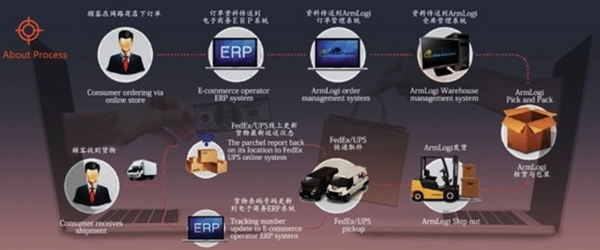
We offer a variety of warehouse management and order fulfillment services, primarily including (i) product storage and retrieval, (ii) product packing and labeling, (iii) kitting and repackaging, (iv) order assembly and load consolidation, (v) inventory management and sales forecasting, (vi) third-party distribution coordination, and (vii) other value-added services. Our customers, consisting primarily of e-commerce merchants, outsource warehouse management and order fulfillment to us so that they can focus on running their business via online platforms such as eBay. Specifically, when a U.S. consumer places an order online via such online platforms, the order information will be transmitted to an e-commerce resource planning system (the “ERP system”) used by the customer, which is capable of gathering and consolidating order information from various e-commerce platforms. With our customers’ authorization, such order information is subsequently transmitted to our Armlogi OMS, which is compatible with most of the ERP systems used by our customers, and then to our Armlogi warehouse management system for further processing.
In accordance with the order information, we pick, pack, and arrange for third-party logistics service providers to distribute the merchandise ordered online. See “— Our Suppliers.” As of the date of this annual report, we only provide warehousing services and logistics management services and do not provide distribution services ourselves, as we do not have our own delivery team or networks; rather, deliveries are all handled by third-party logistics service providers, such as FedEx and UPS. For each parcel delivered, these third-party logistics service providers provide tracking numbers, which are transferred to our customers’ ERP systems, so that both our customers and end consumers can track their location at any time.
7
Below is a graphic that illustrates the primary operational workflow of our warehouse management and order fulfillment services:
Further, we provide value-added logistics services, which primarily include after-sales reverse logistics and specialized packaging. As a result of our comprehensive value-added services, we are able to attract new business and strengthen our relationships with existing customers. Specifically, for after-sales reverse logistics services, we provide exchange and return management services, as well as product inspection and refurbishment. With our specialized packaging services, we offer custom or rigid packaging services using premium folding cartons, inserts, and labels. We utilize a wide variety of materials, including paper and paperboard, pressure-sensitive labels, plastic, and foil.
Additionally, we provide facility rental services, allowing customers (primarily our domestic customers) to rent space within our warehouses or other facilities on a short or long-term basis. We provide a cost-effective solution for customers who need additional storage or production space but do not want to invest in their own facilities.
We generate revenue by charging service fees, typically ranging from $3 to $1,500 for each service, for our warehousing and logistics services, which vary depending on the specific types of services selected by our customers, and are subject to various factors such as the load type, the total number SKUs, weight, volume, storage time, and delivery distance. In addition to the service fees, we also charge our customs delivery fees for services provided by third-party logistics service providers such as FedEx and UPS. Due to our long-term partnerships with third-party logistics service providers, we believe we offer our customers reasonable and affordable transportation rates — due to the size and volume of packages we send to our collaborative third-party logistics service providers, we are able to consolidate small shipments of goods to achieve lower transportation rates for our customers. We strive to provide our customers with transparency in pricing and a clear understanding of the fees they will be charged for our services, typically (i) ranging from $50 to $1,500 for a package of services selected by each overseas customer, and (ii) ranging from $50 to $1,500 for a package of services selected by each domestic customer.
8
Technology and Intellectual Property
We have developed a platform that provides a solution for warehouse and logistics management. The platform primarily includes our Armlogi OMS, which allows our customers to place and track orders, manage their inventory, and receive real-time updates on the status of their shipments.
We developed our Armlogi OMS following a process primarily consisting of the following steps. First, we defined the system’s purpose and features based on our user needs and business objectives, with which we developed a blueprint that included system architecture, data models, and user interfaces. We then wrote codes to develop software components and tested the system for functionality, performance, and security, to ensure compliance with user requirements. We launched our OMS for users in June 2022 and have since been providing ongoing support and maintenance as needed. To protect our Armlogi OMS, we have implemented several security measures, including (i) encrypting sensitive data both in transit and at rest, (ii) controlling user access using role-based access control, (iii) following secure coding practices to avoid common security vulnerabilities, (iv) conducting regular security audits to identify potential vulnerabilities and ensure compliance with security standards, (v) regularly updating the system, and (vi) implementing robust mechanisms for verifying user identities and granting access to system resources.
We regard our trademark, domain names, trade secrets, and similar intellectual property as critical to our success. We rely on a combination of copyright and trademark law, and confidentiality and non-disclosure agreements to protect our intellectual property rights. We also regularly monitor any infringement or misappropriation of our intellectual property rights.
As of the date of this annual report, we have the following intellectual property rights in the U.S.:
| ● | one trademark (namely, the trademark “ARMLOGI,” registered with the U.S. Patent and Trademark Office on January 17, 2023); |
| ● | five domain names, including (i) armlogi.com, (ii) armlogi.net, (iii) armlg.com, (iv) armtk.com, and (v) tkarm.co; and |
| ● | four software copyrights for our mobile apps, including Armlogi Trucking, Armlogi WMS, Armlogi OMS, and Armstrong Logistic Security (website), respectively. |
We have implemented certain measures to protect our intellectual property, including: (i) hiring outside legal counsel to assist in the protection of our intellectual property; and (ii) timely registration and filing with relevant authorities and application of intellectual property rights for our significant technologies and self-developed mobile apps.
Employees
As of June 30, 2026, we had 161 full-time employees. The following table sets forth the number of our full-time employees as of June 30, 2026:
| Function: | Number | |||
| Warehousing and Logistics | 130 | |||
| Operations | 16 | |||
| Customer Services | 7 | |||
| Technology | 1 | |||
| Accounting | 7 | |||
| Total | 161 | |||
We enter into employment contracts, non-disclosure agreements, and confidential information agreements with our full-time employees to establish clear terms and expectations of employment and protect our sensitive and confidential information.
In addition to our full-time employees, we also hired approximately 23 independent contractors as of June 30, 2026. These contract workers serve as our supplemental workforce, primarily responsible for warehouse labor, security, and cleaning.
We believe that we maintain a good working relationship with our employees, and we have not experienced material labor disputes in the past. None of our employees are represented by labor unions.
9
Competition
The warehousing and logistics industry in the U.S. is relatively competitive and rapidly evolving, with many new companies joining the competition in recent years and few leading companies. We believe that our ability to compete effectively for customers depends upon many factors, including the quality and variety of services offered in our one-stop overseas warehousing and logistics business, our strong relationships with PRC customers, our excellent 24/7 customer support, the efficiency and agility of our Armlogi OMS, and our ability to recruit and retain talents with industry expertise. We believe that we are well-positioned to effectively compete in the warehousing and logistics industry based on the factors listed above. Some of our current or future competitors, however, may have longer operating histories, greater brand recognition, or greater financial, technical, or marketing resources than we do.
Governmental Regulations
Our industry is subject to regulation and supervision by several governmental authorities.
Operations
We do not believe that current U.S. governmental regulations impose significant economic restraint upon our business operations. A number of U.S. federal, state, and local laws and regulations affect our business, including those relating to our sales, operations, transportation of goods, warehouse maintenance, financing, insurance, and employment practices. The regulatory bodies that regulate our business include, but are not limited to, the Federal Maritime Commission (“FMC”), the CBP, the U.S. Department of Homeland Security (the “DHS”), the Occupational Safety and Health Administration (the “OSHA”), the U.S. Department of Transportation (the “DOT”), and the Federal Motor Carrier Safety Administration (the “FMCSA”). For example, the shipping of goods by sea is regulated by the FMC. Our Company is licensed by the FMC to operate as an ocean transportation intermediary (“OTI”). As a licensed OTI, we are required to comply with several regulations, including the filing of our tariffs. Further, the DHS regulations applicable to our customers that import goods into the U.S. and our contracted ocean carriers may impact our ability to provide and/or receive services with and from these parties. Enforcement measures related to violations of these regulations can slow and/or prevent the delivery of shipments, which may negatively impact our operations. We are also licensed as a customs broker by the CBP, nationally and in each U.S. customs district in which we do business. All U.S. customs brokers are required to maintain prescribed records and are subject to periodic audits by CBP. Moreover, the OSHA implements and enforces safety and health regulations in the workplace, which provide standards applicable to both general industry and specific to the warehousing industry, such as standards for, among other things, proper storage of materials, use of material handling equipment, and employee training. Furthermore, as we are involved in the transportation of goods, we must comply with the DOT regulations regarding driver qualifications, vehicle maintenance, and hours of service. The FMCSA, as a sub-agency of the DOT, specifically governs motor carrier operations, including driver qualification standards, hours of service requirements, and vehicle maintenance obligations applicable to our truck fleet. Additionally, as with other warehousing and logistics companies, we are required to follow federal and state employment laws, which cover important aspects such as minimum wage, overtime pay, and anti-discrimination policies, among other things. We are also required to comply with local zoning ordinances and building codes, which may specify the permissible locations for our facilities and the safety standards that must be adhered to. We confirm that, as of the date of this annual report, each of our subsidiaries has obtained a valid business license or permit required for its operations. To the best of our knowledge, we are not obliged to obtain any other approvals, licenses, or permits from any federal, state, or local authorities to conduct our business, nor have we received any notice requesting such approvals, licenses, or permits from these authorities. However, it is uncertain whether we will be required to obtain additional approvals, licenses, or permits in connection with our business operations pursuant to evolving federal or state laws and regulations, and whether we will be able to obtain such approvals, licenses, or permits on a timely basis. Failure to do so may result in a material change in our operations, and the value of our common stock could depreciate significantly or become worthless.
Environmental
We are subject to federal, state, and local environmental laws and regulations, such as the National Environmental Policy Act, the Resource Conservation and Recovery Act, the California Environmental Quality Act, and the California Integrated Waste Management Act. These laws and regulations cover a variety of processes, including proper storage, handling and disposal of waste materials, appropriately managing wastewater and stormwater, and communicating the presence of reportable quantities of hazardous materials to local responders. Compliance with these laws and regulations has minimal impact on our business, since our warehouse inventory does not contain reportable quantities of toxic or hazardous materials or liquid waste. We have complied with regulation requirements by properly disposing of foam, plastic, and cardboard packing material, and working with our local waste management services. Moreover, we regularly communicate with our customers to ensure that we are aware of the contents of their goods stored in our warehouses, especially for inventory that is to be disposed of. In addition, as we operate warehouses and a truck fleet in California, we are subject to regulations promulgated by the California Air Resources Board (“CARB”), including rules applicable to motor carriers and warehouse operators relating to fleet emissions standards and indirect source requirements. We monitor developments in CARB regulations and endeavor to maintain compliance with applicable requirements as they evolve. As of the date of this annual report, we have not received any inquiry, notice, or sanction regarding non-compliance with any environmental laws or regulations from any federal, state, or local regulatory authority.
10
Item 1A. Risk Factors.
The following are factors that could have a significant impact on our operations and financial results and could cause actual results or outcomes to differ materially from those discussed in any forward-looking statements.
Economic, Political, and Market Risks
We face competition in the market for warehousing and logistics activities, and we expect competition from existing competitors and other companies that may enter the market or introduce new solutions in the future, which may decrease our net revenue.
The warehousing and logistics industry in the U.S. is competitive and rapidly evolving, with new companies increasingly joining the competition in recent years. We provide a full spectrum of services, including facilitating overseas transportation of merchandise to the U.S., customs brokerage services, and warehouse management and order fulfillment services, we may, therefore, compete with a broad range of companies, such as freight delivery service providers, customs brokers, warehousing companies, and third-party logistics service providers. Because we currently primarily compete in a niche market targeting PRC customers seeking to establish overseas warehouses in the U.S., we have the advantage of offering one-stop integrated supply chain solutions that include a package of all the services above. Nonetheless, with the growth of overseas warehousing services, competition can be increasingly intensive and is expected to increase significantly in the future. The increased competition may lead to price reductions for customer acquisition, which may result in reduced margins and a loss of market share for us. We compete with other competitors on the following bases:
| ● | warehouse and infrastructure capacity; |
| ● | operational capabilities; |
| ● | business model; |
| ● | brand recognition; |
| ● | quality of services; |
| ● | effectiveness of sales and marketing efforts; and |
| ● | hiring and retention of talented staff. |
Our competitors may operate with different business models, have different service structures, and may ultimately prove to be more successful or more adaptable to new regulatory, technological, and other developments. They may in the future achieve greater market acceptance and recognition and gain a greater market share. It is also possible that potential competitors may emerge and acquire a significant market share. If existing or potential competitors develop or offer services that provide significant performance, price, creative optimization, or other advantages over those offered by us, our business, results of operations, and financial condition would be negatively affected. Our existing and potential competitors may enjoy competitive advantages over us, such as longer operating history, greater brand recognition, larger customer base, and better value-added services. We may lose customers if we fail to compete successfully, which could adversely affect our financial performance and business prospects. We cannot guarantee that our strategies will remain competitive or successful in the future. Increasing competition may result in pricing pressure and loss of our market share, either of which could have a material adverse effect on our financial condition and results of operations.
Any adverse change in political relations between the U.S. and other countries or regions where our overseas customers are located (particularly the PRC), such as the ongoing U.S.-China trade conflicts, may negatively affect our business.
We derived approximately 78% and 84% of our revenue from overseas customers in the PRC during the fiscal years ended June 30, 2026 and 2025, respectively, and the continued success of our operations will be heavily dependent on the willingness of our PRC customers to sell in the U.S. via global online e-commerce platforms, such as Amazon and eBay. This, in turn, depends heavily on stable political and economic relations between the PRC and the U.S. In the event of any significant deterioration in the PRC’s relations with the U.S., our customers in the PRC may refrain from selling their merchandise in the U.S. market, and executive action or legislation may be enacted that would adversely affect the profitability, feasibility, and thus the willingness of these customers to continue their global e-commerce business in the U.S. For example, due to the increased tariffs caused by the ongoing trade conflicts between the U.S. and China, the costs of importing and exporting certain goods or materials have increased. Given that we cannot predict what actions may ultimately be taken with respect to tariffs or trade relations between the U.S. and China, our supply chain, costs, and profitability may be negatively impacted by the adoption and expansion of trade restrictions, the continuation of the trade conflicts, or other government actions related to tariffs, trade agreements, or related policies. As a result, our business, financial condition, and results of operations may be adversely affected.
11
U.S. government trade actions, including ongoing tariff escalations, trade negotiations with China, and new tariff measures targeting forced labor concerns, could have a material adverse effect on our business, financial position, and results of operations.
Over the past several years, the U.S. government has taken a number of trade actions that impact or could impact our operations, including imposing tariffs on certain goods imported into the U.S. As the majority of our customers import products into the U.S. from China, many of their products are subject to the tariffs imposed under Section 301 of U.S. trade law that have been applied to separate lists of Chinese goods imported into the U.S., beginning during the first Trump Administration. The Biden Administration largely maintained, defended, and enforced these particular trade actions. A number of lawsuits and other legal challenges with respect to the Section 301 tariff actions have been filed and remain pending, which could result in further changes to the tariffs. Notably, in 2026, the U.S. Supreme Court issued a decision in Learning Resources v. Trump that invalidated certain sweeping emergency duties previously imposed on Chinese imports. The current Trump Administration has significantly expanded upon these tariff measures, imposing additional tariffs on Chinese imports and reigniting trade tensions with key U.S. trading partners. In response to the U.S. Supreme Court’s ruling, the U.S. Trade Representative initiated new Section 301 investigations targeting forced labor concerns, resulting in the announcement on June 2, 2026, and implementation in late July 2026, of a new tariff of up to 12.5% on Chinese goods on the basis that the PRC lacks an effective prohibition on the importation of goods produced with forced labor. China has condemned this unilateral action, and the situation remains subject to ongoing developments.
Changes in U.S. trade policy have created ongoing uncertainties in international trade relations, and it is unclear what future actions governments will or will not take with respect to tariffs or other international trade agreements and policies. In May 2025, a 90-day temporary easing of tariffs was announced and following further negotiations, the U.S. and China reached a broader trade framework under which tariff rates were further reduced, although Chinese tariffs remain significantly elevated relative to pre-2018 levels. In addition, broader baseline reciprocal tariffs and mutual suspensions on select agricultural goods, maritime equipment, and rare earth export controls remain in effect on a provisional basis, with current provisional agreements extending through November 10, 2026. As of the date of this annual report, the tariff and trade situation between the U.S. and China remains subject to ongoing negotiation and change, and the ultimate scope, duration, and impact of applicable tariffs and trade restrictions cannot be predicted with certainty.
Ongoing or new trade wars or other governmental action related to tariffs or international trade agreements or policies could reduce demand for our customers’ products and services, increase their costs, reduce their profitability, adversely impact their supply chain or otherwise have a material adverse effect on their business and results of operations, any of which could have a material adverse effect on our business, financial position, and results of operations. Even where tariff rates have been temporarily reduced through negotiated frameworks, there can be no assurance that such reductions will be maintained, and tariff levels may be increased again at any time. The introduction of new tariff measures — such as the forced labor-based Section 301 tariff of up to 12.5% implemented in July 2026 — and the potential for further legal challenges following the U.S. Supreme Court’s decision in Learning Resources v. Trump, introduce additional layers of uncertainty as to the applicable tariff regime. Given the uncertainty regarding the scope and duration of these trade actions by the U.S. government or other countries, as well as the potential for additional trade actions, retaliatory measures, a breakdown in ongoing negotiations, or the expiration or modification of provisional suspension agreements, the impact on our business and results of operations remains uncertain.
The ongoing conflict in the Middle East, including hostilities involving Israel, Hamas, Hezbollah, the Houthis, and Iran, as well as the broader risk of regional escalation, may adversely affect our business, financial condition, and results of operations.
Since October 2023, the conflict in the Middle East has intensified significantly, involving military operations in Gaza and Lebanon, Houthi attacks on commercial shipping in the Red Sea and the Gulf of Aden, and the military conflict involving the United States, Israel, and Iran, which escalated significantly in February 2026, have led to profound instability in global financial and energy markets. These events, including the closure of strategic airspaces and critical maritime routes such as the Strait of Hormuz and the Red Sea, have contributed to a dramatic increase in the price of oil and gas and created widespread market uncertainty. Moreover, these developments have contributed to disruptions in global shipping routes, and increased maritime insurance costs. The ongoing disruptions caused by these military actions, and the potential for further escalation, could result in protracted and severe damage to the global economy and investment climate. Although the direct impact on our operations to date has been limited, a further escalation of hostilities in the region, could result in sustained increases in oil prices, which in turn could drive higher fuel and transportation costs throughout the global supply chain, including the costs charged by the third-party logistics service providers upon which we rely. Elevated energy prices may also contribute to broader inflationary pressures in the U.S. economy, potentially reducing consumer spending power and dampening demand for imported goods sold by our customers through e-commerce platforms. In addition, disruptions to key maritime trade routes, such as the Strait of Hormuz or the Suez Canal corridor, could cause delays in ocean freight shipments, increase shipping costs, and create supply chain bottlenecks that adversely affect the timeliness and cost-effectiveness of our warehousing and logistics services. Any prolonged disruption to global trade flows or sustained increase in transportation and energy costs resulting from the Middle East conflicts could materially and adversely affect our business, financial condition, and results of operations. Furthermore, the geopolitical uncertainty arising from the Middle East conflicts, in combination with other ongoing geopolitical tensions described elsewhere in this annual report, may contribute to broader macroeconomic instability, capital markets volatility, and reduced investor confidence, any of which could adversely affect our financial condition, the trading price of our common stock, and our ability to access capital markets on favorable terms.
12
We are currently operating in a period of economic uncertainty and capital markets disruption, which has been significantly impacted by geopolitical instability due to the ongoing military conflict between Russia and Ukraine and the increasing strained relationship between the U.S. and China. Our business, financial condition, and results of operations could be materially adversely affected by any negative impact on the global economy and capital markets resulting from the conflict in Ukraine or any other geopolitical tensions.
U.S. and global markets are experiencing volatility and disruption following the escalation of geopolitical tensions and the start of the military conflict between Russia and Ukraine. On February 24, 2022, Russia initiated a full-scale military invasion of Ukraine. Although the length and impact of the ongoing military conflict is highly unpredictable, the conflict in Ukraine could lead to market disruptions, including significant volatility in commodity prices, credit and capital markets, as well as supply chain interruptions.
The recent military conflict in Ukraine has led to sanctions and other penalties being levied by the United States, the European Union, and other countries against Russia. Additional potential sanctions and penalties have also been proposed or threatened. Russian military actions and the resulting sanctions could adversely affect the global economy and financial markets and lead to instability and lack of liquidity in capital markets, potentially making it more difficult for us to obtain additional funds. Although our business has not been materially impacted by the ongoing military conflict between Russian and Ukraine to date, it is impossible to predict the extent to which our operations, or those of our customers, will be impacted in the short and long term, or the ways in which the conflict may impact our business. The extent and duration of the military action, sanctions and resulting market disruptions are impossible to predict, but could be substantial. Any such disruptions may also magnify the impact of other risks described in this annual report.
In addition, the U.S.-China relationship has recently faced daunting challenges, contributing to geopolitical instability worldwide. Because we derived approximately 78% and 84% of our revenue from the PRC market during the fiscal years ended June 30, 2026 and 2025, respectively, our business relies on a stable economic and political relationship between the U.S. and China. However, the tensions between the two countries have intensified since the COVID-19 pandemic, exemplified by the ongoing trade conflicts between U.S. and China, and there is significant uncertainty about the future relationship between the two countries with respect to trade policies, treaties, government regulations, and tariffs. Any further deteriorating relationship between the U.S. and China, or a prolonged stalemate between them, could materially adversely affect our business, results of operations, and financial condition.
China’s economic, political, and social conditions, as well as governmental policies, could affect the business environment and economic conditions in China, which may result in an adverse impact on the demand for our services, potentially harming our financial condition and operating results.
While we do not have any subsidiaries, assets, or employees in the PRC, we generate a significant part of our revenue from customers based in China. During the fiscal years ended June 30, 2026 and 2025, we generated approximately 78% and 84% of our revenue from the PRC market, respectively. We expect such PRC-based revenue to continue to comprise a significant part of our revenue going forward. As a result, any unforeseen events or circumstances that negatively impact our ability to provide our services to our PRC customers would materially and adversely affect our results of operations and financial condition. These negative events and circumstances include, but may not be limited to, the following:
| ● | an economic downturn in China; |
| ● | changes in laws and regulations, in particular those with little advance notice; |
| ● | deterioration of relations or disruption of trade with the U.S., such as anti-U.S. campaigns; and |
| ● | tariffs and other trade barriers which could make it more expensive for our PRC customers to transport their goods and merchandise to the U.S. |
13
The Chinese government has implemented regulations or policies that have adversely affected our business. For example, the PRC government has imposed controls on the convertibility of the RMB into foreign currencies and, in certain cases, the remittance of currency out of China. See “Item 1A. Risk Factors — Economic, Political, and Market Risks — If the PRC government imposes further restrictions and limitations on our PRC customers’ ability to transfer or distribute cash from the PRC to the U.S., our business, financial condition, and results of operations could be materially adversely affected.” There is no guarantee that the PRC government will not implement similar policies or regulations in the future. For example, any changes to trade policies or regulations in China could potentially impact the ability of e-commerce merchants to sell their merchandise in the U.S. market — possible tariffs imposed by the PRC government on goods exported to the U.S. could increase costs for e-commerce merchants selling their merchandise overseas. In light of the renewed escalation of the U.S.-China trade war under the current Trump administration, these risks have intensified. In early 2025, the U.S. imposed new tariffs on Chinese goods — raising certain rates up to 145% — prompting the PRC government to implement retaliatory measures, including tariffs of up to 125% and restrictions on exports of critical raw materials, which tariffs have been reduced by the U.S. to 30% and China to 10% on a temporary basis. In 2026, the U.S. Trade Representative announced and implemented a new tariff of up to 12.5% on Chinese goods on the basis of forced labor concerns, following the U.S. Supreme Court’s decision in Learning Resources v. Trump, which invalidated certain prior emergency duties. These developments have increased the cost and complexity of cross-border trade, which could discourage Chinese e-commerce merchants from expanding or continuing their U.S.-bound operations. This could potentially lead to a decrease in demand for overseas warehousing and logistics services, as e-commerce merchants may opt to scale back their operations in the U.S. market.
Additionally, potential deterioration in China’s macroeconomic environment could reduce the purchasing power of PRC e-commerce merchants, who may choose to reduce their e-commerce business targeting U.S. consumers or, in some cases, even exit the U.S. market altogether, leading to a decrease in demand for overseas warehousing and logistics services. Furthermore, potential economic deterioration in the PRC could make it more challenging for us to attract new customers and retain existing ones, potentially leading to a decrease in our service utilization. If the demand for cross-border e-commerce from the PRC decreases, it could adversely impact our revenue and profitability. While we plan to mitigate such risks by diversifying our customer base, there can be no assurance that we will be successful in doing so. As such, the economic, political, and social conditions in the PRC could materially and adversely impact our financial condition and results of operations.
Disruptions to the international supply chain systems could adversely impact our business, financial condition, and results of operations.
The cross-border e-commerce related warehousing and logistics market depends largely on the availability and reliability of the global supply chain systems. The COVID-19 pandemic highlighted the vulnerability of international supply chain systems and the potential risks associated with disruptions to these systems. Supply chain disruptions, such as port congestion and container shortages, may cause stockouts, which can impact the availability of merchandise for e-commerce merchants to sell. In turn, this can reduce demand for our services, as e-commerce merchants may hold back on cross-border operations until stock availability is resolved. Furthermore, disruptions to the international supply chain systems may lead to increased costs associated with logistics, shipping, and warehousing, resulting in reduced margins and profitability of our business. In addition, supply chain issues may also cause delays in shipments, leading to customer dissatisfaction and decreased demand for our services. Our ability to mitigate these risks may be limited, and there can be no assurance that we will be successful in doing so. As a result, disruptions to the international supply chain systems could have a material and adverse impact on our business, financial condition, and results of operations.
Labor actions may disrupt the U.S. transportation network we rely on and thus may adversely impact our business, financial condition, and results of operations.
Our reliance on the global supply chain systems and the U.S. transportation network exposes us to potential disruptions and congestions caused by labor actions, such as labor disputes or port strikes. Labor disputes among freight carriers and at ports of entry in the U.S., where our PRC customers’ merchandise is imported, are not uncommon. For example, in June 2023, the union representing the employers of over 22,000 dock workers at U.S. West Coast seaports staged concerted and disruptive work actions, resulting in the shutdown of some terminals at ports in Los Angeles, Long Beach, Oakland and Hueneme in California and Tacoma and Seattle in Washington state. More recently, in October 2024, the International Longshoremen’s Association initiated a significant strike on the East and Gulf Coasts, affecting around 45,000 workers and temporarily shutting down 14 major ports, including the Port Authority of New York and New Jersey. As such, we expect labor unrest and its effects on the transportation of our PRC customers’ merchandise to be a continuing challenge for us. Any disruptions, such as a port worker strike, work slowdown, or other transportation disruption in the U.S., may significantly disrupt our business. Although, as of the date of this annual report, our business has not experienced material impacts from such disruptions caused by union actions, there is no guarantee that they will not occur in the future. In the event that such disruptions do occur, they could lead to increased transportation costs, reduced margins, and decreased profitability for our business. Additionally, they may cause shipment delays, resulting in customer dissatisfaction and reduced demand for our services. A prolonged transportation disruption caused by labor action may materially adversely affect our business, results of operations and financial condition.
14
Demand for our services may be adversely impacted by the changing consumer spending power and habits in the U.S.
We offer one-stop warehousing and logistics services to cross-border e-commerce merchants outside the U.S. who seek to sell in the U.S. Our business success is closely tied to the demand for cross-border e-commerce in the U.S., which is, in turn, dependent on the demand from U.S. online shoppers for imported goods from countries such as China. As such, any significant economic changes in the U.S., such as recessions or economic downturns, could reduce consumer spending power, reduce cross-border trade, and affect the demand for our services. Additionally, any changes in consumer spending habits, such as a shift toward purchasing from domestic retailers, could also lead to reduced demand for our services and negatively impact our business. If we are unable to take effective measures in a timely manner to mitigate the negative impact of a decline in consumer spending power or shifts in spending habits in the U.S., our business, financial condition, and results of operations could be adversely affected.
We may be adversely affected by the effects of inflation and a potential recession.
Recent inflationary pressures have caused, and may continue to cause, higher interest rates and capital costs, elevated shipping costs, supply shortages, increased labor costs, weaker exchange rates, and other related effects. Since 2021, we have experienced, and may continue to experience, higher-than-expected inflation, including the escalation of transportation, commodity, and supply chain costs and disruptions that adversely affected our results of operations. Specifically, since 2021, we have partially offset the impact of inflation largely through price increases, in addition to continued supply chain optimization initiatives, and may continue to do so in the future. However, should inflation continue to impose significant pressures on our costs, we may not be able to offset the increased costs or otherwise handle the exposure, which could negatively impact our business, results of operations, or financial condition. Further, even if we are able to increase prices initially to counter inflationary pressures, we may not be able to sustain such price increases. If our competitors do not raise their prices or if consumers or customers decide not to pay the higher prices for our services, sustained price increases may eventually lead to a decrease in sales volume. Thus, inflationary pressures could damage our reputation, our brands, or threaten our profitability or market share. In addition, unfavorable economic and market conditions, including a potential recession, may negatively impact market sentiment, decreasing the demand for warehousing and logistics services, particularly those associated with cross-border e-commerce, which would adversely affect our operating income and results of operations. If we are unable to take effective measures in a timely manner to mitigate the impact of inflation as well as a potential recession, our business, financial condition, and results of operations could be adversely affected.
If the PRC government imposes further restrictions and limitations on our PRC customers’ ability to transfer or distribute cash from the PRC to the U.S., our business, financial condition, and results of operations could be materially adversely affected.
The PRC government has imposed controls on the convertibility of the RMB into foreign currencies and, in certain cases, the remittance of currency out of China. For instance, the Circular on Promoting the Reform of Foreign Exchange Management and Improving Authenticity and Compliance Review, issued on January 26, 2017, provides that banks shall, when dealing with dividend remittance transactions from a domestic enterprise to its offshore shareholders of more than $50,000, review the relevant board resolutions, original tax filing form, and audited financial statements of such domestic enterprise based on the principle of genuine transaction. There is no guarantee that the PRC government will not further intervene or impose other restrictions on our PRC customers’ ability to transfer or distribute cash outside the PRC. In the event that the foreign exchange control system prevents our PRC customers from remitting their payments to the U.S., we may not be able to receive a substantial portion of our revenue. As a result, our business, financial condition, and results of operations may be adversely affected.
Operational Risks
Failure to renew our current leases or locate desirable alternatives for our facilities could materially and adversely affect our business.
We lease properties for all of our offices, warehouses, and fulfilment centers. We may not be able to successfully extend or renew such leases upon expiration of the current term on commercially reasonable terms or at all, and may therefore be forced to relocate the affected operations. This could disrupt our operations and result in significant relocation expenses, which could adversely affect our business, financial condition, and results of operations. In addition, we compete with other businesses for premises at certain locations or of desirable sizes. As a result, even though we could extend or renew our leases, rental payments may significantly increase as a result of the high demand for the leased properties. In addition, we may not be able to locate desirable alternative sites for our facilities as our business continues to grow and failure in relocating our affected operations could adversely affect our business and operations.
If our customers are able to reduce their logistics and supply chain costs or increase utilization of their internal solutions, our business and operating results may be materially and adversely affected.
One of the main reasons that our customers use contract warehouse and logistics management companies is the high cost, high degree of difficulties, and operational deficiencies associated with developing in-house logistics and supply chain expertise. If, however, our customers are able to develop their own logistics and supply chain solutions, increase utilization of their in-house supply chain, reduce their logistics spending, or otherwise choose to terminate our services, our business and operating results may be materially and adversely affected.
15
The suspension of PRC sellers on international e-commerce platforms, such as the crackdown on PRC sellers by Amazon in early 2021, has discouraged and may continue to discourage a growing number of PRC e-commerce sellers from selling their merchandise to the United States, thus adversely affecting our business, financial condition, and results of operations.
As we derived approximately 78% and 84% of our revenue from the PRC market during the fiscal years ended June 30, 2026 and 2025, respectively, we believe that our continued growth depends largely on our ability to maintain our Chinese client base. In early 2021, Amazon, the world’s largest e-commerce platform, claimed that it had suspended the accounts of over 50,000 Chinese sellers for improper use of review functions. Specifically, instead of earning great reviews through high-quality products, those PRC sellers manipulated reviews by paying for positive product reviews or by giving away gift cards, which violates Amazon’s terms of service. It is estimated that the 50,000 affected accounts caused approximately RMB100 billion in losses for the cross-border e-commerce industry in the PRC, which has discouraged a growing number of PRC e-commerce sellers from selling their merchandise to the U.S. via Amazon.
There is no guarantee that (i) our current or future international customers are fully compliant with the terms of service of all the international e-commerce platforms they use, including Amazon, or that (ii) those e-commerce platforms will not from time to time initiate such a widespread suspension of PRC sellers in the future. Such a crackdown on PRC sellers may significantly reduce the number of Chinese e-commerce sellers who intend to sell in the U.S., who are our primary customers. The loss of our PRC customer base due to the widespread suspension of PRC sellers in the cross-border e-commerce industry could be detrimental to our ongoing operations. If we are unable to attract new customers in a timely or cost-effective manner, our business, financial condition, and results of operations may be adversely affected.
Our largest customers generate a significant portion of our revenue and our business may rely on one or more suppliers that account for more than 10% of our total purchases, and interruption in operations of such significant customers or supplier may have an adverse effect on our business, financial condition, and results of operations.
During the fiscal years ended June 30, 2026 and 2025, we derived most of our revenue from a few customers. For the fiscal year ended June 30, 2026, our two largest customers, Goldensee Ltd. and Aukey International Limited, accounted for approximately 21.8% and 14.4% of our total revenue, respectively. For the fiscal year ended June 30, 2025, our two largest customers, Goldensee Ltd. and Kimberly Tenneco Inc, accounted for approximately 22.0% and 10.8% of our total revenue, respectively. No other customers represented 10% or more of our total revenue for the years ended June 30, 2026 and 2025. For an example of a typical transaction, see “Item 1. Business — Customers.” We may lose a significant customer due to a variety of factors, including our ability to provide quality warehouse and logistics management services. Even though we have a strong record of performance, we cannot guarantee that we will continue to maintain the business cooperation with these significant customers at the same level, or at all. If any significant customer terminates its relationship with us, there is no assurance you that we will be able to secure an alternative arrangement with comparable customer in a timely manner, or at all. Losing one or more of these significant customers could adversely affect our revenue and profitability.
In addition, we depend upon significant suppliers that accounted for more than 10% of our total purchases. During the fiscal year ended June 30, 2026, Flatiron Merchants Inc. and Fastbuy Inc., two third-party vendors providing shipping services via FedEx, accounted for approximately 13.5% and 12.5% of our total purchases, respectively. During the fiscal year ended June 30, 2025, UPS accounted for approximately 15.2% and MEGA CORP LOGISTIC LLC, a third-party vendor providing shipping services via FedEx, accounted for approximately 10%, respectively. We cannot ensure that we will have no concentration of suppliers in the future. Such third-party suppliers are run by independent entities that are subject to their own unique operational and financial risks, which are beyond our control. If such significant suppliers breach or terminate their contracts with us, or experience significant disruptions to their operations, we will be required to find and enter into arrangements with one or more replacement suppliers. Finding alternative suppliers could involve significant delays and other costs and these suppliers may not be available to us on reasonable terms or at all. As a result, this could harm our business and financial results and result in lost or deferred revenue.
Customer demand is difficult to forecast accurately, and as a result we may be unable to make planning and spending decisions to match such demand.
We make planning and spending decisions, including capacity expansion, procurement commitments, personnel needs, and other resource requirements based on our estimates of customer demand. A significant portion of our revenue is derived from customers whose demand for the warehousing and shipping services is tied closely to the end consumers in the U.S. Therefore, our customer demand may be impacted by factors out of our control, such as unexpected shifts in the preferences of U.S. end consumers for our customers’ merchandise, foreign exchange rate fluctuations that could adversely impact our customers’ costs and pricing strategies, and manufacturing production delays. Moreover, we may potentially experience capacity and resource shortages in fulfilling e-commerce orders on behalf of our customers during the peak season of e-commerce consumption or following special promotional campaigns on any e-commerce platforms. Failure to meet customer demand in a timely fashion or at all may adversely affect our financial condition and results of operations.
16
Our dependence on third parties to provide overseas transportation and domestic distribution services may impact the delivery and quality of our transportation and logistics services, and any disruption to these services could result in a disruption to our business, negative publicity, and a slowdown in the growth of our customer base, materially and adversely affecting our business, financial condition, and results of operations.
Because we do not have our own delivery team and networks, our business depends on the services provided by, and relationships with, various independent third parties, to provide truck and ocean services and to report certain events to us, including, but not limited to, shipment status information and freight claims. For example, we rely on ocean carriers for the transportation of our customer’s goods and merchandise to the U.S, before they complete customs clearance and are delivered to U.S. warehouses. We also rely on common carriers such as FedEx and UPS to distribute merchandise to the U.S. end consumer who place orders online. Several third-party logistics service providers contributed a significant part of the total cost of revenue of our Company. In particular, for the fiscal years ended June 30, 2026 and 2025, FedEx accounted for approximately 3% and 9% of our total cost of revenue, respectively. During the fiscal year ended June 30, 2026, Flatiron Merchants Inc. and Fastbuy Inc., two third-party vendors providing shipping services via FedEx, accounted for approximately 13.5% and 12.5% of our total purchases, respectively. During the fiscal year ended June 30, 2025, UPS accounted for approximately 15.2% and MEGA CORP LOGISTIC LLC, a third-party vendor providing shipping services via FedEx, accounted for approximately 10%, respectively. These third-party logistics service providers may not fulfill their obligations to us, which may prevent us from meeting our commitments to our customers. This reliance also could cause delays in reporting certain events, including recognizing claims. In addition, if we are unable to secure sufficient equipment or other transportation services from third parties to meet our commitments to our customers, our operating results could be materially and adversely affected, and our customers could switch to our competitors temporarily or permanently. Many of these risks are beyond our control, including:
| ● | equipment and driver shortages in the transportation industry; |
| ● | changes in regulations impacting transportation; |
| ● | disruption in the supply or cost of fuel; |
| ● | unanticipated changes in ocean or truck freight markets; and |
| ● | increases in shipping costs or other issues that adversely affect the global supply chains, such as global availability of shipping containers, and related labor and fuel costs. |
We may face risks related to natural disasters, health epidemics, and other outbreaks, which could significantly disrupt our operations.
Natural disasters such as earthquakes, tsunamis, hurricanes, tornadoes, floods, or other adverse weather and climate conditions, whether occurring in the United States or abroad, could disrupt our operations and could damage or destroy infrastructure necessary to transport products as part of the supply chain. These events could make it difficult or impossible for us to provide logistics services; disrupt or prevent our ability to perform functions at the corporate level; and/or otherwise impede our ability to continue business operations in a continuous manner consistent with the level and extent of business activities prior to the occurrence of the unexpected event, which could adversely affect our business and results of operations. In addition, our business may be negatively impacted by the fear of, exposure to, or actual effects of, a disease outbreak, epidemic, pandemic, or similar widespread public health concern, including travel restrictions or recommendations or mandates from governmental authorities.
The extent to which any such natural disasters or health concerns may impact us are highly uncertain and cannot be predicted, including the duration, severity, and recurrence of any such event, the effectiveness of mitigation strategies, third-party actions taken to contain mitigate their effects, and any recommendations, restrictions or mandates from governmental authorities undertaken as a result thereof. Any of these factors may materially and adversely affect our business, financial condition, and results of operations.
Our results of operations are subject to seasonal fluctuations.
We experience seasonality in our business, mainly correlating to the seasonality patterns associated with the e-commerce and logistics and supply chain industries in the U.S. We typically experience a seasonal surge in volume of service orders during the second and fourth quarters of each year due to holiday seasons and summer revenue, respectively. We may experience capacity and resource shortages in our warehousing and order fulfillment services during the period such season surge in our business. On the other hand, activity levels across our business lines are typically lower in the first and third quarters of each year, primarily due to relatively weaker consumer spending and decreased availability of delivery personnel and warehouse staff during these periods. As a result, our financial condition and results of operations for future periods may continue to fluctuate, and the trading price of our common stock may fluctuate from time to time, due to seasonality.
17
Our business and results of operations may be harmed by the misconduct of authorized employees that have access to important assets of our Company such as inventory, bank accounts, and confidential information.
During the course of our business operations, some of our employees have access to certain valuable assets of our Company, such as warehouse inventory, bank accounts, and confidential information. In the event of misconduct by such authorized employees, our Company could suffer significant losses. Employee misconduct may include misappropriating warehouse inventory or bank accounts, falsifying inventory records or bank accounts, improper use or disclosure of confidential information to the public or our competitors, and failure to comply with our code of conduct or other policies or with federal or state laws or regulations regarding the use and safeguarding of classified or other protected information, import-export control, and any other applicable laws or regulations. Although we have implemented policies, procedures, and controls to prevent and detect these activities, these precautions may not prevent all intentional or negligent misconduct, and as a result, we could face unknown risks or losses. Furthermore, such unethical, unprofessional, or even criminal behavior by employees could damage our reputation, result in fines, penalties, restitution, or other damages, and lead to the loss of current and future customers, any of which would adversely affect our business, financial condition, and results of operations.
Our insurance does not fully cover all of our operational risks, and changes in the cost of insurance or the availability of insurance could materially increase our insurance costs or result in a decrease in our insurance coverage.
While we have auto liability insurance and commercial insurance for self-operated vehicles, cargo insurance, warehouse insurance, general liability insurance, and workers compensation and employer liability insurance, we are self-insured for a portion of our potential liabilities. In certain instances, our insurance may not fully cover an insured loss, depending on the magnitude and nature of the claim. Additionally, changes in the cost of insurance or the availability of insurance in the future could substantially increase our costs to maintain our current level of coverage or could cause us to reduce our insurance coverage and increase the portion of our risks that we self-insure.
Cybersecurity incidents could disrupt our business operations, result in the loss of critical and confidential information, adversely impact our reputation, and harm our business.
Cybersecurity threats and incidents directed at us could range from uncoordinated individual attempts to gain unauthorized access to information technology systems to sophisticated and targeted measures aimed at disrupting business or gathering personal data of customers. We have relied on a technology platform that enables us to deliver one-stop warehouse and logistics management services to our customers with simplicity, convenience, speed, and reliability, primarily including our Armlogi OMS. Our technology platform supports the smooth performance of certain key functions of our business, such as storage management, order management, payment calculation, and customers services. The secure processing, maintenance, and transmission of information in these systems are critical to our operations. Nonetheless, our technology operations are vulnerable to security breaches and attacks against our system and network. Although we employ measures designed to prevent, detect, address, and mitigate these threats (including access controls, data encryption, vulnerability assessments, and maintenance of backup and protective systems), cybersecurity incidents, depending on their nature and scope, could potentially result in the misappropriation, destruction, corruption, or unavailability of critical data and confidential or proprietary information (our own or that of third parties, including potentially sensitive personal information of our customers) and the disruption of business operations. Any such compromises to our security could cause harm to our reputation, which could cause customers to lose trust and confidence in us or could cause agents to stop working for us. In addition, we may incur significant costs for remediation that may include liability for stolen assets or information, repair of system damage, and compensation to customers and business partners. We may also be subject to legal claims, government investigation, and additional state and federal statutory requirements.
The potential consequences of a material cybersecurity incident include regulatory violations of applicable U.S. and international privacy and other laws, reputational damage, loss of market value, litigation with third parties (which could result in our exposure to material civil or criminal liability), diminution in the value of the services we provide to our customers, and increased cybersecurity protection and remediation costs (that may include liability for stolen assets or information), which in turn could have a material adverse effect on our competitiveness and results of operations.
Our business, financial condition, and reputation may be substantially harmed by security breaches, interruptions, delays, and failures in our systems and operations.
With our technology platform, we are able manage the entire flow of inventory, labor force, and information in and out of our warehouse network, and optimize our warehouse storage and order management services. The performance and reliability of our systems and operations are critical to our business. Our systems and operations are vulnerable to security breaches, interruption, or malfunction due to certain events beyond our control, including natural disasters, such as earthquakes, fires, floods, power outages, telecommunication failures, break-ins, sabotage, computer viruses, and intentional acts of vandalism. Security breaches, interruptions, delays, or failures in our systems or operations can lead to lower quality service, increased costs, litigation and other consumer claims, and damage our reputation, all of which could have a significant impact on our financial condition and operating results.
18
Our business and financial condition may be substantially harmed by inventory losses caused by theft, vandalism, or accidents during transportation and/or warehousing.
As we maintain customers’ goods and merchandise in our warehouses, we bear the risk of damage and loss prior to coordinating with third-party logistics service providers to distribute the goods or merchandise ordered online to their end consumers. In addition, we offer port trucking services to assist customers with the transportation of shipping containers from ports to storage or warehouses. Although we also maintain cargo insurance and warehouse insurance for the warehouses operated and managed by us, and take steps to enhance control by engaging dependable truck drivers for transportation and renting more secure warehouse space, we remain subject to inventory losses caused by theft, vandalism, or accidents during transportation and/or warehousing. In addition, force majeure events such as flooding, fires, or hail may affect a large volume of our customers’ goods and merchandise. Such events may cause us to incur large damages, deprive us of a significant portion of our inventory, and reduce customer satisfaction if it leads to our failure to deliver goods and merchandise in a timely manner. If any of the foregoing occurs, our business reputation, financial condition, and results of operations may be adversely affected.
If we fail to manage our growth or execute our strategies and future plans effectively, we may not be able to take advantage of market opportunities or meet the demand of our customers.
Our business has grown since our inception, and we expect it to continue to grow in terms of scale and diversity of operations. For example, we launched our international ocean freight services in January 2023 and are actively expanding and refining these offerings. With this new addition, we can now offer our manufacturer customers a comprehensive one-stop logistics solution, covering the entire journey from their overseas factory door to the doorstep of the end consumer here in the United States. In addition, we plan to continue to develop comprehensive and sophisticated solutions and services that span the entire supply chain, from ocean freight to distribution and delivery. This will enable us to offer a full range of value-added services to our customers, including sales forecasts and inventory planning. Such expansions increase the complexity of our operations and may cause strain on our managerial, operational, and financial resources. We must continue to hire, train, and effectively manage new employees. In the event that our new hires fail to perform as expected, or if we fail to hire, train, manage, and integrate new employees, our business, financial condition, and results of operations may be materially adversely affected. The expansion of our services will also require us to maintain consistency in the quality of our services so that our market reputation is not damaged by any deviations in quality, whether actual or perceived.
Our future results of operations also depend largely on our ability to execute our future plans successfully. In particular, our continued growth may subject us to the following additional challenges and constraints:
| ● | we face challenges in ensuring the productivity of a large employee base and recruiting, training, and retaining skilled personnel, including areas of procurement, sales and marketing, and information technology for our growing operations; |
| ● | we face challenges in responding to evolving industry standards and government regulation that impact our business and the warehousing and logistics industry in general; |
| ● | the technological or operational challenges may arise from the new services; |
| ● | the execution of our future plans will be subject to the availability of funds to support the relevant capital investment and expenditures; and |
| ● | the successful execution of our strategies is subject to factors beyond our control, such as general market conditions, and economic and political developments in the U.S. and globally. |
All of these endeavors involve risks and will require significant management, financial, and human resources. We cannot assure you that we will be able to effectively manage our growth or to implement our strategies successfully. There is no assurance that the investment to be made by our Company as contemplated under our future plans will be successful and generate the expected return. If we are not able to manage our growth or execute our strategies effectively, or at all, our business, results of operations, and prospects may be materially and adversely affected.
19
To sustain our operations and future business growth, we need to make significant investments in both capital and working capital, and if we are unable to secure sufficient financing when needed, our ability to execute our business plan as outlined in this annual report will be impaired, which may negatively impact our business and prospects.
Sustaining our ongoing operations and driving future growth requires significant investment in capital assets and sufficient working capital. In particular, as a growing company, we may require additional capital to finance our operations, make strategic investments, or respond to market conditions. There can be no assurance that we will be able to obtain the necessary financing on favorable terms, or at all. Factors beyond our control, such as unfavorable market conditions, general economic downturns, or adverse investor sentiment, may make it challenging for us to secure additional funding. In the event we are unable to obtain additional financing, we may have to significantly curtail, or even terminate, our primary operations, or delay, reduce, or eliminate certain of our planned operations (including further expanding our warehousing network and developing comprehensive and sophisticated solutions and services that span the entire supply chain, from ocean freight to distribution and delivery), resulting in a complete loss of investment for our stockholders. Our inability to obtain financing on acceptable terms when needed may have a material adverse effect on our business, results of operations, financial condition, and prospects.
If we fail to attract, recruit, or retain our key personnel, including our executive officers, senior management, and key employees, our ongoing operations and growth could be affected.
Our success depends, to a large extent, on the efforts of our key personnel, including our executive officers, senior management, and other key employees who have valuable experience, knowledge, and connections in global supply chains as well as the warehousing and logistics industry. There is no assurance that these key personnel will not voluntarily terminate their employment with us. We do not carry, and do not intend to procure, key person insurance on any of our senior management team. The loss of any of our key personnel could be detrimental to our ongoing operations. Our success will also depend on our ability to attract and retain qualified personnel to manage our existing operations as well as our future growth. We may not be able to successfully attract, recruit, or retain key personnel, and this could adversely impact our financial condition, operating results, and business prospects.
Future acquisitions may have an adverse effect on our ability to manage our business. Raising additional capital may cause dilution to our stockholders, including purchasers of our common stock in our initial public offering.
We may acquire businesses, technologies, services, or products that are complementary to our warehousing and logistics business. Future acquisitions may expose us to potential risks, including risks associated with the integration of new operations, services, and personnel, unforeseen or hidden liabilities, the diversion of resources from our existing business and technology, our potential inability to generate sufficient revenue to offset new costs, the expenses of acquisitions, or the potential loss of or harm to relationships with both employees and customers resulting from our integration of new businesses.
Any of the potential risks listed above could have a material adverse effect on our ability to manage our business, revenue, and net income. We may need to raise additional debt funding or sell additional equity securities to make such acquisitions. The raising of additional debt funding by our Company, if required, would result in increased debt service obligations and could result in additional operating and financing covenants, or liens on our assets, that would restrict our operations. The sale of additional equity securities could result in additional dilution to our stockholders.
Our previous growth rates and performance may not be sustainable or indicative of our future growth and financial outcomes, and there is no assurance that we will be able to achieve the same level of financial performance in the future.
Our total revenue decreased by approximately $4.6 million, or 2.4%, to approximately $185.8 million for the fiscal year ended June 30, 2026 from $190.4 million for the fiscal year ended June 30, 2025. Our total revenue increased by approximately $23.4 million, or 14.0%, to approximately $190.4 million for the fiscal year ended June 30, 2025 from $167.0 million for the fiscal year ended June 30, 2024. We reported net loss of approximately $20.9 million for the fiscal year ended June 30, 2026, representing an increase by $5.6 million, or 36.6%, from net loss of $15.3 million for the fiscal year ended June 30, 2025. We reported net loss of approximately $15.3 million for the fiscal year ended June 30, 2025, representing a decrease by $22.8 million, or 306.3%, from net income of $7.4 million for the fiscal year ended June 30, 2024. While we have achieved strong financial results in the past, these results may not be sustainable or indicative of future results, and we cannot assure you that we will achieve or maintain profitability on a consistent basis. Our revenue growth may slow down or our revenue may decline for a number of reasons, including reduced demand for our warehousing and logistics services, increased competition, industry trend, or our failure to capitalize on growth opportunities. Meanwhile, we expect our overall selling, general, and administrative expenses, including marketing expenses, salaries, and professional and business consulting expenses, to continue to increase in the foreseeable future, as we plan to hire additional personnel and incur additional expenses in connection with the expansion of our business operations. In addition, we also expect to incur significant additional legal, accounting, and other expenses as a newly public company. These efforts and additional expenses may be more costly than we currently expect, and there is no assurance that we will be able to maintain sufficient operating revenue to offset our operating expenses. Any failure to increase revenue or to manage our costs as we continue to grow and invest in our business would prevent us from achieving or maintaining profitability or maintaining positive operating cash flow at all, or on a consistent basis, which would cause our business, financial condition, and results of operations to suffer.
20
Legal, Regulatory, and Compliance Risks
We are subject to numerous laws and regulations applicable to the warehousing and logistics industry in the U.S., which, if we are found to have violated, may adversely affect our business and results of operations.
A number of U.S. federal and state laws and regulations applicable to the warehousing and logistics industry affect our business and conduct. For example, we are subject to regulation by the FMC as an OTI. As a licensed OTI, we are required to comply with several regulations, including the filing of our tariffs. We provide customs brokerage services as a customs broker under a license issued by the CBP and other authoritative governmental agencies. Further, DHS regulations applicable to our customers who import goods into the U.S. and our contracted ocean carriers can impact our ability to provide and/or receive services with and from these parties. Enforcement measures related to violations of these regulations can slow and/or prevent the delivery of shipments, which may negatively impact our operations. Moreover, the OSHA implements and enforces safety and health regulations in the workplace, which provide standards applicable to all industries generally and specific to the warehousing industry, such as standards for, among other things, proper storage of materials, use of material handling equipment, and employee training. Furthermore, as we are involved in the transportation of goods, we must comply with the DOT regulations regarding driver qualifications, vehicle maintenance, and hours of service. Additionally, as with other warehousing and logistics companies, we are required to follow federal and state employment laws, which cover important aspects, such as minimum wage, overtime pay, and anti-discrimination policies, among other things. We are also required to comply with local zoning ordinances and building codes, which may specify the permissible locations for our facilities and the safety standards that must be adhered to. See “Item 1. Business — Governmental Regulations — Operations.” Any failure to comply with these laws and regulations may result in the assessment of administrative, civil, or criminal penalties, the imposition of investigatory remedial obligations or the issuance of injunctions limiting or prohibiting our operations. We confirm that, as of the date of this annual report, each of our subsidiaries has obtained a valid business license or permit required for its operations. To the best of our knowledge, we are not obliged to obtain any other approvals, licenses, or permits from any federal, state, or local authorities to conduct our business, nor have we received any notice requesting such approvals, licenses, or permits from these authorities. However, it is uncertain whether we will be required to obtain additional approvals, licenses, or permits in connection with our business operations pursuant to evolving federal or state laws and regulations, and whether we will be able to obtain such approvals, licenses, or permits on a timely basis. Failure to do so may result in a material change in our operations, and the value of our common stock could depreciate significantly or become worthless.
Non-compliance with laws and regulations on the part of any third parties with which we conduct business could expose us to legal expenses, compensation to third parties, penalties, and disruptions of our business, which may adversely affect our results of operations and financial performance.
Third parties with which we conduct business, including third-party logistics service providers and brokers, may be subject to regulatory penalties or punishments because of their regulatory compliance failures or infringement upon other parties’ legal rights, which may, directly or indirectly, disrupt our business. We cannot be certain whether such third parties have violated any regulatory requirements or infringed or will infringe any other parties’ legal rights, which could expose us to legal expenses or compensation to third parties, or both.
We, therefore, cannot rule out the possibility of incurring liabilities or suffering losses due to any non-compliance by third parties. There is no assurance that we will be able to identify irregularities or non-compliance in the business practices of third parties with which we conduct business, or that such irregularities or non-compliance will be corrected in a prompt and proper manner. Any legal liabilities and regulatory actions affecting third parties involved in our business may affect our business activities and reputation, and may in turn affect our business, results of operations, and financial performance.
Moreover, regulatory penalties or punishments against our business stakeholders such as third-party logistics service providers and brokers, whether or not resulting in any legal or regulatory implications upon us, may nonetheless cause business interruptions or even suspension of these business stakeholders, which could in turn disrupt our usual course of business and result in material negative impact on our business operations, results of operation and financial condition.
Failure to protect intellectual property rights could adversely affect our business.
We regard our trademark, domain names, trade secrets, proprietary technologies, and other intellectual property as critical to our success. See “Item 1. Business — Technology and Intellectual Property.” We have taken measures to protect our intellectual property, but these measures might not be sufficient or effective. We may bring lawsuits to protect against the potential infringement of our intellectual property rights. Policing unauthorized use of our proprietary technology and other intellectual property is difficult and expensive, and litigation may be necessary in the future to enforce their intellectual property rights. Future litigation could result in substantial costs and diversion of our resources and could disrupt our business, as well as materially adversely affect our financial condition and results of operations. Further, despite the potentially substantial costs, we cannot assure you that we will prevail in such litigation. In addition, our trade secrets may be leaked or otherwise become available to, or be independently discovered by, our competitors. Any failure in protecting or enforcing our intellectual property rights could have a material adverse effect on our business, financial condition, and results of operations.
21
Third parties may claim that we infringe their proprietary intellectual property rights, which could cause us to incur significant legal expenses and prevent us from promoting our services.
We cannot be certain that our operations or any aspects of our business do not or will not infringe upon or otherwise violate trademarks, copyrights, or other intellectual property rights held by third parties. We may from time to time in the future be subject to legal proceedings and claims relating to the intellectual property rights of others. For instance, we may face claims of trademark or copyright infringement for the use of images, pictures, or materials used on our website or in promotional materials such as brochures or videos. Additionally, we may be subject to software copyright infringement claims for the technology platform we rely on for our daily operations. See “Item 1. Business — Technology and Intellectual Property.” There could also be existing intellectual property of which we are not aware that our services may inadvertently infringe. If any third-party infringement claims are brought against us, we may be forced to divert management’s time and other resources from our business and operations to defend against these claims, regardless of their merits. Additionally, the application and interpretation of intellectual property right laws and the procedures and standards for granting trademarks, copyrights, or other intellectual property rights are evolving and may be uncertain, and we cannot assure you that courts or regulatory authorities would agree with our analysis. Such claims, even if they do not result in liability, may harm our reputation. If we were found to have violated the intellectual property rights of others, we may be subject to liability for our infringement activities or may be prohibited from using such intellectual property, and we may incur licensing fees or be forced to develop alternatives of our own. As a result, our business and financial performance may be materially and adversely affected.
We may from time to time be subject to claims, controversies, lawsuits, and legal proceedings, which could adversely affect our business, prospects, results of operations, and financial condition.
We may from time to time become subject to or involved in various claims, controversies, lawsuits, and legal proceedings. However, claims and threats of lawsuits are subject to inherent uncertainties, and we are uncertain whether any of these claims would develop into a lawsuit. Lawsuits, or any type of legal proceeding, may cause our Company to incur defense costs, utilize a significant portion of our resources, and divert management’s attention from our day-to-day operations, any of which could harm our business. Any settlements or judgments against our Company could have a material adverse impact on our financial condition, results of operations, and cash flows. In addition, negative publicity regarding claims or judgments made against our Company may damage our reputation and may result in a material adverse impact on us.
We may be the subject of allegations, harassment, or other detrimental conduct by third parties, which could harm our reputation and cause us to lose market share and customers.
We may be subject to allegations by third parties or purported former employees, negative Internet postings, and other adverse public exposure on our business, operations, and staff compensation. We may also become the target of harassment or other detrimental conduct by third parties or disgruntled former or current employees. Such conduct may include complaints, anonymous or otherwise, to regulatory agencies, media, or other organizations. We may be subject to government or regulatory investigation or other proceedings as a result of such third-party conduct and may be required to spend significant time and incur substantial costs to address such third-party conduct, and there is no assurance that we will be able to conclusively refute each of the allegations within a reasonable period of time, or at all. Additionally, allegations, directly or indirectly against our Company, may be posted on the Internet, including social media platforms by anyone on an anonymous basis. Any negative publicity on our Company or our management can be quickly and widely disseminated. Social media platforms and devices immediately publish the content of their users’ posts, often without filters or checks on the accuracy of the content posted. The information posted may be inaccurate and adverse to our Company, and it may harm our reputation, business, or prospects. The harm may be immediate without affording us an opportunity for redress or correction. Our reputation may be negatively affected as a result of the public dissemination of negative and potentially false information about our business and operations, which in turn may cause us to lose market share and customers.
22
Trading Risks
New Nasdaq minimum market value requirement may result in delisting of our common stock.
On July 22, 2026, the SEC issued an order approving Nasdaq’s proposed rule change, as amended in June 2026, requiring companies listed on the Nasdaq Global Select Market, Nasdaq Global Market, and Nasdaq Capital Market to maintain a minimum Market Value of Listed Securities (“MVLS”) of at least $5 million (new Rules 5450(a)(3) and 5550(a)(6)). MVLS is calculated as the consolidated closing bid price multiplied by the total number of listed securities. Under the new rule, if an issuer’s MVLS remains below $5 million for a period of 30 consecutive business days, such issuer’s securities would be immediately subject to suspension and delisting, with no compliance or cure period and no automatic stay of trading suspension while an appeal is pending. The new rule is notable in that, unlike most other continued listing deficiencies, there is no compliance period, no cure window, and no automatic stay of trading suspension during any appeals process. The new rule, as amended, permits Nasdaq hearings panels to reverse a delisting determination only in situations where there was an error by Nasdaq staff or where the issuer satisfies all initial listing requirements. Where the hearings panel review relates to a deficiency in continued listing requirements, the hearings panel generally has the discretion to grant a cure period not to exceed 180 days from the date of the staff delisting determination for the issuer to regain compliance, provided the issuer demonstrates compliance with all applicable listing requirements. The rule reflects Nasdaq’s continued efforts to tighten its listing and trading standards to improve market quality and protect investors, particularly targeting microcap and development-stage companies with low-priced securities. On July 29, 2026, however, the SEC’s Division of Trading and Markets confirmed that it had received notices of intention to petition the full SEC for review of the approval order, which automatically stayed the order implementing the new rule pending further action by the SEC. As there is no prescribed timeline for SEC action on such petitions, the ultimate implementation and effective date of the new rule remain uncertain. If the new rule is ultimately affirmed by the SEC and becomes effective, our common stock could become subject to Nasdaq delisting proceedings if our MVLS falls below the required threshold. If our common stock is delisted from Nasdaq, we may seek to have our common stock quoted on an over-the-counter marketplace, such as the OTCQX. The OTCQX is not a stock exchange, and if our common stock were to trade on the OTCQX rather than on a securities exchange, there may be significantly less trading volume and analyst coverage of, and significantly less investor interest in, our common stock, which may lead to lower trading prices for our common stock and could materially and adversely affect the liquidity and value of your investment.
The market price of our common stock may be volatile or may decline regardless of our operating performance, and we may be unable to maintain compliance with Nasdaq’s continued listing requirements.
In November 2025, we received a written notice from Nasdaq notifying us that the bid price of our common stock had closed below the minimum $1.00 per share requirement for 30 consecutive business days. In May 2026, our common stock was transferred from The Nasdaq Global Market to The Nasdaq Capital Market, and we were granted an additional 180-day compliance period, or until November 2, 2026, to regain compliance with the minimum bid price requirement. If we are unable to regain compliance by November 2, 2026, Nasdaq may initiate delisting proceedings with respect to our common stock. We intend to monitor the bid price of our common stock and consider all available options to regain compliance, including effecting a reverse stock split if necessary.
There is no assurance that we will be able to regain or maintain compliance with the Nasdaq listing criteria or continue to meet the continued listing requirements of The Nasdaq Capital Market. In addition to the foregoing, the market price of our common stock may fluctuate significantly in response to numerous other factors, many of which are beyond our control, including:
| ● | actual or anticipated fluctuations in our revenue and other operating results; |
| ● | the financial projections we may provide to the public, any changes in these projections or our failure to meet these projections; |
| ● | actions of securities analysts who initiate or maintain coverage of us, changes in financial estimates by any securities analysts who follow our Company, or our failure to meet these estimates or the expectations of investors; |
| ● | announcements by us or our competitors of significant products or features, technical innovations, acquisitions, strategic partnerships, joint ventures, or capital commitments; |
| ● | price and volume fluctuations in the overall stock market, including as a result of trends in the economy as a whole; |
| ● | lawsuits threatened or filed against us; and |
| ● | other events or factors, including those resulting from war or incidents of terrorism, or responses to these events. |
23
In addition, the stock markets have experienced extreme price and volume fluctuations that have affected and continue to affect the market prices of equity securities of many companies. Stock prices of many companies have fluctuated in a manner unrelated or disproportionate to the operating performance of those companies. In the past, stockholders have filed securities class action litigation following periods of market volatility. If we were to become involved in securities litigation, it could subject us to substantial costs, divert resources and the attention of management from our business, and adversely affect our business. Our receipt of the Nasdaq bid price deficiency notice and the uncertainty surrounding our ability to regain compliance may further contribute to volatility in the market price of our common stock and could adversely affect investor confidence in our Company.
The price of our common stock could be subject to rapid and substantial volatility.
There have been instances of extreme stock price run-ups followed by rapid price declines and strong stock price volatility with recent initial public offerings, especially among those with relatively smaller public floats. As a relatively small-capitalization company with a relatively small public float, we may experience greater stock price volatility, extreme price run-ups, lower trading volume, and less liquidity than large-capitalization companies. In particular, our common stock may be subject to rapid and substantial price volatility, low volumes of trades, and large spreads in bid and ask prices. Such volatility, including any stock run-ups, may be unrelated to our actual or expected operating performance and financial condition or prospects, making it difficult for prospective investors to assess the rapidly changing value of our common stock.
In addition, if the trading volumes of our common stock are low, persons buying or selling in relatively small quantities may easily influence the price of our common stock. This low volume of trades could also cause the price of our common stock to fluctuate greatly, with large percentage changes in price occurring in any trading day session. Holders of our common stock may also not be able to readily liquidate their investment or may be forced to sell at depressed prices due to low volume trading. Broad market fluctuations and general economic and political conditions may also adversely affect the market price of our common stock. As a result of this volatility, investors may experience losses on their investment in our common stock. A decline in the market price of our common stock could also adversely affect our ability to issue additional shares of common stock or other of our securities and our ability to obtain additional financing in the future. No assurance can be given that an active market in our common stock will develop or be sustained. If an active market does not develop, holders of our common stock may be unable to readily sell the shares they hold or may not be able to sell their shares at all.
Our existing stockholders may experience future dilution as a result of future equity offerings or other equity issuances.
We may in the future issue additional shares of our common stock or other securities convertible into or exchangeable for shares of our common stock. We cannot assure you that we will be able to sell shares of our common stock or other securities in any other offering or other transactions at a price per share that is equal to or greater than the price per share paid by our existing investors.
If we fail to maintain an effective system of internal controls or fail to remediate the material weakness in our internal controls over financial reporting that have been identified, we may fail to meet our reporting obligations or be unable to accurately report our results of operations or prevent fraud, and investor confidence and the market price of our common stock may be materially and adversely affected.
We are a public company in the United States subject to the Sarbanes-Oxley Act of 2002. Section 404 of the Sarbanes-Oxley Act of 2002 requires that we include a report of management on our internal control over financial reporting in our annual reports on Form 10-K. In addition, once we cease to be an “emerging growth company,” as such term is defined in the JOBS Act, our independent registered public accounting firm must attest to and report on the effectiveness of our internal control over financial reporting. In preparing our consolidated financial statements as of and for the fiscal years ended June 30, 2026 and 2025, we have identified a material weakness in our internal controls over financial reporting, which is a lack of formal policies and procedures related to a risk assessment process and internal control environment.
24
Following the identification of the material weakness, our internal personnel have endeavored to strengthen our internal controls on an ongoing basis. This includes implementing company-wide control policies and standardized procedures for transaction approvals, account reconciliations, and financial reporting cycles; designating internal personnel to coordinate control execution, with appropriate oversight from our finance and management team; and increasing the frequency and scope of management’s review of key financial reporting processes and significant account balances. These efforts are ongoing and improving. However, we have not yet completed formal written documentation of these policies, nor have we engaged a third-party internal audit firm to complete ICFR testing and attestation work, due to funding constraints resulting from operating at a net loss for the year. We plan to undertake additional remedial measures, including engaging a qualified third-party internal audit firm to assist in designing, documenting, and testing our ICFR framework in accordance with the requirements of the Sarbanes-Oxley Act of 2002 (“SOX”), as resources permit.
However, the implementation of these measures may not fully address the material weakness in our internal controls over financial reporting. Failure to correct the material weakness or failure to discover and address any other material weakness or control deficiencies could result in inaccuracies in our financial statements and could also impair our ability to comply with applicable financial reporting requirements and related regulatory filings on a timely basis. As a result, our business, financial condition, results of operations, and prospects, as well as the trading price of our common stock, may be materially and adversely affected. Moreover, ineffective internal controls over financial reporting may significantly hinder our ability to prevent fraud.
Even if our management concluded that our internal control over financial reporting is effective, our independent registered public accounting firm, after conducting its own independent testing, may issue a report that is qualified, if it is not satisfied with our internal controls or the level at which our controls are documented, designed, operated, or reviewed, or if it interprets the relevant requirements differently from us. In addition, as we are a public company, our reporting obligations may place a significant strain on our management, operational, and financial resources and systems for the foreseeable future. We may be unable to complete our evaluation testing and any required remediation in a timely manner.
As a public company, we incur substantially increased costs as compared to when we were a private company.
We incur significant legal, accounting, and other expenses as a public company that we did not incur as a private company. These additional costs could negatively affect our financial results. The Sarbanes-Oxley Act of 2002, as well as rules subsequently implemented by the SEC and Nasdaq, impose various requirements on the corporate governance practices of public companies.
Compliance with these laws, rules, and regulations increases our legal and financial compliance costs and makes some corporate activities more time-consuming and costly. These laws, regulations, and standards are subject to varying interpretations and, as a result, their application in practice may evolve over time as new guidance is provided by regulatory and governing bodies. We intend to invest resources to comply with evolving laws, regulations, and standards, and this investment may result in increased general and administrative expenses and a diversion of management’s time and attention from revenue-generating activities to compliance activities. We have incurred additional costs in obtaining director and officer liability insurance. In addition, we incur additional costs associated with our public company reporting requirements. It may also be more difficult for us to find qualified persons to serve on our board of directors or as executive officers.
We are an “emerging growth company,” as defined in the JOBS Act and will remain an emerging growth company until the earlier of (1) the last day of the fiscal year (a) following the fifth anniversary of the completion of our initial public offering, (b) in which we have total annual gross revenue of at least $1.235 billion, or (c) in which we are a large accelerated filer, which means the market value of our common stock that is held by non-affiliates exceeds $700 million as of the prior December 31, and (2) the date on which we have issued more than $1.0 billion in non-convertible debt during the prior three-year period. An emerging growth company may take advantage of specified reduced reporting and other requirements that are otherwise applicable generally to public companies. These provisions include exemption from the auditor attestation requirement under Section 404 in the assessment of the emerging growth company’s internal control over financial reporting and permission to delay adopting new or revised accounting standards until such time as those standards apply to private companies.
25
After we are no longer an “emerging growth company,” or until five years following the completion of our initial public offering, whichever is earlier, we expect to incur significant additional expenses and devote substantial management effort toward ensuring compliance with the requirements of Section 404 and the other rules and regulations of the SEC. For example, as a public company, we have been required to increase the number of independent directors and adopt policies regarding internal controls and disclosure controls and procedures.
We are currently evaluating and monitoring developments with respect to these rules and regulations, and we cannot predict or estimate with any degree of certainty the amount of additional costs we may incur or the timing of such costs.
We may not be able to maintain the listing of our common stock on Nasdaq.
Our common stock is currently listed on The Nasdaq Capital Market under the symbol “BTOC.” In November 2025, we received a notice from Nasdaq that our common stock was not in compliance with the minimum bid price requirement of Nasdaq Listing Rule 5450(a)(1). In May 2026, our common stock was transferred from The Nasdaq Global Market to The Nasdaq Capital Market, and we were granted an additional 180-day compliance period, or until November 2, 2026, to regain compliance with the minimum bid price requirement. If we are unable to regain compliance with the minimum bid price requirement by November 2, 2026, Nasdaq may initiate delisting proceedings. We intend to monitor the bid price of our common stock and consider all available options to regain compliance, including effecting the 16-for-1 reverse stock split approved by the Board on September 21, 2026. However, there can be no assurance that we will be able to regain or maintain compliance with the Nasdaq listing criteria or continue to meet the continued listing requirements of The Nasdaq Capital Market. If our common stock is delisted from Nasdaq, it may move to the OTCQB or OTC Pink Markets operated by OTC Markets Group, Inc. These quotation services are generally considered to be markets that are less efficient and that provide less liquidity in the shares than Nasdaq.
Substantial future sales of our common stock or the anticipation of future sales of our common stock in the public market could cause the price of our common stock to decline.
Sales of substantial amounts of our common stock in the public market, or the perception that these sales could occur, could cause the market price of our common stock to decline. An aggregate of 45,443,079 shares of common stock are outstanding as of the date of this annual report. Sales of these shares into the market could cause the market price of our common stock to decline.
If securities or industry analysts do not publish research or reports about our business, or if they publish a negative report regarding our common stock, the price of our common stock and trading volume could decline.
Any trading market for our common stock may depend in part on the research and reports that industry or securities analysts publish about us or our business. We do not have any control over these analysts. If one or more of the analysts who cover us downgrade us, the price of our common stock would likely decline. If one or more of these analysts cease coverage of our Company or fail to regularly publish reports on us, we could lose visibility in the financial markets, which could cause the price of our common stock and the trading volume to decline.
We will be a “controlled company” within the meaning of the Nasdaq listing rules, and may follow certain exemptions from certain corporate governance requirements that could adversely affect our public stockholders.
As of the date of this annual report, our largest stockholder, Mr. Aidy Chou, holds directly or indirectly, more than a majority of the voting power of our outstanding common stock shares and will be able to determine all matters requiring approval by our stockholders. Under the Nasdaq listing rules, a company of which more than 50% of the voting power is held by an individual, group, or another company is a “controlled company” and is permitted to phase in its compliance with the independent committee requirements. Although we do not intend to rely on the “controlled company” exemptions under the Nasdaq listing rules even if we are a “controlled company,” we could elect to rely on these exemptions in the future. If we were to elect to rely on the “controlled company” exemptions, a majority of the members of our board of directors might not be independent directors and our nominating and corporate governance and compensation committees might not consist entirely of independent directors. Accordingly, if we rely on the exemptions, during the period we remain a controlled company and during any transition period following a time when we are no longer a controlled company, you would not have the same protections afforded to stockholders of companies that are subject to all of the corporate governance requirements of Nasdaq.
26
We are an “emerging growth company” and a “smaller reporting company” under the JOBS Act, and we cannot be certain if the reduced disclosure requirements applicable to emerging growth companies and smaller reporting companies will make our common stock less attractive to investors.
We are an “emerging growth company” and a “smaller reporting company” as defined in the JOBS Act, and we may take advantage of certain exemptions from various reporting requirements that are applicable to other public companies that are not “emerging growth companies” and “smaller reporting companies” including, but not limited to, not being required to comply with the auditor attestation requirements of Section 404 of the Sarbanes-Oxley Act, reduced disclosure obligations regarding executive compensation in our periodic reports and proxy statements, and exemptions from the requirements of holding a nonbinding advisory vote on executive compensation and stockholder approval of any golden parachute payments not previously approved.
In addition, Section 107 of the JOBS Act also provides that an “emerging growth company” can take advantage of the extended transition period provided in Section 7(a)(2)(B) of the Securities Act for complying with new or revised accounting standards. In other words, an “emerging growth company” can delay the adoption of certain accounting standards until those standards would otherwise apply to private companies. We have elected to take advantage of the extended transition period for complying with new or revised accounting standards.
We will remain an “emerging growth company” until the last day of the fiscal year following the fifth anniversary of the date of the first sale of our common stock pursuant to an effective registration statement under the Securities Act, although we will lose that status sooner if our revenue exceeds $1.235 billion, if we issue more than $1 billion in non-convertible debt in a three-year period, or if the market value of our common stock that is held by non-affiliates exceeds $700 million as of the last day of our most recently completed second fiscal quarter.
We may continue to be a smaller reporting company even after we are no longer an emerging growth company. We may take advantage of certain of the scaled disclosures available to smaller reporting companies and will be able to take advantage of these scaled disclosures for so long as (i) the market value of our common stock held by non-affiliates is equal to or less than $250 million as of the last business day of the most recently completed second fiscal quarter, or (ii) our annual revenue is equal to or less than $100 million during the most recently completed fiscal year and the market value of our common stock held by non-affiliates is equal to or less than $700 million as of the last business day of the most recently completed second fiscal quarter.
We cannot predict if investors will find our common stock less attractive because we may rely on these exemptions. If some investors find our common stock less attractive as a result, there may be a less active trading market for our common stock and our stock price may be more volatile. In addition, taking advantage of reduced disclosure obligations may make comparison of our financial statements with other public companies difficult or impossible. If investors are unable to compare our business with other companies in our industry, we may not be able to raise additional capital as and when we need it, which may materially and adversely affect our financial condition and results of operations.
Item 1B. Unresolved Staff Comments.
None.
Item 1C. Cybersecurity.
Risk Management and Strategy
We promote a company-wide culture of cybersecurity risk management to ensure that cybersecurity risk considerations are an integral part of decision-making at every level. We have implemented cyber defenses to safeguard our information systems and protect the confidentiality,
27
Our cybersecurity risk management program includes:
| ● | Risk Identification: We maintain an updated inventory of critical digital assets and leverage internal assessments and external threat intelligence to monitor and protect against emerging threats. We conduct periodic scans and audits to identify vulnerabilities in our systems. |
| ● | Risk Assessments: We evaluate cyber threats such as data breaches, ransomware, and insider threats through threat modeling and business impact analysis. Prioritizing risks based on potential operational disruption ensures timely mitigation of critical threats. |
| ● | Risk Mitigation: We implement layered security controls, including firewalls, encryption, multi-factor authentication, and network segmentation. Patch management, access controls, and a robust incident response plan ensure proactive risk reduction and rapid recovery from incidents. |
| ● | Risk Monitoring and Review: We implement tools to continuously monitor network traffic, system logs, and user activities to detect threats in real-time. Regular audits and metrics help identify gaps, track performance, and strengthen our cybersecurity posture. |
As of the date of this annual report, we are
Governance
Our Board oversees cybersecurity risk as part of its broader risk management responsibilities. The Board considers cybersecurity a critical component of our organization’s risk management framework. The Board is responsible for approving the cybersecurity strategy, ensuring that sufficient resources are allocated to cybersecurity initiatives, and monitoring compliance with relevant regulations and industry standards. The Board also receives regular updates from management on cybersecurity risks, incidents, and the overall effectiveness of our cybersecurity programs, ensuring alignment between cybersecurity objectives and business goals.
Management, along with our Chief Information Security Officer, Larry Chen, is responsible for developing the cybersecurity strategy and supervising our cybersecurity risk management program, leading the cybersecurity team and coordinating responses to incidents and breaches, and managing relationships with regulators, auditors, and third-party vendors regarding cybersecurity matters. Our IT and security teams support these efforts by managing day-to-day operations, including threat detection, incident response, patch management, and system monitoring, ensuring that cybersecurity risks are actively managed and mitigated across our Company.
The management team supervises efforts to prevent, detect, mitigate, and remediate cybersecurity risks and incidents through various means, which may include briefings from internal IT and security teams; threat intelligence and other information obtained from governmental, public or private sources; and alerts and reports produced by security tools deployed in the IT environment. Our cybersecurity incident response plan governs our assessment and response upon the occurrence of a material cybersecurity incident, including the process for informing senior management and our Board of Directors.
Item 2. Properties.
Our principal executive offices are located in City of Walnut at 20301 East Walnut Drive North, Walnut, California 91789, where we lease office space and a warehouse from DNA Motor Inc. (“DNA Motor”) pursuant to a sublease agreement, with an area of approximately 350,000 square feet, with a lease term from January 1, 2022 to December 31, 2028, and monthly rent of approximately $370,000.
In addition, Armstrong Logistic, one of our subsidiaries, leases the following two warehouses in California:
| ● | at 5450 E Francis St, Ontario, CA 91761, from JCC California Properties LLC, pursuant to a lease agreement, with an area of approximately 480,000 square feet, with a lease term from January 1, 2025 to December 31, 2029, and monthly rent of approximately $318,800; and |
| ● | at 11618 Mulberry Ave, Fontana, CA 92337, from United Facilities, Inc., pursuant to a lease agreement, as amended, with an area of approximately 633,953 square feet, with a lease term from August 10, 2023 to September 30, 2028, and monthly rent of approximately $801,474. |
28
Armstrong Logistic also leases one warehouse in Georgia:
| ● | at 1001 Trade Center Boulevard Building 4A, Rincon, Georgia 31326, from HREX GITC4, DST, pursuant to a lease agreement, with an area of approximately 734,000 square feet, with a lease term from July 1, 2024 to November 30, 2034, and monthly rent of approximately $290,602. |
Armstrong Logistic also leases the following two warehouses in Texas:
| ● | at 645 Independence Parkway, Deer Park, Texas 77536, from AIREIT Monument BP I LLC, pursuant to a lease agreement, as amended, with an area of approximately 194,610 rentable square feet, with a lease term through March 31, 2032, and monthly rent of approximately $85,943; and
| |
| ● | at 619 East Sam Houston Parkway S, Pasadena, Texas 77503, from FR East Sam Houston Parkway LLC, pursuant to an amended and restated lease agreement effective December 2, 2025, with an area of approximately 199,680 rentable square feet, consisting of Unit 800 (158,080 rentable square feet) with a lease term ending May 31, 2029, and Unit 400 (41,600 rentable square feet) with a lease term of approximately 88 months from the commencement date, and initial monthly base rent of approximately $82,375 for Unit 800 and $27,040 for Unit 400 (after a 4-month abatement period), subject to annual escalations. |
Armstrong Logistic also leases the following two warehouses in New Jersey:
| ● | at 839 Railroad Avenue, Florence, New Jersey 08554, from DNA Motor pursuant to a sublease agreement, with an area of approximately 300,000 square feet, with a lease term from November 1, 2021 to September 30, 2029, and monthly rent of approximately $210,000; and |
| ● | at 250 Carter Dr, Edison, New Jersey 07090, from Romark Logistics of NJ, LLC. pursuant to a sublease license agreement, with an area of approximately 87,000 square feet, with a lease term from May 1, 2023 to October 31, 2027, and monthly rent of approximately $130,000. This warehouse was subsequently expanded through a lease agreement with NL Cedars Group LLC, with a lease term from January 1, 2024 to February 28, 2029. Phase 1 of the lease with NL Cedars Group LLC, which commenced on January 1, 2024 and ended on November 30, 2024, added approximately 144,000 square feet, at monthly rent of approximately $195,000. Phase 2 of the lease with NL Cedars Group LLC commenced on December 1, 2024 and ends on October 31, 2027, adding an additional area of approximately 113,000 square feet for a total of approximately 257,000 square feet, at monthly rent of approximately $360,000. Phase 3 of the lease with NL Cedars Group LLC will commence on November 1, 2027 and end on February 28, 2029, adding an additional area of approximately 86,936 square feet for a total of approximately 343,936 square feet, at monthly rent of approximately $520,000. |
Armstrong Logistic also leases one warehouse in Illinois:
| ● | at 28 Gateway Commerce Center Dr W, Edwardsville, IL 62025, from Walgreens.com, Inc, pursuant to a sublease agreement, with an area of approximately 500,000 square feet, with a lease term from December 27, 2024 to February 29, 2032, and monthly rent of $58,333. |
We believe that the offices and warehouses that we currently lease are adequate to meet our needs for the foreseeable future.
Item 3. Legal Proceedings.
From time to time, we may become a party to various legal or administrative proceedings arising in the ordinary course of our business, including actions with respect to intellectual property infringement, violation of third-party licenses or other rights, breach of contract, and labor and employment claims. We are currently not a party to, and we are not aware of any threat of, any legal or administrative proceeding that, in the opinion of our management, is likely to have any material and adverse effect on our business, financial condition, cash flow, or results of operations.
Item 4. Mine Safety Disclosures
Not applicable.
29
PART II
Item 5. Market for Registrant’s Common Equity, Related Stockholder Matters and Issuer Purchases of Equity Securities.
Common Stock
Our common stock trades under the symbol “BTOC” on the Nasdaq Capital Market.
Holders of Record
As of September 25, 2026, we had 45,443,079 shares of common stock issued and outstanding held by 33 stockholders of record, not including beneficial holders whose shares are held in names other than their own.
Dividend Policy
As of the date of this annual report, we have not paid any cash dividends on our common stock, and our board of directors intends to continue a policy of retaining earnings, if any, for use in our operations. We are organized under the Nevada Revised Statutes, which prohibits the payment of a dividend if, after giving it effect, we would not be able to pay our debts as they become due in the usual course of business or our total assets would be less than the sum of our total liabilities. Any determination by our board of directors to pay dividends in the future to stockholders will be dependent upon our operational results, financial condition, capital requirements, business projections, general business conditions, statutory and regulatory restrictions, and any other factors deemed appropriate by our board of directors.
Equity Compensation Plans
For information on securities authorized for issuance under our existing equity compensation plan, see Item 12 under the heading “Security Ownership of Certain Beneficial Owners and Management and Related Stockholder Matters.”
Recent Sales of Unregistered Securities
Other than previously disclosed in our quarterly reports on Form 10-Q or current reports on Form 8-K, during the period covered by this annual report, we did not issue any securities which were not registered under the Securities Act of 1933, as amended (the “Securities Act”).
Recent Purchases of Equity Securities
None.
Item 6. [Reserved].
Item 7. Management’s Discussion and Analysis of Financial Condition and Results of Operations.
The following discussion of our financial condition and results of operations should be read in conjunction with our consolidated financial statements and the related notes included elsewhere in this filing.
Overview
We are a fast-growing U.S.-based warehousing and logistics service provider that offers a comprehensive package of supply-chain solutions relating to warehouse management and order fulfillment.
With the boom of e-commerce and Internet technology, along with the development of global supply chains, a growing number of merchants are seeking to sell their products through international e-commerce platforms, such as Amazon and eBay. These merchants, however, are confronted with major logistical challenges because of the complexities involved in shipping goods across borders. Specifically, when a foreign consumer places an order online, it can take a long time for the goods to be delivered from one country to another (especially for bulky items), while facing high damage rates and congestion during peak seasons. One of the solutions to such problems is to set up overseas warehouses, which are local storage facilities established in a foreign country where the cross-border merchants intend to sell their goods. Cross-border e-commerce merchants can export goods in batches in advance to overseas warehouses, which can then be delivered to overseas consumers once orders are placed via e-commerce platforms. As a result, the delivery time and the rate of damaged and lost packages may be reduced significantly, therefore enhancing the shopping experience of consumers.
30
We provide one-stop warehousing and logistics services to cross-border e-commerce merchants outside the U.S. who seek to sell in the U.S. market. We currently operate eleven warehouses across the country, with an aggregate gross floor area of approximately 3,819,900 square feet. Aside from a nationwide footprint and large storage space, our warehouses are equipped with automated sorting systems, heavy-duty forklifts, and pallets and trays that are suitable for processing bulky items. As a one-stop warehousing and logistics service provider, we offer a full spectrum of services, including (i) customs brokerage services; (ii) transportation of merchandise to U.S. warehouses; and (iii) warehouse management and order fulfillment services, which further include (a) product storage and retrieval, (b) product packing and labeling, (c) kitting and repackaging, (d) order assembly and load consolidation, (e) inventory management and sales forecasting, (f) third-party distribution coordination, and (g) other value-added services. We also provide warehousing and logistics services to our U.S.-based commercial customers, who are typically domestic e-commerce merchants seeking efficient and reliable warehousing and logistics solutions to support their operations. In general, the warehousing and logistics services we provide to our domestic customers are similar to those we provide to our overseas customers. This allows us to provide integrated solutions for our customers, whether they need domestic or international warehousing and logistics support. As of June 30, 2026 and 2025, we had an active customer base of 525 and 505, respectively, for our warehousing and logistics services.
We have experienced rapid growth since our inception. For the fiscal years ended June 30, 2026 and 2025, we had total revenue of $185.8 million, and $190.4 million respectively, and net loss of $20.9 million, and $15.3 million respectively. While we do not have any subsidiaries, assets, or employees in the PRC, we generate a significant portion of our revenue from customers based in China. During the fiscal years ended June 30, 2026 and 2025, we generated approximately 78% and 84% of our revenue from PRC-based customers, respectively. See “Item 1A. Risk Factors — Economic, Political, and Market Risks — China’s economic, political, and social conditions, as well as governmental policies, could affect the business environment and economic conditions in China, which may result in an adverse impact on the demand for our services, potentially harming our financial condition and operating results.”
Key Factors Affecting Our Results of Operations
We believe the following key factors may affect our financial condition and results of operations.
Supportive Cross-Border E-Commerce Business Environment and Platform Policies that Facilitate Sales by PRC E-Commerce Merchants into the U.S. Market
The majority of our customers consist of PRC e-commerce merchants who sell their merchandise into the U.S. market through e-commerce platforms. As such, our ability to acquire and maintain new or existing customers for our warehousing and logistics services is heavily reliant on their continued willingness to conduct cross-border e-commerce businesses, which may be significantly impacted by policies set by e-commerce platforms. For example, in early 2021, Amazon, the world’s largest e-commerce platform, claimed that it had suspended the accounts of over 50,000 Chinese sellers for improper use of review functions. Specifically, instead of earning great reviews through high-quality products, those PRC sellers manipulated reviews by paying for positive product reviews or by giving away gift cards, which violated Amazon’s terms of service. It is estimated that the 50,000 affected accounts caused approximately RMB100 billion in losses for the cross-border e-commerce industry in the PRC, which has discouraged a growing number of PRC e-commerce sellers from selling their merchandise to the U.S. via Amazon. There is no guarantee that our current or future international customers are fully compliant with the terms of service of all the international e-commerce platforms they use, including Amazon, or that those e-commerce platforms will not from time to time initiate such a widespread suspension of PRC sellers in the future. Such a crackdown on PRC sellers may significantly reduce the number of Chinese e-commerce sellers who intend to sell in the U.S., who are our primary customers. The loss of our PRC customer base due to the widespread suspension of PRC sellers in the cross-border e-commerce industry could be detrimental to our ongoing operations. See “Item 1A. Risk factors — Operational Risks — The suspension of PRC sellers on using international e-commerce platforms, such as the crackdown on PRC sellers by Amazon in early 2021, has discouraged and may continue to discourage a growing number of PRC e-commerce sellers from selling their merchandise to the United States, thus adversely affecting our business, financial condition, and results of operations.”
Our Ability to Maintain Our Major Customers
During the fiscal years ended June 30, 2026 and 2025, our five largest customers accounted for approximately 55.9% and 55.1% of our total revenue, respectively. While we strive to maintain our competitive strengths, such as our quality warehousing and logistics services, competitive pricing, and quality customer services to maintain our customer base (see “Item 1. Business — Our Competitive Strengths”), there is no guarantee that we will continue to maintain our business relationships with these major customers at the same level, or at all. In the event that a significant customer terminates its relationship with us, we cannot assure that we will be able to secure an alternative arrangement with another comparable customer in a timely manner, or at all. Losing one or more of these major customers could adversely affect our revenue and profitability. See “Item 1A. Risk Factors — Operational Risks — Our largest customers generate a significant portion of our revenue and our business may rely on two suppliers that account for more than 10% of our total purchases, and interruption in operations of such significant customers or supplier may have an adverse effect on our business, financial condition, and results of operations.”
31
Our Ability to Effectively Develop and Expand our Labor Force
Our ability to increase our customer base and achieve broader market acceptance will depend to a significant extent on our ability to expand our sales, marketing, and support operations, as well as our ability to recruit and retain talented personnel. We plan to continue expanding our labor force in these areas of the business and engaging additional partners. This expansion will require us to invest significant financial and other resources to attract and retain a skilled workforce. Our business will be harmed if we are unable to hire, develop, and retain skilled and qualified personnel, if our new personnel are unable to achieve desired productivity levels in a reasonable period of time, or if we are unable to retain our existing personnel.
Results of Operations
The following table outlines our consolidated statements of operations for the fiscal years ended June 30, 2026 and 2025:
| Year Ended June 30, 2026 | Year Ended June 30, 2025 | |||||||
| US$ | US$ | |||||||
| Revenue | 185,835,053 | 190,408,258 | ||||||
| Costs of service | 185,410,217 | 193,408,827 | ||||||
| Gross profit (loss) | 424,836 | (3,000,569 | ) | |||||
| Operating costs and expenses: | ||||||||
| General and administrative | 21,969,387 | 14,675,543 | ||||||
| Total operating costs and expenses | 21,969,387 | 14,675,543 | ||||||
| Loss from operations | (21,544,551 | ) | (17,676,112 | ) | ||||
| Other (income) expenses: | ||||||||
| Other income, net | (1,215,885 | ) | (2,714,344 | ) | ||||
| Loss on debt extinguishment | — | 1,192,431 | ||||||
| Gain (loss) on disposal of assets | (104,061 | ) | 43,625 | |||||
| Finance costs | 649,915 | 714,352 | ||||||
| Total other income | (670,031 | ) | (763,936 | ) | ||||
| Loss before provision for income taxes | (20,874,520 | ) | (16,912,176 | ) | ||||
| Current income tax recovery | — | (26,954 | ) | |||||
| Deferred income tax recovery | — | (1,536,455 | ) | |||||
| Total income tax recovery | — | (1,563,409 | ) | |||||
| Net loss | (20,874,520 | ) | (15,348,767 | ) | ||||
| Total comprehensive loss | (20,874,520 | ) | (15,348,767 | ) | ||||
| Basic & diluted net loss per share | (0.47 | ) | (0.37 | ) | ||||
| Weighted average number of shares of common stock-basic and diluted | 44,691,736 | 41,808,909 | ||||||
32
The following table sets forth our revenue for the fiscal years ended June 30, 2026 and 2025:
| Year Ended June 30, 2026 | Year Ended June 30, 2025 | |||||||
| US$ | US$ | |||||||
| Revenue | 185,835,053 | 190,408,258 | ||||||
| Costs of service | 185,410,217 | 193,408,827 | ||||||
| Gross profit (loss) | 424,836 | (3,000,569 | ) | |||||
| Gross profit (loss) margin % | 0.2 | % | -1.6 | % | ||||
The following table outlines the compositions of our revenue streams:
| June 30, 2026 | June 30, 2025 | |||||||
| US$ | US$ | |||||||
| Transportation services | 108,620,049 | 127,013,393 | ||||||
| Warehousing services | 77,145,355 | 63,285,107 | ||||||
| Other services | 69,649 | 109,758 | ||||||
| Total | 185,835,053 | 190,408,258 | ||||||
Our revenue decreased by $4.6 million, or 2.4%, to $185.8 million during the fiscal year ended June 30, 2026, compared to $190.4 million for the fiscal year ended June 30, 2025. The decrease was due to the following factors:
| 1) | Revenue from our transportation services decreased by $18.4 million, or 14.5%, due to a decreased proportion of traditional customer order volume. Aggressive market expansion by e-commerce platforms has incentivized sellers to ship orders through those platforms rather than directly to consumers. For example, an increasing number of our traditional customers are transferring orders in bulk to Amazon warehouses to sell through Amazon’s Fulfillment by Amazon program, rather than shipping individual items directly to buyers. Additionally, more customers are electing to arrange their own order delivery services rather than utilizing one of our service options, resulting in a decline in transportation service volume and revenue. |
| 2) | Revenue from our warehousing services increased by $13.9 million, or 21.9%, for the fiscal year ended June 30, 2026, compared with the fiscal year ended June 30, 2025. During this period, warehouse operations were significantly expanded in Texas and Illinois, market segments that had been newly established shortly before or during the fiscal year ended June 30, 2025. A warehouse location in Ontario, California was also expanded during the fiscal year ended June 30, 2025, and became the third highest revenue-generating warehouse in California as of June 30, 2026. The Temu and TikTok customer segments were also expanded between the fiscal year ended June 30, 2025 and the fiscal year ended June 30, 2026. These customers typically incur higher-than-average warehousing service charges per order compared to traditional customers. |
33
The following table sets forth a breakdown of our cost of service for the fiscal years ended June 30, 2026 and 2025:
| Year Ended June 30, 2026 | Year Ended June 30, 2025 | |||||||
| US$ | US$ | |||||||
| Amortization | 41,479 | 38,081 | ||||||
| Depreciation | 3,308,600 | 2,725,602 | ||||||
| Rental expenses | 36,626,334 | 38,290,217 | ||||||
| Freight expenses | 94,976,644 | 113,167,867 | ||||||
| Port handling and customs fees | 166,500 | 518,962 | ||||||
| Salary and benefits | 9,077,039 | 10,210,118 | ||||||
| Temporary labor expenses | 30,553,878 | 17,451,331 | ||||||
| Warehouse expenses | 8,540,182 | 9,491,473 | ||||||
| Utilities | 1,045,269 | 933,045 | ||||||
| Other expenses | 1,074,292 | 582,131 | ||||||
| Total | 185,410,217 | 193,408,827 | ||||||
Our costs of services mainly represented the costs incurred for the use of third-party direct freight service carriers, such as FedEx and UPS, warehouse rental expenses, costs of labor, and trucking expenses. Costs of services decreased by $8.0 million, or 4.1%, to $185.4 million for the fiscal year ended June 30, 2026, from $193.4 million for the fiscal year ended June 30, 2025. The decrease was primarily driven by the following factors:
| i. | Between the fiscal years ended June 30, 2025 and June 30, 2026, the Company expanded its operations through the addition of a warehouse unit in Texas and an extension of a sublease at a location in California. A portion of underutilized warehouse capacity was reallocated to general and administrative expenses, as such capacity was in pre-operational setup and ramp-up phases and did not directly support current revenue-generating activities. These factors collectively led to a decrease of approximately $1.7 million, or 4.3%, in lease expenses for the fiscal year ended June 30, 2026, as compared to the fiscal year ended June 30, 2025. | |
| ii. | Freight costs decreased by approximately $18.2 million, or 16.1%, primarily due to a reduction in freight volume, as customers increasingly elected to arrange their own outbound shipment options rather than utilize freight services provided by the Company. | |
| iii. | Temporary labor expenses increased by $13.1 million, or 75.1%, while salary and benefits decreased by $1.1 million, or 11.1%, due to a significant increase in warehouse operations at the Georgia, Illinois, and California locations between the fiscal years ended June 30, 2025 and June 30, 2026, as well as significant inventory reorganization across the California warehouses during the year ended June 30, 2026. The Georgia and Illinois locations were added during or just prior to the year ended June 30, 2025 and primarily utilized temporary labor services rather than directly employed warehouse workers; however, operations at those locations had not reached capacity by the end of that period. The Ontario, California location was likewise added during the year ended June 30, 2025 and primarily utilized temporary labor services rather than directly employed warehouse workers. That location remained underutilized until December 2025, when several larger customers began utilizing the warehouse as their primary California distribution facility. |
34
Our overall gross profit margin improved from negative 1.6% for the year ended June 30, 2025 to positive 0.2% for the year ended June 30, 2026, primarily due to the decrease in freight costs as disclosed above.
Operating expenses
Our operating expenses consist primarily of general and administrative expenses. The following table sets forth a breakdown of our general and administrative expenses for the fiscal years ended June 30, 2026 and 2025:
| Year Ended June 30, 2026 | Year Ended June 30, 2025 | |||||||
| US$ | US$ | |||||||
| Bank charges | 124,065 | 162,657 | ||||||
| Amortization | 194,894 | 206,391 | ||||||
| Office expenses | 3,367,554 | 3,221,531 | ||||||
| Professional fees | 2,400,282 | 2,418,727 | ||||||
| Rental expenses | 8,820,488 | 2,646,508 | ||||||
| Repairs and maintenance | 1,506,714 | 1,251,729 | ||||||
| Salary and benefits | 3,386,311 | 3,646,361 | ||||||
| Sundries | 69,235 | 311,952 | ||||||
| Tax and licenses | 282,072 | 186,144 | ||||||
| Vehicle expenses | 272,772 | 187,194 | ||||||
| Other expenses | 146,354 | 160,739 | ||||||
| Credit loss expenses | 1,398,646 | 275,610 | ||||||
| Total | 21,969,387 | 14,675,543 | ||||||
Our general and administrative expenses increased by $7.3 million, or 49.7%, from $14.7 million for the fiscal year ended June 30, 2025 to $22.0 million for the fiscal year ended June 30, 2026. The increase was primarily attributable to the following factors:
| 1) | Rental expenses increased by $6.2 million, or 233.3%, primarily due to the recognition of occupancy costs associated with additional leased warehouse facilities, a portion of which remained underutilized during the period. |
| 2) | Credit loss expenses increased by $1.1 million, or 407.5%, primarily due to an increase in the allowance for credit losses on accounts receivable, other receivables, and loan receivables. |
Other income
Other income decreased by $0.1 million, or 12%, for the fiscal year ended June 30, 2026, as compared to the fiscal year ended June 30, 2025. The decrease was primarily attributable to a reduction in rental income from certain sublease arrangements recognized during the fiscal year ended June 30, 2026.
Income Tax
Our California subsidiaries are subject to California state corporate income tax at a rate of 8.84% and federal income tax at a flat rate of 21%.
During the year ended June 30, 2026, the Company adopted ASU 2023-09, Income Taxes (Topic 740): Improvements to Income Tax Disclosures, on a prospective basis for the first annual period beginning after December 15, 2024. The adoption did not affect the recognized amounts of income tax expense or related tax balances; it expanded the income tax disclosures presented below. Prior comparative periods have not been restated (prospective application).
35
The Company’s provision for income recovery consisted of the following:
| Year Ended June 30, 2026 | Year Ended June 30, 2025 | |||||||
| US$ | US$ | |||||||
| Current | - | (26,954 | ) | |||||
| Deferred | - | (1,536,455 | ) | |||||
| Total income tax recovery | - | (1,563,409 | ) | |||||
Net loss
As a result of the foregoing, our net loss for the fiscal year ended June 30, 2026 was $20.9 million, compared with the net loss of $15.3 million for the fiscal year ended June 30, 2025, representing an increase of $5.6 million.
Liquidity and Capital Resources
Going Concern
Our financial statements for the fiscal years ended June 30, 2026 and 2025 have been prepared on a going concern basis, which assumes that the Company will be able to realize its assets and discharge its liabilities in the normal course of business. The Company incurred a net loss of $20.9 million and $5.1 million net cash used in operating activities during the fiscal year ended June 30, 2026 and, as of that date, had a negative working capital of $25.6 million and accumulated deficits of $12.5 million. Without additional financing, the Company may not be able to fund its ongoing operations. In connection with assessment of going concern considerations in accordance with Financial Accounting Standard Board’s Accounting Standards Update (“ASU”) 2014-15, “Disclosures of Uncertainties about an Entity’s Ability to Continue as a Going Concern,” management has determined that these conditions raise substantial doubt about the Company’s ability to continue as a going concern within one year after the date that this report is issued.
In order to strength the Company’s liquidity in the foreseeable future, the Company have taken the following measures:
| ● | Actively expanding its service offerings to new customers, optimizing warehouse utilization, and developing higher-margin logistics solutions to improve profitability and cash generation |
| ● | Planning to execute a cost optimization plan, including delaying certain non-essential capital expenditures, reducing third-party service costs, and improving operational efficiency across warehouse operations to preserve cash flow. |
| ● | Other equity financing activities to fund its operations. |
The Company can make no assurances that required financing will be available for the amounts needed, or on terms commercially acceptable to the Company, if at all. If one or all of these events do not occur or subsequent capital raises are insufficient to bridge financial and liquidity shortfalls, there would likely be a material adverse effect on the Company and would materially adversely affect its ability to continue as a going concern. In assessing our liquidity, management monitors and analyzes our cash on-hand, our ability to generate sufficient revenue sources in the future, and our operating and capital expenditure commitments. As of the date of this Report, we have financed our operations primarily through cash flow generated from our business operations in previous years, and capital raised through equity financing activities. As of June 30, 2026 and 2025, we had cash and cash equivalents and restricted cash of $6.5 million and $13.6 million, respectively, which primarily consisted of cash deposited in banks.
Our working capital requirements mainly consist of costs of services and general and administrative expenses.
36
Cash Flows for the Fiscal Years Ended June 30, 2026 and 2025
| Year Ended June 30, 2026 | Year Ended June 30, 2025 | |||||||
| US$ | US$ | |||||||
| Net cash (used in) provided by operating activities | (5,133,615 | ) | 1,460,845 | |||||
| Net cash provided by (used in) investing activities | 708,770 | (1,805,223 | ) | |||||
| Net cash (used in) provided by financing activities | (2,610,635 | ) | 3,971,821 | |||||
| Net (decrease) increase in cash and cash equivalents and restricted cash | (7,035,480 | ) | 3,627,443 | |||||
| Cash and cash equivalents and restricted cash at beginning of year | 13,577,827 | 9,950,384 | ||||||
| Cash and cash equivalents and restricted cash at end of year | 6,542,347 | 13,577,827 | ||||||
We had cash and cash equivalents and restricted cash of $6.5 million as of June 30, 2026, compared with $13.6 million as of June 30, 2025.
Operating Activities
Net cash used in operating activities was $5.1 million for the fiscal year ended June 30, 2026, compared with net cash provided by operating activities of $1.5 million for the fiscal year ended June 30, 2025, representing a decrease of $6.6 million. The decrease was primarily due to the following:
| (i) | We had a net loss of $20.9 million for the fiscal year ended June 30, 2026, compared with a net loss of $15.3 million for the fiscal year ended June 30, 2025, resulting in a $5.6 million decrease in net cash inflow from operating activities. |
| (ii) | Changes in accounts receivable and other receivables resulted in a cash inflow of $5.8 million for the fiscal year ended June 30, 2026, compared with a cash inflow of $3.0 million for the fiscal year ended June 30, 2025, resulting in a $2.8 million increase in net cash from operating activities. |
| (iii) | Changes in accounts payable and accrued liabilities resulted in a net cash outflow of $0.3 million for the fiscal year ended June 30, 2026. For the fiscal year ended June 30, 2025, changes in accounts payable and accrued liabilities resulted in a net cash inflow of $2.1 million, which led to a $2.4 million decrease in net cash inflow from operating activities. |
| (iv) | Changes in contract liabilities resulted in a net cash outflow of $0.4 million for the fiscal year ended June 30, 2026. For the fiscal year ended June 30, 2025, changes in contract liabilities resulted in a net cash inflow of $0.7 million, which led to a $1.1 million decrease in net cash inflow from operating activities. |
| (v) | Changes in non-cash items resulted in a net cash inflow of $9.3 million for the fiscal year ended June 30, 2026. For the fiscal year ended June 30, 2025, changes in non-cash items resulted in a net cash inflow of $11.0 million, which led to a $1.7 million decrease in net cash inflow from operating activities. |
Investing Activities
Net cash provided by investing activities was $0.7 million for the fiscal year ended June 30, 2026, primarily attributable to $4.8 million in proceeds received from loan repayments, partially offset by $1.8 million of cash used for the purchase of property and equipment and $2.4 million of cash used for loans extended to others.
Net cash used in investing activities was $1.8 million for the fiscal year ended June 30, 2025, primarily attributable to $2.9 million cash used for the purchase of property and equipment, net of $1.0 million cash used for loans extended to others, and $2.0 million proceeds received from loan repayments.
37
Financing Activities
For the fiscal year ended June 30, 2026, we had net cash used in financing activities of $2.6 million, which was primarily attributable to the following: (i) $2.0 million used for repayment of convertible notes pursuant to the SEPA (as defined below) ; and (ii) $0.6 million used to repay finance lease liabilities.
For the fiscal year ended June 30, 2025, we had net cash provided by financing activities of $4.0 million, which was primarily attributable to the net effects of: (i) $8.1 million of net proceeds from the Pre-Paid Advance under the SEPA; (ii) $0.4 million in loans advanced to related parties; (iii) $3.4 million used for repayment of convertible notes and the related commitment fee payable pursuant to the SEPA; and (iv) $0.4 million used to repay finance lease liabilities.
Commitments and Contractual Obligations
As of June 30, 2026, we had operating and finance leases for office space, warehouse space, and forklifts. Lease terms expire at various dates ranging from September 2026 to November 2034, with options to renew for varying terms at our sole discretion. We have not included these options to extend or terminate in the calculation of right-of-use assets or lease liabilities, as there is no reasonable certainty, as of the date of this annual report, that these options will be exercised.
As of June 30, 2026, maturities of lease liabilities for each of the following fiscal years ending June 30 and thereafter were as follows:
| Operating | Finance | |||||||
| US$ | US$ | |||||||
| 2027 | 36,017,717 | 673,549 | ||||||
| 2028 | 38,215,401 | 438,487 | ||||||
| 2029 | 26,251,319 | 140,095 | ||||||
| 2030 | 10,867,118 | 8,090 | ||||||
| 2031 and beyond | 30,359,329 | - | ||||||
| Total minimum lease payment | 141,710,884 | 1,260,221 | ||||||
| Less: imputed interest | (31,075,209 | ) | (116,045 | ) | ||||
| Total lease liabilities | 110,635,675 | 1,144,176 | ||||||
| Less: current portion | (34,028,979 | ) | (641,734 | ) | ||||
| Non-current portion | 76,606,696 | 502,442 | ||||||
Other than the above leases, we did not have any significant commitments, long-term obligations, or guarantees as of June 30, 2026.
Off-balance Sheet Commitments and Arrangements
Other than six standby letters of credit with Eastwest Bank in the aggregate amount of $4,325,148, we did not have during the periods presented, and we do not currently have, any off-balance sheet financing arrangements as defined under the rules and regulations of the SEC, or any relationships with unconsolidated entities or financial partnerships, including entities sometimes referred to as structured finance or special purpose entities, that were established for the purpose of facilitating off-balance sheet arrangements or other contractually narrow or limited purposes. As of June 30, 2026, we had unused credit of $4,325,148 available with Eastwest Bank.
38
Critical Accounting Policies and Estimates
The preparation of consolidated financial statements in conformity with accounting principles generally accepted in the United States of America (“GAAP”) requires management to make estimates and assumptions that affect the reported amounts of assets and liabilities, contingent assets and liabilities as of the date of this annual report, and revenue and expenses during the periods presented. On an ongoing basis, management evaluates its estimates and assumptions, and the effects of any such revisions are reflected in the financial statements in the period in which they are determined to be necessary. Management bases its estimates on historical experience and on various other factors that it believes are reasonable under the circumstances, the results of which form the basis for making judgments about the carrying value of assets and liabilities that are not readily apparent from other sources. Actual outcomes could differ materially from those estimates in a manner that could have a material effect on our consolidated financial statements.
Although management has determined that there are no critical accounting estimates, the estimate that requires relatively significant judgment relates to the useful lives of property and equipment.
Property and equipment are recorded at cost, less accumulated depreciation and impairment. The estimation of useful lives impacts the level of annual depreciation expenses recorded and is a matter of judgment based on the experience of our Company and general industry practice with similar assets. The estimated annual depreciation rates of our property and equipment are generally as follows:
| Category | Depreciation method | Depreciation rate | ||
| Furniture and fixtures | Straight-line | 7 years | ||
| Auto & trucks | Straight-line | 5 – 8 years | ||
| Trailers & truck chassis | Straight-line | 5 – 17 years | ||
| Machinery & equipment | Straight-line | 2 – 7 years | ||
| Leasehold improvements | Straight-line | Shorter of lease term or 15 years |
As of June 30, 2026 and 2025, the historical cost of property and equipment was $19,843,974 and $17,532,767, respectively.
We recorded depreciation expenses of $2,899,311 and $2,555,625 during the fiscal years ended June 30, 2026 and 2025, respectively. Specifically, $2,704,417 and $2,349,234 of the depreciation expenses were recorded in cost of service for the fiscal years ended June 30, 2026 and 2025, respectively. $194,894 and $206,391 of the depreciation expenses were recorded in general and administrative expenses for the fiscal years ended June 30, 2026 and 2025, respectively.
While our significant accounting policies are more fully described in Note 2 — Summary of Significant Accounting Policies” in the notes to our consolidated financial statements, we believe that there were no critical accounting policies that affected the preparation of financial statements.
Item 7A. Quantitative and Qualitative Disclosures About Market Risk.
As a smaller reporting company, we are not required to provide the information required by this item.
39
Item 8. Financial Statements and Supplementary Data.
INDEX TO CONSOLIDATED FINANCIAL STATEMENTS
ARMLOGI HOLDING CORP. AND SUBSIDIARIES
TABLE OF CONTENTS
F-1

Report of Independent Registered Public Accounting Firm (PCAOB ID: 6413)
To the Board of Directors and Stockholders of
Armlogi Holding Corp.
Opinion on the Consolidated Financial Statements
We have audited the accompanying balance sheets of Armlogi Holding Corp. and its subsidiaries (the Company) as of June 30, 2026 and 2025, and the related consolidated statements of operations and comprehensive loss, shareholders’ equity, and cash flows for each of the years in the two-year period ended June 30, 2026, and the related notes (collectively referred to as the consolidated financial statements). In our opinion, the consolidated financial statements present fairly, in all material respects, the financial position of the Company as of June 30, 2026 and 2025, and the results of its operations and its cash flows for each of the years in the two-year period ended June 30, 2026, in conformity with accounting principles generally accepted in the United States of America.
Substantial Doubt About the Company’s Ability to Continue as a Going Concern
The accompanying consolidated financial statements have been prepared assuming that the Company will continue as a going concern. As discussed in Note 2 to the consolidated financial statements, the Company’s recurring net losses, negative cash flows from operations and accumulated deficit raised substantial doubt about its ability to continue as a going concern. Management’s evaluation of the events and conditions and management’s plans regarding these matters are also described in Note 2 to the consolidated financial statements. The consolidated financial statements do not include any adjustments that might result from the outcome of this uncertainty.
Basis for Opinion
These consolidated financial statements are the responsibility of the Company’s management. Our responsibility is to express an opinion on the Company’s consolidated financial statements based on our audits. We are a public accounting firm registered with the Public Company Accounting Oversight Board (United States) (“PCAOB”) and are required to be independent with respect to the Company in accordance with the U.S. federal securities laws and the applicable rules and regulations of the Securities and Exchange Commission and the PCAOB.
We conducted our audits in accordance with the standards of the PCAOB. Those standards require that we plan and perform the audit to obtain reasonable assurance about whether the consolidated financial statements are free of material misstatement, whether due to error or fraud. The Company is not required to have, nor were we engaged to perform, an audit of its internal control over financial reporting. As part of our audits, we are required to obtain an understanding of internal control over financial reporting, but not for the purpose of expressing an opinion on the effectiveness of the Company’s internal control over financial reporting. Accordingly, we express no such opinion.
Our audits included performing procedures to assess the risks of material misstatement of the consolidated financial statements, whether due to error or fraud, and performing procedures that respond to those risks. Such procedures included examining, on a test basis, evidence regarding the amounts and disclosures in the consolidated financial statements. Our audits also included evaluating the accounting principles used and significant estimates made by management, as well as evaluating the overall presentation of the consolidated financial statements. We believe that our audits provide a reasonable basis for our opinion.
/s/
We have served as the Company’s auditor since 2022.
September 25, 2026
999 18th Street, Suite 3000, Denver, CO, 80202 USA Phone: 1.303.386.7224 Fax: 1.303.386.7101 Email: admin@zhcpa.us
F-2
ARMLOGI HOLDING CORP.
CONSOLIDATED BALANCE SHEETS
AS OF JUNE 30, 2026 AND 2025
(US$, except share data, or otherwise noted)
| June 30, 2026 |
June 30, 2025 |
|||||||
| US$ | US$ | |||||||
| Assets | ||||||||
| Current assets | ||||||||
| Cash and cash equivalents | ||||||||
| Accounts receivable and other receivable, net of (credit loss allowance of $ | ||||||||
| Other current assets, net of credit loss allowance of $ | ||||||||
| Prepaid expenses | ||||||||
| Loan receivables, net of credit loss allowance of $ | ||||||||
| Total current assets | ||||||||
| Non-current assets | ||||||||
| Restricted cash | ||||||||
| Property and equipment, net | ||||||||
| Intangible assets, net | ||||||||
| Right-of-use assets – operating leases | ||||||||
| Right-of-use assets – finance leases | ||||||||
| Other non-current assets | ||||||||
| Total assets | ||||||||
| LIABILITIES AND STOCKHOLDERS’ EQUITY | ||||||||
| Liabilities: | ||||||||
| Current liabilities | ||||||||
| Accounts payable and accrued liabilities | ||||||||
| Contract liabilities | ||||||||
| Accrued payroll liabilities | ||||||||
| Convertible notes | ||||||||
| Operating lease liabilities – current | ||||||||
| Finance lease liabilities – current | ||||||||
| Total current liabilities | ||||||||
| Non-current liabilities | ||||||||
| Operating lease liabilities – non-current | ||||||||
| Finance lease liabilities – non-current | ||||||||
| Total liabilities | ||||||||
| Commitments and contingencies | ||||||||
| Stockholders’ equity | ||||||||
| Common stock, US$ | ||||||||
| Additional paid-in capital | ||||||||
| (Accumulated deficits) Retained earnings | ( | ) | ||||||
| Total stockholders’ equity | ||||||||
| Total liabilities and stockholders’ equity | ||||||||
The accompanying notes form an integral part of these audited consolidated financial statements.
F-3
ARMLOGI HOLDING CORP.
CONSOLIDATED STATEMENTS OF OPERATIONS AND COMPREHENSIVE LOSS
FOR THE YEARS ENDED JUNE 30, 2026 AND 2025
(US$, except share data, or otherwise noted)
| Year Ended June 30, 2026 |
Year Ended June 30, 2025 |
|||||||
| US$ | US$ | |||||||
| Revenue | ||||||||
| Costs of service | ||||||||
| Gross profit (loss) | ( | ) | ||||||
| Operating costs and expenses: | ||||||||
| General and administrative | ||||||||
| Total operating costs and expenses | ||||||||
| Loss from operations | ( | ) | ( | ) | ||||
| Other (income) expenses: | ||||||||
| Other income, net | ( | ) | ( | ) | ||||
| Loss on debt extinguishment | ||||||||
| Gain (loss) on disposal of assets | ( | ) | ||||||
| Finance costs | ||||||||
| Total other income | ( | ) | ( | ) | ||||
| Loss before provision for income taxes | ( | ) | ( | ) | ||||
| Current income tax recovery | ( | ) | ||||||
| Deferred income tax recovery | ( | ) | ||||||
| Total income tax recovery | ( | ) | ||||||
| Net loss | ( | ) | ( | ) | ||||
| Total comprehensive loss | ( | ) | ( | ) | ||||
| Basic & diluted net loss per share | ( | ) | ( | ) | ||||
| Weighted average number of shares of common stock-basic and diluted | ||||||||
The accompanying notes form an integral part of these audited consolidated financial statements.
F-4
ARMLOGI HOLDING CORP.
CONSOLIDATED STATEMENTS OF CHANGES IN STOCKHOLDERS’ EQUITY
FOR THE YEARS ENDED JUNE 30, 2026 AND 2025
(US$, except share data, or otherwise noted)
| Common Stock |
Amount | Additional paid-in capital |
Retained earnings (Accumulated deficits) |
Total equity |
||||||||||||||||
| Balance as of June 30, 2024 | ||||||||||||||||||||
| Net loss | — | ( | ) | ( | ) | |||||||||||||||
| Share issued for Investor Notices pursuant to Standby Equity Purchase Agreement (SEPA) | ||||||||||||||||||||
| Issuance of common stock for commitment fee | ||||||||||||||||||||
| Balance as of June 30, 2025 | ||||||||||||||||||||
| Net loss | — | ( | ) | ( | ) | |||||||||||||||
| Share issued for Investor Notices pursuant to Standby Equity Purchase Agreement (SEPA) | ||||||||||||||||||||
| Balance as of June 30, 2026 | ( | ) | ||||||||||||||||||
The accompanying notes form an integral part of these audited consolidated financial statements.
F-5
ARMLOGI HOLDING CORP.
CONSOLIDATED STATEMENTS OF CASH FLOWS
FOR THE YEARS ENDED JUNE 30, 2026 AND 2025
(US$, except share data, or otherwise noted)
| For The Year Ended June 30, 2026 |
For The Year Ended June 30, 2025 |
|||||||
| US$ | US$ | |||||||
| Cash Flows from Operating Activities: | ||||||||
| Net loss | ( | ) | ( | ) | ||||
| Adjustments for items not affecting cash: | ||||||||
| Net gain (loss) from disposal of fixed assets | ( | ) | ||||||
| Depreciation of property and equipment and right-of-use financial assets | ||||||||
| Amortization | ||||||||
| Non-cash operating leases expense | ||||||||
| Current estimated credit loss | ||||||||
| Loss on debt extinguishment | ||||||||
| Accretion of convertible note | ||||||||
| Deferred income taxes recovery | ( | ) | ||||||
| Interest income | ( | ) | ||||||
| Changes in operating assets and liabilities | ||||||||
| Accounts receivable and other receivables | ||||||||
| Other current assets | ||||||||
| Prepaid expenses | ( | ) | ||||||
| Other non-current assets | ( | ) | ||||||
| Accounts payable & accrued liabilities | ( | ) | ||||||
| Income tax payable | ( | ) | ||||||
| Contract liabilities | ( | ) | ||||||
| Accrued payroll liabilities | ( | ) | ||||||
| Net changes in derecognized ROU and operating lease liability | ( | ) | ( | ) | ||||
| Net cash (used in) provided from operating activities | ( | ) | ||||||
| Cash Flows from Investing Activities: | ||||||||
| Purchase of property and equipment | ( | ) | ( | ) | ||||
| Proceeds from disposal of property and equipment | ||||||||
| Loans extended to third parties | ( | ) | ( | ) | ||||
| Proceeds from loan repayments | ||||||||
| Net cash provided by (used in) investing activities | ( | ) | ||||||
| Cash Flows from Financing Activities: | ||||||||
| Lending to related parties | ( | ) | ||||||
| Repayments of finance lease liabilities | ( | ) | ( | ) | ||||
| Repayment of commitment payable | ( | ) | ||||||
| Repayment of convertible notes pursuant to SEPA | ( | ) | ( | ) | ||||
| Proceeds from convertible notes | ||||||||
| Net cash (used in) provided by financing activities | ( | ) | ||||||
| Net (decrease) increase in cash and cash equivalents and restricted cash | ( | ) | ||||||
| Cash and cash equivalents and restricted cash, beginning of year | ||||||||
| Cash and cash equivalents and restricted cash, end of year | ||||||||
The following table provides a reconciliation of cash and cash equivalents and restricted cash reported within the Consolidated Balance Sheets that total the same amounts shown in the Consolidated Statements of Cash Flows:
| Cash and cash equivalents | ||||||||
| Restricted cash – non-current | ||||||||
| Total cash and cash equivalents and restricted cash shown in the Consolidated Balance Sheet | ||||||||
| Supplemental Disclosure of Cash Flows Information: | ||||||||
| Cash paid for income tax | ( | ) | ||||||
| Cash paid for interest | ( | ) | ||||||
| Non-Cash Transactions: | ||||||||
| Increase (Decrease) in right-of-use assets due to remeasurement of lease terms | ( | ) | ||||||
| Right-of-use assets acquired in exchange for operating lease liabilities | ||||||||
| Right-of-use assets acquired in exchange for finance lease liabilities | ||||||||
| Shares issued to settle commitment fee | ||||||||
| Shares issued upon conversion of convertible notes issued pursuant to SEPA |
The accompanying notes form an integral part of these audited consolidated financial statements.
F-6
ARMLOGI HOLDING CORP.
NOTES TO CONSOLIDATED FINANCIAL STATEMENTS
1. Organization and principal activities
Armlogi Holding Corp. and its consolidated subsidiaries (the “Company”) operate as a third-party logistics company, providing multi-model transportation and logistics services primarily in the United States.
The Company’s primary transportation services involve arranging shipments, on behalf of its customers, of materials that are generally larger than shipments handled by integrated carriers of primarily small parcels, such as FedEx, Trucking, and UPS, including arranging and monitoring all aspects of material flow activity utilizing advanced information technology systems. The Company also provides other value-added logistics services, including warehousing services, materials management and distribution services, and customs house brokerage services, to complement its core transportation service offering.
2. Summary of significant accounting policies
Principal of consolidation
The audited consolidated financial statements include the financial statements of Armlogi Holding Corp. and its subsidiaries (collectively, the “Company”).
| Principal activities | Percentage of ownership | Date of incorporation | Place of incorporation | |||||||
| Armlogi Holding Corp. | ||||||||||
| Armstrong Logistic Inc. | % | |||||||||
| Armlogi Truck Dispatching LLC | % | |||||||||
| AndTech Trucking LLC | % | |||||||||
| Armlogi Trucking LLC | % | |||||||||
| AndTech Customs Broker LLC | % | |||||||||
| Armlogi Group LLC | % | |||||||||
Use of estimates
The preparation of financial statements and related disclosures in accordance with accounting principles generally accepted in the United States (“U.S. GAAP”) requires management to make estimates and assumptions that affect the reported amounts of assets and liabilities and disclosure of contingent assets and liabilities at the date of the financial statements and the reported amounts of revenue and expenses during the reporting period. The most significant estimates relate to allowance for credit losses associated with the accounts receivables, other receivables and loan receivables, impairment of right-of-use assets – operating lease, impairment of property, plant and equipment and valuation allowance against net deferred tax assets. Management believes that the estimates utilized in preparing its consolidated financial statements are reasonable and prudent. Actual results could differ from these estimates.
Going concern Assessment
These consolidated financial statements for fiscal years ended June 30, 2026 and 2025 have been prepared on a going concern basis, which assumes that the Company will be able to realize its assets and discharge its liabilities in the normal course of business.
The Company incurred a net loss of $
The Company is actively expanding its service offerings to new customers, optimizing warehouse utilization, and developing higher-margin logistics solutions to improve profitability and cash generation, and is concurrently seeking to raise working capital through discussions with financial institutions and investors to secure additional credit facilities and other forms of financing to fund its operations.
However, there can be no assurance that these plans and arrangements will be sufficient to meet the Company’s ongoing capital expenditure, working capital, and other requirements. The accompanying consolidated financial statements do not include any adjustments related to the recoverability or classification of assets, or the amounts or classification of liabilities, that may result from the outcome of this uncertainty.
Measurement of credit loss on financial instruments
The Company adopted ASU 2016-13, “Financial Instruments — Credit Losses (Topic 326) — Measurement of Credit Losses on Financial Instruments,” for financial assets at amortized cost including accounts receivable and other receivables, refundable deposits, and loan receivable. This guidance replaced the “incurred loss” impairment methodology with an approach based on “expected losses” to estimate credit losses on certain types of financial instruments and requires consideration of a broader range of reasonable and supportable information to inform credit loss estimates. The guidance requires financial assets to be presented at the net amount expected to be collected. The allowance for credit losses is a valuation account that is deducted from the cost of the financial asset to present the net carrying value at the amount expected to be collected on the financial asset. The Company used loss-rate method and individual evaluation method to estimate allowance for credit loss. For those past due balances over 1 year and other higher risk receivables identified by management are reviewed individually for collectability. In establishing an allowance for credit losses, the Company uses reasonable and supportable information, which is based on historical collection experience, the financial condition of its customers and assumptions for the future movement of different economic drivers and how these drivers will affect each other. Loss-rate approach is based on the historical loss rates and expectations of future conditions. The Company writes off potentially uncollectible accounts receivable against the allowance for credit losses if it is determined that the amounts will not be collected or if a settlement with respect to a disputed receivable is reached for an amount that is less than the carrying value.
F-7
ARMLOGI HOLDING CORP.
NOTES TO CONSOLIDATED FINANCIAL STATEMENTS
2. Summary of significant accounting policies (cont.)
Cash and cash equivalents
Cash and cash equivalents consist of petty cash on hand and cash held in banks and other financial institutions, which is highly liquid and has original maturities of three months or less and is unrestricted as to withdrawal or use.
Restricted cash
Restricted cash represents amounts held as collateral for six standby letters of credit issued by Eastwest Bank in connection with certain of the Company’s lease agreements. The terms of the letters of credit commence on August 4, 2023, May 4, 2023, November 15, 2023, December 27, 2024, January 14, 2025, and March 20, 2025, respectively. The letters of credit are renewable on an annual basis until the termination thereof.
Certain risks and concentration
The Company’s financial instruments that potentially subject it to significant concentrations of credit risk consist primarily of cash and cash equivalents and restricted cash, accounts receivable and other receivables, loan receivables, other current assets, and other non-current assets. As of June 30, 2026 and 2025, substantially all of the Company’s cash and cash equivalents and restricted cash were held in major financial institutions located in the U.S., which management considers to be of high credit quality.
During the years ended June 30, 2026 and 2025, the Company’s five largest customers collectively accounted for approximately
As of June 30, 2026 and 2025, the largest three accounts receivable balances from customers accounted for approximately
Accounts receivable and other receivables
The Company’s receivables are recorded when billed and represent amounts owed by third-party customers. The carrying value of the Company’s receivables, net of the expected credit loss, represents their estimated net realizable value. The Company evaluates the expected credit loss of accounts receivable and other receivables using a loss rate method based on historical information adjusted for current conditions and future estimated economic performance. The Company’s credit terms generally range from 3 to 30 days. Upon approval by the Board of Directors of the Company, the credit term may be extended to 180 days.
Property and equipment
Property and equipment are recorded at cost, less accumulated depreciation and impairment. Depreciation of property and equipment is calculated on a straight-line basis, after consideration of expected useful lives and estimated residual values.
| Category | Depreciation method | Depreciation rate | ||
| Furniture and fixtures | Straight-line | |||
| Auto & trucks | Straight-line | |||
| Trailers & truck chassis | Straight-line | |||
| Machinery & equipment | Straight-line | |||
| Leasehold improvements | Straight-line |
Expenditures for maintenance and repairs are expensed as incurred. Gains or losses on disposals are the differences between net sales proceeds and carrying amounts of the relevant assets and are recognized in the consolidated statements of operations and comprehensive loss.
Long-Lived Assets
Long-lived assets, such as property and equipment and definite-lived intangible assets, are reviewed for impairment whenever events or changes in circumstances indicate that the carrying amount of such assets may not be recoverable. If circumstances require a long-lived asset or asset group to be tested for possible impairment, the Company compares the undiscounted expected future cash flows to be generated by that asset or asset group to its carrying amount. If the carrying amount of the long-lived asset or asset group is not recoverable on an undiscounted cash flow basis, an impairment charge is recognized to the extent the carrying amount of the asset or asset group exceeds its fair value. Fair values of long-lived assets are determined through various techniques, such as applying probability-weighted, expected present value calculations to the estimated future cash flows using assumptions that a market participant would utilize, or through the engagement of a third-party independent appraiser or valuation specialist. impairment losses on long-lived assets were recorded during the years ended June 30, 2026 and 2025.
The Company’s intangible assets consist of software and security systems, which are amortized on a straight-line basis over to
F-8
ARMLOGI HOLDING CORP.
NOTES TO CONSOLIDATED FINANCIAL STATEMENTS
2. Summary of significant accounting policies (cont.)
Revenue recognition
The Company provides one-stop logistics services. The Company’s revenue is primarily derived from transportation services, which include the arrangement of freight services. The Company generates its transportation services revenue by purchasing transportation from direct carriers and reselling those services to its customers.
In general, each shipment transaction or service order constitutes a separate contract with the customer. A performance obligation is created once a customer agreement with an agreed-upon transaction price exists. The transaction price is typically fixed and is not contingent upon the occurrence or non-occurrence of any other event. The Company’s transportation transactions provide for the arrangement of the movement of freight to a customer’s destination. The transportation services provided to the customer, including certain ancillary services such as loading/unloading, freight insurance, and customs clearance, represent a single performance obligation, as these promises are not distinct in the context of the contract. This performance obligation is satisfied over time and recognized in revenue upon the transfer of control of the services over the requisite transit period as the customer’s goods move from origin to destination. The Company determines the period over which to recognize revenue based on the departure date and the delivery date, and the measurement of revenue progress as of the reporting date affects the timing of revenue recognition. The Company has determined that revenue recognition over the transit period provides a reasonable estimate of the transfer of services to its customers, as it depicts the pattern of the Company’s performance under its contracts with customers. Contract liabilities represent payments received from customers in excess of the revenue recognized. The contract liabilities are reported on a net position on a customer-by-customer basis at the end of each reporting period. The Company classifies these customer deposits as short-term contract liabilities, as the Company expects to satisfy these obligations within its normal operating cycle, which is generally one year. The change in contract liabilities is due to the timing of customer deposits for orders, offset by customer deposits recognized as revenue during the period. The Company expects to recognize revenue for any remaining performance obligations within a twelve-month period and has elected not to provide disclosures regarding remaining performance obligations for contracts with a term of year or less.
The Company also provides warehousing services for its customers. These warehousing service contracts include two performance obligations: (i) inventory management and order fulfillment and (ii) storage services. The Company’s performance obligation for inventory management and order fulfillment is satisfied at a point in time, as services are generally priced based on the number of items processed and handled. The benefits are consumed by the customers at the point in time when such specific services are performed by the Company, and performance of such services generally takes less than one day to complete. The performance obligation for storage services is satisfied over time, as the storage service is based on a term period and the customers simultaneously receive and consume the services provided by the Company as they are performed. The transaction price for warehousing services is based on the consideration specified in the contract with the customer and comprises fixed and variable consideration. In general, the fixed consideration component of a contract represents reimbursement for facility and equipment costs incurred to satisfy the performance obligation and is recognized on a straight-line basis over the term of the contract. The variable consideration component comprises cost reimbursement per unit pricing for time and materials used, is determined based on cost plus a mark-up for hours of services provided and materials used, and is recognized based on the level of activity volume.
Other services consist primarily of customs house brokerage services sold on a standalone basis as a single performance obligation. The Company recognizes revenue from this performance obligation at a point in time upon the completion of the services. Duties and taxes collected from the customer and remitted to the customs agent on behalf of the customers are excluded from revenue.
ASC 606, Revenue from Contracts with Customers, provides for a five-step model for recognizing revenue from contracts with customers. These five steps include:
| (i) | Step 1: Identify the contract with the customer |
| (ii) | Step 2: Identify the performance obligations in the contract |
| (iii) | Step 3: Determine the transaction price |
| (iv) | Step 4: Allocate the transaction price to the performance obligations in the contract |
| (v) | Step 5: Recognize revenue when the Company satisfies a performance obligation |
Under ASC 606, revenue is recognized when the customer obtains control of a good or service. The Company uses independent contractors and third-party carriers in the performance of its transportation services. The Company evaluates which party controls the transportation services to determine whether its performance obligation is to transfer services to the customer or to arrange for services to be provided by another party. The Company has determined that it acts as the principal with respect to its transportation services performance obligation, as it controls the establishment of prices for the specified services, manages all aspects of the shipment process, and assumes the risk of loss for delivery and collection. Such transportation services revenue is presented on a gross basis in the consolidated statements of operations and comprehensive loss.
F-9
ARMLOGI HOLDING CORP.
NOTES TO CONSOLIDATED FINANCIAL STATEMENTS
2. Summary of significant accounting policies (cont.)
A summary of the Company’s revenue disaggregated by major service lines is as follows:
| June 30, 2026 | June 30, 2025 | |||||||
| US$ | US$ | |||||||
| Transportation services | ||||||||
| Warehousing services | ||||||||
| Other services | ||||||||
| Total | ||||||||
Contract liabilities
Contract liabilities represent payments received from customers in excess of the revenue recognized. The contract liabilities are reported on a net position on a customer-by-customer basis at the end of each reporting period. The Company classifies these customer deposits as short-term contract liabilities, as the Company expects to satisfy these obligations within its normal operating cycle, which is generally one year. For the years ended June 30, 2026 and 2025, the amounts transferred from contract liabilities at the beginning of the fiscal year to revenue were $
Practical Expedients
The Company has elected not to disclose the aggregate amount of the transaction price allocated to performance obligations that are unsatisfied as of the end of the period, as the Company’s contracts with its transportation customers have an expected duration of one year or less.
For the performance obligation to transfer warehousing services in contracts with customers, revenue is recognized in the amount for which the Company has the right to invoice the customer, as this amount corresponds directly with the value provided to the customer for the Company’s performance completed to date.
The Company also applies the practical expedient that permits the recognition of employee sales commissions related to transportation services as an expense when incurred, since the amortization period of such costs is less than one year. These costs are included in the consolidated statements of operations and comprehensive loss.
Leases
The Company determines if an arrangement is a lease at inception. Leases are classified as either operating leases or finance leases pursuant to ASC 842.
| i) | Operating leases |
Operating leases are recognized as right-of-use (“ROU”) assets in non-current assets and lease liabilities in current and non-current liabilities in the consolidated balance sheets if the initial lease term is greater than 12 months. For leases with an initial term of 12 months or less, the Company recognizes those lease payments on a straight-line basis over the lease term.
ROU assets represent the right to use an underlying asset for the lease term and lease liabilities represent the obligation to make lease payments arising from the lease. Operating lease ROU assets and liabilities are recognized at the commencement date based on the present value of lease payments over the lease term. As most of the Company’s leases do not provide an implicit rate, management uses the incremental borrowing rate based on the information available at the commencement date in determining the present value of lease payments. Management uses the implicit rate when readily determinable. Lease expense is recognized on a straight-line basis over the lease term and is included in general and administrative expenses, costs of sales and other expenses.
| ii) | Finance leases |
Finance lease ROU assets are included in ROU and current lease liabilities, and other non-current lease liabilities in the consolidated balance sheets.
F-10
ARMLOGI HOLDING CORP.
NOTES TO CONSOLIDATED FINANCIAL STATEMENTS
2. Summary of significant accounting policies (cont.)
Finance lease ROU assets and liabilities are recognized at the commencement date based on the present value of lease payments over the lease term. As most of the Company’s leases do not provide an implicit rate, management uses the incremental borrowing rate based on the information available at the commencement date in determining the present value of lease payments. Management uses the implicit rate when readily determinable. Finance lease ROU assets are generally amortized over the lease term and are included in depreciation expenses. The interest on the finance lease liabilities is included in interest expense.
The Company performs an annual impairment analysis on ROU assets; as of June 30, 2026, no material impairment of ROU assets was identified.
The Company has elected to account for leases with both lease and non-lease components as a single lease component. For leases with an initial term of 12 months or less, the Company has elected the exemption from recording ROU assets and lease liabilities for all leases that qualify, and records rent expense on a straight-line basis over the lease term.
Taxation
Current income taxes are provided on the basis of net income for financial reporting purposes, adjusted for income and expense items that are not assessable or deductible for income tax purposes, in accordance with the regulations of the relevant tax jurisdictions.
Deferred income taxes are recognized for temporary differences between the tax bases of assets and liabilities and their reported amounts in the consolidated financial statements, net operating loss carryforwards, and credits. Deferred tax assets are reduced by a valuation allowance when, in the opinion of management, it is more likely than not that some portion or all of the deferred tax assets will not be realized. Current income taxes are provided in accordance with the laws of the relevant taxing authorities. Deferred tax assets and liabilities are measured using enacted tax rates expected to apply to taxable income in the years in which those temporary differences are expected to be reversed or settled. The effect on deferred tax assets and liabilities of changes in tax rates is recognized in the consolidated statements of operations in the period of enactment of the change.
The Company considers positive and negative evidence when determining whether a portion or all of its deferred tax assets will more likely than not be realized. This assessment considers, among other matters, the nature, frequency, and severity of current and cumulative losses, forecasts of future profitability, the duration of statutory carryforward periods, the Company’s experience with tax attributes expiring unused, and its tax planning strategies. The ultimate realization of deferred tax assets is dependent upon the Company’s ability to generate sufficient future taxable income within the carryforward periods provided for in the tax law and during the periods in which the temporary differences become deductible. When assessing the realization of deferred tax assets, the Company has considered possible sources of taxable income, including (i) future reversals of existing taxable temporary differences, (ii) future taxable income exclusive of reversing temporary differences and carryforwards, (iii) future taxable income arising from implementing tax planning strategies, and (iv) specific known trends of profits expected to be reflected within the industry.
The Company recognizes a tax benefit associated with an uncertain tax position when, in its judgment, it is more likely than not that the position will be sustained upon examination by a taxing authority. For a tax position that meets the more-likely-than-not recognition threshold, the Company initially and subsequently measures the tax benefit as the largest amount that the Company judges to have a greater than 50% likelihood of being realized upon ultimate settlement with a taxing authority. The Company’s liability associated with unrecognized tax benefits is adjusted periodically due to changing circumstances, such as the progress of tax audits, case law developments, and new or emerging legislation. Such adjustments are recognized in their entirety in the period in which they are identified. The Company’s effective tax rate includes the net impact of changes in the liability for unrecognized tax benefits and subsequent adjustments as considered appropriate by management. The Company classifies interest and penalties recognized on the liability for unrecognized tax benefits as income tax expense. The Company did have any unrecognized tax benefits as of June 30, 2026 and 2025.
F-11
ARMLOGI HOLDING CORP.
NOTES TO CONSOLIDATED FINANCIAL STATEMENTS
2. Summary of significant accounting policies (cont.)
Earnings per share
Basic earnings per share of common stock are computed by dividing net income allocable to common stockholders by the weighted average number of shares of common stock outstanding. Diluted earnings per share are computed by dividing net income allocable to common stockholders by the weighted average number of shares outstanding, plus the number of additional shares that would have been outstanding if the potential shares, such as restricted stock awards and stock options, had been issued and were considered dilutive.
Segment Reporting
FASB ASC 280, Segment Reporting (“ASC 280”), establishes standards for reporting information about operating segments. Operating segments are defined as components of an enterprise about which separate financial information is available that is evaluated regularly by the chief operating decision maker, or decision-making group, in deciding how to allocate resources and in assessing performance. The Company’s chief operating decision maker (“CODM”), the Chief Executive Officer, manages the Company’s business activities as a single operating and reportable segment at the consolidated level. Accordingly, the CODM uses consolidated net income to measure segment profit or loss, allocate resources and assess performance. Further, the CODM reviews and utilizes functional expenses (cost of services and general and administrative) at the consolidated level to manage the Company’s operations. Other segment items included in consolidated net income are other income, finance costs, income taxes, and infrequent items such as loss on debt extinguishment and loss on disposal of assets, which are reflected in the consolidated statements of operations.
All of the Company’s business activities for the years ended June 30, 2026 and 2025 were conducted in the United States. Accordingly, all revenue for the years ended June 30, 2026 and 2025 was derived from the United States.
The Company’s long-lived assets consist primarily of property and equipment, right-of-use assets and restricted cash. As of June 30, 2026 and 2025, all of the Company’s long-lived assets were in the U.S.
Fair value measurement
Fair value is the price that would be received from selling an asset or paid to transfer a liability in an orderly transaction between market participants at the measurement date. When determining the fair value measurements for assets and liabilities required or permitted to be recorded at fair value, the Company considers the principal or most advantageous market in which it would transact and the assumptions that market participants would use when pricing the asset or liability.
The established fair value hierarchy requires an entity to maximize the use of observable inputs and minimize the use of unobservable inputs when measuring fair value. A financial instrument’s categorization within the fair value hierarchy is based on the lowest level of input that is significant to the fair value measurement. The three levels of inputs that may be used to measure fair value are as follows:
| Level 1: | Quoted prices (unadjusted) in active markets for identical assets or liabilities. | |
| Level 2: | Observable, market-based inputs, other than quoted prices, in active markets for identical assets or liabilities. | |
| Level 3: | Unobservable inputs to the valuation methodology that are significant to the measurement of the fair value of the assets or liabilities. |
The Company’s financial instruments include cash and cash equivalents, accounts receivable and other receivables, loan receivables, other current assets, accounts payable and accrued liabilities, and lease liabilities. The carrying amounts of cash and cash equivalents, accounts receivable and other receivables, loan receivables, other current assets, accounts payable and accrued liabilities, and lease liabilities approximate their fair values due to the short-term nature of these instruments. The carrying value of the Company’s long-term lease liabilities would not differ significantly from fair value (based on Level 2 inputs) if recalculated using current interest rates.
The Company identified no transfers between levels during any of the periods presented. The Company did not hold any financial instruments measured at fair value on a recurring or non-recurring basis as of June 30, 2026 or 2025.
F-12
ARMLOGI HOLDING CORP.
NOTES TO CONSOLIDATED FINANCIAL STATEMENTS
2. Summary of significant accounting policies (cont.)
Cost of Services
Cost of services primarily consists of amortization and depreciation, equipment lease and warehouse lease expenses, freight expenses, port handling and customs fees, salary and benefits, temporary labor expenses, warehouse expenses, utilities, and other expenses.
General and administrative expenses
General and administrative expenses primarily consist of office equipment and furniture depreciation expenses, office expenses, professional fees, office space rental expenses, warehouse lease expenses, repairs and maintenance, salary and benefits, sundry costs, vehicle expenses, taxes and licenses, credit loss expenses, and other expenses.
Commitments and Contingencies
In the normal course of business, the Company is subject to commitments and contingencies, including operating lease and finance lease commitments, legal proceedings and claims arising out of its business that relate to a wide range of matters, such as government investigations and tax matters. The Company recognizes a liability for such contingency if it determines it is probable that a loss will occur and a reasonable estimate of the loss can be made. The Company may consider many factors in making these assessments on liability for contingencies, including the historical and specific facts and circumstances of each matter.
Recently issued accounting standards
In November 2024, the FASB issued ASU 2024-03, Income Statement — Reporting Comprehensive Income (Topic 220-40): Expense Disaggregation Disclosures (“ASU 2024-03”). This update requires, among other things, more detailed disclosure about types of expenses in commonly presented expense captions such as cost of sales and selling, general, and administrative expenses, and is intended to improve the disclosures about an entity’s expenses including purchases of inventory, employee compensation, depreciation and amortization. ASU 2024-03 is effective for fiscal years beginning after December 15, 2026, and interim periods within fiscal years beginning after December 15, 2027. The Company has not yet adopted this new guidance and is currently evaluating the potential impact of adopting this new guidance on its consolidated financial statements and related disclosures.
In January 2025, the FASB issued ASU 2025-01, which clarifies the effective date of ASU 2024-03 for non-calendar year-end entities. ASU 2024-03 and ASU 2025-01 are effective for public business entities for annual reporting periods beginning after December 15, 2026, and interim reporting periods within annual reporting periods beginning after December 15, 2027. Early adoption is permitted. The Company has not yet adopted this new guidance and is currently evaluating the potential impact of adopting this new guidance on its consolidated financial statements and related disclosures.
In July 2025, the FASB issued ASU 2025-05, which simplifies credit loss measurement for current accounts receivable and contract assets under Topic 326. This standard is effective for all entities for annual reporting periods beginning after December 15, 2025, including interim periods within those fiscal years. Early adoption is permitted. The Company has not yet adopted this new guidance and is currently evaluating the potential impact of adopting this new guidance on its consolidated financial statements and related disclosures.
In December 2025, the FASB issued ASU 2025-11, which enhances interim reporting requirements under Topic 270. For public business entities, ASU 2025-11 is effective for interim reporting periods within annual reporting periods beginning after December 15, 2027. For all other entities, it is effective for interim reporting periods within annual reporting periods beginning after December 15, 2028. Early adoption is permitted for all entities. The Company has not yet adopted this new guidance and is currently evaluating the potential impact of adopting this new guidance on its consolidated financial statements and related disclosures. Management does not believe that any recently issued, but not yet effective, accounting standards, if currently adopted, would have a material effect on the Company’s consolidated financial statements.
F-13
ARMLOGI HOLDING CORP.
NOTES TO CONSOLIDATED FINANCIAL STATEMENTS
3. Accounts Receivable and Other Receivables, Net
Accounts receivable and other receivables, net consisted of the following:
| June 30, 2026 | June 30, 2025 | |||||||
| US$ | US$ | |||||||
| Accounts receivable | ||||||||
| Other receivables | ||||||||
| Gross total | ||||||||
| Less: allowance for credit loss | ( | ) | ( | ) | ||||
| Total | ||||||||
The movement of allowance for credit loss for the years ended June 30, 2026 and 2025:
| June 30, 2026 | June 30, 2025 | |||||||
| US$ | US$ | |||||||
| Balance as of beginning | ||||||||
| Additional provision | ||||||||
| Write-off | ( | ) | ||||||
| Ending balance | ||||||||
4. Property and Equipment, Net
Property and equipment, net consisted of the following:
| June 30, 2026 | June 30, 2025 | |||||||
| US$ | US$ | |||||||
| Furniture and fixtures | ||||||||
| Auto & Truck | ||||||||
| Trailers & track chassis | ||||||||
| Machinery & equipment | ||||||||
| Leasehold improvement | ||||||||
| Total | ||||||||
| Less: Accumulated depreciation | ( | ) | ( | ) | ||||
| Property and equipment, net | ||||||||
Depreciation expenses are recorded in costs of sales and general and administrative expenses. During the years ended June 30, 2026 and 2025, the Company recorded total depreciation expenses of US$
F-14
ARMLOGI HOLDING CORP.
NOTES TO CONSOLIDATED FINANCIAL STATEMENTS
5. Intangible Assets, Net
Intangible assets, net consisted of the following:
| June 30, 2026 | June 30, 2025 | |||||||
| US$ | US$ | |||||||
| Security Systems | ||||||||
| Software | ||||||||
| Total | ||||||||
| Less: Accumulated amortization | ( | ) | ( | ) | ||||
| Intangible, net | ||||||||
The Company recorded amortization expenses of US$
6. Loan Receivables
During the years ended June 30, 2026 and 2025, the Company’s loan receivables consisted of the following:
| i) | On January 24, 2024, the Company entered into a loan agreement with Athena Home Inc. (a customer) for a principal amount of US$ |
| ii) | On May 21, 2024, the Company entered into a loan agreement with MYJW LLC (a vendor) for a principal amount of US$ |
| iii) | On June 13, 2024, the Company entered into a loan agreement with Bacalar Enterprise Freight Inc. (a vendor) for a principal of US$ |
| iv) | On August 7, 2025, the Company entered into a loan agreement with Leopard Transnational Inc. (a third-party company) in the principal amount of US$ |
| v) | On September 8, 2025, the Company entered into a loan agreement with Leopard Transnational Inc. (a third-party company) in the principal amount of US$ |
| vi) | On September 9, 2025, the Company entered into a loan agreement with Kimberly Tenneco Inc. (a customer) in the principal amount of US$ |
| vii) | On April 15, 2026, the Company entered into a loan agreement with Leopard Transnational Inc. (a third-party company) in the principal amount of US$ |
| viii) | On May 28, 2024, the Company entered into a loan agreement with Pundarika LLC. (a third-party company) in the principal amount of US$ |
| ix) | On June 6, 2024, the Company entered into a loan agreement with Pundarika LLC. (a third-party company) in the principal amount of US$ |
| x) | On August 29, 2024, the Company entered into a loan agreement with Pundarika LLC. (a third-party company) in the principal amount of US$ |
As of June 30, 2026, the Company recorded a loan receivable balance of US$
The movement of allowance for credit loss for the years ended June 30, 2026 and 2025:
| June 30, 2026 | June 30, 2025 | |||||||
| US$ | US$ | |||||||
| Balance as of beginning | ||||||||
| Additional provision | ||||||||
| Ending balance | ||||||||
As of June 30, 2025, the Company recorded a loan receivable balance of US$
F-15
ARMLOGI HOLDING CORP.
NOTES TO CONSOLIDATED FINANCIAL STATEMENTS
7. Leases
As of June 30, 2026, the Company had operating and finance leases for office space, warehouse space, and forklifts. Lease terms expire at various dates from September 2026 through November 2034, with options to renew for varying terms at the Company’s sole discretion. The Company has not included these options to extend or terminate in the calculation of right-of-use (“ROU”) assets or lease liabilities, as there is no reasonable certainty, as of the date of this report, that these options will be exercised. The Company had certain sublease arrangements and recognized US$
During the year ended June 30, 2026, the Company recognized additional operating lease liabilities of US$
The components of lease expenses were as follows:
| June 30, 2026 | June 30, 2025 | |||||||
| US$ | US$ | |||||||
| Operating: | ||||||||
| Operating lease expenses | ||||||||
| Financing: | ||||||||
| Accretion | ||||||||
| Amortization – included in costs of sales | ||||||||
| Total | ||||||||
Cash paid for amounts included in the measurement of liabilities:
| Operating cash flows used in operating leases | ||||||||
| Operating cash flows used in finance leases | ||||||||
| Financing cash flows used in finance leases | ||||||||
| Right-of-use assets obtained in exchange for lease liabilities: | ||||||||
| Operating leases | ||||||||
| Finance leases |
Of the total operating lease expenses of US$
As of June 30, 2026, the maturities of lease liabilities for each of the following fiscal years ending June 30 and thereafter were as follows:
| Operating | Finance | |||||||
| US$ | US$ | |||||||
| 2027 | ||||||||
| 2028 | ||||||||
| 2029 | ||||||||
| 2030 | ||||||||
| 2031 and beyond | ||||||||
| Total minimum lease payment | ||||||||
| Less: imputed interest | ( | ) | ( | ) | ||||
| Total lease liabilities | ||||||||
| Less: current portion | ( | ) | ( | ) | ||||
| Non-current portion | ||||||||
F-16
ARMLOGI HOLDING CORP.
NOTES TO CONSOLIDATED FINANCIAL STATEMENTS
7. Leases (cont.)
Weighted average remaining lease term:
| Operating leases | ||||
| Finance leases |
Weighted average discount rate:
| Operating leases | % | |||
| Finance leases | % |
During the year ended June 30, 2026, US$
8. Accounts Payable and Accrued Liabilities
Accounts payable and accrued liabilities consisted of the following:
| June 30, 2026 | June 30, 2025 | |||||||
| US$ | US$ | |||||||
| Accounts payable | ||||||||
| Credit card Payable | ||||||||
| Other liabilities | ||||||||
| Total | ||||||||
Other liabilities as of June 30, 2026 consist primarily of customs duty advance payments received from customers.
9. Convertible notes
On November 25, 2024, the Company entered into a Standby Equity Purchase Agreement (the “SEPA”) with YA II PN, Ltd. (the “Investor”), pursuant to which the Company has the right to sell to the Investor up to $
| ● | The first Pre-Paid Advance was disbursed on November 25, 2024 (Promissory Note 1), in the amount of $ |
| ● | The second Pre-Paid Advance was disbursed on December 17, 2024 (Promissory Note 2), in the amount of $ |
| ● | The third Pre-Paid Advance, originally expected to be advanced in the principal amount of $ |
Pursuant to the SEPA, the Company, at its sole discretion, has the right, but not the obligation, to issue and sell to the Investor shares of the Company’s common stock by the delivery to the Investor of Advance Notices (as defined in the SEPA). In addition, the Investor, at its sole discretion, has the right, but not the obligation, by the delivery to the Company of Investor Notices, to cause an Advance Notice to be deemed delivered to the Investor and to require the issuance and sale of the Company’s common stock to the Investor, for so long as there is a balance outstanding under a Convertible Note.
The Company agreed to pay a commitment fee of $
F-17
ARMLOGI HOLDING CORP.
NOTES TO CONSOLIDATED FINANCIAL STATEMENTS
9. Convertible notes (cont.)
Unless earlier terminated as provided thereunder, the SEPA was automatically terminable on the earliest of (i) November 25, 2026; provided that if any Convertible Notes were then outstanding, such termination would be delayed until the date on which all such outstanding Convertible Notes had been repaid in full; or (ii) the date on which the Investor had made payment of Pre-paid Advances pursuant to the SEPA for shares of common stock equal to $
Advance Notice
If the Company requested a purchase of shares of common stock from the Investor by the delivery of an Advance Notice to the Investor, the purchase price therefor was the price per share of common stock obtained by multiplying the market price by (i)
The “Option 1 Pricing Period” means the period on the applicable Advance Notice date with respect to an Advance Notice selecting an Option 1 Pricing Period commencing (i) if submitted to the Investor prior to 9:00 a.m. Eastern Time on a trading day, the open of trading on such day, or (ii) if submitted to the Investor after 9:00 a.m. Eastern Time on a trading day, upon receipt by the Company of written confirmation of acceptance of such Advance Notice by the Investor (or the open of regular trading hours, if later), such confirmation having specified such commencement time, and, in either case, ending on 4:00 p.m. New York City time on the applicable Advance Notice date, or such other time as agreed to by the parties. The “Option 1 Market Price” means the VWAP of the common stock during the Option 1 Pricing Period.
The “Option 2 Pricing Period” means the three consecutive trading days commencing on the Advance Notice Date. The “Option 2 Market Price” means the VWAP of the common stock during the Option 2 Pricing Period.
Investor Notice
If the Investor requested a sale from the Company by the delivery of an Investor Notice to the Company, the purchase price, as of any conversion date or other date of determination, was the lower of (i) $
In March 2025, the Company issued
In May 2025, the Company issued
In September 2025, the Company issued
Repayments of Convertible Notes
Interest accrued on the outstanding principal balance of the Convertible Notes at an annual rate of
If, at any time after the issuance date of a Convertible Note, and from time to time thereafter, an Amortization Event (as defined below) shall have occurred, then the Company shall make monthly payments beginning on the seventh (7th) trading day after the Amortization Event Date and continuing on the same day of each successive calendar month until the entire outstanding principal amount shall have been repaid. Each monthly payment shall be in an amount equal to the sum of (i) $
F-18
ARMLOGI HOLDING CORP.
NOTES TO CONSOLIDATED FINANCIAL STATEMENTS
9. Convertible notes (cont.)
An “Amortization Event” means (i) the daily VWAP is less than the Floor Price then in effect for five trading days during a period of seven consecutive trading days, (ii) the Company has issued to the Investor, pursuant to the transactions contemplated in a Convertible Note, the other notes and the SEPA, in excess of
The Convertible Notes are accounted for as a single liability measured at amortized cost. The original issue discount and all the transaction costs related to the issuance of the Convertible Notes are capitalized to the carrying amount of the Convertible Notes and presented as a direct deduction from the debt liability. The discount and transaction costs are amortized into expenses based on the effective interest rate method. The effective interest rate related to the Convertible Notes is
First Modification
Pursuant to the Modification Agreement signed with the Investor on March 21, 2025 (the “First Modification”), the Company confirmed, acknowledged, and agreed that an event described in Section 1(c) of the Convertible Notes had occurred (the “Floor Price Event”) and was continuing, because the VWAP was less than the Floor Price for five consecutive Trading Days. The Company acknowledged that the occurrence of the Floor Price Event constituted an Amortization Event under the Convertible Notes, requiring the Company to make monthly cash payments in accordance with Section 1(c) of the Convertible Notes. In connection with this obligation, the Company agreed to make cash payments on specified dates and in minimum amounts.
The payment schedule commenced with an initial payment of $
The Company fully settled these minimum payments in accordance with the payment schedule. The Company also retained the option to make payments in excess of the stated minimums, and any such additional amounts were applied first to reduce the outstanding principal balance of the Convertible Note dated November 25, 2024.
In consideration of the covenants and agreements set forth in the Modification Agreement dated March 21, 2025, the Investor agreed, from the date thereof until May 20, 2025, to: (A) defer the Company’s obligation to make monthly payments as a result of the Floor Price Event or otherwise pursuant to Section 1(c) of the Convertible Notes, (B) not submit any Conversion Notices or Investor Notices unless the common stock traded at a price per share greater than $
As the terms of the modified debt instrument were not substantially different from those of the original debt instrument, the First Modification is accounted for as a modification.
F-19
ARMLOGI HOLDING CORP.
NOTES TO CONSOLIDATED FINANCIAL STATEMENTS
9. Convertible notes (cont.)
Second Modification
Pursuant to the Modification Agreement signed with the Investor on June 6, 2025 (the “Second Modification”), the Company agreed to make cash payments on the dates and in the minimum amounts under the promissory notes in the aggregate, as set forth below. The Company may, at its option, make cash payments in excess of the minimum amounts set forth below.
| Date | Minimum Payment (Principal + Premium) | |||
| June 6, 2025 | $ | |||
| July 16, 2025 | $ | |||
| August 15, 2025 | $ | |||
The present value of the cash flows under the new debt instrument, when discounted at the effective interest rate of the original instrument, exceeds
For the year ended June 30, 2025, the Company had paid the minimum payment of $
The Company fully satisfied all payment obligations pursuant to the First Modification and the Second Modification, and, upon the conversion of the Convertible Notes into
10. Other Income (Expenses)
Other income, net consisted of the following:
| June 30, 2026 | June 30, 2025 | |||||||
| US$ | US$ | |||||||
| Rental income | ||||||||
| Rental expense | ( | ) | ||||||
| Interest income | ||||||||
| Credit card rebate income | ||||||||
| Other income | ||||||||
| Total | ||||||||
F-20
ARMLOGI HOLDING CORP.
NOTES TO CONSOLIDATED FINANCIAL STATEMENTS
11. Income Taxes
Under current California state and U.S. federal income tax laws, the Company’s California subsidiaries are subject to the California state corporate income tax at a rate of
During the year ended June 30, 2026, the Company adopted ASU 2023-09, Income Taxes (Topic 740): Improvements to Income Tax Disclosures on a prospective basis for the first annual period beginning after December 15, 2024. The adoption did not affect the recognized amounts of income tax expense or related tax balances; it expanded the income tax disclosures presented below. Prior comparative periods have not been restated, consistent with the prospective method of adoption.
Components of loss before income taxes
The following table presents the components of loss before income taxes by geographic region for the year ended June 30, 2026, in accordance with the updated requirements of ASU 2023-09:
| June 30, 2026 | ||||
| US$ | ||||
| United States | ( | ) | ||
| Total income (loss) before income taxes | ( | ) | ||
The following tables present the provision for, or benefit from, income taxes for the year ended June 30, 2026, in accordance with the updated requirements of ASU 2023-09:
| June 30, 2026 | ||||
| Current income taxes: | US$ | |||
| U.S. Federal | ||||
| U.S. State & local (net) | ||||
| Total current | ||||
| Deferred income taxes: | ||||
| U.S. Federal | ||||
| U.S. State & local (net) | ||||
| Total deferred | ||||
| Income tax expenses | ||||
F-21
ARMLOGI HOLDING CORP.
NOTES TO CONSOLIDATED FINANCIAL STATEMENTS
11. Income Taxes (cont.)
The Company’s income tax recovery for the fiscal year ended June 30, 2025 consisted of the following:
| June 30, 2025 | ||||
| US$ | ||||
| Current | ( | ) | ||
| Deferred | ( | ) | ||
| Total income tax recovery | ( | ) | ||
During the fiscal year ended June 30, 2026, the Company adopted ASU 2023-09. As a result of the adoption, the effective income tax rates for the year ended June 30, 2026 are as follows:
| Year ended June 30, 2026 | ||||||||
| US$ | % | |||||||
| US Federal and State Statutory Taxes | ( | ) | ||||||
| State and local income taxes, net of federal income tax effect | ( | ) | ||||||
| Federal non-deductible expenses | ( | ) | ||||||
| State-only non-deductible expenses, net of federal tax effect | ( | ) | ||||||
| Change in valuation allowance of deferred income tax assets | ( | ) | ||||||
| Total income tax expenses and effective tax rate | ||||||||
The following table reconciles income taxes based on the U.S. statutory tax rate to the Company’s income tax expense:
| June 30, 2025 | |||||
| US$ | |||||
| Statutory tax rate | % | ||||
| Loss for the year before income taxes | ( | ) | |||
| Expected income tax expense | ( | ) | |||
| Permanent differences – deductible state tax expense in the computation of federal income tax | |||||
| Change in valuation allowance | |||||
| Prior year true-up | ( | ) | |||
| Total income tax recovery | ( | ) | |||
Income Taxes Paid
The amount of cash paid for income taxes (net of refunds) for the year ended June 30, 2026 is as follows:
| Year ended June 30, 2026 | ||||
| US$ | ||||
| United States | ||||
| Total income taxes paid, net of refunds | ||||
F-22
ARMLOGI HOLDING CORP.
NOTES TO CONSOLIDATED FINANCIAL STATEMENTS
11. Income Taxes (cont.)
Significant components of deferred income tax assets and liabilities were as follows:
| June 30, 2026 | June 30, 2025 | |||||||
| US$ | US$ | |||||||
| Deferred income tax assets (liabilities) | ||||||||
| Net operating loss carry forward | ||||||||
| Allowance for credit loss | ||||||||
| Valuation allowance | ( | ) | ( | ) | ||||
| Property, plant and equipment | ( | ) | ( | ) | ||||
| Total deferred income tax assets (liabilities) | ||||||||
As of June 30, 2026, the Company had federal and state net operating loss carryforwards of US$
12. Stockholders’ Equity
The Company is authorized to issue
As of June 30, 2026 and 2025, the Company had
On December 13, 2024, the Company issued
In March 2025, the Company issued
In May 2025, the Company issued
In September 2025, the Company issued
F-23
ARMLOGI HOLDING CORP.
NOTES TO CONSOLIDATED FINANCIAL STATEMENTS
13. Segment Information
The Company follows FASB ASC Topic 280, Segment Reporting, which requires companies to disclose segment data based on how management makes decisions about allocating resources to segments and evaluating their performance. Reportable operating segments include components of an entity about which separate financial information is available and whose operating results are regularly reviewed by the chief operating decision maker (the “CODM”) to make decisions about resource allocation and to assess each operating segment’s performance.
The Company’s CODM is Mr. Aidy Chou, of the Company.
Based on its internal management reporting and assessment, the Company has determined that it operates in
As the Company operates in only one reportable segment, all financial information required by ASC 280 is presented in the accompanying consolidated financial statements. Substantially all of the Company’s revenues are derived from operations conducted in the United States, and substantially all of its long-lived assets are located in the United States.
The Company operates as a operating and reportable segment. Accordingly, the significant expenses regularly provided to the CODM are those presented in the consolidated statements of operations, which include general and administrative expenses.
14. Earnings per Share
Basic and diluted net loss per share for the year ended June 30, 2026 and 2025 were as follows:
| June 30, 2026 | June 30, 2025 | |||||||
| US$ | US$ | |||||||
| Numerator: | ||||||||
| Net loss attributable to stockholders – basic and diluted | ( | ) | ( | ) | ||||
| Denominator: | ||||||||
| Weighted average number of shares of common stock outstanding – basic and diluted | ||||||||
| Basic and diluted net loss per share | ( | ) | ( | ) | ||||
Basic earnings per share is computed using the weighted average number of shares of common stock outstanding during the period. Diluted earnings per share is computed using the weighted average number of shares and dilutive share equivalents outstanding during the period. For the years ended June 30, 2026 and 2025, the computation of diluted loss per share excludes the dilutive effect of the Company’s outstanding unexercised warrants and convertible debt, as the Company was in a net loss position for each such period.
F-24
ARMLOGI HOLDING CORP.
NOTES TO CONSOLIDATED FINANCIAL STATEMENTS
15. Commitments and Contingencies
Other commitments
Other than the standby letters of credit with Eastwest Bank in the aggregate amount of US$
Contingencies
The Company is subject to legal proceedings and regulatory actions in the ordinary course of business. As of June 30, 2026, except the transfer of listing of the Company’s common stock described below, the Company was not a party to any material legal or administrative proceedings. As of June 30, 2025, the Company was not a party to any material legal or administrative proceedings.
Notice of Delisting or Failure to Satisfy a Continued Listing Rule or Standard; Transfer of Listing
As previously disclosed on a Current Report on Form 8-K filed by the Company, on November 7, 2025, the Company received a written notice from the Listing Qualifications Department (the “Staff”) of The Nasdaq Stock Market LLC (“Nasdaq”) notifying the Company that, for the 30 consecutive business days preceding the receipt of the notice, the bid price for the Company’s common stock had closed below the minimum $1.00 per share requirement set forth in Nasdaq Listing Rule 5450(a)(1) for continued listing on The Nasdaq Global Market (the “Minimum Bid Price Requirement”). The Company was granted an initial period of 180 calendar days, or until May 6, 2026, to regain compliance with the Minimum Bid Price Requirement.
On March 26, 2026, the Company submitted an application to Nasdaq to transfer the listing of its common stock from The Nasdaq Global Market to The Nasdaq Capital Market, along with a written notification of its intent to regain compliance with the Minimum Bid Price Requirement, including by effecting a reverse stock split if necessary. The Staff notified the Company in a letter dated May 7, 2026 (the “Second Nasdaq Notice”) that Nasdaq had approved the Company’s application to list its common stock on The Nasdaq Capital Market. Nasdaq’s approval was based in part upon the Company meeting the applicable market value of publicly held shares requirement for continued listing and all other applicable requirements for initial listing on The Nasdaq Capital Market (except for the bid price requirement), the Company’s written notice of its intention to cure the deficiency by effecting a reverse stock split, if necessary, its agreement to the conditions outlined in the Nasdaq Listing Agreement, and additional supporting information provided in its application.
The Company’s common stock has been transferred to The Nasdaq Capital Market at the opening of business on May 8, 2026, and the Staff has determined that the Company were eligible for an additional 180 calendar day period, or until November 2, 2026, to regain compliance (the “Second Compliance Period”). If at any time during this period the bid price of the Company’s common stock closes at or above $
In addition, as previously disclosed on a Current Report on Form 8-K filed by the Company, on April 17, 2026, the Company received a notice from Nasdaq that the listing of its common stock was not in compliance with Nasdaq Listing Rule 5450(b)(1)(C) for continued listing on The Nasdaq Global Market, as the Company’s Market Value of Publicly Held Shares (“MVPHS”) was below $
The Company intends to continue actively monitoring the bid price for its shares of common stock through the expiration of the Second Compliance Period and will consider all available options to resolve the deficiency, including the reverse stock split, as approved by the Board on September 21, 2026. However, there can be no assurance that the Company will be able to regain or maintain compliance with the Nasdaq listing criteria or continue to meet the continued listing requirements of The Nasdaq Capital Market.
F-25
ARMLOGI HOLDING CORP.
NOTES TO CONSOLIDATED FINANCIAL STATEMENTS
16. Related Party Transactions and Balances
Related Parties
| Name of related parties | Relationship with the Company | |
| Aidy Chou | ||
| Tong Wu | ||
| Junchu Inc. |
Related Party transactions
The Company had related party transactions.
17. Subsequent Events
The Company has evaluated the impact of events that have occurred subsequent to June 30, 2026, through the date the consolidated financial statements were available to issue, and concluded that no subsequent events have occurred that would require recognition in the consolidated financial statements or disclosure in the notes to the audited consolidated financial statements.
F-26
Item 9. Changes in and Disagreements with Accountants on Accounting and Financial Disclosure.
None.
Item 9A. Controls and Procedures.
Disclosure Controls and Procedures
We maintain disclosure controls and procedures (as defined in Rules 13a-15(e) and 15d-15(e) of the Securities Exchange Act of 1934, as amended (the “Exchange Act”)), that are designed to provide reasonable assurance that information required to be disclosed in our Exchange Act reports is recorded, processed, summarized and reported within the time periods specified in the SEC’s rules and forms, and that such information is accumulated and communicated to our management, including our Chief Executive Officer and Chief Financial Officer, as appropriate, to allow timely decisions regarding required disclosure. In designing and evaluating the disclosure controls and procedures, we recognize that no controls and procedures, no matter how well designed and operated, can provide absolute assurance of achieving the desired control objectives.
In accordance with Rules 13a-15(b) and 15d-15(b) of the Exchange Act, management, under the supervision and with the participation of our Chief Executive Officer and Interim Chief Financial Officer, carried out an evaluation of the effectiveness of our disclosure controls and procedures as of June 30, 2026 and determined that the disclosure controls and procedures were not effective at a reasonable assurance level as of that date.
Internal Control Over Financial Reporting
Management’s annual report on internal control over financial reporting. Our management is responsible for establishing and maintaining adequate internal control over our financial reporting, as defined in Rule 13a-15(f) under the Exchange Act. Internal control over financial reporting is a process designed to provide reasonable assurance regarding the reliability of our financial reporting and the preparation of financial statements for external purposes in accordance with generally accepted accounting principles. Because of its inherent limitations, internal control over financial reporting may not prevent or detect misstatements. Also, projections of any evaluation of effectiveness to future periods are subject to the risk that controls may become inadequate because of changes in conditions, or that the degree of compliance with the policies or procedures may deteriorate.
Our management, with the participation of our Chief Executive Officer (principal executive officer) and Interim Chief Financial Officer (principal financial officer), has assessed the effectiveness of our internal control over financial reporting as of June 30, 2026. In making this assessment, management used the criteria set forth in the Committee of Sponsoring Organizations of the Treadway Commission in Internal Control—Integrated Framework (2013).
Based on the assessment using those criteria, management concluded that, as of June 30, 2026, our internal control over financial reporting was not effective due to a material control weakness related to inadequate formalization and documentation of internal control policies and procedures over key financial reporting processes.
We have continued our efforts to strengthen our internal control environment, including by:
| - | implementing company-wide control policies and standardized procedures for transaction approvals, account reconciliations, and financial reporting cycles; | |
| - | designating internal personnel to oversee the execution of internal controls and ensuring appropriate oversight by our financial and senior management team; and | |
| - | increasing the frequency and scope of management’s review of key financial reporting processes and significant account balances. |
While the above measures represent meaningful progress, we have not yet completed formal written documentation of these policies and procedures, nor have we engaged a third-party internal audit firm to complete ICFR testing and attestation work, due to funding constraints resulting from operating at a net loss for the fiscal year ended June 30, 2026. We plan to engage a qualified third-party internal audit firm to assist in designing, documenting, and testing our ICFR framework in accordance with SOX requirements, as resources permit.
Attestation report of the registered public accounting firm. This annual report does not include an attestation report of our independent registered public accounting firm regarding internal control over financial reporting. Our management’s report was not subject to attestation by our independent registered public accounting firm pursuant to the rules of the SEC that permit us to provide only management’s report in this annual report.
Changes in internal control over financial reporting. There were no changes in our internal control over financial reporting (as the term is defined in Rules 13a-15(f) and 15d-15(f) under the Exchange Act) during the fiscal year ended June 30, 2026 that have materially affected, or are reasonably likely to materially affect, our internal control over financial reporting.
Item 9B. Other Information.
Item 9C. Disclosure Regarding Foreign Jurisdictions that Prevent Inspections.
Not Applicable.
40
PART III
Item 10. Directors, Executive Officers and Corporate Governance.
In response to this Item, the information to be set forth in our Proxy Statement for our 2026 Annual Meeting of Stockholders (the “2026 Proxy Statement”) to be filed within 120 days following the end of our fiscal year, under the headings “Proposal No. 1—Election of Directors,” “Our Executive Officers,” “Section 16(a) Compliance,” and “Corporate Governance Practices and Policies” is incorporated herein by reference.
Item 11. Executive Compensation.
In response to this Item, the information will be set forth in the 2026 Proxy Statement under the headings “Executive Compensation” and “Corporate Governance Practices and Policies” and will be incorporated herein by reference.
Item 12. Security Ownership of Certain Beneficial Owners and Management and Related Stockholder Matters.
In response to this Item, the information will be set forth in the 2026 Proxy Statement under the headings “Executive Compensation” and “Security Ownership of Certain Beneficial Owners and Management” and will be incorporated herein by reference.
Item 13. Certain Relationships and Related Transactions, and Director Independence.
In response to this Item, the information will be set forth in the 2026 Proxy Statement under the headings “Certain Relationships and Related Party Transactions” and “Corporate Governance Practices and Policies—Board and Committee Independence” and will be incorporated herein by reference.
Item 14. Principal Accounting Fees and Services.
In response to this Item, the information will be set forth in the 2026 Proxy Statement under the heading “Matters Relating to the Independent Registered Public Accounting Firm” and will be incorporated herein by reference.
41
PART IV
Item 15. Exhibit and Financial Statement Schedules
(a) Financial Statements
We have filed the financial statements in Item 8. Financial Statements and Supplementary Data as a part of this Annual Report on Form 10-K.
(b) Exhibits
The following is a list of all exhibits filed or incorporated by reference as part of this Annual Report on Form 10-K.
42
| * | In accordance with Item 601(b)(32)(ii) of Regulation S-K and SEC Release No. 34-47986, the certifications furnished in Exhibits 32.1 and 32.2 herewith are deemed to accompany this Form 10-K and will not be deemed filed for purposes of Section 18 of the Exchange Act. Such certifications will not be deemed to be incorporated by reference into any filings under the Securities Act or the Exchange Act. |
Item 16. Form 10-K Summary.
None.
43
SIGNATURES
Pursuant to the requirements of Section 13 or 15(d) of the Securities Exchange Act of 1934, the registrant has duly caused this report to be signed on its behalf by the undersigned, thereunto duly authorized.
| Armlogi Holding Corp. | ||
| Date: September 25, 2026 | By: | /s/ Aidy Chou |
| Name: | Aidy Chou | |
| Title: | Chief Executive Officer | |
| (Principal Executive Officer) | ||
Pursuant to the requirements of the Securities Exchange Act of 1934, this report has been signed below by the following persons on behalf of the registrant and in the capacities and on the dates indicated.
| Signature | Title | Date | ||
| /s/ Aidy Chou | Chief Executive Officer, Director, and | September 25, 2026 | ||
| Name: Aidy Chou | Chairman of the Board of Directors (Principal Executive Officer) | |||
| /s/ Tong Wu | Interim Chief Financial Officer, Secretary, Treasurer, and Director | September 25, 2026 | ||
| Name: Tong Wu | (Principal Accounting and Financial Officer) | |||
| /s/ Maxwell E. Lin | Director | September 25, 2026 | ||
| Name: Maxwell E. Lin |
44
Exhibit 10.8
Armlogi Holding Corp.
20301 East Walnut Drive North
Walnut, California, 91789
United States
August 31, 2025
Mr. David Chiu
Re: Director Offer Letter
Dear Mr. David Chiu,
Armlogi Holding Corp., a Nevada corporation (the “Company”), is pleased to offer you a position as a member of its board of directors (the “Board”). We believe your background and experience will be a significant asset to the Company and we look forward to your participation on the Board. Should you choose to accept this position as a member of the Board, this letter agreement (this “Agreement”) shall constitute an agreement between you and the Company and contains all the terms and conditions relating to the services you agree to provide to the Company.
1. Term. This Agreement is effective upon your acceptance and signature below. Your term as a director shall commence upon you being elected to the Board. Subject to the Company’s bylaws and articles of incorporation, as amended, and the provisions in Section 8 below, your term shall continue until your successor is duly elected and qualified. The position shall be up for re-election each year at the annual shareholder’s meeting, and upon re-election, the terms and provisions of this Agreement shall remain in full force and effect.
2. Services. You shall render services as a member of the Board and the Board committees set forth on Schedule A attached hereto (hereinafter, your “Duties”). During the term of this Agreement, you shall attend and participate in such number of meetings of the Board and of the Board committee(s) of which you are a member as regularly or specially called. You may attend and participate at each such meeting via teleconference, video conference, or in person. You shall consult with the other members of the Board and Board committee(s) as necessary via telephone, electronic mail, or other forms of correspondence.
3. Compensation. As compensation for serving on the Board, you will receive the compensation set forth on Schedule B attached hereto (hereinafter, the “Compensation”) during your term as a director. You shall be reimbursed for reasonable and approved expenses incurred by you in connection with the performance of your Duties.
4. No Assignment. Because of the personal nature of the services to be rendered by you, this Agreement may not be assigned by you without the prior written consent of the Company.
5. Confidential Information; Non-Disclosure. In consideration of your access to certain Confidential Information (as defined below) of the Company, and in connection with your business relationship with the Company, you hereby represent and agree as follows:
a. Definition. For purposes of this Agreement the term “Confidential Information” means:
i. Any information which the Company possesses that has been created, discovered, or developed by or for the Company, and which has or could have commercial value or utility in the business in which the Company is engaged; or
ii. Any information which is related to the business of the Company and is generally not known by non-Company personnel.
iii. Confidential Information includes, without limitation, trade secrets and any information concerning services provided by the Company, concepts, ideas, improvements, techniques, methods, research, data, know-how, software, formats, marketing plans, general analyses, business plans and analyses, strategies, forecasts, customer and supplier identities, characteristics and agreements.
1
Armlogi Holding Corp.
20301 East Walnut Drive North
Walnut, California, 91789
United States
b. Exclusions. Notwithstanding the foregoing, the term “Confidential Information” shall not include:
i. Any information which becomes generally available to the public other than as a result of a breach of the confidentiality portions of this Agreement, or any other agreement requiring confidentiality between the Company and you;
ii. Information received from a third party in rightful possession of such information who is not restricted from disclosing such information; and
iii. Information known by you prior to receipt of such information from the Company, which prior knowledge can be documented.
c. Documents. You agree that, without the express written consent of the Company, you will not remove from the Company’s premises, any notes, formulas, programs, data, records, machines, or any other documents or items which in any manner contain or constitute Confidential Information, nor will you make reproductions or copies of same. You shall promptly return any such documents or items, along with any reproductions or copies, to the Company upon the earliest of Company’s demand, termination of this Agreement, or your termination or Resignation, as defined in Section 8 herein.
d. Confidentiality. You agree that you will hold in trust and confidence all Confidential Information and will not disclose to others, directly or indirectly, any Confidential Information or anything relating to such information without the prior written consent of the Company, except as maybe necessary in the course of your business relationship with the Company. You further agree that you will not use any Confidential Information without the prior written consent of the Company, except as may be necessary in the course of your business relationship with the Company, and that the provisions of this paragraph (d) shall survive termination of this Agreement.
e. Ownership. You agree that Company shall own all right, title, and interest (including patent rights, copyrights, trade secret rights, mask work rights, trademark rights, and all other intellectual and industrial property rights of any sort throughout the world) relating to any and all inventions (whether or not patentable), works of authorship, mask works, designations, designs, know-how, ideas, and information made or conceived or reduced to practice, in whole or in part, by you during the term of this Agreement and that arise out of your Duties (collectively, “Inventions”) and you will promptly disclose and provide all Inventions to the Company. You agree to assist the Company, at its expense, to further evidence, record and perfect such assignments or conveyances as may be necessary in respect hereof, and to perfect, obtain, maintain, enforce, and defend any rights assigned or otherwise conveyed.
8. Termination and Resignation. Your membership on the Board or on any Board committee shall be terminated if you become of unsound mind, are prohibited by law or an order of court from acting as a director, are convicted of a felony, or in the event of the death, resignation, disqualification, removal or any other conditions as specified in the Company’s bylaws, as amended. Your membership on any Board committee will be terminated on the same effective date when your membership on the Board is terminated. You may also terminate your membership on the Board or on any Board committee for any or no reason by delivering your written notice of resignation to the Company (“Resignation”), and such Resignation shall be effective upon the time specified therein or, if no time is specified, upon receipt of the notice of Resignation by the Company. Upon the effective date of the termination or Resignation, your right to compensation hereunder will be subject to the Company’s obligations to pay you any compensation (including the vested portion of the securities of the Company) that you have already earned and to reimburse you for approved expenses already incurred in connection with your performance of your Duties as of the effective date of such termination or Resignation. Any securities of the Company that have not vested as of the effective date of such termination or Resignation shall be forfeited and cancelled.
9. Governing Law. All questions with respect to the construction and/or enforcement of this Agreement, and the rights and obligations of the parties hereunder, shall be determined in accordance with the internal laws of the State of Nevada without regard to conflict of laws provisions therein.
2
Armlogi Holding Corp.
20301 East Walnut Drive North
Walnut, California, 91789
United States
10. Entire Agreement; Amendment; Waiver; Counterparts. This Agreement expresses the entire understanding with respect to the subject matter hereof and supersedes and terminates any prior oral or written agreements with respect to the subject matter hereof. Any term of this Agreement may be amended and observance of any term of this Agreement may be waived only with the written consent of the parties hereto. Waiver of any term or condition of this Agreement by any party shall not be construed as a waiver of any subsequent breach or failure of the same term or condition or waiver of any other term or condition of this Agreement. The failure of any party at any time to require performance by any other party of any provision of this Agreement shall not affect the right of any such party to require future performance of such provision or any other provision of this Agreement. This Agreement may be executed in separate counterparts each of which will be an original and all of which taken together will constitute one and the same agreement, and may be executed using facsimiles of signatures, and a facsimile of a signature shall be deemed to be the same, and equally enforceable, as an original of such signature.
11. Indemnification. The Company shall, to the maximum extent provided under applicable law, indemnify and hold you harmless from and against any expenses, including reasonable attorney’s fees, judgments, fines, settlements, and other legally permissible amounts (“Losses”), incurred in connection with any proceeding arising out of, or related to, your performance of your Duties, other than any such Losses incurred as a result of your negligence, fraud, bad faith, or willful misconduct. The Company shall advance to you any expenses, including reasonable attorneys’ fees and costs of settlement, incurred in defending any such proceeding to the maximum extent permitted by applicable law. Such costs and expenses incurred by you in defense of any such proceeding shall be paid by the Company in advance of the final disposition of such proceeding promptly upon receipt by the Company of (a) wri tten request for payment; (b) appropriate documentation evidencing the incurrence, amount, and nature of the costs and expenses for which payment is being sought; and (c) an undertaking adequate under applicable law made by or on your behalf to repay the amounts so advanced if it shall ultimately be determined pursuant to any non-appealable judgment or settlement that you are not entitled to be indemnified by the Company.
12. Not an Employment Agreement. This Agreement is not an employment agreement, and shall not be construed or interpreted to create any right for you as an employee of the Company.
13. Acknowledgement. You accept this Agreement subject to all the terms and provisions of this Agreement. You agree to accept as binding, conclusive, and final all decisions or interpretations of the Board of the Company of any questions arising under this Agreement.
[Signature Page Follows]
3
Armlogi Holding Corp.
20301 East Walnut Drive North
Walnut, California, 91789
United States
This Agreement has been executed and delivered by the undersigned and is made effective as of the date set first set forth above.
| Sincerely, | ||
| Armlogi Holding Corp. | ||
|
/s/ Aidy Chou |
||
| By: | Aidy Chou | |
| Title: |
Chief Executive Officer, President, and Chairman of the Board of Directors |
|
| AGREED AND ACCEPTED: | ||
|
/s/ David Fan Wei Chiu |
||
| By: | David Fan Wei Chiu | |
4
Armlogi Holding Corp.
20301 East Walnut Drive North
Walnut, California, 91789
United States
Schedule A
The Director is offered to serve on the following Board committee(s):
| Committee | Title |
| Audit Committee | Member |
| Nominating and Corporate Governance Committee | Member |
| Compensation Committee | Member |
5
Armlogi Holding Corp.
20301 East Walnut Drive North
Walnut, California, 91789
United States
Schedule B
Compensation
During your term as a member of the Board, you will receive cash compensation in the amount of $36,000 per annum, which shall be paid to you at the end of each month.
6
Exhibit 10.9
Armlogi Holding Corp.
20301 East Walnut Drive North
Walnut, California, 91789
United States
August 31, 2025
Mr. Maxwell E. Lin
Re: Director Offer Letter
Dear Mr. Maxwell E. Lin,
Armlogi Holding Corp., a Nevada corporation (the “Company”), is pleased to offer you a position as a member of its board of directors (the “Board”). We believe your background and experience will be a significant asset to the Company and we look forward to your participation on the Board. Should you choose to accept this position as a member of the Board, this letter agreement (this “Agreement”) shall constitute an agreement between you and the Company and contains all the terms and conditions relating to the services you agree to provide to the Company.
1. Term. This Agreement is effective upon your acceptance and signature below. Your term as a director shall commence upon you being elected to the Board. Subject to the Company’s bylaws and articles of incorporation, as amended, and the provisions in Section 8 below, your term shall continue until your successor is duly elected and qualified. The position shall be up for re-election each year at the annual shareholder’s meeting, and upon re-election, the terms and provisions of this Agreement shall remain in full force and effect.
2. Services. You shall render services as a member of the Board and the Board committees set forth on Schedule A attached hereto (hereinafter, your “Duties”). During the term of this Agreement, you shall attend and participate in such number of meetings of the Board and of the Board committee(s) of which you are a member as regularly or specially called. You may attend and participate at each such meeting via teleconference, video conference, or in person. You shall consult with the other members of the Board and Board committee(s) as necessary via telephone, electronic mail, or other forms of correspondence.
3. Compensation. As compensation for serving on the Board, you will receive the compensation set forth on Schedule B attached hereto (hereinafter, the “Compensation”) during your term as a director. You shall be reimbursed for reasonable and approved expenses incurred by you in connection with the performance of your Duties.
4. No Assignment. Because of the personal nature of the services to be rendered by you, this Agreement may not be assigned by you without the prior written consent of the Company.
5. Confidential Information Non-Disclosure. In consideration of your access to certain Confidential Information (as defined below) of the Company, and in connection with your business relationship with the Company, you hereby represent and agree as follows:
a. Definition. For purposes of this Agreement the term “Confidential Information” means:
i. Any information which the Company possesses that has been created, discovered, or developed by or for the Company, and which has or could have commercial value or utility in the business in which the Company is engaged; or
ii. Any information which is related to the business of the Company and is generally not known by non- Company personnel.
iii. Confidential Information includes, without limitation, trade secrets and any information concerning services provided by the Company, concepts, ideas, improvements, techniques, methods, research, data, know-how, software, formats, marketing plans, general analyses, business plans and analyses, strategies, forecasts, customer and supplier identities, characteristics and agreements.
1
Armlogi Holding Corp.
20301 East Walnut Drive North
Walnut, California, 91789
United States
b. Exclusions. Notwithstanding the foregoing, the term “Confidential Information” shall not include:
i. Any information which becomes generally available to the public other than as a result of a breach of the confidentiality portions of this Agreement, or any other agreement requiring confidentiality between the Company and you;
ii. Information received from a third party in rightful possession of such information who is not restricted from disclosing such information; and
iii. Information known by you prior to receipt of such information from the Company, which prior knowledge can be documented.
c. Documents. You agree that, without the express written consent of the Company, you will not remove from the Company’s premises, any notes, formulas, programs, data, records, machines, or any other documents or items which in any manner contain or constitute Confidential Information, nor will you make reproductions or copies of same. You shall promptly return any such documents or items, along with any reproductions or copies, to the Company upon the earliest of Company’s demand, termination of this Agreement, or your termination or Resignation, as defined in Section 8 herein.
d. Confidentiality. You agree that you will hold in trust and confidence all Confidential Information and will not disclose to others, directly or indirectly, any Confidential Information or anything relating to such information without the prior written consent of the Company, except as maybe necessary in the course of your business relationship with the Company. You further agree that you will not use any Confidential Information without the prior written consent of the Company, except as may be necessary in the course of your business relationship with the Company, and that the provisions of this paragraph (d) shall survive termination of this Agreement.
e. Ownership. You agree that Company shall own all right, title, and interest (including patent rights, copyrights, trade secret rights, mask work rights, trademark rights, and all other intellectual and industrial property rights of any sort throughout the world) relating to any and all inventions (whether or not patentable), works of authorship, mask works, designations, designs, know-how, ideas, and information made or conceived or reduced to practice, in whole or in part, by you during the term of this Agreement and that arise out of your Duties (collectively, “Inventions”) and you will promptly disclose and provide all Inventions to the Company. You agree to assist the Company, at its expense, to further evidence, record and perfect such assignments or conveyances as may be necessary in respect hereof, and to perfect, obtain, maintain, enforce, and defend any rights assigned or otherwise conveyed.
8. Termination and Resignation. Your membership on the Board or on any Board committee shall be terminated if you become of unsound mind, are prohibited by law or an order of court from acting as a director, are convicted of a felony, or in the event of the death, resignation, disqualification, removal or any other conditions as specified in the Company’s bylaws, as amended. Your membership on any Board committee will be terminated on the same effective date when your membership on the Board is terminated. You may also terminate your membership on the Board or on any Board committee for any or no reason by delivering your written notice of resignation to the Company (“Resignation”), and such Resignation shall be effective upon the time specified therein or, if no time is specified, upon receipt of the notice of Resignation by the Company. Upon the effective date of the termination or Resignation, your right to compensation hereunder will be subject to the Company’s obligations to pay you any compensation (including the vested portion of the securities of the Company) that you have already earned and to reimburse you for approved expenses already incurred in connection with your performance of your Duties as of the effective date of such termination or Resignation. Any securities of the Company that have not vested as of the effective date of such termination or Resignation shall be forfeited and cancelled.
9. Governing Law. All questions with respect to the construction and/or enforcement of this Agreement, and the rights and obligations of the parties hereunder, shall be determined in accordance with the internal laws of the State of Nevada without regard to conflict of laws provisions therein.
2
Armlogi Holding Corp.
20301 East Walnut Drive North
Walnut, California, 91789
United States
10. Entire Agreement; Amendment; Waiver; Counterparts. This Agreement expresses the entire understanding with respect to the subject matter hereof and supersedes and terminates any prior oral or written agreements with respect to the subject matter hereof. Any term of this Agreement may be amended and observance of any term of this Agreement may be waived only with the written consent of the parties hereto. Waiver of any term or condition of this Agreement by any party shall not be construed as a waiver of any subsequent breach or failure of the same term or condition or waiver of any other term or condition of this Agreement. The failure of any party at any time to require performance by any other party of any provision of this Agreement shall not affect the right of any such party to require future performance of such provision or any other provision of this Agreement. This Agreement may be executed in separate counterparts each of which will be an original and all of which taken together will constitute one and the same agreement, and may be executed using facsimiles of signatures, and a facsimile of a signature shall be deemed to be the same, and equally enforceable, as an original of such signature.
11. Indemnification. The Company shall, to the maximum extent provided under applicable law, indemnify and hold you harmless from and against any expenses, including reasonable attorney’s fees, judgments, fines, settlements, and other legally permissible amounts (“Losses”), incurred in connection with any proceeding arising out of, or related to, your performance of your Duties, other than any such Losses incurred as a result of your negligence, fraud, bad faith, or willful misconduct. The Company shall advance to you any expenses, including reasonable attorneys’ fees and costs of settlement, incurred in defending any such proceeding to the maximum extent permitted by applicable law. Such costs and expenses incurred by you in defense of any such proceeding shall be paid by the Company in advance of the final disposition of such proceeding promptly upon receipt by the Company of (a) written request for payment; (b) appropriate documentation evidencing the incurrence, amount, and nature of the costs and expenses for which payment is being sought; and (c) an undertaking adequate under applicable law made by or on your behalf to repay the amounts so advanced if it shall ultimately be determined pursuant to any non-appealable judgment or settlement that you are not entitled to be indemnified by the Company.
12. Not an Employment Agreement. This Agreement is not an employment agreement, and shall not be construed or interpreted to create any right for you as an employee of the Company.
13. Acknowledgement. You accept this Agreement subject to all the terms and provisions of this Agreement. You agree to accept as binding, conclusive, and final all decisions or interpretations of the Board of the Company of any questions arising under this Agreement.
[Signature Page Follows]
3
Armlogi Holding Corp.
20301 East Walnut Drive North
Walnut, California, 91789
United States
This Agreement has been executed and delivered by the undersigned and is made effective as of the date set first set forth above.
| Sincerely, | ||
| Armlogi Holding Corp. | ||
| /s/ Aidy Chou | ||
| By: | Aidy Chou | |
| Title: |
Chief Executive Officer, President, and Chairman of the Board of Directors |
|
| AGREED AND ACCEPTED: | ||
| /s/ Maxwell E. Lin | ||
| By: | Maxwell E. Lin | |
4
Armlogi Holding Corp.
20301 East Walnut Drive North
Walnut, California, 91789
United States
Schedule A
The Director is offered to serve on the following Board committee(s):
| Committee | Title |
| Audit Committee | Member |
| Nominating and Corporate Governance Committee | Member |
| Compensation Committee | Member |
5
Armlogi Holding Corp.
20301 East Walnut Drive North
Walnut, California, 91789
United States
Schedule B
Compensation
During your term as a member of the Board, you will receive cash compensation in the amount of $36,000 per annum, which shall be paid to you at the end of each month.
6
Exhibit 10.11
Overseas Warehouse Entrusted Service Contract
Party A: GOLDENSEE LIMITED (hereinafter referred to as “Party A”)
Party B: ARMSTRONG LOGISTIC INC (hereinafter referred to as the “Warehouse Provider”)
On the basis of voluntariness, equality, and consensus through consultation, Party A entrusts the Warehouse Provider to provide professional, standardized, safe, and high-quality services in relation to relevant service matters, and shall pay corresponding service remuneration to the Warehouse Provider. Through equal consultation and on the basis of truly and fully expressing their respective intentions, the parties have reached the following Contract, which both parties shall jointly abide by.
1. General Provisions
1.1 Definitions
Unless the context otherwise expressly requires or necessarily implies otherwise, the terms defined in this Agreement shall have all the meanings set forth herein. “Property” means the goods transported to the Warehouse Provider by Party A or in Party A’s name, which the Warehouse Provider shall handle on Party A’s instructions.
1.2 Entire Agreement
This Agreement, including this Agreement and the agreements and other documents submitted pursuant hereto, constitutes the entire agreement between the parties regarding the subject matter hereof, and supersedes all prior agreements, understandings, negotiations, and discussions, whether oral or written. There are no warranties, representations, or other agreements between the parties relating to this Contract except as expressly set forth in this Agreement or therein. Any supplement, modification, waiver, or termination of this Agreement shall not be binding unless signed in writing by the party to be bound. Neither party may waive any provision of this Agreement, and unless otherwise expressly provided, no waiver shall be deemed or construed as a waiver of any other provision (whether similar or not), nor shall it constitute a continuing waiver.
1.3 Headings
The headings herein are for convenience only, are not intended to be a full or accurate description of their contents, and shall not be deemed part of this Agreement.
1.4 Governing Law
This Agreement shall be governed by and construed in accordance with the local law of the place of service. With respect to any of the following matters, each party to this Agreement irrevocably submits to the non-exclusive jurisdiction of the courts of its own country/province.
2. Property Storage
2.1 Warehouse Provider’s Warehouses
Generally, warehousing shall be reserved three days in advance. In case of exceptional circumstances, the time shall be subject to communication and negotiation between the parties.
2.2 Property Undertaking
At all times during the term of this Agreement, the Warehouse Provider shall properly store Party A’s Property. Unless in compliance with these provisions and with Party A’s written consent, the stored Property shall not be arbitrarily returned, released, or delivered to any individual or entity. Before moving or relocating the Property from the premises, the Warehouse Provider shall provide Party A with 30 days’ prior written notice.
3. Product Information and Handling
3.1 Identification
Party A is responsible for providing various labels consistent with correct and actual descriptions and affixing them to the goods, and for providing correct dimensions, weight, names, and other [basic data] for warehouse operations. The information description of the Property shall at all times throughout the term of this Agreement remain consistent with the Warehouse Provider’s records. The Warehouse Provider shall ensure that the Property is free from any assumptions, privileges, liens, mortgages, charges, pledges, and encumbrances. The Warehouse Provider shall not remove, conceal, or render invisible the identification of Party A’s Property, including but not limited to Party A’s purchase order numbers, serial numbers, inventory numbers, and descriptions. Party A shall bear full responsibility for the [basic data] (including dimensions and weight) pushed. The Warehouse Provider directly pushes the data to the carrier according to Party A’s dimensions, receiving address, shipping method, and other information. If Party A provides oversized dimensions, the freight shall be calculated according to the pushed specifications; if Party A pushes undersized dimensions, the SKU shall be charged according to the dimensions on the transportation invoice. For orders with undercharged freight, the difference in freight caused by dimensions may be retroactively collected within three months after the order occurs.
3.2 Transportation of Property
From the date Party A’s ocean container arrives at the Warehouse Provider’s warehouse, the Warehouse Provider shall complete shelving within 3 working days and provide feedback on the shelving status. If the Warehouse Provider discovers abnormal conditions such as damaged containers, rain damage, suspected loss of goods after opening the container, or visible damage to goods, it shall provide the following materials within 3 working days after arrival at the warehouse: photos of the container door, photos of the seal before opening the container, the first photo after opening the container, the ocean bill of lading receipt, and photos of damaged products. Except for special reasons such as force majeure weather or severe epidemics, the Warehouse Provider shall ensure completion of shelving within 3 working days (72 working hours). The warehouse’s regular receiving hours are 09:00–16:00. If Party A’s goods arrive at the Warehouse Provider’s warehouse after 16:00 U.S. time, shelving shall be ensured within 3 working days (72 working hours) starting from 8:00 a.m. the next day. Generally, unloading and shelving time shall be calculated according to the warehouse system; for overtime shelving, the unloading fee shall be charged at 80% of the price.
From the time Party A places an order, the Warehouse Provider shall, except for special reasons such as force majeure weather, strikes, or severe epidemics, ensure that the parcel is handed over to the carrier and picked up and leaves the warehouse within 3 working days, and shall mark in the warehouse inventory system at the time of outbound that the goods have left the warehouse and been delivered to the service provider. If Party A does not raise any abnormality within 15 working days after last-mile shipment, the goods shall be deemed to have been delivered in good condition.
3.3 If Party A uses the Warehouse Provider’s return service, the return must be confirmed and claimed in the warehouse inventory system within 7 days. If not claimed within the time limit, it shall be deemed that Party A has used the destruction service and shall bear the full destruction fee.
2
3.4 Risk, Insurance, and Management Standards
The warehousing company shall properly keep Party A’s Property, fully protect the Property from loss or damage, and unconditionally return it to Party A after termination of this Agreement, regardless of contract expiration or other circumstances. If the Property is lost or damaged due to the negligence of the Warehouse Provider, the Warehouse Provider shall compensate Party A for the corresponding procurement cost of the goods, including purchase price, packaging and transportation costs, and tariffs. If the loss arises from reasonable natural wear and tear or changes in the nature of the goods, the Warehouse Provider shall not bear the loss. If the loss or damage is caused by other carriers or service providers, it shall be handled according to the compensation rules and compensation plans of the carrier/service provider.
4. Lease Term and Settlement
4.1 Term
The term of this Agreement shall commence on 7/21/2021 and end on 7/20/2024, and may be renewed on the last day of the third anniversary. If neither party provides written notice to terminate the Contract within one month before the expiration date, this Agreement shall automatically renew for one year. During the term of the Contract, if either party needs to terminate the Contract, it must give the other party three months’ prior written notice.
4.2 Fees and Settlement
4.2.1 Party A shall pay the actual various fees incurred in accordance with the <Dafang Magic Physical (U.S. Warehouse) Last-Mile Service Description and Quotation Plan> agreed upon with the Warehouse Provider.
Changes in the carrier’s official website charging policies constitute force majeure, and charges shall be adjusted accordingly based on specific circumstances.
4.2.2 Party A shall settle by remittance to the bank account designated by the Warehouse Provider, and the settlement currency shall be USD.
The Warehouse Provider’s receiving bank information is as follows (if changed, separate written notice shall be given):
| Beneficiary Name | ARMSTRONG LOGISTIC INC. | |
| Beneficiary Account | ||
| Beneficiary Address |
556 N DIAMOND BAR BLVD SUITE 109, DIAMOND BAR, CA
91765-1054 UNITED STATES |
|
| Receiving Bank Name | ||
| Bank Swift Code | ||
| Receiving Bank Address |
4.2.3 Regarding fee settlement, Party A shall verify, confirm, and complete payment within 3 working days after the Warehouse Provider issues the standard bill in the warehouse system, ensuring that the amount received by the Warehouse Provider matches the bill amount. Under objective market adjustments, freight prices shall be settled according to the documents published by the carrier.
4.2.4 Before opening an overseas warehouse account, the Warehouse Provider shall collect in advance Party A’s USD recharge fee, i.e., after account opening is initiated, the Warehouse Provider shall grant Party A USD 100,000 as the freight and in-warehouse fee credit limit. During cooperation, Party A shall arrange the fund limit according to actual business needs, remit and recharge in a timely manner to ensure normal account operation.
3
4.2.6 If Party A fails to pay the settlement amount to the Warehouse Provider on time, the Warehouse Provider has the right to detain the goods until Party A pays off the fees, and then continue to provide services to Party A. If Party A still owes fees more than 5 working days after receiving the Warehouse Provider’s bill, the Warehouse Provider will stop all services, and interest shall be charged at 0.05% per day until the Warehouse Provider receives payment (overdue payment plus interest). If Party A fails to pay the overdue fees for more than 1 month, the Warehouse Provider has the right to auction Party A’s goods and use the auction proceeds as compensation from Party A to the Warehouse Provider.
4.3 Upon the occurrence of any of the following events, Party A may terminate this Agreement at its sole discretion without further notice:
4.3.1 The Warehouse Provider becomes bankrupt or unable to pay its due debts;
4.3.2 The Warehouse Provider makes an assignment for the benefit of creditors or files for bankruptcy under local bankruptcy laws;
4.3.3 The Warehouse Provider is adjudicated bankrupt due to any property issue.
4.4 Effect of Termination
Upon termination of this Agreement for any reason, Party A shall pay all amounts owed to the Warehouse Provider, and the Warehouse Provider shall return all Property under the Warehouse Provider’s control to Party A. After Party A settles the fees, the Warehouse Provider shall return the goods to Party A.
5. Miscellaneous
5.1 Successors and Assigns
This Agreement shall ensure the benefit to and binding effect on the parties to this Agreement and their respective successors and assigns.
5.2 This Contract shall take effect after being sealed or signed by both parties. This Agreement is made in duplicate and has the same legal effect.
5.3 No Waiver of Rights
The failure or delay by either party to exercise any right, power, or privilege under this Contract shall not be deemed a waiver of all such rights, powers, or privileges, nor shall it preclude further exercise thereof. Waiver by either party of liability for any breach or non-performance of any provision of this Contract shall not be deemed a waiver of liability for future or similar breaches or non-performance.
5.4 Force Majeure Clause
If either party is delayed in or unable to perform its obligations under this Agreement due to the impact of a force majeure event (as defined below), it shall be exempt from liability for any delayed performance or non-performance under this Agreement arising therefrom. If a force majeure event occurs, the party experiencing the force majeure event must notify the other party within 48 hours of the occurrence of the force majeure event and actively take remedial measures to avoid aggravating the other party’s losses. Within 15 days after the force majeure event, it shall provide the other party with sufficient evidence proving the occurrence and duration of the force majeure. For the purposes of this Agreement, “force majeure event” means any event that cannot be foreseen, is beyond the control of the affected party, and cannot be avoided through reasonable and prudent operation, including but not limited to government acts, worker strikes, protest acts, fire, explosion, geographical changes, floods, earthquakes, storm surges, lightning strikes, war, epidemics, or any other unforeseeable, unavoidable, and insurmountable events.
5.5 Confidentiality Obligation
Either party shall, during the signing and performance of this Agreement, keep confidential any business information, customer information, and other trade secrets of the other party and its affiliates and counterparties that it directly or indirectly learns of. If either party violates the obligations under this Clause, it shall compensate the other party for all losses suffered as a result.
Party A: GOLDENSEE LIMITED
Seal and Signature: (seal)
Contact Phone:
Address:
Party B: ARMSTRONG LOGISTIC INC
Seal and Signature: (seal)
Contact Phone:
Address:
4
Exhibit 10.12

WAREHOUSING, FULFILLMENT AND LOGISTIC SERVICES AGREEMENT
THIS WAREHOUSING, FULFILLMENT AND LOGISTIC SERVICES AGREEMENT (“Agreement”), dated as of January 01, 2024 (“Effective Date”), is entered into by and between ARMSTRONG LOGISTICS INC, a California corporation doing business as Armlogi (“Armlogi”), and the undersigned Customer as the sole Parties to this Agreement.
RECITALS:
| A. | Customer is in the business of selling and/or manufacturing certain Products; |
| B. | Armlogi provides to various retailers, manufacturers and other users for direct-to-customer order fulfillment services, pursuant to which Armlogi provides storage, picking, packing and shipping products to the retailer’s customers; |
| C. | Customer desires to utilize Armlogi’s services which Armlogi desires to provide services to Customer, subject to the terms and conditions of this Agreement; now, therefore, |
IN CONSIDERATION of the mutual covenants, terms and conditions set out herein, and for other good and valuable consideration, the receipt and sufficiency of which is hereby acknowledged, the Parties do hereby agree as follows:
1. APPOINTMENT
Customer hereby engages Armlogi to provide, and Armlogi hereby agrees to provide the Services (as defined below) to the Customer for the duration of the Term and the Renewal Term described in and subject to the terms, condition, and provisions set forth in this Agreement and the Exhibits referenced herein.
2. TERM
2.1 Term. The initial term of this Agreement commences on the Effective Date and continues through the last day of the next month following the Effective Date (“Term”). The Term shall automatically renew and be extended, and the provisions hereof shall continue to be effective, for additional successive one (1) month terms unless and until terminated.
3. SERVICES PROVIDED
3.1 Services. Armlogi shall provide, or cause to be provided from third parties at no cost to Customer, the services set forth below (collectively, “Services”):
| a) | Receipt of Product shipments from the Customer for fulfillment of third- party (“End-User”) orders from Customer; |
1 / 15
| b) | Storage facilities for the Inventory in warehousing facilities (“Warehouse”). |
| c) | Pick and package the Products from the available Inventory, and ship such Products directly to the End-User upon notification by the Customer utilizing appropriate packaging material (e.g., bubble wrap, boxes with void fill, etc.) at its discretion unless otherwise specified by the Customer. |
| d) | Upon request by the Customer, Armlogi will include a Customer packing slip, and/or other Customer marketing materials concerning the Product, to be provided by Customer to Armlogi at its Warehouse or other agreed facility. |
| e) | Process, package, and ship all Product orders in accordance with Armlogi Policies as may be amended from time to time, and as may be further specified in Exhibit A. |
| f) | Maintain monthly ledger summaries of all orders shipped and received, available upon request by the Customer. Such information shall be maintained on an information system selected by Armlogi. |
| g) | Facilitate any Product returns from the End-User to the Customer. |
| h) | In addition to the above-described Services, Armlogi may perform any additional services, including special projects, that the Customer desires Armlogi to perform, as more fully described on the attached Exhibit A or as they may agree in writing. |
4. CUSTOMER PERFORMANCE
4.1 Compliance with Laws Covenant. Customer covenants and agrees that it shall at all times comply with all laws applicable to this Agreement and its obligations under this Agreement, including the Customer’s sale of the Products to End-Users. Without limiting the generality of the foregoing, the Customer shall, at its own expense, maintain all certifications, credentials, licenses and permits necessary to conduct its business relating to the sale of the Products; and not engage in any activity or transaction involving the Products, by way of shipment, use or otherwise, that violates any law or regulation.
5. COMPENSATION AND REIMBURSEMENT FOR SERVICES
5.1 Armlogi Fees. The Customer agrees to pay Armlogi for the Services in the amounts described on the attached Exhibit A unless modified by written agreement of the Parties.
5.2 < ✓> Invoicing and Payment. Armlogi shall send invoices for its Services and sums properly due and payable to Armlogi to the Customer by electronic mail, which shall be immediately paid by Customer’s credit card or prepaid account arranged with Armlogi. Customer shall at all times during the Term hereof provide written authorization to its bank, lender, or credit facility permit immediate payment to Armlogi on demand.
< > Invoicing and Payment. The account requires to reload $ / USD (or above) when the balance is below $ / USD
2 / 15
5.3 Product Invoicing. Any and all fees due for the cost of the Product shall be paid directly by the End-User to the Customer. Under no circumstances shall Armlogi accept, receive or otherwise be held responsible for payments from an End-User made in exchange for the Product.
5.5 The Customer needs to ensure that the amount received in the bank account of the Armlogi is exactly the same as the bill amount, and the relevant bank charges are borne by the Customer.
6. REPRESENTATIONS AND WARRANTIES
6.1 Mutual Representations and. Warranties. Each Party represents and warrants to the other that:
| a) | it is duly organized, validly existing and in good standing in the jurisdiction of its formation; |
| b) | it is duly qualified to do business and is in good standing in every jurisdiction in which such qualification is required for purposes of this Agreement; |
| c) | it has the full right, power and authority to enter into this Agreement, to grant the rights and licenses granted under this Agreement and to perform its obligations under this Agreement; |
| d) | the execution of this Agreement by its representative whose signature is set forth at the end hereof has been duly authorized by all necessary action of such Party; |
| e) | when executed and delivered by both Parties this Agreement shall constitute the legal, valid and binding obligation of each Party, enforceable in accordance with its terms; and |
| f) | to the best of such Party’s actual knowledge, the execution, delivery and performance of this Agreement will not violate, conflict with, require consent under or result in any breach or default under: |
| g) | any of the organizational documents relating to such Party; or applicable law. |
7. TITLE, RISK OF LOSS AND INSURANCE
7.1 Title. Customer hereby agrees that at no time during the period that Products, including goods consigned by third parties to Customer (collectively “Customer’s Inventory”), are held by Armlogi as Customer’s Inventory in the Warehouse will Armlogi hold title, or any other rights of ownership therein. Title in Customer’s Inventory will continue to be held by Customer until such time as the Products are delivered to the End-User or returned to Customer.
3 / 15
7.2 Risk of Loss. Customer hereby agrees that at no time during the period that Products are held by Armlogi as Customer’s Inventory in the Warehouse will Armlogi bear the risk of loss in the Inventory. Risk of Loss to Customer’s Inventory will continue to be borne by Customer until such time as the Products are delivered to the End-User or returned to Customer. Customer hereby waives any claim for loss or damage to Customer’s Inventory which is not occasioned or caused by the gross negligence of Armlogi.
7.3 Insurance. Customer hereby agrees that it is Customer’s responsibility, at all times, to maintain an insurance policy that covers the cost of the Products held in Customer’s Inventory. Customer shall add Armlogi an additional insured Warehouse and the Warehouse location as a designated storage location to Customer’s general inventory insurance policy which shall contain waiver of subrogation provisions satisfactory to Armlogi.
7.4 No Insurance. Customer may choose not to insure the Customer Inventory, in which case Armlogi shall not, be liable for any loss or damage to the inventory stored at Armlogi facilities absent its gross negligence.
8. CUSTOMER’S ACCOUNT
8.1 Customer’s Account. In order to create an account with Armlogi, Customer will provide Armlogi with identifying information, a password, Customer information and information about the Products (“Registration Information”). Customer agrees to provide accurate Registration Information and will promptly update such Registration Information as necessary, but in no event later than 30 days after any applicable change. Upon Armlogi’s acceptance of Customer’s request to register for an account (“Account”), Customer will be sent validation and activation instructions. Access to, and use of, the Account is restricted to authorized users only. Customer agrees not to share the following: password(s), Account information, or Account access information. Customer is responsible for maintaining the confidentiality of password(s) and Account information, and is responsible for all activities that occur under Customer’s password(s) or Account(s) or as a result of access to the Account(s). Customer shall notify Armlogi immediately of any unauthorized use of the Account. Armlogi shall not be liable for any unauthorized use of the Account. Through the Account, Customer will select various Services, in addition to or in conformance with Exhibit A. Armlogi will not be liable for any shipping rate errors due to inaccurate or incomplete Customer information in the Account.
8.2 Services Available Through the Account. Subject to Customer’s compliance with this Agreement, Armlogi shall perform the Services described in this Agreement as selected and authorized by Customer in the Account, and described on Exhibit A attached hereto. Customer may order Services through the Account (“Armlogi Services Orders”). All Armlogi Services Orders are deemed incorporated into, and governed by, this Agreement. By using the services, Customer acknowledges and agrees that Armlogi is a broker of third-party warehouse and shipping services; accepting shipments from, and making shipments to, third parties. Armlogi is an independent contractor for all purposes, and only acts as the agent of Customer with respect to Armlogi’s custody of the Products in its Customer Inventory.
8.3 Account Balances. Any invoices Armlogi sends to Customer in accordance with Section 5 of this Agreement shall be based on any balance accrued in the Customer’s Account. “3rd Party Fees” are the fees for postage, shipping and any third-party fees (including, but not limited to carrier fees, shipping fees, rates of duty, international brokerage charges, freight charges, insurance premiums or other charges given during Customer’s use of Services) ordered through the Account and any special or additional fees assessed against the Account as permitted in this Agreement. The 3rd party fees for Services are billed during the month in which the Services are performed, but such 3rd Party Fees are subject to change due to circumstances beyond Armlogi’s control. Customer agrees and acknowledges that should Customer change Account billing plans during or at the end of any month, the previous pricing plan may no longer be available. All other fees for the Services listed on Exhibit A to this Agreement, including Pick & Pack, Storage, Special Requests, Hourly Rates, etc., will be billed on the 1st and 15th day of the month following the conclusion of the month for which such Services were provided, or an Account Balance has accrued.
4 / 15
8.4 Armlogi Services Estimates. Quotes for 3rd party fees are for informational purposes only and are subject to change without Notice and shall not under any circumstances be binding upon Armlogi. Quotations accepted through Armlogi’s online interface are estimates based on the information available at the time made. The final rates and service fees may vary based upon the shipment actually tendered, the work actually performed, or a number of factors such as carrier shipping prices, the actual characteristics of the Products, the delivery location, among other variations occurring in the ordinary course of business.
8.5 Currency Fluctuations. Armlogi reserves the right to adjust its pricing for the Services in response to currency fluctuations, including but not limited to, currency conversion rate changes, conversion fee changes, and/or discount rate changes. All dollar amounts stated in this Agreement will be in US dollars unless otherwise specified.
8.6 Usage Fee Disputes. Should Customer disagree with any Usage Fees (other than carrier or third-party fees) invoiced or charged against the Account, Customer must submit written notice to Armlogi within 60 days of the fee being charged (“Dispute Period”). Armlogi will not review customer requests for Usage Fee adjustments that are received after the Dispute Period.
8.7 Liens. Armlogi shall have a security interest in all Products in Inventory and on the proceeds thereof to secure the payment of all Usage Fees and 3rd Party Fees as well as any reasonable expenses incurred by Armlogi for the preservation of the Inventory or its sale. In connection therewith, Customer hereby acknowledges that the Agreement shall be deemed a security agreement within the meaning of the Uniform Commercial Code and:
| a) | grants to Armlogi a security interest in all Inventory and the proceeds thereof to secure the payment of the User Fees and fees for Services, |
| b) | consents to and grants to Armlogi the right to deliver, record and/or file any documentation required under applicable laws and regulations to perfect such security interest (“Security Documents”); |
| c) | appoints Armlogi as its attorney in fact to execute and file Security Documents on its behalf so long as this Agreement remains in effect; and, |
| d) | irrevocably waives any requirements for its signature on any Security Document filed or recorded by Armlogi under this Section 8.7. |
5 / 15
8.8 Account Balance Disputes. If Armlogi becomes aware of, or is notified of, a dispute relating to the Account Balance, then Armlogi will promptly review the dispute. Within 5 days after the resolution of the dispute, Armlogi will forward a bill for outstanding amounts due, or will credit the Account Balance accordingly, if appropriate.
8.9 Abandoned Account and Liquidation. If Customer’s Usage Fees or 3rd Party Fees remain unpaid for a period greater than 30 days, then Armlogi reserves the right, at its sole discretion to reclassify Customer’s Account as an “Abandoned Account.” Additionally, any Account that remains unpaid for greater than 60 days will automatically be deemed an Abandoned Account. Upon an Account becoming an Abandoned Account, Customer immediately forfeits all rights of ownership of such Customer’s Inventory. Inventory will become immediately and irrevocably unavailable to Customer, and liquidation proceedings would begin. Customer agrees the Inventory would be free and clear of liability, and that Customer assumes any liability therefore. Customer has no rights to any liquidation proceeds arising from an Abandoned Account and would remain liable for any pending Usage Fees and 3rd Party Fees above and beyond the liquidation proceeds.
8.10 Termination of the Account. Upon termination of this Agreement, the Account will be inaccessible to Customer, and all activity will be suspended. Armlogi reserves the right to place an Account on hold for a number of reasons, including but not limited to the following:
| a) | Account Balance remaining unpaid within 30 days of receipt of invoice; |
| b) | suspicious activity on or through the Account; |
| c) | if anyone using the Account uses abusive language or otherwise threatens Armlogi or its staff; |
| d) | to allow time to resolve or investigate a third party complaint of a violation of this Agreement; |
| e) | to allow time for investigation or resolution of an unauthorized transaction, customer complaint, dispute or accusation; and, |
| f) | to allow time for Armlogi to comply with any extraordinary support requests. |
8.11 Termination Without Cause. Either Party may terminate this Agreement without cause upon delivery to the other of a written Notice of Termination which shall be effective as of the last day of the following month, unless and until earlier terminated by written agreement of the Parties. Any Customer Inventory that remains in Armlogi’s inventory at the expiration of the Termination Notice Period will be shipped to Customer at the address on file and, if address is not on file, the billing address on Customer’s credit card, at Customer’s expense. If no address is available or no balance is available to pay for shipment back to the Customer, Armlogi will liquidate the Product inventory in accordance with an Abandoned Account and apply the proceeds thereof to the cost of liquidation and any balance owed to Armlogi by Customer.
6 / 15
8.12 Termination Upon Breach by Customer. If Customer is in breach of any of the terms of this Agreement, Armlogi may close, put on hold, or limit access to the Account or the Services. Without limiting any of the remedies under law or equity, Armlogi may also take any actions available, including, without limitation, any of the following:
| a) | contact End-Users who have received Products, contact Customer’s bank or credit card issuer, and warn other users, law enforcement, or impacted third parties of Customer’s actions; |
| b) | refuse to provide the Services in the future; |
| c) | hold Account funds and Inventory for up to 180 days if reasonably needed to protect against the risk of liability; and |
| d) | take any available legal action. |
8.13 Closing Accounts. Customer may close the Account for any reason, upon giving Armlogi 30 day’s prior written Notice. Merchandise will be returned at a rate of $0.50 per item.
9. ARMLOGI INTELLECTUAL PROPERTY RIGHTS
9.1 Armlogi Property. For purposes of this Agreement, “Armlogi Property” shall mean: (a) Armlogi’s methodology for the provision of the Services; (b) intellectual property of any kind and description in which Armlogi or its affiliates has any right, title or interest; and, (b) Armlogi’s Confidential Information. Armlogi hereby retains all worldwide right, title and interest in and to the Armlogi Property. Any rights not expressly granted herein to the Armlogi Property shall be retained by Armlogi. Customer acknowledges that all right, title and interest to the Armlogi Property is owned by Armlogi and, except during such period of time this Agreement is in full force and effect, Customer shall have no rights in or to any Armlogi Property and no license, transfer or rights therein is implied by this Agreement of the conduct of Armlogi in respect of Customer.
9.2 Additional Restrictions. Other than as permitted herein, Customer shall not (and shall not permit others), directly or indirectly, to modify, to translate, to decompile, to disassemble, or to reverse engineer any part of the Armlogi Property, or otherwise to attempt to discern the functioning or operation of the website or the Services; or to copy, to rent, to lease, to distribute, or to otherwise transfer any of the rights Customer receives hereunder. For clarity, all page headers, custom graphics, button icons, and scripts are service marks, trademarks, and/or trade dress of Armlogi and Customer shall not copy, imitate, or use them without Armlogi’s express prior written consent. Customer may use HTML logos provided by Armlogi through Services, auction tools features or affiliate programs without prior written consent solely for the purpose of directing web traffic to Armlogi.com. Customer shall not alter, modify or change such HTML logos in any way, use them in a manner that is disparaging or otherwise adverse to Armlogi or the Services, or display them in any manner that implies Armlogi’s sponsorship or endorsement. Customer shall not (and shall not permit others to): (i) use any robot, spider, scraper or other automated means to access Armlogi’s website or Services for any purpose without Armlogi’s express written permission; (ii) interfere or attempt to interfere with the proper working of Armlogi’s website or any activities conducted on the website; or, (iii) bypass any measures Armlogi may use to prevent or restrict access to Armlogi’s website or the Services.
7 / 15
9.3 Client Property. No Confidential Information obtained by Armlogi from Customer shall become Armlogi Property. All materials provided by Customer shall be deemed “Client Property” for purposes of this Agreement. Customer grants Armlogi a non-exclusive license to the Client Property solely as needed to provide the Services.
9.4 Data Security. The Services are currently provided from the United States. Registration Information, Account data, information and other data (“Data”) is currently stored and processed in the United States. Armlogi has implemented and will maintain appropriate physical, electronic, and managerial procedures intended to protect against the loss, misuse, unauthorized access, alteration or disclosure. These measures include encryption of Data during transmission of the Service and encryption of backups of Data and authentication credentials at rest. Armlogi will use reasonable efforts to promptly notify Customer of any unauthorized Account access to, or use of, Data that comes to Armlogi’s attention. Customer agrees to immediately notify Armlogi of any suspected security breach at info@Armlogi.com, followed by contacting Armlogi customer support.
9.5 Third Party Software. Any third-party software application Customer uses on the Armlogi website, to connect to the Services, or related to the Services (“Third Party Software”) is solely subject to any third-party software provider software licenses. Armlogi does not own, control or have any responsibility or liability for any Third-Party Software.
10. CONFIDENTIAL INFORMATION
10.1 Scope. From time to time during the Term, either Party (“Discloser”) may disclose or make available to the other Party (“Recipient”) Confidential Information, whether orally or in written, electronic or other form, whether or not marked, designated or otherwise identified as “confidential.” For purposes of this Agreement, “Confidential Information” includes all industrial and other intellectual property rights comprising or relating to:
| a) | all patents (including all reissues, divisional, Provisionals, continuations and continuations-in-part, re-examinations, renewals, substitutions and extensions thereof), patent applications, and other patent rights and any other governmental authority-issued indicia of invention ownership (including inventor’s certificates, petty patents and patent utility models); |
| b) | all rights in and to US and foreign trademarks, service marks, trade dress, trade names, brand names, logos, trade dress, corporate names and domain names and other similar designations of source, sponsorship, association or origin, together with the goodwill symbolized by any of the foregoing, in each case whether registered or unregistered and including all registrations and applications for, and renewals or extensions of, these rights and all similar or equivalent rights or forms of protection in any part of the world; |
| c) | all rights in and to internet domain names, registered by any authorized private registrar or another governmental authority, web addresses, web pages, website and URLs; |
| d) | all rights in and to works of authorship, expressions, designs and design registrations, whether or not copyrightable, including copyrights and copyrightable works, software and firmware, application programming interfaces, architecture, files, records, schematics, data, data files, and databases and other specifications and documentation; and, |
8 / 15
| e) | all inventions, discoveries, trade secrets, business and technical information and know-how, databases, data collections, patent disclosures and other confidential and proprietary information and all rights therein information about its business affairs, goods and services; third-party confidential information and other sensitive or proprietary information. |
10.2 Exclusion. Information that is subject to one of the following exclusions shall not be Confidential Information:
| a) | information that is or becomes generally available to and known by the public; |
| b) | information that is or becomes available to the Recipient on a non- confidential basis from a third-party source; |
| c) | information published or otherwise made known to the public by Discloser; |
| d) | information that was generated independently without reference to the Discloser’s Confidential Information; or, |
| e) | information that is required to be disclosed under a court order or pursuant to any applicable governmental rule, regulation or statute, provided that Recipient provide Discloser with prior written Notice of such disclosure, (as permitted by law) and the timing for response set forth in the request. |
10.3 Protection of Confidential Information. Recipient shall protect and safeguard the confidentiality of Discloser’s Confidential Information with at least the same degree of care as Recipient would protect its own Confidential Information, but in no event with less than a commercially reasonable degree of care; not use the Confidential Information, or permit it to be accessed or used, for any purpose other than to exercise its rights or perform its obligations under this Agreement; and not disclose any such Confidential Information to any Person, except: (i) to Recipient’s representatives who need to know the Confidential Information to assist Recipient, or act on its behalf, to exercise its rights or perform its obligations under this Agreement; or, (ii) pursuant to applicable federal, state or local law, regulation or a valid order issued by a court or governmental agency of competent jurisdiction, provided that Recipient shall first provide Discloser with: prompt Notice of such requirement so that Discloser may seek, at its sole cost and expense, a protective order or other remedy; and, (b) reasonable assistance, at Discloser’s sole cost and expense, in opposing such disclosure or seeking a protective order or other limitations on disclosure. The Recipient shall be responsible for any breach of this Section 10.3 caused by any of its representatives. The provisions of this Section 10.3 shall survive termination or expiration of this Agreement for any reason for a period of 5 year after such termination or expiration. Each party acknowledges that breach of this provision would result in irreparable harm to the other party, for which money damages would be an insufficient remedy, and therefore that the other party will be entitled to seek injunctive relief to enforce the provisions of this Section 10.3.
9 / 15
10.4 Return or Destruction. Other than transactional information that is retained in the ordinary course of Armlogi’s business, each party shall either promptly return all Confidential Information, or confirm that such Confidential Information has been destroyed promptly after receipt of written request from the other party or upon termination of this Agreement.
10.5 Aggregate Use. Subject to the terms and conditions of this Agreement, Customer hereby acknowledges and agrees that Armlogi may compile aggregate results from all of, or a selection of Customer’s use of the Services, provided that Armlogi shall not disclose any information that would individually identify Customer (“Aggregate Information”). Such Aggregate Information shall be deemed to be Armlogi’s Confidential Information. Customer also hereby agrees that Armlogi may review and use Customer’s individual use of the Services in order to provide Services to Customer, to evaluate Armlogi’s provision of the Services, and to improve Armlogi’s service offerings.
11. INDEMNITY
11.1 Customer Indemnification. Customer shall indemnify, defend and hold harmless Armlogi and its representatives/officers, directors, employees, agents, affiliates, successors and permitted assigns (collectively, “Indemnified Party”) against any and all losses, damages, liabilities, deficiencies, claims, actions, judgments, settlements, interest, awards, penalties, fines, costs, or expenses of whatever kind, including attorneys’ fees, fees and the costs of investigation and enforcing any right to indemnification under this Agreement and the cost of pursuing any insurance providers, incurred by Indemnified Party or End-User (collectively, “Losses”), arising out, relating to or resulting from Customer’s breach of its obligations to Armlogi under this Agreement as well as any claim of a third party whatsoever, including but not limited to matters arising from or alleging: breach or non-fulfillment of any representation, warranty or covenant under/representation or warranty set forth in this Agreement by Customer;
| a) | any negligent or more culpable act or omission of Customer (including gross negligence, recklessness or willful misconduct) in connection with the performance of its obligations under this Agreement or to End-User; |
| b) | any bodily injury, death of any person or damage to real or tangible personal property caused by acts or omissions of Customer; |
| c) | the acts or omissions (including, without limitation, any negligence or willful misconduct) of any third party whether or not selected by or retained by Armlogi; |
| d) | any failure by Customer to substantially comply with an applicable Food and Drug Administration (FDA) or other governmental requirement; or, |
| e) | any failure by Customer to comply with any applicable state, federal or international laws; |
10 / 15
12. DISCLAIMERS
12.1 AS IS. ARMLOGI’S OBLIGATIONS UNDER THIS AGREEMENT AND THE ATTACHED EXHIBITS (INCLUDING THE USE OF ARMLOGI’S WEB SITE) ARE PROVIDED ON AN “AS IS” AND “AS AVAILABLE” BASIS. ARMLOGI EXPRESSLY DISCLAIMS ALL WARRANTIES OF ANY KIND, WHETHER EXPRESS OR IMPLIED, INCLUDING, BUT NOT LIMITED TO, THE IMPLIED WARRANTIES OF MERCHANTABILITY, FITNESS FOR A PARTICULAR PURPOSE AND NON-INFRINGEMENT FOR THE SERVICES, ARMLOGI’S WEB SITE AND ANY THIRD PARTY SERVICES. THE USE OF SERVICES, ARMLOGI WEB SITE, OR THIRD PARTY SERVICES IS AT CUSTOMER’S RISK.
12.2 No Continuous Access. Armlogi does not guarantee continuous, uninterrupted or secure access to the Service. Operation of the Services may be interfered with by numerous factors outside of Armlogi’s control. However, Armlogi will make reasonable efforts to process requests for receiving or shipping merchandise in a timely manner but Armlogi makes no representations or warranties regarding the amount of time needed to complete processing because the Service is dependent upon many factors outside of its control.
13. LIMITATION ON ARMLOGI LIABILITY
13.1 NO LIABILITY FOR CONSEQUENTIAL OR INDIRECT DAMAGES THIRD PARTY LIABILITY. EXCEPT FOR LIABILITY FOR INDEMNIFICATION AND LIABILITY FOR BREACH OF CONFIDENTIALITY, NEITHER ARMLOGI NOR ITS REPRESENTATIVES IS LIABLE FOR ANY INDIRECT, INCIDENTAL, SPECIAL, CONSEQUENTIAL, EXEMPLARY, PUNITIVE OR ENHANCED DAMAGES, OR DAMAGES FOR LOSS, LOSS OF PROFITS, REVENUE, DATA OR USE, INCURRED BY CUSTOMER OR ANY THIRD PARTY, WHETHER IN AN ACTION IN CONTRACT OR TORT, ARISING OUT OF OR RELATING TO ANY BREACH OF THIS AGREEMENT, WHETHER OR NOT THE POSSIBILITY OF SUCH DAMAGES HAS BEEN DISCLOSED IN ADVANCE BY ARMLOGI, OR COULD HAVE BEEN REASONABLY FORESEEN BY ARMLOGI, REGARDLESS OF THE LEGAL OR EQUITABLE THEORY (CONTRACT, TORT OR OTHERWISE) UPON WHICH THE CLAIM IS BASED, AND NOTWITHSTANDING THE FAILURE OF ANY AGREED OR OTHER REMEDY OF ITS ESSENTIAL PURPOSE. OTHER THAN AS SET FORTH BELOW, IN NO EVENT SHALL ARMLOGI’S LIABILITY UNDER THIS AGREEMENT EXCEED THE MONIES PAID OR PAYABLE BY CUSTOMER TO ARMLOGI EXCLUDING CARRIER FEES OR OTHER THIRD-PARTY FEES (“DAMAGES CAP”). ARMLOGI MUST BE NOTIFIED WITHIN FIVE (5) DAYS AFTER ANY UNAUTHORIZED TRANSACTION OR CUSTOMER WAIVES ALL DAMAGES FROM ARMLOGI.
13.2 EXCLUSIVE REMEDY. THE PROVISIONS OF THIS AGREEMENT PROVIDE CUSTOMER’S EXCLUSIVE REMEDY AGAINST ARMLOGI FOR ANY CLAIM OR CAUSE OF ACTION WHATSOEVER RELATING TO LOSS, DAMAGE AND/OR DESTRUCTION OF INVENTORY AND SHALL APPLY TO ALL CLAIMS INCLUDING INVENTORY SHORTAGE AND MYSTERIOUS DISAPPEARANCE CLAIMS UNLESS PROVEN BY AFFIRMATIVE EVIDENCE THAT ARMLOGI CONVERTED THE INVENTORY TO ITS OWN USE. CUSTOMER HEREBY WAIVES ANY RIGHTS TO RELY UPON ANY PRESUMPTION OF CONVERSION IMPOSED BY LAW.
11 / 15
13.3 INVENTORY COUNT INACCURACIES. IN THE EVENT OF INVENTORY LOSS DUE TO INVENTORY COUNT INACCURACIES, INACCURATE INVENTORY COUNTS DURING RECEIVING OR INVENTORY COUNT INACCURACIES AT ANY TIME THAT ARMLOGI IS IN POSSESSION OF INVENTORY FOR WHICH THE CLAUSES ABOVE IS DETERMINED TO BE INAPPLICABLE AND ARMLOGI IS HELD LEGALLY LIABLE, CUSTOMER AGREES THAT IT WILL BE CONSIDERED AN “INVENTORY LOSS” AND ARMLOGI’S LIABILITY SHALL BE LIMITED AS STATED ABOVE. IN NO EVENT SHALL ARMLOGI BE LIABLE FOR ANY LOST SALES REVENUE FROM THE INVENTORY LOSS DUE TO INVENTORY COUNT INACCURACIES.
13.4 PROJECTS. IN THE EVENT OF A LOSS DUE TO A PROJECT DEFINED AS AN HOURLY OR PIECE WORK DONE ON EXPECTED OR HELD INVENTORY (“SPECIAL PROJECT”), CUSTOMER AGREES AND ACKNOWLEDGE’S THAT ARMLOGI’S LIABILITY SHALL BE LIMITED TO THE HOURLY CHARGE CUSTOMER PAID TO ARMLOGI FOR THE PROJECT.
14. GENERAL PROVISIONS.
14.1 Entire Agreement. This Agreement, including and together with any related Exhibits, invoices and Armlogi Services Orders constitutes the sole and entire agreement of the Parties with respect to the subject matter contained herein and therein, and supersedes all prior and contemporaneous understandings, agreements, representations and warranties, both written and oral, regarding such subject matter.
14.2 Severability. If any provision of this Agreement is held invalid or unenforceable by a court of competent jurisdiction, such provision shall be modified to the extent necessary to make such provision valid and enforceable and the remaining provisions of this Agreement shall remain in effect and enforceable in accordance with their terms.
14.3 No Waiver. Failure or delay of Armlogi to exercise a right or power under this Agreement shall not operate as a waiver thereof, nor shall any single or partial exercise of a right or power preclude any other future exercise thereof.
14.4 Notices. All notices, requests, consents, claims, demands, waivers and other communications under this Agreement (each, a “Notice”) must be in writing and addressed to the other Party at its address designated from time to time. Unless otherwise agreed herein, all Notices to Customer must be delivered by email listed in the Account, personal delivery, nationally recognized overnight courier or certified or registered mail to the address listed in the Account. Except as otherwise provided in this Agreement, a Notice is effective only: (a) on receipt by the receiving Party; and, (b) if the Party giving the Notice has complied with the requirements of this Section. Notwithstanding the foregoing, legal notices to Armlogi must be sent by postal mail to:
The Law Office of Edward G. Operini
Attention: Armstrong Logistics Inc.
201 S Mission Dr. San Gabriel, California 91776
12 / 15
14.5 Assignment. Customer may not transfer or assign any rights or obligations under this Agreement without Armlogi’s prior written consent. Any attempted assignment without that consent will be void. Armlogi reserves the right to transfer or assign this Agreement or any right or obligation under this Agreement at any time. Subject to the foregoing provisions of this Section, this Agreement shall be binding on and inure to the benefit of the parties’ successors and assigns.
14.6 Conflict of Terms. If there is a conflict between this Agreement and the terms on any air waybill, bill of lading or other transit documentation set forth by the contracted carrier, the carrier’s terms will control. If not stated within the carrier’s terms, this Agreement shallcontrol.
14.7 Attorneys’ Fees and Costs. Armlogi shall have the right to collect from Customer any reasonable costs and/or attorneys’ fees incurred in enforcing this Agreement.
14.8 Governing Law and Venue. This Agreement and performance by the Parties hereunder shall be construed in accordance with the applicable laws of the State of California without regard to conflicts of laws provisions thereof, or, as appropriate, federal laws of the United States. Any action or proceeding arising from or relating to these terms must be brought in a federal or state court in Denver County, California except as set forth in Paragraph 14.9 below The Parties consent to the exclusive jurisdiction of, and venue in, the state and federal courts within Denver County, California. Notwithstanding the foregoing, Armlogi may seek injunctive or other equitable relief to protect Armlogi’s intellectual property rights in any court of competent jurisdiction.
14.9 Mandatory Mediation and Arbitration of Disputes. Except for disputes relating to payment for the Services or as otherwise expressly provided in this Agreement, all disputes arising under this Agreement, any dispute, claim or controversy arising out of or relating to this Agreement or the breach, termination, enforcement, interpretation or validity thereof, including the determination of the scope or applicability of this Agreement to arbitrate, or otherwise from use of or access to Armlogi’s website or the Services, shall be determined by arbitration in the State of California, Denver County (using the English language), before one arbitrator. This clause shall not preclude parties from seeking provisional remedies in aid of arbitration from a court of appropriate jurisdiction. The arbitrator may, in the award, allocate all or part of the costs of the arbitration, including the fees of the arbitrator and the reasonable attorneys’ fees of the prevailing party. Prior to the commencement of any proceeding for resolution of a dispute under this Agreement, the Parties covenant and agree that they will participate in mediation in good faith, and that they will share equally in its costs. All offers, promises, conduct and statements, whether oral or written, made in the course of the mediation by any of the parties, their agents, employees, experts and attorneys, and by the mediator, are confidential, privileged and inadmissible for any purpose, including impeachment, in any arbitration or other proceeding involving the parties, provided that evidence that is otherwise admissible or discoverable shall not be rendered inadmissible or non-discoverable as a result of its use in the mediation. Any party seeking dispute resolution shall send a demand for mediation to the other party. The date of the demand shall constitute a submission to mediation. If the dispute is not resolved within 30 days from the date of the submission of the dispute to mediation (or such later date as the parties may mutually agree in writing), the administration of the arbitration shall proceed forthwith. The mediation may continue, if the Parties so agree, after the appointment of the arbitrators. Unless otherwise agreed by the Parties, the mediator shall be disqualified from serving as arbitrator in the case. The pendency of a mediation shall not preclude a Party from seeking provisional remedies in aid of the arbitration from a court of appropriate jurisdiction, and the Parties agree not to defend against any application for provisional relief on the ground that a mediation is pending.
13 / 15
14.10 Force Majeure. Any delay or failure of either Party to perform its obligations under this Agreement will be excused to the extent that the delay or failure was caused directly by an event beyond such Party’s control, without such Party’s fault or negligence and that by its nature could not have been foreseen by such Party or, if it could have been foreseen, was unavoidable (which events may include natural disasters, embargoes, explosions, riots, wars or acts of terrorism) (each, a “Force Majeure Event”). Customer’s financial inability to perform, changes in cost or availability of materials, components or services, market conditions or Customer actions or contract disputes will not excuse performance by Customer under this Section. Customer shall give Armlogi prompt written Notice of any event or circumstance that is reasonably likely to result in a Force Majeure Event, and the anticipated duration of such Force Majeure Event. Customer shall use all diligent efforts to end the Force Majeure Event, ensure that the effects of any Force Majeure Event are minimized and resume full performance under this Agreement. If requested by Armlogi, Customer shall, within 30 days of such request, provide adequate assurances that a Force Majeure Event will not exceed 30 days. The rights granted to Customer with respect to excused delays under this Section are intended to limit Customer’s rights under theories of force majeure, commercial impracticability, impracticability or impossibility of performance, or failure of presupposed conditions or otherwise, including any rights arising under the California Uniform Commercial Code or any similar statute or regulation.
|
“Customer” |
||
|
Signature |
||
|
Position: |
||
|
Company Name: |
KIMBERLY TENNECO INC | |
| Address: | 17890 CASTLETON ST STE 373 ROWLAND HEIGHTS, CA 91748 | |
| Tel: | 626-759-3942 | |
| Date: | January 1, 2024 | |
| “Armlogi” | ||
| Signature | ||
| Position: | CEO | |
| Company Name: | ARMSTRONG LOGISTICS INC | |
| Address: | 20301 E. Walnut Dr. N Walnut, CA 91789 | |
| Tel: | 001-660-234-4412 |
|
| Date: | January 1, 2024 |
|
14 / 15
EXHIBIT A
Armlogi Pricing
See Attached Schedule 1
I acknowledge and agree to the Pricing displayed in Schedule 1. _____________________
15 / 15
Exhibit 10.13
Account Usage Agreement
(U.S. Local Business)
Party A: ARMSTRONG LOGISTIC INC.
Address: 20301 E. Walnut Drive North City of Industry, CA 91789
Party B: FLATIRON MERCHANTS, INC.
Address: 162 Brite Avenue, Scarsdale, NY 10583
Whereas Party A has local delivery business needs in the United States, and Party B has resources for preferential local delivery rates in the United States, both parties, in accordance with the principles of voluntariness, legality, and good faith, have reached the following terms regarding the use of accounts:
I. Manner of Account Use
1.Party A shall obtain tracking labels and other relevant information required for delivery according to the docking platform and docking requirements provided by Party B, and shall use Party B’s account to conduct delivery business.
2.All expenses arising from Party A’s use of the account, including but not limited to freight, late fees, tariffs, and other taxes and fees, shall be borne entirely by Party A.
3.Under this Contract, Party A shall use the account designated by Party B to operate and ship goods for Party A’s customers within Party A’s warehouse. Party A shall charge its customers transportation service fees accordingly, and at the same time, Party A shall pay Party B the invoice fees generated by the FEDEX express account as business costs. This arrangement is intended to maintain the business relationship between the parties and ensure the orderly conduct of the cooperative business.
II. Rights and Obligations of Party A
1.During the term of this Contract, Party A shall pay relevant transportation fees to Party B in accordance with the agreement between the parties and the statistical data in the bills.
2.Party A shall complete payment within one week based on the bills and invoices provided by Party B and provide proof of payment.
3.In the process of using the account, Party A shall comply with the carrier’s transportation regulations, which shall be subject to updates on the official website.
4.Party A guarantees that parcels transported through Party B’s channels do not contain prohibited items under the laws of China and the United States, and that Party A will not falsely declare the dimensions and weight of goods; otherwise, all losses and consequences arising therefrom shall be borne by Party A. At the same time, Party B has the right to suspend or terminate the provision of services.
4.Party A shall reasonably use and maintain the account and promptly notify Party B of any abnormal circumstances.
5.Without Party B’s consent, Party A shall not allow any third party to use Party B’s account (including but not limited to assignment, lending, or other such acts).
6.If problems arise during the shipping process, Party A shall respond promptly and actively handle them.
7.If Party A discovers abnormalities in the surcharge items in the bills provided by Party B, Party B may provide the service provider’s original bill. If Party A still has objections to the original bill, Party B shall assist Party A in filing an appeal, and the final result shall be subject to the carrier’s decision.
8.Party A shall keep confidential the information, data, materials, and other content transmitted by Party B to Party A, and shall not disclose or use them externally, except for the purpose of realizing this Agreement; otherwise, Party A shall bear the losses caused thereby to Party B, Party B’s affiliates, and customers.
III. Rights and Obligations of Party B
1.Party B shall collect relevant transportation fees from Party A in accordance with this Contract and based on bill and invoice data.
2.Party B shall maintain the normal operation of the account and, when abnormalities occur, identify the causes and resolve them promptly.
3.Party B shall maintain the account, ensure its sound operation, and obtain appropriate account discounts.
4.Party B may regularly verify Party A’s account status and may supervise Party A’s bill payment and account balance.
5.Party B shall provide Party A with account usage instructions and guide the personnel designated by Party A.
6.Party B shall assist Party A in resolving freight disputes and claims between Party A and the service provider through various channels.
7.Party B shall keep confidential the information, data, materials, and other content transmitted by Party A to Party B, and shall not disclose or use them externally, except for the purpose of realizing this Agreement; otherwise, Party B shall bear the losses caused thereby to Party A, Party A’s affiliates, and customers.
IV. Freight Statistics and Settlement Method
1.Party B shall provide Party A with bill details and invoices by email according to the FedEx billing cycle.
2.Party A shall make payment in accordance with the settlement method agreed upon with Party B.
Party A’s Receiving Account:
Beneficiary Name: ARMSTRONG LOGISTIC INC.
Beneficiary Address: 556 N DIAMOND BAR BLVD SUITE 109, DIAMOND BAR, CA 91765-1054 UNITED STATES
Receiving Bank Name: East West Bank / Fairway Branch
Bank Address: 19756 E Colima Rd #D, Rowland Heights CA 91748
Swift Code:
Account Number:
2
Party B’s Receiving Account:
Beneficiary Name: Flatiron Merchants, Inc
Beneficiary Address: 162 Brite Avenue, Scarsdale, NY 10583
Beneficiary Bank: Bank of America
Bank Address: New York
Swift Code:
Account Number:
3.Party A shall accurately input the weight and dimensions of parcels into Party B’s system to avoid additional punitive fees and supplementary charges in express services as much as possible.
4.Party B shall use the official bill data as the basis for charges. If audit fees, penalties, or similar charges arise due to discrepancies between the weight and dimensions entered in the system and the actual charges, Party B shall recover them from Party A based on the official bill data.
5.If both parties confirm termination of cooperation, Party A and Party B shall complete all bill verification and refunds within three months after the last printing date of system orders. In the event of supplementary billing by the service provider beyond the period, Party B shall provide relevant supporting documents, and Party A shall complete payment within 10 working days.
6.For disputed portions of bills raised by Party A, Party B shall submit the fee dispute to the express service provider and promptly provide feedback on the result.
V. Contacts of Both Parties
1.Party A: Gia, Email: , Phone:
Party A’s Correspondence Address:
2.Party B: Chen Jing, Email: , Phone:
Party B’s Correspondence Address:
3.If the above contact information changes, the other party shall be notified promptly. The above contact information shall be used for sending and receiving notices and for reconciliation.
VI. Confidentiality Clause
1.With respect to the contents of this Contract and any business, financial, technical, product information, user data, or other documents or information marked as confidential belonging to the other party that is learned of or obtained during the performance of this Contract (referred to as “Trade Secrets”), neither party shall disclose them to any third party without the written consent of the disclosing party. The receiving party may provide Trade Secrets only to necessary employees for the purpose of performing this Contract, but shall at the same time instruct such employees to perform the confidentiality and non-disclosure obligations stipulated in this Contract. Both parties shall use Trade Secrets only for the performance of this Contract.
2.The confidentiality obligation shall remain effective after the expiration, termination, or invalidity of this Contract.
3.If either party violates the provisions of this Article by disclosing the other party’s Trade Secrets without authorization, it shall pay the observant party liquidated damages in the amount of RMB 100,000. If the liquidated damages are insufficient to compensate for the losses, the difference between the liquidated damages and the actual losses shall also be paid.
3
VII. Liability for Breach of Contract
1.If Party A delays payment of any account-related fees for 10 days or more, Party B has the right to immediately terminate this Contract and reclaim the account, while Party B reserves the right to recover related losses.
2.If any fine, reduction of discount standards, or cancellation of the account is imposed on Party B by the service provider due to reasons attributable to Party A, Party B has the right to terminate this Contract and reserves the right to pursue other losses.
3.If Party A causes damage to any third party during the use of the account, Party A shall bear full compensation liability.
4.If Party A transfers the account to a third party for use without authorization, Party B has the right to immediately terminate this Contract and confiscate all performance security deposits.
5.If either party breaches this Contract for any reason, it shall also bear the other party’s losses such as attorney fees, litigation fees, arbitration fees, evaluation fees, and appraisal fees.
6.If account abnormalities caused by Party B’s arrears result in Party A’s goods being detained, seized, damaged, or destroyed, Party B shall bear the corresponding logistics fee losses or cargo losses, limited to the cost of the damaged goods (including procurement costs, logistics costs, tariff costs, etc.).
VIII. Contract Term
1.The service term of this Contract is indefinite. Either party may terminate this Contract, but shall notify the other party one month in advance.
2.If Party A commits any violation of this Contract, Party B has the right to terminate this Contract at any time and close the account. However, for unfinished business of Party A, Party B shall assist Party A in completing it.
IX. Jurisdiction Clause
1.Any dispute arising from or related to this Contract shall be submitted to the South China Branch (Arbitration Center) of the China International Economic and Trade Arbitration Commission and arbitrated in accordance with the arbitration rules of the China International Economic and Trade Arbitration Commission in effect at the time of the arbitration application. The arbitral award shall be final and binding on both parties.
2.This Contract shall be governed by the laws of the People’s Republic of China (excluding Hong Kong, Macao, and Taiwan).
X. Other Clauses
1.This Contract is made in duplicate, with each party holding one copy, and both copies shall have the same legal effect.
2.This Contract shall take effect on the date of sealing or signature.
No further text follows.
Party A (Seal):
Authorized Representative:
Date: April 25, 2024
Party B (Seal):
Authorized Representative:
Date: April 25, 2024
4
Exhibit 10.14
Warehouse Storage Service Agreement
Party A: AUKEY INTERNATIONAL LIMITED
Address: ROOM 601 6/F TUNG HIP COMMERCIAL BUILDING, 248 DES VOEUX ROAD CENTRAL SHEUNG WAN HK
Party B: ARMSTRONG LOGISTIC INC.
Address: 20301 E. Walnut Drive North City of Industry, CA 91789
For the mutual benefit of both parties, and with express acknowledgment of legal sufficiency, the parties hereby agree as follows: Whereas Party A wishes to store property in Party B’s warehousing facilities, Party B agrees to store for Party A all property meeting the conditions set forth below.
1. General Provisions
1.1 Definitions
Unless the context otherwise expressly requires or necessarily implies otherwise, the terms defined in this Agreement shall have all the meanings set forth herein. “Property” means the goods transported to Party B by Party A or in Party A’s name, which are to be handled by Party B.
1.2 Entire Agreement
This Agreement, including this Agreement and other agreements and documents submitted pursuant hereto, constitutes the entire agreement between the parties regarding the subject matter hereof; and supersedes all prior agreements, understandings, negotiations, and discussions, whether oral or written; there are no warranties, representations, or other agreements between the parties relating to the standards of this Agreement except as expressly set forth in this Agreement or therein. Any supplement, modification, waiver, or termination of this Agreement shall not be binding unless signed in writing by the party to be bound. No provision of this Agreement shall be waived, and unless otherwise expressly provided, no waiver shall be deemed or construed as a waiver of any other provision (whether similar or not), nor shall it constitute a continuing waiver.
1.3 Headings
The headings of the clauses and sections contained herein are for convenience only, are not intended to be a full or accurate description of their contents, and shall not be deemed part of this Agreement.
1.4 Governing Law
This Agreement shall be governed by and construed in accordance with [Chinese law]. With respect to any of the following matters, each party to this Agreement irrevocably submits to the non-exclusive jurisdiction of the courts of its own country/province. For any dispute or controversy arising out of or relating to this Agreement, the parties shall first seek resolution through friendly negotiation; if negotiation fails, either party shall have the right to apply to the Shenzhen Court of International Arbitration for arbitration.
2. Property Storage
2.1 Party B’s Warehouses
| SITE Name | ADDRESS (Warehouse Address) | Storage Area (sq. ft.) | ||
| FTN1 | 11618 mulberry Ave., Fontana, CA 92337 | 130,000 | ||
| HOU2 | 645 Independence Pkwy., La Porte TX 77571 | 190,000 | ||
| DYT2 | 839 Railroad Ave., Florence NJ 08554 | 300,000 |
2.2 Property Undertaking
Party B hereby undertakes that at all times during the term of this Agreement, Party A’s Property shall be stored separately. Party B further undertakes that before moving or relocating the Property from the premises, it shall provide Party A with 【30】days’ prior written notice; in addition, unless in compliance with these provisions and with Party A’s written consent, the stored Property shall not be arbitrarily returned, released, or delivered to any individual or entity.
3. Product Handling
3.1 Identification
The identification of the Property shall at all times throughout the term of this Agreement remain consistent with that provided by Party A, and Party B shall ensure that the Property is free from any assumptions, privileges, liens, mortgages, charges, pledges, and encumbrances. Party B shall not remove, conceal, or render invisible the identification of Party A’s Property, including but not limited to Party A’s purchase order numbers, serial numbers, inventory numbers, and descriptions.
3.2 Transportation of Property
Upon receiving Party A’s express written instructions, Party B shall transport the Property to the customer address designated by Party A within the prescribed time limit and at the cost determined in Party A’s written communications.
3.3 Risk, Insurance, Management, and Compensation Standards for Loss
The warehousing company shall properly keep Party A’s Property, fully protect the Property from loss or damage, and unconditionally return it to Party A after termination of this Agreement, regardless of contract expiration or other circumstances. If the Property is lost or damaged due to the negligence of Party B, its agents, or service providers, Party B shall compensate Party A for the corresponding cost of the goods.
2
4. Lease Term
4.1 Term
The term of this Agreement shall commence on September 1, 2024, with a term of 1 year (the “Initial Term”). Unless either party gives notice to terminate this Agreement at least thirty (30) days prior to the expiration of the then-applicable Initial Term, this Agreement shall automatically renew for one year. The terms of this Agreement shall apply to all logistics orders and other related orders during the above-mentioned agreement period.
4.2 Fees
4.2.1 Party A shall pay the actual various fees incurred in accordance with the quotation agreed upon with Party B.
4.2.2 Party A shall make payment in accordance with the settlement method agreed upon with Party B.
4.3 Termination by Party A
Upon the occurrence of any of the following events, Party A may, at its sole discretion, terminate this Agreement without further notice or delay:
4.3.1 Party B becomes bankrupt or unable to pay its debts as they generally become due;
4.3.2 Party B makes an assignment for the benefit of creditors or files for bankruptcy under local bankruptcy laws;
4.3.3 Party B is adjudicated bankrupt due to any receiver, trustee, liquidator, or fixed charge holder of any property, or any of its property;
4.3.4 Party A becomes aware that the warehousing company or its property is affected by reorganization, arrangement, or adjustment of debts, dissolution, winding up, adjustment, composition, or liquidation (“Proceedings”) under any [local law] or in any jurisdiction, whether by present or future legal effect.
4.3.5 Neither Party B nor any of its appointed receivers, trustees, liquidators, or fixed charge holders shall, in any proceeding concerning any property, require Party A to vacate all Property in Party B’s warehouses within 30 days from the date of such proceeding.
4.4 Effect of Termination
Upon termination of this Agreement for any reason, after Party A pays all amounts owed to Party B, Party B shall return to Party A all Property under Party B’s control.
5. Confidentiality and Information Security
5.1 Confidential Information
The parties agree and understand that during the term of this Contract, they have acquired or may acquire confidential information and materials of each party (hereinafter “Confidential Information”). The parties agree that a party shall keep confidential all Confidential Information of the other parties known to or acquired by it, and shall not disclose or permit disclosure of such information to any third party without the prior written authorization of the other parties or unless otherwise required by law. In this clause, Confidential Information shall include but not be limited to technical information (including computer software and information systems), report templates, pricing, preferential policies, and financial information (including but not limited to invoices and accounting information), customer information, and information systems.
3
5.2 Confidential Information described in this clause does not include the following information that the parties can prove by written evidence:
5.2.1 Information that has become publicly available at the time of disclosure;
5.2.2 Information that was already in the possession of the other party prior to disclosure by one party;
5.2.3 Information that becomes public through no fault of a party;
5.2.4 Information that a party must disclose in accordance with laws, regulations, effective judicial judgments, or administrative rulings;
5.2.5 Information that a party can lawfully obtain from a third party other than the other party and that is not subject to restrictions on disclosure or use.
5.3 With respect to all information disclosed by Party A to Party B during the term of this Agreement, Party A grants Party B the following worldwide, perpetual, and irrevocable rights: (1) to copy, use, and disclose the above information for the service purposes of this Agreement; (2) for the purpose of realizing service upgrades, Party B may conduct customized analysis and evaluation of the information.
5.4 Party B shall comply with all information security requirements notified by Party A to Party B. If Party B violates any information security requirement or becomes aware that such violation has occurred (including but not limited to information security incidents, whether or not caused by Party B’s acts), Party B shall immediately notify Party A and comply with all of Party A’s reasonable instructions regarding such violation, including but not limited to taking actions to suspend use of Party B’s services. Party A reserves the right to conduct due diligence regarding Party B’s information security after prior notice to Party B.
5.5 The parties undertake to continue to assume the confidentiality and data security obligations under this clause after the termination/rescission of this Agreement (regardless of the reason for termination/rescission).
6. Miscellaneous
6.1 Successors and Assigns
This Agreement shall ensure the benefit to and binding effect on the parties to this Agreement and their respective successors and assigns. Neither party may assign this Agreement without the consent of both parties.
6.2 By mutual execution, this Agreement is made in duplicate, with equal legal effect.
6.3 No Waiver of Rights
No party shall waive any default, breach of the provisions, obligations, and agreements of this Agreement by any other party, shall excuse any other breach of any other covenant, obligation, or agreement, nor shall it seek remedies for any default. Any waiver of rights or remedies relating to such or any subsequent default shall be waived.
6.4 Relationship of the Parties
Nothing in this Agreement shall be deemed in any way or manner to constitute a partnership for any business or other purpose. Party B is at all times an independent contractor and has no authority to bind Party A in the sale of goods or otherwise.
Party A: AUKEY INTERNATIONAL LIMITED
Signature: (seal)
Party B: ARMSTRONG LOGISTIC INC.
Signature: (seal)
4
Exhibit 10.15
Account Usage Agreement
(U.S. Local Business)
Party A: ARMSTRONG LOGISTIC INC
Business Registration Number:
Address: 20301 E. Walnut Drive North City of Industry, CA 91789
Party B: FASTBUY INC.
Business Registration Number:
Address: 52 Bridge Street, Suite C Metuchen, NJ 08840 United States of America
Whereas Party A has local delivery business needs in the United States, and Party B has resources for preferential local delivery rates in the United States, both parties, in accordance with the principles of voluntariness, legality, and good faith, have reached the following terms regarding the use of the FEDEX account:
I. Manner of Account Use
1.Party A shall obtain tracking labels and other relevant information required for delivery according to the docking platform and docking requirements provided by Party B, and shall use Party B’s account to conduct delivery business.
2.All expenses arising from Party A’s use of the account, including but not limited to freight, late fees, tariffs, and other taxes and fees, shall be borne entirely by Party A.
II. Rights and Obligations of Party A
1.During the term of this Contract, Party A shall pay relevant transportation fees to Party B in accordance with the agreement between the parties and the statistical data in the bills.
2.Party A shall complete payment within one week of Party B providing the monthly bills and invoices and provide proof of payment.
3.In the process of using the account, Party A shall comply with the carrier FEDEX’s transportation regulations, which shall be subject to updates on the official website.
4.Party A guarantees that parcels transported through Party B’s channels do not contain prohibited items under the laws of China and the United States, and that Party A will not falsely declare the dimensions and weight of goods; otherwise, all losses and consequences arising therefrom shall be borne by Party A. At the same time, Party B has the right to suspend or terminate the provision of services.
5.Party A shall reasonably use and maintain the account and promptly notify Party B of any abnormal circumstances.
6.Without Party B’s consent, Party A shall not allow any third party to use Party B’s account (including but not limited to assignment, lending, or other such acts); otherwise, Party B has the right to unilaterally terminate this Contract and require Party A to bear the losses caused thereby. Party A may allow Party A’s affiliates to use Party B’s account only after submitting a written application to Party B and obtaining Party B’s written authorization, and Party A shall provide services to Party A’s customers through this account.
7.If problems arise during the shipping process, Party A shall respond promptly and actively handle them.
8.If Party A discovers abnormalities in the fees in the bills provided by Party B, Party B shall provide the service provider’s original bill and assist Party A in filing an appeal, and the final result shall be subject to the carrier’s decision.
9.Party A shall keep confidential the information, data, materials, and other content transmitted by Party B to Party A, and shall not disclose or use them externally, except for the purpose of realizing this Agreement and with Party B’s written consent; otherwise, Party A shall bear the actual losses caused thereby to Party B.
III. Rights and Obligations of Party B
1.Party B shall collect relevant transportation fees from Party A in accordance with this Contract and based on bill and invoice data.
2.Party B shall maintain the normal operation of the account and, when abnormalities occur, identify the causes and resolve them promptly.
3.Party B shall maintain the account, ensure its sound operation, and obtain appropriate account discounts.
4.Party B may regularly verify Party A’s account status and may supervise Party A’s bill payment and account balance.
5.Party B shall provide Party A with written account usage instructions and guide the personnel designated by Party A.
6.Party B shall assist Party A in resolving freight disputes and claims between Party A and the service provider through various channels.
7.Party B shall keep confidential the information, data, materials, and other content transmitted by Party A to Party B, and shall not disclose or use them externally, except for the purpose of realizing this Agreement; otherwise, Party B shall bear the losses caused thereby to Party A, Party A’s affiliates, and customers.
IV. Freight Statistics and Settlement Method
1.Under this Contract, Party B shall provide Party A with the bills and invoices for the previous month by email within 5 working days at the beginning of each month. Party A shall, within one week after receiving the bills and invoices provided by Party B, remit the payment to the bank account designated by Party B and provide proof of payment. If payment cannot be made on the agreed date due to holidays or other reasons, both parties shall negotiate in good faith at least three working days in advance and agree on a new payment date.
Party B’s Receiving Account:
Beneficiary Name: FASTBUY INC.
Beneficiary Address: 200 DOCKS CORNER RD STE 221C
DAYTON NJ 08810-1649
Beneficiary Bank: Community Federal Savings Bank
Bank Address: 89-16 Jamaica Ave, Woodhaven, NY, 11421
Swift Code:
Bank Routing Number (domestic wires):
Account Number:
2
2.Party A shall accurately input the weight and dimensions of parcels into Party B’s system to avoid additional punitive fees and supplementary charges by the actual carrier as much as possible.
3.Party B shall use the official bill data as the basis for charges. If audit fees, penalties, or similar charges arise due to discrepancies between the weight and dimensions entered in the system and the actual charges, Party B shall recover them from Party A based on the official bill data, provided that Party B can provide corresponding supporting documents.
4.If both parties confirm termination of cooperation, Party A and Party B shall complete all bill verification and refunds within three months after the last printing date of system orders. In the event of supplementary billing by the service provider beyond the period, Party B may claim against Party A at any time after providing relevant supporting documents, and Party A shall complete payment within 10 working days after confirmation.
5.If Party A has objections to the bill, unless otherwise agreed, Party A shall provide feedback to Party B within 3 working days; upon receipt, Party B shall submit a fee dispute appeal to the service provider/actual carrier within 2 working days and promptly provide feedback on the result. If Party A fails to raise objections to Party B within the time limit, Party A shall be deemed to have no objections to the bill.
V. Contacts of Both Parties
1.Party A:
Contact:
Email:
Phone:
Party A’s Correspondence Address: 20301 E. Walnut Drive North City of Industry, CA 91789
2.Party B:
Contact:
Email:
Phone:
Address:
3.If the above contact information changes, the other party shall be notified promptly. The above contact information shall be used for sending and receiving notices and for reconciliation.
VI. Confidentiality Clause
1.With respect to the contents of this Contract and any business, financial, technical, product information, user data, or other documents or information marked as confidential belonging to the other party that is learned of or obtained during the performance of this Contract (referred to as “Trade Secrets”), neither party shall disclose them to any third party without the written consent of the disclosing party. The receiving party may provide Trade Secrets only to necessary employees for the purpose of performing this Contract, but shall at the same time instruct such employees to perform the confidentiality and non-disclosure obligations stipulated in this Contract. Both parties shall use Trade Secrets only for the performance of this Contract.
2.The confidentiality obligation shall remain effective after the expiration, termination, or invalidity of this Contract.
3.The confidentiality period shall be permanent.
4.If either party violates the provisions of this Article by disclosing the other party’s Trade Secrets without authorization, it shall pay the observant party liquidated damages in the amount of RMB 100,000. If the liquidated damages are insufficient to compensate for the losses, the difference between the liquidated damages and the actual losses shall also be paid.
3
VII. Liability for Breach of Contract
1.If Party A delays payment of any account-related fees for 30 days or more, Party B has the right to immediately terminate this Contract and reclaim the account, while Party B reserves the right to recover related losses.
2.If any fine, reduction of discount standards, or cancellation of the account is imposed on Party B by the service provider due to reasons attributable to Party A, Party B has the right to terminate this Contract and reserves the right to pursue other losses.
3.If Party A causes damage to any third party during the use of the account, Party A shall bear full compensation liability.
4.If Party A transfers the account to a third party for use without authorization, Party B has the right to immediately terminate this Contract and confiscate all performance security deposits, unless otherwise agreed by both parties.
5.If either party breaches this Contract for any reason, it shall also bear the other party’s direct economic losses such as attorney fees, litigation fees, arbitration fees, evaluation fees, and appraisal fees.
6.If account abnormalities caused by Party B’s arrears result in Party A’s goods being detained, seized, damaged, or destroyed, Party B shall bear the corresponding logistics fee losses or cargo losses, limited to the cost of the damaged goods (including procurement costs, logistics costs, tariff costs, etc.).
VIII. Contract Term
1.The service term of this Contract is indefinite. Either party may terminate this Contract, but shall notify the other party one month in advance.
2.If Party A commits any violation of this Contract, Party B has the right to terminate this Contract at any time and close the account. However, for unfinished business of Party A, Party B shall assist Party A in completing it.
IX. Jurisdiction Clause
1.Any dispute arising from or related to this Contract shall be submitted to the Shenzhen Court of International Arbitration, China, and arbitrated in accordance with the arbitration rules of the China International Economic and Trade Arbitration Commission in effect at the time of the arbitration application. The arbitral award shall be final and binding on both parties.
2.This Contract shall be governed by the laws of the People’s Republic of China (excluding Hong Kong, Macao, and Taiwan).
X. Other Clauses
1.This Contract is made in duplicate, with each party holding one copy, and both copies shall have the same legal effect.
2.This Contract shall take effect on the date of signature and sealing by the authorized representatives of both parties.
(No further text follows.)
Party A (Seal):
Authorized Representative:
Date: November 01, 2024
Party B (Seal):
Authorized Representative:
Date: November 01, 2024
4
Exhibit 31.1
CERTIFICATION OF THE CHIEF EXECUTIVE OFFICER PURSUANT TO
SECTION 302 OF THE SARBANES-OXLEY ACT OF 2002
I, Aidy Chou, certify that:
| 1. | I have reviewed this report on Form 10-K of Armlogi Holding Corp.; |
| 2. | Based on my knowledge, this report does not contain any untrue statement of a material fact or omit to state a material fact necessary to make the statements made, in light of the circumstances under which such statements were made, not misleading with respect to the period covered by this report; |
| 3. | Based on my knowledge, the financial statements, and other financial information included in this report, fairly present in all material respects the financial condition, results of operations and cash flows of the registrant as of, and for, the periods presented in this report; |
| 4. | The registrant’s other certifying officer(s) and I are responsible for establishing and maintaining disclosure controls and procedures (as defined in Exchange Act Rules 13a-15(e) and 15d-15(e)) and internal control over financial reporting (as defined in Exchange Act Rules 13a-15(f) and 15d-15(f)) for the registrant and have: |
| a) | Designed such disclosure controls and procedures, or caused such disclosure controls and procedures to be designed under our supervision, to ensure that material information relating to the registrant, including its consolidated subsidiaries, is made known to us by others within those entities, particularly during the period in which this report is being prepared; |
| b) | Designed such internal control over financial reporting, or caused such internal control over financial reporting to be designed under our supervision, to provide reasonable assurance regarding the reliability of financial reporting and the preparation of financial statements for external purposes in accordance with generally accepted accounting principles; |
| c) | Evaluated the effectiveness of the registrant’s disclosure controls and procedures and presented in this report our conclusions about the effectiveness of the disclosure controls and procedures as of the end of the period covered by this report based on such evaluation; and |
| d) | Disclosed in this report any change in the registrant’s internal control over financial reporting that occurred during the registrant’s most recent fiscal quarter (the registrant’s fourth fiscal quarter in the case of an annual report) that has materially affected, or is reasonably likely to materially affect, the registrant’s internal control over financial reporting. |
| 5. | The registrant’s other certifying officer(s) and I have disclosed, based on our most recent evaluation of internal control over financial reporting, to the registrant’s auditors and the audit committee of registrant’s board of directors (or persons performing the equivalent function): |
| a) | All significant deficiencies and material weaknesses in the design or operation of internal controls over financial reporting which are reasonably likely to adversely affect the registrant’s ability to record, process, summarize and report financial information; and |
| b) | Any fraud, whether or not material, that involves management or other employees who have a significant role in the registrant’s internal control over financial reporting. |
Date: September 25, 2026
| /s/ Aidy Chou | |
| Aidy Chou | |
|
Chief Executive Officer, Director, and (Principal Executive Officer) |
Exhibit 31.2
CERTIFICATION OF THE CHIEF FINANCIAL OFFICER PURSUANT TO
SECTION 302 OF THE SARBANES-OXLEY ACT OF 2002
I, Tong Wu, certify that:
| 1. | I have reviewed this report on Form 10-K of Armlogi Holding Corp.; |
| 2. | Based on my knowledge, this report does not contain any untrue statement of a material fact or omit to state a material fact necessary to make the statements made, in light of the circumstances under which such statements were made, not misleading with respect to the period covered by this report; |
| 3. | Based on my knowledge, the financial statements, and other financial information included in this report, fairly present in all material respects the financial condition, results of operations and cash flows of the registrant as of, and for, the periods presented in this report; |
| 4. | The registrant’s other certifying officer(s) and I are responsible for establishing and maintaining disclosure controls and procedures (as defined in Exchange Act Rules 13a-15(e) and 15d-15(e)) and internal control over financial reporting (as defined in Exchange Act Rules 13a-15(f) and 15d-15(f)) for the registrant and have: |
| a) | Designed such disclosure controls and procedures, or caused such disclosure controls and procedures to be designed under our supervision, to ensure that material information relating to the registrant, including its consolidated subsidiaries, is made known to us by others within those entities, particularly during the period in which this report is being prepared; |
| b) | Designed such internal control over financial reporting, or caused such internal control over financial reporting to be designed under our supervision, to provide reasonable assurance regarding the reliability of financial reporting and the preparation of financial statements for external purposes in accordance with generally accepted accounting principles; |
| c) | Evaluated the effectiveness of the registrant’s disclosure controls and procedures and presented in this report our conclusions about the effectiveness of the disclosure controls and procedures as of the end of the period covered by this report based on such evaluation; and |
| d) | Disclosed in this report any change in the registrant’s internal control over financial reporting that occurred during the registrant’s most recent fiscal quarter (the registrant’s fourth fiscal quarter in the case of an annual report) that has materially affected, or is reasonably likely to materially affect, the registrant’s internal control over financial reporting. |
| 5. | The registrant’s other certifying officer(s) and I have disclosed, based on our most recent evaluation of internal control over financial reporting, to the registrant’s auditors and the audit committee of registrant’s board of directors (or persons performing the equivalent function): |
| a) | All significant deficiencies and material weaknesses in the design or operation of internal controls over financial reporting which are reasonably likely to adversely affect the registrant’s ability to record, process, summarize and report financial information; and |
| b) | Any fraud, whether or not material, that involves management or other employees who have a significant role in the registrant’s internal control over financial reporting. |
Date: September 25, 2026
| /s/ Tong Wu | |
| Tong Wu | |
|
Interim Chief Financial Officer (Principal Accounting and Financial Officer) |
Exhibit 32.1
CERTIFICATION PURSUANT TO
18 U.S.C. SECTION 1350,
AS ADOPTED PURSUANT TO
SECTION 906 OF THE SARBANES-OXLEY ACT OF 2002
The undersigned hereby certifies, in his capacity as an officer of Armlogi Holding Corp. (the “Company”), for the purposes of 18 U.S.C. Section 1350, as adopted pursuant to Section 906 of the Sarbanes-Oxley Act of 2002, that to the best of his knowledge:
| (1) | The Annual Report of the Company on Form 10-K for the fiscal year ended June 30, 2026 (the “Report”) fully complies with the requirements of Section 13(a) or 15(d) of the Securities Exchange Act of 1934; and |
| (2) | The information contained in the Report fairly presents, in all material respects, the financial condition and results of operations of the Company. |
Date: September 25, 2026
| /s/ Aidy Chou | |
| Aidy Chou | |
| Chief Executive Officer, Director, and Chairman of the Board of Directors (Principal Executive Officer) |
The foregoing certification is being furnished solely pursuant to section 906 of the Sarbanes-Oxley Act of 2002 (subsections (a) and (b) of section 1350, chapter 63 of title 18, United States Code) and is not being filed as part of a separate disclosure document.
Exhibit 32.2
CERTIFICATION PURSUANT TO
18 U.S.C. SECTION 1350,
AS ADOPTED PURSUANT TO
SECTION 906 OF THE SARBANES-OXLEY ACT OF 2002
The undersigned hereby certifies, in his capacity as an officer of Armlogi Holding Corp. (the “Company”), for the purposes of 18 U.S.C. Section 1350, as adopted pursuant to Section 906 of the Sarbanes-Oxley Act of 2002, that to the best of his knowledge:
| (1) | The Annual Report of the Company on Form 10-K for the fiscal year ended June 30, 2026 (the “Report”) fully complies with the requirements of Section 13(a) or 15(d) of the Securities Exchange Act of 1934; and |
| (2) | The information contained in the Report fairly presents, in all material respects, the financial condition and results of operations of the Company. |
Date: September 25, 2026
| /s/ Tong Wu | |
| Tong Wu | |
|
Interim Chief Financial Officer (Principal Accounting and Financial Officer) |
The foregoing certification is being furnished solely pursuant to section 906 of the Sarbanes-Oxley Act of 2002 (subsections (a) and (b) of section 1350, chapter 63 of title 18, United States Code) and is not being filed as part of a separate disclosure document.