 エドガーで原本を確認する
UNITED STATES
SECURITIES AND EXCHANGE COMMISSION
Washington, D.C. 20549
FORM
CURRENT REPORT
PURSUANT TO SECTION 13 OR 15(D) OF THE
SECURITIES EXCHANGE ACT OF 1934
Date of Report (Date of earliest event reported):
(Exact name of registrant as specified in its charter)
| (State or other jurisdiction of incorporation) |
(Commission File Number) | (I.R.S. Employer Identification No.) |
| (Address of principal executive offices) | (Zip Code) |
(
(Registrant’s telephone number, including area code)
Not applicable
(Former name or former address, if changed since last report)
Check the appropriate box below if the Form 8-K filing is intended to simultaneously satisfy the filing obligation of the registrant under any of the following provisions:
| Written communications pursuant to Rule 425 under the Securities Act (17 CFR 230.425) |
| Soliciting material pursuant to Rule 14a-12 under the Exchange Act (17 CFR 240.14a-12) |
| Pre-commencement communications pursuant to Rule 14d-2(b) under the Exchange Act (17 CFR 240.14d-2(b)) |
| Pre-commencement communications pursuant to Rule 13e-4(c) under the Exchange Act (17 CFR 240.13e-4(c)) |
Securities registered pursuant to Section 12(b) of the Act:
| Title of each class | Trading Symbols | Name of each exchange on which registered | ||
Indicate by check mark whether the registrant is an emerging growth company as defined in Rule 405 of the Securities Act of 1933 (§230.405 of this chapter) or Rule 12b-2 of the Securities Exchange Act of 1934 (§240.12b-2 of this chapter).
Emerging growth company
If an emerging growth company, indicate by
check mark if the registrant has elected not to use the extended transition period for complying with any new or revised financial accounting
standards provided pursuant to Section 13(a) of the Exchange Act.
Item 8.01. Other Events.
On August 27, 2026, Raphael Zagury, the Chief Executive Officer of Twenty One Capital, Inc. (the “Company”), presented in the Bitcoin Asia 2026 conference regarding the Bitcoin mining industry. A copy of the presentation and a transcript of the presentation are attached as Exhibits 99.1 and 99.2 to this Current Report on Form 8-K and is incorporated herein by reference.
Cautionary Note on Forward-Looking Statements
This Current Report on Form 8-K contains forward-looking statements within the meaning of the Private Securities Litigation Reform Act of 1995. All statements contained in this Current Report on Form 8-K that do not relate to matters of historical fact should be considered forward-looking statements, including without limitation statements regarding the Company’s performance relative to Bitcoin; long term trends of the Bitcoin hash rate; the profitability of Bitcoin mining; the price of Bitcoin; the resilience of the Bitcoin mining industry. These forward-looking statements are based on management’s current expectations. These statements are neither promises nor guarantees, but involve known and unknown risks, uncertainties and other important factors that may cause actual future events, results, or achievements to be materially different from the Company's expectations and projections expressed or implied by the forward-looking statements. Important factors include, but are not limited to, those discussed under the caption “Risk Factors” in the Company's Annual Report on Form 10-K for the year ended December 31, 2025, filed with the SEC on March 31, 2026, Quarterly Report on Form 10-Q for the quarter ended March 31, 2026, filed with the SEC on May 13, 2026 and Quarterly Report on Form 10-Q for the quarter ended June 30, 2026, filed with the SEC on August 11, 2026 and in the Company's other filings with the SEC. Forward-looking statements speak only as of the date of this Current Report on Form 8-K and are based on information available to the Company as of the date of this Current Report on Form 8-K, and the Company assumes no obligation to update such forward-looking statements, all of which are expressly qualified by the statements in this section, whether as a result of new information, future events or otherwise, except as required by law.
Disclaimer:
The information contained in the transcript furnished as Exhibit 99.1 is a textual representation of an audio recording of the event and while efforts are made to provide an accurate transcription, there may be material errors, omissions or inaccuracies in the reporting of the substance of the audio recording. The Company does not assume any responsibility for any investment or other decisions made based upon the information provided in this transcript. Users are advised to review the audio recording and the Company’s SEC filings before making any investment or other decisions. An archived recording of the event will be available on the “Investor Relations” section of the Company’s website at https://investors.xxi.money/.
Item 9.01. Financial Statements and Exhibits.
(d) Exhibits.
| Exhibit No. | Description | |
| 99.1 | Transcript of Raphael Zagury’s presentation at Bitcoin Asia Conference 2026 on August 27, 2026 | |
| 99.2 | Raphael Zagury’s presentation at Bitcoin Asia Conference 2026 on August 27, 2026 | |
| 104 | Cover Page Interactive Data File (embedded within the Inline XBRL document). |
1
SIGNATURES
Pursuant to the requirements of the Securities Exchange Act of 1934, the registrant has duly caused this report to be signed on its behalf by the undersigned hereunto duly authorized.
| Dated: August 31, 2026 | ||
| Twenty One Capital, Inc. | ||
| By: | /s/ James Nguyen | |
| Name: | James Nguyen | |
| Title: | General Counsel and Chief Compliance Officer | |
2
Exhibit 99.1
 |
 |
KEYNOT E TRANSCRIPT
HERE BE DRAGONS: BITCOIN’S FIRST EVER HASHRATE BEAR MARKET
Rapha Zagury | Bitcoin Asia 2026 | Hong Kong
| EVENT | Bitcoin Asia 2026, Nakamoto Stage, Hong Kong Convention and Exhibition Centre, Hong Kong |
| DATE | Friday, August 28, 2026 |
| SESSION | Here Be Dragons: Bitcoin’s First Ever Hashrate Bear Market |
| FORMAT | Keynote |
| TIME | 11:25 AM HKT (scheduled 11:25 to 11:40 AM) |
| RECORDING LENGTH | Approximately 13 minutes 15 seconds |
| PARTICIPANTS | Rapha Zagury, Chief Executive Officer, Twenty One Capital (NYSE: XXI); Founder, Elektron Energy. |
Transcribed by Simply Bitcoin from the original recording. The text was lightly edited for readability; factual statements are reproduced as spoken. Timestamps are approximate and relative to the start of the remarks. This transcript covers spoken remarks only; slide content referenced by the speaker is not reproduced.
RAPHA ZAGURY [0:00] Morning, barely. Good morning. So in the early 1500s, as navigators were going around the world, they created this first artifact, which was basically a globe in copper. And in that globe, they had the areas that they had already mapped, part of the Americas, Asia. But there’s a vast area that wasn’t mapped. And what they would do, they would write in that globe, hic sunt dracones, in Latin, what basically means, Here be dragons.
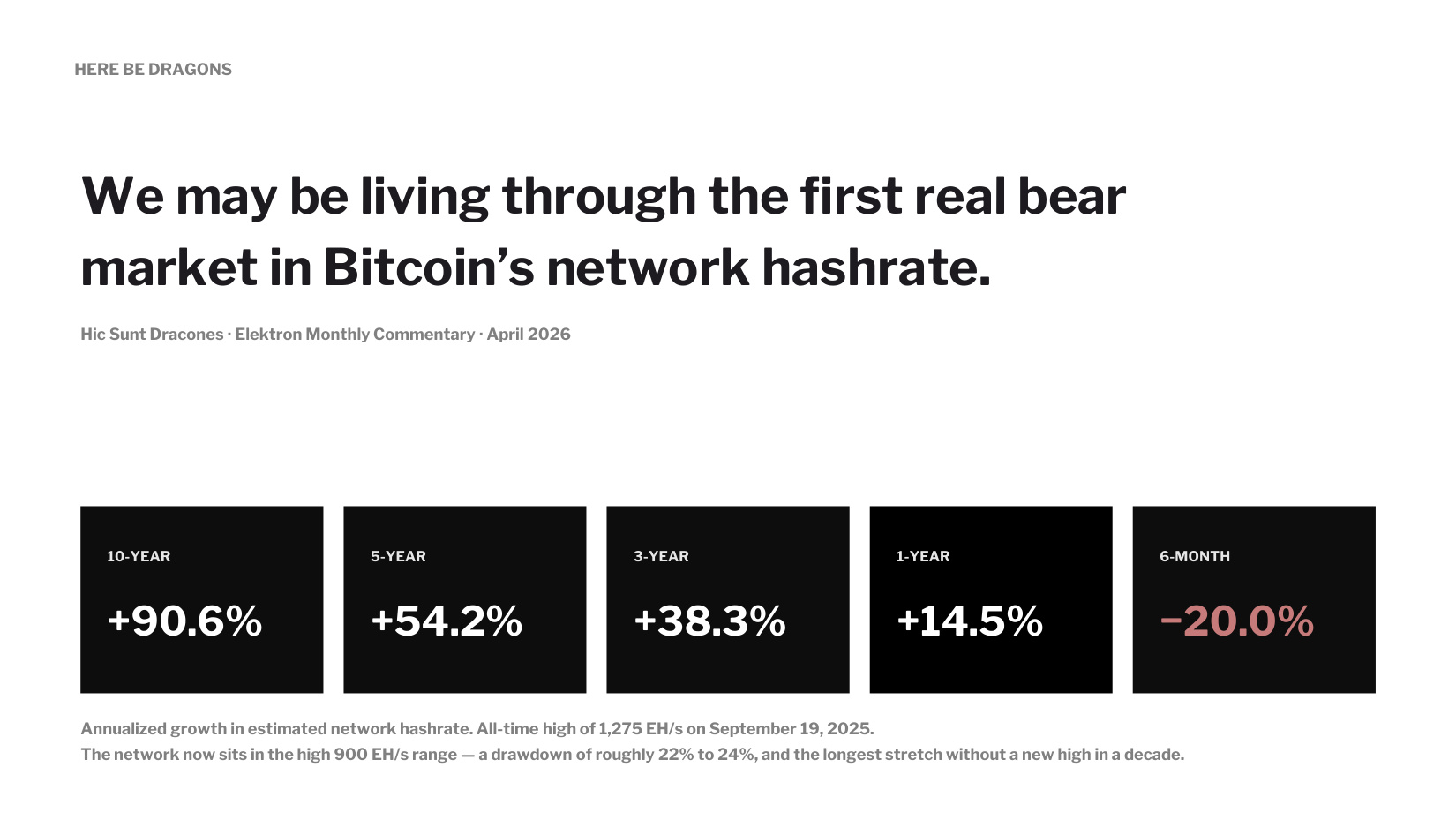
[0:37] And it doesn’t necessarily mean that it was something bad. It just meant that it was something uncharted. And I think in Bitcoin, there’s some exciting times ahead, definitely uncharted, that we should be thinking about. And we’re living, I think, through the first bear market in hash rate that we’ve ever seen in Bitcoin history.
[1:00] For a long time, and, you know, I founded Elektron Energy, which became one of the largest mining companies in the world. And for a long time, as we were thinking about models, how to think about hash rate, and how hash rate was gonna be growing, we looked at long term trends, and long term trends are massive. Year after year, if you look at very long term trends, network hash rate almost doubled every year. And if you’re just looking at shorter periods of time, 50 percent was the number that a lot of people had in mind. And for a miner, that’s important, because if you’re mining, that means that if network hash rate goes up, you’re getting more diluted, you have less of a network share, and eventually that’s actually less revenue for you.
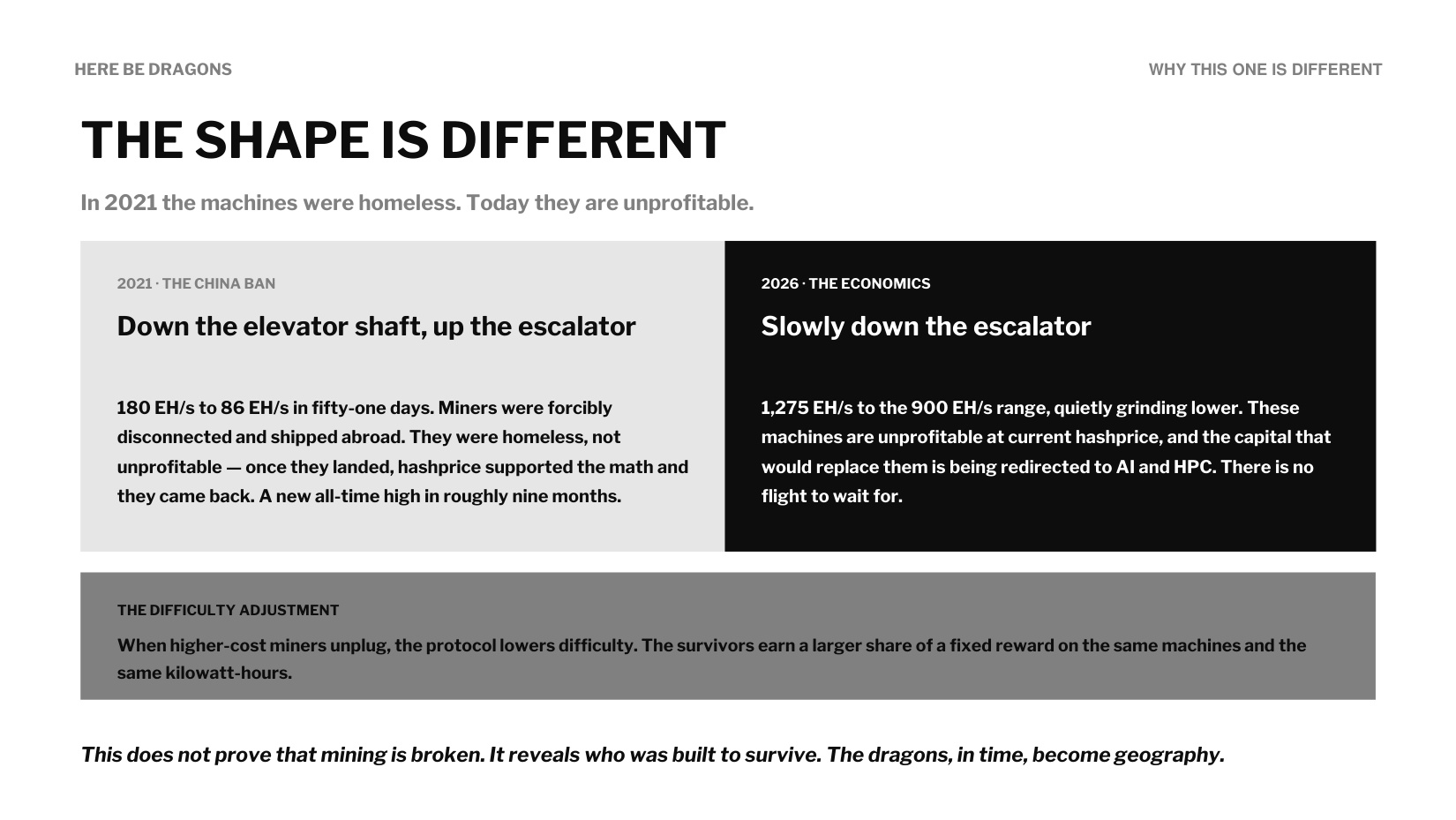
[1:47] That has changed. It has changed substantially, particularly in the last year. We’re living through something that looks very different than what we saw in 2021 with the China ban. So when mining was banned in 2021, you look at network hash rate, and what had happened is that it collapsed very quickly, and it gradually recovered as those machines that were in China were allocated to other parts of the world.
| Simply Bitcoin | Bitcoin Asia 2026 | Prepared August 28, 2026 |
Page 1 of 4 |
|
|
[2:13] What we’re seeing now, it’s very different. We’re seeing network hash rate, we hit close to 1.3 zettahashes late last year, and it’s been gradually, still gradually, coming down. This has been the longest period that we’ve seen from an all-time high until recovery.
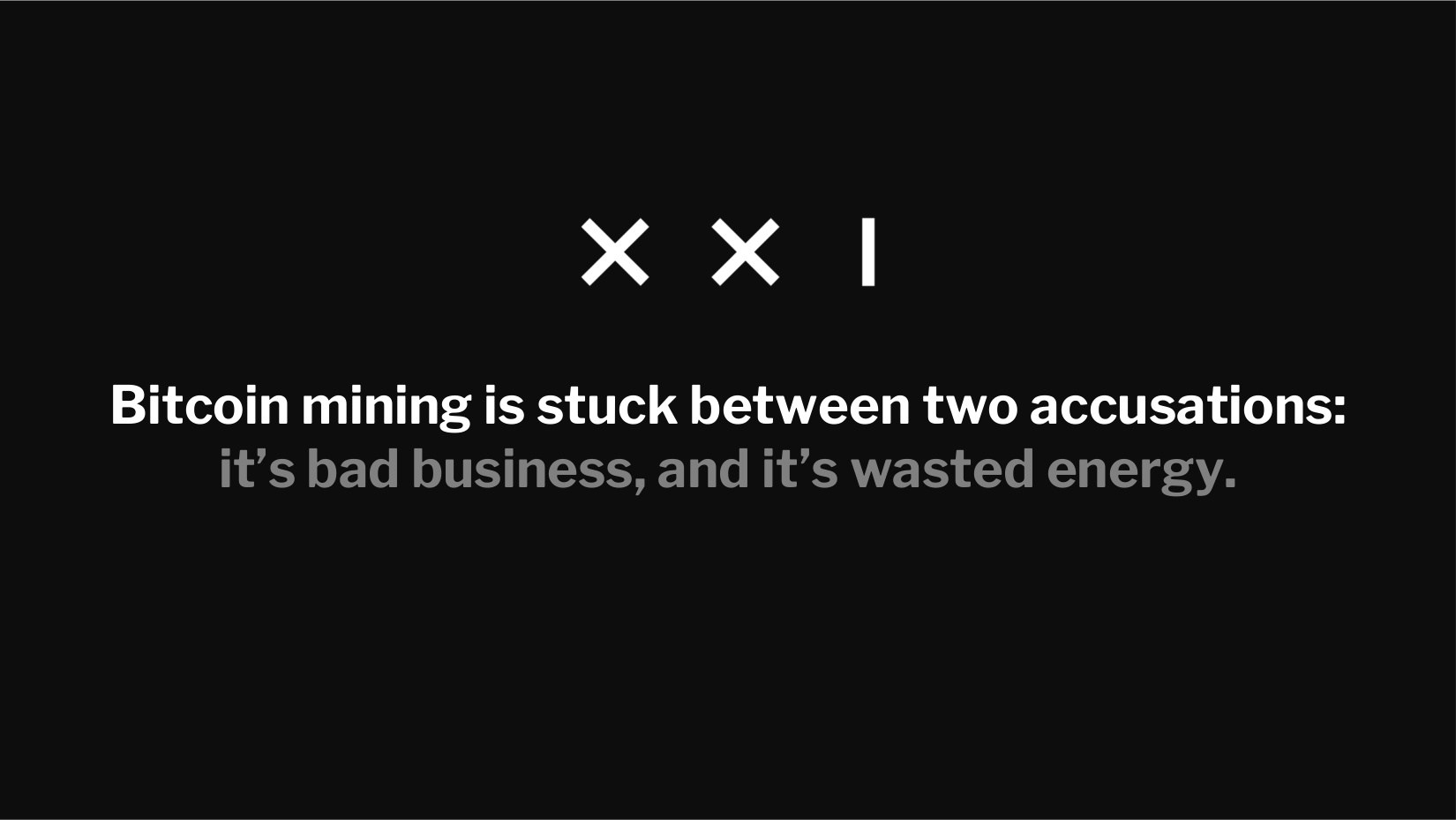
[2:36] Back to Bitcoin mining. We hear this a lot. I think there are 2 big accusations that we hear about Bitcoin mining. One, that it’s bad business. And two, that it’s wasted energy.
[2:50] Let me start with the first one, that Bitcoin mining is a bad business. And commodity businesses, they don’t come in good and bad, right? They come in where you are in the cost curve. If you’re extracting a commodity at very high cost, yes, it is gonna be a bad business for you. But if you’re at the left side of the cost curve, that could be a very profitable business and potentially extremely healthy.
[3:18] Bitcoin is a very unique commodity when you think about commodities, right? First of all, just like oil, it is fungible, but I think it’s the purest form of commodity that we’ve ever seen. Satoshi embedded in code the difficulty adjustment, which basically means that no matter how much more hash rate you have out there, on average, a block is still going to be mined every 10 minutes. That’s very different, because when you compare, for example, with oil or gold, typically higher prices lead to more development, to more mining in different places, which eventually leads to more supply hitting the market and prices eventually coming down. In Bitcoin mining, it doesn’t matter. We can turn off our hashing machines that we currently have, the market wouldn’t feel it. In 2 weeks, we’re gonna have a new difficulty adjustment.
[4:11] And I think when we think about how many, how, you know, why many people failed in mining in the past, it’s much more about their capital structure and their cost structure than it is about hash price, about Bitcoin price, and about where we are in the network.
[4:29] Just look at an example. If you pick two miners, and if you look at their different unit economics, imagine they just bought a fleet of ASICs. One has very low cost of energy, very efficient machines. The other one has higher cost of energy and less efficient machines. What it means in terms of, that’s the difference between having very high margins and having to shut down your production.
[4:56] And the market, of course, improved from where it was, but hash price is still, compared to historical levels, relatively low.
[5:07] Big question we get all the time, and by the way, on Twenty One Capital, the first thing we think about as we’re thinking about opportunities is, how does that opportunity perform compared to Bitcoin? Bitcoin is our standard. Bitcoin is our benchmark, and if you can’t beat Bitcoin, investors should just be buying an ETF at the end of the day, because that’s less risky than holding an operating business. And in mining, we get that question all the time about, if I have a dollar, should I be looking to invest in mining, or should I be buying Bitcoin?
[5:39] And the answer is, if you only have $1, buy Bitcoin first. I think that’s the best way to express your view. But in a diversification, if you’re looking at investing in larger scale, mining can make a ton of sense.
[5:56] Fundamentally, when you think about Bitcoin mining right at the end of the day, and I’m gonna simplify here a ton, Bitcoin mining is gonna outperform Bitcoin in a scenario where Bitcoin price goes up faster than network hash rate. So if Bitcoin price is going up by 50, 100 percent a year, and network hash rate is flat, you have a much higher chance of outperforming.
[6:27] I think for a company, as I was saying, the right decision was never about buying Bitcoin or mining. The better risk adjusted allocation is to have a little bit of both.
| Simply Bitcoin | Bitcoin Asia 2026 | Prepared August 28, 2026 |
Page 2 of 4 |
|
|
[6:42] I’ll come back to that, but let me address the second point, because that’s an important one, that Bitcoin mining wastes energy. We hear that all the time, you know, it’s repeated as rhetoric a lot, that it’s bad business for the environment, that it’s a waste of energy. So let me tell you a story.
[7:01] Back in 2002, a while back, I was at Yale, had my summer job at Yale, and instead of going to Wall Street, I decided to do something completely different at the time. I went back to Brazil, to where I’m from, and I went to a project in the middle of the Amazon. So this is a place where, to get there, you fly to Manaus, which is already remote. Then you hop into a very small plane. You land in a dirt airfield, then you hop into a boat. You go up a stream, you know, maybe for 5, 6 hours, and then you get to somewhere you are. One of the most beautiful places you can think about, very rich in terms of having, you know, there’s no starvation. You can just literally just pick fruit off the trees, you can fish, a lot of wealth in that perspective, but they lacked one thing. There was no energy in that city. That city was called Manicoré. It’s the middle of the Amazon. You can look it up. There’s green, a horizon of green all around you. And with no energy, you know, we would see people dying from diseases that, you know, have been eradicated in other places for decades, and it was still happening there, because there was no access to medicine. Medicine would go bad. There was no refrigeration. We saw kids studying, and the school is all open, because there’s no, of course, air conditioning. At night, night falls, and the forest reclaims everything.
[8:34] Energy is the substrate of everything that we call development. Lack of energy is equal lack of development.
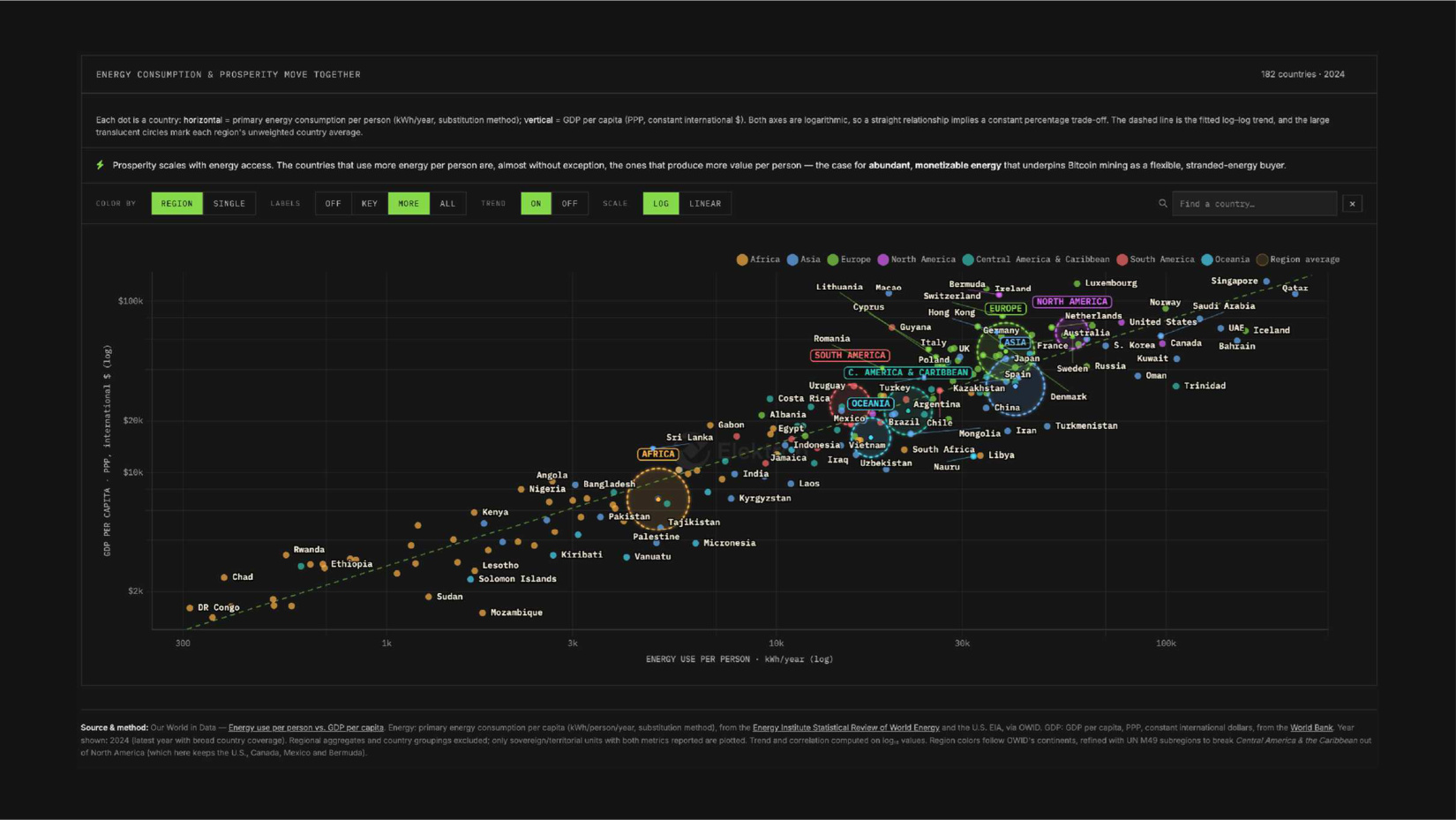
[8:43] So I think that’s the first thing we should have in mind, that energy consumption by definition is not bad. It’s actually directly related to human progress. In fact, if we look at the data, right, so this is the data that is showing a very high correlation between GDP per capita and energy consumption. And a lot of people will look at this chart and they will tell you, well, this doesn’t tell you exactly what’s cause and consequence, right? There’s a correlation inverted here. And when I get that question, I go back to the story in the Amazon. I say, listen, I’ve seen the other side of this, which is being at the bottom side of that curve, where you have less energy consumption and poverty.
[9:34] The other thing about mining is that it’s extremely flexible. It’s the most flexible load ever invented, right? If you have a steel mill, which steel basically is energy, what you’re doing is that, you know, you’re inputting a lot of energy to get your output at the other side. And you shut down a steel mill, depending of where you are, it can take months to get back online. So when they lose energy, it’s a problem. It’s a massive problem. Mining, we don’t care. Machines can be turned on and off at the whim at the end of the day.
[10:06] We’re starting to have, I think, very good conversations, particularly with governments and energy companies, exactly about that, which is there is load that is just sitting there. It’s not going anywhere.
Most of the cities actually have excess load, right? And mining can come in and stabilize the grid massively from where it was.
[10:27] So when we talk about, you know, wasted energy, I don’t think that, you know, fish are wasting energy when they’re swimming upstream, right? And we saw that in the Amazon as well, they’re swimming upstream to create a new generation. I don’t think that where we are is similar to what we saw in 2021. It’s very different.
[10:50] I think mining also opens a set of optionality that we didn’t have in the past, and we see that, you know, the obvious one is on AI and HPC opportunities and the use of energy. All this optionality that you have with Bitcoin mining, it’s rarely put into the pricing of it.
| Simply Bitcoin | Bitcoin Asia 2026 | Prepared August 28, 2026 |
Page 3 of 4 |
|
|
[11:11] And that optionality comes from the energy option, which I just mentioned. The share option, you know, the beautiful thing about Bitcoin mining being in a bear market of hash rate is that for those that stay around, for those that stick to the course, they naturally get a higher share of the market. The proximity option of being close to Bitcoin, right? At the end of the day, you know, we look at our team at Elektron, we’re all Bitcoiners. We all came to doing mining because we were originally Bitcoiners. Mining gets very close to the protocol level, to understanding the protocol level. And then the last one is infrastructure. Mining is, I can tell you, like, there were a lot of investors that I had conversations with that when you talk about mining, investing in mining, it’s something that for them, coming from the real asset world, it’s much simpler and much clearer to grok than investing in Bitcoin, because for them, that’s a real, they can see it, right? It’s like you see the mining, see the data centers.
[12:12] That’s another advantage. I think we are at a stretch that, you know, we’re extremely well positioned for Bitcoin mining for the first time at scale, exactly because of what I mentioned. I think in one side you have the Bitcoin price at a very compressed level, and at the other you have the dynamics in network hash rate being very well positioned. I didn’t need to tell you this, but if you look at the public mining companies out there, there really isn’t anybody staying the course to mine Bitcoin at scale. Pretty much everybody is leaving the industry right now.
[12:53] So I’ll finish here. As I said, I think, you know, Bitcoin mining is at the crossroad, is at the best place where energy, the energy revolution, meets the Bitcoin revolution, and exciting times ahead to continue to be building. Thank you.
[END OF TRANSCRIPT]
| Simply Bitcoin | Bitcoin Asia 2026 | Prepared August 28, 2026 |
Page 4 of 4 |
Exhibit 99.2
HERE BE DRAGONS Bitcoin Mining Enters Unknown Territory Raphael Zagury Chief Executive Officer, Twenty One Capital · Founder of Elektron Energy
HERE BE DRAGONS We may be living through the first real bear market in Bitcoin's network hashrate. Hic Sunt Dracones · Elektron Monthly Commentary · April 2026 10-YEAR +90.6% 5-YEAR +54.2% 3-YEAR +38.3% 1-YEAR +14.5% 6-MONTH −20.0% Annualized growth in estimated network hashrate. All-time high of 1,275 EH/s on September 19, 2025. The network now sits in the high 900 EH/s range — a drawdown of roughly 22% to 24%, and the longest stretch without a new high in a decade.
HERE BE DRAGONS WHY THIS ONE IS DIFFERENT THE SHAPE IS DIFFERENT In 2021 the machines were homeless. Today they are unprofitable. 2021 · THE CHINA BAN Down the elevator shaft, up the escalator 180 EH/s to 86 EH/s in fifty-one days. Miners were forcibly disconnected and shipped abroad. They were homeless, not unprofitable — once they landed, hashprice supported the math and they came back. A new all-time high in roughly nine months. 2026 · THE ECONOMICS Slowly down the escalator 1,275 EH/s to the 900 EH/s range, quietly grinding lower. These machines are unprofitable at current hashprice, and the capital that would replace them is being redirected to AI and HPC. There is no flight to wait for. THE DIFFICULTY ADJUSTMENT When higher-cost miners unplug, the protocol lowers difficulty. The survivors earn a larger share of a fixed reward on the same machines and the same kilowatt-hours. This does not prove that mining is broken. It reveals who was built to survive. The dragons, in time, become geography.
Bitcoin mining is stuck between two accusations: it's bad business, and it's wasted energy.
"Bitcoin mining is a bad business." CLAIM 01

Commodity businesses don't come in good and bad THE FRAME They come in positions on a cost curve.
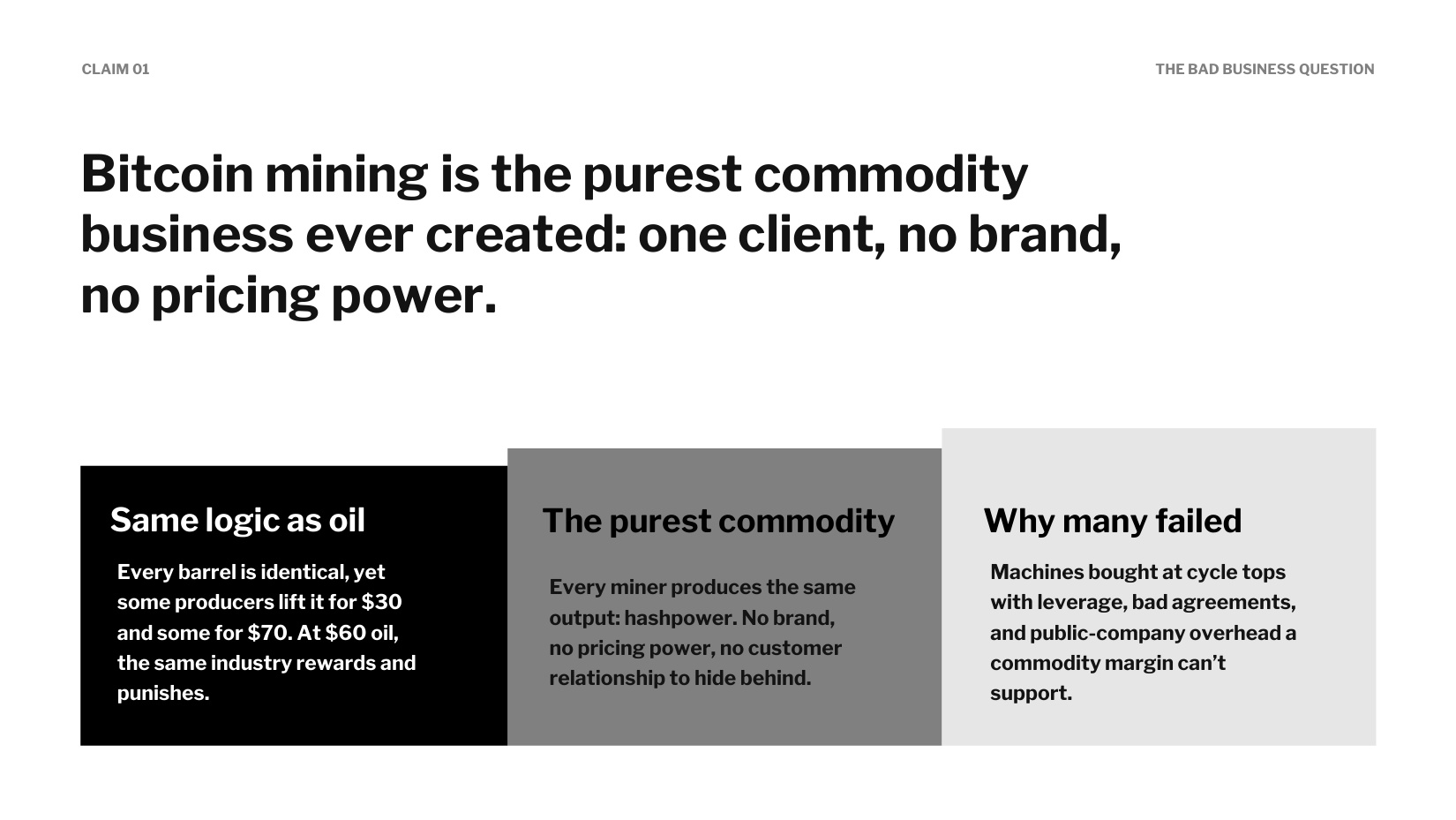
CLAIM 01 THE BAD BUSINESS QUESTION Bitcoin mining is the purest commodity business ever created: one client, no brand, no pricing power. Same logic as oil Every barrel is identical, yet some producers lift it for $30 and some for $70. At $60 oil, the same industry rewards and punishes. The purest commodity Every miner produces the same output: hashpower. No brand, no pricing power, no customer relationship to hide behind. Why many failed Machines bought at cycle tops with leverage, bad agreements, and public-company overhead a commodity margin can't support.
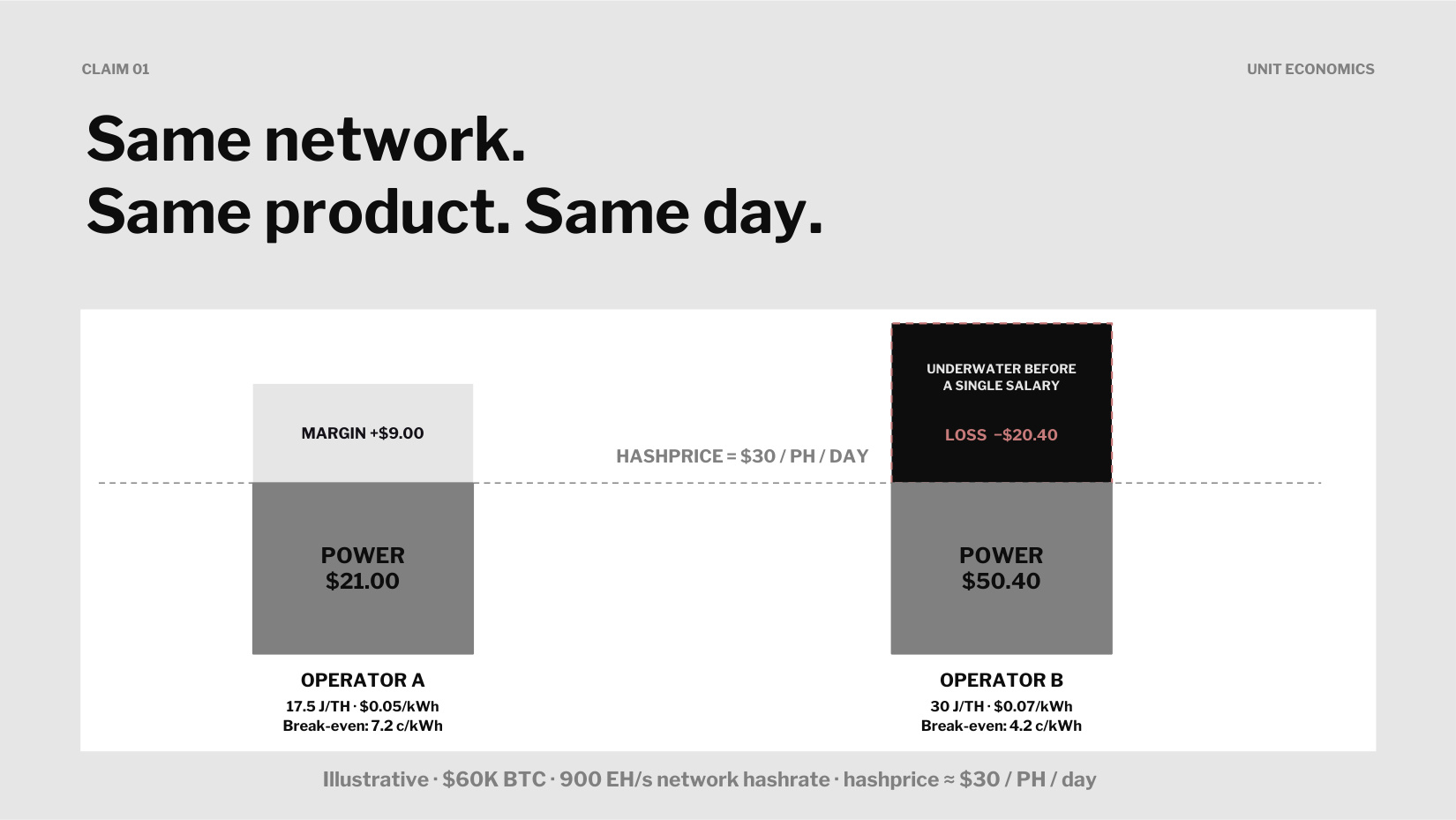
Same network. Same product. Same day. HASHPRICE = $30 / PH / DAY MARGIN +$9.00 POWER $21.00 OPERATOR A 17.5 J/TH · $0.05/kWh Break-even: 7.2 c/kWh UNDERWATER BEFORE A SINGLE SALARY LOSS −$20.40 POWER $50.40 OPERATOR B 30 J/TH · $0.07/kWh Break-even: 4.2 c/kWh Illustrative · $60K BTC · 900 EH/s network hashrate · hashprice ≈ $30 / PH / day UNIT ECONOMICS CLAIM 01
Does the mining investment outperform buying Bitcoin?
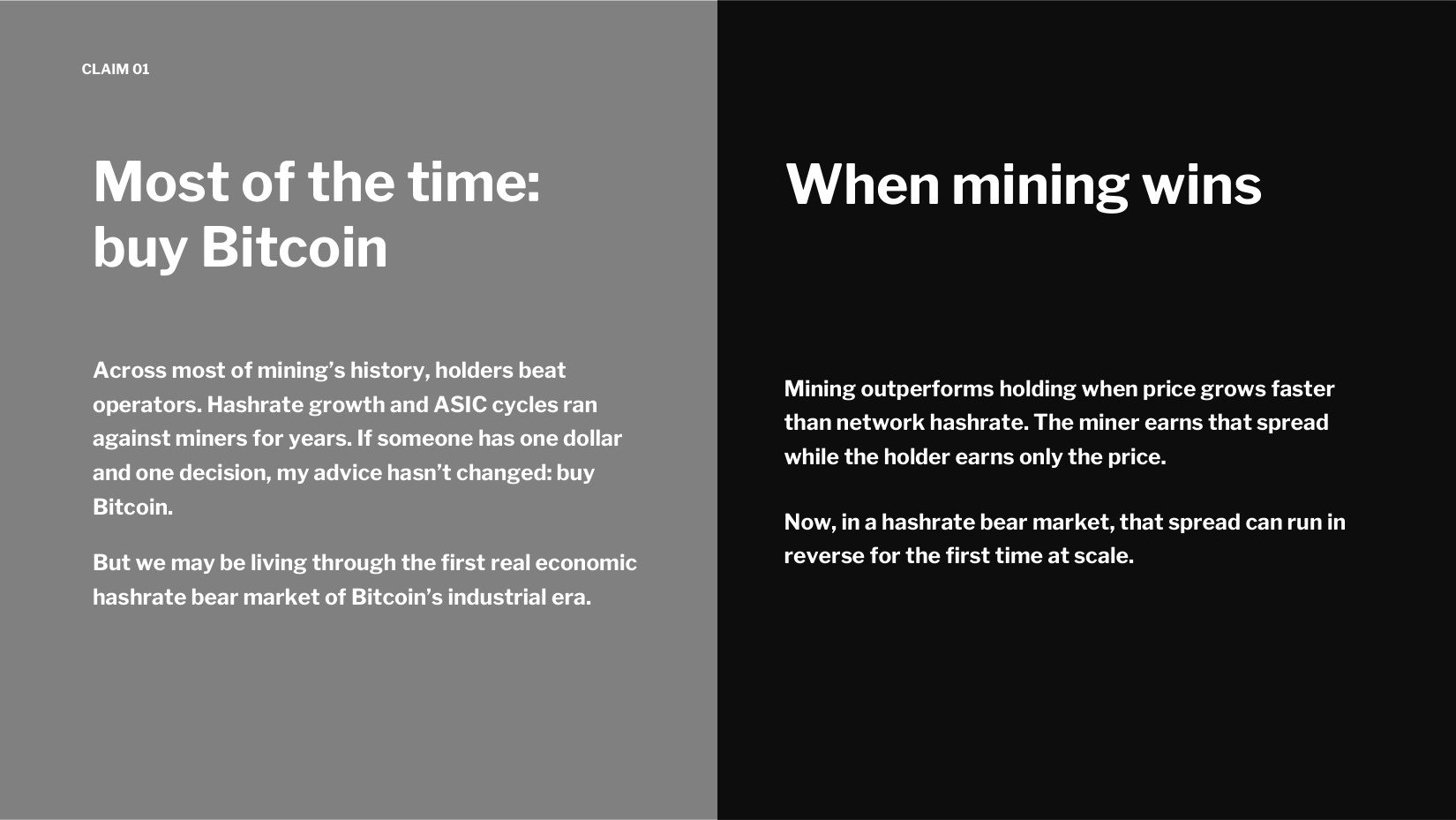
Most of the time: buy Bitcoin Across most of mining's history, holders beat operators. Hashrate growth and ASIC cycles ran against miners for years. If someone has one dollar and one decision, my advice hasn't changed: buy Bitcoin. But we may be living through the first real economic hashrate bear market of Bitcoin's industrial era. When mining wins Mining outperforms holding when price grows faster than network hashrate. The miner earns that spread while the holder earns only the price. Now, in a hashrate bear market, that spread can run in reverse for the first time at scale. CLAIM 01
THE ALLOCATOR ANSWER For a company, mining vs. Bitcoin was never the right question Portfolios aren't built by ranking assets in isolation. Diversification exists to improve the odds of a good outcome across many possible futures, not to hold whatever wins in hindsight. CLAIM 01
"Bitcoin mining wastes energy." CLAIM 02 The goal was never low energy consumption. The goal is high energy productivity: more human progress per joule.
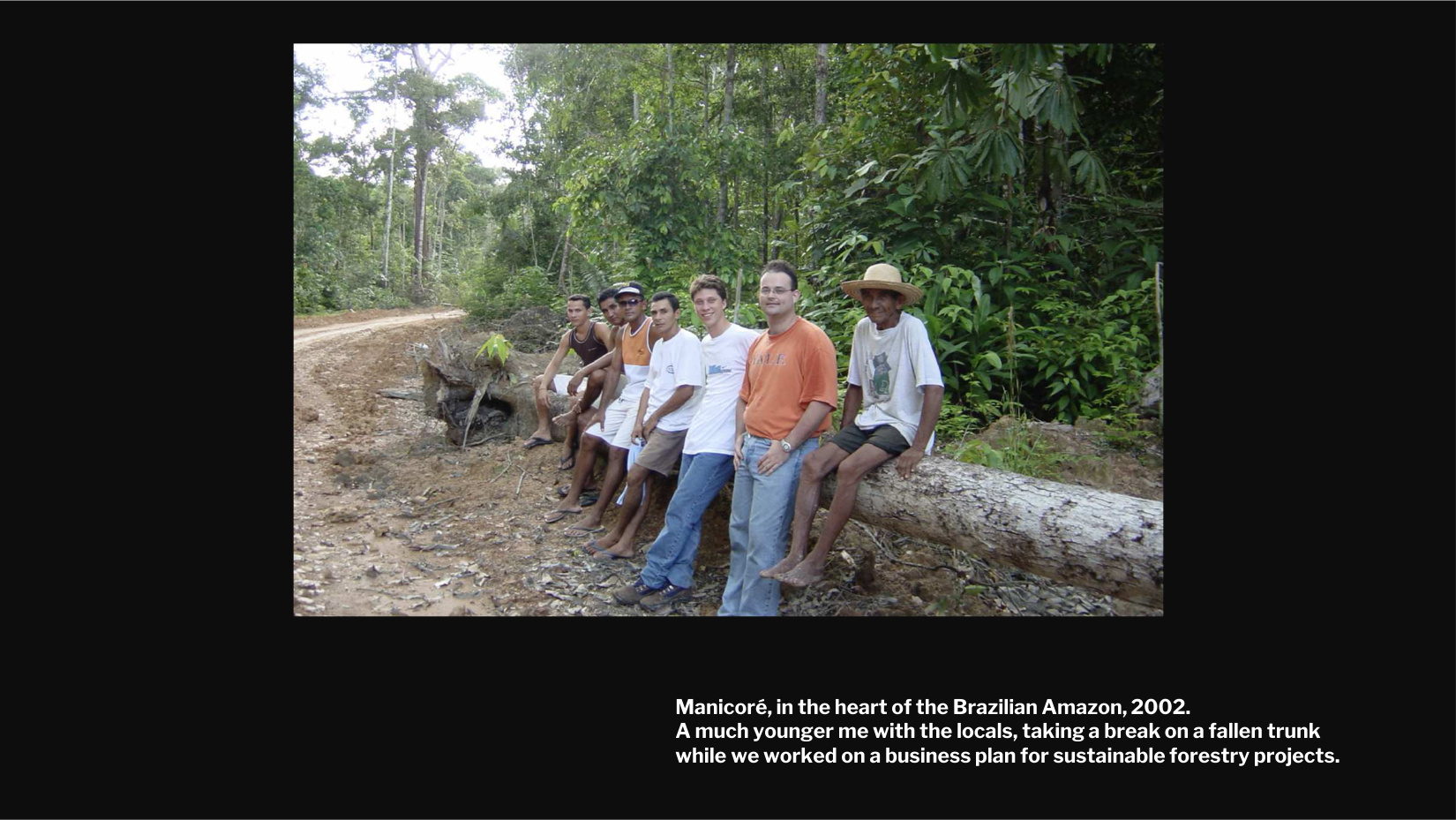
Manicoré, in the heart of the Brazilian Amazon, 2002. A much younger me with the locals, taking a break on a fallen trunk while we worked on a business plan for sustainable forestry projects.
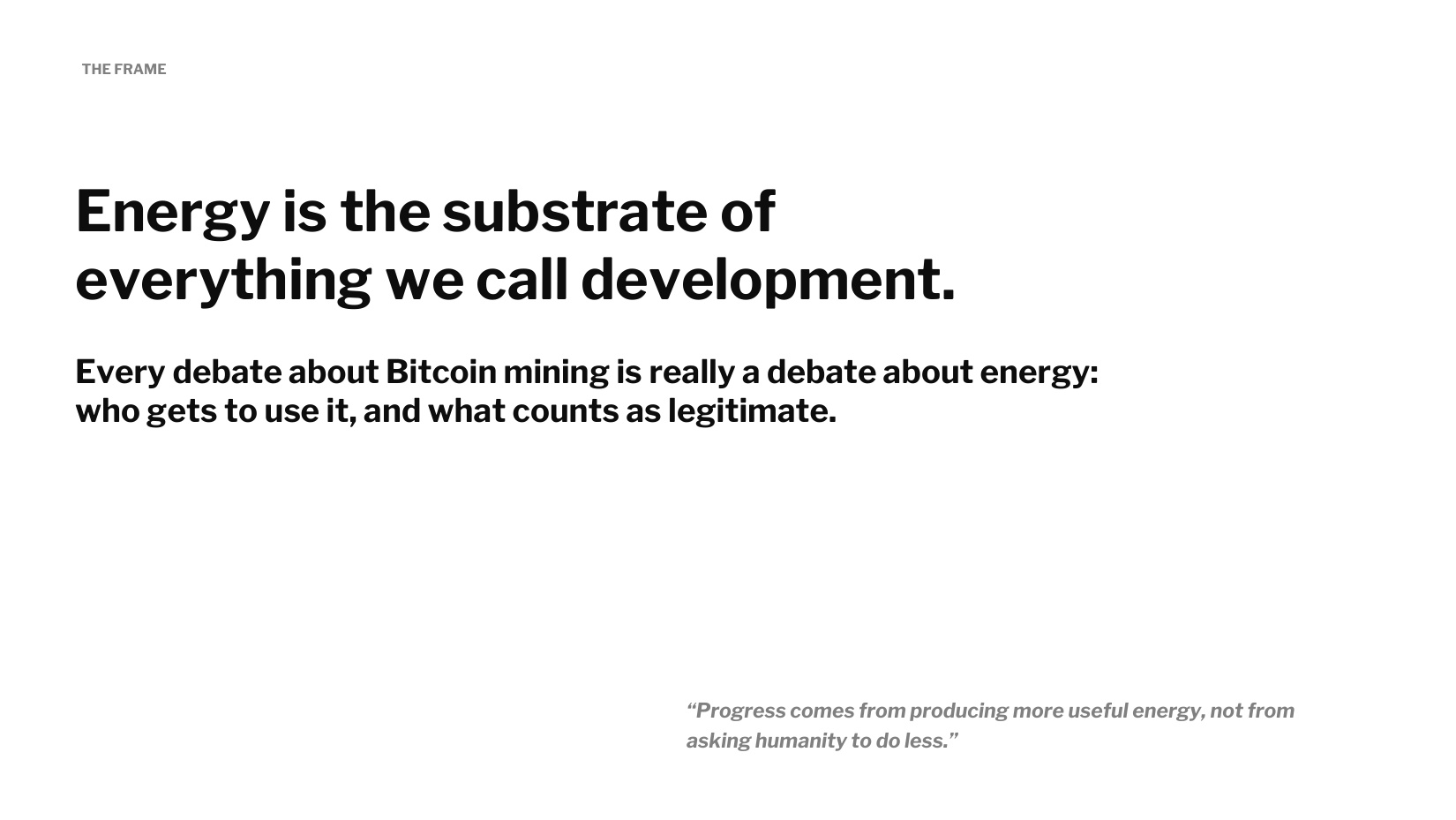
Energy is the substrate of everything we call development. Every debate about Bitcoin mining is really a debate about energy: who gets to use it, and what counts as legitimate. "Progress comes from producing more useful energy, not from asking humanity to do less." THE FRAME
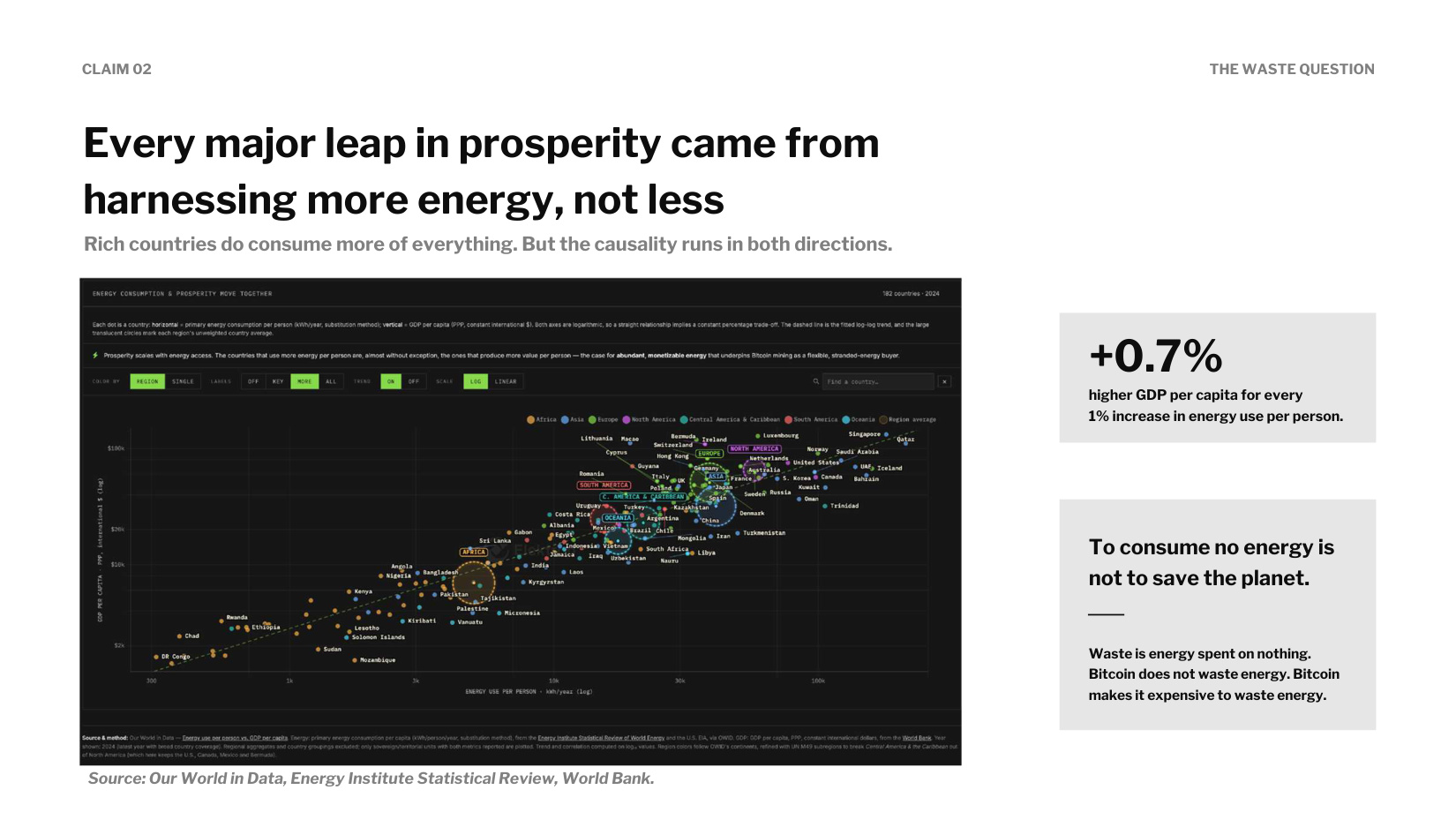
Rich countries do consume more of everything. But the causality runs in both directions. Source: Our World in Data, Energy Institute Statistical Review, World Bank. +0.7% higher GDP per capita for every 1% increase in energy use per person. To consume no energy is not to save the planet. Waste is energy spent on nothing. Bitcoin does not waste energy. Bitcoin makes it expensive to waste energy. THE WASTE QUESTION Every major leap in prosperity came from harnessing more energy, not less CLAIM 02
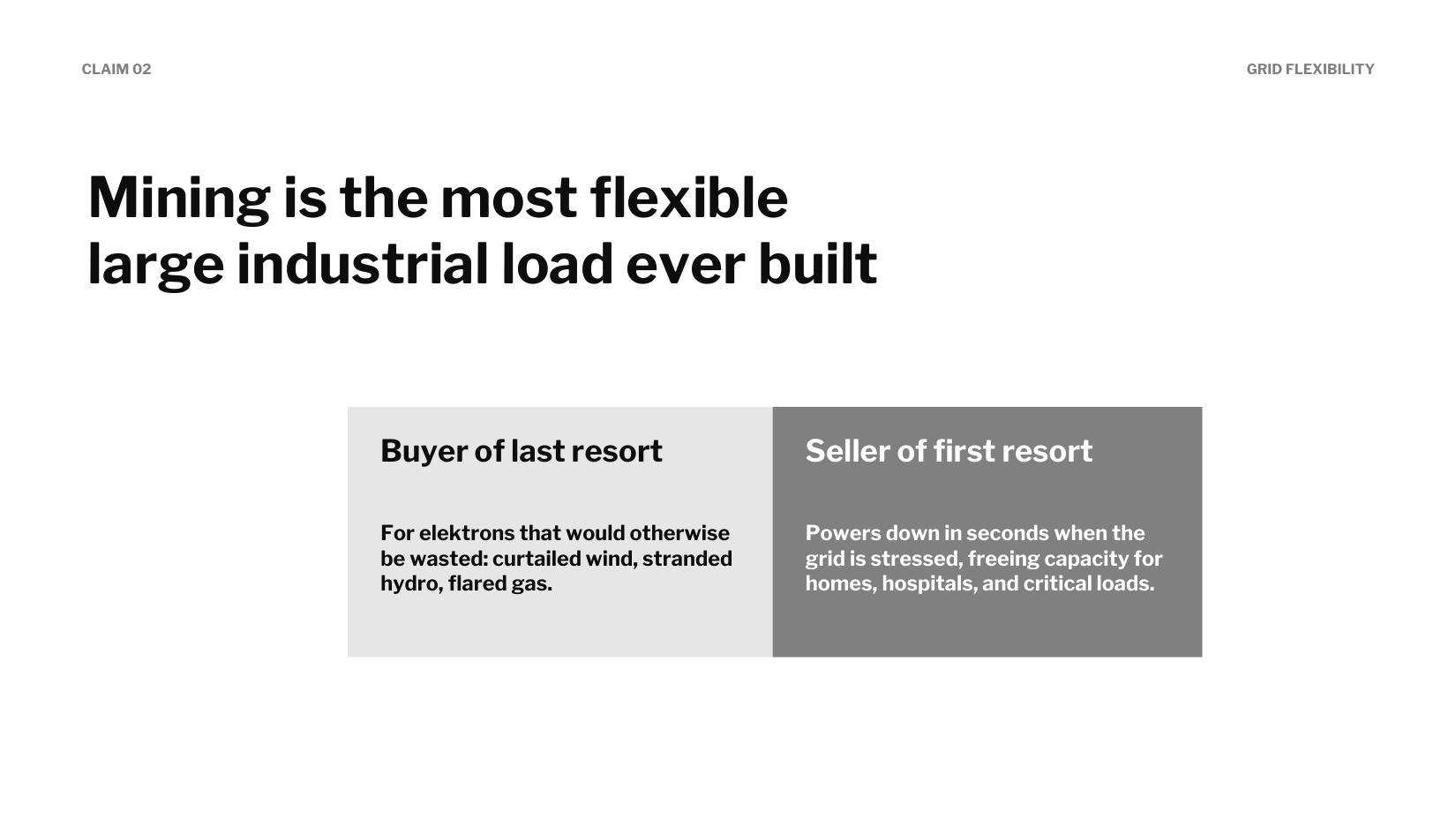
Mining is the most flexible large industrial load ever built Buyer of last resort For elektrons that would otherwise be wasted: curtailed wind, stranded hydro, flared gas. Seller of first resort Powers down in seconds when the grid is stressed, freeing capacity for homes, hospitals, and critical loads. GRID FLEXIBILITY CLAIM 02
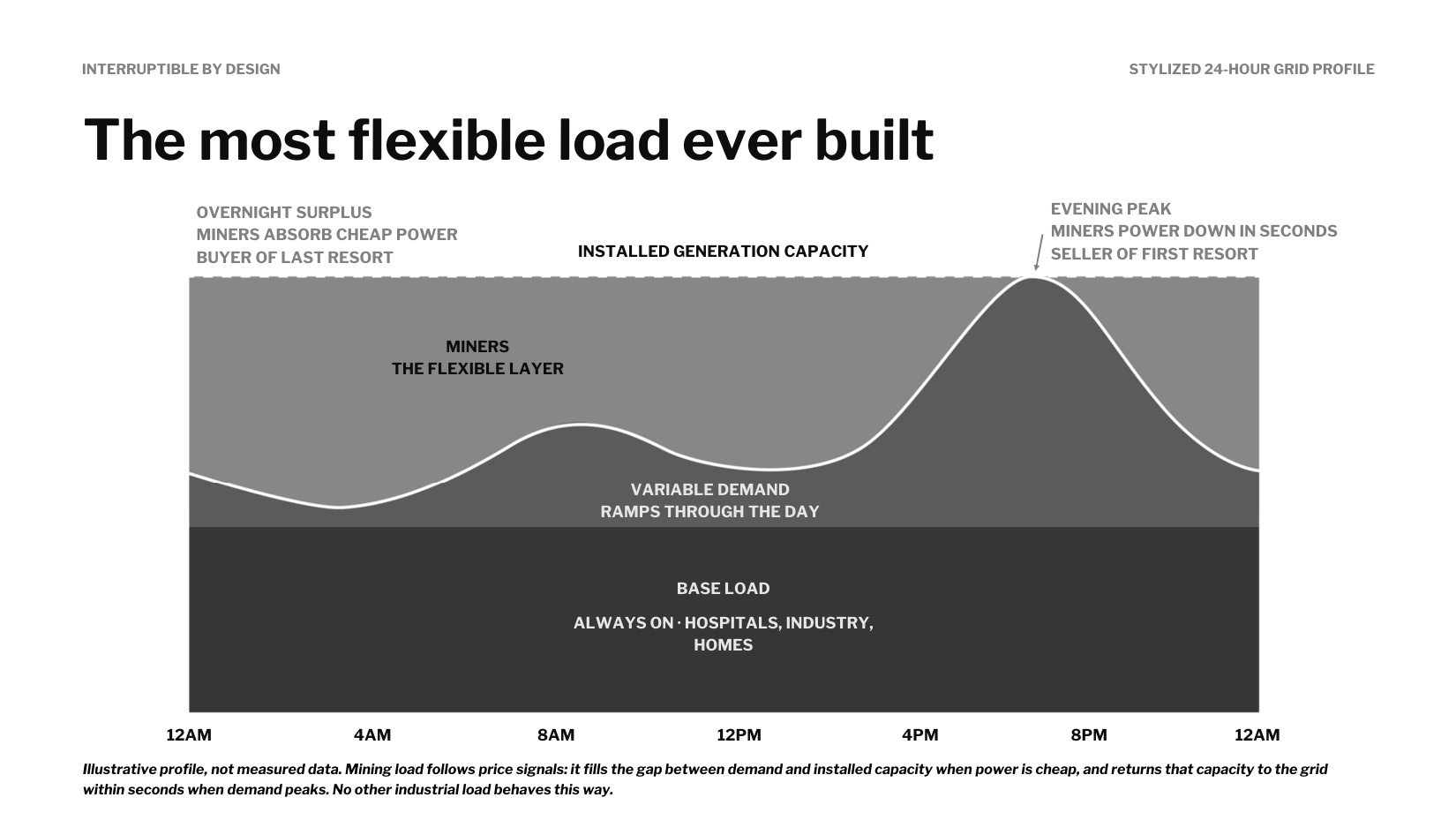
The most flexible load ever built INTERRUPTIBLE BY DESIGN STYLIZED 24-HOUR GRID PROFILE Illustrative profile, not measured data. Mining load follows price signals: it fills the gap between demand and installed capacity when power is cheap, and returns that capacity to the grid within seconds when demand peaks. No other industrial load behaves this way. OVERNIGHT SURPLUS MINERS ABSORB CHEAP POWER BUYER OF LAST RESORT INSTALLED GENERATION CAPACITY EVENING PEAK MINERS POWER DOWN IN SECONDS SELLER OF FIRST RESORT MINERS THE FLEXIBLE LAYER VARIABLE DEMAND RAMPS THROUGH THE DAY BASE LOAD ALWAYS ON · HOSPITALS, INDUSTRY, HOMES 12AM 4AM 8AM 12PM 4PM 8PM 12AM

The fish are not wasting energy swimming upstream. CLAIM 02 · THE VERDICT They are converting it into the next generation. Mining doesn't compete with civilization for energy. It monetizes energy civilization can't use, and steps aside when civilization wants it back.
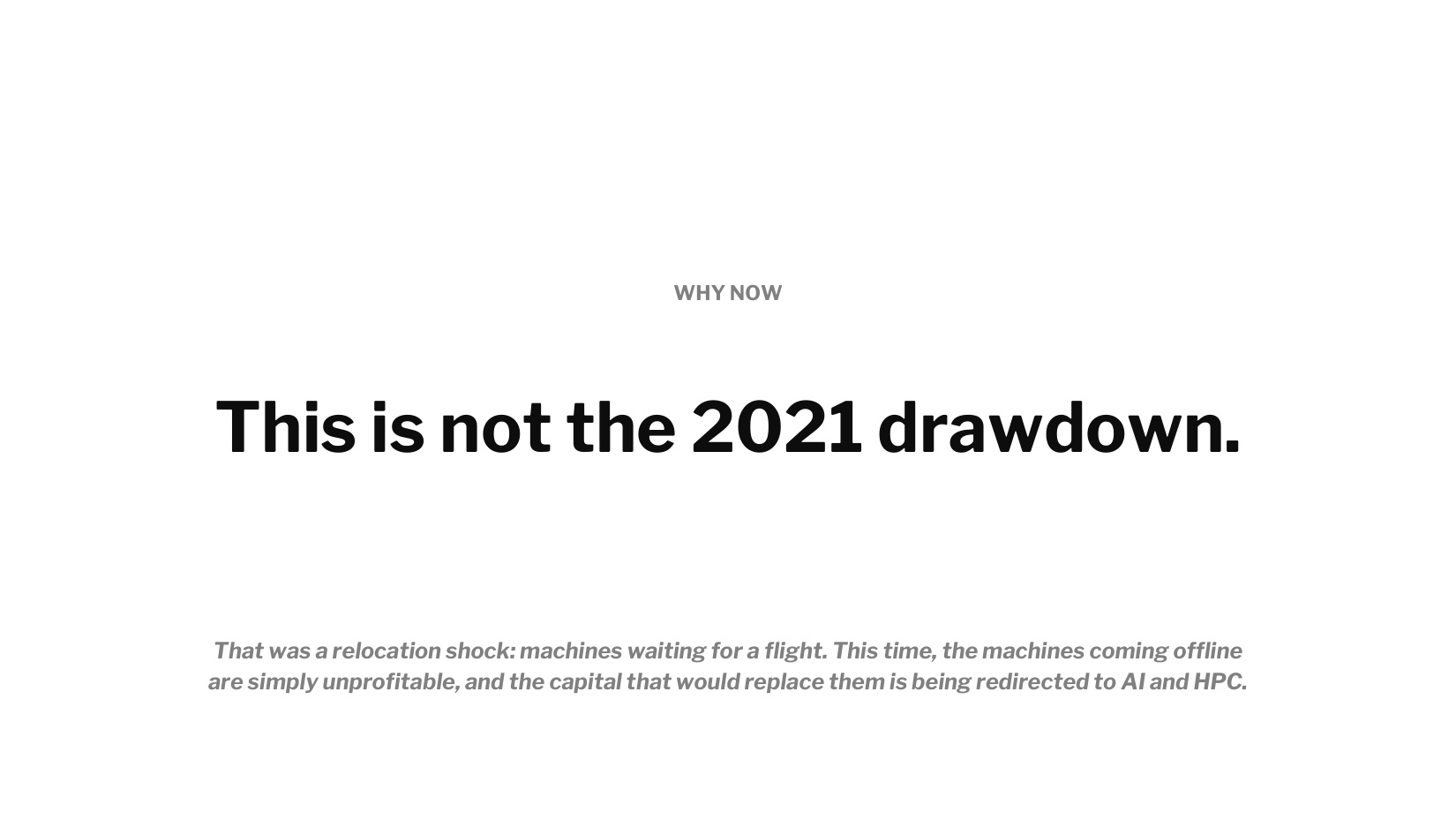
This is not the 2021 drawdown. WHY NOW That was a relocation shock: machines waiting for a flight. This time, the machines coming offline are simply unprofitable, and the capital that would replace them is being redirected to AI and HPC.
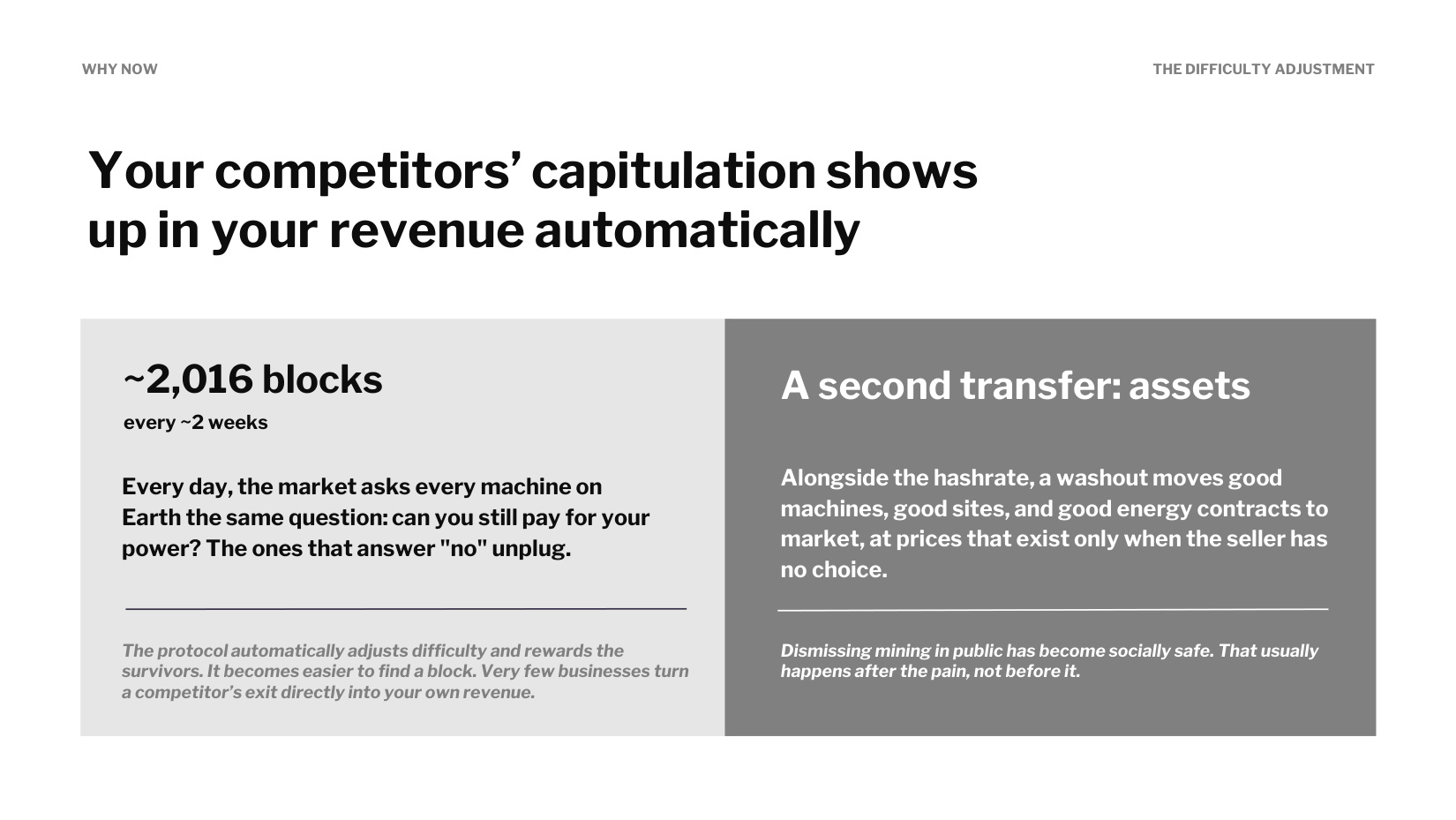
Your competitors' capitulation shows up in your revenue automatically WHY NOW THE DIFFICULTY ADJUSTMENT ~2,016 blocks every ~2 weeks Every day, the market asks every machine on Earth the same question: can you still pay for your power? The ones that answer "no" unplug. The protocol automatically adjusts difficulty and rewards the survivors. It becomes easier to find a block. Very few businesses turn a competitor's exit directly into your own revenue. A second transfer: assets Alongside the hashrate, a washout moves good machines, good sites, and good energy contracts to market, at prices that exist only when the seller has no choice. Dismissing mining in public has become socially safe. That usually happens after the pain, not before it.
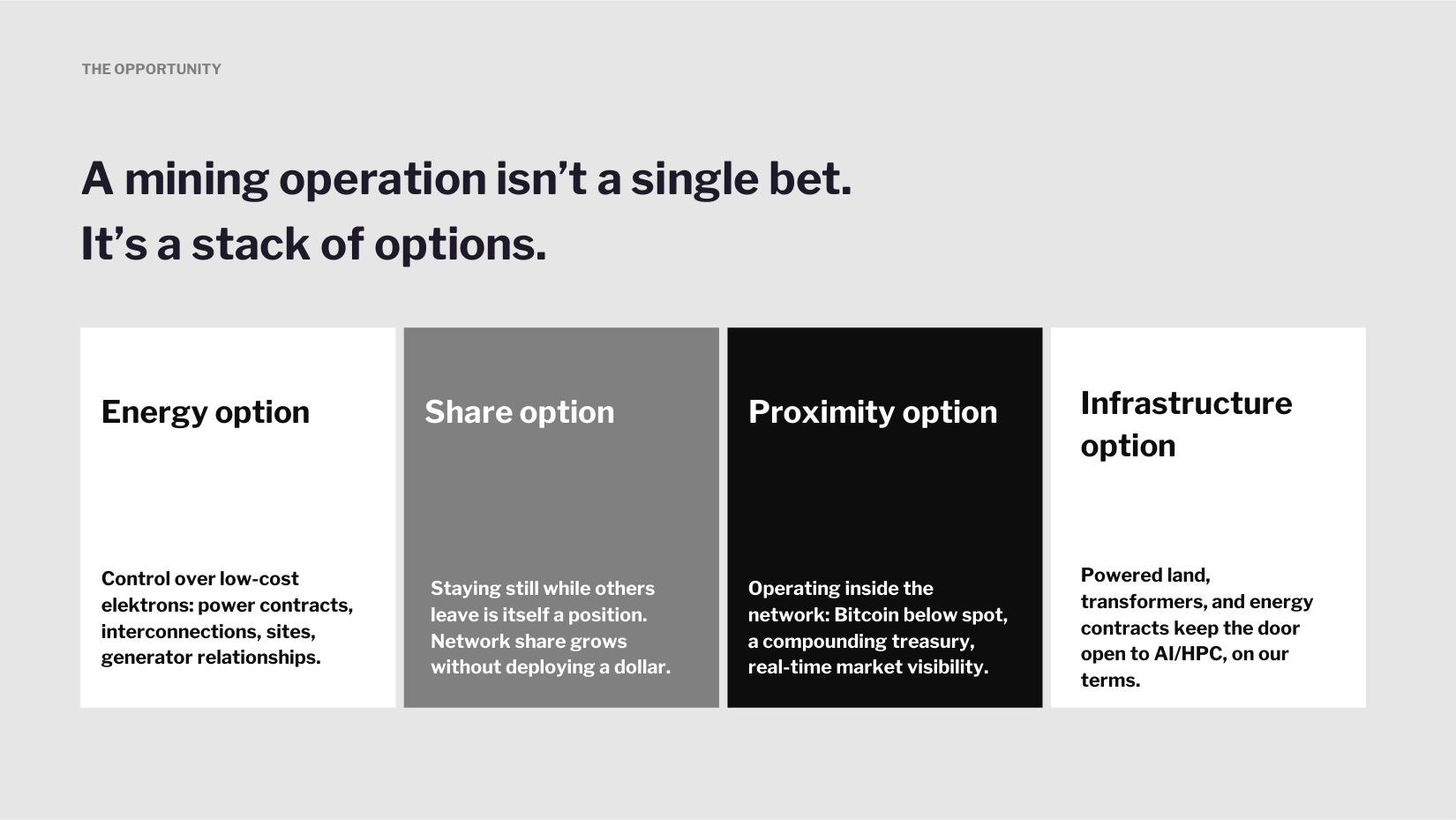
THE OPPORTUNITY A mining operation isn't a single bet. It's a stack of options. Energy option Control over low-cost elektrons: power contracts, interconnections, sites, generator relationships. Infrastructure option Powered land, transformers, and energy contracts keep the door open to AI/HPC, on our terms. Share option Staying still while others leave is itself a position. Network share grows without deploying a dollar. Proximity option Operating inside the network: Bitcoin below spot, a compounding treasury, real-time market visibility.
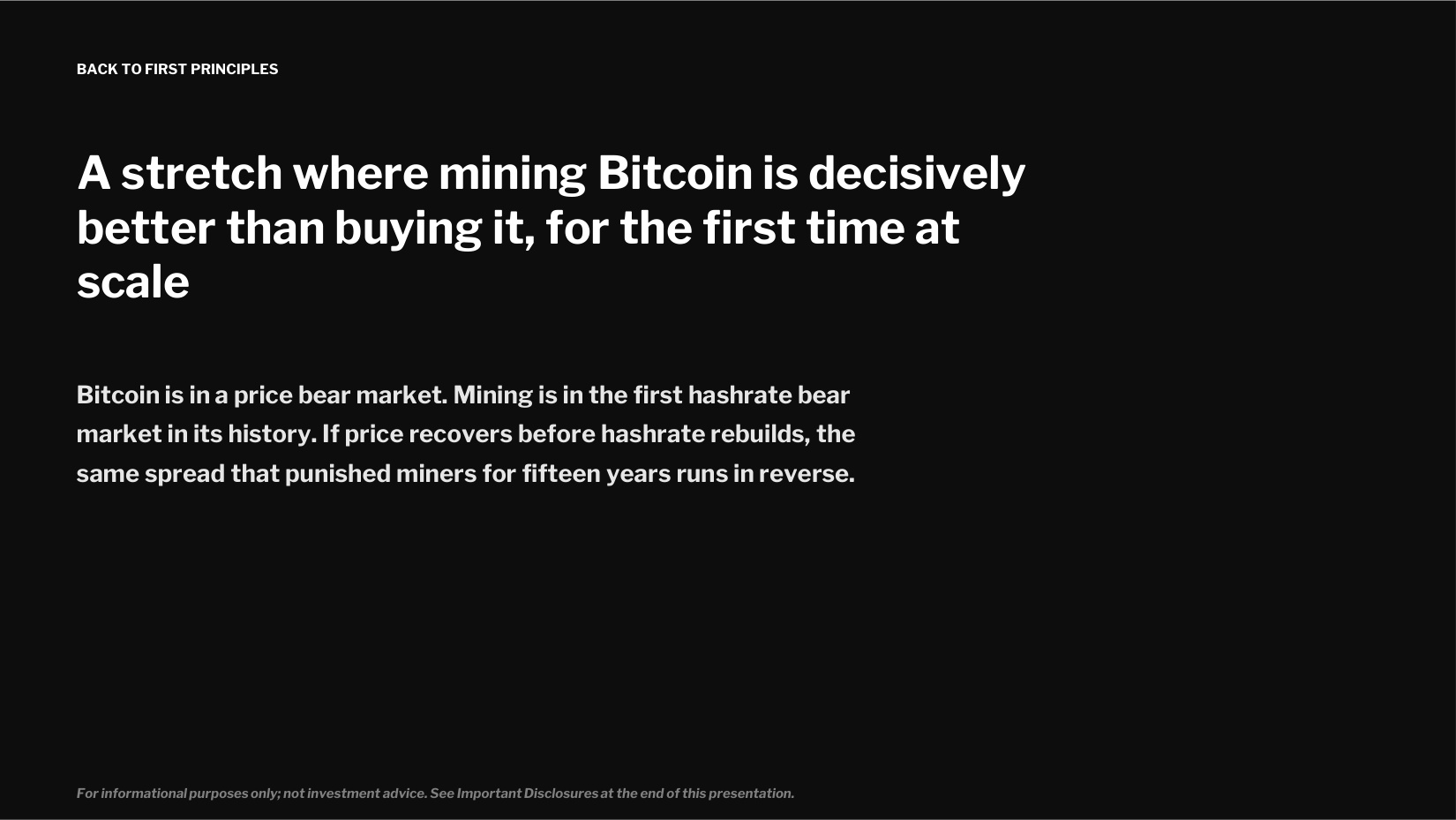
BACK TO FIRST PRINCIPLES A stretch where mining Bitcoin is decisively better than buying it, for the first time at scale Bitcoin is in a price bear market. Mining is in the first hashrate bear market in its history. If price recovers before hashrate rebuilds, the same spread that punished miners for fifteen years runs in reverse. For informational purposes only; not investment advice. See Important Disclosures at the end of this presentation.
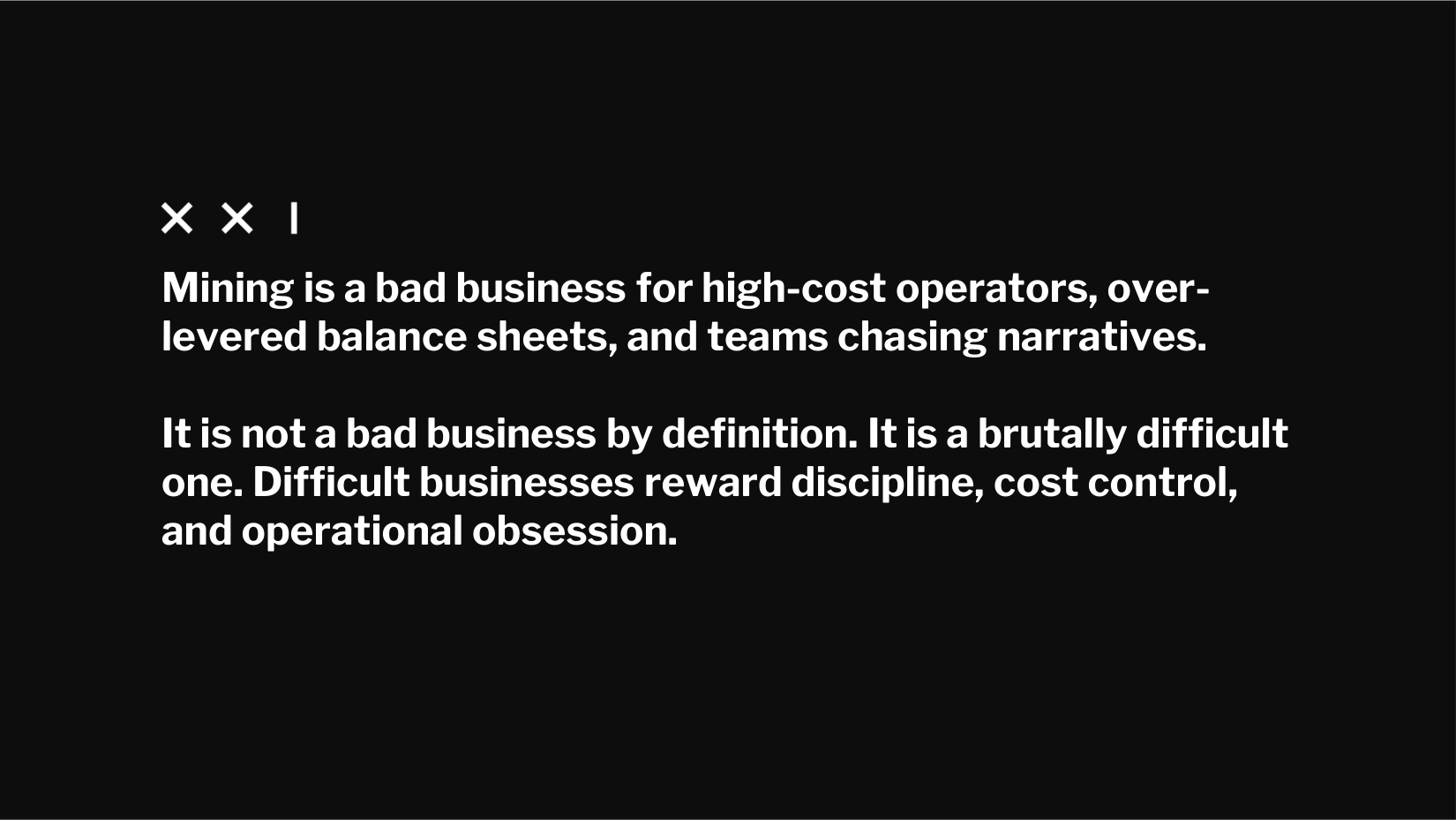
Mining is a bad business for high-cost operators, over- levered balance sheets, and teams chasing narratives. It is not a bad business by definition. It is a brutally difficult one. Difficult businesses reward discipline, cost control, and operational obsession.
Legal Disclaimer Industry Information This Presentation includes estimates regarding market and industry data. Unless otherwise indicated, information concerning the Bitcoin mining industry, including our general expectations, Bitcoin's hashrate, market opportunity, are based on our management's knowledge and experience, together with currently available information obtained from various sources, including publicly available information, industry reports and publications, surveys and other contacts in the markets. We have not independently verified data obtained from third-party sources and cannot guarantee its accuracy or completeness. In presenting this information, we have made certain assumptions that we believe to be reasonable based on such data and other similar sources and on our knowledge of, and our experience to date in, the Bitcoin mining market. While we believe the estimated market and industry data included in this presentation is reliable, such information is inherently uncertain and imprecise. Market and industry data is subject to change and may be limited by the availability of raw data, the nature of the data gathering process and other limitations inherent in any statistical survey of such data. In addition, projections, assumptions and estimates of the future performance are necessarily subject to uncertainty and risk due to a variety of factors. These and other factors could cause results to differ materially from those expressed in the estimates made by third parties and by us. Accordingly, you are cautioned not to place undue reliance on such market and industry data or any other such estimates. Forward-Looking Statements This Presentation contains forward-looking statements that reflect our current views with respect to, among other things, future events and our future business, financial condition, results of operations, and prospects. These statements are often, but not always, made through the use of words or phrases such as "may," "should," "could," "predict," "potential," "believe," "will likely result," "expect," "continue," "will," "anticipate," "seek," "estimate," "intend," "plan," "projection," "would," and "outlook," or the negative version of those words or phrases or other comparable words or phrases of a future or forward-looking nature. These forward-looking statements are not statements of historical fact, and are based on current expectations, estimates, and projections about our industry as well as certain assumptions made by management, many of which, by their nature, are inherently uncertain and beyond our control. We cannot guarantee that future results reflected in the forward-looking statements will occur. Except to the extent required by law, we do not undertake to update any of the information contained in this presentation. Forward-looking statements in this Presentation include, among others, statements regarding: the Bitcoin's network hashrate and mining machines' profitability; the return on investment from holding Bitcoin versus Bitcoin mining; the energy consumption of Bitcoin mining; and the allocation of capital towards Bitcoin mining.