 エドガーで原本を確認する
UNITED STATES
SECURITIES AND EXCHANGE COMMISSION
Washington, D.C. 20549
FORM
(Mark One)
For the quarterly period ended
or
For the transition period from __________ to __________
Commission File Number:
(Exact name of registrant as specified in its charter)
| (State or Other Jurisdiction
of Incorporation or Organization) |
(I.R.S. Employer* Identification No.) |
|
|
| ||
| (Address of Principal Executive Offices) | (Zip Code) |
(Registrant’s Telephone Number, Including Area Code)
Securities registered pursuant to Section 12(b) of the Act:
| Title of each class | Trading Symbol | Name of exchange on which registered | ||
Indicate by check mark whether the registrant (1) has filed all reports required to be filed by Section 13 or 15(d) of the Securities Exchange Act of 1934 during the preceding 12 months (or for such shorter period that the registrant was required to file such reports), and (2) has been subject to such filing requirements for the past 90 days. ☒
Indicate by check mark whether the registrant has submitted electronically every Interactive Data File required to be submitted pursuant to Rule 405 of Regulation S-T (§232.405 of this chapter) during the preceding 12 months (or for such shorter period that the registrant was required to submit such files). ☒
Indicate by check mark whether the registrant is a large accelerated filer, an accelerated filer, a non-accelerated filer, a smaller reporting company, or an emerging growth company. See the definitions of “large accelerated filer,” “accelerated filer,” “smaller reporting company,” and “emerging growth company” in Rule 12b-2 of the Exchange Act.
| Large accelerated filer | ☐ | Accelerated filer | ☐ |
| ☒ | Smaller reporting company | ||
| Emerging growth company |
If an emerging growth company, indicate by check mark if the registrant has elected not to use the extended transition period for complying with any new or revised financial accounting standards, provided pursuant to Section 13(a) of the Exchange Act. ☐
Indicate by check mark whether the registrant is a shell company (as defined in Rule 12b-2 of the Exchange Act). ☐ Yes
Indicate the number of shares outstanding of each of the issuer’s classes of common stock, as of August 6, 2026:
Actinium Pharmaceuticals, Inc.
Table of Contents
INDEX
| PART I – FINANCIAL INFORMATION | ||
| Item 1. | Financial Statements | 1 |
| Item 2. | Management’s Discussion and Analysis of Financial Condition and Results of Operations | 18 |
| Item 3. | Quantitative and Qualitative Disclosures About Market Risk | 52 |
| Item 4. | Controls and Procedures | 52 |
| PART II – OTHER INFORMATION | 53 | |
| Item 1. | Legal Proceedings | 53 |
| Item 1A. | Risk Factors | 53 |
| Item 2. | Unregistered Sales of Equity Securities and Use of Proceeds | 89 |
| Item 3. | Defaults Upon Senior Securities | 89 |
| Item 4. | Mine Safety Disclosures | 89 |
| Item 5. | Other Information | 89 |
| Item 6. | Exhibits | 90 |
| SIGNATURES | 91 | |
i
PART I - FINANCIAL INFORMATION
ITEM 1. UNAUDITED FINANCIAL STATEMENTS
The accompanying condensed consolidated financial statements have been prepared by Actinium Pharmaceuticals, Inc., or the Company, and are unaudited. In the opinion of management, all adjustments (which include only normal recurring adjustments) necessary to present fairly the financial position at June 30, 2026 and December 31, 2025, and the results of operations and cash flows for the three months and six months ended June 30, 2026 and 2025, respectively, have been made. Certain information and footnote disclosures normally included in financial statements prepared in accordance with accounting principles generally accepted in the United States of America have been condensed or omitted. It is suggested that these financial statements be read in conjunction with the financial statements and notes thereto included in the Company’s audited financial statements for the year ended December 31, 2025 in the Company’s Annual Report on Form 10-K. The results of operations for the three months and six months ended June 30, 2026 are not necessarily indicative of the operating results for the full year.
1
Actinium Pharmaceuticals, Inc.
Condensed Consolidated Balance Sheets
(Unaudited)
(amounts in thousands, except share and per share data)
| June
30, 2026 |
December 31, 2025 |
|||||||
| (Unaudited) | ||||||||
| Assets | ||||||||
| Current Assets: | ||||||||
| Cash and cash equivalents | $ | $ | ||||||
| Prepaid expenses and other current assets | ||||||||
| Total Current Assets | ||||||||
| Property and equipment, net of accumulated depreciation of $ | ||||||||
| Restricted cash – long-term | ||||||||
| Operating leases right-of-use assets, net | ||||||||
| Finance leases right-of-use assets, net | ||||||||
| Total Assets | $ | $ | ||||||
| Liabilities and Stockholders’ Equity | ||||||||
| Current Liabilities: | ||||||||
| Accounts payable and accrued expenses | $ | $ | ||||||
| Operating leases current liability | ||||||||
| Finance leases current liability | ||||||||
| Total Current Liabilities | ||||||||
| Long-term license revenue deferred | ||||||||
| Long-term operating lease obligations | ||||||||
| Total Liabilities | ||||||||
| Commitments and contingencies | ||||||||
| Stockholders’ Equity: | ||||||||
| Preferred stock, $ | ||||||||
| Common stock, $ | ||||||||
| Additional paid-in capital | ||||||||
| Accumulated other comprehensive loss | ( | ) | ( | ) | ||||
| Accumulated deficit | ( | ) | ( | ) | ||||
| Total Stockholders’ Equity | ||||||||
| Total Liabilities and Stockholders’ Equity | $ | $ | ||||||
See accompanying notes to the condensed consolidated financial statements.
2
Actinium Pharmaceuticals, Inc.
Condensed Consolidated Statements of Operations
(Unaudited)
(amounts in thousands, except share and per share data)
| For
the Three Months Ended June 30, |
For
the Six Months Ended June 30, |
|||||||||||||||
| 2026 | 2025 | 2026 | 2025 | |||||||||||||
| Revenue | ||||||||||||||||
| Revenue | $ | $ | $ | $ | ||||||||||||
| Other revenue | ||||||||||||||||
| Total revenue | ||||||||||||||||
| Operating expenses: | ||||||||||||||||
| Research and development, net of reimbursements | ||||||||||||||||
| General and administrative | ||||||||||||||||
| Total operating expenses | ||||||||||||||||
| Income/(Loss) from operations | ( | ) | ( | ) | ||||||||||||
| Other income: | ||||||||||||||||
| Interest income - net | ||||||||||||||||
| Total other income | ||||||||||||||||
| Income/(loss) before income taxes | ( | ) | ( | ) | ||||||||||||
| Income tax expense | ||||||||||||||||
| Net income/(loss) | $ | $ | ( | ) | $ | $ | ( | ) | ||||||||
| Net income/(loss) per common share – basic | $ | $ | ( | ) | $ | $ | ( | ) | ||||||||
| Weighted average common shares outstanding – basic | ||||||||||||||||
| Net income/(loss) per common share – fully diluted | $ | $ | ( | ) | $ | $ | ( | ) | ||||||||
| Weighted average common shares outstanding – fully diluted | ||||||||||||||||
See accompanying notes to the condensed consolidated financial statements.
3
Actinium
Pharmaceuticals, Inc.
Consolidated Statements of Comprehensive Income/(Loss)
(amounts in thousands)
| For
the Three Months Ended June 30, |
For
the Six Months Ended June 30, |
|||||||||||||||
| 2026 | 2025 | 2026 | 2025 | |||||||||||||
| Net Income/(Loss) | $ | $ | ( | ) | $ | $ | ( | ) | ||||||||
| Other comprehensive loss: | ||||||||||||||||
| Foreign currency translation adjustment | ( | ) | ( | ) | ||||||||||||
| Comprehensive Income/(Loss) | $ | $ | ( | ) | $ | $ | ( | ) | ||||||||
See accompanying notes to the condensed consolidated financial statements.
4
Actinium Pharmaceuticals, Inc.
Condensed Consolidated Statement of Changes in Stockholders’ Equity
For the Period from January 1, 2026 to June 30, 2026
(Unaudited)
(amounts in thousands, except share amounts)
| Accumulated | ||||||||||||||||||||||||
| Additional | Other | |||||||||||||||||||||||
| Common Stock | Paid-In | Comprehensive | Accumulated | Stockholders’ | ||||||||||||||||||||
| Shares | Amount | Capital | Loss | Deficit | Equity | |||||||||||||||||||
| Balance, January 1, 2026 | $ | $ | $ | ( | ) | $ | ( | ) | $ | |||||||||||||||
| Stock-based compensation | ||||||||||||||||||||||||
| Net loss | - | ( | ) | ( | ) | |||||||||||||||||||
| Unrealized loss on foreign currency translation | - | ( | ) | ( | ) | |||||||||||||||||||
| Balance, March 31, 2026 | $ | $ | $ | ( | ) | $ | ( | ) | $ | |||||||||||||||
| Stock-based compensation | ||||||||||||||||||||||||
| Net income | - | |||||||||||||||||||||||
| Unrealized loss on foreign currency translation | - | ( | ) | ( | ) | |||||||||||||||||||
| Balance, June 30, 2026 | $ | $ | $ | ( | ) | $ | ( | ) | $ | |||||||||||||||
See accompanying notes to the condensed consolidated financial statements.
5
Actinium Pharmaceuticals, Inc.
Condensed Consolidated Statement of Changes in Stockholders’ Equity
For the Period from January 1, 2025 to June 30, 2025
(Unaudited)
(amounts in thousands, except share amounts)
| Accumulated | ||||||||||||||||||||||||
| Additional | Other | |||||||||||||||||||||||
| Common Stock | Paid-In | Comprehensive | Accumulated | Stockholders’ | ||||||||||||||||||||
| Shares | Amount | Capital | Loss | Deficit | Equity | |||||||||||||||||||
| Balance, January 1, 2025 | $ | $ | $ | $ | ( | ) | $ | |||||||||||||||||
| Stock-based compensation | - | |||||||||||||||||||||||
| Net loss | - | ( | ) | ( | ) | |||||||||||||||||||
| Balance, March 31, 2025 | $ | ( | ) | |||||||||||||||||||||
| Stock-based compensation | - | |||||||||||||||||||||||
| Net loss | - | ( | ) | ( | ) | |||||||||||||||||||
| Balance, June 30, 2025 | $ | $ | $ | $ | ( | ) | $ | |||||||||||||||||
See accompanying notes to the condensed consolidated financial statements.
6
Actinium Pharmaceuticals, Inc.
Condensed Consolidated Statements of Cash Flows
(Unaudited)
(amounts in thousands)
|
For the Six Months Ended June 30, |
||||||||
| 2026 | 2025 | |||||||
| Cash Flows Used in Operating Activities: | ||||||||
| Net income/(loss) | $ | $ | ( | ) | ||||
| Adjustments to reconcile net loss to net cash used in operating activities: | ||||||||
| Stock-based compensation expense | ||||||||
| Depreciation and amortization expenses | ||||||||
| Changes in operating assets and liabilities: | ||||||||
| Prepaid expenses and other current assets | ||||||||
| Accounts payable and accrued expenses | ||||||||
| Operating lease liabilities | ( | ) | ( | ) | ||||
| Long-term license revenue deferred | ( | ) | ||||||
| Net Cash Used in Operating Activities | ( | ) | ( | ) | ||||
| Cash Flows Used in Investing Activities: | ||||||||
| Purchase of property and equipment | ( | ) | ||||||
| Net Cash Used in Investing Activities | ( | ) | ||||||
| Cash Flows Used in Financing Activities: | ||||||||
| Payments on finance leases | ( | ) | ( | ) | ||||
| Net Cash Used in Financing Activities | ( | ) | ( | ) | ||||
| Effect of foreign currency rates on cash | ||||||||
| Net Change in Cash, Cash Equivalents and Restricted Cash | ( | ) | ( | ) | ||||
| Cash, cash equivalents and restricted cash at beginning of year | ||||||||
| Cash, Cash Equivalents and Restricted Cash at End of Period | $ | $ | ||||||
See accompanying notes to the condensed consolidated financial statements.
7
Actinium Pharmaceuticals, Inc.
Notes to Condensed Consolidated Financial Statements
(Unaudited)
Note 1 - Description of Business and Summary of Significant Accounting Policies
Nature of Business - Actinium Pharmaceuticals, Inc. is a clinical-stage biopharmaceutical company pioneering the development of targeted radiotherapies to address significant unmet medical needs in oncology.
Basis of Presentation - Unaudited Interim Financial Information - The accompanying unaudited interim condensed consolidated financial statements and related notes have been prepared in accordance with accounting principles generally accepted in the United States of America (“U.S. GAAP”) for interim financial information, and in accordance with the rules and regulations of the United States Securities and Exchange Commission (the “SEC”) with respect to Form 10-Q and Article 10 of Regulation S-X. Accordingly, they do not include all of the information and footnotes required by U.S. GAAP for complete financial statements. The unaudited interim condensed consolidated financial statements furnished reflect all adjustments (consisting of normal recurring adjustments) which are, in the opinion of management, necessary for a fair statement of the results for the interim periods presented. Interim results are not necessarily indicative of the results for the full year. These unaudited interim condensed consolidated financial statements should be read in conjunction with the audited consolidated financial statements and notes thereto contained in the Company’s Annual Report on Form 10-K for the year ended December 31, 2025.
Principles of Consolidation - The basis of consolidation is unchanged from the disclosure in the Company’s Notes to the Consolidated Financial Statements section in its Annual Report on Form 10-K for the year ended December 31, 2025. The unaudited condensed consolidated financial statements include the Company’s accounts and those of the Company’s wholly owned subsidiaries.
Use of Estimates - The preparation of these unaudited interim condensed consolidated financial statements in conformity with U.S. GAAP requires management to make estimates and assumptions that affect the reported amounts of assets and liabilities at the date of the unaudited interim condensed consolidated financial statements and the reported amounts of expenses during the reporting period. Actual results could differ from those estimates.
Segment Information - The Company operates as a single operating and reportable segment for the purposes of assessing performance and allocating resources. The Company’s chief operating decision maker is its Chief Executive Officer, who reviews total assets in the consolidated balance sheets and net income/(loss) and its components in the consolidated statements of operations; research and development expenses, general and administrative expenses, and interest income, for the purposes of making operating decisions, assessing financial performance, and allocating resources. Virtually all of the Company’s assets are located in the United States, with an immaterial amount held by its wholly owned Australian subsidiary, Actinium Pharmaceuticals Australia Pty Ltd, which supports certain international clinical development activities.’
Cash, Cash Equivalents and Restricted Cash - The Company considers all highly liquid accounts with original maturities of three months or less to be cash equivalents. The Company holds most of its cash equivalents in a money market account comprised of US Treasury notes. Balances held by the Company are typically in excess of Federal Deposit Insurance Corporation insured limits.
The following is a summary of cash, cash equivalents and restricted cash at June 30, 2026 and December 31, 2025:
| (in thousands) | June 30, 2026 | December 31, 2025 | ||||||
| Cash and cash equivalents | $ | $ | ||||||
| Restricted cash – long-term | ||||||||
| Cash, cash equivalents and restricted cash | $ | $ | ||||||
8
Restricted cash relates to a certificate of deposit held as collateral for a letter of credit issued in connection with the Company’s lease of corporate office space.
Leases – The Company has an operating lease for corporate office space, an operating lease for manufacturing space and a finance lease for office equipment located at the corporate office space. Leases with an initial term of 12 months or less are not recorded on the balance sheet; lease expense for these leases is recognized on a straight-line basis over the lease term.
Fair Value Measurement - Fair value is defined as the price that would be received to sell an asset, or paid to transfer a liability, in an orderly transaction between market participants. A fair value hierarchy has been established for valuation inputs that gives the highest priority to quoted prices in active markets for identical assets or liabilities and the lowest priority to unobservable inputs.
Revenue Recognition - The Company recognizes revenue in accordance with Accounting Standards Codification (ASC) Topic 606, Revenue From Contracts With Customers (“ASC 606”). Under ASC 606, an entity recognizes revenue when its customer obtains control of promised goods or services, in an amount that reflects the consideration that the entity expects to receive in exchange for those goods or services. To determine revenue recognition for arrangements within the scope of ASC 606, the entity performs the following five steps: (i) identify the contract(s) with a customer; (ii) identify the performance obligations in the contract; (iii) determine the transaction price, including variable consideration, if any; (iv) allocate the transaction price to the performance obligations in the contract; and (v) recognize revenue as the entity satisfies a performance obligation. The Company only applies the five-step model to contracts when it is probable that the entity will collect the consideration to which it is entitled in exchange for the goods or services it transfers to the customer.
At contract inception, once the contract is determined to be within the scope of ASC 606, the Company assesses whether the promised goods or services promised within each contract are distinct and, therefore, represent a separate performance obligation. Goods and services that are determined not to be distinct are combined with other promised goods and services until a distinct bundle is identified. In determining whether goods or services are distinct, the Company evaluates certain criteria, including whether (i) the customer can benefit from the good or service either on its own or together with other resources that are readily available to the customer (capable of being distinct) and (ii) the good or service is separately identifiable from other goods or services in the contract (distinct in the context of the contract).
The Company then determines the transaction price, which is the amount of consideration it expects to be entitled from a customer in exchange for the promised goods or services for each performance obligation and recognizes the associated revenue as each performance obligation is satisfied. The Company’s estimate of the transaction price for each contract includes all variable consideration to which it expects to be entitled. Variable consideration includes payments in the form of collaboration milestone payments. If an arrangement includes collaboration milestone payments, the Company evaluates whether the milestones are considered probable of being reached and estimates the amount to be included in the transaction price using the most likely amount method. If it is probable that a significant revenue reversal would not occur, the associated milestone value is included in the transaction price.
ASC 606 requires the Company to allocate the arrangement consideration on a relative standalone selling price basis for each performance obligation after determining the transaction price of the contract and identifying the performance obligations to which that amount should be allocated. The relative standalone selling price is defined in the revenue standard as the price at which an entity would sell a promised good or service separately to a customer. The Company then recognizes as revenue the amount of the transaction price that is allocated to the respective performance obligation as each performance obligation is satisfied, either at a point in time or over time, and if over time, recognition is based on the use of an output or input method.
9
Collaborative Arrangements - The Company follows the accounting guidance for collaboration agreements with third parties, which requires that certain transactions between the Company and collaborators be recorded in its consolidated statements of operations on either a gross basis or net basis, depending on the characteristics of the collaborative relationship, and requires enhanced disclosure of collaborative relationships. The Company evaluates its collaboration agreements for proper classification in its consolidated statements of operations based on the nature of the underlying activity. When the Company has concluded that it has a customer relationship with one of its collaborators, the Company follows the guidance of ASC 606. There was no revenue from collaborative arrangements for the three months and six months ended June 30, 2026 and June 30, 2025, respectively.
Grant Revenue – The Company has a grant from a government-sponsored entity for research and development related activities that provides for payments for reimbursed costs, which included overhead and general and administrative costs as well as an administrative fee. The Company recognizes revenue from grants as it performed services under this arrangement. Associated expenses are recognized when incurred as research and development expense. Revenue and related expenses are presented gross in the consolidated statements of operations. There was no grant revenue for the three months and six months ended June 30, 2026 and June 30, 2025, respectively.
License Revenue – The Company entered into a product licensing agreement whereby the Company allowed a third party to commercialize a certain product in specified territories using the Company’s trademarks. The terms of this arrangement includes payment to the Company for a combination of one or more of the following: upfront license fees; development, regulatory and sales-based milestone payments; and royalties on net sales of licensed products. The Company uses its judgment to determine whether milestones or other variable consideration should be included in the transaction price.
Upfront license fees: If the license to the Company’s intellectual property is determined to be distinct from the other performance obligations identified in the arrangement, the Company will recognize revenue from upfront license fees allocated to the license when the license is transferred to the licensee and the licensee is able to use and benefit from the license. For licenses that are bundled with other promises, the Company determines whether the combined performance obligation is satisfied over time or at a point in time.
Development, regulatory or commercial milestone payments: At the inception of each arrangement that includes payments based on the achievement of certain development, regulatory and sales-based or commercial events, the Company evaluates whether the milestones are considered probable of being achieved and estimates the amount to be included in the transaction price using the most likely amount method. If it is probable that a significant revenue reversal would not occur, the associated milestone value is included in the transaction price. Milestone payments that are not within the Company’s or the licensee’s control, such as regulatory approvals, are not considered probable of being achieved until regulatory approval is received. At the end of each subsequent reporting period, the Company will re-evaluate the probability of achieving such development and regulatory milestones and any related constraint, and if necessary, adjust the Company’s estimate of the overall transaction price. Any such adjustments are recorded on a cumulative catch-up basis and recorded as part of license revenue during the period of adjustment.
Sales-based milestone payments and royalties: For arrangements that include sales-based royalties, including milestone payments based on the volume of sales, the Company will determine whether the license is deemed to be the predominant item to which the royalties or sales-based milestones relate and if such is the case, the Company will recognize revenue at the later of (i) when the related sales occur, or (ii) when the performance obligation to which some or all of the royalty has been allocated has been satisfied (or partially satisfied).
Upfront payments and fees may require deferral of revenue recognition to a future period until the Company performs its obligations under these arrangements or when it is probable that a significant reversal in the amount of cumulative revenue recognized will not occur or when the uncertainty associated with any variable consideration is subsequently resolved. Amounts payable to the Company are recorded as accounts receivable when the Company’s right to consideration is unconditional. License revenue for the three months and six months ended June 30, 2026 was $
10
Research and Development Costs - Research and development costs are expensed as incurred. Research and development costs include clinical site operations, contract research organizations, manufacturing, isotope supply, investigational product logistics, regulatory support, pharmacovigilance and other development activities conducted in the United States and internationally. To the extent the Company becomes eligible for research and development tax incentives, including incentives available in Australia, such amounts will be recognized in accordance with applicable accounting guidance when realization is probable and the amount can be reasonably estimated.
Share-Based Payments - The Company estimates the fair value of each stock option award at the grant date by using the Black-Scholes option pricing model. The fair value determined represents the cost for the award and is recognized over the vesting period during which an employee is required to provide service in exchange for the award. The Company accounts for forfeitures of stock options as they occur.
Net Income/(Loss) Per Common Share - Basic net income and net loss per common share are computed by dividing the net income or net loss available to common stockholders by the weighted average number of shares of common stock outstanding during the reporting period. For periods with net income, diluted net income per common share is computed using the treasury stock method for stock options and warrants that are dilutive (i.e., where the exercise price is below the average market price of the Company’s common stock for the period). For periods with net loss, diluted net loss per share is calculated similarly to basic loss per share because the impact of all potential dilutive common shares is anti-dilutive. For the three months and six months ended June 30, 2026, the Company included
| Three months ended | Six months ended | |||||||||||||||
| (in thousands) | June 30, 2026 | June 30, 2025 | June 30, 2026 | June 30, 2025 | ||||||||||||
| Stock Options included in calculation of Fully diluted net income per share | ||||||||||||||||
| Securities excluded as anti-dilutive (exercise price exceeds average market price): | ||||||||||||||||
| Stock Options | ||||||||||||||||
| Restricted Stock Units | ||||||||||||||||
| Warrants | ||||||||||||||||
| Total | ||||||||||||||||
Recently Issued Accounting Pronouncements
In September 2025, the FASB issued ASU 2025-07, Derivatives and Hedging (Topic 815) and Revenue from Contracts with Customers (Topic 606): Derivatives Scope Refinements and Scope Clarification for Share-Based Noncash Consideration from a Customer in a Revenue Contract, which excludes from derivative accounting non-exchange-traded contracts with underlying terms that are based on operations or activities specific to one of the parties to the contract. However, this scope exception does not apply to (1) variables based on a market rate, market price, or market index, (2) variables based on the price or performance of a financial asset or financial liability of one of the parties to the contract, (3) contracts (or features) involving the issuer’s own equity that are evaluated under the guidance in Subtopic 815-40, Derivatives and Hedging—Contracts in Entity’s Own Equity, and (4) call options and put options on debt instruments. The Company can apply the amendments in ASU 2025-07 either (1) prospectively to new contracts entered into on or after the date of adoption or (2) on a modified retrospective basis through a cumulative-effect adjustment to the opening balance of retained earnings as of the beginning of the annual reporting period of adoption for contracts existing as of the beginning of the annual reporting period of adoption. The amendments in ASU 2025-07 are effective January 1, 2027, for annual reporting periods, including interim periods within annual reporting periods. Early adoption is permitted. The Company is evaluating the impact of ASU 2025-07 on its financial statements.
11
In May 2025, FASB issued ASU 2025-04, Compensation—Stock Compensation (Topic 718) and Revenue from Contracts with Customers (Topic 606): Clarifications to Share-Based Consideration Payable to a Customer, which revises the Master Glossary definition of the term “performance condition” for share-based consideration payable to a customer to include conditions, such as vesting conditions, that are based on the volume or monetary amount of a customer’s purchases or potential purchases of goods or services from the grantor, including over a specified period of time. The revised definition also incorporates performance targets based on purchases made by other parties that purchase the grantor’s goods or services from the grantor’s customers. The revised definition of the term performance condition cannot be applied by analogy to awards granted to employees and non-employees in exchange for goods or services to be used or consumed in the grantor’s own operations. ASU 2025-04 eliminates the policy election permitting a grantor to account for forfeitures as they occur for share-based awards granted to a customer. Separate policy elections for forfeitures remain available for share-based payment awards with service conditions granted to employees and non-employees in exchange for goods or services to be used or consumed in the grantor’s own operations. ASU 2025-04 further clarifies that a grantor should not apply the guidance in Topic 606 on constraining estimates of variable consideration to share-based consideration payable to a customer. ASU 2025-04 permits a grantor to apply the new guidance on either a modified retrospective or a retrospective basis. The amendments in ASU 2025-04 are effective January 1, 2027 for annual reporting periods, including interim periods within annual reporting periods. The Company is evaluating the impact of ASU 2025-04 on its financial statements.
In November 2024, FASB issued ASU 2024-03, Income Statement-Reporting Comprehensive Income-Expense Disaggregation Disclosures (Subtopic 220-40), to improve the disaggregation of expenses within the consolidated statement of operations. The amendments in ASU 2024-03 require disclosures in the notes to the consolidated financial statements and specified information about certain costs and expenses. The amendments require that at each interim and annual reporting period an entity disclose (a) employee compensation, (b) depreciation, and (c) intangible asset amortization included in each relevant expense caption; include certain amounts that are already required to be disclosed under current GAAP in the same disclosure as the other disaggregation requirements; and disclose a qualitative description of the amounts remaining in relevant expense captions that are not separately disaggregated quantitatively. The amendments in ASU 2024-03 are effective January 1, 2027 and effective for interim periods beginning January 1, 2028, either on a prospective or retrospective basis. The Company is evaluating the impact of ASU 2024-03 on its financial statements.
In December 2025, the FASB issued ASU 2025-11, Interim Reporting (Topic 270): Narrow-Scope Improvements. This update clarifies interim disclosure requirements and centralizes such requirements within Topic 270. Among other changes, ASU 2025-11 introduces a disclosure principle requiring entities to provide information about significant events or changes since the end of the last annual reporting period that have a material impact, clarifies when duplicative annual disclosures may be omitted from interim reports, and aligns interim reporting requirements with applicable SEC guidance for registrants. This guidance is effective for interim reporting periods within annual reporting periods beginning after December 15, 2027. Early adoption is permitted. The amendments in ASU 2025-11 should be applied prospectively. The Company is currently assessing the impact on its condensed consolidated financial statements and disclosures.
Note 2 - Commitments and Contingencies
On June 15, 2012, the Company entered into a license and sponsored research agreement with Fred Hutchinson Cancer Research Center (“FHCRC”) to build upon previous and ongoing clinical trials with apamistamab (licensed antibody). FHCRC has completed both a Phase 1 and Phase 2 clinical trial with apamistamab. The Company has been granted exclusive rights to the antibody and related master cell bank developed by FHCRC. A milestone payment of $
On June 25, 2024, the Company entered into an exclusive, worldwide license agreement with a third party for rights to develop and commercialize radiopharmaceutical products incorporating a licensed monoclonal antibody. Under the agreement, the Company made an upfront payment, which was recorded as research and development expense, and may be required to make future milestone and royalty payments upon the achievement of specified development, regulatory and commercial events and upon commercial sales.
12
On March 27, 2025, a putative class action complaint (the “Securities Complaint”) was filed by alleged stockholder Nitin Kohil against the Company and executives Sandesh Seth, Avinash Desai, Madhuri Vusirikala, and Sergio Giralt (the “Defendants”), styled Kohil v. Actinium Pharmaceuticals, Inc., et al., Case No. 1:25-cv-02553 in the United States District Court for the Southern District of New York, (“the Court”). The Securities Complaint alleges that the Defendants made material misrepresentations and omissions concerning the Iomab-B Phase 3 Sierra Trial during a proposed class period of October 31, 2022 to August 2, 2024 and asserts claims under Sections 10(b) and 20(a) of the Securities Exchange Act of 1934. Plaintiff sought unspecified damages. On June 24, 2025, the court in the securities action appointed lead plaintiffs pursuant to the Private Securities Litigation Reform Act of 1995 and re-captioned the case as In re Actinium Pharmaceuticals, Inc. Securities Litigation. Lead Plaintiffs filed an amended complaint on August 25, 2025. On October 27, 2025, Defendants moved to dismiss the amended complaint; on December 19, 2025, Lead Plaintiffs filed their opposition; and on February 2, 2026, Defendants filed their reply in support. The parties are currently awaiting the Court’s decision on Defendants’ motion.
On May 5, 2025, a shareholder complaint captioned Georges v. Seth et al., Case No. 1:25-cv-03738-JPO was filed against certain of the Company’s directors and officers, alleging derivative liability based on the same factual allegations made in the securities class action. On May 13, 2025, a second substantially identical derivative complaint captioned Robinson v. Seth et al., Case No. 1:25-cv-04012-JPO was filed. On June 24, 2025, the Court consolidated the derivative cases and, on July 29, 2025, the parties to the derivative cases filed a stipulation with the Court to stay those matters pending resolution of the motion that defendants will file in the securities class action. The Court so-ordered that stipulation on July 30, 2025, and re-captioned the case as In re Actinium Pharmaceuticals, Inc. Derivative Litigation.
On June 17, 2025, a purported shareholder served Actinium with a demand for books and records pursuant to Section 220 of the Delaware General Corporation Law. In general, the demand seeks documents relating to the facts at issue in the above-described securities class action and derivative cases. The Company rejected the shareholder demand by letter dated July 8, 2025. The parties continue to discuss the demand. The shareholder has not followed up on his demand since October 2025.
The Company and other Defendants intend to defend vigorously against such claims, however, there can be no assurances as to the outcome.
As of June 30, 2026, the Company had contractual commitments of approximately $
Note 3 - Leases
The Company determines if an arrangement is a lease at inception. This determination generally depends on whether the arrangement conveys to the Company the right to control the use of a fixed asset for a period of time in exchange for consideration. Control of an underlying asset is conveyed to the Company if the Company obtains the rights to direct the use of and to obtain substantially all of the economic benefits from using the underlying asset. The Company has lease agreements which include lease and non-lease components, which the Company has elected to account for as a single lease component for all classes of underlying assets. Lease expense for variable lease components are recognized when the obligation is probable. The Company made an accounting policy election to exclude from its balance sheet reporting those leases with initial terms of 12 months or less.
Right-of-use assets and liabilities are recognized at commencement date based on the present value of lease payments over the lease term. ASC 842 requires a lessee to discount its unpaid lease payments using the interest rate implicit in the lease or, if that rate cannot be readily determined, its incremental borrowing rate. As an implicit interest rate was not readily determinable in the Company’s leases, the incremental borrowing rate was used based on the information available at commencement date in determining the present value of lease payments.
The lease term for all of the Company’s leases includes the non-cancellable period of the lease plus any additional periods covered by either a Company option to extend (or not to terminate) the lease that the Company is reasonably certain to exercise, or an option to extend (or not to terminate) the lease controlled by the lessor. Options for lease renewals have been excluded from the lease term (and lease liability) for the Company’s leases as the reasonably certain threshold is not met.
As of June 30, 2026, the Company has three leases which have been capitalized in accordance with ASC 842, one for corporate office space, one for manufacturing space and one for office equipment. The Company entered into a lease for corporate office space effective June 1, 2022. The lease has a term of
13
The components of lease expense are as follows:
| Three months ended | Six months ended | |||||||||||||||
| (in thousands) | June 30, 2026 | June 30, 2025 | June 30, 2026 | June 30, 2025 | ||||||||||||
| Operating lease expense | $ | $ | $ | $ | ||||||||||||
| Finance lease cost | ||||||||||||||||
| Amortization of right-to-use assets | $ | $ | $ | $ | ||||||||||||
| Interest on lease liabilities | $ | $ | $ | $ | ||||||||||||
| Total finance lease cost | $ | $ | $ | $ | ||||||||||||
Supplemental cash flow information related to leases are as follows:
Cash flow information:
| Six months ended | ||||||||
| (in thousands) | June 30, 2026 | June 30, 2025 | ||||||
| Cash paid for amounts included in the measurement of lease liabilities: | ||||||||
| Operating cash flow use from operating leases | $ | $ | ||||||
| Operating cash flow use from finance leases | $ | $ | ||||||
| Financing cash flow use from finance leases | $ | $ | ||||||
| Non-cash activity: | ||||||||
| Right-of-use assets obtained in exchange for lease obligations: | ||||||||
| Operating leases | $ | $ | ||||||
| Finance Leases | $ | $ | ||||||
Weighted average remaining lease terms are as follows at June 30, 2026:
| Weighted average remaining lease term: | |||
| Operating leases | |||
| Finance Leases |
As the interest rate implicit in the leases was not readily determinable at the time that the leases were evaluated, the Company used its incremental borrowing rate based on the information available in determining the present value of lease payments. The Company’s incremental borrowing rate was based on the term of the lease, the economic environment of the lease and reflects the rate the Company would have had to pay to borrow on a secured basis.
| Weighted average discount rates: | |||
| Operating leases | % | ||
| Finance Leases | % |
14
Maturities of lease liabilities are as follows:
| (in thousands) Year ending December 31, | Operating Leases | Finance Leases | ||||||
| 2026 (excluding six months ended June 30, 2026) | ||||||||
| 2027 | ||||||||
| 2028 | ||||||||
| 2029 | ||||||||
| 2030 | ||||||||
| Total lease payments | $ | $ | ||||||
| Less imputed interest | ( | ) | ||||||
| Present value of lease liabilities | $ | $ | ||||||
Note 4 - Other revenue
The Company has a grant from a government-sponsored entity for research and development related activities that provides payments for reimbursed costs, which included overhead and general and administrative costs, as well as an administrative fee. The Company recognizes revenue from grants as it performs services under this arrangement. Associated expenses are recognized when incurred as research and development expense. There was no grant revenue recognized for the three months and six months ended June 30, 2026 and 2025, respectively.
On April 7, 2022, the Company entered into a license and supply agreement (the “License Agreement”) with Immedica Pharma AB (“Immedica”), pursuant to which Immedica licensed the exclusive product rights for commercialization of Iomab-B (I-131 apamistamab) in the European Economic Area, Middle East and North Africa (“EUMENA”), including Algeria, Andorra, Bahrain, Cyprus, Egypt, Iran, Iraq, Israel, Jordan, Kuwait, Lebanon, Libya, Monaco, Morocco, Oman, Palestine, Qatar, San Marino, Saudi Arabia, Switzerland, Syria, Tunisia, Turkey, the United Arab Emirates, the United Kingdom, the Vatican City and Yemen. Upon signing, the Company was entitled to an upfront, non-refundable payment of $
Note 5 - Equity
In August 2020, the Company entered into the Capital on Demand™ Sales Agreement with JonesTrading Institutional Services LLC, “JonesTrading”, pursuant to which the Company may sell, from time to time, through or to JonesTrading, up to an aggregate of $
The Company did not sell any shares of common stock during the six months ended June 30, 2026 and 2025, respectively.
15
Stock Options
The following is a summary of stock option activity for the six months ended June 30, 2026:
| (in thousands, except for per-share amounts) | Number of Shares | Weighted Average Exercise Price ($) | Weighted Average Remaining Contractual Term (in years) | Aggregate Intrinsic Value | ||||||||||||
| Outstanding, January 1, 2026 | $ | $ | ||||||||||||||
| Granted | ||||||||||||||||
| Exercised | ||||||||||||||||
| Cancelled | ( | ) | ||||||||||||||
| Outstanding, June 30, 2026 | ||||||||||||||||
| Exercisable, June 30, 2026 | ||||||||||||||||
During the six months ended June 30, 2026, the Company granted newly hired employees options to purchase
On March 31, 2025, the Board of Directors approved of the cancellation of stock options to purchase an aggregate of
The fair values of all options issued and outstanding are being amortized over their respective vesting periods. The unrecognized compensation expense at June 30, 2026 was $
Warrants
Following is a summary of warrant activity for the six months ended June 30, 2026:
| (in thousands, except for per-share amounts) | Number of Shares | Weighted Average Exercise Price ($) | Weighted Average Remaining Contractual Term (in years) | Aggregate Intrinsic Value | ||||||||||||
| Outstanding, January 1, 2026 | | $ | $ | |||||||||||||
| Granted | ||||||||||||||||
| Expired | ||||||||||||||||
| Outstanding, June 30, 2026 | $ | $ | ||||||||||||||
| Exercisable, June 30, 2026 | $ | $ | ||||||||||||||
16
Note 6 – Income Taxes
The Company accounts for income taxes under ASC 740, Income Taxes. Deferred tax assets and liabilities are recognized for the future tax consequences attributable to differences between the financial statement carrying amounts of existing assets and liabilities and their respective tax bases, as well as for net operating loss and tax credit carryforwards. Deferred tax assets and liabilities are measured using enacted tax rates expected to apply to taxable income in the years in which those temporary differences are expected to be recovered or settled. The effect on deferred tax assets and liabilities of a change in tax rates is recognized in income in the period that includes the enactment date. A valuation allowance is established when it is more likely than not that all or a portion of a deferred tax asset will not be realized.
For interim periods, the Company estimates its annual effective income tax rate and applies that rate to year-to-date ordinary income or loss in determining the income tax provision or benefit for the period.
The Company’s estimated annual effective income tax rate for the year ending December 31, 2026 is
Since its inception, the Company has generated net operating losses in substantially all periods and has accumulated significant federal and state net operating loss carryforwards. Based on the weight of all available evidence, including the Company’s history of cumulative losses and the uncertainty of future taxable income sufficient to realize its deferred tax assets, management has determined that it is more likely than not that the net deferred tax assets will not be realized. Accordingly, a full valuation allowance has been maintained against all net deferred tax assets. The recognition of the $
17
ITEM 2. MANAGEMENT’S DISCUSSION AND ANALYSIS OF FINANCIAL CONDITION AND RESULTS OF OPERATION
CAUTIONARY STATEMENT REGARDING FORWARD-LOOKING STATEMENT NOTICE
This Quarterly Report on Form 10-Q and other reports filed by the Company from time to time with the Securities and Exchange Commission contains or may contain certain forward-looking statements and information that are based upon beliefs of, and information currently available to the Company’s management as well as estimates and assumptions made by the Company’s management. Readers are cautioned not to place undue reliance on these forward-looking statements, which are only predictions and speak only as of the date hereof. For this purpose, any statements contained in this Quarterly Report on Form 10-Q that are not statements of historical fact may be deemed to be forward-looking statements. Without limiting the foregoing, words such as “may,” “will,” “expect,” “believe,” “anticipate,” “estimate” or “continue” or comparable terminology are intended to identify forward-looking statements. These statements by their nature involve substantial risks and uncertainties, and actual results may differ materially depending on a variety of factors, many of which are not within our control. These factors include but are not limited to economic conditions generally and in the industries in which we may participate; competition within our chosen industry, including competition from much larger competitors; technological advances and failure to successfully develop business relationships. Although we believe that the expectations reflected in the forward-looking statements are reasonable, we cannot guarantee future results, levels of activity, performance, or achievements. Except as required by applicable law, including the securities laws of the United States, we do not intend to update any of the forward-looking statements to conform these statements to actual results.
Description of Business
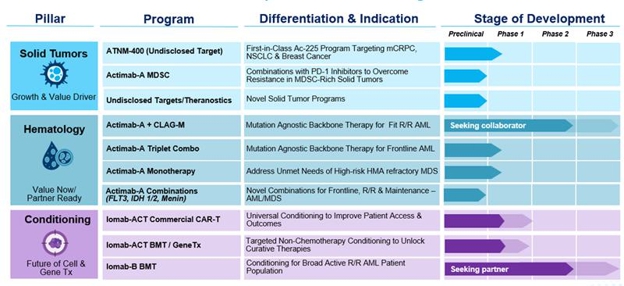
We are a clinical-stage biopharmaceutical company pioneering the development of targeted radiotherapies to address significant unmet medical needs in oncology. We are focused on employing a biology-driven approach to develop differentiated, first-in-class radiopharmaceutical therapeutics for patients with solid tumors and hematologic malignancies. Our mission is to transform cancer treatment by delivering innovative, high-value, radioconjugates that maximize therapeutic efficacy while minimizing toxicity to healthy tissue by combining our deep understanding of tumor biology and translational medicine with our expertise in radiochemistry.
Since our inception, we have focused on developing innovative and differentiated radiotherapies. Our pipeline of both early and later stage development programs is a testimony to our approach in three areas with: (1) two novel solid tumor product candidates, ATNM-400 and Actimab-A, with pan-tumor potential, (2) Actimab-A, which is also being developed as a therapeutic backbone for acute myeloid leukemia (AML) and myelodysplastic syndrome (MDS) in partnership with the National Cancer Institute (NCI), and (3) two targeted conditioning agents, Iomab-B for bone marrow transplant and Iomab-ACT for cell & gene therapies. Our solid tumor asset, ATNM-400, targets a novel antigen distinct from PSMA, with demonstrated preclinical activity across metastatic castration-resistant prostate cancer (mCRPC), non-small cell lung cancer (NSCLC), and breast cancer. Actimab-A targets myeloid derived suppressor cells (MDSCs) and is being studied in multiple solid tumors in combination with immune checkpoint inhibitors where MDSCs are known to act as an efficacy deterrent for these agents. Our hematology franchise includes: Actimab-A, a CD33-targeted therapy; as well as, Iomab-B and Iomab-ACT which are CD45-targeting conditioning agents. Both Actimab-A and Iomab-B are Phase 2/3 ready assets and are supported by extensive validation in over 15 clinical trials in which more than 500 patients were treated. We have several ongoing clinical studies across our pipeline. We expect to report data from ongoing company- and investigator-sponsored clinical studies for ATNM-400, Actimab-A for MDSC’s and Iomab-ACT in 4Q:2026 and over the course of 2027.
18
ATNM-400: First-in-Class Pan-Tumor Radiotherapy
ATNM-400 is our lead solid tumor program, representing a first-in-class Ac-225 antibody radioconjugate targeting a novel, undisclosed antigen with expression across multiple solid tumor types. The ATNM-400 target is implicated in disease biology during tumor progression and is also overexpressed when tumors become resistant to many approved therapies in multiple solid tumors. We are developing ATNM-400 as a potential pan-cancer, biology-driven therapy - alone or in combination with standard-of-care agents - for large, treatment resistant-solid tumor populations across prostate, NSCLC, breast cancer and potentially other sizable cancer indications.
Our translational data demonstrated that ATNM-400 is superior to the active ingredients in the many of the most commonly prescribed approved therapies in prostate cancer, NSCLC and breast cancer when tested in a wide variety of preclinical models:
| ● | Prostate Cancer: PSMA-targeted agents (177Lu-PSMA-617 (the active ingredient in Pluvicto®) and 225Ac-PSMA-617) and ARPIs (enzalutamide, apalutamide, darolutamide) in the mCRPC setting of prostate cancer; |
| ● | NSCLC: EGFR inhibitors (osimertinib), osimertinib with chemotherapy, TROP-2 ADC (Dato-DXd), EGFR-cMET bispecific (amivantamab), HER3-EGFR bispecific antibody drug conjugate (ADC) (izalontamab brengitecan, in development) in EGFR-mutant NSCLC, and KRAS-G12C inhibitors (sotorasib and adagrasib) in KRAS-G12C mutant NSCLC; and |
| ● | Breast Cancer: HER2 therapies (trastuzumab and T-DXd) in HER2 resistant breast cancer and endocrine therapy (tamoxifen) in tamoxifen-resistant breast cancer. |
These preclinical translational data show that ATNM-400 works well as monotherapy but is even better in combination in resistant settings where the target is overexpressed as part of the resistance mechanism of several of the approved standard-of-care drugs. Evidence of ATNM-400 target expression has been observed ranging from 60%-80% of mCRPC, >90% of NSCLC, and 50-70% of breast cancer patient tumors, representing a significant addressable population of well over a hundred thousand patients in the United States based on existing datasets. We believe this number may expand as we continue our work to demonstrate the potential of ATNM-400 in various additional disease and treatment settings.
In addition, we have developed a theranostic strategy utilizing Zr-89 as a companion imaging agent to enable patient selection and tumor visualization. We believe this approach allows for non-invasive assessment of target expression and drug biodistribution prior to therapeutic administration, potentially enhancing the therapeutic index by selecting patients most likely to respond.
Market Opportunity
ATNM-400 Is Designed to Address Large, Treatment Resistant Patient Populations Across Prostate, Lung and Breast Cancer - Indications in Which Approved Targeted Therapies Generated More Than $30 Billion in Worldwide Sales in 2025
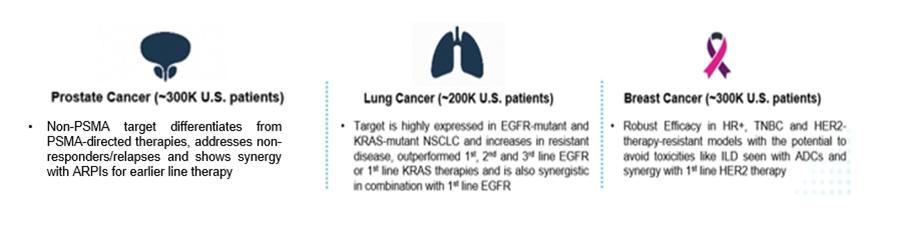
We are developing ATNM-400 as a mutation- and pathway-agnostic radiotherapeutic - as a monotherapy or in combination with standard of care - for large, treatment resistant solid tumor populations, with initial focus on prostate cancer, non-small cell lung cancer (NSCLC) and breast cancer. These diseases have been selected for initial clinical development driven by a common scientific and commercial rationale. Each disease represents a large, well-established market due to targeted agents and yet a major underserved opportunity once their resistance to these therapies develops. The antigen targeted by ATNM-400 is expressed in all these disease areas and its expression further increases in many cases as the existing therapies fail. Several of these therapies have blockbuster sales generated by treating a large number of patients. ATNM-400 target expression is reported in a majority of prostate cancer, NSCLC and breast cancer tumors based on immunohistochemistry datasets, which we estimate corresponds to an addressable population of well over 350,000 patients per year in the United States across these three indications and considerably more worldwide. We believe this addressable population may expand as we evaluate ATNM-400 in additional indications and treatment settings.
19
Prostate Cancer
Prostate cancer is the most frequently diagnosed cancer in men in the United States. According to the American Cancer Society, approximately 333,830 men in the United States were estimated to be diagnosed with prostate cancer in 2026, representing approximately 30% of all cancer diagnoses in men. While localized prostate cancer is frequently curable, metastatic disease is not: approximately 5% to 7% of patients present with metastatic disease at initial diagnosis, and approximately 20% to 30% of patients initially diagnosed with localized disease subsequently progress to metastatic disease, for which available therapies slow, but do not cure, disease progression.
Because prostate cancer cells rely on androgens for growth, most patients receive androgen receptor pathway inhibitor (ARPI) therapy, including enzalutamide (Xtandi®), apalutamide (Erleada®) and darolutamide (Nubeqa®), which generated more than $6.3 billion, $3.6 billion and $2.7 billion in worldwide sales, respectively, in 2025. We estimate that up to approximately 50,000 to 60,000 men in the United States progress following ARPI therapy each year. Collectively, ARPIs generated more than $12 billion in worldwide sales in 2025.
Since the March 2022 approval of the PSMA-directed radioligand therapy Pluvicto® (with active ingredient Lu177-PSMA-617), targeted radiotherapy has become a prominent component of the metastatic castration-resistant prostate cancer (mCRPC) treatment paradigm. Pluvicto®, marketed by Novartis, generated approximately $2.0 billion in worldwide sales in 2025, and its addressable population has expanded from approximately 44,000 patients toward approximately 86,500 patients with successive label expansions into earlier lines of therapy. More than 30 PSMA-targeted radiotherapies are currently in various stages of development. Notwithstanding this activity, we believe a significant unmet need remains: we estimate that approximately 30% of patients with mCRPC have low or no PSMA expression and are therefore poorly served by PSMA-directed radioligand therapies, and re-treatment with PSMA-directed agents may be limited by reduced PSMA surface expression and increased tumor heterogeneity following initial PSMA-targeted therapy. In addition, because PSMA is expressed in the salivary glands, PSMA-directed radiotherapies are associated with xerostomia, a quality-of-life limitation that is particularly relevant for Ac-225-based PSMA agents.

Because ATNM-400 is directed against a novel, non-PSMA antigen and acts independently of both androgen receptor (AR) signaling and PSMA expression, we believe it is positioned to address the full metastatic castration-resistant prostate cancer (mCRPC) treatment continuum. This includes patients whose disease has progressed on androgen receptor pathway inhibitors (ARPIs), as well as patients with PSMA-low or PSMA-negative tumors, for whom there are very limited commercially available targeted radiotherapy options. Together, these patient populations represent a combined opportunity that we estimate exceeds 100,000 patients annually in the United States and may be addressable with ATNM-400 as either a monotherapy or in combination with existing standards of care.
20
Non-Small Cell Lung Cancer
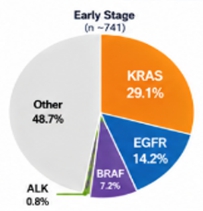
Lung cancer is the leading cause of cancer death worldwide. Approximately 229,410 new cases of lung cancer were estimated to be diagnosed in the United States in 2026, and NSCLC accounts for approximately 85% of the more than two million lung cancer cases diagnosed globally each year. Approximately 70% are either diagnosed with advanced/metastatic disease or progress to advanced metastatic disease. NSCLC is a large and heterogeneous market in which no single mutation dominates. EGFR and KRAS mutations together account for approximately 50% to 60% of NSCLC cases, and existing therapies are segmented by mutation subtype and ultimately limited by acquired resistance.
Beyond EGFR and KRAS Driver Mutations the NSCLC Market is Fragmented
 |
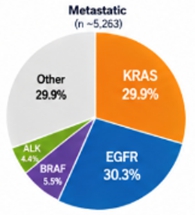 |
Source: Adapted from Fregni M, et al. Int J Mol Sci. 2022;23:7213, based on Skoulidis F and Heymach JV. Nat Rev Cancer. 2019;19:495–509
Current targeted therapies illustrate both the scale of the market and the treatment resistant- unmet need. In EGFR-mutant NSCLC, nearly all patients receive osimertinib (Tagrisso®) as first-line therapy; osimertinib generated approximately $7.3 billion in worldwide sales in 2025. Disease progression on osimertinib is common and the resistance mechanisms are highly heterogeneous; in the second-line setting, amivantamab (Rybrevant®) plus chemotherapy became a National Comprehensive Cancer Network (NCCN)- preferred regimen following its September 2024 approval, and datopotamab deruxtecan (Datroway®, a TROP-2 antibody-drug conjugate) received accelerated approval in patients with prior platinum chemotherapy in June 2025, yet a significant unmet need remains for durable options beyond chemotherapy. Separately, the KRAS-inhibitor class in NSCLC, led by sotorasib (Lumakras®) and adagrasib (Krazati®), is conservatively projected to exceed $3 billion in peak sales by 2032.
We believe ATNM-400 is well suited to this fragmented market. Based on prior immunohistochemistry studies, the antigen targeted by ATNM-400 is expressed in approximately 98% of NSCLC tumors, is highly expressed in approximately 70%, is conserved across EGFR-, KRAS- and other driver-defined subgroups, and is further increased in tumors that have become resistant to EGFR, KRAS and immune-checkpoint therapies. Because ATNM-400 addresses NSCLC as a broad, target-defined population rather than as another mutation-specific therapy for a single molecular subset, we believe its mutation-agnostic profile positions it to participate in these large, established markets as a backbone therapy - enhancing the standard of care in combination while also reaching the broader NSCLC population beyond any single mutation.
21
Breast Cancer
Breast cancer is the most frequently diagnosed cancer among women in the United States. The National Cancer Institute’s Surveillance, Epidemiology, and End Results (SEER) Program estimates that approximately 321,910 women will be diagnosed with invasive breast cancer in 2026. Approximately 200,000 women were living with metastatic breast cancer in the United States in 2025, a figure expected to grow to approximately 250,000 by 2030.
Hormone receptor-positive, HER2 negative (HR+/HER2−) breast cancer is the largest molecular subtype, accounting for approximately 70% of newly diagnosed cases. Endocrine therapy is the backbone of treatment, with endocrine therapy plus a CDK4/6 inhibitor preferred for most patients in the first-line metastatic setting. Approximately half of patients experience disease progression or death within two years, and the substantial majority progress within five years. Following progression, treatment is guided by prior therapy and biomarkers such as ESR1, PIK3CA, AKT1, PTEN, and germline BRCA1/2 alterations. Patients with ESR1-mutated disease may receive elacestrant, imlunestrant, or vepdegestrant, which was approved in May 2026 as the first proteolysis-targeting chimera in oncology. Gedatolisib-based therapy provides another pathway-targeted option for patients with PIK3CA-wild-type disease, while trastuzumab deruxtecan is approved following endocrine therapy for HR+, HER2 low or HER2 ultralow disease. Although post-endocrine options have expanded, these approvals were based on progression-free survival benefits generally measured in months. Median PFS across approved second-line regimens ranges from approximately four to thirteen months, and substantially all patients ultimately progress. In later lines, datopotamab deruxtecan is approved following endocrine-based therapy and chemotherapy, while sacituzumab govitecan is approved following endocrine therapy and at least two additional metastatic systemic regimens. Despite these advances, substantial need remains for therapies that overcome resistance and provide more durable disease control across successive lines of treatment.
HER2 positive (HER2+) breast cancer accounts for approximately 15% of breast cancers. Although HER2 directed therapies have substantially improved outcomes, metastatic disease generally remains incurable, and resistance develops across successive regimens. Central nervous system progression is a major unmet need, with up to 50% of patients developing brain metastases during the course of disease. Trastuzumab deruxtecan plus pertuzumab was approved in December 2025 as a first-line treatment for unresectable or metastatic HER2+ breast cancer. Taxane chemotherapy with trastuzumab and pertuzumab remains an option for selected patients. Trastuzumab deruxtecan plus pertuzumab achieved a median PFS of 40.7 months, compared with 26.9 months for the taxane-based regimen. Nevertheless, approximately 30% of patients experienced progression or death within two years, and half were expected to do so within approximately three and a half years. For patients with HR+, HER2+ disease controlled after induction therapy, palbociclib with trastuzumab, endocrine therapy, and optional pertuzumab was approved in June 2026 as maintenance treatment. Following progression, treatment depends on prior HER2 directed therapy and the presence or risk of central nervous system disease. Trastuzumab deruxtecan remains an established second-line option after first-line taxane, trastuzumab, and pertuzumab. However, the optimal sequence after progression on a first-line trastuzumab deruxtecan-containing regimen has not been established. Later-line options include tucatinib with trastuzumab and capecitabine, particularly for patients with brain metastases, and other HER2 directed regimens. New agents are needed that remain active following resistance to HER2 directed antibody-drug conjugates and across successive lines of treatment.
Triple-negative breast cancer (TNBC), defined by the absence of estrogen receptor, progesterone receptor, and HER2 overexpression or amplification, accounts for approximately 10% to 15% of breast cancers. TNBC is more aggressive than HR+ breast cancer, carries a higher risk of early distal recurrence, and lacks endocrine and HER2 directed treatment options. First-line treatment is informed by PD-L1 expression and germline BRCA1/2 mutation status. For patients with PD-L1-positive disease, immune-checkpoint inhibition combined with systemic therapy is a common strategy. In June 2026, sacituzumab govitecan was approved with pembrolizumab for PD-L1-positive unresectable locally advanced or metastatic TNBC and as monotherapy for patients who are not candidates for PD-1- or PD-L1-directed therapy. Datopotamab deruxtecan was also approved in May 2026 for patients who are not candidates for checkpoint inhibition. Despite these advances, more than half of patients are expected to experience progression or death within one year of starting first-line treatment. With TROP-2-directed antibody-drug conjugates now used in the first-line setting, no prospectively validated preferred sequence has been established after progression. Subsequent treatment may include chemotherapy, PARP inhibition for eligible patients with germline BRCA1/2 mutations, or clinical trials. This sequencing gap and the biological heterogeneity of TNBC support the need for therapies with mechanisms distinct from TROP-2-directed cytotoxic delivery.
The antigen targeted by ATNM-400 is expressed across multiple breast cancer subtypes, including HR+/HER2−, HER2+ (including HR+ and HR-), and triple-negative disease. Based on our preclinical findings, target expression is also retained or increased in tumor models that have developed resistance to selected standard therapies. We believe ATNM-400’s target-driven, subtype-agnostic profile could position it to address treatment-resistant breast cancer populations as either a monotherapy or in combination with established standards of care.
ATNM-400 Positioned to Address HR+/HER2-, HER2+ and TNBC Breast Cancer Subtypes After Resistance to Standard of Care
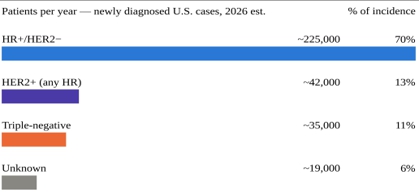
Source: American Cancer Society, Cancer Facts & Figures 2026 (Atlanta: American Cancer Society, 2026), estimated new cases of invasive breast cancer in U.S. women, 2026. Subtype distribution derived from age-adjusted incidence rates for 2019–2023, National Cancer Institute, SEER Cancer Stat Facts: Female Breast Cancer Subtypes.
22
ATNM-400 Preclinical Data in Large Solid Tumor Indications
Our preclinical development program has generated encouraging efficacy and mechanism-of-action data across multiple indication-specific animal models of solid tumors including prostate cancer, NSCLC and breast cancer:
ATNM-400 in Prostate Cancer
ATNM-400 is a first-in-class Ac-225 antibody radioconjugate directed against a novel, non-PSMA antigen implicated in aggressive prostate cancer biology and overexpressed as tumors progress and develop resistance to standard-of-care therapies. Because ATNM-400 acts independently of both androgen-receptor signaling and PSMA expression, we believe it has the potential to address patients across the metastatic castration-resistant prostate cancer, or mCRPC, treatment continuum.
Key Findings and Therapeutic Positioning in Metastatic Castration-Resistant Prostate Cancer
| ● | Broad monotherapy activity across PSMA expression levels. ATNM-400 demonstrated anti-tumor activity in PSMA-high, PSMA-low and PSMA-negative mCRPC models. It showed greater efficacy than 177Lu-PSMA-617 across these models, including in PSMA-low and PSMA-negative disease where PSMA-directed therapies may have limited activity, and greater efficacy than 225Ac-PSMA-617 in the PSMA-low model. |
| ● | Strong activity in PSMA-high disease with no xerostomia limitation expected. In the PSMA-high model, ATNM-400 demonstrated activity comparable to 225Ac-PSMA-617 and achieved comparable tumor control to 177Lu-PSMA-617 at approximately one-thousandth of the administered radioactivity. However, since the ATNM-400 target is not expressed in the salivary glands, we do not expect ATNM-400 to cause the xerostomia associated with PSMA-directed therapies. |
| ● | Activity following PSMA-directed therapy. ATNM-400 retained anti-tumor activity after progression on 177Lu-PSMA-617 and produced more durable tumor control and prolonged survival relative to 177Lu-PSMA-617, supporting its potential use in patients who have exhausted PSMA-directed radioligand therapy. |
| ● | Activity in ARPI-resistant disease. ATNM-400 demonstrated greater tumor growth inhibition than the approved ARPIs enzalutamide, apalutamide and darolutamide in ARPI-resistant models and retained activity following progression on enzalutamide. |
| ● | Enhanced activity in combination with ARPIs. Combinations of ATNM-400 with enzalutamide, apalutamide or darolutamide produced enhanced tumor growth inhibition, tumor regression and durable complete responses. These findings are supported by evidence that ARPI resistance increases ATNM-400 target expression, providing a mechanistic rationale for the observed combination activity. |
We believe these findings support the potential development of ATNM-400 as a monotherapy or in combination with ARPIs across a broad mCRPC population, including patients with ARPI-resistant, PSMA-low or PSMA-negative disease, as well as patients with PSMA-high disease who may benefit from a differentiated safety profile.
23
Supporting Data in Metastatic Resistant Prostate Cancer Models
ATNM-400 Is Directed Against a Non-PSMA Target With the Potential to Treat More Patients Across Lines of Prostate Cancer Therapy

ATNM-400 Demonstrated Robust Tumor Growth Inhibition and was Superior to PSMA-Targeted Agents Across PSMA-High (C4-2), PSMA-Low (22Rv1) and PSMA-Negative (DU145) Prostate Cancer Models

ATNM-400 had robust efficacy in prostate cancer xenograft mouse models with high, low and no PSMA and was superior to 177-Lu-PSMA-617 in all the models and to 225Ac-PSMA-617 in the Low-PSMA model. ATNM-400 had comparable efficacy to 225Ac-PSMA-617 in the High-PSMA model. Given that 30% mCRPC patients have low or no PSMA expression and up to 70% of patients do not respond to Pluvicto® and nearly all patients progress on Pluvicto® in <12 months, our data in 177-Lu-PSMA-617, the active ingredient in Pluvicto®, suggests that ATNM-400 has the potential to treat a broader population of mCRPC patients.
ATNM-400 retained anti-tumor activity in prostate cancer models after tumors had progressed on 177Lu-PSMA-617. Following tumor progression on 177Lu-PSMA-617, ATNM-400 produced continued tumor growth inhibition, supporting its potential to treat patients who have exhausted PSMA-directed radioligand therapy.
24
ATNM-400 Demonstrated Robust Efficacy After 177Lu-PSMA-617 Failure in Prostate Cancer Model
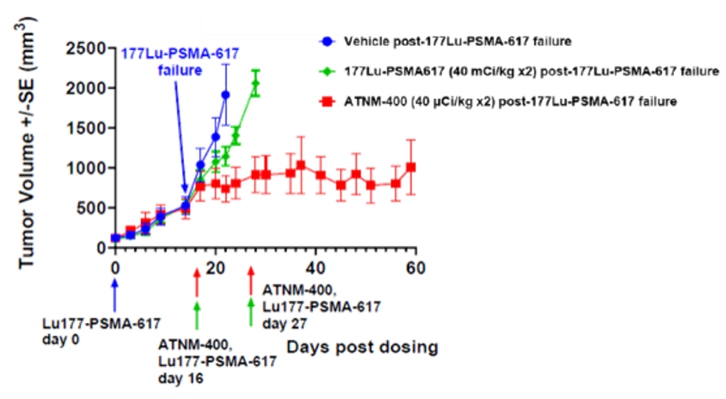
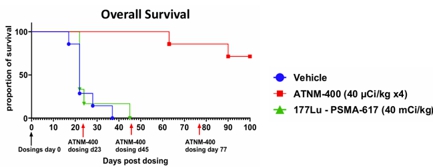
Beyond tumor growth inhibition, ATNM-400 conferred a survival benefit relative to PSMA-directed radioligand therapy. In preclinical prostate cancer models, animals treated with ATNM-400 survived longer than those treated with 177Lu-PSMA-617, consistent with the greater and more durable tumor control described above and achieved it at approximately one-thousandth of the administered radioactivity.
ATNM-400 Improved Survival vs 177Lu-PSMA-617 in Prostate Cancer Model
ATNM-400 demonstrated activity in prostate cancer cells and tumors resistant to all three approved androgen-receptor pathway inhibitors (ARPIs) - enzalutamide, apalutamide, and darolutamide. Across these studies, ATNM-400 delivered tumor control as either a single-bolus or repeat-dose regimen with a consistent safety profile and minimal off-target toxicity, which we believe indicates dosing flexibility and a wide therapeutic window.
25
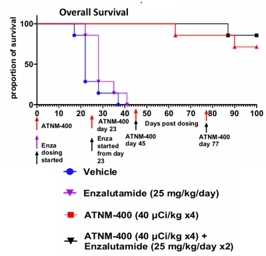
In an ARPI-resistant model, ATNM-400 as a monotherapy and in combination with enzalutamide produced greater tumor growth inhibition and prolonged survival than enzalutamide alone that correlated well with overall survival. In the combination arm, 40% of the mice had complete cures that were durable up to 100 days post- treatment. The latter can be explained by mechanistic synergy since it has been published that enzalutamide resistance increases ATNM-400 target expression in prostate cancer models and in tumor biopsies from mCRPC patients.
ATNM-400 Monotherapy Demonstrated Superiority to Enzalutamide in ARPI-resistant Prostate Cancer Model and Had Complete Cures with Combination Activity

ATNM-400
Showed Survival Benefit vs Enzalutamide
Monotherapy and Combination
26
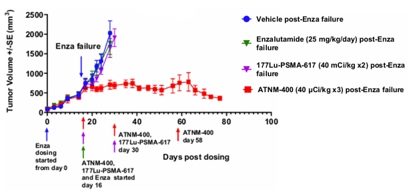
Following disease progression on enzalutamide, ATNM-400 produced continued tumor growth inhibition, supporting its potential to treat patients who have exhausted ARPIs.
ATNM-400 Displayed Strong Efficacy After Enzalutamide Failure
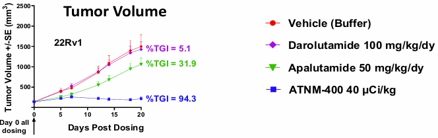
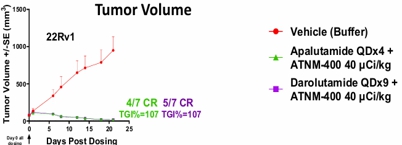
In data presented at the Society of Nuclear Medicine and Molecular Imaging (SNMMI) 2026 Annual Meeting in June 2026, as a monotherapy in the ARPI-resistant 22Rv1 model, ATNM-400 achieved 94% tumor growth inhibition, compared with 32% for apalutamide and 5% for darolutamide, and in combination with either apalutamide or darolutamide achieved 107% tumor growth inhibition (representing tumor regression), with durable complete responses in a majority of treated animals.
ATNM-400 Monotherapy Had Strong Tumor Growth Inhibition in the ARPI-Resistant 22Rv1 Prostate Cancer Model Resistant to Darolutamide and Apalutamide
ATNM-400 Combination with Darolutamide or Apalutamide Demonstrated Strong Tumor Growth Inhibition and Achieved Complete Responses (CRs) in the ARPI-Resistant 22Rv1 Prostate Cancer Model
27
ATNM-400 in Non-Small Cell Lung Cancer (NSCLC)
ATNM-400 is being developed as a potential mutation-agnostic targeted radiotherapy for non-small cell lung cancer (NSCLC). Its target is broadly expressed across NSCLC, including EGFR- and KRAS-mutant disease, and is further increased following resistance to targeted therapies. Because ATNM-400 acts independently of a tumor’s driver mutation or signaling pathway, we believe it has the potential to address a broad, target-defined NSCLC population.
Key Findings and Therapeutic Positioning in Non-Small Cell Lung Cancer
| ● | Target-specific activity across major NSCLC driver mutations. ATNM-400 demonstrated target-specific binding, internalization and tumor uptake across EGFR-mutant and multiple KRAS-mutant models, supporting activity driven by target expression rather than by a particular driver mutation. |
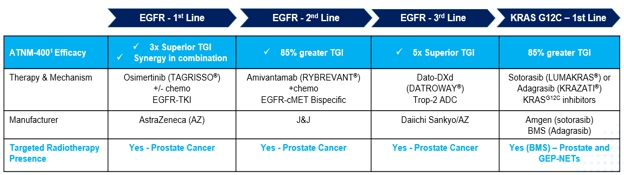
| ● | Greater activity than therapies used across EGFR-mutant treatment settings. In an EGFR-mutant model, ATNM-400 demonstrated greater tumor growth inhibition than the active ingredient in the key approved therapies used across first-, second- and third-line settings, including osimertinib, amivantamab and datopotamab deruxtecan. |
| ● | Enhanced activity in combination with osimertinib. Combining ATNM-400 with osimertinib produced tumor regression and complete responses exceeding either agent alone. Osimertinib increased ATNM-400 target expression, providing a mechanistic rationale for the observed combination activity. |
| ● | Monotherapy and combination activity across KRAS-mutant disease. ATNM-400 demonstrated activity in both KRAS G12C- and KRAS G13D-mutant models, including greater activity than approved KRAS G12C inhibitors and tumor regression in combination with sotorasib and adagrasib. Sotorasib and adagrasib also increased ATNM-400 target expression, supporting the potential for combination use. |
We believe these findings support the potential development of ATNM-400 as a monotherapy or combination backbone across EGFR- and KRAS-mutant NSCLC and potentially the broader target-positive NSCLC population.
ATNM-400 vs Standard of Care Therapies Across EGFR- and KRAS-Mutant NSCLC Models
28
Supporting Data in NSCLC
In an EGFR-mutant model (NCI-H1975, harboring L858R and T790M mutations), ATNM-400 monotherapy achieved 75% tumor growth inhibition, compared with 40% for osimertinib, and the combination of ATNM-400 plus osimertinib achieved 107% tumor growth inhibition (representing tumor regression) with complete cures in 100% of treated animals.
ATNM-400 Monotherapy Showed Strong Tumor Growth Inhibition and Combination with Osimertinib Achieved Complete Responses in the EGFR-Mutant NSCLC Model
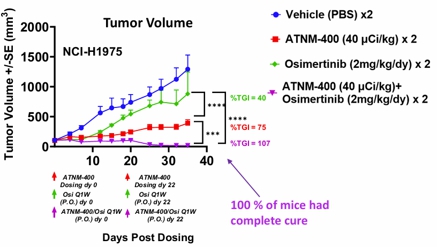
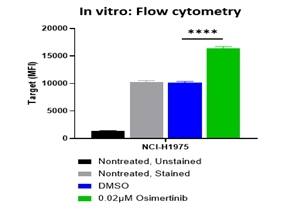
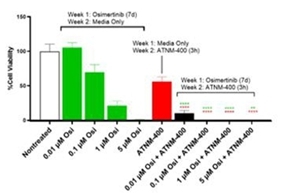
Osimertinib treatment increased ATNM-400 target expression both in vitro and in vivo, which we believe provides a mechanistic rationale for why the combination of osimertinib with ATNM-400 works even better than ATNM-400 monotherapy alone. Furthermore, in vitro studies also demonstrated that Osimertinib upregulated the ATNM-400 target in NCI-H1975 cells, enhancing ATNM-400 cytotoxicity when dosed in combination.
| Increased
Target Expression Post-Osimertinib Treatment |
ATNM-400 Post-Osimertinib |
 |
 |
29
In the same EGFR-mutant model, ATNM-400 monotherapy also demonstrated greater anti-tumor activity than the approved agents datopotamab deruxtecan (a TROP-2 antibody drug conjugate), amivantamab (an EGFR-cMET bispecific antibody), and izalontamab brengitecan (a HER3-EGFR bispecific antibody-drug conjugate that is currently in development).
ATNM-400 Demonstrated 3-5x Greater Tumor Growth Inhibition vs Osimertinib or Dato-DXd or Amivantamab in EGFR-mutant NSCLC Model
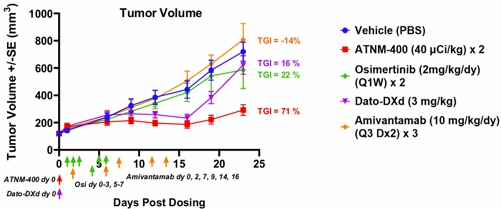
ATNM-400 Demonstrated Superior Tumor Growth Inhibition Compared to Dato-DXd or Izalontamab Brengitecan in EGFR-mutant NSCLC Model
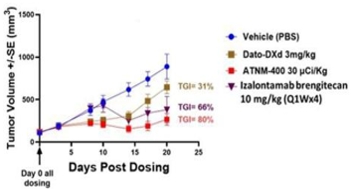
30
In data presented at the Society of Nuclear Medicine and Molecular Imaging (SNMMI) 2026 Annual Meeting in June 2026, ATNM-400 demonstrated activity across KRAS-mutant NSCLC models spanning distinct KRAS alleles. In a KRAS G12C model (NCI-H358), ATNM-400 monotherapy achieved 92% tumor growth inhibition, compared with 0% for the approved KRAS G12C inhibitor sotorasib, and the combination of ATNM-400 plus sotorasib achieved 90% tumor growth inhibition. In the same G12C model, the combination of ATNM-400 with adagrasib achieved 110% tumor growth inhibition (indicating regression) compared to 71% for adagrasib alone.
ATNM-400 Showed Superior Efficacy versus Approved KRAS G12C Inhibitors in KRAS G12C-Mutant NSCLC Model
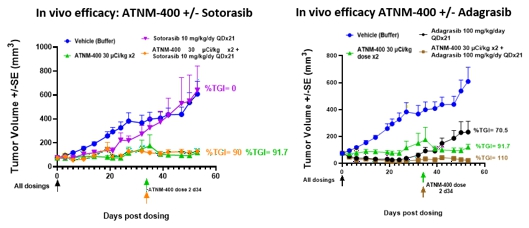
Treatment with the approved KRAS G12C inhibitors sotorasib and adagrasib increased ATNM-400 target expression by up to approximately 3.5- and 3.8-fold, respectively (p<0.0001). The addition of ATNM-400 reduced cancer-cell viability beyond KRAS G12C inhibitors alone - demonstrating the same target-expression-increasing, synergy-enabling biology previously observed with the EGFR inhibitor osimertinib.
Sotorasib and Adagrasib Increase ATNM-400 Target Expression in a Dose-Dependent Manner in the KRAS G12C-Mutant NCI-H358 NSCLC Model
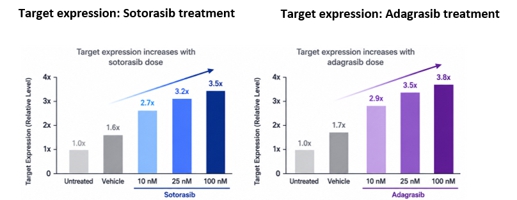
31
Positron-emission-tomography imaging of Zr-89-labeled ATNM-400 confirmed target-specific tumor uptake in a KRAS G12C model with low uptake in healthy normal tissues.
Zr-89-ATNM-400 PET Imaging Showed Tumor-specific Uptake that is Blocked by Unlabeled Cold Antibody Demonstrating Specificity in the KRAS G12C-Mutant NSCLC Model
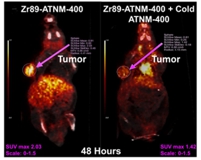
In a target-positive KRAS G13D-mutant NSCLC model (Calu-3), single doses of 20 uCi/kg or 40 uCi/kg of ATNM-400 reduced tumor volume below baseline, corresponding to 124% and 135% tumor growth inhibition which translates to tumor regression. The unlabeled antibody produced minimal tumor growth inhibition relative to vehicle - indicating that anti-tumor activity is driven by the Ac-225 payload rather than by antibody-mediated target engagement alone.
ATNM-400 Had Dose-Dependent Tumor Growth Inhibition in the KRAS G13D-Mutant NSCLC Model
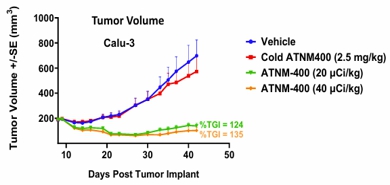
32
ATNM-400 in Breast Cancer
ATNM-400’s target antigen is overexpressed across breast cancer subtypes, including HR+/HER2-, HER2+ (including HR+ and HR-), and triple-negative breast cancer, and is retained or increased following resistance to endocrine and HER2+-directed therapies. Because ATNM-400 acts through a pathway-independent mechanism, we believe it has the potential to address multiple treatment-resistant breast cancer populations as a monotherapy or in combination with existing standards of care. In addition, we do not believe ATNM-400 carries the risks of interstitial lung disease (ILD) associated with ADCs carrying the deruxtecan payload.
Key Findings and Therapeutic Positioning in Breast Cancer
| ● | Activity in treatment-resistant HER2+ disease. In a trastuzumab-resistant HER2+ model, ATNM-400 demonstrated strong monotherapy activity and enhanced activity in combination with trastuzumab, with efficacy comparable to trastuzumab deruxtecan in the evaluated model. Increased ATNM-400 target expression in HER2 resistant disease provides a mechanistic rationale for this activity. |
| ● | Activity in triple-negative breast cancer. ATNM-400 monotherapy produced tumor regression in a TNBC model, supporting its potential in a disease subtype with limited targeted treatment options. |
| ● | Activity following HER2 directed therapy failure. ATNM-400 retained durable anti-tumor activity after trastuzumab progression and demonstrated greater activity than trastuzumab deruxtecan in the post-trastuzumab-failure setting without the risks of ILD associated with ADCs addressing the indication. |
| ● | Activity in endocrine-resistant HR+ disease. ATNM-400 demonstrated dose-dependent activity in an endocrine-resistant HR+ model, supporting activity independent of HER2 status and endocrine sensitivity. | |
| ● | Combination activity in endocrine treatment-resistant disease. Following tamoxifen failure, sequential treatment with ATNM-400 drove a dose-dependent, near-complete loss of cancer-cell viability, supporting ATNM-400's potential to deepen response after endocrine therapy failure. |
We believe these findings support the potential development of ATNM-400 across breast cancer subtypes, with particularly differentiated opportunities in TNBC and treatment-resistant HER2+ disease, as well as additional potential in endocrine-resistant HR+ disease.
Supporting Data in Breast Cancer Models
In a trastuzumab-resistant HER2+ model (BT474-Clone5), ATNM-400 monotherapy achieved 97% tumor growth inhibition and, in combination with trastuzumab, achieved 100% tumor growth inhibition (representing tumor regression) - comparable to the approved HER2 antibody-drug conjugate trastuzumab deruxtecan, without the higher risks of interstitial lung disease associated with ADC with the deruxtecan payload. ATNM-400 monotherapy drove tumor regression (103% tumor growth inhibition) in a triple-negative model (MDA-MB-468). Similar to referenced KRAS G13D studies in NSCLC, unlabeled antibody produced minimal tumor growth inhibition relative to vehicle – again indicating that anti-tumor activity is driven by ATNM-400’s Ac-225 payload versus antibody-mediated target engagement.
ATNM-400 Monotherapy and Combinations Eradicate Trastuzumab-Resistant Tumors and Triple-Negative Breast Cancer (TNBC)
|
Trastuzumab-Resistant HER2+ Model BT474-Clone5 |
MDA-MB-468 (TNBC) Breast Cancer Model |
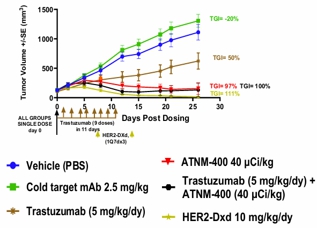 |
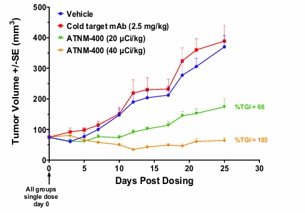 |
In the post-trastuzumab-failure setting, ATNM-400 retained durable anti-tumor activity (93% tumor growth inhibition), exceeding trastuzumab deruxtecan (64%), further demonstrating utility after resistance to approved drugs.
33
ATNM-400 Demonstrated Efficacy After Trastuzumab and HER2-DXd Failures in Trastuzumab-resistant Breast Cancer Model
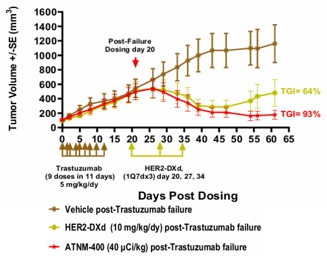
ATNM-400 demonstrated dose-dependent activity in an endocrine-resistant HR+ model (MCF7), consistent with activity that is independent of HER2 status and endocrine sensitivity.
ATNM-400 Showed Dose-Dependent Tumor Growth Inhibition in MCF7 (HR+) Breast Cancer
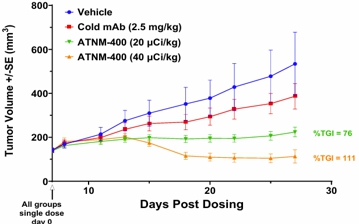
In an endocrine-resistant (HR+) setting modeling patients who have failed prior tamoxifen, ATNM-400, when given sequentially after tamoxifen exposure, drove a tamoxifen dose-dependent, near-complete loss of cancer-cell viability - reducing viability to as low as approximately 3%.
ATNM-400 Significantly Decreased Cancer Cell Viability Post-Tamoxifen Failures
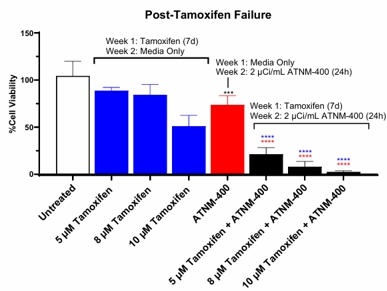
34
Actimab-A for MDSCs: Novel Immunomodulatory Approach in Solid Tumors
Actimab-A (lintuzumab-Ac-225) is a CD33-targeted actinium-225 radioconjugate that we are developing to enhance checkpoint inhibitor efficacy by depleting immunosuppressive CD33+ myeloid-derived suppressor cells (MDSCs) in the tumor microenvironment. MDSCs are a heterogeneous population of immature myeloid cells that accumulate in solid tumors and suppress anti-tumor T-cell responses, representing a well-validated mechanism of resistance to PD-1/PD-L1 checkpoint inhibitors. By selectively eliminating these suppressive cells with targeted alpha-particle therapy, Actimab-A is designed to dismantle this barrier and restore an environment in which checkpoint blockade can drive meaningful Tcell–mediated tumor killing. This positions Actimab-A as a differentiated immunomodulatory approach intended to expand the population of patients who benefit from checkpoint inhibitors, including those with tumors historically considered immunologically “cold.”
Actimab-A Depletion of MDSCs: Resensitizing PD-1 Inhibitors for T Cell Activation
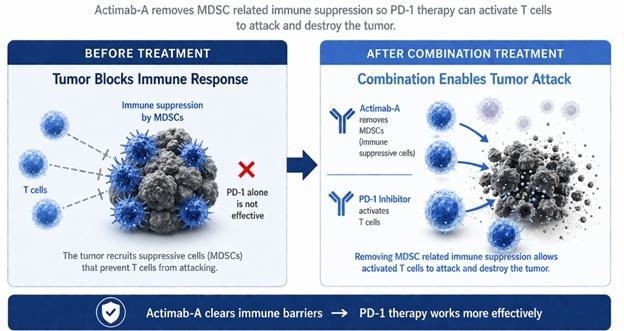
35
Clinical studies have demonstrated that patients with high circulating MDSC levels have significantly reduced progression-free and overall survival on PD-1 therapy compared to patients with low MDSC levels.
Low MDSCs Associated With Statistically Significant Improvement in PFS and OS
(Bronte et al., Frontiers in Immunology 2022)
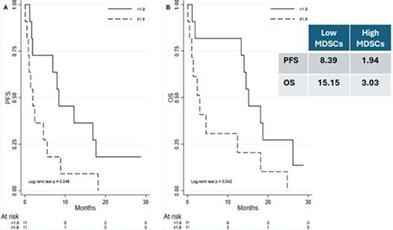
Our preclinical studies have suggested that Actimab-A: (1) selectively homes to tumor-resident CD33+ MDSCs in vivo; (2) are cytotoxic to patient-derived MDSCs ex vivo; and (3) rescue T-cell proliferation and anti-tumor immune responses ex vivo following MDSC depletion. We believe these data provide mechanistic support for combining Actimab-A with PD-1 inhibitors to overcome MDSC-mediated resistance.
Actimab-A (Lintuzumab-Ac225) was shown to deplete MDSCs in our studies. Actimab-A was also shown to restore T-cell proliferation in a dose dependent manner.
| Actimab-A Depletes Human MDSCs In Vivo | Actimab-A Facilitates T cell Proliferation |
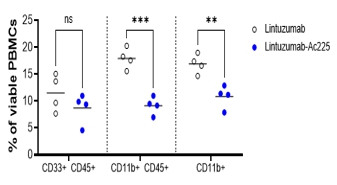 |
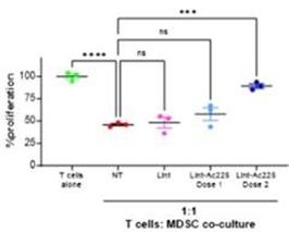 |
36
We intend to conduct a Phase 1b basket trial evaluating Actimab-A in combination with pembrolizumab (Keytruda®) or nivolumab (Opdivo®) in patients with R/R locally advanced or metastatic head and neck squamous cell carcinoma (HNSCC), NSCLC, glioblastoma (GBM), and microsatellite instability (MSI)-high colorectal cancer. These tumor types were selected based on high MDSC infiltration and limited response rates to PD-1 monotherapy. The trial design incorporates comprehensive correlative biomarker assessments to evaluate MDSC depletion in both tumor microenvironment and peripheral blood, as well as T-cell activity restoration.
Patients eligible to be enrolled in the trial must have MDSC-rich tumor types, be checkpoint inhibitor-naïve, be at least 18 years of age, and demonstrate PD-1/PD-L1 expression. Primary endpoints include safety and tolerability of the combination, with secondary endpoints including ORR, PFS, and OS. Biomarker endpoints will evaluate the pattern of CD33+ MDSC depletion and T-cell activity in both tumor tissue and peripheral blood samples. Clinical outcomes will be compared against real-world data from similar patient populations treated with PD-1 monotherapy. We expect to report initial data from this trial in 2H:2026 or 1H:2027. In addition, we are also evaluating clinical opportunities with other immune checkpoint inhibitors in GBM and NSCLC.
Hematology Programs
Actimab-A: Backbone Therapy for AML and MDS
In hematologic malignancies, we are developing Actimab-A as a mutation-agnostic backbone therapy for AML and high-risk MDS. CD33 is expressed on leukemic blasts in the majority of AML patients and represents an established therapeutic target validated by the approval of gemtuzumab ozogamicin (Mylotarg®). However, antibody-drug conjugates like Mylotarg® can have limitations, including hepatotoxicity and limited efficacy in certain patient populations. Actimab-A, delivering the highly potent alpha-emitter Ac-225 to CD33+ cells, represents a differentiated approach designed to provide superior efficacy while maintaining a favorable safety profile. Supporting this backbone positioning, preclinical and translational studies have demonstrated that Actimab-A is cytotoxic in primary AML patient samples irrespective of FLT3, KMT2A, NPM1, IDH1, or TP53 mutation status. The combinations of Actimab-A with agents from each of the three major classes of AML standard-of-care therapies, including the menin inhibitor revumenib, the FLT3 inhibitor gilteritinib, and the hypomethylating agent azacitidine, potentiate AML cell death, supporting a backbone strategy. Actimab-A was shown to produce consistent transcriptional reprogramming, including activation of p53-associated stress response and apoptosis pathways and downregulation of proliferative programs such as MYC targets and G2/M checkpoint signatures.
We have completed a Phase 1b clinical trial evaluating Actimab-A in combination with CLAG-M chemotherapy in R/R AML patients, results of which were published in a peer-reviewed journal Leukemia in February 2025. The trial enrolled high-risk patients including those with TP53 mutations, prior venetoclax treatment failure, and patients who had prior allogeneic transplant. Results demonstrated high rates of measurable residual disease (MRD)-negative complete remissions and improved survival outcomes compared to historical controls.
Among patients treated with Actimab-A plus CLAG-M, 70% of those deemed eligible for transplant proceeded to bone marrow transplant, and this population achieved a 24-month median overall survival. These results compare favorably to published data showing less than 2-4 month median overall survival in TP53-mutated or prior venetoclax-treated R/R AML patient populations. The combination was well-tolerated with a safety profile consistent with CLAG-M chemotherapy alone and no dose-limiting toxicities observed.
We have discussed with the Food and Drug Administration (FDA) and believe we are aligned on a Phase 2/3 trial design to evaluate Actimab-A plus CLAG-M in R/R AML patients eligible for first or second salvage therapy. We are actively seeking a strategic partner to execute this trial. We believe the trial design allows for enrollment of a broad R/R AML population while enriching for patients most likely to benefit based on Phase 1b results.
37
Actimab-A + CLAG-M Phase 2/3 Trial Design
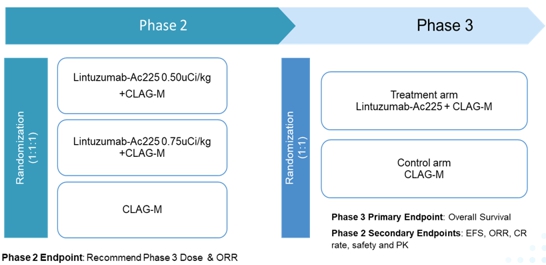
Actimab-A Development Programs: Beyond R/R AML, we are developing Actimab-A in conjunction with the National Cancer Institute, or NCI across multiple AML and MDS treatment settings and exploring its potential in additional areas:
| ● | Frontline AML Triplet Combination: Evaluating Actimab-A as a backbone therapy in combination with standard induction regimen of venetoclax and a hypomethylating agent in newly diagnosed AML patients. This mutation-agnostic approach could provide benefit across the broad frontline AML population. |
| ● | Combination with Targeted Therapies: Developing Actimab-A combinations with FLT3 inhibitors, IDH1/2 inhibitors, and menin inhibitors in genomically-defined AML patient subsets. These combinations leverage Actimab-A’s mutation-agnostic mechanism while potentially enhancing efficacy through complementary mechanisms of action. |
| ● | High-Risk MDS Monotherapy: Evaluating Actimab-A as monotherapy in high-risk MDS patients who have failed hypomethylating agent therapy, representing a patient population with very limited treatment options and poor outcomes. |
| ● | Maintenance Therapy: The potential exists for Actimab-A as maintenance therapy following achievement of remission to prevent relapse in AML and MDS patients. |
The programs are supported by our Cooperative Research and Development Agreement (CRADA) with the NCI, which enables cost-effective clinical development while retaining commercial rights to Actimab-A.
On April 21, 2026, preclinical translational data with Actimab-A were presented at the AACR Annual Meeting in San Diego, California. The presentation highlighted the following:
Transcriptional Reprogramming as a Key Mechanism for Actimab-A Combination Activity
| ● | Combination treatment produced consistent pathway-level changes compared with monotherapy, with gene set enrichment analysis (GSEA) showing enhanced myeloid differentiation signatures when Actimab-A was added to revumenib, gilteritinib, and azacitidine, agents from each of the three major classes of AML standard-of-care therapies. |
| ● | Across models, combinations were associated with downregulation of proliferative programs, including MYC target genes, E2F targets, and G2/M checkpoint signatures, together with enrichment of p53-associated stress response and apoptosis pathways. |
| ● | We believe these findings indicate that Actimab-A combinations reprogram AML cells from proliferation toward differentiation and apoptosis, potentially providing a mechanistic basis for deeper and more durable MRD-negative responses and supporting Actimab-A’s role as a universal combination backbone across AML treatment settings. |
38
Gene Set Enrichment Analysis Demonstrated Broad Activity of Actimab-A Combinations Versus AML Standard of Care Therapies Alone
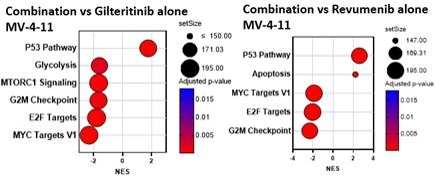
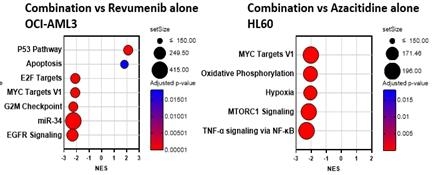
Combinations with Revumenib and Azacitidine Sensitize AML Cells to Actimab-A and Support Frontline Triplet Rationale

39
| ● | Actimab-A demonstrated robust cytotoxicity in primary AML patient samples independent of FLT3, KMT2A, NPM1, IDH1, IDH2, or TP53 mutation status, supporting its potential applicability across the full AML patient population, including TP53-mutant patients who lack effective targeted options. |
| ● | Combining Actimab-A with standard-of-care therapies, including revumenib (menin inhibitor), gilteritinib (FLT3 inhibitor), and azacitidine (hypomethylating agent), enhanced anti-leukemic efficacy across models, demonstrating synergy with agents representing each of the three pillars of modern AML care and, we believe, further support Actimab-A’s positioning as a combination partner across frontline, relapsed/refractory, and unfit AML populations. |
Actimab-A Combination with SOC Enhance Cytotoxicity in Primary AML Patient Samples
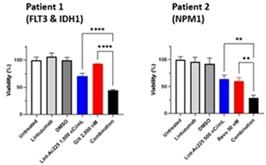
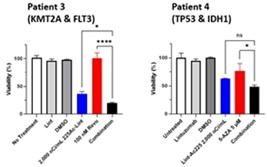
40
Iomab-ACT: Universal Conditioning for Cell and Gene Therapies
Iomab-ACT is our CD45-targeted conditioning platform being developed as a universal conditioning agent to improve access and outcomes for cell and gene therapies, including CAR-T, allogeneic hematopoietic stem cell transplant, and gene therapy. The cell and gene therapy field has been limited by the need for lymphodepleting chemotherapy conditioning, which is associated with significant toxicities and can limit the patient populations eligible for these potentially curative treatments.
Iomab-ACT is designed to provide targeted lymphodepletion and myeloablation when necessary while avoiding the off-target toxicities associated with chemotherapy conditioning. By delivering targeted radiation specifically to CD45+ hematopoietic cells, Iomab-ACT aims to create an optimal environment for therapeutic cell engraftment while minimizing treatment-related morbidity and mortality.
We currently have three active clinical trials evaluating Iomab-ACT:
| ● | Phase 1/2 Trial in Commercial CAR-T: Evaluating Iomab-ACT as conditioning prior to commercial CAR-T therapy in patients with relapsed/refractory non-Hodgkin’s lymphoma. The primary endpoint is engraftment and key secondary endpoints are incidence of Cytokine Release Syndrome (CRS) and Immune Effector Cell-Associated Neurotoxicity Syndrome (ICANS), which are two potentially fatal adverse events associated with CAR-T cell therapy. |
| ● | Phase 1 Trial in experimental CAR-T: Evaluating Iomab-ACT as conditioning prior to CD19 CAR-T cell therapy in patients with relapsed /refractory B-cell malignancies. |
| ● | Phase 1 Trial in Sickle Cell Disease BMT: Evaluating Iomab-ACT as conditioning for allogeneic bone marrow transplant in patients with sickle cell disease. |
Iomab-B: Targeted Conditioning for Bone Marrow Transplant in R/R AML
Iomab-B (apamistamab-I-131) is a CD45-targeted radioimmunotherapy designed to enable bone marrow transplant in R/R AML patients who are ineligible for conventional myeloablative conditioning due to age, comorbidities, or prior treatment-related toxicities. CD45 is expressed on all hematopoietic cells, enabling Iomab-B to deliver targeted radiation to bone marrow while sparing non-hematopoietic organs from radiation exposure.
Conventional stem cell transplant conditioning regimens utilize high-dose chemotherapy, with or without total body irradiation, to ablate the patient’s hematopoietic system and create space for donor cell engraftment. These regimens are associated with significant toxicities including mucositis, hepatotoxicity, pulmonary toxicity, and treatment-related mortality. Many elderly patients and those with comorbidities are deemed ineligible for these intensive conditioning regimens, limiting access to potentially curative transplant therapy.
Iomab-B has been evaluated in over 500 patients across multiple clinical trials, including the Phase 3 SIERRA trial in R/R AML patients. The SIERRA trial demonstrated that Iomab-B enabled successful donor cell engraftment in elderly R/R AML patients who would otherwise be ineligible for conventional conditioning. The study met the primary endpoint of durable complete remission (dCR). While the study did not meet the secondary endpoint of OS due to the cross-over of two-thirds of the patients from the control arm to the Iomab-B arm, it provided important insights into optimal patient selection and trial design for future development.
We have discussed our Phase 2/3 trial design with FDA and, based on the feedback, we believe we are aligned on a Phase 2/3 trial design in an expanded R/R AML patient population that includes all patients age 18 and older with R/R AML. This expanded population reflects learnings from SIERRA regarding optimal patient selection. We believe the trial design allows us to leverage both the Phase 2 results and the SIERRA database to support regulatory submissions.
Iomab-B benefits from composition of matter patents extending to 2038, a well-established network of 24 clinical sites from the SIERRA trial that maintains strong interest in the program, and potential for market expansion beyond R/R AML. Preclinical and clinical data support potential development in five additional disease indications including acute lymphoblastic leukemia, myelodysplastic syndromes, chronic myeloid leukemia, multiple myeloma, and lymphoma, representing a total addressable market of approximately 150,000 patients who could benefit from improved bone marrow transplant conditioning.
We are actively seeking a strategic partner to advance Iomab-B through pivotal development and commercialization.
41
Our Platform and Capabilities
Radiochemistry and Translational Science Capabilities
We have assembled a team with expertise in radiopharmaceutical discovery and development, spanning target selection, radioconjugate design, preclinical evaluation, and clinical development. Our capabilities include:
| ● | Target Selection and Validation: Comprehensive target assessment including expression profiling in tumor versus normal, binding and internalization kinetics, and competitive landscape analysis to identify optimal targets for radiopharmaceutical development. |
| ● | Radioconjugate Design and Optimization: Medicinal chemistry expertise in chelator selection, linker design, and conjugation chemistry to optimize tumor uptake, retention, and biodistribution while minimizing normal organ exposure. |
| ● | Preclinical Pharmacology: In vitro and in vivo models to assess binding affinity, internalization, tumor penetration, radiation dosimetry, and anti-tumor efficacy across diverse tumor types. |
| ● | Translational Biomarkers: Development of imaging companion diagnostics, circulating biomarkers, and tissue-based assessments to enable patient selection and monitor treatment response. |
We believe these capabilities enable us to efficiently advance programs from target selection through clinical development while maintaining high quality standards and generating comprehensive translational data packages to guide clinical development and support regulatory submissions and partnership discussions.
Clinical Development Operations
We conduct company-sponsored clinical development activities through a combination of internal personnel and third-party service providers in the United States and selected international jurisdictions where we operate through subsidiaries and/or contract research organizations. Our clinical development capabilities include clinical trial planning and execution, regulatory affairs, clinical monitoring, pharmacovigilance, medical oversight, data management, biostatistics and investigational product logistics. We work with contract research organizations, clinical investigators, central laboratories and other specialized vendors to support patient enrollment, study execution and regulatory compliance across our development programs.
We believe this operating model provides flexibility to efficiently advance multiple clinical programs while maintaining quality oversight, operational scalability and regulatory compliance. We expect to report data from ongoing company- and investigator-sponsored clinical studies for ATNM-400, Actimab-A for MDSC’s and Iomab-ACT in 4Q:2026 and over the course of 2027.
Ac-225 Production and Radiopharmaceutical Manufacturing
We have developed proprietary cyclotron-based technology for commercial-scale production of Ac-225, one of the most critical bottlenecks in radiopharmaceutical development. Our production method generates high-purity Ac-225 with radiochemical purity equivalent to the gold-standard thorium-229 decay method, while avoiding the generation of long-lived radioactive contaminants such as Ac-227. This production technology is protected by patents and if operationalized may represent a significant competitive and cost advantage.
We are currently completing construction of a radiopharmaceutical manufacturing facility designed to manufacture Ac-225-based final drug products for clinical supply. The facility, expected to be operational in 2H:2026, incorporates purpose-built infrastructure for alpha-emitter handling and a flexible manufacturing suite capable of supporting multiple trials.
We have also established an end-to-end supply chain spanning isotope production through patient administration. Our clinical development infrastructure supports company-sponsored clinical development activities conducted in the United States and selected international jurisdictions through relationships with isotope suppliers, contract development and manufacturing organizations and specialized radiopharmaceutical logistics providers. We maintain supply agreements with multiple redundant isotope suppliers, relationships with multiple contract manufacturing organizations, and a distribution network to approximately 50 leading cancer centers amassed via the execution of several Phase 1 – 3 clinical trials. This supply chain infrastructure provides geographic coverage across major metropolitan areas, minimizes risk of supply disruption, and positions us to reliably serve patient demand at clinical scale.
42
Intellectual Property
We strive to protect and enhance the proprietary technologies that we believe are important to our business, including seeking, maintaining and defending patent rights, whether developed internally or licensed from third parties. Our policy is to seek to protect our proprietary position by, among other methods, filing U.S. and foreign patent applications related to our proprietary technology, inventions and improvements that are important for the development and implementation of our business. We also rely on trade secrets, know-how, continuing technological innovation and in-licensing opportunities to develop, strengthen and maintain our proprietary position. Our intellectual property portfolio comprises approximately 250 patents and patent applications across multiple jurisdictions. Our patent estate includes:
| ● | Composition of Matter Patents: Covering our key product candidates including Iomab-B, Iomab-ACT, and ATNM-400. |
| ● | Method of Use Patents: Covering specific therapeutic applications, combination therapies, and treatment protocols for our product candidates Actimab-A, Iomab-B, Iomab-ACT, and ATNM-400, as well as preclinical pipeline candidates. |
| ● | Manufacturing and Process Patents: Protecting our cyclotron-based Ac-225 production technology, radiopharmaceutical manufacturing processes, and formulation technologies. |
| ● | Platform Technology Patents: Protecting core technologies applicable across multiple programs including chelator chemistry, targeting approaches, and bioconjugation methods. |
Our patents provide market exclusivity in major territories including the United States, Europe, Canada, Japan, and key emerging markets. We actively monitor and enforce our intellectual property rights and investigate potential infringement of our proprietary technologies. In addition to patents, we maintain proprietary know-how and trade secrets relating to our radiopharmaceutical development platform, manufacturing processes, and clinical development strategies. We seek to protect this information through confidentiality agreements with employees, consultants, advisors, and collaborative partners. We also rely on regulatory exclusivity to protect our products from competition. In the United States, biologics such as our antibody radioconjugates may be eligible for 12 years of market exclusivity under the Biologics Price Competition and Innovation Act. If any of our product candidates are approved for orphan indications, we may be eligible for seven years of market exclusivity in the United States, and similar exclusivity periods in other territories.
Manufacturing and Supply Chain
Our manufacturing strategy combines internal capabilities with external partnerships to create a flexible, redundant, and cost-effective supply chain capable of supporting both clinical development and commercial supply. This hybrid approach provides us with strategic flexibility, supply reliability, and the ability to scale production to meet patient demand.
Internal Manufacturing Capabilities
We are completing construction of a state-of-the-art cGMP radiopharmaceutical manufacturing facility located in New York, expected to be operational in 2H:2026. This facility has been purpose-built for alpha-emitter handling and radiopharmaceutical production with the following capabilities:
| ● | Therapeutic Drug Product Manufacturing: production suites for radioconjugate synthesis, formulation, fill-finish, and quality control testing, designed to support multiple simultaneous programs. |
| ● | Quality Control and Analytics: Comprehensive analytical capabilities including radiochemical purity testing, stability assessment, sterility testing, and release testing in accordance with regulatory requirements. |
| ● | Radiation Safety Infrastructure: Shielded manufacturing suites and a comprehensive radiation safety program to protect personnel and environment. |
43
External Manufacturing Partnerships
We have established partnerships with multiple contract manufacturing organizations providing geographic redundancy and production flexibility to support company-sponsored clinical development activities in the United States and selected international jurisdictions. These partnerships, together with relationships with specialized isotope suppliers and radiopharmaceutical logistics providers, support investigational product manufacturing, distribution and clinical supply while providing operational redundancy and continuity of supply as the Company expands its internal manufacturing capabilities:
| ● | Isotope Supply: We maintain supply agreements with multiple domestic and international suppliers of Ac-225 and other radioisotopes, providing priority access and redundancy to ensure reliable supply. |
| ● | Contract Manufacturing: We have qualified multiple contract manufacturers capable of producing our drug products under cGMP conditions. These partnerships provide backup capacity, geographic diversity, and specialized capabilities complementing our internal manufacturing. |
| ● | Distribution Partners: We have established relationships with specialized radiopharmaceutical logistics providers capable of cold-chain distribution, real-time tracking, and just-in-time delivery to clinical sites and commercial administration centers. |
Supply Chain Management
Our supply chain team has established systems and processes to coordinate the complex logistics of radiopharmaceutical production and distribution:
| ● | Demand Forecasting: Predictive models incorporating clinical trial enrollment, commercial demand projections, and inventory optimization to ensure adequate supply while minimizing waste. |
| ● | Production Scheduling: Coordinated scheduling across isotope production, drug product manufacturing, quality testing, and distribution to optimize efficiency and minimize decay losses. |
| ● | Real-Time Tracking: Systems to monitor location, temperature, and radiation levels throughout the supply chain from production through patient administration. |
| ● | Regulatory Compliance: Procedures ensuring compliance with FDA, NRC, Department of Transportation, and international regulations governing radioactive material handling, transportation, and administration. |
Our manufacturing and supply chain capabilities position us to support ongoing clinical development activities conducted in multiple jurisdictions and future commercial operations while maintaining flexibility to respond to changing demand.
44
Human Capital
As of August 6, 2026, we had 27 full-time employees, 13 of whom have Ph.D. or M.D. degrees and 23 of whom are engaged in research and development and clinical development activities. We believe that we have been successful to date in attracting skilled and experienced personnel despite the competitive hiring environment in the industry. Our employees are not covered by a collective bargaining agreement, and we believe that our relationship with our employees is excellent. We continue to engage external consultants on an as-needed basis to supplement existing staff.
Results of Operations - Three Months Ended June 30, 2026 Compared to Three Months Ended June 30, 2025
The following table sets forth, for the periods indicated, data derived from our statements of operations:
| For the
Three Months Ended June 30 |
||||||||
| (in thousands) | 2026 | 2025 | ||||||
| Revenue: | ||||||||
| Revenue | $ | - | $ | - | ||||
| Other revenue | 35,000 | - | ||||||
| Total revenue | 35,000 | - | ||||||
| Operating expenses: | ||||||||
| Research and development, net of reimbursements | 5,377 | 4,879 | ||||||
| General and administrative | 2,058 | 2,624 | ||||||
| Total operating expenses | 7,435 | 7,503 | ||||||
| Other income: | ||||||||
| Interest income – net | 336 | 625 | ||||||
| Total other income | 336 | 625 | ||||||
| Income/(loss) before income taxes | 27,901 | (6,878 | ) | |||||
| Income tax expense | - | - | ||||||
| Net income/(loss) | $ | 27,901 | $ | (6,878 | ) | |||
45
Revenue
We recorded no commercial revenue for the three months ended June 30, 2026 and June 30, 2025, respectively.
Other revenue
On April 7, 2022, we entered into a License Agreement with Immedica, pursuant to which Immedica licensed the exclusive product rights for commercialization of Iomab-B in certain countries in the EUMENA region. Upon signing, we were entitled to an upfront, non-refundable payment of $35 million from Immedica, which was received in May 2022. Under the terms of the License Agreement, we are eligible to receive certain regulatory and commercial milestone payments and royalties on net sales of the product in certain countries that may result from the License Agreement. We continue to retain commercialization rights in the U.S. and the rest of the world. The $35 million upfront payment was initially recorded as Long-term license revenue - deferred due to uncertainty regarding Immedica’s ability to obtain regulatory approval of the product by the European Medicines Agency. Subsequently, Immedica notified us that it would not pursue regulatory approval of Iomab-B in the licensed territories. In the current period, based on the facts and circumstances, we concluded that Immedica’s right to asserting a claim related to the $35 million had expired. Accordingly, the condition previously constraining recognition of the $35 million upfront payment no longer existed and that the non-refundable payment was no longer subject to a significant reversal. Therefore, we recognized the previously deferred $35 million upfront payment as revenue in June 2026.
Research and development expense, net of reimbursements
Research and development expenses include costs associated with preclinical and clinical development activities conducted in the United States and selected international jurisdictions, including clinical site costs, contract research organizations, manufacturing, isotope supply, investigational product logistics, regulatory support and pharmacovigilance. Certain international clinical development activities are conducted through the Company’s wholly owned Australian subsidiary, Actinium Pharmaceuticals Australia Pty Ltd. The Company has applied for available Australian research and development tax incentives associated with qualifying research activities.
Research and development expenses, net of reimbursements, of $5.4 million for the three months ended June 30, 2026 increased by $0.5 million from $4.9 million for the three months ended June 30, 2025, primarily due to increased preclinical expenses of $0.3 million, increased Chemistry, manufacturing and controls, or CMC, expenses and clinical expenses of $0.6 million, partially offset by lower compensation expense of $0.4 million due to lower headcount. In the second quarter of 2025, we conducted a workforce optimization that reduced our headcount by approximately fourteen percent and announced a strategic pipeline prioritization which resulted in additional departures in 2025.
General and administrative expense
General and administrative expense of $2.1 million for the three months ended June 30, 2026 decreased by $0.5 million from $2.6 million for the three months ended June 30, 2025 primarily due to a decrease in compensation expense of $0.4 million due to lower headcount and a decrease in non-cash stock-based compensation expense of $0.1 million.
Other income
Other income is comprised of net interest income in both reporting periods. The amount for the three months ended June 30, 2026 of $0.3 million decreased from $0.6 million for the three months ended June 30, 2025 primarily due to a lower average cash balance during the three months ended June 30, 2026 compared to the prior-year period.
Income tax expense
Income tax expense was $0 for the three months ended June 30, 2026 and 2025. Despite reporting profit before income taxes of $27.9 million for the three months ended June 30, 2026, no income tax expense was recorded as we have sufficient net operating losses that are available to offset net taxable income. The Company’s estimated annual effective income tax rate is 0%, compared to the U.S. federal statutory rate of 21%. The difference is attributable to the full valuation allowance maintained against the Company’s net deferred tax assets. Based on the Company’s history of cumulative losses and the uncertainty of generating sufficient future taxable income to utilize its deferred tax assets, management has determined that it is more likely than not that the net deferred tax assets will not be realized.
46
Net income / (loss)
Net income of $27.9 million for the three months ended June 30, 2026 increased by $34.8 million from a net loss of $6.9 million for the three months ended June 30, 2025 driven by the recognition of $35.0 million of revenue previously deferred in connection with the commercialization agreement with Immedica.
Results of Operations – Six Months Ended June 30, 2026 Compared to Six Months Ended June 30, 2025
The following table sets forth, for the periods indicated, data derived from our statements of operations:
| For the
Six Months Ended June 30, |
||||||||
| (in thousands) | 2026 | 2025 | ||||||
| Revenue: | ||||||||
| Revenue | $ | - | $ | - | ||||
| Other revenue | 35,000 | - | ||||||
| Total revenue | 35,000 | - | ||||||
| Operating expenses: | ||||||||
| Research and development, net of reimbursements | 9,578 | 12,579 | ||||||
| General and administrative | 3,760 | 11,562 | ||||||
| Total operating expenses | 13,338 | 24,141 | ||||||
| Other income: | ||||||||
| Interest income – net | 717 | 1,325 | ||||||
| Total other income | 717 | 1,325 | ||||||
| Income/(loss) before income taxes | 22,379 | (22,816 | ) | |||||
| Income tax expense | - | - | ||||||
| Net income/(loss) | $ | 22,379 | $ | (22,816 | ) | |||
Revenue
We recorded no commercial revenue for the six months ended June 30, 2026 and June 30, 2025, respectively.
Other revenue
As noted above, we recognized $35 million as revenue in the six months ended June 30, 2026 related to the Immedica collaboration.
Stock-based compensation expense
On March 31, 2025, our Board of Directors approved the cancellation of certain stock options to purchase an aggregate of 4.9 million shares of common stock held by certain current employees and directors that were initially granted under our Amended and Restated 2013 Stock Plan and our 2019 Stock Plan. The cancellation of these stock options resulted in the recording of $8.7 million in non-cash stock compensation expense for the six months ended June 30, 2025, $2.1 million in Research and development expense and $6.6 million in General and administrative expense.
47
Research and development expense, net of reimbursements
Research and development expenses, net of reimbursements, of $9.6 million for the six months ended June 30, 2026 decreased by $3.0 million from $12.6 million for the six months ended June 30, 2025. The cancellation of stock options in March 2025 described above resulted in lower non-cash stock-based compensation expense of $2.1 million for the six months ended June 30, 2026 compared with the six months ended June 30, 2025. In addition, there was lower compensation cost of $0.9 million due to lower headcount.
General and administrative expense
General and administrative expense of $3.8 million for the six months ended June 30, 2026 decreased by $7.8 million from $11.6 million for the six months ended June 30, 2025. Lower non-cash stock-based compensation expense of $6.9 million for the six months ended June 30, 2026 compared with the same period in 2025 was primarily driven by the cancellation of stock options in March 2025, discussed above. In addition, in comparison to the prior-year period, compensation expense decreased $0.9 million due to lower headcount.
Other income
Other income is comprised of net interest income in both reporting periods. The amount for the six months ended June 30, 2026 of $0.7 million decreased from $1.3 million for the six months ended June 30, 2025 primarily due to a lower average cash balance during the six months ended June 30, 2026 compared to the prior-year period.
Income tax expense
Income tax expense was $0 for the six months ended June 30, 2026 and 2025. Despite reporting income before income taxes of $22.4 million for the six months ended June 30, 2026, no income tax expense was recorded. The Company’s estimated annual effective income tax rate is 0%, compared to the U.S. federal statutory rate of 21%.
Net income/(loss)
Net income of $22.4 million for the six months ended June 30, 2026 increased by $45.2 million from a net loss of $22.8 million for the six months ended June 30, 2025, driven by the recognition of $35.0 million of revenue previously deferred in connection with the commercialization agreement with Immedica, lower stock-based compensation of $9.0 million discussed above and lower compensation expense of $1.8 million due to lower headcount, slightly offset by lower other income of $0.6 million.
Liquidity and Capital Resources
The following table sets forth selected cash flow information for the periods indicated:
| For the Six Months Ended June 30, |
||||||||
| (in thousands) | 2026 | 2025 | ||||||
| Cash used in operating activities | $ | (11,049 | ) | $ | (12,966 | ) | ||
| Cash used in investing activities | (480 | ) | - | |||||
| Cash used in financing activities | (5 | ) | (5 | ) | ||||
| Effect of foreign currency rates on cash | 13 | - | ||||||
| Net change in cash, cash equivalents and restricted cash | $ | (11,521 | ) | $ | (12,971 | ) | ||
48
Net cash used in operating activities for the six months ended June 30, 2026 was $11.0 million, a decrease of $2.0 million from $13.0 million in the prior-year period, primarily resulting from lower compensation expense as a result of lower headcount for the six months ended June 30, 2026 compared to the prior-year period.
Cash used in investing activities for the six months ended June 30, 2026 was $0.5 million related to the construction of modular removable manufacturing improvements within our leased manufacturing facility. There was no cash used in investing activities for the six months ended June 30, 2025.
Cash used in financing activities for the six months ended June 30, 2026 and June 30, 2025 was $5 thousand and $5 thousand, respectively.
In August 2020, we entered into the Capital on Demand™ Sales Agreement with JonesTrading Institutional Services LLC, or JonesTrading, pursuant to which we are able to sell, from time to time, through or to JonesTrading, up to an aggregate of $200 million of our common stock. On June 28, 2022, we entered into an Amended and Restated Capital on Demand™ Sales Agreement, or the A&R Sales Agreement, with JonesTrading and B. Riley Securities, Inc. (“B. Riley”). The A&R Sales Agreement modifies the original Capital on Demand™ Sales Agreement to include B. Riley as an additional sales agent thereunder. Shares of common stock were offered pursuant to a shelf registration statement on Form S-3 (File No. 333-242322) filed with the SEC on August 7, 2020 (the “Prior Shelf Registration Statement”). On August 11, 2023, we filed a registration statement on Form S-3 (File No. 333-273911), which was amended on February 2, 2024, and declared effective on February 5, 2024, to replace the Prior Shelf Registration Statement, including a base prospectus which covers the offering, issuance and sale of up to $500 million of common stock, preferred stock, warrants, units and/or subscription rights; and a sales agreement prospectus covering the offering, issuance and sale of up to a maximum aggregate offering price of $200 million of common stock that may be issued and sold under the A&R Sales Agreement. There was no sale of shares of common stock during the six months ended June 30, 2026 and 2025, respectively.
As of the date of filing this report, we expect that our existing resources will be sufficient to fund our planned operations for more than 12 months following the date of this report.
Notice of Delisting or Failure to Satisfy a Continued Listing Rule or Standard
On May 27, 2026, the Company received a notice from NYSE American LLC indicating that we are not in compliance with the continued listing standards set forth in Section 1003(a)(ii) of the NYSE American Company Guide, which requires a listed company to maintain stockholders’ equity of $4.0 million or more if it has reported losses from continuing operations and/or net losses in three of its four most recent fiscal years. As of March 31, 2026, the Company reported stockholders’ equity of $2.3 million and had net losses in its last five fiscal years ended December 31, 2025. As of June 30, 2026, the Company reported stockholders’ equity of $30.3 million.
In connection with its non-compliance with Sections 1003(a)(ii) and (iii) of the Company Guide, the Company was required to submit a plan by June 26, 2026, advising of actions it has taken or will take to regain compliance with the continued listing standards by November 27, 2027, or the Plan Period Deadline. If NYSE Regulation determines to accept the plan, we will be notified in writing and will be subject to periodic reviews including quarterly monitoring for compliance with the plan. Note that typically, NYSE considers a company compliant if it meets the listing requirements for two consecutive quarters. Subsequent to filing of this current Form 10-Q, we expect to be in technical compliance based on our stockholder equity and expect to remain so thereafter.
On June 18, 2026, we submitted our compliance plan to NYSE American, outlining certain actions management intends to take in effort to restore compliance with applicable listing standards. If the plan is not accepted, delisting proceedings will commence. Furthermore, if the plan is accepted but the Company is not in compliance with the continued listing standards by the Plan Period Deadline, or if the Company does not make progress consistent with the plan during the plan period, NYSE American staff will initiate delisting proceedings as appropriate. The Company may appeal a staff delisting determination in accordance with Section 1010 and Part 12 of the Company Guide.
The Notice has no immediate effect on the listing or trading of the Company’s common stock, which will continue to trade on NYSE American under the symbol “ATNM,” subject to the Company’s compliance with the other continued listing requirements of NYSE American, and will continue to trade with a “.BC” indicator to denote that the Company is below compliance.
49
There can be no assurance that the Company will be able to regain or maintain compliance with the applicable continued listing standards, that NYSE American will accept the Company’s Plan, that the Company will be able to comply with the terms of any accepted Plan, or that the Company will be able to maintain the listing of its common stock on NYSE American.
Critical Accounting Estimates
Our management’s discussion and analysis of financial condition and results of operations is based on our consolidated financial statements, which have been prepared in accordance with accounting principles generally accepted in the United States (“GAAP”). The preparation of these financial statements requires us to make estimates and judgments that affect the reported amounts of assets, liabilities and expenses and the disclosure of contingent assets and liabilities in our consolidated financial statements during the reporting periods. These items are monitored and analyzed by us for changes in facts and circumstances, and material changes in these estimates could occur in the future. We base our estimates on historical experience, known trends and events, and on various other factors that we believe are reasonable under the circumstances, the results of which form the basis for making judgments about the carrying value of assets and liabilities that are not readily apparent from other sources. Changes in estimates are reflected in reported results for the period in which they become known. Actual results may differ materially from these estimates under different assumptions or conditions. The Company does not have any critical accounting estimates.
Recently Issued Accounting Pronouncements
In September 2025, the FASB issued ASU 2025-07, Derivatives and Hedging (Topic 815) and Revenue from Contracts with Customers (Topic 606): Derivatives Scope Refinements and Scope Clarification for Share-Based Noncash Consideration from a Customer in a Revenue Contract, which excludes from derivative accounting non-exchange-traded contracts with underlying terms that are based on operations or activities specific to one of the parties to the contract. However, this scope exception does not apply to (1) variables based on a market rate, market price, or market index, (2) variables based on the price or performance of a financial asset or financial liability of one of the parties to the contract, (3) contracts (or features) involving the issuer’s own equity that are evaluated under the guidance in Subtopic 815-40, Derivatives and Hedging—Contracts in Entity’s Own Equity, and (4) call options and put options on debt instruments. We can apply the amendments in AUS 2025-07 either (1) prospectively to new contracts entered into on or after the date of adoption or (2) on a modified retrospective basis through a cumulative-effect adjustment to the opening balance of retained earnings as of the beginning of the annual reporting period of adoption for contracts existing as of the beginning of the annual reporting period of adoption. The amendments in ASU 2025-07 are effective January 1, 2027, for annual reporting periods, including interim periods within annual reporting periods. Early adoption is permitted. We are evaluating the impact of ASU 2025-07 on our financial statements.
In May 2025, FASB issued ASU 2025-04, Compensation—Stock Compensation (Topic 718) and Revenue from Contracts with Customers (Topic 606): Clarifications to Share-Based Consideration Payable to a Customer, which revises the Master Glossary definition of the term “performance condition” for share-based consideration payable to a customer to include conditions, such as vesting conditions, that are based on the volume or monetary amount of a customer’s purchases or potential purchases of goods or services from the grantor, including over a specified period of time. The revised definition also incorporates performance targets based on purchases made by other parties that purchase the grantor’s goods or services from the grantor’s customers. The revised definition of the term performance condition cannot be applied by analogy to awards granted to employees and non-employees in exchange for goods or services to be used or consumed in the grantor’s own operations. ASU 2025-04 eliminates the policy election permitting a grantor to account for forfeitures as they occur for share-based awards granted to a customer. Separate policy elections for forfeitures remain available for share-based payment awards with service conditions granted to employees and non-employees in exchange for goods or services to be used or consumed in the grantor’s own operations. ASU 2025-04 further clarifies that a grantor should not apply the guidance in Topic 606 on constraining estimates of variable consideration to share-based consideration payable to a customer. ASU 2025-04 permits a grantor to apply the new guidance on either a modified retrospective or a retrospective basis. The amendments in ASU 2025-04 are effective January 1, 2027, for annual reporting periods, including interim periods within annual reporting periods. We are evaluating the impact of ASU 2025-04 on our financial statements.
50
In November 2024, FASB issued ASU 2024-03, Income Statement-Reporting Comprehensive Income-Expense Disaggregation Disclosures (Subtopic 220-40), to improve the disaggregation of expenses within the consolidated statement of operations. The amendments in ASU 2024-03 require disclosures in the notes to the consolidated financial statements and specified information about certain costs and expenses. The amendments require that at each interim and annual reporting period an entity disclose (a) employee compensation, (b) depreciation, and (c) intangible asset amortization included in each relevant expense caption; include certain amounts that are already required to be disclosed under current GAAP in the same disclosure as the other disaggregation requirements; and disclose a qualitative description of the amounts remaining in relevant expense captions that are not separately disaggregated quantitatively. The amendments in ASU 2024-03 are effective January 1, 2027 and effective for interim periods beginning January 1, 2028, either on a prospective or retrospective basis. We are evaluating the impact of ASU 2024-03 on our financial statements.
In December 2025, the FASB issued ASU 2025-11, Interim Reporting (Topic 270): Narrow-Scope Improvements. This update clarifies interim disclosure requirements and centralizes such requirements within Topic 270. Among other changes, ASU 2025-11 introduces a disclosure principle requiring entities to provide information about significant events or changes since the end of the last annual reporting period that have a material impact, clarifies when duplicative annual disclosures may be omitted from interim reports, and aligns interim reporting requirements with applicable SEC guidance for registrants. This guidance is effective for interim reporting periods within annual reporting periods beginning after December 15, 2027. Early adoption is permitted. The amendments in ASU 2025-11 should be applied prospectively. We are currently assessing the impact on its condensed consolidated financial statements and disclosures.
Known Trends, Events and Uncertainties
The Company is subject to risks and uncertainties common to companies in the biopharmaceutical industry, including but not limited to, risks associated with completing preclinical studies and clinical trials, receiving regulatory approvals for product candidates, development by competitors of new biopharmaceutical products, dependence on key personnel, protection of proprietary technology, compliance with government regulations and the ability to secure additional capital to fund operations. In addition, the consequences of the ongoing geopolitical conflicts, such as the ongoing conflict between Russia and Ukraine and the ongoing conflicts in the Middle East, including related sanctions and countermeasures, and the effects of rising global inflation, are difficult to predict, and could adversely impact geopolitical and macroeconomic conditions, the global economy, and contribute to increased market volatility, which may in turn adversely affect our business and operations. In the past, U.S. federal government shutdowns, such as the shutdown that began on October 1, 2025 and ended on November 12, 2025, have curtailed operations of key agencies such as the FDA and the NIH, which includes the NCI. Future shutdowns may result in delays or disrupt our ability to advance clinical development of the current and planned clinical trials under our CRADA, obtain regulatory interactions/approvals, or secure government-funded grants. Additionally, changes to U.S. policy implemented by the U.S. Congress, the Trump administration or any new administration have impacted and may in the future impact, among other things, the U.S. and global economy, tariffs, international trade relations, unemployment, immigration, healthcare, taxation, the U.S. regulatory environment, inflation and other areas. Although we cannot predict the impact, if any, of these changes to our business, they could adversely affect our business. For a further discussion of factors that may affect future operating results see the sections entitled “Risk Factors” and “Cautionary Statement Regarding Forward-Looking Statement Notice.”
Other than as discussed above and elsewhere in this report, we are not aware of any trends, events or uncertainties that are likely to have a material effect on our financial condition.
51
ITEM 3. QUANTITATIVE AND QUALITATIVE DISCLOSURES ABOUT MARKET RISK.
We are a smaller reporting company as defined by Rule 12b-2 of the Exchange Act and are not required to provide the information required under this item.
ITEM 4. CONTROLS AND PROCEDURES.
Evaluation of Disclosure Controls and Procedures. Under the supervision and with the participation of our management, including our principal executive officer and principal financial officer, we conducted an evaluation of the effectiveness, as of June 30, 2026, of our disclosure controls and procedures, as defined in Rules 13a-15(e) and 15d-15(e) under the Securities Exchange Act of 1934, as amended, or the Exchange Act. Based upon such evaluation, our principal executive officer and principal financial officer have concluded that, as of June 30, 2026, our disclosure controls and procedures were effective to provide reasonable assurance that the information we are required to disclose in our filings with the Securities and Exchange Commission, or SEC, under the Exchange Act (i) is recorded, processed, summarized and reported within the time periods specified in the SEC’s rules and forms and (ii) accumulated and communicated to our management, including our principal executive officer and principal financial and accounting officer, as appropriate to allow timely decisions regarding required disclosure.
Changes in Internal Control over Financial Reporting. There were no changes in our internal controls over financial reporting during the period covered by this Quarterly Report on Form 10-Q that has materially affected, or are reasonably likely to materially affect, our internal control over financial reporting.
52
PART II – OTHER INFORMATION
ITEM 1. LEGAL PROCEEDINGS
From time to time, we may become involved in various lawsuits and legal proceedings, which arise in the ordinary course of business. Litigation is subject to inherent uncertainties, and an adverse result in these or other matters may arise from time to time that may harm our business.
On March 27, 2025, a putative class action complaint (the “Securities Complaint”) was filed by alleged stockholder Nitin Kohil against the Company and executives Sandesh Seth, Avinash Desai, Madhuri Vusirikala, and Sergio Giralt (the “Defendants”), styled Kohil v. Actinium Pharmaceuticals, Inc., et al., Case No. 1:25-cv-02553 in the United States District Court for the Southern District of New York, (the “Court”). The Securities Complaint alleges that the Defendants made material misrepresentations and omissions concerning the Iomab-B Phase 3 SIERRA Trial during a proposed class period of October 31, 2022 to August 2, 2024 and asserts claims under Sections 10(b) and 20(a) of the Exchange Act. Plaintiff sought unspecified damages. On June 24, 2025, the court in the securities action appointed lead plaintiffs (the “Lead Plaintiffs”) pursuant to the Private Securities Litigation Reform Act of 1995 and re-captioned the case as In re Actinium Pharmaceuticals, Inc. Securities Litigation. Lead Plaintiffs filed an amended complaint on August 25, 2025. On October 27, 2025, Defendants moved to dismiss the amended complaint; on December 19, 2025, Lead Plaintiffs filed their opposition; and on February 2, 2026, Defendants filed their reply in support. The parties are currently awaiting the Court’s decision on Defendants’ motion.
On May 5, 2025, a shareholder complaint captioned Georges v. Seth et al., Case No. 1:25-cv-03738-JPO was filed against certain of the Company’s directors and officers, alleging derivative liability based on the same factual allegations made in the securities class action. On May 13, 2025, a second substantially identical derivative complaint captioned Robinson v. Seth et al., Case No. 1:25-cv-04012-JPO was filed. On June 24, 2025, the Court consolidated the derivative cases and, on July 29, 2025, the parties to the derivative cases filed a stipulation with the Court to stay those matters pending resolution of the motion that defendants will file in the securities class action. The Court so-ordered that stipulation on July 30, 2025, and re-captioned the case as In re Actinium Pharmaceuticals, Inc. Derivative Litigation.
On June 17, 2025, a purported shareholder served Actinium with a demand for books and records pursuant to Section 220 of the Delaware General Corporation Law. In general, the demand seeks documents relating to the facts at issue in the above-described securities class action and derivative cases. The Company rejected the shareholder demand by letter dated July 8, 2025. The parties continue to discuss the demand. The shareholder has not followed up on his demand since October 2025.
The Company and other Defendants intend to defend vigorously against such claims, however, there can be no assurances as to the outcome.
ITEM 1A. RISK FACTORS
In analyzing our company, you should consider carefully the following risk factors, together with all of the other information included in this Quarterly Report on Form 10-Q. Factors that could cause or contribute to differences in our actual results include those discussed in the following subsection, as well as those discussed above in “Management’s Discussion and Analysis of Financial Condition and Results of Operations” and in our Annual Report on Form 10-K for the year ended December 31, 2025. Each of the following risk factors, either alone or taken together, could adversely affect our business, operating results and financial condition, as well as adversely affect the value of an investment in our company. The risks and uncertainties described below are not the only ones we face. Additional risks not currently known to us, or other factors not perceived by us to present significant risks to our business at this time also may impair our business operations.
53
Summary of Risk Factors
We are providing the following summary of the risk factors contained in this Quarterly Report on Form 10-Q to enhance the readability and accessibility of our risk factor disclosures. We encourage you to carefully review the full risk factors contained in this Quarterly Report on Form 10-Q in their entirety for additional information regarding the material factors that make an investment in our securities speculative or risky. These risks and uncertainties include, but are not limited to, the following:
| ● | We are a clinical-stage company and have generated no revenue from commercial sales to date; | |
| ● | We have incurred net losses every year since our inception and anticipate that we will continue to incur net losses in the future; | |
| ● | If we fail to obtain additional financing, we will be unable to continue or complete our product development or product commercialization and you will likely lose your entire investment; |
| ● | Limitations under General Instructions I.B.6 of Form S-3 (the “baby shelf limitation) may restrict our ability to raise additional capital; |
| ● | We are highly dependent on the clinical, regulatory and commercial success of ATNM-400, Actimab-A, Iomab-ACT, and other pipeline candidates which we may never achieve; | |
| ● | We are highly dependent on our key personnel, most importantly our CEO who we consider a key employee, and the demand for talent in the biotechnology industry is highly competitive; if we are not successful in attracting and retaining highly qualified personnel, we may not be able to successfully implement or execute our business strategy; |
| ● | We continuously evaluate our business strategy and may modify our strategy as necessary to respond to developments in our business and other factors, and any such modification such as a divestiture, spin-off, spin-out, merger or acquisition, if not successful, could have a material adverse effect on our business, financial condition, and results of operations; |
| ● | We may expand our business through the acquisition of rights to new product candidates that could disrupt our business, harm our financial condition and may also dilute current stockholders’ ownership interests in our company; | |
| ● | Our business could be adversely affected by the effects of future health epidemics; | |
| ● | Our business is subject to cybersecurity risk; | |
| ● | We have not demonstrated that any of our products are safe or effective for any indication and will continue to expend substantial time and resources on clinical development before any of our current or future product candidates will be eligible for FDA approval, if ever; | |
| ● | Our clinical trials may fail to demonstrate adequately the efficacy and safety of our product candidates, which would prevent or delay regulatory approval and commercialization; |
| ● | Preliminary, Interim, and “top-line” data from our clinical trials that we announce or publish from time to time may change as more data become available and are subject to audit and verification procedures that could result in material changes in the final data; |
| ● | Healthcare legislative reform measures intended to increase pressure to reduce prices of pharmaceutical products paid for by Medicare or, otherwise, affect the regulation of the U.S. healthcare system could have a material adverse effect on our business, future revenue, if any, and results of operations; |
| ● | Changes in the healthcare industry and in healthcare spending could adversely affect our grant-funded clinical programs, business, financial condition and results of operations; |
54
| ● | We may rely on third parties to conduct certain aspects of our clinical trials. If these third parties do not successfully carry out their contractual duties or meet expected deadlines or comply with regulatory requirements, we may not be able to obtain regulatory approval for or commercialize our product candidates; |
| ● | We currently depend on single third-party manufacturers to produce our preclinical and clinical trial drug supplies. Any disruption in the operations of our current third-party manufacturers, or other third-party manufacturers we may engage in the future, could adversely affect our business and results of operations; |
| ● | Our product candidates may cause undesirable side effects or have other properties that could halt their clinical development, prevent their regulatory approval, limit their commercial potential, or result in significant negative consequences; | |
| ● | Disruptions at the FDA and other government agencies caused by leadership changes, changes to regulatory approach, layoffs, funding shortages or global health concerns could negatively impact our business; | |
| ● | Our ability to advance clinical development of trials under our CRADA, obtain regulatory interactions/approvals, or secure government-funded grants may be delayed or disrupted by federal government shutdowns such as the shutdown that began October 1, 2025 and ended on November 12, 2025, as it curtailed operations of key agencies such as the FDA and the National Institutes of Health (“NIH”); | |
| ● | Our patent position is highly uncertain and involves complex legal and factual questions; | |
| ● | The use of hazardous materials, including radioactive and biological materials, in our research and development efforts imposes certain compliance costs on us and may subject us to liability for claims arising from the use or misuse of these materials; | |
| ● | Certain provisions of our Certificate of Incorporation and Bylaws and Delaware law make it more difficult for a third party to acquire us and make a takeover more difficult to complete, even if such a transaction were in our stockholders’ interest; and | |
| ● | Our ability to utilize our net operating loss carryforwards and certain other tax attributes may be limited. |
Risks Related to Our Business
We are a clinical-stage company and have generated no revenue from commercial sales to date.
We are a clinical-stage biopharmaceutical company with a limited operating history. We have no products approved for commercial sale and have not generated any revenue from product sales to date. We will encounter risks and difficulties frequently experienced by early-stage companies in rapidly evolving fields. If we do not address these risks successfully, our business will suffer.
We have incurred net losses every year since our inception and anticipate that we will continue to incur net losses in the future.
We are not profitable and have incurred losses in each period since our inception. As of June 30, 2026 and December 31, 2025, we had an accumulated deficit of $387.3 million and $409.7 million, respectively. We reported net income of $22.4 million for the six months ended June 30, 2026 and a net loss of $22.8 million for the six months ended June 30, 2025. We expect to continue to operate at a net loss as we continue our research and development efforts, continue to conduct clinical trials and develop manufacturing, sales, marketing and distribution capabilities. There can be no assurance that the products under development by us will be approved for sale in the United States or elsewhere. Furthermore, there can be no assurance that if such products are approved, they will be successfully commercialized, which would have an adverse effect on our business prospects, financial condition and results of operation.
55
If we fail to obtain additional financing, we will be unable to continue or complete our product development and you will likely lose your entire investment.
As of the date of filing this report, we expect that our existing resources will be sufficient to fund our planned operations for more than 12 months following the date of this report.
Our business or operations may change in a manner that would consume available funds more rapidly than anticipated and substantial additional funding may be required to maintain operations, fund expansion, develop new or enhanced products, acquire complementary products, business or technologies or otherwise respond to competitive pressures and opportunities, such as a change in the regulatory environment or a change in preferred cancer treatment modalities. However, we may not be able to secure funding when we need it or on favorable terms or indeed on any terms. In addition, from time to time, we may not be able to secure enough capital in a timely enough manner which may cause the generation of a going-concern opinion from our auditors which can and may impair our stock market valuation and also our ability to finance on favorable terms or indeed on any terms.
To raise additional capital, we may in the future offer additional shares of our common stock or other securities convertible into or exchangeable for our common stock. We cannot assure you that we will be able to sell shares or other securities in any other offering at a price per share that is equal to or greater than the price per share paid by investors, and investors purchasing shares or other securities in the future could have rights superior to existing stockholders.
If we cannot raise adequate funds to satisfy our capital requirements, we will have to delay, scale back or eliminate our research and development activities, clinical studies, or future operations. We may also be required to obtain funds through arrangements with collaborators, which arrangements may require us to relinquish rights to certain technologies or products that we otherwise would not consider relinquishing, including rights to future product candidates or certain major geographic markets. We may further have to license our technology to others. This could result in sharing revenues which we might otherwise have retained for ourselves. Any of these actions may harm our business, financial condition, and results of operations.
The amount of funding we will need depends on many factors, including the progress, timing and scope of our product development programs; the progress, timing and scope of our preclinical studies and clinical trials; the time and cost necessary to obtain regulatory approvals; the time and cost necessary to further develop manufacturing processes and arrange for contract manufacturing; our ability to enter into and maintain collaborative, licensing and other commercial relationships; and our partners’ commitment of time and resources to the development and commercialization of our products.
Limitations under General Instructions I.B.6 of Form S-3 (the “baby shelf” limitation) may restrict our ability to raise additional capital.
Although we may continue to offer and sell shares of common stock under our existing at-the-market offering program up to the amount covered by the related prospectus supplement, our ability to conduct new or expanded primary offerings under Form S-3 may be limited while the aggregate market value of our voting and non-voting common equity held by non-affiliates remains below $75 million. Under General Instruction I.B.6 of Form S-3, we generally may not sell securities in primary offerings under Form S-3 having an aggregate market value exceeding one-third of our public float during any 12-calendar-month period. These limitations could reduce our flexibility to raise additional capital after the capacity under our existing at-the-market offering program is exhausted or otherwise unavailable and could require us to pursue alternative financing transactions that may be more costly, more dilutive or otherwise less favorable.
We have limited access to the capital markets and even if we can raise additional funding, we may be required to do so on unfavorable terms.
We have limited access to the capital markets to raise funds. The capital markets have been unpredictable in the recent past for development stage radiopharmaceutical and other biotechnology companies and unprofitable companies such as ours. In addition, it is generally difficult for development-stage companies to raise capital under current market conditions. The amount of capital that a company such as ours is able to raise often depends on variables that are beyond our control. As a result, we may not be able to secure financing on terms attractive to us, or at all. If we are able to consummate a financing arrangement, the amount raised may not be sufficient to meet our future needs. If adequate funds are not available on acceptable terms, or at all, our business, including our technology licenses, results of operations, financial condition and our continued viability will be materially adversely affected.
56
We are highly dependent on the clinical, regulatory and commercial success of ATNM-400, Actimab-A, Iomab-ACT, and other pipeline candidates which we may never achieve.
None of the drug candidates we are developing, or have developed, have received regulatory approval. Based on the current status of our pipeline candidates, it will likely take several years and additional clinical studies before we can seek approval for any drug candidate.
ATNM-400 is currently being studied preclinically and has not yet been studied in human subjects. There can be no assurances that we will advance ATNM-400 into clinical trials and even if we are successful in doing so, our preclinical results to date may not translate with human subjects. Our Actimab-A drug candidate was studied in a Phase 2 clinical trial as a monotherapy, and we are now studying it in combination with other therapies. We believe we have aligned with the FDA on a Phase 2/3 trial that is intended to support a BLA filing. There can be no assurance that the Phase 2 portion of the trial will be successful and support advancing to the Phase 3 portion of the trial. In addition, our Iomab-ACT drug candidate has only been studied in a limited number of human subjects in a Phase 1 trial with a novel CAR-T therapy. While we believe the initial results from this trial were encouraging, there can be no assurance that future results with Iomab-ACT from the commercial CAR-T trial at UTSW or sickle cell conditioning trial at Columbia will be positive.
As for Iomab-B in particular, as previously disclosed, we completed the Phase 3 SIERRA trial (Study of Iomab-B in Elderly Relapsed or Refractory AML) and presented the trial results in February 2023, which were expected to support a BLA filing. The SIERRA trial met the primary endpoint of dCR with statistical significance (p-value<0.0001) but did not meet the secondary endpoint in achieving a statistically significant improvement in OS in the intent to treat population. On August 5, 2024, we announced that the FDA determined that the SIERRA trial alone is not adequate to support a BLA filing and is requiring an additional randomized head-to-head clinical trial to demonstrate an OS benefit in an intent to treat population. Further, the FDA is also requiring an additional dose optimization trial to calculate the dose of Iomab-B based on absorbed dose by the bone marrow, rather than the maximum tolerable dose of 24 Gy of radiation to the liver as was done in the SIERRA trial based on several interactions with the FDA prior to the start of the SIERRA trial. Based on this revised approach now required by the FDA, the safety and efficacy data generated from all Iomab-B studies, including the SIERRA trial, are inadequate to seek regulatory approval for Iomab-B, as dosing based on maximum tolerable dose of 24 Gy to the liver will lead to variable doses to the bone marrow (the target organ), result in underdosing or overdosing of patients and translate to a global patient safety risk. We are seeking a strategic partner for the U.S. in order to conduct the additional studies required by the FDA; however, we may not be successful in our efforts to find such a partner, or the trials and studies may not be successful. Further, there are no assurances that we can satisfy all of the FDA’s requests, and there could be additional regulatory hurdles that may result in either non-acceptance or non-approval of a future BLA filing. The U.S. commercial opportunity for Iomab-B may thus never be realized.
As previously disclosed and noted above, Actinium has licensed to Immedica the exclusive product rights for commercialization of Iomab-B in the EUMENA region. We are evaluating the impact of the FDA’s 2024 determination of the SIERRA trial results in the context of global regulatory submissions for Iomab-B. At this time, filings for regulatory approval, obtaining regulatory approvals, and successful commercialization of Iomab-B in the EUMENA region and on a global basis are highly uncertain and may never be realized.
We are highly dependent on Sandesh Seth, our Chairman and Chief Executive Officer, and the loss of his services could be significantly more disruptive and costly to remediate than the loss of other members of management.
Mr. Seth has served as our Chairman since October 2013 and as our Chief Executive Officer since June 2017, and as a director since March 2012. He has over 25 years of experience spanning investment banking, equity research, and the pharmaceutical industry, including business development, strategic planning, and regulatory affairs, and holds a Regulatory Affairs Certification signifying proficiency with U.S. FDA regulations. In addition to leading our executive team, Mr. Seth is also a named inventor of over 30 issued and pending U.S. and international patents and patent applications which are foundationally applicable to ATNM-400, Actimab-A combined with MDSC’s and Iomab-ACT which are our important pipeline candidates.
Following the workforce reductions described below and the departure of other members of senior management, including our former Chief Financial Officer in February 2026 and our former Chief Strategy Officer, and Chief Medical Officer (position filled June 2026) as well as senior technical and clinical development personnel in 2025, Mr. Seth has assumed broad management responsibilities and has direct involvement with technical operations. Importantly, Mr. Seth possesses institutional knowledge of our scientific platform, regulatory strategy, intellectual property portfolio, key relationships, and capital markets history that cannot be duplicated by the rest of employees in their totality within our organization at this time.
We do not currently maintain key person life insurance on Mr. Seth. There can be no assurance that a suitable successor could be identified, recruited, or transitioned into his role without material disruption to our business, our ongoing regulatory and commercial strategy, or our relationships with investors, collaborators, and regulators.
We are highly dependent on our key personnel, and if we are not successful in attracting and retaining highly qualified personnel, we may not be able to successfully implement our business strategy.
Our future operations and successes depend in large part upon the continued service of key members of our senior management team whom we are highly dependent upon to manage our business. If any member of our current senior management terminates his or her employment with us and we are unable to find a suitable replacement quickly, the departure could have a material adverse effect on our business.
57
In February 2026, Steve O’Loughlin tendered his resignation as the Chief Financial Officer of our Company. To fill this executive vacancy, our Board appointed Sandesh Seth, the current Chairman and Chief Executive Officer of the Company, to serve as our Principal Financial Officer. In the second quarter of 2025, we conducted a workforce optimization that reduced our headcount by approximately fourteen percent and announced a strategic pipeline prioritization which led to further departures from the workforce in 2025. We do not expect these departures to have a material impact on our operations or ability to execute our operating plan and are actively seeking a strategic partner for Actimab-A and Iomab-B in the U.S. to advance the registrational Phase 2/3 trials required by the FDA.
An overall tightening and increasingly competitive labor market has been observed in the U.S. employment market generally. Specific to the biotechnology industry in which we operate, there is significant demand and competition for highly specialized talent that we require. A sustained labor shortage or increased turnover rates within our employee base as a result of general macroeconomic factors of force majeure events, or due to dynamics within our industry, could lead to increased costs, such as increased wage rates to attract and retain employees, and could negatively affect our ability to efficiently conduct our clinical development, R&D, business development and potential regulatory and commercial activities. If we are unable to hire and retain employees capable of performing at a high-level, or if mitigation measures we may take to respond to a decrease in labor availability, have unintended negative effects, our business could be adversely affected. An overall labor shortage, lack of skilled labor, increased turnover or labor inflation, general macroeconomic factors or as a result of biotechnology industry dynamics could have a material adverse impact on our operations, results of operations, liquidity or cash flows.
Our future success also depends on our ability to identify, attract, hire, or engage, retain, and motivate other well-qualified managerial, technical, clinical and regulatory personnel. This activity is likely to create additional demands on the time and attention of our senior management personnel as they identify, hire, and train external and internal candidates to fill the sizable number of positions required to execute our business plans, including submitting a BLA and building a commercial organization. The market for talent in our industry is very competitive. Many of the other biopharmaceutical companies we compete against for qualified personnel have greater financial and other resources, more favorable risk profiles and a longer operating history in the biopharmaceutical industry than we do. They also may provide more diverse opportunities and better chances for career advancement. Some of these opportunities may be more appealing to high-quality candidates than what we have to offer. There can be no assurance that such professionals will be available in the market, or that we will be able to retain existing professionals or meet or continue to meet their compensation requirements. Furthermore, the cost base in relation to such compensation, which may include equity compensation, may increase significantly, which could have a material adverse effect on us. Failure to establish and maintain an effective management team and workforce could adversely affect our ability to operate, grow and manage our business.
Disruptions at the FDA and other government agencies caused by government shutdowns, leadership changes, changes to regulatory approach, layoffs, funding shortages or global health concerns could negatively impact our business
The ability of the FDA to review proposed clinical trials or approve new products can be affected by a variety of factors, including government budget and funding levels, statutory, regulatory, and policy changes, the FDA’s ability to hire and retain key personnel and accept the payment of user fees, and other events that may otherwise affect the FDA’s ability to perform routine functions. In addition, government funding of other government agencies that fund research and development activities is subject to the political process, including executive and congressional priorities, the impacts of which are inherently fluid and unpredictable. Disruptions at the FDA and other agencies may slow the time necessary for new product candidates to be reviewed and/or approved, which would adversely affect our business. In the recent past, the U.S. government shutdown on October 1, 2025 to November 12, 2025, which curtailed operations at key agencies such as the FDA and NIH. Based on this shutdown, we expect trials under our CRADA with the NCI to be delayed. There can be no assurances that additional shutdowns will occur in the future or how long such shutdowns may last. For example, over the last several years, including for 35 days beginning on December 22, 2018, the U.S. government has shut down several times and certain regulatory agencies, such as the FDA, have had to furlough critical FDA employees and stop critical activities. In addition, the current administration has enacted and continues to propose substantial reductions in force at various government agencies including the FDA, which could significantly reduce the FDA’s capacity to perform its functions in a manner consistent with its past practices and could delay reviews and negatively impact our business. There has been significant turnover and changes in senior leadership at the FDA and other government agencies including the Center for Biologics Evaluation and Research (“CBER”), which is the division of the FDA that would oversee and review biologics-based targeted radiotherapies like those we currently develop and plan to continue to develop. We believe these changes could result in changes in the FDA’s perception of the approvability of therapies, the perceived value of certain therapies or therapeutic modalities, which could create material challenges for our development efforts. As of the date of this Report, there is significant uncertainty and risks associated with future FDA regulatory policies and actions that could have a material negative impact on our business. Any or all of these factors could cause us to amend, suspend or terminate the development of certain of our preclinical or clinical programs, which could have material adverse impacts on our business, our product candidates or our ability to continue operations.
58
We may be unable to establish sales, marketing and commercial supply capabilities.
We do not currently have, nor have we ever had, commercial sales and marketing capabilities. If any of our product candidates ultimately become approved and we do not secure a commercial partner, we would have to build and establish these capabilities in order to commercialize our approved product candidates. The process of establishing commercial capabilities will be expensive and time consuming. Even if we are successful in building sales and marketing capabilities, we may not be successful in commercializing any of our product candidates. Any delays in commercialization or failure to successfully commercialize any product candidate may have material adverse impacts on our business and ability to continue operations.
Our business could be adversely affected by the effects of future health epidemics.
Our business could be adversely impacted by the effects of future pandemics, epidemics or infectious disease outbreaks. The full impact of such an event cannot be predicted at this time, and could depend on numerous factors, including vaccination rates among the population and the response by governmental bodies and regulators. Given the ongoing and dynamic nature of the circumstances, it is difficult to predict the impact of a future pandemic on our business.
A future pandemic could adversely affect our clinical trial operations, including our ability to conduct the trials on the expected timelines and recruit and retain patients and principal investigators and site staff who, as healthcare providers, may have heightened exposure to a future pandemic if their geography is impacted by the pandemic. Further, future pandemics could result in delays in our clinical trials due to prioritization of hospital resources toward the pandemic, restrictions on travel, potential unwillingness of patients to enroll in trials, or the inability of patients to comply with clinical trial protocols if quarantines or travel restrictions are implemented that impede patient movement or interrupt healthcare services. In addition, we rely on independent clinical investigators, contract research organizations and other third-party service providers to assist us in managing, monitoring and otherwise carrying out our preclinical studies and clinical trials, and a future pandemic may affect their ability to devote sufficient time and resources to our programs or to travel to sites to perform work for us, which may result in delays or hinder our ability to collect data from our clinical trials.
Additionally, a future pandemic may result in delays in receiving approvals from local and foreign regulatory authorities, delays in necessary interactions with IRB, local and foreign regulators, ethics committees and other important agencies and contractors due to limitations in employee resources or forced furlough of government employees.
Our business is subject to cybersecurity risks.
Our operations are increasingly dependent on information technologies and services. Threats to information technology systems associated with cybersecurity risks and cyber incidents or attacks continue to grow, and include, among other things, storms and natural disasters, terrorist attacks, utility outages, theft, viruses, phishing, malware, design defects, human error, and complications encountered as existing systems are maintained, repaired, replaced, or upgraded. Risks associated with these threats include, among other things:
| ● | theft or misappropriation of funds; |
| ● | loss, corruption, or misappropriation of intellectual property, or other proprietary, confidential or personally identifiable information (including supplier, clinical data or employee data); |
| ● | disruption or impairment of our and our business operations and safety procedures; |
| ● | damage to our reputation with our potential partners, patients and the market; |
| ● | exposure to litigation; and |
| ● | increased costs to prevent, respond to or mitigate cybersecurity events. |
59
Although we utilize various procedures and controls to mitigate our exposure to such risk, cybersecurity attacks and other cyber events are evolving and unpredictable. Moreover, we have no control over the information technology systems of third parties conducting our clinical trials, our suppliers, and others with which our systems may connect and communicate. As a result, the occurrence of a cyber incident could go unnoticed for a period of time.
We have cybersecurity insurance coverage in the event we become subject to various cybersecurity attacks, however, we cannot ensure that it will be sufficient to cover any particular losses we may experience as a result of such cyberattacks. Any cyber incident could have a material adverse effect on our business, financial condition and results of operations.
Risks Related to Regulation
The FDA, EMA or comparable foreign regulatory authorities may disagree with our regulatory plans and we may fail to obtain regulatory approval of our product candidates.
Our products are subject to rigorous regulation by the FDA, EMA and numerous other federal, state and foreign governmental authorities. The process of seeking regulatory approval to market an antibody radiation-conjugate product is expensive and time-consuming, and, notwithstanding the effort and expense incurred, approval is never guaranteed. If we are not successful in obtaining timely approval of our products from the regulators, we may never be able to generate significant revenue and may be forced to cease operations. In particular, the FDA permits commercial distribution of a new antibody radiation-conjugate product only after a BLA for the product has received FDA approval. The BLA process is costly, lengthy and inherently uncertain. Any BLA filed by us will have to be supported by extensive data, including, but not limited to, technical, preclinical, clinical trial, chemistry, manufacturing and controls and labeling data, to demonstrate to the FDA’s satisfaction the safety and efficacy of the product for its intended use. The lengthy approval process as well as the unpredictability of future clinical trial results may result in our failing to obtain regulatory approval to market our product candidates, which would significantly harm our business, results of operations and prospects. In addition, even if we were to obtain approval, regulatory authorities may approve any of our product candidates for fewer or more limited indications than we request, may not obtain the price we intend to charge for our products, may grant approval contingent on the performance of costly post-marketing clinical trials, or may approve a product candidate with a label that does not include the labeling claims necessary or desirable for the successful commercialization of that product candidate. Any of the foregoing scenarios could materially harm the commercial prospects for our product candidates.
For instance, as for Iomab-B, despite the Phase SIERRA 3 trial meeting the primary endpoint of durable Complete Remission (dCR) with statistical significance (p-value<0.0001), the FDA has determined that demonstrating an OS benefit in a randomized head-to-head trial is required for a BLA filing. In addition, the FDA is also requiring that an additional dose optimization trial demonstrating safety and efficacy be completed to calculate the dose of Iomab-B based on absorbed dose by the bone marrow, rather than the maximum tolerable dose of 24 Gy of radiation to the liver as was done in the SIERRA trial based on several interactions we had with the FDA before starting the SIERRA trial. The head-to-head Phase 3 trial will evaluate allogeneic bone marrow transplant (BMT) using Iomab-B plus a reduced intensity conditioning regimen of fludarabine and total body irradiation (Flu/TBI) versus allogeneic BMT using reduced intensity conditioning comprised of cyclophosphamide plus Flu/TBI. This is different from the SIERRA trial, which allowed physician’s choice of salvage therapies and heterogenous conditioning regimens in the control arm. However, there are no assurances that the additional trials will be completed or successful or that we can satisfy all of the FDA’s requests. There could also be additional regulatory hurdles that may result in either non-acceptance or non-approval of a future BLA filing.
As previously disclosed and noted above, Actinium has licensed to Immedica the exclusive product rights for commercialization of Iomab-B in the Europe, Middle East, and North Africa (EUMENA) region. We are evaluating the impact of the FDA’s 2024 determination of the SIERRA trial results referred to above in the context of global regulatory submission for Iomab-B. At this time, filings for regulatory approval, obtaining regulatory approvals, and successful commercialization of Iomab-B in the EUMENA region and on a global basis are highly uncertain and may never be realized.
We are also evaluating Iomab-ACT, which uses a lower dose I-131 for conditioning prior to cellular therapies such as CAR-T and gene therapies. We are currently studying Iomab-ACT in three clinical trials including two investigator sponsored studies.
60
Our Actimab-A (lintuzumab-Ac-225) product candidate has also been studied in several Phase 1 and 2 trials under our sponsorship and investigator-initiated trials in patients with r/r AML and we plan to continue to study Actimab-A in clinical trials. Actimab-A is also being developed under a cooperative research and development agreement (CRADA) with the National Cancer Institute (NCI) and we expect clinical trials to be initiated that will study Actimab-A as a single agent or in combination with other therapies. Product candidates utilizing the lintuzumab antibody would require BLA approval before they can be marketed in the United States. We are in the early stages of evaluating other product candidates consisting of conjugates of Ac-225 with human or humanized antibodies for preclinical and clinical development in other types of cancer such as ATNM-400. The FDA may not approve these products for the indications that are necessary or desirable for successful commercialization. The FDA may fail to approve any IND, BLA or NDA we submit for new product candidates or for new intended uses or indications for approved products or future product candidates. Failure to obtain FDA approval for our products in the proposed indications would have a material adverse effect on our business prospects, financial condition and results of operations.
The approval process in the United States and in other countries could result in unexpected and significant costs for us and consume management’s time and other resources. The FDA, EMA and other foreign regulatory agencies could ask us to supplement our submissions, collect non-clinical data, conduct additional clinical trials or engage in other time-consuming actions, or it could simply deny our applications. In addition, even if we obtain approval to market our products in the United States or in other countries, the approval could be revoked, or other restrictions imposed if post-market data demonstrates safety issues or lack of effectiveness. We cannot predict with certainty how, or when, the FDA, EMA or other regulatory authorities will act. If we are unable to obtain the necessary regulatory approvals, our financial condition and cash flow may be materially adversely affected, and our ability to grow domestically and internationally may be limited. Additionally, even if we obtain approval, regulatory authorities may approve any of our product candidates for fewer or more limited indications that we request. The Company’s products may not be approved for the specific indications that are most necessary or desirable for successful commercialization or profitability.
Disruptions at the FDA and other agencies may slow the time necessary for new product candidates to be reviewed and/or approved, which would adversely affect our business and may cause us to amend our business strategy. From October 1, 2025 until November 12, 2025, the U.S federal government was shut down, which curtailed operations of key agencies such as the FDA and the NIH. Our ability to advance clinical development, obtain regulatory interactions/approvals, or secure government-funded grants may be delayed or disrupted by the aforementioned federal government shutdown. For example, the NCI with whom we have a CRADA for the development of Actimab-A was not operating during the shutdown. As a result, trials active and planned under our CRADA are expected to be delayed. For example, over the last several years, including for 35 days beginning on December 22, 2018, the U.S. government has shut down several times and certain regulatory agencies, such as the FDA, have had to furlough critical FDA employees and stop critical activities. In addition, the current administration has enacted and continues to propose substantial reductions in force at various government agencies including the FDA, which could significantly reduce the FDA’s capacity to perform its functions in a manner consistent with its past practices and could delay reviews and negatively impact our business. There has been significant turnover and changes in senior leadership at the FDA and other government agencies including the Center for Biologics Evaluation and Research (“CBER”), which is the division of the FDA that would oversee and review biologics based targeted radiotherapies like those we currently develop and plan to continue to develop. We believe these changes could result in changes in the FDA’s perception of the approvability of therapies, the perceived value of certain therapies or therapeutic modalities, which could create material challenges for our development efforts. At this time, there is significant uncertainty and risks associated with future FDA regulatory policies and actions that could have a material negative impact on our business. Any or all of these factors could cause us to amend, suspend or terminate the development of certain of our preclinical or clinical programs, which could have material adverse impacts on our business, our product candidates or our ability to continue operations.
We have not demonstrated that any of our products are safe or effective for any indication and will continue to expend substantial time and resources on clinical development before any of our current or future product candidates will be eligible for FDA approval, if ever.
We expect that a substantial portion of our efforts and expenditures over the next few years will be devoted to development of our existing and contemplated biological product candidates. Accordingly, our business currently depends heavily on the successful development, FDA approval, and commercialization of such candidates, which may never receive FDA approval or be successfully commercialized even if FDA approval is received. The research, testing, manufacturing, labeling, approval, sale, marketing, and distribution of our biological product candidates are, and will remain, subject to extensive regulation by the FDA and other regulatory authorities in the United States and other countries, as applicable. We are currently not permitted to market any of our current or future product candidates in the United States until we receive FDA approval (of each) via the BLA process. To date, we have three product candidates in clinical development and have not-yet submitted a BLA for any of our candidates and, for many such candidates, do not expect to be in a position to do so for the foreseeable future, as there are numerous developmental steps that must be completed before we can prepare and submit a BLA.
61
In the United States, the FDA regulates pharmaceutical and biological product candidates under the Federal Food, Drug, and Cosmetic Act (“FDCA”) and the Public Health Service Act (“PHSA”), as well as their respective implementing regulations. Such products and product candidates are also subject to other federal, state, and local statutes and regulations. The process of obtaining regulatory approvals and the subsequent compliance with appropriate federal, state, local, and foreign statutes and regulations requires the expenditure of substantial time and financial resources. The process required by the FDA before a drug or biological product may be marketed in the United States generally involves the following:
| ● | completion of preclinical laboratory tests and animal studies in accordance with FDA’s good laboratory practices (“GLPs”) and applicable requirements for the humane use of laboratory animals or other applicable regulations; |
| ● | submission to the FDA of an Investigational New Drug (“IND”) application, which must become effective before human clinical trials in the United States may begin; |
| ● | performance of adequate and well-controlled human clinical trials in accordance with FDA’s IND regulations, good clinical practices (“GCPs”), and any additional requirements for the protection of human research subjects and their health information, to establish the safety and efficacy of the proposed biological product for its intended use; | |
| ● | submission to the FDA of a BLA for marketing approval that meets applicable requirements to ensure the continued safety, purity, and potency of the product that is the subject of the BLA based on results of preclinical testing and clinical trials; |
| ● | satisfactory completion of an FDA inspection of the manufacturing facility or facilities where the biological product is produced, to assess compliance with current good manufacturing practices (“cGMPs”) and assure that the facilities, methods and controls are adequate to preserve the biological product’s identity, strength, quality and purity; |
| ● | potential FDA audit of the nonclinical study and clinical trial sites that generated the data in support of the BLA; and | |
| ● | FDA review and approval, or denial, of the BLA. |
Before testing any biological product candidate in humans, the product candidate enters the preclinical testing stage. Preclinical tests include laboratory evaluations of product chemistry, toxicity and formulation, as well as animal studies to assess the potential safety and activity of the product candidate. The conduct of the preclinical tests must comply with federal regulations and requirements including GLPs. The clinical trial sponsor must submit the results of the preclinical tests, together with manufacturing information, analytical data, any available clinical data or literature and a proposed clinical protocol, to the FDA as part of the IND application. Some preclinical testing may continue even after the IND application is submitted. The IND application automatically becomes effective 30 days after receipt by the FDA, unless the FDA raises concerns or questions regarding the proposed clinical trials and places the trial on a clinical hold within that 30-day time period. In such a case, the IND sponsor and the FDA must resolve any outstanding concerns before the clinical trial can begin. The FDA may also impose clinical holds on a biological product candidate at any time before or during clinical trials due to safety concerns or non-compliance. If the FDA imposes a clinical hold, trials may not recommence without FDA authorization and then only under terms authorized by the FDA. Accordingly, we cannot be sure that submission of an IND application will result in the FDA allowing clinical trials to begin or that, for those that have already commenced under an active IND application, that issues will not arise that suspend or terminate such trials.
Clinical trials involve the administration of the biological product candidate to healthy volunteers or patients under the supervision of qualified investigators, generally physicians not employed by or under the trial sponsor’s control. Clinical trials are conducted under protocols detailing, among other things, the objectives of the clinical trial, dosing procedures, subject selection and exclusion criteria, and the parameters to be used to monitor subject safety, including stopping rules that assure a clinical trial will be stopped if certain adverse events should occur. Each protocol and any amendments to the protocol must be submitted to the FDA as part of the IND application. Clinical trials must be conducted and monitored in accordance with the FDA’s regulations composing the GCP requirements, including the requirement that all research subjects provide informed consent. Further, each clinical trial must be reviewed and approved by an IRB, at or servicing each institution at which the clinical trial will be conducted. An IRB is charged with protecting the welfare and rights of trial participants and considers such items as whether the risks to individuals participating in the clinical trials are minimized and are reasonable in relation to anticipated benefits. The IRB also approves the form and content of the informed consent that must be signed by each clinical trial subject or his or her legal representative and must monitor the clinical trial until completed. Human clinical trials are typically conducted in three sequential phases that may overlap or be combined:
| ● | Phase 1. The biological product is initially introduced into healthy human subjects and tested for safety. In the case of some products for severe or life-threatening diseases, especially when the product may be too inherently toxic to ethically administer to healthy volunteers, the initial human testing is often conducted in subjects. |
62
| ● | Phase 2. The biological product is evaluated in a limited patient population to identify possible adverse effects and safety risks, to preliminarily evaluate the efficacy of the product for specific targeted diseases and to determine dosage tolerance, optimal dosage and dosing schedule. | |
| ● | Phase 3. Clinical trials are undertaken to further evaluate dosage, clinical efficacy, potency, and safety in an expanded patient population at geographically dispersed clinical trial sites. These clinical trials are intended to establish the overall risk to benefit ratio of the product and provide an adequate basis for product labeling. |
Post-approval clinical trials, sometimes referred to as Phase 4 clinical trials, may be conducted after initial marketing approval. These clinical trials are used to gain additional experience from the treatment of patients in the intended therapeutic indication, particularly for long-term safety follow-up.
After the completion of clinical trials of a biological product, FDA approval of a BLA must be obtained before commercial marketing of the biological product. The BLA must include results of product development, laboratory and animal studies, human trials, information on the manufacture and composition of the product, proposed labeling and other relevant information. The FDA may grant deferrals for submission of data, or full or partial waivers. The testing and approval processes require substantial time and effort and there can be no assurance that the FDA will accept the BLA for filing and, even if filed, that any approval will be granted on a timely basis, if at all. Before approving a BLA, the FDA will inspect the facilities at which the product is manufactured. The FDA will not approve the product unless it determines that the manufacturing processes and facilities are in compliance with cGMP requirements and adequate to assure consistent production of the product within required specifications. Additionally, before approving a BLA, the FDA will typically inspect one or more clinical sites to assure that the clinical trials were conducted in compliance with IND trial requirements and GCP requirements. To assure cGMP and GCP compliance, an applicant must incur significant expenditure of time, money and effort in the areas of training, record keeping, production, and quality control.
Notwithstanding the submission of relevant data and information, the FDA may ultimately decide that the BLA does not satisfy its regulatory criteria for approval and deny approval. Data obtained from clinical trials are not always conclusive and the FDA may interpret data differently than we interpret the same data. We cannot predict with any certainty if or when we might submit a BLA for regulatory approval for our product candidates or whether any such BLA will be approved by the FDA. Human clinical trials are very expensive and difficult to design and implement, in part because they are subject to rigorous regulatory requirements. For example, the FDA may not agree with our proposed endpoints for any clinical trial we propose, which may delay the commencement of our clinical trials. The clinical trial process is also lengthy and requires substantial time, effort and expense.
We expect that the clinical trials we need to conduct to be in a position to submit BLAs for our product candidates currently in-development will take at least several years to complete. Moreover, failure can occur at any stage of the trials, and we could encounter problems that cause us to abandon or repeat clinical trials. Also, the results of early preclinical and clinical testing may not be predictive of the results of subsequent clinical trials. A number of companies in the biopharmaceutical industry have suffered significant setbacks in advanced clinical trials due to lack of efficacy or adverse safety profiles, notwithstanding promising results in earlier studies, and preclinical and clinical data are often susceptible to multiple interpretations and analyses. Many companies that have believed their product candidates performed satisfactorily in preclinical studies and clinical trials have, nonetheless, failed to obtain marketing approval of their products. Success in preclinical testing and early clinical trials does not ensure that later clinical trials, which involve many more subjects, and the results of later clinical trials may not replicate the results of prior clinical trials and preclinical testing. Any failure or substantial delay in our product development plans may have a material adverse effect on our business.
We may encounter substantial delays in our clinical trials or may not be able to conduct our trials on the timelines we expect.
We cannot predict whether we will encounter problems with any of our ongoing or planned clinical trials that will cause us or regulatory authorities to delay, suspend, or discontinue clinical trials or to delay the analysis of data from ongoing clinical trials. Any of the following could delay or disrupt the clinical development of our product candidates and potentially cause our product candidates to fail to receive regulatory approval:
| ● | conditions imposed on us by the FDA or comparable foreign authorities regarding the scope or design of our clinical trials; |
| ● | delays in receiving, or the inability to obtain, required approvals from IRBs or other reviewing entities at clinical sites selected for participation in our clinical trials; |
63
| ● | delays in enrolling patients into clinical trials; |
| ● | a lower than anticipated retention rate of patients in clinical trials; |
| ● | the need to repeat or discontinue clinical trials as a result of inconclusive or negative results or unforeseen complications in testing or because the results of later trials may not confirm positive results from earlier preclinical studies or clinical trials; | |
| ● | inadequate supply, delays in distribution, deficient quality of, or inability to purchase or manufacture drug product, comparator drugs or other materials necessary to conduct our clinical trials; |
| ● | unfavorable FDA or other foreign regulatory inspection and review of a clinical trial site or records of any clinical or preclinical investigation; | |
| ● | serious and unexpected drug-related side effects experienced by participants in our clinical trials, which may occur even if they were not observed in earlier trials or only observed in a limited number of participants; | |
| ● | a finding that the trial participants are being exposed to unacceptable health risks; | |
| ● | Funding cuts to the NCI, which could delay and/or pause or cause the termination of our ongoing and planned clinical trials under our CRADA; | |
| ● | the placement by the FDA or a foreign regulatory authority of a clinical hold on a trial; or | |
| ● | delays in obtaining regulatory agency authorization for the conduct of our clinical trials. |
We may suspend, or the FDA or other applicable regulatory authorities may require us to suspend, clinical trials of a product candidate at any time if we or they believe the patients participating in such clinical trials, or in independent third-party clinical trials for drugs based on similar technologies, are being exposed to unacceptable health risks including but not limited to unacceptable or suboptimal factors related to toxicity, clinical efficacy, imbalances in safety and efficacy profiles or for other reasons.
Further, individuals involved with our clinical trials may serve as consultants to us from time to time and receive stock options or cash compensation in connection with such services. If these relationships and any related compensation to the clinical investigator carrying out the study result in perceived or actual conflicts of interest, or the FDA concludes that the financial relationship may have affected interpretation of the study, the integrity of the data generated at the applicable clinical trial site may be questioned and the utility of the clinical trial itself may be jeopardized. The delay, suspension or discontinuation of any of our clinical trials, or a delay in the analysis of clinical data for our product candidates, for any of the foregoing reasons, could adversely affect our efforts to obtain regulatory approval for and to commercialize our product candidates, increase our operating expenses and have a material adverse effect on our financial results.
Clinical trials may also be delayed or terminated as a result of ambiguous or negative interim results. In addition, a clinical trial may be suspended or terminated by us, the FDA, the IRBs at the sites where the IRBs are overseeing a trial, or a data safety monitoring board, or DSMB (Data Safety Monitoring Board)/DMC (Data Monitoring Committee), overseeing the clinical trial at issue, or other regulatory authorities due to a number of factors, including:
| ● | failure to conduct the clinical trial in accordance with regulatory requirements or our clinical protocols; |
| ● | inspection of the clinical trial operations or trial sites by the FDA or other regulatory authorities resulting in the imposition of a clinical hold; |
| ● | varying interpretation of data by the FDA or similar foreign regulatory authorities; |
64
| ● | failure to achieve primary or secondary endpoints or other failure to demonstrate efficacy; |
| ● | unforeseen safety issues; or |
| ● | lack of adequate funding to continue the clinical trial. |
Modifications to our product candidates may require federal approvals.
The BLA application is the vehicle through which the company may formally propose that the FDA approve a new pharmaceutical for sale and marketing in the United States. Once a particular product candidate receives FDA approval, expanded uses or uses in new indications of our products may require additional human clinical trials and new regulatory approvals, including additional IND and BLA submissions and premarket approvals before we can begin clinical development, and/or prior to marketing and sales. If the FDA requires new approvals for a particular use or indication, we may be required to conduct additional clinical studies, which would require additional expenditures and harm our operating results. If the products are already being used for these new indications, we may also be subject to significant enforcement actions.
Conducting clinical trials and obtaining approvals is a time-consuming process, and delays in obtaining required future approvals could adversely affect our ability to introduce new or enhanced products in a timely manner, which in turn would have an adverse effect on our business prospects, financial condition and results of operation.
Clinical trials necessary to support approval of our product candidates are time-consuming and expensive.
Initiating and completing clinical trials necessary to support FDA approval of a BLA for ATNM-400, Actimab-A, Iomab-ACT, Iomab-B, and other product candidates, is a time-consuming and expensive process, and the outcome is inherently uncertain. Moreover, the results of early clinical trials are not necessarily predictive of future results, and any product candidate we advance into clinical trials may not have favorable results in later clinical trials.
For instance, we worked with the FDA to develop the SIERRA clinical trial to test the safety and efficacy of Iomab-B in patients with r/r AML who are aged 55 and above prior to a BMT. Even though the SIERRA trial met the primary endpoint of dCR with statistical significance (p-value<0.0001), the FDA has determined that the analyses from the SIERRA trial do not support a BLA filing for Iomab-B. The FDA now requires an additional head-to-head Phase 3 clinical study. We have further discussed the specifics of this additional clinical trial with the FDA. Based on these discussions, Actinium believes it has aligned with the FDA on the patient population for this additional clinical trial, which can include all adult patients aged 18 and above with active AML with blasts counts greater than 5% and less than 20%. This is a broader patient population than the patients enrolled on the SIERRA trial, which only enrolled patients aged 55 and above. Further, the FDA is also requiring that an additional dose optimization trial demonstrating safety and efficacy be completed to calculate the dose of Iomab-B based on absorbed dose by the bone marrow, rather than the maximum tolerable dose of 24 Gy of radiation to the liver as was done in the SIERRA trial based on several interactions we had with the FDA before starting the SIERRA trial. We are seeking a strategic partner for Iomab-B in the U.S. to advance these additional trials. Even if we are able to secure a partner, there are no assurances that the additional trials will be successful or that we can satisfy all of the FDA’s requests. There could also be additional regulatory hurdles that may result in either non-acceptance or non-approval of a future BLA.
Preliminary, Interim, and “top-line” data from our preclinical studies and clinical trials that we announce or publish from time to time may change as more patient data become available and are subject to audit and verification procedures that could result in material changes in the final data.
From time to time, we may publicly disclose preliminary, interim, and top-line data from our clinical trials, which is based on a preliminary analysis of then-available data, and the results and related findings and conclusions are subject to change as more patient data become available or following a more comprehensive review of the data related to the particular study or trial. We may also make assumptions, estimations, calculations and conclusions as part of our analyses of data, and we may not have received or had the opportunity to fully and carefully evaluate all data. Our clinical trials may be open label studies and certain of our clinical development and/or operations staff may review interim or preliminary safety or efficacy data during routine data collection, cleaning and analysis from time to time. Interim or preliminary results that we report may differ from future results of the same studies, or different conclusions or considerations may qualify such results once additional data have been received and fully evaluated. Preliminary, interim or top-line data also remain subject to audit and verification procedures that may result in the final data being materially different from the top-line, interim or preliminary data we previously published. As a result, top-line, interim and preliminary data should be viewed with caution until the final data are available.
65
From time to time, we may also disclose interim data from our preclinical studies and clinical trials. Interim data from preclinical studies are not necessarily predictive of future success in clinical trials. Interim data from clinical trials that we may complete are subject to the risk that one or more of the clinical outcomes may materially change as patient enrollment continues and more patient data become available. Adverse differences between interim data and final data could significantly harm our business prospects. Further, disclosure of interim data by us or by our competitors could result in volatility in the price of our common stock.
Further, others, including regulatory agencies, may not accept or agree with our assumptions, estimates, calculations, conclusions, or analyses or may interpret or weigh the importance of data differently, which could impact the value of the particular program, the approvability or commercialization of the particular product candidate or product and our company in general. In addition, the information we choose to publicly disclose regarding a particular study or clinical trial is based on what is typically extensive information, and you or others may not agree with what we determine is material or otherwise appropriate information to include in our disclosure.
If the interim, top-line or preliminary data that we report differ from final results, or if others, including regulatory authorities, disagree with the conclusions reached, our ability to obtain approval for, and commercialize, our product candidates may be harmed, which could harm our business, operating results, prospects or financial condition.
Even if our preclinical studies or early clinical trials are favorable, later clinical trials may fail to demonstrate adequately the efficacy and safety of our product candidates, which would prevent or delay regulatory approval and commercialization.
Even if our preclinical studies are favorable and our clinical trials are completed as planned, we cannot be certain that their results will support our product candidate claims or that the FDA or foreign authorities will agree with our conclusions regarding them. Success in preclinical studies and early clinical trials does not ensure that later clinical trials will be successful, and we cannot be sure that the later trials will replicate the results of prior trials and preclinical studies. The clinical trial process may fail to demonstrate that our product candidates are safe and effective for the proposed indicated uses. If the FDA concludes that any current or future clinical trials for ATNM-400, Actimab-A, Iomab-ACT, Iomab-B or any other product candidate for which we might seek approval, have failed to demonstrate safety and effectiveness, we would not receive FDA approval to market that product candidate in the United States for the indications sought. In addition, such an outcome could cause us to abandon the product candidate and might delay the development of others. Any delay or termination of our clinical trials will delay or preclude the filing of any submissions with the FDA and, ultimately, our ability to commercialize our product candidates and generate revenues. It is also possible that patients enrolled in clinical trials will experience adverse side effects that are not currently part of a product candidate’s profile.
The intellectual property related to certain antibodies we have licensed has expired or likely expired.
The key patents related to the humanized antibody lintuzumab, which we use in our Actimab-A product candidate, have expired. It is generally possible that others may be eventually able to use an antibody with the same sequence, and we will then need to rely on additional patent protection covering alpha particle drug products comprising Ac-225. Our final drug construct, Actimab-A, consists of the lintuzumab antibody labeled with the isotope Ac-225. We currently own issued and pending patents relating to methods of manufacturing Actimab-A, methods of treatment using Actimab-A and production of the Ac-225 isotope. In addition, we possess trade secrets and know how related to the manufacturing and use of isotopes. Any competing product based on the lintuzumab antibody is likely to require several years of development before achieving our product candidate’s current status and may be subject to significant regulatory hurdles, but such development by others is nevertheless a possibility that could negatively impact our business in the future. We own 4 issued U.S. patents, 2 issued Canadian patents, 2 issued European patents (each validated as a national patent in several countries) and 1 issued Japanese patent that relate to the composition of our Iomab-B product candidate. Patent applications relating to Iomab-B are also pending in the U.S. and internationally. We have and may continue to file patents related to Iomab-B that can provide barriers to entry but there is no certainty that these patents will be granted or such granting thereof will adequately prevent others from seeking to replicate and use the apamistamab antibody or the construct. Our patent portfolio includes pending applications related to radioimmunoconjugate composition, formulation administration, and methods of use in treating solid or liquid cancers. This subject matter includes composition, administration, and methods of treatment for our product candidates Actimab-A and Iomab-B. Any competing product based on the antibody used in Iomab-B is likely to require several years of development before achieving our product candidate’s current status and may be subject to significant regulatory hurdles. Further, if approved, Iomab-B would be entitled to 12 years of market exclusivity in the U.S. and 10 years in Europe, during which time no generic biologic or biosimilar product referencing Iomab-B can be granted marketing approval.
66
Our Actimab-A program clinical trials are testing the same drug construct.
Our Actimab-A program is comprised of several clinical trials conducted under the CRADA with NCI, Actinium sponsored trials, investigator-initiated trials in AML and other myeloid indications and solid tumors that will study the same drug construct consisting of lintuzumab-Ac-225. Negative results from any of these trials could adversely impact our ability to enroll or complete our other trials studying lintuzumab-Ac-225, including future studies conducted under our CRADA with the NCI. Additionally, negative outcomes including safety concerns, may result in the FDA requiring amendment to certain clinical trials, placing a clinical hold on certain or all clinical trials or discontinuing other trials utilizing lintuzumab-Ac-225.
We are currently developing, and in the future may develop, product candidates in combination with other therapies and that may expose us to additional risks.
We are currently developing, and may develop future product candidates, for use in combination with one or more currently approved therapies. For example, Actimab-A is expected to be tested in combination with KEYTRUDA® and OPDIVO® for treating HNSCC and NSCLC. If any of the approved therapies we currently or may, in the future, use in combination with a current or future product candidate is found defective, removed from the market, or otherwise becomes unavailable, our clinical trials may face significant delays, be suspended, or terminated. Any such events would likely have a material impact on our operations and the development of the affected product candidate(s) and may ultimately prevent the approval of such product candidate or render continued development efforts too costly to proceed.
Even if a current or future product candidate were to receive FDA approval to be commercialized in the U.S. for use in combination with one or more existing therapies, we would continue to be subject to the risk that the FDA or similar foreign regulatory authorities could revoke approval of the therapy used in combination with our product candidate or that safety, efficacy, manufacturing or supply issues could arise with any such existing therapies. This could result in our own products being removed from the market or cause material delays in, or the suspension or discontinuation, of our production and/or distribution of the applicable product, as our ability to market any such product will be limited to the extent specified in the FDA’s approval, if granted.
We may be unable to obtain a sufficient supply of isotopes to support clinical development or commercial scale.
Iodine-131 is a key component of our Iomab-B drug candidate. We source medical grade I-131 from multiple suppliers, including two leading global manufacturers. Currently, we believe there is sufficient supply of I-131 to support additional trials we may undertake utilizing I-131 and for future commercialization of potential I-131 based products. We continually evaluate I-131 manufacturers and suppliers. While we consider I-131 to be commoditized and obtainable through several suppliers, there can be no guarantee that we will be able to secure I-131 or obtain I-131 on terms that are acceptable to us.
Actinium-225 is a key component of our Actimab-A product candidate, technology platform, preclinical R&D programs including ATNM-400 and other drug candidates that we might consider for development with the Ac-225 payload. We have secured multiple suppliers that are expected to provide cGMP Ac-225 for our planned clinical trials. There are adequate quantities of Ac-225 available today to meet our current needs via our present supplier, the Department of Energy (“DOE”), who has been our primary supplier of Ac-225 historically. The Ac-225 currently supplied for our clinical trials from the DOE is derived from the natural decay of thorium-229 from so-called ‘thorium-cows’ and is able to produce sufficient quantities that are several multiples of the amount of Ac-225 we require to supply our clinical programs through to the early commercialization phase. The DOE is also producing Ac-225 from a recently developed alternative route for Ac-225 production via a linear accelerator that is currently being evaluated by us. Initial preclinical and modelling results have indicated that the linear accelerator sourced Ac-225 does not impact labelling efficiency and expected distribution. In accordance with representations made by the DOE, the capacity of Ac-225 from this route is expected to be sufficient to supply all of Actinium’s pipeline and commercial Ac-225 needs and support new program expansion by not just Actinium but also other companies that are developing Ac-225 based products. Additional routes of Ac-225 production are being pursued by the DOE including the generation of new thorium cows and production via a cyclotron. The cyclotron production method for Ac-225 production leverages Actinium’s proprietary technology and know-how and presents an additional path towards production of high-quality Ac-225 at a scale that would be able to satisfy commercial needs. In addition, we are aware of at least ten other government and non-government entities globally including the U.S., Canada, Russia, Belgium, France and Japan that have, or expect to have, ability to supply Ac-225 or equipment for its production within the timeframes relevant to the potential first commercial approval of our Ac-225-based drug candidate.
67
Our contract for supply of this isotope from the DOE must be renewed yearly, and we renewed our contract to extend through the end of 2026. While we expect this contract will continue to be renewed at the end of its term as it has since 2009, there can be no assurance that the DOE will renew the contract or change its policies that allow for the sale of isotope to us. There can be no assurance that the DOE or our other suppliers will be able to supply all of the quantities of Ac-225 we request in the future. Failure to acquire sufficient quantities of medical grade Ac-225 would make it impossible to effectively complete clinical trials and to commercialize any Ac-225 based drug candidates that we may develop and would materially harm our business.
Our ability to conduct clinical trials to advance our drug candidates is dependent on our ability to obtain the radioisotopes I-131, Ac-225 and other isotopes we may choose to utilize in the future. Currently, we are dependent on third party manufacturers and suppliers for our isotopes. These suppliers may not perform their contracted services or may breach or terminate their agreements with us. Our suppliers are subject to regulations and standards that are overseen by regulatory and government agencies and we have no control over our suppliers’ compliance to these standards. Failure to comply with regulations and standards may result in their inability to supply isotopes and could result in delays in our clinical trials, which could have a negative impact on our business. We have developed intellectual property, know-how and trade secrets related to the manufacturing process of Ac-225. While we have manufactured medical grade Ac-225 of a purity compared to the cyclotron sourced material in the past, this activity was terminated due to operating cost reasons, and we currently do not have experience in manufacturing medical grade Ac-225 and may not obtain the resources necessary to establish our own manufacturing capabilities in the future. Our inability to build out and establish our own manufacturing facilities would require us to continue to rely on third party suppliers as we currently do. However, based on our current third-party suppliers and potential future suppliers of Ac-225 we expect to have adequate isotope supply to support our current ongoing clinical trials, current and planned preclinical R&D activities and commercialization should our drug candidates receive regulatory approval.
If we encounter difficulties enrolling patients in our clinical trials, our clinical development activities could be delayed or otherwise adversely affected.
The timely completion of clinical trials in accordance with their protocols depends on our ability to enroll a sufficient number of patients who remain in the trial until its conclusion. We may experience difficulties in patient enrollment in our clinical trials for a variety of reasons, including:
| ● | the size and nature of the patient population; |
| ● | the patient eligibility criteria defined in the protocol; |
| ● | the size of the study population required for analysis of the trial’s primary endpoints; |
| ● | the proximity of patients to trial sites; |
| ● | the design of the trial; |
| ● | our ability to recruit clinical trial investigators with the appropriate competencies and expertise; |
| ● | competing clinical trials for similar or alternate therapeutic treatments; |
| ● | clinician’s and patients’ perceptions as to the potential advantages and side effects of the product candidate being studied in relation to other available therapies; |
| ● | our ability to obtain and maintain patient consents; and |
| ● | the risk that patients enrolled in clinical trials will not complete a clinical trial. |
In addition, refractory patients, which several of our trials have or are expected to enroll, participating in clinical trials are seriously and often terminally ill and therefore may not complete the clinical trial due to reasons including comorbid conditions or occurrence of adverse medical events related or unrelated to the investigational products, or death. Even if we are able to enroll a sufficient number of patients in our clinical trials, delays in patient enrollment will result in increased costs or affect the timing of our planned trials, which could adversely affect our ability to advance the development of our product candidates.
68
FDA may take actions that would prolong, delay, suspend, or terminate clinical trials of our product candidates, which may delay or prevent us from commercializing our product candidates on a timely basis.
There can be no assurance that the data generated in our clinical trials will be acceptable to the FDA, or that if future modifications during the trial are necessary, that any such modifications will be acceptable to the FDA. Certain modifications to a clinical trial protocol made during the course of the clinical trial have to be submitted to the FDA. This could result in the delay or halt of a clinical trial while the modification is evaluated. In addition, depending on the quantity and nature of the changes made, the FDA could take the position that some or all of the data generated by the clinical trial is not usable because the same protocol was not used throughout the trial. This might require the enrollment of additional subjects, which could result in the extension of the clinical trial and the FDA delaying approval of a product candidate. If the FDA believes that its prior approval is required for a particular modification, it can delay or halt a clinical trial while it evaluates additional information regarding the change.
Any delay or termination of our current or future clinical trials as a result of the risks summarized above, including delays in obtaining or maintaining required approvals from IRBs, delays in patient enrollment, the failure of patients to continue to participate in a clinical trial, and delays or termination of clinical trials as a result of protocol modifications or adverse events during the trials, may cause an increase in costs and delays in the filing of any submissions with the FDA, delay the approval and commercialization of our product candidates or result in the failure of the clinical trial, which could adversely affect our business, operating results and prospects. Lengthy delays in obtaining regulatory approval for Iomab-B or completion of our ongoing or planned clinical trials would adversely affect our business and prospects and could cause us to cease operations.
We have obtained orphan drug designation from the FDA for two of our current product candidates and intend to pursue such designation for other candidates and indications in the future, but we may be unable to obtain such designations or to maintain the benefits associated with any orphan drug designations we have received or may receive in the future.
We have received orphan drug designation for Actimab-A and Iomab-B for treatment of AML in both the United States and the EU. Under the Orphan Drug Act, the FDA may grant orphan designation to a drug or biologic intended to treat a rare disease or condition, which is a disease or condition that affects fewer than 200,000 individuals in the United States, or if it affects more than 200,000 individuals in the United States, there is no reasonable expectation that the cost of developing and making available a drug or biologic for this type of disease or condition will be recovered from sales in the United States for that drug or biologic. Similarly, the EMA grants orphan drug designation to promote the development of products that are intended for the diagnosis, prevention, or treatment of a life-threatening or chronically debilitating condition affecting not more than five in 10,000 persons in the EU.
Orphan drug designation neither shortens the development time or regulatory review time of a drug or biologic nor gives the drug or biologic any advantage in the regulatory review or approval process. In the United States, orphan drug designation entitles a party to financial incentives, such as opportunities for grant funding towards clinical trial costs, tax advantages, and application fee waivers. In addition, if a product candidate receives the first FDA approval for the indication for which it has orphan designation, such product is entitled, upon approval, to seven years of orphan-drug exclusivity, during which the FDA may not approve any other application to market the same drug for the same indication, unless a subsequently approved product is clinically superior to orphan drug or where the manufacturer is unable to assure sufficient product quantity in the applicable patient population. In the EU, orphan drug designation entitles a party to financial incentives such as reduction of fees or fee waivers and ten years of market exclusivity following drug or biological product approval. This period may be reduced to six years if the orphan drug designation criteria are no longer met, including where it is shown that the product is sufficiently profitable not to justify maintenance of market exclusivity.
Even if we obtain (or have obtained) orphan drug designation for certain product candidates, we may not be the first to obtain marketing approval for such candidates for the applicable indications due to the uncertainties inherent in the development of novel biologic products, and, an orphan drug candidate may not receive orphan-drug exclusivity upon approval if such candidate is approved for a use that is broader than the indication for which it received orphan designation. In addition, exclusive marketing rights in the United States may be lost if the FDA later determines that the request for designation was materially defective or if the manufacturer is unable to assure sufficient quantities of the product to meet the needs of patients with the rare disease or condition.
Finally, even if we successfully obtain orphan-drug exclusivity for an orphan drug candidate upon approval, such exclusivity may not effectively protect the product from competition because (i) different drugs with different active moieties can be approved for the same condition; and (ii) the FDA or EMA can also subsequently approve a subsequent product with the same active moiety and for the same indication as the orphan drug if the later-approved drug if deemed clinically superior to the orphan drug.
69
Even if we receive regulatory approval of our product candidates, we will be subject to ongoing regulatory obligations and continued regulatory review.
Any regulatory approvals that we receive for our product candidates will require surveillance to monitor the safety and efficacy of the product candidate. The FDA may also require a REMS in order to approve our product candidates, which could entail requirements for a medication guide, physician communication plans or additional elements to ensure safe use, such as restricted distribution methods, patient registries and other risk minimization tools. In addition, if the FDA or a comparable foreign regulatory authority approves our product candidates, the manufacturing processes, labeling, packaging, distribution, adverse event reporting, storage, advertising, promotion, import, export and recordkeeping for our product candidates will be subject to extensive and ongoing regulatory requirements. These requirements include submissions of safety and other post-marketing information and reports, registration, as well as continued compliance with cGMPs and GCPs for any clinical trials that we conduct post-approval. In addition, the FDA could require us to conduct another study to obtain additional safety or biomarker information. Later discovery of previously unknown problems with our product candidates, including adverse events of unanticipated severity or frequency, or with our third-party suppliers or manufacturing processes, or failure to comply with regulatory requirements, may result in, among other things:
| ● | restrictions on the marketing or manufacturing of our product candidates, withdrawal of the product from the market, or voluntary or mandatory product recalls; |
| ● | fines, warning letters or holds on clinical trials; |
| ● | refusal by the FDA to approve pending applications or supplements to approved applications filed by us or suspension or revocation of license approvals; |
| ● | product seizure or detention, or refusal to permit the import or export of our product candidates; and |
| ● | injunctions or the imposition of civil or criminal penalties. |
The FDA’s and other regulatory authorities’ policies may change, and additional government regulations may be enacted that could prevent, limit or delay regulatory approval of our product candidates. We cannot predict the likelihood, nature or extent of government regulation that may arise from future legislation or administrative action, either in the United States or abroad. If we are slow or unable to adapt to changes in existing requirements or the adoption of new requirements or policies, or if we are not able to maintain regulatory compliance, we may lose any marketing approval that we may have obtained, and we may not achieve or sustain profitability.
Coverage and reimbursement may be limited or unavailable in certain market segments for our product candidates which could limit our sales of our product candidates, if approved.
The commercial success of our product candidates in both domestic and international markets will be substantially dependent on whether third-party coverage and reimbursement is available for patients that use our products. However, the availability of insurance coverage and reimbursement for newly approved cancer therapies is uncertain, and therefore, third-party coverage may be particularly difficult to obtain even if our products are approved by the FDA as safe and efficacious. Patients using existing approved therapies are generally reimbursed all or part of the product cost by Medicare or other third-party payors. Medicare, Medicaid, health maintenance organizations and other third-party payors are increasingly attempting to contain healthcare costs by limiting both coverage and the level of reimbursement of new drugs, and, as a result, they may not cover or provide adequate payment for these products. Submission of applications for reimbursement approval generally does not occur prior to the filing of a BLA for that product and may not be granted until many months after BLA approval. In order to obtain coverage and reimbursement for these products, we or our commercialization partners may have to agree to a net sales price lower than the net sales price we might charge in other sales channels. The continuing efforts of government and third-party payors to contain or reduce the costs of healthcare may limit our revenue. Initial dependence on the commercial success of our products may make our revenues particularly susceptible to any cost containment or reduction efforts.
70
Healthcare legislative reform measures intended to increase pressure to reduce prices of pharmaceutical products paid for by Medicare or, otherwise, affect the regulation of the U.S. healthcare system could have a material adverse effect on our business, future revenue, if any, and results of operations.
In the United States, there have been a number of legislative and regulatory initiatives focused on containing the cost of healthcare. The Affordable Care Act, for example, substantially changed the way healthcare is financed by both governmental and private insurers. The Affordable Care Act contains a number of provisions that could impact our business and operations, primarily, once we obtain FDA approval to commercialize one of our product candidates in the United States, if ever. The Affordable Care Act may also affect our operations in ways we cannot currently predict. Affordable Care Act provisions that may affect our business include, among others, those governing enrollment in federal healthcare programs, reimbursement changes, rules regarding prescription drug benefits under health insurance exchanges, expansion of the 340B program, expansion of state Medicaid programs, fees and increased discount and rebate obligations, transparency and reporting requirements, and fraud and abuse enforcement. Such changes may impact existing government healthcare programs, industry competition, formulary composition, and may result in the development of new programs, including Medicare payment for performance initiatives, health technology assessments, and improvements to the physician quality reporting system and feedback program.
There have been significant judicial, administrative, executive, and legislative initiatives to modify, limit, replace, or repeal the Affordable Care Act since its enactment. For example, during his first term, President Trump issued several Executive Orders and other directives designed to delay the implementation of certain provisions of the Affordable Care Act or otherwise circumvent some of the requirements for health insurance mandated by the Affordable Care Act. Concurrently, Congress considered legislation that would repeal or replace all or part of the Affordable Care Act. While Congress has not passed comprehensive repeal legislation, several bills affecting the implementation of the Affordable Care Act have been passed. For example, the Tax Cuts and Jobs Act of 2017 eliminated the Affordable Care Act provision requiring individuals to purchase and maintain health coverage, or the “individual mandate,” by reducing the associated penalty to zero, beginning in 2019. In December 2018, a district court in Texas held that the individual mandate is unconstitutional and that the rest of the Affordable Care Act is, therefore, invalid. On appeal, the Fifth Circuit Court of Appeals affirmed the holding on the individual mandate but remanded the case back to the lower court to reassess whether and how such holding affects the validity of the rest of the Affordable Care Act. The Fifth Circuit’s decision on the individual mandate was appealed to the U.S. Supreme Court. On June 17, 2021, the Supreme Court held that the plaintiffs (comprised of the state of Texas, as well as numerous other states and certain individuals) did not have standing to challenge the constitutionality of the Affordable Care Act’s individual mandate and, accordingly, vacated the Fifth Circuit’s decision and instructed the district court to dismiss the case. As a result, the Affordable Care Act remained in effect in its then-current form; however, we cannot predict what additional challenges may arise in the future, the outcome thereof, or the impact any such actions may have on our business. This uncertainty has become even greater given the new Trump administration and its proposed agenda.
In addition to the Affordable Care Act, there have been numerous other Congressional initiatives and proposed and enacted federal and state legislation designed to, among other things, bring more transparency to drug pricing, review the relationship between pricing and manufacturer patient programs, and reform government program reimbursement methodologies for drug products. Pharmaceutical product prices have been the focus of increased scrutiny by the government, including certain state attorneys general, members of Congress and the United States Department of Justice. State or federal healthcare reform measures or other social or political pressure to lower the cost of pharmaceutical products could have a material adverse impact on our business, results of operations and financial condition.
The Biden administration also introduced various measures in 2021 focusing on healthcare and drug pricing, in particular. For example, on January 28, 2021, former President Biden issued an executive order that initiated a special enrollment period for purposes of obtaining health insurance coverage through the Affordable Care Act marketplace, which began on February 15, 2021, and remained open through August 15, 2021. The executive order also instructed certain governmental agencies to review and reconsider their existing policies and rules that limit access to healthcare, including among others, reexamining Medicaid demonstration projects and waiver programs that include work requirements and policies that create unnecessary barriers to obtaining access to health insurance coverage through Medicaid or the Affordable Care Act. On the legislative front, the American Rescue Plan Act of 2021 was signed into law on March 11, 2021, which, in relevant part, eliminates the statutory Medicaid drug rebate cap, currently set at 100% of a drug’s average manufacturer price, for single source drugs and innovator multiple source drugs, which began on January 1, 2024. And, in July 2021, the Biden administration released an executive order entitled, “Promoting Competition in the American Economy,” with multiple provisions aimed at prescription drugs. In response, on September 9, 2021, the Department of Health and Human Services (“HHS”) released a “Comprehensive Plan for Addressing High Drug Prices” that outlines principles for drug pricing reform and sets out a variety of potential legislative policies that Congress could pursue as well as potential administrative actions HHS can take to advance these principles.
71
On August 16, 2022, former President Biden signed into law the Inflation Reduction Act of 2022 (the “IRA”), which, among other provisions, included several measures intended to lower the cost of prescription drugs and related healthcare reforms. Specifically, the IRA authorizes and directs the HHS to set drug price caps for certain high-cost Medicare Part B and Part D qualified drugs, with the initial list of drugs announced on August 29, 2023, and the first year of maximum price applicability beginning in 2026. The IRA further authorizes the HHS to penalize pharmaceutical manufacturers that increase the price of certain Medicare Part B and Part D drugs faster than the rate of inflation. The IRA creates significant changes to the Medicare Part D benefit design by capping Part D beneficiaries’ annual out-of-pocket spending at $2,000 beginning in 2025. Further, on July 4, 2025, President Trump signed the One Big Beautiful Bill Act into law which, among other things, is expected to reduce funding to federal healthcare programs, imposes additional requirements to be eligible for healthcare, and clarifies exclusions for orphan drugs under IRA’s Drug Price Negotiation Program.
The current Trump Administration is also pursuing policies intended to, among other things, reduce regulations and expenditures across government (including at the HHS, FDA, NIH, CMS, and other related agencies), lower prescription drug prices, and enhance drug price transparency. These actions, such as those directed by executive orders, may propose policy changes that create additional uncertainty for our business. For example, on April 15, 2025, the Trump Administration released an executive order entitled, “Lower Drug Prices by Once Again Putting Americans First,” which among other things, included multiple directives to various agencies aimed at lowering prescription drug prices. Further, in May 2025, the Trump Administration released two executive orders aimed to promote domestic production of critical medicines and to establish a most-favored-nation (“MFN”) drug pricing policy that would tie U.S. drug prices to the prices paid for drugs in other countries. Other recent actions and proposals include, for example, (1) reducing federal agencies workforces; (2) directing program cuts; (3) rescinding a Biden administration executive order tasking the Center for Medicare and Medicaid Innovation to consider new payment and healthcare models to limit drug spending and eliminating the Biden administration’s executive order that directed HHS to establishing an AI task force and developing a strategic plan; (4) directing certain federal agencies to enforce existing law regarding hospital and price plan price transparency and by standardizing prices across hospitals and health plans; (5) as part of the Make America Healthy Again (MAHA) Commission’s recent Strategy Report, working across government agencies to increase enforcement on direct-to-consumer pharmaceutical advertising; (6) announcing a new payment initiative called the GENErating cost Reductions fOr U.S. Medicaid Model (“GENEROUS Model”) where drug manufacturers may voluntarily offer supplemental rebates to participating state Medicaid programs; (7) directing HHS and other agencies to lower prescription drug costs for Medicare through a variety of initiatives, including by improving upon the Medicare Drug Price Negotiation Program and proposing two rules to incorporate MFN pricing into federal reimbursement for drugs including the Global Benchmark for Efficient Drug Pricing Model (“GLOBE Model”) for Medicare Part B and Guarding U.S. Medicare Against Rising Drug Costs (“GUARD Model”) for Medicare Part D; (8) launching the TrumpRx direct-to-consumer platform designed to have drug manufacturers offer consumers prescription drug MFN pricing equal to or lower than those paid in other developed nations; and (9) calling on Congress to enact the “The Great Healthcare Plan” to, among other things, codify and expand MFN pricing, lower government subsidies to private insurance companies, increase healthcare price transparency, expand pharmaceutical drugs available for over-the-counter purchase, and enact restrictions on pharmacy benefit managers. These actions and policies may significantly reduce drug prices, potentially impacting manufacturers’ drug pricing strategies and profitability, while increasing operational costs and compliance risks.
At the state level, legislatures have increasingly passed legislation and implemented regulations designed to control pharmaceutical and biological product pricing, including price or patient reimbursement constraints, discounts, restrictions on certain product access and marketing cost disclosure and transparency measures, and, in some cases, designed to encourage importation from other countries and bulk purchasing.
Current and future legislative and regulatory changes aimed to further reform healthcare or reduce healthcare costs may limit coverage of or lower reimbursement for healthcare products and treatments. Any reduction in coverage or reimbursement from Medicare, Medicaid, or other government programs may result in similar actions taken by private payors such as reductions in payments. The implementation of cost containment measures or other healthcare reforms may prevent us from being able to generate revenue, attain profitability, or commercialize our product candidates.
72
Changes in the healthcare industry and in healthcare spending could adversely affect our grant funded clinical programs, business, financial condition and results of operations.
Our business and research efforts rely, in part, on funding and support from U.S. government agencies such as the NIH, NCI and HHS. Government funding for these programs is subject to annual budgetary decisions, which can be unpredictable and influenced by shifting political and economic priorities. Reductions in government support for cancer research or other healthcare initiatives could limit grants, contracts, or other financial resources that we or our research collaborators depend on, potentially delaying our clinical programs and increasing our reliance on alternative funding sources. From October 1, 2025 until November 12, 2025, the U.S. federal government was shutdown, which curtailed operations of key agencies such as the FDA and the NIH. The NCI, with whom we have a CRADA for the development of Actimab-A, was not operating during the shutdown. As a result, our ability to advance clinical development, obtain regulatory interactions/approvals, or secure government-funded grants may be delayed or disrupted by the federal government shutdown. For example, active and planned trials under our CRADA are expected to be delayed.
Additionally, in December 2025, the National Defense Authorization Act for Fiscal Year 2026 (“NDAA”) was enacted, which included legislation commonly referred to as the “BIOSECURE Act.” The BIOSECURE Act restricts government agencies from procuring certain biotechnology equipment or services from, or entering into contracts with, entities that use biotechnology equipment or services from designated “biotechnology companies of concern,” (“BCCs”) and from expending certain federal loan or grant funds for such equipment or services. BCCs include those that are identified on the Department of Defense’s annual List of Chinese Military Companies, also known as the 1260H List, and the government also has the ability to designate entities as BCCs through a separate designation process. While the BIOSECURE Act has not yet been fully implemented through final regulations, there remains a continued policy interest in limiting U.S. companies’ relationships with biotechnology providers with relationships with foreign adversaries.
If any of our current or future vendors, or their affiliates, are designated as a BCC or placed on other U.S. restricted party lists, such designation could impact and potentially restrict our ability to purchase equipment or services from such vendors and could adversely affect our existing government-funded grants and our ability to secure future grants. These disruptions could also have adverse effects on the development of our product candidates and our business operations.
Moreover, with the change in presidential administration that recently occurred in the United States, government spending programs have become even more difficult to predict and may be subject to greater risk. Considerable uncertainty exists regarding how future budget and program decisions will unfold, including the spending priorities of the new U.S. presidential administration and Congress and what challenges budget reductions may present for our industry generally or for our company. For example, President Trump recently attempted to place a widespread freeze on most federal grants and loans. Any freeze, reduction, rescission, change in eligibility or compliance requirements, or other actions affecting government support for our products, programs, or studies could significantly impair our research and development activities, business, and operations.
Disruptions at the FDA, the SEC and other government agencies or comparable regulatory authorities caused by government shutdowns, funding shortages or global health concerns, in addition to substantial uncertainty regarding the new Administration’s initiatives and how these might impact the FDA, its implementation of laws, regulations, policies and guidance, and its personnel, could hinder government agencies’ ability to hire and retain key leadership and other personnel, or otherwise prevent new products and services from being developed or commercialized in a timely manner, or otherwise prevent those agencies from performing normal business functions on which our business operations rely, including timely reviews, which could negatively impact our business.
The ability of the FDA or comparable foreign regulatory authorities to review and approve new products can be affected by a variety of factors, including government shutdowns, which recently occurred from October 1, 2025 until November 12, 2025, budget and funding levels, ability to hire and retain key personnel and accept the payment of user fees, and statutory, regulatory, and policy changes that may otherwise affect the FDA’s or comparable foreign regulatory authorities’ ability to perform routine functions. In addition, government funding of the SEC and other government agencies or comparable foreign regulatory authorities on which our operations may rely, including those that fund research and development activities, is subject to the political process, which is inherently fluid and unpredictable. Future government shutdowns could impact our ability to access the public markets and obtain necessary capital in order to properly capitalize and continue to fund our operations.
73
Disruptions at the FDA and other agencies, including substantial leadership, personnel, and policy changes, may also slow the time necessary for new drugs to be reviewed and/or approved by necessary government agencies, which would harm our business. Changes in FDA staffing could result in delays in the FDA’s responsiveness or in its ability to review submissions or applications, issue regulations or guidance, or implement or enforce regulatory requirements in a timely fashion or at all. Similar consequences would also result in the event of another significant shutdown of the federal government. For example, over the last several years, the U.S. government has shut down several times and certain regulatory agencies, such as the FDA, have had to furlough critical FDA employees and stop critical activities. If a prolonged government shutdown occurs, or if geopolitical or global health concerns prevent the FDA or other regulatory authorities from conducting their regular inspections, reviews, or other regulatory activities, it could significantly impact the ability of the FDA to timely review and process our regulatory submissions, which could materially adversely affect our business, financial condition, results of operations and prospects. Such changes could significantly impact the ability of the FDA to timely review and take action on our regulatory submissions, which could have a material adverse effect on our business. Further, in our operations as a public company, future government shutdowns or substantial leadership, personnel, and policy changes could impact our ability to access the public markets and obtain necessary capital in order to properly capitalize and continue our operations. If the FDA is constrained in its ability to engage in oversight and implementation activities in the normal course, our business may be negatively impacted.
With the change in the U.S. Presidential Administration in 2025, there is substantial uncertainty as to whether and how the new administration will seek to modify or revise the requirements and policies of the FDA and other regulatory agencies with jurisdiction over our product candidates. This uncertainty could present new challenges and/or opportunities as we navigate development of our product candidates. Some of these efforts have manifested to date in the form of personnel measures that could impact the FDA’s ability to hire and/or retain key personnel, which could result in delays or limitations on our ability to obtain guidance from the FDA on our product candidates in development and obtain the requisite regulatory approvals in the future. Moreover, the new Administration has proposed action to freeze or reduce the budget of the NIH, as related to its funding for medical research, which could decrease the ability of facilities that rely on NIH funding to enroll and conduct clinical trials or increase the costs to us of conducting clinical trials. There remains general uncertainty regarding future activities. The new Administration could issue or promulgate executive orders, regulations, policies or guidance that adversely affect us or create a more challenging or costly environment to pursue the development of new therapeutic products. Alternatively, state governments may attempt to address or react to changes at the federal level with changes to their own regulatory frameworks in a manner that is adverse to our operations. If we become negatively impacted by future governmental orders, regulations, policies or guidance as a result of the new Administration, there could be a material adverse effect on us and our business.
Our relationships with customers, health-care professionals and third-party payors may be subject to applicable healthcare laws, which could expose us to penalties, including administrative, civil or criminal penalties, damages, fines, imprisonment, exclusion from participation in federal healthcare programs such as Medicare and Medicaid, reputational harm, the curtailment or restructuring of our operations and diminished future profits and earnings.
Healthcare professionals and third-party payors will play a primary role in the recommendation and prescription of any product candidates for which we obtain marketing approval. Our current and future arrangements with customers, healthcare professionals and third-party payors may expose us to broadly applicable fraud and abuse and other healthcare laws and regulations that may constrain the business or financial arrangements and relationships through which we conduct research, market, sell and distribute any products for which we obtain marketing approval. Federal and state healthcare laws and regulations that may affect our operations, directly or indirectly, include the following, among others:
| ● | the federal Anti-Kickback Statute, which prohibits persons and entities from, among other things, knowingly and willfully soliciting, offering, receiving or providing remuneration, directly or indirectly, in cash or in kind, to induce or reward either the referral of an individual for, or the purchase, lease, order or recommendation of, any good, facility, item or service, for which payment may be made under federal and state healthcare programs such as Medicare and Medicaid; |
| ● | the federal false claims laws, including civil whistleblower or qui tam actions under the FCA, which impose criminal and civil penalties against individuals or entities for, among other things, knowingly presenting, or causing to be presented, to the federal government, claims for payment that are false or fraudulent or making a false statement to avoid, decrease or conceal an obligation to pay money to the federal government; |
74
| ● | HIPAA, as amended by HITECH, which imposes criminal and civil liability for, among other things, executing a scheme to defraud any healthcare benefit program or making false statements relating to healthcare matters and also imposes obligations, including mandatory contractual terms, on covered entities, including certain healthcare providers, health plans, and healthcare clearinghouses, and their respective business associates that create, receive, maintain or transmit individually identifiable health information for or on behalf of the covered entity as well as their covered subcontractors, with respect to safeguarding the privacy, security and transmission of individually identifiable health information; |
| ● | the federal Civil Monetary Penalties Law, which prohibits, among other things, the offering or transfer of remuneration to a Medicare or state healthcare program beneficiary if the person knows or should know it is likely to influence the beneficiary’s selection of a particular provider, practitioner, or supplier of services reimbursable by Medicare or a state healthcare program, unless an exception applies; |
| ● | the federal Physician Payments Sunshine Act, created under the Affordable Care Act, and its implementing regulations, which requires certain manufacturers of drugs, devices, biologicals and medical supplies for which payment is available under Medicare, Medicaid or the Children’s Health Insurance Program (with certain exceptions) to report annually information related to certain payments or other transfers of value provided to physicians and any ownership and investment interests held by physicians or their immediate family members. Beginning in 2022, applicable manufacturers became required to report such information regarding payments and other transfers of value to physician assistants, nurse practitioners, clinical nurse specialists, anesthesiologist assistants, certified registered nurse anesthetists and certified nurse midwives during the previous year; and |
| ● | analogous state laws and regulations, including (among others) state anti-kickback and false claims laws, which may apply to our business practices, including, but not limited to, research, distribution, sales and marketing arrangements and claims involving healthcare items or services reimbursed by any third-party payor, including private insurers; state laws that require pharmaceutical companies to comply with the pharmaceutical industry’s voluntary compliance guidelines and the relevant compliance guidance promulgated by the United States federal government, or otherwise restrict payments that may be made to healthcare providers and other potential referral sources; state laws and regulations that require drug manufacturers to file reports relating to pricing and marketing information and that require tracking gifts and other remuneration and items of value provided to healthcare professionals and entities; state and local laws that require the registration of pharmaceutical sales representatives; and state laws governing the privacy and security of health information in certain circumstances, many of which differ from each other in significant ways and often are not preempted by federal law, thus complicating compliance efforts. |
Efforts to comply with applicable healthcare laws and regulations will involve substantial costs. Interpretations of standards of compliance under these laws and regulations are rapidly changing and subject to varying interpretations and it is possible that governmental authorities will conclude that our business practices may not comply with current or future statutes, regulations or case law involving applicable fraud and abuse or other healthcare laws and regulations. If our operations are found to be in violation of any of these laws or any other laws that may apply to us, we may be subject to significant civil, criminal and administrative penalties, damages, fines, exclusion from government funded healthcare programs, such as Medicare and Medicaid, reputational harm, imprisonment, additional reporting obligations and oversight (if we become subject to a corporate integrity agreement or other agreement to resolve allegations of non-compliance with these laws), and the curtailment or restructuring of our operations, any of which could diminish our future profits or earnings. If any of the physicians or other providers or entities with whom we expect to do business are found to be not in compliance with applicable laws, they may be subject to criminal, civil or administrative sanctions, including exclusions from government funded healthcare programs.
Third-party payors may not adequately reimburse customers for any product candidates that we may commercialize or promote and may impose coverage restrictions or limitations such as prior authorizations and step edits that affect their use.
Our ability to commercialize any product candidates successfully also will depend in part on the extent to which coverage and adequate reimbursement for these products and related treatments will be available from government health programs, private health insurers, integrated delivery networks and other third-party payors. Third-party payors decide which medications they will pay for and establish reimbursement levels. A significant trend in the United States healthcare industry and elsewhere is cost containment. Government authorities and third-party payors have attempted to control costs by limiting coverage and the amount of payment for particular medications. Increasingly, third-party payors are requiring that drug companies provide predetermined discounts from list prices and are challenging the prices charged for medical products. Coverage and reimbursement may not be available for any product that we commercialize and, if reimbursement is available, the level of reimbursement may not be sufficient for commercial success. Coverage and reimbursement may impact the demand for, or the price of, any product candidate for which we obtain marketing approval. If coverage and reimbursement are not available or is available only to limited levels, we may not be able to successfully commercialize any product candidate for which we obtain marketing approval.
75
Obtaining reimbursement approval for any product candidate for which we obtain marketing approval from any government or other third-party payor is a time-consuming and costly process. There may be significant delays in obtaining coverage and adequate reimbursement for newly approved products. Moreover, eligibility for coverage and reimbursement does not imply that any product will be paid for in all cases or at a rate that covers our costs, including research, development, manufacture, sale and distribution. Even when a payor determines that a product that we may commercialize or promote is eligible for reimbursement under its criteria, the payor may impose coverage limitations that preclude payment for some uses that are approved by the FDA, or may impose restrictions, such as prior authorization requirements, or may simply deny coverage altogether. Interim reimbursement levels for new drugs, if applicable, may also not be sufficient to cover our costs and may not be made permanent. Coverage and reimbursement rates may vary according to the use of the drug and the medical circumstances under which it is used may be based on reimbursement levels already set for lower cost products or procedures or may be incorporated into existing payments for other services. Net prices for drugs may be reduced by mandatory discounts or rebates required by government healthcare programs or private payors and by any future relaxation of laws that presently restrict imports of drugs from countries where they may be sold at lower prices than in the United States. Furthermore, the Centers for Medicare and Medicaid Services frequently change product descriptors, coverage policies, product and service codes, payment methodologies and reimbursement values. Commercial third-party payors often rely upon Medicare coverage policies and payment limitations in setting their own reimbursement policies. Our inability to promptly obtain and maintain coverage and profitable payment rates from both government-funded programs and private payors for any approved products that we develop could have a material adverse effect on our operating results, our ability to raise capital needed to commercialize our approved products and our overall financial condition.
In the U.S. and some jurisdictions outside the U.S., there have been a number of legislative and regulatory changes and proposed changes regarding the healthcare system that could impact our business. Generally, there has been increasing legislative and enforcement interest in the U.S. with respect to drug pricing, including specialty drug pricing practices, in light of the rising cost of prescription drugs and biologics. Specifically, there have been U.S. Congressional inquiries and federal and state legislative activity designed to, among other things, bring more transparency to drug pricing, review the relationship between pricing and manufacturer patient programs, reduce the price of drugs under Medicare, and reform government program reimbursement methodologies for drugs and biologics. In addition, the concept of most-favored nation pricing has been raised that would seek to establish drug prices in the U.S. to the lowest level paid by comparable countries. Such policy action could cause us to amend, suspend or terminate the development of any or all of our product candidates if a viable commercial market did not exist, which could have a material adverse impact on our business and ability to operate.
If future legislation were to impose direct governmental price controls and access restrictions, it could have a significant adverse impact on our business and financial results. Managed care organizations, as well as Medicaid and other government authorities, continue to seek price discounts. At the state level, legislatures have increasingly passed legislation and implemented regulations designed to control pharmaceutical and biologic product pricing, including price or patient reimbursement constraints, discounts, restrictions on certain product access and marketing cost disclosure and transparency measures, and, in some cases, to encourage importation from other countries and bulk purchasing. Due to the volatility in the current economic and market dynamics, we are unable to predict the impact of any unforeseen or unknown legislative, regulatory, payor or policy actions, which may include cost containment and healthcare reform measures. Such policy actions could have a material adverse impact on our business and ability to operate.
Risks Related to Third Parties
We may rely on third parties to conduct our clinical trials. If these third parties do not successfully carry out their contractual duties or meet expected deadlines or comply with regulatory requirements, we may not be able to obtain regulatory approval for or commercialize our product candidates.
We do not have the ability to independently conduct our clinical trials for our product candidates and we must rely on third parties, such as contract research organizations, medical institutions, clinical investigators and contract laboratories to conduct such trials. Our reliance on these third parties for clinical development activities results in reduced control over these activities. Moreover, the FDA requires us to comply with regulations and standards, commonly referred to as GCPs (good clinical practices), for conducting, recording and reporting the results of clinical trials to assure that data and reported results are credible and accurate and that the trial participants are adequately protected. Our reliance on third parties does not relieve us of these responsibilities and requirements. If we or any of our third-party contractors fail to comply with applicable GCPs, the clinical data generated in our clinical trials may be deemed unreliable and the FDA or comparable foreign regulatory authorities may require us to perform additional clinical trials before approving our marketing applications. We cannot assure you that upon inspection by a given regulatory authority, such regulatory authority will determine that any of our clinical trials complies with GCP regulations. In addition, our clinical trials must be conducted with product produced under current good manufacturing practice, or cGMP, regulations. Our failure to comply with these regulations may require us to repeat clinical trials, which would delay the regulatory approval process.
Certain of our company-sponsored clinical development activities are conducted outside the United States through subsidiaries, clinical trial sites, contract research organizations, investigators and other third-party service providers. Conducting clinical development internationally may subject us to additional risks, including differences in regulatory requirements, ethics committee processes, patient recruitment and retention, clinical site performance, data collection standards, import and export controls, foreign currency fluctuations, local tax requirements, and operational or logistical disruptions. Any failure by our international service providers or clinical sites to comply with applicable requirements or meet expected timelines could delay patient enrollment, dosing, data readouts or regulatory submissions.
76
If our consultants, contract research organizations and other similar entities with which we are working do not successfully carry out their contractual duties, meet expected deadlines, or comply with applicable regulations, we may be required to replace them. Although we believe that there are a number of other third-party contractors we could engage to continue these activities, we may not be able to enter into arrangements with alternative third-party contractors or to do so on commercially reasonable terms, which may result in a delay of our planned clinical trials and delayed development of our product candidates.
In addition, our third-party contractors are not our employees, and except for remedies available to us under our agreements with such third-party contractors, we cannot control whether or not they devote sufficient time and resources to our programs. If these third parties do not successfully carry out their contractual duties or regulatory obligations or meet expected deadlines, or if the quality or accuracy of the data they obtain is compromised due to the failure to adhere to our clinical protocols or regulatory requirements or for other reasons, our preclinical development activities or clinical trials may be extended, delayed, suspended or terminated, and we may not be able to obtain regulatory approval for, or successfully commercialize, our product candidates on a timely basis, if at all, and our business, operating results and prospects would be adversely affected.
The protection against generic competition for our biologic drug candidates and reimbursement by CMS may be subject to future change
We are not aware of any existing or pending regulations or legislation that pertains to generic radiopharmaceutical products such as our targeted radiotherapy product candidates. Our ARC product candidates are regulated by the FDA as biologic products, and we intend to seek approval for these products pursuant to the BLA pathway. The Biologics Price Competition and Innovation Act of 2009, or BPCIA, created an abbreviated pathway for the approval of biosimilar and interchangeable biologic products. The abbreviated regulatory pathway establishes legal authority for the FDA to review and approve biosimilar biologics, including the possible designation of a biosimilar as “interchangeable” based on its similarity to an existing brand product. Under the BPCIA, an application for a biosimilar product cannot be approved by the FDA until 12 years after the original branded product was approved under a BLA and in Europe a biosimilar product cannot be approved until 10 years after the original branded product was approved. The law is complex and as a result, its ultimate impact, implementation, and meaning are subject to uncertainty. Even if a biosimilar gets approved for one of the antibodies that we use, the final constructs of our drug candidates consist of an antibody, radioisotope and in some cases a linker and we are not aware of any regulations that would require us to provide the final constructs or components to third parties or potential competitors. Therefore, based on the current regulations, we do not believe that the final drug product of our candidates can be subject to competition from a biosimilar as outlined in BPCIA for at least 12 years in the U.S. and 10 years in the EU. We are aware that generic versions of certain radiopharmaceuticals utilizing peptides have been submitted to the FDA via the Abbreviated New Drug Application (“ANDA”) pathway, however, those products are not covered under the BPCIA and therefore that generic pathway is not applicable to Iomab-B or Actimab-A. We expect this would also apply to other biologic drug candidates we may seek to develop in the future based on the current provisions of the BPCIA. Additionally, the Inflation Reduction Act (“IRA”) that was enacted in August 2022, states that reimbursement by the Centers for Medicare & Medicaid Services (“CMS”) for high-expenditure single-source biologic drugs, which we expect Iomab-B and Actimab-A to be, can only be negotiated after at least 11 years following approval compared to 7 years for non-biologic drugs with negotiated prices taking effect two years after selection. Therefore, we currently believe that our antibody radiation conjugates (“ARCs”) are less likely than small molecules to face pricing pressure and negotiation from IRA. Further, a drug or biological product that has an orphan drug designation, which Iomab-B and Actimab-A both have, for only one rare disease or condition will be excluded from the IRA’s price negotiations requirements until such time the biological products has designations for more than one rare disease or condition, or if is approved for an indication that is not within that single designated rare disease or condition, unless such additional designation or such disqualifying approvals are withdrawn by the time CMS evaluates the drug for selection for negotiation. In August 2023, 10 initial drugs were identified with negotiated prices that went into effect January 1, 2026. In 2027 and 2028, it is expected that CMS will establish negotiated prices for 15 additional drugs in each respective year. We do not believe there is a high likelihood that Iomab-B or Actimab-A would be identified by CMS for negotiated pricing under IRA but there is potential that IRA and other additional state and federal healthcare reform measures will be adopted in the future and the implementation of cost-containment measures or other healthcare reforms may prevent us from being able to generate revenue, attain profitability or successfully commercialize our product candidates.
Our product candidates may never achieve market acceptance.
Actimab-A, Iomab-ACT, ATNM-400, Iomab-B and future product candidates that we may develop may never gain market acceptance among physicians, patients and the medical community. The degree of market acceptance of any of our products will depend on a number of factors, including the actual and perceived effectiveness and reliability of the product; the results of any long-term clinical trials relating to use of the product; the availability, relative cost and perceived advantages and disadvantages of alternative technologies; the degree to which treatments using the product are approved for reimbursement by public and private insurers; the strength of our marketing and distribution infrastructure; and the level of education and awareness among physicians and hospitals concerning the product.
77
We believe that oncologists and other physicians will not widely adopt a product candidate unless they determine, based on experience, clinical data, and published peer-reviewed journal articles, that the use of that product candidate provides an effective alternative to other means of treating specific cancers. Patient studies or clinical experience may indicate that treatment with our product candidates does not provide patients with sufficient benefits in extension of life or quality of life. We believe that recommendations and support for the use of each product candidate from influential physicians will be essential for widespread market acceptance. Our product candidates are still in the development stage, and it is premature to attempt to gain support from physicians at this time. We can provide no assurance that such support will ever be obtained. If our product candidates do not receive such support from these physicians and from long-term data, physicians may not use or continue to use, and hospitals may not purchase or continue to purchase, them.
Failure of Actimab-A, Iomab-ACT, ATNM-400, Iomab-B or any of our other product candidates to significantly penetrate current or new markets would negatively impact our business financial condition and results of operations.
We may be subject to claims that our third-party service providers, consultants or current or former employees have wrongfully used or disclosed confidential information of third parties.
We have received confidential and proprietary information from third parties. In addition, we employ individuals who were previously employed at other biotechnology or pharmaceutical companies. We may be subject to claims that we or our employees, consultants or independent contractors have inadvertently or otherwise used or disclosed confidential information of these third parties or our employees’ former employers. Litigation may be necessary to defend against these claims. Even if we are successful in defending against these claims, litigation could result in substantial cost and be a distraction to our management and employees.
We currently depend on single third-party manufacturers to produce our preclinical and clinical trial drug supplies. Any disruption in the operations of our current third-party manufacturers, or other third-party manufacturers we may engage in the future, could adversely affect our business and results of operations.
We do not currently operate manufacturing facilities for preclinical or clinical production of any of our product candidates. We rely on third-party manufacturers to supply, store, and distribute preclinical and clinical supply of the components of our drug product candidates including monoclonal antibodies, linkers and radioisotopes, as well as the final construct which comprises our drug product candidates. We expect to continue to depend on third-party manufacturers for the foreseeable future. Any performance failure on the part of our existing or future manufacturers could delay clinical development, cause us to suspend or terminate development or delay or prohibit regulatory approval of our product candidates or commercialization of any approved products. Further avenues of disruption to our clinical or eventual commercial supply may also occur due to the sale, acquisition, business reprioritization, bankruptcy or other unforeseen circumstances that might occur at any of our suppliers or contract manufacturing partners including an inability to come to terms on renewal of existing contracts or new contracts.
Our product candidates require specialized radiopharmaceutical manufacturing, isotope procurement, release testing and time-sensitive distribution to clinical sites, including sites located outside the United States. International clinical supply may require coordination among isotope suppliers, contract development and manufacturing organizations, couriers, customs brokers, clinical sites and regulatory authorities. Delays or disruptions in isotope availability, manufacturing slots, quality release, customs clearance, import/export approvals, transportation of radioactive materials or site scheduling could result in missed dosing windows, increased costs, product waste due to radioactive decay, protocol deviations or delays in clinical trial enrollment and data generation.
We currently rely on single manufacturers to manufacture our preclinical and clinical trial drug supplies. With a view to maintaining business continuity we are evaluating alternatives and second and even third sources of supply or manufacturing for our core suppliers and manufacturing partners, however there can be no assurances that we will be able to identify such suppliers or partners and assuming we did, that we would be able to enter into contracts that are on favorable terms or on terms that will enable sufficient supply to ensure business continuity and support our growth plans.
Our product candidates require precise, high-quality manufacturing. Failure by our current contract manufacturer or other third-party manufacturers we may engage in the future to achieve and maintain high manufacturing standards could result in patient injury or death, product recalls or withdrawals, delays or failures in testing or delivery, cost overruns, or other problems that could seriously hurt our business. Contract manufacturers may encounter difficulties involving production yields, quality control, and quality assurance. These manufacturers are subject to ongoing periodic and unannounced inspections by the FDA and corresponding state and foreign agencies to ensure strict compliance with cGMPs and other applicable government regulations and corresponding foreign standards; we do not have control over third-party manufacturers’ compliance with these regulations and standards.
We currently plan to build out a manufacturing facility in the future to operate for the purposes of manufacturing our own products. We have never built, owned or operated a manufacturing facility. There can be no assurances that we will be able to successfully accomplish this and in doing so we may experience delays, cost overruns, or other problems that could seriously hurt our business. Even if we successfully build out our planned manufacturing facility, we may not realize the expected benefits of these efforts.
78
We depend on vendors with specialized operations, equipment and know-how to manufacture the respective components of our drug candidates. We have entered into manufacturing and supply agreements with these third-parties, and in some instances, we have agreed that such vendor be the exclusive manufacturer and supplier. If any of the third-parties we depend on encounter difficulties in their operations, fail to comply with required regulations or breach their contractual obligations it may be difficult, or we may be unable to identify suitable alternative third-party manufacturers. While we identify and evaluate third-party manufacturers from time to time, even if we do identify suitable alternative third-parties, we may fail to reach agreement on contractual terms, it may be prohibitively expensive and there can be no assurance that we can successfully complete technology transfer and development work necessary, or complete the necessary work in a timely manner. Any of which could prevent us from commencing manufacturing with third-parties which could cause delays or suspension of our clinical trials and preclinical work that may have a negative impact on our business.
Furthermore, these third-party contractors, whether foreign or domestic, may experience regulatory compliance difficulty, mechanical shutdowns, employee strikes, or any other unforeseeable acts that may delay or limit production. Our inability to adequately establish, supervise and conduct (either ourselves or through third parties) all aspects of the formulation and manufacturing processes, and the inability of third-party manufacturers to consistently supply quality product when required would have a material adverse effect on our ability to develop or commercialize our products. We have faced delays and risks associated with reliance on key third party manufacturers in the past and may be faced with such delays and risks in the future. Any future manufacturing interruptions or related supply issues could have an adverse effect on our company, including delays in clinical trials.
If we are successful in obtaining marketing approval from the FDA and/or other regulatory agencies for any of our product candidates, we anticipate continued reliance on third-party manufacturers.
To date, our product candidates have been manufactured in small quantities for preclinical and clinical testing by third-party manufacturers. If the FDA or other regulatory agencies approve any of our product candidates for commercial sale, we expect that we would continue to rely, at least initially, on third-party specialized manufacturers to produce commercial quantities of approved products. These manufacturers may not be able to successfully increase the manufacturing capacity for any approved product in a timely or economic manner, or at all. Significant scale-up of manufacturing may require additional validation studies, which the FDA must review and approve. Scale-up for commercial product may require financial commitment or investment by us, which we may not have sufficient capital for or may elect not to undertake. If third party manufacturers are unable to successfully increase the manufacturing capacity for a product candidate, or we are unable to establish our own manufacturing capabilities, the commercial launch of any approved products may be delayed or there may be a shortage in supply, which in turn could have a material adverse effect on our business.
In addition, the facilities used by our contract manufacturers to manufacture our product candidates must be approved by the FDA pursuant to inspections that will be conducted after we submit a BLA to the FDA. We do not control the manufacturing process of, and are completely dependent on, our contract manufacturing partners for compliance with cGMPs. If our contract manufacturers cannot successfully manufacture material that conforms to our specifications and the strict regulatory requirements of the FDA or other regulatory authorities, they will not be able to secure and/or maintain regulatory approval for their manufacturing facilities. If the FDA or a comparable foreign regulatory authority does not approve these facilities for the manufacture of our product candidates or if it withdraws any such approval in the future, we may need to find alternative manufacturing facilities, which would significantly impact our ability to develop, obtain regulatory approval for or market our product candidates, if approved.
We may have conflicts with our partners that could delay or prevent the development or commercialization of our product candidates.
We may have conflicts with our partners, such as conflicts concerning the interpretation of preclinical or clinical data, pertaining to the global patient safety profile or efficacy results of our products, the achievement of milestones, the interpretation of contractual obligations, payments for services, development obligations or the ownership of intellectual property developed during our collaboration. We may seek to amend, modify or terminate agreements with partners, suppliers or service providers related to ATNM-400, Actimab-A, Iomab-ACT or Iomab-B, but there can be no assurance that we can do so successfully or negotiate terms that are favorable to us. Failure of which can increase the risk of or result in litigation or alternative dispute resolution options taken against us. Further, we may exercise our decision-making authority under certain circumstances pertaining to global patient safety related to our products, which our partners may disagree with and may result in potential conflicts and public disclosure of our rationale and position. If any conflicts arise with any of our partners, such partner may act in a manner that is adverse to our best interests. Any such disagreement could result in one or more of the following, each of which could delay or prevent the development or commercialization of our product candidates, and in turn prevent us from generating revenues: unwillingness on the part of a partner to pay us milestone payments or royalties we believe are due under a collaboration; uncertainty regarding ownership of intellectual property rights arising from our collaborative activities, which could prevent us from entering into additional collaborations; unwillingness by the partner to cooperate in the development or manufacture of the product, including providing us with product data or materials; unwillingness on the part of a partner to keep us informed regarding the progress of its development and commercialization activities or to permit public disclosure of the results of those activities; initiating litigation or alternative dispute resolution options by either party to resolve the dispute; or attempts by either party to terminate the agreement. Litigation or alternative dispute resolution options can be lengthy and expensive, require significant time and attention from our management and are highly uncertain. There can be no assurance that if we pursue, or a partner pursues litigation or alternative dispute resolution options, that we will prevail. Monetary and equitable damages awarded against us could have a material adverse effect on our business.
79
If in the future we are unable to establish U.S. or global sales and marketing capabilities or enter into agreements with third parties to sell and market our product candidates, we may not be successful in commercializing our product candidates if they are approved and we may not be able to generate any revenue.
We currently do not have a marketing or sales team for the marketing, sales and distribution of any of our product candidates that may receive regulatory approval. In order to commercialize any product candidates after approval, we must build on a territory-by-territory basis marketing, sales, distribution, managerial and other non-technical capabilities or make arrangements with third parties to perform these services, and we may not be successful in doing so. If our product candidates receive regulatory approval, we may decide to establish an internal sales or marketing team with technical expertise and supporting distribution capabilities to commercialize our product candidates, which will be expensive and time-consuming and will require significant attention of our executive officers to manage. Any failure or delay in the development of our internal sales, marketing and distribution capabilities would adversely impact the commercialization of any of our product candidates that we obtain approval to market.
With respect to the commercialization of all or certain of our product candidates, we may choose to collaborate, either globally or on a territory-by-territory basis, with third parties that have direct sales forces and established distribution systems, either to augment our own sales force and distribution systems or in lieu of our own sales force and distribution systems. If we are unable to enter into or maintain such arrangements when needed on acceptable terms, or at all, we may not be able to successfully commercialize any of our product candidates that receive regulatory approval or any such commercialization may experience delays or limitations. If we are not successful in commercializing our product candidates, either on our own or through collaborations with one or more third parties, our future product revenue will suffer and we may incur significant additional losses.
We face significant competition from other biotechnology and pharmaceutical companies.
Our product candidates face, and will continue to face, intense competition from large pharmaceutical and biotechnology companies, as well as academic and research institutions. We compete in an industry that is characterized by (i) rapid technological change, (ii) evolving industry standards, (iii) emerging competition and (iv) new product introductions. Our competitors have existing products and technologies that will compete with our product candidates and technologies and may develop and commercialize additional products and technologies that will compete with our product candidates and technologies. Because several competing companies and institutions have greater financial resources than us, they may be able to (i) provide broader services and product lines, (ii) make greater investments in research and development, or R&D, and (iii) carry on broader R&D initiatives. Our competitors also have greater development capabilities than we do and have substantially greater experience in undertaking preclinical and clinical testing of product candidates, obtaining regulatory approvals, and manufacturing and marketing pharmaceutical products. They also have greater name recognition and better access to customers than us.
Our product candidates may cause undesirable side effects or have other properties that could halt their clinical development, prevent their regulatory approval, limit their commercial potential, or result in significant negative consequences.
Undesirable side effects caused by our product candidates could cause us or regulatory authorities to interrupt, delay or halt clinical trials and could result in a more restrictive label or the delay or denial of regulatory approval by the FDA or other comparable foreign authorities. The drug-related side effects could affect patient recruitment or the ability of enrolled patients to complete the trial or result in potential product liability claims. Any of these occurrences may harm our business, financial condition and prospects significantly. Even if any of our product candidates receives marketing approval, as greater numbers of patients use a product following its approval, an increase in the incidence of side effects or the incidence of other post-approval problems that were not seen or anticipated during pre-approval clinical trials could result in a number of potentially significant negative consequences, including:
| ● | regulatory authorities may withdraw their approval of the product; |
| ● | regulatory authorities may require the addition of labeling statements, such as warnings or contraindications; |
| ● | we may be required to change the way the product is administered, conduct additional clinical trials or change the labeling of the product; |
80
| ● | we may elect, or we may be required, to recall or withdraw product from the market; |
| ● | we could be sued and held liable for harm caused to patients; and |
| ● | our reputation may suffer. |
Any of these events could substantially increase the costs and expenses of developing, commercializing and marketing any such product candidates or could harm or prevent sales of any approved products.
Risks Related to Our Intellectual Property
We depend upon securing and protecting critical intellectual property.
We are dependent on obtaining and maintaining patents, trade secrets, copyright and trademark protection of our technologies in the United States and other jurisdictions, as well as successfully enforcing this intellectual property and defending this intellectual property against third-party challenges. The degree of future protection of our proprietary rights is uncertain for product candidates that are currently in the early stages of development because we cannot predict which of these product candidates will ultimately reach the commercial market or whether the commercial versions of these product candidates will incorporate proprietary technologies.
Our patent position is highly uncertain and involves complex legal and factual questions.
Accordingly, we cannot predict the breadth of claims that may be allowed or enforced under our patents or in third-party patents. For example, we or our licensors might not have been the first to make the inventions covered by each of our pending patent applications and issued patents; we or our licensors might not have been the first to file patent applications for these inventions; others may independently develop similar or alternative technologies or duplicate any of our technologies; it is possible that none of our pending patent applications or the pending patent applications of our licensors will result in issued patents; our issued patents and issued patents of our licensors may not provide a basis for commercially viable technologies, or may not provide us with any competitive advantages, or may be challenged and invalidated by third parties; and, we may not develop additional proprietary technologies that are patentable.
Furthermore, the issuance of a patent, while presumed valid and enforceable, is not conclusive as to its validity or its enforceability and it may not provide us with adequate proprietary protection or competitive advantages against competitors with similar products. Competitors may also be able to design around our patents. Other parties may develop and obtain patent protection for more effective technologies, designs or methods. We may not be able to prevent the unauthorized disclosure or use of our technical knowledge or trade secrets by consultants, vendors, former employees and current employees.
Patent rights are territorial, and patent protection extends only to those countries where we have issued patents. Filing, prosecuting and defending patents on our products and product candidates in all countries and jurisdictions throughout the world would be prohibitively expensive, and our intellectual property rights in some countries outside the United States could be less extensive than those in the United States. Many countries, however, do not protect intellectual property to the same extent as the U.S. or Europe, and their litigation processes differ. Competitors may successfully challenge or avoid our patents, or manufacture products in countries where we have not applied for patent protection. Changes in the patent laws in the U.S. or other countries may diminish the value of our patent rights. As a result of these and other factors, the scope, validity, enforceability, and commercial value of our patent rights are uncertain and unpredictable.
Indeed, several companies have encountered significant problems in protecting and defending intellectual property rights in foreign jurisdictions. The legal systems of some countries do not favor the enforcement of patents and other intellectual property rights, which could make it difficult for us to stop the infringement, misappropriation or other violation of our intellectual property rights generally. Proceedings to enforce our intellectual property rights in foreign jurisdictions could result in substantial costs and divert our efforts and attention from other aspects of our business, could put our patents at risk of being invalidated or interpreted narrowly and our patent applications at risk of not issuing and could provoke third parties to assert claims against us. We may not prevail in any lawsuits that are initiated, and the damages or other remedies awarded, if any, may not be commercially meaningful.
81
The patent positions of pharmaceutical companies, including our patent position, involve complex legal and factual questions, and, therefore, the issuance, scope, validity and enforceability of any patent claims that we may obtain cannot be predicted with certainty. Patents, if issued, may be challenged, deemed unenforceable, invalidated, or circumvented. A third-party may submit prior art, or we may become involved in opposition, derivation, reexamination, inter partes review, post-grant review, supplemental examination, or interference proceedings challenging our patent rights or the patent rights of our licensors or development partners. The costs of defending or enforcing our proprietary rights in these proceedings can be substantial, and the outcome can be uncertain. An adverse determination in any such submission or proceeding could reduce the scope of, or invalidate, our patent rights, allow third parties to commercialize our technology or products and compete directly with us, or reduce our ability to manufacture or commercialize products. Furthermore, if the scope or strength of protection provided by our patents and patent applications is threatened, it could discourage companies from collaborating with us to license, develop or commercialize current or future products. The ownership of our proprietary rights could also be challenged.
As a result, our owned and licensed patents may be held invalid, and we may not be able to obtain and enforce patents and to maintain trade secret protection for the full commercial extent of our technology. The extent to which we are unable to do so could materially harm our business.
We or our licensors have applied for and will continue to apply for patents for certain products and methods. Such applications may not result in the issuance of any patents, and any patents now held or that may be issued may not provide us with adequate protection from competition. Furthermore, it is possible that patents issued or licensed to us may be challenged successfully. In that event, if we have a preferred competitive position because of such patents, such preferred position would be lost. If we are unable to secure or to continue to maintain a preferred position, we could become subject to competition from the sale of generic products. Failure to receive, inability to protect, or expiration of our patents for medical use, manufacture, conjugation and labeling of Ac-225, the antibodies that we license from third parties, or subsequent related filings, would adversely affect our business and operations.
Patents issued or licensed to us may be infringed by the products or processes of others. Our ability to enforce our patent rights depends on our ability to detect infringement. It is difficult to detect infringers who do not advertise the components that are used in their products. Moreover, it may be difficult or impossible to obtain evidence of infringement in a competitor’s or potential competitor’s product, particularly in litigation in countries other than the U.S. that do not provide an extensive discovery procedure. Any litigation to enforce or defend our patent rights, if any, even if we were to prevail, could be costly and time-consuming and would divert the attention of our management and key personnel from our business operations. We may not prevail in any lawsuits that we initiate and the damages or other remedies awarded if we were to prevail may not be commercially meaningful.
The cost of enforcing our patent rights against infringers, if such enforcement is required, could be significant, and we may not have the financial resources to fund such litigation. Further, such litigation can go on for years and the time demands could interfere with our normal operations. There has been substantial litigation and other proceedings regarding patent and other intellectual property rights in the pharmaceutical industry. We may become a party to patent litigation and other proceedings. The cost to us of any patent litigation, even if resolved in our favor, could be substantial. Some of our competitors may be able to sustain the costs of such litigation more effectively than we can because of their substantially greater financial resources. Litigation may also absorb significant management time.
Unpatented trade secrets, improvements, confidential know-how and continuing technological innovation are important to our scientific and commercial success. Although we attempt to and will continue to attempt to protect our proprietary information through reliance on trade secret laws and the use of confidentiality agreements with our partners, collaborators, employees and consultants and other appropriate means, these measures may not effectively prevent disclosure of our proprietary information, and, in any event, others may develop independently, or obtain access to, the same or similar information. In addition, we cannot guarantee that we have executed these agreements with each party that may have or have had access to our trade secrets. Furthermore, if the employees and consultants who are parties to these agreements breach or violate the terms of these agreements, we may not have adequate remedies for any such breach or violation, and we could lose our trade secrets through such breaches or violations.
Certain of our patent rights are licensed to us by third parties. If we fail to comply with the terms of these license agreements, our rights to those patents may be terminated, and we may be unable to conduct our business.
82
If we are found to be infringing patents or trade secrets owned by others, we may be forced to cease or alter our product development efforts, obtain a license to continue the development or sale of our products, and/or pay damages.
We may not have identified all patents, published applications or published literature that affect our business either by blocking our ability to commercialize our products, by preventing the patentability of one or more aspects of our products to us or our licensors, or by covering the same or similar technologies that may affect our ability to market our products. For example, we (or our licensors) may not have conducted a patent clearance search sufficient to identify potentially obstructing third party patent rights. Moreover, patent applications in the United States are maintained in confidence for up to 18 months after their filing. In some cases, however, patent applications remain confidential in the U.S. Patent and Trademark Office, or the USPTO, for the entire time prior to issuance as a U.S. patent. Patent applications filed in countries outside of the United States are not typically published until at least 18 months from their first filing date. Similarly, publication of discoveries in the scientific or patent literature often lags behind actual discoveries. We cannot be certain that we or our licensors were the first to invent, or the first to file, patent applications covering our products and candidates. We also may not know if our competitors filed patent applications for technology covered by our pending applications or if we were the first to invent the technology that is the subject of our patent applications. Competitors may have filed patent applications or received patents and may obtain additional patents and proprietary rights that block or compete with our patents.
Our manufacturing processes and potential products may violate proprietary rights of patents that have been or may be granted to competitors, universities or others, or the trade secrets of those persons and entities. As the pharmaceutical industry expands and more patents are issued, the risk increases that our processes and potential products may give rise to claims that they infringe the patents or trade secrets of others. These other persons could bring legal actions against us claiming damages and seeking to enjoin clinical testing, manufacturing and marketing of the affected product or process. If any of these actions are successful, in addition to any potential liability for damages, we could be required to obtain a license in order to continue to conduct clinical tests, manufacture or market the affected product or use the affected process. Required licenses may not be available on acceptable terms, if at all, and the results of litigation are uncertain. If we become involved in litigation or other proceedings, it could consume a substantial portion of our financial resources and the efforts of our personnel.
In addition to infringement or other intellectual property claims against us, we may become a party to other patent litigation or proceedings before regulatory agencies, including post-grant review, inter partes review, interference or re-examination proceedings filed with the U.S. Patent and Trademark Office (or similar proceedings before corresponding tribunals in other jurisdictions) that challenge our patent rights or the patent rights of our licensors. The costs and efforts of defending our patents or enforcing our proprietary rights in post-issuance administrative proceedings can be substantial and the outcome can be uncertain. An adverse determination in these proceedings could weaken or invalidate the patent claims that cover our technology, which adverse determination could harm our business significantly and dissuade companies from collaborating with us or permit third parties to directly compete with the same technology.
Our ability to protect and enforce our patents does not guarantee that we will secure the right to commercialize our potential products and respective patents.
A patent is a limited monopoly right conferred upon an inventor, and his successors in title, in return for the making and disclosing of a new and non-obvious invention. This monopoly is of limited duration but, while in force, allows the patent holder to prevent others from making, using and/or selling its invention. While a patent gives the holder this right to exclude others, it is not a license to commercialize an invention covered by the patent where other permissions may be required for commercialization to occur. For example, a drug cannot be marketed without the appropriate authorization from the FDA, regardless of the existence of a patent covering the product. Further, the invention, even if patented itself, cannot be commercialized if it infringes the valid patent rights of another party.
83
We rely on confidentiality agreements to protect our trade secrets. If these agreements are breached by our employees or other parties, our trade secrets may become known to our competitors.
We rely on trade secrets that we seek to protect through numerous measures, including non-compete and confidentiality agreements with our employees and other parties. If these agreements are breached, our competitors may obtain and use our trade secrets to gain a competitive advantage over us. Any remedies that may be available to us may not be adequate to protect our business or compensate us for the damaging disclosure. In addition, we may have to expend resources to protect our interests from possible infringement by others.
We may be subject to damages resulting from claims that we or our employees have wrongfully used or disclosed alleged trade secrets of their former employers.
Our employees may have been previously employed at other companies in the industry, including our competitors or potential competitors. Although we are not aware of any claims currently pending against us, we may be subject to claims that these employees or we have inadvertently or otherwise used or disclosed trade secrets or other proprietary information of the former employers of our employees. Litigation may be necessary to defend against these claims. Even if we are successful in defending against these claims, litigation could result in substantial costs and be a distraction to management. If we fail in defending such claims, in addition to paying money claims, we may lose valuable intellectual property rights or personnel. A loss of key personnel or their work product could hamper or prevent our ability to commercialize product(s), which would materially adversely affect our commercial development efforts.
Obtaining and maintaining patent protection depends on compliance with various procedures and other requirements, and our patent protection could be reduced or eliminated in case of non-compliance with these requirements.
Periodic maintenance fees, renewal fees, annuity fees and various other governmental fees on patents and/or applications will be due to the relevant patent agencies in several stages over the lifetime of the patents and/or applications. The relevant patent agencies require compliance with a number of procedural, documentary, fee payment and other provisions during the patent application process. In many cases, an inadvertent lapse can be cured by payment of a late fee or by other means in accordance with the applicable rules. However, there are situations in which the failure to comply with the relevant requirements can result in the abandonment or lapse of the patent or patent application, resulting in partial or complete loss of patent rights in the relevant jurisdiction. In such an event, our competitors might be able to use our technologies and know-how which could have a material adverse effect on our business, prospects, financial condition and results of operation.
Risks Related to Our Operations
Managing our growth as we expand operations may strain our resources.
We expect to need to grow rapidly in order to support additional, larger, and potentially international, pivotal clinical trials of our product candidates as well as potential commercial operations in the future, which will place a significant strain on our financial, managerial and operational resources. In order to achieve and manage growth effectively, we must continue to improve and expand our operational and financial management capabilities. Moreover, we will need to increase staffing and to train, motivate and manage our employees. All of these activities will increase our expenses and may require us to raise additional capital sooner than expected. Failure to manage growth effectively could materially harm our business, financial condition or results of operations.
The use of hazardous materials, including radioactive and biological materials, in our research and development efforts imposes certain compliance costs on us and may subject us to liability for claims arising from the use or misuse of these materials.
Our research, development and manufacturing activities involve the controlled use of hazardous materials, including chemicals, radioactive and biological materials, such as radioactive isotopes. We are subject to federal, state, local and foreign environmental laws and regulations governing, among other matters, the handling, transportation, storage, use and disposal of these materials and some waste products. Our radiopharmaceutical operations depend on NRC/Agreement State licenses, hazardous-materials shipping permissions, and third-party radioactive waste services; loss or disruption of any of these could halt clinical supply or commercialization. We cannot completely eliminate the risk of contamination or injury from these materials, and we could be held liable for any damages that result, which could exceed our financial resources. We currently maintain insurance coverage for injuries resulting from the hazardous materials we use; however, future claims may exceed the amount of our coverage. Also, we do not have insurance coverage for pollution cleanup and removal. Currently the costs of complying with such federal, state, local and foreign environmental regulations are not significant, and consist primarily of waste disposal expenses. However, they could become expensive, and current or future environmental laws or regulations may impair our research, development, production and commercialization efforts.
‘These requirements may be more complex when radioactive materials or radiopharmaceutical products are transported internationally, including requirements relating to import/export authorizations, customs clearance, local radiation safety rules, chain-of-custody procedures and specialized courier qualifications. Any failure to comply with such requirements, or any delay in obtaining required approvals or clearances, could delay clinical trial activities, increase costs or result in regulatory enforcement actions.
84
We may undertake international operations, which will subject us to risks inherent with operations outside of the United States.
We conduct certain clinical development activities outside the United States, including through our wholly owned Australian subsidiary and third-party service providers, and we may conduct additional international development, regulatory, manufacturing, supply chain or commercialization activities in the future. Conducting operations outside the United States involves inherent risks, including, but not limited to, difficulties in staffing, funding and managing foreign operations; unexpected changes in regulatory requirements; differences in clinical trial, ethics committee, privacy, data protection, tax and healthcare requirements; export restrictions; tariffs and other trade barriers; import/export controls and customs requirements applicable to radioactive materials; difficulties in protecting, acquiring, enforcing and litigating intellectual property rights; difficulties in collecting accounts receivable; longer payment cycles; changes in tax laws; laws and business practices favoring local companies; compliance with tax, employment, immigration and labor laws for employees or contractors living or traveling abroad; the need to obtain required approvals from foreign governmental authorities; foreign currency fluctuations; and the potential imposition of restrictions on currency conversion or the transfer of funds.
If we were to experience any of the difficulties listed above, or any other difficulties, any international development activities and our overall financial condition may suffer and cause us to reduce or discontinue our international development and registration efforts.
We expect to expand our development and regulatory capabilities and potentially implement sales, marketing and distribution capabilities, and, as a result, we may encounter difficulties in managing our growth, which could disrupt our operations.
We expect to experience growth in the number of our employees and the scope of our operations, particularly in the areas of product candidate development, regulatory affairs and, if any of our product candidates receives marketing approval, sales, marketing, and distribution.
We currently do not have a marketing or sales team for the marketing, sales and distribution of any of our product candidates that are potentially able to obtain regulatory approval. In order to commercialize any product candidates, we must build on a territory-by-territory basis marketing, sales, distribution, managerial and other non-technical capabilities or make arrangements with third parties to perform these services, and we may not be successful in doing so. If our product candidates receive regulatory approval, we intend to establish an internal sales or marketing team with technical expertise and supporting distribution capabilities to commercialize our product candidates, which will be expensive and time consuming and will require significant attention of our executive officers to manage. We will also have to compete with other pharmaceutical and biotechnology companies to recruit, hire, train and retain marketing and sales personnel. Any failure or delay in the development of our internal sales, marketing and distribution capabilities would adversely impact the commercialization of any of our product candidates that we obtain approval to market.
To manage our anticipated future growth, we must continue to implement and improve our managerial, operational, and financial systems, expand our facilities, and continue to recruit and train additional qualified personnel. Due to our limited financial resources and the limited experience of our management team in managing a public company with such anticipated growth, we may not be able to effectively manage the expansion of our operations or recruit and train additional qualified personnel. The expansion of our operations may lead to significant costs and may divert our management and business development resources. Any inability to manage growth could delay the execution of our business plans or disrupt our operations.
We continuously evaluate our business strategy and may modify our strategy as necessary to respond to developments in our business and other factors, and any such modification such as a divestiture, spin-off, spin-out, merger or acquisition, if not successful, could have a material adverse effect on our business, financial condition, and results of operations.
We continuously evaluate our business strategy and modify our plans as necessary to achieve our objectives in response to changing circumstances. As part of such a process, we may delay, modify or discontinue the development of certain of our drug candidates and choose alternative approaches if we believe such changes would be in our best interest. We may also expand or alter our research and development activities from time to time and redirect allocation of our resources. We have implemented such changes in our business strategy and may continue to do so in the future. There can be no assurances that any product development or other changes that we implement will be successful or that, after implementation of any such changes, that we will not refocus our efforts on new or different objectives.
We may expand our business through the acquisition of rights to new product candidates that could disrupt our business, harm our financial condition and may also dilute current stockholders’ ownership interests in our company.
Our business strategy includes expanding our products and capabilities, and we may seek acquisitions of product candidates, antibodies or technologies to do so. Acquisitions involve numerous risks, including substantial cash expenditures; potentially dilutive issuance of equity securities; incurrence of debt and contingent liabilities, some of which may be difficult or impossible to identify at the time of acquisition; difficulties in assimilating acquired technologies or the operations of the acquired companies; diverting our management’s attention away from other business concerns; risks of entering markets in which we have limited or no direct experience; and the potential loss of our key employees or key employees of the acquired companies.
85
We can make no assurances that any acquisition will result in short-term or long-term benefits to us. We may incorrectly judge the value or worth of an acquired product, company or business. In addition, our future success would depend in part on our ability to manage the rapid growth associated with some of these acquisitions. We cannot assure that we will be able to make the combination of our business with that of acquired products, businesses or companies work or be successful. Furthermore, the development or expansion of our business or any acquired products, business or companies may require a substantial capital investment by us. We may not have these necessary funds, or they might not be available to us on acceptable terms or at all. We may also seek to raise funds by selling shares of our preferred or common stock, which could dilute each current stockholder’s ownership interest in the Company.
Risks Related to Ownership of Our Common Stock
The sale of securities by us in any equity or debt financing could result in dilution to our existing stockholders and have a material adverse effect on our earnings.
We have financed our operations primarily through sales of stock and warrants. It is likely that during the next twelve months we will seek to raise additional capital through the sales of stock and warrants in order to expand our level of operations to continue our research and development efforts.
Any sale of common stock by us in a future offering could result in dilution to our existing stockholders as a direct result of our issuance of additional shares of our capital stock. In addition, our business strategy may include expansion through internal growth or by establishing strategic relationships with targeted customers and vendors. In order to do so, or to finance the cost of our other activities, we may issue additional equity securities that could dilute our stockholders’ stock ownership. We may also assume additional debt and incur impairment losses related to goodwill and other tangible assets if we acquire another company and this could negatively impact our earnings and results of operations.
Our common stock is subject to price volatility which could lead to losses by stockholders and potential costly security litigation.
The trading volume of our common stock has been and may continue to be extremely limited and sporadic. We expect the market price of our common stock to fluctuate substantially due to a variety of factors, including market perception of our ability to achieve our planned growth, quarterly operating results of other companies in the same industry, trading volume in our common stock, changes in general conditions in the economy and the financial markets or other developments affecting our competitors or us. This volatility has had a significant effect on the market price of securities issued by many companies for reasons unrelated to their operating performance and could have the same effect on our common stock.
The trading price of our common stock may be highly volatile and could fluctuate in response to factors such as:
| ● | actual or anticipated variations in our operating results; |
| ● | announcements of developments by us or our competitors; |
| ● | the timing of IND and/or BLA approval, the completion and/or results of our clinical trials; |
| ● | regulatory actions regarding our products; |
| ● | announcements by us or our competitors of significant acquisitions, strategic partnerships, joint ventures or capital commitments; |
| ● | adoption of new accounting standards affecting our industry; |
| ● | additions or departures of key personnel; |
| ● | introduction of new products by us or our competitors; |
| ● | sales of our common stock or other securities in the open market; |
| ● | inaccurate or unfavorable reports from securities or industry analysts; and |
| ● | other events or factors, many of which are beyond our control. |
86
The stock market is subject to significant price and volume fluctuations. In the past, following periods of volatility in the market price of a company’s securities, securities class action litigation has often been initiated against such a company. Litigation initiated against us, such as the matters further described under “Legal Proceedings,” whether or not successful, could result in substantial costs and diversion of our management’s attention and our resources, which could harm our business and financial condition.
We do not intend to pay dividends on our common stock, so any returns will be determined by the value of our common stock.
We have never declared or paid any cash dividends on our common stock. For the foreseeable future, it is expected that earnings, if any, generated from our operations will be used to finance the growth of our business, and that no dividends will be paid to holders of our common stock. As a result, the success of an investment in our common stock will depend upon any future appreciation in its value. There is no guarantee that our common stock will appreciate in value.
Certain provisions of our Certificate of Incorporation and Bylaws and Delaware law make it more difficult for a third party to acquire us and make a takeover more difficult to complete, even if such a transaction were in our stockholders’ interest.
Provisions of our Certificate of Incorporation and Bylaws may delay or discourage transactions involving an actual or potential change in our control or change in our management, including transactions in which stockholders might otherwise receive a premium for their shares, or transactions that our stockholders might otherwise deem to be in their best interests. Therefore, these provisions could adversely affect the price of our stock. Among other things, the certificate of incorporation and Bylaws:
| ● | provide that the authorized number of directors may be changed by resolution of the Board of Directors; |
| ● | provide that all vacancies, including newly-created directorships, may, except as otherwise required by law, be filled by the affirmative vote of a majority of directors then in office, even if less than a quorum; |
| ● | divide the Board of Directors into three classes; |
| ● | provide that stockholders seeking to present proposals before a meeting of stockholders or to nominate candidates for election as directors at a meeting of stockholders must provide notice in writing in a timely manner, and meet specific requirements as to the form and content of a stockholder’s notice. |
In addition, we are governed by Section 203 of the Delaware General Corporation Law. In general, Section 203 prohibits a public Delaware corporation from engaging in a “business combination” with an “interested stockholder” for a period of three years after the date of the transaction in which the person became an interested stockholder, unless the business combination is approved in a prescribed manner. A “business combination” includes mergers, asset sales or other transactions resulting in a financial benefit to the stockholder. An “interested stockholder” is a person who, together with affiliates and associates, owns, or within three years, did own, 15% or more of the corporation’s outstanding voting stock. These provisions may have the effect of delaying, deferring or preventing a change in our control.
General Risk Factors
We face risks associated with litigation and claims.
We are subject to certain legal proceedings, as further described under “Legal Proceedings.” In addition, from time to time, we may become involved in various claims, disputes and legal or regulatory proceedings that arise in the ordinary course of business and relate to contractual and other obligations. Due to the uncertainties of litigation, we can give no assurance that we will prevail on any claims made against us in any such lawsuit. Also, we can give no assurance that any other lawsuits or claims brought in the future will not have an adverse effect on our financial condition, liquidity, or operating results. Adverse outcomes in some or all of these claims may result in significant monetary damages that could adversely affect our ability to conduct our business.
87
Compliance with the reporting requirements of federal securities laws can be expensive.
We are subject to the information and reporting requirements of the Exchange Act and other federal securities laws, and the compliance obligations of the Sarbanes-Oxley Act. The costs of preparing and filing annual and quarterly reports and other information with the SEC and furnishing audited reports to stockholders are substantial. In addition, we will incur substantial expenses in connection with the preparation of registration statements and related documents with respect to any offerings of our common stock.
Our ability to utilize our net operating loss carryforwards and certain other tax attributes may be limited.
Our ability to utilize our federal net operating loss and tax credit carryforwards may be limited under Sections 382 and 383 of the Internal Revenue Code of 1986, as amended (the “Code”). The limitations apply if we experience an “ownership change”, generally defined as a greater than 50 percentage point change in the ownership of our equity by certain stockholders over a rolling three-year period. Similar provisions of state tax law may also apply. We have not assessed whether such an ownership change has previously occurred. If we have experienced an ownership change at any time since our formation, we may already be subject to limitations on our ability to utilize our existing net operating losses and other tax attributes to offset taxable income. In addition, future changes in our stock ownership, which may be outside of our control, may trigger an ownership change and, consequently, the limitations under Sections 382 and 383 of the Code. As a result, if or when we earn net taxable income, our ability to use our pre-change net operating loss carryforwards and other tax attributes to offset such taxable income may be subject to limitations, which could adversely affect our future cash flows.
We may not receive expected benefits from research and development tax incentives, including Australian research and development tax incentives, and any such benefits may be delayed, reduced, denied or subject to recapture.
We have applied for Australian research and development tax incentives associated with qualifying research activities conducted through our Australian subsidiary. Eligibility for such incentives depends on satisfaction of applicable requirements, including requirements relating to qualifying activities, eligible expenditures, documentation, registration, tax filings, and review by Australian governmental authorities. There can be no assurance that we will qualify for, receive, or retain any anticipated incentive amounts, or that such amounts will be received on the timing expected. Any denial, reduction, delay, audit adjustment or recapture of such incentives could adversely affect our cash flows, results of operations or financial condition. Changes in Australian tax laws, administrative practices or governmental funding policies could also reduce or eliminate the availability of such incentives in the future.
Failure to establish and maintain adequate finance infrastructure and accounting systems and controls could impair our ability to comply with the financial reporting and internal controls requirements for publicly traded companies.
As a public company, we operate in an increasingly demanding regulatory environment, including with respect to more complex accounting rules. Company responsibilities required by the Sarbanes-Oxley Act of 2002, as amended, or the Sarbanes-Oxley Act, include establishing and maintaining corporate oversight and adequate internal control over financial reporting and disclosure controls and procedures. Effective internal controls are necessary for us to produce reliable financial reports and are important to help prevent financial fraud.
Our compliance with Section 404 of the Sarbanes-Oxley Act requires that we incur substantial accounting expense and expend significant management efforts. We complied with Section 404 at December 31, 2025 and 2024 and while our testing did not reveal any material weaknesses in our internal controls, any material weaknesses in our internal controls in the future would be required us to remediate in a timely manner so as to be able to comply with the requirements of Section 404 each year. If we are not able to comply with the requirements of Section 404 in a timely manner each year, we could be subject to sanctions or investigations by the SEC, NYSE American or other regulatory authorities which would require additional financial and management resources and could adversely affect the market price of our common stock. Furthermore, if we cannot provide reliable financial reports or prevent fraud, our business and results of operations could be harmed, and investors could lose confidence in our reported financial information.
88
If securities or industry analysts do not publish research or publish inaccurate or unfavorable research about our business, the price of our common stock and trading volume could decline.
The trading market for our common stock will depend in part on the research and reports that securities or industry analysts publish about us or our business. Multiple securities and industry analysts currently cover us. If one or more of the analysts downgrade our common stock or publish inaccurate or unfavorable research about our business, the price of our common stock would likely decline. If one or more of these analysts cease coverage of us or fail to publish reports on us regularly, demand for our common stock could decrease, which could cause the price of our common stock and trading volume to decline.
Our Bylaws designate the U.S. federal district courts as the exclusive forum for the resolution of any complaint asserting a cause of action arising under the Securities Act of 1933, as amended.
Our Bylaws provide that, unless we consent in writing to the selection of an alternative forum, the federal district courts of the United States of America will be the exclusive forum for resolving any complaint asserting a cause of action arising under the Securities Act of 1933, as amended. In addition, our Bylaws state that any person purchasing or otherwise acquiring any interest in our security shall be deemed to have notice of and to have consented to such provision. Such choice of forum provision may limit a stockholder’s ability to bring a claim in a judicial forum that it finds favorable for disputes with us or our directors, officers or other employees, which may discourage such lawsuits, if successful, might benefit our stockholders. Stockholders who do bring a claim in the federal district courts of the United States of America could face additional litigation costs in pursuing any such claim.
The uncertainty of tariff policies and potential countermeasures could increase our costs and disrupt our global supply chain, which could negatively impact the results of our operations.
President Trump has increased, and has indicated his willingness to continue to increase, the use of tariffs by the U.S. to accomplish certain U.S. policy goals. In February 2026, the U.S. Supreme Court ruled that tariffs imposed under the International Emergency Economic Powers Act (IEEPA) are unauthorized. In response, the presidential administration announced its intention to invoke other laws to collect tariffs and announced new tariffs on imports from all countries under Section 122 of the Trade Act of 1974, in addition to any existing non-IEEPA tariffs. The administration could additionally take action to invoke other laws to collect tariffs also. Such tariffs and any countermeasures could increase the cost of raw materials and components necessary for our operations, disrupt our global supply chain and create additional operational challenges. Further, it is possible that government policy changes and related uncertainty about policy changes could increase market volatility. Because of these dynamics, we cannot predict the impact of any future changes to the U.S.’s or other countries’ trading relationships or the impact of new laws or regulations adopted by the U.S. or other countries on our business. Such changes in tariffs and trade regulations could have a material adverse effect on our financial condition, results of operations and cash flows.
ITEM 2. UNREGISTERED SALES OF EQUITY SECURITIES AND USE OF PROCEEDS.
None.
ITEM 3. DEFAULTS UPON SENIOR SECURITIES.
None.
ITEM 4. MINE SAFETY DISCLOSURES.
None.
ITEM 5. OTHER INFORMATION.
89
ITEM 6. EXHIBITS
Copies of the following documents are included as exhibits to this report pursuant to Item 601 of Regulation S-K.
| * | Filed herewith. |
| ** | Furnished herewith. |
90
SIGNATURES
Pursuant to the requirements of the Securities Exchange Act of 1934, the registrant has duly caused this report to be signed on its behalf by the undersigned thereunto duly authorized.
| ACTINIUM PHARMACEUTICALS, INC. | ||
| Date: August 7, 2026 | By: | /s/ Sandesh Seth |
| Sandesh Seth | ||
| Chairman and Chief Executive Officer (Duly Authorized Officer, Principal Executive Officer, Principal Financial Officer) |
||
91
Exhibit 10.1
Certain identified information has been excluded from this exhibit because it is both (i) not material and (ii) the type of information that the registrant treats as private or confidential, including the identity and designation of the licensed antibody and its molecular target. Such omissions are marked with [***]. In addition, certain schedules and exhibits to this agreement have been omitted pursuant to Item 601(a)(5) of Regulation S-K; the registrant hereby undertakes to furnish supplementally a copy of any omitted schedule or exhibit to the Securities and Exchange Commission upon request.
LICENSE AGREEMENT
This License Agreement (this “Agreement”), effective as of June 25, 2024 (the “Effective Date”), is by and between ISU ABXIS Co., Ltd, a Korean corporation, having an address at Pangyo Global R&D Center, C-5th Floor, Daewaongpangyo-ro 712 beon-gil, Bundang-gu, Seongnam-si, Gyeonggi-do, 13488, Republic of Korea (“Licensor”) and Actinium Pharmaceuticals, Inc., a Delaware corporation with offices located at 100 Park Avenue, 23rd Floor, New York, New York 10017 USA (“Licensee”) (collectively, the “Parties,” or each, individually, a “Party”).
WHEREAS, Licensee is engaged in the business of developing radiopharmaceutical products and wishes to obtain, and Licensor is willing to grant to Licensee, a license under the Licensed Proprietary Rights on the terms and conditions set out in this Agreement;
NOW, THEREFORE, in consideration of the mutual covenants, terms, and conditions set forth herein, and for other good and valuable consideration, the receipt and sufficiency of which are hereby acknowledged, the Parties agree as follows:
1. Definitions.
Capitalized terms used but not defined elsewhere in this Agreement have the following meanings:
“Affiliate” of a Party means any other entity that directly or indirectly, through one or more intermediaries, controls, is controlled by, or is under common control with, such entity. The term “control” (including the terms “controlled by” and “under common control with”) means possession, directly or indirectly, of the power to direct or cause the direction of the management and policies of an entity through the ownership of voting securities, by contract or otherwise. Control shall be presumed when there is direct or indirect ownership of more than 50% of the voting securities of an entity.
“Antibody Drug Conjugate” or “ADC” means an antibody or antigen-binding antibody fragment directly or indirectly linked to or otherwise comprising a cytotoxic chemical compound or cytotoxic peptide or cytotoxic protein sequence or other cytotoxin, designed for cell killing by a cytotoxic mechanism other than radiation-induced cell killing.
“Antibody Radioconjugate” or “ARC” means an antibody or antigen-binding antibody fragment directly or indirectly linked to or otherwise comprising a radionuclide.
“Change of Control” mean the occurrence of any of the following events: (i) a transfer to or acquisition of beneficial ownership of more than fifty percent (50%) of the outstanding voting shares of the Licensee; (ii) an acquisition of the Licensee by another entity by means of any transaction or series of related transactions (including, without limitation, any reorganization, merger or consolidation), or (iii) a sale of all or substantially all of the business or assets of the Licensee.
“Combination Product” means a combination product as defined in United States 21 C.F.R. § 3.2(e) or any other product consisting of the [***] and any other drug, biological product, or medical device whether they are formulated together, packaged together and sold for a single price, or administered to patients together according to a Licensed Product label or other specific instructions approved by a Regulatory Authority (whether or not packaged together).
“Field” means (i) any and all uses in relation to radiopharmaceuticals, including all radiotherapeutic and/or in vivo radioimaging uses, and (ii) any and all in vivo imaging uses, in vitro diagnostics, and/or histopathology use in connection with (i).
“IND” means Investigational New Drug application.
“[***]” means the [***] antigen-binding monoclonal antibody having the immunoglobulin light chain amino acid sequence and the immunoglobulin heavy chain amino acid sequence set forth in Exhibit A, also known as “[***]”.
“[***]” means [***] and any antibody, whether monospecific or multi-specific, or antigen-binding antibody fragment that includes the complementarity determining regions (CDRs) of [***].
“Know-How” means all technical, scientific and other know-how and information, trade secrets, knowledge, technology, means, methods, processes, practices, formulas, instructions, skills, techniques, procedures, ideas, technical assistance, designs, drawings, assembly procedures, computer programs, apparatuses, specifications, data, clinical data, results and other material, including manufacturing procedures, test procedures, and purification and isolation techniques in written, electronic or any other form, and all other discoveries, developments, inventions (whether or not patented or patentable), and tangible embodiments of any of the foregoing, in each case owned or controlled by Licensor, that is necessary or useful for seeking or obtaining Regulatory Approval for Licensed Product in the Field in the Territory or for the manufacturing development or commercialization of Licensed Product in the Field in the Territory.
2
“Licensed Product” means any product that is an ARC, radiopharmaceutical composition or in vivo imaging agent which incorporates the [***] or uses the [***] in its design or manufacturer, or is an in vitro diagnostic or histopathology product which incorporates the [***] or uses the [***] in its design or manufacturer. For the avoidance of doubt, non-radioactively labeled (“cold”) [***] to be used as a pre-dose in preparation for administration of radiolabeled [***] to a subject is within the definition of Licensed Product. For the avoidance of doubt, with respect to Pretargeted Radio Immuno Therapy (PRIT) radiotherapy approaches, in which the delivery of the targeting agent is temporally dissociated from the delivery of the radionuclide to the targeting agent in a subject, PRIT targeting agents that include [***] are also within the definition of Licensed Product but only with respect to their use in targeting radionuclide in a subject.
“Licensed Product Diagnostic” means any Licensed Product that is not a Licensed Product Therapeutic.
“Licensed Product Therapeutic” means a Licensed Product that is used for treating a disease or medical condition in a human patient.
“Licensed Proprietary Rights” means any and all patents, trademarks, works of authorship, trade secrets, technology, Know-How, proprietary and other intellectual property rights owned or controlled by Licensor, covering the [***], Licensed Products, and reasonably necessary or useful for the manufacture, use, offer for sale, sale, import, export, development, commercialization, seeking or obtaining Regulatory Approval, and/or other exploitation of Licensed Product including, without limitation, those embodied in the patents and patents applications set forth in Exhibit B, and any patents, patent applications, utility models, or other intellectual property rights arising therefrom, and all continuations, continuations-in-part, divisions, extensions, substitutions, reissues, re-examinations, and renewals of any of the foregoing.
“Licensed Technology” means collectively, (i) the Licensed Proprietary Rights, and (ii) [***] producing cell lines (the “Cell Lines”).
“Marketing Approval” means a Regulatory Approval in a jurisdiction that permits the commercial sale of a Licensed Product for use in or with human patients.
3
“Net Sales” shall be calculated in accordance with the United States Generally Accepted Accounting Principles (“GAAP”) and means the gross amount invoiced by Licensee or any of its Sublicensees for the sale of Licensed Products (each as a “Seller”) for sales of the Licensed Product to independent unaffiliated third parties, less the following deductions actually allowed or taken if and to the extent they are included in the gross invoiced sales price of the Licensed Products or otherwise incurred by the Seller with respect to the sale of the Licensed Products: (a) rebates, quantity and cash discounts, and other usual and customary discounts to customers, (b) taxes (but excluding, for the avoidance of doubt, income taxes paid or payable by the Seller with respect to such sales) and any other duties paid, absorbed or allowed which are directly related to the sale of the Licensed Product, (c) credits, allowances, discounts and rebates, and chargebacks for spoiled, damaged, out-dated, recalled, rejected or returned Licensed Product, (d) actual freight and insurance costs incurred in transporting the Product to customers, (e) discounts or rebates or other payments required by applicable law, including any governmental special medical assistance programs, (f) rebates and similar payments made with respect to sales paid for by managed care organizations, hospitals, other buying groups or any governmental or regulatory authority such as but not limited to federal or state Medicaid, Medicare or similar state program in the United States or equivalent governmental program in any other country, and (g) customs duties, surcharges and other governmental charges and rebates incurred in connection with the exportation or importation of the Licensed Product. Net Sales do not include sales or transfers by a Seller for resale, promotional use (including samples), regulatory, research, development, pre-clinical or clinical use, or compassionate or named-patient use or the like or as “treatment IND sales”, “named patient sales”, “compassionate use sales”, or pursuant to any expanded access programs or the like.
For any Licensed Product sold as a Combination Product, Net Sales will be determined by multiplying the Net Sales of the Combination Product (calculated in accordance with the preceding paragraphs) by the fraction A/(A+B), where A is the weighted average sale price of such Licensed Product when sold separately in finished form and B is the weighted average sale price of the other drug(s), medical device(s), or biological product(s) in the Combination Product when sold separately in finished form; provided that, (x) if A cannot be determined, Net Sales of the Combination Product will be multiplied by one (1) minus B/C, where C is the weighted average sale price of the Combination Product; (y) if B cannot be determined, Net Sales of the Combination Product will be multiplied by A/C; and (z) if both A and B cannot be determined, then the Parties shall discuss a reasonable estimation of the fair market value of such Product and such other drug(s), medical device(s), or biological product(s) to determine Net Sales taking into account the relative value of each in such Combination Product.
“Regulatory Approval” means all technical, medical and scientific licenses, registrations, and approvals (including pricing and reimbursement approvals) necessary for the development or commercialization of a Licensed Product in a regulatory jurisdiction.
“Regulatory Authority” means the FDA and any national, supra-national, regional, state or local regulatory agency, department, bureau, commission, council, or other governmental authority involved in granting Regulatory Approval in a regulatory jurisdiction.
4
“Regulatory Filings” means all applications, filings, submissions, approvals (including supplements, amendments, pre- and post-approvals, and pricing and reimbursement approvals), licenses, registrations, permits, notifications, and authorizations (including marketing and labeling authorizations) or waivers with respect to the testing, research, development, registration, manufacture (including formulation), use, storage, import, export, transport, promotion, marketing, distribution, offer for sale, sale or other commercialization of a Licensed Product made to or received from any Regulatory Authority in a regulatory jurisdiction.
“Regulatory Materials” means all Regulatory Filings, Regulatory Approvals, correspondence, meeting minutes, and other materials reflecting submissions or communications with a Regulatory Authority concerning the [***] or any Licensed Product.
“Sublicensee” means an Affiliate of Licensee or a third party, in either case, to which Licensee has granted a sublicense pursuant to Section 2(b) of this Agreement.
“Territory” means worldwide.
“Valid Claim” means, on a country-by-country basis, a claim of an unexpired issued or granted patent within the Licensed Proprietary Rights as long as the claim has not been admitted by Licensor or otherwise caused to be invalid or unenforceable through reissue, disclaimer, or otherwise, or held invalid or unenforceable by a governmental authority of competent jurisdiction from whose judgment no appeal is allowed or timely taken.
2. License.
(a) Grant. Licensor hereby grants to Licensee, for and during the Term, an exclusive, even as to Licensor, non-sublicensable (except in accordance with Section 2(b)), and non-transferable (except in accordance with Section 15) right and license under the Licensed Technology to make, have made, develop, have developed, use, offer to sell, sell, and import Licensed Products, and to make, have made, use, have used, and import the [***] in connection therewith, in each case in the Field in the Territory. For the avoidance of doubt, Licensee shall not develop or commercialize the [***] as, or as a component of, an ADC or any other product outside the Field.
5
(b) Sublicensing. Licensee may grant sublicenses under the rights and licenses granted in Section 2(a) to its Affiliates and to third parties, through multiple tiers, and without Licensor’s prior written consent. Licensee shall provide Licensor with a written summary of the key terms of such sublicense, including but not limited to the term of the sublicense, consideration to be paid to Licensee and the rights and licenses to be sublicensed. All sublicenses must be in writing and be subject to and consistent with the applicable terms and conditions of this Agreement. Licensee shall be responsible and liable to Licensor for compliance by Sublicensees with the applicable provisions of this Agreement and for Sublicensees’ performance under any Sublicense Agreement. Licensee shall deliver to Licensor a true, complete, and correct copy of each such sublicense agreement and any amendment thereto (“Sublicense Agreement”) promptly following its execution, which sublicenses and amendments shall constitute Confidential Information of Licensee subject to the confidentiality provisions of this Agreement. Notwithstanding the preceding, Licensee may redact any information which does not relate to Licensed Product, in the copies of sublicenses and any amendments thereto provided to Licensor. Licensee shall ensure that each Sublicensee complies with the applicable terms and conditions of this Agreement. Licensee and its Sublicensees may appoint distributors, wholesalers or appoint any third party to provide services including sales, logistics and/or regulatory services, all of which shall not be considered Sublicensees.
(c) Development Efforts by Licensee. Licensee will exercise commercially reasonable efforts to develop a Licensed Product in the Field and obtain and maintain the Regulatory Approvals during the Term, at its sole cost and expense; provided that Licensee shall submit the Regulatory Filings and obtain the Regulatory Approvals in accordance with the development plan as set forth in Exhibit E. Licensee shall inform and update Licensor on a quarterly basis of its plans, strategies, activities and progress in carrying out the development of the Licensed Product in the Field during the Term, including but not limited to the submissions of Regulatory Filings and of any Regulatory Approvals obtained.
(d) Commercialization Efforts by Licensee. Licensee will exercise commercially reasonable efforts to commercialize a Licensed Product in the Field during the Term, at its sole cost and expense. In addition, in jurisdictions in which Marketing Approval is received, Licensee will exercise commercially reasonable efforts to launch a Licensed Product in accordance with a commercialization plan to be provided to Licensor within thirty (30) days after such Marketing Approval is received. Licensee may develop and implement a branding strategy (including global positioning, promotional messages, colors, and other visual branding elements) for any Licensed Product for use in commercializing such Licensed Product in Field in the Territory (the “Branding Strategy”). Licensee will be responsible for the creation, production, and filing with the applicable Regulatory Authorities of all written sales, marketing, promotion, and advertising materials for use in the commercialization of Licensed Products in the Field in the Territory (“Promotional Materials”). Beginning with the calendar quarter preceding an expected decision on Marketing Approval by a Regulatory Authority, Licensee shall inform and update Licensor on a quarterly basis of its plans, strategies, activities and progress in carrying out the commercialization of the Licensed Product in the Field in such jurisdiction in which Marketing Approval is expected, during the Term, including any Brand Strategy developed and/or implemented and any Promotional Materials created. Licensee may disclose on a confidential basis, without Licensor’s prior written consent, the subject matter of this Agreement, including the identity of Licensor in connection with the Branding Strategy and/or Promotional Material and otherwise to the extent useful for Licensee to exercise its rights or perform its obligations under this Agreement.
6
(e) Competitive ARC Development Restrictions. During the Term, Licensor (i) shall not itself or through an Affiliate or through a joint venture or the like develop and/or commercialize an ARC against [***] or any other [***]-targeted agent that includes a radionuclide, and (ii) shall not itself or through an Affiliate grant a license to or otherwise transfer rights or licenses to any third-party for the development and/or commercialization of an ARC against [***] or any other [***]-targeted agent that includes a radionuclide.
(f) Rights Retained by Licensor. Nothing in this Agreement restricts Licensor from developing and commercializing [***] as, or as a component of, a product that is not a Licensed Product or outside the Field.
(g) Inventions. Licensee shall grant Licensor a non-exclusive, royalty-free, perpetual license, with the right to grant sublicenses, to any improvements in the manufacturing of [***] that may be developed by Licensee. For the avoidance of doubt, Licensee shall not apply for, seek to obtain or obtain any patents with respect to any inventions, discoveries and developments, made, conceived, reduced to practice or developed as a result of or in connection with any use of the Licensed Technology in breach of Section 2(a) and Licensee shall not and shall not permit any person or entity to use or otherwise exploit any such inventions, discoveries and/or developments or any patents obtained or patent applications filed in breach of this Section 2(g).
3. Required Transfers and Support.
(a) Licensor shall deliver to Licensee or its designated recipient the quantities of [***] as set forth in Exhibit C, free of charge, and in accordance with Section 4. In the event that Licensee requires additional quantities of [***], the Parties shall discuss in good faith and agree on the terms of supply including but not limited to the price of such additional quantities.
(b) Within five (5) weeks after the Effective Date, in coordination with Licensee, Licensor shall deliver to Licensee or Licensee’s designated recipient, the [***] cell banks set forth in Exhibit C, free of charge. If such [***] cell banks fail to meet the specifications as set forth in Exhibit C or are damaged during shipment, Licensor shall be responsible for providing replacement [***] cell banks that meet such specification within five (5) weeks of notification by Licensee. In the event that Licensee requires additional Cell Lines, the Parties shall discuss in good faith and agree on the terms of supply including but not limited to the price of such Cell Lines.
7
(c) According to the schedule set forth in Section (c) of Exhibit C (“Technical Information”) and otherwise no later than fourteen (14) days after the Effective Date, Licensor shall provide to Licensee English-language (translated if not originally in English) and any original non-English language versions of all technical information, trade secrets, formulas, prototypes, specifications, directions, instructions, test method protocols, method reports, method SOPs, stability protocols, data and reports for cell banks, Drug Substance and Drug Product, procedures, results, studies, analyses, raw material sources, data, manufacturing data, executed batch records, test results and release records, formulation or production technology, conceptions, ideas, innovations, discoveries, inventions, processes, methods, materials, machines, devices, formulae, equipment, enhancements, modifications, technological developments, techniques, systems, tools, designs, drawings, plans, software, documentation, data, programs, and other knowledge, information, and skills (i) related to the [***] to be transferred to Licensee pursuant to Section 3(a), (ii) related to all [***] batches listed in Licensor’s Common Technical Documents (CTDs), (iii) related to the Cell Lines and/or the cell banks to be transferred to Licensee pursuant to Section 3(b), and/or (iii) necessary or useful in the manufacture or use of [***] and/or Licensed Products, as set forth in Section (c) of Exhibit C (“Technical Information”). In the event that Licensee requests additional information required for the manufacture or use of [***] and/or Licensed Products in accordance with the terms and conditions of this Agreement, Licensor shall promptly provide such requested information if it is in Licensor’s possession. If additional tangible materials in Licensor’s possession other than those set forth in Sections 3(a) and 3(b) are requested by Licensee, Licensee and Licensor shall engage in good faith discussions to explore if and how such request can be fulfilled.
(d) Upon Licensee’s reasonable request during the Term, Licensor shall use commercially reasonable efforts to make available one or more of its technical personnel to provide Licensee with reasonable technical assistance concerning the [***] applicable to the Licensed Products at no additional cost to Licensee, except that Licensee shall reimburse Licensor for reasonable travel and other out-of-pocket expenses incurred by Licensor’s technical personnel in providing such technical assistance; and provided that the Parties shall agree on the scope and duration of such technical assistance. The total duration of the technical assistance to be provided by Licensor to Licensee during the Term shall not exceed [***] days per year, for the first two (2) years following the Effective Date. In the event Licensee requests additional technical assistance and Licensor agrees to provide such technical assistance, the Parties shall discuss in good faith and agree on the details of such additional technical assistance to be provided and the hourly rate applicable to such additional technical assistance, and Licensee agrees to reimburse Licensor for its reasonable costs for such technical assistance at such hourly rate together with actual, documented, and reasonable travel and out-of-pocket expenses incurred by Licensor’s representatives in providing such technical assistance that have been agreed in writing by the Parties.
8
(e) Licensor shall provide Licensee with all necessary documents or supporting data and materials, in Licensor’s possession and/or control, as required by applicable laws or regulation to seek and obtain Regulatory Approval of Licensed Product.
(f) Licensor shall maintain any and all [***] preclinical and clinical data and regulatory packages/filings. During the Term, Licensor shall provide Licensee with access to, with cooperative support with respect to, and with the right to cite, reference, and make copies of [***] preclinical and clinical data, regulatory packages/filings and other Regulatory Materials relating solely to [***]. Upon Licensee’s reasonable request during the Term, Licensor agrees to promptly provide to the U.S. Food and Drug Administration and any corresponding regulatory authorities of other countries or jurisdictions with letters granting Licensee or its Sublicensees with such rights to reference.
(g) Without any additional consideration, Licensor hereby grants to Licensee, its Affiliates and Sublicensees a Right of Reference and Use, as that term is defined in United States 21 C.F.R. § 314.3(b), to all of its Regulatory Materials to the extent necessary or reasonably useful to develop or commercialize the Licensed Product. Licensor agrees to provide an appropriate Letter of Authorization upon request of Licensee, its Affiliates or Sublicensees to enable reference of Regulatory Materials on file with a Regulatory Authority.
4. Payments.
(a) Upfront Payment. Licensee shall pay Licensor the non-refundable, non-creditable and non-cancellable Upfront Payment set forth in Exhibit D in the manner of payment set forth in Section 4(a)(i).
(i) Manner of Payment
Licensor shall within three (3) weeks after the Effective date, in coordination with Licensee, ship to Licensee’s designated recipient/receiving facility at least [***] vials of [***] Reference Standard (RS) material (Lot [***]). Subject to receipt of said [***] Reference Standard (RS) material by Licensee’s designated recipient/receiving facility, Licensee shall pay to Licensor [***] of the total non-refundable, non-creditable and non-cancellable Upfront Payment set forth in Exhibit D within thirty (30) days after the Effective Date.
9
DS Lot [***] Retained Sample Testing
No later than five (5) business days after the Effective Date, Licensor shall undertake and, if already initiated shall continue, the performance of the tests on retained samples of the bulk drug substance of DS Lot [***] set forth in Section (c)(vi) of Exhibit C.
Within eight (8) weeks of the Effective Date, Licensor shall complete said testing and provide the original results and raw data, including English translations thereof to Licensee for review. Licensee shall take five (5) business days to perform its review. If the drug substance (DS Lot [***]) meets all Drug Substance (DS) release and stability specifications with respect to the tests set forth Section (c)(vi) of Exhibit C [***], Licensee shall pay to Licensor [***] of the total non-refundable, non-creditable and non-cancellable Upfront Payment set forth in Exhibit D and, within one (1) week, Licensor shall make shipment of the quantities of [***] as set forth in Section (a) of Exhibit C to Licensee’s designated recipient/receiving facility as coordinated with Licensee. Upon Licensor’s delivery of the quantities of [***] as set forth in Section (a) of Exhibit C to Licensee’s designated recipient/receiving facility, Licensee will retain [***] vials of the [***] RS material and return to Licensor the remaining [***] RS material vials.
Replacement Bulk Drug Substance Manufacturing
In the event that the retained samples of the bulk drug substance (DS Lot [***]) fail to meet all Drug Substance (DS) release and stability specifications with respect to the tests set forth in Section (c)(vi) of Exhibit C, Licensor shall immediately commence the manufacture of a full batch of GMP clinical grade [***] drug substance to be delivered within six (6) months to Licensee’s designated recipient/receiving facility (the “Replacement Material”). Upon such delivery of the Replacement Material, Licensee shall pay Licensor [***] of the total non-refundable, non-creditable and non-cancellable Upfront Payment set forth in Exhibit D, and Licensee will retain [***] vials of the [***] RS material and return to Licensor the remaining [***] RS material vials.
(b) Milestone Payments. Licensee shall pay to Licensor the non-refundable, non-creditable and non-cancellable Development Milestone Payments for Licensed Product, the Regulatory Milestone Payments for Licensed Product, and the Sales Milestone Payments, as set forth in Exhibit D, each on a one-time only basis, and as follows. Licensee shall notify Licensor of each milestone event achieved within ten (10) business days after such milestone event has been achieved or in the case of the Sales Milestone Event, within ten (10) business days after Licensee [***] that it has been achieved. Each of said one-time milestone payments shall be paid within sixty (60) days of the respective qualifying milestone event having been achieved or in the case of the Sales Milestone Event, within sixty (60) days of Licensee [***] that it has been achieved. The Development Milestone Payments for Licensed Product and the Regulatory Milestone Payments for Licensed Product set forth in Exhibit D each apply only to the first Licensed Product that achieves the applicable milestone event. For the purpose of clarity, if the first Development Milestone Event is achieved with respect to a particular Licensed Product, the second and/or third Development Milestone Event or any of the Regulatory Milestone Event need not be achieved with the same Licensed Product.
10
(c) Net Sales Based Royalty. Licensee shall pay to Licensor a royalty of [***] of Net Sales of Licensed Products during the Term; provided, however, that during any period in the Term (i) prior to the issuance of the first issued patent having a Valid Claim covering the [***] within the Licensed Proprietary Rights in a country, or (ii) after the expiration of the last-to-expire patent having a Valid Claim covering the [***] within the Licensed Proprietary Rights in a country, or (iii) for which there is otherwise no patent having a Valid Claim covering the [***] within the Licensed Proprietary Rights in a country, the royalty due with respect to Net Sales of Licensed Products in that country will be reduced by [***] to [***]. For the avoidance of doubt, in no event shall the royalty due with respect to Net Sales of Licensed Product in any country during the Term, be reduced to below [***]. No multiple royalties will be due because any Licensed Product is covered by more than one patent application or patent included within the Licensed Proprietary Rights in a country.
(d) Sublicensing Payments Based Royalty. Separate and apart from the Net Sales Based Royalty set forth in Section 4(c), Licensee shall pay to Licensor a percent royalty of any upfront payment, milestone payments, and any other consideration Licensee receives from a Sublicensee, other than sales based royalty payments (“Sublicense Fee”) in connection with a sublicense granted pursuant to Section 2(b) of this Agreement for a Licensed Product (“Sublicense”), as set forth in Exhibit D (“Sublicense Payments”).
(e) Royalty Reports and Royalty Payments. Within forty-five (45) days following the end of each quarter in which Licensee receive any revenues for Net Sales by Licensee, and/or in which Licensee receives sublicensing revenue based on Net Sales by a non-Affiliate Sublicensee and/or any Sublicense Fees from a Sublicensee, Licensee shall provide Licensor with a written quarterly royalty report (“Royalty Report”) describing the respective Net Sales achieved by Licensee and/or its Affiliates and/or non-Affiliate Sublicensee during such quarter and any Sublicense Payments received by Licensee in the quarter, on a Licensed Product-by-Licensed Product basis and country by country basis, and the respective royalty calculations and pay such royalty payments owed to Licensor, provided that with respect to the Net Sales royalty due to Licensor for Net Sales of Licensed Product achieved by Licensee’s Non-Affiliate Sublicensees, payment to Licensor shall be due forty-five (45) days after the end of the quarter in which the Net Sales of Licensed Product achieved by Non-Affiliate Sublicensees is reported to Licensee with interest accruing on any amount not paid to Licensor by the due date in accordance with Section 4(j), provided further that under no circumstances shall Licensee delay said royalty payments to Licensor for more than one (1) year beyond the due date.
11
(f) Manner of Payments. Licensee shall make all payments due hereunder in United States Dollars (USD) by wire transfer of immediately available funds to a bank account Licensor designates in writing.
(g) Records and Audit. Licensee shall keep and maintain, and shall cause its Sublicensees to keep and maintain, in accordance with GAAP or other recognized generally accepted accounting principles, records in sufficient detail to verify the completeness and accuracy of any royalty report submitted under Section 4(d) and the calculation of payments due to Licensor hereunder. Beginning one year following issuance of the first Royalty Report by Licensee pursuant to Section 4(d), Licensor, at its sole expense, may at any time, appoint an independent certified public accountant mutually agreed upon by the Parties (“Auditor”) to verify Royalty Reports issued and payments made to Licensor hereunder, provided that Licensor may have such an audit conducted no more than once per calendar year. Any such Audits may be conducted only of the Royalty Reports issued in the 24 months preceding the date the Audit request is made, provided that no Royalty Report shall be audited more than once. Licensee shall give the Auditor access to Licensee’s records kept in accordance with this Section upon reasonable notice but no less than 30 days to Licensee and during Licensee’s normal business hours. All information and materials made available to the Auditor in connection with such audit will be deemed to be Licensee’s Confidential Information. Licensor shall provide to Licensee a true and complete copy of the Auditor’s audit report within 3 days of Licensor’s receipt of the report. If the report shows that payments made by Licensee are deficient, Licensee shall pay Licensor the deficient amount within 30 days after Licensee’s receipt of the audit report. If a payment deficiency is determined and such deficiency is [***] or greater than the amount actually reported by Licensee, Licensee shall reimburse Licensor for all reasonable expenses incurred by Licensor in connection with such audit. Licensee agrees to pay past due amounts for any deficiency error.
(h) Royalty Stacking. If, during the Term, Licensee in its sole discretion takes a royalty-bearing license under intellectual property rights owned by a third party reasonably required to make, use, offer to sell, sell, or import any Licensed Product in the Field in a jurisdiction in the Territory, Licensee may deduct from any Royalty due on the Net Sales of such Licensed Products in the Field in that jurisdiction the license fees, royalties, or other amounts paid by Licensee to such third party for such Licensed Product, provided that the royalty due with respect to Net Sales of Licensed Product in any country shall not be reduced to below [***].
12
(i) Deductions and Withholdings. Licensee will make all payments to Licensor under this Agreement without deduction or withholding for taxes except to the extent that any such deduction or withholding is required by applicable laws in effect at the time of payment. If applicable laws require that Licensee withhold any taxes from the amounts paid to Licensor hereunder, Licensee shall deduct such taxes from the amounts paid by Licensee hereunder, make timely payment of such taxes to the proper taxing authority for the account of Licensor and send proof of such payment to Licensor within thirty (30) days following such payment. Further, Licensee shall provide Licensor copies of any tax receipts for any such taxes paid, together with copies of all pertinent communications from or with governmental authorities with respect thereto. At Licensor’ reasonable request, Licensee shall assist Licensor in any effort by Licensor in claiming any exemption from such taxes under any double taxation or similar agreement or treaty from time to time in force, and in minimizing the amount required to be so withheld.
(j) Any payment due to a Party under this Agreement that is past due shall bear interest at the per annum U.S. prime rate published by the Wall Street Journal (the Wall Street Journal Prime Rate) or the maximum legal annual interest rate, whichever is lower, starting with the date immediately following the original due dates for the aggregate amount of any payments that are not paid on or before the due dates. The obligation to pay interest on such late payments set forth in this Agreement does not, in any way, limit or restrict a Party’s right to any other rights or remedies that may be available to it, including any applicable right to terminate this Agreement in accordance with the terms and conditions of this Agreement.
5. Patent Prosecution and Maintenance.
(a) Patent Prosecution and Maintenance. Subject to Section 5(b), for each patent application and patent included within the Licensed Proprietary Rights, Licensor shall:
(i) subject to Section 5(b), prepare, file, prosecute, and maintain such patent application and patent at its sole costs and expense using reasonable care and skill;
(ii) keep Licensee currently informed of the filing and progress of all aspects of the prosecution of such patent application and the issuance of patents from any such patent application;
(iii) provide Licensee with a copy of such patent application, amendments thereto, and other related correspondence to and from patent offices, and, to the extent reasonably practicable, permit Licensee an opportunity to offer its comments thereon before making a submission to a patent office and Licensor shall consider in good faith Licensee’s comments;
13
(iv) consult with Licensee concerning any decisions that could affect the scope or enforcement of any issued claims or the potential abandonment of such patent application or patent; and
(v) notify Licensee in writing of any changes in the scope or status of such patent or patent application.
(b) Abandonment. If Licensor plans to abandon any patent application or patent covering [***] in the Territory, Licensor shall notify Licensee in writing at least ninety (90) days in advance of the due date of any payment or other action that is required to prosecute and maintain such patent application or patent and consult with Licensee prior to making any decisions regarding the abandonment of such patent application or patent, provided that, at Licensee’s option, before any such abandonment such patent application or patent shall be assigned by Licensor to Licensee free of charge. Licensor shall not in any case abandon a patent application in any jurisdiction in which a patent that covers [***] has not already been granted without the written consent of Licensee.
6. Defense of Licensed Proprietary Rights.
(a) Notice of Infringement. If either Party becomes aware of any suspected or actual infringement of any third party intellectual property by the Licensed Product, [***] or the Licensed Technology in the Field in the Territory or any claim that any patent application or patent included within the Licensed Proprietary Rights is invalid or unenforceable, such Party shall promptly notify the other Party and provide it with all details of such infringement or claim, as applicable, that are known by such Party.
(b) Cooperation. If the [***] or Licensed Technology becomes the subject of a third party claim of intellectual property infringement, misappropriation or misuse in the Territory, upon the request of the Party defending against such claim, the other Party shall provide all reasonable cooperation and assistance, including providing access to relevant documents and other evidence and making its employees available at reasonable business hours. If Licensee defends against any such claim in the Territory, then Licensor may, at its option, elect to join Licensee in such defense, in which case Licensor shall bear its own out-of-pocket expenses (including the fees and expenses of any separate counsel) arising from such election to join.
7. Enforcement of Licensed Proprietary Rights.
(a) Notice of Infringement. If either Party becomes aware of any suspected infringement, misappropriation or misuse of any Licensed Proprietary Rights by a third party in the Field in the Territory, such Party shall promptly notify the other Party and provide it with all details of such infringement, misappropriation or misuse, as applicable, that are known by such Party.
14
(b) Right to Bring Enforcement Action. Licensor shall have the right, but not the obligation, to institute any action against third parties for any infringement, misappropriation or misuse of any Licensed Proprietary Rights in the Territory (each an “Enforcement Action”), and control the conduct thereof. Notwithstanding the foregoing, if Licensor does not institute any Enforcement Action with respect to any commercially significant third-party infringement, misappropriation or misuse within thirty (30) days of a request by Licensee, or earlier notifies Licensee in writing of its intent not to do so, then Licensee shall have the right, but not the obligation, to bring such an Enforcement Action and to control the conduct thereof.
8. Cooperation, Recovery, and Settlement of Enforcement Action.
(a) In the event a Party undertakes the enforcement or defense of any Licensed Proprietary Rights in accordance with Section 7:
(i) the other Party shall provide all reasonable cooperation and assistance, at the prosecuting Party’s expense, including providing access to relevant documents and other evidence, making its employees available at reasonable business hours, and being joined as a party to such Enforcement Action;
(ii) any recovery, damages, or settlement derived from such Enforcement Action will be allocated first pro rata to the reimbursement of any costs and expenses, including attorneys’ fees, incurred by the Parties in such Enforcement Action, with any remaining amounts shared as follows: [***] the non-prosecuting Party and [***] prosecuting Party; and
(iii) the prosecuting Party may settle any such Enforcement Action, whether by consent order, settlement, or other voluntary final disposition, without the prior written approval of the other Party; provided that such settlement or other disposition does not require any payment or other liability or admission by the other Party and does not adversely affect the other Party, any of the rights granted under this Agreement, or the scope or enforceability of the Licensed Proprietary Rights. Any other settlement, consent judgment, or voluntary final disposition of requires the prior written consent of the other Party, which consent shall not be unreasonably withheld, conditioned, or delayed.
9. Compliance with Laws.
Each Party shall comply with all applicable laws and regulations in the Territory in exercising its rights and performing its obligations under this Agreement. If recordation of this Agreement or any part of it with a national or supranational governmental authority is necessary for Licensee to fully enjoy the rights, privileges, and benefits of this Agreement, Licensor shall, at its own expense and in accordance with its confidentiality obligations under Section 10, upon Licensee’s request, record this Agreement or all such parts of this Agreement and information concerning the license granted hereunder with each such appropriate national or supranational governmental authority.
15
10. Confidentiality.
(a) Confidential Information. Each Party (“Receiving Party”) acknowledges that in connection with this Agreement it will gain access to certain non-public, confidential, or proprietary information and materials of the other Party (“Disclosing Party”), regarding or embodying, for example, such Disclosing Party’s technology, know-how, products, business information or objectives, in oral, written, visual, graphic or electronic form (“Confidential Information”). Confidential Information shall also include the existence, terms and conditions of this Agreement. For the purposes of clarity, Licensed Technology, Technical Information and the full sequence of the [***] are Confidential Information of Licensor. Confidential Information does not include information that at the time of disclosure is: (i) in the public domain; (ii) known to the Receiving Party, other than under an obligation of confidentiality; (iii) rightfully obtained by the receiving Party on a non-confidential basis from a third party; or (iv) independently developed by the Receiving Party without use of the Confidential Information. This Section 10 shall apply to Confidential Information that is disclosed before or after execution of this Agreement.
(b) Confidentiality. The Receiving Party shall (i) maintain the Confidential Information in strict confidence using not less than the efforts such Receiving Party uses to maintain in confidence its own proprietary information of similar kind and nature, but in no event less than a reasonable degree of care; (ii) not disclose the Confidential Information to any other person or entity without the prior written consent of the Disclosing Party, except for disclosures expressly permitted pursuant to this Section 10; (iii) limit dissemination of and access to the Confidential Information to its employees, directors, agents and advisors who have a need to know such Confidential Information for the purpose of this Agreement and who are under at least as stringent conditions of confidentiality and limitations on use as set forth in this Agreement; and (iv) not use such Confidential Information for any purpose except to exercise its rights or satisfy its obligations as permitted by this Agreement, including, in the case of Licensee, the exercise of the rights and licenses granted to Licensee hereunder (it being understood that this subsection (iv) shall not create or imply any rights or licenses not expressly granted under this Agreement). The obligations of confidentiality and non-use with respect to any Confidential Information shall survive the termination of this Agreement for ten (10) years. Notwithstanding the foregoing, the Receiving Party may disclose the existence and the terms and conditions of this Agreement to financial institutions, banks, potential investors, and counterparties with respect to potential or actual Change of Control transactions (collectively “Permitted Third Parties” and each a “Permitted Third Party”) who have entered into binding written agreements ensuring confidentiality and limitation on use of the Confidential Information under at least as stringent conditions as set forth in this Agreement, provided that such binding written agreement may have a term of less than ten (10) years so long as such agreement strictly requires the destruction of the subject Confidential Information by the Permitted Third Party at the end of its term and upon the Receiving Party’s request to the Permitted Third Party.
16
(c) Required Disclosures. Notwithstanding the foregoing, the Receiving Party may disclose Confidential Information to the limited extent required to comply with an order of a court or other governmental body, or as otherwise necessary to comply with applicable law or regulations, provided that the Receiving Party shall, if legally permitted, first have given written notice to the Disclosing Party and have made a reasonable effort to obtain a protective order.
(d) Trade Secrets. With respect to any Confidential Information that constitutes a trade secret as determined under applicable law and is marked, designated, or otherwise identified as “trade secret”, such obligations of non-disclosure will survive the termination of this Agreement for as long as such Confidential Information remains subject to trade secret protection under applicable law.
(e) Return of Confidential Information. Upon termination of this Agreement, the Receiving Party shall return to the Disclosing Party or destroy all Confidential Information of the Disclosing Party in the Receiving Party’s possession or control (which the Receiving party no longer has the right to use) and take all reasonable steps to permanently erase all electronic copies of such Confidential Information, provided that neither Party shall be required to delete or destroy copies of Confidential Information stored in electronic archival storage media. Subject to the preceding sentence, the Receiving party may retain one (1) copy of the Confidential Information for legal and compliance purposes.
11. Appointment of Party Liaisons.
Within 15 days after the Effective Date, each Party shall appoint two of its employees as liaisons who shall represent the Party in its discussions with the other Party regarding the performance of and any developments relating to this Agreement and shall notify the other Party in the event of any change in the appointment of its liaisons. During the term of this Agreement, the Parties shall meet and confer with each other via one or more of each Party’s liaisons once per calendar year, and as otherwise agreed by the Parties. The meetings conducted pursuant to this Section 11 may be conducted in-person, telephonically or via video conference or the like, as agreed by the Parties.
17
12. Representations.
(a) Mutual Representations. Each Party represents and warrants to the other Party that, as of the Effective Date: (i) it is duly organized, validly existing, and in good standing under the laws of the state or jurisdiction of its organization; (ii) it has the full right, power, and authority to enter into and perform its obligations under this Agreement; (iii) the execution of this Agreement by its representative whose signature is set forth at the end hereof has been duly authorized by all necessary corporate action of such Party; (iv) when executed and delivered by such Party, this Agreement will constitute the legal, valid, and binding obligation of that Party, enforceable against that Party in accordance with its terms; (v) it has obtained all consents, approvals and authorizations from governmental authorities required for the Party to enter into this Agreement.
(b) Licensor Representations. Licensor represents and warrants that, as of the Effective Date: (i) Licensor is the owner of the entire right, title, and interest in and to the Licensed Proprietary Rights; (ii) to Licensor’s knowledge, the Licensed Proprietary Rights are all the intellectual property owned or controlled by Licensor or its Affiliates that are necessary for Licensee to make, use, and import [***] in the Territory; (iii) it has, and throughout the Term will retain, the right to grant the license granted to Licensee hereunder, and it has not granted, and is not under any obligation to grant, to any third party any license, lien, option, encumbrance, or other contingent or non-contingent right, title, or interest in or to the Licensed Proprietary Rights that conflicts with the rights and licenses granted to Licensee hereunder; (iv) to Licensor’s knowledge, there are no intellectual property rights owned or possessed by any third party that would be infringed by the practice of the Licensed Proprietary Rights or use of the [***]; (v) to Licensor’s knowledge, Licensor has complied with all applicable laws in connection with the patent prosecution of the Licensed Proprietary Rights, including any disclosure requirements of the United States Patent and Trademark Office and any foreign patent office, and has timely paid all filing and renewal fees payable with respect thereto; (vi) to Licensor’s knowledge, there is no settled, pending, or threatened litigation, claim, or proceeding alleging that any Licensed Proprietary Rights is invalid or unenforceable (including any interference, nullity, opposition, inter partes, or post-grant review or similar invalidity or patentability proceedings before the United States Patent and Trademark Office or any foreign patent office), and it has no knowledge of any factual, legal, or other reasonable basis for any such litigation, claim, or proceeding; (vii) that the antibody consisting of the immunoglobulin heavy chain amino acid sequence and the immunoglobulin light chain amino acid sequence set forth in Exhibit A is one and the same as Licensor’s clinical stage, monoclonal antibody candidate known as “[***]” and “[***]”; (viii) that, as of the Effective Date, the list of patent applications and issued patents set forth in Exhibit B represents a complete listing of all pending applications and granted rights for patents or other intellectual property protection, including utility models, licensed by, owned by or controlled by Licensor, that relate to [***]; (ix) that, as of the Effective Date, all the patent applications set forth in Exhibit B that have not already granted as patents are pending and none have been abandoned or otherwise lapsed and all the issued patents set forth in Exhibit B remain in-force and none has been abandoned or otherwise lapsed or has been found to be invalid or unenforceable in-part or in-whole; and (x) that each of the issued patents set forth in Exhibit B covers within the scope of its patent claims [***].
18
(c) Licensee Representations. Licensee represents and warrants that all of its activities related to its use of the [***], Licensed Products and Licensed Technology pursuant to this Agreement shall comply with all applicable legal and regulatory requirements in the Territory.
(d) Disclaimer. EXCEPT AS EXPRESSLY SET FORTH IN THIS SECTION 12 OR ELSEWHERE IN THIS AGREEMENT, EACH PARTY DISCLAIMS ALL REPRESENTATIONS AND WARRANTIES OF ANY KIND, WHETHER EXPRESS, IMPLIED, STATUTORY, OR OTHERWISE, CONCERNING THE LICENSED PROPRIETARY RIGHTS, [***], [***], CELL LINES OR ANY TECHNICAL INFORMATION, OR THE ACCURACY, COMPLETENESS, OR USEFULNESS FOR ANY PURPOSE OF ANY LICENSED PROPRIETARY RIGHTS, [***], [***], CELL LINES OR TECHNICAL INFORMATION. EXCEPT AS EXPRESSLY SET FORTH IN THIS SECTION 12 OR ELSEWHERE IN THIS AGREEMENT, LICENSOR SPECIFICALLY DISCLAIMS ALL IMPLIED WARRANTIES OF MERCHANTABILITY, QUALITY, FITNESS FOR A PARTICULAR PURPOSE, AND NON-INFRINGEMENT AND WARRANTIES ARISING FROM A COURSE OF DEALING, COURSE OF PERFORMANCE, USAGE, OR TRADE PRACTICE.
13. Indemnification.
(a) Licensor Indemnification. Licensor shall indemnify, defend, and hold harmless Licensee and its Affiliates, and each of Licensee’s and its Affiliates’ respective officers, directors, employees, agents, successors, and assigns against all losses, damages, liabilities, costs (including reasonable attorneys’ fees) resulting from any third-party claim, suit, action, or other proceeding arising out of or resulting from any third-party claim, suit, action, or proceeding related to, arising out of, or resulting from Licensor’s breach of any representation, warranty, covenant, or obligation under this Agreement.
(b) Licensee Indemnification. Licensee shall indemnify, defend, and hold harmless Licensor and its Affiliates, and each of Licensor’s and its Affiliates’ respective officers, directors, employees, and agents against all losses, damages, liabilities, costs (including reasonable attorneys’ fees) resulting from any third-party claim, suit, action, or other proceeding related to, arising out of, or resulting from (i) Licensee’s breach of any representation, warranty, covenant, or obligation under this Agreement; (ii) the infringement, misappropriation, or other violation of any intellectual property rights by the development, manufacture, use, offer for sale, sale, import, export, commercialization or other exploitation of any [***] and/or any Licensed Product in the Territory, in each case by or on behalf of Licensee or its Affiliates or Sublicensees; or (iii) any product liability, personal injury or property damage resulting from third party use of any [***] produced by or on behalf of Licensee or its Affiliates or Sublicensees or any Licensed Product produced by or on behalf of Licensee or its Affiliates or Sublicensees, except in the case of (ii) or (iii) to the extent caused by the gross negligence or fraud by Licensor.
19
(c) Indemnification Procedure. A party seeking indemnification (“Indemnified Party”) shall promptly notify the other party (“Indemnifying Party”) in writing upon becoming aware of any claim, suit, action, or other proceeding for which the Indemnifying Party is obligated to provide indemnification under this Section 13 (“Indemnified Claim”). The Indemnifying Party shall control the investigation and defense of the Indemnified Claim and shall employ counsel reasonably acceptable to the Indemnified Party to handle and defend the Indemnified Claim, at the Indemnifying Party’s expense. The Indemnified Party shall provide all assistance reasonably requested by the Indemnifying Party, at the Indemnifying Party’s expense. The Indemnifying Party shall not settle any Indemnified Claim in a manner that adversely affects the rights of the Indemnified Party or its Affiliates without the Indemnified Party’s prior written consent. The Indemnified Party may participate in and observe the proceedings at its own cost and expense with counsel of its choice.
14. Exclusion of Consequential and Other Indirect Damages; Limitation of Liability.
(a) EXCEPT FOR LIABILITY FOR BREACH OF CONFIDENTIALITY, INTENTIONAL MISCONDUCT, INTENTIONAL MISREPRESENTATION OR FRAUD, IN NO EVENT WILL EITHER PARTY BE LIABLE TO THE OTHER PARTY UNDER OR IN CONNECTION WITH THIS AGREEMENT FOR ANY LOSS OF USE, REVENUE, OR PROFIT OR FOR ANY CONSEQUENTIAL, INCIDENTAL, INDIRECT, EXEMPLARY, SPECIAL, OR PUNITIVE DAMAGES, WHETHER ARISING OUT OF BREACH OF CONTRACT, TORT (INCLUDING NEGLIGENCE), OR OTHERWISE, REGARDLESS OF WHETHER SUCH DAMAGE WAS FORESEEABLE AND WHETHER OR NOT SUCH PARTY HAS BEEN ADVISED OF THE POSSIBILITY OF SUCH DAMAGES, AND NOTWITHSTANDING THE FAILURE OF ANY AGREED REMEDY OF ITS ESSENTIAL PURPOSE.
(b) EXCEPT WITH RESPECT TO OBLIGATIONS TO MAKE PAYMENT UNDER THIS AGREEMENT, INTENTIONAL MISCONDUCT, INTENTIONAL MISREPRESENTATION OR FRAUD, IN NO EVENT SHALL EITHER PARTY’S AGGREGATE LIABILITY ARISING OUT OF OR RELATED TO THIS AGREEMENT, WHETHER ARISING OUT OF OR RELATED TO BREACH OF CONTRACT, TORT (INCLUDING NEGLIGENCE) OR OTHERWISE, EXCEED THE TOTAL OF THE AMOUNTS PAID TO LICENSOR PURSUANT TO THIS AGREEMENT.
20
15. Term and Termination.
(a) Term. This Agreement is effective as of the Effective Date and shall continue in full force and effect until and unless terminated earlier in accordance with Section 15(b).
(b) Termination.
(i) By Mutual Consent. This Agreement may be terminated by the mutual written agreement of the Parties.
(ii) By a Party for Insolvency. Each Party may terminate this Agreement on written notice to the other Party, if the other Party files a petition for bankruptcy, becomes insolvent, is unable to pay its debts as they become due, or is the subject of an involuntary petition for bankruptcy or insolvency filed against it under any bankruptcy or insolvency act and said petition filed against it is not dismissed within ninety (90) days.
(iii) By Licensee. Licensee may terminate this Agreement at any time by providing at least 120 days’ prior written notice including a written reason for the termination to Licensor.
(iv) By a Party for Uncured Material Breach by the Other Party. Each Party may terminate this Agreement on written notice to the other Party if the other Party materially breaches this Agreement and fails to cure such breach within 120 days after receiving written notice thereof.
(c) Effect of Termination. Upon any termination of this Agreement: (i) Licensee shall immediately cease exercising all rights granted under the Licensed Technology except as provided for under this Section 15(c). (ii) Each Party shall promptly return to the other Party, or delete or destroy, relevant records and materials in such Party’s possession or control containing the other Party’s Confidential Information in accordance with Section 10(e). (iii) All Sublicenses granted by Licensee will automatically terminate; provided: (A) Termination of this Agreement will not relieve the Parties of any obligations accruing before the effective date of termination. (B) For a period of ninety (90) days after the effective date of the termination of this Agreement (the “Sell-Off Period”), Licensee, and each of its Sublicensees, will have the right to sell or otherwise dispose of all existing Licensed Products in its possession, custody, or control and to complete the manufacture of and sell or otherwise dispose of all Licensed Products in the course of manufacture as of the effective date of termination, in each case, in accordance with the applicable terms and conditions of this Agreement, including the royalty obligations of Section 4. (C) The rights and obligations of the Parties set forth in this Section 15(c) and Section 2(g) (Inventions), Section 4(g) (Payments), Section 10 (Confidentiality), Section 12(d) (Disclaimers), Section 13 (Indemnification), Section 14 (Exclusions of Consequential and Other Indirect Damages; Limitation of Liability), and Section 17 (Miscellaneous), and any right, obligation, or required performance of the Parties under this Agreement which, by its express terms or nature and context is intended to survive the termination of this Agreement, will survive any such termination.
21
16. Assignment.
Neither Party shall assign or otherwise transfer any of its rights, or delegate or otherwise transfer any of its obligations or performance, under this Agreement, in each case whether voluntarily, involuntarily, by operation of law, or otherwise, without the other Party’s prior written consent, which may not be unreasonably withheld or delayed, except that either Party may make such an assignment, delegation, or other transfer, in whole or in part, without the other Party’s consent: (a) to an Affiliate; or (b) in connection with a Change of Control or with the transfer or sale of all or substantially all of the business or assets of the Licensee to which this Agreement relates. In such case, the assigning Party shall provide the other Party with written notice of such assignment as soon as practicable. No delegation or other transfer will relieve such Party of any of its obligations or performance under this Agreement, whether by Change of Control, restructuring, sale of business unit or product line divestiture, or other transaction, and whether this Agreement is expressly assigned or is assumed by the acquirer by operation of law. Any purported assignment, delegation, or transfer in violation of this Section 16 is void. This Agreement is binding upon and inures to the benefit of the Parties and their respective permitted successors and permitted assigns.
17. Miscellaneous.
(a) Bankruptcy. All rights and licenses granted by Licensor under this Agreement are and will be deemed to be rights and licenses to “intellectual property” as such term is used in, and interpreted under, Section 365(n) of the United States Bankruptcy Code (the “Bankruptcy Code”) (11 U.S.C. § 365(n)). Licensee has all rights, elections, and protections under the Bankruptcy Code and all other bankruptcy, insolvency, and similar laws with respect to the Agreement, and the subject matter hereof. Without limiting the generality of the foregoing, Licensor acknowledges and agrees that, if Licensor or its estate shall become subject to any bankruptcy or similar proceeding: (i) subject to Licensee’s rights of election under Section 365(n), all rights, licenses, and privileges granted to Licensee under this Agreement will continue subject to the respective terms and conditions hereof, and will not be affected, even by Licensor’s rejection of this Agreement; and (ii) Licensee shall be entitled to a complete duplicate of, or complete access to, as appropriate, all such intellectual property and embodiments of intellectual property, which, if not already in Licensee’s possession, shall be promptly delivered to Licensee or its designee, unless Licensor elects to and does in fact continue to perform all of its obligations under this Agreement.
22
(b) Further Assurances. Each Party shall and shall cause its respective Affiliates to, upon the reasonable request of the other Party, promptly execute such documents and take such further actions as may be necessary to carry out the intent and purposes of this Agreement and give full effect to the terms thereof.
(c) Independent Contractors. The relationship between the Parties is that of independent contractors. Nothing contained in this Agreement creates any agency, partnership, joint venture, or other form of joint enterprise, employment, or fiduciary relationship between the Parties, and neither Party has authority to contract for or bind the other Party in any manner whatsoever.
(d) Press Release / Public Statements. Neither Party shall issue a press release regarding the execution of this Agreement or otherwise disclose or publicize the existence or terms of this Agreement or that a business relationship exists with the other Party, without the express written permission of the other Party. The Parties shall agree on a press release to be issued after the filing of a first U.S. IND for a Licensed Product by Licensee. Notwithstanding the foregoing, Licensor may disclose the title of this Agreement, the subject matter of this Agreement, the identity of the Licensee including the Licensee’s country of incorporation), the terms and conditions of this Agreement, the total amount payable to Licensor under this Agreement, the date of confirmation of the execution of this Agreement, date of Licensor’s board of directors meeting approving the execution of this Agreement, the Effective Date, and the term of this Agreement in compliance with applicable laws and the securities exchange regulations without Licensee’s prior written consent, provided that such disclosure shall not indicate that the Agreement is related to the fields of radiotherapeutics or radiodiagnostics and provided further that the name of the Licensee will not be disclosed for a period of time agreed by the Parties, not to exceed five (5) years from the Effective Date. After such time that the existence of this Agreement and identification of the Parties has been made public in accordance with this Section 17, each Party may refer to this Agreement and the existence of the business relationship in the normal course of conducting its business. Neither Party may use the other Party’s trademarks, service marks, trade names, logos, domain names, or other indicia of source, association, or sponsorship, in each case, without the other Party’s prior written consent. Each Party shall confidentiality submit to the other Party for its review any proposed academic, scientific or medical abstract, poster, publication or public presentation (substantially in final form) that is related to the [***], at least thirty (30) days before submission for publication or presentation provided that either Party may redact information that specifically relates to ARCs. The publishing Party will reasonably consider comments submitted by the reviewing Party during the thirty (30) day period and delete any of the reviewing Party’s Confidential Information identified therein. In addition, the publishing Party agrees to delay submission for twenty-one (21) days after the thirty (30) day period if the reviewing Party demonstrates reasonable need for such extension for the preparation and filing of patent applications on subject matter described in the publication. Each Party will comply with standard academic practice regarding authorship of scientific publications and recognition of contribution of other parties in any publication governed by this Section 17(d) provided that express written consent of a Party must be given in order for an employee or other affiliated person of that Party to be named as an author or otherwise acknowledged on any publication of the other Party.
23
(e) Notices. All notices, requests, consents, claims, demands, waivers, and other communications hereunder (other than routine communications having no legal effect) must be in writing and sent to the respective Party at the addresses indicated below (or at such other address for a Party as may be specified in a notice given in accordance with this Section):
If to Licensor:
ISU ABXIS Co., Ltd.
Global R&D Center C-5F
Daewaongpangyo-ro 712 beon-gil
Budang-gu, Seongnam si, Gyeonggi-do,
Republic of Korea, 13488
Attention: [***] With Copies by E-mail to: [***]
If to Licensee:
Actinium Pharmaceuticals, Inc.
100 Park Avenue, 23rd Floor
New York, NY 10017 USA
Attention: [***] With Copies by E-mail to: [***]
Notices sent in accordance with this Section will be deemed effective: (a) when received, if delivered by hand (with written confirmation of receipt); (b) when received, if sent by a nationally recognized courier with confirmation of delivery; or (c) on the third (3rd) day after the date mailed, by certified or registered mail, return receipt requested, postage prepaid provided that actual delivery is confirmed. Emails shall not themselves constitute notice but all notices to a recipient shall always be copied to the recipient at the recipient’s email address(es) set forth above.
(f) Interpretation. For purposes of this Agreement: (a) the words “include,” “includes,” and “including” will be deemed to be followed by the words “without limitation”; (b) the word “or” is not exclusive; and (c) the words “herein,” “hereof,” “hereby,” “hereto,” and “hereunder” refer to this Agreement as a whole. Unless the context otherwise requires, references herein: (x) to Sections and Schedules refer to the Sections of and Schedules attached to this Agreement; (y) to an agreement, instrument, or other document means such agreement, instrument, or other document as amended, supplemented, and modified from time to time to the extent permitted by the provisions thereof; and (z) to a statute means such statute as amended from time to time and includes any successor legislation thereto and any regulations promulgated thereunder. This Agreement will be construed without regard to any presumption or rule requiring construction or interpretation against the Party drafting an instrument or causing any instrument to be drafted.
(g) Entire Agreement. This Agreement constitutes the sole and entire agreement of the Parties with respect to the subject matter contained herein, and supersedes all prior and contemporaneous understandings and agreements, both written and oral, with respect to such subject matter, except that nothing in this Agreement shall negate or foreshorten any previous obligations of confidentiality agreed to by the Parties.
24
(h) No Third-Party Beneficiaries. This Agreement is for the sole benefit of the Parties and their respective successors and permitted assigns and nothing herein, express or implied, is intended to or will confer upon any other Person any legal or equitable right, benefit, or remedy of any nature whatsoever, under or by reason of this Agreement.
(i) Amendment; Waiver. No amendment to this Agreement will be effective unless it is in writing and signed by both Parties. No waiver by any Party of any of the provisions hereof will be effective unless explicitly set forth in writing and signed by the waiving Party. Except as otherwise set forth in this Agreement, no failure to exercise, or delay in exercising, any rights, remedy, power, or privilege arising from this Agreement will operate or be construed as a waiver thereof; nor will any single or partial exercise of any right, remedy, power, or privilege hereunder preclude any other or further exercise thereof or the exercise of any other right, remedy, power, or privilege.
(j) Severability. If any term or provision of this Agreement is invalid, illegal, or unenforceable in any jurisdiction, such invalidity, illegality, or unenforceability will not affect any other term or provision of this Agreement or invalidate or render unenforceable such term or provision in any other jurisdiction.
(k) Governing Law; Submission to Jurisdiction. This Agreement is governed by and construed in accordance with the internal laws of the State of New York (USA) without giving effect to any choice or conflict of law provision or rule that would require or permit the application of the laws of any other jurisdiction. Any disputes, controversies or differences arising out of or in relation to this Agreement or the breach hereof that cannot be settled amicably, shall be exclusively and finally settled by arbitration. The arbitration shall be conducted by the American Arbitration Association (AAA) by a panel of three arbitrators in the United States in accordance with its then current commercial arbitration rules.
(l) Equitable Relief. Each Party acknowledges that a breach by the other Party of this Agreement may cause the non-breaching Party irreparable harm, for which an award of damages would not be adequate compensation and, in the event of such a breach or threatened breach, the non-breaching Party will be entitled to seek equitable relief, including in the form of a restraining order, orders for preliminary or permanent injunction, specific performance, and any other relief that may be available from any court, and the Parties hereby waive any requirement for the securing or posting of any bond or the showing of actual monetary damages in connection with such relief. These remedies are not exclusive but are in addition to all other remedies available under this Agreement at law or in equity, subject to any express exclusions or limitations in this Agreement to the contrary.
(m) Counterparts. This Agreement may be executed in counterparts, each of which will be deemed an original, but all of which together will be deemed to be one and the same agreement. Each Party may execute this Agreement by handwritten signature or by electronic signature (in whatever form the electronic signature takes) or in Portable Document Format (or other file format) sent by electronic means.
25
SIGNATURE PAGE
IN WITNESS WHEREOF, the Parties have caused this Agreement to be executed as of the Effective Date by their respective officers thereunto duly authorized.
| ISU ABXIS CO., LTD. | ||
| By: | /s/ Yeob Hwang | |
| Name: | Yeob Hwang | |
| Title: | CEO | |
| Date signed: June 24, 2024 | ||
| ACTINIUM PHARMACEUTICALS, INC. | ||
| By: | /s/ Sandesh Seth | |
| Name: | Sandesh Seth | |
| Title: | CEO | |
| Date signed: June 25, 2024 | ||
26
EXHIBIT A
Amino Acid Sequences of [***]
[SCHEDULE OMITTED]
Omitted pursuant to Item 601(a)(5) of Regulation S-K. The registrant hereby undertakes to furnish supplementally a copy of this omitted schedule to the Securities and Exchange Commission upon request.
27
EXHIBIT B
Schedule of Patents and Patent Applications
[SCHEDULE OMITTED]
Omitted pursuant to Item 601(a)(5) of Regulation S-K. The registrant hereby undertakes to furnish supplementally a copy of this omitted schedule to the Securities and Exchange Commission upon request.
28
EXHIBIT C
Materials to be Transferred to Licensee
[SCHEDULE OMITTED]
Omitted pursuant to Item 601(a)(5) of Regulation S-K. The registrant hereby undertakes to furnish supplementally a copy of this omitted schedule to the Securities and Exchange Commission upon request.
29
EXHIBIT D
Payments
(Denominated in United States Dollars)
1. Upfront and Milestone Payments (each to be made one-time only and for only the first Licensed Product to achieve the qualifying milestone event as set forth below)
Upfront Payment |
[***] |
| Development Milestone — United States (US) IND submission | [***] |
| Development Milestone — Completion of US Phase II clinical trial | [***] |
| Development Milestone — Completion of US Phase III clinical trial | [***] |
| Regulatory Milestone — Marketing Approval in US | [***] |
| Regulatory Milestone — Marketing Approval in European Union (after pricing & reimbursement) | [***] |
| Sales Milestone — Global Net Sales equal or exceed [***] | [***] |
| Sales Milestone — Global Net Sales equal or exceed [***] | [***] |
| Sales Milestone — Global Net Sales equal or exceed [***] | [***] |
In the event that the first Marketing Approval of a Licensed Product is obtained without Licensee achieving any one or all of the above Development Milestone Events, then such Development Milestone Event(s) will be deemed achieved upon such Marketing Approval being obtained and the applicable Development Milestone Payment(s) shall be paid by Licensee together with the applicable first Regulatory Milestone Payment due under this Agreement, provided that for any such Development Milestone Events that are deemed achieved but are not actually achieved, the applicable corresponding Development Milestone Payment shall, at Licensee’s option, be paid by Licensee to Licensor [***].
If Licensee obtains first Marketing Approval with respect to a Licensed Product Diagnostic, Licensee shall pay Licensor [***] of the total Development Milestone Payments upon such Marketing Approval being obtained and the remaining [***] when the first Licensed Product Therapeutic achieves the respective Development Milestone Event.
30
If the first Licensed Product to achieve the respective Marketing Approval is a Licensed Product Therapeutic the maximum Regulatory Milestone Payment shall be made to Licensor upon achieving the milestone. If the first Licensed Product to achieve the respective Marketing Approval is a Licensed Product Diagnostic, [***] of the respective Maximum Regulatory Milestone Payment shall be made to Licensor, and the remaining [***] of the respective maximum Regulatory Milestone Payment shall be paid to Licensor when the first Licensed Product Therapeutic achieves the corresponding Regulatory Milestone Event.
The Sales Milestone Payments above shall be paid upon aggregate Net Sales of all Licensed Products that achieves the stated level of Net Sales during a calendar year and are to be paid only once.
2. Sublicense Payments
If the Sublicense is granted with respect to any one or more Licensed Products:
(a) [***] of Sublicense Fees in excess of [***] received by Licensee pursuant to a Sublicense Agreement entered into prior to initiation of a Phase 1 clinical trial for a Licensed Product Therapeutic;
(b) [***] of Sublicense Fees in excess of [***] received by Licensee pursuant to a Sublicense Agreement entered into after initiation of a Phase 1 clinical trial but before initiation of a Phase 2 clinical trial for a Licensed Product Therapeutic;
(c) [***] of Sublicense Fees in excess of [***] received by Licensee pursuant to a Sublicense Agreement entered into after initiation of a Phase 2 clinical trial but prior to initiation of a Phase 3 clinical trial for a Licensed Product Therapeutic.
31
EXHIBIT E
Development Plan
[SCHEDULE OMITTED]
Omitted pursuant to Item 601(a)(5) of Regulation S-K. The registrant hereby undertakes to furnish supplementally a copy of this omitted schedule to the Securities and Exchange Commission upon request.
32
Exhibit 31.1
CERTIFICATION OF PRINCIPAL EXECUTIVE OFFICER AND PRINCIPAL FINANCIAL OFFICER
PURSUANT TO 18 U.S.C. SECTION 1350, AS ADOPTED
PURSUANT TO SECTION 302 OF THE SARBANES-OXLEY ACT OF 2002
I, Sandesh Seth, certify that:
| 1. | I have reviewed this Form 10-Q of Actinium Pharmaceuticals, Inc.; |
| 2. | Based on my knowledge, this report does not contain any untrue statement of a material fact or omit to state a material fact necessary to make the statements made, in light of the circumstances under which such statements were made, not misleading with respect to the period covered by this report; |
| 3. | Based on my knowledge, the financial statements, and other financial information included in this report, fairly present in all material respects the financial condition, results of operations and cash flows of the registrant as of, and for, the periods presented in this report; |
| 4. | I am responsible for establishing and maintaining disclosure controls and procedures (as defined in Exchange Act Rules 13a-15(e) and 15d-15(e)) and internal control over financial reporting (as defined in Exchange Act Rules 13-a-15(f) and 15d-15(f)) for the registrant and have: |
| a) | Designed such disclosure controls and procedures, or caused such disclosure controls and procedures to be designed under our supervision, to ensure that material information relating to the registrant, including its consolidated subsidiaries, is made known to us by others within those entities, particularly during the period in which this report is being prepared; |
| b) | Designed such internal control over financial reporting, or caused such internal control over financial reporting to be designed under our supervision, to provide reasonable assurance regarding the reliability of financial reporting and the preparation of financial statements for external purposes in accordance with generally accepted accounting principles; |
| c) | Evaluated the effectiveness of the registrant’s disclosure controls and procedures and presented in this report our conclusions about the effectiveness of the disclosure controls and procedures, as of the end of the period covered by this report based on such evaluation; and |
| d) | Disclosed in this report any change in the registrant’s internal control over financial reporting that occurred during the registrant’s most recent fiscal quarter (the registrant’s fourth fiscal quarter in the case of an annual report) that has materially affected, or is reasonably likely to materially affect, the registrant’s internal control over financial reporting; and |
| 5. | I have disclosed, based on our most recent evaluation of internal control over financial reporting, to the registrant’s auditors and the audit committee of the registrant’s board of directors (or persons performing the equivalent functions): |
| a) | All significant deficiencies and material weaknesses in the design or operation of internal control over financial reporting which are reasonably likely to adversely affect the registrant’s ability to record, process, summarize and report financial information; and |
| b) | Any fraud, whether or not material, that involves management or other employees who have a significant role in the registrant’s internal control over financial reporting. |
| Date: August 7, 2026 | By: | /s/ Sandesh Seth |
| Sandesh Seth | ||
| Chairman and Chief Executive Officer | ||
| (Duly Authorized Officer, Principal Executive | ||
| Officer, Principal Financial Officer) |
Exhibit 32.1
CERTIFICATION OF PRINCIPAL EXECUTIVE OFFICER AND PRINCIPAL FINANCIAL OFFICER
PURSUANT TO
18 U.S.C. SECTION 1350,
AS ADOPTED PURSUANT TO
SECTION 906 OF THE SARBANES-OXLEY ACT OF 2002
In connection with the Quarterly Report of Actinium Pharmaceuticals, Inc. (the “Company”) on Form 10-Q for the period ended June 30, 2026 as filed with the Securities and Exchange Commission on the date hereof (the “Report”), I, Sandesh Seth, Chairman & CEO of the Company, certify, pursuant to 18 U.S.C. Section 1350, as adopted pursuant to Section 906 of the Sarbanes-Oxley Act of 2002, that:
| 1. | The Report fully complies with the requirements of Section 13(a) or 15(d) of the Securities Exchange Act of 1934, as amended; and |
| 2. | The information contained in the Quarterly Report fairly presents, in all material respects, the financial condition and result of operations of the Company. |
| Date: August 7, 2026 | By: | /s/ Sandesh Seth |
| Sandesh Seth | ||
| Chairman and Chief Executive Officer | ||
| (Duly Authorized Officer, Principal | ||
| Executive Officer, Principal Financial | ||
| Officer) |