 エドガーで原本を確認する
UNITED STATES
SECURITIES AND EXCHANGE COMMISSION
WASHINGTON, D.C. 20549
FORM 10-K
(Mark One)
☒ ANNUAL REPORT PURSUANT TO SECTION 13 OR 15(d) OF THE SECURITIES EXCHANGE ACT OF 1934
For the fiscal year ended March 31, 2026
or
☐ TRANSITION REPORT PURSUANT TO SECTION 13 OR 15(d) OF THE SECURITIES EXCHANGE ACT OF 1934
For the transition period from to
Commission file number 001-38474
Jerash Holdings (US), Inc.
(Exact name of registrant as specified in its charter)
| Delaware | 81-4701719 | |
| (State or other jurisdiction of incorporation or organization) | (I.R.S. Employer Identification No.) |
277 Fairfield Road, Suite 338, Fairfield, New Jersey 07004
(Address of principal executive offices) (Zip Code)
Registrant’s telephone number, including area code: (201) 285-7973
Securities registered pursuant to Section 12(b) of the Act:
| Title of each class | Trading Symbol(s) | Name of each exchange on which registered | ||
| Common Stock, par value $0.001 per share | JRSH | The Nasdaq Stock Market LLC |
Securities registered pursuant to Section 12(g) of the Act: None
Indicate by check mark whether the registrant is a well-known seasoned issuer, as defined in Rule 405 of the Securities Act. Yes ☐ No ☒
Indicate by check mark whether the registrant is not required to file reports pursuant to Section 13 or 15(d) of the Act. Yes ☐ No ☒
Indicate by check mark whether the registrant (1) has filed all reports required to be filed by Section 13 or 15(d) of the Securities Exchange Act of 1934 during the preceding 12 months (or for such shorter period that the registrant was required to file such reports), and (2) has been subject to such filing requirements for the past 90 days. Yes ☒ No ☐
Indicate by check mark whether the registrant has submitted electronically every Interactive Data File required to be submitted pursuant to Rule 405 of Regulation S-T (§ 232.405 of this chapter) during the preceding 12 months (or for such shorter period that the registrant was required to submit such files). Yes ☒ No ☐
Indicate by check mark whether the registrant is a large accelerated filer, an accelerated filer, a non-accelerated filer, a smaller reporting company, or an emerging growth company. See the definitions of “large accelerated filer,” “accelerated filer,” “smaller reporting company,” and “emerging growth company” in Rule 12b-2 of the Exchange Act.
| Large accelerated filer | ☐ | Accelerated filer | ☐ |
| Non-accelerated filer | ☒ | Smaller reporting company | ☒ |
| Emerging growth company | ☐ |
If an emerging growth company, indicate by check mark if the registrant has elected not to use the extended transition period for complying with any new or revised financial accounting standards provided pursuant to Section 13(a) of the Exchange Act. ☐
Indicate by check mark whether the registrant has filed a report on and attestation to its management’s assessment of the effectiveness of its internal control over financial reporting under Section 404(b) of the Sarbanes-Oxley Act (15 U.S.C. 7262(b)) by the registered public accounting firm that prepared or issued its audit report. ☐
If securities are registered pursuant to Section 12(b) of the Act, indicate by check mark whether the financial statements of the registrant included in the filing reflect the correction of an error to previously issued financial statements. ☐
Indicate by check mark whether any of those error corrections are restatements that required a recovery analysis of incentive-based compensation received by any of the registrant’s executive officers during the relevant recovery period pursuant to §240.10D-1(b). ☐
Indicate by check mark whether the registrant is a shell company (as defined in Rule 12b-2 of the Act). Yes ☐ No ☒
The aggregate market value of the registrant’s common stock, par value $0.001 per share, held by non-affiliates of the registrant, as computed by reference to the September 30, 2025 closing price reported by Nasdaq, was approximately $21.9 million. Shares of voting stock held by executive officers, directors, holders owning more than 10% of the outstanding voting stock, and stockholders affiliated with a director or an executive officer have been excluded from this calculation because such persons may be deemed to be affiliates. Exclusion of such shares should not be construed to indicate that any of such persons possesses the power, direct or indirect, to control the Registrant, or that any such person is controlled by or under common control with the Registrant.
The number of the registrant’s shares of common stock, $0.001 par value per share, outstanding on June 18, 2026 was 12,699,940.
DOCUMENTS INCORPORATED BY REFERENCE
Portions of the registrant’s 2026 Proxy Statement (as defined below) are incorporated by reference in Part III of this Annual Report on Form 10-K.
Table of Contents
PART I
Item 1. Business.
Overview
Jerash Holdings (US), Inc. (“Jerash Holdings”), through its wholly owned operating subsidiaries (together, the “Group,” “we,” “us,” or “our”), is principally engaged in the manufacturing and exporting of customized, ready-made sportswear and outerwear from knitted fabric produced in its facilities in the Hashemite Kingdom of Jordan (“Jordan”). Our website address is http://www.jerashholdings.com. Information available on our website is not a part of, and is not incorporated into, this Annual Report on Form 10-K.
We are a manufacturer for several well-known brands and retailers, such as VF Corporation (which owns brands such as The North Face, Timberland, and Vans), New Balance, G-III (which owns DKNY and licenses brands such as Calvin Klein, Tommy Hilfiger, and Nautica), Hugo Boss, American Eagle, and Acushnet (which owns brands such as Footjoy and Titleist). Our production facilities include eight factories and six warehouses and we currently employ approximately 6,300 people. The total annual capacity at our facilities was approximately 24 million pieces (average for product categories including t-shirts, polo shirts, pants, shorts, and jackets) as of March 31, 2026.
Organizational Structure
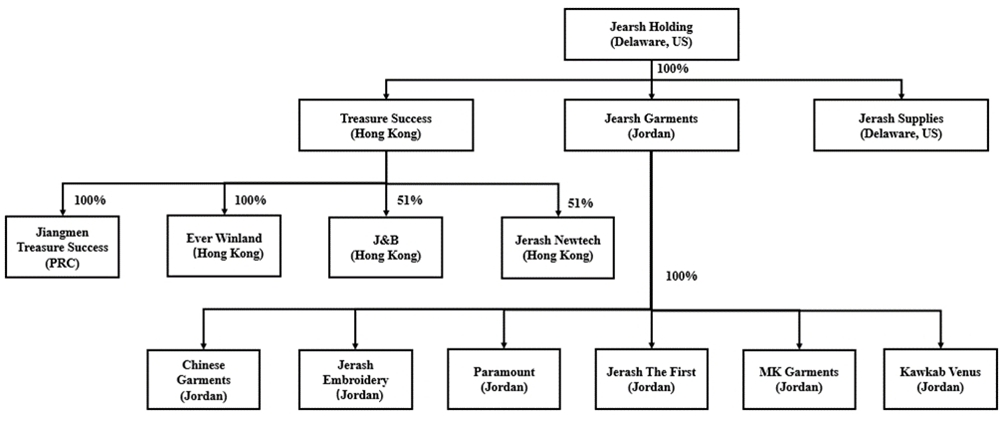
Jerash Holdings is a holding company incorporated in Delaware in January 2016. As of the date of this annual report, Jerash Holdings has the following wholly owned subsidiaries: (i) Jerash Garments and Fashions Manufacturing Co., Ltd. (“Jerash Garments”), an entity formed under the laws of Jordan, (ii) Treasure Success International Limited (“Treasure Success”), an entity formed under the laws of Hong Kong Special Administrative Region of the People’s Republic of China (“Hong Kong”), (iii) Chinese Garments and Fashions Manufacturing Co., Ltd. (“Chinese Garments”), an entity formed under the laws of Jordan and a wholly owned subsidiary of Jerash Garments, (iv) Jerash for Industrial Embroidery Co., Ltd. (“Jerash Embroidery”), an entity formed under the laws of Jordan and a wholly owned subsidiary of Jerash Garments, (v) Al-Mutafaweq Co. for Garments Manufacturing Ltd. (“Paramount”), an entity formed under the laws of Jordan and a wholly owned subsidiary of Jerash Garments, (vi) Mustafa and Kamal Ashraf Trading Company (Jordan) for the Manufacture of Ready-Make Clothes LLC (“MK Garments”), an entity formed under the laws of Jordan and a wholly owned subsidiary of Jerash Garments; (vii) Jiangmen Treasure Success Business Consultancy Co., Ltd. (“Jiangmen Treasure Success”), an entity incorporated under the laws of the People’s Republic of China (“China” or the “PRC”) and a wholly owned subsidiary of Treasure Success, (viii) Jerash The First Medical Supplies Manufacturing Company Limited (“Jerash The First”), an entity formed under the laws of Jordan and a wholly owned subsidiary of Jerash Garments, (ix) Jerash Supplies, LLC (“Jerash Supplies”), an entity formed under the laws of the State of Delaware, (x) Kawkab Venus Dowalyah Lisenaet Albesah (“Kawkab Venus”), a limited liability company established in Amman, Jordan and a wholly owned subsidiary of Jerash Garments, and (xi) Ever Winland Limited (“Ever Winland”), a limited liability company organized in Hong Kong and a wholly owned subsidiary of Treasure Success. As of the date of this annual report, Treasure Success owns 51% of the equity interests in J&B International Limited (“J&B”), a company with limited liability incorporated under the laws of Hong Kong. P. T. Eratex (Hong Kong) Limited (“Eratex”), a company formed in Hong Kong, owns the remaining 49%. To date, Treasure Success also owns 51% of the equity interests in Jerash Newtech (Hong Kong) Holdings Limited (“Jerash Newtech”), a company incorporated under the laws of Hong Kong with limited liability, and Newtech Textile (HK) Limited, a company incorporated in Hong Kong (“Newtech”), owns the remaining 49%.
This chart reflects our organizational structure as of the date of this annual report:
Jerash Garments was established in Jordan on November 26, 2000 and operates out of our factory in Al Tajamouat Industrial City, a Development Zone in Amman, Jordan. Jerash Garments’ principal activities are to house management offices and to operate production lines and printing, sewing, ironing, packing, and quality control units, as well as house our trims and finished products warehouses. We also operate our factory in Al-Hasa County (as discussed below) under Jerash Garments.
Chinese Garments was established in Jordan on June 13, 2013 and operated out of our factory in Al Tajamouat Industrial City. Chinese Garments’ principal activities were to house administration, human resources, finance, and management offices and to operate additional production lines and sewing, ironing, and packing units, as well as house our trims warehouse.
Jerash Embroidery was established in Jordan on March 11, 2013 and operated out of our factory in Al Tajamouat Industrial City. Jerash Embroidery’s principal activities were to perform the cutting and embroidery for our products.
Paramount was established in Jordan on October 24, 2004 and operated out of our factory in Al Tajamouat Industrial City. Paramount’s principal activities were to manufacture garments per customer orders.
During the fiscal year 2026, principal activities of Chinese Garments, Jerash Embroidery, Paramount were transferred to Jerash Garments. Chinese Garments, Jerash Embroidery, and Paramount have no operation currently.
MK Garments was established in Jordan on January 23, 2003. On June 24, 2021, Jerash Garments and the sole shareholder of MK Garments entered into an agreement, pursuant to which Jerash Garments acquired all of the outstanding stock of MK Garments. As of October 7, 2021, MK Garments became a subsidiary of Jerash Garments. MK Garments operates out of our factory in Al Tajamouat Industrial City. MK Garments’ principal activities are to manufacture garments per customer orders. The new facilities are an existing garment manufacturing operation adjacent to Jerash’s four largest manufacturing centers. Jerash assumed ownership of all of the machinery and equipment owned by MK Garments through the acquisition.
Treasure Success was established in Hong Kong on July 5, 2016 and operates in Hong Kong. Treasure Success’s primary activities are sales of garments and to employ sales and merchandising staff and supporting personnel in Hong Kong to support the business of Jerash Garments and its subsidiaries.
Jiangmen Treasure Success was established in Jiangmen City of Guangdong Province in the PRC on August 28, 2019 and operates in the PRC. Jiangmen Treasure Success’s primary activities are to provide support in sales and marketing, sample development, merchandising, procurement, and other areas.
Jerash The First was established in Jordan on July 6, 2020 and operate out of our factory in Al-Hasa County. Jerash The First’s principal activities were to manufacture and trade personal protective equipment (“PPE”) products. Jerash The First has no operation currently.
Jerash Supplies was formed in Delaware on November 20, 2020. Jerash Supplies is engaged in the trading of PPE products.
Kawkab Venus was established in Amman, Jordan, on January 15, 2015 with a declared capital of JOD 50,000. It holds land with factory premises, which are leased to MK Garments. On July 14, 2021, Jerash Garments and the sole shareholder of Kawkab Venus entered into an agreement, pursuant to which Jerash Garments acquired all of the outstanding stock of Kawkab Venus. Apart from the land and factory premises, Kawkab Venus had no other significant assets or liabilities and no operation activities or employees at the time of acquisition, so the acquisition was accounted for an asset acquisition. As of August 21, 2022, Kawkab Venus became a subsidiary of Jerash Garments.
Ever Winland was organized in Hong Kong on December 3, 2020. It held office premises, which were leased to Treasure Success. On June 22, 2022, Treasure Success and the shareholders of Ever Winland entered into an agreement, pursuant to which Treasure Success acquired all of the outstanding stock of Ever Winland. Apart from the office premises used by Treasure Success, Ever Winland had no other significant assets or liabilities and no operating activities or employees at the time of this acquisition, so this transaction was accounted for as an asset acquisition. As of August 29, 2022, Ever Winland became a subsidiary of Treasure Success. Treasure Success acquired the office premises as of January 8, 2026.
J&B is a joint venture company established in Hong Kong on January 10, 2023. On March 20, 2023, Treasure Success and Eratex entered into a Joint Venture and Shareholders’ Agreement, pursuant to which Treasure Success acquired 51% of the equity interests in J&B on April 11, 2023. J&B engages in the business of garment trading and manufacturing for orders from customers. On June 16, 2025, Treasure Success and Eratex attended a meeting of shareholders of J&B and approved the termination of J&B’s business operations and the dissolution of J&B, which is expected to complete in April 2027.
Jerash Newtech is a joint venture company established in Hong Kong on November 3, 2023. On October 10, 2023, Treasure Success and Newtech entered into a Joint Venture and Shareholders’ Agreement. Pursuant to this agreement, both parties agreed to form a joint venture company in Hong Kong named Jerash Newtech, of which Treasure Success holds 51% of the equity interests and Newtech holds 49%. Jerash Newtech engages in the business of supplying fiber and fabric printed with Cooltrans technology, and may engage any other businesses in the future as both parties shall agree from time to time. On August 20, 2025, Treasure Success and Newtech Textile (HK) Limited attended a meeting of shareholders of Jerash Newtech and agreed to and authorized an application to be made for the deregistration of Jerash Newtech.
Products
As a garment manufacturing group, we specialize in manufacturing sportswear and outerwear. Our sportswear and outerwear product offering consists of jackets, polo shirts, t-shirts, pants, and shorts. During fiscal 2026, our primary product offerings were vests, shorts and pants, which accounted for approximately 35% of our total shipped pieces. During fiscal 2025, our primary product offering was crew neck, which accounted for approximately 37% of our total shipped pieces.
Manufacturing and Production
Our production facilities are located in Al Tajamouat Industrial City in the Amman Governorate, in the Al-Hasa District in the Tafilah Governorate, and in the Balama Sub-district in the Mafraq Governorate of Jordan.
Our production facilities in Al Tajamouat Industrial City in the Amman Governorate comprise six operating factories and six warehouses. Effective as of January 1, 2019, the government of the Hashemite Kingdom of Jordan converted Al Tajamouat Industrial City into a Development Zone. Following this change, we continued to operate under benefits similar to the Qualifying Industrial Zone designation, but were subject to a 10% corporate income tax plus a 1% social contribution. Starting from January 1, 2020, the corporate income tax rate increased from 10% to 20% throughout the years. Effective January 1, 2024, we have been subject to a 20% corporate income tax rate plus a 1% social contribution. Effective from October 1, 2025, Jerash Garments has been granted tax concession at a corporate income tax rate 10% plus a 1% social contribution in accordance with the Jordanian Income Tax Law. Currently, the first factory, which we own, employs approximately 1,550 people. Its primary functions are to house our management offices, as well as production lines, trims warehouse, and printing, sewing, ironing, and packaging units. The second factory, which we lease, employs approximately 1,800 people. Its primary function is to house our administrative and human resources personnel, merchandising and accounting departments, embroidery, printing, additional production lines, trims and finished products warehouses, and sewing, ironing, packing and quality control units. The third factory, which we lease, employs approximately 200 people. Its primary functions are to perform the cutting for our products. The fourth factory (under Paramount), which we lease, currently employs approximately 1,400 people. Its primary functions are to house additional production lines. The fifth factory (under MK Garments) currently employs approximately 650 people. Its primary function is to manufacture garments for orders from customers.
On February 2, 2026, the Housing Bank for Trade and Finance (the “Housing Bank”) approved the Property Purchase Request submitted by Jerash Garments on January 20, 2026 for the purchase of the property located on Property No. 1326, Basin No. 3 Abu Sawwana, Al-Ruqaim Village, from the lands of South Amman, Jordan (“Property No. 1326”). The purchase was completed on February 19, 2026. Property No. 1326 will be our sixth factory in Al Tajamouat Industrial City and production is scheduled to commence in fiscal 2027.
Our production facility in Al-Hasa County in the Tafilah Governorate of Jordan comprises one factory, which currently employs approximately 550 people and its primary functions are to manufacture garment products per customer orders. We commenced the construction of this factory in 2018 and we started operations in November 2019. This is a joint project with the Jordanian Ministry of Labor and the Jordanian Education and Training Department. According to our agreement with these government agencies, we used this factory without paying rent through December 2022. We have continued to use the factory without paying rent since January 2023 as new arrangements with the Jordanian Ministry of Labor are still being made. See “Item 2. Properties” below for more information regarding this factory.
Our production facility in Balama Sub-district in the Mafraq Governorate comprises one factory, which currently employs approximately 150 people, and its primary functions are to manufacture garment products per customer orders. According to our agreement with these government agencies, we are allowed to use this factory without paying rent through February 2029.
In April 2021, we commenced construction of a 195,000-square-foot housing facility for our multi-national workforce, situated on a 49,000-square-foot site owned by us in Al Tajamouat Industrial City. In fiscal 2025, the construction was completed and our workers moved in. To meet increasing demand, we are also finalizing plans to construct an additional project on a nearby 133,000-square-foot parcel that we purchased in 2019 for $1.2 million. Two-thirds of the land will be used for our factory and the remaining one-third will be used for housing. As of the date of this annual report, we are working with engineering consultants on the architectural design of the building, taking into account the potential business growth brought about by the new business expansion with new customers such as Hansoll Group. We will carefully plan the construction investment to meet the progress of business developments.
Total annual capacity at our existing facilities was approximately 24 million pieces (average for product categories including t-shirts, polo shirts, pants, shorts, and jackets) as of March 31, 2026. Our production flow begins in the cutting department of our factory. Then the product is sent to the embroidery department for embroidery if applicable. From there, the product moves to be processed by the sewing unit, finishing department, quality control, and finally the ironing and packing units.
We do not have long-term supply contracts or arrangements with our suppliers. Most of our ultimate suppliers for raw materials, such as fabric, zippers, and labels, are designated by customers and we purchase such materials on a purchase order basis.
Employees
As of March 31, 2026, we had an aggregate of approximately 6,300 employees located in Jordan, Hong Kong, China, and the United States of America, all of which are full-time employees.
Customers
The following table outlines the dollar amount and percentage of total sales to our customers for the fiscal years ended March 31, 2026 (“fiscal 2026”) and March 31, 2025 (“fiscal 2025”).
| Fiscal 2026 | Fiscal 2025 | |||||||||||||||
| Sales | Sales | |||||||||||||||
| (USD, in thousands) |
% | (USD, in thousands) |
% | |||||||||||||
| VF Corporation(1) | $ | 87,020 | 52.3 | % | $ | 94,151 | 64.6 | % | ||||||||
| New Balance | 22,760 | 13.7 | % | 17,872 | 12.2 | % | ||||||||||
| Suzhou Unitex | 10,332 | 6.2 | % | 5,696 | 3.9 | % | ||||||||||
| Tharanco | 7,663 | 4.6 | % | 4,673 | 3.2 | % | ||||||||||
| Hansoll | 6,952 | 4.2 | % | - | 0 | % | ||||||||||
| SWC Inc. | 5,532 | 3.3 | % | 5,049 | 3.5 | % | ||||||||||
| G-III | 3,799 | 2.3 | % | 2,352 | 1.6 | % | ||||||||||
| Hugo Boss | 1,315 | 0.8 | % | 4,018 | 2.8 | % | ||||||||||
| Others | 20,891 | 12.6 | % | 12,001 | 8.2 | % | ||||||||||
| Total | $ | 166,264 | 100.0 | % | $ | 145,812 | 100.0 | % | ||||||||
| (1) | A large portion of our products are sold under The North Face, Timberland, and Vans brands owned by VF Corporation. |
In fiscal 2026 and 2025, we depended on a few key customers for our sales, and a large portion of our sales in fiscal 2026 and 2025 were to one customer, VF Corporation.
We started producing garments for VF Corporation in 2012. A large portion of the products we manufacture are sold under The North Face, Timberland, and Vans brands which are owned by VF Corporation. Currently, we manufacture primarily outerwear for The North Face. Approximately 52% and 65% of our sales in fiscal 2026 and 2025 were derived from the sale of manufactured products to VF Corporation, respectively. We are not party to any long-term contracts with VF Corporation or our other customers, and our sales arrangements with our customers do not have minimum purchase requirements. As is common in our industry, VF Corporation and our other customers place purchase orders with us after we complete detailed sample development and approval processes that we and our customers have agreed upon for their purchase of the relevant manufactured garments. It is through the sample development and approval processes that we and VF Corporation and our other customers agree on the purchase and manufacture of the garments. For fiscal 2026, VF Corporation issued approximately 14,300 purchase orders to us in amounts ranging from approximately $5 to $296,000. For fiscal 2025, VF Corporation issued approximately 14,700 purchase orders to us in amounts ranging from approximately $6 to $929,000.
Our customers are in the retail industry, which is subject to substantial cyclical variations. Consequently, there can be no assurance that sales to current customers will continue at the current rate or at all. In addition, our annual and quarterly results may vary, which may cause our profits and the market price of our common stock to decline.
We continue to seek to expand and strengthen our relationship with our current customers and other brand names. However, we cannot assure you that these brands will continue to buy our products in the same volumes or on the same terms as they did in the past or that we will be successful in expanding our relationship with other brand names.
Competition
The markets for the manufacturing of sportswear and outerwear are highly competitive. The competition in those markets focuses primarily on the price and quality of the product and the level of customer service. Our products compete with products of other apparel manufacturers in Asia, Israel, Europe, the United States, and South and Central America.
Competition with other manufacturers in the clothing industry focuses on reducing production costs, reducing supply lead time, design, product quality, and efficiency of supply to the customer. Since production costs depend to a large extent on labor costs, in recent years most production in the industry has been moved to countries where labor costs are low. Some of our competitors have lower cost bases, longer operating histories, larger customer bases, and other advantages over us which allow them to compete with us. As described in more detail under “—Conditions in Jordan—Trade Agreements” below, we were able to sell our products manufactured at our facilities in Jordan to the United States free from customs duties and import quotas under certain conditions prior to April 5, 2025. These favorable terms enabled us to remain competitive on the basis of price. Effective from April 5, 2025, the U.S. imposed a baseline tariff of 10% on imports from almost all countries, including Jordan. Then, effective from April 9, 2025, it had announced “reciprocal” tariffs of imports from specified countries, amongst them Jordan with a prevailing rate of then 20%. These “reciprocal” tariffs are postponed for 90 days, whilst the 10% baseline tariff persists. The tariff was modified to 15% according to an executive order of presidential actions on July 31, 2025. In February 2026, the U.S. Supreme Court ruled that the “reciprocal” tariffs were illegal, and the U.S. Customs has since then stopped to impose the “reciprocal” tariff and established a new process to refund importers for voided “reciprocal” tariff. Following the ruling, the U.S. Government then invoked Section 122 of the Trade Act of 1974 to impose an across the board 10% tariff for a period of 150 days expiring in July 2026, including on the imports from Jordan. While the payment of the tariff is typically the responsibility of the importer (Jerash’s customers), the impact of the tariff on customers’ demand would be affected by the comparative levels of the tariffs on imports from Jordan compared to other countries.
According to the Association Agreement between the European Union (the “EU”) and Jordan, which came into force in May 2002, and the joint initiative on rules of origin reviewed and improved in December 2018 by the EU and Jordan, goods manufactured by us in Jordan that are subsequently shipped to EU countries are shipped free from customs duties.
Conditions in Jordan
Our manufacturing facilities are located in Jordan. Accordingly, we are directly affected by political, security, and economic conditions in Jordan.
From time to time, Jordan has experienced instances of civil unrest, terrorism, and hostilities among neighboring countries, including Syria and Israel. A peace agreement between Israel and Jordan was signed in 1994. Terrorist attacks, military activity, rioting, or civil or political unrest in the future could influence the Jordanian economy and our operations by disrupting operations and communications and making travel within Jordan more difficult and less desirable. Political or social tensions also could create a greater perception that investments in companies with Jordanian operations involve a high degree of risk, which could adversely affect the market and price for our common stock. Furthermore, the escalation of conflicts such as Russia-Ukraine, Israel-Hamas, and Israel/U.S.-Iran, as well as Houthi rebel attacks on commercial vessels in the Red Sea, may increase geopolitical tensions globally. These political or social tensions could disrupt international trade, industrial supply chains, and transportation, leading to market price volatility, and may adversely affect our business, increase operational costs, and limit our ability to secure foreign financing for our operations and capital expenditures. See “Item 1A. Risk Factors—Risks Related to Operations in Jordan—Our operations in Jordan may be adversely affected by social and political uncertainties or change, military actions, health-related risks, acts of terrorism or other geopolitical instability.”
Jordan is a constitutional monarchy, but the King holds wide executive and legislative powers. The ruling family has taken initiatives that support the economic growth of the country. However, there is no assurance that such initiatives will be successful or will continue. The rate of economic liberalization could change, and specific laws and policies affecting manufacturing companies, foreign investments, currency exchange rates, and other matters affecting investments in Jordan could change as well.
Trade Agreements
Because of the Association Agreement between the EU and Jordan, which came into force in May 2002, we are able to sell our products manufactured at our facilities in Jordan to EU countries free from customs duties.
Because of the United States-Jordan Free Trade Agreement, which came into force on December 17, 2001, and was implemented fully on January 1, 2010, we were able to sell our products manufactured at our facilities in Jordan to the U.S. free from customs duties and import quotas under certain conditions prior to April 5, 2025. For tariff imposed by the U.S., please see “Item 1. Business— Competition.”
Income/Sales Tax Incentives
Effective January 1, 2019, Jordan’s government converted the geographical area where Jerash Garments and its subsidiaries are located from a Free Zone to a Development Zone. Development Zones are industrial parks that house manufacturing operations in Jordan. In accordance with applicable law, Jerash Garments and its subsidiaries were subject to corporate income tax in Jordan at a rate of 19% or 20% plus a 1% social contribution between January 1, 2023 to December 31, 2023. Effective January 1, 2024, the income tax rate increased to 20%, plus a 1% social contribution. Effective from October 1, 2025, Jerash Garments has been granted tax concession at a corporate income tax rate 10% plus a 1% social contribution in accordance with the Jordanian Income Tax Law. For more information, see “Note 2—Summary of Significant Accounting Policies—Income and Sales Taxes.”
In addition, Jerash Garments and its subsidiaries are subject to local sales tax of 16% on purchases. However, Jerash Garments was granted a sales tax exemption from the Jordanian Investment Commission for the period June 1, 2015 to June 1, 2018 that allowed Jerash Garments to make purchases with no sales tax charge. This exemption was extended to February 5, 2027.
Government Regulation
Our manufacturing and other facilities in Jordan and our subsidiaries outside of Jordan are subject to various local regulations relating to the maintenance of safe working conditions and manufacturing practices. Management believes that we are currently in compliance in all material respects with all such regulations. We are not subject to governmental approval of our products or manufacturing process.
Item 1A. Risk Factors.
The following are factors that could have a significant impact on our operations and financial results and could cause actual results or outcomes to differ materially from those discussed in any forward-looking statements.
Risks Related to Our Business and Our Industry
We rely on one key customer for a large portion of our revenue. We cannot assure you that this customer or any other customer will continue to buy our products in the same volumes or on the same terms.
Our sales to VF Corporation (which owns brands such as The North Face, Timberland, and Vans), directly and indirectly, accounted for approximately 52% and 65% of our total sales in fiscal 2026 and 2025, respectively. From an accounting perspective, we are considered the principal in our arrangement with VF Corporation. We bear the inventory risk before the specified goods are transferred to a customer, and we have the right to determine the price and to change our product during the sample development process with customers in which we determine factors including material usage and manufacturing costs before confirming orders. Therefore, we present the sales and related manufacturing activities on a gross basis.
We are not party to any long-term contracts with VF Corporation or our other customers, and our sales arrangements with our customers do not have minimum purchase requirements. As is common in our industry, VF Corporation and our other customers place purchase orders with us after we complete detailed sample development and approval processes. It is through these sample development and approval processes that we and VF Corporation agree on the purchase and manufacture of the garments in question. In fiscal 2025, VF Corporation issued approximately 14,700 purchase orders to us in amounts ranging from approximately $6 to $929,000. In fiscal 2026, VF Corporation issued approximately 14,300 purchase orders to us in amounts ranging from approximately $5 to $296,000.
We cannot assure you that our customers will continue to buy our products at all or in the same volumes or on the same terms as they have in the past. The failure of VF Corporation to continue to buy our products in the same volumes and on the same terms as in the past may significantly reduce our sales and our earnings.
A material decrease in the quantity of sales made to our principal customers, a material adverse change in the terms of such sales or a material adverse change in the financial condition of our principal customers could significantly reduce our sales and our earnings.
We cannot assure you that VF Corporation will continue to purchase our merchandise at the same historical rate, or at all, in the future, or that we will be able to attract new customers. In addition, because of our reliance on VF Corporation as our key customer and their bargaining power with us, VF Corporation has the ability to exert significant control over our business decisions, including prices.
Any adverse change in our relationship with VF Corporation and its owned brands, or with their strategies or reputation, would have a material adverse effect on our results of operations.
A large portion of our products are sold under The North Face, Timberland, and Vans brands, which are owned by VF Corporation. Any adverse change in our relationship with VF Corporation would have a material adverse effect on our results of operations. In addition, our sales of those products could be materially and adversely affected if the image, reputation, or popularity of either VF Corporation, The North Face, Timberland, or Vans were to be negatively impacted.
If we lose our key customer and are unable to attract new customers, then our business, results of operations, and financial condition would be adversely affected.
If our key customer, VF Corporation, fails to purchase our merchandise at the same historical rate, or at all, we will need to attract new customers and we cannot assure you that we will be able to do so. We do not currently invest significant resources in marketing our products, and we cannot assure you that any new investments in sales and marketing will lead to the acquisition of additional customers or increased sales or profitability consistent with prior periods. If we are unable to attract new customers or customers that generate comparable profit margins to VF Corporation, then our results of operations and financial condition could be materially and adversely affected.
If we lose our larger brand name customers, or the customers fail to purchase our products at anticipated levels, our sales and operating results will be adversely affected.
Our results of operations depend to a significant extent upon the commercial success of our larger brand name customers. If we lose these customers, these customers fail to purchase our products at anticipated levels, or our relationships with these customers or the brands and retailers they serve diminishes, it may have an adverse effect on our results and we may lose a primary source of revenue. In addition, we may not be able to recoup development and inventory costs associated with these customers and we may not be able to collect our receivables from them, which would negatively impact our financial condition and results of operations.
If the market share of our customers declines, our sales and earnings may decline.
Our sales can be adversely affected in the event that our direct and indirect customers do not successfully compete in the markets in which they operate. In the event that the sales of one of our major customers decline for any reason, regardless of whether it is related to us or to our products, our sales to that customer may also decline, which could reduce our overall sales and our earnings.
A natural disaster, catastrophe, pandemic, or other unexpected events could adversely affect our financial conditions and business operations.
The occurrence of one or more unexpected events, including war, acts of terrorism or violence, civil unrest, epidemics or pandemics, fires, tornadoes, hurricanes, earthquakes, floods, and other forms of severe weather in the countries or regions in which we do business could adversely affect our operations and financial performance.
We may require additional financing to fund our operations and capital expenditures.
As of March 31, 2026, we had cash and cash equivalents of approximately $10.8 million and restricted cash of approximately $1.7 million. There can be no assurance that our available cash, together with resources from our operations, will be sufficient to fund our operations and capital expenditures. In addition, our cash position may decline in the future, and we may not be successful in maintaining an adequate level of cash resources.
Pursuant to the DBS Bank (Hong Kong) Limited (“DBSHK”) facility letter dated January 12, 2022, DBSHK provided a bank facility of up to $5.0 million to Treasure Success, which was amended pursuant to a facility letter dated January 4, 2024. Pursuant to the amended agreement, DBSHK agreed to finance cargo receipt, trust receipt, account payable financing, and certain type of import and export invoice financing up to an aggregate of $5.0 million, with certain financial covenants. The DBSHK facility bears interest at 1.5% per annum over Hong Kong Interbank Offered Rate (“HIBOR”) for Hong Kong dollar (“HKD”) bills and 1.1% to 1.3% per annum over DBSHK’s cost of funds for foreign currency bills. The facility is guaranteed by Jerash Holdings and became available to the Company on June 17, 2022. As of March 31, 2026 and 2025, the Company had $4,902,996 and $4,512,462 outstanding under the DBSHK facility, respectively.
On July 31, 2025, Bank al Etihad offered to provide a credit facility of up to $6.0 million to Jerash Garments. Pursuant to the facility, Bank al Etihad agreed to finance import invoices of up to $6.0 million with condition that such invoices are secured by letter of credit issued by customers. The facility bears an interest rate at the Prime Lending Rate announced by Bank al Etihad, currently 8% per annum. As of March 31, 2026, the Company had $nil outstanding under the Bank al Etihad facility. The Bank al Etihad facility is reviewed annually.
On January 15, 2026, Housing Bank offered a credit facility of up to $14.0 million to Jerash Garments. Pursuant to the facility, Housing Bank agreed to finance import invoices of up to $14.0 million, with condition that such invoices are secured by letter of credit issued by customers. The facility bears an interest rate Secured Overnight Financing Rate (“SOFR”) plus a spread, currently approximately 6.1% per annum. As of March 31, 2026, the Company had $nil outstanding under the Housing Bank facility. The Housing Bank facility is reviewed annually.
On April 9, 2026, the Company signed a credit facility agreement offered by Capital Bank of Jordan (“Capital Bank”). Pursuant to the facility, Capital Bank agreed to finance import invoices of up to $7.5 million with condition that such invoices are secured by letter of credit issued by customers. The facility bears an SOFR interest rate plus a spread, with minimum 5% interest rate annually. The Capital Bank facility is reviewed annually.
In connection with the Property Purchase Request of Property No. 1326, on January 28, 2026, Jerash Garments entered into a loan agreement with the Housing Bank to finance the acquisition of Property No. 1326. Pursuant to the loan agreement, the Housing Bank agreed to provide Jerash Garments with a loan in the principal amount of JOD 2,000,000 (approximately $2,820,000). The loan bears interest at a rate of 8% per annum, calculated on the daily outstanding balance and charged monthly. Following a grace period ending January 31, 2027, the loan is repayable in 96 monthly installments of JOD 20,833 each, with the first installment due on February 1, 2027. The loan is secured by a first-priority mortgage on Property No. 1326, valued at JOD 5,500,000.
In addition, we may be required to seek additional debt or equity financing in order to support our growing operations. We may not be able to obtain additional financing on satisfactory terms, or at all, and any new equity financing could have a substantial dilutive effect on our existing stockholders. If we cannot obtain additional financing, we may not be able to achieve our desired sales growth, and our results of operations would be negatively affected.
We may have conflicts of interest with our affiliates and related parties, and in the past we have engaged in transactions and entered into agreements with affiliates that were not negotiated at arms’ length.
We have engaged, and may in the future engage, in transactions with affiliates and other related parties. These transactions may not have been, and may not be, on terms as favorable to us as they could have been if obtained from non-affiliated persons. While an effort has been made and will continue to be made to obtain services from affiliated persons and other related parties at rates and on terms as favorable as would be charged by others, there will always be an inherent conflict of interest between our interests and those of our affiliates and related parties. See also “Note 11—Related Party Transactions.” If we engage in related party transactions on unfavorable terms, our operating results will be negatively impacted.
We are dependent on a product segment comprised of a limited number of products.
Presently, we generate revenue primarily from manufacturing and exporting sportswear and outerwear. A shift in demand from such products may reduce the growth of new business for our products, and reduce existing business in those products. If demand for sportswear and outerwear were to decline, we may endeavor to expand or transition our product offerings to other segments of the clothing retail industry. There can be no assurance that we would be able to successfully make such an expansion or transition, or that our sales and margins would not decline in the event we made such an expansion or transition.
Our revenue and cash requirements are affected by the seasonal nature of our business.
We used to have stronger seasonality due to higher values of fall and winter orders normally shipped in the first two quarters of our fiscal years. We have been working on smoothing out seasonality through expansions of customer base and product offerings. In fiscal 2026, we managed to reverse the trend to have higher sales in the second half of the year through the introduction of a new customer and expansion in sales of some existing customers for spring and summer season orders. Due to the nature of our relationships with customers and our use of purchase orders to conduct our business, our revenue may vary from period to period.
Changes in our product mix and the geographic destination of our products or source of our supplies may impact our cost of goods sold, net income, and financial position.
From time to time, we experience changes in the product mix and the geographic destination of our products. To the extent our product mix shifts from higher revenue items, such as jackets, to lower revenue items, such as pants, our cost of goods sold as a percentage of gross revenue will likely increase. In addition, if we sell a higher proportion of products in geographic regions where we do not benefit from free trade agreements or tax exemptions, our gross margins will fall. If we are unable to sustain consistent product mix and geographic destinations for our products, we could experience negative impacts to our financial condition and results of operations.
Our direct and indirect customers are in the clothing retail industry, which is subject to substantial cyclical variations and could have a material adverse effect on our results of operations.
Our direct and indirect customers are in the clothing retail industry, which is subject to substantial cyclical variations and is strongly affected by any downturn or slowdown in the general economy. Factors in the clothing retail industry that may influence our operating results from quarter to quarter include:
| ● | the volume and timing of customer orders we receive during the quarter; |
| ● | the timing and magnitude of our customers’ marketing campaigns; |
| ● | the loss or addition of a major customer or of a major retailer nomination; |
| ● | the availability and pricing of materials for our products; |
| ● | the increased expenses incurred in connection with introducing new products; |
| ● | currency fluctuations; |
| ● | political factors that may affect the expected flow of commerce; and |
| ● | delays caused by third parties. |
In addition, uncertainty over future economic prospects could have a material adverse effect on our results of operations. Many factors affect the level of consumer spending in the clothing retail industry, including, among others:
| ● | general business conditions; |
| ● | interest rates; |
| ● | the availability of consumer credit; |
| ● | taxation; and |
| ● | consumer confidence in future economic conditions. |
Consumer purchases of discretionary items, including our products, may decline during recessionary periods and also may decline at other times when disposable income is lower. Consequently, our customers may have larger inventories of our products than expected, and to compensate for any downturn they may reduce the size of their orders, change the payment terms, limit their purchases to a lower price range, and try to change their purchase terms, all of which may have a material adverse effect on our financial condition and results of operations.
The clothing retail industry is subject to changes in fashion preferences. If our customers misjudge a fashion trend or the price which consumers are willing to pay for our products decreases, our revenue could be adversely affected.
The clothing retail industry is subject to changes in fashion preferences. We design and manufacture products based on our customers’ judgment as to what products will appeal to consumers and what price consumers would be willing to pay for our products. Our customers may not be successful in accurately anticipating consumer preferences and the prices that consumers would be willing to pay for our products. Our revenue will be reduced if our customers are not successful, particularly if our customers reduce the volume of their purchases from us or require us to reduce the prices at which we sell our products.
If we experience product quality or late delivery problems, or if we experience financial problems, our business will be negatively affected.
We may from time to time experience difficulties in making timely delivery of products of acceptable quality. Such difficulties may result in cancellation of orders, customer refusal to accept deliveries, or reductions in purchase prices, any of which could have a material adverse effect on our financial condition and results of operations. There can be no assurance that we will not experience difficulties with manufacturing our products.
We face intense competition in the worldwide apparel manufacturing industry.
We compete directly with a number of manufacturers of sportswear and outerwear. Some of these manufacturers have lower cost bases, longer operating histories, larger customer bases, greater geographical proximity to customers, or greater financial and marketing resources than we do. Increased competition, direct or indirect, could reduce our revenue and profitability through pricing pressure, loss of market share, and other factors. We cannot assure you that we will be able to compete successfully with existing or new competitors, as the market for our products evolves and the level of competition increases. We believe that our business will depend upon our ability to provide apparel products of good quality and meeting our customers’ pricing and delivery requirements, and our ability to maintain relationships with our major customers. There can be no assurance that we will be successful in this regard.
We have entered into joint ventures with third parties, and we may continue to do so in the future. This may subject us to various risks, including limited decision-making authority, reliance on our joint venture partners’ financial condition, the risk of disputes with our joint venture partners, and the risk of failing to achieve profitability through such business.
As of the date of this annual report, we have entered into two joint ventures with third parties, which joint ventures are in the process of being dissolved. Please refer to “Item 1. Business—Organizational structure” for more information. Once we enter into any joint ventures, we will have limited decision-making authority and we may face the risk of disputes with our joint venture partners. This includes potential deadlocks in making major decisions and restrictions on our ability to exit the joint venture. Any disputes that arise between us and any of our joint venture partners may result in litigation or arbitration. We may also face risks associated with the financial condition of our joint venture partners, including the risk of bankruptcy and/or failure to fund their share of required capital contributions. As a result, we may be exposed to liabilities that exceed our share of any joint venture. Our joint venture partners may also have business interests or goals that are inconsistent with ours and may be able to take actions contrary to our policies or objectives. In specific circumstances, we may be liable for the actions of any joint venture partners. Any of these situations may have a material adverse effect on our business, financial condition, and results of operations.
Furthermore, we cannot assure that we may succeed in doing business through any future joint ventures. If any future joint venture does not achieve expected level of production or profitability, we will not be able to adequately manage our growth following the establishment of such business, and our results of operations and financial condition would be adversely affected.
Our results of operations are subject to fluctuations in currency exchange rates.
Exchange rate fluctuations between the U.S. dollar and Jordanian Dinar (“JOD”), Hong Kong dollar, or Chinese Yuan (“CNY”), as well as inflation in Jordan, Hong Kong, or the PRC, may negatively affect our earnings. A substantial majority of our revenue and a substantial portion of our expenses are denominated in U.S. dollars. However, a significant portion of the expenses associated with our Jordanian, Hong Kong, or PRC operations, including personnel and facilities-related expenses, are incurred in JOD, HKD, or CNY, respectively. Consequently, inflation in Jordan, Hong Kong, or the PRC will have the effect of increasing the dollar cost of our operations in Jordan, Hong Kong, or the PRC, respectively, unless it is offset on a timely basis by a devaluation of JOD, HKD, or CNY, as applicable, relative to the U.S. dollar. We cannot predict any future trends in the rate of inflation in Jordan, Hong Kong, or the PRC or the rate of devaluation of JOD, HKD, or CNY, as applicable, against the U.S. dollar. In addition, we are exposed to the risk of fluctuation in the value of JOD, HKD, CNY vis-a-vis the U.S. dollar. There can be no assurance that JOD or HKD will remain effectively pegged to the U.S. dollar. Any significant appreciation of JOD, HKD, or CNY against the U.S. dollar would cause an increase in our JOD, HKD, or CNY expenses, as applicable, as recorded in our U.S. dollar denominated financial reports, even though the expenses denominated in JOD, HKD, or CNY, as applicable, will remain unchanged. In addition, exchange rate fluctuations in currency exchange rates in countries other than Jordan where we operate and do business may also negatively affect our earnings.
We are subject to the risks of doing business abroad.
Almost all of our products are manufactured outside the United States, at our subsidiaries’ production facilities in Jordan. Foreign manufacturing is subject to a number of risks, including work stoppages, transportation delays and interruptions, political instability, foreign currency fluctuations, economic disruptions, expropriation, nationalization, the imposition of tariffs and import and export controls, changes in governmental policies (including U.S. policies towards Jordan), and other factors, which could have an adverse effect on our business. In addition, we may be subject to risks associated with the availability of and time required for the transportation of products from foreign countries. The occurrence of certain of these factors may delay or prevent the delivery of goods ordered by customers, and such delay or inability to meet delivery requirements would have a severe adverse impact on our results of operations and could have an adverse effect on our relationships with our customers.
Our ability to benefit from the lower labor costs in Jordan will depend on the political, social, and economic stability of Jordan and in the Middle East in general. We cannot assure you that the political, economic, or social situation in Jordan or in the Middle East in general will not have a material adverse effect on our operations, especially in light of the potential for hostilities in the Middle East. See “—Risks Related to Operations in Jordan—Our operations in Jordan may be adversely affected by social and political uncertainties or change, military actions, health-related risks, acts of terrorism or other geopolitical instability.” The success of the production facilities also will depend on the quality of the workmanship of laborers and our ability to maintain good relations with such laborers in these countries. We cannot guarantee that our operations in Jordan or any new locations outside of Jordan will be cost-efficient or successful.
Our business could suffer if we violate labor laws or fail to conform to generally accepted labor standards or the ethical standards of our customers.
We are subject to labor laws issued by the Jordanian Ministry of Labor for our facilities in Jordan. In addition, many of our customers require their manufacturing suppliers to meet their standards for working conditions and other matters. If we violate applicable labor laws or generally accepted labor standards or the ethical standards of our customers by, for example, using forced or indentured labor or child labor, failing to pay compensation in accordance with local law, failing to operate our factories in compliance with local safety regulations, or diverging from other labor practices generally accepted as ethical, we could suffer a loss of sales or customers. In addition, such actions could result in negative publicity and may damage our reputation and discourage retail customers and consumers from buying our products.
Our products may not comply with various industry and governmental regulations and our customers may incur losses in their products or operations as a consequence of our non-compliance.
Our products are produced under strict supervision and controls to ensure that all materials and manufacturing processes comply with the industry and governmental regulations governing the markets in which these products are sold. However, if our controls fail to detect or prevent non-compliant materials from entering the manufacturing process, our products could cause damages to our customers’ products or processes and could also result in fines being incurred. The possible damages, replacement costs, and fines could significantly exceed the value of our products and these risks may not be covered by our insurance policies.
We depend on our suppliers for machinery and maintenance of machinery. We may experience delays or additional costs satisfying our production requirements due to our reliance on these suppliers.
We purchase machinery and equipment used in our manufacturing process from third-party suppliers. If our suppliers are not able to provide us with maintenance or additional machinery or equipment as needed, we might not be able to maintain or increase our production to meet any demand for our products, which would negatively impact our financial condition and results of operations.
We are a holding company and rely on dividends, distributions, and other payments, advances, and transfers of funds from our subsidiaries to meet our obligations.
We are a holding company that does not conduct any business operations of our own. As a result, we rely on cash dividends and distributions and other transfers from our operating subsidiaries to meet our obligations. The deterioration of income from, or other available assets of, our operating subsidiaries for any reason could limit or impair their ability to pay dividends or other distributions to us, which in turn could adversely affect our financial condition and results of operations.
Periods of sustained economic adversity and uncertainty could negatively affect our business, results of operations, and financial condition.
Disruptions in the financial markets, such as what occurred in the global markets in 2008, may adversely impact the availability and cost of credit for our customers and prospective customers, which could result in the delay or cancellation of customer purchases. In addition, disruptions in the financial markets may have an adverse impact on regional and world economies and credit markets, which could negatively impact the availability and cost of capital for us and our customers. These conditions may reduce the willingness or ability of our customers and prospective customers to commit funds to purchase our services or products, or their ability to pay for our services after purchase. These conditions could result in bankruptcy or insolvency for some customers, which would impact our revenue and cash collections. These conditions could also result in pricing pressure and less favorable financial terms to us and our ability to access capital to fund our operations.
Risks Related to Operations in Jordan
We are affected by conditions to, and possible reduction of, free trade agreements.
Because of the Association Agreement between the EU and Jordan, we are able to sell our products manufactured at our facilities in Jordan to EU countries free from customs duties. If there is a change in such benefits or if such agreement were terminated, our profitability may be reduced.
Because of the United States-Jordan Free Trade Agreement, we were able to sell our products manufactured at our facilities in Jordan to the U.S. free from customs duties and import quotas under certain conditions prior to April 2025.
Effective from April 5, 2025, the U.S. imposed a baseline tariff of 10% on imports from almost all countries, including Jordan. Then, effective from April 9, 2025, it had announced “reciprocal” tariffs of imports from specified countries, amongst them Jordan with a prevailing rate of then 20%. These “reciprocal” tariffs are postponed for 90 days, whilst the 10% baseline tariff persists. Up to the date of this annual report, the tariff was modified to 15% according to an executive order of presidential actions on July 31, 2025. In February 2026, the U.S. Supreme Court ruled that the “reciprocal” tariffs were illegal, and the U.S. Customs has since then stopped to impose the “reciprocal” tariff and established a new process to refund importers for voided “reciprocal” tariff. Following the ruling, the U.S. Government invoked Section 122 of the Trade Act of 1974 to impose an across the board 10% tariff for a period of 150 days expiring in July 2026. Imports from Jordan are also subject to this tariff. While the payment of the tariff is typically the responsibility of the importer (Jerash’s customers), the impact of the tariff on customers’ demand would be affected by the comparative levels of the tariffs on imports from Jordan compared to other.
It remains unclear what specifically President Trump would or would not do with respect to trade agreements, tariffs, and duties relating to products manufactured in Jordan during his current term. If President Trump takes action or publicly speaks out about the need to terminate or re-negotiate existing free trade agreements on which we rely, or in favor of restricting free trade or increasing tariffs and duties applicable to our products, such actions may adversely affect our sales and have a material adverse impact on our business, results of operations, and cash flows.
Our results of operations would be materially and adversely affected in the event we are unable to operate our principal production facilities in Jordan.
All of our manufacturing process is performed in a complex of production facilities located in Jordan. We have no effective back-up for these operations and, in the event that we are unable to use the production facilities located in Jordan as a result of damage or for any other reason, our ability to manufacture a major portion of our products and our relationships with customers could be significantly impaired, which would materially and adversely affect our results of operation.
Our operations in Jordan may be adversely affected by social and political uncertainties or change, military actions, health-related risks, acts of terrorism, or other geopolitical instability.
From time to time, Jordan has experienced instances of civil unrest, terrorism, and hostilities among neighboring countries, including Syria and Israel. A peace agreement between Israel and Jordan was signed in 1994. Terrorist attacks, military activity, rioting, or civil or political unrest in the future could influence the Jordanian economy and our operations by disrupting operations and communications and making travel within Jordan more difficult and less desirable. In late May 2018, protests about a proposed tax bill began throughout Jordan. On June 5, 2018, King Abdullah II of Jordan responded to the protests by removing and replacing Jordan’s prime minister. If political uncertainty rises in Jordan, our business, financial condition, results of operations, and cash flows may be negatively impacted.
Political or social tensions also could create a greater perception that investments in companies with Jordanian operations involve a high degree of risk, which could adversely affect the market price of our common stock. We do not have insurance for losses and interruptions caused by terrorist attacks, military conflicts, and wars, which could subject us to significant financial losses. The realization of any of these risks could cause a material adverse effect on our business, financial condition, results of operations, and cash flows.
Furthermore, global markets have recently experienced volatility and disruption following the escalation of geopolitical tensions, including the military conflict between Russia and Ukraine and the conflict in the Middle East. Specifically, Russian military forces initiated a full-scale invasion of Ukraine on February 24, 2022, leading to sustained conflict and disruption. See “—Risk Factors Relating to our Securities—We are currently operating in a period of economic uncertainty and capital market disruption, which has been significantly impacted by geopolitical instability due to the ongoing military conflict between Russia and Ukraine and the confrontations in the Middle East, including conflicts between Israel and Hamas, and between Iran and Israel. Our business, financial condition, and results of operations could be materially adversely affected by any negative impact on the global economy and capital markets resulting from the conflict in Ukraine or any other geopolitical tensions.” Additionally, on October 7, 2023, Hamas militants and members of other terrorist organizations infiltrated Israel’s southern border from the Gaza Strip and conducted a series of terror attacks on civilian and military targets, leading to a declaration of war by Israel. Subsequently, there have been disruptions in the region. The intensity and duration of the current Israel-Hamas war and the larger regional conflict are difficult to predict, as are the economic implications on our business and operations, the global supply chain, and global geopolitical stability.
Since November 2023, Yemen’s Iran-backed Houthi Rebels have intensified attacks on commercial vessels in the Red Sea, targeting ships from over 40 nations, including Jordan. The Red Sea turmoil has led to higher logistic costs for us to import raw material. Furthermore, we have incurred extra production costs to adhere to customers’ delivery schedules and mitigate the impact of delayed arrivals of raw materials caused by the aforementioned logistic disruption. If these attacks continue or escalate, we may be forced to reroute shipments around the Cape of Good Hope, which will result in higher shipping costs and delays. Additionally, these disruptions could lead to increased shipping insurance premiums and elevated global fuel prices, which will further drive up our transportation expenses.
Since June 2025, the conflict between Israel and Iran has escalated. In March 2026, military conflict involving the United States, Israel and Iran increased geopolitical instability internationally and, to date, increased armed conflicts in the Middle East, which has had a significant effect on global energy and capital markets. These direct military engagements, proxy activities, and broader regional tensions could have significant adverse effects on Jordan’s political and economic environment, and consequently, on our business operations. Further intensification of the conflict could result in regional economic instability, potentially disrupting trade routes, supply chains, and cross-border commerce. Heightened military activity could also create security risks for our facilities, employees, and customers, potentially leading to business interruptions, increased operating costs, or damage to physical assets. In response to regional threats, the government of Jordan may implement new regulations, restrictions, or emergency measures, which could affect our ability to conduct business as usual. Currently, both of the ports of Aqaba in Jordan and Haifa in Israel, which are the main ports for Jerash’s imports of raw materials and export of garment products, are operating as normal.
While we do not have any employees, staff, consultants, operations, materials, or equipment located in Israel, Iran, Ukraine, Russia, or Belarus, all of our manufacturing processes are performed in a complex of production facilities located in Jordan. This situation could adversely affect our business or the services being provided to us due to concerns about conflict in the Palestinian territories and broader regional instability. For example, when Hamas launched its attack on October 7, 2023, it had an unfavorable impact on the Jordanian street and the country’s national security. Similarly, escalating tensions involving Iran, including disruptions to strategic airspaces and critical maritime routes, such as the Strait of Hormuz and the Red Sea, have contributed to increases in the price of oil and gas, disruptions to global supply chains, and heightened market uncertainty. Despite bilateral cooperation between Jordan and the United States that may contribute to assisting the conflicting parties in ultimately achieving peace and security, we cannot assure that our business operations will not be adversely impacted by such disputes.
Any of the aforementioned factors could affect our business, prospects, financial condition, and operating results. The extent and duration of military action, sanctions, and resulting market disruptions are impossible to predict, but could be substantial.
We may face interruption of production and services due to increased security measures in response to terrorism.
Our business depends on the free flow of products and services through the channels of commerce. In response to terrorists’ activities and threats aimed at the United States, transportation, mail, financial, and other services may be slowed or stopped altogether. Extensive delays or stoppages in transportation, mail, financial, or other services could have a material adverse effect on our business, results of operations, and financial condition. Furthermore, we may experience an increase in operating costs, such as costs for transportation, insurance, and security as a result of the activities and potential delays. We may also experience delays in receiving payments from payors that have been affected by the terrorist activities. The United States economy in general may be adversely affected by terrorist activities and any economic downturn could adversely impact our results of operations, impair our ability to raise capital, or otherwise adversely affect our ability to grow our business.
We are subject to regulatory and political uncertainties in Jordan.
We conduct substantially all of our business and operations in Jordan. Consequently, government policies and regulations, including tax policies, in Jordan will impact our financial performance and the market price of our common stock.
Jordan is a constitutional monarchy, but the King holds wide executive and legislative powers. The ruling family has taken initiatives that support the economic growth of the country. However, there is no assurance that such initiatives will be successful or will continue. The rate of economic liberalization could change, and specific laws and policies affecting manufacturing companies, foreign investments, currency exchange rates, and other matters affecting investments in Jordan could change as well. A significant change in Jordan’s economic policy or any social or political uncertainties that impact economic policy in Jordan could adversely affect business and economic conditions in Jordan generally and our business and prospects.
If we violate applicable anti-corruption laws or our internal policies designed to ensure ethical business practices, we could face financial penalties and reputational harm that would negatively impact our financial condition and results of operations.
We are subject to anti-corruption and anti-bribery laws in the United States and Jordan. Jordan’s reputation for potential corruption and the challenges presented by Jordan’s complex business environment, including high levels of bureaucracy, red tape, and vague regulations, may increase our risk of violating applicable anti-corruption laws. We face the risk that we, our employees, or any third parties such as our sales agents and distributors that we engage to do work on our behalf may take action determined to be in violation of anti-corruption laws in any jurisdiction in which we conduct business, including the Foreign Corrupt Practices Act of 1977 (the “FCPA”). Any violation of the FCPA or any similar anti-corruption law or regulation could result in substantial fines, sanctions, civil or criminal penalties, and curtailment of operations that might harm our business, financial condition, or results of operations.
Our stockholders may face difficulties in protecting their interests and exercising their rights as a stockholder of ours because we conduct substantially all of our operations in Jordan and certain of our officers and directors reside outside of the United States.
Certain of our officers and directors reside outside the United States. Therefore, our stockholders may experience difficulties in effecting service of legal process, enforcing foreign judgments, or bringing original actions in any of these jurisdictions based upon U.S. laws, including the federal securities laws or other foreign laws against us, our officers, and directors. Furthermore, we conduct substantially all of our operations in Jordan through our operating subsidiaries. Because the majority of our assets are located outside the United States, any judgment obtained in the United States against us or certain of our directors and officers may not be collectible within the United States.
Risk Factors Relating to Our Securities
If we fail to comply with the continuing listing standards of the Nasdaq, our common stock could be delisted from the exchange.
If we were unable to meet the continued listing requirements of the Nasdaq Stock Market (“Nasdaq”), our common stock could be delisted from the Nasdaq. Any such delisting of our common stock could have an adverse effect on the market price of, and the efficiency of the trading market for, our common stock, not only in terms of the number of shares that can be bought and sold at a given price, but also through delays in the timing of transactions and less coverage of us by securities analysts, if any. Also, if in the future we were to determine that we need to seek additional equity capital, being delisted from Nasdaq could have an adverse effect on our ability to raise capital in the public or private equity markets.
Future sales and issuances of our common stock or rights to purchase common stock could result in additional dilution of the percentage ownership of our stockholders and could cause the market price of our common stock to decline.
We may issue additional securities in the future. Pursuant to our amended and restated 2018 Stock Incentive Plan, we may issue up to 1,784,250 shares of common stock to certain members of our management and key employees. As of the date of this annual report, 121,310 shares of common stock remain available for issuance under our amended and restated 2018 Stock Incentive Plan.
Future sales and issuances of our common stock or rights to purchase our common stock could result in substantial dilution to our existing stockholders. We may sell common stock, convertible securities, and other equity securities in one or more transactions at prices and in a manner as we may determine from time to time. If we sell any such securities, our stockholders may be materially diluted. New investors in any future transactions could gain rights, preferences, and privileges senior to those of holders of our common stock.
If securities or industry analysts do not publish research or reports about us, or if they adversely change their recommendations regarding our common stock, our stock price and trading volume of our common stock could decline.
The trading market for our common stock will be influenced by the research and reports that industry or securities analysts publish about us, our industry, and our market. If no analyst elects to cover us and publish research or reports about us, the market for our common stock could be severely limited and our stock price could be adversely affected. In addition, if one or more analysts ceases coverage of us or fails to regularly publish reports on us, we could lose visibility in the financial markets, which in turn could cause our stock price or trading volume to decline. If one or more analysts who elect to cover us issue negative reports or adversely change their recommendations regarding our common stock, the market price of our common stock could decline.
The requirements of being a public company, including compliance with the reporting requirements of the Securities Exchange Act of 1934, as amended (the “Exchange Act”) and the requirements of the Sarbanes-Oxley Act of 2002 (“Sarbanes-Oxley Act”), may strain our resources, increase our costs, and distract management, and we may be unable to comply with these requirements in a timely or cost-effective manner.
We are required to comply with the laws, regulations, requirements, and certain corporate governance provisions under the Exchange Act and the Sarbanes-Oxley Act. Complying with these statutes, regulations, and requirements occupies a significant amount of time of our board of directors and management, significantly increases our costs and expenses, and makes some activities more time-consuming and costly. As a reporting company, we are:
| ● | instituting a more comprehensive compliance function; |
| ● | preparing and distributing periodic and current reports under the federal securities laws; |
| ● | establishing and enforcing internal compliance policies, such as those related to insider trading; and |
| ● | involving and retaining outside counsel and accountants to a greater degree than before we became a reporting company. |
Our ongoing compliance efforts increase general and administrative expenses and may divert management’s time and attention from the development of our business, which may adversely affect our financial condition and results of operations.
If we fail to establish and maintain an effective system of internal controls, we may not be able to report our financial results accurately. Any inability to report and file our financial results accurately and timely could harm our business and adversely affect the trading price of our common stock.
We have been required to evaluate our internal control over financial reporting under Section 404 of the Sarbanes-Oxley Act beginning with the annual report on Form 10-K for the fiscal year ended March 31, 2019. The process of designing and implementing internal controls over financial reporting may divert our internal resources and take a significant amount of time and expense to complete.
In connection with the preparation and external audit of our consolidated financial statements for the fiscal year ended March 31, 2025, we identified certain material weaknesses in our internal control over financial reporting and have formulated plans for remedial measures. In the assessment in fiscal 2026, the management concluded that, as of March 31, 2026, our internal control over financial reporting was effective after review and testing of the effectiveness of the remedial actions. See “Item 9A. Controls and Procedures.”
However, our management team cannot guarantee that our internal controls and disclosure controls and procedures will prevent all possible errors. Because of the inherent limitations in all control systems, no system of controls can provide absolute assurance that all control issues and instances of fraud, if any, within the Company have been detected. These inherent limitations include the possibility that judgments in decision-making can be faulty and subject to simple error or mistake. Furthermore, controls can be circumvented by individual acts of some persons, by collusion of two or more persons, or by management override of the controls. The design of any system of controls is based in part upon certain assumptions about the likelihood of future events, and there can be no assurance that any design will succeed in achieving its stated goals under all potential future conditions. Over time, measures of control may become inadequate because of changes in conditions or the degree of compliance with policies or procedures may deteriorate. Because of inherent limitations in a cost-effective control system, misstatements due to error or fraud may occur and may not be detected.
We incur and will continue to incur increased costs and demands upon management as a result of being a public company.
As a public company listed in the United States, we incur, and will continue to incur, now that we have ceased to be an “emerging growth company,” significant legal, accounting, and other costs. These costs could negatively affect our financial results. In addition, changing laws, regulations, and standards relating to corporate governance and public disclosure, including regulations implemented by the SEC and Nasdaq, may increase legal and financial compliance costs and make some activities more time-consuming. These laws, regulations, and standards are subject to varying interpretations and, as a result, their application in practice may evolve over time as new guidance is provided by regulatory and governing bodies.
We are committed to comply with evolving laws, regulations, and standards, and this investment may result in increased general and administrative expenses and a diversion of management’s time and attention from revenue-generating activities to compliance activities. If we do not comply with new laws, regulations, and standards, regulatory authorities may initiate legal proceedings against us and our business may be harmed.
Failure to comply with these rules might also make it more difficult for us to obtain some types of insurance, including director and officer liability insurance, and we might be forced to accept reduced policy limits and coverage or incur substantially higher costs to obtain the same or similar coverage. The impact of these events could also make it more difficult for us to attract and retain qualified persons to serve on our board of directors, on committees of our board of directors or as members of senior management.
We are currently operating in a period of economic uncertainty and capital market disruption, which has been significantly impacted by geopolitical instability due to the ongoing military conflict between Russia and Ukraine. Our business, financial condition, and results of operations could be materially adversely affected by any negative impact on the global economy and capital markets resulting from the conflict in Ukraine or any other geopolitical tensions, including the ongoing confrontations in the Middle East, such as the conflicts between the United States, Iran and Israel and between Israel and Hamas.
U.S. and global markets are experiencing volatility and disruption following the escalation of geopolitical tensions and the start of the military conflict between Russia and Ukraine. On February 24, 2022, a full-scale military invasion of Ukraine by Russian troops was reported. Although the length and impact of the ongoing military conflict is highly unpredictable, the conflict in Ukraine could lead to market disruptions, including significant volatility in commodity prices, credit and capital markets, and supply chain interruptions. In March 2026, military conflict involving the United States, Israel and Iran increased geopolitical instability internationally and, to date, increased armed conflicts in the Middle East, which has had a significant effect on global energy and capital markets.
The military conflict in Ukraine has led to sanctions and other penalties being levied by the United States, European Union, and other countries against Russia. Additional potential sanctions and penalties have also been proposed and/or threatened. Russian military actions and the resulting sanctions could adversely affect the global economy and financial markets and lead to instability and lack of liquidity in capital markets, potentially making it more difficult for us to obtain additional funds. In addition, in managing an organization operating globally, we are subject to the risks and challenges related to the potential to subject our business to materially adverse consequences should the situation escalate beyond its current scope, including, among other potential impacts, the geographic proximity of the situation relative to the Middle East, where a material portion of our business is conducted.
Although our business has not been materially impacted by the ongoing military conflict between Russian and Ukraine and military actions in the Middle East to date, it is impossible to predict the extent to which our operations, or those of our suppliers and manufacturers, will be impacted in the short and long term, or the ways in which the conflict may impact our business. The extent and duration of the military action, sanctions, and resulting market disruptions are impossible to predict, but could be substantial. Any such disruptions may also magnify the impact of other risks described in this annual report.
See also “—Risks Related to Operations in Jordan—Our operations in Jordan may be adversely affected by social and political uncertainties or change, military actions, health-related risks, acts of terrorism, or other geopolitical instability.”
We may be adversely affected by the effects of inflation and a potential recession.
Inflation has the potential to adversely affect our liquidity, business, financial condition, and results of operations by increasing our overall cost structure, particularly if we are unable to achieve commensurate increases in the prices we charge our customers. The existence of inflation in the economy has resulted in, and may continue to result in, higher interest rates and capital costs, shipping costs, supply shortages, increased costs of labor, weakening exchange rates, and other similar effects. As a result of inflation, we have experienced and may continue to experience, cost increases. In addition, poor economic and market conditions, including a potential recession, may negatively impact market sentiment, decreasing the demand for sportswear and outerwear, which would adversely affect our operating income and results of operations. If we are unable to take effective measures in a timely manner to mitigate the impact of the inflation as well as a potential recession, our business, financial condition, and results of operations could be adversely affected.
Item 1B. Unresolved Staff Comments.
None.
Item 1C. Cybersecurity.
Risk Management and Strategy
Cybersecurity is a vital aspect of maintaining the trust of our customers and employees. We have instituted a comprehensive cybersecurity risk management program that employs various methods to monitor and assess our threat environment and risk profile. These methods include the use of manual and automated tools, conducting scans of the threat environment, evaluating our and our industry’s risk profile, evaluating threats reported to us and conducting vulnerabilities assessments. We have company-wide policies and procedures in place that further enhance our ability to identify and manage cybersecurity risks. Our employees receive ongoing training under our security policies.
Annual risk assessments and penetration testing are primarily performed by our internal staff, and we have not engaged any third parties in connection with such processes except that we have an external Management Information Systems consultant, or MIS consultant, who provides advice to our CEO in the review of test results. We believe these tests are useful tools for maintaining a robust cybersecurity program to protect our investors, customers, employees, vendors, and intellectual property. The results of these tests are presented annually to the CEO, with support provided by our external MIS consultant, for review to ensure compliance with cybersecurity standards.
During the fiscal year ended March 31, 2026, we have not identified any risks from cybersecurity threats that have materially affected our business operations or financial conditions.
Governance
Our CEO, MIS consultant, and MIS supervisor oversee risk management to ensure that the Company’s policies and procedures are functioning as intended to protect the Company’s information systems from cybersecurity threats.
More specifically, MIS supervisor is responsible for identifying and assessing cybersecurity risks on an ongoing basis, establishing processes designed to ensure that such potential cybersecurity risk exposures are monitored, putting in place appropriate mitigation and remediation measures, and maintaining cybersecurity programs. Our cybersecurity programs are managed under the direction of CEO and MIS consultant, and MIS supervisor monitors the prevention, detection, mitigation, and remediation of cybersecurity risks. MIS supervisor regularly updates the CEO on the Company’s cybersecurity programs, material cybersecurity risks and mitigation strategies and provides regular cybersecurity updates.
Item 2. Properties.
Jerash Garments and Kawkab own three industrial buildings of approximately 136,000, 79,000 and 76,000 square feet, respectively, a dormitory building with a kitchen area of approximately 195,000 square feet, and one piece of land of approximately 133,000 square feet in Al Tajamouat Industrial City. We lease additional space totaling approximately 536,000 square feet in three industrial buildings in Al Tajamouat Industrial City. In addition, we lease space for our workers in dormitories located inside and outside of Al Tajamouat Industrial City.
Treasure Success owns an office space in Hong Kong through acquisition of Ever Winland on August 29, 2022. See “—Item 1. Business—Organizational Structure.”
In 2018, we commenced a project to build a 54,000 square-foot factory in Al-Hasa County in the Tafilah Governorate of Jordan, which started operation in November 2019. This project is a joint project with the Jordanian Ministry of Labor and the Employment and Training Department in Jordan. The Ministry of Labor financed the building of the factory and the Employment and Training Department supported 50% of the workers’ salaries, as well as transportation and social security costs in the first 12 months following the completion of the project. We used the factory without paying rent through December 2022. We have continued to use the factory without paying rent since January 2023 as new arrangements with the Jordanian Ministry of Labor are still being made.
In April 2021, we commenced construction on a 195,000-square-foot housing facility for our multi-national workforce, situated on a 49,000-square-foot site owned by us, located in Al Tajamouat Industrial City. In fiscal 2025, the construction completed and our workers have moved in. To meet increasing demand, we are also finalizing plans to construct an additional project on a nearby 133,000-square-foot parcel that we purchased in 2019 for $1.2 million, with 2/3 of the land expected to be allocated for the establishment of our seventh factory and 1/3 for housing purposes. As of the date of this annual report, we are working with engineering consultants to proceed with the architectural design of these buildings. However, the execution of this construction plan will depend on the progress of the Company’s business development and an ongoing assessment of customer order condition.
On January 1, 2021, Jiangmen Treasure Success entered into a factory lease agreement with an independent third party for a term of five years. Upon expiration of the lease, Jiangmen Treasure Success entered into a new factory lease agreement for the same property with the same independent third party on January 1, 2026. The lease has a five-year term with monthly rent amount of CNY66,353 (approximately $9,600) for the first year, and 3% further annual increments starting from the second year.
On June 24, 2021, we entered into an agreement through Jerash Garments to acquire all of the stock of MK Garments in order to operate our manufacturing facility in Al Tajamouat Industrial City located in Amman, Jordan.
On July 14, 2021, Jerash Garments and the sole shareholder of Kawkab Venus entered into an agreement, pursuant to which Jerash Garments acquired all of the outstanding stock of Kawkab Venus. Apart from the land and factory premises, Kawkab Venus had no other significant assets or liabilities and no operation activities or employees at the time of acquisition, so the acquisition was accounted for an asset acquisition. As of August 21, 2022, Kawkab Venus became a subsidiary of Jerash Garments.
On February 2, 2026, Jerash Garments received the approval from the Housing Bank of the Property Purchase Request submitted on January 20, 2026 for the purchase of Property No. 1326, from the lands of South Amman, Jordan. The purchase was completed on February 19, 2026. Property No. 1326 will be our sixth factory in Al Tajamouat Industrial City and production will be commenced in fiscal 2027.
We believe the real estate property that we own and lease is sufficient to conduct our operations as they are currently conducted.
Item 3. Legal Proceedings.
We are not currently involved in any material legal proceedings. From time-to-time we are, and we anticipate that we will be, involved in legal proceedings, claims, and litigation arising in the ordinary course of our business and otherwise. The ultimate costs to resolve any such matters could have a material adverse effect on our financial statements. We could be forced to incur material expenses with respect to these legal proceedings, and in the event that there is an outcome in any that is adverse to us, our financial position and prospects could be harmed.
Item 4. Mine Safety Disclosures
Not applicable.
PART II
Item 5. Market for Registrant’s Common Equity, Related Stockholder Matters and Issuer Purchases of Equity Securities.
Our common stock has been traded and quoted on the Nasdaq Capital Market under the symbol “JRSH” since May 4, 2018. Before that, our stock was not traded on any stock exchange. As of June 18, 2026, there were 12,939,418 shares of common stock issued and 12,699,940 outstanding held by approximately 32 stockholders of record.
Since November 2018, the Board of Directors of Jerash Holdings has declared a quarterly cash dividend payable to holders of its common stock. Subject to the discretion of the Board of Directors and applicable law, we currently expect to continue declaring comparable quarterly cash dividends in the future.
For information on securities authorized for issuance under our existing equity compensation plan, see Item 12 under the heading “Security Ownership of Certain Beneficial Owners and Management and Related Stockholder Matters.”
In the fourth quarter of the fiscal year ended March 31, 2026, the Company has not made any repurchases of its outstanding shares of common stock.
During the fiscal years ended March 31, 2026 and 2025, we did not have sales of unregistered securities other than those already disclosed in the quarterly reports on Form 10-Q in the fiscal years 2026 and 2025, and current reports on Form 8-K.
Item 6. [Reserved].
Item 7. Management’s Discussion and Analysis of Financial Condition and Results of Operations.
The following discussion of our financial condition and results of operations should be read in conjunction with our consolidated financial statements and the related notes included elsewhere in this annual report.
Executive Overview
Seasonality of Sales
We used to have strong seasonality due to higher values of fall and winter orders, which are normally shipped in the first two quarters of our fiscal years. We have been working on smoothing out seasonality through expansions of customer base and product offerings. In fiscal 2026, we managed to reverse the trend to have higher sales in the second half of the year through introduction of a new customer and expansion in sales of some existing customers for spring and summer season orders. We will continue our efforts in this direction in order to produce more consistent results throughout a fiscal year. One of our strategies is to increase sales with other customers where clothing lines are stronger during the spring months. This strategy also reflects our current plan to increase our number of customers to mitigate our current concentration risk with VF Corporation.
Results of Operations
The following table presents certain information from our consolidated statements of operations and comprehensive income (loss) for the fiscal years ended March 31, 2026 and 2025 and should be read, along with all of the information in this management’s discussion and analysis, in conjunction with the consolidated financial statements and related notes included elsewhere in this annual report.
(All amounts, other than percentages, in thousands of U.S. dollars)
| Fiscal Years Ended March 31, | ||||||||||||||||||||||||
| 2026 | 2025 | |||||||||||||||||||||||
| As % of | As % of | Year over Year | ||||||||||||||||||||||
| Statement of Income Data: | Amount | Sales | Amount | Sales | Amount | % | ||||||||||||||||||
| Revenue | $ | 166,264 | 100 | % | $ | 145,812 | 100 | % | $ | 20,452 | 14 | % | ||||||||||||
| Cost of goods sold | 139,481 | 84 | % | 123,493 | 85 | % | 15,988 | 13 | % | |||||||||||||||
| Gross profit | 26,783 | 16 | % | 22,319 | 15 | % | 4,464 | 20 | % | |||||||||||||||
| Selling, general, and administrative expenses | 20,456 | 12 | % | 20,872 | 14 | % | (416 | ) | (2 | )% | ||||||||||||||
| Other expenses, net | 1,580 | 1 | % | 1,296 | 1 | % | 284 | 22 | % | |||||||||||||||
| Net income before taxation | $ | 4,747 | 3 | % | $ | 151 | 0 | % | $ | 4,596 | 3,044 | % | ||||||||||||
| Income tax expense | 1,120 | 1 | % | 991 | 1 | % | 129 | 13 | % | |||||||||||||||
| Net income (loss) | $ | 3,627 | 2 | % | $ | (840 | ) | (1 | )% | $ | 4,467 | 532 | % | |||||||||||
Revenue. Our revenue was $166.3 million for fiscal 2026, compared to $145.8 million for fiscal 2025, an increase of $20.5 million, or 14%, primarily due to increases in shipments to businesses from new customers such as Hansoll Group and growth in sales from some of the customers introduced in the past few years such as Acushnet and Tharanco.
The following table outlines the dollar amount and percentage of total sales to our customers for the fiscal years ended March 31, 2026 and 2025, respectively.
(All amounts, other than percentages, in thousands of U.S. dollars)
| Fiscal 2026 | Fiscal 2025 | |||||||||||||||
| Sales | Sales | |||||||||||||||
| (Amount) | % | (Amount) | % | |||||||||||||
| VF Corporation(1) | $ | 87,020 | 52.3 | % | $ | 94,151 | 64.6 | % | ||||||||
| New Balance | 22,760 | 13.7 | % | 17,872 | 12.2 | % | ||||||||||
| Suzhou Unitex | 10,332 | 6.2 | % | 5,696 | 3.9 | % | ||||||||||
| Tharanco | 7,663 | 4.6 | % | 4,673 | 3.2 | % | ||||||||||
| Hansoll | 6,952 | 4.2 | % | - | 0 | % | ||||||||||
| SWC Inc. | 5,532 | 3.3 | % | 5,049 | 3.5 | % | ||||||||||
| G-III | 3,799 | 2.3 | % | 2,352 | 1.6 | % | ||||||||||
| Hugo Boss | 1,315 | 0.8 | % | 4,018 | 2.8 | % | ||||||||||
| Others | 20,891 | 12.6 | % | 12,001 | 8.2 | % | ||||||||||
| Total | $ | 166,264 | 100.0 | % | $ | 145,812 | 100.0 | % | ||||||||
| (1) | A large portion of our products are sold under The North Face, Timberland, and Vans brands owned by VF Corporation. |
Revenue by Geographic Area
(All amounts, other than percentages, in thousands of U.S. dollars)
| Fiscal Years Ended March 31, | ||||||||||||||||||||||||
| 2026 | 2025 | Year over Year | ||||||||||||||||||||||
| Region | Amount | % | Amount | % | Amount | % | ||||||||||||||||||
| United States | $ | 138,158 | 83 | % | $ | 128,577 | 88 | % | $ | 9,581 | 7 | % | ||||||||||||
| China and Hong Kong | 16,851 | 10 | % | 8,941 | 6 | % | 7,910 | 88 | % | |||||||||||||||
| Republic of Korea (“Korea”) | 6,952 | 4 | % | - | 0 | % | 6,952 | - | % | |||||||||||||||
| Jordan | 2,198 | 2 | % | 3,081 | 2 | % | (883 | ) | (29 | )% | ||||||||||||||
| Others | 2,105 | 1 | % | 5,213 | 4 | % | (3,108 | ) | (60 | )% | ||||||||||||||
| Total | $ | 166,264 | 100 | % | $ | 145,812 | 100 | % | $ | 20,452 | 14 | % | ||||||||||||
Since January 2010, all apparel manufactured in Jordan can be exported to the U.S. without customs duty being imposed, pursuant to the United States-Jordan Free Trade Agreement entered into in December 2001. This free trade agreement provides us with substantial competitiveness and benefit that allowed us to expand our garment export business in the U.S. Effective from April 5, 2025, the U.S. imposed a baseline tariff of 10% on imports from almost all countries, including Jordan. Then, effective from April 9, 2025, it had announced “reciprocal” tariffs of imports from specified countries, amongst them Jordan with a prevailing rate of then 20%. These “reciprocal” tariffs are postponed for 90 days, whilst the 10% baseline tariff persists. The tariff had been modified to 15% according to an executive order of presidential actions on July 31, 2025. In February 2026, the U.S. Supreme Court ruled that the “reciprocal” tariffs were illegal, and the U.S. Customs has since then stopped to impose the “reciprocal” tariff and established a new process to refund importers for voided “reciprocal” tariff. Following the ruling, the U.S. Government then invoked Section 122 of the Trade Act of 1974 to impose an across the board 10% tariff for a period of 150 days expiring in July 2026, including on the imports from Jordan. While the payment of the tariff is typically the responsibility of the importer (Jerash’s customers), the impact of the tariff on customers’ demand would be affected by the comparative levels of the tariffs on imports from Jordan compared to other.
The increase of approximately 7% in sales to the U.S. during fiscal 2026 was mainly attributable to an increase in sales to some of our U.S. customers introduced in the past few years, including Acushnet, Tharanco, and American Eagle.
During fiscal 2026, aggregate sales to Jordan, China and Hong Kong, Korea, and other locations, such as Germany, and Mexico, increased by 63% from approximately $17.2 million in fiscal 2025 to $28.1 million. This increase can be attributed mainly to the introduction of a new customer, Hansoll Group and an increase in revenue from Suzhou Unitex.
Cost of goods sold. Our cost of goods sold experienced an increase of approximately $16.0 million to approximately $139.5 million in fiscal 2026 from approximately $123.5 million in fiscal 2025. As a percentage of revenue, the cost of goods sold decreased by approximately 1 percentage point to 84% in fiscal 2026 from 85% in fiscal 2025. The decrease in the cost of goods sold as a percentage of revenue was primarily attributable to improved efficiency from economy of scale, continued automation such as installation of hanging systems, and better control of import costs.
For the fiscal year ended March 31, 2026 and 2025, we purchased approximately 13% and 10% of our garments and raw materials from one major supplier, respectively.
Gross profit margin. Our gross profit margin was approximately 16% in fiscal 2026, representing an increase by approximately 1 percentage point from 15% in fiscal 2025. The increase in gross profit margin was primarily influenced by our improvements in efficiency through automation and economy of scale.
Selling, general, and administrative expenses. Selling, general, and administrative expenses decreased by approximately 2% from approximately $20.9 million in fiscal 2025 to $20.5 million in fiscal 2026. The decrease was mainly attributable to better control of the export logistic expenses and lower share-based payment expenses in fiscal 2026.
Other expenses, net. Other expenses, net were approximately $1.6 million in fiscal 2026, compared to other expenses, net of approximately $1.3 million in fiscal 2025. The increase in other expenses from fiscal 2025 to fiscal 2026 was primarily due to a currency exchange loss and lower interest income in 2026.
Taxation. Income tax expenses for fiscal 2026 were approximately $1.1 million, compared to income tax expenses of approximately $1.0 million for fiscal 2025. The effective tax rate for fiscal 2026 decreased to 24%, compared to 656% for fiscal 2025. The decrease in the effective tax rate mainly resulted from lower Subpart F income impacts, favorable foreign tax rate differentials, favorable return-to-provision and valuation allowance adjustments, and the absence of uncertain tax position adjustments related to amended tax returns that were recorded in fiscal 2025.
Net income (loss). Net income for fiscal 2026 was $3.6 million, compared to net loss of approximately $0.8 million for fiscal 2025. The net income is mainly attributable to the improvement in efficiency through automation and economy of scale, better control of the export logistic expenses and lower share-based payment expenses and the lower effect tax rate in fiscal 2026.
Liquidity and Capital Resources
Jerash Holdings is a holding company incorporated in Delaware. As a holding company, we rely on dividends and other distributions from our Jordanian and Hong Kong subsidiaries to satisfy our liquidity requirements. Current Jordanian regulations permit our Jordanian subsidiaries to pay dividends to us only out of their accumulated profits, if any, determined in accordance with Jordanian accounting standards and regulations. In addition, our Jordanian subsidiaries are required to set aside at least 10% of their respective accumulated profits each year until the reserve is equal to 100% of the entity’s share capital, if any, to fund certain reserve funds. These reserves are not distributable as cash dividends. We have relied on direct payments of expenses by our subsidiaries to meet our obligations to date. To the extent payments are due in U.S. dollars, we have occasionally paid such amounts in JOD to an entity controlled by our management capable of paying such amounts in U.S. dollars. Such transactions have been made at prevailing exchange rates and have resulted in immaterial losses or gains on currency exchange.
As of March 31, 2026, our cash and cash equivalents balance was approximately $10.8 million and restricted cash was approximately $1.7 million, compared to cash and cash equivalents of approximately $13.3 million and restricted cash of approximately $1.7 million as of March 31, 2025. The decrease in total cash and cash equivalents during fiscal 2026 was primarily due to the payment for new factory premises and plant and equipment, offsetting the bank loan of $2.8 million related to the premises in fiscal 2026.
Our current assets as of March 31, 2026 were approximately $58.4 million, and our current liabilities were approximately $21.6 million, which resulted in a current ratio of approximately 2.7 to 1. Our current assets as of March 31, 2025 were approximately $54.4 million, and our current liabilities were approximately $19.8 million, which resulted in a current ratio of approximately 2.7:1. For fiscal 2026, the increase in current assets were primarily due to increases in accounts receivable from shipments close to the year end, and increases in inventory and advances to suppliers for the shipments mostly planned in early to mid-fiscal 2027, offsetting the decrease in cash balance.
We had net working capital of $36.7 million and $34.6 million as of March 31, 2026 and 2025, respectively. Based on our current operating plan, we believe that cash on hand and cash generated from operation will be sufficient to support our working capital needs for the next 12 months from the date of this Annual Report.
Since May and October 2021, we have participated in supply chain financing programs of two of our major customers, respectively. The programs allow us to receive early payments for approved sales invoices submitted by us through the bank the customer cooperates with. For any early payments received, we are subject to an early payment charge imposed by the customer’s bank, for which the rate is SOFR plus a spread. The arrangement allows us to have better liquidity without the need to incur administrative charges and handling fees as in bank financing. In March 2024, we participated in an additional supply chain financing program with one customer.
We have funded our working capital needs from operations. Our working capital requirements are influenced by the level of our operations, the numerical and dollar volume of our sales contracts, the progress of execution on our customer contracts, and the timing of accounts receivable collections.
Credit Facilities and Bank Loan
DBS Facility Letter
Pursuant to the DBS facility letter dated January 12, 2022, DBSHK provided a bank facility of up to $5.0 million to Treasure Success, which was amended pursuant to a facility letter dated January 4, 2024. Pursuant to the amended agreement, DBSHK agreed to finance cargo receipt, trust receipt, account payable financing, and certain types of import and export invoice financing up to an aggregate of $5.0 million, subject to certain financial covenants. The DBSHK facility bears interest at 1.5% per annum over HIBOR for HKD bills and 1.1% to 1.3% per annum over DBSHK’s cost of funds for foreign currency bills. The facility is guaranteed by Jerash Holdings and became available to the Company on June 17, 2022. As of March 31, 2026 and 2025, the outstanding balances were $4.9 million and $4.5 million, respectively, under this DBSHK facility.
Bank al Etihad Credit Facility
On July 31, 2025, Bank al Etihad offered to provide a credit facility of up to $6.0 million to Jerash Garments. Pursuant to the facility, Bank al Etihad agreed to finance import invoices of up to $6.0 million with condition that such invoices are secured by letter of credit issued by customers. The facility bears an interest rate at the Prime Lending Rate announced by Bank al Etihad. As of March 31, 2026, the Company had $nil outstanding under the Bank al Etihad facility. The Bank al Etihad facility is reviewed annually.
Housing Bank Credit Facility
On January 15, 2026, Housing Bank offered a credit facility of up to $14.0 million to Jerash Garments. Pursuant to the facility, Housing Bank agreed to finance import invoices of up to $14.0 million, with condition that such invoices are secured by letter of credit issued by customers. The facility bears an interest rate SOFR plus a spread, currently approximately 6.1% per annum. As of March 31, 2026, the Company had $nil outstanding under the Housing Bank facility. The Housing Bank facility is reviewed annually.
Capital Bank Facility
On April 9, 2026, the Company signed a credit facility agreement offered by Capital Bank. Pursuant to the facility, Capital Bank agreed to finance import invoices of up to $7.5 million with condition that such invoices are secured by letter of credit issued by customers. The facility bears an SOFR interest rate plus a spread, with minimum 5% interest rate annually. The Capital Bank facility is reviewed annually.
Bank Loan
In connection with the Property Purchase Request Property No. 1326 on January 28, 2026, Jerash Garments entered into a loan agreement with the Housing Bank to finance the acquisition of Property No. 1326. Pursuant to the loan agreement, the Housing Bank agreed to provide Jerash Garments with a loan in the principal amount of JOD 2,000,000 (approximately $2,820,000). The loan bears interest at a rate of 8% per annum, calculated on the daily outstanding balance and charged monthly. Following a grace period ending January 31, 2027, the loan is repayable in 96 monthly installments of JOD 20,833 each, with the first installment due on February 1, 2027. The loan is secured by a first-priority mortgage on Property No. 1326, valued at JOD 5,500,000.
Fiscal Years ended March 31, 2026 and 2025
The following table sets forth a summary of our cash flows for the fiscal years ended March 31, 2026 and 2025.
(All amounts in thousands of U.S. dollars)
| For the fiscal years ended March 31, |
||||||||
| 2026 | 2025 | |||||||
| Net cash provided by operating activities | $ | 2,494 | $ | 1,365 | ||||
| Net cash used in investing activities | (5,794 | ) | (2,370 | ) | ||||
| Net cash provided by financing activities | 671 | 2,053 | ||||||
| Effect of exchange rate changes on cash and restricted cash | 32 | (21 | ) | |||||
| Net (decrease) increase in cash, cash equivalents and restricted cash | (2,597 | ) | 1,027 | |||||
| Cash, cash equivalents and restricted cash, beginning of year | 15,064 | 14,037 | ||||||
| Cash, cash equivalents and restricted cash, end of year | $ | 12,467 | $ | 15,064 | ||||
| Supplemental disclosure information | ||||||||
| Cash paid for interest | $ | 1,625 | $ | 1,720 | ||||
| Income tax paid | $ | 1,273 | $ | 1,399 | ||||
| Non-cash investing and financing activities | ||||||||
| Equipment obtained by utilizing long-term deposit | $ | 296 | $ | 668 | ||||
| Operating lease right of use assets obtained in exchange for operating lease obligations | $ | 765 | $ | 187 | ||||
Operating Activities
Net cash provided by operating activities was approximately $2.5 million in fiscal 2026, compared to net cash provided by operating activities of approximately $1.4 million in fiscal 2025. The increase in net cash provided by operating activities was primarily attributable to the following factors:
| ● | net income of $3.6 million during fiscal 2026, compared to a net loss of $0.8 million during fiscal 2025; | |
| ● | an increase of $1.2 million in accrual expenses during fiscal 2026, compared to an increase of $0.2 million during fiscal 2025; | |
| ● | an increase of $2.7 million in accounts receivable during fiscal 2026, compared to a decrease of $2.4 million during fiscal 2025; |
| ● | an increase of $2.3 million in inventory during fiscal 2026, compared to an increase of $0.5 million during fiscal 2025; |
| ● | an increase of $2.0 million in advances to suppliers during fiscal 2026, compared to an increase of $3.6 million during fiscal 2025; and |
| ● | a decrease of $0.2 million of deferred revenue during fiscal 2026, compared to an increase of $0.5 million during fiscal 2025. |
Investing Activities
Net cash used in investing activities was approximately $5.8 million and $2.4 million for fiscal 2026 and 2025, respectively. The increase in net cash used in fiscal year 2026 compared to 2025 was primarily due to acquisition of a factory premises in Jordan in fiscal 2026 for approximately $3.6 million.
Financing Activities
Net cash provided by financing activities was $0.7 million in fiscal 2026, which was primarily related to the increase in long-term loan of approximately $2.8 million to finance the acquisition of a factory premises in fiscal 2026 and the net draw down of short-term bank financing of approximately $0.4 million, offset by the distribution of dividend of $2.5 million. Net cash provided by financing activities was approximately $2.1 million for fiscal 2025, mainly due to the net draw down of short-term bank financing of $4.5 million, which was offset by the distribution of dividends of $2.4 million.
Statutory Reserves
In accordance with the corporate Law in Jordan, Jerash Holdings’ subsidiaries in Jordan are required to make appropriations to certain reserve funds, based on net income determined in accordance with generally accepted accounting principles of Jordan. Appropriations to the statutory reserve are required to be 10% of net income until the reserve is equal to 100% of the entity’s share capital. Jiangmen Treasure Success is required to set aside 10% of its net income as statutory surplus reserve until such reserve is equal to 50% of its registered capital. These reserves are not available for dividend distribution. The statutory reserve was $413,821 as of March 31, 2026 and 2025.
The following table provides the amount of our statutory reserves, the amount of restricted net assets, consolidated net assets, and the amount of restricted net assets as a percentage of consolidated net assets, as of March 31, 2026 and 2025.
(All amounts, other than percentages, in thousands of U.S. dollars)
| As of March 31, | ||||||||
| 2026 | 2025 | |||||||
| Statutory Reserves | $ | 414 | $ | 414 | ||||
| Total Restricted Net Assets | $ | 414 | $ | 414 | ||||
| Consolidated Net Assets | $ | 64,909 | $ | 62,869 | ||||
| Restricted Net Assets as Percentage of Consolidated Net Assets | 0.64 | % | 0.66 | % | ||||
Total restricted net assets accounted for approximately 0.64% of our consolidated net assets as of March 31, 2026. As our subsidiaries in Jordan are only required to set aside 10% of net profits to fund the statutory reserves with the maximum reserve equal to 100% of the entity’s capital, we believe the potential impact of such restricted net assets on our liquidity is limited.
Capital Expenditures
We had capital expenditures of approximately $5.8 million and $2.4 million in fiscal 2026 and 2025, respectively. For the fiscal year ended March 31, 2026, our capital expenditures included payments for additional plant and machinery of approximately $1.5 million and payments for acquisition of properties of approximately $3.6 million. For the fiscal year ended March 31, 2025, our capital expenditures included payments for additional plant and machinery of approximately $1.0 million and payments for construction of properties of approximately $1.1 million.
On August 7, 2019, we completed a transaction to acquire 12,340 square meters (approximately three acres) of land in Al Tajamouat Industrial City, Jordan, from a third party to construct a dormitory for our employees with aggregate purchase price JOD863,800 (approximately $1,218,303). Management has revised the plan to construct both dormitory and production facilities on the land in order to capture the increasing demand for our capacity. We are conducting engineering design and study on this project with the business growth prospect of new customers to be introduced in the coming few years. On February 6, 2020, we completed a transaction to acquire 4,516 square meters (approximately 48,608 square feet) of land in Al Tajamouat Industrial City, Jordan, from a third party to construct a dormitory for our employee with aggregate purchase price JOD313,501 (approximately US$442,162). The dormitory and dormitory kitchen were completed in the second quarter and the fourth quarter of fiscal year 2025, respectively. We have spent approximately $10.6 million in capital expenditures to build the dormitory and the dormitory kitchen.
We expect that our capital expenditures will increase in the following two fiscal years to create additional capacity to underpin our long-term business plan. The realization of these investments depends on the progress of our business development, including expanding our client base and securing increased commitments from existing customers. We have used cash generated from operations of our subsidiaries to fund our capital commitments in the past. Our capital expenditure plan is highly related to customer commitments and market responses to the demand of our capacity. If growth in demand is in line with our projection, other than cash generated from the operations of our subsidiaries, we may also obtain further bank financing and raise funds from the capital market to meet our capital expenditure plan and fund our capital commitments. As of the date of this report, no material commitment has been made for the capital expenditure projections above.
Off-balance Sheet Commitments and Arrangements
We have not entered into any other financial guarantees or other commitments to guarantee the payment obligations of any third parties. In addition, we have not entered into any derivative contracts that are indexed to our own shares and classified as stockholders’ equity, or that are not reflected in our consolidated financial statements.
For Management’s Discussion and Analysis of the fiscal years ended March 31, 2025 and 2024, please see our Annual Report on Form 10-K for the fiscal year ended March 31, 2025, filed with the SEC on June 26, 2025.
Critical Accounting Estimates
We prepare our consolidated financial statements in conformity with accounting principles generally accepted by the United States of America, which require us to make judgments, estimates, and assumptions that affect our reported amount of assets, liabilities, revenue, costs and expenses, and any related disclosures. Although there were no material changes made to the accounting estimates and assumptions in the past two years, we continually evaluate these estimates and assumptions based on the most recently available information, our own historical experience, and various other assumptions that we believe to be reasonable under the circumstances. Since the use of estimates is an integral component of the financial reporting process, actual results could differ from our expectations as a result of changes in our estimates. We have not identified any critical accounting estimates.
Recent Accounting Pronouncements
See “Note 3—Recent Accounting Pronouncements” in the notes to our audited consolidated financial statements for a discussion of recent accounting pronouncements.
Item 7A. Quantitative and Qualitative Disclosures About Market Risk.
Not applicable.
Item 8. Financial Statements and Supplementary Data.
JERASH HOLDINGS (US), INC.
INDEX TO CONSOLIDATED FINANCIAL STATEMENTS
TABLE OF CONTENTS
F-
REPORT OF INDEPENDENT REGISTERED PUBLIC ACCOUNTING FIRM
To the Stockholders and Board of Directors of
Jerash Holdings (US), Inc.
Opinion on the Financial Statements
We have audited the accompanying consolidated balance sheets of Jerash Holdings (US), Inc. (the “Company”) as of March 31, 2026 and 2025, the related consolidated statements of operations and comprehensive income (loss), changes in equity and cash flows for each of the two years in the period ended March 31, 2026, and the related notes (collectively referred to as the “financial statements”). In our opinion, the financial statements present fairly, in all material respects, the financial position of the Company as of March 31, 2026 and 2025, and the results of its operations and its cash flows for each of the two years in the period ended March 31, 2026, in conformity with accounting principles generally accepted in the United States of America.
Basis for Opinion
These financial statements are the responsibility of the Company's management. Our responsibility is to express an opinion on the Company's financial statements based on our audits. We are a public accounting firm registered with the Public Company Accounting Oversight Board (United States) ("PCAOB") and are required to be independent with respect to the Company in accordance with the U.S. federal securities laws and the applicable rules and regulations of the Securities and Exchange Commission and the PCAOB.
We conducted our audits in accordance with the standards of the PCAOB. Those standards require that we plan and perform the audits to obtain reasonable assurance about whether the financial statements are free of material misstatement, whether due to error or fraud. The Company is not required to have, nor were we engaged to perform, an audit of its internal control over financial reporting. As part of our audits we are required to obtain an understanding of internal control over financial reporting but not for the purpose of expressing an opinion on the effectiveness of the Company's internal control over financial reporting. Accordingly, we express no such opinion.
Our audits included performing procedures to assess the risks of material misstatement of the financial statements, whether due to error or fraud, and performing procedures that respond to those risks. Such procedures included examining, on a test basis, evidence regarding the amounts and disclosures in the financial statements. Our audits also included evaluating the accounting principles used and significant estimates made by management, as well as evaluating the overall presentation of the financial statements. We believe that our audits provide a reasonable basis for our opinion.
Critical Audit Matters
Critical audit matters are matters arising from the current period audit of the financial statements that were communicated or required to be communicated to the audit committee and that: (1) relate to accounts or disclosures that are material to the financial statements and (2) involved our especially challenging, subjective, or complex judgments. We determined that there are no critical audit matters.
/s/ CBIZ CPAs P.C.
CBIZ CPAs P.C.
We have served as the Company’s auditor since 2016 (such date takes into account the acquisition of the attest business of Marcum llp by CBIZ CPAs P.C. effective November 1, 2024).
Costa Mesa, CA
June 18, 2026
F-
JERASH HOLDINGS (US), INC.,
AND SUBSIDIARIES
CONSOLIDATED BALANCE SHEETS
| March 31, 2026 |
March 31, 2025 |
|||||||
| ASSETS | ||||||||
| Current Assets: | ||||||||
| Cash and cash equivalents | $ | 10,764,576 | $ | 13,346,791 | ||||
| Accounts receivable, net | 5,676,122 | 3,076,074 | ||||||
| Inventories | 29,956,361 | 27,704,829 | ||||||
| Prepaid expenses and other current assets | 3,351,655 | 3,648,321 | ||||||
| Advances to suppliers, net | 8,639,635 | 6,644,194 | ||||||
| Total Current Assets | 58,388,349 | 54,420,209 | ||||||
| Restricted cash - non-current | 1,702,935 | 1,717,248 | ||||||
| Long-term deposits | 834,686 | 464,934 | ||||||
| Property, plant, and equipment, net | 27,388,699 | 25,023,681 | ||||||
| Goodwill | 499,282 | 499,282 | ||||||
| Operating lease right of use assets | 1,038,563 | 850,172 | ||||||
| Total Assets | $ | 89,852,514 | $ | 82,975,526 | ||||
| LIABILITIES AND EQUITY | ||||||||
| Current Liabilities: | ||||||||
| Credit facilities | $ | 4,902,996 | $ | 4,512,462 | ||||
| Accounts payable | 7,167,019 | 6,507,308 | ||||||
| Accrued expenses | 5,528,165 | 4,342,436 | ||||||
| Income tax payable - current | 1,331,765 | 1,305,386 | ||||||
| Uncertain tax provision | 175,290 | |||||||
| Other payables | 2,092,183 | 2,149,185 | ||||||
| Deferred revenue | 241,357 | 487,004 | ||||||
| Bank loan - current | 58,766 | |||||||
| Operating lease liabilities - current | 319,910 | 339,699 | ||||||
| Total Current Liabilities | 21,642,161 | 19,818,770 | ||||||
| Deferred tax liabilities, net | 73 | 120 | ||||||
| Operating lease liabilities - non-current | 539,183 | 287,527 | ||||||
| Bank Loan -non current | 2,762,034 | |||||||
| Total Liabilities | 24,943,451 | 20,106,417 | ||||||
| Commitments and Contingencies (Note 16) | ||||||||
| Equity | ||||||||
| Preferred stock, $0.001 par value; 500,000 shares authorized; none issued and outstanding | ||||||||
| Common stock, $0.001 par value; 30,000,000 shares authorized; 12,939,418 shares issued; 12,699,940 shares outstanding as of March 31, 2026 and 2025, respectively | 12,939 | 12,939 | ||||||
| Additional paid-in capital | 26,579,006 | 25,674,835 | ||||||
| Treasury stock, 239,478 shares | (1,169,046 | ) | (1,169,046 | ) | ||||
| Statutory reserve | 413,821 | 413,821 | ||||||
| Retained earnings | 39,394,513 | 38,396,901 | ||||||
| Accumulated other comprehensive loss | (464,753 | ) | (513,122 | ) | ||||
| Total Jerash Holdings (US), Inc. Stockholders’ Equity | 64,766,480 | 62,816,328 | ||||||
| Noncontrolling interest | 142,583 | 52,781 | ||||||
| Total Equity | 64,909,063 | 62,869,109 | ||||||
| Total Liabilities and Equity | $ | 89,852,514 | $ | 82,975,526 | ||||
The accompanying notes are an integral part of these consolidated financial statements.
F-
JERASH HOLDINGS (US), INC.,
AND SUBSIDIARIES
CONSOLIDATED STATEMENTS OF OPERATIONS AND COMPREHENSIVE INCOME (LOSS)
| For the Fiscal Year Ended March 31, |
||||||||
| 2026 | 2025 | |||||||
| Revenue, net | $ | 166,263,870 | $ | 145,812,006 | ||||
| Cost of goods sold | 139,480,501 | 123,492,561 | ||||||
| Gross Profit | 26,783,369 | 22,319,445 | ||||||
| Selling, general, and administrative expenses | 19,551,781 | 19,114,456 | ||||||
| Stock-based compensation expenses | 904,171 | 1,758,146 | ||||||
| Total Operating Expenses | 20,455,952 | 20,872,602 | ||||||
| Income from Operations | 6,327,417 | 1,446,843 | ||||||
| Other Income (Expenses): | ||||||||
| Interest expenses | (1,625,387 | ) | (1,719,760 | ) | ||||
| Other income, net | 45,416 | 424,108 | ||||||
| Total other expenses, net | (1,579,971 | ) | (1,295,652 | ) | ||||
| Net income before provision for income taxes | 4,747,446 | 151,191 | ||||||
| Income tax expenses | 1,120,044 | 991,120 | ||||||
| Net income (loss) | 3,627,402 | (839,929 | ) | |||||
| Net income attributable to noncontrolling interest | 89,802 | 8,440 | ||||||
| Net income (loss) attributable to Jerash Holdings (US), Inc.’s Common Stockholders | $ | 3,537,600 | $ | (848,369 | ) | |||
| Net income (loss) | $ | 3,627,402 | $ | (839,929 | ) | |||
| Other Comprehensive Income (Loss): | ||||||||
| Foreign currency translation gain (loss) | 48,369 | (20,803 | ) | |||||
| Total Comprehensive Income (Loss) | 3,675,771 | (860,732 | ) | |||||
| Comprehensive income attributable to noncontrolling interest | 89,802 | 8,440 | ||||||
| Comprehensive Income (Loss) Attributable to Jerash Holdings (US), Inc.’s Common Stockholders | $ | 3,585,969 | $ | (869,172 | ) | |||
| Earnings (Loss) Per Share Attributable to Common Stockholders: | ||||||||
| Basic | $ | 0.28 | $ | (0.07 | ) | |||
| Diluted | $ | 0.27 | $ | (0.07 | ) | |||
| Weighted Average Number of Shares | ||||||||
| Basic | 12,699,940 | 12,329,021 | ||||||
| Diluted | 13,188,685 | 12,329,021 | ||||||
| Dividend per share | $ | 0.20 | $ | 0.20 | ||||
The accompanying notes are an integral part of these consolidated financial statements.
F-
JERASH HOLDINGS (US), INC.,
AND SUBSIDIARIES
CONSOLIDATED STATEMENTS OF CHANGES IN EQUITY
FOR THE FISCAL YEARS ENDED MARCH 31, 2026 AND 2025
| Additional | Accumulated Other | |||||||||||||||||||||||||||||||||||||||||||
| Preferred Stock | Common Stock | Paid-in | Treasury | Statutory | Retained | Comprehensive | Noncontrolling | Total | ||||||||||||||||||||||||||||||||||||
| Shares | Amount | Shares | Amount | Capital | Stock | Reserve | Earnings | Income (Loss) | interest | Equity | ||||||||||||||||||||||||||||||||||
| Balance at March 31, 2024 | $ | 12,534,318 | $ | 12,534 | $ | 23,917,094 | $ | (1,169,046 | ) | $ | 413,821 | $ | 41,704,238 | $ | (492,319 | ) | $ | 44,341 | $ | 64,430,663 | ||||||||||||||||||||||||
| Stock-based compensation expense for the restricted stock units issued under stock incentive plan | - | - | 1,758,146 | 1,758,146 | ||||||||||||||||||||||||||||||||||||||||
| Issuance of common stocks upon vesting of restricted stock units | - | 405,100 | 405 | (405 | ) | |||||||||||||||||||||||||||||||||||||||
| Net (loss) profit | - | - | (848,369 | ) | 8,440 | (839,929 | ) | |||||||||||||||||||||||||||||||||||||
| Dividend payments | - | - | (2,458,968 | ) | (2,458,968 | ) | ||||||||||||||||||||||||||||||||||||||
| Foreign currency translation loss | - | - | (20,803 | ) | (20,803 | ) | ||||||||||||||||||||||||||||||||||||||
| Balance at March 31, 2025 | $ | 12,939,418 | $ | 12,939 | $ | 25,674,835 | $ | (1,169,046 | ) | $ | 413,821 | $ | 38,396,901 | $ | (513,122 | ) | $ | 52,781 | $ | 62,869,109 | ||||||||||||||||||||||||
| Balance at March 31, 2025 | $ | 12,939,418 | $ | 12,939 | $ | 25,674,835 | $ | (1,169,046 | ) | $ | 413,821 | $ | 38,396,901 | $ | (513,122 | ) | $ | 52,781 | $ | 62,869,109 | ||||||||||||||||||||||||
| Stock-based compensation expense for the restricted stock units issued under stock incentive plan | - | - | 904,171 | 904,171 | ||||||||||||||||||||||||||||||||||||||||
| Net profit | - | - | 3,537,600 | 89,802 | 3,627,402 | |||||||||||||||||||||||||||||||||||||||
| Dividend payments | - | - | (2,539,988 | ) | (2,539,988 | ) | ||||||||||||||||||||||||||||||||||||||
| Foreign currency translation gain | - | - | 48,369 | 48,369 | ||||||||||||||||||||||||||||||||||||||||
| Balance at March 31, 2026 | $ | 12,939,418 | $ | 12,939 | $ | 26,579,006 | $ | (1,169,046 | ) | $ | 413,821 | $ | 39,394,513 | $ | (464,753 | ) | $ | 142,583 | $ | 64,909,063 | ||||||||||||||||||||||||
The accompanying notes are an integral part of these consolidated financial statements.
F-
JERASH HOLDINGS (US), INC.,
AND SUBSIDIARIES
CONSOLIDATED STATEMENTS OF CASH FLOWS
| For the Fiscal Year Ended March 31, |
||||||||
| 2026 | 2025 | |||||||
| CASH FLOWS FROM OPERATING ACTIVITIES | ||||||||
| Net income (loss) | $ | 3,627,402 | $ | (839,929 | ) | |||
| Adjustments to reconcile net income (loss) to net cash provided by operating activities: | ||||||||
| Depreciation | 3,074,963 | 2,681,709 | ||||||
| Stock-based compensation expenses | 904,171 | 1,758,146 | ||||||
| Credit loss (recovery), net | 73,479 | (17,054 | ) | |||||
| Amortization of operating lease right-of-use assets | 588,463 | 591,961 | ||||||
| Uncertain tax provision | 175,290 | |||||||
| Changes in operating assets: | ||||||||
| Accounts receivable | (2,673,527 | ) | 2,358,493 | |||||
| Inventories | (2,251,532 | ) | (463,257 | ) | ||||
| Prepaid expenses and other current assets | 296,668 | (902,253 | ) | |||||
| Advances to suppliers | (1,995,441 | ) | (3,558,057 | ) | ||||
| Deferred tax assets | 158,329 | |||||||
| Changes in operating liabilities: | ||||||||
| Accounts payable | 659,711 | 167,071 | ||||||
| Accrued expenses | 1,185,730 | 166,593 | ||||||
| Other payables | (57,002 | ) | (85,685 | ) | ||||
| Deferred revenue | (245,647 | ) | 476,804 | |||||
| Operating lease liabilities | (544,988 | ) | (544,616 | ) | ||||
| Income tax payable | (148,106 | ) | (759,037 | ) | ||||
| Deferred tax liabilities | (47 | ) | 120 | |||||
| Net cash provided by operating activities | 2,494,297 | 1,364,628 | ||||||
| CASH FLOWS FROM INVESTING ACTIVITIES | ||||||||
| Purchases of property, plant and equipment | (5,128,453 | ) | (951,112 | ) | ||||
| Payments for construction of properties | (1,089,484 | ) | ||||||
| Payment for long-term deposits | (665,825 | ) | (329,326 | ) | ||||
| Net cash used in investing activities | (5,794,278 | ) | (2,369,922 | ) | ||||
| CASH FLOWS FROM FINANCING ACTIVITIES | ||||||||
| Dividend payments | (2,539,988 | ) | (2,458,968 | ) | ||||
| Repayment of short-term loan | (21,723,106 | ) | (14,103,935 | ) | ||||
| Proceeds from short-term loan | 22,113,640 | 18,616,397 | ||||||
| Proceeds from long-term loan | 2,820,800 | |||||||
| Net cash provided by financing activities | 671,346 | 2,053,494 | ||||||
| EFFECT OF EXCHANGE RATE CHANGES ON CASH, CASH EQUIVALENTS AND RESTRICTED CASH | 32,107 | (21,028 | ) | |||||
| NET (DECREASE) INCREASE IN CASH, CASH EQUIVALENTS AND RESTRICTED CASH | (2,596,528 | ) | 1,027,172 | |||||
| CASH, CASH EQUIVALENTS AND RESTRICTED CASH, BEGINNING OF THE YEAR | 15,064,039 | 14,036,867 | ||||||
| CASH, CASH EQUIVALENTS AND RESTRICTED CASH, END OF THE YEAR | $ | 12,467,511 | $ | 15,064,039 | ||||
| CASH, CASH EQUIVALENTS AND RESTRICTED CASH, END OF THE YEAR | $ | 12,467,511 | $ | 15,064,039 | ||||
| LESS: NON-CURRENT RESTRICTED CASH | 1,702,935 | 1,717,248 | ||||||
| CASH AND CASH EQUIVALENTS END OF THE YEAR | $ | 10,764,576 | $ | 13,346,791 | ||||
| Supplemental disclosure information: | ||||||||
| Cash paid for interest | $ | 1,625,387 | $ | 1,719,760 | ||||
| Income tax paid | $ | 1,272,591 | $ | 1,398,684 | ||||
| Non-cash investing and financing activities | ||||||||
| Equipment obtained by utilizing long-term deposit | $ | 296,098 | $ | 667,567 | ||||
| Operating lease right of use assets obtained in exchange for operating lease obligations | $ | 765,303 | $ | 186,726 | ||||
The accompanying notes are an integral part of these consolidated financial statements.
F-
JERASH HOLDINGS (US), INC.
NOTES TO CONSOLIDATED FINANCIAL STATEMENTS
NOTE 1 – ORGANIZATION AND DESCRIPTION OF BUSINESS
Jerash Holdings (US), Inc. (“Jerash Holdings”) was incorporated under the laws of the State of Delaware on January 20, 2016. Jerash Holdings is a holding company with no operations. Jerash Holdings and its subsidiaries are herein collectively referred to as the “Company.”
Jerash Garments and Fashions Manufacturing Company Limited (“Jerash Garments”) is a wholly owned subsidiary of Jerash Holdings and was established in Amman, the Hashemite Kingdom of Jordan (“Jordan”), as a limited liability company on November 26, 2000 with a declared capital of 150,000 Jordanian Dinar (“JOD”) (approximately US$212,000).
Jerash for Industrial Embroidery Company (“Jerash Embroidery”) and Chinese Garments and Fashions Manufacturing Company Limited (“Chinese Garments”) were both established in Amman, Jordan, as limited liability companies on March 11, 2013 and June 13, 2013, respectively, each with a declared capital of JOD 50,000 (approximately US$71,000). Jerash Embroidery and Chinese Garments are wholly owned subsidiaries of Jerash Garments. As of March 31, 2026, the principal activities of Jerash Embroidery and Chinese Garment were transferred to Jerash Garment, and Jerash Embroidery and Chinese Garments currently have no operation.
Al-Mutafaweq Co. for Garments Manufacturing Ltd. (“Paramount”) is a contract garment manufacturer that was established in Amman, Jordan, as a limited liability company on October 24, 2004 with a declared capital of JOD 100,000 (approximately US$141,000). On December 11, 2018, Jerash Garments and the sole shareholder of Paramount entered into an agreement pursuant to which Jerash Garments acquired all of the outstanding shares of stock of Paramount. Jerash Garments assumed ownership of all of the machinery and equipment owned by Paramount. Paramount had no other significant assets or liabilities and no operating activities or employees at the time of this acquisition, so this transaction was accounted for as an asset acquisition. As of June 18, 2019, Paramount became a subsidiary of Jerash Garments. As of March 31, 2026, the principal activities of Paramount were transferred to Jerash Garment, and Paramount currently has no operation.
Jerash The First for Medical Supplies Manufacturing Company Limited (“Jerash The First”) was established in Amman, Jordan, as a limited liability company on July 6, 2020, with a registered capital of JOD 150,000 (approximately US$212,000). Jerash The First was engaged in the production of medical supplies in Jordan and is a wholly owned subsidiary of Jerash Garments.
Mustafa and Kamal Ashraf Trading Company (Jordan) for the Manufacture of Ready-Make Clothes LLC (“MK Garments”) is a garment manufacturer that was established in Amman, Jordan, as a limited liability company on January 23, 2003 with a declared capital of JOD 100,000 (approximately US$141,000). On June 24, 2021, Jerash Garments and the sole shareholder of MK Garments entered into an agreement, pursuant to which Jerash Garments acquired all of the outstanding stock of MK Garments. As of October 7, 2021, MK Garments became a subsidiary of Jerash Garments.
Kawkab Venus Dowalyah Lisenaet Albesah (“Kawkab Venus”) was established in Amman, Jordan, as a limited liability company on January 15, 2015 with a declared capital of JOD 50,000 (approximately US$71,000). It holds land with factory premises, which are leased to MK Garments. On July 14, 2021, Jerash Garments and the sole shareholder of Kawkab Venus entered into an agreement, pursuant to which Jerash Garments acquired all of the outstanding stock of Kawkab Venus. Apart from the land and factory premises, Kawkab Venus had no other significant assets or liabilities and no operation activities or employees at the time of acquisition, so the acquisition was accounted for as an asset acquisition. As of August 21, 2022, Kawkab Venus became a subsidiary of Jerash Garments.
F-
NOTE 1 – ORGANIZATION AND DESCRIPTION OF BUSINESS (CONTINUED)
Treasure Success International Limited (“Treasure Success”) was organized on July 5, 2016 in Hong Kong Special Administrative Region of the People’s Republic of China (“Hong Kong” or “HK”), as a limited liability company for the primary purpose of employing staff from the People’s Republic of China (“China”) to support Jerash Garments’ operations and is a wholly owned subsidiary of Jerash Holdings.
Ever Winland Limited (“Ever Winland”) was organized in Hong Kong, as a limited liability company. It held office premises, which were leased to Treasure Success. On June 22, 2022, Treasure Success and the shareholders of Ever Winland entered into an agreement, pursuant to which Treasure Success acquired all of the outstanding stock of Ever Winland. Apart from the office premises used by Treasure Success, Ever Winland had no other significant assets or liabilities and no operating activities or employees at the time of this acquisition, so this transaction was accounted for as an asset acquisition. As of August 29, 2022, Ever Winland became a subsidiary of Treasure Success. The office premises were transferred to Treasure Success as of January 8, 2026.
J&B International Limited (“J&B”) is a joint venture company established in Hong Kong on January 10, 2023. On March 20, 2023, Treasure Success and P. T. Eratex (Hong Kong) Limited (“Eratex”) entered into a Joint Venture and Shareholders’ Agreement, pursuant to which Treasure Success acquired 51% of the equity interests in J&B on April 11, 2023. The declared capital is 500,000 Hong Kong Dollars (“HKD”) (approximately $64,000). J&B engaged in the garment trading and manufacturing business for orders from customers. On June 16, 2025, Treasure Success and Eratex attended a meeting of shareholders of J&B and approved the termination of J&B’s business operations and the dissolution of J&B, which is expected to complete in April 2027.
Jerash Newtech (Hong Kong) Holdings Limited (“Jerash Newtech”) is a joint venture company established in Hong Kong on November 3, 2023. On October 10, 2023, Treasure Success and Newtech Textile (HK) Limited entered into a Joint Venture and Shareholder’s Agreement to establish a new joint venture for the establishment of a fabric facility in Jordan. On November 3, 2023, Jerash Newtech was established according to the aforementioned Joint Venture and Shareholder’s Agreement. Treasure Success owns 51% of the equity interests in Jerash Newtech. The declared capital of Jerash Newtech is US$100,000. On August 20, 2025, Treasure Success and Newtech Textile (HK) Limited attended a meeting of shareholders of Jerash Newtech and agreed to and authorized an application to be made for the deregistration of Jerash Newtech.
Jiangmen Treasure Success Business Consultancy Company Limited (“Jiangmen Treasure Success”) was organized on August 28, 2019 under the laws of China in Jiangmen City of Guangdong Province in China with a total registered capital of HKD15 million (approximately $1.9 million) to provide support in sales and marketing, sample development, merchandising, procurement, and other areas. Treasure Success owns 100% of the equity interests in Jiangmen Treasure Success.
F-
NOTE 1 – ORGANIZATION AND DESCRIPTION OF BUSINESS (CONTINUED)
Jerash Supplies, LLC (“Jerash Supplies”) was formed under the laws of the State of Delaware on November 20, 2020. Jerash Supplies is engaged in the trading of personal protective equipment products and is a wholly owned subsidiary of Jerash Holdings.
The Company is engaged primarily in the manufacturing and exporting of customized, ready-made sportswear and outerwear produced in its facilities in Jordan and sold in the United States, Jordan, and other countries.
NOTE 2 – SUMMARY OF SIGNIFICANT ACCOUNTING POLICIES
Basis of Presentation and Principles of Consolidation
The Company’s consolidated financial statements are prepared in accordance with generally accepted accounting principles in the United States of America (“U.S. GAAP”) and pursuant to the rules and regulations of the U.S. Securities and Exchange Commission (the “SEC”).
The consolidated financial statements include the financial statements of Jerash Holdings, its wholly owned subsidiaries, and two non-wholly owned subsidiaries.
Non-wholly owned subsidiaries are entities that the reporting parent entity does not own equity interests in full. Noncontrolling interest is evaluated with a depiction of the portion of a non-wholly owned subsidiary’s net assets, net income, and net comprehensive income that is attributable to holders of equity-classified ownership interests other than the reporting parent entity. As mentioned in Note 1, the Company holds 51% of equity interest in J&B and Jerash Newtech through its wholly owned subsidiary, Treasure Success. The Company consolidates J&B and Jerash Newtech and reports noncontrolling interest to reflect the portion of their equity that is not attributable to the Company as the controlling shareholder. As of March 31, 2026 and 2025, noncontrolling interest was $142,583 and $52,781, respectively.
All significant intercompany balances and transactions have been eliminated in consolidation.
Use of Estimates
The preparation of the consolidated financial statements, in conformity with U.S. GAAP, requires management to make estimates and assumptions that affect the reported amounts of assets and liabilities, the disclosure of contingent assets and liabilities at the date of the consolidated financial statements, and the reported amounts of revenue and expenses during the reporting period. Actual results could differ from these estimates.
Cash and Cash Equivalents
The Company’s cash consists of cash on hand and cash deposited in financial institutions. The Company considers all highly liquid investment instruments with an original maturity of three months or less from the original date of purchase to be cash equivalents. All cash and cash equivalents are unrestricted as to withdrawal and use.
Restricted Cash
Restricted cash consists of cash used as security deposits to obtain credit facilities from a bank and to secure customs clearance, labor import requirements, and other requirements of local regulations. The Company is required to keep certain amounts on deposit that are subject to withdrawal restrictions. These security deposits at the bank are refundable only when the bank facilities are terminated. The restricted cash is classified as a current asset if the Company intends to terminate these bank facilities within one year, and as a non-current asset if otherwise.
F-
NOTE 2 – SUMMARY OF SIGNIFICANT ACCOUNTING POLICIES (CONTINUED)
Accounts Receivable, Net
Accounts receivable are recognized and carried at the original invoiced amount less an estimated allowance for credit loss. The Company usually grants extended payment terms to customers with good credit standing and determines the adequacy of credit losses based on the historical level of credit loss, current economic trends, and reasonable and supportable forecasts that affect the collectability of the future cash flows.
Inventories
Inventories are stated at the lower of cost or net realizable value. Inventories include the cost of raw materials, freight, direct labor, and related production overhead. The cost of inventories is determined using the First-in, First-out method. The Company periodically reviews its inventories for excess or slow-moving items and makes provisions as necessary to properly reflect inventory value.
Advances to Suppliers, Net
Advances to suppliers consist of balances paid to suppliers for services or materials purchased that have not been provided or received. Advances to suppliers for services and materials are short-term in nature. Advances to suppliers are reviewed periodically to determine whether their carrying value has become impaired. The Company considers the assets to be impaired if the performance of the suppliers becomes doubtful. At each reporting date, the Company generally determines the adequacy of allowance for impairment by evaluating all available information and then records specific allowances for those advances based on the specific facts and circumstances.
Credit Loss
The Company maintains expected loss methodology that is referred to as the current expected credit loss methodology. The expected credit loss impairment model requires the entity to recognize its estimate of expected credit losses for affected financial assets using an allowance for credit losses and requires consideration of a broader range of reasonable and supportable information to inform credit loss estimates.
The Company’s accounts receivable and other receivables, which are included in prepaid expenses and other current assets line items in the consolidated balance sheets, are within the scope of ASC Topic 326. The Company measures expected credit losses of account receivables and other receivables, on a collective basis when similar risk characteristics exist. The Company makes estimates of expected credit and collectability trends for the allowance for credit losses based upon assessment of various factors, including historical experience, the age of the receivables, creditworthiness of the customers and other debtors, current economic conditions, reasonable and supportable forecasts of future economic conditions, and other factors that may affect its ability to collect from the customers and other debtors. The Company also provides specific provisions for allowance when facts and circumstances indicate that the receivable is unlikely to be collected.
Expected credit losses are included in general and administrative expenses in the consolidated statements of operations and comprehensive income (loss). After all attempts to collect a receivable have failed, the receivable is written off against the allowance.
Property, Plant, and Equipment, Net
Property, plant, and equipment are recorded at cost, reduced by accumulated depreciation and amortization. Depreciation and amortization expense related to property, plant, and equipment is computed using the straight-line method based on the estimated useful lives of the assets, or in the case of leasehold improvements, the shorter of the initial lease term or the estimated useful life of the improvements. The useful life and depreciation method are reviewed periodically to ensure that the method and period of depreciation are consistent with the expected pattern of economic benefits from items of property, plant, and equipment. The estimated useful lives of depreciation and amortization of the principal classes of assets are as follows:
| Useful life | ||
| Land | Infinite | |
| Property and buildings | 15-25 years | |
| Equipment and machinery | 3-5 years | |
| Office and electronic equipment | 3-5 years | |
| Automobiles | 5 years | |
| Leasehold improvements | Lesser of useful life and lease term |
F-
NOTE 2 – SUMMARY OF SIGNIFICANT ACCOUNTING POLICIES (CONTINUED)
Property, Plant, and Equipment, Net (Continued)
Expenditures for maintenance and repairs, which do not materially extend the useful lives of the assets, are charged to expense as incurred. Expenditures for major renewals and betterments that substantially extend the useful life of assets are capitalized. The cost and related accumulated depreciation or amortization of assets retired or sold are removed from the respective accounts, and any gain or loss is recognized in the consolidated statements of operations and comprehensive income (loss).
Impairment of Long-Lived Assets
The Company assesses its long-lived assets, including property and equipment, for impairment whenever events or changes in circumstances indicate that the carrying amount of an asset group may not be recoverable. Factors that may indicate potential impairment include a significant underperformance relative to the historical or projected future operating results or a significant negative industry or economic trend. Recoverability of assets to be held and used is measured by a comparison of the carrying amount of an asset to the future undiscounted cash flows expected to be generated by that asset. If impairment is indicated, a loss is recognized for any excess of the carrying value over the estimated fair value of the asset. The fair value is estimated based on the discounted future cash flows or comparable market values, if available. The Company did not record any impairment loss during the fiscal years ended March 31, 2026 and 2025.
Goodwill
Goodwill represents the excess purchase price paid over the fair value of the net assets of acquired companies. Goodwill is not amortized. As of March 31, 2026 and 2025, the carrying amount of goodwill was $499,282. Goodwill is tested for impairment on an annual basis, or in interim periods if indicators of potential impairment exist, based on the one reporting unit. The Company has the option to perform a qualitative assessment to determine whether it is necessary to perform the quantitative goodwill impairment test. When performing the quantitative impairment test, the Company compares the fair value of its only reporting unit with the carrying amounts. The Company would recognize an impairment charge for the amount by which the carrying amount exceeds the reporting unit’s fair value. The Company concluded that no impairment of its goodwill occurred for the fiscal years ended March 31, 2026 and 2025.
Revenue Recognition
Substantially all of the Company’s revenue is derived from product sales, which consist of sales of the Company’s customized ready-made outerwear for large brand-name retailers. The Company considers purchase orders to be a contract with a customer. Contracts with customers are considered to be short-term when the time between order confirmation and satisfaction of the performance obligations is equal to or less than one year. Virtually all of the Company’s contracts are short-term. The Company has minimal incremental costs of obtaining a contract, which are expensed when incurred. The Company recognizes revenue for the transfer of promised goods to customers in an amount that reflects the consideration to which the Company expects to be entitled in exchange for those goods. The Company typically satisfies its performance obligations in contracts with customers upon shipment of the goods. Generally, payment is due from customers within 14 to 150 days of the invoice date. The contracts do not have significant financing components. Shipping and handling costs associated with outbound freight from Jordan export dock are not an obligation of the Company. Returns and allowances are not a significant aspect of the revenue recognition process as historically they have been immaterial.
The Company also derives revenue from rendering cutting and making services to other apparel vendors who subcontract orders to the Company. Revenue is recognized when the service is rendered. All of the Company’s contracts have a single performance obligation satisfied at a point in time and the transaction price is stated in the contract, usually as a price per unit. All estimates are based on the Company’s historical experience, complete satisfaction of the performance obligation, and the Company’s best judgment at the time the estimate is made. Historically, sales returns have not significantly impacted the Company’s revenue.
F-
NOTE 2 – SUMMARY OF SIGNIFICANT ACCOUNTING POLICIES (CONTINUED)
Revenue Recognition (Continued)
The Company applies the “distinct” guidance in ASC 606-10-25-19 through ASC 606-10-25-22 to identify the specified goods or services. The Company evaluates the indicators in ASC 606-10-55-39 along with all relevant facts and circumstances in relation to our assessment. As the Company is primarily responsible for fulfilling the promise to provide the specified good and service, the Company has inventory risk before the specified good or service has been transferred to a customer, or after transfer of control to the customer; and the Company has discretion in establishing the prices for the specified goods or service, the Company concluded that it is the principal of the sales transactions and revenue should be recognized on a gross basis.
The Company does not have any contract assets since the Company recognizes accounts receivable and revenue for the transfer of promised goods to customer in an amount that reflects the consideration to which the Company expects to be entitled in exchange for those goods. The Company has an unconditional right to consideration when the Company has satisfied its performance obligation and payment to the accounts receivable from customers is not contingent on a future event. The Company had contract liabilities of $241,357 and $487,004 as of March 31, 2026 and 2025, respectively. As of March 31, 2026, $241,357 deferred revenue was expected to be recognized within fiscal year 2027.
Segment
The Company has one revenue generating reportable geographic segment under ASC Topic 280 “Segment Reporting” and derives its sales primarily from its sales of customized ready-made outerwear. Chief Operational Decision Makers (“CODM”), including Chief Executive Officer and Chief Financial Officer, are making operating decisions and assessing performance as the source for determining the Company’s reportable segments. CODM reviews operation results on the consolidated revenue, gross profit, selling, general, and administrative expenses, interest expenses, stock-based compensation expense, and net income or loss regularly. In selling, general, and administration expense, CODM reviews staff payroll and other related expenses, inventory export and related costs, depreciation, and others major items. The Company believes disaggregation of revenue by geographic region best depicts the nature, amount, timing, and uncertainty of its revenue and cash flows (see “Note 15—Segment Reporting”).
Shipping and Handling
Proceeds collected from customers for shipping and handling costs are included in revenue. Shipping and handling costs are expensed as incurred and are included in operating expenses, as a part of selling, general, and administrative expenses. Total shipping and handling expenses were $2,783,046 and $2,991,097 for the fiscal years ended March 31, 2026 and 2025, respectively.
Income and Sales Taxes
The Company is subject to income taxes on an entity basis on income arising in or derived from the tax jurisdiction in which each entity is domiciled. Jerash Holdings and Jerash Supplies are incorporated/formed in the State of Delaware and are subject to federal income tax in the United States of America. Treasure Success, Ever Winland, J&B, and Jerash Newtech are registered in Hong Kong and are subject to profits tax in Hong Kong. Jiangmen Treasure Success is incorporated in China and is subject to corporate income tax in China. Jerash Garments, Jerash Embroidery, Chinese Garments, Paramount, Jerash The First, MK Garments, and Kawkab Venus are subject to income tax in Jordan, unless an exemption is granted. In accordance with Development Zone law, Jerash Garments and its subsidiaries were subject to corporate income tax in Jordan at a rate of 20% plus a 1% social contribution effective from January 1, 2024. Effective from October 1, 2025, Jerash Garments has been granted tax concession at a corporate income tax rate 10% plus a 1% social contribution in accordance with the Jordanian Income Tax Law.
Jerash Garments and its subsidiaries are subject to local sales tax of 16% on purchases. Jerash Garments was granted a sales tax exemption from the Jordanian Investment Commission for the period from June 1, 2015 to June 1, 2018 that allowed Jerash Garments to make purchases with no sales tax charge. The exemption has been extended to February 5, 2027.
F-
NOTE 2 – SUMMARY OF SIGNIFICANT ACCOUNTING POLICIES (CONTINUED)
Income and Sales Taxes (Continued)
The Company accounts for income taxes in accordance with ASC 740, “Income Taxes,” which requires the Company to use the asset and liability method of accounting for income taxes. Under the asset and liability method, deferred income taxes are recognized for the tax consequences of temporary differences by applying enacted statutory tax rates applicable to future years to differences between the financial statement carrying amounts and the tax bases of existing assets and liabilities and operating loss and tax credit carry forwards. Under this accounting standard, any changes in tax rates and the impact on deferred income taxes are recognized in the consolidated statements of operations and comprehensive income (loss) in the period when the new rates are enacted. A valuation allowance is recognized if it is more likely than not that some portion, or all of, a deferred tax asset will not be realized.
The Company applies the provisions of ASC 740-10-50, “Accounting for Uncertainty in Income Taxes,” which provides clarification related to the process associated with accounting for uncertain tax positions recognized in the financial statements. Audit periods remain open for review until the statute of limitations has passed. The completion of review or the expiration of the statute of limitations for a given audit period could result in an adjustment to the Company’s liability for income taxes. Any such adjustment could be material to the Company’s results of operations for any given quarterly or annual period based, in part, upon the results of operations for the given period. As of the date of this annual report, the Company is current on all corporate, federal, and state tax returns. The Company’s policy is to record interest and penalties related to unrecognized tax benefits as income tax expense. As of March 31, 2026 and 2025, uncertain tax provision was $nil and $175,290, respectively.
Foreign Currency Translation
The reporting currency of the Company is the U.S. dollar (“US$” or “$”). The Company uses JOD in its Jordan subsidiaries, HKD in Treasure Success, Ever Winland, J&B, and Jerash Newtech, and Chinese Yuan (“CNY”) in Jiangmen Treasure Success as the functional currency of each above-mentioned entity. The assets and liabilities of the Company have been translated into US$ using the exchange rates in effect at the balance sheet date, equity accounts have been translated at historical rates, and revenue and expenses have been translated into US$ using average exchange rates in effect during the reporting period. Cash flows are also translated at average translation rates for the periods. Therefore, amounts related to assets and liabilities reported on the consolidated statements of cash flows will not necessarily agree with changes in the corresponding balances on the consolidated balance sheets. Translation adjustments arising from the use of different exchange rates from period to period are included as a separate component of accumulated other comprehensive income or loss. Transaction gains and losses that arise from exchange rate fluctuations on transactions denominated in a currency other than the functional currency are included in the consolidated statements of operations and comprehensive income (loss) as incurred, and the total amount of transaction gains and losses were immaterial as of the fiscal years ended March 31, 2026 and 2025.
The value of JOD against US$ and other currencies may fluctuate and is affected by, among other things, changes in Jordan’s political and economic conditions. Any significant revaluation of JOD, HKD, and CNY may materially affect the Company’s financial condition in terms of US$ reporting. The following table outlines the currency exchange rates that were used in creating the consolidated financial statements in this report:
| March 31, 2026 |
March 31, 2025 |
|||
| Period-end spot rate | US$1=JOD0.7090 | US$1=JOD0.7090 | ||
| US$1=HKD7.8002 | US$1=HKD7.7790 | |||
| US$1=CNY6.9033 | US$1=CNY7.2572 | |||
| Average rate | US$1=JOD0.7090 | US$1=JOD0.7090 | ||
| US$1=HKD7.8002 | US$1=HKD7.7925 | |||
| US$1=CNY7.1016 | US$1=CNY7.2150 |
Stock-Based Compensation
The Company measures compensation expense for stock-based awards based on the awards’ initial grant-date fair value. The estimated grant-date fair value of the award is recognized as expense over the requisite service period using the straight-line method.
F-
NOTE 2 – SUMMARY OF SIGNIFICANT ACCOUNTING POLICIES (CONTINUED)
Stock-Based Compensation (Continued)
The Company estimates the fair value of stock options using a Black-Scholes model. This model is affected by the Company’s stock price on the date of the grant as well as assumptions regarding a number of variables. These variables include the expected term of the option, expected risk-free rates of return, the expected volatility of the Company’s common stock, and expected dividend yield, each of which is more fully described below. The assumptions for the expected term and expected volatility are the two assumptions that significantly affect the grant date fair value.
| ● | Expected Term: the expected term of a warrant or a stock option is the period of time that the warrant or a stock option is expected to be outstanding. |
| ● | Risk-free Interest Rate: the Company bases the risk-free interest rate used in the Black-Scholes model on the implied yield at the grant date of the U.S. Treasury zero-coupon issued with an equivalent term to the stock-based award being valued. Where the expected term of a stock-based award does not correspond with the term for which a zero-coupon interest rate is quoted, the Company uses the nearest interest rate from the available maturities. |
| ● | Expected Stock Price Volatility: the Company utilizes the expected volatility of the Company’s common stock over the same period of time as the life of the warrant or stock option. When the Company’s own stock volatility information is unavailable for such period of time, the Company utilizes comparable public company volatility. |
| ● | Dividend Yield: Stock-based compensation awards granted prior to November 2018 assumed no dividend yield, while any subsequent stock-based compensation awards will be valued using the anticipated dividend yield. |
Earnings or Loss per Share
The Company computes earnings per share (“EPS”) in accordance with ASC 260, “Earnings per Share” (“ASC 260”). ASC 260 requires companies with complex capital structures to present basic and diluted EPS. Basic EPS is measured as net income divided by the weighted average common shares outstanding for the period. Diluted EPS is similar to basic EPS but presents the dilutive effect on a per share basis of potential common shares (for instance, convertible securities, options, warrants, and restricted stock units (“RSUs”) as if they had been converted at the beginning of the periods presented, or issuance date, if later. Potential common shares that have an anti-dilutive effect (i.e., those that increase income per share or decrease loss per share) are excluded from the calculation of diluted EPS (See “Note 14–Earnings (Loss) per Share”).
Comprehensive Income or Loss
Comprehensive income or loss consists of two components, net income or loss and other comprehensive income or loss. The foreign currency translation gain or loss resulting from translation of the financial statements expressed in JOD or HKD or CNY to US$ is reported in other comprehensive income or loss in the consolidated statements of operations and comprehensive income (loss).
Fair Value of Financial Instruments
ASC 825-10 requires certain disclosures regarding the fair value of financial instruments. Fair value is defined as the price that would be received to sell an asset or paid to transfer a liability in an orderly transaction between market participants at the measurement date. A three-level fair value hierarchy prioritizes the inputs used to measure fair value. The hierarchy requires entities to maximize the use of observable inputs and minimize the use of unobservable inputs. The three levels of inputs used to measure fair value are as follows:
| ● | Level 1 - Quoted prices in active markets for identical assets and liabilities. |
| ● | Level 2 - Quoted prices in active markets for similar assets and liabilities, or other inputs that are observable for the asset or liability, either directly or indirectly, for substantially the full term of the financial instrument. |
F-
NOTE 2 – SUMMARY OF SIGNIFICANT ACCOUNTING POLICIES (CONTINUED)
Fair Value of Financial Instruments (Continued)
| ● | Level 3 - Unobservable inputs that are supported by little or no market activity and that are significant to the fair value of the assets and liabilities. This includes certain pricing models, discounted cash flow methodologies and similar techniques that use significant unobservable inputs. |
The Company considers the recorded value of its financial assets and liabilities, which consist primarily of cash and cash equivalents, accounts receivable, other current assets, credit facilities, accounts payable, accrued expenses, income tax payables, other payables and operating lease liabilities to approximate the fair value of the respective assets and liabilities at March 31, 2026 and 2025 based upon the short-term nature of these assets and liabilities.
Concentrations and Credit Risk
Credit risk
Financial instruments that potentially subject the Company to significant concentrations of credit risk consist primarily of cash and cash equivalents. As of March 31, 2026 and 2025, respectively, $5,236,963 and $4,883,906 of the Company’s cash were on deposit at financial institutions in Jordan, where a maximum amount of JOD 50,000 (approximately $71,000) bank deposits are insured by each member bank under Jordan Deposit Insurance Corporation Law in the event of bank failure. As of March 31, 2026 and 2025, respectively, $344,673 and $246,394 of the Company’s cash were on deposit at financial institutions in China. Cash maintained in banks within China of less than CNY 0.5 million (equivalent to approximately $72,429) per bank are covered by “deposit insurance regulation” promulgated by the State Council of the People’s Republic of China. As of March 31, 2026 and 2025, respectively, $6,826,388 and $9,871,227 of the Company’s cash were on deposit at financial institutions in Hong Kong, which are insured by the Hong Kong Deposit Protection Board subject to certain limitations. While management believes that these financial institutions are of high credit quality, it also continually monitors their creditworthiness. As of March 31, 2026 and 2025, respectively, $41,090 and $48,274 of the Company’s cash were on deposit in the United States and are insured by the Federal Deposit Insurance Corporation up to $250,000.
Accounts receivable are typically unsecured and derived from revenue earned from customers, and therefore are exposed to credit risk. The risk is mitigated by the Company’s assessment of its customers’ creditworthiness and its ongoing monitoring of outstanding balances.
Customer and vendor concentration risk
The Company’s sales are made primarily in the United States. Its operating results could be adversely affected by U.S. government policies on importing business, foreign exchange rate fluctuations, and changes in local market conditions. The Company has a concentration of its revenue and purchases with specific customers and suppliers. For the fiscal years ended March 31, 2026 and 2025, two end-customers accounted for 52% and 14%, and 65% and 12% of the Company’s total revenue, respectively. As of March 31, 2026, three end-customers accounted for 29%, 26% and 12%, respectively, of the Company’s total accounts receivable balance. As of March 31, 2025, four end-customers accounted for 24%, 23%, 16%, and 11%, respectively, of the Company’s total accounts receivable balance.
For the fiscal years ended March 31, 2026 and 2025, the Company purchased approximately 13% and 10% of its total purchase in garments and raw materials from one major supplier. As of March 31, 2026, accounts payable to the Company’s three major suppliers accounted for 21%, 18%, and 12% of the total accounts payable balance, respectively. As of March 31, 2025, accounts payable to the Company’s three major suppliers accounted for 24%, 12%, and 11% of the total accounts payable balance, respectively.
Risks and Uncertainties
The principal operations of the Company are located in Jordan. Accordingly, the Company’s business, financial condition, and results of operations may be influenced by political, economic, and legal environments in Jordan, as well as by the general state of the Jordanian economy. The Company’s operations in Jordan are subject to special considerations and significant risks not typically associated with companies in North America. These include risks associated with, among others, the political, economic, and legal environment, foreign currency exchange, and the recent conflicts between Israel and Hamas and between Israel and Iran. The Company’s results may be adversely affected by changes in the political, regulatory, and social conditions in Jordan. Although the Company has not experienced losses from these situations and believes that it is in compliance with existing laws and regulations including its organization and structure disclosed in Note 1, this may not be indicative of future results.
F-
NOTE 2 – SUMMARY OF SIGNIFICANT ACCOUNTING POLICIES (CONTINUED)
Risks and Uncertainties (Continued)
Since the inception of the turmoil in the Middle East, the Company has been closely monitoring the situation and keeping its customers informed. Production is ongoing as usual, with no changes to customer orders or commitments, and the Company is currently mainly using the port in Aqaba, Jordan for import and export. In order to provide flexibility, the Company has also been using the Port of Jebel Ali in the United Arab Emirates as an alternative route for raw material import since December 2023. However, in the event of any potential impact on the ports, the Company has prepared a contingency plan, approved by its major customers, to temporarily relocate production to alternate regions.
NOTE 3 – RECENT ACCOUNTING PRONOUNCEMENTS
In December 2023, the Financial Accounting Standards Board (“FASB”) issued Accounting Standards Update (“ASU”) 2023-09, “Income Taxes (Topic 740): Improvements to Income Tax Disclosures,” which modifies the rules on income tax disclosures to require disaggregated information about a reporting entity’s effective tax rate reconciliation as well as information on income taxes paid. The standard is intended to benefit investors by providing more detailed income tax disclosures that would be useful in making capital allocation decisions. The guidance is effective for annual periods beginning after December 15, 2024, with early adoption permitted. ASU 2023-09 should be applied on a prospective basis, but retrospective application is permitted. The Company adopted this new guidance on its consolidated financial statements and related disclosures on a prospective basis.
In November 2024, the FASB issued ASU 2024-03, “Income Statement - Reporting Comprehensive Income - Expense Disaggregation Disclosures (Subtopic 220-40): Disaggregation of Income Statement Expenses.” This update requires that at each interim and annual reporting period a report entity to disclose (1) the amounts of purchases of inventory, employee compensation, depreciation, amortization, and depletion in commonly presented expense captions; (2) certain amounts that are already required to be disclosed under current GAAP in the same disclosure as the other disaggregation requirements; (3) a qualitative description of the amounts remaining in relevant expense captions that are not separately disaggregated quantitatively; and (4) the total amount of selling expenses and, in annual reporting periods, the definition of selling expenses. In January 2025, the FASB issued ASU 2025-01, “Income Statement - Reporting Comprehensive Income - Expense Disaggregation Disclosures (Subtopic 220-40): Clarifying the Effective Date.” This update clarifies that ASU 2024-03 is effective for annual reporting periods beginning after December 15, 2026, and interim periods within annual reporting periods beginning after December 15, 2027. Early adoption is permitted. The Company is currently evaluating the potential impact of adopting this new guidance on its consolidated financial statements and related disclosures.
NOTE 4 – ACCOUNTS RECEIVABLE, NET
Accounts receivable consisted of the following:
| As of March 31, 2026 |
As of March 31, 2025 |
|||||||
| Trade accounts receivable | $ | 5,676,122 | $ | 3,076,074 | ||||
| Less: allowances for credit loss | ||||||||
| Accounts receivable, net | $ | 5,676,122 | $ | 3,076,074 | ||||
NOTE 5 – INVENTORIES
Inventories consisted of the following:
| As of March 31, 2026 |
As of March 31, 2025 |
|||||||
| Raw materials | $ | 16,556,259 | $ | 13,101,508 | ||||
| Work-in-progress | 2,398,140 | 2,888,090 | ||||||
| Finished goods | 11,001,962 | 11,715,231 | ||||||
| Total inventory | $ | 29,956,361 | $ | 27,704,829 | ||||
F-
NOTE 5 – INVENTORIES (CONTINUED)
As of March 31, 2026 and 2025, no inventory valuation reserve was recorded as 99.5% and 98.2% of inventory on hand was backed by firm customer orders, respectively. The remaining 0.5% and 1.8% of inventories on hand as of March 31, 2026 and 2025, respectively, were allocated to garment samples and personal protective equipment orders.
NOTE 6 – ADVANCES TO SUPPLIERS, NET
Advances to suppliers consisted of the following:
| As of March 31, 2026 |
As of March 31, 2025 |
|||||||
| Advances to suppliers | $ | 8,639,635 | $ | 6,644,194 | ||||
| Less: allowances for impairment | - | - | ||||||
| Advances to suppliers, net | $ | 8,639,635 | $ | 6,644,194 | ||||
NOTE 7 – LEASES
The Company had 37 operating leases for manufacturing facilities, offices, and staff dormitories as of March 31, 2026. Some leases include one or more options to renew, which is typically at the Company’s sole discretion. The Company regularly evaluates the renewal options, and, when it is reasonably certain of exercise, it will include the renewal period in its lease term. New lease modifications result in measurement of the right of use (“ROU”) assets and lease liability. The Company’s lease agreements do not contain any material residual value guarantees or material restrictive covenants. ROU assets and related lease obligations are recognized at the commencement date based on the present value of remaining lease payments over the lease term.
All of the Company’s leases are classified as operating leases and primarily include office space, manufacturing facilities and staff dormitories.
Supplemental balance sheet information related to operating leases was as follows:
| As of March 31, 2026 |
As of March 31, 2025 |
|||||||
| Operating lease right of use assets | $ | 1,038,563 | $ | 850,172 | ||||
| Operating lease liabilities – current | $ | 319,910 | $ | 339,699 | ||||
| Operating lease liabilities – non-current | 539,183 | 287,527 | ||||||
| Total operating lease liabilities | $ | 859,093 | $ | 627,226 | ||||
The weighted average remaining lease terms and discount rates for all of operating leases were as follows:
Remaining lease term and discount rate:
| For the Fiscal Years Ended | ||||||||
| March 31, 2026 |
March 31, 2025 |
|||||||
| Weighted average remaining lease term (years) | 3.2 | 1.6 | ||||||
| Weighted average discount rate | 5.60 | % | 6.25 | % | ||||
F-
NOTE 7 – LEASES (CONTINUED)
During the fiscal years ended March 31, 2026 and 2025, the Company incurred total operating lease expenses of $2,269,300 and $2,385,398, respectively.
The following is a schedule, by fiscal years, of maturities of lease liabilities as of March 31, 2026:
| 2027 | $ | 512,989 | ||
| 2028 | 217,839 | |||
| 2029 | 182,517 | |||
| 2030 | 126,979 | |||
| 2031 | 97,360 | |||
| Thereafter | ||||
| Total lease payments | 1,137,684 | |||
| Less: imputed interest | (99,121 | ) | ||
| Less: prepayments | (179,470 | ) | ||
| Present value of lease liabilities | $ | 859,093 |
NOTE 8 – PROPERTY, PLANT, AND EQUIPMENT, NET
Property, plant, and equipment, net consisted of the following:
| As of March 31, 2026 |
As of March 31, 2025 |
|||||||
| Land | $ | 2,200,334 | $ | 2,200,334 | ||||
| Property and buildings | 24,737,536 | 21,158,457 | ||||||
| Equipment and machinery | 15,149,498 | 13,540,863 | ||||||
| Office and electric equipment | 1,569,943 | 1,484,093 | ||||||
| Automobiles | 1,417,113 | 1,382,946 | ||||||
| Leasehold improvements | 4,665,845 | 4,513,590 | ||||||
| Subtotal | 49,740,269 | 44,280,283 | ||||||
| Less: Accumulated depreciation and amortization | (22,351,570 | ) | (19,256,602 | ) | ||||
| Property, plant, and equipment, net | $ | 27,388,699 | $ | 25,023,681 | ||||
On February 2, 2026, Jerash Garments received the approval from the Housing Bank for Trade and Finance (the “Housing Bank”) of a property purchase request (the “Property Purchase Request”) submitted by Jerash Garments to the Housing Bank on January 20, 2026 for the purchase of a manufacturing building and associated land (the “Property”) located on Property No. 1326, Basin No. 3 Abu Sawwana, Al-Ruqaim Village, from the lands of South Amman, Jordan. The purchase price is JOD 2,400,000 (approximately $3,384,000). The purchase was completed on February 19, 2026.
For the fiscal years ended March 31, 2026 and 2025, depreciation and amortization expenses were $3,074,963 and $2,681,709, respectively.
NOTE 9 – EQUITY
Preferred Stock
The Company has 500,000 shares of preferred stock, par value of $0.001 per share, authorized; none were issued and outstanding as of March 31, 2026 and 2025. The preferred stock can be issued by the board of directors of Jerash Holdings (the “Board of Directors”) in one or more classes or one or more series within any class, and such classes or series shall have such voting powers, full or limited, or no voting powers, and such designations, preferences, rights, qualifications, limitations, or restrictions of such rights as the Board of Directors may determine from time to time.
F-
NOTE 9 – EQUITY (CONTINUED)
Common Stock
The Company had 12,699,940 shares of common stock outstanding as of March 31, 2026 and 2025.
On February 9, 2023, the Board of Directors approved the grant of 405,800 RSUs under the Plan (as defined below) to 37 executive officers and employees of the Company, with a two-year vesting period. 405,100 RSUs were vested and additional shares were issued for the fiscal year ended March 31, 2025.
Statutory Reserve
In accordance with the corporate law in Jordan, Jerash Garments, Jerash Embroidery, Chinese Garments, Paramount, Jerash The First, MK Garments, and Kawkab Venus are required to make appropriations to certain reserve funds, based on net income determined in accordance with generally accepted accounting principles of Jordan. Appropriations to the statutory reserve are required to be 10% of net income until the reserve is equal to 100% of the entity’s share capital. This reserve is not available for dividend distribution. In addition, PRC companies are required to set aside at least 10% of their after-tax net profits each year, if any, to fund the statutory reserves until the balance of the reserves reaches 50% of their registered capital. The statutory reserves are not distributable in the form of cash dividends to the Company and can be used to make up cumulative prior-year losses.
Dividends
During the fiscal year ended March 31, 2026, the Board of Directors declared a cash dividend of $0.05 per share of common stock on February 3, 2026, November 7, 2025, August 8, 2025 and May 20, 2025, respectively. Four cash dividends of $634,997 each were paid in full on February 20, 2026, November 26, 2025, August 29, 2025, and June 6, 2025, respectively.
During the fiscal year ended March 31, 2025, the Board of Directors declared a cash dividend of $0.05 per share of common stock on February 5, 2025, November 8, 2024, August 5, 2024, and May 21, 2024, respectively. Four cash dividends of $614,742 each were paid in full on February 25, 2025, November 29, 2024, August 23, 2024, and June 7, 2024, respectively.
NOTE 10 – STOCK-BASED COMPENSATION
Stock Options
On March 21, 2018, the Board of Directors adopted the Jerash Holdings (US), Inc. 2018 Stock Incentive Plan (the “Plan”), pursuant to which the Company may grant various types of equity awards. 1,484,250 shares of common stock of the Company were reserved for issuance under the Plan. In addition, on July 19, 2019, the Board of Directors approved an amendment and restatement of the Plan, which was approved by the Company’s stockholders at its annual meeting of stockholders on September 16, 2019. The amended and restated Plan increased the number of shares reserved for issuance under the Plan by 300,000, to 1,784,250, among other changes. As of March 31, 2026, the Company had 121,310 shares remaining available for future issuance under the Plan.
All stock option activities are summarized as follows:
| Option to | Weighted Average |
|||||||
| Acquire Shares |
Exercise Price |
|||||||
| Stock options outstanding as of March 31, 2024 | 150,000 | $ | 6.25 | |||||
| Granted | ||||||||
| Exercised | ||||||||
| Expired | ||||||||
| Stock options outstanding as of March 31, 2025 | 150,000 | $ | 6.25 | |||||
| Option to | Weighted Average |
|||||||
| Acquire Shares |
Exercise Price |
|||||||
| Stock options outstanding as of March 31, 2025 | 150,000 | $ | 6.25 | |||||
| Granted | ||||||||
| Exercised | ||||||||
| Expired | ||||||||
| Stock options outstanding as of March 31, 2026 | 150,000 | $ | 6.25 | |||||
F-
NOTE 10 – STOCK-BASED COMPENSATION (CONTINUED)
All these outstanding options were fully vested and exercisable. As of March 31, 2026, there were 150,000 stock options outstanding. The weighted average remaining life of the options is 2.8 years.
Restricted Stock Units
On February 9, 2023, the Board of Directors approved the grant of 405,800 RSUs under the Plan to 37 executive officers and employees of the Company, with a two-year vesting period. 405,100 RSUs were vested and additional shares were issued for the fiscal year ended March 31, 2025.
On March 25, 2024, the Board of Directors approved the grant of 915,040 RSUs under the Plan to 35 executive officers and employees of the Company, with a three-year vesting period. The fair value of these RSUs on March 25, 2024 was $2,745,120, based on the market price of the Company’s common stock as of the date of the grant. As of March 31, 2026, there were $890,429 unrecognized stock-based compensation expenses to be recognized through March 2027 and 907,840 RSUs remained outstanding.
RSU activities are summarized as follows:
| Number of Shares |
Weighted- Average Grant Date Fair Value Per Share |
|||||||
| RSUs outstanding as of March 31, 2024 | 1,320,140 | $ | 3.55 | |||||
| Granted | ||||||||
| Vested | (405,100 | ) | 4.78 | |||||
| Forfeited | (3,600 | ) | 3.00 | |||||
| RSUs outstanding as of March 31, 2025 | 911,440 | 3.00 | ||||||
| Number of Shares |
Weighted- Average Grant Date Fair Value Per Share |
|||||||
| RSUs outstanding as of March 31, 2025 | 911,440 | $ | 3.00 | |||||
| Granted | ||||||||
| Vested | ||||||||
| Forfeited | (3,600 | ) | 3.00 | |||||
| RSUs outstanding as of March 31, 2026 | 907,840 | 3.00 | ||||||
Total expenses related to the RSUs issued were $904,171 and $1,758,146 for the fiscal years ended March 31, 2026 and 2025, respectively.
NOTE 11 – RELATED PARTY TRANSACTIONS
The relationship and the nature of related party transactions are summarized as follows:
| Name of Related Party | Relationship to the Company | Nature of Transactions | ||
| Yukwise Limited (“Yukwise”) | Wholly owned by the Company’s President, Chief Executive Officer, Chairman, and a significant stockholder | Consulting Services | ||
| Multi-Glory Corporation Limited (“Multi-Glory”) | Wholly owned by a significant stockholder | Consulting Services |
Consulting agreements
On January 12, 2018, Treasure Success and Yukwise entered into a consulting agreement, pursuant to which Mr. Choi will serve as Chief Executive Officer and provide high-level advisory and general management services for $300,000 per annum. The agreement renews automatically for one-month terms. This agreement became effective as of January 1, 2018. Total consulting fees under this agreement were $300,000 for the fiscal years ended March 31, 2026 and 2025.
F-
NOTE 11 – RELATED PARTY TRANSACTIONS (CONTINUED)
On January 16, 2018, Treasure Success and Multi-Glory entered into a consulting agreement, pursuant to which Multi-Glory will provide high-level advisory, marketing, and sales services to the Company for $300,000 per annum. The agreement renews automatically for one-month terms. The agreement became effective as of January 1, 2018. Total consulting fees under this agreement were $300,000 for the fiscal years ended March 31, 2026 and 2025.
NOTE 12 – CREDIT FACILITIES AND BANK LOAN
Credit Facilities
Starting from May and October 2021, the Company has participated in a financing program with two customers, in which the Company may receive early payments for approved sales invoices submitted by the Company through the bank the customer cooperates with. In March 2024, the Company joined a supply chain financing program with one additional customer. For any early payments received, the Company is subject to an early payment charge imposed by the customer’s bank, for which the rate is based on Secured Overnight Financing Rate (“SOFR”) plus a spread. In certain scenarios, the Company submits the sales invoice and receives payments prior to the shipment of the relative products. In that case, instead of recording the cash receipts as a reduction to accounts receivables, the Company records the cash receipts as receipts in advance from a customer until products are entitled to transfer. The Company records the early payment charge in interest expenses on the consolidated statements of operations and comprehensive income (loss). For the fiscal years ended March 31, 2026 and 2025, the early payment charge was $1,303,967 and $1,482,263, respectively.
On January 12, 2022, DBS Bank (Hong Kong) Limited (“DBSHK”) offered to provide a banking facility of up to $5.0 million to Treasure Success pursuant to a facility letter dated January 12, 2022, which was amended pursuant to a facility letter dated January 4, 2024. Pursuant to the amended facility, DBSHK agreed to finance cargo receipt, trust receipt, account payable financing, and certain type of import and export invoice financing up to an aggregate of $5.0 million, with certain financial covenants. The DBSHK facility bears interest at 1.5% per annum over Hong Kong Interbank Offered Rate (“HIBOR”) for HKD bills and 1.1% to 1.3% per annum over DBSHK’s cost of funds for foreign currency bills. The facility is guaranteed by Jerash Holdings and became available to the Company on June 17, 2022.
As of March 31, 2026 and 2025, the Company had $4,902,996 and $4,512,462 outstanding under the DBSHK facility and the weighted average interest rate was 5.3% and 6.3%, respectively. The DBSHK facility is reviewed annually.
On July 31, 2025, Bank al Etihad offered to provide a credit facility of up to $6.0 million to Jerash Garments. Pursuant to the facility, Bank al Etihad agreed to finance import invoices of up to $6.0 million, with condition that such invoices are secured by letter of credit issued by customers. The facility bears an interest rate at the Prime Lending Rate announced by Bank al Etihad, currently 8% per annum. As of March 31, 2026, the Company had $nil outstanding under the Bank al Etihad facility. The Bank al Etihad facility is reviewed annually.
On January 15, 2026, Housing Bank offered to provide a credit facility of up to $14.0 million to Jerash Garments. Pursuant to the facility, Housing Bank agreed to finance import invoices of up to $14.0 million, with condition that such invoices are secured by letter of credit issued by customers. The facility bears an interest rate SOFR plus a spread, currently approximately 6.1% per annum. As of March 31, 2026, the Company had $nil outstanding under the Housing Bank facility. The Housing Bank facility is reviewed annually.
Bank Loan
In connection with the Property Purchase Request, on January 28, 2026, Jerash Garments entered into a loan agreement with the Housing Bank to finance the acquisition Property No. 1326. Pursuant to the loan agreement, the Housing Bank agreed to provide Jerash Garments with a loan in the principal amount of JOD 2,000,000 (approximately $2,820,000). The loan bears interest at a rate of 8% per annum, calculated on the daily outstanding balance and charged monthly. Following a grace period ending January 31, 2027, the loan is repayable in 96 monthly installments of JOD 20,833 each, with the first installment due on February 1, 2027. The loan is secured by a first-priority mortgage on Property No. 1326, valued at JOD 5,500,000.
The following is a schedule, by fiscal years, of maturities of bank loan as of March 31, 2026:
| 2027 | $ | 58,766 | ||
| 2028 | 352,594 | |||
| 2029 | 352,594 | |||
| 2030 | 352,594 | |||
| 2031 | 352,594 | |||
| Thereafter | 1,351,658 | |||
| Total bank loan | $ | 2,820,800 | ||
| Bank loan – current | $ | 58,766 | ||
| Bank loan – non current | 2,762,034 | |||
| Total bank loan | $ | 2,820,800 |
F-
NOTE 13 – NONCONTROLLING INTEREST
On March 20, 2023, Treasure Success and P.T. Eratex (Hong Kong) Limited entered into a Joint Venture and Shareholders’ Agreement, pursuant to which Treasure Success and P.T Eratex (Hong Kong) Limited acquired 51% and 49% of the equity interest in J&B, respectively, on April 11, 2023.
On October 10, 2023, Treasure Success and Newtech Textile (HK) Limited entered into a Joint Venture and Shareholders’ Agreement, pursuant to which Treasure Success and Newtech Textile (HK) Limited acquired 51% and 49% of the equity interest in Jerash Newtech, respectively, on November 3, 2023.
For the fiscal year ended March 31, 2026, the net income or (loss) generated by J&B and Jerash Newtech was $188,112 and $(4,843), respectively. For the fiscal year ended March 31, 2025, the net income or (loss) generated by J&B and Jerash Newtech was $20,469 and $(3,243), respectively.
Noncontrolling interest as of March 31, 2026 in J&B and Jerash Newtech was $100,820 and $41,763, respectively.
On June 16, 2025, Treasure Success and P.T. Eratex (Hong Kong) Limited attended a meeting of shareholders of J&B and approved the termination of J&B’s business operations and the dissolution of J&B, which is expected to complete in April 2027.
On August 20, 2025, Treasure Success and Newtech Textile (HK) Limited attended a meeting of shareholders of Jerash Newtech and agreed to and authorized an application to be made for the deregistration of Jerash Newtech.
NOTE 14 – EARNINGS (LOSS) PER SHARE
The following table sets forth the computation of basic and diluted earnings (loss) per share for the fiscal years ended March 31, 2026 and 2025. As of March 31, 2026, 1,057,840 RSUs and stock options were outstanding. For the fiscal year ended March 31, 2026, 150,000 stock options were excluded from the EPS calculation as the result would be anti-dilutive. For the fiscal year ended March 31, 2025, all RSUs and stock options were excluded from the EPS calculation as the result would be anti-dilutive.
For
the Fiscal Years Ended |
||||||||
| 2026 | 2025 | |||||||
| Numerator: | ||||||||
| Net income (loss) attributable to Jerash Holdings (US), Inc.’s Common Stockholders | $ | 3,537,600 | $ | (848,369 | ) | |||
| Denominator: | ||||||||
| Denominator for basic earnings per share (weighted-average shares) | 12,699,940 | 12,329,021 | ||||||
| Dilutive securities – RSUs | 488,745 | |||||||
| Denominator for diluted earnings per share (adjusted weighted-average shares) | 13,188,685 | 12,329,021 | ||||||
| Basic earnings (loss) per share | $ | 0.28 | $ | (0.07 | ) | |||
| Diluted earnings (loss) per share | $ | 0.27 | $ | (0.07 | ) | |||
F-
NOTE 15 – SEGMENT REPORTING
ASC 280, “Segment Reporting,” establishes standards for reporting information about operating segments on a basis consistent with the Company’s internal organizational structure as well as information about geographical areas, business segments, and major customers in financial statements for details on the Company’s business segments. The amendment of ASC 280 requires incremental disclosures in annual and interim periods to reportable segments and clarifies entities with a single reportable segment are also required to provide new disclosures in significant segment expenses, profit and loss, assets, and other segment items for better understanding company business activities and overall financial performance and assess potential future cash flow for the business. The Company uses the “management approach” in determining reportable operating segments. The management approach considers the internal organization and reporting used by the CODM for making operating decisions and assessing performance as the source for determining the Company’s reportable segments. CODM, including Chief Executive Officer and Chief Financial Officer, reviews operation results on the consolidated revenue, gross profit, selling, general, and administrative expenses, and net income or loss. In selling, general, and administration expenses, CODM reviews staff payroll and other related expenses, inventory export and related costs, depreciation, and other major items. Based on CODM’s assessment, the Company has determined that it has only one operating segment as defined by amended ASC 280. The following table summarizes the operating results reviewed by CODM.
| For the Fiscal Years Ended March 31, |
||||||||
| 2026 | 2025 | |||||||
| Revenue | $ | 166,263,870 | $ | 145,812,006 | ||||
| Less: Cost of goods sold | 139,480,501 | 123,492,561 | ||||||
| Gross profit | 26,783,369 | 22,319,445 | ||||||
| Other income, net | 45,416 | 424,108 | ||||||
| Expenses | ||||||||
| Staff payroll and other related cost | 9,300,872 | 7,958,548 | ||||||
| Inventory export and related cost | 2,783,046 | 2,991,097 | ||||||
| Depreciation | 460,867 | 465,022 | ||||||
| Other selling, general, and administrative expenses | 7,006,996 | 7,699,789 | ||||||
| Total selling, general, and administrative expenses | 19,551,781 | 19,114,456 | ||||||
| Stock-based compensation expenses | 904,171 | 1,758,146 | ||||||
| Interest expenses | 1,625,387 | 1,719,760 | ||||||
| Total expenses | 22,081,339 | 22,592,362 | ||||||
| Net income before provision for income taxes | $ | 4,747,446 | $ | 151,191 | ||||
Other selling, general, and administrative expenses include consultancy fees and director remunerations, audit and professional fees, staff travelling and transportation expenses, rental, and general office expenses.
The Company’s major product is outerwear. For the fiscal years ended March 31, 2026 and 2025, outerwear accounted for approximately 88.0% and 90.2% of the total revenue, respectively.
The following table summarizes sales by geographic areas for the fiscal years ended March 31, 2026 and 2025, respectively.
| For the Fiscal Years Ended March 31, |
||||||||
| 2026 | 2025 | |||||||
| United States | $ | 138,158,216 | $ | 128,576,537 | ||||
| China, including Hong Kong | 16,851,268 | 8,941,127 | ||||||
| Korea | 6,951,768 | |||||||
| Jordan | 2,198,380 | 3,081,278 | ||||||
| Others | 2,104,238 | 5,213,064 | ||||||
| Total | $ | 166,263,870 | $ | 145,812,006 | ||||
As of March 31, 2026 and 2025, there were 78.9% and 20.3%, and 75.7% and 23.7%, of long-lived assets were located in Jordan and Hong Kong, respectively.
F-
NOTE 16 – COMMITMENTS AND CONTINGENCIES
Commitments
On August 28, 2019, Jiangmen Treasure Success was incorporated under the laws of the People’s Republic of China in Jiangmen City, Guangdong Province, China, with a total registered capital of HKD 3 million (approximately $385,000). On December 9, 2020, shareholders of Jiangmen Treasure Success approved to increase its registered capital to HKD 15 million (approximately $1.9 million). The Company’s subsidiary, Treasure Success, as a shareholder of Jiangmen Treasure Success, is required to contribute HKD 15 million (approximately $1.9 million) as paid-in capital in exchange for 100% ownership interest in Jiangmen Treasure Success. As of March 31, 2026, Treasure Success had made capital contribution of HKD 10 million (approximately $1.3 million). Pursuant to the articles of incorporation of Jiangmen Treasure Success, Treasure Success is required to complete the remaining capital contribution before December 31, 2029 as Treasure Success’ available funds permit.
Contingencies
From time to time, the Company is a party to various legal actions arising in the ordinary course of business. The Company accrues costs associated with these matters when they become probable and the amount can be reasonably estimated. Legal costs incurred in connection with loss contingencies are expensed as incurred. The Company’s management does not expect any liability from the disposition of such claims and litigation individually or in the aggregate would not have a material adverse impact on the Company’s consolidated financial position, results of operations, and cash flows.
In 2020, Jerash Garments had business with a personal protective equipment (“PPE”) customer (the “PPE Customer”) to produce PPE products for them. The PPE products were delivered in 2020 against some postdated checks issued by the PPE Customer. Delivery was also supported by delivery documents signed by persons of the PPE Customer for inspection and receiving. The PPE Customer declined to honor the postdated checks. Jerash Garments brought the case to the court and won in the Cassation Court. For the same PPE products, the PPE Customer filed another case claiming that certain lengths/widths of the PPE products were inconsistent with the specifications. The Court of First Instance ruled in favor of the PPE Customer. Jerash Garments was ordered to pay to the PPE Customer an amount of US$653,000. Jerash Garments filed an appeal, which is undergoing in the Court of Appeal. Upon the judgment of the appeal, the parties involved may appeal further to the Court of Cassation where judgment will be final.
The management has consulted two external legal advisors of Jordanian laws. Both opined that Jerash Garments has a strong position in the appeal as Jerash Garments will be allowed to present witnesses with additional evidence including the proof of inspections and receipts in the appeal. Also, given the appeal process mentioned above, the case would take a considerable long period of time to reach conclusion.
The management, based on the legal opinion of external advisors, the fact that the Court of Appeal and Cassation’s previous favorable verdicts on Jerash Garments’ lawful right to collect proceeds for the PPE products, and the proceedings of the appeal, concluded that the chance of loss is remote. Therefore, there was no accrual in the financial statements.
NOTE 17 – INCOME TAX
Jerash Garments, Jerash Embroidery, Chinese Garments, Paramount, Jerash The First, MK Garments, and Kawkab Venus are subject to the regulations of the Income Tax Department in Jordan. Effective January 1, 2019, the Jordanian government reclassified the area where Jerash Garments and its subsidiaries are to a Development Zone. In accordance with the Development Zone law, Jerash Garments and its subsidiaries were subject to income tax at income tax rate of 20% plus a 1% social contribution effective from January 1, 2024. Effective from October 1, 2025, Jerash Garments has been granted tax concession at a corporate income tax rate of 10% plus a 1% social contribution in accordance with the Jordanian Income Tax Law.
The foreign earnings of Jerash Garments and its subsidiaries are subject to U.S. taxation at the Jerash Holdings level under the new Global Intangible Low-Taxed Income (“GILTI”) regime.
The provision for income taxes consisted of the following:
| For the Fiscal Years Ended March 31, |
||||||||
| 2026 | 2025 | |||||||
| Domestic and foreign components of income (loss) before income taxes | ||||||||
| Domestic | $ | (2,097,096 | ) | $ | (1,075,059 | ) | ||
| Foreign | 6,844,542 | 1,226,250 | ||||||
| Total | $ | 4,747,446 | $ | 151,191 | ||||
F-
NOTE 17 – INCOME TAX (CONTINUED)
| For the Fiscal Years Ended March 31, |
||||||||
| 2026 | 2025 | |||||||
| Provision (benefit) for income taxes | ||||||||
| Current tax: | ||||||||
| U.S. federal | $ | (5,594 | ) | $ | 395,067 | |||
| U.S. state and local | 750 | 750 | ||||||
| Foreign | 1,124,935 | 436,854 | ||||||
| Total Current Tax | 1,120,091 | 832,671 | ||||||
| Deferred tax: | ||||||||
| U.S. federal | (47 | ) | 158,449 | |||||
| Total deferred tax | (47 | ) | 158,449 | |||||
| Total tax | $ | 1,120,044 | $ | 991,120 | ||||
| Effective tax rates | 23.6 | % | 655.5 | % | ||||
Upon adoption of ASU 2023-09, Improvements to Income Tax Disclosures, as described in Note 3 – Recent Accounting Pronouncements, the reconciliation of taxes at the federal statutory rate to our provision for (benefit from) income taxes for the fiscal year ended March 31, 2026 was as follows:
| For the Fiscal Year Ended March 31, 2026 | ||||||||
| Amount | Percent | |||||||
| U.S. Federal Statutory Tax Rate | $ | 996,963 | 21.0 | % | ||||
| State and Local Income Taxes, Net of Federal Income Tax Effect | 593 | 0.0 | % | |||||
| Foreign Tax Effects | ||||||||
| Jordan | ||||||||
| Statutory tax rate difference | (67,075 | ) | (1.4 | )% | ||||
| Foreign tax attributes | (56,933 | ) | (1.2 | )% | ||||
| Valuation allowance | 56,933 | 1.2 | % | |||||
| Hong Kong (HK) | ||||||||
| Statutory tax rate difference | (241,315 | ) | (5.1 | )% | ||||
| Foreign tax attributes | 10,444 | 0.2 | % | |||||
| Valuation allowance | (10,444 | ) | (0.2 | )% | ||||
| People’s Republic of China (PRC) | ||||||||
| Statutory tax rate difference | (4,028 | ) | (0.1 | )% | ||||
| Foreign tax attributes | 81,490 | 1.7 | % | |||||
| Valuation allowance | (81,490 | ) | (1.7 | )% | ||||
| Other foreign rate differentials | 0.0 | % | ||||||
| Effect of Cross-Border Tax Laws | ||||||||
| Global intangible low-taxed income (GILTI) | 433,547 | 9.1 | % | |||||
| Subpart F income | 323,199 | 6.8 | % | |||||
| Tax Credits | ||||||||
| GILTI-related credits | (259,669 | ) | (5.5 | )% | ||||
| Subpart F-related credits | (89,191 | ) | (1.9 | )% | ||||
| Other tax credits | 0.0 | % | ||||||
| Changes in Valuation Allowances | 0.0 | % | ||||||
| Nontaxable or Nondeductible Items | 121,699 | 2.6 | % | |||||
| Changes in Unrecognized Tax Benefits | 0.0 | % | ||||||
| Other Adjustments | 0.0 | % | ||||||
| Return to Provision (RTP) | (94,679 | ) | (2.0 | )% | ||||
| Effective Tax Rate | $ | 1,120,044 | 23.6 | % | ||||
F-
The reconciliation of taxes at the federal statutory rate to our provision for (benefit from) income taxes for the fiscal year ended March 31, 2025 in accordance with the guidance prior to the adoption of ASU 2023-09 was as follows:
| For the Fiscal Year Ended March 31, 2025 |
||||
| Tax at statutory rate | $ | 31,750 | ||
| State tax, net of federal benefit | 593 | |||
| Non-deductible expenses | (57,723 | ) | ||
| Non-taxable income | ||||
| Global Intangible Low-Taxed Income, net | ||||
| Cross-border tax effect - Subpart F income | 549,151 | |||
| Tax Credits | (52,724 | ) | ||
| Foreign tax rate differential | 179,343 | |||
| Foreign tax attributes | 190,817 | |||
| Change in Valuation Allowance | (190,817 | ) | ||
| Provision to return adjustments | 165,440 | |||
| Uncertain Tax Provision: Amended tax returns | 175,290 | |||
| Total | $ | 991,120 | ||
Tax payments in terms of jurisdiction consisted of the following:
| For the Fiscal Years Ended March 31, |
||||||||
| 2026 | 2025 | |||||||
| Jurisdiction | ||||||||
| U.S. Federal | $ | 562,711 | $ | 333,960 | ||||
| U.S. State and Local | 500 | 500 | ||||||
| Foreign - Jordan | 685,510 | 1,011,997 | ||||||
| Foreign - Others | 23,870 | 52,227 | ||||||
| Total | $ | 1,272,591 | $ | 1,398,684 | ||||
F-
NOTE 17 – INCOME TAX (CONTINUED)
Unrecognized tax benefits are summarized as follows:
| Fiscal 2026 |
||||
| Unrecognized tax benefit as of March 31, 2025 | $ | 175,290 | ||
| Less: Tax positions of prior years (Subpart F income inclusion on amended federal tax returns) | ||||
| Fiscal Year(s) Affected: FY 2022 | (80,048 | ) | ||
| Fiscal Year(s) Affected: FY 2023 | (69,981 | ) | ||
| Payments during the year | (25,261 | ) | ||
| Unrecognized tax benefit as of March 31, 2026 | $ | 0 | ||
All unrecognized tax provision had been paid as of March 31, 2026.
The Company’s deferred tax assets and liabilities as of March 31, 2026 and 2025 consisted of the following:
| Deferred tax liabilities | As of March 31, 2026 |
As of March 31, 2025 |
||||||
| Deferred tax liabilities | $ | (73 | ) | $ | (120 | ) | ||
| Net operating losses carried forward | 1,940,213 | 1,975,215 | ||||||
| Less: valuation allowance | (1,940,213 | ) | (1,975,215 | ) | ||||
| Deferred tax liabilities | $ | (73 | ) | $ | (120 | ) | ||
Deferred tax assets are reduced by a valuation allowance when it is considered more likely than not that some portion or all of the deferred tax assets will not be realized. As of March 31, 2026 and 2025, the allowance for deferred tax assets was $1,940,213 and $1,975,215, respectively. The allowance is provided for net operating loss of foreign subsidiaries.
As of March 31, 2026, the Company had cumulative book-tax basis differences in its foreign subsidiaries of approximately $18.5 million. The Company has not recorded a U.S. deferred tax liability for the book-tax basis in its foreign subsidiaries as these amounts continue to be indefinitely reinvested in foreign operations. The reversal of this temporary difference would occur upon the sale or liquidation of the Company’s foreign subsidiaries, and the estimated impact of the reversal of this temporary difference is approximately $3.9 million. As of March 31, 2026 and 2025, there were $nil and $175,290 and uncertain tax positions, respectively.
The One Big Beautiful Bill Act was enacted during the period. The Company has evaluated the provisions of the legislation and recorded the effects of changes in tax law in accordance with ASC 740. The impact primarily relates to remeasurement of deferred tax assets and liabilities at the enacted tax rates, as well as adjustments to current tax expense where applicable.
The Company files income tax returns in the U.S. federal, state and foreign jurisdictions. With few exceptions, the Company is no longer subject to U.S. federal, state and local, or non-U.S. income tax examinations by tax authorities for years prior to April 1, 2019.
NOTE 18 – SUBSEQUENT EVENTS
The Company has evaluated all subsequent events through the date of the filing of this Annual Report on Form 10-K with the SEC to ensure that this filing includes appropriate disclosure of events both recognized in the consolidated financial statements as of March 31, 2026. The Company has determined that there were no subsequent events that required recognition, adjustment to, or disclosure in the consolidated financial statements, except for the following:
On April 9, 2026, the Company signed a credit facility agreement offered by Capital Bank of Jordan (“Capital Bank”). Pursuant to the facility, Capital Bank agreed to finance import invoices of up to $7.5 million with condition that such invoices are secured by letter of credit issued by customers. The facility bears an SOFR interest rate plus a spread, with minimum 5% interest rate annually. The Capital Bank facility is reviewed annually.
On May 4, 2026, the Board of Directors approved the payment of a dividend of $0.05 per share.
F-
Item 9. Changes in and Disagreements with Accountants on Accounting and Financial Disclosure.
There has been no change in independent accountants for our Company during the two most recent fiscal years or any subsequent interim period except for the change in independent accountants from Marcum LLP to CBIZ CPAs P.C., resulted from the acquisition of Marcum LLP by CBIZ CPAs P.C., as previously reported in our Current Report on Form 8-K filed with the SEC on March 27, 2025. There have been no disagreements of the type required to be disclosed by Item 304(b) of Regulation S-K.
Item 9A. Controls and Procedures.
Disclosure Controls and Procedures
Disclosure controls and procedures (as defined in Exchange Act Rule 15(d)-15(e)) are designed with the objective of ensuring that information required to be disclosed in our reports filed under the Exchange Act, such as this annual report, is recorded, processed, summarized, and reported within the time periods specified in the SEC’s rules and forms. Disclosure controls and procedures are also designed with the objective of ensuring that such information is accumulated and communicated to our management, including our Chief Executive Officer and Chief Financial Officer, as appropriate, to allow timely decisions regarding required disclosure.
Our Chief Executive Officer (principal executive officer) and Chief Financial Officer (principal financial officer), based on their evaluation of our disclosure controls and procedures as of March 31, 2026, concluded that our disclosure controls and procedures were effective as of that date.
Internal Control Over Financial Reporting
Management’s annual report on internal control over financial reporting
Our management is responsible for establishing and maintaining adequate internal control over our financial reporting, as defined in Rule 13a-15(f) under the Exchange Act. Internal control over financial reporting is a process designed to provide reasonable assurance regarding the reliability of our financial reporting and the preparation of financial statements for external purposes in accordance with generally accepted accounting principles. Because of its inherent limitations, internal control over financial reporting may not prevent or detect misstatements. Also, projections of any evaluation of effectiveness to future periods are subject to the risk that controls may become inadequate because of changes in conditions, or that the degree of compliance with the policies or procedures may deteriorate.
Our management, with the participation of our Chief Executive Officer (principal executive officer) and Chief Financial Officer (principal financial officer), has assessed the effectiveness of our internal control over financial reporting as of March 31, 2026. In making this assessment, management used the criteria set forth in the Committee of Sponsoring Organizations of the Treadway Commission in Internal Control—Integrated Framework (2013).
Based on the assessment using those criteria, management concluded that, as of March 31, 2024, our internal control over financial reporting was not effective because there were ineffective information technology general controls in the areas of privileged user access and the review of user access over certain information technology systems that support our financial reporting processes.
Remedial actions have then been implemented to address the issues. In the assessment in fiscal 2026, the management concluded that, as of March 31, 2026, our internal control over financial reporting was effective after review and testing of the effectiveness of the remedial actions.
Our management has concluded that the consolidated financial statements included elsewhere in this annual report present fairly, in all material respects, our financial position, results of operations, and cash flows in conformity with U.S. GAAP.
Attestation report of the registered public accounting firm
This Annual Report on Form 10-K does not include an attestation report of our registered public accounting firm due to an exemption for “non-accelerated filers.”
Changes in internal control over financial reporting
There were no changes in our internal control over financial reporting (as the term is defined in Rules 13a-15(f) and 15d-15(f) under the Exchange Act) during the quarter ended March 31, 2026 that have materially affected, or are reasonably likely to materially affect, our internal control over financial reporting.
Item 9B. Other Information.
During the three months ended March 31, 2026, no director or officer of the Company adopted, modified, or terminated a “Rule 10b5-1 trading agreement; or a “non-Rule 10b5-1 trading agreement’ as each term is defined in Item 408(a) of Regulation S-K.
Item 9C. Disclosure Regarding Foreign Jurisdictions that Prevent Inspections.
Not Applicable.
PART III
Item 10. Directors, Executive Officers and Corporate Governance.
In response to this Item, the information set forth in our Proxy Statement for our 2026 Annual Meeting of Stockholders (the “2026 Proxy Statement”) to be filed within 120 days following the end of our fiscal year, under the headings “Proposal No. 1—Election of Directors,” “Our Executive Officers,” “Section 16(a) Compliance,” and “Corporate Governance Practices and Policies” is incorporated herein by reference.
Item 11. Executive Compensation.
In response to this Item, the information set forth in the 2026 Proxy Statement under the headings “Executive Compensation” and “Corporate Governance Practices and Policies” is incorporated herein by reference.
Item 12. Security Ownership of Certain Beneficial Owners and Management and Related Stockholder Matters.
The following table provides information regarding shares outstanding and available for issuance under our existing equity compensation plans as of June 18, 2026.
Equity Compensation Plan Information
| (a) | (b) | (c) | ||||||||||
| Plan Category | Number of securities to be issued upon exercise of outstanding options, warrants and rights |
Weighted- average exercise price of outstanding options, warrants and rights |
Number of securities remaining available for future issuance under equity compensation plans (excluding securities reflected in column (a)) |
|||||||||
| Equity compensation plans approved by security holders | 150,000 | $ | 6.25 | 121,310 | ||||||||
| Equity compensation plans not approved by security holders | - | $ | - | - | ||||||||
| Total | 150,000 | $ | 6.25 | 121,310 | ||||||||
For additional information concerning our equity compensation plans, see the discussion in “Note 10—Stock-Based Compensation.”
The remainder of the information required by this Item is set forth in the 2026 Proxy Statement under the headings “Executive Compensation—Equity Compensation Plan Information” and “Security Ownership of Certain Beneficial Owners and Management” and is hereby incorporated herein by reference.
Item 13. Certain Relationships and Related Transactions, and Director Independence.
In response to this Item, the information set forth in the 2026 Proxy Statement under the headings “Certain Relationships and Related Party Transactions” and “Corporate Governance Practices and Policies—Board and Committee Independence” is incorporated herein by reference.
Item 14. Principal Accounting Fees and Services.
In response to this Item, the information set forth in the 2026 Proxy Statement under the heading “Matters Relating to the Independent Registered Public Accounting Firm” is incorporated herein by reference.
PART IV
Item 15. Exhibits and Financial Statement Schedules
(a) Financial Statements
We have filed the financial statements in Item 8. Financial Statements and Supplementary Data as a part of this Annual Report on Form 10-K.
(b) Exhibits
The following is a list of all exhibits filed or incorporated by reference as part of this Annual Report on Form 10-K.
| Exhibit Number |
Description | Location | ||
| 3.1 | Amended and Restated Certificate of Incorporation | Incorporated herein by reference to Exhibit 3.1 to the Post-Effective Amendment No. 1 to Form S-1, filed with the SEC on September 19, 2018 | ||
| 3.2 | Amended and Restated Bylaws | Incorporated herein by reference to Exhibit 3.1 to the Form 8-K, filed with the SEC on July 24, 2019 | ||
| 4.1 | Specimen Certificate for Common Stock | Incorporated herein by reference to Exhibit 4.1 to the Form S-1, filed with the SEC on June 27, 2017 | ||
| 4.2 | Description of Securities | Incorporated herein by reference to Exhibit 4.1 to the Form 10-K, filed with the SEC on June 28, 2019 | ||
| 10.1+ | Filed herewith |
|||
| 10.2+ | Consulting Agreement, dated January 12, 2018, by and between Treasure Success and Yukwise Limited | Incorporated herein by reference to Exhibit 10.1 to the Form 8-K, filed with the SEC on January 16, 2018 | ||
| 10.3+ | Consulting Agreement, dated January 16, 2018, by and between Treasure Success and Multi-Glory Corporation Ltd. | Incorporated herein by reference to Exhibit 10.18 to the Form S-1, filed with the SEC on January 18, 2018 | ||
| 10.4+ | Amended and Restated 2018 Stock Incentive Plan | Incorporated herein by reference to Exhibit 10.1 to the Current Report on Form 8-K, filed with the SEC on September 19, 2019 | ||
| 10.5+ | Form of Option Award Notice and Agreement (Employee) | Incorporated herein by reference to Exhibit 10.2 to the Current Report on Form 8-K, filed with the SEC on March 23, 2018 | ||
| 10.6+ | Form of Option Award Notice and Agreement (Consultant) | Incorporated herein by reference to Exhibit 10.3 to the Current Report on Form 8-K, filed with the SEC on March 23, 2018 |
| 10.7+ | Employment Agreement dated November 27, 2019 by and between Jerash Holdings and Gilbert K. Lee | Incorporated herein by reference to Exhibit 10.1 to the Form 8-K, filed with the SEC on December 2, 2019 | ||
| 10.8 | Director Offer Letter dated June 15, 2020 by and between Jerash Holdings and Bill Korn | Incorporated herein by reference to Exhibit 10.1 to the Current Report on Form 8-K, filed with the SEC on June 15, 2020 | ||
| 10.9+ | Option Award Agreement dated November 27, 2019 by and between Jerash Holdings and Gilbert K. Lee | Incorporated herein by reference to Exhibit 10.2 to the Form 8-K, filed with the SEC on December 2, 2019 | ||
| 10.10+ | Form of Indemnification Agreement | Incorporated herein by reference to Exhibit 10.2 to the Form 8-K, filed with the SEC on June 15, 2020 | ||
| 10.11 | Filed herewith | |||
| 10.12+ | Letter of Employment dated April 22, 2022 between Treasure Success and Choi Lin Hung | Incorporated herein by reference to Exhibit 10.1 to the Current Report on Form 8-K, filed with the SEC on April 28, 2022 | ||
| 10.13+ | Letter of Employment dated April 22, 2022 between Treasure Success and Ng Tsze Lun | Incorporated herein by reference to Exhibit 10.2 to the Current Report on Form 8-K, filed with the SEC on April 28, 2022 | ||
| 10.14 | Facility Letter dated January 12, 2022 by and between Treasure Success and DBS Bank (Hong Kong) Limited | Incorporated herein by reference to Exhibit 10.18 to the Annual Report on Form 10-K, filed with the SEC on June 27, 2022 | ||
| 10.15 | Joint Venture and Shareholder’s Agreement dated March 20, 2023 by and between Treasure Success and P.T. Eratex | Incorporated herein by reference to Exhibit 10.1 to the Current Report on Form 8-K, filed with the SEC on March 21, 2023 | ||
| 10.16 | The Shareholders’ Agreement dated October 10, 2023 by and between Treasure Success and Newtech Textile (HK) Limited | Incorporated herein by reference to Exhibit 10.1 to the Current Report on Form 8-K, filed with the SEC on October 12, 2023 | ||
| 10.17 | Banking Facilities dated January 4, 2024, by and between Treasure Success and DBSHK | Incorporated herein by reference to Exhibit 10.2 to the Quarterly Report on Form 10-Q, filed with the SEC on February 8, 2024 | ||
| 10.18 | Property Purchase Request to the Housing Bank for Trade and Finance on January 20, 2026 | Incorporated herein by reference to Exhibit 10.1 to the Quarterly Report on Form 8-K, filed with the SEC on February 5, 2026 | ||
| 10.19 | Revolving Facility Agreement dated January 15, 2026, by and between Housing Bank and Jerash Garment and Fashions Manufacturing Company Limited | Filed herewith | ||
| 10.20 | Filed herewith | |||
| 14.1 | Code of Ethics | Incorporated herein by reference to Exhibit 14.1 to the Annual Report on Form 10-K, filed with the SEC on June 29, 2020 |
| 19.1 | Insider Trading Policy | Filed herewith | ||
| 21.1 | Subsidiaries of Jerash Holdings (US), Inc. | Incorporated herein by reference to Exhibit 21.1 to the Annual Report on Form 10-K, filed with the SEC on June 28, 2024 | ||
| 23.1 | Consent of CBIZ CPAs P.C. | Filed herewith | ||
| 31.1 | Certification of Principal Executive Officer pursuant to Section 302 of the Sarbanes-Oxley Act of 2002 | Filed herewith | ||
| 31.2 | Certification of Principal Financial Officer pursuant to Section 302 of the Sarbanes-Oxley Act of 2002 | Filed herewith | ||
| 32.1* | Certification of Principal Executive Officer pursuant to 18 U.S.C. 1350, as adopted pursuant to Section 906 of the Sarbanes-Oxley Act of 2002 | Furnished herewith | ||
| 32.2* | Certification of Principal Financial Officer pursuant to 18 U.S.C. 1350, as adopted pursuant to Section 906 of the Sarbanes-Oxley Act of 2002 | Furnished herewith | ||
| 97.1 | Compensation Recovery Policy | Incorporated herein by reference to Exhibit 97.1 to the Annual Report on Form 10-K, filed with the SEC on June 28, 2024 | ||
| 101.INS | Inline XBRL Instance Document | Filed herewith | ||
| 101.SCH | Inline XBRL Taxonomy Extension Schema Document | Filed herewith | ||
| 101.CAL | Inline XBRL Taxonomy Extension Calculation Linkbase Document | Filed herewith | ||
| 101.DEF | Inline XBRL Taxonomy Extension Definition Linkbase Document | Filed herewith | ||
| 101.LAB | Inline XBRL Taxonomy Extension Label Linkbase Document | Filed herewith | ||
| 101.PRE | Inline XBRL Taxonomy Extension Presentation Linkbase Document | Filed herewith | ||
| 104 | Cover Page Interactive Data File (formatted as Inline XBRL and contained in Exhibit 101) | Filed herewith |
| + | Indicates a management contract or compensatory plan, contract, or arrangement. |
| * | In accordance with Item 601(b)(32)(ii) of Regulation S-K and SEC Release No. 34-47986, the certifications furnished in Exhibits 32.1 and 32.2 herewith are deemed to accompany this Form 10-K and will not be deemed filed for purposes of Section 18 of the Exchange Act. Such certifications will not be deemed to be incorporated by reference into any filings under the Securities Act or the Exchange Act. |
Item 16. Form 10-K Summary.
None.
SIGNATURES
Pursuant to the requirements of Section 13 or 15(d) of the Securities Exchange Act of 1934, the registrant has duly caused this report to be signed on its behalf by the undersigned, thereunto duly authorized.
| JERASH HOLDINGS (US), INC. | ||
| Date: June 18, 2026 | By: | /s/ Gilbert K. Lee |
| Name: | Gilbert K. Lee | |
| Title: | Chief Financial Officer (Principal Financial Officer and Principal Accounting Officer) | |
Pursuant to the requirements of the Securities Exchange Act of 1934, this report has been signed below by the following persons on behalf of the registrant and in the capacities indicated below on June 18, 2026.
| Signature | Title | |
| /s/ Choi Lin Hung | Chairman, Chief Executive Officer, President, and Treasurer | |
| Choi Lin Hung | (Principal Executive Officer) | |
| /s/ Gilbert K. Lee | Chief Financial Officer (Principal Financial Officer and | |
| Gilbert K. Lee | Principal Accounting Officer) | |
| /s/ Wei Yang | Vice President, Secretary, and Director | |
| Wei Yang | ||
| /s/ Bill Korn | Director | |
| Bill Korn | ||
| /s/ Ibrahim H. Saif | Director | |
| Ibrahim H. Saif | ||
| /s/ Mak Chi Yan | Director | |
| Mak Chi Yan |
Exhibit 10.1
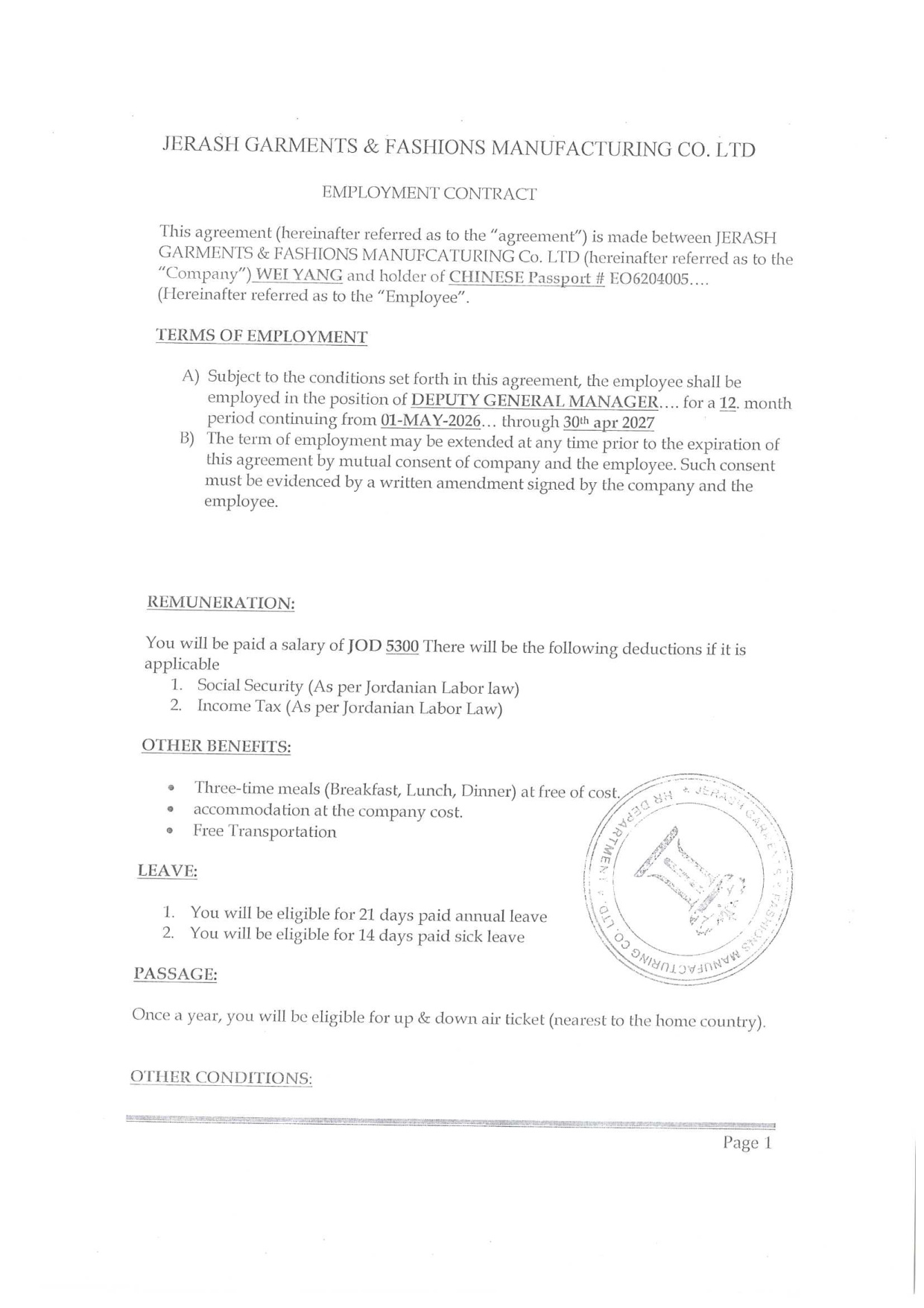
Exhibit 10.11
Factory Building Lease Contract
Contract No.: HDCYZBQ20250049
Place of contract signing: Xinhui District, Jiangmen City
Party A (Lessor): Guangdong Huadian Technology Industry Co., Ltd.
Party B (Lessee): Jiangmen Treasure Success Business Consultancy Co., Ltd.
Based on the principles of equality, good faith, and mutual benefit, Party A and Party B have reached a consensus through consultation and entered into this contract regarding Party B’s lease of Party A’s factory premises.
I. Basic Information Regarding the Lease
1. Leased Address: Party A leases to Party B the western area of the first floor workshop and part of the second and third floors workshop (hereinafter referred to as the Factory Building) located at No. 3, Jinhua Road, Huicheng, Xinhui District, Jiangmen City (Building 2). (See Annex 1 for details).
2. Lease Term: The lease term for the factory building is 5 years, from January 1, 2026 to December 31, 2030.
3. Leased Area: The total leased building area of the factory is 4100 square meters. The first floor has a building area of 2300 square meters, the second floor has a building area of 1700 square meters, and the third floor has a building area of 100 square meters.
4. Rental Fees: The first-year rental fee is RMB 17.36 per square meter per month for the first floor, RMB 15 per square meter per month for the second floor, and RMB [missing information] for the third floor. The rent is 9.25 yuan per square meter per month, and the rent increases annually starting from the second year. 3% The aforementioned property management fee includes the cost of public facilities such as sanitation and landscaping around the factory.
5. Payment method: Rental fee is calculated based on... Monthly payments shall be made by Party B to Party A via bank transfer before the 12th of each month, and Party A shall issue a VAT invoice with the applicable tax rate.
6. Security Deposit: When Party A and Party B signed this contract, Party B paid Party A a security deposit of RMB 180,000 for the factory building rental and a prepayment of RMB 30,000 for water and electricity fees in one lump sum.
7. Other expenses: Party B shall be responsible for paying the water and electricity fees for the leased factory, equipment installation (excluding the main water meter, main electricity meter, and transformer equipment installed by Party A), or related expenses such as repair, maintenance, and replacement required for its own operation. The specific amount of water and electricity fees shall be calculated based on the water and electricity meter readings. Party B shall reply to confirm the meter readings for the previous month before the 6th of each month; otherwise, it shall be deemed as default. Party B shall settle the water, electricity, and other expenses for the previous month with Party A before the 12th of each month.
| Huadian Science and Technology Park --- Lease Agreement |
Water and electricity fees will be charged according to the Huadian Science and Technology Park’s pricing standards (subject to further notice if electricity fees are adjusted), and VAT invoices for water and electricity fees at the applicable tax rate will be issued. The calculation method is as follows:
① The electricity fee charged by Party B = (actual electricity consumption during peak, off-peak, and low-peak periods x the electricity supply bureau’s charging standards for peak, off-peak, and low-peak periods respectively) + 3% loss cost of total electricity consumption + Party B’s capacity expansion fee (23 yuan * 400 kWh of electricity capacity = 9200 yuan);
If Party B needs to increase its electricity capacity due to expanded production in the future, it may submit a written application to Party A in advance, and the resulting costs shall be negotiated by both parties.
② The water fee for Party B = Party B’s monthly water consumption in tons * 4.05 yuan/ton;
8、During the lease term, Party A will provide Party B with the right to use 5 parking spaces (locations designated by Party A) free of charge. Party B shall use the parking spaces reasonably and shall not park unsuitable vehicles arbitrarily. Party A only provides parking spaces to Party B for use and is not responsible for the safekeeping and management of Party B’s vehicles. If Party B needs to add parking spaces in the future, Party B shall negotiate with Party A, and both parties shall sign a parking space lease agreement at that time.
9、The account information of Party A is as follows:
Bank of account: *
Account Name: *
Bank account number: *
II. Purpose of Lease
Party B promises to Party A that the leased factory building will be used for design, production, processing, sales, and other purposes. Party B shall adhere to the principle of “whoever operates, manages,” and comply with relevant regulations on factory building use and property management, ensuring lawful and ethical business operations. If Party B needs to add other uses or change the purpose of the leased factory building, it must obtain Party A’s written consent and, as required, obtain approval from the relevant authorities. Otherwise, it shall be considered a breach of contract by Party B, and Party A shall have the right to terminate this contract in advance.
III. Rights and Obligations of Party A
1. Party A shall deliver the factory building to Party B on January 1, 2026. Party B shall sign a handover confirmation form on the day of entry.
2. During the lease term, if Party B discovers any structural damage or malfunction in the factory building during normal use, Party B shall promptly notify Party A for repair. Party A shall carry out repairs as soon as possible after receiving Party B’s notification. If the damage is not caused by Party B, Party A shall be responsible for the repair costs.
IV. Rights and Obligations of Party B
1. Party A will deliver the factory building to Party B in its current condition (including basic renovations, freight elevators, fire-fighting facilities, etc.). During the lease term, Party B shall bear the maintenance and repair costs of the freight elevator within the factory building and shall use and take good care of the leased factory building and its ancillary facilities. If the factory building and its ancillary facilities are damaged or malfunction due to Party B’s use, Party B shall be responsible for the repairs and bear the costs. If Party B refuses to repair, Party A may undertake the repairs on its behalf, and the costs shall be borne by Party B.
Page
| Huadian Science and Technology Park --- Lease Agreement |
2. During the lease term, Party B may renovate or add living and production facilities according to its own business characteristics (such as the main water meter and main electricity meter in the factory area being provided and installed by Party A, and Party B being responsible for the installation of all water and electricity branches in the factory buildings). However, in principle, the original building structure shall not be damaged. The plan must be approved by Party A and reviewed and approved by the relevant government departments. Party B shall be responsible for the relevant work such as applying to the government departments, on-site supervision and inspection, and final acceptance, and shall bear all costs.
3. During the lease term, Party A has the right to supervise Party B to ensure fire safety, security, environmental protection, and sanitation. Party B must strictly abide by the relevant regulations and rules of the “Fire Protection Law of the People’s Republic of China,” the “Environmental Protection Law of the People’s Republic of China,” and the “Production Safety Law of the People’s Republic of China” during the lease term, and actively carry out fire safety and environmental protection work; otherwise, Party B shall bear all responsibilities and losses arising therefrom.
4. During the lease term, Party B must strictly abide by Party A’s regulations regarding safety, fire prevention, and hygiene within the science park, as well as regulations concerning the entry and exit of personnel and materials. Party B is directly responsible for the safety, fire prevention, and hygiene of the factory building. During the lease term, Party B shall be responsible for any accidents such as fire or theft. Party B guarantees that its production supplies meet environmental protection requirements, that it will not store flammable or explosive materials, and that its production and operation will not endanger human health or pollute the environment.
5. If Party B needs to install billboards in public areas of the park, Party B must submit a written application and design to Party A in advance. Installation is only permitted after Party A’s approval. Party A will charge corresponding rent based on the size of the billboard.
6. During the lease term, Party B shall compensate Party A for any damage, fire, or reduction in value of the factory building caused by improper safekeeping; if the damage to the factory building endangers personal safety, Party A has the right to terminate this contract in advance and Party B shall bear all losses.
7. Party B shall pay the lease fee to Party A on time. After one year of lease, the lease fee shall increase by 3 % annually. The factory building charges are as follows:
Year 1 (January 1, 2026 to December 31, 2026) : ¥ 66,353 per month (of which rent is ¥ 39,811.8 and property management fee is ¥ 26,541.2).
Second year: (January 1, 2027 to December 31, 2027) Monthly fee: ¥ 68,343.59 (including rent of ¥ 41,006.15 and property management fee of ¥ 27,337.44).
Year 3: (January 1, 2028 to December 31, 2028) Monthly fee : ¥ 70,393.9 (including rent of ¥ 42,236.34 and property management fee of ¥ 28,157.56).
Year 4 (January 1, 2029 to December 31, 2029): Monthly fee of ¥ 72,505.71 (including rent of ¥ 43,503.43 and property management fee of ¥ 29,002.28).
Fifth year: (January 1, 2030 to December 31, 2030) Monthly fee: ¥ 74,680.89 (including rent of ¥ 44,808.53 and property management fee of ¥ 29,872.36).
V. Liability for Breach of Contract
1. Liability for Late Payment: Party B shall pay Party A the amount and date stipulated in the contract. If payment is overdue, Party A shall have the right to charge Party B a penalty of one-thousandth of the total outstanding rental fee per day. If Party B fails to pay the rental fee for more than 30 consecutive days, Party A shall have the right to terminate the contract at any time, take back the factory, confiscate the rental deposit already paid by Party B, and Party B shall move out unconditionally and pay the outstanding balance. In addition, Party B shall pay Party A a penalty equivalent to three months’ rental fee (based on the rental fee of the last month of the lease term).
Page
| Huadian Science and Technology Park --- Lease Agreement |
If Party B fails to pay the water and electricity fees within 10 days of the due date, Party A has the right to deduct the amount directly from the prepayment for water and electricity fees. After the deduction, Party B shall still be required to make up the prepayment for water and electricity fees as stipulated in this contract. If the water and electricity fees are insufficient to cover the deduction, and Party B still fails to fulfill its payment obligations after being urged by Party A, Party A will suspend water and electricity services until Party B pays all outstanding fees to Party A.
2. Party B shall not store items or production equipment weighing more than 0.75 tons/square meter in the factory building. If Party B violates this provision, Party A shall have the right to demand that Party B restore the factory building to its original condition or compensate for the losses.
3. If Party B changes the use of the factory building, renovates the factory building, or adds ancillary facilities without Party A’s written consent or beyond the scope and requirements of Party A’s written consent, Party A has the right to terminate the contract at any time, take back the factory building, and Party B shall move out unconditionally and compensate for the losses.
4 If Party B sublets to a third party (including its affiliated companies) without Party A’s written consent, Party A has the right to terminate the contract at any time, confiscate Party B’s paid lease deposit, and take back the factory and all facilities. Party B shall move out unconditionally and compensate for the losses.
5. During the lease term, if either party terminates the lease early, they must give the other party three months’ notice. If Party B terminates this contract without authorization, unless otherwise agreed upon by mutual agreement, Party B shall pay Party A a penalty equivalent to three months’ rent (the rent shall be calculated based on the unit price of the fifth year). However, Party A shall return the lease deposit and the remaining rent to Party B. If Party A terminates this contract without authorization or takes back the factory early due to debt problems arising from the mortgage of the factory, Party A shall return the lease deposit and the remaining rent to Party B without mutual agreement.
If Party B terminates the lease early, Party A has the right to deduct an amount equal to the penalty from the lease deposit. If the lease deposit is insufficient to cover the penalty, Party B shall pay the remaining penalty to Party A. In this case, Party B shall return the original receipt for the lease deposit to Party A for processing. If Party A terminates the lease early and reclaims the factory building, Party A shall, in addition to paying Party B a penalty equal to three months’ rent (calculated based on the rent of the last month of the lease term), refund the lease deposit and any remaining rent (if any) to Party B without interest.
VI. Conditions for Termination of this Contract
1. Both parties agree that this contract shall automatically terminate and neither party shall be liable for any of the following circumstances during the lease term:
(i) The land use rights within the area occupied by the factory building were legally reclaimed in advance;
(ii) The factory building was legally requisitioned for the public interest;
(iii) The factory building has been legally included in the scope of the factory building demolition permit due to urban construction needs;
(iv) The factory building is damaged, destroyed, or identified as a dangerous building;
(v) The occurrence of force majeure that renders this contract impossible to perform;
(vi) The government decides to expropriate the land and demolish it.
2. Both Party A and Party B agree that either party may terminate this contract by giving written notice to the other party under any of the following circumstances: The breaching party shall pay the non-breaching party a penalty equal to double the monthly rental fee (based on the monthly rental fee of the last year). If the penalty is insufficient to compensate the non-breaching party for its losses, the breaching party shall also compensate for any additional losses incurred.
(i) If Party B changes the use of the factory building without Party A’s consent, resulting in damage to the factory building; (ii) Damage to the main structure of the factory building caused by Party B;
Page
| Huadian Science and Technology Park --- Lease Agreement |
(iii) Party B sublets the factory building without authorization or exchanges the factory buildings it leases with others;
(iv) If Party A fails to perform its obligations under this contract, causing Party B’s production to be unable to proceed normally and resulting in losses for Party B;
(v) The factory building was mortgaged before it was leased out and is now being disposed of;
(vi) Except where the conditions for termination of this Contract are met, this Contract shall be deemed irrevocable or terminated;
(vii) Party B shall comply with the relevant provisions of the attached “Safety Production Responsibility Agreement for Leased Factory Building” and “Huadian Science and Technology Park Property Management Convention”. If Party B violates the relevant provisions and the situation is serious, Party A shall have the right to terminate the contract.
VII. Termination of Contract
1. Upon expiration of the lease term, Party A has the right to reclaim the factory premises and will notify Party B one month in advance so that Party B can make arrangements accordingly. Party B shall vacate and return the factory premises on time and ensure that the factory premises are in good condition (including decoration work, excluding normal wear and tear), and at the same time settle all fees payable by Party B and sign a eviction confirmation. If Party B wishes to continue to lease the factory premises, it shall submit a written request for renewal to Party A three months before the expiration of the lease term. Upon Party A’s consent, a new lease contract shall be signed. If Party A re-leases the factory premises upon expiration of the lease term, Party B shall have priority under the same conditions.
2. Upon expiration of the lease term or termination of the contract by both parties, Party B may dispose of any movable items purchased by itself. However, Party B shall not remove or damage any facilities within the structural walls of the house (such as wall cabinets, electrical wires, fire extinguishing facilities, etc.), and Party A shall not provide any compensation to Party B. If removal is required, Party A’s written consent is required; otherwise, Party B shall be responsible for all repair costs incurred by Party A.
3. If either party breaches the contract, rendering the contract impossible to continue, both parties shall determine a specific date for termination and sign a “Termination Agreement.” Party B must keep the security deposit and utility prepayment receipts safe. Upon presentation of the original receipts, Party A will refund the security deposit and utility prepayment to Party B based on the actual circumstances.
VIII. Other Terms and Conditions
1. Any matters not covered in this contract may be supplemented by a supplementary agreement reached through mutual consultation between Party A and Party B. All supplementary agreements and annexes to this contract are integral parts of this contract.
2. Both Party A and Party B, upon signing this contract, clearly understand their respective rights, obligations, and responsibilities, and agree to strictly abide by the provisions of this contract. If either party breaches this contract, the other party shall have the right to claim compensation in accordance with the provisions of this contract. The breaching party shall also bear the costs incurred in realizing its rights, including litigation fees, arbitration fees, preservation fees, preservation insurance fees, attorney fees, notary fees, appraisal fees, travel expenses, and other expenses incurred in realizing its rights.
3. Any dispute arising between Party A and Party B during the performance of this contract shall be resolved through negotiation. If negotiation fails, either party may file a lawsuit in the People’s Court of the place where the contract was signed.
Page
| Huadian Science and Technology Park --- Lease Agreement |
4. This contract is made in duplicate, with each party holding one copy, both copies having equal legal effect.
Attachment 1: Factory building drawings.
Appendix 2: Safety Production Responsibility Agreement for Leased Factory Buildings
Appendix 3: Property Management Convention of Huadian Science and Technology Park
Party A: Guangdong Huadian Technology Industry Co., Ltd.
Address: No. 3, Jinhua Road, Huicheng, Xinhui District, Jiangmen City
Contact number: 0750-6628219
Date: Year Month Day
Party B: Jiangmen Treasure Success Business Consultancy Co., Ltd.
Date: Year Month Day
Page
Exhibit 10.19
| SOFR Revolving Facility Agreement | or any branch to which these facilities are transferred |
Branch: Al-Jweideh |
 |
| Facility No. / ........…………: Customer ID: .................................. Agreement Date: / / | |||
|
Party One: ))Housing Bank for Trade and Finance(( ))the Bank (( Represented by: 1 - …………………………………………… -2 .......................................................... |
|||
| Party Two: ))Borrower(s(( | Proof of Identity Document | ||
| Type | Number | Place and Date of Issuance | |
| Jerash Garment and Fashion Manufacturing Company LLC | Company Information Register | 200058338 |
Ministry of Industry and Trade 11/26/2000 |
| Group 3 (Guarantors) | |||
The parties mentioned above have agreed and accepted the following:
| 1 | The amount of the revolving credit facility granted to the Second Party by the First Party and guaranteed by the Third Party shall be: (14,000,000) U.S. dollars (fourteen million U.S. dollars only). |
| 2 | This facility is used to finance purchases and sales pertaining to the second group. The borrower undertakes to use this facility for this purpose and bears sole responsibility for using this facility for other purposes other purposes. This facility authorizes the borrower to reuse the amounts repaid from the principal of this facility, subject to the facility’s limit, and the borrower is not entitled to draw from this facility except for this purpose. |
| 3 | As security for the facility granted, its overdrafts, interest, and fees, the Borrower/Guarantor pledges the following collateral in favor of the Bank: |
| ● | Mortgage of Plot No. (1326) in the Abu Suwana Basin (No. 3) in the Al-Raqim area / South Amman First-Class Lands in favor of the First Team in the amount of (5,500,000) (dinars) only five million five hundred thousand dinars (as security for all facilities granted to the Second Party, including interest, commissions, and until full repayment). |
The Borrower/Guarantor agrees that this pledge shall serve as security for the facilities granted to the Borrower or to be granted in the future, whether in the form of an overdraft account and/or a demand account, or any type of loan or advance, and/or discounted bills, and/or guarantees and/or documentary credits and/or acceptances and/or letters of guarantee and/or credit cards and any other banking facilities, and secures any extension or renewal of the foregoing.
| 4 | A- | The second party agrees that the outstanding loan balance shall bear interest at a rate of 6-month SOFR plus a margin of 2.5%, with a minimum of 4% per annum, calculated on the outstanding balance. The daily interest on the loan is recorded in the account on the interest due date, and the higher of the face value or the balance is subject to a commitment fee of ( - )% per annum, payable in advance in accordance with the bank’s instructions. Interest and fees accruing on the loan pursuant to the bank’s records and accounts are considered an integral part of the loan. |
| B. | Interest and fees shall be paid monthly. |
| 5 | a. | The term of this facility is indefinite and is reviewed for renewal on December 1 of each year. b. Sales financing: |
| 1. | The credit line is used exclusively to finance incoming credits and outgoing bills issued through the first team (pre-shipment). |
| 2. | Financing of 90% of the value of the received letter of credit or issued bill of exchange, provided that the financing is used to issue letters of credit (at sight + 120-day deferred) and money orders and checks to second-tier suppliers, supported by invoices and claims. |
| 3. | Each financing transaction is repaid in full within a maximum of 6 months, either in installments or in a single payment. |
| 4. | The incoming letter of credit must be supported, and the transaction must be conducted with the first party. |
| 5. | Waiver of appropriations funded through the ceiling. |
| Contract System 37 (2020/3) | |
| c. | Allow Team Two to utilize the credit line to finance its purchases under the following conditions: |
| 1. | Financing 75% of purchase orders received from Team Two’s clients. |
| 2. | : Authorize the issuance and financing of letters of credit (sight/120-day deferred) and the guarantee and financing of incoming bills of exchange (sight/120-day deferred). 3. Require a cash deposit of 2.5% for letters of credit (deferred + sight). |
| 5. | Financing for credit lines and letters of credit shall be at a rate of 97.5%, provided that financing for purchase orders does not exceed 75%. .5 Each financing transaction shall be repaid in six equal monthly installments from the date of financing or in a single lump sum after six months. |
| 6. | : Transfer the sales proceeds from Team 2 customers whose purchase orders are financed pursuant to a letter or email to Team 2’s account, on a general and ongoing basis. |
| 7. | Provide Team One with a letter/email from Team Two regarding its customers for whom purchase orders are to be financed, for the purpose of transferring the proceeds of all sales to Team Two’s bank account on a general and permanent basis. |
| 8. | Incoming purchase orders (Order Purchases) must not be older than 3 months from the date of financing. |
| 9. | Commissions for letters of credit and collection bills shall be as follows: (Commission for issuing letters of credit and settling bills) 0.25% per period / (Withdrawal commission) 0.25% per period, i.e., 1% annually / (Bill guarantee commission) 1% annually. |
| (h) | The utilized balance of the revolving credit line, credit facilities, and letters of credit shall not exceed (14,000,000) U.S. dollars (fourteen million U.S. dollars only) at any time. |
| 6 | A. | The first party shall, depending on the type of currency, open the secured account and maintain it in the name of the second party, which shall be responsible for it at the time of settlement of payments, installments, and the amounts due for the interest owed and its installments In addition to details of any amounts owed by the second party, and that the cash, personal, or in-kind guarantees secured for the second party’s obligations shall remain in effect and secure such obligations, notwithstanding their deposit in any account in the name of the second party, regardless of its type. |
| B. | The account described in paragraph (A) of this Article shall be the final reference for determining the amounts owed by the Second/Third Party and required to be paid by them, and the Second/Third Party shall waive their right to challenge the bank’s records and entries, which shall be considered conclusive evidence against them. |
| 7 | Upon the signing of this Agreement, the fulfillment of its terms and conditions, and the opening of the account in the name of the Second Party, the credit facility granted to the Second Party shall become available for use by the Second Party in accordance with the terms and conditions of this Agreement. |
| 8 | In the event that the Second Party requests the cancellation of the entire facility or any part thereof after the signing of this Agreement, it shall be obligated to pay a commission of 2% of the amount to be canceled to cover the expenses incurred in arranging and negotiating this facility and terminating the Agreement. |
| 9 | In the event that the arrangement or any portion thereof, including interest, commissions, and other expenses, becomes due and remains unpaid, the second/third party shall be obligated to pay the first party a late payment penalty at a rate of 15% of the value The amounts due include interest and any fees applicable to the facilities; partial months shall be considered full months for the purposes of calculating late payment interest until full payment is made, without prejudice to the Bank’s right to take all legal measures it deems appropriate to recover its debt and enforce its rights in full. |
| Contract System 37 (2020/3) | |
| 10 | The Lender shall have the right to review the continuation of these facilities on December 1 of each year and shall have the right, at its sole discretion, to suspend these facilities and terminate this Agreement at any time without stating the reasons therefor and without regard to the term of the facilities, and to deem such facilities immediately due and payable and require the Borrower and the Guarantor to repay all amounts owed, together with interest, commissions, or any other expenses due. |
| 11 | The second and third parties, jointly and severally, undertake to pay their obligations, including interest, commissions, and any expenses, which shall be deemed an integral part of the principal debt, and they authorize the second party First, by debiting the amount from the facility account and/or any other account held with the Bank or any of its branches (whether such account is already open or opened specifically for this purpose) (These expenses include, but are not limited to, stamp, postage, and transportation costs; telephone, telegram, and fax charges; currency exchange differences; all other commissions, fees, and penalties of any kind; all other bank charges; attorneys’ fees regardless of the venue of the case; and all court costs of any kind related to the facility, directly or indirectly, to which the interest rates and commissions applicable to the facility shall apply. |
| 12 | The first party shall be entitled to offset balances between the accounts of the second and third parties and/or to transfer balances from one account to another, including the transfer of the total credit facility to The right to set off and/or withhold any amount due or to become due to them, whether held by the First Party or by any other person, until their rights are satisfied; the signature of the Second and Third Parties on this Agreement shall be deemed to constitute prior authorization for the First Party to take such actions at any time it deems appropriate, provided that all cash and/or real estate and/or in-kind and/or personal guarantees to facilitate payment shall remain in effect as is until full payment is made. |
| 13 | The consent of Party A to allow Party B to exceed the credit limit specified in this Agreement does not constitute a vested right for Party B to continue such excess. Party B undertakes to repay the amount of the excess, along with interest, commissions, and expenses, as soon as the first party demands payment from the second party, without the need for prior notice or notification; and the third party’s joint and several guarantee shall be deemed to cover the excess over The credit limit granted to the Second Party; the Third Party hereby authorizes the First Party in advance, without the need to notify or consult the Third Party, to grant any credit exceeding the credit limit to the Second Party, and any such excess shall be subject to the provisions of this Agreement. |
| 14 | The borrower and the guarantor acknowledge and agree that the bank’s books and accounts shall be conclusive evidence of the amounts due or to become due from them to the bank under this facility, together with any interest, commissions, and expenses thereon, and they declare that the bank’s entries and accounts are final and binding upon them, and each of them agrees to regard letters, telegrams, telexes, microfilms, computer printouts, photocopies, faxes, and emails provided by the Bank regarding its files, records, entries, books, and accounts as legal means of proof and as conclusive evidence of the accuracy of their contents, and they further waive in advance any legal right that would permit them to request the production and/ or audit the Bank’s accounts and records by any court, and they waive their right to request the production of the Bank’s books, records, or any documents, copies, printouts, microfilms, telexes, or faxes pertaining to the Bank in connection with the facility granted before any authority whatsoever. |
| 15 | The Second Party and the Third Party acknowledge that any request, notice, or communication that the First Party wishes to serve upon them or either of them regarding any matter related to this facility shall be deemed to have been served upon them or either of them if sent by regular mail, delivered by hand, or sent by fax, telex, or email to the address selected by each of them as set forth in this Agreement or to the last address known to the Bank. |
| 16 | The Second Party undertakes to transfer to the First Party all its receivables and proceeds from projects funded by the First Party, provided that the transfer is notarized by a notary public; the First Party shall have full discretion to consider these receivables and proceeds as full or partial payment of the facility or any other obligations owed by the Second Party. |
| Contract System 37 (2020/3) | |
| 17 | The Second and Third Parties acknowledge and agree that all of their movable and immovable property owned by them is free from any dispute and/or counterclaim, and that they are not subject to any lien, security interest, or mortgage that diminishes or impairs the value of the security provided in favor of the First Party. They also acknowledge that such assets are free from any obligations and third-party rights, except as expressly permitted, including financial and commercial assets, shares and their derivatives, precious metals, goods, and any other rights and/or assets belonging to them that are in the possession of the First Party, delivered to it, or deposited with it, as security and guarantee for the payment of all obligations incurred by the Second Party toward the First Party without the need for a specific acknowledgment thereof, whereby the First Party shall be entitled to collect such funds and record their value or proceeds in favor of the facility as payment of the debt, interest, and commissions. |
| 18 | and expenses incurred by it and payable by the Second and Third Parties, and they shall not be entitled under any circumstances to claim from the First Party any compensation, loss or damage that may arise. |
The Second Party authorises the First Party, upon receipt of the documents relating to the credits and their verification and confirmation of compliance with the credit terms,to transfer the documents to a clearance company selected by the First Party and/or the Second Party for the purposes of clearing the goods under the letter of credit and depositing them in the name of the Housing Bank for Trade and Finance at the Housing Bank for Trade and Finance’s bond and/or any other bond approved by the First Party.
| 19 | The Second Party agrees to pledge the goods covered by the documentary credits as a possessory pledge in favour of the First Party, and the Second Party hereby acknowledges, under this contract, the creation of a possessory pledge in favour of the First Party in the legal sense over the goods covered by the credits as security for the repayment of the facility and all its ancillary costs, including interest, commissions and expenses. The Second Party further acknowledges that these goods are owned by it free from any disputes, objections or claims by any third party. |
| 20 | The Second Party shall be entitled, with the consent of the First Party, to withdraw the goods stored in the bonded warehouse either in instalments or in full, provided that the value of the goods withdrawn and the resulting interest and commissions are paid into the account of this facility granted for this purpose prior to delivery. |
| 21 | The Second Party shall bear the storage costs and fees incurred in respect of the goods stored in the bonded warehouse, as well as any customs duties and/or any other fees or taxes of whatever nature that may be levied on the goods. |
| 22 | The Second and Third Parties each confirm the accuracy of the following facts: |
| a. | That they have the authority to enter into this agreement and are authorized to exercise all rights and fulfill all obligations set forth herein, and that they have taken all necessary steps to arrange, sign, and execute it. |
| b. | That he has not and will not breach or renounce any of his obligations under any contract to which he is a party, and that there are no pending lawsuits in court or arbitration proceedings that could threaten his existence or his assets or have negative consequences for its business or assets. |
| c. | That it will not enter into any obligations that would affect its obligations under this Agreement or impair its ability to fulfill the obligations arising therefrom or imposed upon it thereunder. |
| d. | That it is not necessary for the legality, validity, or enforceability of this Agreement, or for its presentation as legally admissible evidence in any legal proceedings, to be registered with any authority or agency in the Hashemite Kingdom of. |
| Contract System 37 (2020/3) | |
| 23 | Each borrower and guarantor hereby undertakes, from the date of signing this agreement until the full repayment of their obligations regarding the principal, interest, or fees of the facility, to comply with the following: |
| a. | To use the facility exclusively for the purposes for which it was granted. |
| b. | Not to make any changes to their fundamental circumstances without the knowledge and prior written consent of the Lender. |
| c. | To preserve his movable and immovable assets throughout the term of this Agreement and to maintain them in good condition; the Borrower shall bear all costs and expenses incurred by the Lender prior to or after the granting of this facility for the inspection and monitoring of his assets. |
| d. | That he shall not breach or waive his obligations under any agreement to which he is a party. |
| e. | Payment of the stamp duties arising from this Agreement. |
| f: | To pay all fees, taxes, and returns of any kind that are due or will become due on the (Borrower’s) assets to any government or private entity throughout the term of this Agreement |
| g. | Not to encumber any of its assets with a lien or obtain any other financing facility without the prior written consent of the Lender; any lien or financing agreement entered into or created by the Borrower in violation of this provision shall be deemed a breach of this Agreement. |
| h: | To use any cash surpluses resulting from better-than-expected cash flow to reduce the facility. |
| i. | Not to merge in any form with or into any company, or to change its legal status, or to amend its articles of association, memorandum of association, or authorized signatories, or to make any other changes to its legal status for any reason whatsoever, except with the prior written consent of the First Team. |
| 24 | A. | It is agreed that all deposit accounts and other accounts opened by the borrower and/ or the guarantor with the Bank or with any branch of the Housing Bank for Trade and Finance, and all amounts in these accounts, shall be pledged in favor of the Bank as security for it, and that the Bank is authorized by the Borrower and the Guarantor to debit any amounts at any time from those accounts to settle the amounts owed by the Borrower under this Agreement. This authorization entitles the Bank to exercise the aforementioned right repeatedly and on multiple occasions without the need to obtain the prior consent of the borrower and the guarantor or either of them. |
| Contract System 37 (2020/3) | |
| B. | All accounts opened in the name of the borrower and/or guarantor, or that may be opened in the future, with the Bank or any branch of the Housing Bank for Trade and Finance in any currency These accounts are mutually guaranteed, such that the Bank is entitled to withhold the credit balance of any of these accounts from the borrower and/or guarantor until the debit balance of the account subject to this Agreement or any other account in debt has been repaid. The Bank may deduct the credit balance in any account to settle the debit balance of the account subject to this Agreement or the debit balance of any other account. The Bank is also entitled to consolidate or merge all or any of the borrower’s or guarantor’s open accounts into a single account or to offset the debit and credit balances attributable to them. |
| C. | The Borrower and the Guarantor authorize the Bank to credit to the account all amounts held in deposit and/or pledged and/or provided by them or either of them as cash collateral for banking facilities without the need to obtain further consent from the Borrower and/or the Guarantor, and the Bank shall have the absolute right to refuse any withdrawal from the aforementioned amounts until the facilities covered by this Agreement have been repaid in full. |
| 25 | A. | If this agreement is signed by more than one person acting as a borrower or guarantor, all signatories shall be jointly and severally liable to the bank, individually and collectively, for the repayment of the amounts owed to the Bank under this Agreement. |
| (b) | Since this agreement consists of several pages, the parties’ signature on the last page shall be deemed to constitute a signature on all pages thereof, and neither the borrower nor the guarantor shall be entitled to contest any page of this agreement on the grounds that it was not signed. |
| (c) | The signature of the Borrower and the Guarantor on this Agreement shall constitute a power of attorney, consent, waiver, and delegation by them and by each of them in all cases where the text of any provision of this Agreement refers to consent, power of attorney, transfer, or waiver. |
| 26 | The Second Party and the Third Party agree to consider the Facility immediately due and payable and/or the First Party’s right to cease payment of undisbursed amounts and reduce the nominal value of the Facility and/or subject |
The maximum interest and commission rates shall apply if either or both parties commit any of the following violations: -
| a- | Using all or part of the facility for purposes other than those for which it was granted, or |
| b. | Failure to pay any installment of the financing transaction, any amount due on its due date, or any interest amount, or. |
| c. | Providing any incorrect information and/or concealing any information when applying for the facility, or. |
| d. | Failure to preserve the various types and forms of collateral provided as security for the First Party’s debt; or |
| e. | Failure to notify the First Party in writing of any damage or loss to the collateral pledged or reserved in its favor and provided as security for its debt within one week at the latest from the date of such damage or loss; or |
| f. | Breach of any term or provision of this Agreement and/or the First Party’s applicable instructions, or. |
| g. | Failure by the borrower or guarantor to fulfill any financial obligations that may arise for either of them with the Housing Bank for Trade and Finance or with a third party. |
| h. | In the event that the mortgage is released, in whole or in part, from the mortgaged collateral for the purpose of selling it to recover its value and reduce the obligations of the second party, and the sale is not executed for any reason whatsoever. |
The mere occurrence of any of the above violations, or knowledge thereof, entitles the First Party to take any action it deems appropriate to enforce its rights without the need to issue a warning or notice thereof.
| Contract System 37 (2020/3) | |
| 27 | The Second Party and the Third Party acknowledge that they have reviewed the Bank’s instructions and regulations and agree to comply with all the terms, covenants, and obligations contained therein and in this Agreement; furthermore, they agree to be bound by any amendments made to the aforementioned instructions and regulations. |
| 28 | The Second and Third Parties agree to the jurisdiction and competence of the General Court to hear any dispute, controversy, or claim arising out of or relating to this Agreement, as they agree in advance to the selection of the to any court to hear any dispute, claim, or demand arising from this Agreement, and they waive in advance their right to object to the jurisdiction and competence of the court chosen by the first party, and that the law governing this Agreement is Jordanian law. |
| 29 | A. | The Third Party guarantees, jointly and severally, the Second Party under this Agreement and any amendments thereto, for the full repayment of the Facility, its interest, commissions, and any expenses that arise therefrom. This is an absolute joint and several guarantee, unrestricted by any condition, covering any extension, overrun, amendment, or rescheduling of this facility or any other amendments approved by the First Party based on The second party requested in writing (without the need to sign an addendum to the facilitation agreement). Furthermore, the third party hereby authorizes the first party in advance, without any reservation and without the need for a signature or consent, to carry out any extension, overrun, rescheduling, or amendment requested by the second party and approved by the first party, even if it is found that the second party lacked legal capacity prior to signing the agreement or lost it thereafter, or or exceeded the limits of its authority to borrow, as well as if the Second Party is a company and its articles of incorporation, bylaws, name, or partners have been changed, in which case the Third Party’s liability shall remain in full force and effect and its obligation to the First Party shall remain outstanding until the full and complete repayment of all its obligations and the current and future obligations of the Second Party. |
| B. | The Third Party acknowledges that this joint and several guarantee is also considered an additional, independent, and separate guarantee and cannot be affected by any other insurance, guarantees, or sureties currently held by the First Party or that it may obtain from or on behalf of the Borrower, and the Guarantor considers itself bound by this guarantee permanently and continuously, notwithstanding anyamount paid to the First Party |
| c. | For the purposes of this Agreement, the guarantor shall be deemed a principal debtor; therefore, the guarantor’s liability shall not be discharged for any reason whatsoever unless all obligations owed by the borrower to the Bank have been paid in full. |
| d. | The guarantor forfeits the right to claim discharge if it becomes impossible for him to subrogate the bank’s rights, whether due to an act by the bank or for any other reason. |
| (e) | The guarantor agrees that the Bank shall not be bound by any legal provision requiring the Bank to sue the borrower before suing the guarantor, and the guarantor hereby waives in advance the right to sue the borrower before the Bank sues the guarantor. |
| (f) | If the guarantor’s guarantee terminates for any reason, the guarantor’s liability to the Bank for all of the borrower’s obligations shall remain in full force and effect as of the date of termination of the guarantee. Such obligations shall be deemed a net debt due and payable, and the Bank shall be entitled to demand immediate payment from the guarantor, including taking the necessary legal measures to secure such payment. |
| (g) | It is agreed that the Bank shall be entitled to continue its dealings with the Borrower under this Agreement notwithstanding the termination of the Guarantor’s guarantee; in such a case, any amounts credited to the Borrower’s account shall not constitute repayment of the Guarantor’s debt, Under all circumstances, the guarantor shall not be released from liability as a result of any payments made to the account after the expiration of the guarantee or as a result of the Bank obtaining any guarantees from any kind, whether from the borrower or on his behalf. |
| Contract System 37 (2020/3) | |
| 30 | The bank calculates interest on amounts credited to the borrower as of the date of crediting or the due date, whichever comes first. For the purposes of calculating the pricing instrument, the historical lookback method is applied (one day for loans with equal installments, calculated for the period preceding the interest period, and applied in advance(, and for five days for loans with unequal installments) to determine the interest rate. As for amounts recorded for the borrower, interest is not charged on them until the due date, in accordance with the Bank’s instructions. |
| 31 | If the account balance becomes a credit balance, the Bank shall not be required to pay interest to the borrower for as long as the balance remains a credit balance. |
| 32 | The bank is entitled at any time to open one or more sub-accounts for the borrower in order to designate the sub-account for a specific project or a specific banking transaction; the bank is also entitled to close the sub-account at any time and transfer any balance therein to the main account. |
| 33 | This agreement does not grant the borrower an absolute right to use the full amount of the facility, and the bank reserves the right at any time to refuse to accept or disburse any withdrawal from this facility. |
| 34 | The Bank shall be entitled at any time, whether it has filed a lawsuit against the borrower, the guarantor, or both, during the proceedings, before or after the judgment is rendered, to sell any movable or immovable property pledged or secured as collateral for this facility, as well as any other property it is permitted to sell, and the Bank shall credit the proceeds of the sale to the account. Both the borrower and the guarantor hereby declare that they irrevocably and unconditionally waive in advance any legal or contractual right that would permit either or both of them to object to the sale or request its suspension until a final judgment is issued against them or against either of them, The Bank shall be entitled, while enforcing its rights against the movable and immovable property belonging to the Borrower or the Guarantor, to bring an action in court against the Borrower and the Guarantor, and both the Borrower and the Guarantor hereby waive in advance any right that would permit them to challenge or object to the filing of such actions. |
| 35 | It is agreed that, for as long as this agreement remains in effect and until all amounts owed to the bank have been paid in full, the bank shall have a commercial lien and a general lien on the funds belonging to the borrower and/or the guarantor, including sums of money, goods, bonds, commercial and financial shares, and precious metals, whether in the form of coins or otherwise, which are at any time in the possession of the Bank, under its protection or authority, or delivered to it, deposited, or registered in the name of either or both of them, as security for any amounts or obligations due or arising now or that may become due or arise in the future on the part of the borrower, ) For the purposes of this paragraph, the term “Bank” includes the branches of the Housing Bank for Trade and Finance . Accordingly, both the Borrower and the Guarantor authorize the Bank to dispose of all or part of the aforementioned funds or to sell them in the manner it deems appropriate and at the price it deems appropriate, without the need for prior notice or warning and without consulting the Borrower or or the guarantor to obtain their prior consent or the consent of either of them, and without applying to the courts for permission or an order to sell, and the Bank shall credit the proceeds of the sale to the account. |
| 36 | In addition to the powers and rights of the Bank set forth in this Agreement, the Bank shall be entitled to and may exercise any rights and/or powers granted to it by law and banking and commercial customs and its instructions. |
| 37 | If at any time any provision of this Agreement is found to be in violation of one or more legal provisions, such violation shall not invalidate the remaining provisions of the Agreement, and the Agreement shall remain in full force and effect as if the violation had not occurred. |
| 38 | The Borrower and the Guarantor hereby declare that they irrevocably and unconditionally waive, in favor of the Bank, the exercise of all rights and defenses that they would otherwise be entitled to exercise against the Bank. |
| 39 | This agreement shall be deemed valid and binding, with no defect therein, in all or any of the following cases: |
| a. | If the Bank agrees to enter into this Agreement solely between itself and the Borrower without the Guarantor, even if the Guarantor’s name is mentioned in the preamble without the Guarantor’s signature; in such a case, the provisions of this Agreement regarding the Guarantor shall not apply, and the Guarantor’s failure to sign shall be deemed the Bank’s consent to the Agreement without a Guarantor. |
| (b) | If the preamble to the agreement states that there is more than one borrower, and the number of persons signing as borrowers is fewer than the number of names listed in the preamble, the signatures shall prevail; the borrower shall be deemed to be only the person or persons who signed, and no deficiency in the signatures shall be invoked. |
| c. | If the preamble to the agreement states that there is more than one guarantor, and the number of persons signing as guarantors is fewer than the number of names listed in the preamble, the signatures shall prevail; the guarantor shall be deemed to be only the person who signed or only the guarantors who signed, and no deficiency in the signatures shall be invoked. |
| Contract System 37 (2020/3) | |
| D- | If the person who signed this agreement on behalf of the borrower or in his stead does not have the authority to sign on behalf of the borrower or to bind him to the terms of the agreement, this shall not affect the validity of the guarantor’s obligation, who voluntarily and of his own free will declares that his liability remains in full force and effect toward the bank, without the guarantor having the right to disclaim this liability for any reason whatsoever Furthermore, the signature of the person who signed the agreement on behalf of the borrower as described above remains personally binding on the bank, without prejudice to the bank’s interests or detracting from its right to seek recourse against the borrower on whose behalf or in whose place the signature was made. |
| (e) | If the person who signed this agreement on behalf of or in the name of the guarantor does not have the authority to sign on behalf of the guarantor or to bind the guarantor to the guarantee, his or her signature shall be personally binding on the bank, without prejudice to the bank’s right to seek recourse against the guarantor in whose name or on whose behalf the agreement was signed. |
| f. | - If there are multiple borrowers under this agreement and the obligation of any one of them is canceled or voided for any reason, this shall not affect the validity of the agreement or the obligations of the remaining borrowers. The agreement shall remain in full force and effect as if the cancellation or voiding had never occurred, and the remaining borrowers shall remain jointly and severally liable for the repayment of this facility, including interest and fees until full repayment. |
| g- | If there are multiple guarantors under this agreement and the obligation of any one of them is canceled or voided for any reason, this shall not affect the validity of the agreement or the obligations of the remaining guarantors. |
The agreement shall remain in full force and effect as if the cancellation or voiding had not occurred, and the remaining guarantors shall remain jointly and severally liable for the repayment of this facility, including any accrued interest and commissions until full repayment.
| 40 | The Bank shall have the right to verify that the Borrower allocates and uses the financing granted under this Agreement for the purpose or purposes for which it was granted, by all means it deems appropriate and sufficient, including, without limitation, the following: |
and monitoring by the Bank’s specialized department. The Bank may request that the borrower provide it with any financial data and reports it deems necessary from time to time, failing which the aforementioned financing may be suspended.
| 41 | If the borrower or guarantor is a company or a sole proprietorship, the liability of the partners or owners of the business and their guarantee shall remain in full force and effect as a permanent liability and guarantee, regardless of any change or amendment to the company’s articles of incorporation or its bylaws or partners, including the conversion of the company from one type to another, and regardless of any change in the name or owner of the business. |
| 42 | The Bank shall be entitled, at any time it deems appropriate, to assign and/or transfer its rights and/or any or some of its rights to any party it deems suitable, whether such party is a third party, a successor, or more than one party, Whether individually or collectively, and whether through an affiliated or non-affiliated entity, the Bank may, with all or some of the insurance policies secured for it, and without the need for the consent of the beneficiary, guarantor, or any other party,the lender/guarantor’s consent, provided that the transfer is valid as soon as it is concluded between the Bank and the transferee, regardless of whether they are aware of it or not. The lender and the borrower/guarantor shall be bound by all the duties, obligations, and conditions stipulated and agreed upon between the borrower/and the Bank, as the guarantor, is an original party to the agreement from the moment of its signing, within the limits of the transfer amount and its associated interest, commissions, and fees. |
| 43 | The second and third parties authorize the first party to provide any information or documents relating to the banking facilities granted to the second party to any third party legally entitled to access, request, and/or audit such information or documents. |
Information regarding the automated clearing house (ACH) as the primary account auditor and/or the bank’s account auditor, and/or the exchange of information to provide the data necessary for the safety of the issuance of credit or the collection of returned checks, and/or any other actions deemed necessary by the Central Bank in relation to the safety of the banking system, including between the first account and the bank and/or the Central Bank and any other companies and/or entities approved by the Central Bank to facilitate the exchange of such information, and/or as a basis for the first party to rely on all or part of the information pertaining to the second and third parties to establish the first party’s rights in a legal dispute between it and the second and third parties regarding banking facilities.
| Contract System 37 (2020/3) | |
| 44 | The second and third parties agree that the first party is entitled to change the currency of the loan from a foreign currency to the Jordanian dinar, to amend the repayment mechanism, and to change the account number under which the loan is managed. |
Through this and by adjusting the pricing mechanism applied to the loan, and in the event of non-compliance with the second clause regarding the provision of external cash flows in foreign currency to cover the value of the installments and interest due on them for the period up to the first clausein accordance with the relevant instructions of the Central Bank of Jordan, and/or in the event that they are not the source of cash flows from outside the Kingdom, provided that the first team notifies them in writing of the amendments and changes made to the loan and the manner of its administration by the first team, The amendments referred to in this Article shall take effect from the date of issuance of the notice, and the amendment of the account number shall not affect the continuity of the loan and the debt owed by the Second Party, guaranteed by the Third Party, and shall in no way imply the expiration of the debt and/or the termination of the obligation, but rather its continuation and extension for corrective purposes in accordance with the specified conditions, without prejudice to the guarantees provided under the loan agreement and/or its addenda.
| 45 | The Second Party and the Third Party hereby undertake, for the purpose of fulfilling their obligations under this Agreement: - |
| A | – The borrower chooses his place of residence in .............................................. as his legal domicile. |
| B | – The guarantor chooses his place of residence in .......................................................... as his domicile for legal purposes |
| C. | The agreement assumes the use of the electronic system .......................................................... The User acknowledges that the electronic mail address provided is valid and legally binding and agrees to receive any information and/or transactions and/or communications and/or notifications via email from the First Party. |
| 46 | The First Party shall be entitled to amend the interest rates, commissions, and margins at such time as it deems appropriate, and shall also be entitled to amend the terms of their payment, the method of their calculation, and the type of interest applicable to the facility at any time by means of a written notice sent to the Second Party; such amendment shall take effect as of the date of said notice or the date specified by the First Party, provided that even if the Second Party does not receive the notice for any reason. |
| 47 | Other Additional Terms: |
| 1. | The Second Party undertakes the following: |
| A. | The budget allocated to the first team is no less than (7,000,000) U.S. dollars (exactly seven million U.S. dollars) annually. |
| b. | A margin of no less than twice the ceiling (i.e., US$28,000,000) (twenty-eight million U.S. dollars) from its customers’ sales proceeds into a cash security account for the first team, with the first team using the account to pay interest and installments based on the financing period of up to 6 months (, such that any amounts are released to the second team if there are no outstanding dues.) (t) All sales proceeds from Team 2’s customers, whose purchase orders are financed pursuant to a letter or email, shall be transferred to Team 2’s account on a general and permanent basis. (u) No additional borrowing or pledging of any of Team 2’s assets to any other party shall take place without the prior approval of Team 1. |
| c. | Profits shall not be distributed until the installments owed by Team Two have been covered. |
: No change in Jerash Holding Company’s ownership interest in the borrower shall occur without the Bank’s prior consent.
The parent company’s debt (or the partner’s current drawdown) shall not be repaid until prior approval is obtained from the Lender, and the amount shall not be less than its value as of (2025)
Subordination Debt: The term of the facilities
| 2. | The amount of (15,940,000) dinars, or fifteen million nine hundred forty thousand dinars as security for all facilities granted to the Second Group, including interest and commissions, until full repayment, provided that the policy remains in force. |
| Contract System 37 (2020/3) | |
| 48 | This agreement consists of a preamble and (48) clauses and was drawn up in three original copies, two of which are kept by the bank, and the second party has received a copy thereof. The borrower and the guarantor declare that each of them has read this agreement before signing it, that they have clearly understood and comprehended it, that they agree to all its contents, and that they are bound by its provisions asirrevocable and non-cancellable. Based on the foregoing, this agreement was signed in …………………… on ……/……/…………. |
|
Team First (the Bank) Housing
Bank for Trade and Finance |
The following |
|
The Second Party (the Borrower)
Jerash Garment and Fashion Manufacturing Company LLC |
In my/our capacity as authorized representative(s) signing on behalf of Jerash Garment and Fashion Manufacturing Co. LLC, registered under No. (6434) on (11/26/2000) pursuant to the certificate dated -------/------/------- |
Witnesses and guarantors: -
| Name | Identification Document | Registered Address | Signature | ||
| Type |
Number |
Place and Date of Issuance |
|||
| Contract System 37 (2020/3) | |
Exhibit 10.20
First
Party:
Bank of Jordan PLC / Owner of the “Capital Bank” trademark
Its address: 26 Suleiman Al-Nabulsi Street, Amman
P.O. Box: 941283, Amman 11194, Jordan
Hereinafter referred to as “the Bank”
Second
Party:
Jerash Garments and Fashion Manufacturing Company (Person / Entity)
National Number: [*]
Type: Limited Liability Company
Registration No.: [*]
Registration Date: 26/11/2000
Address:
City: Amman
Area: Sahab – Industrial City
Street: 60
(Other contact details not specified)
Hereinafter referred to as “the Borrower”
Third
Party:
Guarantor jointly and severally liable with the Borrower
(Person / Entity details not specified)
Hereinafter referred to as “the Guarantor”
Preamble
Whereas the Borrower has requested from the Bank a total credit facility in the amount of USD 7,500,000 (Seven Million Five Hundred Thousand US Dollars only), guaranteed jointly by the Third Party, for the purpose of financing incoming letters of credit;
And whereas the Bank has agreed to this request within the above limit and in accordance with the terms of this agreement; The parties have agreed as follows:
Article 1 – Definitions
| ● | “Bank”: Bank of Jordan PLC, including its head office and branches. |
| ● | “Borrower”: Any natural or legal person (singular or plural). |
| ● | “Guarantor”: Any natural or legal person (singular or plural). |
| ● | “Expenses”: Includes all fees, stamps, communication costs, legal fees, court costs, expert fees, currency differences, commissions, and any banking-related expenses. |
| ● | “Account”: The revolving loan account opened under this agreement. |
| ● | “Reference Interest Rate”: The international short-term lending rate between banks. |
| ● | “Agreement”: This contract including any amendments or renewals. |
| ● | Words in singular include plural and vice versa. |
Article 2 – Loan Terms
| ● | The Bank grants the Borrower a revolving loan of USD 7,500,000. |
| ● | Interest rate: SOFR (6 months) + 1.5%, with a minimum of 5% annually. |
| ● | Commission: as applicable (charged in advance). |
| ● | Commitment fee: 1% annually on unused amounts. |
| ● | Contract arrangement fee: 200 Jordanian Dinars. |
| ● | The Bank may increase interest by 1% if conditions are not met. |
| ● | Interest and commissions may be adjusted by the Bank without prior notice. |
| ● | Interest is calculated on daily debit balance and charged monthly. |
Article 3 – Drawdown and Repayment
| ● | Withdrawals are made through official drawdown notices. |
| ● | Financing covers up to 90% of incoming LCs (pre-shipment). |
| ● | Funds are used directly to pay suppliers or operating expenses. |
| ● | Repayment: within maximum 10 months, either in one or multiple installments. |
| ● | Interest is paid monthly. |
Article 4 – Default
If the Borrower fails to pay:
| ● | All amounts become immediately due. |
| ● | Additional 2% annual penalty interest applies on overdue amounts. |
Article 5 – Bank Discretion
| ● | The Borrower does not have absolute right to use the full limit. |
| ● | The Bank may refuse or reduce the facility at any time. |
Article 6 – Guarantees
| ● | All guarantees remain valid until full repayment. |
| ● | The Bank may request additional collateral within 30 days. |
| ● | Failure to comply allows the Bank to demand full repayment immediately. |
| ● | The Borrower bears all inspection, valuation, and legal costs. |
Article 7 – Account Statements
| ● | The Borrower must object within 15 days of receiving statements. |
| ● | Otherwise, statements are considered final and binding. |
Article 8 – Duration
| ● | The agreement is valid for one year, automatically renewable. |
| ● | The Bank may terminate at any time and demand full repayment. |
| ● | Legal action may be taken without prior notice. |
Article 9 – Bank Rights
| ● | The Bank has a general lien over all Borrower and Guarantor assets. |
| ● | It may: |
| ○ | Seize funds from accounts |
| ○ | Sell pledged assets |
| ○ | Offset balances between accounts |
| ● | No prior approval from Borrower or Guarantor is required. |
Article 10 – Assignment of Rights
| ● | The Borrower assigns all proceeds from financed contracts to the Bank. |
| ● | Cannot dispose of such rights without Bank approval. |
Article 11 – Monitoring
| ● | The Bank may verify use of funds. |
| ● | The Borrower must provide all documents and access. |
Article 12 – Additional Facilities
| ● | Any future facilities granted fall under this agreement. |
Article 13 – Declarations
The Borrower and Guarantor confirm:
| ● | Legal capacity to sign the contract |
| ● | Compliance with Jordanian laws |
| ● | No conflicting obligations |
| ● | All information provided is accurate |
If any information is false:
| ● | The Bank may close the account and demand full repayment plus damages. |
Article Fourteen
A. The Borrower undertakes, from the date of this agreement until full repayment of all obligations, to:
| 1. | Not make any changes to its core deposits, including financial deposits, without the Bank’s prior written approval. |
| 2. | Maintain its movable and immovable assets in good condition throughout the term of the agreement, and bear all inspection, evaluation, and monitoring costs incurred by the Bank. |
| 3. | Pay all stamp duties related to this agreement in accordance with applicable laws. |
| 4. | Insure, at its own expense, all movable and immovable assets against all risks for a value not less than the full facility amount, and assign to the Bank an amount equal to the facility from the insurance policy proceeds if required. |
| 5. | Not create any mortgage or obtain any banking facilities without prior written approval from the Bank; otherwise, this constitutes a breach of the agreement. |
| 6. | Provide annual audited financial statements with all required disclosures as requested by the Bank. |
| 7. | Use best efforts to develop environmental and social risk management systems to avoid harm to the environment and local communities. |
| 8. | Follow fair labor practices, including fair wages, safe working conditions, and non-discrimination. |
| 9. | Use resources (water, energy) efficiently and reduce pollution and waste. |
| 10. | Protect the health and safety of surrounding communities. |
| 11. | Avoid harm to nature and biodiversity; if unavoidable, minimize damage. |
| 12. | Protect historical and cultural sites. |
| 13. | Maintain communication with affected stakeholders and establish a complaint mechanism. |
| 14. | Notify the Bank in writing within 24 hours of any environmental or social legal claims. |
| 15. | Ensure suppliers comply with labor laws. |
| 16. | In case of death, bankruptcy, incapacity, or similar events affecting any guarantor, provide a replacement guarantor acceptable to the Bank. |
B. If the Borrower breaches any of the above, the Bank may immediately close the account and demand full repayment without prior notice.
Article Fifteen – Guarantor Obligations
A. The Guarantor irrevocably guarantees that the Borrower will fulfill all obligations and agrees to pay all amounts jointly and severally with the Borrower.
B. The guarantee covers all debts, liabilities, interest, commissions, and expenses, whether current or future.
C. The guarantee is independent and remains valid regardless of any other securities.
D. The Guarantor agrees to indemnify the Bank for any losses, even if the agreement becomes invalid for legal reasons.
E. The Bank is not required to pursue the Borrower before the Guarantor.
F. If the guarantee ends, the Guarantor remains liable for all existing obligations.
G. The Bank may continue dealing with the Borrower even after the guarantee ends without releasing the Guarantor.
Article Sixteen – Evidence
| ● | Bank records and statements are final and binding evidence. |
| ● | The Borrower and Guarantor waive the right to challenge them or request audits. |
| ● | Electronic records, copies, and communications are legally valid evidence. |
Article Seventeen
If the Borrower or Guarantor is a partnership or sole proprietorship, liability remains continuous regardless of structural changes.
Article Eighteen
If multiple Borrowers or Guarantors exist, they are jointly and severally liable.
Article Nineteen
Any overdraft or excess granted does not change the agreement terms, and the Bank may demand repayment at any time.
Article Twenty
| ● | Standard bank forms (e.g., letters of credit, guarantees) are part of this agreement. |
| ● | In case of conflict, the clause most favorable to the Bank applies. |
| ● | The Bank retains all legal and customary rights. |
Article Twenty-One – Notifications
| ● | Notices are valid if sent to the address stated in the agreement. |
| ● | Notification to one party is considered notification to all. |
| ● | Parties waive the requirement for notarized notices. |
Article Twenty-Two
| ● | Signing one page is considered signing the entire agreement. |
| ● | Signatures constitute full authorization and acceptance. |
Article Twenty-Three
| ● | The stated address is valid for all notices. |
| ● | Any change must be reported within 7 days. |
Article Twenty-Four – Governing Law
| ● | This agreement is governed by the laws of the Hashemite Kingdom of Jordan. |
| ● | Amman courts have jurisdiction. |
| ● | The Bank may file cases in any jurisdiction where the Borrower or Guarantor has assets. |
Article Twenty-Five – Assignment
| ● | The Borrower cannot assign rights without Bank approval. |
| ● | The Bank may assign its rights without prior consent. |
| ● | The Bank may disclose information for assignment purposes. |
Article Twenty-Six
| ● | Invalid clauses do not affect the rest of the agreement. |
| ● | Failure of the Bank to enforce any clause does not waive its rights. |
| ● | The Bank may investigate the Borrower and Guarantor’s assets. |
Article Twenty-Seven – Special Provisions
| ● | SOFR = Secured Overnight Financing Rate. |
| ● | If no guarantor exists, guarantor-related clauses are void. |
Final Clause
This agreement consists of 27 articles.
The Borrower and Guarantor confirm that they have read, understood, and fully agreed to all terms, and that the agreement is binding and irrevocable.
Signed on: 09 /04 / 2026
Borrower:
Jerash Garments & Fashion Manufacturing Co. LLC
Guarantor
Bank:
Bank of Jordan
Exhibit 19.1
Insider Trading Compliance Manual
Jerash Holdings (US), Inc.
Adopted June 12, 2026
In order to take an active role in the prevention of insider trading violations by its officers, directors, employees, consultants, advisors, and other related individuals, the Board of Directors (the “Board”) of Jerash Holdings (US), Inc., a Delaware corporation (the “Company”), has adopted the policies and procedures described in this Insider Trading Compliance Manual.
| I. | Adoption of Insider Trading Policy. |
Effective as of the date written above, the Company has adopted the Insider Trading Policy (the “Policy”), attached hereto as Exhibit A, which prohibits trading based on material, nonpublic information regarding the Company and its subsidiaries (“Inside Information”). The Policy covers all officers and directors of the Company and its subsidiaries, all other employees of the Company and its subsidiaries, all secretaries and assistants supporting such officers, directors, or employees and consultants or advisors to the Company or its subsidiaries who have or may have access to Inside Information and members of the immediate family or household of any such person. The Policy (and/or a summary thereof) is to be delivered to all new officers, directors, employees, consultants, advisors and related individuals who are within the categories of covered persons upon the commencement of their relationships with the Company, and is to be circulated to all covered personnel at least annually.
| II. | Designation of Certain Persons. |
A. Insiders All directors and executive officers of the Company, and any direct or indirect beneficial owner of 10% or more of any of the Company’s registered equity security of any class are deemed to be “Insiders” of the Company. Insiders of the Company are required to comply with the Section 16(a) reporting requirements of the Securities Exchange Act of 1934, as amended (the “Exchange Act”). Attached hereto as Exhibit B is a separate memorandum which discusses the relevant terms of Section 16 of the Exchange Act.
Under Sections 13(d) and 13(g) of the Exchange Act, and the Securities and Exchange Commission’s (the “SEC”) related rules, subject to certain exemptions, any person who after acquiring, directly or indirectly the beneficial ownership of the Company’s registered securities of any class, becomes, either directly or indirectly, the beneficial owner of more than 5% of such class (the “Section 13(d) Individuals”) must deliver a statement to the issuer of the security and to each exchange where the security is traded. Delivery to each exchange can be satisfied by making a filing on EDGAR. In addition, Section 13(d) Individuals must file with the SEC a statement containing certain information, as well as any additional information that the SEC may deem necessary or appropriate in the public interest or for the protection of investors. Attached hereto as Exhibit C is a separate memorandum which discusses the relevant terms of Section 13 of the Exchange Act.
B. Other Persons Subject to Policy. In addition, certain employees, consultants, and advisors of the Company as described in Section I above have, or are likely to have, from time to time access to Inside Information and together with the Insiders, are subject to the Policy.
| III. | Appointment of Chief Compliance Officer. |
The Company has appointed Gilbert K. Lee as the Company’s Chief Compliance Officer (the “Compliance Officer”).
| IV. | Duties of the Compliance Officer. |
The Compliance Officer has been designated by the Board to handle any and all matters relating to the Company’s insider trading compliance program. Certain of those duties may be delegated to outside counsel with special expertise in securities issues and relevant law. The duties of the Compliance Officer shall include the following:
A. Pre-clearing all transactions involving the Company’s securities by the Insiders and those individuals having regular access to Inside Information, defined for these purposes to include all officers, directors, and employees of the Company and its subsidiaries and members of the immediate family or household of any such person, in order to determine compliance with the Policy, insider trading laws, Section 13 and Section 16 of the Exchange Act and Rule 144 promulgated under the Securities Act of 1933, as amended. Attached hereto as Exhibit D is a Pre-Clearance Checklist to assist the Compliance Officer in the performance of his or her duties hereunder.
B. Assisting in the preparation and filing of Section 13(d) reports for all Section 13(d) Individuals although the filings are their individual obligations.
C. Serving as the designated recipient at the Company of copies of reports filed with the SEC by Section 13(d) Individuals under Section 13(d) of the Exchange Act.
D. Ensuring that all directors and officers of the Company have obtained the necessary EDGAR filing credentials (CIK, CCC, and password codes) to file Section 16(a) reports with the SEC.
E. Assisting in the preparation and filing of Section 16(a) reports for all directors and officers of the Company. The Compliance Officer shall maintain a system to track all transactions by directors and officers and assist with Form 4 filings.
F. Performing periodic reviews of available materials, which may include Schedule 13D, Schedule 13G, Form 3/4/5, Form 144, director and officer questionnaires, as applicable, and reports received from the Company’s stock administrator and transfer agent, to determine trading activity by officers, directors and others who have, or may have, access to Inside Information.
G. Circulating the Policy (and/or a summary thereof) to all covered employees, including the Insiders, on an annual basis, and providing the Policy and other appropriate materials to new officers, directors and others who have, or may have, access to Inside Information.
H. Assisting the Board in implementing the Policy and Sections I and II of this manual.
I. Coordinating with Company counsel regarding all securities compliance matters.
J. Retaining copies of all appropriate securities reports, and maintaining records of his or her activities as Compliance Officer.
ACKNOWLEDGMENT
I hereby acknowledge that I have received a copy of Jerash Holdings (US), Inc.’s Insider Trading Compliance Manual (the “Insider Trading Manual”). Further, I certify that I have reviewed the Insider Trading Manual, understand the policies and procedures contained therein and agree to be bound by and adhere to these policies and procedures.
| Dated: ____________________ | _____________________________________ |
| Name: |
Exhibit A
JERASH HOLDINGS (US), INC.
INSIDER TRADING POLICY
and Guidelines with Respect to Certain Transactions in Company Securities
SECTION I
APPLICABILITY OF POLICY
This Policy applies to all transactions in the Company’s securities, including common stock, options and warrants to purchase shares of common stock, and any other securities the Company may issue from time to time, such as preferred stock, and convertible debentures, as well as derivative securities relating to the Company’s stock, whether or not issued by the Company, such as exchange-traded options. It applies to all officers and directors of the Company, all other employees of the Company and its subsidiaries, all secretaries and assistants supporting such directors, officers, and employees, and consultants or advisors to the Company or its subsidiaries who have or may have access to Material Nonpublic Information (as defined below) regarding the Company and members of the immediate family or household of any such person. This group of people is sometimes referred to in this Policy as “Insiders.” This Policy also applies to any person who receives Material Nonpublic Information from any Insider.
Any person who possesses Material Nonpublic Information regarding the Company is an Insider for so long as such information is not publicly known.
SECTION II
DEFINITION OF MATERIAL NONPUBLIC INFORMATION
It is not possible to define all categories of material information. However, information should be regarded as “material” if there is a reasonable likelihood that it would be considered important to an investor in making an investment decision regarding the purchase or sale of the Company’s securities. Material information may be positive or negative. “Nonpublic information” is information that has not been previously disclosed to the general public and is otherwise not available to the general public.
While it may be difficult to determine whether particular information is material, there are various categories of information that are particularly sensitive and, as a general rule, should always be considered material. Examples of such information may include:
| ● | Financial results; |
| ● | Entry into a material agreement or discussions regarding entry into a material agreement; |
| ● | Projections of future earnings or losses; | |
| ● | Major contract awards, cancellations or write-offs; |
| ● | Joint ventures or commercial ventures with third parties; |
| ● | News of a pending or proposed merger or acquisition; |
| ● | News of the disposition of material assets; |
| ● | Impending bankruptcy or financial liquidity problems; |
A-
| ● | Gain or loss of significant line of credit; |
| ● | New business or services announcements of a significant nature; |
| ● | Stock splits; |
| ● | New equity or debt offerings; |
| ● | Significant litigation exposure due to actual or threatened litigation; |
| ● | Changes in senior management or the Board; |
| ● | Capital investment plans; and |
| ● | Changes in dividend policy. |
All of the foregoing categories of information and any similar information should be considered “Material Nonpublic Information” for purposes of this Policy. If there are any questions regarding whether a particular item of information is Material Nonpublic Information, please consult the Compliance Officer or the Company’s legal counsel before taking any action with respect to such information.
SECTION III
CERTAIN EXCEPTIONS
For purposes of this Policy, the Company considers that the exercise of stock options under the Company’s stock incentive plan (but not the sale of any such shares) is exempt from this Policy, since the other party to the transaction is the Company itself and the price does not vary with the market but is fixed by the terms of the option agreement or the plan.
SECTION IV
STATEMENT OF POLICY
General Policy
It is the policy of the Company to prohibit the unauthorized disclosure of any nonpublic information acquired in the workplace and the misuse of Material Nonpublic Information in securities trading.
Specific Policies
1. Trading on Material Nonpublic Information. With certain exceptions, no officer or director of the Company, no employee of the Company or its subsidiaries and no consultant or advisor to the Company or any of its subsidiaries and no members of the immediate family or household of any such person, shall engage in any transaction involving a purchase or sale of the Company’s securities, including any offer to purchase or offer to sell, during any period commencing with the date that he or she possesses Material Nonpublic Information concerning the Company, and ending at the close of business on the second Trading Day following the date of public disclosure of that information, or at such time as such nonpublic information is no longer material. However, see “Permitted Trading Period” below for a full discussion of trading pursuant to a pre-established plan or by delegation.
As used herein, the term “Trading Day” shall mean a day on which national stock exchanges are open for trading.
A-
2. Tipping. No Insider shall disclose (“tip”) Material Nonpublic Information to any other person (including family members) where such information may be used by such person to his or her profit by trading in the securities of companies to which such information relates, nor shall such Insider or related person make recommendations or express opinions on the basis of Material Nonpublic Information as to trading in the Company’s securities.
Regulation FD (Fair Disclosure) is an issuer disclosure rule implemented by the SEC that addresses selective disclosure. The regulation provides that when the Company, or person acting on its behalf, discloses material nonpublic information to certain enumerated persons (in general, securities market professionals and holders of the Company’s securities who may well trade on the basis of the information), it must make public disclosure of that information. The timing of the required public disclosure depends on whether the selective disclosure was intentional or unintentional: for an intentional selective disclosure, the Company must make public disclosures simultaneously; for a non-intentional disclosure, the Company must make public disclosure promptly. Under the regulation, the required public disclosure may be made by filing or furnishing a Form 8-K, or by another method or combination of methods that is reasonably designed to effect broad, non-exclusionary distribution of the information to the public.
It is the Company’s policy that all communications with the press be handled through its CEO or investor/public relations firm. Please refer all press, analyst or similar requests for information to the Company’s CEO and do not respond to any inquiries without prior authorization from the Company’s CEO. If the Company’s CEO is unavailable, the Company’s CFO will fill this role.
3. Confidentiality of Nonpublic Information. Nonpublic information relating to the Company is the property of the Company and the unauthorized disclosure of such information (including, without limitation, via email or by posting on Internet message boards or blogs, anonymously or otherwise) is strictly forbidden.
4. Duty to Report Inappropriate and Irregular Conduct. All employees, and particularly executives, managers and/or supervisors, have a responsibility for maintaining financial integrity within the Company, consistent with generally accepted accounting principles and both federal and state securities laws. Any employee who becomes aware of any incidents involving financial or accounting manipulation or irregularities, whether by witnessing the incident or being told of it, must report it to their immediate supervisor and to the chairman of the Company’s Audit Committee of the Board (or to the Chairman of the Board, if an Audit Committee has not been established). For a more complete understanding of this issue, employees should consult their employee manual or seek the advice of the Company’s general counsel or outside counsel.
A-
SECTION V
POTENTIAL CRIMINAL AND CIVIL LIABILITY
AND/OR DISCIPLINARY ACTION
1. Liability for Insider Trading. Insiders may be subject to penalties of up to $5,000,000 and up to twenty (20) years in jail for engaging in transactions in the Company’s securities at a time when they possess Material Nonpublic Information regarding the Company, regardless of whether such transactions were profitable. In addition, the SEC has the authority to seek a civil monetary penalty of up to three times the amount of profit gained or loss avoided by illegal insider trading. “Profit gained” or “loss avoided” generally means the difference between the purchase or sale price of the Company’s stock and its value as measured by the trading price of the stock a reasonable period after public dissemination of the nonpublic information.
2. Liability for Tipping. Insiders may also be liable for improper transactions by any person (commonly referred to as a “tippee”) to whom they have disclosed Material Nonpublic Information regarding the Company or to whom they have made recommendations or expressed opinions on the basis of such information as to trading in the Company’s securities. The SEC has imposed large penalties even when the disclosing person did not profit from the trading. The SEC, the stock exchanges and the Financial Industry Regulatory Authority, Inc. use sophisticated electronic surveillance techniques to monitor all trades and uncover insider trading.
3. Possible Disciplinary Actions. Individuals subject to the Policy who violate this Policy shall also be subject to disciplinary action by the Company, which may include suspension, forfeiture of perquisites and ineligibility for future participation in the Company’s equity incentive plans and/or termination of employment.
SECTION VI
PERMITTED TRADING PERIOD
1. Black-Out Period and Trading Window.
To ensure compliance with this Policy and applicable federal and state securities laws, the Company requires that all officers, directors, employees, and all members of the immediate family or household of any such person refrain from conducting any transactions involving the purchase or sale of the Company’s securities, other than during the period in any fiscal quarter commencing at the close of business on the second Trading Day following the date of public disclosure of the financial results for the prior fiscal quarter or year and ending on the twenty-fifth day of the third month of the fiscal quarter (the “Trading Window”). Notwithstanding the foregoing, persons subject to this Policy may submit a request to the Company to purchase or sell the Company’s securities outside the Trading Window on the basis that they do not possess any Material Nonpublic Information. The Compliance Officer shall review all such requests and may grant such requests on a case-by-case basis if he or she determines that the person making such request does not possess any Material Nonpublic Information at that time.
If such public disclosure occurs on a Trading Day before the markets close, then such date of disclosure shall be considered the first Trading Day following such public disclosure. For example, if such public disclosure occurs at 1:00 p.m. EST on June 10, then June 10 shall be considered the first Trading Day following such disclosure.
A-
Please be advised that these guidelines are merely estimates. The actual trading window may be different because the Company’s quarterly report may be filed earlier or later. The filing date of a quarterly report may fall on a weekend or the Company may delay filing a quarterly report due to an extension. Please check with the Compliance Officer to confirm whether the trading window is open.
The safest period for trading in the Company’s securities, assuming the absence of Material Nonpublic Information, is generally the first ten Trading Days of the Trading Window. It is the Company’s policy that the period when the Trading Window is “closed” is a particularly sensitive period of time for transactions in the Company’s securities from the perspective of compliance with applicable securities laws. This is because officers, directors and certain other employees are, as any quarter progresses, increasingly likely to possess Material Nonpublic Information about the expected financial results for the quarter. The purpose of the Trading Window is to avoid any unlawful or improper transactions or even the appearance of any such transactions.
It should be noted that even during the Trading Window, any person possessing Material Nonpublic Information concerning the Company shall not engage in any transactions in the Company’s securities until such information has been known publicly for at least two Trading Days. The Company has adopted the policy of delaying trading for “at least two Trading Days” because the securities laws require that the public be informed effectively of previously undisclosed material information before Insiders trade in the Company’s stock. Public disclosure may occur through a widely disseminated press release or through filings, such as Form 8-K, with the SEC. Furthermore, in order for the public to be effectively informed, the public must be given time to evaluate the information disclosed by the Company. Although the amount of time necessary for the public to evaluate the information may vary depending on the complexity of the information, generally two Trading Days is a sufficient period of time.
From time to time, the Company may also require that directors, officers, selected employees, and others suspend trading because of developments known to the Company and not yet disclosed to the public. In such event, such persons may not engage in any transaction involving the purchase or sale of the Company’s securities during such period and may not disclose to others the fact of such suspension of trading.
Although the Company may from time to time require during a Trading Window that directors, officers, selected employees, and others suspend trading because of developments known to the Company and not yet disclosed to the public, each person is individually responsible at all times for compliance with the prohibitions against insider trading. Trading in the Company’s securities during the Trading Window should not be considered a “safe harbor,” and all directors, officers and other persons should use good judgment at all times.
Notwithstanding these general rules, Insiders may trade outside of the Trading Window provided that such trades are made pursuant to a pre-established plan or by delegation; these alternatives are discussed in the next section.
A-
2. Trading According to a Pre-established Plan or by Delegation.
Trading which is not “on the basis of” material non-public information may not give rise to insider trading liability. The SEC has adopted Rule 10b5-1 under which insider trading liability can be avoided if Insiders follow very specific procedures. In general, such procedures involve trading according to pre-established instructions (a “Pre-established Trade”).
Pre-established Trades must:
(a) Be documented by a contract, written plan, or formal instruction which provides that the trade take place in the future. For example, an Insider can contract to sell his or her shares on a specific date, or simply delegate such decisions to an investment manager, 401(k) plan administrator or similar third party. This documentation must be provided to the Compliance Officer;
(b) Include in its documentation the specific amount, price and timing of the trade, or the formula for determining the amount, price and timing. For example, the Insider can buy or sell shares in a specific amount and on a specific date each month, or according to a pre-established percentage (of the Insider’s salary, for example) each time that the share price falls or rises to pre-established levels. In the case where trading decisions have been delegated, the specific amount, price and timing need not be provided;
(c) Be implemented at a time when the Insider does not possess material non-public information. As a practical matter, this means that the Insider may set up Pre-established Trades, or delegate trading discretion, only during a “Trading Window” (discussed in Section 1, above); and,
(d) Remain beyond the scope of the Insider’s influence after implementation. In general, the Insider must allow the Pre-established Trade to be executed without changes to the accompanying instructions, and the Insider cannot later execute a hedge transaction that modifies the effect of the Pre-established Trade. An Insider wishing to change the amount, price or timing of a Pre-established Trade, or terminate a Pre-established Trade, can do so only during a “Trading Window” (discussed in Section 1, above). If the Insider has delegated decision-making authority to a third party, the Insider cannot subsequently influence the third party in any way and such third party must not possess material non-public information at the time of any of the trades.
Prior to implementing a pre-established plan for trading, all officers and directors must receive the approval for such plan from the Compliance Officer.
3. Pre-Clearance of Trades.
Even during a Trading Window, all officers, directors, employees, as well as members of the immediate family or household of such individuals, must comply with the Company’s “pre-clearance” process prior to trading in the Company’s securities, implementing a pre-established plan for trading, or delegating decision-making authority over the Insider’s trades. To do so, each officer and director must contact the Compliance Officer prior to initiating any of these actions. Trades executed pursuant to a properly implemented Pre-Established Plan approved by the Compliance Officer do not need to be pre-cleared. The Company may also find it necessary, from time to time, to require compliance with the pre-clearance process from certain individuals other than those mentioned above.
A-
4. Individual Responsibility.
As Insiders, every person subject to this Policy has the individual responsibility to comply with this Policy against insider trading, regardless of whether the Company has established a Trading Window applicable to that Insider or any other Insiders of the Company. Each individual, and not necessarily the Company, is responsible for his or her own actions and will be individually responsible for the consequences of their actions. Therefore, appropriate judgment, diligence and caution should be exercised in connection with any trade in the Company’s securities. An Insider may, from time to time, have to forego a proposed transaction in the Company’s securities even if he or she planned to make the transaction before learning of the Material Nonpublic Information and even though the Insider believes he or she may suffer an economic loss or forego anticipated profit by waiting.
5. Exceptions to the Policy.
Any exceptions to this Policy may only be made by advance written approval of each of: (i) the CEO, (ii) the Compliance Officer and (iii) the Chairman of the Audit Committee of the Board (or the Chairman of the Board of Directors if an Audit Committee has not been established). Any such exceptions shall be immediately reported to the remaining members of the Board.
SECTION VII
APPLICABILITY OF POLICY TO INSIDE INFORMATION
REGARDING OTHER COMPANIES
This Policy and the guidelines described herein also apply to Material Nonpublic Information relating to other companies, including the Company’s customers, vendors or suppliers or potential acquisition targets (“business partners”), when that information is obtained in the course of employment or performance of other services on behalf of the Company. Civil and criminal penalties, as well as termination of employment, may result from trading on inside information regarding the Company’s business partners. All employees should treat Material Nonpublic Information about the Company’s business partners with the same care as is required with respect to information relating directly to the Company.
SECTION VIII
PROHIBITION AGAINST BUYING AND SELLING
COMPANY COMMON STOCK WITHIN A SIX-MONTH PERIOD
Insiders
Generally, purchases and sales (or sales and purchases) of Company common stock occurring within any six-month period in which a mathematical profit is realized result in illegal “short-swing profits.” The prohibition against short-swing profits is found in Section 16 of the Exchange Act. Section 16 was drafted as a rather arbitrary prohibition against profitable “insider trading” in a company’s securities within any six-month period regardless of the presence or absence of material nonpublic information that may affect the market price of those securities. Each executive officer, director and 10% or greater stockholder of the Company is subject to the prohibition against short-swing profits under Section 16. The measure of damages is the profit computed from any purchase and sale or any sale and purchase within the short-swing (i.e., six-month) period, without regard to any setoffs for losses, any first-in or first-out rules, or the identity of the shares of common stock. This approach sometimes has been called the “lowest price in, highest price out” rule and can result in a realization of “profits” for Section 16 purposes even when the insider has suffered a net loss on his or her trades.
SECTION IX
INQUIRIES
Please direct your questions as to any of the matters discussed in this Policy to the Compliance Officer.
A-
Exhibit B
MEMORANDUM REGARDING SECTION 16 REPORTING REQUIREMENTS
SECTION I
INTRODUCTION
This memorandum summarizes the Section 16(a) reporting requirements of the Exchange Act, as they apply to directors, officers and beneficial owners of 10% of the Company.
SECTION II
PERSONS SUBJECT TO SECTION 16(A) REPORTING
Directors, officers, and beneficial owners of 10% or more of the Company’s equity securities who are not also directors or officers are required to comply with Section 16(a) reporting requirements. For purposes of Section 16, “officer” means the Company’s president, principal financial officer, principal accounting officer (or, if there is no such accounting officer, the controller), any vice-president in charge of a principal business unit, division or function (such as sales, administration or finance), any other officer who performs a policy-making function, or any other person who performs similar policy-making functions for the Company.
SECTION III
REPORTING OBLIGATIONS
Form 3 – Initial Statement of Beneficial Ownership. Each director and officer must file a Form 3 with the SEC via EDGAR within ten (10) days of becoming a director or officer of the Company.
Form 4 – Statement of Changes in Beneficial Ownership. Each director and officer must file a Form 4 with the SEC via EDGAR within two (2) business days following any change in beneficial ownership of the Company’s equity securities. Reportable transactions include, but are not limited to: (i) open market purchases and sales; (ii) acquisitions or dispositions pursuant to employee benefit plans; (iii) gifts; (iv) exercises of stock options; and (v) acquisitions of securities pursuant to equity compensation awards.
Form 5 – Annual Statement of Changes in Beneficial Ownership. Each director and officer must file a Form 5 with the SEC via EDGAR within forty-five (45) days after the end of the Company’s fiscal year to report all transactions that occurred during the previous fiscal year that are specifically permitted to be reported on a Form 5 or should have been reported on a Form 3 or Form 4 but were not.
B-
SECTION IV
BENEFICIAL OWNERSHIP
For purposes of Section 16(a) reporting, a person is deemed to be the beneficial owner of securities if that person has or shares a direct or indirect pecuniary interest in the securities. Pecuniary interest means the opportunity, directly or indirectly, to profit or share in any profit derived from a transaction in the securities. Beneficial ownership includes securities held by: (i) immediate family members sharing the same household; (ii) partnerships in which the reporting person is a general partner; (iii) corporations in which the reporting person is a controlling shareholder; and (iv) trusts of which the reporting person is a trustee or beneficiary.
SECTION V
EDGAR FILING REQUIREMENTS
All Section 16(a) reports must be filed electronically with the SEC via EDGAR. Each director and officer must obtain EDGAR filing credentials, including a Central Index Key (“CIK”), EDGAR access codes, and a password, prior to filing. The Company’s Compliance Officer will assist directors and officers in obtaining the necessary EDGAR credentials.
SECTION VI
PENALTIES FOR NON-COMPLIANCE
The SEC may bring enforcement actions against individuals who fail to comply with Section 16(a) reporting requirements, which may result in civil monetary penalties.
SECTION VII
COMPANY ASSISTANCE
The Company’s Compliance Officer will assist directors and officers in complying with Section 16(a) reporting requirements, including: (i) providing reminders of filing deadlines; (ii) assisting in the preparation of Forms 3, 4, and 5; (iii) coordinating with the Company’s stock administrator or transfer agent to track transactions; and (iv) facilitating the EDGAR filing process. Notwithstanding such assistance, each director and officer remains individually responsible for ensuring timely and accurate compliance with Section 16(a) reporting requirements.
SECTION VIII
QUESTIONS
Any questions regarding Section 16(a) reporting requirements should be directed to the Company’s Compliance Officer.
B-
Exhibit C
Section 13 Memorandum
| To: | Beneficial owners of more than 5% of the Company’s registered equity securities |
| Re: | Overview of Section 13 under the Exchange Act of 1934, as amended |
A. Introduction.
This Memorandum provides an overview of Section 13 of the Exchange Act of 1934, as amended (the “Exchange Act”), and the related rules promulgated by the SEC.
Each beneficial owner of more than 5% of the Company’s voting securities (including any Executive Officer or Director who reaches this threshold) (“Section 13 Reporting Persons”) of Jerash Holdings (US), Inc. (the “Company”) is personally responsible for complying with the provisions of Section 13, and failure by a Section 13 Reporting Person to comply strictly with his or her reporting requirements will result in an obligation by the Company to publicly disclose such failure. Moreover, Congress has granted the SEC authority to seek monetary court-imposed fines on Section 13 Reporting Persons who fail to timely comply with their reporting obligations.
Under Section 13 of the Exchange Act, reports made to the SEC are filed on Schedule 13D, Schedule 13G, Form 13F, and Form 13H. A securities firm (and, in some cases, its parent company or other control persons) generally will have a Section 13 reporting obligation if the firm directly or indirectly:
| ● | beneficially owns, in the aggregate, more than 5% of a class of the voting, equity securities (the “Section 13(d) Securities”): |
| ● | registered under Section 12 of the Exchange Act, |
| ● | issued by any closed-end investment company registered under the Investment Company Act of 1940, as amended (the “Investment Company Act”), or |
| ● | issued by any insurance company that would have been required to register its securities under Section 12 of the Exchange Act but for the exemption under Section 12(g)(2)(G) thereof (see Schedules 13D and 13G: Reporting Significant Acquisition and Ownership Positions below); |
| ● | manages discretionary accounts that, in the aggregate, hold equity securities trading on a national securities exchange with an aggregate fair market value of $100 million or more; or |
| ● | manages discretionary accounts that, in the aggregate, purchase or sell any NMS securities (generally exchange-listed equity securities and standardized options) in an aggregate amount equal to or greater than (i) 2 million shares or shares with a fair market value of over $20 million during a day, or (ii) 20 million shares or shares with a fair market value of over $200 million during a calendar month. |
C-
B. Reporting Requirements Under Section 13(d) and 13(g).
1. General. Sections 13(d) and 13(g) of the Exchange Act require any person or group of persons1 who directly or indirectly acquires or has beneficial ownership2 of more than 5% of a class of an issuer’s Section 13(d) Securities (the “5% threshold”) to report such beneficial ownership on Schedule 13D or Schedule 13G, as appropriate. Both Schedule 13D and Schedule 13G require background information about the reporting persons and the Section 13(d) Securities listed on the schedule, including the name, address, and citizenship or place of organization of each reporting person, the amount of the securities beneficially owned and aggregate beneficial ownership percentage, and whether voting and investment power is held solely by the reporting persons or shared with others. Reporting persons that must report on Schedule 13D are also required to disclose a significant amount of additional information, including certain disciplinary events, the source and amount of funds or other consideration used to purchase the Section 13(d) Securities, the purpose of the acquisition, any plans to change or influence the control of the issuer, and a list of any transactions in the securities effected in the last 60 days. A reporting person may use the less burdensome Schedule 13G if it meets certain criteria described below.
In general, Schedule 13G is available to any reporting person that falls within one of the following three categories:
| ● | Exempt Investors. A reporting person is an “Exempt Investor” if the reporting person beneficially owns more than 5% of a class of an issuer’s Section 13(d) Securities at the end of a calendar quarter, but its acquisition of the securities is exempt under Section 13(d)(6) of the Exchange Act. For example, a person that acquired all of its Section 13(d) Securities prior to the issuer’s registration of such securities (or class of securities) under the Exchange Act, or acquired no more than 2% of the Section 13(d) Securities within a 12-month period, is considered to be an Exempt Investor and would be eligible to file reports on Schedule 13G. |
| ● | Qualified Institutions. Along with certain other institutions listed under the Exchange Act3, a reporting person that is a registered investment adviser or broker-dealer may file a Schedule 13G as a “Qualified Institution” if it (a) acquired its position in a class of an issuer’s Section 13(d) Securities in the ordinary course of its business, (b) did not acquire such securities with the purpose or effect of changing or influencing control of the issuer, nor in connection with any transaction with such purpose or effect (such purpose or effect, an “activist intent”), and (c) promptly notifies any discretionary account owner on whose behalf the firm holds more than 5% of the Section 13(d) Securities of such account owner’s potential reporting obligation. |
| 1 | A “group” is defined in Rule 13d-5 as “two or more persons [that] agree to act together for the purpose of acquiring, holding, voting or disposing of equity securities of an issuer.” See, for example, the persons described above in Reporting Obligations of “Control Persons”. An agreement to act together does not need to be in writing and may be inferred by the SEC or a court from the concerted actions or common objective of the group members. |
| 2 | Under Rule 13d-3, “beneficial ownership” of a security exists if a person, directly or indirectly, through any contract, arrangement, understanding, or relationship or otherwise, has or shares voting power and/or investment power over a security. “Voting power” means the power to vote or direct the voting of a security. “Investment power” means the power to dispose of or direct the disposition of a security. Under current SEC rules, a person holding securities-based swaps or other derivative contracts may be deemed to beneficially own the underlying securities if the swap or derivative contract provides the holder with voting or investment power over the underlying securities. Please contact us if you would like guidance regarding the application of Section 13 to securities-based swaps or other derivative contracts. |
| 3 | Under Rule 13d-1, a reporting person also qualifies as a Qualified Institution if it is a bank as defined in Section 3(a)(6) of the Exchange Act, an insurance company as defined in Section 3(a)(19) of the Exchange Act, an investment company registered under the Investment Company Act, or an employee benefit plan, savings association, or church plan. The term “Qualified Institution” also includes a non-U.S. institution that is the functional equivalent of any of the foregoing entities and the control persons and parent holding companies of an entity that qualifies as a Qualified Institution. |
C-
| ● | Passive Investors. A reporting person is a “Passive Investor” if it beneficially owns more than 5% but less than 20% of a class of an issuer’s Section 13(d) Securities and (a) the securities were not acquired or held with an activist intent, and (b) the securities were not acquired in connection with any transaction having an activist intent. There is no requirement that a Passive Investor limit its acquisition of Section 13(d) Securities to purchases made in the ordinary course of its business. In addition, a Passive Investor does not have an obligation to notify discretionary account owners on whose behalf the firm holds more than 5% of such Section 13(d) Securities of such account owner’s potential reporting obligation. |
2. Method of Filing.
(a) A Section 13 Reporting Person must file Section 13 schedules in electronic format via the Commission’s Electronic Data Gathering Analysis and Retrieval System (“EDGAR”) in accordance with EDGAR rules set forth in Regulation S-T.
(b) Filing Date. Schedules are deemed filed with the SEC or the applicable exchange on the date recognized by EDGAR. For Section 13 purposes, filings may be made up to 10 p.m. EST. In the event that a due date falls on a weekend or SEC holiday, the filing will be deemed timely filed if it is filed on EDGAR by the next business day after such weekend or holiday. A Section 13 Reporting Person must first obtain several different identification codes from the SEC before the filings can be submitted. In order to receive such filing codes, the Section 13 Reporting Person first submits a Form ID to the SEC. The Form ID must be signed, notarized, and submitted electronically through the SEC’s Filer Management website, which can be accessed at https://www.filermanagement.edgarfiling.sec.gov. The Section 13 Reporting Person is required to retain a manually signed hard copy of all EDGAR filings (and related documents like powers of attorney) in its records available for SEC inspection for a period of five years after the date of filing.
(c) Company. In addition, the rules under Section 13 require that a copy of the applicable filing be sent to the issuer of the security at its principal executive office by registered or certified mail. A copy of Schedules filed pursuant to §§ 240.13d-1(a) and 240.13d-2(a) shall also be sent to each national securities exchange where the security is traded.
(d) Securities to be Reported. A person who is subject to Section 13 must only report as beneficially owned those securities in which he or she has a pecuniary interest. See the discussion of “beneficial ownership” below at Section D.
3. Initial Report of Ownership – Schedule 13D or 13G. Under Section 13, Section 13 Reporting Persons are required to make an initial report on Schedule 13D or Schedule 13G to the SEC of their holdings of all equity securities of the corporation (whether or not such equity securities are registered under the Exchange Act). This would include all traditional types of securities, such as ordinary shares, preferred shares and junior shares, as well as all types of derivative securities, such as warrants to purchase shares, options to purchase shares, puts and calls. Even Section 13 Reporting Persons who do not beneficially own any equity securities of the Company must file a report to that effect.
C-
(a) Initial Filing Deadline. A Section 13 Reporting Person who is not eligible to use Schedule 13G must file a Schedule 13D within five business days of such reporting person’s direct or indirect acquisition of beneficial ownership of more than 5% of a class of an issuer’s Section 13(d) Securities.
| ● | A reporting person that is an Exempt Investor is required to file its initial Schedule 13G within 45 days after the calendar quarter-end in which the person exceeds the 5% threshold. |
| ● | A reporting person that is a Qualified Institution also is required to file its initial Schedule 13G within 45 days after the calendar quarter-end in which the person exceeds the 5% threshold. However, a Qualified Institution that acquires direct or indirect beneficial ownership of more than 10% of a class of an issuer’s Section 13(d) Securities must file an initial Schedule 13G within five business days after the first month in which the person exceeds the 10% threshold. |
| ● | A reporting person that is a Passive Investor must file its initial Schedule 13G within five business days of the date on which it exceeds the 5% threshold. |
(b) Switching from Schedule 13G to Schedule 13D. If a Section 13 Reporting Person that previously filed a Schedule 13G no longer satisfies the conditions to be an Exempt Investor, Qualified Institution, or Passive Investor, the person must switch to reporting its beneficial ownership of a class of an issuer’s Section 13(d) Securities on a Schedule 13D (assuming that the person continues to exceed the 5% threshold). This could occur in the case of (1) a Section 13 Reporting Person that changes from acquiring or holding Section 13(d) Securities for passive investment to acquiring or holding such securities with an activist intent, (2) a Section 13 Reporting Person that is a Qualified Institution that deregisters as an investment adviser pursuant to an exemption under the Investment Advisers Act of 1940, as amended, or applicable state law, or (3) a Section 13 Reporting Person that is a Passive Investor that acquires 20% or more of a class of an issuer’s Section 13(d) Securities. In each case, the Section 13 Reporting Person must file a Schedule 13D within five business days of the event that caused it to no longer satisfy the necessary conditions.
A Section 13 Reporting Person who is required to switch to reporting on a Schedule 13D will be subject to a “cooling off” period from the date of the event giving rise to a Schedule 13D obligation (such as the change to an activist intent or acquiring 20% of a class of an issuer’s Section 13(d) Securities) until 10 calendar days after the filing of Schedule 13D. During the “cooling off” period, the reporting person may not vote or direct the voting of the Section 13(d) Securities or acquire additional beneficial ownership of such securities. Consequently, a person should file a Schedule 13D as soon as possible once he is obligated to switch from a Schedule 13G to reduce the duration of the “cooling off” period.
The Section 13 Reporting Person will thereafter be subject to the Schedule 13D reporting requirements with respect to the Section 13(d) Securities until such time as the former Schedule 13G reporting person once again qualifies as a Qualified Institution or Passive Investor with respect to the Section 13(d) Securities or has reduced its beneficial ownership interest below the 5% threshold. However, only a reporting person that was originally eligible to file a Schedule 13G and was later required to file a Schedule 13D may switch to reporting on Schedule 13G.4
| 4 | See Question 103.07 (September 14, 2009), Regulation 13D-G C&DIs. |
C-
4. Changes in Ownership – Amendments to Schedule 13D or 13G.
Amendments to Schedule 13D. If there has been any material change to the information in a Schedule 13D previously filed by a Section 13 Reporting Person5, the person must file an amendment to such Schedule 13D within two business days. A material change includes, without limitation, a reporting person’s acquisition or disposition of 1% or more of a class of the issuer’s Section 13(d) Securities, including as a result of an issuer’s repurchase of its securities. An acquisition or disposition of less than 1% may be considered a material change depending on the circumstances. A disposition that reduces a reporting person’s beneficial ownership interest below the 5% threshold, but is less than a 1% reduction, is not necessarily a material change that triggers an amendment to Schedule 13D. However, an amendment in such a circumstance is recommended to eliminate the reporting person’s filing obligations if the reporting person does not in the near term again expect to increase its ownership above 5%.
Amendments to Schedule 13G.
| ● | Quarterly. If a reporting person previously filed a Schedule 13G and there has been any material change to the information reported in such Schedule 13G as of the end of a calendar quarter, then an amendment to such Schedule 13G must be filed within 45 days of the calendar quarter end. A reporting person is not required to make a quarterly amendment to Schedule 13G if there has been no change since the previously filed Schedule 13G or if the only change results from a change in the person’s ownership percentage as a result of a change in the aggregate number of Section 13(d) Securities outstanding (e.g., due to an issuer’s repurchase of its securities). |
| ● | Other than Quarterly (Qualified Institutions). A reporting person that previously filed a Schedule 13G as a Qualified Institution reporting beneficial ownership of less than 10% of a class of an issuer’s Section 13(d) Securities, must file an amendment to its Schedule 13G within five business days of the end of the first month such Qualified Institution is the direct or indirect beneficial owner of more than 10% of a class of the issuer’s Section 13(d) Securities. Thereafter, within five business days after the end of any month in which the person’s direct or indirect beneficial ownership of such securities increases or decreases by more than 5% of the class of securities (computed as of the end of the month), the person must file an amendment to Schedule 13G. |
| ● | Other than Quarterly (Passive Investors). A reporting person that previously filed a Schedule 13G as a Passive Investor must file an amendment within two business days after it directly or indirectly acquires more than 10% of a class of an issuer’s Section 13(d) Securities. Thereafter, the reporting person must file an amendment to Schedule 13G within two business days after its direct or indirect beneficial ownership of such securities increases or decreases by more than 5%. |
5. Reporting Identifying Information for Large Traders - Form 13H. Rule 13h-1 of the Exchange Act requires a Form 13H to be filed with the SEC by any individual or entity (each, a “Large Trader”) that, directly or indirectly, exercises investment discretion over one or more accounts and effects transactions in NMS Securities (as defined below) for those accounts through one or more registered broker-dealers that, in the aggregate, equal or exceed (a) 2 million shares or $20 million in fair market value during any calendar day, or (b) 20 million shares or $200 million in fair market value during any calendar month (each, an “identifying activity level”). Under Regulation NMS, an “NMS Security” is defined to include any U.S. exchange-listed equity securities and any standardized options, but does not include any exchange-listed debt securities, securities futures, or shares of open-end mutual funds that are not currently reported pursuant to an effective transaction reporting plan under the Exchange Act. A Large Trader must file an initial Form 13H promptly after effecting aggregate transactions equal to or greater than one of the identifying activity levels. The SEC has indicated that filing within 10 days will be deemed a prompt filing. Amendments to Form 13H must be filed within 45 days after the end of each full calendar year and then promptly following the end of a calendar quarter if any of the information on Form 13H becomes inaccurate.
| 5 | This includes a change in the previously reported ownership percentage of a reporting person even if such change results solely from an increase or decrease in the aggregate number of outstanding securities of the issuer. |
C-
Form 13H requires that a Large Trader, reporting for itself and for any affiliate that exercises investment discretion over NMS securities, list the broker-dealers at which the Large Trader and its affiliates have accounts and designate each broker-dealer as a “prime broker,” an “executing broker,” and/or a “clearing broker.” Form 13H filings with the SEC are confidential and exempt from disclosure under the United States Freedom of Information Act. The information is, however, subject to disclosure to Congress and other federal agencies and when ordered by a court. If a securities firm has multiple affiliates in its organization that qualify as Large Traders, Rule 13h-1 permits the Large Traders to delegate their reporting obligation to a control person that would file a consolidated Form 13H for all of the Large Traders it controls. Otherwise, each Large Trader in the organization will be required to file a separate Form 13H.
6. Reporting Obligations of Control Persons and Clients.
The Firm’s Obligations. As discussed above, a securities firm is deemed to be the beneficial owner of Section 13(d) Securities in all accounts over which it exercises voting and/or investment power. Therefore, a firm will be a reporting person if it directly or indirectly acquires or has beneficial ownership of more than 5% of a class of an issuer’s Section 13(d) Securities. Unless a securities firm has an activist intent with respect to the issuer of the Section 13(d) Securities, the firm generally will be able to report on Schedule 13G as either a Qualified Institution or as a Passive Investor.
Obligations of a Firm’s Control Persons. Any control person (as defined below) of a securities firm, by virtue of its ability to direct the voting and/or investment power exercised by the firm, may be considered an indirect beneficial owner of the Section 13(d) Securities. Consequently, the direct or indirect control persons of a securities firm may also be reporting persons with respect to a class of an issuer’s Section 13(d) Securities. The following persons are likely to be considered “control persons” of a firm:
| ● | any general partner, managing member, trustee, or controlling shareholder of the firm; and |
| ● | the direct or indirect parent company of the firm and any other person that indirectly controls the firm (e.g., a general partner, managing member, trustee, or controlling shareholder of the direct or indirect parent company). |
If a securities firm (or parent company) is directly or indirectly owned by two partners, members, trustees, or shareholders, generally each such partner, member, trustee, or shareholder is deemed to be a control person. For example, if a private fund that beneficially owns more than 5% of a class of an issuer’s Section 13(d) Securities is managed by a securities firm that is a limited partnership, the general partner of which is a limited liability company that in turn is owned in roughly equal proportions by two managing members, then each of the private fund, the securities firm, the firm’s general partner, and the two managing members of the general partner likely will have an independent Section 13 reporting obligation.
C-
Availability of Filing on Schedule 13G by Control Persons. Any direct and indirect control person of a securities firm may file a Schedule 13G as an Exempt Investor, a Qualified Institution or as a Passive Investor to the same extent as any other reporting person as described above. In order for a control person to file a Schedule 13G as a Qualified Institution, however, no more than 1% of a class of an issuer’s Section 13(d) Securities may be held (i) directly by the control person or (ii) directly or indirectly by any of its subsidiaries or affiliates that are not Qualified Institutions. For example, a direct or indirect control person of a securities firm will not qualify as a Qualified Institution if more than 1% of a class of an issuer’s Section 13(d) Securities is held by a private fund managed by the firm or other affiliate because a private fund is not among the institutions listed as a Qualified Institution under the Exchange Act.
A securities firm that has one of its control persons serving on an issuer’s board of directors may not be eligible to qualify as a Passive Investor with respect to such issuer. Even though the securities firm may not otherwise have an activist intent, the staff of the SEC has stated “the fact that officers and directors have the ability to directly or indirectly influence the management and policies of an issuer will generally render officers and directors unable to certify to the requirements” necessary to file as a Passive Investor.6
Obligations of a Firm’s Clients. If a client of a securities firm (including a private or registered fund or a separate account client) by itself beneficially owns more than 5% of a class of an issuer’s Section 13(d) Securities, the client has its own independent Section 13 reporting obligation.
Availability of Joint Filings by Reporting Persons. As discussed above, each reporting person has an independent reporting obligation under Section 13 of the Exchange Act. The direct and indirect beneficial owners of the same Section 13(d) Securities may satisfy their reporting obligations by making a joint Schedule 13D or Schedule 13G filing, provided that:
| ● | each reporting person is eligible to file on the Schedule used to make the Section 13 report (e.g., each person filing on a Schedule 13G is a Qualified Institution, Exempt Investor, or Passive Investor); |
| ● | each reporting person is responsible for the timely filing of the Schedule 13D or Schedule 13G and for the completeness and accuracy of its information in such filing7; and |
| ● | the Schedule 13D or Schedule 13G filed with the SEC (i) contains all of the required information with respect to each reporting person; (ii) is signed by each reporting person in his, her, or its individual capacity (including through a power of attorney); and (iii) has a joint filing agreement attached. |
| 6 | See Question 103.04 (September 14, 2009), Exchange Act Sections 13(d) and 13(g) and Regulation 13D-G Beneficial Ownership Reporting Compliance and Disclosure Interpretations of the Division of Corporation Finance of the SEC (the “Regulation 13D-G C&DIs”). |
| 7 | If the reporting persons are eligible to file jointly on Schedule 13G under separate categories (e.g., a private fund as a Passive Investor and its control persons as Qualified Institutions), then the reporting persons must comply with the earliest filing deadlines applicable to the group in filing any joint Schedule 13G. |
C-
C. Determining Beneficial Ownership.
In determining whether a securities firm has crossed the 5% threshold with respect to a class of an issuer’s Section 13(d) Securities8, it must include the positions held in any proprietary accounts and the positions held in all discretionary client accounts that it manages (including any private or registered funds, accounts managed by or for principals and employees, and accounts managed for no compensation), and positions held in any accounts managed by the firm’s control persons (which may include certain officers and directors) for themselves, their spouses, and dependent children (including IRA and most trust accounts).
1. Determining Who is a Five Percent Holder. Beneficial ownership in the Section 13 context is determined by reference to Rule 13d-3, which provides that a person is the beneficial owner of securities if that person has or shares voting or disposition power with respect to such securities, or can acquire such power within 60 days through the exercise or conversion of derivative securities.
2. Determining Beneficial Ownership for Reporting and Short-Swing Profit Liability. For all Section 13 purposes other than determining who is a five percent holder, beneficial ownership means a direct or indirect pecuniary interest in the subject securities through any contract, arrangement, understanding, relationship or otherwise. “Pecuniary interest” means the opportunity, directly or indirectly, to profit or share in any profit derived from a transaction in the subject securities. Discussed below are several of the situations that may give rise to an indirect pecuniary interest.
(a) Family Holdings. A Section 13 Reporting Person is deemed to have an indirect pecuniary interest in securities held by members of the Section 13 Reporting Person’s immediate family sharing the same household. Immediate family includes grandparents, parents (and step-parents), spouses, siblings, children (and step-children) and grandchildren, as well as parents-in-laws, siblings-in-laws, children-in-law and all adoptive relationships. A Section 13 Reporting Person may disclaim beneficial ownership of shares held by members of his or her immediate family, but the burden of proof will be on the Section 13 Reporting Person to uphold the lack of a pecuniary interest.
(b) Partnership Holdings. Beneficial ownership of a partnership’s securities is attributed to the general partner of a limited partnership in proportion of such person’s partnership interest. Such interest is measured by the greater of the general partner’s share of partnership profits or of the general partner’s capital account (including any limited partnership interest held by the general partner).
(c) Corporate Holdings. Beneficial ownership of securities held by a corporation will not be attributed to its shareholders who are not controlling shareholders and who do not have or share investment control over the corporation’s portfolio securities.
| 8 | In calculating the 5% test, a person is permitted to rely upon the issuer’s most recent interim or annual report for purposes of determining the amount of outstanding voting securities of the issuer, unless the person knows or has reason to believe that such information is inaccurate. |
C-
(d) Derivative Securities. Ownership of derivative securities (warrants, share appreciation rights, convertible securities, options and the like) is treated as indirect ownership of the underlying equity securities. Acquisition of derivative securities must be reported. If the derivative securities are acquired pursuant to an employee plan, the timing of such reporting depends upon the Rule 16b-3 status of the employee plan under which the grant was made.
D. Delinquent Filings.
1. Correcting Late Filings. In the case of a Section 13 Reporting Person that has failed to make required amendments to its Schedule 13D or Schedule 13G in a timely manner (i.e., any material changes), the Section 13 Reporting Person must immediately amend its schedule to disclose the required information. The SEC Staff has explained that, “[r]egardless of the approach taken, the security holder must ensure that the filings contain the information that it should have disclosed in each required amendment, including the dates and details of each event that necessitated a required amendment.” However, the SEC Staff has also affirmed that, irrespective of whether a security holder takes any of these actions, a security holder may still face liability under the federal securities laws for failing to promptly file a required amendment to a Schedule 13D or Schedule 13G.
2. Potential Liability. The SEC may bring an enforcement action, in the context of a Schedule 13D or Schedule 13G filing, for violations of Section 13(d), Section 13(g), Rule 10b-5 and Section 10(b), provided that the SEC specifically shows: (1) a material misrepresentation or omission made by the defendant; (2) scienter on the part of the defendant; and (3) a connection between a misrepresentation or omission and purchase or sale of a security regarding the Rule 10b-5 claim it brings. The SEC may seek civil remedies in the form of injunctive relief, a cease-and-desist order, monetary penalties, and other forms of equitable relief (e.g., disgorgement of profits). Under Section 32 of the Exchange Act, criminal sanctions may also extend to the willful violation of Section 13(d) and Section 13(g). The U.S. Department of Justice, which prosecutes criminal offenses under the Exchange Act, may seek numerous penalties against any person that violates the Exchange Act and any rules thereunder, including a monetary fine of up to $5,000,000, imprisonment for up to 20 years and/or disgorgement.
C-
Exhibit D
Jerash Holdings (US), Inc.
Insider Trading Compliance Program - Pre-Clearance Checklist
Individual Proposing to Trade:_________________________
Number of Shares covered by Proposed Trade:_________________________
Date:_________________________
| ☐ | Trading Window. Confirm that the trade will be made during the Company’s “trading window.” |
| ☐ | Section 13 and Section 16 Compliance. Confirm, if the individual is subject to Section 13, that the proposed trade will not give rise to any potential liability under Section 13 as a result of matched past (or intended future) transactions. Also, ensure that an amendment to Schedule 13D or 13G has been or will be completed and will be timely filed. If the individual is a director or officer, confirm that a Form 4 will be filed within two (2) business days of the transaction. |
| ☐ | Prohibited Trades. Confirm, if the individual is subject to Section 13, that the proposed transaction is not a “short sale,” put, call or other prohibited or strongly discouraged transaction. |
| ☐ | Rule 144 Compliance. Confirm that: |
| ☐ | Current public information requirement has been met; |
| ☐ | Shares are not restricted or, if restricted, the six-month holding period has been met; |
| ☐ | Volume limitations are not exceeded (confirm that the individual is not part of an aggregated group); |
| ☐ | The manner of sale requirements has been met; and |
| ☐ | The Notice of Form 144 Sale has been completed and filed. |
| ☐ | Rule 10b-5 Concerns. Confirm that (i) the individual has been reminded that trading is prohibited when in possession of any material information regarding the Company that has not been adequately disclosed to the public, and (ii) the Compliance Officer has discussed with the individual any information known to the individual or the Compliance Officer which might be considered material, so that the individual has made an informed judgment as to the presence of inside information. |
| Signature of Compliance Officer |
D-
Transactions Report
| Officer or Director: |
I. TRANSACTIONS:
| ☐ | No transactions. | ☐ | The transactions described below. |
| Owner of Record | Transaction Date (1) |
Transaction Code (2) |
Security (Common, Preferred) |
Number
of Securities Acquired |
Number
of Securities Disposed of |
Purchase/ Sale Unit Price |
||||||||||||||||||
D-
| (1) | (a) | Brokerage transactions - trade date | (d) | Acquisitions under stock bonus plan date of grant |
| (b) | Other purchases and sales date firm commitment is made | (e) | Conversion date of surrender of convertible security | |
| (c) | Option and SAR exercises date of exercise | (f) | Gifts date on which gift is made |
| (2) | Transaction Codes: |
| (P) | Pre-established Purchase or Sale | (Q) | Transfer pursuant to marital settlement | |
| (N) | Purchase or Sale (not “Pre-established”) | (U) | Tender of shares | |
| (G) | Gift | (W) | Acquisition or disposition of will | |
| (M) | Option exercise (in the money option) | (J) | Other acquisition or disposition (specify) |
D-
| II. | SECURITIES OWNERSHIP FOLLOWING TRANSACTION |
| A. | Company Securities Directly or Indirectly Owned (other than stock options noted below): |
| Title of Security (e.g., Preferred, Common, etc.) |
Number of Shares/Units |
Record Holder (if not Reporting Person) |
Relationship to Reporting Person |
|||
| B. | Stock Option Ownership: |
| Date of Grant | Number of Shares | Exercise Price | Vesting Dates | Expiration Date | Exercises to Date (Date, No. of Shares) | |||||
D-
Exhibit 23.1
CONSENT OF INDEPENDENT REGISTERED PUBLIC ACCOUNTING FIRM
We consent to the incorporation by reference in the Registration Statements on Form S-3 (No. 333-258447, No. 333-264265, No. 333-231395 and No. 333-285163) and Form S-8 (No. 333-223916 and No. 333-255028) of our report dated June 18, 2026, with respect to the consolidated financial statements of Jerash Holdings (US), Inc. included in this Annual Report on Form 10-K for the year ended March 31, 2026.
/s/ CBIZ CPAs P.C.
Costa Mesa, CA
June 18, 2026
Exhibit 31.1
CERTIFICATION OF THE CHIEF EXECUTIVE OFFICER PURSUANT TO
SECTION 302 OF THE SARBANES-OXLEY ACT OF 2002
I, Choi Lin Hung, certify that:
| 1. | I have reviewed this report on Form 10-K of Jerash Holdings (US), Inc.; |
| 2. | Based on my knowledge, this report does not contain any untrue statement of a material fact or omit to state a material fact necessary to make the statements made, in light of the circumstances under which such statements were made, not misleading with respect to the period covered by this report; |
| 3. | Based on my knowledge, the financial statements, and other financial information included in this report, fairly present in all material respects the financial condition, results of operations and cash flows of the registrant as of, and for, the periods presented in this report; |
| 4. | The registrant’s other certifying officer(s) and I are responsible for establishing and maintaining disclosure controls and procedures (as defined in Exchange Act Rules 13a-15(e) and 15d-15(e)) and internal control over financial reporting (as defined in Exchange Act Rules 13a-15(f) and 15d-15(f)) for the registrant and have: |
| a) | Designed such disclosure controls and procedures, or caused such disclosure controls and procedures to be designed under our supervision, to ensure that material information relating to the registrant, including its consolidated subsidiaries, is made known to us by others within those entities, particularly during the period in which this report is being prepared; |
| b) | Designed such internal control over financial reporting, or caused such internal control over financial reporting to be designed under our supervision, to provide reasonable assurance regarding the reliability of financial reporting and the preparation of financial statements for external purposes in accordance with generally accepted accounting principles; |
| c) | Evaluated the effectiveness of the registrant’s disclosure controls and procedures and presented in this report our conclusions about the effectiveness of the disclosure controls and procedures as of the end of the period covered by this report based on such evaluation; and |
| d) | Disclosed in this report any change in the registrant’s internal control over financial reporting that occurred during the registrant’s most recent fiscal quarter (the registrant’s fourth fiscal quarter in the case of an annual report) that has materially affected, or is reasonably likely to materially affect, the registrant’s internal control over financial reporting. |
| 5. | The registrant’s other certifying officer(s) and I have disclosed, based on our most recent evaluation of internal control over financial reporting, to the registrant’s auditors and the audit committee of registrant’s board of directors (or persons performing the equivalent function): |
| a) | all significant deficiencies and material weaknesses in the design or operation of internal controls over financial reporting which are reasonably likely to adversely affect the registrant’s ability to record, process, summarize and report financial information; and |
| b) | Any fraud, whether or not material, that involves management or other employees who have a significant role in the registrant’s internal control over financial reporting. |
Date: June 18, 2026
| /s/ Choi Lin Hung | |
| Choi Lin Hung | |
| Chairman of the Board of Directors, Chief Executive Officer, President, and Treasurer (Principal Executive Officer) |
Exhibit 31.2
CERTIFICATION OF THE CHIEF FINANCIAL OFFICER PURSUANT TO
SECTION 302 OF THE SARBANES-OXLEY ACT OF 2002
I, Gilbert K. Lee, certify that:
| 1. | I have reviewed this report on Form 10-K of Jerash Holdings (US), Inc.; |
| 2. | Based on my knowledge, this report does not contain any untrue statement of a material fact or omit to state a material fact necessary to make the statements made, in light of the circumstances under which such statements were made, not misleading with respect to the period covered by this report; |
| 3. | Based on my knowledge, the financial statements, and other financial information included in this report, fairly present in all material respects the financial condition, results of operations and cash flows of the registrant as of, and for, the periods presented in this report; |
| 4. | The registrant’s other certifying officer(s) and I are responsible for establishing and maintaining disclosure controls and procedures (as defined in Exchange Act Rules 13a-15(e) and 15d-15(e)) and internal control over financial reporting (as defined in Exchange Act Rules 13a-15(f) and 15d-15(f)) for the registrant and have: |
| a) | Designed such disclosure controls and procedures, or caused such disclosure controls and procedures to be designed under our supervision, to ensure that material information relating to the registrant, including its consolidated subsidiaries, is made known to us by others within those entities, particularly during the period in which this report is being prepared; |
| b) | Designed such internal control over financial reporting, or caused such internal control over financial reporting to be designed under our supervision, to provide reasonable assurance regarding the reliability of financial reporting and the preparation of financial statements for external purposes in accordance with generally accepted accounting principles; |
| c) | Evaluated the effectiveness of the registrant’s disclosure controls and procedures and presented in this report our conclusions about the effectiveness of the disclosure controls and procedures as of the end of the period covered by this report based on such evaluation; and |
| d) | Disclosed in this report any change in the registrant’s internal control over financial reporting that occurred during the registrant’s most recent fiscal quarter (the registrant’s fourth fiscal quarter in the case of an annual report) that has materially affected, or is reasonably likely to materially affect, the registrant’s internal control over financial reporting. |
| 5. | The registrant’s other certifying officer(s) and I have disclosed, based on our most recent evaluation of internal control over financial reporting, to the registrant’s auditors and the audit committee of registrant’s board of directors (or persons performing the equivalent function): |
| a) | all significant deficiencies and material weaknesses in the design or operation of internal controls over financial reporting which are reasonably likely to adversely affect the registrant’s ability to record, process, summarize and report financial information; and |
| b) | Any fraud, whether or not material, that involves management or other employees who have a significant role in the registrant’s internal control over financial reporting. |
Date: June 18, 2026
| /s/ Gilbert K. Lee | |
| Gilbert K. Lee | |
| Chief Financial Officer (Principal Financial Officer and Principal Accounting Officer) |
Exhibit 32.1
CERTIFICATION PURSUANT TO
18 U.S.C. SECTION 1350,
AS ADOPTED PURSUANT TO
SECTION 906 OF THE SARBANES-OXLEY ACT OF 2002
The undersigned hereby certifies, in his capacity as an officer of Jerash Holdings (US), Inc. (the “Company”), for the purposes of 18 U.S.C. Section 1350, as adopted pursuant to Section 906 of the Sarbanes-Oxley Act of 2002, that to the best of his knowledge:
| (1) | The Annual Report of the Company on Form 10-K for the fiscal year ended March 31, 2026 (the “Report”) fully complies with the requirements of Section 13(a) or 15(d) of the Securities Exchange Act of 1934; and |
| (2) | The information contained in the Report fairly presents, in all material respects, the financial condition and results of operations of the Company. |
Date: June 18, 2026
| /s/ Choi Lin Hung | |
| Choi Lin Hung | |
| Chairman of the Board of Directors, Chief Executive Officer, President, and Treasurer (Principal Executive Officer and Director) |
The foregoing certification is being furnished solely pursuant to section 906 of the Sarbanes-Oxley Act of 2002 (subsections (a) and (b) of section 1350, chapter 63 of title 18, United States Code) and is not being filed as part of a separate disclosure document.
Exhibit 32.2
CERTIFICATION PURSUANT TO
18 U.S.C. SECTION 1350,
AS ADOPTED PURSUANT TO
SECTION 906 OF THE SARBANES-OXLEY ACT OF 2002
The undersigned hereby certifies, in his capacity as an officer of Jerash Holdings (US), Inc. (the “Company”), for the purposes of 18 U.S.C. Section 1350, as adopted pursuant to Section 906 of the Sarbanes-Oxley Act of 2002, that to the best of his knowledge:
| (1) | The Annual Report of the Company on Form 10-K for the fiscal year ended March 31, 2026 (the “Report”) fully complies with the requirements of Section 13(a) or 15(d) of the Securities Exchange Act of 1934; and |
| (2) | The information contained in the Report fairly presents, in all material respects, the financial condition and results of operations of the Company. |
Date: June 18, 2026
| /s/ Gilbert K. Lee | |
| Gilbert K. Lee | |
| Chief Financial Officer (Principal Financial Officer and Principal Accounting Officer) |
The foregoing certification is being furnished solely pursuant to section 906 of the Sarbanes-Oxley Act of 2002 (subsections (a) and (b) of section 1350, chapter 63 of title 18, United States Code) and is not being filed as part of a separate disclosure document.