 エドガーで原本を確認する
UNITED STATES
SECURITIES AND EXCHANGE COMMISSION
Washington, D.C. 20549
FORM 10-Q
| (Mark One) |
| ☒ QUARTERLY REPORT PURSUANT TO SECTION 13 OR 15(d) OF THE SECURITIES EXCHANGE ACT OF 1934 |
| For the quarterly period ended April 3, 2026 |
| OR |
| ☐ TRANSITION REPORT UNDER SECTION 13 OR 15(d) OF THE SECURITIES EXCHANGE ACT OF 1934 |
| For the transition period from ________ to _________ |
Commission file number: 001-43245
The Elmet Group Co.
(Exact name of registrant as specified in its charter)
| Delaware | 33-1881598 | |
| (State or other jurisdiction
of incorporation or organization) |
(I.R.S. Employer Identification No.) |
| 2 Portland Fish Pier, Suite 214 Portland, Maine |
04101 | |
| (Address of principal executive offices) | (Zip Code) |
(207) 518-6791
(Registrant’s telephone number, including area code)
Not
Applicable
(Former name, former address and former fiscal year, if changed since last report)
Securities registered pursuant to Section 12(b) of the Act:
| Title of Each Class: | Trading Symbol(s) | Name of Each Exchange on Which Registered | ||
| Common Stock, par value $0.001 per share | ELMT | The Nasdaq Stock Market LLC |
Indicate by check mark whether the registrant (1) has filed all reports required to be filed by Section 13 or 15(d) of the Securities Exchange Act of 1934 during the preceding 12 months (or for such shorter period that the registrant was required to file such reports), and (2) has been subject to such filing requirements for the past 90 days. Yes ☐ No ☒
Indicate by check mark whether the registrant has submitted electronically every Interactive Data File required to be submitted pursuant to Rule 405 of Regulation S-T (§232.405 of this chapter) during the preceding 12 months (or for such shorter period that the registrant was required to submit such files). Yes ☒ No ☐
Indicate by check mark whether the registrant is a large accelerated filer, an accelerated filer, a non-accelerated filer, a smaller reporting company, or an emerging growth company. See the definitions of “large accelerated filer,” “accelerated filer,” “smaller reporting company,” and “emerging growth company” in Rule 12b-2 of the Exchange Act.
| Large accelerated filer | ☐ | Accelerated filer | ☐ |
| Non-accelerated filer | ☒ | Smaller reporting company | ☒ |
| Emerging growth company | ☒ |
If an emerging growth company, indicate by check mark if the registrant has elected not to use the extended transition period for complying with any new or revised financial accounting standards provided pursuant to Section 13(a) of the Exchange Act. ☐
Indicate by check mark whether the registrant is a shell company (as defined in Rule 12b-2 of the Exchange Act). Yes ☐ No ☒
As of May 26, 2026, there were 29,979,863 shares of common stock outstanding.
THE ELMET GROUP CO.
TABLE OF CONTENTS
FORWARD-LOOKING STATEMENTS
This Quarterly Report on Form 10-Q (the “Report”) contains forward-looking statements about us and our industry that involve substantial risks and uncertainties. All statements other than statements of historical fact contained in this Report, including, without limitation, statements regarding our future results of operations or financial condition, business strategy and plans, expansion plans and strategy, economic conditions, both generally and in particular in the regions in which we operate or plan to operate, and objectives of management for future operations, are forward-looking statements. In some cases, you can identify forward-looking statements by terminology such as “anticipate,” “believe,” “consider,” “contemplate,” “continue,” “could,” “estimate,” “expect,” “intend,” “may,” “plan,” “potential,” “predict,” “project,” “should,” “target,” “will” or “would” or the negative of these words or other similar terms or expressions.
You should not rely on forward-looking statements as predictions of future events. We have based the forward-looking statements contained in this Report primarily on our current expectations and projections about future events and trends that we believe may affect our business, financial condition and operating results. The outcome of the events described in these forward-looking statements is subject to risks, uncertainties and other factors described in the section titled “Risk Factors” and elsewhere in this Report, including, but not limited to, the following:
| ● | our market opportunities and the potential growth of those markets; |
| ● | our strategy, expected outcomes, and growth prospects; |
| ● | trends in our operations, industry, and markets; |
| ● | our ability to execute our growth strategy and successfully acquire and integrate potential acquisition targets; |
| ● | our future profitability, indebtedness, liquidity, access to capital, and the terms of such capital, and financial condition; |
| ● | the amount of, and our ability to service, our current and future indebtedness; |
| ● | any inability to attract, train or retain employees with the requisite skills and experience; |
| ● | failure by us or our employees to obtain and maintain necessary security clearances or certifications; |
| ● | changes in U.S. government procurement, contract or other practices or the adoption by governments of new laws, rules, regulations and programs in a manner adverse to us; |
| ● | the termination or nonrenewal of our government contracts and subcontracts, particularly those contracts with the U.S. government and the Department of War (“DoW”); |
| ● | availability and volatility in the prices of raw materials and energy; |
| ● | our ability to remain in compliance with extensive laws and regulations that apply to our business and operations; |
| ● | the increased expenses associated with being a public company; |
| ● | changes in estimates used in recognizing revenue; |
| ● | internal system or service failures and security breaches, including cyber intrusions, ransom attacks or other information technology exposure; |
| ● | inherent uncertainties and potential adverse developments in legal proceedings, including litigation, audits, reviews and investigations, which may result in materially adverse judgments, settlements or other unfavorable outcomes; |
| ● | the ability to maintain the listing of our common stock on Nasdaq; |
| ● | the future trading prices of our common stock; and |
| ● | other risks, uncertainties and factors set forth in this Report, including those set forth under “Risk Factors,” and “Management’s Discussion and Analysis of Financial Condition and Results of Operations.” |
Moreover, we operate in a very competitive and rapidly changing environment. New risks and uncertainties emerge from time to time, and it is not possible for us to predict all risks and uncertainties that could have an impact on the forward-looking statements contained in this Report. The results, events and circumstances reflected in the forward-looking statements may not be achieved or occur, and actual results, events or circumstances could differ materially from those described in the forward-looking statements.
In addition, statements that “we believe” and similar statements reflect our beliefs and opinions on the relevant subject. These statements are based on information available to us as of the date of this Report. And while we believe that information provides a reasonable basis for these statements, that information may be limited or incomplete. Our statements should not be read to indicate that we have conducted an exhaustive inquiry into, or review of, all relevant information. These statements are inherently uncertain, and investors are cautioned not to unduly rely on these statements.
The forward-looking statements made in this Report relate only to events as of the date on which the statements are made. We undertake no obligation to update any forward-looking statements made in this Report to reflect events or circumstances after the date of this Report or to reflect new information or the occurrence of unanticipated events, except as required by law. We may not actually achieve the plans, intentions or expectations disclosed in our forward-looking statements, and you should not place undue reliance on our forward-looking statements. Our forward-looking statements do not reflect the potential impact of any future acquisitions, mergers, dispositions, joint ventures or investments.
OTHER PERTINENT INFORMATION
Unless specifically set forth to the contrary, “Company,” “we,” “us,” “our” and similar terms refer to The Elmet Group Co. and its subsidiaries, unless the context indicates otherwise.
PART I - FINANCIAL INFORMATION
ITEM 1 - Financial Statements
THE ELMET GROUP CO.
CONSOLIDATED BALANCE SHEETS
(UNAUDITED)
(in thousands, except share data)
| April
3, 2026 |
December 31, 2025 |
|||||||
| Assets | ||||||||
| Current Assets: | ||||||||
| Cash | $ | 1,825 | $ | 1,759 | ||||
| Marketable securities | 838 | 202 | ||||||
| Accounts receivable, net | 29,127 | 28,904 | ||||||
| Government grant receivables | — | 1,690 | ||||||
| Related party receivables | 178 | 426 | ||||||
| Unbilled revenue | 3,610 | 2,621 | ||||||
| Inventories, net | 75,032 | 69,697 | ||||||
| Income tax receivable | 74 | — | ||||||
| Derivative asset | 3,095 | — | ||||||
| Prepaid expenses and other current assets | 6,462 | 4,774 | ||||||
| Total current assets | 120,241 | 110,073 | ||||||
| Property, plant and equipment, net | 44,185 | 42,342 | ||||||
| Operating lease right-of-use assets | 10,448 | 10,586 | ||||||
| Intangible assets, net | 6,870 | 7,184 | ||||||
| Goodwill | 4,547 | 4,583 | ||||||
| Deferred tax assets, net | 84 | — | ||||||
| Other assets | 872 | 878 | ||||||
| Total assets | $ | 187,247 | $ | 175,646 | ||||
| Liabilities and Stockholders’ Equity | ||||||||
| Current Liabilities: | ||||||||
| Accounts payable | $ | 17,679 | $ | 16,165 | ||||
| Accrued expenses and other current liabilities | 13,765 | 13,659 | ||||||
| Operating lease liabilities, current portion | 898 | 875 | ||||||
| Current portion of long-term debt – related party | 2,396 | 2,319 | ||||||
| Current portion of long-term debt | 6,229 | 7,755 | ||||||
| Deferred government grants | 4,166 | 4,672 | ||||||
| Deferred revenue | 23,494 | 14,853 | ||||||
| Total current liabilities | 68,627 | 60,298 | ||||||
| Operating lease liabilities, net of current portion | 10,022 | 10,247 | ||||||
| Long-term debt, net of current portion | 26,768 | 28,455 | ||||||
| Long-term debt, net of current portion – related party | 15,000 | 15,000 | ||||||
| Deferred tax liabilities, net | 4,820 | — | ||||||
| Other liabilities | 1,000 | 1,189 | ||||||
| Total liabilities | 126,237 | 115,189 | ||||||
| Commitments and Contingencies (Note 18) | ||||||||
| Stockholders’ Equity: | ||||||||
| Preferred Stock - $0.001 par value; 20,000,000 shares authorized, no shares issued and outstanding as of April 3, 2026 and December 31, 2025 | — | — | ||||||
| Class A Common Stock – $0.001 par value; 500,000,000 shares authorized, 20,122,721 shares issued and outstanding as of April 3, 2026 and December 31, 2025 | 20 | 20 | ||||||
| Class B Common Stock – $0.001 par value; 40,000,000 shares authorized, 466 shares issued and outstanding as of April 3, 2026 and December 31, 2025 | — | — | ||||||
| Additional paid-in capital | 16,011 | 15,366 | ||||||
| Retained earnings | 44,995 | 44,791 | ||||||
| Accumulated other comprehensive (loss) income | (16 | ) | 280 | |||||
| Total stockholders’ equity | 61,010 | 60,457 | ||||||
| Total liabilities and stockholders’ equity | $ | 187,247 | $ | 175,646 | ||||
The accompanying notes are integral to the unaudited consolidated financial statements.
THE ELMET GROUP CO.
CONSOLIDATED STATEMENTS OF OPERATIONS
(UNAUDITED)
(in thousands, except share and per share data)
| Three Months Ended | ||||||||
| April 3, 2026 | March 31, 2025 | |||||||
| Revenue | $ | 56,007 | $ | 46,387 | ||||
| Cost of goods sold | 44,159 | 37,776 | ||||||
| Gross profit | 11,848 | 8,611 | ||||||
| Operating expenses: | ||||||||
| General and administrative | 7,068 | 3,259 | ||||||
| Research and development | 850 | 811 | ||||||
| Sales and marketing | 2,067 | 1,683 | ||||||
| Total operating expenses | 9,985 | 5,753 | ||||||
| Operating income | 1,863 | 2,858 | ||||||
| Other (income) expense, net: | ||||||||
| Interest expense | 613 | 510 | ||||||
| Interest expense – related party | 627 | 416 | ||||||
| Change in fair value of derivative asset | (3,095 | ) | — | |||||
| Other (income) expense, net | (654 | ) | 79 | |||||
| Total other (income) expense, net | (2,509 | ) | 1,005 | |||||
| Income from continuing operations before taxes | 4,372 | 1,853 | ||||||
| Income tax provision | 4,710 | — | ||||||
| (Loss) income from continuing operations | (338 | ) | 1,853 | |||||
| Loss from discontinued operations | — | (656 | ) | |||||
| Net (loss) income | $ | (338 | ) | $ | 1,197 | |||
| Net (loss) income per share: | ||||||||
| Basic | $ | (0.02 | ) | $ | 0.06 | |||
| Diluted | $ | (0.02 | ) | $ | 0.06 | |||
| Weighted average shares outstanding | ||||||||
| Basic | 20,123,187 | 20,123,187 | ||||||
| Diluted | 20,123,187 | 20,123,187 | ||||||
The accompanying notes are integral to the unaudited consolidated financial statements.
THE ELMET GROUP CO.
CONSOLIDATED STATEMENTS OF COMPREHENSIVE (LOSS) INCOME
(UNAUDITED)
(in thousands)
| Three Months Ended | ||||||||
| April
3, 2026 |
March
31, 2025 |
|||||||
| Net (loss) income | $ | (338 | ) | $ | 1,197 | |||
| Other comprehensive (loss) income: | ||||||||
| Foreign currency translation adjustments | (296 | ) | 119 | |||||
| Total other comprehensive (loss) income | (296 | ) | 119 | |||||
| Comprehensive (loss) income | $ | (634 | ) | $ | 1,316 | |||
The accompanying notes are integral to the unaudited consolidated financial statements.
THE ELMET GROUP CO.
CONSOLIDATED STATEMENTS OF CHANGES IN STOCKHOLDERS’ EQUITY
(UNAUDITED)
(in thousands, except for share data)
| Class
A Common Stock |
Class
B Common Stock |
Additional Paid-In | Retained | Accumulated Other Comprehensive Income | Total Stockholders’ | |||||||||||||||||||||||||||
| Shares | Amount | Shares | Amount | Capital | Earnings | (Loss) | Equity | |||||||||||||||||||||||||
| Balance as of December 31, 2025 | 20,122,721 | $ | 20 | 466 | $ | — | $ | 15,366 | $ | 44,791 | $ | 280 | $ | 60,457 | ||||||||||||||||||
| Net loss | — | — | — | — | — | (338 | ) | — | (338 | ) | ||||||||||||||||||||||
| Spinoff of subsidiary in connection with Reorganization | — | — | — | — | — | 542 | — | 542 | ||||||||||||||||||||||||
| Stock-based compensation | — | — | — | — | 645 | — | — | 645 | ||||||||||||||||||||||||
| Currency translation adjustment | — | — | — | — | — | — | (296 | ) | (296 | ) | ||||||||||||||||||||||
| Balance as of April 3, 2026 | 20,122,721 | $ | 20 | 466 | $ | — | $ | 16,011 | $ | 44,995 | $ | (16 | ) | $ | 61,010 | |||||||||||||||||
| Class
A Common Stock |
Class
B Common Stock |
Additional Paid-In | Retained | Accumulated Other Comprehensive (Loss) | Total Stockholders’ | |||||||||||||||||||||||||||
| Shares | Amount | Shares | Amount | Capital | Earnings | Income | Equity | |||||||||||||||||||||||||
| Balance as of December 31, 2024 | 20,122,721 | $ | 20 | 466 | $ | — | $ | 13,915 | $ | 47,774 | $ | (116 | ) | $ | 61,593 | |||||||||||||||||
| Income from continuing operations | — | — | — | — | — | 1,853 | — | 1,853 | ||||||||||||||||||||||||
| Loss from discontinued operations | — | — | — | — | — | (656 | ) | — | (656 | ) | ||||||||||||||||||||||
| Stockholder distributions | — | — | — | — | — | (1,550 | ) | — | (1,550 | ) | ||||||||||||||||||||||
| Stockholder contribution – discontinued operations | — | — | — | — | 100 | — | — | 100 | ||||||||||||||||||||||||
| Currency translation adjustment | — | — | — | — | — | — | 119 | 119 | ||||||||||||||||||||||||
| Balance as of March 31, 2025 | 20,122,721 | $ | 20 | 466 | $ | — | $ | 14,015 | $ | 47,421 | $ | 3 | $ | 61,459 | ||||||||||||||||||
The accompanying notes are integral to the unaudited consolidated financial statements.
THE ELMET GROUP CO.
CONSOLIDATED STATEMENTS OF CASH FLOWS
(UNAUDITED)
(in thousands)
| Three Months Ended | ||||||||
| April
3, 2026 |
March
31, 2025 |
|||||||
| Cash flows from operating activities: | ||||||||
| Net (loss) income | $ | (338 | ) | $ | 1,197 | |||
| Loss from discontinued operations | — | (656 | ) | |||||
| (Loss) income from continuing operations | (338 | ) | 1,853 | |||||
| Adjustments to reconcile (loss) income from continuing operations to net cash provided by operating activities: | ||||||||
| Deferred income taxes | 4,736 | — | ||||||
| Change in fair value of derivative asset | (3,095 | ) | — | |||||
| Depreciation and amortization | 1,923 | 1,604 | ||||||
| Stock-based compensation | 645 | — | ||||||
| Noncash operating lease expense | 138 | 217 | ||||||
| Noncash interest expense | 6 | 7 | ||||||
| Provision for excess and obsolete inventories | 36 | 395 | ||||||
| Change in fair value of interest rate collars | (34 | ) | (56 | ) | ||||
| Unrealized gain on marketable securities | (636 | ) | — | |||||
| Changes in operating assets and liabilities: | ||||||||
| Accounts receivable | (229 | ) | 7,537 | |||||
| Unbilled revenue | (989 | ) | (1,051 | ) | ||||
| Inventories | (5,387 | ) | (6,405 | ) | ||||
| Related party receivables | 171 | (3 | ) | |||||
| Income tax receivable | (74 | ) | — | |||||
| Prepaid expenses and other current assets | (1,202 | ) | (272 | ) | ||||
| Other assets | (4 | ) | 7 | |||||
| Accounts payable | 2,492 | 291 | ||||||
| Accrued expenses and other current liabilities | 392 | (203 | ) | |||||
| Operating lease liabilities | (202 | ) | (188 | ) | ||||
| Deferred revenue | 8,645 | 4,520 | ||||||
| Other liabilities | (73 | ) | (20 | ) | ||||
| Net cash provided by operating activities from continuing operations | 6,921 | 8,233 | ||||||
| Net cash used in operating activities from discontinued operations | — | (2,928 | ) | |||||
| Net cash provided by operating activities | 6,921 | 5,305 | ||||||
| Cash flows from investing activities: | ||||||||
| Purchases of property, plant and equipment, net of grant proceeds (see Note 7 – Government Grants) | (2,337 | ) | (2,733 | ) | ||||
| Net cash used in investing activities from continuing operations | (2,337 | ) | (2,733 | ) | ||||
| Net cash used in investing activities from discontinued operations | — | (24 | ) | |||||
| Net cash used in investing activities | (2,337 | ) | (2,757 | ) | ||||
| Cash flows from financing activities: | ||||||||
| Payments of principal on revolving credit facility | (1,810 | ) | (2,048 | ) | ||||
| Proceeds from revolving credit facility | 164 | 400 | ||||||
| Payments of principal on long-term debt | (1,074 | ) | (2,966 | ) | ||||
| Payments of principal on long-term debt – related party | (1,519 | ) | — | |||||
| Cash distributions paid to stockholders | — | (1,789 | ) | |||||
| Payments of deferred consideration | (73 | ) | — | |||||
| Net payments of principal on revolving credit facility – related party | (150 | ) | (32 | ) | ||||
| Payments of principal on finance leases | (11 | ) | (13 | ) | ||||
| Net cash used in financing activities from continuing operations | (4,473 | ) | (6,448 | ) | ||||
| Net cash provided by financing activities from discontinued operations | — | 28 | ||||||
| Net cash used in financing activities | (4,473 | ) | (6,420 | ) | ||||
| Effects of exchange rate changes on cash | (45 | ) | 146 | |||||
| Net increase (decrease) in cash | $ | 66 | $ | (3,726 | ) | |||
| Cash at beginning of period | 1,759 | 6,532 | ||||||
| Cash at end of period | $ | 1,825 | $ | 2,806 | ||||
| Reconciliation of cash at beginning of period: | ||||||||
| Cash at beginning of period – continuing operations | $ | 1,759 | $ | 3,608 | ||||
| Cash at beginning of period – discontinued operations | — | 2,924 | ||||||
| Cash at beginning of period | $ | 1,759 | $ | 6,532 | ||||
| Reconciliation of cash at end of period: | ||||||||
| Cash at end of period – continuing operations | $ | 1,825 | $ | 2,806 | ||||
| Cash at end of period – discontinued operations | — | — | ||||||
| Cash at end of period | $ | 1,825 | $ | 2,806 | ||||
| Supplemental non-cash investing and financing activities: | ||||||||
| Purchases of property, plant and equipment included in accounts payable and accrued expenses | $ | 1,081 | $ | 52 | ||||
| Deferred offering costs included in accounts payable and accrued expenses | $ | 1,346 | $ | — | ||||
| Supplemental disclosure of cash flow information: | ||||||||
| Cash paid for interest | $ | 1,085 | $ | 930 | ||||
The accompanying notes are integral to the unaudited consolidated financial statements.
THE ELMET GROUP CO.
NOTES TO CONSOLIDATED FINANCIAL STATEMENTS
(UNAUDITED)
1. BUSINESS AND ORGANIZATION
Description of the Business
The accompanying consolidated financial statements include the accounts of The Elmet Group Co. and its consolidated subsidiaries (collectively the “Company”). The Company operates the following business units:
The Company’s Critical Materials Components (“CMC”) division, which operates under the name Elmet Technologies, has manufacturing facilities in Lewiston, Maine, Euclid, Ohio and Coldwater, Michigan, was established in 1929 and is a United States owned and operated, fully integrated manufacturer of critical refractory materials specializing in tungsten, molybdenum, and specialized alloys such as heavy tungsten, titanium-zirconium-molybdenum, HCT (potassium doped) molybdenum and lanthanated molybdenum. The CMC division’s products are primarily used in high-temperature, high-stress industrial and technological applications such as satellites, missiles, hypersonic weapons, submarines, advanced missile and drone fragmentation, nuclear fission, nuclear fusion development, aircraft, medical imaging, advanced electronics, semiconductor equipment, heat treatment furnaces, vacuum processing, and glass manufacturing industries. The CMC division’s offerings also include specialized precision machining and fabrication services of its metals.
The Company’s Engineered Microwave Products (“EMP”) division, which operates under the name Microwave Techniques, has manufacturing facilities in Gorham, Maine, Nashua, New Hampshire, and Hamburg, Germany. The EMP division provides a mix of highly engineered radio frequency (“RF”) systems, components and engineering services. The EMP division’s products include a wide range of RF generators, waveguides and coaxial components, ultra-high vacuum components, and industrial microwave systems. The EMP division products are primarily used in missile tracking systems, directed energy systems, nuclear fusion development, aircraft, radar systems, medical imaging, semiconductor equipment, vacuum processing, synthetic diamond manufacturing and high temperature material and food processing industries. The EMP division also provides engineered components to multiple national, collegiate and international physics laboratories in support of high energy research.
Polymer Laboratories LLC (“Poly Labs”) was a consolidated subsidiary, majority-owned by the Company’s wholly-owned subsidiary, Anania & Associates, which operated a manufacturing facility in Lewiston, Maine and manufactured highly engineered and molded polyurethane, self-skinning polyurethane, and small precise-pour polyurethane. Anania & Associates divested its interest in Poly Labs to Anania & Associates’ individual stockholders on October 1, 2025 and is classified as discontinued operations within these consolidated financial statements. See Note 5 – Discontinued Operations for more details.
Reorganization
On January 2, 2026, the Company effected a reorganization (the “Reorganization”) whereby Anania & Associates and its noncontrolling interest holders contributed their ownership interests in Anania & Associates and its consolidated subsidiaries in exchange for shares of common stock in the Company. The Reorganization was a reorganization of entities under common control as Anania & Associates and the Company were controlled by the Company’s Chief Executive Officer (“CEO”) before and after the Reorganization. As a result, the Reorganization was accounted for in a manner similar to a pooling of interests with the assets and liabilities of Anania & Associates and its consolidated subsidiaries being carried over at their historical amounts. The historical consolidated financial statements of Anania & Associates were retrospectively recast to reflect the results as if the Company owned Anania & Associates and its consolidated subsidiaries as of January 1, 2025. In connection with the Reorganization, Anania & Associates Investment Company LLC, an immaterial subsidiary of Anania & Associates, was no longer controlled by the Company and was deconsolidated on January 2, 2026. The deconsolidation was recognized as a spinoff and the impact of $0.5 million was recognized within equity. In connection with the Reorganization, the Company’s tax status changed from an S-corporation to a C-corporation.
Initial Public Offering
On April 23, 2026, the Company completed its initial public offering (“IPO”) of an aggregate of 9,857,142 shares of its common stock at a public offering price of $14.00 per share, which includes 1,285,714 sold by the Company pursuant to the exercise of the underwriters’ over-allotment option that was exercised in full. The IPO resulted in net proceeds to the Company of $128.2 million after deducting the underwriting discounts and commissions and before deducting offering costs of $2.7 million, which were charged to additional paid-in capital as a reduction of the net proceeds received from the IPO. In connection with the IPO, the Company also granted the representative of the underwriters, a warrant to purchase up to 147,857 shares of the Company’s common stock (the “Underwriter’s Warrant”) that has an exercise price equal to 125% of the public offering price of $14.00 per share, or $17.50 per share. The Underwriter’s Warrant is not exercisable for a period of 180 days following the IPO date and expires four years from the date of issuance, or April 24, 2030. In connection with the IPO, the Company redeemed all issued and outstanding shares of Class B common stock for less than $0.1 million and consolidated its two classes of common stock, Class A and Class B, into a single class of $0.001 par value common stock.
2. SUMMARY OF SIGNIFICANT ACCOUNTING POLICIES
Basis of Presentation
The accompanying consolidated financial statements have been prepared in accordance with accounting principles generally accepted in the United States of America (“GAAP”) for interim financial information. The Company’s consolidated financial statements include the accounts of the Company and all entities that are wholly-owned by the Company. All significant intercompany balances and transactions have been eliminated in consolidation. The consolidated financial statements are presented in United States dollars, which represent the Company’s reporting currency. Unless otherwise noted, dollars are in thousands.
The accompanying consolidated balance sheet as of April 3, 2026, the consolidated statements of operations, the consolidated statements of comprehensive (loss) income and the consolidated statements of changes in stockholders’ equity for the three months ended April 3, 2026 and March 31, 2025, and the consolidated statements of cash flows for the three months ended April 3, 2026 and March 31, 2025 are unaudited. The consolidated balance sheet as of December 31, 2025 included herein is unaudited as it was derived from the audited consolidated balance sheet of Anania & Associates and subsidiaries (a/k/a The Elmet Group Co.) and as of December 31, 2025 due to the impact of the Reorganization.
The unaudited interim consolidated financial statements have been prepared on a basis consistent with the Anania & Associates and subsidiaries (a/k/a The Elmet Group Co.), except with respect to equity structure and taxes, audited annual consolidated financial statements as of and for the year ended December 31, 2025, and, in the opinion of management, the unaudited interim consolidated financial statements reflect all adjustments, consisting solely of normal recurring adjustments, necessary for the fair statement of the Company’s financial position as of April 3, 2026, the results of operations and comprehensive (loss) income for the three months ended April 3, 2026 and March 31, 2025, cash flows for the three months ended April 3, 2026 and March 31, 2025, and changes in stockholders’ equity for the three months ended April 3, 2026 and March 31, 2025. The financial data and other information disclosed in these notes related to the three months ended April 3, 2026 and March 31, 2025 are also unaudited. The results for the three months ended April 3, 2026 are not necessarily indicative of results to be expected for the year ending December 31, 2026 or any other period. The accounting policies followed for the unaudited interim consolidated financial statements are consistent with the annual consolidated financial statements.
These unaudited consolidated financial statements should be read in conjunction with the Anania & Associates and subsidiaries (a/k/a The Elmet Group Co.) audited consolidated financial statements and the notes thereto for the year ended December 31, 2025, which are included in the Company’s Registration Statement on Form S-1 filed with the Securities and Exchange Commission (“SEC”), as amended and supplemented, and declared effective on April 22, 2026.
Change in Fiscal Calendar
Beginning in fiscal 2026, the Company changed its fiscal calendar to adopt a 4-4-5 fiscal calendar, whereby each fiscal quarter consists of thirteen weeks grouped into two four-week months and one five-week month. This change was implemented to better align the Company’s accounting operations with quarterly public reporting requirements and to improve comparability of financial performance. Under the new fiscal calendar, the Company’s fiscal year ends on the Friday closest to December 31st. The Company’s last fiscal year-end under the prior calendar-year convention was December 31, 2025, and fiscal periods beginning January 1, 2026 are reported under the new 4-4-5 fiscal calendar. As a result of this change, the Company’s fiscal quarter ended April 3, 2026, includes an additional number of days compared to the prior-year quarter ended March 31, 2025, and accordingly, results for this period may not be fully comparable to those of the prior year period primarily due to the change in the number of days included in the period. Subsidiaries that have a fiscal year-end different from that of the Company are consolidated using financial statements for periods that are within three months of the Company’s fiscal year-end, with adjustments for material transactions, if any.
Foreign Currency Translation
The financial statements of the Company’s foreign subsidiaries, where the local currency is the functional currency, are translated using exchange rates in effect at the end of the year for assets and liabilities and average exchange rates during the year for results of operations. The resulting foreign currency translation adjustment is included in stockholders’ equity as accumulated other comprehensive (loss) income.
Foreign currency gains and losses resulting from transactions denominated in foreign currencies are reflected in general and administrative expense in the accompanying consolidated statements of operations. For the three months ended April 3, 2026 and March 31, 2025, foreign currency gains and losses were immaterial.
Accounting Estimates
The preparation of these consolidated financial statements in conformity with GAAP requires management to make estimates and judgments that affect the amounts reported in the financial statements and accompanying notes. On an ongoing basis, the Company evaluates its estimates. Significant items subject to estimates and assumptions include those related to over-time revenue recognition, the valuation of stock-based compensation, the valuation of inventory and related reserves, and the assessment of recoverability of goodwill.
Some of these estimates can be subjective and complex and, consequently, actual results may differ from these estimates under different assumptions or conditions. While for any given estimate or assumption made by the Company’s management there may be other estimates or assumptions that are reasonable, the Company believes that, given the current facts and circumstances present as of the date of these consolidated financial statements, it is unlikely that applying any such other reasonable estimate or assumption would materially impact the consolidated financial statements herein.
Cash
Cash represents cash held in banks, which are stated at cost, which approximate fair value. The Company may have bank balances in excess of federally insured amounts; however, the Company deposits its cash with high credit-quality institutions to minimize credit risk exposure. As of April 3, 2026 and December 31, 2025, included within cash was approximately $0.4 million and $0.5 million, respectively, of cash held at a bank in Germany. The Company does not have any cash equivalents as of April 3, 2026 and December 31, 2025.
Marketable Securities
Marketable securities are comprised of investments in equity securities. The Company records its marketable securities at fair value based on the quoted market prices of the securities. Gains and losses resulting from the change in fair value of marketable securities are included in other (income) expense, net in the consolidated statements of operations.
Accounts Receivable, net
Accounts receivable, net consists of amounts owed by commercial companies and government agencies. Accounts receivable is stated net of the allowance for credit losses.
Accounts receivable is carried at historical cost, less any write-offs and the allowance for credit losses. The Company records an allowance for credit losses for those accounts receivable balances considered to be uncollectible based upon management’s assessment of collectability, which considers historical write-off experience and any specific risks identified in customer collection matters. Bad debts are written off against the allowance. Additions to the allowance for credit losses are charged to bad debt expense within general and administrative expense in the accompanying consolidated statements of operations.
The following table summarizes the activity related to the Company’s allowance for credit losses during the three months ended April 3, 2026 and March 31, 2025:
| Three Months Ended April 3, 2026 | Three Months Ended March 31, 2025 | |||||||
| Beginning balance | $ | 263 | 242 | |||||
| Write-offs of receivables | — | — | ||||||
| Increase (decrease) in allowance for credit losses | 2 | (5 | ) | |||||
| Ending balance | $ | 265 | 237 | |||||
The Company does not typically require collateral from its customers; however, certain customer contracts require milestone payments or prepayments. Although concentrations of credit risk exist with respect to certain customers, management believes this risk is mitigated through ongoing collection activity and credit evaluations performed on new and existing customers. Accounts receivable generally have contractual terms of 30 to 90 days and do not bear interest.
Concentrations of Credit Risk
Credit risk is the risk of loss from amounts owed by customers and financial counterparties. Credit risk can occur at multiple levels; as a result of broad economic conditions, challenges within specific sectors of the economy, or from issues affecting individual companies. Financial instruments that potentially subject the Company to credit risk consist of cash, accounts receivable and unbilled revenue.
The Company performs ongoing credit evaluations of its customers and maintains an allowance for credit losses. Unbilled revenue includes amounts due from customers for performance obligations that have been satisfied but for which amounts have not been billed. The Company has historically not experienced any significant losses related to the collection of its accounts receivable or unbilled revenue.
As of April 3, 2026, one customer accounted for more than 10% of the Company’s accounts receivable, net balance, representing approximately 18% of the Company’s total balance. As of December 31, 2025, one customer accounted for more than 10% of the Company’s accounts receivable, net balance, representing approximately 15% of the Company’s total balance. For the three months ended April 3, 2026, there was one customer that accounted for approximately 11% of the Company’s total revenue for the period. For the three months ended March 31, 2025, there was one customer who accounted for approximately 12% of the Company’s total revenue for the period.
Concentrations of Significant Vendors
The Company believes that potential exposure related to concentrations of risk with significant vendors is mitigated, as management considers alternative sources of supply to be readily available. For the three months ended April 3, 2026, two vendors accounted for more than 10% of the Company’s total expenditures, and accounts payable to these represented approximately 25% and 20% of the Company’s total accounts payable as of April 3, 2026. For the three months ended March 31, 2025, one vendor accounted for more than 10% of the Company’s total expenditures. As of December 31, 2025, accounts payable to one vendor represented approximately 22% of the Company’s total accounts payable.
Inventories, net
Inventories include material, direct labor and related manufacturing overhead, and are stated at the lower of cost, determined on a first-in, first-out basis and average cost, or net realizable value determined as the estimated selling price in the ordinary course of business, less reasonably predictable costs of completion, disposal and transportation. The Company records inventory when it takes delivery and title to the product according to the terms of each supply contract.
The Company adjusts inventory carrying value for the estimated difference between the cost of inventory and the estimated net realizable value based upon assumptions about future demand and selling price. The Company also analyzes its inventory levels on each reporting date for excess and obsolete inventory. The Company’s analysis requires judgment and is based on factors including, but not limited to, recent historical activity, anticipated or forecasted demand for its products, competitiveness of product offerings, and market conditions. In doing so, the Company compares on-hand balances to anticipated usage using recent historical activity as well as judgements and estimates about anticipated or forecasted demand. If estimates of customer demand diminish further or market conditions become less favorable than those projected by the Company, additional inventory adjustments may be required, subject to judgement and estimation. At the point of a loss recognition, a new, lower cost basis for that inventory is established, and subsequent changes in facts and circumstances do not result in the restoration or increase in that newly established basis.
As of April 3, 2026 and December 31, 2025, inventory, net of reserves, consisted of the following:
| April 3, 2026 | December 31, 2025 | |||||||
| Finished goods | $ | 36,913 | $ | 30,946 | ||||
| Work-in-progress | 20,002 | 27,919 | ||||||
| Raw materials | 18,117 | 10,832 | ||||||
| Inventory, net | $ | 75,032 | $ | 69,697 | ||||
As of April 3, 2026 and December 31, 2025, the Company had inventory reserves of approximately $6.1 million and $6.2 million, respectively, based on the evaluation of its ending inventory on hand for excess quantities and obsolescence.
Property, Plant and Equipment, net
Property, plant and equipment are recorded at cost and depreciated over their estimated useful lives using the straight-line method. Repairs and maintenance costs are expensed as incurred, whereas major improvements are capitalized as additions to property and equipment.
The Company accounts for depreciation and amortization using the straight-line method to allocate the cost of property, plant and equipment over their estimated useful lives as follows:
| Estimated Useful Life (in Years) | ||
| Buildings | 25 | |
| Building improvements | 3 – 12 | |
| Machinery and equipment | 3 – 7 | |
| Furniture, fixtures and vehicles | 3 – 5 | |
| Leasehold improvements | Shorter of the estimated useful life or the remaining lease term |
The Company reviews the estimated useful lives of its property, plant and equipment at the end of each reporting period, or whenever events or changes in circumstances indicate a review is warranted.
Government Grants
The Company has entered into multiple subcontract agreements with multiple contract administrators engaged by the U.S. Government, to perform prototype development, manufacturing process enhancements, and capital equipment build-outs in support of Department of War programs. Under the terms of these agreements, the Company is reimbursed for qualifying costs incurred, including equipment, labor, materials, and manufacturing expenses, plus a nominal contractual profit margin. The Company accounts for these agreements as government grants.
Government grants are not recognized until there is reasonable assurance that the Company will comply with the conditions of the grant and the Company will receive the grant. Generally, government grants fall into two categories: grants related to assets and grants related to income.
Grants related to assets are government grants for the purchase of long-lived assets. The Company accounts for grants related to assets by reducing the carrying amount of the asset by the amount of the grant. The Company recognizes the grant in profit or loss over the life of the depreciable asset as a reduction to depreciation expense.
Grants related to income are any grants that are not considered grants related to assets. Grants related to income are recognized in profit or loss within revenue upon meeting the recognition criteria, as the Company’s operations continuously support such grant programs.
Business Combinations
The purchase price for each acquisition is allocated to the assets acquired and liabilities assumed primarily based on their estimated fair values at the date of acquisition. The excess of (i) the total consideration transferred over (ii) the fair value of the identifiable net assets of the acquiree is recorded as goodwill. If the consideration transferred is less than the fair value of the net assets of the acquiree, the difference is recognized directly in the consolidated statements of operations as a bargain purchase gain. During the measurement period, which can be up to one year from the acquisition date, the Company may record adjustments to the assets acquired and liabilities assumed. The consolidated financial statements include the results of operations of an acquired business after the completion of the acquisition.
Goodwill
Goodwill represents the excess of the purchase price of an acquired entity over the amounts assigned to assets and liabilities assumed, in a business combination. The Company’s goodwill is assigned entirely to one reporting unit: the Company’s EMP operating segment.
Goodwill is not amortized and must be tested for impairment at least annually, or more frequently if events or circumstances indicate that it may be impaired. Goodwill is tested for impairment annually on the first day of the fourth quarter of our fiscal year at the reporting unit level. The Company performs a qualitative assessment to determine whether further impairment testing is necessary. Factors considered include macroeconomic, industry and market conditions, cost factors that would have a negative effect on earnings and cash flows, legal and regulatory environment, historical financial performance and significant changes in the Company’s operations or brand. If the qualitative assessment indicates that it is more likely than not that an impairment exists, then a quantitative assessment is performed. In the quantitative assessment for goodwill, an assessment is performed to determine the fair value of the reporting unit. If the carrying value of the reporting unit exceeds the estimated fair value, an impairment charge is recognized in an amount equal to that excess.
As quoted market prices are not available for the Company’s reporting unit, the fair value of the reporting unit is determined using a discounted cash flow model (income approach). This method uses various assumptions that are specific to a reporting unit in order to determine fair value. While the Company believes that estimates of future cash flows are reasonable, changes in assumptions could significantly affect valuations and result in impairments in the future. The most significant assumption involved in the Company’s determination of fair value is the cash flow projections of the reporting unit. If the estimates of future cash flows for the reporting unit may be insufficient to support the carrying value of the reporting unit, the Company will reassess its conclusions related to fair value and the recoverability of goodwill.
The Company did not record any impairment of goodwill during the three months ended April 3, 2026 and March 31, 2025.
Intangible Assets
Intangible assets acquired in a business combination are recognized separately from goodwill and are initially recognized at their fair value at the acquisition date. The Company determines the useful lives of identifiable intangible assets after considering the specific facts and circumstances related to each intangible asset. Factors considered when determining useful lives include the contractual term of any agreement related to the asset, the historical performance of the asset, the Company’s long-term strategy for using the asset, any laws or other local regulations which could impact the useful life of the asset, and other economic factors, including competition and specific market conditions. Intangible assets that are deemed to have finite lives are amortized.
Intangible assets consist primarily of patents, customer relationships, and trademarks, all of which are finite lived assets, see Note 9 – Goodwill and Intangible Assets for further information surrounding the useful lives of identified intangible assets.
Impairment of Long-Lived Assets
Long-lived assets consist primarily of property, plant and equipment, right-of-use assets and finite-lived intangible assets. The Company reviews the carrying amount of a long-lived asset or asset group when there is an indication of impairment. Impairment indicators include a significant decrease in the market price, a significant adverse change in the manner in which an asset or asset group is being used, a significant adverse change in legal factors or in the business climate, an accumulation of costs in excess of the amount originally expected for the acquisition or development of an asset or asset group, a current period operating or cash flow loss combined with a history of operating or cash flow losses or a projection or forecast that demonstrates continuing losses associated with the use of an asset or asset group, and/or a current expectation that, more likely than not, an asset will be sold or otherwise disposed of significantly before the end of its previously estimated useful life.
If indicators are present, the Company will perform a recoverability test by comparing the sum of the estimated undiscounted future cash flows attributable to the asset or asset group in question to the carrying amounts. If the undiscounted cash flows used in the test for recoverability are less than the asset or asset group’s carrying amount, the Company will determine the fair value of the asset or asset group and recognize an impairment loss if the carrying amount exceeds its fair value. No impairment charges related to long-lived assets were recorded for the three months ended April 3, 2026 and March 31, 2025.
Debt Issuance Costs
The Company’s debt issuance costs include expenditures necessary to obtain debt financing. Debt issuance costs include legal and other loan costs incurred by the Company for its financing agreements. Debt issuance costs related to the Company’s debt are recorded as an offset to the related liability and amortized over the term of the applicable financing instruments over a straight-line basis, which approximates the effective interest method, over the estimated term of the debt. As of April 3, 2026 and December 31, 2025, the unamortized debt issuance costs were approximately $0.1 million, which were included within long-term debt, net of current portion on the Company’s consolidated balance sheets.
Deferred Offering Costs
Deferred offering costs represent legal, accounting and other costs directly attributable to the IPO. Deferred offering costs are included in prepaid expenses and other current assets on the Company’s consolidated balance sheets and were deferred until the completion of the IPO, at which time they were reclassified to additional paid-in capital as a reduction of the initial public offering proceeds. As of April 3, 2026 and December 31, 2025, approximately $1.6 million and $0.9 million, respectively, of deferred offering costs were capitalized.
Leases
The Company determines if an arrangement is or contains a lease at inception by assessing whether the arrangement contains an identified asset and whether it has the right to control the identified asset for a period of time in exchange for consideration. The Company has control of the asset if it has the right to direct the use of the asset and obtains substantially all of the economic benefits from the use of the asset throughout the period of use. As a practical expedient, the Company does not recognize a right-of-use (“ROU”) asset or lease obligation for leases with a lease term of 12 months or less.
ROU assets represent the Company’s right to use the underlying leased assets over the lease term, while lease liabilities represent the Company’s obligation to make lease payments under the lease arrangements. Lease liabilities are recognized at the lease commencement date based on the present value of future lease payments. Corresponding ROU assets are initially measured at the amount of the lease liability, adjusted for any lease payments made at or before lease commencement, less any lease incentives received and plus any initial direct costs incurred.
The Company classifies a lease as a finance lease when it meets any of the following criteria at the lease commencement date: (1) the lease transfers ownership of the underlying asset to the Company by the end of the lease term; (2) the lease grants the Company an option to purchase the underlying asset that the Company is reasonably certain to exercise; (3) the lease term is for the major part of the remaining economic life of the underlying asset (the Company considers a major part to be 75% or more of the remaining economic life of the underlying asset); (4) the present value of the sum of the lease payments and any residual value guaranteed by the Company equals or exceeds substantially all of the fair value of the underlying asset (the Company considers substantially all the fair value to be 90% or more of the fair value of the underlying asset amount); or (5) the underlying asset is of such a specialized nature that it is expected to have no alternative use to the lessor at the end of the lease term. When none of the criteria above are met, the Company classifies the lease as an operating lease.
As the implicit rate in the Company’s lease arrangements is generally not readily determinable, the Company uses its incremental borrowing rate at the lease commencement date to calculate the present value of lease payments. For any operating or finance leases, where the lease’s implicit rates were not readily available, the Company determined the incremental borrowing rate, which is based on the United States treasury rate that aligns with the applicable lease term plus a credit spread associated with the Company’s credit rating.
The lease terms may include options to extend or terminate the lease when it is reasonably certain the Company will exercise any such options. Lease contracts may include lease components and non-lease components. The Company has elected the practical expedient to combine lease and non-lease components. Lease payments can also include fixed payments, variable payments that depend on an index or rate known at the commencement date, and extension option payments or purchase options which the Company is reasonably certain to exercise.
Operating lease costs are recognized on a straight-line basis over the lease term as general and administrative expense within consolidated statements of operations. Finance lease ROU assets are amortized on a straight-line basis over the shorter of the lease term or the estimated useful life of the underlying asset and are included in general and administrative expense within the consolidated statements of operations, with the exception of interest expense related to finance leases, which is recognized using the effective interest method over the lease term, and is included in interest expense within the consolidated statements of operations.
Operating leases are included in operating lease right-of-use assets, operating lease liabilities, current portion, and operating lease liabilities, net of current portion in the Company’s consolidated balance sheets. Finance leases are not material and are included in other assets, accrued expense and other current liabilities, and other liabilities in the Company’s consolidated balance sheets.
Revenue Recognition
The Company typically generates revenue from contracts with customers related to manufactured products, as described in Note 1 – Business and Organization. Revenue is recognized when control of the goods and services provided is transferred to the Company’s customers and in an amount that reflects the consideration the Company expects to be entitled to in exchange for those goods and services. The Company applies the following five-step framework:
Step 1: Identify the contract(s) with a customer:
A contract with a customer exists when (i) the Company enters into an enforceable contract with a customer that defines each party’s rights regarding the products to be transferred and identifies the payment terms related to those products, (ii) the contract has commercial substance and (iii) the Company determines that collection of substantially all consideration for products that are transferred is probable based on the customer’s intent and ability to pay the promised consideration. The Company’s contracts are typically in the form of a purchase order and/or a statement of work. For certain large customers, the Company may also enter into master service agreements that define general terms but are not customer commitments to purchase until coupled with a purchase order and/or statement of work. The Company applies judgment in determining the customer’s ability and intention to pay, which is based on a variety of factors including the customer’s historical payment experience or published credit and financial information pertaining to the customer.
Step 2: Identify the performance obligations in the contract:
Performance obligations promised in a contract are identified based on the products and services that will be transferred. A product or service is distinct if both a) the customer can benefit from the product or service either on its own or together with other resources that are readily available from third parties or from the Company, and b) is separately identifiable from other promises in the contract. To the extent a contract includes multiple promised products or services, the Company must apply judgment to determine whether the products or services meet the criteria to be distinct.
If these criteria are not met the promised products or services are accounted for as a combined performance obligation. Substantially all of the Company’s revenue is derived from the sale of manufactured products. The Company’s revenue contracts typically include one performance obligation: the delivery of a manufactured product.
The Company provides an assurance-based warranty on certain products that is not accounted for as a separate performance obligation. Warranty expense was not material for the three months ended April 3, 2026 and March 31, 2025.
Step 3: Determine the transaction price:
The transaction price is determined based on the consideration to which the Company will be entitled in exchange for transferring products to the customer. The Company’s contracts are fixed-fee arrangements, agreed to at contract inception. The Company’s contracts may include variable consideration related to early pay discounts, sales returns or certain development-related contracts, which result in pricing based on actual hours incurred. To the extent the transaction price includes variable consideration, the Company estimates the amount of variable consideration that should be included in the transaction price utilizing either the expected value method or the most likely amount method depending on the nature of the variable consideration. Variable consideration is included in the transaction price if, in the Company’s judgment, it is probable that a significant future reversal of cumulative revenue under the contract will not occur. Variable consideration in the Company’s revenue contracts was not material during the three months ended April 3, 2026 and March 31, 2025.
In most instances, payments are due net 30 to 90 days from the customer’s receipt of the invoice. This payment schedule aligns with standard commercial payment terms and does not significantly advance or delay payment in a way that would provide either party a significant financing benefit. Payments are neither explicitly nor implicitly structured to function as financing for the goods or services supplied under the contract. Based on these factors, there is no significant financing component in the Company’s contracts.
The Company has elected to record taxes collected from customers on a net basis and as a result sales taxes are excluded from the transaction price and therefore are not included in revenue or costs of revenue.
The Company has elected to account for shipping and handling activities as a fulfillment cost and includes any fees received for shipping and handling as part of the transaction price and recognizes revenue when the related performance obligation is satisfied.
Step 4: Allocate the transaction price to the performance obligations in the contract:
The Company allocates the transaction price to each performance obligation based on its relative standalone selling price (“SSP”), which represents the price the Company would charge to sell the promised good or service separately to a customer. The Company’s contracts typically include one performance obligation, and the allocation of transaction price is not necessary.
Step 5: Recognize revenue when (or as) the Company satisfies a performance obligation:
The Company satisfies performance obligations either over time or at a point in time as discussed in further detail below. Revenue is recognized at the time the related performance obligation is satisfied by transferring a promised product or service to a customer.
Revenue is recognized over time as work progresses when the Company is entitled to the reimbursement of costs plus a reasonable profit for work performed for which the Company has no alternative use. For these performance obligations that are satisfied over time, the Company generally recognizes revenue using an input method with revenue amounts being recognized proportionately as costs are incurred relative to the total expected costs to satisfy the performance obligation. The Company believes that costs incurred as a portion of total estimated costs is an appropriate measure of progress towards satisfaction of the performance obligation since this measure reasonably depicts the progress of the work effort.
Revenue for performance obligations that are not recognized over time are recognized at the point in time when control transfers to the customer. For performance obligations that are satisfied at a point in time, the Company evaluates the point in time when the customer can direct the use of, and obtain the benefits from, the products and services.
Contract Assets and Contract Liabilities
The Company’s contract assets and liabilities primarily relate to the timing differences between cash received from a customer in connection with contractual rights to invoicing and the timing of revenue recognition following completion of performance obligations. The Company’s accounts receivable balance is made up entirely of customer contract-related balances. Contract assets and contract liabilities are included in unbilled revenue and deferred revenue, respectively, on the consolidated balance sheets.
The Company is required to capitalize certain costs to obtain customer contracts and costs to fulfill customer contracts. These costs consist primarily of sales commissions. Such costs are required to be amortized to expense on a systemic basis that is consistent with the transfer to the customer of the goods or services to which the asset relates. As a practical expedient, the Company recognizes any incremental costs to obtain a contract as an expense when incurred if the amortization period of the asset is one year or less. During the three months ended April 3, 2026 and March 31, 2025, the Company did not capitalize any contract costs.
Shipping and Handling Costs
Amounts billed to customers related to shipping and handling are classified as revenue, and the Company’s shipping and handling costs are included in cost of goods sold within the consolidated statements of operations.
Cost of Goods Sold
Cost of goods sold includes the cost of materials, direct labor, and manufacturing overhead costs used in the manufacture of products sold to customers. Cost of goods sold also consists of personnel, facility costs associated with operating our laboratory testing on behalf of the customers, costs related to maintenance, servicing equipment, training customers at customer sites, freight, other direct costs, and overhead.
Research and Development Costs
Research and development costs are expensed as incurred. Research and development expenses consist of costs incurred in performing research and development activities, including activities associated with performing services under research revenue arrangements, costs associated with the manufacture of developing products and include salaries and benefits, research related facility and overhead costs, laboratory supplies, and contract services. For the three months ended April 3, 2026 and March 31, 2025, the Company expensed approximately $0.9 million and $0.8 million related to research and development costs, respectively.
Advertising Expense
The costs of advertising, marketing, and media are expensed as incurred. For both the three months ended April 3, 2026 and March 31, 2025, the Company expensed approximately $0.1 million, which were included in sales and marketing expense in the consolidated statements of operations.
Derivative Instruments
Interest Rate Collars
The Company uses derivative instruments to manage its interest rate risk related to variable rate debt facilities. The Company’s derivative instruments are recorded at fair value. The accounting for changes in fair value of derivatives depends upon whether or not the Company has elected to designate the derivative in a hedging relationship, and the derivative qualifies for hedge accounting. Under hedge accounting, changes in fair value for derivatives are recorded through other comprehensive income. When hedge accounting is not elected, changes in fair value for derivatives are recorded through the consolidated statements of operations.
The Company has two interest rate collars that have not been designated for hedge accounting. The interest rate collars have an original notional value of principal of approximately $10.0 million as of April 3, 2026 and December 31, 2025. The interest rate collars mature on October 30, 2026 and August 1, 2028, respectively. The collective fair value of the Company’s interest rate collars as of April 3, 2026 and December 31, 2025 was less than $0.1 million and approximately $0.1 million, respectively, which were included in other liabilities on the consolidated balance sheets. Changes in the fair value of derivatives totaled less than $0.1 million for both the three months ended April 3, 2026 and March 31, 2025 and have been recorded in other (income) expense, net in the consolidated statements of operations.
Derivative Assets
In connection with a long-term supply agreement entered into during 2024, the Company was granted options to purchase 20,000,000 shares of common stock in a publicly traded vendor at an exercise price of $0.10 per share. There are no restrictions on exercising the options and the options expire on November 22, 2026. The Company accounts for these stock options as a derivative asset at fair value with changes recorded in earnings. Changes in the fair value of the derivative asset related to updated fair value inputs are recognized within change in fair value of derivative asset in the consolidated statements of operations. During the three months ended April 3, 2026, the Company recognized a change in fair value of the derivative asset of approximately $3.0 million. Prior to the three months ended April 3, 2026, the value of these options was immaterial. The derivative asset is recorded within derivative asset on the consolidated balance sheets.
Fair Value Measurement
Financial instruments measured and reported at fair value are classified and disclosed in one of the following levels within the fair value hierarchy:
Level 1 — quoted prices are available in active markets for identical financial instruments as of the measurement date. The Company does not adjust the quoted price for these financial instruments.
Level 2 — quoted prices are available in markets that are not active or model inputs are based on inputs that are either directly or indirectly observable as of the measurement date.
Level 3 — pricing inputs are unobservable and include instances where there is minimal, if any, market activity for the financial instrument. These inputs require significant judgment or estimation by management or third parties when determining fair value and generally represent anything that does not meet the criteria of Levels 1 and 2. Due to the inherent uncertainty of these estimates, these values may differ materially from the values that would have been used had a ready market for these financial instruments existed.
Under normal market conditions, the fair value of a financial instrument is the amount that would be received to sell an asset or transfer a liability in an orderly transaction between market participants at the measurement date (i.e., the exit price). Additionally, there is a hierarchical framework that prioritizes and ranks the level of market price observability used in measuring financial instruments at fair value. Market price observability is impacted by a number of factors, including the type of financial instrument and the characteristics specific to the financial instrument and the state of the marketplace, including the existence and transparency of transactions between market participants. Financial instruments with readily available active quoted prices or for which fair value can be measured from actively quoted prices generally will have a higher degree of market price observability and a lesser degree of judgment used in measuring fair value.
For certain financial instruments, including accounts receivable, unbilled receivables, accounts payable, accrued expenses, deferred consideration, deferred revenue, deferred government grants, current portion of long-term debt, and other current liabilities, the carrying amounts approximate their fair values as of April 3, 2026 and December 31, 2025. These assessments reflect the short-term nature of the instruments and market conditions as of the reporting date.
The Company’s equity marketable securities are classified as a Level 1 fair value measurement, as its valuation is based on quoted prices in active markets for identical instruments.
The fair value of the Company’s interest rate collars is determined by using widely accepted valuation techniques based on their maturity and observable market-based inputs, including interest rate curves. This measurement is considered a Level 2 measurement.
The fair value of the Company’s derivative asset is recorded at fair value and is remeasured at each reporting date, using the Black Scholes Option Pricing Model based on (i) the contractual terms of the options, including exercise price and expected term, and (ii) other observable inputs, including the fair value of the underlying publicly traded common stock, the risk-free interest rate, volatility based on the historical stock price of the publicly traded common stock, and expected dividends. The measurement is considered a Level 2 measurement.
Contingent consideration related to acquisitions is recorded at fair value as a liability on the acquisition date and is remeasured at each reporting date, based on significant inputs not observable in the market, which represents a Level 3 measurement within the fair value hierarchy. The valuation of contingent consideration uses assumptions management believes would be made by a market participant. Management assesses these estimates on an ongoing basis as additional data impacting the assumptions becomes available. Changes in the fair value of contingent consideration related to updated assumptions and estimates are recognized within other (income) expense, net in the consolidated statements of operations.
Fair value of the Company’s long-term debt is based on quoted market prices or on rates available for debt with similar terms and maturities. Based upon interest rates currently available to the Company, the carrying value of the Company’s long-term debt approximates fair value.
Certain assets and liabilities are recognized or disclosed at fair value on a non-recurring basis, such as property, plant, and equipment, ROU assets, goodwill, and intangible assets. These assets are required to be assessed for impairment when events or circumstances indicated that the carrying value may not be recoverable, and at least annually for goodwill and identified-lived intangible assets. If an impairment charge is required, the asset is adjusted to fair value using Level 3 inputs.
The following table summarizes the classification between the three levels of the fair value hierarchy of the Company’s financial instruments measured/disclosed at fair value on a recurring basis as of April 3, 2026:
| Financial Statement Classification | Level 1 | Level 2 | Level 3 | Total Fair Value | ||||||||||||||
| Assets: | ||||||||||||||||||
| Equity securities | Marketable securities | $ | 838 | $ | — | $ | — | $ | 838 | |||||||||
| Derivative asset | Derivative asset | — | 3,095 | — | 3,095 | |||||||||||||
| Total Assets | $ | 838 | $ | 3,095 | $ | — | $ | 3,933 | ||||||||||
| Liabilities: | ||||||||||||||||||
| Interest rate collar derivatives | Other liabilities | $ | — | $ | 33 | $ | — | $ | 33 | |||||||||
| Contingent consideration | Other liabilities | — | — | 288 | 288 | |||||||||||||
| Total Liabilities | $ | — | $ | 33 | $ | 288 | $ | 321 | ||||||||||
The following table summarizes the classification between the three levels of the fair value hierarchy of the Company’s financial instruments measured/disclosed at fair value on a recurring basis as of December 31, 2025:
| Financial Statement Classification | Level 1 | Level 2 | Level 3 | Total Fair Value | ||||||||||||||
| Assets: | ||||||||||||||||||
| Equity securities | Marketable securities | $ | 202 | $ | — | $ | — | $ | 202 | |||||||||
| Total Assets | $ | 202 | $ | — | $ | — | $ | 202 | ||||||||||
| Liabilities: | ||||||||||||||||||
| Interest rate collar derivatives | Other liabilities | $ | — | $ | 66 | $ | — | $ | 66 | |||||||||
| Contingent consideration | Other liabilities | — | — | 288 | 288 | |||||||||||||
| Total Liabilities | $ | — | $ | 66 | $ | 288 | $ | 354 | ||||||||||
There were no changes in valuation techniques, nor were there any transfers among the fair value hierarchy levels during the three months ended April 3, 2026 and March 31, 2025.
Discontinued Operations
The Company categorizes the assets and liabilities of a disposal group, or business component, as discontinued operations once management commits to a plan to sell, the business segment is available for immediate sale, management has initiated a plan to sell at a price that is reasonable in relation to its fair value, management anticipates the sale will occur within one year, and it is unlikely that significant changes will be made to the plan to sell. For disposals other than by sale, such as abandonment or distribution, the results of operations of a business would not be recorded as a discontinued operation until the period in which the business is actually abandoned or distributed. The Company classifies such disposal group or business component as discontinued operations, if the divested disposal group or business represents a strategic shift that has (or will have) a major effect on an entity’s operations and financial results. In addition, the disposal group or business component must be comprised of operations and cash flows that are clearly distinguished from the rest of the entity. The results of discontinued operations are aggregated and presented separately in the consolidated balance sheets, consolidated statements of operations, and consolidated statements of cash flows. Unless otherwise noted, the disclosures in these footnotes relate solely to continuing operations. Information regarding discontinued operations, including results of operations, assets, and liabilities held for sale, is presented separately in Note 5 – Discontinued Operations.
Income Taxes
Prior to the Reorganization, the Company was an S-corporation and the Company’s income and losses were passed through to its stockholders and reported on their individual tax returns. Following the Reorganization, the Company is a C-corporation that is subject to corporate income taxes. The Company included certain pro forma information related to the Reorganization within Note 16 – Net (Loss) Income Per Share.
The Company accounts for income taxes using an asset and liability approach that requires the recognition of deferred tax assets and liabilities for the expected future tax consequences of events that have been recognized in the Company’s consolidated financial statements or tax returns. Deferred tax assets and liabilities are determined based on the difference between the financial statement and tax bases of assets and liabilities using enacted tax rates in effect for the year in which the differences are expected to reverse. A valuation allowance against deferred tax assets is recorded if, based on the weight of the available evidence, it is more likely than not that some or all of the deferred tax assets will not be realized.
The Company accounts for uncertain tax positions using a more -likely -than -not threshold for recognizing and resolving uncertain tax positions. The evaluation of uncertain tax positions is based on factors, including, but not limited to, changes in the law, the measurement of tax positions taken or expected to be taken in tax returns, the effective settlement of matters subject to audit, new audit activity and changes in facts or circumstances related to a tax position. The Company does not have any uncertain tax positions that are more likely than not of not being recognized for any periods presented.
Interest and penalty charges, if any, related to income taxes would be classified as a component of the income tax provision within the consolidated statement of operations.
Stock-based Compensation
The Company issues certain stock-based awards to employees in the form of restricted stock, settled in Class A common stock of the Company, to employees as compensation for services rendered. The Company recognizes the stock-based compensation expense related to these stock-based awards within the consolidated financial statements based on their respective grant date fair values. For stock-based awards that include a service-based vesting condition, the Company recognizes the expense ratably over the requisite service period, which ranges from one to three years, subject to acceleration upon the occurrence of a qualifying liquidity event for certain awards. For stock-based awards that include a performance-based vesting condition, the Company recognizes the expense when it is probable that the performance-based condition will be satisfied and the award has satisfied other vesting conditions, if any.
Because there has been no public market for the Company’s equity prior to the initial public offering and in accordance with the American Institute of Certified Public Accountants Accounting and Valuation Guide, Valuation of Privately- Held-Company Equity Securities Issued as Compensation, the Company has determined the fair value of the stock-based awards at the time of grant by considering a number of objective and subjective factors, including valuations performed by an independent third-party valuation specialist, comparable companies, operating and financial performance, the lack of liquidity of capital stock and general and industry specific economic outlook.
Net (Loss) Income Per Share
Net (loss) income per share is computed using the two-class method required for multiple classes of common stock and participating securities. The rights, including the liquidation and dividend rights and sharing of income, of Class A common stock and Class B common stock are identical, other than voting rights. As the liquidation and dividend rights and sharing of income are identical, the undistributed earnings are allocated on a proportionate basis and the resulting net (loss) income per share will therefore be the same for Class A common stock and Class B common stock on an individual or combined basis.
Basic net (loss) income per share is computed by dividing net income by the weighted average number of shares outstanding during the period without consideration of potentially dilutive common shares. Diluted net (loss) income per share reflects the potential dilution that could occur if securities or other contracts to issue shares of the Company’s common stock were exercised or converted into common stock or resulted in the issuance of common stock that then shared in the earnings of the Company unless inclusion of such shares would be anti-dilutive.
Commitments and Contingencies
The Company is subject to various commitments and contingencies arising in the normal course of business, including but not limited to legal and contractual matters. Liabilities are recorded when it is probable that a loss has been incurred, and the amount can be reasonably estimated. Matters that do not meet these criteria are disclosed if the likelihood of loss is reasonably possible and the potential impact could be material. The Company also discloses significant contractual obligations, including leases and purchase commitments, with information regarding their nature and timing of future cash flows. Management continuously evaluates these matters and updates the financial statements as appropriate.
Risks and Uncertainties
The preparation of financial statements in conformity with GAAP requires management to make estimates and assumptions that affect the reported amounts of assets and liabilities and disclosures of contingent assets and liabilities at the date of the financial statements and the reported amounts of revenues and expenses during the reporting period. Actual results could materially differ from those estimates and would impact future results of operations and cash flows.
The Company’s business, industry and the economy are influenced by a number of general macroeconomic factors, including, but not limited to, inflationary pressures impacting the Company’s supply chain, reduced demand for the Company’s products related to unfavorable macroeconomic conditions triggered by developments beyond the Company’s control, including geopolitical dynamics and other events that trigger economic volatility. The Company actively monitors the impacts of the evolving macroeconomic and geopolitical landscape, including rapidly evolving tariff and global trade policies, on all aspects of its business. Sustained macroeconomic challenges could adversely impact the Company’s operations.
Several of the Company’s government contracts are being funded incrementally, and as such, are subject to future authorization, appropriation, and availability of government funding. The Company has a history of successfully obtaining financing under incrementally funded contracts with the United States government and it expects to continue to obtain additional funding in the year ending December 31, 2026 and beyond as incremental funding is authorized and appropriated by the government.
3. RECENTLY ADOPTED AND RECENTLY ISSUED ACCOUNTING PRONOUNCEMENTS
From time to time, new accounting pronouncements are issued by the FASB or other standard setting bodies and adopted by the Company as of the specified effective date. The Company is considered to be an “emerging growth company” as defined in the Jumpstart Our Business Startups Act of 2012, as amended (the “Jobs Act”). The Jobs Act provides that an emerging growth company can take advantage of an extended transition period for complying with new or revised accounting standards. Thus, an emerging growth company can delay the adoption of certain accounting standards until those standards would otherwise apply to private companies. The Company has elected to avail itself of this extended transition period and, as a result, the Company will not be required to adopt new or revised accounting standards on the relevant dates on which adoption of such standards is required for other public companies.
Recently Adopted Accounting Pronouncements
In July 2025, the FASB issued Accounting Standards Update (“ASU”) 2025-05, Financial Instruments - Credit Losses (Topic 326) Measurement of Credit Losses for Accounts Receivable and Contract Assets (“ASU 2025-05”) to address challenges encountered when applying the guidance in Topic 326, Financial Instruments—Credit Losses, to current accounts receivable and current contract assets arising from transactions accounted for under Topic 606, Revenue from Contracts with Customers. ASU 2025-05 is effective for fiscal years beginning after December 15, 2025, and interim periods within those fiscal years. The Company adopted this new accounting standard effective January 1, 2026 and the adoption did not have a material impact on its consolidated financial statements.
Recently Issued Accounting Pronouncements
In November 2024, the FASB issued ASU 2024-03, Income Statement–Reporting Comprehensive Income–Expense Disaggregation Disclosures (Subtopic 220-40): Disaggregation of Income Statement Expenses (“ASU 2024-03”), which requires disaggregated disclosure of income statement expenses. ASU 2024-03 does not change the expense captions an entity presents on the face of the income statement; rather, it requires disaggregation of certain expense captions into specified categories in disclosures within the footnotes to the financial statements. ASU 2024-03 is effective for public business entities for annual periods beginning after December 15, 2026, with early adoption permitted. The Company is currently evaluating the impact of this standard on its consolidated financial statements.
In December 2025, the FASB issued ASU 2025-10, Government Grants (Topic 832): Accounting for Government Grants Received by Business Entities (“ASU 2025-10”), which provides guidance on the recognition, measurement, presentation, and disclosure of government grants received by for-profit entities. The ASU defines government grants as transfers of monetary or nonmonetary assets from a government, excluding exchange transactions, and clarifies scope exclusions such as tax credits, below-market loans, and nonfinancial asset transactions. Under the guidance, grants related to asset acquisition are generally recognized as a reduction of the asset’s cost, while grants related to income are recognized in earnings once conditions are met, with appropriate classification in the statement of cash flows. Entities are required to disclose the nature of grants, significant terms and conditions, accounting policies adopted, and amounts recognized in the financial statements. ASU 2025-10 is effective for annual periods beginning after December 15, 2028, including interim periods, with early adoption permitted. The Company is currently evaluating the impact of this standard on its consolidated financial statements.
4. ACQUISITIONS
On November 14, 2025, the Company acquired 100% of the voting interests in Symphony Microwave Technologies, LLC (“Symphony”), a United States based company focused on the design and production of high-power microwave and RF components and subsystems, in exchange for total consideration of approximately $0.8 million. Total consideration consisted of (i) cash of approximately $0.2 million, (ii) the fair value of common stock issued of approximately $0.1 million, and (iii) the fair value of contingent consideration of approximately $0.3 million and (iv) the fair value of deferred consideration of approximately $0.2 million.
The acquisition has been accounted for as a business combination. The Company allocated the purchase price to the assets acquired and liabilities assumed at their estimated fair values as of the acquisition date. The excess of the purchase price paid by the Company over the estimated fair value of net assets acquired has been recorded as goodwill.
The following table summarizes the allocation of the purchase price based on the estimated fair values of the assets acquired and liabilities assumed in connection with the acquisition of Symphony:
| Amount | ||||
| Cash | $ | 1 | ||
| Accounts receivable | 358 | |||
| Inventories | 221 | |||
| Customer relationships | 335 | |||
| Accounts payable and accrued expenses | (481 | ) | ||
| Current portion of long-term debt | (65 | ) | ||
| Long-term debt, net of current portion | (26 | ) | ||
| Total identifiable net assets acquired | 343 | |||
| Goodwill | 504 | |||
| Total net assets acquired | $ | 847 | ||
Transaction-related costs incurred related to the acquisition were immaterial and were expensed as incurred in general and administrative within the consolidated statement of operations.
The fair value of contingent consideration included in consideration transferred was $0.3 million, which is related to an earnout arrangement with the sellers of Symphony, as estimated by a third-party valuation specialist. The contingent consideration is payable in quarterly installments through the third anniversary of the acquisition date based on the post-acquisition sales to a customer of Symphony and does not include any continuing employment conditions. There is no cap on the amount payable under the earnout. The fair value of the instrument was based on the discounted cash flows of expected future payments to this customer based on forecasted revenue during the earnout period. During the three months ended April 3, 2026, the change in fair value of contingent consideration was not material.
The deferred consideration of $0.2 million accrues interest monthly at an annual rate of 3.75% and is payable to the sellers within eighteen months from the acquisition date, which was included with other liabilities within the consolidated balance sheets as of April 3, 2026 and December 31, 2025. Due to the short maturity of the deferred consideration, carrying value approximates fair value. During the three months ended April 3, 2026, interest expense related to deferred consideration was not material. The Company repaid approximately $0.1 million of the deferred consideration during the three months ended April 3, 2026.
The Company recognized customer-related intangible assets of approximately $0.3 million, which primarily consisted of contractual and non-contractual relationships with customers. The valuation method used to determine the estimated fair value of the intangible asset was based on the multi-period excess earnings approach. The customer relationship was assigned a useful life of ten years based on historical and forecasted customer attrition.
Goodwill resulting from the acquisition is attributable to the value of the acquired workforce and expected synergies. Goodwill resulting from the acquisition was assigned to the Company’s EMP segment. The goodwill recognized is not deductible for tax purposes.
5. DISCONTINUED OPERATIONS
On October 1, 2025, the Company’s ownership interest in Poly Labs was distributed pro rata to the individual stockholders of the Company to focus financial and managerial efforts on the CMC and EMP divisions. The Company concluded that Poly Labs met the criteria to be classified as discontinued operations as of December 31, 2025, as the divestiture represented a strategic shift, had a major impact on the Company’s consolidated results and the Company disposed of Poly Labs during the period. The results of Poly Labs have been classified as discontinued operations in the consolidated financial statements, and the results for all periods presented have been recast to exclude Poly Labs from continuing operations.
Activity related to Poly Labs for the three months ended March 31, 2025 was as follows:
| Three Months Ended March 31, 2025 | ||||
| Revenue | $ | 1,541 | ||
| Cost of goods sold | 1,750 | |||
| Gross loss | (209 | ) | ||
| Operating expenses: | ||||
| General and administrative | 401 | |||
| Research and development | 14 | |||
| Sales and marketing | 24 | |||
| Total operating expenses | 439 | |||
| Operating loss | (648 | ) | ||
| Other expense (income), net: | ||||
| Interest expense | 33 | |||
| Interest income – related party | (25 | ) | ||
| Total other expense, net | 8 | |||
| Loss from discontinued operations | $ | (656 | ) | |
There was no activity related to Poly Labs for the three months ended April 3, 2026.
Following the Company’s distribution of Poly Labs on October 1, 2025, a note payable owed by the Company to Poly Labs remained outstanding. As of December 31, 2025, the amount owed to Poly Labs was approximately $0.5 million, which was repaid in full on January 19, 2026, see Note 12 – Debt and Note 14 – Related Party for further information.
Additionally, as of April 3, 2026 and December 31, 2025, Poly Labs owed the Company less than $0.1 million and approximately $0.2 million, respectively, related to various management fees and other services provided by the Company to Poly Labs following the distribution date, which is included within related party receivables within the consolidated balance sheets. See Note 14 – Related Party for further information.
As the Company distributed its ownership interest in Poly Labs on October 1, 2025, there were no assets or liabilities, other than those noted above, related to Poly Labs that were included within the consolidated balance sheet as of April 3, 2026 or December 31, 2025.
6. REVENUE RECOGNITION
In general, the Company recognizes revenue at the point in time control transfers to its customer based on predetermined shipping terms. Revenue is recognized over time under certain contracts for highly customized products that have no alternative use and in which the contract specifies the Company has enforceable right to payment for its costs, plus a reasonable margin. For products recognized over time, the transfer of control is measured using the input method, which measures progress toward completion as costs are incurred based upon estimates of costs to complete such contracts. Losses on contracts are fully recognized in the period in which the losses become determinable. Revisions in profit estimates are reflected on a cumulative basis in the period in which the basis for such revision becomes known.
Disaggregation of Revenue
The following tables disaggregate the Company’s revenue by timing and by geographic location for the three months ended April 3, 2026 and March 31, 2025:
| Three Months Ended April 3, 2026 | ||||||||||||
| United States | Europe | Total | ||||||||||
| Revenue: | ||||||||||||
| Revenue – Point in time | $ | 36,673 | $ | 784 | $ | 37,457 | ||||||
| Revenue – Over time | 18,550 | — | 18,550 | |||||||||
| Total revenue | $ | 55,223 | $ | 784 | $ | 56,007 | ||||||
| Three Months Ended March 31, 2025 | ||||||||||||
| United States | Europe | Total | ||||||||||
| Revenue: | ||||||||||||
| Revenue – Point in time | $ | 38,918 | $ | 353 | $ | 39,271 | ||||||
| Revenue – Over time | 7,116 | — | 7,116 | |||||||||
| Total revenue | $ | 46,034 | $ | 353 | $ | 46,387 | ||||||
Contract Balances from Contracts with Customers
The Company records contract assets or contract liabilities on a contract-by-contract basis. The Company’s accounts receivable, contract assets and contract liabilities are summarized below:
| April 3, 2026 | December 31, 2025 | December 31, 2024 | ||||||||||
| Accounts receivable, net | $ | 29,127 | $ | 28,904 | $ | 32,759 | ||||||
| Unbilled revenue | $ | 3,610 | $ | 2,621 | $ | 1,349 | ||||||
| Deferred revenue | $ | 23,494 | $ | 14,853 | $ | 10,085 | ||||||
The increase in unbilled revenue for the three months ended April 3, 2026 reflects the net effect of revenue recognized in excess of billings during the period. The increase in deferred revenue during the three months ended April 3, 2026 reflects the impact of billings in excess of revenue recognized in the period.
During the three months ended April 3, 2026 and March 31, 2025, the Company recognized revenue of approximately $4.1 million and $2.6 million that was included in the contract liabilities as of December 31, 2025 and December 31, 2024, respectively. There was no revenue recognized during the three months ended April 3, 2026 and March 31, 2025 for performance obligations satisfied in prior periods.
The Company did not recognize impairment losses on its contract assets during the three months ended April 3, 2026 or March 31, 2025.
7. GOVERNMENT GRANTS
The Company has entered into multiple subcontract agreements with multiple contract administrators engaged by the United States Government, to perform prototype development, manufacturing process enhancements, and capital equipment build-outs in support of government programs. Under the terms of these agreements, the Company is reimbursed for qualifying costs incurred, including equipment, labor, materials, and manufacturing expenses, plus a nominal contractual profit margin. The Company accounts for these contracts as government grants.
The following table summarizes a roll forward of the deferred government grants for the three months ended April 3, 2026:
| Amount | ||||
| Balance as of December 31, 2025 | $ | 4,672 | ||
| Cash received from government grants | 1,877 | |||
| Capital expenditures related to government grants | (2,383 | ) | ||
| Balance as of April 3, 2026 | $ | 4,166 | ||
The deferred government grant liability as of April 3, 2026 will be recognized in future periods as an offset to property, plant and equipment, net or as other revenue, subject to the conditions of the grant agreement being met.
8. PROPERTY, PLANT AND EQUIPMENT, NET
Property, plant and equipment, net as of April 3, 2026 and December 31, 2025 consists of the following:
| April 3, 2026 | December 31, 2025 | |||||||
| Machinery and equipment | $ | 35,971 | $ | 35,141 | ||||
| Buildings and building improvements | 19,592 | 19,592 | ||||||
| Land | 1,751 | 1,751 | ||||||
| Furniture, fixtures and vehicles | 2,699 | 2,740 | ||||||
| Leasehold improvements | 1,383 | 1,383 | ||||||
| Property and equipment, gross | 61,396 | 60,607 | ||||||
| Less: Accumulated depreciation | (23,845 | ) | (22,182 | ) | ||||
| Plus: Construction in-progress | 6,634 | 3,917 | ||||||
| Property and equipment, net | $ | 44,185 | $ | 42,342 | ||||
During the three months ended April 3, 2026 and March 31, 2025, depreciation expense for continuing operations associated with property, plant and equipment, net was approximately $1.6 million and $1.3 million, respectively, of which approximately $1.5 million and $1.2 million, respectively, were included within cost of goods sold, and $0.1 million and $0.1 million, respectively, were included in general and administrative expense. Depreciation expense the three months ended April 3, 2026 and March 31, 2025 was net of approximately $0.4 million and $0.2 million, respectively, of contra depreciation expense recognized related to government grants. See Note 7 – Government Grants for additional details.
9. GOODWILL AND INTANGIBLE ASSETS
Goodwill
The changes in the carrying amount of goodwill, which is assigned entirely to the Company’s EMP segment (see Note 19 – Segments), during the three months ended April 3, 2026 were as follows:
| Amount | ||||
| Balance as of December 31, 2025 | $ | 4,583 | ||
| Foreign currency translation adjustment | (36 | ) | ||
| Balance as of April 3, 2026 | $ | 4,547 | ||
The Company had no accumulated impairment losses as of April 3, 2026 or December 31, 2025.
Intangible Assets
The gross carrying amount and accumulated amortization of the Company’s intangible assets consisted of the following as of April 3, 2026:
| Gross Carrying Value | Accumulated Amortization | Foreign Currency Translation Adjustment | Net Carrying Value | Weighted Average Remaining Amortization Period | ||||||||||||||||
| Intangible assets: | ||||||||||||||||||||
| Customer relationships | $ | 10,656 | $ | (5,340 | ) | $ | 13 | $ | 5,329 | 5.4 years | ||||||||||
| Trademarks and patents | 2,181 | (640 | ) | — | 1,541 | 10.6 years | ||||||||||||||
| Total intangible assets | $ | 12,837 | $ | (5,980 | ) | $ | 13 | $ | 6,870 | |||||||||||
The gross carrying amount and accumulated amortization of the Company’s intangible assets consisted of the following as of December 31, 2025:
| Gross Carrying Value | Accumulated Amortization | Foreign Currency Translation Adjustment | Net Carrying Value | Weighted Average Remaining Amortization Period | ||||||||||||||||
| Intangible assets: | ||||||||||||||||||||
| Customer relationships | $ | 10,656 | $ | (5,069 | ) | $ | 19 | $ | 5,606 | 5.6 years | ||||||||||
| Trademarks and patents | 2,181 | (603 | ) | — | 1,578 | 10.9 years | ||||||||||||||
| Total intangible assets | $ | 12,837 | $ | (5,672 | ) | $ | 19 | $ | 7,184 | |||||||||||
During the three months ended April 3, 2026 and March 31, 2025, the Company recognized aggregate amortization expense of approximately $0.3 million, of which $0.2 million was included within general and administrative expense and $0.1 million was included within cost of goods sold in the consolidated statements of operations for both periods then ended.
As of April 3, 2026, estimated future amortization expense of finite-lived intangible assets is as follows:
| Fiscal Year | Amount | |||
| Remaining 2026 | $ | 919 | ||
| 2027 | 1,236 | |||
| 2028 | 1,236 | |||
| 2029 | 1,236 | |||
| 2030 | 705 | |||
| Thereafter | 1,538 | |||
| $ | 6,870 | |||
10. LEASES
The Company enters into a variety of operating lease agreements through the normal course of its business, but primarily real estate leases to support its operations. The Company leases properties located in Portland, Maine, Lewiston, Maine, Gorham, Maine, Nashua, New Hampshire and Hamburg, Germany. The real estate lease agreements generally provide for fixed minimum rental payments and the payment of real estate taxes and insurance. The Company has lease terms that expire between November 2026 through February 2037.
Certain of these leases also include renewal options at the election of the Company to renew or extend the lease for an additional four to five years. These optional periods have not been considered in the determination of the right-of-use assets or lease liabilities associated with these leases as the Company did not consider it reasonably certain it would exercise the options.
The Company also enters into leases for equipment and service agreements, and other leases related to its manufacturing operations that are classified as finance leases that are not material.
The following table summarizes supplemental balance sheet information related to the Company’s operating leases:
| April 3, 2026 | December 31, 2025 | |||||||
| Operating lease right-of-use assets | $ | 10,448 | $ | 10,586 | ||||
| Operating lease liabilities, current | $ | 898 | $ | 875 | ||||
| Operating lease liabilities, non-current | 10,022 | 10,247 | ||||||
| Total operating lease liabilities | $ | 10,920 | $ | 11,122 | ||||
| Weighted-average remaining term | 9.5 years | 9.6 years | ||||||
| Weighted-average discount rate | 10.9 | % | 10.9 | % | ||||
For the three months ended April 3, 2026 and March 31, 2025, the Company recognized approximately $0.4 million and $0.5 million of lease expense, respectively, which was recognized within cost of goods sold on the consolidated statements of operations. Variable and short-term lease expense recognized during the three months ended April 3, 2026 and March 31, 2025 were not material.
As of April 3, 2026, maturities of operating lease liabilities were as follows:
| Fiscal Year | Amount | |||
| Remaining 2026 | $ | 1,508 | ||
| 2027 | 2,006 | |||
| 2028 | 2,001 | |||
| 2029 | 1,772 | |||
| 2030 | 1,529 | |||
| Thereafter | 9,162 | |||
| Total operating lease payments | 17,978 | |||
| Less: Imputed interest | (7,058 | ) | ||
| Present value of future lease payments | $ | 10,920 | ||
Supplemental cash flow related to the Company’s operating leases were as follows:
| Three Months Ended | ||||||||
| April 3, 2026 | March 31, 2025 | |||||||
| Lease expense recognized for operating leases | $ | 430 | $ | 526 | ||||
| Cash paid for amounts included in the measurement of operating lease liabilities | $ | 494 | $ | 497 | ||||
As of April 3, 2026 and December 31, 2025, the Company did not have any leases that had not yet commenced.
11. ACCRUED EXPENSES AND OTHER CURRENT LIABILITIES
A summary of accrued expenses and other current liabilities as of April 3, 2026 and December 31, 2025 is as follows:
| April 3, 2026 | December 31, 2025 | |||||||
| Accrued compensation and employee benefits | $ | 4,189 | $ | 6,359 | ||||
| Accrued accounts payable | 7,656 | 4,919 | ||||||
| Accrued interest | 617 | 671 | ||||||
| Accrued sales returns and allowances | 546 | 610 | ||||||
| Other | 757 | 1,100 | ||||||
| Total accrued expenses and other current liabilities | $ | 13,765 | $ | 13,659 | ||||
Within accrued interest as of April 3, 2026 and December 31, 2025, there was approximately $0.6 million and $0.5 million of accrued interest owed to related parties, respectively. See Note 12 – Debt and Note 14 – Related Party Transactions for further information.
12. DEBT
The following table summarizes the components of long-term debt as of April 3, 2026 and December 31, 2025:
| April 3, 2026 | December 31, 2025 | |||||||
| Term Loans: | ||||||||
| Wells Fargo Term Loan | $ | 7,136 | $ | 7,684 | ||||
| First BankProv Term Note | 1,356 | 1,688 | ||||||
| United Federal Credit Union Term Note | 991 | 1,144 | ||||||
| October 2023 Term Loans | — | 500 | ||||||
| Other Equipment Loans | 166 | 188 | ||||||
| FAME 2023 Loan | 144 | 144 | ||||||
| Symphony Term Loans | 33 | 41 | ||||||
| Line of Credit Facilities: | ||||||||
| Wells Fargo Line of Credit | 18,658 | 20,467 | ||||||
| Domestic March 2020 Line of Credit | 3,141 | 3,297 | ||||||
| Auburn Savings Loan | 766 | 766 | ||||||
| Foreign March 2020 Line of Credit | 153 | 166 | ||||||
| Auburn Savings LOC | 484 | 148 | ||||||
| Symphony Line of Credit | 41 | 45 | ||||||
| Total debt | 33,069 | 36,278 | ||||||
| Current portion of long-term debt | (6,229 | ) | (7,755 | ) | ||||
| Deferred issuance costs | (72 | ) | (68 | ) | ||||
| Total long-term debt, net of current portion | $ | 26,768 | $ | 28,455 | ||||
The following table summarizes the components of long-term debt – related party as of April 3, 2026 and December 31, 2025:
| April 3, 2026 | December 31, 2025 | |||||||
| Related Party: | ||||||||
| Great Falls Term Loan | $ | 15,000 | $ | 15,000 | ||||
| CEO Line of Credit | 1,621 | 1,771 | ||||||
| AAI Note | 775 | — | ||||||
| Poly Labs Note Payable (Due to Poly Labs) | — | 548 | ||||||
| Total related party debt | 17,396 | 17,319 | ||||||
| Current portion of long-term debt – related party | (2,396 | ) | (2,319 | ) | ||||
| Total long-term debt, net of current portion – related party | $ | 15,000 | $ | 15,000 | ||||
The following table presents the future principal payments due under the Company’s debt amounts, excluding forgivable loans and unamortized debt issuance costs, as of April 3, 2026:
| Fiscal Year | Amount | |||
| Remaining 2026 | $ | 7,926 | ||
| 2027 | 2,407 | |||
| 2028 | 38,314 | |||
| 2029 | 247 | |||
| 2030 | 248 | |||
| Thereafter | 1,179 | |||
| Total principal payments | $ | 50,321 | ||
Term Loans
As of April 3, 2026 and December 31, 2025, the Company has borrowings under multiple term loans. The term loans certain restrictive and financial covenants. As of April 3, 2026 and December 31, 2025, the Company was in compliance with these covenants.
Wells Fargo Term Loan
On November 6, 2023, the Company entered into a secured $8.7 million term note with Wells Fargo Bank (the “Wells Fargo Term Loan”). Amounts under the Wells Fargo Term Loan were secured by substantially all of the assets of a consolidated subsidiary.
The Wells Fargo Term Loan accrues interest monthly based on a floating rate, as defined by the lender, and are subject to periodic adjustments based on prevailing market conditions. During the three months ended April 3, 2026 and March 31, 2025, the Company recognized approximately $0.1 million and $0.2 million of interest expense, respectively. As of April 3, 2026 and December 31, 2025, the applicable interest rates were 6.42% and 6.62%, respectively, on the portion of outstanding principal entered into during November 2023 and 8.50% on the incremental borrowings entered into during December 2024.
Under the Wells Fargo Term Loan, the Company makes monthly principal payments of approximately $0.1 million per month. During the three months ended April 3, 2026 and March 31, 2025, the Company paid aggregate principal payments of approximately $0.6 million and $0.4 million, respectively, and aggregate interest payments of approximately $0.2 million during both periods related to the Wells Fargo Term Loan.
The Wells Fargo Term Loan has a maturity date of November 6, 2028.
As of April 3, 2026 and December 31, 2025, the outstanding balance related to the Wells Fargo Term Loan was approximately $7.1 million and $7.7 million, of which approximately $1.6 million and $1.6 million, respectively, were included within current portion of long-term debt and $5.5 million and $6.1 million, respectively, were included long-term debt, net of current portion, on the consolidated balance sheets.
The Wells Fargo Term Loan contains financial covenants, including leverage ratio requirements.
First BankProv Term Note
On March 2, 2020, the Company entered into a secured $6.5 million term note with Provident Bank (the “First BankProv Term Note”). Amounts under the First BankProv Term Note are secured by certain assets of a consolidated subsidiary.
The First BankProv Term Note accrues monthly interest based on a stated interest rate of 4.79%. During the three months ended April 3, 2026 and March 31, 2025, the Company recognized less than $0.1 million of interest expense during both periods.
During the three months ended April 3, 2026 and March 31, 2025, the Company paid aggregate principal payments of approximately $0.3 million for both periods and aggregate interest payments of less than $0.1 million, related to the First BankProv Term Note.
On March 31, 2026, the Company amended the First BankProv Term Note to extend the maturity date from March 2, 2027 to March 1, 2033. In connection with the amendment, the interest rate increased to a fixed rate of 6.50% and the repayment schedule was amended, whereby the Company is required to make interest only payments for a period of twelve months commencing April 1, 2026, followed by principal payments over a six-year amortization period.
The First BankProv Term Note has a maturity date of March 1, 2033.
As of April 3, 2026 and December 31, 2025, the outstanding balance of the First BankProv Term Note was approximately $1.4 million and $1.7 million, respectively, of which $0.0 million and $1.4 million were included within current portion of long-term debt, respectively, and $1.4 million and $0.3 million were included in long-term debt, net of current portion, respectively, on the consolidated balance sheets.
The First BankProv Term Note contains financial covenants, including leverage ratio requirements.
United Federal Credit Union Term Note
On September 23, 2024, the Company entered into a secured $1.6 million term note with United Federal Credit Union (the “United Federal Credit Union Note”). Amounts under the United Federal Credit Union Note are secured by the related solar project managed by one of the Company’s consolidated subsidiaries.
The United Federal Credit Union Note accrues interest monthly based on a stated interest rate of 9.00% with monthly principal payments commencing in March 2025. During the three months ended April 3, 2026 and March 31, 2025, the Company recognized less than $0.1 million of interest expense for both periods.
During the three months ended April 3, 2026 and March 31, 2025, the Company paid aggregate principal payments of approximately $0.1 million and less than $0.1 million, respectively, and aggregate interest payments of less than $0.1 million for both periods, related to the United Federal Credit Union Term Note.
The United Federal Credit Union Note has a maturity date of September 10, 2027.
As of April 3, 2026 and December 31, 2025, the outstanding balance related to the United Federal Credit Union Note was approximately $1.0 million and $1.1 million, respectively, of which approximately $0.6 million and $0.6 million were included within current portion of long-term debt and $0.4 million and $0.5 million were included within long-term debt, net of current portion, respectively, on the consolidated balance sheets.
October 2023 Term Loans
On October 6, 2023, the Company entered into two separate term loans with investors of a consolidated subsidiary, with aggregate gross proceeds of approximately $0.5 million (the “October 2023 Term Loans”).
The October 2023 Term Loans accrued interest monthly based on a stated fixed interest rate of 8.00%. During the three months ended April 3, 2026 and March 31, 2025, the Company recognized approximately $0.0 million and less than $0.1 million of interest expense, respectively, related to the October 2023 Term Loans.
During both the three months ended April 3, 2026 and March 31, 2025, the Company paid $0.5 million $0.0 million of principal, respectively and less than $0.1 million for interest during both periods, on the October 2023 Term Loans.
The maturity dates of the October 2023 Term Loans ranged from October 2026 to October 2027, however, the October 2023 Term Loans were terminated and replaced by the AAI Note (defined below) as part of the Reorganization.
As of April 3, 2026 and December 31, 2025, the outstanding balance related to the October 2023 Term Loans was $0.0 million and $0.5 million, of which approximately $0.0 million and $0.3 million and were included within current portion of long-term debt and $0.0 million and $0.2 million were included within long-term debt, net of current portion, respectively, on the consolidated balance sheets.
In April 2025, the Company amended one of the October 2023 Term Loans to add a conversion feature to enable the holder to convert the outstanding principal and accrued interest into membership units of one of the Company’s consolidated subsidiaries upon certain liquidity events, including an initial public offering. The conversion option did not require separate accounting as a derivative.
Other Equipment Loans
From March 2020 to December 2022, the Company entered into numerous agreements to borrow an aggregate amount of approximately $0.8 million related to secured equipment loans from various lenders (the “Other Equipment Loans”). The Other Equipment Loans are secured by certain assets owned by a consolidated subsidiary.
The Other Equipment Loans accrue monthly interest, with interest rates ranging from 0.00% to 7.25%. During the three months ended April 3, 2026 and March 31, 2025, the Company recognized less than $0.1 million of interest expense during both periods.
During the three months ended April 3, 2026 and March 31, 2025, the Company made aggregate principal payments of less than $0.1 million, respectively, and aggregate interest payments of less than $0.1 million during both periods, related to the Other Equipment Loans.
The Other Equipment Loans have maturity dates ranging from October 2026 through November 2028.
As of April 3, 2026 and December 31, 2025, the outstanding balance related to the Other Equipment Loans was approximately $0.2 million, of which $0.1 million and $0.1 million, were included within current portion of long-term debt and long-term debt, net of current portion, respectively, on the consolidated balance sheets.
FAME 2023 Loan
On September 1, 2023, the Company entered into an unsecured and forgivable $0.3 million loan agreement with the Finance Authority of Maine COVID Relief Program (the “FAME 2023 Loan”).
The FAME 2023 Loan was borrowed with no stated interest rate. The amount borrowed under the FAME 2023 Loan is forgiven annually, 30 days following each anniversary date, at 25% increments.
As of April 3, 2026 and December 31, 2025, the outstanding balance of the FAME 2023 Loan was approximately $0.1 million, which is expected to be fully forgiven.
The maturity date of the FAME 2023 Loan is October 1, 2026.
As of April 3, 2026 and December 31, 2025, $0.1 million which was included within current portion of long-term debt and $0.0 million, were included within long-term debt, net of current portion, respectively on the consolidated balance sheets.
Symphony Term Loans
On November 14, 2025, as of a result of the Company’s acquisition of Symphony, the Company assumed certain liabilities related to approximately $0.1 million of promissory notes (the “Symphony Term Loans”) with Rockland Trust Bank (“Rockland Trust’). The Symphony Term Loans were secured by substantially all the assets of a consolidated subsidiary.
The Symphony Term Loans accrued monthly interest, with interest rates ranging from 4.25% to 7.49%. During the three months ended April 3, 2026, the Company recognized less than $0.1 million of interest expense.
During the three months ended April 3, 2026, the Company made payments of less than $0.1 million of principal and interest, related to the Symphony Term Loans.
The Symphony Term Loans had maturity dates ranging from March 2026 through August 2029. On May 5, 2026, the Company repaid the Symphony Term Loans, and the Symphony Term Loans were terminated.
As of both April 3, 2026 and December 31, 2025, the outstanding balance related to the Symphony Term Loans was less than $0.1 million, of which less than $0.1 million and less than $0.1 million were included within current portion of long-term debt and long-term debt, net of current portion, respectively, on the consolidated balance sheets.
March 2022 Promissory Note
On March 1, 2022, the Company entered into a promissory note with a principal $3.4 million term owed to a former employee of the Company (the “March 2022 Promissory Note”).
The March 2022 Promissory Note accrued interest monthly based on a floating rate equal to the Wall Street Journal prime rate plus a spread of 2.00%. In August 2025, the Company paid the remaining principal amount owed of approximately $2.6 million and the March 2022 Promissory Note was terminated. As of April 3, 2026 and December 31, 2025, there was no outstanding amount related to the March 2022 Promissory Note.
During the three months ended March 31, 2025, the Company recognized approximately $0.1 million of interest expense related to the March 2022 Promissory Note.
During the three months ended March 31, 2025, the Company made aggregate principal and interest payments of approximately $2.1 million and $0.1 million, respectively, related to the March 2022 Promissory Note.
Second BankProv Term Note
On March 2, 2020, the Company entered into a secured $1.5 million term note with Provident Bank (the “Second BankProv Term Note”). Amounts under the Second BankProv Term Note were secured by certain assets of a consolidated subsidiary.
The Second BankProv Term Note accrued monthly interest based on a stated interest rate of 4.08%. The Second BankProv Term Note had a maturity date of March 2, 2025. In March 2025, the Company paid the remaining principal amount owed of approximately $0.1 million and the Second BankProv Term Note was terminated.
During the three months ended March 31, 2025, the Company recognized less than $0.1 million of interest expense, related to the Second BankProv Term Note.
During the three months ended March 31, 2025, the Company paid aggregate principal payments of approximately $0.1 million and aggregate interest payments of less than $0.1 million related to the Second BankProv Term Note.
The Second BankProv Term Note contained financial covenants, including leverage ratio requirements.
Line of Credit Facilities
As of April 3, 2026 and December 31, 2025 2024, the Company has borrowings under revolving line of credit facilities. The lines of credit contain certain restrictive and financial covenants. As of April 3, 2026 and December 31, 2025, the Company was in compliance with these covenants.
Wells Fargo Line of Credit
On November 6, 2023, the Company entered into a $40.0 million revolving credit facility with Wells Fargo Bank (the “Wells Fargo LOC”). Amounts under the Wells Fargo LOC are secured by substantially all of the assets of a consolidated subsidiary.
The Wells Fargo LOC accrues interest monthly based on a floating rate, as defined by the lender, and is subject to periodic adjustments based on prevailing market conditions. During the three months ended April 3, 2026 and March 31, 2025, the Company recognized approximately $0.4 million and $0.2 million of interest expense, respectively, related to the Wells Fargo LOC.
During the three months ended April 3, 2026 and March 31, 2025, the Company repaid amounts, net of borrowings, of approximately $1.8 million and $2.0 million, respectively from the Wells Fargo Line of Credit. During the three months ended April 3, 2026 and March 31, 2025, the Company paid aggregate interest payments of approximately $0.5 million and $0.2 million, respectively, related to the Wells Fargo Line of Credit.
The Wells Fargo LOC expires in November 2028.
As of April 3, 2026 and December 31, 2025, outstanding borrowings under the Wells Fargo LOC totaled approximately $18.7 million and $20.5 million, respectively. As of April 3, 2026, availability to borrow under the Wells Fargo Line of Credit was approximately $21.2 million, as the principal sum of up to $39.9 million was available to be borrowed. As of April 3, 2026 and December 31, 2025, the applicable interest rates were 5.91% and 5.92%, respectively, on $10.0 million outstanding as of each period and 7.75% and 7.75%, respectively, on the remaining outstanding amount of approximately $8.7 million and $10.5 million, respectively. As of April 3, 2026 and December 31, 2025, the Wells Fargo LOC Credit was included within long-term debt, net of current portion on the consolidated balance sheets.
The Company is required to pay customary fees associated with the credit facility, including commitment and administrative fees. The Wells Fargo LOC contains financial covenants, including leverage ratio requirements.
Domestic March 2020 Line of Credit
On March 2, 2020, the Company entered into a $3.0 million demand line of credit with the Provident Bank (the “Domestic March 2020 Line of Credit”) to finance domestic receivables and inventory. Amounts under the Domestic March 2020 Line of Credit are secured by certain assets of a consolidated subsidiary.
On January 30, 2025, the Company entered into an amendment to the Domestic March 2020 Line of Credit increasing its availability to borrow under the Domestic March 2020 Line of Credit from $3.0 million to $4.0 million. With the execution of the amendment, the Company and the lender also agreed to extend the maturity date from February 2025 to February 2026, which was subsequently extended to April 2026, as part of a second amendment to the Domestic March 2020 Line of Credit that was entered into on January 30, 2026. On March 31, 2026, the Company entered into a third amendment of the Domestic March 2020 Line of Credit to remove the stated maturity. Following the third amendment, the Domestic March 2020 Line of Credit is due on demand.
The Domestic March 2020 Line of Credit accrues interest monthly based on a floating rate equal to the Wall Street Journal prime rate which was equal to 6.75% and 7.00% as of April 3, 2026 and December 31, 2025, respectively. During the three months ended April 3, 2026 and March 31, 2025, the Company recognized less than $0.1 million of interest expense during both periods, related to the Domestic March 2020 Line of Credit.
During the three months ended April 3, 2026 and March 31, 2025, the Company repaid amounts, net of borrowings, of approximately $0.2 million and $(0.4) million, respectively, from the Domestic March 2020 Line of Credit. During the three months ended April 3, 2026 and March 31, 2025, the Company paid aggregate interest payments of less than $0.1 million during both periods, related to the Domestic March 2020 Line of Credit.
As of April 3, 2026 and December 31, 2025, outstanding borrowings were approximately $3.1 million and $3.3 million, respectively, including $3.1 million and $3.3 million of principal, respectively, and less than $0.0 million of accrued interest, respectively. As of April 3, 2026, availability to borrow under the Domestic March 2020 Line of Credit was approximately $0.9 million, as the principal sum of up to $4.0 million was available to be borrowed as of April 3, 2026.
As of April 3, 2026 and December 31, 2025, the Domestic March 2020 Line of Credit was included within current portion of long-term debt on the consolidated balance sheets.
The Company is required to pay customary fees associated with the credit facility, including commitment and administrative fees. The Domestic March 2020 Line of Credit contains financial covenants, including leverage ratio requirements.
Auburn Savings Loan
On December 26, 2024, the Company entered into a $0.8 million construction loan with Auburn Savings Bank, FSB (“Auburn Savings Bank”) pursuant to a Commercial Note Agreement (the “Auburn Savings Loan”).
The Auburn Savings Loan accrues interest monthly based on a stated interest rate of 7.00% for the first five years, which will be adjusted every fifth anniversary of January 25, 2026 to the Federal Home Loan Banks 5/20 amortizing advance rate plus 3.00%. During the three months ended April 3, 2026 and March 31, 2025, the Company incurred interest expense of less than $0.1 million during both periods, related to the Auburn Savings Loan.
During the three months ended April 3, 2026 and March 31, 2025, the Company drew principal amounts of $0.0 million and paid interest of less than $0.1 million, related to the Auburn Savings Loan.
As of April 3, 2026, the outstanding balance on the Auburn Savings Loan was approximately $0.8 million. Availability to borrow under the Auburn Savings Loan was $0.0 million, as the principal sum of up to $0.8 million was available to be borrowed as of April 3, 2026.
The maturity date of the Auburn Savings Loan is December 25, 2046.
As of April 3, 2026 and December 31, 2025, the total outstanding balance on the Auburn Savings Loan of approximately $0.8 million, less than $0.1 million was included within current portion of long-term debt and approximately $0.8 million was included long-term debt, net, of current portion on the consolidated balance sheets.
The obligations under the Auburn Savings Loan are secured by a lien on certain real estate assets and guaranteed by a consolidated subsidiary. In addition, the Auburn Savings Loan is subject to customary conditions, including events of default.
Foreign March 2020 Line of Credit
On March 2, 2020, the Company entered into a $1.0 million demand line of credit with Provident Bank (the “Foreign March 2020 Line of Credit”) to finance foreign receivables denominated in euros. Amounts under the Foreign March 2020 Line of Credit are secured by certain assets of the Company and are insured by accounts receivable credit insurance.
On January 30, 2025 and on January 30, 2026, the Company entered into two separate amendments to the Foreign March 2020 Line of Credit. The first amendment entered into during January 2025 extended the maturity date from February 2025 to February 2026, which was subsequently extended to April 2026 as executed under the second amendment entered into during January 2026. On March 31, 2026, the Company entered into a third amendment of the Foreign March 2020 Line of Credit to remove the stated maturity. Following the third amendment, the Foreign March 2020 Line of Credit is due on demand.
The Foreign March 2020 Line of Credit accrues interest monthly based on a floating rate equal to the Wall Street Journal prime rate which was 6.75% and 7.00% as of April 3, 2026 and December 31, 2025, respectively. During both the three months ended April 3, 2026 and March 31, 2025, the Company recognized less than $0.1 million of interest expense related to the Foreign March 2020 Line of Credit.
During the three months ended April 3, 2026 and March 31, 2025, the Company made aggregate repayments, net of borrowings, of $0.0 million and approximately $0.1 million, respectively, from the Foreign March 2020 Line of Credit. During both the three months ended April 3, 2026 and March 31, 2025, the Company paid less than $0.1 million of interest, related to the Foreign March 2020 Line of Credit.
As of April 3, 2026 and December 31, 2025, outstanding borrowings were approximately $0.2 million. As of April 3, 2026, availability to borrow under the Foreign March 2020 Line of Credit was approximately $0.8 million, as the principal sum of up to $1.0 million was available to be borrowed as of April 3, 2026.
As of April 3, 2026 and December 31, 2025, the Foreign March 2020 Line of Credit was included within current portion of long-term debt on the consolidated balance sheets.
The Company is required to pay customary fees associated with the credit facility, including commitment and administrative fees. The Foreign March 2020 Line of Credit contains financial covenants, including leverage ratio requirements.
Auburn Savings LOC
On April 14, 2025, the Company entered into a $0.6 million line of credit facility with Auburn Savings Bank pursuant to a Demand Commercial Line of Credit Agreement (the “Auburn Savings LOC”).
The Auburn Savings LOC accrues interest monthly based on a floating rate equal to the Wall Street Journal prime rate plus 0.50%. The effective interest on the Auburn Savings LOC as of April 3, 2026 and December 31, 2025 was 7.25% and 7.50%, respectively. During the three months ended April 3, 2026, the Company incurred interest expense of less than $0.1 million related to the Auburn Savings LOC.
During the three months ended April 3, 2026, the Company drew approximately $0.3 million in principal and paid interest of less than $0.1 million related to the Auburn Savings LOC.
As of April 3, 2026, the outstanding balance of approximately $0.5 million. Availability to borrow under the Auburn Savings LOC was approximately $0.1 million, as the principal sum of up to $0.6 million was available to be borrowed as of April 3, 2026.
The Auburn Savings LOC does not have a maturity date but is due on demand at Auburn Savings Bank’s discretion or upon an event of default as defined in the Auburn Savings LOC.
As of April 3, 2026 and December 31, 2025, the outstanding balance on the Auburn Savings LOC was included within current portion of long-term debt, in the consolidated balance sheets.
The obligations under the Auburn Savings LOC are secured by a lien on certain real estate assets and guaranteed by a consolidated subsidiary. In addition, the Auburn Savings LOC is subject to customary conditions, including events of default.
Symphony Line of Credit
On November 14, 2025, as a result of the Company’s acquisition of Symphony, the Company assumed certain liabilities related to a $0.1 million line of credit (the “Symphony Line of Credit”) with Rockland Trust. Amounts under the Symphony Line of Credit were secured by certain assets of a consolidated subsidiary.
The Symphony Line of Credit accrued interest monthly based on a floating rate equal to the Wall Street Journal prime rate which was 7.75% and 4.25%, respectively, as of April 3, 2026 and December 31, 2025. During the three months ended April 3, 2026, the Company recognized less than $0.1 million of interest expense related to the Symphony Line of Credit.
Under the Symphony Line of Credit, the Company made monthly principal payments of less than $0.1 million per month. During the three months ended April 3, 2026, the Company paid less than $0.1 million of principal and interest related to the Symphony Line of Credit.
As of April 3, 2026, the outstanding balance related to the Symphony Line of Credit was less than $0.1 million. Availability to borrow under the Symphony Line of Credit was less than $0.1 million, as the principal sum of up to $0.1 million was available to be borrowed as of April 3, 2026.
The Symphony Line of Credit did not have a maturity date but was due on demand at Rockland Trust’s discretion or upon an event of default as defined in the Symphony Line of Credit. On May 5, 2026, the Company repaid the Symphony Line of Credit, and the Symphony Line of Credit was terminated.
As of April 3, 2026 and December 31, 2025, the outstanding balance related to the Symphony Line of Credit was included within current portion of long-term debt on the consolidated balance sheets.
The Symphony Line of Credit was subject to customary conditions, including events of default.
Related Party Debt
Great Falls Term Loan
On November 6, 2023, the Company entered into a secured $20.0 million term note with Great Falls Property, LLC (the “Great Falls Term Loan”), which is owned by a principal stockholder of a consolidated subsidiary. The Great Falls Term Loan is secured by real estate held by a consolidated subsidiary.
The Great Falls Term Loan accrued interest monthly based on a floating rate equal to the Wall Street Journal prime rate plus a spread of 1.00%, with a floor of 9.50%. As of April 3, 2026 and December 31, 2025, the effective interest rate on the Great Falls Term Loan was 9.50%. During the three months ended April 3, 2026 and March 31, 2025, the Company recognized approximately $0.4 million of interest expense during both periods, related to the Great Falls Term Loan, included within interest expense – related party within the consolidated statements of operations.
During the three months ended April 3, 2026 and March 31, 2025, the Company paid aggregate principal payments of $0.0 million during both periods, and aggregate interest payments of approximately $0.4 million and $0.3 million, respectively, related to the Great Falls Term Loan. As of April 3, 2026 and December 31, 2025, the Company accrued interest expense of approximately $0.1 million, which was included within accrued expenses and other current liabilities within the consolidated balance sheets.
The maturity date of the Great Falls Term Loan was November 6, 2028.
As of April 3, 2026 and December 31, 2025, the total amount outstanding related to the Great Falls Term Loan was approximately $15.0 million, of which $0.0 million were included within current portion of long-term debt – related party and $15.0 million, were included within long-term debt, net of current portion – related party, respectively, on the consolidated balance sheets.
On April 28, 2026, the Company repaid the Great Falls Term Loan, and the Great Falls Term Loan was terminated.
CEO Line of Credit
On January 1, 2023, the Company entered into a $2.0 million line of credit note with the Company’s CEO (the “CEO Line of Credit”).
On October 1, 2025, the Company entered into an amendment to the CEO Line of Credit, increasing the total amount available to borrow from $2.0 million to $2.5 million. All other key terms of the CEO Line of Credit agreement remained consistent.
The CEO Line of Credit accrued interest monthly based on a stated interest rate of 9.00%. During the three months ended April 3, 2026 and March 31, 2025, the Company recognized approximately $0.4 million and less than $0.1 million of interest expense, respectively, included within interest expense – related party within the consolidated statements of operations.
During the three months ended April 3, 2026 and March 31, 2025, the Company made aggregate repayments, net of borrowings, of approximately $0.1 million and $0.0 million, respectively, related to the CEO Line of Credit. During the three months ended April 3, 2026 and March 31, 2025, the Company paid aggregate interest payments of $0.3 million and less than $0.1 million, respectively, related to the CEO Line of Credit. As of April 3, 2026 and December 31, 2025, the Company accrued interest expense of approximately $0.5 million and $0.4 million, respectively, which was included within accrued expenses and other current liabilities within the consolidated balance sheets.
As of April 3, 2026, availability to borrow under the CEO Line of Credit was approximately $0.9 million, as the principal sum of up to $2.5 million was available to be borrowed as of April 3, 2026.
The original maturity date of the CEO Line of Credit was January 1, 2026. On January 1, 2026, the Company amended the President Line of Credit to extend the maturity date from January 1, 2026 to the earlier of: (i) the closing of an initial public offering, or (ii) July 1, 2026. In connection with the amendment, the Company agreed to pay an extension fee of $0.2 million at maturity in addition to the outstanding principal and accrued, unpaid interest.
As of April 3, 2026 and December 31, 2025, the CEO Line of Credit was included within current portion of long-term debt — related party on the consolidated balance sheets.
On May 1, 2026, the Company repaid the CEO Line of Credit, and the CEO Line of Credit was terminated.
AAI Note
On January 2, 2026, in connection with the Reorganization, the Company entered into a $2.4 million promissory note (the “AAI Note”) with Anania & Associates Investment Company LLC, which is controlled by the Company’s CEO, related to outstanding obligations between the Company and AAI.
The AAI Note is due and payable on the earlier of demand by the Company or January 1, 2027, and accrues interest at a rate of 6.00% per annum. During the three months ended April 3, 2026, the Company paid $1.6 million of principal related to the AAI Note. Interest on the AAI Note was less than $0.1 million for the three months ended April 3, 2026.
As of April 3, 2026, the outstanding amount of principal was approximately $0.8 million and was included within current portion of long-term debt — related party on the consolidated balance sheet. On May 11, 2026, the Company repaid $0.6 million on the AAI Note.
Poly Labs Note Payable (Due to Poly Labs)
Following the Company’s distribution of Poly Labs on October 1, 2025, see Note 5 – Discontinued Operations for further information, the Company had an outstanding note payable owed to Poly Labs of approximately $1.7 million (the “Poly Labs Note Payable”). Prior to the distribution of Poly Labs, the Poly Labs Note Payable was eliminated in consolidation.
The Poly Labs Note Payable accrues interest monthly based on a stated interest rate of 10.00%. During the three months ended April 3, 2026, the Company recognized less than $0.1 million of interest expense included within interest expense – related party within the consolidated statements of operations.
During the three months ended April 3, 2026, the Company paid approximately $0.5 million and less than $0.1 million of principal and interest, respectively, related to the Poly Labs Note Payable. The Poly Labs Note Payable was repaid on January 19, 2026 and the Poly Labs Note Payable was terminated.
As of December 31, 2025 approximately $0.5 million was outstanding related to the Poly Labs Note Payable, which was included within current portion of long-term debt — related party on the consolidated balance sheet.
13. COMMON STOCK
As of April 3, 2026 and December 31, 2025, the Company had 500,000,000 shares of $0.001 par value Class A common stock authorized, of which 20,122,721 shares of Class common stock were issued and outstanding. As of April 3, 2026 and December 31, 2025, the Company had 40,000,000 shares of $0.001 par value Class B common stock authorized, of which 466 shares of Class B common stock were issued and outstanding.
Holders of the Company’s Class A common stock are entitled to one vote per share while holders of the Company’s Class B common stock are entitled to 10,000 votes per share. In the event of a liquidation, dissolution, winding-up, or deemed liquidation event of the Company, proceeds available for distribution or allocation will be distributed or allocated among the common stockholders on a pro rate basis. In addition, holders of common stock are entitled to receive dividends, if and when declared by the Company’s board of directors. As of April 3, 2026 and December 31, 2025, the Company has not declared dividends. Prior to the Reorganization, the Company was previously an S Corporation and treated as a pass-through entity for tax purposes. During the three months ended March 31, 2025, stockholder distributions for taxes totaled approximately $1.8 million, which is included within stockholder distributions in the consolidated statements of changes of stockholders’ equity.
In connection with the IPO, on April 22, 2026, the Company redeemed and cancelled all outstanding shares of the Class B common stock and filed a second amended and restated certificate of incorporation, which, among other things, consolidated and reclassified all Class A common stock and Class B common stock into a single class of common stock. See Note 1 – Business and Organization – Initial Public Offering for further information.
14. RELATED PARTY TRANSACTIONS
In connection with the Reorganization, the Company issued 466 shares of Class B common stock to the Company’s CEO for cash proceeds of less that $0.1 million. Following the completion of the IPO, the Company redeemed the 466 shares of Class B common stock held by the Company’s CEO for less than $0.1 million of cash.
As of April 3, 2026 and December 31, 2025, Poly Labs owed the Company less than $0.1 million and $0.2 million, respectively, related to various management fees and other services provided by the Company to Poly Labs following the October 1, 2025 distribution date, which is included within related party receivables within the consolidated balance sheets. The related party receivable was non-interest bearing and contained no stated maturity date.
During the three months ended April 3, 2026, in connection with the Reorganization, the Company entered into a $2.4 million note payable with Anania & Associates Investment Company LLC. As of April 3, 2026, approximately $0.8 million remained outstanding. On May 11, 2026, the Company repaid $0.6 million on the AAI Note. Refer to Note 12 – Debt for further information.
During the year ended December 31, 2025, the Company entered into a $1.7 million note payable with Poly Labs, which is majority owned by the Company’s CEO. The Poly Labs Note Payable was repaid on January 19, 2026. Refer to Note 12 – Debt for further information.
During the year ended December 31, 2023, the Company and an employee of the Company entered into a note receivable, which consisted of a note bearing interest at 1.5% with an initial maturity date of August 31, 2025. In November 2025, the parties agreed to extend the maturity date of the note to March 1, 2026. In May 2026, the parties agreed to extend the maturity date of the note to June 1, 2026. At the maturity date the remaining principal and accrued interest will be due in full. As of April 3, 2026 and December 31, 2025, the outstanding balance on the note receivable was approximately $0.2 million and was included in related party receivables on the consolidated balance sheet.
During the year ended December 31, 2023, the Company entered into a $20.0 million term note with Great Falls Property, LLC, which is owned by a principal stockholder of a consolidated subsidiary. The loan proceeds were used to fund a portion of one of the Company’s 2023 acquisitions. Refer to Note 12 – Debt for further information.
During the year ended December 31, 2023, the Company entered into a $2.0 million line of credit with the Company’s CEO, which was further increased to $2.5 million as a result of an amendment entered into during the year ended December 31, 2025. The loan proceeds were used to fund working capital needs. On January 1, 2026, the Company amended the maturity date of the CEO Line of Credit. Refer to Note 12 – Debt for further information.
15. STOCK – BASED COMPENSATION
Restricted Stock
The Company grants restricted stock to employees under the 2025 Equity Incentive Plan, which was adopted on April 1, 2025.
During the year ended December 31, 2025, the Company granted 530,890 shares of restricted stock to employees that included service-based vesting conditions and vest over a period of one to three years, subject to a cliff and potential acceleration upon a qualifying liquidity event, including an initial public offering. The aggregate grant date fair value of restricted stock granted during the year ended December 31, 2025 with service-based vesting conditions was $4.6 million. In connection with the IPO, the vesting of 73,500 shares of restricted stock accelerated and the Company recognized approximately $0.7 million of stock-based compensation expense during the second quarter of 2026.
The following table summarizes changes in restricted stock activity, excluding awards with performance-based vesting conditions, during the three months ended April 3, 2026:
| Shares | Weighted-Average Grant Date Fair Value per Share | |||||||
| Unvested as of December 31, 2025 | 530,890 | $ | 8.72 | |||||
| Granted | — | — | ||||||
| Vested | — | — | ||||||
| Cancelled | — | — | ||||||
| Unvested as of April 3, 2026 | 530,890 | $ | 8.72 | |||||
During the three months ended April 3, 2026, the Company recognized stock-based compensation expense of approximately $0.6 million which is recorded within general and administrative expense in the accompanying consolidated statement of operations. There were no outstanding stock-based awards that required recognition during the three months ended March 31, 2025.
As of April 3, 2026, the Company had unrecognized stock-based compensation expense of $2.5 million that is expected to be recognized over a weighted-average period of 1.04 years.
During the year ended December 31, 2025, the Company granted 80,000 shares of restricted stock to employees that include a performance-based vesting condition tied to a liquidity event, including an initial public offering, which is not probable until it occurs. The grant date fair value and unrecognized stock-based compensation expense for restricted stock with a performance-based vesting condition was $0.9 million, which will be recognized as stock-based compensation expense when the performance-based vesting condition is probable of being met. In connection with the IPO, the 80,000 shares of restricted stock with performance-based vesting conditions accelerated and the Company recognized $0.9 million of stock-based compensation expense during the second quarter of 2026.
Stock Appreciation Rights
The Company previously granted unit appreciation rights (“UARs”) in a consolidated subsidiary to certain employees which entitle the employees to cash payments upon the occurrence of a qualifying liquidity event. The Company accounted for these awards as a cash-settled profit-sharing bonus arrangement. For the three months ended March 31, 2025, no compensation expense was recorded in these consolidated financial statements related to the unit appreciation rights, as the Company determined that a qualifying liquidity event was not probable.
During the three months ended April 3, 2026, in connection with the Reorganization, the Company modified the UARs and issued replacement awards in the form of 987,700 stock appreciation rights (“SARs”) with an exercise price of $0.91 per SAR. The SARs are accounted for as stock-based compensation and vest based upon a performance-based vesting condition tied to a qualifying liquidity event, including an initial public offering, which is not probable until it occurs. Upon the occurrence of a qualifying liquidity event, the SARs are settleable in cash or common stock at the option of the Company. 677,280 SARs were expected to be settled with common stock (“equity-settled SARs”) and the remaining 310,420 SARs were expected to be settled in cash (“cash settled SARs’).
For the equity-settled SARs, the modification date fair value was approximately $7.2 million, which will be recognized when the performance-based vesting condition is probable of being met. The cash settled SARs are classified as liability awards and the associated compensation cost will be recognized based upon the fair value of the SARs when the performance-based vesting condition is probable of being met upon the occurrence of a qualifying liquidity. In connection with the IPO, all outstanding SARs vested and the Company recognized approximately $11.2 million of stock-based compensation expense during the second quarter of 2026.
For the three months ended April 3, 2026, the Company did not recognize any stock-based compensation expense related to the SARs, as a qualifying liquidity event was not probable. There were no SARs issued prior to the three months ended April 3, 2026.
16. NET (LOSS) INCOME PER SHARE
Basic and diluted net (loss) income per share were calculated as follows (in thousands, except share and per share amounts):
| Three Months Ended April 3, 2026 | Three Months Ended March 31, 2025 | |||||||
| Numerator: | ||||||||
| (Loss) income from continuing operations | $ | (338 | ) | $ | 1,853 | |||
| Loss from discontinued operations | — | (656 | ) | |||||
| Net (loss) income | $ | (338 | ) | $ | 1,197 | |||
| Denominator: | ||||||||
| Weighted average shares outstanding – basic | 20,123,187 | 20,123,187 | ||||||
| Weighted average effect of potentially dilutive securities: | ||||||||
| Effect of potentially dilutive securities | — | — | ||||||
| Weighted average shares outstanding – diluted | 20,123,187 | 20,123,187 | ||||||
| Net (loss) income per share – continuing operations: | ||||||||
| Basic | $ | (0.02 | ) | $ | 0.09 | |||
| Diluted | $ | (0.02 | ) | $ | 0.09 | |||
| Net loss per share – discontinued operations: | ||||||||
| Basic | $ | — | $ | (0.03 | ) | |||
| Diluted | $ | — | $ | (0.03 | ) | |||
| Net (loss) income per share: | ||||||||
| Basic | $ | (0.02 | ) | $ | 0.06 | |||
| Diluted | $ | (0.02 | ) | $ | 0.06 | |||
For the three months ended April 3, 2026, basic weighted average shares outstanding includes 20,122,721 shares of Class A common stock of 20,122,721 shares and 466 shares of Class B common stock. For the three months ended April 3, 2026, the computation of diluted weighted average shares outstanding excludes the impact of (i) 530,890 shares of restricted stock with service-based vesting conditions, as they were antidilutive for the period and (ii) 80,000 shares of restricted stock and 677,280 SARs for which the satisfaction of performance-based vesting conditions tied to the occurrence of a qualifying liquidity event was not satisfied as of the end of the period.
For the three months ended March 31, 2025, basic weighted average shares outstanding includes 20,122,721 shares of Class A common stock of 20,122,721 shares and 466 shares of Class B common stock. For the three months ended March 31, 2025, there were no dilutive securities as the Company had not issued any stock-based awards as of March 31, 2025.
Pro Forma Net Income Per Share
The following pro forma net income per share information is presented for comparative purposes only and does not purport to be indicative of the results that would have been achieved had the Reorganization occurred at an earlier date, nor of future results.
The following table sets forth a reconciliation of the numerators and denominators used to compute pro forma basic and diluted net income per share (in thousands, except share and per share amounts):
| Three Months Ended | ||||||||
| April 3, 2026 | March 31, 2025 | |||||||
| Numerator: | ||||||||
| Net (loss) income | $ | (338 | ) | $ | 1,197 | |||
| Income tax effects of Reorganization(a) | 3,791 | (83 | ) | |||||
| Pro forma net income | $ | 3,453 | $ | 1,114 | ||||
| Denominator: | ||||||||
| Pro forma weighted average common stock outstanding – basic(b) | 20,123,187 | 20,123,187 | ||||||
| Pro forma weighted average common stock outstanding – diluted(b,c) | 20,426,286 | 20,123,187 | ||||||
| Pro forma net income per share – basic | $ | 0.17 | $ | 0.06 | ||||
| Pro forma net income per share – diluted | $ | 0.17 | $ | 0.06 | ||||
| (a) | Following the Reorganization, the Company is subject to U.S. federal and applicable state income taxes. The adjustment for income taxes reflects the estimated income tax expense that would have been recognized had the Reorganization occurred on January 1, 2025, based on an effective tax rate of 21.0% and 6.95% for the three months ended April 3, 2026 and March 31, 2025, respectively. For the three months ended March 31, 2025, the difference between the U.S. federal statutory rate of 21.0% and the effective tax rate of 6.95% is primarily driven by a 15.45% reduction due to federal tax credits partially offset by other immaterial rate items of 1.4%, including state taxes and permanent differences. The pro forma effective tax rate for the three months ended April 3, 2026 represents the Company’s actual effective tax rate for the period, excluding the effect of the deferred tax adjustment of $3.5 million, which was recognized in the period of Reorganization and does not reflect ongoing income tax expense, and other discrete tax impacts of $0.3 million related to the Reorganization. The pro forma income tax effect for the three months ended March 31, 2025 includes the results of discontinued operations. |
| (b) | Pro Forma as adjusted weighted average common stock outstanding (basic and diluted) reflects the Reorganization as if it occurred on January 1, 2025, including the impact of the Reorganization, resulting in 20,122,721 shares of Class A common stock issued and outstanding and 466 shares of Class B common stock issued and outstanding. |
| (c) | The potential impact on the pro forma weighted average common stock outstanding (diluted) of 530,890 shares of restricted stock were evaluated under the treasury stock method. The Company determined that the impact of the 530,890 shares of restricted stock represented 227,791 dilutive shares, considering the weighted average unrecognized compensation costs of approximately $2.9 million for the three months ended April 3, 2026, and the estimated fair value of the Company’s common stock for the period. |
17. INCOME TAXES
The Company’s domestic and foreign net income before provision for income taxes for three months ended April 3, 2026 consists of the following:
| Three Months Ended April 3, 2026 | ||||
| Domestic | $ | 4,358 | ||
| Foreign | 14 | |||
| Total | $ | 4,372 | ||
The Company’s income tax provision for three months ended April 3, 2026 consists of the following:
| Three Months Ended April 3, 2026 | ||||
| Current | ||||
| Federal | $ | — | ||
| State | 51 | |||
| Foreign | — | |||
| Total current | 51 | |||
| Deferred | ||||
| Federal | 4,637 | |||
| State | 106 | |||
| Foreign | (84 | ) | ||
| Total deferred | 4,659 | |||
| Total income tax provision | $ | 4,710 | ||
The approximate tax effects of temporary differences that give rise to significant portions of the deferred tax assets and liabilities are as follows:
| April 3, 2026 | ||||
| Deferred tax assets: | ||||
| Lease liabilities | $ | 2,346 | ||
| Accrued expenses and other reserves | 1,535 | |||
| Tax credits | 836 | |||
| Deferred revenue | 722 | |||
| Stock-based compensation | 329 | |||
| Other | 186 | |||
| Total deferred tax assets | 5,954 | |||
| Deferred tax liabilities: | ||||
| Excess of book over tax basis of fixed assets | (7,093 | ) | ||
| Right-of-use assets | (2,254 | ) | ||
| Unrealized gains | (838 | ) | ||
| Intangible assets | (320 | ) | ||
| Other | (185 | ) | ||
| Total deferred tax liabilities | (10,690 | ) | ||
| Net deferred tax liabilities | $ | (4,736 | ) | |
The amounts recorded as deferred tax assets as of April 3, 2026 represent the amount of tax benefits of existing deductible temporary differences that are more likely than not to be realized through the generation of sufficient future taxable income. The Company had gross deferred tax assets of approximately $5.9 million as of April 3, 2026, which it believes are more likely than not to be realized. Management reviews the recoverability of deferred tax assets during each reporting period.
The actual tax provision for the three months ended April 3, 2026 differs from that derived from using a U.S federal statutory rate of 21% to income before income tax expense as follows:
| Three Months Ended April 3, 2026 | ||||||||
| U.S. federal statutory rate | $ | 918 | 21.0 | % | ||||
| Increase (decrease) in income taxes resulting from: | ||||||||
| State and local income tax, net of federal income tax effect | 32 | 0.7 | ||||||
| Foreign tax effects: | ||||||||
| Germany | 14 | 0.3 | ||||||
| Effect of changes in tax laws or rates enacted in the current period (net deferred tax liabilities established in connection with the Reorganization) | 3,533 | 80.8 | ||||||
| Effect of cross-border tax laws: | ||||||||
| Global Intangible low-taxed income | 7 | 0.2 | ||||||
| Foreign-derived intangible income | (68 | ) | (1.6 | ) | ||||
| Nontaxable or nondeductible items: | ||||||||
| Tax credits | (140 | ) | (3.2 | ) | ||||
| Stock-based compensation | 75 | 1.7 | ||||||
| Other reconciling items | 339 | 7.8 | ||||||
| Effective tax rate | $ | 4,710 | 107.7 | % | ||||
The state and local tax jurisdiction that makes up the majority of the effect of the state and local income tax line item in 2026 is Massachusetts. The Company files income tax returns in the U.S. federal, state, and certain non-U.S. jurisdictions. The Company is subject to U.S. federal and state income tax examinations by authorities for tax years ending after December 31, 2021. The Company is subject to income tax examinations by authorities in its non-U.S. jurisdictions for tax years ending after December 31, 2020.
18. COMMITMENTS AND CONTINGENCIES
Litigation
In the normal course of business, the Company may become subject to various claims and litigation. The Company may also become subject to threatened or pending legal actions arising from activities of contractors. A liability is recorded for claims or other contingencies when the risk of loss is probable and the amount can be reasonably estimated. Legal fees are expensed as incurred. As of April 3, 2026 and December 31, 2025, the Company was not subject to any material litigation nor was the Company aware of any material litigation threatened against it.
Retirement Plans
The Company and its subsidiaries maintain defined contribution 401(k) plans for eligible employees. Eligibility generally requires employees to be at least 21 years of age and to have completed a minimum service period. The plans provide for employer matching contributions, which are recognized as expense when incurred. Total matching contributions for the three months ended April 3, 2026 and March 31, 2025, was approximately $0.7 million and $0.8 million, respectively, of which approximately $0.5 million and $0.7 million, respectively, were included within cost of goods sold, $0.1 million and $0.1 million, respectively, were included in general and administrative expenses, $0.1 million and less than $0.1 million, respectively, were included in sales and marketing, and less than $0.1 million and less than $0.1 million, respectively were included in research and development in the consolidated statements of operations. As of April 3, 2026 and December 31, 2025, all matching contributions had been paid except for less than $0.1 million and approximately $0.1 million, respectively, which remained unpaid and was included in accrued expenses and other current liabilities in the consolidated balance sheets.
Additionally, the Company makes contributions to a union retirement plan on behalf of its union employees at fixed rates based on hours worked. During the three months ended April 3, 2026 and March 31, 2025, expenses associated with these contributions totaled approximately $0.1 million for both periods.
Supplier Agreement
In 2024, the Company entered into a five-year supply agreement with a vendor for the purchase of raw materials. Pursuant to the terms of the agreement, the Company made a prepayment of approximately $0.7 million, which will be applied against future purchases in accordance with the contractual schedule. As of April 3, 2026 and December 31, 2025, approximately $0.6 million of the prepayment is classified as other assets, and approximately $0.1 million is included in prepaid and other current assets in the consolidated balance sheets.
19. SEGMENTS
The Company operates and manages its business through its divisions: CMC and EMP. Operating segments are defined as components of an entity for which separate financial information is available and that is regularly reviewed by the CODM, the Company’s CEO, in deciding how to allocate resources, assess performance, and establish budgets and forward-looking forecasts.
The Company reports its financial results in two operating and reportable business segments: CMC and EMP. The Company’s reportable segments reflect the way in which internally reported financial information is used to make decisions and allocate resources, as the CODM primarily reviews financial performance at distinct levels between CMC and EMP when making operating decisions, allocating resources, and evaluating financial performance. Refer to Note 1 — Business and Organization for further information on the operations of the CMC and EMP divisions. The segment information below excludes the results from discontinued operations.
The remaining operations of the Company do not meet the quantitative thresholds for separate segment disclosure and are included within Corporate and Other in the below reconciliation of reportable segment results to the Company’s consolidated results. Corporate and Other includes corporate administrative functions and other consolidated entities that are insignificant to the Company’s consolidated results.
The CODM assesses performance and decides how to allocate resources and make operating decisions based on income from continuing operations before taxes that is reported on the consolidated statements of operations. This metric is also used to monitor budget versus actual results. The measure of segment assets is reported on the consolidated balance sheets as total assets. Revenues, expenses, and assets requiring disclosure by segment are also included in the accompanying consolidated financial statements.
The following tables (i) summarize total revenues by segment, (ii) reconcile each segment’s revenues to their respective segment operating income, including segment operating expenses, (iii) reconcile each segment’s income from continuing operations before taxes and (iv) reconcile (loss) income from continuing operations for the three months ended April 3, 2026 and March 31, 2025:
| Three Months Ended April 3, 2026 | ||||||||||||||||
| CMC | EMP | Corporate and Other | Total | |||||||||||||
| Revenue: | ||||||||||||||||
| Revenue – Point in time | $ | 31,177 | $ | 6,280 | $ | — | $ | 37,457 | ||||||||
| Revenue – Over time | 17,029 | 1,521 | — | 18,550 | ||||||||||||
| Total revenue | 48,206 | 7,801 | — | 56,007 | ||||||||||||
| Cost of goods sold | 38,415 | 5,744 | — | 44,159 | ||||||||||||
| Gross profit | 9,791 | 2,057 | — | 11,848 | ||||||||||||
| Operating expenses: | ||||||||||||||||
| General and administrative(1) | 2,692 | 1,418 | 2,958 | 7,068 | ||||||||||||
| Research and development | 518 | 330 | 2 | 850 | ||||||||||||
| Sales and marketing | 1,366 | 548 | 153 | 2,067 | ||||||||||||
| Operating expenses | 4,576 | 2,296 | 3,113 | 9,985 | ||||||||||||
| Operating income (loss) | 5,215 | (239 | ) | (3,113 | ) | 1,863 | ||||||||||
| Interest expense (income) | 542 | 89 | (18 | ) | 613 | |||||||||||
| Interest expense – related party | 368 | 78 | 181 | 627 | ||||||||||||
| Other (income) expense, net(2) | 11 | (29 | ) | (3,731 | ) | (3,749 | ) | |||||||||
| Income (loss) from continuing operations before taxes | 4,294 | (377 | ) | 455 | 4,372 | |||||||||||
| Income tax provision | — | 4 | 4,706 | 4,710 | ||||||||||||
| Income (loss) from continuing operations | $ | 4,294 | $ | (381 | ) | $ | (4,251 | ) | $ | (338 | ) | |||||
| (1) | Includes stock-based compensation of approximately $0.6 million within the Corporate and Other segments, respectively. There is no stock-based compensation within the CMC and EMP segments. |
| (2) | Includes the following line items from the consolidated statement of operations: (i) change in fair value of derivative asset and (ii) other (income) expense, net. |
| Three Months Ended March 31, 2025 | ||||||||||||||||
| CMC | EMP | Corporate and Other | Total | |||||||||||||
| Revenue: | ||||||||||||||||
| Revenue – Point in time | $ | 33,060 | $ | 6,211 | $ | — | $ | 39,271 | ||||||||
| Revenue – Over time | 6,053 | 1,063 | — | 7,116 | ||||||||||||
| Total revenue | 39,113 | 7,274 | — | 46,387 | ||||||||||||
| Cost of goods sold | 33,196 | 4,580 | — | 37,776 | ||||||||||||
| Gross profit | 5,917 | 2,694 | — | 8,611 | ||||||||||||
| Operating expenses: | ||||||||||||||||
| General and administrative | 1,645 | 1,291 | 323 | 3,259 | ||||||||||||
| Research and development | 477 | 334 | — | 811 | ||||||||||||
| Sales and marketing | 1,204 | 336 | 143 | 1,683 | ||||||||||||
| Operating expenses | 3,326 | 1,961 | 466 | 5,753 | ||||||||||||
| Operating income (loss) | 2,591 | 733 | (466 | ) | 2,858 | |||||||||||
| Interest expense | 335 | 95 | 80 | 510 | ||||||||||||
| Interest expense (income) – related party | 392 | 55 | (31 | ) | 416 | |||||||||||
| Other (income) expense, net | 50 | (25 | ) | 54 | 79 | |||||||||||
| Income (loss) from continuing operations before taxes | 1,814 | 608 | (569 | ) | 1,853 | |||||||||||
| Income tax provision | — | — | — | — | ||||||||||||
| Income (loss) from continuing operations | $ | 1,814 | $ | 608 | $ | (569 | ) | $ | 1,853 | |||||||
For the three months ended April 3, 2026, there was one customer related to the CMC segment that accounted for more than 10% of the Company’s total revenue, accounting for approximately 11% of total revenue for the period. For the three months ended March 31, 2025, there was one customer related to the CMC segment that accounted for more than 10% of the Company’s total revenue, accounting for approximately 12% of the total revenue for the period.
Depreciation and amortization expense by segment for the three months ended April 3, 2026 and March 31, 2025 were as follows:
| Three Months Ended April 3, 2026 | ||||||||||||||||
| CMC | EMP | Corporate and Other | Total | |||||||||||||
| Depreciation and amortization | $ | 1,632 | $ | 288 | $ | 3 | $ | 1,923 | ||||||||
| Total depreciation and amortization | $ | 1,632 | $ | 288 | $ | 3 | $ | 1,923 | ||||||||
| Three Months Ended March 31, 2025 | ||||||||||||||||
| CMC | EMP | Corporate and Other | Total | |||||||||||||
| Depreciation and amortization | $ | 1,315 | $ | 289 | $ | — | $ | 1,604 | ||||||||
| Total depreciation and amortization | $ | 1,315 | $ | 289 | $ | — | $ | 1,604 | ||||||||
Total assets for the Company’s business segments, as of April 3, 2026 and December 31, 2025, were as follows:
| April 3, 2026 | ||||||||||||||||
| CMC | EMP | Corporate and Other | Total | |||||||||||||
| Total assets | $ | 156,025 | $ | 26,283 | $ | 4,939 | $ | 187,247 | ||||||||
| December 31, 2025 | ||||||||||||||||
| CMC | EMP | Corporate and Other | Total | |||||||||||||
| Total assets | $ | 148,704 | $ | 26,322 | $ | 620 | $ | 175,646 | ||||||||
Capital expenditures net of grants proceeds, by segment during the three months ended April 3, 2026 and March 31, 2025 were as follows:
| Three Months Ended April 3, 2026 | ||||||||||||||||
| CMC | EMP | Corporate and Other | Total | |||||||||||||
| Purchases of property, plant and equipment, net of grant proceeds | $ | 2,318 | $ | 19 | $ | — | $ | 2,337 | ||||||||
| Three Months Ended March 31, 2025 | ||||||||||||||||
| CMC | EMP | Corporate and Other | Total | |||||||||||||
| Purchases of property, plant and equipment, net of grant proceeds | $ | 2,710 | $ | 12 | $ | 11 | $ | 2,733 | ||||||||
The accounting policies of the business segments are the same as those for the Company.
As of April 3, 2026 and December 31, 2025, geographic information about long-lived assets associated with particular regions are as follows:
| April 3, 2026 | ||||||||||||
| United States | Europe | Total | ||||||||||
| Property, plant and equipment, net | $ | 44,185 | $ | — | $ | 44,185 | ||||||
| Operating lease right-of-use assets | 10,435 | 13 | 10,448 | |||||||||
| Intangible assets, net | 6,622 | 248 | 6,870 | |||||||||
| Goodwill | 2,686 | 1,861 | 4,547 | |||||||||
| Deferred tax assets, net | — | 84 | 84 | |||||||||
| Other assets | 872 | — | 872 | |||||||||
| Total long-lived assets | $ | 64,800 | $ | 2,206 | $ | 67,006 | ||||||
| December 31, 2025 | ||||||||||||
| United States | Europe | Total | ||||||||||
| Property, plant and equipment, net | $ | 42,342 | $ | — | $ | 42,342 | ||||||
| Operating lease right-of-use assets | 10,570 | 16 | 10,586 | |||||||||
| Intangible assets, net | 6,922 | 262 | 7,184 | |||||||||
| Goodwill | 2,685 | 1,898 | 4,583 | |||||||||
| Other assets | 878 | — | 878 | |||||||||
| Total long-lived assets | $ | 63,397 | $ | 2,176 | $ | 65,573 | ||||||
20. SUBSEQUENT EVENTS
Initial Public Offering
The Company completed its IPO on April 23, 2026. Refer to Note 1 – Business and Organization for further information.
In connection with the IPO, the vesting on all issued and outstanding SARs was accelerated, and the Company paid approximately $4.1 million to settle the cash-settled SAR and approximately $4.2 million in withholding taxes related to the equity-settled SARs. See Note 16 – Stock-Based Compensation for more details.
Debt Repayments
The Company repaid certain debt facilities following the balance sheet date. Refer to Note 12 – Debt for further information.
Adoption of 2026 Equity Incentive Plan
In connection with the IPO, the Company adopted the 2026 Equity Incentive Plan, which permits the Company to issue stock options, stock appreciation rights, restricted stock awards, restricted stock units, and other types of awards (collectively, “awards”) to employees, consultants, or directors as compensation for services. The Company is permitted to issue up to a maximum number of shares of common stock underlying the awards of (A) 3,616,003 shares, plus (B) an increase commencing on January 1, 2027 and continuing annually on each anniversary thereof through and including January 1, 2036, equal to the lesser of (i) 3.0% of the shares of common stock outstanding on the last day of the immediately preceding calendar year and (ii) such smaller number of shares of common stock as determined by the board of directors.
MANAGEMENT’S DISCUSSION AND ANALYSIS OF FINANCIAL CONDITION
AND RESULTS OF OPERATIONS
The following discussion and analysis of our financial condition and results of operations should be read together with our unaudited consolidated financial statements and the related notes appearing elsewhere in this Report. In addition to our unaudited consolidated financial statements, the following discussions and other parts of this Report contain forward-looking statements that reflect our plans, objectives, expectations, intentions, and beliefs, which involve risks, uncertainties and assumptions. Our actual results could differ materially from those discussed in these forward-looking statements. Factors that could cause or contribute to such differences include, but are not limited to, those identified below and those discussed in the sections titled “Cautionary Note Regarding Forward-Looking Statements” and “Risk Factors” included elsewhere in this Report.
Overview
We provide precision-engineered components and advanced high-energy systems for growth markets requiring advanced technology involving Critical Materials, such as tungsten, molybdenum and niobium and High-Power Microwave, such as plasma, radar, and high energy research. Our products and solutions are integral to the Aerospace, Defense and Government, Industrial, Medical, Semiconductor and Electronics and Energy industries. These are industries which require components capable of performing in extreme thermal, electromagnetic, and technical environments for vital use cases. Our fundamental mission is to strengthen U.S. domestic manufacturing capabilities to support the United States and its allies’ needs in both Critical Materials and advanced High-Power Microwave systems. We believe we are the leader and sole-source U.S. producer of many highly engineered Critical Materials products and a leading designer and manufacturer of High-Power Microwave components in the United States.
Our business is organized into two divisions: (i) Critical Materials Components (“CMC”) and (ii) Engineered Microwave Products (“EMP”). Through our CMC and EMP divisions, we own and operate a vertically integrated engineering-to-production system, with custom design, development, and processing expertise for Critical Materials and High-Power Microwave that we believe is unmatched in our markets and the industries in which we compete. Our Critical Materials engineering and production expertise enables us to custom design elegant solutions for some of the most challenging environments on the planet. Our High-Power Microwave expertise capitalizes on our vertically integrated engineering-to-production system, enabling us to deliver microwave energy solutions with custom design and development expertise. We believe these capabilities provide a significant competitive advantage in our markets and the industries in which we compete.
We are proud to be the only U.S.-owned and U.S.-based manufacturer of highly engineered tungsten and molybdenum products through our CMC division. We control the powder production, pressing, sintering, forming, milling and engineering of tungsten and molybdenum oxide to the finished engineered product. Our CMC products support many of the DoW’s most critical programs on land, sea and air. Our engineering expertise in our EMP division has enabled us to provide products and services to a wide variety of existing and emerging programs also supporting the DoW and space sector leaders like Lockheed Martin, Raytheon, Teledyne and NASA. Our products are widely used in over 95 national lab programs, including in benchmark research and development facilities such as Fermi and Los Alamos and many others around the world. Because of the common relationship among some of the products we offer, we are regularly able to incorporate our Critical Materials and our High-Power Microwave components in the same defense programs and high-powered energy research facilities throughout the United States, United Kingdom and Europe.
Through our CMC and EMP divisions, our comprehensive in-house design and manufacturing capabilities are supported by close to 100 engineers, engineering technicians, radio frequency (“RF”) experts and metallurgists. Our customers benefit from the specialized expertise, know-how and product design we have developed in both engineered high-temperature, highly dense Critical Materials and High-Power Microwave technology. Our specific capabilities provide our customers with a value proposition which allows these customers to simplify their supply chain, increase their speed to market and maintain competitive cost structures. Our engineering expertise and established track record position us to serve customers who need a systems solution required to withstand extreme environments and meet stringent performance requirements. These customers rely on us to deliver technical design and scaled manufacturing of integrated systems to meet these standards. Given the critical nature of the components and solutions we provide, we engage with customers early in their design cycle to develop difficult-to-replicate solutions, using our difficult-to-replicate processes and equipment, creating a competitive advantage.
Through our CMC and EMP divisions, we leverage our vertical integration and engineering capabilities to provide our products and services to five high-growth, strategically critical U.S. and global end-markets, who require components capable of performing in extreme thermal, electromagnetic, and mechanical environments including: Aerospace, Defense and Government, Industrial, Medical, Semiconductor and Electronics and Energy.
Corporate Reorganization and Structure
We are a Delaware corporation with headquarters in Portland, Maine and founded on September 13, 2024, for the purpose of acquiring, owning and operating Elmet Tech and Microwave Techniques. On January 2, 2026, we completed the Reorganization, as a result of which we now wholly own our two primary operating subsidiaries, Elmet Tech and Microwave Techniques (see “— Reorganization” below). We acquired our original interest in Elmet Tech, a company originally established in 1929, in 2015 and became Elmet Tech’s majority member in 2021. In 2023, we acquired H.C. Starck’s operating entities H.C. Starck Solutions Coldwater LLC and H.C. Starck Solutions Euclid LLC. These entities were renamed Elmet Coldwater LLC and Elmet Euclid LLC in 2024. Also in 2024, all the operating assets of Elmet Coldwater and Elmet Euclid were transferred to Elmet Tech. Elmet Coldwater and Elmet Euclid now act as real estate holding companies. We have owned Microwave Techniques, which originally began operations in 1989, since 2000. In 2023, we acquired Valvo in Hamburg, Germany for Microwave Techniques. We followed up this acquisition with the acquisition of Symphony in November 2025.
Reorganization
Prior to January 2, 2026, Peter V. Anania, our Chief Executive Officer and Chairman, was the President and majority stockholder of Anania & Associates, a Maine corporation (“A&A”), and through his personal holdings and the holdings of A&A, Mr. Anania was the holder of a majority of the voting interests of Anania & Associates Investment Company, LLC (“AAI”). Prior to January 2, 2026, AAI was the majority holder of the membership interests of each of Elmet Tech and Microwave Techniques. The Reorganization will be prospectively recognized in 2026 with recasting of historical financial information.
On October 1, 2025, A&A distributed its membership interests in Polymer Laboratories and Solutions LLC (“Poly Labs”) that it held to its stockholders (see “Management’s Discussion and Analysis of Financial Condition and Results of Operations — Recent Acquisitions and Divestitures — Recent Divestitures” and “Management’s Discussion and Analysis of Financial Condition and Results of Operations — Discontinued Operations” herein).
On January 2, 2026 (the following actions and transactions collectively termed the “Reorganization”):
| ● | AAI distributed the membership interests in Elmet Tech and Microwave Techniques that it held to A&A in redemption of A&A’s interests in AAI, which resulted in A&A becoming the direct, rather than indirect, owner of the Elmet Tech and Microwave Techniques membership interests previously held by AAI, as well as A&A no longer being a member of AAI; |
| ● | We adopted our amended and restated certificate of incorporation, which, among other things, bifurcated our common stock into two classes, Class A Common Stock, par value $0.001 per share (“Class A Common Stock”), and Class B Common Stock, par value $0.001 per share (“Class B Common Stock”), with the Class A Common Stock having one vote per share and the Class B Common Stock having 10,000 votes per share but no economic rights; |
| ● | We issued to Mr. Anania 466 shares of Class B Common Stock for an aggregate consideration of $25,000 (the “Subscription Agreement”); and |
| ● | We directly acquired all of the (i) outstanding membership interests of each of Elmet Tech and Microwave Techniques and (ii) the outstanding stock of A&A (together, the “Contributed Interests”) in exchange for, in each case, shares of Class A Common Stock pursuant to a Contribution Agreement among the Company, the members of Elmet Tech, the members of Microwave Techniques and the stockholders of A&A (the “Contribution Agreement”) and the cancellation of all of A&A’s membership interests in Elmet Tech and Microwave Techniques. |
The diagram below depicts the material aspects of our corporate structure after giving effect to the Reorganization and the IPO (as defined below).
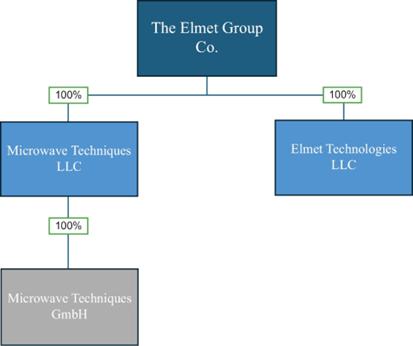
Recent Developments
Initial Public Offering
On April 23, 2026, we completed our initial public offering (“IPO”) of 9,857,142 shares of our common stock, which includes 1,285,714 sold by us pursuant to the exercise of the underwriters’ over-allotment option which was exercised in full, at a public offering price of $14.00 per share. The IPO resulted in net proceeds to us of $128.2 million after deducting the underwriting discounts and commissions and before deducting offering costs of $2.7 million, which were charged to additional paid-in capital as a reduction of the net proceeds received from the IPO. In connection with the IPO, we also granted Cantor Fitzgerald & Co., as representative of the underwriters, a warrant to purchase up to 147,857 shares of common stock (the “Underwriter’s Warrant”) that has an exercise price per share equal to 125% of the public offering price of $14.00 per share, or $17.50 per share. The Underwriter’s Warrant is not exercisable for a period of 180 days following the IPO date and expire four years from the date of issuance. In connection with the IPO, we redeemed all issued and outstanding shares of Class B common stock from Mr. Anania for $25,000 and consolidated and reclassified all Class A and Class B common stock into a single class of $0.001 par value common stock.
Change in Fiscal Year
On May 19, 2026, our Board of Directors approved a change in our fiscal year end from December 31 to a 4-4-5 fiscal calendar, whereby each fiscal quarter consists of thirteen weeks grouped into two four-week months and one five-week month. Under the new fiscal calendar, our fiscal year ends on the Friday closest to December 31. The first fiscal year under the new calendar began on January 1, 2026, and ends on January 1, 2027. As a result of this change, our fiscal quarters ending April 3, 2026, July 3, 2026 and October 2, 2026, may include an additional or lesser number of days compared to the prior year quarters ended March 31, 2025, June 30, 2025 and September 30, 2025, and accordingly, results for these periods may not be fully comparable to those of the prior year periods primarily due to the change in the number of days included in those periods. Our subsidiaries that have a fiscal year end different from that of our Company’s are consolidated using financial statements for periods that are within three months of our Company’s fiscal year end, with adjustments for material transactions, if any. This change was implemented to better align the Company’s accounting operations with quarterly public reporting requirements and to improve comparability of financial performance. The change in fiscal year will not impact our previously issued financial statements or tax reporting.
Our unaudited consolidated financial statements and Management’s Discussion and Analysis of Financial Condition and Results of Operations reflect estimates and assumptions made by management. Events and changes in circumstances arising after April 3, 2026, including those resulting from the continuing impacts of the currently unfavorable macroeconomic climate, will be reflected in management’s estimates for future periods.
Key Factors Impacting Our Performance
U.S. Government Spending and Federal Budget Uncertainty
Changes in the volume and relative mix of U.S. government spending as well as areas of spending growth could impact our business and results of operations. In particular, our results can be affected by shifts in strategies and priorities on homeland security, intelligence, defense-related programs and infrastructure. Changes in spending on technology and innovation, including cybersecurity, artificial intelligence, connected communities and physical infrastructure will also affect our business and results of operations. Cost-cutting and efficiency initiatives, along with current and future budget restrictions, spending cuts and shifts in priorities, could lead some of our customers, including those conducting significant business related to U.S. government contracts and funding, to reduce or delay orders. This may result in diminishing demand for our products and services.
Furthermore, change in grant funding through the DoW or other defense agencies or any disruption in the functioning of other government agencies, including national laboratories or other facilities, as a result of government closures and shutdowns, could increase our costs and negatively impact our results of operations.
There is also uncertainty around the timing, extent, nature and effect of congressional and other U.S. government actions to address budgetary constraints, spending caps on the discretionary budget for defense and non-defense departments and agencies. The ability of Congress to determine how to allocate the available resources and pass appropriations bills to fund both U.S. government departments and agencies that are, and are not, subject to the caps also makes fiscal planning a challenge. Budget deficits and the growing U.S. national debt may increase pressure on the U.S. government to reduce federal spending across all federal agencies, with uncertainty about the size and timing of those reductions. Any delays in the completion of future U.S. government budgets could in the future delay procurement of the products we provide or grants which we receive. A reduction in the amount, delays in or cancellations of funding for services or products we are contracted to provide to prime U.S. government contractors could have a material adverse effect on our business and results of operations. Significant delays or reductions in appropriations for programs which fund our capital expansion or incorporate our products and services, or changes in U.S. government priorities or spending levels more broadly may affect our business and could have a material adverse effect on our financial condition and results of operations.
The People’s Republic of China’s Export Controls and Related Trade Measures on Critical Materials
Our operations and those of our suppliers may be adversely affected by recent and potential future changes in international trade policies, including the PRC’s restrictions on the export of molybdenum and tungsten and the imposition of tariffs on goods imported to the United States. The Chinese government has implemented export controls, licensing requirements and quotas that limit the availability of what has been deemed “dual use” materials, used in commercial and defense applications, for foreign buyers. These restrictions have the potential to reduce global supply, increase raw-material costs, and create significant volatility in the pricing and availability of these materials. Tungsten is very sensitive to the PRC’s control of the global supply chain. If we or our suppliers are unable to obtain sufficient quantities of tungsten on commercially acceptable terms, our production timelines, input costs and product margins could be materially affected. We source the raw materials of our tungsten from suppliers outside of the PRC; however, we may be indirectly affected due to the collective disruption in the global tungsten supply chain, including increases in the global market prices of tungsten in response to actions of the PRC.
The outcome and duration of these trade restrictions and tariff regimes remain unknown and could change with geopolitical developments or modifications in governmental trade policy. Any escalation of export controls or expansion of tariff measures could intensify supply chain risks and suppress our operating results, cash flows and overall financial condition. While we continue to evaluate mitigation strategies — including supplier diversification, inventory management and contractual adjustments — there can be no assurance that these measures will be successful or economically feasible.
Operational Performance on Contracts
Revenue, net income and the timing of our cash flows depend on our ability to perform on our contracts and purchase orders in a timely manner. When agreeing to contractual terms, our management team makes assumptions and projections about future conditions and events. The accounting for our contracts and programs requires assumptions and estimates concerning these conditions and events, including:
| ● | the cost and availability of raw materials and components; |
| ● | the productivity and availability of skilled labor; |
| ● | the complexity of the work to be performed; |
| ● | our subcontractors’ capacities, capabilities and lead times; |
| ● | equipment & tooling durability, capabilities and lead times to procure; |
| ● | schedule requirements; |
| ● | robustness of public utilities supporting our factories; and |
| ● | our ability to protect against and respond to threats to our IT infrastructure and our confidential and proprietary information. |
If there is a significant change in one or more of these circumstances, estimates or assumptions, or if the risks under our contracts are not managed adequately, the profitability of our operations could be adversely affected. This could result in a material change in our net income and margin.
The timing of our cash flows can be affected by rapid changes in material costs, in particular tungsten and molybdenum, and the availability of skilled labor. For instance, rapid market price increases of raw material feed stock can lead to temporary cash flow shortfalls. By contract, cash flow influxes will result from early completions compared to initial delivery estimates. Historically, this has resulted in, and could continue to result in, fluctuations in working capital levels and quarterly free cash flow results.
To manage these fluctuations, we have implemented several strategies, such as engaging in long-term strategic supply agreements, structuring our terms of sale to initiate prepayments and deposits from customers, restructuring our revolving debt facilities and incentivizing our workforce to deliver products within specifications and on time. Despite these measures, the inherent variability in order flow and material demand means that quarter-to-quarter comparisons of our results of operations may not necessarily be meaningful and should not be relied upon as indicators of future performance. We expect these fluctuations to persist, particularly as the materials, products and services with which we work become subject to higher global demand. However, we believe our proactive cash flow management strategies will help mitigate the impact of these fluctuations and contribute to our overall financial stability.
Oversight
U.S. government procurement regulations impose various operational requirements on government contractors and their subcontractors. Non-compliance with these regulations could lead to civil or criminal penalties, which may materially adversely affect our operating results. U.S. government agencies routinely audit, review, investigate and scrutinize our performance, and that of our customers, under government contracts, and any failure by us or our customers to comply with the terms of those contracts and applicable laws could affect our operating results. If a government inquiry or investigation reveals improper or illegal activities, we or our customers may face civil or criminal penalties or administrative sanctions, including contract termination, fines, fee forfeiture, payment suspension, or suspension and debarment from conducting business with U.S. government agencies. Any of these actions could materially and adversely affect our reputation, business, financial condition, results of operations and cash flows.
Results of Operations
Quarter Ended April 3, 2026 Compared to Quarter Ended March 31, 2025
The following table sets forth, for the fiscal quarters ended April 3, 2026 and March 31, 2025, our results of continuing operations, including presentation of the changes in between reporting periods:
| For the Quarters Ended | ||||||||||||||||||||||||
| ($ in thousands) | April
3, 2026 |
%
of Revenue |
March
31, 2025 |
%
of Revenue |
$
Change |
% Change |
||||||||||||||||||
| Revenue | $ | 56,007 | 100.0 | % | $ | 46,387 | 100.0 | % | $ | 9,620 | 20.7 | % | ||||||||||||
| Cost of goods sold | 44,159 | 78.8 | % | 37,776 | 81.4 | % | 6,383 | 16.9 | % | |||||||||||||||
| Gross profit | 11,848 | 21.2 | % | 8,611 | 18.6 | % | 3,237 | 37.6 | % | |||||||||||||||
| Operating expenses | ||||||||||||||||||||||||
| General and administrative | 7,068 | 12.6 | % | 3,259 | 7.1 | % | 3,809 | 116.9 | % | |||||||||||||||
| Research and development | 850 | 1.5 | % | 811 | 1.7 | % | 39 | 4.8 | % | |||||||||||||||
| Sales and marketing | 2,067 | 3.7 | % | 1,683 | 3.6 | % | 384 | 22.8 | % | |||||||||||||||
| Total operating expenses | 9,985 | 17.8 | % | 5,753 | 12.4 | % | 4,232 | 73.6 | % | |||||||||||||||
| Operating income | 1,863 | 3.4 | % | 2,858 | 6.2 | % | (995 | ) | (34.8 | )% | ||||||||||||||
| Other (income) expense, net: | ||||||||||||||||||||||||
| Interest expense | 613 | 1.1 | % | 510 | 1.1 | % | 103 | 20.2 | % | |||||||||||||||
| Interest expense – related party | 627 | 1.1 | % | 416 | 0.9 | % | 211 | 50.7 | % | |||||||||||||||
| Change in fair value of derivative asset | (3,095 | ) | (5.5 | )% | — | — | % | (3,095 | ) | n/m | ||||||||||||||
| Other (income) expense, net | (654 | ) | (1.2 | )% | 79 | 0.2 | % | (733 | ) | (927.8 | )% | |||||||||||||
| Total other (income) expense, net | (2,509 | ) | (4.5 | )% | 1,005 | 2.2 | % | (3,514 | ) | (349.7 | )% | |||||||||||||
| Income from continuing operations before taxes | 4,372 | 7.9 | % | 1,853 | 4.0 | % | 2,519 | 135.9 | % | |||||||||||||||
| Income tax provision | 4,710 | 8.4 | % | — | — | % | 4,710 | n/m | ||||||||||||||||
| (Loss) income from continuing operations | $ | (338 | ) | (0.5 | )% | $ | 1,853 | 4.0 | % | $ | (2,191 | ) | (118.2 | )% | ||||||||||
n/m = not meaningful
Revenues
Revenues for the fiscal quarter ended April 3, 2026, increased $9.6 million, or 20.7%, compared to the fiscal quarter ended March 31, 2025. Our EMP division saw an increase of $0.5 million, or 7.2%, driven by industrial microwave systems for tempering and drying. Our CMC division revenues for the fiscal quarter ended April 3, 2026, increased $9.1 million, or 23.2%, compared to the fiscal quarter ended March 31, 2025, driven by increases in key missile programs Javelin, Hellfire and AIM-9X Sidewinder, along with favorable pricing impacts associated with other tungsten products. Starting in November 2024, the global critical material supply chain experienced multiple disruptions including the PRC’s export restrictions on “dual use” materials, tariff disruption in January 2025 and again in April 2025, and the PRC’s closure of multiple rare earth mines, all of which resulted in a rapid pricing increase for tungsten on the global market. We believe these events disrupted customer order patterns, leading to lower sales and gross profit over the first few months of 2025.
Revenue by Market
For our CMC and EMP divisions, we track our revenue and customers for our operating divisions across five key markets. We develop sales strategies for each and incentivize our sales resources to profitably grow our business. The following tables demonstrate revenues by markets for the fiscal quarters ended April 3, 2026 and March 31, 2025.
Quarter Ended April 3, 2026 Compared to Quarter Ended March 31, 2025
| Quarters Ended | ||||||||||||||||||||||||
| ($ in thousands) | April
3, 2026 |
%
of Revenue |
March
31, 2025 |
%
of Revenue |
$
Change |
%
Change |
||||||||||||||||||
| Aerospace, Defense & Government | $ | 22,814 | 40.7 | % | $ | 18,018 | 38.8 | % | $ | 4,796 | 26.6 | % | ||||||||||||
| Industrial | 17,605 | 31.4 | % | 15,853 | 34.2 | % | 1,752 | 11.1 | % | |||||||||||||||
| Medical | 10,722 | 19.1 | % | 10,224 | 22.0 | % | 498 | 4.9 | % | |||||||||||||||
| Semiconductor & Electronics | 2,646 | 4.7 | % | 1,262 | 2.7 | % | 1,384 | 109.7 | % | |||||||||||||||
| Energy | 2,220 | 4.1 | % | 1,030 | 2.3 | % | 1,190 | 115.6 | % | |||||||||||||||
| Total | $ | 56,007 | 100 | % | $ | 46,387 | 100 | % | $ | 9,620 | 20.7 | % | ||||||||||||
Aerospace, Defense and Government
Aerospace, Defense and Government revenues increased as a percentage of our business from 38.8% to 40.7%, or $4.8 million, in the fiscal quarter ended April 3, 2026, as compared to the prior year period. Growth was driven by increased sales to larger defense programs including the Hellfire, Javelin, Patriot, KC-135 Stratotanker, AIM-9X Sidewinder and defense radar programs.
Most of our products for Aerospace, Defense and Government customers are made to customer specifications. This creates additional value for our customers; however, this market can be affected by international and U.S. federal government spending. We are subject to variations in the DoW budget and spending levels, shifts in funding for research at national laboratories around the world, changes in policy positions or priorities at the U.S Government or international agencies, alteration in the domestic and global political and economic environment, increased instability and the evolving nature of the global and national security threat environment. Changes in these budget and spending levels, policies, or priorities, which are subject to U.S. domestic and foreign geopolitical risks and threats, may impact our defense businesses. We believe that our business is well positioned to supply the products needed to support future defense spending priorities, including those based on the 2025 National Security Strategy document, the 2024 U.S. National Security related budget and the National Defense Authorization Act (“NDAA”). We are also poised to benefit from the related Future Years Defense Program and other resources and programs needed to support the DoW’s strategy of shoring up the supply chain and hardening operations against trade risk, boycotts and market manipulation by our adversaries. We expect commercial aerospace to continue to grow, with satellite and commercial aviation both projected to experience substantial growth over the next five years.
Industrial
Industrial revenues decreased as a percentage of our business from 34.2% in the fiscal quarter ended March 31, 2025, to 31.4% in the fiscal quarter ended April 3, 2026, but they increased by $1.8 million for the fiscal quarter ended April 3, 2026, as compared to the prior year period. We saw higher sales of industrial microwave systems for tempering and drying, along with favorable pricing impacts associated with tungsten products.
Medical
Medical revenues decreased as a percentage of our business from 22.0% in the fiscal quarter ended March 31, 2025, to 19.1% in the fiscal quarter ended April 3, 2026, but they increased by $0.5 million for the fiscal quarter ended April 3, 2026, as compared to the prior year period. This increase was driven by demand recovery with one long-term medical wire customer.
Semiconductor and Electronics
Semiconductor and Electronics revenues increased as a percentage of our business from 2.7% in the fiscal quarter ended March 31, 2025, to 4.7% in the fiscal quarter ended April 3, 2026, or by $1.4 million compared to the prior year period. This increase was largely due to the mix of customers in both the semiconductor capital equipment and hi-reliability component sub-markets.
Energy
Energy revenues increased as a percentage of our business from 2.3% in the fiscal quarter ended March 31, 2026, to 4.1% in the fiscal quarter ended April 3, 2026, or by $1.2 million compared to the prior year period. The growth experienced in the Energy end-market was distributed across multiple customers in both the oil and gas and nuclear sub-markets.
Shipments by Geography and Material and Type
For our CMC and EMP divisions, we track our shipments of products by geography and material type. It is important to note that this tracking is based on physical shipments and is not reconciled back to revenue timing adjustments associated with ASC 606, Revenue from Contracts with Customers. These metrics are intended to provide relative versus absolute changes and are therefore expressed as percentages versus dollars. We use these metrics to help navigate the impacts of global supply chain disruptions and capital allocation.
Shipments by Geography
Shipments based on major geographic territory as a percentage of total shipments for the quarter ended April 3, 2026, as compared to the prior year period saw an increase in the Americas from 83.4% to 85.2% driven by increased shipments into various Aerospace, Defense and Government programs, industrial microwave systems for tempering and drying and tungsten pricing impacts. Shipments to Europe as a percentage of total shipment decreased from 12.0% in the fiscal quarter in March 31, 2025, to 10.9% in the fiscal quarter ended April 3, 2026; however, gross shipments increased into Europe by 11.8%, or $0.6 million, period-over-period driven by multiple customers within our EMP segment.
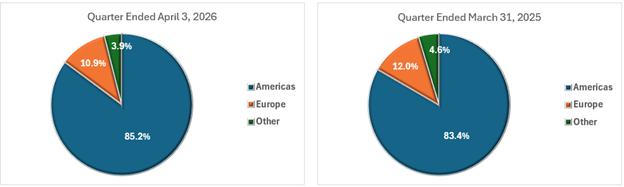
Shipments by Type of Materials and Services
Shipments composition based on the type of materials and services as a percentage of total shipments for the quarter ended April 3, 2026, as compared to the prior year period, saw an increase in molybdenum from 59.4% to 59.5%. This was primarily driven by increased volumes with the Javelin and Hellfire missile programs. Tungsten also saw growth period-over-period from 15.8% to 17.8%, primarily driven by pricing increases associated with material input costs and increased volumes across multiple Aerospace, Defense and Government customers. Microwave products saw a decrease period-over-period from 15.5% to 14.2% as a percentage of total, primarily driven by a lower rate of growth than molybdenum and tungsten. Other materials and services saw a reduction from 9.3% to 8.5% period-over-period, primarily driven by modest declines in our tolling services and other metals processing.
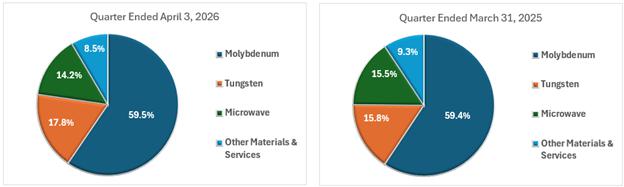
Cost of Goods Sold and Gross Profit
Costs of goods sold for the fiscal quarter ended April 3, 2026 increased $6.4 million, or 16.9%, compared to the prior year period.
EMP saw an increase in cost of goods sold for the fiscal quarter ended April 3, 2026 of $1.2 million, or 25.4%, associated with an increase of $0.5 million, or 7.2%, in revenue compared to the prior year period, resulting in a decrease of $0.7 million, or 23.6%, in gross profit between the fiscal quarter ended April 3, 2026 and the prior year period. This was driven by a shift in product mix within the division toward lower-margin industrial products, which resulted in a decrease in EMP’s gross profit margin from 37.0% for the quarter ended March 31, 2025, to 26.4% for the quarter ended April 3, 2026.
CMC cost of goods sold for the fiscal quarter ended April 3, 2026 increased $5.2 million, or 15.7%, associated with an increase of $9.1 million, or 23.2%, in revenue compared to the prior year period, resulting in an increase of $3.9 million, or 65.5%, in gross profit between the fiscal quarter ended April 3, 2026 and the prior year period. This change was primarily driven by a richer product mix from our Aerospace, Defense and Government and Energy markets, increasing CMC’s gross profit margin from 15.1% for the quarter ended March 31, 2025, to 20.3% for the quarter ended April 3, 2026.
General and Administrative Expenses
General and administrative expenses increased $3.8 million, or 116.9%, for the fiscal quarter ended April 3, 2026, compared to the prior year period. The increase was partially a result of approximately $0.6 million related to stock-based compensation incurred in connection with stock-based awards outstanding during the quarter ended April 3, 2026. Additionally, the increase was partially attributable to $0.8 million in additional one-time corporate costs related to third-party accounting and legal expenses in preparation for the IPO. Additional general and administrative expenses growth was attributable to the increase of staffing and professional services to support public company compliance.
Research and Development
Research and development expenses did not meaningfully change for the quarter ended April 3, 2026, compared to the prior year period.
Sales and Marketing
Sales and marketing expenses increased $0.4 million, or 22.8%, for the quarter ended April 3, 2026, compared to the prior year period. This increase was due to the expansion of our sales team in support of our strategy and growth, in particular increased sales staffing and commissions in support of growth within our EMP division.
Interest Expense
Interest expense increased $0.1 million or 20.2% for the quarter ended April 3, 2026, compared to the prior year period. The increase was primarily attributable to increased borrowings under the Wells Fargo Line of Credit (as defined below).
Interest Expense — Related Party
Related party interest expense increased $0.2 million, or 50.7%, for the quarter ended April 3, 2026, compared to the prior year period, primarily attributable to increased borrowings under the CEO Line of Credit (as defined below).
Change in Fair Value of Derivative Asset
The change in fair value of derivative assets increased approximately $3.0 million due to an increase in value of the equity underlying the options to purchase common stock in one of our publicly-traded vendors.
Other (Income) Expense, Net
Other income, net increased by $0.7 million, or 927.8%, for the quarter ended April 3, 2026, compared to the prior year period, driven by unrealized gains recognized related to the change in the fair value of marketable securities, partially offset by the change in the fair value of our interest rate collar derivatives.
Income Tax Provision
The income tax provision for the quarter ended April 3, 2026 increased $4.7 million compared to the prior year period as a result of our being subject to income taxes as a C-corporation following the Reorganization. Of the $4.7 million increase, $3.8 million is attributed directly to a one-time impact associated with the Reorganization, with the balance of $0.9 million associated with the fiscal quarter operating results. Prior to the Reorganization A&A was an S-corporation for taxation purposes, and its income and losses were passed through to its shareholders and reported on their individual tax returns.
Pro Forma Net Income Per Share Information
The following pro forma net income per share information is presented for comparative purposes only and does not purport to be indicative of the results that would have been achieved had the Reorganization occurred at an earlier date, nor of future results.
The following table sets forth a reconciliation of the numerators and denominators used to compute pro forma basic and diluted net income per share (in thousands, except share and per share amounts):
| Quarter Ended | ||||||||
| April
3, 2026 |
March
31, 2025 |
|||||||
| Numerator: | ||||||||
| Net (loss) income | $ | (338 | ) | $ | 1,197 | |||
| Income tax effects of Reorganization(a) | 3,791 | (83 | ) | |||||
| Pro forma net income | $ | 3,453 | $ | 1,114 | ||||
| Denominator: | ||||||||
| Pro forma weighted average common stock outstanding – basic(b) | 20,123,187 | 20,123,187 | ||||||
| Pro forma weighted average common stock outstanding – diluted(b,c) | 20,426,286 | 20,123,187 | ||||||
| Pro forma net income per share – basic | $ | 0.17 | $ | 0.06 | ||||
| Pro forma net income per share – diluted | $ | 0.17 | $ | 0.06 | ||||
| (a) | Following the Reorganization, we are subject to U.S. federal and applicable state income taxes. The adjustment for income taxes reflects the estimated income tax expense that would have been recognized had the Reorganization occurred on January 1, 2025, based on an effective tax rate of 21.0% and 6.95% for the quarter ended April 3, 2026 and March 31, 2025, respectively. The pro forma effective tax rate for the quarter ended April 3, 2026 represents our actual effective tax rate for the period, excluding the effect of the deferred tax adjustment of $3.5 million, which was recognized in the period of Reorganization and does not reflect ongoing income tax expense, and other discrete tax impacts of $0.3 million related to the Reorganization. The pro forma income tax effect for the quarter ended March 31, 2025 includes the results of discontinued operations. |
| (b) | Pro Forma as adjusted weighted average common stock outstanding (basic and diluted) reflects the Reorganization as if it occurred on January 1, 2025, including the impact of the Reorganization, resulting in 20,122,721 shares of Class A common stock issued and outstanding and 466 shares of Class B common stock issued and outstanding. |
| (c) | The potential impact on the pro forma weighted average common stock outstanding (diluted) of 530,890 shares of restricted stock were evaluated under the treasury stock method. We determined that the impact of the 530,890 shares of restricted stock represented 227,791 dilutive shares, considering the weighted average unrecognized compensation costs of approximately $2.9 million for the quarter ended April 3, 2026, and the estimated fair value of our common stock for the period. |
Critical Materials and Components Results
Quarter Ended April 3, 2026 Compared to Quarter Ended March 31, 2025
| Quarters Ended | ||||||||||||||||||||||||
| ($ in thousands) | April
3, 2026 |
%
of Revenue |
March
31, 2025 |
%
of Revenue |
$
Change |
%
Change |
||||||||||||||||||
| Revenue | $ | 48,206 | 100.0 | % | $ | 39,113 | 100.0 | % | $ | 9,093 | 23.2 | % | ||||||||||||
| Cost of goods sold | 38,415 | 79.7 | % | 33,196 | 84.9 | % | 5,219 | 15.7 | % | |||||||||||||||
| Gross profit | 9,791 | 20.3 | % | 5,917 | 15.1 | % | 3,874 | 65.5 | % | |||||||||||||||
| Operating expenses: | ||||||||||||||||||||||||
| General and administrative | 2,692 | 5.6 | % | 1,645 | 4.2 | % | 1,047 | 63.6 | % | |||||||||||||||
| Research and development | 518 | 1.1 | % | 477 | 1.2 | % | 41 | 8.6 | % | |||||||||||||||
| Sales and marketing | 1,366 | 2.8 | % | 1,204 | 3.1 | % | 162 | 13.5 | % | |||||||||||||||
| Total operating expenses | 4,576 | 9.5 | % | 3,326 | 8.5 | % | 1,250 | 37.6 | % | |||||||||||||||
| Operating income | 5,215 | 10.8 | % | 2,591 | 6.6 | % | 2,624 | 101.3 | % | |||||||||||||||
| Other expense, net: | ||||||||||||||||||||||||
| Interest expense | 542 | 1.1 | % | 335 | 0.9 | % | 207 | 61.8 | % | |||||||||||||||
| Interest expense – related party | 368 | 0.8 | % | 392 | 1.0 | % | (24 | ) | (6.1 | )% | ||||||||||||||
| Other expense, net | 11 | — | % | 50 | 0.1 | % | (39 | ) | (78.0 | )% | ||||||||||||||
| Total other expense, net | 921 | 1.9 | % | 777 | 2.0 | % | 144 | 18.5 | % | |||||||||||||||
| Income from continuing operations before taxes | 4,294 | 8.9 | % | 1,814 | 4.6 | % | 2,480 | 136.7 | % | |||||||||||||||
| Income tax provision | — | — | % | — | — | % | — | — | % | |||||||||||||||
| Income from continuing operations | $ | 4,294 | 8.9 | % | $ | 1,814 | 4.6 | % | $ | 2,480 | 136.7 | % | ||||||||||||
Revenues
Revenues for the fiscal quarter ended April 3, 2026, increased $9.1 million, or 23.2%, compared to the prior year period, driven by increases in the key missile programs Javelin, Hellfire and AIM-9X Sidewinder, along with favorable pricing impacts associated with other tungsten products.
Cost of Goods Sold
Cost of goods sold for the fiscal quarter ended April 3, 2026 increased $5.2 million, or 15.7%, associated with an increase of $9.1 million, or 23.2%, in revenue compared to the prior year period, resulting in an increase of $3.9 million, or 65.5%, in gross profit between the quarter ended April 3, 2026 and the prior year period. This change was driven by a richer product mix from our Aerospace, Defense and Government and Energy markets increasing CMC’s gross profit margin from 15.1% for the quarter ended March 31, 2025, to 20.3% for the quarter ended April 3, 2026.
General and Administrative Expenses
CMC general and administrative expenses for the fiscal quarter ended April 3, 2026 increased $1.0 million, or 63.6%, compared to the prior year period. The increase was attributable to multiple factors including internal reorganization and resource increases in support of the IPO and public company compliance, additional IT costs associated with defense contractor compliance requirements and variable compensation associated with growth.
Research and Development
CMC research and development expenses for the fiscal quarter ended April 3, 2026 did not meaningfully change compared to the prior year period.
Sales and Marketing
CMC selling and marketing expenses for the fiscal quarter ended April 3, 2026 increased $0.2 million, or 13.5%, compared to the prior year period. The increase was driven by primarily increased sales staffing and commissions in support of growth, contributing to the 23.2% revenue growth at the CMC division.
Interest Expense
CMC interest expense for the fiscal quarter ended April 3, 2026 increased $0.2 million or 61.8% as compared to the prior year period. This increase was primarily attributable to increased borrowings under the Wells Fargo Line of Credit (as defined below).
Interest Expense — Related Party
CMC related party interest expense for the fiscal quarter ended April 3, 2026 did not meaningfully change compared to the prior year period as the impact of increased borrowings was offset by favorable changes in the interest rate environment.
Other Expense, Net
CMC other expense, net for the fiscal quarter ended April 3, 2026 did not meaningfully change compared to the prior year period.
Engineered Microwave Products Results
Quarter Ended April 3, 2026 Compared to Quarter Ended March 31, 2025
| Quarters Ended | ||||||||||||||||||||||||
| ($ in thousands) | April
3, 2026 |
%
of Revenue |
March
31, 2025 |
%
of Revenue |
$
Change |
%
Change |
||||||||||||||||||
| Revenue | $ | 7,801 | 100.0 | % | $ | 7,274 | 100.0 | % | $ | 527 | 7.2 | % | ||||||||||||
| Cost of goods sold | 5,744 | 73.6 | % | 4,580 | 63.0 | % | 1,164 | 25.4 | % | |||||||||||||||
| Gross profit | 2,057 | 26.4 | % | 2,694 | 37.0 | % | (637 | ) | (23.6 | )% | ||||||||||||||
| Operating expenses: | ||||||||||||||||||||||||
| General and administrative | 1,418 | 18.2 | % | 1,291 | 17.7 | % | 127 | 9.8 | % | |||||||||||||||
| Research and development | 330 | 4.2 | % | 334 | 4.6 | % | (4 | ) | (1.2 | )% | ||||||||||||||
| Sales and marketing | 548 | 7.0 | % | 336 | 4.6 | % | 212 | 63.1 | % | |||||||||||||||
| Total operating expenses | 2,296 | 29.4 | % | 1,961 | 26.9 | % | 335 | 17.1 | % | |||||||||||||||
| Operating (loss) income | (239 | ) | (3.0 | )% | 733 | 10.1 | % | (972 | ) | (132.6 | )% | |||||||||||||
| Other expense, net: | ||||||||||||||||||||||||
| Interest expense | 89 | 1.1 | % | 95 | 1.3 | % | (6 | ) | (6.3 | )% | ||||||||||||||
| Interest expense – related party | 78 | 1.0 | % | 55 | 0.8 | % | 23 | 41.8 | % | |||||||||||||||
| Other income, net | (29 | ) | (0.4 | )% | (25 | ) | (0.3 | )% | (4 | ) | 16.0 | % | ||||||||||||
| Total other expense, net | 138 | 1.7 | % | 125 | 1.8 | % | (13 | ) | (10.4 | )% | ||||||||||||||
| (Loss) income from continuing operations before taxes | (377 | ) | (4.7 | )% | 608 | 8.3 | % | (985 | ) | (162.0 | )% | |||||||||||||
| Income tax provision | 4 | 0.1 | % | — | — | % | 4 | n/m | ||||||||||||||||
| (Loss) Income from continuing operations | $ | (381 | ) | (4.8 | )% | $ | 608 | 8.3 | % | $ | (989 | ) | (162.7 | )% | ||||||||||
n/m = not meaningful
Revenue
Revenues for the fiscal quarter ended April 3, 2026 increased $0.5 million, or 7.2%, as compared to the prior year period primarily driven by increased sales of industrial microwave systems and radar components.
Cost of Goods Sold
Cost of goods sold for the fiscal quarter ended April 3, 2026, increased $1.2 million, or 25.4%, associated with an increase of $0.5 million, or 7.2%, in revenue compared to the prior year period, resulting in a decrease of $0.7 million, or 23.6%, in gross profit between the fiscal quarter ended April 3, 2026 and the prior year period. This was driven by a shift in product mix within EMP toward lower margin industrial products resulting in a decrease in EMP’s gross profit margin from 37.0% for the fiscal quarter ended March 31, 2025, to 26.4% for the fiscal quarter ended April 3, 2026.
General and Administrative Expenses
General and administrative expenses for the fiscal quarter ended April 3, 2026 increased $0.1 million, or 9.8%, compared to the prior year period, primarily to support EMP’s 7.2% growth in sales.
Research and Development
Research and development expenses for the fiscal quarter ended April 3, 2026 did not meaningfully change compared to the prior year period.
Sales and Marketing
EMP sales and marketing expenses for the fiscal quarter ended April 3, 2026 increased $0.2 million, or 63.1%, compared to the prior year period, driven primarily by increased sales staffing in support of current and future growth and commissions in support of EMP’s 7.2% sales growth period-over-period.
Interest Expense
EMP interest expense for the fiscal quarter ended April 3, 2026 did not meaningfully change as compared to the prior year period.
Interest Expense — Related Party
EMP related party interest expense for the fiscal quarter ended April 3, 2026 did not meaningfully change compared to the prior year period.
Other Income, Net
EMP other income, net did not meaningfully change compared to the prior year period.
Corporate and Other
Quarter Ended April 3, 2026 Compared to Quarter Ended March 31, 2025
Activity related to Corporate and Other for the fiscal quarters ended April 3, 2026 and 2025 is as follows:
| Quarter Ended | ||||||||||||||||
| ($ in thousands) | April
3, 2026 |
March
31, 2025 |
$
Change |
%
Change |
||||||||||||
| General and administrative | $ | 2,958 | $ | 323 | $ | 2,635 | $ | 815.8 | % | |||||||
| Research and development | 2 | — | 2 | 100.0 | % | |||||||||||
| Sales and marketing | 153 | 143 | 10 | 7.0 | % | |||||||||||
| Total operating expenses | 3,113 | 466 | 2,647 | 568.0 | % | |||||||||||
| Operating loss | (3,113 | ) | (466 | ) | 2,647 | 568.0 | % | |||||||||
| Other (income) expense, net: | ||||||||||||||||
| Interest (income) expense | (18 | ) | 80 | (98 | ) | (122.5 | )% | |||||||||
| Interest expense (income) – related party | 181 | (31 | ) | 212 | 683.9 | % | ||||||||||
| Change in fair value of derivative asset | (3,095 | ) | — | (3,095 | ) | n/m | ||||||||||
| Other (income) expense, net | (636 | ) | 54 | (690 | ) | n/m | ||||||||||
| Total other (income) expense, net | (3,568 | ) | 103 | (3,671 | ) | n/m | ||||||||||
| Income (loss) from continuing operations before taxes | 455 | (569 | ) | 1,024 | 180.0 | % | ||||||||||
| Income tax provision | 4,706 | — | 4,706 | n/m | ||||||||||||
| Loss from continuing operations | $ | (4,251 | ) | $ | (569 | ) | $ | (3,682 | ) | n/m | ||||||
n/m = not meaningful
General and Administrative Expenses
General and administrative expenses for the quarter ended April 3, 2026 increased $2.7 million, or 568.0%, compared to the prior year period, primarily attributable to additional expenses associated with preparation for the IPO, including additional staffing and professional advisory fees, legal and accounting support, and stock-based compensation related to grants in anticipation of the IPO.
Research and Development
Research and development expenses were not material for the quarter ended April 3, 2026.
Sales and Marketing
Sales and marketing expenses for the quarter ended April 3, 2026 increased $0.1 million, or 10%, compared to the prior year period, primarily attributable to additional expenses associated with increased staffing.
Interest (Income) Expense
Interest (income) expense for the quarter ended April 3, 2026 decreased $0.1 million compared to the prior year period, primarily due to the elimination of interest associated with third-party debts previously held by AAI that are no longer included in the consolidated financial statements due to the Reorganization.
Interest Expense (Income) — Related Party
Interest expense (income) – related party for the quarter ended April 3, 2026 increased $0.2 million due primarily to interest on the AAI Note.
Change in Fair Value of Derivative Asset
The change in fair value of derivative assets increased approximately $3.1 million due to an increase in value of the equity underlying the options to purchase common stock in one of our publicly-traded vendors.
Other (Income) Expense, Net
Other income, net increased by $0.7 million for the quarter ended April 3, 2026, compared to the prior year period, primarily driven by unrealized gains recognized related to the change in the fair value of marketable securities.
Income Tax Provision
The income tax provision for the quarter ended April 3, 2026 increased $4.7 million compared to the prior year period as a result of the Company being subject to income taxes as a corporation following the Reorganization. Of the $4.7 million, $3.8 million is attributed directly to a one-time impact associated with the Reorganization, with the balance of $0.9 million associated with the quarter operating results. Prior to the Reorganization A&A was an S-corporation for taxation purposes, and its income and losses were passed through to its shareholders and reported on their individual tax returns.
Key Performance Indicators and Non-GAAP Financial Measures
We measure our business, monitor results of operations and ensure proper allocation of capital using the following key performance indicators and non-GAAP financial measures: (i) Revenue, (ii) Backlog, (iii) Gross Profit, (iv) Gross Profit Margin, (v) Adjusted EBITDA from Continuing Operations, (vi) Adjusted EBITDA Margin from Continuing Operations, (vii) Net (Loss) Income, and (viii) Adjusted Net Income, and (ix) Adjusted Net Income Per Share. We believe the non-GAAP financial measures presented in this Report will help investors understand our financial condition and operating results and assess our future prospects. We believe these non-GAAP financial measures, each of which are discussed in greater detail below, are important supplemental measures because they exclude unusual or non-recurring items as well as non-cash items that are unrelated to or may not be indicative of our ongoing operating results. Further, when read in conjunction with our U.S. GAAP results, these non-GAAP financial measures provide a baseline for analyzing trends in our underlying businesses and can be used by management as a tool to help make financial, operational and planning decisions. We may use non-GAAP financial metrics in certain management compensation plans, debt covenants, internal budgetary decision making, and other resource allocation decisions. Finally, these measures are often used by analysts and other interested parties to evaluate companies in our industry by providing more comparable measures that are less affected by factors such as capital structure.
Open Order Backlog
Our focus on Aerospace, Defense and Government by our CMC and EMP divisions has improved our backlog, as described below. See “— Twelve Month Backlog Trend for CMC and EMP Divisions.” As of April 3, 2026, compared to March 31, 2025, our backlog related to our CMC and EMP divisions increased $38.6 million, or 34.1%, with a 57.2% increase in our Aerospace, Defense and Government backlog, primarily driven by defense programs such as PrSM, Next Gen Interceptor, Hellfire, Javelin, Aegis and KC-135 Stratotanker, along with multiple commercial aerospace programs, and various defense radar programs. All other end markets’ backlog saw a decrease of $9.3 million, or 23.4%, period-over-period. Approximately $9.2 million of the $9.3 million decrease in backlog was associated with timing of orders with our largest medical customer, which places inconsistent short duration purchase orders creating variability in the aggregated other end markets.
Twelve-Month Backlog Trend for CMC and EMP Divisions
Open order backlog (“Backlog”) is measured by confirmed orders and contracts from customers less revenues recognized as of the date measured. The chart below presents our Backlog as of the dates indicated, which represents a key measure of our business growth. Backlog in the chart below excludes discontinued operations.
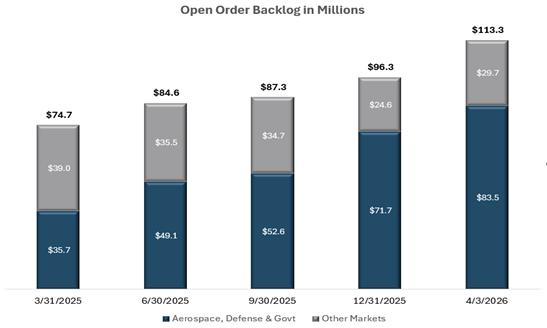
Adjusted Net Income and Adjusted Net Income Per Share
Adjusted Net Income and Adjusted Net Income Per Share are non-GAAP measurements and are performance measures. We define adjusted net income as net income less stock-based compensation and one-time non-recurring costs such as tax impacts of the Reorganization, discontinued operations, the costs associated with the IPO, certain acquisition and transaction costs, severance and restructuring costs, and other non-recurring costs and the income tax effect of such adjustments, as applicable.
The following table summarizes our reconciliation of adjusted earnings per share from continuing operations for the fiscal quarters ended April 3, 2026 and March 31, 2025, with discontinued operations excluded from the results of continuing operations (in thousands, except percentages):
| Quarter Ended | ||||||||
| April
3, 2026 |
March
31, 2025 |
|||||||
| Numerator: | ||||||||
| Net (loss) income | $ | (338 | ) | $ | 1,197 | |||
| Adjustments to net (loss) income: | ||||||||
| One time tax expense associated with the Reorganization(1) | 3,791 | — | ||||||
| Loss from discontinued operations | — | 656 | ||||||
| Corporate costs associated with the IPO(2) | 798 | 10 | ||||||
| Stock-based compensation(3) | 645 | — | ||||||
| Acquisition and transaction costs(4) | — | 67 | ||||||
| Other(5) | 196 | — | ||||||
| Tax effect of adjustments(6) | (344 | ) | — | |||||
| Adjusted net income | 4,748 | 1,930 | ||||||
| Denominator: | ||||||||
| Weighted average shares outstanding – basic | 20,123,187 | 20,123,187 | ||||||
| Weighted average shares outstanding – diluted(7) | 20,426,286 | 20,123,187 | ||||||
| Net (loss) income per share: | ||||||||
| Basic | $ | (0.02 | ) | $ | 0.06 | |||
| Diluted | $ | (0.02 | ) | $ | 0.06 | |||
| Adjusted net income per share: | ||||||||
| Basic | $ | 0.24 | $ | 0.10 | ||||
| Diluted | $ | 0.23 | $ | 0.10 | ||||
| (1) | Reflects the impact of the deferred tax adjustment of $3.5 million, which was recognized in the period of Reorganization and does not reflect ongoing income tax expense, and other discrete tax impacts of $0.3 million related to the Reorganization. |
| (2) | Corporate costs associated with the offering include third-party expenses related to enhancing our accounting controls and procedures, incremental audit costs, recruitment of executive team and legal expenses. |
| (3) | Stock-based compensation includes expenses associated with restricted stock grants made in support of the IPO and the Reorganization. In future reporting periods, stock-based compensation will be a recurring cost for the Company. |
| (4) | The adjustment for acquisition and transaction costs is to remove charges incurred in connection with any transaction, including mergers, acquisitions, refinancing, amendment or modification to indebtedness, and dispositions, in each case, regardless of whether consummated. |
| (5) | Other includes restructuring and severance costs associated with a reorganization at our CMC division as well as Germany retention costs. |
| (6) | The tax effect for the fiscal quarter ended April 3, 2026 represents our actual effective tax rate for the period of 21.0% when excluding the Reorganization impacts. There is no tax impact for the fiscal quarter ended March 31, 2025, as we were treated as an S-corporation for tax purposes prior to the Reorganization. |
| (7) | The potential impact on the weighted average common stock outstanding (diluted) of 530,890 shares of restricted stock was evaluated under the treasury stock method. We determined that the impact of the 530,890 shares of restricted stock represented 227,791 dilutive shares, considering the weighted average unrecognized compensation costs of approximately $2.9 million for the fiscal quarter ended April 3, 2026, and the estimated fair value of our common stock for the period. |
Adjusted EBITDA from Continuing Operations
The following table summarizes our reconciliation of income (loss) from continuing operations to Adjusted EBITDA from Continuing Operations and our Adjusted EBITDA Margin from Continuing Operations for the fiscal quarter ended April 3, 2026, for our divisions, with discontinued operations excluded from the results of continuing operations (in thousands, except percentages):
| Quarter Ended April 3, 2026 | ||||||||||||||||
| ($ in thousands, except %) | CMC | EMP | Corporate &
other |
Total | ||||||||||||
| Revenue | $ | 48,206 | $ | 7,801 | $ | — | $ | 56,007 | ||||||||
| Net income (loss) | $ | 4,294 | $ | (381 | ) | $ | (4,251 | ) | $ | (338 | ) | |||||
| Net income (loss) | 8.9 | % | (4.9 | )% | n/m | (0.6 | )% | |||||||||
| Adjustments to net income (loss): | ||||||||||||||||
| Income tax provision | $ | — | $ | 4 | $ | 4,706 | $ | 4,710 | ||||||||
| Interest expense(1) | 910 | 167 | 163 | 1,240 | ||||||||||||
| Depreciation and amortization | 1,632 | 288 | 3 | 1,923 | ||||||||||||
| Corporate costs associated with the IPO(2) | — | — | 798 | 798 | ||||||||||||
| Stock-based compensation(3) | — | — | 645 | 645 | ||||||||||||
| Other(4) | 166 | 30 | — | 196 | ||||||||||||
| Adjusted EBITDA from Continuing Operations | $ | 7,002 | $ | 108 | $ | 2,064 | $ | 9,174 | ||||||||
| Adjusted EBITDA Margin from Continuing Operations | 14.5 | % | 1.4 | % | n/m | 16.4 | % | |||||||||
n/m = not meaningful
| (1) | Interest expense includes both third-party interest expense and related party interest expense. |
| (2) | Corporate costs associated with the IPO include third-party expenses related to enhancing our accounting controls and procedures, incremental audit costs, recruitment of executive team and legal expenses. |
| (3) | Stock-based compensation includes expenses associated with restricted stock grants made in support of the IPO and the Reorganization. |
| (4) | Other includes restructuring and severance costs associated with a reorganization at our CMC division as well as Germany retention costs. |
The following table summarizes our reconciliation of income (loss) from continuing operations to Adjusted EBITDA from Continuing Operations and our Adjusted EBITDA Margin from Continuing Operations for the fiscal quarter ended March 31, 2025 for our divisions, with discontinued operations excluded from the results of continuing operations (in thousands, except percentages):
| Quarter Ended March 31, 2025 | ||||||||||||||||
| ($ in thousands) | CMC | EMP | Corp | Total | ||||||||||||
| Revenue | $ | 39,113 | $ | 7,274 | $ | — | $ | 46,387 | ||||||||
| Net income (loss) | $ | 1,814 | $ | 608 | $ | (1,225 | ) | $ | 1,197 | |||||||
| Net income (loss) % | 4.6 | % | 8.4 | % | n/m | 2.6 | % | |||||||||
| Adjustments to income (loss) from continuing operations: | ||||||||||||||||
| Loss from discontinued operations | $ | — | $ | — | $ | 656 | $ | 656 | ||||||||
| Interest expense(1) | 727 | 150 | 49 | 926 | ||||||||||||
| Depreciation and amortization | 1,315 | 289 | — | 1,604 | ||||||||||||
| Acquisition and transaction costs(2) | 37 | 30 | — | 67 | ||||||||||||
| Corporate costs associated with the IPO(3) | — | — | 10 | 10 | ||||||||||||
| Adjusted EBITDA | $ | 3,893 | $ | 1,077 | $ | (510 | ) | $ | 4,460 | |||||||
| Adjusted EBITDA Margin | 10.0 | % | 14.8 | % | n/m | 9.6 | % | |||||||||
n/m = not meaningful
| (1) | Interest expense includes both third-party interest expense and related party interest expense. |
| (2) | The adjustment for acquisition and transaction costs is to remove charges incurred in connection with any transaction, including mergers, acquisitions, refinancing, amendment or modification to indebtedness, and dispositions, in each case, regardless of whether consummated. |
| (3) | Corporate costs associated with the IPO include third-party expenses related to enhancing our accounting controls and procedures, incremental audit costs, recruitment of executive team and legal expenses. |
We recognize that these non-GAAP financial measures have limitations and that other companies may calculate non-GAAP financial measures differently and may use their non-GAAP financial measures under different circumstances or for different purposes, thereby affecting their comparability from company to company. In order to address these and the other limitations discussed below, management does not consider these measures in isolation from or as alternatives to the comparable financial measures determined in accordance with U.S. GAAP. Investors should review the reconciliations below and should not rely on any single financial measure to evaluate our business.
We define these non-GAAP financial measures as:
| ● | Adjusted Net Income. We define adjusted net income as net income less stock-based compensation and one-time non-recurring costs such as tax impacts of the Reorganization, discontinued operations, the costs associated with the IPO, certain acquisition and transaction costs, severance and restructuring costs, and other non-recurring costs and the income tax effect of such adjustments, as applicable. |
| ● | Adjusted Net Income Per Share (basic and diluted). Adjusted Net Income Per Share is calculated by dividing Adjusted Net Income by weighted average shares outstanding (basic and diluted). |
| ● | Adjusted EBITDA. We define Adjusted EBITDA as our net income plus interest expense, income taxes, depreciation and amortization, and, as applicable for each period, stock-based compensation expense. Adjusted EBITDA also excludes certain non-recurring costs such as the costs associated with the IPO, certain acquisition and transaction costs, severance and restructuring costs, and other non-recurring costs. |
| ● | Adjusted EBITDA Margin. Adjusted EBITDA Margin is calculated by dividing Adjusted EBITDA by revenue. |
| ● | Adjusted Gross Profit. We define Adjusted Gross Profit as total revenue less adjusted cost of goods sold, which we define as cost of goods sold less costs related to one-time non-recurring, non-inventory related expenses that under U.S. GAAP are categorized as costs of goods sold. This measure was not disclosed as there were no items that met these criteria for the periods presented. | |
| ● | Adjusted Gross Profit Margin. Adjusted Gross Profit Margin is calculated by dividing Adjusted Gross Profit by total revenue. This measure was not disclosed as there were no items that met these criteria for the periods presented. |
Although we use Adjusted Net Income, Adjusted Net Income Per Share, Adjusted EBITDA, and Adjusted EBITDA Margin as measures to assess the performance of our business and for the other purposes set forth above, the use of non-GAAP financial measures as analytical tools has limitations, and you should not consider any of them in isolation, or as a substitute for analysis of our results of operations as reported in accordance with U.S. GAAP. Some of these limitations are:
| ● | Non-recurring adjustments to Adjusted Net Income and Adjusted Net Income Per Share often require cash and, if material in nature, the use of such cash could materially negatively affect cash flows; |
| ● | Adjusted EBITDA and Adjusted EBITDA Margin do not reflect the significant interest expense, or the cash requirements, necessary to service interest payments on our indebtedness; |
| ● | Although depreciation and amortization are non-cash charges, the assets being depreciated and amortized will often have to be replaced in the future, and the cash requirements for such replacements are not reflected in Adjusted EBITDA and Adjusted EBITDA Margin; |
| ● | Adjusted Net Income, Adjusted Net Income Per Share, Adjusted EBITDA and Adjusted EBITDA Margin exclude the cash expense we have incurred to integrate acquired businesses into our operations, which is a necessary element of certain of our acquisitions; |
| ● | Omission of the substantial amortization expense associated with our intangible assets further limits the usefulness of Adjusted EBITDA and Adjusted EBITDA Margin; and |
| ● | Adjusted EBITDA and Adjusted EBITDA Margin do not include the payment of taxes, which is a necessary element of our operations. |
Because of these limitations, Adjusted Net Income, Adjusted Net Income Per Share, Adjusted EBITDA and Adjusted EBITDA Margin should not be considered as measures of cash available to us to invest in the growth of our business. Adjusted Net Income, Adjusted Net Income Per Share, Adjusted EBITDA, and Adjusted EBITDA Margin are not measurements of financial performance under U.S. GAAP, and they should not be considered as alternatives to net income, income from continuing operations or cash flow from continuing operations determined in accordance with U.S. GAAP.
Critical Accounting Policies and Estimates
Our consolidated financial statements and the related notes included elsewhere in this Report are prepared in accordance with GAAP. The preparation of consolidated financial statements requires us to make estimates and assumptions that affect the reported amounts of assets, liabilities, revenue, and expenses, and the related disclosure of contingent assets and liabilities. We base our estimates on historical experience and various other assumptions we believe to be reasonable under the circumstances. The results of these estimates form the basis for making judgments about the carrying values of assets and liabilities that are not readily apparent from other sources. Actual results could differ from these estimates under different assumptions or circumstances. While our significant accounting policies are described in more detail in the notes to our consolidated financial statements appearing elsewhere in this Report, we believe the following critical accounting policies require the use of significant estimates and judgments in the preparation of our consolidated financial statements.
Revenue Recognition
We recognize revenue in a manner which depicts the transfer of promised goods or services to customers in an amount reflecting the consideration to which we expect to be entitled in exchange for those goods or services.
Most of our revenue is recognized at the point in time control transfers to our customer based on predetermined shipping terms. Revenue is recognized over time under certain contracts for highly customized products that have no alternative use and in which the contract specifies we have enforceable right to payment for our costs, plus a reasonable margin.
For products recognized over time, the transfer of control is measured using the input method, which measures progress toward completion as costs are incurred and estimates of costs to complete such contracts. Significant judgment is used to estimate total costs at completion. Unforeseen events and circumstances can alter the estimate of the costs and potential benefits associated with a particular contract. Changes in job performance, job conditions, estimated profitability, and final contract settlements may result in revisions to costs and income. We recognize changes in contract estimates on a cumulative “catch-up” basis in the period in which the changes are identified. Such changes in contract estimates can result in the recognition of revenue in the current period for performance obligations which were satisfied or partially satisfied in a prior period. Changes in contract estimates may also result in the reversal of previously recognized revenue if the current estimate differs from the previous estimate. Losses on contracts are fully recognized in the period in which the losses become determinable.
Inventory Valuation
Inventory includes material, direct labor and related manufacturing overhead, and are stated at the lower of cost, determined on a first-in, first-out basis and average cost, or net realizable value determined as the estimated selling prices in the ordinary course of business, less reasonably predictable costs of completion, disposal and transportation.
We adjust the carrying value of inventory for the estimated difference between the cost of inventory and the estimated net realizable value based upon assumptions about future demand and selling price. We also analyze our inventory levels on each reporting date for excess and obsolete inventory. Our analysis requires judgment and is based on factors including, but not limited to, recent historical activity, anticipated or forecasted demand for our products, competitiveness of product offerings, and market conditions. If estimates of customer demand diminish further or market conditions become less favorable than we project, we may need to make additional inventory adjustments, subject to judgment and estimation.
Stock-Based Compensation Expense
We record stock-based compensation expense for stock-based awards issued to our employees based on our estimate of the fair value of the stock-based awards at the grant date. We estimate the fair value of our stock-based awards based on the fair value of our common stock. See “Note 2 — Summary of Significant Accounting Policies — Stock-Based Compensation” within our unaudited consolidated financial statements as of April 3, 2026 and for the quarter ended April 3, 2026, and March 31, 2025, included elsewhere in this Report.
For stock-based awards that include a service-based vesting condition, we recognize the expense ratably over the requisite service period. For stock-based awards that include a performance-based vesting condition, we recognize the expense when it is probable that the performance-based vesting condition will be satisfied and the award has satisfied other vesting conditions, if any. Forfeitures are recognized as they are incurred. Refer to “— Critical Accounting Policies and Significant Judgements and Estimates — Common Stock Valuations” below for additional detail on the valuation methodology to determine the fair value of our common stock.
Common Stock Valuations
To date, there has been no public market for our common stock. As such, the estimated fair value of our equity has been determined at each grant date by our board of directors, with input from management, based on the information known to us on the grant date and upon a review of any recent events and their potential impact on the estimated per share fair value of our common stock. As part of these fair value determinations, our board of directors obtained and considered valuation reports prepared by an independent third-party valuation specialist in accordance with the guidance outlined in the American Institute of Certified Public Accountants Technical Practice Aid, Valuation of Privately-Held-Company Equity Securities Issued as Compensation. The value of our common stock is estimated using income and market valuation approaches. The assumptions underlying these valuations include projected future revenue and cash flows, discount rates, market multiples, selection of comparable companies, the lack of marketability of our common stock and probability of possible future events and represent our best estimates at the time they were made, which involves inherent uncertainty and the application of judgment. Changes to the key assumptions and estimates used in the valuations could result in materially different fair values of our common stock at each valuation date.
Following the closing of our initial public offering, it is no longer necessary for our board of directors to estimate the fair value of our common stock in connection with the accounting for stock-based awards we may grant, as the fair value of our common stock will be determined based on the closing price of our common stock as reported on the date of grant.
Recent Accounting Pronouncements
See “Note 3 — Recently Adopted and Recently Issued Accounting Pronouncements” within our unaudited consolidated financial statements as of April 3, 2026 and for the quarters ended April 3, 2026 and March 31, 2025, included elsewhere in this Report for any recently adopted accounting pronouncements and recently issued accounting pronouncements not yet adopted.
Liquidity and Capital Resources
As of April 3, 2026, we had $1.8 million in cash, $0.8 million in marketable securities, and approximately $23.9 million in available debt facility capacity. As of December 31, 2025, our continuing operations had $1.8 million in cash, $0.2 million in marketable securities, and $26.1 million in available debt capacity.
Our principal historical liquidity requirements have been for organic growth, acquisitions, capital expenditures, servicing indebtedness, and working capital needs. We do not expect there to be substantial changes in our future capital requirements. We anticipate over the next 12 months we will meet our liquidity needs, including debt servicing, through the proceeds from the IPO, cash generated, available cash balances, and borrowings from our line of credit facilities discussed below. We fund our investing activities primarily from cash provided by our operating and financing activities. As we continue to expand our business, including any acquisitions we may make, we may in the future require additional working capital for increased costs.
Indebtedness
The following table summarizes our indebtedness, excluding forgivable loans, as of April 3, 2026:
| ($ in thousands) | April
3, 2026 |
|||
| Line of Credit Facilities: | ||||
| Wells Fargo LOC | $ | 18,658 | ||
| Domestic March 2020 Line of Credit | 3,141 | |||
| CEO Line of Credit (Related Party) | 1,621 | |||
| Auburn Savings Loan | 766 | |||
| Auburn Savings LOC | 484 | |||
| Foreign March 2020 Line of Credit | 153 | |||
| Symphony Line of Credit | 41 | |||
| Term Loans: | ||||
| Great Falls Term Loan (Related Party) | 15,000 | |||
| Wells Fargo Term Loan | 7,136 | |||
| First BankProv Term Note | 1,356 | |||
| United Federal Credit Union Note | 991 | |||
| AAI Note (Related Party) | 775 | |||
| Other Equipment Loans | 166 | |||
| Symphony Term Loans | 33 | |||
| Total indebtedness | $ | 50,321 | ||
The following provides additional details on our material indebtedness, excluding the Other Equipment Loans, Symphony Line of Credit and Symphony Term Loans (see Note 12 — Debt within the notes to our unaudited consolidated financial statements included elsewhere in this Report for details on those loans), as of April 3, 2026:
Line of Credit Facilities
Wells Fargo LOC
On November 6, 2023, Elmet Tech entered into a $40.0 million revolving credit facility with Wells Fargo Bank (the “Wells Fargo LOC”) pursuant to an Amended and Restated Credit Agreement (the “Wells Fargo Credit Agreement”). The Wells Fargo LOC accrues interest monthly based on a floating rate, as defined by the lender, and is subject to periodic adjustments based on prevailing market conditions.
As of April 3, 2026 and December 31, 2025, outstanding borrowings under the Wells Fargo LOC were approximately $18.7 million and $20.5 million, respectively. As of April 3, 2026 and December 31, 2025, the applicable interest rates were 5.91% and 5.92%, respectively, on $10.0 million outstanding as of each period and 7.75% and 7.75% respectively, on the remaining outstanding amount of approximately $8.7 million and $10.5 million, respectively. As of April 3, 2026, availability to borrow under the Wells Fargo LOC was approximately $21.2 million. The Wells Fargo LOC matures on the earlier of (i) November 6, 2028, or (ii) the maturity date of the Great Falls Term Loan (as defined below).
Elmet Tech is required to pay customary fees associated with the credit facility, including commitment and administrative fees. In addition, the Wells Fargo LOC contains customary conditions regarding Elmet Tech’s borrowing, including events of default and covenants. Covenants include restrictions on Elmet Tech’s ability to incur indebtedness, grant liens, dispose of assets, make investments, bail or consign inventory or engage in transactions with affiliates (each such restriction subject to certain exceptions), and require us to maintain a consolidated Fixed Charge Coverage Ratio (as such term is defined in the Wells Fargo Credit Agreement) of not less than 1.05 to 1.00, as measured on a month-end basis. The obligations under the Wells Fargo LOC are secured by liens on substantially all of the assets of Elmet Tech, Elmet Coldwater and Elmet Euclid. We were in compliance with all covenants as of the date of this Report.
Domestic March 2020 Line of Credit
On March 2, 2020, Microwave Techniques entered into a $3.0 million demand line of credit with BankProv (formerly known as The Provident Bank and now known as Needham Bank after its merger in November 2025) (the “Domestic March 2020 Line of Credit”) to finance domestic receivables and inventory. Amounts under the Domestic March 2020 Line of Credit were secured by certain assets of Microwave Techniques and are guaranteed by Microwave Techniques. The Domestic March 2020 Line of Credit accrued interest monthly based on a floating rate equal to the prime rate as reported in the Wall Street Journal, which was equal to 6.75% and 7.00% as of April 3, 2026 and December 31, 2025, respectively.
The Domestic March 2020 Line of Credit was originally set to expire in February 2025. On January 30, 2025, Microwave Techniques entered into an amendment to the Domestic March 2020 Line of Credit, increasing the Domestic March 2020 Line of Credit from $3.0 million to $4.0 million. With the execution of the second amendment in January 2026, the maturity date was extended from February 2025 to April 2, 2026. All other key terms of the original Domestic March 2020 Line of Credit agreement remained consistent.
On April 3, 2026, we entered into a third amendment of the Domestic March 2020 Line of Credit to remove the stated maturity. Following the third amendment, the Domestic March 2020 Line of Credit is due on demand.
As of April 3, 2026 and December 31, 2025, the outstanding balance under the Domestic March 2020 Line of Credit was $3.1 million and $3.3 million, respectively. As of April 3, 2026, the availability to borrow under the Domestic March 2020 Line of Credit was approximately $0.9 million.
Microwave Techniques was required to pay customary fees associated with the credit facility, including commitment and administrative fees. The Domestic March 2020 Line of Credit contained customary conditions, events of default and financial covenants, including leverage ratio requirements, which we were in compliance with as of the date of this Report.
CEO Line of Credit
On January 1, 2023, A&A entered into a $2.0 million line of credit note with Peter V. Anania, our Chief Executive Officer and Chairman (the “CEO Line of Credit”). On October 1, 2025, A&A and our Chief Executive Officer and Chairman entered into an amendment which increased the total amount available to borrow on the CEO Line of Credit from $2.0 million to $2.5 million. The CEO Line of Credit accrued interest monthly on the outstanding balance based on a stated interest rate of 9.00%.
As of April 3, 2026 and December 31, 2025, the outstanding principal balance of the CEO Line of Credit was approximately $1.6 million and $1.8 million, respectively. As of April 3, 2026, the availability to borrow under the CEO Line of Credit was approximately $0.9 million. The CEO Line of Credit was subject to customary conditions, including events of default, which we were in compliance with as of the date of this Report.
The previously amended maturity date of the CEO Line of Credit was January 1, 2026. On January 1, 2026, we amended the CEO Line of Credit to extend the maturity date from January 1, 2026 to the earlier of: (i) the closing of an initial public offering, or (ii) July 1, 2026. In connection with the amendment, we agreed to pay an extension fee of $0.2 million at maturity in addition to the outstanding principal and accrued, unpaid interest.
The CEO Line of Credit was repaid in full on May 1, 2026 with proceeds from the IPO.
Auburn Savings Loan
On December 26, 2024, Elmet Tech entered into a $0.8 million construction loan with Auburn Savings Bank, FSB (“Auburn Savings Bank”) pursuant to a Commercial Note Agreement (the “Auburn Savings Loan”). Once drawn, the Auburn Savings Loan accrues interest monthly at an initial rate of 7.00% for the first five years, which will be adjusted every fifth anniversary of January 25, 2026, to the Federal Home Loan Bank’s 5/20 amortizing advance rate plus 3.00%. The maturity date of the Auburn Savings Loan is December 25, 2046.
As of April 3, 2026 and December 31, 2025, there was $0.8 million of outstanding borrowings under the Auburn Savings Loan. As of April 3, 2026, the amount available to borrow under the Auburn Savings Loan was $0.0 million.
The obligations under the Auburn Savings Loan are secured by a lien on certain real estate assets and guaranteed by Poly Labs Solar LLC. In addition, the Auburn Savings Loan is subject to customary conditions, including events of default, of which we were in compliance as of the date of this Report. The Auburn Savings Loan will be converted to a term loan at the completion of the related construction.
Foreign March 2020 Line of Credit
On March 2, 2020, Microwave Techniques entered into a $1.0 million demand line of credit with BankProv (the “Foreign March 2020 Line of Credit”) to finance foreign receivables. Amounts under the Foreign March 2020 Line of Credit were secured by certain assets of a consolidated subsidiary and were guaranteed by a consolidated subsidiary. The Foreign March 2020 Line of Credit accrued interest monthly based on a floating rate equal to the prime rate as reported in the Wall Street Journal, which was 6.75% and 7.00% as of April 3, 2026 and December 31, 2025, respectively. As of April 3, 2026 and December 31, 2025, the outstanding balance under the Foreign March 2020 Line of Credit was $0.2 million. As of April 3, 2026, the availability to borrow under the Foreign March 2020 Line of Credit was approximately $0.8 million.
The borrowings owed under the Foreign March 2020 Line of Credit were set to expire in February 2025; however, the maturity date was extended to April 2, 2026 in connection with an amendment to the Foreign March 2020 Line of Credit entered into on January 30, 2026.
On April 3, 2026, we entered into an additional amendment of the Foreign March 2020 Line of Credit to remove the stated maturity. Following this amendment, the Foreign March 2020 Line of Credit was due on demand.
Microwave Techniques was required to pay customary fees associated with the credit facility, including commitment and administrative fees. The Foreign March 2020 Line of Credit contained customary conditions on events of default and financial covenants, including leverage ratio requirements, which we were in compliance with as of the date of this Report.
Auburn Savings LOC
On April 14, 2025, Elmet Tech entered into a $0.6 million line of credit facility with Auburn Savings Bank pursuant to a Demand Commercial Line of Credit Agreement (the “Auburn Savings LOC”). The Auburn Savings LOC accrued interest monthly at the prime rate as published by The Wall Street Journal plus 0.50%.
As of April 3, 2026 and December 31, 2025, the outstanding borrowings under the Auburn Savings LOC were $0.5 million and $0.1 million, respectively. As of April 3, 2026, the availability to borrow under the Auburn Savings LOC was approximately $0.1 million. The Auburn Savings LOC does not have a maturity date but is due on demand at Auburn Savings Bank’s discretion or upon an event of default as defined in the Auburn Savings LOC.
The obligations under the Auburn Savings LOC are secured by a lien on certain real estate assets and guaranteed by Poly Labs Solar LLC. In addition, the Auburn Savings LOC is subject to customary conditions, including events of default, which we were in compliance with as of the date of this Report.
Term Loans
Great Falls Term Loan
On November 6, 2023, Elmet Tech entered into a secured $20.0 million term note with Great Falls Property, LLC (the “Great Falls Term Loan”), which is owned by George Schott, one of our principal stockholders. The Great Falls Term Loan accrues interest monthly based on a floating rate equal to the prime rate as reported by the Wall Street Journal plus a spread of 1.00%, with a floor of 9.50%. As of both April 3, 2026 and December 31, 2025, approximately $15.0 million was outstanding under the Great Falls Term Loan. The maturity date of the Great Falls Term Loan was November 6, 2028; however, on April 28, 2026, the Great Falls Term Loan was repaid in full with proceeds from the IPO.
The Great Falls Term Loan was secured by the real estate associated with our Coldwater and Euclid facilities, held by Elmet Coldwater and Elmet Euclid, respectively, and contained conditions on events of default resulting in acceleration of payment in full of the principal and interest outstanding at the time of the event of default, which we were in compliance with as of the date of this Report.
Wells Fargo Term Loan
On November 6, 2023, Elmet Tech entered into a secured $8.7 million term note with Wells Fargo Bank pursuant to an Amended and Restated Credit Agreement (the “Wells Fargo Term Note”). The Wells Fargo Term Note accrues interest monthly based on a floating rate, as defined by the lender, and is subject to periodic adjustments based on prevailing market conditions. Under the Wells Fargo Term Note, we make payments of principal monthly. During the year ended December 31, 2024, we modified the Wells Fargo Term Note and borrowed an additional $2.0 million.
As of April 3, 2026 and December 31, 2025, the outstanding balance under the Wells Fargo Term Loan was approximately $7.1 million and $7.7 million, respectively. As of April 3, 2026 and December 31, 2025, the applicable interest rates were 6.42% and 6.62%, respectively, on the portion of outstanding principal entered into during November 2023, net of aggregate principal repayments of $3.0 million and $2.6 million, respectively, and 8.50% on the $2.0 million incremental borrowings entered into during December 2024 net of aggregate principal repayments of $0.6 million and $0.4 million, respectively. The Wells Fargo Term Loan matures on the earlier of (i) November 6, 2028, or (ii) the maturity date of the Great Falls Term Loan.
The Wells Fargo Term Note contains customary conditions regarding our borrowing, including events of default and covenants. Covenants include restrictions on certain consolidated subsidiaries’ ability to incur indebtedness, grant liens, dispose of assets, make investments, bail or consign inventory or engage in transactions with affiliates (each such restriction subject to certain exceptions), and requires us to maintain a consolidated Fixed Charge Coverage Ratio (as such term is defined in the Wells Fargo Credit Agreement) of not less than 1.05 to 1.00, as measured on a month-end basis. The obligations under the Wells Fargo Term Note are secured by substantially all of Microwave Techniques’ assets. We were in compliance with all covenants as of the date of this Report.
First BankProv Term Note
On March 2, 2020, Microwave Techniques entered into a secured $6.5 million term note with BankProv (the “First BankProv Term Note”). Amounts under the First BankProv Term Note are secured by certain assets of Microwave Techniques and are guaranteed by Microwave Techniques. The First BankProv Term Note accrues monthly interest based on a stated interest rate of 4.79%. As of April 3, 2026 and December 31, 2025, the outstanding balance of the First BankProv Term Note was approximately $1.4 million and $1.7 million, respectively.
On March 31, 2026, we amended the First BankProv Term Note to extend the maturity date from March 2, 2027 to March 1, 2033. In connection with the amendment, the interest rate increased to a fixed rate of 6.50% and the repayment schedule was amended, whereby we are required to make interest only payments for a period of twelve months commencing April 1, 2026, followed by principal payments over a six-year amortization period.
The First BankProv Term Note contains conditions on Microwave Techniques borrowing, including events of default and covenants. Covenants include restrictions on Microwave Techniques’ ability to incur indebtedness, grant liens, dispose of assets, make investments or loans, and strategic transactions (each such restriction subject to certain exceptions), and require the consolidated subsidiaries to maintain several financial covenants, including a leverage ratio. We were in compliance with all obligations under the First BankProv Term Note as of the date of this Report.
United Federal Credit Union Note
On September 23, 2024, Elmet Tech entered into a secured $1.6 million term note with United Federal Credit Union (the “United Federal Credit Union Note”). Amounts under the United Federal Credit Union Note are secured by a solar project at Elmet Coldwater LLC, which now serves as a real estate holding company for properties used by our CMC division. The United Federal Credit Union Note accrues monthly interest based on a stated interest rate of 9.00% and does not require payments of principal until March 2025. As of April 3, 2026 and December 31, 2025, the outstanding balance under the United Federal Credit Union Note was $1.0 million and $1.1 million, respectively. The United Federal Credit Union Note has a maturity date of September 10, 2027.
The United Federal Credit Union Note contains customary conditions on borrowing, including events of default. Upon an event of default, the lender would be entitled to exercise customary remedies, including acceleration of amounts due and enforcement of any applicable rights against the borrower. We were in compliance with all obligations under the United Federal Credit Union Note as of the date of this Report.
AAI Note
On January 2, 2026, in connection with the Reorganization, we entered into a $2.4 million promissory note (the “AAI Note”) with Anania & Associates Investment Company LLC, which is controlled by our CEO, related to outstanding obligations between us and AAI. The AAI Note is due and payable on the earlier of demand by us or January 1, 2027, and accrues interest at a rate of 6.00% per annum. As of April 3, 2026, the outstanding amount of principal was approximately $0.8 million.
Poly Labs Note Payable (Due to Poly Labs)
Following our distribution of Poly Labs (see Note 5 — Discontinued Operations within the notes to our consolidated financial statements included elsewhere in this Report), AAI had an outstanding note payable owed to Poly Labs of approximately $1.7 million (the “Poly Labs Note Payable”). Prior to the distribution of Poly Labs, the Poly Labs Note Payable was eliminated in consolidation. The Poly Labs Note Payable accrued interest monthly based on a stated interest rate of 10.00% and had a maturity date of January 31, 2026. As of December 31, 2025, the outstanding balance under the Poly Labs Note Payable was $0.5 million. Following the Reorganization and spinoff of AAI, the Poly Labs Note Payable was no longer our indebtedness.
October 2023 Term Loans
On October 6, 2023, we entered into two separate unsecured term loans with investors of AAI, with aggregate gross proceeds of approximately $0.5 million (the “October 2023 Term Loans”). The October 2023 Term Loans accrued interest monthly based on a stated fixed interest rate of 8.00%. In April 2025, AAI amended one of the October 2023 Term Loans to add a conversion feature to enable the holder to convert the outstanding principal and accrued interest into membership units of AAI upon certain liquidity events, including an initial public offering. On December 29, 2025, the holder of this October 2023 Term Loan waived his right to convert the term loan into AAI membership units. The maturity dates of the October 2023 Term Loans ranged from October 2026 to October 2027. As of December 31, 2025, approximately $0.5 million was outstanding related to the October 2023 Term Loans. Following the Reorganization and spinoff of AAI, the October 2023 Term Loans were no longer our indebtedness.
Cash Flows
The following table summarizes our consolidated cash flows from continuing operations for the three-month periods ended:
| Quarters Ended | ||||||||
| ($ in thousands) | April
3, 2026 |
March
31, 2025 |
||||||
| Net cash provided by operating activities from continuing operations | $ | 6,921 | $ | 8,233 | ||||
| Net cash used in investing activities from continuing operations | (2,337 | ) | (2,733 | ) | ||||
| Net cash used in financing activities from continuing operations | (4,473 | ) | (6,448 | ) | ||||
| Effects of exchange rate changes on cash from continuing operations | (45 | ) | 146 | |||||
| Net change in cash from continuing operations | $ | 66 | $ | (802 | ) | |||
Operating Activities
Net cash provided by operating activities from continuing operations was $6.9 million for the fiscal quarter ended April 3, 2026, driven primarily by non-cash adjustments to income from continuing operations of $3.7 million and a $3.5 million increase related to changes in net working capital, partially offset by a net loss from continuing operations of $0.3 million. Non-cash adjustments to income from continuing operations primarily consisted of deferred income taxes of $4.7 million, depreciation and amortization expense of $1.9 million, stock-based compensation of $0.6 million non-cash lease expense of $0.1 million, and $0.1 million in other immaterial adjustments, partially offset by a $3.1 million unrealized gain on fair market value of derivative assets and $0.6 million unrealized gain on marketable securities. The change in net working capital was a result of a net cash inflow of $7.4 million related to the timing of billing and cash receipts from customers, and an increase in accounts payable and accrued expenses of $2.9 million, partially offset by increase in inventories of $5.4 million, increase in prepaid expenses and other current assets of $1.2 million and an decrease in operating lease liabilities of $0.2 million.
Net cash provided by operating activities from continuing operations was $8.2 million for the fiscal quarter ended March 31, 2025, driven primarily by $4.2 million from changes in net working capital, income from continuing operations of $1.9 million, and non-cash adjustments to income from continuing operations of $2.1 million. The change in net working capital was a result of a net cash inflow related to the timing of billing and cash receipts of customers of $11.0 million and other net cash inflows related to other immaterial activity of $0.1 million, partially offset by increases in inventories of $6.4 million, increases in prepaid expenses and other current assets of $0.3 million, and a decrease in operating lease liabilities of $0.2 million. Non-cash adjustments to income from continuing operations primarily consisted of depreciation and amortization expense of $1.6 million, provisions for excess and obsolete inventories of $0.4 million and non-cash lease expense of $0.2 million, partially offset by other immaterial activity of $0.1 million.
Investing Activities
Net cash used in investing activities from continuing operations was $2.3 million for the fiscal quarter ended April 3, 2026, driven primarily by purchases of property, plant and equipment of $4.4 million, which were partially offset by $2.1 million of cash received from government grants related to capital projects.
Net cash used in investing activities from continuing operations was $2.7 million for the fiscal quarter ended March 31, 2025, driven primarily by purchases of property, plant and equipment of $3.9 million, which were partially offset by $1.2 million of cash received from government grants related to capital projects.
Financing Activities
Net cash used in financing activities from continuing operations was $4.5 million for the fiscal quarter ended April 3, 2026, driven primarily by payments of principal on revolving credit facilities of $1.8 million, payments of principal on long-term debt – related party of $1.5 million, principal payments on long-term debt of $1.1 million, and net cash outflows from other immaterial movements of $0.1 million.
Net cash used in financing activities from continuing operations was $6.4 million for the fiscal quarter ended March 31, 2025, driven primarily by principal payments on long-term debt of $3.0 million, payments on revolving credit facilities of $1.6 million, distributions paid to former non-controlling interest holders that are now members of $1.4 million, and distributions paid to members of $0.4 million.
Material Cash Commitments
Our material future cash commitments are to repay our current indebtedness obligations, as described above, and make payments under leases for our facilities. We have operating leases for our manufacturing facilities with lease terms that expire between November 2026 and February 2037. Many leases include one or more options to renew, but renewals are not assumed in the determination of the lease term due to uncertainty. For more information on our leases, see Note 10 — Leases within our unaudited consolidated financial statements included elsewhere in this Report.
The following table summarizes our material cash commitments as of April 3, 2026:
| Fiscal Year, | Leases | Indebtedness | Total | |||||||||
| Remaining 2026 | $ | 1,508 | $ | 7,926 | $ | 9,434 | ||||||
| 2027 | 2,006 | 2,407 | 4,413 | |||||||||
| 2028 | 2,001 | 38,314 | 40,315 | |||||||||
| 2029 | 1,772 | 247 | 2,019 | |||||||||
| 2030 | 1,529 | 248 | 1,777 | |||||||||
| Thereafter | 9,162 | 1,179 | 10,341 | |||||||||
| Total | $ | 17,978 | $ | 50,321 | $ | 68,299 | ||||||
Off-Balance Sheet Arrangements
As of April 3, 2026 and December 31, 2025, we did not have any off-balance sheet arrangements.
ITEM 3: Quantitative and Qualitative Disclosure About Market Risk
As a “smaller reporting company” as defined by Item 10 of Regulation S-K, we are not required to provide information required by this Item.
ITEM 4: Controls and Procedures
Disclosure Controls and Procedures
Evaluation of Disclosure Controls and Procedures
Our management, with the participation of our principal executive officer and principal financial officer, evaluated, as of the end of the period covered by this Quarterly Report on Form 10-Q, the effectiveness of our disclosure controls and procedures (as defined in Rules 13a-15(e) and 15d-15(e) under the Exchange Act). Based on that evaluation, our principal executive officer and principal financial officer concluded that, as of April 3, 2026, our disclosure controls and procedures were not effective at the reasonable assurance level as a result of the material weaknesses described below.
Material Weaknesses and Remediation Plan
As disclosed in our Registration Statement on Form S-1 (File No. 333-294725), as amended and supplemented (the “IPO Registration Statement”), and declared effective by the SEC on April 22, 2026, as of December 31, 2025, the following material weaknesses existed:
| ● | We did not maintain effective segregation of duties surrounding the review and approval of transactions in our EMP division as a result of limited headcount resources within the finance department; and |
| ● | We did not maintain effective information technology general controls due to a lack of design and maintenance of such controls. |
We have not identified a material misstatement to our financial statements resulting from the material weaknesses described above.
Our management has taken action to begin remediating these material weaknesses; however, certain remedial actions have not started or have only recently been undertaken, and we cannot be certain as to when remediation will be fully completed. In addition, we could in the future identify additional internal control deficiencies that could rise to the level of a material weakness or uncover other errors in financial reporting. During the course of our evaluation, we may identify areas requiring improvement and may be required to design additional enhanced processes and controls to address issues identified through this review. In addition, there can be no assurance that such remediation efforts will be successful, that our internal control over financial reporting will be effective as a result of these efforts or that any such future deficiencies identified may not be material weaknesses that would be required to be reported in future periods.
Limitations on Effectiveness of Controls and Procedures
In designing and evaluating our disclosure controls and procedures, management recognizes that any controls and procedures, no matter how well designed and operated, can provide only reasonable assurance of achieving the desired control objectives. In addition, the design of disclosure controls and procedures must reflect the fact that there are resource constraints and that management is required to apply judgment in evaluating the benefits of possible controls and procedures relative to their costs.
Changes in Internal Control over Financial Reporting
There were no changes in our internal control over financial reporting (as defined in Rules 13a-15(f) and 15d-15(f) under the Exchange Act) during the quarter ended April 3, 2026, that have materially affected, or are reasonably likely to materially affect, our internal control over financial reporting.
PART II – OTHER INFORMATION
Item 1. Legal Proceedings.
From time to time, we may be subject to legal proceedings, investigations and claims incidental to the conduct of our business.
We are not a party to, nor are we aware of, any legal proceedings, investigations or claims which, in the opinion of our management, are likely to have a material adverse effect on our business, financial condition or results of operations.
Item 1A. Risk Factors
As a “smaller reporting company” as defined by Item 10 of Regulation S-K, we are not required to provide information required by this Item. For our current risk factors relating to our operations, see the section entitled “Risk Factors” contained in our Registration Statement on Form S-1 (File No. 333-294725), as amended and supplemented (the “IPO Registration Statement”), and declared effective by the SEC on April 22, 2026.
Item 2. Unregistered Sales of Equity Securities and Use of Proceeds
| a) | Sales of Unregistered Securities |
During the quarter ended April 3, 2026, the Company has not issued unregistered securities to any person, except as described below. None of these transactions involved any underwriters, underwriting discounts or commissions, except as specified below, or any public offering, and, unless otherwise indicated below, the Company believes that each transaction was exempt from the registration requirements of the Securities Act by virtue of Section 4(a)(2) thereof and/or Rule 506 of Regulation D promulgated thereunder, and/or Regulation S promulgated thereunder regarding offshore offers and sales. All recipients had adequate access, though their relationships with the Company, to information about the Company.
| ● | On January 2, 2026, as part of the Reorganization and pursuant to the Contribution Agreement, the holders of the equity interests of Elmet Tech, Microwave Techniques, and A&A were issued an aggregate of 18,841,986 shares of our Class A Common Stock in exchange for all of the outstanding equity interests of Elmet Tech, Microwave Techniques, and A&A. |
| ● | On January 2, 2026, as part of the Reorganization, Peter V. Anania was issued 466 shares of Class B Common Stock pursuant to the Subscription Agreement. |
| b) | Use of Proceeds |
On April 24, we consummated our IPO, in which we issued and sold an aggregate of 9,857,141 shares of our common stock, par value $0.001 per share, including 1,285,714 shares of common stock pursuant to the underwriters’ exercise in full of their over-allotment option, at a public offering price of $14.00 per share. We received gross proceeds of approximately $138.0 million and net proceeds of approximately $125.5 million, after deducing underwriter discounts and commissions of $9.7 million and other offering expenses. All shares sold were registered pursuant to our IPO Registration Statement, declared effective by the SEC on April 22, 2026, and the additional Registration Statement on Form S-1 (File No. 333-2945291) (together with the IPO Registration Statement, the “Registration Statements”), filed with the SEC on April 22, 2026, which became immediately effective upon filing pursuant to Rule 462(b) promulgated under the Securities Act of 1933, as amended. Cantor Fitzgerald & Co. acted as representative of the underwriters for the offering. The offering terminated after the sale of all securities registered pursuant to the Registration Statements. No payments for such expenses were made directly or indirectly to (i) any of our officers or directors or their associates, (ii) any persons owning 10% or more of any class of our equity securities, or (iii) any of our affiliates.
There has been no material change in the planned use of proceeds from the IPO as described in the IPO Registration Statement.
Item 3. Defaults upon Senior Securities
None.
Item 4. Mine and Safety Disclosure
Not applicable
Item 5. Other Information
No director or Section 16 officer adopted or terminated a trading arrangement intended to satisfy the affirmative defense conditions of Rule 10b5-1(c) or a “non-Rule 10b5-1” trading arrangement during the periods reported in this Form 10-Q.
Item 6. Exhibits
The following is a complete list of exhibits filed or furnished, as applicable, as part of this Form 10-Q. Exhibit numbers correspond to the numbers in the Exhibit Table of Item 601 of Regulation S-K.
| * | Filed herewith. |
| ** | Furnished herewith. |
SIGNATURES
Pursuant to the requirements of Section 12 of the Securities Exchange Act of 1934, the registrant has duly caused this report to be signed on its behalf by the undersigned, thereunto duly authorized.
Date: May 29, 2026 |
THE ELMET GROUP CO. | |
| By: | /s/ Peter V. Anania | |
| Peter V. Anania | ||
| Chief Executive Officer and Chairman | ||
| By: | /s/ Michael Lee | |
| Michael Lee | ||
| Chief Financial Officer | ||
| (Principal Financial Officer and Principal Accounting Officer) | ||
Exhibit 3.1
SECOND AMENDED AND RESTATED
CERTIFICATE OF INCORPORATION
OF
THE ELMET GROUP CO.
The Elmet Group Co. (the “Corporation”), a corporation organized and existing under the General Corporation Law of the State of Delaware (the “DGCL”), does hereby certify as follows:
| 1. | The name of the Corporation is The Elmet Group Co., and was formerly known as AAI Holdco Inc. The original Certificate of Incorporation of the Corporation was filed with the office of the Secretary of State of the State of Delaware (the “Delaware Secretary”) on September 13, 2024 (as thereafter amended, the “Certificate”). |
| 2. | This Second Amended and Restated Certificate of Incorporation was duly adopted in accordance with Section 242 and Section 245 of the DGCL. |
| 3. | This Second Amended and Restated Certificate of Incorporation restates, integrates and further amends the Certificate. |
| 4. | The text of the Certificate is hereby amended and restated to read in its entirety as set forth in Exhibit A attached hereto. |
[Signature page follows]
IN WITNESS WHEREOF, the Corporation has caused this Second Amended and Restated Certificate of Incorporation to be duly executed by an authorized officer this 22nd day of April, 2026.
| THE ELMET GROUP CO. | ||
| By: | /s/ Peter V. Anania | |
| Name: | Peter V. Anania | |
| Title: | Chief Executive Officer | |
EXHIBIT A
SECOND AMENDED AND RESTATED
CERTIFICATE OF
INCORPORATION
OF
THE ELMET GROUP CO.
ARTICLE I
NAME OF THE CORPORATION
The name of the corporation is The Elmet Group Co. (the “Corporation”).
ARTICLE II
REGISTERED AGENT
The address of the registered office of the Corporation in the State of Delaware is at 16192 Coastal Highway, Lewes, Delaware 19958, County of Sussex. The name of its registered agent at such address is Harvard Business Services, Inc.
ARTICLE III
BUSINESS PURPOSE
The nature of the business or purposes to be conducted or promoted by the Corporation is to engage in any lawful act or activity for which corporations may be organized under the General Corporation Law of the State of Delaware (the “DGCL”).
ARTICLE IV
CAPITAL STOCK
Section 4.01 Authorized Classes of Stock. The total number of shares of capital stock of all classes of capital stock that the Corporation is authorized to issue is five hundred and sixty million (560,000,000) shares, par value $0.001 per share, of which:
| (a) | five hundred forty million (540,000,000) shall be shares of common stock (the “Common Stock”); and |
| (b) | twenty million (20,000,000) shares shall be shares of preferred stock (“Preferred Stock”). |
Upon the effective time of the filing of this Second Amended and Restated Certificate of Incorporation (the “Effective Time”), and without any further action of the Corporation or any stockholder of the Corporation, each share of Class A Common Stock, par value $0.001 per share of the Corporation and each share of Class B Common Stock, par value $0.001 per share of the Corporation that is issued and outstanding immediately prior to the Effective Time (the “Former Common Stock”) shall be automatically reclassified and converted into one (1) share of a single class of Common Stock and both series of Former Common Stock shall be consolidated into a single class of Common Stock of the Corporation. Each stock certificate or book-entry position that, immediately prior to the Effective Time, represented shares of Former Common Stock shall, from and after the Effective Time, automatically and without the necessity of presenting the same for the exchange, represent that number of shares of Class A Common Stock into which the shares formerly represented by such certificate or book-entry position have been automatically reclassified and converted pursuant to this Article IV.
Section 4.02 Common Stock.
(a) General; Equal Status. Except as otherwise provided in this Article IV or required by applicable law, shares of Common Stock shall have the same rights, privileges, preferences and powers, rank equally, share ratably and be identical in all respects and as to all matters. The voting, dividend and liquidation rights of the holders of the Common Stock are subject to and qualified by the rights, powers and privileges of any series of Preferred Stock as may be designated by the Board of Directors of the Corporation (the “Board of Directors”) and outstanding at any time.
(b) Voting.
(i) Except as required by applicable law, each share of Common Stock shall entitle the holder to one (1) vote for each share of Common Stock held of record on any matter submitted to the stockholders of the Corporation for a vote or approval.
(ii) Unless required by applicable law, there shall be no cumulative voting. The number of authorized shares of Common Stock may be increased or decreased (but not below the number of shares thereof then outstanding) by (in addition to any vote of the holders of one or more series of Preferred Stock entitled to vote thereon) the affirmative vote of the holders of a majority in voting power of the outstanding shares of capital stock of the Corporation entitled to vote thereon, irrespective of the provisions of Section 242(b)(2) of the DGCL.
(iii) Except as otherwise required by applicable law, holders of Common Stock shall not be entitled to vote on any amendment to this Second Amended and Restated Certificate of Incorporation (including any certificate of designation relating to any series of Preferred Stock) that relates solely to the terms of one or more outstanding series of Preferred Stock if the holders of such affected series are entitled, either separately or together with the holders of one or more other such series, to vote thereon pursuant to this Second Amended and Restated Certificate of Incorporation (including any certificate of designation relating to any series of Preferred Stock) or pursuant to the DGCL.
(c) Dividends. Subject to applicable law and the rights, if any, of the holders of any outstanding series of Preferred Stock or any class or series of stock having a preference senior to or the right to participate with the Common Stock with respect to the payment of dividends, such dividends and other distributions of cash, stock or property may be declared and paid on the Common Stock out of the assets of the Corporation that are by law available therefor, at the times and in the amounts as the Board in its discretion may determine.
(d) Liquidation, Dissolution, Etc. In the event of any voluntary or involuntary liquidation, dissolution or winding-up of the affairs of the Corporation, after payment or provision for payment of the debts and other liabilities of the Corporation and of the preferential and other amounts, if any, to which the holders of Preferred Stock are entitled, if any, the holders of all outstanding shares of Common Stock will be entitled to receive, pari passu, an amount per share equal to the par value thereof, and thereafter the holders of all outstanding shares of Common Stock will be entitled to receive the remaining assets of the Corporation available for distribution ratably in proportion to the number of shares of Common Stock.
(e) Preemptive or Subscription Rights. No holders of shares of Common Stock shall be entitled to preemptive or subscription rights.
Section 4.03 Preferred Stock. The Board of Directors is hereby authorized to provide, out of the unissued shares of Preferred Stock, for one or more series of Preferred Stock and, with respect to each such series, to fix the number of shares constituting such series and the designation of such series, the voting powers, if any, of the shares of such series, and the preferences and relative, participating, optional, or other special rights, if any, and any qualifications, limitations, or restrictions thereof, of the shares of such series, as shall be stated in the resolution or resolutions providing for the issuance of such series adopted by the Board of Directors. The authority of the Board with respect to each series of Preferred Stock shall include, but not be limited to, determination of the following:
(a) the designation of the series;
(b) the number of shares of the series;
(c) the dividend rate or rates on the shares of that series, whether dividends will be cumulative, and if so, from which date or dates, and the relative rights of priority, if any, of payment of dividends on shares of that series;
(d) whether the series will have voting rights in addition to the voting rights provided by law, and, if so, the terms of such voting rights;
(e) whether the series will have conversion privileges, and, if so, the terms and conditions of such conversion, including provision for adjustment of the conversion rate in such events as the Board of Directors shall determine;
(f) whether or not the shares of that series shall be redeemable, in whole or in part, at the option of the Corporation or the holder thereof, and if made subject to such redemption, the terms and conditions of such redemption, including the date or dates upon or after which they shall be redeemable, and the amount per share payable in case of redemptions, which amount may vary under different conditions and at different redemption rates;
(g) the terms and amount of any sinking fund provided for the purchase or redemption of the shares of such series;
(h) the rights of the shares of that series in the event of voluntary or involuntary liquidation, dissolution, or winding up of the Corporation, and the relative rights of priority, if any, of payment of shares of that series;
(i) the restrictions, if any, on the issue or reissue of any additional Preferred Stock; and
(j) any other relative rights, preferences, and limitations of that series.
Section 4.04 Options, Warrants & Rights.
(a) The Corporation may issue options, warrants and rights for the purchase of shares of any class or series of the Corporation. The Board of Directors, in its sole discretion, shall determine the terms and conditions on which the options, warrants or rights are issued, their form and content and the consideration for which, and terms and conditions upon which, such securities or any underlying class or series of shares of the Corporation are to be issued.
(b) The terms and conditions of rights or options to purchase shares of any class or series of the Corporation may include, without limitation, restrictions or conditions that preclude or limit the exercise, transfer, receipt or holding of such rights or options by any person or persons, including any person or persons owning (beneficially or of record) or offering to acquire a specified number or percentage of the outstanding shares of any class or series, or any transferee or transferees of any such person or persons, or that invalidate or void such rights or options held by any such person or persons or any such transferee or transferees.
ARTICLE V
BOARD OF DIRECTORS
Section 5.01 General Powers. The business and affairs of the Corporation shall be managed by or under the direction of the Board of Directors and the directors are empowered to exercise all such powers and do all such acts and things as may be exercised or done by the Corporation.
Section 5.02 Number. Subject to any rights of the holders of any series of Preferred Stock to elect additional directors under specified circumstances, the number of directors of the Corporation which shall constitute the entire Board of Directors shall be as fixed from time to time in accordance with the bylaws of the Corporation (the “Bylaws”).
Section 5.03 Organization of the Board. Subject to the special rights of the holders of any series of Preferred Stock to elect directors, the directors shall be divided, with respect to the time for which they severally hold office, into three classes designated as Class I, Class II and Class III, respectively (the “Classified Board”). The Board is authorized to assign members of the Board already in office to such classes of the Classified Board, which assignments shall become effective at the same time the Classified Board becomes effective. Directors shall be assigned to each class in accordance with a resolution or resolutions adopted by the Board, with the number of directors in each class to be divided as nearly equal as reasonably possible. The initial term of office of the Class I directors shall expire at the Corporation’s annual meeting of stockholders to be held in 2027, the initial term of office of the Class II directors shall expire at the Corporation’s annual meeting of stockholders to be held in 2028 and the initial term of office of the Class III directors shall expire at the Corporation’s annual meeting of stockholders to be held in 2029. Thereafter, directors elected to succeed those directors of the class whose terms then expire shall be elected for a term of office to expire at the third succeeding annual meeting of stockholders after their election. In the event of any increase or decrease in the authorized number of directors (a) each director then serving as such shall nevertheless continue as a director of the class of which the director is a member and (b) the newly created or eliminated directorships resulting from such increase or decrease shall be apportioned by the Board of Directors among the three classes of directors so as to ensure that no one class has more than one director more than any other class.
Section 5.04 Term and Removal. Each director shall hold office until the annual meeting at which such director’s term expires and until such director’s successor is elected and qualified, or until such director’s earlier death, resignation, disqualification or removal. Any director may resign at any time upon notice to the Corporation given in writing or by any electronic transmission permitted by the Bylaws. Subject to the special rights of the holders of any series of Preferred Stock, a director may be removed, whether for cause or without cause, from the Board of Directors only by the affirmative vote of the holders of at least two-thirds (2/3) of the voting power of the then-outstanding shares of capital stock of the Corporation entitled to vote generally in the election of directors voting together as a single class. In the event of any increase or decrease in the authorized number of directors, (a) each director then serving as such shall nevertheless continue as a director of the class of which the director is a member and (b) the newly created or eliminated directorships resulting from such increase or decrease shall be apportioned by the Board of Directors among the classes of directors so as to ensure that no one class has more than one director more than any other class. To the extent possible, consistent with the foregoing rule, any newly created directorships shall be added to those classes whose terms of office are to expire at the latest dates following such allocation, and any newly eliminated directorships shall be subtracted from those classes whose terms of office are to expire at the earliest dates following such allocation, unless otherwise provided from time to time by resolution adopted by the Board of Directors. No decrease in the authorized number of directors constituting the Board of Directors shall shorten the term of any incumbent director.
Section 5.05 Newly Created Directorships and Vacancies. Except as otherwise required by law and subject to any rights of the holders of any series of Preferred Stock to elect directors under specified circumstances, any newly created directorships resulting from an increase in the authorized number of directors and any vacancies occurring in the Board of Directors, shall, unless (a) the Board of Directors determines by resolution that any such vacancies or newly created directorships shall be filled by the stockholders or (b) as otherwise provided by law, be filled solely by the affirmative votes of a majority of the remaining members of the Board of Directors, although less than a quorum, or by a sole remaining director, and not by the stockholders. Any director so elected shall be elected to hold office for a term expiring at the annual meeting of stockholders at which the term of office of the class to which the director has been assigned expires or until such director’s successor shall have been duly elected and qualified, or the earlier of such director’s death, resignation, or removal. No decrease in the authorized number of directors shall shorten the term of any incumbent director.
Section 5.06 Written Ballot. Unless and except to the extent that the Bylaws shall so require, the election of directors of the Corporation need not be by written ballot.
ARTICLE VI
LIMITATION OF LIABILITY; INDEMNIFICATION
Section 6.01 Limitation of Liability. To the fullest extent permitted by the DGCL as it presently exists or may hereafter be amended, a director or officer of the Corporation shall not be personally liable to the Corporation or to its stockholders for monetary damages for any breach of fiduciary duty as a director or officer. No amendment to, modification of, or repeal of this Section 6.01 shall apply to or have any effect on the liability or alleged liability of any director of the Corporation for or with respect to any acts or omissions of such director occurring prior to such amendment.
Section 6.02 Indemnification. The Corporation shall indemnify and advance expenses to the fullest extent permitted by law as it presently exists or may hereafter be amended any person made or threatened to be made a party to an action or proceeding, whether criminal, civil, administrative, or investigative, by reason of the fact that such person, or such person’s testator or intestate, is or was a director or officer of the Corporation or any predecessor of the Corporation, or serves or served at any other enterprise as a director or officer at the request of the Corporation or any predecessor to the Corporation. Any amendment, repeal, or modification of this Section 6.02 shall not adversely affect any right or protection hereunder of any person in respect of any act or omission occurring prior to the time of such repeal or modification.
ARTICLE VII
CERTAIN STOCKHOLDER ACTION
Section 7.01 Special Meetings of Stockholders. Except as otherwise required by law and subject to the rights of the holders of any series of Preferred Stock, special meetings of the stockholders of the Corporation shall be called only by the Board of Directors and may not be called by any other person or persons. Only such business shall be considered at a special meeting of stockholders as shall have been stated in the notice for such meeting.
Section 7.02 Stockholder Nominations. Advance notice of stockholder nominations for the election of directors and of business to be brought by stockholders before any meeting of the stockholders of the Corporation shall be given in the manner and to the extent provided in the Bylaws.
ARTICLE VIII
BYLAWS
Section 8.01 Board of Directors. In furtherance and not in limitation of the powers conferred by law, the Board of Directors is expressly authorized and empowered to adopt, amend, alter, or repeal the Bylaws without any action on the part of the stockholders.
Section 8.02 Stockholders. The stockholders shall also have the power to adopt, amend, alter, or repeal the Bylaws; provided that, in addition to any affirmative vote of the holders of any particular class or series of capital stock of the Corporation required by applicable law or this Second Amended and Restated Certificate of Incorporation, such adoption, amendment, alteration, or repeal shall be approved by the affirmative vote of the holders of at least two thirds (2/3) of the voting power of the shares of the then outstanding voting stock of the Corporation entitled to vote generally in the election of directors, voting together as a single class.
ARTICLE IX
CERTAIN GOVERNANCE MATTERS
Section 9.01 The following provisions are inserted for the management of the business and for the conduct of the affairs of the Corporation, and for further definition, limitation and regulation of the powers of the Corporation and of its directors and stockholders:
(a) No contract or other transaction between the Corporation and one or more of its directors, or between the Corporation and any other corporation, firm, association or other entity in which one or more of the directors are directors or officers, or are financially interested, shall be either void or voidable because of such relationship or interest or because such director or directors are present at the meeting of the Board of Directors or a committee thereof which authorizes, approves or ratifies such contract or transaction or because his or her votes are counted for such purpose, if:
(i) The fact of such relationship or interest is disclosed or known to the Board of Directors, or a duly empowered committee thereof, which authorizes, approves or ratifies the contract or transaction by a vote or consent sufficient for such purpose without counting the vote or votes of such interested director or directors;
(ii) The fact of such relationship or interest is disclosed or known to the stockholders entitled to vote and they authorize, approve or ratify such contract or transaction by vote or written consent; or
(iii) The contract or transaction is fair and reasonable as to the Corporation at the time it is authorized by the Board of Directors, committee or the stockholders.
(b) Common or interested directors may be counted in determining the presence of a quorum at a meeting of the Board of Directors or a committee thereof which authorizes, approves or ratifies a contract or transaction described in paragraph (d) of this Article IX.
(c) A director of the Corporation may transact business, borrow, lend, or otherwise deal or contract with the Corporation to the fullest extent and subject only to the limitations and provisions of the laws of the State of Delaware and the laws of the United States.
(d) The Board of Directors in its sole discretion may (but shall not be required to) submit any contract or act for approval or ratification at any annual meeting of the stockholders or at any meeting of the stockholders called for the purpose of considering any such act or contract, and any contract or act that shall be approved or be ratified by the vote of the holders of a majority of the stock of the Corporation which is represented in person or by proxy at such meeting and entitled to vote thereat (provided that a lawful quorum of stockholders be there represented in person or by proxy) shall be as valid and binding upon the Corporation and upon all the stockholders as though it had been approved or ratified by every stockholder of the Corporation, whether or not the contract or act would otherwise be open to legal attack because of directors’ interests, or for any other reason.
(e) In addition to the powers and authorities hereinbefore or by statute expressly conferred upon them, the directors are hereby empowered to exercise all such powers and do all such acts and things as may be exercised or done by the Corporation; subject, nevertheless, to the provisions of the statutes of Delaware, of this Certificate of Incorporation, and to any bylaws from time to time made by the stockholders; provided, however, that no bylaw so made shall invalidate any prior act of the directors which would have been valid if such bylaw had not been made.
(f) Whenever a compromise or arrangement is proposed between the Corporation and its creditors or any class of them and/or between the Corporation and its stockholders or any class of them, any court of equitable jurisdiction within the State of Delaware may, on the application in a summary way of the Corporation or of any creditor or stockholder thereof or on the application of any receiver or receivers appointed for the Corporation under Section 291 of Title 8 of the Delaware Code or on the application of trustees in dissolution or of any receiver or receivers appointed for the Corporation under Section 279 of Title 8 of the Delaware Code order a meeting of the creditors or class of creditors, and/or of the stockholders or class of stockholders of the Corporation, as the case may be, to be summoned in such manner as the said court directs. If a majority in number representing three fourths in value of the creditors or class of creditors, and/or of the stockholders or class of stockholders of the Corporation, as the case may be, agree to any compromise or arrangement and to any reorganization of the Corporation as a consequence of such compromise or arrangement, the said compromise or arrangement and the said reorganization shall, if sanctioned by the court to which the said application has been made, be binding on all the creditors or class of creditors, and/or on all the stockholders or class of stockholders, of the Corporation, as the case may be, and also on the Corporation.
ARTICLE X
EXCLUSIVE FORUM
Section 10.01
(a) Unless the Corporation consents in writing to the selection of an alternative forum, the Court of Chancery (the “Chancery Court”) of the State of Delaware (or, in the event that the Chancery Court does not have jurisdiction, the federal district court for the District of Delaware or other state courts of the State of Delaware) and any appellate court thereof (the “Chosen Courts”) shall, to the fullest extent permitted by law, be the sole and exclusive forum for (i) any derivative action, suit or proceeding brought on behalf of the Corporation, (ii) any action, suit or proceeding asserting a claim of breach of a fiduciary duty owed by any director, officer, employee or stockholder of the Corporation to the Corporation or to the Corporation’s stockholders, (iii) any action, suit or proceeding arising pursuant to any provision of the DGCL, the Bylaws or this Second Amended and Restated Certificate of Incorporation (as any of the foregoing may be amended from time to time), (iv) any action, suit or proceeding as to which the DGCL confers jurisdiction on the Chancery Court, or (v) any action, suit or proceeding asserting a claim governed by the internal affairs doctrine. If any action, suit or proceeding the subject matter of which is within the scope of the immediately preceding sentence is filed in a court other than the Chosen Courts (a “Foreign Action”) in the name of any stockholder, such stockholder shall be deemed to have consented to (a) the personal jurisdiction of the Chosen Courts in connection with any action brought in any such court to enforce the provisions of the immediately preceding sentence and (b) having service of process made upon such stockholder in any such action by service upon such stockholder’s counsel in the Foreign Action as agent for such stockholder.
(b) Unless the Corporation consents in writing to the selection of an alternative forum, to the fullest extent permitted by law, the federal district courts of the United States of America shall be the sole and exclusive forum for the resolution of any complaint asserting a cause of action arising under the Securities Act of 1933, as amended (and as may be further amended from time to time).
(c) Notwithstanding the foregoing, the provisions of clause (a) of this Article X shall not apply to suits brought to enforce any liability or duty created by the Securities Exchange Act of 1934 or any other claim over which the federal courts of the United States have exclusive jurisdiction.
(d) Any person or entity purchasing or otherwise acquiring or holding any interest in any security of the Corporation (including, but not limited to, shares of capital stock of the Corporation) shall be deemed to have notice of and consented to the provisions of this Article X.
ARTICLE XI
POWER TO AMEND OR REPEAL
Section 11.01 The Corporation reserves the right to amend or repeal any provision contained in this Second Amended and Restated Certificate of Incorporation in the manner prescribed by the laws of the State of Delaware and all rights conferred upon stockholders are granted subject to this reservation; provided, however, that, notwithstanding any other provision of this Second Amended and Restated Certificate of Incorporation (including any Certificate of Designation) or any provision of law that might otherwise permit a lesser vote or no vote, but in addition to any vote of the holders of any class or series of the stock of the Corporation required by law or by this Second Amended and Restated Certificate of Incorporation (including any Certificate of Designation), and subject to Sections 4.01 and 4.03 hereof, the affirmative vote of the holders of at least two-thirds (2/3) of the voting power of all of the then-outstanding shares of the capital stock of the Corporation entitled to vote generally in the election of directors, voting together as a single class, shall be required to amend or repeal or adopt any provision inconsistent with Article V hereof.
8
Exhibit 31.1
CERTIFICATION
I, Peter V. Anania, certify that:
1. I have reviewed this Quarterly Report on Form 10-Q of The Elmet Group Co.;
2. Based on my knowledge, this report does not contain any untrue statement of a material fact or omit to state a material fact necessary to make the statements made, in light of the circumstances under which such statements were made, not misleading with respect to the period covered by this report;
3. Based on my knowledge, the financial statements, and other financial information included in this report, fairly present in all material respects the financial condition, results of operations and cash flows of the registrant as of, and for, the periods presented in this report;
4. The registrant’s other certifying officer and I are responsible for establishing and maintaining disclosure controls and procedures (as defined in Exchange Act Rules 13a-15(e) and 15d-15(e)) for the registrant and have:
(a) Designed such disclosure controls and procedures, or caused such disclosure controls and procedures to be designed under our supervision, to ensure that material information relating to the registrant, including its consolidated subsidiaries, is made known to us by others within those entities, particularly during the period in which this report is being prepared;
(b) (Paragraph intentionally omitted pursuant to Exchange Act Rules 13a-14(a) and 15d-14(a));
(c) Evaluated the effectiveness of the registrant’s disclosure controls and procedures and presented in this report our conclusions about the effectiveness of the disclosure controls and procedures, as of the end of the period covered by this report based on such evaluation; and
(d) Disclosed in this report any change in the registrant’s internal control over financial reporting that occurred during the registrant’s most recent fiscal quarter (the registrant’s fourth fiscal quarter in the case of an annual report) that has materially affected, or is reasonably likely to materially affect, the registrant’s internal control over financial reporting; and
5. The registrant’s other certifying officer and I have disclosed, based on our most recent evaluation of internal control over financial reporting, to the registrant’s auditors and the audit committee of registrant’s Board of Directors (or persons performing the equivalent functions):
(a) All significant deficiencies and material weaknesses in the design or operation of internal control over financial reporting which are reasonably likely to adversely affect the registrant’s ability to record, process, summarize and report financial information; and
(b) Any fraud, whether or not material, that involves management or other employees who have a significant role in the registrant’s internal controls over financial reporting.
Date: May 29, 2026
| /s/ Peter V. Anania | |
| Peter V. Anania | |
| Chief Executive Officer | |
| (Principal Executive Officer) |
Exhibit 31.2
CERTIFICATION
I, Michael Lee, certify that:
1. I have reviewed this Quarterly Report on Form 10-Q of The Elmet Group Co.;
2. Based on my knowledge, this report does not contain any untrue statement of a material fact or omit to state a material fact necessary to make the statements made, in light of the circumstances under which such statements were made, not misleading with respect to the period covered by this report;
3. Based on my knowledge, the financial statements, and other financial information included in this report, fairly present in all material respects the financial condition, results of operations and cash flows of the registrant as of, and for, the periods presented in this report;
4. The registrant’s other certifying officer and I are responsible for establishing and maintaining disclosure controls and procedures (as defined in Exchange Act Rules 13a-15(e) and 15d-15(e)) for the registrant and have:
(a) Designed such disclosure controls and procedures, or caused such disclosure controls and procedures to be designed under our supervision, to ensure that material information relating to the registrant, including its consolidated subsidiaries, is made known to us by others within those entities, particularly during the period in which this report is being prepared;
(b) (Paragraph intentionally omitted pursuant to Exchange Act Rules 13a-14(a) and 15d-14(a));
(c) Evaluated the effectiveness of the registrant’s disclosure controls and procedures and presented in this report our conclusions about the effectiveness of the disclosure controls and procedures, as of the end of the period covered by this report based on such evaluation; and
(d) Disclosed in this report any change in the registrant’s internal control over financial reporting that occurred during the registrant’s most recent fiscal quarter (the registrant’s fourth fiscal quarter in the case of an annual report) that has materially affected, or is reasonably likely to materially affect, the registrant’s internal control over financial reporting; and
5. The registrant’s other certifying officer and I have disclosed, based on our most recent evaluation of internal control over financial reporting, to the registrant’s auditors and the audit committee of registrant’s Board of Directors (or persons performing the equivalent functions):
(a) All significant deficiencies and material weaknesses in the design or operation of internal control over financial reporting which are reasonably likely to adversely affect the registrant’s ability to record, process, summarize and report financial information; and
(b) Any fraud, whether or not material, that involves management or other employees who have a significant role in the registrant’s internal controls over financial reporting.
Date: May 29, 2026
| /s/ Michael Lee | |
| Michael Lee | |
| Chief Financial Officer | |
| (Principal Financial and Accounting Officer) |
Exhibit 32.1
CERTIFICATION PURSUANT TO
18 U.S.C. SECTION 1350,
AS ADOPTED PURSUANT TO
SECTION 906 OF THE SARBANES-OXLEY ACT OF 2002
In connection with the Quarterly Report of The Elmet Group Co. (the “Company”) on Form 10-Q for the quarter ended April 3, 2026, as filed with the Securities and Exchange Commission (the “Report”), I, Peter V. Anania, Chief Executive Officer of the Company, certify, pursuant to 18 U.S.C. §1350, as adopted pursuant to §906 of the Sarbanes-Oxley Act of 2002, that:
1. The Report fully complies with the requirements of Section 13(a) or 15(d) of the Securities Exchange Act of 1934; and
2. To my knowledge, the information contained in the Report fairly presents, in all material respects, the financial condition and results of operations of the Company as of and for the period covered by the Report.
| Dated: May 29, 2026 | By: | /s/ Peter V. Anania |
| Peter V. Anania | ||
| Chief Executive Officer | ||
| (Principal Executive Officer) |
A signed original of this written statement required by Section 906 of the Sarbanes-Oxley Act of 2002 has been provided to the Company and will be retained by the Company and furnished to the Securities and Exchange Commission or its staff upon request.
Exhibit 32.2
CERTIFICATION PURSUANT TO
18 U.S.C. SECTION 1350,
AS ADOPTED PURSUANT TO
SECTION 906 OF THE SARBANES-OXLEY ACT OF 2002
In connection with the Quarterly Report of The Elmet Group Co. (the “Company”) on Form 10-Q for the quarter ended April 3, 2026, as filed with the Securities and Exchange Commission (the “Report”), I, Michael Lee, Chief Financial Officer of the Company, certify, pursuant to 18 U.S.C. §1350, as adopted pursuant to §906 of the Sarbanes-Oxley Act of 2002, that:
1. The Report fully complies with the requirements of Section 13(a) or 15(d) of the Securities Exchange Act of 1934; and
2. To my knowledge, the information contained in the Report fairly presents, in all material respects, the financial condition and results of operations of the Company.
| Dated: May 29, 2026 | By: | /s/ Michael Lee |
| Michael Lee | ||
| Chief Financial Officer | ||
| (Principal Financial and Accounting Officer) |
A signed original of this written statement required by Section 906 of the Sarbanes-Oxley Act of 2002 has been provided to the Company and will be retained by the Company and furnished to the Securities and Exchange Commission or its staff upon request.